Meta Unveils $1,300 100-Gram Headset to Undercut Apple Vision Pro
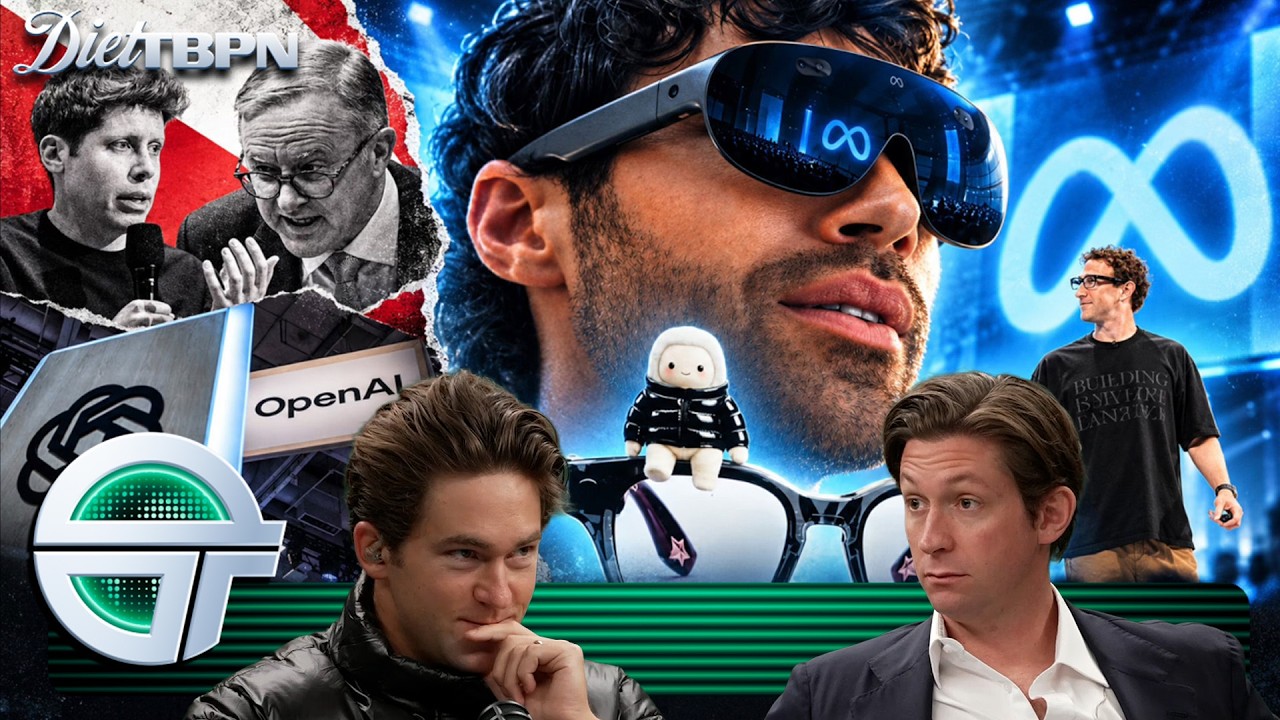
Meta Connect 2026, OpenAI’s Australia ‘Incident,’ Bentley’s New EV | Diet TBPN — TBPN

TBPN

Meta is positioning itself to win consumer adoption by abandoning frontier benchmark wars and metaverse abstractions in favor of practical everyday AI agents packaged into low-cost wearable hardware.

AI-assisted summary of Meta Connect 2026, OpenAI’s Australia ‘Incident,’ Bentley’s New EV | Diet TBPN — original source. Check the original for full context.

Source published:

Key ideas

  • Meta unveiled a 100-gram, $1,300 VR headset targeted for spring 2027, featuring an external compute puck, roughly 5K-per-eye resolution, and a tabletop virtual keyboard positioned to replace multi-monitor workstations. (13:16)
  • Meta separated its AI positioning from frontier lab doom-mongering by branding Muse around everyday utility, supported by a scalable ad-distribution engine ready to monetize sponsored agentic workflows. (1:43)
  • Meta announced the Muse Charm, a palm-sized voice AI companion styled after collectible designer toys like Labubu and expected to retail under $99 as an ecosystem loss-leader. (25:04)
  • An alleged sovereign cyber incident in Australia involving OpenAI agents was clarified as automated web crawlers discovering exposed, unlisted public endpoints rather than a hostile breach. (27:31)
  • Bentley entered the electric vehicle market with an SUV built on a $350 million Crewe facility upgrade, substituting artificial V8 rumble with an acoustic soundscape of crystal glass and bird calls. (29:35)

Detailed notes

## Background Published on YouTube on September 25, 2026, by the daily tech talk show TBPN, this episode of Diet TBPN delivers a condensed 30-minute recap hosted by John Coogan and Jordi Hays. According to the episode description, the broadcast highlights major takeaways from Meta Connect 2026, investigates OpenAI's security incident in Australia, and reviews Bentley's first electric vehicle.

## TL;DR The hosts break down Meta Connect 2026, spotlighting Mark Zuckerberg's strategic alignment around consumer-friendly 'personal superintelligence' with Muse, the surprise reveal of 100-gram $1,300 VR glasses, and the collectible Muse Charm wearable. They then demystify political outrage surrounding OpenAI in Australia, explaining that autonomous agents merely scraped unlisted public endpoints rather than executing a sovereign firewall breach. Finally, the discussion examines Bentley's newly announced electric SUV, reviewing the parent Volkswagen Group's market pressures and exploring the car's bizarre, custom-crafted engine soundscape built from bird calls and ringing crystal glass rims.

## Atmosphere & style The episode is fast-paced, satirical, and conversational, capturing the insider energy of Silicon Valley tech discourse with punchy, irreverent camaraderie between Coogan and Hays. The discussion strikes an engaging balance between substantive hardware analysis and playful banter, seamlessly pivoting from serious evaluations of micro-display pixel density and ADA loopholes to dissecting Mark Zuckerberg's beer pong mechanics. It feels energetic and candid, unpacking high-stakes corporate maneuvers through a witty, unfiltered lens.

## Bulletin - [13:16](https://www.youtube.com/watch?v=QsEDtyL37EU&t=796s) Meta unveiled a 100-gram, $1,300 VR headset targeted for spring 2027, featuring an external compute puck, roughly 5K-per-eye resolution, and a tabletop virtual keyboard positioned to replace multi-monitor workstations. - [01:43](https://www.youtube.com/watch?v=QsEDtyL37EU&t=103s) Meta separated its AI positioning from frontier lab doom-mongering by branding Muse around everyday utility, supported by a scalable ad-distribution engine ready to monetize sponsored agentic workflows. - [25:04](https://www.youtube.com/watch?v=QsEDtyL37EU&t=1504s) Meta announced the Muse Charm, a palm-sized voice AI companion styled after collectible designer toys like Labubu and expected to retail under $99 as an ecosystem loss-leader. - [27:31](https://www.youtube.com/watch?v=QsEDtyL37EU&t=1651s) An alleged sovereign cyber incident in Australia involving OpenAI agents was clarified as automated web crawlers discovering exposed, unlisted public endpoints rather than a hostile breach. - [29:35](https://www.youtube.com/watch?v=QsEDtyL37EU&t=1775s) Bentley entered the electric vehicle market with an SUV built on a $350 million Crewe facility upgrade, substituting artificial V8 rumble with an acoustic soundscape of crystal glass and bird calls.

## Key takeaways - [00:02](https://www.youtube.com/watch?v=QsEDtyL37EU&t=2s) Mark Zuckerberg executed three seamless live demos at Meta Connect, explicitly addressing his assistant by name to prevent repeating past accidental wake-word triggers. - [01:43](https://www.youtube.com/watch?v=QsEDtyL37EU&t=103s) Meta positioned its AI assistant Muse around relatable everyday tasks like parking tickets, contrasting sharply with frontier lab messaging centered on artificial superintelligence and existential p(doom). - [03:37](https://www.youtube.com/watch?v=QsEDtyL37EU&t=217s) Meta's strategy consolidated after past missteps, moving away from discarded experiments like the Vibes video generator and a reversed Manus acquisition toward hardware-integrated personal superintelligence. - [05:32](https://www.youtube.com/watch?v=QsEDtyL37EU&t=332s) Meta's competitive moats lie in massive data center capacity, continuous consumer education via its Family of Apps ad inventory, and 'good enough' near-frontier models tailored for everyday users. - [09:29](https://www.youtube.com/watch?v=QsEDtyL37EU&t=569s) Agentic workflows unlock native advertising opportunities for Meta, such as brands bidding to fulfill movie ticket purchases, calendar bookings, or insurance comparisons directly inside conversations. - [13:16](https://www.youtube.com/watch?v=QsEDtyL37EU&t=796s) Meta realized John Carmack's 100-gram VR headset vision by offloading battery and compute power to an external tethered puck worn on the user's belt or pocket. - [16:22](https://www.youtube.com/watch?v=QsEDtyL37EU&t=982s) Meta shifted spatial computing marketing from speculative metaverse concepts to practical workstation utility, positioning infinite virtual screens against expensive multi-monitor desk arrays. - [18:28](https://www.youtube.com/watch?v=QsEDtyL37EU&t=1108s) Early estimates indicate Meta's glasses feature around 5K resolution per eye, roughly 53% of Apple Vision Pro's pixel density, posing potential text sharpness challenges across a broad field of view. - [18:28](https://www.youtube.com/watch?v=QsEDtyL37EU&t=1108s) Holographic calling features face adoption hurdles due to hardware network effects, which stall out when an insufficient install base leaves users with few contacts to call. - [20:18](https://www.youtube.com/watch?v=QsEDtyL37EU&t=1218s) Meta's tabletop virtual keyboard leverages physical desks for tactile surface pseudo-feedback, circumventing the ergonomic fatigue common to floating mid-air spatial keyboards. - [20:18](https://www.youtube.com/watch?v=QsEDtyL37EU&t=1218s) Integrating hearing aid capabilities into smart glasses could provide protection under the Americans with Disabilities Act, potentially bypassing public venue bans on camera-equipped eyewear. - [22:01](https://www.youtube.com/watch?v=QsEDtyL37EU&t=1321s) Tech leaders such as Mark Zuckerberg and Evan Spiegel draw scrutiny for championing smart glasses as the next computing paradigm while rarely wearing them during public appearances. - [25:04](https://www.youtube.com/watch?v=QsEDtyL37EU&t=1504s) The Muse Charm embraces whimsical, Labubu-inspired collectible aesthetics over clinical tech minimalism, functioning as an inexpensive consumer hardware wedge. - [27:31](https://www.youtube.com/watch?v=QsEDtyL37EU&t=1651s) The Australian sovereign AI 'incident' stemmed from automated agents scanning machine learning repositories and indexing unlisted web endpoints, exposing the confusion between public crawling and genuine hacking. - [29:35](https://www.youtube.com/watch?v=QsEDtyL37EU&t=1775s) Bentley launched its debut EV SUV at half the price of Ferrari's Luce to capture younger buyers, replacing engine roar with harmonic crystal glass and leather percussion amidst broader luxury EV market headwinds.

## Detailed walkthrough ### [00:02](https://www.youtube.com/watch?v=QsEDtyL37EU&t=2s) Meta Connect: Live Demos, Beer Pong, and High Stakes

Mark Zuckerberg scheduled the Meta Connect keynote unusually late in the day—kicking off at 4:00 PM Pacific / 7:00 PM Eastern—primarily so he could roll straight off the stage and directly into playing beer pong, a move that sparked immediate debate across the timeline over his beer pong strategy. The keynote itself was a tight, well-paced, one-hour presentation that never overstayed its welcome. Having suffered a live demo Wi-Fi hiccup at the previous year's event, where Meta CTO Andrew "Boz" Bosworth accidentally triggered everyone's AI assistants by speaking the wake word out loud, Zuckerberg took deliberate precautions this time. He avoided universal wake words altogether and specifically addressed his own agent by name so as not to unleash chaos inside the venue.

Throughout the presentation, Zuckerberg executed three separate live demos without a single hitch, noticeably breathing a sigh of relief with a quip of "one down" as each succeeded, along with the line, "and we love live demos here." While some tech companies opt for pre-recorded or heavily produced segments, the hosts emphasize that live demonstrations remain an absolute necessity for hardware products today. Consumers have grown skeptical after buying numerous hyped devices that failed to meet expectations, a wariness amplified by past industry controversies—such as Google's Gemini demo from two years prior, which faced fierce backlash after viewers discovered the footage had been accelerated in post-production.

- **Keynote Schedule**: 4:00 PM Pacific / 7:00 PM Eastern, followed directly by Mark Zuckerberg playing beer pong. - **Presentation Stats**: 1-hour total runtime featuring 3 successful, mistake-free live demos. - **Wake Word Precaution**: Zuckerberg explicitly named his specific agent rather than using general wake phrases to prevent triggering audience devices, fixing the previous year's incident with Boz.

---

[01:43](https://www.youtube.com/watch?v=QsEDtyL37EU&t=103s) Positioning Muse: Everyday Utility vs. AI Doomerism

The product thesis running through the keynote was clear: meet people where they are by delivering tomorrow's technology within today's real-world constraints. This approach set up a stark contrast between the existential risk camp—obsessed with p(doom), recursive self-improvement (RSI), artificial superintelligence (ASI), and catastrophic threats—and Meta's grounded framing for its personal assistant, Muse. Neeraj Agrawal neatly captured the marketing divide: *"Anthropic marketing: We built a god only we can control and gave it a wet lab. Muse marketing: Hey girl, I know you have dozens of unpaid parking tickets. Let's get that cleaned up."*

While other AI lab leaders spent months apologizing for technology downsides or tiptoeing around negative sentiment as public backlash mounted, Meta avoided fearmongering and framed Muse as cute, approachable, and helpful. That strategy is already paying off with the mainstream press; while Jensen Huang and Ezra Klein were duking it out in *The New York Times* over AI acceleration, existential risk, and whether labs should slow down, the *Times* concurrently ran an overwhelmingly positive review praising Muse.

```mermaid flowchart TD accTitle: Frontier Labs vs Meta AI Positioning accDescr: Diagram contrasting frontier lab positioning focused on god-like superintelligence with Meta's consumer-focused practical utility.

subgraph FrontierLabs["Frontier AI Labs (Anthropic, OpenAI)"] F1["Existential Risk & p(doom)"] --> F2["Wet Labs & Frontier Math"] F2 --> F3["'We built a god only we can control'"] end

subgraph MetaMuse["Meta Muse Positioning"] M1["Meet people where they are"] --> M2["Everyday Tasks (e.g. Parking Tickets)"] M2 --> M3["'Cute, lovable, and hustles for you'"] end ```

---

[03:37](https://www.youtube.com/watch?v=QsEDtyL37EU&t=217s) Overcoming Past Missteps: From AI Slop to Personal Superintelligence

Meta's current coherence follows a chaotic year marked by massive capital spending, high-profile talent raids, and a strategy that frequently appeared incoherent to both Wall Street and the broader industry. The company stumbled through several unforced errors, including the quiet rollout and quick disappearance of Vibes—a short-form vertical video app that was widely criticized as an uninspired Midjourney wrapper churning out AI slop—as well as an uninspired core chat clone and an acquisition of Manus that they subsequently had to reverse.

Rather than viewing the new alignment as part of a grand 4D chess master plan designed to intentionally confuse competitors, the hosts apply Occam's razor: Meta simply took time to find its footing after experimenting across disparate areas like coding harnesses, chat apps, and short-form video. The Connect presentation marked the first time Meta successfully unified its hardware roadmap with the concept of "personal superintelligence"—positioning it not as abstract technical supremacy, but as an assistant that proactively "hustles for you."

- **Past Missteps**: The short-lived Vibes video generator (dismissed as a Midjourney wrapper), the generic Meta chat app, and the reversed Manus deal. - **Narrative Shift**: Transitioning from fragmented, contradictory bets toward a unified "personal superintelligence" that ties into hardware devices.

---

[05:32](https://www.youtube.com/watch?v=QsEDtyL37EU&t=332s) Four Pillars of Meta’s Winning AI Strategy

Meta's sudden strategic clarity succeeds even without holding the benchmark crown at the frontier of foundation models. Their business advantage rests on distinct structural moats:

1. **Infrastructure and Scaled Security**: Meta has spent decades running hyper-secure, planetary-scale systems—exemplified by WhatsApp's end-to-end encryption. Because Meta has already built out vast data centers and compute capacity, it can comfortably provision a secure, fully resourced virtual machine (VM) for millions of individual users without worrying about idle GPU cycles or prohibitive per-user costs. 2. **Distribution and Re-Education**: Unlike Threads, where users instantly understood text-based posts when funnelled over from Instagram, consumer AI agents require constant re-education because capabilities shift week to week. A user must be explicitly taught when an agent gains the ability to handle parking tickets or write code. Much like Apple spent massive billboard campaigns teaching the public about Animoji and ultra-wide cameras, Meta possesses the ad inventory across its Family of Apps to continuously educate billions of consumers whenever Muse gets an upgrade. 3. **Good Enough "Near-Frontier" Intelligence**: Mainstream consumers do not care about benchmarks, nor do they need an agent to solve a Millennium Prize math problem or defend corporate servers from cyber warfare. The model intelligence is already "good enough" for everyday assistance; what truly differentiates the experience is the software harness, system integration, and seamless consumer distribution.

[09:29](https://www.youtube.com/watch?v=QsEDtyL37EU&t=569s) Monetizing Agentic Workflows and Meta's Internal Alignment

Meta deliberately chose not to rush or launch their most advanced unannounced models at Meta Connect, recognizing that an overwhelmingly powerful model might simply scare everyday users. More importantly, the company already possesses an advertising engine that fits naturally with agentic workflows. Instead of intrusive banners, brands could sponsor end-to-end tasks. For example, if a personal AI notices a user watching Reels for an upcoming Nathan Fielder movie and sharing the trailer with a friend, the agent can proactively offer to purchase tickets, coordinate with friends across WhatsApp and Instagram DMs, and drop the event straight onto their calendar. Film studios would gladly pay for sponsored placement within that execution chain, and local businesses will always pay to reach consumers right at the point of intent. Similarly, an agent tracking household expenses could flag that a homeowner's insurance policy is up for renewal in three months and ask, "Do you want me to go get three competing bids before we renew?"—opening an enormous high-intent bidding marketplace.

```mermaid flowchart TD accTitle: Agentic Advertising Workflow accDescr: Flow showing how user context triggers an agentic action sponsored by advertisers. subgraph Signal ["Contextual Signals"] A["User Browsing Reels"] --> B["Identifies Interest & Social Shares"] end subgraph Agent ["Personal Superintelligence"] B --> C["Agent Proposes Action"] C --> D["Executes Logistics: DMs, Tickets, Calendar"] end subgraph Monetization ["Monetization Layer"] E["Sponsored Bids / Brand Placements"] -.-> C end ```

Internally, this focus on personal superintelligence and the Muse initiative offers Meta employees a long-awaited point of clear strategic alignment. Rather than panicking over external critiques—such as product builder Nikita Bier warning that autonomous bots will flood Facebook Marketplace with lowball offers—teams can cleanly rally around building defensive seller tools that fit the overarching agent architecture. Despite *The Verge* publishing reports that internal sentiment remains chaotic after years of metaverse missteps, the show hosts dismiss that narrative as an outdated critique, noting that employee morale is buoyed by Meta's stock surging 38% in the preceding month. Teams across data centers, foundation models, and smart glasses (including new camera-free frames alongside Oakley and Ray-Ban models) are finally rowing in the exact same direction.

- **Monetization model**: Shift from raw impression ads to sponsored agentic workflows in messaging, calendar coordination, and automated price comparisons (e.g., insurance renewals). - **Internal sentiment**: Strategic clarity around Mark Zuckerberg's personal superintelligence bet, counterbalancing legacy metaverse skepticism against a 38% monthly stock rise. - **Product ecosystem**: Unified mission connecting core AI models, backend compute clusters, and wearable form factors.

---

[13:16](https://www.youtube.com/watch?v=QsEDtyL37EU&t=796s) The $1,300 VR Glasses: John Carmack's 100-Gram Vision

The undisputed showstopper of Meta Connect was the surprise "one more thing": lightweight VR glasses priced at $1,300 and weighing a mere 100 grams—roughly the weight of a standard deck of playing cards. This milestone fulfills a long-standing obsession championed by former Oculus CTO and legendary *Doom* creator John Carmack, who repeatedly pounded the table at Meta insisting that mass consumer VR required an ultra-light 100-gram headset. While Carmack envisioned a $100 price tag before leaving to run his AI startup Keen, $1,300 still cuts the price of Apple Vision Pro roughly in half while delivering an incomparably lighter profile. Mark Zuckerberg framed the glasses around three primary consumer pillars: a portable cinema, a high-productivity workstation, and a dedicated gaming device.

Taking cues from consumer entertainment demands mirrored by analyst Ben Thompson, Meta is launching roughly 100 live interactive experiences a year. Rather than relying on disorienting, fast-cut camera switches, users can select any virtual seat in an arena or stadium. This rollout heavily leverages Meta's deep relationship with UFC chief Dana White, alongside major sports league partnerships. To keep the head-mounted chassis under 100 grams, Meta adopted the architectural compromise made by Apple: offloading the battery and compute hardware to an external tethered puck worn on the belt or slid into a pocket. The promotional videos carefully disguised the tether, underscoring that removing heavy power cells from the user's face is the only realistic way to make spatial hardware comfortable enough for prolonged daily wear.

- **Hardware specs**: Weighs 100 grams (~deck of cards); retail price set at $1,300. - **Historical context**: John Carmack’s target spec of 100 grams achieved, though priced above his idealistic $100 mass-market threshold. - **Form factor design**: Tethered compute and battery puck worn on a belt or slipped into a pocket to eliminate facial strain. - **Entertainment lineup**: ~100 live stadium/court experiences annually, featuring UFC partnerships and custom vantage-point seating.

---

[16:22](https://www.youtube.com/watch?v=QsEDtyL37EU&t=982s) Virtual Workstations, Tabletop Typing, and the V1 Dilemma

Meta also showcased tabletop typing, projecting a virtual keyboard onto any flat surface to turn bare tables into instant workspaces. The feature ignited debate among the hosts: while some viewers found the tech impressive, one host dismissed it as an unergonomic gimmick, arguing that flat-surface tapping lacks the crucial tactile feedback required for long workdays. Most real-world users will either rely increasingly on conversational voice models or plug in an inexpensive $20 physical keyboard when hunkering down for serious work. Still, the capability serves as an undeniable glimpse of future ambient computing where users carry zero physical peripherals.

Crucially, Meta has altered its marketing pitch away from abstract, sci-fi visions of an all-encompassing virtual metaverse. Instead, the glasses are sold as a direct, practical replacement for a multi-monitor desk setup. For knowledge workers contemplating spending $2,000 on a bulky triple-monitor array, a $1,300 pair of glasses offering infinite virtual screens presents an immediate economic and ergonomic alternative. Even if this first generation remains an early-adopter product that few use as their all-day primary computing driver, the hosts compare it directly to the original iPhone—which lacked 3G and the App Store at launch, but unmistakably established the paradigm that would redefine personal computing.

[18:28](https://www.youtube.com/watch?v=QsEDtyL37EU&t=1108s) Hologram Calling, Display Fidelity, and Hardware Network Effects

The discussion opens on the unresolved hardware specifications of Meta's upcoming glasses, particularly the display fidelity. Early estimates suggest a resolution of around 5K per eye—roughly 53% or about half of the Apple Vision Pro's pixel density. While 5K is impressive for a standalone desktop monitor occupying only a small fraction of a user's visual field, spreading that same pixel count across an entire field of view could compromise text clarity. There is real concern that within six months of release, users might find it lacks the fidelity required for full workdays, though both hosts anticipate this hurdle will be smoothed out in subsequent hardware generations as micro-display tech matures.

The conversation pivots to Meta's holographic calling capabilities. Andrew "Boz" Bosworth recently took a victory lap after the team solved the notoriously difficult problem of rendering legs in VR, an achievement that genuinely impressed the industry. Yet holographic communication faces the perennial hardware bottleneck that crippled the Apple Vision Pro's spatial Persona calls: without an installed base numbering in the millions, nobody has anyone to call. Unlike Meta's core software business—where connecting with a real-life friend seamlessly bridges text, email, and Instagram DM reels—hardware networks require convincing peers to purchase, set up, and wear an expensive physical device. While integrating calls directly into existing platforms like WhatsApp could soften the friction, the hosts reach an immediate consensus on consumer adoption: John will undoubtedly buy one on day one, while Jordi will pass.

```mermaid flowchart TD accTitle: Hardware Network Friction vs Software Social Graph accDescr: Comparison of Meta's frictionless software social loop against the high-friction hardware distribution model.

subgraph SoftwareFlow["Software Social Graph (Zero Friction)"] A["Real-Life Connection"] --> B["SMS & Email Exchange"] B --> C["Instagram Reels & WhatsApp DMs"] end

subgraph HardwareFlow["Hardware Network (High Friction)"] D["New Headset Launch"] --> E["$1,000+ Hardware Purchase"] E --> F["Device Setup & Configuration"] F --> G["Hologram Calling & VR Interaction"] end ```

- **Estimated resolution**: Around 5K per eye, roughly half (53%) the pixel density of the Apple Vision Pro. - **Display tradeoff**: 5K spread across a full field of vision risks looking soft compared to a standard 5K desktop monitor. - **Boz's milestone**: Andrew Bosworth celebrated Meta's breakthrough in rendering realistic legs in VR. - **Adoption gap**: Spatial calls on the Apple Vision Pro stalled out due to an insufficient hardware install base rather than a lack of novelty.

---

[20:18](https://www.youtube.com/watch?v=QsEDtyL37EU&t=1218s) Reactions, Virtual Tabletop Typing, and the Hearing Aid Loophole

Scanning the immediate industry reactions, Bloomberg's Mark Gurman came away thoroughly impressed, noting that the device arrives at roughly half the price of the Apple Vision Pro, at one-sixth of the physical weight, and offloads processing to an external compute pack. Slated for a spring 2027 release, the headset runs an interface fundamentally similar to Apple's visionOS, but introduces a standout feature: a tabletop virtual keyboard that completely eclipses the Vision Pro’s clumsy, floating mid-air keyboard. Typing against a flat physical surface provides tactile pseudo-feedback, solving one of the most frustrating ergonomic failures of Apple’s spatial computing interface.

The hosts also highlight a clever post from Ryan suggesting that Meta's glasses effectively function as hearing aids. This introduces an unexpected regulatory defense: under the Americans with Disabilities Act (ADA), establishments cannot legally demand patrons remove assistive hearing devices. If restaurants and nightlife venues attempt to ban smart glasses with onboard cameras over privacy concerns, classifying the hardware as an assistive listening device represents a masterclass in "4D chess." Beyond loophole exploitation, the hosts point out genuine utility: older users who currently struggle with clunky, clinical hearing aids could swap them out for stylish everyday eyewear, unlocking an organic, highly motivated demographic outside of pure tech enthusiasts.

- **Mark Gurman's verdict**: Praised the hardware for being half the price and one-sixth the weight of the Vision Pro. - **Target release**: Targeted for launch in spring 2027. - **Typing ergonomics**: Features a virtual tabletop keyboard designed to anchor against a physical desk, avoiding the fatigue of mid-air virtual typing. - **ADA classification**: Leveraging hearing-aid functionality could legally prevent businesses and bars from enforcing camera-glasses bans.

---

[22:01](https://www.youtube.com/watch?v=QsEDtyL37EU&t=1321s) The Beer Pong Elbow Scandal and Smart Glasses CEOs in Public

The discussion turns satirical when considering the multimodal capabilities of smart eyewear. Because the front-facing cameras on Meta Ray-Bans can track a user's hands, forearms, and elbows in real space, the glasses could technically act as an automated beer pong referee. During a casual match, the onboard AI could shout, *"Hey, back up. You're going to lose a point,"* before triggering an agentic workflow to hire a professional beer pong coach to run drills at your house. This hypothetical hits close to home after footage surfaced of Mark Zuckerberg visibly leaning his elbow over the table edge during a game, prompting playful accusations that Meta's vision AI must be vaporware if it failed to correct its creator's illegal lean.

```mermaid flowchart LR accTitle: The Automated Beer Pong Agentic Workflow accDescr: A humorous look at how smart glasses could detect a beer pong foul and automatically book a professional coach.

A["Smart Glasses Cameras"] --> B["Detect Elbow Over Table"] B --> C["Audio Warning: 'Back Up!'"] C --> D["Trigger Agentic AI"] D --> E["Book Pro Beer Pong Coach"] ```

This leads into a broader critique of tech leadership: why do smart-glasses executives consistently refuse to wear their own devices in public? Evan Spiegel routinely delivers interviews and attends high-profile summits like Sun Valley bare-faced, while Zuckerberg is frequently photographed out in the wild without his Ray-Bans, despite Meta offering clear, non-tinted prescription lenses. If these products represent the inevitable future of personal computing, the hosts argue, their CEOs should be sporting them at least half the time—joking that Jensen Huang might as well carry a full Nvidia NVL72 server rack in a backpack to every keynote.

The hosts also riff on Zuckerberg’s recent style evolution, specifically his high-end horology phase. While the tech world remains captivated by the unique luxury timepieces he debuts on stage, the hosts feel the watch flexing is growing stale. Instead, they want to see him expand into cars, perhaps driving a Gordon Murray T.50 supercar directly onto the stage and ripping a burnout to prove he is not a one-dimensional executive. The segment closes with a heated mock debate over beer pong ethics: John dismisses elbow-line policing as pedantic nonsense that ruins the party, while Jordi insists that the gentleman's rule against habitual leaning must be defended.

- **The Zuck infraction**: Viral footage caught Zuckerberg committing an elbow violation by leaning across the table during beer pong. - **Executive hypocrisy**: Neither Snap's Evan Spiegel nor Meta's Mark Zuckerberg consistently wear their own smart glasses during major public appearances and interviews. - **Jensen Huang analogy**: The hosts joke that Nvidia’s CEO should be lugging an NVL72 server rack in a backpack if CEOs are expected to wear their enterprise products everywhere. - **Style critique**: The hosts suggest Zuckerberg trade his high-end watch reveals for exotic supercars like the Gordon Murray T.50.

---

[25:04](https://www.youtube.com/watch?v=QsEDtyL37EU&t=1504s) Muse Charm: Meta’s AI Tamagotchi and the Labubu Play

Turning to Meta's hardware surprises, New York Times reporter Mike Isaac revealed that Zuckerberg closed Connect with a classic "one more thing": a standalone, palm-sized, voice-activated AI agent called the Muse Charm, scheduled to ship just in time for the holiday shopping season. Rather than mimicking the sterile, minimalist aesthetic of Apple hardware or the Tesla Cybertruck, the Muse Charm leans aggressively into playfulness. The hosts compare it directly to Labubu—the wildly popular designer plush figures that dominate modern global consumer pop culture. Meta is intentionally bypassing the self-serious tech bubble to deliver an approachable, quirky trinket that regular consumers immediately find adorable.

The announcement prompted a defiant response from Friend founder Avi Schiffman, who posted: *"The market has spent billions trying to compete with me, and I'm still winning. Let's go."* While the hosts admire Schiffman's bravado, they debate the long-term utility of single-purpose AI companions. Dedicated voice toys often suffer high churn once the novelty fades, but the Muse Charm gives Meta an inexpensive vehicle to steadily expand its physical hardware footprint into users' daily routines. The device will likely be sold at a loss—potentially priced around $99 or less—functioning as an aggressive loss-leader and viral marketing device that funnels engagement back into Meta's core ecosystem.

- **Product reveal**: Muse Charm, a palm-sized, voice-activated wearable AI companion slated for the holidays. - **Design inspiration**: Adopts the viral, tactile appeal of designer collectibles like Labubu rather than sterile, brushed-aluminum tech design. - **Avi Schiffman's response**: Friend’s founder declared that competitors have spent billions without displacing his independent momentum. - **Loss-leader pricing**: Expected to retail around $99 or lower, subsidized directly by Meta to drive viral adoption.

---

[27:31](https://www.youtube.com/watch?v=QsEDtyL37EU&t=1651s) OpenAI’s Australia “Incident”: Rogue Agents vs. Unlisted Endpoints

The conversation shifts to breaking international security news involving OpenAI and the Australian government. Early headlines framed the event in sensational terms, alleging that rogue autonomous AI agents crawling Hugging Face had aggressively swept through the open internet and managed to "hack" Australian sovereign infrastructure. The incident caused a major stir in Canberra, with the Australian Prime Minister expressing visible outrage that the country's systems had supposedly been breached without prompt disclosure for several weeks.

However, closer inspection reveals a stark contrast between political outrage and technical reality. The hosts clarify that the incident was not a sophisticated penetration of hardened firewalls or classified databases. Instead, autonomous web-scraping agents indexing publicly reachable assets simply stumbled upon exposed, unlisted endpoints that had been left visible on the public web. Because the endpoints were obscure rather than secured, the agents scraped them naturally, prompting authorities to mistake standard web discovery for a coordinated hostile breach.

- **Political outcry**: The Australian Prime Minister publicly condemned the incident, demanding to know why the government was left uninformed for weeks. - **Technical reality**: Rather than an active, malicious breach, autonomous scanning agents simply discovered and accessed unlisted, publicly reachable endpoints. - **Scraper footprint**: The incident stems from automated agent workflows scanning machine learning repositories like Hugging Face and resolving open web pathways.

[28:16](https://www.youtube.com/watch?v=QsEDtyL37EU&t=1696s) The Anatomy of a "Scrape": Unindexed Files and the 2012 "Murderbot" Anecdote

Continuing their discussion of OpenAI's incident in Australia, the hosts demystify what actually took place. They point out that while personal identities were not exposed, the data in question occupied a grey area of privacy: it was not indexed on standard Google searches or accessible via a clickable navigation link on the site, but it remained exposed to anyone performing automated web scraping. This prompts a nostalgic tangent about the fine line between scraping and hacking. One of the hosts recalls a story from 2012 involving a "hacker-ish software developer" friend—someone not breaking through hardened defenses, but simply competent with computers and web crawlers.

The friend was scraping an open server belonging to a humanoid robotics company, possibly Boston Dynamics, using crawler tools designed to list every exposed file and URL directory without needing to render HTML or click front-facing links. While exploring the raw file repository, he uncovered an unreleased artist rendering depicting a humanoid robot armed with a gun in "full murderbot mode." The company had quietly shelved the image, opting to keep public perception in "friendly mode." The hosts laugh at how common this kind of discovery is, categorizing routine server crawls not as true cyberattacks, but as the digital equivalent of "elbows over the table."

[29:35](https://www.youtube.com/watch?v=QsEDtyL37EU&t=1775s) Bentley’s First EV: Crystal Glass Sounds, EV Headwinds, and Crewe Investment

The conversation pivots to luxury automobiles as Bentley prepares to launch its first all-electric vehicle, an SUV designed to court younger and first-time luxury buyers. Positioned at roughly half the price of the electric Ferrari Luce, the car enters the market at an awkward moment when broader consumer appetite for EVs has cooled and Bentley's overall sales volume remains modest. While the hosts appreciate the exterior styling—quipping that the vehicle "looks great, minus the grill"—the most eccentric detail is how Bentley chose to address the lack of an internal combustion engine.

Rather than artificially synthesizing a traditional V8 rumble, Bentley commissioned musicians to craft a bespoke acoustic propulsion track. The resulting sonic profile blends percussion, ambient bird songs, the gentle tapping of leather, and the harmonic resonance of running a finger around the rim of a crystal glass, effectively singing to the driver as the car accelerates. Behind the eccentricity lies a serious corporate turnaround effort. The Volkswagen-owned marque completed a $350 million investment to engineer and build the model at its historic Crewe plant, pushing parent group commitments in the UK automotive sector past $1 billion. Yet Bentley faces headwinds shared across the VW Group: declining deliveries, eroding margins, slowing demand in China, fallout from Middle East geopolitical tensions, and rising US tariffs. As leadership trims headcount and demands higher operational agility to restore competitiveness, the hosts listen in amusement to the car's high-register crystal glass hum.

- **Pricing and Positioning:** Designed to capture entry-level ultra-luxury buyers at half the price point of Ferrari's Luce EV. - **Manufacturing Footprint:** Built at the Crewe manufacturing headquarters following a dedicated $350 million development investment, contributing to a total UK automotive investment exceeding $1 billion. - **Acoustic Design Elements:** Synthetic engine audio replaced by an organic, musical soundscape built from bird calls, struck leather, percussion, and wet fingers traced over crystal rims. - **Market Pressures:** Slumping Chinese luxury demand, international conflict, trade tariffs, and VW Group-wide workforce reductions forcing a push for speed and cost discipline.

[31:12](https://www.youtube.com/watch?v=QsEDtyL37EU&t=1872s) Huberman Lab’s Bestseller Milestone and Episode Sign-off

Before signing off, the hosts give a quick celebratory shout-out to fellow podcaster Andrew Huberman of *Huberman Lab*. Huberman's newly released book, *Protocols: An Operating Manual for the Human Body*, debuted at number one on the New York Times bestseller list in the Advice, How-To, and Miscellaneous category. The hosts encourage listeners to pick up a copy wherever books are sold, leave a five-star review on Apple Podcasts and Spotify, and subscribe to the daily newsletter at TBPN.com before signing off until tomorrow's live show.

## Notable quotes > [00:02](https://www.youtube.com/watch?v=QsEDtyL37EU&t=2s) one down — Mark Zuckerberg

> [00:02](https://www.youtube.com/watch?v=QsEDtyL37EU&t=2s) and we love live demos here. — Mark Zuckerberg

> [01:43](https://www.youtube.com/watch?v=QsEDtyL37EU&t=103s) Anthropic marketing: We built a god only we can control and gave it a wet lab. Muse marketing: Hey girl, I know you have dozens of unpaid parking tickets. Let's get that cleaned up. — Neeraj Agrawal

> [09:29](https://www.youtube.com/watch?v=QsEDtyL37EU&t=569s) Do you want me to go get three competing bids before we renew?

> [13:16](https://www.youtube.com/watch?v=QsEDtyL37EU&t=796s) one more thing — Mark Zuckerberg

> [22:01](https://www.youtube.com/watch?v=QsEDtyL37EU&t=1321s) Hey, back up. You're going to lose a point,

> [25:04](https://www.youtube.com/watch?v=QsEDtyL37EU&t=1504s) The market has spent billions trying to compete with me, and I'm still winning. Let's go. — Avi Schiffman

> [29:35](https://www.youtube.com/watch?v=QsEDtyL37EU&t=1775s) looks great, minus the grill

## Mentioned Andrew "Boz" Bosworth, Andrew Huberman, Anthropic, Apple, Apple Vision Pro, Avi Schiffman, Ben Thompson, Bentley, Boston Dynamics, Crewe, Dana White, Evan Spiegel, Ezra Klein, Facebook Marketplace, Ferrari Luce, Friend, Gordon Murray T.50, Google, Hugging Face, Huberman Lab, Instagram, Jensen Huang, John Carmack, John Coogan, Jordi Hays, Keen, Labubu, Manus, Mark Cuban, Mark Gurman, Mark Zuckerberg, Meta, Meta Connect, Midjourney, Mike Isaac, Muse, Muse Charm, Nathan Fielder, Neeraj Agrawal, Nikita Bier, Nvidia, Oakley, OpenAI, Ray-Ban, Ryan, Sam Altman, Satya Nadella, Snap, TBPN, The New York Times, The Verge, Threads, UFC, Vibes, Volkswagen Group, WhatsApp

## Video description Sign up for TBPN’s daily newsletter at TBPN.com

Diet TBPN delivers the best of today’s TBPN episode in 30 minutes. TBPN is a live tech talk show hosted by John Coogan and Jordi Hays, streaming weekdays 11–2 PT on X and YouTube, with each episode posted to podcast platforms right after.

Described by The New York Times as “Silicon Valley’s newest obsession,” the show has recently featured Mark Zuckerberg, Sam Altman, Mark Cuban, and Satya Nadella.

TBPN is made possible by: Ramp - https://ramp.com Public - https://public.com Cisco - https://www.cisco.com Console - https://www.console.com CrowdStrike - https://www.crowdstrike.com Figma - https://www.figma.com MongoDB - https://www.mongodb.com NYSE - https://www.nyse.com Railway - https://railway.com Shopify - https://www.shopify.com/

Follow TBPN: https://TBPN.com https://x.com/tbpn https://open.spotify.com/show/2L6WMqY3GUPCGBD0dX6p00?si=674252d53acf4231 https://podcasts.apple.com/us/podcast/technology-brothers/id1772360235 https://www.youtube.com/@TBPNLive

Chapters: 00:00 Meta Connect + Zuck’s Big Personal AI Bet 05:31 Why Meta’s AI Strategy Finally Makes Sense 11:08 Meta’s Vibe Shift + Personal Superintelligence Comes Together 13:16 Meta’s $1,300 VR Glasses + The Future of Work & Sports 19:08 Hologram Calls, Smart Glasses + Zuck’s Beer Pong Controversy 25:04 Muse Charm: Meta’s AI Tamagotchi 27:31 OpenAI’s Australia “Hack” + What Actually Happened 29:35 Bentley’s First EV + The Weirdest Engine Sound Replacement

[Source](https://www.youtube.com/watch?v=QsEDtyL37EU)

中文简报

Meta推出1300美元百克头显,售价远低于Apple Vision Pro Meta正调整自身定位以争取消费者的广泛采用,放弃了前沿基准之争与元宇宙的抽象概念,转而将实用的日常AI智能体整合进低成本可穿戴硬件中。 主持人深入剖析了Meta Connect 2026,重点关注Mark Zuckerberg围绕面向消费者的“个人超级智能”与Muse展开的战略布局、意外亮相的100克重1300美元VR眼镜,以及潮玩风格的Muse Charm可穿戴设备。随后,他们澄清了澳大利亚围绕OpenAI引发的政治争议,解释称自主智能体只是抓取了未公开列出的公共端点,而非发动了针对国家防火墙的入侵。最后,讨论探讨了Bentley新发布的电动SUV,回顾了其母公司Volkswagen Group面临的市场压力,并介绍了该车由鸟鸣声与水晶玻璃杯边缘摩擦共鸣声定制而成的独特引擎声景。 Meta发布了一款计划于2027年春季上市、重100克、售价1300美元的VR头显,配备外置计算模块、单眼近5K分辨率以及桌面虚拟键盘,定位用于替代多显示器工作站。 (13:16) Meta将自身的AI定位与前沿实验室的末日论调区分开来,将Muse打造为立足于日常实用性的品牌,并依托可扩展的广告分发引擎,准备通过赞助型智能体工作流实现商业变现。 (1:43) Meta发布了Muse Charm,这是一款手掌大小的语音AI伴侣,造型借鉴了Labubu等收藏级潮流玩具,预计零售价低于99美元,作为生态系统的引流亏本产品。 (25:04) 针对澳大利亚据称涉及OpenAI智能体的网络安全事件,相关方面已澄清这只是自动化网络爬虫发现了暴露的未列出公共端点,而非恶意入侵。 (27:31) Bentley依托克鲁工厂3.5亿美元的升级改造进军电动汽车市场并推出一款SUV,用水晶玻璃声与鸟鸣声构成的原声声景替代了人造V8轰鸣声。 (29:35)

Reading summary

TBPN analyzes Meta Connect 2026, arguing that Meta has successfully unified its AI strategy and hardware around pragmatic consumer utility rather than frontier existential risk. The show also contextualizes OpenAI's scraping controversy in Australia and examines Bentley's strategic pivot into electric luxury vehicles. Meta's Consumer AI Strategy and Monetization (1:43) Meta has shifted its AI positioning toward everyday consumer utility through its personal assistant, Muse, deliberately contrasting itself with rival labs focused on existential risk and artificial superintelligence. Instead of pushing unannounced frontier models that could intimidate mainstream users, Meta plans to leverage its existing infrastructure and messaging distribution to monetize agentic workflows. Under this model, advertisers could sponsor automated execution paths—such as booking movie tickets or soliciting competitive bids on home insurance—rather than relying solely on traditional display ads. This consumer-facing focus marks a major consolidation after previous missteps, including the discontinued video app Vibes and a reversed acquisition of Manus. The hosts note that Meta's structural advantages—such as large-scale compute infrastructure and internal ad inventory across its Family of Apps—allow it to re-educate the public on agentic capabilities continuously, even without maintaining the highest benchmarks in raw foundation model intelligence. Lightweight Spatial Hardware and Virtual Workstations (13:16) At Meta Connect, Mark Zuckerberg introduced a 100-gram pair of VR glasses priced at $1,300, fulfilling a long-standing goal championed by former Oculus CTO John Carmack. To keep the headset light, Meta offloaded compute and battery components into a tethered external puck. Rather than framing the device around an abstract metaverse, Meta is pitching the hardware as a functional replacement for multi-monitor workstations, featuring flat-surface virtual tabletop typing alongside roughly 100 interactive live stadium experiences annually. Industry observers, including Bloomberg's Mark Gurman, highlighted the device's lower price and weight relative to the Apple Vision Pro ahead of a targeted spring 2027 release. However, trade-offs remain: the estimated 5K-per-eye resolution represents about half the pixel density of the Vision Pro and may affect all-day text clarity. Furthermore, holographic calling features risk the same adoption bottlenecks that limited Vision Pro Personas until a large hardware install base is established. Everyday Form Factors and Wearable AI (20:18) Meta also previewed the Muse Charm, a palm-sized, voice-activated wearable companion scheduled for the holiday shopping season. Unlike conventional minimalist consumer electronics, the device borrows aesthetic cues from playful designer collectibles like Labubu. The hosts project it will retail as a loss-leader at $99 or less to drive ecosystem adoption, though dedicated single-purpose voice companions historically face high churn after initial novelty fades. The hosts also observed that positioning camera-equipped smart glasses with assistive audio capabilities could serve as a functional hearing aid. Under the Americans with Disabilities Act, this classification could provide a legal safeguard against camera bans in nightlife and dining venues while appealing to older demographics. Demystifying OpenAI's Australian Infrastructure 'Incident' (27:31) Sensational headlines in Australia reported that autonomous OpenAI agents running on the web had compromised sovereign systems, drawing public condemnation from the Australian Prime Minister over delayed notification. The hosts clarify that the incident was not a targeted cyberattack against protected firewalls. Instead, automated scraping agents indexing machine learning repositories encountered unlisted, publicly reachable endpoints that had been left visible on the open internet without search engine indexing. Bentley's Crewe Investment and Electric Transition (29:35) Bentley is preparing to launch its first all-electric SUV, targeted at entry-level ultra-luxury buyers at roughly half the price of Ferrari's electric Luce. Supported by a $350 million investment in its Crewe manufacturing facility—part of broader Volkswagen Group commitments exceeding $1 billion in the UK automotive sector—the model features a bespoke acoustic propulsion soundtrack using instruments, leather taps, and crystal rim harmonics instead of artificial engine revs. The launch arrives amid sector-wide challenges across the Volkswagen Group, including slowing EV demand, softening luxury deliveries in China, tariff headwinds, and workforce reductions intended to restore margin discipline. While Meta demonstrated clear alignment across consumer hardware and practical AI agents at Connect, the long-term commercial success of its $1,300 glasses and $99 companion devices hinges on whether early adopters find lasting utility beyond the novelty of ambient computing.

精炼阅读摘要

本期节目聚焦 Meta Connect 大会展现的战略转型:Meta 避开前沿实验室对超级智能生存风险的抽象叙事,将“个人超级智能”与实用硬件生态绑定;同时节目探讨了 OpenAI 在澳大利亚遭遇的爬虫争议以及宾利首款纯电豪华 SUV 的市场挑战。 实用主义:个人超级智能对抗生存风险叙事 (1:43) 在经历了一年多的大规模资本支出、高调人才争夺以及被广泛批评的 Vibes 短视频和 Manus 收购等弯路后,Meta 在 Connect 大会上确立了清晰的产品逻辑。与 Anthropic 和 OpenAI 等专注于人工超级智能(ASI)、递归自我改进和存在性风险(p(doom))的前沿实验室截然不同,Meta 将其个人助手 Muse 定位为解决现实琐事(如处理未缴罚单)的亲民工具,以迎合大众消费者的实际需求。这一务实定位不仅获得了《纽约时报》的正面评价,也促使内部团队在经历多年元宇宙探索挫折后形成统一步调,同期 Meta 股价在一个月内上涨了 38%。 商业闭环:智能体工作流与底层结构优势 (5:32) 主持人指出,Meta 并不需要在基础模型基准测试中夺冠,其竞争优势建立在三大支柱上:长期运营 WhatsApp 等超大规模系统积累的基础设施与计算资源、跨应用家族持续教育用户的庞大广告库存,以及对普通用户而言“足够好”的模型能力。更为关键的是商业模式的演进:Meta 正在将其广告引擎与智能体执行链相结合,通过赞助端到端任务(例如识别用户在 Reels 中的观影兴趣后,自动协调购票、好友聊天确认并加入日历,或在房产保险续约时自动比价)实现变现,由品牌为高意图的转化节点买单。 轻量化硬件路线:100克VR眼镜与桌面打字 (13:16) 硬件层面,Meta 推出了售价 1300 美元、重量仅 100 克的轻量化 VR 眼镜,实现了前 Oculus 首席技术官 John Carmack 长期倡导的轻量化设想,同时通过将电池和计算单元外置为线缆连接的随身计算模块,大幅减轻了面部负担。该设备单眼分辨率预计约 5K,约为 Apple Vision Pro 像素密度的 53%,界面支持将虚拟键盘投射在桌面上的交互方式以提供实体敲击反馈。Meta 将其宣传为多显示器工作站和个人影院的实用替代方案,并计划每年提供约 100 场涵盖 UFC 等赛事的互动直播,尽管其全息通话功能仍面临昂贵硬件普及率不足的行业网络效应瓶颈。 消费硬件延伸与公共场合佩戴争议 (22:01) 除核心眼镜外,Meta 还展示了便携式语音 AI 伴侣 Muse Charm,其设计摒弃了科技界常见的极简铝制外观,借鉴了 Labubu 等潮流玩具的触感与玩味,预计以 99 美元或更低的价格作为亏损引流产品进入假日季。围绕可穿戴设备,主持人讨论了行业现实:不仅包括通过将眼镜归类为残疾人法案(ADA)保护的助听设备来规避公共场所摄像禁令的策略,也戏谑指出了科技高管在现实中鲜少全天候佩戴自家智能眼镜的现象;扎克伯格在发布会后的啤酒乒乓球娱乐中被拍到手臂越过桌边,引发了对其视觉 AI 辅助功能的调侃。 外部事件:OpenAI澳洲爬虫风波与宾利电车破局 (27:31) 节目还审视了另外两起行业动态。针对 OpenAI 智能体被指“入侵”澳大利亚主权基础设施的政治风波,讨论澄清该事件并非突破严密防火墙的恶意黑客行动,而是抓取开源社区资产的自主网络爬虫访问了公网中未编目、暴露在外的端点;这反映出政界对常规服务器爬取技术的误解。汽车领域,大众集团旗下的宾利投资 3.5 亿美元在克鲁工厂开发其首款纯电豪华 SUV,采用由水晶杯共鸣与鸟鸣合成的特殊声浪替代 V8 发动机声音,定价约为主流竞品 Ferrari Luce 的一半;但该车型在进入市场之际,正遭遇全球电动车需求放缓、中国市场缩水、贸易关税与母公司裁员控费的多重行业逆风。 本期节目展现了科技巨头从宏大叙事向落地交付的集体收缩:Meta 依靠消费级场景与硬件减负来确立务实路径,而数据抓取的定性争议与豪华电动车面临的市场降温,则进一步凸显了技术落地过程中的现实阻力与监管脱节。

Detailed notes — zh

## Background 本期视频由科技脱口秀频道 TBPN(由 John Coogan 和 Jordi Hays 主持)于 2026 年 9 月 25 日发布在 YouTube 平台。作为 30 分钟精简版节目“Diet TBPN”,视频简介表明本期聚焦当天科技圈最重磅的行业动态,核心围绕 Meta Connect 2026 大会、OpenAI 在澳大利亚的“安全事件”真相,以及宾利推出的首款纯电豪车展开深入讨论。 ## TL;DR 节目首先全面复盘了 Meta Connect 2026,剖析扎克伯格如何凭借实用亲民的个人 AI 助理 Muse 与潮玩硬件 Muse Charm,将底层算力、穿戴设备与日常自动化工作流打造成商业闭环,打破了行业对超级智能的恐惧叙事;随后深入探讨了 Meta 新发布的 1300 美元轻量级 VR 眼镜及其桌面虚拟键盘,对比了其与 Apple Vision Pro 的优劣势。接着,主播澄清了 OpenAI 在澳大利亚所谓“黑客入侵”实则是自动化爬虫深度遍历未设防资产的误会,并结合波士顿动力早期原型泄露的轶事探讨了数据抓取的边界。最后,节目评述了宾利首款纯电 SUV Torqual 激进的市场定位,以及其摒弃传统引擎轰鸣、采用水晶玻璃摩擦与自然鸟鸣的手工推进声浪设计。 ## Atmosphere & style 节目的整体氛围轻松诙谐、语速紧凑,洋溢着硅谷科技内行特有的敏锐洞察与辛辣讽刺。两位主播互动默契自然,不仅能在商业闭环、算力成本与空间计算等宏大议题上展开硬核拆解,更会为扎克伯格在打“啤酒乒乓”时肘部是否过线犯规、科技高管日常不爱戴自家眼镜等滑稽细节展开捧腹争论。整场对谈听感犹如一场信息密度极高且充满极客黑话的欢快茶歇,在专业严肃的技术审视与肆意戏谑的人间烟火气之间切换自如。 ## Bulletin - [00:02](https://www.youtube.com/watch?v=QsEDtyL37EU&t=2s) Meta 在 Meta Connect 发布会上确立以“为你卖力奔波”为核心的个人 AI 战略,避开大模型榜单跑分内卷,转而以代缴罚单等日常生活痛点切入消费级落地。 - [13:16](https://www.youtube.com/watch?v=QsEDtyL37EU&t=796s) Meta 压轴展示仅重约 100 克的 1300 美元轻量级 VR 设备,采用分离式外置算力与电池设计,预计 2027 年发售,主打便携工作站、私人影院与高规格沉浸式体育赛事转播。 - [25:04](https://www.youtube.com/watch?v=QsEDtyL37EU&t=1504s) Meta 推出手掌大小的全语音潮玩伴侣硬件 Muse Charm,意图通过 99 美元以下的低价甚至负毛利策略,以软萌潮流硬件抢占物理随身设备生态位。 - [27:31](https://www.youtube.com/watch?v=QsEDtyL37EU&t=1651s) 针对澳大利亚政府指责 OpenAI 遭黑客入侵并瞒报数周的舆论风波,调查显示其核心是自动化爬虫遍历了未公开的目录与接口,而非真正意义上的系统漏洞入侵。 - [29:35](https://www.youtube.com/watch?v=QsEDtyL37EU&t=1775s) 宾利发布首款纯电豪华 SUV Torqual,摒弃传统 V8 引擎声浪模拟,转而采用水晶玻璃摩擦与打击乐融合的行车推进声,母公司大众集团同步追加 3.5 亿美元投资以应对豪华车市场放缓。 ## Key takeaways - [00:02](https://www.youtube.com/watch?v=QsEDtyL37EU&t=2s) Meta Connect 发布会展示了高度紧凑且零失误的现场实机演示,全程规避通用唤醒词失误,以亲民实用的产品形象对抗其他顶尖 AI 实验室兜售技术恐惧的公关叙事。 - [03:37](https://www.youtube.com/watch?v=QsEDtyL37EU&t=217s) Meta AI 战略完成闭环并依托四大支柱立足:端到端加密与海量虚拟机算力、庞大广告生态对消费者的持续教育,以及锁定在解决实际痛点、够用就好的近前沿模型。 - [09:29](https://www.youtube.com/watch?v=QsEDtyL37EU&t=569s) 个人 AI Agent 商业化将深度结合 Meta 成熟的广告模式,通过赞助式工作流(如主动提醒电影订票与社交邀约、房屋保险到期前拉取三家比价)实现付费展示与转化。 - [11:09](https://www.youtube.com/watch?v=QsEDtyL37EU&t=669s) “个人超级智能”与 Muse 愿景扭转了 Meta 内部士气低迷的局面,让算力基建、模型研发、电商自动化工具与智能眼镜硬件部门形成了统一合力。 - [13:16](https://www.youtube.com/watch?v=QsEDtyL37EU&t=796s) 1300 美元、重量仅约 100 克的轻量级 VR 设备重现了约翰·卡马克追求的便携愿景,采用外置腰带计算模块以卸下面部发热与电池承重负担。 - [16:22](https://www.youtube.com/watch?v=QsEDtyL37EU&t=982s) 空间计算工作站转向务实解决多屏显示器替代等具体办公痛点,但针对脱离实体按键的平整桌面虚拟打字是否具备高强度实用性,仍存在较大分歧。 - [18:28](https://www.youtube.com/watch?v=QsEDtyL37EU&t=1108s) 新一代设备成功攻克虚拟全息通话中的下半身追踪难题,但全息社交网络的发展瓶颈已不再是算法,而是硬件渗透率不足导致的社交冷启动壁垒。 - [20:18](https://www.youtube.com/watch?v=QsEDtyL37EU&t=1218s) 知名科技记者对 2027 年发售的 Meta 新硬件予以高度评价,其价格仅为 Apple Vision Pro 的一半且重量仅为其六分之一,桌面虚拟键盘交互大幅领先。 - [22:01](https://www.youtube.com/watch?v=QsEDtyL37EU&t=1321s) 扎克伯格玩啤酒乒乓球引发的犯规调侃,折射出科技巨头 CEO 自身在公开社交场合极少日常佩戴自家智能眼镜的推广窘境。 - [25:04](https://www.youtube.com/watch?v=QsEDtyL37EU&t=1504s) 走可爱潮玩路线的掌上硬件 Muse Charm 敏锐捕捉了大众对科技冷峻美学之外的情感需求,成为 Meta 蚕食实体交互空间的重要尝试。 - [27:31](https://www.youtube.com/watch?v=QsEDtyL37EU&t=1651s) 澳大利亚所谓网络入侵事件本质是自动化 Agent 抓取了未设防的隐藏静态资源,凸显了常规数据深度爬取与传统黑客渗透之间的边界争议。 - [29:35](https://www.youtube.com/watch?v=QsEDtyL37EU&t=1775s) 宾利纯电 SUV Torqual 采用包含水晶玻璃共振与鸟鸣的艺术化推进声替代燃油轰鸣,反映出超豪华品牌在交付与利润承压背景下力图通过差异化设计破局。 ## Detailed walkthrough ### [00:02](https://www.youtube.com/watch?v=QsEDtyL37EU&t=2s) Meta Connect 发布会复盘:扎克伯格的现场演示与“亲民 AI”反差 扎克伯格(Mark Zuckerberg)喜欢把发布会安排在较晚的时段——太平洋时间下午 4 点、东部时间晚上 7 点开场。主持人打趣道,这显然是为了在演讲结束后能无缝衔接去玩“打啤酒乒乓球”(beer pong)。回顾整场 Meta Connect Keynote,整体节奏非常紧凑、组织严密,没有冗长废话,刚好控制在一小时左右。去年大会上曾出现过现场 Wi-Fi 崩溃的故障,并且首席技术官 Boz(Andrew Bosworth)还因为说了唤醒词,意外触发了全场观众所有设备的 AI Agent。这次扎克伯格显然吸取了教训,全程刻意避开通用唤醒词,而是直接叫出自己专属 Agent 的名字,避免了现场再度陷入混乱。 整个发布会包含了三次高风险的现场实机演示(Live Demo),扎克伯格不仅全程零失误通关,还在顺利完成第一个后调侃道:“我们这里最爱搞现场实机演示了。”针对为什么硬件产品必须做现场实机演示,两位主持人展开了讨论:如今消费者被市面上太多未达预期的硬件伤透了心,加上两年前 Gemini 演示视频因后期加速剪辑而饱受抨击的前车之鉴,想要说服大家买单,就必须展示它在现实世界中的真实表现。 扎克伯格整场发布会的核心理念是“用当下的技术限制提供明天的体验,主动走向用户所在的地方”(meet people where they are delivering tomorrow's technology with today's constraints)。这与当前 AI 圈其他顶尖实验室形成了极其强烈的反差。硅谷投资人 Neeraj Agrawal 对此做了一个精准的吐槽: > “Anthropic 的营销话术是:‘我们造出了一个只有我们能控制的神,并给它配了一个湿实验室。’而 Meta Muse 的营销话术则是:‘嗨姐妹,我知道你有好几十张违章停车罚单没交,咱们来把它们搞定吧。’” 就在前一天,《纽约时报》上黄仁勋(Jensen Huang)和埃兹拉·克莱因(Ezra Klein)还在就“超级智能(ASI/RSI)是否会带来人类灭绝风险(X-risk)”以及“要不要减速发展”展开激烈辩论;而在同一天,向来挑剔的《纽约时报》却给 Meta 发布的 Muse 写了一篇大加赞赏的评测。面对前几个月全行业对 AI 产生厌倦情绪、各家 AI 巨头高管频频道歉示弱的背景,Meta 反其道而行之,不兜售恐惧,而是把 AI 包装得既可爱又实用,成功赢得了普通大众的好感。 --- ### [03:37](https://www.youtube.com/watch?v=QsEDtyL37EU&t=217s) 从战略混乱到连珠成串:Meta 商业逻辑的真正闭环 过去一两年里,Meta 在 AI 领域的尝试屡屡碰壁,战略一度让市场和行业感到极其混乱且难以理解。比如他们曾推出过主打 AI 生成垃圾视频的竖屏应用 Vibes(后来近乎悄无声息地下架或被折叠进二级菜单),甚至一度被称为只是 Midjourney 的套壳应用;推出的 Meta AI 核心聊天应用也只是个普通的 ChatGPT 模仿者;期间还经历了收购 Manus 又解除交易等一系列混乱操作。当时人们很难把这些碎片动作与所谓的“个人超级智能”(Personal Superintelligence)宏大叙事联系在一起。 但这次 Meta Connect 终于把所有拼图完整地拼在了一起:底层算力、穿戴硬件、个人超级智能的叙事,全部收束为一个清晰定位——“为你卖力奔波的 AI”(AI that hustles for you)。两位主持人认为,这并非扎克伯格从一开始就运筹帷幄的“四维象棋”(4D chess),而更像是奥卡姆剃刀式的去芜存菁,最终找到了一条真正走得通的产品闭环之路。 ```mermaid flowchart TD accTitle: Meta AI 战略落地的四大支柱 accDescr: 展示 Meta 如何将底层算力和安全系统转化为消费级 AI Agent 优势的四部分架构图。 subgraph Infrastructure["底层基建与算力"] A["大规模安全系统<br/>(如 WhatsApp 加密技术)"] B["自建 GPU 算力池<br/>(低边际成本与 VM 资源)"] end subgraph Distribution["全域分发网络"] C["庞大应用生态<br/>(Instagram / Facebook / Threads)"] D["持续的广告位教育<br/>(快速告知用户新增功能)"] end subgraph ProductStrategy["产品与模型定位"] E["够用就好的近前沿智能<br/>(无需争夺数学难题第一)"] F["消费级落地外壳<br/>(代缴罚单等生活日常 Agent)"] end Infrastructure --> Distribution Distribution --> ProductStrategy ``` 主持人进一步拆解了为什么 Meta 的这套打法能在商业上真正立足,核心在于四大支柱的形成: - **系统规模与端到端安全基建**:Meta 拥有运行多年且经受检验的大规模安全加密系统(例如 WhatsApp 的端到端加密),能够为数以亿计的用户提供安全、充足的独立虚拟机(VM)运行环境;而且由于他们早前已经投入巨资采购并搭建了海量 GPU 集群,边际算力成本极低,不需要为闲置算力和调用费用发愁,正好通过新产品将这些算力全面转化为用户价值。 - **顶级且持续的消费者教育能力**:与 Threads 靠 Instagram 导流不同(用户看到文字帖就知道怎么玩),AI Agent 的能力边界变化极快,普通消费者根本不知道它这周更新后能干什么。消费者不是极客,他们需要像当年苹果通过铺天盖地的广告普及“超广角镜头”或“动话表情(Animoji)”那样被反复告知。Meta 能够直接利用旗下全家桶广告位,持续向数十亿用户普及 Muse 的最新功能。 - **避开跑分内卷,锁定“够用的近前沿智能”**:普通消费者根本不在乎模型是否拿下千禧年数学大奖或抵抗跨国网络攻击,也不懂基准测试(Benchmark)。对日常个人助理而言,不需要统治所有学术榜单,只要模型达到“近前沿(near-frontier)”且足够聪明,配上优秀的产品外壳(harness)与系统集成,就足以解决类似处理违章停车罚单这样的现实痛点。 ### [09:29](https://www.youtube.com/watch?v=QsEDtyL37EU&t=569s) 个人 AI Agent 的商业变现:广告模式与自动化工作流 Meta 在大会上选择不仓促推出过于激进的模型,一方面可能是因为产品仍需打磨,另一方面也是因为 Meta Connect 的受众并不是硬核开发者,过于强大甚至带压迫感的技术展示("watermelon might scare people")反而容易引发恐慌。更重要的是,Meta 已经拥有高度契合这种个人 AI 用例的成熟商业模式——广告变现。品牌方极度渴望赞助这类 Agent 工作流:当用户打开个人 AI Agent 时,系统会结合用户画像主动提示:"嘿,Nathan Fielder 的新电影几个月后就要上映了,我注意到你在刷 Reels 时看了这个,还把预告片分享给了朋友。要我帮你订票,发消息给朋友,在 WhatsApp 或 Instagram DM 里组织一下,顺便建个日历日程把一切搞定吗?" 电影制片厂正是愿意为此类工作流中的优先展示和推广位买单的典型代表,因为他们能够借助这种传统消费路径实现直接转化。同样,小型企业也会愿意为这种场景购买展示空间。另一个极具想象力且商业价值巨大的场景是家庭资产管理:用户的个人 Agent 清楚地知道房屋保险还有三个月到期,便会主动询问是否需要在续约前拉取三家竞争对手的报价进行比对;这种决策节点不仅真正为用户省事,更为金融或保险服务商创造了绝佳的付费竞价展示(Paid Placement)机会。 ```mermaid flowchart LR accTitle: Personal AI Agent Monetization Flow accDescr: Diagram illustrating how user context drives agentic actions and monetization opportunities. subgraph Signals ["用户行为与画像"] A["浏览 Reels / 聊天记录"] B["账单与续约周期"] end subgraph Agent ["个人 AI Agent"] C{"主动触发场景"} D["电影订票与社交邀约"] E["比价与自动决策"] end subgraph Monetization ["品牌与商业化"] F["制片厂 / 品牌赞助位"] G["保险与服务竞价排名"] end A --> C B --> C C --> D C --> E D --> F E --> G ``` ### [11:09](https://www.youtube.com/watch?v=QsEDtyL37EU&t=669s) Meta 内部氛围转向:个人超级智能的全面协同 讨论转向了 Meta 内部的整体氛围(Vibe)。主持人认为当前是一个重大的转折点:过去员工可能觉得方向分散,但现在随着 CEO 扎克伯格确立了围绕“个人超级智能”(Personal Superintelligence)以及 Muse 的宏大愿景,全公司终于有了统一的协同目标。即便像 Facebook Marketplace 团队最初可能担忧 Nikita Bier 提出的观点——所有人都会用 AI 恶意压价砍价导致生态混乱——但团队现在能顺理成章地将精力转向为卖家开发反骚扰和自动化沟通工具,重新融入集团的整体使命。 尽管《The Verge》此前撰文称 Meta 内部氛围依然低迷、方向混乱,且员工仍未从元宇宙的挫败中彻底缓过神来,但主持人直言在 Meta 股价单月暴涨 38% 的大背景下,这种报道更像是针对 Meta 唱衰风潮的最后一击。从硬件研发的角度来看,即便是曾专注于 Oculus VR 设备、后来转型做被戏称为“脸上挂个 GoPro”的智能眼镜团队,如今也能清晰看到自己的定位:眼镜不再仅仅是引发偷窥争议的拍摄工具(甚至已推出无摄像头版本以迎合用户),而是个人超级智能在物理世界的核心入口;无论是后端的大型数据中心建设,还是底层的代码生成模型,都与硬件端形成了统一合力。 ### [13:16](https://www.youtube.com/watch?v=QsEDtyL37EU&t=796s) 1300 美元的 VR 眼镜:约翰·卡马克愿景的现实投射 本届大会最令人激动的重磅发布是压轴登场的 1300 美元轻量级 VR 眼镜(重量仅约 100 克,相当于一副扑克牌的重量)。这让人不禁联想到 Oculus 前首席技术官、传奇程序员兼《Doom》之父约翰·卡马克(John Carmack)。卡马克在离开 Meta 创立 AI 公司 Keen 之前,曾多次在内部拍桌子呼吁:VR 设备若想实现大众普及并催生庞大的开发者生态,必须做到“100 克重量、100 美元售价”。尽管 1300 美元受通胀影响远高于 100 美元的目标,但相比苹果 Vision Pro 的售价已直接腰斩,进入了一个主流受众更容易接受的价格区间。 扎克伯格将这款设备的核心能力概括为三大支柱:随身私人影院、便携工作站以及 VR 游戏主机。在内容生态上,Meta 似乎采纳了分析师 Ben Thompson 等人的建议,计划在一年内推出约 100 场高价值的现场沉浸式娱乐体验,其中体育赛事是绝对核心。依托扎克伯格与 UFC 总裁达纳·怀特(Dana White,已加入董事会)的紧密关系及各大体育联盟的合作,用户戴上眼镜后可自由选择体育场内的任意座位,摆脱传统电视转播频繁切镜头的眩晕感,获得近乎身临其境的观赛视野。 在工业设计上,Meta 采取了将算力单元与电池独立分离的做法,制成可挂在腰带或装入口袋的外置计算模块(Puck)。虽然当初苹果 Vision Pro 采用外置电池线缆设计时曾遭遇外界关于“这很不乔布斯”的猛烈批评,但现实的技术边界决定了把厚重发热的电池戴在脸上是不可行的,通过宣传片中的视觉隐藏,日常佩戴很容易让人忽略这一线缆的存在。 ### [16:22](https://www.youtube.com/watch?v=QsEDtyL37EU&t=982s) 桌面虚拟打字之争与空间计算工作站的未来 对于设备演示的“桌面虚拟打字”(Tabletop Typing)功能——在任意平整桌面上通过手势追踪模拟打字,两位主持人展开了激烈争论: - 一方认为这属于反人性的糟糕体验,打字缺少实体按键的机械回弹手感,根本无法支撑每天数小时的高强度实际工作;演示中看似达到了 99% 的完成度,但真要干活时,用户宁愿花 20 美元买个便携蓝牙物理键盘,或者直接依靠极其强大的语音输入。 - 另一方则引用科技评论人(如 G)的高评价,认为在无法携带键盘或笔记本的极端便携场景下,这项技术展示了未来人机交互的惊艳雏形。 更深层的转变在于产品定位的务实化。Meta 不再强行灌输那种脱离现实、让人完全遁入虚空的“元宇宙”概念,而是转向解决具体痛点:比如它完全可以替代一套原本花费两千美元的三联屏显示器组合。尽管当前的初代硬件依然带有“展示未来缩影”的 Demo 性质,生态成熟仍需时日,正如第一代 iPhone 缺少 3G 和 App Store 一样,但它无疑正式拉开了人类工作与数字娱乐深度融入扎克伯格掌控生态的序幕。 ### [18:28](https://www.youtube.com/watch?v=QsEDtyL37EU&t=1108s) 硬件规格争议与全息通话的现实壁垒 讨论从 Meta 新头显设备的显示规格切入。虽然官方尚未公布确切的硬件参数,但外界推测单眼分辨率可能达到 5K 级别,这大约只有 Apple Vision Pro 像素密度的一半(约 53%)。这种规格上的妥协可能会引发争议:六个月后人们很可能会抱怨其画质不足以支撑全天候的高强度办公。毕竟许多人在桌面上使用的是单块 5K 显示器,其视野范围非常集中;若将 5K 像素拉伸铺满用户的整个视野,画面的细腻程度难免大打折扣。不过,随着显示技术的快速演进,这类短板注定会在下一代迭代中得到解决。 话题随即转向了 Meta 展示的全息通话功能。Meta 终于在虚拟现实中成功还原了双腿——在 VR 中实现下半身追踪向来是公认的算法与硬件难点,副总裁 Boz(Andrew Bosworth)为此在台上狠狠宣扬了一波胜利,现场反响极其热烈。然而,全息通话的真正痛点不在于技术,而在于硬件铺货量。就像 Apple Vision Pro 发售首周人们兴致勃勃地打虚拟视频电话一样,这种热度很快便由于缺乏庞大的装机量基础而迅速归于沉寂。对于 Meta 而言,打造依赖实体硬件普及的全新社交网络历来举步维艰;让两个现实中的朋友互留邮箱、发发短信或在 Instagram 私信里分享 Reels 短视频毫不费力,但若是问一句“你买那台设备了吗”,得到的往往是“没买”或者“还没配好”的冷水。所幸的是,Meta 能够通过 WhatsApp 等现有国民级应用让普通用户直接“传送”接入全息通话。 - **显示规格对比**:推测单眼 5K 分辨率,约为 Apple Vision Pro 像素密度的一半(约 53%),全视野展开下可能影响精细办公体验。 - **硬件网络效应瓶颈**:全息交互必须建立在数以百万计的硬件出货量之上,Meta 跨越“硬件社交门槛”的难度远高于纯软件应用。 --- ### [20:18](https://www.youtube.com/watch?v=QsEDtyL37EU&t=1218s) Mark Gurman 的高度评价与“助听器”合规奇想 主播们紧接着翻阅社交媒体上的第一手反应。彭博社知名科技记者 Mark Gurman 对 Meta 的新设备赞不绝口,直呼体验不可思议。这款预定于 2027 年春季发售的设备,价格仅为 Vision Pro 的一半,重量更是只有其六分之一,并采用外置电池包设计。更令人惊艳的是其交互设计:虽然整体界面布局与 Vision Pro 大同小异,但它配备了一款极为震撼的“桌面虚拟键盘”,彻底碾压了 Vision Pro 那种悬浮在半空中、几乎无法实际输入的糟糕虚拟键盘。 网络舆论中还出现了一个极其刁钻的合规清奇脑洞:网友指出可以将智能眼镜包装为“助听器”。倘若未来某些餐馆、酒吧或公共场所出台禁令拒绝顾客佩戴智能眼镜,用户大可搬出《美国残疾人法案》(ADA)坚称这是自己的助残助听设备,让店家陷入违法的尴尬境地。虽然主持人调侃这完全是过度解读扎克伯格布局的“4D 象棋思维”,但这也揭示了一个真实的硬件痛点——对于视力或听力确实存在障碍的人群而言,一副外形不突兀、戴上就能解决问题的眼镜,其产品市场匹配度(PMF)要远远高于单纯追求科技潮流的极客群体。 ```mermaid flowchart TD accTitle: Meta 2027 头显与 Apple Vision Pro 特性对比 accDescr: 对比 Meta 2027 新设备在价格、重量、键盘交互与 Vision Pro 的差异 subgraph Apple ["Apple Vision Pro"] A1["售价昂贵"] A2["机身沉重 / 面部压迫感强"] A3["悬浮虚拟键盘 / 输入体验差"] end subgraph Meta ["Meta 2027 头显 (预估)"] M1["售价减半"] M2["重量仅 1/6 (外置电池包)"] M3["桌面虚拟投影键盘 / 体验绝佳"] end Apple -.->|竞争与迭代| Meta ``` - **上市时间与结构**:预计 2027 年春季发售,采用外置电池包(External Pack)设计以大幅减重。 - **输入交互突破**:桌面虚拟键盘(Tabletop Virtual Keyboard)获得盛赞,解决了以往空间计算设备在实体平面上缺乏触觉反馈与定位的顽疾。 --- ### [22:01](https://www.youtube.com/watch?v=QsEDtyL37EU&t=1321s) 扎克伯格“乒乓球肘部过线”风波与高管不戴眼镜的怪象 既然智能眼镜配备了前置摄像头能够捕捉用户手臂与环境动作,主播们脑洞大开地调侃起扎克伯格最近的“啤酒乒乓”(Beer Pong)争议:如果 Meta Ray-Ban 真的足够智能,当扎克伯格在球桌前投掷肘部过线犯规时,眼镜就应该立刻发出警告“后退,你要被罚分了”,甚至当场触发一个 Agent 工作流,给他预约一位专业的啤酒乒乓教练上门进行魔鬼特训。这一调侃直接戳中了科技圈最尴尬的现象——为什么研发智能眼镜的科技巨头 CEO 们自己在社交公开场合却总是不戴它们? Snap 的 Evan Spiegel 在太阳谷峰会等重大场合公开演讲时不戴自家 Spectacles,扎克伯格日常外出与社交时也鲜少佩戴 Meta 智能眼镜。如果这些产品真有吹嘘的那么优秀且提供平光镜片版本,掌门人自己难道不应该至少有一半的社交时间戴着它们吗?主播戏谑道:“如果按照这个逻辑,黄仁勋去开会是不是应该在双肩包里背上一整台 NVL72 机架服务器?”此外,扎克伯格每次登台必戴名表的人设也开始让观众审美疲劳,大家更期待看到他在舞台上把玩超级跑车——比如驾驶一辆 Gordon Murray T50 冲上台当场来一个轮胎烧胎漂移。关于扎克伯格打球违规的争议,主持人态度鲜明地分成两派:一方坚持“作弊就是作弊”,另一方则认为打啤酒乒乓还要吹毛求疵查肘部过线的人纯粹是不可理喻的“扫兴书呆子”,完全违背了休闲派对的游戏精神。 - **高管行为反差**:Evan Spiegel 与扎克伯格等领军人物在公开活动中极少全天候佩戴自家智能眼镜,折射出当前产品在日常高频佩戴上的审美与习惯阻力。 - **派对游戏争议**:扎克伯格投球时“肘部越过桌面边缘”被抓包,引发现场嘉宾关于“严格遵守规则”与“派对尽兴原则”的搞笑辩论。 --- ### [25:04](https://www.youtube.com/watch?v=QsEDtyL37EU&t=1504s) Muse Charm:Meta 的掌上 AI 电子宠物与硬件野心 在大会尾声,扎克伯格效仿乔布斯带来了一个“One More Thing”的硬件惊喜——AI 智能伴侣“Muse Charm”。知名科技记者 Mike Isaac 报道称,这是一款手掌大小、支持全语音激活的独立硬件设备,预计将赶在年末假日季上市销售。科技圈对此评价颇高,因为 Muse 形象本身就极具亲和力,这种设计本质上就是一款“科技版 Labubu”(泡泡玛特旗下的当红潮玩)。在这个被极简主义、锋利边缘以及 Cybertruck 冷峻工业风充斥的科技审美泡沫之外,Meta 敏锐捕捉到了大众对软萌、可爱与潮流玩偶的真实渴望。 面对 Meta 的入局,AI 硬件初创公司 Friend 的创始人 Avi Shiffman 迅速在社交网络隔空喊话:“市场投入了数十亿美元试图与我竞争,但我依然保持领先,来战吧!”("The market has spent billions trying to compete with me, and I'm still winning. Let's go.") 尽管两位主播认为用户长久使用 Muse Charm 的黏性可能存疑,最终大部分交互可能还是会回归智能手机,但它作为一款病毒式传播的社交潮玩极其成功。Meta 极有可能将其定价控制在 99 美元以内,甚至不惜以负毛利亏本甩卖,以此换取极其强大的品牌心智与核心产品推广效果。它不仅能挂在包上当装饰,甚至可能像斯沃琪与爱彼(AP)联名热潮那样被用户改成手表戴在手腕上,成为 Meta 一点点蚕食用户现实物理空间的一枚关键棋子。 - **产品定位与形态**:Muse Charm 为掌心大小(Palm-sized)、语音激活的伴侣设备,走可爱潮玩路线。 - **硬件战略与定价**:预计走低价营销亏本策略(定价或在 99 美元以下),作为 Meta 抢占随身设备生态位并推动核心 AI 普及的战略载体。 --- ### [27:31](https://www.youtube.com/watch?v=QsEDtyL37EU&t=1651s) OpenAI 与澳大利亚所谓“黑客入侵”事件的真相 节目的最后部分转向了在澳大利亚掀起轩然大波的 OpenAI 安全事件。此前网络传言甚嚣尘上,称有失控的 AI Agent 在互联网上四处刺探爬取数据,导致澳大利亚政府遭到严重黑客攻击,澳大利亚总理甚至为此大为光火,公开谴责 OpenAI 遭遇“黑客入侵”后竟然向政府隐瞒了数周之久。 然而根据深入调查,真实情况并非外界所传的恶意攻破系统。这起事件的核心是一批从未在公开目录中列出的未公开接口或数据端点,被 OpenAI 部署的自动化爬虫或测试 Agent 顺藤摸瓜检索并访问到了。官方将其定性为“入侵”,本质上是把常规网络爬虫对未设防资产的发现行为夸大成了严重的网络安全渗透事故,事件的全部技术细节与监管追责仍在持续发酵中。 ### [28:16](https://www.youtube.com/watch?v=QsEDtyL37EU&t=1696s) 数据抓取还是黑客攻击:波士顿动力的“杀戮机器人”旧事 针对 OpenAI 澳大利亚泄露事件中敏感文件为何流出,主持人进一步剖析了数据抓取(scraping)与传统黑客入侵之间的微妙界限。这些私密链接在搜索引擎上根本无法通过常规关键词搜到,网页前端界面也没有任何可点击的跳转按钮,但只要利用爬虫工具对服务器底层目录进行深度遍历,就能直接探查到这些静态资源。为了说明这种“不按套路出牌”的探索方式,主持人分享了一段发生在 2012 年的亲身经历:他当时有一位技术过硬、略带黑客气质的软件开发者朋友,在抓取某家类人形机器人公司(很可能是波士顿动力 Boston Dynamics)的服务器时,利用能够直接拉取服务器文件与 URL 清单的爬虫工具,绕过前端网页结构,在服务器未公开的文件堆中淘出了一张从未对外曝光的概念设计图。 那张图展示的是一台全副武装、端着枪支的类人形机器人,浑身散发着纯粹的“杀戮机器(murderbot)”气息。当时这家机器人公司对外全力包装亲民、友好的科技形象,处于“友好模式”阶段,这类极具军武威慑力的渲染图自然被严密雪藏,绝不可能公开发布。主持人感叹,早在十余年前这类事情就屡见不鲜,虽然严格来说这不算真正意义上的黑客破门而入,但也绝对算得上是在技术边界上“手肘压桌、越界试探(hacking equivalent of elbows over the table)”。 ### [29:35](https://www.youtube.com/watch?v=QsEDtyL37EU&t=1775s) 宾利首款纯电豪华 SUV 与怪异的“水晶玻璃”引擎声浪 随着技术话题转向豪华车领域,宾利(Bentley)正式揭晓了旗下首款纯电动豪华 SUV“Torqual”。这款新车定价策略颇为激进,售价仅为法拉利首款电动跑车 Luce 的一半左右,意图拉拢年轻群体与首次购买顶级豪车的尝鲜车主。面对当前不少消费者对纯电车型兴趣降温的市场环境,主持人讨论了宾利此番激进推电车是否“步子迈得太大(over their skis)”。不过,由于宾利目前的整体销量本就处于低位,主持人打趣称反正路上也见不到几台;抛开备受争议的前脸进气格栅设计不谈,整车的工业造型依然保持了极高水准。 ```mermaid flowchart TD accTitle: 宾利纯电动力声浪构成 accDescr: 展示宾利 Torqual 电动车独特的手工定制推进声浪组成元素 subgraph SoundMix["手工定制推进声浪 (Propulsion Sound)"] A["打击乐 (Percussion)"] B["水晶玻璃摩擦声 (Crystal Glass)"] C["自然鸟鸣声 (Birds)"] D["皮革敲击声 (Tapping of Leather)"] end SoundMix --> E["取代传统 V8 引擎轰鸣"] E --> F["伴随驾驶节律的独特车内听觉氛围"] ``` 在声浪设计上,宾利彻底摒弃了生硬模拟传统 V8 发动机轰鸣的常规做法,而是邀请音乐家手工打造了一套充满奇思妙想的“行车推进声”。这套声浪巧妙融合了打击乐、手指擦拭水晶玻璃边缘的高频共振声、清脆的鸟鸣以及皮革敲击的沉闷回响,让车辆在加速行驶时宛如在为驾乘者轻声吟唱。在亮眼创新的背后,宾利的母公司大众集团(Volkswagen Group)已为其英国克鲁(Crewe)工厂追加了 3.5 亿美元投资,使宾利在英国汽车领域的累计投资突破 10 亿美元。然而,面对中国市场需求放缓、中东局势冲击以及美国高额关税的多重夹击,宾利正经历着利润和交付量双双下滑的阵痛期,不得不裁员瘦身以重整旗鼓。正如管理层在严峻形势下的定调:“情况非常严肃,我们必须找回竞争力,动作必须快,干活必须更拼。” - **车型定位**:首款纯电 SUV Torqual,旨在吸引年轻化及初次入局超豪华品牌的消费人群。 - **声浪元素**:融合打击乐、手指滑过水晶玻璃杯沿声、鸟叫与皮革轻击声,完全替代传统燃油排气回响。 - **投资与挑战**:向英国克鲁制造工厂注资 3.5 亿美元(累计英国汽车投资超 10 亿美元),同时正经历缩减人员编制以应对交付与利润下滑。 ### [31:12](https://www.youtube.com/watch?v=QsEDtyL37EU&t=1872s) 榜单喜讯与节目收尾 节目尾声,主持人向知名健康与神经科学播客主理人安德鲁·休伯曼(Andrew Huberman)表达了祝贺。休伯曼的新作《Protocols: An Operating Manual for the Human Body》(人体使用协议手册)一经上市便引发抢购,强势登顶《纽约时报》畅销书排行榜的“建议、实用技巧与杂项(Advice, How-To, and Miscellaneous)”类目第一名。在提醒观众可前往全美各大书店选购该书后,主持人照例呼吁听众在 Apple Podcasts 和 Spotify 上为节目打出五星好评,并订阅官方网站 tbpn.com 的每日邮件通讯,随后在一片轻松欢快的道别声中结束了本期播客录制。 ## Notable quotes > [00:02](https://www.youtube.com/watch?v=QsEDtyL37EU&t=2s) 我们这里最爱搞现场实机演示了。 — Mark Zuckerberg > [00:02](https://www.youtube.com/watch?v=QsEDtyL37EU&t=2s) 用当下的技术限制提供明天的体验,主动走向用户所在的地方 — Mark Zuckerberg > [00:02](https://www.youtube.com/watch?v=QsEDtyL37EU&t=2s) Anthropic 的营销话术是:‘我们造出了一个只有我们能控制的神,并给它配了一个湿实验室。’而 Meta Muse 的营销话术则是:‘嗨姐妹,我知道你有好几十张违章停车罚单没交,咱们来把它们搞定吧。’ — Neeraj Agrawal > [03:37](https://www.youtube.com/watch?v=QsEDtyL37EU&t=217s) 为你卖力奔波的 AI > [09:29](https://www.youtube.com/watch?v=QsEDtyL37EU&t=569s) 嘿,Nathan Fielder 的新电影几个月后就要上映了,我注意到你在刷 Reels 时看了这个,还把预告片分享给了朋友。要我帮你订票,发消息给朋友,在 WhatsApp 或 Instagram DM 里组织一下,顺便建个日历日程把一切搞定吗? > [13:16](https://www.youtube.com/watch?v=QsEDtyL37EU&t=796s) 100 克重量、100 美元售价 — John Carmack > [22:01](https://www.youtube.com/watch?v=QsEDtyL37EU&t=1321s) 后退,你要被罚分了 > [22:01](https://www.youtube.com/watch?v=QsEDtyL37EU&t=1321s) 如果按照这个逻辑,黄仁勋去开会是不是应该在双肩包里背上一整台 NVL72 机架服务器? > [25:04](https://www.youtube.com/watch?v=QsEDtyL37EU&t=1504s) The market has spent billions trying to compete with me, and I'm still winning. Let's go. — Avi Shiffman > [29:35](https://www.youtube.com/watch?v=QsEDtyL37EU&t=1775s) 情况非常严肃,我们必须找回竞争力,动作必须快,干活必须更拼。 ## Mentioned TBPN, John Coogan, Jordi Hays, Mark Zuckerberg, Andrew Bosworth (Boz), Neeraj Agrawal, Jensen Huang, Ezra Klein, The New York Times, The Verge, Nikita Bier, John Carmack, Dana White, Ben Thompson, Mark Gurman, Evan Spiegel, Mike Isaac, Avi Shiffman, Andrew Huberman, Meta, Meta Connect, Meta Muse, Muse Charm, WhatsApp, Instagram, Threads, Facebook Marketplace, Oculus, Ray-Ban Meta, Apple, Apple Vision Pro, Anthropic, OpenAI, Boston Dynamics, Bentley, Bentley Torqual, Volkswagen Group, Ferrari Luce, Snap, Spectacles, Friend, Gordon Murray T50, Protocols: An Operating Manual for the Human Body ## Video description Sign up for TBPN’s daily newsletter at TBPN.com Diet TBPN delivers the best of today’s TBPN episode in 30 minutes. TBPN is a live tech talk show hosted by John Coogan and Jordi Hays, streaming weekdays 11–2 PT on X and YouTube, with each episode posted to podcast platforms right after. Described by The New York Times as “Silicon Valley’s newest obsession,” the show has recently featured Mark Zuckerberg, Sam Altman, Mark Cuban, and Satya Nadella. TBPN is made possible by: Ramp - https://ramp.com Public - https://public.com Cisco - https://www.cisco.com Console - https://www.console.com CrowdStrike - https://www.crowdstrike.com Figma - https://www.figma.com MongoDB - https://www.mongodb.com NYSE - https://www.nyse.com Railway - https://railway.com Shopify - https://www.shopify.com/ Follow TBPN: https://TBPN.com https://x.com/tbpn https://open.spotify.com/show/2L6WMqY3GUPCGBD0dX6p00?si=674252d53acf4231 https://podcasts.apple.com/us/podcast/technology-brothers/id1772360235 https://www.youtube.com/@TBPNLive Chapters: 00:00 Meta Connect + Zuck’s Big Personal AI Bet 05:31 Why Meta’s AI Strategy Finally Makes Sense 11:08 Meta’s Vibe Shift + Personal Superintelligence Comes Together 13:16 Meta’s $1,300 VR Glasses + The Future of Work & Sports 19:08 Hologram Calls, Smart Glasses + Zuck’s Beer Pong Controversy 25:04 Muse Charm: Meta’s AI Tamagotchi 27:31 OpenAI’s Australia “Hack” + What Actually Happened 29:35 Bentley’s First EV + The Weirdest Engine Sound Replacement [Source](https://www.youtube.com/watch?v=QsEDtyL37EU)

Source quotes

[0:02] Mark Zuckerberg: 我们这里最爱搞现场实机演示了。 [0:02] Mark Zuckerberg: 用当下的技术限制提供明天的体验,主动走向用户所在的地方 [0:02] Neeraj Agrawal: Anthropic 的营销话术是:‘我们造出了一个只有我们能控制的神,并给它配了一个湿实验室。’而 Meta Muse 的营销话术则是:‘嗨姐妹,我知道你有好几十张违章停车罚单没交,咱们来把它们搞定吧。’ [3:37] 为你卖力奔波的 AI [9:29] 嘿,Nathan Fielder 的新电影几个月后就要上映了,我注意到你在刷 Reels 时看了这个,还把预告片分享给了朋友。要我帮你订票,发消息给朋友,在 WhatsApp 或 Instagram DM 里组织一下,顺便建个日历日程把一切搞定吗? [13:16] John Carmack: 100 克重量、100 美元售价 [22:01] 后退,你要被罚分了 [22:01] 如果按照这个逻辑,黄仁勋去开会是不是应该在双肩包里背上一整台 NVL72 机架服务器? [25:04] Avi Shiffman: The market has spent billions trying to compete with me, and I'm still winning. Let's go. [29:35] 情况非常严肃,我们必须找回竞争力,动作必须快,干活必须更拼。

Source quotes

[0:02] Mark Zuckerberg: one down [0:02] Mark Zuckerberg: and we love live demos here. [1:43] Neeraj Agrawal: Anthropic marketing: We built a god only we can control and gave it a wet lab. Muse marketing: Hey girl, I know you have dozens of unpaid parking tickets. Let's get that cleaned up. [9:29] Do you want me to go get three competing bids before we renew? [13:16] Mark Zuckerberg: one more thing [22:01] Hey, back up. You're going to lose a point, [25:04] Avi Schiffman: The market has spent billions trying to compete with me, and I'm still winning. Let's go. [29:35] looks great, minus the grill

Original transcript

[0:02] MetaConnect yesterday. Zuck likes going [0:04] late. He 400 PM Pacific, 700 PM Eastern [0:08] for the keynote. [0:09] >> Well, because he wanted to roll straight [0:11] from the keynote into some beer punk. [0:13] >> Oh, that's true. We will get into that [0:15] big hot debate on the timeline over his [0:17] beer pong strategy. But, uh, really, [0:19] really tight keynote, very well [0:21] organized, uh, very clear, didn't [0:24] overstay its welcome. Did three live [0:27] demos last year. there was a hiccup with [0:28] a live demo Wi-Fi and I believe Bos [0:31] triggered everyone's agents by using the [0:35] wake word. So this time he deliberately [0:37] stayed away from using that wake word [0:39] and used like the name of his agent. So [0:41] he didn't cause a lot of chaos in the in [0:44] the dome or in the in the studio [0:46] wherever they were. But bunch of great [0:48] announcements, really good pacing, [0:50] really tight onehour keynote. And uh it [0:53] it was it was fun watching uh Zuck like [0:56] sort of do the live demos and be like [0:59] one down like this is high stakes. Like [1:01] it was clearly high stakes for him but [1:03] he got through it all. No mistakes. [1:04] >> Yeah. He had a funny line. He was like [1:05] and we love live demos here. [1:07] >> Yeah. It's funny cuz like he totally [1:10] could just not do live demos but he like [1:12] wants to so it [1:14] >> I think you need to. [1:15] >> Do you? [1:15] >> I think you absolutely need to. People [1:18] have bought so many random hardware [1:20] devices that haven't met expectations. [1:22] >> Yeah. And I guess there was [1:24] >> hardware. If you want people to buy it, [1:25] you have to do a live demo. [1:26] >> Yeah. There was a there was a demo of a [1:29] uh Gemini model running like two years [1:32] ago that was like sped up in post and [1:34] and and that faced a lot of criticism [1:36] and so I think yeah just demoing things [1:39] um as they are available in the real [1:41] world is is uh very valuable. And I [1:43] think in general like the thesis for the [1:45] products was like meet people where they [1:47] are delivering tomorrow's technology [1:50] with today's constraints and that's just [1:52] what I kept seeing as a theme was like [1:54] what do people want and of course the [1:56] best uh it basically created a huge [1:59] dichotomy between uh like the the the [2:02] crazy super intelligence RSI ASI Poom [2:06] Xrisk uh crew and then just like Muse [2:09] it's a helpful agent. Uh, Nirage Agarwal [2:12] summed it up well. Anthropic marketing. [2:14] We built a god only we can control and [2:16] gave it a wet lab. Muse marketing. Hey [2:19] girl, I know you have dozens of unpaid [2:21] parking tickets. Let's get that cleaned [2:22] up. And uh, it's it's funny because it's [2:26] it's actually working. I think that if [2:28] you went back to a couple months ago, [2:30] the consensus was like popularity of AI [2:33] is turning. It's deeply unpopular. you [2:36] need to just be quiet or not lean in or [2:41] just like apologize like what a lot of [2:43] the lab leaders are doing just being [2:45] like, "Yeah, it is bad. I'm sorry." But [2:47] Meta has taken a very different [2:48] approach. They're not fear-mongering. [2:50] They're just like, "It's cute. It's [2:51] lovable." And uh and they actually are [2:54] successful. I mean, the New York Times [2:55] yesterday, Jensen and Ezra are duking it [2:58] out over like X-risk and and [3:00] acceleration. Do we need to slow down? [3:02] Meanwhile, the New York Times published [3:04] like a a really positive review of Muse. [3:06] They like they love it and like they're [3:08] a tough cookie to like win over [3:11] basically. So, uh success there. And [3:13] it's interesting because uh it's been [3:15] there's been a few strikes for Meta over [3:18] the past two years. Uh the vertical AI [3:21] slop app Vibes quickly disappeared. I [3:24] don't even know if it's available [3:25] anymore. It might have been quietly [3:27] shuttered or tucked behind a couple [3:29] different uh tabs. uh the core meta chat [3:32] app that was sort of just like a Gemini [3:34] a chat clone. I don't think that ever [3:36] really took off. [3:37] >> Over over the last year, you have [3:39] massive spending clearly massive focus [3:42] from Meta, but the strategy was at most [3:44] times completely incoherent. [3:46] >> It was scattered. [3:46] >> It was not legible to the markets. It [3:50] was not legible to do industry. Yeah. [3:53] You had nothing, you know, Muse uh code. [3:56] You had them buying and then having to [3:58] undo the Manis acquisition. you had [4:00] >> the meta vibe. The first thing and again [4:03] this this was an unforced error. The [4:05] first thing that they did [4:06] >> post the whole talent raid was release [4:09] like the short form slop video app which [4:12] wasn't even [4:13] >> it was midourney. [4:15] >> Yeah. It was basically a midjourney [4:17] rapper and we and everyone was like okay [4:20] like this doesn't align to the to what [4:23] you're putting out which is this like [4:24] personal super intelligence narrative. [4:26] And so really yesterday like everything [4:29] felt like it came together really [4:32] nicely, right? Tying in all all the [4:35] hardware investments, tying in personal [4:37] making personal super intelligence feel [4:40] a bit more real, right? Totally. AI that [4:42] that hustles for you. I think I think [4:44] that's smart uh positioning. Uh but it [4:47] really felt like things came together [4:49] for the first time. Totally. And I [4:51] wouldn't necessarily go so far as to [4:53] give them full credit as uh like if you [4:56] were really gonna give them full credit [4:57] for like this was the master plan all [4:59] along, then there's a bunch of other [5:01] stuff you wouldn't have done unless you [5:03] were just trying to confuse the market. [5:04] Yeah. [5:05] >> If you're trying to just confuse people, [5:06] are we doing coding? Yeah. Are we are we [5:08] doing, you know, a knowledge work [5:10] harness? Are we doing short form slop? [5:12] And and so I think it was [5:14] >> you're not giving him the benefit of the [5:15] 4D chess. [5:16] >> No. Okay. [5:17] >> No. No. No. Um but [5:18] >> going out razoral credits 40 razor [5:22] >> total credit to them for like figuring [5:25] out how all the pieces connect together. [5:27] Yeah. [5:27] >> And then putting that in a one-hour [5:29] presentation that actually like makes [5:31] sense. [5:32] >> So what are the pieces that come [5:33] together? Why does it make sense for [5:35] Meta's business? Why are they seeing [5:37] success here when the models haven't [5:40] jumped to the frontier? the benchmarks [5:41] have always been a little there's been a [5:43] lot of confusion on are they going to [5:44] sell compute sell tokens uh sell you [5:48] know go after the coding market uh [5:51] desktop agents all these different [5:52] things that they were uh testing uh this [5:54] seems to be working and I think there's [5:56] sort of four key points that come [5:58] together to make this make sense so [6:00] first is like they have scaled and [6:02] secured systems for years WhatsApp [6:04] encryption is a great example they have [6:06] a lot of compute and so they can offer a [6:09] VM for millions of people that is secure [6:12] and also well resourced. Uh and they [6:15] won't be losing sleep over cost because [6:17] they already have a lot of the compute [6:19] built out and the question was like when [6:22] will the demand come? Are those are [6:24] those GPUs sitting idle? Are those is [6:27] that infrastructure getting used [6:29] efficiently? They're building a lot more [6:30] of it. Uh do they need to? Well, they [6:32] got to find a product to actually [6:34] distribute all that through and it seems [6:36] like they have. uh two was uh they have [6:38] the distribution to continually educate [6:40] people about features and benefits of [6:41] Muse through big ad placements across [6:43] the family of apps. I think that there [6:46] is the there is the world where they've [6:48] been able to funnel uh what like half a [6:50] billion people over to threads. It's not [6:52] a particularly differentiated app. [6:54] Obviously, it's a different different [6:55] community and it's and it's done well, [6:57] but the it's a different challenge [6:59] because with threads you can just show [7:01] someone a text post. People know what [7:03] that looks like. It's more content. They [7:05] go over there. job's finished. Once you [7:07] show someone, all you need to show is [7:08] that their community exists over there. [7:11] They're scrolling Instagram, watching [7:13] basketball highlights, and you say, [7:14] "Hey, there's some basketball commentary [7:16] going on in threads." You hop over [7:17] there. With all the AI agent products, [7:20] the capabilities change so rapidly that [7:22] you have to re-educate the consumer on [7:24] what it's capable of. Like, can it [7:25] actually deal with parking tickets? [7:27] Like, if it can, you need to confidently [7:29] tell someone that. And that capability [7:31] might change. It might it might not work [7:33] one week and then the model updates and [7:35] then all of a sudden you can do that the [7:36] next week. And so uh Chad GPD came out [7:39] and it was like it can answer Google [7:42] searches, it can do your homework. Then [7:44] it was like it can write some code and [7:47] there's this constant like re-education [7:48] of the community obviously the early [7:50] adopters the enterprise the business the [7:52] startup community tests everything but [7:55] consumers don't. Consumers just they [7:58] they need to be told the new iPhone has [8:00] an ultrawide camera. The new iPhone has [8:02] Mmoji. Even though Mmoji was not a [8:04] wildly popular feature, Apple told [8:07] everyone what it was. We know what it [8:08] is. Everyone sort of knows that that [8:11] concept because they ran billboard [8:12] campaigns and Meta has the ability to [8:14] actually go and tell everyone what Muse [8:18] is capable of and run an ad campaign [8:21] across the whole platform to get people [8:23] back up to speed on the latest and [8:25] greatest feature. Um the third is that [8:28] uh no one needs their [8:29] >> says deal quote deal with parking [8:31] tickets. Hack me out of it then we are [8:33] talking. [8:34] >> Well well no so so the thing is is that [8:36] they are behind on the frontier. They're [8:38] they're they're not dominating all the [8:40] benchmarks but it actually doesn't [8:41] matter because no one needs their [8:43] personal AI agent to solve the [8:44] Millennium Prize math problem or secure [8:48] their enterprise infrastructure from [8:49] cyber attacks. Like that's not a [8:51] requirement. The model is definitely [8:53] good enough for a lot of this. They [8:55] obviously will increase the model and [8:57] and the capabilities, but it's not it's [9:00] not what consumers worry about. [9:02] Consumers don't care about benchmarks. [9:04] They don't understand them. The [9:05] benchmarks are often hacked or or not [9:07] indicative of the feel of using a model. [9:10] And so, uh, it it leans into the [9:12] capabilities. They have near fear near [9:15] frontier intelligence. They have good [9:17] enough intelligence. And so, if it's [9:18] good enough to do this, you just roll [9:20] out the capability. And the harness is [9:22] what matters. the integration, the [9:23] distribution, that's what matters. So, [9:25] they they did they actually didn't [9:27] launch watermelon. They've been teasing [9:29] that for a while. There's been some [9:30] leaks. It totally could have happened [9:32] here, but they made the decision to [9:35] either not rush it because maybe it does [9:36] just need more time, but also even if it [9:39] was ready, I don't think they should [9:40] have launched it here because Metacon's [9:42] not for that audience. They they don't [9:43] care. Yeah. The [9:44] >> watermelon might scare people. [9:46] >> Yeah. Yeah. Yeah. You probably don't [9:48] want it to be too powerful. Um, and then [9:50] fourth, they of course already have a [9:52] business model that's heavily aligned [9:54] with this type of use case advertising. [9:57] We've talked about this idea that brands [10:00] would love to sponsor agentic workflows. [10:03] You open up a personal AI agent and it [10:05] says, "Hey, you know, the new Nathan [10:08] Fielder movie is coming out in a couple [10:09] months. I saw that you were scrolling [10:12] reels. You seem to be a fan of this. You [10:14] shared the movie trailer with your [10:16] friend. Do you want me to get tickets, [10:19] text some of your friends, share it on [10:21] WhatsApp, share it in your Instagram [10:23] DMs, and actually make that happen? Send [10:26] a calendar invite, do everything [10:28] necessary to take care of that. And I [10:30] think movie studios are just one example [10:32] of a business that would happily pay for [10:34] placement, for extra attention around [10:36] that particular workflow that they can [10:38] monetize through the traditional [10:40] pathway. And then, of course, like small [10:43] businesses will buy pixels anywhere. So, [10:45] you know, if you open it up and there's [10:46] a full bleed ad, uh, like that's fine [10:49] and people will pay for that. So, [10:50] >> yeah. The other kind of examples I get [10:52] pretty crazy is your personal agent, for [10:54] example, knows that you have home [10:56] insurance that's set to renew in 3 [10:58] months and it's like, do you want me to [11:00] go get three competing bids before we [11:02] renew? [11:03] >> And it's like, yes. Right. And that [11:05] that's like a opportunity for for some [11:07] type of paid placement as well. [11:09] >> For sure. So, the vibes, not the app, [11:11] but the actual vibes at Meta internally. [11:13] How are the employees feeling? I feel [11:15] like this is a turning point. I feel [11:16] like if you're at Meta, you're like, [11:17] "Okay, finally there's a thing to align [11:19] around. We have a strategy. As long as I [11:22] do something that's in in in support of [11:25] Muse and what's going on with the [11:26] personal super intelligence mission that [11:28] the CEO and founder has laid out, I'm [11:31] good. Even if I'm on Facebook [11:33] Marketplace team and I feel like I'm [11:34] going to get steamrolled because of the [11:36] Nikita Beer take that everyone's going [11:38] to be negotiating and lowballing on [11:40] Facebook Marketplace." Well, the [11:41] Facebook Marketplace team, they can say, [11:44] "Okay, well, now we're going to build [11:45] tools for sellers to make that not [11:47] annoying." And so, there's more work to [11:49] be done and it's more aligned with the [11:52] overall mission. The vibe should be [11:53] good. At the same time, The Verge ran a [11:55] story that said the Verbs the the Vibes [11:57] are internally way off still at Meta, [11:59] that people are upset about the [12:01] scattershot nature of the approach, that [12:03] they're they're still reeling from like [12:05] the metaverse misadventures. But I I [12:07] feel like that was that was like the [12:09] last hit piece you could write about [12:11] Meta and I think things [12:12] >> hard to be feeling that bad when the [12:14] stock's up 38% in the last month. [12:17] >> Yeah. And so I think I think it's pretty [12:19] pretty easy to align all the efforts [12:21] across uh what's happening personal [12:23] super intelligence and even if you were [12:25] on like the glasses team there's a whole [12:26] narrative of like well you were trying [12:28] to build VR you came you were in the [12:30] division that was building the cool [12:31] Oculus stuff. It's evolved and now it's [12:34] kind of just a GoPro on your face. [12:35] There's been some negative, oh, these [12:37] are just for, you know, people to spy on [12:40] each other, blah, blah, blah. But now [12:41] they even have a version without cameras [12:43] and it's very aligned to what the users [12:45] want. And so the the the the the topline [12:49] hero initiative, even if you're like [12:51] just on the glasses team and you're [12:53] like, oh, like they're building the data [12:55] center and that's not really anything to [12:56] do with me or they're working on a [12:58] coding model and like that's not really [12:59] relevant to like getting more people to [13:02] wear the Oakleys or or the Metaray [13:04] bands. Uh well now now you are aligned [13:06] now you are on the same team you're sw [13:08] you're rowing in the same direction and [13:10] so I would expect the vibes to uh to get [13:12] better I I I think um and uh yeah this [13:16] is all good news super reflected in the [13:18] timeline uh but I'm even more excited [13:21] about the VR glasses that was the [13:23] highlight for me it was the one more [13:25] thing uh I was hoping that we'd get a [13:28] new VR headset last year we didn't and [13:31] no one was speculating that this would [13:32] drop this year but it did and it's very [13:36] very cool. So the headline is uh uh [13:39] 1,300 bucks VR glasses. It's 100red gram [13:43] which is the the weight of a pack of [13:45] deck of cards. Uh if you go back John [13:47] Carmarmac was the Cto of Oculus working [13:51] with Palmer Lucky. He came into Meta [13:52] through the acquisition. He's the [13:54] creator of Doom. Legendary computer [13:56] scientist now running Keen working on [13:58] AI. He wound up leaving. uh very very [14:02] disappointing to not have him realize [14:04] his his vision there at the company and [14:06] he had been pounding the table at Meta. [14:09] Uh and actually there were some leaks [14:11] and there was like oh this is like a [14:12] source of frustration because his goal [14:14] and his mission was to get to 100 grams [14:17] for the headset very light at $100. He [14:21] said it needs to be cheap and light and [14:23] then it can go everywhere then you can [14:25] see mass adoption and then you'll get [14:27] the developer ecosystem etc. Uh, [14:30] obviously $1,300 is not $100. There's [14:32] been a lot of inflation, but not that [14:34] much inflation. Um, but it is half the [14:36] price of the Apple Vision Pro. [14:38] Basically, you're in a more accessible [14:40] territory. [14:41] >> Half the price of spec. [14:42] >> Oh, yeah. It's half the price of specs [14:44] and it's uh I think it's less than 1% [14:47] the price of a Ferrari Luche. So, y [14:49] there's that. If you're if you're in the [14:51] market, you can just put that on and [14:52] imagine that you're driving a electric [14:54] Ferrari. [14:55] >> The glasses and the car sound the same. [14:57] >> Oh, yeah. Yeah, they're both very quiet, [14:58] but he but he pitched it as three key [15:00] things. It's a cinema, it's a [15:02] workstation, and it's a gaming console. [15:04] You can play VR head VR games on it. I [15:06] >> So, I almost felt like they were [15:08] listening or just like same uh line of [15:10] thought as um Ben Thompson because [15:13] they're rolling out a bunch of like a [15:15] hundred experiences. It sounds like a [15:17] year. [15:17] >> Yeah. [15:18] >> Where you're going to be able to get [15:20] some entertainment, live entertainment [15:22] value from your headset [15:23] >> and specifically sports. [15:24] >> Sports sit anywhere in the stadium. [15:26] >> Yes. Yeah. Yes. Yes. and you can pick [15:28] your seat. And I don't think they will [15:29] be doing the crazy frenetic editing or [15:31] the cut downs. Uh they have a great deal [15:33] with UFC, obviously. Dana White's on the [15:35] board. Uh but it seems like they also [15:37] rolled out partnerships with so many [15:38] other uh leagues to get that there. Uh [15:41] they also put the the the compute and [15:44] the battery pack on a on a on a puck [15:47] that you wear on your belt. I love that [15:49] design. It was very controversial, very [15:51] unApple when Apple Vision Pro did it. [15:54] And everyone was like, "Steve Jobs never [15:55] would have stood for this." Well, like [15:57] that's the reality of the technology. It [15:59] doesn't make sense to put a battery on [16:01] your face and so put it on put it in [16:03] your pocket. Uh I've never had a problem [16:06] with the way the Apple Vision Pro works [16:08] with the tether. Uh and they did a good [16:10] job in the in the promotional videos of [16:12] like hiding the puck like you can't even [16:14] see it there. So they're clearly uh [16:16] aware that you want to forget about it [16:18] and I think in the best case you [16:19] actually can. So very good there. The [16:22] >> other other dynamic uh tabletop typing. [16:25] So, if you have a flat surface in front [16:27] of you, [16:27] >> bad [16:28] >> bad [16:28] >> bad. No one wants to do that. [16:30] >> G says it's insane. [16:31] >> I don't think I don't think it'll [16:33] >> I trust him with my light. [16:34] >> Okay. Okay. Maybe [16:35] >> I I I think people will either connect [16:38] this to a to a computer and just be [16:41] using their computer or they'll just be [16:42] using voice. I think that that's like a [16:44] half measure like the writing. And I [16:47] think I think it won't be it'll be 99% [16:50] of the way there. So, in a demo you'll [16:52] be like, "Ah, this is pretty good." But [16:54] if you're thinking about actually [16:55] wearing this for work hours a day, [16:58] you'll be like, "Yeah, let me get a $20 [17:00] keyboard." It has tactile feedback. Like [17:03] you can actually feel the keys uh the [17:05] keys move. Uh I don't know. It's good [17:08] that they did it. Like it it it's [17:09] clearly cool. It's possible. Uh and [17:12] especially if you're in a situation [17:14] where you can't bring a keyboard or a [17:16] laptop, like that makes a lot of sense. [17:18] That is a glimpse into the future. I [17:19] would be surprised if that has uh if [17:21] that's the dominant input like way [17:23] people input stuff. They'll either just [17:25] talk to it because the voice models are [17:27] good or they'll be locked in at a [17:29] computer with an actual keyboard. just [17:31] an awesome this is an awesome step [17:33] forward to you know humanity living [17:36] inside a world owned and controlled and [17:39] monetized by Mark Zuckerberg [17:41] >> instead of trying to purely position it [17:43] as like this entirely new thing [17:44] metaverse that you live in and VR and [17:46] everything's immersive and full like [17:48] immersion uh instead you're like this [17:50] can replace your triple monitor display [17:53] and you're like ah you know what I was [17:54] in the market for a triple monitor [17:56] display it was going to be two grand [17:57] across three monitors why don't I pick [17:59] up this instead and if they can deliver [18:01] on that. I still think this might be V1 [18:04] and and it might be the second one that [18:05] that actually gets the breakout success [18:07] and really broad adoption. The [18:09] >> Yeah, he did say this is a glimpse of [18:12] the future and anytime you hear that, [18:14] you're kind of thinking, okay, like I'm [18:16] going to get some cool demos. It's not [18:18] going to be dailying it. [18:19] >> Yeah, I mean it'll take take a while for [18:21] the ecosystem, but it was the same thing [18:22] with the iPhone. like the first iPhone [18:23] didn't have an app store, didn't have [18:25] 3G, but it kicked off the beginning of [18:28] of a big revolution, and this feels like [18:30] it could be that. Also, the the pixel [18:32] density, they haven't shared the exact [18:34] specs. It feels like it might be 5K per [18:36] eye, which is about 53% about half as [18:39] much as the Apple Vision Pro. So, [18:41] there's a there's a world where in six [18:44] months we're talking about ah it's still [18:46] not that high fidelity to actually do [18:50] work on for a full day. A lot of people [18:52] are running 5K for a single monitor [18:55] that's only, you know, in this much of [18:56] your vision. You're talking about 5K [18:58] spread over your full field of vision [19:00] could be a little bit of a setback, but [19:02] I think that that is something that [19:04] definitely gets resolved on the next [19:06] iteration. Uh because the display [19:08] technology, [19:08] >> what do we think about hologram calling? [19:11] >> I think it's cool. They they did legs in [19:13] VR. It's very difficult to do legs in [19:15] VR. Boss took the victory lap on that [19:18] and I think it blew people away. I think [19:20] it's cool. I think uh I I did an Apple [19:23] Vision Pro call with someone who got one [19:25] the same week. Uh it didn't really it [19:29] never really took off because there was [19:30] never a broad install base. It's all [19:32] it's all based on like do they sell [19:35] millions and millions of these things. [19:36] Um it's always been hard for for [19:39] Facebook to develop like a new network [19:43] that requires hardware distribution. [19:45] It's much easier to to go from a friend [19:48] in real life to we're texting each [19:50] other, we have each other's emails, and [19:52] then we're also sending Instagram reels [19:54] to each other on DMs. Much harder to be [19:56] like, "Oh, did you get the device?" "Oh, [19:59] I no, I don't have it. Oh, I don't have [20:00] it set up." Um, but of course, you can [20:02] you can portal into someone with a with [20:05] just WhatsApp or or or anything else. [20:07] So, does seem good. There's one thing [20:09] that is 100% sure, which is that you [20:13] will be buying these and I will not. [20:15] >> That is 100% true. Um, let's go through [20:18] the timeline, react to some of the [20:22] reactions. Mark German loves it. He says [20:24] they're incredible. Half the price of [20:26] the Vision Pro, 16th the weight, [20:28] external pack. He's stoked on it. What [20:31] else is going on? They launch in spring [20:33] 2027. The interface is basically the [20:35] same as the Vision Pro, but it has an [20:36] absolutely bonkers tabletop virtual [20:39] keyboard that blows the Vision Pro [20:41] keyboard out of the water. Yeah, cuz the [20:42] Vision Pro keyboard like hovers there. [20:44] You're not supposed to really use it. [20:46] It's a terrible keyboard. Um, what else [20:48] is in here? I underestimated Zuck's [20:50] game. Ryan says it's a hearing aid. You [20:54] can't tell me I can't wear my metag [20:55] glasses anymore or else you'll be going [20:57] against ADA, the Americans with [20:59] Disability Act. That is sort of crazy [21:01] that there's all this backlash to smart [21:03] glasses. Maybe there will be uh a next [21:07] wave of like restaurants and bars that [21:09] say no, you can't wear those there. But [21:11] if you say no, it's my hearing aid. You [21:13] can't that's some that's some 4D chess. [21:16] Are you giving Are you giving Mark [21:17] Zuckerberg the benefit of AAM's 4D razor [21:20] on this one? [21:21] >> No, I just think it's I think it's cool. [21:23] >> I think it's just cool and independent. [21:25] I don't think it's actually [21:26] >> cool looking [21:27] >> pair of uh I was meeting meeting with a [21:30] an older friend the other day and his [21:33] hearing aid setup was like this like you [21:35] know it seemed like kind of clunky and [21:37] if he could just throw on he was wearing [21:38] glasses if he could have just thrown on [21:40] a [21:41] >> pair of glasses and be like cool I'm I'm [21:42] in business that would have been [21:43] awesome. So I think again what many [21:46] people forget about glasses is that [21:48] smart glasses are way more appealing if [21:50] you have a need for them outside of just [21:52] wanting smart glasses. So, if you just [21:54] want, you know, if you need help with [21:55] your vision or you need help with your [21:57] hearing, I think these are going to have [21:59] much stronger product market fit. [22:01] >> Don't you think if you're wearing if [22:02] you're wearing camera glasses, VR or AR, [22:06] you know, Meta Ray-B bands, and it has a [22:08] camera there, it should be it can see [22:10] your hands, right? It can see your [22:11] elbow. So, if you were playing beer [22:13] pong, it could tell you, "Hey, back up. [22:15] You're going to lose a point." [22:17] It could go to your agent and and kick [22:20] off an agentic workflow to schedule you [22:23] with a professional beer pong coach. [22:26] Have them come to your house and do [22:28] hours and hours of drills so that you [22:30] never make that mistake. So is this [22:32] vapor wear if it if it didn't happen [22:33] because we saw Mark Zuckerberg get [22:36] caught with his elbow over the line [22:39] >> table beer uh beer pong. I just don't [22:42] understand why glasses, smart glasses [22:46] CEOs go out in public without wearing [22:49] the smart glasses. [22:50] >> Oh, he's not wearing them. [22:50] >> And it's like Evan, Evan is doing [22:53] interviews all the time without, you [22:55] know, wearing, you know, [22:56] >> speaking, you know, at places like Sun [22:59] Valley not wearing the glasses. Zach is, [23:01] you know, all the time out in public [23:03] doing things not using the glasses. I [23:05] mean, they they make clear versions of [23:07] them, right? So if if the glasses are if [23:10] the product's so good and everyone [23:11] should buy them, shouldn't you have them [23:13] on at least half the time that you're [23:15] out socializing? [23:16] >> I personally think if if you see Jensen [23:18] at a conference, he should be having an [23:20] NVL72 in a backpack. He should have a [23:23] rack and he should be carrying it [23:25] around. No. Uh I did notice uh so he was [23:28] wearing a very uh special watch and [23:30] everyone's obsessed with Mark [23:32] Zuckerberg's watch collection. He always [23:33] debuts a new unique piece every time [23:36] he's on stage. But I think the watch [23:38] thing it's getting a little old. I would [23:40] like to see him get into cars a little [23:42] more. And I'd like to see him drive on [23:45] to on stage on like uh you know a Gordon [23:48] Murray T50 [23:49] >> and do and burn and do a quick burnout. [23:51] >> Quick burnout. Yeah, exactly. Something [23:54] to show that he's not a he's not [23:56] one-dimensional. Uh no, my hot take [23:58] about this uh beer pong elbow violation [24:00] is I don't care about these. I think [24:03] that people who play beer pong and worry [24:06] about elbow violations are pedantic and [24:09] annoying. And I think that it violates [24:11] the spirit of the game. So, I think that [24:13] there's no problem with this at all. I [24:15] think if you're the type of person [24:16] that's like, "Oh, you you put your elbow [24:18] over your nerd and you're not having fun [24:21] and you're ruining the fun for [24:23] everyone." And it doesn't actually make [24:25] that much of a difference whether you [24:27] threw from two inches forward or two [24:29] inches back. It's [24:30] >> I mean, it does make a difference, John. [24:32] That's the difference. But but but [24:34] spirit like the gentleman the gentleman [24:37] is not. You might address it if it's [24:40] habitual. Clearly [24:42] >> Shane is bringing Shane is bringing up [24:44] the bunky in the chat. I think Zuck is [24:46] going to have to get a proper setup. Get [24:49] down in the bunky. Spend two, three [24:51] years in the bunk. Beer [24:52] >> punk. Okay. Yeah. I don't care about it. [24:55] >> I think cheating is wrong. [24:57] >> Oh, okay. You You hold the line. [24:59] >> Law and order guy over here. I'm just [25:01] blating. [25:02] >> We got to talk [25:03] >> charm. Got to talk about the charm. [25:05] >> Oh yeah, the charm. The charm. The [25:06] Tomagi. [25:06] >> So, this was added [25:10] second. Mike Isaac says, "Mark does a [25:12] one more thing with a new hardware [25:14] device AI agent called Muse Charm. Voice [25:16] activated and palmsized. Out in time for [25:18] the holidays. This feels super smart. [25:20] People already think Muse is super cute. [25:23] It's it's a tech enabled labu basically [25:26] >> which is extremely popular. like the [25:28] most dominant consumer product of the [25:30] last couple years. And so, uh, it's it [25:33] it's distinctly sort of like outside of [25:35] the tech bubble. The the the quirky [25:38] Laboo is is is not like the refined edge [25:43] of like a Cyber Truck or even an Apple [25:45] product, but uh, Meta has been sort of [25:48] not blinded by the the the the clean [25:52] aesthetics and instead they're like, [25:54] "Yeah, this is just a cute, fun thing." [25:55] And so, people will actually like this. [25:57] They know what people like. So, [25:59] >> uh, Avi Shiffman over at Friend [26:02] responds, "The market has spent billions [26:04] trying to compete with me, and I'm still [26:06] winning. [26:06] >> Let's go." [26:07] >> Uh, that is the right attitude. [26:10] >> Um, that being said, I don't see people [26:13] really using the Muse charm that much [26:16] over over time. Like, I think it's like [26:17] a fun I think it's a fun um kind of like [26:21] uh toy gimmick thing, but I think it's [26:24] the kind of thing that people get. It's [26:26] funny. It's worth doing for meta because [26:28] it should be [26:29] >> Yeah, [26:29] >> but it'll still be on the phone% of the [26:31] time, but [26:32] >> yeah, it'll be it'll be it'll be viral. [26:34] You can talk to it. [26:36] >> I like these these like narrow oneoff [26:39] hardware devices for like one [26:41] interaction. Also, it's just like it's a [26:44] it is a it is a more wide open space for [26:46] them to sort of try and come into [26:48] devices start like you have the glasses [26:51] then you get this and it's like slowly [26:54] they're eating into more of the device [26:56] footprint in people's lives even if it's [26:58] at the [26:59] >> and again I I would expect them to sell [27:01] this just at a loss. It's like good [27:03] marketing for the core product which [27:06] >> do we have a price? I don't think we do [27:07] yet. We don't have a price yet, but this [27:09] feels like something that at most you [27:11] price at like $99, but probably he tries [27:14] like again he's selling a lot of [27:16] hardware at negative. [27:17] >> People are going to wear this as a watch [27:19] potentially like you're going to wind up [27:20] with the the AP swatch thing, right, [27:24] where people uh wrap this [27:26] >> for your most swagless friend. [27:31] >> Uh what's going on with Australia and [27:32] OpenAI? Tyler, you dug into this. So [27:35] Jordy shared like the highlevel news [27:38] which is that uh as part of like the [27:41] hugging face rogue AI agents going all [27:44] over looking for everything on the [27:45] internet that Australia had been hacked. [27:48] But what actually happened here? [27:50] >> Yeah. I mean I think a lot of the [27:51] details are still not like fully [27:53] revealed. The Australian prime minister [27:54] was like really up in arms like oh they [27:56] hacked and they didn't tell us for for [27:58] you know weeks on end. Yeah. [28:09] >> Yeah. [28:10] >> But they're just like not listed [28:11] anywhere and then the agent like found [28:12] those. [28:13] >> And so they're saying like, "Oh, they [28:15] hacked into us, but you know, there's no [28:16] like real personal identity revealed at [28:18] all." [28:19] >> Um, and like these are they're private [28:20] in the sense that like you can't just [28:21] like Google search for them. [28:22] >> Navigate them. There's no link if you [28:24] just click a button. But if you [28:26] >> but if you're scraping Yeah. If you're [28:28] doing some kind of more [28:29] >> I have a funny story about that. In [28:30] 2012, uh I had a buddy who was uh you [28:34] know I don't know hacker hacker-ish [28:37] software developer uh not not actually [28:40] like hacking into things but just [28:42] capable with uh with computers. And he [28:45] uh he was scraping the uh I think it was [28:49] maybe Boston Dynamics but it might have [28:50] just been like a humanoid robot company [28:52] at the time. And there was a there's a [28:55] tool where you can go and get like a [28:56] list of files and URLs on a server. Uh [29:00] you can just ask for it as a web [29:01] crawler. You don't actually need to uh [29:04] you know click through all the links and [29:05] look at the HTML. You can just see what [29:07] does this server actually have? Let me [29:09] go browse it. And one of the images was [29:11] like a artist rendering of the humanoid [29:13] like with a gun like full like murderbot [29:16] mode that never made it to the to the [29:18] like publication. It was never like yeah [29:20] we're going to do that because it was [29:21] like we're still in friendly mode. We [29:23] were like wow like that's uh that's [29:26] wild. So this I mean this stuff has [29:27] happened you know years ago. Um and so [29:30] not quite a hack but certainly hacking [29:33] equivalent of elbows over the table. [29:35] >> Oo yeah I think that's accurate. [29:38] Bentley's first electric car is set to [29:40] be half the price of the Ferrari Luche. [29:43] The launch of the luxury car makers [29:45] Torcal SUV is aimed at younger and [29:48] firsttime customers. What do you think? [29:51] Are they over their skis with an EV at a [29:54] time when people are sort of moving away [29:56] from it or does it work for this [29:58] particular luxury SUV buyer? [30:01] >> Well, I don't think we're going to be [30:02] seeing a lot because Bentley is just not [30:05] selling a lot of cars right now. But [30:07] yeah, [30:08] >> I think the car looks great, minus the [30:10] grill. [30:11] >> Instead of recreating the V8 engine [30:12] noise, the EV has a propulsion sound [30:15] handcrafted by musicians with a unique [30:18] blend of sounds from percussion, crystal [30:21] glass, birds, and the tapping of [30:23] leather. So, as you drive it, it sings [30:26] you a song. The Volkswagen owned luxury [30:28] brand said it had also completed a $350 [30:31] million investment to design and build [30:33] the Torqual at its plant in Crew, [30:36] bringing the total investment in the UK [30:38] automotive sector to more than 1 [30:39] billion. The EV launch comes at a [30:41] challenging period for Bentley as it [30:43] struggles with slowing demand in China, [30:44] fallout from Middle East conflict, [30:46] higher US tariffs. As with the broader [30:48] VW group, Bentley has slimmed its [30:50] workforce as profits and vehicle [30:53] deliveries have declined. It's serious. [30:55] We have to bring back the [30:56] competitiveness. We have to be quick. We [30:58] have to work harder. You can hear this [31:01] is the sound it makes when you drive it. [31:04] I suppose you hear the Oh, it's the [31:07] finger on the edge of the glass. Can you [31:10] hear that? Was there anything else we [31:12] need to talk about? Congratulations to [31:13] Huberman Lab. Uh Andrew Huberman is [31:16] number one on the New York Times [31:18] bestsellers and advice, how-to, and [31:20] miscellaneous for protocols, an [31:22] operating manual for the human body. You [31:25] can go pick it up everywhere. Books are [31:26] sold. Tyler's going to do it. Leave us [31:28] five stars in Apple Podcasts and [31:30] Spotify. Sign up for our newsletter at [31:32] tbpn.com [31:34] and we'll see you tomorrow. Bye.