Sarah Paine Warns Unlimited War Aims Push Adversaries to Death Ground
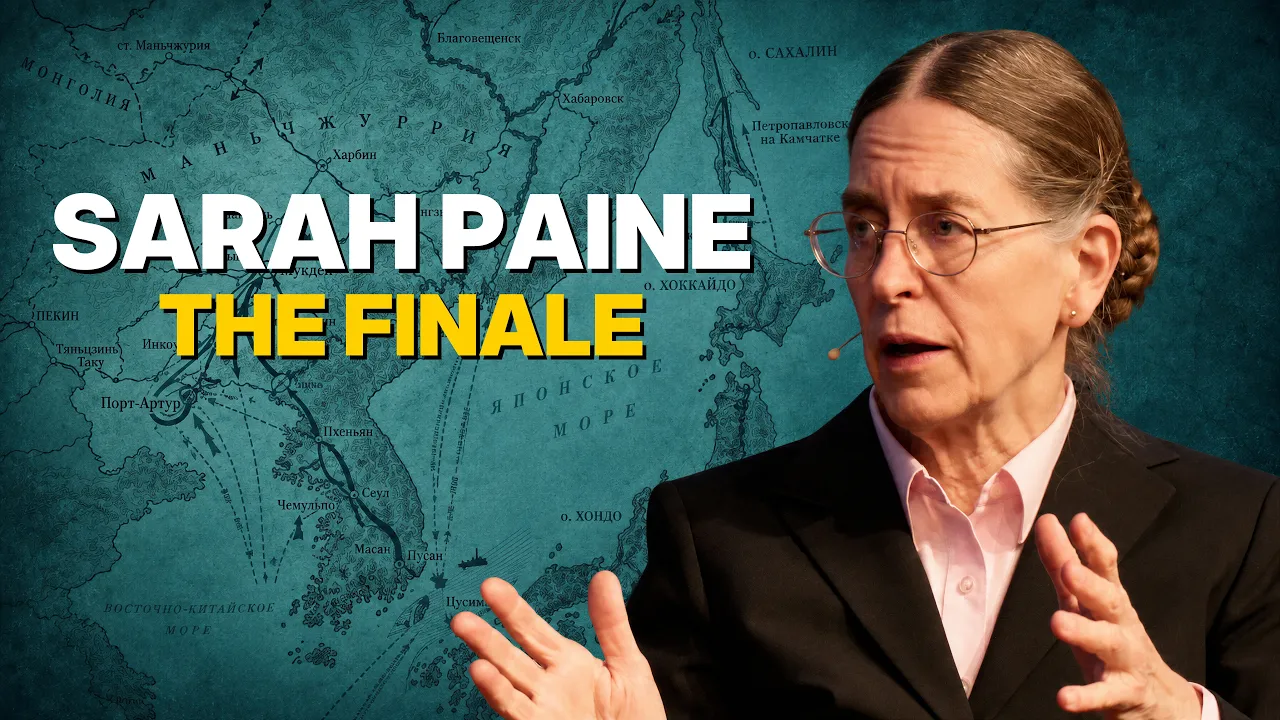
Dwarkesh Patel
Wars become impossible to terminate when invading powers escalate limited goals into regime change, triggering existential resistance and hostile third-party intervention.
AI-assisted summary of Sarah Paine — Why wars are so difficult to end — original source. Check the original for full context.
Source published:
Key ideas
- Wars are inherently difficult to terminate because military momentum often outruns political objectives, turning limited interventions into open-ended commitments or provoking hostile third-party interventions. (0:03)
- Meiji Japan successfully defeated Imperial Russia in 1904–1905 despite staggering demographic and industrial deficits by strictly bounding its political aims, arranging US mediation before hostilities peaked, and seizing Sakhalin Island as a final bargaining chip. (20:05)
- Pursuing unlimited objectives such as regime change forces an adversary onto Sun Tzu's 'death ground,' triggering fanatical resistance because surrender means total annihilation. (34:48)
- The 1991 Gulf War achieved decisive termination by restricting aims to Kuwait's liberation under National Security Directive 54 and securing over $50 billion in allied burden-sharing, contrasting sharply with the 2003 invasion's destabilization of an ethnically fractured mosaic society. (26:54)
Detailed notes
## Background Published on YouTube by Dwarkesh Patel on September 25, 2026, this presentation serves as the concluding lecture in his video series with historian Sarah Paine. According to the page description, Paine addresses war termination—why wars are simple to start but notoriously difficult to conclude on intended terms—using the Russo-Japanese War and other conflicts to explain how regional disputes spiral into global wars or disintegrate into endless insurgencies.
## TL;DR Sarah Paine examines why exiting military conflicts is historically fraught, arguing that military victory is meaningless unless strictly tethered to achievable political objectives. Anchoring her analysis in the Russo-Japanese War and the 1991 Gulf War, she illustrates how disciplined adherence to limited aims, pre-planned diplomatic off-ramps, and recognizing Clausewitz’s culminating point of victory prevent catastrophic overreach. By contrast, expanding into unlimited objectives—such as Douglas MacArthur's push to the Yalu in Korea or the 2003 invasion of Iraq—places adversaries on Sun Tzu's 'death ground,' provoking outside power intervention or unleashing unwinnable insurgencies in fragmented mosaic societies. Ultimately, Paine provides a strategic diagnostic matrix that weighs political war aims, asymmetries of political will, and porous geographic borders before committing to conflict.
## Atmosphere & style The presentation carries the brisk, intellectual authority of an elite war college seminar, animated by Paine's razor-sharp delivery, pragmatic realism, and dry wit. She cuts through conventional military romanticism with striking historical metaphors—from the fragile shatter of a Bologna flask to the burden of inheriting a 'loaded diaper' in nation-building. The experience feels intensely pedagogical yet urgent, systematically translating centuries of military theory into a cautionary diagnostic framework for modern statecraft.
## Bulletin - [00:03](https://www.youtube.com/watch?v=f6cjAEr08qk&t=3s) Wars are inherently difficult to terminate because military momentum often outruns political objectives, turning limited interventions into open-ended commitments or provoking hostile third-party interventions. - [20:05](https://www.youtube.com/watch?v=f6cjAEr08qk&t=1205s) Meiji Japan successfully defeated Imperial Russia in 1904–1905 despite staggering demographic and industrial deficits by strictly bounding its political aims, arranging US mediation before hostilities peaked, and seizing Sakhalin Island as a final bargaining chip. - [34:48](https://www.youtube.com/watch?v=f6cjAEr08qk&t=2088s) Pursuing unlimited objectives such as regime change forces an adversary onto Sun Tzu's 'death ground,' triggering fanatical resistance because surrender means total annihilation. - [26:54](https://www.youtube.com/watch?v=f6cjAEr08qk&t=1614s) The 1991 Gulf War achieved decisive termination by restricting aims to Kuwait's liberation under National Security Directive 54 and securing over $50 billion in allied burden-sharing, contrasting sharply with the 2003 invasion's destabilization of an ethnically fractured mosaic society.
## Key takeaways - [00:03](https://www.youtube.com/watch?v=f6cjAEr08qk&t=3s) Ending a war on favorable terms is far more challenging than initiating one because political aims tend to shift and expand once military operations begin. - [06:18](https://www.youtube.com/watch?v=f6cjAEr08qk&t=378s) Victory in warfare is determined solely by the fulfillment of political objectives rather than tactical battlefield success or lopsided casualty ratios. - [08:19](https://www.youtube.com/watch?v=f6cjAEr08qk&t=499s) Clausewitz's culminating point of victory marks the strategic boundary where further offensive success produces diminishing returns and invites devastating counter-blows or foreign intervention. - [17:23](https://www.youtube.com/watch?v=f6cjAEr08qk&t=1043s) Autocratic adversaries often behave like Clausewitz's 'Bologna flask,' showing no outward signs of distress until a critical micro-crack triggers abrupt, catastrophic collapse. - [20:05](https://www.youtube.com/watch?v=f6cjAEr08qk&t=1205s) Japan averted exhaustion in the Russo-Japanese War by establishing an American exit ramp prior to the conflict, using diplomatic channels to broker mediation immediately after the Battle of Mukden. - [24:14](https://www.youtube.com/watch?v=f6cjAEr08qk&t=1454s) The seizure of Sakhalin Island served as the indispensable psychological lever that broke Tsar Nicholas II's resolve by threatening sovereign Russian imperial territory. - [26:54](https://www.youtube.com/watch?v=f6cjAEr08qk&t=1614s) The 1991 Gulf War serves as an operational model of limited warfare, strictly adhering to finite political goals and achieving full allied financial burden-sharing. - [32:09](https://www.youtube.com/watch?v=f6cjAEr08qk&t=1929s) The distinction between limited and unlimited warfare is governed by the scope of political objectives—negotiated concessions versus regime change—rather than the volume of firepower applied. - [30:28](https://www.youtube.com/watch?v=f6cjAEr08qk&t=1828s) External patrons ('big buddies') with contiguous, un-interdictable supply lines render localized wars nearly impossible to conclude through conventional force alone. - [34:48](https://www.youtube.com/watch?v=f6cjAEr08qk&t=2088s) Imposing unlimited demands places the enemy on 'death ground,' generating an asymmetric resolve to resist that conventional invaders consistently underestimate. - [41:16](https://www.youtube.com/watch?v=f6cjAEr08qk&t=2476s) World War I escalated into an uncontrollable global conflagration because the belligerents harbored parallel, mutually exclusive war aims that precluded compromise. - [46:38](https://www.youtube.com/watch?v=f6cjAEr08qk&t=2798s) Insurgencies deny conventional victory through an asymmetry in the 'value of the object,' where indigenous fighters defend existential survival against expeditionary forces with discretionary political will. - [48:58](https://www.youtube.com/watch?v=f6cjAEr08qk&t=2938s) Toppling central authorities in 'mosaic societies' characterized by deep sectarian divisions and porous borders almost inevitably sparks protracted civil war rather than liberal democracy. - [51:06](https://www.youtube.com/watch?v=f6cjAEr08qk&t=3066s) Before entering any war, strategists must rigorously evaluate adversary war aims, the asymmetric value of the object, and physical transit corridors that enable external sanctuary.
## Detailed walkthrough ### [00:03](https://www.youtube.com/watch?v=f6cjAEr08qk&t=3s) The Dilemma of War Termination and the Russo-Japanese Model
Ending a war is notoriously difficult. As Sarah Paine observes, "It's really easy to get into wars. It's awfully difficult to get out of them. And it is even more difficult to get out of them what you wished you could have gotten out of them." From the Japanese perspective, the Russo-Japanese War (1904–1905) represents a model case of war termination. On paper, Russia dwarfed Japan across virtually every quantifiable metric: territorial expanse, population, industrial base, natural resource endowment, army size, and naval tonnage. Yet Japan managed to defeat this far larger adversary and exit the war having secured its strategic aims.
```mermaid flowchart TD accTitle: Regional War Outcomes and Pathologies accDescr: Flowchart contrasting successful war termination with two strategic failure modes.
subgraph Core["Regional Conflict"] A["Regional War"] --> B{"Strategic Path"} end
subgraph Outcomes["Termination Outcomes"] B -->|"Ideal Termination"| C["Model Termination<br/>(Limited aims achieved)"] B -->|"Pathology 1: Escalation"| D["Global War<br/>(Regional conflict widens)"] B -->|"Pathology 2: Insurgency"| E["Victory Denial Strategy<br/>(Endless irregular war)"] end ```
Paine outlines a framework for examining regional wars and highlights two major strategic pathologies that can ruin war termination: - **Escalation into global war:** A regional conflict can ignite wider systemic fighting—a danger intensely feared in the modern Russia-Ukraine war. - **Protracted insurgency (Victory Denial):** Even after suffering conventional defeat, an opponent may refuse to surrender and resort to an insurgency. This asymmetric strategy denies the victor the fruits of success, imposing massive long-term costs on the occupier while demanding immense suffering from the insurgent population.
To analyze these outcomes, Paine draws heavily on classical military theory, notably Carl von Clausewitz's concepts of the "culminating point of attack," the "culminating point of victory," the metaphor of the blown flask, decisive battles, and limited versus unlimited objectives, along with Sun Tzu's concept of "death ground."
---
[02:25](https://www.youtube.com/watch?v=f6cjAEr08qk&t=145s) The Clashing Empires in Manchuria and the Siege of Port Arthur
The geopolitical collision between Imperial Russia and Meiji Japan centered on Northeast Asia, specifically Chinese Manchuria and the Korean Peninsula. Russia had constructed an extensive railway concession through Chinese territory, running south from Harbin down to Port Arthur. Unlike Vladivostok, which froze over for several months each year, Port Arthur provided Russia with a coveted year-round, ice-free naval base. When the Boxer Rebellion—described by Paine as "the al-Qaeda of their day"—swept through China targeting Western imperialists, the Boxers tore up Russian railway lines. Russia deployed substantial troop contingents to protect its investments, but refused to withdraw once the uprising was quelled.
```mermaid flowchart LR accTitle: Japanese Dilemma at Port Arthur accDescr: Diagram illustrating how Japanese sea lines of communication required neutralizing the Russian fleet at Port Arthur.
subgraph SeaLane["Supply Vulnerability"] SLOC["Japanese SLOCs<br/>(Troops & Supplies)"] Fleet["Russian Fleet at Port Arthur"] Fleet -.->|"Threatens"| SLOC end
subgraph LandOps["Operational Bottleneck"] Siege["Siege of Port Arthur<br/>(General Nogi's Army)"] Field["Main Northern Campaign<br/>(Harbin Direction)"] Siege -.->|"Ties down 1 of 4 Japanese Armies"| Field end ```
Japan attempted diplomatic compromise, proposing a mutual recognition of spheres of influence: Russian dominance in Manchuria in exchange for Japanese primacy in Korea. The Tsarist regime dismissed the offer, procrastinating in the belief that Russia could take both regions without taking Japan seriously. Facing a closing strategic window, Japan launched a surprise preemptive attack on Port Arthur to neutralize the Russian Pacific Squadron.
Because Japan’s war effort depended entirely on vulnerable sea lines of communication across the Tsushima Strait and the Yellow Sea, the Russian fleet had to be destroyed or bottled up. This forced Japan to invest Port Arthur by land, tying down one of its four field armies under General Nogi Maresuke. Desperate to free this force for the main advance north toward Harbin, Nogi launched four costly frontal assaults against fortified Russian positions, suffering staggering casualties. The deadlock was only broken after Japanese forces captured the high ground at 203 Meter Hill, allowing artillery spotters to direct heavy 28-centimeter siege howitzers onto the Russian warships trapped in the harbor below. Meanwhile, Tsar Nicholas II dispatched the Baltic Fleet on a grueling journey around Africa and through the Suez Canal to relieve Port Arthur, only for the fortress to fall before they arrived and the Russian fleet to be annihilated at the Battle of Tsushima.
---
[06:18](https://www.youtube.com/watch?v=f6cjAEr08qk&t=378s) Limited Objectives and the Catastrophic Opportunity Costs for Russia
The Russo-Japanese War was fundamentally a limited war because both belligerents fought for bounded political objectives rather than absolute regime change. Japan never intended to march on St. Petersburg to overthrow the Romanovs. Although Tsar Nicholas II initially harbored grandiose visions of invading the Japanese home islands and replacing the Meiji government, he quickly discovered this was militarily impossible and reduced his goal to expelling Japanese forces from Manchuria.
Evaluating whether a war is won or lost depends strictly on whether a state achieves its political war aims, not on tallying tactical victories on the battlefield. Paine notes that the United States won nearly all conventional battles in Vietnam, yet the conflict is recorded as a defeat. By contrast, Japan attained and exceeded its initial war aims: - Expelled Russian influence from Korea entirely. - Acquired the southern branch of the Russian rail concessions in Manchuria (the South Manchuria Railway). - Gained control of the strategic naval base at Port Arthur and the Liaodong Peninsula.
For Russia, the war was an unmitigated disaster compounded by crippling opportunity costs. The vast capital poured into Far Eastern adventures could have modernized European Russia's rail infrastructure. That logistical deficiency proved fatal during World War I, causing urban food distribution to collapse and sparking the 1917 food riots in Petrograd that ended three centuries of Romanov rule and culminated in Nicholas II and his family being executed in a Siberian basement.
---
[08:19](https://www.youtube.com/watch?v=f6cjAEr08qk&t=499s) Clausewitz's Culminating Points of Attack and Victory
To understand the mechanics of war termination, Paine unpacks the Clausewitzian paired concepts of the *culminating point of attack* and the *culminating point of victory*. Clausewitz observed that offensive operations inevitably consume energy, resources, and combat power. Most attacks can only progress until the attacker's remaining strength is just sufficient to hold ground defensively and negotiate peace.
```mermaid flowchart TD accTitle: Spectrum of the Culminating Point accDescr: Flowchart showing the risks of stopping short versus overshooting the culminating point.
subgraph Spectrum["Offensive Progression"] A["Undershooting Culmination"] -->|"Leaves potential gains unexploited"| B["Sub-optimal Peace"] C["Culminating Point<br/>(Peak Relative Advantage)"] -->|"Optimal Point to Settle"| D["Model War Termination"] E["Overshooting Culmination"] -->|"Assumes excessive risk & weakness"| F["Disproportionate Backlash / Defeat"] end ```
The distinction between the two levels centers on operational versus strategic scale: - **Culminating Point of Attack (Operational):** Applies to an individual engagement or a campaign sequence (e.g., destroying the naval garrison inside Port Arthur). Pushing past this operational limit exposes an overextended attacker to a counter-reaction that is often far more forceful than the initial offensive blow. - **Culminating Point of Victory (Strategic):** Pertains to the war as an entire political undertaking (e.g., forcing Russia out of Manchuria).
Failing to advance to the culminating point leaves achievable objectives unfulfilled at acceptable costs. Conversely, pushing beyond it causes costs and risks to drastically outstrip any potential benefits, leaving the attacker structurally weakened. Paine emphasizes that one of the clearest external indicators that a power has overshot its culminating point of victory is third-party military intervention, which abruptly tilts the geopolitical balance.
[10:03](https://www.youtube.com/watch?v=f6cjAEr08qk&t=603s) The Culminating Point of Attack at Port Arthur: 203 Meter Hill
The Siege of Port Arthur, the conflict that initiated the Russo-Japanese War and dragged on for nearly a full year, culminated in the utter destruction of Russia's Pacific fleet in theater. To achieve this, General Nogi Maresuke launched desperate, grinding frontal assault after frontal assault against the fortified perimeter. These brute-force charges proved catastrophic in blood: Nogi lost approximately 45,000 men—an entire Japanese army wiped out in a military that possessed only four armies in total. The obsession of the siege boiled down to seizing 203 Meter Hill. Looking up at the hill from below, its tactical necessity becomes starkly apparent: once an observer reaches the summit with artillery spotters, they can adjust lines of fire with pinpoint accuracy down into the harbor, dictating exactly which warship gets sunk.
```mermaid flowchart TD accTitle: The Siege of Port Arthur Mechanics accDescr: Progression from the bloody frontal assaults on 203 Meter Hill to harbor destruction and premature capitulation. subgraph Assault["Assault & Observation"] A["Nogi's Costly Frontal Assaults<br/>(45,000 Japanese casualties)"] --> B["Capture of 203 Meter Hill"] B --> C["Artillery Spotters Directed<br/>Down into Harbor"] end subgraph Capitulation["Destruction & Fall"] C --> D["Heavy Guns Brought Up (1 Week)"] D --> E["Fleet Sunk at Anchor (3 Days)"] E --> F["Russian Capitulation<br/>(Despite Abundant Stores & 3,000 Horses)"] end ```
Once Japanese soldiers clawed their way to the top of 203 Meter Hill, it took an additional week to drag the heavy siege guns into position. Once mounted, it took a mere three days of observed shelling to sink every Russian warship anchored below. Following that catastrophic barrage, the Russian commanders "scratched their heads for about a month" before deciding to surrender the fortress. Yet Russian food stores tell a revealing story: the defenders held sufficient provisions to hold out for at least another month, if not considerably longer, boasting among other rations "3,000 highly edible horses if they really want to stick around."
Russian war planners had fundamentally failed to appreciate the concept of a "fortress in being." Had they recognized the strategic value of Port Arthur as an operational anchor, they could have prolonged the siege to pin down vast quantities of Japanese manpower and artillery assets that were desperately needed elsewhere in Manchuria. Russian leadership simply lacked the strategic cleverness to turn that fortress trap to their operational advantage.
- **Casualty toll**: General Nogi sacrificed ~45,000 soldiers in frontal attacks—roughly 25% of Japan's total initial four-army ground force. - **Firepower timeline**: 7 days to haul the siege artillery to the crest of 203 Meter Hill; 3 days of observed fire to annihilate the anchored Russian squadron. - **Unused defensive reserves**: Over a month's worth of grain and dry stores, supplemented by 3,000 horses suitable for food, remained unconsumed when the fortress surrendered.
---
[12:14](https://www.youtube.com/watch?v=f6cjAEr08qk&t=734s) Decisive, Pivotal, and Lopsided Battles: Sharpening Analytical Arguments
Determining the exact "culminating point of attack" at Port Arthur presents a classic historical exercise in assembling evidence and defending an analytical thesis against counterarguments. One compelling thesis identifies the capture of 203 Meter Hill itself as the culminating point: without the sanctuary provided by the heights, the anchored fleet was irrevocably doomed, turning its ultimate destruction into a mere matter of time. Conversely, an equally rigorous counterargument contends that the culminating point was not reached until the fleet was physically destroyed at the bottom of the harbor. Because the intact fleet pinned immense Japanese naval and land assets, the overarching operational objective remained unfulfilled until the warships were resting on the harbor floor. Formulating historical arguments requires structuring clear points and counterpoints while avoiding repeating the primary thesis inside the rebuttal.
This distinction ties directly into how military theorists classify major engagements. Carl von Clausewitz and Mao Zedong used the term "decisive battle" strictly to mean a war-winning engagement—a clash that conclusively settles the entire contest. Clausewitz observed that campaigns determined by a single battle have become somewhat common in modern times, but battles that definitively conclude an entire war are exceptionally rare. Careless usage often treats "decisive" as a vague synonym for "important," which empties the term of analytical value:
> "If you use it to mean important, you're actually not conveying anything. Important in what way? And for instance, I would use different words for a battle where the casualty rates are really skewed. I would use the word lopsided... Another alternative will be pivotal battle."
Port Arthur was distinctly *not* a decisive battle, as massive clashes on land and sea immediately followed it. It was, however, profoundly *pivotal*: its conclusion foreclosed strategic possibilities for the Russian Empire while unlocking theater-wide mobility and concentration of force for Imperial Japan.
---
[14:24](https://www.youtube.com/watch?v=f6cjAEr08qk&t=864s) The Five Candidates for Victory and Option 1: The Russian Revolution of 1905
As Japanese field armies crawled northward along the railway toward the central junction of Harbin—where the east-west and north-south railway lines intersected—the overarching strategic question becomes whether the entire war concluded before, after, or precisely at Japan's culminating point of victory. Ending a war precisely at that apex represents the "Goldilocks" scenario where the strategic porridge is "just right." Evaluating that termination involves five distinct candidate events across the campaign:
```mermaid flowchart TD accTitle: Five Hypotheses for the Culminating Point of Victory accDescr: The five potential events that marked the culminating point of victory in the Russo-Japanese War. subgraph Domestic["Domestic & Economic Exhaustion"] H1["1. Home Front Collapse<br/>(1905 Russian Revolution & Bloody Sunday)"] H3["3. Financial Depletion<br/>(St. Petersburg Facing Bankruptcy)"] end subgraph Operational["Decisive Clashes & Bargaining Chips"] H2["2. Battle of Mukden<br/>(Largest Land Battle on Record)"] H4["4. Battle of Tsushima<br/>(Total Annihilation of Baltic Fleet)"] H5["5. Invasion of Sakhalin<br/>(Territorial Leverage for Portsmouth Talks)"] end ```
The first argument locates the true culminating point in Russian domestic instability. Politically, Tsarist Russia was among the most backward states in Europe, where a rapidly urbanizing, increasingly educated population possessed zero formal voice in governance. Across all of Europe, only three polities still lacked an elected legislature: the Russian Empire, the Ottoman Empire, and the tiny principality of Montenegro. Even Japan operated a functioning national diet, leaving Russians to question Nicholas II's stubborn refusal to reform.
By late 1904, public fury compounded as the war went badly in a remote theater ordinary Russians could not even locate on a map. Conscripted reserves began rioting at mobilization depots across European Russia. In the heartland near the Tsar's residences, these mutinous reserves vastly outnumbered regular garrison units—a terrifying dynamic for an unpopular autocrat burdened with an even more unpopular wife, Tsarina Alexandra. In January 1905, when peaceful crowds marched toward the Winter Palace in St. Petersburg to present a humble petition, the Tsar was not in residence. Panicked imperial troops opened fire into the crowd, slaughtering demonstrators on "Bloody Sunday." The massacre shattered the moral legitimacy of the Romanov dynasty, forcing Nicholas II into hasty, begrudging political concessions to establish the Duma.
---
[17:23](https://www.youtube.com/watch?v=f6cjAEr08qk&t=1043s) The "Bologna Flask" of Will and Option 2: The Meatgrinder at Mukden
To explain the psychological fragility of political regimes facing military shock, Clausewitz employed the metaphor of the "Bologna flask" (a glass phial so structurally tough on the outside that it can be used to hammer nails into wood, yet so internally strained that a single scratch to its interior surface causes the entire vessel to violently explode into powder):
> "Clausewitz is using this to describe war termination where you're going at an enemy and you have no idea: is it going to act like a hammer or is it going to shatter? The question is whether the first shock of battle will steel the enemy's resolve and stiffen his resistance—which is what happened to Putin in Ukraine—or whether, like the Bologna flask, it will shatter as soon as its surface is scratched."
Assessing an adversary's staying power is one of the most fraught challenges in grand strategy: will they endure indefinite hardship, as the North Vietnamese did, or will their nerve crack? In 1905, Tsar Nicholas II's personal "Bologna flask" shattered. Because Russia operated as an absolute autocracy, once the monarch personally concluded that the game was up, the war was effectively over.
The second alternative candidate for the culminating point is the gargantuan Battle of Mukden. Mukden was a massive meatgrinder into which Japan poured every available soldier, drafting teenagers who were too young, veterans who were too old, and survivors who were physically exhausted. Even with total national mobilization, Japan fielded 125,000 fewer men at Mukden than the Russian army. Tokyo had staked the entire war on exploiting a narrow window of operational superiority before the incomplete Trans-Siberian Railway could ramp up delivery of the Tsar's vast reserves.
Early in the conflict, the railway could deliver only 20,000 to 40,000 Russian soldiers per month to the Far East. By the Battle of Mukden, engineers had expanded capacity to 100,000 men per month. Had Russia possessed that logistics throughput in February 1904, Japan would have been instantly crushed by superior numbers. At the start of the conflict, Russia maintained fewer than 100,000 troops in the Asian theater. By August 1904 at the Battle of Liaoyang, Russian strength reached roughly 150,000—outnumbering the Japanese by 20,000. By August 1905, a month before the Treaty of Portsmouth was signed, Russia had concentrated nearly 800,000 troops in Manchuria, an immense force that nonetheless represented a mere 40 percent of the Russian Empire's total standing military.
- **Comparative force sizes at Mukden**: Japan entered the battle with a 125,000-man deficit compared to the Russian army deployed on the line. - **Trans-Siberian Railway capacity surge**: Delivery rates expanded from 20,000–40,000 troops per month in early 1904 to 100,000 per month by early 1905. - **Russian theater troop progression**: - *February 1904*: Under 100,000 men. - *August 1904 (Battle of Liaoyang)*: ~150,000 men (exceeding Japanese numbers by ~20,000). - *August 1905 (Eve of Portsmouth Treaty)*: Nearly 800,000 men in theater (yet only ~40% of Russia's total army).
[20:05](https://www.youtube.com/watch?v=f6cjAEr08qk&t=1205s) The Pre-Planned American Exit Strategy
Japan mobilized every resource at its disposal, sending fewer than 700,000 men to the front, while the Russian Empire commanded roughly three million troops overall. Had Tsar Nicholas II steeled himself to fight just one more massive engagement, Japan could easily have ended up in a world of hurt. The Japanese leadership understood their precarious position long before firing the first shot. Even before the opening strike on Port Arthur, Tokyo had pre-engineered its exit strategy around a key diplomatic broker: President Theodore Roosevelt. Japan counted on Americans acting as global busybodies, and the calculation proved entirely correct.
Prime Minister Itō Hirobumi set the diplomatic apparatus in motion well in advance. He deployed Viscount Kaneko Kentarō—a Harvard graduate and personal acquaintance of fellow Harvard alumnus Theodore Roosevelt—to open a backchannel requesting American mediation when the right moment arrived. When formal peace talks finally commenced, they were entrusted to another Harvard alumnus, Baron Komura Jutarō.
Following the grueling Battle of Mukden, Field Marshal Yamagata Aritomo recognized that the Japanese army had hit a brick wall and played the American card. Yamagata reasoned that Russia would never initiate peace negotiations unless foreign troops marched on Moscow or St. Petersburg, which was an impossibility. As Yamagata observed, Russia still held massive troop reserves in its European homeland, whereas Japan had fully exhausted its own manpower. Furthermore, Russia possessed a deep bench of reserve officers, while Japan had lost an irreplaceable number of commanders since the outbreak of hostilities. The chief of staff of the Manchurian Army fully agreed with this assessment, remarking that if you start a fire, you have to be ready to put it out—and the time had come to summon the American fire department to extinguish the conflagration.
```mermaid flowchart TD accTitle: Japanese Diplomatic Strategy for Ending the War accDescr: Flowchart illustrating how Japan's leadership prepared an exit strategy through Harvard alumni backchannels to Theodore Roosevelt.
subgraph Preparation["Pre-War Strategic Planning"] Ito["Prime Minister Itō Hirobumi"] --> Kaneko["Viscount Kaneko Kentarō<br/>(Harvard Alum)"] Kaneko --> TR["President Theodore Roosevelt<br/>(Harvard Alum)"] end
subgraph BattlefieldCulmination["Battlefield Exhaustion"] Mukden["Battle of Mukden<br/>(Manpower Exhausted)"] --> Yamagata["Field Marshal Yamagata Aritomo<br/>& Manchurian Army Staff"] end
subgraph Termination["War Termination"] Yamagata --> CallTR["Activate Roosevelt Mediation"] TR --> Portsmouth["Portsmouth Peace Conference"] Komura["Baron Komura Jutarō<br/>(Lead Negotiator / Harvard Alum)"] --> Portsmouth end ```
[21:52](https://www.youtube.com/watch?v=f6cjAEr08qk&t=1312s) Financial Exhaustion and the Battle of Tsushima
Beyond battlefield milestones, financial solvency served as a distinct culminating point of victory. Both empires depended heavily on foreign debt to fund the conflict, but Japan's string of victories altered the credit landscape. Because Japanese forces were winning on the ground, Tokyo's borrowing rates fell, making successive loans significantly cheaper. Crucially, Japan managed to secure its final two major loans in the immediate aftermath of Mukden; while the empire lacked the fresh infantry to advance farther, it still commanded the credit required to hold the line. Russia's fiscal health, by contrast, collapsed. Facing an economic recession and severe agricultural crop failures prior to the war, state revenues shriveled. After Mukden, foreign bankers concluded Russia was a toxic credit risk and shut their doors. By the time the peace treaty was signed at Portsmouth, the imperial treasury had to float an emergency loan simply to afford the train fares required to transport its soldiers out of East Asia and back to European Russia.
```mermaid flowchart LR accTitle: Divergent War Financing Paths accDescr: Diagram contrasting Japan's improving credit access with Russia's financial collapse following the Battle of Mukden.
subgraph JapanFinance["Japan's War Credit"] JVictories["Battlefield Victories"] --> JRates["Falling Borrowing Rates"] JRates --> JLoans["Secures Crucial Loans<br/>After Mukden"] end
subgraph RussiaFinance["Russia's Financial Ruin"] RPreWar["Recession & Crop Failures"] --> RDefeats["Defeat at Mukden"] RDefeats --> RBlocked["Global Bankers Cut Credit"] RBlocked --> REmergency["Emergency Loan Merely to<br/>Evacuate Troops Home"] end ```
For those seeking a naval turning point, Nicholas II provided an astonishingly lopsided demonstration at the Battle of Tsushima in May 1905. The Russian sovereign never needed to fight this engagement at all. Moscow's forces in Manchuria were supplied by the overland Trans-Siberian Railway, with zero dependence on maritime cargo. While land conditions were improving for Russia day by day as reinforcements arrived, Nicholas dispatched his Baltic Fleet halfway around the globe directly into Japanese home waters.
The resulting clash proved an unmitigated catastrophe for Russia. The Imperial Japanese Navy lost just three small torpedo boats while utterly destroying or capturing the opposing armada. In fact, by commandeering surviving Russian battleships and cruisers, the Japanese fleet ended the battle larger than when it began, while only a handful of obsolete Russian vessels escaped to neutral or home ports.
- **Financial Culmination**: Japan's military victories lowered its sovereign borrowing rates, enabling Tokyo to fund operations past Mukden despite running out of infantry replacements. - **Russian Solvency Crisis**: Foreign lenders refused to issue further capital to St. Petersburg after Mukden, leaving Nicholas II with an exhausted war treasury. - **Naval Imbalance at Tsushima**: Japan sacrificed only three torpedo boats while annihilating the Russian fleet, capturing enough functional enemy warships to net an overall increase in total fleet tonnage.
[24:14](https://www.youtube.com/watch?v=f6cjAEr08qk&t=1454s) Sakhalin Island and the Model Settlement at Portsmouth
The final potential culminating point came with the seizure of Sakhalin Island. At the very tail end of the war, President Roosevelt nudged Japan to occupy the island because Russian forces could do nothing to defend it. As sovereign Russian territory, its conquest offered Tokyo an invaluable bargaining chip: Japanese negotiators could trade away part of the island during negotiations to secure objectives they valued far more. Losing sovereign domestic soil to an Asian power dealt a devastating psychological blow to Nicholas II and Russian prestige, given the prevailing racial prejudices of European empires. To the Japanese, Sakhalin was largely prized as an abundant fishery full of excellent crab, but its political leverage proved decisive in cracking the Tsar's resolve.
Whether one points to domestic revolution, the slaughter at Mukden, financial exhaustion, Tsushima, or the loss of Sakhalin, Nicholas II's stubbornness ultimately shattered like a "Bologna flask." A devoted family man and loving father, Nicholas was nonetheless an incompetent autocrat whose failures a decade later in World War I would culminate in his execution in a Siberian basement.
For Japan, the conflict represents an absolute textbook model of war termination. Tokyo entered the war with limited, clearly defined objectives: eject Russia from Manchuria and establish undisputed hegemony over Korea. At Portsmouth, Japan secured both aims and much more. It acquired an expansive sphere of influence across southern Manchuria—a region the combined size of France and Germany—along with the valuable South Manchuria Railway concession, the fortified naval base at Port Arthur, and all associated equipment. Russia additionally ceded the southern half of Sakhalin Island. Above all, the victory confirmed the geopolitical trajectory begun during the First Sino-Japanese War of 1894–1895, formalizing Japan's standing as the preeminent power in East Asia.
- **The Five Possible Culminating Points**: 1. The domestic implosion and revolutionary turmoil within Russia. 2. The massive land engagement and casualty toll at Mukden. 3. The drying up of Russian sovereign credit against Japan's funded loans. 4. The absolute destruction of the Russian fleet at Tsushima. 5. The seizure and political leverage of Sakhalin Island. - **Japan's Portsmouth Gains**: Recognized dominion over Korea, southern Manchuria sphere of influence, Port Arthur naval complex, South Manchuria Railway, and South Sakhalin.
[26:54](https://www.youtube.com/watch?v=f6cjAEr08qk&t=1614s) The Gulf War: Masterclass in Limited War and Cost Distribution
Operation Desert Storm represents an even more striking model of war termination, achieving sweeping political success at virtually zero financial cost to the United States and with unprecedentedly low casualties. The crisis originated when Saddam Hussein found his regime financially broke in the wake of the bloody eight-year Iran-Iraq War. Saddam invaded Kuwait to erase Baghdad's massive war debts to the emirate and seize Kuwait's prolific oil fields. Controlling both reserves would have positioned Iraq as the dominant swing producer in global petroleum markets.
In unlimited warfare, strategic aims are straightforward: total regime overthrow. Limited wars, however, exist along an ambiguous spectrum ranging from minor border concessions to near-overthrow, and governments routinely fail to articulate where their stopping point lies. President George H.W. Bush avoided this trap by outlining explicit, finite goals in National Security Directive 54. Bush committed the coalition to forcing Iraq out of Kuwait, restoring Kuwait's sovereign government, protecting American lives, and stabilizing the Persian Gulf. Rather than expanding the mandate when battlefield fortunes surged, the administration achieved every stated priority and halted operations.
```mermaid flowchart TD accTitle: George H.W. Bush Limited War Architecture (NSD 54) accDescr: Flowchart showing the defined policy goals of National Security Directive 54 and how they were achieved in the Gulf War.
subgraph Directive["National Security Directive 54"] Obj1["Expel Iraqi Forces from Kuwait"] Obj2["Restore Legitimate Kuwaiti Government"] Obj3["Safeguard American Citizens"] Obj4["Promote Regional Stability in Persian Gulf"] end
subgraph CoalitionExecution["Multilateral Execution"] MilForce["Coalition Air & Ground Offensives"] --> Expel["Iraqi Army Ejected"] Expel --> StatusQuo["Kuwait Restored & Oil Threat Neutralized"] end
Directive --> CoalitionExecution ```
Financially and diplomatically, the Gulf War was an anomaly in military history. While the United States deployed roughly 700,000 personnel, its 34 coalition partners dispatched over 200,000 troops and covered the entire bill. Allies paid the United States more than $50 billion to fund American military expenditures, alongside another $14 billion distributed to regional partners. Casualties mirrored this total asymmetry: while Iraqi forces suffered between 20,000 and 35,000 military fatalities and up to 3,000 civilian deaths from air strikes, coalition casualties totaled just 392, of which 258 were American. Much like Russia in 1904, Saddam found himself diplomatically isolated against a coordinated world order, while the United States orchestrated a coalition where the world's wealthiest nations financed an overwhelming victory.
- **Financial Subsidies**: Allied coalition partners transferred over $50 billion directly to the US government, plus $14 billion to other coalition participants, fully offsetting American war costs. - **Troop Commitments**: Coalition partners contributed over 200,000 troops alongside the roughly 700,000 Americans deployed in theater. - **Casualty Disparity**: Coalition fatalities stopped at 392 (258 American), set against 20,000 to 35,000 Iraqi military deaths and approximately 3,000 civilian casualties.
[30:28](https://www.youtube.com/watch?v=f6cjAEr08qk&t=1828s) The Korean War, Geography, and the Problem of "Big Buddies"
The Korean War stands in stark contrast to the clean execution of the Gulf War. While it eventually concluded with the restoration of the status quo ante bellum as a divided peninsula, the geography of the theater created massive strategic complications. On paper, fighting in Korea looks deceptively manageable: the land border between North and South Korea is a mere 250 kilometers, and the peninsula is surrounded by maritime borders. For the United States, as the dominant naval power facing an adversary with essentially no navy, this meant it could easily implement blockades, deploy carrier aircraft, and bring naval gunfire to bear on coastal targets—especially advantageous since much of the Korean railway network ran right along the shoreline.
```mermaid flowchart TD accTitle: Geography of the Korean War Theater accDescr: Diagram illustrating maritime vulnerability versus the un-isolatable northern land border with China and Russia. subgraph Peninsula["Peninsula Dynamics"] South["South Korea"] DMZ["Land Border (250 km)"] North["North Korea"] end subgraph NavalDomain["Maritime Dominance"] USNavy["US Maritime & Air Power<br/>(Blockade & Shore Bombardment)"] Rail["Vulnerable Shoreline Railways"] end subgraph Sanctuary["Northern Sanctuaries"] China["China (1,400+ km border)<br/>Manchurian Industrial Base"] Russia["Russia (17 km border)"] end
USNavy --> Rail USNavy -.->|Dominates coastline| North North --- DMZ --- South North --- China North --- Russia ```
However, the northern border completely broke this geographic advantage. While the border with Russia is tiny—around 17 kilometers—the border with China stretches over 1,400 kilometers. At the time, Manchuria served as the heart of China's industrial base, making it impossible for the United Nations forces to truly isolate the theater of war. In Paine’s formulation, the North Koreans had "big buddies with an un-interdicted supply line." Worse yet, both sides possessed big buddies willing to pour in massive supplies of aid. Whenever a conflict features external patrons continually funneling resources to opposing factions, the inevitable result is a protracted, bloody war that wrecks the local territory and slaughters vast numbers of people.
- The inter-Korean land border spans roughly 250 kilometers. - The North Korean border with Russia is approximately 17 kilometers, while the border with China exceeds 1,400 kilometers. - Manchuria acted as China's key industrial redoubt, providing an un-interdictable base of supply directly abutting the war zone.
---
[32:09](https://www.youtube.com/watch?v=f6cjAEr08qk&t=1929s) Clausewitz on Ends vs. Means: Limited and Unlimited Wars
Beyond the geographical traps, the United States suffered from critical strategic incoherence in Korea. Unlike Japan during the Russo-Japanese War, which kept its minimum objectives crystal clear, and unlike George H. W. Bush in the First Gulf War, American leadership in Korea vacillated disastrously. Washington could not decide whether it simply wanted a limited victory—restoring the pre-war territorial boundary—or whether, carried away by military momentum, it should pursue the unlimited objective of conquering the entire peninsula. Paine stresses that Carl von Clausewitz offered severe warnings about this kind of waffling: the political objective must always remain primary and must never be subordinated to the military point of view. Allowing battlefield success to dictate political ambitions ("we're on a roll militarily, let's take the whole peninsula") ignores the fundamental question of why the war is being fought in the first place.
Clausewitz observed that wars exist on a wide spectrum ranging from simple armed observation to complete extermination, but fundamentally reduce to two categories based on their political ends: limited and unlimited. Importantly, Clausewitz argued that the defining discriminator between types of war is *not* the amount of effort or resources expended (the means), but rather the scale of the objective (the ends). Unlimited war seeks regime change—rendering the adversary politically helpless and militarily impotent to dictate whatever peace terms one pleases. Limited war, by contrast, seeks lesser goals, such as seizing specific frontier districts to annex or trade away at the negotiating table.
| Dimension | Limited War | Unlimited War | |:--- |:--- |:--- | | **Primary Objective** | Finite concessions (e.g., frontier districts, status quo ante) | Regime change; rendering enemy politically/militarily impotent | | **Post-War Adversary** | Defeated regime survives and must be negotiated with | Defeated regime is dismantled or rendered totally choice-less | | **Conceptual Difficulty** | High (constant debate over optimal stopping points) | Low (conceptually simple: total overthrow) | | **Execution Difficulty** | Lower (enemy may tolerate concessions without existential panic) | Extremely high (enemy fights with desperate fury on "death ground") |
- Clausewitz's core dictums: The political objective determines both the military objective to be reached and the effort required. - In unlimited war, the defeated party has zero options left; in limited war, the original regime remains intact, meaning you must negotiate with them and they may return to cause trouble later. - As an illustration of unlimited war: the U.S. chose to retain Emperor Hirohito after World War II not because its goals were limited, but because keeping him alive as an authority figure to sign the new constitution legitimized American reforms.
---
[34:48](https://www.youtube.com/watch?v=f6cjAEr08qk&t=2088s) Sun Tzu's "Death Ground" and the Perils of Overreach
To understand why unlimited wars are so brutally hard to execute, Paine pairs Clausewitz with Sun Tzu’s ancient concept of "death ground"—the terrain where an army survives only if it fights with the desperate courage of having no alternative. When a belligerent pursues an unlimited objective, the opposing leadership (and often its population, if faced with genocidal intent) knows it is marked for annihilation. Putting an enemy on death ground can instantly transform even a fragile or failing state into a lethal, fiercely determined adversary because everyone knows they are "dead men" if they surrender. Paine points to the modern war in Ukraine as an explicit example: Russian aims placed Ukrainians on death ground, defying the expectations of pundits who failed to realize that people fight to the bitter end when survival itself is on the line.
```mermaid flowchart LR accTitle: The Dynamics of Death Ground accDescr: Flowchart showing how imposing unlimited objectives pushes an adversary onto death ground and magnifies resistance. Obj["Attacker Imposes Unlimited Objective<br/>(Regime Overthrow / Annihilation)"] --> DG["Adversary Placed on Sun Tzu's 'Death Ground'"] DG --> Resist["Desperate, Fanatical Resistance<br/>(Adversary Has No Alternative)"] Resist --> Cost["Campaign Costs Explode<br/>Adversary Becomes Lethal Opponent"] ```
Applying these principles back to Korea illustrates how a warring power can blow right past its culminating points of victory—in this case, twice. First, Kim Il Sung invaded the South under the assumption that it would remain a quick, isolated duel between two local contestants. He was initially correct on the battlefield, roaring down the peninsula until he triggered a catastrophic third-party intervention by the United States and the United Nations. What began as a localized civil conflict mutated into a regional proxy war with global escalatory danger. Had Kim opted for a patient, low-level insurgency instead of a conventional invasion, his outcome might have been entirely different.
The Americans then committed the exact same blunder in reverse. Following General Douglas MacArthur’s triumphant amphibious landing at Incheon, which cleaved the peninsula in two, U.S. leadership let tactical military possibility derail sound strategy. Instead of consolidating a limited victory at the 38th parallel, MacArthur drove north toward the Yalu River to conquer all of North Korea. By advancing directly to the Chinese perimeter, he triggered massive Chinese intervention, plunging the coalition into a "world of hurt" against hundreds of thousands of Chinese troops, and ultimately leading to MacArthur being cashiered. Exceeding the culminating point of victory ensured that the United States paid an enormous, unnecessary price in blood and treasure, only to end up right where it started: guarding a divided peninsula with expensive garrison forces for the next seven decades.
- A clear indicator that an army has blown past its culminating point of victory is the sudden intervention of a hostile third party. - Korea saw two successive culminating point failures: Kim Il Sung's invasion brought in the UN and the US; MacArthur's march to the Yalu brought in China. - MacArthur's refusal to align military operations with prudent political limits eventually resulted in his public firing by President Truman.
---
[39:32](https://www.youtube.com/watch?v=f6cjAEr08qk&t=2372s) Pathologies of Escalation: The American Revolution Goes Global
Paine transitions from local culminating points to one of the most dangerous pathologies in military history: regional wars escalating into global conflagrations. The American Revolutionary War serves as a classic case study in asymmetric war aims and global escalation. From the vantage point of the thirteen colonies, the war had limited objectives: they sought their own independence, harboring no fantasies of marching into London to overthrow King George III. From the British perspective, however, the war was unlimited: the British Crown intended to crush the Continental Congress and eliminate the Continental Army—a regime change campaign that placed the American revolutionaries squarely on death ground.
```mermaid flowchart TD accTitle: Escalation of the American Revolutionary War accDescr: Diagram tracing the expansion of the American Revolution from a regional insurrection to a global coalition war against Britain. subgraph Regional["Regional Insurrection (1775)"] Rebels["13 Colonies on 'Death Ground'"] UK["Great Britain seeks regime change"] end subgraph GlobalEscalation["Global Escalation"] France["1778: France Allies with Colonies<br/>(Attacks Savannah)"] Spain["1779: Spain Allies with France<br/>(Attacks Louisiana)"] Dutch["1780: Britain Attacks Dutch"] end
UK --- Rebels Rebels -.->|Protracted War of Attrition| GlobalEscalation France --> UK Spain --> UK UK --> Dutch ```
Because North America was an immense, unforgiving theater, the conflict dragged on. That protraction gave Britain's jealous European rivals ample time to calculate how to take the British Empire down a peg. In 1778, France allied with the American colonies; in 1779, Spain allied with France; and by 1780, Britain launched attacks on the Dutch. Within five years, what had started as an internal colonial insurrection in North America had metastasized into a sprawling world war. British forces were suddenly fighting French forces in Savannah, dealing with Spanish assaults in Louisiana, and defending far-flung imperial holdings across the globe.
- 1778: France officially enters an alliance with the American revolutionaries. - 1779: Spain joins the conflict as an ally of France. - 1780: Great Britain attacks the Dutch Republic, further broadening the coalition of hostile naval powers. - Global flare-ups included French military operations targeting Savannah, Georgia, and Spanish campaigns in Louisiana.
[40:31](https://www.youtube.com/watch?v=f6cjAEr08qk&t=2431s) The Global Imperial Scramble and the Value of the Caribbean
When regional conflicts escalate into global scrambles, imperial powers are forced to make hard calculations about what territory is genuinely worth defending. During the American Revolutionary War, fighting sprawled across the globe far beyond North America. The French attempted to invade England from the Isle of Wight, while British and French fleets clashed off Ushant. In the Mediterranean and Atlantic, French and Spanish forces besieged British possessions at Gibraltar and Minorca, and raided the Cape Verde Islands off the coast of Africa. In the Indian Ocean, Britain struck back against French trading posts at Mahé and Pondicherry.
Amid this worldwide conflagration, the truly valuable prize was not the rebelling North American continent, but the Caribbean theater. In the eighteenth century, the West Indies were the lucrative "sugar islands" that drove European imperial commerce. Facing overextension across multiple oceans, the British looked at the strategic ledger and made a cold calculation: cut losses, "get rid of the revolting colonies" because they simply were not worth much at the time, and preserve their high-yield holdings in the Caribbean. Rather than fight an endless global war to retain North America, Britain chose to reassess its priorities and bail.
[41:16](https://www.youtube.com/watch?v=f6cjAEr08qk&t=2476s) Why World War I Escalated: Misaligned War Aims and Entangling Alliances
World War I, by contrast, ended in disaster for every participant because no one had the option or the will to simply cut their losses. Prior to the outbreak of war in 1914, every European power envisioned executing a neat, localized regional war. The plan was straightforward: poach a slice of border territory in Europe, or inflict enough pain on an adversary to force them to cede valuable overseas colonies. The fatal flaw was that even within the same alliance bloc, every country wanted completely different things, meaning their primary theaters and political aims never aligned.
Britain fought strictly to preserve the European status quo, an outcome no other major belligerent desired. France was fixated on reclaiming Alsace-Lorraine, the territory wrenched away by Prussia after the Franco-Prussian War. Italy sought territorial expansion along the Eastern Mediterranean and the Adriatic. Imperial Russia was determined to dominate the Balkans, aiming to expel the Catholic Austro-Hungarian Empire from the region entirely and protect Serbia. Austria-Hungary had no intention of backing down in Serbia, especially after Serbian nationalists assassinated Archduke Franz Ferdinand, the Habsburg heir to the throne; Vienna wanted to consolidate and expand its own Balkan footprint. Meanwhile, the Ottoman Empire sought to recover lost Balkan territories, and imperial Germany craved an expansive global colonial empire.
Because these war aims were running in parallel rather than converging, the coalition partners found themselves locked into a conflict they could neither coordinate nor conclude. Once every power joined the fray, the war they found themselves fighting bore no resemblance to the brief campaign they had planned. Peace proved impossible to negotiate because no government could broker a settlement that would satisfy all of its own allies, let alone offer terms acceptable enough to persuade the opposing coalition to surrender. Since no single nation dared to abandon its partners and fight alone, the slaughter dragged on relentlessly.
```mermaid flowchart TD accTitle: Allied Fragmentation and Incompatible War Aims in World War I accDescr: Diagram illustrating how allied powers pursued divergent and contradictory strategic objectives during World War I.
subgraph Entente["Triple Entente & Associated Powers"] UK["Britain: Preserve continental status quo"] FR["France: Reclaim Alsace-Lorraine"] RU["Russia: Dominance over the Balkans"] IT["Italy: Expansion in Eastern Mediterranean"] end
subgraph Central["Central Powers"] AH["Austria-Hungary: Crush Serbia & expand in Balkans"] DE["Germany: Acquire global colonial empire"] OE["Ottomans: Recover lost Balkan territories"] end
Entente -.->|"Incompatible peace terms prevent settlement"| Central ```
[43:01](https://www.youtube.com/watch?v=f6cjAEr08qk&t=2581s) Japan's Path to Total War: From Smoot-Hawley to Pearl Harbor
A similar dynamic of unchecked escalation occurred in Asia, triggered initially by economic isolationism. During the Great Depression, the original "America Firsters" pushed protectionist legislation to shield domestic employment, culminating in the Smoot-Hawley Tariff of 1930, which spiked American import duties. Prominent economists pleaded with President Herbert Hoover to veto the bill, warning that foreign trading partners would retaliate and collapse global commerce without aiding American recovery. Hoover signed it regardless. International partners retaliated immediately, cratering global trade.
Viewing the crisis purely through domestic American politics ignores the desperate reality on the other side of the net. Foreign countries possessed far lower standards of living and lacked the economic resilience of the United States. Deepening poverty destabilized global politics, creating the toxic conditions that allowed Adolf Hitler to seize power in Germany and radicalized Japanese leadership. Japan had spent decades actively cooperating with the Western-led international order and was an original founding member of the League of Nations—an institution the United States never joined. As a resource-poor, trade-dependent island nation suddenly shut out of international markets by Western protectionism, Tokyo pivoted toward imperial conquest to achieve autarky, invading Manchuria in 1931 to secure an independent industrial resource base.
Manchuria began as a regional conflict, but Tokyo soon expanded the invasion into a full-scale war across all of China in 1937. By attempting to subjugate the entire nation rather than slicing off peripheral territory, Japan inadvertently placed the Chinese on Sun Tzu's "death ground." China's deeply fractured, warring domestic factions recognized an existential threat, ceased fighting one another, and united to fight the Japanese Imperial Army to a bloody stalemate. As the Chinese implemented an exhausting victory-denial strategy, the Japanese economy began to crack under the strain. Desperate to break the deadlock, Tokyo convinced itself that cutting off foreign aid funneled to Chiang Kai-shek's Nationalist government would finally force a Chinese collapse.
American historical memory often views the attack on Pearl Harbor through an exclusively self-focused lens, but Pearl Harbor was merely one component of a vast, synchronized offensive launched across the Pacific on December 7 and 8, 1941. At the very same moment Japanese planes struck Hawaii, imperial forces assaulted British Malaya, Singapore, Hong Kong, the Philippines, Guam, Wake Island, Thailand, and the Shanghai International Settlement. Japan aimed to eliminate every regional redoubt that could provide assistance to Nationalist China. Instead of intimidating the Western powers into abandoning Asia, the gambit backfired catastrophically: the United States, Great Britain, Australia, and New Zealand united, bringing their combined industrial power down on Japan.
- Regional wars that explode into uncontrollable global conflagrations share distinct pathologies: - They occur in massive geographical theaters that are nearly impossible for an expeditionary military to fully garrison or seal off. - As the timeline protracts, external third parties are given ample opportunity to intervene with weapons, funds, and direct military support. - The adopting of unlimited political objectives—such as conquest or regime change—places the defender on death ground, compelling them to fight indefinitely. - Escalating casualties and sunken costs harden public and political resolve, rendering leaders increasingly unwilling to compromise or accept negotiated settlements.
[46:38](https://www.youtube.com/watch?v=f6cjAEr08qk&t=2798s) Asymmetric Attrition: Guerrilla War and the "Value of the Object"
A distinct strategic pathology arises when an invading power shatters an enemy's conventional armed forces, only to face a lethal, protracted insurgency that makes stabilization impossible. An conquered theater is economically useless if it cannot be pacified; occupying forces end up bleeding state revenues on permanent garrison duties instead of extracting wealth. In wartime China, Imperial Japan repeatedly defeated Chiang Kai-shek's Nationalist divisions in open conventional warfare, but the Nationalists continuously reconstituted their armies while collaborating with Communist forces to wage widespread guerrilla campaigns behind the lines.
This twin threat pinned the Japanese military on the horns of a painful operational dilemma:
```mermaid flowchart LR accTitle: The Counterinsurgent's Operational Dilemma accDescr: Flowchart showing how an occupying power is trapped between concentrating forces against conventional armies or dispersing them to fight guerrillas.
subgraph Dilemma["Imperial Occupier's Dilemma"] A["Concentrate Forces"] -->|"Defeats conventional army"| B["Leaves rear areas vulnerable to guerrillas"] C["Disperse Forces"] -->|"Secures rear garrison lines"| D["Leaves units vulnerable to concentrated enemy armies"] end ```
If the Japanese concentrated their forces to defeat the Nationalist conventional armies, they vacated the rear, leaving communication lines and infrastructure vulnerable to guerrilla strikes. If they dispersed their divisions across the countryside to hunt insurgents, they left their isolated detachments vulnerable to concentrated conventional counterattacks.
This dual-track approach was famously pioneered during the American Revolution by George Washington. While Washington was initially skeptical of decentralized militias, he came to realize that the Continental Army forced the British to concentrate their main battle forces, while local colonial militias roamed the countryside imposing continuous logistical costs on British detachments. This dynamic relies directly on the strategic concept of the "value of the object"—the intrinsic worth a combatant assigns to their political objective.
For an indigenous population fighting on home soil, the value of the object is existential and nearly infinite. For a distant foreign power projecting force abroad, the value of the object is inherently limited and discretionary. Washington calculated that by relentlessly ratcheting up the operational and human costs of the war, he could eventually exceed the price the British government was willing to pay to retain the colonies. This exact cost-imposition strategy was later turned against the United States with devastating effect in Vietnam, Iraq, and Afghanistan, eventually compelling Washington to abandon each conflict after exhausting its political will.
[48:58](https://www.youtube.com/watch?v=f6cjAEr08qk&t=2938s) The Illusion of Rapid Victory: Mosaic Societies and the 2003 Iraq War
The contrast between the 1991 Gulf War and the 2003 invasion of Iraq highlights the perils of shifting from limited to unlimited objectives. The first Gulf War pursued strictly limited aims—ejecting Iraqi forces from Kuwait—and succeeded rapidly at minimal financial and human cost to the coalition. In 2003, the United States pursued an unlimited objective: total regime change and the dismantling of the Ba'athist state in Baghdad. While the conventional campaign to topple Saddam Hussein proved remarkably swift, the political aftermath illustrated an unforgiving rule of intervention: when you depose a government through regime change, "the loaded diaper is yours."
The fundamental crisis confronting American occupation authorities was that Iraq and its surrounding neighbors are deeply fragmented "mosaic societies." In these environments, primary communal allegiances are rooted in sectarian, tribal, and ethnic identities—such as Sunni, Shia, and Kurd—rather than in a cohesive national identity. On an ethnographic map of such a state, virtually every community harbors historical grievances against neighboring groups, often viewing coexistence as an existential struggle.
Building functional, democratic state institutions in a mosaic society is an extraordinarily difficult undertaking: - In conflicts like the Korean War, both sides never questioned their shared national identity; every belligerent agreed they were fundamentally Korean, focusing the struggle entirely on which state institutions and political systems would govern them. - In mosaic societies lacking an overarching national identity, political factions refuse to buy into centralized state institutions because they perceive them as instruments of domination used by rival factions to persecute them. - When an outside power shatters the centralized security apparatus of a mosaic state without an underlying civic consensus to replace it, communal factions inevitably turn their weapons on one another, pulling the occupying power into an anarchic, multi-sided civil war.
[50:16](https://www.youtube.com/watch?v=f6cjAEr08qk&t=3016s) The Geography of Intervention: Gulf War Borders and Meddling Neighbors
The physical geography of an intervention fundamentally dictates whether a military success can be sustained or will unravel into perpetual instability. In the 1991 Gulf War, coalition operations were bounded by a tiny frontier: liberating Kuwait meant securing a mere 158 miles of border. By contrast, when the United States elected to take over the entire state of Iraq in 2003, it suddenly assumed responsibility for over 2,000 miles of international borders. Attempting to isolate and wall off that vast perimeter from outside influence is an almost insurmountable challenge, especially when surrounded by powerful neighbors harboring deep regional ambitions.
Iraq is flanked by three major regional powers—Saudi Arabia, Iran, and Turkey—each driven by its own geopolitical interests, rivalries, and internal security imperatives. In such an environment, external powers "are going to be involved whether you like it or not," and it takes very little effort or resources on their part to disrupt an occupation. A single covert intervention or catastrophic provocation—such as a car bomb detonating at a sacred Shia shrine—can ignite a devastating sectarian civil war. Once communal violence is unleashed across porous frontiers, stabilizing the country becomes virtually impossible.
- **Border Scope Discrepancy:** Liberating Kuwait in the first Gulf War required policing only 158 miles of border, whereas occupying all of Iraq required securing more than 2,000 miles against infiltration. - **Vulnerable Perimeters:** Iraq borders three major competitors for Middle Eastern influence—Saudi Arabia, Iran, and Turkey—guaranteeing regional interference. - **Low Cost of Destabilization:** Proxy meddling requires minimal expenditure; an isolated catastrophic event, such as bombing a sacred shrine, is sufficient to derail stabilization efforts and trigger open sectarian conflict.
[51:06](https://www.youtube.com/watch?v=f6cjAEr08qk&t=3066s) Essential Questions Before War: The Strategic Matrix
```mermaid flowchart TD accTitle: Pre-War Strategic Evaluation Matrix accDescr: Flowchart illustrating the key strategic questions Sarah Paine recommends evaluating before entering a war.
subgraph Objectives["1. War Aims & Alignments"] A["Limited vs. Unlimited Objectives<br/><i>(Who wants regime change vs. concessions?)</i>"] B["Alignment of Adversaries & Third Parties<br/><i>(Do outside powers share common goals?)</i>"] end
subgraph Stakes["2. Stakes & Asymmetries"] C["Relative Value of the Object<br/><i>(Existential survival vs. 'Nice to have')</i>"] D["Asymmetry of Will & Endurance<br/><i>(Who can absorb casualties longer?)</i>"] end
subgraph Geography["3. Physical Realities"] E["Geographic Access & Border Control<br/><i>(Perimeter length & neighboring terrain)</i>"] F["Invulnerable Sanctuaries<br/><i>(Safe havens beyond operational leverage)</i>"] end
Objectives --> Stakes --> Geography ```
Before entering any military conflict—or even when reassessing an ongoing one—strategists must construct a rigorous analytical matrix rather than relying on wishful thinking. The foundational inquiry is identifying who is involved and mapping their respective objectives: are their war aims limited or unlimited, and vis-à-vis whom? A country may pursue unlimited aims against one adversary while maintaining strictly limited goals toward others. In the Russo-Ukrainian War, Russia pursues unlimited objectives against Ukraine by seeking the subjugation or overthrow of its sovereign state, whereas Ukraine pursues strictly limited objectives vis-à-vis Russia, fighting to restore its territorial integrity rather than conquer Moscow.
Evaluating the "relative value of the object" reveals who holds the enduring asymmetry of will. For one combatant, victory may be merely a discretionary geopolitical ambition—a "nice to have"—whereas for the defender, it represents sheer existential survival. While Russia has absorbed massive casualties, the outcome remains far more vital to Ukrainians simply because "that's where they live." Finally, planners must analyze physical geography, transit access, and the presence of external sanctuaries. If an adversary enjoys access to safe havens that are immune to retaliation or geographically shielded from attack, an outside power possesses almost no operational leverage to compel their surrender. Synthesizing these asymmetries clarifies which coalitions can realistically hold together, which aims are achievable, and why so many wars prove nearly impossible to bring to a close.
- **Limited vs. Unlimited Aims:** Determine whether actors seek finite concessions or total political subjugation, distinguishing how these aims vary against different neighbors and coalitions. - **Existential Stakes vs. Discretionary Aims:** Measure how much the contested prize matters to each belligerent; populations defending their homeland possess far higher thresholds for pain and casualty tolerance than invaders pursuing optional gains. - **Sanctuaries and Leverage:** Inability to strike enemy staging grounds or interdict open borders deprives an expeditionary force of the leverage required to terminate an insurgency or force a political settlement.
## Notable quotes > [00:03](https://www.youtube.com/watch?v=f6cjAEr08qk&t=3s) It's really easy to get into wars. It's awfully difficult to get out of them. And it is even more difficult to get out of them what you wished you could have gotten out of them. — Sarah Paine
> [10:03](https://www.youtube.com/watch?v=f6cjAEr08qk&t=603s) 3,000 highly edible horses if they really want to stick around. — Sarah Paine
> [12:14](https://www.youtube.com/watch?v=f6cjAEr08qk&t=734s) If you use it to mean important, you're actually not conveying anything. Important in what way? And for instance, I would use different words for a battle where the casualty rates are really skewed. I would use the word lopsided... Another alternative will be pivotal battle. — Sarah Paine
> [17:23](https://www.youtube.com/watch?v=f6cjAEr08qk&t=1043s) Clausewitz is using this to describe war termination where you're going at an enemy and you have no idea: is it going to act like a hammer or is it going to shatter? The question is whether the first shock of battle will steel the enemy's resolve and stiffen his resistance—which is what happened to Putin in Ukraine—or whether, like the Bologna flask, it will shatter as soon as its surface is scratched. — Sarah Paine
> [30:28](https://www.youtube.com/watch?v=f6cjAEr08qk&t=1828s) big buddies with an un-interdicted supply line — Sarah Paine
> [32:09](https://www.youtube.com/watch?v=f6cjAEr08qk&t=1929s) we're on a roll militarily, let's take the whole peninsula — Sarah Paine
> [34:48](https://www.youtube.com/watch?v=f6cjAEr08qk&t=2088s) death ground — Sarah Paine
> [34:48](https://www.youtube.com/watch?v=f6cjAEr08qk&t=2088s) world of hurt — Sarah Paine
> [48:58](https://www.youtube.com/watch?v=f6cjAEr08qk&t=2938s) the loaded diaper is yours — Sarah Paine
> [48:58](https://www.youtube.com/watch?v=f6cjAEr08qk&t=2938s) mosaic societies — Sarah Paine
> [50:16](https://www.youtube.com/watch?v=f6cjAEr08qk&t=3016s) are going to be involved whether you like it or not — Sarah Paine
> [51:06](https://www.youtube.com/watch?v=f6cjAEr08qk&t=3066s) relative value of the object — Sarah Paine
> [51:06](https://www.youtube.com/watch?v=f6cjAEr08qk&t=3066s) nice to have — Sarah Paine
> [51:06](https://www.youtube.com/watch?v=f6cjAEr08qk&t=3066s) that's where they live — Sarah Paine
## Mentioned Sarah Paine, Carl von Clausewitz, Sun Tzu, Mao Zedong, Nicholas II, Tsarina Alexandra, Nogi Maresuke, Itō Hirobumi, Yamagata Aritomo, Kaneko Kentarō, Komura Jutarō, Theodore Roosevelt, George H.W. Bush, Saddam Hussein, Vladimir Putin, Kim Il Sung, Douglas MacArthur, Harry S. Truman, Emperor Hirohito, King George III, George Washington, Herbert Hoover, Adolf Hitler, Chiang Kai-shek, Archduke Franz Ferdinand, Continental Army, Continental Congress, National Security Directive 54, Treaty of Portsmouth, Smoot-Hawley Tariff Act, League of Nations, Duma, Trans-Siberian Railway, South Manchuria Railway, Port Arthur, Harbin, Vladivostok, Mukden, Tsushima Strait, Yellow Sea, 203 Meter Hill, Sakhalin Island, Liaodong Peninsula, Winter Palace
## Video description This is the final lecture in our series with Sarah Paine, and it's a fitting place to end.
Sarah tackles war termination: why wars are easy to start, hard to end, and even harder to end on the terms you wanted. Using the Russo-Japanese War as a model, she explains what goes wrong when regional wars escalate into global ones, or when conventional victories turn into endless insurgencies. It's especially relevant given what's going on today.
As we wrap up, I want to thank Sarah for doing this with me. It's been a real privilege to share her lectures with all of you. Thanks for watching.
𝐓𝐈𝐌𝐄𝐒𝐓𝐀𝐌𝐏𝐒 00:00:00 – How Japan beat a far bigger Russia 00:08:18 – Clausewitz's culminating points of victory 00:14:24 – What finally made Russia give up? 00:26:54 – Gulf War: the war the US didn't pay for 00:30:31 – Korea and the cost of shifting war aims 00:34:48 – Sun Tzu's "death ground" 00:39:32 – How regional wars go global: WWI to Pearl Harbor 00:46:38 – Why insurgencies deny victory: China to Iraq 00:51:06 – Questions to ask before any war
[Source](https://www.youtube.com/watch?v=f6cjAEr08qk)