Microsoft Adapts OpenClaw to Turn Copilot Into Autonomous AI Agents
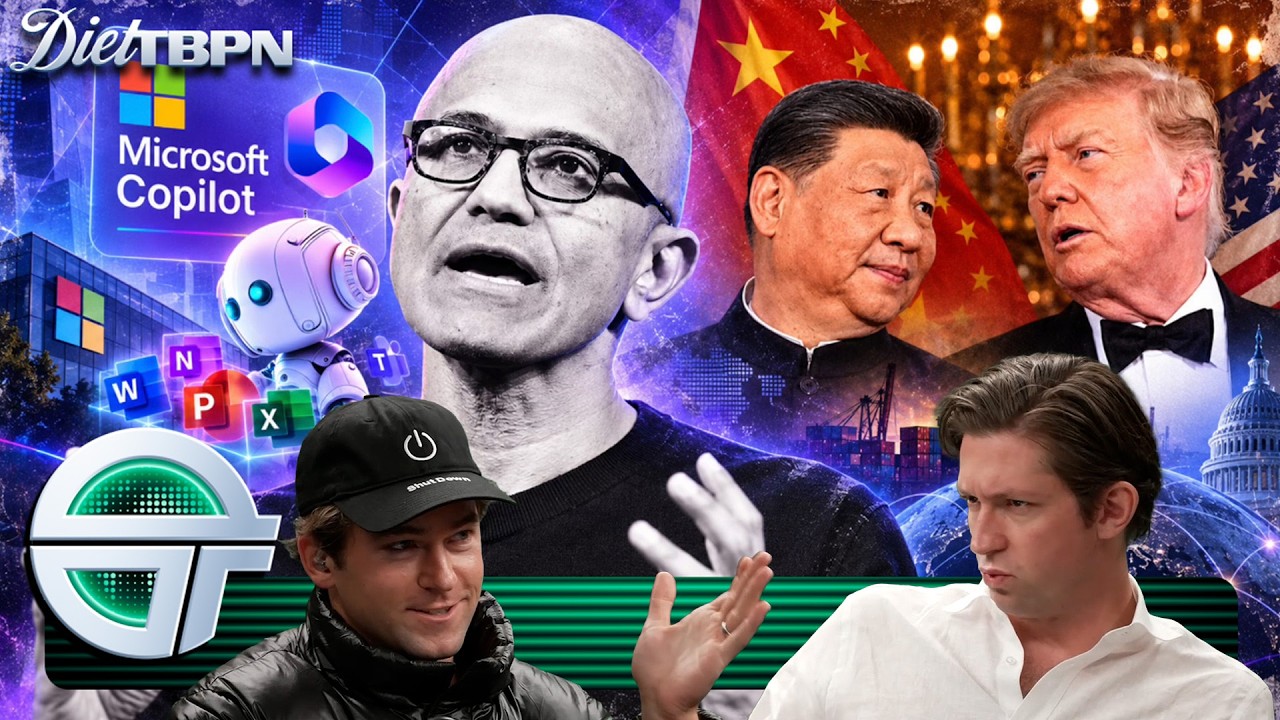
Microsoft to Take On Muse, Trump & Xi Dinner, The Mansion Section | Diet TBPN — TBPN

TBPN

Microsoft is abandoning human-in-the-loop chatbots for persistent, virtual-machine-backed Autopilot agents in a bet that enterprise and consumer delegation will expand total software spending far beyond traditional cloud computing.

AI-assisted summary of Microsoft to Take On Muse, Trump & Xi Dinner, The Mansion Section | Diet TBPN — original source. Check the original for full context.

Source published:

Key ideas

  • Microsoft is transitioning from Copilot to 'Autopilot,' an autonomous AI agent built on hardened OpenClaw architecture designed to operate continuously in dedicated virtual machines. (0:02)
  • A high-profile White House dinner convened President Trump, Chinese President Xi Jinping, and top tech executives including Jensen Huang, Lisa Su, Tim Cook, and Elon Musk, while Anthropic CEO Dario Amodei was conspicuously absent. (8:18)
  • Debate is intensifying over whether massive AI data center capital expenditures and neocloud debt issuances are crowding out sovereign debt markets and driving 10-year Treasury yields above 5%. (19:53)
  • A $44 million Old Palo Alto modern mansion listing underscores Silicon Valley's extreme real estate premium, commanding nearly four times the price of an equivalent estate in Los Angeles. (30:04)

Detailed notes

## Background Published on YouTube on September 25, 2026, by the tech talk show TBPN, this episode of 'Diet TBPN' delivers a 30-minute digest of their daily live broadcast hosted by John Coogan and Jordi Hays. According to the show notes, the episode covers Microsoft's autonomous agent strategy against Meta, a high-stakes White House power dinner with Donald Trump and Xi Jinping, prediction market advertising, macro impacts of AI data centers, and luxury real estate.

## TL;DR The hosts break down Microsoft's transition from Copilot to 'Autopilot' and examine whether its OpenClaw-backed architecture can succeed in consumer AI against Meta's Muse. They analyze the geopolitical and tech power dynamics of a White House dinner seating President Trump, Xi Jinping, and leading semiconductor CEOs, while noting key absences like Anthropic's Dario Amodei. The discussion explores modern consumer absurdities—including Kalshi's controversial AI-generated prediction market ads and South Korea's fake 'dopamine shopping' websites—before debating whether massive AI data center borrowing is spiking 10-year Treasury yields. Wrapping up with lifestyle commentary, the hosts run a comedic tier-list evaluation of architectural features in a $44 million Old Palo Alto trophy mansion.

## Atmosphere & style Fast-paced, satirical, and deeply steeped in Silicon Valley insider culture, the episode moves with the breezy kineticism of an unscripted tech-insider podcast. Coogan and Hays bounce off each other with sharp wit and effortless banter, shifting seamlessly from nuanced discussions of enterprise software runtimes and sovereign bond yields to dry mockery of AI advertising tropes and suburban floor plans. The show feels lively, skeptical, and playfully irreverent, offering substantive industry analysis wrapped in high-energy internet humor.

## Bulletin - [00:02](https://www.youtube.com/watch?v=TJnGWCITRIk&t=2s) Microsoft is transitioning from Copilot to 'Autopilot,' an autonomous AI agent built on hardened OpenClaw architecture designed to operate continuously in dedicated virtual machines. - [08:18](https://www.youtube.com/watch?v=TJnGWCITRIk&t=498s) A high-profile White House dinner convened President Trump, Chinese President Xi Jinping, and top tech executives including Jensen Huang, Lisa Su, Tim Cook, and Elon Musk, while Anthropic CEO Dario Amodei was conspicuously absent. - [19:53](https://www.youtube.com/watch?v=TJnGWCITRIk&t=1193s) Debate is intensifying over whether massive AI data center capital expenditures and neocloud debt issuances are crowding out sovereign debt markets and driving 10-year Treasury yields above 5%. - [30:04](https://www.youtube.com/watch?v=TJnGWCITRIk&t=1804s) A $44 million Old Palo Alto modern mansion listing underscores Silicon Valley's extreme real estate premium, commanding nearly four times the price of an equivalent estate in Los Angeles.

## Key takeaways - [00:02](https://www.youtube.com/watch?v=TJnGWCITRIk&t=2s) Microsoft's pivot from Copilot to 'Autopilot' signals a strategic evolution from human-in-the-loop assistance toward autonomous agents operating with dedicated workspaces and persistent memory. - [00:02](https://www.youtube.com/watch?v=TJnGWCITRIk&t=2s) OpenClaw creator Peter Steinberger collaborated with Microsoft to harden open-source agent runtime conventions for large-scale enterprise deployments. - [04:10](https://www.youtube.com/watch?v=TJnGWCITRIk&t=250s) Although tech startups remain entrenched in Google Workspace and Slack, Microsoft's massive enterprise footprint gives Autopilot an unrivaled distribution channel into the traditional corporate economy. - [08:18](https://www.youtube.com/watch?v=TJnGWCITRIk&t=498s) The seating arrangement at the Trump-Xi White House dinner placed critical semiconductor and hardware leaders from Nvidia, AMD, and Apple directly at the center of US-China geopolitical negotiations. - [09:20](https://www.youtube.com/watch?v=TJnGWCITRIk&t=560s) Anthropic CEO Dario Amodei did not attend the White House tech dinner despite co-founder Tom Brown's recent diplomatic outreach to administration officials. - [12:48](https://www.youtube.com/watch?v=TJnGWCITRIk&t=768s) Kalshi's viral AI-generated ad about hedging grocery bills highlights how commodities and prediction markets synthesize real-world local economic signals differently than equities. - [16:21](https://www.youtube.com/watch?v=TJnGWCITRIk&t=981s) The saturation of speculative trading and sportsbook advertising creates a 'hyper-casino' culture that risks normalizing financial gambling for younger generations. - [18:07](https://www.youtube.com/watch?v=TJnGWCITRIk&t=1087s) South Korea's 'dopamine shopping' phenomenon illustrates how simulated digital checkouts for luxury goods are being used to trigger retail highs without actual financial spend. - [19:53](https://www.youtube.com/watch?v=TJnGWCITRIk&t=1193s) Proponents of the capital crowding thesis argue that nation-scale borrowing for AI data centers is pulling substantial liquidity away from sovereign bond markets. - [19:53](https://www.youtube.com/watch?v=TJnGWCITRIk&t=1193s) Sovereign debt analysts counter the AI crowding thesis by noting that corporate infrastructure debt carries default risk that fundamentally separates it from risk-free government paper. - [25:59](https://www.youtube.com/watch?v=TJnGWCITRIk&t=1559s) American wealth is flowing into British pastoral trophy homes in the Cotswolds, spurred by media visibility and prominent tech figures relocating abroad. - [30:04](https://www.youtube.com/watch?v=TJnGWCITRIk&t=1804s) Hyper-concentrated tech wealth in Palo Alto has driven median home prices to $3.5 million, producing massive valuation premiums relative to other major luxury markets.

## Detailed walkthrough ### [00:02](https://www.youtube.com/watch?v=TJnGWCITRIk&t=2s) The Shift from Copilot to Autopilot: Microsoft's Enterprise and Personal Agent Ambitions

The show kicks off with banter over framing—debating whether to call their prepared rundown "debates," "arguments," or outright "fights," agreeing that listeners would much rather hear a full-blown throwdown. The opening clash centers on Microsoft's newest AI pivot and whether the tech giant is poised to have its own breakout "Muse moment" against Meta, or whether its enterprise roots will lock it into a completely different lane. Tech reporter Tay Kim ignited the discussion on X, declaring "shots fired" as Microsoft moves aggressively to take on Meta's Muse. Drawing from Alex Heath’s interview with Satya Nadella, the hosts outline Microsoft’s transition from Copilot to "Autopilot"—an AI chief of staff designed not just to sit inside Excel spreadsheets or Outlook inboxes, but to step directly into personal lives and handle real-world tasks like cooking dinner. Moving the moniker from a helpful "copilot" to an autonomous "autopilot" is treated as a major branding milestone, signaling an ambitious leap toward the AGI era where agents operate continuously rather than merely waiting for user prompts.

Under the hood, Autopilot is described as a hardened version of the open-source framework OpenClaw, equipping each agent with its own dedicated virtual machine, workspace, and persistent memory to execute long-running tasks. When pressed on consumer strategy, Nadella pointed to Microsoft's foundation of over 100 million consumer subscribers. He framed consumer agents as forces that could bypass existing digital middlemen—turning consumer software into a zero-sum battleground—while arguing that enterprise agents will expand the total addressable market beyond traditional cloud computing by orders of magnitude, even floating a hyper-bullish, long-term valuation target of a $300 trillion company. The hosts note the broader irony that every major tech titan is once again chasing the identical product paradigm, recalling how GPT-4 was initially an exclusive Bing feature before Microsoft retreated from its search ambitions.

The discussion also dives into the developer plumbing behind the launch. OpenClaw creator Peter Steinberger shared that Microsoft had collaborated with them since March to harden the codebase for massive scale deployments. Despite OpenAI hiring Steinberger, OpenClaw remains an open-source project. Addressing developer discourse, Nat Friedman noted that Microsoft didn't merely fork OpenClaw, but built on shared architectural conventions—analogous to how two separate e-commerce sites inevitably share product detail pages and standard directory structures without having directly forked Shopify. The hosts stress that just as specialized harnesses like Claude Code, Codex, and Cursor defined the AI coding wave, personal agents represent an entirely new execution tier that demands deep ecosystem integrations with retail giants like Amazon, Walmart, or Shopify, alongside extensive user re-education to convince mainstream audiences that modern agents can do far more than hallucinate answers.

```mermaid flowchart TD accTitle: Personal Agent VM Harness Architecture accDescr: Diagram illustrating Microsoft Autopilot architecture built on OpenClaw conventions with persistent environments and enterprise integrations. subgraph AgentEnvironment["Autopilot Agent Environment"] VM["Dedicated Virtual Machine"] WS["Independent Workspace"] Mem["Persistent Memory Engine"] end

subgraph CorePlatform["Agent Foundation"] OC["OpenClaw Open-Source Layer"] Model["Frontier LLM Reasoning Engine"] end

subgraph Integrations["Ecosystem & Integrations"] Cons["Consumer Services (Commerce / Messaging)"] Ent["Enterprise Stack (Excel / Outlook / Databases)"] end

Model --> OC OC --> AgentEnvironment AgentEnvironment --> Cons AgentEnvironment --> Ent ```

- **Naming distinction**: Transitioning from "Copilot" to "Autopilot" marks a clear philosophical step from human-in-the-loop assistance toward autonomous AGI-level delegation. - **Enterprise scale**: Nadella projects enterprise agents will expand the enterprise software footprint to dwarf current cloud revenues by orders of magnitude. - **OpenClaw involvement**: Peter Steinberger confirmed active collaboration with Microsoft since March to prepare OpenClaw for large-scale production runtimes.

---

[04:10](https://www.youtube.com/watch?v=TJnGWCITRIk&t=250s) Can Microsoft Actually Win Consumer AI?

The hosts spar over Microsoft's realistic chances of winning over individual consumers, contrasting tech-insider cynicism with the brute-force reality of enterprise distribution. On tech-heavy platforms like X, enthusiasm for a Microsoft-branded agent is non-existent; hard-core "agent maximalists" are not clamoring to run an agent wrapped in Microsoft branding. Yet, the co-hosts acknowledge that Microsoft possesses unmatched distribution channels. Rolling out an agent to hundreds of millions of Windows and Office subscribers means Microsoft will inevitably be the first entry point through which ordinary users encounter autonomous computing, generating organic mainstream adoption regardless of what Silicon Valley insiders think.

Startup work culture contrasts sharply with the traditional corporate tech stack. While the default modern startup operates almost entirely on Google Workspace, Gmail, and Salesforce-owned Slack—relegating Microsoft to a handful of standalone Excel licenses for the finance team—the broader real economy runs deeply on the legacy Microsoft ecosystem. Financial firms, healthcare organizations, and Fortune 500 corporations utilize Microsoft end-to-end, from Outlook and Windows to Azure databases, giving Autopilot an immense built-in moat for cross-tool workflows. The conversation turns to competitive response times: Google already has Gemini Spark running 24/7 background agent capabilities with persistent uptime, though it garners little public mindshare, prompting jokes that Google might deliver its true answer at Google I/O in 2027, followed by Apple rolling out their equivalent around 2035.

The segment wraps with lighthearted social posturing over developer and product aesthetics. Tool preferences, the hosts argue, project specific personal brand archetypes. Aligning yourself with Cursor, Claude Code, or Codex telegraphs a specific hacker aesthetic, while adopting Meta's Muse projects the sleek, fashion-forward "Loro Piana guy" persona. Pledging allegiance as a "Microsoft Autopilot guy," on the other hand, signals one of two extremes: either you are an unapologetic, spreadsheet-crunching financial apex predator ruling Wall Street, or a gamer celebrating deep Call of Duty console integrations ready to "drop a nuke" on the lobby—an aesthetic peak of sheer "Prestige Max."

- **Startup vs. Enterprise tech stack**: Startups overwhelmingly default to Google Workspace and Slack, whereas "real economy" and financial institutions operate on full-stack Microsoft infrastructure. - **Competitor rollout cadence**: Gemini Spark exists as an always-on ambient agent, but the hosts tease Google's slow institutional release cycles against Apple's notoriously delayed hardware-integrated software timelines. - **The "Autopilot Guy" identity**: Branded humorously as either the hyper-competent Wall Street "Excel jockey" financial predator or an aggressive Call of Duty power-user.

---

[08:18](https://www.youtube.com/watch?v=TJnGWCITRIk&t=498s) Trump, Xi Jinping, and Tech's White House Power Dinner

Moving on to their next topic, the hosts examine a viral photograph shared by prominent X account DogeDesigner documenting a high-stakes White House power dinner that brought together American political leadership, global tech executives, and Chinese President Xi Jinping. The seating arrangement at the head table reflected an extraordinary concentration of geopolitical and technological clout, placing the world's most critical semiconductor, consumer electronics, and defense figures face-to-face with global superpowers.

The prime table seated President Donald Trump, First Lady Melania Trump, Chinese President Xi Jinping, and China's First Lady Peng Liyuan, flanked by an elite tech roster that included Tesla and xAI head Elon Musk, AMD CEO Lisa Su, Nvidia CEO Jensen Huang, and Apple CEO Tim Cook. With Tim Cook, Lisa Su, and Jensen Huang positioned directly opposite Trump, the hosts scrutinize the mechanics of the table setup, examining an empty seat in the frame and bantering about whether it belonged to Donald Trump stepping away momentarily or was reserved for a diplomatic translator wedged between Xi Jinping and Melania Trump.

- **High-profile attendee roster**: Donald Trump, Melania Trump, Xi Jinping, Peng Liyuan, Elon Musk, Lisa Su (AMD), Jensen Huang (Nvidia), and Tim Cook (Apple). - **Semiconductor and supply chain convergence**: The dinner table placed the heads of Apple, Nvidia, and AMD directly across from the heads of state managing US-China trade and hardware relations.

[09:20](https://www.youtube.com/watch?v=TJnGWCITRIk&t=560s) Tech Titans, Diplomacy, and Snubs at the White House Dinner

A high-profile White House dinner brought together Chinese President Xi Jinping and an elite echelon of American tech and business leadership, sparking plenty of banter about diplomatic maneuvering and guest-list politics. Even though Xi consistently delivers his remarks in Chinese when visiting the United States, he was seated among Silicon Valley royalty, including Tim Cook, Elon Musk, Lisa Su, and Jensen Huang. The hosts joke about how American tech executives attempt to ingratiate themselves with Chinese leadership, bantering over memorized Mandarin phrases and noting that both Elon Musk and Tim Cook notably arrived without a plus-one, showing they were completely "locked in" with zero time for casual dinner guests.

```mermaid flowchart TD accTitle: White House Dinner Tech Attendance and Dynamics accDescr: Flowchart illustrating the key attendees, dynamics, and notable absences at the White House dinner with Xi Jinping.

subgraph Attendees["High-Profile Attendees"] direction TB Tech["Big Tech & AI Leaders<br/>Tim Cook (Apple), Elon Musk (Tesla/xAI)<br/>Jensen Huang (NVIDIA), Lisa Su (AMD)<br/>Satya Nadella (Microsoft), Sundar Pichai (Google)<br/>Sam Altman & Greg Brockman (OpenAI)<br/>Sergey Brin (Google), Cristiano Amon (Qualcomm)"] FinanceGov["Finance & Markets<br/>Lynn Martin (NYSE President)<br/>David Solomon (Goldman Sachs)<br/>David Sacks, Brad Gerstner"] end

subgraph Absence["The Anthropic Question"] Dario["Dario Amodei (Anthropic CEO)<br/>Notable Absence / Snub?"] Tom["Tom Brown (Anthropic Co-Founder)<br/>Praised Trump's 'Let Data Reign' Post<br/>Spoke with Howard Lutnick at G20"] Stance["Dario's Hawkish Stance on China<br/>Former Baidu researcher focused on<br/>defeating authoritarian regimes & grinding for ASI"] end

Attendees --> Stance Dario -.-> Stance Tom --> Stance ```

The most glaring tech absence discussed was Anthropic CEO Dario Amodei. While Anthropic has had public friction with the administration, co-founder Tom Brown had recently extended an olive branch, praising Donald Trump's September 1st Truth Social post declaring "let data reign." Brown had even told Commerce Secretary nominee Howard Lutnick at the G20 Innovation Ministerial in Chapel Hill, "I really loved President Trump's post from earlier this week." Despite this diplomatic outreach, Amodei was nowhere to be seen—whether an invitation never materialized or he deliberately passed to "lock in and grind for the ASI" (artificial superintelligence). The hosts argue that despite Amodei's China-hawkish stance—often calling to dismantle authoritarian dominance in AI despite having previously worked at Baidu—having him sit down directly and look Xi Jinping in the eye would have brought valuable perspective to the administration's strategic AI discussions.

- **Confirmed Attendees:** Sam Altman, Greg Brockman and Anna Brockman, Sergey Brin, Satya Nadella, Sundar Pichai, Cristiano Amon (Qualcomm CEO, who flew straight back from Hawaii), David Solomon (Goldman Sachs), Lynn Martin (President of the New York Stock Exchange), alongside representatives from ExxonMobil. - **Podcaster Representation:** The hosts jokingly lament the snub of podcasters like Jocko Willink, Joe Rogan, and Tai Lopez, while pointing out that podcast hosts were quietly well-represented by David Sacks, Brad Gerstner, Robert F. Kennedy Jr., and former Y Combinator Startup School host Sam Altman.

---

[12:48](https://www.youtube.com/watch?v=TJnGWCITRIk&t=768s) Kalshi's Dystopian AI Slop Ad and the Hedging of Egg Futures

The conversation shifts to direct-to-consumer advertising with an analysis of Kalshi’s viral prediction-market commercial, widely derided online as peak dystopian "AI slop." The advertisement pairs generic Pixar-style generated visuals with an unpolished AI-composed soundtrack that sounds like an open-floor-plan karaoke track. The narrative relies on a classic soap-opera hook: a boyfriend suspects his partner of infidelity because she constantly has unexplained cash, only to discover she has been funding their life by hedging egg futures on Kalshi using early price intelligence gathered from her morning shifts at a local bakery.

```mermaid flowchart LR accTitle: The Kalshi Ad Escalation accDescr: Diagram contrasting the modest premise of Kalshi's egg hedging ad with the hosts' exaggerated vision of institutional commodity trading.

subgraph AdPremise["Kalshi Commercial Premise"] A["Bakery Morning Shift"] --> B["Notices Rising Egg Costs"] B --> C["Trades Egg Futures on Kalshi"] C --> D["Offsets Household Grocery Bills"] end

subgraph HostEscalation["The CBOT Escalation"] E["Installs Bloomberg Terminal"] --> F["Partners with JPMorgan & Morgan Stanley"] F --> G["Hits Chicago Board of Trade Floor"] G --> H["Trades Massive Commodity Volume with Citadel & Millennium"] end

AdPremise -. "Elevating past small ball".-> HostEscalation ```

The hosts dissect whether trading on information from your workplace constitutes illegal insider trading, clarifying that commodities and prediction markets function differently from equities: commodities markets are explicitly designed to synthesize real-world supply and demand signals like weather disruptions and local inventory shifts. While an actual Kalshi prediction contract for "egg prices up in September" exists—trading at a 72% probability—the market only holds $417 in total volume. Still, the hosts joke that if your grocery bill is only $20, $417 is plenty of liquidity. They envision a far more extreme institutional parody where the girlfriend skips prediction markets entirely, installs a Bloomberg terminal, sets up prime brokerage lines with JPMorgan and Morgan Stanley, and steps onto the Chicago Board of Trade floor to execute high-volume derivative trades directly against Citadel and Millennium.

---

[16:21](https://www.youtube.com/watch?v=TJnGWCITRIk&t=981s) The Hyper-Casino Era and Normalized Gambling Ads

The Kalshi spot opens up a deeper debate about the "hyper-casino" nature of contemporary digital culture, where sportsbooks, prediction platforms, and financial speculation apps saturate daily media. One host shares a personal anecdote of testing the waters after years of being exposed to advertisements, attempting to gamble over a single weekend just to understand its appeal, only to find himself immediately deep in the red.

The hosts voice genuine concern over the generational impact of this constant exposure. While mature adults may have the discernment and impulse control to dismiss gambling commercials, younger internet users are currently on track to view upwards of a million gambling ads before they even reach their eighteenth birthday. By heavily normalizing speculative betting as a legitimate financial escape hatch—advertising trading as "your way out"—platforms obscure the reality that the only reliable way to win in a hyper-casino economy is choosing not to play and avoiding the addiction entirely. The hosts propose their own satirical direct-response ad based on the same format: a suspicious partner fears an affair, only to discover their significant other is simply locked into watching three uninterrupted hours of TBPN every day to stay informed on tech and business.

---

[18:07](https://www.youtube.com/watch?v=TJnGWCITRIk&t=1087s) Dopamine Shopping: The Rise of Fake E-Commerce in South Korea

The discussion turns to an emerging consumer trend dubbed "dopamine sites," popularized in South Korea and highlighted in an essay shared by Adonis on X. These digital platforms recreate the complete sensory and psychological ritual of online retail—browsing luxury catalogs, customizing items, adding them to a digital cart, and completing the checkout process—without requiring real money or ever shipping physical merchandise.

The platforms allow users to experience the instantaneous neurochemical rush of consumer splurging without the crushing debt that typically accompanies high-end consumption. The hosts cite a user who chronicled an entirely fictional spending spree across sites like Dopamine Shop and Food Never Comes, satisfying material desires purely through simulated retail therapy.

- **Simulated Luxury Haul:** - $44,860 hand-engraved Patek Philippe timepiece - $12,500 Hermès handbag - $9,800 Tiffany & Co. diamond ring - $7,350 Cartier Love bracelet in yellow gold - **Platform Mechanics:** Recreates the browsing, selecting, and checkout confirmations of modern e-commerce storefronts purely to generate the psychological payoff of acquisition while shielding users from the financial fallout.

[19:14](https://www.youtube.com/watch?v=TJnGWCITRIk&t=1154s) Dopamine Shopping Sites and the Culture of Pure Consumption

The discussion opens on the bizarre phenomenon of "dopamine shopping" sites, where users search for real or fictional products, compare reviews, place items in a cart, enter shipping addresses, check out, and track imaginary deliveries—without anything ever actually arriving. The hosts marvel at how unsettling the concept is, questioning whether simulated purchasing is as harmful as online sports betting or simply a symptom of modern malaise. It is described as a "strange and sad" reflection of a culture infatuated with pure consumption over creation. Joking about capitalizing on the trend, they suggest creating a dopamine shopping store for TBPN merchandise where fans can order and track gear that will never actually ship.

[19:53](https://www.youtube.com/watch?v=TJnGWCITRIk&t=1193s) Debate: Is the AI Data Center Boom Driving Bond Yields Higher?

The hosts move on to a major macro debate roiling the financial and tech worlds: to what extent is the massive capital buildout for AI data centers pushing interest rates upward? The 10-year Treasury yield recently spiked up to 5.18% after sitting in the low 4% range, sparking broad anxiety across markets. While the conventional macro explanation points to geopolitics—unexpected escalation in the Iran conflict triggering an energy shock, sticky inflation, and subsequent rate hike expectations—a vocal contingent in Silicon Valley argues that AI infrastructure debt is actively crowding out sovereign debt markets.

```mermaid flowchart TD accTitle: AI Capex vs Sovereign Bond Yield Drivers accDescr: Diagram comparing the macro inflation explanation against the tech capital crowding thesis for rising bond yields.

subgraph MacroView["Macro / Traditional View"] A["Geopolitical Shock / Oil Spike"] --> B["Inflationary Pressure"] B --> C["Fed Rate Hike Expectations"] C --> D["Higher Treasury Yields"] end

subgraph TechDebtView["Tech Crowding Thesis"] E["Trillions in AI Capex Demand"] --> F["Hyperscaler & Neocloud Debt Issuance"] F --> G["Capital Diverted from Treasuries"] G --> D end ```

The hosts examine competing viewpoints from market observers and analysts debating whether tech capex is siphoning liquidity from government bonds:

- **The Capital Crowding Thesis:** Tech commentator Rune argues that while oil prices are a short-term catalyst, the broader pressure comes from "extremely attractive AI capex opportunities that are borrowing at nation scale." Observers like Astrid Wylde agree that global yields must rise because capital allocators have little incentive to fund anything else when AI data centers offer tens of billions in capacity with ultra-short payback horizons. Data from Jordan Nanos's ClusterMAX tracker underscores this explosion: ClusterMAX 1 tracked a few dozen "neoclouds," while ClusterMAX 3 tracked 326 neoclouds (rating over 200 of them), alongside massive projects from hyperscalers and custom silicon startups like Cerebras, Positron, and Etched. - **The Sovereign Debt Rebuttal:** Contrasting views from analysts like Deep Dish argue that AI capex and US Treasuries are fundamentally different asset classes. Unlike government bonds—backed by a sovereign state's monopoly on taxation and legal authority—private AI infrastructure debt carries real default risk and cannot be pledged as liquid collateral. If a neocloud goes bankrupt, bondholders might recover only 70 to 90 cents on the dollar. Macro analyst Rho adds that hand-wringing over a 5% 10-year yield reflects severe recency bias: the 10-year yield has averaged 5.8% since 1960, meaning rates are simply returning to historical norms. - **The Venture and Corporate Impact:** The hosts note reporting from *The Wall Street Journal* illustrating that the US economy and AI investment boom continue to power through rate hikes and rising borrowing costs. While rising rates devastated traditional SaaS companies trading at 100x revenue whose valuations relied on discounting zero-interest-rate cash flows a decade out, modern AI companies were largely born into higher interest rate environments. As one host remarks, tech operators and retail course creators alike are "falling in love with the spreadsheet," treating GPU purchases and data center leasing like buying multifamily real estate.

[25:59](https://www.youtube.com/watch?v=TJnGWCITRIk&t=1559s) Americans Flocking to Trophy Estates in the Cotswolds

Pivoting to lifestyle and real estate trends, the hosts touch on an article detailing how wealthy Americans are increasingly purchasing luxury country estates in the Cotswolds. Driven in part by British media visibility surrounding Prince Harry and Meghan Markle, as well as high-profile tech figures like Paul Graham relocating to the English countryside to write and "putter," US capital is seeking out British pastoral retreats. One host dismisses the trend as distinctly un-American, affirming they have zero interest in buying a UK countryside estate.

[26:39](https://www.youtube.com/watch?v=TJnGWCITRIk&t=1599s) Tier-Listing a $44 Million Modern Mansion in Palo Alto

The conversation shifts to what the hosts dub "the Cotswolds of America"—Silicon Valley. They review a newly listed $44 million, five-bedroom modern home in the Old Palo Alto neighborhood, built by tech entrepreneur Asher Waldfogel and his wife Helen McLean. The couple originally tore down a circa-1930s Spanish Colonial home and spent $20 million constructing their dream house (completed in 2005), which was designed to echo neighborhood stucco and mahogany tones while integrating modern elements.

To evaluate whether the $44 million property justifies the hype, the hosts run through a rapid-fire tier-list ranking of the estate's key architectural choices:

| Feature | Details | Tier Assigned | Host Commentary | |:--- |:--- |:--- |:--- | | **Titanium Zinc Cladding** | Stucco, mahogany, and titanium zinc exterior accents | **A Tier** | Applauded as a sharp design touch, leaving modest room at the top for exceptional features. | | **0.4-Acre Lot Size** | Modest parcel size typical of high-density Palo Alto | **F Tier** | Instantly dismissed; a host insists you need at least three acres to make a genuine splash. | | **Central Pinwheeling Staircase** | Layout radiating around a single structural staircase | **D Tier** | Panned in favor of classic single-story California ranches; staircases are undesirable while raising kids. | | **7,900 Sq. Ft. Livable Space** | Multi-level interior living area | **B Tier** | Solid volume, though managing split air-conditioning across multiple levels draws mild hesitation. | | **Four Distinct Courtyards** | Multiple specialized outdoor courtyards | *Pending / Skeptical* | Viewed with suspicion as an architectural luxury that looks cool on paper but usually ends up abandoned and unused. |

[29:16](https://www.youtube.com/watch?v=TJnGWCITRIk&t=1756s) Tier-Ranking Mansion Amenities: Courtyards, Pools, and Concrete Spines

Continuing their tier-list breakdown of the high-end amenities inside a massive Palo Alto trophy property, the hosts turn their attention to outdoor spaces and architectural centerpieces. Evaluating the residence’s four courtyards, one host is dismissive, remarking that "the average courtyard gets like five minutes of someone's time annually." While a C-tier rating is initially proposed, it gets swiftly downgraded to a "brutal" D-tier due to low functional utility. Swimming pools, by contrast, receive high praise. Arguing against the conventional take that pools are properly rated, one host maintains that pools are actually still underrated and far better than people give them credit for, ultimately awarding the pool an enthusiastic S-tier placement pending visual inspection.

The conversation then shifts indoors to an unusual focal point: a massive cast-in-place concrete wall running through the residence. Described as the architectural "spine" of the house, the feature stands two stories high and stretches 80 feet in length. Despite the potential sterility of exposed concrete, both hosts express appreciation for the continuous structural motif, agreeing that it gives the interior a coherent design language and slotting the concrete spine comfortably into B-tier.

- **Courtyards (Four on-site):** Rated **D-tier** due to their lack of real-world use. - **Swimming Pool:** Rated **S-tier** as an underrated luxury asset. - **Cast-in-Place Concrete Spine:** Rated **B-tier** (two stories high, 80 feet long, serving as a continuous architectural theme).

---

[30:04](https://www.youtube.com/watch?v=TJnGWCITRIk&t=1804s) Palo Alto Real Estate Economics and the Silicon Valley Premium

The owners of the property are preparing for their next stage in life and attempting to emotionally let go of the residence while spending time at their second home in Sun Valley, Idaho. The hosts give having a second home in Sun Valley an immediate, undisputed S-tier ranking. The discussion widens to examine the intense market dynamics of Palo Alto, the historical epicenter of venture capital and Silicon Valley's tech titans. Driven by massive wealth generation, sales volumes and prices across the city continue to climb, reaching a median sales price of $3.5 million over the three months ending in August—a 5.8% jump year-over-year.

The hosts note the staggering geographical price disparity between tech-hub real estate and other elite markets like Southern California. A residence of this exact scale and finish would likely fetch around $12 million in Los Angeles depending on the neighborhood, yet in the hyper-concentrated wealth bubble of Palo Alto, the market commands an astronomical $44 million valuation. Acknowledging that the astronomical Silicon Valley premium effectively treats the home as S-tier in valuation alone, the hosts close out the segment and sign off until Monday.

- **Sun Valley, Idaho Second Home:** Ranked **S-tier**. - **Palo Alto Market Snapshot:** Median home sale price reached $3.5 million for the three-month period ending in August (up 5.8% year-over-year). - **Valuation Disconnect:** Estimated at roughly $12 million if situated in Los Angeles, compared to its $44 million listing price in Palo Alto.

## Notable quotes > Silicon Valley’s newest obsession — The New York Times

> [00:02](https://www.youtube.com/watch?v=TJnGWCITRIk&t=2s) shots fired — Tay Kim

> [09:20](https://www.youtube.com/watch?v=TJnGWCITRIk&t=560s) let data reign — Donald Trump

> [09:20](https://www.youtube.com/watch?v=TJnGWCITRIk&t=560s) I really loved President Trump's post from earlier this week. — Tom Brown

> [09:20](https://www.youtube.com/watch?v=TJnGWCITRIk&t=560s) lock in and grind for the ASI

> [16:21](https://www.youtube.com/watch?v=TJnGWCITRIk&t=981s) your way out

> [19:14](https://www.youtube.com/watch?v=TJnGWCITRIk&t=1154s) strange and sad

> [19:53](https://www.youtube.com/watch?v=TJnGWCITRIk&t=1193s) extremely attractive AI capex opportunities that are borrowing at nation scale. — Rune

> [19:53](https://www.youtube.com/watch?v=TJnGWCITRIk&t=1193s) falling in love with the spreadsheet

> [26:39](https://www.youtube.com/watch?v=TJnGWCITRIk&t=1599s) the Cotswolds of America

> [29:16](https://www.youtube.com/watch?v=TJnGWCITRIk&t=1756s) the average courtyard gets like five minutes of someone's time annually.

## Mentioned TBPN, John Coogan, Jordi Hays, Microsoft, Microsoft Autopilot, Microsoft Copilot, Meta, Meta Muse, Satya Nadella, Alex Heath, Tay Kim, OpenClaw, Peter Steinberger, Nat Friedman, OpenAI, Sam Altman, Claude Code, Codex, Cursor, Gemini Spark, Google, Apple, Donald Trump, Melania Trump, Xi Jinping, Peng Liyuan, Elon Musk, Tesla, xAI, Lisa Su, AMD, Jensen Huang, Nvidia, Tim Cook, Anthropic, Dario Amodei, Tom Brown, Howard Lutnick, Greg Brockman, Anna Brockman, Sergey Brin, Sundar Pichai, Cristiano Amon, Qualcomm, David Solomon, Goldman Sachs, Lynn Martin, New York Stock Exchange, David Sacks, Brad Gerstner, Robert F. Kennedy Jr., Kalshi, Chicago Board of Trade, JPMorgan, Morgan Stanley, Citadel, Millennium, Adonis, Dopamine Shop, Food Never Comes, Patek Philippe, Hermès, Tiffany & Co., Cartier, Rune, Astrid Wylde, Jordan Nanos, ClusterMAX, Cerebras, Positron, Etched, Deep Dish, Rho, The Wall Street Journal, Paul Graham, Prince Harry, Meghan Markle, Asher Waldfogel, Helen McLean, Palo Alto, Sun Valley, Idaho

## Video description Sign up for TBPN’s daily newsletter at TBPN.com

Diet TBPN delivers the best of today’s TBPN episode in 30 minutes. TBPN is a live tech talk show hosted by John Coogan and Jordi Hays, streaming weekdays 11–2 PT on X and YouTube, with each episode posted to podcast platforms right after.

Described by The New York Times as “Silicon Valley’s newest obsession,” the show has recently featured Mark Zuckerberg, Sam Altman, Mark Cuban, and Satya Nadella.

TBPN is made possible by: Ramp - https://ramp.com Public - https://public.com Cisco - https://www.cisco.com Console - https://www.console.com CrowdStrike - https://www.crowdstrike.com Figma - https://www.figma.com MongoDB - https://www.mongodb.com NYSE - https://www.nyse.com Railway - https://railway.com Shopify - https://www.shopify.com/

Follow TBPN: https://TBPN.com https://x.com/tbpn https://open.spotify.com/show/2L6WMqY3GUPCGBD0dX6p00?si=674252d53acf4231 https://podcasts.apple.com/us/podcast/technology-brothers/id1772360235 https://www.youtube.com/@TBPNLive

Chapters: 00:00 Microsoft Autopilot vs. Meta Muse + The Personal Agent Wars 04:10 Can Microsoft Actually Win Consumer AI? 08:18 Trump, Xi + Tech’s White House Power Dinner 12:48 Kalshi’s AI Slop Ad + Has Gambling Gone Too Far? 18:00 Dopamine Shopping Sites + Buying Things That Never Arrive 19:47 Is the AI Data Center Boom Driving Interest Rates Higher? 25:59 Americans Are Buying Trophy Homes in the Cotswolds 26:39 The $44M Palo Alto Mansion Tier List

[Source](https://www.youtube.com/watch?v=TJnGWCITRIk)

中文简报

微软改版OpenClaw将Copilot转型为自主AI智能体 微软正放弃有人参与(human-in-the-loop)的聊天机器人,转而采用由虚拟机支持的持久性Autopilot智能体,押注企业与消费者的任务委派将推动软件总支出大幅超越传统云计算。 主持人深入剖析了微软从Copilot向“Autopilot”的转型,并探讨其基于OpenClaw的架构能否在消费级AI领域抗衡Meta的Muse。他们分析了一场白宫晚宴背后的地缘政治与科技权力博弈——该宴席汇集了特朗普总统、习近平主席以及多位半导体巨头CEO,同时指出Anthropic首席执行官Dario Amodei等关键人物的缺席。讨论还探讨了当下的消费荒谬现象,包括Kalshi具争议性的AI生成预测市场广告,以及韩国虚假的“多巴胺购物”网站;随后辩论了巨额AI数据中心借贷是否正在推高10年期美债收益率。最后,主持人们以诙谐的评级排行形式,对老帕洛阿尔托一座价值4400万美元的标志性豪宅的建筑特色进行了生活方式层面的点评。 微软正从Copilot向“Autopilot”转型,后者是基于加固型OpenClaw架构构建的自主AI智能体,旨在专用虚拟机中持续运行。 (0:02) 一场备受瞩目的白宫晚宴汇聚了特朗普总统、中国国家主席习近平,以及黄仁勋(Jensen Huang)、苏姿丰(Lisa Su)、蒂姆·库克(Tim Cook)和埃隆·马斯克(Elon Musk)等顶尖科技高管,而Anthropic首席执行官Dario Amodei则显眼缺席。 (8:18) 关于巨额AI数据中心资本支出和新一代云服务商(neocloud)发债是否正在挤压主权债务市场并推动10年期美债收益率突破5%的争论正在加剧。 (19:53) 老帕洛阿尔托(Old Palo Alto)一座挂牌价4400万美元的现代豪宅凸显了硅谷极端的房地产溢价,其售价几乎是洛杉矶同等庄园的四倍。 (30:04)

Reading summary

TBPN explores Microsoft's strategic evolution toward autonomous AI agents, high-stakes tech diplomacy with Chinese leadership at the White House, and the macroeconomic debate over whether massive AI infrastructure spending is pressuring sovereign debt yields. The discussion also examines how financial speculation and concentrated tech wealth are reshaping consumer habits and luxury real estate. Microsoft’s Autonomous Autopilot Shift and Distribution Moat (0:02) Microsoft is transitioning its branding and product architecture from human-in-the-loop 'Copilot' tools to autonomous 'Autopilot' agents capable of continuous, long-running execution. Built on shared conventions with the open-source OpenClaw framework—hardened in collaboration with creator Peter Steinberger—each agent is provisioned with a dedicated virtual machine, isolated workspace, and persistent memory. Microsoft CEO Satya Nadella projects that enterprise agents will expand software market sizing far beyond cloud revenues, while its 100-million-subscriber consumer base provides an entry point to bypass traditional digital middlemen. While early-stage startups predominantly operate on Google Workspace and Slack, the traditional enterprise economy remains anchored in the Microsoft ecosystem across finance, healthcare, and large corporations. The hosts argue that despite skepticism from niche tech communities favoring specialized tools or Meta's Muse, Microsoft's massive operating system and productivity suite footprint gives it an unmatched distribution moat to introduce autonomous computing to mainstream enterprise workflows. Tech Diplomacy and Geopolitics at the White House (8:18) A high-stakes White House power dinner brought Chinese President Xi Jinping together with Donald Trump, Melania Trump, and executive leadership across the semiconductor, hardware, and AI sectors. Seating placed Apple CEO Tim Cook, AMD CEO Lisa Su, and Nvidia CEO Jensen Huang directly opposite Trump and Xi, highlighting how critical hardware and chip supply chains sit at the center of ongoing US-China geopolitical negotiations alongside attendees like Satya Nadella, Sundar Pichai, and Sam Altman. A notable discussion focused on the absence of Anthropic CEO Dario Amodei, despite co-founder Tom Brown's recent outreach praising Trump's data policy statements. The hosts point to tension surrounding Amodei's hawkish stance toward authoritarian AI leadership, arguing that direct engagement between frontier AI research leaders and Chinese leadership remains a vital missing component of strategic national AI diplomacy. AI Infrastructure Capex Versus Sovereign Debt Yields (19:53) A central macroeconomic debate centers on whether trillions in capital expenditure for AI data centers contributed to the 10-year Treasury yield climbing to 5.18%. Observers advancing the capital-crowding thesis, including tech commentator Rune and Astrid Wylde, argue that private AI infrastructure borrowing—highlighted by Jordan Nanos's ClusterMAX tracking 326 neoclouds alongside hyperscalers—competes with government debt by offering high-return capacity with rapid payback horizons. Conversely, traditional analysts like Deep Dish and Rho counter that private data center debt cannot substitute for sovereign bonds, as private debt carries real default risk and cannot function as risk-free financial collateral. Furthermore, analysts note that a 5% yield aligns with historical benchmarks, where the 10-year Treasury has averaged 5.8% since 1960. Nonetheless, corporate investment in custom silicon and data centers appears largely decoupled from elevated borrowing costs, with firms treating computing infrastructure as productive assets regardless of interest rates. Speculative Media, Prediction Markets, and Dopamine Shopping (12:48) The hosts critique the normalization of retail financial speculation, analyzing a viral Kalshi prediction-market advertisement that framed egg futures trading as a solution to household grocery inflation. While commodities contracts aggregate real-world supply signals, the hosts note that actual liquidity in such consumer prediction markets remains minimal, citing just $417 in total volume on the featured September egg contract. More broadly, the broadcast voices concern over the volume of gambling advertising directed at digital consumers, warning that younger audiences face unprecedented exposure to speculative products marketed as legitimate financial lifelines. This impulse toward simulated financial gratification is also evident in South Korea's emerging 'dopamine shopping' websites, such as Food Never Comes. These platforms recreate the psychological rituals of luxury consumption—browsing catalogs, customizing purchases like a $44,860 Patek Philippe watch or a $12,500 Hermès handbag, and completing checkouts—without charging money or dispatching physical goods, highlighting a cultural shift toward pure consumption simulation detached from material utility. Silicon Valley Trophy Real Estate and Capital Concentration (26:39) Examining wealth concentration in tech hubs, the hosts evaluate a $44 million modern estate in Old Palo Alto, constructed for $20 million by entrepreneur Asher Waldfogel and Helen McLean. Running through an architectural breakdown, the property features a two-story, 80-foot cast-in-place concrete spine alongside less functional amenities, such as four detached courtyards that draw skepticism regarding actual utility. The listing highlights Palo Alto's exceptional valuation premium relative to other luxury housing markets, with equivalent square footage estimated at $12 million in Los Angeles. Supported by median home sale prices climbing 5.8% year-over-year to $3.5 million, the market illustrates how concentrated equity and capital generation in Silicon Valley sustain isolated, extreme valuations even amid broader macroeconomic shifts. The broadcast highlights an era where massive capital allocation toward AI infrastructure, sovereign debt movements, and geopolitical supply chain diplomacy collide. However, whether autonomous agents and data center debt can generate real economic returns to match these outsized valuations remains an active and unresolved market question.

精炼阅读摘要

本期节目梳理了微软从辅助型Copilot转向自主型Autopilot的AI代理野心,探讨了白宫高规格晚宴背后中美地缘政治与半导体供应链的交织,并深入分析了AI数据中心资本开支对美债收益率的潜在挤压,以及从投机广告、虚拟消费到硅谷天价豪宅所折射的资本文化溢价。 微软从Copilot迈向Autopilot与代理布局 (0:02) 微软正加速推进从Copilot向Autopilot的品牌与技术演进,标志着AI从人类辅助工具迈向自主运行的“AI幕僚长”。据Satya Nadella在接受Alex Heath采访时透露,Autopilot不仅限于办公软件,还将接管现实生活任务。在架构层面,Autopilot基于开源框架OpenClaw构建并经过加固,为每个代理配备独立的虚拟机、工作区与持久内存。OpenClaw创作者Peter Steinberger证实,微软自三月起便参与代码库的规模化加固。针对开源争议,Nat Friedman指出微软是采用通用架构规范,而非简单分支代码。 在商业前景上,Nadella提出企业代理有望开拓远超传统云计算规模的潜在市场,甚至抛出了长期300万亿美元估值的超乐观预期,并强调其拥有超1亿个人订阅用户的分发优势。节目主播分析,尽管极客群体和初创企业普遍偏好Google Workspace、Slack或Cursor等开发工具,但传统经济、金融及医疗体系深度扎根于Windows与Azure基础设施,这为微软提供了难以匹敌的触达渠道;相比之下,Google的Gemini Spark虽具备常驻后台代理能力,但产品迭代周期缓慢,Apple的整合进度则更为滞后。 白宫晚宴:中美高层与科技巨头的权力汇聚 (8:18) 一场汇聚中美政要与全球商业精英的白宫晚宴引发广泛关注。主桌席位集中了美国总统Donald Trump与第一夫人Melania Trump、中国国家主席习近平与夫人彭丽媛,以及特斯拉与xAI主管Elon Musk、AMD首席执行官Lisa Su、NVIDIA首席执行官Jensen Huang和苹果首席执行官Tim Cook,形成了半导体、消费电子供应链与全球最高政治决策者的直接对话。此外,Sam Altman、Greg Brockman、Sergey Brin、Satya Nadella、Sundar Pichai及高通首席执行官Cristiano Amon等亦悉数出席。 晚宴名单中最受关注的缺席者是Anthropic首席执行官Dario Amodei。尽管Anthropic联合创始人Tom Brown此前在G20创新部长会议上向商务部长提名人Howard Lutnick示好,赞扬Trump在Truth Social发布的“让数据统治”言论,但持有强硬对华立场的Amodei仍未现身。主播指出,Amodei早年曾在百度任职,现致力于发展超级人工智能(ASI)并倡导遏制威权体制在AI领域的优势,他的缺席使得前沿安全阵营错失了与各方直接对谈的机会。 投机广告异化与韩国多巴胺模拟消费 (12:48) 预测市场平台Kalshi推出的一则AI生成广告引发了关于金融投机泛滥的讨论。该广告虚构了一名女性利用在面包店掌握的供应链价格信息在Kalshi上对冲鸡蛋期货以补贴家用的故事。主播分析指出,商品与预测市场不同于股票市场,其本质在于消化现实世界供需与天气信号,尽管该平台确实存在“9月鸡蛋价格上涨”的合约(当时概率为72%),但其实际交易量仅为417美元。此类广告被批评为将高风险投机粉饰为家庭财务解药,尤其在年轻人群体中持续助长“超级赌场”文化。 与金融投机形成镜像的是韩国兴起的“多巴胺购物网站”现象。这类平台(如Dopamine Shop、Food Never Comes)允许用户浏览数万美元的高端奢侈品(例如标价44,860美元的百达翡丽腕表、12,500美元的爱马仕手袋、9,800美元的蒂芙尼钻戒及7,350美元的卡地亚手镯),并体验挑选、结账和虚拟物流追踪的全过程,但用户无需实际支付,平台也不会发货。这种机制纯粹通过模拟占有欲的满足来释放多巴胺,反映出现代消费主义在不带来现实负债情况下的心理代偿机制。 宏观争议:AI数据中心建设推高国债收益率? (19:53) 随着美国10年期国债收益率从4%低位升至5.18%,金融界与硅谷就其驱动因素爆发激辩。传统宏观分析认为,伊朗冲突升级引发能源震荡与通胀粘性,促使市场消化美联储加息预期;但硅谷评论员Rune及Astrid Wylde等人提出“资本挤出论”,认为AI数据中心建设具备国家级的借贷规模与极短回本期,数万亿美元的巨额资本开支正在分流主权债券市场的流动性。数据追踪器ClusterMAX显示,受追踪的“新兴云厂商”(neoclouds)数量已激增至326家,连同大型云服务商及定制芯片初创公司持续消耗巨量资金。 反对声音则强调资产属性的本质差异。分析人士Deep Dish与Rho指出,政府债券依赖主权征税权支持,且具备流动性质押品属性;而私人AI基础设施债券属于高违约风险资产,一旦新兴云破产,债权人回收率可能仅有70至90美分,两者不存在直接替代。此外,10年期美债收益率自1960年以来的历史平均值为5.8%,当前水平仅属回归常态。《华尔街日报》的报道亦表明,现代AI初创公司诞生于高利率环境,产业界正在以类似商业地产运营的逻辑对待GPU采购与数据中心租赁,资本投入并未因借贷成本上升而停滞。 帕洛阿尔托豪宅经济学与硅谷资产溢价 (26:39) 在生活方式与财富配置讨论中,主播评估了科技企业家Asher Waldfogel与Helen McLean位于老帕洛阿尔托的一栋挂牌价4,400万美元的现代豪宅。该物业建于2005年,最初耗资2,000万美元拆除原西班牙殖民风格建筑重建,拥有7,900平方英尺居住面积与5间卧室。在具体建筑要素评级中,长达80英尺、贯穿两层的现浇混凝土核心墙获评B级,钛锌护墙板获评A级,恒温泳池被评为S级;但0.4英亩的狭小占地被评为F级,旋转楼梯被评为D级,4个利用率极低的独立庭院亦被评为D级。 这一案例凸显了硅谷核心区极端的房地产财富效应。截至8月的三个月内,帕洛阿尔托房屋销售中位价达到350万美元,同比增长5.8%。主播指出,同样规格与建筑水准的房产在洛杉矶高档社区估值通常在1,200万美元左右,而在帕洛阿尔托却能获得高达4,400万美元的报价,展现出由科技资本高度集中所支撑的独有溢价体系。 无论是软件架构从辅助走向自主、主权政治与半导体寡头的联合,还是巨额算力投入对宏观资本环境的潜在扭曲与局部资产的极端溢价,均显示出科技资本正在重塑各领域的估值逻辑与运作规则,但其实际承载力与长期经济效益仍有待时间验证。

Detailed notes — zh

## Background 该视频由科技脱口秀频道 TBPN(由 John Coogan 和 Jordi Hays 主持)于 2026 年 9 月 25 日发布在 YouTube 平台。视频简介显示,《Diet TBPN》将每天长达数小时的直播节目浓缩为约 30 分钟的精华速递,本期节目聚焦微软 Autopilot 对标 Meta Muse、白宫科技巨头国宴、Kalshi 争议性 AI 广告、AI 算力基础设施与利率关系以及硅谷豪宅段位评级等前沿话题。 ## TL;DR 节目围绕科技界与宏观经济的多个核心热点展开探讨:首先深入分析了微软从 Copilot 演进为自主 Agent 产品 Autopilot 的技术路线、分发优势以及其对标 Meta Muse 的消费级竞争格局;随后解读了特朗普、习近平与黄仁勋、马斯克等中美政商领袖同桌的白宫晚宴内幕与地缘信号。主持人紧接着剖析了预测市场平台 Kalshi 粗劣 AI 广告折射出的“全民赌场化”危机,以及韩国年轻人沉迷只下单不发货的“多巴胺购物网站”怪象。在财经议题上,节目针锋相对地辩论了 AI 数据中心建设发债潮是否正在推高全美利率,最后以对帕洛阿尔托一处挂牌 4400 万美元的顶豪特性进行趣味 Tier List 段位打分幽默收场。 ## Atmosphere & style 整期节目散发着典型的硅谷内行脱口秀气息,两位主持人语速飞快、接梗密集,在半调侃半辩论的互动中充满了火药味与科技圈“地狱笑话”。叙事节奏在宏大严肃的万亿美元算力基建、白宫最高权力场,与荒诞滑稽的低质 AI 广告、虚荣的多巴胺虚拟消费之间自如切换。听众在沉浸式体验硬核技术剖析与宏观资本审视的同时,能真切感受到硅谷精英阶层那种既身处风暴中心又带着冷眼旁观与自嘲解构的独特黑色幽默。 ## Bulletin - [00:02](https://www.youtube.com/watch?v=TJnGWCITRIk&t=2s) 微软推出基于强化版 OpenClaw 的个人自主 Agent 产品“Autopilot”,为每位用户配备专属虚拟机与持久记忆,试图借助逾 1 亿消费级订阅基数向 Meta Muse 发起正面竞争。 - [08:18](https://www.youtube.com/watch?v=TJnGWCITRIk&t=498s) 白宫举行中美高层科技晚宴,特朗普、马斯克、蒂姆·库克、黄仁勋与苏姿丰同桌列席主桌,而对华立场强硬的 Anthropic CEO 达里奥·阿莫代伊则缺席引发关注。 - [19:50](https://www.youtube.com/watch?v=TJnGWCITRIk&t=1190s) 10年期美债收益率攀升至 5.18%,科技创投圈激辩 AI 数据中心数万亿美元的借贷与巨额 Capex 支出是否已成为推高全球流动性成本的核心推手。 - [12:48](https://www.youtube.com/watch?v=TJnGWCITRIk&t=768s) 预测市场 Kalshi 发布的荒诞 AI 生成对冲广告在社媒引发批评,暴露出底层合约仅数百美元交易量的流动性尴尬,以及科技营销助推“全民赌场化”的社会风险。 ## Key takeaways - [00:02](https://www.youtube.com/watch?v=TJnGWCITRIk&t=2s) 微软将 AI 产品路线从辅助模式的 Copilot 升级为具备独立运行环境的自主 Agent“Autopilot”,标志着从人工在环向全自主执行的技术范式跨越。 - [00:02](https://www.youtube.com/watch?v=TJnGWCITRIk&t=2s) 萨提亚·纳德拉公开宣示 Agent 催生的企业级市场规模将数倍于云计算,甚至有潜力驱动微软迈向 300 万亿美元市值的超级规模。 - [04:10](https://www.youtube.com/watch?v=TJnGWCITRIk&t=250s) 尽管硅谷初创生态偏好轻量极客工具,但微软凭借在传统企业、金融机构中绝对的底层全栈渗透和无与伦比的分发能力,在企业级 Agent 落地中占据绝对优势。 - [08:18](https://www.youtube.com/watch?v=TJnGWCITRIk&t=498s) 在白宫举办的中美元首国宴中,芯片与硬件巨头(英伟达、AMD、苹果、特斯拉)获得正对特朗普的核心主桌席位,突显半导体供应链在国际地缘博弈中的战略分量。 - [09:20](https://www.youtube.com/watch?v=TJnGWCITRIk&t=560s) Anthropic 联创近期积极向白宫示好,但 CEO 达里奥·阿莫代伊未获邀请或谢绝出席,反映出其强硬的地缘 AI 竞赛主张与当前微妙的大国科技互动之间的张力。 - [12:48](https://www.youtube.com/watch?v=TJnGWCITRIk&t=768s) Kalshi 广告宣扬利用鸡蛋期货对冲日常物价,但其实际盘口总成交额仅 417 美元,折射出消费级金融预测工具缺乏专业流动性支撑的现实断层。 - [12:48](https://www.youtube.com/watch?v=TJnGWCITRIk&t=768s) 日趋泛滥的算法博彩广告将投机下注包装为平民财务自救的唯一出路,推动社会滑向“全面赌场化”,使年轻群体过早暴露于成瘾风险之中。 - [18:00](https://www.youtube.com/watch?v=TJnGWCITRIk&t=1080s) 韩国流行的“多巴胺购物网站”提供完整的虚构下单流程却不扣款不发货,暴露出年轻一代以低成本心理代偿应对物质通胀与虚无消费主义的社会怪象。 - [19:50](https://www.youtube.com/watch?v=TJnGWCITRIk&t=1190s) 关于长期美债收益率破 5% 的成因,传统派归咎于地缘冲突引发的通胀预期,而科技界则认为超大规模云服务商与英伟达生态的“举国级”Capex 发债正在狂吸市场信贷。 - [22:38](https://www.youtube.com/watch?v=TJnGWCITRIk&t=1358s) 市场上新型 GPU 算力云(Neocloud)暴增至 326 家,批评者警示其债务缺乏主权信用与稳健抵押品,一旦爆仓可能面临严重的本金清偿损失。 - [22:38](https://www.youtube.com/watch?v=TJnGWCITRIk&t=1358s) 现代 AI 初创企业普遍成长于高利率周期,现金流折现模型早已预设 4% 以上折现率,相比零利率时代严重依赖廉价资金的 SaaS 泡沫具备更强抗风险韧性。 - [29:16](https://www.youtube.com/watch?v=TJnGWCITRIk&t=1756s) 帕洛阿尔托挂牌 4400 万美元的现代豪宅体现了硅谷腹地极端的地段溢价,同类住宅若置于洛杉矶市场估值仅约 1200 万美元,彰显出科技财富集聚下的资产定价鸿沟。 ## Detailed walkthrough ### [00:02](https://www.youtube.com/watch?v=TJnGWCITRIk&t=2s) 四场争论开场:从 Copilot 到 Autopilot 的野心跨越 节目开场,两位主持人约翰·库根(John Coogan)与霍尔迪·海斯(Jordi Hays)就今天的议程展开了轻松的斗嘴。海斯表示自己在时间线上整理出了四个核心争论点,库根打趣说不应该叫“辩论(debates)”,而应该直接叫“争吵(arguments)”或打架,毕竟观众永远更爱看火药味十足的争吵而不是温吞的辩论。第一场交锋直接聚焦于微软:微软是否即将迎来属于自己的“Muse 时刻”?在推出了 Copilot 之后,微软今天正式发布了一款全新的 Agent 产品。这究竟会成为一款突破性的爆款并直接与 Meta 的 Muse 竞争,还是会因为深植于微软的企业级生态而走向完全不同的形态? ```mermaid flowchart TD accTitle: Copilot 到 Autopilot 的范式演进 accDescr: 展示微软从辅助助手模式迈向拥有专属环境的自主 Agent 架构变迁 subgraph Phase1["Copilot 时代(辅助模式)"] A["人工在环辅助输入"] --> B["嵌入 Office / Outlook 插件"] B --> C["被动响应任务"] end subgraph Phase2["Autopilot 时代(自主 Agent)"] D["独立虚拟机 (VM)"] --> E["专属工作空间与持久记忆"] E --> F["7x24小时全天候自主执行"] end Phase1 -.->|"产品范式升级"| Phase2 ``` 科技记者泰·金(Tay Kim)在社交媒体上直呼“开火了”,指出微软正准备向 Meta 的 Muse 发起冲击。引述自亚历克斯·希思(Alex Heath)对萨提亚·纳德拉(Satya Nadella)的专访,纳德拉正在各大媒体巡回发声,明确表示希望将 Autopilot 这位“AI 幕僚长”引入用户的个人现实生活——它绝不仅局限于 Excel 和 Outlook,甚至要帮你操持家务、做晚饭。从“副驾驶”(Copilot)到“自动驾驶”(Autopilot),名称的转变本身就极具宣示意味。如果说 Copilot 暗示着我们尚未进入通用人工智能(AGI)时代、人类必须主控方向盘,那么 Autopilot 则在品牌心智上宣告了自主行动能力的质变。 - 专有环境配置:该 Agent 基于强化版的 OpenClaw 打造,每个 Agent 都配有专属的独立计算机、工作空间和持久记忆,以支持 7x24 小时不间断自主运行,相当于“给每个人发一台虚拟机”。 - 消费级策略与体量:纳德拉面对关于消费级战略的质疑,直指微软拥有超过 1 亿的消费级订阅用户;他认为消费级 Agent 将会剔除中间商,让市场更趋于零和竞争。 - 企业级估值预期:纳德拉认为在企业市场中,Agent 催生的市场体量将比云计算大上数个数量级,甚至直言微软未来有潜力向“300 万亿美元市值公司”的目标迈进。 - 底层开源争议:OpenClaw 创始人彼得·斯坦伯格(Peter Steinberger)发文称自 3 月以来就与微软合作使其代码库满足大规模部署;虽然纳特·弗里德曼(Nat Friedman)澄清并未直接 Fork 代码,而是从零编写但沿用了通用规范,这就像搭建电商网站自然会有商品详情页一样。 --- ### [04:10](https://www.youtube.com/watch?v=TJnGWCITRIk&t=250s) 微软能否在消费级 AI 中胜出?分发优势与生态格局 话题随即转入技术宏观背景与产品落地的真实博弈。当前的底层大模型能力已经跃迁到了全新阶段:AI 不再仅仅用于信息检索或辅助编写代码,而是能够直接胜任接发短信、跨团队沟通以及深度集成 Slack 等个人助理级任务。但这也对“外壳/控制框架”(Harness)、第三方生态集成与合作伙伴提出了全新要求——未来谁会成为亚马逊、沃尔玛或 Shopify 的首选 AI 合作伙伴?这一切都需要重构底层适配。海斯直言,X 平台上的硬核技术圈层大概没有谁会因为微软发布了一个基于 OpenClaw 的 Agent 而感到热血沸腾;但这恰恰忽略了微软那无与伦比的分发能力(Distribution)。绝大多数普通 Windows 用户根本不是所谓的“Agent 极客”,微软能够将这一前沿范式直接推送到上亿日常用户面前,成为他们接触自主 Agent 的启蒙入口。 库根进一步分析了硅谷科技圈与现实经济体系之间的认知脱节。在硅谷创业公司中,默认的技术栈几乎清一色是 Google Enterprise、Gmail 加 Slack,微软通常只在财务团队需要一两个 Excel 授权时偶尔出现;然而一旦深入金融巨头或实体经济产业,就会发现这些企业全盘运行在微软技术栈之上——从 Outlook、Bing 一直到后端底层数据库。因此,功能更强、控制框架更优秀的 Autopilot 在传统企业里的成功概率将远超旧版 Copilot。与此同时,谷歌和苹果在这一赛道的节奏则显得缓慢而耐人寻味。 - 竞争对手动向:谷歌虽然公布了号称支持全天候后台运行的 Gemini Spark,但社区声量几乎为零;谷歌传统的年度大会节奏可能让其真正成熟的个人 Agent 拖到 2027 年年中,而苹果甚至可能要等到更久之后。 - 用户群体画像与“审美身份”:在科技社群中,选用不同的工具代表了鲜明的审美取向(例如 Claude Code、Codex、Cursor 代表不同程序员极客心智,选择 Muse 则带着某种艺术潮流印记)。如果有人宣称自己是“微软 Autopilot 死忠粉”,这通常代表两极化的身份标签:要么是金融市场里掌控经济命脉的“Excel 顶层掠食者”,要么是沉迷在《使命召唤》(Call of Duty)里打核弹的硬核用户,充满了一种反差强烈的“逼格拉满”(Prestige Maxing)感。 --- ### [08:18](https://www.youtube.com/watch?v=TJnGWCITRIk&t=498s) 白宫科技巨头晚宴:特朗普、习近平与芯片巨头的同桌对话 结束了关于微软的争辩后,主持人迅速切入下一场重头戏。知名 X 账号 DogeDesigner 曝光了一张摄于白宫晚宴的现场照片。这场非同寻常的高规格晚宴不仅汇聚了顶尖科技巨头的高管,更迎来了中国国家主席习近平的出席。照片中,美国总统唐纳德·特朗普(Donald Trump)、第一夫人梅拉尼娅·特朗普(Melania Trump)、中国第一夫人、特斯拉与 X 掌门人埃隆·马斯克(Elon Musk),以及 AMD 首席执行官苏姿丰(Lisa Su)、英伟达首席执行官黄仁勋(Jensen Huang)和苹果首席执行官蒂姆·库克(Tim Cook)均列席其中。 芯片产业与消费电子的核心领袖们获得了正对特朗普的绝佳主桌席位,这一座位安排极具地缘政治与半导体供应链博弈的戏剧张力。主持人仔细端详照片后打趣道,画面中似乎没有看到同声传译员的身影,不过主桌上留有一张空椅子。库根和海斯随即调侃,那张空椅子十有八九是特朗普本人的座位,而翻译人员大概只能被安排坐在习近平主席与梅拉尼娅之间的空隙位置进行即时沟通。整个画面将全球地缘政治与科技半导体最高权力中心的微妙张力展现得淋漓尽致。 ### [09:20](https://www.youtube.com/watch?v=TJnGWCITRIk&t=560s) 白宫科技巨头晚宴:名流齐聚与缺席的达里奥 在白宫举办的中美元首晚宴上,全球政商与科技界的顶尖人物汇聚一堂。尽管中国最高领导人在美国发表演讲时向来使用中文,但似乎丝毫不影响他与蒂姆·库克(Tim Cook)、埃隆·马斯克(Elon Musk)、苏姿丰(Lisa Su)以及黄仁勋(Jensen Huang)等科技巨擘谈笑风生。主持人调侃道,如果想在晚宴上快速与中文母语者拉近关系,大概得像老外常试探着说一句中文问候一样;只要在席间抛出一句,对方立马会心一笑,当成“自己人”,接下来就可以顺理成章地谈大单了。值得注意的是,埃隆·马斯克和蒂姆·库克两人均没有携带任何家属或随行伴侣(“No plus one”),全程专注投入,毫无分心摸鱼的余地。 真正引发舆论关注的是 Anthropic 首席执行官达里奥·阿莫代伊(Dario Amodei)的缺席。尽管他此前曾与美国政府多有交锋,但也多次前往华盛顿特区参与高层对话。Anthropic 联合创始人汤姆·布朗(Tom Brown)近期一直在积极缓和与政府的关系,甚至在 9 月 1 日公开赞赏了特朗普在 Truth Social 上发表的“让数据主导一切”(let data reign)言论,并在教堂山举办的 G20 创新部长级会议上对霍华德·卢特尼克(Howard Lutnick)直言自己非常喜欢该发言。这表明 Anthropic 正在不断向白宫抛出橄榄枝,但达里奥似乎并未获得晚宴邀请,抑或是他主动谢绝了。主持人开玩笑称,也许有人给了达里奥好几个携伴名额,但他最终决定留在办公室里闭关狂肝,全力冲刺通用超级智能(ASI)。 晚宴的受邀名单堪称全球经济的顶级权力场。纽约证券交易所(NYSE)总裁林恩·马丁(Lynn Martin)、OpenAI 的山姆·奥特曼(Sam Altman)与格雷格·布罗克曼(Greg Brockman)夫妇、谷歌联合创始人谢尔盖·布林(Sergey Brin)、微软 CEO 萨提亚·纳德拉(Satya Nadella)、谷歌 CEO 桑达尔·皮查伊(Sundar Pichai)、高通 CEO 克里斯蒂亚诺·阿蒙(Cristiano Amon,刚从夏威夷赶回)、高盛 CEO 大卫·所罗门(David Solomon)以及埃克森美孚等跨国巨头掌门人悉数在列。主持人还戏谑道,现场居然没有邀请格斗与播客红人乔·罗根(Joe Rogan)或杰科·威林克(Jocko Willink),不过好在科技投资圈的“播客代表”大卫·萨克斯(David Sacks)成功入席,算是在权贵云集的国宴上保住了播客界的一席之地。 - 参会科技与金融巨头:蒂姆·库克、埃隆·马斯克、黄仁勋、苏姿丰、萨提亚·纳德拉、桑达尔·皮查伊、山姆·奥特曼、格雷格·布罗克曼、谢尔盖·布林、克里斯蒂亚诺·阿蒙、大卫·所罗门、林恩·马丁。 - 达里奥·阿莫代伊的立场对比:达里奥此前一直奉行对华强硬态度,公开强调必须在 AI 竞赛中击败威权阵营;主持人们打趣称,如果他能当面与对方对视交流,或许其对地缘政治的认知会产生全新视角。 ### [12:48](https://www.youtube.com/watch?v=TJnGWCITRIk&t=768s) Kalshi 的 AI 垃圾广告引发争议:全民对冲与博彩泛滥 预测市场平台 Kalshi 最新推出的一则直面消费者(DTC)的直接响应广告在社交媒体上掀起了轩然大波,被批评者指责为“充斥着 AI 粗制滥造痕迹(AI slop)的末世反乌托邦缩影”。这则广告采用皮克斯动画风格的 AI 视频,配上一首带有浓厚 AI 合成痕迹的背景歌曲,讲述了一个荒诞离奇的故事:男主角怀疑自己的女朋友出轨背叛,结果真相大白时才发现,女友每天大清早在面包店打工,敏锐地察觉到了面粉与食品成本上涨的内幕行情,于是偷偷在 Kalshi 上买入鸡蛋期货来对冲日常食杂采购价格上涨。正因如此,即使超市里的鸡蛋贵上天,她也能通过预测市场的利润把家庭开支打平。 主持人们针对这则广告的荒唐剧情展开了即兴调侃。虽然在现实中利用自身经营经验去大宗商品市场对冲成本并不构成“内幕交易”,商品期货市场本身就是为了发现价格与分散风险而设计的,但这则广告缺乏最起码的细节打磨,显得无比粗糙且充斥着博眼球的低级趣味。有人专门查证了 Kalshi 上的“9 月鸡蛋价格上涨”预测盘口,发现市场虽然显示了 72% 的上涨概率,但全部交易额仅有可怜的 417 美元。主持人调侃道,如果这位女友真的具备这种金融头脑,剧情就不该停留在几十美元的小打小闹上,而是应该直接配齐彭博终端机(Bloomberg Terminal),打通摩根大通、摩根士丹利的机构关系,频繁跑去芝加哥期货交易所(CBOT),天天与千禧年(Millennium)和城堡投资(Citadel)等顶级对冲基金对接巨额大宗商品头寸。 ```mermaid flowchart LR accTitle: Kalshi广告逻辑与现实差距 accDescr: 对比Kalshi广告中的女友对冲逻辑与实际市场的微薄深度 subgraph AD["Kalshi 广告荒诞剧情"] A1["清晨面包店打工<br/>感知原料价格走势"] --> A2["怀疑女友出轨外遇"] A2 --> A3["真相:在 Kalshi 交易鸡蛋期货"] A3 --> A4["打平家庭食品杂货开支"] end subgraph REALITY["现实市场环境"] B1["大宗商品现货与期货对冲合法"] --> B2["Kalshi 鸡蛋盘口总成交额仅 $417"] B2 --> B3["缺乏足够流动性支撑专业机构规模"] end ``` 这种营销手段背后折射出当代社会令人忧虑的“全面赌场化”(Hyper Casino)倾向。现如今,无孔不入的博彩广告正通过算法精准推送到每一个人的手机屏幕上。对于心智成熟的成年人而言,或许尚有足够的自制力识别风险并主动远离;但对于在网络环境中成长起来的新一代年轻人,他们在年满 18 岁之前可能就已经被轰炸了上百万次各种形式的赌博广告。当社会将投机下注包装成普通人“摆脱生活困境”的唯一出路时,真正的讽刺在于:在这场资本狂欢中能够全身而退的唯一途径,恰恰是彻底拒绝参与、免于成瘾。 ### [18:00](https://www.youtube.com/watch?v=TJnGWCITRIk&t=1080s) 多巴胺购物网站:只下单不发货的虚无消费主义 消费主义的狂热在韩国衍生出了一种奇特的新兴互联网现象——“多巴胺购物网站”(Dopamine Sites)。在社交平台 X 上引起广泛讨论的一篇文章披露,一种全新的虚拟电商体验正在年轻人群体中流行:用户可以在这些看似真实的电商平台上随心所欲地下单购买昂贵的世界顶级奢侈品,享受从挑选、加入购物车到“付款完成”的完整购物仪式感,但实际上根本不需要真正支付一分钱,购买的商品也永远不会寄送到家。 文章作者列举了自己在一周内的“战果”:一块售价 44,860 美元的百达翡丽(Patek Philippe)手工雕刻腕表、一只价值 12,500 美元的爱马仕(Hermès)手袋、一枚标价 9,800 美元的蒂芙尼(Tiffany)钻戒,以及一条 7,350 美元的卡地亚(Cartier)18K黄金 Love 手镯。虽然他既不需要这些奢华昂贵的物品,在现实中也根本无力承担,但在像“Dopamine Shop”或“Food Never Comes”(食物永远不来)这样的特色网站上,用户无需花费真实财富,便能通过重现网购仪式感,低成本地激活大脑中的多巴胺分泌,以此在无止境的物质欲望与囊中羞涩的现实之间找到短暂的精神宣泄。 - 虚拟订单示例: - 百达翡丽(Patek Philippe)手工雕刻腕表:$44,860 - 爱马仕(Hermès)手袋:$12,500 - 蒂芙尼(Tiffany)钻戒:$9,800 - 卡地亚(Cartier)Love 黄金手镯:$7,350 - 平台本质:复刻网购的全部视觉与操作交互,满足消费欲望的同时规避财务支出。 ### [19:14](https://www.youtube.com/watch?v=TJnGWCITRIk&t=1154s) 虚假购物网站的怪象:纯粹消费主义的“多巴胺陷阱” 节目接着讨论了一类奇特的“多巴胺购物网站”:用户可以在这些网站上浏览商品、对比评价、加入购物车、填写收货地址、下单结账,甚至还能查看虚拟的物流追踪进度——然而这一切完全是虚构的,商品根本不会发货。主持人感叹,这种行为到底算不算像体育博彩一样有害,还是某种更古怪的心态?另一位主持人直言这既怪诞又令人伤感,深刻折射出一个沉溺于“纯粹消费而非创造”的社会现实,充斥着某种反乌托邦的荒谬感。两人还半开玩笑地调侃,TBPN 或许也可以做一个专卖官方周边(Merch)的多巴胺网站,“只管让粉丝加购下单,但永远不发货”。 ### [19:50](https://www.youtube.com/watch?v=TJnGWCITRIk&t=1190s) 辩论:AI 数据中心建设狂潮是否正在推高全美利率? 话题随后切入当天最核心的财经辩论:AI 算力基础设施的巨额建设支出,究竟在多大程度上推高了利率?近期美国国债收益率大幅飙升,10 年期美债收益率上行了约 12%,达到了 5.18% 的高位,而在不久之前还徘徊在 4% 左右。利率的急剧上涨引发了市场极大的不安:上一次利率大涨时,风险投资界几乎陷入崩溃;更别提居高不下的房贷利率让普通人买不起房等连锁反应。 关于这一波收益率上升的原因,市场上存在两大流派的激烈交锋: - **传统主流观点(Vanilla Explanation)**:认为主因是地缘政治危机(如出人意料的伊朗冲突)引发能源危机,进而推高通胀预期并引发美联储加息预期,AI 繁荣虽然拉动了整体经济增长,但对于利率上升而言本质上只是个“次要配角”(sideshow)。 - **科技创投圈观点**:数据中心的债务回报率实在太诱人,资本市场正疯狂涌入这一赛道。行业观察家 Run 指出,油价波动只是短期推手,核心驱动力在于规模极其庞大、近乎“举国借贷”级别的 AI 资本支出(Capex)需求正在狂吸数万亿美元。主持人补充指出,Hyperscaler(超大规模云服务商)与英伟达相关的发债规模,占同期美国国债总发行量的比例在 2025 年已达约 30%,到了 2026 年甚至可能高达 70% 左右。 ```mermaid flowchart TD accTitle: AI建设与利率上升的因果逻辑辩论 accDescr: 对比传统宏观解释与科技界资本支出解释的两种路径 subgraph 传统宏观假说 A["地缘政治/伊朗冲突"] --> B["能源危机与油价上涨"] B --> C["通胀高企"] C --> D["加息预期升温,国债收益率走高"] end subgraph 科技Capex驱动假说 E["AI算力爆发与巨额回报"] --> F["Neocloud与超大规模数据中心暴增"] F --> G["举国级发债规模(占美债发行量高达30%-70%)"] G --> H["挤压信贷市场,推高全球资金成本"] end ``` ### [22:38](https://www.youtube.com/watch?v=TJnGWCITRIk&t=1358s) 资本市场的博弈:无风险国债 vs. 数据中心债务泡沫 对于资本是否真的全面抛弃美债转向 AI 债务,支持与质疑的声音同样尖锐。支持者 Astrid Wild 认为全球收益率将继续走高,因为数据中心的投资回报周期(Payback Period)极短,又能承载数百亿美元的巨额资本,“当面对如此回报时,谁还会想投资其他资产?”在最新公布的 ClusterMax 3 报告中,市场上的 Neocloud(新型 GPU 云算力公司)数量已从初版的数十家暴增至 326 家,甚至像 Cerebras、Positron、Etched 等芯片制造商也都在纷纷建立自己的 Neocloud。 然而,批评者(如 Deep Disher)则反驳称这绝非没有风险: - **抵押品与清偿能力**:私营且缺乏流动性的 AI 资本支出根本无法作为类似美债的优质抵押品。美债背靠拥有征税权与国家机器的美国政府,是事实上的“无风险利率”;而一家搞数据中心的 Neocloud 若破产,投资者面临严重的本金损失,可能最终只能拿回 70 到 90 美分。 - **历史均值与近期偏误**:许多分析指出债市的恐慌往往源于“近期偏误”(Recency Bias)。自 1960 年以来,美国 10 年期国债的平均收益率实际上在 5.8% 左右,如今 5% 左右的水平甚至低于历史平均值,“如果你 20 年前睡着、今天刚醒来,你会觉得债券市场其实什么异常都没发生”。 - **WSJ 与科技企业新常态**:《华尔街日报》报道称,美国经济目前正顶着高通胀、关税和高借贷成本逆势强劲增长,AI 投资热潮似乎势不可挡。如今许多 AI 企业诞生于高利率时代,这与过去依赖零利率、追求 100 倍市销率(P/S)且 10 年不盈利的传统 SaaS 模式截然不同。现金流折现(DCF)模型早已预设了 4% 以上的折现率,因此利率在 4% 到 6% 之间波动对其企业估值的冲击,远不如从 0 跃升到 4% 那般致命。更有甚者,如今连社交平台上的培训网红也开始鼓吹“买一堆 GPU 租给数据中心”,将其包装成类似“买公寓楼收租”的致富新经。 ### [25:59](https://www.youtube.com/watch?v=TJnGWCITRIk&t=1559s) 美国富豪的新战利品:英国科茨沃尔德乡村庄园 话题转向富豪资产配置。《华尔街日报》报道称,美国人最新追捧的“战利品资产”(Trophy Asset)是英国科茨沃尔德(Cotswolds)的乡村住宅。随着哈里王子与梅根重返英国的传闻让该地区备受关注,大量美国买家正涌入这片英伦乡间置业。 主持人戏称,这种买房风潮可能也是硅谷名人效应的体现:“大家看到保罗·格雷厄姆(Paul Graham)搬到英国过着惬意闲逛(putter)的隐居生活,便纷纷觉得‘我也要过成那样’。”不过面对这种投资趋势,两位主持人表示完全不理解,直言“一点都不符合美国人的投资风格”,并果断表示自己毫无兴趣。 ### [26:39](https://www.youtube.com/watch?v=TJnGWCITRIk&t=1599s) 硅谷最贵庄园评级:4400 万美元帕洛阿尔托豪宅 Tier List 随后,主持人把目光拉回被称为“美国版科茨沃尔德”的硅谷腹地,针对帕洛阿尔托(Palo Alto)老城区挂牌 4400 万美元的“最贵豪宅”,现场做起了一场从 F 级到 S 级的特性评级(Tier List): 这栋现代住宅由科技创业家阿舍·沃尔德福格尔(Asher Waldfogel)与妻子海伦·麦克莱恩(Helen McLean)耗资 2000 万美元、于 2005 年落成。由于担心现代风格与周边传统的西班牙地中海建筑冲突,他们邀请建筑师采用了灰泥、红木与钛锌覆层,如今为了搬到东海岸靠近成年女儿而决定出售。 现场即兴评级过程充满趣味与审美交锋: - **钛锌覆层(Titanium Zinc Cladding)**:评为 **A 级**。外观低调典雅且能很好融合周围环境,为主持人所青睐。 - **0.4 英亩(约 1600 平方米)占地面积**:无情评为 **F 级**。主持人认为在顶豪级别里,至少需要 3 英亩以上土地才配得上牌面。 - **中央旋转楼梯(Pinwheel around a central staircase)**:评为 **D 级**。主持人表示自己是经典加利福尼亚单层牧场风格(Ranch Style)的拥趸,不喜欢楼梯,除非等孩子长大了才勉强考虑,现阶段楼梯只能进 D 级。 - **7900 平方英尺(约 734 平方米)居住面积**:评为 **B 级**。考虑到多楼层分体空调等实际维护成本,给出中规中矩的评价。 - **四个独立庭院(Four distinct courtyards)**:主持人质疑其华而不实,认为庭院往往是“听起来很酷、但日常根本无人问津”的摆设功能。 ### [29:16](https://www.youtube.com/watch?v=TJnGWCITRIk&t=1756s) 帕洛阿尔托 4400 万美元豪宅要素评级:庭院、泳池、混凝土“龙骨”与湾区天价溢价 主持人继续对这座标价 4400 万美元的帕洛阿尔托(Palo Alto)豪宅各项设计进行趣味段位评级(Tier List)。首先被审视的是庄园内自带的四个庭院(courtyards)。对此,一位主持人毫不客气地给出了极低评价,认为普通庭院每年大概只能分到房主“五分钟的使用时间”,完全属于华而不实的设计,直接将其从备选的 C 级打入了残酷的“D 级”(D tier)。然而谈及泳池时,评价则迎来了戏剧性的大反转。主持人坚定地认为泳池至今依然被严重低估(underrated),虽然很多人觉得泳池好是理所应当的普遍共识,但他坚持认为泳池带来的实际价值和体验远超普通人的想象,因此毫不犹豫地授予泳池顶级的“S 级”(S tier)勋章,并迫不及待想一睹实物设计。 随后,话题转向了房屋最具辨识度、最具争议的核心建筑特色——一面贯穿住宅的现浇混凝土墙(cast-in-place concrete wall),它被建筑师比作整栋房子的“脊梁”(spine)。这面混凝土墙高两层、长达 80 英尺(约 24 米)。虽然这类野兽派硬核元素见仁见智,但主持人们对其颇有好感,认为它给室内奠定了一种连贯统一的主题风格,最终共同给出了中规中矩的“B 级”(B tier)评价。与此同时,房主夫妇正在规划人生的下一阶段,打算割舍情感卖房移居,而他们已经在爱达荷州的避暑/滑雪胜地太阳谷(Sun Valley, Idaho)拥有一套第二居所。听到“在太阳谷拥有一套度假屋”,两位主持人当即异口同声地给出了最高档的“S 级”认同。 最后,主持人们将目光落在了这套房产背后的硅谷顶级房地产市场。帕洛阿尔托作为全球风险投资(VC)与科技初创企业的神经中枢,聚集了全美最显赫的科技巨头,其房屋交易量与价格始终居高不下;截至 8 月份的三个月里,该地房屋中位售价已攀升至 350 万美元,同比上涨 5.8%。主持人一针见血地指出,若将这栋 4400 万美元的豪宅搬到洛杉矶,根据具体地段,其实际售价可能也就值大约 1200 万美元;但在科技资本极度扎堆、超级富豪云集的帕洛阿尔托,这样一套豪宅却能够被捧上 4400 万美元的天价,成为市场眼中名副其实的“S 级资产”。节目在对湾区离谱房价格局的调侃与告别声中圆满收尾。 | 豪宅要素 / 特征 | 评级(Tier) | 主持人评价与理由 | |:--- |:---: |:--- | | **四个庭院(Four Courtyards)** | **D 级** | 实用率极低,房主平均一年大概只会在庭院里待 5 分钟。 | | **私人泳池(Pool)** | **S 级** | 依然被严重低估,实际带来的生活享受远超大众想象。 | | **混凝土“脊梁”墙(Concrete Spine)** | **B 级** | 两层楼高、80 英尺长的现浇混凝土墙,为整座住宅提供了连贯的建筑主题。 | | **爱达荷州太阳谷副宅(Sun Valley Second Home)** | **S 级** | 人生赢家的退休与度假标配资产。 | | **帕洛阿尔托 4400 万美元估值** | **S 级(地段溢价)** | 硅谷核心区巨额溢价;同等水准房屋若置于洛杉矶,售价仅约 1200 万美元左右。 | - **帕洛阿尔托市场数据**:作为硅谷科技与风险投资的绝对中心,截至 8 月份的前三个月,当地房屋成交中位价已达 350 万美元,同比增长 5.8%。 ## Notable quotes > [00:02](https://www.youtube.com/watch?v=TJnGWCITRIk&t=2s) 给每个人发一台虚拟机 — Satya Nadella > [00:02](https://www.youtube.com/watch?v=TJnGWCITRIk&t=2s) 300 万亿美元市值公司 — Satya Nadella > [04:10](https://www.youtube.com/watch?v=TJnGWCITRIk&t=250s) 谁会成为亚马逊、沃尔玛或 Shopify 的首选 AI 合作伙伴?这一切都需要重构底层适配。 — Jordi Hays > [04:10](https://www.youtube.com/watch?v=TJnGWCITRIk&t=250s) 逼格拉满 — John Coogan > [09:20](https://www.youtube.com/watch?v=TJnGWCITRIk&t=560s) 让数据主导一切 — Donald Trump > [12:48](https://www.youtube.com/watch?v=TJnGWCITRIk&t=768s) 充斥着 AI 粗制滥造痕迹的末世反乌托邦缩影 > [19:14](https://www.youtube.com/watch?v=TJnGWCITRIk&t=1154s) 只管让粉丝加购下单,但永远不发货 — John Coogan > [22:38](https://www.youtube.com/watch?v=TJnGWCITRIk&t=1358s) 当面对如此回报时,谁还会想投资其他资产? — Astrid Wild > [22:38](https://www.youtube.com/watch?v=TJnGWCITRIk&t=1358s) 如果你 20 年前睡着、今天刚醒来,你会觉得债券市场其实什么异常都没发生 > [22:38](https://www.youtube.com/watch?v=TJnGWCITRIk&t=1358s) 买一堆 GPU 租给数据中心 > [25:59](https://www.youtube.com/watch?v=TJnGWCITRIk&t=1559s) 大家看到保罗·格雷厄姆搬到英国过着惬意闲逛的隐居生活,便纷纷觉得‘我也要过成那样’。 — John Coogan > [26:39](https://www.youtube.com/watch?v=TJnGWCITRIk&t=1599s) 听起来很酷、但日常根本无人问津 — Jordi Hays ## Mentioned TBPN, John Coogan, Jordi Hays, Microsoft, Copilot, Autopilot, Meta, Muse, OpenClaw, Satya Nadella, Tay Kim, Alex Heath, Peter Steinberger, Nat Friedman, Google, Gemini Spark, Apple, Slack, Shopify, Amazon, Walmart, Claude Code, Cursor, Donald Trump, Melania Trump, 习近平, Elon Musk, Lisa Su, AMD, Jensen Huang, Nvidia, Tim Cook, Dario Amodei, Anthropic, Tom Brown, Howard Lutnick, Sam Altman, Greg Brockman, OpenAI, Sergey Brin, Sundar Pichai, Cristiano Amon, Qualcomm, David Solomon, Goldman Sachs, Lynn Martin, NYSE, David Sacks, Kalshi, Citadel, Millennium, Patek Philippe, Hermès, Tiffany, Cartier, Cerebras, Positron, Etched, Paul Graham, Asher Waldfogel, Helen McLean, Palo Alto, Cotswolds ## Video description Sign up for TBPN’s daily newsletter at TBPN.com Diet TBPN delivers the best of today’s TBPN episode in 30 minutes. TBPN is a live tech talk show hosted by John Coogan and Jordi Hays, streaming weekdays 11–2 PT on X and YouTube, with each episode posted to podcast platforms right after. Described by The New York Times as “Silicon Valley’s newest obsession,” the show has recently featured Mark Zuckerberg, Sam Altman, Mark Cuban, and Satya Nadella. TBPN is made possible by: Ramp - https://ramp.com Public - https://public.com Cisco - https://www.cisco.com Console - https://www.console.com CrowdStrike - https://www.crowdstrike.com Figma - https://www.figma.com MongoDB - https://www.mongodb.com NYSE - https://www.nyse.com Railway - https://railway.com Shopify - https://www.shopify.com/ Follow TBPN: https://TBPN.com https://x.com/tbpn https://open.spotify.com/show/2L6WMqY3GUPCGBD0dX6p00?si=674252d53acf4231 https://podcasts.apple.com/us/podcast/technology-brothers/id1772360235 https://www.youtube.com/@TBPNLive Chapters: 00:00 Microsoft Autopilot vs. Meta Muse + The Personal Agent Wars 04:10 Can Microsoft Actually Win Consumer AI? 08:18 Trump, Xi + Tech’s White House Power Dinner 12:48 Kalshi’s AI Slop Ad + Has Gambling Gone Too Far? 18:00 Dopamine Shopping Sites + Buying Things That Never Arrive 19:47 Is the AI Data Center Boom Driving Interest Rates Higher? 25:59 Americans Are Buying Trophy Homes in the Cotswolds 26:39 The $44M Palo Alto Mansion Tier List [Source](https://www.youtube.com/watch?v=TJnGWCITRIk)

Source quotes

[0:02] Satya Nadella: 给每个人发一台虚拟机 [0:02] Satya Nadella: 300 万亿美元市值公司 [4:10] Jordi Hays: 谁会成为亚马逊、沃尔玛或 Shopify 的首选 AI 合作伙伴?这一切都需要重构底层适配。 [4:10] John Coogan: 逼格拉满 [9:20] Donald Trump: 让数据主导一切 [12:48] 充斥着 AI 粗制滥造痕迹的末世反乌托邦缩影 [19:14] John Coogan: 只管让粉丝加购下单,但永远不发货 [22:38] Astrid Wild: 当面对如此回报时,谁还会想投资其他资产? [22:38] 如果你 20 年前睡着、今天刚醒来,你会觉得债券市场其实什么异常都没发生 [22:38] 买一堆 GPU 租给数据中心 [25:59] John Coogan: 大家看到保罗·格雷厄姆搬到英国过着惬意闲逛的隐居生活,便纷纷觉得‘我也要过成那样’。 [26:39] Jordi Hays: 听起来很酷、但日常根本无人问津

Source quotes

The New York Times: Silicon Valley’s newest obsession [0:02] Tay Kim: shots fired [9:20] Donald Trump: let data reign [9:20] Tom Brown: I really loved President Trump's post from earlier this week. [9:20] lock in and grind for the ASI [16:21] your way out [19:14] strange and sad [19:53] Rune: extremely attractive AI capex opportunities that are borrowing at nation scale. [19:53] falling in love with the spreadsheet [26:39] the Cotswolds of America [29:16] the average courtyard gets like five minutes of someone's time annually.

Original transcript

[0:02] Uh, we got some debates on the timeline. [0:04] I I identified four debates for you. You [0:07] You don't want to call them debates, [0:08] though. You want to call them arguments, [0:09] fights? [0:10] >> I thought arguments. [0:11] >> Okay, we're throwing down. We're [0:12] throwing down. [0:13] >> Wouldn't Wouldn't someone rather listen [0:15] to an argument than a debate? [0:16] >> Okay, first one. Microsoft. Are is [0:19] Microsoft about to have their Muse [0:22] moment? They've launched co-pilot. Now [0:24] they're launching a new product today. [0:26] Is it going to be a breakout success? Is [0:29] it going to compete directly with Meta [0:31] and Muse or will it be a different thing [0:33] entirely because it lives in the [0:35] enterprise? It lives in the Microsoft [0:36] ecosystem. Let's go to Tay Kim. He says, [0:38] "Shots fired." Pump pump. Microsoft will [0:41] go after Meta's Muse. From Alex Heath's [0:43] interview of Satcha Nadella, he's doing [0:44] the rounds. Quote from Alex Heath. He [0:46] wants to bring Autopilot's AI chief of [0:49] staff to your personal life, too. It's [0:52] not staying in Excel. It's not staying [0:54] in Outlook. It's going to be cooking [0:57] dinner. big move going from a co-pilot [0:59] to autopilot. [1:00] >> Autopilot. Yeah. [1:01] >> Says it says a lot about their [1:02] intentions with the product. [1:04] >> Yeah. Yeah. It is actually sort of the [1:06] like is this AGI? Is this not AGI? Like [1:09] if you're in the co-pilot mode, you're [1:12] sort of signaling we're not really in [1:14] the AGI era. Autopilot feels more like [1:17] uh although it's a term, it's a vague [1:19] definition, it is significant in the [1:21] brand term. So it's a hardened version [1:24] of open claw. The agent gets its own [1:26] computer, workspace, and memory to work [1:30] continuously. Virtual machine for [1:32] everybody. Uh, it'll have its own [1:33] computer, workspace, and memory to work [1:35] continuously. When I ask about [1:37] Microsoft's consumer strategy, he points [1:40] to its 100 million plus consumer [1:42] subscribers. Microsoft broadly, they're [1:44] going allin with autopilot. Autopilot [1:47] should also go to the consumer side. He [1:49] sees consumer agents potentially cutting [1:52] out today's middlemen, making that [1:55] market more zero sum. In the enterprise, [1:58] he thinks agents will make the market [2:00] bigger than cloud by orders of [2:03] magnitude. We got room to run. Satcha [2:05] said it himself. He's going to 300t, [2:10] $300 trillion company. [2:11] >> I like it. What do you think? [2:12] >> So, first thought is that again, [2:14] everyone is building the exact same [2:15] thing. So we we went through this for [2:18] the last few years where everyone was [2:20] >> everyone had a chat app, [2:21] >> everyone's building. [2:21] >> The funny thing is is is the lore on [2:23] GPT4 that was first available in Bing. [2:26] GPT4, the thing that like GPT3 uh GPT3.5 [2:31] powered the original chat GPT GPT4 was [2:34] only available through Bing. Uh and then [2:37] everyone was like, "Oh, I guess like [2:38] Microsoft's going to make a plan. Bing's [2:40] going to be doing AI and like this is [2:42] going to be a challenger to Google." And [2:43] then they sort of like pulled back. [2:45] Well, and at that time when Microsoft [2:47] was backing up the Brinks truck for [2:49] OpenAI, they certainly I don't think it [2:52] was it certainly was nonobvious at that [2:54] time that they would be creating a [2:55] company that they would ultimately [2:57] compete with as much as they are, [2:59] >> you know, partners. So, [3:01] >> uh, Peter Steinberger, the founder of [3:03] Open Claw, chimed in. He said, [3:04] "Microsoft shipped a really compelling [3:06] product on top of Open Claw today. We [3:08] worked with them since March to make the [3:09] codebase ready for large scale [3:11] deployments. And of course, there might [3:13] be some IP sharing agreement, right? [3:15] Because didn't Oh, no. Because OpenAI [3:17] hired Peter, but they didn't acquire [3:19] OpenClaw. Open source. [3:21] >> Yeah. [3:22] >> So, anyone can build on top of it. But [3:23] what's odd is that I think Nat Friedman [3:26] stated that they didn't fork Open Claw. [3:29] They built something from scratch, but [3:31] there are just conventions. And so, you [3:34] wind up having similar look [3:37] files. It's just like if you're building [3:38] an e-commerce site, you're going to have [3:39] a product detail page. you might have a [3:41] similar site map and and architecture. [3:44] It doesn't mean that you forked Shopify [3:46] to do that or whatever. So the the the [3:49] debate point is how big will this be? [3:52] How what is the actual impact to [3:54] Microsoft? There is the cool macro tech [3:58] story which is just that the models have [4:00] advanced to a point where there is a new [4:04] use case like they're useful in a new [4:06] way. Not just knowledge retrieval, not [4:08] just go and write a bunch of code, they [4:11] are useful, but that requires a new type [4:13] of harness. Just like when the models [4:15] got good at code, the harness became [4:17] very important. We saw cloud code and [4:18] codeex and cursor and a bunch of other [4:20] companies, cognition really like define [4:22] that era. Now the models are pretty good [4:25] with personal agent stuff, sending text [4:27] messages, talking to people, integrating [4:29] with Slack, etc. So the harness and the [4:31] integrations and the partnerships [4:33] matter. So, we're talking about partners [4:35] with Amazon. Who's part who's going to [4:36] who's going to be Amazon's dance [4:38] partner? Who's going to be Walmart's [4:39] dance partner? Who's going to partner [4:41] with Shopify? How big is the open [4:42] ecosystem? You need a different harness. [4:44] You need different integrations and you [4:46] need a lot of new user education because [4:49] I think there's a lot of people. I mean, [4:51] there's people that are still online [4:52] being like these things hallucinate like [4:53] they have a knowledge cut off. [4:55] >> Yeah. The main thing with this launch is [4:56] that I don't think there's anyone on X [4:58] that's seeing Microsoft launch an an [5:01] openclaw powered agent and thinking I [5:04] got to use that. I'm so excited. I [5:06] really want it. I I [5:07] >> Okay, [5:08] >> that's that's my view and I think it's [5:09] correct and you're free to steal man it. [5:11] Okay, [5:11] >> that being said, they have such [5:12] incredible distribution. They can still [5:14] roll this out to a bunch of people who [5:16] are going to try it and be like, "Wow, [5:17] that's really cool and useful and [5:18] helpful and be the first way that they [5:21] experience this new paradigm of agents, [5:24] right?" And so as much as like I just [5:26] think there's basically zero excitement [5:28] from like the core insider agent [5:32] maximalists, there's going to be just [5:33] natural excitement from everyday Windows [5:36] and Microsoft users. [5:37] >> Yeah, it is it is uncommon in tech and [5:39] maybe it's uncommon in X to like run [5:42] your entire organization, your [5:43] enterprise on Microsoft. The default [5:45] tech stack for most startups is Google [5:49] Enterprise, Gmail. you set up the Gmail [5:51] account for your for your employees and [5:54] then you add Slack. So then you're in [5:56] the Salesforce ecosystem and Microsoft [5:59] is there but usually with like oneoff [6:02] Excel licenses here and there for the [6:04] finance team. Does that resonate with [6:08] you in terms of like how these products [6:09] like fit together? There's usually some [6:11] Microsoft, but you have to go to a [6:14] financial company or like a real economy [6:17] company to see like, okay, these guys [6:20] are all in on Microsoft as a tech stack [6:22] like Outlook down to Bang down to, you [6:26] know, uh, the databases and like fully [6:28] integrated Microsoft. It feels like it [6:30] could be more successful than the old [6:32] co-pilot. And a lot of that's driven [6:33] just by capabilities. The models are [6:35] better, the harnesses are better, the [6:37] integrations are better. And so the big [6:39] question is like when is Google going to [6:41] fire back because are they going to wait [6:42] until the next IO? Like that's a long [6:45] way away but they do love releasing on [6:49] you know those annual schedules. So it's [6:51] like we might get a Google like a crazy [6:53] Google open claw agent personal agent in [6:56] mid 2027 and then Apple's close behind [6:59] in like 2035 something like that would [7:02] they would launch something that was [7:04] >> I mean Google does have there is Gemini [7:06] Spark which is like a 247 always on [7:08] agent but like no one [7:09] >> does it have a VM does it have a real [7:12] virtual machine? I mean, it says even if [7:14] your phone and laptops are turned off, [7:16] it'll still work. But I I' I've seen [7:18] like very little like no one's really [7:19] talking about this. [7:20] >> Anyway, it'll be it'll be interesting to [7:22] see if there's like, you know, a niche [7:24] community of like, yeah, I'm a I'm a I'm [7:25] a Microsoft autopilot guy. I mean, the [7:27] COD integration could change things. It [7:29] just depends on how you're positioning [7:31] it. Like if the brand, if you talk to [7:33] somebody and they're like, oh, you know, [7:34] are you are you Clog guy? Are you Codeex [7:36] guy, a cursor guy? Like all those things [7:38] say certain things about you [7:40] aesthetically. You're a muse. Okay, we [7:42] get it. you like the Le Boooo guy. But [7:44] if you if you come out and you're like, [7:46] "Yeah, I'm actually a Microsoft [7:47] autopilot guy." That could say two [7:49] things. It could say Excel jockey, king [7:51] of the financial markets, apex predator, [7:54] predator of the economy. Or it could [7:57] say, you know, dropping a nuke on COD. [8:01] >> Prestige Max. [8:02] >> Prestige Max. Don't you think? [8:04] >> I agree. [8:04] >> We We spent way too long on that. We we [8:06] got three more and our first guest is [8:08] joining in at noon. So we got through we [8:11] got to figure out a way to to make the [8:12] tensions go up and actually get an [8:14] argument going here cuz that was [8:15] >> we were fighting a little bit. [8:16] >> That was too friendly. [8:17] >> That was too friendly. Okay. Well, [8:18] >> you wanted to argue that everyone all [8:21] the tech insiders were couldn't wait to [8:23] get their hands on autopilot. That was [8:25] your stance, right? [8:26] >> Yeah. Yeah. It's a tough one. Tough to [8:28] steal man that. Um anyway, Doge designer [8:31] shared a photo from a dinner that [8:33] happened at the White House featuring uh [8:36] important tech people and none other [8:39] than Cinping, the Chinese president. So [8:42] Elon Musk, President Trump, first lady [8:45] Melania Trump, first China's first lady, [8:48] AMD CEO Lisa Sue, Nvidia CEO Jensen [8:51] Wong, and Apple's Tim Cook got the prime [8:55] seating right in front of Donald Trump. [8:58] Uh, and they were at the prime table [9:00] together. Uh, no translator that I can [9:04] see in this image, although there is an [9:05] empty chair. So, it's possible that [9:07] there was a translator at this. [9:08] >> The empty chair would almost certainly [9:10] be for Donald. [9:11] >> Oh, yeah. [9:11] >> That would be [9:12] >> Yeah, that's right. Okay. So, [9:15] >> we're going to we're going to put the [9:16] translator just between Xi and Milani. [9:18] >> Yeah. Because because Sein Ping is [9:20] whenever he speaks he he he uh he gives [9:23] his speeches even in America in Chinese [9:25] but uh he seems to be able to to hang [9:28] with uh Tim Cook, Elon, Lisa Sue, [9:31] Jensen. Although maybe those tech [9:32] leaders at least know that one important [9:35] phrase if you want to really ingratiate [9:38] yourself with a Chinese speaker. What do [9:40] you say to them? [9:40] >> We'll hunch you. Right. [9:44] >> That's what you got. [9:45] >> Always worked for me. If you're ever [9:47] seated with Cin Ping at a dinner at the [9:50] White House, just throw that down and [9:51] he'll be like, "One of us. [9:52] >> One of us. [9:53] >> We now it's time to deal." [9:54] >> Notable that Elon and and Tim [9:58] >> no plus one. They're locked in. [9:59] >> Okay. [10:00] >> No time for no time for no time for [10:03] guests for them. [10:04] >> What's interesting is that uh is that [10:05] Daario wasn't there. Uh he's sparred [10:08] with the administration before. We've [10:10] seen this. Uh he's also attended plenty [10:12] of uh meetings in DC and Tom Brown, the [10:16] co-founder of Enthropic, has been on a [10:18] reset with the administration and even [10:21] went as far uh to praise Trump's let [10:25] data reign post on Truth Social. This [10:28] was September 1st. Uh he said to Howard [10:31] Lutnik at the G20 Innovation Ministerial [10:34] in Chapel Hill, quote, I really loved [10:37] President Trump's post from earlier this [10:40] week. And so there's clearly olive [10:43] branches going out, but they haven't [10:45] been fully received because the the [10:47] dinner invite was maybe didn't [10:49] materialize or maybe he turned it down. [10:51] We don't actually know. But I was [10:53] offered 15 plus ones, maybe 10 plus [10:55] ones, maybe five plus ones. and he [10:58] decided to lock in and grind for the [11:01] grind for the ASI. [11:02] >> Well, you know who was there? [11:03] >> Who was [11:04] >> Lynn Martin? [11:04] >> Lynn Martin [11:05] >> from York president of the New York [11:07] Stock Exchange, our friend [11:08] >> to see it. Uh but yeah, it was a stacked [11:11] stacked list. There's a lot of folks. Uh [11:14] Sam Alman, Greg Brockman, Anna Brockman, [11:17] uh Sergey Brin, Satcha Nadella, Sundar [11:20] Pachai, Cristiano Aman from Qualcomm, [11:23] our guest this week. Made it to the [11:25] dinner, came back from Hawaii. David [11:26] Solomon from Goldman Sachs, tons of [11:28] other folks, uh, Exon Mobile, it was [11:30] really who's who of the global economy. [11:33] >> A lot of people are saying Tai Lopez was [11:35] snubbed. [11:36] >> Yeah, I would have liked to see a Jaco [11:38] Willink. I would have liked to see a Joe [11:40] Rogan on this list. Sort of [11:41] disappointing that they didn't include [11:43] podcasters [11:44] except for David Saxs. He he did make [11:46] it. And also, [11:48] >> yeah, he's a podcaster and avenger. [11:49] >> Secretary Kennedy is also has a podcast. [11:51] There's actually a fair amount of [11:53] podcast. [11:53] >> Brad Gersonner podcast. Sam Alman ran [11:55] the Y Combinator podcast years ago, [11:57] startup school, so a former podcaster. [11:59] The question is like should should Dario [12:01] have been invited? Uh I I I think even [12:03] though they're having beef with the uh [12:05] administration, like it's such an [12:07] important company, it's important that [12:09] uh he's in the conversation. He's also [12:11] has like a very very hard line on China [12:13] and I would feel better about his [12:17] positions on China if he's like, "Yeah, [12:19] Med Xinping, I really do hate him." Or [12:22] something like that. I don't know. uh [12:24] you know it's informed from like a [12:25] 30,000 foot view. His [12:27] >> Dario [12:27] >> Yeah. Dario's like [12:28] >> he worked at at BU. [12:30] >> Yeah. But but since then his positioning [12:33] has been like we got to win the race [12:34] against China. We have to you know [12:36] dismantle authoritarian regimes etc. [12:39] Maybe he looks Cinping in the eyes and [12:42] gets the stare and it's like oh wow I [12:44] had you all wrong. You never know. Yeah. [12:46] >> But I I want to see the sit down happen. [12:48] Has the AI slop gone too far this time? [12:51] That's our third debate. The third [12:53] debate that will shock you. So, uh, we [12:55] can pull up this Kshi ad. It's their [12:58] latest direct to consumer direct [13:00] response. [13:00] >> And for everyone at home, this is a [13:02] karaoke moment. Yeah. You're sitting in [13:04] the office. [13:04] >> This is going to be on the [13:06] >> open floor plan. Don't be afraid to [13:08] start singing. [13:08] >> Yeah. Add it to the to the Spotify [13:11] playlist. So, uh, Brian Pmpus says, [13:14] "This Kalshi ad is among the most [13:16] dystopian ones I've seen from any [13:20] betting app. And you can sort of hear [13:23] >> the AI song over the Pixar inspired AI [13:28] generated video. [13:30] >> Uh the the lyrics are also odd. Not to [13:34] nitpick, but it says like he sends his [13:37] girlfriend money and then he's handing [13:39] her money. Every month I send her money [13:41] from groceries. So, uh there's a lot of [13:43] like it lacks the polish that removes [13:46] something from slop. Every once in a [13:47] while you see a video that is AI [13:48] generated, but you're like, okay, there [13:50] was enough attention to detail there. [13:51] This was, let's just rip it. This is [13:54] actually a popular format of AI swap [13:56] that's been going very viral. Starts [13:58] with a really dramatic hook. In this [13:59] case, the man thinks his partner is [14:02] having an affair, [14:03] >> but actually she's just hedging food [14:05] prices on Koshi [14:07] >> because she has [14:10] >> inside knowledge on the market from [14:12] working at a bakery in the morning. [14:13] >> Yeah. So that even though egg prices are [14:16] going up, she's able to net out and [14:20] remain even because she is profiting on [14:23] trading the egg futures market on Kali. [14:26] I don't know how deep the market is. I [14:28] don't know how real those markets are. [14:29] Do they really have egg futures markets [14:31] on KHI? No. That's kind of interesting. [14:33] I don't know if you can actually hedge [14:34] your groceries. Um I want to see a [14:36] version of this ad from the Chicago [14:38] Board of Trade where she goes a lot [14:40] further. gets a Bloomberg terminal, [14:42] establishes a relationship with JP [14:45] Morgan, Morgan Stanley. She's visiting [14:47] the Chicago Board of Trade regularly, [14:50] trading in size. She's talking to [14:52] counterparties, Millennium, Citadel, you [14:54] know, she's on the phone constantly [14:56] moving huge volumes of commodity futures [14:59] at scale, kind of elevating herself past [15:02] just the prediction market, small ball, [15:04] and getting into the big leagues. That's [15:06] the future. says, "Would you rather your [15:08] girlfriend insider trade egg egg egg [15:10] futures or cheat on you?" [15:12] >> No. So, this is not insider trading. [15:14] Like, you can actually do this. Uh you [15:17] can be a baker and realize that uh [15:20] prices are going up and and trade the [15:22] the commodities markets. In fact, the [15:24] commodities markets are designed [15:26] specifically to give that signal and [15:28] that and that that is the purpose. The [15:31] purpose is to is to understand, okay, [15:33] the weather is bad. people can trade [15:35] that fundamentally there's there's no [15:39] law against insider trading in commodity [15:42] markets effectively but there's a [15:44] question of like is this a consumer [15:46] ready product like is this something [15:48] that someone who is maybe doesn't have [15:50] you know desk and a research team and a [15:52] bloomber one interesting thing is I I [15:54] found egg prices up in September the [15:57] market right now there's a 72% chance [15:59] >> okay [16:00] >> but there's only $417 of volume [16:03] >> yeah but if you're only buying $20 of [16:05] eggs. That's enough depth. So, it is a [16:08] viable use case. It's not it's not [16:10] fraudulent. I think most people are [16:12] responding to just like the sloppiness [16:14] and like the the the clickbaitiness of [16:17] like the weird hook. My current concern [16:21] about the state of the hyper casino that [16:24] our world has turned into is that like [16:27] as an adult, I feel like confident in my [16:30] own decision-making ability and the [16:31] ability to see ads for gambling all the [16:34] time everywhere and still make the call [16:37] that it's not for me. I'm not [16:38] interested. [16:39] >> You've never lost a dollar. [16:44] >> There's one weekend. [16:46] >> John John got to witness me one weekend. [16:48] And I was like, "Look, I think I should [16:49] I think I should try this gambling [16:51] thing. It seems super popular. I got to [16:52] get to the bottom of it." So, I try I [16:54] tried it. I'm running in the running in [16:55] the red. [16:56] >> And this is But that being said, but [16:58] that being said, like, you know, [17:00] >> you're stuck in your [17:01] >> as as a 30-year-old, I'd been advertised [17:04] gambling products for a decade now, [17:06] right? Um, and my concern is that while [17:09] adults have the ability to just make the [17:11] decision like, "Hey, this isn't for me." [17:12] And you have like more um [17:14] >> Yeah. If you start young, you're more [17:16] likely to stick with it for a long time. [17:18] >> Yeah. But but but young people today are [17:20] going to go through that are growing up [17:21] on the internet are going to go through [17:23] this just like they will probably be [17:24] served like a million gambling ads by [17:26] the time they're 18. [17:27] >> It's a lot. Yeah. [17:28] >> And so I guess I didn't get served. [17:30] >> It's so so normalized. It's so a part of [17:33] society now. It's instantly accessible. [17:36] >> If you're getting advertised stuff like [17:37] this that's basically saying like you're [17:39] sending this message that like this is [17:41] your way out. The deep irony is like the [17:43] way out is to not participate and be one [17:45] of the people that makes it through [17:46] without forming the addiction. Yeah. [17:48] >> Uh but we maybe we need to run a slop ad [17:51] about that. [17:52] >> Uh we want to do a a slop ad like this [17:55] where it's the same same premise. Oh, I [17:57] think my partner's having an affair and [18:00] lo and behold, they're just watching [18:01] TBPN for three hours every day getting [18:04] informed about technology and business [18:06] news. Uh what do you think about [18:07] dopamine sites though? Because dopamine [18:09] sites, which is where, [18:11] >> explain this. [18:12] >> Dopamine sites are are are fake shopping [18:14] experiences. It's an e-commerce site [18:16] where you can buy luxury goods, but you [18:18] don't actually have to pay them and they [18:19] don't arrive. So, this is from an [18:21] article shared by Adonis on X. The final [18:24] frontier of consumerism has arrived in [18:26] South Korea. Uh, quote, "This week, I [18:29] placed orders for a $44,860 [18:33] PC Philippe hand engraved watch, a two a [18:37] $12,500 Hermes bag, a $9,800 [18:43] Tiffany diamond ring." Ching. Oh, I like [18:46] I didn't realize that was the analog [18:47] one. That's great. Uh, and a $7,350 [18:51] Cardier love bracelet in yellow gold. I [18:54] don't need any of them. I certainly [18:56] can't afford them. Thankfully, they'll [18:58] never arrive. Instead of Amazon, this [19:00] individual spent the past week browsing [19:02] a new breed of website known as dopamine [19:05] sites, a trend that emerged in South [19:07] Korea. These site these websites like [19:09] Dopamine Shop and Food Never Comes [19:12] recreate the entire ritual of online [19:14] shopping. You search for products, [19:16] compare reviews, add items to your cart, [19:18] enter a shipping address, place an [19:20] order, and even track your delivery. But [19:22] it's all imaginary. Is this not as bad [19:26] as sports betting? Is this not bad at [19:30] all? What is this? [19:32] >> Uh it's sort of strange and and sad and [19:35] a a reflection of our society that is so [19:39] infatuated with uh pure consumption [19:42] instead of creation. [19:43] >> Yeah. [19:44] >> Uh and it's dystopian. But uh [19:47] >> do a dopamine site for TVBN merch. Never [19:49] sell it. [19:50] >> You just order create a carton. So our [19:53] fourth debate, our fourth and final [19:55] debate. To what degree is the AI [19:57] buildout driving interest rates upwards? [20:00] People are going back and forth about [20:02] this. Interest rates are spiking. [20:04] Specifically, the 10-year yield has [20:07] jumped 12%. So it's actually what is [20:10] that 1,200 basis points or something? Uh [20:13] because you're trying to you're trying [20:15] to explain the move in the rate. So, [20:17] it's not that we're at 18%, we're at [20:20] 5.18%, [20:21] but we were, you know, down much lower [20:24] in the fours earlier. And, uh, it's [20:27] causing nervousness. You know, last time [20:30] interest rates went up, the venture [20:32] capital world collapsed. And, uh, nobody [20:34] likes high mortgage rates. Can you [20:36] afford a home? There's a lot of knock-on [20:38] effects. The vanilla explanation is just [20:41] the Iran war was unexpected. It caused [20:44] an energy crisis that caused inflation [20:47] that caused interest rate hikes and [20:48] expectations for future interest rate [20:50] hikes and thus interest rates are [20:52] higher. Uh AI is important in driving [20:55] the economy but ma mainly a sideeshow in [20:59] this uh in this story around interest [21:02] rates specifically. But in tech there's [21:04] a view that the data center debt is [21:05] simply too good to resist and so the [21:08] capital markets are flooding over there. [21:10] Uh but there's a lot of debate around [21:12] this. So Run said, "Iran oil prices is [21:15] short-term driver, but broadly this is [21:17] due to demand pressure from extremely [21:19] attractive AI capex opportunities that [21:21] are borrowing at nation scale. They're [21:22] certainly hoovering up trillions of [21:24] dollars. I think the total data center [21:26] capex, hyperscaler debt is now almost [21:29] 20% of what the US government is is is [21:32] buying something like that. [21:33] >> No, so it's actually higher. I I like [21:34] this stuff. So basically um Hyperscaler [21:37] and Nvidia like debt issuance as a [21:39] percentage of like total treasury bond [21:41] issuance through 2026 has been like 70%. [21:44] >> Whoa. [21:44] >> So and I think 2025 it was like around [21:47] 30. [21:48] >> Yes. Uh and so Astrid Wild says this is [21:50] correct. Global yields will continue to [21:52] go higher because why would you invest [21:54] in literally anything other than data [21:56] centers when they have such a short [21:57] payback period and you can throw tens of [21:59] billions at it. I mean, we saw Cluster [22:02] Max one, I think, had a few dozen [22:05] Neoclouds. Cluster Max 3, which we [22:07] talked to Jordan Nanos about yesterday, [22:09] had 326 [22:11] Neoclouds. And they reviewed, I think, [22:13] or they rated 200 something of them. And [22:16] then that's not to mention that there [22:18] were also data center construction [22:20] projects from the actual hyperscalers. [22:23] The labs weren't on there. Uh, and then [22:26] the chip companies, Jordan called out. [22:27] you said like Cerebrus will have a [22:29] neocloud and uh positron and etched will [22:32] have neoclouds and so uh there's going [22:35] to be a lot more of this. Uh at the same [22:38] time there's there there's the flip side [22:40] of the argument. Um deep disher says [22:42] this is definitely currently not true. [22:46] Those opportunities are not riskless and [22:48] importantly you can't use private [22:50] illquid AI capex as collateral. So, if [22:53] you're a bond investor and you're [22:55] looking at two different markets, are [22:57] you really shifting out of government [22:59] treasuries that are historically the [23:01] risk-free rate that they have a monopoly [23:04] on violence? They have the ability to [23:05] tax their citizens to pay back the debt. [23:08] A neocloud that's doing a data center, [23:10] they go bankrupt, you might actually [23:12] suffer a capital impairment uh and and [23:14] get back 70 cents on the dollar, maybe [23:16] 90 cents on the dollar. So there it [23:18] stands to reason that there is more risk [23:20] associated with the the AI buildout and [23:23] so they're not completely apples to [23:25] apples but I still think that there's [23:26] probably some sort of effect here. Uh he [23:29] said it's true that as real GDP growth [23:31] increases substantially. Rates should [23:33] rise though but we aren't there yet. Um [23:38] >> Ro has lots of scary talk in bonds these [23:40] days but it's mostly recency bias. Since [23:43] 1960 the tenure has average 5.8%. We're [23:46] we're at 5% below average. If you'd [23:48] fallen asleep 20 years ago and woke up [23:50] today, you'd think nothing happened in [23:51] the bond market the entire time. Ignore [23:53] all the sovereign debt crisis talk. [23:55] Inflation expectations are adjusting to [23:57] something more historically normalized. [24:00] Carry on. [24:01] >> Carry on. So, the Wall Street Journal is [24:03] is sort of putting the higher bond [24:05] yields in context, saying the robust US [24:09] economy powers through rate hikes and [24:11] rising bond yields. The US economy keeps [24:14] powering through inflation, tariffs, and [24:16] higher borrowing costs, defying a runup [24:19] in Treasury yields, and a Fed rate [24:22] increase that has the bond market [24:24] spooked. The usual economic breaks [24:26] aren't slowing growth. Hiring or an AI [24:28] investment boom that looks to be [24:30] unstoppable. To some, AI's potential [24:32] return seems so bright that even steep [24:34] interest rates won't slow down tech [24:36] companies investments. And it does seem [24:37] like the the math on the AI buildout is [24:41] is is wildly different. And I I was [24:43] talking to somebody who was saying like [24:44] he knows a lot of people that are [24:45] falling in love with the spreadsheet and [24:47] so they want to start Neoclouds and data [24:49] centers because uh the payback period is [24:51] shorter. I also saw an Instagram sort of [24:53] like course hustler talking about how he [24:55] bought a bunch of GPUs and is renting [24:57] them to a data center and and saw that [24:59] as an attractive opportunity. Allah like [25:02] oh I bought a multif family apartment [25:04] complex. [25:05] >> You must have watched the the Dylan [25:06] Patel interview the recent Dorcatch one. [25:09] >> Oh yeah yeah yeah. I mean this is this [25:11] is all related to that for sure. Um and [25:14] and also a lot of the AI buildout a lot [25:16] of the AI companies were very much born [25:18] in the era of higher interest rates. I [25:21] do believe that if you're a software [25:23] company trading at a 100x revenue [25:25] multiple and you weren't forecasting [25:28] real earnings for 10 years or something [25:31] like that like the traditional SAS [25:32] playbook and interest rates go from zero [25:35] to 4%. That's a lot more damaging than [25:38] okay, you were already born in the era [25:40] of higher interest rates and interest [25:42] rates go from four to 6% or something. [25:44] It's just not going to move the needle [25:45] in the DCF that much because like you [25:48] were already discounting cash flows in [25:50] the future 4% and so as opposed to zero, [25:52] you're basically counting future cash [25:54] flows as today's dollars. So anyway, [25:57] that's the take from the Wall Street [25:58] Journal. America's newest trophy asset [26:00] is a country home in the Cotswalds. [26:03] Cotswalds, can never pronounce that [26:05] properly. Harry and Megan's return to [26:07] the UK has put the region in the [26:08] spotlight. A bevy of US buyers are [26:10] looking for homes in the area. [26:13] >> Uh not very American to buy or invest [26:16] out here. Strange to see that it's [26:19] becoming a sort of an American [26:22] investment trend. [26:23] >> Well, everyone saw what Paul Graham did [26:25] and they said, "I want to be like that." [26:26] You know, I [26:27] >> That's right. I want to putter. [26:29] >> Are you [26:31] interested? [26:32] >> Absolutely not. [26:33] >> Yeah. [26:34] >> Next next story. Moving [26:39] >> a modern home in Silicon Valley, though. [26:41] Lists for 44 million. Sort of the [26:43] Cotswalds of America. That's right. [26:45] >> Silicon Valley. Five-bedroom house which [26:47] features four distinct courtyards, a [26:49] pool, and is the most expensive listing [26:50] in Palo Alto, California. Now, I want to [26:52] do a little tier list. As I read you the [26:55] various features, I want you to put them [26:57] in buckets from F tier to S tier. So, [27:01] I'll read through the article and I want [27:03] you to quickly assign each feature of [27:05] this $44 million PaloAlto home a tier. [27:09] So, for years, tech entrepreneur Asher [27:12] Wald Fogle and his wife Helen Mlean [27:15] dreamed of building a modern house in [27:16] Palo Alto. The couple, however, worried [27:18] about clashing with the Mediterranean [27:20] style architecture typically associated [27:22] with their neighborhood of old Palo [27:23] Alto. So, they tapped an architect to [27:26] design a home that paid homage to its [27:28] surroundings with stucco, mahogany, and [27:31] titanium zinc platting. Where does [27:34] titanium zinc platting go for you? Kick [27:37] it off. You like it? A tier. A tier. [27:40] Okay, we're leaving some room for an [27:41] even better feature. They spent 20 [27:43] million over several years building a [27:45] house completed in 2005. So now looking [27:47] to be closer to their adult daughter on [27:48] the east coast, they are putting the [27:50] five-bedroom home on the market for 44 [27:51] million. The couple purchased the [27:54] roughly 0.4 acre site in terms of lot [27:57] size. Where are you putting 0.4 acres? [27:59] Is that enough? F tier. F tier. Wow. [28:03] Okay. You need at least three acres to [28:05] really make a make a splash and earn S [28:07] tier. They demolish the circa 1930s [28:10] Spanish colonial home. The house they [28:12] built pin wheels around a central [28:14] staircase. What do you think about [28:15] houses that pinwheel around central [28:18] staircases? [28:19] >> I like classic California onestory ranch [28:23] style homes. [28:24] >> You don't want a staircase staircase at [28:26] all because the alternative is two [28:27] staircases. You have a front staircase, [28:29] a main entryway, and then a back [28:30] staircase. This is a central staircase, [28:33] but you're no staircase guy. So, where [28:34] is [28:36] >> once once the kids are are grown up, [28:39] >> then you introduce the staircase? I [28:41] could explore it, but for now I'm [28:43] putting it uh staircases in general [28:45] going in D tier. [28:46] >> D tier. Okay, staircases are out. Uh it [28:49] has it has 7,900 square ft of livable [28:53] space. Where does that go? [28:55] >> Split AC across multiple floors. Uh I'm [28:59] going uh B tier. [29:00] >> B tier. Okay. Four distinct courtyards. [29:03] Are you a courtyard guy? problem with [29:05] courtyards is like they're they're very [29:07] cool in theory, but how often are you [29:09] actually [29:10] >> like it's really just like a [29:13] >> it's really just it's like a feature [29:14] that goes unused. Sure. [29:16] >> I feel like the average courtyard gets [29:18] like five minutes of someone's time [29:20] annually, right? [29:20] >> So, I'm hearing like a C tier. [29:22] >> Uh D tier. [29:23] >> D tier. Brutal for the four courtyards. [29:26] What about the pool? It's got a pool. [29:28] Where are pools for you? [29:30] >> Uh pools are still underrated. [29:32] >> Okay. So, what's your [29:33] >> A lot of people would say pools properly [29:35] rated. Everyone thinks they're great. I [29:37] think they're better than than the [29:39] average person thinks a pool is. [29:40] >> I'm hearing S tier. Is pool is S tier. [29:43] Okay. [29:43] >> We need to I want to see what the pool [29:44] looks like. [29:45] >> Key feature of the home is a cast [29:47] inplace concrete wall or spine. What do [29:50] you like? Do you like a spine in your [29:51] house? Concrete wall. Two stories high, [29:54] 80 ft long. There's a little bit of [29:56] >> I like it. I like it. Some sort of a [29:59] continuous theme through the home. [30:01] >> Yeah. I'm into it. [30:02] >> Btier. [30:03] >> Btier. [30:04] >> Btier. Okay. Uh he said his wife uh and [30:07] him are thinking of the next phase of [30:08] life. They also have a home in Sun [30:10] Valley, Idaho. [30:11] >> S tier. [30:12] >> Second home in Sun Valley is Sier. Okay. [30:15] >> S tier. [30:15] >> Right now they're trying to emotionally [30:16] let go and decide what to do next. Uh [30:19] Palo Alto is the center of e of venture [30:21] capital and tech startups in Silicon [30:23] Valley. Home to some of the country's [30:24] biggest tech titans. Sales volumes and [30:27] prices are rising with a median sale [30:28] price of $3.5 million for the three [30:31] months ending in August, up 5.8% year. [30:34] >> Yeah, it's tough to get excited about [30:35] this home in LA. This is like a probably [30:39] >> $12 million home depending on where it's [30:42] located. [30:43] >> But over there, [30:44] >> but over there, like apparently it's S [30:46] tier. [30:47] >> Yeah, [30:47] >> apparently it's S tier. [30:49] >> We'll see you Monday, folks. [30:50] >> See you. Goodbye.