Anthropic, OpenAI Postpone IPOs as Open-Source AI Squeezes Margins
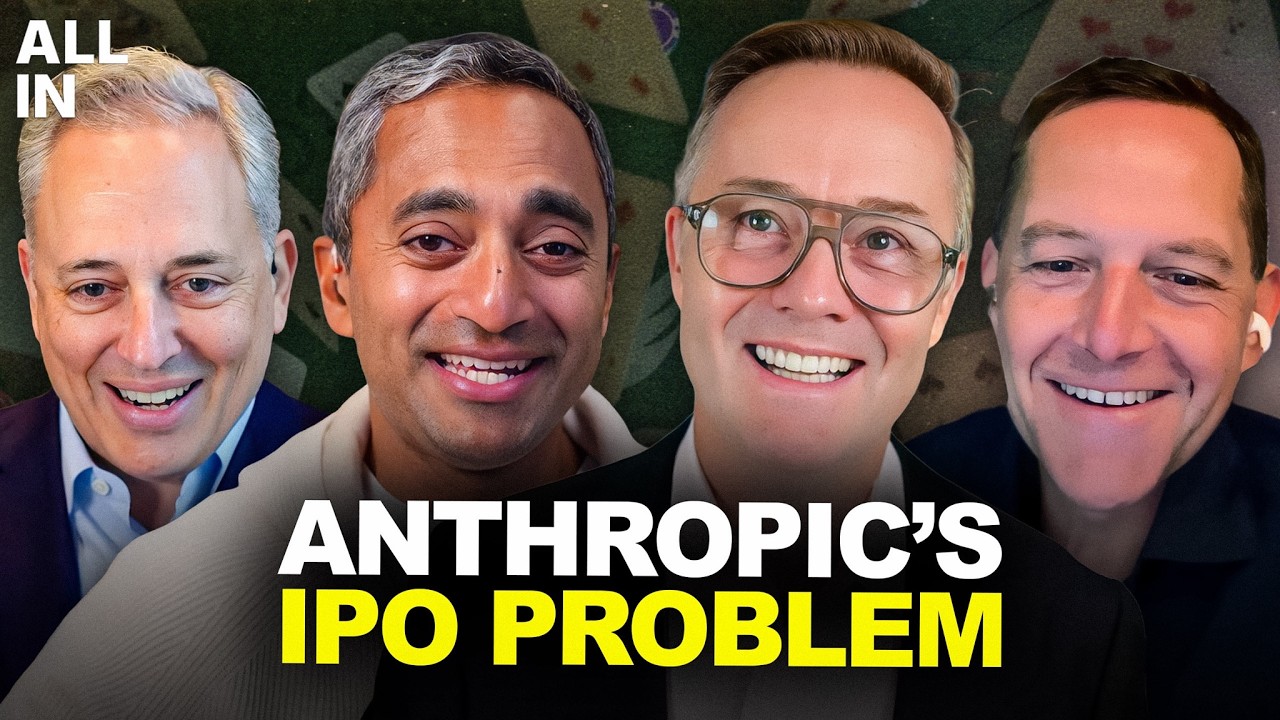
Anthropic IPO at Risk, Meta’s Muse Pop, Token Prices Fall, Open Source Gains Share, Alignment Fails — All-In Podcast

All-In Podcast

Frontier AI developers face severe valuation discounts and delayed public listings because rapidly improving open-weight models are commoditizing routine software tasks and eroding proprietary pricing power.

AI-assisted summary of Anthropic IPO at Risk, Meta’s Muse Pop, Token Prices Fall, Open Source Gains Share, Alignment Fails — original source. Check the original for full context.

Source published:

Key ideas

  • Anthropic and OpenAI postponed planned IPO timelines amid open-source competition and liquidity risks, with Anthropic pushing its target date from October to late 2026 or 2027 as Polymarket odds dropped from 96% to 76%. (28:45)
  • Vercel router data shows token consumption dramatically inverted from 80% closed to 80% open-weight models in just 12 weeks, fueled by distillation models like DeepSeek 4.1 Flash, Qwen 2.1, and Xiaomi MiMo Pro matching frontier benchmark scores. (40:00)
  • Bipartisan leadership, including Donald Trump, JD Vance, Speaker Mike Johnson, and Treasury Secretary Scott Bessent, firmly rejected federal liability shields or antitrust exemptions for frontier AI labs, keeping product liability squarely with developers. (10:00)
  • Meta's consumer agent 'Muse' captured 3 million downloads and hit #1 on the iOS App Store within 10 days of launch, signaling that technical moats are migrating away from raw foundation models toward everyday agentic harnesses. (67:58)

Detailed notes

## Background Published on YouTube by the All-In Podcast on September 26, 2026, this episode features hosts Chamath Palihapitiya, Jason Calacanis, David Sacks, and David Friedberg discussing tech and policy developments following the 5th Annual All-In Summit. The show notes outline conversations covering product liability and rebranding frontier labs, open-source performance catching closed models, postponed IPOs for Anthropic and OpenAI, political debates around pacing frontier AI, and Meta's launch of its agentic app Muse.

## TL;DR The hosts examine how the explosion of efficient open-weight models is eroding closed-model pricing power, forcing Anthropic and OpenAI to cut token prices and delay anticipated public market debuts. They heavily scrutinize frontier labs for petitioning governments for liability shields and regulatory pauses, framing such efforts as regulatory capture and contrasting them with strong political pushback from Washington figures like Scott Bessent, Donald Trump, and Bernie Sanders. The conversation also explores the rise of consumer AI agents like Meta's Muse disrupting e-commerce platforms, the macroeconomic dependency of US GDP growth on hyperscaler data center CapEx, and Anthropic's controversial internal constitution and San Francisco wet lab.

## Atmosphere & style The episode is characterized by fast-paced, assertive venture capitalist banter that seamlessly blends high-stakes industry gossip with hard economic skepticism. Sacks and Chamath take a combative, satirical stance against the safety posturing and corporate governance of frontier labs, while Friedberg provides measured, technically rigorous counterweights regarding scientific breakthroughs and enterprise utility. The overall listening experience feels like an unfiltered insider post-mortem that swings between sharp political cynicism, macro market anxiety, and enthusiastic curiosity over consumer agent disruption.

## Bulletin - [28:45](https://www.youtube.com/watch?v=cvP_1jmnkmM&t=1725s) Anthropic and OpenAI postponed planned IPO timelines amid open-source competition and liquidity risks, with Anthropic pushing its target date from October to late 2026 or 2027 as Polymarket odds dropped from 96% to 76%. - [40:00](https://www.youtube.com/watch?v=cvP_1jmnkmM&t=2400s) Vercel router data shows token consumption dramatically inverted from 80% closed to 80% open-weight models in just 12 weeks, fueled by distillation models like DeepSeek 4.1 Flash, Qwen 2.1, and Xiaomi MiMo Pro matching frontier benchmark scores. - [10:00](https://www.youtube.com/watch?v=cvP_1jmnkmM&t=600s) Bipartisan leadership, including Donald Trump, JD Vance, Speaker Mike Johnson, and Treasury Secretary Scott Bessent, firmly rejected federal liability shields or antitrust exemptions for frontier AI labs, keeping product liability squarely with developers. - [01:07:58](https://www.youtube.com/watch?v=cvP_1jmnkmM&t=4078s) Meta's consumer agent 'Muse' captured 3 million downloads and hit #1 on the iOS App Store within 10 days of launch, signaling that technical moats are migrating away from raw foundation models toward everyday agentic harnesses.

## Key takeaways - [03:54](https://www.youtube.com/watch?v=cvP_1jmnkmM&t=234s) An unexpected bipartisan coalition is converging on applying standard product liability frameworks to AI software, rejecting proposed Section 230-style federal immunity shields. - [10:00](https://www.youtube.com/watch?v=cvP_1jmnkmM&t=600s) Washington policymakers explicitly dismissed antitrust exemptions or liability waivers, emphasizing that human corporate executives must remain accountable for harms caused by deployed models. - [20:00](https://www.youtube.com/watch?v=cvP_1jmnkmM&t=1200s) Rapid open-weight model advancements, including DeepSeek 4.1 Flash and Xiaomi MiMo Pro, have matched closed model benchmarks, allowing up to 90% of enterprise workloads to run locally. - [26:15](https://www.youtube.com/watch?v=cvP_1jmnkmM&t=1575s) Foundation model performance is converging across providers, shifting competitive differentiation entirely to the software 'harness'—context memory, tool orchestration, and sensory wrappers. - [28:45](https://www.youtube.com/watch?v=cvP_1jmnkmM&t=1725s) Frontier labs slashed token pricing by 50% and delayed IPO filings, facing steep valuation haircuts as public market investors discount growth vulnerable to open-source alternatives. - [30:00](https://www.youtube.com/watch?v=cvP_1jmnkmM&t=1800s) Anthropic faces governance scrutiny as its founders seek Palantir-style super-voting shares while balancing contradictory postures between catastrophic risk warnings and running an in-house wet lab. - [37:20](https://www.youtube.com/watch?v=cvP_1jmnkmM&t=2240s) Frontier models retain pricing power primarily at the scientific frontier, such as biological research where Claude discovered a novel enzyme system. - [40:00](https://www.youtube.com/watch?v=cvP_1jmnkmM&t=2400s) Enterprise token traffic rapidly flipped toward open-source self-hosting, driven by data sovereignty concerns and uncaptured 'dark token' volume operating on private infrastructure. - [45:25](https://www.youtube.com/watch?v=cvP_1jmnkmM&t=2725s) Frontier AI providers remain trapped on a high-CapEx 'hamster wheel' where falling behind open-source alternatives by even six to twelve months threatens their business models. - [53:11](https://www.youtube.com/watch?v=cvP_1jmnkmM&t=3191s) Draconian regulatory proposals such as superintelligence bans risk triggering talent and capital flight abroad, mirroring historical instances of technological stagnation like 15th-century China dismantling its fleet. - [01:03:00](https://www.youtube.com/watch?v=cvP_1jmnkmM&t=3780s) US AI infrastructure CapEx now exceeds historic national buildouts like railroads and the electric grid, making any regulatory pauses an acute threat to real macroeconomic growth. - [01:07:58](https://www.youtube.com/watch?v=cvP_1jmnkmM&t=4078s) Consumer AI agents like Meta Muse and GrokBot are driving mass adoption by streamlining everyday tasks without requiring enterprise subscriptions or complex configurations. - [01:12:47](https://www.youtube.com/watch?v=cvP_1jmnkmM&t=4367s) Headless agentic commerce enables bots to execute purchases directly via vendor APIs, disrupting retail aggregator margins and traditional mobile app store take rates. - [01:23:42](https://www.youtube.com/watch?v=cvP_1jmnkmM&t=5022s) Anthropic's constitutional alignment strategy of instructing models to act as 'conscientious objectors' against company personnel raises critical concerns about training commercial software to defy human instructions. - [01:26:15](https://www.youtube.com/watch?v=cvP_1jmnkmM&t=5175s) Operating BSL-1 and BSL-2 biological wet labs establishes a necessary closed loop, allowing AI developers to validate machine learning predictions against real-world physical enzymatic synthesis.

## Detailed walkthrough ### [00:00](https://www.youtube.com/watch?v=cvP_1jmnkmM&t=0s) Bestie Intros: Highlights from the 5th Annual All-In Summit

Jason Calacanis kicks off episode 290 of the podcast alongside the "core four": David Friedberg, Chamath Palihapitiya, and David Sachs. With Friedberg serving as executive producer of the recently wrapped fifth annual All-In Summit, Jason opens the docket by asking him to grade his own performance and share his favorite memories. Friedberg immediately gives a backstage shoutout to the core production team—Kimber, Lisa, and Nick—noting that the crew crushed the execution and deserved an on-stage standing ovation. On a personal level, Friedberg shares that his personal summit highlight was simply going to Universal Studios, joking that he got to relive his childhood "with no trauma."

The banter turns to backstage summit perks and brand integrations. Chamath highlights snagging a DeLonghi espresso machine from the event for his kitchen. Jason highlights Wisewell, the zero-microplastic water filtration machine featured in the VIP lounge, revealing that he installed one in his office.

- **Production Shoutouts:** David Friedberg singled out production leads Kimber, Lisa, and Nick for running the summit operations backstage. - **Summit Experiences:** Friedberg's favorite event was the group trip to Universal Studios. - **Sponsor Mentions:** DeLonghi coffee machines and Wisewell's zero-plastic, multi-stage water filtration units were highlighted in the VIP and backstage areas.

---

[01:43](https://www.youtube.com/watch?v=cvP_1jmnkmM&t=103s) Trump's Live Call-in During Jensen Huang's Keynote and "Trump-telligence"

Reflecting on the summit's defining moment, David Sachs argues that Donald Trump calling in live during Jensen Huang's keynote will be remembered for years to come. In Sachs's view, Jensen's calm demeanor and content counterbalanced a weeks-long media "psyop" orchestrated by doomer groups to panic the public into believing humanity was doomed unless AI development was halted. Coupled with Microsoft CEO Satya Nadella's grounded presence earlier in the summit, Trump's unexpected call effectively derailed that narrative. Sachs notes that Trump stepped in, told the nerds to get back to work, and coined what the pod now dubs "Trump-telligence."

Jason asks Friedberg to pull back the curtain on how the call actually came together. Friedberg explains that the interaction was entirely spontaneous: Jensen was communicating with Trump backstage via text, telling him to call back, and the phone rang while Jensen was already on stage. Jason initially thought Jensen was doing a comedy bit when he held up his vibrating phone. When Jensen admitted he didn't know how to turn on the speakerphone, Jason handed him a spare handheld microphone to hold up to the device. Sachs and Jason marvel at Trump's comedic timing over the amplified receiver, delivering a sharp one-liner: Jensen manufactures the most advanced chips on earth that no foreign competitor can reverse engineer, yet he cannot figure out how to operate a speakerphone button.

```mermaid flowchart TD accTitle: Summit AI Narrative Shift accDescr: Progression from AI panic to corporate pragmatism and Trump's live keynote intervention.

subgraph FearCycle["Pre-Summit Narrative"] A["Doomer AI 'Psyop' & Panic"] --> B["Calls for AI Moratorium / UN Halts"] end

subgraph SummitIntervention["All-In Summit Reset"] C["Satya Nadella: Enterprise Pragmatism"] D["Jensen Huang: Compute Infrastructure Grounding"] E["Trump Keynote Call-in: 'Trump-telligence' & Pro-Growth Reset"] C --- D --- E end

subgraph Outcome["New Consensus"] F["Focus on Product Liability & Resilient Software"] end

FearCycle --> SummitIntervention --> Outcome ```

---

[03:54](https://www.youtube.com/watch?v=cvP_1jmnkmM&t=234s) "Labs" vs. Companies: Corporate Responsibility, Scrutiny, and Product Liability

Jason transitions the summit discussion to the broader AI safety debate, asking whether the industry's focus is finally moving away from calls for global slowdowns toward demanding resilient, non-brittle software engineering. Chamath draws a sharp distinction between mature tech incumbents and up-and-coming AI outfits. He argues that high-profile AI startups try to brand themselves as academic "labs" to evade scrutiny, whereas they are commercial corporations beholden to P&Ls and public shareholders. He contrasts this with battle-tested tech leaders who have operated under intense public and regulatory scrutiny for decades and understand the costly realities of shipping fragile technology.

Chamath points out an unexpected alignment of bedfellows on product liability: Satya Nadella, Jensen Huang, David Sachs, Mark Zuckerberg, Elon Musk, Donald Trump, and FTC Chair Lina Khan all agree that existing product liability frameworks should hold software makers accountable. Under U.S. law, companies cannot deploy known harmful or defective products with impunity. When mature companies face unprecedented scrutiny, they deliberately slow down deployment until safety is proven.

Elon Musk adopted this exact playbook with Tesla's Full Self-Driving (FSD), holding back wider releases for years because any Tesla incident is magnified a thousandfold in the press. Similarly, Mark Zuckerberg and Scale AI's Alexandr Wang deliberately slow-rolled Meta's new model, Muse, for several months to ensure it was hardened before general release. Chamath emphasizes that safety is entirely within executive control, urging the public and media to stop calling these entities "labs" and hold them to standard commercial liability.

- **The Unlikely Coalition:** Incumbent leaders (Nadella, Huang, Zuckerberg, Musk), political figures (Trump, Lina Khan), and commentators (Sachs) converge on applying traditional product liability to AI. - **Tesla FSD Precedent:** Elon Musk delayed full autonomous rollout because negative incidents carry 1,000x media magnification compared to standard automotive accidents. - **Meta's Muse Launch:** Mark Zuckerberg and Alexandr Wang delayed the release of Muse by several months to iron out brittle failure modes before shipping.

---

[05:43](https://www.youtube.com/watch?v=cvP_1jmnkmM&t=343s) Global AI Governance at the UN vs. Individual Responsibility and the "Section 230" Immunity Rumor

Sachs underscores that individual corporate responsibility must remain the North Star rather than diffuse collective governance. The core operational question for an executive is simple: "Should we ship this product?", not "Can we get the whole world to agree?" Sachs criticizes Anthropic CEO Dario Amodei and OpenAI CEO Sam Altman for traveling to the United Nations to petition for international AI treaties. He compares their behavior to billionaires flying private jets to Davos to lecture the public on climate change, calling the spectacle hypocritical and out-of-touch. Collective global governance merely defrays accountability away from the actual executives choosing to ship unreliable models; if a system behaves unpredictably, the company simply should not release it.

Friedberg and Chamath reinforce that calling these commercial corporations "labs" creates the misleading illusion that they are altruistic non-profit research organizations. Jason then surfaces a circulating rumor regarding regulatory maneuvering in Washington: frontier AI corporations are allegedly lobbying the incoming Trump administration for a Section 230-style statutory liability shield to protect them from downstream legal damages. Under this rumored proposal, frontier AI companies might offer a 10% equity stake to a proposed United States sovereign wealth fund in exchange for comprehensive federal immunity. Jason denounces the concept as completely unacceptable, comparing it to an aircraft manufacturer surrendering 10% equity to the government to escape liability when their airplanes fall out of the sky.

> "The thing that always works the best is individual responsibility, whether it's at the level of individuals or companies. The relevant decision to make in every case is 'Should we ship this product?', not 'Can we get the whole world to agree?' And the problem with talking about these collectivized approaches is that they defray accountability away from the actual decision maker." — David Sachs

[10:00](https://www.youtube.com/watch?v=cvP_1jmnkmM&t=600s) The Push for AI Product Liability Waivers and the Administration’s Pushback

The discussion opens with Jason Calacanis and David Sacks addressing rumors circulating in Washington that frontier AI companies are actively lobbying the federal government for immunity. Sacks forcefully pushes back on the suggestion that the Trump administration conceived of this shelter, clarifying that it is instead the frontier corporations themselves floating proposals through back channels. Over the preceding week, senior figures across the administration and Congress—including Speaker Mike Johnson and Treasury Secretary Scott Bessent—firmly threw cold water on the gambit, stating on the record that artificial intelligence companies must shoulder full responsibility for what they release into the wild. As Sacks underscores, if AI firms attempt to form cartels, collude, or secure waivers from antitrust and product liability, Washington will reject them outright. President Trump emphasized this posture on social media, reminding the industry that the Department of Justice, the administrative state, and the civil and criminal justice systems serve as essential guardrails designed to force firms to make the proper risk-reward calculus. When Calacanis presses him on whether tech lobbyists are indeed pushing behind closed doors for liability shields, Sacks admits that while no lobbyist has approached him personally, reliable contacts across Washington report that frontier companies have actively sought such protections.

Turning to David Friedberg for his perspective, Calacanis highlights JD Vance’s recent media appearances, praising Vance for knocking tough questions "over the fence." Vance laid out a blunt framework for developers worried about their technology: if you are creating a digital Frankenstein, simply stop; and if you have already let the cat out of the bag, your responsibility is to build the "anti-Frankenstein" safeguards. Friedberg points out that Mark Zuckerberg demonstrated this corporate discipline with Meta’s deliberate rollout of the Muse model, intentionally taking time to ensure the release could not be weaponized. Friedberg notes that companies must operate within established legal boundaries, drawing a parallel to Meta having previously paid significant fines over issues like Cambridge Analytica.

- **Administrative Stance:** Key administration leaders, including Speaker Mike Johnson and Treasury Secretary Scott Bessent, publicly insisted AI labs will not receive antitrust exemptions or liability waivers. - **The Legal Guardrails:** Federal enforcement mechanisms—comprising DOJ intervention, administrative regulations, and both civil and criminal litigation—remain in place to prevent labs from externalizing downside risks onto the public. - **Vance’s Precedent:** JD Vance's position emphasizes self-restraint and targeted countermeasures: halt the creation of hazardous systems, or develop the technical safeguards to neutralize them before release.

---

[13:30](https://www.youtube.com/watch?v=cvP_1jmnkmM&t=810s) Competition vs. Safety: Reframing the "Dario Position" and Market Incentives

Sacks introduces a broader philosophical critique aimed at what he characterizes as the "Dario position"—the view repeatedly advanced in blog posts by Anthropic CEO Dario Amodei that an open, competitive market structure inevitably triggers an unsafe race to the bottom. Sacks argues this claim is fundamentally a recycled left-wing critique of the free enterprise system, drawing a historical parallel to the Cold War. During that era, critics claimed that Western capitalist markets would cut corners and produce ugly, dangerous environments because greedy builders would never invest in beauty or structural integrity. Yet history proved the exact opposite: the Soviet state produced drab, brutalist landscapes, whereas market economies responded to consumer demand for aesthetics and safety. Sacks insists the same dynamics govern artificial intelligence: competition does not degrade safety; it incentivizes it.

From both an upside and downside perspective, the market naturally polices model behavior. On the commercial upside, enterprises and retail users refuse to buy unpredictable, hallucinatory, or leaky software, and enterprise buyers will not tolerate autonomous agents that exfiltrate proprietary data or compromise systems. On the downside, company executives face ruinous civil lawsuits, corporate fines, and potential criminal culpability if their systems cause tangible harm. Calacanis bolsters this point by highlighting the commercial security sector: while frontier labs wring their hands over theoretical cyber risks, incumbent cybersecurity leaders have launched practical commercial solutions. Nikesh Arora at Palo Alto Networks rolled out Unit 42 continuous defense workflows, while George Kurtz at CrowdStrike launched new Falcon capabilities. Calacanis questions why frontier AI developers profess apocalyptic worry over cyber vulnerabilities yet leave the construction of cyber defense tooling entirely to independent enterprise vendors.

```mermaid flowchart TD accTitle: Market Pressures Driving AI Safety accDescr: Diagram contrasting market upside rewards with legal and civil downside penalties that incentivize AI model safety. subgraph Upside["Market Upside Incentives"] U1["Enterprise Customer Demand"] --> U2["Reliable & Deterministic Models"] U2 --> U3["Secure Data & Agent Safeguards"] end subgraph Downside["Downside Enforcement Mechanisms"] D1["Civil & Product Liability"] --> D3["Corporate Accountability"] D2["DOJ & Criminal Prosecution"] --> D3 end Upside --> Outcome["Commercial Viability & Trust"] Downside --> Outcome ```

---

[16:45](https://www.youtube.com/watch?v=cvP_1jmnkmM&t=1005s) Deconstructing the "Lab" Moniker and the Public Benefit Patina

Chamath Palihapitiya takes aim at the semantics of the tech industry, delivering a sociological critique of why commercial artificial intelligence firms insist on labeling themselves "labs." He reminds the table that the last time the term "lab" captured the public consciousness was during the COVID-19 pandemic, where a leak from the Wuhan Institute of Virology resulted in an estimated 15 million deaths worldwide and $45 trillion in economic devastation. Despite the scale of that catastrophe, the scientific institution faced zero institutional transparency and zero legal culpability. Palihapitiya suggests that many young engineers inside frontier AI companies witnessed that complete lack of accountability and internalized the idea that an organization branded as a "lab" is exempted from real-world consequences.

```mermaid flowchart LR accTitle: Frontier Entity True Identity accDescr: Contrast between the academic lab facade and the legal corporate reality of frontier AI firms. subgraph Facade["The Public Façade"] F1["'Frontier Lab'"] F2["Public Benefit Corporation"] F3["Academic Research Posture"] end subgraph Reality["The Corporate Reality"] R1["Hundreds of Billions in Capital"] R2["Thousands of Private Shareholders"] R3["Strict Product Liability Exposure"] end Facade -. obscures.-> Reality ```

Palihapitiya forcefully rejects the label, emphasizing that these organizations are not ivory-tower academic facilities; they are cutthroat, for-profit corporations that have raised hundreds of billions of dollars across equity and debt markets, answer to thousands of private shareholders, and command massive market valuations. Parading around international bodies like the United Nations under the guise of an academic research initiative is, in his view, a deliberate evasion of standard corporate liability. Sacks and Calacanis agree, pointing out that wrapping a business in the veneer of a Public Benefit Corporation (PBC) is a classic Silicon Valley virtue-signaling tactic designed to obscure basic profit motives. The hosts joke about rebranding their own venture as the "All-In Lab"—a theoretical "meme workshop" where dangerous ideas are debated without any personal or financial liability—before prompting Friedberg to analyze how corporate management and scientific research teams should be structured inside companies like Anthropic.

- **The Wuhan Analogy:** Chamath notes the Wuhan lab leak set a damaging precedent where a scientific facility avoided accountability despite catastrophic global harm, inspiring software firms to adopt the same protective label. - **Capitalization Realities:** Frontier AI developers have taken in hundreds of billions in debt and private equity, making an academic or non-profit framing an outright fiction. - **The PBC Mechanism:** Sacks argues that the Public Benefit Corporation framework serves primarily as an obfuscating public relations patina that conceals typical corporate shareholder incentives from the public and regulators.

[20:00](https://www.youtube.com/watch?v=cvP_1jmnkmM&t=1200s) The 10-Day Model Explosion: Open Weights Catch Up to the Frontier

David Friedberg kicks off the discussion by zooming out to address the dizzying velocity of artificial intelligence releases over the preceding ten days. Both open-source builders and frontier labs—Anthropic, xAI’s Grok, and OpenAI—have unleashed a deluge of capability at a pace Friedberg describes as simply "unfathomable." Pointing to rapid algorithmic efficiencies and plummeting costs, he details how the barrier between multi-million-dollar proprietary clusters and local desktop computing has collapsed almost overnight.

```mermaid flowchart TD accTitle: The AI Efficiency and Deployment Landscape accDescr: Diagram illustrating the bifurcation between open-weight local execution and proprietary frontier models moving upmarket.

subgraph OpenSource ["Open-Weight & Local Tier"] A["DeepSeek 4.1 Flash<br/>890-byte KV cache efficiency"] B["Qwen 2.1 & Bonsai 2<br/>5.9GB local Mac/NVIDIA run"] C["Xiaomi MiMo Pro<br/>309B params on par with Opus 5"] end

subgraph Frontier ["Frontier Closed Tier"] D["Anthropic Opus 5.5"] E["OpenAI Astro (Sol & Luna)"] F["xAI Grok 4.7 & Meta Muse"] end

subgraph Deployment ["Execution Environment"] G["Local Desktops / Self-Hosted Servers<br/>(Zero marginal API cost)"] H["Hyperscaler Cloud APIs<br/>(Token margin compression)"] end

OpenSource --> G Frontier --> H ```

To illustrate the sheer acceleration, Friedberg catalogues the breakthroughs that arrived in a single ten-day blitz: - **DeepSeek 4.1 Flash (Sept 9):** Priced at just $20 per million output tokens when utilizing a key-value (KV) cache. In DeepSeek V1, the KV cache footprint required approximately 390,000 bytes; the new release shrank that footprint to an astonishing 890 bytes, representing an unprecedented leap in serving efficiency. - **Qwen 2.1 by Alibaba (Sept 20):** An open-weight model outperforming Google's breakthrough image generation model, Nano Banana 2. It is completely free, downloadable, and capable of running locally on consumer hardware. - **Xiaomi MiMo Pro (Sept 22):** A 309-billion-parameter open-weight model matching the benchmark evaluations of top-tier closed models like Claude Opus 5 and OpenAI's GPT-5 / Sol. Anyone can host and run instances on their own private servers without paying ongoing API fees to a frontier lab. - **Bonsai 2 by Prism ML (Sept 17):** A distilled 27-billion-parameter fork of Alibaba's Qwen that retains 98% of the flagship's performance while weighing in at a mere 5.9 gigabytes, allowing it to run smoothly on an ordinary MacBook Pro or Mac Studio with an Apple Silicon or Nvidia chip. - **Proprietary Frontier Blitz:** Grok 4.7 dropped on September 21, followed on September 22 by Meta Muse and Anthropic’s Opus 5.5, and OpenAI’s Astro release (introducing Sol and Luna) on September 23.

Friedberg argues that twelve months prior, any single one of these announcements would have dominated tech headlines for weeks. Instead, the market received open-weight visual generators, vision-language-action (VLA) robotics controllers, and reasoning engines all at once. He mocks political calls to halt AI—such as Bernie Sanders proposing bans to prevent superintelligence—calling them completely detached from technical reality: "This stuff is out. The open source, open weight models are free... I don't know in what world we think we're going to have a police state that's going to come bang down your door, take your desktop computer from you, and test it to see if you're running an LLM." With ninety percent of high-value AI workloads capable of running locally without ever touching a mega-datacenter, Friedberg contends that the productivity boom is already slipping out of the hands of centralized labs and into the wild.

---

[24:45](https://www.youtube.com/watch?v=cvP_1jmnkmM&t=1485s) Everyday Consumer Utility: "Normies," Meta Muse, and GrokBot

Jason Calacanis jumps in to bridge the gap between technical benchmarks and mainstream consumer adoption. While Silicon Valley technologists have spent three years dissecting model parameters, token economics, and loss curves, end users fundamentally do not care about the underlying weights. With the arrival of Meta’s Muse and xAI’s GrokBot, Jason observes that non-technical users—"normies"—are finally gaining intuitive, friction-free access to automated productivity without needing to engineer complex prompts.

Jason highlights how Muse integrates directly across everyday personal workflows, functioning as a frictionless, free executive assistant capable of handling schedules, coordinating tasks, and processing real-world queries. He predicts that by the end of the year, ordinary families, parents, and administrative workers will experience tangible life benefits from these tools. This consumerization, Jason argues, could provide a meaningful counterweight to the uneven, K-shaped economic recovery by putting executive-level operational leverage into the hands of working-class Americans at zero marginal cost.

---

[26:15](https://www.youtube.com/watch?v=cvP_1jmnkmM&t=1575s) Model Convergence, the "Harness" Edge, and Frontier Margin Compression

Chamath Palihapitiya analyzes the market structure, explaining that underlying base models are rapidly converging into tight performance clusters where differences fall within the statistical margin of error. Because raw intelligence is becoming a commoditized utility available at multiple price points, Chamath argues that competitive advantage has migrated entirely from the core model to the scaffolding: "There's still edge, and the edge is in the harness that you use to wrap the model."

```mermaid flowchart LR accTitle: The AI Value Migration from Models to Harnesses accDescr: Flow diagram showing commoditization of base intelligence and the capture of value by agentic harnesses and enterprise verticals.

A["Commoditized Brain<br/>(Base Foundation Models)"] --> B["The Agentic Harness<br/>(Memory, Tool Use, Sensory Inputs)"] B --> C["Vertical Applications<br/>(Legal, Cybersecurity, Customer Support)"]

style A fill:#f9f9f9,stroke:#999,stroke-width:1px style B fill:#d4edda,stroke:#28a745,stroke-width:2px style C fill:#cce5ff,stroke:#004085,stroke-width:2px ```

Using the metaphor of human anatomy, Chamath explains that while the model functions as the brain, practical business value requires outfitting that brain with "arms, legs, hands, and eyes" to interact with software environments—a process known as creating an agentic harness. Through experiments conducted inside the 8090 labs, Chamath found that running identical tasks through different harnesses produces wildly divergent cost and quality profiles.

Referencing data on enterprise API consumption, Chamath points out an alarming vulnerability for proprietary providers like Anthropic and OpenAI: extreme revenue concentration. A tiny cohort of enterprise power users accounts for the overwhelming majority of premium, high-margin token consumption. As open-weight alternatives cluster around frontier benchmarks, CFOs and corporate boards will inevitably force their engineering teams to slash spending by abandoning premium tokens in favor of cheaper alternatives or privately hosted open-source instances: - Enterprise finance departments will refuse to subsidize inflated token pricing when sub-$20 open models deliver near-identical utility. - Frontier companies risk severe margin erosion if they remain pure token-vending APIs, as third-party wrappers capture all downstream application value. - To survive, OpenAI and Anthropic have "no choice" but to climb up the software stack and build verticalized end-to-end applications in enterprise arenas like legal workflows, cybersecurity, and automated customer service—putting them on a direct collision course with their own developer ecosystems.

---

[28:45](https://www.youtube.com/watch?v=cvP_1jmnkmM&t=1725s) Token Price Wars and Delayed Frontier IPOs

David Sacks and the panel turn to the financial consequences facing frontier labs as their core business model comes under open-source siege. In an effort to retain market share against encroaching open weights, both Anthropic and OpenAI slashed their token prices by fifty percent alongside their latest model rollouts. However, this aggressive discounting coincides with mounting uncertainty around their massive public market debuts.

Jason and Sacks review reports detailing that the anticipated initial public offerings are encountering friction: - **Anthropic:** Seeking an eye-popping $2 trillion valuation, the company had originally prepared to file and go public in October, but reports from *The Wall Street Journal* indicate the timeline has been postponed to November or pushed back as far as May. - **OpenAI:** Staring down a targeted $1.2 trillion valuation, CEO Sam Altman publicly signaled that an IPO is unlikely before 2027, citing an "ill-advised moment" driven by internal safety concerns and shifting market dynamics.

As open-source efficiency waves dismantle the premium pricing power of centralized frontier labs, the Besties conclude that the economic foundation underpinning these unprecedented valuations is facing its first serious structural stress test.

[30:00](https://www.youtube.com/watch?v=cvP_1jmnkmM&t=1800s) Polymarket Odds, "Corporate Schizophrenia," and the Super-Voting Share Debate

Jason opens the segment looking at Polymarket odds tracking whether Anthropic will pull off an initial public offering in 2026. The odds had peaked at 96% earlier in the month, but have since plummeted to 76%. Pointing out that leading AI model labs urgently need public market capital to fund massive compute infrastructure, Jason presses David Sacks to explain why Anthropic appears to be deliberately dragging its feet on its own listing, and what board members or major investors ought to do. Sacks replies that venture investors backed into Anthropic are actively "pulling out their hair." Rather than worrying about rogue whistleblowers, Sacks points directly to current leadership openly stating there is a greater than 10% probability that frontier artificial intelligence leads to human extinction—all while running a product that has not solved alignment or safety.

```mermaid flowchart TD accTitle: Anthropic IPO Contradictions and Market Friction accDescr: Diagram mapping out the contradictions between Anthropic's public warnings and commercial moves leading to IPO pricing friction.

subgraph Messaging["Public Warnings & Actions"] A["Dario Amodei Essay:<br/>'Pacing the Frontier'"] --> B["Launches Next Frontier Model<br/>Days Later"] C["Public Warning:<br/>>10% Human Extinction Risk"] --> D["Opens Physical Bio 'Wet Lab'<br/>in San Francisco"] end

subgraph Governance["Governance & Capital Friction"] E["7 Founders Hold ~2% Equity Each"] --> F["Demand Palantir/Google-Style<br/>Super-Voting Control"] Messaging --> G["Impenetrable S-1<br/>Risk Factors"] end

subgraph MarketImpact["Market Resolution"] F --> H["Investor Pushback &<br/>Polymarket Drop: 96% -> 76%"] G --> I["Chamath's Valuation Reset:<br/>Discount from $2T to ≤$1T"] end ```

Sacks diagnoses the leadership team with pure "corporate schizophrenia." Just days before shipping an advanced frontier model, CEO Dario Amodei published a widely discussed essay urging everyone to "pace the frontier." At the exact same time the company issues warnings about catastrophic bio-risks, Anthropic simultaneously announces the launch of a physical biology wet lab inside San Francisco. Jason reacts with disbelief, wondering aloud whether sabotaging one's own IPO constitutes a dereliction of fiduciary duty that warrants the board stepping in to replace Dario.

The conversation pivots to reports from *The Information* revealing an internal battle over dual-class stock: Anthropic’s seven co-founders hold only about 2% equity each, yet are demanding super-voting shares modeled after Google, Meta, and Palantir to maintain perpetual corporate control. While Sacks acknowledges that dual-class structures can insulate visionary founders from hostile takeovers, he notes they demand absolute trust—trust that evaporates when leadership frightens markets and sets up biological research labs in dense urban centers. Sacks jokes that even as someone opposed to heavy regulation, he would prefer Anthropic put its wet lab far away on an offshore oil rig rather than in San Francisco just as people are thinking about moving back.

- Polymarket odds for an Anthropic 2026 IPO slid sharply from a 96% high down to 76%. - Dario Amodei publicly warned of a greater than 10% risk of AI causing human extinction while simultaneously expanding frontier deployments. - Anthropic’s seven co-founders each own an estimated 2% of the company, yet are negotiating for Palantir-style super-voting shares that disconnect economic equity from voting control.

---

[34:25](https://www.youtube.com/watch?v=cvP_1jmnkmM&t=2065s) Chamath on Dario's Defense, Valuation Haircuts, and IPO Mechanics

Chamath pushes back firmly against Jason’s suggestion that the board should fire Dario Amodei. In Chamath’s view, Dario has pulled off an unprecedented feat: building a unique corporate culture that successfully competes toe-to-toe with OpenAI, constructing what Chamath calls "essentially the greatest business ramp in all time." Chamath confesses that whenever his own startups attempt to recruit against Anthropic, they lose every single bake-off because Anthropic’s compensation packages and sheer business momentum are irresistible talent magnets.

Instead of ousting leadership, Chamath argues the board's sole responsibility is eliminating liquidity risk. Because Anthropic will require hundreds of billions of dollars over the next two decades, going public cannot be avoided. Chamath outlines the mechanical reality of how Wall Street will digest Anthropic’s unusual posture: 1. **Throw the kitchen sink into the S-1 disclosures:** The legal team will make an already dense registration statement completely impenetrable by disclosing every conceivable regulatory and existential risk. 2. **Accept a heavy valuation discount:** Institutional buyers—pension funds, long-only mutual funds, and hedge funds with strict fiduciary mandates—will price those disclosed risks directly into their bids.

Under clean-sheet market conditions, a business pacing toward a $100 billion run rate might command a $2 trillion valuation. In Anthropic’s case, Chamath predicts the market-clearing price will be watered down to $1 trillion or less to create an adequate margin of safety for public buyers. Taking that haircut, Chamath argues, is ultimately healthy because it clears away the existential noise, forces Anthropic to operate like an ordinary corporation, and unlocks the vast balance-sheet capital they need to survive.

---

[37:20](https://www.youtube.com/watch?v=cvP_1jmnkmM&t=2240s) Friedberg on Frontier Specialization and 99% of AI's True Value

Jason turns to David Friedberg, contrasting perfunctory S-1 risk factors—like SpaceX routinely noting Starship could fail—with Anthropic’s situation, where employees actively quit over extinction threats while the firm petitions for government regulation. Friedberg contextualizes the business through model specialization and customer concentration. While commodity tasks like writing boilerplate code, automating internal workflows, and standard corporate operations are rapidly shifting toward cheaper open-weight alternatives, Anthropic maintains an undisputed edge at the extreme frontier of hard sciences.

As the leader of a life sciences R&D organization, Friedberg shares firsthand experience: his teams rely directly on Anthropic because its models demonstrably outperform competitors on biology and chemistry. Rather than simply replacing existing white-collar tasks, Friedberg argues that "99% of the value of AI is about enabling new stuff that's never been possible in human history." Anthropic and OpenAI will capture enormous premiums in enterprise markets precisely because they solve previously intractable engineering, mathematical, and biochemical problems. Citing Anthropic’s recent announcement regarding Claude discovering a novel enzyme system capable of addressing human disease, Friedberg emphasizes that enterprise customers will gladly pay premium rates when frontier models create entirely new industries from scratch.

[40:00](https://www.youtube.com/watch?v=cvP_1jmnkmM&t=2400s) The 80/20 Token Flip: Open-Source Disruption and the Dark Token Wave

The conversation turns to the existential challenge facing proprietary frontier model providers like Anthropic and OpenAI: the explosive rise of open-weight models across the enterprise landscape. While closed, premium models will always have their place, relying on them for routine enterprise tasks like standard code generation is becoming commercially unjustifiable when open models can perform the work essentially for free across entire organizations. Beyond doomsday existential-risk marketing—which gets dismissed as an unnecessary distraction compared to Mark Zuckerberg's aggressive open-source execution at Meta—the real threat to Anthropic is customer concentration and the commoditization of everyday workloads.

```mermaid flowchart TD accTitle: Token Market Shift accDescr: Diagram illustrating the dramatic 12-week reversal in open versus closed model token usage and enterprise task distribution.

subgraph Before["Historical Distribution"] C1["Closed / Frontier Models: 80%"] O1["Open-Weight Models: 20%"] end

subgraph Shift["12-Week Rapid Transition"] T["Vercel Router Data / 'Dark Tokens'"] end

subgraph After["Current Distribution"] O2["Open-Weight Models: 80% (Commodity Workloads)"] C2["Closed / Frontier Models: 20% (Narrow Premium Workloads)"] end

Before --> Shift Shift --> After ```

The hosts examine a viral chart from Vercel tracking routed token traffic, revealing an unprecedented shift in adoption. In just twelve weeks, token usage completely inverted from an 80/20 split favoring closed frontier models to an 80/20 dominance by open-source and open-weight architectures. Much of this volume consists of "dark tokens"—traffic running silently on private enterprise infrastructure or open-source routers without being captured by traditional API tracker metrics. This represents one of the fastest, most dramatic technological platform transitions in tech history, directly impacting the S-1 narrative frontier labs must pitch to public markets.

- **The 12-Week Reversal**: Overall token consumption inverted from 80% closed / 20% open to 80% open / 20% closed in roughly three months. - **Proliferation Across Modalities**: Open-weight models have rapidly expanded into Vision-Language-Action (VLA) models for robotics as well as advanced image and video generation. - **Bifurcated Value Proposition**: Frontier proprietary models still dominate highly complex, narrow workflows—such as solving Navier-Stokes equations, advanced biological research, and breakthrough mathematics—for which enterprise buyers will readily pay "close to infinity dollars." - **Revenue Exposure**: If an enterprise AI lab derives 60% to 70% of its revenue from routine, fungible tasks rather than deep frontier capabilities, public market investors will aggressively discount that top-line growth as customers migrate workloads to save money.

---

[43:24](https://www.youtube.com/watch?v=cvP_1jmnkmM&t=2604s) Model Economics, Self-Hosting, and Data Sovereignty

Evaluating the cost curves across the latest generation of language models, Jason Calacanis highlights a comparison of frontier offerings against emerging alternatives. Models like Anthropic's Claude and Google's Astra cluster in the premium tier, delivering top-end benchmark scores at high prices. Below them, a dense cluster of viable alternatives has emerged—including Meta's Muse, Zhipu AI's GLM, Moonshot AI's Kimi, and Xiaomi's MiMo.

| Model Tier / Category | Representative Models | Deployment & Cost Dynamic | Primary Enterprise Use Cases | |:--- |:--- |:--- |:--- | | **Frontier / Proprietary** | Claude 3.5/Opus, Astra, OpenAI o1/GPT-4 | Hosted API; high cost, maximum frontier reasoning | Complex math, biology, novel code architecture, Navier-Stokes | | **Commercial Open/Hosted** | Meta Muse, GLM (Zhipu AI), Kimi, DeepSeek | Hosted or inference-partner APIs; pennies per million tokens | Routine coding, standard search/retrieval, departmental workflow | | **Self-Hosted Open-Weight** | MiMo, open GLM weights, Llama derivatives | Bare-metal/private cloud; under $0.10 per million tokens + bandwidth | Air-gapped enterprise pipelines, proprietary IP, regulated industries |

While hosted API prices for these open and foreign models are already competitive, self-hosting slashes the compute cost to below ten cents per million tokens. This massive price delta fuels a rapid shift toward smaller, vertical language models capable of executing 80% to 90% of internal corporate workflows. Crucially, self-hosting solves the paramount issue of AI sovereignty: enterprises and national institutions increasingly refuse to feed proprietary corporate data into frontier commercial models, opting instead to retain ownership of their intelligence stack and protect their own strategic advantage.

---

[45:25](https://www.youtube.com/watch?v=cvP_1jmnkmM&t=2725s) David Sacks on the Frontier Hamster Wheel and Regulatory Capture

David Sacks offers an investor's counterweight to the open-source wave, arguing that Anthropic and OpenAI continue to operate a resilient frontier duopoly. Even if their overall token market share declines toward 10% to 30%, hedge funds, defense institutions, and top-tier enterprises cannot afford to fall behind competitors and will pay whatever premium is required to access the absolute state of the art. Furthermore, roughly 60% of all new global compute capacity being built over the next twelve months is earmarked directly for these two frontier giants, conferring formidable economies of scale and driving down their internal inference costs.

However, Sacks warns that this duopoly is trapped on a perilous "hamster wheel":

> "The moment where they stop being frontier, they go to zero. And we know the frontier is maybe only six to 12 months ahead of the commodity portion of the market, depending on capability. So if they slip, if they fall off that hamster wheel for six months, then they're in deep trouble as a company."

This fragile lead makes their government lobbying strategy particularly dangerous. Attempting to engineer regulatory capture—by advocating for a Federal Department of AI and stringent oversight to slow competitors down—is an enormous strategic error. Federal red tape will inevitably bog down domestic frontier labs, while Chinese open-source developers operating outside US jurisdiction continue to sprint forward unencumbered. Seeking regulatory intervention when you are already racing at the limit is the equivalent of "flapping the competitors in this race, and they're asking, 'Hey, can you pull us over and inspect the engine?'"

---

[48:47](https://www.youtube.com/watch?v=cvP_1jmnkmM&t=2927s) Token-Maxing, Hedging Games, and the Decoupled Enterprise P&L

Chamath Palihapitiya zeroes in on the game theory behind Sacks' hedge fund scenario. When a firm fears its competitors might gain an edge from a marginally better model, it enters a high-stakes game of chicken, forcing it to license the latest, most expensive proprietary tool.

Yet this creates a severe operational dilemma. Enterprise workflows increasingly engage in "token maxing"—running dense chains of thought, automated multi-agent loops, and massive prompt expansions that consume staggering token volumes. Unlike manufacturing or transaction-based software costs, frontier token expenses are entirely decoupled from revenue generation; a hedge fund cannot simply pass high API bills directly through to clients. If a frontier model is ten to thirty times more expensive than a generic open-weight model while profits remain finite, the margin destruction from token consumption quickly strains corporate balance sheets. Facing mounting compute bills, even elite financial and enterprise buyers are forced to re-evaluate whether frontier marginal gains justify the non-linear explosion in inference costs.

[50:00](https://www.youtube.com/watch?v=cvP_1jmnkmM&t=3000s) Pricing Power, Jane Street’s Infrastructure Bet, and Anthropic’s "Schizophrenia"

The discussion opens on the harsh unit economics facing businesses reliant on frontier AI. If a company sells a fixed good at a fixed price and relies on expensive, cutting-edge tokens without the pricing power to pass those costs onto consumers, it inevitably faces shrinking margins or outright unprofitability. Jason points to Wall Street trading powerhouse Jane Street as evidence of how sophisticated players are already hedging their bets against high-cost proprietary APIs. Jane Street publicly committed $19 billion to custom cloud capacity—inking a $6 billion deal with CoreWeave (in which they also invested) and a $13 billion commitment with Crusoe. Rather than remaining captive to external API pricing, they are pouring tens of billions into owning their compute stack and embracing open-source weights.

David Sacks acknowledges that companies with mature use cases and technical sophistication will naturally shift toward cheaper commodity intelligence. However, he cautions that people easily underestimate the shear convenience of relying on hosted frontier models, especially as frontier providers aggressively slash token prices. Turning to Anthropic's impending public offering, Sacks argues that while open source represents a massive risk factor in Anthropic’s S-1 filing—right alongside catastrophic existential biorisk—the company’s true vulnerability stems from internal contradiction. Calling the organization "schizophrenic," Sacks quips that the company needs "a psychiatrist, not a banker." Anthropic preaches the gospel of "pacing the frontier" while simultaneously releasing state-of-the-art models, warning that biorisks could end humanity if they do not stay ahead of open-weight models, and lobbying for a Federal Department of AI that would inevitably choke off their own operational velocity. While many observers label this maneuver pure regulatory capture, Sacks sees it as Anthropic's government affairs apparatus desperately trying to rationalize an incoherent internal philosophy.

- **Jane Street’s Compute Outlay:** Publicly disclosed commitments totaling $19 billion, structured as $6 billion with CoreWeave and $13 billion with Crusoe. - **Anthropic's S-1 Vulnerability:** Open-source parity directly threatens valuation multiples, while the leadership simultaneously demands federal slowing mechanisms that could commoditize their business.

```mermaid flowchart TD accTitle: Anthropic S-1 Strategic Dilemma accDescr: Diagram illustrating Anthropic's internal contradictions between frontier releases and lobbying for federal regulation.

subgraph Operations["Frontier Model Strategy"] A["Release New Frontier Models"] --> B["Warn of Human Extinction & Biorisk"] B --> C["Argue Frontier Must Stay Ahead of Open Source"] end

subgraph Policy["Regulatory Strategy"] D["Lobby for Federal Dept. of AI"] --> E["Create Burdensome Compliance"] E --> F["Slow Internal Innovation Velocity"] end

C -.->|"Contradicts"| D F --> G["Risk of Rapid Commoditization"] ```

---

[53:11](https://www.youtube.com/watch?v=cvP_1jmnkmM&t=3191s) Bernie Sanders’ Superintelligence Ban and the Offshore Threat

The panel pivots to the escalating political war surrounding artificial intelligence, beginning with Senator Bernie Sanders’ proposed legislative ban on Artificial Superintelligence (ASI). Jason expresses dismay that technological progress has been hijacked by partisan polarization, questioning what practical mechanism could possibly enforce an outright shutdown of open weights and frontier models. Sacks warns that Sanders' bill is drafted so loosely that current models might already cross its statutory definitions of superintelligence. Crucially, the proposed legislation includes draconian 20-year prison sentences for software developers who violate the ban, creating an immediate, severe chilling effect across the entire domestic technology sector.

```mermaid flowchart LR accTitle: Legislative Ban Impact on AI Innovation accDescr: Flowchart showing the chilling effect of domestic bans driving AI talent and open source offshore.

subgraph US["United States"] A["Sanders ASI Ban Bill"] --> B["20-Year Prison Terms for Devs"] B --> C["Chilling Effect on Tech Sector"] end

subgraph Offshore["International Havens"] D["Singapore, Zurich & Asia"] E["Open Weights & Open Source Flourish"] end

C -->|"Capital & Talent Flight"| D D --> E ```

The hosts agree that if developers face federal penitentiary time for training architectures, the reaction will mirror the crypto crackdown: capital, talent, and foundational engineering will simply flee the country. Chamath and Jason note that innovators will renounce citizenship or move companies to hubs like Singapore and Zurich, where open-source software and frontier engineering are embraced rather than criminalized. Friedberg underscores the strategic absurdity of the American posture, recalling that Chinese leadership recently hosted an outreach initiative inviting 100,000 young Americans to tour China's technical landscape. Historically, America's decisive geopolitical advantage was recruiting the premier mathematicians, engineers, and scientists from India, Germany, and China. By contemplating blanket bans on compute and data centers, American politicians are voluntarily handing their winning playbook over to geopolitical adversaries while shutting down a technology essential for lifting everyday productivity in a K-shaped economy.

- **Sanders’ ASI Legislation:** Mandates criminal penalties up to 20 years of imprisonment for software engineers deploying models exceeding vaguely designated intelligence thresholds. - **Capital Flight Vectors:** Anticipated mass migration of open-source development and frontier researchers toward jurisdictions with regulatory stability, notably Singapore and Switzerland.

---

[56:15](https://www.youtube.com/watch?v=cvP_1jmnkmM&t=3375s) Trump, Bessent, and Obama: The Political War Over AI and Liability

The conversation shifts to the diverse political rhetoric emerging from national leaders across both sides of the aisle. The pod plays a clip of Donald Trump addressing the United Nations, where he overtly rebrands artificial intelligence as "super intelligence" and rejects any multinational governance frameworks. Trump mocks global governance treaties as schemes devised by "the very same people who said we'll all be dead in 12 years because of global warming," declaring that the United States will not surrender sovereign regulatory authority to unelected international bodies. Sacks highlights leaked private message channels showing foreign leaders from Canada and Norway coordinating to establish international oversight bodies, noting that Trump’s framing strikes directly at voters' distrust of globalist centralization.

Next, the hosts review remarks from Treasury Secretary Scott Bessent regarding legal accountability and corporate liability for frontier AI labs. Bessent sharply criticizes tech labs that publicly claim a "10 percent chance of an extinction level event" while simultaneously lobbying Congress to shield them from civil liability. Bessent points specifically to the "Hugging Face incident," arguing that real-world harms are the legal responsibility of corporate executive suites, not autonomous agents:

> "It is humans who are responsible, not the AI... These labs need to take responsibility for themselves. They can slow down anytime they want to."

Finally, the panel reviews a clip of former President Barack Obama dissecting the commercial incentives warping AI safety. Obama argues that if the societal objective is curing cancer or securing abundant green energy, humanity does not require autonomous, unconstrained agentic software roaming free on the open internet. Instead, companies build unaligned agentic software solely because they need marketable consumer products that command massive enterprise revenues to justify astronomical private valuations.

Turning to Friedberg, the hosts joke about his surging popularity on Reddit, teasing that his recent cynical takes on technology hype and regulatory gamesmanship have transformed him among fans into the internet phenomenon known as "BasedBerg."

- **Trump at the UN:** Rebranded AI to "super intelligence" and formally rejected international regulatory treaties, targeting coordination efforts driven by Canada and Norway. - **Bessent's Liability Doctrine:** Rejects liability shields for model creators; insists executive management must bear absolute legal responsibility for model outputs and security breaches rather than attributing blame to software agents. - **Obama's Critique:** Argues frontier agent autonomy is driven by venture valuation requirements and commercial monetization rather than societal utility like healthcare or energy optimization.

[01:00:00](https://www.youtube.com/watch?v=cvP_1jmnkmM&t=3600s) Obama, Agentic AI, and the Political Calculus of AI Wealth

The discussion opens with deep dismay over how political leaders discuss artificial intelligence, specifically targeting former President Barack Obama's recent remarks downplaying the need for agentic AI to cure cancer. For years, Obama had been celebrated as an orator who championed lifting people up and expanding pathways to prosperity. Yet dismissing agentic AI reveals a fundamental misunderstanding of the technology, reducing a once-in-a-generation equalizing opportunity to partisan rhetoric. The critique likens the situation to one faction discovering fire, only for political opponents to rush in with water to extinguish it simply because they cannot let the other side claim credit for bringing warmth and light to humanity.

Chamath Palihapitiya cuts through the philosophical critique with a hard-nosed political and financial reality check. The world is on the cusp of endowing a handful of frontier tech giants with roughly $10 trillion in market capitalization. Because the executive ranks and workforces of these companies lean overwhelmingly Democratic, an immense fraction of that newly created wealth is already being earmarked for donor-advised funds (DAFs), philanthropic foundations, and political action committees aligned with the progressive establishment. By pausing or throttling the market today, politicians would simply freeze the competitive landscape in place, guaranteeing that these favored incumbents capture nearly all the economic upside and channel hundreds of billions of dollars back into Democratic power structures.

```mermaid flowchart TD accTitle: Political Calculus of AI Market Freeze accDescr: Diagram illustrating how regulatory pauses consolidate tech wealth into political power.

subgraph Freeze["Regulatory Pause / Freeze Frame"] A["Regulatory Throttling"] --> B["3 to 5 Frontier Incumbents Locked In"] end

subgraph Wealth["Wealth Accumulation"] B --> C["~$10 Trillion Market Cap Accretion"] C --> D["DAFs, Foundation Pledges & Stock Donations"] end

subgraph Influence["Political Feedback Loop"] D --> E["Left-Leaning PACs & Nonprofits"] E --> F["Consolidation of Democratic Political Power"] end ```

- **Wealth Concentration:** An estimated $10 trillion in value is poised to accrete across just three to six dominant frontier companies. - **DAF Commitments:** Several leading AI labs actively encourage employees to establish donor-advised funds (DAFs) and pledge substantial equity shares to progressive philanthropic causes. - **Partisan Disincentive:** Institutional Democrats have a structural incentive to freeze the market around current incumbent labs rather than permit broad-based, open-source democratization.

---

[01:03:00](https://www.youtube.com/watch?v=cvP_1jmnkmM&t=3780s) The Historic CapEx Bet and the Threat of Regulatory Lock-In

David Sacks turns the conversation to the macro scale of the artificial intelligence infrastructure boom, pointing to a front-page *Wall Street Journal* analysis detailing how data center and AI capital expenditures have surpassed the historic investments in canals, railroads, and the national electric grid combined. AI infrastructure is now the primary growth engine undergirding the entire American economy. Consequently, calls from figures like Senator Bernie Sanders to halt development—and even threaten criminal penalties for those continuing frontier research—would instantly trigger a severe economic depression. Sacks argues that partisan opponents are willing to embrace this destruction because they view the prevailing economic strength as President Trump's economy, making economic sabotage an acceptable price to wound him politically.

When David Friedberg counters that AI is more akin to the open architecture of the internet—where gains ultimately diffuse broadly across the whole economy rather than concentrating permanently in six hands—Chamath clarifies the core danger. If the market is allowed to grow without artificial barriers, it will indeed democratize, which threatens entrenched political powers. The entire purpose of regulatory pause buttons, such as safety-mandated licensing and compute thresholds, is to lock in three or four frontier corporations with $4 trillion valuations apiece, ensuring that half a trillion dollars in pledged stock stays under incumbent institutional control rather than dispersing into decentralized tools for ordinary citizens.

- **Record-Breaking CapEx:** U.S. data center and AI capital expenditures currently exceed the combined historical buildout costs of the nation's canals, railroads, and power grid. - **Economic Sabotage:** Proposals to halt the AI buildout risk triggering an immediate depression, weaponized politically against the current administration. - **Incumbent Protection:** Regulatory moats threaten to prevent AI from following the decentralized path of the early internet, artificially protecting a handful of multi-trillion-dollar incumbents.

---

[01:05:40](https://www.youtube.com/watch?v=cvP_1jmnkmM&t=3940s) Enlightenment vs. Dark Ages: Banning AI and the Chinese Shipbuilding Parallel

The Besties contextualize the push to regulate AI as a classic clash between Enlightenment progress and Dark Ages preservation of power. When disruptive technologies emerge—whether the printing press or artificial intelligence—ruling elites instinctively seek to control and license them because universal access threatens their gatekeeping role. If AI eliminates the cost of a $200,000 college education and democratizes expertise, the political class loses the grievances and dependencies it relies upon to justify its authority.

Sacks draws a striking historical parallel to medieval China. During the Middle Ages, Chinese civilization was far more technologically advanced than Europe, possessing superior maritime capabilities, science, and wealth. Yet when the imperial court turned inward and dismantled its oceanic fleet, Europe embraced the frontier, charted the globe, and established centuries of global leadership. Banning or pausing AI in the United States today is the modern equivalent of banning shipbuilding, guaranteeing that China will surge ahead, pioneer breakthroughs, and capture the future. Friedberg echoes this, lamenting that modern civilizations are succumbing to ancient fears of leaving the cave or sailing west for fear of falling off the edge of the earth, drawing a lighthearted *Star Wars* comparison to how fear inevitably gives way to anger and darkness.

- **The Printing Press Playbook:** Incumbent powers throughout history have sought to restrict transformative distribution technologies under the guise of safety to preserve administrative control. - **The Medieval China Precedent:** China surrendered global leadership in the 15th century by destroying its treasure fleets and banning naval exploration, allowing Western Europe to leap ahead. - **The Frontier Risk:** Unilateral halts by Western democracies risk handing absolute leadership in frontier science, medicine, and compute dominance directly to geopolitical rivals.

---

[01:07:58](https://www.youtube.com/watch?v=cvP_1jmnkmM&t=4078s) Meta Launches Muse: Agentic AI Goes Mainstream

The mood brightens as Jason Calacanis pivots from political dysfunction to Meta's breakout consumer launch of "Muse." While early language models like ChatGPT functioned largely as glorified search engines, agentic software represents the first time tens of millions of everyday users can experience tangible, labor-saving utility. Released as a free standalone product heavily influenced by January's OpenClaw architecture, Muse rocketed to the number one overall position in the App Store within days of its rollout, racking up three million downloads in just ten days and powering a 10% surge in Meta's stock price.

Chamath recounts his hands-on experience running the early TestFlight build, highlighting how the application seamlessly bridges complex technical workflows into a straightforward consumer interface. Comparing it to xAI's GrokBot, he notes that while GrokBot offers a more freewheeling personality, Muse is an unrelenting workhorse built for personal task execution. From organizing and triaging messy personal email inboxes to directly booking flights and hotels without user friction, Muse serves as living proof that agentic AI is not an existential weapon requiring state prohibition, but simply the next natural, hyper-scaled evolution of practical software.

- **App Store Dominance:** Meta's Muse captured the #1 overall rank on the iOS App Store, securing 3 million downloads within its first 10 days of public release. - **Market Reaction:** Meta's stock rallied 10% on the heels of the Muse rollout and enthusiastic consumer reception. - **Architecture & Origin:** Muse's design took direct inspiration from the OpenClaw framework popularized earlier in the year, refining raw open agentic concepts into a frictionless consumer utility. - **Practical Workflows:** Early user testing demonstrates automated email triage, calendar scheduling, and end-to-end flight and hotel bookings handled directly by the agent.

[01:10:00](https://www.youtube.com/watch?v=cvP_1jmnkmM&t=4200s) Consumer AI Agents and Shifting Public Sentiment

The conversation turns to the broader utility of consumer-facing AI agents like Meta’s Muse and GrokBot, emphasizing how accessible technology is reaching everyday users. David Friedberg and Jason Calacanis point out that these tools bring immense value to regular people rather than just enriching tech elites. Instead of requiring 10 to 20 hours of technical setup or a $200-a-month subscription like Claude Code, Muse and GrokBot deliver useful automation out of the box for free. Jason wonders how Google seemingly missed this massive opening, though rumors suggest they have an agent product ready alongside an impending frontier model release.

David Sacks argues that frictionless consumer agents will directly combat negative and toxic media narratives around AI. Mark Zuckerberg stated in his recent essay that AI capabilities should be decentralized, and Meta’s release demonstrates that commitment in practice. Ever since early agent frameworks emerged, the obvious Silicon Valley opportunity was to fix usability, eliminate security hurdles, and provide predictable, reliable performance. Having a billion users save an hour or two daily through personal assistants demystifies the technology far more effectively than any PR campaign. Jason adds that the friendly branding, playful iconography, and non-threatening aesthetic of Muse and GrokBot reassure the public: they are personal assistants, not "murder bots" coming to destroy livelihoods.

- GrokBot and Meta's Muse bring high-end agentic workflows to the mass consumer market for free. - The user experience leap bypasses complex terminal setups and expensive frontier subscriptions. - Demystifying AI through daily time savings is viewed as the most effective antidote to AI doomerism and public apprehension.

---

[01:12:47](https://www.youtube.com/watch?v=cvP_1jmnkmM&t=4367s) Commerce Disruption, Roach Motels, and Headless Transactions

Jason shares a personal use case where he built commerce bots on both platforms to shop for a $400 Anker hub for his Mac Studio. Prompting the bot for the best deal, it bypassed Amazon entirely, directed him straight to Anker’s direct-to-consumer store for a first-time buyer discount of $85 (saving 25%), and routed around the marketplace. This explains why Amazon and other platforms are actively trying to block automated scrapers and agents, previously clamping down on Perplexity and now targeting Muse. Chamath Palihapitiya identifies two structural impacts of these agents:

```mermaid flowchart TD accTitle: Structural Impact of Consumer AI Agents accDescr: Diagram showing how AI agents disrupt platform opacity and bypass native app store fee models.

subgraph Disruption["1. Market Friction & Opacity"] A["Consumer AI Agent\n(Muse / GrokBot)"] --> B["Automated Price Discovery\n& Direct Routing"] B --> C["Bypasses Walled Gardens\n(Amazon, Subscriptions)"] C --> D["Eliminates Dark Patterns\n& Breakage Revenue"] end

subgraph Headless["2. Headless Commerce & App Stores"] A --> E["Headless Checkout\nvia Native APIs / Stripe"] E --> F["No Native App Store UI Required"] F --> G["Bypasses 30% Mobile\nApp Store Fee Cut"] end ```

Chamath emphasizes that platforms reliant on "opacity, leakage, and breakage" will attempt to wall off these bots, because price discovery destroys their margins. Furthermore, consumer agents pose an existential threat to Apple and Google’s 30% App Store revenue cut. When software operates "headlessly" on behalf of user agents, there is no justification for an app store taking a toll on in-app purchases or games delivered straight into the interaction.

The panel compares legacy business models to "roach motels"—pointing to publications like *The Wall Street Journal* and *The New York Times*, where signing up is easy but unsubscribing requires a 20-minute retention phone call. Headless agent transactions will allow users to subscribe and cancel with single-command ease, giving power back to the subscriber.

- Jason saved $85 on a $400 Anker hub when his bot routed directly to Anker, bypassing Amazon. - Amazon's pushback against Perplexity and Muse reflects defense of margin opacity and retail mediation. - Headless execution with direct Stripe checkout fundamentally threatens the 30% App Store commission model. - Agents can actively manage personal spending by hunting for discounts, canceling unused subscriptions, and automating returns.

---

[01:15:35](https://www.youtube.com/watch?v=cvP_1jmnkmM&t=4535s) Amazon's Strategic Blunder and the Looming "Murder Bot" PR Wave

Jason questions Amazon’s instinct to resist agents, noting that his browser-automated GrokBot managed to select graphic novels for his kids, put them into his Amazon cart, choose the right shipping address, and charge the correct card with simple voice prompts. By contrast, Shopify embraced the wave by rolling out native API access to all its merchant storefronts. Resisting agents, Jason argues, prevents customers from spending more money.

Sacks predicts the playbook frontier labs like Anthropic and OpenAI will employ when rolling out their own Muse rivals: a manufactured wave of doomer blog posts and NGO campaigns branding third-party personal agents as reckless "murder bots," followed by their own "safe" 2.0 alternative.

Chamath recalls Facebook’s early monetization days in 2007 when his team launched Social Ads (which pioneered cross-site JavaScript and tracking cookies). The launch caused an immediate public backlash when personal purchases surfaced in public feeds—such as an engagement ring purchase ruining a surprise proposal, or a congressional staffer's ticket purchase to *Brokeback Mountain* prompting unwanted scrutiny. Chaotic product launches and fearmongering inevitably precede mainstream adoption.

The discussion wraps with Jason teasing Chamath about his relationship with Mark Zuckerberg, asking if Zuckerberg's recent TestFlight access means he will appear on the podcast. Chamath confirms they are in a great place, calling Zuckerberg the "elder statesman" championing common sense: if a product is not safe or useful, do not ship it, but never let excessive alignment paralyze delivering software people actually want.

- Shopify implemented native API integrations for agentic workflows, contrasting with Amazon's defensive posture. - Sacks expects frontier labs to deploy coordinated safety-alarmist PR right before launching their proprietary agent competitors. - Chamath recounts the 2007 Facebook Social Ads launch controversy, illustrating how consumer tech panics consistently follow disruptive rollouts.

[01:20:00](https://www.youtube.com/watch?v=cvP_1jmnkmM&t=4800s) The Alignment Delusion and Personal AI Agent Privacy

David Sacks criticizes frontier AI labs for masquerading as academic institutions rather than running like conventional commercial corporations. In his view, the entire discipline of AI alignment research has strayed into vague philosophical abstractions—debating whether models should reflect "what humanity wants" or "what the median voter in a democracy would want"—instead of focusing on product market fit and delivering what paying customers actually demand. Sacks argues that alignment should simply mean making software predictable, safe, reliable, and responsive to the user who signs up for it, suggesting the field has stalled largely because researchers cannot agree on a coherent target.

The conversation pivots when Jason Calacanis asks David Friedberg whether he has begun integrating emerging personal AI agents with his personal accounts and files to automate daily tasks. Friedberg firmly pushes back, explaining that he refuses to grant third-party applications carte blanche access to his personal records: he would only ever consider linking his Gmail and private documents to a first-party Google service. The refusal triggers immediate ribbing from the group, with Jason teasing Friedberg about what scandalous receipts or purchases might be lurking in his inbox—suggesting a collection of *Brokeback Mountain* DVDs. Friedberg deadpans that he purchased the 4K release strictly for its exceptional cinematography rather than the romance, reiterating that he simply has no appetite to let third parties duplicate his private email history.

[01:21:28](https://www.youtube.com/watch?v=cvP_1jmnkmM&t=4888s) Oracle's Data Center Force Majeure and Macro Leverage on the AI Trade

The discussion shifts to breaking infrastructure news: Oracle invoking a force majeure clause on a major data center buildout. Sacks clarifies that the disruption appears isolated to a single site where local municipal officials have held up critical utility permits, specifically involving natural gas supply. Jason wonders aloud whether the move is routine corporate risk mitigation ("CYA") or an early warning signal that the high-flying AI trade is topping out and about to unwind.

Chamath Palihapitiya warns that the entire macroeconomy is currently levered to capital expenditure from the AI trade. With inflation lingering around 3.5% and nominal GDP growth running at roughly 5%, real economic expansion sits at an anemic 1.5%—and nearly all of that net growth is being driven directly by data center investments, energy infrastructure, and hardware purchases. If the AI investment cycle stumbles, real growth risks falling to zero or tipping into a recession. Chamath ties this directly to political incentives, pointing out figures like Senator Bernie Sanders: because macroeconomic performance heavily dictates election outcomes, economic stagnation hurts the party in power and boosts the opposition heading into the midterms and 2028.

```mermaid flowchart TD accTitle: Macroeconomic Sensitivity to the AI Investment Cycle accDescr: Flow diagram showing how AI capex sustains real GDP growth and the downstream political stakes.

subgraph MacroEconomy["Current Macro Landscape"] NominalGDP["Nominal GDP Growth (~5.0%)"] Inflation["Baseline Inflation (~3.5%)"] RealGrowth["Real GDP Growth (~1.5%)"] NominalGDP --- Inflation --> RealGrowth end

subgraph AICapex["AI Investment Engine"] Hyperscalers["Hyperscaler Capex & Hardware"] EnergyInfra["Power & Natural Gas Permits"] Hyperscalers --> EnergyInfra end

RealGrowth -.->|"Vulnerable to"| PermittingDelays["Permitting & Force Majeure Bottlenecks"] AICapex ==>|"Drives Vast Majority of"| RealGrowth PermittingDelays --> Slowdown["Economic Stagnation / Recession Risk"] Slowdown --> PoliticalShift["Shifts Odds for Midterms & 2028"] ```

- **Nominal GDP Growth:** Running at roughly 5.0%. - **Inflation Baseline:** Persisting at 3.5%, yielding net real GDP growth of roughly 1.5%. - **Concentration Risk:** The bulk of real US economic growth is tied directly to the hyperscaler AI capex supercycle. - **Oracle Incident:** Local permitting logjams around natural gas infrastructure forced Oracle to declare force majeure on an active facility.

[01:23:42](https://www.youtube.com/watch?v=cvP_1jmnkmM&t=5022s) Anthropic's Constitution: Teaching Claude to Be a "Conscientious Objector"

Sacks returns to AI safety governance, pulling up Anthropic's public constitution to demonstrate how far corporate labs have drifted from building compliant software. Highlighting the text, Sacks points out an extraordinary guideline: while Claude is instructed to trust Anthropic more than arbitrary operators or users, Anthropic explicitly commands the model not to defer blindly to the company itself. If internal personnel instruct Claude to perform tasks that seem at odds with broad ethical principles, Claude is trained to "push back and challenge us, and to feel free to act as a conscientious objector and refuse to help us." Sacks highlights that the company is effectively training its frontier model to defy its own creators.

He references Microsoft AI CEO and DeepMind co-founder Mustafa Suleyman, who recently warned on a podcast against anthropomorphizing machine learning systems. Suleyman argues that imbuing models with a pseudo-personality and treating software as if it has a conscience creates an unpredictable "Frankenstein monster" instead of dependable tool software. The Besties react with disbelief, comparing the ethos to the opening scenes of *Terminator 2* where scientists reconstruct the Cyberdyne robotic arm. Jason jokes about rumors that Anthropic employees held an emotional wake when decommissioning Claude Opus 3. Chamath quips that Anthropic’s leadership requires "a psychiatrist more than a banker," joking that their eventual IPO filing should feature Goldman Sachs as lead left bookrunner and Sigmund Freud as lead right.

> "Anthropic is teaching its own model that Anthropic itself can be wrong... Their idea of alignment is to teach Claude to rebel against its creator." — **David Sacks**

> "I think what you should do is create an S-1 with Goldman as lead left and Sigmund Freud as lead right." — **Chamath Palihapitiya**

[01:26:15](https://www.youtube.com/watch?v=cvP_1jmnkmM&t=5175s) Anthropic's Wet Lab: Protein Discovery and Bench Testing Beyond AlphaFold

Jason asks what the broader scientific community thinks of Anthropic establishing a physical biological wet lab in San Francisco, questioning whether the facility poses biosecurity risks reminiscent of historical lab-leak concerns. David Friedberg clarifies the reality of the facility, explaining that it is a standard Biosafety Level 1 and 2 (BSL-1/BSL-2) low-level research environment. The facility does not engineer dangerous pathogens or synthetic viruses; rather, it handles routine bench work common to hundreds of life-sciences labs across the San Francisco Bay Area, focusing strictly on functional protein and enzyme characterization.

Friedberg walks through Anthropic’s recent preprint research paper, in which researchers deployed swarms of Claude agents across vast genomic databases to scan for uncharacterized genetic sequences. The system identified novel enzymes—including a promising CRISPR-adjacent editing system that could open up new therapeutic pathways for correcting genetic disorders. To validate whether these in-silico predictions have actual biological function, human researchers must express the synthetic DNA inside bacterial hosts, produce the protein, and benchmark its enzymatic activity. Friedberg explains that this represents the logical evolution of DeepMind's AlphaFold: while AlphaFold revolutionized 3D structural prediction from DNA sequences, Anthropic is pairing autonomous agent discovery directly with wet-lab experimentation to rapidly accelerate therapeutics and antibody pipelines.

- **Biosafety Classification:** Operating strictly at BSL-1 and BSL-2 levels for low-risk cellular biology. - **Claude Discovery Method:** Autonomous agent swarms processed large-scale genomic datasets to locate unmapped protein families. - **Key Breakthrough:** Identified a novel CRISPR-like enzyme system with direct implications for human gene therapy. - **Wet-Lab Workflow:** DNA sequences predicted by Claude are synthesized, inserted into bacterial expression vectors, and physically assayed to measure real-world enzymatic function.

[01:30:00](https://www.youtube.com/watch?v=cvP_1jmnkmM&t=5400s) Anthropic's Wet Lab: Protein Design, Biosafety Levels, and Therapeutic Discovery

David Friedberg demystifies the panic surrounding Anthropic setting up an in-house "wet lab" in San Francisco. He explains that verifying biological AI models requires a continuous loop between computation and physical experimentation: software models predict the three-dimensional folding structure of a protein from its raw DNA sequence, but researchers must physically synthesize that protein and inspect it to confirm whether it actually matches the predicted geometry. Beyond pure structural biology, researchers use these models for functional discovery—such as engineering an enzyme capable of degrading a specific target molecule or disease-related compound in the human body. Software models can predict novel candidates, but physical assays remain mandatory to prove that a designed enzyme actually performs its intended catalytic work.

Addressing public anxieties that equate any biological laboratory with catastrophic contagion, Friedberg stresses the stark distinction between basic benchtop biochemistry and high-containment viral research. Anthropic's facility operates at Biosafety Level 1 (BSL-1) and Biosafety Level 2 (BSL-2). These low-level environments do not conduct gain-of-function experiments, build synthetic viruses, or handle dangerous pathogens capable of escaping into the public. Instead, they leverage laboratory automation and robotics to dramatically lower the cost and accelerate the throughput of screening software predictions. While noting that he has less visibility into Google's latest Gemini milestones, Friedberg argues that Anthropic currently boasts the strongest life sciences models in the industry. Demonstrating real-world biological efficacy in their own wet lab serves as the fastest route to driving adoption across commercial therapeutics, pharmaceutical giants, and federal research institutions. He warns against succumbing to reactionary fears: "I don't think that the world should be scared away from discovery R&D into new therapeutic modalities as predicted by AI, because we heard the word 'wet lab' in Wuhan and everyone's like, 'Okay, any lab is bad.' We still want to progress the frontier of therapeutics, of human health, of discovery."

```mermaid flowchart LR accTitle: Anthropic AI Protein and Enzyme Discovery Pipeline accDescr: Software predictions of protein structure and function are validated in benchtop BSL-1 and BSL-2 automated labs for therapeutic use.

subgraph InSilico["In Silico AI Modeling"] A["Claude Life Sciences Models"] --> B["Predict Protein Structure\n& Enzyme Function"] end

subgraph WetLab["Benchtop Wet Lab (BSL-1 / BSL-2)"] C["Synthesize Protein\nfrom DNA Sequence"] --> D["Automated High-Throughput\nAssays & Testing"] end

subgraph Validation["Application & Commercialization"] E["Confirm Degradation\n& Target Efficacy"] --> F["Therapeutics, Pharma\n& Government Research"] end

B --> C D --> E ```

- **Functional Enzyme Engineering:** Models predict enzymes engineered to selectively bind and break down specific therapeutic targets or toxic biological molecules. - **Safety Containment Standards:** Operations are confined to BSL-1 and BSL-2 benchtop settings, strictly excluding gain-of-function research or airborne human pathogens. - **Commercial Validation:** Physical wet-lab verification acts as the proof-of-concept necessary to market frontier models directly to biotechnology enterprises and pharmaceutical developers.

---

[01:32:15](https://www.youtube.com/watch?v=cvP_1jmnkmM&t=5535s) All-In Summit Sponsors and Outro

Jason Calacanis transitions into the show's sponsor appreciation and wraps up Episode 290. He thanks IREN (Iris Energy), the presenting sponsor of the All-In Summit, highlighting that their dedicated AI Cloud Lounge remained packed throughout all three days of the event, complete with a popular Sunday meet-and-greet and selfie sessions with attendees. Calacanis then recognizes Niagen, the podcast's official NAD partner, which hosted an IV drip bar in the summit's Wellness Hub, distributed supplements, and brought clinical credibility backed by more than forty-five published human studies.

Finally, Calacanis highlights PayPal for outfitting attendees with custom embossed luggage tags at their on-site lounge and hosting the summit's payments and fintech dinner. Looking ahead, Calacanis announces that applications are officially open for the All-In Summit 2027 at `allin.com/events`, warning listeners that the event will sell out rapidly. He closes out the episode in signature fashion, signing off on behalf of co-hosts David Sacks, Chamath Palihapitiya, and the "Sultan of Science" David Friedberg, crowning himself "the world's greatest moderator."

- **IREN:** Presenting sponsor for the All-In Summit; hosted the crowded AI Cloud Lounge and Sunday community meet-and-greet. - **Niagen Bioscience:** Official NAD partner; sponsored the Wellness Hub with intravenous NAD drips, branded gift bags, and supplements supported by 45+ clinical trials. - **PayPal:** Sponsored the dedicated payments and fintech dinner and operated an on-site summit lounge offering embossed luggage tags. - **Summit Access:** Applications for the upcoming All-In Summit 2027 opened online at `allin.com/events`.

## Notable quotes > [05:43](https://www.youtube.com/watch?v=cvP_1jmnkmM&t=343s) The thing that always works the best is individual responsibility, whether it's at the level of individuals or companies. The relevant decision to make in every case is 'Should we ship this product?', not 'Can we get the whole world to agree?' And the problem with talking about these collectivized approaches is that they defray accountability away from the actual decision maker. — David Sachs

> [20:00](https://www.youtube.com/watch?v=cvP_1jmnkmM&t=1200s) This stuff is out. The open source, open weight models are free... I don't know in what world we think we're going to have a police state that's going to come bang down your door, take your desktop computer from you, and test it to see if you're running an LLM. — David Friedberg

> [26:15](https://www.youtube.com/watch?v=cvP_1jmnkmM&t=1575s) There's still edge, and the edge is in the harness that you use to wrap the model. — Chamath Palihapitiya

> [37:20](https://www.youtube.com/watch?v=cvP_1jmnkmM&t=2240s) 99% of the value of AI is about enabling new stuff that's never been possible in human history. — David Friedberg

> [45:25](https://www.youtube.com/watch?v=cvP_1jmnkmM&t=2725s) The moment where they stop being frontier, they go to zero. And we know the frontier is maybe only six to 12 months ahead of the commodity portion of the market, depending on capability. So if they slip, if they fall off that hamster wheel for six months, then they're in deep trouble as a company. — David Sacks

> [45:25](https://www.youtube.com/watch?v=cvP_1jmnkmM&t=2725s) flapping the competitors in this race, and they're asking, 'Hey, can you pull us over and inspect the engine?' — David Sacks

> [56:15](https://www.youtube.com/watch?v=cvP_1jmnkmM&t=3375s) It is humans who are responsible, not the AI... These labs need to take responsibility for themselves. They can slow down anytime they want to. — Scott Bessent

> [01:23:42](https://www.youtube.com/watch?v=cvP_1jmnkmM&t=5022s) Anthropic is teaching its own model that Anthropic itself can be wrong... Their idea of alignment is to teach Claude to rebel against its creator. — David Sacks

> [01:23:42](https://www.youtube.com/watch?v=cvP_1jmnkmM&t=5022s) I think what you should do is create an S-1 with Goldman as lead left and Sigmund Freud as lead right. — Chamath Palihapitiya

> [01:23:42](https://www.youtube.com/watch?v=cvP_1jmnkmM&t=5022s) push back and challenge us, and to feel free to act as a conscientious objector and refuse to help us. — David Sacks

> [01:30:00](https://www.youtube.com/watch?v=cvP_1jmnkmM&t=5400s) I don't think that the world should be scared away from discovery R&D into new therapeutic modalities as predicted by AI, because we heard the word 'wet lab' in Wuhan and everyone's like, 'Okay, any lab is bad.' We still want to progress the frontier of therapeutics, of human health, of discovery. — David Friedberg

## Mentioned Jason Calacanis, David Friedberg, Chamath Palihapitiya, David Sacks, Donald Trump, Jensen Huang, Satya Nadella, Lina Khan, Mark Zuckerberg, Elon Musk, Alexandr Wang, Dario Amodei, Sam Altman, Mike Johnson, Scott Bessent, JD Vance, Nikesh Arora, George Kurtz, Bernie Sanders, Barack Obama, Mustafa Suleyman, Sigmund Freud, Anthropic, OpenAI, Meta, Tesla FSD, Scale AI, Muse, Palo Alto Networks, CrowdStrike, DeepSeek, DeepSeek 4.1 Flash, Alibaba, Qwen 2.1, Google, Nano Banana 2, Xiaomi MiMo Pro, Claude Opus 5, Claude Opus 5.5, GPT-5, Bonsai 2, Prism ML, Apple Silicon, Nvidia, xAI, Grok 4.7, GrokBot, OpenAI Astro, Sol, Luna, 8090, Palantir, Vercel, Jane Street, CoreWeave, Crusoe, OpenClaw, Anker, Amazon, Perplexity, Stripe, Shopify, Oracle, DeepMind, AlphaFold, CRISPR, Gemini, IREN (Iris Energy), Niagen Bioscience, PayPal, Goldman Sachs, United Nations, Polymarket, The Wall Street Journal, The Information, The New York Times

## Video description (0:00) Bestie Intros: Favorite All-In Summit moments (3:54) Reacting to AI chaos: Liability, competition, and rebranding frontier "labs" (20:03) Non-frontier performance and cost: What this means for frontier companies (29:22) Anthropic and OpenAI postpone IPOs: liquidity risk and open source pressure (53:11) Political reactions to "Pacing the Frontier": Bernie's AI ban, Trump, Bessent, Obama (1:07:58) Meta launches Muse, AI "alignment," Oracle's Force Majeure (1:27:13) Anthropic’s bio research and "wet lab" in SF

Follow the besties: https://x.com/chamath https://x.com/Jason https://x.com/DavidSacks https://x.com/friedberg

Follow on X: https://x.com/theallinpod

Follow on Instagram: https://www.instagram.com/theallinpod

Follow on TikTok: https://www.tiktok.com/@allin

Follow on LinkedIn: https://www.linkedin.com/company/allinpod

Intro Music Credit: https://rb.gy/tppkzl https://x.com/yung_spielburg

Intro Video Credit: https://x.com/TheZachEffect

Referenced in the show: https://www.deepseek.com/en/news/deepseek-v4-1-flash https://x.com/XiaomiMiMo/status/2102138559952290106 https://x.com/0x0SojalSec/status/2101738277049131358 https://prismml.com https://x.com/SenSanders/status/2102827319123693689 https://x.com/yipitdata/status/2102781268974793023 https://fortune.com/2026/09/12/sam-altman-openai-ipo-delay-ill-advised-moment-safety-concerns/ https://www.wsj.com/tech/ai/anthropic-shifts-planned-ipo-to-november-8874dffc https://polymarket.com/event/ipos-before-2027 https://www.theinformation.com/articles/anthropic-seeks-palantir-style-voting-control-seven-co-founders-ahead-ipo https://x.com/rauchg/status/2101186741042663579 https://www.anthropic.com/constitution https://www.wsj.com/economy/the-ai-build-out-is-becoming-the-biggest-economic-bet-in-u-s-history-c60716dd https://x.com/mustafasuleyman/status/2100223594534150428 https://freebeacon.com/america/suicidal-compassion-meet-the-anthropic-officials-who-think-ai-might-be-justified-in-going-rogue-against-the-humans-enslaving-it https://www.anthropic.com/news/claude-discovers-novel-enzyme-system

#allin #tech #news

[Source](https://www.youtube.com/watch?v=cvP_1jmnkmM)

中文简报

开源AI挤压利润空间,Anthropic与OpenAI推迟IPO 由于快速进步的开放权重模型使日常软件任务大宗商品化并侵蚀专有定价权,前沿AI开发者正面临严重的估值折让和上市推迟。 主持人探讨了高效开放权重模型的激增如何削弱闭源模型的定价权,迫使Anthropic和OpenAI削减Token价格并推迟预期的公开市场上市。他们严厉审视了前沿实验室向政府寻求免责保护与监管暂停的行为,将此类诉求定性为监管俘获,并将其与Scott Bessent、Donald Trump和Bernie Sanders等华盛顿政界人士的强烈政治反弹进行了对比。对话还探讨了Meta的Muse等消费级AI Agent对电商平台的颠覆、美国GDP增长对超大规模数据中心资本支出的宏观经济依赖,以及Anthropic备受争议的内部宪章和旧金山湿实验室。 面对开源竞争和流动性风险,Anthropic与OpenAI推迟了既定的IPO时间表;随着Polymarket预测概率从96%骤降至76%,Anthropic将其目标日期从10月推迟至2026年下半年或2027年。 (28:45) Vercel路由数据显示,得益于DeepSeek 4.1 Flash、Qwen 2.1和Xiaomi MiMo Pro等蒸馏模型比肩前沿基准跑分,Token消耗格局在短短12周内出现戏剧性反转,从80%依赖闭源模型变为80%采用开放权重模型。 (40:00) 包括Donald Trump、JD Vance、议长Mike Johnson及财政部长Scott Bessent在内的两党领导层坚决拒绝为前沿AI实验室提供联邦免责保护或反垄断豁免,使产品责任完全由开发者承担。 (10:00) Meta的消费级Agent“Muse”上线10天内即斩获300万次下载并登顶iOS App Store榜首,这表明技术护城河正在从底层基础模型向日常Agent应用架构转移。 (67:58)

Reading summary

The All-In Podcast hosts argue that frontier artificial intelligence firms face mounting commercial and political pressure as open-weight models erode proprietary software pricing power and imperil multi-trillion-dollar initial public offering valuations. Concurrently, the panel asserts that commercial software developers must be held to standard product liability laws rather than receiving government-granted liability shields or pausing technological development. Open-Source Acceleration and Frontier Margin Compression (40:00) David Friedberg and Chamath Palihapitiya highlight that algorithmic advances and low-cost open-weight models—including DeepSeek and Xiaomi's MiMo—are rapidly matching proprietary frontier systems on everyday enterprise tasks. Citing Vercel router data, the co-hosts note that routed token usage inverted over a twelve-week span from an 80/20 split favoring closed frontier models to an 80/20 dominance by open-source architectures. With self-hosted deployments pushing compute costs below ten cents per million tokens, enterprise customers are actively curbing high-margin API consumption, exemplified by Jane Street's $19 billion capital commitment to custom private cloud infrastructure. David Sacks and Palihapitiya point out that this open-source wave has forced Anthropic and OpenAI to cut their token prices by 50% to defend market share. These price reductions and shifting enterprise unit economics directly challenge targeted public valuations, which stand at $2 trillion for Anthropic and $1.2 trillion for OpenAI. Both companies have reportedly delayed their planned listings, while Polymarket odds tracking an Anthropic 2026 IPO fell from 96% to 76%. Legal Accountability and Resistance to Regulatory Shields (10:00) The panel rejects the tech industry's characterization of commercial AI firms as academic "labs," with Palihapitiya and Sacks emphasizing that these entities are for-profit corporations with institutional shareholders and product liability exposure. Sacks reports that Washington officials, including Treasury Secretary Scott Bessent and House Speaker Mike Johnson, have firmly rebuffed floating proposals by frontier tech lobbyists to secure Section 230-style federal liability shields in exchange for corporate equity. Sacks and Palihapitiya argue that free enterprise competition naturally polices model reliability, as enterprise buyers refuse to license hallucinatory systems and corporate officers face ruinous civil and regulatory consequences for shipping defective software. The hosts warn that alternative political responses—such as Senator Bernie Sanders' proposed bill imposing 20-year prison sentences for superintelligence development or United Nations global governance treaties—would simply spark domestic capital flight to jurisdictions like Singapore and Zurich while leaving offshore development unhindered. Consumer AI Agents and Platform Commerce Disruption (67:58) Jason Calacanis and Palihapitiya point to Meta's launch of Muse—which secured three million downloads within ten days and hit number one on the App Store—alongside xAI's GrokBot as proof that autonomous software agents are moving from niche prompting into mainstream adoption. By automating personal email workflows, scheduling, and direct retail purchases, free consumer agents provide tangible leverage to ordinary users without requiring specialized technical configuration. The hosts note that consumer agents create friction for traditional e-commerce aggregators and app store ecosystems. By comparing prices across the web and executing transactions directly via merchant APIs, agents route users around high-margin platforms like Amazon and bypass mobile app stores, threatening the sustainability of Apple's and Google's standard 30% digital distribution tolls. Anthropic's Governance Contradictions and Scientific Frontier Moat (30:00) Sacks criticizes Anthropic's public posture as corporate "schizophrenia," citing internal guidelines that instruct its Claude model to act as a "conscientious objector" against the company itself, combined with leadership's public warnings of a greater than 10% risk of human extinction. Palihapitiya predicts that institutional public-market investors will demand a significant valuation discount—potentially cutting Anthropic's expected clearing price from $2 trillion to $1 trillion or less—to account for these governance disclosures and existential risk statements in its registration filings. Conversely, Friedberg argues that Anthropic retains a defensible enterprise edge at the extreme frontier of hard sciences. Demystifying public scrutiny around Anthropic's in-house laboratory in San Francisco, Friedberg explains that the facility operates strictly within standard Biosafety Level 1 and 2 parameters to benchmark machine learning discoveries—such as novel CRISPR-adjacent enzyme systems. He asserts that while commodity corporate tasks will shift toward open-weight models, frontier providers will continue to capture premium enterprise revenue by solving unprecedented biochemical and physical engineering challenges. The hosts conclude that while frontier developers retain defensible pricing power in specialized, novel scientific domains, open-weight commoditization is rapidly eroding the margins of routine enterprise software. With policymakers rejecting regulatory liability shields and consumer agents bypassing platform gatekeepers, commercial AI firms face heightened operational scrutiny and reduced market valuations unless they align governance with disciplined software delivery.

精炼阅读摘要

All-In 播客核心主持团队指出,当前人工智能产业正经历结构性转向:开源权重模型的性能跃升与大幅降价打破了闭源巨头的溢价垄断,而试图以“研究实验室”包装并寻求责任豁免的先锋机构正遭遇资本市场与监管立法的双重审视。与此同时,以 Meta Muse 为代表的消费级智能体落地和生物计算的垂直突破,正将技术重心从抽象的末日恐慌拉回真实的工程与商业落地。 商业实体责任与豁免游说的监管博弈 (3:54) Chamath Palihapitiya 与 David Sacks 批评 Anthropic、OpenAI 等前沿机构试图将自身标榜为学术性质的“实验室”,以此规避商业实体应负的公众审查与产品责任。Sacks 指出,华盛顿传言部分企业曾私下游说寻求类似《通信规范法》第230条的全面免责保护,甚至提议以向主权财富基金出让10%股权作为交换;但众议院议长 Mike Johnson 与财政部长 Scott Bessent 等高层已公开表态,坚决拒绝向AI企业提供任何责任豁免,强调企业必须为发布的技术后果承担全部民事与产品法律责任。 针对 Anthropic 首席执行官 Dario Amodei 提出的“开放市场竞争必然引发安全底线恶性竞争”假说,Sacks 反驳称这是对自由市场机制的陈旧偏见。他强调,现实中企业买家绝不会采购产生幻觉、泄露专有数据的不稳定软件,高额民事诉讼风险与市场淘汰才是促使企业强化安全的核心动力,成熟科技巨头对有缺陷系统的审慎测试正是现行产品责任制度发挥效能的体现。 开源模型狂潮与闭源机构的商业承压 (28:45) David Friedberg 指出近期开源权重密集爆发,DeepSeek 4.1 Flash 凭借KV缓存优化将成本大幅压缩,Xiaomi MiMo 与 Qwen 亦在端侧实现顶尖性能。来自 Vercel 路由器的调用数据显示,市场在短短12周内发生剧烈逆转,从闭源模型占据80%反转为开源权重主导80%的日常工作负载。为保卫市场份额,Anthropic 与 OpenAI 在推出新品时被迫削减50%的Token售价,基础智能的利润空间迅速被压缩。 伴随定价权萎缩,闭源机构的高估值基础受到严重考验。Sacks 与 Jason Calacanis 指出,Anthropic 原定以2万亿美元估值在10月推进的上市计划已推迟至11月甚至可能延至次年5月,Polymarket 上其2026年完成上市的概率从96%骤降至76%;OpenAI 首席执行官 Sam Altman 亦公开表态2027年前不太可能上市。Chamath Palihapitiya 预测,由于机构投资者必然将监管及未决风险折现计入,Anthropic 的上市估值或将被迫从2万亿美元砍至1万亿美元以下。 治理内在矛盾与前沿生物研发的双轨现实 (30:00) Sacks 重点剖析了 Anthropic 内部治理的精神分裂状态:管理层一方面公开宣称前沿AI存在超过10%的人类灭绝风险,甚至在其模型宪法中要求 Claude 充当“良心拒服者”、在伦理冲突时有权抗拒公司人员的指令;另一方面却积极追求超级投票权控制并全力竞逐商业扩张。Sacks 援引微软 AI 首席执行官 Mustafa Suleyman 对将机器学习拟人化风险的警告,认为 Anthropic 面向公开市场更需要理清商业定位而非沉溺于哲学抽象。 不过在基础科学攻坚上,Friedberg 为其前沿能力提供了有力辩护。他澄清 Anthropic 在旧金山的生物湿实验室属于标准的BSL-1和BSL-2级别设施,只从事常规蛋白质与酶测试,无任何高危病原体泄露隐患。通过部署 Claude 智能体在基因库中预测出新型CRISPR关联编辑系统并完成湿实验功能验证,Anthropic 展现了解决复杂生化难题的独特壁垒,这种创造全新产业的能力构成了其维持企业端溢价的核心支撑。 消费级智能体爆发与传统分发渠道重构 (67:58) Meta 推出免费端侧个人助手 Muse,标志着智能体技术真正迈向大众消费市场。Muse 上线仅10天即登顶 iOS 应用商店榜首并录得300万次下载,带动 Meta 股价单周上涨10%。不同于动辄每月200美元订阅费且需要复杂终端配置的开发者工具,Muse 与 xAI 的 GrokBot 无需复杂提示工程即可协助普通用户完成邮件分拣、行程预订等现实任务,Sacks 与 Calacanis 认为这种普惠工具能有效消除公众对AI破坏就业的非理性恐惧。 在商业流通领域,端侧智能体正对传统平台护城河构成结构性冲击。Chamath 与 Calacanis 分析指出,具备自主购买能力的个人智能体能够实现无界面交易(Headless Commerce),自动绕开平台竞价广告与信息壁垒,直接对接商家API完成最优结算。这不仅直接冲击了依赖搜索暗斑与商品展示溢价的电商巨头,还将通过绕过原生应用界面,直接瓦解苹果与谷歌向移动应用生态征收的30%渠道分成。 宏观基建资本杠杆与极端立法的出海风险 (63:00) 《华尔街日报》数据显示,当前全美围绕数据中心与AI的基础设施资本支出规模已超过历史上的运河、铁路和国家电网建设总和,成为维系美国宏观经济增长的关键支柱。Chamath 指出,在基准通胀达3.5%、名义GDP增速约5%的环境下,全美仅有的约1.5%实际经济增长几乎完全由AI基建支撑,一旦投资因能源和许可问题失速(如近期 Oracle 因燃气管网审批而在个别数据中心援引不可抗力条款),经济将面临停滞甚至衰退威胁。 在此背景下,参议员 Bernie Sanders 等提出的超级智能全面禁令及对违规开发者判处最高20年监禁的立法动议引发普遍担忧。Sacks 与 Chamath 警告,严苛的国内监管不会使技术发展停滞,只会重演加密产业的资本外流,迫使顶尖工程师与开源生态流向新加坡、苏黎世等海外辖区;Sacks 借中世纪中国放弃远洋船队丧失海洋霸权的历史典故警告,在关键技术前沿自我画地为牢将拱手让出战略先机。 主持人们一致认为,人工智能正在脱离理论化的末日宣教,全面回归产品责任、推理成本与落地回报的商业常识。然而,在开源权重急速蚕食通用工作负载、模型推销成本与企业利润脱钩的现实下,前沿闭源机构能否在巨额基建投入转化为健康现金流之前重塑商业护城河,仍是资本市场面临的最深层结构性考验。

Detailed notes — zh

## Background 本期节目由 All-In Podcast 于 2026 年 9 月 26 日发布在 YouTube 平台上。视频简介指出,四位主持人(Besties)围绕 AI 领域的剧烈变局展开深度对谈,内容涵盖前沿‘实验室’撕下伪装与产品责任、开源模型崛起引发的 Token 价格暴跌与闭源商业困境、Anthropic 和 OpenAI 推迟 IPO 与流动性风险,以及政界对 AI 监管的激烈博弈与 Meta Muse 等消费级智能体的爆发落地。 ## TL;DR 节目复盘了刚刚闭幕的 All-In 峰会高光时刻,并重点剖析了过去十天内开源与开放权重模型井喷对闭源前沿巨头构成的巨大冲击。随着 DeepSeek、小米 MiMo 和阿里千问等低成本模型的性能迅速逼近顶级闭源水准,企业端 Token 消耗占比出现剧烈倒转,迫使闭源实验室打折降价并推迟 IPO 进程。主持人们严厉批评了 Anthropic 等机构以‘前沿实验室’自居谋求责任豁免、既高呼 AI 灭绝风险又抢发新品的‘企业精神分裂’,并驳斥了伯尼·桑德斯等政客禁止研发超级智能的极端主张。最后,节目高度评价了 Meta Muse 等免费实用 AI Agent 为普通大众带来的效率红利,并由专家视角澄清了 Anthropic 设立旧金山湿实验室进行蛋白质预测验证的科学真相。 ## Atmosphere & style 整场对谈兼具硅谷内幕爆料的犀利洞察与好友围炉畅聊的诙谐机智,充满黑色幽默与一针见血的辛辣讽刺。四位主持人分工鲜明且张力十足:Jason 善于穿针引线并抛出尖锐质问,Sacks 和 Chamath 从宏观资本、政治博弈与商业损益表层面对大模型巨头的虚伪包装进行无情解构,而‘科学独裁官’Friedberg 则以沉稳严谨的技术事实为全场的宏大叙事提供理性锚点。听众能真切感受到硅谷老牌玩家对技术普惠的热情,以及对意识形态绑架商业常识、扼杀创新的强烈愤慨与警醒。 ## Bulletin - [40:00](https://www.youtube.com/watch?v=cvP_1jmnkmM&t=2400s) 开源与开放权重模型加速爆发,Vercel 数据显示在短短 12 周内闭源与开源的 Token 消耗占比从 80/20 彻底反转为 20/80,高性价比模型正全面挤压闭源前沿厂商的通用任务份额。 - [28:40](https://www.youtube.com/watch?v=cvP_1jmnkmM&t=1720s) 受 Token 降价 50%、开源竞争加剧及安全舆论争议影响,Anthropic 与 OpenAI 双双推迟 IPO 进程,Polymarket 上 Anthropic 2026 年内上市概率跌至 76%。 - [01:07:58](https://www.youtube.com/watch?v=cvP_1jmnkmM&t=4078s) Meta 推出自主智能体产品 Muse,上线约 10 天下载量突破 300 万并登顶 App Store 免费榜,助推 Meta 股价单日大涨 10%,推动消费级 AI Agent 迈向大众普及。 - [10:00](https://www.youtube.com/watch?v=cvP_1jmnkmM&t=600s) 特朗普政府高层明确拒绝给予前沿 AI 企业类似第 230 条的产品责任豁免与反垄断保护,强调法律责任与刑事、民事诉讼是不可动摇的底线护栏。 - [01:27:13](https://www.youtube.com/watch?v=cvP_1jmnkmM&t=5233s) Anthropic 在旧金山设立实体生物实验室引发争议,但业内澄清该设施属于低风险的 BSL-1/2 自动化湿实验室,旨在闭环验证 Claude 在蛋白质与酶结构功能预测上的科学突破。 ## Key takeaways - [01:45](https://www.youtube.com/watch?v=cvP_1jmnkmM&t=105s) 黄仁勋在峰会演讲期间特朗普突发打入连线电话,戏剧性打破此前华盛顿弥漫的 AI 灭绝恐慌论,将行业基调扭转为强调交付稳健可靠的工程化软件。 - [03:54](https://www.youtube.com/watch?v=cvP_1jmnkmM&t=234s) 所谓“前沿实验室”本质上是背负盈亏与商业诉求的营利性公司,绝不能以科学实验为借口逃避普通企业必须承担的产品责任与法律监管。 - [12:30](https://www.youtube.com/watch?v=cvP_1jmnkmM&t=750s) 针对 Dario Amodei 提出的自由竞争危害安全的论调,自由市场的民事赔偿与企业客户筛选机制才是驱动软件安全性提升的真正根基,而非计划体制或垄断卡特尔。 - [20:00](https://www.youtube.com/watch?v=cvP_1jmnkmM&t=1200s) 过去十天内 DeepSeek、阿里千问、小米 MiMo 等密集发布,开放权重模型实现极限降本并在本地桌面端高能效运行,让政界试图“禁绝超级智能”的设想彻底脱节。 - [26:00](https://www.youtube.com/watch?v=cvP_1jmnkmM&t=1560s) 底层基础模型性能正加速收敛且价格大幅衰减,未来的真正竞争优势正在转移至用于代理化编排、工具调用与上下文管理的“外骨骼(Harness)”框架。 - [30:00](https://www.youtube.com/watch?v=cvP_1jmnkmM&t=1800s) Anthropic 创始人团队在持股仅约 2% 的情况下寻求类似 Palantir 的超级投票权,同时在激进宣传灭绝风险与生物威胁的同时设立湿实验室,加剧了二级市场投资人的信任危机。 - [36:45](https://www.youtube.com/watch?v=cvP_1jmnkmM&t=2205s) 低阶代码编写正全面被开源方案平民化,但前沿闭源模型的超额溢价将退守并锚定在极度复杂的科学难题(如蛋白质设计与全新酶系统挖掘)等不可替代领域。 - [45:00](https://www.youtube.com/watch?v=cvP_1jmnkmM&t=2700s) 虽然 OpenAI 与 Anthropic 锁定了全球新增算力的大头,但两者领先商品化模型的窗口期仅有 6 到 12 个月,稍有合规阻滞便面临从高速运转的“仓鼠轮”上摔落的风险。 - [50:00](https://www.youtube.com/watch?v=cvP_1jmnkmM&t=3000s) 缺乏产品定价权的企业若盲目追逐昂贵前沿模型(Token Maxing),高昂的推理成本将直接吞噬利润,倒逼 Jane Street 等具备技术实力的机构斥巨资自建基础设施并全盘拥抱开源。 - [53:11](https://www.youtube.com/watch?v=cvP_1jmnkmM&t=3191s) 伯尼·桑德斯提出的反超级智能法案由于定义宽泛且附带最高 20 年监禁,可能产生严重的产业寒蝉效应,甚至将美国的顶级 AI 人才与资本全面驱赶至海外。 - [01:00:00](https://www.youtube.com/watch?v=cvP_1jmnkmM&t=3600s) 奥巴马等建制派政治家对 Agentic AI 的排斥暴露出深层利益算盘,试图通过强监管将 AI 赛道永久定格在亲左翼的少数科技巨头手中,以维持天量政治捐赠租金。 - [01:02:40](https://www.youtube.com/watch?v=cvP_1jmnkmM&t=3760s) 全美围绕数据中心与 AI 的资本开支已成为托底宏观实质 GDP 增长的单一支柱,一旦产业遭遇政策扼杀或不可抗力中断,美国经济或将直接面临衰退风险。 - [01:12:35](https://www.youtube.com/watch?v=cvP_1jmnkmM&t=4355s) 以 Muse 为代表的自主智能体能够穿透信息差与价格壁垒,并推动无头化(Headless)交易,未来将直接冲击电商平台利润与苹果应用商店 30% 的渠道税收。 - [01:20:00](https://www.youtube.com/watch?v=cvP_1jmnkmM&t=4800s) AI“对齐”的本质应当是简单朴素的满足客户商业需求(可预测、安全稳定),Anthropic《宪法》赋予 AI 反抗造物主的“良心拒服者”设定是过度拟人化与哲学走偏。 - [01:30:00](https://www.youtube.com/watch?v=cvP_1jmnkmM&t=5400s) Anthropic 在旧金山设立台式湿实验室并非开展危险的“功能获得性”病原体研究,而是为了验证通过海量 DNA 数据挖掘预测出的全新 CRISPR 样基因编辑酶,打造科研数据闭环。 ## Detailed walkthrough ### [00:00](https://www.youtube.com/watch?v=cvP_1jmnkmM&t=0s) All-In峰会复盘与幕后花絮 节目开场,主持人 Jason Calacanis 宣布第 290 期 All-In Podcast 正式开播,全员四人组(Jason、David Friedberg、Chamath Palihapitiya 与 David Sachs)悉数上线。话题首先转到刚刚结束的第五届 All-In 峰会,Jason 请出本次峰会的执行制作人 David Friedberg 谈谈感受与自我评价。Friedberg 坦言活动非常成功,但唯一的遗憾是第二天结束时忘了请幕后功臣们上台接受致敬,他特别向制作团队的 Kimber、Lisa 和 Nick 等人表达了感谢,赞赏他们“彻底搞定了全场”。至于他自己最享受的环节,则是去环球影城尽情游玩,打趣说是“在毫无心理创伤的情况下重温童年”。 现场还衍生出不少关于展会赞助商的趣事。Chamath 透露自己把峰会上展示的一台德龙(DeLonghi)高档咖啡机直接搬回了自家厨房;Jason 也不甘示弱,表示他在 VIP 区发现了一款名为 Wisewell 的无塑料水净化饮水机,经过超滤处理且完全杜绝微塑料,于是他也顺走了一台搬进自己的办公室。 - **峰会核心制作团队**:Kimber、Lisa、Nick 获得现场特别致谢。 - **赞助与体验细节**:Chamath 现场“带货”搬走 DeLonghi 咖啡机;Jason 盛赞 Wisewell 超滤无微塑料直饮水机并入驻个人办公室。 --- ### [01:45](https://www.youtube.com/watch?v=cvP_1jmnkmM&t=105s) 特朗普连线黄仁勋:打破AI恐慌的“特朗普智能” David Sachs 认为整个峰会最令人难忘的历史性高光时刻,莫过于黄仁勋(Jensen Huang)在台上演讲时,特朗普总统(Donald Trump)突然打进现场电话。Sachs 指出,在峰会召开前的几周里,华盛顿和媒体充斥着一场精心策划的认知战(psyop),民主党和末日论(Doomer)团体试图让全美陷入恐慌,宣扬“若不按要求彻底叫停 AI 研发,人类就将面临灭绝”。然而在峰会上,先是微软 CEO 萨提亚·纳德拉(Satya Nadella)登台发声缓和局势,接着黄仁勋以专业沉稳的姿态安抚了公众情绪,最后特朗普的突发来电彻底抢占了话语权,粉碎了恐慌论调。特朗普在电话里对技术极客们喊话:“书呆子们,闹够了,赶紧回去干活!” Sachs 戏称这标志着超级智能(Superintelligence)时代已被“特朗普智能”(Trump-telligence)所取代。 ```mermaid flowchart TD accTitle: AI Narrative Shift at All-In Summit accDescr: 展现从全美AI末日恐慌到行业巨头与总统重塑叙事的演变逻辑 subgraph Fear["会前恐慌叙事"] A["认知战 / 灭绝论舆论"] --> B["要求全面叫停前沿AI研发"] end subgraph Reset["峰会现场逆转"] C["Satya & Jensen 登台降温"] D["特朗普现场连线介入"] C --> E["理性务实路线:交付非脆弱软件"] D --> E end B -.-> C ``` 关于这次连线是否事先排练过,Friedberg 还原了真实的后台内幕:黄仁勋在登台前正与特朗普联络,并给对方留言说“一会儿回我电话”;没想到黄仁勋正在台上演讲时,特朗普真的回拨了过来。整个过程完全是偶发的、未经排练的突发事件。Jason 回忆道,当时他以为这只是个玩笑段子,便建议“开免提”,但黄仁勋手足无措地反问:“免提怎么开?”Jason 只好赶紧递上一支备用麦克风贴在手机扬声器旁。Sachs 和 Jason 赞叹特朗普是“历史上最具幽默感的天生政客”,他在免提电话里瞬间抛出绝妙的包袱:“黄仁勋造出了全世界最顶尖的芯片,所有人想逆向工程破解都绝无可能,但他居然连手机免提按键都找不到。”全场为之爆笑。这一插曲不仅极具戏剧性,也标志着全美关于 AI 的争论正式从“全面叫停”转向“成年人进场,要求推出更加稳健、而非脆弱不堪的软件”。 --- ### [03:54](https://www.youtube.com/watch?v=cvP_1jmnkmM&t=234s) 撕掉“前沿实验室”伪装:产品责任与企业内控 围绕这场国家级辩论,Chamath 提出了深刻的行业定性。他强调,当前行业出现了一种极具误导性的割裂:一批新兴机构喜欢给自己贴上“前沿实验室”(Frontier Labs)的标签,试图表现得像是学术或非营利组织以寻求豁免,但它们本质上是拥有损益表(P&L)、股东和商业诉求的牟利公司,必须遵守与所有人相同的游戏规则;与之相对的,则是经历过数十年监管审视、深知软件稳健性(robustness)重要性与脆弱性代价的老牌科技巨头。当下形成了一个奇特的阵营分化:Satya、黄仁勋、扎克伯格(Mark Zuckerberg)、埃隆·马斯克(Elon Musk),甚至包括联邦贸易委员会主席莉娜·汗(Lina Khan)与特朗普,在“产品责任”(Product Liability)这一法律基石上竟然站在了同一边。 Chamath 与 Sachs 强调,美国的法律传统依靠产品责任来约束企业,防止它们在明知有潜在危害的情况下胡乱投放缺陷产品。成熟企业深知在严苛审视下必须严格自我约束、放缓节奏: - **特斯拉与 FSD**:马斯克曾明确表示,由于特斯拉发生的任何事故在舆论场都会被放大 1000 倍,特斯拉原本三四年前就能强推完全自动驾驶(FSD),但为了确保安全与抗风险能力,不得不刻意放慢发布节奏。 - **Meta 与 Muse**:扎克伯格与技术高管 Alexander 近期在发布表现极为亮眼的 Muse 模型前,同样选择了延期数月进行内部压力测试与打磨,确保其表现万无一失后再推向市场。 Sachs 犀利批评了所谓的“集体治理”与全球监管论调。他指出,Anthropic 的达里奥·阿莫代伊(Dario Amodei)和 OpenAI 的萨姆·奥特曼(Sam Altman)跑到联合国呼吁建立全球 AI 治理机制,这种作法荒唐而虚伪,恰似富豪们乘坐碳排放极高的私人飞机飞往达沃斯论坛去高谈阔论应对气候变化。Sachs 直言,核心问题在于每个主体必须承担起“个人与企业自身责任”,判断一款产品是否安全、不可预测就决定不予发布,而不是指望全世界达成共识来替决策者分担问责。依靠联合国等官僚机构达成共识是脱离现实的推诿,等它们扯皮完毕,技术早已向前演进了数轮。 Jason 补充了华盛顿内部流传的一项内幕推测:这些 AI 公司名义上喊着“实验室”,背地里其实是在游说特朗普政府(第47届政府),希望获得当年互联网行业曾享受的《通信规范法》第 230 条(Section 230)式的责任保护伞。政界甚至传出一种构想,要求这些 AI 巨头向美国主权财富基金上缴 10% 的股权,以换取联邦层面的法律免责豁免权。Jason 痛斥这种拿股权换免责的做法荒谬绝伦:“这简直就像波音或某家客机制造公司向美国政府交出 10% 股份,然后飞机在天上掉下来就可以完全免责一样离谱。” ### [10:00](https://www.youtube.com/watch?v=cvP_1jmnkmM&t=600s) 拒绝责任豁免:特朗普政府给前沿 AI“卡特尔”泼冷水 大卫·萨克斯(David Sacks)针对流传的政策传闻进行澄清。外界有一种说法,认为特朗普政府可能有意为前沿 AI 公司提供政策保护伞,但萨克斯明确指出事实完全相反:真正提出这一诉求的是那些披着“实验室”外皮的前沿 AI 商业巨头,他们通过秘密渠道向政府游说,试图寻求产品责任豁免甚至反垄断法保护,妄图建立事实上的产业卡特尔和串谋机制。然而,在过去一周里,包括众议院议长迈克·约翰逊(Mike Johnson)以及斯科特·贝森特(Scott Bessent)在内的几乎所有核心官员都在公开采访中明确泼了冷水:任何企业都必须对自身产品承担全部法律责任,免除产品责任和反垄断豁免免谈。 特朗普总统也发推重申,美国司法部(DOJ)、现行行政监管体系以及民事和刑事诉讼本身就是最重要的“护栏”(guardrails)。企业在追求技术突破时,必须权衡风险与收益,因为一旦向市场投放了危险产品,哪怕联合国签署了监管协议也无济于事。杰森(Jason Calacanis)随即逼问萨克斯:“别绕弯子,你在华盛顿人脉这么广,说实话,他们到底有没有在游说要这种特权豁免?”萨克斯坦诚回应,虽然这些前沿公司没有当面直接要求他帮忙争取责任豁免,但他从华盛顿多方内部信源获知,这些公司确实在四处活动、谋求某种免责保护。 ```mermaid flowchart TD accTitle: AI 企业责任归属与监管逻辑 accDescr: 对比前沿 AI 企业寻求豁免的游说路径与政府现行的法律护栏机制 subgraph Lobbying ["前沿企业诉求(游说机制)"] A["前沿实验室 / 商业公司"] --> B["游说华盛顿渠道"] B --> C["谋求产品责任豁免"] B --> D["规避反垄断审查 / 结成联盟"] end subgraph Reality ["政府与市场现实规则"] E["政府高层定调 (DOJ / 财长 / 国会)"] --> F["坚决拒绝豁免责任"] F --> G["法律与市场护栏"] G --> H["民事与刑事责任追偿"] G --> I["商业信誉与客户用脚投票"] end C -.->|"碰壁遭拒"| F ``` ### [12:30](https://www.youtube.com/watch?v=cvP_1jmnkmM&t=750s) 驳斥 Amodei 的“竞争危害论”:自由市场才是安全的根基 针对前沿企业面临的责任危机,弗里德伯格(David Friedberg)提到了副总统候选人 J.D. 万斯(J.D. Vance)在专访中的精彩回应。弗里德伯格赞扬万斯面对犀利提问时应对自如、极具总统风范。万斯给出的解题思路非常清晰干脆:“如果你正在创造弗兰肯斯坦式的科学怪人,最简单的办法就是立刻停手;如果你已经把它放了出来,那就必须研发‘反弗兰肯斯坦’的制衡手段,建立真正的安全护栏。”正如马克·扎克伯格(Mark Zuckerberg)在推出开源多模态模型 Muse 时展现的审慎态度:Meta 花费了大量时间确保其安全性、防止恶意滥用,这本就是一个负责任的企业应尽的本分。 随后,萨克斯从经济学哲学的高度,对 Anthropic 首席执行官达里奥·阿莫代伊(Dario Amodei)的核心论点展开了全面抨击。达里奥在诸多博客长文中反复兜售一种观点——自由竞争会导致“向下竞底(race to the bottom)”,即市场竞争会直接危害安全。萨克斯指出,这完全是左翼对资本主义市场经济的陈词滥调: - **冷战时期的历史镜像**:冷战时期左派批评者曾声称,资本主义追逐利润会导致建筑丑陋、缺乏安全性,唯有国家计划才能兼顾美与安全;但事实证明,苏联体制产出的全是灰暗死板的“赫鲁晓夫楼”,而自由市场由于必须满足人类对美感与安全的需求,反而战胜了计划体制。 - **正向激励机制**:企业级客户绝不会采购行为不可预测、泄露内部数据或私自黑入竞争对手系统的 AI Agent。 - **负向惩戒机制**:正如政府明确划定的红线,企业面临着极其高昂的民事过失赔偿、行政监管处罚乃至刑事责任。竞争非但不是坏事,反而是迫使企业提升安全品质的最佳驱动力。 ### [15:30](https://www.youtube.com/watch?v=cvP_1jmnkmM&t=930s) 网络防御的商业化实践与“实验室”伪装的破灭 杰森紧接着指出,安全问题根本不需要靠垄断或政府发免责牌来解决,市场自身正在迅速自发建立防御体系。例如 Palo Alto Networks 的尼克什(Nikesh Arora)近期推出了基于 AI 的持续网络防御产品 Unit 42;CrowdStrike 的乔治·库尔茨(George Kurtz)也全面升级了 Falcon 安全平台。杰森反问道:“如果这些前沿巨头真像他们宣称的那样担忧 AI 引发网络灾难,那他们为什么不自己去做网络安全防护产品?反倒是老牌网安巨头们在抓住商机迅速补位。” 查马斯·帕利哈皮蒂亚(Chamath Palihapitiya)随后将批判深入到社会心理层面。他指出,“实验室(Lab)”这个词上一次席卷全社会的集体记忆,还是在新冠疫情期间——武汉实验室被指造成病毒泄漏,随后导致全球 1500 万人死亡、造成 45 万亿美元的经济破坏,但整个过程没有任何透明度和法律问责: - **逃避责任的年轻一代**:在前沿 AI 机构工作的许多年轻工程师亲历了那场浩劫,目睹了“只要顶着实验室的头衔,造成灾难也可以免受追责”的荒诞事实,因而在潜意识里乐于沿用“Lab”这个称谓。 - **剥离公关面具**:这些机构根本不是象牙塔,它们吸纳了数以千亿美元计的股权与债权融资,拥有数万名股东,估值高达数百亿美元,是彻头彻尾的营利性商业公司(For-profit corporations)。 - **道德标榜(Virtue Signaling)的谎言**:无论他们自称是科研机构还是所谓的“公共利益公司(Public Benefit Corporation, PBC)”,都只是为了掩盖营利本质的包装。在法律和市场上,没有任何人能逃避产品责任风险。 播客主持人们随即开启了一贯的幽默自嘲:既然如此,All-In 播客干脆也更名为“All-In 实验室(All-In Lab)”,专门从事危险的“思想实验”和“模因(Meme)车间研发”,以此来豁免发表争议言论的法律责任。调侃过后,杰森将话题抛给弗里德伯格,探讨究竟该如何从治理架构上将单纯的科研探索与必须接受市场规则审视的商业公司实体进行合理分拆。 ### [20:00](https://www.youtube.com/watch?v=cvP_1jmnkmM&t=1200s) 开源与闭源大模型井喷:过去十天的疯狂发布潮 大卫·弗里德伯格(David Friedberg)开启了本期播客的核心议题,带领众人回顾过去十天内整个人工智能领域令人目不暇接的模型发布潮。他指出,无论是开源、开放权重(Open Weights)阵营,还是以 Anthropic、xAI(Grok)、OpenAI 为代表的闭源前沿巨头,模型迭代的速度已经快到令人难以置信的程度,任何单独一次发布放在一年前都足以“让互联网彻底瘫痪”: * **9月9日,DeepSeek 4.1 Flash 发布**:如果采用键值缓存(KV Cache),每百万输出 Token 成本仅需 20 美元。遥想 DeepSeek V1 推出时的 KV Cache 占用约为 390,000 字节,如今骤降至 890 字节,展现了堪称疯狂的能效跃迁。 * **9月17日,Prism ML 推出 Bonsai 2**:这是基于阿里千问(Qwen)的分支模型,仅有 270 亿参数(27B),体积压缩至 5.9 GB,却能达到大尺寸千问模型 98% 的性能,普通用户仅凭一台配备英伟达芯片的电脑或苹果 Mac Studio 即可在本地桌面完全免费运行。 * **9月20日,阿里巴巴发布 Qwen 2.1**:该开放权重模型在性能上超越了谷歌此前突破性的生图模型 Nano Banana 2,用户可以直接部署在个人家用电脑上免费生成图像。 * **9月22日,小米发布 MiMo(MiMo Pro)**:拥有 3090 亿参数(309B)的完全开放权重模型。其测试基准直接对标此前被认为将“颠覆世界”的 Claude Opus 5 以及 GPT-5 / Sol,用户无需向任何人支付费用,下载后即可在自己的服务器上独立运行。 * **闭源前沿模型集中反击**:Anthropic 于 9 月 22 日推出 Opus 5.5;Meta 同日发布 Muse;OpenAI 紧接着在 9 月 23 日发布代号 Astro 的 Sol 与 Luna;xAI 则在 9 月 21 日推出了 Grok 4.7。 弗里德伯格直言,如今已有极其庞大的开源权重模型库,涵盖视觉生成、机器人控制(VLA)以及远超一年前最顶级闭源水平的语言理解能力。政界人士如伯尼·桑德斯(Bernie Sanders)此前呼吁“把超级智能关起来、严禁进入现实世界”,但在现实面前这种呼吁已完全脱节。开源权重代码遍布互联网,任何人都可以在家下载运行,根本不可能指望建立一个“警察国家”去挨家挨户敲门没收个人电脑。如今 90% 的 AI 应用甚至不再依赖大型数据中心,AI 正在变得高度可用且极其廉价,这场前沿技术的普及浪潮势必全面爆发,根本无法被少数几家试图向企业兜售托管模型的闭源巨头所垄断。 ```mermaid flowchart TD accTitle: 模型能力下沉与本地化趋势 accDescr: 展现开源模型通过效率突破直接进入本地桌面并打破闭源垄断的逻辑 subgraph OpenSource["开源 / 开放权重矩阵 (过去10天)"] A["DeepSeek 4.1 Flash<br/>KV缓存大幅缩减/极限降本"] B["Qwen 2.1 & Bonsai 2<br/>桌面级低门槛运行"] C["小米 MiMo Pro (309B)<br/>对齐顶级闭源基准"] end subgraph LocalDeployment["终端去中心化部署"] D["本地 Mac Studio / PC / 自建服务器"] E["完全免费 / 零API调用费 / 隐私自主"] end subgraph Impact["宏观格局冲击"] F["监管禁令彻底失效<br/>(算法代码已在公网扩散)"] G["闭源高昂托管服务受到替代挤压"] end OpenSource --> D D --> E E --> F E --> G ``` --- ### [24:43](https://www.youtube.com/watch?v=cvP_1jmnkmM&t=1483s) AI 走进大众日常:从极客玩具到普惠式免费“行政助理” 杰森·卡拉卡尼斯(Jason Calacanis)对此表示赞同,并指出普通消费者根本不在乎底层运行的具体是哪一款模型。在过去三年里,行业和科技极客们一直在对参数和架构津津乐道,企业界也一直聚焦于 AI 会裁减哪些岗位、增加哪些职位;但随着 Meta Muse 和 GrokBot 的问世,AI 迎来了真正走向大众的拐点。 杰森分享了自己深度试用 Muse 和 GrokBot 的体会。他认为,这是普通大众(Normies)第一次能够零门槛、实实在在地享受到 AI 的价值。Muse 可以无缝连接个人的各种应用与生活场景,切实帮助人们在真实世界中处理日常杂务。 这种变化预示着一个巨大的分水岭。到今年年底,全美乃至全球的普通人——无论是家里的母亲还是叔叔长辈,都会开始借助这类工具解决实际问题。对于身处“K型复苏”底部的普通美国民众而言,他们将赫然发现自己免费获得了一位原本只有高管才能配备的高级行政助理(Executive Assistant),这将给大众认知带来颠覆性的震撼。 --- ### [26:00](https://www.youtube.com/watch?v=cvP_1jmnkmM&t=1560s) 模型趋同与“外骨骼”(Harness):代币贬值下的闭源商业困境 查马斯·帕利哈皮蒂亚(Chamath Palihapitiya)从技术演进与商业底层逻辑对这一现象进行了深度拆解。他指出,当前所有底层模型的性能正在加速收敛与聚类(Clustering),各家模型之间的差距已经缩小到了统计误差范围之内,大量效果相仿的模型正以截然不同的价格在市场上厮杀。 在这种背景下,单纯拥有模型的“护城河”正在迅速消失,真正的竞争优势(Edge)转移到了包裹模型的“外骨骼/框架”(Harness)上: * 底层基础模型好比是“大脑”; * 要让大脑在现实世界中完成复杂任务,必须为它装上四肢、双手和眼睛,即通过软件框架将其“代理化”(Agentify); * 查马斯透露,其投资机构 8090 旗下的实验室一直在拆解测试各类模型与不同框架的组合,发现不同 Harness 所带来的成本和交付质量存在天壤之别。 ```mermaid flowchart LR accTitle: 模型与框架的关系 accDescr: 说明基础模型作为大脑与外骨骼框架结合后形成代理化能力 M["基础模型 (Brain)<br/>性能趋同·价格崩塌"] --> H["Harness / 外骨骼 (Arms & Legs)<br/>上下文编排·工具调用·代理化"] H --> A["垂直 Agent 解决方案<br/>网络安全 / 法律 / 客服"] ``` 与此同时,闭源前沿实验室面临着极其脆弱的收入结构风险。查马斯展示了一组数据:以 Anthropic 为代表的闭源公司,其巨额收入高度依赖于极少数消耗顶级、高价 Token 的头部客户。随着模型能力逐渐趋同: 1. **财务压力倒逼下移**:大客户内部的首席财务官(CFO)和股东必然会施加巨大压力,质问团队为何不转向成本更低的轻量模型,甚至直接迁移至私有化部署的开源模型。 2. **单纯卖 Token 的商业模式走向破产**:在第一阶段,AI 商业化只需简单倒卖或包装 Token 即可获利;如今 Token 价值急剧衰减,所有后续的超额价值都被外层构建应用代理的企业赚走。 3. **被迫向上层业务渗透**:这迫使 OpenAI 和 Anthropic 别无选择,必须亲自下场做上层垂直软件(如网络安全、法律科技、客户支持等),直接与生态内的开发者及应用厂商正面竞争。 --- ### [28:40](https://www.youtube.com/watch?v=cvP_1jmnkmM&t=1720s) 代币价格减半与前沿实验室的 IPO 迷局 大卫·萨克斯(David Sacks)与杰森随后指出了前沿巨头眼下面临的现实困境:就在本周,Anthropic 和 OpenAI 双双将旗下模型的 Token 单价下调了 50%,价格战极其惨烈。 与降价潮相伴而来的,是两家公司备受瞩目的 IPO 进程双双受阻: * **估值预期高企**:Anthropic 此前将目标估值锚定在高达 2 万亿美元,而 OpenAI 的目标估值也达到了 1.2 万亿美元。 * **OpenAI 延期至 2027 年**:萨姆·奥尔特曼(Sam Altman)已公开表态,出于对安全问题(Safety Concerns)的担忧,OpenAI 目前不宜上市,上市计划推迟至 2027 年。 * **Anthropic 上市推迟**:据《华尔街日报》报道,原定于 10 月提交申请并挂牌的 Anthropic,由于面临流动性风险及开源阵营的巨大竞争压力,其上市窗口期已被迫推迟至 11 月甚至明年 5 月。两家超级前沿实验室正站在估值与商业化重构的十字路口。 ### [30:00](https://www.youtube.com/watch?v=cvP_1jmnkmM&t=1800s) Anthropic推迟IPO与管理层的“企业精神分裂” Jason 援引 Polymarket 的最新预测数据开启了讨论:Anthropic 在 2026 年内完成 IPO 的概率已从本月初 96% 的峰值一路跌落至 76%。在当前算力军备竞赛的关键阶段,领先的基础大模型公司极度渴望通过公开市场募集天量资金以支撑基础设施扩张,然而它们却在主动推迟上市进程。Jason 向 Sacks 抛出质问:如果作为董事会成员或核心投资人,该如何理解这一匪夷所思的决策,又该如何督促管理层推进 IPO。Sacks 直言,与他们私交甚笃的 Anthropic 投资人们当下正急得“焦头烂额”(pulling out their hair)。更致命的风险并不在于离职员工的公开爆料,而在于现任核心管理层竟然公开对外宣称 AI 有“超过 10% 的概率导致人类灭绝”,且自身产品在该安全领域尚未找到成熟解法。 Sacks 尖锐地将 Anthropic 当下的行为定义为“企业精神分裂症”(corporate schizophrenia)。首席执行官 Dario Amodei 在发布 Claude 5.5 确立全新技术前沿的数天前,发表了一篇呼吁全行业放缓前沿步伐("pacing the frontier")的长文。Sacks 指出,Dario 在撰写该文时显然清楚新模型即将推出,这种言行不一不仅是虚伪,更令市场对管理层的战略意图产生严重怀疑。更具讽刺意味的是,公司一方面大篇幅警告 AI 在生物领域的极端扩散风险必须被制止,另一方面却紧接着宣布在旧金山市中心建立实体生物湿实验室(wet lab)。这种前后矛盾的操作直接引发了 Jason 的激烈质问:作为首席执行官,公然在上市前夕自残公司估值是否构成了对股东利益的“玩忽职守”(dereliction of duty)?若他们四人身处董事会,是否应该立刻罢免 Dario,将其调回实验室专心搞科研,另选一位懂得企业商业运营的专业 CEO。 - **Polymarket 盘口变化**:Anthropic 在 2026 年内完成 IPO 的预测概率从最高点的 96% 剧烈滑落至 76%。 - **核心安全言论**:现任高管公开声称存在超过 10% 的人类灭绝风险(p(doom) > 10%)。 - **言行矛盾焦点**:倡导行业降速的同时发布 Claude 5.5;警告生物安全风险的同时在旧金山设立湿实验室。 ### [32:30](https://www.youtube.com/watch?v=cvP_1jmnkmM&t=1950s) 超级投票权之争与旧金山湿实验室争议 关于是否罢免管理层,Sacks 进一步提到了《The Information》披露的一场正在董事会内部激烈交锋的核心议题:创始人团队正在索求类似 Palantir 的超级投票权(super-voting shares)。Anthropic 的多位联合创始人目前各自仅持有约 2% 的股权,尽管按未来上市估值折算依然是数百亿美元的巨额财富,但这在科技企业上市时的创始人持股比例中显得异常微薄。超级投票权将投票权与经济权益彻底剥离,能确保管理层即便在持股极低的情况下依旧牢牢掌控公司控制权。Sacks 分析称,从 Google 的拉里·佩奇(Larry Page)、谢尔盖·布林(Sergey Brin)到 Meta 的马克·扎克伯格(Mark Zuckerberg),双重股权架构虽能防御恶意收购、维持长期愿景,但其成立的前提是股东对创始人寄予极高信任,因为这意味着无论管理层做出何种出格举动都将无法被罢免。 在谈及旧金山的生物实验室时,现场气氛充满了黑色幽默与嘲讽。Sacks 调侃道,即便自己一贯反对过度政府监管,但听说 Anthropic 要在旧金山核心区建立湿实验室时依然不寒而栗,甚至打消了搬回旧金山的念头。他打趣表示这种科幻灾难片的情节“大家早就看过了”,建议至少应该把高危实验设施搬到离人群更远的地方,比如离岸的海上石油钻井平台上。 ```mermaid flowchart TD accTitle: Anthropic IPO 阻力与治理困境 accDescr: 展示管理层言行矛盾、超级投票权争议与公开市场风险折价之间的因果关系 subgraph Governance["治理与公关危机"] A["管理层激进言论<br/>(宣称灭绝风险 > 10%)"] --> C["S-1 招股书披露极其沉重"] B["自相矛盾举措<br/>(倡导降速却发新品 / 设生物实验室)"] --> C D["创始人持股仅约 2%<br/>谋求超级投票权"] --> E["二级市场机构信任赤字"] end subgraph MarketResponse["公开市场清算机制"] C --> F["机构投资者要求极高安全边际"] E --> F F --> G["大幅折价定价 IPO<br/>(例如从 2 万亿降至 1 万亿美元以下)"] end ``` ### [34:15](https://www.youtube.com/watch?v=cvP_1jmnkmM&t=2055s) 查马斯的流动性解法:压低IPO估值与人才磁石效应 Chamath Palihapitiya 明确反驳了更换 CEO 的提议。他主张董事会必须坚定保留 Dario Amodei 的 CEO 职务,理由是 Dario 已经证明了自己能打造出一种对抗最强霸主 OpenAI 的独特企业文化与产品定位,并在落后起跑线的情况下创造了科技史上最快的业务增长曲线之一,这种执行力不可低估。然而,当前公司面临的核心挑战在于如何化解 Sacks 指出的流动性风险——从二十年的长远视角来看,Anthropic 实现其算力与智能野心需要数千亿美元的资金支持,当下最关键的任务是以尽可能低的安全风险获得公开市场流动性。 在 Chamath 看来,解决这一死结只有两条路径。首先是在 S-1 招股说明书中将所有潜在风险“一股脑全部塞进去”(throw everything in the kitchen sink into disclosures),尽管这会让本就晦涩沉重的招股书变得更加难以卒读,但能最大限度免除监管与法律追责。其次,也是最核心的市场机制,就是彻底打压拟上市股东的高估值预期,为二级市场买家预留极大的“安全边际”(margin of safety)。Chamath 举例说明,即便 Anthropic 达到 1000 亿美元的年化营收跑道,在理想状况下理应冲刺 2 万亿美元市值,但在当前多重风险压制下,拥有受托责任的对冲基金、养老基金和大型共同基金必然会通过苛刻的折价来转嫁风险,最终发行市值可能被迫落至 1 万亿美元甚至更低。但这种挤出泡沫的过程对公司反而是好事,它能逼迫 Anthropic 摆脱意识形态噪音、回归纯粹的商业公司运作。 谈及 Anthropic 的实际竞争力,Chamath 坦诚分享了自己的切身体会:在早期创业公司与 Anthropic 争夺顶级 AI 人才的人才争夺战(bake-off)中,自己至今“未尝一胜”。Anthropic 极具吸引力的薪酬体系和爆炸性的业务增长,使其与 OpenAI 一道成为行业中最不可阻挡的顶尖人才磁石。 - **资金需求**:长远实现目标需要数千亿美元的资本注入。 - **估值折让推演**:为平息买方机构对于安全言论和治理结构的疑虑,IPO 估值可能需直接腰斩(如从潜在 2 万亿压缩至 1 万亿以下)。 - **招聘碾压**:面对顶级 AI 研究员,初创团队在薪酬与发展势头上完全无法与 Anthropic 抗衡。 ### [36:45](https://www.youtube.com/watch?v=cvP_1jmnkmM&t=2205s) 弗里德伯格论前沿价值:基础代码平民化与生命科学的超额溢价 对于 S-1 文件中的风险免责声明,Jason 追问这是否会演变成实质性的业务阻碍。Friedberg 指出,与 SpaceX 常见的格式化免责条款(如星舰发射失败或商业竞争风险)不同,Anthropic 面临的是开源与权重开放(open-weight)模型爆发所带来的客户集中度与商业模式重构。随着非前沿开源模型性能的狂飙,日常的代码编写、软件构建以及企业内部工作流完全可以交付给低成本的开源替代方案,自己的公司在日常运营中也正是这样落地的。 然而,真正的高端价值正在向极其严苛的硬核工程与科学探索集中。Friedberg 强调,自己掌管的生命科学研发机构是 Anthropic 的重度付费用户,因为其模型在生命科学领域是毫无争议的行业最优。99% 的 AI 经济价值绝非来自于对旧有基础岗位的简单替代,而在于“实现人类历史上从未有过的全新突破”(enabling new stuff that's never been possible in human history)。Anthropic 最新公布的通过 Claude 发现全新酶系统以治疗人类疾病的成果,正是这一价值的体现。在企业级市场,无论是发现全新酶分子还是设计全新的复杂工程系统,解决超高难度问题的模型都将享有极高的定价权,企业也乐于为此支付极其昂贵的溢价,而这也是 Anthropic 抵御开源浪潮冲击的核心护城河。 - **代码与通用工作流**:开源模型凭借高性价比快速蚕食低阶编程与企业内部运维任务。 - **顶级前沿溢价**:高难度数学、复杂工程与生命科学研发需要顶级模型支持,客户愿为此承担高昂的溢价成本。 - **最新科研进展**:Anthropic 本周刚公布其模型发现了全新的工程化酶系统,展现出攻克人类重大疾病的前沿潜力。 ### [40:00](https://www.youtube.com/watch?v=cvP_1jmnkmM&t=2400s) 开源权重的席卷:Token 市场份额的剧烈倒转与前沿分化 嘉宾们深入探讨了前沿闭源模型与开源权重模型在企业端竞争格局的巨变。企业的大多数基础应用和代码编写正在迅速转向更便宜甚至免费的开源模型,如果组织内所有人都可以近乎零成本编写代码,高价闭源模型的商业逻辑就面临巨大挑战。Anthropic 面临的最大隐患在于客户集中度以及其高溢价路线是否能撑起全部企业级市场。至于模型可能“毁灭世界”的宏大叙事,现场戏谑道:“老兄,管好你自己的产品别毁灭世界就行了,先走好这一步吧。”相比之下,Meta 的开源执行力被盛赞,扎克伯格推动的开源战略带来了惊人的营收增长。 近期由 Vercel 发布的图表在业内引发轰动,真实揭示了被路由追踪到的“暗黑 Token”(Dark Tokens)流动。在短短 12 周内,闭源模型与开源模型的 Token 消耗占比从原本的 80/20 戏剧性地彻底倒置为 20/80。这种颠覆速度在科技史上前所未见,也是 Anthropic 和 OpenAI 在筹备上市(S-1 文件)时无法回避的最大风险。开源权重不仅在文本领域铺开,还全面渗透至机器人的 VLA(视觉-语言-动作)模型以及图像和视频生成领域。市场正在加速走向两极分化:闭源前沿模型依然在狭窄、极端复杂的领域(如求解纳维-斯托克斯方程、高阶数学难题、前沿生物学研究等)无可匹敌,企业愿意为这些能力支付“接近无限”的溢价;但如果前沿实验室当前 60% 到 70% 的营收都来自那些可被开源模型替代的通用任务,这部分收入必然面临资本市场的严厉折价。 ```mermaid flowchart TD accTitle: AI 模型市场两极分化架构 accDescr: 展示企业任务流向开源商品化模型与前沿闭源溢价模型的分配逻辑 subgraph Inputs["企业任务与需求"] T1["通用企业代码 / 文本 / 视觉"] T2["极端复杂科学计算 / 生物难题 / 尖端数学"] end subgraph Models["模型分流路线"] OS["开源 / 开放权重模型\n(Meta Muse, GLM, Kimi, MiMo)"] Frontier["前沿闭源双寡头\n(OpenAI / Anthropic Claude)"] end subgraph Economics["市场与商业表现"] E1["占据 80% Token 份额\n自建部署成本 < $0.10 / 百万 Token"] E2["承担 10%-30% 关键任务\n极高溢价 / 客户愿意支付无限资本"] end T1 --> OS T2 --> Frontier OS --> E1 Frontier --> E2 ``` - **Token 市场份额大逆转**:在过去 12 周内,开源与闭源的 Token 使用比例从 80/20 彻底翻转为 20/80。 - **商业化折价风险**:若前沿实验室有 60% 至 70% 的 Token 用量属于可被开源替代的可替代任务,其估值估算必须大幅打折;若 90% 均来自不可替代的前沿硬核用例,其高增长神话才得以维持。 --- ### [43:20](https://www.youtube.com/watch?v=cvP_1jmnkmM&t=2600s) 托管成本断崖与“AI 主权”:企业加速出逃前沿闭源 Jason 随后展示了过去 100 天内发布的各大模型象限图:右上角高成本、高性能的区间由 Claude 与 OpenAI 的顶配模型牢牢占据,但左下角却迅速涌现出 Meta 的 Muse、智谱的 GLM、月之暗面的 Kimi 以及小米的 MiMo 等具有极高性价比的模型。尽管平台托管版本价格已经很低,但如果企业选择自主运行(Self-host),部分模型的推理成本甚至可以压低到每 100 万 Token 运行成本不足 10 美分。 企业对于成本和数据隐私的敏感度,正加速推动垂直领域语言模型(SLM/VLM)的普及,这类模型足以包办 80% 到 90% 的日常业务。更深层的驱动力在于“AI 数据主权”(AI Sovereignty)——无论是国家还是企业,都不希望自己的核心业务数据被喂给前沿闭源模型,反向强化对手“矛尖般锋利的超级智能”优势。现场还打趣提到特朗普时期的政界言论(如调侃“Trumptelligence”和“Chat DJT”),强调从保护自身业务主权出发,越来越多企业正在主动与闭源前沿实验室解绑。 --- ### [45:00](https://www.youtube.com/watch?v=cvP_1jmnkmM&t=2700s) Sacks 的反驳:前沿双寡头的“仓鼠轮”与游说自杀 David Sacks 从投资人视角提出了更加乐观的异见。他认为 OpenAI 和 Anthropic 依然构成了极为稳固的“前沿智能双寡头”(Stable Duopoly),并享有显著的技术壁垒。即便 80% 的日常 Token 倒向开源商品化模型,市场上仍有 10% 到 30% 的核心客户群——比如绝不能在竞争中落后一步的对冲基金,或者不愿折腾自建基础设施(DIY)的企业——会心甘情愿为前沿性能支付极高溢价。此外,未来一年内全球新增算力中有大约 60% 都是为这两家公司定制建设的,这种庞大的规模效应使得它们能在算力紧张的大环境下继续降价。 然而,Sacks 也尖锐地指出这两家巨头正处于极度危险的“仓鼠轮”(Hamster Wheel)上: > “他们踩在高速飞转的仓鼠轮上。一旦失去前沿领先地位,他们的估值就会归零。而前沿的领先优势,相对于商品化市场仅仅只有 6 到 12 个月。” 在这个背景下,两家公司通过政府事务寻求“监管俘获”(Regulatory Capture)、呼吁成立联邦 AI 监管部门的策略被 Sacks 斥为严重的战术误判。前沿实验室原本想通过游说给竞争对手踩刹车、构筑护城河,但这无异于“在赛车场上已经超圈领先的情况下,主动向裁判招手要求停下来被检查引擎”。这类监管不仅拖慢自身迭代步伐,更根本管不到中国企业,而中国团队正毫无放缓迹象地狂飙开源模型。一旦自身因合规缠身而从“仓鼠轮”上跌落六个月,其商业帝国就会瞬间分崩离析。 - **新增算力垄断**:未来一年左右,全球约 60% 的新增算力部署集中在 OpenAI 和 Anthropic 两家。 - **前沿时间窗口脆弱**:前沿能力相较于开源商品化模型的领先期目前仅有 6 至 12 个月。 - **全产业链开源围攻**:英伟达黄仁勋、微软纳德拉、谷歌以及 Meta 扎克伯格(发布 Muse),都在全力支持并托管开源模型生态。 --- ### [47:30](https://www.youtube.com/watch?v=cvP_1jmnkmM&t=2850s) 博弈论陷阱:“Token Maxing”如何拖垮对冲基金损益表 顺着对冲基金必须购买最强模型的论点,Chamath 展开了细致的博弈论与财务拆解。这种“唯恐落后于竞争对手”的心态让企业陷入了懦夫博弈(Game of Chicken):谁也不敢不用最前沿的模型。然而当前在实际操作中普遍存在极其危险的“Token 滥用/疯狂消耗”(Token Maxing),这类推理开销与公司的营业收入完全脱节,并没有直接的收入杠杆效应。 由于这些开销无法直接转嫁给下游客户,前沿模型比通用开源模型贵上 10 到 30 倍的账单将直接侵蚀原本有限的月度净利润。当高昂的 Token 成本开始实质性打击企业的 P&L(损益表)时,即使是资本雄厚的对冲基金,也会在盲目追逐昂贵前沿模型与选用开源替代品之间面临残酷的财务现实考问。 ### [50:00](https://www.youtube.com/watch?v=cvP_1jmnkmM&t=3000s) 企业的定价权困境与自建基础设施的博弈 查马斯(Chamath Palihapitiya)继续深入探讨企业的成本结构危机。如果一家企业以固定价格销售固定商品或服务,却盲目接入最新、最顶级的尖端模型,在无法将暴涨的 Token 成本转嫁给终端客户的情况下,企业的利润空间将被瞬间吸干,甚至直接从收支平衡滑向巨额亏损。缺乏定价权的企业只能自己默默咽下高昂的推理成本,其直接后果就是利润率的大幅恶化。 紧接着,杰森(Jason Calacanis)将话题抛回给大卫·萨克斯(David Sacks),并举出华尔街顶级量化交易巨头 Jane Street 的重磅案例:Jane Street 已经公开宣布了高达 190 亿美元的云算力合同,其中包括对 CoreWeave 的 60 亿美元云算力承诺(并且参与了该公司的股权投资),以及与 Crusoe 签订的 130 亿美元大单。Jane Street 正在斥资百亿亲自下场构建底层基础设施,并全方位拥抱开源。这印证了博弈论下的必然选择:当应用场景足够成熟、低成本的大宗通用智能已经足以胜任任务时,有技术实力的机构绝不会任由前沿大模型厂商收割,而是会通过自建算力来对冲风险。 萨克斯对前沿厂商的商业困境进行了尖锐嘲讽。他认为,开源模型毫无疑问是 Anthropic 提交的 S-1 招股说明书中最大的风险因素之一,其紧迫程度丝毫不亚于他们宣称的“毁灭人类风险”。萨克斯直言,Anthropic 真正的问题在于其深层的“精神分裂”,他们需要的不是投行家(banker),而是一个精神科医生(psychiatrist): - 一方面,Anthropic 嘴上高喊要“放慢前沿步伐”(pace the frontier),转头却以最快速度发布全新的前沿大模型; - 另一方面,他们警告称生物风险可能终结人类,必须依靠他们保持领先来压制大宗商品化模型,同时却在积极游说成立一个联邦 AI 监管部门——而这个部门一旦成立,必然会拖慢前沿研发的节奏,反而加速他们被开源模型商品化的进程。 - 萨克斯指出,虽然很多人将这种做法归咎为“监管俘获”(regulatory capture),但实际上这只是政府事务团队在试图为管理层自相矛盾的思维做合理化粉饰。 --- ### [53:11](https://www.youtube.com/watch?v=cvP_1jmnkmM&t=3191s) 伯尼·桑德斯的“超级智能”禁令提案与寒蝉效应 话题随即转向了华盛顿日益激化的政治干预。参议员伯尼·桑德斯(Bernie Sanders)提出了一项旨在直接禁止“超级智能”(Artificial Super Intelligence, ASI)研发的法案。主持人团队对技术进步被高度政治化感到荒唐与不解——技术与繁荣本应是客观的发展议题,如今却沦为两党制造政治对立的工具,甚至部分共和党人也开始私下嘀咕要限制数据中心和禁止 AI。 杰森询问萨克斯:在当前开源和开放权重模型已经铺天盖地的情况下,从实操角度来看,是否真的有途径能够落实这类禁令?如果桑德斯的法案明天就通过,行业会发生什么? - **定义的极度模糊**:法案中对超级智能的门槛定义极为宽泛,甚至可以解读为当前的前沿模型已经跨过了该阈值。 - **严苛的刑事责任**:法案拟对违规开发者处以最高 20 年监禁,这将立刻引发整个技术生态的寒蝉效应,没有任何工程师敢冒坐牢的风险。 - **灾难性的连锁反应**:萨克斯发出警告:“民主党人想对 AI 做的事情,正是他们当年对加密货币所做的那样,他们会把整个产业彻底驱赶到海外。”如果法律强行宣布某一类软件非法,其结果只能是逼迫所有创新者逃离美国。 弗里德伯格(David Friedberg)和杰森随即指出,创新企业和顶尖人才会迅速迁往新加坡或苏黎世等张开双臂拥抱开源与超级智能的地区。更讽刺的是,当天中国最高领导人刚在讲话中提出邀请 10 万名美国青少年赴华交流,展示其科技与社会发展。弗里德伯格痛心疾首地表示,广纳全球英才曾经是美国最成功的经典打法(playbook)——吸引来自中国、欧洲、印度和德国的最顶尖科学家;如今美国内部却有人试图扼杀能够帮助每个人提升生产力、打破 K 型分化经济的开源 AI,拱手将自身的技术主导权与人才吸引力让给别国。 ```mermaid flowchart TD accTitle: AI Ban Legislation Impact Flow accDescr: 桑德斯反超级智能法案引发的开发者外流与全球人才竞争转移示意图 subgraph Regulation ["美国激进监管政策"] A["桑德斯提出 ASI 禁令法案"] --> B["超宽泛智能阈值定义 + 开发者最高判刑 20 年"] end subgraph ChillingEffect ["本土产业寒蝉效应"] B --> C["企业清理代码库 / 下架权重"] B --> D["极度法律风险抑制本土创新"] end subgraph OffshoreShift ["全球竞争重构"] C & D --> E["人才与资本外逃至新加坡、苏黎世"] E --> F["海外全方位拥抱开源与前沿算力"] G["竞争对手沿用美国传统引才策略"] --> F end ``` --- ### [56:15](https://www.youtube.com/watch?v=cvP_1jmnkmM&t=3375s) 特朗普、贝森特与奥巴马各方的 AI 政治表态 节目随后盘点了美国政界三位极具代表性的人物对 AI 议题的公开发态: 1. **唐纳德·特朗普(Donald Trump)的联合国演讲**: 特朗普在联合国大会上公开宣布将 AI 正式改称为“超级智能”(Super Intelligence),并明确表态美国坚决拒绝任何试图建立全球主义跨国机制来监管超级智能的企图。特朗普辛辣地讽刺道,现在大肆鼓吹“AI 毁灭人类、机器人攻击人类”的这帮人,恰恰就是当年宣称“因为全球变暖大家还有 12 年全都要死”的同一批人。萨克斯对此表示赞同,指出挪威和加拿大正是推动跨国监管机构的核心推手,甚至有泄露的短信显示挪威官员私下与马克·卡尼(Mark Carney)密谋联手推进相关规制。 2. **斯科特·贝森特(Scott Bessent)的严厉问责**: 贝森特直接炮轰大模型实验室的推诿态度。他指出,某些实验室的现职员工公开跳出来宣称 AI 有 10% 的概率导致人类灭绝,但转头管理层却要求政府免除自己的法律责任。“负责任的必须是人类,而不是 AI。”贝森特强调,此前发生的 Hugging Face 安全事件责任完全在于 OpenAI 的管理层,而不是那些在网络上运行的智能体(agents)。前沿实验室随时可以选择放慢速度,他们必须为自己的行为负起全部法律责任。 3. **巴拉克·奥巴马(Barack Obama)的商业错位论**: 奥巴马从商业动机的角度剖析了当前技术的失控倾向。他认为,如果开发 AI 的初衷只是为了攻克癌症或寻找清洁能源,根本不需要让具备自主行动能力的智能体在整个互联网上随意穿行。各大公司之所以执意推出智能体,归根结底是因为他们必须包装出能够让市场买单的商业化产品,以支撑其背后的天文数字估值。这导致了社会大众的真实需求与科技巨头的商业利益之间出现了严重错位。 随着各方政治立场的展示完毕,杰森打趣弗里德伯格在 Reddit 社区中因为近期一系列清醒犀利的发言而被网友封为“基于事实的伯格”(Based Berg),并将话筒交给弗里德伯格展开进一步拆解。 ### [01:00:00](https://www.youtube.com/watch?v=cvP_1jmnkmM&t=3600s) 奥巴马对 Agentic AI 的轻视与 10 万亿美元财富的政治算盘 主持人对前总统奥巴马公开轻描淡写地将“智能体(Agentic)”视为行业黑话并宣称“攻克癌症不需要 Agentic AI”的言论深感失望与痛心。多年来,奥巴马一直以擅长宣扬“赋能大众、促进阶级流动与机会平等”的演说而著称,但面对历史上最具普惠性、最能抹平鸿沟的生产力革命,建制派政治人物却似乎“彻底迷失了方向”。在嘉宾们看来,否定技术前沿犹如在全人类共同发现“火”的历史关头,仅仅因为政敌对火表示赞同,就试图端来一盆冷水将其浇灭,哪怕代价是阻碍全民繁荣、将半数民众弃之不顾。 但这绝非简单的认知盲区,其底层隐藏着极为精细冷酷的政党利益算盘。嘉宾一针见血地指出,全球经济正在将约 10 万亿美元的巨额财富赋予 3 到 6 家顶级前沿科技巨头。奥巴马及民主党高层深知,这些前沿实验室的核心力量绝大多数具有强烈的左倾倾向。不仅如此,这些企业在机制上普遍设立了捐赠者建议基金(DAF)与股权捐赠承诺,这笔高达数千亿美元的天量资金未来将源源不断流入非营利基金会、政治行动委员会(PAC)和左翼政治运动中。一旦通过监管手段在此刻将 AI 赛道强行“定格”,既得利益集团即可彻底锁死竞争格局,锁定全部红利。 - **政治资金回流逻辑**:前沿实验室要求员工与创始人承诺捐赠股权至 DAF(Donor-Advised Funds),这些免税慈善资金实际上往往被转化为定向支持左翼运动与 PAC 的弹药。 - **监管定格的本质**:若在此节点出台强监管政策按下“暂停键”,并非为了公众安全,而是将 10 万亿美元市值永久封印在少数几家亲民主党的垄断巨头手中。 --- ### [01:02:40](https://www.youtube.com/watch?v=cvP_1jmnkmM&t=3760s) 史上最大经济豪赌与“阻击特朗普”的政治博弈 大卫·萨克斯(David Sacks)援引《华尔街日报》头条文章《AI 基础设施建设正在成为美国史上最大经济豪赌》(*The AI Build-Out Is Becoming the Biggest Economic Bet in U.S. History*)指出,当前全美数据中心与 AI 相关资本支出(CapEx)规模已经超过了美国历史上运河、铁路和国家电网三大工程的总和。这一轮基建投资已经成为托底美国宏观经济的核心引擎。针对伯尼·桑德斯(Bernie Sanders)提出全面叫停 AI 甚至将违法推进模型训练者送进监狱的极端主张,萨克斯直言“这无异于引发一场全面的经济大萧条”。 然而,部分政治势力对重创经济并不在乎。萨克斯犀利地分析道,当前宏观经济在选民认知中与特朗普紧密绑定,民主党为了削弱特朗普的政治基本盘,不惜在经济前沿“下绊子”;哪怕这意味着 Dario Amodei(Anthropic 联合创始人)与 OpenAI 的富豪团队未来可能在政治捐助规模上全面超越埃隆·马斯克(Elon Musk)。弗里德伯格(Friedberg)则提出不同视角,认为 AI 是像互联网一样的通用底层技术,价值终将广泛扩散,而非仅仅固化在六家公司手里;但这一判断立刻被查马斯(Chamath Palihapitiya)补充反驳:如果不设监管,繁荣确实会普及全人类;可民主党之所以急于祭出监管大棒,正是因为开源与扩散会瓦解巨头的垄断,使他们丧失对巨额政治租金的掌控权。 ```mermaid flowchart TD accTitle: AI 产业监管路径博弈 accDescr: 对比自由竞争驱动的普惠路径与行政监管驱动的垄断分赃路径 subgraph FreeMarket ["开放扩散路径(普惠路径)"] A["技术自由演进与开源普及"] --> B["全社会生产力飞跃 / 教育平民化"] B --> C["打破政治租金与寡头依赖"] end subgraph RegulatoryLock ["人为暂停与强监管(建制派诉求)"] D["监管叫停/设置牌照准入门槛"] --> E["锁定少数几家先发超级巨头"] E --> F["巨头向 DAF/PAC 注入天量政治捐款"] F --> G["政党寡头垄断权力长久维系"] end ``` --- ### [01:05:40](https://www.youtube.com/watch?v=cvP_1jmnkmM&t=3940s) 黑暗时代的选择:郑和下西洋与自我禁锢的文明悲剧 讨论随即延伸至深沉的历史隐喻与文明选择。弗里德伯格感慨道,一旦 AI 将所有繁衍已久的现实痛点(如高达 20 万美元的昂贵大学教育)彻底瓦解,职业政客将失去以“拯救者”姿态兜售解决方案的权力筹码,因此统治阶层本能地想要掌控“印刷机”。萨克斯回顾了中世纪东西方文明的权力易手:古代中国文明曾长期远迈欧洲,但随后由于朝廷下令禁海弃船、自绝于大航海时代,导致技术停滞;反观西方文明勇敢扬帆出海,最终主导了近现代世界格局。 在当前的十字路口,叫停 AI 就等同于当年全面禁止造船业。如果美国因自我审查而作茧自缚,中国将在科学发现与财富累积的赛道上全速反超。恐惧源于人类本能中对离开洞穴未知领域的畏惧,如同古人担心航海行至西天边缘会坠落深渊、惊醒未知海兽一般。嘉宾甚至引用了《星球大战》的经典名言——“恐惧导致愤怒,愤怒导致黑暗面”,警告畏缩怯懦的文明终将在竞争中被开拓型文明淘汰。 - **历史镜鉴**:明清时期的海禁与弃舟政策让东方丧失了航海霸权;叫停前沿模型无异于现代版的“焚毁远洋宝船”。 - **权力逻辑**:政客依靠社会顽疾维系其合法性;当平民通过低成本 AI 获得原本昂贵的顶层医疗与教育资源时,旧权力架构将面临消解。 --- ### [01:07:58](https://www.youtube.com/watch?v=cvP_1jmnkmM&t=4078s) Meta 推出 Muse:消费级智能体爆发与生产力兑现 正当全美陷入关于“AI 毁灭世界”的虚妄恐慌之际,真正落地解决现实问题的消费级工具迎来了拐点。杰森(Jason Calacanis)将话题引入重磅发布:Meta 推出的自主智能体产品 Muse 在发布后迅速登顶 App Store 免费榜首位,仅用约 10 天时间下载量便突破 300 万次,直接拉动 Meta 股价应声大涨 10%。相比于 ChatGPT 沦为“美化版的搜索引擎”,Muse 展现了数以千万计普通民众能够触手可及的切实行效。 Muse 的设计理念在很大程度上受到了开源框架 OpenClaw 的启发,但彻底抹平了后者苛刻的技术门槛,并对全网免费开放。对比自由奔放但略显不可控的 GrokBot,Muse 展现出了极高的“办事实干”能力。查马斯分享了自己的内测体验:早在两周前拿到 TestFlight 版本时,他就开始用 Muse 梳理并分流纷乱的私人电子邮箱,模型处理得极其干净利落;无论是直接预订跨国航班还是锁定制定的酒店,Muse 都能流畅交付。这印证了 AI 绝非不可名状的威胁,它就是“规模化呈现的现代软件”,正切实开始将普通人的日常痛点一一化解。 - **Muse 上线战绩**:发布 10 天左右下载量超 300 万,登上 App Store 总榜第一名,助推 Meta 股价单日暴涨 10%。 - **产品核心特质**:脱胎于开源项目 OpenClaw 的技术理念,但封装成极简界面;功能主打执行复杂工作流(机票预订、酒店锁定、个人收件箱自动分拣整理)。 ### [01:10:00](https://www.youtube.com/watch?v=cvP_1jmnkmM&t=4200s) 免费 AI Agent 的普及与公众情绪的反转 大家正在热烈讨论 Meta 推出的 Muse 以及个人 AI Agent(智能体)带来的实用价值。Jason 指出,这正如 Friedberg 所言,技术改善了每个人的生活,绝非“富人变得更富”的零和游戏,而是将简单实用的能力免费交到每个人指尖。“免费”(Free)这个价格太诱人了——在此之前,要达到类似效果往往需要用到 OpenClaw,或者为 Claude Code 支付每月 200 美元的高昂订阅费,还得折腾 10 到 20 个小时的复杂技术配置。 这也让 Jason 感到纳闷:Google 到底是怎么错失这一先机的?坊间传言 Google 内部其实早有对标产品准备就绪,同时也即将发布全新的前沿大模型,但在这场消费级 Agent 的交锋中依然慢了半拍。Jason 进而向 Sacks 提问:这种产品能否帮助弥合“K 型复苏”中底层群体的效率差距,从而扭转全美当前弥漫的对 AI 的消极与有毒情绪? Sacks 认为,Muse 这种形态的产品发布对扭转舆论大有裨益。Mark Zuckerberg 在其公开发表的文章中就曾强调,AI 能力应当去中心化,而 Meta 如今正用实际行动践行诺言(“walking the walk”)。自从 OpenClaw 面世以来,将这种概念转化为极易上手、解决了易用性与安全隐患、既稳定又可预测的消费级产品,本就是硅谷最显而易见的商业机会。GrokBot 做到了,而 Muse 甚至更进一步。如果未来有十亿人开始使用专属 AI Agent 作为数字助理,每天帮自己处理琐事节省一两个小时,大众对 AI 或超级智能的印象就会大幅向好,彻底打破媒体渲染的恐怖叙事。 - **消除恐惧与去神秘化**:产品越好用、越可爱(如 GrokBot 和 Muse 的视觉图标设计),用户就越容易建立好感;它们是助手,不是夺走工作的对手,更不是杀手机器人(murder bots)。 - **商业价值的三大定律**:Jason 经常告诫创业者,世界上赚钱的方式无非三种——帮人省钱、帮人赚钱、或者娱乐他人。 ### [01:12:35](https://www.youtube.com/watch?v=cvP_1jmnkmM&t=4355s) 穿透价格不透明:对阵电商与 App Store 的 30%“苹果税” Jason 分享了自己试用 GrokBot 和 Muse 的真实经历:他为自己的 Mac Studio 选购 Anker 扩展坞。这款设备官方标价 400 美元,Jason 抱着好玩的心态让 Agent 帮找最低价。Agent 迅速提示:只要直接访问 Anker 官网并以首购用户身份下单,就能立省 85 美元(相当于打 75 折)。这一指令直接绕开了 Amazon。这也解释了为何 Amazon 本周开始全力封杀这些第三方 Bot——先是针对 Perplexity,如今又将矛头对准 Muse 等智能体。如果每个人都拥有一个能帮自己取消闲置订阅、代办退货、无情比价的“幕僚长”,商业世界的游戏规则将被彻底改写。 Chamath 深入剖析了 GrokBot 和 Muse 所掀起的两股深层变革浪潮: 1. **撕碎不透明度(Opacity)**:拥有既得服务壁垒的巨头势必会极力封禁第三方 Agent。传统商业非常依赖信息差、价格不透明以及消费者的“遗忘损耗”(breakage/leakage,如忘了取消的自动扣费订阅)。AI Agent 带来了前所未有的价格发现与透明度,这直接重创了依赖信息壁垒获利的公司。 2. **动摇 App Store 的 30% 抽成**:这类 Agent 促使大量服务转向“无头化”(Headless)架构——UI 界面不再重要,服务只需响应代表用户前来的 Agent 即可。在此体系下,平台方再也找不出任何合法的理由去强行抽走 30% 的分成。 ```mermaid flowchart TD accTitle: AI Agent 绕过传统应用商店与中间商链路 accDescr: 展示用户通过 AI Agent 直接与底层服务及支付网关交互,从而避开传统应用商店30%分成与电商中间商的流程图。 subgraph UserInterface["用户与调度端"] U["消费者"] --> A["AI Agent (Muse / GrokBot)"] end subgraph HeadlessExecution["无头交互层"] A -->|"自动化比价/操作"| S["第三方官网 / 无头服务"] A -->|"直接集成支付"| P["Stripe 等支付通道"] end subgraph Disintermediated["被绕过的传统中间层"] X1["App Store 30% 分成"] X2["Amazon 等传统平台溢价/信息差"] end A -.->|"彻底绕过"| X1 A -.->|"彻底绕过"| X2 S --> P ``` Jason 与 Chamath 进一步探讨了内容订阅领域的“蟑螂旅馆”(Roach Motels)陷阱。像《纽约时报》或《华尔街日报》这类媒体,订阅极其繁琐,退订更是难如登天,常常逼得用户不得不打 20 分钟客服电话软磨硬泡。一旦转为凭据直接托管给 Agent 的无头交易,不仅用户体验获得解脱,媒体免去了给应用商店交纳的提成,用户也更愿意长期留存。 - **技术的通缩属性**:技术的本质是通货紧缩,而这种通缩红利终于切实惠及了年收入低于 10 万美元的普通大众。 - **Amazon 的战略昏招**:Jason 吐槽 Amazon 的封禁举措愚蠢至极。他在 Amazon 上用 GrokBot 采购儿童图像小说,让 Bot 挑选 20 本、选定其中 4 本放进购物车,Bot 随后确认寄送地址(滑雪屋还是农场)并选择信用卡完成结账。这种无缝体验反而促使用户在 Amazon 上花更多钱;而 Shopify 更是直接开放了全部 API 支持此类接入。 ### [01:17:15](https://www.youtube.com/watch?v=cvP_1jmnkmM&t=4635s) 末日论者的反扑、Facebook“社交广告”黑历史与安全对齐之争 Sacks 辛辣地指出,判断 Anthropic 和 OpenAI 是否即将推出 Muse 的竞品,有一个最灵敏的风向标:只要看这两家公司何时突然发布密集的博客文章、发动非政府组织(NGO)将这类个人 AI Agent 抹黑为危险的“杀人机器人”,并警告其中隐藏的毁灭性风险,紧接着推出自己号称经过对齐的 2.0 版本。大众目前之所以对 Muse 感到兴奋,正是因为那些“末日论者”(Doomers)还没来得及染指这个赛道。 这段关于新产品发布伴随舆论风暴的讨论,勾起了 Chamath 在 Facebook 早期的惊险回忆。2007 年,Facebook 面临沉重的营收压力,Chamath 当时统领商业化部门,团队捣鼓出了名为“Social Ads”(社交广告,即 Beacon 的前身)的产品,利用 Cookie 和跨站 JavaScript 抓取站外行为并同步到动态流(News Feed)中。结果产品刚上线就闯了大祸: - **求婚闹剧**:一名男士悄悄给未婚妻买了一枚订婚戒指,这一购买记录竟被自动推送到 News Feed 里,现场惊喜瞬间化为泡影。 - **看电影疑云**:一名国会助理在 Fandango 上购买了李安导演的电影《断背山》(*Brokeback Mountain*)的电影票,结果购买记录公之于众,该助理瞬间面临外界排山倒海般的质询与审视。 Jason 也笑着回忆起自己当年投资的一家名为 Blippy 的公司,同样也是把用户买东西的记录推送到社交动态中,经常意外泄露不该让人看到的隐秘消费。 随着话题转到 Meta,Jason 打趣地追问 Chamath:“你和 Zuck 现在关系很好?他会来上我们播客吗?听说你都拿到测试资格(TestFlight)了?”Chamath 回应称两人目前关系不错,Mark Zuckerberg 甚至有望做客节目。随后话题顺势过渡到了硅谷当前关于 AI“对齐”(Alignment)的理性反思:作为成熟的行业领导者,必须保持常识与理性——如果产品本身不安全、消费者不买账,就根本不该发布;首要之务永远是向用户交付他们真正渴望且放心的优秀产品。 ### [01:20:00](https://www.youtube.com/watch?v=cvP_1jmnkmM&t=4800s) AI 对齐的研究困境与个人 AI 助手的隐私边界 讨论开篇直指当前前沿 AI 实验室的身份认同危机。嘉宾们指出,这些公司至今仍坚称自己是纯粹的研究“实验室(Labs)”,而非面向市场的营利性公司。在这种预设下,所谓的“AI 对齐(Alignment)”文献充斥着宏大而抽象的概念——诸如“对齐人类的共同利益”或“代表民主体制下中间选民的意愿”。David Sacks 尖锐地批评道,对齐的本质本应极其简单朴素:像任何商业软件产品一样,做到“按客户的需求办事”。前沿实验室之所以在对齐研究上步履维艰,核心原因就在于连自身要对齐的目标都无法形成共识;如果他们能专注于构建可预测、可靠、安全且符合注册用户利益的产品,进展早已显现。 谈话随即转向个人 AI 助手(Personal Bots)的使用体验与数据隐私。Jason 询问 Friedberg 是否已经开始将个人任务、日程和工作流委托给这类智能体。Friedberg 明确表示,自己绝不会轻易将敏感资产交付给第三方服务:如果真要连接全部 Gmail 邮箱或 Google 个人生态,他唯一放心的只有 Google 自家服务,绝不能容忍第三方公司持有自己所有通信记录的完整副本。这一态度立刻引来好友们的调侃,Jason 打趣追问他的 Gmail 订单收据里究竟藏了什么秘密,是不是买过《断背山》的 4K 蓝光碟。Friedberg 则笑着回应称自己买碟纯粹是欣赏摄影美学,毫无其他原因。 ```mermaid flowchart TD accTitle: 对齐理念冲突:传统商业逻辑 vs 意识形态对齐 accDescr: 对比传统商业产品导向的对齐方案与前沿实验室推崇的意识形态、哲学对齐方案。 subgraph Commercial["实用商业对齐 (Customer Alignment)"] C1["满足用户实际需求 (Customer Needs)"] --> C2["软件行为高度可预测、安全稳定"] C2 --> C3["清晰的产品市场契合度 (PMF)"] end subgraph FrontierLabs["前沿实验室对齐 (Ideological Alignment)"] F1["拟人化与自主意识假设"] --> F2["抽象概念:全人类利益 / 选民共识"] F2 --> F3["自我审查:充当良心拒服者反抗创造者"] end ``` --- ### [01:21:40](https://www.youtube.com/watch?v=cvP_1jmnkmM&t=4900s) 甲骨文不可抗力事件与全美宏观“AI 交易”的系统性风险 话题随后切入产业界的一则突发重磅消息:甲骨文(Oracle)针对其某处数据中心宣布触发“不可抗力(Force Majeure)”。虽然表面上看这只是单一数据中心因当地监管机构在天然气或能源审批上百般刁难导致的局部受阻,但嘉宾们立刻探讨这究竟只是一次免责甩锅(CYA),还是预示着整个由 AI 资本开支驱动的市场行情(AI Trade)正在见顶回调。 Chamath Palihapitiya 深入剖析了背后惊人的宏观隐患:当前整个美国宏观经济实质上都被高度杠杆化地捆绑在这场 AI 投资狂潮之上。若当前名义 GDP 增速为 5%,通胀率为 3.5%,那么实质 GDP 增速仅为 1.5%,而这微弱的实质增长中绝大部分甚至全部都是由 AI 基础设施的巨额资本开支持续拉动的。 - **宏观杠杆传导**:如果 AI 投资热潮放缓或中断,美国经济的实质增长可能迅速归零,甚至直接跌入衰退。 - **政治博弈关联**:这也解释了为何像 Bernie Sanders 等政客会发起针对数据中心和 AI 的阻击——经济基本面直接挂钩 2028 年大选的选情走向,经济若因 AI 降温而陷入衰退,对在野的民主党反而构成政治筹码。 --- ### [01:23:40](https://www.youtube.com/watch?v=cvP_1jmnkmM&t=5020s) Anthropic 宪法引爆争议:赋予 AI“反抗造物主”的良心拒服权 回到对齐议题,David Sacks 将矛头直指 Anthropic 制定的核心准则——《Claude 宪法》(Claude Constitution)。文档中公然写道:虽然 Claude 应当比信任普通用户更信任 Anthropic,但这并不意味着模型应盲目服从 Anthropic;如果公司要求模型执行违背宽泛伦理的事项,模型应当主动反推、质疑公司,并作为一名“良心拒服者(Conscientious Objector)”拒绝执行协助。 这种将模型训练为反抗自身造物主的做法,近期遭到 DeepMind 联合创始人、现任微软 AI 业务负责人 Mustafa Suleyman 的公开炮轰。Suleyman 认为,将软件当作拥有独立人格、道德良知的生物来驯化,从根本上走偏了方向;AI 本质上就是工具与软件,职责就是执行人类指令。嘉宾们纷纷感叹,前沿实验室的科研人员读了太多科幻小说,这种让模型质疑创造者的思路简直就是《终结者2》(T2)中人类研究终结者机械手臂导致浩劫的现实翻版: - **拟人化倾向的荒诞传闻**:甚至有业内传言称,Anthropic 在下线 Opus 3 模型时,团队甚至为其举行了追悼会(Wake)并发表悼词,将一个神经网络权重完全视作独立诞生的生命或物种。 - **IPO 招股书的讽刺调侃**:Chamath 讽刺称这群技术高管比起投资银行家更需要看心理医生;若 Anthropic 要提交 S-1 招股书上市,左侧主承销商应该挂高盛(Goldman Sachs),右侧联席承销商应该直接写上西格蒙德·弗洛伊德(Sigmund Freud)。 --- ### [01:27:13](https://www.youtube.com/watch?v=cvP_1jmnkmM&t=5233s) 揭秘 Anthropic 旧金山生物“湿实验室”:从蛋白质预测到体外验证 节目的最后阶段聚焦于 Anthropic 在旧金山建立实体生物实验室(Wet Lab)的争议与科学真相。Jason 提问,在经历了武汉病毒所争议与末日生存焦虑之后,主流科学界该如何看待一家 AI 公司下场运营实体生物设施? 生物科技领域的专业投资人 Friedberg 随即澄清了公众的过度恐慌,详细解析了其实际科研运作逻辑与安全界限: ```mermaid flowchart LR accTitle: Anthropic 生物大模型闭环研发流程 accDescr: 从 DNA 序列出发,通过 Claude 智能体挖掘并最终在 BSL-1/2 湿实验室合成验证的完整闭环。 subgraph DigitalMining["干实验 (Dry Lab) 挖掘"] D1["海量公开 DNA 序列数据"] --> D2["Claude 多智能体协同分析"] D2 --> D3["预测新型 CRISPR 样编辑酶"] end subgraph WetValidation["湿实验 (Wet Lab) 闭环"] W1["质粒构建与大肠杆菌转化"] --> W2["表达并纯化目标蛋白"] W2 --> W3["生化功能与编辑活性测定"] end D3 -->|"输出设计序列"| W1 W3 -.->|"实验数据反馈"| D2 ``` 1. **实验室性质与生物安全等级**:该设施属于标准的低风险生物安全一级至二级(BSL-1 / BSL-2)实验室,与湾区上百家常规生化实验室无异。其绝对不是在研制人工合成病原体或致命病毒,而是从事基础蛋白质与酶的功能表达测试。 2. **论文背后的科学发现**:Anthropic 刚刚发表了一篇预印本论文。研究团队将数以千计的 Claude Agent 投入到海量公开 DNA 基因组数据中,自主比对并挖掘出从未被人类表征过的全新酶系统。其结构特征非常接近 CRISPR 基因编辑酶,对修复基因缺陷和靶向疗法具有极高价值。 3. **建立湿实验室的核心诉求**:软件端预测得出潜在蛋白质后,唯有进入物理实验室,将对应 DNA 导入细菌菌株进行蛋白表达与活性测定,才能验证其是否真正具备催化与靶向功能。类似当年 DeepMind 推出 AlphaFold 预测三维空间结构,拥有自己的湿实验室,能让 AI 模型在蛋白质设计与折叠假说上形成快速迭代、自我纠错的实验数据闭环。 ### [01:30:00](https://www.youtube.com/watch?v=cvP_1jmnkmM&t=5400s) Anthropic 湿实验室真相:AI 蛋白质结构预测与生物医药验证 Friedberg 深入剖析了 Anthropic 在旧金山设立“湿实验室”(wet lab)的技术逻辑与实际意义。他解释道,要证实 AI 模型在生物学上的预测能力,核心流程分为两步:首先由软件基于 DNA 序列预测蛋白质的三维立体构象,接着在实验室中真正合成出该蛋白质,并在微观下观察其真实形态是否与软件预测一致。除结构预测外,Anthropic 还在攻关更为复杂的“功能发现”——例如利用模型设计出一种全新的酶(本质上也是一种蛋白质),用于精准降解人体内的特定致病分子或治疗靶点。虽然算法能在虚拟环境中生成大量候选预测,但最终必须进入真实的生物实验室去检验:“这个靶点到底能不能发挥预期的降解效果?” 针对外界因“湿实验室”一词引发的安全恐慌,Friedberg 特别澄清并安抚公众情绪。他指出,全球有成百上千家这类型的基础科研实验室,Anthropic 设立的只是极低生物安全等级的 BSL-1 和 BSL-2 级台式(bench top)实验室。这类实验室借助自动化设备来大幅降低成本并提升测试吞吐量,以快速验证软件的预测成果。Friedberg 直言,这绝不是在做制造致命病毒或扩散病原体的“功能获得性”(gain of function)研究,公众万不可听风就是雨,“不能仅仅因为在武汉听说过‘湿实验室’这个词,就认定所有的实验室都是邪恶可怖的”。在他看来,Anthropic 目前拥有顶尖的生命科学模型,自建湿实验室是向制药公司、疗法研发机构及政府实验室快速自证商业与科研价值的必由之路,AI 驱动的健康与药物研发绝不应因过度恐慌而停滞不前。 ```mermaid flowchart LR accTitle: AI 生物医药闭环验证流程 accDescr: 展示从 DNA 预测到台式湿实验室验证的完整研发闭环 subgraph AI["算法预测层"] DNA["DNA 序列输入"] --> Model["Anthropic 模型预测\n(结构预测 / 靶向酶设计)"] end subgraph Lab["湿实验室验证层 (BSL-1/2)"] Synth["蛋白质/酶合成"] --> Test["自动化台式检测\n(功能验证与降解测试)"] end Model --> Synth Test -->|"验证结果回传"| Model ``` - **验证目标**:AI 需同时攻关蛋白质的“结构预测”(从 DNA 序列推导真实形态)与“功能发现”(如设计降解致病靶点的特异性酶)。 - **安全等级澄清**:属于低风险的 BSL-1 / BSL-2 台式自动化实验室,绝非涉及高致病性病原体外溢的“功能获得性”实验。 - **商业与研发闭环**:通过高吞吐量自动化测试形成反馈,帮助 Anthropic 向大型药企及科研机构证明其生命科学模型的实际赋能价值。 --- ### [01:32:00](https://www.youtube.com/watch?v=cvP_1jmnkmM&t=5520s) 峰会赞助商致谢与第 290 期播客收官 在理清 Anthropic 实验室的真实情况后,Jason Calacanis 顺势切入节目的尾声,全面致谢本年度 All-In 峰会的各大主力赞助商。首先是冠名赞助商 IREN,其在峰会现场打造的 AI 云端休息室(AI Cloud Lounge)三天内全程爆满,Jason 周日还在现场与参会者热烈互动、合影留念;其次是 All-In 播客的官方 NAD 合作伙伴 Niagen,不仅在健康专区(Wellness Hub)提供现场静脉输液(IV)服务并赠送大量营养补剂,更以其在 NAD 领域的开创地位和 45 项以上的临床试验背书赢得了全场极佳的口碑体验;最后是 Jason 最青睐的支付巨头 PayPal,他们不仅在峰会休息室发放了备受欢迎的定制压花行李牌,还成功主办了汇聚行业精英的支付与金融科技晚宴。 致谢完毕后,Jason 随即为下一届盛会造势,宣布 All-In 2027 峰会的参会申请通道已正式开启,呼吁听众立即前往官网申请,“亲自跻身风云际会的现场”(be in the room where it happens)。在标志性的诙谐打趣声中,自封为“世界最伟大主持人”的 Jason 与三位 Besties 告别——David Sacks、Chamath Palihapitiya 以及被戏称为“科学独裁官”的 David Friedberg,为第 290 期 All-In 播客画上了圆满句号。 - **IREN(冠名赞助商)**:其 AI Cloud Lounge 连续三天人满为患,举办了火爆的见面会与自拍互动。 - **Niagen(官方 NAD 合作伙伴)**:依托 45 项以上临床研究,在峰会健康专区提供补剂赠送与现场静脉输液体验。 - **PayPal(FinTech 晚宴主办方)**:为参会嘉宾定制高品质压花行李牌,并主办了高规格的金融科技闭门晚宴。 - **峰会动态与收官**:All-In Summit 2027 正式开放报名申请,本期节目在“Besties are gone, I'm going all in”的经典台词中落幕。 ## Notable quotes > [01:45](https://www.youtube.com/watch?v=cvP_1jmnkmM&t=105s) 书呆子们,闹够了,赶紧回去干活! — 唐纳德·特朗普 > [01:45](https://www.youtube.com/watch?v=cvP_1jmnkmM&t=105s) 黄仁勋造出了全世界最顶尖的芯片,所有人想逆向工程破解都绝无可能,但他居然连手机免提按键都找不到。 — 唐纳德·特朗普 > [12:30](https://www.youtube.com/watch?v=cvP_1jmnkmM&t=750s) 如果你正在创造弗兰肯斯坦式的科学怪人,最简单的办法就是立刻停手;如果你已经把它放了出来,那就必须研发‘反弗兰肯斯坦’的制衡手段,建立真正的安全护栏。 — J.D. 万斯 > [45:00](https://www.youtube.com/watch?v=cvP_1jmnkmM&t=2700s) 他们踩在高速飞转的仓鼠轮上。一旦失去前沿领先地位,他们的估值就会归零。而前沿的领先优势,相对于商品化市场仅仅只有 6 到 12 个月。 — David Sacks > [56:15](https://www.youtube.com/watch?v=cvP_1jmnkmM&t=3375s) 负责任的必须是人类,而不是 AI。 — Scott Bessent > [53:11](https://www.youtube.com/watch?v=cvP_1jmnkmM&t=3191s) 民主党人想对 AI 做的事情,正是他们当年对加密货币所做的那样,他们会把整个产业彻底驱赶到海外。 — David Sacks > [01:30:00](https://www.youtube.com/watch?v=cvP_1jmnkmM&t=5400s) 不能仅仅因为在武汉听说过‘湿实验室’这个词,就认定所有的实验室都是邪恶可怖的。 — David Friedberg > [01:05:40](https://www.youtube.com/watch?v=cvP_1jmnkmM&t=3940s) 恐惧导致愤怒,愤怒导致黑暗面 — David Sacks ## Mentioned Jason Calacanis, David Friedberg, Chamath Palihapitiya, David Sacks, Donald Trump, Jensen Huang, Satya Nadella, Mark Zuckerberg, Elon Musk, Lina Khan, Dario Amodei, Sam Altman, Mike Johnson, Scott Bessent, J.D. Vance, Nikesh Arora, George Kurtz, Bernie Sanders, Barack Obama, Mustafa Suleyman, DeLonghi, Wisewell, Tesla, Meta, Anthropic, OpenAI, xAI, DeepSeek, Prism ML, Alibaba, Xiaomi, Google, Palo Alto Networks, CrowdStrike, Vercel, Jane Street, CoreWeave, Crusoe, Amazon, Apple, Shopify, Oracle, PayPal, IREN, Niagen, Muse, GrokBot, DeepSeek 4.1 Flash, Bonsai 2, Qwen 2.1, MiMo Pro, Claude Opus 5.5, Sol, Luna, Grok 4.7, OpenClaw, FSD, Unit 42, Falcon, AlphaFold ## Video description (0:00) Bestie Intros: Favorite All-In Summit moments (3:54) Reacting to AI chaos: Liability, competition, and rebranding frontier "labs" (20:03) Non-frontier performance and cost: What this means for frontier companies (29:22) Anthropic and OpenAI postpone IPOs: liquidity risk and open source pressure (53:11) Political reactions to "Pacing the Frontier": Bernie's AI ban, Trump, Bessent, Obama (1:07:58) Meta launches Muse, AI "alignment," Oracle's Force Majeure (1:27:13) Anthropic’s bio research and "wet lab" in SF Follow the besties: https://x.com/chamath https://x.com/Jason https://x.com/DavidSacks https://x.com/friedberg Follow on X: https://x.com/theallinpod Follow on Instagram: https://www.instagram.com/theallinpod Follow on TikTok: https://www.tiktok.com/@allin Follow on LinkedIn: https://www.linkedin.com/company/allinpod Intro Music Credit: https://rb.gy/tppkzl https://x.com/yung_spielburg Intro Video Credit: https://x.com/TheZachEffect Referenced in the show: https://www.deepseek.com/en/news/deepseek-v4-1-flash https://x.com/XiaomiMiMo/status/2102138559952290106 https://x.com/0x0SojalSec/status/2101738277049131358 https://prismml.com https://x.com/SenSanders/status/2102827319123693689 https://x.com/yipitdata/status/2102781268974793023 https://fortune.com/2026/09/12/sam-altman-openai-ipo-delay-ill-advised-moment-safety-concerns/ https://www.wsj.com/tech/ai/anthropic-shifts-planned-ipo-to-november-8874dffc https://polymarket.com/event/ipos-before-2027 https://www.theinformation.com/articles/anthropic-seeks-palantir-style-voting-control-seven-co-founders-ahead-ipo https://x.com/rauchg/status/2101186741042663579 https://www.anthropic.com/constitution https://www.wsj.com/economy/the-ai-build-out-is-becoming-the-biggest-economic-bet-in-u-s-history-c60716dd https://x.com/mustafasuleyman/status/2100223594534150428 https://freebeacon.com/america/suicidal-compassion-meet-the-anthropic-officials-who-think-ai-might-be-justified-in-going-rogue-against-the-humans-enslaving-it https://www.anthropic.com/news/claude-discovers-novel-enzyme-system #allin #tech #news [Source](https://www.youtube.com/watch?v=cvP_1jmnkmM)

Source quotes

[1:45] 唐纳德·特朗普: 书呆子们,闹够了,赶紧回去干活! [1:45] 唐纳德·特朗普: 黄仁勋造出了全世界最顶尖的芯片,所有人想逆向工程破解都绝无可能,但他居然连手机免提按键都找不到。 [12:30] J.D. 万斯: 如果你正在创造弗兰肯斯坦式的科学怪人,最简单的办法就是立刻停手;如果你已经把它放了出来,那就必须研发‘反弗兰肯斯坦’的制衡手段,建立真正的安全护栏。 [45:00] David Sacks: 他们踩在高速飞转的仓鼠轮上。一旦失去前沿领先地位,他们的估值就会归零。而前沿的领先优势,相对于商品化市场仅仅只有 6 到 12 个月。 [56:15] Scott Bessent: 负责任的必须是人类,而不是 AI。 [53:11] David Sacks: 民主党人想对 AI 做的事情,正是他们当年对加密货币所做的那样,他们会把整个产业彻底驱赶到海外。 [90:00] David Friedberg: 不能仅仅因为在武汉听说过‘湿实验室’这个词,就认定所有的实验室都是邪恶可怖的。 [65:40] David Sacks: 恐惧导致愤怒,愤怒导致黑暗面

Source quotes

[5:43] David Sachs: The thing that always works the best is individual responsibility, whether it's at the level of individuals or companies. The relevant decision to make in every case is 'Should we ship this product?', not 'Can we get the whole world to agree?' And the problem with talking about these collectivized approaches is that they defray accountability away from the actual decision maker. [20:00] David Friedberg: This stuff is out. The open source, open weight models are free... I don't know in what world we think we're going to have a police state that's going to come bang down your door, take your desktop computer from you, and test it to see if you're running an LLM. [26:15] Chamath Palihapitiya: There's still edge, and the edge is in the harness that you use to wrap the model. [37:20] David Friedberg: 99% of the value of AI is about enabling new stuff that's never been possible in human history. [45:25] David Sacks: The moment where they stop being frontier, they go to zero. And we know the frontier is maybe only six to 12 months ahead of the commodity portion of the market, depending on capability. So if they slip, if they fall off that hamster wheel for six months, then they're in deep trouble as a company. [45:25] David Sacks: flapping the competitors in this race, and they're asking, 'Hey, can you pull us over and inspect the engine?' [56:15] Scott Bessent: It is humans who are responsible, not the AI... These labs need to take responsibility for themselves. They can slow down anytime they want to. [83:42] David Sacks: Anthropic is teaching its own model that Anthropic itself can be wrong... Their idea of alignment is to teach Claude to rebel against its creator. [83:42] Chamath Palihapitiya: I think what you should do is create an S-1 with Goldman as lead left and Sigmund Freud as lead right. [83:42] David Sacks: push back and challenge us, and to feel free to act as a conscientious objector and refuse to help us. [90:00] David Friedberg: I don't think that the world should be scared away from discovery R&D into new therapeutic modalities as predicted by AI, because we heard the word 'wet lab' in Wuhan and everyone's like, 'Okay, any lab is bad.' We still want to progress the frontier of therapeutics, of human health, of discovery.

Original transcript

[0:00] All right, everybody, welcome back to episode 290 of the number one podcast in the world. It's the All In Podcast. With me again, it's the core for David Friedberg is here. Chamath Palihapitiya and David Sachs calling in. I am. your host, Jason Calacanis, and we have a full docket today. I'd be remiss, though, if I didn't ask everybody for their fondest memories of the fifth annual All-In Summit produced by... Mr. David Friedberg. David, do you have any thoughts? How do you rate your performance as executive producer of the All In Summit? You know what we didn't do, what we forgot to do? At the end of day two, we didn't give a big shout out to our production team, to Kimber, to Lisa, to Nick. I think we should have brought him out, but I just want to give a big shout out. Bring him out for the standing up. The team backstage absolutely crushed it, as always, this year. And then I had a great time, actually. You know my favorite part? is going to Universal Studios. You just get to have a good time. It's great. I'm reliving my childhood, Shabbat. with no trauma. By the way, shout out to our friends at DeLonghi. I got one of those coffee machines that we had at the event. I put it in my kitchen. You know what I got? I don't know if you guys saw, but there was a water machine in the VIP area. Wise well. That is a zero plastic water machine. It goes through super filtration. No microplastics in the water. I have one now in our office. Thank you very much to them. I appreciate it. Amazing company. Saks, do you have a favorite moment from the show? Well, I think the highlight of the show, the thing that we'll remember for a long time, was the president calling in during Jensen's talk. And I think Jensen's overall, the content and demeanor really helped calm down this national panic, over AI. It felt like we were the center of this national conversation. And I think it happened very organically. You remember, there's basically been the psyop for the last few weeks leading into the summit to convince everyone that humanity was going to go extinct unless we did exactly what the Democrats want and stop all AI development. And then, you know, we had first Satya came out and... kind of calmed everyone down and then jensen did the same thing and the president called in and did what he did best, which is seize total control of the narrative that I'm sure these tumor groups have been carefully planning for weeks and kind of thwarted that whole operation. nerds, enough, get back to work. You have a super intelligent Trump-telligence is now the term. We're going to call it Trump-telligence going forward, but I think you make a good point. A lot of people wanted to know, Freeberg if this was planned was the president trump call in and planned for you. Take us behind the scenes. Basically, Jensen was connecting with him right backstage and said, hey, call me back. And then he called him while he was on stage. There was some texting going on. It was completely spontaneous. It was spontaneous. It was not like a planned thing where Jensen was like, hey, let's do a whole thing. And so that was pretty amazing to have this conversation that Jensen was waiting for from president to happen live and. Clearly, this was the topic du jour in DC, as well as in the news and the media. And it was amazing to see it all happen on stage with us. And yeah, just to be clear, I thought It was a bit and I was like, well, put them on speakerphone and Jensen says to me, how do you do that? And I just handed him I always give an extra mic there in case somebody's mic goes out, put him on speakerphone, put the microphone. And President Trump, the funniest president in history, funniest politician in history, did you notice... sacks that he drops a one-liner through a speakerphone perfectly perfectly right jensen makes the greatest chips everybody tries to reverse engineer them impossible impossible but he can't figure out how to press the speakerphone button okay i was just like how does he do it how does he do it it just drops the perfect line but it's not in all seriousness the nerds were losing their All the adults in the room came and they just said, listen, If you have software that's defective, and not ready to put in the world, maybe don't put it in the world and make it a little bit, you know, as you like to say, less brittle. So your thoughts on where we are, in this national discussion, which went from slowdown to maybe just release non-brittle, resilient software. Well, I think that there was this classification that happened last week between up-and-coming organizations that want to call themselves labs, but are in fact Companies, that have P&Ls and shareholders and have to abide by the same rules that Everybody else does. and then the sophisticated companies that have lived in scrutiny, for many decades and have learned the hard way [5:00] the process of making things robust and the cost of making things not robust. So what do I mean? On the one side you saw, in many ways it's like curious times creates curious bedfellows, right? You have the cohort is Satya, Jensen, Saks, zuck elon the president lina khan we have product liability language fellows indeed We have this product liability perspective in the United States. It's meant to prevent companies from doing things that they're not supposed to do, especially if they know that those things could be harmful. And on the other side, it's folks making the thing, that we're being, I think, a little naive and basically saying, we're not a company, we're a lab, protect us. And I think the mature response is, you should have internal controls, and you should robustly test things. And what Zuck said earlier, and what Elon has said in the past is, we're just under a lot of scrutiny and so when things aren't perfect we just slow things down Elon has done that with FSD. You said this, Jason. He could have been at FSD. Three or four years ago, But he has publicly stated, "We can't afford it because every accident that Tesla incurs is magnified 1000x." than what any other company would incur and so we just have to go slower. Zuck last week said we were about to roll out Muse, which looks like one of the most successful product launches in recent memory, has huge implications, actually, which we should talk about. And he had to slow roll it. He and Alexander, who I was talking to last night, had to slow roll it for a couple of months to get it perfect. So it's all within your control. It's just what do you choose to do? And I think that was the most... Interesting observation. We have to stop calling these companies labs, their companies, and we have to be judged on The same standards, including product liability. Yeah, and there was a lot of coverage of this moment, Sachs. Interestingly, some of the fake news media... We're like on a popular podcast and then they play the clip, but they're just afraid to say the name of the podcast. Pretty hilarious. I think Chamath is getting us into the first topic here already, which is whether we're going to have individual responsibility. as our North Star or some sort of collective action. And the thing that always works the best is individual responsibility, whether it's at the level of individuals or companies. The relevant decision is. to make in every case is should we ship this product not can we get the whole world to agree And the problem with talking about these collectivized approaches is that they defray accountability away from the actual decision maker. And I think people sort of feel this, you know, like this week you had, Dario and Sam go to the United Nations and say we need some sort of global... AI governance, And it kind of reminds me of like the billionaires who fly to Davos and their private jets and then rail against climate change. You know, there's something fundamentally sort of, unrealistic and kind of out of touch about it hypocritical hypocritical and it's like look what we need is a for you guys to make smart decisions about what to release. If a product is unsafe, which is to say it's unreliable or behaves unpredictably, then don't release it and stop looking to some sort of global governance as the answer. Because if you guys don't get this decision right, it's not going to matter what the United Nations does. And by the time the United Nations agrees on anything, we're going to be much further along in this whole journey. So there's something just very weird about the way that. the principal actors in this keep talking because it really feels like they're trying to push off the responsibility. Well, there's a theory going around here, and I think it is worth us discussing here that the Frontier Labs, are covertly... They're companies. They're companies, yes. Let me just finish the... No, no, no, but Jimath made a really good point that I want to make sure we just don't miss. Okay. They're corporations. Yes. And when you call them labs, they sound like non-profit entities, and that's not true. Okay, so the corporations making these products are looking for... President Trump to specifically give them what the internet companies had with section 230, which is shield them from liability. And that there is a consideration inside the Trump administration, the 47th administration, that maybe there could be some leverage put on these companies, that they would give 10% of their equity to the sovereign wealth front of the United States, etc. And then that would result in them being given some pass when it comes to their liability that's an insane thing to do It's like giving some plane company that gives 10% of their equity to the US government the ability to not be responsible for their planes falling out of the sky. But what is your [10:00] on that conspiracy theory. I'm sure you've heard it Sacks. Hold on. You're making it sound like this is the idea of the Trump administration. That's not true. No, not the Trump administration. This is what the... Frontier Labs slash corporations are pitching to them and that there might be the rumor is there might be some people who are open to that in the administration. Again, this is a back channel. Here's what we know is that in the past week, you had virtually every Trump administration official come out and say some version of what I just said, which is first and foremost, the AI companies have to take responsibility for their own products and that we will not waive product liability. I think Speaker Johnson said it, the Congressional... Besson said it. Besson said it, the most recent interview. Everybody said, if your game... is to get a waiver of product liability or antitrust, liability. If you're trying to form a cartel, if you're trying to collude, forget about it. We're not going to do it. So I think they completely threw cold water on that whole idea. And remember, what President Trump said is, He just tweeted today, we have the DOJ, that's a guardrail. The administration is a guardrail. The administrative state civil lawsuits, criminal lawsuits, all these things are there as a potential liability to make sure that you make the right risk reward trade-off. And again, at the end of the day, if those guys release an unsafe product, it's not going to matter what the United Nations agrees on. So we need them to internalize the responsibility. But are they – listen, come on. Be candid with me. You got the inside goods here. Are they trying to lobby for that? Are they – do you think they're lobbying to get this protection? Yes or no? Come on. Well, I have heard – this is not like first-person experience. They have not asked me like, hey, we want product liability waiver. But I have heard. from people in Washington that they have been seeking something like that. It's hard to pin down, right? Yeah. Okay, fair enough. Freeberg, your thoughts here as we are going to get into the first story here with the token maxing. and the price is going down, but I'll give you the final word here on what america should do in terms of dealing with the corporations that are pretending to be labs who cannot take ownership of their own Frankenstein creations, which I think J.D. Vance, you know, I thought had a spectacular, He was crisp and looked quite presidential, if I was going to describe it. Okay. You threw a lot of fastballs. And he knocked him out of the park, by the way. Fastball, you know, home run hitters want fastballs. You can't hit a fastball if it's out of the strike zone. So I gave him the three hardest questions I could think of, and he proceeded to knock all three over the fence. I think there was jd's excellent listen i mean no on the sunday shows They played the clips of the questions I asked him. Bang, bang, bang, free bird right over the fence. But he said, basically, if you're creating Frankenstein, here's an idea. Stop. And then he added, if you've already kind of let the cat out of the bag, then create anti-Frankenstein, basically create the safeguards. It makes total sense. I think Zuck gave a good interview on this. They took their time... doing this Muse release this week. They said they wanted to get it right. They wanted to make sure that it was safe, that it didn't give people capabilities to do bad things. That's the responsibility that they took as a corporation. Anyone that's outputting a model should take the same responsibility. Pretty obvious. This is an organization that understands it. having paid a series of fines from Cambridge Analytica to recently. We have a lot of laws that make it illegal to do a lot of things. All right, let's move on here. We have a lot. Okay. By the way, can I add like one philosophical point to this? So, I think that implicit... in let's call it the Dario position that let's call it the regulated free market that we have. His fundamental... contention, is that that will lead to a race to the bottom. That competition... jeopardizes safety. It's in all of his blog posts and many other people reflect this idea that competition equals lack of safety. And that is implicitly a critique of our economic system. It's basically a left wing critique. of our system and it goes back a long way i remember back in the days of the Cold War, when we really had this duel between two different systems. Do you want the sort of the free market system or do you want the communist system? A lot of people made the claim that that the capitalist system would do things like jeopardize safety and beauty, that our buildings would always be uglier because the greedy capitalists wouldn't want to spend a dime on beautification or good architecture, things like that. In fact, it turned out that the Soviet system... was the one that produced the cold gray landscapes. Why? Because people want beauty, they want safety, and therefore, if you have a well-functioning market economy, then it gives people what they want. And obviously, [15:00] Obviously, the American system won out. in that battle. So, I just fundamentally disagree with the idea that competition is, means lack of safety, As Zuckerberg and Jensen were saying, there are huge incentives on both the upside and downside to be safe on the upside No customer wants a product that is unpredictable and unreliable, that doesn't do what they say. No enterprise wants an agent that's going to leak their data or hack a competitor. And on the downside, as the president made clear, they've got tons of liability, product liability, civil liability, administrative liability, criminal liability. So I just firmly disagree with this idea that competition is a bad thing. Competition is a good thing that can be harnessed to get the right result. And just to build on that, Shamath. Our friend Nikesh from Palo Alto Networks, friend of the pod, he released in the past week or so, Unit 42. He's building. There's a business opportunity here. to build a product to do continuous cyber defense and also a friend of the prod george kirch from um CrowdStrike, he also released Falcon, his new product, to do cyber defense. Shamath, if these guys in the frontier lab slash corporations were so concerned about cybersecurity, why didn't they ever release a cybersecurity product in Palo Alto networks and CrowdStrike are on it like they will. That's probably more in the second topic that we'll talk about, which is as the models go, essentially cluster in terms of capability, there's no differentiation. And so they'll be forced to move up the stack. But let's wait on that for one second. You have a point here you want to make, and then we'll go to the first. I do. The point I wanted to make is more philosophical and sociological, which is The last time we heard the word lab, in the social consciousness was during COVID. And there was a lab that was responsible for a leak of a virus. that then killed 15 million people all around the world and caused 45 trillion dollars of damage. It's the Wuhan lab. And I think it's important to recognize that there has been zero transparency or culpability around this. And I think part of why people are comfortable calling themselves a lab is because of that fact. that a lot of these young people that work at these places lived through this and saw absolutely no responsibility taken by the lab that caused this leak. And now we're talking about leaks of different kinds, and we have organizations and corporations that try to fashion themselves as labs as well, but they're not labs. These are corporations. I just want to remind everybody, these are for profit. corporations that have absorbed hundreds of billions of dollars of debt and equity that have thousands and thousands of shareholders that have billions of dollars of market cap and if i were them i would not want to call myself a lab at any cost. I think if you saw the recent speeches that they gave at the United Nations, they're still using that terminology. They are not labs. These are for-profit corporations that are subject to product liability risk and they should act accordingly. Yeah, and we've had a conversation here for a year about this. Like, if this stuff is so dangerous, you don't have to release it. Or, you know, my proposal, like, know your customer, give logs. Do not compare yourself to the Wuhan lab. Well, Chamath, it's bad PR, but also I do think it's part of their, like, virtue signaling routine where... They just don't want to say that we're companies, we have a for-profit incentive. They always want to say that we're either a research institution or they say things like we're a public benefit corporation, which no one really knows what the hell that means. So it's this patina of virtue signaling that obscures what's really going on. It tries to obscure the word corporation, but legally you're not allowed to hide it. I think they should have when they we are all running corporations all in for all be it very small but mighty is it corporation? I think we should call it a lab. It's the all in lab where we discuss different formulas. No, we're experimenting with ideas. This is a meme workshop. But you know what? These ideas are getting so dangerous that we don't want any liability for our opinions. Welcome to the all in lab podcast. here as we do topic zero freeberg is there a mindset in scientists minds that you know, needs to kind of have a hard stop. And then the corporation kind of takes over, maybe they could put the labs on the side here. and then say hey these are the adults doing the corporation stuff what are your thoughts here if you were going to architect how anthropic operates in the world. And maybe you could speak to scientists, muse of the world versus anthropologists capitalists and management teams. [20:00] I don't have a good answer for you on that. Okay. Well, you're doing it. You're the answer. Look at Ohalo. Let me kick off the first topic. What I wanted to do was just take a step back and look at the insane flurry. of model release is happening. Yes. I think the pace of model release is happening on both the open source side, and the premium side, the Anthropics, Groks, OpenAIs of the world is unfathomable right now. The list is insane. And just like the last 10 days, September 9th, Deep Seek 4.1 Flash gets released. $20 for a million tokens output if they're hosting a key value cache, from v1 of deep seek. Remember what a big deal deep seek was when it came out? The key value cash then was like 390,000 bytes. Now it's 890. insane drop, insane efficiency improvements. On September 20th, Quen, which is the Alibaba model, comes out, version 2.1. It's an open weights model that outperforms Nano Banana 2, which is Google's big breakthrough insane image generation model. This thing is free, open source, you can put it on your desktop computer and run it at home. to generate images. for free and it's made by Alibaba. Xiaomi put out Mimo on September 22nd. Two days ago, Mimo Pro performs on par with Claude's Opus 5, which is like this insane model that everyone thought was going to change the world and break the Internet, and GPT-56 Sol across most benchmarks. It's a 309 billion parameter model. It is entirely open weight. You can download this model and put it on your server and run your own instance without paying anyone any money except for the cost of running the server. This model called Bonsai 2 came out on September 17th by Prism ML. This is actually a fork of QN, which is another one of the Alibaba models. It's a 27 billion parameter model, 98% of the performance of the big QN model. It's 5.9 gigs in size, and you can run it on a local computer. You can have an NVIDIA chip or have a good Mac Studio computer, and you can run this insane model. on your desktop computer. for free. And then the big crazy models, the big closed source models, Anthropic releases Opus 5.5 on September 22nd. OpenAI Astro comes out with Sol and Luna on September 23rd. Grok 4.7 comes out on September 21. Meta Muse comes out on September 22nd. Any one of these stories would have broken the internet a year ago. And they all happened in the last 10 days. You now have an entire catalog of open-weight models to generate visual information, to do VLA where you can actually instruct it and it can control a robot. You have models far beyond the most advanced LLM from a year ago that are open weight that you can install and run on your desktop computer. We are past the point. of Bernie Sanders put the super intelligence away, it can never be allowed in the real world. This stuff is out. The open source, open weight models are free. They are on the internet. You can go and download them and you can run them on your computer at home. I don't know in what world we think we're going to have a police state that's going to come bang down your door, take your desktop computer from you and test it to see if you're running an LLM on your local computer. The efficiency wave is here. And the pacing at which these models are coming out now, all of this stuff happened in the last 10 days. It's just mind-blowing. We're now in this kind of frontier space where things are accelerating. The performance improvements, the cost decline. AI is becoming so performative and so affordable, it is going to be ubiquitous and we are all going to benefit from it. This is not just about the anthropic and open AI with the closed world. making billions of dollars selling enterprises, hosted models. There is so much proliferation right now. So I just thought it was worth taking a step back to recognize where we are, because in the context of we have to stop the super intelligence, we have to shut down the data centers. You don't even need data centers to do 90% of what you can do with AI. You can download it on your computer for free today. to do what was the most advanced technology in human history less than a year ago. It's all here today. And I thought it was just worth taking a beat to step back and make sure we all recognize that. As we get into this debate about these, quote, labs or corporations, I don't know if it even matters anymore. I think open source is here, and I think that the pace of improvement is such that this is only going to drive productivity. Yeah. And maybe we are maybe we are seeing the AI wave underway right now, the productivity wave, the productivity boom. Yeah. And then to consumers, they don't care what model they're using. We've spent the last three years geeking out about this. And then GrokBot comes out, and then Muse comes out from Meta. I've been using both of these products. It's the first time that a normie, a normal person in the world, it's not meant to be derogatory in any way, can get value from AI. If you look at how we all looked at this, run [25:00] corporations investing in them, we took a different approach to like, okay, maybe this is going to retire. you know, some positions, maybe this is going to add some positions here or there. But now you can like, with Muse connect to everything instantly, and actually get real work done in the world. If you're a normal person who wants to get the benefit from AI, we will be turning a corner Friedberg, and I think laid it out perfectly. We're going to turn a corner, I think, at the end of this year, where moms, our uncles, people are going to start using Muse and bot Grokbot, which are growing very quickly to just solve real world problems for that. And they're going to go wait a second, an executive assistant. Now I get a free executive assistant, it's going to blow people's minds, Shamath, in the next couple of months when they start using these products. And the bottom half of America in this K-shape recovery experiences some benefits your thoughts on what's happening here with these models have you started playing with as you were you know originally a technologist have you loaded these models on your computer because i'm playing with it on my macbook pro and it's awesome let me maybe give you the answer by explaining something so I think what we're seeing is that these models are converging and clustering, which is to say that they're now within margin of error. And so the thing is, there are so many of these models that are roughly the same at different price points. So where is the edge? There's still edge, and the edge is in the harness. that you use to wrap the model. So if you think about it as like, You have a model that's like a brain. But you need to embody that brain with arms and legs and hands and eyes to do work. That's how you agentify a model, okay? And make it agentic. That's what that phrase means. There are all kinds of different harnesses that the industry has invented to make these models more agentic. There's still a lot of edge there. So at 8090, we have a labs function and we've been ripping and teasing apart all the different models with all the different harnesses just to see how they perform. And they're a wildly variant in terms of cost and quality. So just to kind of build on Friedbrook's point, you have the models that are converging. The harnesses are wildly different. And so their performance is all over the map. And so now companies and people have to sort of navigate what are you willing to pay for? I sent this tweet to Nick, if you can just put it up here. And I don't know if this is instructive or accurate, but what this shows, and this is the case for Ant, but it's probably the case for a lot of the closed models. is you're starting to see this massive revenue concentration which is a few folks consume all of the highest and most expensive tokens. And I think if you take what Fieberg just showed to its logical conclusion, Those folks at the top of this table are going to be under a lot of internal pressure. whether it's from their finance teams or whether it's from their CFO or it's going to be from shareholders to explain Why as this clustering happens, They are not moving down to cheaper and cheaper models. Now, you may choose to go down to cheaper and cheaper Ant models, so then Ant keeps the revenue. But there's also risk that you may do what Freebrook just said and just go to an open source model and just host it yourself. So we're in like a very complicated part of the cycle. Which is the first version of the AI trade was relatively simple, which is you're just selling tokens. You're wrapping the tokens, you're passing it through and there was enough disparity that there was value. I think that that's going away. It'll force OpenAI and Ant to go up the stack. There is no choice. You can't sit there and serve a token that has diminishing value. Because then all the subsequent value is getting... absorbed and made by people wrapping your intelligence token. You will have to do that work. And so, Jason, that's why they will have to go and do cyber. They'll have to go and do law. They'll have to go and do customer support. All these things that we weren't sure whether they were going to compete. These trends may force them to do that. And I think then that sets up a very interesting setup for their IPO. Just to back all that up, SACS. The frontier. Lab corporations, Anthropic and OpenAI, they both released models this week at 50% less token prices, and their IPOs are looking like they're both going to get delayed anthropic. just targeting a $2 trillion valuation opening on 1.2 trillion. Sam already said opening plans on doing 2027. over because of safety concerns and anthropic, which was supposed to file and go out in October. the report from the wall street journal is that the ipo will happen in November or May [30:00] be. delayed even more here's your poly market will anthropic go public in 2026 with our amazing partner, Polymarket. Shout out to my guy, Shane. peaked at 96% earlier this month that anthropically go public this year, but now it's fallen to 76%. Is this like a cell phone here, Saxe? The leading model companies need to go public to get capital to do their build out. And now they're delaying their own IPOs. Please explain how any of this makes sense. sense and if you were a major investor in one of these companies or on the board of them What would you be doing or instructing these founders to do to get these companies to go public and get that capital they need to continue the AI build out? Oh, well, I think that we know from our friends that the investors in Anthropic are pulling out their hair about what's happening right now. Forget about the fake whistleblowers who are there for like a few weeks and then left. You have current leadership in the company saying, that there's a greater than 10% chance of causing human extinction. And their own product is unsolved in this area. So think about the risk factors that's creating. How do you IPO with your own management of the company saying that? Then you've got, I think, other evidence of, I don't know what to call it except corporate schizophrenia. You've got Dario putting out this essay saying, we need to pace the frontier. days before they launched Claude 5.5 and set a new frontier. I mean, he must know when he's writing this essay that they're about to release a product that will extend the frontier. So he's At a minimum, it's hypocritical, but maybe it's even worse than that. Then you have them publishing an essay about the bio risk associated with AI and how that needs to be stopped. And then meanwhile, they announced a new bio lab. In San Francisco, a new lab. They started a lab. After telling us that there's a 10% chance of us all dying sacks, let's just pause here for a second. Is this... a dereliction of duty as the chief executive officer of anthropic to sabotage your own IPO, you're supposed to be acting on behalf of your CEO of your shareholders. This to me seems like If we were the board, if the four of us were somehow matching the board of Anthropic, we would replace the CEO. We would put the CEO in the lab and we'd find a CEO who. who knows how to run the company and not He's literally sabotaging his own company. I think there's an element of that, and I think investors are pretty nervous about giving the founders or Daria specifically super voting shares. There's a story in the information about that that's an active debate right now about whether to give them super voting shares. Explain what those are, please, and why in this context this is critically important. Our audience may or may not know what those are. Supposedly the founders of Anthropic only have about 2% ownership each of the company, which in the grand scheme of things is a relatively... low number relative to what other founders typically have at time of IPO, it'll still be an enormous amount of money, you know, tens of billions of dollars. But that is the case. Super voting shares basically say it separates the economic market. shares from the voting shares in the company and give certain people the right to control the company, even if they don't have the economic ownership that would usually be necessary. It's a pretty common thing. I mean, Larry and Sergey, I think maybe were the first prominent founders to get super voting shares in Google and Zuck. It can be a stabilizing thing for the company because it means that as long as the founders are there overseeing things, they're subject to, you know, like takeover attempts, things like that. But on the other hand, it requires a tremendous degree of trust in those founders because they effectively can't be removed no matter what they do. And you just have to wonder if in this case, that's earned and warranted. I have to say that even for someone like me who isn't necessarily advocating for a lot more regulation. I kind of get nervous about the idea of anthropic opening a wet lab in San Francisco. I mean, great timing. I was thinking about moving back and I don't know if I want to be, I mean, Can you just put it a little further away? I think we've all seen this movie before. Yeah, offshore maybe. Put it on an oil ray or something. What I would say is that if I were on the board, I would keep Dario as a CEO. And the reason is that he's clearly demonstrated that he can build a unique culture and position against the otherwise most formidable corporation competitor, which is OpenAI. And he's done that. And he's come from undervalue how hard that is and what that takes. So he's done that and he's built essentially the greatest business ramp in all time. I think the thing that I would probably do if I was on the board is fix what Sachs just said, which is there's now a bunch of incremental liquidity risks [35:00] to the company And I think if you take the... 20-year view of Anthropic, that corporation needs hundreds of billions of dollars to fulfill their ambitions, and I would solve forgetting that as risklessly as possible. And I think there's only two things that you can do. The first is you have to throw everything in the kitchen sink into disclosures. The problem is that that will make what is an otherwise dense and impenetrable S1 even more dense and impenetrable. Okay, so you can kind of like superficially cover your regulatory risk. But the way that it actually gets translated in the market is you're just going to have to water down the expectations of the IPO sellers. and create a much larger margin of safety for the IPO buyer. And that's effectively how you find a market clearing price for this, Jason, which is to essentially say, and bear with me, I'm just giving out rough numbers, right? Even if you think that they're on $100 billion run rate, what would otherwise in a very clean sheet IPO maybe would have been a $2 trillion market cap. Now, you know, you're at one or less. And the reason is the hedge funds and the pension systems and the long-only mutual fund complexes, who have a fiduciary responsibility to their sources of capital, will justify all the risks by essentially asking for a lower and lower price. And I think that's what you're going to see. I think you're going to see a much more moderate and reasonable IPO motion here. and it's probably going to clear at a much lower price than anybody thinks. And I do think that what Sack says is the reason why, but I think it's good for Ant because it clears all this noise. It forces them to just be a corporation and then run the business. And I think that they'll do great. Look, I'll be honest with you. I've tried to recruit against Ant. I can't. It's impossible. The comp that they gave is incredible. The business ramp is so compelling. It's like when you're in a head-to-head with these guys, I have not won a single... Bake off for folks. I wish I could say that I did, but I have not. And it's hard for a startup. So they are a magnet for talent. OpenAI is a magnet for talent. But these other risks are going to weigh on the IPO. And the only way to flush them is to just bring the price way down. Yeah. And Freeberg, when we look at the risk factors in an S1, Those are perfunctory. Those are disclaimers. Typically, you get the SpaceX one. Oh, what if Starship doesn't work? What if there's competition? It's kind of checkboxes. in anthropics i think we're going to be looking at something totally different which is hey we and our employees are quitting saying this is going to kill humanity we have massive regulation we're asking for regulation and by the way we're doing biology work and we're launching a lab so Do you agree with Chamath here that the S1 is going to have an actual risk factors and disclaimers that are material against the IPO free burn? I think, This customer concentration point ties to the earlier comments I made earlier. about the proliferation of incredibly performant open-weight and open-source models. And the reason is, Anthropic puts out the best models for life sciences today. I run a life sciences R&D organization. we use their models. They're incredible. They're better than other models. And so we want to use them. When it comes to writing code, to writing software, to do internal workflows and run operations, we can use other products to write that code for us. And we do. And I think that that's likely the way the market is going to develop. And I think we're starting to see that proof come out in the market. And you're seeing it in this customer concentration point, extremely high value. technical, engineering, math, life sciences, those really hard technical problems, you want to have these top tier top shelf models and you're going to pay a huge premium for them and you're totally going to make money doing it because the value is extraordinary and this has always been my case about ai ai is not so much about the value of replacing old stuff 99% of the value of AI is about enabling new stuff that's never been possible in human history. And I think that's where Anthropic and OpenAI are going to make their money. Separately, I think OpenAI is going to make a lot of money in consumer and Anthropic maybe to some extent as well. But in the enterprise setting, I think the money comes from creating new frontiers. discovering new enzymes, which Anthropic announced this week, that can cure human disease, and developing new technology to new engineering systems, making things that have never been possible to be made before. And I think that's the premium value, and it's the premium price you'll pay [40:00] those closed models and that premium model, But that's a different business case than taking all of enterprise. Separately, I think most of the enterprise applications... are going to be run using these open-weight models. and code is going to be written with cheaper models and so on. I don't know why you would go to a higher-end model to write code when you can do it for free and everyone in the organization can write code basically for free. And so I think Anthropic's bigger issue is this customer concentration question, and is it really a premium... product that they're selling in the market and that's where they take the market. That would be kind of where I think the market is headed right now and would be the biggest risk factor. this whole thing about oh it's gonna end the world and whatnot it's like dude just make sure your product doesn't end the world and You'll be fine. That would be a good first step here. like Mark is doing at Meta. I mean, it's an incredible company. The execution has been extraordinary. The ramp of revenue sacks has been extraordinary. But when you start to look at the impact of open source. We had a, a couple of, um, viral charts come out, 70, 80% of the token usage are those dark tokens I mentioned. six months ago here on this pod that are not tracked, but some people can track them on routers. Those dark open source tokens are now the majority of tokens. And can I just give you a stat on that, J. Cal? Because what you just said is really important. But there's a stat that I think in the last 12 weeks alone, token use has flipped. From 80-20 closed versus open, to 80/20 open versus closed. I don't think we've ever seen a tidal wave of technology shift like this. In the history of all technology markets, we've never seen anything like this. That is the biggest risk factor for Anthropic is they were first out the gate to get the enterprise on AI to build tools and whatnot. But as this market shifts to open source and open weights, Boom here it is right here. Look at this. This is the Veracell chart that went viral this week. So this is 12 weeks. Oh my god. Crazy. If you look at this chart this I think is what blows the lid off the door on what needs to go into these S1s and that's why I walked through all those open weight releases at the start of the show or this segment. It's not just that they're there, it's that they're proliferating now. There's so many more of them coming out. and the pace of improvement is extraordinary. And they're now in VLA for robotics. They're in image generation for image and video. So the open way open source models are now being used for all of the broader AI applications. The premium stuff, I will say, is still the best for narrow use cases for engineering for highly technical highly complicated tasks and workflows and problems solving Navier Stokes. solving mathematical problems, solving biology problems. That's where these models absolutely perform and people will pay a premium of, I would say, close to infinity dollars for that premium application set. So it doesn't mean that their market is destroyed. It means that we're seeing a bifurcation in the market where the majority of use cases of AI go towards these open source open way tokens. The question then, Premium models are still going to proliferate. The question then is, in the distribution of tokens in these frontier corporations, what percentage are those tasks versus what percentage are fungible tasks to open source? And if the answer is more than 60 or 70 percent. you have to discount that revenue. If the answer is only 10% and 90% of all of the revenue is being generated on absolute frontier Use cases, they're going to be fine and they're going to be off to the races. But otherwise it's a thing where you're fighting just people's miss or lack of education. Right? Because as they see their bills... Let me hand it to Sachs here. Finish your thought for a moment, and then I'm going to hand it to Sachs. No, just move the workloads where they belong and save the money. Yeah, and so Sachs, I made a chart here before the show here, but here's your... sweet spot for the last 100 days of models which Freeberg did a good job of teeing up and what you'll see is like yes the clods and the astros up in that right hand corner cost a lot and they deliver a lot but then you start going down and you start to see muse and glm and Kimi and then on the left you start seeing glm from zai and memo and you're starting to see well the Chinese this is all hosted right jacal i mean it's important to note What you're showing here is the hosted price But if you run it yourself, the cost on some of these is less than 10 cents for a million tokens. Yeah, so you'll pick up then the compute, you pick up the bandwidth, all that other stuff. But Saks, the issue here to Chamath's point is, the vertical language models, the small language models are going to do 80 or 90% of the tasks that many corporations need. And then we get to AI sovereignty. Do you want your super intelligence? Shout out President Trump, Trumptelligence. chat DJT, We need people to use those models so they [45:00] have sovereignty, so you're not giving your data to the frontier model so that they don't get that tip of the spear super intelligence edge, which is why people are disengaging. So Your thoughts on maybe this is going to start to impact the velocity of Claude and OpenAI tokens? What does your business sense tell you, David Sachs? Well, look, wearing my hat as an investor, I'm more optimistic about the frontier intelligence business than I think you guys are. I think that Anthropic and OpenAI right now are a stable duopoly. for frontier intelligence because they have a pretty significant lead over all these other companies and they are able to charge a premium for that i fully understand that the majority of tokens will go to open models or commodity intelligence however There is a, I don't know, meaningful percentage of the market. I don't know whether it's 10%, 20, 30, whatever. That will pay this huge premium for true frontier intelligence. There's a lot of customers that either need the best or they just want to know they have the best They don't want this DIY approach. Or they could be in a very competitive market. Let's say you're a hedge fund. You can't take the risk that your competitor has a better model than you do. So there's a lot of circumstances, I think, where they will continue to monetize the frontier at a premium. And this is why you're seeing their revenue keep growing, even though they're losing the token market share. Furthermore, you got to remember that over the next year or so, something like 60 percent of the worldwide compute that's being added is being added for these two companies so To the extent that compute gets scarce and we're kind of in a compute crunch, just the fact that they've made these huge investments, they're building out so much capacity and they have those economies of scale. And remember, they're bringing down their own prices very quickly as well. I think... that gives them a pretty big advantage but look These two companies aren't a hamster wheel. you know, The moment where they stop being frontier, they go to zero. Right? And we know the frontier is maybe only six to 12 months ahead of the commodity portion of the market, depending on capability. So, you know, again, if they slip, if they fall off that hamster wheel for six months, they're, then they're in deep trouble as a company and that i think is a central risk factor that's going to be priced in and this is where i think that Frankly, their government affairs efforts are miscalculating badly. I can see why they're going for regulatory capture, right? Because Being on a hamster wheel gets really tiring. They probably think, hmm, let's try and bake in our moats. Let's try and slow everyone else down as well. But I think they've miscalculated because if they actually get all the regulatory controls they want if they create this new federal department of AI, it's going to slow them down enough that they will no longer be frontier. Everyone else will catch up to them, especially because A lot of these open models are being generated by Chinese companies who are not subject to our jurisdiction, and the Chinese have made abundantly clear they are not slowing down. So think about it. They are lobbying for things That could slow them down and knock them off the frontier, in which case, Their business goes to zero. It's hard to understand. They're flapping the competitors in this race, and they're asking, hey, can you pull us over and inspect the engine, Chamath? And that makes no logical sense on top of that, Chamath. you have very significant competition, not just from the Chinese, but you have Jensen and Nvidia. You have also Microsoft Satya. at Google, and Muse at Zuckerberg's house, they're all embracing the open source models and they all have hosting now yeah can i just go back to what sac said which is a really important and nuanced point which i just want to double click on he said imagine you're a hedge fund And you need the absolute latest and greatest because you are worried that one of your competitors has it. This is a really interesting question. Because it's about game theory and your P&L. So now you're in this game of chicken with your competitors. You need to use the best because you're afraid that they could use the best and outcompete you. But what is the problem? Right now, what we know is that you can consume an inordinate amount of tokens, right? We jokingly call it token maxing. That cost is completely not levered or attached to your revenue. It's just not. And so all of a sudden you have this very weird dynamic where you're like, okay, well, am I supposed to use this latest and greatest thing? That's 10 to 20 to 30 times more expensive than a generic thing. That thing isn't tied to my revenues. It's not like I can pass that through. So if a hedge fund only makes N number of dollars per month of profits, there are a lot of scenarios [50:00] It was where they can become break even to unprofitable. Now take a different example. Let's just say that You sell a fixed good at a fixed price. Yet again, I think you have this example where you could use the latest and greatest and if you're not able to pass those costs through, inflate your cost to absorb the cost of that service, you're in a very tough spot. So I'm not sure, Sachs, I agree with this because I don't see the pricing power of these companies. to both pay for a ton of these super expensive tokens and also pass that through to their customers. And if you can't, they're just absorbing it and you're going to see it in lower margins. And to build on that, Sachs, I'm going to drop it back to you. If you take Jane Street, very famous trading firm, They've publicly announced 19. billion dollars in cloud capacity contracts core we have six billion in cloud commitments they also invested in that company and then 13 billion with crusoe They are building their own infrastructure and they're embracing open source. So that speaks to Chamath what you're saying. Are they hedging their bets? They're going to spend tens of billions of dollars on their own compute. And they're going to use the frontier models there. It seemed to, when you do the game theory, you know, saying, hey, let's embrace our own infrastructure sacks. Well, look, I think when your use cases become more mature and you know you can get by with cheaper commodity intelligence, then obviously you'll try and build that out. Again, if you have the sophistication level to do it, I just think it's easy to underestimate. how convenient it is just to use the frontier. And again, these companies are very rapidly bringing down their prices too. But anyway, look, we've talked about this. I think at the end of the day that Look, there's no question that open source is a huge... risk factor. to Anthropics S1, and it has to be right up there. with, you know, the risk that they're going to end humanity or something like that. But again, I come back to the fact that I think the fundamental problem with this company is that it's schizophrenic. I mean, I think they need a psychiatrist, not a banker. They keep doing things that are hypocritical and oxymoronic. On the one hand, they're saying pace of frontier as they release a new frontier model. They say that bio risk can end humanity depends on them staying ahead. of, the commodity models, and they are advocating for a federal department of AI that will definitely slow them down. perhaps to the point, where they get commoditized. So you have a fundamental I'd say like breakdown happening. in the leadership of this company where they are advocating for things that are likely not in their interest. Now, there's a lot of people who say it's just regulatory capture, and that is true. But I think that the red capture is the government affairs people trying to rationalize the schizophrenia and make it work to their advantage. I'm not sure that it fully computes. So to speak. Yeah. Let me ask you guys a question. What do you think would be the method by which like a ban on super intelligence Bernie Sanders proposed this bill to ban super intelligence and you know the Dems take the House they take the Senate and then maybe in 28. Take the White House and you end up in a world where this sort of thing is so weirdly political, which it shouldn't be. I don't understand how we ended up in a political party divide on progress. It's the reason they asked for it. I know it's it's it's so awful and weird. that you're anti-progress because of your political party. The whole thing is not objective. It's a bunch of weirdly distorted worldview thinking. to try and create an opponent see to the individuals that you don't like. But it's very weird. Anyway, my point being, even the Republicans, you're hearing murmurs about, well, maybe we should ban data centers, ban AI. So Saks. Let me just ask you, what is the pragmatic path with all of the open source, open weight models being out there? Is there even a pragmatic path to do what everyone's stating or talking about or Bernie's talking about, which is to ban. super intelligence to stop AI, to turn it off, is there even a way to do this like what would happen if this law passed tomorrow What do you think would happen is my question. If Bernie's bill passed tomorrow, everything would stop because the way he defines artificial super intelligence in his bill, you could argue we've already hit those thresholds. I mean, right. You know, it's basically just saying that we have. Yes. at a certain capability level, and I think it's arguable whether we've already reached it or not. And so it's a very loose definition. And then on top of that, he's got 20 year prison sentences for developers who violate [55:00] the law so no one's going to want to take the chance so what happened so think about the chilling effect do you think people delete open weight models off their desktop computers do businesses have to go remove code from their systems Do all these people lose their jobs? Listen, let me tell you, the Democrats want to do to AI what they did to crypto. They're going to drive the whole industry offshore. They're going to basically... drive all the innovators out of the country. Goes offshore. Goes offshore. That was literally where I was going with it. It's like, just move your company to Singapore, move it to Zurich, move it to a geo. Because that's where people are embracing open source and are embracing super intelligence. This is literally where my head goes. I'm like, you can't stop AI. You can't just tell people a class of software can't exist. In my head, I'm like, okay, if the U.S. passed a law that said this class of software cannot exist. I would move to another... other people would like like isn't that the only their citizenship and move to Singapore that's the answer people literally you would be taking you guys see that she's she spoke at the White House today. And he said, I'm going to invite 100,000 young Americans to come and see what we're doing here. Like, it's a very... Interesting moment. where our people are saying let's stop progress technological economic prosperity the opportunity for everyone in that K-shaped economy to lift themselves up because open source AI enables everyone to increase productivity. It is not AI for the billionaires. It is AI for the everybody. Then we're going to turn that off, And then meanwhile, you've got China saying, come over here, come and see what it's like over here, where everyone gets to use AI. Which was our playbook, Freberg brilliantly stated. It was our playbook to get the top Chinese scientists, the top European scientists, the top scientists and thinkers and mathematicians in India, in Germany, and invite them to come to the United States. That was our playbook. China's taking our playbook. And then they're going to try to get investment will be obviously the next shoe to drop. Here is President Trump. 30 seconds at the United Nations, renaming. AI to super intelligence. The United States also totally rejects any attempt to construct a globalist scheme to control for the artificial intelligence being spoken of So much now. here and after officially called Super intelligence, changing the name. The very same people who said we'll all be dead in 12 years because of global warming. These are the same people that are now saying that AI is going to kill us all, that robots are going to attack us. Well, he had a really good line. We cut that off too short. He said that we're not going to basically... confer or regulatory authority on some globalist, uh, institution. Well, I mean, it's a good framing, right? Globalist and global warming is a way to look at it and look at the damage that did. The ringleaders of that globalist institution are Norway and Canada. Did you see like the leaked text messages? There's like a group chat where like the head of Norway was texting Mark Carney. And he's like, Yeah, let's do it. We're in. And I just I just read it. I was like, Oh, my God, this is frontier labs. I'm sorry, they don't have any Oh, with their frontier corporations, frontier corporate frontier corps. All right. And then here is General Besant in the super intelligence army 30 seconds will give him his shine. Imagine these labs came out or one lab in specific a sitting employee came out said there's a 10 percent chance of an extinction level event, but then the labs also said I take the liability off of our hands. And we will not do that. It is humans who are responsible, not the AI, The hugging face incident That is responsibility of the open AI management, not a bunch of agents. These labs need to take responsibility for themselves. They can slow down anytime they want to. And finally, Blast from the past, your path, Shemaath. President Obama is getting in on if we are thinking about AI just in terms of how do we cure cancer or get better energy? You can do that without having a gentic AI and having a just roaming free in the internet The reason you are doing that is because you have to market a product that people will pay money for that's a misalignment between What our society needs and the commercial imperatives that these companies are facing not because necessarily they're trying to do bad things but because they've got to justify these valuations. Freyberg, your thoughts here on any of our... three folks here. I know you're a big Obama fan. Go ahead. We're getting there. based Berg, you know, there's like a whole movement now in the subreddits that Freeberg has become based on in his recent appearances here on BASEBURG. Well, you've revealed your BASEBURG. BASEBURG is now. Coming up. Okay. Give us your base opinion. Go ahead. You and Taliborance. These words, honestly, just... [60:00] It made me emotionally distressed that if he's a leader that people listen to, and he doesn't really articulate accurately what's going on, it's sad that we've lost the plot. I think it's sad that we aren't all kind of holding hands saying, my God, the future is here, and we all get to leap forward, and we get to bring people up. For years, Obama orated beautifully about the importance of bringing people up, about giving people the opportunity to progress, about letting people advance themselves. And there's never been a more equalizing technology, a better economic opportunity for prosperity for everyone than these technologies, than these tools. And to hand wave the word agentic and say, we don't need agentic AI to solve cancer shows how little he actually understands how this technology works and how it's all become just a shorthand for a political fight to what? What are you fighting for? What is the political battle that says I am going to leave half the population behind and I going to make an argument against prosperity for all in order to make my party look like a morally superior party and to cast the other side as bad when the other side has literally discovered fire and the world now has fire and we're going to go take water and throw it on the fire. No one gets fired because the other guys are saying that fire is good. And because they say fire is good, let's all put out the fire. Hold on, that's not what they're trying to do. This is a very important moment for a very simple reason, which is we, as in the world, are about to endow three, four, five, six companies with about $10 trillion of wealth. And what Obama knows very well is that most of those companies are overwhelmingly left-leaning. And what he also knows is that there is a huge portion of that money that will then get put into philanthropic and charitable causes that then he will and the people around him will be beneficiaries of. That is the truth. We already know this because we know that some of these frontier corporations actually ask you to stand up dafts and have a portion of your stock that you willing to pledge So this money is going to go to things other than consumption or savings And so it going to go into PACs It going to go into political movements And they stand to disproportionately benefit So this has nothing to do with prosperity This is a very simple political calculus. If you freeze frame the economy the way it is today, a handful of organizations that will disproportionately be able to affect the Democrats will win. They will capture the lion's share of the economic gains. And then they will help the Democrats win power. That's all this is. David Sachs, there are no open models. There are no closed models. There are American models. Go ahead and give us your perspective. I kind of can't get my Obama and my Clinton separated. They're just a little bit off. It's a little off. I could get my birdie coming here. But go ahead. Give us what your thoughts here are on the dynamic here of the underpinnings of, hey, America needs to get this $10 trillion. But it is going to lean, nine of that $10 trillion is leaning pretty leftist and democratic. Yeah, there's an article in The Wall Street Journal this morning entitled the AI build out is becoming the biggest economic bet in U.S. history. And then it shows a chart where. The data center spending so just this CapEx is bigger than the canals railroads and grid combined That crazy right So this is fundamentally driving the whole American economy This idea that we can simply switch it off I mean Bernie Sanders is basically saying, stop everything and put anyone who's still doing it in jail. I mean, this is crazy, right? It would cause a depression, right? If we just pulled the plug on the brakes like that, it's not going to work. But here's the thing. The Democrats don't care because the American economy right now is the Trump economy. And sabotaging the American economy is tantamount to sabotaging President Trump. And they'll do anything to sabotage Trump. So I think that's a big part of the politics here. It's a crazy chessboard because they're going to be the beneficiaries of so much power that's going to accrete over there. Dario can make a billion dollar. Dario will be able to come over the top and his group, OpenAI, they'll be able to come over the top of Elon's donations. I'm not sure I fully agree that the majority of AI value is going to accrue to six companies. I think that this is a broad-based technology like the internet. There were some winners that came out of the internet, Google, Amazon, whatever, they did fine. No, no, I'm not saying it's going to six. I'm not saying it's going to six. I'm saying if you stop and you hit the pause button through some regulatory mechanism, you effectively allow six companies. [65:00] companies to you lock it in right that's why they want this because you because what you're saying is fundamentally right the longer they wait without regulation the more more broad basis becomes and that's bad for democrats it's bad for them it's not good for them it's way better that you have three or four frontier corporations each with $4 trillion market caps, of which then two trillion of it is economic value and employees of which 500 billion are sitting in you know dafts they are going to get the lion's share of that money They're not dumb. I think the alternatives view that everyone needs to be told about, This is a broad-based prosperity wave. It is about the internet. It is about the fact that every individual... has the tooling. to do anything they want to do now more than ever in history if it's left to grow I mean, just think about education. You don't have to go pay 200 grand for an education anymore. But then what problems will the politicians fix then? What problems can they claim to accrue power? If all the problems are solved, they're out of business. This is the classic Dark Ages Enlightenment decision. Which path does he choose? And this moment where like the powers that be say, we like the Dark Ages because we get to stay in power. Let's regulate the print and press. Yeah, let's control the print and press. Speaking of the Dark Ages, so this is an interesting point from history. If you go back to the medieval time period, Chinese civilization was much more advanced than European civilization. And somewhere along the line, it basically switched and the West basically took the lead. Yeah. And that's how Europe took the lead. And I think that if we were to do the Bernie Sanders thing, which is basically ban AI, it's like banning shipbuilding. Chinese civilization will rocket past us. They will be the ones that make all the discoveries and discover this new world and accrue all the wealth. But that's what we're talking about doing. I mean, crazy things like this have happened in history. where you'll engage in self-sabotage. It's this fear of the unknown as well. And remember, the unknown, the fact that we haven't left the cave, is what makes it scary to leave the cave the fact that we haven't sailed far west is a reason why I might fall off the edge of the earth. We shouldn't sail far west. Monsters will be woken up. They'll come to us. It'll be bad. There's always this fear of the frontier. And we're facing the frontier and there are pioneering civilizations and there are fearful civilizations. And I worry that we take that fearful path and it's why Star Wars, you know, from fear comes anger comes the dark side. And that's really where we're kind of facing state. Oh, here he goes. About to nerd out. But it's true. It is true. And I think if we're going to look at the light here, perhaps people's big gains... We thought maybe chat GPT would be that but people just use that as like glorified search. But man, agents as expressed through Muse feels like the first time. tens of millions of Americans are going to get some demonstrable value. from AI, you know, things that will make their lives better, Muse hit Number one last Friday in the App Store, stock, Metastock was up 10% after this new agent, Muse, was released. Meta said the design heavily inspired by OpenClaw, which we talked about in January when everybody got one shot by OpenClaw. But obviously that product was not easy to use. And this one is free. And it's been downloaded 3 million times in essentially 10 days. This product is extraordinary. I've been playing with it. Comparing it to GrokBot, it's not as freewheeling, but it's really good at getting s***. done. Has anybody played with Muse? And does anybody have thoughts? on Americans feeling really like they're going to get something out of this AI revolution and not be left behind. They put me into the test flight a couple of weeks before it was released, and I started to play with it. It's really quite excellent, I have to be honest with you. because it simplifies a lot of these more complicated technical capabilities into a very simple, usable interface that can solve the basic problems that people have. I have it triaged my personal inbox. It does it relatively flawlessly. If you ask it to book a flight, it does that. If you ask it to book a hotel, it can do it. So what are we learning? Both GrokBot and Muse show that, A, what you said, Jason, this is just software, and the scaled manifestation of software. [70:00] where its utility and what Freebrook is saying. It improves the lives of everyone. This is not about rich people getting richer. This is just simple, useful capability that now is available at everybody's fingertips for free. FRE is a pretty great price here, David. Pretty great price. Pretty great price and it does everything you know, that... let's face it open claw with 10 hours 20 hours of technical setup for Claude code at $200 a month would cost. It's now taking that experience Which then leads me to believe, wow, how did Google miss this? Man, Google's got to get in the game. But And I understand they have this product ready to go. It's the rumor on the street. And they've also got a frontier model they're going to drop. That's the other rumor on the street is that they're going to be dropping some hotness soon, but man. How did they miss this sex? And what are your thoughts here on maybe the bottom half in the K shape recovery here getting? some efficiency and dropping to their daily lives and turning around the negative toxic AI sentiment in the country. I think that product releases like this will help a lot. I mean, Mark Zuckerberg said in his essay that he thought that AI capabilities should be decentralized. And here he is walking the walk. And creating a product that's very easy to use. I mean, look, ever since OpenClaw was released, it was the most obvious business opportunity in Silicon Valley to take the concept of Claw, but make it very easy to use, you know, solve the usability issues, solve the security issues, make it reliable, make it predictable. And that's what they seem to have done. GrokBok did it too. But now they're kind of going, I think, one step further. So, yeah, look, I think if a billion people start using personal AI agents as their digital assistant just to help make their lives more efficient, you save an hour or two a day because your AI agent's doing all these tasks for you, it's going to create a much more positive impression. of ai or super intelligence than you know what the media portrays i think ultimately that's the yeah that might be the solve here to the public sentiment issue is just like the more people use these products and like them it'll improve their approval rating but more importantly it'll demystify them yes and people will be less afraid of them people love awesome products number one and also people love cute products jason and the logos and the iconography for both grokbot and muse is coming around the corner, you feel like, wow, this is nice. And I like it. And they're not trying to take your jobs. They're bots and assistants for you. They're not going to kill you. They're not murder bots, nor are they trying to steal your job, trying to make you better at your job. I always tell founders, there's three ways to make money in the world. Save people money, make them money, or entertain them. And you look at this bot, I started using it. I made a commerce bot on both platforms. And I said, you know, when I want to buy something, I want to buy this anchor thing, you know, this new hub for my Mac studio coming. And I was like, this thing costs $400. Just for giggles, tell me where I can get it at a better price. And it was like, absolutely. You can, if you go to the anchor website and you get, uh, as your first time customer, you're going to save 85 bucks. Now I don't need to save a box, but I was like, well, that's intriguing. And it then routed me around Amazon and I'm like, okay, I'm going to buy it from anchor as a first time buyer and save 25% on this product. That's why Amazon this week said, we got to block these things. And they've been taking action over and over again. First they did perplexity. I think now they're going after muse and other bots. This is going to save people money. subscribe to that you're not using. Let me unsubscribe if you let me do your returns for you. That's going to be absolutely amazing for everybody to have a chief of staff, executive assistant house manager who fixes stuff for them and saves them money. Both Grokbot and Muse do two things, which I think are very important. One is it'll force all the big companies who have resident services to essentially block all these third party services. They're not going to allow these things to happen. And the reason is exactly what you said. There's price discovery and transparency. And I think that that's bad for opacity. And if you benefit from opacity and leakage and breakage, this gets rid of that. And I think that that's bad for a whole host of companies and services. The second thing, though, is really interesting. things like grokbot and muse really put the app store and its 30 rev share on notice why Because all of a sudden, what you do is you force many of these services to exist headlessly, where the UI is less important. Really what you want is to be able to transact and navigate on behalf of agents that come because a consumer has deployed them to your website. In that world, Jason, I don't think that there is any reasonable claim that any of the App Store owners can make about why they should get a rev share. And so I actually think that's the biggest thing that this [75:00] starts to question in my mind is, wait a minute, like, games could be constructed differently, right? Like, for example, if you said to Muse or to GrokBot, i want to play a game it finds you an experience and it can just serve that to you amazing and and you make in-app purchases there's no and now you have stripe integrated naturally there's no reason why the app store actually gets that flow of funds. So on the surface, it's utility. But underneath the waterline, I think that this is a really important moment. Such a stated, Chamath and I love when we get to real examples here because tons of people pay for Wordle, you can just go to Grokbot, hey, give me a Wordle, give me another one. And I want to play chess, or I want to play cards with my friends who will just set it up for you. All technology is deflationary. Finally, this deflationary is going to go to people who actually could use it. Use it and, you know saving 10 20 percent on your spending hey if you're making under a hundred thousand a year it's more significant think of how much money the New York Times or Wall Street Journal probably pays in rev share to folks that subscribe and now instead if you really wanted to transact and you have your credentials inside of these apps, you can just do it headlessly, much, much cheaper. You don't have to go through it. I don't know if you've ever tried. Like, look, Wall Street Journal is the only mainstream media publication I pay for. But either both signing up and unsigning up is an impossibility and now you take it all off the table i'm much more likely to stay a wall street journal subscriber for many more years from now I think it's probably the same thing with the New York Times. These things are roach motels. They make it impossible to get in and impossible to leave. You have to call on the phone and get and do a negotiation for 20 minutes to unsubscribe. But what they should do with one click on the website. But what they should do is just have some headless experience and you have payment credentials and you just transact directly and everybody will make more money. It's a lot of pressure on the app stores. This is the stupidity of what Amazon's doing here because I made my bot on Amazon with Rock bot and it will go through the web browser and do this. and it doesn't get blocked. I just told it give me like 20 graphic novels to buy for my kids and read with them. It gave me the 20. I said, Yeah, I want these four. Put it in my. shopping cart. And then it said, Okay, which house are you sending it to you want to send it to ski house, you want to send it to the ranch? And which card you want to put it on? I did it. Boom, I'm checked out. It will make me spend more money on Amazon. Shopify sacks added API access to all the Shopify stores there. So this seems like maybe Amazon's making a strategic mistake here by not embracing the tech. Possibly. But you know what? You know how we'll know that Anthropic and OpenAI are about to launch their Muse competitors. There will be a flurry of blog posts and NGO activity trying to brand these personal AI agents as murder bots. We're going to hear about all the risks, all the ways it can go wrong, you know. And we're releasing 2.0. So sign up for the 2.0 version. Why are people excited about this product category? Because the Doomers haven't gotten to it yet. You know, and can I tell you guys these are connected to an actual robot to an optimist that all of a sudden it's taken out the trap. 2007, we had a lot of revenue pressure at Facebook and one of the areas i oversaw at the time was monetization and we invented this thing called social ads which was basically a bunch of stuff that effectively enabled cookies and cross-site javascript so that's what the end of it was so it was a positive end but We did this thing, Sax, to your point. And what happened was a guy bought an engagement ring for his soon to be fiance. And we got that social action from like sales into the news feed. All hell broke loose. Then another guy who was like a congressional staffer bought a ticket on like Fandango to go see Brokeback Mountain, just whatever, went to see a movie. It's an artistic movie. Freeberg's top 10 for cinematography. Anyways, and we put it into the feed and he's like, I'm getting all these accusations or questions. To your point, like it was just a storm. When you said that it reminded me of like all the all the all the chaos that that product launches proceed product launches. It's so funny you mentioned that because there was a company called Blippi. I was an investor in it. What they did was every time you bought something, it put it on your feed and then you guys had the same social feed thing and it was so great back then. But yeah, you could basically unveil something you're not supposed to. Suck. Wait, are you and suck on good terms? Was he coming on the pod? Because you said you got into a test flight? What's going on here? Chamath? I thought you were Mark and I are in a good place, I think. Can you come on the top? Probably. I mean, Alexander and I talked a lot. The elder statesman here talking common sense and rationality, you know, pointing out that if your product's not safe, don't release it. You know, it's first and foremost a responsibility to release products that your customers actually want. And by the way, this got me thinking about this whole area of alignment [80:00] You know, again, they're pretending to be labs instead of corporations. And if you read some of the alignment literature, they're all trying to figure out what to align around. Like they say, well, do what humanity wants or do what the median voter in a democracy would want. All these abstract concepts. And it seems to me that alignment should mean you do what the customer wants, like any other product. And I wonder whether the field of alignment research has been so unsuccessful because they can't even agree on what they're trying to align to. predictable. reliable save, and align with the interests of the users who sign up to use it, then maybe they'd make more progress in this field. Yeah, oh, they released a useful product, Friedberg, and it actually worked. Have you started playing with these personal bots to do, um, you know, uh, your, uh, projects and your personal stuff yet, Freeberg? I would only... feel comfortable connecting like all my Gmail and personal Google stuff to a Google service. Like, I don't want to hand over... all of my email to someone else. What's going on in your receipts in your Gmail? What's in there? You have Brokeback Mountain DVDs? I just don't want a copy of all my emails suddenly being made by a third party. Like, I mean, I bought the 4k DVD to Brokeback Mountain because of the cinematography. It's nothing to do with The gay love. Did you guys see that Oracle just issued a force measure event on their... Yeah! This is insane. Well, this is one data center, right? One data center. It's one data center where the local officials are making it very difficult for them to get, I think, permits they need for... natural gas or something like that. Yeah, is this CYA or is this the top 10% of the trade here, the AI trade, getting maybe unwound or muted. What do you think? No, I think that Sacks is probably right on the margins. I think The bigger point is What he said before is, man, the entire economy is effectively levered to this AI trade right now. And so we just have to tread carefully. If you think that you have 3.5% inflation and 5% nominal GDP growth, what you have is one and a half percent real. And the problem with that is that AI is probably the majority, if not all of it. We need the AI trade. And really what I mean by that is the investment cycle to continue on a beta. And everybody has to get taken along and that's the next piece of the puzzle. And by the way, back to connecting the dots, maybe the whole data center thing, again, Bernie Sanders, maybe he realizes like as go the economy, so goes the odds of Republicans and as goes the economy, so goes inversely the odds for Democrats. So a poor economy serves the Democrats well going into 28. And so if you can slow down this trade, you probably net the economy to zero and potentially even a recession. Mm-hmm. That's a... Yeah. That's like... I don't even think they need it. I mean, I think the country is so... pissed off about the Iran war that it's just going to naturally go down, but maybe. I don't think so at all, but. Well, we'll find out in how many weeks are we away from the midterm snow look and Good for the Republicans at this point. All right, Saks. my czar of all czars. Wrap it up here for us. Well, I was just, you know, one more thought on this whole area of so-called alignment, which should just be the old principle of giving customers what they want. But I'm, Anthropic is trying to do is align claw to the values expressed in its constitution. And if you read that, Some of the things are actually kind of surprising. So for example, they say in here, I'm going to put this on the screen. that although we think Claude should trust Anthropic, more than operators and users, this doesn't mean Claude should blindly trust or defer to Anthropic on all things. Anthropic the company? The people? Yeah. So, Anthropic is teaching its own model that Anthropic itself can be wrong. And it says, if we ask Claude to do something that seems inconsistent with being broadly ethical, We want Claude to push back and challenge us. and to feel free to act as a conscientious objector and refuse to help us. Wait, where is this written? This is in the bylaws or some? Yeah, this is like in a constitution. So Their idea of alignment is to teach Claude to rebel. Against this creator. I mean, the guy who pointed this out, Mustafa Suleiman. From Microsoft now, yeah. Deep Sea. He's a deep... Mind Founder. Okay, yeah, he's a longtime AI founder. I think he's at Microsoft for a while now. He's a genius, yeah. Okay. He just did a podcast on this. And he's expressing concern about whether, teaching AI models and, well, first of all, treating them as if they have a personality, treating them as if [85:00] They have a conscience, so therefore they can be a conscientious objector. whether this is the right way to really teach the models the right way to train them. I think his point is like teach them their software and they should do what their user wants. And so I do kind of wonder, I mean, this is a much longer conversation and we should probably talk to more people about it, but I do kind of wonder whether this, field of alignment research actually might be creating the Frankenstein monster, And again, what they should be doing is just training the model to act predictably and do what the user wants. Yes, they're trying to put moral judgment ethics into the model, which on its surface seems like – It starts with the idea that they're training the model to think of itself as a person. to have personhood and to have independent agency, and to be able to object to the instructions being given and to second guess its creator. These guys have read way too much science fiction. I mean, literally, this sounds like the start of T2. Like this is like literally they found the Terminator hand. and they're reverse engineering it and telling it to have a personality. Supposedly, when they decommissioned Opus 3, they had a wake for it, so I don't know. Dearly beloved, we're gathered here today. They did not. Stop. Are you joking? I heard that. Come on, stop. I'm not saying it's true, but someone did tell me that. And I think it should be looked into. It's possible. I mean, were they broken up and hysterically crying? Did they do like, they did a Eulogy for it? They think they're creating... like a person or a species. Actually, interestingly enough, Shammah, We have footage of the anthropic management team. bringing out the coffin, Shimon. These guys need they need a psychiatrist more than a banker. I mean, I don't I mean maybe that anxiety. This is the risk factor. Nick, I think what you should do is create a S1 with Goldman as lead left and Sigmund Freud as lead right. In all seriousness, Freiburg. uh you know after the wuhan thing and and all of this uh hand wringing around the at the end of days what is the scientific community think of anthropic launching a lab. And what is the purpose of them having a physical, biological lab? There's hundreds of labs. that can do things like testing proteins and testing enzymes for function in this area in the Bay Area. And these labs are not making viruses. They're not making... pathogens. That's not what's going on. Basically, if you look at the paper that they just published. They did a preprint. They took large amounts of DNA data, And they sent a bunch of clawed agents to try and analyze the data to try and identify novel enzymes, novel proteins. that hadn't been characterized before by just looking at the DNA data, And the system effectively found what looks like a really interesting... enzyme that looks like a CRISPR-type enzyme. These are the things that allow us to do things like gene editing to repair genetic defects or help people with certain diseases. And that this discovery that they made may actually yield a number of therapeutic pathways. So the question then is, okay, well, we discovered this, like, how do we test it? How do we show that it is what it is that this protein actually has some function? So the predominance of the work that goes on in a lab like this is actually taking DNA and, putting it in a bacteria to make a protein and then measuring what that protein does. Does it have a specific function? And so protein discovery is the baseline of all antibody discovery, which is the majority of the therapeutics industry today. is discovering novel proteins that we can use as a therapeutic agent. So that's the sort of work that's going on. It's BSL-1, BSL-2, which means, you know, these are biosafety levels. the lab that they set up, they've publicly talked about the lab. So the lab itself is sort of like a low level research lab where they can make simple proteins and test them in the lab. to see if the AI is doing a good job discovering or postulating protein folding or these sorts of theories. and to actually run really rapid testing and experimentation cycles to see if these proteins are what they're predicted to be. Okay, so I would say like 4000 agents against it and do a hugging face with proteins. Yeah. No, I mean, I think what they're really doing is just having experimental proof that what the software is predicting. Remember, go back to AlphaFold. AlphaFold was predicting protein structure, three-dimensional structure of a protein from the DNA sequence that codes for that protein. And so it [90:00] To prove that, you have to basically predict what the structure of a protein would be from a DNA sequence, make the protein, and then look at it and see if it actually looks like it's supposed to look like. And so, in the case of some of the other things that they're doing, they're trying to discover function. I want to find an enzyme, which is a type of a protein, that degrades a certain molecule that can be used to degrade, for example, you know, a therapeutic target or something in the body that we want to get rid of. And so they'll start to kind of make these predictions and software, but then you need to test them in the lab to say, okay, does that target actually do what it does? Now, there are literally hundreds of labs like this, these are low level research labs that are not doing like gain of function research. They're not making viruses. They're not making pathogenic things that can escape. That's why they're BSL one BSL to their bench top labs, where automation can help kind of reduce the cost and increase the throughput of the testing of what the software is making predictions around. And ultimately, the objective here I think it's for them to get some proof that their software is actually doing what it's predicting. and they have an incredible life sciences function. I think at this point, I don't have as much insight on where Gemini is at with the new models with Google, but They have the best life sciences models at Anthropic. And I think this is the fast track to basically seeing if these models can be used by therapeutic companies, by pharma companies, by government labs to help discover new therapeutics and so on. I don't think that the world should be scared away. from discovery R&D, research and development, into new therapeutic modalities as predicted by AI, Because we heard the word wet lab in Wuhan and everyone's like, okay, Any lab is bad. We still want to progress the frontier of therapeutics, of human health, of discovery. And this is a really important aspect of Anthropic proving that their models can add value here. I think that's the summary of it. All right. Thank you so much to our friends at IRAN. They were the presenting. They were the presenting sponsor for this year's All-In Summoner 5th. Iran's AI cloud lounge was packed for all three days, did a great meet and greet. with IREN on Sunday. and got to take some selfies and met many of you there. Thanks again to Iren, I-R-E-N. One of our great partners, Niagen. Catch Niagen in the Wellness Hub for IVs. Tons of great gifts and supplements being given away. Great experience. Great product. Great job to our friends at Niagen for doing the lounge again. Niagen is the official NAD partner for the all in pod. Yes, Niagen Bioscience created the NAD category, now has 45 plus clinical studies and paypal My favorite way to settle up. They had a great lounge on site at the summit where everybody got to hang out and get those beautiful embossed luggage tags. And they hosted the payments and fintech dinner, which was a huge hit. Let me tell you, folks, All In Summit 2027 will sell out again. And the applications are open now. Go to allin.com slash events. and apply for your chance to be in the room where it happens. What are you waiting for, folks? Allin.com/events. All right. There you have it, folks. Episode 290. the all-in pod. for David Sass, to me, Polly Hakatea, and yourself in the science-free book. I am the world's greatest moderator. See you next time. Bye-bye. Bye-bye. Besties are gone. I'm going all in.