Vanguard Audio Details How 1% Asset Fee Cuts Retirement Wealth by Third
Investment fees matter more than you think — Acquired

Acquired

A seemingly small 1% annual management fee reduces long-term compounding power enough to erase $500,000, or a third of total potential wealth, over a 40-year investing horizon.

AI-assisted summary of Investment fees matter more than you think — original source. Check the original for full context.

Source published:

Detailed notes

## Background Published on June 5, 2026, by the YouTube channel Acquired, this 54-second video highlights how investment fees matter more than you think. The page description indicates it is a business podcast audio clip focusing on Vanguard, described as 'The communist capitalist who saved investors a trillion dollars.'

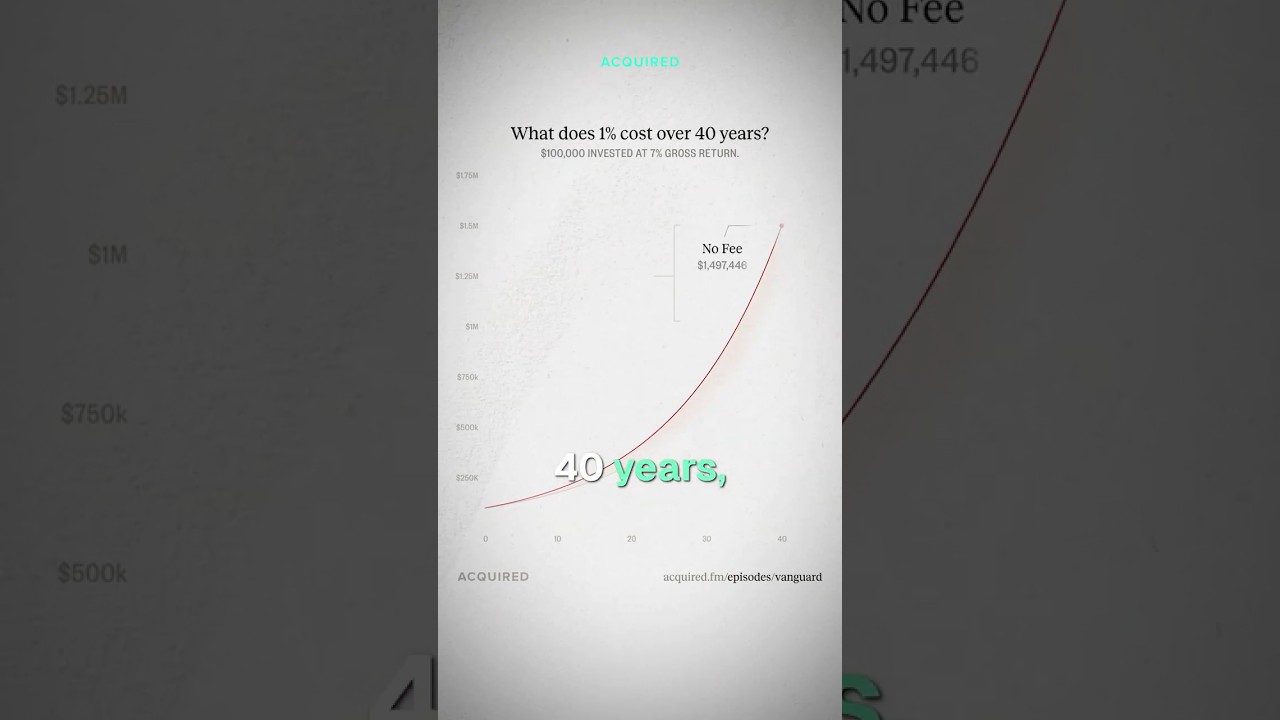
## TL;DR This piece exposes the devastating long-term impact of a seemingly small 1% management fee on personal wealth. While a 1% fee sounds benign, it actually consumes 1/7 or roughly 15% of an average 7% market return. Over a 40-year investment horizon, this fee aggressively erodes compounding power. For instance, a $100,000 initial investment grows to $1.5 million at a 7% return, but drops to just $1 million with a 1% fee, resulting in a staggering $500,000 loss.

## Atmosphere & style The tone is eye-opening and urgent, delivering a sharp, data-driven wake-up call to everyday investors. It carries a heavy sense of financial gravity, shifting from a warning about a dangerous misconception to a devastating reveal of spreadsheet math. The narrative style is analytical yet visceral, leaving the listener feeling startled by how quietly and aggressively wealth can be stripped away.

## Key takeaways - [00:00](https://www.youtube.com/watch?v=sIu3gWdl1wo&t=0s) A 1% management fee is a dangerous misconception that masks its true impact by appearing benign. - [00:00](https://www.youtube.com/watch?v=sIu3gWdl1wo&t=0s) When contextualized against a 7% market return, a 1% fee represents losing 1/7 of total gains, or roughly 15% of returns. - [00:00](https://www.youtube.com/watch?v=sIu3gWdl1wo&t=0s) Management fees extracted year after year quietly but aggressively cut out investment returns at the knees. - [00:00](https://www.youtube.com/watch?v=sIu3gWdl1wo&t=0s) Spreadsheet math reveals a devastating financial picture when fees compound over a long horizon. - [00:00](https://www.youtube.com/watch?v=sIu3gWdl1wo&t=0s) Investing $100,000 at age 25 for 40 years at a 7% market return yields a comfortable $1.5 million retirement nest egg without fees. - [00:00](https://www.youtube.com/watch?v=sIu3gWdl1wo&t=0s) Introducing a 1% annual management fee drags the net annual return down to 6%. - [00:00](https://www.youtube.com/watch?v=sIu3gWdl1wo&t=0s) Over 40 years, a single percentage point fee eats away enough compounding power to leave an investor with only $1 million instead of $1.5 million. - [00:00](https://www.youtube.com/watch?v=sIu3gWdl1wo&t=0s) Avoiding a 1% management fee allows an investor to secure an extra 50% for their retirement, saving $500,000 from being lost to fees.

## Detailed walkthrough ### [00:00](https://www.youtube.com/watch?v=sIu3gWdl1wo&t=0s) The Hidden Cost of Management Fees

At first glance, a 1% management fee sounds incredibly benign to the average investor. However, looking at it as just "1% of total assets" is a dangerous misconception that masks its true impact on long-term wealth. When you contextualize that fee against an average stock market return of 7%, you aren't just losing a single percentage point of your wealth—you are actually surrendering a staggering 1/7 of your total gains, which equates to roughly 15% of your returns. When this fee is extracted year after year, it quietly but aggressively "cuts out your returns at the knees."

To expose the staggering reality of how these fees compound over time, a quick look at the spreadsheet math paints a devastating financial picture. Imagine investing $100,000 at age 25 and letting it grow at a 7% market return for 40 years. Without fees, you would retire with a comfortable $1.5 million. However, introducing a seemingly tiny 1% annual management fee drags your net annual return down to 6%. Over those 40 years, that single percentage point eats away so much compounding power that you end up with only $1 million instead of $1.5 million. By simply avoiding that 1% fee, you could secure "an extra 50% for your retirement."

- **Initial Investment:** $100,000 at age 25. - **Investment Horizon:** 40 years. - **7% Return Outcome (No Fees):** $1.5 million at retirement. - **6% Return Outcome (1% Fee Applied):** $1 million at retirement. - **Total Loss to Fees:** $500,000 (a 50% increase to the final retirement nest egg if saved).

## Notable quotes > [00:00](https://www.youtube.com/watch?v=sIu3gWdl1wo&t=0s) 1% of total assets

> [00:00](https://www.youtube.com/watch?v=sIu3gWdl1wo&t=0s) dangerous misconception that masks its true impact on long-term wealth

> [00:00](https://www.youtube.com/watch?v=sIu3gWdl1wo&t=0s) staggering 1/7 of your total gains

> [00:00](https://www.youtube.com/watch?v=sIu3gWdl1wo&t=0s) cuts out your returns at the knees

> [00:00](https://www.youtube.com/watch?v=sIu3gWdl1wo&t=0s) spreadsheet math paints a devastating financial picture

> [00:00](https://www.youtube.com/watch?v=sIu3gWdl1wo&t=0s) eats away so much compounding power

> [00:00](https://www.youtube.com/watch?v=sIu3gWdl1wo&t=0s) an extra 50% for your retirement

## Mentioned Vanguard, Acquired, YouTube

[Source](https://www.youtube.com/watch?v=sIu3gWdl1wo)

中文简报

Vanguard音频详解1%资产费率如何使退休财富缩水三分之一 看似微不足道的每年1%管理费削弱了长期复利效应,在40年的投资周期中足以抹去50万美元,即总潜在财富的三分之一。 本文揭示了看似微不足道的1%管理费对个人财富造成的破坏性长期影响。虽然1%的费用听起来无害,但它实际上消耗了平均7%市场回报率中的七分之一(约15%)。在40年的投资周期中,这项费用会严重侵蚀复利效应。例如,10万美元的初始投资在7%的回报率下可增长至150万美元,但在扣除1%的费用后仅能达到100万美元,导致高达50万美元的惊人损失。 1%的管理费是一种危险的错误认知,它因外表看似无害而掩盖了其实际影响。 (0:00) 结合7%的市场回报率来看,1%的费用相当于损失了总收益的七分之一,即约15%的回报。 (0:00) 年复一年抽取的管理费虽然悄无声息,却极其猛烈地严重削弱了投资回报。 (0:00) 电子表格测算显示,当费用在长周期内持续复利累积时,会呈现出毁灭性的财务图景。 (0:00) 若在25岁时投资10万美元并持续40年,在无费用的情况下按7%的市场回报率可带来150万美元的充裕养老储备金。 (0:00)

Reading summary

Acquired argues that a seemingly modest 1% management fee imposes an outsized penalty on long-term wealth by consuming approximately one-seventh of average market returns and significantly impairing compounding growth. Relative Impact on Annual Returns (0:00) Investors frequently view a 1% management fee as a benign fraction of total portfolio assets. However, contextualized against an assumed 7% average stock market return, that single percentage point consumes roughly one-seventh of total gains, capturing approximately 15% of an investor's annual returns and substantially dampening baseline portfolio growth year over year. Compounding Losses Over Multi-Decade Horizons (0:00) The cumulative mathematical effect of recurring fees becomes severe across long timeframes. For an initial investment of $100,000 at age 25 with a 40-year horizon, an unencumbered 7% annual return yields $1.5 million at retirement. Reducing net returns to 6% via a 1% annual fee lowers the ending total to $1 million, forfeiting $500,000 in compounding power. Consequently, eliminating that 1% fee provides an extra 50% to the investor's final retirement balance. Acquired illustrates that avoiding a 1% management fee protects a significant portion of an investor's final portfolio value over a 40-year horizon, showing that small percentage fees exert disproportionate control over ultimate retirement outcomes.

精炼阅读摘要

Acquired指出,表面看似温和的1%管理费常被投资者误解为微不足道的支出,但在年均7%的市场回报背景下,该费用实际上会吞噬约15%的投资收益,并在长期复利中大幅削减最终财富。 费率对实际收益的实质侵蚀 (0:00) 节目指出,普通投资者常将1%的管理费仅仅视作“总资产的1%”,这种误解掩盖了其对长期财富的实际破坏力。若将其置于股票市场年均7%的回报基准下审视,投资者失去的并非仅是总财富的一个百分点,而是让渡了整体收益的七分之一,即约15%的回报。节目认为,这种每年持续抽取的费用在暗中严重削弱了投资回报的基础。 四十年复利下的巨额财富损失 (0:00) 节目通过具体测算展示了费用的长期复利后果:若在25岁时投入10万美元并维持40年的投资期,按7%的市场年回报率且不计费用计算,退休时资产将达到150万美元。然而,一旦扣除1%的年度管理费,净年回报率降至6%,最终资产便缩水至100万美元。测算显示,仅这1个百分点的费用差异就在40年内吞噬了50万美元的复利收益;规避该项费用相当于为退休储备增加了50%的资金。 该节目的核心结论表明,管理费率的微小变动在数十年复利机制下会被成倍放大,投资者低估名义费率往往会导致最终财富积累出现显著损失。

Detailed notes — zh

## Background 该内容由知名商业播客《Acquired》于 2026 年 6 月 5 日发布在 YouTube 平台。视频节选自其关于先锋领航集团(Vanguard)的深度长篇播客节目《Vanguard: The communist capitalist who saved investors a trillion dollars》,探讨投资费率对长期复利的隐形侵蚀。 ## TL;DR 很多投资者以为 1% 的资产管理费无足轻重,但由于该费用按总资产扣除,在年化 7% 的基准市场回报下,它实际上吞噬了约 15% 的年度投资净收益。主讲人通过 40 年投资模型测算指出,若在 25 岁时投入 10 万美元,年化 7% 回报在 65 岁时可增值至 150 万美元,而扣除 1% 费率降至 6% 后,最终资产仅剩 100 万美元。这微小的费率差使得最终收益整整蒸发了 50 万美元。这意味着仅仅规避这 1% 的管理费,就能让投资者在退休时额外拥有多达 50% 的财富。 ## Atmosphere & style 整段剪辑节奏短促而极具警示感,营造出一种打破直觉认知的财务“顿悟时刻”。主讲人以清晰利落的数学推演直击行业盲点,语调平实却带着令人清醒的说服力。听众在不到一分钟内经历了从“1% 听起来还不算太糟”到面对 50 万美元巨额亏蚀的强烈震撼,极具思维冲击。 ## Bulletin - [00:00](https://www.youtube.com/watch?v=sIu3gWdl1wo&t=0s) 投资者常认为 1% 的管理费微不足道,但由于该费用按“总资产”而非净利润计提,在 7% 的平均年化回报下,实质上每年直接剥夺了约 15% 的投资利润。 - [00:00](https://www.youtube.com/watch?v=sIu3gWdl1wo&t=0s) 基于 40 年复利模型测算,25 岁投入 10 万美元至 65 岁退休,7% 年化回报下资产可达 150 万美元,而扣除 1% 管理费后仅能积累 100 万美元。 - [00:00](https://www.youtube.com/watch?v=sIu3gWdl1wo&t=0s) 仅 1% 的微小年费率差异便在 40 年内造成 50 万美元的财富蒸发;避开该费用能让最终退休资产规模直接增加 50%。 ## Key takeaways - [00:00](https://www.youtube.com/watch?v=sIu3gWdl1wo&t=0s) 大众投资者通常对 1% 的资产管理费缺乏敏感度,主观误以为这是很小的摩擦成本。 - [00:00](https://www.youtube.com/watch?v=sIu3gWdl1wo&t=0s) 管理费的杀伤力根源在于其抽取基数是全部投资本金加累计收益的“总资产”,而非单一增值部分。 - [00:00](https://www.youtube.com/watch?v=sIu3gWdl1wo&t=0s) 在股票市场 7% 的典型基准回报率下,1% 的资产管理费相当于每年拿走实际投资回报的七分之一(约 14.3% 至 15%)。 - [00:00](https://www.youtube.com/watch?v=sIu3gWdl1wo&t=0s) 费率带来的微小损耗会在数十年间形成反向复利,从根基上严重腰斩长期的财富积累效率。 - [00:00](https://www.youtube.com/watch?v=sIu3gWdl1wo&t=0s) 在 25 岁时投入 10 万美元本金,若按 7% 的年化市场回报复利增长至 65 岁,期末总资产约为 150 万美元。 - [00:00](https://www.youtube.com/watch?v=sIu3gWdl1wo&t=0s) 同样本金若每年扣除 1% 管理费(实际年化复合回报降为 6%),40 年后资产总额仅为 100 万美元。 - [00:00](https://www.youtube.com/watch?v=sIu3gWdl1wo&t=0s) 40 年间由 1% 费率直接导致的绝对财富缩水高达 50 万美元,是初始本金的五倍之多。 - [00:00](https://www.youtube.com/watch?v=sIu3gWdl1wo&t=0s) 避开每年 1% 的资产管理费,本质上能够让投资者在退休时多获得整整 50% 的财富增量。 ## Detailed walkthrough ### [00:00](https://www.youtube.com/watch?v=sIu3gWdl1wo&t=0s) 1% 管理费对长期复利的惊人侵蚀 投资者在听到“1% 的管理费”(1% management fee)时,往往下意识地觉得这笔开销无伤大雅,轻描淡写地认为“这听起来还不算太糟”("that's not so bad")。然而,问题的致命之处在于,这 1% 是从你的“总资产”(total assets)中抽取的,而不是按投资净利润收取。假设股票市场的年化平均回报率是 7%,而你每年需要交纳 1% 的资产管理费,这实际上意味着你直接拱手让出了年收益的七分之一(约 15% 的回报)。这种微小的损耗在单一年份看似影响有限,但当它年复一年、持续几十年地复利发生时,便会像一把隐形剃刀,从根本上直接“斩断你的收益复利”("really cuts out your returns at the knees")。 为了直观展示费用的毁灭性影响,主讲人通过电子表格(spreadsheeting)进行了详细的数学测算:如果一个人在 25 岁时拿出 10 万美元进行投资,在不计管理费、完全享有 7% 市场基准年化回报的情况下,连续复利投资 40 年(直到 65 岁退休),最终账户里的资金将增长至 150 万美元。然而,若是在整个投资周期中每年都支付 1% 的管理费,实际到手的年化复合回报率便降至 6%,最终积累的资产总额仅有 100 万美元。仅仅因为这 1% 的看似微不足道的费率差,到退休时就凭空蒸发了整整 50 万美元。换句话说,只要能避免每年 1% 的隐形费用蚕食,你原本能够为自己的退休养老额外多赚取整整 50% 的财富。 ```mermaid flowchart TD accTitle: 1% 管理费对 40 年复利回报的影响 accDescr: 对比 10 万美元初始投资在 40 年间按 7% 与扣除 1% 费用后的 6% 收益结果 subgraph S1["初始投资(25 岁)"] Init["初始本金:$100,000"] end subgraph S2["40 年复利增长路径"] R7["无额外费用(7% 年化)"] R6["扣除 1% 费用(6% 年化)"] end subgraph S3["65 岁退休成果对比"] Final7["最终总额:$1,500,000"] Final6["最终总额:$1,000,000"] end Init --> R7 Init --> R6 R7 --> Final7 R6 --> Final6 ``` - **收益占比损失**:在 7% 的市场回报基准下,1% 的资产管理费等同于每年抽走 14.3%(约 15%)的实际投资利润。 - **40 年复利测算模型(25 岁至 65 岁,本金 10 万美元)**: - **7% 年化回报(无 1% 费率)**:期末资产积累约为 150 万美元($1.5 million)。 - **6% 年化回报(扣除 1% 费率)**:期末资产积累约为 100 万美元($1 million)。 - **最终财富差距**:差额高达 50 万美元,避开 1% 的管理费能让最终的退休资金规模足足提升 50%。 ## Notable quotes > [00:00](https://www.youtube.com/watch?v=sIu3gWdl1wo&t=0s) 投资者在听到“1% 的管理费”时,往往下意识地觉得这笔开销无伤大雅,轻描淡写地认为“这听起来还不算太糟”。 > [00:00](https://www.youtube.com/watch?v=sIu3gWdl1wo&t=0s) 问题的致命之处在于,这 1% 是从你的“总资产”中抽取的,而不是按投资净利润收取。 > [00:00](https://www.youtube.com/watch?v=sIu3gWdl1wo&t=0s) 假设股票市场的年化平均回报率是 7%,而你每年需要交纳 1% 的资产管理费,这实际上意味着你直接拱手让出了年收益的七分之一(约 15% 的回报)。 > [00:00](https://www.youtube.com/watch?v=sIu3gWdl1wo&t=0s) 这种微小的损耗在单一年份看似影响有限,但当它年复一年、持续几十年地复利发生时,便会像一把隐形剃刀,从根本上直接“斩断你的收益复利”。 > [00:00](https://www.youtube.com/watch?v=sIu3gWdl1wo&t=0s) 如果一个人在 25 岁时拿出 10 万美元进行投资,在不计管理费、完全享有 7% 市场基准年化回报的情况下,连续复利投资 40 年(直到 65 岁退休),最终账户里的资金将增长至 150 万美元。 > [00:00](https://www.youtube.com/watch?v=sIu3gWdl1wo&t=0s) 若是在整个投资周期中每年都支付 1% 的管理费,实际到手的年化复合回报率便降至 6%,最终积累的资产总额仅有 100 万美元。 > [00:00](https://www.youtube.com/watch?v=sIu3gWdl1wo&t=0s) 仅仅因为这 1% 的看似微不足道的费率差,到退休时就凭空蒸发了整整 50 万美元。 > [00:00](https://www.youtube.com/watch?v=sIu3gWdl1wo&t=0s) 只要能避免每年 1% 的隐形费用蚕食,你原本能够为自己的退休养老额外多赚取整整 50% 的财富。 ## Mentioned Acquired, Vanguard, YouTube ## Video description #business #podcast 🎙 From Vanguard: The communist capitalist who saved investors a trillion dollars (Audio) [Source](https://www.youtube.com/watch?v=sIu3gWdl1wo)

Source quotes

[0:00] 投资者在听到“1% 的管理费”时,往往下意识地觉得这笔开销无伤大雅,轻描淡写地认为“这听起来还不算太糟”。 [0:00] 问题的致命之处在于,这 1% 是从你的“总资产”中抽取的,而不是按投资净利润收取。 [0:00] 假设股票市场的年化平均回报率是 7%,而你每年需要交纳 1% 的资产管理费,这实际上意味着你直接拱手让出了年收益的七分之一(约 15% 的回报)。 [0:00] 这种微小的损耗在单一年份看似影响有限,但当它年复一年、持续几十年地复利发生时,便会像一把隐形剃刀,从根本上直接“斩断你的收益复利”。 [0:00] 如果一个人在 25 岁时拿出 10 万美元进行投资,在不计管理费、完全享有 7% 市场基准年化回报的情况下,连续复利投资 40 年(直到 65 岁退休),最终账户里的资金将增长至 150 万美元。 [0:00] 若是在整个投资周期中每年都支付 1% 的管理费,实际到手的年化复合回报率便降至 6%,最终积累的资产总额仅有 100 万美元。 [0:00] 仅仅因为这 1% 的看似微不足道的费率差,到退休时就凭空蒸发了整整 50 万美元。 [0:00] 只要能避免每年 1% 的隐形费用蚕食,你原本能够为自己的退休养老额外多赚取整整 50% 的财富。

Source quotes

[0:00] 1% of total assets [0:00] dangerous misconception that masks its true impact on long-term wealth [0:00] staggering 1/7 of your total gains [0:00] cuts out your returns at the knees [0:00] spreadsheet math paints a devastating financial picture [0:00] eats away so much compounding power [0:00] an extra 50% for your retirement

Original transcript

[0:00] You might hear 1% management fee, that's [0:02] not so bad. That's 1% of the total [0:04] assets. If the stock market were to [0:07] return 7%, but you owe 1% in fees, [0:11] that's actually 1/7 of your gains that [0:14] you are giving up, or around 15% of the [0:16] returns. When that happens year after [0:18] year after year, it really cuts out your [0:20] returns at the knees. And I did a little [0:22] spreadsheeting just to check the math on [0:23] this. If you invested $100,000 at age [0:26] 25, and you got 7% market returns for 40 [0:30] years, you'd end up with $1.5 million. [0:33] But if you paid a 1% management fee [0:35] along the way each year, that's a 6% [0:37] annual return. Instead of $1.5 million, [0:40] you end up with $1 million. Yeah. That's [0:42] an extra 50% for your retirement that [0:45] you could make by not paying 1% in fees [0:48] each year. [0:49] >> Who got the truth? [0:52] Is it you? Is it you? Is it