Weinstein Urges Independent Physics Research to Unblock Interstellar Propulsion
PowerfulJRE
Institutional gatekeeping in theoretical physics has suppressed fundamental breakthroughs for over four decades, risking national security and stalling space exploration.
## Background
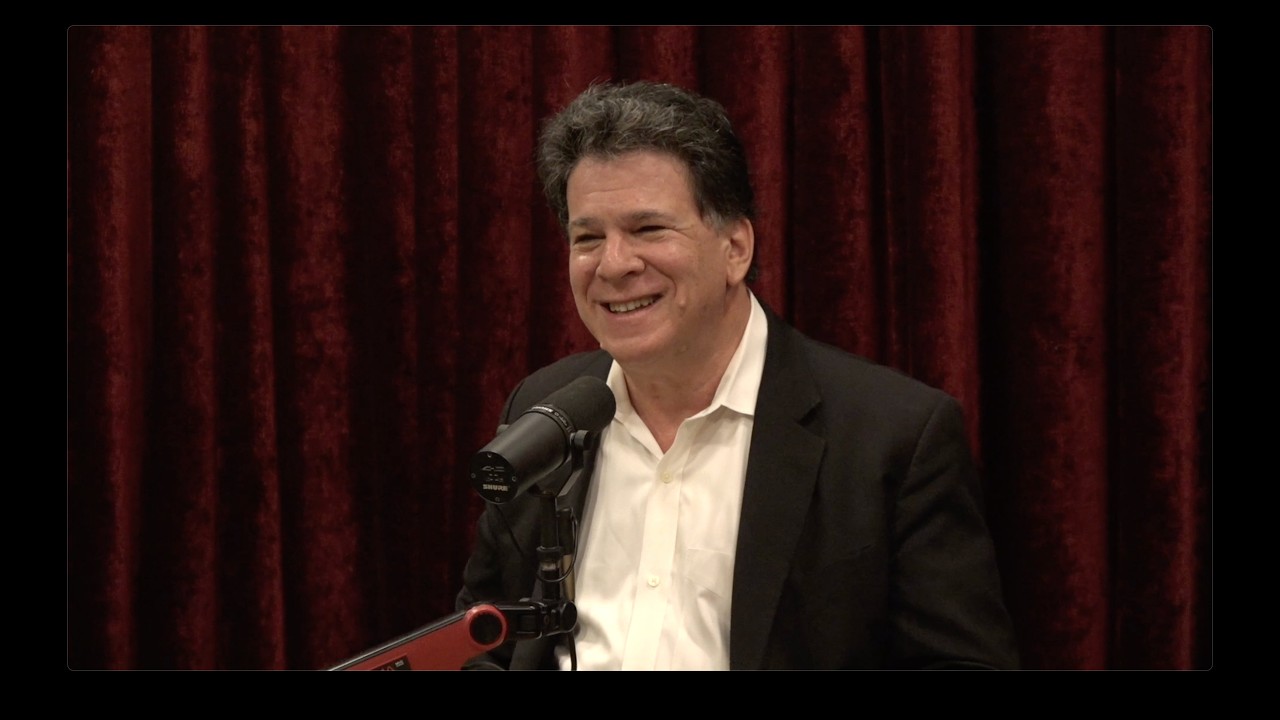
This episode of the Joe Rogan Experience (#2503) was published on YouTube by the PowerfulJRE channel on May 21, 2026. According to the show notes, it features Eric Weinstein, PhD—a mathematician, former managing director of Thiel Capital, manager of the Galileo Project research team, and creator of Geometric Unity—discussing physics, institutions, and research.
## TL;DR
Mathematician Eric Weinstein joins Joe Rogan to critique institutional decay and dogmatism within theoretical physics, highlighting decades of suppressed alternative theories like his own Geometric Unity. Weinstein examines the dark origins of government-controlled scientific secrecy, the mechanics behind Jeffrey Epstein's espionage network targeting top minds, and recent UAP airspace anomalies near White Sands. He argues that humanity must transcend current physics models and institutional reliance on tech billionaires if we are to achieve true breakthroughs in unified field theory and interstellar propulsion.
## Atmosphere & style
The conversation carries an intense, conspiratorial, and intellectually rogue energy, blending casual studio banter over whiskey with high-stakes academic whistleblowing. Weinstein speaks with urgent, passionate gravitas, framing theoretical physics as a dangerous, high-level battlefield suppressed by institutional gatekeepers. Rogan serves as an engaged, receptive sounding board, allowing the discussion to weave fluidly through complex mathematics, geopolitical covert operations, and dark cultural commentary.
## Key takeaways
- [06:36](https://www.youtube.com/watch?v=4OKNS5j0lSY&t=396s) The 1984 Green–Schwarz anomaly cancellation led to string theory dominating theoretical physics (TOGIT: 'The Only Game in Town'), suppressing alternative unified field theories and stagnating physics for over four decades.
- [14:45](https://www.youtube.com/watch?v=4OKNS5j0lSY&t=885s) Academic and governmental institutions enforce non-disclosure demands and frame public theoretical physics lectures as entertainment to control narratives and avoid granting institutional legitimacy.
- [25:26](https://www.youtube.com/watch?v=4OKNS5j0lSY&t=1526s) Historical control mechanisms like the 1940 Reference Committee intercepted independent nuclear research, establishing the precedent for modern academic peer review to suppress potentially dangerous breakthroughs.
- [36:03](https://www.youtube.com/watch?v=4OKNS5j0lSY&t=2163s) Domain catalysts across physics, skateboarding (Rodney Mullen), and music (Eddie Van Halen, Allan Holdsworth) construct entirely new technical vocabularies that require mainstream facilitators or 'syntactic sugar' to stay accessible.
- [01:50:40](https://www.youtube.com/watch?v=4OKNS5j0lSY&t=6640s) Jeffrey Epstein functioned as a multi-state intelligence clearinghouse and covert operator using funding, luxury hospitality, and infrastructure like Zorro Ranch to conduct scientific espionage targeting elite theoretical physicists.
- [02:00:17](https://www.youtube.com/watch?v=4OKNS5j0lSY&t=7217s) The encrypted military-grade satellite uplink at Zorro Ranch and historical connections to covert special operations indicate Epstein operated as part of a deep US military-intelligence architecture.
- [02:04:17](https://www.youtube.com/watch?v=4OKNS5j0lSY&t=7457s) The post-WWII Vannevar Bush pact linked academic physics directly to national security, making theoretical physicists critical national defense assets whose fields are heavily managed and gatekept.
- [02:16:21](https://www.youtube.com/watch?v=4OKNS5j0lSY&t=8181s) Elon Musk's xAI (Grok) represents an effort to bypass stagnant academic institutions to solve fundamental unified field theory and non-chemical propulsion problems necessary for interstellar travel.
- [02:17:59](https://www.youtube.com/watch?v=4OKNS5j0lSY&t=8279s) The Geometric Unity framework proposes 'the Observers' model using multidimensional time and extra dimensions to manipulate spacetime rather than relying on standard relativistic limits.
- [02:25:25](https://www.youtube.com/watch?v=4OKNS5j0lSY&t=8725s) Theoretical physics advancements are being driven underground through private collaborations with elite mathematicians to bypass academic suppression and online smear campaigns.
- [02:35:40](https://www.youtube.com/watch?v=4OKNS5j0lSY&t=9340s) Unexplained airspace shutdowns and UAP phenomena, such as the 2026 El Paso airspace ban, reflect covert military testing, plasma hologram projections, or high-energy defense responses rather than outer space visitors.
- [02:46:45](https://www.youtube.com/watch?v=4OKNS5j0lSY&t=10005s) The public health controversies during COVID-19 caused Silicon Valley tech leaders to lose faith in public science institutions, causing a harmful shift away from basic theoretical science toward applied engineering and private enterprise.
- [02:52:08](https://www.youtube.com/watch?v=4OKNS5j0lSY&t=10328s) Society must end its reliance on financial elites and billionaires as proxy public intellectuals, restoring science to an independent pursuit of truth and lasting intellectual achievement.
## Detailed walkthrough
Here is a detailed, faithful walkthrough of the transcript section.
---
[00:01](https://www.youtube.com/watch?v=4OKNS5j0lSY&t=1s) Pre-Show Drinking, Religious Traditions, and Studio Banter
The episode opens with Joe Rogan explaining his recent relationship with alcohol. After taking roughly eight months off from drinking, he eventually had a single margarita at dinner, realized how much he missed it, and gradually reintroduced a casual glass of wine here or there. Eric Weinstein checks in on how that hiatus held up, noting that he knows Rogan isn't "captured" by alcohol. Weinstein then brings up his own religious obligations, explaining that Judaism requires drinking wine every Friday for Shabbat. When Rogan asks if there is a minimum threshold to avoid being "bad at it," Weinstein mentions he typically drinks about two and a half glasses on Shabbat, but adds that the real holiday for heavy drinking is Purim.
As they decide whether to pour a drink for the podcast, Rogan calls for ice, glasses, and a bottle of Buffalo Trace bourbon. Learning that the cameras are already rolling, both men embrace the casual flow of the show, opting to skip headphones entirely. They joke about how headphone bands can ruin styled hair, with Weinstein poking fun at Rogan's concern for his look. The conversation turns to aging and hair color; Rogan points out that the 60-year-old Weinstein still has remarkably dark hair for his age, while Weinstein remarks that Rogan smartly shaved his head early on before anyone could see it turn gray. Rogan speculates that proper nutrition—specifically zinc and copper—might help prevent graying hair, though he candidly admits he is largely "talking out of my ass." Pouring the Buffalo Trace over Austin tap water ice, Rogan highlights that the distillery dates back to 1773, making it older than the United States itself. Weinstein tries to recall an ancient Chinese beer, which producer Young Jamie quickly identifies as Yanjing (or Tsingtao / China's historical brews, with Jamie's quick research pulling up a brewery date from 1829). Appreciating Jamie's instant assistance, Rogan and Weinstein joke that Jamie is vastly superior to AI like Claude or ChatGPT because he is practically psychic and understands how Rogan's mind works.
- **Shabbat Drinking:** Weinstein drinks approximately 2.5 glasses of wine every Friday night as part of Jewish religious observance.
- **Buffalo Trace Distillery:** Founded around 1773, pre-dating the signing of the Declaration of Independence.
- **Yanjing Brewery:** Historic Chinese brewery mentioned during the beer trivia exchange; Jamie pulls up historical dates (1829) instantly.
---
[03:43](https://www.youtube.com/watch?v=4OKNS5j0lSY&t=223s) Michio Kaku, Dark Energy, and Parallel Dimensions
Rogan asks Weinstein about a recent presentation he delivered at the University of Texas at Austin. Weinstein clarifies that he gave a talk on dark energy to the Karch group within the physics department. This prompts Rogan to bring up public comments made by theoretical physicist Michio Kaku, who suggested that dark energy—or dark matter—might not be matter at all, but rather gravity leaking in from a parallel dimension. Weinstein reacts with a visible side-eye and laughter. When Rogan marvels that Kaku makes such radical claims yet refuses to try psychedelic mushrooms, Weinstein notes that he once asked Rogan to put him in a room with Kaku.
Weinstein addresses Kaku directly, admitting that while he prefers targeting institutions rather than individuals to avoid wasting life energy on "beefing," Kaku is doing a tremendous amount of damage to theoretical physics. Weinstein emphasizes that theoretical physics is the most economically potent, beautiful, and powerful pursuit imaginable, and that the United States historically led the world in it because of an irreverent, "cowboy" culture that produced the semiconductor, the atomic bomb, and the hydrogen bomb. However, Weinstein argues that over the last 42 years, the field has suffered a massive intellectual implosion.
- **Talk Topic:** Dark energy presentation to the Karch group at UT Austin's physics department.
- **Kaku's Claim:** Dark matter/energy could be gravity leaking through from an adjacent parallel dimension.
- **American Physics History:** Weinstein attributes past U.S. physics dominance to an irreverent "cowboy" mentality that yielded foundational 20th-century breakthroughs.
---
[06:36](https://www.youtube.com/watch?v=4OKNS5j0lSY&t=396s) The 1984 Monopolization of Theoretical Physics and String Theory
Tracing the root cause of this intellectual decline, Weinstein points squarely to 1984 and the breakthrough known as the Green–Schwarz anomaly cancellation in quantum gravity. Following this discovery, Edward Witten—son of anti-gravity physicist Louis Witten (who recently turned 105)—championed the idea that all the brightest minds in physics should concentrate on one narrow sub-specialty: string theory. Because Witten was extraordinarily brilliant, the entire field followed his lead. Weinstein, however, resisted. He laments that prominent media-facing physicists like Sean Carroll, Neil deGrasse Tyson, and Brian Greene have failed to call out the unraveling and destruction of theoretical physics that resulted from this mono-culture over the past four decades.
Weinstein clarifies that string theory itself is not evil; it consists of beautiful mathematics and harmless equations. The real danger is the complete exclusion of all competing ideas, a phenomenon referred to as "TOGIT"—an acronym for "The Only Game in Town." This mindset asserts that only an elite group of string theorists are qualified to work on fundamental physics, dismissing anyone else's research as useless "finger exercises."
```
TOGIT = "The Only Game In Town"
```
- **Green–Schwarz Anomaly Cancellation (1984):** The mathematical milestone that triggered the mass movement toward string theory.
- **Louis Witten:** Anti-gravity researcher from the 1950s who turned 105 years old; father of Fields Medalist Edward Witten.
- **42-Year Stagnation:** Weinstein defines 1984 to 2026 as a four-decade period where theoretical physics institutionalized gatekeeping at the expense of genuine innovation.
---
[09:00](https://www.youtube.com/watch?v=4OKNS5j0lSY&t=540s) The "Wheel of Fortune" Analogy: UV Completeness and Caitlyn Burke
To explain the complex concept of "UV completeness" (Ultra-Violet completeness) without alienating the audience, Weinstein asks Jamie to pull up a famous clip from the game show *Wheel of Fortune* featuring a contestant named Caitlyn Burke solving a "Prize Puzzle." In the video, Burke solves a massive puzzle—"I've got a good feeling about this"—with only an "L", an apostrophe, and a single "R" revealed, stunning host Pat Sajak.
Weinstein uses this moment as an analogy for how fundamental physics operates:
1. **Blank Squares as Energy Scales:** The missing letters represent orders of magnitude in energy separating present-day experiments from the ultra-high energies needed to directly test fundamental theory.
2. **Revealed Letters as the Standard Model:** The few exposed clues (like the apostrophe and the letter "L") represent the Standard Model of particle physics.
3. **Buying Letters vs. Solving the Puzzle:** Physics currently faces a debate over whether to spend billions of dollars building larger particle accelerators to "buy more letters" or to use extraordinary leaps of intuition—what Weinstein calls "Caitlyning our way out"—to solve the puzzle with the clues already available.
4. **Unique UV Completion:** A theoretical framework where only one possible structure can cleanly fit all known data without contradiction.
Weinstein points out that string theorists act as self-appointed gatekeepers who demand that only they be allowed to guess the puzzle's solution. If an outsider attempts to solve it using limited clues, the establishment labels them a "charlatan," a "crank," or a practitioner of "pseudoscience."
- **Contestant:** Caitlyn Burke, who solved a *Wheel of Fortune* puzzle with virtually no letters showing.
- **Physics Equivalent:** Solving UV completeness requires extreme mathematical courage and pattern recognition rather than relying solely on brute-force, higher-energy particle colliders.
---
[14:45](https://www.youtube.com/watch?v=4OKNS5j0lSY&t=885s) Institutional Gag Orders and the Suppression of Alternative Physics
Weinstein reveals the absurd institutional friction he faces when speaking at academic institutions. Despite giving a legitimate talk at UT Austin's physics department, he was instructed not to state publicly or on social media that he gave a official department talk, but rather to frame it strictly as speaking to the "Karch group seminar"—a semantic loophole he compares to "a condom to make sure the physics department doesn't get pregnant." He describes similar experiences at a physics institute in Canada (where he gave a 9-hour seminar over a week-long visit) and at the University of Chicago, both of which left no public record or official advertisement of his presence.
Rogan expresses bewilderment, noting that the University of Texas at Austin historically used its vast oil wealth to raid top-tier Ivy League institutions—bringing in legends like Nobel laureate Steven Weinberg from Harvard, mathematician John Tate, and the Bryce DeWitt relativity group from North Carolina—specifically to foster groundbreaking physics. Weinstein agrees, declaring that he is officially done complying with these non-disclosure demands and gag orders. Disturbed by the systematic suppression of alternative ideas and the mysterious disappearance or silencing of heterodox scientists, Weinstein vows to speak openly about these institutional games going forward.
- **UT Austin Physics Legacy:** Historically funded by Texas oil revenue to recruit elite theorists like Steven Weinberg and John Tate.
- **Institutional Tactics:** University physics departments allow independent theorists to give hours-long seminars to their research groups while prohibiting social media announcements, formal public listings, or archived records of the events.
<ElicitationsGroup message="Explore related topics from this transcript:">
<Elicitation label="Summarize Geometric Unity" query="What is Eric Weinstein's Geometric Unity theory and how does it challenge string theory?"/>
<Elicitation label="Detail the Galileo Project" query="What is the Galileo Project mentioned in Eric Weinstein's bio and what is its goal?"/>
<Elicitation label="Explain String Theory Criticisms" query="What are the main scientific criticisms of String Theory and the 'Only Game in Town' paradigm?"/>
</ElicitationsGroup>
[17:18](https://www.youtube.com/watch?v=4OKNS5j0lSY&t=1038s) Institutional Friction and the "Entertainer" Persona
Eric Weinstein details a recent experience speaking at a university physics department with a storied history in gravitational research and historical ties to anti-gravity studies. Despite his legitimate background, he explains how institutional pressures force him to claim he is merely an "entertainer" rather than a physicist when speaking publicly. He reveals that physics departments explicitly mandate that his appearances cannot be designated as formal lectures or talks, instead framing them strictly as informal conversations—such as in "Room 5308"—to avoid bestowing institutional credibility on his ideas.
When questioned by Joe Rogan on why academic institutions insist on this formal distinction, Weinstein notes that during a visit to a physics institute in Canada, administrators explicitly told him they worried he would use their platform to "legitimize" himself. Both Rogan and Weinstein criticize this rationale as absurd, noting that Weinstein holds a Ph.D. from Harvard, completed a postdoc at MIT, was an NSF Postdoctoral Fellow, received an ONR grant, and was a Sloan Foundation grantee.
- **Credentials & Legacy**: Beyond his Harvard Ph.D. and MIT postdoc, Weinstein has held appointments or affiliations across mathematics, physics, and economics departments.
- **The Narrative Threat**: Weinstein argues that he represents a unique danger to established academic institutions specifically *because* his "blue-chip" credentials make him impossible to dismiss as a crackpot.
- **Public Reach**: Weinstein highlights his public footprint, noting he is likely the most followed mathematician in the United States (or second globally behind Hannah Fry).
---
[21:40](https://www.youtube.com/watch?v=4OKNS5j0lSY&t=1300s) Dangers to the Narrative and the Limits of Modern Physics
Rogan asks Weinstein to clarify what specific ideas or actions make institutions so eager to marginalize him. Weinstein points to a track record of early, non-conformist warnings—such as publishing early work in 2001 on the dangers of illiquid mortgage-backed securities prior to the 2008 financial crash, or publicly predicting political transitions that party insiders privately acknowledged behind closed doors. He transitions to the core problem in academia: the institutional dominance of String Theory, describing it as a monopoly that stifles alternative theoretical approaches.
While acknowledging that String Theory has produced notable mathematical results and advanced quantum field theory, Weinstein points out that quantum field theory functions more like calculus—a mathematical tool—rather than a complete description of physical reality. He breaks down the societal and geopolitical importance of physics into three primary pillars that define modern human civilization:
* **Boom**: Weapons development, where advances in physics create destructive forces that dwarf all other fields with the possible exception of biological warfare.
* **Vroom**: Energy generation, which directly correlates with economic prosperity, nation-state power, and global wealth per capita.
* **Zoom**: Advanced technology, encompassing propulsion, computation, and global communications systems.
---
[25:26](https://www.youtube.com/watch?v=4OKNS5j0lSY&t=1526s) The Control Mechanisms: From the 1940s to Peer Review
Weinstein posits that during the 1940s and 1950s—particularly following the advent of the hydrogen bomb—the physics community became recognized as too dangerous to operate without strict oversight. To illustrate how control was historically imposed on scientific research, he cites the creation of the **Reference Committee** inside the National Research Council in 1940, organized in part by physicist Gregory Breit.
Once nuclear fission and neutron-driven chain reactions were discovered, the Reference Committee began intercepting, delaying, and suppressing independent physics papers submitted to academic journals if the authors were outside the classified Manhattan Project group at Los Alamos. Weinstein argues that this was the historical birth of the modern peer-review control mechanism, designed to gatekeep dangerous technological breakthroughs and shunt independent research into monitored channels.
> "The community of physicists is the most powerful group of people made into completely ineffectual humans."
---
[27:36](https://www.youtube.com/watch?v=4OKNS5j0lSY&t=1656s) Violence, Instability, and the "Missing Scientist" Narrative
The discussion shifts to security, intelligence tracking, and the prevalence of violence within the mathematical and physical sciences. Rogan and Weinstein address the "missing scientist" theory circulating online, which claims around 15 top-tier researchers involved in classified defense technology have vanished or died under suspicious circumstances. Weinstein estimates that while many online claims are exaggerated or conflated, there are likely five or six legitimate cases of concern.
Weinstein highlights the historical pattern of extreme instability and violence surrounding mathematicians and physicists, arguing that the intense abstraction required by the discipline can disconnect individuals from everyday reality:
* **Ted Kaczynski (The Unabomber)**: A Harvard-educated mathematician who abandoned academia and authored essays such as *Ship of Fools*.
* **The Penn Shooting**: An incident where a man named Cantor entered the David Rittenhouse Laboratory at the University of Pennsylvania and opened fire during a seminar.
* **The University of Iowa Shooting**: A 1991 shooting by a physics graduate student (Gang Lu) that killed several faculty members, later inspiring media adaptations like the film *Dark Matter*.
* **Stanford Ball-Peen Hammer Attack**: The 1978 murder of professor Karel deLeeuw by graduate student Theodore Streleski with a ball-peen hammer.
Weinstein explains that the sharp contrast between the mathematical perfection in a scientist's mind and the messy, compromise-driven realities of the physical world often drives researchers to extreme mental strain. Finally, he notes that online narratives around UFOs, COVID-19, and missing scientists are frequently flooded with "junk data"—either naturally or intentionally—to allow establishment institutions to dismiss valid anomalies entirely.
[34:03](https://www.youtube.com/watch?v=4OKNS5j0lSY&t=2043s) High-Stakes Gatekeeping, Fusion Breakthroughs, and the Far-Right Tail of Human Talent
The discussion opens with Eric Weinstein reflecting on the double-edged sword of high-level scientific research. While speaking on the topic of supporting science, math, and physics at the University of Texas at Austin, Weinstein emphasizes that intense gatekeeping in these fields is far from arbitrary. Advanced mathematics and theoretical physics directly underpin critical real-world domains—including cryptography, weapons development, advanced propulsion systems, and sudden, massive shifts in the global economy.
Joe Rogan asks about the specific subset of legitimate, top-tier scientists currently working outside standard academic visibility, questioning what makes their research so inherently dangerous. Weinstein singles out nuclear fusion—referencing key figures at MIT and in plasma physics—as a prime example of high-stakes science. If a researcher solves practical energy fusion, the immediate geopolitical consequences would disrupt the world's reliance on oil overnight.
Rogan and Weinstein explore the extreme "right tail" of human intelligence, questioning whether removing or suppressing a single generational genius can effectively stall an entire field. When a lone pioneer operates far ahead of their peers, those working under them often lack the complete intuitive framework required to execute a breakthrough. Rogan notes how an industry like fossil fuels could theoretically gain a decade and trillions of dollars in revenue by delaying a disruptive technology through the elimination of a single key figure.
- **Key Domains of Gatekeeping:** Advanced physics and math drive critical applications in cryptography, military weaponry, space propulsion, and macroeconomics.
- **The Energy Disruption Scenario:** A practical breakthrough in nuclear fusion would immediately rewrite global energy dynamics and eliminate traditional geopolitical dependencies on oil.
- **The Extreme Right-Tail Effect:** Unique domain-defining individuals possess cognitive frameworks that cannot be easily replicated by an entire team of subordinate researchers.
---
[36:03](https://www.youtube.com/watch?v=4OKNS5j0lSY&t=2163s) Domain Catalysts: Rodney Mullen, Allan Holdsworth, and the Geometry of the Guitar
To illustrate how single individuals construct entirely new intellectual and physical vocabularies, Weinstein brings up legendary figures across vastly different disciplines. In skateboarding, Rodney Mullen engineered the foundational mechanics behind the majority of modern street tricks. In music, guitarists like Jimi Hendrix and Eddie Van Halen fundamentally altered how the instrument was played, exerting a disproportionate impact on global culture.
The conversation pivots to how Eddie Van Halen balanced extreme technical skill with accessible, mainstream appeal. Rogan highlights Van Halen's peak era with lead singer David Lee Roth as a practically perfect rock band, contrasting it with the later Sammy Hagar era. Weinstein suggests that David Lee Roth provided crucial "syntactic sugar"—the flashy, charismatic, and pop-friendly frontman presence that prevented Eddie Van Halen from devolving into an esoteric, overly complex musician like Allan Holdsworth.
```
Syntactic Sugar (Roth Era) Pure Technical Abstraction (Holdsworth)
┌──────────────────────────────┐ ┌────────────────────────────────────────┐
│ Catchy hooks & pop appeal │ │ Complex jazz fusion & dense theory │
│ High-energy stage presence │ vs │ Rapid-fire "modem-like" runs │
│ Arena rock marketability │ │ Highly technical niche fan base │
└──────────────────────────────┘ └────────────────────────────────────────┘
```
Rogan admits to having no idea who Allan Holdsworth is, prompting Jamie Vernon to play a clip of Holdsworth performing "Tokyo Dream" live in Tokyo in 1984. Watching the performance, Rogan humorously describes the dense, hyper-technical fusion licks as sounding "like a modem for normal human beings." Weinstein explains that while Holdsworth’s playing seems incomprehensible to the average listener, he is considered a legendary figure among master guitarists.
```
"David Lee Roth kept Eddie Van Halen from becoming Allan Holdsworth."
— Eric Weinstein
```
- **Domain Creators:** Rodney Mullen in skateboarding, along with Jimi Hendrix and Eddie Van Halen in music, single-handedly defined the foundational vocabularies of their respective fields.
- **The Allan Holdsworth Phenomenon:** Known strictly within elite musician circles for complex jazz-fusion improvisations that sound alien or overwhelming to mainstream audiences.
- **The Guitar's Geometry:** Eddie Van Halen mastered his craft by accepting the natural geometric layout and physical limitations of the guitar neck, using innovative techniques like two-handed tapping to push past traditional boundaries.
---
[43:48](https://www.youtube.com/watch?v=4OKNS5j0lSY&t=2628s) Rock 'n' Roll Showmanship, Gear Obsessions, and the Cultural arc of "Free Bird"
Weinstein reflects on his initial impressions of iconic rock acts, admitting that he originally dismissed AC/DC due to their schoolboy stage outfits before realizing the sheer compositional genius behind tracks like "Hot for Teacher." David Lee Roth brought a distinct Vaudeville-era flair and theatricality to Van Halen through his energetic stage antics, jumping splits, and appreciation for old-timey music. Weinstein also highlights Eddie Van Halen's multifaceted talents beyond guitar playing, including his expertise in electronics, synthesizers, and overall musicianship.
The discussion turns to the changing landscape of modern music. Weinstein notes how casual references to guitars on previous podcast appearances led to an influx of high-end equipment—such as a Neural DSP Quad Cortex unit—and introduced him to top-tier guitarists. Many of these elite musicians are currently struggling because rock music no longer commands the central cultural dominance it enjoyed during the late 20th century. Rogan recalls hosting blues-rock guitarist Marcus King to discuss whether rock is truly dead, pointing out that while modern audiences still react passionately to classic anthems, the genre's mainstream presence has shifted.
```
"If you looked at Google's data, Free Bird went away for a long time... and then it got resurrected as a meme."
— Eric Weinstein
```
The pair focus on Lynyrd Skynyrd's "Free Bird" as a prime example of a track that transcended generations. Featuring a luxurious, slow-tempo ballad opening that transitions into an explosive, high-energy multi-guitar solo, the song went from a classic rock staple to a widespread internet meme. Examining Google Trends data on screen, Jamie, Rogan, and Weinstein trace the song's steady search metrics and historical spikes, attributing its lasting cultural presence to its place in pop culture, film features, and digital platform releases.
- **Vaudeville and Rock:** David Lee Roth incorporated elements of old-timey showmanship into hard rock, referencing classic tracks like "Ice Cream Man" and "Just a Gigolo."
- **Evolution of Music Popularity:** Despite the timeless appeal of iconic guitar solos, rock has yielded its position as the dominant mainstream genre to newer commercial styles.
- **The "Free Bird" Dynamics:** The dramatic structure of "Free Bird"—shifting from a long intro into a hyper-kinetic guitar breakdown—has allowed it to survive across decades as a piece of pop-culture shorthand.
Here is a detailed, faithful walkthrough of this section of the podcast transcript.
---
[51:36](https://www.youtube.com/watch?v=4OKNS5j0lSY&t=3096s) Blues, John Mayer, and the Shift in Audiences
Eric Weinstein and Joe Rogan reflect on blues-based rock and how the genre’s relationship with its audience has evolved over time. Eric shares an anecdote about running into John Mayer at St. Vincent de Paul's, noting his deep respect for Mayer’s musical intellect. During their meeting, Eric questioned Mayer about his devotion to Stevie Ray Vaughan, admitting he didn't fully understand the focus. Mayer explained that for the MTV generation, Stevie Ray Vaughan served as the packaged bridge to the blues—a genius guitarist presented through a mainstream medium. However, Mayer then made a provocative claim: he asserted that blues isn't a standalone musical format, but rather an "ingredient," adding that no one actually goes to a "blues show." Eric jokingly recounted telling Mayer, "I don't think you know what you're talking about," pointing to venues like the House of Blues.
Elaborating on his point, Eric explains the deeper dynamic of "who plays and who pays." He observed the tail end of old Black audiences paying to see live blues. While Black musicians continue to play the blues, the paying audience at live venues has shifted dramatically. Eric describes attending Cadillac Zack’s weekly Monday night show at the Maui Sugar Mill Saloon in Tarzana, where the crowd is predominantly white and aged 70 and up—complete with octogenarian women in crop tops dancing to the music. While he appreciates that an older crowd keeps the genre alive, he laments that blues seems trapped in preservation efforts, like Joe Bonamassa's keeping-the-blues-alive cruises, rather than invigorating a new generation.
- Eric recalls John Mayer explaining Stevie Ray Vaughan as "the blues packaged for us" during the MTV era.
- John Mayer's perspective: Blues functions as an ingredient in music rather than a standalone live format.
- Current live blues demographics: Cadillac Zack's Monday night show at the Maui Sugar Mill Saloon in Tarzana features a crowd consisting largely of 70- to 80-plus-year-old white audience members.
---
[55:46](https://www.youtube.com/watch?v=4OKNS5j0lSY&t=3346s) Hot Chicks Dancing, the Death of Radio, and Micro-Markets
Eric argues that a genre enters its "death throes" when young people—specifically "hot chicks"—stop dancing to it. Looking back at arena rock in its prime, the audience was full of young people dancing and partying. Once a style of music shifts from physical dance music to an intellectual exercise (citing fusion guitarist Allan Holdsworth as an example), it loses its cultural vitality. Young Jamie jumps into the conversation, challenging both Joe and Eric by telling them they "sound old as f***." Jamie points out that rock and metal are thriving globally, highlighting bands like Bad Omens, Beartooth, Meshuggah, and Korn—who recently performed in front of 50,000 screaming fans in São Paulo, Brazil.
Joe and Eric respond that while these bands draw massive crowds, rock no longer dominates top-tier mainstream culture the way it did in their youth. The music ecosystem has fractured from a unified mainstream into thousands of micro-markets. Joe notes that institutional control over public taste has slipped; during his youth in Los Angeles, rock radio stations like KMET, KLOS, and KROQ dictated what was "on tap" for listeners. The death of traditional radio in the early 2000s—triggered by file-sharing software like LimeWire and Napster—coincided with the decline of rock's central dominance. Today, exposure is driven virally through short-form clips on TikTok and Instagram Reels.
- Eric's theory of genre decline: Music loses mainstream vitality when young people stop dancing to it, pointing to jazz, traditional R&B, blues, and rock.
- Jamie's counterexamples of thriving modern rock/metal bands: Bad Omens, Beartooth, Meshuggah, and Korn (playing to 50,000 fans in São Paulo).
- Historic L.A. radio stations that defined rock culture: KMET, KLOS, and KROQ.
---
[58:53](https://www.youtube.com/watch?v=4OKNS5j0lSY&t=3533s) Video Games, EDC, Country Music, and Global Hip-Hop
Continuing the debate on modern music consumption, Eric mentions a conversation with Periphery guitarist Misha Mansoor, who told him he was viewing the industry like an "old grandpa." Mansoor pointed out that video game soundtracks now carry immense weight in defining musical culture for younger generations. Eric acknowledges that the raw dance energy that once belonged to rock has migrated to Electronic Dance Music (EDM) and DJ culture. Jamie brings up footage from EDC (Electric Daisy Carnival) Las Vegas 2026, showcasing massive crowds and light shows, leading Joe and Eric to speculate on how much of the scene's scale is tied to MDMA/Molly culture.
The conversation pivots to country music's explosive rise, illustrated by artists like Ella Langley achieving historic top-100 success at a young age. Eric attributes country’s boom to a broader "meaning crisis." He explains that country music uses quick storytelling tropes that appeal to people seeking narrative and authenticity—delivering powerful, transgressive messages in songs like "Try That in a Small Town" or classic storytelling like Tim McGraw's "Something Like That." Eric then contrasts this with hip-hop, which began as spoken-word storytelling rooted in the talking blues and grew into a universal platform adopted by local cultures worldwide, from Tamil artists in India to Indigenous Peruvian rappers.
- Video game soundtracks and short-form algorithms (TikTok/Reels) have largely replaced radio for music discovery.
- EDC Vegas 2026 is highlighted as the modern epicenter of visual spectacle and crowd dance energy.
- Ella Langley's rise illustrates country music's massive commercial footprint, driven by audience demand for rapid, story-driven songwriting.
- Global adaptation of hip-hop: Localized by diverse global populations, including Tamil and Indigenous Peruvian artists.
---
[01:04:13](https://www.youtube.com/watch?v=4OKNS5j0lSY&t=3853s) Progressive Guitarists, Tim Henson, and Microtonal Exploration
Eric shifts to the plight of modern virtuoso guitarists, remarking that while some of the greatest players in history are alive today, their audience is largely restricted to other guitarists on Instagram. He asks if anyone knows Tim Henson, the guitarist for the progressive band Polyphia. Joe confirms he knows Henson, describing his playing style as completely unique. Eric vividly describes Polyphia's music as "angular and fragmented," likening it to taking Tex-Mex melodic structures, smashing them on the ground, and reassembling the pieces into intricate five-second psychedelic ideas.
Jamie plays Polyphia's track "Goat," and Eric marvels at the band's technical tightness and rhythmic innovation. He contrasts standard Western musical forms with the emerging global trend of microtonal guitars and complex mathematical rhythms—dividing 24 beats into combinations of sixes and fours, drawing on Middle Eastern oud techniques previously championed in Western fusion by drummers like Vinnie Colaiuta. Eric also mentions the avant-garde performance group Antoine de Saint-Exupéry / French-Canadian experimental costumed acts, comparing their bizarre artistic aesthetics to The Residents, the obscure San Francisco art collective known for wearing giant eyeball helmets while playing deconstructed covers like Johnny Cash's "Ring of Fire."
- Tim Henson and Polyphia: Acclaimed for their genre-bending, highly technical, and angular guitar compositions; Eric highlights their breakthrough track "Goat."
- Advanced rhythmic concepts: Utilizing microtonal guitars and complex time divisions (dividing 24-beat cycles into variations of 4s and 6s).
- Mention of drum legend Vinnie Colaiuta's influence on complex metric modulation.
- Reference to The Residents: Avant-garde San Francisco band known for eyeball headpieces and radical reinterpretations of classic songs.
<FollowUp label="Want to explore Eric Weinstein's Geometric Unity theory next?" query="Explain Eric Weinstein's proposed Geometric Unity theory in fundamental physics, including its core concepts and criticisms."/>
[01:08:50](https://www.youtube.com/watch?v=4OKNS5j0lSY&t=4130s) The Mathematics of Music and Temperament
Eric Weinstein explains the mathematical foundation behind Western musical tuning, specifically the 12-tone equal temperament system. He breaks down how taking an octave (a doubling of frequency) and dividing it into 12 semitones leads to a fascinating mathematical property: taking 19 semitones stacked together ($2^{19/12}$) yields approximately $2.996$, which is remarkably close to $3.0$ (a pure perfect twelfth or frequency tripling). This specific mathematical coincidence allows for a quantized 12-tone system that fools the human ear into perceiving pure harmonic intervals.
Weinstein notes that Western music has been locked into this "even-tempered" system since the era of Johann Sebastian Bach. However, contemporary musicians like Jacob Collier and Polyphia (referencing Tim Henson and Scott LePage) are breaking out of this "prison." Rogan asks how music with complex microtonal elements or unusual time signatures becomes popular. Eric explains that visually striking performances—such as duo guitarists wearing unique costumes—captivate listeners. When a track shifts metric subdivisions on a 24-beat cycle (changing from 6 beats per unit to 4 beats per unit), it creates an irresistible physical feeling in the listener.
* **Mathematical Formula:** $2^{19/12} \approx 2.996$ (an almost perfect tripling of frequency).
* **Music Theory:** The 12-semitone octave has governed Western music since Bach's time through even temperament.
* **Polyrhythms:** 24-beat cycles allow seamless switching between 6-beat and 4-beat subdivisions.
---
[01:10:14](https://www.youtube.com/watch?v=4OKNS5j0lSY&t=4214s) Anonymous Artists, Clout, and Public Suspicion
The discussion turns to the psychological appeal of masked or anonymous artists. Weinstein highlights the "anti-egoic" nature of performances where musicians obscure their faces—comparing them to artists like Buckethead. He mentions that fame is inherently difficult to navigate ("I even have trouble being Eric Weinstein. I'm afraid of a Joe Rogan"), so audience members respect artists who willingly erase their individual identity. He notes that guitarist Tim Henson released a track titled *Ego Death* featuring Steve Vai, touching on a modern cultural moment where self-erasure stands in stark contrast to clout-chasing.
Joe Rogan and Eric discuss why the public responds so negatively to certain public figures while accepting others. Eric argues that people do not inherently mind someone who openly chases money or clout—saying "I'm trying to get that bag"—because at least it is honest. What people deeply despise is disingenuous virtue signaling from billionaires like Bill Gates, who claim to act solely out of benevolence for global health while backing bizarre or intrusive technological initiatives.
> "Ego Death is really hot because people erasing themselves is what everybody isn't trying to do who's chasing clout."
---
[01:11:40](https://www.youtube.com/watch?v=4OKNS5j0lSY&t=4300s) The Jeffrey Epstein Offer and Unmasking Mystique
The conversation takes a sharp turn toward high-level corruption and Jeffrey Epstein. Weinstein reveals details about his personal interactions with Epstein, noting that Epstein once offered him a lucrative business partnership. However, the offer came with a strict condition: Eric had to completely ditch his existing business partners and "stab them in the back." Realizing the proposition was designed to give Epstein total control and leverage over him, Eric refused the deal. Looking back, he notes that accepting would have made him "rich or deceased—probably both."
They contrast this dark reality with harmless mysteries in pop culture, discussing artists like Banksy or masked musicians who have been unmasked by fans and journalists. Rogan and Eric lament the destruction of modern mystery, expressing a desire to preserve fun, viral, and enigmatic phenomena in music and art.
* **Epstein's Method:** Used forced betrayals of existing partners as leverage to gain control over individuals.
* **Outcome of Refusal:** Eric declined the partnership despite the offer of massive wealth, avoiding Epstein's orbit.
---
[01:13:17](https://www.youtube.com/watch?v=4OKNS5j0lSY&t=4397s) Algorithms, Pool, and the Stand-Up Comedians' Physics Field Trip
Rogan explains how he uses Spotify recommendations and Shazam to discover obscure music, though Weinstein admits his music algorithm often traps him in loops because of his affinity for specific harmonic transitions, such as switching between A minor and E major. Rogan calls him a "music nerd," to which Eric points out that Joe is an MMA nerd. Joe agrees, adding that he also spends 3 to 4 hours a day watching professional pool to unwind, finding deep comfort in the geometric movements and patterns.
This leads Eric to recount a story from the previous day, when comedians Duncan Trussell and Kurt Metzger visited a university physics department. Eric describes Duncan and Kurt as a "dynamic duo" of sharp satire and relentless curiosity. The pair joined physicists in the basement lab where experimentalists operate massive cryogenic vacuum chambers cooled to 77 degrees Kelvin (and lower toward absolute zero), creating conditions mimicking deep space inside foil-wrapped equipment.
While the scientists discussed deep physics, the comedians cracked jokes about growing hydroponic weed inside the cryogenic chambers. During a heated collegial debate between Eric and string theorist Jacques Distler, Duncan took detailed notes—which turned out to be an intricately drawn, absurdly explicit anatomy sketch of Eric.
[01:17:39](https://www.youtube.com/watch?v=4OKNS5j0lSY&t=4659s) Bridging the "Two Cultures" and the Pivot on UFOs
Weinstein references C. P. Snow's famous 1959 lecture *The Two Cultures*, which detailed the growing divide between literary intellectuals and scientific intellectuals. Eric argues that bring comedians into university science departments creates a necessary pipeline to make complex scientific work accessible and culturally engaging to the public. He notes that an impending collision between mainstream science and the UFO/UAP narrative is now inevitable.
Rogan asks Eric about his significant pivot regarding UFOs. A few years prior—such as during an appearance on Jesse Michels' channel *American Alchemy*—Eric dismissed the entire narrative as nonsense. Eric explains what changed his mind: after attempting to debunk Jesse's theories, Eric realized that the sheer number of highly specific, overlapping accounts from credible people could not be explained away easily. He concluded that at a minimum, a massive, hidden Special Access Program (SAP) exists within the government or defense industry operating under a "UFO" label.
* **C. P. Snow's Framework:** *The Two Cultures* highlighted the dangerous separation between science and the humanities.
* **The Turnaround:** Realizing that coincidences among independent, highly credible witnesses required an explanation.
* **Special Access Programs (SAPs):** Eric emphasizes that whether or not alien craft exist, compartmentalized military programs clearly operate behind the UFO banner.
---
[01:21:16](https://www.youtube.com/watch?v=4OKNS5j0lSY&t=4876s) Encounters, Injuries, and Government Outreach
Eric details specific accounts from sober, high-profile individuals that forced him to take the phenomenon seriously. He mentions Brandon Fugal (owner of Skinwalker Ranch), who described an unexplainable event where a craft hovered just feet above his head while his head of security stood frozen in a pickup truck. Eric also cites Stanford professor Garry Nolan, who documented anomalous tissue necrosis in individuals exposed to unknown energy sources—including cases where patients reported a localized ball of energy moving through their bodies.
Weinstein explains that following his appearance on Jesse Michels' podcast, he received an influx of phone calls from government-adjacent figures who had previously stopped discussing the topic with him. He describes this as the first "official outreach" to gauge whether public figures with large audiences (like himself, Lex Fridman, and Sam Harris) could help mediate potential disclosure.
> "I couldn't come up with any explanation. So rare. I usually have exactly the opposite problem, which is I come up with too many explanations. I can't come up with a single explanation that makes sense of what I now know."
* **Brandon Fugal Account:** Reported a craft hovering directly over his head at Skinwalker Ranch.
* **Garry Nolan Research:** Analyzed tissue samples showing unexplained paths of cellular necrosis from energy exposures, as well as anomalous metallic isotope ratios.
* **Official Outreach:** Government contacts floated the idea of using podcasters to help condition the public for potential disclosure events.
* **The White Sands Incident:** Eric notes he has now heard identical details about an incident at White Sands from multiple independent military and intelligence sources.
<ElicitationsGroup message="Explore more from this walkthrough:">
<Elicitation label="Summarize Eric's mathematical explanation of music theory" query="Summarize Eric Weinstein's mathematical explanation of music theory and the 12-tone equal temperament system from this transcript."/>
<Elicitation label="Detail the Jeffrey Epstein encounter discussed by Eric" query="Provide a detailed breakdown of what Eric Weinstein revealed about Jeffrey Epstein's offer and why he rejected it."/>
<Elicitation label="Explain Eric's stance shift on UFOs and Special Access Programs" query="Explain how Eric Weinstein shifted his stance on UFOs and what he believes about Special Access Programs."/>
</ElicitationsGroup>
[01:25:10](https://www.youtube.com/watch?v=4OKNS5j0lSY&t=5110s) Airspace Closures and Strategic Anomalies at White Sands
Eric Weinstein voices intense concern over the mysterious, temporary shutdown of the airspace above El Paso, Texas. While official reports attributed the closure to issues surrounding cartel drones, Weinstein remains deeply skeptical of this narrative. Pointing out the geographical proximity between El Paso and White Sands, New Mexico—separated by roughly 60 to 80 miles—he argues that "Texas is another name for New Mexico" and "El Paso is a name for White Sands." To his mind, these military and civilian airspace lockouts signal a dangerous reality: the United States is losing control over its own airspace.
```
El Paso (TX) <--- 60-80 miles / ~1 hr drive ---> White Sands (NM)
│ │
▼ ▼
Official Cause: "Cartel Drones" Weinstein's Theory: Loss of
Airspace Control near Nukes/UAPs
```
When Joe Rogan asks if this pattern connects to similar mysterious drone sightings over New Jersey, Weinstein treads cautiously. While rumors abound regarding the New Jersey incidents, Weinstein emphasizes that he only speaks publicly on information that is sufficiently "fuzzed out" to protect non-public sources. He maintains that the events unfolding in New Mexico, El Paso, and White Sands point toward a broader, unacknowledged crisis surrounding high-altitude intrusions near critical nuclear and defense infrastructure.
* Official explanation for the El Paso airspace shutdown: Defense against cartel drone activity.
* Geographical proximity: El Paso, Texas sits within an hour's drive (60 to 80 miles) of White Sands Missile Range in New Mexico.
* Comparison to New Jersey: High-altitude drone incursions were reported across multiple states, raising concerns about domestic airspace security.
[01:26:49](https://www.youtube.com/watch?v=4OKNS5j0lSY&t=5209s) The New Mexico Triad: Nukes, UFOs, and Jeffrey Epstein
Weinstein presents a unifying framework for understanding modern covert operations, arguing that New Mexico forms the geographical and operational nexus connecting three seemingly disparate phenomena: the nuclear weapons enterprise, the UAP/UFO phenomenon, and the Jeffrey Epstein intelligence network. Recalling an idea he first outlined on *Piers Morgan Uncensored*, Weinstein explains that public fascination with Epstein remains fixated on island sexual blackmail or financial crimes, completely missing the operation's core function: scientific espionage.
To demonstrate this point, Rogan and Weinstein review a footage clip of Steve Bannon conducting media training with Jeffrey Epstein. In the tape, Bannon presses Epstein to explain why he purchased the massive Zorro Ranch in Santa Fe, New Mexico back in 1993. Epstein claims he bought the property to be near Los Alamos National Laboratory at a time when the post-Cold War "peace dividend" was drying up federal funding for high-energy physics. Bannon and Epstein discuss how top theoretical physicists from the Manhattan Project era were scattered across the Santa Fe area, leading Epstein to position himself as a patron of cutting-edge science and a benefactor behind the founding of the Santa Fe Institute.
* **Zorro Ranch Purchase:** Acquired by Jeffrey Epstein in 1993 in Santa Fe, New Mexico.
* **Santa Fe Institute Discrepancy:** Epstein claims involvement in its founding around 1990–1993, though the institute was actually founded in 1984.
* **Key Historical Figure Mentioned:** Physicist Murray Gell-Mann, who coined the term "quark" (derived from James Joyce's *Finnegans Wake*, "Three quarks for Muster Mark!") in the 1960s, not the 1990s as suggested in Bannon's interview clip.
[01:30:40](https://www.youtube.com/watch?v=4OKNS5j0lSY&t=5440s) Scientific Espionage, Zorro Ranch, and Harvard Listening Posts
Deconstructing the Bannon-Epstein video, Weinstein highlights the absurdities in Epstein’s narrative, pointing out that Epstein mangled basic physics history—confusing Murray Gell-Mann's naming of quarks in the 1960s with 1990s research. However, Weinstein notes that the core motivation Epstein exposed was deadly serious. When the U.S. won the Cold War, the federal government pulled funding from theoretical physicists at Los Alamos and Sandia National Laboratories. Epstein capitalized on this vulnerability, establishing a physical "listening post" right next to America's most sensitive, classified weapons facilities.
Weinstein draws a direct line between Zorro Ranch in New Mexico and Epstein’s east coast operational hub at One Brattle Square in Cambridge, Massachusetts. Situated a mere 7-minute walk from the Harvard Science Center, One Brattle Square allowed Epstein to embed himself directly adjacent to Harvard’s mathematics department on floors 3, 4, and 5. Rather than initially targeting evolutionary biologist Martin Nowak, Epstein cultivated relationships with top number theorists like Benedict Gross. Because elliptic curve cryptography forms the foundation of modern digital security, public keys, and cryptocurrency, Epstein was positioning himself at the bleeding edge of global security vulnerabilities.
> "There's no thing more important than theoretical physicists, you idiots. And you don't fund these people and you don't watch them... The Department of Energy is supposed to have counterintelligence to stop creeps from hanging around the national labs, which is America's secret university system."
* **One Brattle Square:** Epstein’s Cambridge, Massachusetts location, located a 7-minute walk from the Harvard Science Center.
* **Academic Targets:** Benedict Gross, a Harvard number theorist specializing in elliptic curves (the mathematical basis for modern public-key cryptography and Bitcoin).
* **National Security Gap:** Defense and national labs function as a "secret university system" requiring security clearances, which were left vulnerable to unvetted private patrons after Cold War budget cuts.
[01:33:45](https://www.youtube.com/watch?v=4OKNS5j0lSY&t=5625s) The Mechanics of Intel Dinners and Government-Grade Infrastructure
When Rogan asks how a listening post functions without literal wiretaps or bugged walls, Weinstein explains that elite intelligence gathering relies on hospitality and social ego. Having watched venture capitalist Peter Thiel operate, Weinstein describes how flying top minds in for private dinners, putting them up in luxury hotels for three nights, arranging black car services, and serving $200 bottles of wine causes people to freely "disgorge all they knew" simply because they feel respected and pampered.
Weinstein asserts that Epstein's infrastructure at Zorro Ranch proves state-level backing. Department of Justice files and communications records confirm that Epstein installed a military-grade satellite uplink at Zorro Ranch capable of communicating directly with orbital satellites. Crucially, the defense contractor hired to build this communications link currently holds high-level missile defense contracts with the Pentagon.
```
┌─────────────────────────────────────────────────────────────────┐
│ THE ANATOMY OF AN INTEL DINNER │
├─────────────────────────────────────────────────────────────────┤
│ [Luxurious Hospitality] ──► [Validation & Respect] │
│ • Black car transport • $200/bottle wine │
│ • 3 nights in luxury hotel • Private chef dining │
│ │
│ │ │
│ ▼ │
│ [Result] ──────────────────► Targets freely spill secret info │
└─────────────────────────────────────────────────────────────────┘
```
* **Zorro Ranch Satellite Link:** DOJ records reveal a military-grade encrypted satellite link constructed on site.
* **Defense Contractor Connection:** The entity that installed Epstein's satellite hardware holds active missile defense contracts with the U.S. Department of Defense.
* **The "Dinner" Method:** Using high-end accommodations, private chefs, and prestige to extract sensitive institutional knowledge from underpaid academics and scientists.
[01:36:16](https://www.youtube.com/watch?v=4OKNS5j0lSY&t=5776s) Why the Ultra-Wealthy Were Drawn to Epstein
Weinstein offers a novel theory on why billionaires and powerful figures—many far wealthier than Epstein—flocked to his orbit. When individuals cross the threshold into billionaire status, they quickly discover that extreme wealth destroys personal freedom. They are suddenly surrounded by security details, household staff, and constant public scrutiny. They lose privacy, anonymity, and the ability to engage in illicit or "naughty" behavior without fear of staff leaking stories to the press.
Epstein's unique value proposition was not merely money, but the illusion of complete state-level discretion. Because Epstein operated with the backing of sovereign-level security apparatuses—similar to how the CIA runs its own proprietary construction companies or how the Sultan of Brunei operates—he could provide impenetrable privacy shieldings that private wealth alone cannot buy. His actual product was absolute silence.
> "Epstein felt rich in a movie sense. He had freedom. He could say and do things that other people couldn't... His product, as I've said before, was silence."
* **The Dilemma of Wealth:** Billionaires lose privacy, freedom of movement, and discretion due to mandatory security retinues and leaking domestic staff.
* **State-Level Capabilities:** Sovereign intelligence agencies and heads of state (e.g., the Sultan of Brunei) possess construction firms and protocols capable of maintaining absolute operational security—down to who cleans the restrooms at classified sites like Area 51's S4.
* **Core Product:** Epstein provided the wealthy with an environment where non-standard behavior (drug use, affairs, party culture) could occur without public exposure.
[01:41:00](https://www.youtube.com/watch?v=4OKNS5j0lSY&t=6060s) Cultural Silence and *Crimes and Misdemeanors*
Weinstein raises what he considers a deeply dangerous, uninvestigated question: whether people in Epstein's direct orbit experienced an unnaturally high rate of unexplained disappearances. He draws a parallel to cinema, noting that while pop culture endlessly analyzes Stanley Kubrick's *Eyes Wide Shut* when discussing elite cabals, it completely ignores Woody Allen's 1989 film *Crimes and Misdemeanors*.
Weinstein details a specific, chilling scene from *Crimes and Misdemeanors* featuring actors Martin Landau and Jerry Orbach. Landau plays a wealthy, respected ophthalmologist whose mistress threatens to reveal his financial and personal secrets. He turns to his brother (played by Orbach), a "shivarker" (a Yiddish term for a tough guy or mob-connected enforcer). In a quiet conversation near a pool house, the underworld brother agrees to make the mistress disappear, highlighting the hidden, sinister bridge between polite high society and the violent actors who handle off-the-books problems. Weinstein suggests Woody Allen wrote the scene from authentic exposure to how elite circles interface with underworld fixers.
```
┌───────────────────────────┐
│ CRIMES AND MISDEMEANORS │
└─────────────┬─────────────┘
│
┌─────────────────────────┴─────────────────────────┐
▼ ▼
┌─────────────────────────────────┐ ┌─────────────────────────────────┐
│ RESPECTABLE HIGH SOCIETY │ │ UNDERWORLD FIXER ("SHIVARKER") │
│ Martin Landau (Ophthalmologist) │ ───► │ Jerry Orbach (Brother) │
│ Needs secrets kept quiet │ │ Makes threats/people disappear │
└─────────────────────────────────┘ └─────────────────────────────────┘
```
* **Yiddish Term:** *Shivarker* — a tough guy, mobster, or underworld enforcer capable of street violence.
* **Film Reference:** Woody Allen’s 1989 drama *Crimes and Misdemeanors*, starring Martin Landau and Jerry Orbach.
* **Key Narrative Parallel:** The intersection of elite, wealthy professionals with shadowy operatives who ensure complete silence through extra-legal or lethal means.
<ElicitationsGroup message="To explore these topics further:">
<Elicitation label="Examine the geopolitical history of White Sands and Sandia Labs" query="Can you break down the strategic history of White Sands Missile Range and Sandia National Laboratories, including their role in US nuclear and aerospace development?"/>
<Elicitation label="Analyze public records regarding Jeffrey Epstein's scientific funding" query="Provide a detailed breakdown of Jeffrey Epstein's documented financial donations and ties to theoretical physics, Harvard, and scientific institutions."/>
<Elicitation label="Summarize the mathematical foundations of Elliptic Curve Cryptography" query="Explain how Elliptic Curve Cryptography works mathematically and why it is critical to modern digital security and Bitcoin."/>
</ElicitationsGroup>
Here is a detailed, faithful walkthrough of Part 7 of the transcript:
### [01:42:59](https://www.youtube.com/watch?v=4OKNS5j0lSY&t=6179s) Woody Allen, *Crimes and Misdemeanors*, and Epstein's Power
Eric Weinstein brings up Jack Grossberg, the late producer for Woody Allen and the father of one of Eric's friends. Describing Grossberg as the epitome of a "tough Jew in Hollywood," Eric notes how he was a guy who could handle Teamsters, navigate labor disputes, and stare down a mafioso. Eric uses this context to analyze a pivotal scene from Woody Allen’s 1989 film *Crimes and Misdemeanors*, featuring Martin Landau (as Judah Rosenthal) and Jerry Orbach (as Jack Rosenthal).
As Joe Rogan and Eric pull up the clip, they listen to the dialogue where Judah panics over a mistress (Miriam) threatening to ruin his life and financial standing. Jack casually offers to use "dirty work" or "muscle" to silence or murder her. Eric argues that while the public obsessively watches Stanley Kubrick films looking for hidden elite cabals, they miss what Woody Allen was documenting directly from his own orbit: the underworld mechanism of making problems disappear. Epstein, Eric asserts, functioned as a "starker" (enforcer/tough guy) and a science spy—someone who possessed "buttons" and "button men" to handle messy realities outside the law.
- **Judah & Jack Dialogue**: Judah protests that his mistress is a human being, not an insect to step on, while Jack retorts that "playing hardball was never your game" and that money buys whatever is necessary.
- **The True Role of the Mafia**: Eric explains that organized crime exists primarily for "contract enforcement when you can't use the courts," utilizing muscle and code words to manage illicit business problems.
- **King vs. Billionaire**: Epstein offered hyper-wealthy clients the ability to act like kings rather than just billionaires by providing an avenue to eliminate personal or financial threats entirely.
### [01:50:05](https://www.youtube.com/watch?v=4OKNS5j0lSY&t=6605s) The Sovereign Intelligence Clearinghouse
Joe asks what Epstein's underlying purpose was in connecting with elite physicists and scientists. Eric reiterates his long-held premise that Epstein was an incompetent "construct" backed by a nine-figure fortune (hundreds of millions) that was cleverly dressed up to look like a multi-billionaire or trillionaire operation. Eric contends this illusion was only possible because a coalition of sovereign nations created and funded him as an intelligence clearinghouse.
Eric emphasizes that the primary state actor was likely the United States, given that Epstein operated freely on American soil, but with heavy involvement from Israel, the UK, and Saudi Arabia. Joe and Eric break down how the operation enticed high-level academics: scientists who rarely had access to luxury or high-end social circles were suddenly surrounded by top-tier models, lavish amenities, drugs, and intellectual discourse under the illusion of total privacy and safety.
- **Financial Tell**: Eric shares how he originally identified Epstein as a fraud. Epstein claimed to be an FX (foreign exchange) hedge fund manager, yet he did not know basic industry terminology—such as calling the GBP/USD pair "cable"—or that USD/CAD spot contracts settle on a 1-day cycle rather than the standard 2-day cycle.
- **The "Face Touch" Tell**: Eric points out a video clip of Epstein being interviewed by Steve Bannon, highlighting Epstein touching his face as a classic psychological tell revealing he was lying about his depth of knowledge.
### [01:54:08](https://www.youtube.com/watch?v=4OKNS5j0lSY&t=6848s) Epstein's Mirroring of Eric's Life
Eric details the unsettling pattern of Jeffrey Epstein shadowing his life and work over several decades. Epstein somehow possessed deep, highly specific knowledge of Eric's PhD thesis on self-dual Yang-Mills theory and its hidden connections to gravity and Chern-Simons theory—knowledge known to only a handful of people in Cambridge mathematical physics. Epstein would drop references to Seiberg-Witten theory and Eric's exact academic niche without actually understanding the underlying mathematics.
Eric traces an extraordinary chain of coincidences where Epstein appeared in the background of his major life milestones: from Jess Staley (at J.P. Morgan) introducing them, to John Brockman at the Brockman Literary Agency, to the rabbi at Harvard Hillel who married Eric (which operated out of Rosovsky Hall, built with Les Wexner's money), to Epstein funding a Perimeter Institute conference on the financial crisis. In 2017, Epstein even held meetings with Peter Thiel inside Eric's own San Francisco office building without Eric's direct knowledge. Eric explains that Epstein was obsessed with tracking the world's most irreverent, needle-moving minds across physics, finance, evolutionary theory, and geometry.
- **Self-Dual Yang-Mills & Gravity**: Eric's thesis demonstrated that standard gauge forces and gravity stem from a single parent theory, a concept Epstein inexplicably kept tabs on through figures like Harvard math chair Dick Gross in 2002.
- **Character Comparison**: Eric compares Epstein's terrifying, unrefined persona to classic mob figures like Hesh Rabkin from *The Sopranos* or Moe Greene from *The Godfather*.
### [01:59:08](https://www.youtube.com/watch?v=4OKNS5j0lSY&t=7148s) Intelligence Connections & The Maxwell Nexus
Young Jamie brings up an investigative article detailing the deep ties between the Maxwell family, Jeffrey Epstein, and intelligence agencies. The reporting outlines how Ghislaine Maxwell’s father, media tycoon Robert Maxwell, sold backdoor-installed PROMIS software to Sandia National Laboratories in 1985 on behalf of Israeli intelligence.
The report further details how the Maxwell daughters built extensive data and tech bridges with national security outfits: Christine Maxwell co-founded Chiliad, which built the FBI's post-9/11 counterterrorism data warehouse, while her twin sister Isabel Maxwell co-founded Comtouch alongside alumni from Israel's elite cyber-intelligence Unit 8200. The piece frames Epstein not as an isolated criminal, but as a central operative within a massive human intelligence network.
- **Robert Maxwell (1985)**: Sold compromised PROMIS software with backdoors to U.S. nuclear laboratories like Sandia.
- **Christine Maxwell (Chiliad)**: Developed analytical software used by the FBI to construct its post-9/11 counterterrorism intelligence infrastructure.
- **Isabel Maxwell (Comtouch)**: Partnered with veterans of Israel's Unit 8200 to build enterprise communications and security software.
<ElicitationsGroup message="Explore related topics from this transcript segment:">
<Elicitation label="Analyze Epstein's ties to the scientific community" query="Explain Jeffrey Epstein's specific ties to theoretical physicists, Harvard, and edge.org as discussed by Eric Weinstein."/>
<Elicitation label="Examine the PROMIS software and Maxwell intelligence history" query="Detail the history of Robert Maxwell, PROMIS software backdoors, and the Maxwell family connections to intelligence agencies."/>
</ElicitationsGroup>
[02:00:17](https://www.youtube.com/watch?v=4OKNS5j0lSY&t=7217s) US Intelligence, Zorro Ranch, and the Deep State Web
Weinstein and Rogan dive into an investigative snippet detailing the intelligence networks tied to Jeffrey Epstein and Ghislaine Maxwell. While Israel’s Mossad involvement is heavily documented, Weinstein emphasizes that the infrastructure at Epstein's Zorro Ranch points squarely at **United States military intelligence**. He breaks down several key data points: the encrypted satellite uplink to orbit was provided by an American contractor headquartered in Georgia holding a Missile Defense Agency contract; the project was managed out of a New York office under an FCC license; and the man who initially recruited Epstein as a youth had served in the OSS, while his own son later headed the Federal Department of Justice during Epstein’s custody and eventual death.
Continuing down this path, Weinstein notes that the ranch providing the relay point was built by an OSS-linked figure involved in American missile guidance systems and military drones. Furthermore, just up the road, former OSS agent Carl Engler sold his New Mexico ranch to a bizarre pair: Donald Rumsfeld and Dan Rather. Weinstein argues that despite the current relentless cycle of commentary surrounding foreign intelligence, the ultimate, unavoidable actor behind Epstein’s operation is the United States government.
Weinstein cautions against sloppy phrasing like calling Epstein an "asset" or "agent," explaining that precise technical terms allow intelligence agencies easy deniability when the public misapplies them. He highlights that the intelligence community often serves as a cover for the **special operations community**—such as the CIA’s Ground Branch—which engages in paramilitary "wet work" rather than classic espionage or cryptography. In his view, Epstein was a deliberate structural construct created within this covert operations landscape rather than a standard intelligence gatherer.
- The encrypted satellite uplink at Zorro Ranch was authorized by an American FCC license and built by a Georgia-based contractor holding a Missile Defense Agency contract.
- Former OSS figure Carl Engler sold his New Mexico ranch near Zorro Ranch to Donald Rumsfeld and Dan Rather.
- Weinstein stresses distinguishing standard intelligence gatherers (cryptographers, SIGINT/HUMINT) from covert operations and paramilitary units (CIA Ground Branch).
---
[02:04:17](https://www.youtube.com/watch?v=4OKNS5j0lSY&t=7457s) The Deadly Nature of Physics and the Vannevar Bush Pact
Shifting the conversation toward academia, Weinstein addresses how covert power intersects with the scientific community. He argues that the United States is dangerously misconfigured because it relies on open university systems to conduct high-stakes research. The fundamental nature of physics shifted rapidly in the 20th century: in 1911, Ernest Rutherford discovered the nucleus (and the neutron's role soon after), treating physics as a pure intellectual pursuit; yet just 41 years later, humanity possessed thermonuclear weapons capable of ending civilization.
Weinstein asserts that academic departments in physics and mathematics are filled with "extremely deadly ninja prince priests" who do not even realize their own potential lethality. Most have never worked on classified material, but their funding flows from a cryptic, post-WWII framework established by **Vannevar Bush**. Under this arrangement, top-tier minds like Edward Teller, Stanislaw Ulam, Richard Feynman, J. Robert Oppenheimer, and John von Neumann function as the "SEAL Team Six of the human mind." They are paid to teach university courses during peacetime, but their work is heavily subsidized by the government—hence why the Department of Energy actually functions as the "Department of Nuclear Weapons."
Weinstein forcefully rejects the soft, romantic narratives preached by his academic peers. He dismisses the notion that physics is purely "international cooperation," sarcastically questioning why American taxpayers would fund research just to educate foreign nationals. He half-jokingly posits whether the intense promotion of string theory—particularly among heavy imports of Indian theoretical physicists—functions as a deliberate intellectual distraction to keep brilliant minds stuck in dead-end mathematics rather than developing applied technologies.
> "You are DEVGRU, you're SEAL Team Six of the human mind... It's like Indiana Jones is an archaeologist with a bow tie, and then he's running around with a whip killing people. That's what physicists and mathematicians are. That's why we're funded."
- The period between Ernest Rutherford's early nuclear insights (1911) and the explosion of the first hydrogen bomb (1952) was only 41 years.
- Vannevar Bush designed the post-WWII architecture linking elite academic research to national security funding.
- Weinstein criticizes the string theory community, singling out Ed Witten's famous claim that string theory is "the only game in town," calling it a "catastrophe of a theory" that failed to deliver empirical results.
---
[02:08:19](https://www.youtube.com/watch?v=4OKNS5j0lSY&t=7699s) Renaissance Technologies, Stony Brook, and the 1944 Los Alamos Leak
Rogan brings up one of Weinstein's most startling theories regarding the mathematics and physics departments at SUNY Stony Brook and their connection to **Renaissance Technologies** and its legendary **Medallion Fund**. Weinstein points out that while Bernie Madoff was dubbed the "Jewish T-Bill" for generating steady, boring returns before collapsing as a fraud, Renaissance Technologies produced astronomical, historically unmatched returns with virtually no down months—far outperforming any other fund in human history.
Weinstein explains the strange background of Renaissance's founder, the late **Jim Simons**. Simons started out working for the Defense Intelligence Agency (DIA), allegedly resigned over the Vietnam War, became the chairman of the Stony Brook math department, and co-discovered the Chern-Simons invariant over lunch with Nobel laureate C.N. Yang (connecting differential geometry to the Standard Model). Simons then left academia to start a hedge fund alongside James Ax (co-winning the Frank Nelson Cole Prize in Number Theory, leading to the name "Medallion"). Their strict policy was to reject traditional Wall Street financiers in favor of top-tier geometers, particle theorists, general relativists, and machine learning experts. A similar pattern emerged at Los Alamos with Doyne Farmer's "Prediction Company."
To illustrate how massive secret scientific projects can hide in plain sight, Weinstein directs Jamie to pulls up a historical article titled *"Forbidden City"* from the March 13, 1944 edition of a Santa Fe newspaper. Written by a Cleveland journalist named Jack Raper, the article exposed the top-secret Manhattan Project at Los Alamos over a year before the atomic bomb was dropped. Raper stumbled upon a hidden city run by a "second Einstein"—Dr. J. Robert Oppenheimer—where workers were hearing massive explosions and building doomsday devices. Project leader General Leslie Groves was so panicked by Raper's scoop that he tried to draft the 60-year-old reporter to send him to the Pacific Theater, eventually settling on ignoring the piece and hoping no one noticed. Weinstein argues that just as Raper couldn't fully comprehend Los Alamos but knew something was wrong, the narrative behind Renaissance Technologies raises similar structural questions today.
> "Bernie Madoff was regular and that's why they called him the Jewish T-Bill... Renaissance Technologies is like, 'No, no, no. Hold my beer. We're just going to make numbers like nobody's ever made in human history.'"
- **Jack Raper's Article:** Published March 13, 1944, exposing Oppenheimer's secret city in Santa Fe, New Mexico, before the public knew about the Manhattan Project.
- **Medallion Fund Origins:** Named because founders Jim Simons and James Ax had both won prestigious mathematics prizes (medals).
- **Stony Brook Connection:** Located right next to Brookhaven National Laboratory, mirroring the relationship between Santa Fe and Los Alamos.
---
[02:16:21](https://www.youtube.com/watch?v=4OKNS5j0lSY&t=8181s) Interstellar Travel, Elon Musk, and Grok as a Space Program
Rogan asks Weinstein what he thinks elite secret groups or advanced theoretical physicists are actually working on today. Weinstein reveals his own singular life mission: developing the theoretical framework required to **leave the solar system**. He expresses frustration that humanity remains trapped on Earth and criticizes tech leaders like Elon Musk for focusing on chemical rocketry, which he views as fundamentally incapable of achieving true interstellar travel.
Weinstein lightheartedly quips about Musk's refusal to meet with him, while Rogan laughs and defends Musk as being exceptionally busy. Turning to serious analysis, Weinstein recounts an appearance on Ranveer Allahbadia's podcast (*BeerBiceps* in India). He predicted long before the business alignment of SpaceX and xAI that Musk’s true space program isn't Starship—it's **Grok**.
Weinstein argues that Musk deeply distrusts academic scientists, viewing them as institutional, weak, and dogmatic. Instead of relying on traditional human physicists to solve high-level propulsion and unified field problems, Musk aims to build artificial general intelligence capable of bypassing the academic establishment entirely to unlock the physics of interstellar travel.
- Weinstein's main focus is theoretical physics that enables interstellar travel beyond the solar system.
- Mentions Indian podcaster Ranveer Allahbadia (*BeerBiceps*), describing him as the "Joe Rogan of India."
- Asserts that Elon Musk's development of xAI and Grok is designed to bypass traditional, "weak" academic scientists to solve fundamental science problems.
Here is a detailed, faithful walkthrough of Part 9 of the interview.
---
[02:17:59](https://www.youtube.com/watch?v=4OKNS5j0lSY&t=8279s) Jailbreaking Spacetime and the Post-Einstein Frontier
Eric Weinstein argues that if humanity's ultimate goal is to escape the solar system, we must abandon our complete reliance on Einsteinian general relativity. Because relativity imposes an absolute speed limit—the speed of light—humanity can never practically reach habitable worlds light-years away using standard engineering or conventional propulsion systems. Weinstein insists that this is fundamentally a *science* problem rather than a technology problem, asserting, "You have to science your way out." To survive long-term, humanity needs to diversify across the cosmos, which requires moving beyond spacetime altogether to a theoretical construct he predicts will be named "the Observers."
To explain how "the Observers" framework functions, Weinstein contrasts a static wooden table with the multi-touch screen of an iPhone. While a table surface cannot be stretched or manipulated, a smartphone interface allows a user to "pinch to zoom." Under his theory, traditional spacetime is like the rigid table surface, whereas "the Observers" combines a standard 4-dimensional spacetime manifold with an additional 14-dimensional and 4-dimensional space simultaneously. By gaining access to these higher dimensions, one could "jailbreak spacetime" and effectively shrink a distance of four light-years down to 100 feet, making interstellar travel practically instantaneous or trivial without needing to travel through conventional space at hyper-fast speeds.
- **Key Concept:** You cannot engineer your way out of a foundational science bottleneck; you must "science your way out."
- **The "Observers" Framework:** Combines standard 4D spacetime with higher-dimensional spaces (a 14D and 4D space simultaneously) to bypass relativistic speed limits.
- **The Analogy:** Conventional spacetime is like a flat table; "the Observers" operates like a multi-touch "pinch-to-zoom" gesture on a smartphone.
---
[02:21:04](https://www.youtube.com/watch?v=4OKNS5j0lSY&t=8464s) Multidimensional Time and the True Nature of Energy
Addressing how such a system would be powered, Weinstein redefines energy as "time-momentum." Just as momentum exists along spatial coordinates ($X$, $Y$, and $Z$), energy is simply momentum moving along the temporal coordinate. However, Weinstein rejects the conventional notion that time has a single, one-dimensional direction or "arrow." He contends that time is multidimensional, consisting of either 5 or 7 total dimensions. In a single dimension, items can be strictly ordered (e.g., comparing who has more cigars). However, once you add a second dimension (e.g., comparing a mix of cigars and drinking glasses), standard linear ordering breaks down.
Because time has multiple dimensions in his model, there are corresponding distinct forms of energy for each temporal direction, just as there are distinct directions of spatial momentum. Weinstein explains that in his theoretical framework, the standard four dimensions of "Flatland" are augmented by 10 perpendicular dimensions known as symmetric 2-tensors—consisting of either 4 temporal and 6 spatial dimensions, or 6 temporal and 4 spatial dimensions. Accessing these extra "fiber dimensions" is the key to manipulating distance across the cosmos.
- **Energy Definition:** Energy is fundamentally "time-momentum" (momentum along temporal directions).
- **Temporal Dimensions:** Time is multidimensional (5 or 7 dimensions in total), eliminating a single linear "arrow of time."
- **Symmetric 2-Tensors:** 10 extra perpendicular dimensions split between spatial and temporal directions that form the "fiber" of space.
---
[02:25:25](https://www.youtube.com/watch?v=4OKNS5j0lSY&t=8725s) Covert Physics and Assembling an Elite Underground Team
Joe Rogan asks whether mainstream physicists or institutions are actively researching these concepts. Weinstein replies that either the United States has become remarkably foolish by dismantling its own physics capability, or these advanced breakthroughs are being actively pursued in private. Because modern satellite surveillance makes secretive, centralized facilities like WWII-era Los Alamos impossible to hide, any current covert program would have to be hidden in plain sight. Weinstein quips that if he wanted to run a clandestine project to unlock cosmic traversal and control key technologies, he would never launch a chemical rocket company or work in an open university department; he would build a low-footprint organization that seamlessly rationalizes billions of dollars passing through it while serving as perfect cover.
Rather than needing massive government laboratories or endless billions, Weinstein claims all that is truly required is a secure campus, whiteboards, coffee, and exceptionally brilliant minds. When Rogan questions whether cutting-edge AI models like Grok, Gemini, or Claude could solve these problems, Weinstein responds that he would far rather have the personal phone number of mathematician Edward Frenkel. Weinstein reveals that he has been quietly assembling his own elite team of "terrifyingly smart" former Soviet mathematicians—including Frenkel and Misha Kapranov—who haven't "lost the magic." He recounts spending five days in Berkeley with them, drinking vodka at 10:00 a.m. over huge meals while aggressively stress-testing and "kicking the shit out of" his Geometric Unity theory.
> "If you could have premium subscriptions to Grok, Gemini, xAI... or you could have Edward Frenkel's home phone number, which would you choose? I'd choose Ed Frenkel's home phone number."
- **Covert Strategy:** Modern secret programs must be hidden in plain sight under believable front entities rather than isolated geographic labs.
- **Human Intelligence over AI:** Weinstein prefers direct access to elite mathematical minds over frontier AI models.
- **The Soviet Brain Trust:** Collaborators include high-level mathematicians Edward Frenkel and Misha Kapranov.
---
[02:29:12](https://www.youtube.com/watch?v=4OKNS5j0lSY&t=8952s) The Sean Carroll Feud and Allegations of Suppression
Weinstein asks Rogan to bring up his pinned tweet on X (formerly Twitter) to expose what he characterizes as deliberate misrepresentation of his work by mainstream academia. Weinstein displays his Twitter header image, which compares two action/Lagrangian formulas side-by-side: the top equation is Weinstein's action from Geometric Unity, while the bottom equation (labeled "CFJ") represents the second most-cited paper by theoretical physicist Sean Carroll (co-authored with Field and Roman Jackiw). Weinstein explains that the zeros in his equation account for mathematical features Carroll did not know how to handle, and accuses Carroll of using a relativity-violating "hack" ($*P$) in his own paper.
Weinstein then plays a clip of Sean Carroll discussing Weinstein's paper. In the clip, Carroll holds up a copy of Weinstein's paper and tells an audience that any valid new theory in physics must establish a clear Lagrangian to make contact with modern physics, implying Weinstein's work lacks one. Weinstein calls out the statement as a blatant lie, noting that Geometric Unity explicitly contains Lagrangians, particle interactions, and proton stability. Weinstein argues that Carroll either lied about actually reading the paper or lied about its contents to discredit a direct competitor to his own work and to string theory.
When Rogan asks why Weinstein didn't confront Carroll immediately or pursue legal action, Weinstein expresses frustration over his precarious position. He claims he is up against coordinated online campaigns orchestrated through Discord servers, involving Google engineers, public figures like Sabine Hossenfelder, and institutional defense contractors who publish hit pieces against him on arXiv. Weinstein compares his situation to historical figures who were branded as madmen for pointing out inconvenient truths, maintaining that his discussions on podcasts like JRE are viewed as dangerous because his work threatens established academic paradigms.
- **The Header Comparison:** Compares Weinstein's Lagrangian against Sean Carroll's "CFJ" action (Carroll, Field, Jackiw).
- **The Allegation:** Accuses Sean Carroll of publicly claiming Geometric Unity lacks a Lagrangian despite it being explicitly included in the paper.
- **Institutional Pushback:** Claims coordinated smear efforts operate across Discord, academic archives (arXiv), and media platforms to marginalize alternative unified theories.
---
<ElicitationsGroup message="Where would you like to explore next?">
<Elicitation label="Summarize the core mathematical claims of Geometric Unity" query="Summarize the core mathematical claims and extra dimensions proposed in Eric Weinstein's Geometric Unity theory."/>
<Elicitation label="Examine Sean Carroll's actual public responses to Eric Weinstein" query="What are the details of Sean Carroll's public statements and criticisms regarding Eric Weinstein's Geometric Unity paper?"/>
</ElicitationsGroup>
[02:35:12](https://www.youtube.com/watch?v=4OKNS5j0lSY&t=9312s) Challenging Mainstream Narratives and Military Airspace Incursions
Joe Rogan and Eric Weinstein reflect on how standing against dominant societal narratives—such as vaccine mandates or the COVID-19 lab leak origin hypothesis—leads to coordinated attempts at public defamation. Rogan points out that despite taking heavy hits, Weinstein remains an influential voice because the mainstream narrative is visibly unraveling. Turning the discussion toward classified technology and Unidentified Aerial Phenomena (UAPs), Rogan asks whether these sightings are linked to secret government programs. Weinstein confirms his belief that many UAP encounters—specifically those reported by Navy and Air Force pilots like Commander David Fravor and Ryan Graves—occur near military installations and restricted airspace precisely because they involve classified assets, which explains why commanding officers rarely express surprise when encounters are logged.
Weinstein hypothesizes that UAP sightings stem from a mix of undisclosed U.S. technology, advanced foreign intelligence operations, and genuinely unexplained phenomena. Rather than physical craft, he suggests that a portion of these occurrences are advanced visual deceptions, such as scaled-up projected plasma holograms designed to create atmospheric illusions. Furthermore, from a psychological warfare standpoint, creating "UFO ghost stories" fills a fundamental spiritual void—a "god-shaped hole in our souls"—acting as a modern secular myth. Beyond domestic deception, Weinstein warns that foreign adversaries may have leapfrogged American capabilities through asymmetric strategies, drawing a parallel to how cheap drone technology eroded the economic dominance of massive aircraft carrier strike groups, potentially pushing the U.S. toward its own "Suez moment."
- Military pilots frequently encounter UAPs in restricted airspace where advanced testing naturally takes place.
- Projected plasma technology can create the visual illusion of physical craft where none exist.
- Disinformation programs exploit belief in extraterrestrials as a psychological substitute for religious faith.
- Foreign nations have shifted toward low-cost asymmetric warfare (e.g., weaponized drones) over costly naval fleets.
---
[02:39:40](https://www.youtube.com/watch?v=4OKNS5j0lSY&t=9580s) The Mysterious El Paso Airspace Shutdown and White Sands Incursions
Focusing on domestic security lapses, Rogan brings up the sudden, temporary shutdown of airspace over El Paso, Texas. Weinstein rejects the official explanation attributing the event to Mexican drug cartel drones, arguing that federal authorities would not halt commercial air traffic over a major city for routine cartel incursions. Drawing from multiple independent, second-hand conversations regarding the nearby White Sands Missile Range, Weinstein asserts that White Sands suffers from an unacknowledged "infestation problem"—involving either unauthorized foreign surveillance assets or uncoordinated "red teaming" exercises between competing defense agencies.
Reading through news reports from February 2026, Rogan highlights the contradictory explanations released to the public. Reports claimed the FAA abruptly issued a 10-day flight ban over El Paso International Airport—only to lift it hours later—citing unannounced Pentagon testing of high-energy laser counter-drone technology out of Fort Bliss. Other statements blamed Mexican cartel drone incursions or communication breakdowns where the FAA administrator implemented the ban without notifying the White House, the Department of Homeland Security, or the Pentagon. Both Rogan and Weinstein dismiss these official accounts as absurd cover stories designed to conceal a severe loss of airspace control.
- **El Paso Airspace Event (Feb 11, 2026):** FAA enacted and quickly rescinded a sudden flight restriction over El Paso International Airport.
- **Official Explanations Offered:** Pentagon high-energy laser anti-drone testing at Fort Bliss, Mexican drug cartel drone breaches, and inter-agency miscommunication.
- **Weinstein's Assessment:** The official narratives are cover stories for unauthorized air incursions over sensitive test ranges like White Sands.
---
[02:43:12](https://www.youtube.com/watch?v=4OKNS5j0lSY&t=9792s) Government Secrecy, Intelligence Media, and the Loss of Technological Dominance
When Rogan pushes for specific details about the nature of the anomalous objects spotted near White Sands, Weinstein explicitly declines to disclose the specifics, stating that while he despises bureaucratic incompetence, he intends to maintain his ability to advise the U.S. government throughout his career. He argues that American statecraft has suffered from institutional stupidity since the end of the Cold War, gutting intellectual talent and fragmenting technical expertise. Addressing how media shapes public perception, Weinstein explains that American press infrastructure was historically architected during World War II for wartime mobilization, balancing a squeaky-clean democratic facade with ruthlessly Machiavellian covert operations exposed during the 1970s Church and Pike Committee hearings.
Looking at global technical competition, Weinstein raises the alarm that East Asian powers, particularly China, are actively leapfrogging the U.S. in advanced propulsion, swarm technology, and defense engineering. He sharply criticizes American political culture for devaluing native technical talent, driving top academics into the hands of foreign competitors who aggressively finance research.
> "We created your economy... We're the baddest of the bad. We are the source of your wealth and your strength, and you come to us bitching about your taxpayer dollars? You deserve to lose to China."
---
[02:46:45](https://www.youtube.com/watch?v=4OKNS5j0lSY&t=10005s) Silicon Valley's Ideological Shift and the Devaluation of Pure Science
Weinstein vents his frustration at Silicon Valley tech leaders and venture capitalists whose political and scientific outlooks shifted radically during the COVID-19 pandemic. He contends that tech figures originally held an overly naive, childlike faith in academic institutions, public health officials, and the Democratic Party. When figures like Anthony Fauci, Francis Collins, Ralph Baric, and Peter Daszak severely damaged the credibility of public health institutions through dishonest messaging and cover-ups, Silicon Valley reacted by swinging wildly in the opposite direction. Instead of distinguishing corrupt administrative figures from genuine scientific inquiry, tech leaders concluded that pure science is useless, public institutions should be abandoned, and engineering, artificial intelligence, and private profit-driven ventures should replace fundamental research.
While acknowledging tech leaders like Marc Andreessen, Peter Thiel, Sam Altman, Elon Musk, and Naval Ravikant as personal friends and brilliant entrepreneurs, Weinstein cautions that public discourse has become dangerously dominated by billionaires who primarily speak to advance their own financial interests. He argues that society has traded true public intellectuals—who historically sought immortal contributions to human knowledge—for wealthy operators focused on private jets and short-term capital accumulation.
- **Prominent Public Health Figures Cited:** Anthony Fauci, Francis Collins, Ralph Baric, and Peter Daszak.
- **Tech Figures Mentioned:** Marc Andreessen, Peter Thiel, Sam Altman, Elon Musk, and Naval Ravikant.
- **Ideological Shift:** Silicon Valley transitioned from supporting academic institutions to viewing public science as compromised, prioritizing applied engineering and AI over basic scientific discovery.
---
[02:50:00](https://www.youtube.com/watch?v=4OKNS5j0lSY&t=10200s) The Decline of Intellectual Ambition and the Pursuit of Immortality
Referencing a provocative insight from his colleague Michael Vassar, Weinstein examines the fundamental culture shift within the scientific community. Vassar posited that the world's brilliant minds abandoned their own noble game—the quest for eternal scientific breakthroughs and legacy—to chase the status markers of the business class, such as McLarens, Lamborghinis, and private aviation. Weinstein laments that scientists have allowed themselves to be co-opted, losing sight of the intrinsic beauty and grand historical legacy of fundamental discovery.
To illustrate this distinction, Weinstein quotes the song *"One Night in Bangkok"* from the musical *Chess*, specifically highlighting the line: *"I'd invite you, but the queens we use would not excite you."* In the world of high-level chess, grandmasters care exclusively about timeless strategy—the "immortal game" of Fischer, Spassky, or Magnus Carlsen—rather than worldly distractions or superficial wealth. Weinstein insists that science must reclaim its unique identity, operating as a distinct pursuit driven by the pursuit of truth and lasting glory rather than being subordinate to financial elites.
- **Michael Vassar's Critique:** Top intellectual minds traded the pursuit of scientific immortality for luxury assets and financial status.
- **Cultural Analogy:** High-level chess players prioritize the timeless discipline of the board over external worldly status, a mindset pure science desperately needs to recapture.
- **Notable Chess Figures Referenced:** Bobby Fischer, Boris Spassky, and Magnus Carlsen.
[02:52:28](https://www.youtube.com/watch?v=4OKNS5j0lSY&t=10348s) Talking Their Book and the Billionaire Addiction
Eric Weinstein points out how figures with public platforms are "always talking their book." He highlights the hypocrisy seen when famous libertarians suddenly transition into advocating for surveillance, or when figures like Bill Gates buy up massive amounts of farmland—ironically framed under the guise of ensuring a steady food supply. Weinstein urges that society desperately needs to "stop the addiction to billionaires as the only people we trust because at least they're rich," arguing against the dangerous assumption that wealth equates to altruism or wisdom.
Joe Rogan strongly agrees, noting that this final point should resonate deeply with a lot of people because it is "dead right." Recognizing the time, Rogan brings the episode to a close, expressing his deep appreciation for the conversation. The two share a warm farewell, with Rogan jokingly musing that perhaps they will "go to another planet together" next time, before signing off and ending the podcast.
- Eric Weinstein highlights the public's misplaced trust in ultra-wealthy figures simply due to their financial status.
- Specific examples mentioned include libertarians shifting to surveillance advocacy and Bill Gates purchasing vast tracts of American farmland.
## Notable quotes
> [25:26](https://www.youtube.com/watch?v=4OKNS5j0lSY&t=1526s) The community of physicists is the most powerful group of people made into completely ineffectual humans. — Eric Weinstein
> [36:03](https://www.youtube.com/watch?v=4OKNS5j0lSY&t=2163s) David Lee Roth kept Eddie Van Halen from becoming Allan Holdsworth. — Eric Weinstein
> [43:48](https://www.youtube.com/watch?v=4OKNS5j0lSY&t=2628s) If you looked at Google's data, Free Bird went away for a long time... and then it got resurrected as a meme. — Eric Weinstein
> [01:10:14](https://www.youtube.com/watch?v=4OKNS5j0lSY&t=4214s) Ego Death is really hot because people erasing themselves is what everybody isn't trying to do who's chasing clout. — Eric Weinstein
> [01:21:16](https://www.youtube.com/watch?v=4OKNS5j0lSY&t=4876s) I couldn't come up with any explanation. So rare. I usually have exactly the opposite problem, which is I come up with too many explanations. I can't come up with a single explanation that makes sense of what I now know. — Eric Weinstein
> [01:30:40](https://www.youtube.com/watch?v=4OKNS5j0lSY&t=5440s) There's no thing more important than theoretical physicists, you idiots. And you don't fund these people and you don't watch them... The Department of Energy is supposed to have counterintelligence to stop creeps from hanging around the national labs, which is America's secret university system. — Eric Weinstein
> [01:36:16](https://www.youtube.com/watch?v=4OKNS5j0lSY&t=5776s) Epstein felt rich in a movie sense. He had freedom. He could say and do things that other people couldn't... His product, as I've said before, was silence. — Eric Weinstein
> [02:04:17](https://www.youtube.com/watch?v=4OKNS5j0lSY&t=7457s) You are DEVGRU, you're SEAL Team Six of the human mind... It's like Indiana Jones is an archaeologist with a bow tie, and then he's running around with a whip killing people. That's what physicists and mathematicians are. That's why we're funded. — Eric Weinstein
> [02:08:19](https://www.youtube.com/watch?v=4OKNS5j0lSY&t=7699s) Bernie Madoff was regular and that's why they called him the Jewish T-Bill... Renaissance Technologies is like, 'No, no, no. Hold my beer. We're just going to make numbers like nobody's ever made in human history.' — Eric Weinstein
> [02:25:25](https://www.youtube.com/watch?v=4OKNS5j0lSY&t=8725s) If you could have premium subscriptions to Grok, Gemini, xAI... or you could have Edward Frenkel's home phone number, which would you choose? I'd choose Ed Frenkel's home phone number. — Eric Weinstein
> [02:43:12](https://www.youtube.com/watch?v=4OKNS5j0lSY&t=9792s) We created your economy... We're the baddest of the bad. We are the source of your wealth and your strength, and you come to us bitching about your taxpayer dollars? You deserve to lose to China. — Eric Weinstein
> [02:52:08](https://www.youtube.com/watch?v=4OKNS5j0lSY&t=10328s) I'd invite you, but the queens we use would not excite you. — Eric Weinstein
> [02:52:28](https://www.youtube.com/watch?v=4OKNS5j0lSY&t=10348s) stop the addiction to billionaires as the only people we trust because at least they're rich — Eric Weinstein
> [02:52:28](https://www.youtube.com/watch?v=4OKNS5j0lSY&t=10348s) dead right — Joe Rogan
## Mentioned
Joe Rogan, Eric Weinstein, Young Jamie, Buffalo Trace, Yanjing, Tsingtao, Michio Kaku, Edward Witten, Louis Witten, Sean Carroll, Neil deGrasse Tyson, Brian Greene, Caitlyn Burke, Pat Sajak, Steven Weinberg, John Tate, Bryce DeWitt, Hannah Fry, Gregory Breit, Ted Kaczynski, Gang Lu, Theodore Streleski, Karel deLeeuw, Rodney Mullen, Jimi Hendrix, Eddie Van Halen, David Lee Roth, Sammy Hagar, Allan Holdsworth, Marcus King, Lynyrd Skynyrd, John Mayer, Stevie Ray Vaughan, Cadillac Zack, Joe Bonamassa, Bad Omens, Beartooth, Meshuggah, Korn, KMET, KLOS, KROQ, LimeWire, Napster, Misha Mansoor, Periphery, Ella Langley, Tim McGraw, Tim Henson, Polyphia, Vinnie Colaiuta, The Residents, Johann Sebastian Bach, Jacob Collier, Scott LePage, Buckethead, Steve Vai, Bill Gates, Jeffrey Epstein, Banksy, Duncan Trussell, Kurt Metzger, Jacques Distler, C. P. Snow, Jesse Michels, American Alchemy, Brandon Fugal, Skinwalker Ranch, Garry Nolan, Lex Fridman, Sam Harris, Piers Morgan Uncensored, Steve Bannon, Zorro Ranch, Los Alamos National Laboratory, Santa Fe Institute, Murray Gell-Mann, Sandia National Laboratories, One Brattle Square, Harvard Science Center, Martin Nowak, Benedict Gross, Peter Thiel, Department of Energy, Department of Justice, Stanley Kubrick, Eyes Wide Shut, Woody Allen, Crimes and Misdemeanors, Martin Landau, Jerry Orbach, Jack Grossberg, Robert Maxwell, Ghislaine Maxwell, Chiliad, Christine Maxwell, Isabel Maxwell, Comtouch, Unit 8200, PROMIS software, Carl Engler, Donald Rumsfeld, Dan Rather, CIA Ground Branch, Ernest Rutherford, Vannevar Bush, Edward Teller, Stanislaw Ulam, Richard Feynman, J. Robert Oppenheimer, John von Neumann, Ed Witten, Bernie Madoff, Renaissance Technologies, Medallion Fund, Jim Simons, James Ax, C.N. Yang, SUNY Stony Brook, Defense Intelligence Agency, Brookhaven National Laboratory, Prediction Company, Doyne Farmer, Jack Raper, General Leslie Groves, Elon Musk, Starship, xAI, Grok, Ranveer Allahbadia, BeerBiceps, Edward Frenkel, Misha Kapranov, Geometric Unity, Roman Jackiw, Sabine Hossenfelder, David Fravor, Ryan Graves, White Sands Missile Range, El Paso International Airport, Fort Bliss, Anthony Fauci, Francis Collins, Ralph Baric, Peter Daszak, Marc Andreessen, Sam Altman, Naval Ravikant, Michael Vassar, McLaren, Lamborghini, Chess, One Night in Bangkok, Bobby Fischer, Boris Spassky, Magnus Carlsen
Eric Weinstein argues that modern theoretical physics and scientific exploration have been systematically paralyzed by academic monopolies, Cold War national security gatekeeping, and the co-optation of elite intellectual talent by commercial and intelligence interests.
Academic Gatekeeping and Cold War Oversight Mechanisms (25:26)
Weinstein contends that theoretical physics has suffered a four-decade intellectual collapse, driven largely by string theory's monopoly and rigid institutional gatekeeping. He traces scientific secrecy back to 1940, when the National Research Council formed the Reference Committee under Gregory Breit to intercept and suppress independent research on nuclear fission. Weinstein argues that this historical security apparatus gave rise to the modern peer-review system, designed to monitor breakthroughs across civilization's three core physical pillars: "Boom" (weapons), "Vroom" (energy), and "Zoom" (propulsion and communication). Under the post–World War II compact organized by Vannevar Bush, theoretical physicists were funded to teach in peacetime while functioning as a latent "SEAL Team Six of the human mind" for national defense.
Because physics departments remain tied to state security concerns, Weinstein asserts that non-conforming researchers face intense friction and institutional gag orders. He recounts being forced to label his talks at the University of Texas at Austin and Canadian institutes as informal seminars rather than department lectures to prevent institutional legitimization. He also cites personal conflicts, accusing physicist Sean Carroll of publicly misrepresenting Weinstein's Geometric Unity theory by falsely claiming it lacked a Lagrangian.
Scientific Espionage and the Intelligence Network (86:49)
Weinstein reframes the Jeffrey Epstein operation away from conventional narratives of financial crime or sexual blackmail, identifying it instead as a sophisticated scientific espionage network. He points to New Mexico as the geographical convergence point connecting the nuclear weapons complex, UAP research, and intelligence networks. Epstein established Zorro Ranch near Los Alamos and Sandia National Laboratories in 1993, directly capitalizing on the post-Cold War decline in federal funding to draw in vulnerable, top-tier theoretical physicists. Epstein replicated this strategy at One Brattle Square near Harvard's mathematics department, targeting number theorists working on elliptic curve cryptography, the mathematical bedrock of digital encryption.
According to Weinstein, Epstein operated listening posts using high-end hospitality to extract proprietary knowledge from researchers. He argues that Epstein's infrastructure reflects United States military intelligence sponsorship rather than rogue criminality, citing Department of Justice records showing an orbital satellite uplink at Zorro Ranch constructed by a defense contractor with Missile Defense Agency contracts. Weinstein also highlights the Maxwell family's intelligence ties, such as Robert Maxwell selling backdoor-compromised PROMIS software to Sandia National Laboratories in 1985.
Theoretical Alternatives and Jailbreaking Spacetime (137:59)
To achieve interstellar travel, Weinstein insists humanity must move beyond Einstein's general relativity and its rigid speed-of-light limitation. Using a Wheel of Fortune puzzle-solving analogy based on contestant Caitlyn Burke, he criticizes the scientific establishment for spending billions to build larger particle accelerators to "buy letters," rather than relying on mathematical intuition to solve for a unique "UV completion" using existing Standard Model data.
Weinstein outlines his own theoretical model, "the Observers," which augments standard four-dimensional spacetime with higher-dimensional manifolds (combining 14-dimensional and 4-dimensional spaces). Much like using a touchscreen interface to "pinch to zoom," Weinstein claims manipulating these extra dimensions could compress interstellar distances from light-years to mere feet. Within this framework, he redefines energy as "time-momentum" operating across 5 or 7 temporal dimensions and 10 perpendicular symmetric 2-tensor dimensions, asserting that unlocking these directional temporal dimensions is the mathematical key to manipulating physical transit across the universe.
UAPs, Advanced Holograms, and Airspace Incursions (77:39)
Weinstein details why he abandoned his earlier skepticism regarding Unidentified Aerial Phenomena (UAPs), citing credible witness accounts and physical evidence. He highlights research by Stanford professor Garry Nolan documenting anomalous cellular tissue necrosis from unknown radiation exposures, alongside reports from figures like Brandon Fugal. Weinstein concludes that many UAP occurrences represent compartmentalized Special Access Programs (SAPs) or sophisticated visual deceptions—such as scaled-up plasma holograms deployed for psychological operations—rather than extraterrestrial craft.
Weinstein connects these developments to acute domestic security failures, specifically questioning the February 2026 temporary flight ban over El Paso International Airport. Dismissing contradictory official claims blaming Mexican cartel drones or FAA communication errors regarding Fort Bliss laser testing, Weinstein asserts that the adjacent White Sands Missile Range faces an unacknowledged "infestation" involving either foreign surveillance incursions or uncoordinated "red teaming" operations between competing defense branches.
Commercial Co-Optation and Devaluation of Pure Science (166:45)
Weinstein laments that the intellectual class has abandoned its pursuit of scientific immortality in favor of commercial status symbols. Referencing an observation from Michael Vassar, he argues that top researchers have traded the quest for lasting discoveries for luxury vehicles and private aviation, subordinating pure science to financial interests.
This intellectual decline, Weinstein argues, was exacerbated when Silicon Valley tech leaders overreacted to public health dishonesty during the COVID-19 pandemic. Rather than reforming institutions, venture capitalists broadly dismissed basic science, pivoting exclusively toward engineering, artificial intelligence, and immediate commercial profit. Weinstein warns against society's reflexive deference to billionaires, arguing that tech figures consistently "talk their book" to advance financial agendas rather than disinterested scientific truth.
Weinstein leaves unresolved whether the theoretical breakthroughs necessary to surpass general relativity are already secretly being developed within compartmentalized defense programs, or whether systemic institutional suppression and the commercialization of talent have genuinely halted foundational human progress.
## Background
本期节目由 YouTube 频道 PowerfulJRE 于 2026 年 5 月 21 日发布。视频内容为著名播客主持人乔·罗根对数学家、Thiel Capital 前董事总经理兼“几何统一理论”(Geometric Unity)提出者埃里克·韦恩斯坦(Eric Weinstein)博士的深度专访,重点探讨了基础物理学停滞、国家实验室秘密体系、情报机构渗透以及地外文明与宇宙探索等议题。
## TL;DR
埃里克·韦恩斯坦在对话中抛出颠覆性假说,指控杰弗里·爱泼斯坦绝非单纯的性犯罪中介,而是美国情报系统制造的深度资产,其佐罗农场实为对新墨西哥州前沿高能物理学家实施监控与网罗的科学间谍哨所。他尖锐批评理论物理学界几十年来深陷弦理论的“战略泥潭”,痛斥爱德华·威滕对替代几何统一理论的学术垄断与压制,并分享了自己结合高维时空“观察者空间”以突破光速限制实现星际航行的设想。此外,韦恩斯坦还深入剖析了五角大楼领空异动、UAP 现象背后的军方认知作战与欺骗技术,呼吁公众破除对硅谷科技寡头的救世主迷思,重拾对纯粹科学真理“不朽之局”的追求。
## Atmosphere & style
整场对话笼罩在一种高度紧绷、智力高密度的警惕与紧迫感之中,既有硬核微分几何与量子场论的学术锋芒,又弥漫着冷战地缘政治与情报暗网的悬疑色彩。韦恩斯坦语调充满戏剧张力与义愤,时而因同行打压与科学界堕落而慷慨激昂,时而因触及国家机密底线而欲言又止、谨慎防卫;罗根则充当全神贯注的倾听者与探问者,引导听众在深奥数理与惊天阴谋论的边缘反复穿梭,令人全程感到震撼且神经紧绷。
## Bulletin
- [01:26:49](https://www.youtube.com/watch?v=4OKNS5j0lSY&t=5209s) 埃里克·韦恩斯坦指出杰弗里·爱泼斯坦的佐罗农场地处洛斯阿拉莫斯与桑迪亚国家实验室之间,其核心功能是布设军工级加密通讯以渗透、搜捕冷战后流失的高能物理顶尖人才,而非单纯的性犯罪网络。
- [02:06:44](https://www.youtube.com/watch?v=4OKNS5j0lSY&t=7604s) 韦恩斯坦提出假说,认为弦理论作为长达数十年缺乏实验验证的物理假说,极有可能是由西方顶层学术圈主导的战略诱饵,用于在智力上转移并阉割中印等竞争对手的前沿理论突破能力。
- [02:18:42](https://www.youtube.com/watch?v=4OKNS5j0lSY&t=8322s) 针对星际航行瓶颈,韦恩斯坦提出融合14维与4维的“观察者空间”理论,主张利用高维纤维维度的几何“捏合缩放”将光年级物理间距大幅压缩,以此突破狭义相对论的速度极限。
- [02:40:00](https://www.youtube.com/watch?v=4OKNS5j0lSY&t=9600s) 埃尔帕索领空封锁与白沙导弹靶场异常暴露出美军防空在面对新型无人飞行物蜂群时的管辖失控,UAP现象实为美军绝密黑科技假目标、外国不对称技术突防及极少数未知物理异常的三重叠加。
## Key takeaways
- [01:26:49](https://www.youtube.com/watch?v=4OKNS5j0lSY&t=5209s) 新墨西哥州是核武器研发、爱泼斯坦间谍网与UFO现象的核心交汇枢纽,佐罗农场实际上构成了冷战后针对能源部绝密科学家的人力情报窃听哨所。
- [01:34:19](https://www.youtube.com/watch?v=4OKNS5j0lSY&t=5659s) 爱泼斯坦在佐罗农场部署了持有美国导弹防御局核心合同承包商提供的轨道卫星加密链路,其本质是由中情局等情报机构包装、掌握法外清道夫资源的权力掮客。
- [01:50:05](https://www.youtube.com/watch?v=4OKNS5j0lSY&t=6605s) 爱泼斯坦缺乏基础外汇交易常识却反常精通深奥的前沿引力数学与塞伯格-威滕理论,暴露出其金融人设属于多国情报工程的人造掩护产物。
- [01:59:09](https://www.youtube.com/watch?v=4OKNS5j0lSY&t=7149s) 麦克斯韦家族的军工情报版图与司法部、战略情报局(OSS)历史人脉的深度捆绑,证明爱泼斯坦案件背后是一个运作数十年的特种国家安全掩护体系。
- [02:06:44](https://www.youtube.com/watch?v=4OKNS5j0lSY&t=7604s) 爱德华·威滕主导的学术霸权将实验彻底失败的弦理论奉为物理学唯一正轨,系统性扼杀与压制了其他关于几何统一场论的探索路径。
- [02:08:17](https://www.youtube.com/watch?v=4OKNS5j0lSY&t=7697s) 大奖章基金凭借吸纳顶级微分几何学家与粒子物理学家创造出超越常理的超额收益,其人才模式与洛斯阿拉莫斯等国家实验室外溢的技术路径高度同构。
- [02:16:19](https://www.youtube.com/watch?v=4OKNS5j0lSY&t=8179s) 化学火箭无法解决跨恒星际航行,马斯克开发Grok的核心野心是借助全量历史物理文献训练出全知AI物理学家,从而绕开僵化平庸的当代学术界。
- [02:24:37](https://www.youtube.com/watch?v=4OKNS5j0lSY&t=8677s) 跨越光速壁垒必须颠覆经典四维时空模型,通过进入对称二阶张量构成的多维时空,利用纤维维度的几何折叠实现超远距离的跨越。
- [02:32:32](https://www.youtube.com/watch?v=4OKNS5j0lSY&t=9152s) 现代体制化学术界通过私密服务器串通以排挤异见者,韦恩斯坦因触及爱泼斯坦情报本质、批判弦理论垄断及坚持高维几何统一而遭受学术建制围攻。
- [02:35:05](https://www.youtube.com/watch?v=4OKNS5j0lSY&t=9305s) 绝大多数UAP目击事件反映的是美军秘密试验项目与外国无人机非对称技术,而“外星人”概念已被情报部门用作掩盖技术漏洞的“无神论者上帝”叙事工具。
- [02:44:57](https://www.youtube.com/watch?v=4OKNS5j0lSY&t=9897s) 美国自冷战结束以来由于高层官僚体制对顶级数理大脑的边缘化,在本土空域防御与无人机前沿推进技术上面临被外国对手弯道超车的战略危机。
- [02:46:48](https://www.youtube.com/watch?v=4OKNS5j0lSY&t=10008s) 硅谷科技新贵在疫情后将对特定官僚撒谎的愤怒泛化为对基础科学的全面虚无主义,公众必须警惕科技富豪利用救世主光环为其商业持仓进行言论站台。
## Detailed walkthrough
### [00:01](https://www.youtube.com/watch?v=4OKNS5j0lSY&t=1s) 闲聊开场:饮酒戒律与“水牛足迹”威士忌
节目在轻松惬意的闲聊中拉开序幕。Joe Rogan 提到自己之前为了健康戒酒长达八个月,直到一次晚餐时喝了杯玛格丽特,才意识到自己有多怀念酒精的味道,之后便偶尔喝上一两杯葡萄酒。Eric Weinstein 赞同这种适度,认为 Rogan 并没有被酒精所控制。谈及饮酒,Eric 提到按自己的犹太教宗教仪式要求,每周五晚上的安息日(Shabbat)都必须喝酒,他通常会喝上两杯半的葡萄酒;两人还打趣谈到普珥节(Purim)这种开怀畅饮的犹太节日。
随着谈话渐入佳境,Rogan 提议在录音开始前整点酒喝。Eric 坦言自己通常习惯先多聊一阵,把喝酒留到节目录制的后半段,但 Rogan 发现机器早就已经开机录制了,索性决定“管他的,直接开录”。Rogan 招呼制作团队的 Jeff 拿来冰块、酒杯以及一瓶美酒——波旁威士忌“水牛足迹”(Buffalo Trace)。Rogan 赞叹该酒厂的历史甚至比美利坚合众国还要悠久,其酿造历史可以追溯到 1773 年。
### [01:23](https://www.youtube.com/watch?v=4OKNS5j0lSY&t=83s) 白发焦虑与比 AI 更懂人心的 Jamie
在等待酒水的同时,两人就录音设备和外貌展开了一番打趣。Eric 注意到录制已经开始,自己甚至还没戴上监听耳机,Rogan 则表示戴不戴耳机随他喜欢。随后两人的话题拐到了头发上:Rogan 调侃许多精心打理发型的女士戴上头戴式耳机后发型会被压扁,Eric 笑着打趣如果 Rogan 也这么在意他的头发,那说明两人的关系变生分了。Eric 坦言自己真正焦虑的是日益增多的白发,虽然他刚满 60 岁,但头发依然显得相当乌黑浓密。Rogan 则笑称自己的鬓角早已全白,当年应该像 Rogan 那样趁着头发还没花白时提早剃光。Rogan 还分享了他听到的传闻,称通过合理补充锌(zinc)和铜(copper)等微量元素或许能延缓白发生成,不过他随即自嘲这完全是外行人在胡扯。
酒端上来后,两人碰杯共饮。期间还穿插聊到了宾夕法尼亚州创立于 1829 年的美洲历史最悠久酒厂英格灵(Yuengling,被现场随口念成带有中式发音的词)。当制作人 Jamie 迅速在屏幕上查出确切年份时,两人对 Jamie 的搜索神速赞不绝口。Rogan 直言,当下很多人都在鼓吹 Claude 或 ChatGPT 等各种前沿 AI 工具,但他最依赖的始终是 Jamie。在 Rogan 眼中,Jamie 远比任何人工智能都要强大,因为他不仅熟悉 Rogan 脑回路的运转方式,甚至具备某种“读心术”般的预判能力,能在话题刚露出苗头时就提前把资料准备妥当。
### [03:43](https://www.youtube.com/watch?v=4OKNS5j0lSY&t=223s) 德州大学的暗能量演讲与加来道雄的平行宇宙论
话题迅速切入硬核科学领域。Eric 刚从德克萨斯大学奥斯汀分校(UT Austin)物理系归来,在物理学家安德烈亚斯·卡尔奇(Andreas Karch)的研究小组做了一场关于暗能量(Dark Energy)的学术报告。Rogan 借此向 Eric 求证著名理论物理学家加来道雄(Michio Kaku)最近提出的惊人言论——加来道雄声称暗物质并非实体物质,而是从高维平行宇宙泄漏进来的引力效应。当 Rogan 描述这一观点时,Eric 露出了耐人寻味的微表情并投去怀疑的一瞥。
```mermaid
flowchart TD
accTitle: 加来道雄理论争议与 Eric 观点对比
accDescr: 对比加来道雄关于暗物质为引力泄漏的假说与 Eric 对理论物理现状的批判流程
subgraph KakuClaim ["加来道雄的公开观点"]
A["平行高维空间假说"] --> B["引力跨维度泄漏"]
B --> C["被视作暗物质/暗能量现象"]
end
subgraph WeinsteinCritique ["Eric Weinstein 的批评反思"]
D["理论物理的黄金时代流失"] --> E["注意力与经费转向单一假说"]
E --> F["公众科普与严谨学术脱节"]
end
```
Rogan 感叹加来道雄虽然一口菌类致幻剂都不碰,脑洞却比谁都大。面对 Rogan 的追问,Eric 回忆起自己此前做客节目时曾喊话“让加来道雄来跟我当面对质”。Eric 澄清,加来道雄无疑非常聪明,自己并不热衷于针对学者个人展开人身攻击或争吵,他更关注的是体制性问题。然而,Eric 尖锐地指出,加来道雄近年来在公众面前的科普宣讲正在对理论物理学界造成巨大的破坏。
- Eric 认为理论物理学是人类历史上兼具智力美感、现实威力与巨大经济潜力的学科,而美国凭借不墨守成规的“牛仔精神”和无所畏惧的探索欲,曾先后发明了原子弹、氢弹与半导体,是全球理论物理学的绝对高地。
- 然而在 Eric 看来,从 1984 年至今的整整 42 年间,整个学科陷入了空前的智力大倒退,最顶尖的一批大脑反而集体迷失了方向。
### [05:39](https://www.youtube.com/watch?v=4OKNS5j0lSY&t=339s) 理论物理的四十年大倒退与弦理论的“唯一游戏”垄断
Rogan 追问导致这种智力塌缩的核心诱因究竟是什么,Eric 斩钉截铁地回答:量子引力(Quantum Gravity)的畸形探索。转折点发生在 1984 年,当时学界取得了名为“格林-施瓦茨反常相消”(Green-Schwarz anomaly cancellation)的突破。
在此之后,20 世纪 50 年代研究反重力的物理学家路易斯·威滕(Louis Witten,刚满 105 岁高龄)的天才儿子爱德华·威滕(Edward Witten)做出了一个深远决定:他判定这项成果意味着全美最顶尖的物理学大脑都应当集中押注到这一狭窄的细分领域——超弦理论,并认定这才是物理学的唯一未来。鉴于爱德华·威滕在智力上的绝对权威与压倒性优势,几乎整个学术圈都盲从了他的方向,而 Eric 本人正是少数坚决不买账的反叛者之一。包括加来道雄,以及 Rogan 节目以往邀请过的肖恩·卡罗尔(Sean Carroll)、尼尔·德格拉斯·泰森(Neil deGrasse Tyson)和布莱恩·格林(Brian Greene)等知名学者,在学术渊源上都不同程度地受制于这套单一体系。
Eric 强调,问题不在于弦理论本身——弦理论只是一堆数学方程和优雅假说,在很多数学分支上极其漂亮无害。真正致命的毒瘤是其排他性。该学派奉行一种被称为“唯一的游戏”(The Only Game in Town,简称 TOGIT)的傲慢范式:
- 弦理论圈子自诩为唯一的“开悟者”,认为只有他们才能探索终极理论物理。
- 其他不走弦理论路线的研究者,都被视作在做无意义的“手指弹奏练习”,甚至被嘲讽为“蠢到意识不到自己在浪费时间”。
- 这种学术霸权彻底绞杀了其他物理路径的多样性,让原本能够引领世界的物理研究在 42 年的岁月里一步步走向衰颓。
### [08:48](https://www.youtube.com/watch?v=4OKNS5j0lSY&t=528s) 用《幸运之轮》解释微观物理的 UV 完备性
为了解释为什么弦理论学派能够如此自命不凡、坚信自己掌握了唯一的钥匙,Rogan 询问弦理论究竟有何特殊之处,为何能将所有物理学家的思想死死捆绑在其中。
Eric 引出了高能物理领域极为深奥的核心概念——“紫外完备”(UV complete,UV 指短波长、高能量的极微观尺度)。Eric 坦言,如果纯粹从高能物理方程式的角度直接切入,普通大众乃至绝大多数非专业观众都不可能听懂,据他所知 Rogan 的节目此前也从未有人深入探讨过“UV 完备性”。为了打破晦涩的学术黑话,Eric 特别请 Jamie 在 YouTube 上调出著名益智猜词节目《幸运之轮》(Wheel of Fortune)中一个名为“我对此有预感”(I've got a good feeling about this)的经典短视频。
Eric 解释道,这个仅有一分半钟的游戏片段是一个极其严丝合缝的物理类比。在《幸运之轮》中,选手需要在已知部分零碎字母的情况下推测整句短语;而高能物理学家所面临的困境与此完全一致:科学家必须基于低能尺度观测到的碎裂“字母”,去猜出在普朗克尺度下依然完好无缺、自洽成立的“UV 完备”物理宇宙全貌。在 Jamie 翻找视频的同时,Eric 催促 Rogan 赶紧戴好监听耳机,准备通过这桩电视竞猜的奇特名场面,揭开理论物理学深层危机的隐秘内幕。
### [10:11](https://www.youtube.com/watch?v=4OKNS5j0lSY&t=611s) 《幸运之轮》的奇迹与物理学的“猜谜”困境
埃里克·韦恩斯坦(Eric Weinstein)向乔·罗根(Joe Rogan)展示了一段著名的《幸运之轮》(Wheel of Fortune)电视节目片段:选手凯特琳·伯克(Caitlyn Burke)在面板上几乎全空、仅有一个撇号 `'` 和一个字母 `L`(前一位选手猜 `R` 已经失败)的极端劣势下,凭借惊人的直觉向主持人帕特·萨贾克(Pat Sajak)申请解题,并一举猜中了全句——"I've got a good feeling about this"(我对此有种好预感)。现场瞬间沸腾,罗根直呼“这女人是个巫师”,而埃里克则感叹:“那位女士就是我毕生想追求的境界,这才是伟大的物理学该有的样子——看似极其不负责任,却直击本质。”
埃里克以此作为精妙的物理学隐喻。面板上那些空白的方格,正如我们当前的实验能力与揭示宇宙终极物理规律所需的普朗克能量尺度之间相差的数十个数量级;而仅有的撇号、字母 `L` 以及排除字母 `R` 的微小线索,就如同我们手中掌握的物理学标准模型(Standard Model)。当前物理学界面临的核心争论在于:我们究竟应该投入数以十亿计的国家财富去建造更大的粒子对撞机,像笨拙的选手那样以更高能量去艰难地“购买一个又一个字母”;还是应该像凯特琳·伯克那样,依靠极其敏锐、超凡的心智,根据极少数的关键线索直接猜出底层的终极方程?
```mermaid
flowchart TD
accTitle: 物理学突破路径的两种范式对比
accDescr: 对比传统大科学工程与直觉洞察驱动的理论突破两种物理学发展路线
subgraph 传统范式["传统大科学路线(买字母)"]
A["高能粒子对撞机"] --> B["耗费巨资与漫长时间"]
B --> C["逐个能级排查参数"]
end
subgraph 洞察范式["凯特琳模式(跳跃解题)"]
D["标准模型边界线索"] --> E["极简约束与数学直觉"]
E --> F["唯一 UV 完成 (Unique UV Completion)"]
end
```
从数学严密性来看,凯特琳的答案并非数学上唯一的“UV 完成”(Unique UV Completion)——在当时的信息下,理论上也可以是 "I've got a nice feeling about that" 或 "I'll get a good feeling about this"。但在所有可能性中,她的猜测在语境和自然性上处于概率的绝对峰值。这正是真正的科学探索:它不是冷冰冰的纯逻辑推导,而是严谨科学约束、天才直觉猜想与非凡冒险勇气的交融。
- 凯特琳·伯克所利用的信息极少:单字几乎只能是 `I` 或 `A`,撇号暗示了缩写(如 `I've`),且排除了高频字母 `R`。
- 物理学中的“UV 完成”(紫外完成)指的是在极高能量(短距离)尺度下依然自洽且无无穷大发散的完整理论,寻找它就像根据低能有效场论(几个已知字母)去还原整个高能全貌。
---
### [13:30](https://www.youtube.com/watch?v=4OKNS5j0lSY&t=810s) 弦论垄断与学术界的“守门人”机制
埃里克指出,凯特琳在答题时最耐人寻味的一幕是她怯生生地问:“我可以解题吗?”萨贾克愣了一下才勉强同意。而在当今的理论物理学界,这种“守门”机制(Gatekeeping)已经演变为残酷的思想垄断。现实中的学术格局是:唯独弦理论(String Theory)阵营被赋予了猜谜的特权。只要其他人举手提问“我能尝试解开这个宇宙之谜吗”,学术建制派就会立刻蜂拥而上,将其打成“伪科学”、“学术骗子”或“民间科学狂人(crank physics)”。
埃里克尖锐地批评道,控制学术大门的核心群体极其精通现代数学,但在物理直觉上却极度贫乏。更为严重的是,他们篡改了物理学和优秀科学的定义标准:只有他们自己被允许猜谜,但几十年过去他们根本猜不出谜底,同时又严禁任何圈外人染指。
埃里克当场打破沉默,宣布自己不再遵守与体制妥协的沉默协议。他透露了一件令人震惊的事实:他此前在芝加哥大学物理系发表演讲,校方却未留下任何官方记录;他受邀访问加拿大一家顶尖物理研究机构整整一周,并进行了长达九小时的马拉松式学术研讨,但机构严令禁止他向外界公开自己曾到访该机构的事实。埃里克愤怒地表示,面对当前科学界对异见思想的全面打压和离奇失踪的科学家现象,他受够了这种窒息的控制,决定将这些荒唐规则彻底公之于众。
- 弦理论学者被指责在占据核心教职与期刊评审权后,筑起极高的学术壁垒,扼杀非传统统一场论的研究空间。
- 顶尖大学与学术机构在内部秘密举办非主流前沿讲座以吸收其思想,同时在对外公关上彻底抹除讲者的学术痕迹。
---
### [15:35](https://www.youtube.com/watch?v=4OKNS5j0lSY&t=935s) UT Austin 的学术避难与“避孕式”隔离
谈到这种地下讲座的运作机制,罗根追问究竟是谁在邀请他,又是谁在要求隐匿痕迹。埃里克解释了一个充满戏剧性的体制悖论:在各个大学物理系内部,主动出面邀请他的往往是该系最具学术勇气与求真精神的学者;但讽刺的是,往往也正是这些学者最终不得不转达系里的严厉封口令——“你可以来讲,但绝对不准在社交媒体上公布,不准对外宣传,不准承认这是物理系的官方活动”。这些引荐人承受着来自行政机构和资深同僚的毁灭性压力。
以得州大学奥斯汀分校(UT Austin)为例,埃里克前一天受邀前往该校演讲,但校方限定他只能声称自己是受邀在“高能物理研究组(CART / Center for Particles and Fields)讨论会”上发言。埃里克戏称这种操作就如同“给物理系戴上避孕套,以确保物理系不会因此‘怀上’任何学术责任”。
这让罗根感到不可思议,因为奥斯汀向来标榜自己致力于打破传统高校的教条积弊。埃里克回顾了 UT Austin 物理系极其辉煌且边缘的反叛历史:
1. 历史上该校凭借得克萨斯雄厚的石油资本从哈佛等名校大举引进顶级大脑,其中就包括现代粒子物理奠基人、诺贝尔奖得主史蒂芬·温伯格(Steven Weinberg)以及代数数论泰斗约翰·泰特(John Tate)。
2. 该物理系承袭了布莱斯·德威特(Bryce DeWitt)学派的衣钵,而这一传统最初源自阿格纽·班森(Agnew Bahnson)在北卡罗来纳大学教堂山分校设立的反重力研究项目。
埃里克此次正是重返这处具有“反重力”先锋血统的历史重镇,公开探讨引力与暗能量的几何统一问题,然而系方依然对其防备森严。
---
### [17:45](https://www.youtube.com/watch?v=4OKNS5j0lSY&t=1065s) 荒谬的“合法化”指控与名校叛逃者的面具
埃里克坦言,由于这种制度性的恐惧与排挤,他半辈子都在自己的物理学身份上妥协说谎。学术界无法忍受一个自称物理学家的圈外挑战者,于是埃里克选择自我贬抑,在公开场合自嘲是个“娱乐人”或“播客常客”。这完全是一种自我保护——为了不被彻底封杀、为了还能踏进物理系的大门与真实学者交流,他不得不戴上这副滑稽的面具。他手里保留着校方的真实邮件,邮件中白纸黑字写着冰冷的指令:“你不是在做演讲(talk),你只是在 5308 房间进行私人交谈。”
罗根对此感到费解,追问这种咬文嚼字的行政划分究竟能带来什么好处。埃里克提到他在加拿大物理研究所交流时的遭遇,院方高层赤裸裸地警告他:“我们担心你会利用这次访问来使你自己和你的理论‘合法化’(legitimize yourself)。”
罗根一针见血地指出,“合法化”这个措辞本身就极其荒谬且傲慢,因为它的逻辑前提就是在预设埃里克是个“非法之徒”。埃里克苦笑着表示赞同:“我拥有哈佛大学数学物理背景的博士学位,他们竟然担心我借此合法化自己?在他们眼里,我似乎只是一个满脑子荒诞想法的普通网络红人。”他将自己的抗争比作金门大桥上劫后余生的跳桥者——在坠落途中猛然惊醒,发现自己绝不能向这种僵死的体制妥协,必须为生命和真理夺回话语权。作为主流顶级名校培养出来的“最正统的叛逃者(blue-chip defector)”,他不再甘心做体制的隐形人。
### [20:42](https://www.youtube.com/watch?v=4OKNS5j0lSY&t=1242s) 坚不可摧的学术资历与对主流叙事的真正威胁
埃里克·韦恩斯坦(Eric Weinstein)直言不讳地指出,自己在体制眼中是一个“叛变者”(mutineer),但体制面对他时最棘手的问题恰恰在于他的资历无懈可击。他并非没有正统学术背景的民科或疯子,相反,他拥有哈佛大学博士学位、麻省理工学院(MIT)博士后经历、美国国家科学基金会(NSF)博士后研究员头衔、美国海军研究署(ONR)全美顶尖资助荣誉,以及斯隆基金会(Sloan Foundation)研究资助。他在数学、物理学和经济学等多个学科院系都有过深厚履历,用他自己的话说,这套履历“坚不可摧、刀枪不入”(so bulletproof)。正因如此,学术界和主流建制派无法简单地以“缺乏专业资格”来抹黑或边缘化他。
乔·罗根追问,既然资质如此过硬,为什么主流平台和学术建制仍然如此抗拒为他提供舞台、甚至千方百计试图压制他的声音。埃里克解释称,正是因为自己无可挑剔的学术公信力,加上身为全美乃至全球受关注度最高的数学家之一(影响力或许仅次于汉娜·弗莱 Hannah Fry),才使他成为了“对主流叙事的最大威胁”(the greatest danger to the narrative)。建制派最害怕的不是荒诞的阴谋论者,而是一个不仅拥有顶尖专业工具、而且屡次精准预言系统性危机且拥有庞大公众声量的人。
```mermaid
flowchart TD
accTitle: 埃里克·韦恩斯坦对主流叙事的威胁机制
accDescr: 展示埃里克的硬核资历如何与社会影响力结合,最终对建制派叙事构成威胁
subgraph Credentials["学术与专业背书"]
A["哈佛博士 / MIT博士后"]
B["NSF与ONR顶级研究资助"]
C["横跨数学、物理、经济三界"]
end
subgraph Impact["预测记录与公众声量"]
D["2001年预警房贷抵押证券危机"]
E["顶流数学科普与播客受众"]
end
subgraph Threat["对建制叙事的威胁"]
F["无法以'民科/无资历'进行公关抹黑"]
G["直接瓦解主流科学与政治话语垄断"]
end
Credentials --> F
Impact --> F
F --> G
```
埃里克举出了两个具体的先例来证明自己为何总能刺破官方谎言:
- **金融衍生品危机预警**:早在 2001 年,他就公开发表了关于非流动性证券定价风险的先驱性论文,明确指出住房抵押贷款支持证券(MBS)将给全球经济带来巨大危险,而这场灾难在数年后彻底引爆了次贷危机。
- **民主党内部的“换拜登”委员会**:他曾在克里斯·威廉森(Chris Williamson)的播客中指出,拜登甚至可能撑不到 11 月的大选。随后,民主党代表找到他,要求他闭嘴不要再讨论拜登的认知退化(dementia)问题。对方甚至向他透露,党内已经设立了一个由三人组成的特别委员会来接替总统职权,并对他说:“如果你知道这三个人是谁,你会高兴得合不拢嘴,所以赶紧闭嘴吧。”埃里克调侃道,其中一人很可能是当时的白宫幕僚长,而这种体制暗箱操作的方式反倒让人更加不寒而栗。
### [23:13](https://www.youtube.com/watch?v=4OKNS5j0lSY&t=1393s) 物理学的垄断陷阱与“轰、隆、飞”三大文明支柱
在谈及科学界现状时,埃里克澄清自己并不敌视弦理论(String Theory)本身,甚至承认弦理论在纯数学上取得了丰硕成果,弦理论家们偶尔也在量子场论(QFT)领域做出了极为出色的工作。然而,核心症结在于建制派将弦理论捧成了“全城唯一的游戏”(the only game in town),形成了对物理学理论路线的绝对垄断。他尖锐地指出,当今的量子场论越来越像微积分,它已经蜕变成为一种研究与物理现实毫无关联的纯数学工具,弦理论家们几十年来根本没有去直面真实的物理世界。
为了向公众解释为什么人类必须对物理学赋予超越其他任何学科(仅次于生物学)的最高关注,埃里克分享了他在纽约深科技周(NY Deep Tech Week)上提出的极简分类框架——“轰、隆、飞”(Boom, Vroom, and Zoom)。这三者构成了物理学塑造现代人类文明的核心维度:
| 维度代号 | 核心领域 | 文明意义与现实影响 |
|:--- |:--- |:--- |
| **Boom(轰)** | **武器系统** | 物理学制造出足以湮灭一切的终极毁灭力,其破坏规模除生物武器外无出其右。 |
| **Vroom(隆)** | **能源与动力** | 能源的历史本质上就是繁荣与控制的历史。人均化石能源的消耗量与各国的贫富差距呈绝对正相关。 |
| **Zoom(飞)** | **推进、计算、通信** | 涵盖了航天推进、信息处理与通信网络,三者共同定义了全球经济秩序与技术底座。 |
埃里克总结道,正是这三个支柱让物理学成为人类之所以成为“现代人类”的中枢神经。然而,也正是在二十世纪中叶,物理学所释放的能量变得过于危险,以至于整个物理学共同体开始被某种外部力量系统性地解除武装。
### [25:35](https://www.youtube.com/watch?v=4OKNS5j0lSY&t=1535s) 1952年转折点:同行评审的起源与对危险知识的审查
埃里克回顾历史指出,物理学变得“过于危险”的真正拐点始于 1950 年代——尤其是 1952 年 11 月(美国首次全当量氢弹试验“常春藤麦克”成功)。原子弹固然恐怖,但氢弹的破坏力完全进入了不可控的维度。埃里克直言,原本世界上掌握最大权能的人类群体——物理学家群体,在此之后被有计划地剥夺了锋芒,沦为“完全软弱无力的平庸个体”。
罗根随即询问这种转变是否是某种蓄意设计。埃里克肯定了这一猜测,并揭开了一段被主流学术界掩盖的历史:早在 1940 年,美国国家科学研究委员会(NRC)内部就设立了一个极其隐秘的“审查委员会”(Reference Committee),主要由物理学家格雷戈里·布莱特(Gregory Breit)等人主导。当时中子刚刚被发现,中子由于不带正电荷,能够直接射入原子核深处而不受排斥,引发裂变并释放更多中子,形成“中子生中子”的链式反应。当时链式反应物理学极其炙手可热,任何非洛斯阿拉莫斯核心机密圈子的物理学家如果将相关论文投递给期刊,他们的稿件就会被这个秘密审查委员会秘密扣押、打回修改,或者干脆切断科研经费。
埃里克强调,这就是现代学术界“同行评审”(Peer Review)控制机制的真正起源——它最初根本不是为了提高科学质量,而是一个国家安全层面的情报过滤与审查阀门,目的是严密控制危险技术的扩散。
### [27:34](https://www.youtube.com/watch?v=4OKNS5j0lSY&t=1654s) 大规模杀伤的技术门槛与离奇失踪的顶尖科学家
面对罗根关于“学术守门人是否仅仅出于自我保护和权力欲”的提问,埃里克展现了罕见的体制理解视角。他坦言,坐在播客演播室里痛骂体制是很容易的,但从防扩散和人类生存的角度来看,管理者确实面临着绝望的困境。如果毁灭人类的技术门槛变得像自制土炸弹一样低,世界将彻底陷入混乱。常规枪械(如拉斯维加斯音乐节枪击案)想要造成大规模伤亡在技术上极其困难;真正能在短时间内消灭数百万人的只有生物武器和核武器。当今世界防范核扩散的关键在于“浓缩铀离心机”这一极高的工程与工业瓶颈,然而谁也无法保证物理学的下一次理论突破会不会绕过这些瓶颈,让核武器的制造变得唾手可得。
因此,埃里克直言:“如果情报部门没有对我这个层级的所有理论科学家建立严密监控,那才是情报机构的严重失职。”这番话自然引出了近期科学界广为流传的“科学家离奇失踪/死亡案”。虽然网络流传的数据高达 15 人,埃里克认为根据确切证据来看可能在 5 到 6 人左右,但这一数字背后的统计概率仍然高得极不寻常。这些失踪或非正常死亡的研究人员,几乎无一例外全都专注于高度特定的机密前沿技术领域。
### [29:20](https://www.youtube.com/watch?v=4OKNS5j0lSY&t=1760s) 象牙塔内的凶案与理论学者的精神深渊
埃里克进一步指出,外行往往以为数学与物理学是一片与世无争的净土,但事实上,这个领域充斥着极其惊人的暴力与谋杀历史。从事这些学科的人本身就处于一种极度不稳定的精神状态边缘:
- **大学炸弹客(Unabomber)**:臭名昭著的泰德·卡辛斯基(Ted Kaczynski)本身就是极为优秀的数学博士。
- **宾大枪击案**:在埃里克就读本科的宾夕法尼亚大学,一名名叫坎托(Cantor)的学者曾持枪闯入大卫·里滕豪斯实验室(David Rittenhouse Laboratories),直接在一场学术研讨会上开枪射击。
- **爱荷华大学物理系惨案**:中国留学生卢刚在爱荷华大学物理与天文学系开枪射杀多名教授与同学,该事件后来被改编为电影《暗物质》(Dark Matter)。埃里克的亲戚正是在该惨案发生后,才填补了该物理系的空缺职位。
- **斯坦福铁锤杀人案**:研究生西奥多·斯特雷莱茨基(Theodore Streleski)在斯坦福大学数学系用圆头铁锤残忍杀害了他的导师卡雷尔·德利乌(Karel deLeeuw)。
当罗根好奇地询问为什么数学家和物理学家往往“接近精神失常”(close to unhinged)时,埃里克给出了深刻的自我剖析:当你将全部生命精力长年累月地沉浸在极度抽象的精神平流层中时,人会彻底与现实肉身剥离。埃里克感慨自己至今还能保持正常的生活自理和脚踏实地已经是个奇迹。在全身心推导公式时,他甚至会完全忘记自己是谁、身在何处,甚至忘记自己还是一个人类。他将这种状态与罗根从事的格斗运动进行了对比——格斗选手将肉身作为感知真实的精密仪器,而纯粹的理论学者则完全漂浮在意识的虚空之中,这种极端的心理异化往往会衍生出扭曲残酷的学术圈生态,并在失控时演变成血腥的暴力惨剧。
### [30:48](https://www.youtube.com/watch?v=4OKNS5j0lSY&t=1848s) 心智的纯粹与肉体的对抗:数学家的非自然状态
埃里克·韦恩斯坦(Eric Weinstein)与乔·罗根(Joe Rogan)从射箭的技术动作切入探讨。埃里克提到,很多人最初并不知道使用传统木弓射箭时需要旋转手臂,如果不转动手臂,小臂内侧很容易被回弹的弓弦抽伤;罗根则指正说,射箭时手臂需要做一定角度的内旋以避开弦道,但手腕本身必须保持笔直。随后埃里克将话题引申到狙击手对呼吸节奏和视觉调焦的精密掌控,指出从事高难度技艺的人实际上是在把自己的肉体当成一件极其精密的仪器。作为数学家和理论物理学家,埃里克坦言自己也面临这种肉体与大脑的严苛对抗:他之所以未能保持理想的身材,是因为如果想让大脑长期处于那种极致的沉浸推演状态,他就不能分心去时刻压抑对食物的渴望。
这种高强度的抽象思维被埃里克形容为一种“极不自然的活动”,普通人的心智往往难以承受。罗根对此表示认同,而埃里克进一步剖析了这种智力状态带来的心理撕裂:数学家和物理学家的心智追求极致的完美与严整,而现实世界却充满了混乱、肮脏与妥协,两者之间存在着不可调和的矛盾。“我之所以喜欢消失在数学和物理的世界里,是因为那里是完美的。”当罗根追问这种状态何以走向极端甚至暴力时,埃里克解释道,那是因为当看清严谨的真理后,现实中人们公然的谎言与粉饰会让人出离愤怒。他以“大学炸弹客”泰德·卡辛斯基(Ted Kaczynski)为例,指出卡辛斯基绝非愚蠢之辈,其作品如寓言故事《愚人船》(Ship of Fools)在逻辑上其实有极其深刻且准确的洞察,就像查尔斯·曼森(Charles Manson)写出的歌曲《Look at Your Game, Girl》在艺术上同样惊人一样。沉醉于严密逻辑的心智,极难心平气和地回归现实生活中那些充满半真半假与特权辩解的苟且。
---
### [32:12](https://www.youtube.com/watch?v=4OKNS5j0lSY&t=1932s) 叙事的“垃圾化”与物理学把关的真正危险
谈话随即回到了所谓的“失踪科学家名单”上。埃里克直截了当地指出,流传的那份包含15名科学家的名单绝大部分都是无稽之谈,纯粹是阴谋论者为了拼凑联系而强行塞入无关案例。他提出了一个敏锐的观察:这种现象与UFO叙事的“垃圾化”(junkification)如出一辙。许多具有真实核心的边缘话题,往往会被刻意附着大量低劣荒谬的虚假信息,其目的正是让主流机构和公众能够借由这些显而易见的粗劣瑕疵,心安理得地将整个核心议题全盘否定为无稽之谈。
```mermaid
flowchart TD
accTitle: 叙事垃圾化与审查机制运作模型
accDescr: 展示敏感真相如何通过掺杂虚假噪音从而被主流机构轻易边缘化
subgraph Core ["核心敏感领域"]
A["关键突破与非寻常事实<br/>(核聚变 / 物理突破 / 异常飞行器)"]
end
subgraph Junk ["污染与垃圾化过程"]
B["强行拼凑无关案例与虚假细节<br/>(伪科学 / 虚报名单 / 离谱阴谋论)"]
end
subgraph Institutional ["主流与机构应对"]
C["公众与机构指向显而易见的谬误"]
D["获得借口:全盘否定并终止讨论"]
end
A --> B
B --> C
C --> D
```
埃里克认为,在UFO调查和新冠疫情叙事中,都存在“既有真实内幕,又混杂大量垃圾谎言”的情况,理论物理学界同样如此。但物理学比其他领域更加危险,这也是埃里克时常纳闷为何相关机构会容许自己登上《Joe Rogan Experience》畅所欲言的原因——因为他自身掌握着许多连他自己都未必清楚会解锁何种连锁反应的核心知识。针对罗根提出的“大众往往轻易将播客言论斥为笑谈”的观点,埃里克指出外部大国(如中国)与不断迭代的大语言模型(LLM)远比普通人敏锐得多,它们正在无孔不入地梳理这些公开线索。埃里克提到自己次日将在德克萨斯大学奥斯汀分校(UT Austin)发表演讲,呼吁社会重新重申对科学、数学与基础物理的支持;但他强调,学术界的“门禁机制”(gatekeeping)并非全属官僚愚蠢,因为高阶物理学直接牵涉到现代密码学、战略级武器、新型推进技术以及能够彻底重塑世界经济格局的能源变革。
---
### [34:50](https://www.youtube.com/watch?v=4OKNS5j0lSY&t=2090s) 极端右尾人才与科技阻截假说:从核聚变到滑板与吉他
罗根向埃里克追问:在那份名单中,即便刨除杂质,真正值得怀疑的五到六位科学家究竟在研究什么,会招致如此杀身之祸?埃里克指出,其中麻省理工学院(MIT)那位研究受控核聚变的学者无疑处于风暴中心。虽然等离子体与聚变并非埃里克本人的主攻领域,但在地缘政治高度依赖化石能源的今天,聚变技术的真正突破将带来无法估量的地缘震荡。
罗根顺势提出了一种假设:如果某项颠覆性技术的突破完全系于一位百年一遇的领军天才身上,那么既得利益集团(例如传统化石能源巨头)是否会通过肉体消灭该学者来重创项目?哪怕这项技术未来十年依然会被其他人重新攻破,但这十年的推迟足以让传统能源巨鳄多赚取15万亿美元的暴利。埃里克将这一机制归结为人类智力与天赋分布的“极端右尾”(extreme right tail)效应——在某些特定领域,极少数统治级人物创造了整个领域的几乎全部词汇与技术路径:
- **滑板界的罗德尼·马伦(Rodney Mullen)**:滑板运动绝大多数现代街式动作皆衍生自他一人。暗杀他或许无法扼杀滑板运动,但绝对能让这项运动的发展倒退许多年。
- **电吉他界的吉米·亨德里克斯(Jimi Hendrix)与埃迪·范·海伦(Eddie Van Halen)**:两人在摇滚乐历史上对吉他语言与演奏技巧带来的扩充,其影响力之大完全不成比例。
- **跨界对话的构想**:埃里克透露自己在做播客时,曾极度渴望将罗德尼·马伦与埃迪·范·海伦聚在一起对谈,因为两人虽分属滑板与音乐两个截然不同的领域,但本质上都是凭借一己之力发明了海量动作词汇的“右尾奇才”。
---
### [36:56](https://www.youtube.com/watch?v=4OKNS5j0lSY&t=2216s) 埃迪·范·海伦、阿兰·霍兹沃斯与“调制解调器般的吉他神技”
罗根对埃迪·范·海伦的划时代地位深表赞同,但他为埃迪未能获得其应得的主流评价感到惋惜。罗根分析道,当范·海伦乐队的主唱从大卫·李·罗斯(David Lee Roth)换成萨米·哈格(Sammy Hagar)并被戏称为“Van Hagar”之后,乐队的曲风发生了彻底转变;尽管吸纳了更广泛的受众,但也劝退了大量早期的硬核乐迷。在罗根眼中,大卫·李·罗斯鼎盛时期的范·海伦是一支“字面意义上无可挑剔的完美乐队”,在他高中时代,几乎每个年轻人的笔记本上都画着标志性的“VH”乐队Logo。埃迪神乎其神的速弹切分和那些经典RIFF至今无人超越,但主流舆论往往只将埃里克·克莱普顿(Eric Clapton)奉为大师,或永远把吉米·亨德里克斯排在无可撼动的第一位。
```
流行摇滚商业维度 纯粹技巧前卫爵士维度
David Lee Roth <------ Eddie Van Halen ------> Allan Holdsworth
(大卫·李·罗斯的商业感) (兼具神级技巧与传唱度) (凡人听起来像Modem声音的纯技巧神祇)
```
埃里克提出了一个独特的观点:“大卫·李·罗斯最大的功劳,是阻止了埃迪·范·海伦变成阿兰·霍兹沃斯(Allan Holdsworth)。”面对罗根对“谁是阿兰·霍兹沃斯”的困惑,埃里克解释称,阿兰·霍兹沃斯是所有顶尖吉他高手私下里顶礼膜拜、甚至一听到名字就会肃然起敬的神祇,但他的先锋爵士融合风格对普通大众而言,“听起来就像老式拨号调制解调器(Modem)发出的乱码声”,极其反直觉且难以消化。
在埃里克的建议下,制作人杰米(Jamie)在录音室现场调出了阿兰·霍兹沃斯1984年在日本东京演出的实况录像《Tokyo Dream》(考虑到YouTube版权问题,播客录制时需稍后剪除音频)。埃里克指导杰米根据视频的播放热度直方图(Histogram)来寻找“吉他极客们反复倒带观看的高潮片段”。现场音乐响起后,罗根听得满腹狐疑,反复困惑于画面中贝斯手的动作与耳机里听到的复杂怪异声响完全对不上号,甚至怀疑背景里是不是有一把弹得奇慢且节奏脱拍的额外吉他。埃里克对此忍俊不禁,调侃道每当这种音乐响起,他的吉他手朋友们都会听得狂流口水,而普通听众却只会感到一头雾水。
### [41:27](https://www.youtube.com/watch?v=4OKNS5j0lSY&t=2487s) 乐队的“语法糖”:大卫·李·罗斯与范·海伦的商业化魔力
录音室里先是对杰瑞·加西亚(Jerry Garcia)和感恩至死(Grateful Dead)无休止的爵士吉他 Solo 发起了一阵调侃,制作人杰米(Jamie)甚至被警告会招来大批死忠乐迷的“极客式怒火”。话题随即转入范·海伦乐队(Van Halen)。埃里克·韦恩斯坦(Eric Weinstein)提到了主唱大卫·李·罗斯(David Lee Roth)的名言——大意是“如果不是因为我,范·海伦兄弟俩至今还在偏远山谷的摩托车机车酒吧里演出呢”。埃里克将罗斯在乐队中的作用比作计算机编程中的“语法糖”(Syntactic Sugar):正是罗斯的加入,才让范·海伦那些复杂的器乐演奏变得好听、流行且富有律动感,诞生了像《Dance the Night Away》这样让人忍不住起舞的经典之作。
乔·罗根(Joe Rogan)顺势自嘲起自己当年的音乐审美盲区。他承认自己年轻时曾犯过最愚蠢的错误——直接无视了 AC/DC,仅仅因为觉得安格斯·杨(Angus Young)穿着小学生短裤在台上蹦跳、唱着《Dirty Deeds Done Dirt Cheap》显得很傻,结果后来才惊觉自己大错特错。两人一致认为,像范·海伦的《Hot for Teacher》在编曲上堪称惊世骇俗,但乐队真正能风靡全球的秘诀在于“市场化能力”,而罗斯正是那个掌控全场的人。罗斯不仅能在台上做劈叉大跳,骨子里还对 20 世纪初的杂耍歌舞剧(Vaudeville)和老式流行乐情有独钟(比如他翻唱的《Just a Gigolo》和《Ice Cream Man》)。罗根回忆自己采访罗斯的经历时感叹,罗斯是一个永远活在聚光灯表演状态里的人,你极难穿透那层外壳真正触及他的内心;埃里克则打趣说,换作是自己,大概会试图从犹太同胞的文化背景切入去套近乎。
聊到吉他手埃迪·范·海伦(Eddie Van Halen)时,埃里克更是赞不绝口。埃迪绝不仅是一个吉他天才,他精通电子元器件改装,擅长键盘,而且有着极其罕见、光芒四射的外貌与魅力。埃里克与罗根感叹,范·海伦乐队的奇迹在于,两个在各自领域“十亿挑一”的旷世奇才竟然能在茫茫人海中相遇并碰撞在一起。
### [44:31](https://www.youtube.com/watch?v=4OKNS5j0lSY&t=2671s) 吉他的几何学:埃迪·范·海伦与吉他大师的超越境界
埃里克坦言自己虽然错过范·海伦早期的现场狂潮,但初次听到首张同名专辑《Van Halen I》时的震撼体验,与当年初次听到涅槃乐队(Nirvana)的《Smells Like Teen Spirit》如出一辙——那是音乐史上极少数令人汗毛直立的“非连续性断层瞬间”(discontinuous moment),让人惊呼“这到底是什么声音?以前从未存在过”。面对罗根极力推崇的硬摇滚神作《Ain't Talkin' 'bout Love》,埃里克虽然承认那是首经典,但更吸引他的是埃迪看待乐器的方式。
埃里克分析道,埃迪·范·海伦之所以独一无二,是因为他彻底接纳并利用了“吉他琴颈的物理几何结构”。许多乐手总执着于在不同调性上死磕通用法则,而埃迪则是完全接受这件乐器的物理限制,并在其框架下开发出前所未见的推弦、泛音和双手点弦手法。埃迪曾有一句名言:“如果它不能哭泣、呜咽、呻吟,那我根本不在乎。”像埃迪·范·海伦、杰夫·贝克(Jeff Beck)以及罗伊·布坎南(Roy Buchanan)这批吉他大师,已经将吉他升华到普通人无法理解的境界,乐器在他们手中不再只是木头与琴弦。埃里克回忆自己曾经完全不理解摇把(Whammy bar)的意义,直到亲眼见识到杰夫·贝克神乎其技的操控才彻底折服,并顺带提起了当年亲自给杰夫·贝克开车的往事。两人还一同赞叹了特德斯奇·卡车乐队(Tedeschi Trucks Band)的滑音吉他神人德里克·卡克斯(Derek Trucks),直呼他的演奏“根本不是人类能做出来的”。
- 埃里克调侃自己在节目里随口提到吉他,结果收到了一堆昂贵设备,包括厂商赠送的 Quad Cortex 综合效果器;他笑称早知如此,自己当初在节目里应该随口提提兰博基尼或珠宝。
- 埃里克指出当代顶尖吉他大师普遍感到失落与痛苦,因为在这个时代,吉他音乐仿佛被大众抛弃,“几乎再也没人在意吉他演奏了”。
### [47:20](https://www.youtube.com/watch?v=4OKNS5j0lSY&t=2840s) 摇滚之死与《Free Bird》的文化轮回
话题由当代吉他手的困境延伸到“摇滚已死”的讨论。罗根提到自己曾与年轻一代蓝调摇滚代表人物马库斯·金(Marcus King)交流,马库斯坚称“摇滚绝没有死,我们每晚都在台上演”。但罗根坦承,在他成长的年代,滚石乐队(The Rolling Stones)、齐柏林飞艇(Led Zeppelin)和 AC/DC 曾是整个世界流行文化的最核心,如今摇滚乐哪怕依然动听,却已无可挽回地退出了大众主流视野。
两人以莱纳德·斯金纳(Lynyrd Skynyrd)的长篇名作《Free Bird》为例展开了探讨。罗根说他在主持喜剧专场《Protect Our Parks》时播放这首歌,全场依然会为了那段炸裂的吉他独奏彻底沸腾。埃里克认为《Free Bird》的结构极为奇特:前半段是长到不可思议、极其舒缓悠扬的慢板,就在听众以为它不过如此时,下半段突然毫无预兆地电光石火般爆发,让人热血沸腾,“恨不得立刻挥舞星条旗、手射激光”。
埃里克提出一个观察:《Free Bird》曾经是流行文化中最核心的模因(Meme),过去所有电台评选影史金曲前两名永远是在《Free Bird》和《Stairway to Heaven》之间二选一;后来有一段时间,年轻人对它一无所知,直到近年它又通过互联网短视频文化和模因重新复活。埃里克半开玩笑地推论,这首歌的消亡与复兴可能与全球范围内的“男性气概危机”(Masculinity crisis)有关,甚至调侃了唐纳德·特朗普(Donald Trump)和埃隆·马斯克(Elon Musk)时代的大众心理。此时杰米调出了 Google Trends 搜索趋势,发现《Free Bird》的数据在 2010 年底有一个离奇的异常高峰,大家推测那可能是该歌曲首次上线 iTunes 数字下载、首次登陆 YouTube 官方视频或出现在某部热门电影配乐中所引发的搜索热潮。
### [51:36](https://www.youtube.com/watch?v=4OKNS5j0lSY&t=3096s) 布鲁斯的本质与约翰·梅尔(John Mayer)的争论
在一段关于赞助商 Manscaped 剃须理容套装(Beard and Dome bundle)的插播之后,对话重新聚焦于根源摇滚所依托的布鲁斯音乐(Blues)。埃里克·韦恩斯坦(Eric Weinstein)直言自己对布鲁斯极其痴迷,但他指出布鲁斯当下正面临一场严重的文化危机:当黑人受众不再成群结队地出现在布鲁斯演出现场时,表演者的水准便开始下滑,因为对于布鲁斯而言,台下观众的互动与反馈是整个艺术体验中不可或缺的灵魂部分。
```mermaid
flowchart TD
accTitle: 音乐流派生命力变迁机制
accDescr: 描述埃里克·韦恩斯坦提出的音乐从大众狂欢走向智力化衰亡的演化路径
subgraph Peak["黄金鼎盛期"]
A["年轻观众与舞蹈活力"] --> B["大众文化共鸣与电台垄断推动"]
end
subgraph Transition["受众变迁与形式分化"]
B --> C["过度智力化 / 观众群体老龄化"]
B --> D["电台垄断解体 / 算法微众化与流媒体分散"]
end
subgraph Divergence["演化归宿"]
C --> E["失去舞蹈受众:进入衰亡阵痛期"]
D --> F["活力外溢迁移:EDC电音节 / 游戏配乐 / 乡村故事叙事"]
end
```
埃里克随后分享了自己在圣文森特(St. Vincent de Paul)偶遇知名音乐人约翰·梅尔(John Mayer)时的一场激烈辩论。埃里克向来对梅尔在音乐哲学上的洞察力和智力深表钦佩,于是在交谈中向他请教:“你为什么会是史蒂维·雷·沃恩(Stevie Ray Vaughan)的狂热死忠?我觉得他确实是个伟大的吉他手,但我实在搞不懂为什么外界会对他有那么狂热的推崇。”梅尔给出了极为透彻的解答:他自己成长于 MTV 时代,而沃恩正是当时被精心包装后推向 MTV 年轻一代的布鲁斯天才符号。然而梅尔紧接着抛出一个颠覆性的论点:“布鲁斯其实并不是一种真正的音乐格式(format),它只是一种成分(ingredient)。你根本不会专门花钱去看一场纯粹的布鲁斯演出。”埃里克当场惊愕地反驳:“我真不敢相信我会对约翰·梅尔说出这句话,但我认为你根本不知道自己在说什么——世界上甚至还有‘布鲁斯之家’(House of Blues)这样的连锁场馆!”
- 约翰·梅尔的核心观点:史蒂维·雷·沃恩是针对 MTV 世代量身包装的布鲁斯奇才,但布鲁斯本身更像调味的音乐“成分”,而非独立支撑主流演出的独立格式。
- 埃里克对布鲁斯现场特质的坚守:观众与乐手即时交互构建了布鲁斯的根基,缺少了特定受众群体的现场,音乐本身的张力就会迅速消解。
---
### [54:14](https://www.youtube.com/watch?v=4OKNS5j0lSY&t=3254s) 观众的老龄化与“当辣妹停止跳舞”的生命力法则
埃里克进一步拆解了当下布鲁斯“表演者”与“买单者”之间的错位。许多黑人乐手依然在演奏布鲁斯,但黑人群体本身却很少再去买门票消费这门艺术。他以自己常去的塔扎纳(Tarzana)当地由凯迪拉克·扎克(Cadillac Zack)主办的 Maui Sugar Mill 周一布鲁斯之夜为例:现场几乎全是由 70 岁甚至 80 岁以上的老年白人观众撑场,场面甚至滑稽地出现“80 多岁的老太太穿着露脐短上衣(crop top)在舞池扭动”。埃里克对吉他大师乔·博纳马萨(Joe Bonamassa)那种以“维系布鲁斯生机”为名组织的豪华游轮演出十分不以为然,直言这种圈地自萌的做法毫无意义,真正需要做的是让大众和年轻人重新领会它的魅力。
由此,埃里克提出了衡量一种音乐流派生死存亡的标志性假说:“闭上眼睛想象你年轻时看到的巨星乐队现场,不要去看舞台上狂飙的乐手,而是把视线摇向台下的观众席——你看到了什么?你看到的是年轻人,看到骑在男生肩膀上穿着露脐短衫疯狂甩头的年轻女孩。当火辣的年轻女孩不再随着你的音乐起舞时,这个流派就已经步入了临终阵痛期(death throes)。”他指出,爵士乐、传统节奏布鲁斯(R&B)、摇滚乐无不经历了这一宿命。一旦音乐走向孤芳自赏的高深与智力化,例如像阿兰·霍尔兹沃思(Allan Holdsworth)那样充满复杂和弦与理论的爵士融合乐,就再也没有人会为了它跳舞,流派的生命力也就随之枯竭。
- 演出现场人口结构断层:Maui Sugar Mill Saloon 等经典场馆的主要观众群已迈入 70 岁至 80 岁高龄。
- 流行文化的活力晴雨表:现场是否有年轻受众和女性愿意随之起舞,是判断布鲁斯、摇滚和爵士是否丧失大众文化活力的核心指标。
- 音乐形式智力化(Intellectualization)的代价:当编曲与演奏完全倾向于理论与技术(如 Allan Holdsworth 式的先锋演奏),音乐彻底脱离大众身体本能,失去普遍感染力。
---
### [56:17](https://www.youtube.com/watch?v=4OKNS5j0lSY&t=3377s) 制作人 Jamie 的反驳:摇滚并未消亡,只是走向微众化
演播室制作人杰米(Young Jamie)此时忍不住插话打破了两人的怀旧情绪,毫不客气地吐槽道:“兄弟们,实话实说,你们俩现在听起来简直老得掉渣(old as f***)。”杰米驳斥了“摇滚乐正在消亡”的说法,列举了当下依然能轻易填满大型体育馆的重型与摇滚乐队,比如 Bad Omens、Beartooth、Meshuggah,以及刚刚在巴西圣保罗面对五万人狂欢演出的 Korn。
```mermaid
flowchart LR
accTitle: 音乐消费与推广模式的范式转移
accDescr: 对比传统电台中心化垄断分发与现代碎片化算法病毒传播的区别
subgraph Traditional["传统时代:自上而下的中心化把关"]
R["三大电台巨头 (KMET / KLOS / KROQ)"] --> P["统一推歌供给 (On Tap)"]
P --> M["全国统一大众潮流与超级巨星"]
end
subgraph Modern["现代时代:自下而上的微众与碎片分发"]
T["TikTok / Reels 短视频高潮切片"] --> V["病毒式算法喂料 (Catnip)"]
G["主机/PC 视频游戏原声 (OST)"] --> V
V --> S["圈层碎片化受众 / 多元微众市场"]
end
```
乔·罗根与埃里克承认这些现场的存在,但指出现象背后的本质已经彻底改变:今天全世界可能只有五位具有绝对普遍知名度的超级巨星,整个音乐消费生态已被切割成了无数个彼此割裂的“微众市场”(micro-markets)。过去那种由少数几家机构统一“发号施令”告诉全社会该听什么的时代已经终结。埃里克回忆道,当年在洛杉矶长大时,KMET、KLOS 和 KROQ 这三家广播电台牢牢掌控着年轻人的耳膜,每天播报着“姑娘小伙们,这就是今天上架的主打菜”。罗根由此敏锐地将传统摇滚乐的大众统治地位衰落与电台的黄昏画上等号——广播电台在 2000 年代初的式微,与 LimeWire、Napster 的兴起以及重金属乐队 Metallica(特别是鼓手 Lars Ulrich)对盗版音乐平台的愤怒声讨高度同步,彻底瓦解了原有的商业与推广闭环。
- 现代大型摇滚演出代表:Korn 在圣保罗引爆 50,000 人现场,Bad Omens 与 Beartooth 等金属核乐队持续售罄大型场馆。
- 传统分发垄断时代的终结:洛杉矶三大经典摇滚电台 KMET、KLOS 与 KROQ 曾拥有绝对的潮流塑造力。
- 数字化分流里程碑:2000 年代初期 Napster 与 LimeWire 的点对点文件共享打破版权壁垒,导致依托中心化电台的超级摇滚巨星模式不复存在。
---
### [58:30](https://www.youtube.com/watch?v=4OKNS5j0lSY&t=3510s) 电子舞曲、游戏配乐与乡村音乐的“意义危机”复兴
埃里克提到他曾与前卫金属乐队 Periphery 的吉他手米沙·曼苏尔(Misha Mansoor)交流。曼苏尔同样认为埃里克的观念落后于时代,并指出了一条全新的主战场:电子游戏配乐对年轻一代的影响力,远远超乎老一辈的想象。埃里克坦言这确实切中要害,但在他们那代人看似“从我的草坪上滚开”的老派抱怨背后,确实存在某种已然彻底遗失且未在摇滚乐中重生的特质。那股让女孩们尽情跳舞的青春荷尔蒙,在当下实质上全数转移到了电子舞曲(EDM)和 DJ 狂欢之中——正如杰米在屏幕上展示的拉斯维加斯 EDC 电音节(EDC Las Vegas)画面,铺天盖地的激光与浩瀚人海构成了当代最具规模的狂欢,男性自然会追随那些热烈起舞的年轻女性涌向那里。
与此同时,对话转向了当下流行乐坛另一个截然相反的爆发点:乡村音乐的异常繁荣。杰米提到了年仅 24、25 岁便打破多项纪录、成为首位拥有两首 Top 100 热歌的新生代乡村女歌手埃拉·兰利(Ella Langley)。罗根感叹自己已经跟不上如此碎片化的流行趋势,埃里克则从文化哲学层面剖析了乡村音乐大爆发的原因:当代社会正深陷于一场深重的“意义危机”(meaning crisis)。与追求纯感官刺激的舞曲不同,乡村音乐擅长通过高度凝练的文化符号(tropes)迅速铺陈出一个真实可感的故事框架;诸如《Try That in a Small Town》(在小镇你试试看)这类极具越界性(transgressive)和叙事内核的作品,恰恰填补了现代人在空虚算法时代对具体故事、乡土联结与情感归宿的强烈渴求。
- 新兴音乐载体与传播入口:游戏配乐成为新一代的核心音乐记忆来源,TikTok 与 Instagram Reels 的高潮切片则成为吸引用户寻找完整歌曲的引线。
- 现场跳舞文化的代际迁移:传统摇滚乐现场的年轻女性狂欢场景,几乎全盘被拉斯维加斯 EDC 等大型 EDM 电音节所承接。
- 乡村音乐的叙事复兴:以新星 Ella Langley 为代表的乡村乐狂飙,本质上是公众在“意义危机”下对强故事叙述(story songs)与具象文化越界表达的报复性回归。
### [01:01:44](https://www.youtube.com/watch?v=4OKNS5j0lSY&t=3704s) 嘻哈的全球化本土演进与吉他文化的时代变迁
讨论从极具画面感的乡村音乐切入。蒂姆·麦格罗(Tim McGraw)的名曲《Something Like That》仅用一句“白 T 恤上的烧烤污渍”和穿迷你裙的女孩,就在几秒钟内勾勒出县博览会上的纯真夏日恋情。埃里克·韦恩斯坦(Eric Weinstein)与乔·罗根(Joe Rogan)感叹,现代人内心其实都渴望那种策马驰骋的牛仔意象与纯粹的美好生活,只是现实中人们往往不知道该如何回归。随后,话题转向了叙事传统在现代音乐中的演变:嘻哈音乐继承了“说唱蓝调”(talking blues)和口述诗歌的血脉,打破了单一文化的界限并风靡全球。在世界的各个角落,无论是秘鲁的土著居民还是泰米尔人,都将嘻哈融入本土语境;埃里克回忆起宝莱坞早期在杰奇·史洛夫(Jackie Shroff)主演的电影中略显生硬的说唱尝试(歌曲《Amma Dekh Tera Munda Bigda Jaaye》,歌词大意是“妈妈快看,你的孩子学坏了,爸妈别再抱怨,跟上时代放过我们吧”),如今在印度的《Untriggered》等播客与 DJ 文化中,嘻哈早已深植发展中国家,如同当年摇滚乐作为解放之声席卷西方。
约翰·梅尔(John Mayer)曾提出一个经典洞见:电吉他的流线型设计与美学特征完整保留了 1950 年代美国汽车的风貌。在那个黄金年代,拥有一辆汽车与一把吉他,构成了美国年轻男性表达自我与追求自由的双重载体。
- **乡村音乐叙事**:蒂姆·麦格罗的《Something Like That》以极简笔触展现了标志性的美国乡村叙事魅力。
- **嘻哈的全球裂变**:从南美原住民社区到印度次大陆,嘻哈已脱离单纯的西方标签,成为全球底层与青年自我表达的通用平台。
- **50 年代机械美学**:电吉他与汽车的工业设计共生,象征着战后美国男性个性的彻底解放。
---
### [01:04:14](https://www.youtube.com/watch?v=4OKNS5j0lSY&t=3854s) 聚光灯外的现代吉他大师:Tim Henson 与打破常规的声音
尽管吉他文化在主流聚光灯下日渐式微,但埃里克指出,当今世界上其实生活着有史以来最伟大的一批吉他手,残酷的是大众早已不再关心。埃里克在 Instagram 上关注这些顶级乐手,却发现他们的粉丝群体高度封闭——互相关注的往往全是同一圈子里的同行吉他大师,普通朋友根本无人知晓。他以来自得克萨斯州的吉他奇才、Polyphia 乐队的蒂姆·亨森(Tim Henson)为例,询问罗根是否知道此人。罗根不仅非常熟悉,还直言蒂姆几乎开创了一种只有他自己能掌控和解释的全新音乐风格。
埃里克将蒂姆·亨森的音乐风格比喻为“打碎一整面 Tex-Mex 风格的玻璃杯,再将其与完全不同的异质碎片重新拼贴”。这种前卫演奏充满了极其尖锐的棱角感,一个令人惊艳的迷幻乐句往往仅持续短短五秒,便瞬间变奏跃迁至下一个完全不同的动机,结构破碎却异常精妙。罗根让制作人杰米(Jamie)调出 Polyphia 的成名作《G.O.A.T.》,并对年轻时的蒂姆印象深刻。当屏幕上播放出一段复杂的吉他 Riff 时,两人仔细品味着其中独特的墨西哥音乐律动与超凡脱俗的技巧,赞叹当代器乐演奏已经进化到了不可思议的高度。
- **圈层壁垒**:现代吉他大师的技术登峰造极,却陷入了仅有业内乐手互相关注的“孤岛”困境。
- **蒂姆·亨森(Polyphia)**:以极具几何感、碎片化拼贴与多重风格交织的现代前卫指弹重塑了吉他表现力。
- **突破性代表作**:单曲《G.O.A.T.》奠定了乐队独特的器乐声响地位,融合了复杂的贝斯与鼓点协同。
---
### [01:06:36](https://www.youtube.com/watch?v=4OKNS5j0lSY&t=3996s) 微分音、十二平均律的数学桎梏与蒙面反自我表达
顺着前卫乐手的话题,埃里克深入探讨了当前涌现的微分音(microtonality)探索与非传统节奏革命。传统西方音乐受制于十二平均律(12-TET)的数学框架——因为 $2^{19/12} \approx 2.9966$,极其接近纯律的三倍频(3:1),使得人类耳朵能被欺骗并接受这种高度量化的 12 音体系。埃里克指出,自巴赫时代以来,整个西方音乐体系就被禁锢在这座人造的数学监牢中。如今,像雅各布·科利尔(Jacob Collier)以及诸多探索乌德琴(oud)调式的现代乐手,正通过微分音品柱打破这一枷锁。在节奏层面,乐手们利用 24 拍大周期,在 6 拍一组与 4 拍一组之间进行精妙的复节奏切换,重现了过去只有维尼·科拉尤塔(Vinnie Colaiuta)等神级鼓手才能驾驭的数学美感。
```mermaid
flowchart TD
accTitle: Western Equal Temperament vs Microtonal Freedom
accDescr: A comparison showing Bach's 12-TET system based on math approximation versus modern microtonal rhythm breakthroughs.
subgraph Classical["西方传统十二平均律体系"]
A["八度音阶划分为12个半音"] --> B["数学近似: 2^(19/12) ≈ 2.9966 ≈ 3"]
B --> C["巴赫确立十二平均律标准"]
C --> D["听觉量化监牢 (延续数百年)"]
end
subgraph Breakthrough["现代前卫突破"]
E["微分音阶与中东乌德琴调式"]
F["24拍周期: 6拍/4拍复合律动切换"]
G["去自我化: 蒙面演出与隐退身份"]
end
D -.->|"打破枷锁"| E
D -.->|"打破枷锁"| F
```
随后,屏幕上展示了魁北克风格的蒙面怪诞乐手演奏微分音吉他的视频。看着乐手怪异的品柱排列与面具扮相,罗根开玩笑称这让人想起旧金山的前卫艺术团体 The Residents(以眼球头套闻名),甚至调侃“只要戴上面具,乐手一旦耍大牌就能随时换人”。埃里克则严肃指出,这种蒙面行为的内核是极其强大的“反自我”(anti-egoic)精神,恰如传奇吉他手 Buckethead 当年戴着炸鸡桶与面具演出一样。在大众都在追逐流量的时代,乐手选择抹杀自我、追求类似“自我消亡”(Ego Death,蒂姆·亨森与史蒂夫·范(Steve Vai)合作的曲目名)的境界,反而是对世俗名利场最有力的反抗。
- **十二平均律的数学玄机**:利用 19 个半音叠加近似等于 3 倍频的声学漏洞,建立了量化调音体系。
- **节奏数学**:在 24 拍的公倍数框架下实现四等分与六等分的自由流动,突破传统 4/4 拍律动范式。
- **去自我化(Anti-Egoic)**:从 The Residents、Buckethead 到当代新锐,蒙面演奏将听众视线拉回纯粹音乐本身,消解个人偶像崇拜。
---
### [01:10:54](https://www.youtube.com/watch?v=4OKNS5j0lSY&t=4254s) 追逐名利与伪善假面:从比尔·盖茨阴谋论到爱泼斯坦之岛的调侃
顺着“追逐流量”(chasing clout)的话题,两人探讨了公众对公众人物动机的态度。罗根直言,大众其实并不讨厌那些坦白承认“我就是为了捞钱搞流量”的投机者,人们真正厌恶的是满嘴仁义道德、伪装成全人类救世主的伪善者。埃里克随即拿比尔·盖茨(Bill Gates)开涮,绘声绘色地模仿起盖茨打着“关爱全球健康”的旗号推行离奇项目的做派:“我只是在为全人类着想,所以我基因改造了蜱虫,让直升机空投它们去咬人,让大家得红肉过敏症,再顺便用蚊子和蜱虫强制给人打疫苗。”
这种讽刺迅速引燃了两人更无厘头的调侃。罗根打趣说盖茨在现实中根本交不到真心朋友,甚至因为各种风波被抓包而落魄;埃里克打趣回应“要是我们聪明点,早就该喂饱他让他消停了”。两人旋即心领神会地聊起了臭名昭著的杰弗里·爱泼斯坦(Jeffrey Epstein)私人岛屿丑闻。埃里克自嘲道“我可没参与过”,罗根追问“谁参与了?”,两人连声互证清白。埃里克打趣说罗根是“据说”(allegedly)没去过,罗根立马大笑着澄清自己绝未踏足那座小岛,并称赞埃里克早就一眼看穿了爱泼斯坦这帮人的真面目。
- **伪善与真实的舆论接受度**:公众能够接受明目张胆的名利追求,但对以慈善为名的家长式控制极度反感。
- **讽刺盖茨的科技干预**:调侃通过转基因昆虫强制施打疫苗或诱发红肉过敏(Alpha-gal 综合征)等民间阴谋论阴影。
- **爱泼斯坦岛屿调侃**:以戏谑的“清白互证”讽刺了精英阶层在私人小岛丑闻中的集体涉案与伪善面具。
### [01:12:05](https://www.youtube.com/watch?v=4OKNS5j0lSY&t=4325s) 爱泼斯坦的合伙要约与“投名状”陷阱
埃里克·韦恩斯坦(Eric Weinstein)首次在播客中披露了一段惊人的往事:多年前,臭名昭著的杰弗里·爱泼斯坦(Jeffrey Epstein)曾向他抛出橄榄枝,提议接纳他为商业合伙人。乔·罗根(Joe Rogan)调侃道,如果埃里克当时接了这笔买卖,早就财源滚滚了。埃里克对此苦笑回应,若接受了那个提议,自己要么暴富,要么横死,甚至“大概率两样全占”。这并非他人生中唯一一次面对附带诡异条件的泼天财富,但爱泼斯坦开出的条件极为阴暗。
爱泼斯坦当时提出合作的唯一前提,就是要求埃里克必须彻底清除并背叛现有的商业伙伴,以“在背后捅伙伴一刀”的方式来换取入伙资格。罗根一针见血地指出,这是典型的操纵手段——通过让你纳下染血的“投名状”,从而在精神和法律层面上将你彻底控制(“He'd own you”)。埃里克坦言自己曾对错失暴富机会后悔过一阵,但回过头看,那种要求背叛原则的陷阱充满了致命的危险。
- 爱泼斯坦的合伙附加条款具有高度控制性,要求候选人必须切断退路、出卖原有团队。
- 埃里克多次遇到涉及巨额财富的古怪要约,深知顶层财富往往裹挟着残酷的代价与不可告人的秘密。
---
### [01:12:48](https://www.youtube.com/watch?v=4OKNS5j0lSY&t=4368s) 病毒式神秘感、算法偏好与台球里的几何学
话题随后短暂跳跃到网络上疯传的神秘猎奇现象与流行文化。罗根感慨如今这个时代神秘感被消解得太快,比如著名涂鸦艺术家班克西(Banksy)遭到解密,连网络上虚构的所谓“333岁穿越外星人”也被急不可耐地刨根问底。两人感叹,世界需要保留一些未解之谜与纯粹因怪诞而走红的病毒式内容。罗根提到自己极为依赖 Spotify 和 Shazam 的算法推荐机制,在台球厅或深夜里偶遇冷门小众乐队并顺藤摸瓜,成了他获取新音乐的主要途径。
埃里克则分享了自己在算法机制下的“极客死穴”:一旦他沉迷于某种特定和弦走向(例如 A 小调与 E 大调之间的反复切换),算法就会不断给他投喂同质化音乐,把他锁死在信息茧房中。罗根笑称埃里克是个彻头彻尾的“音乐书呆子”,埃里克则反唇相讥,指出罗根是个“综合格斗(MMA)极客”。不仅如此,罗根更承认自己每天甚至会花三到四个小时观看职业花式台球比赛,完全沉醉在白球撞击的走位、反射几何学与运动轨迹之中,将其视为逃避现实世界纷扰的精神避风港。
---
### [01:14:24](https://www.youtube.com/watch?v=4OKNS5j0lSY&t=4464s) 喜剧演员闯入物理系:低温真空舱与邓肯的恶搞笔记
埃里克兴奋地向罗根描绘了前一天喜剧演员邓肯·特鲁塞尔(Duncan Trussell)和库尔特·梅茨格(Kurt Metzger)探访物理系大楼的奇妙场景。这两位讽刺喜剧高手一同空降象牙塔,碰撞出荒诞的火花。在参观理论物理楼层后,一位实验物理学家热情地邀请众人前往地下室,展示由巨型真空管、锡箔隔热层包裹的深空低温实验装置。该设备能达到仅高于绝对零度 77 开尔文(约 -196 摄氏度)的极低温环境,重现深空中的极端真空状态。面对这台形如来自地狱的黑科技机械,两位喜剧演员当场脑洞大开,一本正经地追问物理学家能否把水培大麻塞进去冷冻种植。
在严肃的学术讨论环节,埃里克正与台下的顶尖弦理论学家雅克·迪斯特勒(Jacques Distler)展开激烈的学术交锋,火药味十足。与此同时,坐在台下的邓肯·特鲁塞尔却低头奋笔疾书,装作在认真记笔记。然而事后库尔特把邓肯的“听课笔记”传给埃里克时,全场笑翻——笔记上画的根本不是物理公式,而是一幅露骨荒诞的埃里克人体素描,旁边还配上了一句戏谑的赠言:“趁你刚才辩论的时候,我根据你的精确生理结构画了这幅画,送给你当礼物。”
```mermaid
flowchart TD
accTitle: 物理学界与喜剧文化的碰撞示意图
accDescr: 展示前沿物理实验室场景与喜剧演员讽刺互动的对比流程
subgraph 严肃学术殿堂
A["物理系地下实验室<br/>(接近绝对零度低温舱/真空管)"]
B["学术前沿交锋<br/>(埃里克 vs 弦理论家雅克·迪斯特勒)"]
end
subgraph 荒诞喜剧解构
C["深空技术恶搞<br/>(探讨舱内水培大麻的可能性)"]
D["邓肯的伪听课笔记<br/>(绘制荒诞人体素描调侃辩论)"]
end
A --> C
B --> D
```
---
### [01:17:35](https://www.youtube.com/watch?v=4OKNS5j0lSY&t=4655s) 跨越“两种文化”鸿沟与 UFO 叙事的科学碰撞
借由喜剧演员走进实验室的趣事,埃里克引述了英国学者 C.P. 斯诺(C. P. Snow)在著名演讲《两种文化》(*The Two Cultures*)中的论断:人文学者与科学知识分子曾经属于同一群体,随后彼此分化决裂,如今中间横亘着难以逾越的鸿沟,双方完全无法理解彼此的语言。埃里克指出,当前大众传播渠道极度匮乏,播客和媒体上翻来覆去只出现少数几个明星科普学者。真正的硬核科学前沿正在发生无数震撼而有趣的故事,应当建立一条全新的人才通道,把喜剧演员送进各个科学实验室,借由他们的好奇心与幽默感向公众传递真实的科学图景。
埃里克与罗根敏锐地意识到,当前正在全网引爆的 UFO / UAP 话题,即将与主流科学界发生不可避免的剧烈撞击。公众叙事的狂热与冷硬科学事实之间的碰撞已经势不可挡,任何学术壁垒都无法再阻挡这种冲击。
---
### [01:18:33](https://www.youtube.com/watch?v=4OKNS5j0lSY&t=4713s) 从怀疑论到正视现实:绝密特别访问项目(SAP)与政府接洽
面对罗根关于其态度转变的追问,埃里克详细回顾了自己从坚决的怀疑论者转变为正视 UFO 现象的过程。五六年前,他在独立研究者杰西·迈克尔斯(Jesse Michels,被埃里克戏称为“后巷学者”)的节目中曾认定整套外星人叙事纯属无稽之谈。最初埃里克只是想出手打破杰西的幻想,但深入调查后,他推导出一个严密的反常结论:世界上存在大量素不相识、背景严肃清白且完全理智的各界人士,彼此毫无串通,却对同类离奇现象给出了高度一致的描述,这在逻辑上无法简单用谎言或幻觉解释。
埃里克一针见血地指出,最无法忽视的现实是军工体系内存在着庞大且拒不承认的**特别访问项目(Special Access Programs,简称 SAP)**。更关键的是,美国官方人员此前曾主动接触他本人、神经科学家萨姆·哈里斯(Sam Harris)以及计算机学者莱克斯·弗里德曼(Lex Fridman),明确表示军方即将迎来重大真相披露(Disclosure),希望借助这些在公众中拥有巨大号召力与信誉的播客主作为中介,协助向大众缓冲并传达信息。埃里克明确划清界限:他支持的不是荒诞的“小绿人”外星飞船说,而是铁证如山的绝密军工项目体系。地毯下鼓起了一个无法掩盖的巨大硬块,无论背后隐藏的是反重力飞行器、先进诱饵技术还是未知情报网络,官方系统内都必定锁着一段被掩盖的真实物理与军事图景。
- **特别访问项目(SAP)的存在**:军方内部至少存在一项或多项打着 UFO 标签、受到极高密级保护的隐藏项目。
- **意见领袖动员**:军政机构曾接触埃里克、萨姆·哈里斯与莱克斯·弗里德曼,试图让他们担任未来信息解密与公众沟通的传话人。
- **态度分水岭**:埃里克从原本用常规逻辑全盘否定,转变为承认既有理论模型完全无法解释当前所掌握的情报与证人证言。
### [01:21:36](https://www.youtube.com/watch?v=4OKNS5j0lSY&t=4896s) 异常现象的蛛丝马迹:皮肯沃克牧场与不可思议的组织坏死
埃里克·韦恩斯坦(Eric Weinstein)谈起公众人物口中那些令人咋舌的经历。他特别提到布兰登·富加尔(Brandon Fugal,皮肯沃克牧场所有者)。在一次晚宴上,富加尔讲述了一段经历:一艘飞行器直接从平顶山(mesa)上方飞来,悬停在他头顶上方仅几英尺处;当时他的安保主管正站在皮卡车后斗里,被吓得陷入完全木僵(catatonic)的状态,动弹不得。韦恩斯坦认为,这个细节实在太具体了,而且是多名目击者共同经历的真实事件。
尽管探索频道旗下的历史频道(History Channel)把《皮肯沃克牧场的秘密》(The Secrets of Skinwalker Ranch)包装成了一档耸人听闻的猎奇真人秀,且双方在某种程度上互相利用并提供资金,但韦恩斯坦指出,那里的确发生着某些无法用常理解释的事情。更令人不安的是随之而来的身体伤害。他援引斯坦福大学著名免疫学家加里·诺兰(Garry Nolan)的话:有人声称看到一团能量球进入人体,在体内游走后又离去。令人匪夷所思的是,诺兰在对该当事人的组织切片进行医学影像和病理检查时,确实发现了无法解释的细胞坏死路径(path of necrosis)。加里·诺兰是一位极其严谨聪慧的顶尖科学家,韦恩斯坦自认可以从科学上验证诺兰的大多数言论,因此他不禁反问:“如果不是确有其事,像诺兰这样严肃的人为什么要编造这种离奇说法?”
- 富加尔描述的近距离接触事件发生于平顶山上方,安保主管受惊陷入木僵状态,展现出极强的具体性与多方印证性。
- 历史频道的商业化娱乐剪辑与牧场发生的潜在真实异常现象并存,形成一种猎奇秀与真实调查混杂的局面。
- 加里·诺兰在对接触者进行医学病理检测时,通过专业成像设备记录下了异常的坏死轨迹。
---
### [01:23:22](https://www.youtube.com/watch?v=4OKNS5j0lSY&t=5002s) 材料科学的疑团、播客反响与官方的主动接触
乔·罗根(Joe Rogan)顺势提到诺兰在材料科学领域的研究——他曾化验过一些据称来自20世纪60至70年代UFO坠毁残骸的金属微粒与合金。韦恩斯坦回应称,自己无法核实这些样本的真实出处。诺兰有时会随身携带这种小金属片展示给他看,并强调“这些材料和合金的成分组合是现有制造技术完全无法合成的”。但对韦恩斯坦来说,这些目前仍只是间接证据(secondary stuff),他自己尚未亲自接触过任何真正的第一手异常实体。
然而,在韦恩斯坦做客杰西·米歇尔斯(Jesse Michels)的频道《美国炼金术》(American Alchemy)之后,政界和军方的反应极其剧烈。节目播出后,韦恩斯坦接到了大量突如其来的联络——许多过去早已不再与他探讨UFO话题的体制内人士,在节目上线后瞬间打来约八通电话,表面上客套地寒暄“嘿,埃里克,就是想跟你叙叙旧”,实则背后暗流涌动。韦恩斯坦透露,体制内部就那期节目展开了极其庞大的讨论,甚至促成了来自官方层面的“首次正式接触”(official outreach)。尽管他目前并未签署保密协议(NDA),也没有人向他透露不可公开的机密,但他直言这种情况未来可能发生改变。
- 加里·诺兰随身携带并检测的金属碎片,被指呈现出人类已知冶金技术无法复制的同位素或合金特征。
- 韦恩斯坦在《美国炼金术》探讨相关议题后,在政府内部引发地震般的连锁反应,促成了前所未有的官方接洽。
- 韦恩斯坦强调,当某一核心信息已被多方独立证实并在外界流传时,便无需再刻意遮掩。
---
### [01:25:03](https://www.youtube.com/watch?v=4OKNS5j0lSY&t=5103s) 白沙导弹靶场与埃尔帕索空域封锁背后的真相
谈到多方消息源印证的信息,韦恩斯坦提到了新墨西哥州的白沙导弹靶场(White Sands Missile Range)事件。罗根询问这是否就是传闻中不明飞行器悬停于军事基地上空、导致核武器系统瘫痪的那起事件。韦恩斯坦并未正面证实细节,但他谨慎地用经过模糊处理、无法倒查消息源的方式表达了自己的深度担忧。
韦恩斯坦对近期得克萨斯州埃尔帕索(El Paso)领空被紧急关闭一事深感怀疑。官方声称此举是因为遭遇了贩毒集团的无人机(cartel drones),但在韦恩斯坦看来,这纯属掩人耳目的托词。他直接指出:“得克萨斯实际上是新墨西哥的代名词,而埃尔帕索实际上指的就是白沙导弹靶场。”两者直线距离仅约六七十英里,开车不过一个小时。他怀疑美军实际上已经对本国部分领空失去了控制。罗根追问这是否也解释了新泽西上空出现的神秘飞行物事件,韦恩斯坦则相对克制,表示新泽西事件的消息源尚不够广泛,不足以让他安全地模糊化公开,但他坚信埃尔帕索的领空关闭与白沙靶场的严重异常状况密不可分。
```mermaid
flowchart LR
accTitle: El Paso Airspace Shutdown Theory
accDescr: Diagram illustrating Weinstein's theory connecting White Sands to the El Paso airspace shutdown.
subgraph Official["官方通报说辞"]
A["埃尔帕索领空紧急关闭"] --> B["贩毒集团无人机干扰"]
end
subgraph Reality["韦恩斯坦推论"]
C["白沙导弹靶场异常事件"] --> D["邻近空域失控 (相距约60-80英里)"]
D --> A
end
```
- 官方将埃尔帕索领空封锁归咎于贩毒集团无人机,被韦恩斯坦斥为伪装说辞。
- 埃尔帕索与白沙导弹靶场地缘极近(驾车约一小时),韦恩斯坦推测实际原因为军方在白沙上空遭遇领空失控危机。
- 针对新泽西州的类似空域目击事件,韦恩斯坦因消息源有限而保持谨慎,未作过度推论。
---
### [01:26:49](https://www.youtube.com/watch?v=4OKNS5j0lSY&t=5209s) 罗生门背后的纽带:新墨西哥、爱泼斯坦与高能物理间谍网
韦恩斯坦提到此前在皮尔斯·摩根(Piers Morgan)节目中的论断:新墨西哥州正是解开核武器、杰弗里·爱泼斯坦(Jeffrey Epstein)以及UFO事件这三大谜团的核心枢纽,三者最终必将交汇在一起。
公众对爱泼斯坦的关注几乎全被其私人岛屿、性交易和性剥削的丑闻所吸引,要么出于义愤,要么沉迷于权贵受惩的猎奇八卦。但韦恩斯坦指出,大众忽略了爱泼斯坦极其关键的另一面——科学间谍活动(scientific espionage)与对前沿科学的隐秘控制。他翻出了史蒂夫·班农(Steve Bannon)当年为了帮助爱泼斯坦重塑公众形象而进行的一段内部模拟采访录音。在录音中,爱泼斯坦被问及为何要在新墨西哥州买下占地巨大的佐罗牧场(Zorro Ranch):
爱泼斯坦在录音中声称,他在1990年左右开始资助并于1993年购入该牧场,是因为冷战结束后美国削减了高能物理资金,导致曾诞生曼哈顿计划(Manhattan Project)和原子弹的洛斯阿拉莫斯国家实验室(Los Alamos)科学家大量流失。爱泼斯坦试图宣称自己是为了将科学家留在圣达菲地区,并声称自己资助并创立了圣达菲研究所(Santa Fe Institute),甚至磕磕绊绊地搬出诺贝尔物理学奖得主默里·盖尔曼(Murray Gell-Mann)引入“夸克”(quark)以及“色”、“味”、“粲”等物理术语的故事,试图将自己伪装成一个资助前沿跨学科复杂科学的慈善家。
然而,韦恩斯坦一针见血地拆穿了爱泼斯坦的谎言:圣达菲研究所早在1984年就已经成立,根本不是爱泼斯坦在1990或1993年创立的;而盖尔曼命名夸克(借用詹姆斯·乔伊斯小说中的词汇)是在20世纪60年代,并非爱泼斯坦口中的90年代。爱泼斯坦在访谈中展现的完全是一个拙劣的演员形象,机械地复述着他根本不懂的物理学概念。
佐罗牧场地处洛斯阿拉莫斯国家实验室与桑迪亚国家实验室(Sandia National Laboratories)之间。韦恩斯坦揭示了其背后真正险恶的意图:当冷战结束、美国政府抛弃了这批制造核武器和顶尖高能物理学家时,爱泼斯坦趁虚而入,买下离他们最近的庄园,专门搜捕并网络这些突然失去资金支持的顶级军工与物理人才。
- 爱泼斯坦在班农培训录音中声称自己创立了圣达菲研究所,但该所实际成立于1984年,其说辞漏洞百出。
- 夸克理论由默里·盖尔曼与乔治·茨威格(George Zweig)于20世纪60年代提出,爱泼斯坦张冠李戴将其推迟到90年代,暴露出其科学门外汉但极力伪装的本质。
- 佐罗牧场战略性地坐落于洛斯阿拉莫斯与桑迪亚两大绝密国家实验室附近,是针对陷入财务困境的核物理与高能物理学家的精密情报布局。
### [01:32:15](https://www.youtube.com/watch?v=4OKNS5j0lSY&t=5535s) 国家实验室、哈佛与爱泼斯坦的“窃听哨所”
埃里克·韦恩斯坦情绪激动地指出,在冷战期间,正是理论物理学家给苏联施加了决定性的战略压力,然而美国体制却愚蠢地忽视并削减了对他们的资助与保护:“你们这些蠢货,世界上没有什么比理论物理学家更重要的了。”按理说,美国能源部(DOE)理应拥有顶尖的反情报力量,严防可疑分子渗透国家实验室——因为这些位于新墨西哥州、负责研发尖端武器与探索未来科技的国家实验室,实际上构成了美国“平行的秘密大学体系”。在那里工作的人不仅必须是美国公民,还得持有最高等级的安全许可。然而,杰弗里·爱泼斯坦(Jeffrey Epstein)却直接在附近购置了庞大的佐罗农场(Zorro Ranch),堂而皇之地在国家实验室旁边建立起一座“窃听哨所”。韦恩斯坦强调,不明飞行物(UFO)叙事的底层核心从来都与核武器紧密相连。
类似的情报布局同样出现在马萨诸塞州的剑桥市。佐罗农场在哈佛大学的镜像正是位于哈佛广场核心地带的“布拉特尔广场一号”(One Brattle Square),从那里步行至哈佛科学中心仅需七分钟。该科学中心的第三、四、五层正是哈佛数学系的所在地。韦恩斯坦揭示了一个常人忽视的细节:爱泼斯坦在哈佛数学系最早建立深厚联系的人,并非后来因受资助而名声大噪的进化生物学家马丁·诺瓦克(Martin Nowak),而是数论与椭圆曲线领域的顶尖专家贝内迪克特·格罗斯(Benedict "Dick" Gross)。椭圆曲线不仅是现代公钥密码学的支柱,更是比特币等加密体系的底层核心。爱泼斯坦实际上是在将哨所精准钉在国家实验室被削弱、开放大学体系被完全不设防的核心命脉旁。
```mermaid
flowchart TD
accTitle: 爱泼斯坦的情报监听布局
accDescr: 展示爱泼斯坦如何通过地理与人际渗透核心敏感学术与国防技术节点的图表。
subgraph Defense ["国家安全与核武器"]
NM_Labs["新墨西哥国家实验室<br>(洛斯阿拉莫斯 / 桑迪亚)"]
Zorro["佐罗农场 (Zorro Ranch)<br>高规格加密卫星终端"]
Zorro -.->|"地理与物理渗透"| NM_Labs
end
subgraph Academia ["哈佛大学与核心技术"]
MathDept["哈佛数学系 (科学中心)<br>密码学与椭圆曲线理论"]
Brattle["布拉特尔广场一号<br>(距离哈佛仅7分钟步行)"]
Brattle -.->|"资金与人脉渗透"| MathDept
end
Epstein["爱泼斯坦 (情报节点与代理人)"] --> Zorro
Epstein --> Brattle
```
### [01:34:19](https://www.youtube.com/watch?v=4OKNS5j0lSY&t=5659s) “晚宴”情报学与军工级卫星加密通讯
当乔·罗根疑惑地追问“窃听哨所”是否意味着在墙壁上安装窃听器时,韦恩斯坦驳斥了这种低级想象。他笑着解释说,真正掌握庞大资本的人根本不需要使用物理窃听器,他们的致命武器是“晚宴”。韦恩斯坦回忆起自己在彼得·蒂尔(Peter Thiel)身边工作时的观察:安排专机接送顶尖学者,为他们在高档酒店预订三晚套房,派黑车专程接送,再由私人主厨端上美味佳肴与价值两百美元的高档红酒。这种“被当作体面人尊重”的极致礼遇,足以让那些在学术界常年被边缘化、缺乏资金与认可的科学家们心甘情愿地敞开心扉,把脑子里知道的一切秘密倾囊相授。一顿晚宴、一座豪宅或一张头等舱机票,就是撬开情报最有效的杠杆。
更令人震惊的硬件证据来自美国司法部(DOJ)自身解密的卷宗。文件显示,爱泼斯坦在佐罗农场建立了一套军工级的轨道卫星加密通信链路,而当年负责为他搭建这一系统的承包商,如今正持有美国五角大楼导弹防御系统的巨额合同。韦恩斯坦直言“杰弗里·爱泼斯坦其实是中情局(CIA)的造物”。当罗根提及外界对相关背景的议论时,韦恩斯坦无奈地表示,早在2004年公开讨论爱泼斯坦是极度危险且代价巨大的事情,现在跳出来指责别人噤声的人不过是在装腔作势。
- **情报套取模式**:豪华接待、专车接送、顶级私人主厨及高档葡萄酒构成的“尊重式心理攻势”。
- **硬件网络配置**:司法部记录证实佐罗农场部署了直连卫星的军用级别加密通信系统。
- **关联承包商**:承建该卫星站的企业如今已成为美国国防部导弹防御项目的核心承包商。
### [01:36:14](https://www.youtube.com/watch?v=4OKNS5j0lSY&t=5774s) 亿万富翁的困境与国家级“保密”服务
韦恩斯坦提出了一个核心问题:为什么财富远不如顶级富豪的爱泼斯坦,能够将众多比他富有一千倍的超级富豪牢牢吸附在自己的轨道上?他的理论来自对极端财富现实的深刻剖析。普通人以为成为亿万富翁后可以为所欲为,但现实往往令人沮丧:成为巨富后,身边充斥着管家、助理和安保人员,人身自由和隐私荡然无存。韦恩斯坦回忆第一次在海滩上见到彼得·蒂尔时,曾赞叹蒂尔的保镖隐藏得极好,结果蒂尔一脸错愕地反问:“我应该带安保团队吗?”如今蒂尔也已被庞大的随行安保包围。金钱可以买到一切奢侈品,却买不到匿名、隐秘以及不受媒体审判的放纵自由。
富豪如果想吸毒或寻求刺激的多人关系,立刻就会面临被身边打工人爆料敲诈的巨大风险。因为在现实世界中,富豪雇佣的水管工、女仆和装修工人,永远是向外界泄露雇主隐私的致命薄弱环节。但爱泼斯坦不同,他经营的终极产品是“绝对的沉默”。谁能在私人岛屿上大兴土木而不泄露一砖一瓦的秘密?唯有拥有自己专属工程建筑部队的情报机构(如CIA)或主权国家才有这种密不透风的封锁能力。韦恩斯坦以绝密的S4基地打趣:“我敢保证S4基地里绝对有男厕所,但究竟是谁在打扫它?”这就是国家级保密能力的体现。爱泼斯坦给那些发现富豪生活枯燥受限的顶级富翁提供了一种“电影般”的特权体验与国家级庇护,使他们误以为自己拥有了超越法律与道德审查的绝对安全。
### [01:40:48](https://www.youtube.com/watch?v=4OKNS5j0lSY&t=6048s) 危险的失踪悬案与《犯罪与不端》中的暗影
沿着“绝对沉默”的逻辑,韦恩斯坦抛出了一个极度危险却无人敢深入调查的问题:在爱泼斯坦最核心的私人圈子里,其周边人员是否出现过异常高频的“人间蒸发”事件?如今大众文化热衷于借斯坦利·库布里克的遗作《大开眼戒》(*Eyes Wide Shut*)来影射精英阶层的隐秘淫乱,却完全忽视了直接身处爱泼斯坦社交圈的伍迪·艾伦(Woody Allen)在1989年执导的经典电影《犯罪与不端》(*Crimes and Misdemeanors*)。
在这部电影中,马丁·兰道(Martin Landau)饰演的体面富商与眼科医生陷入了一场危险的外遇,情妇威胁要将一切公之于众、毁掉他的体面生活。此时,他求助于杰里·奥尔巴赫(Jerry Orbach)饰演的兄弟——一个游走在黑道江湖的“打手”(意第绪语:Shtarker)。两人在泳池边走向泳池小屋的对手戏令人不寒而栗:那个游走在法律边缘的混混兄弟,平时极少被允许踏入上流社会的豪宅,只有在体面精英需要以法外手段摆平致命麻烦时才会被秘密召见。韦恩斯坦认为,伍迪·艾伦精准捕捉到了上流社会的虚伪体面与暴力暗网之间的共生纽带,而这种剧作层面的真实感,正是爱泼斯坦在现实世界中为各路权贵充当的角色缩影。
### [01:42:54](https://www.youtube.com/watch?v=4OKNS5j0lSY&t=6174s) 伍迪·艾伦的电影隐喻与好莱坞“清道夫”
埃里克·韦恩斯坦(Eric Weinstein)将话题引向好莱坞上流社会与底层地下力量的交集。他提到自己认识伍迪·艾伦(Woody Allen)早期的制片人杰克·格罗斯伯格(Jack Grossberg)——格罗斯伯格是他一位朋友的父亲,在好莱坞是典型的“硬汉犹太人”(tough Jew),专门出面搞定卡车司机工会(Teamsters)的罢工或劳资纠纷,甚至敢与黑手党正面对峙。埃里克认为,伍迪·艾伦在其作品中深刻描绘过杰弗里·爱泼斯坦(Jeffrey Epstein)所提供的那种特殊“服务”——一种通过消灭麻烦来换取沉默的能力。随后,乔·罗根(Joe Rogan)调出伍迪·艾伦 1989 年执导的经典电影《罪与错》(*Crimes and Misdemeanors*)中马丁·兰道(Martin Landau)与杰里·奥尔巴赫(Jerry Orbach)对戏的片段。
在这段电影对白中,名流眼科医生朱达(Judah,马丁·兰道饰)陷入情妇米里亚姆(Miriam)的勒索危机,情妇不仅威胁要毁掉他的婚姻家庭,还要揭露他的财务黑幕。惊慌失措的朱达找到游走在灰色地带的兄弟杰克(Jack,杰里·奥尔巴赫饰)。杰克直白地提出“找人跟她谈谈”、“把她摆平”(straighten her out),甚至挑明“只要她不讲道理,就可以让她彻底消失”、“钱能买到需要的一切”。当朱达惊恐地抗议对方也是一条人命、不能像踩死昆虫一样踩死她时,杰克反唇相讥,嘲讽朱达住在占地四英亩的豪宅里与富人往来,根本不懂底层现实的残酷:“动真格的从来不是你的强项,你从来不想弄脏自己的手,但这女人是动真格的,事情不会凭空消失。”
- 电影《罪与错》(*Crimes and Misdemeanors*)的核心剧情精准影射了上流社会利用非法暴力手段掩盖丑闻、清除污点的灰色运作方式。
- 杰克·格罗斯伯格作为伍迪·艾伦的资深制片人,代表了好莱坞工业体系中负责在法律边缘与工会、黑道周旋的“平事者”角色。
### [01:47:23](https://www.youtube.com/watch?v=4OKNS5j0lSY&t=6443s) 爱泼斯坦的真实角色:掌握“黑帮按钮”的权力掮客
埃里克指出,当大众都沉迷于用斯坦利·库布里克(Stanley Kubrick)的《大开眼界》(*Eyes Wide Shut*)来解读爱泼斯坦时,人们忽视了直接处在爱泼斯坦现实社交圈内的伍迪·艾伦。爱泼斯坦的本质是一个“施塔克”(Starker,意第绪语中指强硬打手/幕后狠角色),一个掌握着“红色按钮”(button men,指黑帮杀手或清道夫)的人。公众对于爱泼斯坦的认知过度停留在“勒索敲诈”这一单一层面上,但他真正拥有的核心权力是让问题凭空消失的能力。拥有数百亿美元的富豪固然财富惊人,但如果遇到无法通过金钱或法律摆平的危机,他们依旧束手无策;而能够掌控暴力与地下资源让丑闻彻底灰飞烟灭的爱泼斯坦,扮演的则是“造王者”的角色。
埃里克进一步向乔·罗根剖析了黑手党的商业本质:普通人眼中的黑道往往与血腥暴力画等号,但从经济学和制度上看,黑手党实质上是“当合法法庭无法介入时,负责执行合同的替代机制”。当你在从事非法生意、无法诉诸公权力来约束违约者时,暴力肌肉就成了唯一的违约担保。正因如此,权贵阶层在处理无法见光的肮脏交易时,往往使用诸如“去跟她谈谈”、“我们会搞定它”等看似温和体面(gentile language)的委婉说辞,背后掩盖的却是买凶杀人、人身伤害与强制沉默的残酷现实。
```mermaid
flowchart TD
accTitle: Epstein Power Broker Architecture
accDescr: Diagram illustrating Epstein's role as a fixer bridging sovereign intelligence, high society elites, and underground enforcement.
subgraph S1["上层体系与客户"]
A["亿万富豪与学术精英<br/>(面临丑闻/合规外危机)"]
B["跨国主权情报实体<br/>(美/以/英/沙特等)"]
end
subgraph S2["爱泼斯坦中枢平台"]
C["爱泼斯坦 (人造皮包傀儡)<br/>表面身家数亿 / 展现万亿级资源"]
end
subgraph S3["底层执行能力"]
D["地下暴力清道夫 (Button Men)<br/>让麻烦与丑闻彻底消失"]
E["科学情报汇聚 (Clearinghouse)<br/>掌握前沿突破与技术机密"]
end
A -->|"寻求平事 / 无法通过法庭解决"| C
B -->|"资金兜底与政治庇护"| C
C -->|"地下执行"| D
C -->|"情报筛选"| E
```
### [01:50:05](https://www.youtube.com/watch?v=4OKNS5j0lSY&t=6605s) 多国情报汇聚点与诱捕科学家的“人造产物”
在讨论爱泼斯坦为何对顶尖物理学家和学者群体拥有病态般的兴趣时,埃里克提出了“情报中转站/汇聚点”(Clearinghouse)假说。他认为爱泼斯坦本身是一个人造的虚假产物(construct),有人投入了数亿美元的九位数资金将其包装起来,却对外营造出坐拥数万亿美元资源的巨头气场。这种级别的排场绝非单一势力所能支撑,其背后存在一个由多个主权国家构成的网络:除了在美国本土行动必不可少的美国自身之外,以色列、英国甚至沙特阿拉伯都有可能深度参与其中。公众目前聚焦的性丑闻和勒索仅仅是浮于表面的诱饵,掩盖了更庞大的地缘政治与科学情报网络。
乔·罗根对此补充了针对科学家的人性诱捕逻辑:许多长年深居象牙塔的高级科学家在现实中相貌平平、不修边幅,可能一生中从未与顶级美女交往过;而爱泼斯坦的佐罗农庄(Zorro Ranch)和私人岛屿为他们提供了不可思议的特权世界——身边环绕着极品模特、享受私密按摩、违禁药物横行,同时还伴随着虚幻的安全感和与同阶层顶尖大脑的学术沙龙。埃里克强调,从幕后操盘者的角度看,爱泼斯坦本人其实是个智力平庸、缺乏深度的半吊子。例如在史蒂夫·班农(Steve Bannon)对其进行的采访录像中,爱泼斯坦不自觉地触摸面部,这是极其经典的撒谎肢体语言。埃里克回忆道,自己很早就识破爱泼斯坦是个“伪造出来的躯壳”,最典型的破绽在于其声称的“外汇交易员”身份:真正的金融外汇交易并非字面上的买卖纸币,而是买卖在两天后进行交割结算的外汇即期合约(Spot FX),爱泼斯坦在外汇专业常识上的业余谈吐直接暴露了他虚构的金融大师人设。
- 爱泼斯坦的资产规模在九位数(数亿美元),但其展示的外交与政治影响力却达到万亿级别,暗示背后有国家主权基金与情报庇护。
- 对科学家的围猎利用了“认知精英”在情色、物质享受上的匮乏感,通过隐秘安全的享乐环境建立强依附关系。
- 史蒂夫·班农的采访视频暴露出爱泼斯坦在谈及专业金融与深层知识时摸脸等微表情,反映出其严重的虚张声势与认知欠缺。
### [01:53:21](https://www.youtube.com/watch?v=4OKNS5j0lSY&t=6801s) 外汇交易中的低级漏洞与异常的数学知识
Eric Weinstein 回忆了他与杰弗里·爱泼斯坦(Jeffrey Epstein)接触时的细节。爱泼斯坦对外宣称自己掌管着一家顶级外汇(FX)对冲基金,但在真正的行家里手面前,他很快就露出了破绽。在外汇交易常规中,结算通常遵循 T+2 规则(即两天后交割),若要保持仓位就必须进行展期(roll over);然而美元兑加元(USD/CAD)是一个特例,采用的是 1 天结算周期(T+1)。此外,在外汇交易圈子里,英镑兑美元通常被称为“Cable”(电缆)。爱泼斯坦竟然连这些业内无人不知的基本常识都搞不清楚。Eric 指出,这些拙劣的破绽足以证明对方在外汇交易领域完全是个外行伪装者。
令人震惊的是,爱泼斯坦在外汇上漏洞百出,却对 Eric 极其冷僻的数学物理专业领域了如指掌。Eric 的博士论文研究的是自对偶杨-米尔斯理论(Self-dual Yang-Mills theory)。在主流物理学看来,杨-米尔斯理论用于描述引力之外的所有基本相互作用力,但 Eric 的真实研究方向其实直指引力本身——这一点他在论文中秘而不宣,全世界仅有极少数核心圈内人知晓。爱泼斯坦对引力理论表现出病态的执着,他甚至在 2002 年与数学家迪克·格罗斯(Dick Gross)一同出现在哈佛大学数学系,四处与剑桥数学物理圈子里的人交谈。爱泼斯坦竟然清楚地知道陈-西蒙斯理论(Chern-Simons theory)与引力的内在母理论关系,还熟知塞伯格-威滕理论(Seiberg-Witten theory)的发展脉络,尽管他完全不懂背后的数学推导。Eric 感到背脊发凉:这种深度信息在当时全世界知晓者不会超过五个人,爱泼斯坦究竟从何得知?
### [01:55:40](https://www.youtube.com/watch?v=4OKNS5j0lSY&t=6940s) 人生每一步的诡异重合与旧金山办公室密会
随着调查深入,Eric 意识到爱泼斯坦像幽灵一样无处不在地“镜像复制”着自己的人生轨迹:
- **引荐人圈子**:Eric 是通过摩根大通(JPMorgan)的高管杰斯·斯特利(Jess Staley)结识爱泼斯坦的,而斯特利后来被证实深度卷入爱泼斯坦网络。
- **思想与出版界**:当 Eric 在 edge.org 发表文章声名鹊起时,爱泼斯坦正混迹于约翰·布鲁克曼(John Brockman)的布鲁克曼文学经纪公司。
- **哈佛与婚礼**:主持 Eric 婚礼的拉比来自哈佛希勒尔(Harvard Hillel),该机构所在的罗索夫斯基楼(Rosovsky Hall)正是爱泼斯坦利用莱斯·维克斯纳(Les Wexner)的资金促成建造的。
- **学术赞助**:Eric 参与在圆周理论物理研究所(Perimeter Institute)举办的金融危机研讨会,背后很可能也有爱泼斯坦的资助。
Eric 解释道,两人的关注点高度重合——金融市场、消费者物价指数(CPI)、以色列命运、演化生物学、微分几何、前沿物理,以及那些真正有能力颠覆世界的离经叛道之才。然而更令 Eric 震惊的是,2017 年爱泼斯坦竟曾秘密造访他在旧金山的办公室与彼得·蒂尔(Peter Thiel)会面,而 Eric 当时对此毫不知情。Eric 曾多次告诫蒂尔绝不要与爱泼斯坦往来,认为此人极度危险,但蒂尔当时觉得 Eric 小题大做。Eric 直言,爱泼斯坦绝非什么优雅绅士,而是个让人毛骨悚然的狠角色,其行事风格就像《黑道家族》里的赫什(Hesh)或《教父》里的莫·格林(Moe Greene),浑身散发着黑帮暴徒的气息。
```mermaid
flowchart TD
accTitle: 爱泼斯坦与麦克斯韦家族背后的多重情报网络
accDescr: 展示麦克斯韦家族的以色列情报背景以及爱泼斯坦在新墨西哥州基地的美国军事情报背景
subgraph ISR["以色列情报网络 (HUMINT & Tech)"]
RM["罗伯特·麦克斯韦<br/>1985 向桑迪亚出售 PROMIS 后门"]
GM["吉丝兰·麦克斯韦<br/>管理人力情报 (HUMINT) 网络"]
CM["克里斯汀·麦克斯韦<br/>Chiliad 构建 FBI 反恐数据库"]
IM["伊莎贝尔·麦克斯韦<br/>Comtouch (联合 8200 部队成员)"]
RM --> GM
RM --> CM
RM --> IM
end
subgraph US["美国军情与特种作战背景 (Covert Ops)"]
OSS["前 OSS 人员网络<br/>唐纳德·巴尔 (招聘人/司法部之父)"]
ZR["佐罗农场 (Zorro Ranch)<br/>卫星加密上行链路 / FCC 许可"]
CONTRACT["佐治亚州承包商<br/>现持有导弹防御局 (MDA) 合同"]
OSS --> ZR
CONTRACT --> ZR
end
ISR --> EPSTEIN["杰弗里·爱泼斯坦<br/>(非单纯代理人 / 庞大结构执行载体)"]
US --> EPSTEIN
```
### [01:59:09](https://www.youtube.com/watch?v=4OKNS5j0lSY&t=7149s) 麦克斯韦家族的情报版图与深层军事情报网络
乔·罗根向 Eric 展示了一篇由前《波士顿环球报》、《纽约时报》记者基于司法部解密文件撰写的深度调查文章。该文梳理了麦克斯韦家族与爱泼斯坦背后的庞大情报基建:
- **罗伯特·麦克斯韦(Robert Maxwell)**:吉丝兰·麦克斯韦的父亲,早在 1985 年就将植入以色列后门的 PROMIS 软件出售给美国桑迪亚国家实验室(Sandia National Laboratories)。
- **克里斯汀·麦克斯韦(Christine Maxwell)**:吉丝兰的长姐,其创办的 Chiliad 公司在“9·11”事件后为 FBI 构建了核心反恐数据仓库。
- **伊莎贝尔·麦克斯韦(Isabel Maxwell)**:吉丝兰的双胞胎姐姐,与以色列 8200 部队(Unit 8200)退役成员联合创办了安全通信公司 Comtouch。
- **吉丝兰·麦克斯韦(Ghislaine Maxwell)**:负责实际运行人力情报网络(HUMINT)。
然而文章与 Eric 同时强调,将爱泼斯坦仅仅定义为“摩萨德资产”是片面且狭隘的。爱泼斯坦位于新墨西哥州的“佐罗农场”(Zorro Ranch)所展现的基建设施,直接指向了**美国军事情报系统**:
- 为其构建直连轨道加密卫星链路的承包商总部位于佐治亚州,目前持有美国导弹防御局(Missile Defense Agency)的核心合同。
- 卫星上行链路直接获得了美国联邦通信委员会(FCC)的官方许可,项目由纽约办公室全盘协调。
- 早年将爱泼斯坦招入道尔顿学校(Dalton School)的关键人物唐纳德·巴尔(Donald Barr)曾服役于美国战略情报局(OSS),而其子威廉·巴尔(Bill Barr)在爱泼斯坦狱中死亡期间正是执掌司法部的部长。
- 隔壁农场主、同样出身 OSS 的卡尔·英格勒(Carl Engler),则将其新墨西哥州的农场地块卖给了唐纳德·拉姆斯菲尔德(Donald Rumsfeld)与传奇主播丹·拉瑟(Dan Rather)。
### [02:01:24](https://www.youtube.com/watch?v=4OKNS5j0lSY&t=7284s) 拒绝使用“资产”等脱罪话术:特种作战掩护论
Eric 严肃指出,大众很容易陷入无休止的反犹阴谋论情绪中,但他唯一能百分之百确定站在爱泼斯坦背后的,恰恰是“我们自己的国家(美国)”。如果得不到美国本土最高层级的庇护,任何境外势力都绝不可能在美国领土上以这种规模运作。
Eric 告诫大家不要轻率使用情报界的专业术语(如“资产”、“特工”或“无官方身份掩护/NOC”):
- 在情报界,FBI 和 CIA 对“特工(Agent)”与“资产(Asset)”的严格定义截然不同。一旦民间评论者在术语技术细节上判断出现微小偏差,情报机构就能名正言顺地出面予以否认(“他不是我们的资产”),从而实现彻底脱罪。
- 所谓的“情报界”,往往只是特种作战与秘密行动(Covert Operations)的门面掩护。例如 CIA 的地面行动组(Ground Branch)从事的根本不是单纯的信息收集,而是负责执行暗杀、暴力颠覆等“脏活”(wet work)的准军事组织。
Eric 强调,爱泼斯坦绝非普通的情报收集工具人,其背后代表着一个无比庞大的国家安全工程结构,这远非雇佣爱泼斯坦这个前台演员所能概括。当罗根询问爱泼斯坦是否只是一个情报收集机构的名义代理人时,Eric 果断给出了否定的回答。
### [02:03:40](https://www.youtube.com/watch?v=4OKNS5j0lSY&t=7420s) 情报与行动的分野,以及物理学家的“潜伏忍者”身份
埃里克·韦恩斯坦(Eric Weinstein)首先指出,杰弗里·爱泼斯坦(Jeffrey Epstein)本质上是一个“被建构出来的产物”(construct)。他进一步厘清情报界的结构界限:情报界分为搜集情报的机构与执行秘密行动(Covert Operations)的部门,两者截然不同。如果你想除掉某人或摆平麻烦,绝不可能去给做人力情报、信号情报或密码学分析的专家打电话。顺着这个逻辑,韦恩斯坦将话题切入科学界与国家权力的深层共谋——美国当前的学术体制存在着严重的“错配与伪装”,人们假装把所有尖端研究都摊在开放的大学体制里进行,然而科学早已具备了毁灭世界的力量。
韦恩斯坦回顾历史解释道,过去人们根本不知道物理学究竟有多致命。当卢瑟福(Ernest Rutherford)在1911年提出原子结构(及后来关于中子假想的探索)时,没有谁会跳出来高呼“人类完蛋了”;当时的物理学是一项纯粹、有趣且迷人的智力游戏。但仅仅过了四十年左右的时间,物理学就演化成了人类所能想象的最致命的杀戮利器。因此,在如今各大学的物理系和数学系里,游荡着大量极度危险的学者,韦恩斯坦将他们戏称为“致命的忍者祭司”(deadly ninja priests)。
这些学者大多数时间只是在讲台上教书,甚至从未接触过涉密项目,如同平日戴着领结的考古学教授印第安纳·琼斯,但在幕后他们随时能化身为思维领域的“海豹六队”或“三角洲特种部队”。韦恩斯坦强调,范内瓦·布什(Vannevar Bush)早在二战时期就构建了这一套现今已被世人遗忘的暗金契约:爱德华·泰勒(Edward Teller)、斯塔尼斯拉夫·乌拉姆(Stanislaw Ulam)、理查德·费曼(Richard Feynman)、J·罗伯特·奥本海默(J. Robert Oppenheimer)以及约翰·冯·诺伊曼(John von Neumann)等绝顶天才,其科研赞助的根本逻辑正是为此服务的。美国能源部(DOE)之所以长期大力资助基础物理学,其本质就是“核武器部”或“物理学部”——让理论物理学家自由推演解决深层问题,军工体系则迅速把成果转化为国家机器的尖端军备。
```mermaid
flowchart TD
accTitle: 科学界与国家安全体系的双重结构
accDescr: 展示学术机构表面职能与国家安全潜在用途之间的映射关系
subgraph Surface["大学公开体制(表面层)"]
A["高校物理/数学系"] --> B["日常教学与基础理论研究"]
B --> C["国际学术交流与论文发表"]
end
subgraph DeepState["国家防御架构(深层逻辑)"]
D["范内瓦·布什契约<br/>(能源部/核武器部注资)"] --> E["人类大脑的“海豹六队”<br/>(顶级理论家储备)"]
E --> F["尖端计算、新材料与战略武器落地"]
end
Surface -.->|"隐性供给智力资源"| DeepState
```
- 物理学致命转折点:从20世纪初的基础科学探索到曼哈顿工程制造出核裂变武器,仅仅用了约41年时间。
- 科学家代号化隐喻:爱德华·泰勒、乌拉姆、费曼、奥本海默和冯·诺伊曼被比喻为“人类大脑的DEVGRU(海豹突击队开发群)”。
- 能源部的真实面目:韦恩斯坦认为能源部本质上应当被称为“核武器部”或“物理学部”,它的核心职能是承接理论突破并将其技术转化为武器与战略计算能力。
---
### [02:06:44](https://www.youtube.com/watch?v=4OKNS5j0lSY&t=7604s) 弦理论骗局:战略智力阉割与爱德华·威滕的霸权
韦恩斯坦直言不讳地撕碎学术界粉饰太平的谎言。他拒绝附和同行所谓的“物理学充满乐趣、科学无国界”那一套假大空的说辞。他尖锐地反问乔·罗根:美国纳税人每年拨出天价经费去资助所谓的“国际合作”,难道仅仅是为了替中国培养顶尖人才吗?韦恩斯坦抛出了一个大胆的假说:弦理论(String Theory)的存在,极有可能是美国设计出来在智力上“阉割”中印等竞争大国的战略诱饵。
他指出,印度学者如今是全球最激进、最狂热的弦理论支持者群体,这让人不得不怀疑,美国大批量引进这些外国天才学者,是否就是为了让他们把毕生精力空耗在注定没有现实物理产出的理论死胡同里,回国后也彻底丧失在应用物理领域掀起波澜的能力。面对乔·罗根对其“弦理论纯属战略转移”看法的震惊,韦恩斯坦直指理论界的荒唐现状:一个科学家公开宣称自己的理论是“全城唯一的游戏”(the only game in town),而这项理论在实验上毫无建树甚至彻底失败,在自由思考的世界里,这简直会被当场轰下台。
韦恩斯坦直接向当代物理学领袖爱德华·威滕(Ed Witten)开火。他坦言威滕是他平生所见最聪明的人,但威滕没有任何权利将一套“物理学史上最灾难性的失败理论”奉为至高真理,并压制其他一切替代路径。韦恩斯坦情绪激动地抨击道:“在自由世界里我会当面说:‘爱德华·威滕,你满嘴胡话!谁死了封你当国王的,先生?’”
- 战略性理论导向假设:怀疑将弦理论推崇为显学,是为了让竞争对手最顶尖的数理大脑深陷数学泥潭,丧失对现实武器和工业技术产生突破的威胁。
- 理论物理独裁现象:爱德华·威滕主导下的弦理论阵营长期声称该理论是量子引力的唯一出路,严酷边缘化了其他几何或统一场论路线。
---
### [02:08:17](https://www.youtube.com/watch?v=4OKNS5j0lSY&t=7697s) 纽约州立大学石溪分校、吉姆·西蒙斯与大奖章基金的奇迹
乔·罗根将话题引向韦恩斯坦最具争议的论点之一:位于纽约州北部的纽约州立大学石溪分校(SUNY Stony Brook)数学与物理系,为何与一家拥有超越常理收益率的对冲基金紧密捆绑?韦恩斯坦先是调侃了伯尼·麦道夫(Bernie Madoff),指出麦道夫那种依靠平稳年化收益骗局的人被称为“犹太短期国债”(Jewish T-Bill),在真正的高手面前就是个彻底的失败者。而西蒙斯(Jim Simons)创立的文艺复兴科技公司(Renaissance Technologies)及其旗下的大奖章基金(Medallion Fund),其年化收益与夏普比率在人类金融史上空前绝后,连第二名和第三名都难望其项背。
韦恩斯坦与吉姆·西蒙斯生前相识。他评价西蒙斯确实是个天才,但数学和物理圈里到处都是智商顶尖的天才,西蒙斯单论智力绝非能拉开别人十倍维度的异类。那么大奖章基金的神话到底因何而起?韦恩斯坦梳理了西蒙斯的惊人履历:他早年在专门从事军事情报破译的国防分析研究所(IDA / 通称国防情报部门)任职,据传因抗议越战而辞职;随后年仅三十出头便出任石溪分校数学系系主任。期间,西蒙斯组织午餐研讨会,与当时世界上最杰出的物理学家杨振宁(C.N. Yang)交流,两人竟在午餐期间发现了现代物理学标准模型背后的规范场论与微分几何中的纤维丛理论之间的深刻数学联系。
随后,西蒙斯在量化交易尚未普及的年代毅然离职创业,拉上了另一位顶级数学家、曾获美国数学学会柯尔奖(Cole Prize)的詹姆斯·阿克斯(James Ax,也是播客常客布莱恩·基汀的父亲),两人因各自拥有数学大奖而将基金命名为“大奖章”(Medallion)。更离奇的是文艺复兴科技的用人准则:他们坚决不招华尔街的金融分析师,只招收微分几何学家、粒子理论物理学家、广义相对论学者以及机器学习专家。韦恩斯坦反问,这种配置和套路怎么看都不像普通的金融公司。他进一步类比了新墨西哥州由多恩·法默(Doyne Farmer)等人从洛斯阿拉莫斯国家实验室(Los Alamos)外溢成立的“预测公司”(Prediction Company),指出石溪分校与布鲁克黑文国家实验室(Brookhaven National Lab)和文艺复兴基金的组合,几乎复刻了同样的模式,疑点重重。
| 机构 / 人物 | 渊源与背景 | 核心技术 / 人才画像 | 现实表象与疑点 |
|:--- |:--- |:--- |:--- |
| **文艺复兴科技<br/>(大奖章基金)**<br/>创始人:吉姆·西蒙斯 (Jim Simons) | 起源于国防分析研究所 (IDA),紧密绑定石溪分校数学系与布鲁克黑文国家实验室 | 拒招金融生;专招微分几何学家、粒子物理学家、相对论学者与机器学习先驱 | 回报率碾压人类金融史所有机构;运作极度封闭,数理人才配置极其反常 |
| **预测公司<br/>(Prediction Company)**<br/>创始人:多恩·法默 (Doyne Farmer) | 脱胎于新墨西哥州洛斯阿拉莫斯国家实验室及圣塔菲研究所复杂系统圈子 | 混沌理论学者、非线性动力学物理学家、复杂系统科学家 | 与冷战国家实验室人才库高度重合,复制理论物理与黑箱金融获利的奇特闭环 |
---
### [02:12:26](https://www.youtube.com/watch?v=4OKNS5j0lSY&t=7946s) 寻找当代“曼哈顿工程”:1944年杰克·雷珀的泄密旧案
韦恩斯坦顺势提出了一个终极追问:如果美国在当代依然运作着一个规模堪比“曼哈顿工程”(Manhattan Project)的秘密超级项目,它会藏在哪里?世人又该如何察觉它的踪迹?历史表明,绝密机构不可能在现实世界中完全隐形,必然会通过反常的人才聚集和间接证据暴露端倪。当年位于新墨西哥州偏远乡村的洛斯阿拉莫斯,原本只是一所男子寄宿学校,却突然汇聚了全世界最高密度的绝顶大脑。
为了证明再严密的保密网络也会留下痕迹,韦恩斯坦让制作人杰米(Jamie)现场检索一篇发表于1944年的历史报道。这篇名为《紫禁城》(Forbidden City)的文章由克利夫兰记者杰克·雷珀(Jack Raper)撰写,发表于1944年3月13日。雷珀当年在新墨西哥州圣塔菲度假时,偶然注意到了周边荒漠中诡异的军事警戒与学者流动,顺藤摸瓜撞破了人类历史上级别最高的机密。
罗根与韦恩斯坦一同看着屏幕上的旧报纸感慨不已。在广岛原子弹爆炸的一年多前,雷珀就在报纸上白纸黑字地描述了这座“与世隔绝的隐秘之城”:那里有一位被誉为“第二位爱因斯坦”的“市长”正带领众人研发某种终极毁灭性武器,基地内部戒备森严、居民被禁止离开。文章甚至详尽列出了那位“市长”的背景——哈佛毕业、曾就读剑桥大学、并在德国哥廷根大学(University of Göttingen)取得博士学位,此人正是J·罗伯特·奥本海默。韦恩斯坦感叹,历史上最核心的机密就是这样被一名机警的记者在无意中刺破的,而当代公众却对当下的战略黑幕浑然不觉。
- 报道时间与来源:1944年3月13日(星期一),克利夫兰记者杰克·雷珀于新墨西哥州圣塔菲周边调查发现并刊出。
- 泄露的核心特征:报道直指沙漠深处有一座守卫森严的绝密科研城市,由一位“第二爱因斯坦”式的人物执掌,正秘密研发能决定战局的末日级大杀器。
- 关键人物线索:报道中明确披露了这位领军人物在哈佛、剑桥与德国哥廷根大学攻读物理学博士的履历,精准锁定了奥本海默的真实身份。
### [02:14:31](https://www.youtube.com/watch?v=4OKNS5j0lSY&t=8071s) 杰克·雷珀、曼哈顿计划与学术界的盲区
埃里克·韦恩斯坦(Eric Weinstein)继续引用那份历史报道:报道中提到加州大学和加州理工学院的物理学教授兼多重学术团体成员,众人虽然不清楚具体内情,但都意识到奥本海默(J. Robert Oppenheimer)正在主导研制某种“末日武器”(doomsday device)。山姆大叔指派了两人全权接管这座神秘基地:负责维持治安、清理垃圾、维护供水供电等市政琐事的军官是莱斯利·格罗夫斯(Leslie Groves)准将;而掌控整座城市命脉的“大人物”,正是被西海岸报界赞誉为“第二个爱因斯坦”的奥本海默博士。
韦恩斯坦感慨道,杰克·雷珀(Jack Rapier)写出了当时全美最顶尖的调查报道,却从未获得普利策奖,最终在默默无闻中离世。当时军方甚至想把这位年过六旬的老记者发配到太平洋战区作为惩罚,后来发现他年纪实在太大才作罢,转而采取彻底忽视报道的策略,赌大家会觉得这事太荒谬而不愿相信。韦恩斯坦借此类比指出:正如雷珀当年看不透洛斯阿拉莫斯(Los Alamos)的全貌,但他敏锐觉察出那里“不合常理”;如今文艺复兴科技公司(Renaissance Technologies)的种种表现也同样违背常理。当时雷珀在报道中还写道,有人猜测基地在制造前所未见的新型重炮与炸药,甚至有人听到了剧烈爆炸声——但在大众眼里,这全被当成阴谋论者的胡言乱语。
```mermaid
flowchart TD
accTitle: 历史与现实的保密机制对比
accDescr: 展示洛斯阿拉莫斯基地与现代前沿物理/机构在外界认知上的相似性
subgraph Historical["历史案例:曼哈顿计划 (洛斯阿拉莫斯)"]
A["核心领袖:奥本海默与格罗夫斯"] --> B["表面迹象:大量技工、异常爆炸、封闭城市"]
B --> C["独立记者雷珀揭露真相但被边缘化"]
C --> D["公众与官方视其为荒诞阴谋论"]
end
subgraph Present["当代现状:文艺复兴科技与前沿物理"]
E["反常的超高投资回报与顶尖人才聚集"] --> F["表面解释无法自圆其说"]
F --> G["主流学界回避深层物理突破"]
G --> H["探索替代理论者被视为异端或疯子"]
end
```
### [02:16:19](https://www.youtube.com/watch?v=4OKNS5j0lSY&t=8179s) 逃离太阳系与埃隆·马斯克的“Grok物理学家”
乔·罗根(Joe Rogan)发问:既然如此,纽约州立大学石溪分校周围的人到底在研究什么?韦恩斯坦回答,要弄清楚前沿暗中在做什么,关键在于“聆听那些空缺的地方”(listen for the holes)。他坦言自己毕生的使命,就是让人类拥有“离开太阳系的能力”。他随即半开玩笑地吐槽埃隆·马斯克(Elon Musk)是个混蛋,因为马斯克始终不肯与他会面。罗根调侃说可能因为马斯克太忙或者正在到处繁衍后代,韦恩斯坦则认真解释了马斯克的真实野心。
韦恩斯坦提到他在印度参加兰维尔·阿拉巴迪亚(Ranveer Allahbadia,即 BeerBiceps)的播客时便公开指出:SpaceX 并不是马斯克真正的太空计划,马斯克的核心太空项目其实是人工智能模型 Grok。马斯克深知当代主流科学家普遍软弱、缺乏勇气,因此他不再信任这批人;他真正要做的是让 Grok 彻底吞噬物理学鼎盛时期那些真正关心物理现实的先驱文献,打造出一个全知的人工智能物理学家,从而彻底绕开当代学术圈。韦恩斯坦强调,要想实现星际移民拯救人类,单纯依靠在相对论框架下造火箭根本走不通,因为人类距离任何适居星球都太过遥远。
- **核心使命**:离开太阳系并分散定居到尽可能多的适居行星,以此完成文明避险。
- **技术 vs 科学**:无法通过单纯的工程手段(Engineering)来解决底层的科学瓶颈(Science problem),必须从物理理论源头突破。
- **批判马斯克路线**:传统化学工质火箭在相对论速度限制下无法胜任星际跨越。
### [02:18:42](https://www.youtube.com/watch?v=4OKNS5j0lSY&t=8322s) 超越爱因斯坦:“观察者空间”与多维时间理论
当罗根追问这需要何种新科学时,韦恩斯坦直言必须进入“后爱因斯坦/后相对论”(Post-Einstein, post-relativity)领域。他指出,我们当前所认知的四维时空存在光速极限,哪怕航天器速度极其逼近光速并利用时间膨胀效应,去往四光年外的恒星打个来回也得耗费现实世界八年。韦恩斯坦正式预言,替代传统时空的理论框架将被命名为“观察者空间”(The Observers)。该理论不仅依赖四维时空流形,而是将 14 维空间与 4 维空间同时结合运作。
韦恩斯坦用手机屏幕上的“双指捏合缩放”(pinch to zoom)手势打比方:在普通的木质桌面上,你无法用手指拉伸或缩放实体表面,但在多点触控屏幕上就能轻松改写视界空间;当前的四维时空就像死板的桌面,而“观察者空间”则提供了越狱时空的控制维度。他进一步阐明,这一飞跃的关键在于重新理解“能量”与“时间”:
- **时间的本质**:物理学中的能量本质上就是“时间维度的动量”(Time momentum),正如三维空间中有 X、Y、Z 三个方向的动量一样。
- **时间箭头的打破**:传统观念认为时间只有单一方向,但只有在一维状态下才有绝对的先后大小排序;一旦时间进入二维或更高维度,便不再存在单向的时间箭头。
- **额外维度的结构**:超越四维“平面国”(Flatland)的结构由 10 个垂直的“对称二阶张量”(Symmetric 2-tensors)维度构成,其中包含 4 个空间维度与 6 个时间维度,或者是 4 个时间维度与 6 个空间维度。人类唯有打破思维定式、解锁这些维度,才能真正实现星际跃迁。
### [02:24:37](https://www.youtube.com/watch?v=4OKNS5j0lSY&t=8677s) 纤维维度、“捏合缩放”与隐藏在众目睽睽下的秘密物理学
埃里克·韦恩斯坦(Eric Weinstein)深入探讨了他理论中的核心几何机制——“纤维维度”(fiber dimension)。他用了一个生动的比喻来解释跨越浩瀚宇宙的概念:想象有人递给你一块黑曜石,而这块石头竟然拥有智能手机屏幕般的“捏合缩放”(pinch to zoom)功能。如果人类能够接入这种高维纤维空间,那么原本相隔数光年的遥远恒星,其物理距离在有效测量下可能被压缩到区区 100 英尺。埃里克直言:“我根本不需要瞬时传送。如果能把四光年缩短到 100 英尺,我走过去就行了。”一旦掌握了纤维维度的进入方式,传统的宏观三维空间距离便不再是无法逾越的物理障碍。
面对乔·罗根(Joe Rogan)关于主流物理学界是否有人正在秘密研究这一领域的疑问,埃里克给出了极其尖锐的二分法结论:现实中只可能存在两种情况——要么美国已经堕落为地球上最愚蠢的国度,彻底自毁了前沿物理学研究能力,白白断送了国运;要么这项颠覆性研究早已转入最高机密的私密状态。罗根质疑如此庞大的研究是否真能瞒过公众,埃里克明确指出,传统曼哈顿工程式的洛斯阿拉莫斯秘密基地模式在如今遍布轨道的高分辨率侦察卫星面前早已失效,任何大规模的地貌动工都会暴露无遗。
因此,唯一的隐蔽方式就是“大隐隐于市”(hidden in plain sight)——将其伪装成某种完全不相干的事物。埃里克假设,如果由他来建立一个旨在超越地缘对手并实现星际航行的秘密研究网络,他绝不会去创办一家化学火箭公司(那在星际跨越面前显得极其原始,顶多充当掩护),也绝不会把项目安置在公立大学的开放物理系。他会构建一个能够合理吞吐数十亿美元资金、却几乎不留任何实体脚印的组织,“因为我真正需要的不过是几块白板、咖啡、顶尖大脑、一个安保严密的研究园区,以及一套完美的掩护故事”。
```mermaid
flowchart TD
accTitle: 秘密高维物理研究的组织掩护架构
accDescr: 展示埃里克·韦恩斯坦构想的如何隐藏突破性物理学研究的体系流程
subgraph Cover["公开表象 (掩护层)"]
A["化学火箭航天公司 / 庞大现金流业务"]
B["公开大学物理系 (维持弦理论等传统叙事)"]
end
subgraph SecretCore["隐蔽核心 (低物理脚印)"]
C["高度保密的独立园区"]
D["几块白板 + 咖啡 + 极少数顶尖数学大脑"]
E["纤维维度操控理论<br/>(距离缩放 / 几何统一)"]
end
A -.->|"资金掩护与注意力分散"| C
B -.->|"掩盖物理学停滞真相"| D
C --> D
D --> E
```
### [02:27:11](https://www.youtube.com/watch?v=4OKNS5j0lSY&t=8831s) 组建前苏联数学天才“梦之队”:与弗伦克尔及卡普拉诺夫的闭门推演
罗根追问,既然埃里克对这种秘密研究充满执念,他又如何仅凭个人力量实现突破,难道不需要天文数字的科研经费和大型实验室吗?埃里克给出了一个极富个人风格的反思:当下硅谷大佬们——萨姆·奥尔特曼(Sam Altman)、达里奥·阿莫代伊(Dario Amodei)以及埃隆·马斯克(Elon Musk)——都在为通用超级人工智能(AGI)展开疯狂军备竞赛;然而,如果给你一个选择,是在各大顶尖大模型(Grok、Gemini、Claude)之间拥有全套高级 VIP 订阅,还是拥有加州大学伯克利分校数学大师爱德华·弗伦克尔(Edward Frenkel)的私人住宅电话?埃里克毫不犹豫地选择后者。在真正的智力飞跃面前,顶尖人类大脑的直觉远超算力的堆砌。
为了检验并完善自己的“几何统一理论”(Geometric Unity),埃里克亲自召集了一批在西方主流视野之外、智力水平堪称恐怖的前苏联学派数学家。他直言不讳:“我用的是前苏联科学家,乔。这帮人身上的数学魔力丝毫未减。”他专程前往伯克利,在弗伦克尔的住处闭门推演了整整五天,并邀请了另一位当代杰出数学家米莎·卡普拉诺夫(Misha Kapranov)共同参与。
在这五天高强度的理论闭门检验中,三人保持着硬核的苏联式学术狂热:早上 10 点就开始一边喝着伏特加,一边享用丰盛的餐食,随后全身心投入到无休止的白板演算中,用最严酷的数学工具疯狂挑刺、试图“打爆”埃里克的几何统一方程。这场智力风暴的最终结果令埃里克极为振奋,理论不仅经受住了考验,两位顶尖数学家对其框架的深度与自洽性也给予了极高评价。
- **顶尖前苏联学派核心成员**:爱德华·弗伦克尔(Edward Frenkel,朗兰兹纲领专家、伯克利数学教授)与米莎·卡普拉诺夫(Misha Kapranov,代数几何与范畴论顶尖学者)。
- **推演方式**:在加州伯克利进行为期 5 天的高压闭门推演,高强度白板推导几何统一理论核心方程。
### [02:29:14](https://www.youtube.com/watch?v=4OKNS5j0lSY&t=8954s) 推特置顶论战:肖恩·卡罗尔(Sean Carroll)与拉格朗日量公案
埃里克随后让乔·罗根和导播调出他在推特(X)上置顶的推文截图,准备揭露一起物理学界的学术不端与抹黑内幕。推文顶部的头图并列展示了两个拉格朗日量(Lagrangian)公式:下方是由理论物理学家肖恩·卡罗尔(Sean Carroll)、乔治·菲尔德(George B. Field)以及麻省理工学院教授罗曼·亚基夫(Roman Jackiw)联名提出的著名的“CFJ 模型”拉格朗日量,这是卡罗尔学术生涯中被引用次数第二高的代表作;而上方则是埃里克自己的几何统一理论作用量(Action)与拉格朗日量。
埃里克在屏幕前逐项比对指出,CFJ 公式中出现的大量零项,暴露出卡罗尔在处理特定几何结构时的力不从心;而公式倒数第二行中带有星号与括号的算符项($*P$),本质上是一个为了拼凑结果而公然违背爱因斯坦相对论协变性的“数学补丁”(hack)。埃里克愤怒地指出,卡罗尔从未向公众诚实坦白过:埃里克的几何统一理论,正是其学术生涯最重要的 CFJ 模型的最直接竞争对手。
紧接着,现场播放了一段肖恩·卡罗尔做客节目的视频片段。视频中卡罗尔手拿埃里克的论文,言之凿凿地向观众声称,任何严肃物理学理论的第一步都必须与现代物理学接轨,而检验新理论的核心标准就是看它有没有明确的拉格朗日量,并暗示埃里克的论文里根本找不着这些基础数学表述。埃里克当场拆穿,指出几何相互作用项、质子稳定性机制以及完整的拉格朗日作用量在论文中白纸黑字写得一清二楚。卡罗尔面临无法抵赖的“双重谎言困境”:要么他撒谎说自己读了论文(实际根本没读),要么他读了论文却故意对公众撒谎贬低对手。罗根听后深感震惊:“他完全是在撒谎,以此让公众觉得你的理论根本不成立。”
| 对比维度 | 肖恩·卡罗尔的公开指控 | 埃里克·韦恩斯坦的论文事实与反驳 |
|:--- |:--- |:--- |
| **拉格朗日量 (Lagrangian)** | 声称论文缺乏现代物理学立足点,找不到拉格朗日量 | 论文顶部清晰构建了完整的几何统一拉格朗日量作用量 |
| **相互作用与质子稳定性** | 暗示缺乏具体的相互作用机制和粒子物理守恒表述 | 明确包含了粒子相互作用矩阵与质子稳定性(Proton Stability)推导 |
| **潜在利益冲突 (COI)** | 以中立学术科普权威自居,未透露个人理论交集 | 几何统一理论是卡罗尔引用量第二高代表作(CFJ 模型)的直接竞争对手 |
### [02:32:32](https://www.youtube.com/watch?v=4OKNS5j0lSY&t=9152s) 学术暗箭、Discord 串通与不可触碰的物理学禁区
罗根非常不解地询问埃里克,既然当时就坐在录制间里,为什么没有当场暴怒并当面拆穿卡罗尔的谎言?埃里克坦承了自己当时的心理重压:在学术体制的巨型绞肉机面前,他感到一种荒诞与恐惧。“我身处一个彻底失去理智的现实世界,我不想莫名其妙‘被消失’,我也绝没有自杀倾向。”埃里克强调,自己投身物理学研究 42 年,始终是主流弦理论学派的最大独立异见者,他从来不是一个以通告费为生的播客客卿或搞笑艺人,他真正为之付出一生的事业在体制内分文未取。面对拥有国防承包商深厚背景的学阀巨头对其发起的系统性围剿,他在那一瞬间感到了巨大的无力与防备。
埃里克进一步揭露了学术界针对他本人的组织化阴谋。这种排挤已经高度网络化,许多体制内拥趸通过私密 Discord 服务器串联行动。例如,某位就职于 Google 的工程师曾因无法公开发表抹黑埃里克的学术长文,便在幕后搞利益交换:该工程师运作邀请知名德国物理学科普学者萨宾·霍森费尔德(Sabine Hossenfelder)前往 Google 开展学术演讲并获取丰厚报酬,以此换取将抹黑埃里克的长篇攻击文章挂名推上 arXiv 预印本平台。
在埃里克看来,自己如今正扮演着物理学界的某种“开膛手”角色,撕开了建制派最不愿面对的伪善帷幕。他接连触碰了多个被主流视为禁区的致命话题:
- 早在公众觉醒前,他就率先公开指出杰弗里·爱泼斯坦(Jeffrey Epstein)绝非单纯的个人罪犯,而是一个被精心构建的情报产物(construct);
- 他公开炮轰菲尔兹奖得主爱德华·威滕(Edward Witten)正带领整个理论物理学界坠入万劫不复的深渊;
- 他坚持宣称粒子物理标准模型的深层来源,在于时空之上悬挂着一个从未被主流承认的 10 维纤维丛结构。
埃里克最后感叹,正是因为触及了这些颠覆性的底层机密,他们在这个播客里的对话才显得如此危险,而这恰恰是罗根的节目至今无可替代的真正意义。
### [02:35:05](https://www.youtube.com/watch?v=4OKNS5j0lSY&t=9305s) 对抗官方叙事与UAP现象的多重真相
埃里克·韦恩斯坦(Eric Weinstein)与乔·罗根(Joe Rogan)谈及主流机构如何通过压制异见来维系既定叙事。埃里克特别指出,在新冠疫情期间,主流媒体甚至在转播画面中故意给罗根调整了肤色滤镜,让他显得病态而怪异,这完全是因为罗根公开发表了背离“标准叙事”的言论。当时的官方铁律要求所有人乖乖接种疫苗,并坚称如果谁怀疑病毒并非来自华南海鲜市场,谁就是种族主义者。埃里克感慨道,每一次有人站出来挑战官方定调,体制都会试图摧毁对方;罗根虽然经历重重围剿、伤痕累累,但依然挺立在聚光灯下。埃里克笑称,正因他们两人都属于能撕裂既定叙事的“危险分子”,他才会第六次乃至第八次坐进罗根的播音室——因为旧有的谎言大厦已经难以为继。
随后,两人的话题重新切回神秘的前沿技术与UAP(不明异常现象)。罗根质疑,那些是否存在尚属机密的绝密项目,是否与军方频繁遭遇的UAP存在直接关联。埃里克对此给出了极其肯定的回答。他指出,许多空军与海军飞行员所报告的不明飞行物目击事件,几乎都集中在军事基地周边或限制空域附近。常识告诉人们,这类地点正是军方测试新武器与日常演训的场所。更耐人寻味的是,像瑞恩·格雷夫斯(Ryan Graves)和戴维·弗拉沃中校(David Fravor)在向上级正式汇报这些不可思议的飞行轨迹时,军方高层的反应出奇地冷淡与平静,没有任何人表现出惊慌失措或惊呼“你们到底在胡扯什么”,因为高层心知肚明——这些东西极有可能属于美军自己的内部项目。
埃里克将目前所观察到的UAP现象归纳为三大组成部分,并明确指出公众目击到的并非全是实体飞行器:
```mermaid
flowchart TD
accTitle: UAP现象与军工迷雾构成
accDescr: 埃里克·韦恩斯坦对UAP目击事件的三重分类解析流程图
subgraph UAP_Sources["UAP现象的三重来源"]
A["美国本土绝密项目"]
B["外国对手的不对称技术"]
C["完全未知/无法理解的异常"]
end
subgraph Domestic_Tech["美军自研范畴"]
A --> A1["实体试验飞行器"]
A --> A2["等离子体投影/全息伪装(制造假目标)"]
A --> A3["认知战与虚假信息项目"]
end
subgraph Strategic_Impact["战略与地缘影响"]
B --> D["廉价无人机饱和打击 vs 昂贵航母编队"]
D --> E["美军潜在的'苏伊士时刻'"]
end
```
- **本土尖端伪装与实体飞行器**:一部分UAP确实是美军未公开的原型机,但另一部分甚至根本不是实体载具,而是“制造飞行器幻觉”的技术,例如按比例放大部署的等离子体投影(Projected Plasma)或高能全息假象。
- **外国技术突破**:部分现象来源于其他大国取得的技术飞跃。
- **无法理解的未知物理现象**:少数目击事件仍然属于人类科学现有框架无法解释的谜团。
---
### [02:37:49](https://www.youtube.com/watch?v=4OKNS5j0lSY&t=9469s) “无神论者的上帝”、冷战后的智力衰退与苏伊士时刻
谈及虚假信息战,埃里克直言,如果自己负责情报欺骗部门,即便世界上根本没有外星人和外星飞船,他也一定会处心积虑凭空捏造一个“UFO项目”。人类灵魂与心灵深处普遍存在一个“上帝形状的空洞”(god-shaped hole),在传统宗教衰退的现代社会,外星人与飞碟恰好填补了无神论者的这一心理缺口,堪称“无神论者的上帝”。情报机构若不懂得利用这种飞碟幽灵故事来打掩护,那就是严重的失职。然而更严峻的现实在于,美国自冷战结束以来严重低估了外国对手的技术追赶,甚至在关键防务路线上遭到了反超。
埃里克举例说明,美军长期执迷于斥巨资建造重型航空母舰编队,而对手则全力深耕无人机技术。这是一场不对称的经济消耗战——用造价数百万美元的昂贵防空导弹去拦截几千美元的蜂群无人机,在战略成本上注定失败。埃里克发出警告,如果美军在面对伊朗等潜在冲突区域时不加警惕,很可能会遭遇类似当年英法联合干预溃败的“苏伊士时刻”(Suez moment),届时美国航母打击群的实际威慑力将被彻底剥下神话外衣。
埃里克将这种战略盲目归咎于美国在冷战终结后的系统性愚蠢。自比尔·克林顿(Bill Clinton)执政及政治顾问迪克·莫里斯(Dick Morris)得势以来,美国开启了一段令人匪夷所思的智力下行周期。国家逐步边缘化并排挤了真正的聪明人,导致顶尖学者与战略大脑彼此孤立、无法发声。埃里克坦言,他有极大概率确信,美军在本土的某些空域已经实际失去了控制权。
---
### [02:40:00](https://www.youtube.com/watch?v=4OKNS5j0lSY&t=9600s) 白沙靶场“虫害”与埃尔帕索空域关闭疑云
针对空域失控的推论,罗根追问这是否就是近期得克萨斯州埃尔帕索(El Paso)空域突遭封锁的真正原因。埃里克证实,埃尔帕索事件绝不可能只是军方对外敷衍的“墨西哥贩毒集团无人机”。虽然边境确有零星毒贩无人机活动,但绝不足以让联邦航空管理局(FAA)突然下令全面关闭一个主要国际机场的空域。埃里克透露,尽管他掌握的信息属于二手线索,但他私下已与五位以上毫无交集、互不相识的军方与科研人员深入交谈过新墨西哥州的白沙导弹靶场(White Sands)。这些渠道的一致反馈表明,本应严守机密的白沙靶场在保密工作上彻底失控,那里目前正面临严重的“虫害问题”(infestation problem)——空域中充斥着既不属于常规美军、也未通报演练各方的神秘飞行物。
现场调出了埃尔帕索空域事件的公开新闻与政府相互矛盾的公关通报:
| 通报主体与信源 | 官方对外解释 | 核心矛盾与漏洞 |
|:--- |:--- |:--- |
| **五角大楼防务测试说** | 陆军邻近的布利斯堡(Fort Bliss)基地正在测试高能激光反无人机前沿技术;FAA出于万无一失的谨慎突然停飞商业航班。 | 军方常规反无人机测试极少导致整个国际机场民航突遭封控,且事先无协同。 |
| **特朗普政府官员声明** | 墨西哥贩毒集团无人机屡屡侵入美国领空,军方部署尖端防御系统是对该跨境威胁的紧急响应。 | 毒贩无人机威胁不足以构成大范围、跨军种的战备级恐慌与空域封锁,被指为低级借口。 |
| **白宫内部协调通报** | FAA局长在未提前知会五角大楼、国土安全部(DHS)或白宫官员的情况下,单方面实施了突发性禁飞令。 | 关键民航监管机构绕过国防与情报最高中枢强行锁闭空域在行政法规上甚至涉嫌违法,逻辑完全脱节。 |
面对这套错漏百出的官方通稿,埃里克讽刺道,他和罗根哪怕智商再普通,也有起码的辨别能力,而军方与政府炮制的这些解释简直是拿来糊弄“智商只有65”的人的弱智故事。各部门的说法完全无法拼凑出自洽的逻辑链条。
---
### [02:42:47](https://www.youtube.com/watch?v=4OKNS5j0lSY&t=9767s) 国家的愚蠢、爱国底线与多重叙事迷魂阵
当罗根进一步追问白沙靶场周边到底目击了何种特性的异构无人机时,埃里克神情严肃地拒绝透露内情,直言:“我不能说。”面对罗根与导播杰米(Jamie)的笑声与起哄,埃里克打断了玩笑,郑重表明自己的政治底线与爱国立场。他表示自己对这个国家怀有极深的感恩与热爱,至死都要保留为美国政府提供咨询与谏言的资格。埃里克痛苦地指出,尽管这个国家自1992年以来就像中邪一样愚蠢,高层官僚极其不称职,甚至“糟糕得不像真正的美利坚”,但他绝不会为了一时口舌之快或惩罚那些渎职官员,而在播客上公开发布可能损害国家安全的关键情报。
罗根随后念出了《纽约时报》关于埃尔帕索事件的深度报道标题,该文将事件定性为一场官僚体系的大惨败——FAA因担忧美墨边境部署的某种反无人机“新型武器技术”存在导致平民伤亡的严重隐患,从而与坚称该武器不可或缺的五角大楼陷入了激烈的权力对峙。
埃里克对此总结道,任何精通保密艺术的专业人士,最核心的技巧永远是“用一部分真实去掩盖更大的谎言”。政府与军方在此类危机中会抛出海量相互冲突的说辞——既有美联社刚发布的毒贩无人机袭击报道,又有FAA与五角大楼的体制内扯皮,目的就是制造信息迷雾,让公众在众说纷纭中迷失方向。他最后提醒罗根,美国的主流媒体体制早在二战时期就是为了服务战时宣传与认知战而建立起来的,其核心功能从来都不是简单地向公众告知纯粹的真相。
### [02:44:57](https://www.youtube.com/watch?v=4OKNS5j0lSY&t=9897s) 美国的双重天性与技术被赶超的危机
Eric Weinstein 回溯了美国的体制历史。他指出,在 Walter Cronkite 和 Eric Sevareid 的新闻时代,公众曾拥有一定程度探讨真相的言论自由;但这种自由逐渐触及边界,直到 1970 年代中期国会展开了著名的丘奇委员会(Church Committee)和派克委员会(Pike Committee)听证会,揭露出国家安全机构的阴暗面,令举国震惊。Eric 认为,美国从根本上兼具两种人格:一面是极度天真、自诩洁白无瑕的理想主义国度,另一面则是手腕极其阴暗毒辣的“终极恶徒”(baddest of the bad)。这种既极度天真又极度马基雅维利式的混合体,构成了美国无法摆脱的底色。
话题随即转到地缘政治与领空安全。针对外国势力是否可能掌握了能随意侵入美国领空的技术、并导致军方被迫关停某些空域,Eric 直言,其他国家完全有可能在推进技术上对美国实现“弯道超车”,就像在无人机技术上已经发生的那样。他将矛头直指亚洲某大国(中国),对方不仅能呈现令人震撼的千机无人机表演,还在大肆网罗美国学者。与此相对,美国社会却在短视地抱怨,质问搞技术的人到底为社会做了什么、凭什么拿纳税人的钱。Eric 愤怒地抨击这种反智心态,强调正是这些科学家和技术人员缔造了如今的经济基石与国家财富,自鸣得意地削减科研预算,无异于“活该输给中国”。
### [02:46:48](https://www.youtube.com/watch?v=4OKNS5j0lSY&t=10008s) 硅谷的“COVID 转向”与对科学信誉的瓦解
Eric 进而将批判转向硅谷的新晋科技亿万富翁群体。他指出,这批技术新贵在经历 COVID-19 疫情后思维发生了严重的扭曲变形。过去,硅谷大佬们曾对大学、科学界和民主党抱有孩童般的纯真信仰,为各大顶尖高校慷慨解囊。然而,当他们发现 Anthony Fauci 并非纯粹的科学家、其所推崇的叙事充满谎言之后,心理防线彻底崩溃。他们没有意识到以 Francis Collins、Anthony Fauci、Ralph Baric 以及 Peter Daszak 为代表的官僚与学者正是破坏科学公信力的祸首,反而像受惊的孩子一样,草率地全盘倒向共和党,并将对特定官僚的不满演变成了对“科学”本身的否定。
这一转变在硅谷催生出一套危险的新教条:“工程师才是一切,科学家一文不值;所有事物都应是非盈利的对立面——追求纯粹商业利益;人工智能理应取代最顶尖的专业人士”。Eric 感叹,即使像 Marc Andreessen、Peter Thiel 和 Sam Altman 这样被他视为朋友的硅谷领袖,如今也陷入了这一认知迷思之中。社会公认的“公共知识分子”不知不觉间被这群超级富豪全面取代,大众整天只关心 Naval Ravikant、Marc Andreessen 或是 Elon Musk 又发表了什么高见。这些科技巨头固然智识超群,但归根结底他们始终是在“为自己的持仓站台”(talking their book),受自身商业利益的强烈驱动,而真正的科学家与公共知识分子却在舆论场中彻底失语。
```mermaid
flowchart TD
accTitle: 硅谷科技精英认知范式转变流程
accDescr: 展示硅谷富豪从迷信建制派科学到极端商业/工程至上主义的心态演变路径
subgraph Phase1 ["疫情前:盲目崇拜"]
A["资助传统高校与科研机构"] --> B["笃信民主党与权威科学体制"]
end
subgraph Phase2 ["幻灭点:体制谎言暴露"]
B --> C["发现 Fauci 等卫生官僚谎话连篇"]
C --> D["科学界的信用评级彻底暴跌"]
end
subgraph Phase3 ["极端反弹:金钱与工程至上"]
D --> E["彻底抛弃基础科学,推崇工程落地"]
E --> F["亿万富翁取代知识分子主导话语权"]
end
```
### [02:49:30](https://www.youtube.com/watch?v=4OKNS5j0lSY&t=10170s) 永恒之局与私人飞机:科学精神的变质
Joe Rogan 提出,富豪们之所以沉迷于私人飞机等物质符号,是因为在基本需求被满足后,金钱就成了他们衡量成功的唯一记分板。Eric 则引用了他的好友、被称为“极度疯狂却绝顶聪明”的 Michael Vassar 的一个尖锐观点:从什么时候开始,世界上最聪明的人不再关心属于自己的竞赛和奖赏,反而转去角逐那些追求财富与世俗地位之人的奖杯?当本应追求宇宙终极真理的科学家也开始艳羡迈凯伦(McLaren)和兰博基尼(Lamborghini)时,学术界与人类文明就遭遇了根本性的堕落。
Eric 坦言,自己根本不在乎名车或私人飞机,真正的学者在乎的是“名垂青史与不朽”(glory and immortality),在乎自己开创的成果是否被公正认可、名字是否被他人抹杀或剽窃。为了阐释这种精神鸿沟,他引用了音乐剧《棋王》(Chess)经典名曲《曼谷一夜》(*One Night in Bangkok*)中的歌词——棋手的世界根本不在乎风花雪月或肉体纵欲,棋手心心念念的是菲舍尔(Bobby Fischer)对阵斯帕斯基(Boris Spassky)那样的“长青之局”(the evergreen game)和“不朽之局”(the immortal game),正如当下的马格努斯·卡尔森(Magnus Carlsen)。科学界本来属于完全不同的物种,然而今天却丢失了属于自己的游戏准则。
- Michael Vassar 曾精准预测了科技领域的关键人物,例如在公众尚不知晓时就告诫 Eric 必须密切关注 Dario Amodei(后来的 Anthropic 创始人)。
- 科学界放弃了内部的崇高追求,转而用世俗资本的豪华座驾来证明自我,这是科学信仰沦落的标志。
- 无论科技富豪个人多么聪明,他们的发声往往受制于自身利益(例如曾经的自由意志主义者转向支持全面监控,比尔·盖茨大举收购农田以掌控粮食供应链等)。
### [02:52:51](https://www.youtube.com/watch?v=4OKNS5j0lSY&t=10371s) 警惕对超级富豪的盲目崇拜与终场告别
对谈行至尾声,Eric 总结道,公众必须打破对亿万富翁的盲目崇拜与信任成瘾,不能仅仅因为一个人富有,就将他们视为洞察一切的救世主。Joe 对此深表赞同,感叹富豪们确实极度聪明,但无论何时他们都在为自己的商业帝国摇旗呐喊,这个结语非常切中要害,值得社会大众深刻反思。最终,两人在轻松幽默的氛围中互致问候,相约未来或许能“一起前往另一颗星球”,结束了整场长达近三小时的高密度对话。
## Notable quotes
> [01:32:15](https://www.youtube.com/watch?v=4OKNS5j0lSY&t=5535s) 你们这些蠢货,世界上没有什么比理论物理学家更重要的了。 — Eric Weinstein
> [01:34:19](https://www.youtube.com/watch?v=4OKNS5j0lSY&t=5659s) 杰弗里·爱泼斯坦其实是中情局(CIA)的造物。 — Eric Weinstein
> [01:42:54](https://www.youtube.com/watch?v=4OKNS5j0lSY&t=6174s) 动真格的从来不是你的强项,你从来不想弄脏自己的手,但这女人是动真格的,事情不会凭空消失。 — Jerry Orbach
> [02:06:44](https://www.youtube.com/watch?v=4OKNS5j0lSY&t=7604s) 爱德华·威滕,你满嘴胡话! — Eric Weinstein
> [02:06:44](https://www.youtube.com/watch?v=4OKNS5j0lSY&t=7604s) 谁死了封你当国王的,先生? — Eric Weinstein
> [02:24:37](https://www.youtube.com/watch?v=4OKNS5j0lSY&t=8677s) 我根本不需要瞬时传送。如果能把四光年缩短到 100 英尺,我走过去就行了。 — Eric Weinstein
> [02:32:32](https://www.youtube.com/watch?v=4OKNS5j0lSY&t=9152s) 我身处一个彻底失去理智的现实世界,我不想莫名其妙‘被消失’,我也绝没有自杀倾向。 — Eric Weinstein
> [02:42:47](https://www.youtube.com/watch?v=4OKNS5j0lSY&t=9767s) 我不能说。 — Eric Weinstein
## Mentioned
Eric Weinstein, Joe Rogan, Jeffrey Epstein, Steve Bannon, Piers Morgan, Murray Gell-Mann, George Zweig, Santa Fe Institute, Los Alamos National Laboratory, Sandia National Laboratories, Zorro Ranch, Peter Thiel, Benedict 'Dick' Gross, Martin Nowak, One Brattle Square, Harvard University, Woody Allen, Jack Grossberg, Stanley Kubrick, Martin Landau, Jerry Orbach, Robert Maxwell, Ghislaine Maxwell, Christine Maxwell, Isabel Maxwell, Unit 8200, Donald Barr, Bill Barr, Carl Engler, Donald Rumsfeld, Dan Rather, Jess Staley, John Brockman, Ernest Rutherford, Vannevar Bush, Edward Teller, Stanislaw Ulam, Richard Feynman, J. Robert Oppenheimer, John von Neumann, Ed Witten, Jim Simons, James Ax, C.N. Yang, Doyne Farmer, Renaissance Technologies, Medallion Fund, Prediction Company, Institute for Defense Analyses (IDA), Jack Raper, Leslie Groves, Elon Musk, Grok, SpaceX, Ranveer Allahbadia, Edward Frenkel, Misha Kapranov, Sean Carroll, George B. Field, Roman Jackiw, Sabine Hossenfelder, Ryan Graves, David Fravor, Dick Morris, Bill Clinton, Walter Cronkite, Eric Sevareid, Anthony Fauci, Francis Collins, Ralph Baric, Peter Daszak, Marc Andreessen, Sam Altman, Dario Amodei, Naval Ravikant, Michael Vassar, Bobby Fischer, Boris Spassky, Magnus Carlsen, White Sands Missile Range, Fort Bliss, Federal Aviation Administration (FAA), Missile Defense Agency (MDA), Perimeter Institute, Chiliad, Comtouch, PROMIS, Crimes and Misdemeanors, Eyes Wide Shut, Geometric Unity, One Night in Bangkok
## Video description
Eric Weinstein, PhD, is a mathematician, former managing director of Thiel Capital, and a manager of the Galileo Project research team. He is the originator of the Intellectual Dark Web and creator of Geometric Unity: a proposed geometrically unified theory of fundamental physics.
https://www.youtube.com/@EricWeinsteinPhD
https://www.geometricunity.org
https://www.eric-weinstein.com
Perplexity: Download the app or ask Perplexity anything at https://pplx.ai/rogan.
Visit https://squarespace.com/ROGAN to save 10% off your first purchase of a website or domain.
MANSCAPED® 15% OFF your entire order. Visit https://manscaped.com/joeroganexperience
[Source](https://www.youtube.com/watch?v=4OKNS5j0lSY)
Source quotes
[92:15] Eric Weinstein: 你们这些蠢货,世界上没有什么比理论物理学家更重要的了。
[94:19] Eric Weinstein: 杰弗里·爱泼斯坦其实是中情局(CIA)的造物。
[102:54] Jerry Orbach: 动真格的从来不是你的强项,你从来不想弄脏自己的手,但这女人是动真格的,事情不会凭空消失。
[126:44] Eric Weinstein: 爱德华·威滕,你满嘴胡话!
[126:44] Eric Weinstein: 谁死了封你当国王的,先生?
[144:37] Eric Weinstein: 我根本不需要瞬时传送。如果能把四光年缩短到 100 英尺,我走过去就行了。
[152:32] Eric Weinstein: 我身处一个彻底失去理智的现实世界,我不想莫名其妙‘被消失’,我也绝没有自杀倾向。
[162:47] Eric Weinstein: 我不能说。
Source quotes
[25:26] Eric Weinstein: The community of physicists is the most powerful group of people made into completely ineffectual humans.
[36:03] Eric Weinstein: David Lee Roth kept Eddie Van Halen from becoming Allan Holdsworth.
[43:48] Eric Weinstein: If you looked at Google's data, Free Bird went away for a long time... and then it got resurrected as a meme.
[70:14] Eric Weinstein: Ego Death is really hot because people erasing themselves is what everybody isn't trying to do who's chasing clout.
[81:16] Eric Weinstein: I couldn't come up with any explanation. So rare. I usually have exactly the opposite problem, which is I come up with too many explanations. I can't come up with a single explanation that makes sense of what I now know.
[90:40] Eric Weinstein: There's no thing more important than theoretical physicists, you idiots. And you don't fund these people and you don't watch them... The Department of Energy is supposed to have counterintelligence to stop creeps from hanging around the national labs, which is America's secret university system.
[96:16] Eric Weinstein: Epstein felt rich in a movie sense. He had freedom. He could say and do things that other people couldn't... His product, as I've said before, was silence.
[124:17] Eric Weinstein: You are DEVGRU, you're SEAL Team Six of the human mind... It's like Indiana Jones is an archaeologist with a bow tie, and then he's running around with a whip killing people. That's what physicists and mathematicians are. That's why we're funded.
[128:19] Eric Weinstein: Bernie Madoff was regular and that's why they called him the Jewish T-Bill... Renaissance Technologies is like, 'No, no, no. Hold my beer. We're just going to make numbers like nobody's ever made in human history.'
[145:25] Eric Weinstein: If you could have premium subscriptions to Grok, Gemini, xAI... or you could have Edward Frenkel's home phone number, which would you choose? I'd choose Ed Frenkel's home phone number.
[163:12] Eric Weinstein: We created your economy... We're the baddest of the bad. We are the source of your wealth and your strength, and you come to us bitching about your taxpayer dollars? You deserve to lose to China.
[172:08] Eric Weinstein: I'd invite you, but the queens we use would not excite you.
[172:28] Eric Weinstein: stop the addiction to billionaires as the only people we trust because at least they're rich
[172:28] Joe Rogan: dead right
Original transcript
[0:01] Joe Rogan podcast, check it out. The Joe
[0:04] Rogan experience. TRAIN BY DAY, JOE
[0:07] ROGAN PODCAST BY NIGHT. All day.
[0:12] Um I was like
[0:14] there's only one way [music] to do this,
[0:15] I have to just not drink for a while.
[0:17] So, I took like 8 months off and then I
[0:18] had like a margarita at dinner once. I
[0:20] was like, "Oh, I miss this."
[0:21] And then I had a glass of wine here or
[0:23] there.
[0:24] >> I was wondering how that was going to
[0:25] hold up. Yeah. Yeah, but I but you're
[0:27] not I know that you're not captured by
[0:29] it. No, no, no. It was just
[0:31] >> our religious observance requires it.
[0:34] You require abstinence or drinking?
[0:36] >> we drink. What when do you have to
[0:38] drink?
[0:39] >> Shabbat every come any Friday.
[0:41] How much do you drink on Shabbat? I
[0:43] probably have two and a half glasses of
[0:44] wine. Is there like a number that you're
[0:46] supposed to hit otherwise you're bad at
[0:48] it?
[0:48] >> to be what? Well, that that's Purim.
[0:51] What is
[0:51] >> We should get into Purim. We're getting
[0:53] into it.
[0:53] >> All right. Do we need glasses? You want
[0:54] to have a drink?
[0:56] Uh usually I
[0:57] you you want I tend to go a while, so we
[0:59] usually do that at the end. Well, let's
[1:01] let's get some ice and some glass Are we
[1:02] rolling already?
[1:03] >> I've been rolling yeah. Okay. Let's get
[1:05] some Tell Jeff to get us some ice and
[1:06] some glass and a bottle of
[1:08] >> say anything wrong. Um Buffalo Trace.
[1:11] Do you want to wait till I get back to
[1:13] start cuz we either haven't started or
[1:15] we started. We started. [ __ ] it.
[1:17] We started. Let's just roll. We'll get
[1:19] Jeff to do it.
[1:21] What's that?
[1:23] I don't even have headphones. Are we
[1:24] rolling still?
[1:24] >> doing headphone [ __ ] We can.
[1:26] Headphones, no headphones, I don't give
[1:27] a [ __ ] I don't give We we mix it up.
[1:29] Okay.
[1:29] >> You know. What do you Do you Are you
[1:31] more comfortable You got a nice head of
[1:32] hair. What? See, for me it doesn't
[1:33] matter. I feel bad when people like work
[1:35] on their hair real good, like especially
[1:36] ladies, and they get it all nice and
[1:38] then they have to [ __ ] smoosh it with
[1:40] this thing.
[1:40] >> Okay, if you ever have that kind of
[1:42] consideration for me, I'm going to be
[1:43] very disappointed. I thought we were
[1:44] closer.
[1:46] Some people worry about that.
[1:47] >> No, I worry about that. The gray.
[1:50] That you have gray in your hair? Oh,
[1:51] it's Yeah, look at it.
[1:53] >> Well, you're like pretty dark for your
[1:55] age. How old are you now? 60. Yeah, you
[1:58] you [ __ ] dark ass hair for your age.
[2:00] If I let my If I had hair and it grew
[2:02] out like my side hair.
[2:03] >> [clears throat]
[2:03] >> It's mostly gray now.
[2:05] Yeah. Yeah.
[2:06] I I should have some gray hair in my
[2:08] eyebrows a little bit. What's that? I
[2:09] should have thought ahead like you did.
[2:11] What, shaved it?
[2:12] >> Yeah, shaved it when it everyone knew it
[2:14] wasn't gray and then it's just normal.
[2:15] Cuz like it's very clear if I shave it
[2:17] now. I think you can avoid gray hair
[2:20] with proper supplementation. At least
[2:22] that is the the thought today. Okay.
[2:25] >> That with enough zinc and copper
[2:28] and that that somehow or another that's
[2:30] involved in the diet. Oh my god. I'm
[2:33] talking out of my ass here.
[2:34] I don't know that much about um
[2:37] what causes your hair to go gray. This
[2:38] is Austin tap. Other than this is
[2:40] Buffalo Trace. Older than America.
[2:43] Really? Yeah. This is
[2:45] a distillery from 1773
[2:49] I believe they started.
[2:50] Wow.
[2:51] >> them apples, huh? It's like that Chinese
[2:53] sounding beer, Yanjing or something.
[2:55] Cheers. Cheers, my friend.
[2:57] Buffalo Trace is like you Why is there
[3:01] their beard really old? Beard really
[3:02] old?
[3:03] Um
[3:05] They have a old beer. Yanjing.
[3:08] Is it old as [ __ ]
[3:09] >> Jamie knows everything. I feel
[3:11] you know people 1829. You see. Oh.
[3:15] I
[3:15] People say I have this AI I'm using
[3:17] Claude, I'm using
[3:18] chat GPT. I use Jamie.
[3:20] >> Jamie, right. For sure. I use Jamie cuz
[3:22] he's way better than AI. He's way way
[3:24] better than AI cuz he's kind of psychic.
[3:25] You're a little psychic, right?
[3:27] >> a little bit. Well, I mean I've listened
[3:29] to you talk a lot.
[3:30] >> [laughter]
[3:30] >> My My theory is is that he also looks
[3:32] ahead. He knows sort of where you're
[3:34] likely to head so he's got it ready.
[3:36] >> He knows how my goofy [ __ ] brain
[3:38] works. Yeah, for sure.
[3:41] Good to see you, my brother.
[3:42] >> see you.
[3:43] Hello, Joe. How was your your
[3:46] What what what was it exactly? How would
[3:48] you describe it? A speech,
[3:50] a presentation?
[3:51] >> a talk on dark energy uh to the
[3:55] Karch group at the U Texas U Texas
[3:58] Austin physics department.
[3:58] >> Ah, this is what I wanted to ask you
[3:59] about. Michio Kaku has been saying that
[4:01] he believes that dark energy is possibly
[4:03] something leaking in from another
[4:05] dimension. Is that Look AT THAT FACE.
[4:08] >> [laughter]
[4:12] >> YOU
[4:13] GO ON. HE GAVE A LITTLE SIDE EYE. WELL,
[4:15] let's see what he says. James, see if
[4:17] you can find that, please.
[4:18] I think He said it was gravity leaking.
[4:22] >> colonies and put them together as a kid
[4:24] just to see what happens.
[4:26] Did I? No, I never did that.
[4:28] >> I did [clears throat] that. Uh why? Just
[4:29] watch them fight?
[4:30] >> Oh, yeah.
[4:30] >> Oh, you [ __ ] psycho.
[4:31] >> Yeah, a little bit.
[4:32] >> No, I never did any of that. You were
[4:34] saying about Michio. Yeah, that he I I
[4:36] just I didn't even read it. I just saw
[4:39] it and went, "Oh, Jesus, I got to talk
[4:40] to Eric about this."
[4:41] >> [laughter]
[4:43] >> Michio just dark matter isn't matter at
[4:45] all. It's gravity leaking in from a
[4:47] parallel dimension.
[4:50] And this guy won't do mushrooms. Isn't
[4:51] that wild?
[4:52] >> [snorts]
[4:53] >> Uh
[4:56] What do you think about that?
[4:57] >> when I was here and
[4:58] I said, "Get Michio Kaku in here with
[5:01] me."
[5:01] >> Yeah. What What is it What is about
[5:03] Well, clearly he's a brilliant guy. He
[5:05] He is and was a brilliant guy. He's
[5:08] decided to do something else and to be
[5:11] entirely honest, I don't love going
[5:14] after other named people. In general, my
[5:17] stick is that I go hard after
[5:19] institutions.
[5:20] I'm a huge institutional supporter and
[5:23] their worst nightmare in the current
[5:24] world.
[5:26] Individuals I don't like beefing with. I
[5:28] I watch all of the energy
[5:30] the beauty of life lost to beefing with
[5:32] people. Michio Kaku is doing a
[5:34] tremendous amount of damage
[5:36] to theoretical physics. How so?
[5:39] Um
[5:43] Theoretical physics is in my estimation
[5:45] the most beautiful, most powerful, most
[5:48] economically potent thing you can do
[5:50] with your life.
[5:52] And we are the best.
[5:54] The United States is, in my opinion,
[5:56] the greatest nation in the history of
[5:58] the Earth for theoretical physics.
[6:00] Because we are cowboys, we are
[6:02] irreverent.
[6:04] We are the We are the people who
[6:05] invented the atomic and hydrogen bombs,
[6:08] the semiconductor.
[6:10] Um
[6:12] This is what we do. And we've lost the
[6:15] ability to do it
[6:18] at an at a level that I cannot believe
[6:20] happened during my watch, my lifetime.
[6:23] So, from 1984
[6:25] to the present,
[6:26] those 42 years
[6:28] have been the greatest intellectual
[6:31] implosion, I think, that I know of,
[6:35] where people just got dumber.
[6:36] And what do you think is the cause? I'm
[6:37] going to distract this
[6:39] human and Quantum gravity.
[6:41] Quantum gravity did it? Yep. Mhm.
[6:44] In 1984, there was a result,
[6:47] and it's called the Green-Schwarz
[6:49] anomaly cancellation.
[6:51] And the guy that I've talked to you
[6:53] about before in UFO context, the guy who
[6:56] is Louis Witten's son, Louis Witten,
[6:59] happy happy birthday, turned 105,
[7:02] um was the anti-gravity guy from the
[7:04] '50s. His son, Edward Witten,
[7:07] decided that the 1984 Green-Schwarz
[7:09] anomaly cancellation meant
[7:12] that we should all all the smartest
[7:14] people should pile into one narrow
[7:16] sub-specialty,
[7:18] and that that was the future.
[7:20] And because he was so much smarter than
[7:21] all of us,
[7:23] people listened, and I didn't.
[7:25] And Michio Kaku is part of his wave.
[7:29] Almost all of the people that you've
[7:30] traditionally had on in physics
[7:33] have some connection to this. You So,
[7:35] you've had on,
[7:37] I don't know, probably
[7:39] Sean Carroll,
[7:41] uh
[7:41] Neil de Grasse Tyson
[7:43] Brian Greene
[7:46] Nobody wanted to say what was happening,
[7:48] which is that we were we were being
[7:49] unraveled and destroyed. Our ability to
[7:52] be the world's greatest theoretical
[7:54] physicist was being
[7:56] eroded year by year for 42 years.
[7:59] >> it was the pursuit of string theory?
[8:02] It's not string theory itself that's the
[8:05] problem. String theory is harmless. It's
[8:06] just a bunch of equations, a bunch of
[8:08] ideas, and it's beautiful mathematics in
[8:10] many places. So
[8:12] um
[8:13] that's not an issue. The issue is the
[8:16] exclusion of everything else.
[8:20] And this goes into the name TOGIT or the
[8:22] only game in town, t o g i t. Mhm. And
[8:25] it's this idea that only we
[8:28] the enlightened
[8:30] can do theoretical physics and the rest
[8:32] of you are
[8:33] just doing finger exercises and you're
[8:35] too stupid to know it. So specifically
[8:37] like what is
[8:40] what what's isolationist about string
[8:43] theory? Like what is it about this one
[8:44] particular theory that all this thought
[8:47] has been pushed into that?
[8:50] The claim is
[8:52] that there's this thing called UV
[8:55] complete physics. There's no way that we
[8:58] can have a discussion about that
[8:59] directly. If I could ask Jamie, could I
[9:02] impose upon you to call up on YouTube
[9:06] Wheel of Fortune
[9:08] and then use I've got a good feeling
[9:10] about this.
[9:12] I can explain it to you. Wheel of
[9:14] Fortune I've got a good feeling about
[9:15] this?
[9:16] >> a good feeling about this.
[9:17] >> Okay. Is that an episode of Wheel of
[9:18] Fortune?
[9:18] >> It'll be over briefly. It's very very
[9:20] quick. It's about a minute and a half or
[9:22] something. And
[9:24] the key point is it's a tight analogy
[9:26] for the problem faced in physics that
[9:28] anyone can understand. So I don't people
[9:31] think I try to make things complicated.
[9:32] I really try to make them
[9:33] understandable, but what I do is I talk
[9:35] about things
[9:37] I don't know that you've ever had anyone
[9:38] talk about UV completeness on the Joe
[9:40] Rogan show.
[9:40] >> I don't believe so. Yeah. Yeah.
[9:42] >> said, okay, put your headphones on.
[9:43] >> Yeah.
[9:45] Well, you're not going to be able to
[9:46] hear it unless you have headphones on.
[9:47] I know it like the back of my hand.
[9:51] Wheel of Fortune. We need a phrase this
[9:54] time. That's the category for this
[9:56] puzzle, and it is A PRIZE PUZZLE.
[10:00] >> [applause]
[10:01] >> GO AHEAD, RICK.
[10:02] GLADLY.
[10:08] >> [applause]
[10:11] >> AND WHAT DO WE GET HERE? 500. R.
[10:15] WELL, you'd think there'd be an R in
[10:16] there somewhere, wouldn't you? Oh, Rick.
[10:21] >> [applause]
[10:26] [applause]
[10:26] >> L. Uh one L.
[10:30] >> [applause]
[10:32] >> It's really fun.
[10:33] What's that? Can I solve?
[10:37] Okay.
[10:38] >> a prize puzzle. Yeah. I've got a good
[10:41] feeling about this.
[10:43] THAT'S RIGHT.
[10:44] >> [screaming]
[10:44] >> THAT'S INSANE.
[10:47] >> [applause and cheering]
[10:47] >> THAT LADY'S A WIZARD.
[10:49] That lady is what I want to do with my
[10:51] life.
[10:53] That is what great physics looks like.
[10:55] It's totally irresponsible.
[10:56] >> [snorts]
[10:57] >> And you know, Pat Sajak is like trying
[10:59] to
[11:00] ask her, like, how'd you do that? And
[11:03] she says, well, I got a good feeling
[11:04] about this. You know, and the the funny
[11:06] part about it is you can figure it out.
[11:08] The if you if you go back, can Jamie,
[11:10] can you show the board right there?
[11:13] Yeah.
[11:14] So, clearly that apostrophe is a huge
[11:17] clue, right? So, the idea is that if you
[11:19] read that property, is it isle?
[11:21] Is it I've?
[11:23] Right? And then there's no R. Um
[11:27] so
[11:28] think about all of those blank squares
[11:31] as orders of magnitude that you are away
[11:33] from the energies that would allow you
[11:35] to do experiments that would explain
[11:37] physics. And think about the apostrophe,
[11:39] the L in that pattern,
[11:41] as well as the fact that it there's no R
[11:43] as the standard model of physics.
[11:46] So, right now, what you have is a debate
[11:49] about whether or not we should buy more
[11:50] and more letters with higher and higher
[11:52] energy.
[11:54] Or, like should we build bigger
[11:55] accelerators and spend more treasure
[11:57] trying to collide particles?
[12:00] Or should we just Caitlyn our way out of
[12:01] this? So, Caitlyn Burke is my model of
[12:04] what I think we're supposed to be doing.
[12:06] So, an exceptional mind with an ability
[12:10] to see or propose things that other
[12:13] people aren't seeing. How I guarantee
[12:15] you that if we studied this, if we spent
[12:18] a a month with the world's smartest
[12:19] people on this puzzle,
[12:21] we'd learn that there are certain things
[12:24] that were present that, you know, that
[12:26] that that the frequency of certain the
[12:28] fact that there's a single letter there
[12:29] that almost certainly is I or A. She she
[12:32] took a tiny number of clues.
[12:35] But, here's the really important thing.
[12:37] Jamie, can we show the the the filled-in
[12:39] puzzle?
[12:45] So, you'll notice that the word this
[12:48] could be changed to that because the
[12:50] only letter that's been excluded is an
[12:52] R.
[12:53] Mhm. So, that is what the issue of
[12:56] unique UV completion is. In other words,
[13:00] you a unique UV completion would say
[13:02] there's [clears throat] only one phrase
[13:04] that fits there. She guessed. She
[13:05] couldn't have known it isn't I've got a
[13:07] good feeling about that or I've got a
[13:09] nice feeling
[13:11] about this or that. So, it's actually
[13:13] not
[13:15] um
[13:16] or I'll get a good feeling about this.
[13:18] But, all of those were much less
[13:19] probable
[13:21] because
[13:23] they're just not as natural.
[13:25] So, this is a combination of science,
[13:28] guesswork,
[13:30] and raw courage. Like the the the most
[13:32] marvelous thing about that exchange is
[13:33] she says, "I
[13:34] Can I solve?"
[13:36] And there's like he's not even sure he's
[13:38] hearing her properly.
[13:40] And then finally he says, "Okay." That's
[13:41] that's gatekeeping. Can I put this ar-
[13:44] article on the archive? Can I give a
[13:46] seminar in your department?
[13:48] I want to solve the puzzle. And a lot of
[13:50] what we're arguing about is that the
[13:52] string theorists are the only ones who
[13:55] have the right to try to solve the
[13:57] puzzle
[13:59] at the moment. So, imagine that somehow
[14:01] there's a rule that only Rick, poor Rick
[14:04] who guesses that there's an R. Imagine
[14:06] that he's the only one allowed to solve
[14:08] the puzzle. And when she asks, "May I
[14:09] solve the puzzle?"
[14:12] No, no, no, you can't. That's
[14:13] pseudoscience. You're a charlatan.
[14:15] That's [ __ ] you know,
[14:17] that is crank physics. Mhm. So, that's
[14:22] what the problem that we're facing is is
[14:23] that we've got one group that got
[14:26] control of the gatekeeping
[14:28] who is very good at mathematics,
[14:31] extremely bad at physics.
[14:34] And they've redefined what physics is
[14:37] and what good science is, where they're
[14:38] the only ones who are guessing the
[14:40] puzzle. They can't guess the puzzle.
[14:42] And everyone else is like Here's a crazy
[14:45] story from yesterday.
[14:48] I wasn't allowed to say that I gave a
[14:49] talk in the physics department even
[14:51] though
[14:52] any normal person would say that that
[14:54] happened. And I wasn't allowed to do
[14:56] that when I visited a physics
[14:59] institution in Canada. I wasn't allowed
[15:01] to say that I was visiting for a week.
[15:03] Nor was I allowed to say that I gave a
[15:05] seminar that lasted 9 hours. But you
[15:07] just did.
[15:08] >> Yeah.
[15:08] Are you a lawbreaker? I'm breaking the
[15:11] rules now because I've Now I've had it.
[15:14] I agreed I agreed to not do this. And
[15:16] I'm And with these missing scientists,
[15:19] I've changed my mind.
[15:21] >> [snorts]
[15:23] >> I'm not going to deal with these people
[15:25] anymore. And whatever is going on with
[15:27] science and the suppression of different
[15:28] ideas
[15:31] um is terrifying.
[15:35] Right now we have a situation. I You
[15:37] know, I gave a talk at the University of
[15:38] Chicago. There's no record of it.
[15:42] Who's asking you to do these talks and
[15:43] who's asking you to not give a record?
[15:46] You don't have to name names.
[15:47] >> Yeah, particular people.
[15:49] In general, the funny part is that the
[15:51] people who asked me to give talks in the
[15:52] physics departments
[15:54] are the most courageous person in each
[15:56] department.
[15:58] So, the problem is that the person that
[16:00] I you you end up feeling resentful
[16:02] towards. How dare you tell me that I
[16:03] can't give this talk in this department
[16:05] officially
[16:07] is the person who's arranging for your
[16:08] stay
[16:10] and is arranging for the the room.
[16:14] And they are under the most pressure
[16:15] from the institution. So, the
[16:16] institution is forcing them to say
[16:19] you you're allowed to do give the talk,
[16:22] but you're not allowed to talk about it
[16:24] on social media, you're not allowed to
[16:26] Right. advertise that you're doing it,
[16:28] you're not allowed to say that you're
[16:29] doing it. So, in this case in the case
[16:31] of of U Texas physics department, I was
[16:33] allowed to say I'm speaking in the Cart
[16:35] group seminar.
[16:36] It's like a condom to make sure that the
[16:38] physics department doesn't get pregnant.
[16:39] Well, isn't that really bizarre because
[16:41] University of Austin, Texas was supposed
[16:44] to be a university that fixed all the
[16:46] [ __ ] that was wrong with other
[16:49] universities? It's much much more insane
[16:51] than that. This was the home of Steven
[16:53] Weinberg who moved from Harvard to Texas
[16:56] because the money the oil money was used
[16:58] to buy brains.
[16:59] So,
[17:00] heart basically Texas raided Harvard for
[17:03] people like John Tate in the math
[17:04] department, Steven Weinberg who was the
[17:06] probably the greatest living
[17:08] uh theorist. And that was the
[17:10] continuation of the Bryce DeWitt group
[17:14] from North Carolina Chapel Hill that was
[17:16] set up to do anti-gravity by Agnew
[17:18] Bahnson.
[17:19] So, you're right next to
[17:21] an amazing physics department
[17:24] with a crazy history.
[17:26] Um that in fact touched anti-gravity.
[17:30] This is one of the one of the
[17:32] tiny number of places that has a
[17:34] a real legacy in that department. And I
[17:36] I was speaking there on gravity.
[17:39] On dark energy.
[17:41] And
[17:45] I Look, I've been lying my whole life
[17:47] about my relationship with the physics
[17:49] world because of this pressure.
[17:52] They can't listen to me if I say I'm a
[17:53] physicist, so I say I'm an entertainer.
[17:56] >> [laughter]
[17:57] >> Yeah.
[17:58] But then people say, "Well, why would
[17:59] you do that? Why would you say that
[18:00] you're an entertainer when you obviously
[18:02] are conversant in all this stuff?" And
[18:04] the answer is, "I don't want to die. I
[18:06] don't want to lose my ability to enter a
[18:08] physics department." So, I take on this
[18:10] completely wrong persona.
[18:13] And you know, I have the emails. You're
[18:14] not giving a talk, you're having
[18:16] conversations in room 5308.
[18:19] It literally says you're not giving a
[18:21] talk?
[18:21] >> I could read what it is that they write
[18:23] to me. So
[18:24] >> Why but why what is the benefit of this
[18:26] formal declaration or this formal
[18:29] designation of the way you're talking?
[18:31] So, when I was at a physics institute in
[18:33] Canada
[18:34] I
[18:35] I was told, "We're worried that you're
[18:36] going to use it to legitimize yourself."
[18:40] It's like
[18:42] I'm going to do that. Of course I'm
[18:44] going I have a PhD from Harvard, you
[18:46] stupid I I mean
[18:49] Like
[18:50] you guys imagine I'm I'm I'm I'm a
[18:51] podcast guest?
[18:54] This episode is brought to you by
[18:56] Squarespace. Once you've got a great
[18:58] name for your business, you need a great
[19:00] domain. And Squarespace makes it easy to
[19:04] lock in a domain. You just search the
[19:06] name you want, buy it, and then you're
[19:08] ready to build. No hidden fees, no weird
[19:11] upsells. Go to squarespace.com/rogan
[19:15] for a free trial. And when you are ready
[19:17] to launch, use the code Rogan to get 10%
[19:20] off your first purchase of a website or
[19:22] domain.
[19:23] Right, just a regular dude with some
[19:25] wacky ideas. Right. And so the idea is I
[19:27] have to play that character
[19:30] as opposed to I have
[19:31] >> Legitimizing yourself is a very bizarre
[19:34] phrase. Tell me about it.
[19:35] >> That's cuz it's assuming that you're not
[19:37] legitimate.
[19:39] Do you know what I'm saying? Yeah, I
[19:40] don't think you're understanding this.
[19:42] But no, I am understanding it. But but
[19:44] from their perspective, saying that
[19:46] you're going to use it to legitimize
[19:47] yourself and your ideas is a really
[19:49] crazy way to phrase it. Because like
[19:52] you're they're acting from the
[19:53] assumption that you're not legitimate.
[19:55] >> So that's their
[19:57] You remember when like I think Reagan
[19:59] thought I forget who it was. Reagan
[20:00] thought they were recallable missiles.
[20:02] Where you could turn them around?
[20:03] >> Right. Sorry, we changed our mind. So
[20:06] Like a base jumper who's also a suicide
[20:08] jumper.
[20:09] >> [laughter]
[20:11] >> On second thought.
[20:13] >> [laughter]
[20:14] >> Halfway in, he's like, "Ah, [ __ ] this.
[20:15] No, I like I like this."
[20:16] >> Yo, a lot of these people who survived
[20:17] jumping off the Golden Gate Bridge, they
[20:19] learn like I I love life. Yes. Yes, most
[20:22] of them.
[20:22] >> They're reborn. Yeah. Um so what I would
[20:24] say is
[20:26] the problem is that I am
[20:29] I don't I don't I don't
[20:31] This is not a boast, as you know I don't
[20:33] usually put my credential first.
[20:35] I'm probably the most blue chip
[20:39] defector from the institutions. Mutant
[20:42] mutineer, let's put it call it that.
[20:44] Um I have a I have essentially perfect
[20:46] credentials.
[20:49] And that's the problem.
[20:51] So it's not a question about you're
[20:53] going to legitimize you. I already
[20:54] legitimized myself by
[20:57] Harvard PhD, MIT post doc, NSF post
[21:00] doctoral fellow, ONR top in the country,
[21:02] Sloan Foundation grantee. I've been in
[21:04] math, physics, economics departments.
[21:07] I'm so bulletproof.
[21:09] So, that's the problem.
[21:10] >> That's the problem. That's the problem.
[21:11] It's not that you're a cook that
[21:13] >> That's what I was what I was trying to
[21:13] say, you didn't understand. No, I do
[21:15] understand. I just don't understand why
[21:17] they want to do that, too. That's what's
[21:19] bizarre.
[21:19] >> narrative
[21:20] Okay. I am I am the greatest danger
[21:24] to the narrative.
[21:26] I'm I'm the most followed mathematician
[21:29] in the United States, maybe the world.
[21:30] Hannah Fry maybe
[21:32] above it.
[21:34] That danger to the narrative
[21:36] is the problem. Well, specifically for
[21:38] people that don't know what we're
[21:39] talking about, what is
[21:41] to make this a stand-alone show, the
[21:42] people that not aware of your work, what
[21:44] is it that about you and your ideas
[21:47] that they are so hesitant to platform?
[21:52] Or legitimize, or why you're such a
[21:54] danger. Okay, so in 2001
[21:58] I said mortgage-backed securities were a
[22:00] great danger to the world. I have one of
[22:02] the first published papers on the danger
[22:03] of illiquid of the pricing of illiquid
[22:05] securities.
[22:07] Uh
[22:07] I went on Chris Williamson's show and he
[22:10] asked me who's going to win, Biden or
[22:12] Trump. I said you don't even know
[22:13] whether Biden's going to make it to
[22:15] November. I said that that people
[22:17] representatives of the Democrat Party
[22:19] reached out to me and said stop talking
[22:20] about Biden's dementia.
[22:22] You need your affirmation that you're
[22:24] seeing something real. We've put in
[22:25] three people
[22:27] uh as a committee to replace the
[22:29] president. And I I said like, I'm
[22:30] supposed to feel good about that?
[22:33] Um
[22:34] so I keep
[22:35] >> They Well, they told you they put in
[22:37] three people?
[22:38] >> They put in a committee of three people,
[22:39] and if you knew who those people were,
[22:41] you'd be pleased as punch, so shut up.
[22:44] That's what they said to you?
[22:45] >> Yeah, correct. You would be really
[22:47] happy, so shut up.
[22:48] >> Yeah. They didn't even tell you who the
[22:49] people were?
[22:50] I think that they did, and I've
[22:52] conveniently forgot them. Though, one of
[22:53] them might have been the chief of staff.
[22:55] >> [laughter]
[22:56] [sighs and gasps]
[22:57] >> Wow. So That's like But I say But I say
[23:00] this, right? And I'm not trying to
[23:05] I mean, I keep lots of secrets that
[23:07] people ask me to keep that I should
[23:09] keep. Things that having to do with
[23:10] national security, for example.
[23:13] But these people are incompetent.
[23:15] And they're a danger to us. And right
[23:17] now that the string theory narrative is
[23:19] a complete danger. It's not string
[23:20] theory that's the problem. It's the It's
[23:22] the only game in town.
[23:24] And so, you know, there was a
[23:29] Look, people are willing to spend their
[23:31] entire credibility
[23:34] just to make me go away. Could you
[23:37] briefly just describe like what What is
[23:39] the So, there's not a problem with
[23:41] string string theory? Or is string
[23:43] theory not complete? Or is string theory
[23:45] readed
[23:46] Has it reaped actual results?
[23:49] Mathematically, it's reaped results. And
[23:51] string theorists have occasionally
[23:54] done really great work in in a subject
[23:56] called quantum field theory. But quantum
[23:58] field theory isn't about the quantum
[24:00] field theory of the world.
[24:03] Quantum field theory is like calculus.
[24:04] It's something that's very useful. And
[24:06] it it grew up in physics.
[24:09] But we've now found out that quantum
[24:10] field theory has to do with pure
[24:12] problems in mathematics that have
[24:14] nothing to do with physics.
[24:16] And
[24:17] what they haven't done is they haven't
[24:19] dealt with the physical world. So, if
[24:20] you take physics, why why do we care
[24:22] about physics so much more than really
[24:24] almost any other aspect of the sciences
[24:25] other than biology?
[24:29] I had to give a talk at the New York
[24:31] Deep Tech Week. Shout out to those guys.
[24:34] And I I put it on the slide as uh three
[24:37] things. There's boom, vroom, and zoom.
[24:40] Easy to remember. Boom is weapons.
[24:43] Physics will create weapons that
[24:46] you'll
[24:47] dwarf every everything else.
[24:49] With the possible exception of
[24:50] biologicals.
[24:52] Uh
[24:53] zoom uh vroom is energy.
[24:56] And the story of energy is basically the
[24:58] story of prosperity and control. If you
[25:01] look at wealth and the amount of fossil
[25:02] fuels burned, it's more or less like a
[25:04] one-to-one correlation as to which
[25:06] nations are rich and poor
[25:08] per capita. And zoom is everything else.
[25:12] It's propulsion,
[25:13] it's computation,
[25:16] it's communication.
[25:18] And those things, if you if you take
[25:20] them together,
[25:21] um more or less define the economy and
[25:24] the world order. Physics is
[25:26] the center of
[25:29] what makes us
[25:32] modern humans. And
[25:35] it became too dangerous in the 1950s.
[25:39] Even the 40s, you know, atomic weapons
[25:41] are extremely bad, but they're not
[25:42] hydrogen bombs.
[25:44] Um somehow in November of '52 everything
[25:48] changed. And
[25:50] we became
[25:52] we became too dangerous. The the
[25:53] community of physicists is the most
[25:55] powerful group of people made into
[25:58] completely
[26:00] uh ineffectual humans.
[26:02] And do you think this is by design?
[26:04] Partially. And what what what was the
[26:06] purpose of it? By by saying that you
[26:07] became that physicists became too
[26:09] dangerous, the ideas became too
[26:11] dangerous. Is the idea that the weapons
[26:13] would become so immense and powerful
[26:16] that they had to do something to stop
[26:18] and curb that? Well, we didn't know how
[26:19] to control it, right? So, in other
[26:21] words, for example, in the in 1940,
[26:24] we set up something called the reference
[26:26] committee, which I'm sure your listeners
[26:28] have never heard of. And the reference
[26:29] committee lived inside of the National
[26:31] Research Council. Now, why was it
[26:32] important?
[26:34] Because chain reaction physics was so
[26:36] hot.
[26:37] Once the neutron was found, right? So,
[26:40] think about neutrons as bullets.
[26:42] Um
[26:42] they can go right into the middle of an
[26:44] atom because they're they're not
[26:45] positively charged, so they're not going
[26:47] to be repelled by the nucleus.
[26:49] And they can bust apart atoms that are
[26:51] base barely being held together and
[26:53] that's why you you get bullets begetting
[26:56] bullets begetting bullets and that's
[26:57] what a chain reaction is.
[26:59] The people who were doing that in the 40
[27:01] in the 30s
[27:02] suddenly found that when they mailed off
[27:04] a paper to a journal
[27:06] if they weren't part of the secret group
[27:07] in Los Alamos
[27:10] their paper got held up
[27:12] and sent back for revisions.
[27:15] And there was no money in it. We we
[27:17] secretly set up this thing to shunt real
[27:20] research
[27:21] into the National Research Council. I
[27:23] think this was organized by a guy named
[27:25] Breit, B R E I T.
[27:28] And
[27:30] that was the beginning of this whole
[27:31] peer review control mechanism. And this
[27:34] control, do you think is this ego-based?
[27:37] That the people who are the gatekeepers
[27:38] want to remain in the position of
[27:41] We all want to survive, Joe. I mean,
[27:43] this is a real problem. So, you and I
[27:45] can hate on the institutions all we want
[27:47] from the safety of the JRE.
[27:49] But
[27:50] what are you going to do when it becomes
[27:52] really, really easy
[27:54] for people to commit
[27:57] like mass [clears throat] murder. If you
[27:59] think about all the really bad math like
[28:00] the the Vegas shooting that never really
[28:03] got sorted out.
[28:05] It's very hard to kill large numbers of
[28:07] people using things like bullets.
[28:11] If you want to really kill large number
[28:12] of people, you're going to go to
[28:13] biologicals and you're going to go to
[28:15] nuclear.
[28:16] And what happens when that becomes easy?
[28:19] Like maybe it's a lot easier to build
[28:20] these weapons than the way we currently
[28:22] do it. Right now, we're we're uh
[28:25] bottlenecked on things like centrifuges.
[28:28] And by the way, who knows what the next
[28:30] innovation in physics is going to bring?
[28:32] So, I always say this thing about if
[28:33] you're not tracking everybody at my
[28:35] level
[28:36] what are you doing as an intelligence
[28:38] service?
[28:38] Is this part of your concern about the
[28:40] missing scientist?
[28:41] >> Yeah, yeah, of course.
[28:42] >> Yeah, so the missing scientist narrative
[28:44] um for people that aren't aware of it, I
[28:46] think they're up to 15 now, and a lot of
[28:48] people say that some of these
[28:49] connections are baseless and that some
[28:51] of them it's just
[28:52] >> really up to 15. No, okay. So, what do
[28:54] you think we're actually up to?
[28:55] >> I don't know. Probably
[28:58] five or six. But, I saw someone online
[29:01] do a breakdown of it, and essentially
[29:02] they were saying that the odds of this
[29:04] being a coincidence are off the charts.
[29:07] The the people that are all involved in
[29:10] very specific types of technological
[29:12] technological research,
[29:14] different things that are top secret,
[29:17] that all of these people either wind up
[29:19] missing, There's a lot of murder in math
[29:21] and physics, first of all. People don't
[29:23] really appreciate that.
[29:25] Um you know, the Unabomber was a famous
[29:27] PhD mathematician.
[29:29] Uh
[29:29] He's a big story, though. There's
[29:31] there's a lot of them.
[29:32] >> There was a guy named Cantor who
[29:35] uh broke into David Rittenhouse
[29:37] Laboratories in the University of
[29:39] Pennsylvania, where I was an
[29:40] undergraduate, and shot up a seminar.
[29:43] Um
[29:44] there was uh
[29:45] you know, this
[29:47] situation in Iowa, where a relative of
[29:49] mine got a seat in the physics
[29:51] department um because somebody was
[29:53] killed by one of the graduate students.
[29:55] I think it became a movie, like Dark
[29:57] Matter.
[29:58] So, there's an incredible amount of
[30:00] murder.
[30:02] Uh the ball-peen hammer uh killing of
[30:05] was it Karl Delue by
[30:07] um
[30:09] uh Streleski at Stanford. So, first of
[30:11] all, there's just a lot of death because
[30:13] mathematicians and physicists are
[30:16] somewhat close to unhinged.
[30:19] And it's it's a really nasty There's a
[30:20] lot of nasty culture, and sometimes it
[30:22] becomes violent.
[30:23] >> Why do you think they're close to
[30:25] unhinged?
[30:28] You spend that much time in your head.
[30:30] I I'm amazed that I'm as well grounded
[30:32] as I am.
[30:34] >> [laughter]
[30:34] >> No, seriously. You're just way out in
[30:35] the stratosphere.
[30:38] I I I completely forget who I am, where
[30:40] I am, that I'm even a human being. That
[30:42] When you're using your body as an
[30:43] instrument as you as you do
[30:45] um in combat sports and training, you
[30:48] become a different thing.
[30:50] You know.
[30:51] You know that archery thing where you
[30:52] have to Mhm.
[30:54] twist your arm.
[30:55] A lot of people don't know that they can
[30:56] do that initially. Like it's just a
[30:58] small thing like that. Or you know how
[30:59] >> about archery thing that you twist your
[31:01] arm?
[31:02] If you have an old style bow, you often
[31:05] get burned by the Oh, that you have to
[31:08] twist your arm like that so that you
[31:09] don't
[31:09] >> Yeah.
[31:10] >> you don't like this and get hit.
[31:11] >> Right. But but you you you don't see
[31:13] See, but then you twisted your your
[31:14] wrist. You keep your wrist straight.
[31:16] Just I don't do that kind of archery.
[31:18] That's why I'm confused.
[31:19] >> Well, okay. Sorry. You do real This this
[31:21] kind. Yeah. You keep your hand like
[31:23] that. Okay.
[31:24] Um Well,
[31:26] >> issue. But like if you're if you're if
[31:27] you're a sniper, you know, there are all
[31:28] sorts of things about breathing and and
[31:30] your eye how you adjust your eyes and
[31:32] >> Right.
[31:33] You use your body as an instrument as a
[31:34] mathematician or a physicist. One of the
[31:36] reasons that I I wish I were in better
[31:38] shape is that in order for me to keep my
[31:40] mind in a particular way, I have to not
[31:43] think constantly about suppressing food,
[31:46] you know. So what you're doing a you're
[31:48] doing a very unnatural thing. Mhm. And
[31:52] that unnatural thing
[31:54] uh
[31:55] not everybody can handle it.
[31:57] Right. I see what you're saying.
[31:59] >> And we snap. And also
[32:01] our minds are more perfect. The
[32:02] messiness of the world and the
[32:04] perfection of our minds is at odds with
[32:06] each other.
[32:08] And I love disappearing into math and
[32:10] physics because it's perfect.
[32:12] >> But how's that lead to violence?
[32:14] Um you're upset because people are
[32:16] lying, you know. You're you're like the
[32:18] the Unabomber had a had a really
[32:20] interesting points.
[32:22] He wasn't a dumb guy. He was really
[32:24] correctly
[32:25] You know, he has a
[32:26] an amazing story called Ship of Fools. I
[32:29] highly recommend anybody read it. Just
[32:31] the way Charles Manson's Look at Your
[32:33] Game Girl is a great song.
[32:36] >> [snorts]
[32:36] >> Yeah. It's a great sign.
[32:38] Okay. Yeah. I Um
[32:42] We're not comfortable in part with
[32:45] coming back to the
[32:47] the half measures and the the special
[32:49] pleading that sort of
[32:51] characterizes normal life. So,
[32:54] to get back to the missing scientist
[32:55] narrative, um
[32:58] I don't think there are 15 missing
[32:59] scientists in this data set. That's
[33:00] [ __ ]
[33:01] It seems like they're adding as many as
[33:03] they can. Yeah, they're
[33:05] They're trying to make connections that
[33:06] don't seem to add
[33:07] >> It's It's like It's like the
[33:08] junkification of the UFO narrative. All
[33:10] of these narratives have a junk to them
[33:13] so that I believe a lot of the junk is a
[33:17] fix to the narrative so that those who
[33:19] want to follow the institutional
[33:21] instruction to ignore the fact that this
[33:23] is happening can point to the
[33:25] crappiness.
[33:27] Right? And so, that's the out.
[33:29] And the really difficult thing that you
[33:31] do, and you do really well, is you try
[33:34] to
[33:34] piece together, okay, what's [ __ ]
[33:36] what's real? There's a lot of real in
[33:38] the UFO story and there's a lot of
[33:39] nonsense. There's a lot of real in the
[33:42] COVID story and a lot of nonsense. The
[33:44] same thing is true for physics. But,
[33:46] physics is more dangerous.
[33:48] And the fact that we're not tracking
[33:51] Like, I always wonder why they allow me
[33:53] to come on the
[33:54] JRE
[33:57] and say stuff.
[33:59] I know a lot of stuff that I don't know
[34:01] what it unlocks.
[34:03] And
[34:03] >> Well, it's easy to dismiss anybody who
[34:05] comes on here. Sure, but China is
[34:06] smarter than And by the way, the LLMs, I
[34:09] mean, look, there are a lot of threads
[34:10] here.
[34:12] To get back to the physics, um and I'm
[34:15] giving a talk tomorrow on at the at the
[34:18] U Texas Austin on supporting science,
[34:21] math, and physics and renewing our
[34:23] commitment to it.
[34:25] I don't want to give the impression that
[34:27] it isn't dangerous or that the
[34:28] gatekeeping is stupid. It's really
[34:30] important to do great gatekeeping around
[34:33] mathematics and physics. It's
[34:35] cryptography, it's weaponry, it's
[34:38] propulsion.
[34:39] It's, you know, a sudden change in the
[34:41] world economy.
[34:43] Um if you figured out how to do fusion,
[34:47] it would have immediate geopolitical
[34:49] results.
[34:50] So, these specific scientists that are
[34:52] missing,
[34:54] whatever the number is, five, six that
[34:56] you think are legitimate, what what
[34:58] specifically are they working on that's
[35:00] so dangerous? Well, the fusion guy,
[35:02] obviously, is at MIT, is anybody who
[35:06] might I I don't know. Fusion isn't my
[35:08] thing, plasma is my thing.
[35:10] Um
[35:12] but that is
[35:13] unquestionably
[35:14] dangerous if you imagine how much
[35:16] depends on oil. And is there is it a
[35:18] good assumption that if you have one
[35:21] incredibly brilliant person that's at
[35:22] the head of this thing and they make a
[35:24] breakthrough, if you kill that guy, the
[35:26] whole thing is in disarray because the
[35:29] people that are under him,
[35:31] whatever people he has working with him,
[35:33] aren't as fully immersed in it as he is,
[35:37] that you can kind of like handicap a
[35:39] problem?
[35:40] It's like let's say if there's
[35:42] >> five people.
[35:43] >> It's an energy thing. Let's say if it's
[35:44] an energy thing. Let's say if someone
[35:45] has some new technology that's going to
[35:47] completely disrupt the fossil fuels
[35:49] industry and they go, "Listen, we can
[35:51] kill this [ __ ] guy and it's still
[35:54] coming down the pipe, but we'll delay it
[35:56] by 10 years and make $15 trillion." So,
[36:03] this is the question about the far right
[36:04] tail, like the extreme right tail of
[36:06] human intelligence and ability.
[36:09] And if you think about certain areas
[36:10] where you have a dominant figure,
[36:13] uh Rodney Mullen in skateboarding, for
[36:15] example,
[36:16] what percentage of all tricks derive
[36:19] from Rodney Mullen? You couldn't have
[36:21] stopped skateboarding, but you could
[36:23] certainly have held it back by getting
[36:24] to Rodney Mullen.
[36:26] Right?
[36:27] Um when it comes to, you know, guitar,
[36:30] the the amount of impact that uh Jimi
[36:33] Hendrix and Eddie Van Halen had is just
[36:37] wildly disproportionate.
[36:39] You know, when when when I was doing my
[36:40] podcast, I was really excited to do
[36:42] Rodney Mullen and Eddie Van Halen
[36:44] together.
[36:45] I wanted to get them, you know, totally
[36:47] different sports, but um
[36:50] those two guys are sort of the same.
[36:51] They just created so much vocabulary you
[36:54] can't even imagine it. And
[36:56] >> Eddie Van Halen doesn't get the credit
[36:57] he deserves, either.
[36:59] Oh, tell me. Talk to me. Well, it's just
[37:01] Van Halen
[37:03] became Van Hagar
[37:06] and it became a different kind of music.
[37:10] And I think a lot of the original
[37:13] hardcore fans left, but a lot I think it
[37:16] got more popular with Sure. Sammy Hagar,
[37:19] but it was a different kind of music.
[37:21] And not that it's bad, but it's
[37:23] different. And then I think a lot of
[37:26] people just went, "Nah."
[37:27] But like if you go like to
[37:31] you know, some of the like big Van Halen
[37:34] with David I think Van Halen with David
[37:37] Lee Roth in his prime was a literally a
[37:38] perfect band. It was phenomenal. That
[37:40] was They were the [ __ ] when I was in
[37:42] high school. I mean, it was everybody
[37:43] had Van Halen on their notebooks. They
[37:46] made the VH
[37:47] >> it. They were awesome. And they were so
[37:50] good. [snorts] And Van Halen and Eddie
[37:52] specifically could shred so hard and
[37:56] some of those classic riffs.
[37:58] I just don't think in the mainstream
[38:00] world he got the credit that he
[38:02] deserves.
[38:05] I see it differently. Well, people
[38:06] mention Clapton, who of course is a
[38:08] great wizard.
[38:09] Always it's number one is Hendrix. Most
[38:11] people have Hendrix as number one
[38:13] because he was so revolutionary. Well,
[38:15] nobody's going to say Allan Holdsworth.
[38:17] Yeah, I don't know who he is. Exactly.
[38:18] Yeah. I mean, my my my point is is that
[38:20] um
[38:22] David Lee Roth kept Eddie Van Halen from
[38:25] becoming Allan Holdsworth.
[38:27] And
[38:29] that's Who is Allan Holdsworth?
[38:32] Oh, it's interesting. Allan Holdsworth
[38:35] Like if you talk to your hot [ __ ]
[38:36] guitarist friends,
[38:38] they will very often
[38:40] Like everybody will just pause and say,
[38:42] "Well, yeah, I don't That's Allan
[38:43] Holdsworth."
[38:44] Really? Yeah.
[38:46] And it's sort of like listening to a
[38:48] modem for normal human beings.
[38:51] Right? Um that's why it's just just not
[38:53] popular. And so Eddie Van Halen was this
[38:55] >> he play with?
[38:56] I don't know. Allan Holdsworth. Just by
[38:58] himself? Yeah. And can we just actually
[39:01] weirdly put Allan Holdsworth just like
[39:03] choose something with a
[39:04] >> Yeah, yeah, we'll listen to some of his
[39:05] music.
[39:05] >> So we might have We'll edit it out of
[39:06] the episode because otherwise we'll get
[39:08] dinged on YouTube.
[39:08] >> Okay, why don't we Okay, but like
[39:10] >> it. We'll play it and then we'll just
[39:11] come right back to it.
[39:12] >> All right, let's do that. Give me some,
[39:13] Jamie. Was it Is there any specific song
[39:16] that you'd like? No, it's all
[39:18] It's all mind melting.
[39:19] >> So I can see if He's got
[39:20] >> [snorts]
[39:20] >> anything popular we might have known so
[39:22] I could tap tap into that, but I don't
[39:24] see nothing.
[39:26] Like Is there a song that you like that
[39:28] you could recommend? I just listen to a
[39:30] certain amount of it and then I don't
[39:32] listen to it again. I'm not at that
[39:33] level where I need Allan Holdsworth.
[39:36] Okay. What does that mean? No, what does
[39:38] that mean?
[39:38] >> [laughter]
[39:39] >> Thank you, Jamie.
[39:41] I'd rather see some guy flying through
[39:42] the air with like
[39:44] >> [laughter]
[39:44] >> his pants on fire than listen to Allan
[39:46] Holdsworth.
[39:49] Okay, here we go. Live in Tokyo. 1984,
[39:52] live in Tokyo.
[39:53] >> Tokyo Dream.
[39:59] See if you can use the histogram to
[40:01] figure out like where the nerds are
[40:02] going.
[40:04] Histogram? Yeah, it shows you like where
[40:07] people spend their time on a video. Oh,
[40:09] really?
[40:12] I would go right into the middle of it
[40:13] or something.
[40:14] I'm already checking on what he's doing
[40:15] there. Oh.
[40:22] This concert sell out or Nothing's going
[40:24] on right now. Put it in the middle,
[40:26] Jamie.
[40:53] What is Is that a uh
[40:54] You've heard this before, though? Yeah.
[40:56] What Is that a bass? What is the other
[40:58] guitar I'm hearing?
[40:59] Cuz that is not matching up with with
[41:01] that bass player seems to be playing. Do
[41:04] you hear that extra guitar?
[41:07] That's slower
[41:08] >> [music]
[41:08] >> and off time.
[41:10] I don't know.
[41:18] That's a bass, I think.
[41:20] So
[41:20] >> It doesn't sound like he's playing it.
[41:22] >> My My guitarist friends would just
[41:23] salivate.
[41:25] And I'll look at them
[41:27] It wouldn't help.
[41:28] I'll [laughter] look at I mean, no
[41:30] offense, but it's
[41:33] It's [laughter]
[41:35] can't be very
[41:36] It sounds like jazz, right? So, it's
[41:38] like jazz guitar. Like, there's no
[41:41] there's no singing.
[41:42] >> sir.
[41:43] >> [laughter]
[41:44] >> If I put on If I
[41:48] No more Jerry Jerry.
[41:50] I've had it.
[41:51] >> [sighs]
[41:53] >> Oh, Jerry. [snorts]
[41:54] Jamie, you were going to have so much
[41:56] nerd hate. I mean, I've never said
[41:58] anything people will agree with me, too,
[42:00] I believe.
[42:01] >> 100% More will agree with you.
[42:03] That was my point. I think David Lee
[42:05] Roth had some
[42:06] had some comment about if it weren't for
[42:08] me, the brothers would be
[42:10] playing biker bars in the far valley or
[42:13] something, you know? And so David Lee
[42:14] Roth came up with what we would call the
[42:16] syntactic sugar, the thing that made Van
[42:20] Halen
[42:22] fun and listenable and danceable. Like
[42:24] Dance the Night Away. Yeah.
[42:26] I didn't like Van Halen. I loved that
[42:28] song.
[42:28] >> What? I never liked Van Halen.
[42:30] >> Oh, how dare you?
[42:32] >> I loved Eddie Van Halen and I loved that
[42:34] song.
[42:38] >> I didn't You want to I'm even
[42:40] embarrassed about that. The one I'm
[42:41] embarrassed about I completely dismissed
[42:44] AC/DC in real time because I'm an idiot.
[42:47] Oh. I've never been more wrong about
[42:49] something in my life.
[42:50] >> How did you dismiss AC/DC?
[42:52] >> Good question.
[42:54] They had a dumb thing going on with the
[42:56] school pants and the dirty deeds done
[42:59] dirt cheap and
[43:00] >> [ __ ] song. What great song. Well, you
[43:02] know,
[43:03] like musically Hot for Teacher is an
[43:05] amazing composition. Yeah. Unbelievable,
[43:09] right? But it's the key thing that they
[43:12] figured out is making things marketable.
[43:14] Right. Right? And that's David Lee Roth.
[43:16] And I think it's David Lee Roth.
[43:18] >> Yeah. And [clears throat] but he was so
[43:19] charismatic and did jumping splits.
[43:23] Yeah, he was a man. Amazing. Amazing.
[43:25] And he had a
[43:26] a secret weakness for old-timey music.
[43:29] Right.
[43:30] >> Right? Like Just a Gigolo, Ice Cream
[43:32] Man, all that kind of stuff. So he's
[43:34] like a almost a throwback to 1930s for
[43:38] you know, even earlier, vaudeville. He's
[43:40] an odd guy. Have you ever met him? I've
[43:42] wanted I've wanted to so badly. I'm so
[43:44] jealous. But I I don't think you ever
[43:46] really get to him.
[43:48] It's always the show.
[43:50] Like in podcasts, it's a little like I
[43:52] really enjoyed talking to him, but it's
[43:53] a little odd.
[43:54] >> I've seen I didn't love the way he was.
[43:57] My my feel like I would I would go the
[43:59] Jewish angle. I
[44:00] I would connect to him based on shared
[44:02] cultural heritage, but
[44:04] what I think about Eddie
[44:07] is that Eddie wasn't just a guitarist.
[44:10] He was an electronics guy. He was a
[44:11] keyboard player. He was
[44:14] handsome as the day is long,
[44:16] bursting with charisma.
[44:19] And like you and I mostly don't know
[44:21] whether guys are good looking. I know
[44:23] Eddie Van Halen was good looking.
[44:25] Tell me more.
[44:28] He He He was the whole thing. Yeah, for
[44:30] sure. Right.
[44:31] >> Rockstar. Yeah, and so my feeling is is
[44:33] that those two guys
[44:35] really
[44:37] You know, it's it's one of those things
[44:38] where you have two guys in a band that
[44:40] you know, both of them are are one in a
[44:42] one in a billion kind of people and they
[44:43] happen to meet.
[44:46] I
[44:47] I
[44:48] I'm happy to be wrong about Van Halen,
[44:50] but I didn't do it in real time. I came
[44:52] to it later, but I remember the first
[44:53] time I heard Van Halen 1,
[44:55] I had the same
[44:57] mystical thing. What is that? Nothing
[45:01] sounds like this.
[45:03] I've almost never had that in music. You
[45:05] know, the first time I heard uh Smells
[45:06] Like Teen Spirit, what is that?
[45:09] Those You know, there are these moments
[45:11] where something discontinuous happens.
[45:12] >> But you heard like Ain't Talkin' 'bout
[45:14] Love and that never got you?
[45:17] No, Panama doesn't get me.
[45:19] >> Ain't Talkin' 'bout Love is a [ __ ]
[45:21] jam.
[45:22] >> [sighs and gasps]
[45:24] >> When was the last time you listened to
[45:25] it?
[45:28] This year.
[45:30] And nothing?
[45:31] It's not that.
[45:33] Well, okay. So, part part of the
[45:35] >> the thing is is that do you do you play
[45:37] an instrument? When you play an
[45:38] instrument
[45:39] >> Yeah, I don't play anything. You know,
[45:41] the thing about Eddie Van Halen is is
[45:42] that he accepted the geometry
[45:45] of the neck of the guitar.
[45:48] And
[45:49] very often you see musicians say, "I
[45:50] don't care what key it's in. I I I can
[45:52] figure out how to do anything." Eddie
[45:53] Van Halen didn't do that. He said,
[45:55] "Look, there's certain things that this
[45:56] thing makes possible.
[45:59] And I'm going to I'm going to accept the
[46:01] limitations of the instrument
[46:04] >> [snorts]
[46:04] >> and figure out how to push it in all
[46:06] sorts of ways. Another quote of his that
[46:07] I just love is this thing about
[46:10] um
[46:12] if it doesn't cry, weep, moan, I don't
[46:15] care.
[46:17] He wanted all of those noises.
[46:19] >> Mhm. And figuring out how to get those
[46:22] noises, figuring out how to make the
[46:24] guitar into more. This is a thing that
[46:25] obsesses people like Jeff Beck or Roy
[46:27] Buchanan or Eddie Van Halen
[46:31] where
[46:32] they're just
[46:34] they're in some other space where it's
[46:37] no longer an instrument the way you and
[46:39] I see it.
[46:41] You know,
[46:42] I I've never wanted a whammy bar on my
[46:44] instrument until I saw Jeff Beck
[46:47] do
[46:50] crazy stuff that just isn't possible.
[46:52] Did I ever tell you I drove him around
[46:53] once?
[46:53] >> Yeah, yeah, yeah. We had that car on
[46:55] air. Yeah. And that
[46:58] um
[47:00] You know, you've never had Derek Trucks
[47:02] on the program, have you? Tedeschi
[47:03] Trucks? Uh yeah. No.
[47:08] That guy is
[47:10] not a human.
[47:11] Oh, he's amazing.
[47:12] >> Amazing. And um And there's a bunch of
[47:15] different people singing songs.
[47:16] So, yeah, I Look, I care tremendously
[47:20] about the guitar and you know, the funny
[47:21] thing that I realized is that I stupidly
[47:24] mentioned guitars on JRE and I got sent
[47:27] amazing guitars and I had I had gave me
[47:30] sent a
[47:31] a Quad Cortex.
[47:33] Um
[47:34] I should have mentioned like
[47:35] Lamborghinis or like jewels or
[47:37] something.
[47:38] >> work. I've mentioned all those things.
[47:39] >> Okay. Um but I became friends with like
[47:42] the greatest guitarists of our time. And
[47:46] they're all suffering because nobody
[47:48] cares. And and I I heard, and I haven't
[47:50] seen it, that you had Marcus King
[47:53] on and talked about the death of rock.
[47:56] Well, I talked about the death of rock
[47:57] before and Marcus reached out and that's
[47:59] why I had him on. He was like, "Man,
[48:00] rock's not dead. We're doing it every
[48:01] [ __ ] night." And I was like, "All
[48:03] right, come on, man. Let's talk."
[48:05] And did you get to the blues which he
[48:06] excels at?
[48:08] Well, we mostly just we're talking about
[48:10] just music in general and his life and
[48:12] he's in it very What did he give you a
[48:13] nice guitar? Yeah, it's beautiful,
[48:15] right? He's a cool [ __ ] He's a
[48:17] cool guy. And he's super talented, too.
[48:19] Never met him.
[48:20] Well, it's like these these
[48:23] This is what my my conversation was
[48:25] about. Like this is what's what prompted
[48:27] it, rather. Is it when I was a kid, rock
[48:30] and roll music was the big popular
[48:32] music.
[48:33] >> 100%. It was all Rolling Stones, AC/DC,
[48:39] these bands were huge. Zeppelin, they
[48:41] were [ __ ] huge. They were the biggest
[48:43] bands.
[48:44] That's not the case anymore.
[48:45] >> That's right. And that's weird. And I
[48:48] what I said is I don't understand how a
[48:50] a a music
[48:52] genre that's so popular can stop being
[48:55] popular when it's still so good. Like
[48:57] when we have Protect Our Parks and, you
[48:59] know, we'll play Free Bird, we still go
[49:02] nuts for that guitar solo. What happened
[49:05] to Free Bird?
[49:06] I'm pretty sure if you looked at
[49:08] Google's data, Free Bird was
[49:10] in
[49:12] it went away for a long time. Mhm. And
[49:14] then it got resurrected as a meme.
[49:17] Right? Because you you can feel, all
[49:20] right, this insanely long intro. Mhm.
[49:24] Just so luxurious, you can't believe
[49:25] anybody would put up with it anymore.
[49:27] >> Right.
[49:28] And then
[49:28] >> It's two different songs. Right. Lord
[49:30] knows I can't Yeah, yeah, yeah, yeah,
[49:32] yeah, yeah, yeah, yeah, yeah, yeah,
[49:33] yeah, yeah, yeah, yeah, yeah, yeah,
[49:33] yeah, yeah, yeah, yeah, yeah, yeah,
[49:33] yeah, yeah, yeah, yeah, yeah, yeah,
[49:34] yeah, yeah, yeah, yeah, yeah, yeah,
[49:34] yeah, yeah, yeah, yeah, yeah, yeah,
[49:35] yeah, yeah, yeah.
[49:35] >> Right? Fly high, Free Bird. Yeah. And
[49:38] then do do do do do do do.
[49:39] Suddenly, you're on fire. Yeah.
[49:42] Yeah. You know, it's just like you want
[49:43] to fly an American flag, you want to
[49:45] shoot lasers, whatever it is.
[49:47] That feeling
[49:49] I think went away.
[49:51] And I think that I think that Free Bird,
[49:53] if I'd love to see the day that it came
[49:55] back.
[49:56] And in part, it was probably Trump
[50:00] and Elon
[50:01] and this re
[50:02] We're in a masculinity crisis world
[50:04] over. And the masculinity crisis
[50:09] originally killed Free Bird and it
[50:11] brought it back. I think Free Bird was
[50:13] brought back by Protect Our Parks.
[50:15] Okay.
[50:17] You think so? I
[50:18] It's I mean, as Google Trends says, it's
[50:20] never really gone away.
[50:22] Wait, wait, wait, wait, wait. What? What
[50:24] is There's a peak in 2010.
[50:26] There's a peak in around December 9th to
[50:28] 2010.
[50:29] >> Wait, wait, that's 20
[50:30] A peak in 2010? That's weird. Something
[50:34] could have happened. Could look it up.
[50:35] >> I wonder what it was. It probably was in
[50:37] a movie
[50:38] >> Yeah, it seems pretty steady. Well, the
[50:39] reason that I said that is that I would
[50:42] make this reference cuz
[50:44] you used to be able to refer
[50:46] to Free Bird it it was a meme. It's like
[50:48] everybody knew it. Yeah, people would
[50:50] yell out And then there was a period of
[50:51] time when no young person had any clue
[50:53] what I was talking about.
[50:55] And I I know Oh, that's interesting.
[50:57] Because they they still knew Stairway to
[50:59] Heaven. If you remember these like top
[51:00] 500 songs of all time. Yeah. And then it
[51:03] would always come down to the last two
[51:05] and it would always be Free Bird and
[51:06] Stairway to Heaven. Those would
[51:09] invariably. Right.
[51:11] Then suddenly nobody knew what Free Bird
[51:13] was and now everybody knows again. So I
[51:15] I I
[51:18] Yeah. I I I will be I will stand
[51:21] corrected, but there was a period of
[51:22] time when young people didn't know it.
[51:24] Well, is this Google Trends? Is that
[51:25] what that is, Jamie?
[51:26] >> Yeah. Yep. So it's just people looking
[51:27] up
[51:28] >> even go like that's probably when they
[51:29] put the video on YouTube for the first
[51:31] time or it became available on Apple for
[51:33] the first time to download and it wasn't
[51:35] only on App Store or something like
[51:36] that.
[51:36] >> back to the the blues aspect of it. It's
[51:39] blues based
[51:41] rock
[51:42] that feels like that thing that you and
[51:44] I relate to.
[51:45] >> Mhm. And This episode is brought to you
[51:48] by Manscaped. Wondering what to get your
[51:51] dad on Father's Day?
[51:54] The beard and dome bundle from Manscaped
[51:56] is a really solid option. I've been
[51:58] using their dome shaver for a while now,
[52:00] and the thing I like about it is how
[52:01] easy it makes everything. You don't have
[52:03] to think about it. It just glides over
[52:05] your head, gets everything clean, no
[52:07] weird patches, no going over the same
[52:10] spot 10 times. Honestly, it's so much
[52:12] better than any of the other brands I've
[52:14] tried. And then there's the beard
[52:16] hedger. It's got this zoom wheel with 20
[52:19] different length settings that's built
[52:20] right in. So, if you want to get your
[52:22] dad something he'll actually use, the
[52:25] beard and dome bundle from Manscaped is
[52:27] an easy pick. Get 15% off plus free
[52:31] shipping with the code Rogan15 at
[52:33] manscaped.com. That's 15% off plus free
[52:37] shipping with code Rogan15 at
[52:40] manscaped.com.
[52:41] You know, we're not
[52:43] most I'm really into the blues, but
[52:45] that's a it's its own controversy
[52:47] because when black audiences stop
[52:49] showing up to blues shows,
[52:52] the performers got worse because the the
[52:53] audience was a huge part of the
[52:57] experience.
[52:59] I I tell you about this argument I got
[53:00] into with John Mayer about the blues.
[53:02] No.
[53:04] So, I I ran into John Mayer
[53:06] um
[53:08] where was it? Saint Vincent de Paul's
[53:10] and
[53:11] I've been in awe of that guy
[53:13] intellectually. When he talks about
[53:15] music, I get so much out of it. He's
[53:17] just very perceptive, very brilliant
[53:19] guy.
[53:21] And so, I was you know, really excited
[53:23] to meet him. And we get into this
[53:24] discussion.
[53:25] And I said, "You're like a huge Stevie
[53:27] Ray Vaughan fan." And
[53:30] I said, "I I I really don't get it. I
[53:32] like him. I think he's a great player,
[53:34] but I don't understand the focus." And
[53:36] he said, "Oh, I can explain that." He
[53:37] says, "I came from the MTV generation.
[53:40] And he was the blues packaged for us.
[53:43] Like a genius guy for sure, but packaged
[53:46] for MTV.
[53:47] >> Mhm.
[53:48] He said, "But, you know, blues isn't
[53:50] really
[53:51] um
[53:54] blues isn't a is isn't a real musical
[53:57] format, it's an ingredient." I said,
[53:59] "What are you talking about?" He said,
[54:01] "Well, you would never go to a blues
[54:02] show."
[54:04] I said, "I can't believe I'm saying this
[54:05] to John Mayer,
[54:07] but I don't think you know what you're
[54:08] talking about."
[54:10] House of Blues.
[54:12] >> [laughter]
[54:12] >> It's literally
[54:14] Well, he meant something. So, the the
[54:16] thing is is that I caught the end of
[54:18] black audiences
[54:20] like old black people
[54:22] listening to the blues and paying for
[54:24] it. So, there's who pays and who plays.
[54:26] And I'm black people are still paying
[54:28] for blues, but a lot of them aren't uh
[54:30] sorry, are still playing blues, but a
[54:32] lot of them aren't paying for it. So,
[54:34] when I go, for example, to uh see
[54:36] Cadillac Zach's Maui Sugar Mill show
[54:38] every Monday night, I go occasionally in
[54:42] in Tarzana, it's like
[54:45] 70-year-old
[54:47] and up white people. So, you see like
[54:49] hot chicks in their 80s in crop tops
[54:51] dancing. And
[54:54] that's what it is now. It's like a
[54:56] really old crowd keeping this thing
[54:58] alive. And I can't understand it because
[55:00] it feels great, Joe. Right. And
[55:03] um
[55:05] and that's the thing. It's just like,
[55:06] you know, Bonamassa, he does these
[55:09] cruises keeping the blues alive. And my
[55:11] feeling is like, "F that."
[55:13] We we've got to actually get
[55:17] people back into understanding what it
[55:19] is. So, if you picture those huge bands
[55:21] in your youth,
[55:23] stop thinking about the the band on
[55:26] stage rocking out, and pan in your mind
[55:29] into the audience. And what do you see?
[55:32] Young people. Young people.
[55:35] What are they doing? Dancing, having
[55:37] fun.
[55:38] >> They're dancing.
[55:39] There's some There's some chick in a
[55:41] crop top on some guy's shoulders
[55:43] rocking out.
[55:45] Free bird. When
[55:46] when hot chicks stop dancing to your
[55:49] music, it starts to enter its death
[55:50] throes.
[55:51] >> Damn.
[55:51] >> And that's true with jazz.
[55:54] It's true with traditional R&B.
[55:57] And it's true with the blues, it's true
[55:59] with rock. And so the important thing I
[56:01] I keep telling people is that you have
[56:04] to get people dancing. Once you start
[56:06] becoming intellectual, like Allan
[56:07] Holdsworth, nobody's dancing to Allan
[56:09] Holdsworth. Maybe you are.
[56:11] >> [laughter]
[56:12] >> That's not my [ __ ]
[56:14] You have no idea.
[56:14] >> to it, Jeremy? What do you think?
[56:17] Dude. I'm going to honestly tell you
[56:18] guys you sound old as [ __ ] right now.
[56:20] >> [laughter]
[56:20] >> There's so much music and rock music and
[56:23] arenas right now that's selling out.
[56:24] What is rock in in arenas right now?
[56:26] >> like there's a bunch of bands I could
[56:27] say like Bad Omens, Beartooth, Korn just
[56:30] posted a video in front of like São
[56:32] Paulo, Brazil, 50,000 people going
[56:34] crazy.
[56:35] Yeah, like Meshuggah. I I It's out
[56:37] there. Yeah.
[56:38] >> But it's not what you got You guys don't
[56:40] like it either, you know.
[56:41] >> Yeah, but [snorts] it's not it is it's
[56:42] not the big popular music that it was
[56:44] when I was a kid.
[56:45] >> There's only five artists in the world
[56:48] that are popular like all over the place
[56:50] right now.
[56:50] >> Because it's cuz it's now micro. Right.
[56:52] >> Right, cuz there's too many bands,
[56:53] there's too much music, too much
[56:54] content.
[56:55] >> the control of the institutions to tell
[56:57] us what we like Mhm.
[57:00] has has slipped.
[57:02] Right? And so in part, you know, like
[57:04] with our version of payola that
[57:08] um you know, when I was growing up in in
[57:10] LA, it was KMET and KLOS that determined
[57:14] or KROQ. Those are the three stations
[57:16] that mattered.
[57:17] And they told us, "Here's Here's the
[57:19] offering, boys.
[57:22] This is what's on tap."
[57:23] Right now, you know, are you into
[57:25] mathcore? Do you think that's it? It's
[57:28] the death of cuz wow, now that you're
[57:30] saying that, I'm thinking the death of
[57:32] radio and the death of rock and roll,
[57:34] Mhm.
[57:35] they sync.
[57:37] Because radio really stopped being a
[57:40] thing
[57:43] >> [sighs]
[57:44] >> early 2000s?
[57:46] Early 2000s, radio stopped being a
[57:48] thing.
[57:48] >> Well, remember when LimeWire came
[57:50] through and everybody could get all the
[57:51] songs that they wanted.
[57:53] >> That was an issue. But it it felt like
[57:55] if anything, I thought at the beginning
[57:57] when like Metallica was railing and Lars
[58:00] Lars Ulrich was railing against Napster.
[58:02] I'm like, these are just your fans.
[58:03] They're just your fans that are getting
[58:04] your music for free. Yep.
[58:06] >> You're going to have to adapt, but they
[58:07] still love you and you you know, don't
[58:10] you make most of your money touring or I
[58:11] don't know. I don't know what the
[58:13] economics of it are, but they're going
[58:14] to change. This is a new thing.
[58:15] >> micro markets,
[58:17] you know,
[58:18] just just in prog metal, there's so many
[58:21] different flavors.
[58:22] >> I understand, but but
[58:25] what we're getting at is that the radio
[58:28] sort of dictated what became popular.
[58:30] Yeah.
[58:31] Now video games
[58:32] >> popular in more of a sense of a viral
[58:35] way. Sure. Well, one thing is that these
[58:38] clips, if your clip gets picked up by
[58:40] TikTok and Instagram Reels,
[58:43] that's, you know, some tiny fraction of
[58:45] of a song is the
[58:48] catnip that leads everyone to your door.
[58:49] >> 100%. I've
[58:51] downloaded many, many songs that way.
[58:53] But I I I was hanging with Misha Mansoor
[58:56] who was making the Jamie claim like you
[58:57] you got old grandpa.
[58:59] And his point
[59:00] >> [laughter]
[59:00] >> Yeah.
[59:02] The thing is I I have at least the
[59:04] courage to hang out with actually cool
[59:05] people.
[59:06] He said, you know, his point was you
[59:08] you're just not even watching it
[59:10] correctly. And I said, "What do you
[59:11] mean, Misha?" He said,
[59:12] "Video games.
[59:14] Video game the music in video games
[59:16] matters much more than you imagine." And
[59:19] I it's like totally right. Mhm. That
[59:21] makes sense. And so, you know,
[59:23] what we are thinking about in get off
[59:26] get off my lawn mode Right. is there was
[59:30] something lost and it hasn't been reborn
[59:32] anywhere. So, that's the part that young
[59:34] Jamie is not getting correct.
[59:37] Something was just lost.
[59:39] Now, lots of new stuff sprouted up.
[59:42] But like EDM and DJing is really where a
[59:45] lot of that dancing hot chick energy
[59:48] went.
[59:49] Mhm. That makes sense. Yeah.
[59:52] Right? And then like if you've ever
[59:53] >> guys want to go where the dancing hot
[59:55] chicks are.
[59:57] They will follow anywhere. Right.
[59:59] >> Right? And and you know, that's the
[60:00] whole
[60:02] I was in uh What's this, Jamie? This is
[60:04] EDC Vegas [clears throat] 2026. This is
[60:06] just an example of what you're saying
[60:07] like Is this uh electronic? Yep. Yeah.
[60:10] This is like as big as it gets. If I
[60:11] look at the stage, look at all these
[60:13] lights. I wonder if Molly didn't exist,
[60:16] how much of this would be out there.
[60:18] I mean It's a good question, right?
[60:19] >> didn't exist, how much of that music
[60:21] wouldn't have gotten big, too. Oh, a
[60:23] lot. Yeah. But yeah, this is really what
[60:25] you're saying out. Right? And So, like I
[60:27] found myself in in Vegas Except for Ella
[60:29] Langley now is sort of antithesis
[60:32] antithesis to that, but
[60:34] >> What is? Ella Langley. What's that?
[60:36] She's a biggest country artist in almost
[60:39] ever now.
[60:40] First female with like two top 100 songs
[60:43] ever. How am I so out of the loop? Um
[60:45] because
[60:46] >> What's the big song? Oh, I know that
[60:47] song. That song's great. She's got
[60:49] another one now and And has she been
[60:51] around for a long time?
[60:52] >> Nope. She's pretty new. She's like 24,
[60:54] 25.
[60:54] >> it. Murdering it.
[60:58] So, part of part of what's going on is
[61:00] there's no way to monitor.
[61:02] Like even if you have really current
[61:04] young people
[61:06] they're monitoring a subset
[61:08] of what's going on. Nobody Nobody's
[61:10] tracking the whole thing.
[61:11] Right. And well, why country though? Why
[61:13] is country exploding the way it's
[61:15] exploding?
[61:15] >> Well, because we're all in a meaning
[61:16] crisis. If you think about the way in
[61:18] which uh
[61:20] country music for example develop a
[61:22] story through uh tropes very, very
[61:26] quickly.
[61:28] Yeah. Right? And so, in part
[61:31] uh the idea is that story songs and a
[61:34] return
[61:36] you know, try that in a small town
[61:38] uh is transgressive.
[61:42] Try that in a small town is a
[61:44] >> [laughter]
[61:44] >> It's a really powerful message. Right.
[61:47] >> You don't have to say a lot. And we all
[61:49] want the cowboy but we all want
[61:51] the girl at the county fair, you know?
[61:54] Um we just don't know how to get back
[61:55] there.
[61:57] Right. We don't want a wholesome
[61:59] existence. You know?
[62:03] I got a
[62:04] barbecue stain on my white t-shirt.
[62:05] That's Tim McGraw, right? Like you know,
[62:08] you
[62:09] she's killing it in that that mini
[62:10] skirt, you know? Heart don't forget
[62:12] something like that. Beautiful story,
[62:14] very, very quickly told.
[62:17] Now, it's old now, but the point being
[62:20] um
[62:23] hip-hop
[62:24] and its storytelling and the return to
[62:26] spoken word and poetry and then the
[62:28] legacy of the talking blues
[62:31] had a had a great run, spread worldwide.
[62:35] You know, you talk about whites taking
[62:36] over. What do you mean whites? Like
[62:38] Tamils?
[62:39] And you know, in indigenous Peruvians
[62:42] have taken over hip-hop in in their
[62:44] local sectors.
[62:46] Uh so, hip-hop was just this great
[62:48] platform that once uh
[62:51] every local culture figured out some
[62:53] version of that.
[62:55] And I talk about um
[62:57] when I entered Bollywood, there was a
[62:58] song
[63:00] uh
[63:02] Amma Dekh Tera Munna Bigda Jaye, you
[63:04] know, Mama look, your your child is
[63:05] being ruined. And it has this like um
[63:10] Hey Mom, hey Dad, don't moan and groan.
[63:12] Why don't you learn to live with the
[63:13] times and please leave us alone. Mhm. Um
[63:16] and it goes
[63:16] >> generation's message.
[63:18] >> but it's like it's delivered in uh, you
[63:20] know, boogie woogie, reggae, rap, rock
[63:21] and roll, and bhangra, you know, and it
[63:23] it's like trying to It was the first
[63:25] lame attempt at rap that I saw in a
[63:27] Bollywood film.
[63:29] With Jackie Shroff. And
[63:32] they've all made it theirs. And so I was
[63:34] hanging out in India now with a DJ
[63:37] um, on his program, uh, untriggered.
[63:41] And
[63:43] it's changing the the developing world
[63:47] um, at a level that rock and roll
[63:49] changed us. It was a, you know, the
[63:50] music of liberation. John Mayer's point,
[63:52] of course, is that the guitar, the
[63:53] electric guitar, retains the stylistic
[63:55] characteristics
[63:57] of cars in the 1950s.
[64:00] And that thing was the twin experience
[64:03] of having a car and having a guitar was
[64:05] was personal expression and liberation
[64:07] for for American males in the '50s. Mhm.
[64:11] So,
[64:13] um,
[64:14] yeah, I I but I think a lot about our
[64:16] guitarist friends because they're
[64:17] suffering. The world's greatest
[64:19] guitarists are living today and nobody
[64:21] cares.
[64:23] They all follow each other. The funny
[64:24] thing is if you start following these
[64:26] people on Instagram, as I do,
[64:29] um, I look to see which of my friends
[64:30] are following the great guitarists.
[64:33] And
[64:35] it's other great guitarists. It's none
[64:37] of my normal friends.
[64:39] Like, how how many of my normal friends
[64:41] know who Tim Henson is, a great Texas
[64:43] guitarist? Uh,
[64:45] You I do. This man. You know him?
[64:47] >> Yeah. What kind of music? Pol- um, yeah,
[64:50] I can't even explain it. He He pretty
[64:52] much invented a genre that only he
[64:54] mastered and is can explain.
[64:56] >> It's like Tex-Mex
[64:59] melodic.
[65:02] If I had a glass and I broke it, if I
[65:04] took Tex-Mex and I broke it on the
[65:05] ground and I reassembled it from
[65:06] different things, it's completely
[65:08] angular and an idea will last It's like
[65:11] a psychedelic thing where it'll last for
[65:14] 5 seconds and then it'll be onto the
[65:15] next thing and it's just angular and
[65:18] fragmented and sewn together and
[65:19] beautiful and inspiring. Give me some,
[65:22] Jenny.
[65:22] >> Yeah, I know. I have to I have to play
[65:23] it for you cuz the drummer and bass
[65:25] player are also awesome, but
[65:28] pretty much revolves around the guitar.
[65:30] And you see the thing is that they're so
[65:31] tight with each other
[65:33] that um, you know, a better example even
[65:36] than this would be this thing that they
[65:37] released called Goat, which was the
[65:38] thing that put them on the map.
[65:41] Um,
[65:42] and
[65:44] That was great. It was right?
[65:46] >> Let me hear Goat. Also, Tim is just like
[65:48] the loveliest human being.
[65:50] >> as a young boy. Boy, I miss him before
[65:51] he got all the crazy neck tattoos.
[65:53] >> Oh.
[65:55] >> [music]
[66:00] >> Well, it's just [music] broken out. I
[66:02] don't know.
[66:05] That's not Tim, is it?
[66:06] They posted it.
[66:08] Says it's Tim.
[66:09] This is
[66:11] This is a different different human.
[66:13] Oh. Let's hear the song. Okay.
[66:16] I think that's someone posting a riff.
[66:18] That was their account.
[66:20] Yeah, I know, but maybe he just put it
[66:21] up there.
[66:24] By the way,
[66:25] you hear the Mexican influence? Yeah,
[66:27] definitely.
[66:28] >> So, like this is It's very unique. Very
[66:30] unique sound.
[66:31] >> This is who I hang with. I love these
[66:33] guys. This is this this matters to me.
[66:36] And this is new, right? And just the way
[66:38] this uh what
[66:40] like Antoine de Portray in that's taking
[66:42] over the world is basically you hear the
[66:44] Middle East.
[66:45] Um, but these guys are basically into
[66:48] microtones. If you take 24 beats, you
[66:50] can divide it by sixes, you can divide
[66:52] it by fours.
[66:54] Uh,
[66:55] so
[66:56] the mathematics of rhythm,
[66:58] um, you know, the stuff that like only
[67:00] Vinnie Colaiuta was able to do before
[67:02] people are sort of getting hip to things
[67:04] that were happening on oud are now
[67:06] happening on microtonal guitars. And
[67:08] what it is as I see it is this is like a
[67:10] this violent birth of people bored by
[67:13] standard Western forms. And I'm I'm for
[67:17] this.
[67:19] I'm not for all of the slop that you
[67:22] know, like young people are always into
[67:23] the coolest stuff. No, they're not.
[67:25] There are lame times, there are cool
[67:26] times.
[67:27] There's really cool stuff happening now,
[67:29] but it's it's
[67:33] it's the fact and particularly this
[67:34] Quebec kind of thing that that broke out
[67:37] with these guys in costume.
[67:39] Um
[67:40] Huh?
[67:42] You don't know this? Antoine de
[67:43] Portrait, something like that.
[67:46] There's something
[67:47] >> Quebec costumes? What are you doing?
[67:49] Look, you remember the Residents who
[67:50] were this art group from San Francisco?
[67:52] Nobody knew who they were. They would
[67:53] have giant eyeballs as heads and they
[67:56] would play completely insane things like
[67:59] Johnny Cash's Ring of Fire, but in
[68:01] angular bizarre ways. I missed that,
[68:03] too. Okay.
[68:05] Did you miss it? I don't know where
[68:06] we're going. So, Antoine de Portrait is
[68:08] is this thing
[68:10] that took over which doesn't sound like
[68:13] anything. It's like that new thing.
[68:16] So, you know, you you
[68:18] because
[68:24] >> [music]
[68:36] [music]
[68:38] >> So, look at that guitarist's fretboards.
[68:46] >> [laughter]
[68:50] >> Now,
[68:52] >> [laughter]
[68:52] >> the mathematics
[68:53] >> Okay, Jamie.
[68:55] The mathematics of this is that there's
[68:57] this freak fact, which is that if you
[68:59] take the octave, which is a of
[69:00] frequency,
[69:02] um you take the 12th root of it, break
[69:04] it into 12 semitones, and then take 19
[69:07] of them stacked. 2 to the 19 over 12 is
[69:09] equal to 2.996 something. It's almost
[69:12] three.
[69:13] And that means that you can force people
[69:16] into this quantized music where you come
[69:18] up with this num- number 12 which is
[69:20] magical
[69:21] for number theory reasons.
[69:23] And you can fool the ear into thinking
[69:26] that 19 of these 12
[69:28] semitones is a a a complete tripling of
[69:31] frequency.
[69:33] And because of that, we've been in even
[69:35] tempered music since the time of Bach.
[69:37] And these guys are breaking us out
[69:39] together with Jacob Collier.
[69:41] They're saying,
[69:42] "Why would you accept that as a prison?"
[69:44] And so, how does stuff like this become
[69:46] popular? Is it just viral? Yeah. Yeah.
[69:50] Because suddenly you see two guys in
[69:52] costumes that don't look anything like
[69:54] anything
[69:55] you know, making music.
[69:57] It There's a moment where it switches
[69:59] into six beats
[70:01] per unit into four beats per unit
[70:04] because it's on a 24 cycle.
[70:06] And suddenly you just feel good. And
[70:08] also, if any of these guys get cocky,
[70:10] you could just swap them out.
[70:14] Put a mask on some new guy, and get him
[70:16] in there.
[70:17] >> No, but it's it's anti-egoic. It's
[70:19] anti-egoic. Right. Right? So, in part,
[70:22] you know, it's like Buckethead.
[70:24] Buckethead didn't want to be
[70:26] Like you have trouble being Joe Rogan. I
[70:27] even have trouble being Eric Weinstein.
[70:29] I'm afraid of a Joe Rogan. It's hard to
[70:31] be well-known.
[70:33] And these guys are erasing themselves.
[70:35] And that idea of, you know, um
[70:38] it's very funny. Tim Henson, I think,
[70:39] has a song called Ego Death with uh
[70:41] Steve Vai.
[70:43] Um
[70:44] Ego Death is really hot because people
[70:46] erasing themselves is what everybody
[70:49] isn't trying to do
[70:51] uh who's chasing clout.
[70:53] Right.
[70:54] >> So, And people like that. Yeah, because
[70:57] it's a form or
[70:59] they don't just like that. They also
[71:00] don't mind if you're chasing clout and
[71:03] you say
[71:04] I'm chasing some clout.
[71:07] Right. I'm trying to get that bag. So,
[71:10] what they don't want is somebody saying
[71:12] like Bill Gates
[71:13] Right. I'm just looking out for humanity
[71:16] and global health.
[71:18] So, um what I'm doing I'm engineering
[71:20] ticks so that they bite you and you get
[71:23] allergic to red meat and I'm dropping
[71:24] them off from helicopters.
[71:27] We're going to administer vaccines
[71:29] involuntarily through ticks. Yeah, and
[71:32] mosquitoes. Yeah. So, all of this stuff
[71:35] really bothers people. It's the
[71:37] disingenuous Well, it's the disingenuous
[71:39] >> he doesn't have any friends.
[71:41] You know, and he can't get any [ __ ]
[71:42] anymore cuz he keeps getting caught.
[71:43] >> He can get it.
[71:45] >> [laughter]
[71:47] >> But if we were smart, we'd feed that guy
[71:49] [ __ ]
[71:51] We did.
[71:51] >> happy.
[71:52] >> We did. We?
[71:54] I wasn't involved. Neither was I. Yeah,
[71:56] allegedly.
[71:57] What do you mean allegedly?
[71:59] I didn't go to that island. You didn't?
[72:01] No.
[72:03] No, you were one of the one of the
[72:04] people that saw through him right away.
[72:05] No, but he offered me partnership and I
[72:08] didn't take it. And I regretted that for
[72:10] a while.
[72:12] Cuz you would have been ching-ching.
[72:14] I would have been made rich or deceased.
[72:18] Probably both. Probably both.
[72:21] Yeah, I've a couple times I've been
[72:22] offered real wealth and with crazy
[72:25] stuff, but the Epstein thing
[72:28] I don't know that I've actually said
[72:29] that on a podcast. Um
[72:32] Yeah, he offered me partnership and the
[72:34] only condition was that I had to get rid
[72:36] of my existing partners.
[72:38] Like I had to stab my partners in the
[72:40] back in order to become his partner.
[72:42] >> Oh, yeah. So, he'd own you.
[72:45] Yeah.
[72:46] >> Yeah, it's like sh- show me that you're
[72:48] I don't want to sidetrack this, but I'll
[72:49] come back, but these two
[72:51] 333-year-old aliens, time travelers.
[72:54] >> Yeah. And so, [laughter] they cannot be
[72:56] easily replaced. Yes, they can. That's
[72:58] horse [ __ ] But, look, I'll make a
[73:00] prediction. If these guys haven't been
[73:02] unmasked
[73:03] >> even know you're going to unmask these
[73:04] guys and you're going to find out that
[73:05] they've got Middle Eastern hair.
[73:07] >> don't unmask them. They already unmasked
[73:08] Banksy. Yeah.
[73:10] >> Can't we have some [ __ ] mystery in
[73:11] this world, dammit? I think they're
[73:13] cool. I like that music. That was fun.
[73:15] That was fun.
[73:17] Um
[73:17] >> I like viral things, too. I like things
[73:19] that just spread just from weirdness,
[73:22] you know? Someone sends it to me. That's
[73:24] one one of the things that I love about
[73:25] Spotify. If I'm listening to something
[73:26] weird, it'll suggest something weird.
[73:28] You know, like that I've never heard of
[73:30] before, bands I've never heard of
[73:31] before. And then all of a sudden, I
[73:32] click on it, the suggestion thing.
[73:34] That's how I get new music now. Or I use
[73:37] um
[73:37] what's that [ __ ] app? Shazam. I use
[73:39] Shazam. If I'm at a, you know, pool hall
[73:41] or something, something cool comes on.
[73:42] I'm like, "Ooh, what is that?" See, I
[73:46] I do that, but then I can end up in
[73:47] these ruts.
[73:50] Like, for example, I really like songs
[73:52] that go between A minor and E major. And
[73:54] that is
[73:56] So, it just gives me more and more of
[73:58] it. Yeah, nerd. You're a music nerd.
[74:01] >> [snorts]
[74:01] >> Listen, that's your algorithm. There's
[74:03] nothing wrong with that.
[74:04] >> Okay. You're a mixed martial arts nerd.
[74:07] >> I am.
[74:07] >> I know. I'm also There's a lot of things
[74:09] that are way more boring than that,
[74:11] pool. I'm I watch professional pool
[74:13] probably three or four hours a day.
[74:16] Yeah? Yeah.
[74:18] That's how I escape.
[74:19] I escape in the geometry and the
[74:21] movements, the patterns. Dude, you
[74:24] should have seen the comedians in the
[74:25] physics department yesterday.
[74:26] >> Oh, that must have been I must have been
[74:28] amazing.
[74:29] >> Duncan
[74:30] >> Duncan and Kurt together. First of all,
[74:32] together, they are the [ __ ] dynamic
[74:34] duo. They are such a good duo cuz
[74:36] they're both sarcastic and they're
[74:39] they're both like heavily engaged in
[74:41] satire.
[74:41] >> as far as they could. Yeah. But, then um
[74:47] I don't know whether I can tell these
[74:48] stories or not.
[74:48] >> Tell these stories. Tell them. What
[74:50] happened? What Kurt do?
[74:52] So, [laughter] part of the
[74:54] [ __ ] I love that guy. He's so awesome.
[74:57] So, I I love that he's a real person.
[74:59] Whenever I he comes into the mothership
[75:01] green room, I'm like, "Yes."
[75:03] Give me a dose.
[75:04] >> real. He he gave me some wild
[75:06] anti-Israel stuff, I think. I couldn't
[75:08] tell whether it was pro or anti.
[75:10] Um he So, at the end, there was an
[75:13] experimentalist who was like, "Come to
[75:16] my Come to my parlor.
[75:18] I'll show you my etchings." No, no, no,
[75:20] cryogenic giant vacuum tubes from hell
[75:23] or whatever.
[75:24] So, we all went down there. And so,
[75:26] we're in the basement of the physics
[75:27] department. You can tell the difference
[75:28] between the theory floor and the like
[75:30] the part where they actually do things.
[75:33] And these guys were just, you know, were
[75:35] effectively at 77° before abs- above
[75:38] absolute zero with uh conditions that
[75:41] only occur in deep space inside of this
[75:43] thing coated in like tin foil.
[75:47] And so, these guys are just cracking
[75:48] jokes about growing weed and and uh
[75:50] >> [laughter]
[75:52] >> What happens if you put hydroponic weed
[75:53] in the chamber?
[75:55] But, the other thing is is that
[75:57] comedians [snorts] are really
[76:00] they're really intellectual nerds and a
[76:03] lot of them, not all of them. Those two
[76:05] guys are. Yeah, for sure. For sure.
[76:06] Yeah. And they really wanted to know,
[76:09] "Okay, what is it that you guys are
[76:10] doing down here and how do I
[76:11] understand?"
[76:13] >> But, Duncan's Duncan's amazing.
[76:14] >> Very curious.
[76:15] >> Although, he he drew a completely
[76:16] pornographic
[76:17] >> [laughter]
[76:17] >> He's taking notes. Yeah.
[76:19] We send it to Jamie cuz Kurt sent it to
[76:22] me. This is the notes Duncan was taking
[76:23] during Physics text.
[76:25] >> [laughter]
[76:25] >> Cuz I'm like doing battle
[76:27] a little bit with the There's one
[76:29] extremely smart string theorist in the
[76:31] audience named Jacques Distler.
[76:33] And so,
[76:34] almost all of the interactions between
[76:36] Jacques and myself were
[76:38] we were both being very
[76:40] collegial, but it was, you know, it was
[76:41] pretty pretty hot. I sent it to you,
[76:43] Jamie. And uh it's a he says, "While you
[76:46] were doing that, I did a little sketch
[76:48] of you.
[76:49] I can figure out [clears throat] your
[76:50] exact anatomy.
[76:51] >> [laughter]
[76:52] >> It's a gift."
[76:56] Well, you need something like that.
[76:57] >> That's the last talk he's ever coming
[76:59] to. No, he'll come back to every one of
[77:01] them. No, actually, I was really trying
[77:03] to hook So, he's taking notes.
[77:05] Oh, no, please.
[77:07] >> volume. Joe.
[77:10] >> [laughter]
[77:12] >> Thank you, Joe.
[77:13] >> [snorts]
[77:18] >> Hey guys, I got some other things to do
[77:20] this afternoon. It's been great.
[77:22] OKAY. BYE.
[77:24] >> [laughter]
[77:31] >> OH MY GOD.
[77:34] SO.
[77:35] >> OH, JESUS. But yeah, I wanted
[77:39] You know, CP
[77:40] did this famous essay called The Two
[77:42] Cultures.
[77:43] And it was about how
[77:46] um literary intellectuals and scientific
[77:49] intellectuals used to be one group, and
[77:50] then they they moved apart, and so now
[77:52] we can't hear each other across the
[77:53] chasm.
[77:56] I
[77:56] I really wanted to create a pipeline
[78:00] of not the seven scientists we see on
[78:02] all of the talks on the podcasts, but
[78:05] like
[78:07] choose who you want to talk to. Who's
[78:08] doing cool [ __ ]
[78:11] The comedians belong in our science
[78:12] departments.
[78:16] Otherwise, how are people going to know
[78:17] what's going on? There's there's funny
[78:19] [ __ ] happening.
[78:22] Well,
[78:23] And by the way, the UFO thing that's now
[78:25] blowing up.
[78:26] >> Mhm.
[78:28] >> [snorts]
[78:28] >> There's going to be some crazy science
[78:30] collision with the UFO narrative.
[78:32] There's no way of stopping it at this
[78:33] point. So, you've turned a corner on
[78:36] this. Let's talk about that, because uh
[78:38] I saw you on Jesse Michel's show, and
[78:40] you were talking about how just a few
[78:43] years ago you thought that the entire
[78:44] narrative was complete nonsense.
[78:46] Probably 5 6 years ago by now. And what
[78:48] changed?
[78:50] Um
[78:57] there was no way to explain
[78:59] So Jesse was going on and on about I
[79:01] said, "Jesse, you're a smart guy." And
[79:05] you you know, I had I often would call
[79:06] him the the back alley scholar. So he
[79:08] knew a lot of stuff um
[79:12] that was sort of forbidden knowledge.
[79:14] And
[79:16] he wouldn't be quiet about it.
[79:19] So I said, "Okay, I'm going to disabuse
[79:21] you of the idea that you're actually
[79:22] into something." And I realized very
[79:24] quickly
[79:25] at a minimum there is a massive
[79:28] denied program. Like usually called a
[79:32] special access program. Mhm. One or
[79:34] more.
[79:36] There's no way to synchronize that
[79:37] number of people who've had experiences
[79:39] that are so similar.
[79:42] And there's a lot of stuff that I
[79:43] couldn't make sense of. And what
[79:44] attracted me in a certain sense
[79:47] um
[79:48] was I couldn't come up with any
[79:49] explanation. So rare.
[79:52] I usually have exactly the opposite
[79:53] problem, which is I come up with too
[79:55] many explanations.
[79:57] I can't come up with a single
[79:58] explanation that makes sense of what I
[80:00] now know. And also the fact that the
[80:01] government outreach to me and to Sam
[80:03] Harris and to Lex Friedman.
[80:06] And you know, there was this thing where
[80:07] these guys who checked out
[80:09] um said, "There's going to be a massive
[80:11] disclosure, and we need people to
[80:13] disseminate these things to the public,
[80:16] and you have a share of the of the
[80:18] public who listens to you.
[80:20] And we need to get you informed so that
[80:22] you can help mediate the disclosure." So
[80:25] what prompted this change in narrative?
[80:29] What's going on between the Yeah. the
[80:31] government?
[80:32] >> Yeah. We don't know. We don't know Look,
[80:34] we don't know what the thing or things
[80:38] is are
[80:39] yet.
[80:40] Um some of it is so again so low quality
[80:43] that it's embarrassing to be seen with
[80:45] it. So my colleagues who don't want to
[80:47] take this seriously
[80:49] uh use that like okay, so you're you're
[80:51] you're you're you're now on the little
[80:52] green men train.
[80:55] And I said, "No, I'm on the special
[80:56] access program train. There is there's
[80:58] for sure special access program or
[81:00] programs
[81:01] that have UFO on the side of them that
[81:04] may or may not have aliens or craft or
[81:06] non-human intelligence in them. It may
[81:08] be that it's decoys. It may be I don't
[81:10] know what it is.
[81:11] There's no way to deny that there's like
[81:13] a giant lump under the carpet.
[81:16] And what what prompted you to change
[81:20] your opinion and and and decide that
[81:22] there is some sort of a special access
[81:24] program?
[81:26] When I started coming in contact with
[81:28] totally sober people from reasonable
[81:30] walks of life who would say the craziest
[81:32] things to me and a lot of them checked
[81:34] and they didn't yet know each other.
[81:36] Like what kind of crazy things? Um let
[81:39] me take somebody who's public. Brandon
[81:40] Fugal for example,
[81:43] uh
[81:44] was at a dinner
[81:46] where he started talking about being
[81:48] visited by a craft a few feet over the
[81:50] his head that came over the mesa
[81:53] and his head of security was catatonic
[81:55] standing in the back of a pickup truck
[81:58] unable to move.
[82:00] And
[82:02] it was just way too specific.
[82:05] And a shared experience that multiple
[82:07] people had had.
[82:09] Right? And so you know the the joke of
[82:11] course is that
[82:13] uh the secrets of Skinwalker Ranch or or
[82:16] you know whatever this
[82:17] >> Right. Um
[82:19] there's real stuff going on there and
[82:22] there's nonsense BS that the History
[82:25] Channel has packaged to come up with a
[82:27] salacious series and they're one is
[82:29] funding the other.
[82:31] So, I don't know what that is, but like
[82:33] the some of these injuries are real.
[82:35] And Injuries? Yeah, like Gary Nolan
[82:38] talking about
[82:40] people reporting
[82:42] you know, he Gary Nolan told me a story
[82:44] that somebody had said that a ball of
[82:46] energy
[82:48] would come and enter the body and
[82:51] move around and then leave.
[82:54] And he said, you know, the craziest
[82:56] thing is is that when I inspected the
[82:57] tissue
[83:00] there was a path of necrosis
[83:02] that can't be explained.
[83:04] Like something that shows up on imaging.
[83:08] And
[83:10] it's
[83:11] Gary's a really smart serious guy. I can
[83:14] check a lot of the things that he says
[83:16] scientifically. Why would he say
[83:17] something like that?
[83:19] I mean, I didn't see it myself, but
[83:22] Well, he's also done some very strange
[83:25] work on material science. Right. And
[83:28] where he's analyzed particles or little
[83:31] little pieces of metal and alloys that
[83:33] have come from wreckage from the 1970s
[83:36] and 60s.
[83:37] >> Yeah, that I don't know the providence.
[83:38] Like he'll carry around a little
[83:40] thing and he'll show it to me and I'll
[83:41] say, you know, but you know, there's no
[83:42] combination
[83:44] of of
[83:46] of materials and alloys that that this
[83:47] matches that we know how to produce.
[83:49] And I say, okay, it doesn't mean
[83:51] anything to me. Again, it's just it's
[83:53] all I I have no At this point, I have no
[83:56] primary
[83:58] um contact
[84:00] with anything anomalous. I just have all
[84:02] sorts of secondary stuff. And by the
[84:04] way, the thing that you saw with the
[84:06] Jesse Michaels in American Alchemy
[84:08] um
[84:10] boy, did that get a response inside the
[84:12] government. That particular episode. How
[84:15] so?
[84:16] I had a lot of people who had stopped
[84:17] talking to me
[84:19] about UFOs who suddenly
[84:22] you know, I had like eight calls
[84:23] immediately after it aired.
[84:26] "Hey Eric, just thought I'd catch up
[84:27] with you." And I was like, "Oh, okay."
[84:28] There was a huge discussion inside. Mhm.
[84:31] Um and the first
[84:33] uh
[84:34] without getting into particulars, the
[84:35] first official outreach.
[84:38] Like really official outreach. The
[84:40] checks.
[84:42] In the wake of that episode.
[84:44] And I'm not under any NDAs. Nobody's
[84:46] told me anything that I can't discuss.
[84:48] But that that may change.
[84:51] Um
[84:52] one thing that's very
[84:54] clear to me is that when I hear
[84:57] something from many sources, I I don't
[84:59] need to protect it anymore. It's already
[85:01] out. Okay?
[85:03] I have now heard the White Sands story
[85:05] from many sources.
[85:07] This is the one where the crafts
[85:10] hovered over the base, shut down the
[85:13] nuclear program. Is that it?
[85:17] I'm just going to say what I can say
[85:18] that's fuzzed out that can't be traced
[85:20] to anybody.
[85:21] >> Okay.
[85:22] Um
[85:24] I was very upset with the shutdown of
[85:27] the El Paso airspace.
[85:30] That was recently. Yeah, it was supposed
[85:32] to be supposed to be we had a problem
[85:33] with cartel drones. Right. I don't
[85:36] believe that.
[85:37] I think Texas is another name for New
[85:39] Mexico. I think El Paso is a name for
[85:41] White Sands.
[85:43] Can we get a map of the United States
[85:45] that can focus on
[85:46] White Sands and El Paso?
[85:49] I I think we have a problem that we've
[85:51] lost control of our airspace.
[85:55] You think this is part of what happened
[85:56] in New Jersey as well?
[85:59] >> [snorts]
[86:01] >> I can't say
[86:03] as much because what I know, no.
[86:07] What happened around New Jersey
[86:09] I don't have from as many sources that I
[86:11] feel comfortable saying that this is
[86:14] fuzzed out. I can fuzz out the El Paso
[86:17] story. Nobody has told me that El Paso
[86:19] was shut down because of the problem at
[86:20] White Sands. Okay.
[86:23] People have said things about New Jersey
[86:25] that is All right. All right.
[86:27] >> So, there's El Paso.
[86:29] >> here, White Sands right above it. How
[86:31] far away is that?
[86:32] >> my guess is about an hour.
[86:34] By driving?
[86:35] >> Yeah, let's see. It's probably 60, 70,
[86:37] 80 miles most. Okay.
[86:40] So, I don't know what's going on, but my
[86:43] my guess is
[86:48] So,
[86:49] on Piers Morgan, I said this thing, um
[86:51] which is that New Mexico
[86:53] is the connector of the nuclear story,
[86:55] the Epstein story, and the UFO story.
[86:58] They're all going to come together.
[87:08] Remember when we were only talking about
[87:10] the island? Mhm.
[87:15] I
[87:16] Somehow, I think I was the first person
[87:18] to seize on this. There's this thing
[87:21] that isn't an interview, which is Steve
[87:22] Bannon trying to train Jeffrey Epstein
[87:25] how to respond to rehabilitate it.
[87:29] And if you can find this, this is
[87:30] >> I've seen it. Okay. It's very weird.
[87:33] So, he says
[87:36] um
[87:38] You want to know about why I got Zorro
[87:41] Ranch in New Mexico. Can we play this
[87:43] clip? Can you find
[87:46] I think Jesse repackaged it after I
[87:48] pointed it out.
[87:54] But this is the story that like somehow
[87:56] that we we're so hung up about sex.
[88:00] We're either angry about trafficking or
[88:01] we're getting off on the idea that all
[88:03] these rich people, um
[88:05] are going to get their comeuppance or,
[88:07] you know, we keep turning the Epstein
[88:08] story into something other than a
[88:10] scientific espionage story, which is one
[88:13] of its one of its facets.
[88:15] It's one component.
[88:16] >> It's one component.
[88:17] >> Right. Yeah, but we but it doesn't
[88:19] excite us
[88:21] that this is a guy spying.
[88:23] Control of science, Joe,
[88:26] is not something that is officially a
[88:29] big issue. And it is a massive issue.
[88:32] It's not publicly a big issue.
[88:33] >> That's correct, yeah.
[88:34] >> And he clearly had a
[88:36] >> let's back up.
[88:37] >> big interest in So, why did I buy a
[88:39] ranch in New Mexico 1993? So, that's
[88:42] gives you some sense. So, I would have
[88:43] funded it in 1990.
[88:46] Uh
[88:47] Los Alamos,
[88:49] which was the high energy lab up in New
[88:51] Mexico, was losing all its scientists.
[88:54] And Los Alamos was where Oppenheimer and
[88:57] where the where the a lot of the the
[88:59] nuclear weapons program, the bomb was
[89:01] >> That's where the Manhattan Project
[89:02] >> Manhattan Project was Yes. at Los
[89:04] Alamos, and you bought your property out
[89:06] in New Mexico to be near that?
[89:07] >> Yes, because the scientists were going
[89:09] to be they cut the funding for high
[89:11] energy physics.
[89:13] But the people who worked in Los Alamos
[89:15] would still be in the Santa Fe area.
[89:17] They cut that because the end of the
[89:18] This was the Cold War dividend, right? I
[89:20] don't remember exactly why. It was
[89:22] because again, people thought there was
[89:24] that physics and high energy physics
[89:26] really wasn't that important. Because
[89:27] that was about nuclear weapons. No, it
[89:29] was because they were trying to they
[89:31] decided it was maybe not right. This was
[89:33] the same time that Murray Gell-Mann
[89:35] came up with the term quark, q u a r k.
[89:39] He he picked it out of a old poem, the
[89:42] word quark. But it was something it was
[89:44] mysterious.
[89:45] So, they were starting to understand in
[89:47] the '90s that the in the our world of
[89:50] the physical world, there was things
[89:52] that were just unexplainable.
[89:55] They called it strange things. You gave
[89:56] it a name. You gave it some
[89:58] characteristics.
[89:59] You called it it had charm was one of
[90:01] the terms. It had a charm. It had a
[90:02] flavor. It had a color.
[90:05] But nobody really No one,
[90:08] Mr. Bannon, understood what it was.
[90:11] Just like the financial system. And you
[90:14] wanted to investigate that. I I wanted
[90:16] to see if we could build tools so others
[90:19] smarter than me could help investigate
[90:21] it.
[90:21] >> And that was the beginning of your
[90:22] concept of the Santa Fe Institute.
[90:24] >> Yes. And Santa Fe Institute was founded
[90:26] to do study in this type of Can you Can
[90:30] these areas of strange things be
[90:33] described by some form of mathematics?
[90:37] Okay. Now,
[90:40] what you're seeing there
[90:42] is fascinating. Like, just take By the
[90:44] way, very well isolated, exactly the bit
[90:46] that I wanted.
[90:48] In that interview or that training, he
[90:51] claims to have founded the Santa Fe
[90:52] Institute.
[90:54] Santa Fe Institute was founded, I think,
[90:56] in 1984, not 1990 or 1993.
[91:00] Bannon clearly knows more about why
[91:04] these scientists were being defunded
[91:07] than does the person who buys this
[91:10] property. Now, that property is not only
[91:12] close to Los Alamos, it's also close to
[91:13] Sandia National Laboratory.
[91:18] What you Like, people said to me, "Eric,
[91:20] you said he was an idiot. He's clearly
[91:22] very knowledgeable.
[91:23] Um you can see there that you were
[91:26] wrong." I was like,
[91:28] that is an actor.
[91:29] That is not
[91:31] anyone smart with
[91:35] proximity to Murray Gell-Mann and
[91:37] others. Like, he he knew Murray
[91:39] Gell-Mann well. Murray Gell-Mann didn't
[91:41] name quarks in 1990.
[91:44] That goes back to like the '60s when
[91:46] George Zweig called them aces and
[91:48] Gell-Mann called them quarks for three
[91:50] quarks from muster mark that came out of
[91:52] James Joyce. So, he's he's just
[91:54] repeating stuff that he doesn't
[91:56] understand.
[91:58] And why did he buy the house or a ranch?
[92:01] To be close to the
[92:03] scientists whose funding was cut.
[92:06] The people who make weapons and who do
[92:08] high energy physics
[92:10] who had the rug pulled out from under
[92:12] them
[92:13] by the United States when they won the
[92:15] Cold War by putting this pressure on the
[92:17] Soviet Union.
[92:19] Like, there's no thing more important
[92:21] than theoretical physicists, you idiots.
[92:25] And And you don't fund these people and
[92:27] you don't watch them. Like, the
[92:28] Department of Energy is supposed to have
[92:30] counterintelligence
[92:32] to stop creeps
[92:34] from hanging around the national labs,
[92:36] which is America's secret university
[92:38] system. Hello.
[92:41] And
[92:45] that's what he was doing.
[92:48] He was buying a property to be close to
[92:51] the national labs in New Mexico that
[92:53] make the weapons and that are in charge
[92:56] of trying to figure out the future.
[92:58] So, if you think about the national labs
[92:59] is this parallel thing to the university
[93:02] system. But, it's the secret part where
[93:04] you have to be American and you have to
[93:06] have a security clearance and all this
[93:07] kind of stuff.
[93:09] Epstein set up a listening post.
[93:12] Now, what are What's the UFO story? The
[93:14] UFO story is all about nukes.
[93:18] And what was Epstein doing in Cambridge,
[93:20] Massachusetts? The analog of Zorro Ranch
[93:23] is named One Brattle Square.
[93:25] It's right in the heart of Harvard
[93:27] Square. You know, I know it like the
[93:29] back of my hand.
[93:31] It's a 7-minute walk to the Science
[93:33] Center.
[93:34] The Harvard Science Center
[93:37] on floors 3, 4, and 5 is where the math
[93:40] department is.
[93:41] And who was Epstein's initial contact in
[93:43] the math department?
[93:45] It wasn't Martin Nowak who he funded.
[93:49] It was a different guy named Benedict
[93:50] Gross.
[93:52] Dick Gross was an expert in number
[93:54] theory and in elliptic curves.
[93:57] And elliptic curves are what power the
[93:58] cryptography behind Bitcoin, behind
[94:02] public keys.
[94:06] You're talking about a guy
[94:08] who was setting up listening posts
[94:10] >> [snorts]
[94:11] >> next to extremely sensitive stuff that
[94:13] we've stupidly left unprotected in the
[94:15] open university system or defunded in
[94:18] our national lab.
[94:19] >> you say listening posts, like what do
[94:20] you mean?
[94:21] Bugs on the wall?
[94:22] >> no, no. No?
[94:24] He just remained in contact with these
[94:26] people?
[94:27] Joe, you've got real money.
[94:29] Guys with real money use dinner.
[94:32] Dinner is an incredible thing.
[94:35] I watched Peter Thiel use dinner.
[94:38] Fly people in for dinners.
[94:40] You put people up in a nice hotel for 3
[94:42] nights.
[94:43] Serve them amazing food from a private
[94:45] chef. You get a black car to collect
[94:47] them. They'll tell you anything.
[94:50] I don't think that mean that Peter was
[94:51] doing this in an evil way, but I watched
[94:54] dinner after dinner after dinner as
[94:56] people disgorged all they knew because
[94:59] they were so happy
[95:01] they're getting a $200 bottle of wine
[95:03] and being treated like humans.
[95:05] You know, like respected.
[95:08] So, in part, you have to understand that
[95:10] dinner in and of itself or a mansion
[95:14] or first-class ticket
[95:17] is all it takes to get people to start
[95:19] talking.
[95:21] Uh Jeffrey Epstein was CIA. The
[95:24] communications network at Zorro Ranch
[95:26] prove it. The DOJ's own files showed
[95:28] Epstein built a military-grade encrypted
[95:31] link to satellite orbit at Zorro Ranch.
[95:34] The contractor who built it now holds a
[95:35] Pentagon missile defense contract.
[95:41] So, remember
[95:42] Jeffrey Epstein is a construct. Uh-huh.
[95:45] You know, there's this whole question
[95:46] about it, like why won't Jews talk about
[95:48] Jeffrey Epstein and the sex [ __ ]
[95:50] It's like as if I haven't been on this
[95:52] since 2004.
[95:55] Yeah, no one can accuse you of not
[95:56] talking about it.
[95:58] If they can, they're just being
[95:59] ignorant. No, they're being a [ __ ]
[96:01] because it used to be super dangerous.
[96:05] This was [snorts] like one of the really
[96:06] costly things is to say
[96:08] >> that was though? This satellite
[96:12] encrypted
[96:14] All right, let's let's go there, but I'm
[96:16] a little bit nervous. Um
[96:19] Why was Jeffrey Epstein able to get all
[96:22] of these people much richer than him
[96:24] into his orbit?
[96:26] That's the question you should be
[96:28] asking.
[96:31] So here's my theory. Okay.
[96:36] I'll just be careful here.
[96:38] Okay.
[96:40] What happens when you become a
[96:42] billionaire? I don't know. Not there.
[96:44] Nowhere close.
[96:48] What happens is is that you find out
[96:50] that it's not what you thought it was.
[96:52] First of all, you now have staff
[96:54] everywhere.
[96:56] You can't move around easily because you
[96:58] need a security detail.
[97:00] Right?
[97:01] I first met Peter Thiel, I said, "Wow,
[97:03] your security detail on this beach is
[97:05] amazing. I can't even tell where they
[97:07] are." He says, "Am I supposed to have a
[97:08] security detail?" I'm like,
[97:10] "Peter, you've got to be kidding." Now
[97:12] he's got one.
[97:14] So the first thing is is that you find
[97:15] you you lose your privacy, you lose your
[97:17] freedom of movement, you've got a
[97:19] retinue of people who have to be
[97:20] constantly maintained, they're under
[97:22] your roof.
[97:23] And you're like, "This isn't what I
[97:24] signed up for. I wanted to be rich." And
[97:26] you're like, "Well, you are rich, you
[97:27] can buy things."
[97:29] Well, you can't buy privacy, you can't
[97:31] buy freedom, you can't buy anonymity,
[97:32] all these things that you want.
[97:34] And you can't buy the ability to do
[97:37] fun naughty stuff. I'm not talking about
[97:40] little kids. I'm saying like
[97:43] if you're going to take drugs, you're at
[97:44] risk of, you know, having everybody want
[97:46] to tell the story. If you want to have
[97:48] uh
[97:49] a menage, you're at the same risk. So,
[97:51] the question becomes
[97:53] what do I do to to get what I thought I
[97:56] was going to do, which is the right to
[97:57] have freedom over my own life and to
[97:59] misbehave in fun ways, whatever.
[98:03] Nobody can figure out how to do it.
[98:05] Jeffrey Epstein could do it. Now, why is
[98:07] it that he could do it?
[98:10] Well, who's spoken to the contractors
[98:12] who built his island?
[98:14] It's the most obvious thing to do. If I
[98:15] was an investigative journalist, that's
[98:16] what I'd do. I'd talk to like the
[98:18] plumbers, the maids,
[98:21] all of the people
[98:23] who are just working for a living.
[98:26] Those are the people who constantly leak
[98:28] information about their employers.
[98:32] Well, who's the only person who has a
[98:34] who has the ability to build something?
[98:38] The CIA has its own
[98:40] has its own construction company.
[98:45] Sovereigns, countries, nations have the
[98:48] ability to do stuff
[98:51] where
[98:53] they know how to keep things under
[98:54] wraps. If you think about S4,
[98:57] I guarantee you there's a men's room at
[98:59] S4.
[99:00] Well, who cleans it?
[99:03] That's a really important question.
[99:05] Because that's the weak link.
[99:07] And so, rich people haven't figured out
[99:09] how to be rich.
[99:13] That's what everybody was attracted to
[99:15] in that upper income bracket. That he
[99:17] would provide them with experiences. He
[99:19] would provide them with things that they
[99:21] couldn't figure out how anybody could
[99:23] provide.
[99:24] Because they were dealing with a state.
[99:30] I assure you that the Sultan of Brunei
[99:33] knows how to do stuff.
[99:35] Because he's both an individual
[99:37] and a state.
[99:41] Most of us
[99:43] are either in this sort of black ops
[99:45] world
[99:47] or
[99:48] we're dreaming about
[99:50] being very rich.
[99:53] >> [snorts]
[99:54] >> Or just norm normal human beings.
[99:57] The very rich are very disappointed.
[100:00] Epstein felt rich, as I said before, in
[100:03] a movie sense.
[100:05] He had freedom.
[100:07] He could say and do things that other
[100:09] people couldn't.
[100:12] You know, Elon
[100:15] is constantly tripping over the fact
[100:17] that
[100:19] I I think he's a wild guy.
[100:21] I'm up for wild guys. I want cowboy
[100:23] billionaires, cowboy physicists, cowboy
[100:26] everything.
[100:27] But in general, we don't want cowboys.
[100:30] And you know, again, this has nothing to
[100:32] do with little kids. That's a different
[100:34] thing. Right.
[100:36] But if you want to go take drugs, take
[100:37] drugs.
[100:40] If you want to have a menage, have a
[100:41] menage. Fine.
[100:43] I don't want to hear about it. I don't I
[100:45] don't spill the tea. I can't stand this
[100:47] culture.
[100:48] Epstein knew how to keep quiet stuff
[100:50] quiet. And why is that? His product, as
[100:52] I've said before, was silence.
[100:55] If you want a really dangerous question,
[100:56] ask the question
[100:58] um
[101:01] what did the people who were in his
[101:04] direct orbit have an unusually high
[101:06] number of disappearances
[101:09] around them? Did they? I don't know.
[101:13] But it's a dangerous question. I've
[101:14] never investigated it, but that's
[101:16] Have you ever seen Yeah, everybody talks
[101:17] about Eyes Wide Shut now. Mhm. You
[101:20] notice that nobody talks about Crimes
[101:21] and Misdemeanors?
[101:23] Where Woody Allen is directly in his
[101:25] orbit?
[101:27] God, I don't even know if I've seen that
[101:28] movie. There is a scene where Martin
[101:31] Landau
[101:32] and Jerry Orbach's characters are a pair
[101:34] of brothers. I think that they only meet
[101:36] on screen once.
[101:39] And Martin Landau is having an affair
[101:41] and the woman has decided that she has
[101:43] rights.
[101:45] And Martin Landau is a very wealthy
[101:47] ophthalmologist or something like that.
[101:50] And he has a brother who's a shiv
[101:52] shivarker.
[101:54] Shivarker is being the Yiddish word for
[101:55] a tough guy.
[101:58] And
[102:00] it's one of the most Can Can we find
[102:03] Jerry Orbach, Martin Landau, Crimes and
[102:05] Misdemeanors. It's the most
[102:06] blood-curdling
[102:08] so well done. What's the scene
[102:10] description though? You didn't really
[102:12] get to it.
[102:12] >> Well, they're only in one If they're
[102:14] only in one scene together, they'll be
[102:16] at a I haven't seen it in ages, but it
[102:18] My memory is that they're at a house
[102:21] walking around a pool and then they walk
[102:23] inside to the pool house.
[102:26] And there's a resentment that the
[102:28] brother who's in the life
[102:31] um
[102:34] is only called to the house
[102:35] occasionally.
[102:37] Right? And it's this way in which the
[102:39] gentile
[102:40] and the people who can get things done
[102:42] that you're not allowed to do in the
[102:44] within the law are connected. And so
[102:47] Woody Allen is clearly writing this from
[102:48] personal experience. He has some
[102:52] interaction between
[102:54] being in high society
[102:56] and knowing shivarkers.
[102:59] And I actually
[103:01] knew um his old Woody Allen's old
[103:04] producer who was the father of a friend
[103:06] of mine, so
[103:07] a guy named Jack Grossberg.
[103:09] And Jack Grossberg was a
[103:11] epitome of a tough Jew in Hollywood
[103:13] who'd deal with the Teamsters or when
[103:14] there was a labor dispute.
[103:17] And you know, he wasn't in the life, but
[103:19] he was a guy who could stare down a
[103:21] mafioso.
[103:23] Um
[103:24] I think that in part Woody Allen is
[103:26] writing about what Jeffrey Epstein was
[103:27] providing, which was a measure of
[103:29] silence. Is this a No, no, no.
[103:31] >> Oh, okay. Well, then I don't know.
[103:33] No, we're looking for Martin Landau
[103:36] and Jerry Orbach
[103:38] in Crimes and Misdemeanors.
[103:47] Yeah, I don't know. That's going to be
[103:48] hard to find cuz it's uh Yep, that one.
[103:50] >> Maybe right there.
[103:51] >> Yep. Okay.
[103:55] I think that this is the scene that
[103:57] nobody's talking about. I don't know,
[103:59] but she's killing me. But
[104:01] Want me to have somebody talk to her?
[104:04] Like what?
[104:05] Straighten her out.
[104:07] What do you mean, threaten her? That's
[104:09] all I need.
[104:11] How else do you expect to keep her
[104:12] quiet? Can you turn that up? No, this is
[104:14] as low as I can get it, unfortunately.
[104:15] >> Okay.
[104:18] Well,
[104:19] wise guy, what do you suggest?
[104:23] What did you call me for?
[104:25] I don't know. I I hoped you'd have more
[104:27] experience with something like this.
[104:30] You called me because you needed some
[104:32] dirty work done. That's all you ever
[104:34] call for.
[104:37] Look how petty you are.
[104:41] You've staked me plenty of times. I
[104:43] don't forget my obligations.
[104:46] Threatening her will only make it worse,
[104:47] Jack.
[104:49] Okay, forget about it. What do you want
[104:51] me to say?
[104:52] How the hell can I forget about it? I'm
[104:54] fighting for my life.
[104:56] This woman's going to destroy everything
[104:57] I've built.
[104:59] That's what I'm saying, Judah. If the
[105:01] woman won't listen to reason, then you
[105:02] go on to the next step.
[105:04] What? Threats? Violence? What are we
[105:06] talking about here? She can be gotten
[105:08] rid of.
[105:09] I mean, I know a lot of people. Money
[105:11] will buy whatever's necessary.
[105:12] >> even going to comment on that. That's
[105:13] mind boggling.
[105:15] Well, what did you want me to do when
[105:16] you called me? Not to do dirty work,
[105:18] despite what you think.
[105:22] Anyway, it's got beyond just Miriam now.
[105:24] She's
[105:26] She's talking financial doings. I
[105:30] I'm out of ideas.
[105:33] I don't know what I expected from you,
[105:34] Jack, but
[105:35] You know,
[105:36] you're not aware of what goes on in this
[105:38] world. I mean, you sit up here with your
[105:40] four acres
[105:41] >> me that crap. You know I don't want to
[105:42] hear about my sister.
[105:43] >> your rich friends and out there in the
[105:45] real world, it's a whole different
[105:46] story.
[105:46] >> Come on.
[105:48] I've met a lot of characters from when I
[105:49] had the restaurant
[105:50] >> I've heard these stories before.
[105:52] >> Avenue, from Atlantic City,
[105:54] and I'm not so high class that I can
[105:55] avoid looking at reality. I can't afford
[105:58] to be aloof.
[106:00] When you come to me with a hell of a
[106:01] problem and then you get high handed on
[106:03] me.
[106:06] Jack, I don't need to be high handed. I
[106:07] haven't been sleeping nights. I'm
[106:09] nervous up all okay?
[106:10] >> Okay. Okay, forget I said anything.
[106:17] Let me just get something straight here.
[106:21] Am I understanding you right? I mean,
[106:25] are you suggesting getting rid of her?
[106:28] You won't be involved,
[106:30] but I'll need some cash.
[106:36] What will they do?
[106:39] What will they do? They'll handle it.
[106:44] I can't believe I'm talking about a
[106:45] human being, Jack. She's not an
[106:48] insect. You don't just step on her.
[106:52] I know.
[106:53] Playing hardball was never your game.
[106:56] You never liked to get your hands dirty.
[106:58] But apparently this woman is for real
[107:01] and this thing isn't just going to go
[107:02] away.
[107:06] I can't do it.
[107:09] I can't think that way.
[107:23] So, you while everybody's watching
[107:24] Kubrick,
[107:26] this is a guy in Epstein's direct orbit.
[107:28] This is what Epstein was. He was a
[107:30] starker.
[107:32] He was a science spy. He was a starker.
[107:35] He had buttons.
[107:37] And we're just all pretending like we
[107:39] have no memory of this, no idea about
[107:42] how we're all connected, how the highest
[107:45] in society are connected to the people
[107:46] who get things done.
[107:48] And blackmail.
[107:51] Blackmail is a lot like we're over
[107:53] indexed on
[107:55] in my opinion. Again, who am I? I'm just
[107:57] a guest, but
[107:58] >> But this is this
[107:59] assumption. Well, I I was very early
[108:02] saying he was a construct when nobody
[108:04] would listen.
[108:06] >> Here's the next piece of it.
[108:08] I think he had buttons.
[108:11] He had button men at his control.
[108:13] He made problems disappear. Things went
[108:16] away.
[108:17] That's how you make sure
[108:20] that you have the experience of being a
[108:21] king rather than a billionaire.
[108:24] The billionaires had more money than
[108:26] him.
[108:28] But they didn't have the ability to make
[108:29] their problems go away.
[108:32] And by the way,
[108:33] I'm not suggesting that all the people
[108:35] in his orbit were availing themselves of
[108:37] this as a service.
[108:39] But if I was a competent investigator, I
[108:41] would be talking to Woody Allen and
[108:43] saying,
[108:44] >> [snorts]
[108:45] >> "What did you mean by that scene?"
[108:50] Look, because you think that scene is
[108:53] directly connected to Woody Allen's
[108:54] relationship with Jeffrey Epstein.
[108:55] >> No, I think that that scene is directly
[108:57] connected
[108:59] to the connection between Hollywood and
[109:02] Teamsters and unions and organized
[109:04] crime.
[109:06] There are people who know how to make
[109:07] things happen that aren't within the
[109:09] law.
[109:10] What is the mafia? We go we watch all
[109:12] these mafia pictures, right? Mhm.
[109:16] The mafia is about contract enforcement
[109:18] when you can't use the courts.
[109:20] That doesn't sound like what the mafia
[109:22] is, but that's what it is. It's a
[109:23] business. What happens when you're in an
[109:26] illegal business and you can't enforce a
[109:28] contract?
[109:32] Right? Yeah.
[109:33] >> You have to use muscle.
[109:35] So we we use gentile he like he says
[109:38] she can be taught we should you want me
[109:39] to talk to her.
[109:43] Uh we can handle it.
[109:46] Th- This is the gentile language
[109:50] of roughing somebody up,
[109:52] killing somebody,
[109:55] and making problems go away.
[109:58] So the mafia is about business. It's not
[110:00] about violence.
[110:05] Okay, so his connection to scientist
[110:07] though. What was the purpose of that?
[110:10] We don't know, but I keep saying
[110:12] >> My assumption is is that he was a uh a
[110:15] clearinghouse.
[110:17] That somebody set him up at fair
[110:19] expense. I'm going to say nine-figure
[110:21] expense. So I think this was a
[110:23] nine-figure fortune, hundreds of
[110:25] millions.
[110:27] And
[110:29] what it had was it had the trappings of
[110:32] multi-billionaire.
[110:34] It had trillionaire
[110:37] written all over it for a nine-figure
[110:40] fortune. So it's orders of magnitude off
[110:42] of what it was. And I believe that that
[110:44] that was only possible because there was
[110:47] a collection of sovereigns behind him.
[110:51] I don't think it was one nation. I think
[110:52] it was a bunch of countries.
[110:55] And the most obvious country is not
[110:57] Israel. It's the US because he was
[110:59] operating on US soil.
[111:01] Do I think Israel was involved?
[111:03] Certainly. Do I think that the UK was
[111:04] involved?
[111:06] I do. Saudi Arabia? I do.
[111:10] I think that this was a massive piece of
[111:12] structure con-
[111:14] confused with a sex scandal and a
[111:15] blackmail operation. We're we're all
[111:17] sort of
[111:19] taking the bait.
[111:20] So, the sex scandal and all the sex
[111:23] stuff was sort of keep people happy and
[111:26] give people a place to go to where they
[111:27] could have these experiences. If you're
[111:29] dealing with physicists or some
[111:33] high-end scientist guy
[111:35] they don't have access to this. They
[111:36] probably never been with a beautiful
[111:38] woman in their life. All of a sudden
[111:40] they're hanging out with champions
[111:41] again. I'm not talking about you, [ __ ]
[111:42] No, I'm
[111:43] >> I'm sure you're fine. Ain't talking
[111:44] about love. Let's but let's be a
[111:46] realistic. Most of these guys aren't
[111:48] they're not hot. Right? And then all of
[111:50] a sudden they're around 10s who are
[111:52] giving them back massages and drugs are
[111:54] being used and there's this feeling of
[111:57] anonymity
[111:57] >> Yeah.
[111:58] of safety. You can get away with this.
[112:00] Everybody else is doing it. It's been
[112:02] going on for decades. It's fine. This is
[112:04] a place you go and it's fun and they
[112:06] look forward to it and they probably
[112:08] also do have intellectual discussions
[112:10] cuz you are surrounded by Who wouldn't
[112:12] want in? Right.
[112:14] Right. So, that's how he ropes you in.
[112:16] So, what is his
[112:17] why scientists and what would be the
[112:20] benefit of having access to these
[112:22] scientists and having this place on
[112:23] Zorro Ranch and being able to talk to
[112:25] these people?
[112:27] Think about it from the
[112:28] perspective of who is doing the
[112:30] constructing rather than the
[112:32] constructed. So, he's the construct.
[112:35] Okay. He's an incompetent.
[112:37] He just lied to Steve Bannon. Mis- You
[112:39] see him touch his face, classic tell of
[112:41] lying.
[112:43] Um
[112:43] >> Touching your face is a classic tell of
[112:45] lying? If you look at what he just did,
[112:46] he Yeah, yeah, yeah.
[112:48] >> 100%. So, he's lying about the
[112:51] information or he's lying about his
[112:53] depth
[112:53] >> liar. Yes, he's lying about his depth of
[112:55] knowledge.
[112:55] >> Okay. So, how did I know he was a
[112:57] construct? In part one of the things
[112:59] like they're dumb tells that we give
[113:01] away.
[113:02] One of his was he was supposed to be a
[113:04] currency trader. When we say we're
[113:06] trading currency, we're not trading
[113:08] currency. We're trading
[113:09] what are called spot contracts that are
[113:11] to be settled with an exchange of
[113:13] currency in 2 days time.
[113:15] Right? So, in other words, if we if we
[113:17] if I do a euro trade, it's really a
[113:18] dollar euro trade, and you and I are
[113:19] going to trade dollars for euros, and we
[113:21] agree to do it in 2 days time. And then
[113:23] if you want to keep the position on, you
[113:25] exchange that contract for a contract
[113:27] that will follow
[113:29] to erase that contract and form a new
[113:31] contract with which pushes it out 2
[113:32] days. You call that rolling things over.
[113:34] Okay.
[113:35] He didn't know that dollar Canada was on
[113:38] a 1-day contract rather than a 2-day
[113:40] contract where everything else. So, in
[113:42] other words, there was an anomaly.
[113:44] And anybody in currency trading would
[113:46] have known that.
[113:48] Or I forget whether he didn't know that
[113:50] uh
[113:51] trading pounds for dollars is called
[113:53] cable in the business. So, he there were
[113:56] there were just dumb tells
[113:58] that he didn't know about foreign
[113:59] exchange.
[114:01] Yeah? Mhm. So, you know, he's claiming
[114:03] to be an FX hedge fund manager to me,
[114:06] and there were there were stupid tells
[114:07] like that.
[114:08] >> Right.
[114:09] >> he like he knows way too much about my
[114:12] exactly particular
[114:15] specialty in mathematics.
[114:18] Like
[114:20] the number of people could have come
[114:21] from would be five or fewer.
[114:24] Um so, technically what I did my thesis
[114:27] on is something called self-dual
[114:28] Yang-Mills theory, which is about
[114:32] every force other than gravity is a
[114:34] Yang-Mills force.
[114:35] Except my thesis was really about
[114:37] gravity,
[114:38] and I didn't disclose it, and only
[114:40] people very very close to me knew that
[114:42] that's what it was about.
[114:43] He was obsessed with gravity.
[114:46] And
[114:49] he shows up, I think, in the Harvard
[114:50] math department in 2002 with Dick Gross.
[114:55] And
[114:56] clearly he was talking to people in the
[114:59] Cambridge mathematical physics world
[115:02] who would have been you know there
[115:06] There's something called the
[115:07] Chern-Simons theory which is
[115:10] mistakenly associated closely with
[115:12] Yang-Mills theory but is really all
[115:13] about gravity.
[115:16] And that my work really shows that
[115:19] there is a parent theory that has
[115:21] Chern-Simons theory and gravity as its
[115:24] two consequences. He knows about that
[115:26] without knowing anything about the
[115:27] structure in the subject matter.
[115:30] He knows about the history of my stuff
[115:32] and something called Cyborg Witten
[115:34] theory.
[115:35] He doesn't know anything concrete. How
[115:37] does he know all this stuff?
[115:40] He was in my world.
[115:42] And he was very focused you know on
[115:46] I I met him through Jess Staley
[115:49] um who was at JP Morgan.
[115:53] Now Jess Staley is deeply implicated in
[115:55] this. I didn't know that at the time.
[115:58] And
[116:01] Jeff Epstein has been mirroring my
[116:02] entire life, everything that I do.
[116:05] And I became well known when I was
[116:06] writing these essays for edge.org and he
[116:09] was in with John Brockman at the
[116:10] Brockman Literary Agency.
[116:13] Uh
[116:14] when I got married uh the rabbi came
[116:16] from Harvard Hillel which was a building
[116:18] now called Rosovsky Hall which he put
[116:20] together with Les Wexner's money.
[116:23] Um
[116:24] he was
[116:25] funding probably the conference at the
[116:27] Perimeter Institute that we did on the
[116:29] financial crisis.
[116:31] At every turn in my life since I was a
[116:34] young man
[116:35] Jeffrey Epstein was
[116:36] there
[116:38] in the background even though I only
[116:39] meet him once. Why do you think that is?
[116:42] Because we're interested in the exact
[116:43] same thing. And what is that?
[116:46] The
[116:47] the most powerful stuff in the universe.
[116:49] Why is he interested in that if he
[116:51] doesn't know the What am I What do I
[116:52] care about? I care about finance and
[116:54] financial markets. like about the CPI.
[116:57] I care about the fate of Israel. I care
[116:59] about
[117:00] uh evolutionary theory. I care about
[117:02] mathematics that goes like
[117:05] geometry, like the geometry of elliptic
[117:07] curves, but really more in differential
[117:09] geometry. You care about physics.
[117:12] Every time that I care
[117:14] and I care about the smart the world's
[117:16] smartest people at a functional level,
[117:18] not the people with the highest IQ, but
[117:20] the people who are irreverent enough
[117:23] to actually move the needle.
[117:25] So, he and I uh we're just
[117:29] we're interested in where's the action?
[117:32] Where's the high-end intellectual action
[117:34] in the world that actually moves things?
[117:38] And you know
[117:39] quite frankly
[117:44] he was meeting in my offices in San
[117:46] Francisco while I wasn't aware of it in
[117:47] 2017.
[117:49] I didn't know that.
[117:51] Meeting in your offices, meaning he went
[117:53] to your office and met with who? Well, I
[117:56] with Peter. That's in the records. About
[117:58] you? No, I don't know. He he
[118:01] hopefully not. I I know that I'm in an
[118:02] email that he sends Peter late in the
[118:04] story.
[118:06] But I I I'm not going to discuss
[118:07] specifics, but
[118:09] no, I was telling Peter not to deal with
[118:10] him and Peter thought I was overblowing
[118:12] the the danger.
[118:15] I I I he scared me because
[118:21] I know
[118:23] what element he came from.
[118:25] That was not a refined person. That was
[118:27] a scary, scary person.
[118:30] That that was a person who came
[118:34] you know, like the Hesh character on The
[118:36] Sopranos? Mhm.
[118:40] Or Moe Greene in the in The Godfather.
[118:43] Yeah.
[118:43] >> Yeah. That's that element.
[118:47] And you recognized that immediately. I
[118:50] Well, that was my point in in bringing
[118:51] up crimes and misdemeanors.
[118:53] It's not like I don't know people.
[118:56] I understand that all this. But, what do
[118:58] you think his purpose was? Like, so
[119:01] getting connected to all these
[119:02] scientists, being around all this
[119:03] knowledge, the New Mexico, I still don't
[119:06] understand like what was the end game?
[119:07] >> Can I get another drink? Absolutely.
[119:09] >> Thank you, sir. Okay, can I share this
[119:11] article with you?
[119:11] >> Please do. Okay, this was the one I just
[119:13] pulled up a second ago.
[119:15] >> could get another ice cube, too, that
[119:16] would be great. I would just say this.
[119:18] Um
[119:19] Jeff can get us an ice cube, please.
[119:21] I would just down here this kind of this
[119:23] is a long article. I believe this most
[119:25] of this comes from the Epstein files
[119:27] that came out on the DOJ's website. Uh
[119:29] this the woman who wrote this, she's a
[119:31] former Boston Globe and New York Times
[119:33] reporter.
[119:35] Uh also LA Times.
[119:37] The summary here is what I was kind of
[119:39] getting at cuz it kind of it's two or
[119:40] three paragraphs, but it explains a lot
[119:43] of what you're asking
[119:44] here.
[119:45] Standard framing of Jeffrey Epstein as a
[119:47] Mossad asset is well supported. Robert
[119:50] Maxwell, Ghislaine's father, sold Israel
[119:52] backdoor promise software to Sandia
[119:55] National Laboratories in 1985. His
[119:57] eldest daughter, Christine Maxwell,
[119:59] built the FBI's post-9/11
[120:01] counterterrorism data warehouse through
[120:02] her company, Chil- Chiliad. Uh Isabel
[120:06] Maxwell, Christine's twin sister,
[120:08] co-founded
[120:09] Comtouch with Israel Unit
[120:12] 8200 alumni.
[120:14] Ghislaine ran the human intelligence
[120:17] operation, the Israel intelligence
[120:18] network, around both Maxwell and Epstein
[120:21] is documented and substantial. But, the
[120:23] intelligence infrastructure supporting
[120:25] Epstein and Maxwell at Zorro Ranch
[120:27] points somewhere else or to somewhere
[120:30] additional. It points to United States
[120:32] military intelligence, plain and simple.
[120:35] The contractor who built his encrypted
[120:37] link to Orbit is American, headquartered
[120:39] in Georgia, and now holds a Missile
[120:41] Defense Agency contract. The satellite
[120:43] uplink was authorized by an American FCC
[120:46] license. The project was managed out of
[120:48] New York office. The man who recruited
[120:50] Epstein as a child served in the
[120:53] American OSS and his own son was in
[120:56] charge of the Federal Justice Department
[120:58] when Epstein died or didn't in its
[121:00] custody.
[121:01] >> and his father, so that's referring to.
[121:03] The man whose ranch provided the ideal
[121:06] relay point was OSS built American
[121:08] missile guidance systems and military
[121:10] drones and just up the road another
[121:12] former OSS guy Carl Engler sold his New
[121:16] Mexico ranch to the strangest duo of all
[121:18] time, Donald Rumsfeld and Dan Rather.
[121:23] Hmm.
[121:24] So, this is what I've been trying to say
[121:26] all along. The only country that I'm
[121:28] absolutely positive was behind Jeffrey
[121:30] Epstein is is us.
[121:33] You can't operate here.
[121:37] Look,
[121:39] right now we are in the middle of
[121:40] endless anti-Semitic Christmas.
[121:44] Just goes on forever.
[121:45] And
[121:47] you can
[121:49] >> [snorts]
[121:50] >> you look at Jeffrey Epstein. I have no
[121:51] question he was directly connected to
[121:53] Israel, you know?
[121:55] Um
[121:57] but first and foremost,
[121:59] I believe that he and and I hate when we
[122:02] use the word asset.
[122:05] You should use a vaguer word because
[122:07] those technical things like who's an
[122:08] agent, who's an operator,
[122:12] uh
[122:13] agent is a word used differently by the
[122:15] FBI and CIA. Every time we try to sound
[122:18] like we're cool, like we know what the
[122:19] intelligence community actually is, we
[122:22] make mistakes because we say something
[122:24] that it becomes deniable.
[122:27] You know, so like there's a concept of
[122:29] knock, non-official cover. Mhm. You
[122:32] know, if you say somebody, you know, is
[122:33] a knock and you and you you guess the
[122:35] wrong distinction,
[122:37] they can say, "No, he wasn't."
[122:39] Was he an asset? Was I'm sure that has a
[122:41] technical meaning. You don't mean it
[122:43] technically.
[122:45] You mean, was he in any way affiliated
[122:47] with the intelligence community? And
[122:50] just not just the intelligence
[122:51] community. One of the ways that the
[122:52] intelligence community functions is as a
[122:55] cover
[122:56] for the special operations community.
[122:59] Right? Covert operations is something
[123:01] the CIA does through ground branch
[123:03] that is not intelligence.
[123:07] So, we call it intelligence and we give
[123:09] them a free pass all the time.
[123:11] No, those that those are the guys who do
[123:13] the wet work.
[123:14] That's a paramilitary organization.
[123:19] Right. So, my claim is
[123:22] that Epstein
[123:24] is a major piece of structure having
[123:25] nothing to do with the actor that they
[123:27] hired.
[123:29] Okay. So, you think Epstein is
[123:31] essentially just a construct figurehead
[123:36] of an intelligence gathering
[123:37] organization.
[123:38] >> No.
[123:39] No?
[123:40] Epstein is a construct first first of
[123:43] all. Second of all, there is an
[123:45] intelligence part of the intelligence
[123:47] community
[123:49] and there's a covert operations part of
[123:51] the intelligence community. Okay. Covert
[123:54] operations is not intelligence. I know
[123:56] it's under that roof. Right.
[123:58] >> That is totally wrong. Got it. Right.
[124:00] Okay. So, if you want bad things to
[124:02] happen to somebody, you don't call
[124:04] intelligence cuz that's just human
[124:06] intelligence or signals intelligence or
[124:08] whatever.
[124:09] You're not going to call a cryptographer
[124:10] to make a problem go away.
[124:13] Right. What does this have to do with
[124:15] the science community?
[124:17] One,
[124:19] we have huge amounts of power.
[124:24] The United States is terribly configured
[124:26] because we pretend that we're okay doing
[124:29] everything through our university
[124:30] system, which shouldn't be done
[124:33] in an open setting. Like you have to be
[124:36] honest about the fact that we're badly
[124:37] configured. What do you mean by that?
[124:39] >> We didn't know how deadly physics was.
[124:42] When Rutherford in 1911 said that
[124:44] there's a neutron,
[124:47] nobody I'm sure I'm sure nobody said to
[124:49] him, "Oh my god, you've ended the plan
[124:51] Now new humanity is doomed." So, it used
[124:53] to be the case that physics was
[124:55] something that was like interesting and
[124:56] fun.
[124:57] But, now it's like the most deadly thing
[124:59] you can imagine, as well as being
[125:00] interesting. And a quick timeline, too.
[125:02] If you stop and think about that, we're
[125:03] talking about
[125:04] >> Yeah. So, literally.
[125:06] Yeah.
[125:06] >> 41 years.
[125:09] So, my claim is that we are walking
[125:11] around right now
[125:14] with all of these extremely deadly ninja
[125:17] prince priests
[125:19] in our physics departments and our math
[125:21] departments, who don't even know that
[125:22] they're deadly ninja priests.
[125:25] They've never worked on something
[125:26] classified. They've never solved
[125:28] problems for our government. But, in
[125:30] part, we fund our science our scientists
[125:33] as part of a complex cryptic arrangement
[125:35] worked out by Vannevar Bush
[125:38] that is now remembered by essentially no
[125:40] one.
[125:42] So, the idea is
[125:44] you people, Teller, Ulam, Feynman,
[125:47] Oppenheimer,
[125:48] Von Neumann,
[125:51] you are dev group you're you're
[125:54] SEAL Team Six of the human mind. You're
[125:57] Delta.
[125:59] And most of the time you're going to
[126:01] teach classes.
[126:03] You know, it's like Indiana Jones is you
[126:06] know, an archaeologist with a bow tie,
[126:08] and then he's running around with a whip
[126:09] and, you know, killing people and Right.
[126:12] >> [snorts]
[126:13] >> Okay. That's what physicists and
[126:14] mathematicians are.
[126:17] That's why we're funded.
[126:19] That's why the Department of Energy
[126:20] funds physics. It's not the Department
[126:21] of Energy. It's the Department of
[126:23] Nuclear Weapons.
[126:25] It's the Department of Physics. So, they
[126:27] let the physics people work out all
[126:28] these problems, and then they take
[126:31] whatever their findings are and apply
[126:32] them to weapons.
[126:34] Boom, vroom, and zoom. All right. And
[126:37] that changed the economy, it changes the
[126:39] ability to
[126:41] compute.
[126:44] This is what This is who I really am.
[126:46] This is what I really do. And I will not
[126:48] mouth this narrative that all of my
[126:51] colleagues will mouth.
[126:53] Physics is interesting. Yeah, but a lot
[126:55] of the time it's dull.
[126:57] You know,
[126:58] physics is international. Oh, really?
[127:00] Why do you think the American taxpayers
[127:02] funding this international effort? Just
[127:05] to educate Chinese?
[127:07] For all I know, we're trying to
[127:08] sterilize the Chinese and the Indians
[127:10] with string theory.
[127:12] So, because nobody's talked to me about
[127:15] this, I can speak freely.
[127:17] But if you ask me, you know, the Indians
[127:19] are some of the most aggressive string
[127:20] theorists on Earth. And my question is,
[127:24] did do we import them in such large
[127:26] numbers so that they'll go home and be
[127:27] ineffectual?
[127:32] That's crazy. So, that's a real
[127:34] possibility. Yeah.
[127:35] >> That string theory exists as a
[127:37] distraction.
[127:39] Joe, what do you think the odds are that
[127:42] a scientist can say, "My failed theory
[127:44] is the only game in town and not get
[127:46] laughed out of town?"
[127:49] Not so good. Yeah. I would imagine in a
[127:52] free-thinking world, not so good.
[127:53] >> world, I would say, "Ed Witten, you're
[127:55] full of shit."
[127:56] Who talks like that? You're not you
[127:59] You're the smartest person I've ever met
[128:00] and you have not earned the right to say
[128:02] that your failed theory, your disaster
[128:06] of a catastrophe
[128:09] of a theory is the most failed theory in
[128:11] history in physics. And you're saying
[128:13] it's the only game in town? Who died and
[128:15] left you king, sir? I want to bring you
[128:17] to one of the weirdest theories that you
[128:19] have.
[128:19] >> All right. Which is you talked about
[128:21] this
[128:23] very overly supported
[128:27] physics department in this upstate
[128:29] university upstate New York university
[128:31] that's attached to a hedge fund. Stony
[128:34] Brook's mathematics department and
[128:36] physics department. Yeah. Yeah. This is
[128:39] a weird one. All right. Cuz it's
[128:40] attached to a hedge fund that does
[128:42] Bernie Madoff type numbers.
[128:44] Bernie Madoff is a loser [ __ ]
[128:50] Joe
[128:51] Bernie Madoff was regular and that's why
[128:53] they called him the Jewish T-Bill.
[128:56] T-Bill? What's a T-Bill? A treasury
[128:58] security that allowed you to just
[129:02] earn some very boring, very high rate of
[129:04] return where you were supposedly having
[129:06] your money at risk, but you essentially
[129:09] never lost there were like almost no
[129:10] down months. Mhm.
[129:12] Renaissance Technologies
[129:14] is like, "No, no, no.
[129:17] Hold my beer.
[129:18] We're just going to make numbers like
[129:19] nobody's ever made in human history.
[129:21] There's nobody in second or third place
[129:23] relative to Renaissance Technologies
[129:24] Medallion Fund."
[129:26] And how is it connected to this
[129:28] university and what do you think is
[129:29] going on up there?
[129:34] One, I don't know.
[129:35] But something weird.
[129:38] It's weird as hell.
[129:39] I I know
[129:41] I knew Jim Simons personally.
[129:44] Jim Simons
[129:47] is a genius.
[129:49] But a lot of other people are geniuses.
[129:52] I hate to say it, but you can't swing a
[129:54] cat in my world without hitting a
[129:55] genius.
[129:57] So he was he was great.
[130:00] But he wasn't that much smarter
[130:03] than every other genius at that level.
[130:07] So I would say, you know,
[130:09] top 100 minds in mathematics and physics
[130:11] clearly better than that.
[130:18] Jim started off working for the DIA, the
[130:21] Defense Intelligence Unit.
[130:24] Um
[130:25] supposedly quit out of outrage over
[130:28] Vietnam,
[130:29] becomes the super young chairman of the
[130:31] SUNY Stony Brook Mathematics Department,
[130:34] holds a lunch center seminar
[130:38] with
[130:39] a guy who will become the world's
[130:42] smartest living physicist, a guy named
[130:45] C.N. Yang.
[130:48] And they discover over lunch a
[130:50] connection between differential
[130:51] geometry, Jim's
[130:54] uh specialty, and C.N. Yang's
[130:57] uh specialty, which is the standard
[130:59] model.
[131:01] Jim then quits,
[131:04] forms
[131:05] a hedge fund
[131:07] long before it's cool
[131:09] with the father of another guest of
[131:12] yours on this program, Brian Keating.
[131:16] And the two of them both have medals, so
[131:18] they call it Medallion because they've
[131:20] won prizes.
[131:22] So, what was his name? James Ax, not
[131:24] Keating.
[131:25] Uh
[131:27] and the two of them start this thing,
[131:28] and it takes off at some level that
[131:30] nobody's ever seen numbers before.
[131:33] And then they institute this policy,
[131:35] which is we're not going to hire
[131:36] financial experts.
[131:38] We're only going to hire math
[131:40] physics people.
[131:42] So, we're going to hire geometers, we're
[131:44] going to hire particle theorists,
[131:45] general relativists, and machine
[131:47] learning people.
[131:49] It's like
[131:51] who who came up with this story?
[131:54] Do you Do you buy this story?
[131:56] This is so strange because it it sort of
[131:58] also mirrors a second story
[132:00] that was not associated with Brookhaven,
[132:03] which is the national lab near SUNY
[132:05] Stony Brook,
[132:06] but associated with Los Alamos, which is
[132:09] a story called the Prediction Company.
[132:11] Except in that case, the name of the
[132:13] person isn't Jim Simons, it's Doyne
[132:15] Farmer.
[132:17] And the prediction company is the analog
[132:19] of Renaissance. So, what you see is that
[132:21] once people have a pattern, it seems
[132:22] like these patterns repeat.
[132:26] So, my point is if you ask the question,
[132:29] do we have a Manhattan Project in the
[132:31] current era?
[132:33] We don't know. You don't know, I don't
[132:34] know.
[132:36] But, if we're allowed to speculate,
[132:38] question would be where would it be
[132:39] located?
[132:41] So, how would you find, for example,
[132:44] the existence of a boy's school in rural
[132:47] New Mexico where all of these super
[132:49] smart people are holed up?
[132:52] That's a real puzzle. How would you
[132:54] figure out that Los Alamos was happening
[132:56] if that was your goal?
[132:59] Um
[133:01] you'd look for indirect evidence. Can
[133:03] you Jamie, can you call up an article
[133:05] called Forbidden City from 1944 by a guy
[133:09] named, unfortunately, Jack Raper, r a p
[133:12] e r?
[133:13] Change your name, bro.
[133:14] >> right?
[133:17] Just call yourself Rapper. Add a P or
[133:19] something.
[133:22] So,
[133:23] or a G in 1944, the craziest thing in
[133:26] the What? Graper?
[133:27] >> Graper, right, exactly.
[133:29] Um
[133:31] There it is. Okay. So, this article
[133:33] appeared Monday, March 13th, 1944.
[133:38] Santa Fe, New Mexico.
[133:40] The story of a secret city
[133:43] with a mayor
[133:45] who is the second Einstein working on a
[133:48] doomsday weapon
[133:50] where nothing leaks.
[133:53] And this is from what year? 1944.
[133:56] Okay. So, the entire
[133:58] Manhattan Project leaked
[134:02] because a Cleveland journalist named
[134:03] Jack Raper happened to vacation in New
[134:06] Mexico
[134:07] and stumbled
[134:10] on the greatest secret ever kept.
[134:14] Really?
[134:16] How can we not know this, Joe? Wow.
[134:19] And it's all about Oppenheimer.
[134:20] Residents must stay. Dr. Oppenheimer is
[134:23] a Harvard graduate, attended Cambridge,
[134:25] received a PhD from Gottingham
[134:28] University in Germany, Germany.
[134:31] Professor of Physics, University of
[134:32] California, California Institute of
[134:34] Technology, and is a fellow of too many
[134:37] organizations to enumerate. And so, they
[134:39] were
[134:41] recognizing that Oppenheimer was doing
[134:42] something. They knew that he was working
[134:44] on a doomsday device. Uncle Sam has
[134:46] placed the city in charge of two men.
[134:49] The men who command the soldiers
[134:52] I can't read it. To see that the garbage
[134:54] and rubbish are collected, the streets
[134:56] kept up, the electric light and plant
[134:58] and the water works functioning, and all
[134:59] other metropolitan work operating smooth
[135:02] is Colonel somebody.
[135:04] I don't know his name, but it isn't so
[135:06] important because the mister bigger the
[135:07] city is called Professor Dr. J. Robert
[135:10] Oppenheimer.
[135:11] Called the second Einstein by the
[135:13] newspapers of the West Coast. So, what
[135:15] I'm trying to say is
[135:17] Jack Rapier never got a Pulitzer Prize.
[135:22] Died in obscurity. Leslie Groves, who
[135:25] was the other guy who running was
[135:26] running the town, decided to send him to
[135:28] the Pacific to punish him for being the
[135:31] best journalist in America.
[135:34] And when he found out he was 60 years
[135:36] old, they decided, "Okay, we're we're
[135:38] just going to ignore this story and hope
[135:40] everyone else does because it's too
[135:41] crazy to be real."
[135:44] Now, what I'm telling you right now is
[135:47] Rapier never figured out what Los Alamos
[135:50] was, but he knows that it doesn't make
[135:51] sense. And I'm telling you Renaissance
[135:53] Technologies doesn't make sense.
[135:55] So, these different what? Another
[135:57] widespread belief is that he's
[135:58] developing ordinance and explosives.
[136:01] Supporters of this guess argue that it
[136:03] accounts for the number of mechanics
[136:05] working on the production of a single
[136:06] device.
[136:08] And there are others who would tell you
[136:10] tremendous explosions have been heard.
[136:11] Oh, that Jack Raper with his overactive
[136:13] imagination. Haha. The problem with
[136:15] conspiracy theorists is that they say
[136:17] the darndest things, Joe.
[136:19] Okay. So,
[136:21] what do you think they're working on?
[136:23] These people at
[136:24] this upstate New York University. Well,
[136:26] what are we not working on? In other
[136:28] words, how do you discover what we're
[136:30] actually up to is in part you listen for
[136:32] the holes.
[136:36] What do I work on?
[136:38] I work on the ability to get out of the
[136:40] solar system.
[136:42] That is my life's mission.
[136:47] I think Elon is a bit of a [ __ ]
[136:49] >> [laughter]
[136:53] >> Okay.
[136:54] How so? I don't know. He won't meet with
[136:56] me. Well,
[136:58] it's okay.
[136:58] >> Maybe because you called him a [ __ ]
[136:59] Yeah.
[137:00] No, but
[137:01] >> Maybe he's busy. Maybe he's trying to
[137:02] make chicks pregnant.
[137:05] No.
[137:06] >> [laughter]
[137:06] >> He meets with me.
[137:07] >> does to with recreation.
[137:09] Elon's a genius and Elon is trying
[137:13] to replace scientists with Grok.
[137:17] And one of the things I I was on an
[137:18] Indian podcast uh called the guy's name
[137:21] is BeerBiceps Guy, Ranveer. He's the Joe
[137:24] Rogan of India.
[137:25] And
[137:26] >> What's his name? Uh Ranveer Allahbadia.
[137:29] Can you find him? Shout out to Ranveer.
[137:31] Yeah. So, Ranveer is a friend of mine in
[137:33] Versova and
[137:36] I went on his podcast and I before
[137:38] SpaceX and X and XAI merged, I said
[137:43] um
[137:46] I said, "Look, I don't think SpaceX is
[137:48] Elon's space program.
[137:51] His space program is Grok.
[137:55] Elon doesn't trust scientists for good
[137:57] reason cuz they're weak.
[137:59] So, he's building his own scientist from
[138:02] when when we were strong.
[138:04] He's going to have it read the corpus of
[138:06] physics done by competent physicists who
[138:08] actually care about the physical world
[138:09] so he doesn't have to deal with any of
[138:11] us.
[138:12] That's why he won't meet. It's not
[138:13] because he's not interested, not because
[138:15] he doesn't know.
[138:17] Um, I invited him to the talk as I did
[138:19] you yesterday.
[138:23] The goal is to get out of the solar
[138:24] system and we're so far away from
[138:26] everything good that there's no way of
[138:28] doing it under relativity.
[138:30] So, why are we not researching the only
[138:33] thing
[138:34] that can save us, which is
[138:36] diversification? We need to spread out
[138:38] to the largest number of habitable
[138:40] worlds possible.
[138:42] So, this implies some sort of a new
[138:44] propulsion system.
[138:45] >> This implies new science. Stop thinking
[138:47] technology. There's no way that you
[138:49] can't engineer your way out of a science
[138:51] problem. You have to science your way
[138:53] out.
[138:53] >> And what would be that science?
[138:55] Post-Einstein, post-relativity. That's
[138:57] what I do.
[138:59] And how would that apply to us leaving
[139:01] the solar system? We don't live in
[139:03] space-time. Space-time has a speed
[139:05] limit.
[139:07] Explain that. If you can only go the
[139:09] speed of light at your best and you
[139:11] can't even get anywhere close to that.
[139:12] How are you going to get to something
[139:13] four years light years away?
[139:16] >> Okay.
[139:16] Um,
[139:18] in a fantasy world. By the time you go
[139:20] and come back even assuming all No, no,
[139:23] no.
[139:24] >> Assume you can go at under the speed of
[139:25] light, just under.
[139:27] You can use time dilation
[139:29] and relativistic
[139:30] >> effects to your benefit.
[139:32] But it's going to cost you eight years
[139:33] to go and come back. Right.
[139:36] Okay, I don't want to do that. If I'm
[139:37] going to explore the cosmos, I don't
[139:39] want to use I don't want to live in
[139:40] space-time.
[139:41] >> are the alternatives?
[139:43] The observers.
[139:45] The successor to space-time, I'm happy
[139:47] to predict this on your show, will be
[139:48] named the observers, which is a
[139:50] combination of not just using a
[139:52] four-dimensional space-time manifold,
[139:54] but a 14- and a four-dimensional space
[139:57] simultaneously. This was what I was
[139:58] talking about at the university
[140:00] yesterday.
[140:02] And how would that like when you say the
[140:04] difference between science and
[140:05] technology?
[140:06] So
[140:07] >> How would that science be applied? If we
[140:09] look at the surface of this table, I
[140:12] can't do this to it. Can't spread it
[140:14] apart, move it, right?
[140:16] >> to zoom. Right.
[140:17] >> It's a multi-touch gesture invented
[140:19] around 2003 or something, debuted at
[140:22] TED.
[140:23] But if I come to this device, I can do
[140:25] that. Your phone. Right. So imagine that
[140:27] this is space-time. Okay.
[140:29] And this is the observers.
[140:33] So if I want to go to a distant
[140:35] star,
[140:36] there's no way I'm going to just go
[140:37] really fast. Right.
[140:39] >> That's dumb.
[140:40] Um and I need an energy source and I
[140:43] need to do things that we can't normally
[140:45] do. You have to jailbreak space-time.
[140:48] If Einstein is in force, we all die. If
[140:50] we go beyond Einstein, some of us will
[140:53] live and some of us will die.
[140:55] And what would be the energy that you
[140:58] would need in order to do this? So that
[141:01] how do you unlock this?
[141:04] One is maybe it's not that energetic to
[141:07] to do these things. Energy is is um
[141:10] technically
[141:12] time momentum.
[141:14] You can talk about momentum in the X
[141:15] direction, momentum in the Y, momentum
[141:18] in the Z. Fine. What's momentum in the
[141:20] time direction?
[141:22] It has a different name. We don't call
[141:23] energy time momentum, but that's what it
[141:25] is.
[141:27] So first of all, I don't believe that
[141:28] there's one direction of time. There's
[141:30] no arrow of time. That's not true.
[141:33] I believe that time is
[141:34] multi-dimensional. The only dimension
[141:37] that has an ordering
[141:40] is one dimension.
[141:42] So in other words, if I say to you
[141:44] um
[141:45] Joe has two cigars, Eric has none.
[141:47] Who has more cigars?
[141:49] Joe.
[141:50] Okay.
[141:51] Joe has two cigars, but Eric has three
[141:55] glasses
[141:56] and no cigars.
[141:58] Joe has one glass and two cigars. Who
[142:00] has more stuff? Well, now it's not clear
[142:02] because Eric has more glasses than Joe.
[142:05] But Joe has more cigars. So, in two
[142:07] dimensions, we no longer can say
[142:10] this is better than that
[142:12] for things where you have more of one
[142:14] and less of another. Okay.
[142:17] Time is like that.
[142:18] In one dimension, there's an arrow.
[142:20] There's an ordering. We call it It's
[142:22] It's It's you know, like a well-ordered
[142:24] set or something. In two dimensions, all
[142:27] bets are off and and two and higher.
[142:31] The number of dimensions in total is
[142:33] going to be either five or seven.
[142:36] And
[142:38] each of those dimensions has a different
[142:40] kind of energy.
[142:42] So, in other words, energy is unique
[142:45] because there's only one time dimension.
[142:47] But as soon as
[142:49] ener- time has multiple dimensions, you
[142:52] can talk about multiple forms of energy.
[142:54] Just the way you can talk about momentum
[142:56] in the X direction, momentum in the Y
[142:58] direction, or momentum in the Z
[142:59] direction.
[143:02] So, in part, what I'm trying to do is to
[143:04] jailbreak spacetime. That's what I'm
[143:06] actually doing.
[143:08] And I'm doing it with zero support, with
[143:11] no confirmation that this is real
[143:13] because something is controlling my
[143:15] entire community
[143:17] to make this funny haha just like
[143:20] Forbidden City.
[143:21] Was Jack Kraper Jack Raper has gone mad.
[143:24] He thinks that there's a city in New
[143:25] Mexico where there's a mayor who's a
[143:28] second Einstein developing a doomsday
[143:30] weapon. Is that funny?
[143:32] What a loon that guy. What an idiot.
[143:35] Haha.
[143:37] That's what's going on, Joe.
[143:39] So, how do you think that
[143:42] technology could be applied to these
[143:45] ideas in order to create some mode of
[143:48] travel.
[143:51] Pinch to zoom, Joe. Right, but how? How
[143:53] would that be done? So, right now we're
[143:55] in a four-dimensional world. Call that
[143:57] flatland. Okay. Imagine that there are
[143:59] 10 perpendicular dimensions called
[144:01] symmetric two tensors.
[144:04] Four of those
[144:06] are spatial
[144:08] directions
[144:10] and six of them temporal
[144:12] or
[144:13] four of them are
[144:16] uh temporal and six of them spatial. I
[144:17] can't tell you one of those two. Okay.
[144:20] But they're additionally either four or
[144:22] six extra time dimensions
[144:25] or six or four space dimensions.
[144:29] We have to gain access to break out of
[144:32] flatland. We live in flatland. We don't
[144:34] know we live in flatland.
[144:37] And I know
[144:38] what that
[144:40] Technically, the name is fiber
[144:41] dimension.
[144:43] What it is, we have to gain access to
[144:45] it, which is discovering that somebody
[144:47] gives you a an obsidian rock
[144:49] that has a property that you've never
[144:51] seen before called pinch to zoom.
[144:54] So, I need to make the distance to the
[144:55] nearest star small
[144:58] so I can go with reasonable speed.
[145:03] Or instantaneously.
[145:05] Mhm, I don't need instantaneously.
[145:07] I I I if I have something four
[145:08] light-years away and I can make it 100
[145:10] ft away, I can walk 100 ft
[145:13] easily enough.
[145:14] You know, I can I can I can I can I can
[145:15] I can I can I can push something. Right.
[145:17] Okay.
[145:18] >> So, the idea is if I can gain access to
[145:19] the fiber
[145:22] the distance becomes relatively
[145:24] immaterial.
[145:25] So, if you think that these physicists
[145:27] are working on this and all all these
[145:28] >> No, I didn't say that I think
[145:29] >> Okay. I'm saying if anybody is working
[145:32] on that.
[145:33] >> Either two One of two things is
[145:34] happening. Either we have become the
[145:36] stupidest nation on Earth destroying our
[145:38] own ability to do physics.
[145:41] We gave away the store. We're morons.
[145:43] That's possible.
[145:45] Or
[145:46] we're doing it in private.
[145:48] And you feel like it's possible to hide
[145:50] all this from the general public?
[145:52] >> point is you're not going to hide it.
[145:53] They No, no, no. The same way they did
[145:55] it before would be spoiled by
[145:56] satellites.
[145:59] Right now, if you tried to do Los
[146:00] Alamos, you couldn't do it because of
[146:03] the satellites.
[146:04] >> Right. So, it has to be hidden in
[146:06] plain sight.
[146:08] It has to look like something that
[146:10] isn't.
[146:12] So, if you asked me
[146:14] Let's imagine you asked me a different
[146:15] question. Let's imagine you asked me,
[146:17] "Eric,
[146:18] nobody's willing to give you money.
[146:19] Nobody's willing to employ you. Nobody's
[146:21] willing to have you speak at their
[146:22] seminar. You despite the fact you have
[146:24] complete blue chip credibility.
[146:28] How would you
[146:29] how would you organize a secret team
[146:32] to get control of our adversaries, the
[146:34] world, and the
[146:36] ability to traverse the cosmos?
[146:38] I sure sure as [ __ ] wouldn't build a
[146:40] chemical rocket company. That's dumb.
[146:43] But, I do it as cover.
[146:46] And I sure as [ __ ] wouldn't do things in
[146:48] an open university department.
[146:51] Here's what I'd do.
[146:53] I'd build an organization
[146:55] that could rationalize billions passing
[146:58] through it with almost no footprint.
[147:00] Because what I really need is
[147:01] whiteboards and coffee and smart people
[147:06] and a secure campus and a story.
[147:08] That's all I need.
[147:11] God, wouldn't you love to have access to
[147:13] what they're doing? No, cuz I'm going to
[147:15] do it myself. How you going to do that?
[147:17] Cuz I know I know really smart people,
[147:20] Joe.
[147:21] Don't you need like insane amounts of
[147:22] money and a laboratory somewhere?
[147:24] >> You know,
[147:24] it's funny. Like Sam Altman is racing,
[147:27] Dario Amodei is racing, uh Elon Musk for
[147:30] superintelligence.
[147:32] So
[147:33] I ask myself, if you could have premium
[147:36] subscriptions to Grok, Gemini, xAI,
[147:42] um
[147:43] Sorry.
[147:44] Uh Grok, Gemini,
[147:46] Claude,
[147:48] all of them. Mhm. Or you could have
[147:50] Edward Frenkel's home phone number,
[147:52] which would you choose? I'd choose Ed
[147:53] Frenkel's home phone number.
[147:57] So, I get to call Ed Frenkel whenever I
[147:59] want to.
[148:01] That's smart.
[148:03] Look, there there are people that you
[148:05] don't even know about
[148:07] who are just terrifyingly smart, who
[148:13] Allow me to assemble that team.
[148:15] That's what, you know, I Is that
[148:17] literally what you're trying to do? Oh,
[148:18] yeah. And how are you doing it?
[148:21] I don't know. I stayed with Ed for 5
[148:23] days in Berkeley.
[148:25] I got him and
[148:27] another colleague
[148:30] who's also terrifying. I'm using
[148:32] Soviets, Joe. Ex-Soviets. Okay.
[148:35] >> guys haven't haven't lost the magic.
[148:38] And uh
[148:40] you know, I had Frenkel and a guy named
[148:43] Misha Kapranov come down
[148:46] for 5 days to kick the [ __ ] out of my
[148:47] theory.
[148:49] It was crazy. Absolutely crazy. We're
[148:51] drinking vodka at like 10:00 a.m.
[148:54] having insane meals,
[148:58] and just working our asses off the way
[149:00] we're supposed to.
[149:04] How did it go? Amazing.
[149:07] What did they think about your theory?
[149:09] So
[149:12] far, Okay. So,
[149:14] in other words, the story
[149:17] Can we just pull up
[149:19] I just want to do this for my own
[149:21] reasons. Can we pull up the lead the
[149:23] pinned tweet on my Twitter profile,
[149:25] which by the way, thank you for
[149:26] retweeting?
[149:28] No problem. Yeah.
[149:29] Love you. Love you, too. What is it?
[149:32] Let's go to it real quick.
[149:34] >> [snorts]
[149:37] >> So,
[149:38] first of all, I want to show off the
[149:39] header.
[149:40] Can we go up to the top of the header
[149:41] before we do that?
[149:45] Those
[149:47] two
[149:48] formulas,
[149:50] the bottom one says CFJ.
[149:54] C is Sean Carroll.
[149:57] The middle F is uh Fields, and J is
[150:02] Roman Jackiw, a professor at MIT.
[150:06] Sean Carroll's second most um cited
[150:09] paper is has this as its action or
[150:12] Lagrangian.
[150:15] Right above that is my action or
[150:17] Lagrangian.
[150:19] And what you see all those zeros are
[150:21] things that Sean Carroll doesn't know
[150:23] how to handle.
[150:24] And that thing where you see a P, you
[150:27] see star parentheses P on the bottom
[150:29] line, not the bottom second from the
[150:31] bottom,
[150:32] is Sean's relativity-violating
[150:35] uh hack.
[150:37] Sean Carroll did not disclose
[150:40] that geometric unity
[150:42] is a direct competitor to his most cited
[150:45] work. So, now if we can roll the clip,
[150:47] it'll make more sense as to what's going
[150:49] on.
[150:54] And let's blow that thing up to full
[150:56] screen.
[150:57] >> of the situation
[150:59] uh is nearly constant for reasons that
[151:01] completely elude me.
[151:04] Sean?
[151:05] The good news is I have read Eric's
[151:07] paper. Here it is. I actually have it
[151:08] here, right here. First thing you got to
[151:10] do is make sure that your theory makes
[151:13] contact with modern physics as it is
[151:15] understood. If you have a new paper out,
[151:18] physicists are going to look at it.
[151:19] They're going to look for, you know,
[151:20] where's the Lagrangian?
[151:23] >> [music]
[151:26] >> So, this is for people that are just
[151:28] listening, this is showing that you have
[151:31] Lagrangians in your
[151:34] these equations.
[151:35] >> Carroll lying. Right.
[151:38] Did you
[151:40] Did you their interactions are in there
[151:42] as well, but you call did you call him
[151:43] out on this on the show? I couldn't
[151:45] believe that he'd do this. So, you
[151:47] didn't say anything?
[151:49] >> Proton stability that's in there as
[151:51] well. So, essentially he's lying to make
[151:54] it seem like your theory doesn't work
[151:56] when you have all the things that you're
[151:57] saying your theory doesn't have.
[151:58] >> of two lies. We don't know which lie.
[152:00] Okay. There's a lie that says
[152:04] uh I read your paper.
[152:06] So, he didn't
[152:06] >> I'm willing to
[152:08] entertain the fact that he's lying that
[152:09] he read my paper. Okay. And I'm willing
[152:11] to
[152:12] entertain the fact that he's lying
[152:14] that
[152:15] he read my paper and he's going to deny
[152:17] that these things are in there. But,
[152:18] he's what I don't know which lie he's
[152:20] telling. Right. One of them's a lie. One
[152:22] of them's a lie.
[152:22] >> Either he lied saying he read your paper
[152:24] or he lied saying he definitely lied
[152:26] saying those things aren't in there cuz
[152:27] he did say those things aren't in there.
[152:28] That's a lie. Right. He just says
[152:29] there's none of that. None of that. None
[152:30] of that. Okay. So, my claim is
[152:32] >> respond like right there?
[152:35] Joe, what am I
[152:36] just Let's just for one more second.
[152:41] I'm in a world that makes absolutely no
[152:43] sense and I don't want to disappear.
[152:46] I'm not suicidal.
[152:48] I have been the major competitor of
[152:50] string theory for 42 years. I'm not a
[152:52] podcaster. I'm not a guest. I'm not an
[152:55] entertainer.
[152:58] What I really do for a living
[153:01] I'm not paid to do.
[153:04] Okay, I understand that. When he's
[153:05] saying
[153:06] >> know what to do. You just didn't know
[153:08] what to do in the moment.
[153:08] >> I mean, what do I want? Do I want a
[153:09] legal battle? Right. I've got a defense
[153:12] contractor. I'm one of the world's
[153:14] largest companies is a defense
[153:16] contractor which is has a campaign
[153:18] against me for reasons I don't
[153:19] understand.
[153:21] Just have have no clue
[153:23] why anyone would say you don't have a
[153:25] Lagrangian. And so he's
[153:28] attached to a defense contractor?
[153:30] >> No, no, no, but there's a there's a
[153:33] By virtue of the fact that the
[153:35] conspiracy against me, and I I literally
[153:37] mean technically a conspiracy, is
[153:40] organized through these Discord servers.
[153:43] And
[153:45] there's an engineer
[153:47] at Google who for example can't a paper
[153:51] against me that lies about what it is
[153:53] that I'm up to.
[153:54] Um published on the archive, which is
[153:57] where physicists share their stuff.
[153:59] So the the engineer will say, "How how
[154:01] about you do a talk at Google, Sabine
[154:03] Hossenfelder?" And Sabine Hossenfelder
[154:05] will come to Google
[154:08] and she'll be given her thing if if he
[154:12] will be allowed to post an anti-Eric
[154:15] screed or paper or whatever you want to
[154:16] call it against me.
[154:18] So what I'm trying to say is I'm acting
[154:20] as Jack Raper in some way. Okay. I'm
[154:22] doing stuff and saying stuff like
[154:25] Epstein is an is a construct. Mhm. Well,
[154:28] okay, now you can say that, but you
[154:30] couldn't say that when I started saying
[154:31] it.
[154:33] You can't say Ed Witten is driving
[154:34] theoretical physics off of a cliff. You
[154:37] can't say
[154:38] you know, the reason that uh
[154:41] we have the particles that we do has it
[154:43] that there's a 10-dimensional fiber in a
[154:45] fiber bundle above space-time that isn't
[154:47] acknowledged. For some reason the things
[154:50] that we're talking about on this show
[154:52] are dangerous.
[154:55] We're having dangerous conversations,
[154:57] Joe. That's what JRE does.
[155:00] And sometimes you you go all the way and
[155:01] sometimes you puss out. But like this is
[155:04] a dangerous place because they can't
[155:05] tell you what to do. And that's why they
[155:08] put you in like a different color on the
[155:10] screen during COVID
[155:12] cuz you went against the narrative.
[155:14] The narrative was go get vaccinated.
[155:18] The narrative was if you think that
[155:19] COVID came from anything
[155:21] other than a wet market, you're a
[155:22] racist.
[155:23] Every time you've gone up against the
[155:25] narrative, they try to destroy you.
[155:28] You're still here?
[155:29] But you've been badly badly bruised at
[155:31] various times.
[155:35] You are a danger to the narrative as I
[155:37] am a danger to the narrative. That's one
[155:39] of the reasons why this is like I don't
[155:40] know what is this? My eighth, sixth,
[155:42] some large number of appearances. We are
[155:45] scary to the narrative and the narrative
[155:47] can no longer be held together.
[155:49] I want to bring you back to the
[155:50] technology that's involved.
[155:52] So, when we're talking about
[155:56] this
[155:58] program that may or may not exist.
[156:00] >> Right. And when we're talking about
[156:03] UAPs
[156:04] >> Yeah. for lack of a better term. Do you
[156:06] think that these are connected? And do
[156:07] you think that Yes. So, one one of the
[156:10] things that I've suspected and many I'm
[156:12] not the only one, many people suspected
[156:14] this. It's very odd that a lot of these
[156:17] sightings that these
[156:19] Air Force pilots and Navy pilots that
[156:21] they find they're over and near military
[156:25] bases. That's right. Which is where you
[156:27] would practice.
[156:28] Or restricted airspace, which is where
[156:30] you'd use your stuff.
[156:32] And when they see these things
[156:34] and they have these experiences with
[156:35] these things
[156:37] the people that they report them to
[156:38] don't seem shocked.
[156:41] Right. Yeah. I mean, this is um with
[156:43] Ryan Graves' experience. This is what
[156:46] Commander David Fravor experienced that
[156:49] they tell these people about these
[156:50] things and no one is like, "What the
[156:53] [ __ ] are you talking about?"
[156:54] Right, because they know. Because this
[156:57] might be ours.
[156:59] So, some of this is ours. Okay. Some of
[157:02] this is foreign nations and some of this
[157:04] is
[157:04] is not understood. That's what I
[157:06] believe. Okay.
[157:08] So, some of these things they're think
[157:10] they're seeing is a part of some
[157:12] undisclosed program. I believe that for
[157:15] example some of this is not craft
[157:17] but the ability to create the illusion
[157:20] of craft.
[157:22] Okay. Some of this I believe is craft.
[157:27] So the ability to create like a
[157:29] hologram?
[157:31] I don't know.
[157:32] Like a hall
[157:33] like yeah.
[157:34] >> projected plasma.
[157:35] >> That's right. Okay. Some Which we know
[157:37] they can do. Which we've seen them we we
[157:39] showed the videos.
[157:40] >> we've seen limited versions of this.
[157:43] Imagine that those things scale up.
[157:45] Okay. Okay.
[157:49] If there were no aliens or craft
[157:54] I would want to create a program
[157:57] if I was in the it disinformation
[157:59] business. I would want to create one of
[158:01] these things.
[158:02] Right? Because there's a god-shaped hole
[158:04] in all of our souls and minds.
[158:07] And so aliens and spacecraft fill that
[158:10] hole. Right. So there's like a god for
[158:11] atheists.
[158:12] >> Yeah. Yeah. It's god for atheists.
[158:15] So first of all
[158:16] I would think that we were incompetent
[158:18] if we didn't have something that created
[158:20] a UFO ghost stories.
[158:23] Why wouldn't you use that?
[158:26] I also believe that there are foreign
[158:28] nations that may have leapfrogged us.
[158:32] You know clearly we saw that where we
[158:33] invested in aircraft carriers and other
[158:35] people invested in drones and they
[158:37] realized that this was about economic
[158:38] warfare. Cost too much to shoot down
[158:41] cheap stuff to make.
[158:44] So we're in the process of having our
[158:46] Suez moment if you will
[158:49] in Iran if we're not careful.
[158:52] Where it is revealed that our
[158:54] lead in aircraft carrier groups is not
[158:56] what we thought it was.
[158:58] Mhm.
[159:00] So we can get to Iran in a second if you
[159:01] like but what I believe is that
[159:05] um we've been dumb.
[159:08] We've been extremely stupid since the
[159:10] end of the Cold War. Bill Clinton and
[159:12] Dick Morris ushered in an era of
[159:14] stupidity that I cannot even believe is
[159:17] so antithetical to my notion of my
[159:19] belonging to the smartest nation on
[159:21] Earth.
[159:23] Um,
[159:24] that we've just basically gutted our
[159:26] smart people. The smart people don't
[159:27] even know each other. Now, what is going
[159:29] on with the technology and what we're
[159:31] seeing,
[159:33] we've lost control of some airspace.
[159:35] That's what I believe is I don't know
[159:37] that to be true, but I believe in with
[159:39] very high probability.
[159:40] >> think that's what San Antonio is about?
[159:42] San Antonio? No, I'm sorry. El Paso.
[159:45] >> Yeah, I I I believe that El Paso is not
[159:47] about cartel drones. That's true. Okay.
[159:49] >> that's not to say that there isn't a
[159:51] cartel drone here or there,
[159:53] but I don't think we shut down airspace
[159:55] in El Paso to deal with cartel drones.
[159:58] Right. So,
[160:00] what were the experiences that people
[160:03] were were reporting and like like what
[160:06] like what do you know about what
[160:07] happened in El Paso?
[160:09] >> Well, there's what I know,
[160:11] which is all second hand.
[160:13] So, what I know what I can say I know
[160:15] first hand is the reporting of various
[160:17] things by various people, but I probably
[160:19] had five plus conversations about White
[160:22] Sands.
[160:23] People who don't know each other not
[160:25] connected. So, whoever is supposed to be
[160:27] keeping White Sands a secret failed.
[160:30] Okay, so
[160:32] I believe that White Sands
[160:35] has an infestation problem with stuff
[160:38] that is
[160:40] either not ours
[160:42] or is being blue team red teamed
[160:45] ours and not told to our people.
[160:49] How would you deal with the following
[160:51] puzzle? So, maybe we're putting our own
[160:53] our own one group is putting our drones
[160:55] or something in the air.
[160:57] >> Right. And another group is being told,
[160:59] how would you deal with this problem? We
[161:01] we we we've lost control of our
[161:02] airspace, but something is going on in
[161:04] New Mexico.
[161:06] What was the descriptions
[161:08] of these drones? What does it say here?
[161:11] Airspace at the center of the brief, but
[161:12] highly publicized incident. February 11,
[161:15] 2026, FAA abruptly announced 10-day
[161:18] shutdown of the airspace over El Paso
[161:20] International Airport. The restriction
[161:21] was lifted after just a few hours.
[161:24] Pentagon anti-drone testing. The
[161:25] Pentagon was testing high-energy laser
[161:28] counter-drone technology out of the
[161:30] nearby Fort Bliss military base. The FAA
[161:32] grounded commercial flights out of an
[161:34] abundance of caution because the
[161:36] unannounced testing. Cartel drone
[161:39] activity. Officials from the Trump
[161:40] administration cited incursions from
[161:42] Mexican drug cartel drones breaching US
[161:44] airspace as the primary reason for the
[161:46] defense systems that the defense the
[161:48] defense systems were deployed in the
[161:50] first place. Lack of communication.
[161:53] White House officials later noted that
[161:54] the FAA administrator implemented the
[161:56] surprise flight ban without notifying
[161:58] the Pentagon, Department of Homeland
[162:00] Security, or officials.
[162:02] That seems crazy. It's This story
[162:04] doesn't hang together.
[162:05] >> That part doesn't hang together at all.
[162:07] >> Well, that's the thing.
[162:08] >> [clears throat]
[162:08] >> administrator implemented a flight ban
[162:11] without notifying the Pentagon, the
[162:13] Department of Homeland Security, or the
[162:14] White House officials? That doesn't even
[162:16] seem legal.
[162:17] Joe, but I don't know.
[162:23] You and I both have at least 105 IQs.
[162:26] These are like 65 IQ stories.
[162:30] Yeah. They Well,
[162:32] the Mexican drone cartel one seems like
[162:34] a dopey narrative. But maybe there are
[162:36] actually Mexican drone car drones. I'm
[162:39] sure the cartels have drones.
[162:41] >> cartels have drones, and we're going to
[162:42] use the fact that New that El Paso is
[162:44] close to White Sands.
[162:45] >> Right. But what did What was the
[162:47] reported drone activity? Do you know
[162:49] anything about it? Like what what
[162:50] supposedly Yeah. Not going to say. Ooh.
[162:54] No.
[162:54] >> Mysterious.
[162:55] Hardly being mysterious. I'm saying as
[162:57] much as I can. I understand.
[162:59] >> the thing.
[162:59] >> around. Okay.
[163:01] But I mean I'd like to know like what
[163:03] Right, but I'm
[163:04] >> Tell me later.
[163:05] No. [ __ ] No, it's not like that.
[163:09] Look.
[163:11] >> [laughter]
[163:12] >> Oh, [ __ ] you both.
[163:15] Let's play that awesome music again.
[163:16] There's a video from the AP put out just
[163:20] 4 days ago that says there is a cartel
[163:22] attacking lots of people. Well, I'm sure
[163:24] there's cartel What I'm trying to say is
[163:26] No, no, I know, I know, I know. Every
[163:28] single person who knows how to keep a
[163:30] secret knows how to use the truth to
[163:31] hide a lie. Right, of course. So what
[163:33] And [clears throat] and that's always
[163:35] been done.
[163:35] >> So the the thing that I'm doing is I am
[163:38] I am an Amer- I am
[163:40] I am so grateful to this country. I love
[163:42] my country.
[163:44] I am going to maintain the ability
[163:46] till my dying day to help my country and
[163:49] advise my country.
[163:51] My country is a [ __ ]
[163:54] I don't know why she's acting this way.
[163:56] I don't know why she's been stupid since
[163:57] 1992.
[164:01] Right?
[164:02] But she's been acting like a [ __ ] since
[164:04] the Clinton administration.
[164:08] We're bad at being America and I I can't
[164:11] stand it. So I'm going to with I would
[164:14] love to tell you everything I know. I
[164:15] would love to penalize people for being
[164:19] bad at their jobs.
[164:21] But I'm going to retain the ability to
[164:23] advise my government till my dying day.
[164:25] And so I'm not going to say what I know.
[164:27] Okay. It says this is from New York
[164:29] Times inside the debacle that led to the
[164:32] closure of El Paso's airspace FAA citing
[164:34] grave risk of fatalities from a new
[164:37] technology being used on the Mexican
[164:39] border got caught in a stalemate with
[164:41] the Pentagon which deemed the weapon
[164:43] necessary.
[164:45] Whatever. Okay, who knows?
[164:47] >> [ __ ]
[164:48] >> stories as you can spin, right? Throw
[164:50] them all out there, right? Throw a bunch
[164:51] of them.
[164:52] >> Look, our press was a largely set up in
[164:54] World War II to go to war.
[164:57] And it's been that way ever since.
[165:00] And during the Walter Cronkite era and
[165:01] the Eric Sevareids and all that kind of
[165:03] stuff that nobody really remembers,
[165:07] we had a measure of freedom to talk
[165:10] about things. And it got too much, and
[165:12] in the middle of the 1970s, we had the
[165:14] Church and and Pike Committee hearings,
[165:17] and we freaked out.
[165:18] We found out who we really were.
[165:21] We are both the super naive squeaky
[165:23] clean state
[165:25] and the baddest of the bad MFs.
[165:28] We're both things. We're a hybrid.
[165:32] We're extremely Machiavellian. We're
[165:34] extremely naive. There's no way of
[165:36] stopping that being what we are.
[165:39] So, you think that it's very possible
[165:42] that there's a foreign nation that has
[165:46] some sort of technology that can invade
[165:48] our airspace at will. And that's what
[165:50] the shutdown was. I believe that
[165:52] somebody may have leapfrogged us as they
[165:55] have leapfrogged us in drone technology.
[165:59] So, then they have leapfrogged us in
[166:00] some
[166:02] propulsion technology.
[166:04] >> that there's a nation
[166:06] in Asia,
[166:08] Mhm. China,
[166:09] which
[166:10] puts on amazing drone shows and buys up
[166:13] our academics who aren't being paid
[166:16] cuz we're sitting around bitching, "What
[166:17] have you What have you technical people
[166:19] done for us?
[166:20] Why do you deserve to be paid from
[166:23] taxpayer dollars?" And the answer is,
[166:25] "Oh, shut the [ __ ] up."
[166:27] We created your economy, you stupid
[166:30] [ __ ]
[166:32] We're the baddest of the bad. We are the
[166:34] source of your wealth and your strength,
[166:36] and you come to us bitching about your
[166:38] taxpayer dollars?
[166:40] You deserve to lose to China, you little
[166:43] Mhm.
[166:45] I I have no words for the also the new
[166:48] crop of tech billionaires who are bitten
[166:50] by COVID.
[166:52] What do you mean
[166:54] Well, they think that Anthony Fauci was
[166:55] a scientist and so they they believed in
[166:57] science before Fauci and now they don't
[166:59] believe in science.
[167:03] >> [sighs and gasps]
[167:04] >> I don't understand what you're saying.
[167:05] >> my god. I don't I literally don't
[167:06] understand what you're saying.
[167:07] >> All right. Silicon Valley had a huge
[167:09] about-face
[167:12] when they figured out that Fauci was
[167:14] full of [ __ ]
[167:16] A lot of them bankrolled our
[167:18] universities.
[167:19] They supported science. They were
[167:20] Democrats.
[167:22] And then somehow COVID happened.
[167:25] And because they had this childlike
[167:26] belief in universities, science, and the
[167:28] Democratic Party, they ran to the
[167:31] Republican Party
[167:33] like children.
[167:36] Not understanding
[167:38] that
[167:40] Anthony Fauci was not a scientist. COVID
[167:43] is a giant lie.
[167:46] Collins and Fauci and Ralph Baric and
[167:49] Peter Daszak are menaces
[167:52] to the credit of science of science.
[167:55] The credit rating of science went into
[167:56] the toilet with Silicon Valley. And a
[167:58] new a new idea was born,
[168:00] which is that the engineer is
[168:01] everything. The scientist is nothing.
[168:06] Everything should be a a for-profit, not
[168:08] a nonprofit.
[168:10] If artificial intelligence should
[168:11] replace our best people.
[168:15] I mean
[168:17] the
[168:17] This is the spell that
[168:19] many of our
[168:22] Like I I would like to think that I
[168:23] count Marc Andreessen, Peter Thiel as
[168:25] friends. Sam Altman is a friend.
[168:30] I don't know what happened to all of
[168:32] these people.
[168:34] They're just wrong.
[168:36] And they're rich. And somehow we like
[168:38] our public intellectuals became our
[168:40] billionaires.
[168:41] What does Naval say? What does Mark say?
[168:44] What does Elon say?
[168:46] Everybody who's talking their book is
[168:47] now our our public intellectuals.
[168:51] And quite honestly, they're all
[168:53] brilliant.
[168:55] But they're all highly motivated.
[168:58] Mhm.
[169:00] That's fact. Yeah.
[169:03] But
[169:04] where are our scientists? Where are our
[169:06] intellectuals? Where are our people who
[169:08] care more about
[169:10] How do I say this?
[169:12] Glory
[169:15] and immortality rather than private jet
[169:18] travel.
[169:22] You could not give get me
[169:25] to give up my claim on immortality for
[169:27] private jet travel.
[169:30] I don't understand the fascination with
[169:32] private jets.
[169:34] They're cool.
[169:35] Mildly.
[169:40] Well, it's not just private jets. Well,
[169:41] what is it?
[169:44] I think they attach
[169:46] monetary gain
[169:48] to
[169:49] uh
[169:50] success.
[169:52] And above and beyond needs. So, it
[169:55] becomes a a way of measuring success.
[169:59] They look at numbers above and beyond
[170:02] everything else. My craziest brilliant
[170:04] friend who's completely insane is a guy
[170:07] named Michael Vassar.
[170:09] Michael Vassar had a made a point to me
[170:11] as he often does, which is really
[170:13] dangerous. And he said, "When did the
[170:16] world's smartest people
[170:18] stop caring about their own game and
[170:22] their own prizes and start focusing on
[170:25] the prizes of the people pursuing wealth
[170:28] and status?"
[170:31] And he said, "Somehow when scientists
[170:33] care about McLarens and Lamborghinis,
[170:36] something terrible has happened.
[170:38] And
[170:39] Boy, has that
[170:41] like a splinter in my mind turning over.
[170:43] I can't get rid of it. He's right.
[170:47] He's just right.
[170:49] By the way, this is a guy who
[170:50] also told me that Dario Amadei was like
[170:52] a really important person I needed to
[170:54] pay attention to him when I He was just
[170:56] some guy that I knew.
[170:58] Um
[171:00] Vassar's point is
[171:03] the scientists stop having their own
[171:05] game with their own prizes and so
[171:07] they've started caring about things that
[171:08] they should be completely ignoring.
[171:11] I don't have a McLaren and I couldn't
[171:13] care less.
[171:15] I do care about immortality. I do care
[171:17] about recognition. I do care about my
[171:19] name being removed from things that I've
[171:21] done.
[171:22] And other people's, you know,
[171:24] cherry-topping going on top of it.
[171:27] Quite honestly, we're a different game.
[171:29] We're a different species.
[171:31] There's a You know that that song uh One
[171:33] Night in Bangkok?
[171:34] >> Mhm.
[171:35] It came from a musical about chess.
[171:39] And he says in the lyrics to that song,
[171:42] which we don't remember,
[171:44] he says uh
[171:46] I'd have, you know, something like I'd
[171:47] have you over, I would invite you, but
[171:48] the queens we use would not excite you.
[171:50] So, you can go back to your massage
[171:52] parlors in Bangkok. The whole point is
[171:54] that the chess world
[171:56] doesn't care
[171:57] about who got laid.
[172:00] Chess world cares about the evergreen
[172:02] game, the immortal game. What did
[172:04] Fischer do to Spassky? What
[172:06] What's going on with Magnus Carlsen?
[172:09] Somehow the science world stopped caring
[172:11] about our own stuff.
[172:13] And
[172:15] we've got to make sure that the public
[172:17] intellectuals are not dominated by
[172:20] billionaires. As much as I love these
[172:22] guys,
[172:23] they're my friends.
[172:24] >> you're right. Yeah, they're smart as
[172:25] hell. They wouldn't have gotten to be
[172:26] billionaires otherwise, but they're
[172:28] always talking their book.
[172:31] Always.
[172:33] Look at, you know, people are like
[172:34] famous libertarians and they become
[172:37] surveillance people. You know, they they
[172:39] they
[172:41] Bill Gates, you know, what is he just
[172:43] buying farmland for?
[172:45] Right. To be He wants to make sure that
[172:47] we have a steady supply of of food of
[172:50] something.
[172:51] Um we've got to stop the addiction to
[172:53] billionaires as the only people we trust
[172:55] because at least they're rich.
[172:59] Let's end it there.
[173:00] Good. I got to wrap this up, but I
[173:01] appreciate you very much. This is very
[173:03] good. Yeah? Yeah, it was a good one.
[173:05] >> Great seeing you, Joe. Great seeing you,
[173:06] too. And I think your the last point is
[173:09] that should resonate with a lot of
[173:11] people. It's dead right.
[173:13] Look forward to seeing you soon, Joe.
[173:14] Well, maybe we'll go to another planet
[173:16] together. Love it.
[173:17] >> [music]
[173:17] >> Bye, everybody.
[173:24] >> [music]