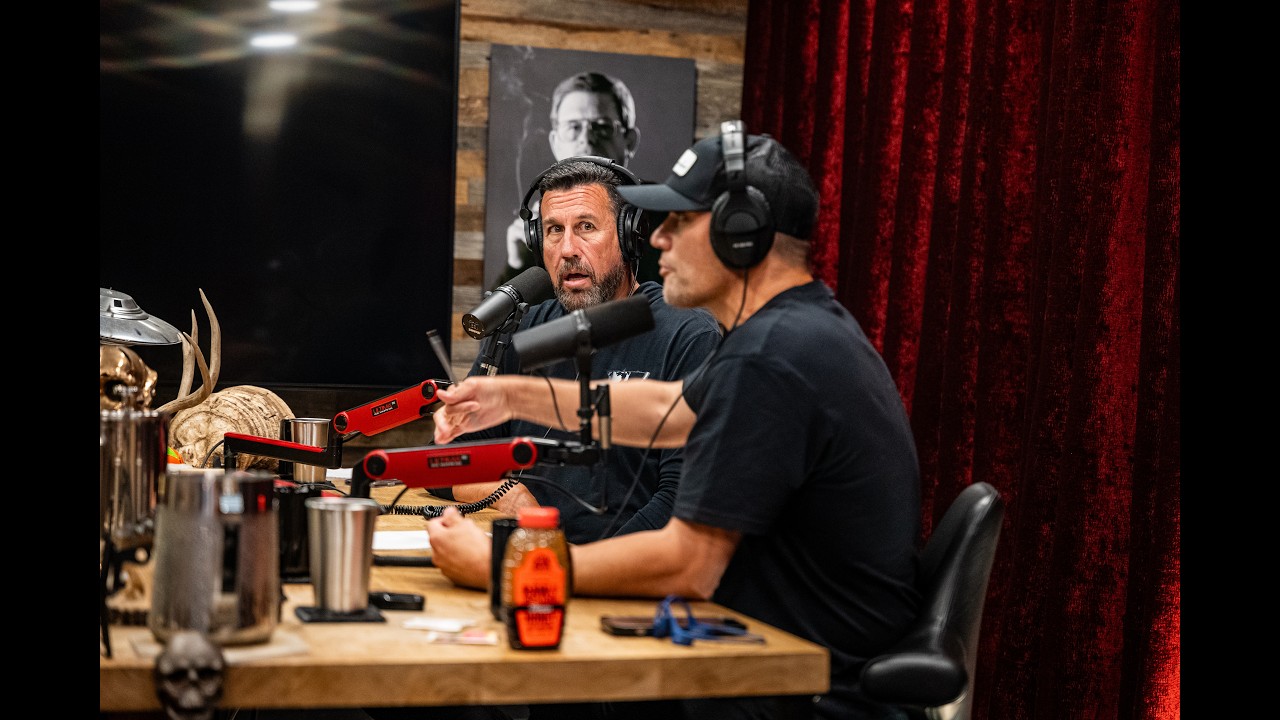
Trump Bypasses White House Bureaucracy to Fast-Track Veterans' Ibogaine Initiative After Text Message
PowerfulJRE
The federal government's drug regulation system forces traumatized military veterans to seek life-saving psychological treatments in Mexico, a crisis resolving only when presidential intervention bypasses institutional resistance entirely via direct text messaging.
## Detailed walkthrough
### [00:01](https://www.youtube.com/watch?v=OMxdrALf8D4&t=1s) The Debate Over Referee Transparency
The conversation kicks off with a warm welcome and mutual praise for their respective work in the MMA space. Joe Rogan notes his disappointment that his guests have stepped away from their joint show, which prompts an explanation regarding the restrictions placed on active referees. When refereeing again, certain bodies restrict them from publicly discussing promotions, specific fighters, or systemic issues. To navigate this constraint, they created "McCarthy Mondays" as a dedicated space to safely analyze specific incidents, such as the Joe Schilling situation, and keep the refereeing perspective involved in the community.
Rogan expresses strong frustration with these rules, arguing that transparency is vital and that active referees should have a regular platform to explain their perspectives and decisions. He points out that commentators are free to speak objectively and argues that allowing referees to do the same would benefit everyone. While it is acknowledged that commissions often fear referees saying too much and causing public relations issues, Rogan insists that open dialogue is the only way the sport actually evolves and fixes its flaws.
* "It's not a problem if it's the truth."
* The sport has historically improved through public complaints, such as altering the "downed opponent" rule regarding hands on the canvas.
[00:22](https://www.youtube.com/watch?v=OMxdrALf8D4&t=22s) The Complications of Regional Rules and the 12-to-6 Elbow
The discussion shifts to the practical absurdity of inconsistent rules across different athletic commissions, highlighting a recent event in New Jersey where 12-to-6 elbows remained banned despite broader rule updates. This lack of uniformity creates an incredibly unfair environment for fighters. When the Association of Boxing Commissions (ABC) passes rule changes, officials typically give fighters a six-month window to adjust their training habits. Forcing a fighter to suddenly revert to outdated rules for a single location mid-career is widely criticized as a failure of regulatory common sense.
Rogan is astonished to learn that his own broadcast partner, Daniel Cormier, was actually a vocal proponent of keeping the 12-to-6 elbow ban because he genuinely believed the technique was too dangerous. Rogan playfully rejects this, arguing that if the sport is going to ban highly damaging moves based on career-altering potential, sidekicks to the knee should be the priority. This sparks a brief debate on the hierarchy of damage in MMA, comparing a severely compromised joint to brain trauma.
* Mention of the Khalil Rountree vs. Modestas Bukauskas fight as a prime example of a devastating oblique kick that sidelined a fighter for a year or longer.
* Mention of Edson Barboza’s legendary wheel kick knockout against Terry Etim, which stood as the first wheel kick KO executed in the United States and permanently altered Etim's career trajectory.
[05:15](https://www.youtube.com/watch?v=OMxdrALf8D4&t=315s) Dangerous Techniques, Pride Rules, and the Shogun Era
The guests discuss their views on rule variations, such as those used in Rizin, with a specific focus on knees and stomps to a grounded opponent. While some advocate for ground knees in a ring environment—where a mobile, conscious fighter can theoretically use defensive movement to evade them—the dynamic changes completely when a fighter is pinned against a cage. The speakers largely agree that soccer kicks and stomps are rarely used as an effective, technical opening against an unhurt opponent; historically, they are almost exclusively deployed to finish a fighter who is already severely dazed or incapacitated.
This leads into a nostalgic look back at the Pride Fighting Championships era, particularly the hyper-aggressive style of the Chute Boxe Academy out of Curitiba, Brazil. They recount how fans who only watched Maurício "Shogun" Rua in the UFC completely missed his absolute prime. His legendary performance against Quinton "Rampage" Jackson served as a massive coming-out party where he completely annihilated an established star. Shogun's brother, Murilo "Ninja" Rua, is also recalled as an incredibly nasty, phenomenal striker, though his career eventually suffered after taking heavy shots while moving up to fight much larger heavyweights.
* Discussion of Kazushi Sakuraba’s famous "Mongolian stomps," which usually missed or hit nothing if the opponent wasn't already hurt.
* Mention of Ikuhisa Minowa fighting Phil Baroni, where Baroni utilized stomps when takedowns failed.
[07:08](https://www.youtube.com/watch?v=OMxdrALf8D4&t=428s) The Wild Legacy of Aleksander Emelianenko
The conversation turns to the heavyweights of the era, specifically recalling the terrifying and erratic Aleksander Emelianenko. The speakers laugh over his choice of ink, directing Jamie to pull up images of the massive, grim tattoo on his back depicting the Grim Reaper holding a baby with a sword and a crown. They joke that the tattoo looks like classic, ballpoint-pen-and-sewing-needle Russian prison art rather than professional ink.
They contrast Aleksander’s wild, chaotic energy with his brother, Fedor Emelianenko, who wore no tattoos except a small wooden cross and carried himself with total stoicism. To illustrate Aleksander's terrifying peak, they recount his fight against James Thompson. Thompson entered the ring looking like a hyper-aggressive, heavily muscled "Greek god," screaming and pounding his chest in a state of high adrenaline. In stark contrast, Aleksander stood completely relaxed, looking as bored "as he was ordering a sandwich" with Swiss cheese and mustard, before immediately dropping and rocking Thompson with fluid, whipping, Soviet-style boxing punches.
* "God is with us" tattoo text discussed skeptically in relation to the grim imagery.
* Description of the Soviet boxing style: highly relaxed frames that explode into fast, whipping punches.
[10:25](https://www.youtube.com/watch?v=OMxdrALf8D4&t=625s) Analyzing the Greatness of Fedor Emelianenko
One of the guests shares a personal memory of working out with Fedor Emelianenko, describing it as a career highlight despite getting thoroughly outmatched. He debunks the myth that Fedor relied purely on brute, "old-man strength," explaining that Fedor's true gift was his blistering, explosive speed and an unpredictable, hands-down posture that hid his striking angles. Fedor forced opponents to match an incredibly high RPM, causing them to tire out rapidly while he remained perfectly conditioned. While his smaller stature as a heavyweight was a massive speed advantage in his prime, they note it would pose a severe stylistic challenge against modern giants like Francis Ngannou, whose sheer size, patience, and "nuclear power" can end a fight even with a glancing blow to the top of the head.
The conversation concludes with an analytical breakdown of Fedor’s legendary fight against Mirko Cro Cop. Fedor completely nullified the feared Croatian striker by writing the perfect blueprint: marching forward, keeping Cro Cop on his back foot, and fighting him in a "phone booth" where the legendary left high kick couldn't generate leverage. Fedor was entirely unconcerned with falling or slipping because his grappling, body locks, and lightning-fast transitions from his guard were so elite.
* Fedor’s striking style is compared to modern boxing champion Dmitry Bivol for its relaxed rhythm followed by sudden, explosive distance closing.
* Mentions of Rich Franklin's striking style of looping punches around an opponent's guard, similar to Fedor's overhand right.
* Recall of Fedor's iconic submission win over the massive Hong Man Choi, where he secured a rapid armbar despite the immense size discrepancy.
* A vivid mental image of Heath Herring’s ribs being visibly deformed by the sheer depth of a Cro Cop body kick from a different classic bout.
[14:12](https://www.youtube.com/watch?v=OMxdrALf8D4&t=852s) Striking Explosiveness and the Evolution of MMA Kickboxing
The speakers discuss the terrifying physical toll of elite body kicks, recalling how Wanderlei Silva's ribs were completely "tore up" from absorbing heavy impacts. They look at a photo illustrating the severe damage, prompting one speaker to grimly joke about knowing exactly how much that hurts. They describe the total-body shutdown that occurs under such trauma: "your entire body is going, I quit."
The conversation transitions to Mirko Cro Cop and his revolutionary impact on the sport. He was arguably the first fighter to successfully transition from pure kickboxing to MMA by relying on pure explosive power. While Maurice Smith deserves historical credit as the true pioneer of this transition, Cro Cop perfected it during the legendary Pride Fighting Championships era. Other elite contemporary kickboxers like Ernesto Hoost struggled to replicate that success in MMA. While Hoost only faced Bob Sapp in a kickboxing match, Cro Cop famously destroyed Sapp in the same era using that signature explosiveness. The difference lay in the style of delivery; elite strikers like Peter Aerts required time to establish a rhythmic exchange, whereas Cro Cop launched single, devastating shots that "were coming at you like nuclear missiles."
- Wanderlei Silva suffered severe, visible rib damage from heavy body kicks.
- Maurice Smith is recognized as the first to figure out the kickboxing-to-MMA transition.
- Mirko Cro Cop successfully adapted his kickboxing to Pride MMA through immense explosiveness.
- Classic kickboxers like Peter Aerts struggled in MMA due to their need to find a rhythm rather than throwing explosive one-shots.
[15:33](https://www.youtube.com/watch?v=OMxdrALf8D4&t=933s) Preposterous Kicking Accuracy and Fighter Matchups
The panel praises Cro Cop's legendary status, universally agreeing that his left kick stands as the absolute greatest the sport of MMA has ever seen, leaving no obvious contender for second place. The only kick mentioned in the same realm of absurdity is Edson Barbosa's switch kick, which was "preposterous" in its prime due to its exceptional speed and accuracy. One speaker recalls watching Barbosa in astonishment, wondering if something was wrong with their eyes because a featherweight-sized fighter was moving with such blinding velocity.
A humorous behind-the-scenes anecdote emerges as a speaker reveals that UFC CEO Dana White called him multiple times to accept a fight against Barbosa. At the time, the speaker was ranked number three, while Barbosa had just scratched the top fifteen at number fifteen. The speaker flatly declined, laughing as he reenacts telling White: "Sorry dude... Give me a higher ranked guy. Make it make sense."
- Edson Barbosa’s switch kick is highlighted for its unbelievable, lightweight-speed mechanics.
- A speaker turned down a fight against a #15-ranked Barbosa while holding the #3 ranking spot.
[16:32](https://www.youtube.com/watch?v=OMxdrALf8D4&t=992s) José Aldo’s Historic Takedown Defense and Soccer Roots
The conversation shifts to the longevity and elite standup pedigree of José Aldo. When Aldo first arrived in the major promotion via the WEC, his striking capability was on a completely different level, characterized predominantly by his devastating kicking game. While his boxing was initially not as threatening as his kicks, the speakers note that if he had developed a body-punching and head-kick transition game comparable to his peak form earlier, he would have been even more unstoppable.
Aldo’s legendary takedown defense is hailed as arguably the best the sport has ever seen, rivaled only by BJ Penn in his prime, who was famous for his absurd balance and "one leg hop" defense. As proof of Aldo's unmatched defensive grappling, they cite his three-round battle against Merab Dvalishvili. Merab, famous for his relentless pace, shot for an estimated 90 takedowns and failed to secure a single one, forcing him to win a close decision purely through cage pressure, short punches, and control against the fence.
- José Aldo transitioned from a dominant WEC run to become a legendary UFC champion.
- BJ Penn in his prime is noted alongside Aldo for having "insane" balance and takedown defense.
- Merab Dvalishvili shot an extraordinary number of takedowns against Aldo and failed to complete one.
[18:06](https://www.youtube.com/watch?v=OMxdrALf8D4&t=1086s) The Athletic Benefits of a Soccer Base in MMA
The speakers trace José Aldo's unbelievable hip flexibility and endless gas tank back to his background as an elite soccer player. They describe watching professional soccer matches live and being stunned by the unrelenting pace, noting that there are no commercial breaks or timeouts to slow down. Soccer players develop massive leg power and exceptional cardiovascular conditioning from sprinting all day.
This professional soccer background translates seamlessly to the cage for footwork, movement, and kicking mechanics. Crucially, soccer mirrors the "stop and go" anaerobic nature of an MMA fight. In a fight, a competitor might secure a takedown, rest for a brief second, and then immediately have to sprint or exert maximum energy again when their opponent postures back up. Soccer requires that exact same continuous cycle of hard down-the-line sprinting, recovery jogging, and instant explosive reaction.
- Professional soccer's lack of frequent breaks builds elite endurance and massive leg power.
- The anaerobic "stop and go" rhythm of soccer perfectly prepares athletes for the scrambling pacing of MMA.
[18:54](https://www.youtube.com/watch?v=OMxdrALf8D4&t=1134s) Commercial Break: The Farmer's Dog
The podcast cuts to a promotional segment for The Farmer's Dog. The host shares a research-backed fact indicating that dogs maintaining a healthy weight can live up to two and a half years longer on average than overweight dogs. He questions why feeding vague scoops of ultra-processed kibble remains the industry standard when fresh, human-grade alternatives exist. The host feeds his own two dogs fresh recipes made from real meat and vegetables that are gently cooked to preserve vital nutrients. The meals are pre-portioned to meet specific nutritional needs, simplifying weight management. The segment concludes with a promotional offer for new customers to receive 50% off their first box and free shipping by visiting [thefarmersdog.com/rogan](https://thefarmersdog.com/rogan).
[20:11](https://www.youtube.com/watch?v=OMxdrALf8D4&t=1211s) The Brutality of Weight Cutting and Sports Disparities
Resuming the conversation, the hosts explore how specific athletic backgrounds provide massive advantages in MMA, identifying soccer and wrestling as the two premier foundational bases. Wrestling instills a brutal grinding mentality and the deep psychological understanding that an athlete can "break another human being" through pure pressure and weight. Both sports require an athlete to get comfortable with extreme suffering, severe fatigue, and performing while dehydrated.
The speakers label weight cutting as "the grossest thing in MMA" and a practice that promotions desperately need to eliminate. They point out a baffling double standard in professional sports: while teams in soccer, football, baseball, and basketball employ dedicated team chefs to ensure their athletes are perfectly nourished and physically primed, combat sports actively starve and dehydrate their fighters 24 hours before entering the most dangerous environment in the world.
- Wrestling teaches a unique mental grind designed to break an opponent through physical pressure.
- Weight cutting is heavily criticized as a dangerous, counterproductive practice unique to combat sports.
[21:43](https://www.youtube.com/watch?v=OMxdrALf8D4&t=1303s) The Logistics and Roadblocks of Preventing Weight Cuts
The panel debates how to fix the weight cutting epidemic. One speaker argues that even if weigh-ins occurred on the day of the fight, desperate fighters would still dehydrate themselves, making it even more hazardous. A proposed solution is introducing random, year-round promotional weigh-ins at a fighter's home or gym, mandating that an athlete fighting at 170 pounds can never walk around at more than 180 pounds on any given day.
However, major logistical roadblocks prevent this from becoming an industry-wide standard. Athletic commissions, such as those in Texas or California, can only legally mandate drug or weight testing if a fighter is actively licensed in that state for that specific calendar year. While a wealthy promotion like the UFC has the financial capital to implement its own year-round internal weight-checking program, doing so would cost millions and risk canceling highly anticipated fights if athletes failed to comply.
- Day-of weigh-ins could backfire by forcing fighters to step into the cage dangerously dehydrated.
- State athletic commissions face jurisdictional limitations that prevent them from enforcing year-round random weigh-ins.
- Implementing an internal testing system introduces a financial risk of losing high-profile fights due to non-compliance.
[23:11](https://www.youtube.com/watch?v=OMxdrALf8D4&t=1391s) Extreme Weight Cuts and Diminishing Returns
The discussion moves to the concept of diminishing returns regarding extreme weight manipulation. While athletic commissions could theoretically enforce a rule stating a fighter cannot gain back more than five pounds from their weigh-in weight by fight night, promotions resist this out of fear of losing bouts. Furthermore, desperate fighters would simply remain dangerously dehydrated throughout the entirety of their training camp.
Fighters historically ignore strict training structures, with Jon Jones notoriously barely training for his first legendary title defense against Alexander Gustafsson, allegedly only showing up for about ten days. Additionally, modern athletes are pushing human anatomy to its absolute limits. Welterweight Michael Morales walks around between 205 and 212 pounds, and middleweights like Gregory Rodriguez and Alex Pereira look impossibly large for the 185-pound division. Pereira is described as a "226-pound Amazon warrior that pretended to be 185 for five minutes." The severe dehydration heavily compromised Pereira's chin at middleweight, as he was routinely rocked by shots that did not bother him once he moved up to the 205-pound light heavyweight division.
- Jon Jones famously spent minimal time training for his first classic bout against Alexander Gustafsson.
- Michael Morales walks around up to 40 pounds heavier than his official 170-pound welterweight limit.
- Alex Pereira currently walks around near 250 pounds, a staggering 70-pound increase from his original UFC debut weight.
- Extreme weight cutting severely compromises a fighter's ability to absorb clean strikes to the head.
[25:55](https://www.youtube.com/watch?v=OMxdrALf8D4&t=1555s) Speed Versus Mass and Max Holloway's Weight Class Transitions
The speakers break down the classic trade-off between speed and mass in combat sports. In pure striking arts like Taekwondo, speed is king. However, in MMA, grappling changes the equation entirely; if a massive, heavy opponent manages to secure top control, an elite striker's speed is completely neutralized within the first three to four minutes. While being the bigger, stronger fighter allows you to maul people, that strength fades fast if achieved via a brutal dehydration process. Conversely, rare anomalies like featherweight Conor McGregor managed to retain terrifying, blinding speed despite cutting weight until he literally "looked like death" and resembled a "concentration camp victim" at the weigh-ins.
The panel analyzes the recent trend of fighters finding massive career renaissances simply by moving up a weight class. They cite Max Holloway's lightweight evolution as a prime example. Dustin Poirier recently noted on the podcast that during Holloway's first brief move up to 155 pounds, he failed to put on the muscle mass properly. However, for his BMF title fight against Justin Gaethje, Holloway structured the weight gain perfectly, resulting in a monumental difference in his raw power, mobility, and cage movement. The walkthrough concludes with a debate over whether Holloway made a mistake by dropping back down to 145 pounds to challenge Ilia Topuria for a world title immediately after his historic lightweight performance, considering Topuria's smaller stature compared to lightweight champion Islam Makhachev.
- Grappling allows heavier fighters to completely nullify a faster opponent's speed advantage.
- Conor McGregor's historic 145-pound cuts left him looking severely emaciated despite his fight-day success.
- Dustin Poirier noted that Max Holloway's physical preparation for his lightweight bout against Justin Gaethje vastly improved his power and mobility.
- The speakers debate the wisdom of Holloway returning to featherweight after achieving peak physical form at lightweight.
[28:44](https://www.youtube.com/watch?v=OMxdrALf8D4&t=1724s) The Versatility of Islam Makhachev and Weight Cut Dangers
Islam Makhachev is a terrifying force once he secures a hold on an opponent, famously submitting almost everyone in his path. However, his standup game is vastly underrated. The panel recalls how he "smothers everybody," yet his striking remains dangerous as can be, highlighted by a sneaky, nasty left head kick that completely blindsides opponents just as they get accustomed to worrying about his wrestling. His head-kick knockout of Alexander Volkanovski stands out as prime evidence, regardless of Volkanovski taking that fight on 11 days' notice.
The discussion shifts to Max Holloway's recent trajectory. Holloway put on weight flawlessly for his spectacular performance against Justin Gaethje, making his subsequent decision to cut back down to 145 pounds to fight Ilia Topuria highly questionable. The physical toll of killing oneself to drop weight after properly building up a frame with a rigorous strength and conditioning program often backfires. This mimics the historic misstep of Roy Jones Jr., who bulked up to heavyweight to fight John Ruiz, only to strip the weight back down to 175 pounds, where he was promptly knocked out by Antonio Tarver. Your body simply does not want to go back down after spending a year lifting weights and packing on genuine size.
- Max Holloway reportedly weighed 178 pounds on the night of his first title fight against José Aldo, despite weighing in at the 145-pound championship limit.
- Even factoring in street clothes, Holloway was stepping into the cage carrying an extra 20-plus pounds.
[30:26](https://www.youtube.com/watch?v=OMxdrALf8D4&t=1826s) Massive Weight Cuts and Anthony "Rumble" Johnson's Legacy
Extreme weight cutting is an ongoing reality in modern combat sports, highlighted by a recent MVP event on Netflix held at the Intuit Dome in California. During this show, Namo Fazil recorded a staggering weight gain of 27.2 pounds between the weigh-ins and the fight, entering the cage at 198 pounds for a 170-pound welterweight contest. This extreme fluctuation mirrors the jaw-dropping cuts historically pulled off by Anthony "Rumble" Johnson, who used to walk around at 230 pounds while somehow forcing his body down to the welterweight limit.
A similar physical discrepancy was on display when Sean Rodriguez Morales fought Sean Brady. Brady is a thick, stocky, and incredibly well-put-together human being, yet Morales made him look like a lightweight by comparison. The visual contrast was so striking on television that observers initially assumed it was an optical illusion caused by the camera angle. However, even when Morales shifted further away from the lens, he remained noticeably larger. These extreme cuts raise serious, grim questions about long-term health, as fighters are "basically killing your kidneys every time you do it."
- Namo Fazil gained 27.2 pounds post-weigh-in at the MVP California event.
- Anthony "Rumble" Johnson routinely cut from 230 pounds down to 170 pounds early in his career, a process that severely impacted his health and led to frequent missed weights.
- Weight cutting is described metaphorically as leaving "small bits and pieces of yourself... in that damn cage every time."
[32:44](https://www.youtube.com/watch?v=OMxdrALf8D4&t=1964s) The Evolution and Cleverness of Andrei Arlovski
Anthony Johnson possessed massive, natural power that allowed him to excel later at heavyweight, famously breaking Andrei Arlovski's jaw during a World Series of Fighting bout years ago. Arlovski, remarkably, has enjoyed one of the most enduring careers in MMA history, with his promotional debut dating all the way back to UFC 28. To survive spanning decades in the sport, Arlovski completely revolutionized his fighting style. He transformed from a wild, big power puncher into a highly technical volume striker. After going through a rough patch where he was getting clipped and hurt frequently, he adjusted by fighting either completely "all the way in or all the way out," smothering opponents in the phone booth to deny them leverage for big power shots.
This clever approach allowed Arlovski to minimize damage while capturing major wins, such as his prime-era victory over Travis Browne in an awesome, frantic fight, and his technical beating of Ben Rothwell. Rothwell, a literal tank of a man who resembles a scary, hairy bear, was completely busted up by Arlovski's slick movement. Arlovski's toughness and enthusiasm for combat have never waned, even into his later years, leading to bizarre encounters like fighting off a group of influencers and their hesitant bodyguard at a public show.
- Andrei Arlovski's UFC career began at UFC 28.
- Ben Rothwell is noted to weigh close to 400 pounds outside of competition.
- Arlovski broke Rothwell down despite the massive size difference by fighting smart and technical.
- Ringside doctors often stop fights due to cuts near the tear duct rather than standard forehead lacerations due to structural risk.
[35:36](https://www.youtube.com/watch?v=OMxdrALf8D4&t=2136s) The Controversial Rico Verhoeven vs. Oleksandr Usyk Stoppage
The conversation shifts to a major crossover boxing match between kickboxing legend Rico Verhoeven and heavyweight boxing king Oleksandr Usyk. Entering the bout, many expected Verhoeven to hold his own early before succumbing to Usyk's pacing in the later rounds. Instead, Verhoeven shocked onlookers by fighting an incredibly disciplined, clever fight. He closed the distance perfectly, entering the phone booth to disrupt Usyk’s rhythm. Verhoeven, widely considered the greatest kickboxer of all time with an undefeated streak spanning over a decade, proved his world-class conditioning could easily match the 12-round boxing pace.
Controversy erupted in the 11th round when the fight was stopped. While Usyk was reportedly up two rounds to one on some early scorecards, Verhoeven appeared to be winning the actual fight comfortably, potentially 8-2 in rounds on an intuitive scorecard. Usyk blasted Verhoeven with a beautiful uppercut, scoring a legitimate knockdown. However, the subsequent refereeing sequence was a total mess. Verhoeven lost his mouthpiece during the fall, and rather than a swift restart, a lengthy 30-second delay ensued as Verhoeven lumbered to his corner to rinse the guard—a tactical stall any smart fighter would utilize. The referee then stopped the contest while Verhoeven was still on his feet, actively moving and covering up right at the sound of the bell.
- Rico Verhoeven has been undefeated in kickboxing for over 10 years.
- The fight was halted in the 11th round during a controversial sequence involving a dropped mouthpiece and an immediate post-knockdown flurry.
- The stoppage was heavily criticized because Verhoeven had a full minute of impending corner rest to recover from the knockdown.
[39:04](https://www.youtube.com/watch?v=OMxdrALf8D4&t=2344s) The Evolution of Mouthpiece Rules and "Boil-and-Bite" Anomalies
The extended delay to clean Verhoeven's mouthpiece highlights a stark difference in modern refereeing standards. Under traditional boxing officiating, a dropped mouthpiece mandatorily had to be taken to the corner, rinsed with water, and reinserted. However, modern MMA influences have changed the unified rules in North America; officials now routinely grab a mouthpiece off the canvas, pop it straight back into the fighter's mouth, and resume the action instantly to preserve the fair advantage earned by the attacking fighter. Rinsing a mouthpiece with standard corner water does absolutely nothing to disinfect it anyway.
The referee in Egypt failed to apply these advanced officiating mechanics, inadvertently gifting Verhoeven extra recovery time after Usyk's knockdown. Furthermore, Verhoeven's mouthpiece fell out multiple times during the bout, which is a bizarre equipment failure for a world-class heavyweight champion. It prompts jokes that he might be using a cheap, over-the-counter "boil-and-bite" guard. This reminds the panel of old-school fighter Karo Parisyan, who famously took eccentricity to the extreme by wearing a standard boil-and-bite mouthpiece straight out of the plastic packaging without ever boiling it to fit his teeth.
- Modern North American unified rules dictate that a dropped mouthpiece should be replaced immediately without a corner rinse to avoid pausing a fighter's momentum.
- International bouts, such as those in Egypt, often suffer from disparate refereeing standards if local officials have not undergone advanced modern training.
- Karo Parisyan used to fight using unboiled, un-molded mouthpieces straight out of the box.
The Danger of Thai Steel Cups and Bizarre Grappling Moments
The speakers express mutual astonishment over the fact that fighters are still allowed to wear traditional Thai steel cups in the cage, with both agreeing that the practice is "crazy" and should be entirely illegal. While one speaker notes that a steel cup was all he ever wore during his own career, the other highlights the hidden danger of the gear: if a fighter accidentally kicks the metal cup with their toe, the force can shatter the toe completely.
This leads into a humorous and somewhat tense recollection of how oversized or metal cups affect grappling positions. They joke about the "north-south position" where a fighter can essentially "start humping their head" to give an opponent "the business." A specific anecdote is shared about training at Legends with Renavardi, a student of Bas Rutten. During a sparring session, Renavardi mounted the speaker and nearly forced a submission simply by digging his cup directly into the speaker's sternum while grapevining his legs. Another fighter, Shy Carter, was notoriously known for wearing an oversized cup, which gave an unnatural and brutal advantage. The speakers also note that these solid cups are highly effective for leverage in armbars, which leads directly into a discussion of one of the most famous injuries in UFC history.
- Frank Mir famously used the leverage of his cup position to break Tim Sylvia's arm.
- Renavardi trained under Bas Rutten and used extreme top-pressure tactics at the Legends gym.
- Shy Carter was known in the fighting community for utilizing an oversized cup.
Herb Dean's Best Call: The Breaking of Tim Sylvia's Arm
The conversation transitions into a detailed, firsthand walkthrough of the legendary heavyweight title fight where Frank Mir broke Tim Sylvia's arm. One speaker recalls sitting directly in Sylvia's corner alongside Jeremy Horn, Matt Hughes, and Pat Miletich. From their shared vantage point, they watched Mir lock in an armbar, noticing Sylvia’s elbow pop out away from his hip. Suddenly, referee Herb Dean stepped in to stop the fight. The corner went absolutely wild, screaming, "What are you doing?" and calling Dean every name in the book because they believed the stoppage was premature.
The speaker recounts walking right into the Octagon to confront the referee, asking, "Herb, what did you have?" Dean emphatically replied, "John, his arm broke. I heard it and I saw it." Despite the immediate backlash and heavy booing from the arena crowd, Dean stood his ground against the initial skepticism of the Nevada State Athletic Commission's medical staff, who initially claimed nothing was wrong with the arm. The speaker laughs as he recalls Herb's legendary, uncharacteristic response to the doctors: "X-ray that motherfucker. It's broken." Sure enough, the X-ray revealed a clean break straight across both forearm bones. On the television replays, the break was undeniable, showing two distinct pops and a horrifying visual where the forearm bent "like a piece of plastic."
- The corner crew for Tim Sylvia during the fight consisted of Jeremy Horn, Matt Hughes, and Pat Miletich.
- Herb Dean was the referee responsible for the historic, safety-first stoppage.
- The injury was a severe fracture across both bones of Tim Sylvia's forearm.
- Frank Mir is noted for his history of breaking limbs, including a later spiral fracture of Antônio Rodrigo Nogueira's arm via kimura.
Protecting Fighters From Themselves
Reflecting on the aftermath of the Mir-Sylvia fight, the speakers discuss the mindset of elite athletes who refuse to quit. Even as his arm hung uselessly at his side and the reality of the pain set in, Sylvia was actively complaining about the stoppage. The hosts marvel at how much of an "animal" Sylvia was, noting that he genuinely wanted to keep fighting with a broken arm—a decision that could have led to severe, permanent damage or even amputation. They criticize media commentators who blindly argue, "if he wants to fight, let him fight," calling that mindset foolish. "This is you got to protect the fighter from themselves," they emphasize, reminding listeners that mixed martial arts is a sport, not a matter of life and death.
They point out other insane displays of toughness in the sport, such as Carlos Ulberg knocking out Jiří Procházka right as his own knee was clearly blowing out, or Thiago Santos fighting Jon Jones through a split decision with two torn knee ligaments (ACL/PCL). They joke that Santos was so close to winning that fight, it would have only taken "one more incompetent judge" to change history.
The Nuances and Hardships of MMA Judging
The mention of judging shifts the discussion into a critique of incompetent scoring in combat sports. They bring up Oleksandr Usyk's recent high-stakes boxing matches, noting how absurd it is when judges' scores fail to reflect the clear reality of a fight, especially when an undefeated record and massive sums of money are on the line. They reminisce about notorious judging blunders in boxing, such as the controversial scores in Manny Pacquiao vs. Tim Bradley and Canelo Álvarez vs. Gennady Golovkin ("Triple G"), specifically mentioning judge Adelaide Bird. While Bird took immense flak for her Canelo vs. GGG scorecard, one speaker defends her work ethic, noting that she spends an immense amount of time studying, attending trainings, and asking questions to improve, even if she doesn't have a personal background in rolling or grappling.
The conversation uncovers a dark side of the sport: the vulnerability of the scoring system to betting manipulation. A corrupt or incompetent judge doesn't need to completely fabricate a blowout; they simply have to score it for the wrong guy to create a split decision, allowing people to clear "a ton of loot" on betting props. The hosts note that the FBI has actively investigated a number of UFC fights due to suspicious, improper betting patterns.
- Adelaide Bird was the controversial judge behind the infamous Canelo vs. Triple G scorecard, though she still actively judges for the UFC.
- The FBI has launched investigations into multiple UFC fights concerning irregular betting activities.
- The Verdict MMA app is praised by the hosts as being highly accurate, with one stating he agrees with the fan-sourced Verdict score "most of the time out of a 100 fights."
Inside the Judge's Seat and the Problem with Win Bonuses
An insider perspective is shared regarding how closely tight-knit the UFC officiating community is. During events, officials and fighters are constantly on text chains, blowing up each other's phones to debate close rounds. The speaker argues that the media frequently labels close fights as "robberies" when they are simply tight matches. To prove his point, he once had a critic sit exactly where a judge sits. Unlike commentators who have luxury monitors and shifting broadcast angles, judges are fixed in one spot, sometimes saddled with "the worst seat in the house" behind an Octagon post. They clarify that a split decision isn't inherently a sign of bad judging, and adding five judges instead of three doesn't actually change the outcomes. The true issue arises when events are on the road and athletic commissions force the use of untrained, local officials.
Finally, the conversation pivots to fighter pay and the hosts' mutual hatred for the standard "win bonus" structure. They strongly believe prize fighters should be paid a flat, guaranteed purse to compete rather than having half of their income dependent on the subjective whim of a judge. They dismiss the idea that a win bonus makes elite athletes fight harder. By the time a fighter reaches the top 15, their pride, ego, and world-class status drive them to win, not an extra check. They joke that before a fight, a fighter scheduled for a "40/40" ( $40,000 to show, $40,000 to win) or "50/50" contract mentally tells themselves they are making $100,000 because they have already spent the win bonus in their head.
- The speakers advocate for restructuring pay to an 80/20 split heavily favoring the guaranteed show money, supplemented by independent performance bonuses for finishes (e.g., an extra $20,000 or $50,000 for a knockout).
- Traditional fighter contract examples mentioned include 40/40 ($40k show / $40k win) and 50/50 ($50k show / $50k win) structures.
[56:11](https://www.youtube.com/watch?v=OMxdrALf8D4&t=3371s) Fighter Financials and Motorcycle Madness
The conversation kicks off with a laugh about how fighters generally are "not the best at saving cash" due to their impulsive natures. However, Sean Strickland is brought up as a surprising exception to the rule. Despite his reckless public persona, he is described as "very smart with his money" and incredibly frugal. While other fighters blow their paychecks on designer jeans, shirts, and expensive glasses, Strickland is known for buying basic Wranglers and wearing the exact same outfit—complete with a white tank top—every day. The speakers emphasize that learning to be frugal is vital for any athlete, given the brief window of their professional careers.
Strickland's eccentricities don't stop at his wardrobe; he also famously still rides a motorcycle, a habit that one speaker flat-out calls "psychopathic." This triggers a discussion on the extreme dangers of riding. One of the speakers reveals that he completely abandoned the idea of getting a motorcycle license after witnessing two friends wipe out—one severely injuring his shoulder—and seeing former UFC Heavyweight Champion Frank Mir break his femur after getting T-boned. They invoke the grim, old saying: "there's two types of motorcycle riders: ones that have been down and ones that are going down." For a jiu-jitsu practitioner already hurting their body every day in training, adding the risk of the open road is deemed entirely unnecessary.
The speakers laugh about how terrifyingly easy it is for an inexperienced person to buy a high-powered machine without knowing how to handle it. They compare buying a modern sports bike to going to a dealership, picking up a 1,000-horsepower Corvette ZR1, and handing a "fighter jet on wheels" over to some rich kid who has no idea how to actually drive it.
* **Sean Strickland's Wardrobe:** Prefers simple Wranglers and white tank tops over luxury brands, allowing him to save a massive amount of money.
* **Frank Mir Accident:** The severe femur break suffered by Frank Mir in a T-bone collision served as the ultimate deterrent for one speaker to never get a motorcycle license.
* **The Corvette ZR1 Analogy:** Used to describe the insanity of letting untrained individuals operate hyper-powerful vehicles on public roads.
---
[58:00](https://www.youtube.com/watch?v=OMxdrALf8D4&t=3480s) Living Below Your Means: From Rampage's Fleet to Forest's Scion
The dialogue transitions from Strickland's frugality to a broader critique of how fighters manage their wealth. One speaker recalls having intense arguments with Quinton "Rampage" Jackson over his excessive car collection. Rampage reportedly owned eight different cars, prompting the speaker to bluntly ask him, "Dude, how many cars can you put your ass in at one time?" The core issue is that athletes frequently blow through irreplaceable money on depreciating assets, though they note it is fine if someone buys muscle cars or classic vehicles that actually hold or gain value as investments.
To illustrate how a smart fighter should live, they point to UFC Hall of Famer Forest Griffin. After winning the inaugural season of *The Ultimate Fighter*, Griffin received a Scion and proceeded to drive it "into the ground." The car was in such terrible shape toward the end that the exterior door handles fell off, forcing Griffin to roll down the window just to open the door from the outside. The speakers chuckle fondly over what a "character" Griffin is, but stress that his extreme frugality is exactly how professional athletes need to live, especially early in their careers when they have no idea how long their success will last. While luxury and nice things are comfortable, they warn that such soft living can ultimately slow a fighter down.
---
[59:00](https://www.youtube.com/watch?v=OMxdrALf8D4&t=3540s) Arman Tsarukyan: The Rule-Breaking Contender
Arman Tsarukyan is brought up as the ultimate exception to the rule that luxury softens a fighter. Jokingly dubbed a "rich kid" who breaks the whole rulebook, Tsarukyan is praised as an absolute "stud" who is built like a Greek god and "fights like a demon." His work ethic is relentless; he constantly competes in wrestling and is noted to be wrestling over the upcoming weekend at a "Rough Wrestling" (RAF) event in Arlington.
The speakers reflect on Tsarukyan's current trajectory, noting that missing out on an immediate title fight might actually be the best thing to happen to him because it has allowed him to build immense momentum. He completely capitalized on a bad situation, which included a chaotic headbutt incident with Dan Hooker. From a promoter's perspective, that incident was terrifying because a severe cut could have forced the promotion to pull the fight entirely, costing a massive amount of money. Despite being a "knucklehead" at times, Tsarukyan's promotional work with his own media and "Nina Drama" has kept everyone talking about him. The speakers agree he is the single most interesting contender for Ilia Topuria due to his elite wrestling skills and his sheer size, noting he is a very large lightweight.
---
[01:00:10](https://www.youtube.com/watch?v=OMxdrALf8D4&t=3610s) Overlooking Justin Gaethje and the Shadow of Ilia Topuria
The conversation shifts to a discussion from a show the previous day, where the speaker asked Daniel Cormier and Dustin Poirier why the public seems to be overlooking Justin Gaethje. On paper, Gaethje possesses every single tool to defeat Ilia Topuria: Topuria is notoriously heavy on his lead leg, while Gaethje possesses a devastatingly heavy leg kick and a lethal uppercut. Furthermore, Gaethje is a much larger fighter who will never make 145 pounds, paired with a high-level wrestling background and terrifyingly savage striking.
To illustrate Gaethje's authentic "savage" nature, they look back at his UFC debut against Michael Johnson, where he threw himself into a chaotic war, and his performance against Paddy Pimblett. In the Pimblett fight, instead of fighting cleanly, Gaethje essentially said, "Fuck you," walked his opponent down, and blasted him apart. He is described as a hyper-focused, incredibly scary dude who is approaching his "last dance." The only reason people are overlooking him and predicting a knockout loss is because Ilia Topuria has looked so utterly unstoppable, destroying three consecutive legends of the sport.
* **Topuria's Three-Fight Streak:** Earned consecutive knockout victories over Max Holloway, Alexander Volkanovski, and Charles "Do Bronx" Oliveira.
* **The Weight Cut Factor:** Max Holloway's performance was hindered by moving up to 155 pounds and then cutting all the way back down to 145 pounds before getting knocked out.
---
[01:02:00](https://www.youtube.com/watch?v=OMxdrALf8D4&t=3720s) The Danger of Short-Notice Fights and Brain Trauma
The speakers debate whether Topuria's historic streak deserves an asterisk due to the circumstances of his opponents. While Charles Oliveira was a clean win, Alexander Volkanovski took the fight just four months after being brutally knocked out by a head kick from Islam Makhachev. The speakers argue vehemently that Volkanovski's coaching corner and family should have stepped in to stop him, declaring, "You got headkick four months ago into a coma. There's no [ __ ] chance you should be taking a fight with the scariest puncher in the division." When a fighter is a competitive "animal," they rely on loved ones to be totally honest and save them from their own warrior mentality.
The physiological reality of concussions is analyzed in depth. Going straight back into a training camp after a knockout means the brain never rests. Even if a fighter is just wrestling, the moment the body temperature rises, an unrecovered brain suffers further damage. Volkanovski took the rematch with Islam Makhachev on a mere 11 days' notice with zero camp, literally coming off a vacation where he was "eating barbecue and drinking Fosters." While his mentality cements him as an all-time great who uniquely figured out Max Holloway and cleaned out the featherweight division, taking that short-notice fight was a catastrophic mistake.
To contrast this, they point to Jon Jones's legendary business mindset. When offered a short-notice fight against Chael Sonnen while already in shape, Jones flatly refused, stating he would not fight anyone without a full, specialized training camp. Jones protected his championship status by refusing to give anyone a free chance. Volkanovski lacked this boundary; he expected to replicate his close first fight with Islam, but came into the second fight soft, unconditioned, and facing an Islam Makhachev who had a full 30-plus hours to completely rehydrate and recover on a favorable time zone.
The speakers conclude that because the brain has no nerve endings, it doesn't hurt when it is damaged, making it impossible for a fighter to self-diagnose until severe symptoms manifest. The warning signs are behavioral: persistent headaches, sensitivity to bright lights, and sudden, inexplicable bursts of anger.
* **Jon Jones vs. Chael Sonnen:** Jones famously turned down a short-notice bout with Sonnen to protect his record, demanding a full camp.
* **Makhachev vs. Volkanovski 2:** Volkanovski accepted the fight on 11 days' notice while out of shape, while Makhachev benefited from a full 30+ hour rehydration window.
* **Brain Injury Symptoms:** Mentioned as bright light sensitivity, persistent headaches, and confusion surrounding sudden emotional outbursts of anger.
---
[01:05:26](https://www.youtube.com/watch?v=OMxdrALf8D4&t=3926s) The Haunting Reality of CTE in Combat Sports
The discussion takes a somber turn as the speakers recall specific examples of fighters whose chins and brains were permanently broken by training damage. They bring up a historic bout where Travis Lutter fought Marvin Eastman. Lutter caught Eastman with a completely ordinary, end-of-the-punch straight left hand that had hardly any power behind it. Yet, Eastman's legs completely gave out, and he fell backward. It was later revealed that Eastman had been brutally knocked out twice in training camps by Tito Ortiz right before the fight. Because his brain was already severely damaged, a punch that normally wouldn't have registerd knocked him out cold.
To heal the brain after a concussion, a fighter requires an absolute minimum of 45 days to six months of total rest alongside a diet rich in healthy fats like avocados. They praise legendary boxing trainer Freddie Roach for understanding this; when Juan Manuel Marquez brutally knocked out Manny Pacquiao, Roach strictly forbade Pacquiao from doing anything physical for an entire year. Because of that mandated year off, Pacquiao's chin recovered, and he successfully returned to the sport.
Freddie Roach's wisdom came from his own tragic career. Trained by the legendary Eddie Futch—who famously trained Joe Frazier for the "Thrilla in Manila"—Roach was told by Futch, "Son, you're taking too many shots... You're done. You got to stop." Instead of listening, Roach fired Futch, continued his professional boxing career, and sustained the severe brain trauma that caused his later health issues. Tragically, Roach's brother Pepper Roach took even fewer head shots but ended up in a significantly worse neurological state before his death.
The speakers lament that there are countless damaged fighters struggling backstage in the UFC right now; they put on a brave face, saying everything is great, but they cannot remember conversations and constantly repeat themselves. One speaker shares a heartbreaking observation of former UFC and bare-knuckle heavyweight Joey Beltran. Beltran had a great career as a heavy hitter who took immense punishment, but today, he can only walk down stairs painfully slowly, placing one foot at a time on each step. The podcast concludes with a powerful metaphor often told to young athletes: "you're a Ferrari" or a Lamborghini, but you must be careful what fuel you put in your tank, and you must realize you can only crash that car so many times before it becomes a permanent piece of junk.
[01:09:19](https://www.youtube.com/watch?v=OMxdrALf8D4&t=4159s) The Hardest Part of Stepping Away
The conversation turns to the emotional difficulty fighters face when confronting the end of their careers. It is noted that a real tragedy occurs when coaches, out of a fear of losing their fighters, fail to step in and stop them from continuing to take damage. A proper relationship between a fighter and a coach requires honesty when reaching that "fork in the road," allowing the fighter to see that retirement is not the end of life, but "the start of your next life." Josh is called upon to speak to this, having successfully stepped away from the highest level of the sport while remaining entirely healthy.
Josh shares that he recently had a conversation with Dustin Poirier, telling him that he still looks capable of fighting for another title, but Dustin simply responded, "It was just the time." Josh expresses complete respect for this choice, noting how Dustin is genuinely enjoying his next chapter, spending time with his wife and two kids, and looking incredibly "swole" and happy. The speakers express admiration for fighters like Khabib Nurmagomedov, who walked away at the absolute top of his game. Despite being offered immense amounts of money to return, Khabib simply said "no" and walked away, completely ignoring the critics who claim he could have done more.
- Khabib Nurmagomedov walked away from a massive financial offer to stay retired.
- Dustin Poirier chose to retire to spend time with his wife and two children despite still being physically capable of competing at a championship level.
[01:10:47](https://www.youtube.com/watch?v=OMxdrALf8D4&t=4247s) Khabib’s Unprecedented Dominance and the Michael Johnson Fight
Khabib's legacy is defined by a level of dominance that regular fans and critics sometimes fail to fully appreciate. While Jon Jones is widely considered the greatest of all time due to his extensive championship resume, Khabib is praised as the most physically dominant fighter to ever step inside the cage. A remarkable statistic is brought up: Khabib is the only fighter in UFC history to never visibly bleed, get severely bruised, or be knocked down during his professional MMA career. The speakers laughingly debate if anyone ever even hurt him. Michael Johnson famously landed a solid shot during their fight, causing a brief moment of concern for the commentators, but Khabib "sucked it right back up."
The group hilariously recalls how Khabib would literally talk to his opponents while beating them. During the Michael Johnson fight, Khabib was on top of him, lands punches, and calmly reasoned, "Come on, brother. You know I deserve title shot... It's my destiny." He even asked Johnson, "You agree?" as he was dominating him, leaving Johnson completely bewildered. The sheer psychological terror of fighting Khabib is highlighted by recalling Edson Barboza's "thousand-yard stare" in the first round of their bout, realizing his situation was entirely hopeless. Khabib displayed a similar terrifying dominance against Conor McGregor, punching him in the face while relentlessly demanding, "Let's talk now."
- Khabib never bled, was severely bruised, or suffered a knockdown in his entire professional career.
- During his fight against Michael Johnson, Khabib actively campaigned for a title shot mid-bout, asking Johnson to give up because a title shot was his "destiny."
- Justin Gaethje similarly denied being hurt in his legendary war with Michael Johnson, despite video evidence clearly showing otherwise.
[01:13:21](https://www.youtube.com/watch?v=OMxdrALf8D4&t=4401s) The Unwavering Discipline of the Dagestani Camp
The secret to Khabib’s historic success is attributed entirely to his lifestyle and unshakeable discipline. Typically, when a fighter becomes a champion, their life drastically changes as fame brings distractions, promotional flights, and missed training days. Khabib, however, never altered his lifestyle, never missed training, and remained remarkably humble, balanced, and deeply rooted in his religious beliefs. He acts as a true leader, organizing housing, food, and logistics for his entire team of friends and fighters—including Islam Makhachev and Daniel Cormier—making sure the men who helped him reach the top are elevated alongside him.
Josh illustrates this cultural divide by sharing an anecdote from a Bellator event in Chicago. While Josh was heading down to the hotel bar after the fights, he ran into Khabib's crew in the elevator heading *to* the gym. While everyone else was partying, Josh spent an hour chatting with them as they casually rode stationary bikes and lifted weights for a two-hour workout. This constant state of training defines the Dagestani fighters; they don't smoke, they don't drink, and they never allow themselves to get out of shape. The speakers agree that partying and drinking ruin more fighters than anything else, as getting drunk on a Saturday night takes days to fully recover from, destroying a fighter's true baseline.
- Khabib manages and organizes accommodations, food, and logistics for his entire team when they travel for events.
- Dagestani fighters routinely stick to strict routines, such as two-to-three-mile morning jogs interspersed with push-ups and sit-ups, followed by noon gym sessions.
- Drinking alcohol is highlighted as a primary career-killer that leaves fighters recovering for days after a weekend of partying.
[01:17:24](https://www.youtube.com/watch?v=OMxdrALf8D4&t=4644s) Striking Under the Threat of the Takedown
The conversation shifts to how much Khabib improved over time, recalling that his standup striking in his early UFC career was arguably "the worst." However, by the end of his career, his striking had tightened up significantly, culminating in the shocking moment he dropped Conor McGregor with a massive right hand. Josh notes that he had warned Brendan Schaub before that fight to look out for Khabib's striking. Stylistically, McGregor was the superior striker, but the sheer "intimidation" and constant threat of a Khabib takedown creates a paralyzing hesitation in opponents, completely stripping them of their flow state and leaving them vulnerable to clean shots on the feet.
This psychological dynamic is compared to Kevin Randleman’s legendary knockout of Mirko Cro Cop. In a pure kickboxing match, Cro Cop would have easily dismantled Randleman, but the terrifying threat of the wrestling takedown caused a split-second hesitation that opened the door for the knockout punch. This contrast makes modern strikers like Alex Pereira all the more fascinating, as Pereira offers absolutely "no threat of a takedown" and simply relies on devastating opponents on the feet. The speakers lament that the 205-pound and heavyweight divisions currently lack the elite-level wrestlers necessary to challenge a striker like Pereira, though prospects like Gable Steveson, Todd Duffee, and specific grinding athletes are briefly mentioned as future variables.
- Kevin Randleman's historic knockout of Mirko Cro Cop is cited as a prime example of a wrestler utilizing the fear of a takedown to land a devastating strike.
- The speakers note a general lack of elite, dominant wrestlers in the current light heavyweight (205 lbs) and heavyweight divisions capable of neutralizing elite kickboxers.
[01:19:19](https://www.youtube.com/watch?v=OMxdrALf8D4&t=4759s) Heavyweight Wars and the Art of Trash Talk
The discussion moves to the heavyweight division, spotlighting the incredible battle between Curtis Blaydes and Jailton Almeida. Blaydes is praised for showing "mad heart" and taking massive damage while delivering huge shots of his own to secure the win. The victory was sweeter because Jailton had talked an immense amount of trash leading up to the fight. In a humorous backstage moment, Jailton completely dropped his tough-guy persona after losing, laughing with the speakers and admitting, "I talked so much shit." Now, Blaydes is slated to fight Derrick Lewis—the most prolific knockout artist in heavyweight history—just seven weeks after enduring that absolute war.
The conversation concludes with a look at modern fighters who use media and trash talk to build their brands, comparing them to "Kick streamers" who are simply hunting for controversy. Ilia Topuria is mentioned as someone trying to pick fights across multiple divisions, completely disregarding weight classes from 135 to 145 pounds. While Chael Sonnen was the true pioneer of structured trash-talking in MMA, and Conor McGregor later took it to a global astronomical level, those men generally stayed within their own weight classes. In contrast, today's fighters will ruthlessly push buttons across the entire roster just to keep people talking.
- Derrick Lewis holds the record for the most knockouts in the history of the UFC heavyweight division.
- Curtis Blaydes is scheduled to fight Derrick Lewis just seven weeks after his grueling, high-damage war against Jailton Almeida.
- Chael Sonnen is credited as the first fighter to truly revolutionize theatrical trash-talking in MMA, followed by Conor McGregor who elevated the strategy to unprecedented financial heights.
The Heavyweight Prospect Gable Steveson and the Shallow Division
The speakers voice strong enthusiasm for UFC prospect Gable Steveson, calling him "the man" and comparing his raw potential to a 20-year-old Mike Tyson. While they acknowledge that Steveson still has some structural development and work to do, they praise the promotion's decision to sign him early to build his skills. However, the conversation shifts to a structural critique of the UFC's heavyweight landscape. Because the division is notoriously shallow, a highly touted prospect could realistically find themselves fighting for a world title in just "three fights" or within a year or two, forcing them to learn on an incredibly accelerated and dangerous curve.
Despite the risks of moving too fast, Steveson receives immense credit for his physical gifts. The hosts emphasize his incredible speed and his proven "chin," recalling a specific fight where he absorbed a brutal kick straight to the head and neck area. He ate the strike without backing off or letting it affect his forward momentum, prompting one speaker to marvel, "Well, he's a tank." They laugh about his unique, hybrid physical proportions, noting that while he stands around 250 pounds, he is not particularly tall but is built exceptionally wide with massive legs. They fondly recall a dirty boxing match where Steveson effortlessly "leapt over the top rope" like it was nothing but a box of tissues on the ground. Another hilarious highlight discussed is his debut performance, where his speed was so overwhelming that he hit his opponent, and while the man was actively falling unconscious, Steveson was already dropping down to execute a double-leg takedown—an action they laughingly dub a "double cold."
The Francis Ngannou Negotiation Breakdown and Weight Limit Rants
The discussion moves into the natural "peaks and valleys" that every division experiences. When a weight class hits a lull, it relies on fresh prospects to fill the void. This realization leads to collective regret over Francis Ngannou's departure from the organization, which they state looks to be permanent. One of the speakers reveals his personal involvement in trying to mend the rift, stating, "I tried to negotiate that. I tried to bring the two of them back together. I tried to have a sit down." However, UFC CEO Dana White was entirely uninterested in reconciling. The fallout apparently stems from deeply personal interpersonal exchanges rather than pure business. The speaker notes that while he doesn't know the exact details, he believes White’s perspective, even though it leaves the sport in a crazy position where the "best heavyweight in the world" cannot fight in the premier organization. They joke about wanting to get everyone together to "work this out, bro," emphasizing that Ngannou has never been anything but kind, sweet, and gentle to everyone he meets, despite being "the scariest heavyweight on planet Earth."
An anecdote is shared about Ngannou's terrifying physical stature during an awards event. Former fighters Miesha Tate and Rashad Evans were taking a photo with the speaker and his wife when suddenly a massive shadow loomed over them—it was Ngannou creeping into the frame with his arms spread wide. The speakers marvel at the sheer scale of a natural 265-pound man who is entirely shredded. They criticize the very existence of the UFC's 265-pound heavyweight upper limit, pointing out that Ngannou regularly had to cut weight from 270 or 275 pounds just to step on the scale. The rule is traced back to former UFC owner Lorenzo Fertitta, who established the cutoff simply because he "didn't want fat guys" or a super heavyweight division dominating the screen. Though fan-favorite Roy "Big Country" Nelson is brought up as a lovable exception to that aesthetic, the hosts argue that the hard weight limit is ridiculous and should be merged into an open-ended class.
- **David Haye vs. Nikolai Valuev Reference**: They recall the 2008 boxing match where the smaller David Haye defeated the 7-foot-tall Russian giant Nikolai Valuev.
- **Evander Holyfield vs. Valuev**: A quick search clears up a debate; Evander Holyfield did fight Valuev in 2008 at age 46, losing a highly disputed majority decision.
- **Dwight Muhammad Qawi**: Remembered as a nightmare 5'7" cruiserweight who fought like a "mini Joe Frazier" and pulled his trunks up incredibly high.
The Alien Anomalies of Yoel Romero and Hyper-Enhanced Freaks
The conversation transitions from older athletic anomalies to the legendary physical specimen Yoel Romero. The speakers jokingly proclaim that Romero is concrete proof that aliens exist, stating he is "built differently than every other human being." To back this up, an extraordinary medical story is shared: after Romero suffered a broken orbital bone in a fight, the UFC brought him to a specialist. The doctor was completely baffled, asking the UFC officials where they had found him. The doctor clarified that it wasn't just about him being a great athlete, but that he had "never seen a human built like this before." Romero's eye tendons were reportedly three times larger than a normal human's, and his orbital bone was miraculously healing itself without intervention. They joke about the intersection of Cuban athletics and Russian sports science, hinting at the wild possibilities of engineered childhood training regimens.
The talk of extreme physical outliers quickly shifts to the modern internet phenomenon of hyper-enhanced strength athletes. They bring up Andre Smaev, a 27-year-old hybrid bodybuilder, powerlifter, and arm wrestler who weighs an immense 350 pounds and possesses 27-inch arms. Smaev's hands are described as looking like giant catcher's mitts due to heavy chemical enhancement. Pulling up photos from 2016 compared to 2026, they point out the terrifying structural transformation. Smaev reportedly takes a staggering "thousand units of growth hormone a day," equivalent to 10 full vials, causing the hosts to flatly state, "He's going to die." Shockingly, despite his freakish frame and ability to perform one-arm pull-ups at 350 pounds, Smaev reportedly works a regular factory job rather than competing for massive money, looking closer to 50 years old due to the extreme toll of the testosterone and compounds he uses.
- **Tom Haviland**: A mysterious 6'8" Australian strength icon who does basic farm workouts, lifting massive axles and doing heavy farmer's walks.
- **Haviland's Physique**: He has built his weight from 330 pounds up into the 390s while staying shredded, often keeping his body covered up as if he is "building a masterpiece" for a future reveal.
- **The 225+ Chaos Proposal**: The hosts advocate for removing the heavyweight ceiling above 225 pounds to allow "the freaks" and giant athletes from places like Iceland to compete in chaotic, entertainment-driven matchups reminiscent of the old Pride Fighting Championships.
The Enhanced Games and the Ethics of Juicing in Combat Sports
The hosts laugh about how these massive, unregulated athletes would instantly "melt the piss cup" if subjected to standard drug testing, joking that testing machines would ding and shoot off fireworks and streamers like a carnival game if they ever sampled them. They look back nostalgically at Pride FC where "everybody was juicing," which leads directly into a critique of the real-world "Enhanced Games." The speakers express disappointment with the event's results, noting that only a single world record was broken—a 50-meter swim—and even that was tainted because the swimmer wore an illegal, slippery suit. A speaker details a conversation with a friend who explained that the games failed to optimize performance because athletes were left to manage their own regimens. True optimization would require a tightly controlled, institutional scientific program rather than individual self-administration.
Furthermore, they expose the underlying commercial intent behind the Enhanced Games. Modeled after Red Bull’s extreme sports marketing strategy, the event was fundamentally a massive advertisement for a commercial TRT and hormone replacement company. The entire spectacle was designed to destigmatize performance enhancement, showing the public that "being enhanced is better" so they would sign up for the company's comprehensive subscription program, which costs $399 a month. The segment wraps up with a serious philosophical debate regarding the ethics of performance-enhancing drugs in sports. While open usage might be an acceptable individual choice when someone is simply lifting a deadweight or swimming solo in a pool, combat sports introduce a dark double standard. The speakers conclude that when you are actively "beating on another human being," enhancing someone's output directly equates to creating severe physical damage in the sport of fighting, though an opposing point is raised that being enhanced also artificially increases a fighter's endurance and ability to absorb that very damage.
### [01:34:22](https://www.youtube.com/watch?v=OMxdrALf8D4&t=5662s) The Fedor "What If" and the Ultimate Biological Enhancement
The conversation kicks off with lighthearted banter about the extreme side effects of performance-enhancing drugs like EPO, joking about getting "the best" strokes from it. This evolves into a broader debate about human nature and monitoring blood work safely without going "crazy like the Russian cat." The speakers vividly imagine a hypothetical scenario where an aging legendary fighter like Fedor Emelianenko is biologically engineered back to his prime. They joke about putting him in a hyperbaric chamber for two hours a day and giving him testosterone in the morning, at lunch, and at night, topped off with growth hormone all day long to get him up to a shredded 290 pounds.
However, they admit that part of Fedor's legendary appeal was his distinct belly. The conversation pivots to the intense real-world history of trying to sign Fedor to the UFC. Lorenzo Fertitta wanted him badly, but the negotiations involved "some dangerous characters" that forced Dana White to increase corporate security because things were getting incredibly heavy. The ultimate roadblock wasn't Fedor himself or the money, but rather his manager Vadim Finkelstein, who insisted on a co-promotion with M-1 Global—a term the UFC flatly refused. This corporate standstill cost the MMA world what the speakers consider the greatest hypothetical matchup of all time: prime Cain Velasquez versus prime Fedor.
### [01:36:33](https://www.youtube.com/watch?v=OMxdrALf8D4&t=5793s) Cain Velasquez, Brock Lesnar, and the "Juicy" Overeem Era
The speakers reminisce about Cain Velasquez's unparalleled gas tank, noting that a matchup between a prime Cain and Fedor would have been absolutely nuts. One speaker mentions talking to Cain just the day before, noting that Velasquez is completely checked out of competing and is focused on training other fighters and trying to get his life back. While the public often fantasized about a Brock Lesnar versus Fedor matchup, the speakers dismiss it as a lesser fight, arguing that Lesnar would have had a terribly hard time standing up with Fedor.
This naturally transitions into a colorful recollection of Alistair Overeem during his peak "juicy" era, affectionately dubbed "Ubereem." They laugh about his massive physique, jokingly attributing it to "horse meat" alongside a heavy consumption of pills. They marvel at how Overeem, despite a career filled with devastating knockouts, remains smooth, articulate, and completely fine today, recently doing commentary during major fights. This resilience is attributed to genetics, leading into a technical discussion about the APOE4 gene, which Dr. Rhonda Patrick highlighted as a major risk modifier that dramatically increases the severity of CTE in individuals subjected to repetitive head trauma.
- A large postmortem study cited by the speakers included 364 people, where carrying the APOE4 gene was linked to advanced CTE stages and higher tau protein burden in the frontal lobe, particularly for those older than 65.
- The speakers note that junior high and high school football players experience massive amounts of trauma, citing a study where 9 out of 10 kids in certain football groups showed some level of CTE.
### [01:40:21](https://www.youtube.com/watch?v=OMxdrALf8D4&t=6021s) The Neurology of Knockouts and Waking Up on the Canvas
The dialogue shifts to the upcoming Association of Ringside Physicians annual conference in Florida, where doctors and officials design safety programs for downed fighters. A speaker shares an anecdote from an early presentation where he asked ringside physicians if a secondary punch could actually wake an unconscious fighter back up. At the time, the medical experts universally dismissed the idea as impossible, claiming it would only intensify the trauma. To prove them wrong, the speaker brought a DVD of fight footage to show them reality.
They explain how MMA strips away the decision-making time available in boxing; instead of retreating to a neutral corner, an MMA fighter instantly rushes a downed opponent to inflict more damage. A speaker recounts refereeing a recent Jason Jackson fight against Jeff Smith where he had to split-second monitor a fighter sitting back up after a heavy blow, only to be knocked out cold by the immediate follow-up. Another speaker validates this dynamic by sharing a vivid personal memory from his fight against Hermes Franca at UFC 46. After taking a "loopy shot" in the third round, his body was completely paralyzed but his mind remained conscious. He could see the canvas rising up to meet his face, and the impact of his face bouncing off the floor is exactly what woke his body back up to start hunting for legs and pulling guard.
### [01:43:30](https://www.youtube.com/watch?v=OMxdrALf8D4&t=6210s) Boxing Crossover Dreams and the Genius of Terence "Bud" Crawford
The group laughs about breaking the stereotype that good-looking guys can't fight, pointing to world-class kickboxer Rico Verhoeven as a "beautiful man" who is also an absolute "murderer" in training. They note that the UFC once offered Verhoeven a fight against Derrick Lewis, but he instead opted for a massive $15 million payday to fight Oleksandr Usyk. This prompts a critique of combat sports judging. They point out how heavily favored MMA fighters like Francis Ngannou against Tyson Fury, or Conor McGregor against Floyd Mayweather, successfully stole early rounds because the pure boxers simply weren't throwing punches, despite judges trying to over-credit "general ringmanship."
Finally, they debate the reality of MMA fighters crossing over into elite boxing, stating it is far easier for heavyweights to find success than smaller fighters trying to box someone like Terence "Bud" Crawford. They celebrate Crawford as an undefeated multi-division champion who "boxed the brakes off" Canelo Alvarez by frustrating him with pity punches before landing massive power shots. A speaker recalls watching Crawford effortlessly play with sparring partners at Gleason's Gym in New York without ever trying to hurt them. They rank Crawford alongside Marvin Hagler as one of the greatest switch-hitters in boxing history, marveling at how his seamless transitions from southpaw to orthodox and fluid lateral movements leave opponents completely bewildered.
[01:47:32](https://www.youtube.com/watch?v=OMxdrALf8D4&t=6452s) The Reality of "Levels" in Professional Striking
The speakers marvel at the sheer speed, precision, and technique required at the highest tiers of combat sports, prompting an anecdote about personal sparring sessions with Robert "The Ghost" Guerrero. Even while being in peak UFC fight shape, the speaker recalls showing up just to serve as the "first four rounds of a 12-round session," with Guerrero rotating in a fresh training partner every four rounds. Despite being in the best shape of his life, the speaker found himself completely exhausted by round four while Guerrero was barely touched, masterfully executing a "touch, touch, move" strategy and slipping out the side effortlessly. Crucially, they note that while Guerrero was incredibly slick, he wasn't even at Floyd Mayweather's level—yet he still made it feel that way.
The conversation transitions into how these staggering differences in ability manifest in the cage, emphasizing the common refrain that there are "levels" to the sport. They bring up Jack Della Maddalena's fight against Carlos Prates as a prime example. Maddalena is widely considered one of the scariest strikers in MMA, but against Prates, he struggled to find any success and looked like he was "drowning." The speakers analyze how fighters with deep backgrounds in pure striking disciplines, like Prates' extensive high-level Muay Thai experience or Alex Pereira's background, develop a specialized understanding of positioning and technique that is impossible to replicate if you are splitting your time training other disciplines.
- Robert "The Ghost" Guerrero used to train in Gilroy and would utilize the speaker for the opening four rounds of his 12-round boxing sparring sessions.
- Carlos Prates' striking length and technique completely neutralized Jack Della Maddalena, despite Prates claiming to be only 6'1".
- Prates is noted for his highly effective "tomahawk elbow" and a knee that "comes out like a jab."
- The speakers jokingly point out Prates' unconventional lifestyle habits, mentioning that he "smokes Marlboros in the back" and smokes blunts while getting ready to fight, comparing him to Ricardo Mayorga who famously smoked cigarettes before fighting Oscar De Loya.
[01:50:27](https://www.youtube.com/watch?v=OMxdrALf8D4&t=6627s) Welterweight Breakdown: Ian Machado Garry and Leon Edwards
The discussion shifts to Ian Machado Garry's performance against Carlos Prates, noting that Garry did exceptionally well in the final round. They argue that if the fight had gone five rounds, it would have posed a "real problem" for Prates, which ultimately highlights just how elite Garry truly is. Garry's tactical intelligence was also on display in his fight against Michael "Venom" Page (MVP), where he fought as smartly as possible to showcase his multi-faceted skillset, proving he is not just a one-dimensional stylist.
The speakers contrast this with Leon Edwards, particularly focusing on his technical loss to Prates. While Edwards is renowned for being slick and technical, Prates essentially turned their bout into a "skate show" and put on a dominant performance. They reflect on the psychological toll of losing a championship, observing that it has been difficult for Edwards to regain his footing ever since he lost his title fight against Belal Muhammad. They agree that "confidence is everything" in the fight game, and Edwards' subsequent loss to Sean Brady further compounded his struggles.
- Ian Machado Garry showed great adaptability and a multi-faceted game plan during his high-stakes matchup against MVP.
- Leon Edwards has struggled with his confidence and mindset since dropping his championship title to Belal Muhammad.
[01:51:41](https://www.youtube.com/watch?v=OMxdrALf8D4&t=6701s) Sean Brady's Grappling Dominance and Lightweight Matchups
The speakers dissect Sean Brady's absolute mauling of his opponents, calling his dominant performance against Joaquin Buckley "bananas." They highlight Brady's legitimate grappling credentials by bringing up his match against world-renowned jiu-jitsu competitor Craig Jones. Even though Jones was restricted by rules that banned leg locks—a constraint the speakers compare to "fighting Ernesto Hoost and you only can kick above the waist"—Brady's ability to stay competitive and hold him down was shocking. When Brady secures a mount, he operates with a terrifying calmness, landing strikes smoothly as if he is merely performing "conditioning drills on a heavy bag."
This showcase of ground dominance leads to a stylistic analysis of the lightweight division and potential threats to Islam Makhachev. One speaker reveals he caught some flack for suggesting that while Ian Garry and Carlos Prates are incredibly tough fights, a relentless grappler like Sean Brady actually poses a much more complex stylistic problem for Makhachev. They affirm the classic combat sports adage that "styles make matchups," pointing out how an easy fight for one competitor can be a nightmare for another. Michael Morales is raised as another dark horse; as a highly athletic Ecuadorian national wrestling champion with serious power on his feet, his sheer size could trouble Makhachev. They note that Makhachev doesn't rely on standard wrestling, instead utilizing a unique system of foot sweeps, judo, and transitions honed by years of training alongside Khabib Nurmagomedov.
- Sean Brady defeated Craig Jones in a grappling match where Jones was not allowed to use leg locks, taking away roughly 50% of Jones' typical attacks.
- Michael Morales is a former Ecuadorian national wrestling champion who possesses distinct size, athleticism, and striking power.
- Islam Makhachev's takedown style heavily relies on hitting foot sweeps and inside trips directly off his opponents' striking transitions inside the clinch.
[01:54:14](https://www.youtube.com/watch?v=OMxdrALf8D4&t=6854s) The Rise of Yaroslav Amosov and Outsider Talent
The conversation turns to the 170-pound division's elite talent outside the UFC, focusing heavily on "that Ukrainian cat" Yaroslav Amosov. The speakers enthusiastically brand him as "the real deal" and elite everywhere, possessing a wrestling, grappling, and submission arsenal that sits right at the top of the sport alongside Sean Brady. They point out that Amosov's sole career loss came at the hands of Jason Jackson, a phenomenal striker with a strong wrestling background who remains unsigned by the UFC. The speakers joke about Jackson's work ethic outside the cage, laughing that "he's got like 30 jobs, a coconut stand, car wash... he's a working man." They express a strong desire to see Jackson brought into the UFC to test himself against the likes of Prates or Garry.
The speakers further discuss the incredible pipeline of talent coming out of Russia, specifically highlighting heavyweights training under MMA legend Fedor Emelianenko. They mention Sergey Bilostenniy, who recently knocked out Tyrell Fortune, describing him as "yolked," fast, and powerful. They also praise Vadim Nemkov, another Fedor disciple who has moved up to heavyweight. Nemkov is described as an extremely athletic, beautifully technical striker with great lateral movement and mixed wrestling capabilities, even if he isn't the largest heavyweight. They joke about the grueling reality of training in Russia under Fedor, noting that the fighters must live at the Stary Oskol school where there are "no parties," thick clothing and snow tires are mandatory, and you are essentially "sleeping on a futon" because you must "hate comfort."
- Yaroslav Amosov's elite wrestling and submission game is considered to be on par with Sean Brady's.
- Jason Jackson, the only man to defeat Amosov, previously competed on The Ultimate Fighter during the "Blackzilians vs. ATT" season.
- Jason Jackson recently won a fight in spectacular fashion, with the speakers debating whether the official stoppage time was 10, 17, or 22 seconds.
- Sergey Bilostenniy and Vadim Nemkov are highlighted as elite heavyweight products of Fedor Emelianenko's strict training camp in Stary Oskol.
[01:57:24](https://www.youtube.com/watch?v=OMxdrALf8D4&t=7044s) The Impact of Promotional Cross-Over and Aaron Pico
Reflecting on Yaroslav Amosov's transition to the global stage, the speakers express immense relief that the world is finally seeing his talent fully integrated, pointing to his dominant victory over Joel Alvarez as proof. Amosov made a highly dangerous fighter look completely outclassed, culminating in a spectacular, effortless final takedown where he literally "airborned him" using incredibly tight grappling technique. The speakers reveal that Amosov's primary training partner is Johnny Eblen—who also trains extensively with Sean Strickland. Eblen freely admits that Amosov gives him the most "fits" inside the gym out of anyone during their grueling wrestling and grappling exchanges. Amosov's historical pedigree includes a close win over three-time Penn State national champion wrestler Ed Ruth, whom Amosov hip-tossed, as well as competitive grappling exchanges against four-time All-American Logan Storley.
The dynamic of top-tier talent entering from rival promotions reminds the speakers of when Strikeforce merged with the UFC, which yielded some of the greatest fights in the sport's history. They argue that plucking just one or two elite fighters from outside promotions per division provides a crucial "shot in the arm" that loosens up weight classes. While casual fans sometimes complain about modern fight cards lacking superstar power, the speakers insist the pure technique and fighting ability on display right now is phenomenal. When high-profile outsiders like Michael Chandler, Patricio "Pitbull" Freire, or Aaron Pico cross over, it ignites a fierce competitive fire; UFC veterans refuse to let a "bum from this other promotion" beat them, while the incoming fighters are hyper-motivated to prove they belong. They wrap up by noting how incredible Aaron Pico has looked lately, looking exceptionally "tight" and smooth in his boxing flow during his last performance against Pitbull.
- Yaroslav Amosov holds notable career MMA victories over elite collegiate wrestling standouts Ed Ruth and Logan Storley, frequently chasing technical submissions like anacondas, d'arces, and knee bars.
- Amosov trains directly with Bellator middleweight champion Johnny Eblen, who in turn trains with former UFC champion Sean Strickland.
- The speakers compare the potential influx of outside talent to the historic Strikeforce-UFC merger, noting it rejuvenates divisions and excites fans.
- Aaron Pico's recent striking evolution was heavily praised, with the speakers noting how smooth his boxing looked against Pitbull.
[02:00:29](https://www.youtube.com/watch?v=OMxdrALf8D4&t=7229s) Aaron Pico's Fighting Evolution and the Risk of Aggression
The speakers analyze Aaron Pico’s fighting style, emphasizing that his recent intelligent grappling and flowing transitions represent the optimal version of him. They contrast this with his early career, specifically his first fight against Zach Freeman, where he was "pressing" too hard, taking obvious chances, and overextending out of a desperate desire to prove himself in the promotion. They note that when a fighter finally relaxes and lets the fight come to them—as Pico did in his matchup against Patricio Pitbull—their true potential is unlocked.
Despite his undeniable skill, a major point of concern is Pico's history of brutal knockout losses, particularly his defeats against Henry Corrales and Borics. The tragedy of those fights, the speakers point out, is that Pico was actively winning both encounters before getting "starched." His hyper-aggressive nature is viewed as both his greatest asset and his biggest liability, though they marvel at his physical gifts, declaring his left hook to the body to be the smoothest and most beautiful "whip" of a punch seen since Paul Daly.
- Pico's early career was hindered by a desperate urge to prove his elite status rather than relaxing into his skill set.
- He suffered severe knockout losses to both Borics and Corrales in fights he was structurally winning.
- The speakers rate Pico's technical left hook as one of the finest body-striking weapons in modern MMA.
[02:01:52](https://www.youtube.com/watch?v=OMxdrALf8D4&t=7312s) The Bizarre Stoppage of Joe Schilling vs. Macy Chiasson
The conversation shifts to a strange and controversial stoppage involving world-class kickboxer Joe Schilling. The controversy began when Schilling’s opponent, Macy Chiasson, intentionally headbutted him while on the ground. Referee Mike Beltran called a timeout, deducted a point from Chiasson, and then—following regulatory options given to fouled athletes—asked Schilling if he wanted to restart on his feet or return to the canvas. In a move that surprised the commentators given Schilling's striking pedigree, he elected to go back to the ground.
The speakers explain that rules permit the fouled fighter to choose the restart position because grapplers often expend massive energy securing a takedown and shouldn't be penalized if the top fighter cheats. However, during the reset, Chiasson began placing his hands on Schilling’s biceps instead of under his shoulders where they belonged. Frustrated by what he perceived as ongoing cheating and an inability to get properly reset in his double overhook position, the 42-year-old Schilling simply grew too emotional, lost his cool, and told Beltran, "I'm done," effectively quitting the bout.
- Joe Schilling was 42 years old at the time of the fight and felt too experienced to tolerate blatant fouling.
- Referee Mike Beltran penalized Chiasson one point for an intentional headbutt to Schilling's jaw.
- Schilling chose to return to the ground position where he held overhooks, but quit when Chiasson tried to game the hand placement on the reset.
- The speakers defend Schilling's frustration, noting that veteran fighters expect a high level of mutual professionalism rather than opponents trying to "game the system."
[02:07:09](https://www.youtube.com/watch?v=OMxdrALf8D4&t=7629s) The Legality of Head Positioning vs. Intentionally Striking
The panel clarifies the strict regulatory distinction regarding how a fighter can utilize their head while grappling. A fighter is completely permitted to use their head as a "steering instrument" or a "third arm" to press, control space, and create uncomfortable leverage against an opponent. What is strictly forbidden, and what occurred in the Schilling fight, is pulling the head back to explicitly launch it forward as a striking instrument.
- The foul committed against Schilling was deemed "malicious" because it was an intentional attempt to cause injury via an illegal strike.
- Critics argued the headbutt only landed on the jaw rather than head-to-head, but the speakers counter that using the head to strike remains an absolute foul regardless of the exact impact point.
[02:08:13](https://www.youtube.com/watch?v=OMxdrALf8D4&t=7693s) The MVP Promotion and Mike Perry's Bare Knuckle Destiny
The speakers evaluate a recent event put on by the MVP promotion, acknowledging that a debut card will never run perfectly smooth. They reflect on the drawing power of the event, which featured massive names like Gina Carano, Ronda Rousey, Francis Ngannou, and a highly anticipated clash between Mike Perry and Nate Diaz. They realize it has been roughly four years since Diaz last competed in MMA, when he defeated Tony Ferguson in 2022.
The conversation turns into an explicit appreciation of Mike Perry, whom they describe as an absolute "animal" who has uniquely found his true calling outside of standard mixed martial arts. One speaker recounts how he literally wrote the official rules for bare-knuckle boxing years ago when promoter Dave Feldman requested help legalizing the sport. He charged Feldman under the condition of anonymity at first, fully expecting to face backlash from the combat sports community for validating the bloody discipline.
- Nate Diaz's last MMA appearance prior to this conversation was his 2022 victory over Tony Ferguson.
- One speaker authored the foundational rules for bare-knuckle boxing to help Dave Feldman legalize the sport.
- The speaker explicitly notes his hatred for slap fighting, labeling it the "dumbest thing ever" because athletes are fundamentally barred from defending themselves.
[02:10:30](https://www.youtube.com/watch?v=OMxdrALf8D4&t=7830s) Perception vs. Reality in Combat Sports Regulation
The narrative dives into the hypocrisy of athletic commissions regarding fighter safety and bare fists. The speaker recalls trying to persuade Andy Foster, the Executive Officer of the California State Athletic Commission, to sanction bare-knuckle boxing. He pointed out the irony that MMA rules allow fighters to smash an opponent's skull with a bony shin, a driving knee, or a devastating elbow while their head is pinned to the canvas, yet commissions treat a bare fist as an unacceptable hazard due to public perception.
To convince Foster, the speaker used Mike Perry as the ultimate case study. He explained that just as Floyd Mayweather and Canelo Alvarez are genetically built for boxing, and Georges St-Pierre or Islam Makhachev are perfectly designed for MMA, Mike Perry was never truly a technical MMA fighter—he was a tough guy uniquely built for bare-knuckle combat. Leaving the UFC was the best thing to happen to Perry, as bare knuckle allowed him to become a genuine superstar, secure massive sponsorships, and make enough money to support his family for life. Foster ultimately conceded, admitting, "You're right."
- The speaker argues that public perception, not actual safety logic, dictates the regulatory bans on bare-knuckle fighting.
- Mike Perry's release from the UFC is viewed as a massive career blessing that unlocked his maximum earning potential.
[02:12:33](https://www.youtube.com/watch?v=OMxdrALf8D4&t=7953s) Andy Foster's Fighter Retirement Legacy in California
Mid-discussion, a speaker's phone rings with an "old-timey" ringtone, prompting jokes about putting California Athletic Commission boss Andy Foster on speakerphone. The panel highly commends Foster for his groundbreaking, behind-the-scenes advocacy for athlete welfare. He famously established a functioning retirement fund for professional boxers and has been actively fighting to extend those identical safety nets to mixed martial artists.
The speakers highlight the tangible impact of these policies, noting that if an MMA fighter like Josh Thomson competes a specific number of times in the state of California, they qualify for an actual retirement payout. Rather than a monthly stipend, the commission issues a large lump sum of money meant to serve as a life-altering resource—allowing retired combat sports athletes to attend a trade school, get an education, or place a down payment on a house. Foster recently introduced Assembly Bill 2130 to further protect athletes without costing taxpayers money, though it was unfortunately shot down due to a legislative staffer.
- Andy Foster successfully established a retirement fund for boxers and is actively pushing to solidify the same structure for MMA fighters.
- Josh Thomson fought 19 times in the state of California, making him a prime example of an athlete eligible for these protections.
- Assembly Bill 2130 was introduced in California to fund these retirement programs without utilizing public tax dollars.
[02:13:35](https://www.youtube.com/watch?v=OMxdrALf8D4&t=8015s) The California Sponsorship Debate and Political Frustrations
The conversation hits on the frustrating political landscape of California, beginning with a failed proposal that would have generated funding entirely from sponsorships rather than taxpayer money. The concept was straightforward: a referee would wear a sponsor's logo on their shirt, with 75% of that revenue going directly to retired fighters and the remaining 25% allocated to training upcoming and in-service officials, including both judges and referees. Despite having no obvious downside, the bill faced intense pushback from state politicians whose counter-argument was that it would give the sponsors a platform to claim they were essentially "running things" for California. The speakers dismiss this critique as completely ridiculous, noting that these sponsors would literally be helping the very people who put on entertaining fights.
This leads to broader complaints about California's political environment, prompting the observation that "California is the best state for decisions that you [laughter]..." before pointing out that everyone in the room has since left the state for Texas. Despite the general cynicism, credit is given to select local politicians like Assemblyman Heath Flora, who is actively introducing a bill to protect people from civil lawsuits if they step in to defend someone else. They agree that while this is clearly the right thing to do, people are still fighting against it. The segment wraps up with a chuckle over a joke about the literal definition of the word politics: "poly meaning many, ticks, blood sucking little insect."
* **Sponsorship Split Proposal:** 75% for retired fighters, 25% for official and referee training.
* **Assemblyman Heath Flora:** Championing a California bill to grant civil immunity to citizens protecting others from harm.
[02:15:28](https://www.youtube.com/watch?v=OMxdrALf8D4&t=8128s) Scott Coker’s Return and Marketing in the UFC Era
The topic transitions to recent MMA news as the speakers discuss Scott Coker's announced return to the sport. While expressing deep respect for Coker—highlighting his past successes running Glory and Bellator, and calling him a genuinely nice guy—they express serious skepticism about his $60 million war chest. They note that while $60 million sounds like a vast fortune to the average person, it disappears incredibly fast when attempting to build an MMA promotion from scratch, hiring full-time staff, securing venues, paying top-tier fighters, and funding high-end television production. Even with high-profile names like Tony Hawk backing the venture, they emphasize that competing with the established giants is a monumental task.
The conversation naturally shifts to the necessity of healthy competition in the sport. The recent MVP and Netflix deal is praised for injecting a massive wave of cash into the ecosystem, rewarding fighters with paydays they would not have received anywhere else. However, they acknowledge the reality that the market always centers on the UFC, drawing a parallel to football by asking, "Name a good XFL game that you watched." They point out that fans will tune into a card simply because it bears the UFC name, trusting the overall product even if they do not recognize a single fighter on the lineup. The downside to this massive machine, however, is that the UFC's grueling weekly schedule makes it incredibly difficult to effectively market individual up-and-coming fighters. Casual viewers often remain completely unaware that Fight Night cards are even happening, despite the hardcore fans recognizing that a card rating a "5.5 on paper" often delivers a 9.5 level of insane action.
* **Scott Coker's Promotion Budget:** Rumored at $60 million, which the hosts deem tight for full-scale television production and fighter payouts.
* **Paper vs. Reality:** Hosts note that overlooked UFC Fight Night cards frequently deliver premier entertainment, acting as "constant food" and "dopamine" for hardcore fans.
[02:18:19](https://www.youtube.com/watch?v=OMxdrALf8D4&t=8299s) Casual Fans, Conor McGregor's Return, and Elite Lightweight Grappling
The speakers argue that while hardcore fans provide a consistent baseline, it is the casual audience that truly pushes a pay-per-view over the top. Ronda Rousey is highly praised for her masterful ability to speak, grab public attention, and draw 17 million viewers to the sport. This casual-driven hysteria is exactly what they expect for Conor McGregor's upcoming return fight in July. Even though it is pointed out that McGregor will have been out of active competition for nearly six years by the time he steps back in, his massive personality ensures the event will be "bananas."
The debate turns to how a long layoff affects a fighter, drawing a comparison to Nate Diaz looking rough in his recent outing against a "murderer" like Mike Perry, noting that matching an old dog against a young lion rarely ends well. However, they contrast McGregor's situation with Max Holloway. Holloway has remained sharp by staying in constant, high-level competition, winning the BMF title, and defeating Dustin Poirier. They note that Holloway took very little structural damage in his last bout against Charles Oliveira—characterized more by ground control and frustration than physical trauma. The speakers marvel at how incredibly dangerous Oliveira is on the ground, which leads them to wonder out loud just how uniquely gifted Islam Makhachev must be to have "smooshed" him. One speaker recalls how it was predicted exactly ahead of time: "Islam is going to submit Charles... with a head-on arm choke." Makhachev's otherworldly grappling depth and his specific technique of securing a D'Arce choke by grabbing the forearm are noted as trends that fighters everywhere are now trying to replicate.
* **McGregor's Layoff:** Approaching nearly six years since his last competitive appearance by the date of his July return.
* **The Makhachev Prediction:** Exactly called the method of submission (head and arm choke) against Charles Oliveira before the third round.
[02:21:52](https://www.youtube.com/watch?v=OMxdrALf8D4&t=8512s) Evolutionary Techniques: From the Makiotine to the Calf Kick
The conversation becomes highly technical as the group breaks down submission innovations and striking trends. They marvel at AJ McKee's signature guillotine, dubbed the "Makiotine," wondering why more fighters haven't adopted it. They conclude it requires a very specific long body style, noting McKee is exceptionally large for the 145-pound division. Similarly, Grant Dawson's recent execution of the "genie choke" is brought up; while common in private grappling rooms for years, its sudden appearance in high-profile competition caught the public completely by surprise. The speakers compare this phenomenon to historic martial arts milestones, like when Edson Barboza landed the very first wheel kick knockout against Terry Etim, or when Anderson Silva stunned the world by front-kicking Vitor Belfort straight in the face.
They recall a past conversation where the viability of front kicks to the face was dismissed because they rarely landed, only for Lyoto Machida to immediately use the exact technique to knock out both Randy Couture and Vitor Belfort. Today, the front kick to the face is a staple because fighters set it up by conditioning their opponents with body blows first. They chuckle at the irony that a basic front snap kick—literally the "day one" lesson taught to children in karate class—found a revolutionary new life at the highest levels of MMA.
A similar evolutionary trajectory is attributed to the calf kick. While Cub Swanson has claimed he pioneered the strike back around 2011, and Benson Henderson used it early on, the speakers trace its masterful implementation back to Jorge Masvidal in Strikeforce around 2007 and 2008. American Top Team (ATT) adopted the calf kick as a core team weapon early on. They recall Masvidal completely dismantling KJ Noons with a beautiful matrix of calf kicks, head kicks, and boxing variations, lamenting that casual fans frequently "sleep on" how slick Masvidal was during his prime, including his historic knockouts of Yves Edwards, Donald "Cowboy" Cerrone, and Darren Till.
* **The Genie Choke:** An old-school gym submission brought to the mainstream spotlight by Grant Dawson.
* **Vitor Belfort's Misfortune:** Noted as being on the receiving end of two historic front-kick knockouts (via Anderson Silva and Lyoto Machida).
* **Calf Kick Origins:** Traced back to Jorge Masvidal's Strikeforce run in 2007–2008 and his masterclass against KJ Noons.
[02:25:20](https://www.youtube.com/watch?v=OMxdrALf8D4&t=8720s) The Resilience of the Old Guard
The final segment explores why the younger generation of fighters is struggling so mightily to displace veterans like Dustin Poirier and Justin Gaethje, who show no signs of going softly into the night and continue to hold down the number two and number three rankings. To illustrate, they look at the gap between an upcoming fighter like Patty Pimblett and a seasoned elite like Justin Gaethje. They emphasize that Gaethje operates on an entirely different plane; not only is he an elite, world-class striker with some of the nastiest leg kicks in the sport, but he is also a highly skilled, decorated grappler.
They reminisce about Gaethje’s terrifying prime habit of throwing devastating leg kicks from inside the active dirty-boxing clinch, leaving opponents wondering how he could physically manipulate his hips to generate such power in tight quarters. The walkthrough concludes with the speakers agreeing that Gaethje hasn't faded in the slightest—he simply handles his business as an elite martial artist, bringing up Dana White's philosophy that in this sport, you have to be 100% passionately dialed in to survive.
[02:26:43](https://www.youtube.com/watch?v=OMxdrALf8D4&t=8803s) Justin Gaethje's Future and Life Balance
The conversation centers around UFC fighter Justin Gaethje and whether he has reached a point where he wants to explore other avenues in life. One speaker notes that while they are unsure if Gaethje is completely at that stage yet, the brutal nature of his fight with Max Holloway certainly forced him to reflect. They describe Gaethje as living a very comfortable, good life, noting that "he enjoys playing golf with the boys" and has done incredibly well for himself financially, meaning he isn't fighting purely out of desperate financial survival or losing his passion for the sport.
An anecdote is shared about filming a movie project—the second edition of *The Naked Gun* starring Liam Neeson—which featured both Kamaru Usman and Justin Gaethje. Gaethje is described as absolutely "hysterical throughout the whole thing" and a perpetual "button pusher" with Usman. Even when Usman would ask to take it easy, Gaethje would immediately do something wild, prompting a bewildered laugh from his fellow fighter. The speakers appreciate Gaethje's rare, refreshing honesty about the sport; even when he was undefeated, he openly acknowledged, "Someone's going to knock me out." If he delivers a spectacular performance against Ilia Topuria, they believe he will stick around, though one speaker admits they would actually love to see him win the title and walk away at his peak.
[02:28:42](https://www.youtube.com/watch?v=OMxdrALf8D4&t=8922s) The Logistical Nightmare of Fighting Outdoors at the White House
The discussion shifts to the bizarre prospect of hosting a UFC fight outside at the White House, an idea that both speakers find highly problematic. Looking back at historical weather data, they note that the same calendar date in Washington D.C. reached a staggering 100 degrees the previous year. Combining triple-digit humidity and heat with intense television lighting creates a recipe for extreme fighter dehydration and an influx of insects. When reflecting on how Dana White might handle the pest control issue, suggestions ranging from industrial fans to bug strips are dismissed as insufficient. They joke that spraying heavy pesticides directly over the cage right before a bout would certainly "help with their breathing."
The speakers strongly argue that a world championship fight should never take place in a non-controlled environment, comparing it to the absurdity of asking athletes to play a world championship basketball game outside in the baking sun. Even though they understand the promotional value and visual spectacle of having the White House in the background, they suggest that the UFC has more than enough resources to construct a temporary, air-conditioned 4,000-seat structure or a "barnaminium" like they previously used for the Troops shows in military hangars. They worry a legacy could be ruined if a fighter loses purely due to heat exhaustion, recalling how brutal the indoor, non-air-conditioned environment of UFC 3 in North Carolina was when the promotion crammed 6,000 people into a 3,500-seat arena, causing legends like Royce Gracie and Ken Shamrock to pull out due to the heat.
- **UFC 3 Flashback:** The arena temperature under the lights was estimated to be near 150 degrees, leading to widespread fighter exhaustion.
- **Abu Dhabi Precedent:** An outdoor card featuring BJ Penn and Frankie Edgar was plagued by desert bugs so massive that they "looked like birds" flying around the microphones.
- **Khabib's Stance:** Khabib Nurmagomedov reportedly preferred that Islam Makhachev avoid the White House card due to the excessive media distractions and unpredictable outdoor elements.
[02:33:16](https://www.youtube.com/watch?v=OMxdrALf8D4&t=9196s) How Ibogaine Fast-Tracked Medical Approval via Text Message
The conversation takes a turn toward a major political and medical victory regarding the legalization and approval of Ibogaine. One speaker congratulates the host for his direct involvement in getting the initiative pushed through, asking about the lengthy bureaucratic process. The host reveals that there was no complex process at all: "The process was me texting Trump. Literally." He explains that he sent a text message on a Friday, and by Saturday night at a UFC event, Trump walked up, shook his hand, and confirmed, "It's done." Trump had asked if he was looking for FDA approval, and the host explained the profound impact Ibogaine has on veterans dealing with severe PTSD, traumatic brain injuries, and fentanyl addiction.
The host passionately argues against the systemic absurdity of forcing American military veterans to travel to Mexico to receive life-saving treatments for psychological injuries they sustained while defending their country. Despite internal pushback from various figures inside the White House who tried to block the move, Trump bypassed the resistance by telling them to "Just do it. Make it happen." The host emphasizes that Ibogaine has zero recreational appeal, describing the 24-hour treatment process as an absolute "misery" involving severe sickness and diarrhea, but noting that once it concludes, patients feel like an entirely "new person."
- **Political Support:** The initiative received heavy bipartisan backing, carrying an estimated 85% public approval rating nationwide.
- **Texas Funding:** Former Texas Governor Rick Perry and Brian Huard heavily championed the cause, helping secure $100 million from Dan Patrick for a state-level Ibogaine initiative.
[02:36:26](https://www.youtube.com/watch?v=OMxdrALf8D4&t=9386s) The Homelessness and Addiction Crisis in California Cities
The dialogue concludes with a somber reflection on the rapidly deteriorating state of major California cities, specifically tracking recent visits to San Diego and Los Angeles. One speaker notes that parts of San Diego, particularly the Gaslamp Quarter, have become unrecognizable and feel far worse than areas like Burbank. They describe the discomfort of trying to eat dinner at outdoor restaurants while heavily altered individuals stumble around, attempting to grab food directly off customers' plates. They attribute this stark shift to a complete lack of visible law enforcement.
Drawing from 23 years of experience as a former police officer, one speaker argues against the legal pushback from organizations like the ACLU. They explain that allowing severely mentally ill individuals to "rot on the street and self-destruct" under the guise of protecting their civil liberties is far less humane than placing them into structured facilities where they can receive necessary medication and psychiatric help. The host shares his own experience owning gyms in San Jose, describing sprawling "tent cities" lining the highways. He notes a bizarre level of criminal resourcefulness among the population, observing unhoused individuals stealing residential solar panels and mounting them on highway retaining walls purely to keep their cell phones charged, underscoring that the core issue is widespread, unchecked drug addiction.
[02:39:15](https://www.youtube.com/watch?v=OMxdrALf8D4&t=9555s) The Homelessness Industry and Political Labeling
The conversation shifts into a frustrated critique of how major California cities like San Jose and San Francisco handle the homelessness crisis. The speakers express total bewilderment over policies where officials are "giving them needles, they're giving them drugs, they're giving them phones," questioning why such approaches are implemented in the first place. This leads into an indictment of what they term the "homeless industry," highlighting the massive amount of money involved. They cite a staggering figure—California spending \$24 billion on homelessness—only to achieve virtually nothing. To make matters worse, they recount with bitter humor how a subsequent attempt to audit that massive expenditure was simply vetoed by the governor. "Nothing to see," they joke mockingly, laughing at the absurdity of dismissing a \$24 billion discrepancy. This reminds them of other questionable state expenditures, such as the exorbitant amount of money spent on a wildlife bridge specifically built for mountain lions. They mock the mindset behind it, joking that "the mountain lions need a [expletive] bridge" and "they need hugs," attributing these decisions to an untenable "liberal leftist mindset" that is impossible to logically defend.
The discussion broadens to modern political labels and the polarizing nature of the current climate. One speaker mentions that while most people actually consider themselves to be in the center, the political landscape has turned into a "nutty seesaw." If a person does not fully subscribe to the most extreme ideas on one side, they are instantly pigeonholed by critics. As they put it, "if you're not all crazy, you're to the far right."
* California spent \$24 billion on homelessness with no noticeable results, and the governor subsequently vetoed an audit of the funds.
* The speakers mock California's expensive mountain lion wildlife crossing as an example of misplaced fiscal priorities.
[02:40:35](https://www.youtube.com/watch?v=OMxdrALf8D4&t=9635s) Tax Policy, Housing, and Government Fraud
The speakers pivot to economic policy, starting with the common political refrain to "keep taxing the billionaires." They challenge this idea by asking what the government actually intends to do with that money, suggesting it will just be wasted. Instead, they propose a completely different approach: eliminating income taxes entirely for people making under a certain threshold. One speaker notes that even Jeff Bezos advocated for not taxing the bottom 50% of earners, arguing that they do not contribute significantly to the total tax base anyway and would boost the economy much more if they kept their money to spend. While Bezos suggested the bottom 50%, one speaker notes they have always advocated for drawing the line at \$150,000 and down, while another suggests \$200,000 is an excellent cutoff point.
The conversation then turns to the housing shortage and real estate. One speaker shares their personal situation, noting they have a couple of property mortgages locked in at low 2% interest rates. To stimulate the market and encourage people to sell, they suggest the government should raise the capital gains tax exemption threshold from \$500,000 to \$1 million. This would allow business-minded individuals to cash out, extract their money, and pump it right back into the economy. However, they joke that thinking like a "sensible businessman" in California is practically a crime that will get you thrown in jail—or at least "Twitter jail." They compare California's hostility toward wealth to New York's aggressive tax policies, referencing what "mom Donnie" (alluding to government officials) is trying to do with death taxes, predicting that people are going to completely bail out of New York City as a result.
* Jeff Bezos previously suggested that the bottom 50% of earners should not be taxed at all to allow them to contribute directly to the economy.
* Speakers propose tax exemption thresholds for individuals making under \$150,000 or \$200,000.
* A proposal is made to raise the real estate capital gains tax exemption threshold from \$500,000 to \$1 million to alleviate the housing shortage.
[02:41:57](https://www.youtube.com/watch?v=OMxdrALf8D4&t=9717s) Systemic Fraud and the Fear of Accountability
The group expresses deep skepticism toward the idea that taxing the rich solves societal problems, arguing that the true issue is rampant government fraud and waste. They state that if the government were doing a great job, accounting for every dollar, and eliminating fraud, they might agree that more tax revenue is needed—"but that's clearly not the case." They point out that independent content creators, like a "kid" named Nick Shirley, are the ones exposing these realities, yet instead of being praised or given a "journalist of the year" award, institutional forces go after them. When asked how much total fraud exists in the country, the consensus is "billions and billions and billions." They recall Elon Musk stating when he first looked into it that government fraud is close to—or slightly over—a trillion dollars. Musk was allegedly so shocked by the scale of the corruption that he avoided speaking too much about it publicly out of fear for his own safety. "He was worried they'd kill him," a speaker notes, emphasizing that Musk is anything but stupid.
The scale of the issue is not isolated to Washington. The speakers estimate that California has at least \$200 billion in discovered fraud on the low end, and that massive hubs like New York and Chicago are dealing with similar numbers. They emphasize that a comprehensive audit needs to happen nationwide, including in red states like Texas, because "it's everywhere" and corrupt actors are funneling dirty money right back into political parties. They mock the literal price tags of government projects, laughing at the reality that a simple shovel paid for by the government is billed at an absurd \$900. This is driven by a broken bureaucratic system where departments receive a budget and are forced to "spend every bit of it" by the end of the year. If they save money, their budget gets cut the following year. They note that public schools operate under this exact same backwards logic, punishing efficiency instead of rewarding the people who actually save taxpayer money.
* Elon Musk estimated total U.S. government fraud to be around or upwards of \$1 trillion.
* California's internal fraud is estimated to be at least \$200 billion on the low end.
* The speakers criticize the bureaucratic use-it-or-lose-it budget system that forces government entities and public schools to waste leftover funds to secure the same budget for the following year.
[02:43:48](https://www.youtube.com/watch?v=OMxdrALf8D4&t=9828s) Wrapping Up and MMA Referee Insights
As the podcast winds down, the focus shifts back to mixed martial arts and personal logistics. A speaker asks "Big John" McCarthy about his upcoming refereeing and judging instructional classes. John responds that his next sessions are scheduled for July 17th and 19th, prompting the host to realize he will be out of the country during those dates. John explains that he usually holds these classes in Las Vegas at facilities like Xtreme Couture because he requires a proper gym layout to safely put students inside cages alongside active fighters to teach them positioning. The host expresses a strong desire to attend a future session, telling John to text him whenever he is running a class nearby.
They joke about communication during live fights. The host notes that he frequently receives texts from people asking questions while he is on broadcasting duty, comparing it to a waiter getting constant requests. He promises to keep John on speed dial to get definitive answers on rules and referee movements during complex fight sequences. Knowing exactly what elite referees like Mark Goddard or Herb Dean are allowed to do—and why they choose to move where they move—is incredibly valuable for a commentator. The host jokes about putting John on speakerphone live during a UFC broadcast to announce to the world, "Hey everybody, Big John's right here." John laughs it off, advising him not to do that, but notes that he often watches broadcasts and hears commentators guessing about rules when he knows the exact legal answer. They close the show with warm expressions of mutual love and respect, promising to do the podcast again soon since there are always new fights to talk about.
* John McCarthy's upcoming referee training classes are scheduled for July 17th and July 19th.
* The training sessions are typically held at Xtreme Couture in Las Vegas to utilize the cages and fighters for realistic positioning.
* Referees Mark Goddard and Herb Dean are highlighted as examples of officials whose ring positioning and decision-making can be actively anticipated and analyzed.
Joe Rogan, Josh Thomson, and "Big" John McCarthy examine systemic vulnerabilities in combat sports, criticizing regulatory restrictions on referee transparency and dangerous weight cutting while exploring the neurological and financial choices that define fighter longevity.
Regulatory Inconsistencies and Officiating Transparency (0:01)
Rogan and McCarthy argue that athletic commissions harm combat sports by restricting active referees from publicly explaining rulings, contending that open critique is the only mechanism that historically drives rule evolution. They point out glaring regulatory contradictions, such as commissions prohibiting bare-knuckle fighting over negative public perception while sanctioning elbows and knees to a pinned opponent, or permitting traditional Thai steel cups that risk shattering opponents' toes and altering grappling leverage. The panel revisits Herb Dean’s controversial yet accurate stoppage when Frank Mir snapped Tim Sylvia’s forearm, alongside confused foul resets in Joe Schilling’s bout with Macy Chiasson, to underscore the need for referee perspectives on live broadcasts.
The conversation also critiques judging incompetence and the structural threat of corrupt scoring in both boxing and MMA. The speakers observe that flawed scorecards not only deprive athletes of earned purses and undefeated records—referencing bouts involving Oleksandr Usyk, Canelo Álvarez, and Gennady Golovkin—but also create vulnerabilities for betting manipulation. They note that suspicious split-decision wagering patterns have previously drawn federal scrutiny and FBI investigations into professional mixed martial arts fights.
Extreme Weight Manipulation and Cardiovascular Bases (20:11)
The speakers condemn extreme weight manipulation as a dangerous practice unique to combat sports, noting the hypocrisy where mainstream sports leagues employ dedicated nutritionists while MMA fighters deliberately starve and severely dehydrate themselves hours before entering the cage. Massive weight fluctuations—such as Anthony Johnson cutting from 230 to 170 pounds, or Namo Fazil gaining 27.2 pounds post-weigh-in—inflict severe strain on kidneys and severely compromise punch resistance, as illustrated by Alex Pereira absorbing head strikes far better at light heavyweight than at middleweight.
In analyzing athletic foundations, the panel identifies soccer alongside wrestling as premier conditioning bases for mixed martial arts. They note that the continuous, stop-and-go anaerobic demands of soccer build immense leg drive, lung capacity, and hip dexterity. These attributes directly translate to elite cage mobility and defensive balance, highlighted by former soccer player José Aldo successfully repelling roughly 90 takedown attempts across three rounds against Merab Dvalishvili.
Cumulative Brain Trauma and Career Retirement (65:26)
The discussion addresses the insidious progression of chronic traumatic encephalopathy (CTE), emphasizing how pre-existing gym concussions destroy a fighter's durability. They recount Marvin Eastman getting knocked out by an ordinary jab from Travis Lutter after suffering two concussions during training camp sparring with Tito Ortiz. To properly recover from concussive impacts, the speakers argue fighters require between 45 days and six months of strict physical rest, praising trainer Freddie Roach for enforcing a mandatory one-year layoff on Manny Pacquiao following his brutal knockout loss to Juan Manuel Marquez.
This neurological toll makes knowing when to retire crucial, though coaches often fail to step in due to emotional attachments or financial conflicts of interest. The panel applauds Khabib Nurmagomedov and Dustin Poirier for resisting lucrative offers to return, prioritizing long-term health and family over continued competition. Conversely, older fighters who remain active frequently suffer steep declines when matched against younger competitors.
Financial Discipline and Athlete Lifestyle Rigor (56:11)
Financial literacy is identified as a critical yet neglected aspect of career survival given the brief professional window available to athletes. The panel contrasts fighters who deplete earnings on depreciating luxury assets—such as Quinton "Rampage" Jackson maintaining an eight-car fleet—with disciplined examples like Forrest Griffin, who drove a degraded Scion throughout his prime, and Sean Strickland, who lives frugally despite headlining major events. They warn that lifestyle inflation and outside risks like riding motorcycles needlessly jeopardize athletic careers.
Longevity is equally dictated by round-the-clock lifestyle discipline. The panel attributes the sustained dominance of Dagestani athletes like Nurmagomedov and Islam Makhachev to their avoidance of alcohol, religious commitment, and unyielding training ethic. Thomson recalls seeing Khabib’s team embarking on two-hour evening training sessions while other athletes were socializing, demonstrating how avoiding alcohol and erratic recovery cycles preserves a fighter's physical baseline.
While the panel identifies urgent reforms needed in officiating transparency, scoring accountability, and weight control, athletic commissions and major promoters remain largely resistant to systemic overhauls. Consequently, mitigating physical and neurological trauma continues to depend on individual fighter discipline, lifestyle choices, and the resolve to retire before sustaining irreversible damage.
## Background
该视频由 YouTube 频道 PowerfulJRE 于 2026 年 5 月 27 日发布。根据页面简介,主持人 Joe Rogan 邀请了退役 MMA 冠军兼赛事分析师 Josh Thomson,以及资深综合格斗裁判兼 C.O.M.M.A.N.D. 裁判培训机构创办人“大”约翰·麦卡锡(两人共同主持播客《Weighing In》),围绕社会议题与格斗产业展开深度对话。
## TL;DR
本段对话深入探讨了加州流浪汉危机、成瘾失控以及高达数百亿美元治理开支背后的财政黑洞与欺诈乱象。嘉宾们批评了现行税收体制与公共部门“年底突击花光预算”的惩罚性机制,并提出了面向工薪阶层的免税建议与房产流动性常识。最后,麦卡锡介绍了其 C.O.M.M.A.N.D. 实操裁判培训的跑位逻辑与专业细节,并约定在 UFC 解说席遇到争议判罚时与解说团队保持实时沟通。
## Atmosphere & style
对谈整体兼具老友小聚的松弛感与针砭时弊的辛辣讽刺,Joe Rogan 带着标志性的冷面幽默与荒诞调侃,与嘉宾们对加州治理现状的无奈吐槽形成强烈共鸣。而当话题转入擂台执裁细节时,谈话风格迅速切换为内行视角的技术拆解与行业沉淀,充满严谨务实的专业氛围与深厚的实战底蕴。
## Bulletin
- [02:39:05](https://www.youtube.com/watch?v=OMxdrALf8D4&t=9545s) 加州在应对无家可归者危机上耗资高达240亿美元,但缺乏有效审计与戒毒干预机制,形成了庞大的“流浪汉产业”与治理黑洞。
- [02:40:35](https://www.youtube.com/watch?v=OMxdrALf8D4&t=9635s) 对税收制度的改革构想被提出,包括免除中低收入阶层的所得税,以及将夫妻房产资本利得税免税额翻倍以释放住房供给流动性。
- [02:42:14](https://www.youtube.com/watch?v=OMxdrALf8D4&t=9734s) 公共部门“用完预算否则次年削减”的机制被指责为财政浪费的根源,马斯克估算联邦层面的欺诈性开支每年逼近甚至超过一万亿美元。
- [02:43:48](https://www.youtube.com/watch?v=OMxdrALf8D4&t=9828s) “大汉”约翰·麦卡锡创办的C.O.M.M.A.N.D.执裁培训定于7月在拉斯维加斯举行,通过八角笼内实操跑位与干预时机训练专业裁判和判分员。
## Key takeaways
- [02:39:05](https://www.youtube.com/watch?v=OMxdrALf8D4&t=9545s) 放任严重精神障碍与药物成瘾者在街头自生自灭是非人道的,亟需通过专业收容机构进行制度性干预。
- [02:39:05](https://www.youtube.com/watch?v=OMxdrALf8D4&t=9545s) 圣何塞和旧金山等城市向无家可归者免费发放针头与物资,但缺少配套戒毒治疗,反而恶化了街头治安与社区环境。
- [02:39:05](https://www.youtube.com/watch?v=OMxdrALf8D4&t=9545s) 加州斥资240亿美元应对流浪汉危机却遭州长否决审计,暴露了非营利组织与既得利益阶层盘根错节的利益链条。
- [02:39:05](https://www.youtube.com/watch?v=OMxdrALf8D4&t=9545s) 斥巨资修建动物专用跨线桥等举措反映了部分意识形态脱离现实民生,中间派务实治理常被极化舆论标签化。
- [02:40:35](https://www.youtube.com/watch?v=OMxdrALf8D4&t=9635s) 建议免除年收入15万至20万美元以下群体的所得税,直接激活底层消费能力以反哺实体经济。
- [02:40:35](https://www.youtube.com/watch?v=OMxdrALf8D4&t=9635s) 现行房地产资本利得税政策抑制了换房意愿,将免税门槛提升至100万美元有助于释放锁定在低利率下的存量房源。
- [02:40:35](https://www.youtube.com/watch?v=OMxdrALf8D4&t=9635s) 纽约等地区的高额继承税与惩罚性税负正在加速高净值纳税人向低税率州的迁移流失。
- [02:42:14](https://www.youtube.com/watch?v=OMxdrALf8D4&t=9734s) 公共部门年底突击花钱的预算消耗机制在制度上惩罚节约,是导致系统性财政浪费的核心原因。
- [02:42:14](https://www.youtube.com/watch?v=OMxdrALf8D4&t=9734s) 曝光福利系统欺诈的调查者常遭到既得利益者围剿,政府欺诈性开支规模庞大且缺乏强有力的监管问责。
- [02:43:48](https://www.youtube.com/watch?v=OMxdrALf8D4&t=9828s) C.O.M.M.A.N.D.培训强调进入八角笼由现役拳手配合进行实战演练,掌握执裁跑位与介入的关键逻辑。
- [02:43:48](https://www.youtube.com/watch?v=OMxdrALf8D4&t=9828s) 解说员深入理解裁判走位与视线盲区有助于客观评估赛事实况,提升高水平MMA赛事的转播专业度。
## Detailed walkthrough
### [00:01](https://www.youtube.com/watch?v=OMxdrALf8D4&t=1s) 《Weighing In》播客与裁判发声的争议
节目开场,Joe Rogan 热情称赞 Josh Thomson 与“大约翰”John McCarthy 共同主持的综合格斗播客《Weighing In》,称赞他们的节目内容扎实、分析极其专业。然而话锋一转,Joe 遗憾地提到 John 近期退出了常规节目的录制。John 解释称,自己重新回到执照裁判的岗位上执法,依据监管委员会的相关规矩,现役裁判被严格禁止公开点评各大赛事组织(Promotions)、选手表现或潜在的规则争议。为了让 John 继续留在节目中,Josh 专门为他设立了名为“McCarthy Monday”(麦卡锡周一)的独立板块,只讨论不牵涉裁判中立性的特定事件,例如前 Bellator 拳手 Joe Schilling 在酒吧自卫击倒挑衅者的事件。
Joe 对这种禁令感到不可理喻。他坚决支持 John 重新执裁,但也认为“裁判不能做解说或做播客”的限制毫无逻辑。在他看来,行业透明度至关重要,裁判理应拥有一席之地,在争议判罚发生后公开解释“我当时看到了什么、为什么做出这个决定”。这种沟通对整个格斗界都是巨大的利好。Josh 则点出委员会的顾虑:一旦裁判言多必失,各州运动委员会就必须面对公众的问责和选手的反弹。但 Joe 坚信公开激辩才是推进行业进步的唯一方式。
- Josh Thomson 为保护 John McCarthy 现役裁判的中立身份,特意设立了“McCarthy Monday”周一专栏。
- 运动委员会传统上禁止执照裁判公开点评选手表现或赛事决策,以防引发偏袒质疑。
- Joe 认为应当鼓励裁判公开复盘,唯有透明化的沟通才能消除外界误解。
---
### [02:12](https://www.youtube.com/watch?v=OMxdrALf8D4&t=132s) 规则改革与新泽西州的滞后:12点到6点肘击合法化
谈到公开讨论带来的实质变革,Joe 举了两个近期规则修订的例子:其一是重新定义了“倒地选手”(Downed Opponent),终结了选手用单手轻点地面逃避膝击与踢击的滑稽现象;其二则是解禁了饱受争议的“12点到6点垂直肘击”(12-to-6 elbows)。然而,规则推广在各州之间步调不一,比如新泽西州(New Jersey)运动委员会依然拒绝同步最新规则,导致拳手在不同地点比赛必须临时切换规则认知。
John 透露,这两项规则改革文案正是由他亲自起草并获得拳击与综合格斗委员会协会(ABC)投票通过的。当时委员会特意留出了长达六个月的过渡缓冲期,目的是让拳手有充足时间进行实战训练和适应。然而,部分行政管辖区迟迟不愿跟进,迫使选手在激烈的八角笼拼杀中不得不时刻分心提防哪种肘击合法,极为不公。更让 Joe 哭笑不得的是,当他提到所有人早已一致认定12-6肘击无害时,John 爆料称 Joe 的解说搭档 Daniel Cormier(DC)居然一直坚持认为12-6肘击极度危险、必须予以禁止。Joe 笑着调侃:“DC,我爱你,但他有时说出来的话真是太疯狂了。”
- 倒地选手的判定标准已更新:仅靠单手手掌撑地不再被视为处于倒地保护状态。
- ABC 虽已通过解除12-6肘击禁令,但由于各州监管独立,新泽西州等地区仍维持旧制,造成规则割裂。
- John McCarthy 参与了相关规则的起草工作,并强调六个月的训练适应期对于选手习惯新招式必不可少。
---
### [03:38](https://www.youtube.com/watch?v=OMxdrALf8D4&t=218s) 膝关节侧踹与致命爆头:哪种伤害更该被禁?
围绕哪些招式“真正危险”的争论展开,Joe 表示如果非要在格斗中禁止某种技术(尽管他并不提倡过度设限),唯独针对膝盖的直线侧踹(斜踢/Oblique Kick)值得商榷。他提到了 Khalil Rountree Jr. 摧毁 Modestas Bukauskas 膝盖的惨烈场面——那一脚直接踢碎了后者的韧带,导致其至少伤停一年甚至险些终结职业生涯。
```mermaid
flowchart TD
accTitle: 危险击打技术争议对比
accDescr: 对比针对关节的破坏性踢击与针对头部的毁灭性KO在规则争议层面的不同考量
subgraph Knee_Strikes["膝关节攻击(如斜踢 / 侧踹)"]
A["代表案例: Khalil Rountree vs. Modestas Bukauskas"]
B["后果: 膝盖韧带撕裂、长达数年的手术康复"]
C["争议核心: 是否属于不可逆的永久性伤残?"]
A --> B --> C
end
subgraph Head_Strikes["头部强力重击(如轮踢 / 飞膝)"]
D["代表案例: Edson Barboza 飞轮踢击倒 Terry Etim"]
E["后果: 毁灭性脑震荡、神经机能退化、状态一蹶不振"]
F["辩驳核心: 摧毁脑部 vs. 摧毁关节,谁的长期危害更大?"]
D --> E --> F
end
Knee_Strikes -. 对比衡量.- Head_Strikes
```
John 随即提出强力反驳:如果因为造成长期伤病就要禁止踢膝,那么头部的高扫踢和飞膝更该全面封杀。他以 Edson Barboza 对阵 Terry Etim 时轰出的 UFC 史上首记后旋踢(Wheel kick)KO 为例,直言 Terry Etim 遭受那一记“犹如被流星砸中”的毁灭性击倒后,职业生涯彻底走向下坡路,再也没能恢复往日光芒。John 直言:“摧毁膝盖和摧毁大脑,究竟哪个更致命?”选手走上擂台本身就是冒着承受创伤的风险拿报酬,规则制定的初衷应当是杜绝不必要的附带伤害,而不是剥夺技术本身。
- Khalil Rountree Jr. 曾用低扫蹬膝重创 Modestas Bukauskas,引发业界关于斜踢合法性的广泛讨论。
- Edson Barboza 在 UFC 142 上打出赛事首个后旋轮踢 KO,直接导致 Terry Etim 职业状态发生永久性改变。
- 两人达成共识:格斗比赛的本质伴随着身体损伤,但头部重创对神经与寿命的隐形破坏远比关节损伤更为凶险。
---
### [05:14](https://www.youtube.com/watch?v=OMxdrALf8D4&t=314s) 讨论 Rizin 与 Pride 规则:地面膝击与争议践踏
谈及日本赛事 Rizin 的开放规则,Joe 表示自己长期以来一直支持放开地面膝击(Knees on the Ground)。然而他指出,这类规则在传统的围绳擂台(Ring)上相对合理,因为选手若保持清醒和机动性,可以利用擂台空间游走防守;可一旦转移到八角铁笼,防守者被压在网格边缘无法动弹时,直接遭受脚踩践踏(Stomps)的杀伤力完全是另一个量级。
John 明确表示自己始终反对脚踩践踏技术。他指出,除了对手已经被打得失去防卫能力的情况外,格斗史上几乎没有任何一次踩踏是在对方意识完全清醒时发挥实效的。他以樱庭和志(Kazushi Sakuraba)的标志性跳踩为例,只要对手没被打晕,往往能轻易避开他的“蒙古式践踏”(Mongolian Stomp)。Josh 随即回忆起自己当年在角斗士场边担任助理教练的经历,提到美浓轮育久(Minowaman)在对战 Phil Baroni 抱摔失败时曾多次尝试践踏,以及巴西 Chute Boxe 拳馆的“将军”Mauricio "Shogun" Rua 与哥哥 Murilo "Ninja" Rua 在 Pride 擂台上凶残的踩踏绝技。
- 地面膝击在围绳擂台比在铁笼更具防御空间,铁笼容易剥夺防守选手的逃生路线。
- John McCarthy 认为脚踩践踏属于“多余伤害”,因为清醒的选手极少会被纯踩踏命中。
- 樱庭和志在 Pride 经常使用双脚起跳的蒙古式踩踏;巴西 Chute Boxe 战队则将踩踏与足球踢化为了进攻体系的核心。
---
### [06:24](https://www.youtube.com/watch?v=OMxdrALf8D4&t=384s) 骄傲时代的宿敌与亚历山大·艾米连科的死神纹身
众人深情回顾了早期 Pride 的黄金年代。Joe 与 John 赞叹 Shogun Rua 在 Pride 大奖赛中彻底摧毁 Quinton "Rampage" Jackson 的那一役——在开赛前多数人看好 Rampage,而年轻的 Shogun 以极具侵略性的泰拳膝撞与立体打击将 Rampage 撕碎,那一晚成为了他名震全球的登顶之战。
Josh 补充道,来自巴西 Curitiba 的 Chute Boxe 拳手人人都具备嗜血的狂暴打法,Shogun 的哥哥 Murilo "Ninja" Rua 同样实力强悍,遗憾的是 Ninja 频繁跨级别迎战体型巨大的重量级狂人,导致后来下巴抗击打急剧衰退。这其中最惨烈的便是他越级对决 Aleksander Emelianenko 的比赛。众人一致认为,人们往往忽视了小艾米连科(Aleksander Emelianenko)极其精湛流畅的站立拳法,但他乖戾暴虐的性格也令人胆寒。为了展示 Aleksander 令人不寒而栗的气场,Joe 特意让导播 Jamie 找出他背部标志性的刺青——一个死神怀抱婴儿的诡异纹身。看着画面中阴森庞大的图案,Joe 与 John 惊叹于这名狂人匪夷所思的内心世界,并将其与性格内敛谦逊、成就更卓越的“格斗沙皇”哥哥 Fedor Emelianenko 形成了极致反差。
- Mauricio "Shogun" Rua 完胜 Quinton "Rampage" Jackson 的比赛被公认为其格斗生涯的奠基之战。
- Murilo "Ninja" Rua 因无视量级差距频繁挑战大体量重量级选手,导致抗击打能力大幅下降。
- Aleksander Emelianenko 具备顶尖的重量级拳击技术,其背部刺有死神抱婴儿的暗黑风格纹身,性格与哥哥 Fedor 形成强烈对比。
### [08:26](https://www.youtube.com/watch?v=OMxdrALf8D4&t=506s) 俄罗斯牢狱纹身与埃米连科兄弟的极端反差
三人正看着亚历山大·埃米连科(Aleksander Emelianenko)身上那标志性的硬核纹身,忍不住发出连连惊叹。画面里那些图案粗糙、诡异又充满暴力意味——“那婴儿手里竟然拿着一把他妈的剑,头上还戴着皇冠”,旁边还站着死神,仿佛在大喊“把他们全杀光”。乔·罗根与乔什·汤姆森忍不住发笑,调侃这画工简陋得一眼就能看出是俄罗斯监狱里的杰作,百分之百是用圆珠笔油墨、缝衣针和骨灰在牢房里生生扎出来的。整幅纹身透着一股亡命之徒的气息,上面甚至还刺着“神与我们同在”,罗根调侃道:“看着这种图,你确定神真的跟你们在一块儿吗?”
紧接着,他们聊到了亚历山大的亲哥哥——“格斗沙皇”菲多·埃米连科(Fedor Emelianenko)。兄弟俩的气质简直是两个极端。相比于弟弟满身的监狱刺青,菲多身上干干净净,没有哪怕一处纹身,胸前仅仅挂着一枚小巧的木质十字架。菲多在擂台上永远是一副面无表情、平静深邃的沉稳模样,这种彻底的冷峻与亚历山大身上那种暴戾的匪气形成了极其强烈的对比。
---
### [09:05](https://www.youtube.com/watch?v=OMxdrALf8D4&t=545s) 亚历山大·埃米连科 vs. 詹姆斯·汤普森:“像在赛百味点三明治一样淡定”
谈到亚历山大的比赛风格,罗根和约翰·麦卡锡提起了他与“巨神兵”詹姆斯·汤普森(James Thompson)在 Pride 擂台上的那场经典对决。当时的汤普森身材魁梧得像希腊神话里的巨兽,出场时浑身肌肉暴起、怒目圆睁,在擂台中央疯狂捶打胸膛、浑身颤抖,整个人处于极度亢奋的临战发狂状态。然而镜头一转切到亚历山大,画风突变——亚历山大微微挺着小肚子,手垂在腰间,脸上的表情平静得宛如要睡着一样,甚至连手都懒得完全举起来,只是随性地朝观众晃了晃。
罗根大笑着形容道:“汤普森那边像要吃人一样暴怒,而亚历山大看起来就像刚从酒吧溜达出来,或者在赛百味柜台前点三明治:‘给我来点瑞士奶酪加芥末酱。’”比赛铃声一响,汤普森宛如脱缰野牛般疯狂向前猛冲挥拳,甚至一度把亚历山大冲倒在地。但亚历山大毫无惧色、毫发无损地瞬间起身,随即展现出典型的苏联式站立拳击:手臂极为放松,像甩皮鞭一样甩出又沉又快的连续重拳,精准地砸穿汤普森的防守,在极短时间内将这头狂暴的巨汉直接打瘫在绳圈边缘。
---
### [10:25](https://www.youtube.com/watch?v=OMxdrALf8D4&t=625s) 菲多·埃米连科的实战爆发力与苏联拳击风格
“大爆炸”约翰·麦卡锡分享了自己当年与菲多·埃米连科一起实战训练的经历。他回忆说,虽然去被菲多痛揍一顿听起来有点自讨苦吃,但那绝对是他人生中最美妙的时刻之一。在亲自与菲多对抗之前,作为裁判在擂台上看菲多比赛,总觉得这个看似普通的体型背后依靠的肯定是某种不可思议的蛮力。然而真正上手后,麦卡锡才意识到根本不是蛮力,而是快——那种毫无预警、瞬间爆发的绝对速度。
菲多习惯在站立时将双手放得比较低,这让对手极难预判他重拳启动的时机与轨迹。他体态放松,脚步带着微微的弹跳(类似德米特里·比沃尔那样的苏联拳击步法),在内外距离间自如切换。他只是耐心地等待对手做出动作,一旦对手进入预设陷阱,他会瞬间缩短距离,像核弹一样炸裂爆发。麦卡锡坦言,对手必须以极高的功率去拼命跟上菲多的爆发转速,结果就是对手很快体力耗尽、气喘吁吁,而菲多却完全不知疲倦。
随后他们对比了重量级的两种终极威胁:
- **弗朗西斯·纳干诺(Francis Ngannou)式的绝对毁灭力**:天生 265 磅的庞大体格,拥有核武器般的单发破坏力,只要拳头蹭到头部任何位置(哪怕是头顶或太阳穴,正如他重创菲利普·林斯或凯恩·维拉斯奎兹那样),对手的中枢神经就会彻底短路。
- **菲多式的动态立体打击**:菲多作为较小体型的重量级选手,并不依赖一拳定胜负的绝对死力,而是靠绕过抱架的大弧度大摆拳(Overhand Right,类似于里奇·富兰克林的打击路线)、接上勾拳,随后无缝衔接内扣摔或抱腰摔;即便被拖入下位,菲多还拥有 MMA 历史上最迅猛的底层十字固转换能力(如瞬间制服身高 2 米 18 的崔洪万)。
```mermaid
flowchart TD
accTitle: 菲多·埃米连科技术体系流转图
accDescr: 展示菲多从步法试探、瞬间爆发打击到摔跤与地面降服的战术转换链条
subgraph 站立控制阶段
A["苏联式弹性步法<br/>双臂低垂隐蔽出手"] --> B["捕捉对手移动节奏<br/>骤然压缩打击距离"]
end
subgraph 爆发式打击阶段
B --> C["绕过防守的大摆拳<br/>结合紧凑上勾拳"]
end
subgraph 立体终结转换
C --> D["贴身躯干缠抱 / 臀挑摔"]
C --> E["顺势进入地面缠斗"]
E --> F["底层闪电十字固降服"]
end
```
---
### [12:35](https://www.youtube.com/watch?v=OMxdrALf8D4&t=755s) 菲多破解战警克罗科普的蓝图与肋骨杀手“黄金左腿”
三人深入剖析了 MMA 历史上最伟大的比赛之一——菲多对决“战警”米尔科·克罗科普(Mirko Cro Cop)。彼时的克罗科普处于绝对巅峰期,是令所有人闻风丧胆的站立杀手。然而菲多在那场比赛中彻底改写了对阵战警的战术蓝图:他放弃了传统摔跤手退避三舍的谨慎态度,选择全场正面硬刚,顶着战警的重击反客为主,用持续的压迫逼得战警整场比赛都在倒退着后脚接敌。
这种“电话亭式”的近身贴身压迫彻底废掉了克罗科普引以为傲的踢击距离。战警的招牌高扫需要特定的距离释放,而在咫尺之间根本甩不起惯性。同时菲多高抬前膝去精准格挡战警的扫踢,加上自身强大的下位防守与随时起身的底气,让克罗科普最致命的武器全面哑火。
提到战警的扫踢杀伤力,罗根直呼那是 MMA 历史上无可争议的最强扫踢,没有任何人能与之匹敌。演播室屏幕上调出了一张经典旧照——战警左扫踢正中希斯·赫林(Heath Herring)的躯干,整条小腿胫骨几乎深深陷进了赫林的肋骨与肝脏区域。罗根感叹那张照片让人隔着屏幕都能感到肝脏剧痛;麦卡锡也提到万德雷·席尔瓦(Wanderlei Silva)在挨了这一腿后肋骨被彻底踢碎。面对那种冲击力,普通人的身体只会瞬间拉响警报彻底罢工。
---
### [14:36](https://www.youtube.com/watch?v=OMxdrALf8D4&t=876s) 踢拳转型巨兽与埃德森·巴博萨的离谱换腿踢
克罗科普之所以特殊,在于他是极少数成功将纯踢拳体系无缝转化至 MMA 顶级舞台的先驱。虽然莫里斯·史密斯(Maurice Smith)更早完成过这种转型,但克罗科普在 Pride 的群雄割据时代打出了绝对统治力。当时许多 K-1 的顶级站立大师进入综合格斗后都水土不服:
- **彼得·阿茨(Peter Aerts)与埃内斯托·胡斯特(Ernesto Hoost)**:他们是顶级的站立技术大师,但打法极度依赖节奏的层层递进与连续的阵地战组合拳腿交换,这种慢热节奏在四盎司拳套和混合规则下极易被针对。
- **克罗科普(Mirko Cro Cop)**:完全摒弃了冗长的节奏铺垫,他的技术特点就是单发输出如同巡航导弹,拥有无与伦比的瞬间核爆级启动爆发力,因此无论打鲍勃·萨普(Bob Sapp)还是其他巨汉都能一锤定音。
在讨论谁的踢击能与克罗科普媲美时,罗根提出了埃德森·巴博萨(Edson Barboza)的换步扫踢(Switch Kick)。罗根回忆道,巅峰时期的巴博萨在轻量级踢出的换腿踢快得让人怀疑眼睛出了问题,那速度仿佛只有 120 磅草量级选手才踢得出来,破坏力却致命无比。
---
### [16:06](https://www.youtube.com/watch?v=OMxdrALf8D4&t=966s) 乔什·汤姆森拒战巴博萨与何塞·奥尔多的天花板防摔
乔什·汤姆森随即分享了一段有趣的往事。当年巴博萨刚杀入 UFC 排名第 15 位时,白大拿(Dana White)曾两次亲自打电话给汤姆森,想撮合他们打一场。汤姆森当时高居轻量级世界第 3,他直接一口回绝:“不行,给我一个排名更高的对手!不是我怕他,但在这个职业阶段,这买卖根本不划算!帮帮我,也帮帮你自己的逻辑,让这比赛合理一点!”汤姆森幽默的自嘲引得全场大笑。
三人一致认为,巴博萨刚出道时展现的站立踢击水平完全是另一个维度的存在,但他唯一的短板在于技术过度倾斜于踢法,拳击防守与压制力相对平庸。汤姆森指出,如果巴博萨能进化出类似何塞·奥尔多(José Aldo)那样的拳腿结合——先用极其暴力的上下腹部和头部拳击组合撕开对手抱架,再衔接毁灭性的低扫与高扫——那他将彻底无解。
谈话最后落在了奥尔多身上。几位嘉宾盛赞奥尔多不仅拥有恐怖的站立拳腿组合,其防摔技术更是综合格斗历史长河中不可逾越的绝对天花板,在整个职业生涯中几乎让所有顶尖摔跤手的抱摔尝试全部化为泡影。
### [17:08](https://www.youtube.com/watch?v=OMxdrALf8D4&t=1028s) 奥尔多的防摔神技与足球背景对格斗的加成
三人由巅峰期 B.J. 潘恩(BJ Penn)令人匪夷所思的单腿跳平衡感,自然联想到了羽量级传奇何塞·奥尔多(José Aldo)。回顾奥尔多与梅拉布·德瓦利什维利(Merab Dvalishvili)的那场恶战,梅拉布全场疯狂发起了近 90 次抱摔尝试,结果竟没有一次能将奥尔多摔倒在地。尽管梅拉布最终依靠强大的笼边压制、持续的拳法骚扰与笼边伤害赢下了判定,但奥尔多的防摔能力在此战中展现得淋漓尽致,却依然被外界严重低估。
这种现象就像人们讨论中量级历史最佳时总会拿安德森·席尔瓦(Anderson Silva)做标杆一样,如今每当谈起 145 磅羽量级的 GOAT,人们的目光总会立刻投向亚历山大·沃尔卡诺夫斯基(Alexander Volkanovski)。沃尔卡诺夫斯基固然出类拔萃,但绝不该抹杀奥尔多当年横跨 WEC 与 UFC、建立长期统治时那种堪称恐怖的统治力。
乔什·汤姆森(Josh Thomson)指出,奥尔多的惊人表现很大程度上源于他早年高水平的足球经历。高水平足球比赛没有暂停,也没有漫长的商业广告休息,球员必须在场上持续奔跑。足球运动员都拥有极其发达粗壮的双腿与强悍的下肢力量,这种底子能完美无缝地转化为 MMA 中的踢技、步法移动与平衡控制。更关键的是足球与格斗如出一辙的“走走停停”(stop and go)高强度间歇节奏:在八角笼里,选手完成抱摔后或许能喘口气,但对手一旦撑起重回站立,就必须立刻再度全力冲刺争夺;这就像足球场上沿着边线全力狂奔拼抢底线传球,球一旦被回传,就转为慢跑调整,球权再度给到时又要瞬间爆发冲刺。
### [18:54](https://www.youtube.com/watch?v=OMxdrALf8D4&t=1134s) 赞助插播:The Farmer's Dog 鲜粮
本段节目由 The Farmer's Dog 赞助播出。研究表明,保持健康体重的犬类平均寿命比超重犬类多出整整两年半。虽然道理浅显易懂,但许多宠物主人仍然日复一日地给爱犬喂食成分不明、过度加工的干膨化粮。
针对这一现状,提供人类食用级别的新鲜犬粮成为了更理想的替代方案。The Farmer's Dog 采用真实肉类与新鲜蔬菜低温慢煮制成,最大程度保留了食材的关键营养成分,并会根据每只狗的具体生理与营养需求精准分装,有效防止过度喂食并简化体重管理。目前新用户通过指定专属链接订购首盒可享受半价及免运费优惠。
### [20:11](https://www.youtube.com/watch?v=OMxdrALf8D4&t=1211s) 终极折磨:MMA 减重文化的病态与危险
话题回到格斗运动员的运动背景,乔·罗根与乔什·汤姆森一致认为,足球与摔跤是格斗选手的绝佳基石。足球赋予了爆发力与冲刺间歇体能,而摔跤则带来了在无尽疲劳中咬牙死撑的心智,以及那种“必须在肉体和精神上将另一个人类彻底碾碎”的压迫感与破坏力。然而,摔跤同时也带来了一种极其残酷的恶习——习惯在极度脱水状态下承受痛苦。
“大脚”约翰·麦卡锡("Big" John McCarthy)直言,减重脱水是 MMA 运动中最恶心也最危险的环节。职业体坛的现状充满讽刺:在足球、美式橄榄球、棒球或篮球界,各支队伍都配有顶级随队厨师和营养师,竭尽全力确保运动员以最饱满的营养和最佳身体机能出战;唯独在综合格斗这项全世界对身体要求最高、最危险残酷的格斗运动中,选手却要在踏入牢笼前的 24 小时内故意将自己饿得半死、榨干体内最后一滴水分。即便将称重改为比赛当天进行,也无法杜绝这种现象,选手依然会为了体型优势拼命脱水。
```mermaid
flowchart TD
accTitle: MMA Weight Cut Crisis and Intervention Dilemma
accDescr: A diagram illustrating the conflicts between proposing random weigh-ins and regulatory or financial obstacles.
subgraph Problem["减重脱水现状与危害"]
A["比赛前24小时极限脱水降重"] --> B["抗击打能力断崖式下跌"]
A --> C["脑损伤与器官衰竭风险陡增"]
end
subgraph RoganProposal["罗根设想:随机突击称重"]
D["设定日常体重上限(如170磅选手上限180磅)"]
E["任何时间突击登门/进馆上秤"]
end
subgraph Obstacles["执行与制度困境"]
F["各州运动委员会:仅对本州持照选手有管辖权"]
G["选手遍布全球,跨国监管成本天文数字"]
H["赛事方承受巨大风险:明星超重直接导致比赛取消"]
I["比赛当天限重反逼选手带极度脱水状态登台"]
end
B -.-> D
D --> Obstacles
```
### [22:15](https://www.youtube.com/watch?v=OMxdrALf8D4&t=1335s) 随机称重的设想与监管制度的死结
为了根治减重恶疾,罗根提出了一个激进方案:彻底禁止选手在非比赛期过度走形,全面引入飞行药检式的“突击随机称重”。比如一名次中量级(170磅)选手,日常体重的硬性上限就是 180 磅,监管人员可以随时在早上 7 点敲响选手家门让其上秤,一旦超标直接严惩。罗根认为,如果财力雄厚的 UFC 率先推行这套机制,全球其他赛事组织最终也会被迫跟进。
然而,“大脚”约翰立刻从管理架构和现实操作层面浇了冷水。这种制度或许单体商业推广赛事可以在内部合同里尝试,但绝不可能在整个行业制度层面上完全推开:
- **管辖权壁垒**:官方称重是由政府运动委员会(如加州、德州体委)负责执法的。运动员必须持有该州当年的参赛执照,体委才有权进行称重监管;而全球各地的拳手平时根本不在某些州的管辖范围内。
- **高昂的财务与比赛取消风险**:追踪全球几百名选手随时突击称重成本极为高昂。更致命的是赛事方绝不愿意丢掉比赛——格斗界有太多在训练营里不自律的拳手,比如乔恩·琼斯(Jon Jones)一战对阵亚历山大·古斯塔夫森(Alexander Gustafsson)前据传只正经训练了大约 10 天,如果突击称重发现他超重 6 磅就取消主赛,商业损失无可估量。
- **好心办坏事的临场称重**:如果体委规定比赛入场时体重不得超过称重基准 5 磅,选手很可能会选择在比赛当天继续维持严重脱水状态,直接带着脱水的脑组织登台挨打,反而会引发更致命的擂台伤亡事故。
### [24:21](https://www.youtube.com/watch?v=OMxdrALf8D4&t=1461s) 从次中量级到重量级:佩雷拉等体型怪兽的边际递减
谈到极限减重的荒谬程度,乔什与罗根列举了数位体型极其夸张的现役选手。次中量级新星迈克尔·莫拉莱斯(Michael Morales)日常体重在 205 到 212 磅之间;中量级的格雷戈里·罗德里格斯(Gregory Rodriguez)平时站在旁边庞大得惊人,根本无法想象他如何压缩进 185 磅。
最具代表性的当属亚历克斯·佩雷拉(Alex Pereira)。罗根惊叹佩雷拉当年到底是怎么切进 185 磅中量级的:
> “祝你好运吧,去对付这个在秤上‘假装自己只有 185 磅呆了五分钟’的 226 磅亚马逊战士。”
在 185 磅时,佩雷拉确实拥有毁天灭地的“核武打击力”,但他的抗击打表现却出现了明显的“边际效益递减”。由于残酷的脱水,他在中量级时挨上并不算特别重的击打就会出现明显晃动或受创;反观他升入 205 磅轻重量级后,面对更沉重的重击却能硬生生扛住,抗击打能力因为水分充盈得到了质的飞跃。如今佩雷拉日常体重已达到 250 磅,即便站在重量级顶尖高手西里尔·加恩(Ciryl Gane)身旁也毫不逊色。从 UFC 首秀的 185 磅到如今的体格,两者相差了近 70 磅之巨,不再需要残害身体脱水减重的佩雷拉,反而在八角笼里蜕变成了更恐怖的杀器。
- **梅拉布 vs. 奥尔多防摔数据**:梅拉布全场发起近 90 次摔跤尝试,奥尔多完成了 100% 的防摔成功率。
- **次中量级极端日常体重**:莫拉莱斯日常走动体重常年达 205 至 212 磅。
- **佩雷拉跨量级体型膨胀**:佩雷拉在 185 磅时临场复水即有 226 磅左右,如今非减重期体重已飙升至 250 磅,跨度近 70 磅。
### [25:50](https://www.youtube.com/watch?v=OMxdrALf8D4&t=1550s) 增肌的边际效应递减与极端减重的代价
乔·罗根(Joe Rogan)、乔什·汤姆森(Josh Thomson)与“大约翰”麦卡锡("Big" John McCarthy)深入探讨了格斗选手中肌肉量与速度的权衡。罗根指出,过度增肌往往会带来“边际效益递减”,单纯堆砌肌肉并不一定能在擂台上转化为优势。汤姆森询问罗根当年打跆拳道时更害怕力量型还是速度型对手,罗根解释称,综合格斗与纯站立打击不同,摔跤和地面缠斗改变了一切:一旦一个大块头压在你身上,你的所有速度优势都会瞬间荡然无存。然而,在较低量级充当体型更大的一方也有致命缺陷——你永远无法比原生小级别选手更快,必须在前三四分钟内通过野蛮压制(maul)解决战斗,否则体能会迅速耗尽。
极端的减重脱水会让这种体能劣势雪上加霜。康纳·麦格雷戈(Conor McGregor)在 145 磅羽量级时便是一个典型范例。罗根和大约翰回忆,麦格雷戈当年称重时极度脱水,整个人骨瘦如柴,甚至被形容为“像集中营里的受害者一样”,“看起来简直像具死尸(looked like death)”。虽然他第二天充分补水后能满血复活,并在八角笼里展现出不可思议的速度与毁灭性打击,但这完全归功于他当时只有 26、27 岁。随着年龄增长,身体根本无法承受这种摧残,过度减重最终会彻底毁掉拳手的职业生涯。
```mermaid
flowchart TD
accTitle: 极端减重与跨级别身体损耗循环
accDescr: 展示拳手在过度减重、科学增肌升级以及错误降回原级别过程中的生理反应与竞技表现变化
subgraph Cut["极端减重阶段(如 145 磅时期)"]
A["大幅极端脱水减重"] --> B["称重状态极度虚弱"]
B --> C["年轻时靠强行补水维持战力 / 肾脏长期严重透支"]
end
subgraph Bulk["科学增肌升级(升至 155 磅)"]
C --> D["合理周期力量与体能训练"]
D --> E["力量、移动与抗击打显著提升(如 BMF 战)"]
end
subgraph Regress["再降回低级别(致命隐患)"]
E --> F["强行削减已建立的骨骼肌与体重"]
F --> G["身体机能崩溃 / 抗击打骤降导致被击倒(如霍洛威、小罗伊·琼斯)"]
end
```
---
### [27:35](https://www.youtube.com/watch?v=OMxdrALf8D4&t=1655s) 霍洛威的级别抉择与马哈切夫的恐怖威胁
许多拳手在放弃极端的减重、选择升重后迎来了职业生涯的第二春,麦克斯·霍洛威(Max Holloway)便是最突出的例子。汤姆森提到他前一天刚采访了达斯汀·普瓦里尔(Dustin Poirier),两人谈及霍洛威第一次升入 155 磅轻量级时并没有科学挂肉,但第二次在与贾斯汀·盖奇(Justin Gaethje)争夺 BMF 金腰带时,体型和力量增长极为合理,在力量、敏捷度和移动上呈现出质的飞跃。然而,汤姆森和大约翰此前曾就霍洛威的后续规划发生过激烈争论:汤姆森坚持认为,霍洛威战胜盖奇成为轻量级头号挑战者后,绝不应该再降回 145 磅去挑战伊利亚·托普利亚(Ilia Topuria),强行降重会给身体带来不可逆的损伤;大约翰则认为,面对羽量级世界冠军战的巨大荣誉,选手的决定合情合理。
罗根推测霍洛威选择托普利亚可能是觉得对阵托普利亚比面对伊斯兰姆·马哈切夫(Islam Makhachev)更有胜算,因为马哈切夫在轻量级如同巨蟒一般窒息压制对手,且站立打击能力被严重低估。马哈切夫在仅有 11 天备战通知的情况下照样以一记刁钻隐蔽的左高扫直接击晕了亚历山大·沃尔卡诺夫斯基(Alexander Volkanovski)。但霍洛威重回 145 磅后,最终遭遇了职业生涯首次被硬生生击倒(KO)的惨烈结局。罗根将这一悲剧比作拳击传奇小罗伊·琼斯(Roy Jones Jr.):琼斯当年花了一年时间疯狂力量增肌升到重量级击败约翰·鲁伊兹(John Ruiz)夺冠,随后又强行减重 20 多磅回到 175 磅轻重量级,结果身体彻底吃不消,直接被安东尼奥·塔弗(Antonio Tarver)冷脆 KO。
- **减重与增肌的不可逆性**:花费一年时间科学建立的力量和肌肉架构,无法在短时间内无损压缩回原级别,强行脱水会导致抗击打能力急剧断崖。
- **马哈切夫的隐蔽高扫**:马哈切夫以凶悍的地面绞杀著称,但其站立高扫出其不意,曾直接踢晕沃尔卡诺夫斯基。
---
### [29:54](https://www.youtube.com/watch?v=OMxdrALf8D4&t=1794s) 惊人的反弹体重与内脏机能的不可逆损耗
三人惊叹于 MMA 选手中普遍存在的极端脱水与赛前巨额复水现象。大约翰透露了一个惊人内幕:当年霍洛威第一次与何塞·奥尔多(Jose Aldo)争夺冠军头衔时,称重虽然是达标的 145 磅,但到了比赛当晚,霍洛威踩在秤上的数字竟然高达 178 磅;即便扣除便服和鞋子的重量,他的实际反弹体重也超过了 20 多磅。汤姆森紧接着提到加州近期在直觉穹顶(Intuit Dome)举办的 MVP 赛事(Netflix 转播),选手纳莫·法齐尔(Namo Fazil)在 170 磅次中量级比赛中复水暴增了 27.2 磅,进八角笼时体重直接飙到了 198 磅,令人瞠目结舌。
罗根提到了近期迈克尔·莫拉莱斯(Michael Morales)与肖恩·布雷迪(Sean Brady)的次中量级对决。布雷迪本身就已经是非常结实厚实的壮汉,但莫拉莱斯站在他身边时,巨大的体型差异让布雷迪看起来像个轻量级选手,甚至让人怀疑他是不是走错了量级。罗根感慨,即便像亚历克斯·佩雷拉(Alex Pereira)当年能在 185 磅和 205 磅之间自由游走,这种极端的体重脱水与膨胀也绝对无法长久维持。每一次极度脱水都在实质性地“谋杀肾脏(killing your kidneys)”,即便赢下了比赛,拳手也永远将自己身体的一部分元气留在了八角笼里。
---
### [32:05](https://www.youtube.com/watch?v=OMxdrALf8D4&t=1925s) “狂暴”约翰逊的体重泥潭与阿尔洛夫斯基的常青转型
谈到减重失控的极端代表,安东尼·“狂暴”约翰逊(Anthony "Rumble" Johnson)是无法绕过的话题。约翰逊平时体重大约 230 磅,早年却执意削减到 170 磅打次中量级,多次严重超重。汤姆森曾担任狂暴约翰逊早期的边角教练,他指出约翰逊虽是 NCAA D2 级别的摔跤名将,懂得基本的减重流程,但他从未真正掌握科学的控重方法,每次强行减到 170 磅都是在自杀式透支,这极可能是他后来身体健康出现严重恶化甚至英年早逝的根源之一。事实上,狂暴约翰逊拥有毁天灭地的重炮力量,在轻重量级和重量级打得风生水起,他当年甚至在 WSOF 重量级比赛中一拳打断了安德烈·阿尔洛夫斯基(Andrei Arlovski)的下巴。
随后,三人对阿尔洛夫斯基充满传奇色彩的超长职业寿命表达了极大敬意。阿尔洛夫斯基早在 UFC 28(2000 年)时期便已登台亮相,征战擂台数十载,甚至在百岁高龄一般的职业晚期夺得了 BKFC 裸拳重量级冠军头衔。大家赞扬阿尔洛夫斯基极其聪明地调整了自己的战斗风格:他年轻时是凶狠的重炮拼拳手,但随着下巴抗击打减弱,他果断转型为依赖丰富技术、移动与打击频率(volume striker)的灵巧打法,从而大幅减少了所承受的头部创伤。凭借这一战术转变,阿尔洛夫斯基在巅峰期击败了特拉维斯·布朗(Travis Browne),还彻底打烂了体型如同巨熊、平时体重接近 400 磅的人间坦克本·罗斯维尔(Ben Rothwell)。
- **狂暴约翰逊的级别错位**:平时体重 230 磅却长期硬降 170 磅次中量级,后升至重量级依然保持摧毁级打击力,曾打断阿尔洛夫斯基下巴。
- **阿尔洛夫斯基的技术转型**:从早期重击硬碰硬转变为注重输出频率与距离控制的灵巧型打法,成功延续了数十年的格斗寿命。
- **对手体型对比**:被阿尔洛夫斯基击败的本·罗斯维尔日常体重逼近 400 磅,在赛场上宛如一头令人胆寒的巨熊。
### [34:12](https://www.youtube.com/watch?v=OMxdrALf8D4&t=2052s) 安德烈·阿尔洛夫斯基的战术演变与网红闹剧
安德烈·阿尔洛夫斯基(Andrei Arlovski)在比赛中虽然满脸挂彩,但他靠着极具智慧的战术顽强应对。约翰·麦卡锡("Big" John McCarthy)指出,当时很多人误以为比赛被叫停是因为阿尔洛夫斯基额头上的伤口,但事实并非如此,真正致命的是眼角的开裂直接延伸到了泪管,按规定一旦伤及泪管,场边医生就必须挥手叫停。乔什·汤姆森(Josh Thompson)补充道,阿尔洛夫斯基职业生涯后期对打法做出了极聪明的转型——他要么拉到最远距离游走,要么彻底贴身在极狭窄的“电话亭”空间缠斗,绝不给对手在中距离打出重击重创自己的机会。这帮助他在经历过一段频繁遭重击被击倒的低谷期后,依然在八角笼里保持了极长的统治力。
即便在征战沙场多年后,阿尔洛夫斯基仍旧保持着高昂的热情与鲜明的个性。三人大笑着调侃起他在场外与网红爆发的荒唐闹剧:当时有些不懂天高地厚的小个子网红主播在活动现场挑衅他,甚至叫嚣着“你可以和我保镖打”。而站在一旁的保镖瞬间满脸写着不知所措与尴尬。罗根嘲笑道:“如果你的保镖甚至认不出阿尔洛夫斯基是谁,那你真该换个新保镖了。”
- **泪管损伤停赛机制**:医务监督叫停并非单纯依据伤口大小,一旦裂口侵入泪腺或泪管系统,无论伤者主观意愿如何,医生都会直接终止比赛。
- **“电话亭”贴身战术**:阿尔洛夫斯基通过极端的外围移动或极致的近身内围缠抱,封锁了对手抡出大幅度重炮轰击的挥拳空间。
### [35:36](https://www.youtube.com/watch?v=OMxdrALf8D4&t=2136s) 踢拳之王里科·范霍文跨界大战的争议与惊人体能
话题随后转向了里科·范霍文(Rico Verhoeven)与奥列克桑德尔·乌西克(Oleksandr Usyk)的比赛。众人对计分板上乌西克在叫停前以 2 比 1 领先的比分表示难以置信,汤姆森甚至直言如果按前十回合来看,这种打分完全就是“公开抢劫”,在他心目中里科至少以 8 比 2 的回合比分遥遥领先。乔·罗根和麦卡锡一致赞誉里科是踢拳界无可争议的史上最佳(GOAT),虽然埃内斯托·胡斯特(Ernesto Hoost)和巴德尔·哈里(Badr Hari)等名宿同样凶悍,但里科在踢拳重量级保持了超过十年的不败金身,成就已超越所有人。
赛前外界普遍预测作为踢拳手的里科在经过前几回合后会陷入体能衰竭,但他在拳击台上的表现却令所有人大吃一惊。里科打得异常聪明,没有盲目拉大距离,而是频繁强行切入内围近距离施压,给乌西克制造了巨大的麻烦。罗根强调,很多职业拳击重量级拳手严重低估了里科的身体素质,他不仅长年保持刀刻般的肌肉线条,而且是个不折不扣的体能怪物,完全能够承受十二回合高强度换拳的节拍。
```mermaid
flowchart TD
accTitle: 里科战术与体能优势转化
accDescr: 展示里科如何利用极致体能和内围压迫打破外界质疑
subgraph Preparation["身体与战术储备"]
A["超过十年的踢拳统治力与坚韧心态"]
B["极高标准的体能储备与严苛自律"]
end
subgraph RingAction["比赛战术执行"]
C["频繁切入内围'电话亭'距离"]
D["封锁传统拳击距离并施加压迫"]
end
subgraph Outcome["实战成效"]
E["前十回合有效限制对手发力"]
F["打破外界关于跨界体能崩盘的预判"]
end
A --> C
B --> D
C --> E
D --> F
```
### [37:20](https://www.youtube.com/watch?v=OMxdrALf8D4&t=2240s) 争议判罚、牙胶闹剧与执裁现代化标准的缺失
在第十一回合比赛叫停的瞬间,场上裁判的执法引发了激烈的批评。里科在被乌西克的凶狠勾拳击倒后牙胶脱落,此时裁判没有快速处理,反而让里科步履蹒跚地走向拳角冲洗牙胶,前前后后拖延了将近半分钟。汤姆森指出拳角故意把牙胶掉在地上以拖延时间的战术非常明显,而当比赛恢复后,乌西克发起狂暴反扑,里科虽处于被动但依然举手抱架、脚步移动防御,裁判却在回合行将结束的钟声边缘强行叫停了比赛。
身为资深裁判的“大脚”约翰·麦卡锡从专业执裁规则的演变进行了深刻剖析。麦卡锡指出,现代拳击规则(尤其是北美统一拳击规则体系)在吸取了综合格斗(MMA)的经验后早已改革:牙胶脱落不再需要慢吞吞拿到拳角用水冲洗——因为普通清水根本起不到消毒作用,裁判只需检查无异物后直接塞回拳手嘴里并立刻恢复战斗。该场裁判的陈腐操作不仅人为剥夺了乌西克打出击倒后的压迫时间优势,随后又在回合还剩最后几秒、拳手拥有整整一分钟休息恢复的关头过早叫停,堪称一次业余且脱节的灾难级执裁。
- **传统与现代牙胶执裁差异**:过去拳击要求护齿落地必须送回拳角清洗,现代统一规则为了保持进攻方优势与比赛连贯性,要求裁判迅速检查后直接塞回。
- **叫停时机严重失当**:当值裁判在拳手承受完击倒且回合即将归零时终止比赛,忽视了拳手只需再支撑数秒便可享有局间休息的关键客观条件。
### [41:37](https://www.youtube.com/watch?v=OMxdrALf8D4&t=2497s) 顶级选手的护齿隐患与巴黎西恩的无沸水牙胶轶事
除了裁判的处理流程外,三人还对里科的护齿频繁脱落感到不可思议。汤姆森与罗根认为,作为世界顶级格斗冠军,在如此重大的赛事中使用一个极易脱落的护齿简直匪夷所思,定制咬合优秀的牙胶通常极其紧实,甚至用手抠出都颇费力气,里科的护齿表现得就像路边随手买来的劣质“加热咬模(Boil and bite)”牙胶。
这一细节让罗根联想起了 UFC 名将卡罗·巴黎西恩(Karo Parisyan)的传奇荒诞怪癖。巴黎西恩当年在比赛中居然直接戴着刚拆开包装、完全没有放进开水里烫过塑形的通用牙胶上场打拳。面对这种难以置信的作风,众人只能苦笑感慨格斗界确实充斥着各种特立独行、不按常理出牌的狠角色。
### [42:08](https://www.youtube.com/watch?v=OMxdrALf8D4&t=2528s) 泰式钢制护裆的争议与十字固破臂
三人由擂台装备聊到了防护用具的规则漏洞。Joe Rogan 直言,直到现在综合格斗规则里竟然还允许使用泰式钢制护裆(Thai steel cup),这简直匪夷所思。Josh Thomson 坦言自己整个职业生涯只用钢裆,无法理解为什么还有选手敢不用;而 Rogan 虽然认同选手的自我保护心理,却坚持认为这在规则上必须被禁止——当选手的私处套上一整块坚硬的金属铁片,一旦对手用脚趾踢上去,甚至可能当场骨折。随后他们调侃起钢裆在缠斗中的“攻击性附加伤害”:在南北位(North-South position)或骑乘位时,用钢裆顶人简直是一种折磨。Josh Thomson 笑着回忆自己在 Legends 拳馆和 Bas Rutten 的学生训练,对方拿到骑乘后用双腿锁紧“打葡萄藤”(grapevine),同时用下体死死顶住他的胸骨,疼得他差点拍地认输;他们还提到当年以穿戴超大号护裆闻名的 Shonie Carter。
护裆的真正杀伤力更体现在关节技施展上。钢裆往往会成为一个坚不可摧的杠杆支点,Frank Mir 在 UFC 48 上折断 Tim Sylvia 手臂的那记经典十字固(Armbar),很大程度上就是借用了钢裆作为支点硬生生撬断的。虽然 Frank Mir 本身的力量和十字固技术已经极为恐怖,但铁护裆的垫底无疑让这记降服变得更加致命和惨烈。
---
### [43:18](https://www.youtube.com/watch?v=OMxdrALf8D4&t=2598s) Herb Dean 的神级判罚与 "X-ray that motherfucker"
"Big" John McCarthy 生动还原了 UFC 48 现场那场充满戏剧性的判罚风波。当时 Herb Dean 担任场上裁判,John 正好坐在 Tim Sylvia 的边角附近,与 Sylvia 的教练团——Jeremy Horn、Matt Hughes 以及 Pat Miletich 处于完全相同的视角。当 Frank Mir 锁住手臂发力时,Sylvia 的肘关节脱出支点向外晃动,Herb Dean 几乎在瞬间果断挥手叫停了比赛。Sylvia 的边角瞬间炸锅,愤怒地冲着裁判席破口大骂,质问他在干什么。John 随即跨进八角笼询问 Herb 到底看到了什么,Herb 坚定地回答:“John,他的手臂断了,我听到了声音,也亲眼看到了。”
当时在场的内华达州体委会(NSAC)医疗团队上前检查,Sylvia 仍在死撑着否认,但受伤的手臂已经不受控制地垂向身侧,疼痛与现实开始显现。现场医生初步查看后竟然一度认为手臂没事,平时极少爆粗口的 Herb Dean 忍无可忍,留下了全场最经典的霸气回应:“去给那个混蛋照 X 光!(X-ray that motherfucker!)他的手绝对断了!”随后的透视检查证实,Sylvia 小臂的两根骨头(尺骨与桡骨)整整齐齐全被掰断。
电视转播重放更是让全场观众倒吸一口凉气,骨骼断裂时甚至能看到手臂如塑料般弯折弹动的震颤。大家顺势感叹 Frank Mir 绝对是名副其实的“断臂狂魔”——他不仅以极其罕见的角度在小臂干脆利落地折断了 Sylvia,日后还在与 Antônio Rodrigo Nogueira(大诺盖拉)的二番战中,用木村锁(Kimura)将其整条大臂硬生生绞出了恐怖的螺旋性骨折。
---
### [46:14](https://www.youtube.com/watch?v=OMxdrALf8D4&t=2774s) 保护拳手免于自身勇猛:带伤血战的极限
针对 Tim Sylvia 当时不顾断臂仍想继续挥拳的荒唐抗议,三人展开了关于裁判职责的严肃探讨。Joe Rogan 与 John 强调,选手的本能就是死战到底,这正是为什么裁判必须扮演“保护拳手免于自身盲目勇气”的角色。如果任由一名尺骨桡骨全断的重量级选手继续打下去,甚至可能造成不可逆的神经血管坏死乃至截肢风险。一些解说员经常鼓吹“只要选手想打就该让他们打”,这种言论在职业裁判看来极其不负责任,格斗终究是一项竞技体育而非真正的生死决斗。
话题由此延伸到那些靠着非人意志带伤鏖战的极端案例。比如 Thiago Santos 在挑战 Jon Jones 时,开局不久便遭遇双膝十字韧带严重撕裂,但他硬是拖着两条废腿与 Jones 鏖战满五回合,甚至以分歧判定(Split Decision)惜败。Rogan 打趣道,若当时场下再多坐一个糊涂裁判,双膝尽废的 Santos 说不定当晚就爆冷夺冠了。
---
### [47:05](https://www.youtube.com/watch?v=OMxdrALf8D4&t=2825s) 争议判罚、拳击黑哨与分歧判定的博彩猫腻
由裁判的业务水平出发,三人深入剖析了格斗判罚中的争议与黑幕。拳击界由于牵扯到巨额出场费与不败金身的光环,裁判打分历来疑云重重。以 Manny Pacquiao 对阵 Timothy Bradley,以及 Canelo Álvarez 对阵 Gennady Golovkin(GGG)等世纪大战为例,总会出现令人匪夷所思的打分卡。谈及打出过离谱分数的女性裁判 Adalaide Byrd,John 为其辩护称,Byrd 如今将精力主要放在 UFC 和 MMA 赛事上,不仅参加大量培训、频繁请教专业细节,私下也极度刻苦,尽管她不会缠斗柔术,但对技术规则烂熟于心。
然而,职业格斗界真正的系统性漏洞在于“分歧判定”极易被博彩利益操纵。当今体育博彩高度发达,操纵整场胜负或许难度极大,但只要场下买通一名无良裁判,在原本毫无悬念的局势下打出反常分数促成“分歧判定”,或者在盘口特设的打分玩法上做手脚,背后就能卷走惊人的暴利。
---
### [49:27](https://www.youtube.com/watch?v=OMxdrALf8D4&t=2967s) UFC 假赌风波与场边视角的“黑哨”真相
谈及博彩对赛事的侵蚀,Joe Rogan 提到 UFC 目前同样面临严峻考验。FBI 已经介入调查数起异常投注事件,起初只是一场赔率异常的比赛引起关注,顺藤摸瓜后发现牵扯面远超预期。Rogan 斥责那些心存侥幸参与赌球的格斗选手纯属愚蠢至极,在大数据和联邦调查面前根本无所遁形。
不过针对外界动辄叫嚣“黑哨抢劫”(Robbery)的舆论氛围,资深裁判 Big John 给出了行业内部的独家视角:
- UFC 的核心裁判圈子高度固定,每逢比赛夜,裁判与选手们都会在一个庞大的短信群组里高频交流,反复切磋每个回合的争夺焦点与打分依据。
- 媒体和拳迷往往只因为自己支持的选手以微弱劣势落败,就轻易扣上“黑哨抢劫”的帽子,实际上绝大多数争议只是场面极度接近的胶着战。
- 场边视角存在不可避免的物理局限:电视解说席和观众拥有无死角的高清回放和最佳多机位转播,而笼边的执裁裁判只能固定在一个特定角度,往往会因为选手身体遮挡而无法洞察局部细微的打击效果。
### [50:45](https://www.youtube.com/watch?v=OMxdrALf8D4&t=3045s) 笼边裁判的视角局限与五裁判制之辩
在综合格斗比赛中,打分裁判的实际工作环境与观众的想象有着巨大差距。如今像 UFC 这样的赛事会在裁判席前配备高清监视器,允许裁判在实时肉眼观战与屏幕回放之间切换视角,但过去裁判往往坐在全场视野最糟糕的位置——视线不仅容易被八角笼的立柱完全遮挡,还要受到缠斗角度不断变动的影响。裁判将名字签在记分卡上时承担着巨大压力,必须对自己的判断负责。针对外界常有的分歧判定(Split Decision),约翰·麦卡锡("Big" John McCarthy)直言分歧判定并不一定是坏事,因为不同角度看到的内容本就不同。当乔·罗根(Joe Rogan)询问是否应该将三名裁判增加到五名时,麦卡锡凭借多年执裁与培训经验断然否决,指出增加裁判人数根本不会改变任何结果。
针对乔·罗根提出的“如果有两名差裁判和三名好裁判”的假设,麦卡锡反问核心问题在于“为什么会有两名差裁判”。他承认在各个州巡回比赛时,赛事方不得不使用当地运动委员会指派的平庸裁判,业内确实存在水平糟糕的裁判;罗根也打趣说这就像有坏警察、糟糕的牙医或乱动手术的庸医一样在所难免。罗根随后提到了民间打分应用 Verdict MMA,认为其群众打分在 99% 的情况下都极为准确,往往比官方记分更能客观反映战况。麦卡锡回顾自己创办 C.O.M.M.A.N.D. 培训课程的初衷,虽然常有人开玩笑说他是在“培训新人来抢自己的饭碗”,但行业对高水平裁判和执裁人员的需求始终极其紧迫。
- 笼边视觉盲区:裁判席常被铁笼立柱(Post)挡住,角度随选手移动剧烈变化,极易影响主观判断。
- 裁判扩容争论:麦卡锡认为从三名裁判增加到五名并不能解决误判问题,关键在于裁判本身的专业素养而非人数。
- 民间打分对比:罗根极力推崇 Verdict MMA,认为其百场比赛中的群体判定准确率极高。
---
### [53:09](https://www.youtube.com/watch?v=OMxdrALf8D4&t=3189s) 裁判与解说的责任差距,以及争议极大的“胜者奖金”制度
谈及擂台角色分工时,大家一致认为综合格斗中最艰难的工作永远是选手,其次就是场内主裁判。罗根坦言,作为解说员即使出现口误或判断错误,顶多被观众骂一句“罗根是个白痴”,不会产生实际的经济后果;但场内裁判或打分裁判一旦犯错,选手可能瞬间失去一半的出场费。罗根对 UFC 长期沿用的“50/50”胜者奖金(Win Bonus)制度表达了强烈不满,认为这种模式让选手承担了裁判误判的代价。格斗选手冒着身体损伤登台拼杀,薪酬应当基于他们的登台付出,而不是取决于争议判罚。乔什·汤姆森(Josh Thompson)与麦卡锡对此深表赞同,认为顶尖选手登台都是奔着胜利去的,根本不需要靠奖金刺激才会拼命。
乔什·汤姆森提出了更合理的薪酬比例构想:如果总包是 10 万美元,应当按“80/20”分配(8 万出场费加 2 万胜者奖金),再额外设置 2 万至 5 万美元的终结奖金(Finishing Bonus),以鼓励精彩终结。罗根强调,尤其是官方排名前 15 的精英选手,他们的自尊心和骄傲已经拉满,谁都不会因为多拿钱才更卖力。现实中很多选手往往在赛前就已经把胜者奖金算进了预期收入,一旦遭遇争议黑哨,就不仅是战绩被窃取,更是遭遇了切实的经济掠夺。
```mermaid
flowchart TD
accTitle: Fighter Pay Structure Comparison
accDescr: Diagram contrasting the traditional UFC 50-50 win bonus model with the proposed 80-20 plus finish bonus structure.
subgraph Traditional["传统 50/50 模式"]
A1["基础出场费 (50%)"]
A2["胜者奖金 (50%)"]
A3["裁判争议判罚导致直接损失 50% 收入"]
A1 --> A3
A2 --> A3
end
subgraph Proposed["提议的改进模式"]
B1["保底出场费 (80%)"]
B2["胜者奖金 (20%)"]
B3["终结奖金 / 花红 (Finishing Bonus)"]
B1 --> B4["保障选手基本生活与训练成本"]
B2 --> B4
B3 --> B5["奖励精彩终结,弱化打分误判影响"]
end
```
- 岗位风险对比:选手承受肉体伤害与战绩损失,裁判背负执裁成败责任,解说员失误成本最低。
- 选手心态现实:如果合同是 40/40 或 50/50,选手在心理上往往赛前就已经视其为 8 万或 10 万并提前消费。
- 制度弊端总结:胜者奖金导致遭遇“黑哨”(Robbed)的选手不仅丢掉胜利,更丢掉了维系生计的巨额酬劳。
---
### [56:15](https://www.youtube.com/watch?v=OMxdrALf8D4&t=3375s) 财务自律与摩托车险境:从肖恩·斯特里克兰到弗兰克·米尔
话题从奖金延伸到职业选手的理财习惯。虽然多数格斗选手冲动消费严重、不擅长存钱,但肖恩·斯特里克兰(Sean Strickland)却是个罕见的例外。尽管斯特里克兰平时言行看似最为疯狂放荡,在财务上却极度克制节俭:别的选手成名后沉迷于名牌牛仔裤、大牌衬衫和奢侈墨镜,斯特里克兰常年只穿最基础的 Wrangler 牛仔裤和白色背心,日常开销极低,积攒了可观的储蓄。
然而,斯特里克兰在生活中的另一项爱好却让罗根感到疯狂——他至今仍经常骑摩托车上路。罗根坦言,当年重量级冠军弗兰克·米尔(Frank Mir)因车祸摔断股骨(Femur)的惨痛事故,直接打消了他考摩托车驾照的念头。车界常言道:“骑摩托车的人只有两种:摔过的,和即将摔倒的(Ones that have been down and ones that are going down)。”罗根表示自己平时练巴西柔术已经饱受伤病困扰,绝不敢再冒骑车肉包铁的风险。麦卡锡也指出,公路驾驶极其凶险,街上许多人根本不懂如何骑行,其荒谬程度就如同让毫无经验的新手开着 1000 匹马力的雪佛兰克尔维特 ZR1(Corvette ZR1)上路,形同操控一台轮子上的战斗机。
最后,两人对比了选手的消费观:许多人赚了钱就挥霍在豪车上,麦卡锡曾当面质问拥有数十辆豪车的“狼人”昆顿·杰克逊(Quinton "Rampage" Jackson):“你到底有几个屁股能同时坐进那么多车里?”相比之下,汤姆森提到了福雷斯特·格里芬(Forrest Griffin)的极度朴素——格里芬在赢得《终极斗士》(TUF 1)第一季冠军获得一辆 Scion 汽车后,硬是把那辆车开到了彻底报废、连车门把手都掉光的地步。
- 肖恩·斯特里克兰的消费观:不买奢侈名牌,常年 Wrangler 牛仔裤配白背心,极其注重储蓄。
- 弗兰克·米尔车祸警示:前 UFC 重量级冠军遭遇车祸导致股骨严重骨折,职业生涯险些报废。
- 豪车与破车对比:Rampage Jackson 沉迷于疯狂购入大量跑车,而 Forrest Griffin 则将 TUF 奖励的 Scion 开到门把手脱落仍不换车。
### [58:40](https://www.youtube.com/watch?v=OMxdrALf8D4&t=3520s) 富家子弟却如恶魔般凶狠:阿尔曼·萨鲁基安的反常道成功
三人谈及职业选手的初期生活状态。通常情况下,作为一名初入赛场的职业格斗运动员,过着清贫、紧绷、精打细算的生活是维持饥饿感所必需的,因为谁也无法预料职业生涯究竟能走多远;过早享受奢华与舒适往往会让斗志变得迟钝。然而,阿尔曼·萨鲁基安(Arman Tsarukyan)却完全打破了这条格斗界的潜规则。乔·罗根与乔什·汤姆森感叹,这个含着金钥匙出生的“富家公子”不仅没有半点懈怠,反而在八角笼里“打起仗来像个恶魔”,身材雕刻得如同希腊神祇,甚至在休赛期也一刻不停地四处参加降服式摔跤比赛(例如即将在这个周末前往阿灵顿参加 RAF 摔跤赛)。
汤姆森提到,自己上次见到萨鲁基安时便由衷赞叹,鼓励他保持目前的节奏和势头。虽然萨鲁基安此前因险些错过冠军战而将自己置于被动境地,甚至还在场外与丹·霍克(Dan Hooker)发生疯狂的头撞冲突,令赛事推广人捏了一把汗——毕竟选手若在场外被撞开眼角或受伤,整场昂贵的比赛就得泡汤被撤——但他极擅长化被动为主动。他积极参加 RAF 摔跤、与网红 Nina Drama 合作打造爆梗内容,始终让自己保持在舆论的风口浪尖。大家一致认为萨鲁基安的操作非常聪明,他兼具极高的摔跤素养、出色的体格与高涨的人气,是伊利亚·托普里亚(Ilia Topuria)在羽量级/轻量级格局中最具威胁的潜在竞争者之一。
- **萨鲁基安的特质**:出身优渥却极具极客般的狂热训练态度,长期高频参加摔跤赛事(如 Arlington 的 RAF 赛事)保持竞技锐度。
- **媒体与公关策略**:通过与 Nina Drama 等格斗网红联动、高调参与降服式摔跤,持续维持超高曝光率。
---
### [59:59](https://www.youtube.com/watch?v=OMxdrALf8D4&t=3599s) 为何人们总是低估贾斯汀·盖奇?托普里亚的下一个巨大考验
话题转向托普里亚与贾斯汀·盖奇(Justin Gaethje)的潜在交锋。汤姆森透露,自己前一天在节目中曾向丹尼尔·科米尔(DC)和达斯汀·普瓦里尔(Dustin Poirier)抛出同一个疑问:为什么外界舆论总是如此轻易地看扁贾斯汀·盖奇?在不少拳迷眼中,盖奇似乎毫无胜算、注定会被托普里亚击倒,但这种看法严重低估了盖奇的真实武器库。
从技术对位上看,托普里亚站立时前腿重心压得很重,而盖奇拥有全量级最具毁灭性的前低扫腿;盖奇还拥有极其凌厉的上勾拳,并且在身高体格上远大于托普里亚——盖奇是纯正的轻量级大体格选手,根本不可能减到145磅羽量级。更为关键的是,盖奇绝非虚张声势的“纸面硬汉”,而是骨子里的纯粹蛮兽。罗根回忆道,盖奇在 UFC 首秀对阵迈克尔·约翰逊(Michael Johnson)时,整个人就像发狂一样直接向对手倾轧过去;在面对帕迪·平布莱特(Paddy Pimblett)时,他明明可以用更干净稳妥的打法取胜,却偏要选择硬生生向前逼近、“把对手拆碎打烂”。如今盖奇已经迎来了职业生涯的“最后一舞”(The Last Dance),这必然会促使他以极度专注的状态备战,绝非可以被轻易忽视的对手。
- **对位技术劣势与优势**:
- 托普里亚:前腿承重较大(heavy on the lead leg),身材相对矮小。
- 盖奇:破坏力极强的低扫腿(heavy leg kick)、迎击上勾拳、体格天然大上一圈、出色的摔跤防守背景以及纯粹的狂暴压迫风格。
---
### [01:01:22](https://www.youtube.com/watch?v=OMxdrALf8D4&t=3682s) 托普里亚连克三大传奇与沃尔卡诺夫斯基的冒进之举
众人分析拳迷看衰盖奇的原因,很大程度上在于托普里亚近期的势头太过震撼:他连续以终结方式摧毁了三位划时代的传奇人物——马克斯·霍洛威(Max Holloway)、亚历山大·沃尔卡诺夫斯基(Alexander Volkanovski)以及查尔斯·奥利维拉(Charles Oliveira)。然而,汤姆森提出了一个尖锐的问题:在这三场惊人的 KO 中,是否需要被打上些许“星号”标注?霍洛威此前经历了极度痛苦的减重(在升重增肌后又强行脱水压回145磅),而沃尔卡诺夫斯基则是在刚被伊斯兰姆·马哈切夫(Islam Makhachev)高扫踢晕进医院仅仅四个月后,就仓促披挂上阵。
```mermaid
flowchart TD
accTitle: 沃尔卡诺夫斯基仓促应战的伤病连锁反应
accDescr: 展示沃尔卡诺夫斯基从惨遭KO到过早回归训练营,导致脑部未愈再次被KO的过程。
subgraph S1["第一阶段:首战创伤"]
A["对阵马哈切夫二番战<br/>(11天临时替补,无完整备战)"] --> B["惨遭高扫爆头 KO 昏迷"]
end
subgraph S2["第二阶段:过早回归与隐形损伤"]
B --> C["仅间隔4个月即接受卫冕战"]
C --> D["脑部未愈直接进入高强度集训<br/>(体温升高、脑细胞受损加剧)"]
end
subgraph S3["第三阶段:抗击打彻底崩溃"]
D --> E["遭遇顶级重炮手托普里亚"]
E --> F["抗击打能力急剧衰退<br/>再次惨遭 KO 终结"]
end
```
罗根极为激动地指出,沃尔卡诺夫斯基根本不该接下那场比赛。他在阿布扎比被体格巨大的马哈切夫小腿迎面骨踢中头颅,在毫无训练营、仅仅提前11天替补通知的情况下饮恨而归;仅仅四个月后,他又直接走入对抗全级别最恐怖重炮手托普里亚的训练营。罗根强调,任何人在被深度 KO 后身体温度只要急剧升高、进入剧烈训练,受创的脑部就会遭到二次伤害。相比之下,乔恩·琼斯(Jon Jones)的职业智慧便体现在此——当切尔·松恩(Chael Sonnen)临时要打时,即使琼斯处于备战状态,他也坚决拒绝仓促应战,坚持必须有针对特定对手的完整训练营。沃尔卡诺夫斯基是一位伟大的斗士,骨子里充满野兽般的自信,但此时身边必须有真正深爱他的家人或教练站出来扮演冷血的阻拦者,逼他彻底休养。
- **三连 KO 的含金量辨析**:
- 对阵查尔斯·奥利维拉:硬碰硬展现真实顶尖水准,含金量十足。
- 对阵霍洛威:霍洛威在升重增肌后强行减重至145磅,身体状态受损。
- 对阵沃尔卡诺夫斯基:后者在遭遇严重高扫 KO 仅4个月后即上场,脑部损伤完全未修复。
- **乔恩·琼斯的对比范例**:拒绝无针对性准备的临时接赛,绝不给对手任何意外机会。
---
### [01:03:54](https://www.youtube.com/watch?v=OMxdrALf8D4&t=3834s) 大脑不会感到疼痛:脑震荡恢复与格斗选手的隐形致命伤
“大”约翰·麦卡锡与罗根深入探讨了脑震荡的隐秘与致命性。麦卡锡指出,骨折会剧烈疼痛,但大脑内部并没有痛觉神经末梢,选手根本无法凭主观感觉判断脑组织是否康复,直到出现典型的后脑震荡综合征:顽固性偏头痛、畏光、眩晕,以及无法控制的莫名狂躁与易怒情绪——这些都是神经系统发出必须停下休息的求救信号。
罗根回忆起 UFC 历史上的特拉维斯·卢特(Travis Lutter)对阵马文·伊斯曼(Marvin Eastman)的比赛:当时卢特仅用一记看似毫无威力的刺拳末端轻微刮到了伊斯曼,伊斯曼整个人便直挺挺倒地昏厥。事后调查才发现,伊斯曼在备战实战中曾被提托·奥尔蒂斯(Tito Ortiz)等人先后两次严重 KO,脑部已然极度脆弱,根本承受不住任何轻微触碰。汤姆森总结道,重度昏迷后必须经历45天到半年的绝对恢复期,并补充优质脂肪(如鳄梨等健康油脂)辅助神经修复。罗根最后援引传奇教练弗雷迪·罗奇(Freddie Roach)的案例:当曼尼·帕奎奥(Manny Pacquiao)被胡安·曼努埃尔·马奎兹(Juan Manuel Marquez)深度击昏后,罗奇给出的死命令是“整整一年内不得进行任何实战对抗”,唯有如此,选手的职业生命与神经系统才可能得以保全。
- **脑震荡的核心警示信号**:畏光(photophobia)、不明原因的烦躁易怒情绪波动、持续性剧烈偏头痛。
- **历史经典教训**:马文·伊斯曼因在训练营中连续遭遇两次击倒,正式比赛中被轻微平勾拳刮到即直接倒地。
- **帕奎奥的康复范式**:2012年遭遇马奎兹惨烈 KO 后,在弗雷迪·罗奇严令下长达整整一年未参与任何高强度格斗对抗。
### [01:06:24](https://www.youtube.com/watch?v=OMxdrALf8D4&t=3984s) 弗雷迪·罗奇的教训与拳手难以逆转的脑部创伤
弗雷迪·罗奇(Freddie Roach)曾让自己的拳手休战整整一年以恢复抗击打能力(下巴的抗击打反应),而那个拳手在休整一年后确实成功重返赛场。罗奇之所以能做出这种判断,是因为他自己当年就是一名优秀的拳手,在业余拳坛战绩出色,转入职业后势头原本也相当不错。他的教练正是大名鼎鼎的埃迪·富奇(Eddie Futch)——曾接替已故的扬克·达勒姆(Yank Durham)执教乔·弗雷泽(Joe Frazier),并在马尼拉之战(Thrilla in Manila)中担任弗雷泽场角传奇教练。当年埃迪·富奇曾严肃地劝阻罗奇:“孩子,你挨了太多重击,反应已经不如从前了。你打不了了,必须停下来。”然而罗奇当时并不服气,选择解雇了富奇并执意继续征战职业擂台,结果一次又一次遭到击倒,职业生涯惨淡收场,这才转型成为传奇教练。罗奇后来患上帕金森综合征等神经系统疾病,而他的兄弟佩珀·罗奇(Pepper Roach)虽然挨打次数比他少得多,晚年的健康状况甚至比弗雷迪还要严重,如今已然离世。
未经充分休养和愈合的反复头部脑震荡创伤,会在不知不觉中彻底摧毁选手的职业生涯与下半生。公众往往无法直观察觉拳手承受的伤害,因为很多拳手在后台碰面时依然表现得极其热情乐观,寒暄着“一切都好”,但实际上他们早已陷入严重的认知障碍——前一秒说的话转头就忘,在对话中反复重复同样的话。约翰·麦卡锡("Big" John McCarthy)提到前 UFC 与裸拳赛事(BKFC)硬汉乔伊·贝尔特兰(Joey Beltran)的现状:贝尔特兰职业生涯以作风刚硬、承受重击著称,如今退役转型当教练,但走楼梯时却已经必须双脚一级一级、颤颤巍巍地下阶梯。这种因常年累积的脑损伤所带来的身体异化,令相识多年的老友们看在眼里极度心酸。
### [01:08:43](https://www.youtube.com/watch?v=OMxdrALf8D4&t=4123s) 顶级跑车理论、教练责任与达斯汀·普瓦里尔的急流勇退
麦卡锡常用顶级跑车来告诫年轻拳手:每个优秀的格斗家都像是一辆法拉利或兰博基尼。就像乔恩·琼斯(Jon Jones)曾经的生活经历所揭示的那样,第一要格外注意你给油箱里加了什么燃料,第二必须清醒地认识到,一辆昂贵的顶级跑车经不起无休止的严重车祸撞击,撞废了就只能变成一堆废铁。许多运动员无法在年轻时看清这一点,直到脑部损伤不可逆地爆发。更令人痛心的是,一些教练明明对选手感情深厚,却因害怕“得罪选手导致对方出走转投他馆”,而在选手状态下滑、伤病缠身时不敢狠心叫停。真正的师徒关系应当是在人生的岔路口直言相告:退役不代表人生终结,而是下一段生活的开始。
乔·罗根与麦卡锡高度赞扬了乔什·汤姆森(Josh Thomson)能够在顶级水平激战多年后健康全身而退的智慧。汤姆森谈到了刚刚宣布退役决定的达斯汀·普瓦里尔(Dustin Poirier):
- 汤姆森前一天刚和普瓦里尔深谈,直言普瓦里尔目前的竞技状态其实依然处于顶峰,距离下一场冠军争夺战可能仅仅一步之遥。
- 普瓦里尔给出的回答异常平静:“时间已经到了。”
- 普瓦里尔目前完全沉浸在家庭生活中,陪伴妻子和两个孩子,日常做力量训练练得体格健硕,满身大汗却神采奕奕地享受人生的全新篇章。
### [01:10:24](https://www.youtube.com/watch?v=OMxdrALf8D4&t=4224s) 哈比卜的擂台统治力与永不妥协的自律生活
谈及功成身退,众人最推崇的典范是“小鹰”哈比卜·努尔马戈梅多夫(Khabib Nurmagomedov)。尽管UFC曾开出难以置信的巨额支票诱导他复出,哈比卜依然斩钉截铁地拒绝。网络上一些拳迷讥讽他过早退役、质疑他“本可以取得更多成就”,罗根对此嗤之以鼻,斥责这些人完全是愚蠢至极。哈比卜在八角笼内的表现是前所未有的纯粹压制,例如当年对阵埃德森·巴博萨(Edson Barboza),仅仅第一回合就把巴博萨打出了充满绝望的“千码凝视(thousand-yard stare)”。数据统计显示,哈比卜在整个职业 MMA 生涯中,从未在八角笼内被打出明显流血、从未出现严重淤青伤痕,更从未遭到过击倒。
众人回顾了哈比卜职业生涯中极少数显得被撼动的时刻。除了格拉森·提巴乌(Gleison Tibau)曾给哈比卜带来过摔跤缠斗的难题外,迈克尔·约翰逊(Michael Johnson)曾在比赛早期打出一记漂亮的重拳让哈比卜稍微踉跄。但哈比卜迅速顶住反击,随后将约翰逊死死压在地面上实施残酷的地面砸拳。更令人震撼的是哈比卜在比赛过程中的心理施压与垃圾话——他一边狠揍约翰逊,一边不停地碎碎念:“放弃吧兄弟,你知道我配得上冠军战,这是我的宿命,我必须打冠军赛……你同意吗?你看,所有人都同意!”在抓到木村锁(Kimura)时,哈比卜甚至在嘴里念叨着让对手赶紧认输别硬撑。后来对决康纳·麦格雷戈(Conor McGregor)时同样如此,哈比卜骑乘在康纳身上一边用拳头猛砸对方的面门,一边反复低吼:“现在聊聊啊!来,咱们现在聊聊!”
```mermaid
flowchart TD
accTitle: 冠军陨落与哈比卜保持统治力的路径对比
accDescr: 展现普通冠军被成名副业侵蚀与哈比卜坚持如一训练的区别
subgraph Trap["多数冠军夺冠后的陷阱"]
A["夺冠获得名利与商业资源"] --> B["频繁跨城跨国商业站台/宣传飞行"]
B --> C["缺席日常核心训练与团队作息"]
C --> D["生活方式异化,竞技水准不可逆下滑"]
end
subgraph Khabib["哈比卜的绝对统治力逻辑"]
E["夺得冠军并登顶巅峰"] --> F["坚决拒绝无关商业应酬扰乱节奏"]
F --> G["严守宗教信仰与极端自律生活"]
G --> H["从不缺席任何一次训练,始终如一"]
end
```
麦卡锡与罗根指出,哈比卜这种压倒性统治力的根源在于其坚不可摧的生活方式。绝大多数选手夺冠后生活会发生天翻地覆的变化,各种商业代言、赞助商合约和公关活动纷至沓来,选手把大量宝贵的时间浪费在各处奔波的飞机上,为赛事方或品牌站台,由此不断缺席训练馆的日常苦练。而哈比卜无论多么富有和出名,他的生活方式始终没有任何改变——他从不缺席日常训练,从不让外界名利的浮华侵蚀内在的纪律,始终如一地做着那个最严苛纯粹的格斗家。
### [01:14:09](https://www.youtube.com/watch?v=OMxdrALf8D4&t=4449s) 哈比布的领袖担当与永不间断的训练哲学
乔·罗根与乔什·汤姆森(Josh Thomson)深入探讨了哈比布·努尔马戈梅多夫(Khabib Nurmagomedov)作为一名超级巨星所保有的不可思议的特质。尽管功成名就、身家丰厚,哈比布依然极其谦逊、待人亲切且心态沉稳,这完全源于他坚如磐石的自律与宗教信仰。汤姆森特别指出,哈比布最令人敬佩的一点在于他始终竭尽全力提携和照顾那些曾帮助他登顶的伙伴——这种凝聚力就像罗根提携身边的单口喜剧演员朋友一样,彼此托举。在外出参赛或旅行时,哈比布总是主动承担一切后勤琐事:预订整栋住所、确保房间宽敞够住、安排伙食,尽管大家也会凑钱分摊,但他永远是那个操持一切、统筹全局的团队领袖。如今哈比布转型为教练,对于年轻后辈而言,能接受这位“走在上帝土地上最伟大的格斗家之一”的亲自指导,无疑是无与伦比的激励。
谈到席卷格斗圈的著名烂梗“把他送到达吉斯坦去练两三年”(Send him to Dagestan),汤姆森和罗根笑称这虽然是表情包,但背后是达吉斯坦军团与常人完全不同的训练哲学。汤姆森回忆起在芝加哥参加 Bellator 赛事期间的一次亲身经历:赛后其他所有人都在电梯里准备去酒店酒吧喝酒狂欢,而哈比布和伊斯拉姆·马哈切夫(Islam Makhachev)等人却穿着运动服走进电梯准备去健身房。汤姆森便跟着他们上去,一边看着他们骑动感单车、举重训练,一边聊了一个小时。
他们并非进行极其残酷的25分钟高强度间歇,而是日复一日、永不停歇地保持身体运转。当年他们在 AKA(American Kickboxing Academy)训练时,清晨就会出现在田径场慢跑两到三英里,并在沿途的站点做仰卧起坐和俯卧撑;中午再回到拳馆进行正常的搏击训练。他们不抽烟、不吸毒,尤其是彻底远离夜店狂欢和饮酒,这种长年累月不让身材走样的绝对专注,彻底将他们与普通选手拉开了鸿沟。
```mermaid
flowchart TD
accTitle: 摔跤威胁对站立打击的影响机制
accDescr: 展示防摔焦虑如何导致站立顶尖选手产生犹豫并最终被重击击倒的逻辑链条。
subgraph Psychological ["心理层面"]
A["顶尖摔跤手的抱摔威慑"] --> B["对手产生极度防摔焦虑"]
B --> C["无法进入打击心流状态 (Flow State)"]
end
subgraph Physical ["生理与战术层面"]
C --> D["出现微小的防守犹豫与迟滞"]
D --> E["露出头部防守破绽与视线盲区"]
end
subgraph Outcome ["战局结果"]
E --> F["被摔跤手以站立大摆拳重创/击倒<br/>(例如:哈比布击倒康纳 / 兰德尔曼KO克罗考普)"]
end
```
---
### [01:16:37](https://www.youtube.com/watch?v=OMxdrALf8D4&t=4597s) 酒精对格斗生涯的摧残与“防摔恐惧”对站立节奏的瓦解
罗根强调,“滴酒不沾”是哈比布团队最巨大的竞争优势之一。在职业格斗界,毁掉拳手最快的因素莫过于派对狂欢与酗酒。许多拳手周六晚上通宵痛饮,周日整个人彻底报废,周一面色惨白、状态如泥地出现在拳馆。酒精对神经反射和身体状态的摧毁往往需要数天才能恢复到基线水平。即便年轻人在23岁时觉得自己能凭借代谢硬抗过去,但那种看不见的机能下滑已经让他们在实战中吃到了本可以躲过的迎击,或陷入本能防住的降服。
这种常年严格的自律让哈比布在技术上实现了惊人的持续进化。汤姆森直言,如果回看哈比布在 UFC 的第一场比赛,他的站立打击技术粗糙得令人发指,甚至可以说是同级别里最糟糕的站立之一;但到了职业生涯后期,他的站立防守与迎击已经磨砺得极其紧凑扎实。
最经典的印证莫过于哈比布在比赛中一记后手重拳击倒了康纳·麦格雷戈(Conor McGregor)。汤姆森透露,在那场世纪大战之前,他去洛杉矶录制布兰登·绍布(Brendan Schaub)的节目时就曾预言过:纯站立层面康纳确实更加精湛,但哈比布强大的摔跤压迫所带来的“防摔恐惧”(fear of the takedown)会让康纳极度迟疑,一旦出现瞬间的犹豫,哈比布完全可能在站立上狠狠命中康纳。
罗根对此深表赞同,并举了综合格斗史上的经典战例:凯文·兰德尔曼(Kevin Randleman)高扫与重拳 KO 米尔科·“战警”·克罗考普(Mirko Cro Cop)。如果兰德尔曼和克罗考普打一场纯站立踢拳比赛,战警能把他撕成碎片;但正是因为防摔的心智负担彻底摧毁了克罗考普的打击心流状态(flow state),那一瞬间的防摔预判直接让战警遭到了致命重击。
- **酒精的恢复周期**:周末宿醉造成的神经和生理损伤,往往需要数天才能让身体重新恢复到竞技基线。
- **摔跤对站立的反哺**:高压摔跤手的假动作和抱摔威胁,能直接破坏纯打击系选手的距离感和出拳节奏。
---
### [01:18:51](https://www.youtube.com/watch?v=OMxdrALf8D4&t=4731s) 佩雷拉的特例、重量级恶战与“网络直播化”的垃圾话乱象
罗根顺势指出,正因摔跤威慑在综合格斗中权重极高,亚历克斯·佩雷拉(Alex Pereira)的存在才显得尤为不可思议。佩雷拉在八角笼里根本不屑于施加任何抱摔威胁,他也完全不考虑将对手拖入地面,而是纯粹依靠恐怖的站立压迫与毁灭性的拳腿摧毁对手,把化解打击的噩梦直接甩给对手。约翰·麦卡锡与汤姆森提到,如今在205磅轻重量级和重量级,已经严重缺乏像以往那样拥有顶尖控制力的摔跤手来在地面考验佩雷拉,这也是为什么外界如此期待奥运摔跤冠军盖博·史蒂文森(Gable Steveson)或高水平摔跤手进入该量级的原因。
话题随即转到重量级选手柯蒂斯·布莱兹(Curtis Blaydes)以及格斗界凶险的比赛排期。布莱兹拥有巨锤般的巨大手掌与强硬的搏杀心脏,在刚刚经历了一场消耗巨大的八角笼恶战后,仅仅相隔短短七周,就再度接战 UFC 历史上的“KO之王”德里克·刘易斯(Derrick Lewis)。这种高频率对抗重炮手的赛程安排对选手的脑部健康构成了难以想象的严峻风险。
除了场内的血战,三人还嘲讽了如今格斗圈泛滥的垃圾话营销生态。很多选手在赛前嘴碎至极、四处挑衅,但走下八角笼或卸下面具后便立刻自嘲:“我真是喷了太多垃圾话了!”汤姆森和罗根感叹,早期 MMA 界切尔·松恩(Chael Sonnen)开创了摔角式的垃圾话宣传先河,随后康纳·麦格雷戈将其推向了商业价值的巅峰,但那时的选手大多还在自己所处的量级里找对手。而如今的一些新生代选手(包括隔空挑衅许多人的伊利亚·托普里亚等现象)甚至完全不顾量级跨度,从135磅跨界怼到大级别,行为模式越来越像 Kick 平台上的搞怪博主(Kick streamers)——纯粹为了引流和制造争议而在网上四处找人疯狂对喷。
### [01:21:18](https://www.youtube.com/watch?v=OMxdrALf8D4&t=4878s) 盖博·史蒂文森的潜力与UFC重量级现状
乔·罗根、乔什·汤姆森与“大约翰”麦卡锡深入探讨了奥运摔跤金牌得主盖博·史蒂文森(Gable Steveson)在综合格斗领域的前景。汤姆森肯定了UFC过早签下史蒂文森的策略,认为应该给他两到三场比赛来逐步打磨和成长。然而罗根指出,UFC重量级阵容目前深度严重匮乏,鉴于这种人才断层,史蒂文森很可能在短短一到两年、打过两三场比赛之后就会直接获得冠军挑战权。
尽管史蒂文森在MMA技术上仍有大量功课要做,但三人都对他展现出的身体素质与格斗本能赞叹不已。麦卡锡强调,史蒂文森不仅速度极快,而且展现出了惊人的抗击打能力——在此前的一场比赛中,他的头部和颈部吃到了一记势大力沉的高扫踢,但他像坦克一样硬生生扛了下来,脚步丝毫不退,甚至完全没有受到影响。
谈到身材比例,汤姆森认为史蒂文森属于“小型重量级选手”,但罗根与麦卡锡一致认为这种身材才是最理想的重量级混合模板。史蒂文森体重约250磅,身高虽不算突出,但骨架极其宽阔,下肢与臀部肌肉惊人。罗根还兴奋地提到了史蒂文森在“Dirty Boxing”比赛中的夸张表现:他在比赛中将对手击晕的同时顺势完成抱摔,上演了一出“双重KO”,赛后更是轻描淡写地直接纵身跃过围绳,动作轻盈得如同迈过地上的纸巾盒。
- 史蒂文森被罗根形容为“20岁时的迈克·泰森”,兼具顶尖爆发力与奥运摔跤底子。
- 史蒂文森体重稳定在250磅左右,具备罕见的低重心与高机动性混合体格。
- UFC重量级人才库深度较浅,几场亮眼的胜利就足以让他快速跻身争冠行列。
---
### [01:23:08](https://www.youtube.com/watch?v=OMxdrALf8D4&t=4988s) 弗朗西斯·纳干诺的离去与265磅体重上限之争
话题随后转向重量级人才的流失与断档,尤其是前UFC重量级冠军弗朗西斯·纳干诺(Francis Ngannou)的彻底离开。罗根对此深感遗憾,并首度透露自己曾试图在纳干诺与UFC首席执行官白大拿(Dana White)之间充当和事佬。罗根曾极力促成双方坐下来面谈和解,但白大拿态度极其坚决,完全不想再与纳干诺有任何瓜葛。罗根感慨道,这完全是两人之间极其私人的恩怨冲突,但让当今地球上最具威慑力的顶尖重量级拳手无法在UFC擂台上征战,对整个MMA界而言都是巨大的损失。罗根甚至开玩笑说,两人真该一起去吃点摇头丸(Molly),把心结彻底解开。
在私下接触中,纳干诺给所有人都留下了极为温和、友善的印象。麦卡锡分享了一件趣事:有一次在颁奖典礼上,他和妻子与米莎·塔特(Miesha Tate)、拉沙德·埃文斯(Rashad Evans)合影,头顶突然笼罩下一片巨大的阴影,抬头一看,原来是纳干诺张开双臂微笑着站在他们身后。
众人接着探讨了UFC重量级265磅(约120公斤)体重上限的合理性。纳干诺平时的自然体重在270到275磅之间,每次比赛都必须脱水降重才能卡在265磅。麦卡锡解释了这一规则的历史渊源:早期MMA并没有体重上限,当年前UFC大股东洛伦佐·费尔蒂塔(Lorenzo Fertitta)在制定规则时,明确表示“不想看到一群大胖子在擂台上比赛”,因此为了避免设立超重量级(Super Heavyweight),硬性规定了265磅的上限。虽然罗伊·尼尔森(Roy "Big Country" Nelson)等体型丰满的选手深受拳迷喜爱,但该规定沿用至今,导致许多自然大体型的重炮手不得不忍受减重之苦。
---
### [01:25:25](https://www.youtube.com/watch?v=OMxdrALf8D4&t=5125s) 巨人之战与不老传奇:从瓦卢耶夫到约埃尔·罗梅罗
罗根直言取消超重量级并不可取,或者至少应该放宽上限将两者合并,让真正的大体型选手自由竞争。他举了拳击界身高7英尺(约2.13米)的俄罗斯巨人拳王尼古拉·瓦卢耶夫(Nikolai Valuev)为例。大卫·海耶(David Haye)曾以小打大击败过瓦卢耶夫;而在2008年,传奇拳王埃万德·霍利菲尔德(Evander Holyfield)在46岁高龄时对阵瓦卢耶夫,最终在一场极具争议的多数判定中惜败。罗根又联想到霍利菲尔德早年在次重量级遭遇身高仅5英尺7英寸(约1.70米)的德怀特·穆罕默德·夸威(Dwight Muhammad Qawi),夸威就像一个迷你版的乔·弗雷泽,压低重心疯狂贴身移动,也是极其难缠的拳击怪物。
```mermaid
flowchart LR
accTitle: 重量级跨体型与常青选手对比
accDescr: 对比了大体型拳手、小个子对抗巨人的代表战例以及超强生理特质的选手
subgraph S1["拳击界的极端体型碰撞"]
V["尼古拉·瓦卢耶夫<br/>(身高7英尺/超大体型)"]
H1["大卫·海耶<br/>(小型重量级/战胜巨人)"]
H2["埃万德·霍利菲尔德<br/>(46岁打满全场/争议判定)"]
V --- H1
V --- H2
end
subgraph S2["MMA异类生理学"]
YR["约埃尔·罗梅罗<br/>(古巴摔跤手/生理解剖异于常人)"]
DOC["眼眶骨骨折就医<br/>(眼肌腱厚度为常人3倍/自愈极快)"]
YR --> DOC
end
```
谈及高龄征战擂台的奇迹,话题自然引向了“上帝的士兵”约埃尔·罗梅罗(Yoel Romero)。罗根打趣称罗梅罗就是外星人存在于地球的活化石。罗根分享了一桩真实的医学逸闻:在UFC的一场比赛后,罗梅罗因眼眶骨骨折被送去就医,接诊的专科医生震惊地询问UFC工作人员“你们究竟从哪找来这个家伙的?”医生表示自己行医多年从未见过这样的人体结构——罗梅罗眼部的肌腱厚度竟然是正常人类的三倍,而在送医检查时,他受损的眼眶骨甚至已经开始自行愈合,根本无需任何额外的医疗干预。罗根与麦卡锡感叹,古巴和俄罗斯体系的运动科学与摔跤选拔,培育出了一批生理构造完全突破常理的基因怪物。
---
### [01:27:44](https://www.youtube.com/watch?v=OMxdrALf8D4&t=5264s) 激素接触意外与“肌肉怪物”安德烈·斯马耶夫
在探讨人体激素与体魄塑造时,罗根分享了一起令人啼笑皆非的医学案例:一位父亲因使用外用睾酮涂抹凝胶(Testosterone cream),在赤膊拥抱自家婴儿时发生经皮吸收交叉污染,导致这名幼童体内雄激素超标,过早出现了生殖器异常发育和体毛增生等雄性化特征,吓坏了家长。
随后,麦卡锡与罗根将话题转到了在社交网络上引发轰动的俄罗斯混合力量巨汉安德烈·斯马耶夫(Andrey Smaev)。罗根让制作人杰米调出斯马耶夫的对比照片与视频:
- **体型规格**:斯马耶夫体重高达350磅(约159公斤),手臂臂围达到恐怖的27英寸(约68.5厘米),双手巨大厚实得如同棒球接手手套。
- **项目跨度**:兼具力量举、健美、大力士以及腕力(斗腕)等多项力量运动属性。
- **极端用药**:从2016年到2026年的十年间,他的体型发生了超现实的剧变。罗根指出,据传斯马耶夫每天摄入高达1000个国际单位(IU)的生长激素(HGH),相当于每天注射整整10瓶药剂。
- **健康隐患**:罗根与麦卡锡直言这种药物滥用剂量极其疯狂且致命,完全是在玩命,“他这样下去会死的”。
### [01:29:06](https://www.youtube.com/watch?v=OMxdrALf8D4&t=5346s) 体型怪兽:350磅单臂引体向上与澳洲巨人汤姆·哈维兰
三人惊叹于网络上那些违背常理的极端巨汉。他们首先聊到一名体重高达350磅(约158公斤)却能做单臂引体向上的俄罗斯力量狂人。此人年仅27岁,外表却苍老得像50岁上下。最令人难以置信的是,他并非靠健美或力量举维生的全职网红,平时还在工厂按部就班地上班。乔·罗根与乔什·汤姆森翻出该男子早年的照片,发现他以前只是个体型匀称的普通运动员,后来却依靠近乎疯狂的药物剂量将自己打造成了非人类般的庞然大物,过量的雄性激素甚至让他早早掉光了头发,“只要你能拿得出来的药,他绝对全用上了”。
随后,罗根提到了澳大利亚的超巨型健美力量狂人汤姆·哈维兰(Tom Haviland)。这位身高6英尺8英寸(约2.03米)的巨汉走的是完全不同的路线:他极少采用传统的健身房孤立训练,而是常年在农场进行高强度体力劳动,比如搬运沉重的卡车车桥、做超大重量的农夫行走。哈维兰长期将体重维持在330多磅到390多磅之间,近期更是朝着400磅(约181公斤)的极限迈进,令人窒息的是他在此等体重下全身依然保持着极低的体脂与清晰的肌肉线条。
哈维兰在社交媒体上极具神秘感,平日的训练视频几乎总是严严实实地穿着长衣长裤,被罗根戏称为“就像一位在暗中精心雕琢旷世巨作的画家,非要等到整幅画彻底完成才肯揭幕”。当现场搜索出哈维兰脱掉上衣的真实体态照片时,其庞大的骨架与钢铁般的肌肉维度让全场发出惊呼。
- 俄罗斯力量怪兽:体重350磅,27岁面相如50岁,有一份普通工厂工作,曾是普通体格运动员,后滥用激素彻底异化。
- 汤姆·哈维兰(Tom Haviland):来自澳大利亚,身高6英尺8英寸,体重在385至390磅之间且高度脱脂拉丝,以搬运巨型农用零件、农夫行走等“农场硬核训练”闻名。
---
### [01:31:13](https://www.youtube.com/watch?v=OMxdrALf8D4&t=5473s) 开放式无差级别与PRIDE时代的“怪物对决”
看着哈维兰那宛如巨塔般的身躯,罗根脑洞大开地假设:如果让这样一个身高2米多、体重接近390磅的巨人去打综合格斗,现有的赛事规则却会告诉他“先生,你必须先减掉110磅才能达标”,这简直荒谬透顶。重量级的265磅上限直接把这些真正的天生巨兽挡在了门外。汤姆森随即提议,MMA应当考虑设立一个225磅的级别,而225磅以上则完全不设上限,直接进入“混乱无极限模式”(Chaos),重现当年日本PRIDE时期的盛景。
“大乔”约翰·麦卡锡与汤姆森都极为怀念PRIDE时期那些让人热血沸腾的无差别级“怪物大战”(Freak Fights),比如让身怀绝技的格斗家去硬撼冰岛巨人或相扑巨汉。罗根笑着指出,这种超级巨汉若放在如今严格的药检机制下,他的尿样“会直接把尿检杯给烧化掉”;如果推上药检仪器,机器警报声肯定会像游乐场里的打地鼠铃铛一样狂响,四周还得喷出烟花与彩带。然而,当年的PRIDE正是因为对药物持完全放任的态度,才孕育出了那段独一无二的格斗奇观。
- 现行量级局限:UFC重量级上限为265磅,导致380磅以上的自然巨汉根本无法在不进行极限缩水的情况下参赛。
- 设想中的量级改革:设立225磅级,225磅以上彻底开放为无上限重量级,重新引入PRIDE式的奇观大战。
---
### [01:32:05](https://www.youtube.com/watch?v=OMxdrALf8D4&t=5525s) 增强型运动会与格斗运动中使用药物的伦理争议
话题转向了近期备受关注的“增强型运动会”(Enhanced Games)——一项公开允许甚至鼓励选手使用违禁药物以突破人类身体极限的赛事。罗根指出该赛事的实际表现并不算成功,尽管号称在50米仰泳项目中打破了世界纪录,但破纪录的运动员本就曾是前纪录保持者,且比赛中使用了国际泳联早已明令禁止的特殊减阻泳衣。此外,赛事方并未为运动员配备全套科学的医疗监控系统来精准优化药量,选手全凭个人摸索注药,根本达不到真正的科技前沿水准。
麦卡锡随后揭露了“增强型运动会”背后的真实商业运作模式。其性质类似于红牛通过赞助极限特技为能量饮料做广告,增强型运动会的幕后推手实际上是一家按月订阅的TRT(睾酮替代疗法)健康诊所;整场运动会本质上是一场造势营销,通过展示“强化后的人类更强”,吸引普通大众以每月399美元的价格订阅其荷尔蒙强化套餐。
```mermaid
flowchart LR
accTitle: Enhanced Games Business Model
accDescr: 增强型运动会的商业闭环与营销链路
subgraph Marketing["赛事营销表象"]
A["增强型运动会"] --> B["宣扬药物无罪与极限突破"]
end
subgraph Monetization["商业变现闭环"]
B --> C["高调打破纪录引流"]
C --> D["399美元/月 TRT订阅方案"]
end
```
谈及格斗运动是否也能推行“全员强化”,麦卡锡明确表达了反对立场。他强调举重、游泳等项目纯粹是个人的速度与力量比拼,即使开放药物也是选手的个人选择;但在格斗运动中,拳脚的目标是造成对方肉体与脑部的重度创伤,增强一方的打击破坏力直接等同于加剧对另一方的身体伤害。尽管罗根辩称药物同样能强化挨打抗性、提高肌肉耐力(如使用促红细胞生成素EPO),麦卡锡则讽刺道:“你在大剂量使用EPO时突发的脑中风,那体验可真是好极了。”
- 增强型运动会破纪录争议:50米游泳纪录依靠了已被禁用的违规减阻泳衣,整体缺乏全流程的生理优化监控。
- 商业底色:旨在推广每月399美元的睾酮替代疗法(TRT)会员制服务。
- 伦理分水岭:体能类运动的药物滥用伤害自身,而打击类格斗运动的药物增强会直接导致对手承受超额脑震荡与不可逆伤残。
---
### [01:34:15](https://www.youtube.com/watch?v=OMxdrALf8D4&t=5655s) 药化菲多设想、UFC谈判破裂与未竟的梦幻对决
三人顺着话题畅想,如果用最顶尖的科技把已经年过48岁的“格斗沙皇”菲多·艾米连科(Fedor Emelianenko)彻底改造一番会是何种光景:每天进高压氧舱吸氧两小时,早中晚各来一剂睾酮,整天拉满生长激素(HGH)和各类多肽(Peptides),直接将菲多打造成一个290磅、浑身如岩石般精炼的杀戮机器。汤姆森打趣道,菲多最具标志性的人格魅力恰恰来自于他那看似松垮的“啤酒肚”,若是真练出一身拉丝腹肌,反倒失去了那位无敌沙皇的独特韵味。
这番玩笑引出了综合格斗史上最大的遗憾——菲多为何从未踏入UFC的八角笼。当年白大拿(Dana White)与洛伦佐·费尔蒂塔(Lorenzo Fertitta)为了签下菲多使出了浑身解数。由于菲多背后关联着各路凶悍复杂的俄罗斯势力,白大拿在谈判期间甚至不得不紧急提升安保级别以防不测。麦卡锡还原了当年谈判彻底谈崩的核心内幕:问题从来不在菲多本人身上,他愿意同任何人交手,钱也完全不是障碍;致命死结在于菲多的经纪人瓦迪姆·芬克尔斯坦(Vadim Finkelchtein)旗下的M-1 Global赛事机构坚持要求与UFC进行联合推广(Co-promotion)。对于视品牌独立性与控制权为绝对红线的UFC而言,联合推广是绝无可能的妥协,谈判最终彻底告吹。
双方未能签约,导致MMA历史上最伟大的重量级对决化为泡影——巅峰时期的凯恩·维拉斯奎兹(Cain Velasquez)对决巅峰时期的菲多·艾米连科。汤姆森提到凯恩当年的高压体能储备在重量级无人能及;就在前一天他还刚与凯恩通过电话,询问若有机会是否还愿为某场大战复出。凯恩表示自己已经彻底放下了作为选手登台的执念,如今全身心投入到了教练工作之中,正悉心培养下一代格斗家。
- 菲多无缘UFC真相:并非出场费谈不拢,而是其经纪团队M-1 Global强制要求与UFC联合承办赛事,触碰了UFC的商业底线。
- 世纪遗珠战:巅峰凯恩·维拉斯奎兹 vs. 巅峰菲多·艾米连科,被三人公认为格斗界永远无法弥补的最大遗憾。
- 凯恩·维拉斯奎兹近况:已彻底告别职业擂台,目前全职担任教练培育新人。
### [01:36:50](https://www.youtube.com/watch?v=OMxdrALf8D4&t=5810s) 错过的梦幻对决与“毁灭锤”欧沃瑞姆的蜕变
三人聊起综合格斗界那些未曾成真的梦幻对决。乔·罗根提到,如果能为菲多·艾米连科(Fedor Emelianenko)挑选一场比赛,他最想看到的就是菲多与布洛克·莱斯纳(Brock Lesnar)的正面交锋,而格斗迷们多年来也一直在为这场没能实现的世纪大战感到惋惜。不过乔什·汤姆森(Josh Thomson)和“大脚”约翰·麦卡锡("Big" John McCarthy)却认为,这可能并不像人们想象中那么精彩,因为以布洛克当时站立打击的水平,在菲多凶狠的重拳面前会打得极其艰难。
罗根顺势提起布洛克打过的另一场震撼对决——对战巅峰期的阿里斯泰尔·欧沃瑞姆(Alistair Overeem)。当时的欧沃瑞姆正处于肉量惊人的“超锤”(Uberreem)形态,浑身肌肉爆裂。汤姆森打趣说那不是药力,那是“纯吃马肉吃出来的”,罗根大笑着补充道:“那绝对是马肉,但他也肯定吃了不少药片!”三人感叹欧沃瑞姆当年在 K-1 和 MMA 赛场上简直是一头怪物,站立扫踢和膝撞技术独步天下。然而现在的欧沃瑞姆已经转型为素食主义者,身材消瘦,回到了当年在 PRIDE 刚出道时的清秀模样。更令罗根惊叹的是,虽然欧沃瑞姆职业生涯被多次重击击倒(KO),但近期在解说比赛时口齿依然异常清晰、思维敏捷,完全看不出任何脑损伤或言语含糊的迹象。
- 谈及欧沃瑞姆退役后的外形转变:减重后宛如回到当年的“男模”水准,身体更健康。
- 尽管承受过多次严酷的 KO,欧沃瑞姆依然展现出了令人印象深刻的解说表达能力,引发了对头部创伤耐受度的探讨。
---
### [01:38:28](https://www.youtube.com/watch?v=OMxdrALf8D4&t=5908s) CTE、APOE4 基因与头部创伤的个体差异
对于为什么有些拳手打了几十场硬仗依然神志清晰,而另一些人很早就出现脑退化症状,大家展开了深入讨论。麦卡锡指出,个体差异确实非常大,有些打了 70 场职业拳击的老将至今谈吐自如。罗根提到,这背后有深层的遗传学原因,比如朗达·帕特里克博士(Dr. Rhonda Patrick)曾科普过的 **APOE4** 基因。
罗根现场使用 Perplexity 搜索 APOE4 基因表达对慢性创伤性脑病变(CTE)的影响。数据显示,APOE4 携带者如果在头部遭受大量、反复冲击的情况下,患严重 CTE 和额叶 Tau 蛋白异常堆积的风险会显著增加;但该基因本身并不是致病因,而是一个风险放大器——如果不从事对抗性运动、不经受反复撞击,基因携带者并不会平白无故患上 CTE。罗根补充道,目前的 CTE 研究很大一部分样本来自美式橄榄球运动员,因为在美国橄榄球是头部受创人数最庞大的群体,甚至很多高中和大学球员尸检时都有高达九成左右被检出不同程度的 CTE 早期病理改变。
- **APOE4 基因机制**:属于头部创伤风险修饰因子,在反复受击时会加剧 Tau 蛋白在脑部的沉积。
- **创伤流行范围**:高频脑震荡不仅存在于职业拳手或 NFL 巨星中,高中和大学阶段的橄榄球对抗同样广泛存在 CTE 风险。
---
### [01:40:21](https://www.youtube.com/watch?v=OMxdrALf8D4&t=6021s) 擂台急救医学认知:重击是否会让人“重新清醒”?
约翰·麦卡锡结合自己即将前往佛罗里达参加全美擂台医师协会(Association of Ringside Physicians)年会的行程,回顾了现代格斗医学认知的演进过程。早年间,许多专业擂台医生在理论上坚信:如果一名拳手被击倒陷入半昏迷或倒地失去知觉,后续补上的重拳只会让第一次创伤的伤害加剧,绝不可能把拳手“重新打醒”。当年麦卡锡直接带了一张刻录的比赛 DVD 去给医生们播放:“当时医生们都说这不可能,我说‘那咱们看录像吧’。”
麦卡锡解释道,拳击比赛在倒地后有裁判强制读秒,给裁判和选手留出了判断时间;但综合格斗完全不同,防守方倒地后,对手会立刻扑上去进行地面砸拳(Ground-and-Pound),裁判必须在眨眼间作出是否终止比赛的决定。麦卡锡举例提到前不久执法的比赛:选手被重拳击中倒地,裁判刚准备上前叫停,却发现选手突然坐直身子试图防守,裁判不得不硬生生收手等待;随后对手又一记重击砸来,才彻底终结比赛。麦卡锡指出,人脑在遭受创伤时的反应非常奇特,重击能够将神经突触的连接震断致昏,而撞击或二次打击有时在神经物理机制上也有可能产生相反的震动反馈,让人的神经感知瞬间被震回清醒状态。
```mermaid
flowchart TD
accTitle: Knockout and Re-awakening Dynamics
accDescr: Diagram showing how head impact leads to KO and how secondary impact can sometimes reconnect synapses before a stoppage.
subgraph Impact["首轮冲击"]
A["遭受致命重拳"] --> B["神经突触连接震断<br>意识丧失倒地"]
end
subgraph GroundReaction["地面碰撞与次轮冲击"]
B --> C{"撞击地面或遭受补拳"}
C -->|"神经震动反馈重置"| D["意识短暂恢复 / 坐起反抗"]
C -->|"累加损伤"| E["深度昏迷"]
end
subgraph RefDecision["裁判判罚抉择"]
D --> F["裁判暂停叫停动作<br>继续观察战局"]
F --> G["承受后续打击再次断电 / 彻底终止"]
E --> H["立即扑入叫停比赛"]
end
```
---
### [01:42:51](https://www.youtube.com/watch?v=OMxdrALf8D4&t=6171s) 乔什·汤姆森的亲身经历与“帅哥不能打”的偏见
听到麦卡锡的医学分析,乔什·汤姆森立刻分享了自己在早期职业生涯(UFC 46)对阵赫尔墨斯·弗兰卡(Hermes França)时的离奇经历。第三回合汤姆森抓住了弗兰卡的单腿,弗兰卡顺势甩出一记大摆拳直接将他击倒。汤姆森回忆道,那一瞬间他手里依然死死抱着对手的腿,整个人直挺挺往地上栽;他的眼睛睁得极大,脑海里清清楚楚看着八角笼帆布迎面撞来,耳朵也能听见周围的一切声音,但大脑完全无法调动双臂去护脸。结果他的脸重重弹在擂台地面上,那一记反弹撞击反而瞬间“唤醒”了他的神经反射,让他立刻清醒过来开始伸手抢把位抓腿防守进入下位防守(Guard)。
麦卡锡和罗根拿汤姆森开玩笑,调侃说汤姆森当时脑子里第一个念头肯定是在担心:“哎呀,我这张帅脸可千万别磕坏了!”众人哄堂大笑。罗根随之打破了格斗圈“长得太帅往往不能打、怕挨揍挨破相”的刻板印象,举例踢拳重量级霸主里科·范霍文(Rico Verhoeven)就是个典型——外形硬朗帅气如超级男模,但在擂台上却是个不折不扣的格斗机器。
汤姆森回忆,范霍文曾来到著名的 AKA 拳馆,与前 UFC 重量级冠军凯恩·维拉斯奎兹(Cain Velasquez)和丹尼尔·科米尔(Daniel Cormier)一同集训数周。范霍文的拳击基本功与体能极为惊人,更关键的是他面对顶级摔跤手时毫无惧色,跟凯恩和 DC 在防摔上死磕到底,展现出了极其强韧的战斗心智。罗根补充道,UFC 曾有意运作范霍文跨界对阵“黑兽”德里克·刘易斯(Derrick Lewis),但后来拳击圈开出了高达 1500 万美元的巨额报价,面对如此丰厚的酬劳,选择拳击大场面自然是最明智的决定。
### [01:44:42](https://www.youtube.com/watch?v=OMxdrALf8D4&t=6282s) 跨界拳击裁判打分与特伦斯·克劳福德的非凡技艺
讨论从跨界拳击比赛的争议打分切入。乔·罗根与约翰·麦卡锡提到了弗朗西斯·纳干诺(Francis Ngannou)对阵泰森·富里(Tyson Fury)的比赛打分,并进一步回顾了弗洛伊德·梅威瑟(Floyd Mayweather Jr.)与康纳·麦格雷戈(Conor McGregor)之战。麦卡锡直言,不论外界怎么评判,麦格雷戈确实赢下了前几个回合,因为梅威瑟在开局阶段根本没有怎么出拳。他痛批拳击界所谓的“场上掌控力(general ringmanship)”纯属扯淡:“如果你不出拳,你就不可能赢得比赛。这是一场格斗,不是跳舞,不在于你的动作有多漂亮。”麦卡锡透露,他事后曾与执法那场跨界大战的裁判交流过,裁判自己也承认犯了错误,把分数判给了不该得分的人。
话锋转到大级别与小级别选手跨界的难度差异。乔什·汤姆森指出,大级别选手跨界去打拳击往往更容易取得一点突破,而小级别选手如果去挑战特伦斯·“巴德”·克劳福德(Terence "Bud" Crawford)这种拳王,技术水平上的天壤之别会让人彻底绝望。三人盛赞克劳福德是史上最伟大的拳手之一,甚至打趣道如果克劳福德转型去打 MMA,以他的摔跤功底也能大杀四方。麦卡锡分享了自己在纽约格里森拳馆(Gleason's Gym)亲眼目睹克劳福德实战的经历:克劳福德在拳台上面对车轮战式的各路陪练,神情放松得像在玩游戏,轻巧地触碰、点击,从不刻意重击伤人,却展现出深不可测的统治力。
罗根与汤姆森格外惊叹于克劳福德顶级的换架能力(Switch-hitting),认为他与马文·哈格勒(Marvelous Marvin Hagler)并列为拳击史上最出色的左右架切换大师。克劳福德能够在出拳与移动间自然变架,紧接着配合刁钻的横向位移,彻底撕开对手的防守。罗根激动地模仿道:“他前手刺拳刚打完,对手正准备迎击,他手臂还没收回就直接顺势甩出一记致命的左勾拳,那种速度、精准度与技术细节简直美得令人惊叹。”
---
### [01:47:39](https://www.youtube.com/watch?v=OMxdrALf8D4&t=6459s) 职业拳手与综合格斗选手的层次差异:从罗伯特·格雷罗到卡洛斯·普拉特斯
为了阐释顶尖打击系选手与普通格斗者之间的“层次之差(Levels)”,乔什·汤姆森分享了一段亲身经历。以前在加州吉尔罗伊(Gilroy)训练时,他常与前世界拳王“幽灵”罗伯特·格雷罗(Robert "The Ghost" Guerrero)一起实战。当时汤姆森正处于备战 UFC 的巅峰竞技状态,担任格雷罗 12 回合实战训练中的前 4 回合陪练。结果格雷罗完全是在拿他当靶子戏耍,轻触、闪避、侧移,游刃有余。尽管格雷罗的滑溜程度还达不到梅威瑟的级别,但打到第 4 回合时,体能储备极佳的汤姆森已经被折磨得精疲力竭,场面堪称被彻底“上一课”。
三人随即探讨了这种打击专精在 MMA 赛场上的体现。罗根提到了卡洛斯·普拉特斯(Carlos Prates)展现出的恐怖打击水准,即便面对像杰克·德拉·马达莱纳(Jack Della Maddalena, JDM)这样在 MMA 领域顶尖的站立终结者,普拉特斯依然展现出维度碾压的姿态,打得对手仿佛在水下溺水一般无力。罗根解释道,那些纯泰拳出身、打过大量顶级泰拳赛事的选手,对距离、站位和发力角度的理解是那些兼顾摔柔训练的 MMA 选手根本无法企及的;就像亚历克斯·佩雷拉(Alex Pereira)一样,将一项技术锤炼到极致后再融入防摔,对手在站立端就完全无法企及。
众人还聊起了普拉特斯场下的反差个性与奇特身体天赋:
- 他在后台备战时甚至被爆料还会抽万宝路(Marlboro),神态极度放松,这让人联想起当年同样叼着烟进场的狂人里卡多·马约加(Ricardo Mayorga),但普拉特斯的技术细腻程度远非马约加可比。
- 官方报出的身高是 6 英尺 1 英寸,但罗根调侃其臂展与四肢修长得令人匪夷所思,整个人宛如全是手脚。
- 他的武器库极其诡异,佯攻出拳的同时凶狠扫踢小腿,一步步蚕食对手,尤其是那记像刺拳一样随时突施冷箭的飞膝,极难防范。
---
### [01:50:27](https://www.youtube.com/watch?v=OMxdrALf8D4&t=6627s) 次中量级名将碰撞与肖恩·布雷迪的缠斗统治力
话题延伸到次中量级的局势演变。他们回顾了伊恩·马查多·加里(Ian Machado Garry)的表现,盛赞加里是一位战术素养极高的多面手。特别是在面对“毒液”迈克尔·佩吉(Michael "Venom" Page, MVP)这种极具风格威胁的站立奇才时,加里打得极为聪明克制,充分证明了自己并非单一维度的拳手。
随后,对话转向了前冠军里昂·爱德华兹(Leon Edwards)的职业生涯低谷。自从在卫冕战中输给比拉尔·穆罕默德(Belal Muhammad)后,爱德华兹似乎很难重拾以往冠军时期的心气与自信。而在面对卡洛斯·普拉特斯时,爱德华兹在站立端也被完全压制。随后众人谈及爱德华兹对阵肖恩·布雷迪(Sean Brady)的比赛,直言场面更加残忍,布雷迪完全把对手按在地面蹂躏。
汤姆森惊叹于布雷迪那种令人窒息的上位压制能力,无论面对华金·巴克利(Joaquin Buckley)还是其他人,布雷迪一旦拿到上位骑乘,就像在训练馆做基础打卡训练一样气定神闲,有条不紊地实施地面砸拳和控制。麦卡锡也提及布雷迪此前在降服缠斗比赛中战胜过柔术顶尖大师克雷格·琼斯(Craig Jones)。尽管罗根指出那场规则对琼斯施加了限制——禁止使用腿锁(Leg Locks),罗根打趣这就像“打埃内斯托·胡斯特(Ernesto Hoost)却规定只能踢腰部以上,等于直接废掉了里克·鲁福斯(Rick Roufus)这类对手的一半威胁”——但麦卡锡与汤姆森一致强调,能在纯缠斗中完全压制并顶住琼斯,本身就证明了布雷迪那恐怖到极致的上位控制体系。
### [01:52:47](https://www.youtube.com/watch?v=OMxdrALf8D4&t=6767s) 风格相克:马哈切夫升重170磅的潜在威胁与莫拉莱斯
三人接着探讨了格斗中永恒的真理——“风格决定对决”(Styles make matchups)。乔什·汤姆森提到自己曾因发表某些观点而遭到抨击,但他坚持认为,对于轻量级霸主伊斯拉姆·马哈切夫来说,即便升入170磅次中量级去打伊恩·加里(Ian Garry)或卡洛斯·普拉特斯(Carlos Prates),这两场对决固然绝非易事,但如果把马哈切夫摆在肖恩·布雷迪(Sean Brady)面前,那将是完全不同维度的巨大麻烦。这就是格斗风格的相对性:一个对某人来说游刃有余的对手,对另一个人而言可能就是彻头彻尾的噩梦。
随后话题转向了厄瓜多尔新星迈克尔·莫拉莱斯(Michael Morales)。虽然莫拉莱斯目前的高水平样本量还不够大,但他在站立打击上拥有恐怖的重拳与终结能力,身体素质更是出类拔萃,同时他还是厄瓜多尔的国家摔跤冠军。约翰·麦卡锡与乔·罗根指出,莫拉莱斯巨大的体型和摔跤底子足以给马哈切夫制造不小的麻烦。但罗根也强调,马哈切夫的摔跤根本不是常规的自由式摔跤路线,他的抱摔极具个人特色,融合了大量柔道式的足扫(foot sweep)、内侧绊摔以及行云流水的攻防转换。在贴身缠抱(clinch)的一瞬间,甚至在对手刚出拳的刹那,马哈切夫就已经切入足扫或绊摔;一旦受阻,又能无缝变轨下潜抓单腿或双腿摔。再加上多年世界冠军赛事的洗礼,以及与哈比布·努尔马戈梅多夫(Khabib Nurmagomedov)常年累月的高强度实战对抗,这种技术厚度极难被打破。
- **肖恩·布雷迪(Sean Brady) vs. 马哈切夫**:被汤姆森视作地面缠斗层面上对马哈切夫最具威胁的纯缠斗系试金石。
- **迈克尔·莫拉莱斯(Michael Morales)的特质**:厄瓜多尔摔跤全锦赛冠军底子,兼具超强爆发力、庞大体型与一击毙命的站立打击力量。
- **马哈切夫的技术内核**:擅长在打击与缠抱转换间瞬间启动柔道绊摔与足扫,辅以与哈比布长年合练练就的压迫式控制链。
---
### [01:54:14](https://www.youtube.com/watch?v=OMxdrALf8D4&t=6854s) 170磅遗珠:阿莫索夫与打三十份工的杰森·杰克逊
乔·罗根突然兴奋地提起次中量级的一位顶尖高手——来自乌克兰的雅罗斯拉夫·阿莫索夫(Yaroslav Amosov)。罗根直言阿莫索夫绝对是“货真价实的真家伙”(absolutely the real deal),技术全面且无短板,其摔跤、缠斗以及降服能力在整个170磅都是金字塔尖的存在,足以和肖恩·布雷迪平起平坐。然而,这样一位世界级强者,却在职业生涯中遭遇过一场惨败,击败他的正是前Bellator次中量级冠军杰森·杰克逊(Jason Jackson)。
提到杰森·杰克逊,众人对这位至今未被UFC签下的高手赞叹不已。汤姆森打趣道,杰克逊不久前才刚打完比赛,20多秒就解决战斗,“我那晚工作可辛苦了,解说了整整22秒和17秒,人都累虚脱了”。杰克逊虽然有着深厚的摔跤功底,但在比赛中更喜欢站立拼拳。他在赛场外还是个不折不扣的硬核打工人,现实中身兼数职,摆椰子摊、开洗车店,简直像“兼职干了三十份工”。杰克逊早在当年《终极斗士》(TUF 21:Blackzilians vs. American Top Team)对抗赛时就进入过大众视野,实力早已达到世界顶尖,却始终游离在UFC主流聚光灯之外。汤姆森认为,若是把杰克逊扔进UFC去对阵卡洛斯·普拉特斯或伊恩·加里,绝对会是一场场火星撞地球的经典大战。
```mermaid
flowchart TD
accTitle: 170磅次中量级顶尖高手技术风格与竞争格局
accDescr: 展示次中量级内外顶尖选手的技术派系与对战关系
subgraph UFC ["UFC 次中量级顶层战力"]
GarryPrates["站立重炮/距离控制<br/>(伊恩·加里 / 普拉特斯)"]
Brady["顶级缠斗/地面降服<br/>(肖恩·布雷迪)"]
Morales["摔打结合/体型怪兽<br/>(迈克尔·莫拉莱斯)"]
end
subgraph External ["非UFC/前Bellator顶尖战力"]
Amosov["前冠军: 雅罗斯拉夫·阿莫索夫<br/>(全能摔柔大师)"]
Jackson["杰森·杰克逊<br/>(唯一击败阿莫索夫 / 重拳+防摔)"]
end
Amosov -.->|"降服与控制能力匹敌"| Brady
Jackson -->|"KO击败"| Amosov
Jackson -.->|"绝佳风格碰撞"| GarryPrates
```
- **杰森·杰克逊的闪击战**:在赛场上曾以22秒左右的极速终结对手,送给阿莫索夫职业生涯唯一败绩。
- **草根硬汉形象**:平时经营椰子摊与汽车清洗业务,是圈内著名的兼职打工人与硬汉拳王。
- **TUF渊源**:曾代表Blackzilians战队出战第21季《终极斗士》真人秀。
---
### [01:55:55](https://www.youtube.com/watch?v=OMxdrALf8D4&t=6955s) 菲多战队的终极苦修:比洛斯捷尼与涅姆科夫
罗根接着询问最近在重量级表现惊艳、刚刚重拳KO雷南·费雷拉(Renan Ferreira)的那位俄罗斯重量级怪物是谁。麦卡锡和汤姆森证实那是谢尔盖·比洛斯捷尼(Sergey Bilostenniy),目前在“格斗沙皇”菲多·埃米连科(Fedor Emelianenko)门下受训。罗根感叹那家伙简直浑身肌肉爆棚(yolked),而且移动极其敏捷,兼具致命的重拳破坏力。
不仅如此,菲多麾下还有如今升入重量级的前轻重量级霸主瓦季姆·涅姆科夫(Vadim Nemkov)。涅姆科夫虽然在重量级体型不算庞大,但横向移动极佳,拳法利落,扫腿精妙,而且随时能将摔跤天衣无缝地混入站立组合中,让对手防不胜防。聊到俄罗斯拳手跟随菲多训练的难得机遇时,汤姆森和麦卡锡话锋一转,开始调侃起旧奥斯科尔(Stary Oskol)严酷的苦修环境:
“你必须搬到旧奥斯科尔去住!”
“那里可绝对没有夜店派对,你最好备齐雪地胎和加厚棉服。”
“你得学会痛恨舒适感,天天睡在折叠沙发床上苦练!”这种苦行僧般的训练营锻造出了极具战斗力的俄系铁军。
- **谢尔盖·比洛斯捷尼(Sergey Bilostenniy)**:体格极其健硕的重量级新星,速度快、爆发力惊人。
- **瓦季姆·涅姆科夫(Vadim Nemkov)**:由205磅轻重量级升至重量级的全能型悍将,融合顶级泰拳打击与桑搏摔法。
- **旧奥斯科尔(Stary Oskol)训练营**:菲多大本营,以冰天雪地、毫无娱乐、生活极端简朴的军事化苦修风格闻名。
---
### [01:57:21](https://www.youtube.com/watch?v=OMxdrALf8D4&t=7041s) 阿莫索夫的惊人底蕴与跨赛事引援的“鲶鱼效应”
众人重新将视线拉回阿莫索夫身上。麦卡锡感慨,当UFC终于签下阿莫索夫这类选手时,他内心直呼“谢天谢地”,因为这种级别的天才理应在最大的舞台上证明自己。随后麦卡锡提到阿莫索夫将对手玩弄于股掌之间的精妙缠斗,那种极度顺滑的摔法“直接把对手送上天悬空”,其缠斗咬合度(tightness)令人叹为观止。
汤姆森补充了阿莫索夫在训练馆与过往战绩中的惊人细节:阿莫索夫在ATT的主力合练搭档是Bellator中量级世界冠军约翰尼·埃布伦(Johnny Eblen),埃布伦平时也常与肖恩·斯特里克兰(Sean Strickland)打实战。而埃布伦亲口承认,整个拳馆里在摔跤和地面缠斗上给自己制造最多麻烦、最让自己头疼的人,正是阿莫索夫。回顾阿莫索夫过去的战绩:他曾用一记干净利落的过桥摔(hip toss)将宾夕法尼亚州立大学的三届NCAA全美冠军埃德·鲁斯(Ed Ruth)生生摔倒并赢下比赛;面对明尼苏达大学的四届全美全明星、南达科他州六届摔跤冠军罗根·斯托利(Logan Storley),阿莫索夫在摔跤缠斗中完全不落下风,还不断主动发起蟒蛇绞、达斯绞和十字固尝试。
最后,汤姆森谈到了MMA历史上的跨赛事引援机制。当年Strikeforce并入UFC时,造就了这项运动历史上最精彩的黄金时代。近年来每当有外赛事王者(如迈克尔·钱德勒、帕特里西奥·皮特布尔、亚伦·皮科)跨界加盟,都会给整个量级注入一剂强心针。原有的UFC选手会憋着一股劲发誓:“绝不能让外来联盟的人踩在我头上”;而加盟的新人则带着强烈的正名渴望:“我是来证明自己属于这里的”。这种内外碰撞如同“鲶鱼效应”,瞬间点燃粉丝的激情与量级的活力,是这项运动不可或缺的生命力来源。
- **高水平陪练认证**:Bellator中量级冠军约翰尼·埃布伦坦言,馆内摔柔实战中带给他压力最大的人就是阿莫索夫。
- **摔跤硬仗履历**:阿莫索夫曾过胸摔翻NCAA三冠王埃德·鲁斯,并在缠斗中全面抗衡NCAA摔跤名将罗根·斯托利。
- **引援的鲶鱼效应**:从Strikeforce并购潮到迈克尔·钱德勒(Michael Chandler)加盟,顶尖外援的流入能极大激发量级内部的危机感与竞争张力。
### [02:00:21](https://www.youtube.com/watch?v=OMxdrALf8D4&t=7221s) 亚伦·皮科的技术演进与惨烈伤病史
乔·罗根与乔什·汤姆森、"大约翰"·麦卡锡回顾了亚伦·皮科(Aaron Pico)最近的比赛表现。在对阵帕特里西奥·“比特犬”·弗莱雷(Patricio "Pitbull" Freire)时,皮科展现出了极高的竞技水准,无论是拳击技术、向摔跤与缠斗的过渡,还是战术智商,整场比赛都打得行云流水且张弛有度。众人赞叹,这正是大家一直期待看到的皮科。
麦卡锡指出,将这场比赛与皮科早期的首秀相比,差异显而易见。刚出道时,皮科急于证明自己的天赋与实力,在比赛中进攻过于紧绷、过于激进,给对手留下了太多破绽;而现在的皮科学会了放松,让比赛主动走向自己,敏锐捕捉最佳出击时机。不过,罗根也提到皮科职业生涯中遭遇过几次惨烈的遭KO败绩,比如输给亨利·科拉莱斯(Henry Corrales)和扎克·博里奇(Zach Borics)的比赛。令人扼腕的是,在这两场比赛被逆转KO之前,皮科在场面上其实都是完全占优、打伤对手的一方,但极具侵略性的鲁莽风格让他付出了惨重代价。
- 击打技术评价:皮科拥有极其凌厉的左平勾拳,众人甚至将其击腹左勾拳的技术质量与当年的重炮手保罗·戴利(Paul Daley)相提并论。
---
### [02:01:52](https://www.youtube.com/watch?v=OMxdrALf8D4&t=7312s) 乔·希林退赛争议始末:头撞犯规与地面重置判罚
罗根将话题转到了近期踢拳名将乔·希林(Joe Schilling)在一场比赛中出现的罕见退赛事件。当时场上局势发生突变:对手头撞犯规,知名裁判迈克·贝尔特兰(Mike Beltran)随后扣除其1分,但随后将两人重新放回地面原本位置时,42岁的希林直接决定放弃比赛。面对罗根对“为何又回到原位”的困惑,麦卡锡作为资深裁判详细还原了规则逻辑与现场细节。
在MMA通用规则中,当上位处于优势的一方违规犯规时,通常会剥夺其位置让双方起身站立;但有些时候选手辛苦摔倒对手建立防守位,因此规则赋予了“受害者(被犯规方)”选择权——可以要求起立重新开打,也可以选择回到犯规发生时的地面原位。令人匪夷所思的是,身为世界级踢拳冠军的希林主动要求:“我要回到地面。”
```mermaid
flowchart TD
accTitle: 犯规后场上位置重置决策流程
accDescr: 展示MMA中发生犯规后裁判扣分与决定站立或地面重置的规则逻辑
A["对手发生头撞犯规"] --> B["裁判迈克·贝尔特兰暂停比赛"]
B --> C["对手被扣除 1 分"]
C --> D["裁判询问被犯规方(乔·希林)意愿"]
D -->|"通常选择起立"| E["双方回到站立状态"]
D -->|"希林意外选择回到地面"| F["裁判按犯规前姿态恢复地面重置"]
F --> G["对手手搭希林肱二头肌试图占便宜"]
G --> H["裁判尚未喊开始,希林情绪爆发直接宣布弃赛"]
```
---
### [02:04:00](https://www.youtube.com/watch?v=OMxdrALf8D4&t=7440s) 垫上细节与老将的尊严:希林为何当场发飙?
麦卡锡进一步还原了重置时的肢体接触细节:在头撞发生瞬间,希林下位双臂正处于双侧过勾(Overhook)并抓握对手肱三头肌的状态,而对手的手按在地面、位于希林双肩下方。贝尔特兰准备将两人摆回该姿势时,对手阿巴纳(Abana)却偷偷把双手按到了希林的肱二头肌上借力卡位。希林察觉到对手在钻空子占便宜,怒火瞬间失控,直接甩手表示“我不打了,终止比赛”。
麦卡锡指出,贝尔特兰当时正打算出手纠正阿巴纳的手部位置,根本还没示意比赛重新开始,但希林已经彻底被激怒。麦卡锡坦言,选手一旦情绪失控到了这种地步,弃赛反而是好事,因为带着暴怒上头的情绪打比赛不仅无法保持清醒,更容易遭受重创。
- 犯规判罚与头撞界定:有部分观众辩解头撞只是无意碰到了下巴,但麦卡锡强调,MMA规则允许将头部当作“第三只手”施加压力或掌控重心,但绝对严禁将头部拉开蓄力作为打击武器,阿巴纳的动作明显属于恶意头撞。
- 老将的职业心态:乔什·汤姆森与罗根分析认为,希林作为42岁、早已功成名就的格斗老将,复出参赛纯粹是为了出场费。他期望的是一场公平、遵守职业道德的纯粹对抗;当年轻对手不仅蓄意头撞犯规,还在重置时企图作弊钻空子,希林感受到了极大的不尊重,最终心灰意冷,选择拒绝配合这种不干净的闹剧。
### [02:07:55](https://www.youtube.com/watch?v=OMxdrALf8D4&t=7675s) MVP 赛事与迈克·佩里的裸拳天赋
三人先是就场上犯规的裁决标准进行了简短总结。约翰·麦卡锡指出,裁判在判断违规动作时往往会考虑“意图”(intent),但他更倾向于称其为“恶意”(malicious)——即选手是否故意试图通过犯规手段对对手造成伤害。随后,话题转向了由杰克·保罗创立的 MVP(Most Valuable Promotions)所举办的赛事,以及其中涉及吉娜·卡拉诺、隆达·罗西和弗朗西斯·纳干诺等大牌人物的相关动态。乔·罗根与麦卡锡谈到,任何推广公司首次涉足新业务时都难免会遇到波折,不可能一切都顺风顺水。
紧接着,他们聊到了迈克·佩里(Mike Perry)与内特·迪亚兹(Nate Diaz)的对决。内特自 2022 年击败托尼·弗格森之后,已经有大约四年没有打过 MMA 比赛了。与此相对的是,迈克·佩里一直在裸拳格斗(BKFC)中大杀四方。麦卡锡和罗根一致认为佩里是个不折不扣的“野兽”,裸拳格斗就是最适合他的归宿。尽管佩里在 UFC 曾经历起伏,但离开 UFC、转战裸拳和拳击,反倒成了他职业生涯中最明智的转折点,他在裸拳赛场上展现出了无与伦比的天赋与统治力。
- 内特·迪亚兹距离上一场 MMA 比赛已有约四年时间(2022 年降服托尼·弗格森)。
- 众人一致评价迈克·佩里找到了最契合其风格的运动,在裸拳领域具备独一无二的天赋。
---
### [02:09:32](https://www.youtube.com/watch?v=OMxdrALf8D4&t=7772s) 制定裸拳规则与体委对“裸拳”的刻板偏见
麦卡锡透露了自己当年参与裸拳合法化过程的内幕。BKFC 创始人戴夫·费尔德曼(Dave Feldman)曾找到他,希望他起草一套正规的裸拳比赛规则。麦卡锡当时提出不能免费帮忙,因为这项工作极其繁琐,并给出了两个报价:一个是“隐名出资价”,即主办方不透露规则是由麦卡锡写的;另一个则是“署名价”,因为麦卡锡知道自己一旦公开为裸拳写规则,必然会在业内招致质疑和非议。罗根笑着问他是否也为扇巴掌比赛(Power Slap)制定过规则,麦卡锡果断表示自己极其讨厌扇巴掌比赛,罗根也吐槽说不能防守简直是“有史以来最蠢的规则”。他们还顺带嘲讽了近期出现的更离谱的比赛——“Run it”(选手从两头对冲直接相撞)。
```mermaid
flowchart TD
accTitle: 麦卡锡起草裸拳规则与游说体委的逻辑流程
accDescr: 展示麦卡锡为BKFC编写规则并向加州体委安迪·福斯特论证裸拳合法性的逻辑对比
subgraph Regulation ["裸拳规则制定"]
A["BKFC 戴夫·费尔德曼请求起草规则"] --> B["麦卡锡提供两种报价<br/>(署名 / 不署名)"]
B --> C["完成正规裸拳规则体系"]
end
subgraph PerceptionBias ["体委对伤害认知的矛盾"]
D["MMA 合法重击:<br/>胫骨爆头、飞膝、反关节、砸肘"] --> E{"为何唯独排斥裸拳?"}
F["裸拳打击:<br/>皮开肉绽但脑震荡风险未见更高"] --> E
E --> G["本质是公众认知与视觉偏见"]
end
subgraph Persuasion ["说服加州体委执行官"]
H["传统拳击天才:梅威瑟、克劳福德、阿瓦雷兹"]
I["MMA 顶尖冠军:GSP、沃尔卡诺夫斯基、马哈切夫"]
J["迈克·佩里:专为裸拳而生的战士"]
H & I & J --> K["安迪·福斯特被说服认可其生存与商业价值"]
end
C --> PerceptionBias
PerceptionBias --> Persuasion
```
麦卡锡随后谈到各大运动委员会对“裸拳”的偏见是多么荒谬。在 MMA 中,选手可以用坚硬的胫骨踢头、用膝撞爆头,甚至在对手倒地头贴地垫时可以用肘部疯狂打砸,所有这些致命武器都是完全合法的;然而,仅仅因为选手使用的是“没有拳套的拳头”,管理机构和公众就觉得无法接受。为了说服加州运动委员会(CSAC)执行官安迪·福斯特(Andy Foster),麦卡锡曾当面劝导他:
> “世上有些人天生就是打拳击的,比如梅威瑟、克劳福德、阿瓦雷兹;有些人天生属于 MMA,像圣皮埃尔(GSP)、沃尔卡诺夫斯基和伊斯兰姆·马哈切夫。而迈克·佩里当 MMA 选手时只是个硬汉,但他天生就是打裸拳的料。他可以通过裸拳养家糊口、偿还账单、成为超级巨星,甚至拿到足以保障后半生的赞助。难道你要仅仅因为‘没戴拳套’就剥夺他生存的权利吗?”
这番话最终彻底说服了福斯特。
---
### [02:12:33](https://www.youtube.com/watch?v=OMxdrALf8D4&t=7953s) 安迪·福斯特与加州拳手退役基金:AB 2130 法案的政治博弈
聊到兴头上时,麦卡锡的手机突然响起了复古的老式铃声,罗根开玩笑说是安迪·福斯特打来的。麦卡锡虽然没有当场接听,但高度赞扬了福斯特在加州为保障格斗选手权益所做的开创性工作。福斯特不仅推行了专属车牌项目为退役选手筹集资金,还早已建立了职业拳击手退役基金。针对 MMA 选手,他也一直在设法建立类似保障——例如在加州打过 19 场比赛的乔什·汤姆森,未来退役后便有资格申请一笔大额资助,用于职业技能培训、买房支付首付等。
然而,福斯特近期提出的加州第 2130 号议会法案(AB 2130)却因为一名立法幕僚的阻挠而夭折。麦卡锡详细介绍了该法案的设计:
- **零纳税人负担**:整个项目完全不花加利福尼亚州纳税人一分钱,全部资金由商业赞助承担。
- **资金来源形式**:裁判在比赛执裁时,工作服上会佩戴赞助商标。
- **资金分配比例**:赞助收入的 75% 直接进入退役格斗家基金;其余 25% 用于在岗及新晋裁判、计分员的专业技能培训。
如此利好的法案遭到否决的理由令麦卡锡感到极其荒谬——加州政客的借口竟然是“这会让赞助商声称自己代表加州、在为加州办事”。三人不禁共同吐槽起加州的政治风气,感慨难怪他们如今都搬去了德克萨斯州。麦卡锡还提到加州众议员希斯·弗洛拉(Heath Flora)正在推动一项保护见义勇为者的免责法案,却同样在州议会遭遇激烈阻挠,令人叹息加州政客的不可理喻。麦卡锡援引他父亲的名言打趣道:“Politics(政治)这个词,‘Poly’意味着许多,而‘ticks’则是吸血的小害虫。”
---
### [02:15:28](https://www.youtube.com/watch?v=OMxdrALf8D4&t=8128s) 斯科特·科克携 6000 万美元重返 MMA
乔什·汤姆森随后抛出了行业重磅新闻:前 Strikeforce 和 Bellator 掌门人斯科特·科克(Scott Coker)正筹备重返 MMA 界。汤姆森表示自己非常喜欢科克,但当听到科克手头只有 6000 万美元的启动资金时,他不由得捏了一把汗。
罗根对此深表赞同。他直言,6000 万美元对普通人来说是一笔天文数字,但如果要用来从头搭建一个顶级 MMA 推广联盟,这点钱可能瞬间就会见底:
- 电视转播制作与信号传输成本极其昂贵;
- 签约大牌选手需要支付高昂的出场费;
- 租用大型场馆及全职运营团队的日常开销极其庞大。
即便传奇滑板巨星托尼·霍克(Tony Hawk)也参与其中,整个商业挑战依然极为严峻。尽管如此,三人一致表示由衷地为科克加油打气。科克为人友善谦和,当年无论在 Glory 踢拳还是 Bellator 都证明过自己的运营能力。罗根强调,格斗界有更多联盟竞争绝对是一件大好事;就像近期 MVP 与 Netflix 的合作一样,它为整个行业注入了海量资金,让许多选手拿到了远超以往的丰厚报酬。赛场平台和选项越多,格斗选手的生存环境才会越好。
### [02:16:25](https://www.youtube.com/watch?v=OMxdrALf8D4&t=8185s) 综合格斗赛事的扩张、UFC的品牌壁垒与营销痛点
三人首先探讨了除 UFC 之外其他 MMA 赛事的成长对选手发展和整个行业的深远意义。大家一致认为,更多的新兴赛事涌现绝对是一件好事,因为这不仅能为选手提供与全球高水平对手较量的实战经验,更关键的是能带来更多的选择与收入——选手们迫切需要得到更高的薪酬待遇。然而,现实依然残酷:UFC 始终牢牢占据着行业霸主的绝对地位。乔·罗根(Joe Rogan)随即便打了个极为生动的比方:“你能说出一场你认真看过的精彩 XFL(美式橄榄球小联盟)比赛吗?”引得现场哄堂大笑。罗根指出,尽管小联盟里同样不乏出色的运动员,但 UFC 建立起的强大品牌效应已深入人心;当年他们在现场解说时一步步将这项运动包装得激动人心,以至于如今许多观众甚至根本不认识当期对阵表上的选手,只要屏幕上打出“UFC”的金字招牌,他们就会毫不犹豫地打开电视,因为他们深信这个品牌的产品质量。
“大脚”约翰·麦卡锡("Big" John McCarthy)和乔什·汤姆森(Josh Thomson)赞同这是作为赛事公司和品牌营销的极致成功,但也指出了 UFC 目前面临的一大硬伤:由于现在几乎每周都有一场赛事,赛程安排过于密集,官方根本无法像早年那样倾注资源去单独包装和推广每一位新人。许多时候,哪怕是 UFC Fight Night(格斗之夜),普通拳迷(路人粉)甚至压根不知道当晚有比赛。然而具有讽刺意味的是,这些在纸面上看起来平平无奇、评分可能只有 5 到 5.5 分的小卡,实际打起来却经常打出 9.5 分的惊天对决。那些急于证明自己、拼命想往上爬的底层选手往往会奉献出血腥惨烈的名局;但正如麦卡锡所言,虽然这种密集赛事能不断为硬核拳迷输送多巴胺,可真正能把一项赛事推向巅峰的,永远是那些平时不怎么看比赛的泛大众群体。当年隆达·罗西(Ronda Rousey)之所以能创造 1700 万人观看的奇迹,正是因为她拥有极具穿透力的话题制造能力,成功吸引了圈外大众的目光。
- UFC 凭借极高的品牌信誉度,让大批观众在不认识选手的状况下依然盲目买单。
- 密集的周赛体制导致赛事方缺乏充裕周期来打造新人的个人明星光环。
- 很多“纸面仅值 5 分”的 Fight Night 往往因为底层选手的求生欲而奉献出 9.5 分的爆裂场面。
---
### [02:18:43](https://www.youtube.com/watch?v=OMxdrALf8D4&t=8323s) 巨星回归的号召力:康纳·麦格雷戈与老将的竞技黄昏
话题随即转向了巨星对大众拳迷的吸睛效应。罗根直言,要想吸引路人观众,必须依靠家喻户晓的超级巨星,比如康纳·麦格雷戈(Conor McGregor)预定在 7 月的回归战,届时全球必定会为之疯狂,因为康纳本身就是一个现象级的超级性格巨星。不过汤姆森和麦卡锡也冷静地泼了冷水:不要期望看到当年的那个康纳,毕竟他已经快五到六年没有真正打过高强度的正赛了。汤姆森抛出了一个极为现实的疑问:大家到底是期待看到一个状态神勇的康纳,还是一个如同内特·迪亚兹(Nate Diaz)近期出战时那般老态毕现的康纳?
三人直言,内特·迪亚兹在上一场比赛中的表现确实非常糟糕,反观麦克·佩里(Mike Perry)则凶悍得像个“冷血杀手”。麦卡锡感慨,格斗界的客观规律向来如此无情——当你安排一位年事已高的老将去对抗正值当打之年的年轻猛将时,结局往往对老狗而言极其残忍。罗根随后提到了麦克斯·霍洛威(Max Holloway),虽然霍洛威的实际年龄并没有比康纳小太多,但最大的区别在于霍洛威这些年始终活跃在最顶级的竞争序列中,不仅赢下了 BMF(最狠恶汉)金腰带,还持续与达斯汀·普瓦里尔(Dustin Poirier)等顶级高手鏖战,两人的竞技状态和擂台感觉有着天壤之别。罗根坚信,升到 155 磅(轻量级)对霍洛威来说是最佳选择,甚至在这场备受瞩目的超级大战中,霍洛威几乎不需要极限减重,只需保持日常巡航体重,就能以极其狂暴的身体状态出战。
---
### [02:20:42](https://www.youtube.com/watch?v=OMxdrALf8D4&t=8442s) 伊斯兰姆·马哈切夫的地面统治与冷门招式的演进
谈到轻量级的顶尖生态,三人自然聊到了查尔斯·奥利维拉(Charles Oliveira)。奥利维拉在地面上的危险程度无与伦比,然而伊斯兰姆·马哈切夫(Islam Makhachev)在对决中却犹如推土机一般直接碾压了他,这让罗根忍不住赞叹马哈切夫的实力到底有多么恐怖。汤姆森得意地回忆起自己当年的神预言:早在两人交手前,他就信誓旦旦地预测马哈切夫不仅会降服奥利维拉,而且必定会用手臂三角绞(Head-and-Arm Choke)在前三回合内终结战斗,当时其他人甚至还叫他“闭嘴别瞎猜”,结果马哈切夫在极短时间内便干净利落地兑现了这一预言。罗根特别解析了马哈切夫的地面技术细节:他在锁定达斯绞(D'Arce Choke)时,会通过直接抓前臂来固定锁把,这种细节可以让手臂不必插得极深,只需胸口紧紧压住对手头部向内收紧即可完成致命绞杀,如今许多拳手都在纷纷模仿这种细节。
随后,对话转向了格斗赛场上那些罕见招式的惊艳亮相与技术流化:
```mermaid
flowchart LR
accTitle: MMA古典技术的现代重现与冷门降服
accDescr: 展示格斗界从罕见降服技到基础正蹬脸KO的技术进化流向。
subgraph Submissions["奇异降服技"]
A["AJ·麦基<br/>'McKee-otine'断头台"] --> B["格兰特·道森<br/>Genie Choke(神灯绞)"]
end
subgraph Striking["反差打击技"]
C["空手道入门初阶:<br/>基础正蹬(Front Kick)"] --> D["安德森·席尔瓦<br/>正蹬KO维托"]
D --> E["町田龙太<br/>正蹬KO兰迪 & 维托"]
end
```
麦卡锡和罗根探讨了身体构型对技术运用的巨大影响。例如 AJ·麦基(AJ McKee)标志性的改良断头台(被戏称为“McKee-otine”),就是凭借他在 145 磅羽量级夸张的臂展和修长体型才能施展得游刃有余;再比如格兰特·道森(Grant Dawson)在比赛中使出的“神灯绞”(Genie Choke),虽然缠斗馆的垫子上屡见不鲜,但真正放到高水平实战中依然震撼了观众。罗根由衷感叹,格斗世界里总有些时刻会彻底颠覆常理——当年埃德森·巴博萨(Edson Barboza)后旋踢 KO 泰瑞·埃蒂姆(Terry Etim)之前,谁也没想到能在 UFC 赛场看到这种终结;而安德森·席尔瓦(Anderson Silva)和町田龙太(Lyoto Machida)接连用最基础的正蹬(Front Kick)直接踢脸 KO 维托·贝尔福特(Vitor Belfort)与兰迪·库卓(Randy Couture),更是让所有人大跌眼镜。罗根回忆自己曾与埃迪·布拉沃(Eddie Bravo)讨论过正蹬踢脸,当时自己还武断地认为这种踢法很难命中,结果被打脸得彻彻底底。最不可思议的是,正蹬和弹踢明明是所有人第一天学空手道或格斗时接触的最基础动作,可一旦在实战中与身体打击虚实结合,就能演化成致命的杀招;接着他们提到了如今同样风靡赛场的小腿低扫(Calf Kicks),以及卡布·斯旺森(Cub Swanson)自称是综合格斗界最早使用小腿扫踢的那批先驱之一。
- 汤姆森精准预判了马哈切夫降服奥利维拉的方式和回合数,展示了对顶级缠斗风格的深刻理解。
- 马哈切夫抓前臂的达斯绞细节显著缩短了入招深度,依靠胸腔下压大幅提升了收紧效率。
- 维托·贝尔福特生涯中曾两次成为“正蹬踢脸 KO”这一罕见画面的背景板(分别遭遇安德森·席尔瓦和町田龙太)。
### [02:23:54](https://www.youtube.com/watch?v=OMxdrALf8D4&t=8634s) 小腿低扫先驱与 Jorge Masvidal 被低估的打击艺术
三人将话题转到了 MMA 技术演进与早期小腿低扫(Calf kick)的运用上。Joe Rogan 提到有人早早在 2011 年左右就开始踢小腿重创对手,而 Benson Henderson 也是公认较早将该技术带入主流赛场的先驱之一。不过,Josh Thomson 和“Big” John McCarthy 指出,Jorge Masvidal 早在 2007 至 2008 年征战 Strikeforce 时期就已经在实战中高频使用低扫破坏对手的下盘了。作为 American Top Team(ATT)战队的代表人物,低扫一直是他和团队的核心武器。
回顾 Masvidal 的经典战役,Josh 提到他当年完克 K.J. Noons 的比赛,从针对小腿的精准低扫、中段身体打击、高扫到精湛的拳击组合,几乎把对手全方位拆解。Masvidal 还曾以极其刁钻的高扫直接击警 Yves Edwards。三人感叹,拳迷往往低估了 Masvidal 的打击技术到底有多细腻。升入次中量级后,他连续打出震撼场面:客场对阵 Darren Till 时那记石破天惊的换架前冲平勾拳(step-in hook)、KO Donald "Cowboy" Cerrone,以及开场飞膝秒杀 Ben Askren。Masvidal 从早年在迈阿密街头跟随 Kimbo Slice 打后院街斗视频起家,虽然一身狠劲,但直到生涯后期打出这些震惊世人的终结之前,外界从未真正给予他应得的技术赞誉。
### [02:25:20](https://www.youtube.com/watch?v=OMxdrALf8D4&t=8720s) 老将难越与 Justin Gaethje 的退役抉择
Josh 抛出了一个近年轻量级耐人寻味的现象:年轻一代的挑战者为何始终跨不过 Dustin Poirier 和 Justin Gaethje 这批老将?目前 Poirier 和 Gaethje 依然稳坐量级第二和第三把交椅,老牌劲旅完全没有让位给后起之秀的意思。以新星 Paddy Pimblett 为例,Joe 直言 Paddy 的站立水平根本无法与 Gaethje 相提并论。Gaethje 不仅拥有全美顶尖的精英级防摔摔跤功底,让对手极难将其拖入地面,其站立打击更是极度凶狠;他的低扫尤为致命,早年甚至能在内缠(clinch)贴身状态下利用惊人的髋关节柔韧性向下暴抽对手的大腿与小腿。Gaethje 在面对 Rafael Fiziev 这样的世界级纯站立高手时,依然能在站立拼拳中取得压制,这证明他完全没有状态下滑。
```mermaid
flowchart TD
accTitle: 顶尖老将的防线与新秀困境
accDescr: 展示顶尖老将面对新秀时在摔跤、站立和心理层面形成的坚固壁垒
subgraph Defense ["精英级防摔底蕴"]
W1["全美摔跤手防摔"] --> W2["封死对手抱摔拖入地面路径"]
end
subgraph Strike ["毁灭性打击体系"]
S1["重炮组合拳与内缠打击"] --> S3["站立全方位火力压制"]
S2["近身/远距离致命低扫"] --> S3
end
subgraph Mindset ["生涯心境考量"]
M1["功成名就与舒适生活"] --> M3["是否百分之百专注八角笼"]
M2["恶战累积与身体损耗"] --> M3
end
Defense --> Wall["不可逾越的老将壁垒"]
Strike --> Wall
Wall --> Outcome["新秀难以突围 / 老将权衡退役时机"]
M3 --> Outcome
```
然而,即便战斗力仍在,岁月和心理状态依然是绕不开的门槛。Gaethje 目前已年近 37 岁,John 认为 Dana White 的名言极具道理:“如果你不是百分之百全神贯注于这项运动,那就千万别打了。”在经历了与 Max Holloway 那场惨烈的全场苦战之后,Gaethje 显然开始认真考虑退役问题。John 提到最近和 Gaethje、Kamaru Usman 一起参与 Liam Neeson 主演的新版《白头神探》(The Naked Gun)拍摄,Gaethje 在片场极其风趣幽默,总是故意逗弄 Usman,极其享受打高尔夫与陪伴朋友的舒适生活。Joe 称赞 Gaethje 始终极其坦诚,甚至在保持全胜时就公开表示“迟早会有人将我 KO”。大家一致认为,如果 Gaethje 未来能赢下冠军金腰带并功成身退,那将是最完美的生涯谢幕。
- Gaethje 与 Holloway 的交手被视为其考虑职业终点的关键分水岭,恶战的累积让其更珍惜擂台外的生活。
- 尽管外界热议他若对阵 Ilia Topuria 表现出色可能继续征战,但嘉宾们更希望看到功勋老将能在巅峰期主动体面离开。
### [02:28:42](https://www.youtube.com/watch?v=OMxdrALf8D4&t=8922s) 白宫室外赛隐患与 UFC 3 的“烤箱地狱”
讨论转向 UFC 计划在白宫等户外场地举办赛事的传闻,Joe 对此表达了强烈的反对与担忧。在华盛顿特区 6 月的盛夏举办室外比赛,白天气温往往飙升至 100 华氏度(约 37.8 摄氏度)。比赛不仅会面临极端高温与严重脱水,擂台上方的高功率转播射灯更会吸引成群结队的飞虫。Dana White 曾提及使用强力风扇驱虫,但 Joe 认为杯水车薪,而喷洒农药杀虫剂更会直接损害选手的呼吸系统。Joe 愤怒地指出,世界冠军争夺战绝不该在不受控的野外环境下进行,就像 NBA 总决赛绝不可能搬到室外大太阳底下打街球一样,必须在配备空调的专业场馆进行。如果仅仅为了电视转播背景能看到白宫,大可直接搭建带空调的机库或金属棚房(barndominium),而非让严重脱水减重后的运动员置身险境。
为了说明极端高温对格斗选手的摧毁力,John 回忆起了 1994 年在北卡罗来纳州举办的 UFC 3。那次比赛虽然在室内举行,但容纳 3500 人的老球馆硬是塞进了 6000 多名观众,现场几乎没有任何冷气设备。在头顶大灯的炙烤下,八角笼内的温度据估测高达 150 华氏度(约 65 摄氏度)。极端闷热直接导致整场赛事选手接连崩溃:Royce Gracie 在经历与 Kimo Leopoldo 的恶战后严重脱水衰竭,最终体力不支弃权;Ken Shamrock 也因身体透支宣布退赛。John 直言那场比赛是他人生经历过最恐怖、最残酷的“烤箱”,每位选手都必须冷静权衡,绝不能为了主办方的噱头(spectacle)而赌上自己的职业生涯与生命安全。
### [02:31:35](https://www.youtube.com/watch?v=OMxdrALf8D4&t=9095s) 户外比赛的恶劣环境与白宫办赛的隐患
三人聊起在非传统室内场馆比赛的极端挑战。乔·罗根(Joe Rogan)回忆起当年在阿布扎比户外举办的一场比赛(UFC 112,BJ Penn 对阵 Frankie Edgar),当时现场环境非常疯狂,沙漠夜晚飞虫漫天,体型巨大得像小鸟一样,甚至连麦克风里都能听到呼啸声,犹如直升机掠过,不仅燥热难耐,还要时刻担心会不会被不知名的毒虫叮咬。
这种极端经历引出了选手适应性与风险的讨论。乔什·汤姆森(Josh Thomson)提到,他曾读到哈比卜·努曼格莫多夫(Khabib Nurmagomedov)的表态:哈比卜明确反对伊斯兰姆·马哈切夫(Islam Makhachev)去白宫这种非传统场地打比赛。哈比卜的理由十分现实:白宫比赛不仅有巨大的媒体和政治干扰,而且也是户外环境,对于习惯了标准八角笼环境的选手来说充满了不可控风险,完全没有必要为了所谓的“在白宫打擂台”虚名,去拿自己的连胜纪录、双冠头衔和职业传奇冒险。
- UFC 早年在阿布扎比举办户外赛事时,沙漠巨型飞虫遮天蔽日,选手和解说都饱受环境与高温折磨。
- 讨论白宫场地的设施问题,罗根打趣说既然投入那么多资金办宴会厅,为什么不直接搭建一个带屋顶的简易结构(Barnominium)或者让陆军工兵部队(Army Corps of Engineers)来盖一个临时 Apex 场馆。
- 罗根确认自己预计会现场出席相关赛事,“只要在那之前没有炸弹爆炸,天晓得现在的世界有多疯狂”。
---
### [02:33:16](https://www.youtube.com/watch?v=OMxdrALf8D4&t=9196s) 罗根推动伊博格碱合法化与游说特朗普的内幕
话题转到精神活性药物与治疗神经损伤的突破。乔什由衷赞叹罗根在推动伊博格碱(Ibogaine)合法化方面所做的工作。罗根披露了背后的离奇过程:这一切居然始于他给唐纳德·特朗普(Donald Trump)发的一条短信。罗根在周五给特朗普发信息,直陈伊博格碱对于治疗退伍军人创伤后应激障碍(PTSD)、严重创伤性脑损伤(TBI)以及应对阿片类芬太尼危机的惊人效果。令人难以置信的是,特朗普周六现身 UFC 赛场,握住罗根的手直接说:“办成了(It's done)。”
罗根强调,很多为国拼命的士兵归国后伤痕累累却无药可医,被迫远赴墨西哥等国寻求地下治疗,这种局面极其荒唐。面对白宫内部多名官员的层层阻挠,特朗普直接爆粗口绕过官僚程序推动执行。罗根表示,自己在政界从未向特朗普求过任何私利,唯独伊博格碱这件事具有超过 85% 的跨党派民意支持——因为伊博格碱完全不具备娱乐滥用属性,服用后会经历整整 24 小时极其痛苦的呕吐腹泻,但疗程结束后能彻底让遭受重创的大脑和心灵重获新生。
```mermaid
flowchart TD
accTitle: 推动伊博格碱合法化的关键路径
accDescr: 展示罗根短信游说、政界支持及德州拨款推进伊博格碱治疗的流程
subgraph 诉求与游说
A["退伍军人危机<br/>(PTSD / 脑损伤 / 芬太尼)"] --> B["罗根短信直呈特朗普"]
B --> C["特朗普跨过官僚阻力<br/>指示加速推进审批"]
end
subgraph 州级政治支持
D["前德州州长 Rick Perry<br/>公开分享亲身体验"] --> E["副州长 Dan Patrick<br/>批准1亿美元研究专项资金"]
end
C --> F["扭转传统偏见<br/>从'瘾君子毒品'转为神经救命药"]
E --> F
```
- 特朗普给罗根回信询问是否希望获得 FDA 审批,罗根解释这是退伍老兵目前唯一的自救途径。
- 前德克萨斯州州长里克·佩里(Rick Perry)和布莱恩·休伯德(Bryan Hubbard)大力站台支持,甚至亲口讲述体验,颠覆了保守派对迷幻药物的刻板印象。
- 德克萨斯州副州长丹·帕特里克(Dan Patrick)为此项伊博格碱医疗倡议拨款高达 1 亿美元。
---
### [02:36:25](https://www.youtube.com/watch?v=OMxdrALf8D4&t=9385s) 加州城市的衰败与无家可归者危机
随后,话题转向加利福尼亚州日趋恶化的治安与市容。乔什讲述了自己刚去过圣地亚哥和洛杉矶的见闻,直言现在的加州简直面目全非、令人痛心。圣地亚哥曾以优美的海滩闻名,但如今其著名的瓦斯灯街区(Gaslamp Quarter)脏乱不堪,甚至比洛杉矶伯班克还要糟糕。他在餐厅就餐时,亲眼目睹神志不清的流浪汉跌跌撞撞闯进来抢夺客人口中的食物,让人彻底丧失了安全感。
曾在加州担任过 23 年警察的“大脚”约翰·麦卡锡("Big" John McCarthy)对此深有感触。约翰指出,ACLU(美国公民自由联盟)等组织以“人权”为由反对强制收容,但放任重度精神障碍和药物成瘾者在街头自生自灭、逐渐腐烂才是真正的非人道。正确的做法是将他们送入专业收容机构接受药物与心理干预,这既能救助他们自己,也是保护守法市民的正常生活。三人一致认为,街头无遮无拦的帐篷城是治理彻底失控的象征,乔什补充提到他在圣何塞(San Jose)开拳馆时,沿途全是帐篷营地,甚至有人公然盗窃民宅的太阳能电池板安装在帐篷外给自己充电。
- 乔什表示这是他近年来回到加州第一次真切感到“不再安全”,并戏谑提问谁能拯救加州,提及查德·比安科(Chad Bianco)、史蒂夫·希尔顿(Steve Hilton)或讽刺凯蒂·波特(Katie Porter)只会靠说教治理。
- 约翰·麦卡锡基于 23 年一线执法经验强调:必须采取常识性手段对街头精神病患进行医疗介入,而非放任其在公共场所自毁。
- 圣何塞等湾区城市的无家可归者帐篷连绵不绝,治安恶化到连居民屋顶的太阳能设备都被拆走为流浪汉营地供电。
### [02:39:05](https://www.youtube.com/watch?v=OMxdrALf8D4&t=9545s) 加州流浪汉危机与不可持续的治理困局
三人首先探讨了加州严峻的流浪汉与药物成瘾问题。Josh Thomson 指出,街头的许多人其实心智足够清醒,知道如何使用智能手机,但他们深陷严重的毒瘾之中,像圣何塞、旧金山等城市非但没有有效提供戒毒干预,反而在免费发放注射针头、毒品甚至手机。Joe Rogan 直言这种做法极其荒谬,并指出更深层次的病灶在于如今已经形成的庞大“流浪汉产业”(homeless industry)。加州在这项事业上砸了整整 240 亿美元,街头状况不仅毫无改善,甚至当有关部门试图进行财政审计时,州长还直接予以否决,摆出一副“没有任何内幕可看”的敷衍姿态。
谈话随即转向加州政府在各类公共开支上的荒诞决策。Joe 调侃道:“大家别慌,这不过区区 240 亿而已。”接着他们提到了斥巨资修建的美洲狮专用跨线天桥,讽刺当地官员仿佛觉得“美洲狮也需要温暖拥抱”。Joe 认为这背后是一种完全脱离现实、在逻辑上根本站不住脚的极左意识形态。然而在当下的政治语境中,任何处于中间立场的务实讨论都会被迅速扣上“极右翼”的帽子——只要你没有疯狂到追随极端的意识形态,就会被直接推到政治光谱的最右端。
- 加州在应对流浪汉问题上耗资高达 240 亿美元,后续试图推进的专项审计却遭到了州长的否决。
- 讨论批评了旧金山与圣何塞对成瘾者“只发物资、不抓根本”的政策,助长了毒瘾恶性循环。
---
### [02:40:35](https://www.youtube.com/watch?v=OMxdrALf8D4&t=9635s) 劫富济贫的税收迷思与常识性的经济逻辑
话题延伸到了政客们反复鼓吹的“对亿万富翁征税”。Joe 反问,就算收上来了这笔钱,政府到底会拿去干什么?Josh Thomson 顺势提出,与其执着于收割富人,不如免除年收入 20 万美元或 15 万美元以下群体的所有所得税。这一观点与 Jeff Bezos 曾经提出的构想不谋而合——Bezos 曾建议对收入处于社会底层的 50% 群体实行免税,因为这部分人本就未对总体税基贡献太多份额,但如果能把钱留给他们,反而能直接通过日常消费强力反哺实体经济。
Josh 随后以自身持有多套房产为例,指出解决住房短缺应从鼓励市场流动入手。许多屋主至今仍锁定在 2% 左右的历史超低房贷利率上,之所以不愿出售房屋,是因为变现后要面临严苛的资本利得税。如果政府能将夫妻资本利得税豁免门槛从 50 万美元提高到 100 万美元,许多房东就会痛快卖房套现,重新把流动资金投入市场。然而在加州,这种理性的商业常识往往被体制所不容,纽约针对富人设立的继承税与各类惩罚性重税也正在迫使纳税人举家外迁。Joe 强调,如果政府能证明自己清廉高效、毫无贪腐浪费,那么讨论增税尚有一丝合理性;但现实中财政体系内充满了欺诈,加税只会让无底洞越变越大。
- 提议将年收入低于 15 万至 20 万美元群体的所得税全部免除,以此最直接地激活基层经济活力。
- 呼吁调整房地产资本利得税免税门槛(提至 100 万美元),释放因低利率锁定在个人手中的房屋供给。
---
### [02:42:14](https://www.youtube.com/watch?v=OMxdrALf8D4&t=9734s) 制度性财政黑洞与荒唐的预算消耗机制
谈到政府内部的资金黑洞,几人高度赞扬了在网络上实地揭露福利欺诈的博主 Nick Shirley,认为这种凭一己之力曝光黑幕的人非但没被嘉奖,反而遭到了既得利益阶层的围剿与抹黑。Joe 问起全美究竟存在多少欺诈,Josh 直言绝对数以千亿计。Elon Musk 曾公开估计联邦政府一年的欺诈开支接近甚至超过一万亿美元,这种黑幕甚至庞大到让马斯克一度担心自己言多必失而招致人身危险。
Josh 进一步列举道,光是加州被发现的财政欺诈至少就有 2000 亿美元左右,纽约、芝加哥同样重灾区遍布,并且得克萨斯乃至全国各州都无法独善其身。这些截留挪用的公款不仅沦为私人暴利,还被源源不断地输送回党派政治机器之中。Joe 嘲弄道,没人真的相信政府采购一把铁锹需要花 900 美元。这种腐败背后还捆绑着极为荒谬的官僚预算制度——各部门与公立学校每年若不把分配的预算彻底花光,下一年度的配额就会被直接削减。这种制度从根源上惩罚节约者、鼓励挥霍者,成为系统性浪费的最大推手。
- Elon Musk 曾公开估算美国政府层面的欺诈与浪费规模每年可能高达一万亿美元。
- 探讨了公共部门“突击花钱”以保住来年预算的制度弊端,指出该机制彻底扭曲了成本节约的动力。
---
### [02:43:48](https://www.youtube.com/watch?v=OMxdrALf8D4&t=9828s) C.O.M.M.A.N.D. 执裁课堂邀约与解说席连线约定
节目接近尾声,Big John McCarthy 笑着将话题带回八角笼,询问 Joe 打算何时来参加自己的 C.O.M.M.A.N.D. 裁判与判分员培训班。John 透露下一期课程定在 7 月 17 日至 19 日,通常设在拉斯维加斯的 Xtreme Couture 拳馆进行,因为教学必须依托正规拳馆让学员走进八角笼,在现役拳手的配合下实地演练跑位与执裁技巧。Joe 遗憾地表示那几天自己不在美国境内,但承诺只要时间允许必定亲自去旁听观摩。
```mermaid
flowchart TD
accTitle: 执裁教学与八角笼实战决策链
accDescr: 展示裁判培训如何帮助解说员理解裁判动作和规则意图
subgraph 裁判专业培训 ["C.O.M.M.A.N.D. 培训体系"]
A["现场实操教学<br/>(Xtreme Couture 拳馆)"] --> B["理解规则边界与裁判职责"]
end
subgraph 八角笼实战应用 ["比赛现场执裁与解说"]
B --> C["预判执裁走位与干预时机<br/>(如 Herb Dean / Mark Goddard)"]
C --> D["解说席精准解读争议判罚"]
end
```
Big John 诚恳地表示,裁判在笼内的所有动作和站位都有极其严谨的逻辑支撑。掌握了这些规范后,当看到 Mark Goddard 或 Herb Dean 做出特定指令时,解说员便能一眼看穿背后的考量。John 让 Joe 随时在比赛遇到判罚疑点时发短信交流,省得在转播席上大家一头雾水;Joe 则大笑着打趣说下次干脆在 UFC 直播时把 Big John 开免提放给全世界听。最后,三人互道珍重与爱意,相约下次赛后继续相聚畅聊,整期节目在轻松温暖的氛围中落下帷幕。
- Big John McCarthy 的 C.O.M.M.A.N.D. 培训课程定于 7 月 17 日至 19 日在拉斯维加斯 Xtreme Couture 举办。
- John 建议 Joe 在 UFC 解说席遇到犯规或执裁争议时随时连线,以便从权威裁判视角为观众即时解惑。
## Notable quotes
> [02:39:05](https://www.youtube.com/watch?v=OMxdrALf8D4&t=9545s) 大家别慌,这不过区区 240 亿而已。 — Joe Rogan
> [02:39:05](https://www.youtube.com/watch?v=OMxdrALf8D4&t=9545s) 美洲狮也需要温暖拥抱 — Joe Rogan
## Mentioned
Josh Thomson, "Big" John McCarthy, Joe Rogan, ACLU, Chad Bianco, Steve Hilton, Katie Porter, Jeff Bezos, Nick Shirley, Elon Musk, C.O.M.M.A.N.D., Xtreme Couture, Herb Dean, Marc Goddard, UFC, Weighing In, Perplexity, The Farmer's Dog, BlueChew
## Video description
Joe sits down with Josh Thompson, a retired champion mixed martial artist and fight analyst, and "Big" John McCarthy, a veteran mixed martial arts referee, Professional Fighters League commentator, and founder of Big John McCarthy’s C.O.M.M.A.N.D., an internationally recognized training school for referees and judges in mixed martial arts. Josh and John host the “Weighing In” podcast.
https://www.youtube.com/@WeighingIn
https://linktr.ee/weighinginpodcast
https://www.mmareferee.com
Perplexity: Download the app or ask Perplexity anything at https://pplx.ai/rogan.
50% off your first box at https://thefarmersdog.com/rogan!
Use code ROGAN at https://BlueChew.com to get 10% OFF + Free Overnight Shipping on your first order.
[Source](https://www.youtube.com/watch?v=OMxdrALf8D4)
Source quotes
[159:05] Joe Rogan: 大家别慌,这不过区区 240 亿而已。
[159:05] Joe Rogan: 美洲狮也需要温暖拥抱
Original transcript
[0:01] Joe Rogan podcast. Check it out.
[0:04] >> The Joe Rogan Experience.
[0:06] >> TRAIN BY DAY. JOE ROGAN PODCAST BY
[0:08] NIGHT. All day,
[0:12] >> gentlemen. We're live.
[0:14] >> What's happening? [music] Good to see
[0:15] you.
[0:16] >> What is up, my man?
[0:17] >> I enjoy your show. Your show's
[0:18] excellent. You guys have a really good
[0:19] MMA show. It's really solid.
[0:21] >> Thank you. [laughter]
[0:22] >> Thank you. I I kind of blew that. So,
[0:24] how'd you talk about that?
[0:26] >> Yeah. [laughter] I got to talk to him
[0:27] about
[0:27] >> You guys are not doing it anymore. I I
[0:30] stepped back away when I I started uh
[0:32] refereeing again.
[0:32] >> God damn it. You got to go back to doing
[0:34] it. You guys are great. You guys are a
[0:35] great combination.
[0:36] >> I think I might.
[0:37] >> What we did is we what we what we did is
[0:39] we started doing uh McCarthy Mondays
[0:42] >> because when he went back to refereeing,
[0:43] he's not allowed to talk about
[0:44] promotions, not allowed to talk about
[0:45] fighters and what's wrong and and the
[0:47] things that possibly, you know, can make
[0:49] some changes in. So, we just started
[0:51] McCarthy Monday where we just talk about
[0:52] like the Joe Schilling situation. That's
[0:54] something we could talk about, right?
[0:56] So I just I created a show for him to
[0:58] just only do on Mondays.
[0:59] >> He created
[1:00] >> Nice.
[1:01] >> Well, his obviously he created
[1:03] [laughter] it.
[1:04] >> It's his input. I was just trying to
[1:05] find ways to keep him involved.
[1:06] >> I love that you're refereeing again. We
[1:08] need great referees, but I wish you were
[1:10] out there doing both. It doesn't make
[1:12] sense to me that you can't do both. Like
[1:14] it's not like you're not going to be a
[1:15] great referee while also still being
[1:17] able to comment objectively about
[1:19] promotions. It's important. Yeah,
[1:21] >> it is important.
[1:21] >> It's important. Look, transparency. What
[1:24] where's the problem with that?
[1:25] >> Exactly.
[1:26] >> But you get these people that oh no
[1:28] because you might say something that is
[1:31] going to create a problem and it's like
[1:32] it's not a problem if it's the truth.
[1:34] >> It's ridiculous. I mean if that was the
[1:36] case why how come I can do it as a
[1:38] commentator?
[1:39] >> How come all these guys can do it?
[1:40] >> Because you're the best. [laughter]
[1:41] >> Yeah. But I mean how everybody should be
[1:44] able to have a voice especially
[1:46] referees. You should like if something
[1:48] happens and you're a referee and you
[1:50] could say here's my perspective. this
[1:52] what this is why I did what I did and
[1:55] you have it on a podcast on a regular
[1:56] basis that's a benefit to everybody.
[1:58] >> So that is what I'm trying to create.
[2:00] >> I believe you're right.
[2:01] >> But what you but what you run into is
[2:03] you run into some issues where the
[2:04] referee says too much and then people
[2:06] come back at them and then the
[2:07] commissions have to answer for it and
[2:09] the and the fight and then the fighters
[2:11] dig on them and then
[2:12] >> good people are talking. That's how [ __ ]
[2:14] gets solved. That's how you you don't
[2:16] have like two one hand down does not in
[2:18] it's not a downed opponent anymore. Why?
[2:20] because we [ __ ] complained forever.
[2:22] 12 to six elbows, they're legit again.
[2:24] Except in New Jersey. [laughter]
[2:27] >> Did you see the problem?
[2:28] >> Yeah. See the goddamn problem?
[2:30] >> When we were in New Jersey, I was like,
[2:31] "You got to be kidding me. How the [ __ ]
[2:33] do you guys not have 12 to six?
[2:34] >> You can't make it any more complicated
[2:35] for the referees and the fighters,
[2:36] >> bro. It's so dumb. It's the dumbest
[2:38] [ __ ] thing. It's so unfair to the
[2:41] fighters themselves because you when we
[2:44] look I was part I wrote those things out
[2:46] and they were passed by the ABC but we
[2:48] gave six months six months because you
[2:51] got to give the fighters time to train
[2:53] to make sure that they get it right.
[2:55] Okay. And so it's put it in it works
[2:59] great and now you expect them to go back
[3:01] to one location
[3:03] >> in the middle of a fight.
[3:04] >> Exactly. one location and now they're
[3:06] going to automatically go back to the
[3:08] old rules. It's like you do you realize
[3:10] what you're doing to them?
[3:11] >> It doesn't make any sense either. The
[3:13] old the old rules are [ __ ] stupid. We
[3:15] all We all agreed. Everybody No one was
[3:17] like no no no 12 to six elbows are too
[3:20] dangerous.
[3:20] >> Oh no. Oh yes, there was.
[3:22] >> Was there people?
[3:22] >> Oh yeah. Your broadcast partner.
[3:24] >> Shut the [ __ ] up. Which one?
[3:25] >> Dan Cormier.
[3:26] >> No.
[3:27] >> I swear to God.
[3:28] >> He says some crazy [ __ ]
[3:29] >> He does say
[3:30] >> DC. I love you.
[3:33] Why did he say that 12 to six elbows in
[3:35] the game?
[3:35] >> He goes, I think that rule should
[3:36] absolutely that's dangerous. I swear
[3:38] >> if we're going to ban anything, and I
[3:40] don't think we should ban anything, but
[3:41] if we're going to ban anything,
[3:42] sidekicks to the knees.
[3:43] >> See, and that that right there, you
[3:46] think we should. Okay. No, you
[3:47] shouldn't.
[3:47] >> I don't think we should, but I'm saying
[3:49] if we should, there's an argument that
[3:50] you're going to blow out a guy's knee.
[3:52] He'll never be his career be the same.
[3:54] >> Then we should then we should absolutely
[3:55] ban kicks to the head and knees to the
[3:57] head. And we should we should ban Yes.
[3:58] Because what's worse, the blown out knee
[4:00] or the blown out brain? I'm agreeing
[4:02] with you. I don't think we should have
[4:03] banned anything. But there's one thing
[4:05] that does bother me like the Cleo
[4:07] Roundry Modest Picos fight when knee
[4:10] went sideways like a he's [ __ ] for a
[4:13] year at least if not forever.
[4:15] >> Okay, but what's the difference between
[4:18] that and we'll say you know Eden Barbosa
[4:22] Terry
[4:22] >> Terry Adam Terry Adam and that kick to
[4:24] the head. You don't think that that was
[4:26] more than a year? You know it was
[4:28] >> really was never the same again.
[4:30] >> Exactly. That's my point.
[4:31] >> Oh yeah. I mean that was like getting
[4:32] hit by a meteor.
[4:33] >> Oh,
[4:34] >> that was crazy.
[4:35] >> I mean it was absolutely perfectly
[4:38] executed beautiful technique that it
[4:40] absolutely altered and we talked by the
[4:42] way first wheel kick KO in the USA.
[4:44] >> Absolutely. It was
[4:46] crazy.
[4:47] >> Yeah. But you look and you go there are
[4:49] those fights and we say it all the time
[4:51] and you know you as the as a referee as
[4:53] a fighter you know with him.
[4:54] >> Here it is right here.
[4:55] >> We go and watch this thing. I mean,
[4:58] >> I mean, that one was just insane.
[5:00] >> But you, the fighters themselves, they
[5:03] get paid to get damaged. I hate to say
[5:06] that, but it's the truth. That's part of
[5:08] their pay is they go in and they're
[5:10] going to accept some damage, but you
[5:11] don't want them to have unnecessary
[5:13] damage,
[5:13] >> right? No, I agree with you. So, you
[5:15] think we go rising rules
[5:18] >> because there's something to be said for
[5:19] that.
[5:19] >> I do. I look at I've I've advocated for
[5:21] knees on the ground for a long time.
[5:23] It's never going to happen. My position
[5:25] is it's better in a ring because you can
[5:28] avoid them a little bit if you're
[5:29] mobile, right? If you're still conscious
[5:31] and you have defensive capability, you
[5:33] can move around knees and kicks.
[5:34] >> When the cage happens and you're butted
[5:36] up and someone stomps you, that's a
[5:38] totally different end.
[5:39] >> First off, the stomp I don't ever agree
[5:40] with. And the reason why is this. Name
[5:42] me the fight that you saw that a stomp
[5:46] was an effective technique when the
[5:49] fighter was not already seriously hurt.
[5:51] Doesn't happen.
[5:53] >> Sakuraba. Sakur Robbie used to do it all
[5:54] the time after he hurt people. Every
[5:56] time he tried to do it when they weren't
[5:58] hurt, they just moved and he was
[6:00] Mongolian stomping on nothing.
[6:03] >> Go ahead, take a look at him.
[6:04] >> Yeah, I'd have to go back and watch it.
[6:05] >> Yeah, there was there was uh Mininoa and
[6:08] Phil Baron. He did that a couple times
[6:09] with him when Minoa couldn't get the
[6:11] taked down cuz I was there cornering him
[6:12] for that fight. There was that fight.
[6:14] Then there was um and then Shogun and
[6:15] Ninja. Remember when they used to like
[6:16] do the
[6:17] >> stomp
[6:18] stomp Ninja and Shogun the brothers
[6:20] together? Those guys were phenomenal,
[6:23] Adam.
[6:24] >> Oh, and we people that only saw Shogun
[6:27] in Pride missed it.
[6:28] >> Oh, yeah.
[6:28] >> You missed it. Excuse me. In the UFC
[6:31] fight against Pride, Quinton Rampage
[6:33] Jackson
[6:34] >> was I mean, cuz a lot of people didn't,
[6:36] you know, going into that fight, you
[6:38] know, that's Rampage. You know, this
[6:40] this guy's young. He absolutely just
[6:43] annihilated Rampage in that fight. And
[6:45] it was like, oh my god, he's way better
[6:48] than I ever gave him credit for before
[6:51] that fight. That fight was that was a
[6:54] coming out party for for Shogun.
[6:55] >> Yeah, he was a lethal striker. Lethal.
[6:58] And all those Kurativa guys were so
[7:00] hyper aggressive.
[7:02] >> Yeah, his brother was just as nasty
[7:03] until he, you know, he started got a
[7:05] little chinny after a couple shots
[7:07] fighting big guys.
[7:07] >> Yeah, that was the problem.
[7:08] >> Didn't he fight Alexander? Didn't Who
[7:11] did he fight? He fought some
[7:12] heavyweight, right?
[7:14] >> Yeah. And he got he fought quite a few
[7:15] >> crushed. Yeah.
[7:16] >> But he fought one guy where it was like
[7:19] what is this? Why is he fighting this
[7:21] guy?
[7:21] >> Yeah. I can't remember who it was. Was
[7:23] it a million?
[7:24] >> I say Alexander a milliona.
[7:25] >> Yeah, that's what I'm saying. I think it
[7:27] was that.
[7:27] >> I think it was.
[7:28] >> And it was like one of those fights like
[7:29] No, no, no, no, no. This is a real
[7:31] [ __ ] heavyweight. A big one with
[7:33] nasty striking.
[7:34] >> Yeah.
[7:35] >> You know, I mean, he was [ __ ] nasty.
[7:38] >> He was good.
[7:39] >> Yeah, he he had some smooth striking.
[7:41] People don't give the millenos as a
[7:44] whole. Alexander was a little bit off, a
[7:46] little bit crazy.
[7:47] >> Oh, a lot.
[7:48] >> Okay. [laughter] I'm just
[7:49] >> How about the death on his back? Like
[7:51] the [ __ ] death holding a baby
[7:52] tattooed on his back. Like that's a
[7:54] choice. [laughter]
[7:56] >> That's a [ __ ] See if you can find
[7:59] Alexander Ameilion's back tattoo.
[8:02] >> You look at that, you're like, what is
[8:04] going on in your mind that you're like,
[8:07] "This should be on my back permanently."
[8:08] But that's the brother. [laughter] And
[8:10] then you have Fedor as the guy who is
[8:13] even better.
[8:15] >> And look at Fedor is, you [laughter]
[8:16] know, he was such a good guy.
[8:18] >> Look at that [ __ ] tattoo.
[8:19] >> There you go.
[8:20] >> What does it say in Russian, Jamie?
[8:22] >> Jesus.
[8:25] >> No, that's Oh man,
[8:26] >> that is the craziest thing. The baby's
[8:28] got a [ __ ] sword and a crown.
[8:29] >> Oh yeah.
[8:30] >> And then death is like, "Yes, let's kill
[8:32] everyone right there."
[8:33] >> Yeah.
[8:34] >> It's not even a good drawing. [laughter]
[8:35] >> It's like that's some Russian prison
[8:37] [ __ ] for sure. in Russian prison.
[8:39] >> He's 100% committed.
[8:41] >> That's a ballpoint pen and a [ __ ]
[8:43] sewing needle. Yep.
[8:44] >> Yeah, they did that in Russian prison.
[8:46] 100%.
[8:47] >> You're in an ash, [laughter]
[8:49] >> bro. That's a lot of time. God is with
[8:51] us. Are you sure?
[8:53] >> Are you sure? Based on that. [laughter]
[8:57] >> And then you got his brother. His
[8:58] brother has no tattoos.
[8:59] >> No tattoos. Completely different.
[9:01] >> Small little wooden cross on his chest.
[9:03] You know, as far as
[9:03] >> I know, right? He's so stoic.
[9:05] >> Oh, he's awesome. Alexander Millioninko
[9:08] James Thompson fight. James Thompson was
[9:10] an animal built like a [ __ ] Greek
[9:12] god. Gig comes out like terrifying
[9:17] [ __ ] huge massive. The best is the
[9:20] look on Alexander's face throughout all
[9:22] of the
[9:23] >> I'm going to fall asleep.
[9:25] >> Just completely stoic. Look at Thompson
[9:27] so worked up. Starts pounding his chest.
[9:29] He's
[9:30] >> He's shaking. Look at him. He's ready to
[9:32] [ __ ] his [laughter]
[9:33] He's He just stepped out of a bar.
[9:36] >> He's [ __ ] No flexing at all. Doesn't
[9:39] even lift his hand up all the way. It's
[9:40] like, "Hey, everybody."
[9:41] >> Got the belly hanging out a little bit.
[9:43] It's awesome.
[9:44] >> Look how chill he looks.
[9:45] >> Yeah. I'm going to get
[9:46] >> Look how chill Fedor looks, too. Like,
[9:47] no worries at all.
[9:49] >> Jeez.
[9:50] >> Look at James. He's so [ __ ] hyped up.
[9:53] Alexander's like, it's like he's
[9:55] ordering sandwich. [laughter]
[9:58] >> It's like, I'll have uh Swiss cheese and
[10:00] mustard.
[10:02] >> He's ordering a sandwich.
[10:05] >> It's vicious.
[10:05] >> The way he rocks him, too, right off the
[10:07] bat.
[10:08] >> James comes charging.
[10:09] >> James comes charging at him, puts him
[10:11] down, but he wasn't hurt.
[10:12] >> It's like he fell down.
[10:14] >> That hurt. That hurt James. That hurt
[10:17] James. on once he starts connecting,
[10:19] they had that Soviet style fluid boxing
[10:23] that there just whip punches.
[10:25] >> Look, I I'll tell you what, I worked out
[10:27] with Fedor and it was it was it was a a
[10:30] great moment in my life. If you're going
[10:31] to sit there and say, "Well, if you're
[10:33] going to get your ass kicked, it's a
[10:34] great moment." But the one thing I
[10:36] always thought, you know, before, you
[10:37] know, watching him, refing him, I go,
[10:40] "He's got to have some kind of, you
[10:41] know, like just [ __ ] strength, you
[10:44] know."
[10:44] >> Right. Right. No, he's fast. And I mean
[10:48] super fast when he explodes and and his
[10:51] hands are down kind of so it's hard to
[10:53] see when the shots are coming and
[10:55] everything he does he just explodes into
[10:58] >> and you go, "Oh, I get it."
[11:00] >> Because you got to work really hard to
[11:02] try to stay up with his speed when he
[11:03] all sudden is exploding and then it's
[11:05] like,
[11:06] >> "Oh, he doesn't get tired and you're
[11:08] starting to get tired because you're
[11:09] having to match that RPM that he's at,
[11:11] >> right? And he's not a big heavyweight
[11:12] either. Which I think is a real benefit.
[11:14] >> I think it is until you're fighting a
[11:17] guy like Enano. And I'm like,
[11:20] >> there's a problem there.
[11:22] >> Oh yeah.
[11:22] >> That guy can be patient. 265 naturally
[11:26] nuclear power
[11:27] >> and Enano hits you anywhere in the head.
[11:29] >> It's a problem.
[11:30] >> You're in trouble.
[11:30] >> Yeah, it's a real problem.
[11:32] >> It's he hit Philip, you know, Lind hit
[11:34] him on the basic almost we didn't even
[11:35] say the temple. Hit him almost to the
[11:37] top of the head.
[11:37] >> And look, he was out. I mean, he's not
[11:40] be able to to control his body.
[11:42] >> That guy's got the ability to hurt, you
[11:44] know, when he fought Kane.
[11:46] >> Yeah.
[11:46] >> You know, take a look. Yeah. It wasn't a
[11:48] great ch,
[11:49] >> but it hurt him.
[11:50] >> Yeah. He's got crazy power.
[11:51] >> Yeah. Just nuts.
[11:52] >> But Fedor was a different thing because
[11:54] Fedor had that like that Russian style
[11:56] of movement that you see like Dimmitri
[11:58] Bivval has where they're like real
[12:00] relaxed and then they explode.
[12:02] >> Exactly.
[12:02] >> And the footwork
[12:03] >> that little bit of a bounce. He's got
[12:04] that little bit of a bounce in out. just
[12:06] sits there and wait and he waits for
[12:08] your motion to come where he wants it to
[12:09] be and then he changes that distance and
[12:11] just cracks.
[12:12] >> Fedor did a really good job of coming
[12:14] around your guard as well. So it wasn't
[12:15] just a big straight right all the time.
[12:17] You know, Rich Franklin used to do that
[12:18] as well. He'd come around your guard.
[12:20] You put your hands up and Fedor had a he
[12:22] did a great job with that coming around
[12:24] and landing the big overhand right and
[12:25] then he'd come uppercut then he'd take
[12:27] you down or hip toss you body lock you
[12:28] >> and if you took him to the ground off
[12:30] his back he's got one of the quickest
[12:32] [ __ ] arm bars in the game which is
[12:34] nuts. transition
[12:35] >> man Choy he ar tall dude [laughter] he
[12:38] looks like a little kid he's all
[12:40] stretched out he looks he's like in this
[12:42] you go
[12:43] >> he's off the ground completely
[12:45] >> he was great everywhere and and you you
[12:47] know you you think about him as being
[12:49] this overall picture of like one of the
[12:51] greatest if not the greatest MMA fighter
[12:53] of all time but people forget like his
[12:55] standup was so good that the Crocop
[12:58] fight was mostly standup he wrote he
[13:00] wrote the blueprint on how to beat
[13:02] Crocop which you got to be him to do it
[13:04] though. Yeah.
[13:05] >> The thing I mean he first of all his his
[13:08] stand up has always been real dangerous
[13:09] on but also it's like the way he was
[13:11] able to check that left kick. He was
[13:14] doing a lot of like lifting the knee up
[13:16] and catching it like up high.
[13:18] >> But how many people had you seen that
[13:21] would back crow onto his back foot and
[13:24] march forward cro Exactly. And that
[13:27] prime that was the difference is when
[13:28] you looked at it
[13:29] >> he he told himself nope I'm going to I'm
[13:32] going to make you go backwards. And it
[13:33] took a lot of what Crow Cop did and it
[13:35] it just nullified a lot of it.
[13:37] >> Was a lot of it was the threat of the
[13:38] grappling, right? That was a big part of
[13:40] it.
[13:40] >> Well, not with that cuz then Fedor
[13:41] didn't have to worry about if he if he
[13:42] did slip and fall, if he threw if he
[13:44] threw a big shot and he got cut from
[13:46] underneath, if he did fall to the
[13:47] ground, Crocop was going to fall to the
[13:49] ground, he could just hop back up. So,
[13:50] there was that. And then on top of it,
[13:52] too, when you fought him in a foam
[13:53] booth, you not worried as much for that
[13:55] head kick to get there if I'm within,
[13:56] you know, inches of you. That left kick
[13:58] was
[14:00] >> there's this picture of Heath herring
[14:01] where the shin is like halfway into
[14:03] Heath's ribs.
[14:04] >> Oh yeah.
[14:05] >> It's crazy. You know that picture? It's
[14:08] crazy. You see cop's shin is just so
[14:10] deep you just feel your own liver.
[14:12] >> I've seen the Vanderlay ones cuz
[14:13] Vanderlay has his ribs were just tore up
[14:15] from from there.
[14:16] >> Look at that picture. Look at that
[14:18] picture, bro. That's crazy.
[14:19] >> Do you know how much that hurts?
[14:21] [laughter]
[14:22] >> I mean that is
[14:23] >> Actually, I do.
[14:24] Well, that's that's the part where you
[14:26] you look with people and you go, you
[14:28] know, do you realize what you Yeah, that
[14:29] would hurt a little. No, no, no. Your
[14:32] entire body is going,
[14:34] >> I quit. Seees up.
[14:36] >> He had such explosive power. And he to
[14:38] me, he was like the first guy to figure
[14:40] out how to transition from kickboxing to
[14:42] MMA because he did it with
[14:44] explosiveness. But at the highest point,
[14:46] you got to give that Moraurice. I got to
[14:48] give him That's true. Maurice Maurice
[14:50] was the first,
[14:51] >> but Crowop was in that same era and he
[14:54] was doing it in pride.
[14:55] >> And all these other guys like Ernesto
[14:57] Hoo, it didn't really work out for them
[14:59] when they like he only fought Bob Sap in
[15:01] a kickboxing fight, but even when they
[15:02] were fighting like bigger like Crocot
[15:05] [ __ ] up Bob Sap like same era, same
[15:08] not Yeah, same time period. It was that
[15:11] explosiveness. Whereas like guys like
[15:13] Peter Ers that wouldn't translate as
[15:15] well in MMA, elite strikers, but they
[15:18] wanted to get into a rhythm. They wanted
[15:20] to like get into situations and
[15:22] exchanges. And with Crowop, it was just
[15:24] these one shots were coming at you like
[15:26] nuclear missiles. And it was a different
[15:28] threat. It was a completely different
[15:30] threat than a lot of other guys because
[15:31] he was so explosive.
[15:33] >> Yeah. Yeah. He's Crocop was what a great
[15:36] guy. Oh, he's awesome guy
[15:38] >> as far as, you know, and but his left
[15:40] kick has to be the best left kick
[15:43] there's ever been in the sport of MMA.
[15:45] >> Yeah, I don't think you could even think
[15:46] of a second place. Like, who's got a
[15:48] better left kick than Croka? Maybe Edson
[15:51] Barbosa's switch kick.
[15:52] >> Yeah,
[15:53] >> that switch kick was preposterous.
[15:55] >> So quick, so accurate, too.
[15:56] >> In his prime, he would kick and I'd be
[15:58] like, "Is there something wrong with my
[15:59] eyes?"
[16:00] >> It was so fast.
[16:02] >> It was just like a 120 lb guy. It was so
[16:05] fast.
[16:06] >> Yeah. They Dana called me a couple times
[16:08] to fight him and I was like rank number
[16:10] three. He was like just I think he hit
[16:12] number 15. I'm like no [laughter]
[16:15] >> give me a higher ranked guy.
[16:16] >> Sorry dude. LIKE NOT THAT IT'S NOT THAT
[16:18] I It's not that I wouldn't find. Give me
[16:20] a higher ranked guy. [laughter]
[16:21] >> Make it make sense.
[16:24] Help me help you at this time in my
[16:26] life. Make it make sense. [laughter]
[16:30] [gasps]
[16:31] >> You did
[16:32] >> that when he came in though. You got to
[16:34] look at Barbosa. You know, he's been
[16:36] there a long time now when you think
[16:37] about it.
[16:37] >> Still going at it.
[16:38] >> But when he came in,
[16:40] >> it was like, dude, this is a next level
[16:43] of standup ability with what this guy
[16:45] can do.
[16:46] >> And it was like, man,
[16:47] >> and oddly mostly kicks.
[16:49] >> Yeah.
[16:49] >> Like his boxing wasn't threatening like
[16:51] his kicks were. It was not equal. It was
[16:54] mostly kicks,
[16:54] >> right? No.
[16:55] >> If he could I developed something along
[16:57] the José Aldo level of boxing where he
[16:59] ran the body, came back at top of the
[17:01] head with those kicks. I mean,
[17:03] >> Aldo's taked down defense was nuts.
[17:05] >> Probably the best. I think probably the
[17:06] best in the sport that we've seen. I
[17:08] mean, honestly,
[17:08] >> other than BJ in his prime.
[17:10] >> Yeah, right. With the one leg hop.
[17:12] >> BJ in his prime was ridiculous. His
[17:13] balance was [ __ ] insane. Yeah.
[17:15] >> But I think he's the only guy that
[17:16] didn't get taken down by Morab when
[17:18] Morab and him fought three crazy rounds.
[17:20] I think Morab went for like 90 [ __ ]
[17:22] takedowns or something.
[17:24] >> And I don't think he took I don't think
[17:25] Morab took him down. Yeah, I think Barab
[17:27] mostly won that fight up against the
[17:29] cage, hitting him with punches, working
[17:31] for takedowns, cage damage.
[17:33] >> Extremely underestimated Joseé Aldo's
[17:35] [snorts] take down defense.
[17:36] >> Well, it's the f you take a look and
[17:40] Aldo doesn't now all of a sudden it's
[17:42] kind of like the Anderson Silva thing.
[17:43] All of a sudden, it's like, you know,
[17:45] well, let's talk about the very best in
[17:47] the 145 pound and and look at Alexander
[17:49] Vulcanowski's right there. He's
[17:51] phenomenal. You know, I'm not saying
[17:52] don't forget what Josie Aldo did.
[17:56] Absolutely.
[17:56] >> I mean, through the WC into being the
[17:58] UFC champion, all those fights, man, I
[18:00] tell you what, that guy was absolutely
[18:03] nuts as far as how good he was at one
[18:05] time.
[18:06] >> Well, I think it was also because he was
[18:07] an elite soccer player and the ability
[18:09] to like if you ever watch a live soccer
[18:11] g professional soccer match,
[18:13] >> you're like, "Oh, Jesus." Like these
[18:16] they don't get to slow down. They don't
[18:17] have a like a there's no halftime.
[18:19] There's no like big break for
[18:21] commercials. There's no [ __ ] They
[18:23] just go
[18:25] giant [ __ ] legs. They all have insane
[18:27] leg power cuz they're just sprinting all
[18:29] day long. And you go, "Oh, well that
[18:31] would translate perfectly to MMA for
[18:33] kicking, for moving, for footwork."
[18:35] Think about all it's not just that,
[18:37] right? It's it's the stop and go. Stop
[18:38] and go. Like in a real fight, right? I
[18:40] get a takedown, I get to rest for a
[18:41] second, and then he postures back up and
[18:42] gets back to his feet. I got to go again
[18:44] and sprints again, get the taked down.
[18:45] In soccer, same thing. You run hard down
[18:47] the line. Oh, the ball gets turned back.
[18:48] Now you kind of jog back a little bit.
[18:50] Now the ball gets played to you. It's a
[18:51] stop and go of sprinting, just like a
[18:53] real fight.
[18:54] >> This episode is brought to you by The
[18:55] Farmer's Dog. Here's a fun fact.
[18:57] Research shows that dogs who maintain a
[19:00] healthy weight can live up to two and a
[19:02] half years longer on average than dogs
[19:04] who are overweight. Isn't that wild and
[19:06] also kind of obvious at the same time?
[19:09] So, why is feeding vague scoops of
[19:12] ultrarocessed kibble still the status
[19:14] quo for most dog owners? Healthy
[19:17] alternatives exist, and trust me, I
[19:19] know. I buy one. The farmer's dog. I use
[19:22] it for both my dogs. They love it. They
[19:24] eat it up quick. It smells good to them.
[19:26] It smells good to me. It's human grade
[19:28] food. The Farmer's Dog makes fresh food
[19:31] for dogs, and my dogs love it. Their
[19:33] recipes are made with real meat and
[19:36] fresh vegetables that are gently cooked
[19:38] to retain vital nutrients. They also
[19:40] portion out the meals to your dog's
[19:42] nutritional needs, which helps avoid
[19:44] overfeeding and makes weight management
[19:46] easier. And isn't getting more time with
[19:49] our four-legged best friends something
[19:51] every dog owner wants? The answer to
[19:54] that is yes, obviously. So, try The
[19:57] Farmer's Dog today and get 50% off your
[20:00] first box of fresh, healthy food. Plus,
[20:04] get free shipping. Just go to
[20:06] thefarmer'sdog.com/rogan.
[20:09] This offer is for new customers only.
[20:11] Yeah, it's interesting. There's a bunch
[20:13] of different bases that if you come from
[20:14] them, they have a big advant it puts you
[20:16] in a big advantage in different sports.
[20:18] >> Yeah. Soccer and wrestling, those two
[20:20] things. The grinding of the wrestling
[20:22] and just the cardio fatigue and
[20:24] understanding that I can push through
[20:25] when I get tired because there's nothing
[20:27] more satisfying, you know, in terms of
[20:30] when you run down the line, the guy
[20:31] plays the ball into the corner and you
[20:33] got to beat that defender there and then
[20:34] you cross it across and you're it's that
[20:36] sprinting down there to beat him. But
[20:38] then also too in wrestling knowing that
[20:39] you can break another human being like I
[20:41] need to break you mentally grind on you
[20:43] and hang on you. Those two sports I
[20:44] think are huge for for the sport of
[20:46] >> and getting used to suffering dehydrated
[20:49] >> right [laughter]
[20:50] there's a big factor
[20:52] getting used to suffering.
[20:53] >> Yeah.
[20:54] >> But the weight cuts and having to
[20:56] compete on the same day as weight cuts
[20:58] is a big difference.
[20:59] >> And for people that have never done that
[21:01] before and don't know it's [ __ ] hard.
[21:04] Even 24 hours is hard. Weight cutting is
[21:06] the grossest thing in MMA. It is.
[21:07] >> They should figure out a way to stop it.
[21:09] >> I totally
[21:12] talk about one of the most
[21:13] >> There is no way
[21:14] >> one of the most dangerous things that
[21:15] you do with it. Like think about this,
[21:16] Joe. Every every sport, soccer,
[21:19] football, baseball, basketball, they all
[21:22] have team chefs. They all have all these
[21:24] things as far as we want our athletes to
[21:27] be as physically ready and have the
[21:29] right nutrition and all these things.
[21:31] What's the sports that we go and we
[21:34] starve our athletes and dehydrate them?
[21:36] [laughter]
[21:37] 24 hours before 24 hours before the most
[21:40] demanding, most dangerous sport in the
[21:42] world.
[21:42] >> Yep. But Joe, even if we did it the same
[21:44] day, fighters would still cut weight to
[21:46] try and make that weight.
[21:48] >> The question is, I wonder if there's a
[21:50] way to prevent that. Like the way to
[21:52] prevent that, I would say, is everybody,
[21:54] here's your mandate. No one's getting
[21:55] out of shape anymore because we're going
[21:56] to have random weigh-ins.
[21:58] >> So, we're going to just show up at your
[22:00] [ __ ] gym.
[22:01] >> Can't do it.
[22:01] >> But, but could you like let's say you
[22:03] fight at 170? You cannot weigh more than
[22:07] 180.
[22:07] >> See, here here's
[22:08] >> on any given day. I'll show up at your
[22:10] [ __ ] house at 7:00 in the morning.
[22:11] Josh, get on the scale. 175. This is not
[22:14] good.
[22:15] >> You could do it as a promotion. You
[22:17] can't do it as an industry within the
[22:19] sport. And the reason why I'm telling
[22:21] saying that is first off, you have all
[22:24] these fighters. We'll say they're all
[22:26] everywhere, okay? All over the world.
[22:29] And for a for an athletic commission,
[22:32] we'll say the state of California, state
[22:33] of Texas, they have to have that
[22:36] particular fighter licensed for them to
[22:39] say, "We want to weigh you."
[22:41] >> If they're not licensed in that state on
[22:44] that year, they can't they can sit there
[22:46] and go,
[22:46] >> "We could, but you if it got if it got
[22:48] adopted by the UFC, I bet most of the
[22:51] organizations would adopt it."
[22:52] >> But again, that's the UFC has a
[22:53] promotion. The UFC has talked about
[22:55] >> and the UFC has the money to actually do
[22:58] that, but it's going to cost them a lot
[22:59] of money. And you know, look at I
[23:01] understand why the promotion doesn't
[23:02] want to lose money just to be better.
[23:05] Guys would be in way better condition.
[23:06] Absolutely. I think we've seen what
[23:09] you're talking about. They stop cutting
[23:10] as much weight. You could sit there and
[23:11] you know the the only way an athletic
[23:13] commission could kind of do it and but
[23:15] this is bad on promotions is an athletic
[23:18] commission could sit there and say you
[23:19] are allowed to weigh no more than five
[23:21] pounds more than that weigh-in weight.
[23:24] >> Okay. But the here's your problems with
[23:26] it. First off, the promotion can lose
[23:29] fights. The pro promotion doesn't want
[23:30] to lose fights.
[23:31] >> True.
[23:32] >> Okay. And the second part is what's
[23:34] saying that the the fighter themselves
[23:36] is not keeping themselves dehydrated to
[23:38] make that 5 lb and now they're going in
[23:40] even more dehydrated into the fight
[23:43] which could cause them more problems.
[23:44] >> Well, they couldn't be dehydrated
[23:45] through their entire camp and that's
[23:46] where you institute randoms.
[23:48] >> That's why your randoms would work if
[23:50] the promotion was doing it.
[23:52] >> Yeah. But it would have
[23:52] >> to do it sportwide. It'd be almost
[23:54] impossible.
[23:54] >> It it would have to take a long time to
[23:56] figure out how to do it properly and not
[23:58] lose fights because there's too many
[23:59] guys that [ __ ] around. Oh,
[24:01] >> you know, there's Right. There's too
[24:02] many guys that like look, how many times
[24:05] did Jon Jones not really train?
[24:07] >> Oh, yeah.
[24:07] >> You know, like the Gustoson fight, the
[24:09] first one, they said he didn't really
[24:10] train
[24:10] >> 10 days.
[24:11] >> Showed up a little bit here and there,
[24:13] didn't really train. So, if there's a
[24:15] guy like that, what are you going to not
[24:16] let him fight? Like, what are you going
[24:17] to do? Like, he's 226 and now that's too
[24:21] much.
[24:21] >> You also have guys like Michael Morales
[24:23] right now, 170 pounder. He's walking
[24:24] around like
[24:26] 210, 212, 205. I mean, there's a few of
[24:30] those guys where I'm standing next to
[24:31] him like Gregory Rodriguez. I'm like,
[24:33] how?
[24:33] >> Yeah.
[24:34] >> How How are you ever 185 pounds?
[24:36] >> How was How How was Alex 185 lbs?
[24:40] [laughter]
[24:41] >> I stand next to him and go, "You got to
[24:43] be [ __ ] me."
[24:44] >> Nuts. Nuts. Unbelievable.
[24:46] >> And at 185 lbs, nuclear power. But I
[24:50] don't think he took a shot as well.
[24:51] >> He didn't. There's no doubt about it.
[24:52] Look at
[24:53] >> Yeah.
[24:53] >> You can go back and look at his fights.
[24:55] He got hurt by shots that were not as
[24:58] hard as the ones he's taken at 205
[25:00] >> based upon it's that weight cut.
[25:02] >> It's the point of diminishing returns,
[25:04] right? It's like there's a place where
[25:05] you're just doing it too much. And you
[25:07] know, you kind of love to see freaks.
[25:09] You love to see a guy like Alex weigh in
[25:11] at 185. You're like, "Good luck with
[25:13] that. Good luck with this 226 lb [ __ ]
[25:17] Amazon warrior that pretended to be 185
[25:20] for 5 minutes."
[25:21] >> For [laughter] five minutes. But you
[25:22] take a look at I'm so surprised how he
[25:24] can make the weight. When you pass by
[25:25] him and you see how tall he is, how big
[25:27] he is, and you see him with the face off
[25:28] with Sir Gone right now, you're like,
[25:30] how would this guy ever make 185?
[25:32] >> He's 250 now.
[25:33] >> Oh, yeah.
[25:33] >> Which is crazy.
[25:35] >> I saw him last week and it's like,
[25:37] >> dude, 250 means that's almost 70 lb
[25:42] different from his UFC debut. [laughter]
[25:45] >> The only case makes me believe that
[25:47] we're going to see a better Alex is
[25:49] because he doesn't have to cut his kill
[25:50] himself. But he also put on muscle and
[25:54] there's an issue with that.
[25:55] >> But exactly there again diminishing
[25:57] returns. How much is that muscle going
[25:59] to do? This is where you try to you try
[26:01] to tell all fighters and you know it's
[26:04] >> Joe [snorts] if when you were fighting
[26:06] in taekwond do you care about the strong
[26:08] guy
[26:08] >> or did you care about the fast guy?
[26:10] >> The difference is MMA with grappling
[26:12] >> the the the difference is with weight
[26:14] like if you get a big heavy guy and he
[26:16] gets on top of you all your speed is
[26:18] gone.
[26:19] >> Absolutely. You're right. it's gone
[26:20] within the first three or four minutes.
[26:22] >> But the problem with being the bigger,
[26:24] stronger guy in the lighter weight class
[26:27] is you're never the faster guy. And so
[26:29] you've got to be able to maul that that
[26:32] person to to be effective. And it only
[26:36] lasts for a certain amount of time if
[26:37] you had to dehydrate yourself to that
[26:40] point
[26:40] >> where speed is always there when someone
[26:43] has it to a point unless they get tired.
[26:46] And that speed is hard for you to
[26:48] handle. But there's guys that were big
[26:51] for the weight class and had ridiculous
[26:53] speed like Conor McGregor's is a perfect
[26:54] example. Yeah. Conor at 145 was fast as
[26:58] [ __ ]
[26:58] >> Conor was absolutely dehydrated to the
[27:01] point of being a concentration camp
[27:02] victim.
[27:03] >> Oh yeah. He looked like death.
[27:04] >> I mean it was unbelievable.
[27:05] >> However, once he got in there he was
[27:07] fast as [ __ ]
[27:08] >> Oh, look. He used to he used to lose so
[27:11] much at 145.
[27:13] >> He was
[27:14] >> he looked like death.
[27:14] >> He was killing himself. I remember the
[27:16] weigh-ins like interviewing him at
[27:17] weigh-ins like this is oh my god
[27:19] >> but then you see him the next day all
[27:21] full
[27:21] >> I know he looked good but he good
[27:24] >> he he was also what was his age back
[27:26] then 26 27
[27:27] >> right right
[27:28] >> can't do that now
[27:29] >> no you can't do that now it gets to a
[27:31] certain point in time where you have to
[27:32] realize you're cutting too much weight
[27:33] and it's actually ruining your career
[27:35] >> but I think the evidence has been pretty
[27:36] clear when you see guys go up in weight
[27:38] after killing themselves for so long
[27:39] they've had success
[27:40] >> a lot of guys had look at Max
[27:42] >> when say I was just about to bring him
[27:44] up I just had Dustin Py on podcast
[27:45] yesterday and and uh we were just
[27:47] talking about how he's like look Max the
[27:49] first time he came up to 55 didn't put
[27:51] the weight on properly second time put
[27:52] it on properly he's like
[27:54] >> significant difference in power mobility
[27:57] movement
[27:57] >> the BMF fight with GI come on man that's
[28:00] that guy should have never went down to
[28:01] 45 again to fight top it's too much loss
[28:05] >> what point because we had we had that
[28:09] argument about that ex that exact thing
[28:11] of he would Josh was saying look he
[28:14] should never It was a championship
[28:15] fight. Yeah. He was getting a world
[28:17] title fight at 145.
[28:18] >> Yeah.
[28:18] >> Right. And I said, "Look, it's a world
[28:20] title fight. I understand why he's going
[28:21] back down. He's going, he's making a
[28:23] huge mistake. It should never take it.
[28:24] He should stay at 155.
[28:26] >> You know, work yourself into a title
[28:27] fight." And I go,
[28:28] >> "I understand why he's taken it. It's a
[28:30] >> that made him the number one contender.
[28:32] He beat Justin Gi. He could have
[28:34] >> I understand why he took the fight.
[28:36] Might maybe he would have favored uh
[28:38] that fight with Ilia because Ilia is a
[28:40] smaller guy than Islam." Because if you
[28:42] think about it, Islam, he [ __ ]
[28:44] smothers everybody. Yeah, he does. And
[28:46] his striking is dangerous as [ __ ] Of
[28:48] course, you know, [laughter]
[28:49] 100 thousand times.
[28:51] >> But it's like that guy's he's so [ __ ]
[28:53] terrifying once he gets a hold of you.
[28:54] Like he submits everybody.
[28:56] >> He's a whole lot better in the standup
[28:57] than people give him credit for.
[28:59] >> Oh, he is.
[29:00] >> His standup is actually really cool.
[29:02] >> Head kick Vulcanowski. I don't care if
[29:03] Vulcanowski took it on 11 days notice.
[29:05] He's still headkick.
[29:06] >> He's got a sneaky left headkick, high
[29:08] kick. It's nasty. He [ __ ] people up
[29:10] standing up. And that's part of the
[29:12] problem is that like you get accustomed
[29:13] to thinking about this guy and then all
[29:17] a sudden bing.
[29:18] >> Yeah. My point was though was that there
[29:20] was no he put the weight on properly. He
[29:21] looked fantastic against Justin Gatei
[29:23] and then to go back down there to fight
[29:25] Iliad. I was like doesn't make sense.
[29:27] You're the number one guy on your body.
[29:29] It is you kill yourself to get it down
[29:30] back down and then he he gets knocked
[29:32] out which we had never seen before.
[29:34] >> Well, that's Roy Jones Jr. too, right?
[29:36] Remember when Roy Jones Jr. who went up
[29:37] and fought Ruiz and then he went all the
[29:39] way down to 75 and got knocked out by
[29:40] Tarver.
[29:41] >> Yep.
[29:42] >> It's like I don't think your body wants
[29:43] to go back down again. You put on all
[29:45] that weight over like a year. You're
[29:47] lifting weights. You're And Max had like
[29:49] a ridiculous strength and conditioning
[29:51] program. He put real weight on. He
[29:52] looked very good at 55.
[29:54] >> When Max fought Aldo the first time for
[29:57] the title, he uh he weighed, you know,
[30:00] obviously weighed in at championship
[30:01] weight 145 the night of the fight. Joe,
[30:04] now he was in street clothes, but they
[30:06] put him on a scale. 178.
[30:08] >> WHAT?
[30:09] >> Swear to God.
[30:10] >> 178. Now he's still He was still
[30:12] clothed.
[30:12] >> That's crazy. What is he wearing? Rocks
[30:14] in his pockets. That's crazy. So, let's
[30:16] >> Frank Shamrock with quarters in his
[30:17] pocket.
[30:18] >> Let's Right. When he fought Tito, let's
[30:20] let's just be real charitable and say
[30:22] his clothes weigh 10 pounds.
[30:24] >> Exactly.
[30:25] >> That's crazy.
[30:26] >> You're looking at more than 20 pounds.
[30:27] But
[30:27] >> that's crazy all the time. the the show
[30:30] that just happened in uh California at
[30:32] the Inuit doing with that the MVP the
[30:34] one guy I can't you know 27 pound
[30:37] difference in weight at 170 lbs came in
[30:40] 27 197
[30:42] >> who was it
[30:43] >> I want to say his name uh
[30:45] >> was it the guys right before Saladine
[30:47] Parnas uh Frema
[30:51] >> Fremont
[30:52] >> starts with a Z I want to say I can't I
[30:53] can't think of it but 27 pounds
[30:55] >> well obviously the biggest one was
[30:56] Rumble Johnson Rumble Johnson was the
[30:59] craziest. He would weigh 230 and make it
[31:01] all the way to the basically what
[31:02] Morales is doing right now.
[31:04] >> MVP event on Netflix.
[31:05] >> Fazil Fazil. There you
[31:06] >> go.
[31:06] >> Namo Fazil recorded the highest weight
[31:08] gain. 27.2 lbs. That's insane.
[31:12] >> Can you believe that?
[31:14] >> That's insane. That's so much. He got
[31:17] into cage at 198 for a 170lb fight. I
[31:20] would love to get Morales on the the
[31:22] scales like right before he fought Shawn
[31:24] Brady.
[31:24] >> Oh yeah.
[31:25] >> Like excuse me, sir. And Shawn Brady
[31:28] Shawn Brady is a a thick human. He's not
[31:31] He's not super tall, but he's thick. Oh,
[31:33] yeah.
[31:34] >> He is put together.
[31:35] >> And Morales made him look like a
[31:38] lightweight.
[31:38] >> Like he's in the wrong division.
[31:39] >> Exactly. He look like a light.
[31:41] >> I was trying to make sense of it
[31:42] watching it on TV. I thought maybe it
[31:43] was the camera angle and then they
[31:44] shifted. I was like, "No, he's still
[31:46] bigger than him when he's further
[31:46] [laughter] away.
[31:47] >> He's further away. Still bigger.
[31:48] Exactly.
[31:48] >> He's way bigger than him." Yeah,
[31:50] >> it was a that's a crazy situation where
[31:52] a guy can do that and it's like the
[31:54] Pereira situation 8852 when a guy can do
[31:57] that.
[31:58] >> First of all, how long can you do it?
[31:59] >> That's you know cuz you're basically
[32:01] killing your kidneys every time you do
[32:03] it. You're just taking a little bit out
[32:04] of them.
[32:05] >> That was the problem with AJ, you know,
[32:06] like I I used to coach and corner AJ
[32:08] early in his career when he first came
[32:10] into the UFC and that was his problem.
[32:11] He'd make weight, sometimes he'd make
[32:13] it, sometimes he wouldn't. He missed
[32:14] weight a lot to the point where
[32:15] >> you think that affected whatever Yeah,
[32:17] absolutely. God, that's [ __ ]
[32:19] horrible.
[32:20] >> That's [ __ ] horrible.
[32:21] >> Again, you're leaving small bits and
[32:24] pieces of yourself
[32:25] >> of course
[32:26] >> in that damn cage every time. Even when
[32:28] you win,
[32:28] >> he died. I was like, "No,
[32:30] >> there's a true science to cutting
[32:31] weight." And he just he didn't have it
[32:33] down. Like he he wrestled, you know,
[32:35] NC2A, he wrestled division 2. Like he
[32:38] was a really good wrestler. He knew how
[32:39] to make weight, but then trying to kill
[32:40] himself to get to 70 every single time,
[32:43] >> which he never had to be at,
[32:44] >> which Yeah. He never had to be.
[32:45] >> He never had to be at. I mean, he has
[32:46] massive power. He did great at
[32:48] heavyweight very fast. He beat Arlovski
[32:51] at heavyweight
[32:51] >> in the World Series of Fight World
[32:53] Series a long time ago. Arloski was
[32:55] still super legit.
[32:56] >> Broke Arlovski's job.
[32:57] >> Not that is not super legit now. [ __ ]
[33:00] guy wins bare knuckle heavyweight
[33:01] championship [laughter] at like 100
[33:02] years old.
[33:03] >> Dude, you got to love it and fought it
[33:05] smart. Yeah.
[33:06] >> Look [laughter] at there's a you take a
[33:08] look at Andre Arowski and people will
[33:09] say whatever they want about his career
[33:11] is amaz since UFC 28 was his first show.
[33:15] Nuts.
[33:16] >> Okay. went all the way went all the way
[33:17] into today's day basically
[33:20] >> and but he changed his style.
[33:22] >> You know, Arloski was a big power
[33:24] puncher for a long time and then was
[33:26] getting hit with big shots and said,
[33:27] "You know what? I'm going to be a volume
[33:29] guy." And he was successful with it.
[33:31] Yeah.
[33:32] >> And didn't take near as much damage.
[33:34] >> Yeah. He fought a lot more technical, a
[33:36] lot slicker.
[33:37] >> Yeah.
[33:38] >> Didn't take big chances.
[33:39] >> Beat a lot of good guys, too, man.
[33:40] >> Beat Travis Brown when Travis was in his
[33:42] prime.
[33:43] >> Yep. Oh, that that fight with Travis
[33:44] Brown.
[33:45] >> Amazing. was a freaking awesome fight.
[33:48] >> Awesome fight. Awesome fight. Yeah, he
[33:50] beat Rothwell.
[33:51] >> He tore Rothwell up,
[33:52] >> which is a lot of people were super
[33:54] surprised by that. Oh yeah.
[33:55] >> A lot of people thought, you know,
[33:56] Roswell's a tank of a man and he's a
[33:59] [ __ ] scary big puncher and he just
[34:01] looks hairy like a [ __ ] bear. He's
[34:03] scary.
[34:04] >> Rothell's close to 400 lb.
[34:06] >> That's crazy. Is that real?
[34:08] >> Yeah, he's real.
[34:09] >> He's really that big. He's that big.
[34:11] Unbelievable.
[34:12] >> But meanwhile, he's the one getting
[34:13] busted up in this fight. And it was
[34:15] because, you know, Arlosski was just
[34:17] fighting very clever.
[34:19] >> Just so tough for years, man.
[34:22] >> You watch this fight right now, they
[34:23] think that this fight gets stopped for
[34:25] that cut on his forehead. That is not
[34:26] why. He has a cut on his eye running up
[34:29] into his tear duct.
[34:31] >> And that's why it was it wasn't that big
[34:33] of a cut, but anytime it goes to the
[34:35] tear duct,
[34:36] >> the right there's the doctor saying,
[34:37] "Oh, no, it's over."
[34:38] >> Yeah. To touch to touch on what John was
[34:41] saying though is it really just comes
[34:42] down to how he changed his style of
[34:43] fighting. He either fought you all the
[34:45] way in or all the way out. He fought you
[34:47] in that foam boost so he couldn't get
[34:48] off big power shots to avoid being get
[34:50] knocked out cuz he went through a phase
[34:51] where he was getting clipped a lot and
[34:53] getting knocked out.
[34:53] >> Getting hurt.
[34:54] >> Yeah.
[34:54] >> So, he made that adjustment. That's good
[34:55] on him.
[34:56] >> And all those years in the game, never
[34:57] lost his enthusiasm.
[34:59] >> No. You know,
[35:00] >> he's a character.
[35:01] >> You're talking he's fighting influencers
[35:03] at shows.
[35:04] >> Have you [laughter]
[35:05] draw that
[35:06] in the little kid? That was crazy.
[35:09] >> Imagine those [ __ ] dumb kids.
[35:11] >> Right. little midgets running around
[35:12] trying to [ __ ] get him. I was like,
[35:14] "What are you guys doing?
[35:15] >> Are you crazy? Do you know who that is?"
[35:17] >> The best part was then the the florister
[35:19] kid goes, "Hey, you can fight my
[35:20] bodyguard." Bodyguard's in the
[35:22] background going,
[35:22] >> "Uhoh,
[35:23] >> sure. Yeah, I'll do it." [laughter] He's
[35:24] like, "Yeah, I'll find him. That's a
[35:26] good idea.
[35:27] >> Your bodyguard doesn't know who Olowski
[35:28] is. You need to get a new bodyguard."
[35:29] [laughter]
[35:32] >> He's telling him that my bodyguard will
[35:34] fight him. I was like, "Oh shit."
[35:36] >> Oh, Jesus Christ. Did you guys watch the
[35:37] Rico Verhovven Usyk fight?
[35:39] >> Oh, yes.
[35:40] >> I watched the ending. Yeah. Oh, yes.
[35:41] >> Thought it was a I don't want to say
[35:43] robbery cuz I guess apparently Usyk was
[35:46] up on the scorecards two two to one.
[35:48] >> That That's robbery. That's the robbery.
[35:50] That's the robbery. If that's the case,
[35:52] that's a robbery.
[35:52] >> He was up. I guess
[35:53] >> I thought ver first off, Rico Verhovven,
[35:56] you know, we know what he's been in
[35:57] kickboxing and he's been fantastic.
[35:59] >> Greatest of all time.
[36:00] >> Unbelievable.
[36:00] >> Greatest of all time.
[36:01] >> Yeah. And and you can look back on
[36:03] certain people, you know, Ernesto Hoost,
[36:05] how great he was. Bajari was a badass.
[36:08] >> All of them were awesome, but Rico's
[36:09] accomplished more than anybody.
[36:11] >> Absolutely.
[36:11] >> He's been undefeated for like more than
[36:13] 10 years in kickboxing. That's nuts.
[36:16] That's nuts.
[36:16] >> Especially with the amount of rounds
[36:17] comparatively and stuff because you can
[36:19] have a bad round and it can really
[36:20] affect your fight just like MMA.
[36:22] >> But this fight, I really thought going
[36:24] in I go, look, Rico will do okay for the
[36:27] for the first couple rounds and then
[36:28] it's going to start to get to him.
[36:30] >> I was shocked by it.
[36:31] >> He he fought very clever and he he
[36:34] didn't fight he didn't fight big. He
[36:35] actually he created the problems of
[36:37] closing that distance every time. Look
[36:39] how close he get he kept on getting into
[36:41] the phone booth and he would do work
[36:43] >> and it was causing Usyk nothing but
[36:46] problems. Also, Rico is known for his
[36:48] discipline and his fitness like he's a
[36:51] guy who always has tremendous
[36:52] conditioning and I think there's a lot
[36:54] of heavyweights that would be surprised
[36:57] at the work that this guy does and the
[36:59] pace that he could put on. So, a lot of
[37:01] people are like, "Oh, he's going to get
[37:02] tired. He only fights threeinut rounds.
[37:04] >> Honestly, I was thinking it gets past
[37:06] five rounds, I'm wondering how he's
[37:08] going to be able to hold that pace.
[37:09] >> The guy's such a cardio fiend and he's
[37:11] always shredded and he's just he's so
[37:13] used to combat too that like getting in
[37:15] there just fighting Usyk. It's not a big
[37:17] deal.
[37:18] >> That right hand right there was I mean
[37:20] beautiful,
[37:20] >> bro. He was winning 8-2 in my eyes. I
[37:23] thought he was winning eight-2 going
[37:25] into the 11th round when the fight was
[37:27] stopped. Now, the fight shouldn't have
[37:29] been stopped the way it was stopped, but
[37:31] also
[37:32] >> that wasn't eight seconds after the
[37:34] knockdown. So, after he gets knocked
[37:37] down, he doesn't have his mouthpiece.
[37:38] So, then they have to go over to the
[37:40] corner. They rinse off. That's a mistake
[37:41] right there.
[37:42] >> Yeah. The whole thing's a mistake. It
[37:43] takes like 30 seconds and then the
[37:45] referee stops it when he's still
[37:47] standing, moving around.
[37:48] >> Look, if there's one one of the things
[37:50] that changed in boxing since I look I
[37:52] referee boxing now.
[37:53] >> So, here it is right here. This is the
[37:55] end. We could watch it real quick. So,
[37:56] this is the end. Look at all this time.
[37:58] So he's up and he goes over. This is a
[38:01] mistake right here. Lumbering over to
[38:02] his corner. Hey, come on over. Watch the
[38:04] first. Watch the first thing that
[38:05] happens. And this is what we'll talk
[38:06] about. Oh. Oh, a dropped. That's on
[38:08] purpose. I'm doing that on purpose.
[38:10] >> Of course I would. Any second counts.
[38:13] But then look at this. So he swarms him
[38:15] with some punches, but Rico's moving.
[38:18] He's covering up. He's moving. And what
[38:20] is he supposed to do?
[38:21] >> Yeah.
[38:21] >> What is he supposed to do? That's a bad
[38:22] stoppage.
[38:23] >> I agree. So, if you're going to stop it
[38:25] because you felt like the first
[38:27] knockdown was too much, why would you
[38:29] let him rinse the glove off? And he
[38:30] doesn't take significant damage after
[38:32] that. That's a bad stoppage.
[38:33] >> No, that's Well, and it's also the end
[38:34] of the round.
[38:35] >> It's the end of the round.
[38:36] >> It's literally the end of the round. I
[38:37] think he actually stops it when the
[38:39] round's over.
[38:39] >> But you look as the referee, Joe, you
[38:42] know all of this. And if you don't,
[38:44] >> you're not doing your job. First off,
[38:46] you know, he's got a full minute. If I
[38:49] let this go one second,
[38:51] >> he's got a full minute to recover here.
[38:53] Even if I did think he was a little bit
[38:54] hurt.
[38:55] >> Now, I think that if that was a
[38:57] legitimate 8 count and they went right
[38:58] back to fighting, he would have stopped
[39:00] him there.
[39:00] >> Maybe
[39:01] >> I think he was really rocked. When you
[39:02] see him go back to his corner, maybe is
[39:04] the key word.
[39:04] >> See, one of the things it used to be
[39:05] though in boxing, it was always that you
[39:07] would if a mouthpiece hit the ground,
[39:09] you had to take it to the corner, have
[39:10] it rinsed with water, and have it placed
[39:13] back in the fighter's mouth. Right.
[39:14] >> Okay. That's not the way it is anymore
[39:16] because of MMA. And the fact that we
[39:18] take a we take a mouthpiece off of the
[39:20] ground and shoot stuff it right back in
[39:22] the fighter's mouth.
[39:23] >> They have now changed to the point of
[39:25] they do the same thing. And the
[39:26] difference is many times we'll hand the
[39:29] mouthpiece to the to the MMA fighter
[39:31] because they have, you know, gloveless
[39:32] fingers.
[39:33] >> Right.
[39:33] >> Right. And they put it back in.
[39:35] Sometimes we'll put it back in depending
[39:37] upon situations. But in boxing now, you
[39:40] take it, I'll put it back in his mouth.
[39:41] I'll say, "Is that good?" Boom. Fight.
[39:44] And you don't
[39:46] >> is that is that in Egypt as well? Do you
[39:48] think that's possible?
[39:50] >> You're talking about, you know, with
[39:51] under the unified rules of boxing now,
[39:54] which is North America.
[39:56] >> Okay.
[39:56] >> Okay. That's, you know, most of the time
[39:58] you go to Egypt, they're still fighting
[40:00] under the unified rules,
[40:02] >> but the refereeing is always going to be
[40:04] different. When you get a referee from
[40:06] England or somewhere, it's it's a little
[40:08] bit different. I
[40:08] >> But I wonder if the referee rules are
[40:10] different over there. If you're supposed
[40:11] to rinse off the mouthpiece before you
[40:12] put it back. No, what it means is you
[40:14] have not advanced as a referee to
[40:17] understand what we do now.
[40:19] >> Right. But what I'm saying is do they
[40:20] have different rules over there? This is
[40:22] what I'm saying. Definitely not.
[40:23] [clears throat]
[40:23] >> You have not advanced as a referee to
[40:26] understand what we do now.
[40:28] >> Mouthpiece goes down, you pick it up,
[40:29] you put it right back in the So, it's
[40:31] like when the UFC goes to a country that
[40:32] doesn't have a commission, they sometime
[40:34] they'll bring Herb Dean, they'll bring
[40:35] referees with them. So, they know the
[40:36] rules to make sure that something like
[40:38] this doesn't happen. That referee hasn't
[40:40] followed up with the rules
[40:41] >> in a big time fight. So it cost
[40:43] >> he's not he's not gone and and advanced
[40:45] his you know training to understand this
[40:48] is what we do now and this is why
[40:50] because we don't want I don't want to
[40:52] take that time from Usyk because Usyk
[40:54] did his job right
[40:55] >> he hit him with an uppercut that
[40:57] absolutely blasted him puts him on the
[40:59] mat you go and he gets up you give him
[41:01] the mandatory now his mouthpiece comes
[41:03] out am I going to walk it over to a
[41:05] corner and have that mouthpiece washed
[41:08] out with water which does what for it
[41:11] >> does it disinfect
[41:13] Exactly. [laughter]
[41:13] Okay. And that's the real thing, you
[41:15] know. So, it doesn't do anything. And
[41:18] [laughter]
[41:19] obviously, if there's something in the
[41:20] mouthpiece, we remove the thing from the
[41:21] mouthpiece. But, you know, normally
[41:23] [snorts] it's just spitting blood. If
[41:25] that's what's there,
[41:26] >> put it back in. Boom. Bring him back in
[41:28] as abruptly as you can to make it fair
[41:31] for Usyk, who gained an advantage in the
[41:34] fight. You don't want to give the
[41:35] advantage to Verhovven.
[41:37] >> Also, his mouthpiece came out earlier in
[41:38] the fight as well. It's like that's a
[41:40] bad mouthpiece for a guy who's a world
[41:42] class kickboxer. World champion
[41:44] kickboxing
[41:44] >> should be so hard for you to pull out.
[41:46] >> Yeah. It's odd that it kept falling out
[41:48] of his mouth.
[41:49] >> Rico with a boiling bite is nuts,
[41:52] [laughter]
[41:52] >> right? In the heavyweight division.
[41:54] >> That's nuts.
[41:55] >> Do you remember Carl Parisian?
[41:57] >> Sure.
[41:57] >> He would wear a boiling bite that wasn't
[41:59] boiled.
[41:59] >> Oh jeez.
[42:00] >> Straight out of the packaging. That
[42:03] >> That's the way people are though.
[42:05] >> That's wild to me. [gasps]
[42:06] >> Boiling bites are nuts. Well, it's also
[42:08] nuts here. Here's a We talk about this
[42:10] on the the USC broadcast all the time,
[42:12] but I think it's nuts that you're still
[42:14] allowed to wear a tie steel cup.
[42:15] >> I think it's [ __ ] crazy.
[42:17] >> It's crazy. You have a I would too.
[42:20] >> That's all I ever wore. I can't believe
[42:21] I can't wrap my head around how fighters
[42:23] don't wear them.
[42:24] >> 100%. I would I agree with you 100%.
[42:26] However, it should be illegal. It's
[42:27] [ __ ] crazy. You have a piece of metal
[42:29] over your dick. You have actual iron
[42:31] over your [ __ ] and if a guy kicks it
[42:33] with his toe, it's going to shatter.
[42:35] >> I've always wondered the north south
[42:36] position. And you just start humping
[42:37] their head, right?
[42:38] >> Oh, dude. Just giving them the business.
[42:40] The one that did that.
[42:41] >> Remember Renavardi? Do you remember that
[42:43] guy? Boss root student. I trained with
[42:44] him at Legends and he mounted me once
[42:46] and he almost made me tap by Yeah. by
[42:48] just digging his dick into my sternum.
[42:51] [laughter] [ __ ] like this is so rude.
[42:53] They grapefind me. And I'm like, bro,
[42:55] you're [ __ ] killing me with this.
[42:57] >> [ __ ] shy Carter. Shy Carter. Oh shy
[43:00] Carter used to wear oversized cup.
[43:02] >> Also awesome for arm bars, too. That's
[43:04] how that's how Frank Mir broke Tim
[43:06] Sylvia's arm.
[43:07] >> Oh yeahense.
[43:09] That completely makes sense.
[43:10] >> Yeah,
[43:11] >> but I think it would have broken it if
[43:12] it was just as nuts.
[43:13] >> Well, as strong as Frank could be,
[43:14] >> as strong as he was, as how good his
[43:16] armor was and in that position,
[43:18] >> that was a crazy situation.
[43:19] >> Oh, yes, it was.
[43:20] >> That was crazy because I don't think the
[43:22] people in the audience had any idea what
[43:24] had happened. Are you if you go back to
[43:26] that, you know, because Herb Dean was a
[43:28] referee and and Herb did a great job,
[43:31] but it was I was actually in the corner
[43:33] of Tim Sylvia, you know, where I was
[43:36] sitting and I had Jeremy Horn and Matt
[43:38] Hughes and Pat Militic are in his
[43:40] corner, right? And they had the I had
[43:42] the same view that they had. And what
[43:43] you saw was Tim Sylvia, but you saw his
[43:46] elbow out from that armbar. Yeah. Away
[43:50] from the hip. And all of a sudden, Herb
[43:53] stopping it. And they are going crazy.
[43:57] They're going, "What are you doing?
[43:58] You're, you know," and they're calling
[44:00] him every name in the book. And I go
[44:01] right inside the octagon and and I go,
[44:03] "Herb, what did you have?" And he goes,
[44:05] "John, his arm broke." I go, "His arm
[44:09] broke." And he goes, "I heard it and I
[44:12] saw it."
[44:12] >> Yeah. You can see the vibration.
[44:14] >> And he he goes, "His arm broke." Right.
[44:16] And so at the time the uh the person who
[44:19] was in charge of the medical staff for
[44:21] the Nevada State Athletic Commission
[44:22] since it was in Nevada, they're looking
[44:24] at Tim and Tim is like going, you know,
[44:26] but you saw Tim slowly stopped doing
[44:28] using that one arm started going down
[44:30] the side as
[44:31] >> as reality started setting in and the
[44:33] pain started coming.
[44:34] >> But they they basically said there's
[44:36] nothing wrong with his arm.
[44:37] >> Right. I swear I swear to you, Herb
[44:40] Herb's greatest response I've ever
[44:41] heard. He he goes, "Ex-ray that
[44:44] motherfucker." Right? [laughter] Uh
[44:45] >> because Herb never cusses, right? He
[44:47] goes, "X-ray that [ __ ] It's
[44:49] broken." Right? And sure enough,
[44:51] straight across both bones.
[44:52] >> Well, we could see it in the replay in
[44:54] the replay forearm cuz everybody was
[44:57] booing. I'm like, "You got to watch
[44:58] this. Watch this. What's that? What's
[45:00] that right there? That's a broken arm."
[45:01] >> When I saw it the first time on TV, I
[45:03] thought it just shifted off of the cup
[45:04] cuz sometimes you'll see that the bone
[45:06] will shift off, but then it you can tell
[45:08] you saw it on the replay. Two distinct
[45:10] pops. Pop
[45:10] >> and it had like that highlight where
[45:12] something bends like a piece of plastic.
[45:15] >> [laughter]
[45:15] >> He looked horrible, man. Oh my god,
[45:17] >> that was hor he's broken more arms. Like
[45:19] he broke Noggera's arm. That spiral
[45:21] fracture.
[45:21] >> Spiral fracture with the kamura. Yeah.
[45:23] >> Oh yeah.
[45:24] >> Yeah. He's nasty, man.
[45:25] >> No, that's You know, it's funny cuz you
[45:27] if you're around, you know, Frank and
[45:28] you're talking, he'll always say,
[45:29] >> "Oh, here it is. I don't want to watch
[45:32] it again." Oh, watch it.
[45:34] >> Boom.
[45:35] >> Here it comes.
[45:36] >> Right here. POP.
[45:39] >> OH.
[45:41] OH, GOD.
[45:44] And it's the forearm, too, which is like
[45:46] super unusual.
[45:49] >> And everyone's wondering, "Why'd you
[45:50] stop it? Why'd you stop it?"
[45:51] >> Oh, dude. Herb was getting booed out of
[45:53] the arena there.
[45:54] >> I remember this. I remember. And Tim is
[45:56] complaining. Like, come on, bro.
[45:59] >> Like, you know what just He has to know
[46:00] what just happened.
[46:01] >> Oh, he knows.
[46:02] >> He's got He's just such an animal. He
[46:03] wanted to fight with a broken arm, which
[46:05] is
[46:06] >> which, you know, literally you might
[46:07] have to get it amputated if you did
[46:09] that. Oh,
[46:10] >> like, who knows what kind of damage you
[46:11] would have after that. You could lose
[46:13] your arm.
[46:14] >> Yeah. You literally And that's, you
[46:15] know, this is, but you'll get people all
[46:17] the time, you know, I mean, some of the
[46:19] commentators on some of the shows, you
[46:21] know, oh, if he wants to fight, let him
[46:22] fight. It's like, shut up.
[46:24] >> Shut up. Okay. Shut up.
[46:25] >> Yeah. This is You got to protect the
[46:27] fighter from themselves.
[46:28] >> Exactly. This is not life and death. If
[46:30] you lose a fight, I know it sucks, but
[46:32] it just sucks. And it's not life and
[46:34] death. You're It's okay.
[46:35] >> Like crazy situations like Carlos
[46:37] Oldberg who knocks out Yur Prohaska with
[46:39] a clearly blown out knee. Oh, yeah.
[46:41] Well, you're [laughter] like, if that
[46:43] went to the round at the end of the
[46:44] round, it would have probably stopped
[46:45] the fight.
[46:45] >> Well, think about what Santos, right? He
[46:47] ended up fighting Jon Jones with two
[46:48] torn out ACLs or PCL, right?
[46:51] >> That's Jon Jones.
[46:52] >> Yeah.
[46:53] >> I mean,
[46:53] >> and gave him a good fight.
[46:54] >> Gave him a great fight. I think that was
[46:56] a split decision.
[46:57] >> Oh, it was.
[46:58] >> Which is nuts. Nuts. Like, he could have
[47:00] won. We had like one more incompetent
[47:02] judge. [laughter]
[47:05] >> Now we're going to incompetent judges.
[47:07] Now we're going to have problems. Well,
[47:09] whoever was judging the Usyk fight was
[47:11] incompetent. Those those people were
[47:12] ridiculous that the fact that they
[47:14] didn't have Rico ahead is crazy. They
[47:16] just I think when you got a guy like
[47:18] Usyk who's arguably the greatest
[47:20] heavyweight boxer of all time. He's
[47:21] definitely in the conversation. And then
[47:23] you have so much money involved in him
[47:26] being undefeated. And so, and whether
[47:28] the referee's corrupt or not, they know.
[47:31] Whether the judges are corrupt or not,
[47:33] they know. And if they [ __ ] things up
[47:35] for everybody. Yeah. You know, there's
[47:36] like there's some weird shenanigans that
[47:39] go on in boxing there. You remember that
[47:41] lady that scored um uh it was a Pacquiao
[47:45] fight against Tim Bradley? She scor She
[47:47] was one of the ones that she scored a
[47:50] bunch of fights.
[47:51] >> I thought you were going to talk Canelo
[47:52] against Triple G.
[47:54] >> There was a Canelo one. She scored bad.
[47:56] Yeah, there's a She scored a bunch of
[47:58] fights where you're like, "What the [ __ ]
[48:00] is this?" And then you have to realize
[48:02] about betting props.
[48:04] >> Yeah,
[48:05] >> no. No, it's not Adalie Bird though.
[48:07] >> No,
[48:07] >> Adelaide Bird was was the Canelo versus
[48:10] Triple G.
[48:11] >> Very nice lady.
[48:12] >> She's a Look, she I'm going to give her
[48:14] her props [snorts] in this. First off,
[48:16] she doesn't do a whole lot of boxing
[48:17] more, but she does do a lot of MMA, does
[48:20] a lot of the UFC still. And
[48:22] >> that woman watches more fights, train,
[48:25] goes to more trainings. She puts in all
[48:28] the time that you could imagine to
[48:29] always try to get better. She is asking
[48:31] questions all the time. Now, if you're
[48:33] going to sit there and say, "Well, has
[48:35] she, you know, you know, can she roll?"
[48:37] No, she can't. But she knows what you
[48:39] know, if you if you say, "Okay, what's
[48:40] this?" She'll tell you.
[48:42] >> What's this?
[48:43] >> She knows it.
[48:45] >> She puts in that time. But, you know,
[48:47] you're always going to have the there's
[48:48] certain fights no matter what you
[48:50] they're always going to be there. You
[48:52] know, as the judge, you always you're
[48:54] trying to do your best.
[48:55] >> Yeah. Yeah, but there was this one lady
[48:57] where she was involved in quite a few
[48:59] like ridiculous ones and the Tim Bradley
[49:01] Manny Pacquiao one was a big one and
[49:03] then they looked at some other ones and
[49:05] then she stepped away from it. The
[49:07] problem is and I'm not accusing this
[49:08] lady or anybody of this but I'm saying
[49:10] that some people have done this in the
[49:12] past is that
[49:13] >> all you have to do is make it a split
[49:15] decision. [snorts]
[49:16] >> All you have to do is be one shitty
[49:19] judge that even though it was clearly
[49:21] for this guy, you say it's for that guy
[49:23] and someone's making a ton of loot.
[49:24] >> Yeah. And
[49:25] >> especially in this day and age with
[49:26] betting.
[49:27] >> 100% man. The UFC has a real problem. Oh
[49:29] yeah. There's a real problem with quite
[49:31] a few fights. The FBI has looked into
[49:33] quite a few fights and there's there's
[49:35] one that they focused on the beginning
[49:37] because they knew that there was some
[49:38] improper betting, but now they're
[49:40] focused on a bunch of other ones as
[49:41] well.
[49:42] >> Yeah. But I'm going to say this about
[49:45] >> to think that you can get away with it,
[49:46] John. To think that you're going to be
[49:47] able to get away with it is just [ __ ]
[49:49] stupid.
[49:49] >> You're an idiot as the fighter. You're a
[49:51] fool. But if you if you if you were
[49:55] around the judging, especially in the
[49:57] UFC, because it's it's mainly a lot of
[49:58] the same guys,
[50:00] >> you know, they these guys are on text
[50:04] links. They are consistently every Joe,
[50:08] every UFC fight, my phone blows up. It
[50:11] blows up with fighters. It blows up from
[50:14] other officials asking, "What about
[50:16] this? What did you see? What do you
[50:17] think?" And it's because look, it there
[50:20] is at times
[50:22] we get media and we get, you know,
[50:25] people, you know, talking about our
[50:26] fights that call robberies when there's
[50:28] no robbery. It's a close fight,
[50:31] >> right?
[50:31] >> And if you guy you wanted your guy to
[50:33] win
[50:35] [ __ ] robbery, you know, I I pointed
[50:37] it out to him. I had him sit one time.
[50:39] Hey, sit where the judge sits
[50:40] >> because you get one view. You as the
[50:43] commentator, you get that beautiful
[50:45] monitor that's in front of you. There's
[50:47] times when you're watching the fight
[50:49] live and there's times when you're
[50:50] watching the monitor because
[50:52] >> the angles change as the judge now they
[50:55] put the monitor there for the judges and
[50:57] and like the UFC puts a great monitor
[50:58] there for them but we didn't always have
[51:00] that right
[51:01] >> and you didn't always many times you had
[51:04] the worst seat in the house
[51:05] >> to be able to judge a fight
[51:07] >> especially if there's a post in front of
[51:08] you.
[51:08] >> Yeah. And it's so different than what
[51:10] people think and it's when you are the
[51:13] one that's putting your name on that
[51:15] scorecard. you're signing it. You're and
[51:18] you know this counts. It's everything.
[51:21] It is everything to you to to be right.
[51:24] You want to be right, but many times
[51:27] what you're seeing and that's why
[51:29] they're at the three different points
[51:30] and that's why sometimes, you know,
[51:31] people get into this, well, it was a
[51:32] split decision. Split decision is not
[51:34] always bad.
[51:34] >> Do you think there be a benefit in
[51:35] having five judges instead of three?
[51:37] >> No. No.
[51:38] >> I've worked with it. I've done it too
[51:39] many times. It doesn't change anything.
[51:41] >> It doesn't
[51:42] >> doesn't change anything. I'm just being
[51:43] honest. If it did, I would say I yeah,
[51:45] we should do it.
[51:46] >> But if you have two bad judges and three
[51:48] good ones,
[51:49] >> why do you have two bad judges?
[51:51] >> That's the question.
[51:51] >> That is the question. But when you're on
[51:53] the road, let's be [laughter] honest,
[51:55] when we're on the road, we do like,
[51:56] let's not even name a state, but we show
[51:58] up and we have to use these regular
[52:00] local guys. There have been issues.
[52:02] >> I'm not saying there haven't, right?
[52:03] >> I'm not saying there haven't.
[52:04] >> There are bad judges. Absolutely. I love
[52:07] cops. There's bad cops. There are
[52:09] >> I love dentists. There's some bad
[52:11] dentists. There's some [ __ ] people
[52:12] that do surgeries that don't have to do
[52:14] them.
[52:14] >> You know what I mean? It's like it
[52:16] doesn't It's not saying that the people
[52:18] that do it and do a great job shouldn't
[52:19] be supported and praised, and they
[52:21] definitely should,
[52:22] >> but it's also it's like it would benefit
[52:24] I think everybody to have a few more
[52:25] opinions. Like I like Verdict. Have you
[52:27] seen Verdict MMA?
[52:28] >> Verdict MMA. I've bumped them up a bunch
[52:31] of times.
[52:31] >> I think they're accurate like 99% of the
[52:34] time. I I looked at the verdict score.
[52:36] I'm like most of the time out of a 100
[52:38] fights, most of the time I agree with
[52:39] the verdict score. There's many times
[52:41] though you can take a look this when I
[52:43] started teaching the command course and
[52:44] everything people oh you got to teach
[52:47] stuff I'm teaching people to take my job
[52:50] >> right
[52:50] >> okay but in the end I
[52:52] >> need a lot of referees luckily
[52:54] >> they need a lot of judges
[52:55] >> but they also need a lot of referees for
[52:57] the big ones where you can't [ __ ] this
[52:59] up
[53:00] >> you know what I mean
[53:01] >> like that's where
[53:02] >> it is it's important but it it's not the
[53:04] job that people think it is it is not as
[53:07] easy as people think it is
[53:09] >> oh it's definitely And it's definitely
[53:11] >> it's the hardest job next to being a
[53:12] fighter.
[53:12] >> Yeah.
[53:13] >> I think it's fighters number one,
[53:14] referees number two.
[53:16] >> Yes and no. And you're right. As far the
[53:18] fighting is much more difficult as far
[53:21] as, you know, what it does to your body
[53:23] and and what you have to put out into it
[53:25] and all that. Way more difficult.
[53:26] >> Also, the consequences of [ __ ] it up.
[53:28] >> Boom.
[53:29] >> I don't have the consequences of if I
[53:30] make a bad call as a commentator, it's
[53:32] like, "Oh, Joe's an idiot." That doesn't
[53:34] mean anything. Like, nobody loses money.
[53:36] Like somebody could lose half their
[53:38] [ __ ] purse, which I hate, by the way.
[53:39] Yeah. I don't like I don't like the
[53:41] whole win bonus. Everyone's trying to
[53:43] win.
[53:43] >> Can't stand it.
[53:44] >> Can't stand it. You should get paid.
[53:46] You're a prize fighter. You should get
[53:47] paid to compete. This is the number
[53:50] whether it's 200,000 or two. It
[53:51] shouldn't be dependent upon judges
[53:53] decisions. It should be dependent upon
[53:55] you showed up. You fought your [ __ ]
[53:57] ass off. You're trying to win. If you
[53:58] win, you're going to make more money. No
[53:59] one's trying to lose, right? So, it's
[54:01] like, what are we doing? This episode is
[54:03] brought to you by Blue Chew. Listen up.
[54:06] Bluechu just dropped something wild.
[54:08] They're calling it Blue Chew Gold. And
[54:11] honestly, the name fits. The stuff is
[54:13] setting a whole new standard for
[54:15] performance in the bedroom. It's not
[54:18] your typical blue pill. It combines two
[54:20] ingredients for blood flow with two for
[54:24] mental arousal and connection. It's not
[54:27] just physical, it's the mindset, too.
[54:30] Bluechu gets it. Sex is not just about
[54:33] being able to perform. It's about
[54:35] actually wanting to. And I've got a
[54:37] special deal for you listeners right
[54:39] now. When you buy two months of Blue
[54:41] Chew Gold, you get the third free with
[54:44] the promo code Rogan. You'll also
[54:47] receive an additional 10% off plus free
[54:50] overnight shipping on your first order.
[54:52] Visit bluechw.com for more details and
[54:55] important safety information. I'm okay
[54:57] with the win bonus, but it's got to be
[54:59] more skewed towards the show money. So,
[55:01] give me like let's just I'm using a
[55:02] round number of 100,000. 8020.
[55:04] >> 8020, right? And then then you give me
[55:05] another bonus for a finishing bonus. If
[55:07] I give a knockout, you give me another
[55:08] 20 or 50.
[55:09] >> Well, they're doing that now. The UFC is
[55:10] doing finish. Yeah, exactly. But I just
[55:13] don't like win bonuses. I think you you
[55:15] know the fact that there have been bad
[55:17] decisions and guys have lost half their
[55:19] [ __ ] purse when they need it. And
[55:20] it's it's it's you got robbed. That's
[55:22] when you really got robbed. Not just a
[55:24] decision, but you got robbed
[55:26] financially, which is [ __ ] crazy to
[55:27] me. I think fighters should get I don't
[55:29] think they fight harder. I don't think
[55:31] anybody fights harder. They want to win.
[55:32] They want to win. No one's fighting hard
[55:34] fighting hard because it's just
[55:37] something sitting out there. And
[55:38] >> and if they are, they probably shouldn't
[55:39] be fighting in the UFC anyway because
[55:41] they're not at elite like world class
[55:44] level. If they're fighting harder for
[55:45] >> If you're in the top 15, you're not
[55:47] going to fight harder because you're
[55:48] getting paid more. You you've worked
[55:49] your way there to get there. Your pride
[55:51] is too involved. Your ego's involved.
[55:53] You want to
[55:53] >> You're too [ __ ] good.
[55:54] >> Yeah. You want to show everyone you're
[55:55] the best. I've always said, look, if you
[55:57] ask a fighter before the fight, hey, how
[55:59] much you going to win for? If they're
[56:00] going to get a 4040 and they're going to
[56:02] get a 50/50, they're going to say
[56:03] 100,000. They've already mentally spent
[56:05] that money. And trust me, it's always
[56:07] true. [laughter]
[56:08] >> They they've got they've got that win
[56:10] bonus in there.
[56:11] >> True. Kind of impulsive. [laughter]
[56:12] >> Yeah. It's
[56:13] >> fighters aren't the best at saving cash.
[56:15] >> I know. You know, so
[56:17] >> it's But you take a look, you know, when
[56:20] you sit there. Good at saving money
[56:21] though is Strickland. You would think
[56:22] he'd be the most reckless guy. Very
[56:24] smart. Very smart with his money.
[56:26] >> Yeah. Buy like most of these guys are
[56:29] buying jeans and shirts and glasses.
[56:31] This dude's buying Wranglers and he
[56:33] wears the same thing every day. White
[56:34] beater tape topens.
[56:37] But he saves his money, man. He's got a
[56:39] lot of money saved up.
[56:40] >> Learning how Learning how smart learning
[56:42] how to be frugal is very important,
[56:43] especially if you're an athlete. Any
[56:44] type of athlete doesn't matter.
[56:45] >> Especially if you're an athlete like
[56:46] Strickland who still rides a motorcycle.
[56:48] >> That's psychop.
[56:49] >> I still ride a motorcycle.
[56:50] He's still
[56:51] >> You didn't learn anything from Frank Mir
[56:53] when he broke his femur? Like surprise
[56:55] fighters.
[56:56] >> Frank Mir breaking his femur is what
[56:57] kept me from getting a motorcycle
[56:58] license. That was the last one. Yeah.
[57:00] Two friends crashed. One friend wiped
[57:02] out and [ __ ] up his shoulder and then
[57:04] Frank Mir got t-boned and I was like,
[57:06] I'm out.
[57:06] >> It all comes down. There's the old
[57:08] saying, there's two types of motorcycle
[57:09] riders. Ones that have been down and
[57:11] ones that are going down.
[57:12] >> Yeah.
[57:12] >> Yeah. And that's just the truth.
[57:14] >> That's the problem. I felt like I'm
[57:15] hurting myself so many days a week just
[57:17] doing jiu-jitsu that like that doing
[57:19] that on top of that it's like I don't
[57:21] want to risk
[57:22] >> No. Yeah.
[57:22] >> Especially if you haven't been doing it
[57:23] because there there's ways to ride and
[57:26] there's you you don't ride like you'll
[57:28] see you can I can watch people on the
[57:29] road and I go that dude does not know
[57:31] how to ride and it's like they're the
[57:33] ones
[57:34] >> like that's what's scary. You get a
[57:35] license, figure out how to ride it, buy
[57:37] a bike and you [ __ ]
[57:39] >> you know it's like you could go to a a
[57:41] car dealership right now and pick up a
[57:43] Corvette ZR1. You got a 1,00 horsepower
[57:45] car, right? And like
[57:47] >> who knows if you know how to really
[57:49] drive
[57:50] >> says that you're prepared to drive that
[57:51] thing.
[57:51] >> That's a fighter jet on wheels. This is
[57:53] [ __ ] insane. [laughter] And you just
[57:55] give it to some kid.
[57:55] >> But it's awesome.
[57:56] >> Yeah. Your parents are rich, so you have
[57:58] a [ __ ] fighter jet on wheels. Like
[58:00] this is nuts.
[58:00] >> But you you know what you're talking
[58:02] about Sean Strickland with how many cars
[58:04] do you need? You know, I tell fighters
[58:05] all how many cars do you need? You know,
[58:07] dude, I've had arguments with Rampage
[58:10] because Rampage got eight million cars.
[58:12] And I go, "Dude, how many cars can you
[58:13] put your ass in at one time,
[58:15] >> right?" And it's like you're you're
[58:16] blowing through money that you you can't
[58:19] get back.
[58:19] >> You can't get back,
[58:20] >> you know? It's like
[58:22] >> about cars. It's depending on what kind
[58:24] of cars you have. Some cars are
[58:25] >> Oh, if you if you're going to do an
[58:26] investment, that's fine.
[58:27] >> Muscle cars, [ __ ] like that. They're
[58:28] always worth money.
[58:29] >> I think if you're a fighter, you need to
[58:30] take a page out of Forest Griffin's
[58:32] book, right? With the Scion that he won
[58:33] for the Ultimate Fighter one. He drove
[58:35] that thing into the ground. [laughter]
[58:38] >> Door handles were off. He had to roll
[58:40] the window down to open the door from
[58:41] the outside. Like he
[58:42] >> is such a character,
[58:43] >> you know. But I mean, that's how you
[58:44] have to live. If you're going to be a
[58:45] professional athlete, a professional
[58:47] fighter, that's how you have to live.
[58:48] Especially early in your career. You
[58:49] don't know how long it's going to last.
[58:51] >> Yeah. Also, there's something to be said
[58:52] for the comforts of nice things and
[58:55] luxuries kind of slowing you down a
[58:57] little bit.
[58:58] >> Not everybody not doesn't seem to do it
[59:00] to Arin Serukian. [laughter]
[59:01] >> No,
[59:02] >> that [ __ ] dude, he he breaks the
[59:04] whole rule book. The rich kid
[59:07] >> fights like a demon. built like a Greek
[59:09] god.
[59:10] >> He is such a stud, man.
[59:11] >> Constantly competing in wrestling, doing
[59:13] doing everything. He's wrestling this
[59:15] weekend here at Rough Wrestling in
[59:16] Arlington.
[59:17] >> Animal.
[59:18] >> Yeah.
[59:18] >> I saw when I saw him last, I said, "Just
[59:20] keep doing what you're doing, dude.
[59:21] >> Killing it. Just keep doing what you're
[59:22] doing."
[59:23] >> I think the best thing that could have
[59:24] happened to him is not getting a title
[59:25] fight. That guy's built.
[59:27] >> No. Yeah.
[59:28] >> I mean, he's capitalized on the bad
[59:30] situation that he put himself in, but it
[59:32] was also the headbutt with Dan Hooker.
[59:33] That was [ __ ] crazy.
[59:35] >> Well, because you're as you're as a
[59:36] promoter, right? You could have cost me
[59:37] all this money if you get if he gets
[59:39] cut. Yeah, he gets cut. They pull the
[59:41] fight. Oh my god. Can you imagine?
[59:43] >> Like come on, knucklehead.
[59:44] >> Yeah, stop.
[59:46] >> But I love fight
[59:47] >> what he's been doing with RAF. What he's
[59:49] been doing with his Nina drama stuff and
[59:51] all that stuff.
[59:52] >> Hey, keep going. Keep going. People are
[59:54] talking about you.
[59:55] >> Very smart. And he is the most
[59:57] interesting contender for Ilio.
[59:59] >> Absolutely. Without a doubt. Other than
[60:01] Justin, which is going to be wild. But I
[60:03] think him, the skills that he has, the
[60:06] wrestling that he has, and the size,
[60:08] he's a lot bigger than I am.
[60:10] >> You know, I I asked I asked DC and
[60:13] Dustin both yesterday on my show. I want
[60:15] to Why do you think people were over
[60:17] overlooking Justin?
[60:20] >> That's a good question. I mean,
[60:22] >> when I look at Ge, I'm like, he's got
[60:24] all the tools and the weapons. Ilia
[60:25] Tapori is heavy on the lead leg. Justin
[60:28] Gates's got a heavy leg kick. He's got a
[60:30] great uppercut. He's fighting the
[60:31] shorter fighter in Iliot.
[60:32] >> He's a bigger guy.
[60:33] >> He's a way bigger guy.
[60:34] >> He's not making 145 ever. No, he's a
[60:37] much bigger guy. He's a really good
[60:39] wrestler and he's a nasty striker. And
[60:41] he's also a a kind of a [ __ ] savage.
[60:44] Like he's not Well,
[60:44] >> he's not kind of.
[60:45] >> Yeah. I mean like like a real savage.
[60:47] Not like pretending like he when he
[60:49] fought Michael Johnson in his UFC debut,
[60:51] he just threw himself at Michael
[60:53] Johnson. And he did the same thing with
[60:55] Patty Pimble. Yeah.
[60:56] >> The Patty Pimble fight. He could have
[60:57] fought that fight a lot cleaner. And he
[60:59] just said, "Fuck you. I'm just going to
[61:01] walk you down and just blast you every
[61:03] chance I get and break you up."
[61:05] >> And that's what he did. And
[61:06] >> he's a [ __ ] scary dude, man. Justin's
[61:09] a scary dude when he's on. And this is
[61:11] the last dance, right? So, you know that
[61:13] he's going to be hyperfocused for this
[61:15] fight.
[61:15] >> I just can't see why people are
[61:17] overlooking him. Like, they just look at
[61:18] him. They're like, "Oh, he doesn't have
[61:19] a chance. He's gonna get knocked out." I
[61:20] think they're taking away so good
[61:22] >> because Ilia has done it to everybody.
[61:25] All these guys that are also really
[61:27] good.
[61:28] >> Got three destroyed great in a row in a
[61:31] row. Three in a row. Max Holloway, [ __ ]
[61:34] Alexander Vulcanowski and [ __ ] Dub
[61:37] Bronx [ __ ] Charles Olivera. That's
[61:39] >> crazy.
[61:39] >> Crazy.
[61:40] >> Three KOs.
[61:41] >> I don't hold it against him, but also is
[61:43] it kind of somewhat is there an asterisk
[61:45] next to it a little bit because
[61:46] Vulcanoski coming off the headkick
[61:47] knockout loss? Max Holloway cutting from
[61:50] 55 to 45 after putting all the weight on
[61:53] then getting knocked out. The one the
[61:54] only one I would say no is Charles
[61:56] because he goes up fights Charles.
[61:58] Charles you know
[61:59] >> Charles no Max Holloway yes because he
[62:01] cut the cut the weight butt. That was
[62:03] his decision and no one should have let
[62:05] Vulcanowski take that fight. You got
[62:07] headkick four months ago into a coma.
[62:09] There's no [ __ ] chance you should be
[62:11] taking a fight with the scariest puncher
[62:12] in the division.
[62:13] >> Is that a coach's corner family
[62:15] decision?
[62:16] >> He's an animal.
[62:17] >> He is an animal.
[62:17] >> He's a [ __ ] animal thinks he could do
[62:19] it.
[62:19] >> Yeah. But see that's when you have to
[62:21] have the people.
[62:23] >> Yes. maybe in your corner, in your
[62:24] family are saying, "Hey,
[62:26] >> I think it's honestly in your family. I
[62:28] think you need like someone who loves
[62:29] you, someone who
[62:31] >> someone who is just absolutely totally
[62:33] honest saying
[62:35] >> you can't do this this fast." I'm not
[62:37] saying you can't do it,
[62:38] >> but you have to do these things
[62:41] >> to be able to make it to where you have
[62:43] a ability to take a shot like you used
[62:46] to because it's diminished at this
[62:48] moment.
[62:48] >> Not just that, you have to take into
[62:49] consideration that he gets knocked out
[62:51] and then he goes right into camp. Okay.
[62:53] So, you're not gonna rest your brain.
[62:55] No, you're just not. Even if you're just
[62:58] wrestling, you're not resting your
[62:59] brain.
[62:59] >> You can't. Anytime your body your body
[63:01] temperature rises,
[63:03] >> you're damaging your brain, especially
[63:05] if you haven't let it recovered yet.
[63:06] >> And there's no way he let it recover. I
[63:07] mean, he got shinned
[63:09] >> shinned to the dome by one of the
[63:12] biggest guys that ever fought at 55.
[63:14] Islam's huge for 55.
[63:16] >> 6' tall.
[63:17] >> And he [ __ ] takes the fight on 11
[63:19] days notice with no camp. when he's
[63:21] eating barbecue and [ __ ] drinking
[63:23] Fosters.
[63:24] >> See that? [laughter]
[63:27] >> But like you go to his mentality. He's a
[63:30] [ __ ] he's a [ __ ] alltime great.
[63:32] >> Oh, no doubt about it.
[63:33] >> He's an all-time great. And you know
[63:34] when you you go back and look at his
[63:36] fights with Max, like he was the first
[63:37] guy to figure out Max,
[63:39] >> you know, and then you look at what he
[63:41] did cleaning out the division. I mean,
[63:43] my god, I would have loved to seen a
[63:45] fair shake. I would have loved to seen I
[63:46] would have never advised him to take
[63:48] that fight with Islam on 11 days notice.
[63:50] I don't care what the [ __ ] UFC says.
[63:52] No.
[63:52] >> Go Jon Jones. What does Jon Jones do?
[63:55] Jon Jones had an opportunity to fight
[63:56] Chel Sun with very little notice. That's
[63:58] right. He was already in shape. Nope.
[64:01] Won't fight him. Not going to fight him
[64:03] unless I have a full camp preparing just
[64:04] for him. I'm not giving anybody any
[64:06] [ __ ] chances. Period. See youa. Bye.
[64:09] I'm the champ. And if Vulcganowski had
[64:12] that mindset, he would have never fought
[64:14] in Islam unless he went through a full
[64:15] camp again because he almost beat him
[64:17] the first time. It was a really close
[64:19] fight the first time. The second fight
[64:20] he comes in, he's a little soft. He's
[64:22] not in shape. His mind's not right.
[64:25] >> Also, the difference in the weight cut
[64:26] for Islam.
[64:27] >> Yes.
[64:27] >> Islam was on 30 30 some hours compared
[64:30] to
[64:30] >> Right. He's on Australia time the first
[64:32] time. The second time he's like fully
[64:34] rehydrated. Much more time to recover.
[64:37] Much more dangerous.
[64:38] >> I think it was more of the expectation
[64:39] that Vog thought I'll just do the same
[64:41] thing I did in the first fight.
[64:42] >> Of course, cuz he's an animal. You
[64:44] That's where you need your brother. You
[64:46] need someone to go, dude. I love you.
[64:48] You're an animal. You're one of the
[64:49] greatest of all time. But the brain is
[64:51] the brain. Like there's just certain You
[64:53] don't want to fight with a broken hand,
[64:55] right? Okay. Just because you can't see
[64:56] it doesn't mean your hands not Your
[64:58] head's not damaged. Your head's damaged.
[65:00] >> That's the difference though is exactly
[65:01] what you're saying is the brain doesn't
[65:03] hurt.
[65:04] >> Right.
[65:04] >> You know, it doesn't have nerve endings.
[65:06] And so you can't sit there and say, "Oh
[65:08] man, I've got this problem." Until you
[65:10] end up concussed, right? until that now
[65:13] all of a sudden the headaches are
[65:14] occurring and the bright lights start to
[65:15] bother you and all these things start to
[65:17] add up and you're starting to get mad
[65:19] about things that you can't understand.
[65:20] Why am I getting mad right now?
[65:22] >> Those are the telltel signs of hey I
[65:25] need to step away for a while.
[65:26] >> Do you remember when Travis Lutter
[65:28] fought um
[65:30] >> Oh yeah.
[65:31] >> Yeah. Who was it?
[65:32] >> Eastman.
[65:32] >> Eastman. Marvin Eastvin Marvin Eastman
[65:34] and he caught Marvin Eastman with a
[65:36] punch was just a regular punch.
[65:37] >> Nothing. Eastman went and then we found
[65:41] out later. Oh, he had got KO'ed really
[65:43] bad, I think, by Tito. Yep.
[65:44] >> In training.
[65:45] >> Yep.
[65:46] >> And it's like that's that's it.
[65:47] >> He'd been ko twice.
[65:50] >> Twice in training.
[65:52] >> Oh god. You know,
[65:53] >> guys are crazy.
[65:54] >> You look and you go and that's why he
[65:55] went out the way he did
[65:57] >> 100%. Weird off of something he never
[66:00] would have been hurt by.
[66:01] >> It was weird. It was weird. It was like
[66:02] a straight left that caught him at the
[66:04] end of the punch.
[66:04] >> End of the punch. Hardly moved him. just
[66:07] fell back. Yeah, cuz his brain was
[66:09] damaged.
[66:09] >> You got to give your time full a full
[66:11] time to recover. 45 days up to up to 6
[66:14] months, eating more fats, more avocados,
[66:16] things like that to help your brain
[66:17] recover.
[66:17] >> When Juan Manuel Marquez knocked out
[66:20] Pacquiao, Freddy Roach said, "You're not
[66:22] doing anything for a year.
[66:23] >> That's it.
[66:24] >> One year." And he got his chin back and
[66:26] took that year off and he came back
[66:28] actually recovered. But Freddy being a
[66:30] longtime boxer himself and being around
[66:32] the game and seeing guys getting knocked
[66:34] out and seeing guys jumping back in too
[66:36] quick, he knew
[66:37] >> Freddy being one himself.
[66:38] >> Yes.
[66:39] >> Look, Fred, you know, Fred, people don't
[66:40] realize Freddy was actually a good a
[66:42] good boxer. He was he had a, you know,
[66:45] good amateur record. He was doing well
[66:47] in pros. Do you remember who his his
[66:49] trainer was? His trainer was Eddie
[66:51] Futch.
[66:52] >> Eddie Futch, who was the second trainer
[66:54] for Joe Frasier after Yance Durham died.
[66:57] And Joe Frasier, he was there for the
[66:59] Thriller in Manila with Ali and stuff
[67:01] like that. Y and uh Eddie Futch told
[67:05] Freddy Roach, "Son, you're taking too
[67:07] many shots. You're getting hit with too
[67:09] many good ones. You're not responding
[67:10] the same way. You're done. You got to
[67:12] stop." And Freddy Roach got rid of Eddie
[67:16] Futch and continued to fight as a
[67:18] professional and just kept getting
[67:19] knocked out. And that was the end of his
[67:21] career. And then he became the trainer.
[67:23] And you know, you can take a look at a
[67:24] lot of the issues that he has, but as
[67:26] much as you're looking at, you know,
[67:29] you're looking at that with Freddy, take
[67:32] a look at his brother Pepper, who took a
[67:34] lot less, is worse than Freddy.
[67:36] >> I mean, Pepper's gone now, but I mean,
[67:40] >> head shots and trauma to the brain.
[67:42] Especially when you don't give it the
[67:44] opportunity to rest and heal, it will
[67:48] absolutely take and burn your career.
[67:51] It'll burn No doubt. And there's no way
[67:54] to really tell. There's so many guys
[67:56] that are damaged and we don't know
[67:58] because you meet them backstage like,
[68:00] "Hey, how you doing? Everything's
[68:01] great." But meanwhile, it's not great.
[68:02] These guys are struggling. They don't
[68:04] remember what you just said.
[68:05] >> Exactly.
[68:05] >> And and then they're talking to people,
[68:07] they repeat things over and over and
[68:08] over again.
[68:09] >> And you can watch, you know, I'm I hate
[68:11] to say it. There there was a fighter
[68:13] fought in the UFC, fought in bare
[68:14] knuckle boxing, now he's now training
[68:17] guys. And uh it's Joey Beltran. Okay.
[68:21] had a decent career, heavy puncher, took
[68:24] a lot of damage, and I'm just watching
[68:27] Joey Beltrin walk off of stairs and
[68:30] having to go one step at a time with
[68:32] each foot. And you look and you go,
[68:34] damn. You know, and you and you know,
[68:36] hey, he's been altered.
[68:38] >> You know, he's he's a great guy, but
[68:39] it's like that's what all of this does
[68:43] in the end.
[68:43] >> No doubt. You've got to understand that
[68:45] you you know you I always I I try to
[68:47] tell fighters all the time, look, you're
[68:48] a Ferrari. You know, you want to be a
[68:51] Lamborghini, you're a Lamborghini. But
[68:53] first off, it's like, you know, the
[68:54] whole Jon Jones thing is, you know, be
[68:56] careful of what you put in its gas tank.
[68:59] Okay? Same with, you know, other guys.
[69:01] You I don't mean to pick out on John,
[69:03] but you know, we he's told the story of
[69:05] what he was doing. And so, be careful
[69:07] what you put in the gas tank. and
[69:08] realize you can only crash that car so
[69:11] many times before it's a piece of junk,
[69:14] >> right?
[69:15] >> And and it's hard to get that through
[69:17] that this is not going to last forever
[69:19] and I'm not going to be the same
[69:20] forever.
[69:21] >> Yeah.
[69:21] >> They just don't see it until all of a
[69:22] sudden it's there.
[69:23] >> Well, that's why it's a real bummer when
[69:24] you see coaches that, you know, love the
[69:26] fighters and they haven't stepped in.
[69:28] They haven't done anything and they're
[69:29] they're keeping
[69:32] training these guys
[69:33] >> because they'll lose them.
[69:34] >> Yeah. Exactly. And that's what's
[69:35] horrible. It's horrible that you, you
[69:37] know, you have, there has to be the kind
[69:39] of relationship where you get to a fork
[69:41] in the road and you go, "This is what
[69:43] this is."
[69:44] >> Yeah.
[69:44] >> Like, it doesn't mean that your life is
[69:45] over. It's the start of your next life.
[69:48] >> It's just you can't identify yourself.
[69:49] Well, Josh, you could speak to this
[69:50] because, you know, you fought at the
[69:52] highest level for a long [ __ ] time
[69:55] and you stepped away healthy.
[69:57] >> Yeah. And I did I had this conversation
[69:58] with Dustin yesterday. I just said,
[69:59] "Hey, like I feel like you could still
[70:01] do it. You're right there. Like you're
[70:02] one fight away from fighting for another
[70:04] title again." And he's like, "It was
[70:06] just the time."
[70:07] >> And I can I completely respect that. I
[70:10] said, "Because he's having time now with
[70:12] his two kids, his wife. He's enjoying
[70:13] his moment. He just got done lifting. He
[70:15] was looking swole." And I was like,
[70:17] [laughter] it was I was like, "It's good
[70:19] to see you. He came on the show. He's
[70:20] all sweaty a little bit like, you know,
[70:22] he's enjoying this next chapter of his
[70:24] life."
[70:24] >> I like when guys go out like Kabib.
[70:26] >> They just say, "We offer him a bunch of
[70:28] money." He's like, "No."
[70:29] >> Yep.
[70:30] >> Good. Did it done by.
[70:32] >> And I hate when people try to rag him on
[70:34] it. It drives me crazy. They sit there
[70:36] and go, "Oh, yeah, but you know, you
[70:38] know, you could have done this. You
[70:38] could have done that."
[70:39] >> Fools.
[70:40] >> He He gives zero [ __ ]
[70:41] >> It doesn't matter. He doesn't care. He
[70:43] doesn't look
[70:44] >> Look at what he did.
[70:45] >> That's all you need to know.
[70:47] >> Look, he he dominated people that nobody
[70:49] dominated.
[70:49] >> Oh,
[70:50] >> and he did it in a crazy way. Like the
[70:52] Speaking of Barbosa, I remember that
[70:54] fight where Barbosa had that thousand
[70:55] yard stare in the first round. It's like
[70:58] he was like, "Oh my god, this is never
[71:00] going to go my way."
[71:01] >> It's [laughter] not. It wasn't going to.
[71:03] Hey,
[71:03] >> I actually looked something up the other
[71:05] day. Khabib is the only guy has never
[71:07] bled inside the the UFC octagon.
[71:09] >> That's crazy.
[71:10] >> He's the only fighter to never bleed
[71:11] inside the What have I told you?
[71:14] >> That's wild. He's the most dominant
[71:15] fighter inside. Jon Jones being, you
[71:18] know, considered Jon Jones is the
[71:20] greatest as far as you're going to say
[71:22] >> who's done it better as far as all the
[71:24] championship fights and all of that
[71:26] stuff. Jon Jones is the guy,
[71:28] >> right? He the most dominant fighter I
[71:30] ever stepped into that cage with was
[71:33] Khabib.
[71:34] >> Look at this. Khabib never visibly bled,
[71:36] was severely bruised or was knocked down
[71:38] during his professional MMA career.
[71:39] >> Who's the only person you ever saw hurt
[71:40] him?
[71:42] >> Connor.
[71:42] >> Nope.
[71:43] >> No.
[71:43] >> No.
[71:43] >> Well, Glacon TBO hurt.
[71:44] >> You can say Michael Johnson. Michael
[71:47] Johnson had one where he gave he gave a
[71:49] little bit of I was doing that fight.
[71:51] >> That's right. Michael
[71:52] >> and he had I was like, "Oh,
[71:53] >> yeah. That's right. Michael Johnson."
[71:55] >> He sucked it right back up.
[71:56] >> I said I go I go, "You hurt?" He's like,
[71:58] "Brother, come on. You know, I'm doesn't
[71:59] hurt." [laughter]
[72:03] >> But it was the same. You tal you talked
[72:05] about, you know, Michael Johnson against
[72:06] Gachi,
[72:07] >> you know, and and after that fight cuz I
[72:09] did that fight and I told Justin, "Hey,
[72:11] congratulations. That was a great
[72:12] performance. You got hurt. You went
[72:13] through it." He goes, "I never got
[72:14] hurt." I go, "Go watch the video.
[72:16] [laughter] I never got hurt." Like, I
[72:18] never got hurt. Oh, yeah. You got hurt.
[72:20] >> Those guys went to war.
[72:21] >> Oh, man.
[72:22] >> The crazy thing was when Kabib was on
[72:23] top of Michael Johnson and he was
[72:25] saying, "Come on, brother. you know I
[72:26] need deserve title shot like I don't
[72:28] want to do this to you I don't want to
[72:31] and then when he almost when he got him
[72:33] in the kamura I was like please tap
[72:34] >> oh so you're saying please tap
[72:36] >> what do you think I'm saying
[72:37] >> it was so I think the only reason why I
[72:39] didn't break is Kabib was probably being
[72:41] kind
[72:42] >> like he's talking to
[72:43] >> the whole time the entire fight
[72:45] >> you have to give up he's saying you have
[72:47] to give up on bro
[72:48] >> you know I need to t fight for title
[72:52] >> it's my destiny I have to fight for the
[72:54] title
[72:54] >> yeah I need to fight for the title you
[72:55] know this. I deserve this. You agree?
[72:57] He's like, "You [laughter] agree?" He's
[72:58] saying this why he's beating his ass.
[73:00] >> Michael Johnson's like, "Huh?"
[73:02] >> I mean, he was just a [ __ ]
[73:04] dude. So, everybody agrees.
[73:06] >> Everybody agrees.
[73:06] >> Yeah.
[73:07] >> As he's beating his ass, he's saying,
[73:08] "See, everybody agrees."
[73:10] >> Well, how about when he was on top of
[73:11] Conor and he's saying, "Let's talk now."
[73:13] He's punching in the face. Come on,
[73:15] let's talk. Let's talk now.
[73:16] >> I loved it.
[73:17] >> He was a monster, dude. Kabib was He's
[73:19] just so relentless.
[73:21] >> It's everything. It's everything to do
[73:23] with his lifestyle. And this is where
[73:26] this is where you get into, you know,
[73:27] you've seen it too many times,
[73:29] champions. And there's been great
[73:30] champions. But when you become the
[73:32] champion, everything in your life
[73:34] changes. The things that come your way
[73:36] change. You know, you get you get
[73:38] offered things that you didn't get
[73:39] offered in the same way before. You get
[73:42] all these opportunities and all of a
[73:44] sudden instead of going to the gym,
[73:46] you're spending the day on a plane going
[73:47] to a location to do something. Sometimes
[73:49] it's for the promotion that you're
[73:51] working for. Sometimes it's for the UFC
[73:53] or whatever promotion there is and
[73:56] because they're asking you. So, you're
[73:57] missing that day of training and then
[73:58] you're getting back on the plane, you're
[73:59] coming back the next day and that's
[74:00] another day that you're missing.
[74:02] >> He never missed training. He never
[74:05] changed his lifestyle. He did everything
[74:08] the same. Yeah.
[74:09] >> And that's why he got the results he
[74:10] got.
[74:10] >> Well, for a super successful guy, he's
[74:13] still so humble.
[74:14] >> He's so like normal to talk to. He's so
[74:18] balanced. And it's that discipline that
[74:20] he has, the discipline, his his
[74:22] religious beliefs, like he's just so so
[74:25] rock solid.
[74:26] >> The thing about him is that he tries to
[74:28] make sure he puts [clears throat] the
[74:29] guys that had helped get him there,
[74:31] tries to help them get elevated as well,
[74:33] you know, and that's
[74:35] it. It it kind of what I'm trying to say
[74:37] is that how you've done with your guys
[74:39] with your group of comics and friends.
[74:40] You guys all lift each other up. He does
[74:42] the same thing with the group of friends
[74:43] that he has. So, not just like myself
[74:45] and DC and you know, Islam and those
[74:48] guys. I mean, like when they go to
[74:49] travel for events, he put, you know, he
[74:51] takes care of the house. He makes sure
[74:52] that it's all organized, make sure that
[74:54] there's enough room for everyone,
[74:55] there's food, you know, obviously all
[74:56] the guys, other guys chip in, but it's
[74:58] like he's the one that's kind of
[74:58] organized and everything. He's the
[75:00] leader of that team. And I love seeing
[75:02] somebody that puts that much effort into
[75:03] guys that helped get him there as well.
[75:05] >> Yeah. No, he's a real leader.
[75:07] >> He's a real leader. And now that he's
[75:09] coaching, I mean, you imagine you're a
[75:11] kid and you need motivation. You're
[75:13] literally being coached by one of the
[75:14] greatest combat sports athletes to ever
[75:16] walk on God's earth.
[75:18] >> And and one that did it right the entire
[75:21] time.
[75:21] >> The entire time. And is all about
[75:24] discipline and hard work. Like you
[75:25] couldn't pick a better camp, especially
[75:27] if you're a grappling based guy, you
[75:29] know, like send him to Dagistan two,
[75:31] three years ago. [laughter]
[75:33] >> It's the greatest meme of all time.
[75:35] >> I think what separates, you know, Islam
[75:37] and Habib and that whole group is that
[75:39] there's never a moment where they're not
[75:40] training. Like I was in Chicago at one
[75:42] of the events for Bellator
[75:44] >> and we were there and um I was headed
[75:47] down to the bar after the event. They
[75:48] were headed to the gym passing me in the
[75:50] elevator. I said, "Come up and talk to
[75:51] me." So I was up there for an hour just
[75:52] chatting with them while they're riding
[75:54] bikes, you know, lifting weights,
[75:55] getting their workout in, and everyone
[75:56] else is down at the bar drinking.
[75:58] >> Wow.
[75:58] >> You know, and so it's it doesn't matter.
[76:00] They they don't even look at it. They
[76:01] don't think about it. They just go right
[76:02] to the gym. They get their sweat on.
[76:04] They're up there for two hours. It's not
[76:06] not It's not like this intensity for 25
[76:08] minutes. Yeah. They're just working.
[76:10] Yeah. Yeah. And never letting themselves
[76:11] get out of shape ever. And then you see
[76:12] them in the morning, right, when they
[76:14] were living at when they were training
[76:15] out of AK in the mornings. You'd see
[76:16] them at the at the track in the
[76:18] mornings. They would just jog, but then
[76:19] there was little stations where you do
[76:20] sit-ups and push-ups. They would do
[76:22] those and they would do it for two,
[76:23] three miles, and they'd come to the gym
[76:24] at noon and they'd do their workout,
[76:26] sometimes hard, sometimes not. But they
[76:28] were always training, always working.
[76:29] And that's what separates them. They're
[76:31] not out at the club until 2, three in
[76:32] the morning, then trying to recover the
[76:34] next day. They're not drinking. They're
[76:36] not smoking. They're not doing
[76:37] >> the no drinking is huge.
[76:39] >> Huge. If there's one thing that [ __ ]
[76:41] fighters up more than anything, it's
[76:42] partying.
[76:43] >> Oh, yeah.
[76:44] >> Drinking especially. I guess coke, but I
[76:46] don't have a lot of experience with guys
[76:47] that I knew that were doing Coke, but I
[76:50] have a lot of experience with guys that
[76:51] were drinkers. And you would see them in
[76:53] the morning on like they would go out
[76:55] Saturday night, Sunday, they'd be [ __ ]
[76:57] up. They show up Monday to train and
[76:58] they just looked like [ __ ]
[76:59] >> Yeah.
[77:00] >> Because they had been partying too hard
[77:01] just two days ago. And you don't think
[77:03] that that's going to make a big
[77:04] difference. If you're getting drunk on
[77:06] Saturday night, that's days before
[77:08] you're back to baseline. Days,
[77:11] >> you know, and you can get away with it
[77:12] when you're 23.
[77:13] >> Yeah,
[77:13] >> a little bit kind of. But are you?
[77:15] Because you're probably not as good as
[77:17] you would have been. And then maybe
[77:18] you're going to get hit with some shots
[77:19] you wouldn't have get hit with or you've
[77:20] been going to get tapped when you
[77:22] wouldn't have got tapped.
[77:23] >> Yeah.
[77:23] >> Yeah. But and then you take a look,
[77:24] that's the big difference. And you go
[77:26] back and look at Habib's career. Go back
[77:28] and look at his first fight in the UFC
[77:29] and look at how bad and I'm serious. How
[77:32] bad his standup was.
[77:33] >> Yeah. It wasn't the best.
[77:34] >> Oh, no. It It was It was probably the
[77:36] worst. [laughter] Okay. It was
[77:37] >> I don't think it was the worst.
[77:38] >> It was bad.
[77:39] >> He did a lot of crazy [ __ ]
[77:41] >> Yeah, but take a look at it.
[77:43] >> Those were his
[77:44] >> when he was at the end.
[77:45] >> Oh, yeah.
[77:45] >> It was It was tight. He always was
[77:48] improving everything.
[77:50] >> Remember he dropped
[77:51] >> improved throughout.
[77:52] >> He cracked Connor, you know, with with a
[77:54] big right hand, which was like everybody
[77:55] was like, "Holy shit." Like that was a
[77:57] shocker. I had several conversations
[77:59] with Sha about that because I went down
[78:00] and did his show a couple times in LA
[78:02] before that fight and I said, "Look,
[78:03] stylistically Connor's the better
[78:05] striker." I go, "But the the
[78:06] intimidation of the takedown and the
[78:08] threat of the takedown for Connor, it's
[78:09] going to make him hesitant." I said,
[78:10] "Don't be surprised if Hhabib ends up
[78:12] landing some good some good hard shots
[78:14] on the feet."
[78:15] >> That's a giant factor. The fear of the
[78:16] takedown. The bad about Kevin Random
[78:18] when he fought Crocop when he knocked
[78:19] him out. That was what it was. The fear
[78:21] of the takedown. This the the thinking
[78:23] the
[78:24] >> thought process of I can't let him.
[78:26] >> Well, you get it. If Kevin Randomman and
[78:28] Crocop fought a straight kickboxing
[78:29] match with no takedowns. Jesus Christ to
[78:32] walk. I mean, you don't want you don't
[78:34] want to watch.
[78:34] >> It'd be terrible to watch. But that
[78:36] threat of the takedown is this factor
[78:38] that keeps you from being comfortable.
[78:39] It keeps you from finding your flow
[78:40] state.
[78:41] >> That little hesitation opens up so many
[78:43] opportunities to get to catch him.
[78:45] >> Yeah, it's big. It's so big. You see it
[78:46] in fights all the time when a guy just
[78:48] has this extra element of the and when
[78:51] so that's why it's so impressive when
[78:52] you see a guy like Pereira where there's
[78:55] no threat to take down. Yeah.
[78:57] >> No threat. It's not happening. He's not
[78:59] even thinking about taking down. He's
[79:00] just going to [ __ ] you up.
[79:02] >> And now it's up to you to deal with
[79:04] that.
[79:05] >> We just don't have the level of
[79:06] wrestlers these days in the 205 in the
[79:09] heavyweight division to compete with him
[79:10] on the in the wrestling area. That's
[79:11] where that's where you have someone like
[79:13] Stefonson coming in. Gable coming in
[79:16] into the heavyweight division.
[79:17] >> Okay. Curtis Blades can wrestle now.
[79:19] Josh Hokit.
[79:20] >> Look at Josh Hok is the real deal. You
[79:22] know, he was a
[79:23] >> he's a he's a good athlete. Yeah.
[79:25] >> He's a good all-around athlete.
[79:27] >> He's a character.
[79:27] >> You can go with the stick. Oh, hey.
[79:30] >> It's great. Exactly.
[79:31] >> But also, he put up. He put up.
[79:33] >> He put up in that Curtis Blade.
[79:35] >> Hello. That fight as a heavyweight fight
[79:37] was awesome. Awesome to watch.
[79:39] >> Terrible for your dome though. Oh yes.
[79:41] >> And that's the crazy thing that he's
[79:42] going to fight Derek Lewis who's the
[79:44] biggest knockout puncher in the history
[79:46] of the [ __ ] heavyweight division.
[79:47] More knockouts than anyone. And he's
[79:49] going to fight him what how many weeks?
[79:51] Seven weeks.
[79:52] >> Yeah. Seven weeks.
[79:53] >> Seven weeks. Seven [ __ ] weeks. After
[79:56] a war with you Curtis Blades fists,
[79:58] they're like this.
[79:59] >> They're like that [laughter] big.
[80:01] They're gigantic. He's a giant man. And
[80:03] he hit him a bunch of times. Big shots.
[80:06] >> And what? Look, I get I got to give it
[80:07] up for Curtis Blaze. What a fight he put
[80:10] on cuz he took some damage.
[80:12] >> He delivered some big shots as a mad
[80:14] heart. Mad heart.
[80:15] >> Mad heart.
[80:16] >> Crazy. Crazy heart because he just did
[80:18] not want to lose that [ __ ] talking dude.
[80:20] [laughter]
[80:22] >> That's the funny thing is like it will
[80:24] drop the the act when you talk to him in
[80:26] real life. And uh in in the ring, you
[80:28] know, in the cage after the fight, I
[80:30] said, "Dude, that was a [ __ ] amazing
[80:31] fight." He goes he goes, "I talked so
[80:32] much shit." [laughter]
[80:34] How many? He goes, "I win. I talk so
[80:36] much [ __ ]
[80:38] >> [laughter]
[80:40] >> And then he went and did it again. [ __ ]
[80:42] it. And little I Tapori is out there
[80:44] trying to pick fights with him, too.
[80:45] It's like
[80:46] >> great. Well, he just talks [ __ ] about so
[80:47] many people. He's just trying to get
[80:49] people upset and talk about it.
[80:50] >> Oh, that's all. He's just pushing
[80:52] buttons.
[80:53] >> Listen, that's the the Conor McGregor
[80:55] game plan. Like, I mean, Conor did it
[80:57] the best. Chale did it. Chale was the
[80:59] first really to do it in MMA.
[81:01] >> Then Conor took it to another level.
[81:03] >> They kind of stayed in They kind of
[81:05] stayed in their lane like this is my
[81:06] weight [laughter] class. This dude
[81:07] doesn't care if you're 135, 145.
[81:10] >> He don't give a [ __ ]
[81:11] >> He talks a ton of [ __ ] He just wants
[81:13] controversy. He's basically like one of
[81:14] them kick streamers. He's just trying to
[81:17] talk [ __ ] [laughter]
[81:18] as much as possible.
[81:19] >> He's Look what he's done though, man. He
[81:21] has himself. He can fight in the UFC for
[81:24] a division that the UFC has.
[81:26] >> They need
[81:27] >> Man, they need these people.
[81:28] >> Yeah. Yeah. I think Gable's the man.
[81:30] That's what I think.
[81:31] >> That's That's your nightmare.
[81:32] >> That's Mike Tyson when he was 20. You
[81:33] know what I mean?
[81:34] >> He's still he's got he's got some work
[81:36] to do. But I'm glad they signed him
[81:37] early, you know, um try to develop him
[81:39] hopefully a little bit. Give him two or
[81:41] three more fights inside the UFC.
[81:43] >> The problem is the heavyweight division
[81:44] of the UFC is so shallow that you could
[81:46] see Gable fighting for a title within a
[81:48] year or two.
[81:49] >> Three fights.
[81:50] >> Three fights.
[81:51] >> Could be. Could be.
[81:53] >> He's going to have to learn a lot though
[81:54] in that process.
[81:55] >> But you got John in his corner. You got
[81:58] you got to give him credit though. He
[81:59] has shown that, you know, first off,
[82:00] he's super fast.
[82:02] >> Oh yeah.
[82:02] >> Okay. But he's also got a chin. He got
[82:04] kicked up into the head neck area.
[82:07] [clears throat] He ate that sucker,
[82:09] >> you know, and continued on and you go,
[82:11] >> "Well, he's a tank.
[82:12] >> Don't let that happen again." But
[82:14] >> don't let it happen.
[82:14] >> But man, you've shown, hey, he didn't
[82:16] let it affect him. He didn't back off.
[82:19] >> Well, he's Olympic gold medalist. I
[82:21] mean, he's a winner.
[82:22] >> He is a small heavyweight though, like
[82:24] that hybrid style.
[82:25] >> But that's the best.
[82:26] >> It is. It is.
[82:27] >> Well, he's 250. He's just
[82:28] [clears throat] not tall, but he's wide
[82:30] as [ __ ] His legs and ass are huge. How
[82:32] about when he had that dirty boxing
[82:34] fight and then leapt over the top rope?
[82:37] >> Literally,
[82:37] >> that's the whole thing.
[82:38] >> Like it was a box of tissues on the
[82:39] ground.
[82:40] >> The best The best one was when he had
[82:42] the first one and he hits the guy. The
[82:44] guy's out going down and he's taking him
[82:46] down. [laughter] Double
[82:47] >> a double cold. That's how fast he is.
[82:50] >> Go.
[82:51] >> Yeah, he's the most impressive of the
[82:53] prospects. But, you know, hopefully this
[82:56] is going to excite the like when you
[82:57] have a like every division goes through
[82:59] these like peaks and valleys and when
[83:01] you have a lull hopefully that's when
[83:04] people come in and they fill that void
[83:05] and with Francis out of the UFC and
[83:08] looks like forever
[83:09] >> which is a shame.
[83:10] >> It's a shame. I don't I tried to
[83:12] negotiate that. I tried to bring the two
[83:14] of them back together. I tried to have a
[83:15] sit down. Dana was not interested. He
[83:17] doesn't want to have anything to do with
[83:18] them. is about interpersonal
[83:20] relationships, interpersonal exchanges
[83:22] that they had that I'm not I don't know
[83:24] what happened exactly. I just know what
[83:26] Dana told me and I believe him.
[83:28] >> So, it's like you have the best
[83:30] heavyweight in the world and he's he
[83:32] can't fight in the UFC. Yeah.
[83:33] >> Which is to me crazy.
[83:35] >> I mean, let's do Molly together. [ __ ]
[83:37] let's work [laughter] this out. Let's
[83:39] [ __ ] work this out, bro.
[83:41] >> We could do anything, right?
[83:42] >> I mean, this is why I'm not a promoter
[83:44] and it's why I'm not a businessman, but
[83:45] if I was I would I would go to dinner
[83:47] with him. Come on, man. We I'm sure we
[83:50] could let our differences be aside.
[83:51] Like, he's not a bad guy.
[83:53] >> It's just, you know, sometimes people
[83:56] get upset or they say things like,
[83:58] "Smooth it out."
[83:59] >> Yeah.
[84:00] >> My experiences with Francis have always
[84:02] been super positive. I enjoy talking to
[84:04] him.
[84:05] >> I Francis has been nothing but kind to
[84:08] me and everybody I've introduced him to
[84:09] and stuff. He's always
[84:11] >> the best. He's the scariest [ __ ]
[84:12] heavyweight on planet Earth,
[84:13] >> dude. He's huge. huge people. I I I was
[84:16] at an awards thing and and when Misha
[84:18] Tate and Rashad Evans and I and my wife
[84:20] were taking a picture and all of a
[84:21] sudden there's shadow comes over the top
[84:24] [laughter] of us and it's Francis with
[84:25] his arms out like hey right it's like
[84:28] what the hell when you get a natural 265
[84:32] a guy's and shredded cutting weight to
[84:34] make 265 that's yeah
[84:36] >> I mean he's he there was many fights
[84:38] where he was like 270 275 he would drop
[84:41] a little bit of weight to make the 260
[84:42] which is also stupid. Why is there a 265
[84:45] pound weight limit for the heavyweight
[84:46] division? That's nuts. Isn't that nuts?
[84:48] >> Yeah, I know why. You know, that was
[84:50] >> because you get those really big guys.
[84:52] >> It was Lorenzo, you know, Lorenzo was,
[84:55] you know, looking at it saying, "Hey, I
[84:56] don't want fat guys." Really, that's
[84:59] what, you know, cuz you had
[85:00] >> What about Roy? Big Country. Everybody
[85:02] loved Big Country when he went in.
[85:04] >> But it was at the time in in MMA, you
[85:07] had no weight limits.
[85:09] >> Roy was lovable to a point.
[85:10] >> Love Roy.
[85:11] >> No weight limits. And that whole thing
[85:13] was he looked and said, "I don't want,
[85:15] you know, a bunch of fat guys. We got to
[85:16] cut it off at a certain point because
[85:17] I'm not going to have super heavyweight,
[85:19] >> you know, and he never they never did."
[85:21] >> Well, not having super heavyweight is
[85:23] fine, but merge it.
[85:24] >> Yeah.
[85:25] >> It's it's ridiculous. If a guy is like
[85:27] Valuev, remember Valuev, the Russian guy
[85:29] with seven feet tall, fought Holyfield.
[85:31] >> LET HIM FIGHT.
[85:32] >> David David Haye beat him. Remember that
[85:34] one?
[85:34] >> Oh, that's right.
[85:35] >> David Haye.
[85:36] >> And David Hay is a small heavyweight in
[85:38] comparison.
[85:38] >> Oh, yeah.
[85:39] >> Holyfield beat him too, right? [snorts]
[85:41] Didn't Holyfield beat him?
[85:42] >> No, I don't think Holyfield didn't fight
[85:43] Value.
[85:44] >> I think they did.
[85:44] >> Did they?
[85:45] >> I think they did.
[85:45] >> Look that one up.
[85:46] >> I think they did.
[85:48] >> I might be wrong.
[85:49] >> I don't think I I'm not sure Vander
[85:51] fought him. David Haye beat him. I know
[85:53] that.
[85:53] >> Might be wrong.
[85:55] >> But
[85:56] >> Oh, there they are. Yeah.
[85:57] >> Oh.
[85:57] >> Oh, that's him.
[85:58] >> Yeah.
[86:00] >> 2008.
[86:01] >> Crazy. And Vander Holivville was a
[86:03] cruiserweight. Remember when he fought
[86:04] Dwight Muhammad Kawi who was 5'7?
[86:06] >> Oh, yeah.
[86:07] >> Kawi was a 57 cruiserweight. He would
[86:09] get underneath. He would be like moving.
[86:11] He was like, he was a nightmare to deal
[86:13] with.
[86:13] >> He was he was a mini Joe Fraser,
[86:15] >> bro. He's a tank.
[86:16] >> That guy was And he would pull his
[86:17] trunks way up to here, too. [laughter]
[86:19] >> Holy,
[86:21] right.
[86:22] >> It was crazy.
[86:24] >> Oh, value of one.
[86:25] >> Yeah.
[86:26] >> Major highly disputed. That's
[86:27] [clears throat] what it is.
[86:28] >> Majority decision. That's where you get
[86:30] a [ __ ] referee in your corner.
[86:32] >> That's when Look at the Look at the age
[86:33] of Evander.
[86:34] >> Yes.
[86:35] >> 46,
[86:35] >> which is crazy.
[86:37] >> Yeah, it is crazy. It's crazy when you
[86:38] see these guys that, you know, like,
[86:40] "Oh, wow. Yo Romero can do it." Okay,
[86:42] listen. [laughter]
[86:43] >> He's a He is a distin Okay, this is
[86:46] where this whole UFO thing comes in.
[86:48] [laughter]
[86:49] >> And here here is the proof of Yes, there
[86:52] are aliens and Yoel Romero is one of
[86:54] them.
[86:55] >> Okay, he is built differently than every
[86:57] other human being on the face of this.
[86:59] >> I told this story before. I don't know
[87:01] if you guys heard it, but this this
[87:02] actually happened when the U one of his
[87:03] fights he had broken into his orbital.
[87:05] The UFC brings him to a doctor. The
[87:07] doctor says to him to the UFC, "Where
[87:10] did you get this guy?" And they go,
[87:11] "He's pretty awesome, right?" He goes,
[87:12] "No, no, no. I've never seen a human
[87:15] built like this before." They said, "His
[87:16] tendons in his eye were three times
[87:19] larger than a normal person's." They
[87:21] said the orbital bone is already
[87:22] healing. [laughter]
[87:24] >> Like, this is crazy. I need no medicine.
[87:26] >> So, then there's some questions. It's
[87:28] like, you know, listen, the Cubans are
[87:29] very connected to the Russians who are
[87:31] very connected to science.
[87:33] >> Yeah. Well,
[87:34] >> it's wild. It has I mean you got to
[87:36] think if you had a kid and you knew this
[87:38] kid was going to be wrestling you bang
[87:40] bang bang when he's coming up you could
[87:43] make a totally different kind of kid.
[87:44] >> Oh
[87:45] >> I remember I read a story about this guy
[87:47] and his son started showing uh like uh
[87:51] androgenic effects very early on. They
[87:53] were they were freaked out like the kid
[87:54] was get like his dick was growing.
[87:56] [clears throat] He's getting hair.
[87:56] They're like what the [ __ ] is happening
[87:58] to this baby? And they realized that the
[88:00] dad had testosterone cream. So, the dad
[88:03] was taking testosterone cream and he's
[88:05] hugging the baby
[88:07] >> and you know, bare chest to bare chest.
[88:09] >> It's transferring.
[88:10] >> It's He's literally juicing up his
[88:12] [ __ ] kid.
[88:13] >> Have you Have you seen Andre Smay?
[88:15] >> Yes.
[88:15] >> Holy Jesus Christ.
[88:17] >> Jamie, pull up that guy.
[88:18] >> Huh? Who's this?
[88:19] >> Andre Smay is a He's a He's kind of a
[88:21] hybrid. He's a bodybuilder, powerlter,
[88:24] strongman, arm wrestler.
[88:26] >> Yeah.
[88:27] >> He's 350 lbs. I mean 20 27 inch arm
[88:32] something like that.
[88:32] >> His hands hands are so big they look
[88:34] like catcher mints. Look at his hands.
[88:37] You
[88:37] >> have you heard you know what 2016 to
[88:40] 2026. Look at the difference. 2016 look
[88:42] a normal Look at his hands.
[88:43] >> Yeah. Look at his hands difference.
[88:45] >> His hands are huge because he growth
[88:48] hormone.
[88:48] >> Oh yeah. He takes everything. He takes a
[88:50] thousand units of growth hormone a day.
[88:53] That's 10 vials.
[88:54] >> What he does?
[88:55] >> Yes. He's going to die.
[88:57] >> Whoa. You cannot take
[89:00] >> That's insane.
[89:00] >> Yeah.
[89:01] >> A thousand. Oh my god. Look at the size
[89:03] of him.
[89:04] >> That's so crazy.
[89:06] >> That dude does one arm pull-ups
[89:08] [laughter] at 350 lbs.
[89:10] >> That's nuts.
[89:11] >> I mean, he is absolutely
[89:13] >> And he's not And he has a regular job.
[89:15] >> He's 27 years old. Look at him. He looks
[89:16] like he's 50.
[89:17] >> Yeah, he looks at least 50. And doesn't
[89:18] he have a factory job? I think he has a
[89:20] regular job. So, it's not even He's not
[89:22] even doing it for money.
[89:23] >> Oh, no.
[89:24] >> But it's crazy when you see him when he
[89:25] was young. Like, look at that. That's
[89:26] him. Y
[89:27] >> that's the same guy. I mean that that
[89:29] looks like a regular athlete.
[89:30] >> He is a regular athlete there.
[89:32] >> And then all of a sudden he becomes this
[89:34] [ __ ] immense freak.
[89:36] >> He is a lot of testosterone to lose his
[89:39] hair like that. He did everything.
[89:41] >> He's done everything there is. Whatever
[89:43] you got, give me it.
[89:44] >> There's a lot of those dudes. Do you
[89:46] know about that guy Tom Haval?
[89:47] >> Oh yeah. In Australia, do that.
[89:49] >> 6'8.
[89:50] >> That dude, you take you take a look at
[89:52] him. He is he's unique in the fact he
[89:55] doesn't do the normal workouts and
[89:57] stuff, right? He does basic farm stuff.
[90:01] He picks up, you know, things, farmer
[90:02] walks with stuff that's ridiculously.
[90:04] >> He does like a lot of picks up axles and
[90:07] weird [ __ ]
[90:08] >> dude. But he's 6'8, let's say 330 lb,
[90:12] not trying to get to four. He was trying
[90:15] to get to four, so he's in the 390s. He
[90:17] was like, this is building up to 400 lb.
[90:19] but shredded.
[90:20] >> Jeez.
[90:21] >> And and preposterously strong.
[90:23] >> Yeah.
[90:24] >> Like farmers.
[90:25] >> He's always he's always working out when
[90:27] you can't see him.
[90:28] >> Yeah. You see his back and he's always
[90:29] wearing clothes, which is very odd. But
[90:31] there's photos of him without the
[90:33] clothes
[90:33] >> and it's almost like he's building a
[90:35] masterpiece and he wants to reveal it
[90:37] once he's done painting.
[90:38] >> Yeah.
[90:39] >> See if you can find some pictures of
[90:41] what he actually looks like cuz there's
[90:43] occasionally they show his body. He'll
[90:45] show always takes all the stuff that's
[90:47] >> Yeah.
[90:48] >> [ __ ] bro.
[90:49] >> Wow.
[90:49] >> Look at him right there.
[90:50] >> Look at that. [laughter] That's [ __ ]
[90:51] insane.
[90:52] >> Oh, he looks young.
[90:53] >> I don't think he's that old.
[90:55] >> Yeah, he looks young.
[90:55] >> I think he's like maybe 30 or something.
[90:57] >> Damn.
[90:57] >> It's nuts.
[90:58] >> Yeah, he is
[90:59] >> gigantic dude. 68 385. What the [ __ ]
[91:03] What the [ __ ] Now imagine if he wanted
[91:05] to fight MMA and they're like, "Well,
[91:06] sir, you've got to lose 110 pounds.
[91:08] [laughter]
[91:09] >> [ __ ] off. That's crazy. [ __ ] you."
[91:12] >> Okay, hold on. Hold on. Think about
[91:14] this. Look at that.
[91:14] >> You're you're you're the heavyweight
[91:16] that they want to put him against. Yes.
[91:17] There's a weight class. [laughter]
[91:20] >> So, listen. I think this should be a 225
[91:22] and then should be chaos. 225 and then
[91:25] chaos.
[91:26] >> I agree. You and let the freaks in. Let
[91:29] them Iceland dudes in. Let them some of
[91:32] the most entertaining fights in Pride,
[91:34] right, were the freak fights.
[91:35] >> Yeah. Well, here's the thing, though.
[91:37] That guy's going to melt your piss cup.
[91:38] >> Oh, yeah.
[91:40] >> 100%.
[91:40] >> So, just like in Pride,
[91:42] >> [ __ ] it.
[91:42] >> Just like in Pride. You put [laughter]
[91:44] if you put that [ __ ] guy in like one
[91:46] of them tester machines, it would ding
[91:48] like one of those cartoon things where
[91:50] you [ __ ] [laughter]
[91:51] >> you hit him and he hits the bell
[91:54] >> there [laughter] there would be
[91:56] fireworks going off streamers coming
[91:59] that guy's on the net.
[92:00] >> Come on. But that's just like Pride, you
[92:02] know.
[92:02] >> Yeah, exactly like Pride.
[92:03] >> God, Pride, everybody was juicing.
[92:04] >> They just had the enhanced games.
[92:06] >> I know. But only one only one world
[92:09] record was broken in the 50 yard.
[92:10] >> Yeah. Yeah. Really? That was a 50 m
[92:13] swim,
[92:13] >> but they were wearing a suit.
[92:14] >> He was wearing a suit that's illegal.
[92:16] >> Yeah, because it makes you slippery.
[92:17] >> Yeah.
[92:18] >> And it was a guy that had already beaten
[92:19] the world record like I don't know a
[92:21] couple years back. Somebody's beaten him
[92:23] since.
[92:23] >> It's no one really. It wasn't that
[92:25] successful. And I talked to a friend of
[92:27] mine about it and he was like, I think
[92:28] first of all, they're not like
[92:30] monitoring everything everyone's doing.
[92:32] They're not optimizing them. If you
[92:34] really want to juice these people up,
[92:35] you can't let them do it themselves.
[92:37] You've got to have like a whole program
[92:38] where you put them on this stuff. But
[92:40] also like what are we Did you hear what
[92:41] Did you hear the reason why they're
[92:42] doing it?
[92:43] >> Why?
[92:44] >> They the whole thing is kind of like Red
[92:46] Bull. You know how Red Bull does all the
[92:48] crazy, you know, different stunt stuff
[92:50] and everything. Their whole thing is
[92:52] they are a they're a a company that
[92:55] gives out or, you know, puts out these
[92:58] monthly things of TRT and all these
[93:01] different, you know, things with
[93:02] testosterone and stuff. So, they did
[93:04] this whole thing as an advertisement
[93:07] basically for people to see that being
[93:10] enhanced is better and that you'll come
[93:12] and now sign up for it's I think it's
[93:14] $399 a month for your whole thing to be
[93:18] able Yeah. $399.
[93:19] >> The enhanced program.
[93:20] >> There you go. It's the enhanced program.
[93:22] >> Okay. So, when did Thank you, Jamie.
[93:23] When we had them on, Jamie, did they
[93:24] bring this up?
[93:25] >> No,
[93:26] >> I don't think they did. Maybe they
[93:27] adopted this later cuz we had them on
[93:29] like about a year before they were going
[93:31] to do the games
[93:33] >> and they were tell and I was like let's
[93:34] go
[93:35] >> juice them up juice everybody up.
[93:39] >> Yeah. What about enhanced fight games?
[93:42] >> Yeah.
[93:43] >> Interesting. The Vtor Belelfford days.
[93:45] >> The whole qu the whole question is this
[93:47] when you truly look at it because I look
[93:49] and say look as long as you if you open
[93:50] it up to everyone then it's someone's
[93:52] choice. You're going to hear all that
[93:53] thing. Well, you know, you can do it if
[93:54] you want. You don't have to do it. But
[93:57] it's different when you're lifting a
[93:59] weight or you're swimming in a pool,
[94:01] right?
[94:01] >> Or doing those things or you're beating
[94:03] on another human being.
[94:05] >> It's just a there's a difference. You're
[94:07] creating damage in the sport of fighting
[94:09] >> 100%.
[94:10] >> Do you want to enhance someone
[94:13] >> in being able to do that?
[94:14] >> You're also enhancing your ability to
[94:16] take damage. You could take that into
[94:18] consideration. You're you're going to
[94:19] get hit with less shots because you're
[94:21] going to have more endurance because
[94:22] you're going to be on EPO. You're going
[94:23] to have uh
[94:24] >> That's always good for you, too.
[94:26] >> Super good.
[94:26] >> The strokes that you get on EPO
[94:28] [laughter] are the best.
[94:34] >> But I mean, like I I got to think
[94:36] there's a way to do all those things if
[94:39] you're monitoring your blood work and
[94:40] you're being very careful where you
[94:41] don't go crazy like like the Russian
[94:44] cat.
[94:45] >> Yeah.
[94:45] >> You know, people that's human nature.
[94:48] Yep. You're right. One step, take
[94:50] another.
[94:50] >> Yep. Yeah, definitely. Yeah. And if that
[94:53] guy has skills, imagine that guy. We're
[94:54] like,
[94:54] >> "Oh my god."
[94:55] >> Imagine if you got Fedor and you go,
[94:56] "Bro, you want to keep fighting?
[94:59] >> I got 49, but listen,
[95:03] >> that's only that's only biological. I
[95:05] can make you 32 again."
[95:06] >> Yeah. We get you in a hyperbaric chamber
[95:08] every day for 2 hours. And this is what
[95:10] we're going to do. Testosterone in the
[95:11] morning, testosterone at lunch,
[95:12] testosterone at night,
[95:14] >> and a little growth after.
[95:15] >> Oh, growth is all day long. You're
[95:17] taking gross from the moment you wake
[95:18] up. We're going to get you up to about
[95:20] 290 shredded.
[95:22] >> We're going to peptide you. [laughter]
[95:23] >> Yep.
[95:25] >> I think part of
[95:25] >> the attraction to Fedor though is his
[95:27] his belly
[95:28] >> 100%.
[95:28] >> You know,
[95:29] >> you lose that and I'm like, "Ah,
[95:30] >> I mean, imagine Lorenzo saying, "I don't
[95:32] want fat guys to fight." And you see
[95:33] Fedor, right?
[95:35] >> He did everything he could to get Fedor.
[95:37] >> Yeah. Well, they did. They really did.
[95:38] No, he did. I remember those days. There
[95:40] was It was kind of crazy like the He was
[95:42] negotiating with some dangerous
[95:44] characters. Oh, yeah. And Dana's like,
[95:45] "We got to up our security. This is
[95:47] getting [ __ ] this is getting heavy
[95:49] with these guys." They wanted a piece of
[95:51] the promotion.
[95:52] >> That was that was the whole everything.
[95:54] Everyone talks about that and stuff.
[95:55] Look, it wasn't it wasn't Fedor.
[95:57] >> You know, Fedor would have fought for
[95:59] anyone. And it wasn't the price of what,
[96:01] you know, he wanted for money. It was
[96:03] >> M1 was associated. Vadimm Finkelstein
[96:06] was
[96:07] >> Fedor's manager. He had M1 and he wanted
[96:09] a co-promotion.
[96:11] >> Yeah.
[96:11] >> With UFC and the UFC's No.
[96:13] >> Yeah.
[96:13] >> We can't do that. That's the one thing
[96:14] we can't do. And that was that was the
[96:15] end all right there.
[96:17] >> Yeah. Which is unfortunate, right?
[96:19] Because we missed out on the greatest
[96:21] matchup of all time between Prime Kane
[96:24] and Prime Fedor.
[96:25] >> Yeah.
[96:26] >> Prime Kane and Prime Fedor would have
[96:28] been [ __ ] nuts.
[96:30] >> Yeah. Nuts. I mean, absolutely nuts.
[96:33] >> Nobody had a gas tank like T Kane.
[96:35] Nobody. I just talked to him yesterday,
[96:37] Kane, and I was just talking to him
[96:38] about I said, "If there's one fight you
[96:40] could come back for," and he's like,
[96:41] "Uh,
[96:42] >> you know, I'm really really like he's
[96:44] not he's just he's completely checked
[96:45] out of the fight thing, but I was like,
[96:46] >> no, he's not checked out fighting. I
[96:47] mean, he's doing a great job of training
[96:49] guys to me.
[96:49] >> He's back doing it.
[96:50] >> He's not.
[96:51] >> He's not.
[96:51] >> No, he's not. Uhuh. Just talk to He was
[96:54] just I was just at the at the fights.
[96:57] >> He's just like, "No, I'm kind of like
[96:58] just disconnected. Like, it's He's just
[97:00] trying to get his life back."
[97:01] >> Well, understandable.
[97:02] >> Yeah. Understandable. That's the one
[97:04] fight I said if there was one fight I
[97:05] could pick for you, it'd be Fedor. It'd
[97:07] be That'd be the one fight I'd want to
[97:08] see out of him.
[97:09] >> We missed that.
[97:09] >> It's funny because everyone talks I
[97:11] agree with you completely. Everyone
[97:13] talks about, you know, the fight that
[97:14] they would have put together would have
[97:16] been Brock
[97:17] >> against Fedor.
[97:19] >> Yeah.
[97:19] >> And I look and I go, "Yeah, it's
[97:21] probably not that good of a fight."
[97:23] >> Yeah. It's like Brock would had such a
[97:25] hard time standing up with that guy.
[97:27] >> Yeah. Fedor. Well, the a good example
[97:30] like the Brock fight to me that was like
[97:32] kind of the craziest fight was Alistar
[97:34] was juicy.
[97:34] >> Uber.
[97:35] >> Uber. The most juicy he ever.
[97:37] >> That wasn't juice. That was horse meat.
[97:38] >> That was everything. [laughter]
[97:40] >> That was horse meat. He definitely ate
[97:42] some horse meat.
[97:42] >> Oh, yeah. But there was no doubt about
[97:44] it.
[97:44] >> He was also eating pills. [laughter]
[97:46] >> That guy.
[97:46] >> There was a lot going on. But he was a
[97:48] monster.
[97:49] >> He was huge.
[97:50] >> World class kickboxing.
[97:51] >> You see him now?
[97:52] >> Yeah. He's like a vegan now.
[97:54] >> He doesn't look anything like he did.
[97:55] >> He looks like he did. He's back to his
[97:57] pride days. Slowing down, looking good.
[98:00] >> Back to his supermodel days.
[98:02] >> Good for health.
[98:03] >> By the way, that guy's been KO'ed a ton
[98:05] of times. Seems fine. Like he did the
[98:07] commentary during the Usyk fight, the
[98:08] Rico fight, and it was like the guy is
[98:10] [ __ ] talking great. He's like smooth
[98:13] and articulate.
[98:14] >> It's not everyone gets affected the same
[98:16] way, right? And it is, you know, there
[98:18] is you there's little factors and you
[98:20] can see the difference. There are guys,
[98:21] you know, that are been boxers with 70
[98:24] professional fights. They do. They talk
[98:26] fine. Everything's good.
[98:28] >> There's also a gene. Um I think it's
[98:30] called APOE4. Um and if you have that,
[98:33] like what is it? How does it work? If
[98:35] you have it, you're protected or if you
[98:36] have it, you have the problem. So
[98:38] there's one there's one gene expression
[98:40] that makes you more likely to get CTE.
[98:42] >> Yeah.
[98:43] >> For whatever reason.
[98:44] >> Yeah.
[98:45] >> What is it? Was it put that into
[98:47] perplexity and see what it says about
[98:50] >> there's a gene that you have in your
[98:51] body that
[98:52] >> Yeah. Some people have it and some
[98:53] people don't. And if if you have the
[98:56] whatever it is, whether it's a gene
[98:57] expression, I'm a [ __ ] I'm not the guy
[98:59] to talk about this, but Dr. Rhonda
[99:01] Patrick talked about this. And she was
[99:03] saying essentially that if you have
[99:04] this, here it is. APO4 appears to
[99:06] increase the risk of severity of chronic
[99:08] traumatic andphalopathy
[99:10] >> uh in people with significant repetitive
[99:12] head impacts, but is a modifier of risk,
[99:15] not a cause by itself.
[99:16] [clears throat and cough]
[99:16] >> So meaning obviously
[99:18] >> if you have it and you're not taking
[99:20] head shots, you're okay. It doesn't do
[99:21] anything,
[99:21] >> right? But if you have it,
[99:23] >> Yeah. So, scroll back up again, please.
[99:25] A large postmortem study of 364 people
[99:28] with RH1294 with CTE 70 without carrying
[99:31] APOE4 was associated with more
[99:33] [clears throat] advanced CTE stage and
[99:36] higher tow protein burden in the frontal
[99:38] lobe,
[99:39] >> but mainly in those old older than 65.
[99:41] That's just because they haven't been
[99:43] testing all the MMA fighters. Yeah. Or
[99:45] all the boxers,
[99:46] >> you know, because like if you really
[99:48] you're just testing regular folks or
[99:50] football players probably, it's like
[99:52] football players is probably in the
[99:54] country the most people that have had
[99:56] trauma.
[99:57] >> Absolutely.
[99:57] >> Cuz you think about high school kids,
[99:59] even junior high kids, they're Yeah. I
[100:02] mean, they did a study of I forget how
[100:04] many different people, but they found
[100:06] that everyone, it was like nine out of
[100:09] 10 had it in every group, whether it was
[100:12] high school kids, college kids, some
[100:14] level of CTE,
[100:16] >> which is nuts.
[100:17] >> Yeah.
[100:18] >> Not just NFL, not just college, high
[100:20] school kids.
[100:21] >> This everything everything that we've
[100:23] learned and we know today comparatively
[100:25] I'm from here I'm going to uh Florida
[100:27] for the association of ringside
[100:30] physicians. They have their annual
[100:31] conference and they put on all these
[100:33] different things and we, you know, put
[100:34] together programs for down fighter
[100:36] things and all this stuff, but we know
[100:38] so much more now. Joe, it used to be,
[100:40] you know, I would go and and do a a
[100:43] presentation for him and it was, you
[100:45] know, one of one of the first things,
[100:46] you know, when I first did it, I asked
[100:48] him a question. The real simple question
[100:50] was, "Let me ask you this. If if a guy
[100:52] gets hit with a shot, boom, and he's out
[100:55] going down and he hits the ground and
[100:59] the fighter comes in and hits him with a
[101:01] shot, is it possible for him to hit him
[101:03] with a shot and actually wake him back
[101:04] up? Every one of them back then, no,
[101:07] that's impossible. All it will do is
[101:09] intensify the effects of the first shot,
[101:11] all this stuff. And I took a DVD. I
[101:13] said, "Let's watch." [laughter]
[101:15] >> What fight did you use as an example?
[101:17] Oh, dude. I I had a bunch, you know, and
[101:19] it was a matter of it was trying to show
[101:21] them, hey, all these things that we
[101:24] think are just not true, okay? When when
[101:27] we have to we have to branch out and
[101:28] start to figure this stuff out a little
[101:30] bit more because it, you know, in boxing
[101:32] it's different because boxing
[101:34] establishes time for me to make
[101:36] decisions. MMA takes that time away
[101:38] because I have a fighter that is now
[101:40] instead of walking towards or, you know,
[101:42] trotting towards a neutral corner or
[101:44] something like that, they're trotting
[101:45] towards that person to do more damage to
[101:48] them. And so you're making that quicker
[101:50] decision. And, you know, we've had too
[101:51] many fights where we have someone that,
[101:54] you know, they're out going down
[101:56] >> and then hit the ground and they're and
[101:57] you have to actually wait. You know, I I
[102:00] just had, you know, one in last week
[102:02] with Jason Jackson is fighting uh his
[102:05] opponent JeffRaton andraton gets hit and
[102:09] he's going down and I'm going in to stop
[102:10] it and I see he starts sitting up and I
[102:12] go, I got to wait.
[102:14] >> And it's like, I don't want to wait.
[102:15] Don't sit up
[102:16] >> and he's comes back, boom, hits him,
[102:19] goes out, I stop it. But it's like those
[102:21] are the ones that you look at and you go
[102:23] man to understand the way the human
[102:26] body, everyone responds differently in
[102:28] certain situations. But we've learned
[102:31] more as far as the human body will do
[102:34] weird things in traumatic situations and
[102:37] it is the ability to hit someone and to
[102:39] take those synapses that are connected
[102:42] and to separate them. There is no
[102:44] difference in being able to hit them and
[102:46] putting them back.
[102:48] >> They can get snapped the same way. Yeah.
[102:49] Crazy in the nuts.
[102:51] >> In the Hermes Francis fight in UFC 4, I
[102:54] think 46.
[102:54] >> Jesus Christ, don't go back too far.
[102:55] >> Yeah, too [laughter] far. But I we're in
[102:57] the third round, I catch his leg and he
[102:59] throws a little loopy shot and drops me.
[103:01] I have the leg in my hand and I'm just
[103:03] going I can see my face headed towards
[103:05] the canvas. My eyes are wide open, but I
[103:07] can't put my hands in front of my face.
[103:08] My face bounces off the canvas. It wakes
[103:10] me up and then I start fishing for legs.
[103:12] >> Wow.
[103:12] >> It was just I can see everything. I can
[103:14] hear everything. I just couldn't put my
[103:16] hands in front of my face. and my face
[103:18] hits the canvas. I wake back up and he
[103:20] starts jumping on me. I start trying to
[103:22] fish for legs and trying to get to guard
[103:23] and that's how that goes.
[103:25] >> Wow.
[103:25] >> The first thought to go through his
[103:26] head. So, I hope I didn't damage my face
[103:28] because I'm so good-looking. Right.
[103:30] [laughter]
[103:30] >> Jealous. It is a problem.
[103:32] >> Jealous. Guy's jealous over here. I told
[103:34] you the whole time.
[103:35] >> But actually, you violated the
[103:36] stereotype that good-looking guys can't
[103:38] fight.
[103:38] >> Oh, yeah. [laughter]
[103:39] >> There was a little bit of a stereotype
[103:40] that good-looking guys when push comes
[103:41] to shove, they're going to fall apart
[103:43] cuz they're too good-look. They don't
[103:44] want to get [ __ ] up.
[103:45] >> I don't think so.
[103:45] >> Not true. I've seen [laughter] I've seen
[103:47] I've seen too many good looking guys.
[103:48] >> Look at Rico. Look at Rico.
[103:50] >> Verhovven's a [ __ ] model. Beautiful
[103:52] man.
[103:52] >> That guy came to AK and trained with
[103:54] Kane in DC for a couple weeks. That
[103:56] guy's a [ __ ] murderer.
[103:57] >> Oh yeah.
[103:58] >> He's a murderer. And like when we were
[104:00] talking about earlier about the fight
[104:02] and him the bo his boxing is really
[104:04] good. His cardio like you guys were
[104:06] talking about is fantastic. But man, he
[104:08] has no fear of being taken down. He has
[104:10] no fear of any of these guys. Kane and
[104:12] DC didn't care. He didn't. He would
[104:13] fight them to the death on defending
[104:15] takedowns. They were like, "Man, DC was
[104:18] the
[104:19] as soon as they got they touched gloves,
[104:21] he would just right to the legs." You
[104:22] know, almost the UFC.
[104:24] >> Yeah.
[104:25] >> They offered him Derrick Lewis, but then
[104:26] the Usyk fight came up
[104:28] >> and it was like, listen, this is $15
[104:30] million.
[104:30] >> Oh, yeah.
[104:31] >> $15 million. And look what happened.
[104:34] >> I mean, amazing choice because in most
[104:37] people's eyes, he won most of the rounds
[104:39] of that fight.
[104:40] >> Go back and look at some of the fights.
[104:42] that one right there. Okay, you now it's
[104:44] the most recent. Look at Francis Enano
[104:47] against Tyson Fury. Y
[104:49] >> and look at the scoring on that one. Go
[104:50] back to Conor McGregor versus Mayweather
[104:53] because no matter what you want to say,
[104:55] Connor won the first couple rounds cuz
[104:57] Mayweather didn't throw any punches. You
[104:59] you don't this whole thing about oh your
[105:02] general ringmanship [ __ ]
[105:04] >> You're not throwing punches. You're not
[105:05] winning a fight. Okay, it's a fight.
[105:07] It's not a dance. It's not how pretty
[105:09] you look. And so you can go back and and
[105:12] I can tell you look I've talked with
[105:13] some of the judges off of the Mayweather
[105:15] McGregor. They go I made I made a
[105:16] mistake. I made I gave credit where I
[105:18] shouldn't have given credit. It's like
[105:20] how
[105:21] >> interesting. You know
[105:22] >> I think it's easier for the heavier
[105:23] weights though to go up to boxing and
[105:25] have a little bit more success than it
[105:26] would be for the smaller guys like I to
[105:29] fight Bud Crawford.
[105:30] >> Oh no no stop.
[105:32] >> You know what I mean? Like that's my
[105:33] point. The level of boxing talent there
[105:36] with Bud and and it's not it's not even
[105:38] close. It's not even close.
[105:40] >> Bud's one of the greatest ever.
[105:41] >> Absolutely. Absolutely.
[105:43] >> And he could be if he just went into
[105:46] boxing. I mean, the [ __ ] hands are
[105:48] insane.
[105:48] >> Bud Crawford could go to MMA. That dude
[105:52] can wrestle,
[105:52] >> right?
[105:53] >> Okay. So, I would love I mean, obviously
[105:56] not going to happen just because of the
[105:57] money you can make. Boxing is not the
[105:59] same as
[105:59] >> And also, he's another guy that's like,
[106:01] I'm done.
[106:02] >> I don't have to do this anymore. Oh,
[106:03] dude.
[106:03] >> I did all that I had wanted to do.
[106:05] Multiple division weight champion,
[106:07] undefeated. Bye. made a ton of money.
[106:09] See y
[106:10] >> beat Canelo and boxed the brakes off the
[106:14] ears off of him. Exactly.
[106:15] >> Crazy. When he was when he was pity
[106:17] punching him and then hitting him with
[106:18] big shots like that's what you do to
[106:19] someone when you're playing.
[106:20] >> He had Canelo so absolutely frustrated
[106:24] >> during that fight. But I I remember you
[106:27] watch I was in New York Gleason's gym.
[106:30] Terrence Crawford is there and he is
[106:32] boxing all these guys in and just
[106:34] playing just absolutely you know come on
[106:38] next one boom go and touch touch he
[106:41] never tried to hurt any of them never
[106:42] tried to throw a big punch you just look
[106:44] and you go
[106:45] >> how good is this guy he is that you know
[106:49] he's that guy
[106:50] >> one of the best switch hitters to ever
[106:51] do it in my opinion it's like him and
[106:54] Haggler they're like right there
[106:55] together switch hitters
[106:57] >> he could box you southpaw and also
[106:59] sudden he's orthodox and you're like,
[107:00] "Oh, no."
[107:01] >> And dude, the the funny part about him
[107:03] is, you know, you see it in MMA, guys
[107:05] will switch when they take a step and
[107:06] throw a punch, they'll switch to a
[107:07] different,
[107:08] >> you know, he does the same thing and he
[107:11] does it and then takes a lateral
[107:13] movement that had Canelo like where the
[107:15] hell is he and he's going, "Hi, Bap."
[107:18] You know, and you go, "Oh my god, he's
[107:19] so goddamn good."
[107:20] >> He hit Canelo with a straight left and
[107:23] then Canelo went to counter and he had
[107:25] the the hand still out there and he
[107:26] threw it turned it into a left hook.
[107:28] >> Yeah. And I was like, "Good lord,
[107:31] >> it was so pretty." You could see Canel's
[107:32] like, "Here I come back." Bang.
[107:34] >> He gets dinged with the left hook. I'm
[107:35] like, "That is crazy speed and precision
[107:38] and technique."
[107:39] >> I've said this before. I've spar with
[107:41] Robert Ghost Robert the Ghost Guerrero
[107:43] and cuz he lived in Gilroy and we would
[107:45] train together all the time. He would
[107:46] use me for the I'd be in fight shape,
[107:48] ready for my UFC fight.
[107:49] >> Stretch his son's fight.
[107:50] >> Yeah. [laughter]
[107:51] >> Just literally I'd show up. I was the
[107:53] first four rounds of a 12 round session.
[107:55] and he a new new training partner every
[107:57] four rounds. This guy would just piece
[107:59] me up. He would just toy with me and it
[108:01] was embarrassing. I'm like I'm in the
[108:02] best shape of my life. But I by round
[108:04] four I was exhausted and he was barely
[108:06] touching me because touch touch move.
[108:08] Slip out the side. Slip out the side. So
[108:10] good. And he wasn't and he wasn't at
[108:12] Mayweather's level. He's fought
[108:13] Mayweather, but like he wasn't that
[108:15] level of slickness, but he made it look
[108:17] like it when I was in there with him.
[108:19] >> It's all in comparison.
[108:20] >> So good.
[108:20] >> I mean there's guys that look like look
[108:22] at Jack Dela Matalena when he fought
[108:23] Carlos Pratz. You're like jock de la is
[108:26] one of the scariest strikers in the
[108:27] sport and then he fights protest. You're
[108:29] like oh
[108:30] >> oh there is a difference
[108:31] >> levels there's what you try to and
[108:34] everyone's get has this idea we talk
[108:36] about it all the time and I go you don't
[108:38] understand the difference this much
[108:40] makes
[108:41] >> in the difference of how you compare in
[108:44] a fight with somebody
[108:45] >> levels.
[108:45] >> Oh my god
[108:46] >> levels. Especially when you get a guy
[108:48] like Protest that had so many highlevel
[108:50] Muay Thai fights. That's the big
[108:52] difference. these guys that with only
[108:54] striking they develop an understanding
[108:56] of positions and technique that's just
[108:58] not available if you're training the
[109:00] other stuff too and so then they get to
[109:02] this like Pereira they get to this super
[109:04] high level at this one thing and then
[109:07] they incorporate the other stuff but
[109:08] that other you're not going to catch
[109:10] them you're not going to catch Pes when
[109:12] it comes to Muay Thai that step in
[109:14] [ __ ] tomahawk elbow that he does holy
[109:17] [ __ ] dude
[109:18] >> and he's playing and he smokes marbaros
[109:20] and he drinks he smokes marbaros in the
[109:23] back,
[109:23] >> bro. It's crazy. He's getting ready to
[109:25] fight and he's smoking blunts.
[109:26] >> What was the guy that fought De La Hoya
[109:28] that would come out smoking cigarettes?
[109:30] >> Mayorg
[109:32] mean Mayorgga was never at the level of
[109:34] Pratz. Pratz like is so [ __ ] slick,
[109:38] man. Some of the [ __ ] that he was doing
[109:40] to JDM, like JDM is a [ __ ] killer
[109:44] >> and he had no success.
[109:46] >> He was drowning.
[109:47] >> He was drowning. And it was it's also
[109:49] like what is going on with his limbs?
[109:52] Why are they so big? It's like crazy.
[109:54] Like he says he's 6' one. The [ __ ] out
[109:55] of here, bro. I want to I want to
[109:57] measure your your height and your length
[109:59] cuz I think there's some [ __ ]
[110:01] >> Yeah. He's just all length.
[110:03] >> I think he did this for his reach. Like
[110:05] just [laughter]
[110:06] his reach is nuts. When you see him in
[110:08] there, he's like all arms and legs. And
[110:11] the technique is so beautiful. It's so
[110:14] beautiful. the setups when he when you
[110:16] think he's punching, he's kicking the
[110:17] [ __ ] out of your calf and he's like
[110:19] slowly breaking you down. Slowly
[110:21] breaking and the the knee that [ __ ]
[110:24] knee that comes out like a jab. His knee
[110:26] is nuts, man.
[110:27] >> And you go back to his fight with Gary,
[110:30] >> you know, and you look at, you know,
[110:31] Gary was doing great that last round.
[110:34] >> Yeah.
[110:34] >> You know, he came he came back on it and
[110:36] you look and you go,
[110:37] >> if this was five rounds, it'd be a real
[110:39] problem.
[110:39] >> Hello.
[110:39] >> But it also shows you how [ __ ] good
[110:41] Ian Gary is.
[110:42] >> Oh, absolutely. That that's the whole
[110:43] point. That shows how good he is because
[110:45] he has gone against
[110:46] >> guys that are a real problem as far as
[110:50] stylistically.
[110:51] >> You know, his fight against MVP,
[110:53] >> he Gary did, you know, fought as smart
[110:56] as you could fight and did a wonderful
[110:58] job in showing, hey, I'm multiaceted.
[111:01] I'm not just, you know, this one style
[111:03] fighter.
[111:03] >> With Pes when he when he knocked out
[111:05] Leon Edwards, I was like, oh, I I knew
[111:08] he was really elite, but I'm like,
[111:10] Leon's so technical and he's so slick.
[111:12] Like if it's just and protest is not
[111:14] going to try to take him down. I'm like
[111:15] this is going to be a very interesting
[111:16] fight. But it wasn't. It was it was
[111:18] Kate's show. He put on a [ __ ] show.
[111:21] >> The relaxation, the comfortness of being
[111:23] out there. Also too, Leon understanding
[111:25] like I was the champion. I'm not the
[111:27] champion. It's hard to get back there.
[111:29] The mindset has changed a lot for us.
[111:30] >> It's been hard for Leon ever since he
[111:32] when he lost that that title fight
[111:34] against
[111:34] >> Muhammad. And you look in everything
[111:37] that's happened to him since, it's just,
[111:38] you know, confidence is everything.
[111:40] >> Yeah. Well, the Shawn Brady fight might
[111:42] have been even more
[111:43] >> brutal than that, cuz Shawn just mauled
[111:46] him. Mauled him. When Shawn gets on top
[111:48] of people, like what he did to walking
[111:50] Buckley was bananas.
[111:51] >> No, it wasn't. I I look at that, and
[111:54] this is why Shawn Brady won against
[111:58] Craig Jones. Okay, now it was an
[112:00] advantage as far as win, but he grappled
[112:03] against the real Craig Jones and showed
[112:05] that he can stay with him. You know, in
[112:06] that poor,
[112:08] >> but you know, in that match, Craig was
[112:09] not allowed to use leg locks. You know
[112:10] that, right? That's that's a that that's
[112:12] crazy. That's a big That's like fighting
[112:14] Ernesto Hoost and you only can kick
[112:16] above the waist. [laughter] You know
[112:17] what I'm saying?
[112:18] >> That's if you're Rick Rufus, that's a
[112:19] smart idea.
[112:20] >> Yeah. If you're Yeah. But you know what
[112:21] I'm saying? It's like that Craig Jones
[112:23] like you got to give him his full game.
[112:25] You can't have him thinking, "Oh, I
[112:26] can't do this." You take away 50% of his
[112:29] attacks,
[112:30] >> but
[112:32] he is elite elite. But it was just the
[112:35] ability to hold him down was just
[112:37] shocking.
[112:38] >> I mean, it's like God. And then when he
[112:40] was mounting him and just like he was
[112:42] doing drills. It wasn't he was just like
[112:44] staying calm and just bang bang bang. It
[112:46] was like he was doing conditioning
[112:47] drills on a heavy bag. Like he was just
[112:48] sitting on a heavy bag pounding on the
[112:50] back time.
[112:52] >> He was nuts. I said this maybe I caught
[112:54] some flack for it a little bit but I
[112:56] said like look I think the Ian Gary
[112:57] fight and the protest fight for Islam
[113:00] both those fights I'm not saying they're
[113:01] easy fights cuz they're not. But you put
[113:04] you put someone like a Shawn Brady
[113:06] against Islam and that becomes a little
[113:08] more problem. A little bit more
[113:09] difficult difference. Big difference.
[113:11] Style styles make matchups.
[113:12] >> Styles make matchups and they when you
[113:14] look at someone's style comparatively,
[113:16] it can one person is easy for someone
[113:19] where they're very difficult for someone
[113:20] else.
[113:21] >> If you're going to put someone against
[113:22] Islam as far as it's going to be on the
[113:25] ground with him and give him difficult
[113:27] times,
[113:27] >> there's not a big enough there's not a
[113:29] big enough sample size for me with
[113:30] Michael Morales. I think Michael Morales
[113:32] could be a big threat on the feet. The
[113:33] wrestling
[113:34] >> people are gonna say, "Well, he beat he
[113:35] beat Shawn Brady, so obviously
[113:36] >> stopped him."
[113:37] >> Yeah. Yeah. But the the size I think of
[113:39] Michael Morales will give Islam some
[113:41] problems as well.
[113:42] >> And Michael Morales can [ __ ] wrestle,
[113:43] right? It's not like
[113:44] >> he's Ecuadorian national champ, I think,
[113:46] is what he was. And then, you know, he's
[113:47] obviously got power,
[113:48] >> athletic, super athletic.
[113:50] >> Islam doesn't do the normal wrestling.
[113:52] >> Nope.
[113:52] >> His takedowns are different. Y
[113:54] >> a lot of lot of foot sweeps, a lot of
[113:55] judo, a lot of difference in the way he
[113:57] does things. and world championship
[113:59] experience and also the years of
[114:02] training with Kabib.
[114:03] >> Yeah.
[114:03] >> Years.
[114:04] >> What he does so well is he does it off a
[114:06] transition. As soon as you punch you
[114:08] guys anywhere inside the clinch, he's
[114:10] already hitting the foot sweep into the
[114:11] inside trip. Can't get it. Okay, I'll
[114:12] hit I'll drop down on a single or a
[114:14] double.
[114:14] >> You know I'm excited about it. 170 is
[114:16] Amos.
[114:17] >> Oh, dude.
[114:18] >> That Ukrainian cat.
[114:20] >> Oh, the
[114:22] course you know. He's good. He is
[114:25] absolutely the real deal.
[114:27] >> Yeah,
[114:28] >> he is good everywhere.
[114:30] >> Everywhere.
[114:30] >> And his his look, his wrestling and his
[114:33] grappling ability, his submission
[114:35] ability is at the top of the It's right
[114:37] there with Shawn Brady.
[114:39] >> Am I lying?
[114:39] >> No, no, it is. It is. I just There's one
[114:42] guy out there though, and he was just
[114:43] talking about him. He's the one guy that
[114:45] he lost to who's not signed by the UFC,
[114:46] and that's Jason
[114:47] >> Jackson. He's the one guy to beat him.
[114:49] I'd love to see Jason Jackson in the
[114:51] UFC.
[114:51] >> Where's Jason now?
[114:52] >> He just fought an MVP. not an MVP.
[114:54] >> One one in like 10 seconds.
[114:56] >> 22 seconds.
[114:56] >> I had a hard night. I had 22 seconds and
[114:59] 17. It was very difficult. I was
[115:01] exhausted. [laughter]
[115:03] >> But he's the only one he's the only guy
[115:05] to beat yaw. He is. Wow.
[115:07] >> He's fantastic on the feet. He has a
[115:08] wrestling background, but he chooses to
[115:10] stand. He's got like 30 jobs, a coconut
[115:12] stand, car wash. He works. He works.
[115:15] [laughter] He's a working man.
[115:16] >> He's a working man. But um
[115:18] >> he's very talented. I love watching that
[115:20] guy fight. I think him, you add him
[115:23] against a practice or against a Ian
[115:24] Gary, these guys would duke it out. It
[115:27] would be a great fight.
[115:28] >> It's interesting when there's guys that
[115:29] are at that level that aren't known.
[115:32] >> Yeah.
[115:33] >> And he's a former champion. Jason
[115:34] Jason's been there. He was, you know,
[115:36] you got to figure he was in the UFC as
[115:37] far as the the Ultimate Fighter when
[115:40] they did that whole Black Zillians
[115:41] versus AT.
[115:43] >> Oh, that's right.
[115:43] >> You know, he was part of that.
[115:44] >> That's right. you know, and and he he's
[115:46] just always been on the cusp of being
[115:48] brought back in and then not and you
[115:50] look and you go, he's got all the talent
[115:52] in the world and he's tough as hell.
[115:53] He'll fight.
[115:54] >> He is tough,
[115:54] >> you know. So,
[115:55] >> who is that cap, that heavyweight that
[115:57] just knocked out Hannon Ferrer in
[116:00] >> Oh, that's uh Sergey Bilstino
[116:03] >> and he's one of Fedor's boys, right? Is
[116:05] he is
[116:06] >> he is now. Yeah,
[116:07] >> that dude.
[116:08] >> Yeah,
[116:09] >> that dude's
[116:11] Dude, that dude is yolked.
[116:13] >> Yolked and moves fast. He's fast and
[116:15] he's got power.
[116:16] >> But then you also got Nemov.
[116:17] >> Nemco's at heavyweight now.
[116:18] >> Yeah. Veim Nemov.
[116:20] >> He's another guy that's at the top of
[116:22] the heat, but not in the UFC.
[116:23] >> Vim Nemkov is good. And man, he is
[116:28] >> extremely athletic. He's not going to
[116:29] he's not a big heavyweight. He's got
[116:30] great lateral movement. He's really good
[116:32] with his hands, beautiful kicks.
[116:34] >> Yeah, he was a 205
[116:36] now.
[116:37] >> And he can wrestle. He chooses to stand,
[116:39] but he'll mix up the wrestling and kind
[116:40] of get you get you guessing.
[116:42] >> But he's another Fedor guy. He's another
[116:43] Fedor guy. Yeah.
[116:44] >> Yeah. I mean, that's another one. I
[116:46] mean, training under Kabib, I mean, if
[116:48] you're a Russian guy training under
[116:49] Fedor, like good lord. Like, what a what
[116:51] a crazy opportunity.
[116:52] >> Yeah. But you got to live in Stio
[116:54] School.
[116:54] >> Do you really? That's where they live.
[116:56] >> That's where they live, man.
[116:56] >> Oh, boy.
[116:57] >> Oh, yeah.
[116:58] >> They No parties there.
[116:59] >> Nope. [laughter]
[117:00] Nope.
[117:02] >> You better have snow tires, too.
[117:03] >> Oh, yes, you better. Thick clothing.
[117:05] Thick
[117:06] >> thick clothing, snow tires, and hate
[117:09] comfort. You're sleeping on a futon,
[117:11] [ __ ] Yeah, there's a lot of talented
[117:13] guys that will come out of other
[117:14] promotions, but I just I'd love to see
[117:15] Jason Jackson in there mixing it up with
[117:17] those guys. Stylistically, the matchups
[117:19] are there with Protis and Gary and
[117:21] >> the one 70s right now and putting Yaros
[117:25] when the UFC finally signed him. I said,
[117:27] "Thank God. Thank God,
[117:28] >> you know, he deserves [clears throat] to
[117:30] be there and they need, you know, that
[117:32] kind of." And look, he's gone in and
[117:34] proven, you know, dude, his fight
[117:36] against Joel Alvarez,
[117:37] >> Joel Alvarez is a good fighter. I mean,
[117:40] he made him look absolutely like the guy
[117:44] didn't know hardly anything.
[117:45] >> Yeah, I watched it yesterday. I watched
[117:46] it again yesterday.
[117:47] >> I mean, you just w the last taked down,
[117:50] you know, when he
[117:50] >> when he airbored him.
[117:52] >> Oh my god. [laughter]
[117:53] >> And you look at you and but look at the
[117:55] ease that he did it with. That's the
[117:57] thing.
[117:58] >> Spectacular technique.
[117:58] >> Oh my god. His technique, the tightness
[118:01] of his grappling.
[118:02] >> See, and his his training partner is
[118:04] Johnny Evelyn.
[118:05] >> Ah.
[118:06] >> Ah. same guy that's training partner now
[118:08] for Sean Strickland.
[118:11] >> Those guys go after each other daily.
[118:15] >> And Johnny will tell you, he's the one
[118:16] that gives him the most fits inside the
[118:17] gym. The one that I spar with the most,
[118:19] the one that just gives me all the fits
[118:20] on the grappling, the wrestling, all
[118:22] those things. Go back to his his fights
[118:24] too in the past when he fought Ed Ruth.
[118:26] >> He hip tossed Ed, took Ed Ruth down.
[118:28] Three time national champ out of out of
[118:30] Penn State. I mean, he was having
[118:32] success against him. It was a very close
[118:34] fight, you know, and he ended up winning
[118:35] the fight, but it was one of those
[118:36] fights you're like, damn, you walked
[118:37] away going, "This guy can wrestle. This
[118:39] guy can stand. He's got He's chasing
[118:40] submissions. He's trying to get
[118:42] finishes." I mean, he had takedowns
[118:43] against Logan Storyley, a six-time state
[118:45] champ out of uh four time all-American
[118:49] out of South Minnesota. Just phenomenal,
[118:51] phenomenal wrestler, but he's able to
[118:53] have exchanges with these guys, chasing
[118:55] anacondas, dars, knee bars, everything.
[118:58] Extremely talented. There's a lot of
[118:59] guys that I would love to see to kind of
[119:01] mix in cuz every time because when you
[119:03] look at the history of the sport,
[119:05] >> you got like Strike Force when it came
[119:06] into to UFC, those were the best fights
[119:09] and you start pulling plucking. I'm not
[119:11] saying that a lot of these guys need to
[119:12] come in right now, but if you can pluck
[119:14] one or two guys for each division
[119:16] loosening this whole thing up because
[119:18] for a little bit before the Paramount
[119:19] deal happened,
[119:20] >> you know, because I cover this I cover
[119:22] it every fight every week, right? And we
[119:24] talk about on the pod. It just simply
[119:26] put everyone's like, man, these fights
[119:27] are trash. They're garbage. resisting
[119:28] that I'm like guys are being complainers
[119:30] like this. The cards are great. You guys
[119:32] are just they're used to that that the
[119:34] next level of like the the Connors and
[119:36] the outs
[119:38] on every just technique and just
[119:40] fighting ability. There's some amazing
[119:42] fights out there.
[119:44] >> When you add in someone like when
[119:45] Michael Chandler came in, there was a
[119:47] lot of hype around it. When Patricio
[119:48] came in and and uh Aaron Pico when they
[119:51] came in, there's a lot of hype around
[119:52] it. It kind of puts a little shot in the
[119:54] arm into the weight class and gets
[119:55] everyone amped up. the fighters that are
[119:56] there at the UFC, they're like, "This
[119:58] guy ain't [ __ ] beating me. I'm not
[120:00] letting this bomb from this other
[120:02] promotion beat me." And then the
[120:03] fighters that are coming in are like,
[120:04] "No, I'm I'm here to shoot. I'm here to
[120:06] prove that I deserve to be here." So, it
[120:08] it kind of it gets the fans amped up. It
[120:11] gets the promotion amped up and the
[120:13] division's kind of gets a little little
[120:14] bit of a spark. So, I'd love to see that
[120:16] happen a little bit more.
[120:17] >> Absolutely. Absolutely. You know, the
[120:19] Pico thing is really interesting. It's
[120:21] like his last fight, he looks so tight
[120:23] against Pitbull. Yeah,
[120:24] >> he looks so good. Everything looks so
[120:26] smooth. Like his boxing was flowing. His
[120:29] transitions to grappling was flowing. He
[120:31] fought intelligently. Like that's the
[120:33] Pico that we needed to see.
[120:34] >> Yeah. But you you take a look at his
[120:36] first fight against Lone. And I always
[120:40] say that was that was a Pico that was
[120:43] pressing.
[120:44] >> Y
[120:44] >> he was pressing that fight and making
[120:46] you know look at taking chances.
[120:48] >> Too obvious absolutely that he's coming.
[120:50] and you look and you go, "This is the
[120:53] difference between, you know, that first
[120:54] fight in the UFC and wanting to do so
[120:56] well and wanting to prove how good you
[120:57] are and stuff and then finally relaxing
[121:00] and just, hey, let the fight come to me.
[121:03] Let me show what I can do." And taking
[121:04] those moments when you get him. That's
[121:06] what he did in his fight against
[121:08] Patriceio. And look, Patriceio is good.
[121:10] And and Pico Pico could be so good. He
[121:14] just has to relax. He's still young
[121:16] fighting. Oh, yeah. He's had a bunch of
[121:18] pretty bad KO.
[121:19] >> Yes, he has. Borax one
[121:20] >> and that's a problem.
[121:21] >> Yeah.
[121:21] >> Yeah.
[121:22] >> Yeah. Boris, you had the one against
[121:24] freaking uh Corales.
[121:25] >> Yeah.
[121:26] >> He hurt Carales and then he got, you
[121:28] know, starched.
[121:29] >> He's had a couple of them, man.
[121:30] >> And both those fights he was winning and
[121:31] that's the thing is he was winning both.
[121:33] He's he's beating Boric and then he was
[121:34] beating Carales.
[121:35] >> He the fights that he lost. I mean,
[121:37] >> so hyperaggressive and that's part of
[121:39] the problem. But it's also because he's
[121:40] he's so [ __ ] good.
[121:41] >> But he's got the best left hook to the
[121:43] body since Paul Daly.
[121:44] >> Oh, it's so smooth.
[121:45] >> Oh my god, it's beautiful.
[121:46] >> I mean, his just his left hook period,
[121:48] it's like such a whip. The technique is
[121:50] so smooth. It's so nice.
[121:52] >> So, I got to ask you about the Joe
[121:54] Schilling fight because uh there was it
[121:56] was such a weird stoppage where Joe just
[121:58] decided that's it. I'm quitting. So, his
[122:01] opponent headbutts him.
[122:02] >> Yeah.
[122:02] >> And then Mike Beltron, who's a great
[122:04] referee,
[122:06] >> takes a point away.
[122:07] >> He did take a point
[122:08] >> and then puts him right back in the same
[122:09] position.
[122:09] >> Okay, stop. That's not exactly what
[122:11] happened in No. Well, it is what
[122:13] happened. Yes, you're right.
[122:15] But when when you have a situation like
[122:18] that and you have the headbutt, Mike
[122:19] Beltrin calls a stop, calls timeout,
[122:21] right? Gets him up off of their feet and
[122:24] tries to put Joe's pissed and and I
[122:26] understand why Joe's pissed, you know?
[122:28] He's saying, "Hey, you first off, Joe's
[122:29] 42 years of age. He doesn't come there
[122:32] to be fouled. He's trying to, you know,
[122:33] he's going to fight, okay? You know, and
[122:36] and the whole thing is look at the look
[122:37] where his look where his hands are.
[122:39] They're over hooked right now. Okay. The
[122:41] other guy's got his hands on the ground,
[122:43] >> right?
[122:43] >> Okay. So, you know, you don't want your
[122:46] hands on the ground. Okay. So, Joe's in
[122:49] a in a decent part to at least if he
[122:51] wants to defend himself.
[122:53] >> So, when he gets up, he's pissed off and
[122:55] everything. And then Beltran takes a
[122:58] point from the opponent
[123:00] >> and asks Joe, do you want to be you want
[123:04] to stand up or do you want back on the
[123:05] ground? And Joe picked, I want to be
[123:07] back on the ground.
[123:09] >> Okay. Why do you give your why do you
[123:12] why are you allowed to make a decision?
[123:14] >> You're allowed to make the decision
[123:15] because you were the one that was fouled
[123:17] in a normal situation.
[123:18] >> He said, "I want to be back on the
[123:20] ground."
[123:20] >> He said, "I want to be back on the
[123:21] ground."
[123:21] >> That seems crazy.
[123:22] >> I agree with you. It's not what you
[123:24] would expect out of Joe Schilling.
[123:25] >> World class world champion kickboxer.
[123:27] >> Exactly. Yeah.
[123:28] >> And so you with that, you got to, you
[123:30] know, he's the one foul. If the person
[123:32] on top is the one fouling, normally
[123:34] we're going to say they're going to lose
[123:35] their position. But there are many
[123:37] grapplers and people that have a hard
[123:39] time getting that person down. And so we
[123:42] we went back to saying, "All right,
[123:44] we're going to give the person who was
[123:45] fouled the opportunity to make a
[123:48] decision." Normally, we're going to put
[123:49] it back on the feet,
[123:51] >> but if you want to put it back on the
[123:52] ground, I'll put it back there, but
[123:54] you're going to be in the same position
[123:55] as you were when the foul occurred,
[123:57] >> right?
[123:57] >> And that's what Mike Beltran went to do.
[124:00] And so he put starts to put him back.
[124:02] Uh, you have Abana is the opponent and
[124:05] he starts to put his hands on Joe's
[124:08] biceps. If you watch when they start to
[124:10] >> when they put him back on
[124:11] >> put him back on the ground.
[124:13] >> Joe tries to do the over hook. You saw
[124:15] the over hook and Abain starts to put
[124:16] his hand on the biceps.
[124:20] >> He did on the left bicep, right?
[124:22] >> Yeah. And so it's not a matter of, you
[124:24] know, Belchan wasn't there to start the
[124:26] fight yet. He's got to put him in that
[124:27] position. But Joe, once that bicep thing
[124:30] started happening, he got mad and he
[124:32] said, "I'm done. I, you know, stop the
[124:34] fight." You can't make somebody fight.
[124:37] If someone says, "I, you know, I I want
[124:38] out of the fight." They're out of the
[124:39] fight. So, Beltran was in a position
[124:42] where he says he wants out of the fight,
[124:44] he's he started, he fouled me. And
[124:46] that's what he's saying. And now he
[124:48] feels like he's not going to be put back
[124:49] in that same position, but he hadn't
[124:51] been. It's not like Beltran started it.
[124:54] He's trying to put him back in the same
[124:55] position when Joe's kind of just losing
[124:58] his losing his steam and getting pissed
[125:00] off. And so, you know, I look and say,
[125:02] look, if you're going to be that pissed
[125:03] off, it's a good thing you're not
[125:05] fighting because you don't fight smart
[125:06] and you're going to end up getting hurt.
[125:08] But he's the one that decided that. So,
[125:10] >> so he has he clearly has two over hooks
[125:13] at the end of the fight
[125:14] >> at at the at the time of the foul. He's
[125:16] got an over hook
[125:18] >> both sides.
[125:19] >> Yeah. Well, sort of. The right one's not
[125:21] totally over,
[125:22] >> but but he's holding the back of the
[125:23] triceps. So, you're going to say, "Okay,
[125:25] >> so that's where he's at. Look where the
[125:26] opponent's hands are at. Opponent's
[125:28] hands are under his shoulders."
[125:29] >> Yeah.
[125:30] >> Okay. So, that's where that's how you
[125:31] should start.
[125:32] >> That's where it should be started.
[125:34] >> But he never gave Beltran the actual
[125:36] ability and time to say, "No, no, put
[125:39] your hand here." And you can see Beltran
[125:40] starts to,
[125:42] >> you know, as Abana starts to try to put
[125:44] his hands on the biceps, Beltran
[125:46] starting to put them under underneath.
[125:48] So, it's not
[125:49] >> want to go back to the ground.
[125:51] >> Uh, you know, that's the real question.
[125:53] And and you know, all I know is at 42
[125:55] years of age, you know, you're looking
[125:57] and saying, you know, Joe Schilling can
[125:59] fight. You know, Joe Schilling, he was
[126:01] he was a gangster. No doubt about it.
[126:03] And he at this point is, you know, is he
[126:07] looking to to, you know, become a
[126:09] champion? No, he's not looking to be a
[126:11] champion. So, I'm taking the fight for
[126:12] what reason? For money. And so I think
[126:14] he just looked at it and and based upon
[126:16] well this is not what I expected. I
[126:18] expected a fair fight. I expected us to
[126:21] you know fight like professionals and
[126:22] this [ __ ] is now headbutting me. He
[126:24] just got pissed and he lost his cool
[126:26] with it. And when he wasn't being put
[126:28] back right away into that same position
[126:30] where he thought the guy is now trying
[126:32] to up again take another advantage.
[126:35] >> It just set him off the end and he said
[126:36] I'm done.
[126:37] >> Right. He just got too emotional.
[126:38] >> He got too emotional with it. [snorts]
[126:40] >> That's a bummer. Yeah, it is because
[126:41] Joe's a great guy.
[126:42] >> When you fought at the level he's fought
[126:44] at, you expect a certain level of
[126:45] professionalism. And when you have these
[126:47] young guys that come in, there's no It
[126:49] feels a little disrespectful. Like, you
[126:50] knew where you were at. Why are you
[126:52] trying to game the system right now?
[126:53] >> Just headbutted him,
[126:54] >> which is crazy.
[126:55] >> Well, there's a lot of people saying,
[126:56] well, you know, I don't think it really
[126:57] hit him. It hit him in the jaw. Okay. It
[127:00] didn't hit him headto head. And you're
[127:01] not allowed to use your head as a
[127:02] striking instrument. It's a foul.
[127:03] >> And it's pretty clear that he was trying
[127:05] to do that. It wasn't as simple as like
[127:07] positioning his head to try to get a
[127:09] better
[127:09] >> look. We say you can use your head as a
[127:11] steering instrument, as a third arm. You
[127:13] can press with it. You can do a lot of
[127:14] uncomfortable things with it. You cannot
[127:18] pick it up and bring it back to strike.
[127:20] >> And it was clear that that's what he
[127:21] did.
[127:21] >> That's exactly what he did.
[127:22] >> I think it's just very awkward for a lot
[127:24] of people that see Joe Schilling in his
[127:25] past fights. He's been through it all.
[127:27] And then for him to get super frustrated
[127:29] this way. It was a lot of people
[127:30] question. I'm like, I don't question at
[127:32] all because you expect, like I said, a
[127:34] certain level of professionals. I'm
[127:35] like, we know that we're both going out
[127:36] there to fight and knock each other out.
[127:38] Why do you got to cheat?
[127:39] >> Yeah. There's there's a certain there's
[127:40] a certain set of rules that we're doing
[127:42] this under, right?
[127:43] >> And now you're taking those rules and
[127:44] just tossing them to the side like,
[127:46] >> you know, this doesn't mean something.
[127:48] No, it means something to me. You know,
[127:49] I'm 42 years of age and I don't expect
[127:51] someone to be fouling me just on
[127:53] purpose. And then look, the whole no
[127:55] matter what that was, you know, right
[127:58] now we use intent. Okay, that was
[128:01] intentional,
[128:02] >> right?
[128:02] >> He did something. I call it malicious.
[128:04] It's a malicious attack on him. You
[128:06] know, you're maliciously trying to
[128:08] inflict an injury on someone through a
[128:10] foul.
[128:11] >> Yeah.
[128:12] >> Yeah. No doubt.
[128:13] >> Did you watch the MVP fights?
[128:15] >> Yes.
[128:15] >> What was your takeaway on that?
[128:17] >> Um,
[128:18] >> the overall card as well as the Gina
[128:20] and, you know, and Rhonda fight.
[128:21] >> I mean, look, when you're coming in as
[128:24] your first time putting on a promotion,
[128:26] there's no way it's all going to be
[128:27] smooth. It's not possible. You know,
[128:29] it's just there's no way. you you're
[128:31] also you're not dealing with the same
[128:34] caliber of names other than Gina and
[128:37] Rhonda
[128:38] >> and Francis. You know, the Mike Perry
[128:41] Nate Diaz fight was
[128:44] um when was the last time Nate fought
[128:46] MMA.
[128:47] >> It's been a while.
[128:48] >> Probably six years a while.
[128:50] Somewhere around there,
[128:51] >> which is kind of crazy, right? And Mike
[128:53] has been fighting bare knuckle and
[128:55] [ __ ] people up for quite a while,
[128:57] >> you know?
[128:57] >> Dude, he's an animal, dude.
[128:59] >> He's He's found his sport though.
[129:02] >> 2022, so four years ago.
[129:04] >> Four years ago, he beat Tony Ferguson.
[129:06] >> But he's found his way. This is This is
[129:08] stylistically his
[129:09] >> the best thing he could do for his
[129:11] career is fight bare knuckle, fight
[129:12] fight fight boxing. This is the best
[129:14] thing for him.
[129:16] >> And Mike is like uniquely talented at
[129:19] bare knuckle. Oh, like uniquely.
[129:20] >> He's Look, I'm being honest. I used him
[129:23] as my my demonstrator for, you know,
[129:26] Andy Foster is the executive officer in
[129:28] California and he didn't like bare
[129:31] knuckle.
[129:32] >> You know, I wrote the rules for bare
[129:33] knuckle long ago. Dave Felman came to me
[129:36] and said, "Hey, you know, I need I need
[129:38] rules written for me. I'm trying to
[129:39] legalize this. Uh, you know, someone
[129:42] someone that I knew hooked hooked him up
[129:44] with me and I said, "Look, I'll write
[129:45] your rules." I go, and I gave him two
[129:47] prices. I said, "I'm I'm not doing it
[129:49] for free. It's too much of a pain in the
[129:50] ass.
[129:51] >> [laughter]
[129:51] >> So, here's my two prices. My one price
[129:53] is you don't say who wrote them and you
[129:55] just use them. And the other price is
[129:56] you say who wrote and it was because I
[129:59] knew I was going to get in trouble for
[130:01] doing this and you know, oh, what does
[130:03] John McCarthy think he's doing now? He's
[130:05] writing rules for that.
[130:05] >> Did you write the rules for slap fights?
[130:07] >> No, I don't like [laughter]
[130:08] fights. I hate I hate those.
[130:10] >> But so,
[130:12] >> you can't defend yourself. That's it.
[130:13] That's the only [ __ ] rule.
[130:15] >> Dumbest thing ever.
[130:16] >> So, [laughter]
[130:17] you're crazy. Have you seen the other
[130:20] where they just run at each other?
[130:21] >> Oh no, that's even worse. They're like,
[130:22] "Hold my beer." You [laughter] think
[130:24] slap fighting's [ __ ] Hold my beer.
[130:25] We're just going to run at each other.
[130:27] >> It's called That's what it's called. Run
[130:28] it.
[130:29] >> Right. Those things are crazy.
[130:30] >> It's crazy.
[130:30] >> But the the whole thing with, you know,
[130:32] the Mike Perry thing is, you know,
[130:34] trying to get athletic commissions to
[130:36] start to understand because they're all
[130:37] into this thing, Joe. It's like you take
[130:39] a look at MMA. I'm allowed to hit you
[130:41] with a shin to the dome like you talked
[130:44] about. You know, I'm allowed to take my
[130:46] knee and hit it to your dome. I'm
[130:48] allowed to take my elbow and smash you,
[130:51] you know, even when your head's against
[130:52] the ground. I'm allowed to do all these
[130:53] things,
[130:54] >> but my bare fist is the big problem,
[130:57] right? Kind of funny. Oh, it's
[130:59] ridiculous. But it's perception. And
[131:01] perception is it's a real problem
[131:03] because people believe what they're
[131:04] saying. Oh, it's horrible.
[131:06] >> So, you know, Andy Foster was one of the
[131:07] ones that he I don't he he didn't like
[131:09] it. And I said, Andy, you know, I tried
[131:11] saying it's go through those whole
[131:13] things with the shin, the knee, the
[131:14] elbow. And he goes, "Yeah, I know." No,
[131:16] he says, "I just don't I don't like it."
[131:18] I said, "Annie, I need you to look at it
[131:20] this way then." I go, "There are people
[131:22] out there that are made for boxing.
[131:24] Floyd Mayweather, Terrence Crawford,
[131:27] Canelo Alvarez, they're made to be a
[131:29] boxer. They have all this technical
[131:31] skill. You know what? They're just
[131:33] unbelievable." I said, "There's these
[131:34] guys." Same thing in MMA. There's the
[131:36] George St. Pierre, you know, you got the
[131:38] Alexander Vulcganoskis, you got the all
[131:41] these people, you know, that are, you
[131:42] know, Islam Makfev was the last one I
[131:44] used. I said, "They're made for MMA." I
[131:47] go, "Mike Perry was an MMA fighter." I
[131:50] said, "He's not made for MMA. He's a
[131:53] tough guy." I go, "But bare knuckle, he
[131:57] was made for." I said, "And this is a
[131:59] guy who can make a living fighting for
[132:02] bare knuckle. He can pay his bills. He
[132:05] can support his family fighting bare
[132:07] knuckle
[132:08] >> and become a star." I said, I said, "And
[132:10] possibly get, you know, sponsors
[132:12] [snorts] and everything that are going
[132:13] to make it so he can live the rest of
[132:16] his life." I said,
[132:18] >> "And you're going to say that you want
[132:19] to take that away because of a bare
[132:22] fist?" I go, "It just doesn't make sense
[132:24] to me." He looks at me, he goes, "You're
[132:26] right."
[132:26] >> The best thing that should have happened
[132:27] to him was him leaving like him being
[132:29] released from the UFC.
[132:31] >> Oh, yeah. Absolutely.
[132:33] >> You got an [laughter] old timey ring.
[132:36] Andy Foster is calling you. Buddy,
[132:38] >> put him on speaker phone. You want me to
[132:40] do? [laughter]
[132:42] >> I don't want to put Andy under the spot
[132:43] like that,
[132:43] >> you know. And Andy's done such a great
[132:45] job. He does things that people don't
[132:48] realize,
[132:49] >> you know, there he's now got a license
[132:51] plate that's out for retired fighters to
[132:54] try to get them a retirement. He's got
[132:55] he's got he's got a retirement for
[132:57] boxers already that was set. He's been
[132:59] doing things to try to get a retirement
[133:01] fund for, you know, a Josh Thompson who
[133:03] fought 15 times in California.
[133:05] >> 19. I looked it up.
[133:06] >> Is it 19? Okay, I'm wrong. [laughter] 19
[133:09] times in California, he can get an
[133:11] actual retirement. Now, it's not going
[133:13] to be a retirement that he gets paid
[133:14] every month or they'll give him a large
[133:16] sump of money that he can then go he can
[133:18] go to a trade school. He can go to he
[133:20] could buy a house. He can do these
[133:21] things as a down payment. Andy just put
[133:25] in a thing. It just got turned down
[133:27] because of a staffer. It was Assembly
[133:29] Bill 2130 in California. And that
[133:32] assembly bill was no money out of the
[133:35] taxpayers money. Zero taxpayer money.
[133:38] It's about sponsorship. A dumbass like
[133:40] me as a referee has to wear a sponsors
[133:43] thing on my shirt. That will then 75% of
[133:48] it went to retired fighters. 25% of it
[133:53] went to training for
[133:56] upcoming and inservice officials, both
[133:59] judges and referees.
[134:01] >> What's the negative?
[134:02] >> There is no negative. But you get these
[134:04] people in politics that sit there and
[134:07] go, "Oh, I don't like this there. You
[134:09] want to know what their their negative
[134:10] was?"
[134:10] >> This is in California, by the way.
[134:11] >> Yeah, this is in California. California
[134:12] is the best state for decisions that
[134:15] [laughter] you
[134:17] but their whole thing was
[134:18] >> as we both live in Texas now
[134:20] >> think about this we all [laughter]
[134:23] we all left there
[134:24] >> but their whole thing was well that
[134:26] would allow the sponsor to say that
[134:28] they're basically part of California and
[134:30] they're running they're doing things for
[134:32] California it's like they are doing
[134:34] things for California they're helping
[134:35] the people that [ __ ] put on [ __ ]
[134:37] entertaining fights and things for
[134:39] people here it's ridiculous
[134:41] There's nothing good. There's some great
[134:43] people in California. There are.
[134:45] >> Sure.
[134:45] >> You know, and there's some great
[134:46] assembly people. I, you know, I just did
[134:48] a whole thing for, you know, Heath
[134:49] Flora, who's an assemblyman there, and
[134:51] he's putting up a bill about you being
[134:53] able to, if you protect somebody other
[134:56] than yourself, and from somebody that's
[134:59] trying to do something, he's trying to
[135:00] make it to where they can't civily go
[135:02] after you. Makes sense. Yeah.
[135:04] >> You're doing the right thing. But but
[135:06] no, there's people fighting against it.
[135:08] >> Why? It's just Oh, politics. Politics
[135:11] suck.
[135:12] >> They suck in California.
[135:13] >> Yeah.
[135:14] >> Yeah.
[135:14] >> My dad always used to say, think about
[135:16] the word politics. Paulie meaning many,
[135:18] ticks, blood sucking little insect,
[135:20] [laughter] right?
[135:23] [gasps]
[135:25] >> It's a bummer. It's a bummer.
[135:27] >> It's crazy.
[135:28] >> And then uh did you did you see that
[135:29] Coker's returning to MMA?
[135:32] >> I did.
[135:33] >> Give me give me give me your take. I
[135:35] like Scott a lot, but good luck. You
[135:38] only have $60 million.
[135:40] >> When I saw it was only $60 million, I
[135:42] was like, that sounds like a lot of
[135:43] money until you think about putting on
[135:45] an MMA promotion and then and then
[135:47] getting television production and then,
[135:50] you know, paying fighters and then
[135:52] securing venues and then having staff
[135:55] full-time for like
[135:58] >> maybe, you know, you got Tony Hawk with
[136:00] you. Maybe I mean, look, I'm rooting for
[136:02] him. I I think he did great when he was
[136:04] running Glory as well as when he was
[136:06] running Bellator back in the day. He's a
[136:07] really nice guy. I I think it's great
[136:09] for everybody if there's more
[136:11] competition. I think this whole MVP
[136:13] thing and the Netflix thing is great. It
[136:16] it stirred a bunch of cash into the
[136:18] organization. Bunch of people got more
[136:20] money than they would ever gotten
[136:21] anywhere else. Awesome. I'm I'm more
[136:24] options the better.
[136:25] >> Yeah. I think
[136:25] >> I'm just, you know, I hope he could do
[136:27] it.
[136:28] >> Yeah. I I I think a lot of us I think a
[136:30] lot I think a lot of people do because I
[136:31] think as as they do grow promotions,
[136:34] right? The fighters get more experience
[136:35] on a high level competition. You get to
[136:37] fight fighters from all around the
[136:38] world. I'm just excited for more
[136:40] promotions to be involved.
[136:42] >> Yeah. More promotions is good. More
[136:43] options is good. More money is what we
[136:45] really want. The fighters need to get
[136:47] more money. And
[136:48] >> it's always going to be the UFC here,
[136:50] you know, and ultimately it just comes
[136:52] down like you need more people to build
[136:54] up to get to that level.
[136:55] >> Name a good XFL game that you watched.
[136:57] [laughter] You know what I'm saying?
[136:59] That's the truth. Nothing wrong. I'm
[137:01] sure there's great athletes,
[137:02] >> but it's it's the whole thing in your
[137:04] part of it. You you know what you did
[137:06] with the UFC and how you made it
[137:07] exciting for people when you were
[137:08] calling fights. And so, you know, it's a
[137:11] people now, a lot of them, they don't
[137:13] even know the fighters that are on the
[137:14] card, but they'll they'll turn it on
[137:16] when it says UFC because they believe in
[137:18] the product. Yep. Right.
[137:19] >> And that's that's what you're supposed
[137:21] to do as as the company, you know, and
[137:23] and for marketing. But the one problem I
[137:25] do think they have right now is they're
[137:27] unable to market people like they did
[137:29] when, you know, you and I were early in
[137:31] it and stuff. You know, they now are in
[137:34] a position every week.
[137:36] >> And so it's tough to market, you know,
[137:38] those the guys who are not wellknown if
[137:41] you're not
[137:42] >> fight nights a lot of times the casuals
[137:43] have no idea there's even a fight night.
[137:45] And some of them are [ __ ] insane.
[137:47] >> Oh, some of some of the best we talk
[137:49] about all the time. It's like, you know,
[137:50] the the the card itself rates, if you're
[137:53] looking at it, honestly, it rates a
[137:54] five. It rates a 5.5 on paper and then
[137:57] you'll watch it and it's a 9.5.
[137:59] >> Yeah.
[138:00] >> Yeah.
[138:01] >> They're working to get to the top.
[138:02] That's those are the hard to prove.
[138:04] >> Yeah. And for hardcore fans, it's like
[138:06] giving them constant food. Like, look,
[138:09] [laughter]
[138:11] >> it's giving them that dopamine. It's
[138:13] over.
[138:13] >> It is the thing when you look at it.
[138:15] It's the hardcore fan that the UFC has,
[138:17] but the casual ones the one that puts it
[138:19] over.
[138:19] >> Y
[138:20] >> and it's hard to get people to
[138:21] understand. You need to get the casuals,
[138:23] the ones that don't watch fights all the
[138:25] time. And that's the one thing I'll give
[138:26] I'll give Ronda Rousey, man. I thought
[138:28] she did an amazing job of talking
[138:32] >> and putting, you know, things out there
[138:33] the way she did. She made she got
[138:35] people's attention. She did what was her
[138:38] job.
[138:38] >> Yeah. And they 17 million people are
[138:40] watching that. That's huge. That's huge.
[138:43] >> It's all good for everybody. It's good
[138:44] for the sport. It's great for the sport.
[138:45] It's like that's what we need. We need
[138:47] more competition, more more eyeballs on
[138:50] it. And unfortunately for the ca, you
[138:52] know, the people that are casuals, it
[138:54] has to be a name. You know, it has to
[138:56] like this Conor McGregor fight in July
[138:57] is going to be [ __ ] bananas. It's
[138:59] going to be bananas. I mean, people are
[139:00] going to go crazy for the return of
[139:02] Conor McGregor because he's a giant
[139:04] personality.
[139:04] >> But don't expect the same.
[139:07] >> He hasn't fought in 5 years, right?
[139:10] [laughter] And that's but that's the
[139:11] problem.
[139:11] >> Might be more because they're going to A
[139:13] little over I think it is a little over
[139:14] five. It's almost six. I think
[139:16] >> it might be six at the time of the
[139:17] fight.
[139:18] >> It's five. I think it's five right now.
[139:20] >> Do
[139:21] >> do are we expecting to see a Connor that
[139:23] looked like Nate this last fight or are
[139:25] we expecting to see a better Connor than
[139:27] someone that looked like Nate?
[139:28] >> Nate did not look good.
[139:30] >> But Mike Perry did
[139:31] >> Mike Perry looked like a [ __ ]
[139:32] murderer.
[139:33] >> You know what I mean? Like Mike Perry is
[139:34] a murderer. [laughter] A
[139:35] >> murderer. And this is
[139:37] >> such a
[139:38] >> you take a look at that and you when
[139:39] you're taking an older fighter
[139:41] >> which Nate is now and you're
[139:43] >> 21 five [ __ ] years ago July. So it
[139:46] literally will be six years.
[139:48] >> Y
[139:48] >> and but when you're
[139:49] >> Oh no, it'll be five years. It'll be
[139:50] five years.
[139:51] >> When you're taking a younger fighter and
[139:53] putting them against the old dog, it
[139:56] normally doesn't end well for the old
[139:57] dog.
[139:58] >> Well, the thing is about Max Holloway is
[140:00] like Max Holloway is that much younger
[140:03] >> than Connor.
[140:04] >> He's not. But the thing is, Max has been
[140:06] in constant highle competition the
[140:08] entire time. Won the BMF fight, you
[140:10] know, beat Dustin, like constant highle
[140:12] competition.
[140:13] >> That's right.
[140:14] >> It's a different thing.
[140:14] >> And I honestly believe him at 155 is the
[140:16] best thing for him.
[140:17] >> Absolutely. But he's not 155 in this
[140:19] fight.
[140:20] >> This is
[140:21] honestly he may cut at all. Just no
[140:24] weight cut. Just kind of walk around.
[140:25] >> And also knowing this is such a
[140:27] high-profile fight, he's going to Max is
[140:29] always in insane shape, but in
[140:31] particularly in this fight, he's going
[140:32] to be in [ __ ] insane shape. And his
[140:33] last fight, he took almost no damage. He
[140:36] got he got taken down, controlled, back
[140:38] taken, and there was not a lot of
[140:40] damage. Frustration. Yeah, frustration.
[140:42] >> Charles looked like a [ __ ] in
[140:44] that fight. He's so good,
[140:46] >> dude. He's so good. Good everywhere,
[140:48] too.
[140:48] >> And on the ground, he's just so godamn
[140:50] dangerous. And which just makes you
[140:52] think, how good is Islam? Islam just
[140:54] smooshed him.
[140:55] >> I can tell you he's really good.
[140:56] [laughter]
[140:59] I mean, it's kind of crazy though when
[141:01] you think about how strong Charles's
[141:03] grappling is and how Islam just
[141:05] >> Yeah,
[141:06] >> dude. He called it.
[141:08] >> He called it. He He said he goes He goes
[141:10] Islam is going to submit Charles. And
[141:13] And he goes, "And he's going to submit
[141:14] it with a head-on arm choke."
[141:15] >> And I said, "Kimora." I said, "Either
[141:17] one for sure."
[141:18] >> I go, "Shut up." Yeah.
[141:20] >> Okay. Just shut up. He's not going to do
[141:21] that.
[141:22] >> I said he would do it before three
[141:23] rounds. He did it, you know, obviously
[141:24] very quick, but it was
[141:26] >> his grappling is just otherworldly. And
[141:28] the way he secures that dar by grabbing
[141:30] the forearm, I've seen a lot of guys try
[141:32] that now. A lot of guys are going to
[141:34] that now
[141:34] >> cuz you don't have to get as deep. So
[141:36] you just go through and right at the top
[141:37] and then
[141:38] >> cover the chest with your cover the head
[141:40] with your chest and just suck it in.
[141:42] >> You see people doing things all you know
[141:43] we always used to talk about, you know,
[141:46] back a long time ago figure four in the
[141:47] body. We go don't do that. They step the
[141:49] foot inside it's it's going to it cranks
[141:51] you. It's bad. How about that? had the
[141:53] girl do it.
[141:54] >> Guillotine that AJ McKe does.
[141:56] >> Oh, the the the Makiotine.
[141:58] >> Yeah. How about that [ __ ] thing?
[142:00] Like, how come no one's doing that?
[142:02] >> That's the whole thing. Look. Okay, look
[142:03] at what body styles.
[142:04] >> When he did that, I was like, wait.
[142:06] >> Yeah, his body style. He's so long. He's
[142:08] able to reach him, especially 145.
[142:09] >> He's huge for 145.
[142:11] >> Yeah,
[142:11] >> he's a big boy.
[142:12] >> But Grant Dawson just did the genie
[142:14] choke. Okay.
[142:16] >> How many times have you seen that done
[142:18] in competition? I've seen it in in the
[142:20] the grappling room all the time, right?
[142:22] Guys doing it, right? And all a sudden
[142:24] people are like, "Never seen that." It's
[142:25] like, "Dude, it's been around forever."
[142:27] [snorts]
[142:27] >> Well, it's like when we talked about
[142:28] Edson Barbosza knocking out Terry Edam.
[142:30] How did he get to that fight before that
[142:32] was the first wheel kick KO?
[142:33] >> Yeah.
[142:33] >> We've seen a ton of them since then. But
[142:35] that was the first one. Like that
[142:36] doesn't even make sense. When Anderson
[142:38] Silva front kick Vtor in the face, we
[142:40] were like, "Wait, hold on.
[142:41] >> You could do that."
[142:42] >> Yeah.
[142:43] >> Like I remember Eddie and I having a
[142:45] conversation about kicks and he goes,
[142:46] "What do you think about front kicks to
[142:47] the face?" I'm like, eh, doesn't really
[142:48] land that often.
[142:50] [laughter]
[142:51] Incorrect.
[142:52] >> And then Machita does it to Randy and
[142:54] then Machita does it to Vtor.
[142:55] >> Oh my god.
[142:56] >> So Vtor's been on the receiving end of
[142:58] twice on that kick.
[142:59] >> Yeah, man. I mean, there's been a bunch
[143:00] of them now. Now you see a lot of front
[143:02] kicks to the face cuz it's such an
[143:04] unexpected thing, especially if a guy's,
[143:06] you know, you're getting hit to the body
[143:08] with it a bunch and you're getting used
[143:10] to doing this and then donk,
[143:12] >> it hits you right on the chin. It's just
[143:13] such a such an unexpected technique.
[143:16] Every time we think that we're not going
[143:17] to see something new, something new pops
[143:19] up.
[143:19] >> But the crazy thing about front kicks is
[143:21] it's literally the first thing you ever
[143:22] get taught.
[143:23] >> When you learn how to kick, that's the
[143:24] first thing you ever get taught. The
[143:25] idea of there being a new use for the
[143:28] first thing you ever learn [laughter]
[143:29] >> is kind of crazy.
[143:30] >> A little snap kick.
[143:31] >> Yeah, that's nuts.
[143:33] >> I mean, karate like that's for day one.
[143:36] [laughter]
[143:37] >> That's it. The fact just like that exact
[143:41] looks like too all goofy and [ __ ] the
[143:43] fact that that's the the kick that and
[143:46] then calf kicks of course like that's
[143:47] number one
[143:48] >> you know it's interesting cuz um Cub
[143:50] Swanson is actually saying that he was
[143:52] the first guy to throw calf kicks
[143:54] >> he was saying like no no no go back to
[143:56] like 2011 I was landing calf kicks I
[143:59] forget who he fought they said he [ __ ]
[144:01] somebody up with a calf kick
[144:02] >> well then I'll tell you before that was
[144:04] >> Benson was one of the early ones for
[144:06] sure
[144:06] >> George Mosol really
[144:07] >> yes he was doing it in Strikeforce in
[144:09] 2007 2008
[144:11] >> really well I believe
[144:12] >> around If you look at ATT as a team,
[144:17] >> they do calf kicks all the time. That is
[144:20] a huge weapon that they use.
[144:21] >> You go back and watch Mazdall when he
[144:23] fought KJ Nunes and how he just
[144:25] destroyed KJ Nunes and he was kept
[144:27] kicking to the calf to the head kick
[144:30] >> to the body shots to the boxing. He just
[144:32] ped how good Mazda was when he knocked
[144:35] out Eve Edwards for the head kick. Like
[144:37] people people really sleep on Mazdall
[144:40] was slick. He was so good
[144:42] >> when he knocked out cowboy people like
[144:44] when he knocked out Darren Tillar.
[144:46] >> How about that one? That one was
[144:47] bananas. That step in hook.
[144:49] >> Woo.
[144:49] >> Yeah, cuz that was a weight class above
[144:51] what he normally fought.
[144:52] >> Yep.
[144:52] >> You know, he's he was one of those
[144:54] things.
[144:54] >> But he was better when he went up just
[144:55] like most guys are.
[144:57] >> But he never got the credit he deserved.
[144:59] Everywhere he went, whether it was
[145:00] strike force into the UFC, he never got
[145:02] credit until he started doing things
[145:03] that people didn't think he could do.
[145:05] >> You know, when he knocked out, like you
[145:06] said, Darren Hill, the running across
[145:07] the cage with Ben Asin, like those kind
[145:09] of things. He had no love up until those
[145:11] moments.
[145:12] >> True.
[145:12] >> That guy was always nasty.
[145:13] >> Always. Yeah,
[145:14] >> dude. All the way back to his street
[145:16] fighting days with Kimbo,
[145:18] >> right?
[145:18] >> Videos on YouTube. Yeah.
[145:20] >> That's I I I have this I wanted to ask
[145:22] you this because I look at these guys
[145:24] now. What is it with the younger
[145:25] fighters that can't get past the old
[145:27] dogs? Like Dustin doesn't have to
[145:28] retire. Justin Gatesy doesn't have to
[145:30] retire. They're still ranked at number
[145:31] two and number three. What are you
[145:32] seeing on your side that makes you think
[145:35] like, man, these these young guys, these
[145:37] old guys, they're not going softly into
[145:38] the night. They're not letting these
[145:40] guys come by. Why can't the younger guys
[145:42] get past them? Daddy not being able to
[145:43] get past Justin like
[145:45] >> Daddy was not at Justin's level with
[145:48] stand up. Justin's level was like quite
[145:50] a bit. First of all, Justin is an elite
[145:54] grappler. So like what is Patty going to
[145:56] do? Is he going to take him down? That's
[145:58] not that's no picnic. And standing up
[146:00] with Justin. Justin has like some of the
[146:02] nastiest [ __ ] leg kicks in the sport.
[146:04] And we should use him more.
[146:05] >> I know, right? Remember when he used to
[146:06] throw him from the clinch? Oh yeah. like
[146:08] he's in tight with you and he's kicking
[146:10] down on your legs like and you're like
[146:12] how are you moving your hips like that?
[146:13] >> He was an animal. He still is an animal.
[146:16] >> It's like he's not he hasn't faded.
[146:19] >> You know, Justin's not faded. That phys
[146:22] is an elite world class striker and he
[146:24] beat him up standing.
[146:25] >> Yep.
[146:25] >> It's Yeah, he hasn't faded. J Justin
[146:29] hasn't faded. He's just 36 or whatever
[146:31] he is. 37.
[146:32] >> I think he's losing. But you you got to
[146:35] have a passion for the sport. And and I
[146:39] think Dana's, you know, says you look at
[146:41] if you're not 100% in,
[146:42] >> right?
[146:43] >> Don't do this. And he and he's right.
[146:45] And I think there comes that point where
[146:46] it just gets to that,
[146:48] >> you know what, there's there's other
[146:50] things out in the world that I want to
[146:51] start doing and things.
[146:52] >> Do you think Justin's at that spot right
[146:53] now?
[146:53] >> I'm not too sure he's at that spot, but
[146:55] I think he's thought about it based upon
[146:56] some of the performances and and the
[146:58] tight fights he's had. I think that I
[147:01] think the fight with Max Holloway made
[147:02] him kind of think about he had that was
[147:05] a tough fight for him all the way
[147:06] through.
[147:06] >> All the way through.
[147:07] >> All the way through. He lives a
[147:09] comfortable life. I think he lives a
[147:10] good life. He enjoys playing golf with
[147:12] the boys.
[147:13] >> You know, he he's um
[147:15] >> he's another guy I know he's like, "Oh,
[147:17] I spent I've spent money. I need to make
[147:18] more money and this and that." But
[147:20] >> he also to me, every time I take a look
[147:22] and when people talk about him, I think
[147:23] that he's done pretty he's done really
[147:25] well for himself. I think he's doing
[147:26] well for himself. I don't think he's in
[147:28] any danger where he's losing the passion
[147:30] of it.
[147:31] >> Well, I did I did the the Naked Gun,
[147:34] whatever, the second edition of the
[147:35] Naked Gun with Liam Niss and it had we
[147:37] had Camaro Usman and Justin Gatei were
[147:40] two of the fighters in it, right? And he
[147:42] was hysterical throughout the whole
[147:43] thing, right? And he's s he's such a
[147:45] button pusher with Camaro, you know,
[147:48] Camaro say, "Okay, let's go easy." And
[147:49] all of a sudden, you know, Justin's
[147:50] doing something crazy and and Camaro's
[147:52] like, "What the hell's wrong with you?"
[147:54] and [laughter] just he loves life. He
[147:57] enjoys life. And I think that, you know,
[147:59] there comes a point where
[148:00] >> he he always had that attitude. You
[148:02] know, when he was undefeated, he goes,
[148:03] "Someone's going to knock me out." He's
[148:05] honest about things. And I love that
[148:06] about him
[148:07] >> that he's he doesn't sit there and he
[148:09] doesn't play the, you know, oh well,
[148:10] we'll see. And stuff. He's honest and he
[148:12] tells you, you know what, you know, this
[148:13] may be my last one. And he's thought
[148:14] about it. And if he's thought about it,
[148:17] it's telling you it's a thought process.
[148:19] It's there. How far will it go? If he
[148:21] has a great performance against Ilia, I
[148:24] think he'll stick around.
[148:25] >> Now, unfortunately, I kind of think I'd
[148:28] rather see him go away.
[148:29] >> I know that's saying because I love
[148:31] watching him.
[148:31] >> I would love to see him win and go away.
[148:32] That would be the whole point. That's
[148:34] what I said. That would be nuts. If he
[148:37] wins the title at the [ __ ] White
[148:38] House
[148:39] >> and that says that's it. I've hit my
[148:41] bucket list.
[148:42] >> The White House thing is odd. Um I don't
[148:44] like it. I don't like the idea of
[148:46] fighting outside at all.
[148:48] >> Well, there's problems with it.
[148:51] June
[148:52] >> and it's DC and we looked it up the last
[148:54] time like last year same day was 100°.
[148:57] >> Yeah.
[148:58] >> Oh yeah.
[148:58] >> That's hot as [ __ ]
[149:00] >> Then you add the lights. Oh yeah. Yeah.
[149:01] The lights.
[149:01] >> You add the lights attracts bugs.
[149:03] >> How about dehydration?
[149:04] >> Oh yeah.
[149:05] >> Yeah. The the bugs are a big one.
[149:07] >> Go back to Go back to UFC. Yeah. With
[149:08] all those lights.
[149:09] >> Yeah.
[149:10] >> Go back to UFC 3. See how hot it was.
[149:12] >> How are they going to [ __ ] do
[149:13] anything about the bugs? Cuz I know that
[149:14] Dana was talking about that recently.
[149:16] They were talking about maybe using
[149:17] fans.
[149:18] >> Was that enough? No, it's not enough.
[149:20] >> You have bug strips everywhere. What are
[149:21] you going to do? [clears throat] Like,
[149:22] how are you going to stop the bugs?
[149:23] There's a lot of bugs. Spray. That's
[149:25] pretty much all you
[149:26] >> pesticide the [ __ ]
[149:27] >> That's good. Pesticide. That's good for
[149:28] the fighters.
[149:29] >> That'll [laughter] that'll help with
[149:30] their breathing.
[149:32] >> I just don't think that you should
[149:34] compete in a world championship fight in
[149:37] a non-controlled environment. I think it
[149:39] should be inside an air conditioned
[149:41] arena. It should be a controlled
[149:43] environment just like every like you
[149:45] don't ask someone to do any of you you
[149:47] wouldn't ask them to play a world
[149:48] championship basketball game outside in
[149:50] the sun. That would be crazy. Yeah,
[149:52] right. You have to you play in a [ __ ]
[149:54] air conditioned arena and that's how it
[149:55] should be.
[149:56] >> Yeah, I agree with you. But I understand
[149:58] the whole thing and it's special.
[150:00] >> Listen,
[150:00] >> but it's going to be a pain in the butt.
[150:01] >> A [ __ ] roof.
[150:03] >> Build a roof.
[150:04] >> Like you've got all the money in the
[150:06] world, right? You're doing
[150:07] [clears throat] this. You want to do
[150:08] this for [ __ ] money. It's four 4,000
[150:11] seats. You build a 4,000 seat arena. How
[150:13] big is that? Get a [ __ ] barnaminium.
[150:16] Put it in there. You know, like we did
[150:18] UFC's uh in the the troops. We did them
[150:21] in the troops. We did them in hangers.
[150:22] >> Yeah, we did. But they want that White
[150:25] House in the background.
[150:26] >> Put it in the background on TV. Who
[150:28] gives a [laughter] [ __ ] It's just like
[150:29] when world class fighters are competing.
[150:31] I don't think they should have to
[150:32] compete outside.
[150:33] >> Look at They're already They're already
[150:34] putting it in.
[150:35] >> Imagine if someone loses a fight because
[150:38] it's too hot out. Oh,
[150:40] >> imagine if [clears throat] that becomes
[150:40] a factor. Imagine the dehydrated
[150:42] fighters like the dehydrated fighters
[150:45] that are now being forced 24 hours later
[150:47] to fight in 100 degree heat outside the
[150:50] spotlight.
[150:51] >> Go back. I swear to God, UFC 3 was in
[150:53] North Carolina and it was the hottest
[150:56] thing I've ever been in in my life.
[150:57] >> It was outside UFC 3?
[150:59] >> No, it wasn't. It was inside with
[151:01] >> no air conditioning really inside. They
[151:03] put there was it was a 3,500 seat arena.
[151:06] They put 6,000 people into it. It was uh
[151:09] under the lights had to be 150 degrees.
[151:12] Okay. It was you saw everyone falling
[151:14] out. Hoist had the problem after chemo
[151:16] and stuff. You know, Ken Shamrock fell
[151:19] out. They all pulled out and stuff. It
[151:21] was
[151:22] >> Joe. It was the hottest thing I've ever
[151:25] been in in my life. It was brutal.
[151:27] >> You have to ask yourself as a fighter
[151:28] though, is the spectacle worth my
[151:30] career?
[151:31] >> Right. Like is it worth me going out
[151:33] there and fighting
[151:35] in in the in these circumstances that
[151:37] I'm not used to?
[151:38] >> Well, we did one outside at Abu Dhabi.
[151:40] That was when BJ Penn and Frank fought
[151:43] and then Damen Dame and that one, bro,
[151:47] there were bugs flying around. It looked
[151:49] like birds. They [laughter] were so big.
[151:51] I was like, "That's a bug? What kind of
[151:53] bug is that? Can that kill me?" Like,
[151:55] this is crazy. We're in the [ __ ]
[151:56] desert, man. [laughter]
[151:57] >> There's some giant ass [groaning]
[152:00] flying. I can hear it. Yeah. Yeah.
[152:02] >> Make sure your microphone's not picking
[152:03] it up. Sounds like a helicopter coming
[152:05] by.
[152:06] >> You're outside. It's hot. You're in the
[152:07] desert. This is crazy. Like, why are we
[152:09] fighting outside?
[152:10] >> No, because I think I had read somewhere
[152:11] where Hhabib had said, "No, I prefer
[152:13] Islam not take a fight there at the
[152:14] White House. There's too many
[152:15] distractions. You got all the media. You
[152:17] got the that whole week. Plus, it's
[152:19] outside. These are all things that your
[152:20] fighter is not used to doing. Why would
[152:22] I jeopardize his win streak, his his
[152:24] second title? Why would I jeopardize all
[152:26] of that?" Yeah. His legacy, everything
[152:27] >> just so we can fight at the White House.
[152:29] I know it seems great. Yeah, I was I
[152:30] fought there, but at the end of the day,
[152:33] >> you got to look and
[152:34] >> I worked so hard to get here. I don't
[152:35] want to lose it over this one thing.
[152:36] >> Yeah. I just feel like you could put a
[152:38] roof over it. [laughter]
[152:40] >> I mean, like, you got all this money.
[152:41] You're making a ballroom. Make a [ __ ]
[152:43] Make a little do it just on a regular
[152:45] basis.
[152:45] >> I mean, are they making Are they
[152:46] finishing the ballroom? Are we going to
[152:48] get that? Make
[152:48] >> your own [laughter] I don't know. Make
[152:50] your own apex setter.
[152:51] >> I mean, come on. Make a [ __ ]
[152:53] barnaminium. How hard is that?
[152:55] [laughter]
[152:55] >> You know what I'm saying?
[152:56] >> Hard. Trust me, I just finished one.
[152:58] >> Did you? Oh my god. But you're one guy.
[152:59] >> Oh, exactly.
[153:00] >> Get a [ __ ] team of United States
[153:02] civil engineers. Get the uh [ __ ] the
[153:04] army to do it.
[153:06] >> Cheers, [laughter] man.
[153:08] >> So, you're going to be at that one?
[153:10] >> Yeah. Yeah, I'm going to be there.
[153:11] Allegedly.
[153:11] >> Allegedly.
[153:12] >> If there's not a bomb that goes off
[153:13] between now and then, who [ __ ] knows?
[153:15] This world is crazy.
[153:16] >> I love what you did with the IBA game
[153:17] with it, man. Thank you.
[153:18] >> Way to go.
[153:19] >> Well,
[153:20] >> what was the process on that? How long
[153:21] did that take?
[153:22] >> I don't I don't care what the process
[153:23] was. Way to go.
[153:24] >> Thank you. The process was me texting
[153:26] Trump. Literally, [laughter]
[153:28] I'm not bullshitting a long
[153:29] bullshitting. I texted him on Friday. He
[153:32] showed up to the UFC on Saturday, shook
[153:34] my hand, and said, "It's done."
[153:36] >> You're kidding.
[153:36] >> Oh, no. I'm not kidding at all. No, I
[153:38] texted him. He texted me back, "Are you
[153:40] looking for FDA approval? Sounds good to
[153:42] me." I I tell him how effective it is at
[153:44] helping all these veterans with PTSD,
[153:47] people with traumatic brain injuries,
[153:48] all these different things. People I
[153:50] mean, we have a problem with fentanyl in
[153:51] this country. This is one of the best
[153:53] things that we've ever demonstrated.
[153:54] Yep. I'm like, listen, there's so many
[153:56] people that risk their life for this
[153:58] country. They come back and there's no
[153:59] help and this is the only thing that
[154:00] they've found help in. Yeah. And it's
[154:03] illegal and that doesn't make any sense.
[154:04] You shouldn't have to go to Mexico to
[154:05] get treatment for something that you got
[154:08] because you were defending your country.
[154:10] That's nuts. And so he right away he was
[154:12] like, "Look, this makes sense to me."
[154:14] >> Like he cut through all the [ __ ]
[154:17] >> Common sense.
[154:17] >> And there was a bunch of people that
[154:18] were trying to get in the way of it. A
[154:20] bunch of people. I mean, inside the
[154:23] White House, people that were trying to
[154:24] get and he's like, "Fuck you. [ __ ] you.
[154:27] Do it." And he like was telling him,
[154:29] "Just do it. Make it happen." And he
[154:31] made it happen. And that's amazing for
[154:34] everybody.
[154:34] >> Yeah. No, it was amazing that you know
[154:36] what you stepped up cuz you are going to
[154:38] be helping so many people. I don't think
[154:41] I people don't have an idea of how bad
[154:44] it is and what that can do for them. So,
[154:45] I think way to go. I I was like, you
[154:49] see, I always say you always you always
[154:50] talk about you're a dummy. I'm a dummy.
[154:52] I always tell people I said he's super
[154:53] intelligent. And you are cuz you got
[154:55] that done. Just proves it.
[154:57] >> I never asked him for anything else.
[154:59] I've never asked him for anything.
[155:00] Never.
[155:02] Signing pin or something.
[155:03] >> He [laughter] gave me those anyway. I
[155:04] didn't even ask.
[155:05] >> I've got a bunch of stuff. I got a pen.
[155:07] I got a bunch of things. But I was like,
[155:09] if there's anything that I would really
[155:11] ask him for that is it's bipartisan
[155:14] supported. Like Democrats support it,
[155:16] Republicans support it. 85% of the
[155:18] country supports it. Especially when it
[155:19] comes to things like Ibagain, which is
[155:21] not even remotely recreational.
[155:23] >> No,
[155:23] >> I haven't done it.
[155:24] >> People sick.
[155:25] >> Everybody has done it. It's horrible.
[155:26] You get diarrhea, but it's 24 hours of
[155:29] misery, but when it's over, you're a new
[155:30] person.
[155:31] >> Good.
[155:32] >> And look, and Rick Perry, God bless him
[155:34] because if it wasn't for him getting
[155:35] behind it, that changed everybody's
[155:37] opinion. Here you have this Republican
[155:39] former governor of Texas who's talking
[155:41] about it and and and then talking about
[155:43] his own personal experiences doing it,
[155:45] >> you know. So him and Brian Huard, I mean
[155:47] they they they really went all out and
[155:49] when I had them on my podcast, not once
[155:51] but twice to talk about this and the
[155:53] state of it where it's being passed in
[155:54] Texas, they got a hund00 million from
[155:56] Ken Paxton. So which is I mean Yeah. No.
[155:59] Was it Ken Paxton? No. No. Who Who is
[156:02] it?
[156:02] >> Uh uh uh
[156:05] >> Dan Patrick. Sorry. Dan Patrick. So Dan
[156:07] Patrick who approved this hund00 million
[156:10] for this Ibagain initiative. Like these
[156:12] people all deserve praise. This is like
[156:15] there's a lot of people that for the
[156:16] longest time they thought of
[156:17] psychedelics as being something that
[156:18] losers do
[156:20] >> and then they [clears throat] realize
[156:20] like no there's a lot of people that
[156:22] need help
[156:23] >> and this could help everyone.
[156:24] >> There could be a good side with
[156:25] >> country. I was just in San Diego last
[156:27] Monday and then I was in LA on Tuesday
[156:30] and it's unrecognizable.
[156:31] >> It's crazy.
[156:32] >> It's sad. Like I and I and and when you
[156:34] take a look at San Diego, it's always
[156:36] been beautiful beaches in the background
[156:38] and but it was worse than LA. I was in
[156:40] the Burbank area and actually it was a
[156:41] lot nicer than San Diego was in the gas
[156:43] light district was just disgusting. What
[156:46] is it? Gas lamp.
[156:47] >> Gas lamp.
[156:48] >> Yeah. It just I couldn't believe it. I
[156:50] walked into a couple restaurants. You
[156:51] got homeless people stumbling in trying
[156:53] to order knock trying to take food off
[156:55] of people's plates while they're there.
[156:57] I'm just like, what is going on?
[156:59] >> No law enforcement. That's what's going
[157:01] on.
[157:01] >> It's the first time that I've went back
[157:03] and I've been back, you know, in the
[157:04] last three years. I've been back two or
[157:06] three times a year easily. It's the
[157:07] first time I went back. I was like, man,
[157:09] this is not this is not what it used to
[157:11] be. This is not It was It just felt I
[157:13] felt like it I felt like for the first
[157:15] time I didn't feel safe there.
[157:16] >> God.
[157:17] >> And it's weird to me. And how do you get
[157:19] that? How do you bring it back?
[157:21] >> Oh, that's simple.
[157:22] >> You bring it back by doing the right
[157:25] things, common sense things, taking it,
[157:28] you know, dude.
[157:29] >> Oh, I understand this, but I mean, who
[157:30] do you get to do it? Do you think Chad
[157:32] Biano does it? Do you think Steve Hilton
[157:34] does it? Like, who who do you get to
[157:35] turn the state around? You know, it's
[157:37] your girl your girl Katie Porter. She
[157:38] get it done.
[157:39] >> Oh, Jesus [laughter] Christ.
[157:41] >> She'll scold everybody into compliance.
[157:43] But I'm s I'm sitting outside. I'm
[157:45] sitting outside having dinner last night
[157:47] and and I'm watching a bunch of homeless
[157:48] guys
[157:49] >> talking to themselves and like and and
[157:52] this is the problem. I was a police
[157:54] officer for 23 years, okay? I I've been
[157:56] out there with them and you have people
[157:58] that, you know, they have serious
[158:00] problems, you know, and and I I
[158:02] understand, you know, the ACLU and
[158:04] stuff, they they oh, it's not right to
[158:06] put them. No, it's better for them and
[158:09] it's better for the the people that are
[158:11] out on the street just trying to live
[158:13] their lives to have that person be put
[158:16] into a place where they can receive some
[158:17] medication, receive some help and try to
[158:20] get them back than it is to let these
[158:22] people just rot on the street and
[158:26] self-destruct. And I'm watching and it's
[158:28] like,
[158:29] >> how is that so hard to figure out that
[158:31] it's better to do something with them
[158:33] than it is to just let them be?
[158:36] It's crazy.
[158:37] >> Yeah. It's We've lost our way, you know,
[158:39] as a society. And I think a great
[158:41] reflection of that is how many homeless
[158:42] people you have camped out on your
[158:43] streets. Those are the places where
[158:45] they've lost their way the most.
[158:46] >> That's it.
[158:47] >> And this is unfortunately a lot of these
[158:49] Democrats run cities.
[158:50] >> I owned a couple gyms in San Jose and
[158:52] just it was tent city and along the
[158:55] highway like leading up to my along the
[158:56] road that led up to my gym, all those
[158:58] things. But you would see they would
[158:59] they were stealing solar panels from
[159:02] people's houses and they would put them
[159:03] up on the sidewall so they could charge
[159:05] their cell phones. Like they're smart
[159:06] enough to do these things, right? It's
[159:08] not as if like they're not
[159:10] >> they're just drug addicts. A lot of
[159:12] that's it.
[159:12] >> And just addict in areas like San Jose
[159:15] that can help with that
[159:16] >> 100%.
[159:17] >> But things like in in San Jose or San
[159:19] Francisco, they're giving them needles,
[159:20] they're giving them drugs, they're
[159:21] giving them phones.
[159:22] >> It's like why are we why are we doing
[159:24] this?
[159:24] >> Well, the other problem is the amount of
[159:26] money that's involved in the homeless
[159:27] industry now. That's right.
[159:28] >> When you find out that California spent
[159:30] 24 [clears throat] billion in
[159:31] homelessness only got
[159:33] >> nothing. Not only that, but the [ __ ]
[159:35] they tried to do an audit on it and the
[159:38] governor vetoed it. It's like no nothing
[159:40] to see.
[159:40] >> Nothing to see. [laughter]
[159:42] >> Why waste time?
[159:44] >> It's only 24 billion, guys.
[159:46] >> Well, how much did they spend on that
[159:47] bridge that had the for the mountain
[159:49] lions?
[159:49] >> Yeah, for the
[159:50] >> Oh [laughter] my god. Yeah.
[159:51] >> What are we doing?
[159:52] >> Hey, hey, hey, that's okay. The mountain
[159:54] lions need a [ __ ] bridge.
[159:55] >> They need hugs. They need hugs. It's uh
[159:59] they need uh they need to wake up and
[160:01] the problem is that they're in this
[160:03] bizarre mindset, this uh liberal leftist
[160:07] mindset that's just not tenable. It's
[160:09] not you can't defend it. It's not
[160:11] >> because it's work. Yeah.
[160:13] >> Yeah. I I always look at this. People
[160:14] talk about left and right and most
[160:17] people are I'm I'm in the center. I
[160:19] think, you know, it's I think a lot of
[160:21] people are it's not it's not where
[160:24] >> but you get labeled as being on the
[160:25] right if you're not on all the way.
[160:27] >> If you're not all crazy, you're to the
[160:29] far right. [laughter]
[160:30] >> Yeah. It's nuts.
[160:31] >> It's absolutely just nutty seesaw.
[160:35] [laughter]
[160:35] >> Well, I just saw something that I can't
[160:37] remember who it was, but they continue
[160:38] to talk about, you know, let's keep
[160:40] taxing the billionaires. Keep taxing the
[160:41] billionaires
[160:42] >> and do what with the money.
[160:43] >> And that's the point though. So, why
[160:45] don't we just
[160:46] >> going to go away? Why don't we just not
[160:48] tax the people that make under 200,000?
[160:50] >> That's actually something Jeff Bezos uh
[160:53] brought up. He said you should the the
[160:55] bottom 50% the people that make the the
[160:57] the least amount of money don't tax them
[160:59] at all. He goes because they're not
[161:00] contributing that much to the tax base
[161:02] anyway and they would contribute more to
[161:03] the economy if they had more money.
[161:04] >> Absolutely. It would help everybody.
[161:06] >> That's right.
[161:07] >> I think he's right.
[161:07] >> I always said 150,000 down.
[161:09] >> Yeah. [clears throat]
[161:10] >> You don't pay taxes.
[161:11] >> That's a great number. I also thought
[161:12] about it too is if you were to take if
[161:14] you got rid of the um you know because
[161:16] they're talking about this housing
[161:18] shortage and all these other things, why
[161:19] don't we get rid of the low interest
[161:21] rates, you know, because I have like a
[161:22] couple interest rates on some houses
[161:23] that I have that are at 2%. How do you
[161:26] get rid of those? Well, why don't you
[161:27] just raise my capital gains tax so I
[161:29] don't got to I my wife and I or
[161:31] whatever, we can pay like less on that
[161:33] versus that 500,000 threshold. Why don't
[161:36] you make it a million? So then I'll cash
[161:37] out on those and just take my money out
[161:39] and then I'll start putting it back into
[161:41] the economy again. Like there's all
[161:43] >> You're talking like a sensible
[161:44] businessman. [laughter] Like you can't
[161:45] be doing that in California. They'll put
[161:46] you in jail.
[161:48] >> They'll put you in Twitter jail.
[161:49] >> You can do the death tax they did in New
[161:51] York. I mean look what mom Donniey's
[161:52] trying to do.
[161:52] >> Oh that's nuts.
[161:53] >> Oh my god.
[161:54] >> People are just going to bail out of
[161:55] that city.
[161:56] >> It's crazy.
[161:57] >> It seems to be [ __ ] people that think
[161:58] like taxing the rich is the solution.
[162:00] And do what with the money? If you were
[162:02] doing a great job with the money and
[162:04] everything was accounted for and there
[162:05] was no fraud and waste, I'd be like,
[162:07] "Well, maybe you just need more money."
[162:09] But that's clearly not the case. You've
[162:11] got so much fraud and you're ignoring
[162:13] it.
[162:14] >> And then this Nick Shirley kid, when he
[162:16] exposes it, everybody go after him. You
[162:19] look, you should be praising.
[162:21] >> Give that kid an award.
[162:22] >> Give him a [ __ ] award.
[162:24] >> Here, I want journalist of the year and
[162:25] he's not a journalist.
[162:26] >> How how much fraud do you think is in
[162:28] this country?
[162:28] >> Billions and billions and billions. I
[162:30] mean, Elon had said Elon had said when
[162:32] he first came in, he goes, "Hey, I I
[162:33] think it's close to a trillion dollars,
[162:35] maybe a little bit over."
[162:36] >> He said it was so bad that he didn't
[162:38] want to talk about it too much. He was
[162:39] worried they'd kill him.
[162:41] >> You know, he really said that.
[162:43] >> Don't it. It's wild,
[162:45] >> Joe. [clears throat] He's not He ain't
[162:48] stupid.
[162:48] >> No, he's not.
[162:49] >> No, he's not.
[162:49] >> He's anything [laughter] but.
[162:50] >> No, he's not stupid.
[162:51] >> He's anything but. But I mean to to
[162:54] think though I think how much in
[162:55] California they've discovered around
[162:57] let's just say what 200 billion
[162:58] >> at least
[162:59] >> you know somewhere around there. That's
[163:00] on the low end. New York's probably in
[163:02] and Chicago is and then I mean but
[163:04] they've got to do it in all states. You
[163:05] can't just do it in the ones where it's
[163:07] LA and and Chicago and New York. We've
[163:09] got to do it in all states.
[163:10] >> That's got to be in Texas everywhere.
[163:12] It's everywhere. There's fraud and these
[163:14] people are profiting off of the fraud.
[163:15] They were funneling it right back into
[163:17] the parties and it's it's dirty
[163:19] business. Well, you didn't really think
[163:20] that that shovel the government pays for
[163:22] was really [ __ ] $900.
[163:25] [laughter]
[163:26] >> I mean,
[163:26] >> well, there's a lot of that is they get
[163:27] a budget and they have to pay they have
[163:29] to spend all the money.
[163:30] >> Spend every bit of it.
[163:31] >> Yeah. Otherwise, they won't get the same
[163:32] budget next year,
[163:33] >> which is wild to me because the schools
[163:35] the schools operate the same way. If the
[163:37] teachers don't spend a certain amount of
[163:38] money on these things and they don't get
[163:40] the same budget for next year. No. No.
[163:41] Why don't we reward the people that
[163:43] actually save the money?
[163:44] >> Yeah.
[163:44] >> It doesn't make any sense to me.
[163:46] >> That's the stupidest thing I've ever
[163:47] heard.
[163:48] >> What is wrong with you? Well, gentlemen,
[163:49] >> I want to know when when do you come
[163:50] into my class, though?
[163:52] >> Your your refereeing class? Yeah. When
[163:54] is it? When do you have it?
[163:55] >> July 17th and 19th. He's gone.
[163:58] >> When is Oh, I'm not even going to be in
[164:00] the country.
[164:00] >> Oh, okay. [laughter]
[164:02] >> Um, but when are you doing one? Where
[164:05] are you doing them?
[164:06] >> Usually I do them in Vegas at like
[164:08] Stream Couture or something like that
[164:09] because I need the gym to to put people
[164:11] in cages with fighters.
[164:12] >> If I can, I definitely will. I would
[164:14] love to see it. I would love to see it.
[164:15] >> Is there a location we could do one?
[164:17] That way I don't have that way you look
[164:19] at any time you know you have my number.
[164:22] Text me if you have a question during
[164:23] during the fights. It's it's the text.
[164:25] >> It's like when you [laughter] say the
[164:26] waiter I get I get them all the time. So
[164:28] it's not
[164:29] >> just wrap it up right.
[164:30] >> I get I get them all the time. So, you
[164:33] know, [laughter]
[164:34] it's nice when you know exactly what the
[164:37] referee can do, what where they're going
[164:39] to go. And when you're looking like
[164:40] with, you know, a Mark Goddard or a Herb
[164:42] Dean, what when you know if you go to
[164:45] the CL, you'll know exactly, hey, this
[164:46] is what he can do and this is this is
[164:48] why he'll do it.
[164:49] >> I'll definitely ask you. [clears throat]
[164:50] I promise. At the very least,
[164:52] >> I'll ask you next time an issue comes
[164:53] out. No problem. I'll have you on speed
[164:55] dial. There you go.
[164:55] >> Maybe I'll put you on speaker phone at
[164:56] the UFC. Hey everybody, Big John's right
[164:58] here. [laughter]
[165:00] >> Don't do that. Uh, it's it's the one
[165:03] thing that I'm I'm always watching and
[165:05] it's like, you know, and you guys are
[165:06] like, I don't know. I don't know. I'm
[165:07] like, this is the answer.
[165:09] >> Well, you know,
[165:09] >> I'll reach out. I promise. Love you.
[165:11] >> Thank you, brother. Love you, too. Love
[165:12] you.
[165:13] >> This is fun. Let's do it again.
[165:14] >> Absolutely.
[165:15] >> There's always going to be fights to
[165:16] talk about.
[165:16] >> Freaking a.
[165:17] >> I live up the street, so let let me know
[165:19] anytime.
[165:19] >> All right. [ __ ] yeah. All right. Bye.
[165:21] Talk to you later. Bye, everybody.
[165:27] >> [music]