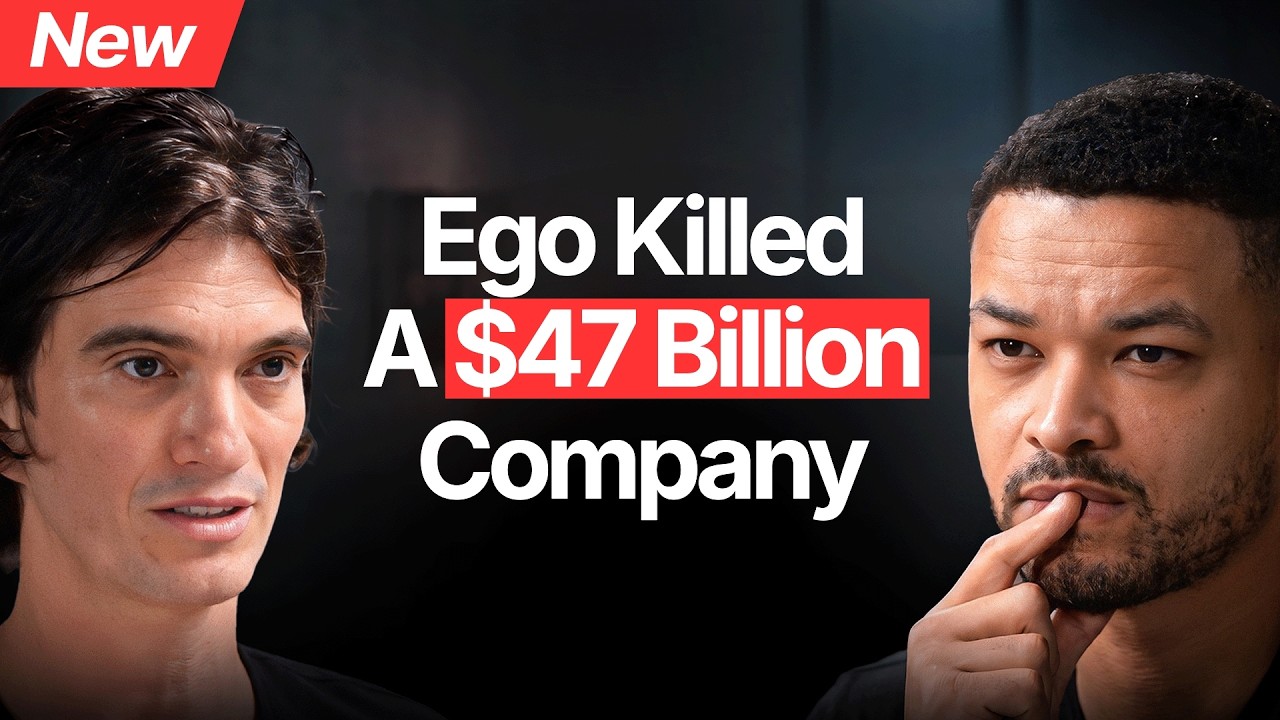
Neumann Blames WeWork Fall on Growth Outpacing Personal Maturity
The Diary Of A CEO
Rapid corporate expansion inevitably triggers organizational collapse when a company scales faster than its founder can mature emotionally to manage capital and ego.
Adam Neumann attributes WeWork's high-profile unraveling to hyper-growth outpacing his personal maturity, arguing that scaling a company faster than a founder's emotional capacity inevitably causes an organizational collapse. (43:13)
A pivotal 16-minute car ride with Masayoshi Son resulted in a handwritten $4.2B investment pact on an iPad, triggering an ego trap that replaced WeWork's operational unit economics with hyper-valuation chasing. (62:56)
Following his resignation as CEO in 2019, an immediate bank default notice on $460M in personal collateralized loans threatened total financial wipeout before SoftBank assumed the debt, later resolved through a $1.5B Delaware litigation settlement. (112:58)
Now backed by a16z to build residential real estate platform Flow, Neumann emphasizes bottom-up influence over top-down control, a weekly 25-hour technology Shabbat, and selecting partners based strictly on how they behave on your worst day. (130:34)
Detailed notes
## Background
Published on YouTube by The Diary Of A CEO on September 28, 2026, this episode features host Steven Bartlett interviewing WeWork co-founder and Flow founder Adam Neumann. The conversation explores the psychological lessons, spiritual frameworks, and ego traps that emerged from one of the most publicized corporate collapses in modern history, alongside Neumann's reflections on childhood trauma and his path forward.
## TL;DR
Adam Neumann traces his journey from a volatile childhood and early entrepreneurial ventures to scaling WeWork into a $47 billion global empire and enduring its dramatic collapse. He candidly explains how the company expanded faster than his own emotional maturity, describing how hyper-growth and billions in SoftBank funding inflated his ego and detracted from core operational discipline. Following an abrupt leadership exit and a sudden $460 million personal debt margin call, Neumann recounts how his wife Rebekah's grounding composure and deep spiritual principles helped him navigate complete ruin. Rebounding with his residential real estate company Flow, he details hard-won lessons on bottom-up leadership, authentic alignment, and choosing partners based on how they behave during your darkest hours.
## Atmosphere & style
The conversation carries an intimate, cinematic, and deeply reflective tone, blending high-stakes boardroom revelations with raw emotional vulnerability. Steven Bartlett acts as an engaged and grounding sounding board, giving Neumann room to shift effortlessly between fast-paced, theatrical retellings of multibillion-dollar encounters and quiet, spiritual confessions about fear, hubris, and marital devotion. The resulting mood is one of hard-earned self-awareness and redemption, feeling less like a conventional business post-mortem and more like an intense philosophical audit of ambition, resilience, and personal ego.
## Bulletin
- [43:13](https://www.youtube.com/watch?v=IQ4JVWdj4Q0&t=2593s) Adam Neumann attributes WeWork's high-profile unraveling to hyper-growth outpacing his personal maturity, arguing that scaling a company faster than a founder's emotional capacity inevitably causes an organizational collapse.
- [01:02:56](https://www.youtube.com/watch?v=IQ4JVWdj4Q0&t=3776s) A pivotal 16-minute car ride with Masayoshi Son resulted in a handwritten $4.2B investment pact on an iPad, triggering an ego trap that replaced WeWork's operational unit economics with hyper-valuation chasing.
- [01:52:58](https://www.youtube.com/watch?v=IQ4JVWdj4Q0&t=6778s) Following his resignation as CEO in 2019, an immediate bank default notice on $460M in personal collateralized loans threatened total financial wipeout before SoftBank assumed the debt, later resolved through a $1.5B Delaware litigation settlement.
- [02:10:34](https://www.youtube.com/watch?v=IQ4JVWdj4Q0&t=7834s) Now backed by a16z to build residential real estate platform Flow, Neumann emphasizes bottom-up influence over top-down control, a weekly 25-hour technology Shabbat, and selecting partners based strictly on how they behave on your worst day.
## Key takeaways
- [43:13](https://www.youtube.com/watch?v=IQ4JVWdj4Q0&t=2593s) When an enterprise scales faster than its founder can mature emotionally and mentally, the organizational structure inevitably short-circuits.
- [01:08:13](https://www.youtube.com/watch?v=IQ4JVWdj4Q0&t=4093s) Sudden multi-billion-dollar paper wealth creates an ego trap that degrades decision-making accuracy and distracts founders from their core cultural mission.
- [36:52](https://www.youtube.com/watch?v=IQ4JVWdj4Q0&t=2212s) Applying first-principles cost auditing—such as breaking down raw materials and offering contractors transparent 15% margins—enabled WeWork to scale unit economics early on.
- [25:23](https://www.youtube.com/watch?v=IQ4JVWdj4Q0&t=1523s) Effective high-ambition founders must master a macro-micro duality: maintaining an audacious, long-term vision while remaining hands-on in the operational trenches.
- [54:15](https://www.youtube.com/watch?v=IQ4JVWdj4Q0&t=3255s) True leadership is rooted in earned influence rather than hierarchical, authoritarian control, as top-tier talent demands bottom-up empowerment and immediate feedback.
- [01:44:29](https://www.youtube.com/watch?v=IQ4JVWdj4Q0&t=6269s) Boardroom delay and valuation greed caused the collapse of SoftBank's planned $20B all-cash buyout in late 2018, forcing WeWork down the path of an unprepared IPO.
- [01:52:58](https://www.youtube.com/watch?v=IQ4JVWdj4Q0&t=6778s) Resigning as CEO triggered a rapid debt acceleration notice on $460M in personal loans tied to super-voting shares, transferring company control to creditors within days.
- [02:01:38](https://www.youtube.com/watch?v=IQ4JVWdj4Q0&t=7298s) Partners in business and marriage must be chosen based on how they behave during severe crises rather than during periods of success.
- [01:29:41](https://www.youtube.com/watch?v=IQ4JVWdj4Q0&t=5381s) A 25-hour weekly technology fast resets the nervous system, clears dopamine dependency, and restores deep cognitive lucidity.
- [01:36:08](https://www.youtube.com/watch?v=IQ4JVWdj4Q0&t=5768s) Founders must recognize their operational bottlenecks and balance creative ambition with protective governance systems.
- [49:56](https://www.youtube.com/watch?v=IQ4JVWdj4Q0&t=2996s) Neumann restructured his leadership at Flow by partnering closely with Andreessen Horowitz, delegating technical hires, and actively seeking critical board feedback.
- [02:13:01](https://www.youtube.com/watch?v=IQ4JVWdj4Q0&t=7981s) Personal trauma and public failure serve as the ultimate crucible for psychological resilience when reframed with radical self-honesty.
## Detailed walkthrough
### [00:00](https://www.youtube.com/watch?v=IQ4JVWdj4Q0&t=0s) The Rise, the Fall, and the Unfiltered Truth
The interview opens with a stark reflection on the sheer velocity of WeWork's implosion. Adam Neumann describes the whiplash of watching one of the fastest global physical expansions in modern history evaporate overnight: "I went from 13,000 employees to three employees in one week." When the company publicly filed its S-1 in 2019 at a staggering $47 billion valuation, the documents exposed roughly $3 billion in accumulated losses over the prior three years alongside polarizing governance revelations—including the infamous claim that Neumann had trademarked the word "We" and sold it back to the business, an allegation he flatly rejects as false. Neumann also pushes back against the persistent narrative pushed by *The Wall Street Journal* and other outlets that he was fired, stating firmly that he chose to step down.
Asked what truly went wrong, Neumann explains that WeWork simply scaled far faster than his own personal maturity could keep up with. As astronomical figures poured in—a $20 billion valuation here, regional spinoff valuations in Japan and a $5 billion figure in China—ego began creeping into every decision. The mission was eclipsed by the sheer pursuit of money: "I forgot what we were all about, and when I lost it, everybody lost it." Pushed toward a public offering long before the business was prepared for the scrutiny, Neumann stepped aside to clear the way, only to find himself blindsided immediately afterward. Reflecting on the aftermath, he delivers an unapologetic warning: "The only lesson there: you're going to stab the king, kill. If you're not going to kill, I'm going to come back again."
Despite walking away with reported liquidity near a billion dollars, Neumann chose to jump straight back into the entrepreneurial arena rather than retire. Looking back across the entire saga, he views his operational record through a radically different lens than the media circus presented: he believes he got 95% of things right rather than wrong, and that the deep, unvarnished lessons of that collapse are things most celebrated founders simply never share.
- **Peak WeWork Valuation:** Approximately $47 billion leading up to the 2019 S-1 filing.
- **Reported Losses in S-1:** $3 billion over the preceding three years.
- **Headcount Contraction:** Collapsed from 13,000 employees down to just 3 within a single week following his exit.
---
[02:09](https://www.youtube.com/watch?v=IQ4JVWdj4Q0&t=129s) The Core Identity and the Potential Gap
Stepping into the formal conversation, host Steven Bartlett observes that Neumann carries a philosophical intensity and depth rarely seen among high-profile tech founders, asking what early origin story shaped such an anomalous character. Neumann deflects conventional corporate accolades by outlining a strict personal hierarchy: he identifies first and foremost as a husband, considering that his most important job; second as a father to six children; third as a loyal friend; and only after all of those as an entrepreneur.
Neumann grounds his worldview in a spiritual framework concerning human capacity. He believes every person possesses a fundamentally perfect soul, and that who an individual truly is can be measured by the distance between where they currently find themselves and the outer boundary of their latent potential. His entire life—both through circumstances outside his control during youth and through conscious decisions as an adult—has been driven by an obsessive impulse to close that specific gap.
```mermaid
flowchart TD
accTitle: Hierarchy of Identity
accDescr: Adam Neumann's personal hierarchy of roles leading to his business ventures.
subgraph Identity["Neumann's Priority of Roles"]
H["1. Husband ('First job, most proud of')"]
F["2. Father (Father of six)"]
FR["3. Friend ('Friendships are very important')"]
E["4. Entrepreneur (Flow / WeWork)"]
H --> F --> FR --> E
end
```
---
[03:43](https://www.youtube.com/watch?v=IQ4JVWdj4Q0&t=223s) An Unstable Childhood and the Disappearing Dishes
Bartlett probes into Neumann's turbulent upbringing, touching upon reports that his mother struggled with bipolar disorder. Neumann explains that both of his parents were physicians, his mother working as an oncologist. Because they were constantly treating critically ill patients, family illness was never treated with sympathy; no matter how sick Adam or his sister felt, their mother would brush it off, insisting her patients had it far worse, and send them straight out the door to school. When Neumann was in second grade, his parents divorced, prompting his mother to seek a clean slate by relocating the family to the United States.
```mermaid
flowchart LR
accTitle: Domestic Volatility Dynamic
accDescr: The evening cycle between Neumann's mother and the children during their early years in the United States.
subgraph Domestic["The Evening Routine"]
direction TB
Work["Mother works with patients all day"] --> Home["Returns home at 8:00 p.m."]
Home --> Flare["Rage over unwashed dishes"]
Flare --> Smash["Throws dishes on floor"]
Smash --> Remorse["Weeps and mops up shards"]
end
```
Isolated in America with just his mother and sister, the reality of his mother's bipolar condition became glaringly apparent. Every evening around 8:00 p.m., she would return home exhausted from the hospital, and household volatility would detonate. As a silent rebellion against verbal confrontation, the children routinely refused their sole chore—washing the dishes. In response, their mother would scream, grab the dirty dishes, smash them across the kitchen floor, and subsequently break down in tears while mopping up the shards. This destructive ritual repeated nightly for two years until the children made a telling observation: after buying a set of expensive fine china, their mother threw only the cheap plates, intentionally sparing the ones she valued. That calculated choice revealed to young Adam that behind the outward chaos lay a degree of conscious control.
Beyond the domestic volatility, Neumann acknowledges that his childhood was marked by deep instability and adversity, noting that if one were to list every terrible hardship that could befall a young boy, he would check off almost every box, "including the really bad ones that we don't like to talk about."
---
[06:54](https://www.youtube.com/watch?v=IQ4JVWdj4Q0&t=414s) Rebekah, Kabbalah, and the Forging of the Sword
By his early twenties living in New York, Neumann was carrying immense buried rage about his childhood. His sister was working as a supermodel, he was fully immersed in the city's fast life, and his personal identity was tethered almost entirely to material ambition. That trajectory shifted abruptly when he began dating his future wife, Rebekah. After only one week together, she delivered a blunt reality check: she told him he had immense potential, but that he was not the man for her because he lacked any spiritual bent and remained fixated on chasing external status rather than lasting fulfillment.
Intrigued rather than offended, Neumann asked how to develop that inner life, which led him to establish a serious spiritual practice centered on Kabbalah. Through this discipline, he reconciled the seeming paradox between destiny ("meant to be") and free will. He explains that free will dictates the choices made at every critical fork in the road. Choosing the wrong path might lead to a catastrophic crash under the full gaze of the public; however, if the individual refuses to play the victim, assumes total accountability, and absorbs the painful lessons, they transform that curse into an intentional blessing:
> "Almost like a sword that's getting forged: the more times you hit it and the more heat you put on it, the stronger it gets. And then you learn those lessons and you go back into the game of life and you apply that in again, suddenly you take the catastrophe or the tragedy or the curse and you make it into a blessing. You turn it into a meant-to-be."
Armed with this hardened perspective, Neumann notes that when his professional world ultimately came crashing down around him on the global stage as an adult, the public humiliation was minor compared to the genuine psychological terror he had already survived as a child.
[09:12](https://www.youtube.com/watch?v=IQ4JVWdj4Q0&t=552s) Childhood Trauma, Family Volatility, and the Edge of Survival
Adam reflects on the internal resilience that allows someone to rebuild after total collapse. When everything else vanishes, having a grounding core—a wife, children, close friends—makes it possible to exhale and begin again from scratch. Yet he notes with regret that this brand of fortitude is rarely cheap; it is forged by enduring deeply difficult, painful experiences. He offers an encouraging message to anyone trapped in their own darkness: "the darkest moment of the night is a second before dawn." When Steven probes into the untold context behind Adam's early life, Adam points out that while he rarely shared these details publicly in the press, he was known for being intensely open with his WeWork employees, sometimes speaking candidly before crowds of 10,000 people. He agrees to share two foundational childhood events that he hopes might help others navigating similar battles.
The first was the volatile reality of living with a mother diagnosed with bipolar disorder. Adam explains that when she was happy, she was the happiest person alive—playing games with her children and creating an amazing atmosphere. But the dark swing brought intense anger and explicit suicide threats. For two young children whose mother was their sole caretaker, those threats brought a terrifying existential dread: if she died, who would protect them?
Adam recounts a harrowing memory from their time living on a kibbutz—an experience his mother chose so they could be part of an immersive, sharing community, which planted his earliest love for communal living. During an intense fight when Adam was just twelve years old, his mother threatened to kill herself and picked up a massive knife. Realizing the burden was entirely on him to stop her, Adam physically grabbed the knife and wrestled with her, fighting back and forth while his sister sat beside them, sobbing hysterically.
[11:51](https://www.youtube.com/watch?v=IQ4JVWdj4Q0&t=711s) Abuse, Compassion, and Moving Beyond
[19:01](https://www.youtube.com/watch?v=IQ4JVWdj4Q0&t=1141s) Chasing Money vs. Finding Your Superpower
When Steven Bartlett asks Adam Neumann what success meant to him in 2010 when he was thirty-one years old sketching out the initial concepts for WeWork, Adam admits he would not yet have defined it simply as "love." Instead, he was four years into being mentored by his wife, Rebecca, on what he calls the "game of life," and his focus had shifted from raw financial ambition to the collective concept of "we." The sketch from that era already carried slogans like *WeWork*, *WeLive*, *WeGive*, and *WeShare*, built on the premise of creating a world where people "make a life and not just a living."
Ten years earlier, however, Adam's mindset was completely different. Looking back at his twenty-one-year-old self, Adam admits with evident embarrassment that his only ambition back then was to become a billionaire—having upgraded from wanting to be a millionaire at age sixteen. He had convinced himself that amassing wealth would fill the emotional void and heal the pain of a turbulent, aggressive childhood. After launching three businesses that all failed, he met Rebecca, who directly confronted his obsession:
> "You're chasing money. You will never have it. And even if you get it, it will never make you happy... Chasing money is like chasing cool."
Rebecca explained that desperately chasing money is counterproductive, much like chasing someone romantically without taking a breath. More importantly, achieving wealth through that mindset would ultimately prove toxic. Instead, she introduced him to the concept of discovering his "superpower." She urged him to find what he was uniquely good at, connect it to something deeply meaningful that solves real problems in the world, and dedicate himself entirely to that mission. If he aligned those elements, employees would want to join, investors would want to back it, customers would line up to buy, and financial success would naturally follow far beyond his wildest dreams. Blown away by her wisdom, Adam proposed just three months after they met.
[22:11](https://www.youtube.com/watch?v=IQ4JVWdj4Q0&t=1331s) From Green Desk to WeWork: The $300,000 Serendipity
Before WeWork was founded, Adam and his partner, architect Miguel McKelvey, launched Green Desk in May 2008—right as the global financial crisis was taking hold. At the time, Adam was running a struggling baby clothing business, operating out of the same building as Miguel. The landlord, Mr. Gutman, routinely teased Adam about his business: *"Adam, your baby clothing company sucks... My wife, we have eight kids. She loves buying baby clothes. She didn’t once buy from you. I don't know how you pay me rent."* Adam fired back every day for four months: *"Well, Mr. Gutman, you own all this real estate around here... Your real estate sucks. It's all empty."*
Eventually, Mr. Gutman called Adam's bluff and brought him upstairs to an empty floor plate, asking what he would do with it. The space was supposed to rent for $5,000 a month. Adam proposed dividing the open floor into fifteen micro-offices:
```mermaid
flowchart TD
accTitle: Green Desk Subdivided Floor Economics
accDescr: Diagram illustrating the revenue and cost breakdown for dividing a 5000 dollar vacant floor into 15 micro-offices.
subgraph Operations["Single Floor Model"]
A["15 Small Office Spaces<br/>$1,000 / month each"] --> B["Total Revenue<br/>$15,000 / month"]
B --> C["Dedicated Receptionist<br/>-$2,500 / month"]
C --> D["Net Operating Income<br/>$12,500 / month"]
end
subgraph Distribution["Revenue Split"]
D --> E["Landlord (Mr. Gutman)<br/>$7,500 / month<br/>(Up from $5,000 empty)"]
D --> F["Founders (Adam & Miguel)<br/>$5,000 / month"]
end
```
The next day, Mr. Gutman called back, thrilled with the numbers, but suggested scaling the concept across the entire five-story building with a shared receptionist downstairs to streamline overhead. Adam and Miguel posted five ads on Craigslist, and Green Desk was 92% occupied within a single week. For the first time across four ventures, Adam experienced positive cash flow inside of a month.
Within six to twelve months, Adam and Miguel wanted to expand the concept nationally, but Gutman declined their proposal to invest $20 million for a 50/50 national venture. Instead, Gutman bought them out for $1.5 million. With three partners, Adam and Miguel were each owed $500,000, though Gutman agreed to pay only $300,000 upfront, with the remainder paid in installments over four years. Adam insisted Miguel keep the entire $300,000 lump sum in his bank account so Adam wouldn't spend it. Shortly thereafter, the landlord of the first prospective WeWork building demanded an upfront deposit check of exactly $300,000—the exact cash sitting untouched in Miguel’s account.
- **Initial sale price of Green Desk:** $1.5 million split evenly among three partners ($500,000 each).
- **Upfront cash received:** $300,000 total in immediate liquidity, exactly matching the deposit needed for WeWork's first lease.
[25:23](https://www.youtube.com/watch?v=IQ4JVWdj4Q0&t=1523s) The Glass Wall Sketch: "Make a Life, Not Just a Living"
Steven presents an archival photograph from 2010 showing a concept diagram drawn during WeWork’s earliest days. Adam clarifies that the diagram was not sketched on a standard whiteboard, but directly onto the glass partition walls inside Green Desk, where every surface was treated as a collaborative canvas for brainstorming. The drawing features a central core encircled by an ecosystem of interconnected nodes: travel, health, social life, friends, fintech, co-workers, life essentials, and work rituals.
Adam recalls venture capitalist Ben Horowitz once remarking on a podcast that Adam had really "always had one idea." While Horowitz initially apologized for fear of sounding dismissive, Adam agreed wholeheartedly with the assessment: the original WeWork thesis was identical in spirit to his residential venture, Flow. Critics who later argued that WeWork lost its way by expanding outside of "desks and chairs" misunderstood the company's inception; the expansive lifestyle vision predated the installation of their very first desk.
The overarching goal was always to counteract an epidemic of isolation by anchoring physical spaces in community. Adam outlines the dual operational philosophy required of any high-ambition founder:
> "Dream as high as you can. Go all the way to the stars. Cuz if you don't shoot for the stars, you're never going to get to the moon... Then take a deep breath and go back to basics. What do I need to do first? What I need to do second? What I need to do third? The secret of life and entrepreneurship is to be able to be in both places at the same time."
On one end of the spectrum, an entrepreneur must hold an audacious, boundary-pushing vision; on the other, they must possess the humility to roll up their sleeves, pick up a broom to sweep the floors, knock on doors, and handle the unglamorous day-to-day grit required to get a business off the ground.
[27:56](https://www.youtube.com/watch?v=IQ4JVWdj4Q0&t=1676s) The Secret of Manifestation and When Belief Is Measured
Steven asks Adam to unpack the duality between operating in "the trenches" and aiming for "the clouds" or the moon—specifically why dreaming at massive scale is essential. Adam responds that dreaming big is the fundamental engine of manifestation: bringing something out of nothing starts with unshakeable belief. That conviction takes time to cultivate, and true belief cannot be measured when circumstances are easy, when the company is flying high, investors are clamoring to write checks, and the world is showering the founder with praise. Instead, belief is tested exclusively when everything falls apart.
[28:29](https://www.youtube.com/watch?v=IQ4JVWdj4Q0&t=1709s) The Spiritual Wake-Up Call: Eitan's Two Lessons
Adam recounts a pivotal moment five days after the catastrophic public collapse of WeWork. The company was imploding, negative press was mounting relentlessly, and he was under intense scrutiny. Late at night, he received an unexpected phone call from his spiritual teacher, Eitan, with whom Adam had studied twice a week for eight years but had not spoken to in nearly two years. When Eitan asked how he was doing, Adam confessed, "I'm not doing so well right now; it's crazy." Unfazed, Eitan told him that was precisely why he was calling—to ensure Adam remembered the only two lessons they had spent eight years studying.
Puzzled, Adam pushed back, noting they had covered endless subjects across hundreds of study sessions. Eitan insisted:
- "One was love thy neighbor as yourself, and the rest is commentary."
- The second was that "the darkest moment of the night is a second before dawn."
```mermaid
flowchart TD
accTitle: The Two Spiritual Lessons in Crisis
accDescr: Flowchart outlining the two core spiritual principles given to Adam Neumann during WeWork's collapse.
subgraph Lesson1 ["Principle 1: Love Thy Neighbor"]
A["Acknowledge strengths & weaknesses"] --> B["Forgive yourself & drop guilt"]
B --> C["Love yourself first"]
C --> D["Love and empathize with others"]
end
subgraph Lesson2 ["Principle 2: True Belief"]
E["Darkest hour is right before dawn"] --> F["Adversity hits & fair-weather allies vanish"]
F --> G["Hold belief, positivity & purpose"]
G --> H["Emerge forged and resilient"]
end
```
[29:28](https://www.youtube.com/watch?v=IQ4JVWdj4Q0&t=1768s) Self-Forgiveness, Guilt, and the Forging of the Sword
Steven shares his own understanding of "love thy neighbor as yourself," interpreting it as having empathy and compassion for the complex, imperfect, and messy facets of others, just as one does for oneself. Adam agrees with the sentiment but reframes it through a sharper lens: you cannot truly love others until you love yourself, and loving yourself requires confronting your profound weaknesses, mistakes, and failures.
The mechanism that makes self-love possible in the wake of failure is genuine self-forgiveness. Adam emphasizes that carrying guilt is paralyzing. One must view mistakes as essential lessons that forge personal growth, returning to the sword analogy: every brutal strike is merely hammer blows forging the blade into something stronger. Once a person forgives themselves and sheds guilt, they can extend authentic love to everyone else. Eitan reminded Adam that if he could hold onto his belief, positivity, and inner joy during the collapse, the future would hold possibilities beyond imagination. When Steven asks what Adam placed his faith in during that harrowing moment, Adam answers without hesitation: God, himself, his wife Rebekah, his children, and the certainty that even if the reason for the crisis wasn't immediately apparent, he would emerge far stronger.
[31:17](https://www.youtube.com/watch?v=IQ4JVWdj4Q0&t=1877s) Facing Bankruptcy at 6:00 AM: From 13,000 Employees to Three
The morning after Eitan’s late-night call, Adam walked down at 6:00 AM to meet his family office team. In the span of a single week, he had transitioned from overseeing 13,000 global employees to working alongside just three partners. These three individuals had joined him only three months earlier expecting to manage a $5 billion to $10 billion family office, only to find themselves facing a catastrophic, compounding negative $400 million debt position and imminent bankruptcy.
Every morning at 6:00 AM, the atmosphere in that room was pure panic, with the partners convinced everything was finished. But that morning, Adam arrived with a broad smile on his face:
- The partners looked at him in disbelief, wondering if he had completely lost his sanity.
- Adam explained his smile: "I'm smiling because I remember that the darkest moment of the night is a second before dawn, and I remember that belief is actually measured when things are difficult, not when everything is working."
- He reassured them that despite not knowing exactly how or why, things would turn out for the best, and the trial would prepare them for any future crisis.
- Within about ten days of adopting that posture, the situation began to pivot toward a positive outcome.
[33:10](https://www.youtube.com/watch?v=IQ4JVWdj4Q0&t=1990s) Loyalty Under Fire and the Inevitability of Crashing
Steven observes a visible shift in Adam's energy when speaking about those three colleagues. Adam admits that adversity reveals who people truly are. When a founder is flying high, everyone wants to be a friend, join the fun, and share in the financial upside. But the moment an existential disaster strikes, most fair-weather friends vanish and stop calling.
Adam reflects on the reality of ambitious scale and loyalty:
- **The guarantee of falling:** Adam dismisses young founders who claim their ego will never trip them up and they will never lose control. "You haven't gone big enough," he argues, because going extraordinarily big inevitably results in falling down. Life is not about avoiding the fall, but about how quickly and skillfully one gets back up.
- **A vulnerability to loyalty:** Adam acknowledges having an intense, almost flawed devotion to loyalty. If someone stands by his side when circumstances are dire—like those three partners who barely knew him yet refused to abandon ship—he will remain loyal to them to a fault.
[34:36](https://www.youtube.com/watch?v=IQ4JVWdj4Q0&t=2076s) Conviction vs. Imposter Syndrome: The Launch of WeWork
Steven turns to the psychological barrier that trips up many entrepreneurs: imposter syndrome, self-doubt, and the paralyzing fear of "Am I really the person to build this?" He asks whether Adam felt those insecurities when launching WeWork.
Adam shares that during WeWork's inception in February 2010, he did not experience self-doubt; his conviction was total. He possessed an extreme level of certainty that the product was an absolute necessity for the world—a certainty so intense that observers often misinterpreted it for arrogance. At that stage, he and Rebekah had no children, enabling him to pour his entire life into the venture, routinely working 18- to 20-hour days, seven days a week, and relishing every moment. (By contrast, founding his subsequent venture, Flow, involved different pressures and emotional balances because he had a family). When asked what ignited WeWork's meteoric, atypical hypergrowth, Adam attributes it to an unshakeable alignment with a purpose larger than himself. When a mission feels vital to humanity, urgency ceases to be a management tactic—it becomes a moral imperative because there is no time to waste. Driven by that imperative, his knack for bringing people together, and a love for moving at breakneck speed once direction is locked in, the business exploded into the world.
[36:52](https://www.youtube.com/watch?v=IQ4JVWdj4Q0&t=2212s) Deconstructing Costs: The Flooring Story and Internal Construction
Adam Neumann reflects on what made WeWork so powerful in its early days: a collective belief that nothing was impossible, rapid execution, an absolute refusal to accept a "no," and an intensely dedicated team. The team was driven by a sense of belonging to something vastly larger than themselves. When an entire organization runs in lockstep in the same direction, Adam explains, it becomes an unstoppable force. Steven asks for a concrete example, prompting Adam to revisit the scrappy build-out of WeWork’s second building.
At the time, WeWork had only $90,000 left, while vendor quotes for installing wood floors—a signature element of the design aesthetic—ran between $30,000 and $45,000 per floor, contributing to total floor build-out estimates around $200,000. When co-founder Miguel McKelvey and the team insisted the project could not be done within their remaining budget after reviewing five separate bids, Adam refused to take the quotes at face value. He asked them to break down the exact unit economics: how many floorboards, how many nails, how much glue, how much rubber, how many labor hours per person, and the hourly rate of each worker. When no one could provide the breakdown, Adam called the top three flooring contractors directly with a transparent proposition: "I would like you to earn 15% above the cost. I think that's a fair margin, 15%. Do you agree?"
All three contractors agreed. Adam informed them that he would audit the material pricing himself and verify every cost line item to guarantee their 15% profit. That granular scrutiny slashed the cost of that first floor from $30,000–$45,000 down to just $12,000. Astounded by the transparency, the contractor admitted that no client had ever collaborated with him that way, eventually joining the company. This breakthrough led WeWork to build its own internal construction operation, establishing that full internal control was the only way to safeguard pricing and build at hyper-speed—a structural inefficiency in global construction that Adam is tackling once again at Flow.
```mermaid
flowchart TD
accTitle: Flooring Cost Negotiation Breakdown
accDescr: Flowchart illustrating how Adam Neumann negotiated construction costs down from initial high quotes to building an internal team.
subgraph Problem["The Challenge"]
A["Budget Constraint: $90,000 remaining"]
B["Initial Vendor Quotes: $30,000 - $45,000 per floor"]
A --- B
end
subgraph Analysis["First Principles Breakdown"]
C["Challenge Status Quo:\nAudit individual materials & labor hours"]
D["Open-Book Negotiation:\nGuarantee contractor cost + 15% margin"]
C --> D
end
subgraph Outcome["The Result"]
E["Floor Cost Reduced to $12,000"]
F["Contractor hired in-house to launch internal construction"]
E --> F
end
Problem --> Analysis
Analysis --> Outcome
```
---
[39:08](https://www.youtube.com/watch?v=IQ4JVWdj4Q0&t=2348s) First Principles and Why People Fear Asking "Why"
Steven observes that Adam’s strategy mirrors Elon Musk’s approach of reasoning from first principles. Adam agrees, expressing deep admiration for Musk while clarifying that at Flow, they view Elon as an aspirational archetype rather than a benchmark for regular comparison: "No one is Elon." He shares an anecdote from a friend whose daughter works at SpaceX, describing how Musk will assign an engineer to spend six full months optimizing a single screw or connection point. The result is an engineering component that is not just twice as simple, but 500 times simpler, lighter, cheaper, and faster than anything NASA ever built. Whether one calls it first principles or relentless interrogation, Adam emphasizes that every entrepreneur, employee, and partner must constantly ask "why."
When Steven suggests that people avoid pushing back because they fear being rude or want to be liked, Adam counters with a deeper psychological cause: people do not ask others "why" because they are terrified of asking *themselves* "why." Questioning oneself requires confronting internal flaws, weaknesses, and mistakes. Only a person comfortable interrogating their own motives and embracing the discomfort of personal growth can comfortably question others without insecurity. When entering vendor negotiations, Adam aligns interests up front: he wants the vendor to make a healthy profit, but every unnecessary 20% markup paid directly diminishes Flow's ability to build another apartment, cultivate another community, or serve another neighborhood.
---
[40:51](https://www.youtube.com/watch?v=IQ4JVWdj4Q0&t=2451s) Pushing Through "Paper Walls" and WeWork’s Hyper-Scaling
Steven shares a parallel management framework from his own company called "Paper Walls"—a dedicated Slack channel celebrating instances where team members push through obstacles that look solid but turn out to be as flimsy as paper. He recounts an animator on his team who had spent four years taking nine days to produce a 30-minute video. When Steven launched a weekly video project requiring turnaround in three to four days and finally asked him why it took nine days and what it would take to do it in two, the employee casually replied: "Steven, you just need to buy me a new laptop. I have an old laptop." Steven was stunned that years of productive output had been lost simply because neither party had challenged the invisible wall.
Adam connects this dynamic directly to WeWork’s unprecedented trajectory. The growth trajectory fundamentally transformed the capacity of the people involved:
- **Year 1:** WeWork opened just a single building.
- **Year 9:** WeWork was opening two buildings every single day—representing roughly 200,000 square feet (20,000 square meters) of physical space delivered daily across 130 cities, 50 countries, and 70 languages.
The leaders executing this massive daily rollout were many of the exact same individuals who originally struggled to open the first locations. Adam argues that high-growth momentum resets human capacity; within three to nine months of operating in an accelerating environment, teams achieve milestones they previously deemed impossible.
---
[43:13](https://www.youtube.com/watch?v=IQ4JVWdj4Q0&t=2593s) The Founder’s Growth Bottleneck: Growing Slower Than the Business
Bringing the conversation back to team dynamics, Adam asks Steven about his organization's headcount (around 200 employees) and advises him to gather groups of 30 into a circle to examine personal hurdles: "What is your internal paper wall? What is your internal challenge? What's stopping you?" When colleagues hear peers openly admit to childhood insecurities, stage fright, being overly judgmental, or being too hard on themselves, a culture of mutual support takes root. Internal personal growth among employees directly fuels external business growth.
This leads Adam to reflect on the core catalyst of WeWork's ultimate downfall:
> "In WeWork, the business grew faster than I could grow. That's where everything went wrong."
Adam posits an ironclad rule for high-growth ventures: whenever an enterprise scales faster than its founder's personal and emotional maturity, only one of two outcomes is possible. Either the company will crash under the strain, or, if the founder miraculously keeps the apparatus intact, they will end up deeply unfulfilled, miserable, and empty.
---
[44:20](https://www.youtube.com/watch?v=IQ4JVWdj4Q0&t=2660s) Redefining Hard Work: The All-In Founder Mindset
Steven raises the ongoing cultural debate surrounding work-life balance versus the 100-hour workweeks advocated in founder culture, asking how essential hard work really is. Adam responds unequivocally: hard work is the single most important prerequisite for success, but the conventional definition is flawed. Hard work cannot be measured purely by the number of hours spent sitting at a desk.
True founder dedication requires dividing intense effort between the enterprise and one's internal evolution:
- **Working on the business:** Driving execution, building robust systems, and raising capital.
- **Working on yourself:** Maturing as a human being to become a clearer communicator, an empathetic leader, and a grounded thinker who can keep pace with organizational expansion.
- **Working on relationships:** Investing deliberate energy into one's marriage and children, ensuring personal foundations do not fracture under professional pressure.
Adam explains that when deciding whether to launch Flow, his hesitation stemmed from knowing there is no middle ground: an entrepreneur cannot be 80% or 90% engaged. Foundational company building demands a total 100% personal commitment.
[45:36](https://www.youtube.com/watch?v=IQ4JVWdj4Q0&t=2736s) The Power of Being 100% In and the Myth of Running Two Businesses
Adam reflects on self-awareness, remarking that any parent wondering what flaws they need to work on only needs to listen to their kids because "they know." The conversation then shifts to the state of total commitment. Adam explains that when an entrepreneur is fully 100% committed to a mission, doubt, fear, and questioning disappear simply because they are entirely immersed in the work. In contrast, trying to rigidly protect work-life balance while building something ambitious guarantees falling short of one's full potential. He clarifies that being "100% in" does not mean filling every minute of the calendar; Warren Buffett is entirely all-in yet intentionally keeps his calendar wide open to read, reflect, and hold the conversations that truly matter. For Adam, surfing embodies this exact state of presence: out on a wave, a surfer must enter pure flow, because losing focus for even a second means being thrown off the board immediately.
When Steven asks about founders who attempt to lead two companies simultaneously, Adam points out that at Flow, a common saying is: "You're not Elon." Aside from singular exceptions like Elon Musk or Jack Dorsey, almost no one can successfully run two major businesses at once. Adam observes that when founders who achieved success with a first venture launch a second one, they often sacrifice their personal growth. The extra time and capital gained from their initial win get funneled into another corporate venture—frequently as a distraction or an escape mechanism to avoid experiencing life and confronting emotional realities: "What are you hiding from? What is it that you're not actually doing would be my question."
Steven delivers two podcast sponsor segments highlighting productivity and sales intelligence tools:
- **Wispr Flow:** An AI-powered notetaker designed to capture context across dozens of weekly team meetings and podcast recordings. It attributes quotes to specific speakers, surfaces action items, and acts as a life-context engine (`wisprflow.ai/steven`).
- **Pipedrive:** An intelligent, AI-driven sales CRM serving over 100,000 businesses. It reduces the estimated 50% of time sales teams lose to administrative manual CRM upkeep by drafting auto-briefs from email histories and transcribing client meetings into CRM updates (`pipedrive.com/ceo`).
---
[49:56](https://www.youtube.com/watch?v=IQ4JVWdj4Q0&t=2996s) Knowing What You Don't Know: Andreessen Horowitz and Flow
Steven brings up the founder dilemma of pacing—knowing when to push hard versus when to slow down and acknowledge personal limitations. Adam candidly admits that building world-class technology was an area where he did not succeed at WeWork: "That is a known fact." To build Flow into an enterprise larger than WeWork, he adopted the principle of knowing what he does not know and letting world-class experts lead those domains. For example, when hiring Flow's Chief Technology Officer, four qualified finalists were vetted, and Adam turned the final interview and hiring decision over to Ben Horowitz.
subgraph Governance["Governance & Hiring Alignment"]
A["CTO Finalists (4 candidates)"] --> B["Final Interview by Ben Horowitz"]
B --> C["Hired CTO"]
end
subgraph Capital["Capital Alignment"]
D["a16z (Series A & B)<br/>$470 Million"] --- F["Unified Flow Mission"]
E["Adam Neumann & Family<br/>$350 Million"] --- F
end
subgraph Feedback["Accountability Rhythm"]
G["Full-Day Board Meeting<br/>(8:00/8:30 AM – 5:00 PM)"] --> H["Post-Board Dinner"]
H --> I["'Please tell me what I can do better'"]
end
```
To prevent the trap of hiring executives whose skills the founder cannot objectively evaluate, Adam chose partners who speak the unvarnished truth. Marc Andreessen and Ben Horowitz of Andreessen Horowitz (a16z) led Flow's Series A and Series B with a $470 million investment, while Adam and his family personally invested $350 million to ensure total financial alignment. Flow's board meetings run an exhaustive full day, from 8:00 or 8:30 a.m. to 5:00 p.m., preceded by disciplined preparation a week in advance rather than wasting weeks on slide production. After every board meeting, Adam sits down to dinner with Marc and Ben and initiates the discussion with the exact same request: *"Please tell me what I can do better."* While initially hesitant, Marc and Ben now arrive at dinner with notes ready to deliver candid, constructive critique.
- **Capital commitment:** a16z invested $470M across Series A and B; Adam Neumann personally invested $350M alongside them so they buy and sell as true partners.
- **Investor selection criteria:** Adam urges entrepreneurs to study venture capital track records. He praises a16z as the premier firm in the world for backing founders through thick and thin, while warning against firms like Benchmark, which he highlights as having pushed out founders including himself at WeWork, Travis Kalanick at Uber, and Jack Dorsey.
---
[53:09](https://www.youtube.com/watch?v=IQ4JVWdj4Q0&t=3189s) Leading Bottom-Up Instead of Top-Down
When asked how his philosophy on hiring and managing team members has changed, Adam stresses that accountability rests entirely at the top: if an issue arises with an employee, "there's only one person to blame and that's me." The biggest mistake he made earlier in his career was relying on a top-down leadership structure.
He explains that a top-down model presumes employees must comply simply because a founder occupies the managerial seat above them. However, top-tier talent possesses free will, vast market options, and the independence to walk away from any authoritarian environment. Adam has shifted toward leading bottom-up—recognizing that the more exceptionally talented an individual is, the less a directive, top-down hierarchy works, and the more a leader must empower them to direct their own impact.
[54:15](https://www.youtube.com/watch?v=IQ4JVWdj4Q0&t=3255s) Leading Talent: Influence, Immediate Feedback, and Letting Go of Control
Top-tier talent cannot be micromanaged into obedience. High performers do not want to be dictated to; they want to be inspired, to be seen as the fullest expression of their potential, and to be given genuine latitude to make mistakes and evolve. However, autonomy does not mean withholding candid critiques. Adam warns against conflict avoidance—sitting on frustration for ninety days while a team member repeats a mistake only ensures that when the feedback finally erupts, it arrives far too late. Respecting someone means offering immediate feedback the moment an error occurs, while simultaneously keeping the door wide open for them to push back and offer feedback in return.
At the core of this management philosophy is the distinction between authority and leadership. "Power comes from influence, not control." If an executive relies on corporate hierarchy—demanding compliance simply because "I am the boss"—the dynamic is already broken. Conversely, an employee who blindly obeys orders solely out of deference to authority is neither the right cultural fit nor positioned to deliver their best work. True performance emerges only when leadership operates through inspiration and bottom-up engagement rather than bureaucratic leverage.
[55:27](https://www.youtube.com/watch?v=IQ4JVWdj4Q0&t=3327s) The Pre-Masa Reality: High Growth, "Four-Wall" Economics, and the Plan to IPO
When Steven asks about the fateful meeting with SoftBank founder Masayoshi Son, Adam provides critical context on the state of WeWork in late 2016. Despite common public misconceptions that paint Masa as a villain in the company's unraveling, Adam views him as a hero who placed a bold, well-earned bet. Masa had built a legendary track record at SoftBank—buying a major technology conference in Las Vegas for roughly $880 million, expanding into telecoms, convincing Steve Jobs to give him exclusive distribution of the newly launched iPhone in Japan by pioneering a subsidized leasing model, and investing $20 million into Jack Ma's Alibaba that grew into an $80 billion stake at its height.
```mermaid
flowchart TD
accTitle: Unit Economics vs Rapid Expansion
accDescr: Flowchart illustrating how adding new buildings causes a temporary cash drag that obscures individual store profitability at the portfolio level.
subgraph UnitLevel["Individual Building Unit Economics"]
A["New Location Launch"] --> B["Initial Ramp-Up Period<br/>(6 to 18 Months)"]
B --> C["Mature, Cash-Flow Positive Building<br/>('Four-Wall' Profitability)"]
end
subgraph PortfolioDrag["High-Growth Expansion Dilution"]
C --> D["Rapid Addition of 30+ New Sites"]
D --> E["New Units Lose Money in Initial 6-9 Months"]
E --> F["Blended City/Country P&L Appears Unprofitable"]
end
```
Six months prior to their meeting, WeWork had raised capital at a $16 billion valuation and was pacing toward roughly $950 million in annual revenue, having doubled its top line every consecutive year. The underlying business model and "four-wall" economics were functioning exceptionally well:
- **Unit Economics vs. Portfolio P&L:** In traditional retail or hospitality, ramping a new location to return on investment (ROI) typically requires 24 to 36 months. At its peak, WeWork was recouping capital in 6 to 9 months, later stretching to 12 to 18 months.
- **The Expansion Drag:** In a market like New York City—where WeWork eventually expanded to 130 locations—opening 30 new sites in a single year meant those infant locations inevitably ran at a loss during their initial 6-to-9-month ramp. Consequently, even if existing locations were wildly lucrative, the blended city- or country-wide P&L appeared unprofitable.
- **Granular Visibility:** WeWork’s internal systems could not cleanly isolate floor-by-floor or square-foot profitability in real time, a technological blind spot Adam contrasts with his subsequent venture, Flow, which maps data down to individual corners.
The night before Masa visited, WeWork's board of directors aligned on a definitive strategy: raise a modest round of $300 million to $400 million, stop signing new leases to allow existing inventory to mature into profitability (since demand far outstripped supply), transition toward asset-light management agreements, and take the business public as a cash-flow-positive enterprise.
[01:00:21](https://www.youtube.com/watch?v=IQ4JVWdj4Q0&t=3621s) The Twelve-Minute Meeting with Masayoshi Son
Just as the board settled on this conservative, disciplined plan to reach profitability, Masa’s right-hand partner, Ron Fisher, reached out to schedule a meeting. SoftBank was in the midst of raising its unprecedented $100 billion Vision Fund. The WeWork team set aside a 90-minute block for the following morning, though SoftBank's staff issued a firm disclaimer: there would be no talk of an investment. As the morning approached, Masa's available window shrank dramatically in rolling updates—from 90 minutes down to 75, then 60, then 30.
The abrupt compression was driven by geopolitical history: Donald Trump had just won the 2016 U.S. presidential election, and Masa had secured an audience with the President-elect at Trump Tower to discuss Japanese investment in America. Arriving at WeWork, Masa apologized, stating he had only 12 minutes before he needed to leave. Rather than panicking over his discarded presentation, Adam seized the moment and asked if Masa had secured an introduction to Trump through Jared Kushner. Masa admitted that his team had been trying unsuccessfully to reach Kushner. Adam—who counted Kushner as a close personal friend—spent five of their twelve minutes texting him directly. Kushner agreed on the spot to facilitate the introduction, leaving seven minutes for the WeWork walkthrough.
Remaining on the ground floor because of the ticking clock, Adam presented the space. Masa stopped, inhaled deeply, and asked what the air smelled like. As staff happened to be making fresh waffles, Adam silently braced for a mundane answer. Instead, Masa looked around and declared: "Smells like dreams. WeWork is not an office space. It's a factory of dreams"—a vision that vaulted far beyond anything Adam had anticipated.
[01:02:56](https://www.youtube.com/watch?v=IQ4JVWdj4Q0&t=3776s) The 16-Minute Car Ride with Masayoshi Son
Masayoshi Son arrived at WeWork’s headquarters, but with only minutes to spare, he never even toured the floors above. They spent barely seven to twelve minutes downstairs in the lobby. Yet, as Adam Neumann recalls, walking into WeWork HQ in 2016 and 2017 was an electric experience: it felt like an environment where people were deeply connected and doing their life’s work rather than just showing up to an office. Masa had famously dubbed it a "factory of dreams," outdoing Adam at his own visionary rhetoric. Running tight on schedule for an appointment uptown, Masa told Adam, "Look, Adam, we don't have time. I'm driving up there to 50th Street... Do you want to come with me to the car? We'll talk in the car."
Even though Masa's team had explicitly pulled Adam aside beforehand and told him strictly not to talk about raising money, the moment they sat in the back of the car, Masa cut right to the chase: "Adam, what's the number?... What's your valuation and how much money are you raising? I'm here to do business." When Adam hesitated, mentioning his team's instructions, Masa waved it off: "I am the boss. I've done this many times myself... Let's talk about it."
Adam explained the company's status: their last valuation was $16 billion, WeWork China was already a separate $2 billion entity, and they were scaling across Europe and Latin America. Adam stated that he was looking to raise $300 million to $400 million, the exact figure agreed upon with his board the previous night. Masa immediately pushed back, arguing that $300 to $400 million was far too small for true global domination. He pressed Adam on why WeWork wasn't in Japan or Southeast Asia. When Adam admitted he lacked the teams and familiarity with those territories, Masa insisted it would work and declared, "I think we should do about 3 billion." By the end of the 16-minute car ride, the deal had ballooned to an astounding $4.2 billion, allocated across WeWork TopCo, China, Japan, and Southeast Asia. Masa pulled out an iPad, drafted the entire deal structure on the screen, signed his name, and handed the stylus to Adam to sign.
```mermaid
flowchart TD
accTitle: The SoftBank Car Ride Deal Escalation
accDescr: Flowchart showing how Adam Neumann's target of 300 to 400 million dollars escalated into a 4.2 billion dollar deal inside a taxi ride with Masayoshi Son.
subgraph Negotiation["The Cab Ride with Masa"]
B["Masa Rejects Small Numbers<br/>'Don't you want to build a global business?'"]
C["Forced Rapid Regional Expansion<br/>Japan & Southeast Asia"]
D["Initial Jump to $3 Billion"]
end
subgraph FinalDeal["Signed on the iPad"]
E["$4.2 Billion Total Commitment<br/>WeWork TopCo, China, Japan & SE Asia"]
F["$1 Billion in Secondaries<br/>Cash out for Founders, Staff & Early Investors"]
end
A --> B
B --> C
C --> D
D --> E
E --> F
```
- **Target vs. Outcome**: Planned round of $300–$400M transformed in roughly 16 minutes into a $4.2 billion commitment.
- **TopCo & Regional Arms**: The investment covered WeWork TopCo, WeWork China, WeWork Japan, and WeWork Southeast Asia.
- **Financial Growth Trajectory**: WeWork pulled in $980 million in revenue that year, and hit its target of $1.8 billion the following year.
- **The Core Flaw**: The business operated as a high-growth cash engine where stopping growth would immediately show profitability, but signing long-term lease commitments against short-term memberships created massive structural risk.
---
[01:08:13](https://www.youtube.com/watch?v=IQ4JVWdj4Q0&t=4093s) The Ego Trap: Walking from 54th Street to 18th Street
After Masa stepped out of the vehicle at 54th Street with a brief "Thank you very much," Adam stood on the sidewalk in absolute disbelief. Rather than hailing a ride, he decided to walk all the way back downtown to WeWork headquarters on 18th Street. For five years, WeWork had run on pure mission-driven grit and cultural alignment, where long nights and tight-knit camaraderie allowed them to break through every obstacle. But with every block he walked south, the sheer gravity of the financial numbers began feeding his ego.
Adam started doing paper math on his ownership: the TopCo valuation was pegged at $20 billion, plus additional multi-billion-dollar valuations for China ($5 billion), Japan, and Southeast Asia. With roughly $1 billion of the transaction earmarked for secondaries—cashing out early investors, employees, co-founder Miguel McKelvey, and himself—Adam, who held approximately a 25% stake, realized his personal net worth had suddenly soared into the billions. As he walked, thoughts of building a company to create a world where people "make a life and not just a living" began to recede behind the intoxicating high of wealth and invincibility.
By the time he stepped through the doors of the 18th Street headquarters, Adam realized he had completely lost sight of the core mission. He reflects that while ego and desire are essentially the same—and a large desire is necessary to build something monumental—unchecked ego blinds a founder. In a hyper-growth environment requiring a hundred decisions every day, the threshold of success requires getting at least 98 of them right; letting ego cloud judgment drops that accuracy to 95 or 90, causing catastrophic compounding mistakes. Because the company took all its cues from the top, the moment the founder lost his moral and operational bearings, that loss of focus rippled through the entire organization, marking what Adam terms the true "beginning of the end."
---
[01:11:35](https://www.youtube.com/watch?v=IQ4JVWdj4Q0&t=4295s) The Warning Call from Marc Benioff
As the magnitude of the multi-billion-dollar SoftBank deal began to leak across the tech and venture capital landscape, observers from outside the immediate bubble saw warning flags that Adam had completely overlooked. Steven Bartlett asks if anyone or anything could have shaken him out of the intoxicating haze of Masa's offer at that pivotal moment.
Adam reveals that shortly after the deal was agreed upon, Marc Benioff, the founder and CEO of Salesforce, reached out directly. Though they were not exceptionally close at the time, Benioff felt compelled to intervene and phoned Adam immediately to offer a candid, unvarnished warning about taking that massive influx of capital from Masa.
[01:12:01](https://www.youtube.com/watch?v=IQ4JVWdj4Q0&t=4321s) The Counter-Offer to Say No to Masayoshi Son
Adam Neumann recounts an extraordinary alternative path that was presented to him by an advisor: turn down SoftBank founder Masayoshi Son and take WeWork public immediately at a steep discount. At the time, WeWork's private valuation stood at $16 billion. The advisor told Neumann to fly to Japan, decline Masa’s massive investment offer, and take WeWork public at a conservative $5 billion valuation by selling 20% to raise $1 billion. The logic was clear: because the market knew WeWork was previously valued at $16 billion, an IPO at $5 billion would look like an incredible bargain, prompting investors—including the advisor himself—to rush in. Moreover, stepping onto public markets under those conditions would force Neumann to learn the hard disciplines of running a public company, building real profitability, and managing public scrutiny early. Despite predicting that Neumann was a fast learner who could swiftly grow that valuation far higher, the advisor conceded, "I know you're not going to listen to me."
Neumann admits that back then, he lacked the maturity, self-awareness, and personal tools to say no. When Steven Bartlett asks why he ignored that advice, Neumann explains that he simply had not known the advisor long enough, noting that taking counterintuitive advice against an enticing offer requires deep, hard-earned trust. Reflecting on that alternate history, Neumann muses on what might have occurred had he rejected Masa's money: WeWork likely would have survived, avoided its catastrophic fall, and perhaps become a $100 billion company today. When the COVID-19 pandemic arrived, WeWork could have renegotiated its real estate commitments from expensive fixed leases into asset-light management agreements, pioneered the return-to-office movement, and scaled WeLive (its residential arm, which served as a precursor to Flow).
Yet, Neumann expresses genuine gratitude that history unfolded the way it did. Had he taken the easier, more triumphant route, he never would have learned the essential life lessons that shaped him. Today, he feels far more fulfilled and grounded precisely because of the collapse:
> "Falling is probably the most important part of life. And most of us learn a lot more from falling than we do from succeeding. The thing that's bad is not when you fall, it's how you get up."
- **The Alternative Public Path Proposed to Neumann:**
- Reject Masayoshi Son's multibillion-dollar capital infusion in Japan.
- List WeWork publicly at a $5 billion valuation (down from its $16 billion private mark).
- Float 20% of the equity to raise $1 billion in public capital.
- Use the public markets as a crucible to learn fiscal discipline and profitability early.
- **The "What If" Alternate History:** WeWork converts fixed master leases to management contracts, leads the post-COVID return-to-office push, scales WeLive, and reaches a potential $100 billion market cap.
- **The Emotional Reframe:** Neumann emphasizes that hiding under the covers out of shame after a public failure creates tragedy and trauma; the real strength lies in dusting yourself off, acknowledging that everyone saw you fall, and having the courage to try again.
---
[01:15:10](https://www.youtube.com/watch?v=IQ4JVWdj4Q0&t=4510s) Quieting the Noise and Reevaluating Success
```mermaid
flowchart TD
accTitle: Finding Signal Through the Noise
accDescr: A process showing how grounding practices and inner self-examination lead founders to their true calling.
subgraph Noise["External Pressures & Noise"]
A["Conflicting Advice & Easy Capital"]
B["Fear of Failure & Parental Warnings"]
end
Steven Bartlett brings up the reality faced by young entrepreneurs—such as a 21-year-old founder flooded with conflicting voices, from cautious parents warning them against entrepreneurship out of love to hype-driven peers promising overnight millions. Asked how one separates signal from noise, Neumann outlines two essential mechanisms. First, an entrepreneur must continually check alignment with the core mission: whenever an opportunity offers great money but pulls away from the foundational purpose, that is an immediate red flag. Second, founders need dedicated practices to quiet their minds. For Neumann, regular meditation over the past year and treatments in a hyperbaric chamber have provided mental clarity, filtering out trivial chatter and producing calm, healthy thoughts.
Bartlett draws a comparison to Steve Jobs, noting how Jobs balanced his spiritual practices and meditation with hard-driving execution, giving him the ability to step away from the canvas to see the full picture—spending time in the clouds as well as in the trenches. Neumann agrees, emphasizing that personal growth itself constitutes the most demanding form of hard work, yet very few individuals possess the raw courage to look inward and address their character flaws.
When Bartlett asks how focusing on personal growth concretely translates into business performance by age 40, Neumann challenges the premise of the question. He rejects measuring a human being purely through commercial or financial milestones, pointing out that even though Steve Jobs was a personal hero, his life was cut short and was marked by immense personal and relational strain. Neumann urges founders of all ages—from teenagers to 60-year-olds—to look past superficial productivity hacks and do the real internal work:
> "Have the courage to actually look inside and say, 'Where can I become a better version of myself?' Don't work on three things. Work on one thing and choose that thing and work on it. And by the way, if you do, when you fix it, how you going to know that it's better? Cuz you're going to see the next thing you need to work on. It is like an onion. And every time you peel it, you will see another layer."
Neumann concludes that peeling back those emotional and psychological layers is the single reliable path to discovering one's authentic calling, unlocking energy that cannot be broken by surface-level setbacks.
[01:20:14](https://www.youtube.com/watch?v=IQ4JVWdj4Q0&t=4814s) The Slippery Slope of Valuation and Losing the Mission
Steven pulls the conversation back to the pivotal walk down toward 18th Street right after Adam received the massive funding commitment. On paper, Adam felt like a king, though the capital had not yet formally landed. Reflecting on the three years that followed, Adam acknowledges that this moment marked the beginning of the unraveling. The business shifted away from its authentic core and became consumed by valuation, money, and hyper-growth. WeWork aggressively signed more leases, accelerating at an unsustainable velocity: "It became about money. It became about valuation. I forgot the mission."
Addressing the widespread narrative that the influx of venture capital caused him to chase random distractions—such as wave pools and unrelated ventures—Adam pushes back firmly. He explains that these diverse lifestyle ideas were not conjured up in 2016 simply because the company was flush with cash. Instead, they had already been mapped out before WeWork even launched, sketched during the days of their first venture, GreenDesk. Reviewing that original diagram, Steven observes that the clutter of concepts looks far from focused. Pointing directly to the stick figure drawn at the epicenter of the sketch, Adam counters that entrepreneurship is art rather than science. While rigid investors might prescribe a strictly linear path, true focus should have remained exclusively on that human being at the center and the original mission: "create a world where people make a life and not just a living."
- **The Shift:** Over the three years following the mega-valuation offer, decision-making pivoted from foundational mission to driving top-line growth and paper valuation.
- **The GreenDesk Diagram:** The concept sketches for multi-vertical lifestyle communities were conceived well before WeWork's launch, rather than being sudden distractions bought with SoftBank's capital.
- **Art vs. Science:** Adam insists that entrepreneurial building cannot be reduced to a mechanical checklist, but it does require an unshakable foundation centered on serving the human being.
---
[01:22:28](https://www.youtube.com/watch?v=IQ4JVWdj4Q0&t=4948s) Customer-Obsessed vs. Inner Truth: Henry Ford and the Amazon Dilemma
Steven draws a parallel to Amazon’s famous leadership principle of working backward from the customer. He shares that his company recently hired a Chief Technology and Information Officer from Amazon named Ada, who introduced the practice of leaving an empty chair in meeting rooms to represent the customer's presence. Steven notes that this mechanism prevents leadership teams from projecting their own egos into product decisions. While Adam praises Jeff Bezos as one of the greatest operators in human history, he cautions Steven against adopting a culture that is not authentically his own. He notes that Steven is already intimately attuned to his audience, but warns that obsessing over external customer feedback can easily derail a founder from discovering their own internal truth.
```mermaid
flowchart TD
accTitle: Inner Truth vs External Feedback Loop
accDescr: Contrasting authentic vision-led building with superficial customer feedback traps.
subgraph EgoTrap["The External Noise Trap"]
A["Focus Groups & Noise"] --> B["Superficial Demands<br/>(e.g., Prettier Photo-Ops)"]
B --> C["Chasing Capital & Metrics"]
end
subgraph TrueFoundation["Authentic Conviction"]
D["Inner Truth & Self-Knowledge"] --> E["Core Mission<br/>('Make a life, not just a living')"]
E --> F["Selective Listening & Real Innovation"]
end
C -.->|"Leads to Drift"| E
```
Adam dismisses focus groups outright, invoking the famous quote often attributed to Henry Ford: "If I asked the customer, they would have asked for faster horses." In his view, visionary products come from founders who know what they want to build and why. At Flow, customer input is valuable for operational details, but following it blindly would reduce the property design to superficial gimmicks, such as making buildings merely look prettier for social media influencers. When entrepreneurs rush to build companies without understanding who they are inside, they find themselves drifting into empty conversations, hollow networking parties, and unfulfilling pursuits solely to make money.
- **The Empty Chair Concept:** Steven references Amazon’s technique of dedicating an empty chair to the customer to keep decision-making anchored to real pain points.
- **Rejection of Focus Groups:** Adam asserts that breakthrough companies cannot be built through focus groups or consumer surveys, which only seek incremental improvements on existing concepts.
- **Pragmatic Listening vs. Core Vision:** At Flow, customer input helps refine concrete defects, but high-level artistic direction remains rooted in the founders' personal conviction.
---
[01:25:33](https://www.youtube.com/watch?v=IQ4JVWdj4Q0&t=5133s) The $7M Wavegarden Investment and Choosing the Right Partners
Steven brings the conversation to his own personal crossroad: his business has recently been valued around $450 million and faces an onslaught of lucrative investment offers. Looking at WeWork's history, Steven worries about the danger of accepting massive capital that turns into a distraction disguised as opportunity, spreading focus too thin across multiple ventures. Adam addresses the infamous media critique surrounding WeWork's $7 million purchase of a 48% stake in the wave-pool technology company Wavegarden. Adam defends the acquisition as a deliberate community-building anchor, explaining that surf amenities create tight-knit communal hubs, second only to schools as an attractive real estate asset.
Adam reveals that Wavegarden went on to thrive commercially, pacing toward approximately $250 million in annual revenue and projecting north of $500 million for 2027. When Adam was ousted from WeWork, the company famously offloaded its 48% stake back to Wavegarden’s original founders for just $5 million—a fraction of its true value—leaving those founders with full ownership of a flourishing business. For Steven's dilemma, Adam delivers direct counsel: step back, perform deep soul-searching, and clarify internal purpose before taking outside capital. A founder must project six years ahead, determine the precise "what for and why" of their growth, and select business partners not by valuation, but solely by how they will act when everything goes wrong.
- **Wavegarden Metrics:**
- **Purchase Price:** WeWork paid $7 million for a 48% stake to integrate surf-anchored lifestyle communities.
- **Divestment Price:** Sold back to the original founders for $5 million following Adam's departure.
- **Performance:** Generating around $250 million in current annual revenue, with expectations to exceed $500 million by 2027.
- **Real Estate Amenity Hierarchy:** Adam ranks schools as the number one amenity for anchoring a residential community, followed closely by shared lifestyle and athletic experiences like surfing.
- **Framework for Taking Capital:** Before accepting term sheets or high valuations, entrepreneurs must clarify their six-year vision and vet investors based exclusively on character during a crisis.
[01:28:25](https://www.youtube.com/watch?v=IQ4JVWdj4Q0&t=5305s) The Short Circuit: When Growth Outpaces Capacity
Steven asks Adam to unpack the invisible pitfall awaiting ambitious founders at the beginning of their journey—those who are performing well but find themselves pulled forward by external opportunity rather than anchored by their core mission. Adam explains that while founding a company with a genuine mission puts an entrepreneur ahead of the vast majority who lack one, a critical vulnerability emerges the moment explosive growth is offered. If the business begins scaling faster than the founder's capacity to handle it, structural failure is inevitable.
Handling, Adam stresses, encompasses far more than operational bandwidth; it requires managing ego, sudden wealth, personal relationships, and psychological balance. When growth outpaces internal maturity, "something is going to crack. There will be a short circuit." Before an entrepreneur accepts massive growth, they must pause to evaluate whether their internal foundation is prepared to withstand it and whether that trajectory is truly aligned with who they are.
```mermaid
flowchart TD
accTitle: The Foundation vs Growth Dynamic
accDescr: Diagram illustrating how rapid growth without adequate internal capacity leads to structural failure versus sustainable alignment.
subgraph Inputs ["Input Forces"]
A["Core Mission & Truth"] --> C{"Scale Opportunity"}
B["External Market Pull"] --> C
end
subgraph Capacity ["Internal Foundation"]
C --> D["Ego & Relationships"]
C --> E["Capital & Operational Control"]
end
subgraph Outcome ["Systemic Result"]
D & E -->|Growth Exceeds Capacity| F["Psychological & Structural Short Circuit"]
D & E -->|Aligned & Prepared| G["Sustainable Impact"]
end
```
[01:29:41](https://www.youtube.com/watch?v=IQ4JVWdj4Q0&t=5381s) The Technology Shabbat and Breaking the Digital Addiction
When asked for the single most effective personal practice he has deployed to know himself better, Adam points to his adoption of Shabbat a decade ago. For 25 hours starting every Friday, he completely disconnects from all technology to spend uninterrupted time with his wife, his six children, and his close friends, orienting himself toward something greater than himself. He emphasizes that this discipline requires no religious affiliation: founders and individuals of any background can practice a secular "Technology Shabbat."
Adam challenges Steven to pick a 24-hour period—whether over a weekend or midweek—put his smartphone into a cookie jar or hand it to a friend, and completely walk away. He outlines the exact psychological arc of the experiment:
- **Hours 0 to 2:** The phantom pocket reach. An individual will instinctively reach for their pocket dozens of times, exposing the raw physical and neurological grip of digital addiction.
- **Hours 2 to 21:** The shift. When paired with deliberate activities like nature walks or intimate dinners with friends, the nervous system recalibrates.
- **Hours 22 to 24:** Peak clarity. Participants feel remarkable, experiencing heightened mental lucidity and generating their most profound strategic insights about business directions, personal boundaries, and key relationships.
- **Post-24 Hours:** The re-entry shock. Upon turning the phone back on, it takes "exactly 10 minutes to drop back down to the wrong frequency."
[01:32:15](https://www.youtube.com/watch?v=IQ4JVWdj4Q0&t=5535s) Facing Discomfort: Fasting and the Path of Most Resistance
Adam presses Steven directly, asking when he last went 24 hours without his phone. When Steven groans in avoidance, Adam calls for leadership by example. Steven admits his fiancée, Fran, has asked him "a million times" to disconnect, but he resisted because he claimed he could not "see the upside." Adam rejects that rationale, comparing Steven's mindset to that of an addict claiming they see no upside in quitting a substance, or someone clinging to dogma rather than genuine spiritual curiosity: "Whenever you're stuck in a box and you're not ready to change something, of course, you can't see the upside."
To demonstrate the point, Adam draws a comparison to fasting. Both men have experienced fasting from food (and water) and entering ketosis. While the physical body rebels and claims there is no benefit in starving, surviving 12, 18, or 24 hours produces intense mental sharpness and cellular clarity. A digital fast operates on identical principles. Steven concedes the point, admitting his resistance is not intellectual skepticism—having hosted neuroscientists who proved the neurological toll of device saturation—but sheer dread of the discomfort.
Adam seizes on this admission to articulate a fundamental rule of life: whenever standing at a crossroads between an easy option and an uncomfortable one, an individual should deliberately choose the path of most resistance. While counterintuitive, choosing the difficult, longer journey invariably ends up taking less time, feeling easier in retrospect, and generating vastly more profound value.
[01:34:37](https://www.youtube.com/watch?v=IQ4JVWdj4Q0&t=5677s) The European Screen Detox Bet and Steve Jobs's Definition of Focus
Adam refuses to let the conversation proceed without securing a binding commitment on camera. Before sealing the deal with a handshake, Steven establishes the ground rules, noting Adam's rule for raising children: if you struggle to keep your word, define the parameters thoroughly before agreeing.
They formalize the terms of Steven's 25-hour detox during his upcoming September trip to Europe:
- Complete ban on smartphones, laptops, tablets, and smartwatches.
- No interaction with digital display screens.
- Analog thinking is permitted and encouraged: pens, paper, notebooks, and whiteboard brainstorming sessions are fully allowed.
- Normal physical activities, driving, and turning on light switches remain permitted.
With the pact settled, Steven circles back to the overarching topic of founder discipline: the ruthless nature of focus. Steven references a clip of former Apple design chief Jony Ive discussing Steve Jobs. Ive observed that true focus is widely misunderstood. It is not merely the act of saying no to trivial tasks or initiatives one has zero desire to pursue; authentic focus requires saying a hard, unequivocal "no" to brilliant ideas that an entrepreneur passionately wants to execute with every fiber of their being, solely because the primary mission demands undivided devotion. Steven recounts how Jobs dramatically implemented this philosophy upon returning to a flailing Apple, confronting rooms full of executives and slashing dozens of ongoing product lines.
[01:36:08](https://www.youtube.com/watch?v=IQ4JVWdj4Q0&t=5768s) The Difference Between a Creator and a Protector
Steven references how Steve Jobs famously returned to Apple, walked up to a whiteboard, drew a simple four-quadrant matrix, declared that those four quadrants were all Apple would make, and canceled everything else. Drawing a direct parallel to WeWork, Steven suggests that after raising billions, Neumann suffered from a catastrophic lack of focus by launching far too many parallel initiatives—a temptation Steven admits he feels creeping into his own ventures. Neumann openly agrees, admitting focus has never been his strong suit: "I cannot tell you that my superpower is focus. It’s actually the opposite of it."
```mermaid
flowchart TD
accTitle: Archetypes of Entrepreneurship
accDescr: Chart illustrating the operational difference between the creator role and the protector role.
subgraph Creator["The Creator (Adam Neumann)"]
C1["0-to-1 Generation"] --> C2["Turns 9 Ideas into Reality"]
C2 --> C3["Expands Breadth (3-5 Focus Areas)"]
end
subgraph Protector["The Protector (Guardians / Board)"]
P1["10 Lions to Guard the Fortune"] --> P2["Paces Timeline & Says 'No'"]
P2 --> P3["Maintains Capital & Focus"]
end
Creator -->|"Requires Balance From"| Protector
```
Neumann explains that Ben Horowitz and Marc Andreessen helped him analyze this exact dynamic. While typical entrepreneurs might toss out nine ambitious concepts at a board meeting and barely execute one by the next quarter, Neumann’s specific pathology was that every one of his nine ideas would actually materialize into an operational company within months. Digging into his personal growth, Neumann draws a clear line between being a "creator" and a "protector":
* **The Lion Metaphor**: Quoting his wife Rebekah’s grandfather, André Meyer (the legendary investment banker), Neumann notes: *"It takes one lion to make a fortune and ten lions to watch it."* Neumann identifies purely as the single lion who builds the fortune, confessing he lacks the natural temperament to guard it.
* **The Bandwidth Limits**: While conventional corporate wisdom preaches doing only one thing, Neumann believes his personal sweet spot is juggling three to five projects. Expanding to ten or fifteen, however, becomes an inevitable trap without strong guardrails.
* **The Missing Check on Power**: To survive, an aggressive visionary needs trusted colleagues with explicit authority to tell them, *"Adam, sounds great, and maybe we should do it in 3, 6, or 9 months, but right now we need to focus."* At WeWork, following the injection of massive late-stage cash and his own unchecked ego, Neumann lost that balance. The culture shifted from mission-driven builders to mercenary operators who only cared about pushing for an IPO and chasing money, leaving nobody in the room willing or able to tell him no.
Turning to the run-up to the IPO, Steven brings up SoftBank's subsequent investments, but Neumann halts him, insisting that the public narrative completely misunderstands the underlying timeline and numbers. Neumann recounts how, after Masayoshi Son's initial checks arrived in mid-2017, WeWork hit every aggressive growth metric Masa demanded. SoftBank wanted the fastest, largest enterprise on Earth—a trillion-dollar business. Neumann delivered $960 million in revenue in 2017, followed by roughly $1.8 billion to $1.9 billion the next year. Masa was astonished, confessing that out of all his Vision Fund investments, WeWork was practically the only company that actually delivered on its promise to double revenue year over year.
When Neumann pointed out that expenses had surged alongside growth, Masa dismissed the burn, insisting that profitability could be turned on later whenever they chose to throttle back. In March 2018—a critical, often overlooked turning point over a year before the failed IPO filing—Masa sat down with Neumann and pitched an audacious buyout plan to sidestep public market pressures altogether:
* **$20 Billion All-Cash Structure**: Masa offered to invest $20 billion in cash at a $20 billion valuation. Rather than an ordinary primary round, $10 billion would be paid out directly to buy out early investors, while the remaining $10 billion would go straight onto WeWork's balance sheet to finance operations.
* **Total Investor Liquidation**: Outside venture capital investors would be cashed out completely. Neumann would not sell any shares, employees would be granted liquidity, and the cap table would be wiped clean.
* **The Ownership Reversal Incentive**: Under Masa’s proposal, SoftBank and the Vision Fund would take a 70% controlling interest, leaving Neumann and his core management team with 30%. However, if management hit predetermined operational milestones, an earn-out mechanism would reverse the stakes, bumping Neumann and management up to 51% control and diluting SoftBank down to 49%.
* **A Three-Year Runaway**: With $10 billion of fresh capital in the bank, WeWork would secure a full three-year runway to absorb its steep losses (then running around $2 billion per year and projected to surpass $3 billion) and build whatever they envisioned without needing the public markets.
---
[01:42:03](https://www.youtube.com/watch?v=IQ4JVWdj4Q0&t=6123s) Boardroom Politics, Benchmark, and the Special Committee
Because Neumann and his executive team were slated to remain in the company while outside shareholders were bought out, corporate governance rules required Neumann to recuse himself entirely from the transaction. The board formed an independent special committee led by the board member representing Benchmark Capital alongside another director.
Neumann expresses disbelief at how the venture investors handled the proposal. Early venture backers like Benchmark had initially invested at an $84 million pre-money valuation with roughly $21 million of capital. Over subsequent secondary sales, they had already pulled out hundreds of millions of dollars (somewhere between $350 million and $700 million) in pure profit. Masa’s all-cash offer stood to hand every single early institutional investor a colossal, guaranteed return:
| Metric / Term | Detail under March 2018 Proposal |
|:--- |:--- |
| **Total Cash Outlay** | $20 Billion ($10B secondary liquidity to shareholders, $10B primary onto balance sheet) |
| **Company Financial Status** | Losing ~$2B annually, with forecast showing losses exceeding $3B the following year |
| **Initial Benchmark Valuation Base** | $84 Million pre-money (on a ~$21M early check) |
| **Proposed Ownership Split** | 70% SoftBank / 30% Adam Neumann & Management (reversing to 49% / 51% upon hitting milestones) |
| **Investor Liquidity** | Complete buyout of outside VCs at massive multiples; Masa was the only investor not taking a gain |
Rather than accepting the $20 billion cash exit for a company burning over $2 billion a year, the special committee balked. Characterizing their reaction as raw "greed," Neumann notes that these two committee members spent seven months—from March through October of 2018—aggressively haggling and trying to squeeze SoftBank for a higher valuation. In Neumann's eyes, turning down or holding up an immediate, multi-billion-dollar cash exit for an unprofitable, hyper-growth business defied rational board behavior.
[01:44:29](https://www.youtube.com/watch?v=IQ4JVWdj4Q0&t=6269s) Greed at the Board Level and the Collapse of the $20B Buyout
Reflecting on the botched deal with SoftBank, Adam contrasts how founder-aligned firms like Andreessen Horowitz operate with the behavior of his early venture investors. In an ideal partnership, an investor who sees a $50 million check turn into billions would express gratitude and back the founder's vision—even if stepping aside is painful—saying, "I'm grateful for all the money you've made for me. You've worked extremely hard and I wish you good luck." Instead, WeWork’s board members became fixated strictly on dollar signs, convinced they could push Masayoshi Son from his initial $20 billion tender buyout offer up to $32 billion, or even hold out for a $100 billion valuation. These were the exact same board members who had never offered functional feedback on the company’s internal technology or operational foundations. Adam warns that greed blinds investors to risk: "if you're greedy, you even lose what you have in your hand."
```mermaid
flowchart TD
accTitle: The SoftBank Buyout Collapse
accDescr: Flowchart showing how board delays led to the collapse of the 20 billion dollar buyout and forced WeWork toward an early IPO.
subgraph OfferStage["March 2018: The Tender Offer"]
A["Masa offers $20B buyout<br/>Final take-it-or-leave-it"] --> B["Board stalls to negotiate<br/>Demanding $32B+ valuation"]
end
subgraph MarketShift["Late 2018: Market Downturn"]
B --> C["Stock market drops &<br/>SoftBank shares plunge"]
C --> D["Dec 24: Deal collapses<br/>Masa withdraws $20B cash offer"]
end
subgraph Consequences["18-Month Fallout"]
D --> E["$2B SoftBank consolation check"]
E --> F["Aggressive leases already signed<br/>Forced to attempt premature IPO"]
end
```
Masa had established from day one that $20 billion was his absolute final offer, but the board dragged out negotiations across spring and summer until October 2018. By the time they realized Masa would not budge and finally engaged in serious legal drafting, global public markets had begun to drop, Japanese growth stocks were battered, and SoftBank’s own stock had taken an independent beating. When definitive legal documents were finally ready on December 24, 2018, Masa called Adam to deliver the devastating news that SoftBank could no longer proceed with a $20 billion cash transaction without threatening his own standing. Adam completely understood Masa's predicament because his board had squandered nine months of prime market conditions. Instead of jumping on a plane to sign the paperwork in March—which would have netted Benchmark at least $2.4 billion in cold cash—they had stalled. Adam quotes former Uber CEO Travis Kalanick: "being an entrepreneur is like playing eight-dimensional chess. Being a venture capitalist is like watching the game." He urges founders to choose investors who actually play the game rather than passive spectators who act out of short-term self-interest.
[01:47:14](https://www.youtube.com/watch?v=IQ4JVWdj4Q0&t=6434s) The Forced Path to the Public Markets and System Failure
The cancellation of the SoftBank buyout left WeWork trapped in an existential operational bind. Under the anticipated 70/30 SoftBank ownership model, the company had already sprinted toward gargantuan revenue milestones, executing extensive commercial leases and taking on enormous financial commitments worldwide. While Masa provided an additional $2 billion equity injection in January 2019 out of mutual respect and to keep the company from unraveling, WeWork found itself pressured to pursue a public listing simply to fund the expansion machine it had set in motion. The fundamental tragedy was that the business was entirely unready for an IPO.
When Steven asks why the company was unprepared, Adam explains that growth had far outstripped its infrastructure. The internal software was incapable of producing the granular visibility required for public market reporting and Sarbanes-Oxley (SOX) compliance. Systems could not reliably isolate unit economics—such as proving whether an individual building was profitable while its neighborhood was not, or whether a single city center was profitable while the broader regional territory lost money. Furthermore, Adam admits candidly that he himself was not psychologically or managerially ready. Though Masa privately phoned Adam urging him not to go public, Adam was surrounded by late-stage executives and advisors chanting "go public, go public, go public." Ignoring his own instincts and the warnings of his lead backer, Adam succumbed to the voices pushing for an ill-fated debut.
[01:49:13](https://www.youtube.com/watch?v=IQ4JVWdj4Q0&t=6553s) The S-1 Disclosures, Media Scrutiny, and the "We" Trademark
By May 2019, WeWork had expanded to nearly 500 locations, 400,000 members, and 12,000 employees across the globe. In August 2019, the company filed its Form S-1 with the SEC at an implied $47 billion valuation. When Steven notes that the filing disclosed staggering financial burns—a $690 million net loss in the first six months of 2019, nearly $3 billion lost over three years, and an operating loss rate of $219,000 every single hour—Adam does not mince words, affirming that the prospectus finally revealed the unvarnished reality: the company was losing immense amounts of money.
The conversation turns tense when Steven mentions the public outcry surrounding the disclosure that Adam had trademarked the "We" name and sold it back to the company for nearly $6 million. Adam firmly pushes back:
- "That's not true," Adam states repeatedly, clarifying that while media narratives ran wild, critical contextual details were omitted.
- He waves away dwelling on the nuance of the transaction itself, arguing that an entrepreneur cannot afford to let media coverage dictate their internal sense of identity.
- Adam emphasizes that enduring public controversy requires complete detachment from noise: "Life is not about what other people say or what the press say or even what you say; it's about what kind of person I know I am."
[01:50:57](https://www.youtube.com/watch?v=IQ4JVWdj4Q0&t=6657s) The Decision to Step Down and the Banker's Promise
By September 2019, mounting investor skepticism and intense press coverage forced WeWork to postpone its IPO. Shortly thereafter, Adam stepped down as Chief Executive Officer. He strongly rejects the popular misconception, fostered by headlines in *The Wall Street Journal*, that he was fired by the board. Because of his high-vote super-voting shares, Adam held absolute voting control over both the board of directors and shareholder resolutions; no one possessed the legal power to remove him without his consent.
Adam explains that a founder with total voting control only ever agrees to step down if they are persuaded it is the single best path to save the enterprise. He points to the well-known Silicon Valley playbook executed against Travis Kalanick at Uber, where Benchmark partner Bill Gurley presented an ultimatum demanding his resignation. In Adam's case, immense pressure culminated in a direct meeting with the head of one of the world's two largest financial institutions. The banking executive made Adam a direct offer: if Adam agreed to step down from the CEO role and transition to non-executive Chairman, the bank would back a $2 billion credit line to fund WeWork through to profitability. With a board member and the head of his family office sitting beside him, Adam weighed the choice against his personal financial reality—he held roughly $460 million in personal debt collateralized against his company shares with that very institution and other major lenders. Faced with the survival of WeWork and the bank's commitment to keep it afloat, Adam agreed to give up the helm.
[01:52:58](https://www.youtube.com/watch?v=IQ4JVWdj4Q0&t=6778s) The Bank's Default Notice and the Loss of Control
Adam recounts the chaotic circumstances surrounding his decision to step down as CEO of WeWork. An advisor to the board had assured everyone in the boardroom that he had spoken directly with the lenders and that everything was in order: "I spoke to the bank. They said it's all good. Everything will work out." Acting under the belief that relinquishing the chief executive post would unlock crucial funding for WeWork, protect SoftBank founder Masayoshi Son, safeguard the employees, and serve the company's best interests, Adam voluntarily stepped aside to transition into the role of executive chairman. He believed he was merely shifting titles while remaining an integral part of the business.
Barely ten minutes after concluding the board call, a legal acceleration letter arrived from the lending bank. Citing a technical breach of contract triggered by a "change of control"—a scenario Adam notes they had previously discussed with the lenders and received verbal reassurance on, though crucially without obtaining a written waiver—the bank declared him in default. The notice demanded immediate repayment of approximately $460 million in debt within fifteen days. Because Adam held super-voting shares with a 5-to-1 voting ratio, seizing his pledged equity would hand the lenders outright governance over WeWork. Adam characterizes this aggressive maneuver as a classic tactic from the old-school venture capital and banking playbook, warning that founders must understand history and know the players involved: "If you're going to stab the king, kill. If you're not going to kill, we're going to take a deep breath. We're going to learn our lessons. We're going to know what's really important in life. And we're going to come back again."
When Steven asks about the predatory nature of the loan default, Adam confirms the bank initiated daily compounding interest rates jumping up to roughly 15%, causing the debt obligations to balloon at a rapid, unpayable rate. Having no liquidity to satisfy a sudden half-billion-dollar call, the Neumanns faced total financial wipeout. Masayoshi Son ultimately stepped in to resolve the immediate crisis by paying off the entire $460 million bank debt; in exchange, Adam relinquished his voting control, handed over whatever shares Masa requested, and walked away from the company completely.
```mermaid
flowchart TD
accTitle: Chain of Events Surrounding Adam Neumann's Departure from WeWork
accDescr: Sequence starting from the board step-down to the bank default notice and the eventual SoftBank resolution.
subgraph StepDown["Executive Transition"]
A["Board Advisor Assures: 'Bank says it's all good'"] --> B["Adam Steps Down as CEO<br>Transfers to Executive Chairman"]
end
subgraph BankDefault["Lender Ambush"]
B --> C["9–10 Minutes Later: Acceleration Letter Arrives"]
C --> D["Cites Technical 'Change of Control' Default"]
D --> E["Demand: Repay ~$460M Debt in 15 Days"]
E --> F["Daily Compounding Default Rate (~15%)<br>Collateral: 5-to-1 Super-Voting Shares"]
end
subgraph Resolution["SoftBank Takeover"]
F --> G["Masayoshi Son Steps In"]
G --> H["SoftBank Pays Off $460M Bank Debt"]
H --> I["Adam Surrenders Control & Remaining Requested Equity"]
end
```
- **The Loan Default Notice:** Arrived nine to ten minutes after the board call concluded, giving Adam a strict 15-day window to repay $460 million.
- **Super-Voting Mechanics:** Adam's shares carried 5-to-1 voting power, meaning foreclosing on that specific block granted absolute corporate control to the creditors.
- **Compounding Default Interest:** The default triggered aggressive daily compounding rates, jumping from standard debt rates up to roughly 15% annually, accumulating millions in unpayable arrears.
---
[01:57:35](https://www.youtube.com/watch?v=IQ4JVWdj4Q0&t=7055s) Waking Up in Tears: "We Lost Everything"
The full psychological weight of the catastrophe hit a few days later. Adam recalls waking up in the middle of the night beside his wife, Rebecca, sobbing uncontrollably. Throughout his turbulent upbringing, he had developed an emotional armor where he almost never cried, making this breakdown unprecedented in their marriage. Rebecca was stunned to see him in tears and asked what was wrong. Adam told her bluntly: "We lost everything." When she tried to clarify the extent of the damage by asking if they still kept the cars, he replied, "The wheels on the car. Everything."
The conversation quickly escalated as Rebecca audited their financial contingency plans. She reminded Adam that he was supposed to have set aside $100 million in her name as an untouchable safety net for the family. Adam had to admit that despite having agreed to it, he had never actually transferred the money. Rebecca then asked about another cardinal rule of their relationship: "Okay, but it's no problem. You didn't sign a personal guarantee. We said you'd never sign a personal guarantee." Adam had to break the news that he had violated that promise as well, having executed a personal guarantee that legally bound all of their joint marital assets.
Adam emphasizes to Steven that choosing a life partner cannot be based on the good days when wealth and prestige are abundant; it must be judged by how they respond when all security evaporates overnight. Having lived the high life believing they were billionaires, Rebecca discovered in a single conversation that every dollar was gone, their safety net did not exist, and broken promises had exposed their entire family to ruinous liability.
- **The $100M Safety Net:** A pre-planned emergency cushion that was promised to be placed solely in Rebecca's name was never executed.
- **The Personal Guarantee:** Despite an explicit pact never to sign personal guarantees, Adam had signed one on the debt, exposing their shared assets to full repossession.
---
[01:59:17](https://www.youtube.com/watch?v=IQ4JVWdj4Q0&t=7157s) Rebecca's Perspective: Upstate New York, Costa Rica, and Growing Up
Instead of anger, panic, or recrimination, Rebecca paused, took in the reality, and responded with calm resolve: "Okay, this is a surprise." She immediately laid out a pragmatic two-track path forward. Plan A was to move into her mother's home in upstate New York, which had been purchased thirty years prior and carried no mortgage. There, Adam could take several months to decompress and clear his head; if he wanted to rebuild and re-enter business, she believed completely that he would succeed. Plan B was to abandon corporate America altogether, relocate to Costa Rica, homeschool the children, and surf every morning and evening. Under either scenario, she assured him, they would have a wonderful life.
For Adam, that reaction was the pivotal moment he finally grew up. He reflects that as a child dealing with neglect and trauma, a kid has nobody to rely on except imperfect parents; crying in that bed, he felt like that defenseless little boy again. Yet he suddenly realized he was no longer an abandoned child—he had a rock-solid partner who loved him unconditionally and stood by him even when he broke his promises and squandered unprecedented opportunity. Once that emotional grounding took hold, his tears stopped, though he still couldn't crack a smile.
Rebecca broke the remaining tension with dry humor: "By the way, when I met you, you were broke. I think you're much more sexy when you're broke." That joke made him smile and genuinely restored his spirit. When he walked downstairs the following morning to face his three loyal employees, his calm demeanor was anchored by two foundational pillars: the spiritual teaching that the darkest hour comes right before the dawn, and the realization that with Rebecca's unwavering partnership, he could survive anything.
- **Plan A (Upstate New York):** Move into his mother-in-law's fully paid-off house for a few months, regroup, and rebuild a business.
- **Plan B (Costa Rica):** Move to Central America, homeschool their kids, surf twice a day, and live a modest, fulfilling life outside of corporate business.
- **The Core Lesson:** Enduring adversity requires unshakeable foundations—internal resilience anchored by spiritual principles and a life partner who shows up on your absolute worst day.
[02:01:38](https://www.youtube.com/watch?v=IQ4JVWdj4Q0&t=7298s) The Two Tests of a True Partner
Reflecting on the darkest moments following his exit from WeWork, Adam Neumann emphasizes that the most critical decision anyone ever makes in life is choosing their partner. For someone who grew up without much stability, finding absolute solid ground in his wife, Rebekah, altered everything. When describing his lowest point to his team, he told them that the darkest moment of the night is a second before dawn—and added, "And my wife thinks I'm sexy."
Adam explains that evaluating a partner comes down to two distinct criteria:
1. Do they inspire and elevate you to become the absolute best version of yourself?
2. How will they treat you on your absolute worst day, when everything material is stripped away?
When external success vanishes and a person's light is diminished, leaving only their darker, distressed side exposed, the partner's reaction reveals the true strength of the bond. Adam notes that whenever Rebekah is quick to anger with him, taking a single deep breath to remember how she stood by him through the fire immediately dispels any frustration.
---
[02:03:02](https://www.youtube.com/watch?v=IQ4JVWdj4Q0&t=7382s) The Broken $3 Billion Tender Offer and Litigation
Steven brings up a pivotal post-WeWork negotiation where Rebekah gave Adam critical advice to stand his ground. Adam explains that standing one's ground is exceptionally difficult when fear takes over and one feels there is everything to lose. Rebekah, however, possesses what he describes as a superpower: an utter lack of fear, driven by unvarnished truth. She sees situations clearly, calls things as they are, and does not care about social niceties or whether someone refuses to speak to them again because of it.
Adam recaps the financial landscape after he stepped down from WeWork. Facing immediate insolvency and letters from banks, Masayoshi Son stepped in to fund the company, pay down debt, and stabilize the enterprise. As part of that arrangement, SoftBank agreed to execute a $3 billion cash tender offer on April 1, 2020, to buy out shares from Adam, employees, and early investors. Roughly 30% of that sum—approximately $1 billion—was earmarked for Adam and Rebekah.
```mermaid
flowchart TD
accTitle: The SoftBank Settlement Dispute Flow
accDescr: Sequence of events from the original $3B tender offer to the final $1.5B wire before the birth of Moses.
subgraph TenderOffer["1. Initial Agreement & Breach"]
A["SoftBank $3B Tender Offer<br/>(Scheduled April 1, 2020)"] --> B["March 2020: COVID-19 Outbreak"]
B --> C["SoftBank Invokes 'Force Majeure'<br/>Refuses to wire $3B"]
end
subgraph Litigation["2. The Impasse"]
C --> D["Lengthy Delaware Litigation"]
D --> E["Tentative $1.5B Settlement<br/>(Payment delayed by 2 months)"]
end
subgraph Resolution["3. The Ultimatum & Closing"]
E --> F["Rebekah Rejects Delay:<br/>'Wire by Friday 8 AM or Court on Monday'"]
F --> G["Marcelo Claure Calls<br/>Commits to wire before birth"]
G --> H["$1.5B Wired at 4:30 AM<br/>Moses born at 8:00 AM (Mount Sinai)"]
end
```
When the COVID-19 pandemic took hold in March 2020, SoftBank sent a formal letter on the final day of the month declaring force majeure—arguing that an unforeseen act of God absolved them of their obligation to close the $3 billion transaction. Having already weathered relentless public beatings, Adam looked up and asked what spiritual lesson he was meant to learn this time; the answer proved to be complex corporate litigation.
- **Original tender offer:** $3,000,000,000 total payout ($1,000,000,000 to Adam and Rebekah).
- **SoftBank's defense:** Force majeure triggered by the global COVID-19 pandemic.
- **Litigation outcome:** An agreement to settle at half the original price—$1.5 billion total ($500 million to Adam and Rebekah, $1 billion to employees and other investors).
---
[02:05:37](https://www.youtube.com/watch?v=IQ4JVWdj4Q0&t=7537s) Rebekah’s Ultimatum Before Giving Birth
The legal battle culminated in a mediated settlement of $1.5 billion, but the draft terms stipulated that SoftBank would not wire the funds for another two months. At that moment, everything was conducted over Zoom: litigator Eric Seiler was at home in New York, SoftBank's team was in Japan, and Adam was in the Hamptons alongside his close friend Andrew Finkelstein. Rebekah was just four days away from a scheduled C-section delivery.
When Adam and Andrew walked into the room to present the settlement terms, Rebekah flatly refused to sign. She pointed out that SoftBank had already broken their word once on April 1, 2020:
> "Why are you now settling the $3 billion with another agreement to delay payment again? What if they don't pay and now you missed your court date? Either they pay and then it's settled... or they don't."
Adam protested that they had already agreed on the terms with counsel, but Rebekah stood firm:
> "Tell them you agreed on it, but your wife didn't. You signed the personal guarantee. It's not just your money. This is our money. And I don't accept the settlement. Go back and tell them that either they pay it tomorrow... before Friday 8:00 a.m. or we'll see everybody in court on Monday."
Rebekah reminded Adam that the press had already published every conceivable negative story about him; there was nothing left for SoftBank to threaten them with in public. When Eric Seiler called Adam asking whether he worked for Adam or Rebekah, Adam answered: "You work for me, and I work for Rebekah, so you work for Rebekah." Seiler acknowledged they had no choice but to relay the ultimatum. When Adam delivered the message on the Zoom call, the opposing side exploded, screaming threats of further lawsuits, and abruptly severed the connection.
---
[02:08:42](https://www.youtube.com/watch?v=IQ4JVWdj4Q0&t=7722s) Marcelo Claure’s Call and the 4:30 AM Settlement
Two hours of tense silence followed. Then Marcelo Claure, who was serving as a top executive at SoftBank overseeing WeWork, reached out while walking on a treadmill. Adam notes that throughout their contentious dealings, he maintained immense respect for Claure because he was direct, honest, and consistently kept his word.
Claure asked Adam to bring Rebekah onto the screen. Even though she was resting on the couch days before giving birth, she stood beside Adam. Claure looked at her and said:
> "Rebecca, I wanted to tell you that you and Adam were ahead of your time. The world is lonely. The world is disconnected. People need 'We.' People need to bring people together. People need community. You're 10 years ahead of your time... I just want to tell you the money will be in the bank before you give birth. I'm sorry we had to go through all of this. This is just business. Nothing here was personal."
With that commitment, Rebekah agreed to execute the paperwork. At 4:30 AM on Friday morning, the settlement wire successfully cleared the bank account. By 8:00 AM, Adam and Rebekah were at Mount Sinai Hospital in New York City, where Rebekah gave birth to their son, Moses, finally closing the most tumultuous chapter of their lives. As the story concludes, Steven turns to conclude the interview by presenting Adam with five blank cards to capture his core life and business principles.
[02:10:34](https://www.youtube.com/watch?v=IQ4JVWdj4Q0&t=7834s) Five Core Lessons from the Conversation
As the interview approaches its conclusion, Steven Bartlett prepares to have Adam Neumann participate in the show's closing ritual of writing down key reflections. Acknowledging his dyslexia, Adam playfully hands the pen back, asking Steven, "You'll write for me for my dyslexia." When Steven asks him to list the five most vital lessons he has learned since the early days of WeWork, Adam suggests narrowing the scope to the immediate present: "How about we just do the five lessons I feel we learned today by talking."
Adam then dictates five guiding principles that synthesize his entrepreneurial journey, relational philosophy, and spiritual growth. The first principle focuses on selecting companions for hardship: "choose your life partner, friends, and business partners for the worst day in your life, not for the best." The second centers on resilience, noting that life is defined not by when we stumble, but by how we rise. Expanding on intimate relationships for his third lesson, he advises people to choose a partner who cultivates their highest potential—"the one that you need, not the one that you think you want." For the fourth insight, Adam redefines leadership: "Control doesn't come from power. It comes from influence. And influence needs to be earned every single day from the beginning." Concluding with a personal nod to Steven, he delivers the fifth lesson: "we all have a destiny and a journey. Get to know yourself so you can start living yours."
```mermaid
flowchart TD
accTitle: Five Core Lessons
accDescr: A flow diagram outlining Adam Neumann's five principles learned from his journey and conversation.
subgraph Relationships["Partnerships & People"]
L1["1. Choose partners for your worst day, not your best"]
L3["3. Pick the partner you need to become your best self"]
end
subgraph Leadership["Character & Leadership"]
L2["2. Life is about how you get up, not when you fall"]
L4["4. Control comes from earned influence, not power"]
end
subgraph SelfActualization["Purpose"]
L5["5. Know yourself so you can live your true destiny"]
end
Relationships --> Leadership --> SelfActualization
```
[02:11:46](https://www.youtube.com/watch?v=IQ4JVWdj4Q0&t=7906s) Ben Horowitz’s Letter on Flow and Redemption
Steven transitions to expressing his enthusiasm for Adam's latest venture, Flow, showcasing photographs of the company’s team and praising the momentum behind the residential real estate business. He reveals a message sent specifically for the occasion by legendary venture capitalist Ben Horowitz of Andreessen Horowitz (a16z), who led the massive investment into Flow. Steven shares that Horowitz wrote passionately about why he backed Adam, characterizing the founder as a collaborative leader and a remarkable "sponge for learning" who is actively building a generational company poised to reshape the world.
Steven reads directly from Horowitz's letter, delivering an endorsement of Adam's redemption arc: "We should never judge a founder by his worst moment. But with Adam, that was easy because his light shined and shines so brightly. You have overdelivered in every sense of the word, including on your promises." Moved by the gesture, Adam thanks Steven for the depth of their exchange, admitting that the interview pushed him into unfamiliar emotional territory: "I know we had a real discussion because I learned a few things for the first time and you made me talk out loud about a few things that I've almost never had."
- **Ben Horowitz’s Testimony:** Emphasized that investors must never evaluate entrepreneurs solely by their public nadir, praising Adam's brilliance, collaborative spirit, and track record of surpassing commitments at Flow.
- **Adam's Takeaway:** Acknowledged that Steven’s probing questions brought forward realizations about his life and past decisions that he had never previously voiced aloud.
[02:13:01](https://www.youtube.com/watch?v=IQ4JVWdj4Q0&t=7981s) Final Message: Returning to the Light and Rising After the Fall
Asked for his parting words to the audience, Adam delivers a deeply philosophical reflection on the human condition. He reminds listeners that everyone arrives in the world with innate purpose, beginning existence as "this perfect light." Over time, external noise, challenges, conflicting opinions, and personal ego cloud that original clarity. The real test of life, Adam explains, is mustering the internal courage to confront the fears and blockages preventing true self-actualization, while intentionally surrounding oneself with a supportive physical and spiritual family to pursue authentic truth.
Adam emphasizes that public perception should never dictate personal worth, reiterating that "life is not about how we fall and how many people saw us fall, it's genuinely about how we get up." He urges founders and creators to maintain radical honesty regarding both their strengths and their blind spots. Looking toward the horizon of mortality, he shares his vision of a life well-lived: reaching one's final moments surrounded by the enduring love cultivated throughout a lifetime, confident that one left the planet substantially better than they found it. With a shared "Amen," the conversation comes to an intimate close before Steven signs off with an algorithmic recommendation for the next video.
## Notable quotes
> [06:54](https://www.youtube.com/watch?v=IQ4JVWdj4Q0&t=414s) Almost like a sword that's getting forged: the more times you hit it and the more heat you put on it, the stronger it gets. And then you learn those lessons and you go back into the game of life and you apply that in again, suddenly you take the catastrophe or the tragedy or the curse and you make it into a blessing. You turn it into a meant-to-be. — Adam Neumann
> [19:01](https://www.youtube.com/watch?v=IQ4JVWdj4Q0&t=1141s) You're chasing money. You will never have it. And even if you get it, it will never make you happy... Chasing money is like chasing cool. — Rebekah Neumann
> [25:23](https://www.youtube.com/watch?v=IQ4JVWdj4Q0&t=1523s) Dream as high as you can. Go all the way to the stars. Cuz if you don't shoot for the stars, you're never going to get to the moon... Then take a deep breath and go back to basics. What do I need to do first? What I need to do second? What I need to do third? The secret of life and entrepreneurship is to be able to be in both places at the same time. — Adam Neumann
> [43:13](https://www.youtube.com/watch?v=IQ4JVWdj4Q0&t=2593s) In WeWork, the business grew faster than I could grow. That's where everything went wrong. — Adam Neumann
> [54:15](https://www.youtube.com/watch?v=IQ4JVWdj4Q0&t=3255s) Power comes from influence, not control. — Adam Neumann
> [01:12:01](https://www.youtube.com/watch?v=IQ4JVWdj4Q0&t=4321s) Falling is probably the most important part of life. And most of us learn a lot more from falling than we do from succeeding. The thing that's bad is not when you fall, it's how you get up. — Adam Neumann
> [01:15:10](https://www.youtube.com/watch?v=IQ4JVWdj4Q0&t=4510s) Have the courage to actually look inside and say, 'Where can I become a better version of myself?' Don't work on three things. Work on one thing and choose that thing and work on it. And by the way, if you do, when you fix it, how you going to know that it's better? Cuz you're going to see the next thing you need to work on. It is like an onion. And every time you peel it, you will see another layer. — Adam Neumann
> [01:36:08](https://www.youtube.com/watch?v=IQ4JVWdj4Q0&t=5768s) It takes one lion to make a fortune and ten lions to watch it. — Adam Neumann
> [01:44:29](https://www.youtube.com/watch?v=IQ4JVWdj4Q0&t=6269s) being an entrepreneur is like playing eight-dimensional chess. Being a venture capitalist is like watching the game. — Adam Neumann
> [01:52:58](https://www.youtube.com/watch?v=IQ4JVWdj4Q0&t=6778s) If you're going to stab the king, kill. If you're not going to kill, we're going to take a deep breath. We're going to learn our lessons. We're going to know what's really important in life. And we're going to come back again. — Adam Neumann
> [02:10:34](https://www.youtube.com/watch?v=IQ4JVWdj4Q0&t=7834s) choose your life partner, friends, and business partners for the worst day in your life, not for the best. — Adam Neumann
> [02:11:46](https://www.youtube.com/watch?v=IQ4JVWdj4Q0&t=7906s) We should never judge a founder by his worst moment. But with Adam, that was easy because his light shined and shines so brightly. You have overdelivered in every sense of the word, including on your promises. — Ben Horowitz
> [02:13:01](https://www.youtube.com/watch?v=IQ4JVWdj4Q0&t=7981s) life is not about how we fall and how many people saw us fall, it's genuinely about how we get up. — Adam Neumann
## Mentioned
Adam Neumann, Steven Bartlett, Rebekah Neumann, Miguel McKelvey, Mr. Gutman, Ben Horowitz, Marc Andreessen, Masayoshi Son, Ron Fisher, Donald Trump, Jared Kushner, Marc Benioff, Elon Musk, Jack Dorsey, Travis Kalanick, Jack Ma, Warren Buffett, Steve Jobs, Jony Ive, André Meyer, Bill Gurley, Eric Seiler, Andrew Finkelstein, Marcelo Claure, Moses Neumann, Eitan, WeWork, Flow, Green Desk, WeLive, Wavegarden, SoftBank, SoftBank Vision Fund, Andreessen Horowitz (a16z), Benchmark Capital, Alibaba, Salesforce, SpaceX, NASA, Craigslist, Wispr Flow, Pipedrive, The Wall Street Journal, Securities and Exchange Commission (SEC), Mount Sinai Hospital, Kabbalah
## Video description
Are you chasing material success to fill an emotional void from your childhood? Adam Neumann speaks about the psychological lessons and spiritual frameworks that he learned after the most publicized corporate collapse in modern history.
Adam Neumann is the visionary entrepreneur who cofounded WeWork, growing it into a $47 billion global empire before stepping down amid unprecedented public scrutiny. He is now partnered with legendary venture firm a16z, and founder of Flow; an innovative residential real estate company designed to solve the modern loneliness epidemic by fostering genuine community.
_Trigger Warning: Please note there are mentions of child abuse and violence within this conversation._
*In this episode, he explains:*
■ *The Ego Trap:* How a massive $4.2 billion investment offer in the back of a taxi instantly derailed WeWork's mission, showing rapid financial success can blind founders to their core values.
■ *The Foundation of Failure:* Why experiencing a traumatic childhood or public business collapse is not a curse, but rather the exact mechanism required to build unbreakable psychological resilience.
■ *The Technology Shabbat:* Why disconnecting from all electronic devices for 24 hours every week is a necessary practice to break addiction, quiet noise, and discover yourself.
■ *The True Measurement of Partners:* Why you must evaluate your investors, friends, and life partners solely by how they treat you on your absolute worst day.
■ *Influence vs. Control:* The counterintuitive leadership principle that true power requires leading from the bottom up.
00:00:00 Intro
00:02:43 Growing Up on a Kibbutz
00:03:43 How His Mother’s Behaviour Shaped Him
00:04:30 Why He Struggled at School as a Child
00:09:40 The Childhood Experiences That Left a Lasting Impact
00:14:18 Why He No Longer Sees Trauma the Same Way
00:16:07 Why Money Isn’t His Definition of Success
00:19:12 How Failure Changed His Definition of Success
00:22:20 Why the Idea of “We” Became So Powerful
00:27:52 Why You Have to Dream Bigger Than Feels Possible
00:31:17 What Kept Him Going at His Lowest Point
00:34:56 How to Overcome Self-Doubt
00:35:07 The Self-Doubt Behind Building WeWork
00:44:24 Why Hard Work Still Matters
00:47:45 Ads
00:53:09 What Makes a Great Team Member?
00:55:27 What Happened When He Met Masayoshi Son
00:56:06 How to Build Strong Foundations Before You Scale
01:14:51 Ads
01:15:33 How to Find the Signal in the Noise
01:16:01 Who Should You Listen to When Everyone Has an Opinion?
01:35:41 Why Focus Is Essential for Success
01:51:38 What Went Wrong at WeWork
02:03:02 The Advice From His Wife That Changed His Perspective
02:10:47 The 5 Biggest Lessons He Learned
02:11:57 The Letter Ben Horowitz Sent When Everything Fell Apart
02:13:01 His Final Message to Entrepreneurs
*The Diary Of A CEO:*
◼ Join DOAC circle here - https://doaccircle.com/
◼ Buy The Diary Of A CEO book here - https://link.thediaryofaceo.com/BWjLTZK
◼ Shop The Diary Of A CEO collection: https://thediary.com/collections/shop
◼ Get email updates - https://link.thediaryofaceo.com/5IB1H6E
◼ Follow Steven - https://link.thediaryofaceo.com/AGU9QP4
*Sponsors:*
Wispr - Get 14 days of Wispr Flow for free at https://wisprflow.ai/steven
Pipedrive - https://pipedrive.com/CEO
[6:54] Adam Neumann: Almost like a sword that's getting forged: the more times you hit it and the more heat you put on it, the stronger it gets. And then you learn those lessons and you go back into the game of life and you apply that in again, suddenly you take the catastrophe or the tragedy or the curse and you make it into a blessing. You turn it into a meant-to-be.
[19:01] Rebekah Neumann: You're chasing money. You will never have it. And even if you get it, it will never make you happy... Chasing money is like chasing cool.
[25:23] Adam Neumann: Dream as high as you can. Go all the way to the stars. Cuz if you don't shoot for the stars, you're never going to get to the moon... Then take a deep breath and go back to basics. What do I need to do first? What I need to do second? What I need to do third? The secret of life and entrepreneurship is to be able to be in both places at the same time.
[43:13] Adam Neumann: In WeWork, the business grew faster than I could grow. That's where everything went wrong.
[54:15] Adam Neumann: Power comes from influence, not control.
[72:01] Adam Neumann: Falling is probably the most important part of life. And most of us learn a lot more from falling than we do from succeeding. The thing that's bad is not when you fall, it's how you get up.
[75:10] Adam Neumann: Have the courage to actually look inside and say, 'Where can I become a better version of myself?' Don't work on three things. Work on one thing and choose that thing and work on it. And by the way, if you do, when you fix it, how you going to know that it's better? Cuz you're going to see the next thing you need to work on. It is like an onion. And every time you peel it, you will see another layer.
[96:08] Adam Neumann: It takes one lion to make a fortune and ten lions to watch it.
[104:29] Adam Neumann: being an entrepreneur is like playing eight-dimensional chess. Being a venture capitalist is like watching the game.
[112:58] Adam Neumann: If you're going to stab the king, kill. If you're not going to kill, we're going to take a deep breath. We're going to learn our lessons. We're going to know what's really important in life. And we're going to come back again.
[130:34] Adam Neumann: choose your life partner, friends, and business partners for the worst day in your life, not for the best.
[131:46] Ben Horowitz: We should never judge a founder by his worst moment. But with Adam, that was easy because his light shined and shines so brightly. You have overdelivered in every sense of the word, including on your promises.
[133:01] Adam Neumann: life is not about how we fall and how many people saw us fall, it's genuinely about how we get up.
Original transcript
[0:00] I went from 13,000 employees to three
[0:01] [music] employees in one week. We work
[0:03] was one of the fastest physical global
[0:05] growth the world's ever seen. But
[0:07] everything went wrong. We lost
[0:08] everything. 2019 you were publicly filed
[0:10] its S1. Company valued at around [music]
[0:12] $47 billion. The S1 showed some losses,
[0:15] 3 billion in the past 3 years. Also, the
[0:17] S1 revealed when you were CEO that you'd
[0:19] also trademarked the word we [music] and
[0:20] sold it back to the company. That's not
[0:21] true. People sometimes think I was fired
[0:23] because the Wall Street Journal said
[0:24] [music] so. Not true. I wanted to hear
[0:26] directly from you. What happened? You
[0:28] really want to go there? I'm like I'm
[0:29] I'm happy to the floor is yours. So in
[0:32] we work the business grew faster than I
[0:34] could grow and every step I take
[0:36] suddenly the [music] ego starts coming
[0:38] up. Oh 20 billion valuation billion
[0:41] valuation in Japan on top of that 5
[0:43] billion valuation in China. It suddenly
[0:46] became about the money. I forgot what we
[0:48] were all about and when I lost it
[0:50] everybody lost it. And the next thing is
[0:52] we found ourselves being forced to go
[0:54] public when we weren't [music] ready.
[0:55] Then you resigned as CEO of we work
[0:57] after the IPO didn't pan out. So I
[1:00] stepped down out of choice and [music] a
[1:02] second after I did it, we got stabbed in
[1:04] the back and the only lesson there,
[1:06] you're going to stab the king, kill. If
[1:08] you're not going to kill, I'm going to
[1:09] come back again.
[1:10] >> Why did you make that choice to go back
[1:11] into business again? Cuz you had money
[1:12] from the reports almost a billion
[1:14] dollars. You know how hard it is.
[1:16] >> I now realize [music] that in we work, I
[1:17] did a lot more things right than wrong.
[1:19] A lot more. Not like 10% more, like 95%.
[1:22] Some of what I'm saying is hard for you
[1:24] to fully hone in on. All these founders
[1:26] you spoke [music] to, all this I don't
[1:27] think they shared this paper. So, let's
[1:28] talk about it. So, first,
[1:31] you might have seen or you might not
[1:33] have seen, but this channel is chasing a
[1:35] big subscriber milestone. So, I have to
[1:38] ask you for a favor. Roughly 58% of the
[1:40] people watching right now still haven't
[1:41] hit the subscribe button despite the
[1:43] fact that you watch this channel every
[1:44] single week. So, could I ask you guys a
[1:46] favor? that 58% of you that for whatever
[1:48] reason haven't yet hit the subscribe
[1:49] button. If there was ever a time to
[1:51] deliver upon a favor for us, it would be
[1:53] right now. And I promise that I will do
[1:56] everything in my power to make sure that
[1:57] this channel gets better and better and
[1:58] better for you. Do [snorts] we have a
[2:00] deal?
[2:02] [music]
[2:09] Adam Newman, I've had the privilege of
[2:11] getting to know you briefly over the
[2:13] last um couple of months, and it struck
[2:16] me almost immediately that you're unlike
[2:19] almost any other founder or CEO or
[2:21] really person I think I've ever met.
[2:24] There's a depth to you and a and a
[2:26] philosophy and a perspective that is
[2:29] just incredibly rare. My question to you
[2:32] is for you to be an anomaly if we accept
[2:36] that.
[2:38] Am I right in thinking that you had some
[2:40] sort of anomalous
[2:42] early origin story? What is that that
[2:46] story that shaped this man that sat in
[2:48] front of me? You know, for me first when
[2:51] I get to know someone in the beginning
[2:52] and they say, "Where is it coming from?
[2:54] Who are you?" I usually start the same.
[2:57] First of all, I'm a husband. It's my
[2:59] first job. what I'm most proud of. Then
[3:02] I'm a father. I'm a father of six. Then
[3:05] I'm a friend. Friendships are very
[3:07] important for me. And after that I'm an
[3:09] entrepreneur. I think each one of us has
[3:12] a
[3:15] phenomenal
[3:16] soul. I think it's perfect. And I think
[3:20] what really we see when we look at
[3:21] people is the distance between where we
[3:24] think they're holding to where their
[3:25] potential is. And I think it's that gap
[3:28] between those two things that actually
[3:30] defines a person. And for me throughout
[3:32] my life, sometimes out of my control
[3:34] when I was young and sometimes with my
[3:36] control when I got older, I've always
[3:38] been striving to close that gap.
[3:41] >> So you talk about not having control.
[3:43] Your early context is quite unstable
[3:45] from what I read because your mother
[3:46] suffered from bipolar. Can you bring me
[3:48] into that world so I can understand like
[3:50] the sort of context that Adam was
[3:51] raised?
[3:52] >> Happily. So we'll start like every story
[3:54] it has two sides to it and my mom and my
[3:57] father are both doctors and growing up I
[4:00] always saw both of them taking care of
[4:02] the patients and it would feel sometimes
[4:04] like the patients came ahead of us. So
[4:06] for example my sister and I we were
[4:08] never sick no matter how sick we were
[4:10] look at my she was an oncologist and she
[4:13] would say my patients are sicker go to
[4:15] school and that was sort of the
[4:17] beginning of it. When I was in the
[4:19] second grade, my parents got a divorce.
[4:21] It was very difficult for my mom and she
[4:23] needed a change of scenery. So, we
[4:25] actually moved to the United States. You
[4:27] know this photo here?
[4:28] >> I do.
[4:29] >> Um, and this one here, you've got a kid.
[4:30] This is you as a a child that is beaming
[4:33] with uh smell sort of ear to ear. Often
[4:36] when I see photos like that, my my
[4:38] curiosity is what what you can't see and
[4:41] what that young kid, that young boy
[4:42] there is is not saying, but what he's
[4:45] feeling underneath all of those uh those
[4:47] emotions. What I could tell you is I
[4:50] think for me I think the challenge
[4:53] started in the house. So we talked about
[4:54] my mother being bipolar. I only observed
[4:56] my mother's moods when we moved to the
[4:59] United States. There was no one around.
[5:01] It was only my mom and my sister and I.
[5:03] And all day she would work with the
[5:05] patients and at night at 8 p.m. she
[5:06] would come home and all hell would break
[5:08] loose. And I remember there's many
[5:12] stories but I remember this. She would
[5:13] tell my sister and I we had to wash the
[5:14] dishes. That was our one chore. And we
[5:16] wouldn't no matter what because kids
[5:18] sometimes rebel by action when they
[5:20] can't rebel by words. And she would come
[5:22] home, you didn't wash the dishes. And
[5:24] she would take the dishes and throw them
[5:25] on the floor. And then she would cry and
[5:28] start cleaning the dishes and and
[5:30] mopping them. And it was every night
[5:32] ended with some version of action like
[5:34] that. And for 2 years, I remember how
[5:37] crazy my sister and I thought the whole
[5:39] experience was. And we didn't have any
[5:40] friends who were sharing that experience
[5:42] until one day she bought this nice set
[5:44] of dishes. And she comes home again to
[5:47] throw the dishes. And we notice she's
[5:49] only throwing the cheap dishes. She's
[5:51] not throwing the ones that she liked,
[5:53] which gave us a little hint that maybe
[5:55] there's a little more control over
[5:57] what's happening than this out of
[5:58] control situation. So if I had to guess
[6:01] what was happening with the kids because
[6:02] now in hindsight I know my mom and my
[6:04] dad very well. Probably there was a lot
[6:06] of arguing in the house. Probably as a
[6:09] kid cuz I now see my kids that are very
[6:10] young. I'm sure a child finds it very
[6:14] confusing when the parents are not
[6:17] aligned as a team because as a child all
[6:20] you have to lean on are your parents.
[6:23] But I think the most important thing to
[6:24] say
[6:27] if my mom wasn't the way she was and if
[6:30] I didn't go through all those challenges
[6:32] that I went through growing up and I
[6:33] went through a lot. We're talking about
[6:35] bipolar. There's a lot that comes with
[6:36] it and we could go deeper or less. But
[6:39] almost every single thing if you took a
[6:42] piece of paper and you had to do a check
[6:44] mark for every bad thing we think can
[6:45] happen to a little boy. You get to check
[6:48] mark with me all almost all of them
[6:50] including the really bad ones that we
[6:51] don't like to talk about. As bad as that
[6:54] was when I was 22 23 I remember being
[6:57] very angry about my childhood. only when
[6:59] I met Rebecca, my then girlfriend to
[7:02] then wife, she very quickly introduced
[7:04] me to a spiritual practice. The way she
[7:07] introduced me, by the way, was after a
[7:09] week of dating, she came to me and she
[7:11] goes, "Look, you're really nice. You
[7:13] have a lot of potential, but you're not
[7:14] the guy for me." I was very surprised at
[7:17] the time. I was living in New York. My
[7:19] sister was the supermodel. We were
[7:21] hanging out. I I thought a lot of
[7:22] myself. And I said, "What do you mean
[7:24] I'm not the guy for you?" He said,
[7:26] "Well, you don't have a spiritual band.
[7:28] You're very focused on material things.
[7:29] You want to be successful, but you're
[7:31] not actually understanding the game of
[7:33] life. The guy I'm interested in is going
[7:35] to want true happiness and true
[7:36] fulfillment. And true happiness and true
[7:38] fulfillment does not come from material
[7:40] things. It was so different for anything
[7:43] anyone has ever told me that instead of
[7:45] running away or doing this or doing
[7:47] that, I thought for a second and I said,
[7:49] "Well, how would one come to explore
[7:52] this spiritual life that you're talking
[7:53] about?" And she said, "Well, you need a
[7:55] practice." And for me that practice
[7:58] started being cabala. But for all of us
[8:00] there can be different practices. The
[8:02] thing I learned very quickly in the
[8:04] practice is the difference between meant
[8:05] to be and free choice. And I think a lot
[8:10] of people don't understand it. But how
[8:12] can there be? We talk a lot about in
[8:13] spirituality about it's meant to be and
[8:15] there's free choice. How could there be
[8:17] free choice and things be meant to be at
[8:19] the same time? The way I explain it is
[8:21] you get to a fork in your life and you
[8:23] choose left over right and everything
[8:25] works out meant to be. You get to that
[8:28] same fork and you choose right and you
[8:30] crash on your face horribly. Everybody's
[8:33] watching and you stop and you actually
[8:36] learn lessons from it and you take
[8:38] accountability and you say, you know
[8:40] what, whatever happened to me happened
[8:42] for a reason and I'm going to learn from
[8:43] it. I'm going to be stronger. Almost
[8:46] like a sword that's getting forged. And
[8:48] the more times you hit it and the more
[8:50] hit you put on it, the stronger it gets.
[8:52] And then you learn those lessons and you
[8:54] go back into the game of life and you
[8:56] apply that in again, suddenly you take
[8:58] the catastrophe or the tragedy or the
[9:01] curse and you make it into a blessing.
[9:03] You turn it into a made to be. When the
[9:06] world did crash on me as an adult, it
[9:08] was nothing compared to what I had to
[9:10] deal with as a child. I was like, it's
[9:12] okay. I have a wife. I have kids.
[9:14] [clears throat] I have close friends.
[9:15] we'll take a deep breath and we'll start
[9:17] from scratch again. And that kind of
[9:19] fortitude, I think regretfully, comes
[9:22] through going through very difficult
[9:24] things. So, if you're listening to this
[9:25] right now and you're going through
[9:26] something really difficult and it feels
[9:29] dark, I encourage you to remember that
[9:31] the darkest moment of the night is a
[9:35] second before dawn.
[9:37] >> I feel like there's things in your early
[9:38] context that you haven't shared before
[9:41] because you said there's things that we
[9:43] don't usually share. Not publicly, but
[9:46] meaning I have in front of So I used to
[9:48] share everything in front of our
[9:49] employees that we work. So there's
[9:50] things I shared in front of 10,000
[9:52] people. I'm not sure it ever made it to
[9:53] the press.
[9:55] >> What is missing? You really want to go
[9:57] there?
[9:57] >> I'm I'm happy to.
[9:59] >> If you're happy to, I'm happy to.
[10:02] >> I'll share two things that I'm not sure
[10:04] that maybe could be helpful for other
[10:06] people that are going through similar
[10:07] things.
[10:11] So the the hidding and stuff like so
[10:14] when someone's bipolar, by the way, they
[10:15] get very angry or very happy very fast.
[10:18] When they're happy, they're the
[10:19] happiest. You have fun and everything's
[10:21] amazing. And my mom would play games
[10:23] with us and it was phenomenal. But
[10:28] also when that I think happens a lot
[10:30] with bipolar, there's the suicide
[10:31] threats. And then there's one thing when
[10:33] you threaten to. So again, if you're two
[10:35] children and your only parent threatens
[10:38] to commit suicide,
[10:40] who is going to take care of you? What
[10:42] is going to happen if suddenly that
[10:44] happens? And I have a lot of memories,
[10:46] but one that just came back to me not
[10:48] too long ago. We're in the kibuts, which
[10:50] is where we're living after we came back
[10:52] from the US. My mom wanted us to have a
[10:54] special experience. So we went to this
[10:55] community where everybody shares a lot
[10:57] of things together. It's also the
[10:59] beginning of why I love communities. And
[11:03] we get into this big fight and my mom
[11:04] basically says she's going to kill
[11:06] herself and she takes the knife and I
[11:08] remember she's holding this huge knife.
[11:10] I'm like, "No, no, don't do it." And I
[11:13] remember
[11:14] I just remember feeling that I
[11:16] [clears throat] have to stop it that it
[11:18] is up to me and if I don't stop it, then
[11:20] she's going to kill herself right there
[11:21] in front of my sister and I. So I
[11:23] grabbed the knife and we're fighting
[11:25] left and right. And my sister is sitting
[11:28] right there and she's crying and she's
[11:29] crying
[11:32] and I'm no and she's saying yes. And the
[11:35] whole thing is so crazy. How old were
[11:38] you? 12 at that moment.
[11:43] That's one. There's more if you want to
[11:45] go deeper, but that was one. I invite
[11:47] you to go deeper.
[11:51] When I was in between second grade to
[11:54] fourth grade, um I was sexually
[12:00] I think you called molested by an older
[12:02] uh than a teenager.
[12:05] So she was at least six or seven years
[12:06] older than me. This one I didn't
[12:12] even know that what was happening was
[12:17] wrong.
[12:18] And many years later, Rebecca and I are
[12:21] in the Hamptons and it's somehow the
[12:22] story comes up and she goes, "Adam,
[12:25] understand that this is not normal for a
[12:27] child at that age."
[12:29] And I didn't even fully understand.
[12:34] And
[12:35] that taught me
[12:39] that explained to me a lot about
[12:40] children. And again we go back to the
[12:42] responsibility of parents and the
[12:44] responsibility of society to take care
[12:46] of the children and schools to
[12:48] understand what's happening. And
[12:50] whenever we see anyone we are so good at
[12:53] walking into a room seeing someone else
[12:55] and judging. Oh, they're not acting the
[12:57] way I would act. They're not acting
[12:59] right. They're not speaking right.
[13:01] Everybody's so busy judging everybody. I
[13:04] want to encourage every single person
[13:05] next time you're about to judge. You
[13:07] don't know who that person is. You do
[13:09] not know where they come from. You do
[13:11] not know what happened to them as a kid.
[13:12] God forbid they were molested. God
[13:14] forbid they dealt with all these things.
[13:17] You don't know where they started. You
[13:19] only know where you see them now. And it
[13:21] could be that if you really got to know
[13:22] them and you would have known the
[13:24] distance they went from here to here,
[13:28] you would have been
[13:30] extremely impressed with them and you
[13:32] would have not measured them that way.
[13:34] And this is why I think it's so
[13:35] important for all of us when we walk
[13:37] into rooms to really go after unity. You
[13:40] and I can say the same sentence in a way
[13:42] that tears people apart or brings people
[13:44] together. It takes more effort to speak
[13:46] in a way that brings us together. But if
[13:50] we don't start acting like this, if we
[13:53] keep dividing and keep splitting,
[13:56] I'm worried.
[13:59] Sounds like as an adult, you've been
[14:01] able to understand that early experience
[14:03] and sort of create a new sort of
[14:06] perspective or lens on what happened to
[14:07] you and what it means. And as you said,
[14:09] you know, you've you've orientated it
[14:11] around the fact that it's happened for a
[14:13] reason or at least there's there's
[14:14] something to have learned from it. Was
[14:17] that always the case? I I sometimes
[14:19] reflect on my own experience and think
[14:20] that for the first season of my life I
[14:22] was dragged and then at some point I
[14:24] like got hold of the steering wheel and
[14:25] I was able to like drive and one of them
[14:27] was like sort of unconscious and the
[14:28] other was more in sort of intentional
[14:30] and thoughtful and I'm wondering through
[14:32] your early teens and 20ies whether you
[14:36] had the wisdom and the perspective that
[14:38] you have now on your early experiences
[14:40] and how that's evolved over time. I
[14:42] probably went to sleep crying every
[14:44] single night for
[14:47] probably until I was 14 or 15. And I
[14:50] remember and if you ask my sister did
[14:52] what what would I say? She I I
[14:54] completely forgot. She said I told her
[14:56] that one day I'll become very successful
[14:59] and we'll take care of I'll take care of
[15:01] us. That was what I used to say. I I
[15:03] literally didn't remember this is
[15:05] something she told me. [sighs and gasps]
[15:07] I think that's how I interpreted that
[15:10] control and how I'm going to fix all
[15:12] these challenges that I had. But we
[15:15] launched the school, Rebecca and I, more
[15:17] Rebecca I helped. It's a fifth school.
[15:19] In the school, we teach kids how to be
[15:21] connected to themselves, how to be part
[15:24] of something greater than themselves. If
[15:26] someone just taught me this as a kid and
[15:28] I would have understood then that
[15:29] there's this bigger picture, I think I
[15:31] would have been able to handle it a lot
[15:33] better and skip the challenging years
[15:36] faster, move faster into the point where
[15:38] I realize that I don't control what
[15:40] happens, but I can control how I react
[15:42] to it. So, back to your point of
[15:44] driving,
[15:47] are you driving?
[15:49] >> Don't know. Now, you question it. I'm
[15:51] questioning. I would question it. You
[15:52] know, my my follow-up question to you
[15:54] would be, how do you define success?
[15:56] >> My definition of success these days,
[15:57] it's funny. I was thinking about it this
[15:58] morning when I got on the lift on my way
[15:59] here. I thought um do you know what it
[16:01] was? Cuz my my fiance turned to me this
[16:03] weekend and she went, "Stephen, I think
[16:04] you have enough now." And then she
[16:05] paused and then she retracted the
[16:07] statement. But I but it got me thinking
[16:09] about what enough is. And actually, I
[16:11] thought, well, it's the motion forward
[16:14] in the pursuit of goals that matter to
[16:16] me that are challenging surrounded by
[16:18] people that is the that is the success.
[16:20] And that's like a daily a daily thing.
[16:23] There's no there's no podium in this
[16:25] this game that I'm playing.
[16:26] >> But when she said she thinks you have
[16:29] enough, was she referring to material
[16:30] things?
[16:31] >> Yes. I think society has taught us that
[16:35] once we gain that success, once we gain
[16:37] those material things, we get to this
[16:39] number, suddenly that hole that we all
[16:41] fill inside of us will be full.
[16:45] Now, I know it's very hard to hear,
[16:46] especially for people who haven't gotten
[16:48] there. Like, oh yeah, you got there
[16:49] already. So now you're saying it. I'm
[16:51] only going to share with you what I have
[16:53] learned and from all the most successful
[16:55] people that I know and I'm lucky to know
[16:57] quite a lot of them. I have not seen one
[17:01] that got happy or fulfilled from
[17:04] attaining a number or a material thing.
[17:07] I don't believe that's how the game of
[17:09] life works. So when your fiance said
[17:12] which not like her cuz I think she's
[17:14] more on the spiritual side. Tell her
[17:15] that I said I'm surprised she said that.
[17:17] I think she had something deeper to say
[17:18] and she was holding back. When she said,
[17:20] "I think you have enough." I would
[17:23] really go back to redefining success.
[17:26] So, back to that. I'll tell you how I
[17:27] define it in a second. But I think if we
[17:30] can agree on the definition of success,
[17:32] then we can start having a discussion of
[17:34] a are we there and are we headed there?
[17:36] And B, how do we do better to get there?
[17:38] And if we agree on our definition of
[17:40] success, then now we can start working
[17:42] together towards the same goal. If one
[17:44] of us defines success by making the most
[17:45] money and the other person defines
[17:47] success by being the most fulfilled, the
[17:49] most happy, the most light that they can
[17:52] be, then playing two different games.
[17:55] >> What's your definition?
[17:57] >> When you're at your deathbed and you're
[17:59] one minute before it's all going to go
[18:01] and you know you're out of time, all you
[18:04] have left is the love that surrounds you
[18:07] at that moment. your children, your
[18:09] grandchildren, your friends, your
[18:11] friends, children, all the love that
[18:13] surrounds you at that moment and all the
[18:15] love that you have cultivated for your
[18:17] entire life. And I think it's that love
[18:21] which then moves on to whatever it is
[18:23] that happens after. So my definition of
[18:26] success is in that last moment right
[18:28] before you go, how do you feel? Do you
[18:32] feel full and surrounded by love and
[18:33] like life has been this amazing journey
[18:36] or is there regret or is there this and
[18:38] I'll tell you the one thing that happens
[18:39] right before we pass away the ego goes
[18:42] away completely. No more secrets. And
[18:46] and again in the spiritual study you say
[18:48] what's the definition of hell back to
[18:49] how we started this. You get to see you
[18:52] get to glimpse for a second the ultimate
[18:54] potential that your soul had perfect it
[18:57] was and how high you could have gone and
[18:58] where you really got to and the distance
[19:01] between those two. That's hell.
[19:05] When you were 31 years old in 2010
[19:09] and you sat down with your partner
[19:11] Miguel
[19:12] >> Miguel McKelie
[19:13] >> and you you made this sketch on a
[19:15] whiteboard for we work. If id asked you
[19:17] then what your definition of success was
[19:19] would you have turned to me and said
[19:20] love or would you have said something
[19:22] else?
[19:22] >> I believe I would have said something
[19:23] else. So my big shift is when I met my
[19:26] wife. So by this point of this picture
[19:28] that you're showing me I was four years
[19:30] into Rebecca teaching me about the game
[19:31] of life. So I'm starting to get
[19:33] advanced. So I I can tell you what what
[19:34] I was thinking. It wouldn't have been
[19:36] love, but it would have been we and the
[19:39] point above because was called if you
[19:40] look at that picture, it's going to say
[19:42] we work, we live, we give, we share. I
[19:45] don't remember. I haven't seen it for
[19:46] like 10 years. It was never about desks
[19:49] and chairs. It was always about creating
[19:51] a world where people make a life and not
[19:53] just a living. It was about something
[19:55] greater than ourselves. If we just jump
[19:57] sort of backwards in time from that day
[19:59] by about 10 years, if I had asked you
[20:01] what you want to be when you're older,
[20:03] what would you have said?
[20:04] >> At 21.
[20:05] >> 21.
[20:05] >> It's embarrassing. I'll tell you. It's
[20:07] embarrassing though. I'm embarrassed for
[20:09] >> I'm embarrassed for my 21-year-old self.
[20:11] >> What did you want to be?
[20:12] >> A billionaire.
[20:13] >> You wanted to be a billionaire at 21.
[20:14] >> I did regretfully.
[20:16] >> Why?
[20:17] >> I thought that making the money is going
[20:20] to compensate. I thought it was going to
[20:22] fill that hole for my childhood. What
[20:24] about at 16 if I'd asked you?
[20:26] >> I think I said millionaire there. I
[20:27] don't think I knew the word millionaire
[20:28] at 16. I think the numbers were cuz the
[20:30] world changed.
[20:31] >> But I thought that making money was
[20:34] going to fill that hole from the
[20:36] childhood that back then seemed very
[20:39] difficult and very aggressive and very
[20:42] with all these negative words that we
[20:43] can use about difficult and abusive
[20:45] childhoods. And I thought that making
[20:47] money would solve it. But then I did
[20:49] three businesses afterwards who did not
[20:51] succeed until I met Rebecca. And Rebecca
[20:53] was like, "You're chasing money. You
[20:55] will never have it. And even if you get
[20:58] it, it will never make you happy. You
[21:00] will never have it." And she said,
[21:01] "Chasing money is like chasing cool.
[21:03] You're cool. You're just like that. You
[21:06] didn't ch I don't think you're working
[21:07] too hard on doing. Thank you so much.
[21:08] >> You don't like putting on shoes. I don't
[21:09] like putting on shoes that please.
[21:10] >> It's all good."
[21:11] >> So she said, "You're chasing money. It
[21:14] doesn't work like that. Also like
[21:15] chasing a girl. You really want someone.
[21:17] You have to take a deep breath." But she
[21:20] said to me, "Even if you were to get
[21:21] money the way you're chasing it, it not
[21:23] only will not fulfill you, it will be
[21:25] negative for you." So I said, "Well,
[21:27] what should I do?" She said, "Well,
[21:29] you're a very talented individual. You
[21:31] should figure out what your superpower
[21:32] is." It's the first time I've heard
[21:34] anyone use the word superpower. She
[21:35] goes, "You need to take your superpower.
[21:37] You need to connect it to something
[21:39] that's really meaningful for the world.
[21:41] Something you're passionate about, but
[21:42] something that can make a difference.
[21:44] You need to bring those two things
[21:45] together. You need to only focus on
[21:47] making that a reality.
[21:50] Employees will want to work with a
[21:51] company that's doing that. Investors
[21:53] want to invest in a company that's doing
[21:54] that. And consumers want to buy from a
[21:56] company that's doing that. The rest will
[21:58] for then she said success the way you
[22:00] you define it then that money success
[22:02] you think is a will fall on you from the
[22:04] sky more than you can ever imagine. I
[22:06] was like I want to marry this woman. I
[22:09] proposed 3 months after we met.
[22:11] >> And the idea of we was central to this
[22:13] drawing that I have in front of me,
[22:14] which is a a drawing you did on a
[22:16] whiteboard when you were 31 years old,
[22:18] 2010 with your partner Miguel after
[22:20] selling your company. I think it was
[22:21] called Green Desk.
[22:22] >> Green Desk.
[22:23] >> You sold it for how much? It wasn't like
[22:24] >> 1.5 million. There were three partners.
[22:26] So we each got half a million. Half a
[22:28] million. Half a million. But our partner
[22:30] didn't want to pay us the whole amount
[22:31] up front. So he only gave us $300,000.
[22:34] The rest was installment over four years
[22:36] for Miguel and I. And I remember telling
[22:37] Miguel, Miguel, you keep the money cuz
[22:40] I'll waste it. First time I ever made
[22:41] money. You keep the money cuz I will
[22:43] waste it and we'll keep it for our next
[22:45] business. And the way the universe
[22:46] works, by the way, the universe speaks
[22:48] to us. The signs start happening and you
[22:50] sort of one thing leads to another. It's
[22:52] almost serendipity. Our first Weiwork
[22:54] building to get the building, the
[22:56] landlord wouldn't give it to us unless
[22:58] we gave a check of exactly $300,000. The
[23:01] same $300,000 that was sitting in
[23:03] Miguel's account. It went from there to
[23:05] there. and my work was created.
[23:08] So tell me what that is. Okay, we're in
[23:11] Greenesk. Just to remind everybody what
[23:13] Greenesk is, Greenesk was created in May
[23:16] of 2008. The world was the world was
[23:19] crashing. That was the downturn and
[23:22] before it started, Miguel and I got to
[23:24] know each other. He was an architect and
[23:25] I had a baby clothing company and we're
[23:27] in the same building. My roommate
[23:29] introduced us and we would just talk
[23:32] about doing great things and there was a
[23:33] landlord there and every day he would
[23:35] see me goes, "Adam, your baby clothing
[23:38] company sucks." And I said, "Mr. Gutman,
[23:40] why do you say that?" He said, "Well, my
[23:42] wife, we have eight kids. She loves
[23:43] buying baby clothes. She didn't once buy
[23:45] from you. I don't know how you pay me
[23:46] rent. Your baby clothes suck." And I
[23:49] would say, "Well, Mr. Gutman, you own
[23:51] all this real estate around here." He
[23:52] goes, "Yes, I do." Said, "Your real
[23:54] estate sucks." He goes, "Why do you say
[23:56] that?" Said, "It's all empty." And we
[23:57] would do that for four months back and
[23:59] forth. One day he looks at me goes,
[24:01] "Adam, if I gave you one of my
[24:04] buildings, you keep saying that it
[24:06] sucks. What would you do with it?" So he
[24:07] takes me upstairs and he shows me this
[24:09] this beautiful floor plate. And I said
[24:11] to him, "How much do you get in rent?"
[24:13] He goes, " $5,000 a month." Said, "Well,
[24:14] it's empty, but let's say you would get
[24:16] $5,000." Said, "Look, I'm a small
[24:18] business. I don't need this much. Let's
[24:20] divide it to 15 small places spaces.
[24:22] We'll charge $1,000 each. We'll put a
[24:25] receptionist. We'll pay the receptionist
[24:27] 2500. We'll get 15,000. That will leave
[24:30] us with 12,500.
[24:32] You will get 7,500 and we'll get the
[24:35] difference. And he was like, "Let me
[24:37] think about it." He calls me the next
[24:39] day. He goes, "I love it, but instead of
[24:40] one floor, take the whole building. It
[24:42] had five floors. We'll put the
[24:43] receptionist downstairs so we can share
[24:45] the expenses. It will be even better."
[24:47] And we put five ads on Craigslist. We
[24:51] launched Greenes. It was 92% full within
[24:53] a week. started cash flowing positive
[24:55] which was a new thing for me because
[24:56] this was my fourth business never had
[24:58] cash flow positive cash flowing positive
[25:00] within a month and became very
[25:02] successful very fast after about six
[25:05] maybe 12 months we started thinking
[25:07] bigger Miguel and I said we'll take this
[25:09] national we went to our landlord said
[25:12] I'm not interested we asked for $20
[25:13] million we said we'll split the business
[25:15] 50/50 he wasn't interested so we started
[25:18] and and very soon after he said I'll buy
[25:20] it from you and we started planning this
[25:22] and you drew this on a whiteboard.
[25:24] Miguel drew this on the wall, not even a
[25:26] whiteboard. The walls were made of
[25:27] glass. This was drawn on the glass. So
[25:29] all of our walls in green desk were also
[25:31] whiteboards and cuz everybody was about
[25:33] creating and inventing. And what you see
[25:35] here is that social life, commercial,
[25:39] friends is here. This proves the fact
[25:42] Ben Horwitz in the interview that you
[25:43] saw he did with me in the podcast, he
[25:45] says to me, Adam, you've always had one
[25:47] idea. And then at the end, at the end,
[25:49] he apologized said, Adam, I didn't mean
[25:50] to say you only have one idea. Of
[25:52] course, you have all these ideas. I
[25:53] said, Ben, you're right. This is not
[25:55] that different from what flow is. This
[25:57] is all about the friends and all about
[25:58] the living and all about the working
[26:00] life essentials. Wow, I haven't seen
[26:03] this for a long time. Fintech, travel,
[26:06] everything in between. So, for anyone
[26:08] that's watching uh listening and can't
[26:10] see, it's a circle that has lots of
[26:12] circles in it. Um, and it says all the
[26:14] little circles are like travel, health,
[26:16] social life, friends, um, co-work
[26:20] co-workers, supporters,
[26:22] uh, life essentials, work
[26:25] rituals, work rituals. Again, you can
[26:28] read it better than me, but that makes
[26:29] sense.
[26:30] >> And this was the idea for we work.
[26:31] >> This is the idea for we work. So
[26:32] sometimes people said, "Oh, you grew out
[26:34] of desk and chairs. You shouldn't have
[26:36] gone to all these categories." The idea
[26:38] started, this was before there was one
[26:39] desk.
[26:41] What is the essence of this?
[26:43] >> We wanted to make a world, at least in
[26:46] our opinion, that really needed
[26:48] community. This was to deliver on a
[26:50] mission of of create a world where
[26:52] people make a life and not just a
[26:54] living. This was a full life style, life
[26:57] circle, and it was very aspirational.
[27:00] And it's how, by the way, for anyone of
[27:02] our listeners or your listeners that uh
[27:05] that is starting a business, start with
[27:07] a vision. Dream as high as you can. Go
[27:10] all the way to the stars. Cuz if you
[27:12] don't shoot for the stars, you're never
[27:13] going to get to the moon. Go far.
[27:16] Then take a deep breath and go back to
[27:19] basics. What do I need to do first? What
[27:21] I need to do second? What I need to do
[27:22] third? The secret of life and
[27:24] entrepreneurship is to be able to be in
[27:26] both places at the same time. On the one
[27:28] hand, I'm going to go so far. On the
[27:30] other hand, I'm just starting, so I
[27:32] better roll up my sleeves and get the
[27:33] broom and start brooming. It's both of
[27:36] them. I need to go knock on doors. I
[27:38] need to go meet people. I need to do
[27:40] whatever work needs to be done at the
[27:42] beginning to get the business started.
[27:44] >> Let's talk about both then. So the you
[27:46] got the trenches and then you've got
[27:47] let's say the clouds or the moon as you
[27:48] refer to it. Why is it important to
[27:51] dream big? Why is the scale and the size
[27:54] of the dream important?
[27:56] >> So I believe it's the secret of
[27:58] manifestation. So when people ask me
[28:01] Adam what is the secret manifestation?
[28:03] How do you make something out of
[28:04] nothing? I think the order is first you
[28:07] have to believe. If you and I have a big
[28:09] idea, first we have to believe it. Then
[28:13] that takes time to believe. True belief,
[28:14] by the way. Do you know when belief is
[28:16] measured?
[28:16] >> No. When it's really tough. Belief is
[28:20] not measured on everything. So I
[28:21] remember this. This is and I've shared
[28:23] this story before, but your audience is
[28:24] so wide that I'm sure a lot of them
[28:26] haven't heard it.
[28:29] When right after the whole explosion of
[28:32] we work occurred and it was like 5 days
[28:34] in and the whole thing was crashing on
[28:36] us and there's a million articles and
[28:37] the whole thing is happening my
[28:40] spiritual teacher who I haven't spoken
[28:42] at this point almost for 2 years after I
[28:44] studied with him for 8 years calls me
[28:46] said Adam how are you doing I said I'm
[28:48] not doing so well right now it's crazy
[28:51] he said oh great that's why I called you
[28:53] I said why did you call me his name is
[28:54] Eton I said why didn't you call me said
[28:57] I called you to make sure that you
[28:58] remembered the two things we learned for
[29:00] 8 years. Said, "Atan, we didn't learn
[29:02] two things for 8 years. We study twice a
[29:04] week. We learned endless things." Goes,
[29:06] "No, you missed it. We learned two
[29:08] things."
[29:10] I said, "Please remind me." Goes, "One
[29:13] was love thy neighbor as yourself, and
[29:16] the rest is commentary."
[29:19] It took a second, Fred. I said, "Let's
[29:22] talk about this for a second. What does
[29:23] love thy neighbor as yourself mean to
[29:25] you?
[29:28] >> Such a famous saying. We've heard it so
[29:30] many times. When I think about it, the
[29:32] way that I understand it is to have
[29:35] empathy and compassion for
[29:38] all of the complexities, both the good,
[29:39] the bad, the indifferent, and that which
[29:41] you don't understand, which is like how
[29:42] I would treat myself. like I understand
[29:45] um all the that I'm a complex person and
[29:48] that I'm multifaceted and imperfect and
[29:50] that I have strengths and weaknesses and
[29:52] I kind of I'm okay with all of it and in
[29:54] others we're less okay with all of it.
[29:56] Beautiful. Let's say it a little bit
[29:57] different words but that was right on.
[29:59] Love that ins means that you first have
[30:02] to love yourself. To love yourself you
[30:04] have to acknowledge not only the great
[30:06] strength that you have that you love,
[30:07] you must acknowledge your weaknesses,
[30:09] your failures, your mistakes. And the
[30:12] only way you can love yourself after all
[30:13] of those is if you're able to forgive
[30:15] yourself. So the true secret of loving
[30:17] oneself is to forgive yourself, to not
[30:20] carry guilt, to really be able to know
[30:22] that all of these are lessons for you to
[30:24] grow and change and go to your next
[30:25] level from. Back to the sword analogy
[30:28] that you're a sword and you're getting
[30:29] forged and every single time you get
[30:32] hit, you just get stronger. Once you
[30:34] feel that and you're able to love
[30:36] yourself, then you're able to love
[30:37] everybody else. That was the first thing
[30:39] he told me we learned. The second thing
[30:41] he said to me which we said before is I
[30:43] want to remind you that the darkest
[30:45] moment of the night is a second before
[30:46] dawn. Belief is not measured when
[30:49] everything is going up and everybody's
[30:50] telling you what a genius you are and
[30:52] everybody wants to be your friend and
[30:53] everybody wants to be your investor.
[30:55] Belief is measured when it's all
[30:56] crashing. when even your friends are
[30:59] questioning you, when the phone is not
[31:01] ringing and if a person is able to have
[31:04] true belief then then he says to me if
[31:07] you're going to be able to take this
[31:08] experience and really hold your belief,
[31:10] hold your positivity, hold your
[31:11] happiness, be the person I know you can
[31:13] be, you can't imagine what the future
[31:16] stored for you. What did you believe in
[31:19] in your hardest moment?
[31:21] in God and in myself, in my wife, in my
[31:27] kids, and in the fact that even though I
[31:29] don't know at this moment why this thing
[31:31] happened,
[31:33] I am going to be stronger for it. And I
[31:35] remember that morning, this phone call
[31:37] was was late at night, the next morning
[31:38] at 6:00 a.m. I walked down to to my
[31:42] three I went from 13,000 employees to
[31:44] three employees in one week. I walked
[31:46] down to the three employees who were my
[31:48] partners in the family office, not even
[31:49] employees, partners. I walk down to them
[31:51] and I'm smiling and they're stressed
[31:53] out. We would meet every day at 6:00
[31:55] a.m. that we're done. We're bankrupt.
[31:56] It's finished. They only joined me 3
[31:59] months before they came to manage what
[32:00] they thought was a 5 to10 billion family
[32:02] office and they're dealing with negative
[32:04] 400 million compounding interest full
[32:07] bankruptcy situation. and start and I
[32:10] thought about them all my not all a lot
[32:13] of friends that I had that were really
[32:14] there with me and enjoyed with me and
[32:16] grew with me and made money with me when
[32:18] I really needed that one small moment a
[32:20] lot of them weren't there and these
[32:22] three almost strangers who I didn't
[32:24] really know were standing right there by
[32:26] my side and they see me smiling Adam why
[32:29] are you smiling you they're like they
[32:30] thought I really lost my mind it was
[32:32] done and I said I'm smiling because I
[32:34] remember that the darkest moment of the
[32:35] night is a second before dawn and I
[32:38] remember that belief is actually
[32:39] measured when things are difficult, not
[32:41] when everything is working. And I
[32:43] believe and I know it's going to work
[32:45] out and I don't know how and I don't
[32:47] know why, but this is all going to work
[32:49] out for the best. And we're going to
[32:50] learn a lot from this and it will
[32:51] actually prepare us when a real
[32:53] difficulty happens. So, we're ready to
[32:55] go and deal with it. And about 10 days
[32:57] later, we started coming out of it in a
[33:00] very positive way. I want to go to the
[33:03] top of the story and I really because I
[33:04] really want to walk through some of the
[33:05] key moments, but um I noticed your
[33:07] energy shift a little bit when you
[33:08] started describing those three people.
[33:10] >> Here's another thing that I've learned.
[33:12] If you know haven't you're facing this
[33:14] as we speak right now. I bet you have
[33:16] lots of friends.
[33:18] >> I I bet you have
[33:19] >> how you define friends.
[33:20] >> Exactly. Well, I'll tell you a secret
[33:21] about them and I'm sorry to say that.
[33:23] We're only going to know which one of
[33:25] them are your friend and which ones are
[33:26] not. where if God god forbid you crash
[33:30] and you actually need them
[33:34] and then I can also tell you if you're
[33:35] going to crash or not if you go big
[33:38] enough really really big you crash
[33:42] whenever someone says oh Adam it's never
[33:44] going to happen to me my ego is never
[33:45] going to get the best of me I'm never
[33:47] I'm always going to stay in control
[33:48] young successful people like to say that
[33:50] to me and say oh you haven't gone big
[33:51] enough cuz if you really really that's
[33:54] part of the definition of going really
[33:55] really big life is not about if we fall
[33:59] down. We're supposed to fall down. Life
[34:01] is about how we get up. And the more
[34:04] times we fall down, the more times we
[34:06] get to get up. And if you practice
[34:08] getting up enough times, then you might
[34:11] not fall. Then you get very good at it.
[34:13] And then you can go and really go for
[34:15] the stars. So with the friends,
[34:18] the reason I my energy changed about
[34:20] those three, I didn't know them that
[34:22] well and they stuck by me. I have a
[34:25] weakness with loyalty. I'm very loyal.
[34:28] So, if you were there for me when things
[34:30] were tough, I'm a sucker for that. I'll
[34:32] be there for you even if you mess up to
[34:34] a fault almost. A lot of founders who
[34:36] start businesses have this thing that
[34:38] pop culture is called imposter syndrome
[34:40] where they kind of do doubt themselves
[34:41] and this sort of sits in contrast to
[34:44] this idea of having belief because
[34:45] sometimes they don't believe and they
[34:47] are plagued with insecurities and doubts
[34:49] and they kind of go back and forward and
[34:50] they think really am I the person to do
[34:52] this? I've never done it before. which
[34:54] is that that comes with pursuing
[34:56] something great. You had never done it
[34:59] before. So what do you say to those
[35:00] people who are struggling with doubt and
[35:02] cuz they're hearing listen you have to
[35:03] believe. Did you have doubt when you
[35:06] when you drew this? A fascinating
[35:08] question. My level of certainty was so
[35:10] high when I was doing way work. I I was
[35:13] sure it was going to work. It was a lot
[35:15] of times I think people confused my
[35:17] certainty as a different word. I was
[35:20] just I was that sure that the product is
[35:23] needed for the world. When I started
[35:25] flow which was different and came after
[35:28] everything and after also we had a
[35:31] family. When I started we work I had no
[35:32] kids. It was just Rebecca and I was very
[35:34] easy to throw myself into something and
[35:36] work 18 to 20our days 7 days a week and
[35:39] love every second. There was nothing
[35:41] else. We work grew
[35:44] astronomically quickly, really
[35:46] atypically quickly, especially for that
[35:48] like type of company. And I I wanted to
[35:50] hear directly from you like why? What
[35:53] what happened? What were the factors
[35:54] that contributed to this meteoric rise?
[35:57] I think a couple of years after you
[35:58] founded the company, I became a customer
[35:59] of it. Um both in New York, but also in
[36:02] London. What didn't I see? What was what
[36:04] was it? So we work started in February
[36:06] of 2010
[36:08] and it's for anybody listening I think
[36:10] this is the way that that it should and
[36:12] could work. I think from the first day
[36:15] we were so clear as you pointed out with
[36:17] the circle on on the fact that this
[36:19] mission is bigger than us. And when
[36:21] you're part of a mission that's greater
[36:23] than yourself urgency doesn't just
[36:25] become something like oh we have to do
[36:26] it now because I said so or because we
[36:29] said so. when you feel that your mission
[36:31] really needs to come out to the world,
[36:33] then you have to do it now because
[36:34] there's no time to waste because it's
[36:37] really important. And we just started
[36:39] with our first and part of my energy is
[36:42] I bring people together. I really like
[36:44] creating community, but I also I love to
[36:48] move fast when we're clear on the
[36:50] direction that we're moving and I don't
[36:52] believe anything is impossible. So when
[36:54] you connect that mission of something
[36:56] being greater than yourself speed and
[36:58] not accepting a no you put those things
[37:01] together then real magic happens. I
[37:03] think that's one too.
[37:04] >> I want an example of that.
[37:05] >> I'll give you one many examples but
[37:08] let's let's start let's start early we
[37:10] work cuz I think this all started work.
[37:11] But before the example, one more thing I
[37:13] was going to say that made we work to
[37:14] answer a question. It's the team. The
[37:17] team was so dedicated. The team believed
[37:20] so much. It was their
[37:23] it was their essence. It was their
[37:25] experience of being part of something
[37:27] greater than themselves. And when you
[37:28] can bring a group of people together to
[37:30] all run in the same direction, you
[37:32] almost can't stop anything. Give you an
[37:34] example. It's our second we work
[37:36] building. We need to do we need to do
[37:38] the floor. We only had a $90,000. We
[37:41] didn't have any more money. And all the
[37:43] quotes were $200,000 a floor, whatever
[37:45] the number was. And I said to Miguel and
[37:48] to the few people there, we have to do
[37:49] it for this price. And said, you can't.
[37:51] We got five quotes. It's not the price.
[37:53] I said, well, how much is the floor? And
[37:54] everybody's like the floors between 30
[37:56] to 45,000 where these wood floors was an
[37:58] important part of the design. I said
[38:00] why? Said what do you mean why? These
[38:02] are the quotes. Said well can you break
[38:04] down the quote for me? I said what do
[38:05] you mean? Said well how many pieces of
[38:07] floor? How many nails? How much glue?
[38:10] How much rubber? How many hours of work
[38:12] per person? How much does each person
[38:14] cost? No one could answer. Said okay I
[38:17] have an idea of how we can negotiate
[38:19] this differently. I called the top three
[38:21] guys and said, "Guy, I would like you to
[38:23] to earn 15% above the cost. I think
[38:26] that's a fair margin, 15%. Do you
[38:28] agree?" So, of course, I agree. It's
[38:30] like, great. And all three of them, by
[38:31] the way, said yes. I said, "Great. Well,
[38:32] I'm going to need to see the cost of
[38:34] each piece. I'm going to go quote it
[38:35] myself and we're going to get to 15%."
[38:38] Very quickly, the cost went down to that
[38:40] first floor instead of 30 to 45,000 was
[38:42] 12,000. The guy tells me, "Adam, no
[38:44] one's ever worked with me that way."
[38:46] before you know it, they joined us and
[38:48] we had our own internal construction
[38:49] company and we realized that only by
[38:50] controlling it could we get the right
[38:52] price and move fast enough. So it's not
[38:54] taking no for an answer but also using
[38:57] logic to really look into it. Now it
[38:59] could be that if I looked into it I
[39:00] wouldn't have been able to get a better
[39:02] price but what I'm describing is a
[39:03] challenge in construction in general and
[39:05] globally and it's part of the things
[39:07] that flow is solving today.
[39:08] >> Elon would call that like reasoning from
[39:10] first principles. I had a similar story.
[39:11] >> He would he would call it like that. And
[39:13] and from what I know in flow, we look up
[39:15] to Elen as an entrepreneur. We think
[39:17] he's unbelievable. And whenever someone
[39:19] gives Elen as an example, say no one is
[39:20] Alen, that's not an example we use. We
[39:23] just we look at him for inspiration.
[39:25] I happen to know that he can put an
[39:27] engineer cuz I have a friend whose
[39:28] daughter works for him in SpaceX. He can
[39:30] put an engineer to work on one problem
[39:32] for 6 months. one screw, one connection,
[39:35] but the result ends up being not twice
[39:37] as simple as anything NASA has done, but
[39:39] like 500 times as simple and cheaper and
[39:42] faster and lighter. So, yes, it's going
[39:45] back. You can call it first principles.
[39:47] You can call it asking every question,
[39:49] but if you're the entrepreneur and
[39:50] you're going to run or if you're an
[39:52] employee or a partner, ask why.
[39:55] People don't because they don't want to
[39:58] be rude or inconvenience others or
[40:00] they're too concerned with being liked.
[40:01] So pushing back on a supplier or you
[40:03] know conventional status quo in any way
[40:05] is seen to be inconvenient. I'm going to
[40:08] try to say a different reason why they
[40:09] don't cuz they don't ask themsel why.
[40:11] It's going to go back this discussion
[40:13] can keep going back to the same basics.
[40:15] A person who's comfortable asking
[40:16] himself why is he doing something
[40:18] questioning himself or herself seeing
[40:21] negative things seeing problems and then
[40:23] enjoying the process of growing out of
[40:25] them will have no problem asking someone
[40:27] else why. And whenever you ask someone
[40:29] why and they don't want to answer you,
[40:30] what are you hiding? This is a
[40:32] discussion. I usually when I go into
[40:34] topics like this start by telling the
[40:36] vendor wherever it is, I want you to
[40:38] make money. No, no one's trying to make
[40:40] you lose money. But we're on a mission
[40:42] and if I'm going to pay even 20% more
[40:45] than I should, then that's 20% less of
[40:47] another building, another community,
[40:48] another neighborhood that Floor is not
[40:50] going to take part in.
[40:51] >> This really does uh make a lot of sense
[40:53] to me. We have this um Slack channel in
[40:55] our company called Paper Walls. And the
[40:57] whole idea is that we're trying to
[40:58] encourage our team to push on paper
[40:59] walls. A paper wall is something that
[41:01] looks solid but reveals itself to be
[41:04] completely made of paper. The minute you
[41:05] try it, you ask why. You push on it. And
[41:07] there's a a story of a a kid that worked
[41:09] for me in one of my companies for 4
[41:10] years. And um he animates video. I said
[41:13] to him, "How long is it going to take
[41:15] you to animate a video for us that's 30
[41:16] minutes?" He said, "It takes 9 days,
[41:18] right?" He worked for me for 4 years. It
[41:20] took him 9 days to animate the video. We
[41:21] decide we want to launch a weekly
[41:23] channel. I need him to do it in 3 or 4
[41:25] days max so that the rest of the team
[41:26] can do it. I say to him, "How long is it
[41:28] going to take you?" He says, "9 days."
[41:30] And then because we had established this
[41:32] culture in our company of pushing on
[41:33] paper walls, I said to him, "Why?" And
[41:36] do you know what he said to me? I think
[41:38] I said something like, "What would it
[41:39] take to do it in two?" And he went,
[41:42] "Stephen, you just need to buy me a new
[41:43] laptop. I have an old laptop." I
[41:45] thought, "Fucking hell. I've been paying
[41:46] him for 4 years and he's been think
[41:49] about how much time I've lost in those
[41:51] four years just simply because I didn't
[41:53] ask that question. But also to your
[41:55] point, he never mentioned it. He never
[41:57] knew he was in a paper wall himself.
[41:59] First year of we work, we opened one
[42:01] building. Hm. Year nine of we work, we
[42:06] open two buildings a day in 130 cities,
[42:11] 50 countries, 70 languages, 100,000
[42:15] square foot per building. So that's
[42:16] 200,000 square foot a day, 20,000 square
[42:19] meter for your European listeners a day.
[42:22] A lot of the same people who were only
[42:24] capable doing the one and two particip
[42:26] were leaders by that time of of being
[42:28] able to do one of the fastest physical
[42:30] global growth the world's ever seen.
[42:32] Same people as you learn to in your
[42:35] words go through paper walls as you
[42:36] learn that anything is possible suddenly
[42:38] this is the secret of high growth and
[42:40] momentum whatever you can do today if
[42:42] your company starts growing fast you'll
[42:44] be shocked what you'll be able to do in
[42:45] 3 months 9 months and in two years
[42:47] you're going to look back and not
[42:48] believe that that was your capacity and
[42:50] I keep telling people and they tell me
[42:52] oh I can't do this and this takes 3
[42:53] months I say guys I've seen this done
[42:55] before I know we can do it it's easier
[42:57] now I've already been there now you just
[43:00] need to believe and goes back to the
[43:02] belief then we're going to need to put
[43:03] the systems and the processes and today
[43:06] with technology and this is where I
[43:07] think AI is very exciting you could
[43:09] shortcut a lot of these things and and
[43:11] do a much better work but back to what
[43:13] you said about your company I bet when's
[43:15] the last time you sat with them in a
[43:17] circle how many employees
[43:18] >> about 200 in total
[43:19] >> so 200 is a big number but if you took
[43:21] 30 of them
[43:22] >> sat in a room
[43:23] >> and actually asked them what are you
[43:26] working on personally what is your
[43:28] internal paper wall what is your
[43:30] internal challenge what's stopping you?
[43:32] And they got comfortable talking about
[43:34] it. And then as a group, first of all,
[43:35] all their peers would hear and before
[43:37] you know it, their peers would help
[43:38] them. Hey, I remember that you said that
[43:40] this is a child for you're insecure. You
[43:42] don't talk in public. You're a little
[43:43] judgmental. You're too hard on yourself.
[43:46] Every person has another story. Before
[43:48] you know it, the moment you get them
[43:50] used to grow internally, it will affect
[43:53] your business to grow externally.
[43:55] In we work, the business grew faster
[43:59] than I could grow.
[44:01] That's where everything went wrong. I
[44:04] actually think whenever a company grows
[44:05] faster than its founder, one of two
[44:08] things would occur. Either it will crash
[44:10] because that's what happens. Or if
[44:13] somehow miraculously that founder is
[44:14] able to keep it all together, in my
[44:16] experience, they're not fulfilled and
[44:18] happy.
[44:20] And if they're not fulfilled and happy,
[44:22] why do it? How important for the
[44:25] founders listening and for the people
[44:26] that want to build or become is hard
[44:29] work? Because there's a real debate
[44:30] around hard work. You know, some people
[44:32] say, you know, work life balance is is
[44:34] the ultimate. Some people say if you're
[44:35] a founder, you got to give 100 hour
[44:36] weeks. Ah, by the way, new answer to
[44:39] that question.
[44:42] It is the most important thing. But we
[44:45] have to define hard work. Hard work as a
[44:47] founder is not just limited to how many
[44:49] hours you put in the office. Hard work
[44:52] as a founder is how much time do you put
[44:54] on the business? How much time are you
[44:56] putting on yourself? As you grow, you
[44:58] will be a better leader. You will be a
[45:00] better money raiser. You will be a
[45:02] better express. You'll express your
[45:04] business better. So hard work is the
[45:06] only way to do it. And you can't be 50%.
[45:08] And here's something else that your
[45:09] founders know. When I had to decide if
[45:11] I'm doing flow again or not, the reason
[45:13] it was so hard is cuz I knew that
[45:15] there's no such thing as being 80% in or
[45:17] 90% in. Either you're 100% in and you're
[45:21] all in or it's not going to work. So how
[45:24] important is hard work? most important
[45:26] thing. What is hard work? Some of it is
[45:29] on the business, some of it is on you.
[45:31] If you're married, it's also on your
[45:32] relationship. If you have kids, it's
[45:34] also with your kids. By the way, for
[45:36] those listeners who have kids, if you're
[45:38] ever wondering what you need to work on,
[45:39] just listen to your kids. They know.
[45:42] There you alluding [clears throat] to
[45:44] this like sort of magical thing that
[45:45] happens when one focuses on something.
[45:48] You were saying if you're like 90% in,
[45:50] it like doesn't work, but if you're 100%
[45:52] in, it works. What is the the magic that
[45:56] isn't obvious with that?
[45:57] >> When you're 100% in, there's no time for
[45:59] doubt. There's no time for questions.
[46:01] There's no time for fear cuz you're so
[46:03] in it.
[46:05] When you're, oh, I can find this work
[46:07] life balance while doing it, you're not
[46:09] going to do something great. And if you
[46:11] are, if you were to achieve something,
[46:13] it's not close to your potential. But
[46:16] again, I'm redefining what 100% in
[46:18] meant. We talked about Warren Buffett.
[46:20] Was he not 100%? And of course he is.
[46:22] Does he have a full schedule? No way. He
[46:25] keeps it open so he can have the
[46:26] important meetings, so he can read, so
[46:28] he can connect.
[46:30] There are different ways to be 100% in.
[46:33] But you must in life, in my opinion, be
[46:36] 100% in. It's why I love surfing. In
[46:39] surfing, when you're on the board on a
[46:41] wave, if you're not present and you're
[46:43] not in flow, you're knocked off that
[46:45] board.
[46:46] >> What about founders that are doing two
[46:47] different businesses, pursuing two
[46:49] different missions?
[46:50] >> Remember what I told you? We say in
[46:52] flow, you're not Elen. I would tell them
[46:55] you're not Elen. Elen can do two
[46:56] different very few people. I know I he's
[46:58] one of the only examples I have. Jack
[47:00] Dorsey. Some of the best on the planet
[47:02] can do. But uh it's very hard to do two
[47:06] businesses at the same time. It's hard
[47:08] enough to do one. And I guess even in
[47:10] those cases, they built up tremendous
[47:12] resources by doing one really, really
[47:14] well. Again, my question about I don't
[47:16] know which founder you're thinking, but
[47:17] you've met people like that. Really,
[47:18] where I when I've met people doing two
[47:20] that are somewhat succeeding, they're
[47:22] spending no time on their own personal
[47:23] growth. So, the extra time they have
[47:25] because they did their first business so
[47:27] well, they're using it to do another
[47:28] business, which usually in my experience
[47:30] is an excuse not to actually experience
[47:32] life for what it is. If you're already
[47:34] doing one and it's meaningful and it's
[47:35] fulfilling, why do you need another?
[47:37] What are you hiding from? What is it
[47:39] that you're not actually doing would be
[47:42] my question. Now, if they maybe there's
[47:44] a maybe they're a miracle. Hello. I
[47:47] wasn't able to make that finance
[47:48] meeting. Can you tell me what I missed?
[47:50] What I have in front of me is Whisper
[47:52] Flow's new notetaker. And for me, it's
[47:54] been an absolute game changer. I spend
[47:56] most of my life sat in very, very long
[47:57] meetings with lots of different teams
[47:58] and lots of different departments. In
[48:00] any given week, I could have 40, 50
[48:02] meetings and sometimes more. But also, I
[48:04] sit in podcasts where lots of very
[48:06] interesting things get said and I need
[48:08] to focus on the conversation. What
[48:10] whisper flows notetaker does for me is
[48:12] it captures the entire context of
[48:14] everything that's happened throughout my
[48:15] entire week. It labels who the people
[48:17] are that said what and I can ask it for
[48:20] things that I might have forgotten for
[48:22] actions things that I said I would do
[48:24] that I haven't yet done. It's building
[48:26] this sort of broader context of
[48:27] everything that's happening in my life.
[48:29] And it's an incredible incredible
[48:30] superpower. I love the fact that so many
[48:32] of you come up to me in the street
[48:33] because you know I'm an investor in
[48:34] Whisper Flow and tell me how much it's
[48:36] changed your life. It is the worstkept
[48:38] secret in productivity. If you want to
[48:39] give it a go, head to
[48:41] whisperflow.ai/stephven
[48:43] to download it right now and give it a
[48:45] try. And once you try it, I think you'll
[48:46] realize why we let them sponsor this
[48:47] podcast. It's amazing. I am have a stat
[48:50] here that genuinely shocked me. It says
[48:52] that sales teams spend about 50% of
[48:54] their time on admin and manual CRM
[48:57] updates rather than selling. That is
[48:59] deadly for their bottom line. And that
[49:01] is part of the reason why a decade ago
[49:03] at my previous company I switched to
[49:05] using Piperive who are our sponsor. If
[49:07] you've never used Pipe Drive, it is an
[49:08] intelligent AI powered sales CRM. And
[49:10] they just launched new meeting
[49:12] intelligence features like an AI
[49:14] noteaker built right into the CRM. Pipe
[49:16] Drive now automates more of the admin
[49:18] that stops you from doing the work that
[49:20] you love to do best. Before your
[49:21] meeting, it pulls deal history, email
[49:23] records, and previous conversations into
[49:24] a single brief so you're prepared. And
[49:26] it joins your meetings with you. It's in
[49:28] there to take notes so you don't need
[49:30] to. and it turns those notes that it
[49:31] takes into accurate autodraft CRM
[49:34] updates. 100,000 companies are already
[49:37] running their sales on it. You can sign
[49:39] up at piperive.com/ceo
[49:41] where you'll get an exclusive 30-day
[49:44] free trial instead of the usual 14 days.
[49:47] Absolutely no credit card needed. Just
[49:49] head to piperive.com/ceo
[49:51] to get started if you're in sales and
[49:52] you run a sales team. I don't think
[49:54] you'll regret it.
[49:56] We often say, you know, in one end
[49:58] you're saying go fast. And I hear that
[49:59] from great founders like yourself and
[50:00] Elon and those guys. They say go fast,
[50:02] push on paper walls, go as fast as you
[50:04] can, but then also there's other areas
[50:06] where you go, you have to go slow to go
[50:08] fast, but also know your weaknesses. I
[50:10] obviously did not succeed in building
[50:11] great technology in Weiwork. That is a
[50:13] known fact. So if I'm going to partner
[50:15] again and I'm going to build a business
[50:16] larger than we work, put the right
[50:19] partners.
[50:19] >> Know what you don't know.
[50:20] >> Know what you don't know and let them
[50:22] lead. When we hired our CTO, we had four
[50:25] different CTOs. I'll let Ben do the
[50:26] final interview.
[50:27] >> Okay, this is what I was going to ask
[50:29] because one of the things I hear from
[50:30] founders a lot is they know they don't
[50:33] know X. Let's say it's finance and then
[50:35] they do an interview with someone and
[50:36] the person says, "I'm the best at
[50:38] finance." They have no idea if they're
[50:39] the best at finance because they don't
[50:40] know finance, the founder. So, what did
[50:42] you do to mitigate the trap of
[50:44] accidentally hiring someone that you
[50:46] weren't able to assess their competence?
[50:48] >> I chose partners that say the truth.
[50:52] when Mark and Ben and I do a board
[50:54] meeting and Mark is our board member and
[50:56] Ben joins us.
[50:57] >> For context, I should say Mark and Ben
[50:59] are two of the world's most famous
[51:01] investors and they have backed you with
[51:03] your new venture flow. Um yeah, just
[51:05] >> Mark and Ben have invested $470 million
[51:08] into FL at the series A and series B.
[51:10] And I, Adam, and my family personally
[51:12] invested $350 million because part of
[51:14] when we created the the the business
[51:16] together, we wanted to be aligned. We
[51:18] buy together, we sell together, we do
[51:20] everything together.
[51:21] >> [sighs and gasps]
[51:22] >> We have our board meetings. They usually
[51:23] start at 8:00 a.m. They end at 5:00.
[51:25] Very long board meeting. We talk about
[51:27] everything. We love it as a team. We
[51:29] really respect them. We truly prepare
[51:32] for these meetings. We don't spend too
[51:33] much time cuz again, when you're really
[51:34] busy, you don't have time. So, it's not
[51:36] like we spend a month, we go a week
[51:38] before, look, take stock of everything
[51:40] we did that quarter. It's always
[51:41] shocking to see how much you did. Cuz
[51:43] when you're not really measuring, you're
[51:44] just doing. When you stop for a second
[51:46] and look what you did, like, wow, we did
[51:48] quite a lot in 3 months. So, very
[51:49] useful. We put together our board decks.
[51:52] We send them to them a few days before
[51:53] they actually read them. And then they
[51:55] come for the meeting. So it's like 8:30
[51:57] to 5. And then when it's done, I go to
[51:59] dinner with the two of them. And the
[52:01] dinner starts by me saying, "We sit down
[52:04] usually wherever it is. Please tell me
[52:07] what I can do better." And the first
[52:09] time I asked them, they were a little
[52:10] bit uncomfortable. The second time I
[52:12] literally remember Mark going like this.
[52:14] Mark Andrew like this, like he was
[52:15] ready. Ben taking out his notes.
[52:19] That's a true partnership and we do it
[52:21] every single time. And when you have the
[52:24] previously you said some of the biggest
[52:25] investors in my opinion A6Z number one
[52:28] investor in the planet and if you're an
[52:30] entrepreneur today and and you can
[52:34] that's who you want your money from. If
[52:36] you're an entrepreneur today and you
[52:38] take it from Benchmark the company that
[52:40] took me out that took Travis Superstar
[52:43] out. Jack Dorisy out
[52:45] >> Travis from Uber Jack
[52:46] >> Travis from Uber. Jack Dorsey from
[52:49] Square, Twitter, Block and and many more
[52:53] and many more. So when you choose your
[52:56] investors, look at their history. Are
[52:58] they the kind that support entrepreneurs
[53:00] like you? Are they going to take you to
[53:01] the next level or do they have a history
[53:03] that actually clashes with the
[53:05] entrepreneur? If they have a history
[53:06] that clashes with the entrepreneur, park
[53:08] them. So there was two two key things I
[53:11] pulled out from there. The first was
[53:12] around this idea of like knowing when to
[53:15] go fast and slow and you use technology
[53:16] as an example. The second thing which
[53:17] was opened up the story about um A16Z is
[53:22] the right people and partners.
[53:24] >> So important more if I had to choose
[53:26] one. Right investors, right employees,
[53:29] right partners. Most important thing.
[53:32] >> What did you learn about employees? Like
[53:34] what is a great team member?
[53:37] >> If I have a problem with an employee,
[53:39] there's only one person to blame and
[53:41] that's me.
[53:42] >> And what are the mistakes that you made
[53:43] in choosing employees? I think it's how
[53:46] I was leading that I've been learning
[53:48] more about. Where I used to lead from
[53:51] top to bottom, I now I'm learning how to
[53:53] lead bottom to up. What's the
[53:55] difference?
[53:56] >> Top to bottom means you think because
[53:57] someone reports into you, they have to
[53:59] do what you say. But it's not true. This
[54:02] is not a dictatorship. They have free
[54:03] will. They can go work. If they're
[54:05] talent, if you hired someone, they're
[54:06] really talented, they'll go work
[54:08] elsewhere. Especially great leader. The
[54:10] more talented they are, the more the top
[54:11] to bottom does not work. They they won't
[54:13] be willing to do it. They shouldn't.
[54:15] Great talent is not willing to be
[54:17] managed like this. Gray talent wants to
[54:20] be inspired, wants me to see the full
[54:22] version of themselves even more than
[54:24] they see it. And they want the room to
[54:25] make mistakes, but also to grow. But
[54:27] they also need feedback. If you have
[54:29] someone amazing and they're [ __ ] up.
[54:32] Sorry. They're miss
[54:33] >> You can swear.
[54:34] >> I can swear. Yeah. My kids are going to
[54:35] listen. It's all good. They're [ __ ]
[54:37] up. Are you going to tell them or
[54:39] because you're not comfortable with
[54:40] conflict? you're going to wait for 90
[54:42] days and every time they're going to
[54:43] make that mistake, you're going to get
[54:44] so upset that by the time you
[54:46] communicate to them, it's too late. The
[54:48] moment they made a mistake, if you
[54:49] respect them, give them the feedback cuz
[54:51] that's the best thing for them. By the
[54:53] way, when you give them the feedback,
[54:54] give them room to give you feedback. If
[54:57] you're going to manage these employees
[54:58] and you want to attract the best talent
[55:00] in the world,
[55:02] remember that power comes from
[55:04] influence, not control. If you think
[55:07] they need to do what you said because
[55:10] you're their boss, you've already lost
[55:13] and it's a matter of time till it
[55:14] doesn't work out. If they're okay with
[55:17] it, just because you're the boss, you
[55:18] have to tell them what they do and they
[55:20] accept that power, they're not the right
[55:22] employee for you and you're not the
[55:24] right boss for them. There's no chance
[55:25] you're getting the best out of them. One
[55:27] of the um parts in your journey that I
[55:29] have reflected on a lot because it's a
[55:32] fascinating story is the day that you
[55:34] meet Massa at SoftBank and I'm I'm keen
[55:37] to understand the context of where the
[55:39] business was before you met Massa at
[55:41] SoftBank. That particular story has
[55:43] always inspired me for a multitude of
[55:45] different reasons. Um but where was the
[55:48] business at? Was it It was um 2017. I
[55:51] want to tell you about the day I met
[55:52] Mustang. I'm going to connect it to I
[55:54] think the biggest mistake I ever made in
[55:55] Weiwork. I'll bring it together. Masa is
[55:58] one of the best investors in the world.
[56:00] He's also one of the biggest investors
[56:01] in the world. In my story, Masa is the
[56:05] hero even though a lot of people who
[56:07] didn't know the story correctly might
[56:08] have misunderstood. So in my story, Masa
[56:10] took a bet on me and and he did amazing
[56:13] and he deserved to have become very
[56:14] successful from it. And he leads
[56:16] SoftBank.
[56:17] >> Masa is the leader of SoftBank. So if
[56:18] you want a little history of Masa, Masa
[56:20] is the leader of SoftBank. He becomes
[56:22] very well known to the world where he
[56:24] buys a tech conference actually in Vegas
[56:27] and he buys this tech conference for I
[56:29] think about 880 million and at the same
[56:32] time he has his own tech businesses and
[56:35] he owns a phone company and he starts
[56:38] growing and growing. He's famous to have
[56:40] gone to Steve Jobs and said I'm going to
[56:41] take the iPhone. When the iPhone just
[56:43] came out he knew it was going to be a
[56:44] hit and I'm going to give it to every
[56:45] subscriber in Japan. He invents the
[56:47] leasing model for it and gives an
[56:49] iPhone. Then everybody signs to his
[56:51] service cuz everybody wanted the iPhone.
[56:53] So a lot of things and then he gives
[56:55] Jackma $20 million that over time I
[56:57] think becomes 200
[56:58] >> for Alibaba.
[56:59] >> For Alibaba which at its peak is worth
[57:01] about 80 billion.
[57:03] >> Wow.
[57:03] >> So at the time when I meet Masa, this is
[57:06] 2016. Let's start with the night before.
[57:08] The night before I met Masa in New York
[57:10] City, I have a board meeting the day
[57:11] before. This is the old board and we're
[57:14] all sitting together. I just raised at
[57:17] 16 I raised maybe six months before at
[57:19] 16 billion valuation.
[57:21] >> How big we work?
[57:22] >> It's about to do that year about 950
[57:26] million in revenue. And the reason I
[57:28] know is cuz we were doubled in revenue
[57:30] every single year. So we work the
[57:32] business model was working very well and
[57:34] the four walls were working very well.
[57:36] >> What's the distinction sorry between the
[57:37] four walls and everything else. When you
[57:39] have a retail business, you could have
[57:40] your stores could be doing really well.
[57:42] Your state not making money
[57:43] >> and what's the
[57:44] >> state the so let's say you're in New
[57:46] York City. So let's talk high growth for
[57:48] a second. When you're growing as fast as
[57:49] we're growing, you're always putting new
[57:51] buildings on the map.
[57:53] >> A new building has a ramp up.
[57:55] >> Usually ramp up of a retail store or a
[57:57] food or a restaurant could take two
[57:59] years, three years. And we like to talk
[58:00] about ROI, return on investment and how
[58:03] long does it take. A great time to
[58:05] return your investment would be 24
[58:07] month, 36 month and then it can grow. We
[58:10] work at its peak was returning its money
[58:11] somewhere between 6 month to 9 month and
[58:14] then afterwards it was going up to 12
[58:16] month and 18 month. So if you're going
[58:19] to grow, we we grew in New York City to
[58:20] 130 buildings. So you can have 30
[58:23] buildings. If the following year you're
[58:24] adding 30 more buildings, those new 30
[58:27] have to per definition lose money for at
[58:29] least the first 6 month if not 9 months.
[58:31] So you could be very profitable in these
[58:33] buildings but not profitable in these
[58:35] because they need time. Which means this
[58:37] New York City the city doesn't look as a
[58:40] city profitable or the country if you're
[58:41] looking at your P&L doesn't look as a
[58:43] country profitable. Which is why in a
[58:45] high growth business you got to get very
[58:46] specific and in the details and you got
[58:49] to really understand what's working,
[58:52] what's not. Even in a building you can
[58:54] have one floor that's profitable cuz you
[58:56] opened it first and the new floor that
[58:58] you opened after not profitable yet.
[59:01] Weiwork's technology was never able to
[59:03] count this way. Flow's technology, if I
[59:06] threw it on Weiwork today, I can tell
[59:07] you which square foot is, I forget which
[59:09] building is profitable, which floor is
[59:11] profitable. I can tell you which corner
[59:13] is. It knows everything cuz it's a
[59:15] connected system. It's not disconnected.
[59:17] [gasps]
[59:18] Back to what we're saying.
[59:21] I'm sitting with the board and we decide
[59:23] that we want to turn the business, we're
[59:25] going to go out and raise money, turn
[59:27] the business profitable, and take it
[59:29] public. How are you going to turn it
[59:31] profitable? All you have to do in a high
[59:32] growth business that's working to turn
[59:34] it profitable is stop growing. You just
[59:37] stop adding new buildings and you give
[59:39] time to all the buildings to catch up.
[59:41] Remember I explained that in we work
[59:42] your problem was not demand, it was
[59:44] supply. So the moment you don't add more
[59:47] supply, the demand is greater than the
[59:50] supply, everything fills up. The moment
[59:52] everything fills up and you didn't add
[59:54] anything new, you go cash flow positive.
[59:56] As simple as that. So, we sit in that
[59:59] board and we decide that I'm going to go
[60:01] and raise and the number was 3 to 400
[60:03] million, stop the growth, meaning stop
[60:06] signing leases, maybe even move to
[60:08] management deals, something we'll talk
[60:09] about in floor in a second. And
[60:13] and then take it public. This is 2016.
[60:16] That was the the day before. The same
[60:21] time at some point Masa's right-hand
[60:23] guy, his name is Ron Fischer, sends a
[60:25] email, a text to one of our guys and
[60:28] says, "Hey, Masa wants to come see
[60:30] Adam." This is at the same time that
[60:32] Masa is raising the vision fund. For
[60:34] those who don't know, the vision fund
[60:35] was his hundred billion dollar venture
[60:38] fund, largest venture fund ever raised.
[60:40] Masa wants to see Adam. Say, "Great."
[60:42] And we schedule 90 minutes in the
[60:44] morning, the next morning. And we do we
[60:47] do the we get ready in the morning. Masa
[60:49] is coming. Everyone's excited. They're
[60:51] like, "This is amazing. Maybe that
[60:52] investment we just talked about
[60:53] yesterday will come today." His team
[60:56] says, "Just to let you know, there will
[60:57] be no discussions of investing." So,
[60:59] okay, no problem. As it gets closer to
[61:02] the morning, we keep getting text
[61:03] messages. He's not going to have 90
[61:05] minutes. He's going to have 75 minutes.
[61:06] He's going to have 60 minutes. He's
[61:07] going to have half an hour.
[61:10] I'm like, "Okay, whatever it is, sounds
[61:11] great." The same time, President Trump
[61:14] wins for the first time. This is the end
[61:15] of December. And Masa had a meeting with
[61:18] them. They wanted to talk about the
[61:19] future of America. Said, "I'm so sorry.
[61:21] I have a meeting with Trump, President
[61:24] Trump, and I only have 12 minutes."
[61:28] Again, we all find ourselves in
[61:30] situations like this when, "Oh my god, I
[61:32] had all this plan and I was going to do
[61:33] this tour and I was going to show these
[61:34] numbers. I'm going to do all these
[61:36] things and suddenly it all changes." I
[61:38] take a deep breath. [snorts]
[61:40] Let's make it the best 12 minutes we
[61:42] can, but I can't help myself. I go,
[61:44] "Tell me something, Masa. If you're
[61:46] meeting President, future President
[61:48] Trump, do you have Jared Kushner
[61:50] introducing you to him first? He goes,
[61:52] "Adam, it's so funny you're saying that.
[61:54] Everybody told me that it's better if
[61:55] Jared introduces me. I don't know him.
[61:57] We've been trying to get in touch." No.
[62:00] I said, "Give me a second." I'm very
[62:03] lucky to to count Jared as as one of my
[62:05] close friends. Jared's married to Ivanka
[62:08] Trump.
[62:08] >> Jar's married Jared married to Ivanka
[62:10] Trump and he's the adviser, I think, to
[62:12] the president. But right now he's
[62:13] helping to peace both in the Middle East
[62:15] and in Europe. So I text Jared and I was
[62:17] like, "Masa is here. Ta ta da. We spend
[62:19] 5 minutes on that." Jared says, "No
[62:21] problem. Send him. I will introduce him
[62:23] to the future president." Now we have 7
[62:25] minutes left. I say, "Masa, we only have
[62:28] 7 minutes. We're only going to stay
[62:30] downstairs, but this is we work." And he
[62:33] looks at me. He goes like this. Smells
[62:36] there. He goes, "You know what this
[62:37] smells like?" And I'm like, "Oh no, what
[62:39] is he going to say? They were serving
[62:40] waffles. Is that is he going to say it
[62:41] smells like waffles? Like what is he
[62:43] going to say? He goes smells like
[62:46] dreams. This is a factory rework is not
[62:49] an office space. It's a factory of
[62:51] dreams.
[62:52] And I'm like he's speaking your
[62:54] language.
[62:54] >> Oh no. Not my language. One step above
[62:56] my language. He took he took the dreamer
[62:59] and went one step above the dreamer. He
[63:02] out did the he he Adam. [laughter]
[63:06] He killed it. And I'm like, "Oh yeah, I
[63:09] love the smell of dreams. This no one's
[63:11] ever defined the business better than
[63:13] that." He goes, "Look, Adam, we don't
[63:15] have time. I'm driving up there to 50th
[63:17] Street, whatever, wherever it was. Do
[63:19] you want to come with me to the car?
[63:20] We'll talk in the car."
[63:21] >> Did he not go around the building? And
[63:22] >> couldn't have time 7 minutes. We were
[63:24] only downstairs in the lobby, the
[63:26] entrance. But but if you had the
[63:28] opportunity in 2017, 2016 to walk into
[63:31] our HQ, the energy was electric. You
[63:34] could not walk in there and not feel I I
[63:36] never felt a factory of dreams, but I
[63:39] felt community and people coming
[63:40] together. It felt like people are doing
[63:42] their life's work. It didn't feel like a
[63:44] work environment. It felt like people
[63:46] are really connected. And when you make
[63:48] a connected environment, then it really
[63:50] takes things to the next level and
[63:51] everybody wants to be there. So that's
[63:53] what it was. It's not what it is today,
[63:55] but that's what it was. So he says,
[63:57] "Come with me to the car." I said, "No
[63:58] problem." I get into the car and I
[64:00] remember the back of my hand, they said,
[64:01] "No investing." thing. His team said,
[64:03] "Don't talk about raising money." He
[64:05] goes, "So I start talking build where we
[64:06] work." He's like, "Adam,
[64:10] what's the number?" Said, "What do you
[64:11] mean?" Goes, "What's your valuation and
[64:13] how much money are you raising?" Goes,
[64:14] "I'm I'm here to do business." Said,
[64:16] "Your team said like, ah,
[64:19] I am I am the boss. I've done this many
[64:21] times myself. I'm the boss. Let's talk
[64:24] about it." [sighs and gasps]
[64:26] I said, "Well, listen. We have our last
[64:28] valuation was 16 billion. We have a we
[64:30] have we just launched China. That's a $2
[64:33] billion company. We have Latin America
[64:34] and we're in Europe. We have a global
[64:36] company and then we have a China entity.
[64:39] Goes great. How much are you raising? I
[64:41] said 3 to 400 million. 3 to 400 million.
[64:45] That's that's that's not going to work.
[64:47] Don't you want to build a global
[64:48] business? I was like of course I would
[64:50] love to build a global business. Goes
[64:51] don't you have a business in China? I
[64:53] said of course. Said what about Japan?
[64:55] Said I don't have a business in Japan
[64:56] yet. He said I think it's going to work
[64:58] very well in Japan. I said, "I'm sure
[64:59] it's going to work well in Japan. It's
[65:00] working everywhere, but I don't have the
[65:02] team." Goes, "What about Southeast
[65:04] Asia?" He said, "Sounds amazing, but
[65:06] I've never been there." He goes, "Well,
[65:08] I think it's going to work there." I
[65:09] said, "Again, I'm sure it's going to
[65:10] work there, but and before you know it,"
[65:12] he says,
[65:14] "I think we should do about 3 billion."
[65:18] And that was a big number. Remember
[65:20] three, we were we were I was the night
[65:22] before with the board 300 to 400
[65:24] million. Let's take less than number
[65:26] one. And again, I don't blame myself for
[65:28] any of this. Every decision I made was
[65:30] my decision. He's an investor. He saw a
[65:32] great business and he wanted to go big.
[65:34] I respect that. I've done it myself. Not
[65:36] at those numbers, but I've done it
[65:37] myself. [gasps]
[65:40] If you decide you have a mission or a
[65:41] vision and you're going to go raise out
[65:43] 300 million and the next day someone
[65:46] offers you 3 billion, before you say
[65:49] yes, take a deep breath and ask yourself
[65:51] again that question of why and what is
[65:53] my intention? What is that going to do
[65:55] to the business? and am I ready to take
[65:57] that much? And so it says 3 billion. We
[66:00] then keep talking about all the
[66:01] different needs and the different stuff.
[66:02] It ends up after this is now we met for
[66:05] 12 minutes and the ride is um 16
[66:10] minutes.
[66:12] So uh if yeah total 28 to 36 minutes the
[66:17] whole thing and
[66:21] we agree on the he says 4 billion 4.2 to
[66:24] be exact.
[66:25] >> 4.2 2 billion what
[66:26] >> dollars
[66:27] >> that he wants to invest in. We work
[66:29] topco, we work China, we work Japan, and
[66:33] we work Southeast Asia. Remember, we
[66:35] were a cash machine. You put cash into
[66:37] us and we that just to I'll go back to a
[66:40] second, but we were doing 980 million
[66:42] that year. We hit our numbers. We
[66:44] forecasted we're going to do 1.8 billion
[66:46] next year. We did our 1.8 billion. The
[66:49] it was working so well. The model, all
[66:51] you needed was cash to build it. You
[66:53] needed to build these spaces and you
[66:54] needed to do if you're going to grow
[66:55] that big. He had big aspirations and I
[66:57] had big aspirations.
[66:58] >> Did you tell him that? Did you tell him
[66:59] that it was a cash machine?
[67:00] >> No, you didn't need to.
[67:01] >> Did you tell him that if you put cash
[67:03] in, you get cash out?
[67:04] >> I didn't need to. M understands business
[67:05] better than most people in the world.
[67:07] But again, it was obvious cuz if you
[67:09] looked at the history of Weiwork, every
[67:11] single time you put money into it, it
[67:13] grew. The mistake was we were signing
[67:16] leases. We were taking long-term
[67:18] commitments against short-term
[67:19] commitments. We should have done
[67:21] something else. And we'll talk about it
[67:22] in a second. What we should have done
[67:23] and it's what we're doing in flow.
[67:26] But the this question was there's people
[67:28] because a lot of people didn't
[67:29] understand the money raised. The money
[67:30] raised was to build tremendous
[67:32] businesses all over the planet. And
[67:34] those businesses the moment you stopped
[67:35] growing them turned profitable. Today we
[67:38] works profitable. Those businesses all
[67:40] you had to do was stop growing. We were
[67:41] at a high growth stage. That's what high
[67:43] growth entrepreneurs do. That's what the
[67:45] market wanted at the time and that's
[67:46] what everybody knew we were doing. It
[67:48] was not a secret what we were doing. And
[67:49] it was growing exponentially.
[67:53] So, we ended up agreeing on 4.2 billion.
[67:56] He takes an iPad, he writes it all down.
[67:59] This is all in that same car, right? He
[68:01] writes it all down. He signs his name
[68:02] and he hands me the pen to sign mine.
[68:06] I look at it. I sign. He walks out of
[68:10] the car, says, "Thank you very much."
[68:11] And goes to his meeting. This is now
[68:13] about 40 54th Street. Our HQ is on 18th
[68:17] Street. I'm just standing there.
[68:22] I can't believe what just happened. It
[68:25] was not what I planned.
[68:29] And I start walking. I was like, I'm
[68:30] going to walk downtown. I'm going to
[68:31] take a second. I'm going to walk.
[68:34] And every step I take, cuz until this
[68:38] point, this is 2016, we were 5 years of
[68:40] missiondriven mission. You ask me about
[68:42] the fundamentals, we had all the right
[68:44] fundamentals and we work because we had
[68:45] the right culture. And when you have the
[68:47] right culture, you can deal with any
[68:49] challenge. We were missiondriven. We
[68:51] could break through any wall. We were
[68:53] teamwork. We worked late at night. We
[68:55] were together. We were friends. We were
[68:57] one team.
[68:59] And I'm starting to walk down from 54th
[69:01] Street to 18th Street. And every step I
[69:03] take, suddenly the ego starts coming up.
[69:07] Oh, 20 billion valuation.
[69:10] Billion valuation in Japan on top of
[69:12] that. billion and a half valuation in in
[69:15] Southeast Asia on top of that five
[69:17] billion dollar valuation in China on top
[69:19] of that. So a billion of that 4.2 was
[69:21] going to everybody including to myself
[69:23] and I owned about proportionately about
[69:26] 25% of the company at the time. So big
[69:29] numbers numbers I've never seen numbers
[69:30] Miguel was getting a lot all our
[69:32] employees the investors many times more
[69:34] than they ever invested from that
[69:36] billion
[69:38] and every step that I'm taking the ego
[69:41] comes up. Oh, I feel so strong. I feel
[69:44] so big. You start doing your own math.
[69:46] 20 billion, 25%.
[69:49] What's but that's that's that's 5
[69:51] billion. Then there's all the other
[69:53] ones. What's my net worth? And before
[69:55] you know it,
[69:57] the guy that sat in the car was a
[69:59] missiondriven entrepreneur who really
[70:02] believed in creating a world where
[70:03] people make a life and not just a
[70:05] living. Every step that I take, it goes
[70:08] higher and higher. And by the time I
[70:11] walk into HQ 18th Street,
[70:14] I forgot
[70:18] what we were all about.
[70:20] Here is why ego is on the one hand very
[70:23] good and on the other hand very
[70:24] dangerous. Ego and desire are the same
[70:26] word. Big ego just means big desire.
[70:29] Having huge desire is important to build
[70:31] huge things. But you have to manage it
[70:33] and control it. When I walked in, I got
[70:36] confused. It suddenly became about the
[70:38] money. all the stuff that Rebecca told
[70:40] me, all the stuff when we met, all the
[70:42] years of spiritual practice, everything
[70:44] to the garbage. And what happens when
[70:46] the ego gets the best of you? You become
[70:48] blinded. What does that mean? You make
[70:51] mistakes and bad decisions. And in a
[70:55] high growth business, you need to make a
[70:57] 100 decisions a day. And as we said
[70:59] before, at least 98 of them need to be
[71:01] correct.
[71:03] Suddenly you're blinded and suddenly
[71:05] only 95 of them are correct or 90 those
[71:08] mistakes ex because you're growing so
[71:10] fast the mistakes grow very fast also
[71:13] the other thing we were a company led
[71:15] from the top all great companies are led
[71:16] from the top the moment I lost it
[71:19] everybody lost it [sighs and gasps]
[71:21] and it just spread and the moment that's
[71:25] that's the beginning of the end and look
[71:27] it took 3 years after that for
[71:28] everything to unfold but it was that
[71:31] moment
[71:32] That was the moment that went.
[71:35] >> Is there anything that could have been
[71:38] said or done to have made you when Massa
[71:40] offered you that $4 billion in that cab?
[71:43] Are you ready for this?
[71:44] >> Sure. I I used to be closer. We don't
[71:46] speak as much [clears throat] anymore
[71:49] today. I used to be much closer to Mark
[71:51] Ben off the founder of Salesforce. He
[71:55] heard about Masa's offer and he called
[71:57] me and said, "Adam, I only know you for
[71:59] a little bit and I know you're not going
[72:01] to listen to my advice, but I want you
[72:04] to fly to Japan and say no to Masa.
[72:08] I want you to take your company public."
[72:10] What was your last valuation? I said 16.
[72:12] He goes, "Great. I want you to take your
[72:14] company public for 5 billion. I want you
[72:17] to sell 20% of the billion. And I want
[72:19] you to learn how to be public CEO. I
[72:22] promise you two things. one cuz your
[72:24] last valition was 16. At five,
[72:25] everybody's going to think this is a
[72:26] great deal. People are going to rush to
[72:28] invest
[72:30] including myself. Everyone's going to
[72:31] rush to invest. You'll learn because
[72:33] it's very different to be a public CEO
[72:35] and a private co. You're going to learn
[72:36] about profitable. You're going to learn
[72:37] all these things cuz I think you're very
[72:39] fast student and I guarantee you before
[72:41] you know it, your valuation will be much
[72:42] larger.
[72:44] And he said, "But I know you're not
[72:45] going to listen to me."
[72:48] And I didn't. Was there a world that I
[72:50] could have said no?
[72:52] not the kind of person that I was then
[72:54] and not with the tools I have.
[72:56] >> Why why didn't you listen to him?
[72:58] >> We didn't know each other for long
[72:59] enough. I think it takes a lot of trust
[73:01] to listen to when someone gives you a
[73:03] counter advice and every by the way
[73:04] there was another person also said no.
[73:06] But but we'll put that aside for a
[73:08] second. But here's what I think is more
[73:10] important about it. Let's say I said no.
[73:12] And let's say we work could still be
[73:14] around. We were could be a hundred
[73:15] billion dollar company today. Corona
[73:16] would have happened. we would have
[73:18] renegotiated all of our leases instead
[73:20] of leases would become management deals
[73:22] and we would have led the return to
[73:25] office. We would have led that concept
[73:26] because obviously people work I know we
[73:28] spoke about it much better face to face
[73:29] than remote work and we would have we
[73:31] would have been the the leaders of the
[73:33] movement of return to office and we work
[73:34] was a great company and even it would
[73:36] have launched launched we live our
[73:38] version of FL
[73:40] but I Adam wouldn't have learned all
[73:43] those lessons I wouldn't be I am so much
[73:46] happier today even as we're speaking I'm
[73:48] noticing like everything you're talking
[73:50] to about makes me feel full even the wor
[73:54] even the challenging parts I I'm so
[73:55] happy that they happened because they
[73:57] made me exactly who I'm meant to be.
[74:00] Falling is not bad.
[74:04] That's the thing that you and I are
[74:06] actually talking about. Falling is
[74:08] probably the most important part of
[74:10] life. And most of us learn a lot more
[74:13] from falling than we do from succeeding.
[74:17] The thing that's bad is not when you
[74:19] fall, it's how you get up. If you just
[74:22] fell and you're, "Oh no, everybody saw
[74:24] me fall. I'm not going to hide under the
[74:26] covers for four years until everybody
[74:27] forgets whatever it is that happened.
[74:29] That's what's horrible. That leads to
[74:31] the tragedy. That leads to the trauma.
[74:33] If you fail, you look around, you're
[74:35] like, "Wow, everybody saw." You clean
[74:38] up, you get up, and you say, "Let's do
[74:40] it again." If you have that in you,
[74:44] nothing will stop you. And it might take
[74:45] 10 times and 20 times and 50 times, but
[74:48] if you fall enough times, then you might
[74:50] avoid falling.
[74:52] >> There should be a button just down below
[74:54] here. And if it says subscribed, you're
[74:56] already subscribed. If it says
[74:57] subscriber, that means you're not yet.
[74:59] And if you're not subscribed, please
[75:01] could you do us a favor and hit that
[75:02] button? It helps the show more than you
[75:03] know. And according to the algorithm,
[75:05] you're someone that watches our show,
[75:07] but you haven't yet hit that button.
[75:08] Thank you so much. I'm thinking also
[75:11] about a founder that's 21 years old.
[75:13] They've got a startup or an idea that
[75:14] they want to start. You like like when I
[75:16] was 21 years old, my mom tells me 18, if
[75:19] you do this, I won't speak to you again.
[75:20] It's, you know, she was warning me
[75:22] against business because she had
[75:23] struggled in business herself. So,
[75:24] that's a proxy of love, I guess. And
[75:26] then you've got other people here
[75:27] telling you that it's going to be
[75:27] amazing and you're going to make
[75:28] millions. When you're in that situation,
[75:30] you've got noise. How do you find the
[75:33] signal? Two ways. One,
[75:37] they have to go back to the mission. So,
[75:39] if one had a mission and then someone
[75:41] off someone offers them something and
[75:43] it's off mission and you're like, "Oh,
[75:45] I'm going to do it anyway because it's
[75:47] good money, but it's off mission." That
[75:49] already is a warning sign. But I think
[75:50] the other one, which is something that I
[75:52] have more today than I used to back
[75:53] then, one needs a practice. Part of the
[75:56] way to try on the noise is with a
[75:59] practice. I've been enjoying meditating
[76:02] lately in the past year and I've been
[76:03] getting better and better at it. And
[76:04] meditating is something that takes time.
[76:07] Meditating helps drown the noise. And
[76:10] then the thoughts that I do get while I
[76:11] meditate tend to be very healthy
[76:13] thoughts that are headed in a good
[76:15] direction.
[76:16] I there's many I do the hyperaric
[76:18] chamber.
[76:18] >> Steve Jobs talked about meditation and
[76:22] his sort of spiritual practices and it's
[76:24] something that I I actually in the last
[76:26] year I started really looking into. Um,
[76:28] when I say looking into, I mean I
[76:29] started looking into what he did and why
[76:30] he did it because he's someone that I
[76:32] look at and go, it was like he was able
[76:34] to see around the corner and and for a
[76:38] guy running a big company, how was he
[76:39] able to make these really unpopular
[76:42] calls today that proved out to be true
[76:44] tomorrow? And you know, one of the
[76:46] conclusions I arrived at is that he
[76:48] spent just as much time in the trenches
[76:49] as he did in the clouds. I.e. he stood
[76:52] away from the picture enough so he could
[76:53] see the full picture. And that's
[76:55] something that I thought, oh gosh,
[76:56] that's it kind of correlates to what you
[76:58] were saying earlier about your
[76:59] redefinition of hard work. Not just
[77:00] being in the office and being there, you
[77:02] know, 24/7, but actually when you're on
[77:04] the surfboard, you're doing hard work
[77:05] because you're giving yourself time to
[77:09] see the full picture. And when you're
[77:10] honest with yourself about your
[77:12] weaknesses, like I spoke about my
[77:14] speech, it can elevate things, but it
[77:16] could also break things. We've seen that
[77:18] happen before.
[77:19] >> So hard work is also personal growth is
[77:22] very hard work. And most people don't
[77:24] have the courage to even look in
[77:27] honestly, let alone change.
[77:30] >> What is the exact mechanism that you
[77:32] think would result in me being more
[77:35] successful at 40 in business, let's say,
[77:38] if I did exactly what you said and
[77:40] focused on personal growth,
[77:41] >> you're going to have to start by redefin
[77:44] business, I'm going to have to push back
[77:46] on it. We are not going to measure your
[77:48] success just in business. We're going to
[77:50] measure your success in life, in
[77:52] relationship, in friendships, in effect
[77:55] on the world
[77:56] >> and in business.
[77:57] >> Do you know why I'm asking this
[77:58] question? Because there will be some
[78:00] people that are listening right now and
[78:02] they have heard, you know, founders come
[78:04] on and people say, "You need to just
[78:05] take a moment, meditate, do these
[78:06] things, focus on personal growth." and
[78:09] for whatever reason, because of their
[78:10] trauma, because of how they were raised,
[78:12] the lens that they will receive that
[78:14] message through or the thing that will
[78:15] be the carrot will be a promise that it
[78:18] will make them better at the thing they
[78:19] currently care about. Now, we might be
[78:21] tricking them a little bit because we're
[78:22] going to get them to do the work and
[78:23] they'll realize that other things
[78:24] matter. But just for those people that
[78:26] have that lens,
[78:26] >> no, I'm going to we're going to help.
[78:27] We're going to say something and I hope
[78:28] people have said it here before, but I'm
[78:30] not sure they did. But tell me if people
[78:32] said it. We're going to all these
[78:34] founders that are listening
[78:36] falling
[78:38] is not just okay. It's the best thing
[78:41] that ever happened to you. If these
[78:43] founders can all redefine success, think
[78:46] about if in school instead of learning
[78:47] about all the successes
[78:49] spoke about Steve Jobs and he's a real
[78:51] hero of mine, but would I have wanted
[78:53] his life?
[78:55] How old was he when he passed away? How
[78:57] was the relationship with everybody
[78:59] around? How did he affect people? Now, I
[79:02] don't know. Oh, I wasn't a friend. I
[79:03] don't know him. And I am not judging or
[79:05] measuring. I'm just telling you we
[79:07] cannot measure a person just through
[79:09] their business achievements. We must
[79:12] look at people holistically. So I'm
[79:13] telling all these young founders, forget
[79:15] take time to meditate. You asked how I
[79:17] do it and I how we quiet the noise and I
[79:19] answered meditation. But that is not my
[79:21] first advice to them. My first advice to
[79:24] all of us, by the way, you talk a lot
[79:27] about one year one year olds with AI
[79:29] coming and everybody's about to be a
[79:30] founder. Everybody can start a business.
[79:32] It's true for everyone. It's true for 12
[79:34] year olds and it's true for 60 year
[79:35] olds. This is for everyone.
[79:38] Have the courage to actually look inside
[79:41] and say, "Where can I become a better
[79:44] version of myself? Don't work on three
[79:46] things. Work on one thing and choose
[79:49] that thing and work on it." And by the
[79:51] way, if you do, when you fix it, how you
[79:53] going to know that it's better? Cuz
[79:54] you're going to see the next thing you
[79:56] need to work on. It is like an onion.
[79:58] And every time you peel it, you will see
[79:59] another layer. and another layer and
[80:01] another layer. That is the advice I'm
[80:03] actually giving them. And I'm promising
[80:05] them that if they look deep enough, what
[80:08] they're going to find is their calling.
[80:10] And when they find their calling, when
[80:13] you match that calling with that energy
[80:14] of wanting to be a founder, that's when
[80:16] everything works. As we are able as
[80:18] human beings to do that,
[80:21] find our true journey, find our flow,
[80:27] the world is open for us.
[80:30] So, let's zoom back into the story.
[80:32] You're walking down towards 18th Street.
[80:36] Um, you've just raised all this money.
[80:37] You feel like a king. That's the way you
[80:39] >> just on paper, right? It just, we're
[80:40] just saying. It didn't actually happen
[80:41] yet.
[80:42] >> What was um, you said over the next
[80:44] year, you said that was the start of the
[80:45] end. Over the next three years,
[80:46] decisions changed specifically in terms
[80:49] of business.
[80:49] >> It became about money.
[80:50] >> It became about money.
[80:51] >> It became about valuation.
[80:52] >> I forgot the mission.
[80:53] >> That was a slippery slope.
[80:54] >> It's not my truth. And that means that
[80:57] you you grew even faster. You opened up
[80:59] even more leases.
[81:00] >> We blew up. We grew. We went even
[81:03] faster. We were going We went really
[81:05] fast.
[81:06] >> We went we went very fast.
[81:08] >> One of the things that I I read or
[81:11] something from when I was doing the
[81:12] research is that you had lots of sort of
[81:14] tangential ideas at that time. Maybe
[81:16] because of the money. Things like
[81:18] surfing and
[81:19] >> fake news.
[81:21] >> This was before we were ever started. I
[81:22] had all these ideas. Anybody who tells
[81:24] the story that we had a lot of ideas in
[81:27] 2016 cuz we raised money doesn't know
[81:29] that this
[81:30] was done before we work ever started in
[81:33] a green desk office and all the ideas we
[81:35] had were right here. This doesn't look
[81:38] like focus to me. I feel like if I
[81:39] showed my investors this now they would
[81:41] shout at me. Could be. Today I would
[81:43] choose what is the real focus of all
[81:46] these things. The person and if we can
[81:49] actually and I would do today I would do
[81:50] it one foot ahead of the other. It's a
[81:52] little bit more like we're doing flow.
[81:53] But when you build a business, it's art,
[81:56] not science. If you're going to have
[81:57] some investor tells you, oh, you put
[81:59] this first and this second and this
[82:00] third, they're limiting you. You do need
[82:03] to have a very a very strong foundation.
[82:06] And that's, as you said before, both as
[82:08] a human being and as a business person.
[82:09] So, for anyone that can't see, you just
[82:11] circled the the sort of stick person in
[82:13] the middle of all of these ideas, and
[82:15] you said really, I would have focused on
[82:17] this person. I would really have focused
[82:18] on the person and only added things that
[82:20] made so the mission create a world where
[82:22] people make a life and not just a
[82:24] living. Yeah,
[82:24] >> we should have just only added things
[82:26] that are in support of that mission.
[82:28] >> It reminds me of Amazon and Jeff Bezos
[82:31] their famous saying of working backwards
[82:32] from the customer and what's the
[82:34] customer's pain points. I've just we
[82:35] just hired um a wonderful person our
[82:38] CTIO um from Amazon she's called ADA and
[82:42] she says to me that at Amazon there's
[82:43] always a you know often an empty seat to
[82:45] the meetings and that is the customer.
[82:47] So they leave an empty seat so that they
[82:49] can make the decisions through the lens
[82:51] of this person. So they're always in
[82:53] every meeting so you don't get
[82:54] distracted of who you're doing it for.
[82:56] And that's kind of what you describe.
[82:57] It's actually become you know since
[82:58] she's joined our business it's always
[82:59] front of mind for all of us which is
[83:00] like work backwards from the customer
[83:01] cuz sometimes you might work forward
[83:03] from your own ego like I like that but
[83:06] remember I'm going to give you my best
[83:07] advice. I've met I've had the pleasure
[83:08] to meet Mr. Bizos and he's phenomenal
[83:11] and he's one of the best operators on
[83:13] the planet by far. Some would say the
[83:16] best.
[83:18] My best advice for you,
[83:20] build a culture that is authentic and
[83:22] true to you. So, I love that you're
[83:24] focused on the customer, but I can tell
[83:26] as we're speaking, you're very honed in
[83:28] on your user. Multiple times you've told
[83:30] me how your listener is going to
[83:32] interpret what we're saying. You are
[83:34] aligned with your listener. I have no
[83:36] doubt about it.
[83:37] >> Isn't that a form of working backwards
[83:39] from the customer? Cuz I'm sat here
[83:40] about thinking 21-year-old Dave Jenny.
[83:41] I'm thinking about and every time you
[83:43] answer questions
[83:43] >> again I'm sorry I don't I don't want to
[83:46] being very No, we're being very I'm I'm
[83:48] repeating myself and I don't mean to be
[83:49] boring and if this was if we did this
[83:51] podcast 3 years ago maybe I would go all
[83:53] over the place.
[83:55] >> If you actually today went to the depth
[83:57] of your truth what is your correction?
[83:59] What do you need to work on? Where are
[84:01] you going? And then you found that and
[84:03] then you brought that back into your
[84:05] team. I am telling you I don't even know
[84:08] how far it would be. So, are you saying
[84:10] I don't need to work backwards from the
[84:12] customer? What are you saying?
[84:13] >> I'm saying your truth has to be yours
[84:14] first. I'm not pushing against this
[84:16] theory. Of course, we need to work
[84:17] again. My truth. I know a lot of times
[84:20] people keep telling me what the customer
[84:21] wants. I, Rebecca, and I build what we
[84:24] think is correct.
[84:24] >> You don't listen to
[84:25] >> no focus groups. No way. There's a
[84:27] famous saying, I think it's Henry Ford,
[84:29] if I asked the customer, they would have
[84:30] asked for faster horses. Never invented
[84:32] the car.
[84:34] >> No, you know what you want. I think it's
[84:37] about finding our own truth. I think
[84:40] when a person finds his own truth, they
[84:42] can express it. Of course, I'm not going
[84:43] to tell you we shouldn't listen to the
[84:45] customer. And flow, we have a lot of I
[84:47] could tell you 10 things that the
[84:48] customer has pointed out to us that of
[84:50] course are right and we do. But again,
[84:52] we have an opinion. If we listen to our
[84:53] customer at FL, we'll have prettier
[84:55] buildings so more influencers can take
[84:57] more pictures.
[84:58] >> So, you're saying hear your customers
[84:59] but don't always listen to them. Is that
[85:01] a distinction?
[85:02] >> I am saying do you know yourself? I'm
[85:06] saying everyone rushing building all
[85:08] these businesses when they don't even
[85:09] know who they are leads us to going into
[85:12] dinners and talking about nothing going
[85:14] into parties and doing whatever it is
[85:16] that we're doing. [snorts] And instead
[85:19] of living life to the potential, life is
[85:22] so beautiful and amazing and full that
[85:24] if you're going to now be busy listening
[85:26] to your customer cuz you want to build a
[85:27] business cuz you want to make money. Not
[85:29] only do I think it's not going to work
[85:30] for you, where's the fun in that? I
[85:33] think I'm asking this in part uh
[85:35] selfishly for myself which is
[85:36] >> for you. I'm ready.
[85:37] >> So at a stage of my business, you know,
[85:39] where we're being offered lots of money
[85:41] from lots of people. Um our last
[85:43] valuation was about 450 uh 450 million
[85:47] or something like that. And so I reflect
[85:49] on your story a lot because I although
[85:52] the numbers were wildly different um you
[85:54] were at a moment where you know you
[85:55] could raise whatever you money you
[85:57] wanted and with that comes
[86:00] opportunity and distraction dressed in
[86:01] the same dress potentially. And in this
[86:04] particular season of your story I go oh
[86:05] Adam like bought this like apparently
[86:07] you bought like a a surfing thing and a
[86:08] thing over here.
[86:09] >> Let's let's say something just cuz you
[86:10] said it cuz I I love it. The surfing
[86:13] thing we bought for $7 million was 48%
[86:16] of a company called Wave Garden. Mhm.
[86:18] >> We bought it because we thought you
[86:20] could build amazing communities around
[86:21] Surf. Wave Garden today does north of,
[86:25] as far as I know, north of 500 million
[86:28] in sales for 2027. I think this year
[86:31] maybe around 250. They're extremely
[86:33] successful.
[86:34] >> Mhm.
[86:34] >> The founders are so happy. I saw them
[86:36] not too long ago because when when I
[86:38] stepped down, we work famously sold it
[86:40] back to them for 5 million even though
[86:42] it was worth so much more. They own 100%
[86:44] of their business. Their business is
[86:45] thriving and I stand behind and I'll
[86:48] tell you again today the best amenity
[86:50] for if we wanted to build a big global
[86:52] community real estate best amenity
[86:54] number one school cuz if you have a
[86:57] great school everybody wants to live
[86:58] around
[86:58] >> let me double click there then even
[87:00] though wave garden was a great great
[87:02] idea like great spotted a great business
[87:04] that went on to be very very successful
[87:07] in
[87:09] our situation there's lots of those and
[87:12] I would end up giving a different
[87:14] business.
[87:15] >> Yeah. Like in in my world, there's lots
[87:17] of these like we could do that and that
[87:18] and that and that. And you know what?
[87:19] Objectively, maybe they're all good
[87:20] ideas, but when we talked about this
[87:23] point of focus, I would then be
[87:25] splitting myself 10%. Even though they
[87:27] >> I have a great answer for you.
[87:28] >> Best recommendation to you would be the
[87:30] same one I gave you when we spoke about
[87:31] your fiance. I think you need a little
[87:34] bit time for yourself for a second. I
[87:36] think you need to soul search and see
[87:37] exactly where you want to go. Ask
[87:39] yourself what I just said. Assume that
[87:41] in 6 years you're huge.
[87:43] what for and why. And when you answer
[87:47] what for and why, then go back to the
[87:49] day and say, well, who's the right
[87:51] partner to get me there?
[87:54] That's the only way to make that because
[87:56] if you make your decision based on
[87:58] anything else, you might suffer what
[88:00] happened to me, God forbid, and we don't
[88:01] need this for you. First understand who
[88:04] you are.
[88:06] Then
[88:10] decide where you want to go because of
[88:12] it. then go back to all of the investors
[88:14] and see who is the right investor. And
[88:16] again, I want to say it again because I
[88:17] think it's worth it. I think you should
[88:19] choose, all of us should choose our
[88:21] partners, our friends, and our business
[88:23] partners based on how they will treat us
[88:25] in our worst day when we show the worst,
[88:28] not the best. If I if I don't pause for
[88:31] a second and I don't do the work and I
[88:33] don't get clear on what my mission is
[88:34] and why I'm doing it before I make these
[88:37] decisions now to grow.
[88:38] >> To grow. Yeah. And that could be for
[88:40] anyone listening that's at the start of
[88:41] their journey. It's going well. They're
[88:42] being pulled by opportunity, not by
[88:44] mission. What What are What is the
[88:47] mistake around the corner there that
[88:49] I'll end up making that you referenced
[88:50] that you said you made that I can't
[88:52] currently see? So, I think the rule of
[88:55] thumb that we gave is well, you've said
[88:57] a few things. If your business started
[89:00] with a mission, then you're already
[89:02] doing better than most because a lot of
[89:04] people don't have a real mission. So,
[89:06] first step, you needed to have had a
[89:07] real mission. Now let's say you actually
[89:09] had a real mission and you found that
[89:11] truth and now you're there and now this
[89:13] growth is offered for you. If the growth
[89:16] of the business is going to grow faster
[89:18] than you're capable of handling,
[89:19] handling is ego, handling is money,
[89:22] handling is relationships, handling
[89:23] there's a lot of handling we can
[89:25] translate it in many ways. Then in
[89:28] definition something is going to crack.
[89:31] There will be a short circuit. So before
[89:34] you jump on that growth without
[89:35] understanding that growth, you have to
[89:37] make sure that you're ready for it and
[89:39] that it's actually correct for you.
[89:41] >> What is the um the most effective
[89:43] practice you've ever deployed to know
[89:45] yourself better? For me, Adam, it's just
[89:48] my truth. About 10 years ago, I started
[89:51] keeping Shabbat, which for those who
[89:53] don't know, it means that on Friday, we
[89:54] disconnect from technology for 25 hours
[89:58] and I just spend my time with my family,
[90:00] my friends, and taking part of something
[90:02] greater than myself. That disconnection
[90:05] actually makes a lot more connection
[90:07] than anybody understands. So, the best
[90:08] practice I can suggest is technology
[90:11] Shabbat. Forget religion. This is
[90:12] nothing to do with religion. If you take
[90:15] 24 hours off of your phone, completely
[90:18] off. Put it aside. We say put it in the
[90:20] cookie jar. Here's what I forecast.
[90:23] When's the last time you were off your
[90:24] phone for 24 hours, by the way?
[90:25] >> Oh, god.
[90:26] >> Oh, god. Okay. We're going to we're
[90:27] going to have to lead by example. So, if
[90:28] we're going to ask people, this is
[90:29] connecting, by the way, to my idea. If
[90:31] we we're going to have to lead by
[90:32] example. So, here's what I suggest to
[90:34] the founders, to everyone. Choose a day.
[90:37] Make it Saturday, make it Sunday, make
[90:38] it middle of the week, it's easier on
[90:40] the weekend. Make it the day that's true
[90:41] for you. and take their phone away for
[90:44] 24 hours and put it in a place that you
[90:46] genuinely are not going to touch it.
[90:47] Give it to a friend if you can't trust
[90:49] yourself. [sighs and gasps] The first
[90:51] two hours, the amount of times your
[90:52] hands going to go to your pocket
[90:54] thinking your phone is there will show
[90:55] you how addicted you are cuz it's an
[90:57] actual addiction. But then what you'll
[90:59] notice, especially if you scheduled it
[91:01] in advance, you plan the dinner with
[91:03] your friends, some activities that
[91:04] include going out to nature, little
[91:07] things. From my experience, when those
[91:10] 24 hours are over and you take back that
[91:13] phone, two things will happen. One,
[91:15] you're going to feel amazing at hour 22,
[91:17] 23, and 24. Amazing. And you're going to
[91:19] take out that phone and it's going to
[91:20] take you exactly 10 minutes to drop back
[91:22] down to the wrong frequency. That's one.
[91:25] Two, some of the best ideas you've had
[91:27] in some time are going to come to you,
[91:30] including who you should be surrounded
[91:32] with, what business you should focus on,
[91:34] what is your next move. For me, the best
[91:36] practice is that 24 hours once a week.
[91:39] Now again, I gota remember I have six
[91:40] kids. I'm married. I have that 24 hours
[91:43] where it's where it's us together
[91:46] has been phenomenal. And I think in
[91:49] front of everyone,
[91:51] if you committed to 24 hours one time
[91:54] and then report back to all of us a how
[91:57] hard it was, which will be a definition
[91:59] for the addiction, but b was it
[92:01] positive? Cuz you talk a lot about
[92:03] giving your listeners tools. Well, I
[92:06] think we should test the tools on
[92:07] ourselves first and only if they work,
[92:09] we should really recommend them for
[92:10] everybody. But I have a feeling it would
[92:12] be amazing for you and even better for
[92:14] your fiance.
[92:15] >> I have a feeling you
[92:16] >> I bet she wants it, by the way. I bet
[92:17] she's even asked for asked me a million
[92:19] times.
[92:19] >> Well, why haven't you said yes if she
[92:20] asked you a million times?
[92:21] >> Oh gosh. Um, why haven't I said yes?
[92:24] What's the answer?
[92:26] >> Whenever someone
[92:27] >> Because I don't see the upside.
[92:29] >> It's cuz you're religious, not
[92:30] spiritual. M [clears throat]
[92:32] h
[92:32] >> whenever someone can change something, I
[92:35] think they're religious. I keep saying
[92:36] to people, I'm spiritual, not religious.
[92:38] I'll change. I can change. I can go. I'm
[92:40] not stuck in a box. Whenever you're
[92:42] stuck in a box and you're not ready to
[92:44] change something, of course, you can't
[92:45] see the upside. Give you an example.
[92:47] Fasting. Have you ever fasted?
[92:49] >> Yes.
[92:49] >> Does your brain get very clear? Fasted
[92:51] from water and food or just water?
[92:53] >> Just food?
[92:54] >> Both. Yeah.
[92:55] >> Have you ever done a whole day no water?
[92:56] No food?
[92:57] >> Yes. No food.
[92:58] >> I've done ketosis as well. So ketosis
[93:00] also is a little different. Have you
[93:02] noticed when fasting after 12 hours, 18
[93:04] hours, 24 depending how clear your head
[93:07] becomes. Your body doesn't want it. Your
[93:10] body doesn't see an upside in it. But
[93:12] you've tested it and you know that you
[93:13] get clarity from it. You know that
[93:15] there's a benefit to it. Same thing
[93:17] here. Saying I don't see the benefit of
[93:20] putting my phone away from 24 hours is
[93:22] the way an addict will speak about I
[93:23] don't see the benefit of stopping to
[93:25] take the the drug trying it and after
[93:29] doing it two three times being like that
[93:31] didn't work for me I respect that but
[93:34] you by the way I think you know that it
[93:36] would work.
[93:37] >> Yeah this is what I was going to say is
[93:38] like conceptually of course I know it's
[93:39] going to work. I've like sat here with
[93:40] the neuroscientists that have done the
[93:42] studies. Um I I think there was probably
[93:44] a more honest answer that I've just sort
[93:45] of uncovered which is it would be very
[93:47] uncomfortable and even the thought of it
[93:49] is like really uncomfortable. But now
[93:51] you and I are going somewhere. How do we
[93:52] know what to do in life? Whenever we
[93:54] feel that we're in a crossroad, a
[93:56] decision, one is comfortable, one is
[93:58] not. Keep going after the uncomfortable
[94:00] one. Path of most resistance, path of
[94:04] least resistance. Always go after the
[94:06] path of most resistance. Long journey,
[94:08] short journey, go after the long. But
[94:10] you know what happens? It takes less
[94:12] time. It ends up being easier and has a
[94:15] lot more value. There are rules to the
[94:17] game of life. No one taught us.
[94:19] >> So I we go back to the
[94:21] >> Wait, are we getting a commitment? I
[94:22] need a commitment. If France is
[94:24] listening, can we do one? She's
[94:25] listening. Can we do one time?
[94:26] >> We can do one time.
[94:27] >> Okay, perfect.
[94:28] >> We can do one time.
[94:29] >> Can we make sure to do it this month in
[94:31] September?
[94:31] >> Oh, that's a great question. Um, yes.
[94:34] >> It's uncomfortable. Yes. Yes, we can.
[94:37] Just before I shake, cuz I want my Cuz
[94:38] we're going to We both keep our words.
[94:40] Can I can I define
[94:41] >> Let's define define it.
[94:42] >> Well, you just said something I teach my
[94:44] kids. Before you If you're having a
[94:45] problem keeping your word, do a better
[94:47] job defining it before you ever say it.
[94:49] So, go right ahead.
[94:50] >> It's not going on my phone or my
[94:52] computer or any electronic device for 25
[94:54] hours.
[94:55] >> You can drive. You can turn on the
[94:56] lights. Do everything else.
[94:57] >> I can talk about everything. No, no.
[94:59] We're not asking you to pen and paper. I
[95:00] can
[95:00] >> I'm not asking you to keep Shabbat. I
[95:03] said technology Shabbat. [laughter]
[95:04] We're just We're just going off.
[95:06] >> I can brainstorm on a whiteboard.
[95:08] >> Encouraged. Okay,
[95:09] >> encouraged to bring a server. Now again,
[95:11] next level will be we'll take business
[95:13] out of it so you can really connect. But
[95:14] let's do the first.
[95:15] >> Okay. So, right, let's define it. No
[95:16] screens, which includes your computer,
[95:18] your iPad, your
[95:19] >> watch, whatever. Yeah,
[95:20] >> watch. Good. I like it. Does your car
[95:22] have like a big screen? Cuz some of the
[95:24] cars are like big iPads.
[95:25] >> I won't be in my car cuz I'll be in
[95:26] Europe in September. So,
[95:27] >> we're done.
[95:28] >> Okay, great.
[95:28] >> Deal.
[95:29] >> Deal. I'll let you know how it goes.
[95:30] >> Let all of us know how it goes.
[95:31] [clears throat]
[95:32] >> I will.
[95:32] >> Now, we can go back.
[95:33] >> So, let's go back to this this cuz I
[95:34] really wanted to nail this point of
[95:36] focus.
[95:37] >> Please do.
[95:37] >> I'm obsessed. I'm pretty obsessed with
[95:38] this point of focus in part. I remember
[95:40] this Johnny Ives video I watched where
[95:42] Johnny I've sent it around for the last
[95:44] couple years to all of my team. Johnny
[95:45] says Steve had this remarkable ability
[95:47] to focus. And he said focus isn't saying
[95:50] no to things you don't want to remotely
[95:51] don't want to do anyway. It's saying no
[95:53] to things that with every bone in your
[95:55] body you want to do and you wake up
[95:56] thinking about, but you say no to them
[95:58] because we're going to do this. And
[96:00] famously in Steve Jobs story when he
[96:02] came back into Apple after being fired,
[96:03] he was sat in a room with all of his
[96:05] executives. They've all got a million
[96:06] initiatives they're working on. And
[96:08] famously, he goes up to a whiteboard and
[96:10] draws four things. Like I think it was a
[96:11] four quadrant thing. And he says, "This
[96:13] is what we're going to do. Everything
[96:14] else is canceled."
[96:16] >> Cancelled it.
[96:17] >> One of the things that I concluded from
[96:18] the the period after you' raised all
[96:20] this money was that there was a lack of
[96:21] focus cuz you ended up doing lots of
[96:23] things at the same time. And that's
[96:25] something that I find myself almost at
[96:26] like the foothills of being tempted to
[96:28] do. So that's why I wanted to ask you
[96:30] the question like let's let's answer it.
[96:31] So first of all, we talked about
[96:33] superpowers and super weaknesses. I
[96:35] cannot tell you that my superpower is
[96:37] focus. Okay,
[96:38] >> it's it's not not not my superpower. I
[96:41] actually have the opposite of it. My
[96:43] challenge is and Ben Horitz and Mark and
[96:45] Dre helped me understand this. I'm very
[96:48] good at zero to one. So the problem with
[96:50] many many entrepreneurs have a lot of
[96:52] ideas. Problem with me having a lot of
[96:53] ideas, they actually become a reality.
[96:56] So one entrepreneur has Ben was telling
[96:58] this to me said another entrepreneur is
[96:59] going to come with nine new ideas and
[97:01] the next board meeting maybe he did one
[97:02] of them. You have nine ideas. We didn't
[97:04] say anything the board meeting. We come
[97:05] next board meeting. There's nine new
[97:07] businesses. So focus is something that I
[97:10] need to work on. So now let's go a
[97:12] little deeper. And this is how I do my
[97:14] own personal growth. I'm a creator. I'm
[97:16] not a protector. I'm really good at
[97:19] creating. I'm not that great at
[97:20] protecting. Rebecca's grandfather
[97:22] famously said, "It takes one lion to
[97:25] make a fortune and 10 lions to watch
[97:27] it." His name was Andre Herz. One lion
[97:29] to make a fortune, 10 lions to watch it.
[97:31] Very smart saying.
[97:34] because I'm now aware that I'm more a
[97:36] creator than a protector. There needs to
[97:38] be someone else around the table on the
[97:40] team whose job is to say, "Adam, sounds
[97:44] great and maybe we should do it in 3
[97:46] months or in 6 months or in 9 months,
[97:48] but right now really need to focus not
[97:50] on one thing. I'm not a one thing kind
[97:51] of guy, but let's say on three things
[97:54] where other people can only do one at a
[97:56] time. I'm probably very good at 3 to
[97:57] five. But once you go above that number
[97:59] 10 to 15, which I could fall into that
[98:02] trap, not going to succeed. So for me,
[98:05] with my personality, I would have to
[98:07] surround myself with people I trust to
[98:09] say no. Did you have that at Weiwork? A
[98:12] little, but not really. Because again,
[98:15] remember back to that horrible moment
[98:17] where I walk back into the office and
[98:19] the ego got the best of me. What happens
[98:21] next when you lose yourself? you start
[98:24] attracting the wrong people. So the
[98:27] people that were hired after that were
[98:29] just there for the money. The energy
[98:30] that was being projected was let's go
[98:32] public, let's do this, let's do that.
[98:34] The energy that's projected was was
[98:37] wrong. You filed for an IPO and uh I
[98:42] think softback soft bank invested a
[98:44] further 2 billion into we work.
[98:45] >> So you really are trying to get to the
[98:46] story. The challenge with what you're
[98:48] trying to do is there's so much context
[98:49] to the story missing. I'll give you the
[98:51] little piece
[98:52] >> the high level. No, I'm I'm all good
[98:54] with I'll I'll I'll give it to you if
[98:55] this and this is your podcast.
[98:57] >> I'll tell you what [clears throat] I
[98:58] want to get. I just want to end this.
[98:59] >> Then we're going after and then I'm
[99:00] going to tell you something that I
[99:01] mentioned once but no one has your
[99:03] viewership so we'll mention it again.
[99:04] >> I want to close this now.
[99:06] >> Yeah. I'll close this for you. I'll
[99:07] close this for you.
[99:11] >> So we Masa gives the money.
[99:13] >> Yeah.
[99:14] >> We lose our mission a little bit. But
[99:16] he's very clear what he wants. He wants
[99:17] the fastest. He wants the largest
[99:19] company on the planet.
[99:20] >> A trillion dollar company.
[99:20] >> I can deliver big company. I can by then
[99:23] back then by the way no one said numbers
[99:25] like that today we've seen companies 5
[99:26] years old that are getting to those
[99:27] numbers see look how the world's moving
[99:30] what was impossible and then no one
[99:32] could talk about and made fun of 10
[99:34] years ago suddenly is everyday reality
[99:36] not a big word anymore but it's a huge
[99:37] number obviously and very few companies
[99:40] are going to be there and stay there but
[99:42] more as time moves forward more and more
[99:44] must invest in the money ends up coming
[99:47] in only in 2017 takes quite a long time
[99:49] between when the investment is offered
[99:51] and 2016 that piece of paper to the
[99:52] money coming in in 2017. But we we we
[99:55] deliver on our 960 million in sales. And
[99:58] the following year, we deliver on our
[99:59] 1.8 billion or 1.92, whatever the exact
[100:02] number we said we we hit our number. And
[100:05] Masa comes and says, "Wow, you really
[100:08] delivered on your number." Said, "Of
[100:10] course, Masa son, we always deliver on
[100:12] our number." And and he said, "Well,
[100:14] Adam, I've invested with vision fund a
[100:16] lot of companies. Everybody promised me
[100:18] to double the revenue. You're one of the
[100:19] only ones who did it." said, 'Well,
[100:21] that's what we did. I said, 'Well, so
[100:22] our expenses grew. Said I have no
[100:24] problem with the expenses. When the time
[100:25] is right, we'll stop the growth and
[100:28] profitability will catch up. As we
[100:29] explained, that happens in businesses
[100:31] that are actually successful. And he
[100:33] comes and basically comes up with this
[100:35] idea. He says, "How about we buy your
[100:36] investors are going to want an IPO and
[100:38] they're going to want an exit. They're
[100:39] going to want focus. I have no problem
[100:41] with how wide we're going. How about we
[100:44] buy the company for 20 billion?" And
[100:46] this is the story that a lot of people
[100:48] don't understand. How about I buy the
[100:50] company? I'll give it a $20 billion
[100:52] valuation, which is very similar to the
[100:53] valuation it came in before. But I said,
[100:55] 20 billion, isn't it a little low? He
[100:57] said, "No, no, 20 billion of actual
[100:58] cash. We'll give $10 billion to the to
[101:02] the investors
[101:03] and we will put $10 billion on the
[101:06] balance sheet."
[101:07] >> In the bank account, basically
[101:08] >> in the bank account, you Adam won't
[101:10] sell. Your employees can sell some so
[101:12] they make money. All the investors are
[101:13] out. You and your management team will
[101:15] go down to 30%. me and the new me soft
[101:19] bankank vision fund whoever is going to
[101:20] do it will own 70%. And when you hit
[101:23] goals that we agree you and the
[101:25] management team will go from 30% to 51
[101:27] and we will go to 49 and I understand
[101:31] that we're growing too fast and I
[101:32] understand that we'll have too much
[101:33] expenses but I'm putting my money where
[101:35] my mouth is and I don't care because I
[101:37] think this is going to be one of the
[101:38] biggest companies in the world. This
[101:40] happens is a very important part of the
[101:42] story. This happens in March of 2018.
[101:47] This is before the IPO. You can't you
[101:49] can't bring this story back if you don't
[101:50] understand this part. March of 2018, he
[101:51] only invested the money really came in
[101:53] in the middle of 2017 or like you two.
[101:55] This is only a year after he's with us.
[101:57] He's on the board. He has two boards.
[101:58] They know everything that's happening in
[101:59] the company. No secrets.
[102:03] I take the offer to our board say look
[102:05] at this amazing thing 20. Remember they
[102:07] invested pre- money valuation of 84
[102:10] million. This is 20 billion. They
[102:12] invested at 84 million. By this point,
[102:15] they've already pulled out because of
[102:16] all the secondaries. They've already
[102:18] pulled out nor somewhere between 3 to
[102:20] 500 million. I'll check the exact number
[102:22] so you have it. Maybe even more, maybe
[102:23] even 700 million by this. They've pulled
[102:26] out a lot. Whatever the number was at
[102:27] least 350 million on on an investment of
[102:30] 21 million.
[102:32] I take it to them. The offers it must
[102:34] sounds like a great offer, but I Adam
[102:37] going to stay in the company mean the
[102:38] management team. So, we can't make a
[102:39] deal like this. So in boards when
[102:42] someone has a deal that they're staying
[102:43] behind you need to create a special
[102:44] committee and a special committee is
[102:46] created
[102:48] the board member from benchmark and
[102:51] another board member that we had in the
[102:53] not that we had which out of respect to
[102:55] him I'm not saying his name
[102:58] and they create a special committee and
[103:01] they decide to negotiate a 20 billion
[103:04] allcash deal that would have made money
[103:06] for everyone remember Masa came in at 20
[103:08] he's the only one who's not making money
[103:09] from this deal and he's staying
[103:11] Everybody else came in at 50 million,
[103:13] 100 million, 400 million, a billion.
[103:15] Everyone's making money. And they're,
[103:18] and this word is a dangerous one, but
[103:21] it's greed because the company at that
[103:24] point is losing about $2 billion a year,
[103:28] forecasted to lose over $3 billion the
[103:30] next year. He knows the forecast. He
[103:32] wants to put 10 billion to give it run
[103:34] rate of three years so we can build
[103:35] whatever we want between the two of us.
[103:37] He'll be the majority shareholder.
[103:39] they say no and negotiate a $20 billion
[103:44] deal from March till October
[103:48] for a company losing two billion. Now I
[103:50] don't know how you value companies. We
[103:51] could talk about how we should value
[103:53] companies because there are very
[103:54] valuable companies who are losing money
[103:55] of course at high growth but still they
[103:57] have a company losing $2 billion.
[103:59] Masaasan is offering them 20 in return
[104:02] for that pleasure
[104:05] and they negotiate these two special
[104:07] committee special uh board members. Now
[104:10] I'm not part of it cuz I'm staying in
[104:11] the deal so I have zero part of it. In a
[104:14] normal world, if I were to sit on your
[104:16] board [snorts] and and I'm sitting on
[104:19] your board and and someone comes and
[104:21] gives this crazy offer to buy me and all
[104:22] the other friends out and I invested in
[104:24] you now in this 400 million and you gave
[104:27] me a deal at 20 billion and I'm making
[104:29] 23 billion on my 50 million. First, I
[104:32] come to you and I say, "Stephen, thank
[104:34] you. Thank you for being such a great
[104:36] entrepreneur and doing this for me is
[104:38] number one. But number two, I say,
[104:39] Stephen, I'm a little offended that you
[104:42] don't want me with you anymore. Is this
[104:44] really what you want? And if you would
[104:46] tell me, yes, Adam, this is what I want.
[104:48] This is how A16C, this is why they're so
[104:50] amazing. They go with the founder. I
[104:52] would tell you, Stephen, it's not what I
[104:54] wanted, but I'm grateful for all the
[104:56] money you've made for me. You've worked
[104:57] extremely hard and I wish you good luck
[105:00] and maybe next time when you do your
[105:01] next business, come back to me again.
[105:04] They don't do that. They don't ask me
[105:06] what I want, what I They negotiate
[105:08] because they think they can push myself
[105:09] from 20 billion to 30. Their number was
[105:11] 32 billion. They don't know how they
[105:13] invented it. They were thinking 100
[105:15] billion. Remember, they're the same ones
[105:17] sitting around the board that never gave
[105:18] the feedback on the technology. Never.
[105:20] They've never done any of
[105:22] they have one thing in their eyes and
[105:24] one thing only, and that's dollar signs.
[105:26] But the problem with greed and dollar
[105:28] signs, if you're greedy, you even lose
[105:30] what you have in your hand. So, they're
[105:32] negotiating this 20 B. I must have from
[105:34] the first day said, "Guys, this is my
[105:35] final offer. There is no 21 billion even
[105:38] 20. It's crazy. It's as high as I'm
[105:40] going to go because I believe in Adam
[105:41] and I believe in me and we're going to
[105:42] build together. They do that until
[105:44] October.
[105:46] And somewhere around end of September,
[105:48] beginning of October, they realize he's
[105:51] not moving. Stock market is starting to
[105:53] go down and and and Japan and this and
[105:56] and these growth businesses are starting
[105:57] to take a hit. They see that things are
[106:00] changing. Then they decide to engage and
[106:02] actually negotiate the deal. By the time
[106:04] they're done to documents is December
[106:06] 24th, 2018.
[106:09] Soft Bank stock is really down for
[106:12] reasons that had nothing to do with us.
[106:14] There's no world in which they could do
[106:16] a $20 billion cash deal and MASA still
[106:18] stays in his place. And Masa calls me
[106:20] and said, "Adam, I'm so sorry. I cannot
[106:23] do the deal anymore. It was offered in
[106:26] March." Again, what these two board
[106:28] members should have done is gotten on a
[106:29] plane the next day, came to Ma Hassan
[106:32] and said, "Masa, please sign. You know
[106:34] everything about the board. You're in
[106:35] the board. You don't need any diligence.
[106:37] Here's our bank account. Here's the
[106:38] signature. We're disappointed we're not
[106:40] staying with Adam, but if that's what he
[106:41] wants and that's what you want, good
[106:43] luck to both of you. Thank you for the
[106:44] very fair price. We'll take our
[106:46] benchmark at the time, at least 2.4
[106:48] billion they would have put. We'll take
[106:49] our cash and walk away. No, no. Travis
[106:53] said very in in an interview I just saw
[106:56] >> Travis
[106:56] >> Travis Kanik
[106:57] >> being the CEO of the founder of UB
[107:00] >> and he said that being an entrepreneur
[107:01] is like playing a dimensional chess.
[107:03] Being a venture capitalist is like
[107:05] watching the game again. Remember,
[107:07] you're choosing your investors. Choose
[107:09] the one who play a dimensional chess,
[107:11] not the watchers. So, they didn't do
[107:12] that. Masa calls me. It's December. He
[107:14] says I can't do the deal. And I actually
[107:16] understand him. I actually say I
[107:18] understand because they did waste all
[107:20] that time. Then I found myself in
[107:23] trouble because from when he offered the
[107:25] deal, remember he was going to have 70%,
[107:27] we're going to have 30%. And the goal
[107:28] was a revenue goal that we needed to we
[107:30] were already all working towards that
[107:32] goal. We signed the leases. We made the
[107:34] commitments. We're already rushing. We
[107:36] found ourselves in a way that if we
[107:38] weren't to, he gave the two billion
[107:40] because to try not to really ruin the
[107:42] business. He's already put a lot of
[107:43] money in the business already.
[107:46] We found ourselves being forced to go
[107:48] public. So, we actually went public when
[107:52] we weren't ready.
[107:54] That's what actually happened. So, it's
[107:55] it's very important this piece of the
[107:57] story because without that context, then
[107:59] you don't understand. And again, it's
[108:00] back to all the founders you're talking
[108:02] about. You got to choose your investors
[108:04] wisely because if you choose the wrong
[108:06] investors when the time comes for that
[108:08] big move, if they're not going to
[108:09] prioritize you, they're going to do
[108:11] what's best for them and everybody's
[108:13] going to lose.
[108:14] >> Why weren't you ready when you
[108:18] now you're going back to systems?
[108:20] >> We were growing way too fast.
[108:22] >> Yeah.
[108:23] >> Our tech was not catching up with us.
[108:24] So, we couldn't measure things
[108:26] correctly. We there's this thing called
[108:27] socks compliant compliant when you go
[108:29] public
[108:32] our systems weren't able to do the thing
[108:33] I told you before to show that one
[108:35] building is profitable but the
[108:36] neighborhood is not one city is
[108:38] profitable but the state is not wasn't
[108:40] able to divide but now in hindsight
[108:43] connecting to what we talked today I
[108:45] Adam wasn't ready and if the founder is
[108:47] not ready the business is not ready by
[108:49] the way I tried to push not to go public
[108:50] must have called me said please don't go
[108:52] public all the people around me some of
[108:56] them that came after this point and not
[108:58] all but a lot of them were all go public
[109:00] go public go public I was getting pushed
[109:02] by the wrong people back to surround
[109:03] yourself with the wrong people but we
[109:05] weren't ready but the timeline is pretty
[109:07] crazy because obviously co is around the
[109:09] corner here it's called co 19 for a
[109:11] reason and we're in that's at the end of
[109:13] 2018 you file um in January softbank
[109:16] does invest a further 2 billion into we
[109:18] work
[109:18] >> that 2 billion was because they passed
[109:20] on the deal before it's not because we
[109:22] filed
[109:23] >> so that was kind of a I guess
[109:24] compensation
[109:26] respect between Masa and myself.
[109:27] >> In May,
[109:28] >> another another great deal that Masan
[109:30] did that he didn't have to.
[109:33] >> In May 2019, you have almost 500
[109:35] locations, 400,000 members, 12,000
[109:39] employees around the world. And then in
[109:42] August 2019, we work publicly filed its
[109:45] S1 company valued at around $47 billion.
[109:49] Um the we work the S1 showed some
[109:51] losses. Um
[109:52] >> a lot of losses, not some losses. showed
[109:54] the truth. The company was losing money.
[109:56] >> It showed that we work had lost 690
[109:58] million in the first 6 months of 2019,
[110:02] bringing the total losses to almost 3
[110:04] billion in the past 3 years. We work was
[110:05] making losses of 219K every hour it
[110:09] operated. Yes. One revealed that you'd
[110:11] also trademarked the word we and sold it
[110:13] back to the company.
[110:14] >> That's not true. But
[110:15] >> which you was No, it's not. It's not
[110:17] true.
[110:17] >> No, no, no. There's no denying. If you
[110:19] want, we can talk about there's a story,
[110:20] but that's not
[110:21] >> It's not true. It's not true. I don't
[110:22] really care about the story.
[110:23] Um
[110:24] >> but again all these little details just
[110:27] so we understand just for the founders
[110:28] who are watching right so now you're
[110:30] telling a story about something that
[110:32] happened to me there's supposed to be
[110:34] huge emotion that I'm supposed to have
[110:36] with this
[110:38] even if it's not correct if it's what
[110:40] people said some of it is correct not
[110:42] correct so much context is missing not
[110:44] the point life is not about what other
[110:46] people say or what the press say or even
[110:48] what you say it's about what kind of
[110:50] person I know I am and the reason I want
[110:52] to tell this to you and to the listeners
[110:53] is we can all be that person. Please
[110:56] keep going.
[110:57] >> September 2019 um you we work announced
[111:00] it was postponing its IPO as a result of
[111:02] investors questioning the company and
[111:05] then I mean around this time co shows up
[111:08] but then you resigned as CEO of weiwork
[111:10] in 2019
[111:12] after the IPO didn't pan out. So that's
[111:16] not why I resigned. So, I stepped down
[111:17] and what people don't know is I had full
[111:20] control over the board and the votes.
[111:22] So, I had to choose to step down. People
[111:24] sometimes think I was fired because the
[111:26] Wall Street Journal said so. Not true.
[111:29] Step down. I had full control. Control
[111:31] the board and control the
[111:32] >> Why did you step down?
[111:34] >> So, if when people understand the
[111:35] context, and again, this is an old
[111:37] story, but I'm happy to go there.
[111:39] The only reason a person in control
[111:42] chooses to step down is because they
[111:44] think that it's the best choice at the
[111:47] time. And again, this is part by the way
[111:48] of the play. This is the same playbook
[111:50] that now we're going to say his name
[111:51] again. Travis, the founder of Uber,
[111:54] famously Bill Gurley comes and puts a
[111:56] piece of paper in front of him.
[111:58] >> He's Bill Gi.
[111:58] >> He's one of the benchmark um partners.
[112:04] [snorts]
[112:06] He famously puts a piece of paper in
[112:08] front of him, I think, and and either
[112:10] you step down or we do this, this, and
[112:12] this, some threat that makes him step
[112:14] down. I have a different version of it,
[112:17] but they're pushing me very, very hard
[112:19] to step down. And at the beginning, I
[112:21] don't like I'm not stepping down. And
[112:23] then I have a meeting with one of the
[112:25] heads of the two biggest banks in the
[112:27] world. And he sits with me and he says
[112:29] to me, "Adam, if you step down, then we
[112:32] will fund
[112:35] $2 billion into Weiwork, which will give
[112:37] it time to move profit profitable."
[112:39] Stepped down, by the way, from being
[112:40] CEO, become chairman. And I at the time
[112:42] had personal debt, which is a story for
[112:44] another time, but I had personal debt of
[112:46] 460 million to that bank and to other
[112:49] banks. And I said, "But what about my
[112:51] personal debt?" My board member was next
[112:52] to me and the guy who runs my family
[112:54] office was next to me. We said, "What
[112:56] about our personal debt?" And he said,
[112:58] "Don't worry about it. We'll we'll
[113:01] figure it out." There was also an
[113:03] advisor to to my board and he came in
[113:07] front of the whole board and he said, "I
[113:09] spoke to the bank. They said it's all
[113:11] good. Everything will work out." So I
[113:14] stepped down out of choice because I
[113:16] thought it was going to fund way work. I
[113:18] thought it was going to take care of of
[113:20] MASA. I thought was going to take care
[113:21] of the employees. I thought was going to
[113:23] take care of everybody. And it sounded
[113:25] like it was in the best of everybody.
[113:26] But I wasn't going away. I was just
[113:28] stepping down from being co and becoming
[113:30] executive chairman. I do the board call.
[113:33] I step down and 10 minutes later a legal
[113:36] letter comes from the bank and basically
[113:39] says because of your breach of contract
[113:41] cuz it's change of control something
[113:43] very technical something we talked about
[113:44] to them before and they said no problem
[113:46] but we didn't have it in writing because
[113:48] of your
[113:51] breach of contract and because you had
[113:53] the change of control you now have 15
[113:55] days to pay us back our debt that 460
[113:59] million or we will take your shares and
[114:01] because of my super voting rights my
[114:04] shares were 5 to1 which means that by
[114:06] taking away my shares they would have
[114:08] taken control over the company now what
[114:10] I'm describing to you and you talked a
[114:12] lot about founders but you didn't know a
[114:13] lot of the names it's important to know
[114:15] the names and the history because I'm
[114:17] not describing to you something that
[114:18] happened for the first time this
[114:20] famously happened to multiple
[114:21] entrepreneurs in history this used to be
[114:24] the venture capital playbook today
[114:26] there's a new crop of venture
[114:27] capitalists and they're very different
[114:28] but old school venture capital this is
[114:31] this is a a lot times. This is how it
[114:33] used to go.
[114:35] That was the surprise. That's how we
[114:37] found ourselves suddenly so low because
[114:39] we I stepped down because I thought it
[114:41] was the best for everybody. And a second
[114:43] after I did it, we got stabbed in the
[114:46] back. And the only lesson there, if
[114:48] you're going to stab the king, kill. If
[114:51] you're not going to kill,
[114:53] we're going to take a deep breath. We're
[114:56] going to learn our lessons. We're going
[114:58] to know what's really important in life.
[115:00] And we're going to come back again.
[115:02] And that's what actually happened there.
[115:04] And the only reason the story is a
[115:05] little challenging for you is because we
[115:07] never corrected it publicly. And the
[115:09] reason we corrected some of it but not
[115:10] all of it. And the reason we didn't
[115:12] correct it publicly for what the best
[115:15] way I can talk about the past is by what
[115:17] I do today. By how we're speaking right
[115:19] now, by how my kids are, by the
[115:21] businesses I build, by the nonprofit I
[115:23] do, by the friendships I have, by the
[115:26] relationships I hold. And the reason a
[115:28] lot of entrepreneurs come to take money
[115:30] from us and again we don't invest
[115:31] anymore but we have a huge inbound of
[115:33] people wanting us to invest in them is
[115:36] because we don't talk about our
[115:37] successes all the time. We talk about
[115:39] the lessons measure us by how we're
[115:42] going to be next to you when time when
[115:43] time is very tough. So that's what
[115:46] actually happened there and I found
[115:47] myself out of it very quickly. And from
[115:49] there without making the story confused,
[115:51] Masa came. Masa saved the day. He paid
[115:54] the debt to all the banks 460 million.
[115:57] And in return, I gave him my control
[115:59] [clears throat] of the company. I gave
[116:00] him whatever shares in I gave him
[116:01] whatever he asked for because we were
[116:03] done and the company was done and he
[116:05] came to save it and then the rest they
[116:07] were was running under them. You get an
[116:10] email from the bank within sort of I
[116:11] think it was 9 minutes. I read
[116:13] >> 9 minutes. nine minutes asking for you
[116:15] to immediately repay I think was it
[116:17] about $450 million
[116:19] >> $450 compounding daily because you're in
[116:21] default
[116:22] >> just for anyone that doesn't know what
[116:23] compounding daily means. So I have I
[116:25] have 435
[116:26] >> if you read it it's only for my Rick
[116:28] Rubin interview cuz the first time I
[116:29] said it was only a few months ago I
[116:30] never spoke about this.
[116:31] >> Okay, compounding daily means every day.
[116:33] >> So if you have debt of uh 10% annual or
[116:36] let's do 12 so it's easy which would
[116:38] calculate to 1% a month just to keep
[116:40] things really easy. Compounding daily is
[116:43] when your debt suddenly goes back then I
[116:44] think it's 5% became 50%.
[116:47] 15 and you calculate it on daily
[116:49] increments. So each time it compounds
[116:52] again and again and again. It's it ends
[116:53] up that when you do the calculation for
[116:54] the year it's more than the debt number.
[116:57] >> Your debt is growing by more than a
[116:58] million a day.
[116:59] >> No it's not. We would have to it's not a
[117:01] million there. But let's say it's 15%.
[117:03] Let's just use clean numbers. Let's say
[117:05] it's 15% over 400 million which would
[117:08] have been 60 million. It's actually more
[117:09] than 60 million. And if you divide it to
[117:11] it, it's huge numbers that we don't have
[117:13] money to pay.
[117:14] >> Okay. So you have no money.
[117:15] >> No money.
[117:16] >> And the bank have asked you for 400,
[117:18] let's say 450
[117:18] >> and gave us 15 days to pay.
[117:20] >> Giving you 15 days to pay
[117:21] >> or they take everything.
[117:23] >> You say this is what broke me.
[117:26] >> When did I say that?
[117:27] >> I think you said on the podcast. Yeah,
[117:28] you said on the podcast you said this is
[117:29] what broke me. That was
[117:31] >> I don't know if I wonder if it meant I
[117:32] was broke cuz I don't think that's what
[117:34] broke me.
[117:35] >> You described waking up in the middle of
[117:36] the night crying because you thought you
[117:38] had lost everything. Yes, that's more
[117:40] accurate. So, at the moment where that
[117:42] happens, we were okay. Few days later, I
[117:45] wake up in the middle of the night next
[117:46] to Rebecca crying. Now, we talked about
[117:49] my childhood. We talked you and I today
[117:51] about childhood. We didn't get the tears
[117:52] out. I don't cry. Not for that. [sighs]
[117:57] First time Rebecca ever sees me cry. She
[117:59] looks at me and she's like, "Why are you
[118:01] crying?" And I said, "We lost
[118:03] everything." I think that's what I said
[118:05] there. I said, "We lost everything." She
[118:06] goes, "What do you mean everything?" I
[118:08] was like, "Everything." She goes, "The
[118:10] cars?" I said, "The wheels on the car.
[118:12] Everything." I go, "Yeah, but remember
[118:15] we said you're going to put a h 100red
[118:16] million on my name just in case." Said,
[118:18] "Yeah, I remember." She goes, "And at
[118:20] least we have that." Said, "I never did
[118:22] it." That you never did that. I said,
[118:24] "Never did." He said, "Okay, but it's no
[118:26] problem. You didn't sign a personal
[118:27] guarantee. We said you'd never sign a
[118:29] personal guarantee."
[118:30] I said, "I signed a personal guarantee.
[118:32] It's a long story how that happened, but
[118:34] I signed
[118:36] again. This is why who you marry is so
[118:38] important. How many partners do you know
[118:42] who a second ago thought they were worth
[118:44] whatever that number was and lived a
[118:46] high life and find out in one minute no
[118:48] preparation that not only is it all
[118:50] gone, it's all gone. And on top of the
[118:53] fact that it's all gone, the promises
[118:55] that was made to them in the
[118:56] relationship were not kept. So, it's
[118:58] gone and money was not put aside and a
[119:01] personal guarantee was signed. Cuz if
[119:02] I'm signing personal guarantee, I'm
[119:03] signing for both of us who are married.
[119:05] And a personal guarantee was signed that
[119:07] was agreed to not to sign. This is why
[119:10] you have to choose your partner really
[119:11] well. Choose your partner for the day
[119:13] something like that happens, not for any
[119:16] other day.
[119:17] I'm lucky that I chose well or she chose
[119:20] me or the universe chose us. She looks
[119:22] at me and she goes, "Hm,
[119:27] okay, this is a surprise.
[119:30] My mom owns a house in upstate New York.
[119:32] She bought it 30 years ago. She has no
[119:33] mortgage. Let's go live with my mom.
[119:36] Take a few months. Think about it. If
[119:38] you want to go back into business, I
[119:39] know you'll be successful. And if you
[119:42] don't, we'll move to Costa Rica. I will
[119:45] homeschool and we will surf every
[119:47] morning and serve every night. And we'll
[119:49] have a great life. Both cases. Don't
[119:52] worry about it.
[119:55] And at that moment,
[119:57] this is when I think I grow up for the
[119:59] first time. And you asked about this. So
[120:02] now as we're talking, you're helping me
[120:03] understand something. [sighs]
[120:05] You talked about that child and the
[120:07] pain. As a child, when we're facing
[120:09] these very difficult things, we have no
[120:12] one to count on, only our parents. For a
[120:15] moment, I think I was that child again
[120:18] crying.
[120:20] But I wasn't a child anymore because I
[120:22] had an amazing wife and kids that I
[120:24] could lean back on. They have my back
[120:27] even if I messed up. Even if I didn't
[120:30] keep my word, even if I didn't do things
[120:32] the way they're supposed to, even if I
[120:34] took all the potential in the world and
[120:38] messed it up or lost it, even though it
[120:41] was ours for the taking. And the moment
[120:44] I realized that, I felt a little
[120:46] stronger. I felt better. I stopped
[120:49] crying. I was like, I [snorts] start
[120:50] crying. I was like, "Okay."
[120:52] But Rebecca says that I'm still not
[120:54] smiling.
[120:56] She goes, "By the way, when I met you,
[121:00] you were broke. I think you're much more
[121:03] sexy when you're broke." Then I smiled.
[121:06] Now I was happy. Then I walked
[121:08] downstairs and now you're completing the
[121:10] story from before that morning. After
[121:11] when I go to my three employees, two
[121:13] things happened before that morning. One
[121:16] was the story with the spiritual teacher
[121:17] who taught me that the darkest moment of
[121:19] the night is a second before dawn. And
[121:21] that belief is measured when we're down,
[121:23] not when we're up. And two, I knew that
[121:26] I could rely on Rebecca, which means I
[121:28] had a foundation and I had a real
[121:30] partner and I can make it through
[121:32] anything. So to when those when my three
[121:36] employees say, "Why are you smiling?"
[121:38] They didn't add everything. I told them
[121:40] the darkest moment of the night is a
[121:42] second before dawn and I believe. But I
[121:44] also told them, "And my wife thinks I'm
[121:46] sexy."
[121:50] For a kid that didn't have much
[121:51] stability, that was a moment where you
[121:53] realized your foundation was probably
[121:55] rock solid. I think
[121:57] >> I go back to where you started. Biggest
[121:59] decision any of us can make in our life
[122:01] is who is our partner. And how do we
[122:04] know who they are? We now said two
[122:05] things. One, do they make us the best
[122:08] version of ourselves? Two, how will they
[122:11] be in that very tough day if everything
[122:14] was gone? And all that is left is not
[122:17] only our nice side. He talked before
[122:19] about the dark side and the light side.
[122:21] How are they going to treat us if for a
[122:22] moment it's just the dark side? If the
[122:25] light is not turned off but diminished.
[122:29] I can see all the emotion in your face
[122:31] when you recount that moment and how
[122:32] much that that means to you. Um probably
[122:36] more so than anything else you've said.
[122:38] There's sometimes Rebecca is quick to
[122:40] anger with me and I can be upset for a
[122:43] second, but when I have a second to take
[122:45] a deep breath and remember how what a
[122:48] great wife I have and what a great
[122:50] partner I have, there's nothing she can
[122:52] do that can actually keep me upset for
[122:55] more than a little bit. Cuz our
[122:57] relationship has been testing fire.
[123:02] There's another remarkable story I
[123:03] remember you saying about um her giving
[123:06] you some advice to stand your ground in
[123:08] the post sort of we work era where you
[123:10] know there was negotiation still going
[123:12] on about I think your your compensation
[123:13] that you were going to get and she gave
[123:15] you some really really good advice about
[123:16] standing your ground.
[123:17] >> She did.
[123:18] >> What was that for those that haven't
[123:20] heard that story? It [snorts] inspired
[123:22] me cuz you know I do tend to think my
[123:24] fiance is always right. So when I heard
[123:26] that I thought huh. So, first of all,
[123:27] it's very hard to stand our ground when
[123:29] we think we have a lot to lose. It's
[123:32] back to that fear.
[123:34] Rebecca has many superpowers. One of
[123:36] them, she has no fear, to a fault. She's
[123:40] all truth. She sees people for who they
[123:43] are. And therefore, she's honest and
[123:46] she's not afraid of her truth. If
[123:48] someone's not going to be our friend, if
[123:49] someone's not gonna talk to us because
[123:50] of it, she doesn't care. She calls it as
[123:53] it is. And at the end of this whole
[123:55] negotiation, when it came time to finish
[123:58] everything,
[124:00] my litigator at the time, today is my
[124:04] partner, his name is Eric Syler, called
[124:06] me and we talked and we said and said,
[124:08] "I think we can get to a deal." And we
[124:11] talked about the deal. And we got to the
[124:12] deal
[124:13] >> with who? Between
[124:14] >> between so fast to finish for the story
[124:16] for everyone. I step down the world. I
[124:20] get the letter from the bank. We have
[124:22] nothing. Masan comes in, saves the day,
[124:24] funds the company, funds us, funds, pays
[124:28] our debt, but we don't get get we get
[124:29] money, but we don't get the big number,
[124:31] and agrees in April 1st, 2020 to pay
[124:36] myself and all the other investors $3
[124:38] billion cash out of which we would have
[124:41] been 30%. So, a billion dollars for us.
[124:44] Corona happens really in March and on
[124:48] the last day of March 2020 we get a
[124:51] letter from SoftBank saying that this is
[124:53] force majour for those of you who don't
[124:55] know what force majour means is when an
[124:57] event happens that's greater than life
[124:59] that's out of control like a flood or
[125:01] something force majour force of nature
[125:04] something unexpected
[125:06] and they don't have to pay the money and
[125:07] they don't send the three billion I
[125:09] remember by this point I've taken so
[125:11] many hits ah one at this point I'm
[125:13] already practiced I look up to the
[125:15] heavens and I say, "Thank you, God. What
[125:18] do we need to learn from this one? This
[125:19] one I'm already ready to learn." And the
[125:21] lesson there was apparently litigation.
[125:23] Here's what we need to learn from this
[125:24] one. And we go into a very complicated
[125:26] litigation. When the litigation ends
[125:28] with a settlement of a billion and a
[125:30] half, so instead of the 3 billion, it
[125:32] ends up being half. So, everybody gets
[125:34] half, but it's done.
[125:37] We negotiate a certain negotiation and
[125:39] was going to take a certain time for the
[125:41] money to come in. And Rebecca was just
[125:43] about to give birth. This was 4 days
[125:45] before she was giving birth.
[125:48] And I walk in with my best friend Andrew
[125:50] Finkelstein who was there with me for
[125:53] this whole experience. And we walk in to
[125:55] tell cuz this is Corona. So everything's
[125:56] on Zoom. So Eric Syler, the litigator,
[125:59] is in his house in New York. We're in
[126:00] the Hamptons. They're in Japan.
[126:02] Everybody's all over the place. And we
[126:05] walk in to tell Rebecca the settlement
[126:06] that we agreed and we settle but the
[126:08] money will come in two months and this
[126:10] will happen and that will happen
[126:13] [sighs and gasps]
[126:14] and she says no. and we're if we don't
[126:17] close the deal Monday we're going to
[126:18] court and court was not a not going to
[126:21] be great for anyone and b it wasn't
[126:24] great for weiwork because if if if we
[126:27] weren't going to go to court another
[126:28] investor was going to come they're going
[126:30] to take the weiwork at least to stood
[126:31] the chance
[126:34] and she goes no we've already had they
[126:37] were supposed to pay April 1st for 2020
[126:40] they didn't pay the 3 billion the three
[126:42] billion why are you now settling the 3
[126:44] billion with another agreement ment to
[126:46] delay payment again. What if they don't
[126:48] pay and now you missed your court date?
[126:51] Either they pay and then it's settled.
[126:53] We'll all say thank you and everybody
[126:55] will walk away. And it's not just paying
[126:56] to us. That bill and a half is to all
[126:57] the employees and all the investors.
[126:59] It's half a billion to us and a billion
[127:00] to everyone else. Either and and and I
[127:03] know for all of us listening that these
[127:05] are outrageously large numbers. I
[127:08] completely acknowledge and understand
[127:11] either they pay or they don't. And I say
[127:13] to her, "What do you want to do?" we
[127:14] agreed on it. And she goes, "Tell them
[127:16] you agreed on it, but your wife didn't."
[127:19] And she goes, "You didn't do the money
[127:21] aside that we talked. You signed the
[127:22] personal guarantee. It's not just your
[127:24] money. This is our money. And I don't
[127:26] accept the settlement. Go back and tell
[127:29] them that either they pay it tomorrow."
[127:32] This was like th this was Wednesday
[127:35] before we had a scheduled C-section. So,
[127:37] Friday 8:00 a.m. Either they pay it
[127:39] before Friday 8:00 a.m. or we'll see
[127:41] everybody in court on Monday. And she
[127:43] said also tell them that any horrible
[127:45] thing that's ever been said about you
[127:47] has been on the press and public. It's
[127:49] all out there. So Eric Syler calls me
[127:52] and he says I I tell so actually Rebecca
[127:54] called him and he said, "Adam, I have a
[127:56] question for you. Who do I work for? You
[127:58] or Rebecca?" Said, "Well, you work for
[128:00] me and I work for Rebecca. So you work
[128:02] for Rebecca?" Goes what I thought cuz
[128:03] she called me and told me I'm a lousy
[128:05] lawyer. Said, "You're not a lousy
[128:06] lawyer. She just doesn't like our
[128:07] settlement." But we did get to a
[128:09] resolution. I go, "What do you think we
[128:11] should He said, "You have no choice. You
[128:13] should tell them there's no deal." I
[128:14] said, "What are they going to do?" He
[128:15] said, "They're going to explode." Said,
[128:17] "And then said, I don't know. Either
[128:19] they'll meet you in court and this was a
[128:20] horrible decision or they'll break and
[128:22] send the money." Said, "What do you
[128:24] think's going to happen?" Said, "I I've
[128:26] never been in this position." Said, "I
[128:28] don't know." Said, "Okay." Got on the
[128:31] phone. We told them what we told him.
[128:32] They hung they screamed, "Ba, we're
[128:35] going to sue you for this and sue you
[128:36] for that."
[128:38] They hung up the Zoom. I called Eric,
[128:40] "What now?" He goes, "No, we wait."
[128:42] Okay. Torres later, Marcelo calls and
[128:46] and Marcelo is not the person who made
[128:48] the original investment in me. Marcelo
[128:50] Clar is he was at the time he was very
[128:52] big personality in SoftBank. Today he
[128:53] has his own business. Every time that
[128:55] I've had an interaction with me, he's
[128:57] always kept his word and always did the
[128:59] right thing. Even when I didn't agree
[129:00] with him, he told it to me straight. So
[129:01] I respect him and a lot. And Marcelo
[129:05] calls me. He's on the walker. He's like
[129:07] a tall guy like he's on this walker. He
[129:10] goes, "Call Rebecca." I was like, "Are
[129:11] you sure, Marcelo?" She's like on the
[129:13] couch. Call Rebecca. I was like, "Okay."
[129:15] I called Rebecca. She's coming in again
[129:18] right before birth. And she's standing
[129:21] there next to Marcelo goes, "Rebecca, I
[129:23] wanted to tell you that you and Adam
[129:25] were ahead of your time." He's so
[129:27] correct. He said, "The world is lonely.
[129:30] The world is disconnected. People need
[129:32] we. People need to bring people
[129:34] together. People need community.
[129:37] You're you're 10 years ahead of your
[129:38] time. I don't think we were 10 years. I
[129:40] think we were five years ahead of our
[129:41] time because the world's moving so fast.
[129:43] Cuz I just want to tell you the money
[129:45] will be in the bank before you give
[129:47] birth. I'm sorry we had to go through
[129:49] all of this. This is just business.
[129:51] Nothing here was personal.
[129:53] We'll take the keys. Hopefully, we do
[129:55] well by the company, but we're good.
[129:58] Gets off the zone. I looked at her. I
[130:00] said, "Now what?" She goes, "Fine. Sign
[130:01] the documents." I said, "But you said we
[130:03] can't do it if the money is not in.
[130:04] What?" She goes, "No, no, we're all good
[130:06] now. We signed
[130:08] At 4:30 a.m. the money hits the account.
[130:12] We all get on a Zoom. At 8:00 a.m. I'm
[130:14] in Mount Si Hospital. Great hospital.
[130:18] Rebecca is giving birth to Moses.
[130:22] Everybody took a deep breath
[130:25] and we're here today.
[130:28] Adam, I have um I'm going to wrap up,
[130:30] but I I have these five pieces of empty
[130:31] card and I wanted to give you the
[130:34] opportunity to write on. Are you okay
[130:36] with the writing or shall I write it for
[130:37] You'll write for me for my dyslexia.
[130:39] >> Okay. Um just the the five most
[130:42] important lessons that you have learned
[130:44] over since the beginning of we work.
[130:46] Well, I guess from the beginning of your
[130:47] >> How about we just do the five lessons I
[130:49] feel we learned today by talking.
[130:50] >> Sure.
[130:51] >> Lesson one, choose your life partner,
[130:54] friends, and business partners for the
[130:56] worst day in your life, not for the
[130:58] best. Okay.
[131:01] >> Great advice. [snorts]
[131:02] Lesson two, life is not about when we
[131:05] fall down. It's about how we get up.
[131:08] >> Okay. Number two,
[131:10] >> choose the life partner that will make
[131:12] you the best version of yourself. The
[131:15] one that you need, not the one that you
[131:17] think you want.
[131:18] >> Okay.
[131:20] [snorts] Control doesn't come from
[131:22] power. It comes from influence. And
[131:25] influence needs to be earned every
[131:28] single day from the beginning. And last
[131:31] but not least, we all have a destiny and
[131:35] a journey.
[131:37] Get to know yourself so you can start
[131:41] living yours. That one's for you.
[131:43] >> Yeah, I thought [laughter] so.
[131:46] Adam, thank you so much. I am I couldn't
[131:48] be more excited by all the wonderful
[131:50] things you're doing at Flow at the
[131:51] moment. Um, got some wonderful photos
[131:53] here of like the team and I've looked
[131:54] into the business. I also had your
[131:56] partner um your partner one of the
[131:58] greatest investors of all time Ben
[132:00] Horovitz write me this beautiful letter
[132:01] where he talks about the amazing journey
[132:03] he's had with you um why he backed you
[132:07] and how amazingly collaborative you've
[132:10] been what a sponge you are for learning
[132:13] and how he strongly believes that you
[132:15] are now building a generational business
[132:16] that will change the world and how proud
[132:19] he is to be associated with a man like
[132:22] you he tells us all Ben Horowitz
[132:25] We should never judge a founder by his
[132:27] worst moment.
[132:30] But with Adam, that was easy because his
[132:32] light shined and shines so brightly. You
[132:36] have overd delivered in every sense of
[132:39] the word, including on your promises.
[132:43] >> Thank you, Adam. Beautiful. I want
[132:46] Steven to thank you. I know we had a
[132:48] real discussion because I learned a few
[132:51] things for the first time and you made
[132:54] me talk out loud about a few things that
[132:56] I've almost never had. I appreciate it
[132:58] and I'm going to think about it and I'm
[133:00] going to learn from it. What's your last
[133:02] word? Is there anything at all that you
[133:03] wanted to leave the audience with?
[133:07] >> We all came to this planet with a
[133:10] purpose and a destiny.
[133:15] We started this life as this perfect
[133:18] light.
[133:20] Noise came, challenges came, people
[133:24] came, ego came, everything came. It is
[133:27] up to all of us to have the courage to
[133:31] look inside. See whatever the things
[133:33] that are stopping us from really
[133:35] becoming the best version of myself, of
[133:38] ourselves.
[133:39] surround ourselves with the right
[133:41] people, with the right family, both real
[133:43] family, spiritual family, whatever you
[133:46] consider your best and closest
[133:49] and go and chase your dream, your
[133:52] journey, your truth. And I know as a
[133:55] fact that if you go through the process,
[133:58] if you remember that life is not about
[134:00] how we fall and how many people saw us
[134:02] fall, it's genuinely about how we get
[134:05] up. And if you have the courage to
[134:07] really be the full version of yourself
[134:09] and you're truthful about not just your
[134:11] strength, but also the weaknesses, and
[134:14] if you remember that it truly is a
[134:16] journey, that when you get to that last
[134:19] few minutes of your life, you're going
[134:21] to look around. You're going to be
[134:23] surrounded by loved ones and by a lot a
[134:25] lot of love that you've created and
[134:27] cultivated for your entire life. and
[134:30] that you're going to live this world and
[134:31] this planet much better than it was
[134:34] before you came. I wish you and all of
[134:37] us good luck at this journey of life.
[134:42] >> Amen.
[134:43] >> Amen.
[134:44] >> Thank you. We're done. Thank you.
[134:46] >> YouTube have this new crazy algorithm
[134:47] where they know exactly what video you
[134:50] would like to watch next based on AI and
[134:52] all of your viewing behavior. And the
[134:54] algorithm says that this video is the
[134:57] perfect video for you. It's different
[134:59] for everybody looking right now. Check
[135:00] this video out and I bet you you might
[135:02] love it.