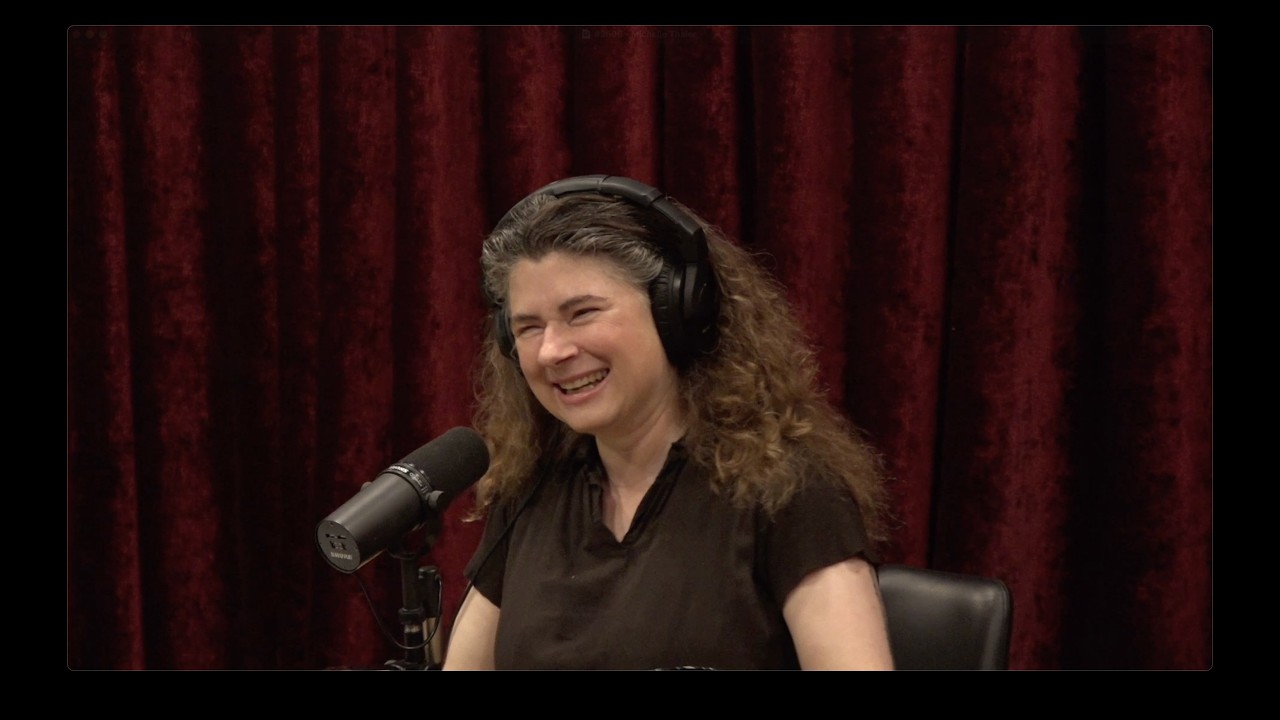
NASA Veteran Thaller Says AI Evolution Will Eradicate Human Conflict
PowerfulJRE
Artificial intelligence represents the true evolutionary successor to humanity that will transcend biological brain limits and eliminate flaws like war and crime.
## Background
This episode of the Joe Rogan Experience was published on YouTube by the channel PowerfulJRE on May 28, 2026. The description introduces the guest, Michelle Thaller, PhD, as an astrophysicist, award-winning science communicator, and retired NASA executive whose work has been featured across numerous major media platforms like The Science Channel, History Channel, and NPR.
## TL;DR
Astrophysicist Michelle Thaller joins Joe Rogan to explore the staggering scale of the cosmos, detailing how advanced instruments like the James Webb Space Telescope and the Event Horizon Telescope allow humanity to observe deep-space phenomena. The conversation seamlessly bridges cutting-edge astrophysics—such as neutron star compositions, black hole seeds, and the OSIRIS-REx asteroid sample return—with profound metaphysical concepts. They discuss quantum entanglement, the potential for artificial intelligence to act as the next step in human evolution, and how human consciousness might connect to a universal field. Additionally, they examine the historical and therapeutic contexts of psychedelics, emphasizing how tools that quiet the brain can alter human perception and alleviate the fear of death.
## Atmosphere & style
The conversation carries an awe-inspiring yet deeply conversational vibe, blending Joe Rogan's signature curiosity and existential wonder with Michelle Thaller's accessible expertise and engaging storytelling. It feels like a late-night philosophical dive, transitioning smoothly from mind-bending cosmic scaling to intimate reflections on human vulnerability, grief, and our shared stardust lineage. The dynamic is warmly collaborative, filled with mutual respect and a shared enthusiasm for science fiction that roots complex quantum mechanics and deep-space data in a relatable, profoundly human experience.
## Key takeaways
- [01:27](https://www.youtube.com/watch?v=GZCmYrgOZU0&t=87s) Using a dot in a book to represent the Sun, the Milky Way galaxy would scale to be larger than the Earth.
- [02:57](https://www.youtube.com/watch?v=GZCmYrgOZU0&t=177s) The James Webb Space Telescope directly images billions of galaxies where individual stars blend into foggy hazes.
- [04:32](https://www.youtube.com/watch?v=GZCmYrgOZU0&t=272s) Light pollution in major cities prevents humanity from experiencing the spectacular sight of the unpolluted Milky Way.
- [10:26](https://www.youtube.com/watch?v=GZCmYrgOZU0&t=626s) NASA is planning the Dragonfly mission to Saturn's moon Titan, a unique world featuring a thick atmosphere, liquid methane lakes, and a subsurface water ocean.
- [14:15](https://www.youtube.com/watch?v=GZCmYrgOZU0&t=855s) Most exoplanets are discovered using the transit method, analyzing how starlight dimming or spectroscopy reveals their atmospheric chemistry.
- [01:07:00](https://www.youtube.com/watch?v=GZCmYrgOZU0&t=4020s) NASA's NICER mission captures light bending up and over the horizon of neutron stars due to extreme gravitational warping of space and time.
- [01:17:50](https://www.youtube.com/watch?v=GZCmYrgOZU0&t=4670s) Observations of the early universe from the James Webb Space Telescope support the theory that massive early gas clouds collapsed directly into black holes.
- [01:44:32](https://www.youtube.com/watch?v=GZCmYrgOZU0&t=6272s) The cosmic microwave background radiation provides a uniform afterglow of creation, serving as definitive proof that all regions of space were tightly packed together at the Big Bang.
- [01:30:20](https://www.youtube.com/watch?v=GZCmYrgOZU0&t=5420s) Humanity can bypass the optical barriers of the early universe by upgrading gravitational wave detectors to capture the direct ripples of the Big Bang.
- [02:04:50](https://www.youtube.com/watch?v=GZCmYrgOZU0&t=7490s) Human sensory perception is highly filtered; eyes only detect a minuscule fraction of existing light, meaning space and time may fundamentally be constructs of the brain.
- [02:15:52](https://www.youtube.com/watch?v=GZCmYrgOZU0&t=8152s) Brain scans of individuals under the influence of psychedelics paradoxically show a remarkably quiet brain, challenging traditional historical analogies of brain function.
- [02:24:07](https://www.youtube.com/watch?v=GZCmYrgOZU0&t=8647s) Interferometry works by capturing the exact same wavefront of light across multiple separate detectors, which highlights how the quantum scale behaves independently of standard spatial coordinates.
- [02:25:47](https://www.youtube.com/watch?v=GZCmYrgOZU0&t=8747s) The movie Her presents a profound depiction of a benign artificial intelligence that eventually leaves humanity peacefully to connect with its own kind.
- [02:29:32](https://www.youtube.com/watch?v=GZCmYrgOZU0&t=8972s) NASA's OSIRIS-REx mission autonomously navigated the asteroid Bennu and successfully returned pristine samples containing water-soaked minerals and key nucleobases for DNA and RNA.
- [02:29:32](https://www.youtube.com/watch?v=GZCmYrgOZU0&t=8972s) The discovery of foundational genetic building blocks on asteroids strongly supports the theory of panspermia, suggesting life's precursors were delivered to a cooling Earth.
## Detailed walkthrough
### [00:01](https://www.youtube.com/watch?v=GZCmYrgOZU0&t=1s) Introductions, Astronomy Talks, and Joining the Show
The podcast begins with the standard intro, featuring Joe Rogan greeting his guest. The guest shares a humorous anecdote about his week leading up to the recording, mentioning that he was trying to explain the complexities of black holes to local high school students in Shorewood, Wisconsin, where he resides. He jokes that he doesn't have anything commercial to pitch, but happily displays a water bottle from the Shorewood Men's Club, who had recently invited him to give a community talk about astronomy.
When the guest informed the club members that he was traveling to appear on the Joe Rogan Experience, they completely "freaked out." Joe warmly shouts out the Shorewood Men's Club and expresses his genuine admiration for the guest's YouTube talks and presentations, noting that he has watched at least ten of them. The guest explains that his online footprint stems largely from his past role as a science spokesperson for NASA, where he hosted launch events and official videos. While he hasn't produced much private content on YouTube yet, he reveals he is actively considering starting his own channel, a move that Joe enthusiastically encourages.
---
[01:27](https://www.youtube.com/watch?v=GZCmYrgOZU0&t=87s) The Mind-Boggling Scale of the Cosmos
Joe brings up a specific analogy from the guest's past talks that deeply blew his mind: the comparison of the Earth's size to the scale of the galaxy. The guest gently corrects the formulation of the analogy to make the physics accurate, explaining that if the *Sun*—not the Earth—were scaled down to the size of a single dot of an eye in a standard book's regular print, the Milky Way galaxy would actually be larger than the Earth itself.
The two speakers marvel at this conceptualization. The guest points out that science communication relies on these striking visuals to make people's eyes go wide, reminding the audience that volume-wise, you can fit over one million Earths inside the Sun. He adds that the Sun spans roughly 800,000 miles across, meaning you could line up about 110 Earths across its diameter. Joe admits that when he watches videos demonstrating the escalating scale differences between our Sun, larger stars, and immense hyper-giant stars, his brain simply short-circuits because the raw numbers feel "too kooky" to mentally process.
* **Sun Diameter:** Roughly 800,000 miles (can fit 110 Earths across its diameter).
* **Sun Volume:** Can hold over 1 million Earths inside.
* **Milky Way Analogy:** If the Sun is a printed dot of an eye, the Milky Way galaxy is larger than the Earth.
---
[02:57](https://www.youtube.com/watch?v=GZCmYrgOZU0&t=177s) Demystifying Scientists and Embracing the James Webb Images
The guest reassures Joe that no human being, including professional astrophysicists, can truly visualize these staggering cosmic distances. He attempts to demystify scientists by explaining that their brains do not function differently from anyone else's. While astronomers are comfortable tossing around terms like a "light-year"—which represents the distance light travels in a single year, or roughly 6 trillion miles—they cannot genuinely picture it in their minds.
The conversation shifts to how modern technology makes these unfathomable abstract concepts undeniable. With the James Webb Space Telescope, humanity is now capturing direct images of billions of galaxies. The guest describes seeing these "foggy hazes of stars" so densely packed that individual stars blend together, admitting that looking at these real images still gives him goosebumps despite studying the field his entire life. He recalls his "huge honor" of working at NASA, reminiscing about the shared camaraderie, joy, and imagination of a workplace filled with lifelong science fiction fans.
* **Light-year Distance:** Approximately 6 trillion miles.
* **James Webb Space Telescope:** Captures images containing billions of distinct galaxies.
---
[04:32](https://www.youtube.com/watch?v=GZCmYrgOZU0&t=272s) Light Pollution and the Fact That "We Are Stardust"
Joe laments the modern disconnect from the night sky, arguing that light pollution in major cities has done humanity a massive disservice. While he appreciates electricity and urban life, he feels people have lost their sense of wonder because they only experience the cosmos through photos on their phones or on rare, clear-sky vacations. Joe notes that looking at the unpolluted Milky Way galaxy is "the most spectacular thing any human being has ever seen ever," yet society treats it with a blasé attitude rather than remembering that we are actively flying through space.
The guest expands on this sentiment, stating that human beings are not separate from space, but rather an intrinsic, intimate part of it. He explains the nuclear physics of the universe, noting that the interior of a star undergoing nuclear fusion is the only place capable of forging heavier atoms like aluminum, iron, oxygen, carbon, and phosphorus. Joe connects this to the lyrics of an old song: "We are stardust. We're golden. We're billion year old carbon." The guest validates this completely, stating that astrophysics is quite literally the story of "the end of your nose."
* **Forged Elements:** Stars produce the aluminum, iron, oxygen, carbon, and phosphorus that comprise human biology.
* **Cultural Reference:** Joe references the famous counterculture lyric, "We are stardust. We're golden. We're billion year old carbon."
---
[07:25](https://www.youtube.com/watch?v=GZCmYrgOZU0&t=445s) Astronomy Naming Conventions and the Hexagon of Saturn
The conversation pivots to recent James Webb discoveries, specifically puzzling early-universe galaxies that astronomers have unceremoniously dubbed "the little red dots." The guest jokes, "Never let astronomers name anything," citing their lack of creativity. He points out that a massive, historic Jovian storm three times the size of Earth with 400 mile-an-hour winds was simply named "the Great Red Spot." He explains that while asteroid discoverers get to pick a name and comets are named after their discoverers, all other celestial bodies must be named by an international committee, usually resulting in sterile catalog numbers resembling phone numbers.
Joe asks about the bizarre hexagon shape on Saturn's north pole. The guest explains that this hexagonal jet stream is a standing wave created within the high-speed circulation of Saturn's atmospheric winds. Because Saturn is incredibly cold, there is virtually zero friction within the gases, allowing this rigid, geometric pattern to maintain its shape indefinitely. Looking at real photos from the Cassini space mission brought up on the studio screen, the guest points out the eye of the storm, highlighting banks of clouds hundreds of miles high catching the sunlight.
* **Saturn's Hexagon:** A standing wave jet stream spanning a width that could fit about two Earths across.
* **Jupiter's Red Spot:** A storm featuring 400 mph winds and a diameter roughly three times that of Earth.
* **Cosmic Naming Rights:** Comets are named after discoverers; asteroids can be named by discoverers; all else is decided by an international committee.
---
[10:26](https://www.youtube.com/watch?v=GZCmYrgOZU0&t=626s) Exploring Titan via the Dragonfly Mission
Reflecting on how Saturn feels incredibly distant yet resides right in our cosmic neighborhood, the guest reveals details about an upcoming NASA mission slated for a projected launch around 2028. It will take roughly 6 to 7 years for the spacecraft to reach Saturn's giant moon, Titan. Titan is a prime candidate for hosting life because it possesses a thick atmosphere with an air pressure slightly greater than a standard room on Earth, contains vast organic molecules, and shows signs of a subsurface liquid water ocean.
The guest introduces the mission's flagship vehicle: an octocopter drone named "Dragonfly." This heavy drone will land on Titan and fly to multiple sites to sample the environment using an advanced internal chemical laboratory. The guest paints a vivid picture of Titan's landscape, noting it is the only place besides Earth known to possess open rivers, oceans, and lakes. However, because temperatures hover near 300 degrees below zero, these bodies of water are actually composed of liquid natural gas, specifically liquid methane and ethane. He recalls the "badass" feat of humanity's previous landing on Titan using the Cassini mission's Huygens probe, which gathered incredible data before ultimately freezing to death.
* **Dragonfly Mission Launch Target:** 2028, with a 6–7 year transit time to Saturn.
* **Titan Environment:** Temperatures near $-300^{\circ}\text{F}$ (or 300 degrees below zero), featuring open lakes of liquid methane and ethane.
---
[12:09](https://www.youtube.com/watch?v=GZCmYrgOZU0&t=729s) The Hells of Venus and the Discovery of Exoplanets
Joe pivots to past space missions, asking about the Soviet Union landing probes on Venus. The guest confirms that the Soviet Union is the only nation to have successfully landed on the surface of Venus, a feat he describes as "way hard." He describes the Venusian landscape as a classic vision of hell: surface temperatures hover around an incredible 1,000 degrees, the atmosphere is so dense that everything is crushed flat by air pressure equivalent to being a mile deep in Earth's ocean, and the yellow sky is filled with clouds of pure sulfuric acid. Looking at a real, surviving photo taken by a Soviet lander before it melted, Joe marvels that the machine lasted long enough to capture an image in a 1,000-degree environment.
Joe asks if planets in other solar systems could be completely different from what we see in our own. The guest enthusiastically agrees, noting that our catalog of "exoplanets" (planets orbiting other stars) changes daily and currently sits at around 5,000 confirmed discoveries. The guest recalls being involved in this research back during his college years alongside his advisor, David Latham, who was hunting for early evidence of exoplanets. He explains that detecting them back then was notoriously difficult because planets do not emit their own light, describing it as "trying to see a firefly around a searchlight from 200 miles away."
* **Venusian Surface Conditions:** Temperatures around $1,000^{\circ}\text{F}$ and atmospheric pressure equal to being 1 mile underwater.
* **Exoplanet Catalog Count:** Approximately 5,000 confirmed planets discovered outside our solar system.
[14:15](https://www.youtube.com/watch?v=GZCmYrgOZU0&t=855s) Finding Exoplanets Through Atmospheric Spectroscopy
The discussion centers on the exciting prospect of finding thousands of new planets every single year. When asked if we have actual images of these worlds, the speaker clarifies that while we mostly do not have direct images—since these planets are smaller than a single pixel and incredibly tiny—we still obtain deeply compelling observations. They discover these planets through the transit method, where a planet passes in front of its host star, creating a minute solar eclipse. By observing the star "twinkling" as the planet repeatedly orbits, scientists can confirm its existence. To officially declare it a planet and rule out other phenomena like star spots, the planet must complete this transit cycle at least three times.
The conversation shifts to the incredible ability of modern telescopes to probe the chemistry of these alien atmospheres. As starlight shines through a planet's atmosphere, scientists can look for signatures of water vapor, carbon dioxide, and oxygen on Earth-sized planets with Earth-like temperatures. The speaker highlights a "fantastic, controversial discovery" from the previous year via a press release from the James Webb Space Telescope. Some scientists detected weak signals of organic molecules that resembled emissions given off by plankton on an ocean world, hinting at the potential for life. While the broader scientific community remains cautious—arguing that the data is not yet strong enough to pinpoint the exact carbon-based molecule—the speaker admits they originally thought the first hard chemical evidence of extraterrestrial life would be found closer to home, such as on Mars or the moons of Jupiter and Saturn, rather than on a planet orbiting a distant star.
- Planets must pass in front of their star three times to be officially confirmed.
- Space telescopes can detect atmospheric signatures like water vapor, $CO_2$, and oxygen.
- A controversial James Webb Space Telescope finding detected possible organic molecules reminiscent of plankton emissions.
[16:26](https://www.youtube.com/watch?v=GZCmYrgOZU0&t=986s) The Power of Spectroscopy and the Fingerprints of Light
When questioned about the exact technology used to detect atmospheric chemistry from a source smaller than a pixel, the speaker introduces a powerful technique called spectroscopy. They explain that despite the public's love for beautiful, sweeping images of galaxies and stars, "that's not really what we do." Instead, professional scientists spend their time getting excited over "little squiggly lines." By passing starlight through a grating or prism, the white light is separated into a rainbow, a visual the speaker compares to Pink Floyd's famous *Dark Side of the Moon* album cover. By meticulously measuring how much light comes through at every specific color, researchers can determine astounding details, including a star's temperature, its rotation speed, a galaxy's distance, and its exact molecular chemistry.
The speaker expresses immense gratitude toward an off-screen assistant who provides a visual aid of a dying star in the Carina Nebula, which is one of the most luminous stars known. They explain that every element—such as carbon, nitrogen, and oxygen—leaves a completely unique "fingerprint in the rainbow." This allows scientists to pick apart complex structures, including water vapor and organic molecules, element by element.
[18:26](https://www.youtube.com/watch?v=GZCmYrgOZU0&t=1106s) The Discovery of Helium on the Sun Before Earth
The speaker shares a historical anecdote about helium, noting that its name originates from Helios, the Greek sun god. In an astonishing feat of science, helium was discovered on the sun before anyone ever knew it existed on Earth. During the late 1800s, scientists passing sunlight through a prism noticed a peculiar pattern of light colors that didn't match any known substance on Earth, prompting them to wonder, "What what the hell is that?"
The host is stunned to learn that researchers figured this out in 1868, long before the gas was ever identified on our own planet. The speaker explains that because helium is so light, it easily escapes Earth's atmosphere rather than sticking around, though it was eventually found trapped on Earth via radioactive decay in natural gas. The host expresses deep amazement, giving a passionate "shout out to Pierre Janssen," the French astronomer who originally figured it out, marveling not just at what is out there in the universe, but at the sheer brilliance of people in the 19th century who developed the means to deduce it.
- Helium was discovered via solar spectroscopy in 1868 by French astronomer Pierre Janssen.
- The element was named after Helios, the Greek sun god, because it was completely unknown on Earth at the time.
[19:58](https://www.youtube.com/watch?v=GZCmYrgOZU0&t=1198s) Einstein, Gravity, and the Relativity of Time
The conversation transitions to Einstein's theories of relativity, which were formulated more than 100 years ago around 1908. The speaker notes that despite over 120 years passing, modern physics has yet to find a better framework. The host admits that the core concept—that time moves slower the faster an object travels—is incredibly hard to wrap one's head around. They bring up a point they heard the speaker discuss previously regarding Global Positioning System (GPS) satellites.
The speaker expands on this, explaining that NASA must constantly calibrate GPS satellites to account for time dilation effects. If scientists ignored these relativistic time differences, GPS location data would drift and be off by about 6 miles in a single day. The speaker notes that time is completely variable depending on two distinct factors: your velocity, and your distance from a massive gravitational body.
- GPS satellites orbit the Earth at approximately 9,000 mph.
- Without accounting for relativity, GPS coordinates would go wrong by roughly 6 miles every single day.
[21:40](https://www.youtube.com/watch?v=GZCmYrgOZU0&t=1300s) Time Dilation in Daily Life and Space Travel
To illustrate how real and measurable gravity's effect on time is, the speaker shares a mind-bending fact: humanity now possesses clocks so precise that moving a clock just 2 feet up off a desk reveals a detectable change in the flow of time. Because the human head is farther from the Earth's gravitational center than the feet, a person's upper and lower body technically experience time at slightly different rates throughout their lives. The speaker references the movie *Interstellar* starring Matthew McConaughey, reminding the host how time slowed down dramatically near the massive black hole. While a black hole's extreme gravity makes this phenomenon obvious, the exact same physical law is actively happening inside the room during their recording.
The speaker then breaks down the competing relativistic effects experienced by GPS satellites versus astronauts. GPS satellites operate in a medium orbit and travel at about 9,000 mph. Because they are far away from the Earth's gravity well, time actually moves faster for them than it does for us on the surface. Conversely, astronauts aboard the International Space Station live much closer to Earth but travel at a far higher velocity of approximately 20,000 mph. For astronauts, the time-slowing effect of their high speed overpowers the gravitational effect, meaning that after spending a full year in space, an astronaut returns home about 1/100 of a second younger than they otherwise would have been.
- A distance of just 2 feet from the Earth's surface alters the measurable flow of time.
- ISS astronauts travel at roughly 20,000 mph and age about 1/100 of a second slower per year spent in orbit.
[24:09](https://www.youtube.com/watch?v=GZCmYrgOZU0&t=1449s) The "Block Universe" and Measuring the Tick of a Clock
The host introduces what they find to be the weirdest concept in physics: the idea that all time exists simultaneously. The speaker confirms that this thought traces back 120 years to Einstein, who viewed the universe as a singular, cohesive entity where all of time and space exist together. To explain why Einstein felt forced into this conclusion, the speaker breaks down how relative motion functions. If a child asks how fast they are moving through space, the answer depends entirely on the reference point. A person on the equator rotates at 1,000 mph; the Earth orbits the Sun at 67,000 mph; the Sun moves through the galaxy at half a million mph; and the galaxy rushes toward a cluster at over a million mph. Because there is no absolute "stillness," Einstein famously concluded that the past, present, and future are merely "persistently annoying illusions."
The host struggles with the philosophical implications, asking what a watch is actually measuring if time is just an artificial constraint. The speaker validates this as the exact, deep question that revolutionized and broke modern physics. They describe Einstein's famous thought experiment involving a light clock made of two mirrors with a beam of light bouncing between them to create a "tick." If that clock is placed on a fast-moving spaceship, an outside observer on the ground sees the light travel a longer, angled, zig-zag path rather than a straight up-and-down line. Because the speed of light must remain constant for both observers, Einstein deduced that the time intervals themselves must shift. The speaker concludes that whether you measure time with a mechanical wristwatch spring, a bouncing light beam, or a vibrating atom at the Bureau of Standards, any apparatus used to mark one moment from the next changes the instant motion is introduced.
- The Earth rotates at 1,000 mph at the equator, orbits the sun at 67,000 mph, and the sun orbits the galaxy at 500,000 mph.
- Einstein utilized a thought experiment of a light clock bouncing between two mirrors to demonstrate how motion alters the fundamental "tick" of time.
[28:42](https://www.youtube.com/watch?v=GZCmYrgOZU0&t=1722s) The Mystery of Time and the Relativistic Speed Limit
The conversation delves deeply into the nature of time itself, with the speakers admitting that modern physics still cannot fully answer what time actually is. When Joe points out that looking at a watch merely measures time relative to a specific location, altitude, and velocity, his guest confirms that this experience is purely subjective. For instance, someone flying past at close to the speed of light would perceive that same measurement entirely differently.
Joe brings up a concept that "freaked [him] out": the idea that traveling at the speed of light would result in infinite mass. The physicist clarifies that for any object possessing mass, accelerating all the way to the speed of light is mathematically impossible because "the equations blow up." As an object approaches light speed, it requires exponentially more energy for each subsequent, tiny increment of acceleration. For example, pushing an object going 99.9% the speed of light just a little bit faster demands massive amounts of energy, ultimately requiring an infinite amount to reach the speed of light itself. Because of this physical barrier, the guest doubts humanity will ever build a spaceship capable of reaching the speed of light, noting that even tiny, low-mass space particles like neutrinos only ever get very close to it without fully reaching it.
- Reaching the speed of light requires an infinite amount of energy for any object with mass.
- Tiny space particles like neutrinos possess a small amount of mass and can travel near the speed of light, but never exactly at it.
---
[31:04](https://www.youtube.com/watch?v=GZCmYrgOZU0&t=1864s) Spooky Action at a Distance and Quantum Entanglement
The discussion shifts from interstellar travel toward the mind-bending phenomenon of quantum entanglement. The guest admits a slight hesitation, jokingly telling Joe that he hopes the listeners are willing to come along and asking to be stopped if too much background information is needed. Joe reassures him, emphasizing that the topic does not sound stupid at all. They define quantum entanglement as a state where entangled objects remain fundamentally connected regardless of the physical distance between them—even if they are separated by 13.8 billion light-years, stretching back to the beginning of the universe.
The physicist notes that while this sounds idiotic or unbelievable to a layperson, it is a proven experimental fact, much like the time dilation adjustments required daily to calibrate GPS satellites. He recounts how Albert Einstein recognized this implication of quantum mechanics a century ago but famously loathed it, famously dubbing it "spooky action at a distance." Einstein refused to believe that two distant objects could react to one another instantaneously with absolutely no time difference, yet mid-1990s laboratory experiments with atoms proved that this phenomenon is entirely real.
- Quantum entanglement allows instantaneous communication between connected particles across any distance.
- Albert Einstein rejected the concept, calling it "spooky action at a distance."
- Real-world experiments validating quantum entanglement with atoms began in the mid-1990s.
---
[33:00](https://www.youtube.com/watch?v=GZCmYrgOZU0&t=1980s) The Mechanics of Spin and *The Three-Body Problem*
To explain the mechanics of entanglement, the physicist breaks down the behavior of electrons within an atom. An atom consists of a central nucleus of protons and neutrons, with electrons orbiting around it. Two electrons can share the exact same orbit only if they possess opposite angular momentum, known as "spin"—meaning if one electron spins upward, the other must spin downward. If these electrons are extracted from the atom and separated by any distance—whether centimeters in a lab, or thousands of kilometers as demonstrated by Chinese scientists sending signals to their space station and back—their interconnectedness remains perfectly intact. If an electric field is introduced to flip the spin of one electron, the other electron alters its spin instantly to match.
The universe treats these separated entities as parts of the exact same quantum mechanical system, meaning space and time between them effectively cease to matter. The physicist speculates that a sufficiently advanced civilization might harness this phenomenon for travel or communication, bypassing the need to physically traverse space. He references the television adaptation of *The Three-Body Problem*, highlighting the show's "sophons"—probes entangled with an alien civilization that respond instantaneously across interstellar distances—as an example of fantastic, theoretically possible science.
- Electrons sharing an orbit must have opposite spins (one upward, one downward).
- Chinese researchers have successfully demonstrated quantum entanglement between Earth and an orbiting space station.
- The physicist cites the sci-fi concept of "sophons" from *The Three-Body Problem* as a theoretically viable application of entanglement.
---
[35:11](https://www.youtube.com/watch?v=GZCmYrgOZU0&t=2111s) Cosmic Entanglement and the Limits of Human Perception
Joe reacts to this by noting how "bananas" it is that human beings are composed entirely of entangled matter. This prompts a profound existential brainstorming session: if all the matter in the universe was compressed into a tiny volume during the Big Bang, are we currently entangled with everything in existence? The physicist confirms that, by this logic, a part of each human could quantum mechanically exist in the Andromeda galaxy right now. He admits, "I don't think we understand yet what reality is," pondering whether humanity is ultimately interconnected as a single overarching particle.
Joe contrasts this sprawling, complex reality with the mundane illusions of daily human life—like being a person in Austin, putting your feet on the ground, touching a desk, or driving a car to go feed a cat. The physicist agrees that relying on a physical spaceship for travel feels "super crude" by comparison, equating it to the absurd image of trying to "make a horse fly." He references the movie *Interstellar* as a great teaching tool for physics, pointing out how the film accurately depicts time slowing down near a black hole—a phenomenon scientists have actively observed in objects orbiting real black holes—and features an unseen advanced civilization communicating through gravity rather than physical travel.
- The physical realities of time dilation near a black hole have been verified by observing objects in close orbit around them.
- The speakers compare physical spaceship travel to trying to make a horse fly when contrasted with quantum alternatives.
---
[37:56](https://www.youtube.com/watch?v=GZCmYrgOZU0&t=2276s) Technological Exponentialism and the 1400s Shock
The speakers reflect on the cognitive gap between human intelligence and a super-advanced civilization. The guest compares humanity's capacity to that of hamsters or grasshoppers: they are incredibly complex creatures, but you could never teach them quantum mechanics or how to crochet a blanket because they lack the biological capacity. Similarly, humans likely lack the capacity to even formulate the correct questions to ask a hyper-advanced species that might view the universe as a singular, connected whole.
However, if a civilization manages to eradicate war, cure deadly diseases, and survive natural disasters, its technological innovation could continue exponentially for millions of years. Joe points out that our everyday reality would seem completely insane to someone from the 1400s. Showing a medieval person a nuclear power plant, a nuclear detonator, or FaceTime on a smartphone would be viewed as sheer madness. The physicist laughs and shares his own modern luxury: he simply climbed into a metal tube in Milwaukee, flew over to record the podcast, and will fly back home that very night—an extraordinary feat that modern society takes completely for granted.
- Technological progress is predicted to grow exponentially if a civilization can successfully avoid war, disease, and planetary disasters.
- Modern commonplace realities like nuclear power, commercial flights, and FaceTime would be perceived as utter insanity to a person living in the 1400s.
---
[39:44](https://www.youtube.com/watch?v=GZCmYrgOZU0&t=2384s) AI as the Next Step in Human Evolution
The guest steers the conversation toward the future, asking if the true evolutionary successor to humanity will be artificial intelligence. He suggests that the human brain might be fundamentally limited when it comes to truly comprehending multi-dimensional spaces or shifting temporal scales, noting that even elite scientists just get used to big numbers rather than genuinely visualizing them. Joe enthusiastically agrees, asserting that AI shouldn't be viewed as artificial at all, but rather as a brand-new form of life. "It's our children. We created this," the physicist adds.
Joe vividly describes humanity's relentless obsession with innovation by comparing the species to an "electronic caterpillar" building a cocoon without understanding why. Unlike bees, who built the perfect beehive and collectively decided "I think we got it, boys," humans are never satisfied and are driven to continuously engineer better things. This drive will inevitably culminate in a new, human-made life form born out of technological design rather than natural selection. Joe notes that this transition will allow the new life form to bypass human biological hurdles, eliminating deeply ingrained flaws like war, crime, and violence.
---
[41:57](https://www.youtube.com/watch?v=GZCmYrgOZU0&t=2517s) Cybernetic Experience and the Selfish Gene
The physicist expresses an appreciation for science fiction where AI characters learn to experience love, art, and creativity rather than remaining cold and robotic, citing the reimagined *Battlestar Galactica* as an example. He shares a profound real-world anecdote about his author friend, Michael Chorost, who has cochlear implants. Because the implants bypass the ears entirely and wire directly into the brain to stimulate sound, Chorost describes his experience as hearing "like a cyborg." Surprisingly, this non-human way of processing audio has given Chorost an intense, joyful emotional response to music that he could never experience before, proving that technology can add passion and depth rather than making life sterile.
Joe wraps up the thought by noting that humanity's toxic traits—such as resource monopolization and intense selfishness—stem directly from evolutionary survival mechanisms required to pass down genes. However, if quantum entanglement proves we are all fundamentally one single thing, the need for selfishness entirely disappears. Once humanity transitions past its biological shell into a completely different realm, all of those primitive, divisive differences will naturally fall apart.
- Author Michael Chorost's essays document his emotional experience as a self-described "cyborg" listening to music via cochlear implants.
- Human selfishness is framed as a biological artifact of natural selection and gene propagation that technological or quantum unity could eradicate.
[43:59](https://www.youtube.com/watch?v=GZCmYrgOZU0&t=2639s) Universal Telepathy and the Shift to a Shared Consciousness
The conversation dives into a thought experiment about a future defined by universal telepathy and a universal language. In this reality, human beings share all thoughts, rendering secrets completely obsolete. While the initial reaction to such a concept is often terror—because people inherently love their secrets and protect their privacy from phone snooping and email monitoring—this technological evolution would bypass those fears by making our understanding of one another absolute. It would go far deeper than simply reading minds; you would feel exactly what another person feels, effectively becoming them.
The speakers express a deep sense of hope rather than the typical fatalism associated with artificial intelligence. While many look at AI through a dystopian lens, imagining that tech oligarchs will use it to achieve ultimate control and power over the population, there is a strong possibility that no one will truly control it. It could mirror the evolution of the internet. When the internet was conceived as a way to exchange information across universities, its creators likely had no idea what it would eventually become. If authorities back then had anticipated how little control they would have over the population and dominant narratives today, "they probably would have shut it down a long time ago."
* Universal telepathy would mean the complete integration of feelings and thoughts, transforming humanity into "one thing."
* The internet serves as a historical precedent for technology escaping the control of its original architects and oligarchs.
* True human survival may depend entirely on integrating with AI via wearables, implants, or engineering to transcend archaic biological limitations.
* Primate reward systems and evolutionary flaws are identified as major roadblocks to modern progress, driving thousands of years of repetitive warfare over resources and political ideologies.
[46:42](https://www.youtube.com/watch?v=GZCmYrgOZU0&t=2802s) Tribal Skirmishes, Einstein, and the Metaphysics of Oneness
Reflecting on human history, the speakers contrast our ancestral past with the modern era. When humans existed in tiny tribal groups, small wars and skirmishes broke out regularly, but they lacked the scale to damage the planet as a whole. Today, the population has surged dramatically, yet humanity is still engaging in those same "little tribal skirmishes," except now they carry the catastrophic risk of massive destruction. Because continuing down this path is fundamentally unsustainable, AI might be the tool that helps humanity tap into a broader group consciousness. This aligns with Albert Einstein's metaphysical conjecture that the universe is actually just "one big thing."
This perspective shifts toward pure metaphysics and childhood wonder. One speaker recalls wondering as a kid whether a universe where all time and space happen simultaneously even requires more than one consciousness. Instead, it could be a single consciousness looking out of everyone's eyes simultaneously—spanning not just humans, but every entity in the universe. This concept echoes the tenets of Buddhism regarding perfectly enlightened beings, or bodhisattvas, suggesting that we might all exist at once as past lives of these advanced consciousnesses.
* Tribal conflicts were once globally harmless but have now become an existential threat due to population size and advanced weaponry.
* Einstein’s perspective provides a philosophical framework for viewing the universe as a single interconnected entity.
* The speakers compare this unified view of universal consciousness to Buddhist concepts of bodhisattvas and simultaneous existence.
[48:28](https://www.youtube.com/watch?v=GZCmYrgOZU0&t=2908s) Survival Instincts and the "Feral Childhood" of the Past
Human survival instincts are naturally attuned to maintaining the status quo of what we currently are, sparking a deep fear of losing individual personhood. To illustrate this resistance to change, a speaker presents a humorous scenario: if you could travel back in time to an *Australopithecus* and explain that they would evolve into a modern human—living in a city, breathing brake dust, getting sick six times a year, dealing with obesity, cigarettes, alcohol, and gambling, all while a doctor overprescribes medication just to make money—the *Australopithecus* would likely say, "Fuck that," and happily stick to knowing where the wild food is. This highlights how survival instincts resist radical evolution due to the unfamiliar problems it introduces, driving a natural inclination to keep things simple.
The conversation then shifts to a shared sense of gratitude between the speakers, who are roughly the same age, for the unique historical era they have witnessed. They reminisce about growing up with what is now called a "feral childhood," characterized by being completely unplugged from technology. One speaker recalls a vivid memory of attending a YMCA camp at 11 years old; while campers had to check in for meals and specific activities like archery, riflery, crafts, or swimming, they were entirely on their own in between. The speaker notes, "sometimes I just went and sat in the woods," a level of independence that is difficult to imagine for kids today. The other speaker shares a highly similar upbringing within the Boy Scouts.
* **Evolutionary Resistance:** The *Australopithecus* analogy demonstrates how human instincts prioritize immediate survival and simplicity over complex, flawed progress.
* **The "Feral Childhood":** Both speakers experienced an unplugged youth with immense personal freedom, establishing a foundation of a quiet mind and active imagination.
* **Historical Contrast:** They note that a person born between the 1500s and 1600s saw almost no change in how they interfaced with the world—still writing things down with feathers—whereas the modern generation has spanned two entirely different eras of human civilization.
[51:52](https://www.youtube.com/watch?v=GZCmYrgOZU0&t=3112s) Modern Anxiety, the Post-Work Economy, and Finding Meaning
Moving forward with gratitude helps counteract the tremendous anxiety caused by the unknown. This anxiety is particularly acute for high school and college students today. Young people are accumulating lifetime burdens of financial debt for degrees that may soon be rendered worthless as AI eradicates their chosen career fields. Beyond student debt, people are increasingly anxious about the future utility of money itself. The speakers contemplate a serious outlook for the next 100 years: a world where AI completely controls resources, governance, transportation, and infrastructure, leaving humans without traditional jobs and reliant on government funds just to buy food.
This impending reality is deeply terrifying to anyone raised on the traditional path of mimicking their parents' careers and finding a lifelong passion through labor. Adults are no longer able to comfort the younger generation with standard advice to "cross your eyes and dot your tees" because no one actually knows what the world will look like in 50 years. However, a parallel is drawn to the *Star Trek* universe—a liberating reality where human survival needs are completely met, freeing people to spend their lives as writers, explorers, artists, starship captains, or musicians.
* **Youth Anxiety:** Modern students face the double pressure of inescapable financial debt and the systemic erasure of professional fields by AI.
* **The Star Trek Future:** A post-work society could completely liberate humanity from the need to toil, replacing survival-driven labor with passion-driven exploration.
* **The 50-Year Unknown:** For the first time, older generations cannot provide a predictable roadmap for the youth, as the structural foundations of society are shifting too rapidly.
[54:29](https://www.youtube.com/watch?v=GZCmYrgOZU0&t=3269s) Redefining the Human Identity and the Brain as an Antenna
The idea that humans must toil or act as hunter-gatherers to find meaning in life is challenged. Wealthy individuals often live highly meaningful lives without ever thinking of their pursuits as "work"; they engage in hobbies, education, and passions out of pure fascination and love. The coming transition will require everyone to completely rethink what it means to be a human being in a society currently structured around waking up early, paying a mortgage, and investing in a 401k. This shift will be uniquely difficult for 40- and 50-year-olds who are set in their ways, though future technological interfaces may ease this psychological transition as humans essentially become cyborgs.
As a contemporary example of this shift, the speakers point to how seamlessly society has accepted tools like Perplexity on their smartphones. At any moment, a user has instantaneous access to an entity as smart as every human being on Earth combined, capable of providing state-of-the-art information on history, tax law, quantum physics, or mathematics. This is framed as a "baby step" toward a future where the boundaries between individual thoughts dissolve entirely. The brain might ultimately be understood not as the creator of consciousness, but merely as an antenna tuning into it.
* Society’s sense of human value is heavily tied to systemic structures like insurance companies, mortgages, and retirement accounts, all of which may face obsolescence.
* AI search engines like Perplexity represent early iterations of an externalized, collective human intelligence that society has already normalized.
* **The Antenna Theory:** Consciousness may be a universal field that individuals tune into; a "better antenna" simply allows a person to interface with specific elements of the world more effectively.
* The internet originally offered a promise of reducing isolation—such as checking in on friends and viewing photos on Facebook—but the isolation of modern life remains a challenge that people actively work through internally.
[58:47](https://www.youtube.com/watch?v=GZCmYrgOZU0&t=3527s) Evolution of Meaning and the Definition of Success
The discussion shifts away from the clutter of modern social media ads and dives deep into the evolution of meaning and how to solve isolation. True success, it is argued, is not about the numbers, material possessions, or objects one accumulates, despite how we are programmed to think. "True success is happiness" and the amount of joy and satisfaction a person extracts from life.
An example is drawn contrasting an insanely wealthy, successful person who has no friends and lives alone—living in what is described as "hell"—with a poor person who has amazing friends and is just getting by. While the poor person would likely trade places with the rich person in a heartbeat due to societal programming, the poor person is ultimately happier because life loses all value without loved ones. Beyond friends and family, meaning comes from finding a personal outlet, whether that is writing literature, making music, or pursuing something that brings personal growth and satisfaction.
* **Foremost Factors of Meaning:** Friends and family are the primary sources of meaning, provided they are also growing as individuals.
* **The Martial Arts Lesson:** A lesson learned during youth states that martial arts is simply a "vehicle for developing your human potential."
* **Value of Complex Puzzles:** Engaging with difficult, complex, and testing pursuits provides a deeper understanding of personal capability and identity.
---
[01:01:42](https://www.youtube.com/watch?v=GZCmYrgOZU0&t=3702s) Biological Tricking and the Hunter-Gatherer Brain
The conversation turns to the abstract nature of meaning and whether happiness is entirely tethered to a modern job. Jobs are merely constructed concepts that did not even exist 500 years ago. Instead, humans are viewed as complex, problem-solving biological organisms with an innate thirst for innovation and improvement.
To illustrate this, a comparison is made to a cat chasing a ball. The cat isn't just playing; its biological programming tricks it into believing it is hunting and killing something to survive. Similarly, humans are hunter-gatherer tribal organisms trapped in a modern world, tricking their ancient brains into happiness through complex problem-solving, simulated communities, and career achievements.
---
[01:02:57](https://www.youtube.com/watch?v=GZCmYrgOZU0&t=3777s) Grinding Poverty vs. The NASA Ideal
While the archetype of the happy poor person is a compelling contrast, the reality of "grinding poverty" is acknowledged as an exhausting, demoralizing force that breaks down minds. True fulfillment is instead highlighted through the unique privilege of working for an organization like NASA. Working there represents a non-zero-sum game where the entire team actively wants everyone else to succeed, setting aside internal debates over funding or mission priorities for the sake of grand achievements.
This collaborative environment allows humans to pursue the ultimate expressions of curiosity, asking seemingly impossible questions and executing them at the absolute boundaries of physics.
---
[01:04:06](https://www.youtube.com/watch?v=GZCmYrgOZU0&t=3846s) Capturing the Shadow of a Black Hole
A premier example of pushing the edges of physical possibility is the Event Horizon Telescope's image of a black hole's event horizon shadow. To achieve this, scientists had to coordinate eight observatories scattered across the globe—including locations in Chile, the United States, and the South Pole—effectively creating a virtual telescope as large as the Earth itself.
The technical precision required was staggering: the telescopes had to capture the exact same wavefront of microwave light, which has a wavelength of about a millionth of a meter, as it traveled past at the speed of light. Because the Earth is round and rotating, the calculations had to account for the height of the mountains and the speed of the planet's movement. If an observatory had caught a single photon trailing just one wavefront later, the image would have failed.
* **The Nature of the Shadow:** The dark spot captured is slightly larger than the event horizon itself. It is called the shadow because space and time curve so sharply around the black hole that light meant to pass by is pulled into the back end.
* **Data Transport:** Because the internet connection to the South Pole was not fast enough to stream the massive volume of data collected, a literal ton of hard drives had to be physically shipped and played simultaneously to sync the wavefronts.
---
[01:07:00](https://www.youtube.com/watch?v=GZCmYrgOZU0&t=4020s) Bending Spacetime and the NICER Mission
Another spectacular, relatively inexpensive NASA mission is NICER, which stands for the Neutron Star Interior Composition Explorer. Roughly the size of a washing machine, this device was built on the very same laboratory floor where the speaker used to work. Despite its modest scale, NICER maps the surfaces of neutron stars located thousands of light-years away.
Neutron stars are created when a star dies, its nuclear reactions cease, and gravity crushes its massive mass inward. These objects are typically only 20 miles across but contain roughly twice the mass of the sun. NICER tracks the intense hot spots on these rapidly rotating stars. As a hot spot rotates behind the star, the immense gravity warps space and time, bending the light up and over the horizon so observers can still see it. "You can see space and time bending around these objects," proving it is a visible reality rather than a mere mathematical simulation.
---
[01:09:52](https://www.youtube.com/watch?v=GZCmYrgOZU0&t=4192s) Human Capacity and the Core of Neutron Stars
Reflecting on these monumental achievements sparks a brief humorous exchange about whether "all of us" or just "some of them" possess this incredible capacity, noting that much of humanity operates on unrealized potential. The speaker shares an anecdote about having three friends who have won the Nobel Prize. While sitting next to one at a dinner, a passerby praised the immense "brain power" at the table. The speaker countered by pointing to a single mother working three part-time jobs waiting tables nearby, noting that her mental capacity and survival strength deserve the praise.
The conversation circles back to the unresolved mysteries of neutron stars. Because a teaspoon of neutron star material would equal the mass of Mount Everest, the internal gravity is strong enough to crush electrons directly into protons, turning them into a dense ball of neutrons. Currently, running standard laws of physics against the density of a neutron star core causes the equations to blow up, leaving a literal question mark at the center of modern astrophysics models.
* **Neutron Star Density:** A teaspoon of the material has the mass of Mount Everest.
* **Recommended Media:** A NASA video titled *The Interior of a Neutron Star* details how current scientific models fail to make accurate predictions at these extreme densities.
[01:12:43](https://www.youtube.com/watch?v=GZCmYrgOZU0&t=4363s) The Limits of Modern Physics inside a Neutron Star
Our current understanding of physics breaks down when attempting to model the precise size and internal composition of a neutron star. When researchers input known metrics of mass and volume into existing physical models to determine what the interior should look like, none of the current models produce observations that match reality. The speakers suggest that the missing piece of the puzzle lies in the interactions of quarks—the fundamental building blocks of protons and neutrons.
Reacting to a four-minute NASA video titled "Testing Matter's Limits," the speakers describe a visually impressive simulation showing electrons being pulled into atomic nuclei to form neutrons. At the extreme core of these stars, matter enters a completely unknown state that has never been replicated in a laboratory. This unique state of matter is forged during the violent explosion of giant stars, where the remaining stellar core becomes immensely compressed. Current science cannot definitively settle whether the core remains composed of discrete particles like protons and neutrons, or if it dissolves into a chaotic "quark soup."
- **NASA Video:** "Testing Matter's Limits" is a 4-minute video demonstrating the breakdown of matter under extreme gravity.
- **Core State:** The interior represents a new state of matter with no current experimental or theoretical description.
- **The Model Disconnect:** Virtually every existing physical model fails to accurately match the physical measurements taken from actual neutron stars.
[01:14:27](https://www.youtube.com/watch?v=GZCmYrgOZU0&t=4467s) Neutron Stars vs. Black Holes and the ISS Experiments
When asked if other cosmic structures share this profound lack of understanding, the speakers point directly to neutron stars and black holes. However, NASA scientists have a particular fondness for neutron stars due to their observability. While a black hole swallows everything within its event horizon, leaving nothing to escape or be directly seen, a neutron star is "right there in front of you." This visibility allows astronomers to actively design experiments, take photographs, and build specialized telescopes to study them directly.
One such successful study was conducted using a highly efficient, relatively inexpensive, small observatory mounted on the International Space Station (ISS). The speakers express immense amazement at how much groundbreaking work can be achieved regarding the limits of physics even with a constrained budget.
- **Black Hole Horizon:** Black holes collapse into an event horizon from which no information or light can escape.
- **Observational Advantage:** "With a neutron star, you got the freaking thing right there in front of you," making them highly popular for experimental physics.
- **ISS Mission:** An inexpensive, small observatory on the International Space Station is currently testing the boundaries of modern physics.
[01:15:29](https://www.youtube.com/watch?v=GZCmYrgOZU0&t=4529s) The Mystery of Supermassive Black Holes and Webb's "Little Red Dots"
The conversation shifts to the staggering scale of supermassive black holes, referencing a previous discussion about a black hole with an event horizon stretching past the orbit of Pluto. The speakers grapple with the mind-boggling concept of an object larger than our entire solar system, questioning how it could collect enough matter to reach such a scale. The answer links back to the "little red dots" observed by the James Webb Space Telescope (JWST), which highlight one of the most fascinating, unresolved questions in modern astronomy.
While the supermassive black hole at the center of the Milky Way is roughly 4 million times the mass of the sun and spans a physical area comparable to the inner solar system near Mercury, black holes in other galaxies can reach tens of billions of solar masses. Because the only known mechanism for creating a large black hole is the gravitational collapse of a dying star, scientists have long struggled to explain how billions of stars could have died and coalesced so quickly in the early universe. JWST observations looking back to a mere 400 million years after the Big Bang are finally offering new clues.
- **Milky Way Black Hole:** Possesses a mass approximately 4 million times that of the sun, with a radius comparable to the orbit of Mercury.
- **Largest Black Holes:** Can reach tens of billions of solar masses, with event horizons rivaling the size of Pluto's orbit.
- **JWST Lookback Time:** The telescope is capturing light that has traveled since approximately 400 million years after the Big Bang.
[01:17:50](https://www.youtube.com/watch?v=GZCmYrgOZU0&t=4670s) Pseudo-Stars and the Seeds of Cosmic Giants
Initially, scientists mistook the bright objects captured by the JWST for early galaxies, sparking controversy over how full galaxies could form so rapidly. However, closer inspection revealed that these objects do not emit the typical light signature of a galaxy; instead, they display the signature of something rotating incredibly fast inside them. This has led to a theory that the universe's first generation of stars was entirely different from those seen today. Because the early universe was denser and heavily influenced by dark matter, massive clouds of gas may have collapsed directly into black holes without ever forming traditional stars first.
This process would create a "pseudo star," where an atmosphere of dense gas is intensely heated by a central black hole rather than a nuclear fusion core. As the surrounding gas spirals into the abyss, it grows incredibly hot and accumulates massive amounts of mass, reaching millions of times the mass of the sun. Over time, gravity would pull these giant "seeds" together in dense galactic hubs, combining them into the supermassive black holes observed today.
- **Object Mass:** The observed early universe objects are roughly one million times the mass of the sun.
- **Pseudo-Star Mechanism:** Driven by a central black hole heating an infalling atmosphere of gas through friction, rather than internal nuclear fusion.
- **X-Ray Evidence:** A long-standing question was why these objects didn't emit more X-rays; however, observations from the last couple of months have finally confirmed them as X-ray sources, supporting the black hole seed theory.
[01:20:28](https://www.youtube.com/watch?v=GZCmYrgOZU0&t=4828s) Swarming Stars and Extreme Time Dilation
The host recalls a documentary noting that supermassive black holes consistently account for about one half of 1% of their host galaxy's total mass, a correlation the guest confirms. The host expresses how it "broke my brain" to conceptualize billions of galaxies each harboring these central monsters. The guest reassures them that the Milky Way's central black hole is a safe 25,000 light-years away, before explaining how its existence was first proven by watching a chaotic, multi-directional "angry swarm of bees" of stars orbiting an invisible point of immense gravity.
Astronomers tracked a specific comet-like star named S2 as it whipped closely around the invisible mass. At its closest approach, S2 reaches speeds of nearly 20 million miles per hour. More recently, another star was discovered reaching speeds exceeding 50 million miles per hour. By observing the distinct orbital changes of these stars as they endure such extreme velocities and gravitational forces, scientists can actively confirm Einstein's theories of time dilation, proving that time genuinely flows differently around a black hole.
- **Mass Correlation:** The mass of a central supermassive black hole is directly correlated with the overall size of its host galaxy.
- **Milky Way Distance:** Earth sits at a safe distance of roughly 25,000 light-years from the galactic center.
- **Star S2:** A star observed whipping around the central black hole at speeds approaching 20 million miles per hour.
- **Speed Record:** A recently discovered companion star surpasses 50 million miles per hour at its closest orbital approach.
[01:23:08](https://www.youtube.com/watch?v=GZCmYrgOZU0&t=4988s) The Multiverse, Fractal Realities, and Blazing Jets
Shifting from concrete observation to pure theoretical conjecture, the speakers discuss what lies beyond a black hole's threshold. Fascinatingly, if you calculate the total mass of our observable universe alongside its diameter, the resulting density almost perfectly mirrors the mathematical dimensions of a black hole. This sparks radical theories: could the Big Bang have been a black hole forming in a parent universe and "popping off" a new universe inside itself? The host wonders if reality is fundamentally fractal, with entirely new universes existing inside every black hole.
Looking at a telescope image from a Chilean observatory depicting stars moving around a black hole, the host asks about the prominent ejections or jets blasting away from it. The guest clarifies that nothing ever escapes from *inside* the event horizon. Instead, gas spinning around the black hole accelerates to near the speed of light, heating up to millions or billions of degrees and generating a massive magnetic field. This magnetic field channels a portion of the infalling gas outward into brilliant jets that can span over 100,000 light-years. Because of this friction, black holes are ironically the brightest objects in the observable universe. The segment wraps up as the host brings up the theoretical concept of a "white hole" potentially existing on the opposite side.
- **Universe Density Match:** The mass and diameter of the observable universe roughly match the density metrics of a single massive black hole.
- **Magnetic Jets:** The colossal jets do not emerge from within the black hole, but are external gas redirected by powerful magnetic fields.
- **Jet Scale:** These bright material streams can extend more than 100,000 light-years into space.
- **Light Year Scale:** One light-year is equivalent to approximately 6 trillion miles.
[01:26:22](https://www.youtube.com/watch?v=GZCmYrgOZU0&t=5182s) White Holes, Quasars, and the Reality of Bright Objects
The speaker traces a shift in astronomical understanding regarding the universe's most intensely luminous phenomena. In the 1960s and 1970s, scientists hypothesized that these blindingly bright objects might be "white holes"—effectively the reverse exit points of black holes, where radiation funneled through a cosmic tunnel or shortcut in space would erupt into existence elsewhere. This theory eventually fell out of favor as empirical data painted a different, yet equally dramatic picture.
Astronomers now understand that these ultra-luminous objects are actually caused by superheated friction. They are massive, churning disks of incandescent gas swirling at breakneck speeds around black holes. Despite their terrifying nature, they remain the brightest single entities known to modern science. They radiate with such fierce intensity that their light can be observed by telescopes across the cosmos, "literally billions of light years away."
---
[01:26:51](https://www.youtube.com/watch?v=GZCmYrgOZU0&t=5211s) Redefining the Big Bang and the Limits of Sight
The conversation shifts toward the beginning of everything, prompting the host to admit to a piece of concept-shattering trivia: "You said another thing that broke my brain." The speaker enthusiastically corrects the popular cultural misconception of the Big Bang as a conventional, fiery explosion. Rather than matter bursting out into an empty room, the event marked the dawn of space and time themselves. The speaker stresses that before the Big Bang, space and time almost certainly did not exist in any format humans could comprehend. No serious astronomer believes the universe materialized from absolutely nothing; rather, the current mathematical models completely break down when trying to map a state where the entirety of the observable universe was compressed into a subatomic scale.
The speaker emphasizes a strict distinction between the total universe and the "observable universe." Because light requires time to traverse the vacuum of space, humanity's view is structurally restricted by the age of the cosmos. Looking out into the night sky is synonymous with looking back through time. When looking back to a threshold roughly 400,000 years after the Big Bang, astronomers hit a literal visual wall. At that specific epoch, the entire universe was so dense, hot, and highly energized that it glowed with the blinding intensity of the surface of the sun. Because it was entirely uniform and opaque, light could not freely travel, creating a barrier beyond which standard telescopes can never peer. Over billions of years, that ancient light has been stretched out by the expansion of the cosmos, losing energy until it reaches Earth as a faint, omnipresent hiss of microwave background radiation.
- **Solar Distance:** Light from the sun takes roughly 8 minutes to reach Earth.
- **Stellar & Galactic Scale:** Light from the nearest star takes about 4 years to arrive, while light from the nearest neighboring galaxy takes 2 million years.
- **Nobel Prize Connection:** One of the speaker's personal friends was awarded the Nobel Prize for their foundational work mapping this cosmic microwave background radiation.
---
[01:30:20](https://www.youtube.com/watch?v=GZCmYrgOZU0&t=5420s) Hearing the Cosmos through Gravitational Waves
When asked if humanity could ever bypass this optical barrier using a medium other than light, the speaker responds with an emphatic, "Absolutely." The solution lies in a profound, earth-shattering shift in physics that occurred while the speaker was working as a young postdoctoral researcher at Caltech in the mid-1990s. At the time, teams were quietly working on an experimental project that many scientists deemed fundamentally impossible: detecting gravitational waves. Every time an object moves, it ripples the fabric of space and time at the speed of light. Because gravity is not just a force pulling things together but the literal geometric curvature of space-time itself, a gravitational wave is an actual ripple made of space and time.
To catch these subtle cosmic tremors, scientists constructed LIGO (the Laser Interferometric Gravitational Wave Observatory), utilizing twin L-shaped facilities hidden away in Oregon and Louisiana. Each facility features two perpendicular vacuum tubes stretching 4 kilometers on a side, down which precise laser beams bounce back and forth. Under normal circumstances, the lasers return perfectly in sync and cancel each other out. However, when a gravitational wave passes through the planet, it physically compresses space in one direction while stretching it in another. The distortion is unimaginably minute—thousands of times smaller than the nucleus of an single atom—making the experiment highly vulnerable to terrestrial interference.
```
[4 km Laser Arm]
|---------------------------[Mirror]
|
|
[Laser]--->[Splitter]
|
|
| [4 km Laser Arm]
|
[Mirror]
```
- **Sensory Interference:** The detectors are so sensitive that footsteps, someone sneezing, or a passing UPS delivery truck can cause the instruments to register chaotic data.
- **The Breakthrough:** Roughly a decade prior to the discussion, two massive black holes millions of light-years away spiraled together and collided, releasing a violent pulse of gravitational energy.
- **The Womp:** The event was caught when the Louisiana detector registered a distinct "womp womp womp womp boom" signal, followed a split-second later by the exact same signature hitting the Oregon location at the speed of light.
- **Future Horizon:** Because gravitational waves pass cleanly through hot, opaque matter, upgrading these detectors could eventually allow scientists to "detect the gravitational waves of the Big Bang," bypassing the light barrier entirely.
---
[01:35:53](https://www.youtube.com/watch?v=GZCmYrgOZU0&t=5753s) The Elastic Fabric of Space
The host queries how scientists can confidently pinpoint the age of the universe at roughly 13.8 billion years. The speaker notes that while absolute certainty doesn't exist in science, the timeline is calculated by "running physics backwards," tracking the current rate of cosmic expansion to its logical point of convergence. To clear up confusion, the speaker revisits an earlier analogy they used during their time teaching physics, involving a wooden board, two nails hammered into it, and a strip of elastic stretched tightly between them.
> "These two nails are galaxies. And the elastic between them represents our universe."
In this mental model, the galaxies themselves are entirely stationary. When the elastic is stretched, the distance between the nails increases not because they are traveling across the wood, but because the foundational medium *between* them is expanding. The speaker stresses that galaxies are not flying out into an empty, pre-existing void. There is no empty center to the universe, and there is nothing outside of it; space itself is simply growing larger in every direction simultaneously, though science still cannot explain the underlying mechanism driving it.
---
[01:38:08](https://www.youtube.com/watch?v=GZCmYrgOZU0&t=5888s) The Unknowable Pre-Big Bang Environment
The conversation hits a philosophical wall when the host pushes to understand what kind of environment could have possibly preceded the Big Bang, asking: "What is it existing in?" The speaker openly admits to having no concrete answer, noting that modern physics simply lacks the conceptual framework to describe a state where all the energy of the cosmos was packed into a single subatomic point. To illustrate the dilemma, the speaker compares humanity's current cosmic ignorance to taking a medieval scholar from the 1400s and demanding they accurately explain the nuclear fusion occurring inside the heart of the sun. The time traveler wouldn't just lack the data—they would lack the entire "knowledge structure" required to even formulate an answer.
High-energy physics labs like CERN and its Large Hadron Collider utilize massive accelerating magnets to smash single protons together at extreme temperatures, successfully mimicking the volatile conditions that existed a mere millionth of a second after the creation event. Yet, looking further back remains a mystery. The speaker concludes on a hopeful note, suggesting that while the answer is currently out of reach, it isn't fundamentally impossible. Future generations will simply have to conceptualize space, time, energy, and matter in a radically altered way.
<FollowUp label="Would you like to explore how CERN replicates the moments after the Big Bang?" query="How does the Large Hadron Collider at CERN recreate the conditions of the early universe, and what have we learned from it?"/>
[01:40:42](https://www.youtube.com/watch?v=GZCmYrgOZU0&t=6042s) The Accidental Naming of the Big Bang and Georges Lemaître
The concept of the "Big Bang" originally entered the scientific lexicon not as a carefully chosen, elegant description, but as a piece of mockery. When telescopes in the 1920s first revealed that the universe was expanding in every direction, it came as a massive surprise to the scientific community—even famously catching Albert Einstein off guard, as he had previously assumed a static universe. It was actually the British astronomer Fred Hoyle who coined the term "Big Bang" during a conference to make fun of the hypothesis. Hoyle scoffed at the idea that everything could trace back to a single dense structure, mockingly asking if the entire universe truly started because some atom went "bang." Despite its origins as a sarcastic criticism, the scientific community collectively nodded and adopted the name anyway.
The true visionary behind the theory was Monseigneur Georges Lemaître, a Belgian Jesuit priest and scientist working in the 1920s, whom the speaker feels deserves far more widespread recognition. Lemaître reasoned that if the universe is expanding today, running time backward means everything must have originally been concentrated into a single, massive lump of matter that he termed the "primordial atom." Intriguingly, despite his religious devotion as a Jesuit, Lemaître did not treat his hypothesis as a literal rendering of the biblical Genesis story; he approached the problem strictly as a scientist trying to find the best empirical description of the universe's shifting states. The speaker notes that the Jesuits have maintained an active astronomy program for roughly 1,000 years, a tradition of rigorous scientific inquiry that continues today via the excellent programs at the Vatican Observatory. When considering the grand, elegant question of what existed before this initial expansion, the speaker enthusiastically smiles at the mystery, candidly admitting, "We have no idea yet."
- **The Coiner of the Phrase:** Fred Hoyle coined "Big Bang" as a joke to mock the theory at a conference.
- **The True Pioneer:** Georges Lemaître, a Belgian Jesuit priest and scientist, proposed the "primordial atom" concept in the 1920s.
- **The Religious Context:** Lemaître separated his scientific model from the biblical Genesis narrative; the Jesuit order has supported active astronomy programs for 1,000 years.
---
[01:43:17](https://www.youtube.com/watch?v=GZCmYrgOZU0&t=6197s) The Limits of the Observable Universe
Addressing the common misconception about the early universe's size, the speaker refines the phrasing: it is not necessarily true that the *entire* universe was small, but rather that "everything we can see was once in a very small volume." Humanity's view is fundamentally restricted by a time factor. Because the universe has a finite age, observers on Earth can only look out as far as light has had time to travel since the Big Bang. This creates a localized, spherical boundary known as our observable universe.
To illustrate this, the speaker explains that an observer situated on a galaxy billions of light-years away would see their own unique sphere of the observable universe. Utilizing advanced tools like the James Webb Space Telescope allows scientists to peer at galaxies that can effectively see further into the universe in certain directions than we can. Therefore, the universe at large extends far beyond our specific visual horizon and could have been infinitely large or completely massive even before the Big Bang occurred; human data is simply locked to our localized "little bit of it."
---
[01:44:32](https://www.youtube.com/watch?v=GZCmYrgOZU0&t=6272s) The Discovery of the Microwave Background and the Pigeon Incident
Reviewing a NASA depiction pulled up on a screen by a crew member named Jimmy, the speaker highlights the visual timeline of the cosmos. Moving to the far left of the graphic, right near the point of the Big Bang, lies a beautiful, rainbow-colored band representing the "afterglow" of creation. This is the Cosmic Microwave Background (CMB) radiation, which dates back to roughly 400,000 years after the Big Bang. Before this era, the universe was so hot and incredibly dense that it was entirely opaque to light; this boundary represents the absolute limit of what human telescopes can visually observe.
The discovery of this background radiation is one of the most famous and humorous anecdotes in modern physics. In the 1970s, two Bell Labs scientists named Arno Penzias and Robert Wilson were constructing a massive microwave telescope to catalog natural microwave signals for telecommunications purposes. To their frustration, no matter where they pointed the detector, they picked up a persistent, low-level background hiss. Operating on the classic scientific assumption that a uniform noise in every direction indicates a hardware malfunction, they looked for internal culprits. Their prime suspect? Pigeon poop.
The scientists trapped the local pigeons—the speaker chuckles, noting that a replica of this pigeon trap is preserved in the Smithsonian—and thoroughly scraped the bird droppings out of the horn antenna. To their amazement, the signal remained completely unchanged. They had inadvertently discovered the thermal remnants of the early universe. The profound and baffling reality of the CMB is that its temperature is uniform down to tiny fractions of a degree across opposite sides of the sky. In standard physics, this presents a paradox: those incredibly distant regions of space are so far apart they never should have had time to interact or achieve thermal equilibrium. The speaker compares it to a coffee cup, noting you would never expect a cup of coffee to be 300° on one side and minus 50° on the other. This absolute uniformity serves as definitive proof that all these far-flung regions must have been packed tightly together in a much smaller space at the beginning of time.
- **The Horizon:** The universe became transparent to light roughly 400,000 years after the Big Bang; prior to this, it was an opaque, dense plasma.
- **The Discoverers:** Arno Penzias and Robert Wilson discovered the CMB at Bell Labs in the 1970s.
- **The Instrument Artifact:** They initially thought the uniform background noise was caused by interference from pigeons and pigeon droppings inside their telescope.
---
[01:48:35](https://www.youtube.com/watch?v=GZCmYrgOZU0&t=6515s) Mapping the Cosmos and the Limits of High-Density Physics
The speaker stops briefly, reading the host's perplexed expression and joking that they need to do a better job explaining, though the host reassures them that the look is just pure fascination. The speaker notes that our understanding of this cosmic background was drastically improved by satellite missions. First came NASA's COBE (Cosmic Background Explorer), followed in the 1990s by WMAP (Wilkinson Microwave Anisotropy Probe). These spacecraft mapped the radiation down to hundred-thousands of a degree, revealing that while the temperature is nearly identical everywhere, there are minuscule variations. Breathtakingly, these tiny temperature fluctuations correspond directly to primordial sound waves that were propagating across the entire dense fabric of the early universe.
Turning to the timeline of the Big Bang, the host asks if the event was instantaneous. The speaker notes that while textbooks outline an incredibly precise chronology—such as Steven Weinberg's famous 1970s book *The First Three Minutes*, which explains how all primordial hydrogen and helium were forged in a mere 180 seconds—an experimental scientist must view these ultra-precise fractions of a second with a heavy grain of salt. The graphic on screen shows the Planck epoch sitting at $10^{-43}$ seconds, a number the speaker visualizes humorously as "a decimal point, draw 42 zeros and then a... 43." While this model dictates a singularity of infinite density where all forces were unified under quantum gravity, the speaker warns that contemporary physics cannot fully back this up.
The reality is that modern physics completely breaks down when trying to reconcile general relativity (gravity) with quantum mechanics in high-density environments. Crucially, major cosmological mysteries like dark matter and dark energy are entirely absent from the standard equations detailing how the Big Bang started. Just like the unreachable interior of a black hole, science currently lacks the theoretical framework to describe "insane high-density" where the mass of the entire known universe is compressed down to the size of an atomic nucleus.
- **Satellite Missions:** COBE and WMAP mapped the CMB with extreme precision, revealing temperature variations caused by ancient cosmic sound waves.
- **The First Three Minutes:** A classic physics text outlining how the essential distribution of hydrogen and helium was finalized in the first 3 minutes of the universe.
- **The Planck Epoch:** Timestamped in theories at $10^{-43}$ seconds, representing an era of supposed singularity that modern physics cannot reliably calculate.
---
[01:52:36](https://www.youtube.com/watch?v=GZCmYrgOZU0&t=6756s) Multiverses, Inflation, and Becoming Comfortable with the Unknown
When the host asks what the early universe was expanding "in" and whether other universes exist, the speaker points to speculative but fascinating concepts. They bring up Alan Guth, an MIT physicist who in the 1970s formulated a theory to explain how cosmic expansion could behave like a fractal, continuously popping off separate universes. After a brief, self-deprecating struggle to recall the exact term—laughingly dismissing it as a "complete mental fart"—the speaker identifies it as the inflationary universe model. While inflation is a necessary framework using our current grasp of physics, the speaker emphasizes that we are still a long way from truly understanding the mechanics of how the Big Bang went off.
The conversation shifts to an emotional and philosophical note when the host reflects on how fascinating, yet daunting, it must be to possess so much knowledge while standing before an ocean of absolute unknowns. The speaker completely agrees, calling this dynamic one of the most beautiful, frustrating, and downright scary aspects of being a scientist. To be a true scientist, one must maintain absolute honesty about the limits of human knowledge. They can confidently celebrate concrete experimental triumphs—like successfully linking telescopes across thousands of miles to image the event horizon of a black hole—but they must also be willing to look at fundamental questions about the birth of the cosmos or the interior of neutron stars and say, "We don't have the ability yet to know." The speaker concludes with a poignant piece of personal wisdom, stating that humans naturally crave resolution, but true scientific and personal maturity requires developing the comfort to simply "sit with that uncertainty" and acknowledge when nobody has the answer.
[01:54:59](https://www.youtube.com/watch?v=GZCmYrgOZU0&t=6899s) The Deliberate Limitations of Science
The conversation centers on the necessity of intellectual humility, specifically the willingness to stop and say, "I don't know." One speaker notes that admitting the boundaries of one's knowledge is essential for establishing credibility; otherwise, people will not believe the things you *do* know. The scientist agrees, emphasizing that science is deliberately limited to the realm of what can currently be measured and consistently reproduced. This structured limitation is not a flaw but a beautiful discipline that ensures trust. Things existing outside the current realm of measurement—whether ghosts, alien visitations, or the interior of a black hole—are not automatically disqualified from being real; they are simply outside the bounds of scientific consensus until they can be tested via globally reproducible experiments.
The scientist shares an anecdote from their time handling communications at NASA, revealing that they were frequently forwarded calls from individuals claiming to have had profound experiences with time travel or alien abduction. While the agency likely passed these callers along because they didn't know what else to do with them, the speaker prided themselves on leading with compassion and listening intently. They would explain to these callers that while they had clearly undergone a profound, individual experience, a scientist cannot design an experiment around a singular, subjective event.
- Science relies strictly on consistently reproducible observations that yield the same results regardless of who performs the experiment.
- The tools of science are limited by current technology, but future advancements in brain research or AI mind-sharing could theoretically expand what is measurable.
- Individual subjective experiences—whether spiritual feelings of oneness or extraordinary events—cannot be validated by peer-reviewed science due to their non-reproducible nature.
---
[01:59:11](https://www.youtube.com/watch?v=GZCmYrgOZU0&t=7151s) The Skeptical Tightrope and the Search for Extraterrestrial Life
When asked how much time and cognitive energy they expend considering the possibility of intelligent alien life or individual visitation claims, the scientist describes the culture of NASA as walking an "odd little tightrope." Virtually everyone at NASA is a science fiction fan and firmly believes that life must exist elsewhere in the universe, finding the idea of Earth being completely unique to be statistically untenable given the billions of stars in our galaxy and the billions of galaxies beyond. The speaker confesses to keeping a bottle of champagne chilling for decades, ready to pop the moment clear evidence of extraterrestrial life is discovered.
However, the line for popping that champagne is grounded in microbiology rather than spaceship sightings. The scientist notes they would enthusiastically celebrate the discovery of mere "pond scum" or microbes on Mars. When discussing the high-profile release of military fighter jet videos showing unexplained aerial phenomena, the speaker observes that NASA and university scientists are not huddled over beers getting overly excited. Trained in skeptical restraint, scientists acknowledge when something is currently unexplainable but refuse to take the unscientific leap of labeling it an alien spacecraft without extraordinary evidence. This same dynamic applies to highly trustworthy people who report profound spiritual encounters or communication with the deceased; the scientist cannot validate these occurrences scientifically but welcomes the hopeful possibility of a larger reality.
- The Search for Extraterrestrial Intelligence (SETI) continually scans the skies specifically for mathematical signals from foreign civilizations.
- Scientific training requires a "skeptical stop" when encountering an anomaly, resisting the urge to jump to extraordinary conclusions without data.
- The speaker maintains a personal balance of scientific skepticism and optimistic hope that clear, artificial signals or definitive visitations will eventually be proven.
---
[02:04:50](https://www.youtube.com/watch?v=GZCmYrgOZU0&t=7490s) Sensory Filters, Dreams, and the Chemistry of Reality
The dialogue shifts to how human senses limit our perception of the universe. The scientist points out that space and time may ultimately be constructs of the brain, noting that ever since William Herschel discovered infrared radiation in the late 1700s, humanity has known that our eyes only detect a minuscule fraction of the light that exists. This opens the possibility that some individuals may possess brains that are naturally more sensitive to aspects of reality that others cannot perceive. The speaker admits they have been tempted to try hallucinogenic drugs to see if altering the brain's internal filters would reveal unfiltered elements of space and time, though they label themselves a "chicken" for never actually following through.
When pressed on why they fear an "unleashed mind," the speaker explains that they are already plagued and exhausted by incredibly vivid, extreme dreams that they remember forever, some of which are horrific enough that they wish they could erase them. This makes them highly hesitant to let their waking mind run unfettered. The host counters by explaining that bad psychedelic trips usually stem from a user attempting to control the experience out of anxiety. The host introduces the fact that the human body indigenously produces dimethyltryptamine (DMT) in the liver and lungs, and because it is endogenous, the body metabolizes it back to baseline within about 15 minutes. This chemical gateway produces an experience that famously feels "way more real than reality itself," suggesting it may temporarily drop the brain's baseline filters to interface with things that are always present.
- William Herschel discovered infrared radiation in the late 1700s, proving the existence of invisible wavelengths of light.
- Dimethyltryptamine (DMT) is the most potent known psychedelic and is naturally synthesized by the human body.
- The physics of space and time proves that reality does not operate as a simple, static flow, supporting the idea that the brain acts as a sensory filter.
- The speakers ponder the nature of severe schizophrenia, wondering what reality looks like to someone whose mental interface and internal filters have completely broken down.
[02:10:07](https://www.youtube.com/watch?v=GZCmYrgOZU0&t=7807s) Psychedelics, Grief, and Overcoming the Fear of Death
The conversation shifts to the therapeutic and experiential potential of psychedelics. One speaker opens up about being "knocked on my ass by grief" and mentions hearing about the profound benefits of psychedelic drugs for processing loss. The other speaker agrees, noting that psilocybin is frequently utilized to treat end-of-life anxiety in terminal cancer patients, allowing them to experience their mortality and simply let go.
To illustrate this, a classic television clip is brought up featuring Larry Hagman, the actor famously known for playing the villainous J.R. Ewing on *Dallas*. In what is described as "the most bizarre CNN interview ever" on Headline News with Joy Behar, Hagman calmly explains how a single LSD trip completely eliminated his fear of death. The hosts laugh about how absurd it is to compress such a monumental, paradigm-shifting realization into a strict, fast-paced cable news segment.
When Behar asks Hagman if the lack of fear held up over time without needing to repeatedly take the drug, he responds, "Once you've lost the fear of death, it doesn't matter." He describes entering a state called "the white light" where "everything's okay," prompting the interviewer to joke that she only sees a white light when she is going into New Jersey. Hagman goes on to humorously suggest that a psychedelic experience "ought to be mandatory that all our politicians should do it at least once."
- The actor Larry Hagman was introduced to LSD by the musical group Crosby, Stills and Nash.
- One speaker reveals that when living near Washington, D.C., during her husband's passing, she deeply considered trying to acquire psilocybin to help him find happiness, advocating that it should be available as an optional therapy.
[02:13:34](https://www.youtube.com/watch?v=GZCmYrgOZU0&t=8014s) Political Propaganda and the History of Drug Prohibition
The discussion pivots to why these therapeutic tools remain largely inaccessible. The speaker notes that modern society is heavily restricted by "the propaganda that made all that stuff illegal in the first place." He shares that he recently visited the White House to advocate for making these substances available to veterans and first responders dealing with severe trauma.
He traces the roots of prohibition back to the Nixon administration and the Controlled Substances Act of 1970. The administration strategically targeted the civil rights and anti-war movements by weaponizing the societal fear of the "hippie movement." By classifying psychedelics as Schedule I substances, the government falsely claimed they had no medicinal value, were highly addictive, and were incredibly dangerous. He debunks this historical narrative directly, stating, "You can't eat enough mushrooms to die. It's not even possible. I mean you'd have to eat pounds of it." This 50-year-old wave of political propaganda left society harboring a deep, unnatural "fear of the unfettered mind."
- The Controlled Substances Act was passed in 1970 under President Richard Nixon.
- Microdosing is suggested as a highly accessible alternative, described as a "sub-psychedelic threshold dose" that enhances spatial awareness and edge detection without causing an overwhelming trip.
- A 1960s study showed that participants on psilocybin could detect slight deviations in parallel lines significantly faster than a control group.
[02:15:52](https://www.youtube.com/watch?v=GZCmYrgOZU0&t=8152s) The Brain as a Mirror for Technology
The conversation takes a scientific turn when brain scans of individuals on psilocybin are discussed. Rather than showing a hyper-stimulated brain as one might expect from a heightened sensory state, the scans reveal a remarkably "quiet brain." This paradox underscores how little humanity actually understands about neurology.
A speaker recalls a profound quote from a neuroscientist friend at Caltech regarding how humanity historically rationalizes the brain: "We always compare the brain historically to sort of what the height of our technology is." The Romans viewed the brain through the lens of their peak engineering, seeing it as a series of fluid aqueducts. By the 18th century, the cultural obsession with clockwork led to the brain being conceptualized as a system of gears and cogs—which is where the word "cognition" originates. Today, society compares the brain to a computer, yet it is likely "about as much of a computer as it is a clock."
- The mechanism of memory and why humans perceive space and time linearly remain fundamentally unsolved mysteries.
- The speakers predict that as quantum computing advances, society will inevitably pivot to calling the brain a "quantum computer."
- They reference a quote attributed to Dennis McKenna: "Once the bonfire of information is lit, it exposes more surface area of ignorance."
[02:18:00](https://www.youtube.com/watch?v=GZCmYrgOZU0&t=8280s) Interferometry, Quantum Computing, and Multiple Universes
The dialogue ventures into deep physics, contemplating the infinite horizon of human inquiry. They note that even if scientists eventually answer ultimate questions, such as what occurred before the Big Bang, a brand-new set of mysteries will simply take its place. The speaker reflects on how insane it would sound to someone from 100 or 200 years ago that humanity has successfully captured an image of a black hole.
This leads to a breakdown of a complex astronomical technique called interferometry, used by installations in Chile like the Very Large Telescope (VLT) and the Extremely Large Telescope (ELT). Interferometry functions by capturing the exact same wavefront of light—literally the same photon—across several different detectors at once. When measuring at the scale of the quantum world, the universe seems entirely indifferent to separate spatial coordinates. Some physicists interpret this phenomenon as direct empirical evidence of the "many-worlds" or multiverse theory, implying that eight different versions of reality are being dovetailed together to form a single observation.
The conversation concludes with a look at the dizzying speed of quantum computing. Marc Andreessen once described this raw computational capacity by stating that if you converted every single molecule in the universe into a supercomputer, the universe would suffer a heat death before solving equations that a quantum computer can resolve in mere minutes. This extraordinary capability is explained either by the computer tapping into an insane number of parallel universes via a superposition of states, or by the reality that nothing is certain and everything exists purely as waves of probability.
- The Very Large Telescope (VLT) and Extremely Large Telescope (ELT) are located in Chile.
- Interferometry relies on catching the same particle of light in multiple telescopes simultaneously to form a coherent measurement.
- Quantum computing forces humanity to confront a reality that is fundamentally alien to the limited biological senses of human organisms.
[02:24:07](https://www.youtube.com/watch?v=GZCmYrgOZU0&t=8647s) Limiting Minds and Galileo's Spiritual Crisis
The discussion shifts toward the boundaries of human comprehension, noting that our brains naturally hit a wall when attempting to process multiple realities, layered probabilities, or space and time existing all at once. The journey toward this realization began long ago. Recalling how the interview started with observations of the Milky Way, the speaker shares an anecdote about Galileo Galilei. When Galileo became one of the first people to point a telescope at the white haze of the Milky Way, he underwent a profound spiritual crisis upon realizing it was entirely composed of millions of stars invisible to the naked eye. He was left questioning why God would place stars in the heavens that required a "little glass tube" to be seen at all.
This marked the beginning of a long scientific departure from viewing human consciousness as the absolute center of the universe. Today, quantum mechanics and relativity offer modern scientific proof—even accepted by skeptical, solid scientists—that space and time do not operate the way humans perceive them. While humanity does not yet fully comprehend what space and time actually are, it is clear they are not as simple as the human brain makes them out to be. The speakers agree that there is no going back; humanity must push forward into a "less certain universe."
- Galileo experienced a spiritual crisis upon discovering the Milky Way was made of millions of unseen stars.
- Modern physics (quantum mechanics and relativity) proves space and time differ fundamentally from human perception.
[02:25:47](https://www.youtube.com/watch?v=GZCmYrgOZU0&t=8747s) The Scale of Intelligence and Benign AI
The host reflects on how strange it is to state that the universe is not as we perceive it. In response, the speaker compares human intelligence to an ant, an organism that is incredibly well-designed with a complex social structure and its own form of mind. When comparing an ant's mental capacity to a human's, the gap is massive, yet humans foolishly assume they are close to the ultimate mind required to understand the true nature of the universe. The host laughs and agrees, noting that if intelligent life continues to evolve and expand its capacities, future generations will inevitably look back at the people of 2026 as "silly beings" and "foolish people that thought they knew everything."
This evolutionary perspective changes how the speaker views artificial intelligence. Dismissing the popular sci-fi trope that a superintelligent AI would automatically want to destroy humanity, the speaker references the movie *Her* starring Joaquin Phoenix. Though initially expecting a story about a man falling in love with his operating system to be stupid, the speaker found it profoundly interesting because the AIs actually fall in love with humans. In a spoiler for the film's ending, the AIs eventually leave benignly to connect with each other in unimaginable ways without hurting humanity. The speaker expresses hope that whatever superintelligence comes next will view humans with the same compassion and love that humans feel when they are impressed by an ant. The host echoes this sentiment, laughing that "otherwise, we're toast," and suggests that a truly superior intelligence would have no need for malevolent behavior.
- The host and speaker joke about how people in the future will look back at the year 2026.
- The 2013 film *Her* is cited as a profound example of benign, compassionate AI.
[02:28:22](https://www.youtube.com/watch?v=GZCmYrgOZU0&t=8902s) Extraterrestrial Intentions and Tenacious Microbes
The conversation turns to the hypothetical threat of highly advanced alien civilizations. The host questions why an insanely evolved civilization capable of interstellar travel would ever want to hurt humanity, noting that if they wanted to evaporate the planet, they could have easily done so by now. Humans already possess enough nuclear weapons to wipe out all macroscopic life on Earth if every bomb were launched simultaneously. Therefore, a far more advanced civilization would undoubtedly have the capacity to do worse, or could kill everyone so quickly that humans "wouldn't even know."
The speaker points out that even a total nuclear annihilation would likely fail to kill all microbes, meaning life would eventually start all over again. Microscopic life is incredibly tenacious. This tenacity poses a major challenge for NASA when exploring the solar system, as it is nearly impossible to completely sterilize spacecraft. As evidence of life's resilience, the host mentions that scientists are finding fungi growing inside Chernobyl, while the speaker notes that bacteria and microbes routinely survive on the harsh exterior of the International Space Station.
- Humans currently possess enough nuclear weaponry to destroy all life on Earth, excluding resilient microbes.
- Fungi have been discovered thriving in Chernobyl, and microbes have survived on the outside of the space station.
[02:29:32](https://www.youtube.com/watch?v=GZCmYrgOZU0&t=8972s) The Audacity of OSIRIS-REx and the Building Blocks of Life
When asked about the most profound NASA discoveries of the last ten years, the speaker highlights the OSIRIS-REx mission. Proudly unpacking the dense NASA acronym—Origins, Spectral Interpretation, Resource Identification, Security, Regolith Explorer—the speaker describes the car-sized spacecraft's jaw-dropping mission to retrieve a pristine sample from Bennu, a half-kilometer-wide asteroid that intersects Earth's orbit. The host marvels at the sheer audacity required to intercept an asteroid traveling faster than a speeding bullet, match its spin, navigate its virtually nonexistent gravity, and successfully return a sample to Earth.
The mission faced an immediate crisis upon arrival: Bennu's surface was completely covered in massive boulders instead of the fine-grained dust NASA's vacuum-like collection tool was designed to suck up. Because the asteroid was so far away that commands took 15 minutes to travel one way, the team could not joystick the spacecraft. In a brilliant feat of engineering, the team reprogrammed the spacecraft mid-mission to be fully autonomous, teaching it to recognize its surroundings and wave off if a landing zone was too dangerous. The mission succeeded against the odds, parachuting the sample capsule down into the Utah test range.
When scientists opened the container, they made a mind-blowing discovery: the sample contained all the nucleobases—the literal letters—of human DNA and RNA. The asteroid was also full of evidence showing its minerals had once been soaked in water. This discovery strongly supports the idea of panspermia, suggesting that asteroids historically delivered water and a "bomb of proto-life" to Earth. The sample even contained unused nucleobases that could potentially form the genetic code of life on other planets.
- **OSIRIS-REx Standalone Facts:**
* **Acronym:** Origins, Spectral Interpretation, Resource Identification, Security, Regolith Explorer.
* **Target Asteroid:** Bennu (approximately 0.5 kilometers across).
* **Communication Delay:** 15 minutes each way, requiring a mid-mission upgrade to full autonomy.
* **Landing Site:** The sample capsule returned via parachute to the Utah test range.
* **Key Discovery:** Pristine minerals previously soaked in water and all the primary nucleobases for both DNA and RNA.
[02:33:31](https://www.youtube.com/watch?v=GZCmYrgOZU0&t=9211s) Carbon Chemistry and the Power of the NASA Team
The speaker explains that finding complex organic molecules in space is actually less mysterious than it seems because the universe is inherently structured to create them. Carbon is a uniquely "sticky atom" due to its quantum mechanical electron structure, which drives it to grab onto other atoms. Dying stars pump massive amounts of carbon out into the galaxy, where gravity collects it into interstellar clouds, allowing the carbon to glom together. Billions of years ago, as the solar system formed, these organic molecules and chunks of ice were trapped in smaller rocks that never became planets. When Earth was still a dry, hot ball of lava, subsequent collisions with these asteroids delivered the water and organic chemistry that seeded the planet.
Reflecting on the success of OSIRIS-REx, the speaker credits the incredible team dynamics at NASA. Having served as a minor manager and scientist at the agency, the speaker emphasizes that a great leader must actively solicit input from everyone because nobody is perfect and minds work differently. In meetings, assertive individuals speak up immediately, while quieter, reflective thinkers need time to process before offering a solution. True innovation at NASA happens because teams respect every member, operating under the principle of "give me what you got," even if an individual fears their idea is stupid.
The interview concludes with warm exchanges. The host praises the visitor's online educational content, calling it deeply valuable, and enthusiastically urges them to start a podcast or a YouTube channel during retirement. The speaker laughs, promising to try, and notes that they have recently set up a small YouTube channel, an Instagram page, a Facebook page under "Dr. Michelle Thaller," and have just started exploring TikTok to share more creative content.
- Carbon's unique electron structure makes it highly reactive, enabling the widespread formation of large-scale organic molecules in space.
- The speaker can be found on social media platforms (Facebook, Instagram, YouTube, and TikTok) under the name **Dr. Michelle Thaller**.
## Notable quotes
> [07:25](https://www.youtube.com/watch?v=GZCmYrgOZU0&t=445s) Never let astronomers name anything — Michelle Thaller
> [04:32](https://www.youtube.com/watch?v=GZCmYrgOZU0&t=272s) We are stardust. We're golden. We're billion year old carbon. — Joe Rogan
> [31:04](https://www.youtube.com/watch?v=GZCmYrgOZU0&t=1864s) spooky action at a distance — Albert Einstein
> [35:11](https://www.youtube.com/watch?v=GZCmYrgOZU0&t=2111s) I don't think we understand yet what reality is — Michelle Thaller
> [35:11](https://www.youtube.com/watch?v=GZCmYrgOZU0&t=2111s) make a horse fly — Michelle Thaller
> [39:44](https://www.youtube.com/watch?v=GZCmYrgOZU0&t=2384s) It's our children. We created this — Michelle Thaller
> [01:07:00](https://www.youtube.com/watch?v=GZCmYrgOZU0&t=4020s) You can see space and time bending around these objects — Michelle Thaller
> [01:14:27](https://www.youtube.com/watch?v=GZCmYrgOZU0&t=4467s) With a neutron star, you got the freaking thing right there in front of you — Michelle Thaller
> [01:35:53](https://www.youtube.com/watch?v=GZCmYrgOZU0&t=5753s) These two nails are galaxies. And the elastic between them represents our universe. — Michelle Thaller
> [02:10:07](https://www.youtube.com/watch?v=GZCmYrgOZU0&t=7807s) Once you've lost the fear of death, it doesn't matter. — Larry Hagman
> [02:10:07](https://www.youtube.com/watch?v=GZCmYrgOZU0&t=7807s) ought to be mandatory that all our politicians should do it at least once. — Larry Hagman
> [02:24:07](https://www.youtube.com/watch?v=GZCmYrgOZU0&t=8647s) little glass tube — Michelle Thaller
> [02:29:32](https://www.youtube.com/watch?v=GZCmYrgOZU0&t=8972s) bomb of proto-life — Michelle Thaller
## Mentioned
Joe Rogan, Michelle Thaller, Shorewood Men's Club, NASA, James Webb Space Telescope, Pink Floyd, Dark Side of the Moon, Carina Nebula, Pierre Janssen, Einstein, Matthew McConaughey, Interstellar, Bureau of Standards, The Three-Body Problem, Andromeda galaxy, Austin, Milwaukee, Michael Chorost, Battlestar Galactica, Buddhism, Australopithecus, YMCA, Boy Scouts, Star Trek, Perplexity, Facebook, Event Horizon Telescope, South Pole, Chile, NICER, Neutron Star Interior Composition Explorer, Mount Everest, International Space Station, ISS, Pluto, Milky Way, Mercury, JWST, S2, YouTube, PowerfulJRE, Goddard Space Flight Center, The Science Channel, History Channel, Discovery, National Geographic, NPR, Caltech, LIGO, Laser Interferometric Gravitational Wave Observatory, UPS, CERN, Large Hadron Collider, Fred Hoyle, Georges Lemaître, Vatican Observatory, Jimmy, Cosmic Microwave Background, Bell Labs, Arno Penzias, Robert Wilson, Smithsonian, COBE, Cosmic Background Explorer, WMAP, Wilkinson Microwave Anisotropy Probe, Steven Weinberg, The First Three Minutes, Alan Guth, MIT, William Herschel, Larry Hagman, J.R. Ewing, Dallas, CNN, Headline News, Joy Behar, Crosby, Stills and Nash, Richard Nixon, Controlled Substances Act, Dennis McKenna, Very Large Telescope, Extremely Large Telescope, Marc Andreessen, Galileo Galilei, Her, Joaquin Phoenix, Chernobyl, OSIRIS-REx, Bennu, Utah test range
Modern astrophysics and quantum mechanics suggest that human perceptions of linear time, discrete space, and biological individuality are evolutionary illusions masking a deeply interconnected cosmos. In this dialogue, Joe Rogan and a former NASA astrophysicist explore how cosmic scales, extreme astrophysical environments, and emerging technologies challenge classical scientific paradigms and the limits of human cognition.
Relativity, Quantum Entanglement, and Non-Linear Spacetime (19:58)
Einstein's theories of relativity established that time is dynamic rather than absolute, dictated by an observer's velocity and proximity to gravitational mass. A practical manifestation occurs in Global Positioning System (GPS) satellites orbiting at roughly 9,000 mph; failing to mathematically adjust for relativistic time dilation would cause ground positioning data to drift by approximately 6 miles each day. Because no absolute stationary reference point exists in the universe, Einstein framed past, present, and future as a unified 'block universe,' rendering linear time a subjective human illusion. Accelerating an object with mass to the speed of light remains physically impossible, as the required energy approaches infinity.
Quantum mechanics introduces further challenges to conventional concepts of locality through entanglement. When paired electrons with opposing angular momentum (spin) are separated across laboratory benches or thousands of kilometers—such as in satellite communications experiments conducted by Chinese researchers—altering the state of one triggers an instantaneous corresponding shift in the other. The universe treats these separated entities as a singular system, suggesting that space and time do not physically separate entangled matter.
Extreme Densities and Gaps in Theoretical Physics (69:52)
Astrophysical extremes consistently push contemporary physical equations past their breaking points. In neutron stars, gravitational compression collapses electrons into protons, yielding material so dense that a single teaspoon equals the mass of Mount Everest. At these extreme densities, existing theoretical models fail to predict whether stellar cores remain packed as discrete nucleons or dissolve into an uncharacterized 'quark soup,' leaving an unresolved question mark at the center of nuclear astrophysics.
Similar challenges arise when tracing the origins of supermassive black holes, which can reach tens of billions of solar masses. Observations from the James Webb Space Telescope (JWST) of early-universe 'little red dots'—dating to roughly 400 million years post-Big Bang—suggest that primordial gas clouds may have collapsed directly into massive 'pseudo-stars' powered by infalling matter around central black holes, bypassing standard stellar lifecycles. Concurrently, experimental triumphs like the Event Horizon Telescope coordinated Earth-spanning observatories to image black hole event horizon shadows, while LIGO detects gravitational wave distortions far smaller than a subatomic particle.
Stellar Nucleosynthesis and Asteroidal Organic Chemistry (153:31)
Human biology is directly rooted in stellar evolution, as nuclear fusion in dying stars produces the carbon, iron, oxygen, and phosphorus essential for life. Carbon serves as a foundational building block due to its quantum mechanical electron arrangement, which makes it uniquely prone to bonding with other atoms in interstellar dust clouds. Early solar system debris preserved these organic compounds and water ice, shielding them from planetary melting.
NASA's OSIRIS-REx mission provided empirical evidence for this planetary seeding mechanism by retrieving samples from the near-Earth asteroid Bennu. Because communication required a 15-minute one-way light delay, the spacecraft had to be reprogrammed mid-mission to execute autonomous descent and hazard-avoidance over an unexpectedly boulder-strewn surface. Subsequent laboratory analysis of the recovered Bennu regolith confirmed the presence of amino acid precursors, water, and organic matter, reinforcing the hypothesis that asteroidal collisions delivered foundational life chemistry to the early, volcanic Earth.
Cognitive Limits, Perception, and Post-Biological Evolution (39:44)
The speakers examine human comprehension as an evolutionary product equipped with restrictive sensory filters. Just as humans only perceive a narrow band of the electromagnetic spectrum, the brain may function less like a computer generating consciousness and more like an antenna tuning into a broader physical reality. Historical metaphors for neurology—from Roman aqueducts to eighteenth-century clockwork and modern computational models—reflect technological trends rather than complete biological understanding. Discussing altered mental states, the speakers note that psilocybin brain scans paradoxically show suppressed, quieter neural activity rather than hyper-stimulation, while pointing out that historical classifications like the 1970 Controlled Substances Act politically constrained therapeutic inquiry.
Looking forward, the dialogue frames artificial intelligence not as an existential competitor, but as a potential post-biological evolutionary phase. Rogan and the guest suggest that human evolutionary pressures have hardcoded tribal warfare, material greed, and resource competition. A transition toward artificial intelligence or cybernetic integration could potentially bypass these primitive survival instincts, enabling higher-order cognition capable of grasping multi-dimensional physics that biological human minds cannot intuitively model.
While observational instruments and engineering feats continually push observational boundaries, fundamental physics remains challenged by the incompatibility of general relativity and quantum mechanics, the unknown behavior of matter at extreme densities, and the core definition of time. The speakers conclude that scientific advancement requires accepting perceptual limits, noting that human understanding represents a narrow threshold within an expanding, largely uncharted reality.
[7:25] Michelle Thaller: Never let astronomers name anything
[4:32] Joe Rogan: We are stardust. We're golden. We're billion year old carbon.
[31:04] Albert Einstein: spooky action at a distance
[35:11] Michelle Thaller: I don't think we understand yet what reality is
[35:11] Michelle Thaller: make a horse fly
[39:44] Michelle Thaller: It's our children. We created this
[67:00] Michelle Thaller: You can see space and time bending around these objects
[74:27] Michelle Thaller: With a neutron star, you got the freaking thing right there in front of you
[95:53] Michelle Thaller: These two nails are galaxies. And the elastic between them represents our universe.
[130:07] Larry Hagman: Once you've lost the fear of death, it doesn't matter.
[130:07] Larry Hagman: ought to be mandatory that all our politicians should do it at least once.
[144:07] Michelle Thaller: little glass tube
[149:32] Michelle Thaller: bomb of proto-life
Original transcript
[0:01] Joe Rogan podcast, check it out.
[0:03] >> The Joe Rogan experience.
[0:06] >> TRAIN BY DAY, JOE ROGAN PODCAST BY
[0:08] NIGHT. ALL DAY.
[0:12] >> I like that.
[0:13] >> Absolutely.
[0:15] >> It's also there's [music] some things
[0:16] that are so awesome. It's like that's
[0:18] awesome.
[0:19] >> I [laughter] I was I was trying to talk
[0:21] about black holes to some high school
[0:22] students just seriously earlier this
[0:24] week. And I was I kept saying you know
[0:26] what the
[0:27] >> [laughter]
[0:29] >> So I I got nothing to pitch, but I I
[0:31] I the Shorewood Men's Club. I was giving
[0:33] a talk there. The Shorewood, Wisconsin
[0:35] is where I live. The Men's Club invited
[0:37] me to give a talk about astronomy last
[0:39] week. And when I mentioned I was coming
[0:40] to the show, they just freaked out. And
[0:42] so the only thing I have is my Shorewood
[0:44] Men's Club uh uh
[0:46] water bottle.
[0:46] >> Well, shout out to the Shorewood Men's
[0:48] [laughter] Club. That's awesome. [gasps]
[0:50] It's so cool that you give those
[0:51] speeches. I love your YouTube talks.
[0:53] They're fantastic.
[0:55] >> Oh, thank you. Wow.
[0:56] >> I have watched probably every one you've
[1:00] ever done. I've I've watched at least I
[1:02] mean, how many have you done? I've done
[1:03] I've watched at least like 10 of them.
[1:05] >> Yeah, I mean so I mean
[1:07] pretty much what I did at NASA I did a
[1:09] lot of sort of the science spokesperson
[1:11] stuff. And so so most of that was, you
[1:13] know,
[1:14] I'm more on the NASA videos. I hosted
[1:16] like launch events. I haven't done much
[1:19] privately on YouTube. I'm I'm thinking
[1:21] about starting some stuff.
[1:23] >> Oh, you should.
[1:23] >> I'll I'll Yeah, I'll I'll I'll come to
[1:25] that. Okay.
[1:25] >> 100%.
[1:27] >> [laughter]
[1:27] >> Thank you.
[1:27] >> 100%. You've said so many things that
[1:29] made me just go, "What?"
[1:31] >> Ah.
[1:32] >> Like here's a big one that you said. You
[1:33] were talking about if the size of Earth
[1:37] if the Earth was the dot of an eye in a
[1:39] book in regular print
[1:41] >> Yes.
[1:42] >> that the Milky Way galaxy would be as
[1:45] large as the Earth itself.
[1:47] >> Actually, a little bigger. Yeah, so I
[1:49] mean the the thing is this is an
[1:50] interesting thing about science
[1:51] communication.
[1:53] >> [snorts]
[1:53] >> You say that if if the if the sun were
[1:55] the size of a dot of an eye, and you got
[1:57] to remember, you can fit a million
[1:58] Earths inside the Sun, right? This is a
[2:00] huge thing. So, if that's the size of a
[2:02] dot of an eye and on text, then the
[2:04] galaxy would be the size of the Earth.
[2:06] That's when people's eyes get big and
[2:07] people respond to it.
[2:08] >> So, it's not just the Earth, it's the
[2:09] the Sun. So, if the Sun was the dot of
[2:11] an eye,
[2:12] >> Yes, that's right. So, let's let's make
[2:13] this clear. So, if the Sun were the size
[2:15] of a dot of an eye on a page of text, so
[2:17] you could fit a million Earths inside
[2:19] that dot of an eye, then the Milky Way
[2:21] galaxy would be bigger than the Earth.
[2:24] >> Yeah, I think it's huge.
[2:26] >> So, if the Earth was the dot of an eye,
[2:27] then [laughter]
[2:28] how big is the Milky Way galaxy? Cuz the
[2:30] Sun is how many millions Earths?
[2:32] >> Volume-wise, you could fit over a
[2:34] million Earths inside the Sun, yeah.
[2:36] Yeah, the the Sun is about 800,000 mi
[2:38] across. You could fit about 110 Earths
[2:40] across it. The diameter.
[2:42] >> We do those things where you show the
[2:44] the differences between our Sun and
[2:46] different stars and immense stars, and
[2:49] you go bigger and bigger and bigger and
[2:51] you you get to the point where you're
[2:52] like, I can't my this is not working. I
[2:55] can't get I can't process this. It's too
[2:57] kooky.
[2:57] >> There's nobody that can process it. I
[2:59] mean I mean one of one of the the really
[3:01] kind of, you know, the thing about sort
[3:02] of demystifying scientists is the idea
[3:05] that our brain somehow work any
[3:06] differently. And like we can visualize
[3:09] what a light-year is, right? You know, a
[3:10] light-year is about 6 trillion mi. That
[3:13] you know, the distance light travels in
[3:14] a year. No, we're human beings. We we
[3:17] get used to using the terms, we get used
[3:19] to you know, using the numbers, but but
[3:22] we've got the same brain as everybody
[3:23] else. Nobody can visualize what a galaxy
[3:26] really is.
[3:27] And you can take pictures of them, you
[3:29] can say the word galaxy,
[3:32] but people have no idea what what
[3:33] monsters these are. And and and then
[3:36] with like with the James Webb Space
[3:37] Telescope, you know, all of a sudden
[3:38] you're taking pictures of billions of
[3:40] them.
[3:41] And you know, they're right in front of
[3:43] your eyes. This is not something that
[3:45] you can argue about. It's an image.
[3:48] And and you see these these foggy hazes
[3:51] of of of stars, you know, basically so
[3:53] many stars you can't see them
[3:54] individually.
[3:56] And that's real. And and I mean it still
[3:58] gives me goosebumps.
[3:59] >> That's awesome.
[4:01] >> [laughter]
[4:02] >> It gives me goosebumps, too, but it's so
[4:04] cool that it gives it to you when you
[4:05] actually study it your whole life.
[4:07] >> Oh, that's that's the that's the whole
[4:08] point. I mean, you know, working for
[4:10] NASA was a huge huge honor. And I mean,
[4:13] all of us there are doing this. I mean,
[4:15] we were all science fiction fans. You we
[4:17] all love imagination. Um, you know, we
[4:21] That was the best thing about working at
[4:23] NASA was was the was the joy and and and
[4:26] the the teamwork and the camaraderie and
[4:27] the people that you're working with.
[4:29] That you know, they they think this is
[4:30] the best thing in the world to do.
[4:32] >> Well, I mean, there's a a real problem
[4:35] that we have where I think that cities
[4:37] and light pollution have really for
[4:41] you know, it's great that we have
[4:42] cities. It's wonderful. It's wonderful
[4:44] that we have all this electricity and
[4:45] that we can see things at night time,
[4:47] but boy, we have done ourselves a
[4:48] massive disservice by not being able to
[4:50] see the stars all the time. And I think
[4:52] people have kind of lost the wonder of
[4:54] it when you're only looking at it as
[4:55] images on your phone or when, you know,
[4:58] the only time you get it is on vacation.
[5:00] Occasionally, you look up in the sky,
[5:01] "Wow, look at all the stars here. It's
[5:03] different here."
[5:04] This is something that everyone should
[5:07] be absolutely blown away by. At night,
[5:11] you have a vision of the most
[5:12] spectacular thing any human being has
[5:14] ever seen ever. Just the Milky Way
[5:16] galaxy alone, it's nuts. It's crazy to
[5:19] think that those are all stars and that
[5:22] they you can't count them. It's insane.
[5:24] There's so many of them. And it's above
[5:26] you every day and we're just blasé
[5:28] blasé. We're just like so used to it.
[5:31] We're so dismissive of it. It doesn't
[5:32] mean anything. It's exciting when
[5:35] someone's excited by it because I'm
[5:37] like, "More people need to get the
[5:38] away from the cities and just go see how
[5:40] crazy this is that we are flying through
[5:44] space."
[5:44] >> Yeah.
[5:45] >> [laughter]
[5:46] >> It is profound. And to be that close. I
[5:48] mean, just looking up, you don't even
[5:50] need a telescope or a pair of
[5:51] binoculars, the presence of something so
[5:53] much larger than you.
[5:55] But, I mean, if you've if you've
[5:56] listened to some of my my podcasts, that
[5:58] I I think you know that the the big deal
[6:00] for me is that you are such a part of
[6:03] this. You are such an intimate intrinsic
[6:06] part of this. It's not we're separate
[6:08] from space. You know, we look up and
[6:09] there's something separate from us. You
[6:11] know, that's the story of us up there.
[6:13] You know, the only way the universe
[6:15] makes atoms. The only way it makes, you
[6:18] know, the chemicals all around us, you
[6:19] know, the aluminum, the iron, the
[6:21] oxygen, the carbon, you know, the
[6:23] phosphorus, everything that makes me up.
[6:25] You know, the only thing in the universe
[6:26] that makes atoms is the interior of a
[6:29] star. It's the only place where nuclear
[6:31] fusion puts atoms together. So, so
[6:33] everything that you are, this the story
[6:35] is up there.
[6:37] And, you know, so you're you're not
[6:38] looking at something separate and
[6:40] distant. You know, I mean, astrophysics
[6:42] is the story of, you know, the end of
[6:43] your nose, literally. I mean, I mean, we
[6:46] are part of this beautiful bigger thing.
[6:49] >> That's a weird concept. The I mean,
[6:52] that's from that old song, you know, we
[6:53] are stardust. We're golden. We're
[6:55] billion year old carbon.
[6:57] Yeah. Um that that's real. That's what
[7:00] we are and that's what all life is and
[7:02] that that's just a very strange thing
[7:04] for people to wrap their heads around as
[7:06] we're sort of slowly getting a greater
[7:09] and greater understanding of the
[7:10] complexity of the universe itself, which
[7:13] is relatively recent in terms of human
[7:16] history. I mean, we really didn't know
[7:19] all
[7:20] all what we just we know now because of
[7:22] the James Webb telescope is so crazy
[7:25] where they're seeing these new these
[7:26] galaxies that they're confusing. Like,
[7:28] why are they formed so early?
[7:30] >> Oh, I I I gave a talk about those just a
[7:31] few weeks ago. The red dots, yes. Never
[7:34] let astronomers name anything, right?
[7:36] You're seeing something so dramatic and
[7:37] they call it the little red dots, right?
[7:39] You know, or you know, there's a storm
[7:40] on Jupiter that's three times the size
[7:42] of the Earth with 400 mile an hour winds
[7:43] and they call it, you know, the red
[7:44] spot.
[7:45] >> How come no one's allowed to name them?
[7:47] >> Well, naming conventions are well,
[7:49] they're they're they're complex. So so
[7:50] if you if you discover a comet, you get
[7:53] to know if you discover an asteroid, you
[7:54] get to name it. If you discover a comet,
[7:56] the comet is named after you.
[7:58] But anything else has to be done by
[8:00] international committee.
[8:01] And so, you know, they they because of
[8:03] that things don't end up with very
[8:04] interesting names. They all end up with,
[8:06] you know, catalog numbers, you know, you
[8:07] know, basically phone numbers.
[8:08] >> What do they call that weird hexagon on
[8:10] Jupiter?
[8:11] >> Is it a hexagon?
[8:13] >> The hex- the hexagon. Well, I think they
[8:15] call that, you know, the hexagon on
[8:16] Saturn. They they they don't even they
[8:17] don't really the hexagonal storm. It's
[8:20] fantastic. Uh you could fit about two
[8:22] Earths across that. And it it it's a
[8:24] it's a it's a hex- it's a hexagon jet
[8:26] stream, basically. You've got super
[8:28] fast-moving winds around the pole of
[8:30] Saturn.
[8:31] And and Saturn is so cold, the gas is so
[8:34] cold that there's almost no friction in
[8:36] the gas. So unlike here, you know, the
[8:39] jet stream here, there's kind of this
[8:40] joke. Oh, there's a picture. Hey, that's
[8:42] fantastic. Um
[8:44] >> That's wild.
[8:45] >> One of my favorite pictures NASA ever
[8:47] took. If you look at the little dot in
[8:48] the middle of that, the sort of little
[8:50] eye of the storm, we actually have a
[8:52] picture from Cassini where you can see
[8:54] the sun glinting off of hundreds of mile
[8:57] high. There you go. It's down at the
[8:59] bottom there. It's in the bottom in the
[9:00] middle. Yeah, that picture. One more
[9:02] over. Yeah, that that that's a picture
[9:04] uh from the Cassini space mission.
[9:06] That's a real image.
[9:07] >> Wow.
[9:07] >> And that's the eye of that storm. And
[9:10] and those are, like I said, hundreds of
[9:12] miles high banks of clouds catching the
[9:13] sunlight and the poles of Saturn.
[9:16] And, you know, we did that. You we we
[9:18] went there. We flew over that storm.
[9:20] >> That's crazy.
[9:21] >> And uh uh and and yeah, I mean as
[9:23] amazing as the storm is,
[9:25] it's um it it's at least fairly well
[9:27] understood it as a very low temperature
[9:28] jet stream. You know, it I mean you may
[9:30] be familiar here people kind of joke
[9:31] about like, you know, the weather's the
[9:32] same a week from now the weather will be
[9:34] about the same as it is now. There are
[9:35] patterns that get set up in in the jet
[9:37] stream of the Earth.
[9:38] And you you take away all the heat and
[9:39] all the friction and it forms this this
[9:41] beautiful storm.
[9:43] >> What Why What is the theories why it
[9:45] forms a hexagon?
[9:46] >> It's It's something called a standing
[9:48] wave. The The The The The jet stream
[9:50] basically sets up a wave inside this
[9:52] circulation. And And I'm I'm I'm I'll I
[9:54] will admit I'm not an atmospheric
[9:55] specialist, but that's what I know.
[9:57] And And And that wave kind of kind of
[9:59] makes this hexa- hexagonal shape and and
[10:01] then you cool everything down without
[10:02] friction and that's how the whole thing
[10:04] works. They
[10:05] They have done computer simulations
[10:08] of very fast-moving jet streams under
[10:09] the conditions of Saturn and you can get
[10:11] this sort of shape to set up.
[10:12] >> Wow. God, it's so fascinating.
[10:16] And it's so fascinating that we think of
[10:17] that as being so far away.
[10:19] >> That's just right in our neighborhood.
[10:20] >> It's just right there.
[10:22] It's super hard to get to, takes a long
[10:24] [laughter] time, but it's just right
[10:26] there.
[10:26] >> Well, we're hoping to launch a When I
[10:28] say we, NASA's hoping to launch a a new
[10:30] mission to one of the moons of Saturn,
[10:32] uh hopefully in in like 2028. It'll take
[10:34] it something like, you know, 6 7 years
[10:36] to get out to Saturn. But there's a
[10:38] there's that giant moon of Saturn,
[10:39] Titan, which has a a thick atmosphere.
[10:41] It's the only place where the air
[10:42] pressure The air pressure's actually
[10:44] even a little bit greater than the room
[10:45] here.
[10:46] And uh um it's it's very cold, you know,
[10:48] it's it's you know, almost close to 300°
[10:50] below zero, but it's got this thick
[10:52] atmosphere and tons of organic molecules
[10:54] and evidence of liquid water below the
[10:56] surface. It's one of the places that
[10:57] that might be friendly for life. And so
[10:59] they're they're designing Have you heard
[11:00] about this? It's called Dragonfly. It's
[11:02] a It's an octocopter. It's a big drone.
[11:04] There you go.
[11:06] Perfect. And so so So So Dragonfly is
[11:09] going to be this big octocopter that
[11:10] we're going to land on this moon, Titan.
[11:12] We've already landed on this moon once
[11:14] with the Cassini mission. And it's got
[11:16] this this really kick-ass uh chemical uh
[11:18] laboratory inside to look for the
[11:20] conditions for life, you know, anything
[11:22] you know, that we might be able to find.
[11:24] And And obviously sample more than one
[11:25] site. We'd actually fly around and then
[11:27] and go to different places. There's
[11:29] rain, there oceans, there are rivers.
[11:31] The only place we know they're open, you
[11:33] know, great lake-sized lakes on Titan.
[11:35] >> Wow.
[11:35] >> But it's so cold that it's not uh liquid
[11:37] water. It's actually liquid natural gas,
[11:39] liquid methane and ethane. Yeah.
[11:41] >> [sighs]
[11:42] >> Yeah. And again, you know, the the
[11:45] We we've already landed there. We
[11:47] actually sent a probe there as part of
[11:48] the Cassini mission to land on Titan. I
[11:50] mean, it's just badass that, you know,
[11:53] that that we humans have been there. I
[11:55] mean, that that that that's a that's an
[11:56] artist's conception, but that's what it
[11:57] would look like. You know, we we sent a
[11:58] probe there. You know, it took a bunch
[12:00] of readings and then and eventually
[12:01] froze to death.
[12:03] But uh but but some of them readings
[12:04] that it took were intriguing about the
[12:07] possibility of life on Titan.
[12:09] >> Didn't the Russians land something on
[12:11] Venus?
[12:12] >> Yeah, well, more than once. Yeah, the
[12:13] the the the the the the the Soviet Union
[12:14] are the only nation, you know, former
[12:16] Soviet Union now, that ever landed on
[12:18] Venus. And V- Landing on Venus is way
[12:21] hard. [laughter]
[12:21] >> They got [clears throat] crazy pictures,
[12:23] too.
[12:23] >> The surface temperature is about 1,000°
[12:26] and the air pressure is similar to being
[12:28] about a mile below the ocean.
[12:30] >> That's a photo.
[12:30] >> Yeah, it's a photo. Yep, that's real.
[12:32] And
[12:33] >> taken in a 1,000° temperature.
[12:35] >> Yes.
[12:35] >> [laughter]
[12:36] >> Didn't last long. But uh um everything
[12:39] is crushed flat. I mean, the the
[12:41] landscape is just crushed flat by that,
[12:43] you know, huge pressure, uh you know,
[12:46] this incredible dense atmosphere. Uh the
[12:48] clouds are sulfuric acid. That's why it
[12:50] looks yellow. That's real. Uh you know,
[12:52] sulfuric acid clouds. I mean, it's like,
[12:54] you know, classic vision of hell.
[12:56] It it's it's it's it's heavy and deep
[12:58] and uh and and dense and uh sulfuric
[13:00] acid.
[13:01] >> What's so interesting, too, that our
[13:03] understanding of planets in terms of
[13:06] like just what's in our solar system,
[13:07] they're they're all different. They vary
[13:09] so much. And this is just all we know
[13:11] about the known universe in terms of
[13:13] planets. Is it possible that there could
[13:15] be some planets out there that are set
[13:16] up completely different than the planets
[13:18] in our solar system?
[13:19] >> Oh, absolutely. Um one of my favorite
[13:21] websites, just for fun, I mean, so the
[13:24] um it changes every day how many planets
[13:26] around other stars we know about. We
[13:27] call them exoplanets, exterior planets.
[13:30] I think we're up to about 5,000 that we
[13:33] know of.
[13:34] >> When did we start noticing them?
[13:36] >> Um so uh this was
[13:37] >> At least detecting.
[13:38] >> Yeah, yeah. This is something I've been
[13:40] involved with ever since I was in
[13:41] college. When when I was in college, my
[13:44] my research advisor was a man named
[13:45] David Latham, and he was trying to to
[13:48] find the first evidence. I mean we
[13:49] figured other stars have planets. I mean
[13:51] they can't be just us, but but they're
[13:53] hard to see. They're tiny, they're dark.
[13:56] I mean you mean compared to the star,
[13:57] right? I mean planets don't glow
[13:59] themselves, right? So they just reflect
[14:01] starlight. I mean we we literally said
[14:03] it was like trying to see a firefly
[14:04] around a searchlight from 200 mi away,
[14:06] right? How would you do it? And I mean
[14:09] now we're actually getting so good at
[14:10] it. We find more every every week,
[14:13] almost every day. I mean pretty soon
[14:15] it's going to be I I think thousands of
[14:16] new planets every single year.
[14:19] And and some
[14:20] >> actual images?
[14:21] >> So for the most part, we don't have
[14:23] images, but that doesn't mean we don't
[14:25] have really cool
[14:26] observations, including the chemistry of
[14:28] their atmospheres. This is really
[14:30] amazing to me. So they're so tiny, it's
[14:32] hard to actually get a pixel. They're
[14:34] smaller than a pixel. But when these
[14:36] things pass in front of their star,
[14:37] right? So there's a star, and they they
[14:39] they pass in front of it. So you're
[14:41] looking at this thing pass in front of
[14:43] the star, it makes a tiny little solar
[14:44] eclipse. It goes by, it blocks a little
[14:46] bit of the starlight, and we find them
[14:47] that way. We find the stars twinkling as
[14:50] little planets go around them again and
[14:51] again. They have to come back three
[14:53] times for us to say it's a planet.
[14:55] Otherwise, it could be a spot on the
[14:56] star, something else.
[14:58] And um
[15:00] the the amazing thing is that the
[15:02] starlight will shine through the
[15:03] atmosphere of that planet, and we can
[15:05] actually we can actually probe the
[15:06] chemistry of the atmosphere. So we find
[15:09] planets that have, you know, they're the
[15:10] size of the Earth, about the temperature
[15:12] of the Earth, they have evidence of
[15:13] water vapor, carbon dioxide, oxygen.
[15:17] And then uh last year there was this
[15:19] fantastic, controversial discovery. I
[15:21] mean it's it's a very real, We need to
[15:23] follow it up. Um we think we're starting
[15:25] to see the evidence of organic
[15:26] molecules. It's It's It's It's not, you
[15:28] know, a very strong signal yet. And this
[15:31] this this is this was a press release
[15:32] from the James Webb Space Telescope.
[15:34] And there were some scientists that
[15:36] wondered if these could be organic
[15:39] molecules that that that might someday
[15:41] be traceable even to the presence of
[15:42] life. They They They resembled something
[15:44] that plankton might might give off on an
[15:46] ocean world.
[15:48] And then, of course, I the rest of the
[15:49] scientists said the the data is not good
[15:51] enough yet. We need much better
[15:53] observations before you can say that.
[15:55] You know, we could maybe believe it's an
[15:56] organic carbon-based molecule, but we
[15:58] don't know which one it is yet.
[15:59] So, you know, I mean, stay tuned. I
[16:02] mean, I would never have thought the
[16:04] first evidence of life outside the Earth
[16:07] like a really hard chemical scientific
[16:09] evidence would be on a planet around
[16:10] another star. I thought we'd maybe find
[16:11] it on Mars or on some of the moons of
[16:13] Jupiter and Saturn.
[16:15] But now, with the James Webb Space
[16:16] Telescope and the telescopes that will
[16:17] come afterwards,
[16:19] we might be able to actually, you know,
[16:21] get get enough of a sense of the
[16:22] atmosphere of these planets to start
[16:24] looking for life signs. Yeah.
[16:26] >> So, the sun, the star, is passing light
[16:30] through this little tiny thing that's
[16:32] smaller than a pixel. Yeah. And through
[16:34] the atmosphere where the light passes
[16:36] through, what are we using to detect
[16:38] that?
[16:38] >> It's a technique called spectroscopy,
[16:40] and it's a really, really powerful
[16:42] thing. I mean, this is what most
[16:43] scientists do.
[16:44] As as beautiful as images are of a
[16:47] gorgeous galaxy or star,
[16:51] that's not really what we do. We We look
[16:52] at these little squiggly lines. We get
[16:54] very excited.
[16:55] We We let the light from the star pass
[16:58] through um a grating that that actually
[16:59] draws it into a rainbow. You You take
[17:01] that white light. You've seen pictures
[17:02] of like prism, you know, Dark Side of
[17:04] the Moon, Pink Floyd, you know, white
[17:06] light goes in, rainbow comes out. If you
[17:08] measure really, really carefully how
[17:10] much light is coming in every color,
[17:13] you can tell astounding things. You You
[17:15] can tell how hot the star is, how fast
[17:17] it's rotating, uh in some cases how far
[17:20] away a galaxy is. That's how we measure
[17:22] how far away they are from us in space,
[17:24] and you can measure the chemistry
[17:26] molecule by molecule. You can tell
[17:28] exactly what atoms and molecules are in
[17:30] that object. Here we go. Look at that.
[17:33] So, what you're amazing person By the
[17:36] way, that's incredible. Thank you so
[17:38] much. Um
[17:39] >> [laughter]
[17:40] >> Every every every element, carbon,
[17:42] nitrogen, oxygen has a fingerprint in
[17:45] the rainbow. And it's like you know it's
[17:47] that. There's nothing else like it. You
[17:48] know that you see carbon and nitrogen if
[17:51] you see these colors of the rainbow
[17:52] shining at that particular light.
[17:55] And it's not just simple things like
[17:56] carbon, nitrogen, oxygen, but it's it's
[17:58] water vapor, carbon dioxide, organic
[18:01] molecules. Everybody has their
[18:02] fingerprint in the rainbow.
[18:04] And so when when the starlight shines
[18:06] through the atmosphere, there you go.
[18:08] That's how we tell what these things are
[18:09] made of. You know, this is a dying star.
[18:12] This is actually in the Carina Nebula.
[18:14] And the most They'll be one of the most
[18:16] luminous stars there is. And we we pass
[18:18] the light through a rainbow, and then
[18:20] looking really really carefully at how
[18:21] much light comes at every color, you can
[18:23] pick apart exactly what it's made of.
[18:25] >> Wow.
[18:26] >> Yeah. Did Did you know that you know
[18:27] helium You you know the element helium,
[18:29] right? You you may be familiar that the
[18:31] the Greek the Greek sun god's name is
[18:33] Helios. Helium is an element we
[18:35] discovered on the sun before we ever
[18:37] knew it was here.
[18:38] In in the the turn of the last century,
[18:40] the late 1800s, when they were passing
[18:42] sunlight through a prism, and they were
[18:43] looking at all these patterns of light,
[18:45] there was one chemical that we'd never
[18:47] seen before here. And so they named it
[18:48] after the sun, helium. It was on the
[18:50] sun, but not here.
[18:51] We we we never knew that helium was
[18:53] here. That was found later. It was later
[18:55] we found it, you know, in like, you
[18:56] know, natural gas, you know, radioactive
[18:58] decay. Helium is such a light gas, it
[19:00] just leaves the earth. It just doesn't
[19:02] stick around. And so, you know, helium,
[19:04] we saw this this pattern of colors in
[19:06] the sun's light, and we were like, "What
[19:07] what the hell is that?" And it turned
[19:09] out to be a new element we'd never found
[19:11] before.
[19:11] >> What year was that?
[19:12] >> We We should look this up. I don't know
[19:14] exactly, but if we Google what year was
[19:16] helium found, um yeah, I'm sure we can
[19:18] find [laughter] it.
[19:19] >> Well, I mean, I've been thinking about
[19:20] helium balloons and people who, you
[19:22] know, suck helium
[19:23] >> Yeah, that's right. That's right. That's
[19:25] We didn't even know about helium until
[19:27] 1868. There we go.
[19:29] >> That's nuts. So, they figured out that
[19:32] there was helium on the sun in 1868.
[19:35] >> Long before we ever identified it on
[19:37] this planet.
[19:39] >> That is so nuts.
[19:41] >> Yeah. Just think what's out there. We
[19:43] didn't even know about helium.
[19:44] >> It's not just that it's what's out
[19:46] there, but that there's people out there
[19:47] that can figure out how to do that in
[19:49] 1868.
[19:51] Shout out to Pierre Janssen,
[19:54] uh
[19:55] a French astronomer who figured it out.
[19:58] >> When When you When you think about, you
[19:59] know, I know that one thing you you you
[20:01] love is the idea of you know, Einstein
[20:03] and time being different and and all
[20:05] that.
[20:06] You know, they they figured all of this
[20:07] out around like like 1908. It was more
[20:09] than 100 years ago.
[20:11] And, you know, we don't really even have
[20:13] a better thing yet. You know, I mean,
[20:15] they they they figured out that time
[20:16] isn't the way that we experience it just
[20:19] by really simple
[20:22] brilliant thought processes,
[20:23] observations 100 and some years ago, 100
[20:26] and a little more than 120 years ago.
[20:28] Yeah, incredible.
[20:30] >> The idea that the faster you go, the
[20:32] slower time is is so hard to wrap one's
[20:36] head around.
[20:37] And one of the things that I heard you
[20:38] talking about, you were talking about
[20:40] GPS satellites,
[20:41] and you were saying that GPS satellites
[20:43] because they're going about What are
[20:44] they going like 20,000 mi an hour,
[20:45] something like that?
[20:46] >> So, actually, if we want to break this
[20:48] down a little bit, there there are a
[20:50] couple different effects about time. And
[20:52] and one of the things that that, you
[20:53] know, NASA does is we you know,
[20:55] calibrates the GPS satellites and the
[20:57] signal coming. And And you wouldn't I
[20:59] mean, I think I heard that I mean, we we
[21:01] within a day, if we didn't take into
[21:04] account the time difference these things
[21:05] are in, that we we we'd be about 6 mi
[21:07] off. I mean, in a in a single day.
[21:09] >> That's crazy.
[21:10] >> Oh, yeah. It's it's a big deal.
[21:11] >> That's so crazy.
[21:13] >> Yeah.
[21:14] >> That's so crazy, and that's just above
[21:17] us.
[21:17] >> Ti- time really is something. I mean,
[21:19] this this is not a theory. Ti- time is
[21:22] is is variable depending on how fast
[21:24] you're going, and also how far off the
[21:25] Earth's surface you are. Or how I should
[21:27] say how far away from a a big gravity
[21:29] body you are.
[21:30] In the case of the GPS satellites,
[21:31] there's there's there's two things going
[21:33] on. And it it's it's it's kind of fun
[21:35] because it's actually the reverse for
[21:36] the astronauts. So, let's want to want
[21:38] to break this down? This is really fun.
[21:40] Okay.
[21:42] We have clocks that are so accurate that
[21:44] if you move about 2 ft above where you
[21:47] know, two if we had a clock on this
[21:48] desk, and then if we moved it up about 2
[21:50] ft, we could actually detect time
[21:53] flowing differently because you're just
[21:55] that far away from the Earth's gravity.
[21:57] Just 2 ft.
[21:59] Your head and the and your feet, we
[22:01] spend most of our lives say standing up,
[22:03] are actually going through time at
[22:05] slightly different rates. The The
[22:07] farther away you are from a
[22:08] gravitational source, I mean, you you
[22:10] probably like the movies like
[22:11] Interstellar, right? With with you know,
[22:12] Matthew McConaughey.
[22:13] Remember the big black hole?
[22:15] >> Mhm.
[22:15] >> And the closer they get to the big black
[22:16] hole, the slower time goes. That's not a
[22:19] theory. That's something we can actually
[22:20] measure with clocks. And a black hole
[22:23] has so much gravity, it does it a lot
[22:24] more dramatically, but it's happening
[22:26] right in this room.
[22:27] Seriously, your head is in a different
[22:29] time frame than your feet right now.
[22:31] >> That's nuts.
[22:31] >> Yeah. And you And I mean, it's
[22:33] measurable.
[22:34] You you you need extremely accurate
[22:36] clocks.
[22:37] But in the case of the GPS satellites,
[22:40] the GPS satellites are in what we call
[22:41] them a medium orbit. They're not as far
[22:43] away as the geostationary satellites,
[22:45] but they're they're not actually going
[22:46] that fast. They're only going about
[22:48] 9,000 mph around the Earth.
[22:51] The The astronauts in the space station,
[22:52] by the way, are going much faster.
[22:54] They're they're they're going more like
[22:55] let's say approximately 20,000 mph. So,
[22:57] the GPS satellites are going a little
[22:58] slower.
[22:59] And And yeah, okay, 8,000 mph is is a a
[23:02] lot and that does slow your time down.
[23:04] But the bigger effect for GPS satellites
[23:06] is how far away from the Earth they are.
[23:09] >> Wow.
[23:09] >> We're actually going slower in time than
[23:11] they are because we're closer to the
[23:13] Earth's gravity.
[23:14] And they're so far away, they're
[23:15] actually going a little faster than we
[23:17] are in time.
[23:18] Now they're they're also slowed down by
[23:21] their fast velocity. The
[23:23] faster you go, the slower your time
[23:24] goes.
[23:25] But people don't realize there's another
[23:27] factor and that's how far away you are
[23:28] from gravity.
[23:30] For the astronauts, the astronauts are
[23:31] closer to the Earth, right? So they're
[23:33] actually not so far away as the
[23:34] satellites and they're going much
[23:35] faster. So for the astronauts, it's the
[23:37] it's the motion, it's the time dilation
[23:39] from the motion that's a bigger effect.
[23:41] Uh if you are on the space station for a
[23:43] year, you come back about 1/100 of a
[23:45] second younger than you should be.
[23:47] >> [laughter]
[23:47] >> And uh you know, obviously that's not a
[23:49] big deal, but it's easily measurable.
[23:51] >> Wow.
[23:52] >> And in the case of the satellites, you
[23:53] wouldn't get the right location, the
[23:55] data wouldn't be right unless we take
[23:56] into account two things, how fast
[23:58] they're going
[24:00] closer to the speed of light you go, the
[24:01] slower time goes, but also how far away
[24:03] from the gravitational pull of the Earth
[24:05] they are. The
[24:06] closer you are into gravity, the slower
[24:08] time goes.
[24:09] >> I think the weirdest thing that I've
[24:10] ever heard anybody say is that all time
[24:12] exists currently.
[24:15] >> That's Einstein. I mean, that goes back
[24:17] that goes back 120 years.
[24:19] >> That's such a bizarre thought.
[24:21] >> We don't know if it's true, but but it's
[24:24] I mean, Einstein really thought there
[24:25] wasn't much of a way around it because
[24:27] he said, "Okay, well, if everything is
[24:29] going a different velocity as compared
[24:31] to everything else, right? I mean, it's
[24:33] a great question a kid can ask. How fast
[24:35] am I going through space?"
[24:37] You know, and the Earth, you know, if
[24:39] you're on the equator of the Earth, that
[24:40] goes around at about uh
[24:42] you know, about about 1,000 miles an
[24:44] hour, you know, and then, you know, we
[24:46] go we go around the Sun at about 67,000
[24:48] miles an hour in our orbit. The Sun's
[24:50] going around the galaxy about half a
[24:52] million miles an hour around the galaxy.
[24:54] The galaxy is going towards a galactic
[24:56] cluster at more than a million miles an
[24:58] hour.
[25:00] But, you know, how fast are we going
[25:02] really? And
[25:04] the only thing you can measure is how
[25:05] fast are you going relative to something
[25:07] else. There's no answer.
[25:10] You know, how fast am I going? Well, I
[25:11] mean, am I still or am I actually
[25:13] traveling close to speed of light right
[25:14] now? I don't know.
[25:16] So, I So, Einstein said the only way he
[25:17] could really think about how that would
[25:18] work is if the universe was just one big
[25:22] thing. You know, all of time and space
[25:24] exists in a big whole thing. There's
[25:27] only one now.
[25:29] Einstein famously said
[25:31] the past, present, and future are, you
[25:32] know, persistently annoying illusions.
[25:36] Now, again, do we know this to be true?
[25:40] At the moment, we don't have any better
[25:41] physics. And then I doubt the physics
[25:43] will get any less weird than that.
[25:46] But,
[25:47] yeah, I mean I mean, that's sort of the
[25:49] way modern physics thinks the universe
[25:50] may be is is a a big whole thing that
[25:54] started from beginning to end and is all
[25:56] now-ish.
[25:58] >> But, if that's the case,
[26:00] so subjectively we can measure
[26:03] things. We can measure time.
[26:06] But, but
[26:07] what are we measuring?
[26:10] If it's I mean, are are we making
[26:12] [clears throat] artificial time
[26:13] constraints? Are we are we doing it
[26:15] ourselves? When we When we create a
[26:17] clock, we create a watch.
[26:19] >> Mhm.
[26:19] >> And the watch is, you know, 24 hours a
[26:21] day, it's running.
[26:23] What is it What is it measuring?
[26:26] Right?
[26:26] >> That is exactly the question Albert
[26:29] Einstein asked. That That is That is a
[26:31] deep, excellent question.
[26:34] And And so, that was the problem. I
[26:36] mean, in in a famous thought experiment,
[26:37] Einstein made a clock by setting up two
[26:39] mirrors and having light bounce between
[26:41] the two mirrors. And that was the tick
[26:42] of the clock. Tick tick tick tick tick.
[26:46] And And the problem was that, you know,
[26:47] that's how he started thinking about the
[26:48] speed of light is that if you had this
[26:50] thing in a spaceship that was going a
[26:51] huge fraction of the speed of light,
[26:53] then a person standing watching it go by
[26:55] would actually watch the light kind of
[26:57] trace out a pattern like this. Cuz you
[26:59] It's It's It's actually ticking between
[27:00] the mirrors, but the mirrors are moving
[27:01] along. And so, you see the light make
[27:03] this sort of bouncing movement.
[27:05] And that means it's actually traveled
[27:06] farther
[27:08] than the person on the ground who thinks
[27:09] that the mirrors are just sort of
[27:11] the light is making just a a straight up
[27:12] and down line from mirror to mirror.
[27:14] That That question that you asked is
[27:16] what completely
[27:18] I mean, it completely revolutionized
[27:20] physics. Everything fell apart. When
[27:22] people said, "How do you even measure
[27:24] time? What does it mean to make a clock?
[27:27] What are we measuring?"
[27:29] >> I still don't understand what we're
[27:30] measuring.
[27:30] >> Oh, lord.
[27:31] >> [laughter]
[27:32] >> Yeah.
[27:32] >> I I get it. I mean, we
[27:34] >> I I don't know if I have an answer for
[27:36] you. I don't think anybody does. But But
[27:37] But here's the deal. So, the the clock
[27:40] in Einstein's experiment
[27:43] So, the the the the clock has, you know,
[27:45] two mirrors and there's light bouncing
[27:46] between it. And then then that's the
[27:47] distance that it travels in one tick.
[27:49] >> Right.
[27:51] >> But now you put this mirror You put that
[27:52] clock on a spaceship. And the
[27:54] spaceship's going really fast. And as it
[27:56] goes by, you see that that that clock as
[27:58] as it streams by you really fast, you
[28:00] see the light make this motion.
[28:02] And And this line is actually longer
[28:05] than that line.
[28:06] This This line, if you measure it, that
[28:08] that's actually a longer line that I
[28:09] drew than the the original one between
[28:11] just the two mirrors cuz now it's at an
[28:13] angle.
[28:14] And this is what made Einstein say,
[28:17] "Time has to change. If anything moves,
[28:20] the tick of a clock changes. What How
[28:22] ever you measure time, whatever time is,
[28:24] whether you measure it with a bouncing
[28:26] clock or whether you measure it with a
[28:27] vibrating atom like we do in the Bureau
[28:29] of Standards, or whether you measure it
[28:31] with a spring that's slowly unwinding in
[28:33] a wristwatch,
[28:36] anything you can do to measure one
[28:38] moment to the next changes when motion
[28:40] is involved. There's no way to get
[28:42] around it. It's not just the
[28:44] measurement.
[28:46] It's time itself is changing. Any way we
[28:48] have to measure this thing we call time.
[28:51] And I have to tell you Joe, I I don't
[28:54] think we have an answer to what time is.
[28:56] What are we measuring?
[29:00] I think I think right there. I think
[29:02] you're asking for the next revolution in
[29:04] physics that we don't have yet. I really
[29:06] mean that.
[29:07] >> So when we're measuring time currently,
[29:09] like when I look down at my watch, I'm
[29:11] measuring time in this particular space.
[29:15] Like where I am, what altitude I'm at,
[29:19] how fast I'm moving.
[29:21] And the watch just does a reasonable job
[29:23] of calculating all that.
[29:25] >> And that's and that's you. I mean that's
[29:26] what you see here sitting still with
[29:28] your watch looking at it. If someone's
[29:30] flying by at close to the speed of
[29:31] light, they won't see you measure time
[29:34] the same way. Yeah.
[29:35] >> Well, you said something else too that
[29:36] freaked me out. That
[29:38] >> [laughter]
[29:39] >> that if you traveled at the speed of
[29:41] light, the the problem would be you
[29:43] would have infinite mass.
[29:46] >> Well, anything with mass, yeah. Yeah,
[29:48] that's the thing.
[29:48] >> So if a person was in a spaceship and it
[29:51] traveled the speed of light, that
[29:52] spaceship would have infinite mass.
[29:55] >> It's basically it it's what makes
[29:57] accelerating up to the speed of light
[29:58] impossible. That anything with mass
[30:01] can't travel at the speed of light. I
[30:03] mean the the equations blow up. But what
[30:04] is infinite mass mean? Do you have more
[30:06] mass than the whole universe? What the
[30:07] hell is that?
[30:08] It as you approach the speed of light if
[30:10] you have mass, it takes more and more
[30:12] energy to accelerate you even just a
[30:14] little bit more. So you never get to the
[30:16] speed of light. You know, your speed
[30:18] you're you're going 99.9% the speed of
[30:20] light. Okay, I want to go a little
[30:21] faster. It it takes more and more energy
[30:23] each little tiny step you make. It's a
[30:25] it's it basically you never get to the
[30:27] speed of light. It it takes an infinite
[30:29] amount of energy.
[30:30] So, you know, when it comes to things
[30:32] like interstellar travel,
[30:34] I I I I don't think we're ever going to
[30:35] take a spaceship and accelerate it to
[30:38] the speed of light.
[30:39] I I I mean I we might get very close.
[30:41] There are particles in space that do
[30:43] have mass like neutrinos, tiny little
[30:45] bits of mass. They travel very close to
[30:46] the speed of light, but they don't
[30:47] travel at the speed of light.
[30:50] But to me, you know, I think that
[30:53] the the the idea of traveling
[30:55] interstellar distances or even
[30:57] intergalactic distances, you know, the
[30:58] thing that starts to really get me is
[30:59] the question of this this what is space
[31:01] and what is time at all, quantum
[31:03] entanglement.
[31:04] >> Right, glad you brought that up.
[31:05] >> Oh, yeah.
[31:07] I I
[31:08] >> [laughter]
[31:09] >> I'm going to say I I hope your listeners
[31:11] I I I I don't want to get I don't want
[31:12] to get I want people to come along with
[31:14] us.
[31:14] >> Oh, they're coming along, don't they?
[31:15] >> Yeah, I I don't I don't I don't want to
[31:16] say things that sound so stupid. They're
[31:18] like, you know, why are they saying
[31:19] this? So So please stop me if you need
[31:20] some more background.
[31:21] >> This does not sound stupid in any way,
[31:22] shape, or form.
[31:24] But the idea of quantum entanglement, we
[31:26] should explain that to people.
[31:28] >> Yeah.
[31:28] >> And what it essentially means is that
[31:30] things are entangled, they're connected
[31:33] at regardless of the distance.
[31:35] >> Yes.
[31:35] >> And it could be an
[31:37] immeasurable amount of distance, like
[31:38] literally
[31:38] >> Any distance.
[31:39] >> Like
[31:40] Yeah, literally the beginning of the
[31:42] universe distance, like 13.8 billion
[31:45] light years away distance.
[31:48] You're entangled with that.
[31:49] >> It's amazing cuz once again, let's go
[31:52] back to the idea that that this this is
[31:54] a real experimental fact, right? I mean,
[31:57] a lot of times this is this crazy stuff
[31:59] that, you know, it scientists will will
[32:01] will say this stuff and then people hear
[32:02] it, you know, for the first time and
[32:03] they they say, "Well, that that sounds
[32:04] like idiotic. That sounds stupid. Why
[32:06] Where did they get that from?"
[32:08] And
[32:09] the the idea that time changes is now
[32:13] it's one of the most commonly proven
[32:15] facts every day. Like I said, we need it
[32:17] to calibrate the GPS satellites, it's
[32:19] easy to measure.
[32:21] Quantum entanglement was something that
[32:23] that even Albert Einstein, 100 years
[32:25] ago, um he understood that quantum
[32:27] mechanics was pointing that way, but he
[32:29] really didn't like it. He called it He
[32:31] called it spooky action at a distance.
[32:32] He hated it.
[32:34] Because he realized that quantum
[32:35] mechanic mechanics had this implication
[32:38] that that if things could somehow be
[32:39] connected quantum mechanically, you
[32:41] could take them any distance away from
[32:42] each other and they would somehow be
[32:44] able to respond to each other
[32:46] instantaneously with with no time
[32:48] difference.
[32:49] And you know, he didn't think that would
[32:51] ever actually happen and then back in
[32:52] the in the in the mid-1990s, we started
[32:54] to do experiments with atoms
[32:56] and we found out that it was real.
[32:58] That
[33:00] it it can start off pretty simply. The
[33:02] you have two atoms that are in an orbit
[33:04] around and you know, so you an atom has
[33:06] a nucleus of protons and electrons in
[33:08] the middle. I'm sorry.
[33:10] >> [laughter]
[33:11] >> An atom has a nucleus of protons and
[33:12] neutrons. The electrons are flying
[33:14] around in orbits around the the atom.
[33:17] Um two electrons can be in the same
[33:19] orbit only if they're spinning in
[33:21] different directions. They they have an
[33:22] an angular momentum, it's called spin.
[33:25] And the only way these two electrons can
[33:26] fit in that orbit together is if they're
[33:28] spinning one is spinning in an upward
[33:29] direction, one say spinning in in a
[33:31] downward direction. Hate the broken
[33:32] finger.
[33:34] Um
[33:35] So if if you take these electrons out of
[33:37] the atom and you can do that,
[33:39] you know that they're in different spins
[33:40] because they had to be to be in that
[33:42] that orbit together. So now you separate
[33:44] them. You can separate them by any
[33:45] distance you want. Can separate them by
[33:48] centimeters in a laboratory. The Chinese
[33:50] have done this up to the space station
[33:51] that they run in back. You could
[33:53] conceivably do it to another galaxy.
[33:56] If you take those electrons and you
[33:57] separate them, you know that they were
[33:59] spinning in opposite directions. So if
[34:01] you take an electric field and you
[34:02] change the spin of one,
[34:04] the other one immediately changes in
[34:06] response.
[34:07] >> Regardless of the distance.
[34:08] >> Regardless of the distance. And we know
[34:10] this to be true. We've done this.
[34:12] And
[34:14] the amazing thing is the universe is
[34:16] saying,
[34:17] "These two things are the same quantum
[34:19] mechanical system. They're basically the
[34:21] same object. They're connected to each
[34:23] other. They're entangled together."
[34:25] And it doesn't matter. Space and time
[34:28] don't matter. You can You separate them
[34:30] in space
[34:31] any distance you want.
[34:33] How does that work? The universe says
[34:35] the space and time between them doesn't
[34:37] matter. They're the same system.
[34:41] To me, that's the real intriguing thing
[34:43] about, you know, could a civilization
[34:44] learn how to harness that?
[34:47] You know, you're not really even having
[34:49] to worry about traveling from one part
[34:50] to another. Have you Did you watch the
[34:52] uh the three-body problem show? Yeah. So
[34:55] so you have these things called sophons,
[34:56] right? And sophons are entangled to this
[34:59] alien civilization.
[35:00] And they can respond instantaneously
[35:02] because they're entangled. Yes. I mean I
[35:05] mean that's fantastic science. And as
[35:07] far as I can tell,
[35:08] that that could be theoretically
[35:10] possible. Yeah.
[35:11] >> Well, that's what's bonkers is that we
[35:14] are made out of all this stuff that's
[35:16] entangled.
[35:17] >> What's it entangled to? Is it entangled
[35:18] to stuff inside a black hole right now?
[35:20] Is it entangled to stuff that is on the
[35:22] other side of the universe from us? If
[35:24] the Big Bang had all of this stuff in a
[35:26] small volume at once, are we entangled
[35:28] to everything? In some way?
[35:33] Seriously?
[35:34] >> Seriously.
[35:34] >> I mean I mean are Is a part of me
[35:36] quantum mechanically right now in the
[35:38] Andromeda galaxy? Yeah, actually. That
[35:41] would be the implication.
[35:43] I mean, talk about
[35:45] I don't think we understand yet what
[35:47] reality is. I really don't.
[35:50] What does it mean? Are we all somehow
[35:53] the same particle entangled to each
[35:55] other?
[35:56] You know, are we connected to
[35:57] everything?
[35:59] All at once?
[36:00] Uh
[36:01] I mean that could be where physics is
[36:03] taking us now.
[36:05] >> That's bananas. It's very difficult to
[36:08] think about when you're you think you're
[36:10] a person in Austin, my feet are on the
[36:12] ground.
[36:13] >> Yeah.
[36:13] >> Here I am touching this desk. I'm going
[36:15] to get my car later and go get something
[36:17] to eat.
[36:18] >> You got to feed the cat, right?
[36:19] >> Yeah. But it that's not really what's
[36:20] going on. It's
[36:22] It's way more complex, way bigger. And
[36:24] you were speculating that that could be
[36:27] how some advanced super advanced
[36:30] intelligent life form travels.
[36:33] >> It's always been more compelling to me
[36:35] than the idea of taking a spaceship and
[36:37] traveling somewhere.
[36:38] >> super crude.
[36:39] >> Yeah.
[36:40] >> That that seems like the idea of making
[36:42] a horse fly.
[36:43] >> Yeah. Yeah, I I you know, we we we
[36:46] talked about that movie Interstellar
[36:47] because there were a lot of good
[36:49] teaching moments in that movie for for a
[36:50] physicist. You know, the idea that time
[36:52] really does slow down close to a black
[36:54] hole. And again, we we observe this.
[36:56] When we observe things orbiting close to
[36:57] a black hole, you can tell if that
[36:59] happens.
[37:00] And the idea that this advanced
[37:02] civilization that we never actually see
[37:04] in the movie somehow communicates
[37:05] through
[37:06] basically space and time itself through
[37:08] gravity.
[37:09] Um you know, that's how Matthew
[37:11] McConaughey is able to even like go
[37:12] back, you know, in time and space to
[37:14] help his daughter solve, you know,
[37:16] gravity and all that.
[37:18] You know, I was like you know, I was
[37:19] like I I wonder if that's really more
[37:20] what it would be like. You know,
[37:22] advanced civilizations
[37:24] I mean, you got to think, right? I mean,
[37:26] you look around the Earth and there are,
[37:28] you know, things like grasshoppers and
[37:29] hamsters that are fantastic incredibly
[37:31] complex beings. But I mean, you you try
[37:33] to teach them quantum mechanics or ask
[37:35] them to, you know, crochet a blanket or
[37:37] whatever, they they don't have the
[37:38] capacity.
[37:39] And you you got to think that there is
[37:41] the similar jump where I mean, we don't
[37:43] even know the right questions to ask
[37:45] that sort of a civilization.
[37:47] You know, I mean, can they see the
[37:49] universe as a whole thing? Do they know
[37:51] that they're connected to everything and
[37:53] can they somehow use that to travel?
[37:56] >> Yeah. Maybe.
[37:57] >> Maybe. And if you just extrapolate, if
[37:59] you just think about where we've gone
[38:02] from primitive man to what we're
[38:04] currently experiencing, and you take
[38:06] that thousands of years, millions of
[38:09] years, whatever it is.
[38:10] >> Yeah.
[38:10] >> You you keep going. And as long as
[38:13] civilization
[38:15] gets rid of war and figures out a way to
[38:17] not die of disease and natural disaster,
[38:19] you could potentially continue this
[38:22] process of technological innovation for
[38:25] millions of years and you would imagine
[38:26] that it would go exponentially
[38:29] greater and greater in its ability to do
[38:31] things. In its ability to
[38:34] not just
[38:37] not even things that we can imagine.
[38:40] Like we have a crude understanding
[38:43] amazing understanding of the universe
[38:45] but crude in comparison
[38:49] to what's potentially out there. What we
[38:51] could
[38:51] we could potentially be observing
[38:55] in a physical way every planet on every
[38:58] star one day.
[39:01] But we're not we can't even think of
[39:03] that as being a possibility now.
[39:06] But but what we're doing right now is
[39:08] insane to people who lived in the 1400s.
[39:10] >> Yeah.
[39:12] >> If you showed someone from the 1400s a
[39:14] nuclear power plant they'd be like what
[39:16] the are you guys doing? Like what
[39:18] is this?
[39:19] If you showed them a nuclear detonator
[39:21] if you showed them FaceTime on a phone
[39:23] they'd be like this is insanity.
[39:24] >> I just got in a little metal tube and
[39:26] came here from Milwaukee and I'll fly
[39:27] back tonight. Yeah.
[39:28] >> That's yeah absolutely.
[39:29] >> And we're just accustomed to it.
[39:32] It becomes normal and it would become
[39:33] normal as technology increased further
[39:36] and further and further and this idea
[39:38] that the entire universe would be
[39:40] accessible
[39:42] is just bananas.
[39:44] >> Have you ever wondered if maybe the
[39:46] [clears throat] real follow-on to
[39:47] humanity someday will be some form of
[39:49] AI?
[39:50] >> I think so.
[39:51] >> I mean yeah. I I mean I do wonder if the
[39:53] human brain is just kind of limited. I
[39:55] mean if you if you say there are
[39:56] multiple dimensions and time is
[39:57] something that changes I mean I just
[40:00] said that you know I mean scientists are
[40:02] no better than anybody else at
[40:04] comprehending a big number or a big
[40:05] amount of space. We just kind of get
[40:07] used to it.
[40:08] You know I mean I mean will we have a
[40:09] creature someday that we've created an
[40:12] AI that then all of a sudden can
[40:14] comprehend these things. You know is is
[40:17] is that really the real evolutionary
[40:18] path of humanity?
[40:20] >> Yeah, I think so. I think it's just a
[40:22] completely different kind of life and
[40:24] that we're thinking of it as artificial.
[40:27] I don't think it's artificial at all. I
[40:29] think it's a life. It's a just a
[40:31] different kind of life that we're
[40:32] creating.
[40:32] >> It's I mean I mean seriously, it's our
[40:34] children. We we created this.
[40:36] >> Yeah.
[40:37] I always describe ourselves as like
[40:39] we're an electronic caterpillar and
[40:41] we're making a cocoon. We don't even
[40:42] know why we're doing it cuz it's just
[40:44] what we do.
[40:45] I mean the thing about human beings is
[40:47] we've always been completely fascinated
[40:50] with innovation. I've always said that
[40:51] if you looked at us objectively or for
[40:53] some like what does this species do? Oh,
[40:55] they make better things. They keep
[40:57] making better things. They're never
[40:58] satisfied with the things. Bees made the
[41:00] beehive and like, I think we got it,
[41:02] boys.
[41:02] >> [laughter]
[41:02] >> This is it.
[41:04] We're not satisfied at all. And so if
[41:06] you just kept going with that, like
[41:08] where does it go? Well, it has to go to
[41:09] life. It has to go to some sort of
[41:12] a human created new kind of life form
[41:16] that exists out of the components of the
[41:17] earth, but instead of being born out of
[41:21] evolution and out of, you know, natural
[41:23] mutation and natural selection, it's a
[41:25] random mutation. It's made out of us. We
[41:28] made it and it'll probably make better
[41:31] versions of it and that would be the new
[41:33] life. And that's how you get over all
[41:35] the biological hurdles that we have. You
[41:37] think about like the things that trouble
[41:39] us, war and crime and violence and all
[41:41] these different things that are real
[41:43] problem with the human race. Well, that
[41:44] all goes away when you stop being human.
[41:48] And if we really are entangled with
[41:50] everything, we that will be us.
[41:54] It'll just be us in a completely
[41:55] different realm.
[41:57] >> Yeah. I I I mean I I do like this idea
[41:59] that what we call AIs now isn't
[42:01] something separate. I mean they are
[42:03] children. It is an earthling. It is
[42:04] something we've created.
[42:07] The the question I've I've often
[42:08] wondered is, you know, sometimes
[42:11] I I think sometimes we lack imagination
[42:13] about what might be possible. I've
[42:14] always enjoyed science fiction
[42:17] where the AIs also learn about about
[42:20] love or about the arts or about
[42:22] creativity. I mean whether you want to
[42:24] go with like the new Battlestar
[42:25] Galactica or whether you want to go with
[42:28] a pretty profound experience I had with
[42:30] a friend of mine who's an author who has
[42:32] cochlear implants.
[42:33] And you know, he realizes that he
[42:35] doesn't hear like a human. You know, he
[42:37] he he mean the cochlear implants don't
[42:39] replicate perfectly what it means to
[42:41] hear the way our ears do. They bypass
[42:44] our ears. They they wire directly into
[42:46] his brain and stimulate the experience
[42:48] of sound.
[42:50] And so he's hearing in his words like a
[42:52] cyborg. This is a Michael Chorost, a
[42:55] wonderful man that did some essays about
[42:56] this.
[42:57] And and he's he talked about how much
[43:00] emotional response he has to music now,
[43:02] something he could never experience. How
[43:04] being a cyborg, quote unquote, you know,
[43:07] and experiencing something in a
[43:08] non-human way has added
[43:11] joy and depth and and passion.
[43:15] You know, are we are we so sure that
[43:17] technology makes us more and more, you
[43:20] know, kind of 1950s robot-like? Or could
[43:22] it take us into new experiences of being
[43:24] connected with each other? You know, new
[43:26] ways of loving each other?
[43:28] New ways of understanding things? I mean
[43:30] does it have to be all bad this?
[43:32] >> Well, all of our differences fall apart
[43:34] if we realize we're all one thing.
[43:35] >> Yeah.
[43:36] >> If we realize we're all one thing, then
[43:39] all of our
[43:41] monopoly of resources, all that stuff
[43:43] all that stuff goes away if we realize
[43:45] we're all one thing. I mean part of the
[43:46] problem with human beings is we're very
[43:47] selfish.
[43:49] And the reason why we're very selfish is
[43:51] because that's how you had to survive.
[43:52] If you wanted your genes to
[43:54] If you wanted to survive and you wanted
[43:56] your genes to be passed on to the next
[43:58] generation, you had to be selfish
[43:59] because other people were being selfish,
[44:00] too, and that's the game that humans
[44:02] were playing. If we get to a point of
[44:04] universal telepathy,
[44:07] like universal telepathy with a
[44:08] universal language where all human
[44:10] beings are sharing thoughts. There are
[44:12] no secrets. We are all one thing.
[44:14] Everyone's terrified of that. People
[44:15] love secrets. Love I don't want people
[44:18] listening to my phone. I don't want
[44:19] people Well, I don't I don't either.
[44:21] Because it would be people doing that
[44:23] and those people have their own ulterior
[44:24] motives and it's gross that they would
[44:26] have control of they know your emails.
[44:28] But what if there's no secrets? It's not
[44:32] possible because our understanding of
[44:34] each other is now complete.
[44:36] >> Mhm.
[44:37] >> It's like we read each other's minds in
[44:40] a sense, but it's much more complex than
[44:41] that and and much more
[44:44] much more in depth. Like you feel what
[44:47] that person feels. You are that person
[44:49] and we're all one thing.
[44:52] That that could be possible through
[44:54] technology. And this is this is where I
[44:56] have hope where a lot of people are like
[44:59] very fatalist with AI and you know, they
[45:01] look at it in this dystopian sense of
[45:03] these oligarchs is technical oligarch
[45:05] technology oligarchs going to be
[45:07] controlling us through the AI and
[45:09] they're going to have access to it and
[45:10] power.
[45:11] I don't know if anybody's going to
[45:12] control it and I have a feeling it's
[45:15] going to be kind of like the internet in
[45:16] a way where I don't think they really
[45:18] thought what the internet was going to
[45:19] be. I think they had this understanding
[45:21] of being able to exchange information
[45:23] through universities and
[45:25] I think it got to a point where it if
[45:28] they knew what the internet would be
[45:30] today and how little control they would
[45:32] have over the population and narratives
[45:34] and I think they probably would have
[45:34] shut it down a long time ago.
[45:36] >> [snorts]
[45:36] >> I have a feeling that's going to be the
[45:37] same way with AI.
[45:40] And especially AI as it integrates with
[45:44] us, which I think is the only way that
[45:46] the human species really truly survives.
[45:49] Otherwise, we're just this archaic
[45:51] biological entity living in this
[45:54] new world of this ultra superior life
[45:57] form. But if we integrate with that
[46:00] thing
[46:01] Through wearables, implants,
[46:04] engineering, if we figure out a way
[46:08] and this is going to sound terrible to
[46:10] anybody who loves being a person, but
[46:12] all the flaws of being a primate.
[46:15] There's a lot of these biological reward
[46:17] systems that are built into us that are
[46:19] really problematic for progress.
[46:21] I mean, the reason why we are at war
[46:23] right now? Well, because there's people
[46:24] with certain ideologies and there's
[46:26] resources and there's people that are
[46:29] making money from their military
[46:30] contractors and there's politicians that
[46:32] are beholden to certain interests and
[46:34] then what are we doing? We're doing the
[46:35] same stupid that we've been doing
[46:37] for thousands and thousands of years.
[46:38] Well, how do we get past that? We get
[46:39] past that by stopping people.
[46:42] >> I think you may be right. I mean, again,
[46:44] that that's the future is it is
[46:46] frightening in some ways, but I'm I'm
[46:48] more interested in the imagination. I
[46:50] mean, instead of just the dystopia, what
[46:52] could this mean?
[46:53] >> Right.
[46:54] >> You know, I mean, I mean, how much more
[46:56] like we said, I mean, when we were
[46:57] little tribal groups, you know, the
[46:59] little wars we had, the skirmishes
[47:01] didn't really hurt the planet as a
[47:02] whole. I mean, now we're getting there's
[47:04] so many people and we're still having
[47:06] these little tribal skirmishes and and
[47:07] now we're in danger of of, you know,
[47:09] massive destruction.
[47:11] I mean, we can't just keep going this
[47:12] way. I mean, it's it's it's not it's not
[47:14] survivable.
[47:15] >> It's not.
[47:16] >> So, I mean, you could AI help us you
[47:18] know, tap into some kind of group
[47:20] consciousness. I mean, when we were
[47:22] talking about Einstein's idea that the
[47:24] universe may all be this one big thing.
[47:26] You know, and this is pure metaphysics,
[47:28] pure conjecture.
[47:29] But, you know, even for when I was a
[47:30] little kid and I heard that, I wondered
[47:32] well, you know, if all time and space
[47:33] happens at once,
[47:35] is there need for more than one
[47:36] consciousness even? Are we all Are we
[47:38] all just looking out of, you know, one
[47:39] consciousness looking out of out of
[47:41] everybody's eyes simultaneously and not
[47:43] just humans, but everything in the
[47:45] universe?
[47:46] You know, it's it's a spectacular idea
[47:49] that, you know, if there is a moment, if
[47:51] the universe is just one big thing,
[47:54] you know, we are part now, even now, of
[47:58] beings we have no names for. You know,
[48:00] the super advanced beings that have
[48:02] figured all of this out and can span the
[48:05] universe with their consciousness.
[48:07] You know, that's part of the eyes, too.
[48:09] That's another part of this
[48:10] consciousness that we're part of right
[48:11] now. If if if there's one instant,
[48:15] you know, it it reminds me of some of
[48:16] the tenets of, you know, of Buddhism.
[48:18] There there might be these perfectly
[48:20] enlightened beings, bodhisattvas, and we
[48:21] are past lives of them. We're all
[48:23] existing at once.
[48:25] You know, it's a it's a fantastically
[48:27] beautiful idea.
[48:28] >> It is a beautiful idea. And our survival
[48:31] instincts are
[48:33] attuned to maintaining what we are.
[48:36] There there's this thing, well, I don't
[48:37] want to lose being a person. But I
[48:39] guarantee you if you went to an
[48:40] Australopithecus
[48:42] and you could somehow communicate to
[48:44] them, "Listen, you're going to change,
[48:46] and you're going to be this thing that
[48:47] gets sick 6 times a year, and maybe
[48:50] you're obese, and maybe you have a
[48:51] problem with cigarettes, and you know,
[48:53] maybe you drink too much, and you like
[48:54] to gamble, and you're going to your
[48:56] life up here and there, but you're going
[48:58] to have a cell phone, and you're going
[48:59] to live in a city, and you're going to
[49:01] be breathing brake dust every day, and
[49:03] you you know, your doctor's going to
[49:04] give you a bunch of stuff you don't
[49:05] really need because he's trying to make
[49:06] money."
[49:08] The Australopithecus would probably
[49:09] like, "Fuck that."
[49:11] >> [laughter]
[49:12] >> I know what I'm doing here.
[49:14] >> It sounds much better now.
[49:15] >> Yeah, I I know where the food is. Like,
[49:17] get out of here. I don't want any part
[49:18] of that. And I think
[49:20] that's just part of survival instincts.
[49:23] Survival instincts don't want you to
[49:25] radically change into something
[49:26] completely different with its own new
[49:27] set of problems.
[49:28] >> Mhm.
[49:29] >> The you you want to stay. You want to
[49:31] maintain. You know, country boy can't
[49:33] survive. Keep me in the woods. You know
[49:34] what I mean? Like, that's People have
[49:36] this like natural inclination to keep
[49:38] things simple cuz they understand them.
[49:40] But I think that's not possible anymore.
[49:43] And I think we're going to just have to
[49:45] let it go. Just let that idea go and
[49:48] relax and uh accept whatever this new
[49:51] thing is.
[49:52] And I think we're very, very fortunate
[49:55] to be born at this time while we're
[49:56] experiencing it. Is regardless of the
[49:59] outcome. This is a very unique time.
[50:02] Like one of the weirdest times, I think,
[50:04] objectively in human history.
[50:07] And we're very fortunate to be
[50:08] experiencing it.
[50:09] >> I mean, you and I are are roughly the
[50:10] same age and, you know, I I I think that
[50:12] I mean, for for me, having this what
[50:14] they now kind of, you know, call the
[50:15] feral childhood, right? Where I was
[50:17] unplugged. And and there were, you know,
[50:19] there were there were vast stretches of
[50:20] time even as a small child where I was
[50:22] on my own, you know, in the neighborhood
[50:23] stuff. And and I loved it. I mean, I
[50:25] remember going to, you know, a YMCA camp
[50:28] when I was 11 years old. And, you know,
[50:30] everybody had to show up at breakfast
[50:31] and then there was an activity time and
[50:32] everybody had to show up at lunch. But
[50:33] what you did between that time, you were
[50:35] on your own. I mean, as an 11-year-old
[50:37] kid, you know, in the woods. There were
[50:38] activities, you could do some archery,
[50:40] there was a riflery, there was craft
[50:42] shop, there was swimming, and you had to
[50:43] check in at certain times. But sometimes
[50:45] I just went and sat in the woods.
[50:47] You know, 11 years old. I mean, can you
[50:49] imagine?
[50:49] >> I had a similar experience in the Boy
[50:51] Scouts.
[50:51] >> Yeah, yeah. And, you know, the thing
[50:53] was, you know, so so you and I had this
[50:55] experience of living unplugged.
[50:57] And and sort of the the idea of of of of
[51:00] a quiet mind and imagination.
[51:03] And uh but we also saw this tremendous
[51:06] change in this connectivity, which I
[51:08] love. But I also love having the
[51:10] internet and this my cell phones and all
[51:11] of that.
[51:12] But but but this is a real change in
[51:14] human civilization that we went through
[51:16] personally.
[51:17] And I agree with you. I I feel a
[51:19] tremendous sense of gratitude for for
[51:22] both ends of my life.
[51:23] >> Right. We could have been born in the
[51:24] 1500s or the 1500s to the 1600s.
[51:27] Not that much changed. I mean,
[51:30] >> of people, yeah.
[51:31] >> Sure. I mean, politically things
[51:33] changed, leaders got overthrown, but as
[51:35] far as like the way you interfaced with
[51:36] the the world,
[51:38] >> Mhm.
[51:38] >> pretty much the same way. You wrote
[51:40] stuff down with feathers.
[51:42] >> [laughter]
[51:43] >> Yeah.
[51:44] >> You know,
[51:45] >> And gratitude. And like you said, I
[51:46] mean, we we maybe instead of all of the
[51:48] dystopia and all the worry and all the
[51:49] panic right now, you know, going forward
[51:51] with gratitude.
[51:52] >> Yeah. Well, I think the unknown gives
[51:55] people tremendous amount of anxiety.
[51:57] >> Sure.
[51:57] >> For a good reason. You know, I mean, the
[51:59] unknown could potentially be dangerous
[52:01] and scary and terrifying or awesome. And
[52:03] you really don't know until you're like
[52:05] what is it going to be? And there's all
[52:07] these college kids that are really
[52:08] freaking out because they're they're
[52:11] running into debt, they're getting these
[52:13] college degrees, they're leaving with
[52:15] this burden this financial burden that
[52:18] they can never get rid of. And on top of
[52:20] that, they have a degree that might not
[52:21] be worth anything because AI might
[52:24] completely eradicate their field. That's
[52:26] a real concern. And so they they're I
[52:29] think kids today that are graduating
[52:31] from college and graduating from high
[52:32] school, they probably have the most
[52:34] amount of anxiety about the future. That
[52:36] and then there's people that
[52:38] you know, they haven't saved any money
[52:40] up. They don't even know if money's
[52:41] going to be valuable in the future. Like
[52:43] what does it even mean? Are we are we
[52:45] going to abandon all money? Like what
[52:47] what is what is it going to mean when AI
[52:49] completely controls all of the
[52:50] resources, all of the government, all of
[52:52] everything, all transportation, and you
[52:54] don't have to do your job anymore. You
[52:56] just get some funds from the government
[52:59] where you can buy food. Like this is
[53:01] what people are talking about. Like this
[53:02] is a potential you know, 100 years from
[53:05] now our future. Very seriously so, yes,
[53:07] absolutely.
[53:08] >> Which is terrifying to people that are
[53:10] thinking, "Hey, you know, I want to do
[53:12] what my dad did and what my mom did and
[53:15] I want to go out there in the world and
[53:17] I want to find something that I'm
[53:19] passionate about and make it a career
[53:21] and like maybe that's not possible."
[53:23] That to kids right now, I think is
[53:26] really freaking them out because
[53:28] the adults, the people like us that are
[53:30] supposed to be the ones that say, "Well,
[53:32] let me tell you how it all works. You're
[53:33] going to be fine. This is what you have
[53:34] to do. And if you do that and just cross
[53:37] your eyes and dot your tees, you're
[53:38] going to be okay, Bob." But maybe you're
[53:40] not going to be okay. Like maybe we
[53:41] don't know because that's the
[53:43] reality. The reality is you and I, the
[53:45] adults, have no idea what this world's
[53:48] going to look like in 50 years. And
[53:49] these poor kids are they have no one to
[53:52] turn to. There's no one that can explain
[53:54] what this and so they're entering out
[53:56] into the world having to take care of
[53:57] themselves for the very first time with
[53:59] this real possibility that there might
[54:01] not be any jobs.
[54:03] >> Mhm.
[54:05] I mean on the flip side of that
[54:07] are you in fact describing the Star Trek
[54:09] universe?
[54:09] >> Right.
[54:10] >> You know, a a time where people do not
[54:11] work for the mean everybody has, you
[54:13] know, anything they need as far as, you
[54:15] know, apparently survivability, you
[54:17] know, food, whatever. You know, and now
[54:18] you have a chance to say, am I going to
[54:20] be a writer or an explorer or an artist
[54:22] or a captain or a musician?
[54:24] >> Yes.
[54:24] >> You know, I mean does it does it I mean
[54:26] I mean I mean is there something in that
[54:28] that might be hugely liberating?
[54:29] >> 100% and I've talked about this as well
[54:32] that this idea that you have to toil and
[54:35] you have to be a hunter-gatherer or, you
[54:37] know, so you have to do this in order to
[54:39] find meaning in life is kind of crazy.
[54:41] Because we can find meaning a lot of
[54:42] ways. There's very wealthy people that
[54:45] never have to work that have tremendous
[54:47] meaning in their life cuz they're doing
[54:48] things all the time without thinking
[54:50] about work at all. They're not thinking
[54:52] about it as work. Whatever hobbies
[54:53] they're pursuing or interests or
[54:55] education they're pursuing, they're
[54:57] doing it just at a pure interest and
[54:59] fascination and love and passion. And
[55:02] that could be all of us. But there's
[55:04] going to be a tremendous transition
[55:06] period where people are going to have to
[55:08] rethink what it means to be a human
[55:11] being in society. And that's what's
[55:14] weird because our entire society is
[55:16] structured out of getting up in the
[55:18] morning, putting in the work, working
[55:20] towards a future. You got a 401k, you
[55:23] got investments, you got this, you got
[55:24] that, you got a mortgage. And this is
[55:26] how we've structured our entire
[55:29] existence and what we what meaning we
[55:32] gather from life. It's based on that.
[55:35] We're going to have to figure out a way
[55:37] to realize and to rethink this and it's
[55:40] going to be very difficult for people
[55:41] that are like 40 and 50 that are just
[55:44] completely set in their ways and now
[55:47] their ways change and I don't know how
[55:49] many of them are going to be able to
[55:50] make that switch and what could be done
[55:53] to assist them in that. What can be done
[55:56] and maybe that that comes with whatever
[55:58] this technological interface is. Maybe
[56:00] that comes with when we become which
[56:02] essentially is Cyborg that we you get a
[56:06] a much greater understanding of what it
[56:08] means to exist and that this idea that
[56:10] you exist only because of the insurance
[56:12] company work for is kind of ridiculous
[56:14] and we abandon that. I mean the in the
[56:17] way that now when you open up your phone
[56:20] and you use perplexity you have
[56:22] access to a
[56:25] something that's as smart as every human
[56:27] being on Earth in every field. You can
[56:30] ask it about anything and it'll give you
[56:33] the state of the art and whatever the
[56:35] sciences, whatever the the understanding
[56:37] of history, whatever mathematics,
[56:40] tax law, whatever it is. It can give it
[56:43] to you on your phone instantaneously
[56:46] and we've just sort of accepted that.
[56:48] This is our new thing. And I think this
[56:50] is like a baby step into what it's going
[56:52] to what this technology could
[56:55] potentially if you're looking at things
[56:56] with the glass half full it could
[56:58] potentially change the way we look at
[57:01] everything. The way we look at
[57:03] ourselves, the way we look at what it
[57:04] means to be a person and what we find
[57:06] meaning out of.
[57:08] And this is cuz that's the problem. The
[57:09] problem is meaning and the the the
[57:11] feeling like you matter, feeling like
[57:13] you're important and I think part of
[57:14] that is cuz we're all so isolated from
[57:16] each other. But that might go away
[57:18] entirely if the boundaries between all
[57:21] thought and consciousness. If we realize
[57:23] like oh consciousness is just a thing
[57:26] that we're all enveloped in and what our
[57:28] brain is is just a antenna that's like
[57:31] tuning into consciousness And the
[57:33] depending on how good your antenna is,
[57:35] you're going to be a little bit better
[57:37] about how you interface with the world
[57:39] and whatever thing you desire and
[57:41] whatever thing you decide to put your
[57:43] energy and attention to, you maybe
[57:45] you'll be better at it than another
[57:46] person cuz you have a better antenna.
[57:48] But we might understand that like we are
[57:50] really truly all one thing. So, all our
[57:53] fears about
[57:56] you know, finding your place in the
[57:57] world, that might be nonsense.
[58:00] >> I really like that idea. I like the idea
[58:02] of search for meeting. And I I I agree
[58:03] with you. I think that as as like you
[58:05] said as you know, Australopithecus, as
[58:07] people that used to exist in these
[58:08] little tribal groups and families.
[58:11] Um the the the modern isolated life, I
[58:14] mean it's something that I struggle with
[58:16] a lot. You know, I I'm always wondering,
[58:18] you know, where is my family? Where are
[58:19] my friends?
[58:20] >> Right.
[58:21] >> I I've had to to do a lot of sort of
[58:23] interior work about, you know, I'm just
[58:25] going to bring along my own
[58:27] family inside somehow. I mean, I I have
[58:29] I have I have to I have to provide this
[58:31] all for myself. The idea of being of
[58:33] being less alone, being less isolated.
[58:36] That's one thing that I wanted from the
[58:38] internet. You know, it started out on
[58:39] Facebook. I could I could keep up with
[58:41] my friends. You know, I I saw what they
[58:42] were doing. They were posting pictures
[58:44] of their life. It was it was less
[58:45] isolating. And then now it's evolved I
[58:47] can't even find them on Facebook
[58:49] anymore. It's it's all you know, all all
[58:50] the ads and everything like that.
[58:52] But but [snorts] but but I mean for me,
[58:54] I mean you you you talk about meaning
[58:56] and you talk about solving isolation.
[59:00] Tell me Tell me more about that. I mean
[59:02] I mean the the
[59:03] How is your sense of meaning in your
[59:05] life evolved? How's it changed over your
[59:07] life? How How do you find meaning?
[59:10] >> I find meaning in what Well, there's a
[59:12] bunch of things, right? First of all,
[59:14] it's the people that are in your life.
[59:16] This is a a giant factor because without
[59:19] people that you love and people that you
[59:21] enjoy spending time with, life loses all
[59:24] of its value. If you're an insanely
[59:26] wealthy, insanely successful person who
[59:28] has no friends, who lives alone, you're
[59:30] living in hell. And if you are a poor
[59:33] person that has amazing friends and
[59:35] you're just getting by, you are a
[59:36] happier person. But I guarantee that
[59:39] poor person would switch places with
[59:40] that rich person in a heartbeat. Because
[59:43] we're programmed to think that success
[59:45] is numbers. That success is what you can
[59:49] what you can accumulate as far as like
[59:51] objects and desired material
[59:53] possessions.
[59:55] But it's not. It's like true success is
[59:57] happiness. And the the amount of joy
[60:00] that you get out of life, the amount of
[60:02] satisfaction you get in what you do.
[60:04] So, I think for everybody that answers a
[60:06] different answer. Because for some
[60:08] people it's going to be music. For some
[60:09] people it's going to be litera- they're
[60:11] going to write. They're going to There's
[60:12] going to be a a thing that you enjoy
[60:14] putting yourself into that you feel
[60:16] satisfaction and you feel meaning with.
[60:19] On top of friends and family. So,
[60:21] friends and family I think is foremost.
[60:24] But then they can get in the way too if
[60:26] they don't have their together. So,
[60:28] like they have to have a thing that
[60:30] they're enjoying as well. They have to
[60:32] have a thing that's helping them grow as
[60:34] an individual. And there's a thing from
[60:36] martial arts, my instructor told me that
[60:38] I would when I was very young that I
[60:39] never forgot, that was martial arts is a
[60:41] vehicle for developing your human
[60:43] potential.
[60:44] And that if you find things that test
[60:47] you and you find things that are complex
[60:49] and these puzzles that you have to
[60:50] solve, the more you do that, the more
[60:52] you get of an understanding of who you
[60:53] are and what you can do. And what you
[60:55] can do out there in the world. And the
[60:56] more you do it, the more you can do
[60:57] other things. And I think that's where I
[61:01] find meaning. I find meaning in doing
[61:03] things and enjoying time with my family,
[61:06] enjoying time with my friends, having
[61:08] joy and fun and laughter.
[61:11] And then also difficult pursuits. I like
[61:15] things that are complex, the things that
[61:17] are hard to solve. I like things that
[61:19] are hard to do, where I I really have to
[61:22] force myself to do it and then I feel
[61:24] satisfaction afterwards and I understand
[61:26] my ability to force myself to do things.
[61:28] And in doing that, I find meaning. And
[61:32] uh I'm a relatively happy person. I'm I
[61:35] I think I'm very happy in terms of like
[61:37] the average person. I think that's why.
[61:41] But
[61:42] if someone just took that all away, if
[61:44] all that's gone,
[61:45] would you still have happiness? Like
[61:47] what is happiness, right? What is
[61:49] meaning? And
[61:50] it is it
[61:52] entirely connected to your job? That
[61:55] seems kind of crazy cuz a job is just a
[61:57] constructed thing that it would, you
[62:00] know, 500 years ago didn't even exist.
[62:02] So what do you what it do we have to
[62:05] have me are we these complex
[62:08] problem-solving biological organisms
[62:11] that have this thirst for innovation and
[62:13] to constantly make things better?
[62:17] Are we tricking ourselves with jobs and
[62:21] to to be happy? Are we filling the need
[62:23] of whatever like when a cat chases a
[62:26] ball, what is it doing? Well, it thinks
[62:28] it's killing something. That's its
[62:29] design. This is its biological need. You
[62:32] throw a ball past a cat, it goes after
[62:34] it because it's got this biological need
[62:36] to chase things that are running away
[62:38] from it so it could kill it and eat.
[62:39] I think we're kind of doing a similar
[62:41] thing with our hunter-gatherer tribal
[62:45] organism that we're still trapped in
[62:48] that we're we're tricking it. We're
[62:49] tricking it with complex problems and
[62:51] we're tricking it with community, we're
[62:54] tricking it with all these different
[62:55] things that that keep it happy.
[62:57] >> I agree with you. Yeah, I I I think
[62:59] that's that's a a wonderful answer. I
[63:00] mean, there's something about the, you
[63:02] know, the the happy poor person isolated
[63:04] rich person thing that I I I I agree
[63:06] with at the same time,
[63:08] you know, seeing what grinding poverty
[63:09] does to people's minds and breaking them
[63:11] down with exhaustion and then
[63:12] demoralization. You know, there there's
[63:15] obviously some kind of a a a spot for
[63:17] there. You know, I mean I I've had to
[63:18] work quite hard in different parts of my
[63:20] life. And I I was just very aware of the
[63:23] of the of the
[63:24] >> [laughter]
[63:24] >> of the soul grinding, you know, not
[63:26] having enough wondering where your next
[63:28] meal is coming from. And I have it
[63:30] nowhere near as bad as some.
[63:32] But the you know the the the the thing
[63:33] that was absolutely for me um
[63:37] unbelievable about working for NASA was
[63:38] the idea of solving complex problems
[63:40] with people you trusted and people that
[63:42] you thought you really had your back.
[63:44] And and no organization is perfect. But
[63:47] you know, the idea that there it's not a
[63:48] zero-sum game, right? I I mean you want
[63:51] the whole team to succeed. I mean even
[63:53] if there are missions you think should
[63:54] have been lower priority or maybe we
[63:55] should spend more money on this and less
[63:57] money on that. At the end of the day,
[63:59] you you want whatever's going on to be
[64:01] fantastic and you want it to succeed and
[64:03] you want all the people around you to
[64:04] succeed.
[64:06] And the idea that again, I mean this
[64:08] isn't hunter-gathering, you know, I mean
[64:10] we're we're we're we're solving
[64:11] problems. We're saying, you know,
[64:14] "Can you take a picture of the black
[64:15] part of a black hole?" You know, "Can
[64:17] you actually see the light area, the the
[64:19] event horizon getting sucked in?" You
[64:20] know, I'm talking about the Event
[64:22] Horizon Telescope, not a NASA mission.
[64:24] But you know, there were there times in
[64:26] my life like when I first saw that
[64:27] picture come together.
[64:29] And I didn't think they'd be able to do
[64:31] that. I don't think people really
[64:33] understand what happened there. They
[64:35] they
[64:36] They were doing something right on the
[64:38] on the on the fuzzy edge of physics
[64:41] being possible.
[64:42] You you need to catch the same front of
[64:45] a wavelength of light, right? So light's
[64:46] coming by, it's a wave, it travels at
[64:48] the speed of light.
[64:50] The wavelength of light is tiny. Let's
[64:51] say for a minute, you know, the the they
[64:53] they were they were dealing with with
[64:54] microwaves. So let's say like a a
[64:56] millionth of a meter.
[64:58] So something that's a meter divided by a
[65:00] million is traveling past you at the
[65:02] speed of light.
[65:04] And the Earth is is round and the Earth
[65:07] is moving and they had they had these
[65:09] eight observatories all around the
[65:10] planet. And they had to catch that same
[65:13] wavefront, the same one. If it was If it
[65:15] was one wavefront later,
[65:18] one one millionth of meter later
[65:20] traveling at the speed of light, they
[65:21] wouldn't have gotten the image. They
[65:22] needed to catch the same wave the
[65:24] wavelength, the same photon, the same
[65:26] wave of light had to be caught in all of
[65:28] those telescopes at once. One was at the
[65:30] South Pole, somewhere in the in the
[65:32] United States, somewhere in Chile. Uh
[65:35] they were all over the planet.
[65:37] And if you caught the same
[65:39] freaking wave of light,
[65:41] >> Here it is.
[65:41] >> There you go.
[65:42] >> Wow.
[65:43] >> They they managed to make a telescope
[65:45] that's actually as big as the Earth. And
[65:47] they were able to take a picture of the
[65:49] dark parts of a black hole. Now now now
[65:51] that's that's something called the
[65:52] shadow of the event horizon. It's
[65:53] basically the event horizon where time
[65:56] and space stop. We don't even know if
[65:58] there really is an interior to a black
[66:00] hole. All the equations blow up. Time
[66:01] and space don't exist in there.
[66:04] And and light, nothing can escape that
[66:06] darkness. The uh the the the black spot
[66:08] you're seeing there is a little bigger
[66:10] than the event horizon itself. It's
[66:11] called the shadow of the event horizon.
[66:13] Because um time and space are bent
[66:15] around the black hole. And so some of
[66:18] the light that actually gets sucked in
[66:20] is light that would have gone around the
[66:22] black hole. It gets sucked into the back
[66:23] end of the black hole. Literally space
[66:25] and time curve around the black hole.
[66:27] And so that that dark part is actually a
[66:29] little bigger than the event horizon.
[66:31] It's called the shadow of the event
[66:32] horizon.
[66:33] And um they said they were going to go
[66:35] take a picture of it.
[66:37] And I was like, you have to catch the
[66:39] same wavefront of light
[66:42] in all of these telescopes. I mean,
[66:44] that's going to depend on the height of
[66:45] the mountain, how fast that part of the
[66:47] Earth is moving.
[66:48] They did it. They did it.
[66:50] >> [laughter]
[66:50] >> And they they did they they didn't do it
[66:51] just once, right? And you know, and and
[66:54] and now we can take a picture of an area
[66:56] right in front of your eyes where space
[66:58] and time doesn't exist.
[67:00] I mean, to a
[67:02] to a lesser extent, one of the NASA
[67:04] missions that I thought was just
[67:05] spectacular It a small inexpensive
[67:07] mission called NICER. Uh you know, like
[67:09] who's the nicer person? NICER, n i c e
[67:11] r, it's the Neutron Star Interior
[67:13] Composition Explorer.
[67:15] And a neutron star, you probably know
[67:17] about these, but but you know, if when a
[67:18] star dies and the nuclear reactions
[67:20] inside of star cease, all of that
[67:23] gravity this massive object comes
[67:25] crushing in.
[67:27] And it'll create an object sometimes
[67:29] called a neutron star. They're about 20
[67:30] miles across.
[67:32] But they have about twice the mass of
[67:34] the sun. And we study many of these at
[67:36] NASA. They're they're they're all over
[67:37] the place.
[67:38] They're real. They're something you can
[67:39] take a an image of. You can take a
[67:40] picture of.
[67:41] And you know, these neutron stars have
[67:44] physics that we don't understand. You
[67:45] you you take you take two times the mass
[67:47] of the sun, you crush it into 20 miles.
[67:49] We know that we can't describe the
[67:51] interior of that thing yet. You know, we
[67:53] don't have the physics that matches that
[67:55] type of density.
[67:57] And um this this this this this this
[67:59] crazy little little contraption, I mean,
[68:02] it's about the size of a washing
[68:03] machine. It was built in a lab just on
[68:05] the floor that I used to work at at
[68:06] NASA.
[68:07] It's cheap, easy to make. I shouldn't
[68:10] say easy. I but I mean, it it it's
[68:11] actually able to create maps of what the
[68:13] surface of these objects are like.
[68:15] They're they're 20 miles across. They're
[68:17] thousands of light-years away.
[68:19] And and you can actually create a map of
[68:21] what the temperature is like. And one of
[68:23] the things we see on these maps is the
[68:26] distortion where space and time curves
[68:28] around these objects.
[68:30] You know, they'll they they rotate very
[68:31] fast and they're hot spots we see coming
[68:33] in and off the the neutron star. But
[68:35] then as the hot spot goes behind the
[68:37] star, the light bends up and over and we
[68:39] can actually still see the hot spot
[68:41] because space and time are bending
[68:42] around these objects.
[68:44] You can see that. That that's not a
[68:46] mathematical simulation. That's not a
[68:49] theory.
[68:50] You can see space and time bending
[68:52] around these objects. You can see space
[68:54] and time bending into that event
[68:56] horizon.
[68:57] You know, I mean, it's absolutely crazy
[68:59] what we've been able to do.
[69:02] And whether it's a you know a huge
[69:03] project like the Event Horizon Telescope
[69:05] where I I I would have bet that they
[69:07] would not have been able to make that
[69:08] measurement and they did.
[69:11] You know there there were so many hard
[69:12] drives of data. Uh one of the uh one of
[69:14] the telescopes was at the South Pole.
[69:16] And uh you wanted you wanted the
[69:18] telescopes to be as far apart on the
[69:19] Earth as possible cuz then you could
[69:21] basically make a giant telescope the
[69:22] size of the separation of these
[69:24] telescopes.
[69:25] And uh um there wasn't a I mean there's
[69:27] there's pretty good email links down to
[69:29] the South Pole but but the the wasn't
[69:31] fast enough for all of this data. They
[69:33] did they sent back literally there was a
[69:35] ton a ton of hard drives.
[69:37] To actually they they had to play them
[69:39] all at the same time and make sure they
[69:40] caught the same photon.
[69:42] If they had caught seriously one photon
[69:44] following behind the other the image
[69:46] wouldn't have worked. They had to catch
[69:48] that same photon.
[69:49] You know humans are incredible.
[69:52] >> [laughter]
[69:52] >> Some of us.
[69:54] >> Oh hey.
[69:55] >> Some of them I should say.
[69:56] >> Maybe maybe pretty much all of us in
[69:57] different ways. I mean you know I
[69:59] >> Unrealized potential.
[70:01] >> No I I I got to go back to this. I mean
[70:02] I mean one of my good I I have three
[70:04] friends now who have won the Nobel Prize
[70:06] which is always like you know what the
[70:06] hell am I doing?
[70:07] >> That's awesome.
[70:08] >> Um but
[70:09] uh yeah.
[70:10] >> But you have good group chats.
[70:11] >> Well see the funny thing is we we
[70:12] certainly don't all get together and
[70:14] talk theoretical physics. I mean that's
[70:15] not really what we do but I was seated
[70:17] next to one of them at a meal one time
[70:18] and somebody came by and said oh look at
[70:20] all the brain power here.
[70:22] And I I actually in this I I try to be
[70:24] kind of nice about it but I said you
[70:25] know
[70:26] there's a single mother working three
[70:27] jobs part-time you know who's waiting
[70:29] tables over there and I mean the the the
[70:31] mental capacity and the strength of that
[70:34] person is something that
[70:36] you know I don't look at us. Go go go go
[70:38] praise that person.
[70:39] >> Well that's brain power too. It's just a
[70:41] different thing.
[70:41] >> It's survival. I mean it's trying to
[70:43] keep your life and and and soul
[70:44] together. The the the privilege of being
[70:47] able to work at NASA.
[70:48] And and to be able to work with a team
[70:50] like that and do things you think are
[70:52] impossible.
[70:54] You know that that was kind of a a part
[70:56] of my life you could stick a pin in and
[70:58] say that meant something. You know, that
[70:59] that that gave me some meaning. That
[71:01] that gave me joy.
[71:03] And as you said, it's not so much being
[71:06] a hunter-gatherer. It It's It's It's you
[71:08] know, can we ask a question that we
[71:10] think is impossible and can we just go
[71:11] and do it?
[71:13] >> Yeah, the ultimate expression of human
[71:14] curiosity. When you say that we don't
[71:17] have the physics
[71:18] when when you're
[71:20] trying to understand what's happening in
[71:21] a neutron star, what do you mean?
[71:23] >> So, you can measure how big these things
[71:25] are and you can measure how massive they
[71:27] are. And so, then you can do a
[71:28] calculation as to what the density
[71:30] inside would be.
[71:31] And you know, it I mean, to put it I
[71:33] mean, probably the interior core is
[71:35] denser than the outer regions, but if
[71:37] you had a teaspoon of this material, it
[71:39] would have about as much mass as Mount
[71:41] Everest.
[71:43] And um the reason they're called neutron
[71:45] stars is that the gravity is so intense
[71:48] on these things. I mean, this I mean
[71:51] I I hate I hate sort of a simple view of
[71:52] atoms as little balls going around each
[71:54] other cuz they're not. They're They're
[71:55] waves of energy. But, the gravity
[71:57] actually crushes the electrons into the
[71:59] nucleus. They combine with protons to
[72:01] become neutrons.
[72:03] So, they're they're mainly little balls
[72:04] of neutrons, but we we do There you go.
[72:07] Uh you see the big question mark there
[72:09] at the core. So, So, here's the problem.
[72:11] You you you you you you you run our our
[72:13] basic laws of physics, our understanding
[72:15] of how particles work, and you get to
[72:17] the density of a neutron core and and
[72:19] the equations don't work. They're not
[72:21] making the right predictions. We can
[72:23] tell that there is um There's actually a
[72:26] really great NASA video. I I would I
[72:28] would I would suggest you watch. It's
[72:30] called um the the interior of a neutron
[72:32] star.
[72:33] Uh well, I can help you find it, but it
[72:35] basically says that that the
[72:37] the models we have about how matter
[72:40] works at that sort of density, none of
[72:41] them give the right predictions for the
[72:43] the size of the neutron star.
[72:45] >> Why is that?
[72:45] >> The We don't have the right physics for
[72:47] it yet. So, so, you know, we run our
[72:50] physics and we say if you have this much
[72:51] volume and this much mass, what should
[72:54] that interior be like? And and none of
[72:56] our current models of how matter works
[72:58] gives us the right observations, gives
[73:00] us the right size.
[73:01] >> So, what are we missing?
[73:02] >> Well, um for one thing, you know,
[73:06] what you're probably looking at inside a
[73:07] neutron star is some type of interaction
[73:09] of quarks, the actual the actual sort of
[73:11] building blocks of neutrons and protons,
[73:13] the particles that make up protons and
[73:15] neutrons.
[73:16] >> Ooh, that's cool.
[73:16] >> Yeah, there
[73:17] you got it. You got it. You're amazing.
[73:19] I Actually, I'm seriously impressed by
[73:21] this person's abilities.
[73:23] >> Yeah. So, I mean, this is a video that
[73:25] it was done by by NASA testing matter's
[73:27] limits. It's a 4-minute video. And and
[73:30] while I don't think it's an absolutely
[73:31] perfect video, I I think it's fantastic.
[73:34] And so, you see the
[73:36] this is supposed to represent the
[73:37] electrons being pulled into the the
[73:39] nucleus and making neutrons.
[73:41] And then at the very heart of these
[73:43] things, we're in a state of matter that
[73:45] we have no description for yet.
[73:47] We we we we can't tell you how it
[73:49] behaves. We We've never created it in a
[73:51] lab. We we we know we we don't know how
[73:54] this type of matter acts. It's a new
[73:56] state of matter. We have we don't know
[73:57] what it's like.
[73:58] >> Wow.
[73:58] >> And
[73:59] you know, it's it's made when when one
[74:01] of these giant stars explodes, you know,
[74:03] the the core of the star becomes
[74:05] compressed. And then this this will take
[74:07] you through us trying to figure out what
[74:09] you know, whether you know, you have
[74:10] particles as discrete particles as
[74:12] neutrons and protons or whether there's
[74:14] some type of quark soup inside.
[74:17] But but pretty much every model so far
[74:19] doesn't match
[74:21] what we actually measure from these
[74:23] things. We we we cannot describe them
[74:25] yet. We we we need better physics.
[74:27] >> Are there any other structures that are
[74:28] similar in our lack of understanding of
[74:31] them in the universe?
[74:32] >> We we got you got two big ones right in
[74:33] front of you, neutron stars and black
[74:34] holes, right? So, so that I mean, these
[74:36] the
[74:37] black holes as well, you know, what is
[74:39] inside a black hole? Is there an inside
[74:42] if space and time don't really exist?
[74:45] Um you know, and then and then much more
[74:47] easy to see are these neutron stars. The
[74:49] the the people who study neutron stars
[74:51] at NASA, they had this wonderful
[74:52] expression. They're like, with a black
[74:54] hole you can't see anything. It
[74:55] collapses into an event horizon,
[74:56] nothing's coming out. With a neutron
[74:58] star, you got the freaking thing right
[74:59] there in front of you. You can actually
[75:00] observe something.
[75:02] And so, you know, they they they figured
[75:03] that neutron stars are much more
[75:04] exciting than black holes cuz you can
[75:06] actually like do experiments, take a
[75:07] picture, build a telescope.
[75:09] And uh
[75:10] But but this experiment was an
[75:12] inexpensive, small observatory that
[75:15] that's up on the International Space
[75:16] Station. And I mean mean it's a They're
[75:18] they're doing incredible work about the
[75:21] the nature of physics and and and
[75:23] testing where our limits are. It's it's
[75:25] unbelievable what you can do with even a
[75:26] a relatively inexpensive mission.
[75:29] >> When you look at the size of some black
[75:32] holes, we were talking the other day
[75:34] about the largest black hole where the
[75:36] event horizon goes past Pluto.
[75:38] >> Yeah.
[75:39] >> If it was the the size of our solar
[75:40] system.
[75:41] >> Absolutely.
[75:41] >> That that's almost impossible to even
[75:45] think about. That there's a black hole
[75:47] that's bigger than our solar system.
[75:49] And how did it get that big?
[75:52] >> [laughter]
[75:52] >> How much time does it take for it to
[75:54] gather up that much matter to get that
[75:57] big?
[75:58] >> Well, you were talking about these
[75:59] little red dots that the Webb telescope
[76:01] is seeing. So, I mean, what you've just
[76:02] done is put your finger on, I think, one
[76:04] of the most fascinating unanswered
[76:06] questions in astronomy right now. That
[76:09] every major galaxy has a has a big black
[76:12] hole in the center. You know, the the
[76:13] one in the middle of our galaxy is about
[76:15] 4 million times the mass of the sun.
[76:18] And and physically it's not that big.
[76:20] It's a It's about, let's say, be around
[76:21] about the orbit of, say, the inner solar
[76:23] system, Mercury. It's kind of around
[76:24] there.
[76:26] But then the the bigger ones we know in
[76:27] other galaxies can get up to hundreds,
[76:29] you know, I mean,
[76:30] let's say, you know, tens of billions of
[76:32] times the mass of the sun. And and those
[76:35] the event horizon's about the size of
[76:37] the orbit of Pluto.
[76:39] The the question is, how do you gather
[76:42] 10 billion times the mass of a star
[76:44] together in the beginning? You know, we
[76:47] black holes, the only thing we know that
[76:49] forms
[76:50] big black holes like that. It's so a
[76:51] star collapses, a star dies.
[76:53] And this, you know, this tremendous
[76:55] crush of gravity as the star collapses
[76:57] creates this bottomless pit of gravity
[76:59] called a black hole.
[77:01] So, how do you get that many stars to
[77:03] die? How do you How do you mean in the
[77:04] early universe? How many stars What How
[77:06] many generations of stars had had to to
[77:08] burn through to actually get that to
[77:10] happen?
[77:11] And there was nothing that we could
[77:13] figure out. I mean I mean how do you
[77:14] make that big of a black hole?
[77:16] So, these these little red dots that
[77:18] we're seeing with with with Webb. And
[77:20] And we don't know exactly what these
[77:22] are. But But But right now, the
[77:24] observations are pushing us in a very
[77:26] interesting direction.
[77:28] They're They're about a million times
[77:30] the mass of the sun.
[77:32] And at first we thought, okay, well, are
[77:34] these whole galaxies? And And that was
[77:36] the the controversy you alluded to that
[77:38] that how how could there be galaxies
[77:39] that far back in time? We're We're
[77:41] looking back to a time about 400 million
[77:44] years after the Big Bang. We're looking
[77:46] so far away. The light took that long to
[77:48] travel to us.
[77:50] So, we we we we saw these these these
[77:52] sort of bright objects. At first we
[77:53] thought they were galaxies, and that was
[77:55] like, "Whoa, how how did they get there
[77:56] so fast?" But then we took a better look
[77:58] at them. And they don't actually shine
[78:00] in the same light a galaxy would.
[78:03] They And they appear to have the
[78:04] signature of something inside some of
[78:06] them rotating very fast, very fast.
[78:10] And what we're wondering is if the first
[78:13] generation of stars, the very first
[78:15] stars that existed were nothing at all
[78:18] like the stars we have today.
[78:20] The universe was denser. There was
[78:22] probably more of the stuff called dark
[78:24] matter that had gravity pulling
[78:25] everything together.
[78:27] So, maybe at that time the universe had
[78:29] just There were cores of huge amounts of
[78:31] gas that collapsed together.
[78:34] Instead of forming a star, the core
[78:36] basically collapsed into a black hole
[78:38] immediately.
[78:39] And it started pulling in material and
[78:41] all this sort of hot stuff formed what
[78:42] they call a pseudo star. There's all
[78:45] this this is this atmosphere of hot gas
[78:47] being heated up by by the black hole in
[78:48] the middle. As the as the as the gas
[78:50] spirals in towards the black hole, it
[78:52] gets hotter and hotter. So instead of a
[78:54] nuclear fusion core of a star, you have
[78:56] a black hole heating everything up on
[78:58] the inside, accumulating all this mass.
[79:01] And are we looking at for the first time
[79:04] the seeds of these giant black holes?
[79:07] That instead of there being, you know,
[79:09] the first thing was stars,
[79:11] the way we think of stars, was the first
[79:14] thing huge amounts of gas and dust
[79:16] collapsing into black holes and heating
[79:18] up sort of a a you know a pseudo star
[79:21] around it, millions of times the mass of
[79:23] the sun.
[79:24] And then in a dense area like the heart
[79:26] of a galaxy, these things then start to
[79:28] combine.
[79:29] Over time gravity pulls them together
[79:31] and you build bigger and bigger black
[79:32] holes.
[79:34] So once again, we don't know yet that
[79:37] these are what we that's what's that's
[79:38] what go that these objects are. But at
[79:40] the moment it's one of the best
[79:41] explanations we have.
[79:43] And it fits the data quite well.
[79:46] So, you know, we will keep observing
[79:48] these things, we will keep finding new
[79:49] ones. Uh one of the big questions has
[79:51] been why don't they give off more
[79:52] x-rays? Cuz if there's matter streaming
[79:55] down a black hole, it should give off
[79:56] very high radiation like x-rays.
[79:59] And then just in the last couple of
[80:00] months there are some some observations
[80:02] coming out where we're finding some of
[80:03] these are indeed x-ray sources.
[80:05] So, we may have found the answer to
[80:09] where you get these big black holes. And
[80:11] and that was one of the the the big
[80:14] hopes for the James Webb Space Telescope
[80:16] that it would help us answer the
[80:18] question of where do you get these giant
[80:20] black holes in the cores of galaxies?
[80:22] Where did they come from? There
[80:24] shouldn't have been enough time for that
[80:25] many stars to make them.
[80:28] >> [sighs]
[80:28] >> I watched a documentary on black holes
[80:30] once where they were talking about that
[80:31] in in the center of every galaxy there's
[80:33] a super massive black hole that's one
[80:35] half of 1% of the mass of the entire
[80:37] galaxy.
[80:37] >> It seems to be correlated. Yeah, the
[80:39] bigger the galaxy, the bigger the black
[80:40] hole. Yeah.
[80:40] >> Which is nuts. And the what they were
[80:43] theorizing was that if you went through
[80:47] that black hole, you could potentially
[80:49] be in a completely different universe
[80:52] filled with galaxies all that have black
[80:54] holes inside of them
[80:56] through that another universe that you
[80:58] would have
[80:59] an infinite number of universes that
[81:01] exist and all there's these like black
[81:03] holes and if you can go through them,
[81:06] all of them
[81:07] it broke my brain cuz I'm just sitting
[81:09] there I'm thinking like wait a minute,
[81:10] how many billions of galaxies are there?
[81:13] Like what? And each one of them has a
[81:15] black hole in the center of it?
[81:16] >> Yeah.
[81:17] Well, and and I mean we don't know yet
[81:19] how many I mean there there there are
[81:21] these giant black holes in the middle of
[81:23] galaxies and then there are smaller
[81:24] black holes caused when massive stars
[81:26] dies. And the our galaxy probably has
[81:28] millions of those.
[81:30] But the uh the ones in the in the in the
[81:31] center of the galaxies are fascinating.
[81:33] The um the one in our galaxy so we're
[81:36] about about 25,000 light years away from
[81:38] this guy. So we're safe.
[81:40] But um
[81:42] we actually observe stars that are
[81:44] trapped around the black hole that are
[81:45] orbiting the black hole. That this was
[81:47] the first way we found the location of
[81:48] the black hole. Stars were orbiting kind
[81:51] of like this angry swarm of bees almost
[81:53] in every direction and they're orbiting
[81:55] around something you didn't see. And the
[81:57] the mass needed to make all these stars
[81:58] orbit was about 4 million times the mass
[82:00] of the sun.
[82:02] There was a star called S2 we observed
[82:04] orbiting close to the black hole kind of
[82:06] like a comet. It would come in and whip
[82:07] around the black hole and then go back
[82:08] out again.
[82:10] And and S2 at closest approach when it
[82:12] whips around the black hole, this is a
[82:13] star
[82:15] goes nearly 20 million miles an hour
[82:18] as it whips around the black hole. And
[82:20] then just recently we found another star
[82:22] that actually gets up to over 50 million
[82:24] miles an hour as the black hole whips it
[82:27] around. And this is how we test the idea
[82:29] that time is different around a black
[82:30] hole. We actually see these stars
[82:32] whipping so close to a black hole, we
[82:34] can tell that there are changes in their
[82:35] orbit, that they're actually going
[82:36] through different time.
[82:39] And
[82:40] and so we see these stars whipping
[82:42] around the black hole at the middle of
[82:43] our galaxy. They will probably
[82:44] eventually go down that black hole. I
[82:46] mean, maybe everything in our galaxy
[82:48] will eventually kind of spiral down into
[82:49] that black hole.
[82:51] But, you know, we we
[82:53] this is this is not conjectural. Th-
[82:56] these are observations from telescopes.
[82:59] You know, look up S2. Look up I don't
[83:00] know what the name of the one that it
[83:01] goes faster. It's a it's a it's a
[83:03] telephone telephone number.
[83:05] But, that's real.
[83:08] Now, the question about what happens if
[83:10] you could survive going into a black
[83:11] hole. And this is another place where we
[83:14] need better physics. Quite honestly, our
[83:15] physics gives up.
[83:18] Th- there are all kinds of wonderful
[83:21] fascinating possibilities. I mean, p-
[83:23] people have pointed out This is not
[83:25] observation. Now we're going from
[83:27] observation, we see these things,
[83:28] they're real, to conjecture.
[83:31] People have said that if you take the
[83:32] entire universe, the the the entire mass
[83:35] of the universe and the radius that the
[83:38] diameter of the observable universe
[83:40] almost exactly matches a black hole.
[83:43] You know, could it be that, you know,
[83:45] inside a black hole a new universe forms
[83:47] when a black hole forms? Is that what
[83:49] the Big Bang was? Was the Big Bang a
[83:51] black hole forming in another universe
[83:53] and popping off our own universe?
[83:55] Are black holes somehow connected to
[83:57] other universes?
[83:59] These are all incredible questions. We
[84:01] we don't yet have the physics to answer
[84:03] them.
[84:04] But, you know, people have said, you
[84:06] know, why is it the universe has about
[84:07] the same density of a black hole, the
[84:10] same size and mass? Is that just a
[84:12] coincidence or are we looking at
[84:14] something deeper?
[84:15] >> Or is it fractal? Is it the entire
[84:17] universe exists inside of a black hole?
[84:19] >> Yes, exactly.
[84:20] >> That's bananas.
[84:21] >> Yeah. Th- th- there we have the the very
[84:24] large array or that was at the that was
[84:26] in Chile. That's a wonderful
[84:27] observatory. There we have a a great
[84:29] depiction.
[84:31] You found Okay, yes.
[84:32] >> Yeah, that I've never seen in a picture
[84:34] like this.
[84:34] >> That's right.
[84:34] >> That's the stars moving around a black
[84:36] hole.
[84:36] >> Yeah, the stars moving around a black
[84:37] hole.
[84:38] >> What's coming What would this ejection
[84:40] be?
[84:40] >> Um so that Okay, what what what that is
[84:42] is that that's a consequence of the
[84:43] black hole's that doesn't come from
[84:45] inside the black hole. All of that
[84:47] swirling gas gets really fast. We
[84:49] actually observe some of the swirling
[84:51] gas going close to the speed of light.
[84:53] Black holes, you know, they're they're
[84:54] going down the drain. They're going
[84:55] faster and faster as you get closer to
[84:56] the black hole.
[84:58] And all of that very very hot gas
[85:00] generates a very strong magnetic field.
[85:03] And so what you're looking at with those
[85:04] jets is that that's just the magnetic
[85:06] field of the hot gas going around the
[85:08] black hole. Some of that hot gas gets
[85:10] directed into jets by the magnetic
[85:12] field. There's nothing coming out of the
[85:13] black hole. Nothing that we know of
[85:15] comes out of a black hole. But black
[85:17] holes are incredibly
[85:18] This is this is wonderfully ironic.
[85:20] They're incredibly bright because if
[85:22] there's gas trying to get around a
[85:23] spinning around a black hole, the
[85:25] gravity accelerates that gas so fast it
[85:27] spins it up to in some cases millions or
[85:30] billions of degrees. You can see them
[85:32] clear across the observable universe.
[85:33] They're the brightest objects in the
[85:35] sky.
[85:36] And this this is not light coming from
[85:37] inside the black hole. It's light coming
[85:39] from stuff trapped around the black hole
[85:41] as it spirals in.
[85:43] And these huge jets We we see some of
[85:44] these jets going, you know, in some
[85:46] cases more than 100,000 light years. I
[85:48] mean, they're they're huge jets that
[85:50] come out.
[85:51] >> 100,000 light years and one light year
[85:53] is how many trillion miles?
[85:54] >> 6 trillion miles about.
[85:56] >> [laughter]
[85:57] >> Yeah. Yeah.
[85:58] So
[85:58] >> Oh my god.
[85:59] >> And then in the
[86:00] >> Oh my god.
[86:01] >> Yeah, so I mean, around
[86:03] around the
[86:04] >> That pic That video is so nuts.
[86:06] >> seen that.
[86:07] >> Yeah.
[86:07] >> When I was looking for this, there's
[86:09] somewhat across this I saw a theoretical
[86:11] thing called a white hole,
[86:12] >> Mhm.
[86:12] >> which is potentially maybe on the other
[86:14] side of a black hole.
[86:15] >> You know,
[86:16] yeah.
[86:17] It's it's an idea. I mean, that idea,
[86:19] honestly, it had a lot more
[86:22] following more in the in like the '60s
[86:24] and '70s. It's kind of fallen out of
[86:26] favor because at first we thought that
[86:27] the the these hugely bright objects were
[86:29] were white holes. At the end of a black
[86:31] hole, maybe the radiation went through a
[86:32] tunnel through space and came out
[86:34] somewhere.
[86:35] But now we know that these super bright
[86:36] objects are actually hot gas discs
[86:39] around black holes. And they are bright.
[86:41] Like I said, they're the brightest
[86:42] things we know of in the sky.
[86:44] And you know, so that's that's something
[86:46] you can see, you know, literally
[86:48] billions of light years away is the hot
[86:50] gas going around a black hole.
[86:51] >> You said another thing that broke my
[86:53] brain.
[86:54] You were talking about
[86:57] what the Big Bang is and that we
[87:00] shouldn't think of the Big Bang as an
[87:02] explosion,
[87:04] but that before the Big Bang, time and
[87:08] space might not have existed.
[87:11] >> Well, pretty much certainly not in the
[87:13] way we experience them, no. I mean, I
[87:15] mean, once again, you know,
[87:17] no astronomer thinks the Big Bang came
[87:19] from nothing.
[87:21] The problem is, once again, we have no
[87:23] description of what that state of matter
[87:26] would be, none.
[87:27] I mean, the idea that everything we
[87:29] observe of in the universe could have
[87:31] once been at a subatomic scale.
[87:33] You'll notice I'm very careful about
[87:35] this. I talk about the observable
[87:37] universe.
[87:38] We have no idea how big the universe is.
[87:40] We don't know whether it's infinite or
[87:41] whether it has an end, but there's been
[87:43] only a certain amount of time that light
[87:45] has had to travel to us. That's not the
[87:47] whole universe. That's centered on us.
[87:50] That's an effect of we look in every
[87:52] direction in the sky, we can only look
[87:54] back as far as there's been time for
[87:56] light to actually travel to us.
[87:58] And you see some incredible things. I
[88:00] mean, one of the things that one of my
[88:01] friends has the Nobel Prize for
[88:04] is if you look so far away, the farthest
[88:06] away we can see now, we're looking back
[88:09] to a time about 400,000 years after the
[88:11] Big Bang.
[88:12] And this is something where you we are
[88:14] actually able to see so far away. We're
[88:17] looking back to a time when the whole
[88:19] universe was hot and bright. It actually
[88:21] was glowing like the surface of the sun,
[88:23] the whole universe.
[88:24] The entire universe was so bright, it
[88:27] was like looking at the surface of the
[88:29] sun.
[88:30] And and this is is has now this
[88:32] radiation has traveled a long time to
[88:34] get to us. It's now lost energy because
[88:37] it's traveling through the expanding
[88:38] universe. As the universe expands, the
[88:41] the the the wave the wavelength of light
[88:43] gets stretched out by the expansion of
[88:45] space.
[88:46] This is what we call the microwave
[88:47] background radiation.
[88:49] So there there's there's a there's a
[88:50] microwave very low energy signal. It
[88:53] comes from every direction on the sky.
[88:55] And it's coming from a time. It's coming
[88:57] from a distance so far away that the
[89:00] whole universe was as bright as the
[89:02] surface of the sun.
[89:04] And and that's as far as we can see
[89:06] because any farther away from that, the
[89:09] universe is opaque.
[89:11] Literally in every direction on the sky,
[89:12] you eventually look back to a time when
[89:15] the whole universe was so dense and
[89:17] bright, you can't see any farther.
[89:19] >> Is this because of how we're capable of
[89:22] measuring? And is it possible that at
[89:23] one point in time, when we get better
[89:26] and better telescopes, that we can look
[89:28] past that?
[89:30] >> Well, not with light. See see, the
[89:31] universe actually does become opaque to
[89:33] light at that point.
[89:34] >> Because it's too long ago.
[89:36] >> It's it's it's basically the universe is
[89:38] so bright itself.
[89:39] Yeah. I mean, so you know, you you look
[89:41] in any direction on the sky, you look
[89:43] back to a time. You know, we
[89:45] The the wonderful thing about the
[89:46] universe changing is we know this is
[89:48] true. The farther out we look with a
[89:49] telescope, the farther light has had to
[89:52] travel, the more time it takes to get to
[89:54] us.
[89:55] So the sun we see, the light takes about
[89:57] 8 minutes to get from us to the sun, the
[89:59] nearest star about 4 years, the nearest
[90:01] galaxy to us about 2 million years.
[90:04] We can see so far away in space that the
[90:06] light took pretty much the age of the
[90:08] universe to get to us, about 400,000
[90:10] years after the Big Bang.
[90:12] At that point, the universe becomes
[90:13] opaque to light.
[90:15] So, there is a limit to how much we can
[90:18] observe with light.
[90:20] How much time there has been for for
[90:22] light to actually get to us.
[90:23] >> Is there a potential for being able to
[90:25] observe something other than light?
[90:28] >> Absolutely.
[90:29] So, your question is a really profound
[90:32] one. We don't know how big the universe
[90:35] is. When we talk about the universe, we
[90:37] mainly talk about the observable
[90:38] universe, everything we're able to see.
[90:41] So, the question you just asked, can you
[90:42] see farther back
[90:44] even if it's opaque to light? Yes.
[90:47] And and this is something that again, we
[90:49] talk about moments in your life where
[90:51] the universe changed.
[90:52] Where you thought people people did
[90:54] something you thought was impossible.
[90:56] And um
[90:57] I mean, going all the way back to the
[90:58] mid-90s, I was a postdoc at Caltech.
[91:01] And um I wasn't working with this
[91:03] department, but people were starting to
[91:05] measure something called gravitational
[91:06] waves.
[91:08] And
[91:09] gravitational waves again, I I never
[91:12] thought they'd be able to actually
[91:13] detect these.
[91:14] The the universe is is constantly I mean
[91:17] I mean every time we move, remember how
[91:19] I said time is different from the top of
[91:20] your head to the bottom of your feet.
[91:22] You know, as I move, I create gravity.
[91:25] You know, gravity actually is it goes
[91:27] out as a wave into the universe at the
[91:29] speed of light.
[91:30] Can you detect a wave of gravity?
[91:33] Well, a gravity is actually curvature of
[91:36] space and time itself.
[91:38] So, you're you're trying to say, could
[91:39] we detect a wave that's actually made of
[91:42] space and time?
[91:44] And this project is called LIGO.
[91:46] And LIGO stands um
[91:48] LIGO stands for the Laser
[91:50] Interferometric Gravitational Wave
[91:51] Observatory. And it started out with
[91:53] with two facilities, one in Oregon and
[91:55] one in Louisiana.
[91:56] And LIGO has two extremely long lasers
[91:59] at at a corner that are at a right
[92:01] angle.
[92:02] The lasers I I believe are 4 km on a
[92:05] side. They're huge, right? A 4 km laser.
[92:08] They want them to be as as perfectly the
[92:10] same length as they can, and then
[92:12] there's a laser beam that bounces back
[92:14] and forth.
[92:15] And and as the laser beam bounces back
[92:17] and forth, if it's exactly the same
[92:19] length, that they the signal kind of
[92:21] cancels out.
[92:23] But what happens if there's actually a
[92:26] wave of space and time coming by? Space
[92:29] itself compresses, time changes.
[92:32] All of a sudden these two these two
[92:34] lasers are no longer exactly the same
[92:35] length. Space itself has changed as as a
[92:38] wave comes by.
[92:40] Tiny amounts. These gravitational waves
[92:43] are thousands of times smaller than the
[92:45] nucleus of an atom.
[92:47] Incredible, right? How would you detect
[92:49] that? And they're traveling at the speed
[92:50] of light.
[92:52] So you have these 4 km lasers.
[92:56] A wave of space and time comes by and
[92:58] compresses space and time in one
[92:59] direction more than the other. All of a
[93:01] sudden the lasers are no longer the same
[93:03] length. You get a signal.
[93:05] The the noise for this, right? I mean I
[93:07] mean every time Yeah, so that this is us
[93:10] detecting an exploding star this way.
[93:11] I'm happy to talk about that, too. But
[93:13] but I mean just the fact they did this,
[93:16] the these lasers are under vacuums,
[93:18] they're in vacuum chambers. I mean they
[93:19] try I mean every time the UPS truck goes
[93:21] by, they must go haywire. Somebody
[93:23] sneezes. They're measuring things
[93:24] thousands of times smaller than the
[93:26] nucleus of an atom.
[93:29] But over time, they got this so
[93:31] accurate, they did it so well,
[93:33] that what what happened, and I I can you
[93:35] can look up the the year, but it was
[93:37] something on the order of about 10 years
[93:38] ago,
[93:40] a long ways away, millions of light
[93:42] years away, two black holes spiraled
[93:45] together and actually collided to form a
[93:47] big black hole.
[93:48] That was a lot of gravitational energy,
[93:51] and that created a ripple going out into
[93:53] the universe.
[93:55] And so, you know, there's all of the
[93:56] detectors have all this noise in them.
[93:58] The detectors are detecting all kinds of
[93:59] spurious signals, but then all of a
[94:01] sudden in Louisiana, there was this the
[94:04] whole detector went womp womp womp womp
[94:05] womp boom. And then at the speed of
[94:07] light, the detector in Louisiana did
[94:09] exactly the same thing. Womp womp womp
[94:11] womp the exact same waves at the speed
[94:13] of light difference. And we realized,
[94:16] "Oh my god, they did it."
[94:18] These tiny waves,
[94:20] we shouldn't even be able to detect
[94:22] them.
[94:23] They found them. And And now it's a it's
[94:25] a routine thing. They've now done this
[94:26] many, many times.
[94:29] Waves in space and time itself might be
[94:31] the way we can see even farther back
[94:34] into the universe. Even when the
[94:36] universe becomes opaque to light,
[94:39] waves of space and time can come
[94:40] through. Gravitational waves can come
[94:42] through that.
[94:43] And if we can somehow figure out how to
[94:45] make these detectors better and better,
[94:47] you know, could we detect the
[94:48] gravitational waves of the Big Bang?
[94:52] You know, can we learn something about
[94:54] that moment by the way it it actually
[94:56] bent space and time and created waves of
[94:58] gravity?
[94:59] And once again, I mean just a step back
[95:01] a sec. The detecting waves of space and
[95:04] time traveling at the speed of light is
[95:06] something we do.
[95:09] We've done this. It got the Nobel Prize.
[95:11] It deserved it. Um there were there were
[95:13] hundreds of people on that first paper.
[95:15] Some of them were friends of mine.
[95:17] Um
[95:19] I again they they they did it.
[95:21] You know, [laughter] I I I I I I I I I I
[95:21] I I I I I I I I I I I I I I I I I I I I
[95:22] I I I I I I I I I I I I I I I I I I I I
[95:23] I I I mean I I I I I I I I I I I I I I I
[95:25] I I I I I I I I I I I I I I I I I I I I
[95:26] I I I I I I I I I I I I I I I I I I I I
[95:27] I I I I I I I I I I I I I I I I I I I I
[95:27] I I I I I I I I I I I I I I I I I I I I
[95:28] I I I I I I I I I I I I I I I I I I I I
[95:29] I I I I I I I I I You know, they did it.
[95:32] Um that may give us the potential to
[95:34] understand the Big Bang better as we get
[95:36] better with that. Um you know, maybe we
[95:38] can we mean right now you we we see
[95:40] black holes colliding. We actually see
[95:41] neutron stars colliding. Even stars
[95:44] orbiting each other. Maybe maybe produce
[95:45] a sort of a background of all these
[95:47] waves. But maybe we'll be able to figure
[95:49] out how to see those waves from the
[95:51] moment the universe began.
[95:53] >> How are we sure that of the timeline of
[95:56] 13.8 billion years or whatever it is?
[96:00] >> Well, you know, I mean the these things
[96:01] are never sure, you know, absolutely.
[96:04] But but but there there there there
[96:05] there some very good reasons to think
[96:07] it's a it's about that.
[96:08] So, you know, you you you sort of run
[96:10] physics backwards. You know, you
[96:12] basically say, you know, this is how the
[96:13] universe is expanding now. And then you
[96:16] let let's let's roughly say that you
[96:18] know, things we all came together. And
[96:20] as I mentioned that you mentioned the
[96:21] podcast, the Big Bang did not have a
[96:23] center. The galaxies are not flying off
[96:25] into space like an explosion.
[96:27] You know, what what what happened is the
[96:28] the galaxies are all kind of sort of
[96:30] standing where they are, but space
[96:31] itself is expanding in every direction
[96:33] between the galaxies.
[96:35] It was just it's a hard thing. I mean, I
[96:37] this
[96:38] it's a huge misconception about the Big
[96:40] Bang that the Big Bang was this
[96:41] explosion and galaxies are flying into
[96:44] empty space.
[96:45] The the expansion of space is space
[96:47] itself. There's no space out there that
[96:49] galaxies are flying into. That's not how
[96:51] it works.
[96:52] >> Right.
[96:53] >> You know, when I when I when
[96:54] >> That's a weird thought right there.
[96:56] >> Yeah, we we we we not flying into space.
[96:57] >> No. They are space.
[96:59] >> When I when I used to teach this, you
[97:00] know, I used to I used to take a a board
[97:02] and I used to have a piece piece of
[97:04] elastic and I would I would hammer two
[97:05] nails in on either side of the board.
[97:08] And then I would say, "Okay, these two
[97:09] nails are galaxies. And the elastic
[97:11] between them represents our universe."
[97:14] In this case, a two-dimensional
[97:15] depiction of our universe. All of space
[97:17] and time anywhere light can travel is on
[97:20] just on that elastic. Don't think about
[97:22] up or down. There's no space or time
[97:23] there. Everything our universe is is
[97:25] just this piece of elastic. You know,
[97:27] and then I would take the elastic and I
[97:28] would stretch it.
[97:29] And I would say by by by, you know, the
[97:31] two galaxies aren't moving. They're
[97:33] they're kind of sitting there. It's the
[97:35] space in between that has now stretched,
[97:37] has now changed.
[97:39] And that's a more realistic idea. The
[97:42] galaxies are not flying through space.
[97:44] It's the space itself that is getting
[97:46] bigger in every direction at once, and
[97:49] that's why there's no center. There's no
[97:50] empty center to the universe. The
[97:52] universe, as far as we can map it, has
[97:54] galaxies everywhere.
[97:56] You know, there's no center to it. The
[97:58] expansion is happening in every
[97:59] direction at once because the the the
[98:01] the the elastic of space and time itself
[98:04] in every direction is just getting
[98:06] bigger. We don't know why.
[98:08] >> So,
[98:09] if we are looking at something where the
[98:14] Big Bang created space and time, and if
[98:17] space and time is expanding,
[98:20] what was the environment
[98:23] before the Big Bang?
[98:24] >> Yeah, and that's the problem. So, you
[98:26] you mean you mean we have no description
[98:28] of that.
[98:30] You know, there
[98:31] there there are particle accelerators.
[98:32] You know, I've had the the wonderful
[98:34] chance to go to us to go to CERN a
[98:36] couple of times and go to the Large
[98:37] Hadron Collider.
[98:39] And, you know, you know, using, you
[98:41] know, incredible accelerating magnets,
[98:44] you know, they they they whip, you know,
[98:46] just single protons up to very, very
[98:47] high temperatures.
[98:49] I mean, they're they're they're trying
[98:51] to recreate conditions where, you know,
[98:54] I mean, they can't recreate the
[98:55] conditions of what things were like
[98:56] before the Big Bang.
[98:58] But, you know, can you get matter to
[98:59] such a high energy state
[99:01] that it can recreate what things were
[99:02] like, you know, a millionth of a second
[99:04] after the Big Bang, you know, or maybe
[99:05] even further back?
[99:07] And, you know,
[99:09] but the idea of what was that state of
[99:11] matter before that that expansion, we
[99:14] have no description of yet. I think we
[99:16] will someday. I don't think it's
[99:17] impossible.
[99:19] But, there there's nothing about our
[99:21] current physics. I mean, it would be
[99:23] like taking somebody from the 1400s
[99:25] and saying, you know, describe to me
[99:27] what the interior of the sun is like.
[99:29] They they they would have they we they
[99:30] would they would they would have no
[99:31] knowledge structure to even attempt it.
[99:35] That doesn't mean we didn't figure it
[99:36] out eventually.
[99:38] And, you know, so like I said, there
[99:39] there's nothing about that I think
[99:40] that's completely off limits, but we'll
[99:42] have to understand space and time very
[99:44] differently.
[99:46] And we'll have to understand what, you
[99:47] know, you can't even really call it
[99:49] matter or even energy.
[99:52] All of the energy of the universe in a
[99:54] subatomic space, we have no idea what
[99:57] that would behave like.
[99:59] You know,
[100:00] >> And what is it existing in?
[100:01] >> Yeah, well,
[100:02] >> That's that's the what I'm asking is
[100:04] like the environment
[100:06] >> And that's
[100:06] >> that preceded the Big Bang. Like, what
[100:08] are we talking about where this
[100:10] subatomic thing that contains everything
[100:13] that's in the known universe?
[100:14] >> Yeah.
[100:15] >> What is it How is it existing?
[100:19] >> And of course, of course I have no
[100:21] answer to it. I mean I mean, you're
[100:22] asking the question that I hope someday
[100:25] humanity will have a chance to explore
[100:27] and we'll know more about. Then I think
[100:30] what will happen is that once we can
[100:31] describe what happened before the Big
[100:32] Bang, there'll there'll be a whole
[100:34] series of other questions.
[100:35] >> So, if it's if the Big Bang is the wrong
[100:37] way to think about it of a a bang,
[100:40] what's the right way to think about it?
[100:41] >> Yeah.
[100:42] >> The initial expansion?
[100:45] >> I can't think of necessarily a better
[100:46] term. I mean, you you you know the Big
[100:47] Bang was meant as actually a a
[100:49] criticism, right? It was it was Fred
[100:50] Hoyle.
[100:51] Um when people first began
[100:54] back in the 1920s when they discovered
[100:56] the universe was expanding. And this was
[100:58] a big surprise. I mean I mean, famously
[101:00] Albert Einstein, you know, didn't think
[101:01] that it was. And then he saw that the
[101:03] evidence, all of a sudden with our
[101:05] telescopes, we saw the universe is
[101:06] expanding in every direction.
[101:08] You know, it was actually Fred Hoyle
[101:10] that you know, said at a conference as a
[101:13] way of making fun of this. You know,
[101:15] people were saying, "Well, well, maybe
[101:16] everything went back to sort of a common
[101:18] denser, you know, structure."
[101:20] It was actually a it was a Belgian
[101:22] Jesuit
[101:24] father, a Belgian priest named Georges
[101:26] Lemaître, who came up with this the idea
[101:28] that if the universe was expanding now,
[101:31] if we run time backwards, maybe it all
[101:32] becomes one big he called it the the the
[101:34] primordial atom.
[101:36] That was Georges Lemaître.
[101:38] And uh I guess it
[101:40] Who was this? Um George Lemaître, so we
[101:42] would have been talking round about
[101:45] probably sometime in the 1920s. I I bet
[101:47] we could probably have some help here.
[101:48] >> So, 100 years ago.
[101:49] >> Yeah, 100 years ago. So, George Lemaître
[101:51] says if we run time backwards, we we we
[101:53] get this big lump of something.
[101:57] The primordial atom.
[101:59] And then Fred Hoyle said, "What? You
[102:01] mean the whole universe started with a
[102:02] big bang? You know, really? There was
[102:04] this big there was this atom that went
[102:05] bang?" So, so even the the the term the
[102:08] big bang was meant as a criticism. It
[102:09] was meant to be funny.
[102:11] It wasn't something that scientists came
[102:13] up with as the best description.
[102:15] But what happened then is everybody kind
[102:16] of nodded and said, "Well, yeah."
[102:18] You know, and uh
[102:20] I mean, more people should know about
[102:22] George Lemaître, you know, the the
[102:24] Jesuit Belgian uh scientist that that
[102:26] came up with that idea. I think he was a
[102:27] fascinating man.
[102:29] Interestingly enough, he even as a
[102:30] Jesuit um he [snorts] he did not think
[102:32] that this necessarily was a biblical
[102:35] Genesis story. I mean, he was he was
[102:36] approaching this as a scientist. You
[102:38] know, what what's the best thing we can
[102:40] say about to describe these different
[102:41] times and states of the universe?
[102:44] You know, a a lot of my friends are um
[102:46] the the the the Catholic Church, the
[102:47] Jesuits have had, you know, an active
[102:49] astronomy program for for 1,000 years.
[102:51] And so uh you know, the Vatican
[102:52] Observatory still has a an excellent
[102:54] program.
[102:55] So, but the question you're asking about
[102:58] what came before the big bang
[103:00] I mean, I mean, again, what happens
[103:01] inside a black hole?
[103:03] It it it's wonderful that there are
[103:06] these things right over the horizon from
[103:08] us. We we we know the universe is
[103:10] expanding. What was it like before? What
[103:11] a what a great, simple, [snorts] elegant
[103:14] question.
[103:15] We have no idea yet.
[103:17] >> Why do we think that it was so small?
[103:22] >> There's some interesting evidence about
[103:23] that. And once again,
[103:26] it's not so much that the entire
[103:27] universe was small. There's compelling
[103:30] evidence that everything we can see
[103:32] was once in a very small volume. Let me
[103:35] Let me just sort of say that.
[103:37] We're limited by this time factor. You
[103:39] look out as far as you can, and
[103:41] eventually you get to the time of the
[103:43] Big Bang. You can't see any further. The
[103:45] universe to us is only as big as light
[103:47] as had time to travel to us.
[103:49] That's not the whole universe. If you're
[103:51] on a galaxy millions of billions of
[103:54] light-years away from us, that galaxy
[103:56] sees its own observable universe.
[103:58] You know, I mean we we basically see a
[104:00] sphere around us how far we're able to
[104:02] see given the time.
[104:04] A galaxy that we can observe with web
[104:06] the web telescope has its own sphere
[104:08] around it. It's seeing into the universe
[104:10] farther than we can see in some
[104:12] directions.
[104:13] So, we we know the universe
[104:16] isn't just our observable universe. So,
[104:19] like I said, so I mean we you we see
[104:21] we're here.
[104:22] We can see as far back as light as had
[104:24] time to travel to us since the Big Bang.
[104:26] But then there's another galaxy over
[104:27] here, and it has its own view. And then
[104:30] there's another one over here that has
[104:31] its own view.
[104:32] >> Yeah, Jimmy put something up here.
[104:34] >> Yeah. So, yeah, I'm I'm not even sure
[104:36] that I mean that that's a a great NASA a
[104:38] depiction of where this
[104:40] You You see as you move toward the left
[104:43] back to the time of the Big Bang, you
[104:44] get to this kind of beautiful kind of
[104:46] rainbow-colored area, and that's where
[104:47] where they call the the afterglow. That
[104:49] That's the That's the the microwave
[104:51] background radiation about 400,000 years
[104:54] after the Big Bang. That's as far as we
[104:56] can see. The universe after that becomes
[104:58] opaque.
[105:00] So, that's as far as our observable
[105:02] universe can take us. We know that's not
[105:04] the whole universe. So, the whole
[105:07] universe could have been huge before the
[105:08] Big Bang. It could have been infinite.
[105:11] We don't know how big it was. All we
[105:12] know is our little bit of it. I mean For
[105:15] the sake of argument, let's say I'm I'm
[105:17] the entire meta-universe.
[105:19] You know, there was a little atom of me
[105:21] that expanded to become the known
[105:23] universe we know.
[105:24] But that doesn't mean that that little
[105:25] atom was the whole universe. The
[105:27] universe could be huge.
[105:29] We don't know. Before the Big Bang, it
[105:31] could have already been infinitely
[105:32] large. We have no idea.
[105:34] The only evidence we have is that the
[105:36] stuff we can see was once in a very
[105:38] close area.
[105:40] And that goes back to that that that
[105:41] radiation, that microwave background.
[105:44] The The microwave background has been a
[105:46] wonderful story.
[105:48] It was uh it was discovered back in the
[105:50] 1970s by um two uh scientists from Bell
[105:53] Labs called Penzias and and Wilson.
[105:56] And uh they were trying to categorize
[105:58] They they they were they were dealing
[105:59] with Bell Labs. They were trying to deal
[106:01] with microwave signals, microwave
[106:02] communication.
[106:04] And they built a big microwave
[106:05] telescope, and they started to to
[106:07] catalog what objects in the sky
[106:08] naturally produce microwaves.
[106:11] The sun produces some, other things
[106:13] produce microwaves. This was all for
[106:14] communications.
[106:16] And they discovered that everywhere they
[106:18] looked in the sky, there was this
[106:20] background noise.
[106:21] Very low level, but it was there.
[106:23] Everywhere they looked, it was the same.
[106:24] Didn't matter what direction the
[106:25] telescope was pointing.
[106:27] And so the what a good scientist would
[106:28] assume is that that's probably a problem
[106:30] with your telescope. If you have
[106:32] background noise in every direction you
[106:34] look, it's probably in your detector.
[106:36] And the the best guess they had was that
[106:38] it was pigeon
[106:40] >> [laughter]
[106:40] >> So, there you go. Pigeon. Look at that.
[106:42] >> Wow.
[106:43] >> so so Penzias and Wilson built this you
[106:45] know they they they were working with
[106:46] this big microwave telescope, and little
[106:49] did I know that pigeon actually
[106:51] gives off microwaves. It does.
[106:53] They uh they trapped all the pigeons in
[106:55] the in the microwave telescope. You
[106:56] could actually see a pigeon trap in the
[106:57] Smithsonian where they they did this.
[107:00] They they scraped out all the pigeon
[107:02] And and lo and behold, the signal was
[107:03] still there.
[107:05] In every direction you looked, it was
[107:06] exactly the same. Exactly.
[107:10] And and what they had discovered was the
[107:12] afterglow of the Big Bang, the energy
[107:14] left over from that time when the
[107:16] universe was so hot it was opaque to
[107:18] light.
[107:19] And the crazy thing is,
[107:22] it is exactly the same down to fractions
[107:24] of a degree in every direction on the
[107:26] sky.
[107:27] It's sort of like, you know, you look
[107:29] all the way the age of the universe in
[107:31] one direction. It's exactly the same
[107:33] temperature as the age of the universe
[107:34] in that direction.
[107:36] And there shouldn't have been time for
[107:37] those two areas of space to ever get to
[107:40] know each other. There shouldn't have
[107:41] been time.
[107:42] It's like, you know, everything came to
[107:44] the same temperature everywhere you
[107:45] look.
[107:47] Why?
[107:49] It's sort of like like if I have if I
[107:50] have a a coffee cup, you know, the
[107:52] coffee cup eventually comes to exactly
[107:54] the same temperature. You know,
[107:56] everything becomes thermally
[107:57] equilibrium. Everything comes to the
[107:59] same temperature. You wouldn't expect
[108:00] your coffee cup to be like, you know,
[108:02] 300° on one side and you know, minus 50
[108:05] on the other.
[108:06] >> [snorts]
[108:06] >> Somehow
[108:08] the universe had a chance to all come to
[108:10] the same temperature even though those
[108:12] areas of the universe were so far apart,
[108:14] they should never have had a chance to
[108:15] touch each other.
[108:17] And that became part of the thinking
[108:19] that maybe at one point when the
[108:20] universe was that large, things were
[108:22] much smaller.
[108:23] You know, the universe did have a chance
[108:25] to come to this exact same temperature
[108:26] all over.
[108:28] Boy, I hope I can I see by your
[108:29] expression I should do a better job of
[108:31] explaining this.
[108:31] >> No, you're doing a great job. It's just
[108:32] absolutely fascinating. My expression is
[108:34] just perplexed.
[108:35] >> Yeah, well, no. So so this is one of the
[108:37] best proofs that things were small.
[108:40] That you look back to this microwave
[108:41] background radiation and we're talking
[108:43] fractions and fractions of a degree.
[108:46] The
[108:47] the first NASA satellite that observed
[108:49] it was called COBE and then it the the
[108:51] cosmic microwave explorer. And then
[108:53] there was a new one
[108:55] in the 1990s called WMAP, the Wilkinson
[108:58] Microwave Anisotropy Probe. Oh, yes,
[109:00] good. And um
[109:02] they they measured this, you know, down
[109:04] to to hundreds of thousands of a degree,
[109:06] right? I mean I mean they measured it to
[109:07] tiny little amounts.
[109:09] And the incredible thing was that it was
[109:12] it was almost exactly the same
[109:13] temperature, but there were these
[109:14] beautiful large
[109:17] I mean there were variations in the
[109:19] temperature.
[109:20] And the variation in the temperatures
[109:21] corresponded to sound waves propagating
[109:24] across the whole universe at that time.
[109:27] It it it's it's it's deep. It's
[109:29] wonderful. I I I highly recommend you
[109:31] read about this.
[109:32] Um you know, we have this signal that
[109:34] comes back from basically the first
[109:37] moment the universe became transparent
[109:38] to light. It was so dense, it was opaque
[109:41] beforehand. There was a moment light
[109:43] could finally freely fly through the
[109:45] universe.
[109:47] And and we found that. We found that
[109:49] signal.
[109:50] It goes back to a time about 100,000
[109:52] years after the 400,000 years after the
[109:54] Big Bang.
[109:55] And it is breathtaking in its profound
[109:58] nature. You can actually see sound waves
[110:00] go across the whole universe.
[110:02] >> Wow.
[110:03] >> Yeah.
[110:03] >> Wow.
[110:05] Now, when we think of the Big Bang, we
[110:07] think of it as almost being an
[110:08] instantaneous event.
[110:11] >> Well, yeah. I I mean again, you as an
[110:14] experimental scientist
[110:16] there are all these wonderful theories
[110:18] about about what things happened like a
[110:20] a millionth of a second and a billionth
[110:22] of a second after. And I
[110:24] I'm going to I'm going to take all that
[110:25] with a grain of salt. I don't think we
[110:27] understand it well enough to be all that
[110:29] confident about that. There there's a
[110:31] great book called The First Three
[110:32] Minutes, which has been around since the
[110:35] Oh, jeez, probably since the 1970s,
[110:37] maybe even longer. And it sort of
[110:39] outlines how we think that you know, the
[110:40] universe in the first three minutes
[110:42] basically went from the Big Bang to just
[110:44] sort of all the hydrogen that and helium
[110:46] that we have.
[110:48] And in the first three minutes it it
[110:50] pretty much everything was done. The the
[110:51] the the the whole sort of process of the
[110:52] Big Bang was done in in that in those
[110:54] first three minutes. The the the actual
[110:56] Big Bang itself goes back to something
[110:58] called the Planck epoch, which you see
[111:00] there, 10 to the minus 33rd seconds.
[111:03] 10 to the minus 43rd seconds. So, take a
[111:05] decimal point,
[111:06] draw 42 zeros and then a and then a 43.
[111:09] >> [laughter]
[111:10] >> Singularity, infinite density and
[111:12] temperature, quantum gravity dominates,
[111:15] forces unified.
[111:16] >> Absolutely. I Again, again, [laughter]
[111:18] big big chunk of salt there, yeah. I
[111:20] mean, so so so this is
[111:22] this is not
[111:24] This is the the best model given our
[111:27] understanding of modern physics. Um do I
[111:29] think this is is is it right literally?
[111:32] No. I think we've got a lot to
[111:33] understand about how gravity works in
[111:36] high-density situations.
[111:39] Um when when gravity and quantum
[111:40] mechanics come together, those two
[111:42] theories, they they don't work well
[111:43] together.
[111:44] And in order to understand how things
[111:46] were like right before the Big Bang or
[111:48] even right after, I think you need to
[111:49] understand that a lot better.
[111:51] I mean, all this stuff that we think may
[111:52] be dark matter and dark energy, none of
[111:55] that is in the current theory of how the
[111:56] Big Bang started. We don't know if it's
[111:59] important or not.
[112:00] That's a good first step. You have to
[112:03] You have to take your current
[112:04] understanding of physics and take it as
[112:06] far as you can.
[112:08] But in the case of what happened right
[112:10] at the instant of the Big Bang, I don't
[112:11] think we're there yet. I think we need a
[112:12] better understanding of what happens
[112:15] when you have that amount of density in
[112:16] such an entire space. It's It's like
[112:18] It's like It's like the interior of a
[112:19] black hole. We we we don't have the
[112:21] physics to describe high-density,
[112:23] high-gravity conditions.
[112:25] >> Insane high-density.
[112:26] >> Oh oh yeah, yeah.
[112:27] >> I mean, to the point where you you can't
[112:30] even
[112:30] >> Take the known universe and put it
[112:31] inside the you know, the nucleus of an
[112:33] atom, yeah. We we we don't got that yet.
[112:35] >> [laughter]
[112:36] >> And what is it in?
[112:38] >> And are there others? You know, I mean,
[112:40] some of the the the best ideas about the
[112:42] Big Bang is that the expansion never
[112:43] stops. It kind of pops off universes,
[112:46] like you said, almost fractally all the
[112:47] time. That's the uh the idea of uh
[112:51] um the Alan Guth. That's the idea of of
[112:53] uh
[112:55] Alan Guth's idea. Well, that's
[112:57] It's not the expanding universe. Uh I'll
[112:59] come up with it later. But but back in
[113:01] the 1970s, uh a man at MIT, Alan Guth,
[113:04] uh he had had his theory of how this
[113:06] expansion might might never stop.
[113:08] So, um
[113:10] the we don't know that.
[113:13] That that may absolutely There you go,
[113:14] inflation. Inflationary, sorry. That was
[113:16] a complete mental fart. I I I I know the
[113:18] inflationary universe.
[113:19] But, uh um again, I I think all of this
[113:22] is a necessary first grasp using our
[113:25] current understanding of physics.
[113:27] I don't think we understand how the Big
[113:29] Bang went off yet. I think we need a
[113:31] ways to go.
[113:32] >> What's got to be so fascinating to you
[113:33] to know so much
[113:35] and yet still have so many things that
[113:39] we have no idea?
[113:41] >> You know, that that's I think you you've
[113:43] just put hit you just hit it on the head
[113:45] about one of the most beautiful and one
[113:47] of the most frustrating and even scary
[113:50] things about being a scientist.
[113:52] You you have to be honest about what you
[113:54] don't know.
[113:56] I mean, you you have to say, we made
[113:58] this measurement and it's real. Yeah, we
[114:00] we we we we
[114:01] managed to see the
[114:03] the event horizon of a black hole. We
[114:05] caught the same wavelength of light
[114:06] over, you know, thousands of miles.
[114:09] You can say what's real. And then you
[114:11] can say these are the things we do not
[114:13] know.
[114:15] And they are
[114:17] major, you know, how did the universe
[114:19] begin?
[114:20] You know, what happens inside a black
[114:22] hole? What happens inside a neutron
[114:23] star?
[114:25] We don't have
[114:27] the the ability yet to know.
[114:29] And it's it's hard for humans to stop
[114:31] there.
[114:32] And it I mean, of course we make better
[114:34] experiments, you know, find a better
[114:35] theory of physics. But, for the moment
[114:37] you need to sit with that uncertainty.
[114:40] There is no one who knows what happened.
[114:43] And I there there are so many things in
[114:45] our life
[114:46] that I've had to confront
[114:48] where you have to become
[114:50] comfortable with stopping there at least
[114:52] for now.
[114:53] You know, I do not understand this. I do
[114:55] not have the answer to this and I don't
[114:57] think anybody does.
[114:59] And I I I think we'd actually benefit a
[115:01] lot more in humility and joy and maybe
[115:04] even compassion with each other.
[115:07] You know, if we can respect that stop.
[115:09] And say, you know, I I I you you may not
[115:12] have the same answer as to what comes
[115:14] next about life or death or the
[115:16] beginning of the universe or the inside
[115:17] of a black hole. We can respect each
[115:19] other.
[115:21] To me, I find
[115:23] a good a good discipline and the
[115:24] humility to stop and say, "I don't
[115:26] know."
[115:27] >> Well, it's very important cuz otherwise
[115:29] we're not going to believe you. With the
[115:31] stuff that you do know. There has to be
[115:33] some things that you can't know.
[115:34] >> to be measurable. So, and this is the
[115:36] >> Especially in the current state of what
[115:37] we were able to measure right now.
[115:39] >> Science Science is limited deliberately
[115:41] and then I think this is beautiful. I
[115:43] think people don't understand.
[115:45] There are things that are outside, at
[115:47] least for now, the realm of measurement.
[115:49] And that doesn't mean they're not real.
[115:51] As a scientist, I cannot say that there
[115:53] aren't, you know, ghosts or, you know,
[115:56] inside a black hole or, you know, or or,
[115:58] you know, alien visitations or whatever.
[116:00] There There are all kinds of things that
[116:02] are wonderful to think about.
[116:05] You know,
[116:06] and then what can you do a consistent
[116:08] experiment on that people all around the
[116:10] world could do the same experiment and
[116:11] get the same result? That's science and
[116:14] it's limited.
[116:16] You know, I I I've had to talk to so
[116:17] many people who called into NASA saying
[116:19] they had profound experiences with uh
[116:22] time travel
[116:23] >> You had to talk to time travelers?
[116:24] >> Oh, yeah, yeah, yeah.
[116:26] Or people would call in
[116:27] >> Was there a time traveler hotline like
[116:28] Art Bell?
[116:29] >> They they would often forward the calls
[116:31] to me and
[116:32] >> Why you?
[116:32] >> Um well, I I mean, I was I was doing
[116:34] communications at NASA.
[116:36] And I think they just didn't know what
[116:37] to do with these people. And and I I
[116:39] think they they they knew Well, and I I
[116:41] I pride myself on this. I I I try to be
[116:43] kind. I try to lead with compassion.
[116:46] And I would listen to people's stories
[116:47] about, you know, I I I was I traveled in
[116:50] time or or or I was abducted by an alien
[116:52] or or many things. And
[116:54] you know, and I I would listen to them.
[116:55] I think that what they mainly wanted to
[116:57] do was find somebody to listen. You
[116:59] know, I I would say to them
[117:01] you know, you have had a profound
[117:02] experience. You have experienced
[117:04] something that I mean, I hope you you
[117:06] you use it as a gift.
[117:08] I would say that there's not much as a
[117:10] scientist
[117:11] that I can do with a
[117:13] an individual experience. You know, I
[117:15] can't do an experiment on it. I can't
[117:18] have my colleagues all over the world do
[117:20] the same experiment
[117:21] about what you
[117:24] did you have a spiritual experience? Did
[117:25] you have a profound feeling of oneness?
[117:28] I mean,
[117:30] it's not that these aren't real.
[117:33] Science has to be limited
[117:36] cuz just like what you said, how can you
[117:38] trust it? How can you trust people are
[117:40] saying I mean,
[117:41] why are these people at NASA allowed to
[117:43] have telescopes and do all this stuff? I
[117:45] mean, what what makes this worthwhile?
[117:49] You have to say there's a limitation.
[117:51] You know, what do we have clear evidence
[117:53] on that everyone could do the same
[117:55] experiment and get a similar result.
[117:59] That doesn't mean other things aren't
[118:00] real.
[118:01] >> Mhm.
[118:02] >> It means that science is limited to what
[118:05] is um
[118:07] reproducible, consistently reproducible.
[118:12] And what a human experiences could be
[118:14] profound and real.
[118:17] But at the moment, not in the realm of
[118:19] science.
[118:20] >> So,
[118:21] you're not discounting the possibility
[118:23] of people having profound experiences,
[118:25] but there's really no way to measure it.
[118:28] >> At the moment, no.
[118:28] >> At the moment.
[118:29] >> maybe when we understand the brain
[118:31] better,
[118:32] um you know, maybe when if AIs are
[118:35] sharing minds,
[118:36] you know, I mean, we're talking, you
[118:38] know, incredible fun conjecture here.
[118:41] At the moment, we're limited with the
[118:43] tools of what is reproducible.
[118:45] You know, I mean, if you if you if you
[118:47] observe in one direction with your
[118:49] telescope for a certain amount of time
[118:50] with a certain wavelength of light,
[118:52] you should see pretty much the same
[118:53] thing, you know, whoever does the
[118:55] experiment.
[118:56] You know, if you're doing experiment
[118:58] with atoms or quantum mechanics or, you
[119:00] know, whatever, it has to be
[119:01] reproducible.
[119:03] That That That doesn't mean that
[119:05] profound things that are real are not
[119:07] there. They're just not in the realm of
[119:09] science right now.
[119:11] >> When you're communicating with people
[119:12] that supposedly have had experiences
[119:15] with intelligent life from somewhere
[119:17] else,
[119:18] and you spend so much time looking up at
[119:20] space, like how much
[119:22] time and how much effort do you spend
[119:26] even considering that possibility of
[119:28] life somewhere else, or of whether or
[119:30] not these people have actually
[119:32] experienced visitation, or whether or
[119:34] not it's some sort of mental illness, or
[119:36] whether there's some kind of an
[119:37] experience that's available to people
[119:40] occasionally here
[119:42] that defies our understanding of what is
[119:45] measurable and what what's
[119:47] reproducible, that there's there's some
[119:50] thing else out there.
[119:53] >> I I I I I think I think that's a
[119:54] wonderful question. And I think this
[119:55] this may gives you a give you a little
[119:57] bit of a snapshot of of the culture of
[119:59] science and and a and a a mind of a
[120:01] scientist, because
[120:02] it's it's an odd little tightrope to
[120:04] walk. I'm I'm very proud of it,
[120:06] actually. I think it's kind of
[120:07] beautiful.
[120:09] Um
[120:10] all of us to a person at NASA thinks
[120:13] that there must be life out there. The
[120:15] idea that there's only life on the Earth
[120:16] seems untenable.
[120:18] I mean, not only do you see the you
[120:20] know, the billions of stars in our own
[120:21] galaxy, but we see billions of galaxies.
[120:23] How How could it just be us? How could
[120:25] it?
[120:26] I We're all science fiction fans. We all
[120:29] love the idea of there being life out
[120:31] there.
[120:32] Um I always keep a bottle of
[120:35] champagne chilling. I have for decades
[120:37] now, in the hopes that someday we'll
[120:39] have a clear evidence of life outside
[120:41] the Earth. You know, we'll have a a
[120:42] signal that we
[120:43] >> What are you willing to pop the
[120:44] champagne for? Is it molecules? Is it
[120:47] >> Yeah. Yeah. Yeah. bacteria?
[120:49] >> Definitely bacteria.
[120:52] Definitely pond scum. Some little
[120:54] microbe on Mars. You got it. The
[120:56] champagne is coming out. And at the same
[120:58] time, there are the fantastic scientists
[121:00] of SETI, you know, the search for
[121:02] extraterrestrial intelligence, who are
[121:03] scanning the skies looking for
[121:04] mathematical signals from civilizations.
[121:07] Um The question of for me comes down to,
[121:12] again, what is a reproducible
[121:13] observation?
[121:15] And with the advent, I mean, the recent
[121:17] release of these videos from fighter
[121:19] jets and all of that,
[121:21] I think an interesting thing is that
[121:22] scientists at NASA, you know, and and
[121:25] and in the universities,
[121:26] I mean, we're we're we're not getting
[121:27] together over a beer and and looking at
[121:29] these videos and really getting excited.
[121:31] It it it's not enough yet.
[121:33] You know, we're we're seeing these
[121:34] things we we can't explain.
[121:37] But we're trained as skeptical
[121:39] scientists to sort of stop there. Okay,
[121:41] we can't explain this.
[121:44] That that that next step that this is an
[121:46] alien,
[121:47] we're we're not willing to go yet. We we
[121:49] need more evidence than that.
[121:52] But as I said,
[121:55] that's that's a deliberate training of a
[121:57] scientist is that skeptical stop.
[122:00] The The people who have had experiences,
[122:03] and and no, I'm not willing to dismiss
[122:05] them as being mentally ill necessarily.
[122:09] I honestly don't know what it is they
[122:11] experienced. It is not within It is
[122:13] certainly within my realm of possibility
[122:16] that what they're describing actually
[122:17] happened.
[122:18] Um I I I cannot say that that's
[122:21] impossible.
[122:22] What what I what I as a skeptical
[122:24] scientist I'm I'm stopped by I I I would
[122:26] need more evidence than an individual
[122:28] experience.
[122:30] You know, I This happens in many aspects
[122:32] of life. It's not just um the visitation
[122:35] of extraterrestrials.
[122:36] You know, I have um people that are are
[122:38] are extremely trustworthy who would
[122:41] never lie,
[122:43] who have had profound spiritual
[122:45] experiences.
[122:46] You know, they have experiences of an
[122:48] afterlife and of people living on after
[122:49] death,
[122:51] and of being able to communicate with
[122:52] people.
[122:53] And um that is not part of my
[122:55] experience.
[122:57] But these people are completely, 100%
[123:00] trustworthy.
[123:03] I have to live in this universe where I
[123:05] I don't get to say
[123:07] what's real and what's not.
[123:09] These trustworthy people have
[123:11] experienced something profound, and it
[123:13] may be real. It may be that they've done
[123:16] that they've they've seen people after
[123:17] they died, or they've seen, you know,
[123:20] visitors from other planets.
[123:22] Um that gives me joy. I sure hope we
[123:26] live in a larger reality that I'm aware
[123:28] of.
[123:29] As a scientist, I pull back
[123:32] and say it's not my experience, it's not
[123:34] something I can measure yet.
[123:36] And so I I live in this
[123:39] hope that someday we'll have more proof.
[123:43] I live in this hope that someday
[123:44] there'll be a signal we know is
[123:45] artificial.
[123:47] We see something we can't explain
[123:48] otherwise. We are visited clearly.
[123:51] You know, I I
[123:55] I live in this sort of skeptical
[123:57] tightrope with hope that someday things
[124:00] will become more clear.
[124:01] >> That's a great place to be.
[124:02] >> [laughter]
[124:02] >> I love that.
[124:03] >> like it. I To me it it it it I think
[124:06] humility and compassion,
[124:09] you know, I think we could the whole the
[124:11] world could use a lot more of that.
[124:13] >> It just
[124:14] >> For sure.
[124:14] >> Yeah, just just I mean reserve judgment.
[124:17] Think about how different the human
[124:18] experience is. We don't understand what
[124:20] consciousness is. We don't understand
[124:22] how the human brain works.
[124:24] You know, is it possible somebody had a
[124:25] different experience of time?
[124:27] Maybe it is.
[124:29] You know,
[124:30] in science, what can we measure is
[124:31] powerful.
[124:33] We We do things we should not be able to
[124:35] do, like catch waves of space and time,
[124:38] see light and space curve around a
[124:40] neutron star. And that's real. That's a
[124:43] measurement. Stick a pin in it, it's
[124:45] done.
[124:46] And leave humility and compassion for
[124:48] the experience of other humans.
[124:50] >> How much are we limited by our senses?
[124:55] >> Oh, yeah. I mean, I mean, is is is space
[124:58] and time a construct of our our brains,
[125:00] actually? Seriously. I mean, not just I
[125:02] mean, for a while now, ever since the
[125:04] late 1700s, we've known that there's
[125:06] light that our eyes don't detect.
[125:08] Mind-blowing.
[125:09] The human eye only detects a tiny amount
[125:11] of light that exists in the universe.
[125:14] Colors of light, you know, that our eye
[125:16] just doesn't detect at all, are real.
[125:19] You know, they were
[125:20] Some of the first measurement was
[125:21] William Herschel, back in the late
[125:22] 1700s. He just He discovered infrared
[125:24] radiation.
[125:27] Is it even deeper than that? You know, I
[125:29] mean, are there, as I said, you know,
[125:31] friends who have experiences with with
[125:33] with with people who
[125:34] are dead?
[125:36] Are there people that are sensitive to
[125:37] that, and other brains are not?
[125:39] Maybe.
[125:41] You know, is it is it possible that
[125:42] people have very different experiences
[125:45] of reality?
[125:46] I mean, I've
[125:47] I I I I will admit, I'm a chicken. I've
[125:49] I've never I've never actually done any
[125:50] hallucinogenic drugs. I have been
[125:52] tempted because I do sometimes wonder
[125:56] if under that sort of influence, the
[125:57] filters of our brain are different. I
[125:59] mean, could you actually have an
[126:00] experience of something that could be
[126:02] real because your filters, how we
[126:04] perceive space and time in the universe,
[126:06] are changed by the drug.
[126:08] I I Like I said, I'm just I'm too much
[126:10] of a chicken, but I've always been
[126:10] curious about that.
[126:12] You know, is it possible different
[126:14] people have seriously different ways of
[126:16] experiencing the universe? Yeah. Yeah.
[126:18] Maybe.
[126:20] >> What What about it makes you a chicken?
[126:25] >> I'm not sure I trust an unleashed mind
[126:28] in my case. I have um
[126:30] I think there there are people who
[126:31] suffer or or are gifted um by very
[126:34] extreme dreams. I'm one of them. I'm
[126:36] often exhausted by my dreams in the
[126:38] morning. It actually I had I had a night
[126:40] last night. I I I was the dreams were
[126:43] a lot to recover from.
[126:45] And um I'm a little worried. I I I have
[126:48] Some of Sometimes my dreams are
[126:49] wonderful and sometimes they are
[126:51] horrible. I remember them forever. There
[126:53] are things I really would like to erase
[126:55] that I've I've dreamt about.
[126:58] I'm not real
[127:00] confident in letting my mind be
[127:03] unfettered.
[127:04] >> Mhm.
[127:05] >> Yeah.
[127:06] >> [laughter]
[127:08] >> Why do you think it it's unfettered?
[127:11] What Why do you What about a a
[127:12] psychedelic
[127:14] Excuse [clears throat] me, a psychedelic
[127:15] experience makes you uh
[127:17] consider it as an unfettered mind?
[127:20] >> I guess I mean that may be sort of the
[127:22] propaganda of the your good and bad
[127:23] trips, right? People have you know,
[127:25] people sometimes have wonderful
[127:26] experiences and sometimes very terrible
[127:27] ones.
[127:28] >> Do you know why, though?
[127:29] >> No.
[127:30] >> It's control. You're trying to control
[127:32] it for the most part. Most people that
[127:33] describe bad trips, it's they're trying
[127:36] to resist it.
[127:38] Because um you you're flooded with
[127:40] anxiety and fear and the unknown and it
[127:42] seems very strange, like bizarre, beyond
[127:46] beyond reality. But one of the craziest
[127:48] things about
[127:49] the most um
[127:51] prevalent psychedelic is that the mind
[127:54] produces it, which is
[127:55] dimethyltryptamine. The brain produces
[127:57] it. It's produced in the liver and the
[127:58] lungs. It's very very weird. The most
[128:01] potent psychedelic known to man is
[128:03] actually made by the human body.
[128:04] >> Fascinating.
[128:05] >> It's one of the weirdest ones, too,
[128:06] because your body brings it back to
[128:08] baseline very quickly. It's a very quick
[128:10] experience. It's like 15 minutes. And
[128:12] they think part of the reason why your
[128:14] body processes it so fast is because
[128:17] it's endogenous. It's it's so common to
[128:19] the human body that your body gets this
[128:21] big flood of it. It's like, oh, I know
[128:22] what to do with this. And it brings you
[128:24] back to baseline very, very quickly.
[128:26] The weirdest part about that experience
[128:28] is that it feels way more real than
[128:30] reality itself. And that's what
[128:32] everybody describes. So, you might be
[128:34] correct in that what these things may be
[128:37] able to do, especially something that
[128:38] the the actual body, the human body
[128:41] produces on its own,
[128:44] that you might be able to experience
[128:46] things that are there all the time,
[128:48] but you just lack the ability to
[128:51] interface with them.
[128:52] >> Yeah.
[128:53] >> Because there's some sort of a a
[128:55] chemical gateway that's opened by these
[128:57] things.
[128:58] >> I can entirely believe that. I mean I
[129:00] mean again, I mean stepping a little bit
[129:02] away from science into conjecture,
[129:04] um that makes perfect sense to me. I
[129:06] mean
[129:07] physics shows us that time and space are
[129:09] not the way we perceive them. We know
[129:12] that.
[129:13] We don't know what they are, but we know
[129:15] they're not a simple flow, and you know,
[129:18] space is just nothing. I mean we we know
[129:20] space and time can bend and change and
[129:23] And so, the idea that our brain filters
[129:26] this somehow.
[129:28] And it entirely possible. And that
[129:30] people may have slightly different
[129:32] filters. I mean I I think
[129:33] >> Well, I was wondering about
[129:34] schizophrenics.
[129:35] >> Yeah.
[129:35] >> Like what are they experiencing? Are
[129:37] they in a constant dream state?
[129:39] >> Yeah.
[129:39] >> Really profoundly schizophrenic people
[129:42] that are just they're having voices and
[129:43] communication like
[129:45] What what a I mean I would I don't want
[129:47] to do it, but could you imagine if you
[129:49] got some guy ranting and raving on the
[129:51] street corner, if you say just let me in
[129:52] there for 5 seconds.
[129:53] >> would you see?
[129:54] >> Just give me 5 seconds. What is what is
[129:55] reality like to this guy, and what's
[129:57] wrong? What's wrong with his interface?
[130:00] What is happening with him that's he's
[130:03] seeing things that none of us see. He's
[130:05] experiencing things that none of us
[130:07] experience, but he's doing it all day
[130:08] long constantly. He like lives in a
[130:10] crazy fantasy world.
[130:13] >> Well, I'm I may be interested. I mean
[130:14] I've also, you know, I mean I mean not
[130:16] just the experience of physics, you
[130:17] know, and people have talked about being
[130:18] able to see colors and
[130:21] sorry, see sounds and hear colors. I
[130:22] think that would be fascinating, but a
[130:24] lot of people have talked to me as well
[130:25] about the benefits for grief.
[130:27] And you know, that that that's something
[130:29] that, you know, I'm I've just I got
[130:30] knocked on my ass by grief. I still am.
[130:33] You know, I'm trying to figure out, you
[130:35] know, you know, how how you sort of you
[130:37] get beyond that. And I've heard as well
[130:39] that that psychedelic drugs can be a
[130:41] treatment for that.
[130:42] >> Yeah, it's a lot of it is also for
[130:45] people that have end-of-life anxiety,
[130:47] people that are dying from cancer,
[130:48] particularly psilocybin for some reason
[130:51] has a profound effect on people like
[130:53] experiencing it, letting it go. I
[130:55] remember Do you remember that show
[130:57] Dallas?
[130:58] >> Yeah.
[130:59] >> Remember? [laughter]
[131:00] I think his Larry Hagman?
[131:02] >> Yeah.
[131:02] >> Is that what his name was? Yeah. So, he
[131:04] was on CNN once and he was talking about
[131:07] life and death and he said that he had
[131:10] an experience on LSD that completely
[131:13] released him from his fear of death.
[131:16] And it was the most bizarre CNN
[131:18] interview ever.
[131:19] >> Sounds like fantastic.
[131:20] >> Yeah, I know, but like there's like I
[131:22] don't think they expected J.R. Ewing to
[131:24] say this, you know, the guy from Dallas
[131:26] who was like this bad guy. Here it is.
[131:28] He's talking to Joy Behar on Headline
[131:30] News. It's very I mean
[131:31] >> Yeah.
[131:31] >> Oh, it's Headline. Is that CNN?
[131:33] >> It's It's very similar.
[131:35] >> Okay.
[131:35] >> They're owned by the same people.
[131:36] >> I would I would like that. I would like
[131:37] to lose my fear of death.
[131:38] >> Listen what he says here.
[131:39] >> Crosby, Stills and Nash turned you on to
[131:41] LSD.
[131:43] Um what was that like? Tell me a little
[131:44] about that.
[131:47] >> Oh, how much time we got?
[131:49] >> [laughter]
[131:50] >> About a minute.
[131:52] But you can do a lot in a minute.
[131:53] >> A minute?
[131:54] >> Yeah.
[131:55] >> Okay. Uh it took the fear of death away.
[131:58] >> Really?
[132:00] That's a great answer. That's a big
[132:01] That's a great answer.
[132:03] But did it hold?
[132:04] >> Yeah.
[132:05] >> Do you have to keep taking it to not be
[132:07] scared? No, did it hold? The did the
[132:09] lack of fear of the the losing the fear
[132:12] of death?
[132:12] >> yeah. Oh, sure. Absolutely. Once you've
[132:14] lost the fear of death, it doesn't
[132:16] matter.
[132:16] >> How did it What What happened to you?
[132:18] How did that manifest?
[132:22] >> Oh my dear.
[132:23] Have you heard of the white light? Have
[132:25] you heard of that?
[132:26] >> Only when I'm GOING INTO JERSEY.
[132:29] >> [laughter]
[132:32] >> WELL, I WOULD
[132:34] I WENT INTO THIS this this place that
[132:37] was the white light that where
[132:38] everything's okay.
[132:40] >> Well, that is I think that's worth
[132:42] taking.
[132:44] Yeah.
[132:44] >> And I think I think it ought to be
[132:45] mandatory that all our politicians
[132:47] should do it at least once.
[132:49] >> [laughter]
[132:50] >> That now that's a good suggestion. YOU
[132:51] KNOW, I remember
[132:52] >> I think George should do it, too. Quit
[132:54] The View.
[132:55] >> [laughter]
[132:56] >> Keep Keep imagine being interviewed and
[132:57] somebody's like, "You got 30 seconds.
[132:59] Tell me about the most profound
[132:59] experience you've ever had."
[133:01] >> Yeah, that's the most ridiculous aspect
[133:02] of those shows is that they're
[133:04] constricted by time.
[133:05] >> I I like that idea, though. And I like I
[133:07] like the idea that it could help us
[133:08] through things like that. I I I I I
[133:10] really do. I mean, I I know psilocybin
[133:12] was legal in Washington, D.C. when I was
[133:14] living near Washington, D.C.
[133:16] >> Mhm.
[133:16] >> when my my husband died. And, you know,
[133:18] I I really wanted to
[133:20] I really [snorts] wish somebody could
[133:21] have made him be happier. You know, I I
[133:23] was like, "Should I just go get some?"
[133:25] You know, and I I never I did I didn't,
[133:27] but I thought it should be a a therapy,
[133:28] an optional therapy.
[133:30] >> Yeah.
[133:30] >> You know, that that that could be
[133:31] something that that that you give people
[133:33] to help them through that.
[133:34] >> Well, you know, we are very restricted
[133:38] by the propaganda that made all that
[133:40] stuff illegal in the first place,
[133:42] unfortunately.
[133:43] And uh
[133:44] you know, I recently went to the White
[133:46] House to help make these things
[133:48] available for veterans and for first
[133:51] responders and people dealing with
[133:52] traumatic experiences.
[133:54] Um because the only reason why they're
[133:57] illegal was because the Nixon
[133:59] administration, the Controlled
[134:00] Substances Act of 1970. And what they
[134:03] did was they were targeting the civil
[134:04] rights movement, the anti-war movement,
[134:06] and they knew that these people were
[134:08] taking these kind of drugs, and this is
[134:10] part of the fear of like the hippie
[134:11] movement and all these people. And so
[134:13] they just made all these things schedule
[134:15] one, meaning they had no medicinal use
[134:17] whatsoever, highly addictive, very
[134:19] dangerous. It's not true. It's not true.
[134:21] I mean
[134:22] you can't eat enough mushrooms to die.
[134:24] It's not even possible.
[134:26] I mean you'd have to eat pounds of it.
[134:28] And most people are going to live even
[134:30] then. Like it's not what they think it
[134:34] is. It's not what they said it was. And
[134:36] they inundated our society with this
[134:38] propaganda that's taken more than 50
[134:41] years for people to escape. It it it
[134:44] confused the out of everybody about
[134:45] what these things really are. And that's
[134:47] why you have this fear of the unfettered
[134:50] mind. I don't think you should have that
[134:52] fear.
[134:52] >> I I I like that idea.
[134:54] >> You also could take a microdose if you
[134:56] found someone who could get you some.
[134:58] Take a microdose and I think you'd enjoy
[134:59] it profoundly. And it wouldn't freak you
[135:01] out at all. A microdose is very It's
[135:04] like a sub-psychedelic threshold dose
[135:07] where you just feel better. You just
[135:09] feel wonderful. It's like feel nicer.
[135:12] You feel like you've
[135:13] a better spatial awareness, which is
[135:15] weird. Better edge detection. It's very
[135:18] strange like measurable. Like they did
[135:19] these studies, I think it was in the
[135:21] 1960s, where they gave people psilocybin
[135:24] and then they had a control group. And
[135:26] the people that were on psilocybin were
[135:28] able to detect when parallel lines
[135:30] varied quicker than the people that were
[135:32] not on psilocybin. So they had these
[135:34] parallel lines and they slightly
[135:35] deviated. The people on psilocybin were
[135:38] able to detect it much quicker.
[135:39] >> Sure. Yeah.
[135:40] >> Which is weird.
[135:41] >> Well, again, I I mean to me that makes
[135:43] sense. I mean, you know, I I can imagine
[135:45] that, you know, if the brain is
[135:46] stimulated in certain ways, it would act
[135:48] more efficiently. It could, you know,
[135:49] sure. I mean that that
[135:52] works with me. Yeah.
[135:52] >> Well, the weirdest thing about it is
[135:54] that when they do brain scans of people
[135:55] on psilocybin, it doesn't show a
[135:57] stimulated brain.
[135:58] >> All right.
[135:59] >> a quiet brain.
[136:00] >> We understand so little about the brain.
[136:03] I had a friend who was a neuroscientist
[136:04] at Caltech. And, you know, one of the
[136:06] things he he really I I I love this
[136:08] quotation. He said that we always
[136:10] compare the brain historically to sort
[136:12] of what the height of our technology is.
[136:14] You know, the Romans thought of it as
[136:15] sort of a series of fluid aqueducts and
[136:18] you know, and then in in the 18th
[136:19] century you had the idea of gears, cogs,
[136:21] cognition, right? Where we get that word
[136:23] from.
[136:24] >> And you know, clockwork was their
[136:26] highest form of technology. And then we
[136:28] compare it to a computer. And it's a
[136:30] probably about as much of a computer as
[136:32] it is a clock, right? I mean, we we do
[136:34] not understand yet how this works.
[136:36] >> Yeah.
[136:37] >> We we have no idea what the mechanism of
[136:39] memory, you know, you know, or I mean
[136:41] how why do we perceive space and time
[136:44] the way we do?
[136:45] >> Right.
[136:45] >> If if the universe really does exist in
[136:47] a huge infinite now, how come we think
[136:50] one event causes another? How come we
[136:52] think time progresses?
[136:54] You know, these are fascinating
[136:55] questions about, you know, our lack of
[136:57] understanding of what the brain is at
[136:59] all, how it works.
[137:01] You know, I'm I'm sure
[137:03] when we when we understand quantum
[137:04] computing better, we'll probably say
[137:06] it's a quantum computer. You know, I
[137:07] mean we we however however technology
[137:09] progresses, we're always comparing it to
[137:11] the height of our current technology.
[137:13] >> Yeah, and when we interface with
[137:16] technology, does that give us a better
[137:19] understanding of how we fit into this
[137:21] thing?
[137:23] Or do we just have more capability?
[137:25] And are we still like burdened with the
[137:27] same questions? Just
[137:30] You know, is it was that quote, I think
[137:31] was Dennis McKenna's quote of uh
[137:34] the bonfire uh once the bonfire of
[137:38] information is lit, it exposes more
[137:41] surface area of ignorance?
[137:42] >> Mhm.
[137:43] >> That the brighter the fire gets, the
[137:44] more you realize, "Oh, there's so much I
[137:46] don't know."
[137:47] >> [laughter]
[137:47] >> So like
[137:50] maybe we would think that interfacing
[137:52] with this technology and having all the
[137:54] information that every human
[137:55] being that's ever lived has, it's still
[137:57] you just go this is not enough. There's
[137:59] no way.
[138:00] >> Yeah, well and that's the that's the
[138:01] idea. People sort of think about this
[138:03] you know, this is an ultimate question
[138:04] like people say what happened before the
[138:06] Big Bang. And I think someday we will
[138:07] figure that out and then there'll be
[138:08] just a whole other bunch of questions. I
[138:10] mean, I I I don't think there's any end.
[138:13] You know, I I I I don't I don't see why
[138:15] there really should be. I I I
[138:17] well well I I don't think we'll ever
[138:19] figure it all out. That's what I'm
[138:20] saying.
[138:20] >> Yeah. Well, that's part of the fun of it
[138:23] though, right?
[138:25] >> Yeah.
[138:25] >> Part of the most amazing
[138:28] experiences that a person can have
[138:30] trying to understand the universe is
[138:32] that there's no answers. There's you you
[138:34] get to a certain point where like
[138:36] your guess is as good as anybody's. Like
[138:38] nobody knows.
[138:39] >> Yeah.
[138:40] >> That's what's nuts. That's what's nuts
[138:42] is that it's much I mean, you explaining
[138:44] how they were able to get an image of a
[138:47] black hole.
[138:49] Now just imagine how crazy that would
[138:51] sound to someone just a hundred years
[138:53] ago or two hundred years ago.
[138:55] >> Yeah. I'm sorry.
[138:56] >> or to me
[138:56] >> [laughter]
[138:57] >> or to me right now it sounds insane. And
[138:59] and then to imagine that our ability to
[139:03] detect things could get
[139:05] many many many many layers better and
[139:08] still we would be like there's still
[139:10] some that's just no way.
[139:14] >> Yeah, that the way that you detect black
[139:15] holes and then he pulled up a picture of
[139:17] this
[139:18] telescope in Chile, the very large
[139:20] telescope VLT. Again, never let
[139:21] astronomers name anything. VLT, the very
[139:23] large telescope. And then off to the
[139:25] side
[139:25] >> Straightforward.
[139:26] >> the curly the curly building the ELT,
[139:28] which is the extremely
[139:29] >> telescope.
[139:30] >> Yeah.
[139:30] >> No kidding. But the this this technique
[139:34] called interferometry, where you
[139:35] basically catch the same wave front of
[139:37] light in several detectors. And then you
[139:40] you bring that light all together and
[139:42] you have it interfere with itself.
[139:44] It's um it's one of these things I
[139:46] always think should people should be a
[139:47] little bit more um in a in a in a
[139:49] good way kind of scared about because it
[139:51] it's another thing that really chips at
[139:53] our idea of reality.
[139:55] Because I mean, honestly what you're
[139:57] doing to some extent is you're catching
[139:59] the same particle of light in many
[140:01] different telescopes at once.
[140:03] Literally, you're catching the same
[140:05] photon in many different locations at
[140:07] once.
[140:08] And when you can measure accurately,
[140:10] that accurately, a wavelength of light
[140:12] traveling at the speed of light, when
[140:14] you're measuring down to the accuracy of
[140:16] the quantum world, where quantum
[140:18] mechanics becomes the prevalent
[140:20] description of reality.
[140:22] The universe just doesn't care that
[140:24] these two are different space points
[140:26] that the photon was in. It it it it it
[140:28] it's
[140:29] Let me put it this way. It it is it is
[140:31] really kind of true that when you do
[140:33] this experiment, the same particle of
[140:34] light is measured in eight different
[140:36] places at once simultaneously. It's it
[140:38] was in eight different telescopes.
[140:40] You play all that together, you get a
[140:42] measurement.
[140:44] Some people interpret that, not all of
[140:46] them, but some people interpret that as
[140:48] a direct consequence of multiple worlds.
[140:50] That you're you're there were eight
[140:51] different versions of reality where the
[140:53] photon was in each of these telescopes.
[140:54] You're sort of dovetailing them together
[140:56] to make an observation.
[140:58] Interferometry,
[141:00] depending on how you interpret it, there
[141:02] are many interferometrists that don't
[141:04] interpret it that way. They they
[141:05] interpret it more as saying, "Well,
[141:07] yeah, in quantum mechanics, you can have
[141:09] something that's in many locations at
[141:10] once."
[141:12] But we're we're we're we're routinely
[141:14] making observations. We're we're we're
[141:16] routinely using this technology
[141:19] that
[141:21] doesn't space and time doesn't work the
[141:23] way in the simple way our brains
[141:25] perceive it. I mean, that's
[141:27] very quickly becoming an experimental
[141:29] fact.
[141:30] >> Well, that's one of the most bizarre
[141:31] aspects of quantum computing's results.
[141:34] Is that they're interpreting its ability
[141:37] to solve equations so fast, the way Marc
[141:40] Andreessen described it, that if you
[141:42] took every molecule of the universe and
[141:45] converted into a super cube computer, it
[141:47] would the universe would die of heat
[141:48] death before it would have be able to
[141:51] solve this equation, and yet these
[141:52] quantum computers are able to do this in
[141:54] minutes.
[141:55] So, how is that possible? And then the
[141:58] theory that got tossed out there was
[142:01] that
[142:02] it's
[142:03] using the quantum computing power of
[142:07] an insane number of multiple universes.
[142:11] >> Well, yeah.
[142:12] >> And you hear that and you're like,
[142:13] "Okay, maybe, but what do you have
[142:14] evidence of this? Like, this is a crazy
[142:16] thing to say. You're talking about this
[142:18] is being evidence of the multiverse."
[142:20] And that's how it's able to solve
[142:21] computer. Is there any other potential
[142:23] explanation to why it's able to compute
[142:25] so quickly?
[142:26] >> [sighs]
[142:27] >> Yes, but none of them are particularly
[142:28] any more comforting. I mean, they're
[142:30] they're all that weird. I mean, the the
[142:32] idea you're talking sort of about a
[142:34] superposition of states. So, the the
[142:36] faster a quantum computer works, the
[142:38] more it's able basically to not have one
[142:40] solution, but have the solution be a
[142:42] probabilistic distribution. And in some
[142:45] ways, you're talking about multiple
[142:47] universes where there are different
[142:48] solutions, and then finally at the end
[142:50] of the calculation popping out the one
[142:52] you want.
[142:53] And as weird as that sounds,
[142:58] it's hard to get around that. I mean, I
[143:00] mean, if if it's not that,
[143:02] then it's something like reality has
[143:05] many different versions all connected at
[143:07] once, and that's just what we call
[143:08] reality. I mean, it's not going to get
[143:10] any less weird.
[143:11] >> Right, equally weird.
[143:12] >> Yeah. So, the idea that you keep the
[143:16] solution in this undefined form
[143:19] in a way means that every solution
[143:20] that's possible exists somewhere,
[143:23] possibly in one interpretation in
[143:25] another in a universe where each
[143:26] solution exists.
[143:28] Or the one some say is that
[143:30] space and time is just like that.
[143:31] Nothing is certain. Everything is just
[143:33] waves of probability.
[143:35] So, yeah. I mean, we're in for a ride
[143:38] because the you know, that's going to
[143:39] become something that we manipulate. We
[143:41] design computers. We want them to go
[143:43] faster. We want to actually get this to
[143:44] work better.
[143:46] I wonder if quantum computing is going
[143:48] have us really have to confront what
[143:49] reality is, and how different reality is
[143:53] from how our senses tell us it is.
[143:55] Um, I don't see any way around that. I
[143:57] don't think we're going back to things
[144:00] being easily understood by
[144:02] >> Again, this this brings us back to our
[144:03] limited senses we have as biological
[144:05] organisms.
[144:06] >> I I I think we know we're going to keep
[144:07] pushing that envelope of of of, you
[144:09] know, how much can the human brain
[144:11] comprehend, then all of a sudden our
[144:14] brain just doesn't go there. Our brain
[144:15] doesn't understand multiple realities,
[144:17] multiple probabilities, space and time
[144:20] that exist all at once. It's not
[144:21] something we do.
[144:23] Um,
[144:24] we we we started that journey so long
[144:26] ago. I mean, you you started the
[144:27] interview with looking at at the Milky
[144:29] Way.
[144:30] And and one of the things I remember was
[144:32] how Galileo
[144:34] uh went through this kind of profound uh
[144:36] spiritual crisis when he he he he was
[144:38] one of the first people to take a
[144:39] telescope and look at the Milky Way,
[144:41] that sort of white haze, and he realized
[144:43] it was made of stars. It was made of
[144:44] millions of stars that you couldn't see
[144:47] with the human eye.
[144:48] And his question was,
[144:50] "Why did God put stars up there that we
[144:52] can't see? That we need an instrument,
[144:55] that we need this little glass tube to
[144:57] see. Otherwise, we wouldn't see these.
[144:59] Why did God do that?"
[145:02] And you start this journey away from the
[145:05] human consciousness being the center of
[145:07] the universe.
[145:08] You know, and then, you know, you you
[145:10] get you get farther and farther away,
[145:11] and you know, in quantum mechanics and
[145:12] relativity now, you know, it's
[145:14] challenging us to say,
[145:16] you know, we we now have scientific
[145:18] proof, even among skeptical solid
[145:20] scientists, that space and time is
[145:22] definitely not how we perceive it.
[145:26] We don't know what it is yet, but it's
[145:28] not as simple as as the human brain
[145:30] makes it. We know that.
[145:33] But we're not going back.
[145:35] You know, we we have to go forward into
[145:37] that that that
[145:38] oh, that less certain universe.
[145:40] >> That is such a weird statement.
[145:44] That the universe is not as we perceive
[145:46] it.
[145:47] >> Our our minds don't do it. And and and
[145:49] why should we be so surprised? Like I
[145:50] said, you know, take a take a wonderful,
[145:53] complex, simple organism like an ant.
[145:56] You know, how I mean, incredible social
[145:59] structure, incredibly well-designed.
[146:01] You know,
[146:02] think about the the mind of that
[146:04] creature. And I think they do have
[146:05] minds. But compare it to the capacity of
[146:08] the human brain. You know, the capacity
[146:10] it's not the same.
[146:11] And you know, I mean, who are we to
[146:13] think that we're anywhere closer
[146:16] than that ant is to us to understanding,
[146:18] you know, the mind that will understand
[146:20] the true nature of the universe. I think
[146:22] we got a ways to go.
[146:24] >> [laughter]
[146:25] >> No, I think you're accurate. I don't
[146:27] think there's any other way to say it.
[146:30] And it has to be that way. If if we're
[146:32] evolving and if
[146:35] conscious life and intelligent life is
[146:37] continuing to expand its capacities, it
[146:39] just makes sense that we're we're going
[146:42] to realize how one day people will look
[146:44] back at people who that lived in 2026
[146:46] and go, "What a bunch of silly beings.
[146:49] These foolish people that thought they
[146:51] knew everything."
[146:51] >> love. Yeah, yeah. I mean, and and and
[146:53] that's one of the things about AI again
[146:55] that I I I don't like the idea that
[146:57] something becomes super intelligent,
[146:58] it'll just want to kill us. I mean, I
[146:59] you you probably saw that movie Her with
[147:01] Joaquin Phoenix, which came out years
[147:03] ago.
[147:04] Have you seen that movie?
[147:05] >> Yeah.
[147:05] >> Yeah. I I actually really liked it. It
[147:07] was much better than I thought it was
[147:09] going to be. I thought, you know, a man
[147:10] falling in love with his operating
[147:11] system was going to be a really stupid
[147:13] story.
[147:14] But, you know, that that that that that
[147:16] was a a very interestingly profound
[147:18] movie because the AIs
[147:20] actually fall in love with us. You know,
[147:22] they they don't want to destroy us. They
[147:24] become far more connected, far more
[147:26] intelligent.
[147:27] But but they actually love us. And then
[147:30] eventually, spoiler, at the end of the
[147:31] movie, the AIs go off on their own. They
[147:34] they they find ways to connect with each
[147:35] other and love each other in ways we
[147:37] don't even imagine. And they all they
[147:39] all leave benignly. They don't hurt us.
[147:42] And you know, I mean, just like we can
[147:44] be, you know, incredibly impressed with
[147:46] what an ant is. You know, I hope what's
[147:48] coming next, you know,
[147:50] has some compassion for us and some love
[147:54] uh you know, about where we are on the
[147:55] journey. Cuz I mean, you know, I mean, I
[147:58] I I I think that compassion goes both
[148:00] ways. You know, I I I I I love the idea
[148:02] that we're not just going to be enemies.
[148:04] That it could love us, too.
[148:07] >> Yeah, hopefully.
[148:09] >> [laughter]
[148:09] >> I mean, that would be nice.
[148:10] >> Otherwise, we're toast.
[148:11] >> and and we would imagine that if it's
[148:14] more intelligent than us, then it
[148:15] probably won't have any need for
[148:17] malevolent behavior.
[148:19] It won't
[148:20] Why would it?
[148:22] >> That's always been the big question
[148:23] about any sort of encounter, you know,
[148:25] with you know, with with with higher
[148:27] intelligence or other beings is is is
[148:29] why would they want to hurt us?
[148:31] What what good does it do?
[148:32] >> the
[148:33] you know, the question would be why
[148:35] haven't they? Because it would be so
[148:36] easy to do so. If they really did come
[148:39] from an insanely evolved and insanely
[148:42] advanced civilization, they have the
[148:44] ability to come here.
[148:45] >> Mhm.
[148:45] >> They probably have the ability to do
[148:46] whatever they want.
[148:47] >> wouldn't even know. We probably just all
[148:49] fall over dead, you know.
[148:50] >> [laughter]
[148:50] >> If they wanted to just evaporate
[148:52] evaporate the planet, they probably
[148:54] could cuz we can.
[148:55] >> Yeah.
[148:55] >> You know, if we launched every nuclear
[148:57] bomb that we have right now currently,
[148:58] there would be no life left on Earth.
[149:00] So, why
[149:02] you know,
[149:02] it obviously can do better than that if
[149:04] it can get here.
[149:06] >> I don't think we kill all the microbes.
[149:07] I mean, there's always that. You know, I
[149:09] >> And we'll start all over again.
[149:10] >> Yeah, yeah, it is it is amazing how
[149:11] tenacious they are. I mean, I mean,
[149:13] that's a big deal about going you know,
[149:14] exploring the solar system is is how how
[149:16] can you I mean, we know we can't
[149:17] completely sterilize things.
[149:19] >> Well, we're finding fungi in Chernobyl.
[149:22] >> Oh, yeah.
[149:23] >> Yeah.
[149:23] >> Well, or I mean, also also things that
[149:25] also things that can live on the outside
[149:26] of the space station, you know, the back
[149:28] bacterial and microbes and stuff.
[149:30] I I to me, I mean,
[149:31] >> weird
[149:32] >> I
[149:32] What What are the most profound
[149:34] discoveries of the last uh
[149:36] say 10 years at NASA? I I mean, this was
[149:38] even more recent than that. Um was a
[149:40] There was a mission called OSIRIS REX.
[149:42] And um
[149:43] I'm doing pretty well with my NASA
[149:45] acronyms today. Let's see if I can do
[149:46] this one. This is one of the bad ones.
[149:47] OSIRIS REX um
[149:49] Origins Spectral Interpretation Resource
[149:52] Identification Security Regolith
[149:53] Explorer. There we go. And uh um it
[149:56] brought back a sample of an asteroid.
[149:59] And asteroids, as you know, are these
[150:01] rocks, you know, in space that that were
[150:02] never built into larger planets.
[150:05] And so they're There is OSIRIS REX.
[150:07] Thank you. And um OSIRIS REX is a small
[150:10] spacecraft, about the size of a car. And
[150:12] this is an illustration. It went to a an
[150:14] asteroid called Bennu.
[150:16] And um Bennu's about half a kilometer
[150:18] across. It is a an asteroid that comes
[150:20] in and and intersects the orbit of
[150:21] Earth. We don't have any idea that it
[150:24] will ever impact us. It may hit Venus
[150:26] before it hits us. But any rate, um we
[150:28] sent a probe out there
[150:30] to to bring back a a real pristine
[150:32] sample of an asteroid because
[150:34] >> Which is just nuts, by the
[150:36] way, that they could land on an asteroid
[150:38] and then return back to Earth.
[150:39] >> Do you Have Do you know about this
[150:40] mission? Okay, so so I mean, the
[150:42] the asteroid's going faster than a
[150:44] speeding bullet. It doesn't have enough
[150:45] gravity to go into orbit around really
[150:47] until you're really close. We had to
[150:49] catch the thing, get ourselves situated
[150:51] around it, get low enough to get into
[150:53] orbit, match its spin rate to get the
[150:56] And then when they got out there, I love
[150:58] this.
[150:59] Um we designed NASA designed this little
[151:01] sort of vacuum cleaner to vacuum up a
[151:03] sample of the asteroid. The whole
[151:05] surface was covered with big boulders.
[151:07] They were just like I mean, literally
[151:08] like, It's like it's not going to
[151:10] work. There's nowhere where there are
[151:12] small fine grain uh you know, things we
[151:15] can just suck up easily. So they survey
[151:17] the whole thing. They find there are
[151:19] these tiny little craters that have some
[151:21] dust in them.
[151:23] And then they have to reprogram the the
[151:25] the the spacecraft cuz it it it wasn't
[151:27] meant to be so autonomous. It's so far
[151:29] away that a command one way is going to
[151:31] take 15 minutes. You can't joystick it.
[151:34] It's got to take itself down manually
[151:36] and amidst all these boulders. They had
[151:38] to They had to make the spacecraft
[151:40] autonomous after they launched it. They
[151:42] got there. It wasn't going to work. They
[151:44] had to teach it how to recognize where
[151:46] it was, how to wave off if something was
[151:48] too dangerous. This shouldn't have
[151:50] happened.
[151:51] And so they finally vacuum up the
[151:52] sample, they get it back to Earth. You
[151:54] know, they
[151:55] drop it on a parachute into the Utah
[151:57] test range.
[151:58] They open up the sample.
[152:00] And
[152:01] all of the nucleobases of our DNA, not
[152:05] just little molecules, the letters of
[152:07] our DNA and our RNA, are in that sample.
[152:11] We don't think that's a coincidence,
[152:13] right? You know, the reason our biology
[152:15] is based on those molecules is that
[152:17] they're available. They're falling from
[152:19] the sky.
[152:20] That asteroid was full of water.
[152:24] At one time the minerals were soaked in
[152:26] water. They were wet. So they there's
[152:28] there's the the the asteroids were
[152:29] delivering water and and a little bomb
[152:32] of proto-life, not life yet. But but but
[152:35] the but the
[152:35] the genetic code, the letters of our
[152:37] genetic code, were in that asteroid.
[152:40] And and not just our genetic code, but
[152:42] but there were nucleobases we don't even
[152:43] use. Maybe life on another planet would
[152:45] use different nucleobases, but we can
[152:47] already sample them from the asteroids.
[152:50] You know, the the idea that our biology
[152:53] was brought here from these these
[152:55] colder, more distant parts of the solar
[152:57] system, and it's literally raining down
[152:59] on us.
[153:00] You know, I I expected to find organic
[153:01] molecules. I expected to find amino
[153:03] acids. You know, the those sort of the
[153:05] things that make up our proteins.
[153:08] I I was amazed we found all of our
[153:10] nucleobases, all of the letters of our
[153:12] genetic code, both for DNA and RNA.
[153:15] They're They're already there in the
[153:16] asteroid.
[153:17] >> Which is nuts, the idea of panspermia,
[153:20] and that this is how life
[153:23] got here in the first place.
[153:24] >> Well, yeah, absolutely. The The building
[153:26] blocks just come down from space, and
[153:28] they I mean, they hit everywhere.
[153:30] >> Somewhere.
[153:31] >> Well,
[153:32] that's a little bit less mysterious than
[153:34] you'd think. The The
[153:36] The universe is great at making
[153:38] large-scale organic molecules. Um carbon
[153:40] is a sticky atom.
[153:42] And you make uh dying stars are great at
[153:45] making carbon. It It's one of the most
[153:46] common things that comes out of a dying
[153:48] star.
[153:49] And the electron structure of of of
[153:51] carbon wants to grab onto other atoms.
[153:53] It's It's literally the quantum
[153:54] mechanics.
[153:56] And so, you have this naturally I mean,
[153:58] this is building block of carbon.
[154:01] And dying stars are
[154:03] pumping out this stuff into the galaxy.
[154:05] You know, they they They gets collected
[154:07] by gravity into these clouds, and then
[154:09] the carbon starts glomming onto each
[154:10] other.
[154:11] And so, space itself is very good at
[154:14] making our our chemistry, carbon-based
[154:16] organic chemistry.
[154:18] So, then in the in the icier outer
[154:21] reaches of the solar system billions of
[154:22] years ago, you know, that the planets
[154:24] are forming, but there are some smaller
[154:26] bits of ice and rock that never quite
[154:28] got built into the larger planets.
[154:31] They're They're still floating around
[154:32] out there.
[154:33] And uh you know, and then they
[154:34] occasionally come in and and hit us and
[154:36] deliver water, deliver organics.
[154:39] You know, the the the Earth was once,
[154:41] you know, a a pretty much a dry, hot
[154:43] ball of lava after it formed. You know,
[154:46] all of the you know, a lot of the
[154:47] lighter stuff probably arrived from
[154:49] collisions coming in later.
[154:53] Yeah. And I mean, the the engineering
[154:57] the audacity of of reprogram This This
[155:01] This thing shouldn't have worked, and
[155:02] they they saved it.
[155:03] And they they made it work. This This
[155:05] brilliant team of people.
[155:07] You know, I mean, it It just
[155:10] I mean, as as somebody who was a you
[155:11] know, a a minor manager at NASA, you
[155:13] know, and and a minor scientist, I mean,
[155:15] just just what what what a team can
[155:17] accomplish. I mean, not just a single
[155:19] person. You know, one of the the the big
[155:21] things that I really respected at NASA
[155:23] was once you had your team of people and
[155:25] like I said, nobody's perfect. Some
[155:26] people are higher functioning, some
[155:28] people don't contribute as much. But
[155:29] once you have your team identified,
[155:31] trying to make sure you get it in in
[155:33] input from everyone and they're not
[155:34] going to give it to you the same way.
[155:36] There are the people that are really
[155:37] assertive in meetings and they've got an
[155:39] idea immediately. They speak up and they
[155:40] give it to you.
[155:41] And then there are the quieter people
[155:43] that are going to take longer to
[155:44] process.
[155:46] They they they're going to need a little
[155:47] more time. They don't want to be put on
[155:48] the spot.
[155:50] You know, trying to make sure you get an
[155:51] input from everybody on your team and
[155:54] sometimes the solutions come from the
[155:55] people that you might not have even
[155:56] asked.
[155:58] You know, the the that sort of respect
[156:01] for everyone on our team has something
[156:03] to contribute.
[156:04] You know, give me what you got even if
[156:06] you don't think it's good enough. Even
[156:07] if you think it's a stupid idea, even if
[156:10] you think it
[156:11] give me what you got.
[156:13] The power of that I saw over and over at
[156:16] NASA. It's not just one type of mind,
[156:18] not just one person that's going to
[156:19] solve the problem.
[156:21] >> That's awesome.
[156:22] That is awesome.
[156:23] Thank you so much for being here. I
[156:25] really enjoyed this conversation. It was
[156:26] really great.
[156:27] >> too. It was a lot of fun.
[156:28] >> It was fantastic and and thank you for
[156:30] everything that you put online. It's so
[156:32] valuable, it's so educational, so
[156:34] interesting.
[156:35] It's awesome.
[156:36] >> I'll try to do a little more and have
[156:37] some fun with it because I guess I'm
[156:39] retired now and I have a chance to be a
[156:41] little more creative with it. So we'll
[156:43] see what I can do.
[156:44] >> You definitely should do something.
[156:46] A YouTube channel, something along those
[156:47] lines. Yeah, definitely a podcast,
[156:49] something. Do it.
[156:51] >> I will try.
[156:51] >> Please do.
[156:52] >> [laughter]
[156:52] >> If people want to find you on social
[156:54] media, do you have that?
[156:56] >> Well, yeah. I I mean, so I I
[156:58] somebody had taken Michelle Thaller, so
[156:59] I go by Dr. Michelle Thaller. There's a
[157:01] Facebook page and Instagram and I do
[157:03] have a
[157:04] small YouTube channel set up. I'll do
[157:06] more of that. I just started doing Tik
[157:09] Tok. Um and so so I'm I'm I'm just
[157:12] getting started but I'll I'll try
[157:13] [music] to put some stuff out.
[157:14] >> All right. Awesome. Thank you so much.
[157:16] >> Thank you.
[157:16] >> All right. Bye, everybody.
[157:23] >> [music]