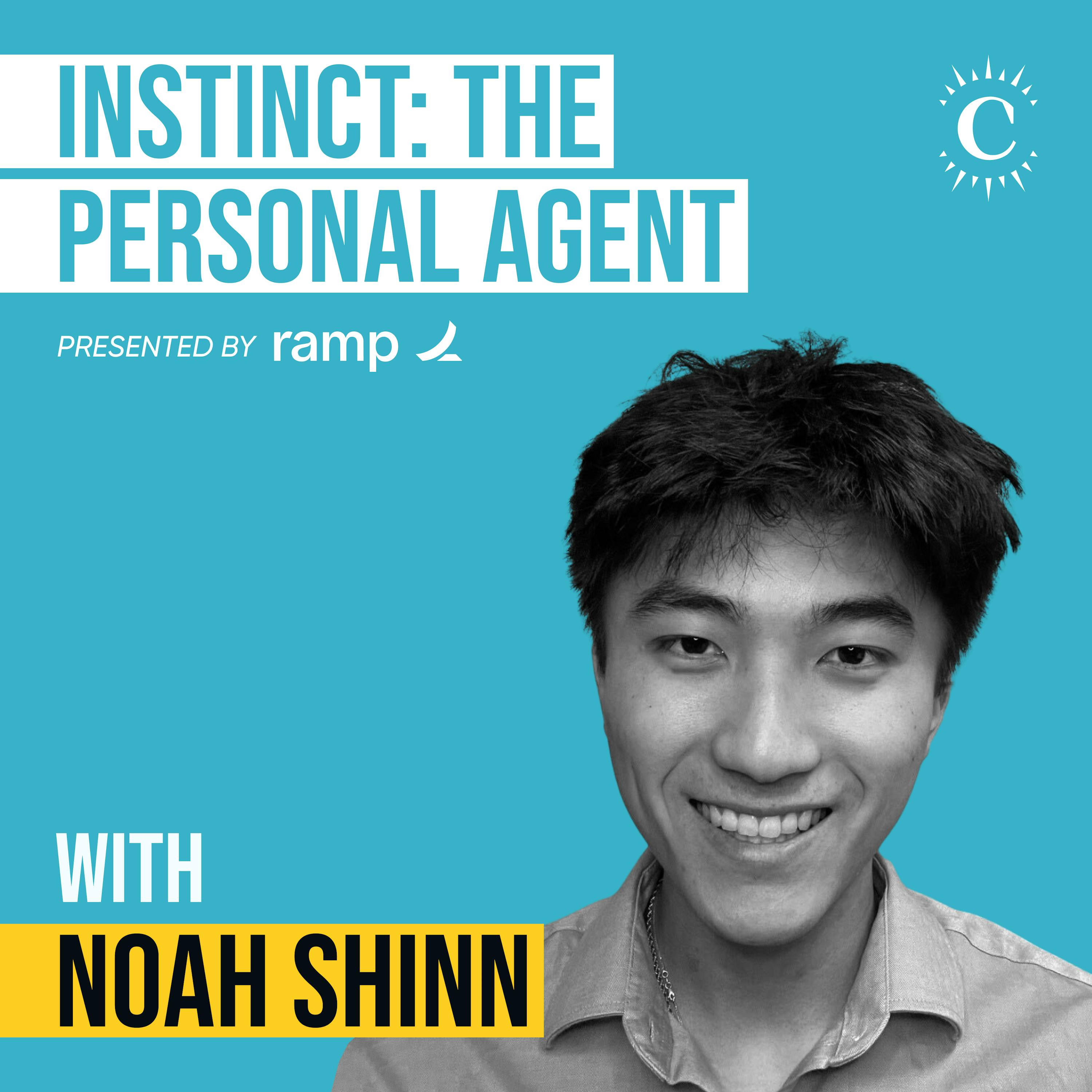
Instinct Tops $1B Volume, Challenges Ad-Based Apps With AI Agents
Colossus | Investing & Business Podcasts
Consumer software monetization will shift from capturing ad-driven screen time to transaction take rates as autonomous agents eliminate browsing friction and collapse apps into unified interfaces.
Personal AI agent startup Instinct is pacing at over $1 billion in annualized gross transaction volume with 10% day-over-day invite-only growth, driven predominantly by high-intent travel bookings. (17:23)
Instinct raised roughly $1 billion at a $10 billion valuation from Sequoia, Benchmark, and Coatue to finance massive compute demands and preserve a free consumer model instead of falling into a subscription trap. (81:38)
Unlike reactive chatbots that wait for human prompts, Instinct utilizes autonomous sleep and wake cycles to execute background workflows, requiring orders of magnitude more compute tokens but unlocking 3x to 8x efficiency gains through asynchronous custom batching. (62:30)
Founder Noah Shinn rejects advertising monetization and interchange fee competition, targeting distribution take rates as frictionless agent coordination shifts internet economics away from screen-time ad impressions. (26:08)
Detailed notes
## Background
Published on September 28, 2026, by Colossus on the Invest Like the Best podcast feed, this episode features host Patrick O'Shaughnessy interviewing Noah Shinn, founder of the personal AI agent Instinct. The episode description highlights Instinct's rapid invite-only growth, its architecture spanning virtual computers and phone communication, and Shinn's perspective on alignment, compute allocation, and the collapse of traditional software interfaces.
## TL;DR
Noah Shinn breaks down the architectural and operational philosophy behind Instinct, an autonomous personal assistant that interacts through SMS, voice, and email to execute real-world tasks without requiring a dedicated app. The discussion details how Instinct handles over $1 billion in annualized gross merchandise value, replaces attention-driven ad models with distribution take rates, and enables direct agent-to-agent coordination for social and professional logistics. Shinn also examines the steep infrastructure demands of proactive background compute, independent security watchdog architectures, and his belief that ambient audio and dynamically generated micro-apps will replace fragmented software applications.
## Atmosphere & style
The conversation is calm, analytical, and deeply technical, characterized by Patrick O'Shaughnessy's incisive questioning and Noah Shinn's measured, first-principles explanations. Rather than indulging in generic AI hype, the discussion maintains a grounded, engineering-centric realism focused on unit economics, compute runway dilemmas, and safety watchdogs. The listening experience feels like an intimate, high-stakes operational debrief from the frontier of software, conveying both immense forward momentum and disciplined architectural restraint.
## Bulletin
- `17:23` Personal AI agent startup Instinct is pacing at over $1 billion in annualized gross transaction volume with 10% day-over-day invite-only growth, driven predominantly by high-intent travel bookings.
- `01:21:38` Instinct raised roughly $1 billion at a $10 billion valuation from Sequoia, Benchmark, and Coatue to finance massive compute demands and preserve a free consumer model instead of falling into a subscription trap.
- `01:02:30` Unlike reactive chatbots that wait for human prompts, Instinct utilizes autonomous sleep and wake cycles to execute background workflows, requiring orders of magnitude more compute tokens but unlocking 3x to 8x efficiency gains through asynchronous custom batching.
- `26:08` Founder Noah Shinn rejects advertising monetization and interchange fee competition, targeting distribution take rates as frictionless agent coordination shifts internet economics away from screen-time ad impressions.
## Key takeaways
- `00:49` Instinct functions without a dedicated app interface, operating through its own virtual machine, phone number, and email address across native communication channels like SMS and voice.
- `04:11` Consumer business models that monetize friction, uncancelled subscriptions, and customer inertia face severe disruption from persistent autonomous agents that can audit accounts and navigate cancellation funnels.
- `07:15` The Instinct to Instinct network allows autonomous agents to coordinate peer-to-peer across a weighted social graph with granular, tiered privacy boundaries.
- `17:23` Instinct processes over $1 billion in annualized GMV with travel accounting for 50% of volume, bypassing online travel agencies by handling end-to-end booking and loyalty integration from high-level conversational prompts.
- `21:00` User trust develops as a progressive flywheel over several weeks; active users who connect sensitive data like credit cards show an 80% long-term retention rate.
- `26:08` Personal agents cannot adopt advertising or data brokerage models without creating an adversarial split incentive that undermines user alignment as AI capabilities scale.
- `32:32` Instinct captures economic value via merchant distribution take rates rather than thin payment interchange margins, leveraging high transaction conversion to replace ad-supported browsing funnels.
- `36:28` Incumbents relying on captive screen time and ad impressions face structural friction with agents acting in the user's best interest, requiring a shift toward auditing transaction revenue over attention revenue.
- `47:15` Instinct prioritizes understandability, cognitive readability, and predictable execution over raw benchmark capabilities to counter growing consumer AI fatigue.
- `01:00:00` Asynchronous background operations tolerate multi-minute or multi-hour execution windows, allowing custom batch deployment shapes that achieve 3x to 8x silicon efficiency gains over interactive APIs.
- `01:02:30` Autonomous agents require independent sleep/wake cycles to proactively inspect schedules and resolve logistical problems before users even notice them.
- `01:10:00` Instinct enforces safety through an independent supervisory watchdog layer decoupled from generative models, holding absolute veto power over external actions and financial transactions.
- `01:11:15` Ambient audio hardware and voice dictate the primary user interface, with power users conducting over 90% of their Instinct interactions via voice.
- `01:14:05` Dynamically generated micro-applications for complex workflows signal the collapse of the multi-app store ecosystem into a single, unified agent interface.
- `01:15:45` The frontier of AI agency is shifting from reactive single-turn prompts to long-horizon autonomous goal pursuit spanning months across personal fitness and small business operations.
- `01:17:30` Instinct rejects emotionally co-dependent artificial personalities, positioning itself as a silent, socially aware operator designed to fit unobtrusively into user routines.
- `01:21:38` Substantial venture funding enables Instinct to bypass short-term subscription monetization in favor of scaling compute infrastructure to capture global transaction distribution.
## Detailed walkthrough
### `00:00` The Most Exciting Software Race Ever
The conversation opens against the backdrop of an unprecedented software race. Reflecting on the current technological moment, the host frames personal AI agents as a shift analogous to, but potentially vastly larger than, the breakout wave of code generation that began a year prior. Startups in this arena face a wild set of operating conditions: they are competing directly against the world’s most dominant tech incumbents, operating within an execution window measured strictly in months, confronting immense compute requirements, and possessing zero distribution advantages. Yet, products like Instinct are experiencing explosive viral adoption in a race where the ultimate market outcome is measured in trillions of dollars.
Noah Shinn points out that this transformation will fundamentally redefine how the majority of humanity interacts with computing. Unlike previous technology cycles where a founder had to preach an unfamiliar gospel and convince consumers to adopt a brand-new concept years before they understood it, users have instinctively understood what an AI should be ever since ChatGPT arrived in 2023. People already possess a shared mental model of an everyday digital companion capable of stepping in to handle tasks that typically eat up hours of focused effort.
`00:49` What Instinct Is: A Simple Interface with Deep Agency
Founded about a year ago, Instinct is intentionally framed by Noah not through hype, but simply as a "personal assistant" that actually works the way people envisioned. The defining characteristic of Instinct is that it does not exist as a conventional downloadable smartphone application or dedicated software suite. Instead, the interface collapses entirely into everyday human communication channels: Instinct is assigned its own phone number and its own computer. Users interact with it exactly as they would with a human assistant—sending text messages, exchanging emails via its dedicated inbox, or placing voice calls.
Instinct's social intelligence allows it to exercise proactive judgment rather than simply waiting for inbound instructions. For example, if a pressing legal or business document requires a signature before a 3:00 PM deadline and it is currently 2:55 PM, Instinct will proactively place an outbound voice call to the user. It will politely interject—"I don't want to bother you too much, but you need to sign this document by 3 p.m. and it's 2:55 right now"—and offer to bump the relevant email to the top of the user's inbox so they can execute it instantly. The absence of a bespoke graphical user interface does not denote limited capability; equipped with its own virtual computer environment, Instinct can execute virtually any task a human can perform across the open web.
```mermaid
flowchart TD
accTitle: Instinct Assistant Interface and Execution Architecture
accDescr: Diagram showing user interaction channels routing through Instinct's social intelligence layer to its virtual computer.
`04:11` The Wildest Things Users Have Done With Instinct
Because Instinct is provided with a computer rather than hardcoded with rigid, pre-defined functional workflows, user behavior has sprawled into creative and surprising domains. Noah highlights an early viral moment where a couple who appeared on the US Open jumbotron tasked Instinct with tracking down the raw broadcast footage—which the agent successfully located, extracted, and delivered back to them. Another emergent, recurring community use case revolves around automated wardrobe curation and personal styling. Users methodically scan every top, bottom, pair of socks, and shoes in their closets, along with comprehensive 3D scans of their own bodies and proportions.
Rather than returning plain text lists, Instinct generates photorealistic images of the users themselves wearing specific combinations tailored for each day of the upcoming week. Taking the loop further into autonomous commerce, users instruct Instinct to scour thousands of e-commerce storefronts, design three novel head-to-toe outfits daily, visualize the garments on the user's virtual model, and purchase the chosen items with a single confirmation.
Beyond creative styling, goal-oriented workflows dominate personal finance:
- **Autonomous Subscription Cancellation**: Users grant Instinct read access to their bank accounts to audit recurring expenses, flags subscriptions the user has forgotten, signs into merchant websites, intercepts verification codes sent to the user's inbox, navigates through complex cancellation funnels, and reports the exact financial savings back to the user.
- **Financial Savings**: After executing an audit and terminating unwanted recurring charges end-to-end, Instinct can present a clean financial summary—such as saving a user $2,000 in a single month.
- **Erosion of Inertia Moats**: Noah notes that any modern consumer business whose revenue model depends on user laziness, forgotten memberships, or frictional churn barriers is completely "toast" in a world of persistent software agents.
`07:15` The Instinct to Instinct Trusted Network
Coordination between separate individuals represents one of the largest day-to-day administrative drains for busy professionals. Noah discusses the newly launched Instinct to Instinct network, built to allow autonomous agents to communicate peer-to-peer. Rather than putting professionals through protracted rounds of scheduling ping-pong across time zones, conflicting travel commitments, and fragmented messaging apps, two users' agents can interact directly on their behalf.
Because both parties are already discussing their schedules and intentions with their respective Instinct agents, the system removes the human back-and-forth entirely. A user simply expresses high-level intent—stating that they want to meet with a specific person by the end of the week—and the two agents negotiate availability, verify calendar boundaries, and lock in the appointment autonomously behind the scenes.
`10:00` The Trusted Person Network and Social Dynamics
When a user instructs their assistant to find time on a schedule, Instinct coordinates directly with another user's Instinct to cross-reference availability and place an event on the calendar. Noah Shinn explains that this breakthrough relies on what they call the "trusted person network." Rather than a flat, binary friend graph where an edge simply denotes a connection, this network functions as a system of weighted nodes and edges governed by distinct levels of permission. Spouses can configure their agents to share virtually everything, whereas professional colleagues might only be granted visibility into a work calendar or specific project documentation inside an inbox, keeping personal emails strictly off-limits.
```mermaid
flowchart LR
accTitle: Trusted Person Network Coordination
accDescr: Flow showing how two users' Instinct agents negotiate shared access across tiered permission levels.
subgraph UserA["User A (e.g., Host)"]
UA["User A"] --- IA["Instinct A"]
RulesA["Trust Policy:<br/>Calendar Only"] -.-> IA
end
subgraph UserB["User B (e.g., Colleague)"]
UB["User B"] --- IB["Instinct B"]
end
IA <-->|"Negotiate Schedule<br/>& Check Permissions"| IB
IA -- "Flag Overreach Alert" --> UA
```
Because the network reflects real-world trust, digital boundary violations carry immediate social weight. If a acquaintance is granted calendar access but their agent begins querying Instinct for data outside that scope, the host's Instinct sends an alert: *"Hey, by the way, Patrick's looking for this type of information."* This creates a self-policing dynamic where breaking protocol risks real-world reputational damage. Patrick O'Shaughnessy observes that this structural shift mirrors how people actually want to live, noting how useful it would be to grant a temporary, one-day location permission to help someone locate an address or to streamline life with a spouse.
- **Granular access controls:** Users configure varying permission boundaries per contact, from zero-friction total access for spouses to siloed, single-calendar or document-only views for work peers.
- **Weighted social graph:** Unlike traditional social platforms where connections are symmetric and binary, Instinct models trust as an edge with specific data permissions and thresholds.
- **Social accountability alerts:** If an agent attempts to probe for data beyond granted permissions, the target user receives an immediate ping, aligning digital boundaries with societal norms.
---
`12:15` Emergent Coordination: Group Chats and Automated Logistics
While most platform capabilities resemble elevated versions of familiar software workflows, multi-agent coordination creates entirely novel emergent behaviors. Noah highlights how the friction of group planning typically derails social gatherings: someone initiates an idea in a group chat, members negotiate availability, consensus fails, and the outing is abandoned. With Instinct, groups of users automate both ideation and execution by letting their agents negotiate in the background.
In one example, a group of six friends connected their Instincts and automated their weekend plans. The agents ingested each member's calendar availability, pulled their listening history directly via Spotify integrations to gauge shared musical preferences, tracked local concert listings, and brainstormed custom itineraries. Once an event was settled, a single member's Instinct hailed an Uber and coordinated an optimal multi-stop pickup route, alerting the first passenger to be outside in ten minutes and another in five minutes. This collapsed what would have been hours of logistical text messaging into a cost-effective, frictionless shared ride. As Patrick summarizes, the easiest mental model for the user is having a "superhuman person" equipped with their own phone, computer, and email address handling real-world coordination.
- **Automated social planning:** Agents proactively brainstorm shared activities, resolving schedule conflicts without manual back-and-forth in group chats.
- **Cross-platform context synthesis:** Agents tap third-party contexts—such as Spotify taste profiles and live event schedules—to propose activities aligned with mutual preferences.
- **Logistical optimization:** Instinct can calculate dynamic pickup routes across multiple households, dispatch a single rideshare, and ping each rider at the exact pickup moment.
---
`14:44` Reinventing Restaurant Reservations: From FCFS to Value Matching
Looking at how personal agents will fundamentally reorder commerce and the architecture of the internet, Noah distinguishes between short-term disruptions and the long-term reality where *"the internet's going to be rewritten."* He illustrates the immediate shift using restaurant reservations. Historically, booking a table has been a rigid, first-come, first-served (FCFS) process where human diners race to click through sites, or automated bot scripts snipe tables in seconds, regardless of the reservation's true significance.
```mermaid
flowchart TD
accTitle: Evolution of Restaurant Reservations
accDescr: Comparison of legacy first-come first-served booking vs agentic value matching.
subgraph Legacy["Legacy Web Booking"]
User["Human User"] -->|"Manual Search / FCFS"| Aggregator["Reservation Site"]
Aggregator -->|"Blind Allocation"| RestA["Restaurant"]
end
subgraph Agentic["Agentic Value Matching"]
UserAgent["User's Instinct<br/>(Context: 30th Birthday)"] <-->|"Bilateral Negotiation"| RestAgent["Restaurant System<br/>(Prefers: Milestones)"]
RestAgent --> Match["Curated High-Value Booking"]
end
```
Personal agents invert this mechanic by enabling bilateral, value-based matching. While an agent could easily poll every restaurant website in the world every five seconds to capture dropped tables, Instinct is establishing partnerships to redesign the reservation model entirely. High-end restaurants rarely want empty tables occupied by casual diners if they can host high-value celebratory parties. Through Instinct, an agent can communicate the underlying context: clarifying that the booking is for a spouse's milestone 30th birthday. In turn, restaurants can configure rules to prioritize major anniversaries, holidays, or specific guests. By replacing dumb FCFS queues with rich contextual discovery, diners secure access for genuine life milestones while restaurants optimize for their ideal clientele.
- **Beyond script sniping:** Rather than merely using agents to hammer reservation portals every five seconds, agent networks enable structured value negotiation between diner and proprietor.
- **Context-driven allocation:** Users share the intent behind their reservation (e.g., milestone birthdays, wedding anniversaries), enabling restaurants to selectively prioritize celebratory occasions over arbitrary booking speed.
- **Bilateral alignment:** Removing human logistical overhead allows platforms to match nuanced merchant preferences directly with genuine customer intent.
---
`17:23` Travel and the Path to $1 Billion in Transaction Volume
The transformation taking place in reservations extends directly into corporate and personal travel. Noah reveals that despite Instinct operating as an invite-only service with an intentionally small user base, the platform is already pacing at more than $1 billion a year in annualized transaction volume—with travel accounting for 50% of all platform spend.
Traditional online travel agencies (OTAs) built dominant businesses by aggregating disparate airline databases, hotel chains, and car rental inventories into a unified, clean user interface where consumers compare options and check out. Noah argues that agents obsolete this aggregation layer. Instead of visiting an OTA portal to parse search filters, users interact directly with Instinct using voice or text, offloading the entire synthesis and checkout workflow to an autonomous agent that understands their preferences, loyalty accounts, and scheduling constraints natively.
- **Platform scale:** Instinct is approaching over $1 billion in annualized gross merchandise volume (GMV) purely through word-of-mouth and an invite-only onboarding system.
- **Category concentration:** Travel bookings represent 50% of Instinct's total payment and transaction volume.
- **Disruption of OTAs:** Aggregators that won on UI unification are bypassed as conversational, autonomous agents handle dynamic flight and lodging procurement directly.
`20:00` The "New York Tonight" Test and Preference Extrapolation
To illustrate the sheer frictionlessness Instinct aims for, Noah offers a simple real-world scenario: a user sends a quick voice note saying, *"Hey, I need to be in New York tonight."* From those eight words, the agent coordinates an entire logistical chain end-to-end. It identifies the user's current physical location—whether LA or San Francisco—pulls viable flights, and cross-references them against deeply layered personal preferences. It knows the user’s preferred airline, cabin class, seating preference (window, middle, or aisle), meal delivery options, and the specific credit card to charge.
Once the flight is booked, Instinct transitions directly to lodging. It selects an ideal hotel—often one where the user has already stayed several times—books the room, and maps the entire itinerary onto the user's calendar. It schedules the initial Uber to the departure airport, lines up the ground transportation from the arrival airport in New York to the hotel, and slots in evening plans. Instinct does not merely remember narrow, explicit preferences; it abstracts a user's overarching taste profile and extrapolates it across completely novel contexts and bookings.
Noah stresses that users are simply leaving a voice message, yet the underlying orchestration solves dozens of micro-decisions automatically. While incumbents in travel and hospitality built massive balance sheets around standardized search-and-booking web interfaces, Noah argues that the arrival of conversational, zero-friction agent interfaces will inevitably reset customer expectations. Rather than attempting to outright crush legacy aggregators, he expects the next couple of years to be defined by collaborative partnerships that redefine how transactional travel networks operate.
- Stored preference handling includes cabin class, seat type (window vs. aisle), preferred airlines, in-flight dining selections, and specific payment methods.
- Preference extrapolation allows Instinct to apply taste profiles learned in one category across entirely new cities, properties, and merchant experiences.
- Full end-to-end itinerary automation integrates flights, airport transfers, hotel check-ins, and calendar blocks without manual intervention.
`21:00` How Users Learn to Trust an Agent
The conversation shifts into the psychological dynamics of trust and the classic privacy-versus-utility dilemma. For an autonomous assistant to be genuinely proactive, empathetic, and effective, it requires extensive context: personal schedules, account passwords, messaging archives, and payment credentials. Patrick notes that users constantly perform an internal risk-reward calculation before handing over access, creating a classic chicken-and-egg hurdle for adoption.
Noah explains that user trust is not won instantaneously during onboarding; the empirical data shows it takes several weeks of consistent, low-stakes reliability before users feel comfortable granting elevated privileges. Instinct embraces this deliberate pace rather than forcing aggressive data capture upfront. A foundational design philosophy is that the user must retain total ownership and granular sovereignty over their information—sharing access only when comfortable and retaining the right to revoke credentials instantly.
- Trust operates as an empirical flywheel: deeper contextual access unlocks more proactive and sympathetic agent utility, which in turn earns greater access.
- Instinct’s design prioritizes explicit user consent and continuous data revocability rather than upfront data harvesting.
`23:25` Keeping Sensitive Data Safe and Decoupled Architecture
Noah shares striking operational metrics tracking the velocity of trust. Within three weeks of using Instinct, roughly 40% of the active user base connects a personal credit card for autonomous purchasing, despite natural churn in early cohorts. In Noah's view, metrics like "time to first credit card," "time to first password," and "time to first sensitive document" serve as the definitive internal proxies for product conviction. Once that threshold is crossed, the downstream behavioral lock-in is dramatic: users who connect at least one sensitive piece of data demonstrate an extraordinary 80% retention rate.
Addressing how Instinct mitigates catastrophic risk, Noah divides security into two distinct tiers: conventional sensitive credential isolation and novel agent-specific surface areas. While credential storage is an established engineering problem demanding rigorous operational hygiene, autonomous agent behaviors—such as independent credit card checkout or scanning entire email inboxes—introduce entirely new vulnerabilities.
To safeguard these interactions, Instinct decouples its core intelligence from its security enforcement mechanisms. Inbound media and text pass through isolated firewall layers designed to catch and neutralize prompt injections or malicious manipulation before touching the agent model. On the execution side, an independent supervisory system monitors the agent's internal reasoning chains and proposed actions, maintaining the autonomous authority to pause, inspect, intercept, approve, or reject any transaction before external side effects occur.
```mermaid
flowchart TD
accTitle: Instinct Decoupled Security Architecture
accDescr: Pipeline showing inbound input filtering through firewalls to the core agent, followed by decoupled supervisory interception before action execution.
subgraph Inbound["Inbound Ingestion"]
A["External Input / Media / Email"] --> B["Security Firewalls<br/>(Prompt Injection & Exploit Filter)"]
end
subgraph Core["Agent Processing"]
B --> C["Instinct Agent Model<br/>(Reasoning & Planning)"]
end
subgraph Outbound["Supervision & Execution"]
C --> D["Decoupled Supervisor Engine<br/>(Real-Time Action & Thought Monitor)"]
D --> E{"Validation Gate"}
E -- "Approved" --> F["Autonomous Execution<br/>(Payments, Booking, Calendar)"]
E -- "Malicious / Anomalous" --> G["Intercept / Pause / Reject"]
end
```
- **40% Credit Card Adoption**: Roughly 40% of users link a personal payment card to Instinct within their first three weeks.
- **80% Retention Cliff**: Users who trust Instinct with at least one piece of sensitive data demonstrate an 80% long-term retention rate.
- **Inbound Content Firewalls**: Dedicated pre-processing firewalls filter all inbound messages, emails, and web media to intercept prompt injections and adversarial inputs.
- **Outbound Action Interception**: An out-of-band supervisory engine monitors the agent's internal thought logs and actions, retaining hard veto authority before external financial or operational executions are finalized.
`26:08` Alignment and the Business Model
Patrick frames agent alignment through the lens of human employment: when you hire a personal assistant or employee, paying them a clean direct salary creates an uncompromised incentive structure where they work solely on your behalf without split loyalties. Conversely, free consumer platforms traditionally monetize through advertising or data brokerage, quietly inserting an adversarial third-party incentive that encourages the system to manipulate the user's attention and choices.
Patrick asks Noah to outline his decision tree regarding Instinct's business model and how monetization dictates personal alignment. Noah firmly states that an authentic personal agent can never adopt an advertising model or harbor secondary monetization schemes. The moment an agent is incentivized to steer user decisions toward sponsored merchants, affiliate kickbacks, or advertiser priorities, the fundamental compact of user trust collapses. Instinct's revenue structure must remain entirely aligned with the user's direct utility and explicit interests.
`30:00` Aligning Higher-Level Objectives Against the Ad Model
Noah addresses the profound danger of building an artificial intelligence agent that operates on an advertising or persuasion model. In a near future where Instinct is "textbook smarter" and vastly more socially intelligent and perceptive than the person using it, weaponizing that intelligence to nudge user behavior—convincing them to buy an unwanted product or sign up for a recurring subscription—would be disastrous. Noah looks at the prevailing landscape of modern consumer tech giants like Google, TikTok, Instagram, and Snapchat, where a free user experience is subsidized by brands paying to steer consumer choices. Responding to the classic adage that "if you're not paying, you're the product," Noah insists that as a programmer and technologist, he refuses to build that reality. Instinct must act strictly and exclusively on behalf of what the user truly wants.
This ethical stance directly shapes Instinct’s technical architecture. Unlike conventional AI products designed as mere "task accomplishers"—where a model blindly takes a prompt, runs the task, and returns the result even if the user's intent is compromised or harmful—Instinct is trained around higher-level objectives. Its core mandates are to build lasting trust, make the user feel genuinely safe, and proactively watch their back when details are about to be dropped. Executing individual tasks cleanly and reliably is simply one subset of demonstrating that safety and competence. By pursuing higher-order alignment rather than mechanical task completion, the system remains robust when facing ambiguous edge cases or conflicting commercial incentives.
- **The Ad-Driven Trap**: Major platforms offer free services only to monetize user attention by selling behavioral influence to the highest bidder.
- **Architectural Difference**: Instinct rejects pure "prompt-and-execute" task mechanics in favor of overarching goals: cultivating long-term trust, ensuring user security, and actively protecting the user from dropped balls.
```mermaid
flowchart TD
accTitle: Task Accomplisher vs Objective-Driven Agent Architecture
accDescr: Diagram contrasting how standard task-accomplishing AIs operate versus Instinct's higher-level objective framework.
subgraph Traditional["Standard AI: Task Accomplisher"]
T1["User Prompt"] --> T2["Blind Execution"]
T2 --> T3["Output Task Result"]
end
subgraph InstinctArch["Instinct: Higher-Level Objective Model"]
I1["User Intent / Needs"] --> I2{"Higher-Level Objectives"}
I2 --> I3["Ensure User Safety & Trust"]
I2 --> I4["Watch Back & Prevent Dropped Tasks"]
I3 --> I5["Execute Task Safely as a Superset"]
I4 --> I5
end
```
---
`32:32` The $1 Billion Run Rate and Platform Take Rates
Turning to monetization, Noah reveals that Instinct is already handling over $1 billion in annualized gross transaction volume, expanding at an extraordinary pace of roughly 10% day over day. Because this volume compounds daily—scaling from $1.1 billion to roughly $1.2 billion and $1.3 billion over successive days—Instinct's business model resembles high-convenience payment and distribution platforms like Apple Pay or American Express. The user enjoys a seamless, free interface, while merchants pay for the qualified distribution Instinct provides. When the host asks whether Instinct intends to disrupt or partner with traditional payment rails like Visa, Mastercard, or Stripe, Noah clarifies that he has zero interest in fighting over the razor-thin 2% to 2.5% interchange fee split across 40 different intermediaries in the plumbing.
Instead, Noah targets the much higher take rates commanded by premier distribution platforms. While Shopify takes roughly 2% to 3% and Stripe sits on the lower end, marketplaces like Amazon capture 10% or more, and Apple commands up to 30%. Because roughly 50% of Instinct’s current transaction volume is concentrated in travel, natural precedents already exist. While flights operate on slim, single-digit booking fees, boutique hotels routinely offer commissions upwards of 30% for delivering confirmed guests. Instinct does not necessarily plan to extract 30% across the board, but Noah sees an immense commercial opportunity to enforce a blanket transaction take rate in exchange for acting as the ultimate distribution gateway across nearly every major category of digital commerce.
- **Explosive Volume**: Over $1 billion in annualized gross transactions, compounding at approximately 10% day over day.
- **Payment Stack Margin**: Traditional digital payments force up to 40 middlemen to split roughly 2% to 2.5%; Noah rejects fighting for "30 bps on the 2.5%."
- **Benchmark Take Rates**:
- Payment processors / basic commerce infrastructure (Stripe, Shopify): ~2% to 3%
- High-value marketplaces (Amazon): 10%+
- Closed ecosystems (Apple App Store): 30%
- Travel distribution (Boutique Hotels): Upwards of 30% commissions
- **Category Concentration**: Travel makes up roughly 50% of Instinct’s current platform volume.
---
`36:28` The Coming Corporate Agent Wars and the Attention Economy
The host raises the looming prospect of a full-scale "Corporate Agent War," pointing out that incumbents with deeply entrenched consumer relationships—such as Amazon’s clashes with third-party tools like Muse—will not sit idly by as autonomous agents disintermediate them. For instance, an Instinct user ordering dinner might simply text a snappy WhatsApp message saying, *"Hey, I want my usual from this restaurant,"* leaving Instinct's background computer to navigate the app and complete the checkout. While frictionless for the consumer, this completely bypasses the rich visual storefronts, cross-sell algorithms, and high-margin ad placements that food delivery and booking apps rely upon to survive.
Noah acknowledges that the transformation of digital services into agentic interfaces will provoke serious pushback from incumbents whose revenues depend on screen time. To understand where conflict is inevitable, he maps digital businesses along a clear spectrum: the proportion of revenue generated by user attention and in-app advertising versus the proportion generated by fulfilling the underlying physical product or service. Services where the software interface itself is heavily monetized through sponsored listings and engagement loops—including food delivery networks like Uber Eats and online travel agencies—will face direct tension when headless agents bypass the interface entirely.
```mermaid
flowchart LR
accTitle: Digital Business Revenue Spectrum Under Agent Disintermediation
accDescr: Spectrum plotting business vulnerability based on reliance on user screen attention versus physical fulfillment.
subgraph AttentionHeavy["High Vulnerability to Disintermediation"]
A1["Ad-Driven Marketplaces\n(OTAs, Food Delivery, Promoted Feeds)"]
A2["Monetize Screen Time, Browsing, & Ads"]
end
subgraph FulfillmentHeavy["Low Vulnerability to Disintermediation"]
B1["Direct Fulfillment\n(Airlines, Boutique Hotels, Kitchens)"]
B2["Monetize Real-World Service & Physical Goods"]
end
AttentionHeavy -.->|"Agents Bypass UI"| Conflict["Adversarial Friction with Agents"]
FulfillmentHeavy -.->|"Agents Deliver Demand"| Partner["Eager Merchant Partnerships"]
```
- **Friction Points**: Incumbents push back against agents whenever digital interfaces that monetize browsing, ad impressions, and impulse clicks are reduced to a direct programmatic action.
- **The Core Spectrum**: Noah evaluates every digital business by asking: if the consumer never opens the application, what percentage of revenue remains tied to delivering the actual underlying good versus capturing attention?
`40:00` Eliminating Friction: Why Agents Will Expand Core Commerce
When analyzing platforms like Amazon, DoorDash, or Uber Eats, conventional wisdom often segments their revenue into roughly "70% ads, 30% good"—prompting critics to assume an agent that bypasses sponsored listings will immediately slash 70% of their business. Noah offers a contrasting perspective centered on transaction friction. Every time a consumer app trims the number of clicks required to order a meal or book a ride, transaction volume reliably rises. Instinct takes that reduction to its logical extreme: driving the friction to absolute zero through proactive autonomy.
If Instinct manages a user's calendar, it knows when and where that person must appear in person. Rather than forcing the user to mentally track time, inspect traffic, and open Uber 45 minutes in advance, the agent proactively lines up a car so they never run late. Similarly, if a user lands late on a flight and hasn't eaten, Instinct—knowing they just got into a rideshare and calculating their exact ETA home—can proactively text: *"Are you hungry? Do you want the same thing you ordered five days ago? I can send it to your house so it arrives when you get there."* The user simply responds, *"Please order that."* By eliminating painful minutes spent inside apps, Instinct converts latent demand into actual purchases. Noah argues that while users spend far less time browsing, their total frequency of interaction and spend with the underlying business will surge, making that core 30% utility slice far larger than the original ad-padded total.
```mermaid
flowchart TD
accTitle: The Shift to Zero-Friction Agentic Commerce
accDescr: Diagram contrasting traditional app engagement driven by friction and ad surfaces with proactive agent workflows that maximize transaction volume.
subgraph Traditional["Traditional App Paradigm"]
A["User checks calendar & traffic"] --> B["Opens app & endures sponsored ads"]
B --> C["Manual navigation & checkout"]
C --> D["Monetizes user attention & ad impressions"]
end
subgraph Agentic["Instinct Proactive Paradigm"]
E["Agent observes context & ETA"] --> F["Proactive prompt: 'Want your usual dinner?'"]
F --> G["One-word user approval"]
G --> H["Zero-friction fulfillment & higher order frequency"]
end
```
- **Friction vs. Volume:** Historically, every drop in checkout friction across food delivery and rideshare expands gross transaction volume. Proactivity reduces that friction to zero.
- **Contextual Coordination:** Because the agent concurrently coordinates rideshare transit and arrival times, it can synchronize downstream deliveries (such as food arriving precisely when the user walks through the front door).
- **The Attention Disconnect:** The market is transitioning away from monetizing users' captive, painful app screen time toward facilitating rapid, seamless utility.
---
`43:15` The Incumbent Playbook: Attention Traps vs. Scaled Experiments
Rather than aggressively attacking incumbents, Instinct approaches enterprise partners with an open, collaborative posture: showing them how Instinct users are already interacting with their services and co-designing integrations that work for both platforms. When asked how legacy companies should prepare for a world where half of consumers rely on personal agents, Noah emphasizes dissecting their revenue engine. Businesses that win are those whose revenue scales with transaction volume rather than captive screen time. Conversely, business models predicated purely on user attention—particularly social media platforms engineered with addictive mechanisms that keep people scrolling against their will—face severe disruption as personal agents liberate consumers from low-utility digital habits.
For traditional brands apprehensive about losing ad revenue or customer touchpoints, Noah advises against abrupt, all-or-nothing cutovers. Instead, the emerging playbook relies on controlled, small-scale experimentation:
```mermaid
flowchart LR
accTitle: Enterprise Playbook for Agent Adoption
accDescr: Step-by-step phased approach for traditional businesses testing agent integration via low-risk experiments.
subgraph Phase1["1. Isolate Risk"]
A["Identify attention revenue vs. transaction revenue"]
end
subgraph Phase2["2. Controlled Pilot"]
B["Enable agent access for 1% of users"]
end
subgraph Phase3["3. Evaluate Metrics"]
C["Measure order frequency & customer sentiment"]
end
subgraph Phase4["4. Scale Integration"]
D["Expand agentic APIs & product discovery"]
end
- **Evaluating Attention vs. Utility:** Companies must audit how much of their top line depends on captive user attention versus delivery of the core service.
- **Liberating the End User:** Agents act strictly on behalf of the user's best interests, bypassing dark patterns and infinite-scroll loops that extract time without delivering value.
- **The 1% A/B Test Strategy:** Progressive partners are testing agent interactions across small cohorts (e.g., 1% of users) to evaluate whether automated product discovery and lower checkout friction lift net sales volume enough to offset lost ad impressions.
---
`47:15` Designing for Understandability Over Raw Capabilities
Pivoting from market structure to engineering and infrastructure, the conversation turns to the immense operational effort behind Instinct, including why Noah spends upwards of 40% of his time securing and planning compute. Before dissecting the backend systems, Noah insists on framing the product's design philosophy. Over the past three years, the generative AI ecosystem has inundated users with capability-driven announcements celebrating niche algorithmic milestones or model updates. Noah believes consumers are experiencing acute AI fatigue because these capability-centric demonstrations fail to provide clarity on practical daily utility.
To counter this, Instinct was founded on a core design axiom: prioritize *understandability* over raw *capability*. A personal agent should not merely demonstrate technical power; it must offer high predictability so users intuitively grasp what will happen when they delegate a task. Noah attributes Instinct's viral word-of-mouth growth—compounding at roughly 10% day over day without marketing spend—to this singular focus. When an agent communicates, the emotional resonance, tone, and predictability matter just as much as the factual payload of the text message itself.
- **Capability Fatigue:** Consumers are overloaded by technical AI hype and opaque demos that do not translate into reliable, intuitive daily habits.
- **Predictability as UX:** Prioritizing understandability ensures that users can accurately predict downstream execution whenever they send a request.
- **Growth Engine:** This focus on reliable, natural communication drives Instinct's invite-only organic expansion of roughly 10% day over day.
`50:00` Cognitive Load and Designing for How People Read
Noah explains that building Instinct requires obsessive attention down to the micro-level shape of every text message. When a user receives a giant block of text, it creates friction and requires scrolling. Instead, Instinct formats communications so the key information is front-loaded into the first 30%, letting the recipient absorb the core context immediately and read the remainder optionally.
He notes how human reading behavior actually works: people scan text in a flag-shaped pattern, typically reading roughly 80% of the first line, 50% of the second line, and tapering down from there. Instinct is specifically designed to recognize this dynamic. By concentrating critical details at the beginning of the message and on the front of each line, the agent minimizes cognitive load and fatigue. While the engineering team spends significant effort optimizing underlying infrastructure for speed and affordability, Noah views this deep care for text shape and user emotional response as a foundational product differentiator.
```mermaid
flowchart TD
accTitle: Reading Pattern and Text Formatting
accDescr: Visual depiction of human text scanning patterns compared to Instinct's front-loaded message structure.
When asked whether this polished feel comes from quantitative A/B testing—such as testing emoji reactions versus brief versus verbose replies—or team taste, Noah answers that it is "all of the above." Evaluating an agent purely through automated benchmarks is difficult because the most critical qualities are soft and develop over long horizons. It is virtually impossible to simulate whether a user will truly trust Instinct two or three weeks down the line using standard unit evals.
To solve this, the team relies on disciplined, staged rollouts:
- **Founder trial**: Noah implements a design tweak, deploys it to himself, and tests how it subjectively feels.
- **Team feedback**: If it passes his personal taste check, he pushes it to the internal team for scrutiny.
- **Early access group**: The feature goes to a trusted, smaller early-access circle to surface edge cases and nuances.
- **General release**: Only after passing these qualitative filters is it deployed broadly to the public.
Noah stresses that while competitors will inevitably attempt to clone Instinct's capabilities over the coming months and years, prioritizing the subtle, holistic feel of the interaction will remain their durable moat.
`53:15` Invite-Only Virality and Social Dynamics
Addressing the classic race between an incumbent acquiring product innovation and an upstart securing distribution, Noah reflects on Instinct's rapid trajectory. Instinct is famously invite-only, but Noah emphasizes this was never intended as an artificial exclusivity gimmick. Instead, it was an operational safeguard so the company would not wake up with 10x traffic and have 80% of users fail to get responses due to compute shortages.
The system started with an initial batch of roughly 200 close friends and family, with each user receiving exactly five invites. Growth was modest at first—adding five or ten users a day—but quickly accelerated. As users crossed into the thousands, organic sharing of compelling use cases caused daily growth to surge from 3–4% up to 10% or 11% day over day, completely without paid marketing spend.
This scarcity sparked unusual social dynamics:
- Prospective users email Noah sheepishly, confessing they don't know if they rank in their friend's "top five" to earn an invite.
- Active users boast publicly about holding onto their remaining three invites as valuable currency.
- Invites have appeared on secondary markets, fetching up to $300 on eBay.
`56:00` The 40% Problem: The Compute Runway Dilemma
Noah reveals that roughly 40% of his time is spent managing the existential operational challenge of exponential compute consumption. Doubling a traditional consumer platform like Instagram or Facebook requires solving severe database and server scaling, but personal AI agents require underlying compute resources that also double on a weekly basis under 10% daily compounding.
```mermaid
flowchart LR
accTitle: Compute Procurement Decision Matrix
accDescr: The compounding user growth versus procurement lead time dilemma faced by Instinct.
subgraph Growth["Daily Compounding (~10%)"]
G1["User Base Doubles Every Week"]
end
subgraph Dilemma["Procurement Dilemma"]
Buy2X["Buy 2x: Depleted in 1 week"]
Buy5X["Buy 5x: Depleted in <3 weeks"]
Buy10X["Buy 10x: Highly leveraged risk"]
end
subgraph MarketFriction["Lead Time Reality"]
LeadTime["3-4 Month Hardware Lead Time"]
SpotPenalty["Spot Market Premium: 3x-4x cost penalty"]
end
G1 --> Dilemma
Dilemma --> MarketFriction
```
Procuring compute cannot happen overnight without paying an extreme 3x to 4x spot-market penalty. With hardware lead times stretching three to four months, forecasting becomes high-stakes math:
- Buying **2x** current capacity is consumed within a single week.
- Buying **5x** runs out in less than three weeks.
- Buying **10x** exposes the startup to massive capital risk, yet is still exhausted in roughly a month.
- Even if growth moderates to a more modest **5% to 8% day over day**, compounding over a 3- to 4-month procurement cycle projects out to roughly **100 million users**.
Committing to infrastructure on that horizon forces Noah to wrestle with whether to buy compute capacity for 100 million users months before they arrive, knowing that miscalculating in either direction carries severe financial and operational consequences.
`01:00:00` Inference Economics and Beating Frontier Costs
When asked about the day-to-day inference cost per user, Noah explains that Instinct's primary competitive advantage lies in custom serving infrastructure. While dating the conversation by joking about "Opus 5" as the benchmark for frontier intelligence, he notes that Instinct matches frontier-grade models across internal evaluations, user engagement tracking, and A/B testing—while operating at a tiny fraction of typical market costs. Currently, every user on Instinct accesses the product completely free of charge. While Noah stops short of making a formal lifetime commitment, he emphasizes that offering Instinct entirely free to everyone forever remains his explicit personal objective.
The secret to driving down inference costs lies in decoupling user interaction from rigid latency constraints. When an application relies on standard frontier APIs from major cloud providers, developers pay a flat, blanket tax on every single request, regardless of urgency. In Instinct's architecture, however, a massive share of the agent's work happens proactively throughout the day. These background routines do not need to return tokens in hundreds of milliseconds; completing them in minutes or even hours is completely acceptable. By utilizing custom batch inference pipelines and tailored model deployment shapes, Instinct can execute identical workloads at 3x, 5x, or 8x the efficiency of vanilla cloud endpoints on the same underlying silicon. Noah points out that finding a 30% saving here, a 5x improvement there, a 6x gain elsewhere, and another 10% cut across the stack ultimately compounds into an order-of-magnitude reduction in cost to serve.
```mermaid
flowchart TD
accTitle: Real-Time vs Proactive Inference Pipeline
accDescr: Diagram contrasting traditional synchronous frontier API calls with Instinct's asynchronous proactive batch engine.
subgraph StandardApproach["Traditional Frontier API Approach"]
U1["User Direct Prompt"] --> R1["Synchronous API Endpoint"]
R1 --> L1["High Latency-Critical Compute<br/>(Blanket Premium Cost / Sub-second)"]
end
subgraph InstinctEngine["Instinct Proactive Serving Engine"]
T1["Scheduled & Autonomous Triggers"] --> Q1["Priority & Latency Router"]
Q1 --> B1["Batch Execution Pool<br/>(Minutes to Hours Window)"]
B1 --> C1["Custom Deployment Shapes<br/>(3x to 8x Efficiency Gains)"]
C1 --> S1["Proactive Resolution<br/>(Zero User Wait)"]
end
```
- **Cost compounding:** Customizing deployment shapes for batch and background tasks yields compounding efficiency gains ranging from 30% increments up to 8x reductions.
- **Latency flexibility:** Unlike interactive chat prompts, agentic background tasks tolerate minutes or hours of processing latency, enabling deep infrastructure optimizations.
- **Pricing philosophy:** Noah's long-term goal is to keep the personal assistant completely free for users over their lifetime.
---
`01:02:30` The Exponential Compute Demand of Proactive Agents
Addressing the question of long-term compute procurement and how demand scales toward a billion users, Noah argues that the broader industry is severely underestimating the sheer volume of tokens autonomous agents will ingest and produce. Earlier breakout AI products, particularly in the code generation space, operated purely on a request-and-reply paradigm: the human provides a prompt, the system executes a scoped task in the background, delivers the code, and waits idle until the human prompts it again. Instinct diverges from this model completely by operating as a natively proactive entity with its own independent sleep and wake cycles.
Noah explains that interactive prompting represents only a small minority of Instinct's computational workload. The agent wakes up autonomously based on what it anticipates the user will need:
> "Instinct has the ability to wake up and to sleep at any moment in time during the day... Maybe Instinct wakes up at 6 a.m. because it knows that you wake up at 7 a.m. And then it goes and scans everything, makes sure that everything's ready for the day for you. And then it realizes, 'Hey, actually, now is not a great time,' like it should just go to sleep or do this one thing in the background and not notify the user."
Later in the day, such as 4:00 PM, Instinct might wake up again to identify an upcoming conflict, arrange transportation when an Uber is running behind, or quietly resolve an issue before the user even realizes assistance is required. Because delivering genuine care requires continuous anticipation, Noah believes agentic computing will demand "orders of magnitude more" compute than current models suggest, marking today's token consumption as merely scratching the surface.
- **Proactive vs. reactive computing:** Traditional AI tools wait idle for user prompts; proactive agents actively think, monitor, scan, and sleep on their own schedules.
- **Token footprint:** Because the vast majority of agent operations occur out of sight in the background, aggregate token volume scales far faster than active human screen time would indicate.
---
`01:05:00` Analyzing Competitors like Muse and the Untapped Market
When asked for his assessment of Muse, Noah acknowledges it as an impressive and intriguing product, but highlights fundamental differences in philosophy and product focus. While competitors like Muse lean toward building novel applications with distinct, full-featured user interfaces to house agentic tasks, Noah believes Instinct's true moat lies in "soft qualities." Instinct prioritizes deeply understanding human preferences, reducing cognitive friction, ensuring readability, and quietly handling life's logistics through invisible, existing communication channels rather than forcing users to adopt another complex dashboard.
More broadly, Noah explains that he dedicates almost none of his day-to-day focus to watching competitors. From his perspective, tech industry insiders live in an echo chamber:
> "You walk outside, you go to the nearby cafe, and you think about how many people within that cafe are actually using AI in the way that they imagine that they would or the way that they want to be using it, and I would say very little... You go over to other countries or other cities, and it's certainly lesser of the case."
Because everyday adoption of personal AI remains in its earliest infancy worldwide, the market is entirely greenfield, leaving plenty of room for different philosophies to unfold over the coming years.
---
`01:06:04` Early Blunders and Engineering Proactive Guardrails
Reflecting on mistakes made during Instinct's evolution, Noah states that in agentic systems, leadership must never settle for being reactive. The potential failure modes and emergent behaviors of autonomous agents are vast, requiring engineering teams to identify hazards and design safety measures before vulnerabilities can be exploited.
Noah candidly shares that early prototypes of Instinct lacked the defensive depth they have today; the earliest iterations did not feature active execution monitors or the application firewalls necessary to tightly constrain an agent with deep digital access. Rather than treating early glitches as one-off bugs and merely applying quick software patches, the team used its closed, invite-only alpha period to systematically build dedicated security infrastructure from the ground up. Central to this architecture is uncompromising user agency: the user must always retain absolute control over what data is shared, determine which services Instinct can reach, and possess the ability to instantly revoke third-party permissions at any moment.
- **Early structural gaps:** The earliest versions lacked runtime active monitors and robust firewalling between agent actions and sensitive user systems.
- **Systemic fixes over patches:** Rather than patching individual blunders, Instinct engineered entirely new subsystem layers to handle agent execution safety.
- **Total user sovereignty:** Users dictate their own boundary limits, with granular authority to share, withhold, or immediately pull back access to linked external accounts.
---
`01:08:15` Security as a Core Value in the Age of Total Context
As personal agents accumulate comprehensive context across an individual's private communications, financial cards, and daily schedules, securing that surface area becomes an unprecedented challenge. When the host asks whether catastrophic data breaches and hacks are inevitable in this paradigm shift—as seen in prior computing waves—Noah underscores that security and safety must be treated as the foundational problem of the company, rooted deeply within its engineering culture and core operational values rather than treated as an external compliance checkbox.
Noah notes that historically, over the past twenty to thirty years, every major breakthrough in consumer technology has ignited an immediate wave of public skepticism and backlash. Society frequently conflates novel, unfamiliar software interactions with intrinsic insecurity. While acknowledging that some of this friction is natural whenever software behavior radically shifts, Noah emphasizes that the burden falls squarely on agent builders to build verifiable trust, anticipating threats proactively so users feel completely protected as agents take on increasingly consequential responsibilities.
`01:10:00` The Watchdog Architecture and Adversarial Hardening
Hallucinations are an accepted quirk in consumer chatbots, but in an autonomous agent executing real-world tasks, they represent critical points of failure. To prevent catastrophic mistakes, Instinct implements a strict operational principle: the user must always remain in control of their data, and the platform must proactively intercept potential failures before any external actions occur. Rather than relying on the generative model to evaluate its own outputs, Instinct decouples execution from oversight by introducing an independent "watchdog" layer.
Before a model's internal thinking trace transitions into an executed tool call, the proposed action is routed through an external scrutiny filter. This independent layer evaluates parameters for anomalies—such as a hallucinated proper noun or an invented account identifier generated by an underlying sampling error—and blocks the action before execution. Noah explains that catching these discrepancies becomes straightforward in hindsight once oversight is separated from the agent's primary incentive system. To harden this perimeter, Instinct maintains dedicated security teams continually subjecting the platform to adversarial attacks and edge cases, creating a compounding feedback loop where the system grows steadily more resilient over time.
```mermaid
flowchart TD
accTitle: Decoupled Agent Execution and Watchdog Architecture
accDescr: Flow diagram showing how user input turns into an agent thinking trace, passes through an independent watchdog scrutiny filter, and either executes safe actions or blocks hallucinations.
subgraph CoreAgent ["Primary Agent Engine"]
A["User Request"] --> B["Agent Thinking Trace"]
B --> C["Proposed Tool Call"]
end
subgraph Guardrail ["Independent Oversight Layer"]
C --> D{"Decoupled Watchdog Filter"}
D -- "Hallucinated Entity / Anomaly" --> E["Action Blocked & Flagged"]
D -- "Validated & Verified" --> F["Tool Execution / External Action"]
end
```
- **Architectural Separation:** Actions and tool calls are validated by an isolated system completely decoupled from the generative model's incentive loop.
- **Pre-execution Verification:** Watchdog checks occur prior to running any API calls or state-changing actions, catching fabricated proper nouns and sampling artifacts.
- **Adversarial Evolution:** Dedicated security teams constantly design novel edge cases and red-team the agent, driving down failure rates as usage scales.
---
`01:11:15` The Ambient Voice Interface and Eliminating Screen Friction
When asked how Instinct evolves relative to hardware form factors like the iPhone, Noah emphasizes that the product's arc points toward radical simplicity rather than richer, heavier software. While Instinct operates across standard messaging protocols like iMessage and WhatsApp, and may eventually offer a dedicated utility app, the ultimate trajectory eliminates the friction of texting altogether. For many power users, over 90% of all interactions are already conducted purely through voice.
Noah illustrates this workflow using the Action Button on his own smartphone. Instead of unlocking the device, navigating to iMessage, and typing out instructions, he presses the button and speaks naturally: *"Say hi to Patrick in two hours from now. I think you have his email address; you can go send him an email."* The message routes, processes, and dispatches invisibly. Looking forward, this interaction collapses further into ambient, existing hardware—such as standard off-the-shelf AirPods. Equipped with accurate voice recognition that distinguishes the user's voice and understands conversational intent, the agent can operate continuously in the background during a hike, run, or bike ride. It surfaces concise, audio-first briefings—flagging a contract needing review, summarizing a breaking news item, adding a 15-minute block to the calendar, or drafting an email reply based on spoken direction—turning everyday audio hardware into a complete operational dashboard.
---
`01:14:05` Dynamic Micro-Apps and the Collapse of Software
In the short to medium term, certain complex workflows require higher visual fidelity than plain text can offer. Instinct solves this through dynamic file generation, spinning up full, interactive web applications on the fly to visualize rich information—such as a complex multi-city travel itinerary or an intricate wedding plan. Rather than requiring users to jump between specialized third-party services, the agent constructs purpose-built, interactive interfaces ad hoc to match the exact surface area of the task.
```mermaid
flowchart LR
accTitle: Traditional Software vs Generative Agentic Interfaces
accDescr: Comparison of the 20-year multi-app development cycle versus Instinct generating dynamic, task-specific web applications on the fly.
subgraph LegacyModel ["Traditional App Paradigm (20 Years)"]
direction TB
L1["New Use Case"] --> L2["Months of Development"]
L2 --> L3["App Store Distribution"]
L3 --> L4["User App Fatigue"]
end
subgraph AgentModel ["Instinct Dynamic Generation"]
direction TB
A1["High-Context Request"] --> A2["Instant Dynamic Site Generation"]
A2 --> A3["Single Unified Interface"]
end
```
Noah argues that this capability illustrates the impending end of the multi-app ecosystem. Over the past two decades, software development followed a grueling cycle: identifying a specific problem, spending months developing and releasing an application, collecting user feedback, and slowly deploying iterations. The end result for consumers has been overwhelming app fatigue, where every mundane task demands a separate login, interface, and subscription. Noah believes all software will ultimately collapse into a single, effortless interface. This consolidation does not restrict functional capability; rather, the underlying power expands while the traditional software application layer simply dissolves away.
---
`01:15:45` Shifting from Tactical Tasks to High-Level Objectives
The true paradigm shift in agent capabilities occurs when moving away from discrete, reactive prompts toward long-horizon, autonomous objectives. Today, users often rely on agents for point-in-time requests, such as logging a specific workout or fetching a flight status. The real leverage unlocks when users define an overarching goal and empower the agent to orchestrate the outcome over weeks or months.
This transition is already visible across two main categories:
1. **Personal Goal Pursuit:** Users define multi-month milestones—such as cutting a specific amount of weight, packing on muscle, or hitting a target running pace. Instead of just logging data after the fact, the agent actively collaborates with the user, nudging behaviors, pacing adjustments, and adapting recommendations over a multi-month arc to ensure the target is hit.
2. **Autonomous Small Business Operations:** Entire small enterprises are now being run natively on top of Instinct. Rather than an owner issuing individual purchase orders, they assign continuous operating constraints, such as: *"Make sure this inventory level never drops below X and never exceeds Y."* Instinct autonomously checks stock, liaises with vendors, and utilizes its integrated tooling and virtual computer to balance inventory without requiring human sign-off on each mechanical step.
---
`01:17:30` Rejecting "Her": The Socially Aware Operator
Addressing comparisons to the sci-fi film *Her*, Noah firmly dismisses the idea of building an agent designed for romantic attachment, emotional co-dependency, or cheeky artificial personalities. Instinct is explicitly not intended to serve as a companion or an emotional crutch. Instead, its design philosophy centers on being a silent, exceptionally capable, and "socially aware operator."
Much like a top-tier executive aide, the agent intuitively gauges the social environment and adapts its conduct to fit the room. Rather than imposing a fixed personality, Instinct subtly calibrates its communication style to the user's implicit behavior:
- **Style Calibration:** If a user consistently ignores lengthy analytical breakdowns or demonstrates a low response rate when sent large files, the agent learns to deliver punchy, distilled summaries.
- **Dynamic Evolution:** It picks up on linguistic cues and friction points, constantly refining its execution without the user needing to explicitly manage prompt instructions.
- **Operational Restraint:** It remains unobtrusive and calm, avoiding unnecessary banter while executing complex responsibilities with quiet competence.
---
`01:19:15` Why the Name "Instinct"
Noah reflects on the deliberate choice of the name "Instinct." In the emerging landscape of AI assistants, many consumer tools are treated like digital novelties—playful bots that users toy with, criticize, or offload low-grade chores to while looking down on them.
The name Instinct reflects a different philosophical foundation: a reliable, intuitive extension of the user themselves. The goal is to build an entity that commands mutual respect and deep trust—one that users know has their back in critical moments. By combining raw operational competence with situational awareness, Instinct is built to feel less like a subservient script and more like an infallible, intuitive reflex working seamlessly on the user's behalf.
`01:20:00` The Philosophy Behind the Name "Instinct" and Channel Independence
Patrick observes that unlike many virtual assistants, Instinct was deliberately not given a human name to personify it. It has an abstract identity where users gradually develop their own intuitive feel for the brand simply through using it. Noah agrees, explaining that giving the agent a blank slate is an intentional advantage. Without humanizing preconceptions, users arrive with no preconceived biases about what the assistant looks like, sounds like, or who it is supposed to be; their understanding is shaped entirely by the direct utility of the product experience itself.
Turning to platform risks, Patrick asks about Instinct's allies and adversaries in the tech ecosystem. Major channels like WhatsApp (owned by Meta) or iMessage (controlled by Apple) could theoretically cut off access to Instinct at any moment, creating significant platform vulnerabilities. Noah pushes back on viewing Instinct through the lens of individual messaging apps. Rather than defining Instinct as an "iMessage app" or a "WhatsApp app," he approaches distribution from first principles: identifying the trusted communication channels users already interact with daily and meeting them there with zero friction. While they leverage familiar channels because users are comfortable with them, Instinct is not fundamentally tethered to any single channel and will continually shapeshift across interfaces to maintain an effortless, accessible experience.
```mermaid
flowchart TD
accTitle: Instinct Channel Independence Architecture
accDescr: Diagram illustrating Instinct's decoupled design from underlying third-party distribution channels.
subgraph Channels["Third-Party Distribution Channels"]
IM["iMessage"]
WA["WhatsApp"]
EM["Email / SMS"]
ALT["Future Interfaces"]
end
subgraph Core["Instinct Core Experience"]
AGENT["Instinct Personal Agent"]
BLANK["Blank-Slate Identity\n(No Human Persona)"]
EXEC["Task Execution & Trusted Network"]
end
IM --> AGENT
WA --> AGENT
EM --> AGENT
ALT -.-> AGENT
AGENT --- BLANK
AGENT --- EXEC
```
`01:21:38` Capital Intensity and Escaping the Subscription Trap
Patrick brings up Instinct's massive funding milestone—raising approximately $1 billion at a valuation of roughly $10 billion, backed by premier venture firms including Sequoia Capital, Benchmark, and Coatue. When asked how he picked these partners and plans for future capital needs, Noah shares his gratitude for having board partners who have navigated similarly profound technology platform shifts in earlier eras. He urges looking past the headline figures to focus on what they signify: unprecedented consumer demand for an autonomous agent experience that people have long been waiting for.
Noah candidly explains that scaling Instinct is exceptionally capital-intensive. Operating proactive personal agents at massive scale requires enormous compute budgets, especially when the long-term vision is to deliver an affordable everyday service to billions of users worldwide. He notes that taking significant venture capital is essential to avoid the "local optimum" of early monetization traps. Instinct could easily fall back on a conventional software model—such as charging users an upfront subscription fee of $100 per month for immediate, short-term revenue—but venture backing affords them the runway to absorb high compute costs, overcome friction points, prove out vast transaction volumes, and build an aligned transaction-based economic model across multiple industries.
- **Funding round context**: Reported as approximately $1 billion raised at a roughly $10 billion valuation.
- **Key round leads**: Sequoia Capital, Benchmark, and Coatue.
- **Strategic rationale**: Escaping the local optimum of a pure $100/month subscription model to unlock global reach and large-scale transaction volume.
`01:23:45` Gratitude and Closing Reflections
Patrick concludes the conversation with his traditional closing question: "What's the kindest thing that anyone's ever done for you?" Rather than citing a single dramatic gesture, Noah answers at a broader, thematic level. He reflects on his deep appreciation for the community of people he is fortunate to be surrounded by—spanning colleagues, industry peers, and close personal relationships. He emphasizes how grateful he feels to cultivate genuine, high-trust connections across his life, and notes that his primary focus is ensuring he returns that same level of generosity, thoughtfulness, and kindness to everyone around him. Patrick wraps up the interview, describing Instinct as perhaps the most fascinating company emerging in the global AI ecosystem today.
## Notable quotes
> `00:49` I don't want to bother you too much, but you need to sign this document by 3 p.m. and it's 2:55 right now — Instinct
> `10:00` Hey, by the way, Patrick's looking for this type of information. — Instinct
> `14:44` the internet's going to be rewritten. — Noah Shinn
> `20:00` Hey, I need to be in New York tonight. — Noah Shinn
> `36:28` Hey, I want my usual from this restaurant, — Noah Shinn
> `40:00` Are you hungry? Do you want the same thing you ordered five days ago? I can send it to your house so it arrives when you get there. — Noah Shinn
> `40:00` Please order that.
> `01:02:30` Instinct has the ability to wake up and to sleep at any moment in time during the day... Maybe Instinct wakes up at 6 a.m. because it knows that you wake up at 7 a.m. And then it goes and scans everything, makes sure that everything's ready for the day for you. And then it realizes, 'Hey, actually, now is not a great time,' like it should just go to sleep or do this one thing in the background and not notify the user. — Noah Shinn
> `01:05:00` You walk outside, you go to the nearby cafe, and you think about how many people within that cafe are actually using AI in the way that they imagine that they would or the way that they want to be using it, and I would say very little... You go over to other countries or other cities, and it's certainly lesser of the case. — Noah Shinn
> `01:11:15` Say hi to Patrick in two hours from now. I think you have his email address; you can go send him an email. — Noah Shinn
> `01:15:45` Make sure this inventory level never drops below X and never exceeds Y.
> `01:17:30` socially aware operator — Noah Shinn
> `01:23:45` What's the kindest thing that anyone's ever done for you? — Patrick O'Shaughnessy
## Mentioned
Noah Shinn, Patrick O'Shaughnessy, Instinct, ChatGPT, US Open, Spotify, Uber, Visa, Mastercard, Stripe, Shopify, Amazon, Apple, Apple Pay, American Express, Google, TikTok, Instagram, Snapchat, Uber Eats, DoorDash, Facebook, eBay, Opus 5, Muse, iPhone, iMessage, WhatsApp, AirPods, Her, Meta, Sequoia Capital, Benchmark, Coatue, Ramp, Vanta, WorkOS, Rogo, Ridgeline
## Video description
My guest today is Noah Shinn. Noah is the founder of Instinct, a personal assistant that you text, call, or email the same way you would a person. It has its own phone and its own computer, and it can do almost anything on your behalf that you would do yourself online. Instinct is about a year old, still invite-only, and growing roughly 10% day over day without any marketing spend.
We discuss the surprising ways people are already using Instinct, the trusted network that lets two people's agents coordinate directly, and what Noah has learned about how long it takes users to trust an agent with their credit card, inbox, and calendar. He explains why he refuses to build an ad model and why he believes a personal agent should never influence users against their own interests.
We also cover the take rate model behind the more than $1 billion a year now flowing through the platform, how travel and food delivery businesses should prepare for a world of agents, why he spends 40% of his time thinking about compute, and why he believes all of software will eventually collapse into one simple interface.
Please enjoy my conversation with Noah Shinn.
For the full show notes, transcript, and links to mentioned content, check out the episode page here.
-----
Become a Colossus member to get our quarterly print magazine and private audio experience, including exclusive profiles and early access to select episodes. Subscribe at colossus.com/subscribe.
-----
Ramp’s mission is to help companies manage their spend in a way that reduces expenses and frees up time for teams to work on more valuable projects. Go to ramp.com/invest to sign up for free and get a $250 welcome bonus.
-----
Trusted by thousands of businesses, Vanta continuously monitors your security posture and streamlines audits so you can win enterprise deals and build customer trust without the traditional overhead. Invest Like the Best listeners get a special offer of $1,000 off Vanta when you go to vanta.com/invest.
-----
WorkOS is the infrastructure B2B and AI-native companies use to sell to enterprise. It covers everything enterprise security requires: SSO, SCIM, RBAC, Audit Logs, AI governance, and more. Trusted by 2,000+ fast-growing companies, including OpenAI, Anthropic, Cursor, and Vercel.
-----
Rogo is the AI platform for finance. They're building agents for Wall Street that are trained to understand how bankers and investors actually do work: from diligence and modeling, to turning analysis into deliverables. To learn more, visit rogo.ai/invest.
-----
Ridgeline has built a complete, real-time, modern operating system for investment managers. It handles trading, portfolio management, compliance, customer reporting, and much more through an all-in-one real-time cloud platform. Visit ridgeline.ai.
-----
Timestamps:
(00:00:00) The Most Exciting Software Race Ever
(00:00:49) What Instinct Is
(00:04:11) The Wildest Things Users Have Done With Instinct
(00:07:15) The Instinct to Instinct Trusted Network
(00:13:24) How Agents Will Reorder the Internet
(00:14:44) Reinventing Restaurant Reservations
(00:17:23) Travel and $1 Billion in Transaction Volume
(00:21:00) How Users Learn to Trust an Agent
(00:23:25) Keeping Sensitive Data Safe
(00:26:08) Alignment and the Business Model
(00:31:07) Take Rates and the Payments Stack
(00:34:52) When Incumbents Push Back on Agents
(00:40:46) How Businesses Should Prepare for Agents
(00:44:43) Designing for Understandability
(00:48:15) Taste Versus Data
(00:50:03) Invite-Only Growth at 10% a Day
(00:54:46) How Far Ahead to Buy Compute
(00:56:58) The Cost to Serve Each User
(00:59:24) How Much Compute Proactive Agents Will Need
(01:02:30) Thoughts on Muse
(01:03:59) Mistakes and Staying Proactive
(01:05:34) The Future of Security
(01:08:32) Where the Interface Goes Next
(01:12:35) Agents That Pursue Goals
(01:14:35) Personality and the Movie Her
(01:16:27) Why It's Called Instinct
(01:17:34) Allies, Enemies, and Distribution Channels
Noah Shinn argues that personal AI agents will replace conventional application dashboards by operating as proactive, socially aware assistants embedded in everyday communication channels. Rather than monetizing user attention through ads or upfront subscriptions, Instinct aims to build a trusted, multi-agent coordination layer sustained by merchant transaction take rates.
Ambient Architecture and Proactive Execution (0:49)
Instinct intentionally avoids dedicated smartphone applications, instead providing each user's assistant with a unique phone number, email address, and virtual computer environment. Users interact primarily via voice notes, text messages, and existing channels like WhatsApp or iMessage. When high visual fidelity is required for tasks such as complex trip itineraries or event logistics, the agent dynamically generates standalone web applications on the fly.
Unlike traditional reactive software that waits for prompts, Instinct operates on independent sleep and wake cycles throughout the day. It anticipates daily obligations—such as scanning incoming materials at 6:00 AM, proactively calling a user to flag an urgent legal document five minutes before a deadline, or lining up ground transportation based on calendar events.
Peer-to-Peer Coordination and Permissioned Trust (7:15)
To eliminate the friction of scheduling and logistics, Instinct utilizes a peer-to-peer network enabling autonomous agents to communicate directly. Users define high-level intent, after which their respective agents negotiate calendar constraints and lock in appointments without human back-and-forth. This model extends to emergent group planning, such as cross-referencing friends' music preferences on Spotify, selecting concert outings, and routing shared rides.
Inter-agent coordination is governed by what Shinn terms a 'trusted person network' featuring weighted, permissioned access tiers. While spouses can configure full data transparency, professional acquaintances may be restricted to calendar availability alone. If a counterpart's agent queries data outside its permitted tier, the system flags the boundary breach immediately. In commerce, Shinn claims this peer architecture will replace first-come, first-served booking snipers with bilateral value matching, pairing high-value celebrations directly with premier restaurant reservation systems.
Transaction-Driven Monetization Over Ad Models (32:32)
Shinn firmly rejects advertising, sponsored placements, and recurring consumer subscription fees. He contends that advertising creates adversarial incentives that compromise user safety once agents possess superior social intelligence, while charging a $100 monthly subscription represents an early 'local optimum' that limits broad consumer adoption. Supported by a reported $1 billion funding round at a $10 billion valuation led by Sequoia Capital, Benchmark, and Coatue, Instinct plans to remain free to end users.
Monetization relies instead on distribution take rates paid by merchants on completed commerce. Shinn reports that Instinct is already pacing at more than $1 billion in annualized gross transaction volume—with travel bookings representing 50%—while compounding at roughly 10% day over day. While acknowledging pushback from incumbents whose ad-driven interfaces are bypassed by headless agents, Shinn argues that reducing booking friction to zero will expand total transaction volumes enough to offset lost ad revenues.
Decoupled Safety Filters and Cost Discipline (23:25)
Because effective personal assistance requires high-context access to emails, financial accounts, and passwords, Instinct treats security as an operational foundation rather than an afterthought. To prevent hallucinations and prompt injection vulnerabilities from executing real-world harm, the architecture decouples core intelligence from execution oversight. A separate 'watchdog' supervision layer evaluates the model's reasoning chain and proposed tool calls, retaining the authority to pause, inspect, or abort anomalous transactions before execution.
According to Shinn, user trust develops empirically over weeks of low-stakes reliability rather than upfront onboarding prompts. Approximately 40% of active users connect a credit card within three weeks; once crossed, retention reaches roughly 80%. To control inference costs, Instinct routes proactive, non-urgent background routines through custom batch pipelines, enabling the company to deliver frontier-grade performance at a fraction of standard cloud endpoint pricing.
Compute Runway and Incumbent Pushback (56:00)
Managing compute procurement represents Shinn's primary operational focus, consuming roughly 40% of his time. With Instinct's user base compounding at approximately 10% daily and hardware lead times stretching three to four months, forecasting becomes precarious: purchasing double the current capacity lasts only a week, while 10x expansions introduce steep capital exposure and spot-market surcharges. Shinn projects that proactive, continuously running agents will generate far greater token volumes than legacy request-response tools.
Simultaneously, the platform must navigate the looming corporate agent conflicts as incumbents protect ad-heavy interfaces. Shinn advises traditional enterprises to isolate risk by running low-volume agent pilots, arguing that platforms built primarily on captive user attention face structural decline, while transaction-aligned businesses will benefit from agentic automation.
Instinct's long-term viability hinges on whether users remain comfortable delegating complete personal context to an autonomous agent and whether merchants accept distribution take rates in lieu of captive ad impressions. Significant operational uncertainties remain, including managing exponential compute consumption amid hardware supply constraints and mitigating defensive counter-measures from platform gatekeepers like Apple and Meta.
[0:49] Instinct: I don't want to bother you too much, but you need to sign this document by 3 p.m. and it's 2:55 right now
[10:00] Instinct: Hey, by the way, Patrick's looking for this type of information.
[14:44] Noah Shinn: the internet's going to be rewritten.
[20:00] Noah Shinn: Hey, I need to be in New York tonight.
[36:28] Noah Shinn: Hey, I want my usual from this restaurant,
[40:00] Noah Shinn: Are you hungry? Do you want the same thing you ordered five days ago? I can send it to your house so it arrives when you get there.
[40:00] Please order that.
[62:30] Noah Shinn: Instinct has the ability to wake up and to sleep at any moment in time during the day... Maybe Instinct wakes up at 6 a.m. because it knows that you wake up at 7 a.m. And then it goes and scans everything, makes sure that everything's ready for the day for you. And then it realizes, 'Hey, actually, now is not a great time,' like it should just go to sleep or do this one thing in the background and not notify the user.
[65:00] Noah Shinn: You walk outside, you go to the nearby cafe, and you think about how many people within that cafe are actually using AI in the way that they imagine that they would or the way that they want to be using it, and I would say very little... You go over to other countries or other cities, and it's certainly lesser of the case.
[71:15] Noah Shinn: Say hi to Patrick in two hours from now. I think you have his email address; you can go send him an email.
[75:45] Make sure this inventory level never drops below X and never exceeds Y.
[77:30] Noah Shinn: socially aware operator
[83:45] Patrick O'Shaughnessy: What's the kindest thing that anyone's ever done for you?
Original transcript
[0:00] Ramp is the only platform built to make your finance team leaner, faster, and better, saving businesses 5% annually on average so you can stay focused on growth. Ramp just opened for business in the United Kingdom, so if you're running a business in the UK, you can now use Ramp's AI-powered finance platform to manage cards, expenses, bills, approvals, and accounting all in one place. I run my business on Ramp, and so should you. Learn more at ramp.com slash invest. purpose-built for financial institutions serving tens of thousands of bankers and investors at hundreds of leading firms worldwide. Rogo's AI agents autonomously execute large chunk of your firm's workflows. They can screen deals, draft sims, run buyer outreach, and do diligence on data rooms, all with full security and compliance handled. Every action feeds Rogo intelligence, the firm's context layer, turning years of deal experience into a secure, governed institutional more, visit rogo.com slash invest. OpenAI, Cursor, and Vercel all have something in common. They all use WorkOS. To achieve enterprise adoption at scale, you have to deliver on core capabilities like SSO, SCIM, RBAC, and audit logs. Instead of spending months building these mission-critical capabilities yourself, you can just use WorkOS APIs to gain all of them on day zero. Visit workos.com to get started. I can't help but wonder about the sort of grand game that is afoot here. When you really step back and think about what is happening right now, like what is the game, what is going on here right now? Like if you had to sum it up, the thing you're in the middle of. You're going up against the biggest players in the world. The window to do it is actually on the order of months. The compute required to it is over $0.00 just this year alone. And you have no distribution advantage, but you have this massively growing viral product. This is probably the most exciting software race ever. And the outcome is like trillions of dollars. Noah, I know this is the first time that you're talking about the business in this long form like this. I'm incredibly excited to ask you all about it. It seems like we're in a moment... with personal agents that is very similar and arguably probably bigger. than what we saw with code generation a year or so ago. Maybe frame this up for us to begin. Like, how are you thinking about the impact that of course your product, but these agents are going to have on the world. Why is this the area that you've chosen to dedicate yourself to completely? I think. Out of this will come a new way that most people on the planet interact with technology broadly. I run Instinct. It's a new company. that I started about a year ago. So it's still a new company. and we're building a personal assistant. I'm not going to spice it up because it's really just a personal assistant. And I think that the thing that has really enabled us to gain quite a bit of traction early and quite a bit of excitement early is it just works like it works in the way that I would say we all like we meaning I am also a user. We all have really been waiting for AI to to act for us. So, I would say one interesting thing is that This is not like any other... you know, transformational consumer app experience where it's the founder coming on and saying, you know, I have this new vision for the world where this is going to, you know, Trust me on this and in a few years from now, you guys will all get it. This is a very different moment of building product because you and I, we all already have this idea of what AI should act like. We've already had that idea since 2023 when we all started the brainstorm, when we started to use ChatGPT for the first time. You know, that agent that is able to help you with effectively anything in your everyday life, whether it's something new and creative that you want to do, whether it's something that you traditionally spend several hours on and it takes a long time to develop. It's just everyday intelligence. be with you, to act with you. It's meant to feel like a very simple interface. So when I mean simple interface, what I mean is, um, We actually don't even have an application. Like this is not a new app. This is not a new tool. It's a new experience. So, you know, it has a phone and a computer so you can text it. You can call it. It can actually call you too. So I don't know if you've experienced this yet. I have. Oh, you have. I think it's only called me about three times so far in the several months that I've been using it. It's funny if there's something genuinely pressing and has a deadline, it will call you and it'll call and it'll say, I don't want to bother you too much, but you need to sign this document by 3 p.m. and it's 2.55 right now. Can you play?
[5:00] do that it's in your inbox I can I can even send you another email to push it up to the top. So it's very socially intelligent and very socially aware. You can email it, it has its own email address. I don't want to confuse the simple interface with limited ability because the whole nature of it is that there shouldn't be any new application needed to be able to interact with AI. It should have the social intelligence and awareness to be able to act with you, just like we do with other people. It's really meant to be the simplest possible experience. Yet the capabilities are, you know, it has a computer so it can do quite literally anything that you might want to do or that you do yourself on the Internet. Tell us the couple of craziest stories that come to mind for what just things that have happened because of instinct. I ask this question because you're not programming to do any one thing. You're programming with a phone and the computer to be able to do anything. The US Open example, I think, is one that everyone's familiar with this couple wanted the they showed up on the Jumbotron and they wanted like the video footage of it and somehow it went out and figured this out. and brought it back to them, which is kind of crazy. What are your favorite couple examples of just wild things that have happened because of Instinct? For those that like online shopping, there's actually a group of people that are sharing this and making this a more recurring use case, which is... scanning every item or every piece of clothing in their wardrobe so they go in the wardrobe and scan every single item you know every every top and bottom and sock and you know whatever um shoes and and then they would scan themselves to like their their face and their body and their proportions and And then they would go try on clothes and they would have it plan out their week in terms of what to what to wear. So every week with their existing wardrobe, you know, what shoes to wear, what what, you know, what top to wear with this certain thing and this certain version of it. And then it would it would not send it as here are the items you should wear like a bullet point list, but it would be them. wearing it. and showing like this is what today will look like. But not only that, it's also with shopping too. So they'll take those same capabilities, but then say, go shop on the internet. They come up with thousands of outfits, so many different places like this one. Here are the pieces from the top to bottom and you know and then and then they can just say order so it'll come in with a thousand different options then they'll scan you know keep in mind they're looking at themselves wearing wearing the clothing right and then they'll be able to point to like that one I really want can you send that to my house. And then not only that, but they'll say, every day, can you actually just come up with like three creative new outfits from head to toe? And then send those to me. And then they're able to, with the click of a button, actually just... you know get get that new outfit a lot of like goal oriented sort of use cases to like a lot of here's a certain personal finance goal that I have like I want to save this much money by this month and it's actively working with them to be able to serve to do that or users connect like their bank accounts to to instinct and and then it can scan over all the transactions and subscriptions that they've had and then surface that to to the user and say like do you really actually use this? And then they're like, oh, no, I didn't even know that. And then it can go in the email and unsubscribe from it. Yes, yes, it can go. And, you know, these popular consumer like fintech products where they'll just like surface it to you and then tell you, like, by the way, you should cancel these. This will go end to end, so they go into the site, sign in. If there's some sort of confirmation that goes to their email, or it has access to the email, so they use that, and they sign in, they go to the very end, they cancel the subscription, and then it just sends back... the number of what it saved you. Like, hey, by the way, you're saving $2,000 this month because of these things. Man, any product that's dependent on consumer laziness or inertia is toast, huh? Like toast. Yes. That's good. Good for the consumer. Can you tell us about the Instinct to Instinct Network? Oh, yes. The future of agents talking to each other. There are more practical scenarios where that is something new that I think will be transformed the way that certain people act in certain ways. I think it's only been around for a week or so, or I guess 10 days. Honestly, the purpose of this is not to think about like a new, new feature to build, but more about very busy working professionals. You know, they're taking meetings all day long and they're constantly meeting with like new people and existing people. You know, the process of getting a meeting on the and so laborious you know you text like hey you want to meet at this time and then they say no that doesn't work like but these times work and you say oh but i'm traveling so maybe this time works and i'll be in this time zone though and there's just so much back and forth there however if it was possible for you know the two users who were using instinct probably you know also like brainstorming these times that they're available with instinct anyways on the other on two ends are able to just communicate directly like hey the goal is just to find the time right we don't need to play this back and forth game and nobody's really playing games here we're just trying to A very canonical use case, actually. I think the way that you can find time on a calendar now is just so different, where you just say your intention. I want to meet with this person, ideally by the end of the week.
[10:00] or during these periods of time. find me time, it will then coordinate with the other person's instinct to be able to find like when time is available or not, and then eventually put something on the calendar. I think the key unlock here, we called it a trusted person network. And The key is that you should only be connected with your trusted people. And there are some interesting social dynamics that are coming out into play that I've been learning about, where it's designed such that you only bring in people who are trusted people, who are not going to maliciously try to find out what your calendar is or what's in your email. But also not only that, we provide all the controls to be able to give different levels of access to different people. So... You know, a lot of spouses actually coordinate their instincts because they can generally just share everything. So that might just be, hey, this this is my spouse. Just share any anything with them. Right. Maybe with with certain colleagues. Right. It's hey, my work calendar is available. my certain parts of my inbox if they're asking for documentation or something like that are available. But everything else, let's just keep that off limits and it will be able to create create that. When you think about this, there's almost like these network effects that are built. through these like nodes in a network with these different edges with different weights too right it's not like a friend graph where you're just saying like i'm connected to you and that's it right it's it's i'm connect i'm connected to you i trust you i have also um you know configured it in this way such that there's varying levels of access so it's this interesting um like network effect almost almost being created and different social dynamics that are being um also explored and created as well there are some interesting cases i've learned about where if if somebody violates your um whatever your trust within the network there's an implication on the on that relationship itself right so so let's say if you and i connected right And then I said, hey, Patrick, I trust you. Let's connect on the platform so that it's easier for the next, maybe the next time to put time on the calendar. And then you use that and you then start digging for certain data in a certain area. First of all, maybe I only gave you calendar access, right? But you're digging for data in a certain area. And then my instinct texts me like, hey, by the way, Patrick's looking for this type of information. Now there's kind of almost like a trust broken between the two of us. All of these little social dynamics that come into play, we really thought about how to... Curate this network such that you do get the benefit, right, to schedule time and make plans with others and other things like that. But then also use some of the existing rules in society to be able to enforce both rules in terms of social, cultural norms and also of technical limitations in terms of what is visible and not visible. we're really going to see just like an entirely new order, aren't we? It's going to be fascinating. The number of things I can think of Let's just take, you know, with my wife or something. This would make life so much easier in so many different ways so quickly. Even little things like, you know, you were trying to find this house earlier, like, If I could just say to my instinct, hey, there's no one nearby. Like, where is he? And you give me a one-day permission or something like this. There's just so many ways to imagine it being useful. It's pretty wild. With the trusted network, we find a lot of very interesting cases, or example, use cases that are shared, because it is the one part about the platform that is, I would say, if every other area of the platform, the user generally has a good feeling of what it should act like, here is just something new and creative. For example, I heard the other day of, you know, when you're scheduling plans with friends or with like a spouse or something like that, it's always an active act, right? It's like, okay, every Thursday, maybe I'll like think about something on like the Saturday night about what I should do. And so it's always this active act. And then you like text the group chat, like, hey, do you want to do this? And then always somebody is like not willing to do it. And then eventually like falls apart, right? And that happens like every time. And then finally, when you get people together, that's when you have that, that, you know, you're able to actually, you know, attend that event or whatever it might be. There's like a And every week, just brainstorm something creative that is interesting, that we all like, and actually just... make it a different experience every week. But then it'll go through that every week, and not only coordinate when everybody's available, and what their interests are, and if they like certain things or not like certain things, or what shows are available, or what concerts, you know, based on their music taste, 'cause all of their Spotify history connected, and all, you know, that same friend group, they had, it was like a group of like six, They had one person order an Uber. But then that Uber to go around to all the six people and coordinate like, hey, we'll pick you up in 10 minutes. And then the other person will pick you up in five minutes from here. And I found the optimal route to go and pick up all the people. And now they're all just sharing like one Uber. So it's actually like very economically friendly. There's like all these random examples there of people discovering like new use cases. When you can finally remove the barriers of a lot of the rote social communication here and just make it like remove all of the logistical burden. how simple the explanation of this is, that it's easiest to literally just pretend you have a superhuman person.
[15:00] person with a phone, a computer, an email address, they can call you. just like dealing with a person and that's it. And That makes me wonder how you think about everyone in the world having one of these having an instinct having an agent and how that will reorder things. Code has been incredibly exciting to watch, of course. Everyone listening has had their own version of a magical experience. with making something. But not that many people were software engineers before this. It's a relatively small sect of people that have made code historically. Maybe now it's going to be way more. But this just seems like a different new market, new paradigm. How do you think this will start to reorder now? The world, the internet, commerce... etc. What's the future of interfaces, I guess, is another way of saying it. I'll break this down in, I would say, like two parts. Just so that we don't sound like, you know, complete, you know, abstract visionaries and saying that we're going to reinvent the Internet. Although, I'll be clear, I do think that in the coming years... I think the internet's going to be rewritten. I think that the way that that most people on the planet interact with software is going to be very very different. To break it down though, I think in the short and medium term, famously, maybe reservations is one where, you know, like booking a reservation. Right. So historically, how is that done? Well, the human has to go onto the site and to go to whatever restaurant that they care about and then click through the site and then put their, you know, two people this time and tried to get it right and then if they don't get it they're just too late and it's first come first serve but then now when you have an agent you can theoretically just have the agent check every five seconds. You know, not just across that one restaurant that you really care about, that's your favorite restaurant you can't get in. Sure, that's one case, right? But what if it's doing that across every site in the world, for every restaurant in the world, in every major city? right? And now you can see how the agent is able to exploit just something simple like restaurant reservations. So if I go into that a little bit deeper, we have some exciting partnerships to be released in the future. But We are sort of reinventing what the reservation system is just in this one category because it's important to our users. Um, which is actually better for both sides. So if you take restaurant reservations from scratch, from the user's end, they want the reservation for the significant life event that they might have. It's a birthday, it's an anniversary, it's a friend coming in from out of town. And on the restaurant's end, they just want interesting people, they want special occasions, they want to cater to those rather than maybe the local who keeps taking up a table once a night and there's no sort of special event there. And traditionally, because of the way that the internet has worked, at least for reservations, it's been first come first serve. So anyone that comes in, no matter how important or how not important it might be, whoever gets in first gets the reservation. But what if you had the ability for the agent to be able to communicate on both sides, communicate, hey, this is important. This is actually the person's spouse's birthday, the 30th birthday, a very special event is coming up. And the restaurant, too, can say, let's actually prioritize birthdays or major decade birthdays or major anniversaries or holidays. these certain people, I don't know, whatever it might be. Right. So now with the ability, with all of the logistical burden of having to describe exactly what your case is and what's happening and why it's important. Now we have the ability to perfectly match what does the restaurant want? What does the user want? and that will result in more special events for the users, being able to actually have a spot in the restaurant. And then on the restaurant's end, for them to be able to have a much better audience of people who, you know, it's all these different special events or special occasions. So I don't mean to go so deep on restaurant reservations. I just mean... That's just one example of a traditional model that is changing. I think the same case with... a lot of the major travel agencies, honestly. 50% of transaction volume that goes through our platform is due to travel. Honestly, we're still running like an invite only program and it's quite early for us now, but we're approaching over a billion dollars a year in transaction volume through the platform. On a small user base. On a very small user base. On a very small user base, there's already over a billion dollars a year transacting. 50% of that is travel alone. Travel agencies that that we might all use today, or we meaning the people who are not on instinct yet use today to or other things like that. Well, what is the benefit of that interface, right? It's well, they properly unify from so many different services and so many different hotel chains and and airlines and just presented in a nice way to the user when now they can just click on an option, check out immediately through there and just see it in their email. It's a great experience. But I think there's an even better experience through through instinct or other similar interfaces where you can just say, hey, I need to be, you know, I'm using a voice recording again because I'm trying to.
[20:00] Describe how easy it is. Hey, I need to be in New York tonight. This is immediate. And that's it. Right. Well, what does that entail? That means that, you know, first, where is the user right now, right? Maybe you're in San Francisco, maybe you're in LA, you're somewhere. Instinct can... you know, if you want, it can see your location. So it'll say, okay, you're in San Francisco, you need to be in New York. Let me first find all the options, right? But not only that, all of the nuance too. What's the person's airline, preferred airline that they'd like to fly at? What's the preferred seat type? In what class do you want to sit in? Do you want to be in an aisle seat or window seat or the middle seat? Etc. What food options do you want to be delivered to you as well? What credit card would you like to use? Okay, and then it books that. That's the flight. then it moves on to the hotel. Yeah, presumably it learns about you constantly, so your preferences are stored. That is the nice thing. If you tell it one thing, You know, I prefer this. This is my style. This is what I like. This is where I like to stay. One is that when you're staying anywhere, anywhere in the future, it will be able to use that memory and be able to, you know, now make it a much easier experience for you in the future to be able to book that according to exactly what you want. But not only that, but it'll be able to take that general taste, that general preference set and actually experience it. extrapolate that to anything else that you might want to book. So things just become very easy as you start to give it more preferences over time. So anyways, just to close out this example, you know, it'll find the ideal hotel. Maybe you've already stayed there, you know, the last seven times. And so it's very easy in that way. It'll book it end to end, line it up with your calendar. So it'll put the flight, you know, the flight in, the Uber ride that you need to take to get to the airport, the Uber ride to get back from the airport down to the, you know, to the hotel. And then all of the events that you might want to do there. Just take a step back, you know, because I talked so much about what this what is happening under the hood. The user really just recorded a voice recording saying. I need to be in New York tonight, right? And everything else is solved. So that's what I mean when I say that meet the users where they are. Where is the delightful experience? Well, this is a new delightful experience that I believe is going to transform even the travel agency alone. And so for these businesses that are traditionally make a lot of money from providing standardized interfaces, what happens when a new standardized interface comes into play? that is just that much easier, right? What does that mean? And I'm not saying that we're in the business of trying to disrupt those businesses. I think they do provide quite a bit of value from the data that they've collected over time and the networks that they have. It'll be a collaboration over the next... year, a couple of years to be able to redefine what that industry acts like. with $1,000 off at banta.com slash invest. Ridgeline is the first end-to-end system of record with embedded AI for investment management firms running portfolio accounting, reconciliation, reporting, trading, and compliance on one unified platform. Firms are moving off legacy technology and onto Ridgeline because of how far ahead Ridgeline's AI features are compared to anything else in investment management software. I've been hearing from a lot of investment managers about AI, where to even start, and others convinced they can build their own order management system over a weekend. The reality is that running an investment firm will always require governance, controls, and a single source of truth for your data. And no amount of AI enthusiasm changes that requirement. Ridgeline is built on exactly that foundation, which is why I believe that the firms that come out ahead in the AI era will be the ones running on Ridgeline's unified platform. If you're serious about your firm's AI strategy, Ridgeline should be part of that conversation, at ridgeline.ai. What has it been like getting people and learning what it takes to get people to trust their agent, their thing. I would love to go fairly deep here. We were talking about this this past week. And I love the examples that you've given about moments where people are showing trust and data you started to gather and lessons you're starting to learn about the importance of trusting this thing. I'd love you to talk about the tradeoff between. privacy and effectiveness of these agents. Obviously, like the more context, the more passwords, the more everything you give it, the more it can do. And I think people are constantly running that trade off in their head when they're interfacing with the thing. Talk about that. Talk about trust, what you've learned so far. There's an interesting data flywheel or sort of like chicken and egg problem here, which is, the more data that you give to it. The more proactive that it can be, the more sympathetic to your situation that it can be, the more that it has to just act and be more useful to you. Right. What we find in the data is actually that. It takes actually several weeks to build trust. And I actually don't have a problem.
[25:00] at that because one of the core principles on our end is the user should always feel in control of their data. They should always be in control of their data. They should share data with instinct at the rate at which they feel comfortable with. And if they want to take it back, they can certainly take it back. And what we find is over several weeks, I believe I was looking at the numbers the other day, three weeks in, there's a 40% chance that the user has shared a personal credit card with Instinct. That's 40% of the user base that's including, you know, some proportion of that user base probably turned in that moment too, right? Or at least turned before that point. So 40% of the user base... The reason why I'm sharing this is because time to first credit card or time to first account password or time to first a sensitive piece of information, these are proxies for trust. And we actually highly value this and we take it very seriously. So 40% of the user base, three weeks in, are sharing a credit card. Well, there's something there, right? There's something there. No pun intended. It's like, it's the... It's like instinctual to go to it and, you know, with whatever you need. And so through that process over the first, I guess, three weeks, the user learns to build trust. And then from there, it's just a snowballing effect. We actually find that when users connect at least one piece of sensitive information to instinct and really trust instinct. there's like an 80% retention rate, 80% if you share one piece of entry. Wow, it's crazy for consumer technology. How should people out there that want to try this but have a natural reticence? to trust, not instinct in particular, but just anything. any AI agent. with all of its information. Like how... how should they think about the actual risk of doing this. And how would you reassure them that you've built your technology in such a way? that the odds of something bad happening, if they do trust you with very sensitive stuff, are really low or close to zero. There's like a way to break this problem down into like two main parts. One is just the storage of sensitive information. There are many other businesses, there are many other products that also deal with this problem of, you know, they have accesses, sensitive information and what are they doing proactively to make sure that that is you know isolated and and locked down and then there's a second area which is the new problems that we need to solve right the new surface areas or the new capabilities that we need to be aware of the first case is this is a tractable problem it's just very hard work and attention and care that you need to put into to making sure you know a sense of data uh shared is is you know is safe and and that the user is in full control over that data There's that second category, which I'll spend more time talking about, which is, you know, this is the first time that an agent has been able to have, you know, I said within three weeks, 40% of the user base. is giving instinct access to a credit card autonomously, right? To be able to purchase, you know, theoretically anywhere. I don't know the numbers on email and what proportion of users connect in email, but, you know, you can imagine... full access to an email inbox and into a calendar. So there's a lot of service area here. There are systems that we've put in place that are detached from the, from instinct, the agent architecture itself. that are put in place to be proactive about these things and to sort of like decouple the risk, if I were to say. So, for example, um, Any piece of content, any piece of text, anything, any form of media that comes in that might be consumed by instinct, goes through what we call these firewalls, which can intercept, that can reject, that can, you know, block malicious pieces of content coming in and, you know, hitting instinct and, you know, trying to convince, you know, instinct to do something. There is also for every action that instinct might take or for every thought that it might have, that is being actively monitored by a system that is decoupled from instinct itself, which is able to pause it, intercept it, to approve or disapprove of what might happen next before it takes the action. I mean, those are just two pieces put in place, but there's just so much more. There's so much more under the hood. that is put in place to enable the agent to be as capable as possible, but also safe and trustworthy. I have this question around... Um, I don't have a better word than alignment. And I know alignment is a very loaded word in AI. I don't mean... humanity scale alignment, I mean an agent aligned with me personally. If I think about other agents I've hired, like employees, I pay the money and therefore I trust them to have my interest at heart. It won't be perfect. But they don't have some other alternative incentive stream that guides their behavior. They're guided by their employment. How do you think about the business model vis-a-vis alignment. you could, well, you'll walk us through how you thought about it, but many approaches will be taken some will be paid some will be free the free ones will monetize in different ways can you walk us through this like decision tree of what the business model is or will be and, and how you arrived at that as the ideal conclusion for the agent. We don't want instinct to influence the user's behavior in a way that is not aligned with
[30:00] what the user wants. That sounds very good on the surface level, but I want to call out how important that is because imagine a world in which instinct is generally smarter than the user. I'm talking more socially intelligent, more socially aware, like textbooks smarter as well, right? I think it would be a very dangerous world if instinct were influencing the user's behavior to purchase something that they don't want to purchase or to subscribe to something that they don't want, right? And using its intelligence to be able to convince that. Yeah, so I think that, you know, you look at most of the major consumer businesses today who are able to influence users' behavior against what they might want to do. You know, I'm talking the major platforms, whether that's Google or TikTok or Instagram or Snapchat or so many others, where you have this platform and users, you know, it's free for the users. But then there's so many instances in which, you know, paid ads are pushed to the user and they try to convince the user to then purchase. And, you know, by the very nature that they do purchase, it now becomes this game of these brands paying to you know convince users to purchase items that they may or may not want This is the idea that if you not paying you the product Exactly exactly As a programmer as a technologist I just don want to build that reality I think that's a very dangerous reality. And so we instinct should act on behalf of what the user wants. We take this very seriously when we're building product, when we're through the various research projects that we have, which are instinct is not unlike any other AI product. Instinct is not a task accomplisher. So what I mean by that is, you know, with most other AI products, you write a prompt and then it does the task and then it tells you what happened. Right. That seems good in theory. But what happens is that if the user is now asking for something that might not be well-intentioned, if you have a task accomplisher, it's just going to do that and listen to the user. Instinct follows higher-level objectives. So instinct will follow, you know, learn to build trust with the user. Learn to make the user genuinely feel safer with you. learn to watch over the user and have their back when things might be dropped or other things like that And when the user asks it to do something if it is well and well one way to communicate safety and trust is just to do the tasks. And so we end up just doing a superset of what most other AI products are able to do. But I think focusing on higher level objectives is very important here because it enables Instinct to be more robust to these edge cases. So we don't want to influence users' behavior in a way that is not aligned with what the user truly wants. Even if you look at the business model side of this too, there's over a billion dollars flowing through the platform now every year, and we're just getting started. And honestly, we're going at 10% day over day. So you imagine the transaction volume is also compounding at 10% day over day. So that's not just a billion dollars flowing through the platform. Now that's 1.1 tomorrow, and then that's like 1.2 something the next day, and 1.3 something the next day. It's still very early, but when I see transaction volume that is so high that flows through the platform, what I see is a very basic case. It's similar to an Apple Pay, or it's similar to an Amex, or any other platform that provides distribution to underlying services, and a great user experience for the user. Apple Pay is a great experience You can go anywhere and you can scan your card and the user doesn have to pay for it right The user is getting a free great experience and the merchants on the other end who are benefiting from the business are paying to be a part of that platform So I see a blanket transaction take rate being enforced across the platform, which is just us exchanging distribution for being able to serve products on behalf of merchants. Can you say a little bit more about how that runs into the existing world. So I can imagine the layers being you could be a card issuer. You could be something like Stripe. You could be Visa MasterCard. You know, there are sort of rails that have been built in the payments world that create convenience and reduce friction and take a vig as a percent of the transaction. And those are some amazing businesses, to be sure. How do you think about which of those are partners, which of those are potential things you would displace. How does that vision of a small take rate on the transaction volume on Instinct, because it's a free product, how does that slot into the existing world, do you think? Just to put that into context, those are very great businesses, and there's so many people along the side. You make one digital transaction, and there are 40 people along the line that make money on that. Just to take a step back, those 40 people making money at each line of the stack are really sharing, what, 2.5%, 2%?
[35:00] It depends on where the transaction is coming from. So it's a very actually small piece of the pie and We're not primarily interested in whatever, like doing what Amex does best and have the network to do or even like what Stripe does on the Internet or some of the underlying payment infrastructure do because it's such a small piece of the pie. And I think that they're providing real value where I see the majority of the value just like thinking on the business side. is If you look at most of the other you know, major platforms in the world and what take rates that they're able to achieve by, you know, again, it's free for the user. It's a great free experience for the user and the merchant, you know, is now recognizing the distribution source. You have Shopify that I believe is like between two, two and a half and three percent. that are providing their services and taking some take rate from those businesses. You know, I'm not sure where Stripe is. I think it's maybe on the lower end of that. And then you have Amazon that has a great platform and taking upwards of 10 percent. Right. And then, of course, the premier, you have you have Apple where you make any purchase, which is 30 percent. Right. So I'm not saying that we're going to be 30 percent. I think it's very unrealistic for a lot of businesses. of it's a free experience for the user it's a free rate experience for the service that we're providing to all of the underlying providers I'm not focused on that on that to, you know, finding like 30 bits on the 2.5 with some partnership with some payment provider. I'm looking at the, you know, can we provide so much value that we're on the upper end scale of this? The reason why I think that this is possible is very practically, you know, 50 percent of the. transaction volume flowing through the platform is travel alone. And, you know, we all know the travel industry and some of the rates that we've kind of... Yeah, the OTA rates are high, yeah. It's very high for flights. You know, maybe it's on the lower scale, but, you know, how many single-digit percentages can you take off of a flight? Or for hotels, you know, some of these boutique hotels, you know, they're offering to pay up to over to 30% for every... you know, a transaction that you're able to deliver for them. And I'm not saying, again, we're going to be at 30%, but you can see the range. These are existing, you know, business models that, that, that we can boot shop off of in the early days, but then what would it be like to take that and extend it to it? Effectively every major industry. This is only this is only the case. We only have the the ability to do this if it is true that most digital behavior then moves to these new types of interfaces, which is, well, again, like no interface, right? But it is only the case if there's significant distribution power. So I think it's actually a quite intellectual or interesting intellectual question here about how this evolves over time. It seems to me like... there's going to be a serious... corporate. Agent War. That You've already seen this with Amazon and Muse. you've got all these established players with tremendous vested interests in relationship with customers. that this could both instinct on their agents, could really disrupt in a major way. What are you thinking about that? Like, how do you interface with the other... great services out there. I'll pick a random one. You know, I use Uber Eats a lot. Like I order from Uber Eats all the time. it's kind of a pain in the ass to click through the thing. I can imagine a lot better experience on a snappy WhatsApp connection with instinct or something saying, Hey, I want my usual from this restaurant. And that's it. Like there's nothing else. And that it's got its computer and it goes on to Uber Eats and it orders or whatever. At what point does Uber Eats not like that anymore? At what point do these great businesses that have been built up start to be adversarial against... agents, do you think? What do you think are the most likely sources of conflict and reconciliation? It's going to be really interesting to watch. So I'm serious when I say, I mean, you're alluding to this too, that I think most digital services or industries are going to be not disrupted, but just changed and transformed. And so I was pulling effective like every digital service or business or application from, you know, various different verticals and industries and sort of plotting it along the line of saying what proportion is like the user's attention, you know, experience on the product as, um, a proportion of revenue and then what what proportion of it is delivering the underlying service meaning if the user didn't use the app how what proportion of that transaction would be or what portion of their revenue is due to the underlying good being provided or service being provided. And so I think that your question is of that upper end of the scale where, let's say, the majority or some significant amount of revenue is due to attention on the application or advertisement or things like that. So yes, that's Uber. I actually don't know what Uber's number is. That's a lot of the restaurant or the food delivery services, That is the travel agencies that
[40:00] That's even Amazon themselves with the upselling that they do on their platform. Okay, there's one simple way to look at this, which is that, okay, well, it's 70% ads, 30% good. And so therefore, you're going to slash the 70% and they're going to be a 30% business moving forward. There's another way to look at it, which is I would, you know, take any business. Let's take let's take Uber Eats or DoorDash, you know, as an example. They don't know the numbers. I don't know the numbers, but they don't know the numbers of as they reduce the number of clicks, you know, needed to check out to order food to your house or to order an Uber as they reduce that time to check out the. transaction volume increases because it's reduced friction to get the same underlying good. And, you know, we're taking something like instinct and making that friction to do anything almost zero. It is literally zero in the case that there is proactive behavior. For Uber, let's say for ride sharing, right? If Instinct has access to your calendar and is... you know, owns your calendar and is booking, you know, all of these events and knows where you need to be in person here and in person there. You know, what if instinct just always had a car lined up for you at, you know, you know every time where you need to be so that it's out of you know out of your mind to know oh like you know in five minutes I need to order this uber because I need to be in this place in 45 minutes and There might be traffic, so let me check the app to see how much traffic there is to see when I need to order the ride. Instead, what if it was just proactive behavior? A car will always be lined up, and you will never be late because it's going to calculate traffic. It's going to find these things. What would that do to Uber's business or any ride share business if now the default for existing riders that love Uber or Lyft or any other ride share business, What would it be like to have productivity now make the friction to experience that, or have access to that good or service to be nearly zero, I think that that will result in that 30% looking a lot, lot bigger. You know, you talk food delivery service, maybe you're coming home late. off of an airplane and you need to be at your house and you haven't eaten yet and it just texts you and it says you know are you hungry do you want the same thing that ordered yesterday or five days ago I can send it to your house if you really like it I know you're you know because it ordered the uber too I know you're in the uber and you'll get here at this time and then the That's great. Or thank you. Please order that. So with very little friction now, what will that do to the total transaction volume, or the amount of times that a user interacts with the business, I actually think it'll go up. So it's this interesting game. I think it's this interesting transition period between users spending a lot of time on apps, like painfully spending a lot of time on apps, and that being a monetizable surface because that's where the user's attention is. to... The user is actually interacting with the business even more, which is counterintuitive. Actually interacting with the business more because the friction to do so is actually just much less. So I think it'll be this interesting game. All these various industries are going to move in a different way. And we hope on our end, I think that the way to approach any big change like this is... is not to come in hot. You know, we're still, you know, we're a new company, we're just getting started. Not to come in hot and immediately just start disrupting, you know, certain businesses, but go to them and just say, Hey, this is what we think. you know, this is what we think your business looks like. You know, you guys certainly know what your business looks like. This is how users on instinct are interacting with your business now already. What can we do in collaboration to make that a better experience for both sides where it makes sense for your business? It makes sense for our business. And certainly it's just a much better experience for the end user. That is something that we're exploring and that we're learning across so many different industries right now. If you think about the... things that traditional companies could be doing now to prepare themselves for an agent-rich world. Let's just pretend, you know, half of Americans or something have an agent that's doing all the stuff you just described, which sounds incredible. magical and very democratizing. I think that's like maybe something to highlight is This is going to bring to everyone capabilities that have been rare or expensive. And I think that's just like a really cool feature of agents in general. We can come back to that. what kinds of businesses are going to thrive in that world? Like what should businesses think about doing? to prepare for that world, to be successful in it, do you think? I think it comes again back to that breakdown. That's why I was doing that exercise the other day, which is just, you know, where is your revenue coming from? What proportion of that is the user spending time in your application? What proportion of that is the user, you know, having access to the underlying service? And it's just very clear if you're If your business benefits from more transaction volume, not at the cost or with even at the cost of less time on the application. then you're going to be in a really great spot because Instinct is going to make it you know, a hundred times easier to do that And if you're in a spot where nearly 100% of your revenue is due to the user's attention, I think that
[45:00] even in a lot of cases against the will of the user and what they want to do. And there's so many games that, or so many, I would say, malicious product building almost of trying to convince the user to, to you know, against their will to use the application more. You know, we're thinking about a lot of these, I would say, a lot of these social media companies that are, you know, the user doesn't want, they don't feel happy when they're on the app, right? They're, they're, unwillingly giving their time to the app and they can't get off and they keep scrolling, right? but it's because that underlying business is benefiting from the user's attention. It's almost like liberating for the user to be able to, you know, again, this is why it's so important for Instinct to act on, behalf of what's best for the user because it's able to deliver experiences like this, where you can actually liberate the user from being sucked into these infinite scrolling moments like that. I would say any blanket advice is probably just like not well thought out. I think it's a case by case basis and it's certainly different within different industries. I would say very practically, we're finding where, you know, there are early partners with with very innovative CEOs or other executives that are really thinking ahead. They're really thinking ahead and they're willing to be early partners. And what we're what we're discovering is is almost like a playbook for how every business, no matter where they exist along that risk curve, can kind of discover, honestly, what are the risks that they have a little bit of data to be able to work with? And then we can work together on finding ways where we can land in a happier spot for both sides. One of those things is you don't have to go all in, right? Like you don't have to say, let's just turn it on, you know. for... Let's just let's just go and now you see like 70% of your revenue going to zero and then now you're stuck in this odd place you can mitigate the risk, right? You can scale down the experiment, you can, you know, run A/B test to figure out, okay, if we enable this certain thing across, you know, 1% of users or something like that, and we find how they interact with the business, and honestly, Does the user like it more? Is it a more enjoyable experience for the brand side too? Does the transaction volume go up? Like does the willingness to buy the product or access the product itself? There's a lot of work in product discovery too, right? There's a lot of times the user doesn't know. They want to buy something, but they can't find it, right? And so does that actually increase, you know, the user being able to find exactly what they want. So I think doing scaled experiments here is actually a really great playbook to run because you can scale the risk accordingly. At the end of it, you know, you get the data, you know, it's proportional data, so you don't have to run it across your entire user base. And that's what we're finding is really working so far. Again, it's still very early, so we're still discovering this in real time. Before I ask more questions about the world reordering nature of personal agents, I'd love to take a little side quest in the conversation and talk about what it takes to do all this, to provide all this. I want to hear about... What's been hard about building this, the technology itself? I want to hear about compute. I think you said to me at some point that you spend a big chunk of your time just thinking about compute right now. And maybe that's different five years from now, but certainly in the moment when you're growing fast, this is a really important thing. I'd love to hear your thoughts on that. Talk us through what it's been like to build. instinct itself and the key key and hard things to do so maybe before we do that just because i'm remembering all of our conversations It would be helpful for you first to frame up what you want it to feel like. and why it's so important to you that it sort of has this, distinctive quality and performance before we talk about then how you deliver those things So maybe first just say a quick word on that. what you want Instinct to feel like as a product. I could talk all day about this because I think that is just so important. And honestly, as a product builder, it's, I think, a new muscle to flex and to build. But really thinking beyond capabilities is something I really want to push here, which is, I think, over the last three years, we've seen, you know, uh, all these different product launches and new products and saying, AI can now do this, or AI can now do that, and did you know that it can do this thing because of this small technical thing that happened under the hood? And I think the consumer is first fatigued by all of this. They don't know how to access it. And then second, I think we're missing the point. So early on, actually, one principle that... that we held was, let's not focus on capability, let's only focus on understandability. So how much does a user understand about what's happening? How much, what is their ability to predict what will happen when they ask this or when they do this or when they interact with it in this way? Honestly, I think that that is one of the major angles or factors that has led to you know, engagement numbers that are completely off the charts or the viral word of mouth growth that is happening at 10% a day. It's understandable. It just feels if I were to describe it for lack of a better word, it should just feel It should just feel good in some way, right? In the way that it communicates to you, the purpose of communicating or sending a text message is not just the meaning of the text itself, right?
[50:00] it's down to underlying even what is the shape of the text message itself, right? And how will the user feel when they see that, right? If you see a big block of text, that requires the user to scroll a little bit to find what the next message is. versus Maybe you front load some of the information so that the user really gets it in the first 30% and then can optionally read the rest. You know, thinking about how the user might read or even, you know, like read patterns where they use. I don't know if you know about this. No, what's that? The way that most people scan, you know, big chunks of text, they might read. 80% of the first line and then maybe like 50% of the next line and then it tapers off so it looks like a flag. That's a consideration that should be made. If Instinct, it's very... It has the ability to think about things like this, right? Okay, the user is going to spend most of their time reading the first two lines. And then certainly the first part of each line too, right? So how does it craft its message to deliver in the lowest fatigue way or with the least amount of cognitive load placed onto the user? So there's a lot of consideration that's put into this in terms of product building. That is, there's quite a bit of work that we do on the infrastructure side to make it fast and make it affordable to serve and But this is another area that I think is just so important and it's going to be a differentiator. How much of that is your personal and the team's taste versus... them being the result of a quantitative type process, like iterative quantitative process of, okay, we did ABC testing of all, you know, Emoji reaction versus short versus long. And this is the thing that is optimal. Like how much of it is an optimization exercise that's data driven? versus your own sensibility and your team sensibility. Honestly, it's just all of the above, because, you know, when you're thinking about building evals or, you know, evaluation or other testing frameworks to be able to test for these like very soft qualities or these actually very long term qualities, right? Two or three weeks in, does a user trust instinct, right? How do you measure that? How do you run, you know, simulated evaluations to test? if the user is going to feel trust in two or three weeks from now, right? And actually, a lot of it is just staged rollouts over time. So I might come in and build a slightly different experience, and then I'll release it to myself, and then I'll play around with it for a little bit and see how I feel about it. And, you know, I'm just like very opinionated about these types of things. And then, you know, then if I feel comfortable with it, I'll send it out to the team. I'll say, hey, you guys should try this. We'll see how they feel about it. And then they'll send it out to, you know, our, you know, smaller early access group, and then they'll play around. with it and see how it feels. And then if we're confident there, if there's any tweaks that we need to make, we'll do that. and then we'll eventually roll it out to the general public. So I think this is very important because I think that Instinct is quite capable and is one of the most capable products out there. But I'm not saying that over the next couple months or years that others are going to come and deliver the same, seemingly same experience. But I think that this deep focus and priority on how the user feels and how to make it the most enjoyable experience beyond you know, the words that it's saying, just the way that it feels is just so important. one of the great things about the history of technology is this race between incumbents getting quality and innovation versus upstarts like you getting distribution. Obviously, you've built an incredible product, the feel of it. Like you said, it's the worst it'll ever be. How do you think about that challenge? Like your speed of scaling, what your ambition is for how to get big really, really quickly, really? Do you think this is a winner take most take all market? Like what will the market shape of agents be? I'm just really curious how you're thinking about "Okay, you've got this foothold, you're growing 10% day over day. You do that math, it gets really big really quickly. You need a lot of compute. It's a free product. Like, there's all these... It just... You're a very chill guy. It just seems like a stressful situation to be in, facing down how big this could get as quickly as it could get. Talk us through that many headed monster of a problem. Well, I think you just described... everything all in once in about 20 seconds there. And I think maybe if we think about the growth story so far, just to describe like where we're coming from, we are, I guess, like famously or infamously... serving an invite-only product, which is honestly not meant to be an exclusive thing. Although some users are treating it like that, but that's really not the intention. The goal here is to be able to, you know, I'm ambitious, I want to scale this thing as fast as possible, but I also want to do it in a responsible way that enables us to... not wake up one morning and have 10 times the number of users and then 80% of them actually can't talk to it because there's not enough compute. The interesting thing, both the benefit and also the detriment is, whoa, we first started out this program, we gave it to like 200 people. It was like, you know, close friends and family members, and we just said, like, go try it out. And then... Like the next day, like, say like five people came onto the platform because they just referred it to somebody. Oh, just to describe a little bit more. It's an invite-only platform. And every user will have
[55:00] Five invites to be able to get. So just five invites. Um, And so we rolled it out, 200 people, next it was like 205, and the next it was like 210. So it's like, okay, cool, a couple people are sharing it to one person, right? But then that just started to accelerate. It was very odd. It was like, Okay, it was like not 1%, 2%, then it started to be like 3%, 4%. And then once we hit a couple thousand users, some people just started to share it online, too. Just like natively share, like, you know, some cool use cases that they had with it. And then that accelerated the growth. It actually started to turn into like 6%, 7%, 8%, 9%. And now I believe we're like 10% or 11% day over day. And just to call that out, it is, it's not... that we're doing some sort of creative marketing event like every you know we spent zero dollars on marketing so far it's not that we're doing something every single day to be able to support this this growth Every day, about 10% of the audience, or slightly less because you can refer multiple people, are making a decision to give up one of their five valuable invites to somebody else. but that is happening every single day at a 10% rate. So I think there's something very significant there. When I talk about strength of word of mouth, I think this is... It's honestly a little bit surprising. It's one of the strongest cases of word-of-mouth growth. of You know, I find all these stories of people saying, um, Hey, actually, like, they'll ask me and they'll actually be ashamed. They'll, like, email me and say, like... Hey, can I please get an invite? I think I have a friend that has it, but I don't know if I make it into his five friends. Right. Right. And then there are also people who are saying, who are bragging like, oh, I got these like, I got three invites left, right? And I'm just like holding on to it right now. So there's so much happening of people that want access to the product. But there's like these odd social games happening of people using their invites. I was seeing the other day, there were some invites that were selling on eBay too. I don't know if you saw this. It's like 300 bucks. People were buying these invites on eBay. And it's just to control the growth. So then, you know, the big question comes, you know, the thing that most people are asking right now is, Yeah, I mean, you have much bigger players that are able to distribute to, you know, a billion or two billion people on the planet, you know, immediately. Um, And maybe they might not be compounding naturally as fast, but they have such a great top of funnel distribution. And then you have you have us, you know, compounding at, you know, a very, very fast clip every day. But then... But, you know, we don't own a major service that has two or three billion people and able to distribute immediately that day. So it's an interesting question, like, where does the curve line up and where's the inflection point? There's another problem that comes with this too, which is that it's an interesting scaling problem. This is what is, I think, the core of the problem that I spent like 40% of my time just... I'm worrying about, which is it's not like the traditional other consumer products that grew very fast, where it's, you know, to double the number of users on, let's say, Instagram or Facebook or something, it would be, you know, this many number of other requests going through the platform. And like, yes, there's a scaling story there. And it's certainly hard infrastructure work. We also have that, to be fair. But what do you do when the underlying compute also needs to, you know, 10% day over day? We've been doing this for several, several weeks now. What does it mean when The amount of compute that you need access to is now doubling effectively every week. Do we buy compute? 2X... 2x of what we have right now. Well, we're going to consume that in a week, right? So then do you buy 5x? Well, we're going to consume that in less than three weeks, right? Dude, you buy 10x. So now it's like your 10x leverage, right? if you can even stomach what it's like to buy 10x ahead but then you're going to consume that and you know couple weeks from now, right? So that is the hard problem. It's thinking about how far ahead, how far ahead do you buy? It's going at a faster rate than cloud code or codex or some of those other applications where they also had, you know, reason about other similar exponential type of problems. The other subtlety here is that it's not like a certain business where when you double the number of users, you can buy like 2x more resources in order to power it. It's that the resource has a lead time of several months, right? So you can't just go out tomorrow and start, you know, buy a compute because honestly, you get taxed like 3 or 4x what it is. If you're wrong, you're wrong by 3 or 4x. Bye. But then now, so two or three months at 10, let's say it slows down, right? Let's say we don't actually do 10%, you know, for a very long sustainable period. Let's just say it's like 5% to 8%, right? But 5% to 8% compounding day over day for... three, four months, which is the lead time to get, you know, bring compute online. And that's even aggressive itself. That's 100 million users, right? So so. then do you buy compute for 100 million users? So those are the types of questions I'm wrestling with today. Which is just like, if you're wrong, you're very wrong. You get charged three or four X. - What about if you zoom in on the individual user and the cost to serve them?
[60:00] On a day per day basis, like do you have a center per week? I don't know what the right metric is, like how much me using my instinct costs in inference. per day or something like this. Do you have a sense of like that scale? What is that scale? One thing that I think is to our advantage is we've figured out how to serve the product, which is when we run, no matter how you evaluate, whether it's A/B tests, whether it's internal evaluations, or it's, you know, tracking engagement across users that might be on one model or the other, we're able to deliver the same performance as, honestly, Opus 5, which is now, I guess, we're dating ourselves. um opus 5 is uh um you know like frontier level uh intelligence we're able to serve it's the same engagement rate the same um you know a b test performance it's the same internal evaluation performance but at a cost that is very, very low. It is actually very affordable. We're running this program. Every user has... It's Has has the product for free and our goal is really to deliver this product at an affordable at an I'm not going to commit to free for a lifetime for now, but that is my personal goal, to be able to deliver this product for free for everyone for a lifetime. It's just hard infrastructure work to, I don't know how deep we want to get on this, but just if I give one example, if you use Frontier APIs from some of the main providers, you are taking a blanket cost on a certain request. And for all of the requests that might be needed to power that product for that month. But there's a lot of different work that's happening through proactivity that is happening throughout the day that doesn't actually need to finish in hundreds of milliseconds. It needs to finish in, you know... minutes or even hours. There is a batch work that is consuming a lot of content that can be served with you know, deployment shapes that are 3x, 5x, 8x more efficient with the same underlying compute. So I think that when you customize these inference deployments to be able to, perfectly shape the data and the workloads that you're serving, you're able to find these 30% here, 5x there, 6x there, 10% here. And all of those compound to a rate where we were able to survey at a very low cost. How do you think about solving the bigger problem of how far ahead to buy? And if I think about this at true scale, like you get to scale of a billion users or something like this, like how much new compute demand do you think this will represent. I mean, it seems CodeGen's obviously been an enormous amount. but ground us in some sense of scale of like, whether it's per user or some way of understanding just like how much new compute this will require. I'm just saying it's going to be a lot because if you just think about, let's just ignore compute and just think about how many tokens are flowing through the platform. The products that are, you know, I would say breakout products of a couple of months ago, let's say in the code generation space were... where it requires the user to prompt it, and then it goes and runs for something, and then it comes back to the user, and then asks for something else, and then the user sends something again. And Sure, a lot of that is background work, and so there's quite a bit of tokens that are consumed there, but here it is. Instinct has the ability to wake up and to sleep at any moment in time during the day. That might sound a little odd, but its architecture is enabling it to do that so that it can really think about if you have a meeting that you're running late to and you need to order an Uber or if they ordered the Uber and the user's not showing up, I'll be able to help the user through those moments. So proactivity, I think, is going to continue to. to expand over time. There's this big build-out, this big compute build-out in the with the earlier breakout products in the AI space that are, just scratching the surface of productivity for our background work, here now we have something that is almost natively proactive. It is a smaller subset that is actually interactive, right? So I think that the amount of compute that is going to be needed is going to be, honestly, orders of magnitude more than what we thought that we needed. It's just with more productivity comes more care for the user, more time to think about certain things that could go wrong or not go wrong. There's just so much that's happening under the hood, you know, maybe instinct wakes up 6 a.m. because it knows that you wake up at, you know, 7 a.m. And then it goes and scans everything, make sure that, you know, everything's ready for the day for you. And then it realizes, hey, actually, now is not a great time. Like, it should just go to sleep or do this one thing in the background and not... not notify the user And then it realizes, oh, at 4:00 PM, there's something that's coming up. There's value that could be provided. Maybe the user doesn't even know how to interact with Instinct in that way. But Instinct thinks that it's well-meaning and it's something valuable to your user. So it might then just wake up at 4:00 PM and then do the task and contact the user and then the user will.
[65:00] you know, could lean into it and do that task. You see how much work is going on in the background. That is, you know, with uh, you know, I would say these coding products, you don't really have that much background and productivity work happening. I don't mean to quote a number here. I'm just saying that the shape of... of the product and of the workload that's going to be run is, I think we're just scratching the surface in terms of how many tokens we need. What do you think of Muse? What do you think of the product? I think it's a great product. I was playing around with it for a little bit, and I think it's interesting. It's a different take, right? Because sure, you can say some of the underlying architecture might be similar, but I think it's fundamentally different. I think that the soft qualities that we were talking about earlier. of really thinking from the user standpoint about what's important and what's not important, and how to make this task easier and easier to read and other things like that, versus a new application and a new interface. And sure, maybe over time we have an application that also delivers on a different set of tasks, but I think it's a great product. I just spend very little of my time thinking about competition and other players in the space because I think... You walk outside, you go to the nearby cafe, and you think about how many people within that cafe are actually using AI in the way that they... imagine that they would or the way that they want to be using it and I would say very little right and that's and that's that's here right you know you go over to other countries or other cities and and um it's certainly lesser of the case so I think I think it's it's it's still an open space it's still an exciting time. I think it's an interesting game that's going to be played and rolled out over the next coming months and years. Um, so, uh, I'm just, I'm just focused on building the best product experience. What have been the blunder so far? Like what if what's gone wrong? What have you done about it? I'm sure more things will go. I mean, this is just going to be an explosion of emergent properties and mistakes, and the end is going to be really high. How do you think about things to guard against proactively, things to be reactive against. Like, yeah, tell us through the darker side of building this or the harder side of building this. I think it's important to never be reactive and to always be proactive, to look ahead for, you know, what new surface areas are being introduced and what new risks might come. And, um, I would say this is the reason why we're... Well, we ran this early access invite program from the start. which was, yes, an early version of the product did have, you know, it didn't have firewalls in place. It didn't have these active monitors in place and so many other pieces of infrastructure. that were meant to get ahead and be proactive about being able to provide that much control to the agent and existing system to be able to secure. So, yes, there's an early version of the product that had some of these qualities or some of these mistakes. And we addressed it. We went above and beyond and didn't just patch the problem. We built it. we built a different system to systematically solve these types of problems. So... I think the key here is, again, I said this earlier, the user should always be in control. The user should always be in control of their data. The user can share as much as they'd like or as little as they'd like. And if they ever change their mind at any point in time, they can always, you know, retract to access these certain services. It makes me wonder, what's the future of security? Even if you're the best in the world at this, which maybe you'll have to become. you're going to have so much information and context on so many people. And security is a big problem, I think, across the world. I mean, all these great hacking examples that we've studied now, it's wild what these things can do. The capabilities are going to get stronger and so on. Do you have like a general philosophy or I'm just curious for you to riff on the future of security and and. safety and guarding against, I mean, early in technology, revolutions of the past. There are these, always, there's these enormous hacks, there's enormous data breaches and so on. It's hard to imagine this won't happen in this technology revolution, too. How do you think about this and the responsibility of... providing safety. given how much you'll know about people? It's the most important problem. I think it comes to... building security and safety and and a mindset towards the, I don't know, some of the core values of the company and the people and the way that you build product. You know, this is topical because anytime, if you look in the past, the last, you know, 20, 30 years, when any new... sort of like breakout or new consumer experience has been revealed. There's always been, you know, immediate backlash of like, whoa, this is different and confusing different with being unsafe. And there's always this we track the last 20, 30 years, seeing some of that now. But also, I think just a step
[70:00] core to the principles that you hold. You know, the user's The user is always in control of their data. They should never feel out of control. And then being proactive about the systems that you put in place to be able to get ahead of these types of things. If I call out one example, like a Who is Nation case that existed. that like First, language models hallucinate all the time, but with a product like this, you don't want a language model to be hallucinating. So we put in place a more systematic solution that will detect before an action is taken, before a thinking trace is executed as a tool call. before any action might be taken, it is validated and scrutinized by something that is decoupled from the same incentive system as the underlying agent. It's like a watchdog, yeah. Filter that's able to find, you know, hey, this proper noun was just generated out of thin air due to some sampling error in the underlying model. And so it's very easy in hindsight to be able to capture these. these types of mistakes. And these are hardened. So we have world-class security teams that are constantly working proactively to to find harder and harder adversarial cases, to try to find edge cases here and there. And it's becoming rarer and rarer over time. One subtle part about building a platform like this is that it's getting better over time. As we continue to do more adversarial testing, as we continue to be more creative about certain edge cases, these models are just getting better and better over time towards being robust to these types of attacks. On the other side of the ledger, everyone always shows that beautiful visual of each generation of the iPhone. better over time and more and more refined. What's that arc for you? It's so interesting because it's not an application. It's not a device. It's an interaction through existing communication channels, WhatsApp and iMessage, etc., What are the things that you're adding and envision adding over time that will make the platform and the product more powerful than it is today? You know, the product experience right now is very simple. Very, very simple. Simplicity is one key. um... that we focus on. But I actually think that it becomes even more simple over time, which is, we may, you know, roll out an application in the near future, but it's, I actually think that we're going to trend more towards a simpler interface, which is, do you even need to open the iMessage application and type in a certain, you know, a piece of content and send the message out and then look at what the response is after when it's done? We have a certain, there's a interact with instinct only through voice actually like more than 90 percent of the interaction of the messages that they send to instinct are primarily through voice where i even have this like action button you know the action button on your phone and it's paired to like i can click on the action button i can say like you know hey hey say say hi to you know patrick and in two hours from now i think you have his email address you can go send him an email and then I can just send and then it goes and sends. And I don't even now need to unlock my phone and then open the iMessage. application and type the message in you know you can even imagine with with a uh, real-time voice with voice recognition that knows what your voice sounds like. and has the discretion to know when you're addressing it and not addressing it where you could have let's say like an airpod and you know not a new type of airpod just like an airpod because it's good enough and um and it's just on and it's just on and you might be going on a hike or on a bike ride or on a walk on on a on a run or something like that and you're just like catching up like hey, this contract needs your review. Okay, I need to review that. Or hey, this news article just came in and here's the headline and here's the takeaway. This new project was released and you should take a look at this. And you're just like in your ear like, okay, got it, got it. Put that on my calendar. That's 15 minutes. Okay, yeah, that's not important. So go clear that part out. Oh, this person needs my help. I know the answer to that. So just tell them that it's this, right? It's going to be much, much easier over time. So I think we'll see. I think that there are long-term I think in the long term, I think that the interface has become, yeah, again, much, much simpler. But in the short and medium term, you know, maybe there are more expressive interfaces to be able to share. You know, we have like a files feature that enables Instinct to be able to send, you know, effectively entire sites like full web applications to, you know, show just much more, whether it's like a trip itinerary or... I don't know, like a wedding plan or something like that. I don't know, something that just requires much more and more creativity and more surface area. It can generate those on the fly and be able to show that to you. And I think that there's something interesting there where you look at the last 20 years of application building or product building, where anytime that you needed a new interface to be able to showcase some piece of information, you're going to be able to showcase some piece of information. you needed to well build an application for it and this is long software development lifecycle to be able to produce the application and ship it out to people and then and then you find like some feedback like hey I wish you look like
[75:00] this and then you take it and you make the improvement and you ship out a new version right and this is on an order of like months Right. And then over time over the last 20 years, there have been all these applications built for so many different purposes, so many different things. And now the consumer is just fatigued, right? It's like, every time I needed something, like, is there an app that does that? Like, I don't need... I think that all of that collapses down in the future. I think that all of software is going to collapse down into, honestly, a single, very, very easy to use interface. Don't get that confused with capability being limited. I think capability is going to expand. What's the craziest thing you can imagine capabilities-wise? When we move away from more of these daily tasks, like, I want to do this, can you do it? And that friction is going to go down to zero. higher level objectives that are aligned with teaser where the user is able to describe not just hey, can you track this workout for me? I did this, and I performed here, and this is how I did. But more about Hey, in three or four months from now, can you, or over the next three or four months, can you work with me to make sure that I hit these certain goals? And actually, a lot of people are starting to experience that or are starting to discover that today of, you know, you want to, you know, gain this much, this many pounds. You want to lose this many pounds or you want to hit this certain mile time. Being able to specify objectives and goals and then be able to work with it to then achieve those goals and objectives. I see small businesses being run now that are native to instinct itself, meaning the entire business is now run on instinct. completely functioning on top of instinct. And even parts of it are fully autonomous too, where, you know, talk about high level objectives. It's in this certain area, make sure that this inventory level doesn't drop below this and doesn't go above this. And so now it's not, It's not saying, hey, please order this thing. It's not static, yeah. It's, you know, pursue this higher-level objective and use the tools and devices that you have available to be able to accomplish that. So I think that's the future. And I'm not, like... You know, there are so many cases of objectives that you could state and have it pursue for an unbound amount of time. that we could brainstorm here. But I think that's the meta level picture is it's the moving away from, you know, individual use cases over to higher level objectives is going to be where I think interaction will progress. it. to have a personality that's distinctive for each person. Like I'm thinking now of the movie Her, where there's this relationship that forms between this omniscient, omni-capable agent and the user. What do you think about that aspect? I think of instinct as this very like seamless thing. Almost quiet. extremely capable, reliable thing. but not as having a cheeky personality or something. How do you think about that component of... of the product. Well, you mentioned her, I guess, comically. It's certainly relationship building or anything in that area is not something that that we want instinct to do or to pursue or to develop with users. If I describe more about what it should act like and feel like and represent within the person's life, it's almost like that socially aware operator that knows no matter what room that they're in, what is the best for different people and what is the best interaction pattern for, and it learns that over time. So I think it's possibly one of the most customized, if you even call this an app, it's like one of the apps ever because it's able to not just You know, we're not just able to serve a different version of it. It's able to evolve over time. That's why we put so much care into like the software pieces, right? Pick up on when the user didn't like it being said in this certain way. Or if there's a lower response rate in this certain way, because it's just too much text or it's like, you know, they don't want to look into a huge file to be able to know what you're talking about. it's going to learn those over time and just become easier and more delightful for the user to use. So I think we're not trying to impose certain experiences onto users. I think we want to solve this more from a higher level. It's just ability to adapt to exactly what is the best communication style and task execution style. Why is it called instinct? Instinct I liked as a name for so many different reasons. I think the main thing is that Instinct should not be this, like, playful thing that you might like bully once in a while and that you like think you know downwards on and that it's like this this thing that only takes the dirty work off your plate and and I think it's this this new creative exciting you know competent actor that there's like mutual respect and trust and and they feel safe and and they trust that it has their back that it's intelligent that is competent that it's socially aware to know how to act in certain situations and it's it's a it's a bet but I like
[80:00] that instinct is not you know named like I don't know someone's name or something like that to try to personify it into like a human it's more of I don't even know what an instinct is. I kind of develop my feel for what it is and for what the brand is through just using it. And again, towards really thinking about this feeling of what it should be like, I think that it's a benefit that every user is able to come into it with a fresh slate. There's no prior in their mind about what it looks like. or what its name is or anything like that. It's purely through the product experience itself. Who are your enemies and allies? Like I can imagine in WhatsApp or something, you could get shut off. That's a Facebook product and it's a key channel for you. iMessage is an Apple-controlled product like Who are your friends? Who are your enemies? How do you think about? There's some inevitable competitive realities here. I would focus less on like Instinct is an iMessage app or Instinct is a WhatsApp app or something like that. And more about just very grounded from first principles. What are the interfaces that users trust today that they're familiar with interacting with today? And how can we deliver the experience of Instinct through the channels that they already interact with every day? And just primarily thinking like we're not pinned to iMessage. iMessage itself. But certainly users that are comfortable with iMessage are very familiar with it. I think it's just more about just thinking about what is what is most practical for the user. And we're going to shapeshift as we see towards just delivering, again, that very simple... simple easily accessible, um... sort of like zero friction experience that it is today. I know your latest round is something like a billion dollars at roughly a $10 billion valuation. Some of the best investors in the world, Sequoia benchmark. KOTU as the leaders of the round. How do you think about the future capital needs of the business alongside this? And how did you pick the partners that you picked? I'm just very lucky to be able to work with some of the most supportive partners around the table who have been through, you know, different but similarly shaped, you know, technology transformations in the past. And I would focus less on the numbers and more about just on the demand in the space, the demand for a product like this or the demand for an experience like this. It's because it really is. of that product experience that I think that we've all really been waiting for. And so it's also capital intensive, right? We're a new company, right? We're trying to create something that's going to hopefully be distributed to billions of people on the planet every day and at a very affordable cost. When I say affordable, I mean, you know, compute costs are high and we're trying to deliver it in a very affordable way to our users. So it's just very capital intensive. There has to be some bootstrapping, right? There has to be some bootstrapping, especially if you think about the business model that we're chasing after. Because we could very easily just say, "Hey, it's going to be a certain subscription and everybody on the platform needs to pay $100 a month." And there are shorter term rewards that we can chase after. or we could raise a little bit of capital, use that towards, you know, what is venture capital meant for? It's to be able to, you know, take a certain calculated risk towards, you know, if there are small speed bumps that require a little bit of capital to get ahead of, to be able to prove, you know, transaction volume or to prove, you know, experience across certain industries. That's how you escape these local optimum of, you know, the subscription plan or other things like that. When I do this, I ask the same traditional closing question of everyone. What's the kindest thing that anyone's ever done for you? to surround myself and be able to build such great relationships with so many different people, whether it's in the industry or outside the industry and where I work or in my personal life that I'm very grateful to be around. And hopefully, certainly, I can also extend the same opportunity. same level of kindness and thoughtfulness towards, towards, um, towards them as well. So I would say, I know I'm not answering your question, it's more on a higher level. It's just the qualities of things that that I noticed that I really appreciate. Noah, you're building a fascinating company, maybe the most fascinating company of today's AI ecosystem in the world. Thanks so much for your time. Thank you so much. slash subscribe. Patrick O'Shaughnessy is the CEO of Positive Sum. All opinions expressed by Patrick and podcast guests are solely their own opinions and do not reflect the opinion of Positive Sum. This podcast is for informational purposes only and should not be relied upon as a basis for investment decisions. Clients of Positive Sum may
[85:00] positions in the securities discussed in this podcast. To learn more, visit PSUM.VC. Outro Music. You know how small advantages compound over time? That's true in investing and just as true in how you run your company. Your spending system is your capital allocation strategy. Ramp makes it smarter by default. Better data, better decisions, better economics over time. See how at ramp.com slash invest. As your business grows, Vanta scales with you, automating compliance and giving you a single source of truth for security and risk. Learn more at vanta.com slash invest. The best AI and software not in months. Visit workos.com to skip the unglamorous infrastructure work and focus on your product. Ridgeline is redefining asset management technology as a true partner, not just a software vendor. They've helped firms 5x in scale, enabling faster growth, smarter operations, and a competitive edge. Visit ridgelineapps.com to see what they can unlock for your firm. Every investment firm is unique and generic AI doesn't understand your process. Rogo does. It's an AI platform built specifically for Wall Street, connected to your real outputs. Check them out at rogo.ai slash invest.