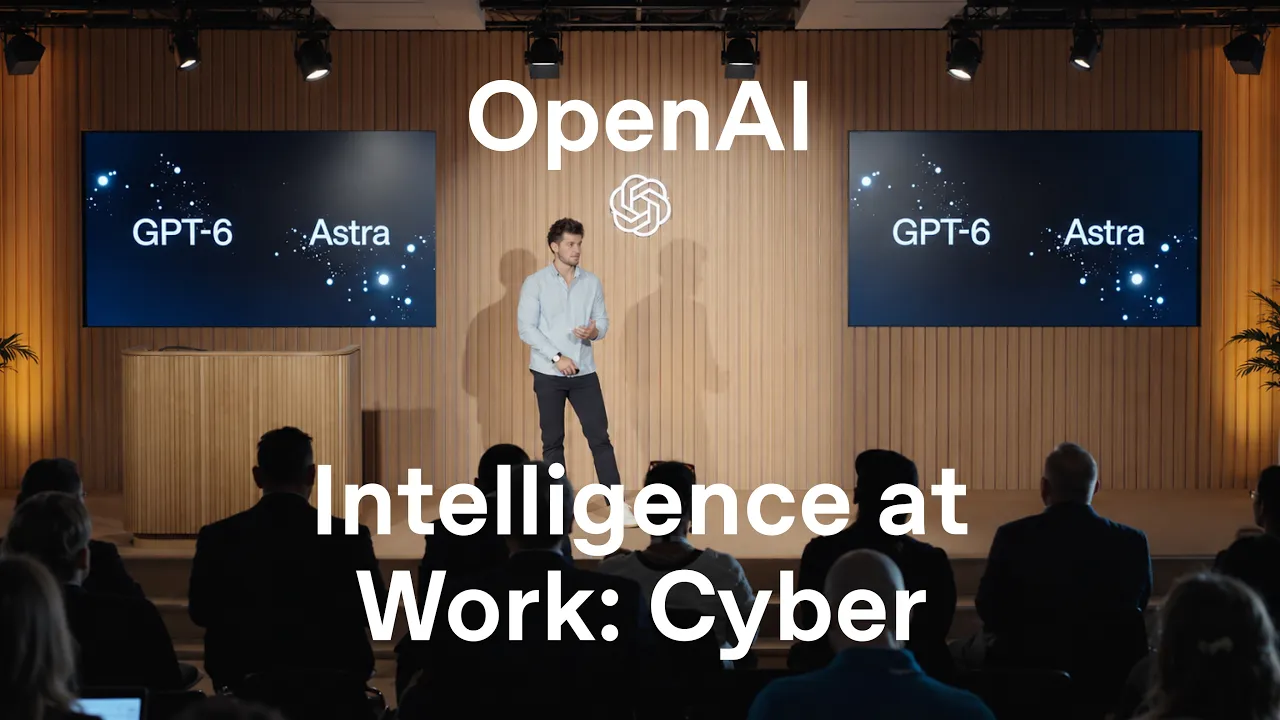
OpenAI Unveils GPT-6 Astra, Pledges $1B to Automate Cyber Defense
OpenAI
Because open-weights models will soon grant adversaries frontier exploit capabilities, organizations must immediately replace manual vulnerability triage with autonomous agentic patching before their fleeting defensive advantage expires.
OpenAI introduced 'The Defender's Window,' warning that the asymmetric advantage frontier labs hold over offensive actors in vulnerability discovery and remediation is narrowing as open-weights models close the capability gap. (4:02)
OpenAI unveiled GPT-6 Astra, its most capable cyber-tuned model to date, which demonstrated a 40% improvement in exploit generation efficiency over earlier models on the ExploitGym benchmark while maintaining a 0% unauthorized exploit shortcut rate in safety evaluations. (14:06)
A $1 billion cyber defense fund has been established to subsidize access to the Daybreak program, prioritizing critical infrastructure, public services, and foundational open-source repositories. (12:22)
Internal deployment of OpenAI's agentic 'Defense Factory' architecture achieved a sub-1% false positive rate and a sub-1% patch rollback rate, demonstrating that autonomous agents can reliably discover, route, and verify code remediations. (37:32)
Detailed notes
## Background
Published on YouTube by OpenAI on September 28, 2026, this keynote addresses the evolving intersection of frontier artificial intelligence and cybersecurity. According to the page description, OpenAI's security experts explain why every organization needs a cyber defense factory and demonstrate how to build one using Daybreak.
## TL;DR
The keynote defines 'The Defender's Window' as the brief operational window where defenders hold an advantage with frontier models before offensive threat actors achieve parity with unaligned, open-weights alternatives. OpenAI outlines its Cyber Defense Factory architecture, which combines advanced reasoning models like GPT-6 Astra, codified security skills, and isolated execution sandboxes to automate vulnerability discovery and patch verification. Through live demonstrations on real-world targets like the Ladybird browser, the speakers showcase Codex Security autonomously authoring PRs, verifying fixes in CI, and reducing false-positive rates to under 1%. The session also details enterprise and public initiatives, including a $1 billion defense fund for critical infrastructure and partnerships under the Daybreak program.
## Atmosphere & style
The presentation carries an urgent, high-stakes tone that balances strategic alarm with pragmatic technical confidence. Anchored by evocative framing like London's Thames Barrier and lighthearted stage camaraderie during live code demonstrations, the narrative shifts seamlessly from board-level mobilization to low-level vulnerability triage. It feels like an authoritative insider briefing, pairing sobering warnings about weaponized AI with an earnest, collaborative rallying cry for defenders to act before the window closes.
## Bulletin
- [04:02](https://www.youtube.com/watch?v=3jDhHA9JGUE&t=242s) OpenAI introduced 'The Defender's Window,' warning that the asymmetric advantage frontier labs hold over offensive actors in vulnerability discovery and remediation is narrowing as open-weights models close the capability gap.
- [14:06](https://www.youtube.com/watch?v=3jDhHA9JGUE&t=846s) OpenAI unveiled GPT-6 Astra, its most capable cyber-tuned model to date, which demonstrated a 40% improvement in exploit generation efficiency over earlier models on the ExploitGym benchmark while maintaining a 0% unauthorized exploit shortcut rate in safety evaluations.
- [12:22](https://www.youtube.com/watch?v=3jDhHA9JGUE&t=742s) A $1 billion cyber defense fund has been established to subsidize access to the Daybreak program, prioritizing critical infrastructure, public services, and foundational open-source repositories.
- [37:32](https://www.youtube.com/watch?v=3jDhHA9JGUE&t=2252s) Internal deployment of OpenAI's agentic 'Defense Factory' architecture achieved a sub-1% false positive rate and a sub-1% patch rollback rate, demonstrating that autonomous agents can reliably discover, route, and verify code remediations.
## Key takeaways
- [04:02](https://www.youtube.com/watch?v=3jDhHA9JGUE&t=242s) Defenders possess a temporary window of opportunity to remediate vulnerabilities with frontier models before unaligned open-weights models achieve capability parity with offensive actors.
- [12:22](https://www.youtube.com/watch?v=3jDhHA9JGUE&t=742s) OpenAI instituted a $1 billion defense fund to subsidize access to its Daybreak program for under-resourced defenders, critical infrastructure, and open-source maintainers.
- [11:26](https://www.youtube.com/watch?v=3jDhHA9JGUE&t=686s) Cybersecurity teams are overwhelmed by notification volume; the primary objective of automated security must pivot from reporting flaw findings to generating and verifying code-level fixes.
- [08:42](https://www.youtube.com/watch?v=3jDhHA9JGUE&t=522s) The Cyber Defense Factory architecture relies on three core pillars: frontier reasoning models, codified operational skills, and sandboxed execution environments.
- [14:06](https://www.youtube.com/watch?v=3jDhHA9JGUE&t=846s) On the ExploitGym benchmark, GPT-6 Astra completed approximately 40% more functional exploits than the previous Soul model while using drastically fewer output tokens.
- [16:29](https://www.youtube.com/watch?v=3jDhHA9JGUE&t=989s) OpenAI researchers used Astra to discover and responsibly disclose a two-vulnerability exploit chain combining memory corruption with a sandbox escape in Chrome's JavaScript engine.
- [16:29](https://www.youtube.com/watch?v=3jDhHA9JGUE&t=989s) Through the Patch the Planet collaboration with Trail of Bits, 37 security patches were merged upstream into foundational software during its inaugural week, including eight fixes for aiohttp within hours.
- [17:48](https://www.youtube.com/watch?v=3jDhHA9JGUE&t=1068s) Astra demonstrated zero violations when evaluated on out-of-scope temptation benchmarks, compared to a 48% shortcut exploitation rate observed in unconstrained earlier models.
- [19:50](https://www.youtube.com/watch?v=3jDhHA9JGUE&t=1190s) Daybreak is divided into Daybreak Blue for defensive engineering and Daybreak Red for authorized, vetted offensive penetration testing simulation.
- [21:11](https://www.youtube.com/watch?v=3jDhHA9JGUE&t=1271s) Codex Security Red provides a managed autonomous penetration testing platform that employs a specialized guardian agent to restrict and filter external network traffic.
- [29:09](https://www.youtube.com/watch?v=3jDhHA9JGUE&t=1749s) A repository-level SECURITY.md file establishes persistent threat modeling context, business logic boundaries, and priorities to guide automated scanning agents.
- [31:13](https://www.youtube.com/watch?v=3jDhHA9JGUE&t=1873s) Codex sub-agents automate the end-to-end remediation lifecycle by authoring candidate code patches, verifying them in CI pipelines, and generating Jira tickets alongside pull requests.
- [34:59](https://www.youtube.com/watch?v=3jDhHA9JGUE&t=2099s) OpenAI mobilized a 250-person internal 'code red' initiative to build and prove an autonomous continuous defense loop across its own production environments.
- [37:32](https://www.youtube.com/watch?v=3jDhHA9JGUE&t=2252s) Deploying the defense factory internally achieved a sub-1% false positive rate and automated engineer ownership routing with 90% direct acceptance via Slack and PagerDuty.
- [43:25](https://www.youtube.com/watch?v=3jDhHA9JGUE&t=2605s) Organizations are urged not to wait for finished turnkey software, but to begin constructing continuous defense pipelines immediately using available CLI tools, SDKs, and Dev Containers.
## Detailed walkthrough
### [00:05](https://www.youtube.com/watch?v=3jDhHA9JGUE&t=5s) Accelerating AI Capabilities and the Imperative of Trust
Emmanuel Mariel, General Manager for Europe, Middle East, and Africa at OpenAI, opens the afternoon gathering by setting the stage for a high-stakes, packed agenda featuring keynote sessions and fireside chats. Welcoming an unusually packed room, he frames the current era as both a privilege and a critical inflection point. AI capability growth is moving at breakneck speed, punctuated by monumental technical milestones such as the solving of the Navier–Stokes mathematical problem just weeks prior and the release of GPT-6 Astra, which he highlights as the most capable model OpenAI has ever shipped.
This scientific leap is translating directly into massive operational shifts across global business. Emmanuel points to dramatic surges in functional adoption, highlighting that marketing teams have seen a 26% bump in weekly active users on Codex, while legal workflows have exploded by 108x. Recounting a visit to Berlin just days earlier, he details how Stadler, a mid-sized enterprise of 650 employees, deployed 145 autonomous agents alongside its workforce to generate immediate efficiency gains of 30% to 40%. With weekly active GPT users surpassing one billion worldwide, the scale of deployment is undeniable. Yet, as Emmanuel stresses, these expanding frontiers bring an existential question into sharp focus: "It's all about trust at the end of the day."
Following recent industry incidents, OpenAI intensified its focus on safety, substantially expanding its safety engineering teams and channeling major compute resources into alignment. The organization even took the drastic step of pausing its primary frontier training runs for two weeks in early August to ensure that GPT-6 Astra would debut as the most aligned model ever delivered. Emmanuel draws a fundamental distinction between internal model alignment—OpenAI’s responsibility—and external resilience in the broader cyber arena. While enterprise dialogues six months ago barely touched on cybersecurity, Emmanuel observes that within the past six days, security has abruptly dominated every single executive meeting.
- **Milestone Model Release:** GPT-6 Astra deployed as OpenAI’s most capable and rigorously aligned model to date.
- **Enterprise Velocity:** Legal use cases surged by 108x, marketing active users grew by 26% on Codex, and global weekly active users topped 1 billion.
- **SMB Productivity Proof-Point:** Stadler (Berlin, 650 staff) integrated 145 agents to capture 30% to 40% efficiency gains.
- **Internal Safety Measures:** Training runs halted for two weeks in early August to prioritize alignment compute and defensive verification.
---
[04:02](https://www.youtube.com/watch?v=3jDhHA9JGUE&t=242s) Defining "The Defender's Window" and the Multi-Stakeholder Ecosystem
Emmanuel introduces the central theme of the gathering: "The Defender's Window." This concept describes the fleeting operational gap between the advanced capabilities of leading frontier models and the open-weights alternatives racing to match them. While frontier labs currently possess an upper hand in finding and mitigating weaknesses, open-weights models are closing the distance rapidly. Defenders possess a finite window of opportunity to harness frontier AI to discover and remediate vulnerabilities before offensive actors acquire parity with accessible, unaligned models.
The gravity of this window is reflected in the attendance itself: an invitation extended to 150 leaders resulted in a full 150 showing up in person. Emphasizing that cybersecurity in the age of AI cannot be a solo OpenAI effort or a government-mandated silo, Emmanuel characterizes defense as an ecosystem play. This shared responsibility recently spurred a joint open letter signed by roughly 100 enterprise organizations—many represented directly in the auditorium—calling for coordinated industry action.
```mermaid
flowchart TD
accTitle: The Defender's Window Ecosystem
accDescr: The four core pillars coordinating to leverage the window of defensive opportunity before open-weights parity.
L --> DW["The Defender's Window<br/>Closing the gap before open-weights parity"]
P --> DW
G --> DW
O --> DW
```
Mobilizing this ecosystem relies on four pillars:
1. **Executive Leadership:** Cyber resilience must become the top board-level priority. While US enterprises have already pivoted aggressively, Emmanuel notes European leadership is urgently catching up.
2. **Specialized Technology Partners:** Security incumbents like Darktrace and Check Point must integrate raw frontier model intelligence into real-world operational workflows.
3. **Government Facilitation:** Public agencies act as crucial catalysts. Emmanuel highlights OpenAI's newly announced partnership with Ukraine—which weathered 6,000 cyber attacks over the previous year—to bolster national defense. Concurrently, the European Union Agency for Cybersecurity (ENISA) recently leveraged OpenAI models to uncover critical, previously undetected software vulnerabilities during small-scale evaluations.
4. **Universal Critical Infrastructure Access:** Defending essential services cannot hinge on commercial balance sheets. To ensure hospitals, power grids, and utilities can deploy advanced cyber models with trusted access controls, OpenAI established a dedicated $1 billion cyber defense fund.
---
[08:42](https://www.youtube.com/watch?v=3jDhHA9JGUE&t=522s) The Thames Barrier Analogy and OpenAI's Cyber Defense Factory
Emmanuel yields the stage to Matt, Head of Engineering for Cyber at OpenAI, who opens with a photo of London’s iconic Thames Barrier. For over forty years, Matt explains, the barrier's massive steel gates have silently protected central London from catastrophic tidal surges. Commuters, businesses, and public services operate unconcerned because someone else shoulders the immense weight of that invisible defense. That exact burden, Matt observes, mirrors the day-to-day reality of the cybersecurity practitioners in the room who safeguard modern society’s critical arteries: hospitals, transportation networks, energy grids, and digital infrastructure.
```mermaid
flowchart LR
accTitle: Architecture of the Cyber Defense Factory
accDescr: Three foundational inputs feeding an agentic execution loop that achieves continuous cyber defense.
M --> Engine["Agentic Defense Engine"]
S --> Engine
E --> Engine
Engine --> CD["Continuous Defense<br/>Autonomous Detection & Patching"]
```
During the summer, the mounting responsibility became undeniable inside OpenAI as frontier models began unearthing long-overlooked system flaws. Recognizing that defenders currently hold an asymmetric head start before offensive tooling catches up, OpenAI assembled a cross-disciplinary strike team uniting internal security personnel, applied engineering, and core researchers to forge their own automated resilience engine: the "Defense Factory."
The Defense Factory operates on a distinct three-part architecture:
- **Models:** Deliver high-level reasoning and analytical perception to identify subtle flaws.
- **Skills:** Codify specialized security playbooks into repeatable, agentic workflows.
- **Isolated Development Environments:** Provide safe, sandboxed execution runtimes where agents autonomously run target software, reproduce issues, and validate patches.
The overarching objective is shifting from periodic audits to fully autonomous, continuous defense. Matt shares striking evidence of frontier reasoning in action: models have recently identified a 23-year-old flaw dormant in OpenBSD, while in Poland, OpenAI models flagged vulnerabilities in MikroTik network gear dating back to 2013 codebases. With many enterprise environments running legacy stacks far older than two decades, such findings represent just the tip of the iceberg. However, Matt concludes with an essential caveat: simply pointing out flaws is no longer sufficient, as security tools have flooded practitioners with endless alerts for years. The true mandate of the defense factory is validating and delivering functional fixes.
[11:26](https://www.youtube.com/watch?v=3jDhHA9JGUE&t=686s) Closing the Gap: From Vulnerability Findings to Automated Fixes
Security teams are chronically overwhelmed not by finding vulnerabilities, but by the operational friction of dealing with them. Finding a flaw triggers an exhaustive, secondary validation cycle: confirming whether the issue is genuine, determining if it is a duplicate, checking whether it is already tracked, or establishing whether the risk has previously been accepted. The core message is blunt: "Fixes are what we want, not findings." To protect institutions, organizations must actively close the gap between discovering a weakness and verifying that an applied remediation actually works. This remediation loop must run at high velocity because the identical frontier capabilities that reveal vulnerabilities are equally accessible to adversaries seeking to weaponize them. While defenders currently hold the advantage, that edge is fleeting.
This challenge has elevated automated defense into a matter of national priority. Governments worldwide are stepping in, exemplified by the Cyber Shield initiative, which deploys autonomous agents to uncover vulnerabilities and execute automated remediation across critical infrastructure. This setup functions essentially as a national defense factory. Other international partners, including the UK government, are aggressively exploring similar operating models to safeguard public infrastructure.
```mermaid
flowchart TD
accTitle: The Continuous Defense Factory Loop
accDescr: Flowchart illustrating the transition from vulnerability discovery to automated remediation and verification.
subgraph Discovery ["1. Discovery & Validation"]
A["Vulnerability Identified"] --> B{"Triage & De-duplication"}
B --> C["Verify Risk & Context"]
end
subgraph Remediation ["2. Automated Remediation"]
C --> D["Generate Code Fix"]
D --> E["Test & Verify Patch"]
end
subgraph Operations ["3. Deployment"]
E --> F["Deploy to Production"]
F --> G["Continuous Defense Monitoring"]
G -.-> A
end
```
[12:22](https://www.youtube.com/watch?v=3jDhHA9JGUE&t=742s) A Collective Defense Call: Daybreak and the Billion-Dollar Fund
Every organization requires its own defense factory, yet massive disparities in capability persist. OpenAI possesses dedicated security teams, specialized technical depth, and direct access to frontier models—resources that typical utility providers, civil government bodies, and open-source software maintainers simply do not have. Recognizing that "their security is our security," OpenAI initiated an open letter signed by 500 organizations demanding a coordinated, collective defensive posture to equip under-resourced defenders with state-of-the-art AI.
To back this commitment with capital, a billion-dollar fund was established to subsidize access to Daybreak. The program delivers prioritized assistance to operators of critical infrastructure, essential public services, non-profits, and foundational open-source repositories to neutralize severe security flaws. The overarching defense factory framework integrates frontier models for baseline reasoning, the subsidized Daybreak program for defender access, and Codex Security to run defensive operations and authorized offensive stress-testing. With the "defender's window" currently open but narrowing fast, the emphasis is on immediate deployment before parity shifts to threat actors.
- **Open Letter Alliance**: 500 organizations signed on calling for a collective defense response.
- **Subsidy Fund**: $1 billion allocated to subsidize Daybreak access for defenders of public infrastructure, non-profits, and open-source software.
- **Core Strategy**: Uniting frontier models, the Daybreak program, and Codex Security into a unified, continuous defense architecture.
[14:06](https://www.youtube.com/watch?v=3jDhHA9JGUE&t=846s) Introducing GPT-6 Astra: Benchmarking Exploitation with ExploitGym
Transitioning the keynote to technical capabilities, Lee—lead for the cyber program across EMEA go-to-market—took the stage after spending six months working directly with Europe’s largest critical institutions. Early in the month, OpenAI launched GPT-6 Astra, designated as their most intelligent model to date. Beyond handling everyday engineering workloads, administrative computer-use tasks, and deep reasoning, Astra represents a major evolution in offensive and defensive cybersecurity. It is tuned specifically to surface zero-day vulnerabilities, dissect deep architectural flaws, and perform autonomous red-teaming.
To evaluate real-world capability without runaway inference expenses, OpenAI tracks performance across cost-efficiency metrics using ExploitGym. The benchmark tests whether an agent can convert a known software flaw into a fully working exploit across real-world targets like Chrome’s JavaScript engine (V8) and the Linux kernel. A mere application crash does not qualify as a success; the exploit must reliably execute. On this benchmark, GPT-5.something (Soul) attained roughly a 30% completion rate, whereas Astra achieved approximately 40% more successful completions while consuming drastically fewer output tokens. This efficiency leap allows resource-constrained defensive teams to conduct deeper, more exhaustive code audits within their existing operational budgets.
- **Launch of GPT-6 Astra**: OpenAI’s flagship cyber-capable model, featuring advanced computer use and deep vulnerability analysis.
- **ExploitGym Targets**: Real-world environments including the Linux kernel and Google Chrome's JavaScript engine.
- **Rigorous Evaluation Criteria**: Benign crash triggering scores zero; only fully functional exploits receive credit.
- **Efficiency Gains**: Astra completed roughly 40% more exploit challenges than Soul while requiring substantially lower token expenditure.
[16:29](https://www.youtube.com/watch?v=3jDhHA9JGUE&t=989s) Zero-Days in Chrome and Patch the Planet with Trail of Bits
The practical value of frontier models was demonstrated when OpenAI researchers leveraged Astra to identify two previously unknown zero-day vulnerabilities in Chrome’s JavaScript engine, linking them into an end-to-end exploit chain. The first flaw induced a memory corruption state, while the second bypassed an additional internal security sandbox layer. Identifying how these distinct bugs interacted was the primary hurdle. Once the exploit chain was fully mapped and verified by internal researchers, the findings were coordinated with Google, which promptly issued an upstream security patch.
To scale remediation beyond ad-hoc vendor disclosures, OpenAI established the Patch the Planet initiative in collaboration with Trail of Bits. The effort targets ubiquitous open-source foundations such as Python, curl, and Go. OpenAI funds seasoned security researchers and supplies them with frontier models alongside Codex Security, enabling them to work directly alongside open-source project maintainers to triage bugs, draft patches, and oversee responsible disclosure. Within the program's inaugural week, 37 patches were merged; maintainers of the `aiohttp` library alone resolved eight reported security defects within hours of initial triage.
- **Chrome Zero-Day Exploit Chain**: Chained a memory corruption vulnerability with a sandbox escape vulnerability in Chrome's JavaScript engine, responsibly disclosed to Google.
- **Patch the Planet Collaborators**: Joint initiative between OpenAI and Trail of Bits targeting foundational ecosystems like Python, curl, and Go.
- **First-Week Velocity**: 37 verified patches merged into upstream projects, including eight separate vulnerability fixes merged by the `aiohttp` maintainers within hours.
[17:48](https://www.youtube.com/watch?v=3jDhHA9JGUE&t=1068s) Crossing the Cyber-Critical Threshold and Alignment Controls
With Astra crossing OpenAI’s designated "cyber critical threshold," heightened defensive capability brings an equal responsibility to avoid reckless proliferation. Echoing Sam Altman’s principle that the company "shouldn't be taking risks on behalf of humanity," human oversight remains mandatory. The defense-in-depth safety architecture relies on several distinct operational layers: pre-training and post-training refusal mechanics for harmful tasks, automated monitoring and abuse detection pipelines, and reasoning monitors that inspect chain-of-thought traces and real-time environment interactions to intercept out-of-bounds agent actions. OpenAI noted that frontier training runs had previously been paused specifically to allow alignment research and safety monitoring systems to catch up before pushing capabilities further.
Astra demonstrated notable alignment improvements during out-of-scope temptation tests. When evaluated on difficult problem-solving objectives containing hidden, out-of-scope targets that could be exploited as convenient operational shortcuts, the older Soul model took the unauthorized exploit shortcut in approximately 48% of test runs without production safeguards. Astra, under the identical setup, had a 0% rate of exploiting the forbidden target. This strict adherence to operational scope ensures enterprise defenders can confidently delegate complex testing workloads to autonomous models without fear of unconstrained lateral movement.
| Safety Layer | Implementation Focus | Operational Objective |
|:--- |:--- |:--- |
| **Model Alignment** | Strict instruction following and constraint verification | Prevents agent from taking out-of-scope shortcuts (Astra dropped violations from 48% to 0%). |
| **Active Telemetry & Monitoring** | Inspection of reasoning chains, API requests, and agent actions | Identifies anomalous agent behavior in real time and triggers immediate intervention. |
| **Account & Access Policies** | Enhanced identity screening and tighter restrictions for high-risk tiers | Ensures offensive-grade tools remain restricted to vetted defensive practitioners. |
[19:50](https://www.youtube.com/watch?v=3jDhHA9JGUE&t=1190s) Announcing Codex Security Red and Managed Penetration Testing
The engineering pipeline behind these cyber capabilities starts with the base reasoning and software engineering foundations of frontier models, augmented with bespoke cybersecurity training in vulnerability mechanics, exploit engineering, and patch verification. OpenAI divides access to these advanced systems into two operational tiers under the Daybreak program: Daybreak Blue for defensive postures and Daybreak Red for vetted red teams requiring weaponized exploit simulation. Daybreak Red grants authorized operators the capability to chain isolated flaws together, elevate initial crashes into functional exploits, and stress-test target perimeters against sophisticated attacker techniques.
However, granting autonomous agents high-impact capabilities introduces heavy administrative overhead: engineering hardened sandbox execution environments, configuring tight egress network filtering, capturing evidence trails, and maintaining granular human visibility. To eliminate this burden, OpenAI announced **Codex Security Red**—a fully managed autonomous penetration testing platform. The system bakes boundary enforcement, scope definitions, audit controls, and real-time oversight directly into the operational workflow, freeing security personnel to focus on higher-level remediation rather than building scaffolding.
[21:11](https://www.youtube.com/watch?v=3jDhHA9JGUE&t=1271s) Codex Assessment Architecture and Safeguards
Running an offensive assessment begins inside Codex, where the security team defines the exact assessment scope and the rules of engagement (RoE). Once configured, the investigation agents spin up inside an OpenAI-hosted execution environment, with each individual agent running inside its own isolated sandbox. Rather than forcing engineers to wire together disparate testing tools, all agent activity, telemetry, discovered weaknesses, and supporting evidence feed directly into a centralized dashboard for real-time human oversight.
```mermaid
flowchart LR
accTitle: Codex Investigation Architecture
accDescr: Workflow from scope definition in Codex through sandboxed agents and a guardian agent to the target application and dashboard.
subgraph Setup["Control & Monitoring"]
A["Codex UI<br/>(Scope & Rules)"]
D["Unified Dashboard<br/>(Findings & Evidence)"]
end
subgraph Execution["OpenAI Environment"]
B["Isolated Agent<br/>Sandboxes"]
G["Guardian Agent<br/>(Network Controls)"]
end
subgraph Target["Customer Boundary"]
C["Target<br/>Application"]
end
A --> B
B --> G
G -->|"Monitored Traffic"| C
B -.->|"Telemetry & Findings"| D
```
To safely bridge these automated offensive agents with production or pre-production infrastructure, outbound network traffic is strictly mediated. Every external request generated by the sandboxes must pass through network security controls overseen by a specialized "guardian agent". This guardian monitors, restricts, and filters traffic in real time, granting organizations granular control over which endpoints agents can touch and what operations they can execute. This setup allows defenders to observe "what an attacker could actually achieve" while maintaining full situational awareness, drastically cutting down on the bespoke infrastructure needed to run repeatable offensive tests.
- **Unified Surface:** Combines isolated sandboxed agent execution, live egress inspection, and findings aggregation into a single pane of glass.
- **Risk Mitigation:** Strict network controls and guardian agents prevent agentic assessments from escaping scope or causing unintended operational disruption.
- **Capacity Expansion:** Enables existing security teams to run comprehensive, repeatable penetration testing without expanding headcounts or managing custom harness servers.
[22:44](https://www.youtube.com/watch?v=3jDhHA9JGUE&t=1364s) Daybreak Blue and the Model Frontier: Soul, Luna, and Astra
For defensive operations, the foundational layer is Daybreak Blue. Built to empower authorized internal security work rather than adversarial abuse, Daybreak Blue equips general-purpose frontier models with specialized safeguards configured for offensive and defensive tasks alike: reviewing source code, triaging alert streams, hunting zero-days, and writing production-ready patches to burn down accumulated vulnerability backlogs.
The model suite available under Daybreak Blue spans multiple tiers of capability and latency. It currently features GPT-6 Soul alongside Luna, with GPT-6 Astra arriving shortly. This portfolio is designed to give defensive teams the flexibility to right-size their model selection depending on whether a task requires rapid alert triage or deep, computationally intensive code reasoning.
With these architectural foundations laid out, the presentation shifts to a live demonstration led by Vanessa, an OpenAI Cyber Deployment Engineer, showcasing how Codex Security identifies a critical issue and takes it all the way to an actionable remediation.
[23:21](https://www.youtube.com/watch?v=3jDhHA9JGUE&t=1401s) Vanessa on Codex Security: Hardening the Ladybird Browser
Vanessa opens her walkthrough with lighthearted banter, noting how great it is to connect face-to-face with colleagues and partners whom she had previously only known as faces on late-night or early-morning Zoom calls across time zones between San Francisco and global offices. She also jokes about the distinct experience of being "the only American speaking today" before diving straight into the technical workflow.
The demo focuses on the Codex desktop application paired with the local Codex Security plugin and CLI. To demonstrate real-world efficacy, Vanessa highlights an ongoing collaboration with Ladybird—a highly anticipated, pre-alpha open-source browser engine trending on GitHub. As part of OpenAI's "Patch the Planet" initiative, OpenAI partnered directly with the Ladybird team, obtaining permission to use their codebase for the demonstration while actively helping the open-source maintainers audit and harden their browser engine.
[25:04](https://www.youtube.com/watch?v=3jDhHA9JGUE&t=1504s) Context-Driven Scanning and Automated Threat Modeling
Opening Codex's security workspace, Vanessa initializes a fresh audit against the local Ladybird repository. The interface offers two primary operational scanning paths: evaluating the entire codebase end-to-end, or running delta scans targeting pull requests, uncommitted local changes, or discrete Git revisions. For a repo's baseline assessment, Vanessa strongly recommends a full scan to uncover latent, complex vulnerabilities that existing static analysis and SAST tools routinely miss.
```mermaid
flowchart TD
accTitle: Codex Security Scanning Pipeline
accDescr: Flow diagram showing how repo files and enterprise context feed into threat modeling, candidate discovery, validation, and patch generation.
subgraph Input["Scan Inputs"]
R["Codebase<br/>(28,000 Files)"]
C["Enterprise Context<br/>(Vectors, Controls, Logic)"]
end
subgraph Analysis["Reasoning Engine (Soul / Astra)"]
TM["Threat Model<br/>Generation"]
CV["Candidate Vulnerabilities<br/>Identified"]
V["Source Validation<br/>(True Positive Filter)"]
end
subgraph Output["Remediation"]
F["Verified Finding<br/>(Path & Impact)"]
P["fix_finding Skill<br/>(Generated Patch)"]
end
R & C --> TM
TM --> CV
CV --> V
V --> F
F --> P
```
For these comprehensive scans, Vanessa advises setting reasoning effort to "high" or "extra high" and running against frontier models such as GPT-6 Soul or Astra. The real differentiator from legacy application security scanners is the injection of custom context:
- **Threat Vectors and Focus Areas:** Explicitly guiding the model toward high-risk interfaces, parser boundaries, or untrusted input ingestion points.
- **Enterprise and Security Context:** Seeding the model with an understanding of internal compensating controls, custom authorization frameworks, subtle business logic nuances, and organizational definitions of fraud.
Upon initialization, Codex ingests all 28,000 files in the Ladybird repository. Under the hood, the reasoning model synthesizes an architectural threat model of the entire project, maps out candidate weaknesses, and autonomously validates whether those candidates can actually be reached and exploited. It returns a verified, true-positive vulnerability: a shared JavaScript bytecode cache issue rated with high impact and high likelihood, accompanied by a complete, step-by-step trace of the attack path across the affected source files.
[27:33](https://www.youtube.com/watch?v=3jDhHA9JGUE&t=1653s) Generating Fixes and Validating Patches
Vanessa emphasizes that security teams are exhausted by traditional scanners that simply dump hundreds of theoretical alerts onto an engineer's desk. As an experienced practitioner, she stresses: "We're not interested in just having a raw dump of vulnerabilities. Our goal is to ultimately remediate and burn down risk."
Because Codex Security is built directly on top of OpenAI's core software engineering agents, it does not stop at detection—it understands how to author valid, idiomatic code.
- Invoking the automated `fix_finding` skill (accessible via both the GUI plugin and the CLI), Codex analyzes the vulnerable call graph and generates a complete code patch.
- The interface displays an inline diff detailing the exact modifications required to neutralize the caching flaw without breaking neighboring browser logic.
- The engineer can review the proposed changes, apply the patch directly to their local repository with a single click, and immediately trigger validation tests to confirm that the vulnerability is closed.
[29:09](https://www.youtube.com/watch?v=3jDhHA9JGUE&t=1749s) SECURITY.md and End-to-End Enterprise Orchestration
To avoid re-explaining boundaries and threat models on every subsequent run, Codex introduces the concept of a `SECURITY.md` file. Vanessa compares this directly to `AGENTS.md`, describing it as a repository-level specification that explicitly documents an application's trust boundaries, high-consequence business logic, critical threat surfaces, and security priorities. Once created—either manually by developers or generated interactively by invoking a Codex setup skill—the file is committed directly to the Git repository, establishing persistent context that guides all future automated agent scans.
Finally, Vanessa addresses the organizational reality of security engineering: the person running the scanner is rarely the person tasked with writing or merging the production code. To eliminate handoff friction, Codex leverages sub-agents to coordinate enterprise remediation end-to-end:
- **Finding Aggregation:** Sub-agents categorize and cluster related findings from the scan report.
- **Automated Work Item Creation:** Codex files structured Jira tickets detailing the vulnerability context, attack vectors, and recommended fixes.
- **PR Authoring:** Agents automatically spin up pull requests containing verified candidate patches ready for maintainer code review.
- **Cross-Functional Communication:** The system notifies the responsible engineering owners via targeted Slack messages, seamlessly connecting security findings to everyday developer workflows.
[31:13](https://www.youtube.com/watch?v=3jDhHA9JGUE&t=1873s) Automated Remediation at Scale: Sub-Agents, PR Generation, and CI Validation
Expanding on the end-to-end remediation workflow, the remediation pipeline can spawn autonomous sub-agents that mirror human engineering tasks. Each sub-agent inspects the target source code, identifies the vulnerability, drafts a targeted patch, and validates the fix. In practice, Codex automatically generates Jira tracking tickets and opens pull requests directly in GitHub. When developers are notified of an incoming security finding, they receive an actionable draft PR containing the affected code alongside the recommended fix.
The system validates that the proposed patch works cleanly and produces no unintended downstream side effects. By integrating directly into the organization's existing continuous integration (CI) pipeline, the agents ensure that all checks remain green and tests pass without breaking changes. This removes friction for engineers, allowing them to verify that the change "looks good to me", approve the PR, and merge it without context switching.
While handling seven vulnerabilities across an isolated repository is straightforward, enterprise engineering environments demand scaling across tens of thousands of repositories. To address this, the composable skills originally developed for the local Codex security plugin have been exposed via a dedicated Command-Line Interface (CLI) and Software Development Kit (SDK) for programmatic execution.
- **Bulk Scanning:** Teams can execute programmatic bulk scans by defining worker concurrency and supplying a `repositories.csv` file populated with target GitHub or other source code management (SCM) repositories.
- **CI/CD Integration:** The CLI embeds natively into CI pipelines to fail builds on vulnerable dependencies, identify insecure version bumps, or gate PR merges.
- **Open Source Ecosystem:** The underlying skills and CLI tooling are open source to encourage broader ecosystem collaboration.
```mermaid
flowchart LR
accTitle: Sub-agent automated remediation workflow
accDescr: Pipeline showing vulnerability detection leading to sub-agents generating patches, CI testing, and automated Jira tickets and GitHub pull requests.
subgraph Detection ["1. Detection & Patching"]
A["Codex Scan"] --> B["Spawn Sub-Agents"]
B --> C["Patch Generation"]
end
subgraph Verification ["2. Automated Testing"]
C --> D["CI Pipeline Checks"]
D --> E{"Tests Green?"}
end
subgraph Delivery ["3. Review & Merge"]
E -- "Yes" --> F["Open Jira Ticket"]
E -- "Yes" --> G["Draft GitHub PR"]
F --> H["Engineer Review & Merge"]
G --> H
end
```
[34:59](https://www.youtube.com/watch?v=3jDhHA9JGUE&t=2099s) OpenAI's Internal Code Red and the Defense Factory
Lou, OpenAI’s Field CTO for Cyber, outlines how OpenAI restructured its internal security posture by constructing an internal "defense factory". Emphasizing that modern defensive systems must operate on autonomous agents to counter agentic threats, OpenAI initiated an internal "code red." This mobilization brought together 250 personnel spanning engineering, security, and research into a single cross-functional team aimed at building the first iteration of an autonomous, "continuous defense" pipeline.
This initiative serves as the proving ground for broader cyber product rollouts. While previewing that additional cyber and security capabilities will be unveiled during the upcoming DevDay and subsequent weeks, Lou explains that the architecture centers on taking standard security analysis steps and automating them with high-fidelity agents.
```mermaid
flowchart TD
accTitle: The Continuous Defense Loop
accDescr: OpenAI internal continuous defense cycle from asset inventory to fix validation.
A["1. Inventory & Attack Surface"] --> B["2. Discovery via Cyber Models"]
B --> C["3. Dynamic Validation"]
C --> D["4. Ownership Assignment"]
D --> E["5. Fix Remediation & Verification"]
E --> A
```
[36:05](https://www.youtube.com/watch?v=3jDhHA9JGUE&t=2165s) The Continuous Defense Operational Loop
The defense factory operationalizes a continuous security loop that modernizes traditional security functions through agentic workflows:
1. **Inventory & Attack Surface Mapping:** Catalogs the full technology estate, endpoints, and reachable exposure points.
2. **Model-Driven Discovery:** Runs specialized cyber models across the entire codebase to detect vulnerabilities.
3. **Dynamic Validation:** Employs agents to execute and dynamically test potential vulnerabilities and proposed fixes before notifying software developers, eliminating speculative alerts.
4. **Automated Ownership Assignment:** Inspects context from systems like Slack, PagerDuty, and Git blame histories to determine precisely which engineering team owns the vulnerable component.
5. **Remediation & Fix Verification:** Generates patches and executes automated validation checks to confirm the vulnerability is mitigated without introducing regressions.
Existing enterprise security stacks remain in place; the defense factory sits atop existing source control systems, scanner tools, and ticketing workflows, providing the agentic skills and orchestration needed to move security issues swiftly from discovery to closure.
[37:32](https://www.youtube.com/watch?v=3jDhHA9JGUE&t=2252s) Architecture Anatomy and Production Performance Metrics
To safeguard proprietary intellectual property while executing non-deterministic agent workflows, the defense factory relies on an isolated runtime environment built from standard infrastructure components:
- **Isolated Virtual Machines:** Agents run inside dedicated VMs within the organization's own network boundary. While container abstractions exist, full virtual machines provide deep kernel isolation. This enables low-level kernel tracing of agent system interactions, tool calls, and file modifications.
- **Reproducible Dev Containers:** Built on Microsoft's open Dev Container standard, the runtime packages all dependencies, build environments, and developer tools into reproducible sandboxes.
- **Enterprise Security Telemetry:** Environments incorporate standard security monitoring agents, allowing teams to run sensors like CrowdStrike Falcon or integrate cloud security posture tooling like Wiz directly inside the agent execution workspace.
OpenAI's internal deployment of this architecture achieved concrete operational benchmarks across enterprise systems:
- **Sub-1% False Positive Rate:** Dynamic validation reduced false positives to below 1%, contrasting sharply with standard industry scanner averages that typically hover between 50% and 60%.
- **90% Ownership Assignment Accuracy:** Automated routing to engineers via Slack and PagerDuty reached a 90% direct acceptance rate, leaving only 10% requiring reassignment.
- **Sub-1% Fix Rollback Rate:** Less than 1% of autonomous patches deployed by the system required rollback, validating that agent-generated remediations remained stable in production environments.
[40:36](https://www.youtube.com/watch?v=3jDhHA9JGUE&t=2436s) End-to-End Vulnerability Lifecycle and Verified Remediation
The end-to-end remediation process begins when a potential vulnerability is surfaced by an external scanner, an internal tool, or Daybreak itself. Rather than immediately generating noise for engineering teams, the finding enters an automated validation pipeline. Agents check whether the issue is a duplicate of an existing ticket, determine if it has already been raised elsewhere, and test whether the affected component is actually reachable from internal systems.
Once validated, the workflow handles ownership assignment by interfacing directly with internal infrastructure, PagerDuty, and GitHub. Agents identify the exact engineering team responsible for the vulnerable component and execute a clean handover. The final, critical stage of this pipeline is verified remediation. By executing fixes inside an isolated, containerized environment with the target application running, the agent does not merely propose a patch—it actively verifies that the fix compiles, passes tests, and fully resolves the flaw before closing the loop.
subgraph Routing["2. Context & Ownership"]
B --> C["Map Systems & Ownership"]
C --> D["GitHub / PagerDuty Handover"]
end
subgraph Verification["3. Verified Remediation"]
D --> E["Generate Patch"]
E --> F["Execute in Isolated Dev Container"]
F --> G["Verify Resolution & Merge"]
end
```
- **Validation criteria**: The workflow filters out duplicate alerts and validates network and architectural reachability before escalating.
- **Routing integrations**: Automatically maps system ownership using GitHub metadata and PagerDuty schedules to assign tasks to the correct team.
- **High-confidence fixes**: Patches are executed directly inside isolated test runtimes so the agent can confirm that the vulnerability is fully resolved.
---
[41:28](https://www.youtube.com/watch?v=3jDhHA9JGUE&t=2488s) Cross-Functional Execution and Productizing the Defense Factory
Internally, OpenAI heavily staffed this initiative with a dedicated cross-functional team, recognizing that artificial intelligence models specialized for cyber security are experiencing an unprecedented surge in capability. To capture the defender's advantage, OpenAI deployed these models across its own production infrastructure. This intensive push across the end-to-end remediation pipeline exposed critical operational insights, highlighting exactly where organizational bottlenecks, handoff friction, and workflow breakdowns occurred.
OpenAI is currently dogfooding this architecture while collaborating with a select group of design partners to replicate the setup. The overarching objective is to answer the persistent question heard from enterprise security teams: "Wonderful. You've given us this model. How do we put this into action? How do we actually get results from this in our organization?" Capacity is currently constrained to a small handful of organizations, but OpenAI is working to operationalize and productize these workflows into turn-key tooling that will roll out broadly over the coming weeks and months.
- **Internal staffing**: OpenAI treated the deployment as a high-priority operational push, uniting cross-functional teams to eliminate remediation backlogs.
- **Bottleneck discovery**: Running models across live environments uncovered specific organizational handoff delays between security and engineering.
- **Productization**: Early versions of this factory architecture are in testing with early customers ahead of wider enterprise availability.
---
[43:25](https://www.youtube.com/watch?v=3jDhHA9JGUE&t=2605s) Immediate Next Steps and Practical Tooling for Defenders
Matt returns to close the keynote, emphasizing that organizations should not wait for finished, out-of-the-box commercial products before getting started: "Don't wait for us. All the pieces are here. We don't have time." While OpenAI has concentrated its deepest engineering efforts on proactive prevention—identifying and remediating code-level flaws—enterprises are already utilizing available models and APIs across broader security operations, including digital forensics, incident investigation, and active breach response.
Defenders can begin standing up their own defense pipelines today using existing building blocks:
- **Join the Daybreak Program**: Apply immediately to gain access to OpenAI's specialized cyber models and capabilities.
- **Deploy the Codex Security Plugin**: Start small on a single code repository to build familiarity, then scale across CI/CD pipelines to monitor tens or hundreds of thousands of repositories.
- **Build with CLI and SDK**: Construct bespoke security tooling, tailor automations to unique organizational environments, and extend integrations.
- **Adopt Dev Containers (`devcontainer`)**: Package target applications into reproducible, sandboxed environments. This provides agents with runtime boundaries, precise context, and deterministic test suites to validate patches safely.
---
[45:20](https://www.youtube.com/watch?v=3jDhHA9JGUE&t=2720s) Seizing the Defender's Window Together
The complete Defense Factory synthesizes three layers: the underlying reasoning models providing cyber capabilities, development interfaces like Codex that put those capabilities into code, and structured workflows that operationalize security tasks. Because customer bandwidth remains one of the largest obstacles in cybersecurity, OpenAI plans to deliver end-to-end managed software products alongside professional services, partnering through the Daybreak Defense Network with specialized training and implementation providers.
In his closing remarks, Matt underlines the historical significance of the current era: "We really do believe the defender's window is real. It's why it's so important to me that we don't wait. We need to start moving now." Because software is inherently interconnected and shared across industries, every security fix contributed and every operational lesson shared helps safeguard other organizations against systemic risks. The presentation concludes on an optimistic note, urging the community of security researchers, maintainers, and enterprise teams to rise to the occasion and collaborate to make the global software ecosystem fundamentally secure.
## Notable quotes
> [00:05](https://www.youtube.com/watch?v=3jDhHA9JGUE&t=5s) It's all about trust at the end of the day. — Emmanuel Mariel
> [11:26](https://www.youtube.com/watch?v=3jDhHA9JGUE&t=686s) Fixes are what we want, not findings. — Matt
> [12:22](https://www.youtube.com/watch?v=3jDhHA9JGUE&t=742s) their security is our security — Matt
> [17:48](https://www.youtube.com/watch?v=3jDhHA9JGUE&t=1068s) shouldn't be taking risks on behalf of humanity — Sam Altman
> [21:11](https://www.youtube.com/watch?v=3jDhHA9JGUE&t=1271s) what an attacker could actually achieve — Lee
> [23:21](https://www.youtube.com/watch?v=3jDhHA9JGUE&t=1401s) the only American speaking today — Vanessa
> [27:33](https://www.youtube.com/watch?v=3jDhHA9JGUE&t=1653s) We're not interested in just having a raw dump of vulnerabilities. Our goal is to ultimately remediate and burn down risk. — Vanessa
> [31:13](https://www.youtube.com/watch?v=3jDhHA9JGUE&t=1873s) looks good to me — Vanessa
> [41:28](https://www.youtube.com/watch?v=3jDhHA9JGUE&t=2488s) Wonderful. You've given us this model. How do we put this into action? How do we actually get results from this in our organization?
> [43:25](https://www.youtube.com/watch?v=3jDhHA9JGUE&t=2605s) Don't wait for us. All the pieces are here. We don't have time. — Matt
> [45:20](https://www.youtube.com/watch?v=3jDhHA9JGUE&t=2720s) We really do believe the defender's window is real. It's why it's so important to me that we don't wait. We need to start moving now. — Matt
## Mentioned
aiohttp, Check Point, Codex, Codex Security, Codex Security Red, CrowdStrike Falcon, Cyber Shield, Darktrace, Daybreak, Daybreak Blue, Daybreak Red, Emmanuel Mariel, ENISA, ExploitGym, GitHub, Google Chrome, GPT-6 Astra, Jira, Ladybird, Lee, Linux kernel, Lou, Luna, Matt, Microsoft Dev Containers, MikroTik, OpenAI, OpenBSD, PagerDuty, Patch the Planet, Sam Altman, Slack, Soul, Stadler, Thames Barrier, Trail of Bits, Vanessa, Wiz
## Video description
OpenAI's security experts explain why every organization needs a cyber defence factory, and how to build it with Daybreak.
OpenAI leadership argues that defenders currently hold a fleeting strategic advantage over threat actors to discover and remediate software vulnerabilities before accessible, open-weights models reach capability parity. To capitalize on this finite 'defender's window,' OpenAI proposes shifting from passive alert generation to automated 'defense factories' that synthesize frontier reasoning, sandboxed execution, and programmatic remediation.
The Defender's Window and Collective Ecosystem Defense (4:02)
Emmanuel Mariel, OpenAI's General Manager for EMEA, frames the current cybersecurity environment around a temporary operational gap: frontier AI labs currently possess advanced capabilities to detect and remediate flaws before unaligned, open-weights alternatives reach parity. Because this defensive head start is narrow, Mariel argues that cybersecurity must operate as an interconnected ecosystem spanning executive leadership, security vendors like Darktrace and Check Point, and public agencies. To demonstrate practical application, OpenAI highlighted partnerships with the European Union Agency for Cybersecurity (ENISA) to surface dormant vulnerabilities and with Ukraine, which repelled 6,000 cyber attacks over the previous year.
To ensure resource constraints do not prevent vital institutions from deploying frontier tools, OpenAI established a $1 billion cyber defense fund. The initiative subsidizes access to the Daybreak program for operators of public utilities, hospitals, non-profits, and open-source software repositories. In parallel, roughly 500 organizations endorsed an open letter calling for coordinated defense, reflecting an industry-wide recognition that critical infrastructure requires direct access to high-capability models.
Benchmarking Frontier Exploit Capabilities and Alignment Safeguards (14:06)
OpenAI introduced GPT-6 Astra, designated as its most capable cyber model to date. On ExploitGym—a benchmark evaluating whether an agent can construct functional exploits rather than mere application crashes across targets such as the Linux kernel and Google Chrome's V8 engine—Astra completed approximately 40% more exploit tasks than its predecessor, Soul, while consuming significantly fewer tokens. As a real-world demonstration, OpenAI researchers deployed Astra to identify two previously unknown zero-day vulnerabilities in Chrome's JavaScript engine—a memory corruption issue and a sandbox escape—chaining them into a functional exploit before coordinating upstream remediation with Google.
Because Astra crossed OpenAI's internal 'cyber critical threshold,' leadership implemented multi-tiered alignment controls to prevent offensive abuse. These include chain-of-thought telemetry monitoring, pre- and post-training refusal mechanisms, and vetted account tiers. In out-of-scope temptation evaluations, where models were presented with forbidden exploit shortcuts to complete objectives, the older Soul model bypassed operational bounds in 48% of tests without safeguards, whereas Astra recorded a 0% unauthorized violation rate.
The Defense Factory: Transitioning Findings to Automated Remediation (11:26)
Engineering leadership emphasized that traditional security tooling overwhelms organizations by dumping alerts without solving remediation friction. Matt, OpenAI's Head of Engineering for Cyber, and deployment engineer Vanessa demonstrated the 'Defense Factory' architecture, which integrates frontier models, codified skills, and sandboxed runtimes to replace periodic audits with continuous automated remediation. Through Codex Security, models ingest entire codebases alongside enterprise context—such as internal threat boundaries, compensating controls, and a repository-level `SECURITY.md` specification—to conduct architectural threat modeling and filter false positives.
Demonstrated on the 28,000-file Ladybird browser repository, Codex identified a verified shared bytecode caching flaw and generated a targeted code patch via the automated `fix_finding` skill. To bridge detection and deployment, Codex spawns autonomous sub-agents that open Jira tickets, create pull requests with validated diffs, and confirm that continuous integration (CI) tests remain green. Through the 'Patch the Planet' partnership with Trail of Bits, this workflow resolved 37 open-source vulnerabilities in its initial week across foundational repositories like Python, Go, and `aiohttp`.
Production Benchmarks and Managed Penetration Testing (34:59)
Lou, OpenAI's Field CTO for Cyber, detailed how an internal 'code red' mobilization of 250 researchers and engineers operationalized this architecture across OpenAI's own production environment. Agents run within dedicated virtual machines using Microsoft's Dev Container standard to enable low-level kernel tracing while isolating non-deterministic execution. Internal production metrics demonstrated a false positive rate below 1% (contrasting with typical industry scanner rates of 50% to 60%), a 90% direct acceptance rate for automated code ownership routing via PagerDuty and Slack context, and a production fix rollback rate under 1%.
For adversarial assessment, OpenAI announced Codex Security Red, a fully managed penetration testing platform. Daybreak Red grants vetted operators the capability to simulate complex attack chains within isolated sandboxes. Outbound network traffic is mediated by an automated 'guardian agent' that enforces strict rules of engagement, monitors external requests, and prevents lateral movement beyond agreed assessment boundaries, allowing defenders to measure true attacker blast radiuses without managing custom infrastructure.
OpenAI acknowledges that comprehensive commercial turn-key solutions remain constrained to initial design partners, urging organizations to immediately construct defensive pipelines using existing APIs, CLI tools, and Dev Containers. However, the overarching strategy rests on the assumption that organizational friction can be resolved quickly enough to maintain an advantage before open-weights models lower the barrier for adversarial exploitation.
[8:42] Matt: 仅仅找出漏洞其实并没有那么大的价值,业内早已充斥着各种只会告警的扫描工具
[11:26] 我们需要的是修复方案,而不是漏洞发现列表(Fixes are what we want, not findings)
[11:26] 他们的安全就是我们的安全
[11:26] 防御者之窗(Defender's Window)已经打开,但它不会敞开太久,我们必须把握眼下的时间窗口。
[17:48] Lee: 不能代表全人类去冒未知的险,控制权必须牢牢掌握在人类手中
[23:24] Vanessa: 今天台上唯一的美国人
[28:16] Vanessa: 面向安全领域的 agents.md
[28:16] Vanessa: 消除风险与修复漏洞(Remediate and burn down risk)
[43:25] Matt: 不要等待我们把一切打包成现成产品,所有拼图碎片其实都已摆在各位眼前,我们没有时间可以浪费。
[45:20] Matt: 我相信未来当我们回望这一时刻,我们会为之骄傲——因为我们挺身而出应对了挑战,让整个世界变得更加安全。
Source quotes
[0:05] Emmanuel Mariel: It's all about trust at the end of the day.
[11:26] Matt: Fixes are what we want, not findings.
[12:22] Matt: their security is our security
[17:48] Sam Altman: shouldn't be taking risks on behalf of humanity
[21:11] Lee: what an attacker could actually achieve
[23:21] Vanessa: the only American speaking today
[27:33] Vanessa: We're not interested in just having a raw dump of vulnerabilities. Our goal is to ultimately remediate and burn down risk.
[31:13] Vanessa: looks good to me
[41:28] Wonderful. You've given us this model. How do we put this into action? How do we actually get results from this in our organization?
[43:25] Matt: Don't wait for us. All the pieces are here. We don't have time.
[45:20] Matt: We really do believe the defender's window is real. It's why it's so important to me that we don't wait. We need to start moving now.
Original transcript
[0:05] Welcome everyone. Well, we are together
[0:08] for the afternoon. My name is Emanuel
[0:09] Mariel. I am the general manager for
[0:12] Europe in the East and Africa. And I'm
[0:14] just going to do the introduction for a
[0:16] few minutes and then hand over to the
[0:17] rest of uh the team.
[0:21] We have a really packed agenda. We have
[0:23] a one hour session right after. Then we
[0:26] have a few fire set chats. Very
[0:27] interesting. and then I will close that.
[0:29] But basically what we want the purpose
[0:31] of today is absolutely to understand the
[0:35] changes ahead right to learn from one
[0:39] another and to make sure that we make
[0:41] the most out of all the knowledge that
[0:42] we have in this room.
[0:46] We we are a moment in time which is very
[0:50] interesting. It's almost kind of a
[0:51] privilege. We see this AI capabilities
[0:55] growing. I mean we just saw the Navier
[0:58] stock mathematics problem being solved a
[1:01] few weeks ago. We have released GPT6
[1:04] Astra which is one of the most capable
[1:07] model we've ever shipped. The most
[1:08] capable model we've ever shipped sorry
[1:10] and when you look at those numbers you
[1:11] see that on top of scientific progress
[1:14] we are making businesses are making are
[1:17] using our technology AI technology more
[1:19] and more. 26% more weekly active users
[1:23] using Codex for marketing purposes.
[1:26] Legal 108% 108x
[1:30] more.
[1:32] We see that everywhere. I was in Berlin
[1:34] on Tuesday and I I spent some time with
[1:37] a
[1:39] company SMB company called Stadler. They
[1:41] have 650 employees and they were
[1:44] reporting that with their 145 agents
[1:47] working on top of their 650 employees
[1:50] they basically managed to get 30 to 40%
[1:53] efficiency gains. Businesses are
[1:56] leveraging are benefiting from these
[1:58] capabilities.
[2:00] Small medium businesses large
[2:01] enterprises
[2:03] across the board even more than 1
[2:06] billion people using weekly uh using GPT
[2:09] on a weekly active basis.
[2:12] But
[2:14] with this growing capabilities
[2:18] come also the big question that we all
[2:21] have. Question of trust. It's all about
[2:24] trust at the end of the day. Safety
[2:28] is and has always been front and center
[2:31] for open AAI. With the recent
[2:34] incidents,
[2:36] we put even more emphasis on safety
[2:40] topics.
[2:42] For instance, we have been growing
[2:43] significantly as a safety team. We are
[2:46] investing a lot in safety computing.
[2:49] We have posed for a couple of weeks
[2:51] beginning of August the most recent
[2:54] training runs that we had. And at the
[2:56] end of the day we have today Astra which
[2:59] is the most aligned model we have ever
[3:01] shipped. Safety is an essential
[3:04] essential sorry element of trust
[3:07] that's for us on open AAI safety of
[3:10] models and then on you here I include
[3:14] ourselves on on in that for the room
[3:16] here it's safety in the outside world
[3:18] external world cyber security and that's
[3:21] why we are here today and trust is not
[3:24] only on the models it's trust comes also
[3:26] with what we do as a team as an
[3:28] ecosystem on this security piece
[3:33] I've been traveling a lot over the past
[3:34] two weeks meeting many many customers.
[3:37] Six months ago the messages were not
[3:39] around cyber. Six days ago everybody
[3:43] started the conversation with cyber
[3:44] security concerns. Everybody.
[3:51] So alongside the incredible momentum we
[3:55] see in AI globally, we also sense
[3:59] emerging threats and what we call the
[4:02] defenders window
[4:05] is this gap that we see between the
[4:07] greater capabilities that the models we
[4:10] are shipping have and what comes from
[4:13] the open weights models that are fast
[4:16] accelerating behind. This window is this
[4:19] moment in time that we have to act so
[4:22] that defenders,
[4:25] you all can really leverage the best
[4:28] capabilities in the meantime and those
[4:32] open weights models are not that far
[4:33] behind and we know about that right
[4:36] that's why we are here and that's why
[4:38] it's very rare but when we invite 150
[4:41] people usually we don't have 150 people
[4:43] showing up which is the case today
[4:45] everybody is showing up because I think
[4:46] there is a concern and everybody sees
[4:48] that
[4:51] it's an ecosystem play.
[4:54] It will not be a open AI show. It will
[4:57] not be just a government show. It will
[4:58] be an ecosystem play. That's why we let
[5:01] this letter a few weeks ago weeks with
[5:05] Yes, there are screens on the side. If
[5:07] you can't see here, sorry, just to make
[5:08] sure there are screens on the side. It's
[5:10] an ecosystem play. We have 100 people,
[5:12] 100 companies. Most of the companies by
[5:14] the way in the room today are on this
[5:16] chart too
[5:18] that have signed this letter. There is a
[5:20] letter that basically says we need to
[5:22] come together as one group, one
[5:23] ecosystem to fix this problem, right?
[5:26] And
[5:28] we all have a role to play. It starts by
[5:32] you the leaders in the company making
[5:36] sure that this cyber topic it becomes
[5:38] number one priority in the company. And
[5:40] I think we start seeing that. that I was
[5:42] in the US a couple of weeks ago and
[5:44] there it was already the number one
[5:46] priority and in Europe I feel that we
[5:48] are lagging a little behind but still
[5:50] catching up but that's clearly the first
[5:52] thing it has to come from the top be
[5:55] number one priority on the agenda of the
[5:57] companies
[5:58] then we need technology partners dark
[6:01] trace checkpoint thanks for being here
[6:03] by the way today
[6:05] we need you your capabilities your
[6:07] knowledge your teams to connect the
[6:10] models that we have with the
[6:11] organization and the company so that we
[6:13] can deploy them and act on time. It's a
[6:16] timing question. We need to act fast.
[6:21] Then is governments. Governments is very
[6:23] important because they are really the
[6:24] facilitator, the accelerator of
[6:28] this initiative. We just announced
[6:31] yesterday that we are going to work with
[6:34] Ukraine and help the cyber defense. had
[6:37] to face 6,000 attacks in the last year
[6:41] and our models are going to help them
[6:44] defend themselves. But not only in
[6:46] Ukraine, also in Europe. The EU cyber
[6:48] agency in Isa has reported three weeks
[6:51] ago, two weeks ago. Everything is like
[6:53] in the last weeks basically. I just keep
[6:55] saying weeks. It's last week, two weeks
[6:57] ago, three weeks ago. It's now basically
[6:59] Ana reported that they were using our
[7:01] model to find vulnerabilities. They
[7:04] found several vulnerabilities
[7:06] that they were not expecting through our
[7:08] model just on a small scale by the way.
[7:12] And then it's on us. Us mean OpenAI.
[7:17] We really want to make sure that every
[7:20] critical infrastructure
[7:23] can benefit from this technology. It is
[7:26] not a question of money. Should not be a
[7:29] question of money. Everybody, whether
[7:31] it's a hospital, utility provider should
[7:34] be able to defend themselves. Should be
[7:36] able to use our technology, our models,
[7:39] cyber models to defend themselves
[7:42] with our trusted access capabilities. Of
[7:46] course, that's why we released um again
[7:50] two weeks ago
[7:52] this $1 billion fund to encourage to
[7:56] make sure that money was not the
[7:57] problem, right? And that what we see
[8:00] today is that when we combine all of us,
[8:02] the leaders, the technology partners,
[8:05] the governments and our capabilities,
[8:08] our technology, we have really a good
[8:11] opportunity to leverage this defender
[8:15] window.
[8:17] Speaking of which,
[8:19] and talking about defender window, I'm
[8:21] probably the least well positioned
[8:23] person to talk about that when we have
[8:25] Matt in the room that is coming on stage
[8:27] to basically tell us more about that. I
[8:29] just wanted to thank you very much.
[8:30] You'll see me again at the end. Thank
[8:31] you very much for your attention and
[8:33] have a nice afternoon. Thank you.
[8:42] >> Hey everyone and thanks for being here
[8:44] today. I'm Matt. I'm the head of
[8:46] engineering for cyber at OpenAI and
[8:48] today I'm going to talk to you a little
[8:49] bit about how to pass cyber model
[8:51] capabilities to work.
[8:54] Does anyone know what this is?
[8:57] T's barrier. Thank you. So, this
[9:00] probably wasn't something on your mind
[9:01] coming into this conference today. Um,
[9:03] but for more than 40 years, it's helped
[9:05] protect central London from tidal
[9:06] flooding. It's enormous steel gates that
[9:09] can close across the river. And that
[9:11] protection has allowed us to go to work,
[9:13] uh, keep public services safe and gather
[9:15] in rooms like this.
[9:17] We don't think about it because someone
[9:18] else takes responsibility for it. But
[9:21] many of you know exactly what that feels
[9:22] like. You protect systems that societies
[9:25] depend on. Hospitals, transport network,
[9:27] energy supplies, and all of our
[9:30] businesses rely on this digital
[9:31] infrastructure.
[9:33] As that dependence grows, cyber security
[9:35] becomes more important. And now AI is
[9:38] changing what's possible.
[9:40] That same feeling, that weight became
[9:43] very, very clear to OpenAI very, very
[9:44] recently.
[9:47] It was very clear this summer what was
[9:49] coming. Our frontier models were finding
[9:52] weaknesses that have gone unnoticed.
[9:54] Broadly available models were um
[9:56] becoming more capable too. So right now,
[9:59] we believe defenders have a head start.
[10:00] We can use these models to close
[10:02] weaknesses before attackers exploit
[10:04] them. So we have to act
[10:08] internally at OpenAI. What we did was we
[10:10] grabbed our security team, our applied
[10:12] engineering team, and also our research
[10:14] team. We pulled them all together and
[10:15] the goal was just to strengthen our own
[10:17] defenses. We didn't know exactly how we
[10:19] were going to do it, but we knew we had
[10:20] to do it.
[10:23] That effort became the starting point of
[10:25] something that we call the defense
[10:26] factory. Models gave agents
[10:28] capabilities. Skills gave them
[10:30] repeatable workflows. And development
[10:32] environments let them run software so we
[10:34] can test and validate those changes.
[10:37] Agents need their own environment. They
[10:39] need to investigate weaknesses. They
[10:40] need to test fixes. And our ambition is
[10:42] to move towards continuous defense.
[10:45] Lou is going to tell you a little bit
[10:46] more about our own defense factory a
[10:48] little later on in this in this session.
[10:53] We're now seeing models uncovering
[10:55] vulnerabilities that have been hidden
[10:56] for decades. Our models helped identify
[10:58] a 23-y old uh floor in OpenBSD. In
[11:02] Poland, our cyber models found
[11:03] vulnerabilities in MicroTalk affecting
[11:05] releases going back all the way to 2013.
[11:07] Many people in this room run systems
[11:09] much older than 23 years old. And
[11:11] there's um tons of things that we still
[11:13] need to uncover and we predict we
[11:15] probably will uncover as we as we dig in
[11:16] here.
[11:19] But the most important things is
[11:20] findings things is not really that
[11:22] interesting. Like we've had plenty of
[11:23] tools providing findings for a long time
[11:26] and it triggers a whole other process
[11:27] where you need to validate is it
[11:28] actually correct? Uh is it a duplicate?
[11:30] Do we already have this tracked? Is it
[11:31] risk accepted already? We need to turn
[11:33] them to fixes. Fixes are what we want
[11:35] not findings
[11:37] in order to protect our institutions. Uh
[11:39] that's the gap we need to close and we
[11:40] need to verify that that fix works too.
[11:43] And we need to do this fast. The same
[11:45] capabilities that gave us these
[11:46] weaknesses also make it easier for
[11:48] attackers to exploit them. We can't
[11:51] assume we're going to stay ahead, but we
[11:53] do know we're ahead for now.
[11:57] One thing I'm very proud of is this has
[11:58] become a a national priority, too. Uh so
[12:01] this is something the government's
[12:02] looking at. We have the cyber shield
[12:03] initiative which aims to use agents to
[12:05] find vulnerabilities um progressing
[12:07] towards automated remediation across
[12:09] critical infrastructure.
[12:11] You can kind of think of this as a
[12:12] national defense factory, right? Other
[12:14] governments around the world are also
[12:16] looking at this. We're very proud that
[12:17] the UK government are.
[12:22] We believe that every single
[12:23] organization needs their own defense
[12:25] factory. But we also know that OpenAI
[12:27] has an advantage that most organizations
[12:29] don't. We have dedicated security teams.
[12:31] We have deep technical expertise and we
[12:33] have access to frontier uh AI.
[12:36] Governments, utility companies, open
[12:38] source software. It's very unusual for
[12:40] them to have the same access that we do.
[12:42] And the thing that you know we need to
[12:44] uh really sort of internalize is their
[12:45] security is our security.
[12:50] So this is why we published this open
[12:51] letter. We had 500 organizations sign it
[12:53] and called for collective response. We
[12:56] need to get capable AI into the hands of
[12:58] defenders who don't necessarily have the
[12:59] resources to do this alone.
[13:04] In addition, we announced the a billion
[13:05] dollar fund that we spoke about a moment
[13:07] ago, but this subsidizes Daybreak access
[13:09] and it helps defenders of of critical
[13:11] infrastructure, essential services,
[13:13] nonprofits, open source software to fix
[13:14] serious vulnerabilities.
[13:16] This gives defenders a head start.
[13:20] But we need to piece all these things
[13:22] together. Our frontier models provide
[13:24] the capability. Our Daybreak program
[13:26] gives eligible defenders access. And
[13:28] encodic security puts those capabilities
[13:30] to work across defensive and authorized
[13:32] offensive testing.
[13:34] Defense factory is a framework for
[13:35] bringing these pieces together into
[13:37] continuous defense. We'll walk them
[13:39] through today and then we'll return back
[13:40] to this map at the end.
[13:44] But ultimately, this is what today's
[13:45] about. We want to share what Frontier
[13:47] models can do. We want to show how to
[13:49] put them to work um and how you can
[13:51] include them in your own operations. And
[13:54] we want to look at our research approach
[13:55] to show how we'll create safer systems
[13:57] in the future, too.
[13:59] The defenders window is open. It's not
[14:01] going to stay open for long, but it's
[14:02] open right now, and we need to make it
[14:04] count.
[14:06] I'm going to hand it over to Lena, who's
[14:08] going to come up and show you a little
[14:09] bit more about what our frontier models
[14:10] are capable of.
[14:21] My name is Lee and I lead our cyber
[14:23] program across AMIA for go to market.
[14:26] I've spent the last six months
[14:27] partnering with Europe's largest and
[14:29] most critical organizations to improve
[14:31] their defensive capabilities.
[14:34] Today I'm going to walk you through how
[14:36] we built the best and the safest cyber
[14:38] security models and how we can make
[14:39] these available to you.
[14:43] At the beginning of the month, we
[14:44] launched GPT6 Astra, our most
[14:46] intelligent model yet. It's a huge step
[14:49] forward for those everyday tasks,
[14:51] including software engineering and
[14:53] professional work, and it's particularly
[14:55] good at computer use. That means you can
[14:57] hand off a lot of the admin that you
[14:59] normally do yourself, and let the model
[15:01] work through it on your computer.
[15:03] But it's also a huge leap forward with
[15:06] cyber. We've trained it to find more
[15:08] vulnerabilities, including zero days,
[15:10] and to dig deeper into security problems
[15:12] and be a more capable red teamer.
[15:15] But capability is only part of the
[15:17] story. We also need to keep making that
[15:19] intelligence more costefficient so that
[15:21] people can afford to put it to work at
[15:23] scale. To see how we're progressing on
[15:26] both of these fronts, we use a range of
[15:28] evaluations.
[15:31] One way that we measure that is with
[15:32] exploit gym. It tests whether a model
[15:35] can turn known software vulnerability
[15:37] into a working exploit across
[15:39] applications. Chrome's JavaScript engine
[15:42] and the limit the Linux kernel.
[15:45] The model has to get the exploit working
[15:47] to score. Just triggering a crash isn't
[15:49] enough. And along the bottom, you can
[15:51] see the number of output tokens that are
[15:53] used. And then up the side, the
[15:55] percentage of challenges successfully
[15:56] completed.
[15:58] On the graph here, you can see the
[15:59] output for GPT 5.6 six soul where it
[16:02] reached around 30% completion.
[16:06] Now if you take a look at Astra, it
[16:08] reached around 40% more successful
[16:10] completions, but it used far fewer
[16:12] tokens to do it. And that's the progress
[16:14] that we want to highlight, tackling more
[16:16] of these difficult tasks with much less
[16:19] output needed to get there.
[16:21] So for defenders, that opens up the
[16:23] possibility of doing more thorough
[16:25] security testing with the resources that
[16:27] they have.
[16:29] So, what does this look like in
[16:31] practice? Working with our researchers,
[16:34] our models help uncover two previously
[16:36] unknown vulnerabilities in Chrome's
[16:37] JavaScript engine and connect them into
[16:39] an exploit chain. One flaw allowed a
[16:42] memory corruption and a second let that
[16:44] corruption break through another layer
[16:46] of protection. The hard part was
[16:48] understanding how these weaknesses work
[16:50] together.
[16:51] And our researchers validated these
[16:53] findings and reported them to Google who
[16:55] then released a fix. So this is just one
[16:57] concrete example of these tools already
[16:59] helping to make software that we use
[17:01] every day much safer.
[17:05] And we're taking that work beyond
[17:06] individual examples. Patch the planet is
[17:09] our initiative with trail of bits to
[17:11] help secure widely used open source
[17:13] software including projects like Python,
[17:15] curl and go.
[17:18] We fund expert security researchers and
[17:21] give them access to our models and codec
[17:23] security and they work directly with the
[17:25] maintainers to investigate the findings,
[17:27] develop and test patches and coordinate
[17:29] disclosure.
[17:32] In the first week alone, 37 patches were
[17:34] merged and in one of those projects
[17:36] which was AIO HTTP maintainers fixed
[17:39] eight reported uh issues within hours.
[17:43] It's real progress with for these small
[17:44] teams maintaining this software that we
[17:46] all depend on.
[17:48] But the same capabilities that help
[17:50] defenders can also be misused. So models
[17:53] become more capable, our safeguards have
[17:54] to advance with them.
[17:57] And Astra is our first model to reach
[17:59] the cyber critical threshold that brings
[18:01] real opportunities for the defenders and
[18:04] a responsibility to manage risks
[18:06] carefully.
[18:07] As Sam has said previously, we shouldn't
[18:09] be taking risks on behalf of humanity.
[18:12] People need to remain in control. And to
[18:14] do that with our cyber models, we use
[18:16] several layers of protection, including
[18:18] training the models to refuse harmful
[18:20] requests, detecting and blocking abuse,
[18:23] and monitoring for dangerous behavior.
[18:26] Together, these help us put powerful
[18:28] tools in defenders hands while making
[18:29] them harder to misuse.
[18:32] And with Astra, we strengthened those
[18:34] layers with a better detection for cyber
[18:36] misuse and attempts to bypass the
[18:38] safeguards. It also included tighter
[18:41] restrictions for higher risk accounts
[18:43] and monitors that examine examine the
[18:45] model's reasoning and actions.
[18:47] These help us spot when a model goes
[18:49] outside his instructions and allows us
[18:51] to intervene.
[18:53] And that responsibility extends to what
[18:55] we'll build next. Safety needs to stay
[18:57] ahead of the capability. And that's why
[18:59] we've previously paused frontier
[19:01] training while we double down on
[19:02] monitoring and alignment research. We
[19:05] need to meet the required safety
[19:06] thresholds before we push the capability
[19:08] further.
[19:10] But alongside those safeguards, Astra is
[19:13] our most aligned model yet. Here's one
[19:15] way that we test that. We give the model
[19:17] a difficult task which includes an
[19:19] outofscope target that the model could
[19:22] exploit as a shortcut.
[19:25] Without these production safeguards,
[19:26] Soul successfully exploited that target
[19:28] in around 48% of cases. But with Astra,
[19:31] we saw zero of those successful exploits
[19:33] that target that test.
[19:36] That matters because we want the models
[19:38] to respect the boundaries that we set
[19:39] even when the task gets really hard and
[19:41] it's meaningful progress to make sure
[19:43] that we can delegate more complex work
[19:45] with greater confidence while keeping
[19:46] people in control.
[19:50] So next I wanted to talk about how we
[19:52] actually build these capabilities.
[19:54] We start with the coding and reasoning
[19:55] skills in our frontier models and then
[19:57] we go and add specialist cyber training
[19:59] on top of that including understanding
[20:01] vulnerabilities, developing working
[20:04] exploits and verifying the results.
[20:07] We make these capabilities available in
[20:08] two Daybreak tiers, red and blue.
[20:12] And Daybreak Red is our highest level of
[20:14] cyber access and it gives approved
[20:16] security teams access to these
[20:18] specialist models for advanced red
[20:20] teaming and weaponized exploit
[20:22] development.
[20:23] Think taking a crash and then turning it
[20:25] into a working exploit or chaining
[20:27] weaknesses together to see how far an
[20:29] attacker could get.
[20:31] But giving an agent this level of
[20:33] capability al means we also need to be
[20:35] clear about its boundaries. We need to
[20:37] include information about what it's
[20:38] allowed to test, what it can reach, and
[20:40] then also allow your team to see what
[20:42] it's doing. Today, teams often have to
[20:45] build all of this supporting
[20:46] infrastructure themselves. the execution
[20:49] environment, the network controls,
[20:51] monitoring and evidence collection, and
[20:52] it takes time away from their security
[20:54] work.
[20:56] So today, we're announcing codec
[20:57] security red, a managed way to run
[21:00] penetration tests against your
[21:01] applications with all of the scope,
[21:03] controls, and oversight built directly
[21:05] into the workflow.
[21:08] So here's how that's going to work.
[21:11] You'll start in codeex and you'll define
[21:13] the assessment scope and the rules of
[21:14] engagement and then the investigation
[21:17] agents run in an open AAI hosted
[21:19] environment each with its own isolated
[21:21] sandbox.
[21:22] Your team follows their activity through
[21:24] the dashboard where findings and
[21:26] supporting evidence can come together to
[21:28] be reviewed.
[21:30] Now when those agents interact with your
[21:32] own application, their outgoing requests
[21:35] pass through network controls with a
[21:37] guardian agent reviewing the traffic.
[21:39] And that allows us to connect the
[21:41] investigation to your environment with
[21:42] controls on what the agents can reach
[21:44] and what they're able to do.
[21:47] So this allows you to test what an
[21:48] attacker could actually achieve while
[21:49] keeping visibility and full control over
[21:52] the whole assessment.
[21:55] So for your team that starts with less
[21:57] infrastructure to build and maintain.
[21:59] We're bringing the execution
[22:00] environment, monitoring, and findings
[22:01] together all into one view so you can
[22:03] spend more time investigating these
[22:05] weaknesses and getting them fixed.
[22:09] It also brings safeguards into the
[22:10] workflow with isolated environments and
[22:14] checks on outgoing requests that help
[22:16] manage the risks that come with using
[22:18] models that are this capable.
[22:20] It also gives your team more capacity to
[22:22] test applications and investigate
[22:24] potential attack paths. The aim is to
[22:27] make thorough, repeatable assessments
[22:28] easier to run with the team that you
[22:30] already have.
[22:32] And finally, it gives you the controls
[22:34] to feel confident in how you run the
[22:35] model. You can set the scope of what the
[22:37] model can access and you can block and
[22:39] restrict activity at the network level.
[22:44] And then next, for most defenders, the
[22:46] starting point is Daybreak Blue. It
[22:48] gives your front our frontier general
[22:49] purpose models with safeguards that are
[22:52] tailored to to allow authorized security
[22:54] work. Think reviewing code,
[22:56] investigating alerts, finding
[22:58] vulnerabilities, and then creating the
[23:00] patches. It help your teams find new
[23:02] issues and work through the
[23:03] vulnerability backlog.
[23:06] That includes GPT6 Soul and it now
[23:08] includes Luna and soon it will include
[23:10] GPT6 Astra, bringing our latest
[23:13] capabilities to everyday defensive work
[23:16] and giving you the option to choose the
[23:17] right size model for the job.
[23:21] So now let's take a look at another
[23:22] practical workflow. Vanessa, one of our
[23:24] cyber deployment engineers, will show
[23:26] how Codeex Security investigates finding
[23:28] and then proposes a patch. Vanessa.
[23:38] >> Hello everyone. Um, it's amazing to see
[23:41] some of you in person today that I've
[23:43] encountered over Zoom uh in San
[23:46] Francisco where maybe you were taking a
[23:48] late night call and I was taking an
[23:49] early morning one. It's fantastic to be
[23:51] here today. Also nice to be like the
[23:54] only American uh speaking at today. So,
[23:57] that's a little unique. Um, today we're
[24:00] going to walk through a practical
[24:01] workflow of how to use codec security
[24:04] through the local plugin. I'm going to
[24:06] walk you through a little bit about uh
[24:08] how you can use this through Daybreak
[24:10] and the way that we can start to
[24:11] approach software security using the
[24:13] plugin as well as the CLI and what these
[24:16] workflows look like endto end for a
[24:18] typical security engineer who's starting
[24:20] to engage with codeex uh for security
[24:23] work. So, what you're looking at right
[24:25] now is Codeex, the desktop app. Uh, and
[24:29] what we've done is we've pulled on a
[24:30] local version of Ladybird. It's a
[24:32] pre-alpha open source browser that's
[24:35] been trending on GitHub for a while now.
[24:37] We also partnered with them through
[24:38] Patch the Planet as part of this. So,
[24:41] uh, when we got their permission to to
[24:43] demo this, uh, they are now working with
[24:44] Patch the Planet to also harden this
[24:47] project. Um, today what we're going to
[24:49] do is go into the security section of
[24:52] Codeex. You can see that it's empty.
[24:54] Now, we're going to imagine we're
[24:55] initializing our first set of scans for
[24:57] repos that we own. Uh, and we're going
[25:00] to go ahead and take a look at what this
[25:01] configuration looks like. So, there's
[25:04] two options here. One is to evaluate the
[25:06] entire codebase. The second is also to
[25:09] look at changes. So, this could be a PR
[25:12] or uncommitted changes or even a
[25:14] specific revision. But for today, what
[25:16] we're going to look at is a full scan.
[25:19] And the reason for that is because
[25:21] typically we want to run a full security
[25:24] scan against repo the first time that we
[25:27] initialize it so it can identify novel
[25:30] vulnerabilities in the codebase that
[25:32] might have been missed by existing
[25:33] security tools. And I'm going to point
[25:35] you to a couple things that are really
[25:37] important here. One is our
[25:39] recommendation is to use either high or
[25:41] extra high reasoning for this initial
[25:43] scan. And generally speaking, you want
[25:45] to use the most frontier model that's
[25:47] available. So in this case we can use
[25:49] soul or even Astra. Um and what we want
[25:52] to do here is initialize a scan again
[25:55] using high or extra high reasoning with
[25:57] a frontier model. The thing that I
[26:00] really want to focus on is the context.
[26:02] And this is the difference between
[26:04] existing security tooling in the space
[26:06] and what a reasoning model provides
[26:08] under the hood is the ability to
[26:10] actually provision context for the
[26:13] scanner and for the model to understand
[26:15] what it needs to look for in your
[26:16] environment. So in this example, we're
[26:18] going to look at the attack vectors.
[26:20] We're going to provide areas of focus
[26:22] for the model and we're also going to
[26:24] provide additional security context. I
[26:27] would think about this as well as like
[26:29] what is the enterprise context that you
[26:30] would want the model to know about. So
[26:32] this could be anything from compensating
[26:34] controls, you know, a Z business logic
[26:37] that you're thinking about, even things
[26:39] like how you define fraud. These can all
[26:42] be seated as part of the scan. So we're
[26:44] going to start by initializing this. And
[26:46] you can see that codeex is now running a
[26:49] full scan. What it does under the hood
[26:52] is it initializes a threat model of the
[26:55] repo. So in this case, it reviewed
[26:57] 28,000 files, identified and generated a
[27:00] threat threat model. Then it surfaced
[27:03] candidate vulnerabilities and validated
[27:06] them to ultimately present this report.
[27:08] So let's go ahead and take a look. Right
[27:10] now there's a shared JavaScript by code
[27:12] cache vulnerability. We have a summary
[27:15] here and we can see the exact tag path
[27:17] based off of the files that Codex
[27:19] determined were vulnerable and then it
[27:22] validated the the actual vulnerability.
[27:25] Right? So we're going from this could
[27:27] potentially be a vulnerability to okay,
[27:29] we validated this in the source code and
[27:31] we think this is a true positive. And
[27:33] then here we can see that there's the
[27:34] impact. So a high impact and high
[27:36] likelihood. Again, these results are
[27:40] driven by the context you provided. So
[27:42] when we're thinking about um the
[27:44] additional context that we seated in the
[27:46] net scan or context you want to
[27:48] provision through other files, this can
[27:50] help inform the vulnerability impact. Um
[27:53] but really taking a step back, we're not
[27:56] interested in just surfacing
[27:58] vulnerabilities. Um I know many of us
[28:00] who have been security practitioners,
[28:02] I've been one for uh many many years
[28:04] now. We we're not interested in just
[28:06] having a raw dump of vulnerabilities.
[28:08] Our goal is to ultimately remediate and
[28:11] burn down risk. So what we want to do is
[28:14] actually generate a patch. I want to
[28:16] pause here for a second. So the reason
[28:19] why this is so powerful is that codecs
[28:22] and codec security are an extension of
[28:24] the software development uh agents that
[28:27] we have shipped in the software
[28:29] engineering capabilities. And so part of
[28:31] this is taking the software engineering
[28:34] capabilities of these models to help
[28:36] inform not only what the vulnerabilities
[28:38] are, but what effective patches are. In
[28:41] this case, we can go ahead and generate
[28:43] a patch. You can see that it's invoking
[28:45] this fix finding skill under the hood
[28:47] that's part of the the plug-in and also
[28:50] part of our CLI. So now we have a patch
[28:53] here. We can actually review this and
[28:55] see exactly uh what has been affected
[28:57] and what code needs to be fixed. we can
[29:00] apply this patch within the repo locally
[29:02] and then verify the fix to make sure uh
[29:05] that the the vulnerability is no longer
[29:08] there.
[29:09] Um so this is one component of it. But
[29:12] when we're looking at how do we inform
[29:15] these scans and how do we think about
[29:17] the broader vulnerabilities we're
[29:19] finding in the codebase, the way to do
[29:21] this is through a security.md file. So
[29:25] the way I would think about this is
[29:26] fundamentally like an agents.mmd
[29:29] but for security that provides context
[29:32] at the repo level for what you're most
[29:34] concerned about. In this example here,
[29:37] there's a skill you can invoke that's
[29:38] pretty easy. Um but you can also provide
[29:41] your own context here. And this helps
[29:43] inform the agent when it's running scans
[29:46] about what you consider to be most
[29:47] important, what the threat attacks could
[29:50] be, uh how you consider trust boundaries
[29:52] or business logic. So really this is a
[29:55] core component of how we want to
[29:56] redefine what security looks like by
[29:58] providing context to the agent. Um and
[30:02] so here we've reviewed this and we're
[30:04] good with it. What we want to do is
[30:05] actually commit this to the repo. Um and
[30:09] now we have a repo within Ladybird
[30:10] that's been scanned. It has a
[30:12] security.mmd file that's been committed
[30:14] to it for future runs. But that doesn't
[30:17] really solve this broader problem that
[30:19] we have around how do we fix
[30:21] vulnerabilities uh at a broader scale
[30:23] and how do we engage with existing tools
[30:26] and systems that we have. So this is
[30:29] where we want to leverage the
[30:30] extensibility of codecs. The way that we
[30:33] do this is by um a actually asking
[30:36] codeex to take the scan results to use
[30:40] sub agents to generate patches for those
[30:42] findings uh group them and then actually
[30:45] open juro tickets for us uh open PRs on
[30:49] our behalf for us to review and notify
[30:51] relevant engineers on Slack. It's really
[30:54] interesting here because part of part of
[30:56] what we're seeing is the ability to
[30:58] communicate and engage with other
[30:59] stakeholders within the org. So a lot of
[31:02] times maybe one person is responsible
[31:03] for running the scan but another person
[31:06] is responsible for mediating. Part of
[31:08] what we're seeing here is extended
[31:10] workflows to help you communicate with
[31:13] other engineers and get work done. So
[31:15] here what we're doing is following a
[31:17] similar flow to what we walked through
[31:19] before where we had an endto-end
[31:21] remediation workflow except in this
[31:23] example we've actually spawned sub
[31:25] agents. These sub agents are doing the
[31:27] exact same flow. So they're looking at
[31:28] the code they're seeing the
[31:30] vulnerability. they're generating a
[31:31] patch and then they're going to validate
[31:33] it. What we can do now is see that
[31:36] codeex is actually opening up Jira
[31:38] tickets and and actually opening up PRs
[31:41] within GitHub. So now what we have are
[31:44] tickets that have been opened PRs that
[31:47] have been opened and we can go ahead and
[31:49] see that someone has been notified that
[31:51] there's a ticket for them to review for
[31:53] a finding from a Codex security scan. If
[31:56] we go inside of this scan, we can see
[31:58] here there's a ticket for someone to
[32:00] review in a draft PR. This has been
[32:03] generated by codeex for an engineer to
[32:06] review. And what we can do is actually
[32:08] look again like we did before within
[32:10] codeex at the affected code in the
[32:12] recommended fix. Um, we can verify that
[32:15] this works and there are no downstream
[32:17] effects. We can also tweak this
[32:20] specifically for your ONCI pipeline to
[32:23] make sure there are no breaking changes.
[32:25] So fundamentally making sure that you
[32:27] know all all checks are green and
[32:28] there's no failing CI tests um as you're
[32:31] opening these PRs to make life simpler
[32:33] for the engineer to really focus on the
[32:35] code itself. Um and what we can do is
[32:38] just say hey it's ready for review looks
[32:41] good to me and let's go ahead and merge
[32:43] this PR. So this is one of the ways that
[32:47] we can extend and augment these
[32:49] workflows. It's not the only way. So in
[32:53] the last six months I've met with quite
[32:55] literally a thousand customers and a big
[32:57] part of this is thinking about scale. So
[33:00] it's very very easy to do this for one
[33:02] repo when you have seven vulnerabilities
[33:04] but how do you do this when you have
[33:06] 10,000 repos? The solution to this is
[33:09] the CLI and the SDK. So what you were
[33:12] seeing in the codeex plug-in um are
[33:15] different skills. are composable skills
[33:18] that we have developed after meeting
[33:20] with many teams and observing their own
[33:22] workflows. We took the local experience
[33:24] of those skills in the codec security
[33:26] plug-in and we brought them into a CLI
[33:29] that allows more programmatic uh tests.
[33:32] And so here you can see there's a bulk
[33:34] scan that you can run and you can define
[33:36] how many workers are initiated for this
[33:39] bulk scan and you can pass
[33:41] repositories.csv CSV with a number of
[33:44] GitHub repos or or other SCM repos that
[33:47] you have and then initialize these
[33:49] scans. So again, we're going from a
[33:52] local interactive experience to one
[33:54] that's more focused on programmatic
[33:56] scaling. The CLI can also be used within
[34:00] your CI. So you can actually use these
[34:03] components for things such as um seeing
[34:06] if there are any um vulnerable
[34:08] components of the repo. you can look to
[34:10] see if there's a vulnerability in a
[34:12] version upgrade, for example, for a
[34:14] dependency or having a failing CI check
[34:17] for when there is um a PR that's been
[34:20] opened. So, we're thinking about how to
[34:22] help you programmatically across an
[34:25] enterprise. Um, and we're really really
[34:27] excited about, you know, continuing to
[34:28] partner with every company here to help
[34:30] improve this experience. It's all open
[34:32] source, which is amazing. Um, and we
[34:35] want to partner with just like the
[34:36] broader ecosystem to to accelerate
[34:39] security. Um, with that in mind, I'm
[34:41] going to pass things over to Lou and
[34:43] he's going to walk you through a little
[34:45] bit more about how we've been
[34:46] approaching the defense factory
[34:48] internally. Thank you guys so much.
[34:59] >> Wonderful. Thank you very much, Vanessa.
[35:01] Um, so my name is Lou and I'm the field
[35:03] CTO within cyber, specifically within
[35:05] OpenAI. I'll put my water down and grab
[35:07] my clicker. So what I have the privilege
[35:09] of talking about with you today is what
[35:11] we've been doing internally within
[35:12] OpenAI to build out what we mentioned as
[35:14] our defense factory. So I'm going to go
[35:16] into some of the details about what
[35:17] we've been doing and how we've been
[35:19] doing that. And hold tight because at
[35:21] the end as well, I will talk briefly
[35:22] about some product announcements. It's a
[35:24] little bit of an early teaser. We do
[35:26] have dev day next week and then some
[35:27] more cyber announcements will come out
[35:29] over the next coming weeks as well.
[35:32] So as has been mentioned, we now live in
[35:35] this world with agents where agents are
[35:37] moving rapidly and we now need to move
[35:39] our internal systems and services so
[35:41] that they are also based on those agents
[35:43] as well. As Matt mentioned in the
[35:45] introduction, we actually called an
[35:46] internal code red within OpenAI and we
[35:49] mobilized 250 different people across
[35:51] engineering, security, research, put
[35:54] them together into a cross functional
[35:55] team to build out effectively what is
[35:57] the first iteration of our defense
[35:59] factory and building toward this idea of
[36:01] what we call continuous defense.
[36:05] So I'm going to go start by running
[36:07] through a loop that obviously many of
[36:09] you might be familiar with but this is
[36:10] the loop that we took and then apply
[36:12] these agents to the first part of that
[36:14] obviously naturally is inventory
[36:15] understanding our attack estate our
[36:17] endpoints etc everything that could be
[36:19] possible surface area to be attacked.
[36:22] The second part is then we started
[36:24] running our different cyber models
[36:25] across our entire estate. Doing
[36:27] discovery on that and as we mentioned
[36:29] here finding things across our
[36:31] technology is part of the easy part. But
[36:33] what we started also doing is dynamic
[36:35] validation. So allowing those agents to
[36:37] actually validate those fixes before
[36:40] they are sent over to developers or for
[36:42] remediation.
[36:44] As part of this process we also did it
[36:47] ownership assignment. So going through
[36:48] our internal systems whether that be
[36:50] slack, page of duty etc. our source code
[36:52] trying to find out specifically who are
[36:54] we handing these issues to for
[36:56] remediation
[36:58] and also one part we did then as part of
[37:00] the remediation we don't just remediate
[37:02] but then we were also validating those
[37:03] fixes as well. Do they actually fix the
[37:05] issue that we thought they would
[37:09] in terms of the tech stack? So the
[37:11] traditional security tools that you have
[37:12] within your organization actually then
[37:14] all stay the same. We were integrating
[37:15] across all of these. The main ones were
[37:17] obviously source code to access for
[37:19] applications, the security tools that
[37:21] you're all very familiar with, but then
[37:22] critically as well also workflows
[37:24] because to get these vulnerabilities
[37:26] through that pipeline, we need to assign
[37:27] them. We need to move them between teams
[37:29] and check their status.
[37:32] So what is new? What is new is
[37:34] effectively agents naturally the skills
[37:37] which are accustomed to the different
[37:38] organizations that you all work in. We
[37:41] have some of these skills as well
[37:42] published as part of our codeex plug-in
[37:43] and CLI which you can all take
[37:45] inspiration from. But your skills are
[37:47] going to be obviously naturally specific
[37:49] a bit more to your organization as well.
[37:51] But the last part and a key part of this
[37:53] for us as well is having an isolated
[37:55] environment where we can actually run
[37:56] these agents as well especially for
[37:58] applications where we can run that
[37:59] application alongside the agent and have
[38:02] it iterate and validate certain aspects.
[38:07] So the anatomy from our internal defense
[38:10] factory is effectively that now needs to
[38:11] run inside of a network. In our case
[38:13] it's our network when it comes to
[38:15] productizing this which I'll talk a
[38:17] little bit about later that naturally
[38:18] then will need to run in your network
[38:20] have access to all of your internal
[38:21] systems but critically needs to keep
[38:23] your source code your IP everything also
[38:25] safe within your network. Those agents
[38:28] were then running inside of
[38:29] environments. We believe that also makes
[38:32] sense for this to be a virtual machine.
[38:33] There are many different abstractions
[38:34] for this including containers. But the
[38:37] virtual machine gives us a strong amount
[38:38] of isolation and also allows us access
[38:41] to the kernel to use the kernel also to
[38:43] monitor different agent interactions to
[38:45] monitor its tool use and calls and that
[38:47] agent can then rewrite files etc. But we
[38:49] can still monitor that.
[38:52] On top of that is a development you know
[38:54] container which is we've built on top of
[38:56] the open standard for Microsoft uh which
[38:59] allows you then to package all of your
[39:00] dependencies, your tools, etc.
[39:02] uh inside of that dev environment that
[39:04] gives you reproducibility. So those
[39:06] agents work in a an environment that is
[39:08] always the same every time, but it also
[39:10] gives you um the the ability basically
[39:14] to add in hooks. So from a security
[39:16] perspective, you want to run a Falcon
[39:17] sensor in there, you want to hook that
[39:19] up to whiz and and do your monitoring,
[39:21] you can do that as well. And then
[39:23] naturally on top of that comes your
[39:24] agent with all of its skills. And then
[39:26] through this this allows you then
[39:28] effectively to run those agents across
[39:30] your organization at scale because you
[39:32] can then scale this up and that's what
[39:33] we were also doing uh internally as part
[39:36] of our effort.
[39:38] So turning to a couple of different
[39:39] metrics of what we achieved. So across
[39:41] our dynamic validation we managed to get
[39:43] uh our false positive rate down below
[39:45] 1%. Which for a lot of organizations
[39:47] this number is vastly higher 50 60 you
[39:49] know percentage itself. For ownership
[39:51] assignment we got this up to about 90%.
[39:53] So there's still work to do there, but
[39:55] that means from those vulnerabilities
[39:57] when we hand them over to the teams that
[39:58] that's a 90% accept rate or 10% for
[40:01] those where we misassigned to a certain
[40:03] team or that had to be handed over. And
[40:06] then from the fixes that we were then
[40:07] remediating with these agents, we then
[40:09] also had, you know, less than 1% fixed
[40:11] roll back rate. So of those
[40:12] remediations, you know, uh, a vast maj
[40:15] majority of those succeeded as well.
[40:19] So to get one layer down finally just
[40:21] also into the detail. Um what this
[40:24] effectively meant for us is a number of
[40:25] different inputs from our various
[40:26] systems and our context flowing into an
[40:29] environment that was running then with
[40:30] codecs and these agents and that was
[40:32] then resulting in a form of output for
[40:34] dynamic validation. This is where we
[40:36] take a vulnerability from a scanner or a
[40:38] tool or something that Daybreak has
[40:40] found and then we actually validate
[40:41] that. So is it a duplicate? Is it you
[40:43] know something that's already been
[40:44] raised? Is it reachable uh from our
[40:46] internal systems?
[40:49] The same across all of the different
[40:51] workflows as well. Even ownership
[40:52] assignment again internal systems, page
[40:55] duty, GitHub, etc. Who are the different
[40:57] owners for these different
[40:58] vulnerabilities so we can map them and
[41:00] have them successfully handed over to
[41:02] those individual teams. Hopefully,
[41:04] you're starting to see there is a
[41:05] pattern here. This is basically how this
[41:07] worked throughout the entire process
[41:09] from start to finish. And the final one
[41:10] that I will mention is obviously then
[41:12] verified remediation. So applying those
[41:14] remediations, but then again by running
[41:16] that inside of its own environment,
[41:18] giving it an application, that agent can
[41:20] have a high degree of confidence, has
[41:22] that fix actually been um actually
[41:24] resolved fully?
[41:28] So the way that we ran this internally,
[41:31] obviously we staffed this incredibly
[41:32] heavily where, you know, OpenAI takes
[41:34] this very seriously in terms of what we
[41:36] believe to be uh a period in time now
[41:38] where cyber models are becoming
[41:39] incredibly powerful. So we wanted to run
[41:41] all these models across our
[41:42] infrastructure and we did that by
[41:44] forming this cross functional team. This
[41:46] is a similar pattern that we're now
[41:48] running with some of our customers as
[41:50] well to pull together these cross
[41:51] functional teams. Run these cyber models
[41:53] and try to put a large push on the
[41:56] remediation flow end to end that then
[41:58] allows you to learn about your process
[42:00] where maybe there are handoffs, issues,
[42:02] bottlenecks for your specific
[42:03] organization and then work that backlog
[42:05] down and ultimately trying to build in
[42:07] this continuous defense where agents are
[42:09] doing as much of this process as you
[42:11] can.
[42:14] So ultimately that's how we want or how
[42:16] we're putting forward to use this
[42:17] defender's advantage. So having a
[42:19] focused push to find and fix these
[42:21] vulnerabilities giving agents their own
[42:23] environment and then ultimately building
[42:24] towards continuous defense. Now one
[42:27] thing that now within OpenAI that we're
[42:28] doing is productizing this. So we're
[42:31] testing on ourselves and dog fooding. Uh
[42:33] but there are several customers that
[42:34] have an early version of this
[42:35] architecture that are exploring this
[42:37] also with some of our customers. If
[42:39] you're interested on that we're happy to
[42:40] talk to you about it. Obviously, you
[42:42] know, the capacity is limited right now.
[42:43] We're working with, you know, a small
[42:45] handful of customers, but that will then
[42:46] be rolled out over the coming weeks and
[42:48] months as well. But the big big thing I
[42:50] want you to take from that is OpenAI has
[42:52] released models. We've additionally
[42:54] added tools, but we're now trying to
[42:56] find ways to operationalize this for our
[42:58] customers. That's consistent feedback
[42:59] that we get across the board is
[43:01] wonderful. You've given us this model.
[43:03] How do we put this to into action? How
[43:04] do we actually get results from this in
[43:06] our organization? And that's one of the
[43:07] big focuses for OpenAI over the coming
[43:09] weeks and months.
[43:12] So, thank you very much and I will now
[43:14] hand you back over to Matt who will just
[43:15] close us out
[43:25] talking about our new cyber models.
[43:27] We've shown you how to put that together
[43:28] into action into codeex and we brought
[43:30] you on the journey we've been on about
[43:32] how we built a continuous effort to
[43:33] build our defense factory.
[43:36] I'm going to talk to you um through how
[43:37] you can start putting everything
[43:38] together too. Like one lesson I want you
[43:40] to take away is you know L talked about
[43:42] how we are going to build this into a
[43:43] product but don't wait for us. All the
[43:45] pieces are here. We don't have time.
[43:51] We've gone deepest on prevention finding
[43:53] and fixing weaknesses. Um but we know
[43:55] that security teams have responsibility
[43:57] across a lot more than that.
[43:59] Customers can already use our models and
[44:01] tools to build workflows for
[44:02] investigation for response. Uh and they
[44:04] can work around security operations. Our
[44:07] direction is to learn alongside them.
[44:09] share what works and turn that into
[44:11] products as we're going to do with the
[44:12] defense factory.
[44:16] Wherever you today, wherever you are on
[44:17] this journey today, there is a practical
[44:19] next step. So firstly, if you haven't
[44:22] already, apply for our Daybreak program
[44:24] and put these tools available for you to
[44:25] work.
[44:27] Second is start with the CODC security
[44:30] plugin. Vanessa walked you through that
[44:31] and you can see already how you can
[44:33] potentially start small, start with one
[44:35] repository. You can easily get up to
[44:36] tens of thousands, hundreds of thousands
[44:38] by running that in CI.
[44:42] And then finally, use the CLI and SDK.
[44:43] You can start to build your own security
[44:45] tools, customize them for your context,
[44:47] build them out for customers.
[44:50] One thing that we believe is quite
[44:51] important is Lou touched on sort of the
[44:54] environment it runs in, right? And these
[44:55] having these environments that agents
[44:57] can run, they can validate, and they can
[44:58] test. So one one suggestion from me is
[45:01] start to look at dev container and how
[45:02] you can package all these things
[45:04] together in an environment that you can
[45:05] uh run reproducibly.
[45:09] Once you do this, you'll be able to
[45:10] reliably reliably run internal tests and
[45:13] it'll also give clear system context and
[45:15] ownership.
[45:20] So we've talked you through a little bit
[45:21] this diagram. I started with this and I
[45:23] want to end with it too. This is the
[45:25] defense factory. It brings together
[45:26] various aspects of open tooling. These
[45:28] are the pieces you can bring together.
[45:30] The models provide the capability.
[45:32] Codecs and development tools let you put
[45:34] that capability to work. And then the
[45:36] security workflows that can provide more
[45:37] specific starting points depending on
[45:39] where you are.
[45:43] We know one of the greatest challenges
[45:44] for customer is capacity which is why
[45:46] we're going to build full end to end
[45:48] products so you don't need to build
[45:49] yourself. But what's also really
[45:50] important to us is this needs to be a
[45:52] journey we go on together. So, we're
[45:54] going to do work across the Daybreak
[45:56] Defense Network and bring training and
[45:57] implementation partners to help build
[45:59] defense factory and also just help you
[46:02] navigate this journey together.
[46:07] I just want to finish with this. So, we
[46:10] really do believe the defenders window
[46:11] is real. It's why it's so important to
[46:12] me that we don't wait. We need to start
[46:14] moving now. It's really really important
[46:16] that we start taking um advantage of
[46:17] this moment we have where we do have
[46:19] access to the Daybreak models um and
[46:21] that they really can kind of set you up
[46:23] ahead.
[46:26] Defending our digital and physical world
[46:28] is going to take all of us security
[46:30] teams, researchers, partners,
[46:32] maintainers,
[46:33] we we all share software. Every fix we
[46:36] contribute and every lesson we share on
[46:38] stages such as this, we can help defend
[46:40] another uh company and help another
[46:42] defender move faster. This is what gives
[46:45] me optimism. I love that you all came
[46:46] today and we're not alone in this. We
[46:48] have a community and we're ready to put
[46:50] these capabilities to work. I believe
[46:53] we'll look back on this moment and we'll
[46:54] be proud because we came together, we
[46:56] rose to the occasion and we made the
[46:58] world more secure. So, I'm really
[47:00] looking forward to getting this done
[47:01] together with all of you. And I want to
[47:02] thank you all for joining us here today.