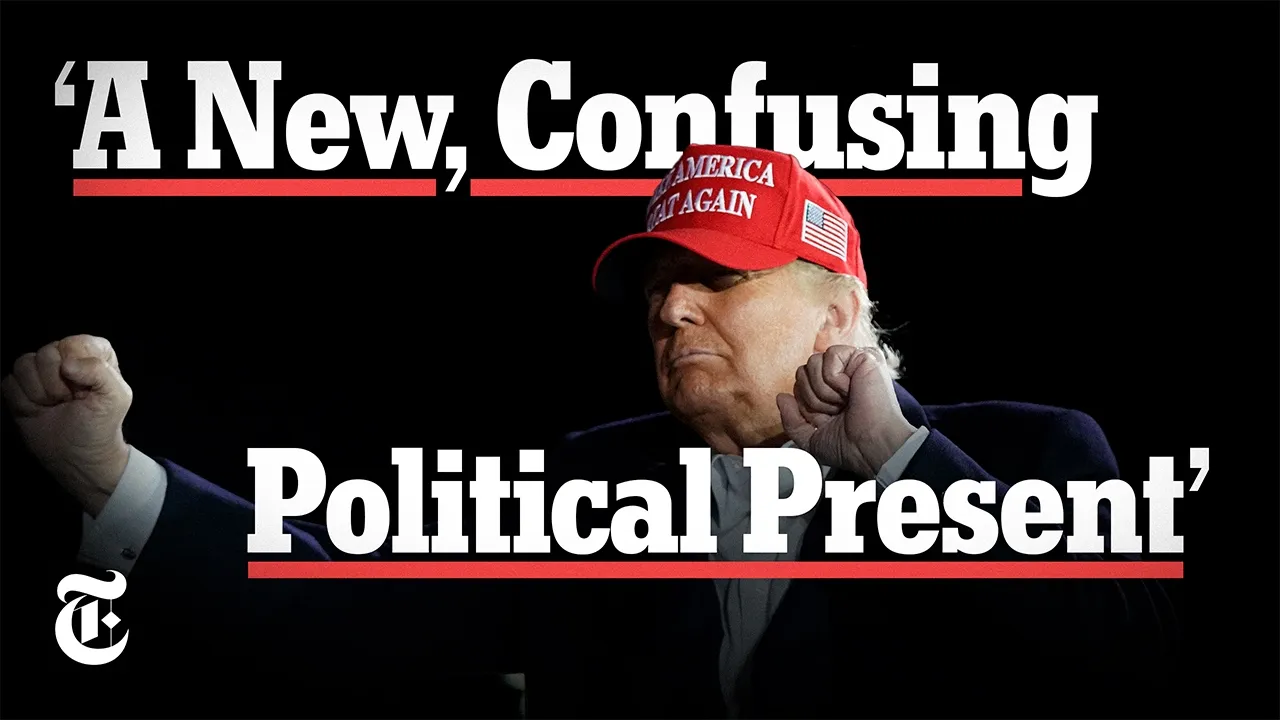
Historian Jäger Warns Voter Surge Yields No Policy as Parties Hollow
The Ezra Klein Show
Western democracies face record political mobilization without policy results because the collapse of mediating mass institutions leaves power fragmented between algorithmic short-termism and technocratic vetoes.
Historian Anton Jäger defines 'hyperpolitics' as an unprecedented divergence marked by record-setting voter turnout and mass protests coupled with the near-total decay of mediating institutions like labor unions and mass parties. (1:33)
Unlike the totalizing mass parties of the mid-20th century that could enforce programmatic discipline over decades, modern political formations resemble fluid markets where participants rapidly rotate attention between short-lived controversies. (3:55)
Structural deinstitutionalization has infected political elites just as much as the public, driving erratic governance and paralyzing legislative systems into 'veto states' where blocking action has become vastly easier than passing constructive policy. (32:20)
While hyperpolitics fuels volatility and elite short-termism, Jäger argues it also represents a revitalizing departure from the apathetic 'post-politics' of the 1990s, restoring mass political literacy and awareness of ideological stakes. (58:55)
Detailed notes
## Background
Published on YouTube by The Ezra Klein Show on September 8, 2026, this episode features host Ezra Klein interviewing historian and New York Times Opinion contributing writer Anton Jäger about his book 'Hyperpolitics: Extreme Politicization Without Political Consequences'. The discussion explores why contemporary political culture is saturated with intense engagement and viral controversies yet remains largely powerless to achieve durable policy change.
## TL;DR
Ezra Klein and Anton Jäger examine the paradox of modern 'hyperpolitics,' defined by surging political mobilization and historic voter turnout existing alongside decayed, hollowed-out civic and political institutions. Tracing the trajectory from 20th-century disciplined mass parties through the apathetic 'post-politics' of the 1990s to the current era, they analyze how algorithmic media, short-termist governance, and institutional sclerosis trap both citizens and elites in volatile outrage cycles. Ultimately, they weigh whether this turbulent landscape is an exercise in political nihilism or an essential, disruptive phase capable of clearing away ossified orthodoxies to make way for new democratic structures.
## Atmosphere & style
The conversation carries an intellectually rigorous, analytical, and probing tone, blending political theory with concrete, real-time cultural observations. Klein and Jäger maintain a collegial yet sharp dynamic, trading historical pushbacks and candid critiques over whether ordinary people ever truly wielded decisive leverage over the state. It feels like an urgent diagnostic inquiry into contemporary political exhaustion, moving between shared bewilderment at the frantic tempo of digital discourse and a measured, cautious hope for democratic revitalization.
## Bulletin
- [01:33](https://www.youtube.com/watch?v=PurFyLK-zlk&t=93s) Historian Anton Jäger defines 'hyperpolitics' as an unprecedented divergence marked by record-setting voter turnout and mass protests coupled with the near-total decay of mediating institutions like labor unions and mass parties.
- [03:55](https://www.youtube.com/watch?v=PurFyLK-zlk&t=235s) Unlike the totalizing mass parties of the mid-20th century that could enforce programmatic discipline over decades, modern political formations resemble fluid markets where participants rapidly rotate attention between short-lived controversies.
- [32:20](https://www.youtube.com/watch?v=PurFyLK-zlk&t=1940s) Structural deinstitutionalization has infected political elites just as much as the public, driving erratic governance and paralyzing legislative systems into 'veto states' where blocking action has become vastly easier than passing constructive policy.
- [58:55](https://www.youtube.com/watch?v=PurFyLK-zlk&t=3535s) While hyperpolitics fuels volatility and elite short-termism, Jäger argues it also represents a revitalizing departure from the apathetic 'post-politics' of the 1990s, restoring mass political literacy and awareness of ideological stakes.
## Key takeaways
- [01:33](https://www.youtube.com/watch?v=PurFyLK-zlk&t=93s) Hyperpolitics is defined by a scissor shape: surging individual engagement, voter turnout, and street mobilization paired with the persistent decay of institutional vessels.
- [03:55](https://www.youtube.com/watch?v=PurFyLK-zlk&t=235s) Without organizational machinery to discipline and filter demands, modern political mobilization mimics a financial market where participants dump attention as soon as cultural capital wanes.
- [06:05](https://www.youtube.com/watch?v=PurFyLK-zlk&t=365s) Social media did not create political discontent out of thin air; it amplified pre-existing alienation across a civic landscape already hollowed out by de-alignment.
- [10:00](https://www.youtube.com/watch?v=PurFyLK-zlk&t=600s) Modern political elites, operating directly on platforms like X and Truth Social, have absorbed algorithmic volatility, leading to cheap policy reversals without programmatic accountability.
- [15:13](https://www.youtube.com/watch?v=PurFyLK-zlk&t=913s) Twentieth-century European mass parties achieved durable policy outcomes and high cohesion, but did so through coercive social control, hereditary loyalty, and high exit costs.
- [15:13](https://www.youtube.com/watch?v=PurFyLK-zlk&t=913s) American parties historically relied on a robust civil society hinterland—such as labor unions and churches—whose modern desiccation left them as hollow administrative vehicles.
- [24:21](https://www.youtube.com/watch?v=PurFyLK-zlk&t=1461s) Major historical legislative breakthroughs were rare bursts driven by catastrophic systemic shocks rather than steady day-to-day citizen pressure.
- [28:51](https://www.youtube.com/watch?v=PurFyLK-zlk&t=1731s) The feeling of political powerlessness is intensified by a cognitive mismatch: citizens possess live-streamed, real-time awareness of global events alongside microscopically small individual leverage.
- [32:20](https://www.youtube.com/watch?v=PurFyLK-zlk&t=1940s) Elite hyperpolitics is characterized by deep intra-class warfare and an absence of collective planning, as exemplified by public conflicts among billionaires and media institutions.
- [41:01](https://www.youtube.com/watch?v=PurFyLK-zlk&t=2461s) Donald Trump operates as a 'human engagement algorithm,' perfectly adapted to an attention economy that rewards 24-hour media virality over long-term programmatic vision.
- [44:47](https://www.youtube.com/watch?v=PurFyLK-zlk&t=2687s) The MAGA movement mirrors 20th-century mass politics in aesthetics and grievance, yet its reliance on podcasts, media figures, and volatile news cycles casts doubt on its long-term institutional durability.
- [51:23](https://www.youtube.com/watch?v=PurFyLK-zlk&t=3083s) The transfer of state authority to insulated, non-electoral technocratic bodies like central banks has incentivized both citizens and elites to build legislative 'kill switches' rather than constructive programs.
- [56:35](https://www.youtube.com/watch?v=PurFyLK-zlk&t=3395s) Western democracies maintain high input legitimacy through competitive elections but suffer from low output legitimacy, struggling to complete basic infrastructure while authoritarian systems display starkly opposite dynamics.
- [58:55](https://www.youtube.com/watch?v=PurFyLK-zlk&t=3535s) Despite producing exhaustion and volatility, hyperpolitics has shattered the stifling 'There Is No Alternative' consensus, driving substantial increases in Western voter turnout and collective political literacy.
## Detailed walkthrough
### [00:00](https://www.youtube.com/watch?v=PurFyLK-zlk&t=0s) The Elusive Rhythm of Modern Politics
Capturing the overall shape, texture, and rhythm of an era is notoriously difficult. Recent years have seen political culture swing wildly across dramatic ideological poles, from the high-water mark of racial justice protests and "Woke 1.0" accompanied by slogans like "All Cops Are Bastards," to the fervent, providential rhetoric of Donald Trump proclaiming he was saved by God to make America great again. Yet finding a conceptual framework that accounts for both the intensity and the erratic instability of these movements remains a challenge.
Ezra Klein introduces the historian and *New York Times* Opinion contributing writer Anton Jäger, whose book *Hyperpolitics: Extreme Politicization Without Political Consequences* offers a lens for understanding this moment. Klein observes that contemporary life feels oversaturated with politics: opinion is fiercely held, turnout reaches historic levels, and ideological tides surge back and forth with breakneck speed. Yet because these energies remain disconnected from durable institutions, massive waves of mobilization evaporate without producing lasting policy transformations.
[01:33](https://www.youtube.com/watch?v=PurFyLK-zlk&t=93s) Defining Hyperpolitics: High Politicization, Low Institutionalization
When asked to define the core concept, Anton Jäger describes hyperpolitics as a shift in Western political culture marked by an increase in political activity across a range of indicators—including voter turnout, street protests, and political violence—that is completely decoupled from institutional strength. While individual involvement spikes, traditional mediating structures such as labor unions, political party memberships, and civic associations continue to stagnate or wither. Jäger argues this structural divergence is historically unprecedented across the twentieth and even nineteenth centuries, creating a baffling political landscape where engagement no longer translates into power.
Klein underlines this paradox: people are engaged in profoundly political acts, assembling in massive demonstrations like Black Lives Matter, yet they remain fundamentally unmoored from institutional life. Politics has become thoroughly deinstitutionalized, leaving citizens active in the public square but absent from the civic bodies that traditionally negotiated and enforced political settlements.
```mermaid
flowchart TD
accTitle: The Two Axes of Political Eras
accDescr: A matrix showing political eras categorized by politicization and institutionalization.
subgraph Matrix["The Trajectory of Political Eras"]
direction TB
MP["Mass Politics (Early/Mid 20th C.)<br/>• High Politicization<br/>• High Institutionalization"]
PP["Post-Politics (1990s–2000s)<br/>• Low Politicization<br/>• Low Institutionalization"]
HP["Hyperpolitics (Present Day)<br/>• High Politicization<br/>• Low Institutionalization"]
end
[02:55](https://www.youtube.com/watch?v=PurFyLK-zlk&t=175s) From Mass Politics to Post-Politics and the "Scissor Shape"
Jäger contextualizes hyperpolitics by tracing its historical predecessors along two axes: politicization and institutionalization. During the mass politics of the early-to-mid twentieth century—especially in the volatile 1920s and 1930s—high political intensity was anchored in robust, disciplined organizations; to be politically active practically required belonging to a party, a union, or an affiliated civil society group. That model gave way in the 1990s and 2000s to "post-politics," a period characterized by declines on both metrics, where institutional ties decayed alongside a generalized apathy and ideological consensus.
Hyperpolitics represents a strange "scissor shape" that broke out of the post-political lull. While collective mobilization has become technically easier to trigger and materially urgent to pursue, it lacks enduring institutional vessels. Without organizational machinery to process demands into policy, political energy feels chaotic, incoherent, and structurally incapable of securing the durable legislative victories achieved by earlier generations.
[03:55](https://www.youtube.com/watch?v=PurFyLK-zlk&t=235s) Volatility, Frenzy, and the Political Market
Klein notes that what makes the concept immediately resonate is its depiction of "hyperness"—the frantic, dizzying tempo of contemporary discourse where society plunges headlong into Black Lives Matter one year, only for the cultural vibe to snap violently back toward Trumpism the next. Everything feels of ultimate, existential importance, yet nothing seems to hold.
Jäger affirms that this frenzy is the direct consequence of deinstitutionalization. Traditionally, institutions provide stability, continuity, and internal discipline; they filter passions, delegate authority, and formulate long-term collective agendas. Stripped of these anchors, the public realm defaults to short-termism. Political engagement begins to mimic a financial market:
- Citizens become hyper-invested in a single narrative or crusade for a few weeks, tracking every twist in the media cycle.
- The moment public attention wanes or an issue's cultural value plunges, participants dump their shares and immediately rotate into the next controversy.
- Hyperpolitics operates across two distinct dimensions: a vast *spatial* reach that mobilizes record-setting street crowds across the West, and a compressed *temporal* window that rapidly burns through issues without leaving behind a lasting institutional residue.
[06:05](https://www.youtube.com/watch?v=PurFyLK-zlk&t=365s) Is Hyperpolitics Just Online Attention?
Klein pushes on whether Jäger's thesis underplays the degree to which hyperpolitics is simply digital politics. In Klein's view, modern political behavior is directly downstream of attention, which is now algorithmically curated by profit-driven platforms designed to hunt amorally for novelty, moral outrage, and controversy. Building a political ecosystem on top of this fluid, digital attention economy inevitably yields intense, short-lived, and ideologically fractured outbursts.
Jäger resists reducing hyperpolitics strictly to "extremely online politics." While acknowledging that algorithms act as powerful accelerators and magnifying glasses, he warns against monocausal tech determinism. He points out earlier reductive analyses—such as attributing Donald Trump's victory or Brexit entirely to Russian bots and targeted Facebook ads, or labeling the Arab Spring mere "Facebook revolutions." Jäger argues that social media did not create political discontent out of thin air; rather, it landed on a pre-hollowed civic landscape populated by citizens who were already alienated from traditional institutions. Moreover, the driving sparks of contemporary uprisings—such as mass incarceration, police violence, economic inequality, and mass migration—are concrete, material realities rather than online hallucinations.
[10:00](https://www.youtube.com/watch?v=PurFyLK-zlk&t=600s) AOC, "Woke 1.0," and Hyperpolitics Inside Modern Institutions
Ezra Klein challenges the notion that institutions have simply vanished. Pointing to organizations like the Democratic Socialists of America (DSA) alongside the Democratic and Republican parties, Klein observes that modern institutional actors often exhibit the symptoms of hyperpolitics even more acutely than ordinary citizens. Institutional elites are uniquely susceptible to chasing the online "current thing," riding massive waves of sentiment that cannot be sustained or translated into enduring policy over time. This dynamic leaves actors looking back just a few years later in bewilderment at their own past behavior. As an example, Klein cites a widely discussed interview where Alexandria Ocasio-Cortez looked back on "Woke 1.0" and acknowledged that it was "crazy." When pressed on her brief flirtation with slogans like "defund the police," Ocasio-Cortez explained that during the COVID-19 pandemic and economic shutdowns, an enormous opening of the Overton window encouraged entertainments of any policy idea to get to a better place, even if many of those positions are no longer defended today.
Klein argues that separating traditional institutions from the digital world creates a false binary. Today's institutional leaders communicate, coordinate, and feud in the same digital public square—whether Democrats on X (formerly Twitter) or Donald Trump mobilizing the Republican Party via Truth Social. Because the collectivities that govern institutions are constantly reacting to one another online, the institutions themselves have absorbed the erratic, wild oscillations of the digital sphere.
```mermaid
flowchart TD
accTitle: Online Feedback Loop in Modern Political Institutions
accDescr: Diagram showing how digital platforms distort institutional decision-making, leading to ideological volatility and policy backpedaling.
subgraph DigitalSphere["Digital Sphere & Online Sentiment"]
A["Digital Public Square<br>(X, Truth Social)"] --> B["Overton Window Shifts &<br>'The Current Thing'"]
end
subgraph InstitutionalActor["Institutional Elites & Parties"]
B --> C["Leadership Rhetoric Adopts Slogans<br>(e.g., 'Defund the Police')"]
C --> D["Erosion of Stable Ideological Platforms"]
end
subgraph RealWorldOutcome["Electoral & Policy Consequences"]
D --> E["Inability to Sustain Commitments"]
E --> F["Backpedaling & Regret<br>('Woke 1.0 was crazy')"]
F -.-> A
end
```
- In her interview, Alexandria Ocasio-Cortez characterized the early-2020 pandemic era as a period of unprecedented economic disruption and high unemployment that radically blew open the Overton window, fostering discussions she considered fruitful at the time but whose extreme rhetoric figures subsequently walked back.
- Donald Trump's reliance on Truth Social serves as an example of how primary institutional communication now bypasses intermediary party structures in favor of direct digital dissemination.
[13:06](https://www.youtube.com/watch?v=PurFyLK-zlk&t=786s) Hyperpolitics at Different Speeds and the Lack of Programmatic Discipline
Anton Jäger responds that hyperpolitics operates at different speeds across different strata of society. For the general public, it manifests as rapid issue-hopping from one sensational controversy to another. For professional politicians, however, hyperpolitics translates into a steep decline in ideological consistency, long-term programmatic vision, and internal party discipline.
Jäger argues that figures like Ocasio-Cortez can easily rescind past commitments because their choices are untethered from a coherent, binding party program. While 20th-century parties centered on charismatic figures, leaders were ultimately held accountable to an institutional program, making it politically expensive to renege on core stances. By contrast, while Ocasio-Cortez is affiliated with the DSA, it remains an activist organization rather than a formal political party with an enforceable platform. As a result, modern civic and socialist formations lack the leverage to discipline elected officials when they decide to pivot away from past radical stances.
- **Divergent speeds of hyperpolitics:**
- *General public / casual voters:* Volatility, brief attention spans, hopping between cultural themes.
- *Political professionals:* Decay of institutional party lines, programmatic hollowing-out, and cheap reversals of past commitments without formal penalties.
[15:13](https://www.youtube.com/watch?v=PurFyLK-zlk&t=913s) The Mass Parties of the 20th Century: Cohesion, Stigma, and Control
To contrast this fluid environment, Jäger reconstructs the lost world of 20th-century European mass-membership parties. Far from an optional or expressive hobby, party membership was often hereditary, passing down through generations within families and subcultures. In this environment, electoral behavior was a foregone conclusion determined entirely by organizational affiliation rather than shifting campaign messaging.
```mermaid
flowchart LR
accTitle: 20th-Century Mass Party Cohesion Model
accDescr: Flowchart illustrating the hereditary nature and high exit costs of historic European mass political parties.
subgraph TotalizingDiscipline["Organizational Control"]
B --> C["Enforceable Party Program"]
C --> D["High Exit Costs<br>(Social Stigma, Relocation)"]
end
subgraph PoliticalOutput["Electoral Behavior"]
D --> E["Rigid Voter Consistency &<br>Programmatic Policy Delivery"]
end
```
However, this deep integration carried high costs. Leaving a party carried severe social stigma that could force a person out of their neighborhood or workplace. These organizations exerted invasive control over members' private lives:
- French Communist Party members in the 1970s faced rules dictating what makes or models of cars they were permitted to buy and drive.
- Christian Democratic parties exerted rigid surveillance over sexual morality and private conduct.
- The mass party framework, while capable of mobilizing society over lifetimes, was fundamentally authoritarian, insular, and coercive rather than purely egalitarian.
Turning to the American context, Jäger notes that the United States democratized very early and never developed genuine European-style mass-membership parties. Historically, American parties functioned more as arms of the state machinery than direct manifestations of civil society. Yet they long relied on an extensive hinterland of intermediary institutions—labor unions, civic groups, and religious congregations (both historically Black churches and conservative evangelical institutions)—to root voters. Over the last 50 to 60 years, this civil society hinterland has desiccated, leaving American parties restructured into hollow vehicles disconnected from their former bases.
[18:31](https://www.youtube.com/watch?v=PurFyLK-zlk&t=1111s) Totalizing Parties, Indoctrination, and Nostalgia
Klein challenges the instinct to romanticize the mass party era. While contemporary parties may seem hollow, flighty, and incapable of sustaining serious civic engagement, the historical alternative of totalizing, highly ideological party structures frequently ended in political disaster. Total party immersion raises the cost of exit so high that it enables ruthless ideological indoctrination, providing historical fuel not just for socialist or Christian democratic solidarity, but also for European fascist and Nazi movements. Looking back on an era where political organizations dictated personal beliefs, social circles, and consumer choices with profound nostalgia overlooks the dark, illiberal reality of party-enforced conformity.
[19:40](https://www.youtube.com/watch?v=PurFyLK-zlk&t=1180s) "You Cannot Clone a Dinosaur": Institutions and Collective Power
Responding to the coercive patronage and social pressure of mid-20th-century party machines, Anton Jäger stresses that his analysis seeks to maintain a clear-eyed ambiguity rather than indulge in backward-looking nostalgia. The mass institutions of that era could be deeply unpleasant and inegalitarian. Many people in the 1990s and 2000s felt genuinely liberated when those rigid structures receded, gaining an unprecedented degree of individual autonomy. Furthermore, recreating that bygone landscape is a fantasy: "one cannot clone a dinosaur." The historical DNA of those parties cannot simply be transplanted into the contemporary political ecosystem and expected to survive.
Yet Jäger argues that the collapse of these organizations came at a devastating cost to political leverage. While the modern loneliness epidemic highlights how the decline of institutions shattered everyday sociability, parties were never merely social clubs meant to keep people from feeling isolated; they were fundamental instruments of collective action. When those totalizing or immersive mass parties faded across Western democracies—with rare modern anomalies like China or India—the capacity of everyday citizens to convert individual preferences into durable policy outcomes withered along with them.
```mermaid
flowchart TD
accTitle: The Mechanics of Hyperpolitical Powerlessness
accDescr: Diagram contrasting mid-century mass institutions with contemporary hyperpolitics.
subgraph MidCentury["20th-Century Mass Politics"]
A["Immersive Mass Parties & Unions"] --> B["Collective Pressure & Leverage"]
B --> C["Major Policy Concessions (Welfare State)"]
end
subgraph ModernEra["Contemporary Hyperpolitics"]
D["Constant Information & Emotional Arousal"] --> E["Atomized Individuals"]
F["Decoupled State Power (Central Banks, Technocracy)"] --> G["Electoral & Policy Gridlock"]
E --> H["Acute Feeling of Powerlessness"]
G --> H
end
```
[21:25](https://www.youtube.com/watch?v=PurFyLK-zlk&t=1285s) The Debate Over Historical Popular Power and Policy Change
Ezra Klein forcefully challenges the assumption that average citizens in 1954 or 1973 possessed greater leverage over national policy than people do today. When Jäger cites political science research showing a disconnect between popular public opinion and legislative outcomes—pointing to sustained public polling in favor of proposals like Medicare for All—Klein pushes back immediately. Polling on sweeping reforms like Medicare for All is notoriously volatile; while broad concepts poll well in the abstract, support plummets the moment voters are told their taxes could rise or their current private insurance might change. Klein argues that political science literature often confuses this policy ambiguity with a genuine suppression of popular will, demanding a stronger historical defense of the claim that citizens once held meaningful sway over government action.
Jäger concedes that party structure is only one variable among several, including state capacity, but maintains that the historical record demonstrates a clear link between mass organizing and material policy. The construction of the American welfare state during the New Deal order of the 1930s and 1940s coincided directly with high-water marks of organized mass power. When labor and civil rights movements were subdued or fractured—accelerated by McCarthyism and business pushback—extracting concessions from capital became profoundly harder. Similarly, Europe’s robust welfare regimes were not bestowed purely by enlightened technocrats; they were hammered out under severe pressure from organized labor. The collapse of union density in the United States remains directly correlated with unprecedented modern economic inequality, proving that mediating institutions provide the structural muscle required to translate public sentiment into lasting reform.
[24:21](https://www.youtube.com/watch?v=PurFyLK-zlk&t=1461s) Information Overload vs. Institutional Capacity
Klein reframes the dilemma, questioning whether the pervasive feeling of political impotence today is an objective reality or a psychological byproduct of our modern information environment. Historically, major American policy breakthroughs did not stem from ordinary citizens steadily bending the arc of government day in and day out. Instead, reform occurred in rare, highly contingent bursts driven by catastrophic systemic shocks:
- The Great Depression wiped out Republican dominance and granted Franklin D. Roosevelt unprecedented congressional majorities.
- Lyndon B. Johnson’s Great Society advanced only after John F. Kennedy's assassination unblocked a legislative bottleneck that had stalled civil rights for decades under the Southern conservative filibuster.
Instead of a drop in individual power, Klein posits that modern citizens are caught in an agonizing mismatch between attention and leverage. Never before have people possessed so much real-time knowledge about world events, delivered through media explicitly engineered to maximize emotional arousal. Yet this hyper-awareness meets a political architecture where individual agency is microscopic—especially in entrenched safe red or blue states where national ballots feel functionally predetermined. Citizens feel intensely engaged and emotionally triggered, but completely lacking in mechanisms to alter what they see.
Jäger largely agrees with Klein's diagnosis, though he notes that existential powerlessness is not entirely unprecedented; the dawn of the Cold War and the nuclear arms race was famously condemned by George Orwell as producing the most anti-democratic weapon imaginable. Jäger also cautions that resurrecting civic institutions would not automatically restore popular control. Crucial levers of state authority have migrated into unelected, technocratic bodies like central banks, which are insulated from mass democratic agitation. Achieving significant policy breakthroughs still requires an alignment between mass organized force and sympathetic elite coalitions.
[28:51](https://www.youtube.com/watch?v=PurFyLK-zlk&t=1731s) Mass Helplessness, Immediacy, and Walter Lippmann’s Mistake
Anton Jäger points out a core structural factor behind the policy gridlock observed on both sides of the Atlantic over the last twenty years: while politicization has soared, the leverage of actual mass power has diminished drastically. At the same time, the visibility of global events has reached unprecedented levels. Terrible events—such as mass murder or a genocide in the Middle East—are beamed directly onto handheld smartphone screens. Unlike the 1940s and 1950s, when people learned about the nuclear arms race primarily by reading about it in print, citizens today experience a relentless, live-streamed immediacy. This constant flow of horrific footage maximizes political awareness while inducing a debilitating feeling of utter helplessness.
```mermaid
flowchart TD
accTitle: The Social Media Stress Loop
accDescr: A flow illustrating how social media collapses political outrage into low-friction expressive output without producing tangible material effects.
subgraph Trigger ["Visual Exposure"]
A["Graphic Event / Injustice Beamed to Screen"]
end
subgraph Reaction ["Instant Coping"]
B["Moral Outrage & Anxiety"]
C["Low-Cost Action: Post, Like, or Comment"]
end
subgraph Outcome ["The Dissipation"]
D["Instant Stress Cycle Completed"]
E["Zero Tangible Policy or Material Effect"]
end
A --> B
B --> C
C --> D
C -.-> E
```
Ezra Klein builds on this psychological tension, observing that social media ingeniously invents a hollow resolution to the very trauma it delivers. When users are confronted with an unbearable reality, the platform offers an immediate outlet: post, comment, or hit "like." This dynamic confuses a low-cost symbolic gesture with meaningful political action; it resolves an "instant stress cycle" inside the user’s mind without exerting any tangible effect on the outside world.
Klein emphasizes that while this cycle traps ordinary citizens, political elites are by far the most afflicted. He looks back to Walter Lippmann’s 1922 classic *Public Opinion*, which famously observed that our mental pictures of the world never match the complex reality outside our heads. Lippmann proposed relying on dispassionate technocratic elite panels to steer governance. Yet that solution failed to foresee that elites would end up the most "brain addled" of all. Modern leaders like Donald Trump, Elon Musk, and senior White House staff are intensely hooked on the digital attention economy. When ordinary people look to these figures for cues on how to feel or act, they are consulting the individuals who have been driven the most erratic by online political theater.
[32:20](https://www.youtube.com/watch?v=PurFyLK-zlk&t=1940s) Elite Hyperpolitics and the Illusion of Class Solidarity
Anton Jäger explains that while his book *Hyperpolitics* examines these developments primarily "from below"—charting how the plummeting cost of online expression replaced traditional, high-friction organizing methods like writing newspaper editors, meeting party bosses, or rallying in public squares with low-yield posting—the phenomenon is equally corrosive when viewed from above. The elite variant of hyperpolitics is visible in the short-termism, incoherence, and planning incapacity of contemporary administrations, including the second Trump administration. Because elites lack the institutional mechanisms needed to reconcile geographic, sectoral, and political differences, online platforms simply aggravate their internal divisions.
To illustrate this elite fracture, Jäger points to an antagonistic exchange between Elon Musk and Zanny Minton Beddoes, the editor-in-chief of *The Economist*:
> **Editor of *The Economist*:** "Do you see why this makes people think that this man, who has all this power, he's the world's richest man, he thinks he has a right to influence our politics? It makes people—it's why, you know, we started this conversation saying superlatives, it's why people loathe you. I mean, some people do loathe you."
>
> **Elon Musk:** "Yes, some people do."
>
> **Editor of *The Economist*:** "But do you understand why? Do you think what you're doing is helpful for Western democracy?"
>
> **Elon Musk:** "Maybe some people do loathe me. And that's probably true. I don't care. But the fact that, as you pointed out, a quarter billion people follow me is that I think a lot more people actually like me than don't. And I think a lot more people hate you and the media more than you realize."
Following the interview, Musk took to his own platform to insult the editor further. Jäger finds it striking that two members of the ruling class would openly brawl in the public sphere rather than showing class solidarity or managing a shared project.
Klein challenges Jäger's expectation of class cohesion, pointing out that elite history is defined far more by vicious factional warfare than unity. Klein cites historical precedents like the 1968 William F. Buckley Jr. versus Gore Vidal debates—where the two public intellectuals traded insults like "crypto-Nazi" and Vidal was threatened with a punch in the face on live television—as well as the destructive purges of the McCarthy era.
Jäger concedes that expecting mutual sympathy reflects a trace of "vulgar Marxism" on his part. Historically, ruling elites in large, multifaceted nations like the United States only coalesce into a unified front when confronted by a genuine working-class threat from below. The aggressive, coordinated employer offensive seen during the Reagan era in the late 20th century was mobilized against organized labor; once that labor movement was subdued, elite factionalism immediately resurfaced. Both speakers conclude that much of the rancor commonly attributed to broad popular polarization over the past decade is actually driven by elite-level polarization. As Klein notes from his own research, polarized elites present the public with polarized choices, establishing a self-reinforcing flywheel across the electorate.
[38:42](https://www.youtube.com/watch?v=PurFyLK-zlk&t=2322s) The Implosion of Time and Trumpian Short-Termism
Ezra Klein brings up an essay written for the *Financial Times* by political scientist Ivan Krastev, who proposed that the core essence of the Trumpian revolution is "the implosion of time itself." Anton Jäger describes Krastev's piece as speculative yet profoundly revealing of Donald Trump’s mode of rule. Anyone tuning into television or checking social media over the last few years has witnessed a style of governance radically distinct from previous American presidencies, defined above all by an extreme short-termism. Political decisions appear to be calculated almost entirely around their immediate splash on the 24-hour news cycle and their perceived momentary popularity. While ideological figures in Trump's orbit—such as Marco Rubio or defense strategist Elbridge Colby—continually pitch strategic visions for reasserting American hegemony in the 21st century, Trump acts as a media gatekeeper: he evaluates every proposal primarily on whether it will dominate the headlines for the next 24 to 48 hours before pivoting to an entirely different plan.
For Jäger, this dynamic depersonalizes Trump by framing him as a symptom of a broader institutional malaise. Because everyone in Trump's orbit is individually beholden to his personal caprices, and because the Republican Party remains a small clique or camarilla tethered to the state rather than a genuine mass membership party, the administration cannot plan a week or two into the future. Jäger points out the glaring contrast between a Trump White House capable of reversing a major decision within a single afternoon and the Chinese Communist Party, which continues to formulate and execute multi-year designs and classic five-year plans.
```mermaid
flowchart TD
accTitle: Structural Short-Termism vs Mass Party Politics
accDescr: Diagram contrasting 20th-century mass party planning with Trumpian hyperpolitical governance.
subgraph Mass["20th-Century Mass Party Model"]
A["Institutional Base & Membership"] --> B["Multi-Year Planning Horizons"]
B --> C["Long-Range Policy Execution"]
end
subgraph Hyper["Trumpian Hyperpolitics Model"]
D["Elite Camarilla & Advisers"] --> E["Ideological Proposals Submitted"]
E --> F["Trump's Media Filter: 24-Hour Virality"]
F --> G["Volatile Reversals within Single Day"]
end
```
[41:01](https://www.youtube.com/watch?v=PurFyLK-zlk&t=2461s) The Human Engagement Algorithm: Is Short-Termism Structural?
Klein focuses on Jäger's provocative question—"what if short-termism is structural now?"—and wrestles with whether Trump represents a unique, idiosyncratic psychology or a harbinger of the modern political condition. Klein observes that he has long viewed Trump as a literal "human engagement algorithm," someone who instinctively thinks and feels in the rhythm of platforms like Twitter/X and Truth Social. In contrast, figures like J.D. Vance, Marco Rubio, or Stephen Miller are traditional ideological thinkers who operate on longer horizons. Similarly, defenders of Joe Biden often insisted his industrial and economic plans were measured in decades, even as democratic accountability forced him to face elections measured in mere years. Klein notes that this volatility is not unique to the United States; the United Kingdom has churned through prime ministers at an astonishing rate, suggesting a broader Western instability absent in states like China.
Jäger agrees, framing the phenomenon through a Darwinian metaphor: while the structural environment itself has mutated, Trump represents a species singularly adapted to thrive within it. Having evolved through multiple media eras—from 1980s real estate tabloid celebrity to 1990s and 2000s reality television showman, and finally into the algorithmic social media age—Trump operates with an artisanal mastery of modern attention. Crucially, Trump is "unburdened by any ideological convictions." While he has baseline instincts, he lacks the rigid cognitive framing of traditional ideologues. By contrast, figures like Vance are visibly burdened by their intellectual commitments; Vance wants to write books expounding his conversions and detailed worldviews. Jäger expresses deep skepticism that Vance's earnest ideological treatises will ever match the raw intuitive appeal of Trump's showmanship when facing a media-addled, volatile electorate.
- **The Darwinian adaptation:** Trump survived and evolved through three distinct media eras—tabloid print, reality television, and social media algorithms.
- **The ideological handicap:** For politicians like Vance or Rubio, rigid ideology functions as a liability in an algorithmic ecosystem that rewards rapid, shameless tactical pivots.
- **Transatlantic churn:** The rapid turnover of British prime ministers demonstrates that temporal collapse and institutional instability extend well beyond Trump alone.
[44:47](https://www.youtube.com/watch?v=PurFyLK-zlk&t=2687s) Is MAGA Institutionalizing or Just Hyperpolitics?
Klein turns to the broader MAGA movement, asking whether it transcends hyperpolitics. Unlike fleeting internet controversies, MAGA provides its followers with an immersive world complete with rallies, shared meaning, recognizable intellectual figures, and burgeoning institutions—resembling the mass political movements of the 20th century far more than anything else in recent history. Klein asks whether this marks the emergence of a genuine new mass formation on the American right.
Jäger responds by distinguishing Trump's first term from his second. While the 2016 victory caught Trump and his inner circle completely off guard, the second term reflects deliberate planning, exemplified by the Heritage Foundation’s Project 2025. This evolution directly touches the "F-question"—the recurring debate among historians over whether Trump is a fascist. Jäger acknowledges real parallels to historic far-right mass politics: the weaponization and expansion of agencies like Immigration and Customs Enforcement (ICE), state-funded patronage networks, and aggressive street or paramilitary dynamics reminiscent of 20th-century squads.
However, Jäger remains skeptical that MAGA has built a self-sustaining political vehicle capable of surviving Trump. Figures like Tucker Carlson and Marjorie Taylor Greene may fancy themselves heirs to the movement by dissenting from traditional GOP dogma, but their power base rests primarily on podcasts and media channels rather than durable, organized civic institutions. Furthermore, state agents such as ICE personnel are motivated by career and financial opportunities within the expanded security apparatus rather than deep ideological fidelity. Unlike historical 20th-century mass parties that could maintain disciplined memberships, bide their time across five- to twenty-year cycles, and strike when conditions matured, MAGA remains trapped within hyper-volatile media cycles—leaving it just as likely to evaporate rapidly as it was to rise.
[48:14](https://www.youtube.com/watch?v=PurFyLK-zlk&t=2894s) From Civic Decay to Governance Ossification
Klein pivots the conversation from the decay of civic and voluntary associations to the parallel ossification of formal state institutions. While civic bodies have hollowed out, the machinery of governance and constitutional power has become profoundly rigid and structurally resistant to political will. In a closely divided American system, power itself appears paralyzed, creating a dynamic where intense hyperpolitical passions collide against completely gridlocked governmental structures.
[48:53](https://www.youtube.com/watch?v=PurFyLK-zlk&t=2933s) Institutional Gridlock, the Veto State, and the Flight to Discourse
Ezra Klein observes that in contemporary politics, passing major legislation has become nearly impossible regardless of who lines up behind it. Filibusters have proliferated, bipartisan compromise has plummeted, and the avenues to derail policy in Congress and the courts have expanded dramatically. Klein recalls that during the presidency of Barack Obama, even when opposing powerhouse interest groups like the Chamber of Commerce and the AFL-CIO unified behind an infrastructure bill, or when massive political coalitions mobilized for immigration reform, those initiatives still went nowhere. Similarly in Europe, the European Union has created a broad perception of bureaucratic inertia, where distant administrative powers govern from afar.
Klein suggests that this widespread institutional sclerosis explains why political energy has fled into low-effort digital discourse and online posting. In digital spaces, an individual can at least receive an immediate reaction or validation, whereas legacy institutions take forever and often produce nothing. People have simply lost faith in political achievements because it is infinitely easier to block action than to accomplish it. While many assume big money dictates political outcomes, Klein argues money is far less decisive than believed: he has witnessed immense sums poured into American politics fail utterly to secure their goals.
Anton Jäger agrees, pointing to George Soros as a prominent example: Soros has spent hundreds of millions of dollars on various progressive causes, yet looking at the rightward drift of global politics, it is clear he possesses nowhere near the omnipotent control imagined by conspiracy theorists. Jäger emphasizes that even as campaign finance and outside election spending have been completely deregulated across the US and parts of Europe, the actual policy influence of lobbying power has not translated into easier wins. This exposes a profound paradox: meaningful social change has become difficult not merely "from below," but also "from above."
```mermaid
flowchart TD
accTitle: The Mechanics of Institutional Paralysis
accDescr: Diagram illustrating how legislative gridlock and insulated unelected institutions incentivize veto politics and drive citizens to low-effort digital discourse.
subgraph Stagnation["Institutional Gridlock"]
A["Insulated Bodies<br/>(Central Banks, Courts)"]
B["Proliferation of Veto Points<br/>(Filibusters, Lobbying Deadlocks)"]
end
subgraph Responses["Political Adaptations"]
C["Adoption of Kill Switches<br/>(Reactive vetoes from elites & public)"]
D["Flight to Online Discourse<br/>(Low-effort posting for instant feedback)"]
end
A --> B
B --> C
B --> D
```
[51:23](https://www.youtube.com/watch?v=PurFyLK-zlk&t=3083s) Deinstitutionalization and the Rise of the Kill Switch
Jäger contextualizes this paralysis as part of a deeper history of deinstitutionalization that reshaped both society and the state beginning in the 1970s and 1980s. While typically framed simply as "neoliberalism," the project involved two core structural maneuvers. First, it executed an aggressive assault on working-class institutions—especially trade unions, which were blamed for stagflation and inflation—under the pretense of restoring macroeconomic normality. Second, the state systematically transferred governing authority away from elected legislatures into unelected, non-electoral bodies like independent central banks. These technocratic entities were supposedly insulated from the parochial meddling of special interest groups to manage society objectively.
However, shielding governance from political pressure had unintended consequences. By closing off regular channels to both popular and elite influence, it drastically amplified the attractiveness of the "veto option." Because neither citizens nor rival elites can pass constructive programs through these insulated systems, the rational move becomes building a "kill switch"—a mechanism to paralyze and obstruct any policy they dislike. Jäger warns that simply repealing legislative vetoes will not fix the issue, because the urge to veto is a symptom of a deeper absence of social institutions that can mediate collective bargaining. Contrasting this with authoritarian models, Jäger points out that Chinese state capacity relies on the Chinese Communist Party (CCP)—an institution that functions as a structural bridge capable of reconciling different social classes and elite factions. Neither the United States nor Europe possesses any institutional equivalent capable of playing that synthesizing role.
[53:30](https://www.youtube.com/watch?v=PurFyLK-zlk&t=3210s) Rights Without Action vs. Action Without Rights: The West and China
Ezra Klein explores the psychological contrast between China and Western democracies. While careful to note that public opinion inside China is opaque and that he has no desire to live under an authoritarian regime, polling on technological advances like AI reveals noticeably higher optimism and perceived agency in China than in the United States. In China, an individual citizen has virtually no influence over top-level CCP directives; however, the state actively reshapes the physical and technological reality on a continuous basis. This dynamic forces a troubling contemporary contrast between two models:
- **The Western Model:** Rights and individual agency, but systemic inaction and political drift.
- **The Authoritarian Model:** Absence of individual political agency, but continuous action and palpable state capacity.
Klein situates Donald Trump within this tension. Trump entered the presidency making an ostentatious spectacle of shattering bureaucratic roadblocks—issuing rapid executive orders on birthright citizenship, tossing signed orders into chanting crowds, and staging rallies that combined professional wrestling showmanship with governance. Yet Trump never actually solved the governance problem: his administration passed less legislation than its predecessors, executive maneuvers like the Department of Government Efficiency (DOGE) flared up with high speed only to collapse, courts dismantled his initiatives, and foreign interventions slipped entirely out of his grip. Despite the public theater of disruption, everyday life failed to improve, inflation and prices remained pressing, and the illusion of control dissolved, leaving the broader public stranded in the exact same sense that no one is at the wheel.
[56:35](https://www.youtube.com/watch?v=PurFyLK-zlk&t=3395s) Input Legitimacy, Output Legitimacy, and Elite Drift
Anton Jäger refines the comparison by invoking political theory's distinction between "input legitimacy" (the democratic process through which citizens register preferences) and "output legitimacy" (the state’s substantive capacity to deliver tangible goods and solve public problems):
* **Input Legitimacy:** Elevated in the West, where voting turnout and hyperpolitical engagement have spiked, yet public influence over tangible policy outcomes remains muted. Even authoritarian China maintains informal input mechanisms, as demonstrated when widespread public street demonstrations forced the regime to abruptly abandon its Zero-COVID restrictions.
* **Output Legitimacy:** Heavily concentrated in the Chinese state, which routinely executes massive industrial and logistical transformations, whereas Western governments struggle to complete basic infrastructure projects.
Jäger argues that the conversation surrounding state capacity cannot merely focus on bureaucratic levers; it must evaluate what political institutions are required to organize elite and popular willpower. In Europe, this breakdown is acutely visible. Caught between aggressive Chinese industrial competition, Trumpian trade tariffs, and geopolitical fragmentation, European elites have proven incapable of executing a unified economic or geopolitical strategy. While individual position papers circulate, there is no collective institutional engine to align competing elite factions and relaunch the continent into the 2020s. Jäger notes the irony that as a thinker from the political left, he finds himself in the bizarre position of pleading for elites to save themselves by assembling coordinating mechanisms—yet acknowledging that merely pointing out repeated elite failure has become the substitute for actual policy commentary over the past decade.
Klein begins tracing this historical arc from the mid-century era of organized mass politics, to the "post-politics" era of the 1990s epitomized by Bill Clinton and Tony Blair—an era defined by the "end of history" consensus following the fall of communism—which set the stage for the explosive hyperpolitics of the present day.
[58:55](https://www.youtube.com/watch?v=PurFyLK-zlk&t=3535s) A Cleansing Fire or Mere Nihilism?
Ezra Klein traces the arc of recent decades: from the aftermath of the financial crisis, marked by anti-politics, Occupy Wall Street, and the Tea Party—movements driven by a fundamental disdain for traditional political institutions—to the present era of hyperpolitics. He asks whether hyperpolitics is simply destructive, or whether that destruction is a necessary step to clear out ossified institutions, stale bureaucracies, and entrenched dogmas. Donald Trump may not offer a good solution, Klein argues, but he exposed institutional vulnerabilities—showing how an initiative like DOGE could be pursued, and blowing wide open once-rigid orthodoxies on trade, immigration, and China. At the same time, the resurgence of the American left through figures like Zohran Mamdani and organizations like the Democratic Socialists of America (DSA) reflects a similar break with old formulas. Klein poses the fundamental dilemma: is hyperpolitics a descent into nihilism where nothing can endure long enough to rebuild, or is it a Darwinian "cleansing fire"—the messy interregnum between an old order breaking down and something revitalized emerging?
```mermaid
flowchart TD
accTitle: The Evolution from Anti-Politics to Hyperpolitics
accDescr: A flow illustrating the political transition from anti-politics through hyperpolitics to the question of its ultimate outcome.
subgraph Phase2["The Hyperpolitics Era"]
B --> C["Hyperpolitics<br/>(High engagement, shattered orthodoxies)"]
C --> D1["Trump & the Right<br/>(Blowing up dogmas on trade, China)"]
C --> D2["The Left<br/>(DSA, Mamdani, grassroots dynamism)"]
end
subgraph Phase3["The Open Question"]
D1 & D2 --> E{"Ultimate Trajectory?"}
E --> F["Destruction & Nihilism<br/>(Power too volatile to build)"]
E --> G["Revitalization<br/>(Cleansing fire & high political literacy)"]
end
```
Anton Jäger pushes back against misapplied references to Antonio Gramsci's famous "time of monsters" quote, pointing out that Gramsci was analyzing a genuine pre-revolutionary crisis in 1920s Italy, which does not match our current situation. Nevertheless, Jäger validates the revitalization thesis. Trump, whatever his faults, shattered the stifling "TINA" dogma ("There Is No Alternative") that treated democratic choices like picking between Coca-Cola and Pepsi. The dramatic surge in voter turnout across Western democracies proves that citizens once again perceive genuine stakes and real ideological differences:
- **German Turnout Surge:** In regional elections in Saxony, voter turnout nearly doubled, climbing from roughly 44% in 2006 to around 77%.
- **High Stakes in the US:** The heightened polarization and extreme rhetoric—even extending to assassination attempts against Donald Trump—demonstrate that voters clearly recognize a stark choice.
- **Political Literacy:** People increasingly grasp that their lived conditions—such as rent prices, road quality, and the cost of goods—are direct products of political choices, not unalterable market laws.
Jäger makes clear that his book *Hyperpolitics* does not dismiss hyper-politicization as purely toxic or reversible. While the relentless online theorizing and cultural battles produce exhaustion—inspiring a nostalgic craving for the lower-intensity post-politics of the 1990s and 2000s—the death of political apathy is something worth celebrating. The urgent task is not to retreat, but to discover durable institutional forms that channel public passion beyond ephemeral outrage.
---
[01:03:24](https://www.youtube.com/watch?v=PurFyLK-zlk&t=3804s) Book Recommendations
To conclude the conversation, Klein asks Jäger for his three book recommendations. Jäger selects three works spanning different eras, forms, and sensibilities:
1. **_The Prophet_ (the three-volume Trotsky biography) by Isaac Deutscher:**
Deutscher, a Polish historian who learned English in his early thirties, crafted what Jäger considers one of the twentieth century's masterworks of both biography and political history. Beloved across unexpected political camps—from sectarian Trotskyists to early neoconservatives and even Tony Blair—the book vividly resurrects a world that feels distant yet deeply instructive. Jäger notes that even committed anti-communists will find its literary style, narrative sweep, and historical depth completely enchanting, whether in print or as an audiobook.
2. **_Cheese_ (*Kaas*) by Willem Elsschot:**
A 1930s novella by the Flemish author, this short work follows a middle-aged family man who decides to make his fortune as a merchant. He enters the wholesale cheese trade—selling a product he personally despises and never eats—and inevitably fails. Jäger describes it as a brilliant parable for modern consumer capitalism, capturing a society that obsessively compels people to buy and sell, while leaving them entirely alienated from and indifferent to the commodities changing hands.
3. **_Some Months from My Life_ (*Quelques mois dans ma vie*) by Michel Houellebecq:**
A non-fiction memoir by the controversial French novelist, who appears as an intellectual foil in Jäger's own book. The memoir details a chaotic, highly publicized episode in Houellebecq's personal life when he became entangled in an offer to star in an erotic movie, using that scandal as a springboard to reflect on sexuality, cultural warfare, and modernity. Klein and Jäger treat Houellebecq as an unconventional prophet—someone with political views far from their own, yet possessing a unique antenna for social shifts before they happen.
When Klein asks where a newcomer should start with Houellebecq's fiction, Jäger points to his debut novel, *Extension of the Domain of Struggle* (*Whatever*), as the essential starting point. For readers interested in his later career, Jäger recommends *Serotonin*, a work that gained an almost Nostradamus-like reputation in France for prefiguring the Yellow Vests and agricultural protests. Above all, Jäger praises Houellebecq for remaining an exceptional chronicler of a contemporary social landscape that often feels stubbornly hostile to the very art of the novel.
> [19:40](https://www.youtube.com/watch?v=PurFyLK-zlk&t=1180s) one cannot clone a dinosaur — Anton Jäger
> [32:20](https://www.youtube.com/watch?v=PurFyLK-zlk&t=1940s) Do you see why this makes people think that this man, who has all this power, he's the world's richest man, he thinks he has a right to influence our politics? It makes people—it's why, you know, we started this conversation saying superlatives, it's why people loathe you. I mean, some people do loathe you. — Zanny Minton Beddoes
> [32:20](https://www.youtube.com/watch?v=PurFyLK-zlk&t=1940s) Maybe some people do loathe me. And that's probably true. I don't care. But the fact that, as you pointed out, a quarter billion people follow me is that I think a lot more people actually like me than don't. And I think a lot more people hate you and the media more than you realize. — Elon Musk
> [38:42](https://www.youtube.com/watch?v=PurFyLK-zlk&t=2322s) the implosion of time itself — Ivan Krastev
> [41:01](https://www.youtube.com/watch?v=PurFyLK-zlk&t=2461s) what if short-termism is structural now? — Anton Jäger
> [41:01](https://www.youtube.com/watch?v=PurFyLK-zlk&t=2461s) human engagement algorithm — Ezra Klein
> [41:01](https://www.youtube.com/watch?v=PurFyLK-zlk&t=2461s) unburdened by any ideological convictions — Anton Jäger
## Mentioned
AFL-CIO, Alexandria Ocasio-Cortez, Anton Jäger, Antonio Gramsci, Bill Clinton, Black Lives Matter, Chamber of Commerce, Chinese Communist Party (CCP), Democratic Socialists of America (DSA), Department of Government Efficiency (DOGE), Donald Trump, Elbridge Colby, Elon Musk, European Union, Extension of the Domain of Struggle (Whatever), Ezra Klein, Facebook, Financial Times, Franklin D. Roosevelt, George Orwell, George Soros, Gore Vidal, Heritage Foundation, Hyperpolitics: Extreme Politicization Without Political Consequences, Immigration and Customs Enforcement (ICE), Isaac Deutscher, Ivan Krastev, J.D. Vance, Joe Biden, John F. Kennedy, Kaas (Cheese), Lyndon B. Johnson, Marco Rubio, Marjorie Taylor Greene, Michel Houellebecq, New York Times, Occupy Wall Street, Project 2025, Public Opinion, Quelques mois dans ma vie (Some Months from My Life), Serotonin, Stephen Miller, Tea Party, The Economist, The Prophet, Tony Blair, Truth Social, Tucker Carlson, Walter Lippmann, Willem Elsschot, William F. Buckley Jr., X (formerly Twitter), Zanny Minton Beddoes, Zohran Mamdani
## Video description
Behind the intense political movements of the last decade, from Trumpism to wokeness and back again, there’s a strange and erratic rhythm. Movements saturate the culture seemingly overnight, only to evaporate or spark backlash just as rapidly. We’re extremely politically engaged, yet we’ve rarely felt so powerless to create lasting policy change.
I haven’t seen many very successful attempts to explain what is driving this volatility. But one concept that has taken off recently, and captures what so many of us are feeling, is “hyperpolitics.”
The idea comes from Anton Jäger, a historian and contributing writer to New York Times Opinion. In his book “Hyperpolitics: Extreme Politicization Without Political Consequences,” Jäger theorizes what it means to live in a moment marked by hyper-engagement — high voter turnout, mass protests, trends that flare up and fade with extreme rapidity — yet where institutional trust is low, institutional relationships are decayed and people are disconnected from the structures that make political efforts stick.
I think Jäger’s theory cuts to the core of this political era. So I invited him on the show to break down what hyperpolitics is, how we got here and what it actually takes to build lasting change today.
00:00 Intro
01:33 What Is “Hyperpolitics”?
03:55 Volatility Without Institutions
06:05 Is It Just Social Media?
10:05 AOC and Woke 1.0
15:13 The Mass Parties of the 20th Century
30:41 Elite Hyperpolitics
44:47 Is MAGA Institutionalizing?
48:14 Governance Gridlock
01:03:24 Book Recommendations
Read the full transcript here: https://www.nytimes.com/2026/09/08/opinion/ezra-klein-podcast-anton-jager.html
Watch more on @EzraKleinShow
Thoughts? Guest suggestions? Email us at ezrakleinshow@nytimes.com.
You can find transcripts (posted midday) and more episodes of “The Ezra Klein Show” at nytimes.com/ezra-klein-podcast. Book recommendations from all our guests are listed at https://www.nytimes.com/article/ezra-klein-show-book-recs.html
历史学者耶格尔警告:政党空心化致使选民激增却难产政策成果
西方民主国家正面临创纪录的政治动员却缺乏政策成果的局面,因为大众中介机构的瓦解导致权力在算法短视主义与技术官僚否决之间四分五裂。
Ezra Klein 与 Anton Jäger 深入剖析了现代“超政治”(hyperpolitics)的悖论——这一现象表现为高涨的政治动员与创纪录的选民投票率,与走向衰败、空心化的公民及政治机构并存。他们梳理了从20世纪纪律严明的大众政党、到1990年代冷漠的“后政治”,再到当前时代的演变脉络,分析了算法媒体、短视治理和制度僵化如何将公民与精英一同困在反复无常的愤怒循环中。最后,他们权衡了这种动荡局势究竟是一种政治虚无主义的体现,还是一个能够破除僵化正统观念、为新民主结构开辟道路的必要颠覆性阶段。
历史学者 Anton Jäger 将“超政治”定义为一种前所未有的分歧现象,其特征是创纪录的选民投票率与大规模抗议,伴随着工会和大宗政党等中介机构的近乎彻底衰亡。 (1:33)
与20世纪中叶能够数十年如一日推行纲领性纪律的全能型大众政党不同,现代政治形态更像流动的市场,参与者在短暂的争议之间迅速转移注意力。 (3:55)
结构性去机构化不仅影响了公众,同样侵蚀了政治精英,导致治理飘忽不定,并使立法系统陷入“否决型体制”的瘫痪状态——在此类状态下,阻挠行动远比通过建设性政策容易得多。 (32:20)
Jäger 认为,尽管超政治加剧了不稳定性与精英阶层的短视,但它也代表着对1990年代冷漠的“后政治”的一次具复兴意义的告别,重新唤醒了大众的政治素养以及对意识形态利害关系的认知。 (58:55)
Reading summary
Historian Anton Jäger and host Ezra Klein argue that Western democracies have entered an era of 'hyperpolitics' characterized by high political engagement alongside the collapse of mediating civic institutions, leaving intense public passions structurally incapable of generating durable policy change.
The Hyperpolitics Paradox: Engagement Decoupled from Institutions (1:33)
Jäger defines hyperpolitics as a historical scissor shape: while individual political participation surges across voter turnout, street demonstrations, and political violence, traditional mediating bodies like labor unions and mass political parties continue to atrophy. Unlike the mass politics of the early-to-mid 20th century, which disciplined high political passions through structured party programs, and the low-engagement 'post-politics' of the 1990s, hyperpolitics mobilizes massive crowds that leave behind virtually no lasting institutional residue.
Algorithmic Acceleration and Volatile Elite Short-Termism (6:05)
While resisting pure technological determinism, Jäger and Klein note that modern political culture operates like an attention-driven financial market where participants intensely trade into controversies for a few weeks before dumping them for the next issue. This volatility operates at divergent speeds: the broader public rapid-hops across cultural themes, while political leaders lose programmatic discipline, reversing past stances without formal political cost. Klein cites figures like Alexandria Ocasio-Cortez acknowledging that pandemic-era slogans like 'defund the police' were swept along by a radically open Overton window before being abandoned.
The Illusion of Collective Leverage and Historical Nostalgia (19:40)
Addressing the pervasive modern sense of political helplessness, Klein questions whether historical voters actually wielded direct leverage over policy, noting that major breakthroughs like the New Deal and Great Society were rare bursts catalyzed by catastrophic crises rather than routine citizen input. Jäger maintains that mid-century mass institutions, despite being coercive and socially invasive—such as French Communist Party rules dictating which car models members could drive—provided the structural muscle needed to extract sustained concessions from capital.
State Ossification and the Rise of Veto Politics (48:53)
Beyond civic decay, formal governance mechanisms have ossified into a gridlocked veto state. Beginning in the 1970s and 1980s, policymaking authority systematically shifted away from elected legislatures into insulated technocratic bodies such as independent central banks. Because both ordinary citizens and rival elites find it virtually impossible to push constructive programs through this architecture, political actors increasingly default to building 'kill switches' to block opposing agendas, driving civic energy away from policy toward low-cost expressive posting on digital platforms.
Nihilistic Churn Versus a Democratic Cleansing Fire (58:55)
Klein and Jäger debate whether hyperpolitics marks a purely destructive descent into political exhaustion or a necessary cleansing fire that shatters stale institutional orthodoxies. Jäger emphasizes that the end of post-political apathy is fundamentally positive, pointing to doubled voter turnouts—such as regional elections in Saxony jumping from roughly 44% in 2006 to around 77%—and a heightened public awareness that everyday material burdens like rent and prices stem from deliberate political choices rather than unchangeable economic laws.
The central unresolved dilemma remains whether contemporary hyperpolitics can ever cultivate durable institutional vehicles to translate heightened democratic awareness into lasting reform, or whether political action will remain permanently trapped in a cycle of short-term digital virality and state gridlock.
[10:00] Alexandria Ocasio-Cortez: Woke 1.0 was crazy
[19:40] Anton Jäger: one cannot clone a dinosaur
[32:20] Zanny Minton Beddoes: Do you see why this makes people think that this man, who has all this power, he's the world's richest man, he thinks he has a right to influence our politics? It makes people—it's why, you know, we started this conversation saying superlatives, it's why people loathe you. I mean, some people do loathe you.
[32:20] Elon Musk: Maybe some people do loathe me. And that's probably true. I don't care. But the fact that, as you pointed out, a quarter billion people follow me is that I think a lot more people actually like me than don't. And I think a lot more people hate you and the media more than you realize.
[38:42] Ivan Krastev: the implosion of time itself
[41:01] Anton Jäger: what if short-termism is structural now?
[41:01] Ezra Klein: human engagement algorithm
[41:01] Anton Jäger: unburdened by any ideological convictions
Original transcript
[0:00] One of the hardest things to do is
[0:02] describe the overall shape, texture,
[0:05] rhythm
[0:06] of a political era. We'll talk about
[0:09] wokeness.
[0:09] >> ALL COPS ARE BASTARDS.
[0:11] >> WOKE one was crazy.
[0:13] >> [laughter]
[0:14] >> Woke one was crazy.
[0:15] >> We'll talk about Trumpism.
[0:16] >> I was saved by God to make America great
[0:20] again.
[0:21] >> [applause]
[0:23] [cheering]
[0:24] >> But getting at the the overall form in
[0:27] which they all take place is is really,
[0:29] really difficult.
[0:30] One idea for this that has taken off a
[0:32] bit recently that I've been hearing a
[0:33] lot around me is hyper-politicization.
[0:37] Hyper-politics is a concept from Anton
[0:39] Jaeger. He's a historian and
[0:41] contributing writer at New York Times
[0:43] [music] Opinion.
[0:44] And he's also the author of this book,
[0:45] Hyper-politics: Extreme Politicization
[0:47] Without Political Consequences. And what
[0:50] he's [music] describing is an era in
[0:52] which politics feels like it is
[0:53] everywhere, the intensity of political
[0:56] opinion and commitment is really,
[0:58] really, really high,
[0:59] that things are swinging wildly from one
[1:01] side to the other, [music]
[1:03] but things are not securely attached to
[1:05] political institutions and structures.
[1:08] And so these powerful periods [music] of
[1:11] intense mobilization don't seem to have
[1:13] lasting consequence.
[1:15] I think it's a really interesting way of
[1:17] trying to get at [music]
[1:18] what is happening behind what we're all
[1:21] feeling. He joins me now.
[1:26] >> [music]
[1:29] >> Anton Jaeger, welcome to the show.
[1:31] >> Thank you. Thank you for having me.
[1:33] >> So let's just begin at the beginning.
[1:35] What is hyper-politics?
[1:37] >> Hyper-politics is a concept
[1:41] that describes a change in political
[1:43] culture in the West in which we see an
[1:46] increase in political activity on a
[1:48] variety of metrics, whether it's voting,
[1:50] protest, but also political violence.
[1:53] But that increase in political activity
[1:55] is not matched by an increasing
[1:57] institutional strength. So, if you look
[1:59] at the indices of union membership,
[2:01] party membership, or other civil society
[2:03] organizations, those have stagnated or
[2:06] have continued to decline. And that is a
[2:09] situation, I think, which doesn't really
[2:10] have a proper precedent across the 20th
[2:13] century, maybe also not the 19th. And
[2:15] for that reason, I introduced the
[2:17] concept to make sense of a new,
[2:19] confusing political present.
[2:21] >> So, you're describing a situation in
[2:23] which
[2:24] people and moments
[2:27] feel more political, in some cases
[2:28] they're doing more political things. You
[2:30] have huge mass protests, like in Black
[2:33] Lives Matter,
[2:34] but there is a deinstitutionalized
[2:37] reality to politics. They're not parts
[2:39] of parties in the way they once were,
[2:41] unions, civic organizations are are in
[2:43] decline. And so, they're not civically
[2:46] or institutionally attached. It's this
[2:48] kind of mixture of political activity
[2:50] absent institutional membership?
[2:55] >> That's right. Yes. And of course, the
[2:57] story I'm telling is a historical one,
[2:59] and it comes with contrasts. So, if
[3:01] you're using these two axes,
[3:03] politicization, as I call it, and
[3:04] institutionalization,
[3:06] you can get a certain chronology of
[3:08] political forms, as well. So, I talk
[3:10] about the mass politics of the 20th
[3:12] century, which could be highly
[3:13] politicized, particularly, let's say,
[3:15] the 1920s and 1930s, but was also very
[3:18] heavily institutionalized. So, to be be
[3:20] politically active often meant to be in
[3:23] an institution. And I contrast it also
[3:25] to the post-politics of the 1990s of the
[3:27] 2000s, as it's called, in which you had
[3:29] a decline on both of those indices. So,
[3:32] low institutionalization and low
[3:33] politicization. And what we're looking
[3:35] at now, indeed, is this strange scissor
[3:38] shape, namely, a lot of the collectivity
[3:41] has also become easier, and it's become
[3:43] more necessary to pursue it, but it
[3:45] doesn't really have an institutional
[3:46] form. So, it feels very incoherent, and
[3:48] as I claim, that also means it doesn't
[3:51] have as many policy consequences as it
[3:53] used to have.
[3:55] >> So, I don't want to question your
[3:57] definition of your own concept, but but
[3:59] one thing I feel like that doesn't quite
[4:03] pick up on, but which is part of why
[4:05] this idea has resonated, is the
[4:07] hyperness of hyperpolitics. This feeling
[4:11] of things rising and falling with
[4:13] incredible rapidity. It's like one year
[4:16] you're deep inside Black Lives Matter
[4:18] and and wokeness, and then it's like the
[4:19] vibes have shifted to Trump, and then,
[4:21] you know, they come all the way back.
[4:23] Nothing seems to last, but everything
[4:25] seems incredibly important. You have a
[4:28] very, um,
[4:29] thoughtful iconic style here, but but I
[4:32] want to get at this kind of frenzied
[4:34] nature of it, which you do describe in
[4:35] the book.
[4:37] >> Yes, so I think the volatility or the
[4:39] frenzy you're pointing at is a
[4:42] quintessential feature of the phenomenon
[4:44] I'm describing, because what do
[4:46] institutions do with political activity?
[4:48] They stabilize it, and they give it
[4:50] longevity over a longer time period.
[4:53] And if you don't have these institutions
[4:55] to tie your political action to,
[4:58] and also not, let's say, the mechanisms
[5:00] of delegation or representation that
[5:02] come with these institutions, I'd say
[5:04] also maybe discipline,
[5:06] that means that short-termism is a de
[5:08] facto mode of a lot of political action,
[5:11] because you can be enormously interested
[5:14] and invested in one question for a
[5:16] couple of weeks, you follow the media
[5:17] cycle,
[5:18] but then, once, let's say, the
[5:20] popularity fades or it doesn't seem as
[5:22] urgent, you move on to the next thing.
[5:24] And there's no institution that's
[5:25] actually there to set the agenda, to
[5:26] help you articulate a long-term vision
[5:28] that might unite your politics across
[5:31] all these short-term issues. So, the
[5:33] hyper has both a spatial and a temporal
[5:36] side to it. Spatial insofar as it can go
[5:40] everywhere, and it can gather loads and
[5:42] loads of people. I mean, there are are
[5:43] record numbers in in of turnout, not
[5:45] just in the US, but across the West for
[5:47] protests in the last 10 to 15 years, but
[5:50] it's also hyper in that it
[5:53] doesn't cover very long time span, and
[5:55] almost like a political market, you can
[5:57] invest in a product, and then when you
[5:58] see that its value is plunging, you can
[6:01] dump your shares, and you can move on to
[6:02] the next
[6:03] issue.
[6:05] >> One of my critiques of the book is that
[6:09] you often will gesture at what seems
[6:11] very obvious about this to me,
[6:13] which is that this is digital politics.
[6:16] This is online politics. This is
[6:17] algorithmically mediated politics. You
[6:20] write about hyperpolitics, it is
[6:22] dynamic, intense, and polarizing, yet
[6:25] also ideologically diffuse, visibly
[6:28] modeled on the fluidity of the online
[6:30] world.
[6:31] You don't spend much time in the book
[6:33] describing or theorizing the fluidity of
[6:35] the online world, but I I want to spend
[6:38] some time on it here because the
[6:40] politics you're describing are politics
[6:41] I recognize and live through.
[6:44] This just feels like not even what
[6:46] institutions are or are not able to do
[6:48] now,
[6:49] as much as
[6:51] politics, which is fundamentally
[6:54] downstream of what we pay attention to,
[6:56] and our attention is fundamentally
[6:58] shaped now
[7:00] by algorithms that care about
[7:02] controversy, that care about newness,
[7:04] that are hunting [snorts]
[7:05] amorally and constantly for whatever
[7:09] will get a rise out of people, and if
[7:11] you build politics on that completely
[7:14] bizarre superstructure of attention,
[7:17] this is what you get.
[7:20] >> I'm broadly in agreement, and I don't
[7:22] think it necessarily contradicts or
[7:26] is in friction with the thesis I'm
[7:27] defending. I'm a bit hesitant about a
[7:30] lot of theories, particularly in the
[7:31] last 10 to 15 years, that assign not
[7:34] just a primary, but as we say a
[7:36] monocausal role to digital technology,
[7:39] where somehow the internet explains
[7:40] everything, and then the book shouldn't
[7:42] have been called hyperpolitics, but just
[7:44] extremely online politics. And then it's
[7:46] just a a book about the digitalization
[7:49] or the increasingly digital nature of
[7:51] our political lives.
[7:53] I want to resist that collapse, or I
[7:56] want to resist equating hyperpolitics
[7:58] just with extremely online politics.
[8:01] For the reason that many of the theories
[8:03] we've had, let's say that tried to
[8:05] describe the Brexit vote or the Trump
[8:07] vote through something like Russian bots
[8:09] or bought Facebook ads. There was of
[8:11] course during the Arab Spring already a
[8:13] theory that these were so-called
[8:14] Facebook revolutions, that it was
[8:16] digital platforms that were really
[8:17] driving the upsurge. But also recently
[8:20] the idea that the reason
[8:23] social media is playing this role is
[8:24] primarily because it's the only thing we
[8:26] pay attention to. And I I don't think
[8:29] that's very compelling. For the very
[8:31] reason that you also have to pay
[8:33] attention to the environment in which
[8:35] digital media was launched. And there
[8:38] it's not as if social media did all the
[8:39] work on itself. It's more that the civic
[8:42] or social landscape in which it entered
[8:45] it found a population that was ready to
[8:48] experience so much of politics online.
[8:51] Of course these algorithms are
[8:52] addictive, but the question is always
[8:53] why does it stick? Why are people so
[8:56] taken to it? And at the same time a lot
[8:59] of the reason there are protests doesn't
[9:00] just have to do with hallucinations
[9:03] online. These are very, very real and
[9:05] very important topics, whether it's mass
[9:07] incarceration or police violence in the
[9:08] US.
[9:10] Let's say inequality, but surely on the
[9:12] right let's say migration. And these are
[9:14] not simply things that digital platforms
[9:17] have somehow conjured up out of nothing.
[9:20] It's more that I think social media has
[9:22] acted as a magnifying glass and an
[9:24] accelerator of certain trends that came
[9:27] before,
[9:28] but which I think surpass the digital.
[9:30] And if we reduce everything to the
[9:31] digital, we
[9:33] are only having a conversation about
[9:34] platforms when I think it should be a
[9:36] much broader
[9:37] >> I always think of the conversation about
[9:39] what you're calling digital as a
[9:40] conversation about attention. And you
[9:42] can have that conversation well or
[9:45] poorly. And I agree with you, dissolving
[9:47] things down to Russian bots or Facebook
[9:50] ads is ridiculous. I didn't believe that
[9:52] in the 2016 election, I don't believe it
[9:54] now.
[9:56] But but let me push this a little bit.
[9:58] Because when I say it's my critique of
[9:59] the book, I don't mean I think you have
[10:00] it wrong in the book. I actually just
[10:02] wish there was a chapter on it in the
[10:03] book.
[10:04] >> Mhm.
[10:05] >> And
[10:06] one thing I was thinking about as I read
[10:09] the argument you're making about
[10:11] institutions
[10:13] is well, what do I see happening
[10:16] with the institutions we have today?
[10:18] Because it's not as if all institutions
[10:20] are gone or nobody is part of a party.
[10:23] You can look at the DSA, which is rising
[10:25] in America and is has a real
[10:27] institutional formation. There are
[10:30] people who, you know, devote their lives
[10:32] to the Democratic Party, to the
[10:33] Republican Party.
[10:35] And one thing I would say about all of
[10:37] these people,
[10:38] not literally every individual, but many
[10:40] of them,
[10:41] is they exhibit
[10:44] the tendencies of hyper-politics
[10:48] even more than normal people do.
[10:50] Right? The the tendency to get overly
[10:52] invested in what gets called online, the
[10:54] current thing, to have like incredible
[10:57] waves of sentiment, but then not be able
[10:59] to kind of translate it over a long
[11:00] period of time,
[11:01] the sort of tendency to look back on
[11:03] something like two or three or four or
[11:05] five years ago, something recent, think,
[11:06] "Oh my god, what were we just doing?"
[11:08] Right? Famously, AOC just gave an
[11:10] interview where she said woke one was
[11:11] crazy.
[11:12] >> I have a local city councilman that has
[11:15] this uh
[11:17] uh
[11:17] saying woke one was crazy.
[11:19] >> [laughter]
[11:20] >> Woke one was crazy. Okay, that's
[11:22] interesting.
[11:22] >> And uh
[11:23] and I think that what's important is
[11:25] that we have to assess what
[11:27] >> Was it? I mean, did did the movement go
[11:28] too far with some of those positions? I
[11:30] mean, you you briefly supported the idea
[11:32] of defunding the police.
[11:33] >> Well,
[11:34] >> Um
[11:34] >> you know, I think I think that
[11:37] during this time and during especially
[11:40] during COVID, there was a huge opening
[11:42] of the Overton window. We were shut
[11:44] down. There was some of the highest
[11:45] unemployment rates that we have seen
[11:47] because of those shutdowns. And I think
[11:49] that the the doors were really open in
[11:52] trying to entertain any and every policy
[11:56] that was going to get us to a better
[11:58] place. And I actually think that the
[12:00] discussions that had that were had in
[12:02] that time were quite fruitful.
[12:05] >> I think what she's describing there is
[12:08] the way online politics led ideas that
[12:12] are real and rooted in the real world
[12:15] to sort of take some forms and be
[12:19] expressed in ways that people no longer
[12:20] wish to defend.
[12:22] And so the the way I think there's a
[12:24] connection here
[12:26] is it that people even who are
[12:27] institutions and the way institutions
[12:30] work and collectivities work, those
[12:32] people are also communicating with each
[12:33] other online and tweeting at each other
[12:35] and we tweet retweeting each other.
[12:37] Donald Trump communicates with the
[12:38] Republican Party through Truth Social.
[12:42] So sort of saying there are these two
[12:43] spheres, institutions
[12:45] and the digital world, it doesn't feel
[12:48] real to me. I watch people who lead
[12:50] these institutions communicating with
[12:52] each other
[12:53] through this digital world and thus the
[12:55] institutions
[12:57] end up
[12:58] in a kind of a like a like a the same
[13:01] sort of back and forth slightly wild
[13:03] oscillation
[13:04] quality.
[13:06] >> Yes.
[13:07] It's very clear that the types of
[13:08] politicization that are typical of the
[13:11] contemporary world also have an effect
[13:13] on how people affiliate with
[13:14] institutions. Then I would say
[13:16] hyperpolitics obviously moves at
[13:17] different speeds in different groups. So
[13:19] with the political professional and
[13:22] the let's say voter who maybe He voted
[13:25] in a couple of elections and isn't
[13:27] professionally involved in politics.
[13:28] Obviously, hyper politics going to have
[13:30] very different effects. So, the
[13:31] volatility or the short-termism which we
[13:33] detect in the general population and
[13:35] their relationship to politics will also
[13:37] find its counterpart even with uh
[13:40] subjects that find themselves in these
[13:42] institutions, which I think is a
[13:43] striking illustration for AOC, but you
[13:47] could make the argument for a couple of
[13:48] other figures as well, is that the
[13:51] reason one can easily rescind certain
[13:54] positions or then step back on
[13:55] commitments that were made quite
[13:58] vociferously a couple of years ago, is
[13:59] that there doesn't really seem to be a
[14:03] solid ideology behind many of these
[14:05] political choices and preferences. And
[14:07] and this is important for an
[14:08] institutional side of story, there isn't
[14:10] a sort of program to which you can tie
[14:11] herself. And across the 20th century, I
[14:14] mean, political parties always had
[14:15] leaders or certain charismatic figures
[14:17] that led them forward. They always had
[14:19] people that were more individualized as
[14:22] a member of that party than others, but
[14:24] at the same time, there was a program
[14:25] around which everyone could orient
[14:27] themselves. And this means that changing
[14:30] or reneging on some of those aspects of
[14:32] that program came with with costs. And
[14:35] the question with AOC is
[14:37] well, she has a relationship to the DSA.
[14:39] The DSA is obviously not an official
[14:40] political party, it's a socialist
[14:42] organization, but the question is what
[14:44] is the DSA's program she's listening to
[14:46] or she feels she has to be accountable
[14:49] to and how can they discipline her when
[14:51] she then decides that she now wants to
[14:53] pursue a different political path. And I
[14:55] think that's the hyper politics at
[14:57] different speeds I'm talking about. In
[14:58] the general population, it's, let's say,
[15:00] hopping from one theme to another, but
[15:02] even for political professionals, it
[15:04] means a decline in ideological
[15:06] consistency or even the question of what
[15:08] is my party line or what is my long-term
[15:11] vision for the transformation of
[15:12] society.
[15:13] >> You tell a historical story in the book
[15:15] about these other periods in politics,
[15:16] and maybe it's worth sitting in one of
[15:18] them for a few minutes, which is
[15:20] practically mass membership politics.
[15:23] And I think you're more describing
[15:26] European political parties in this than
[15:28] American political parties, which have
[15:29] always been somewhat different.
[15:31] But it's such a different world to try
[15:33] to mentally inhabit if you're an
[15:35] American in, you know, the year 2026
[15:38] that
[15:39] I'd like you to sort of draw that
[15:41] picture, that that what it was like
[15:43] to be at least in some of these parties,
[15:46] you know, in in this other period that
[15:47] you're describing.
[15:49] >> So, the portrait I'm painting is very
[15:52] much reliant on cases on the left, but I
[15:56] also want to highlight that it's not
[15:58] exclusive to the left. There are
[16:00] right-wing variants of this,
[16:01] but
[16:03] the case was that to be a member of a
[16:05] political party was not something
[16:06] optional and was often something that
[16:08] was handed down in families. So, it was
[16:11] hereditary in many cases. Describing it
[16:14] as voluntary is almost tricky in so far
[16:17] as the social stigma for leaving a party
[16:19] or for not voting for it would be quite
[16:22] severe. You might have to move out of
[16:24] your neighborhood. And at the same time,
[16:27] it also meant that your electoral choice
[16:29] was very much a function of your
[16:31] institutional membership. There was no
[16:33] question who you were going to vote for
[16:34] because you were already a member and
[16:36] and this means that your political
[16:37] preferences were completely determined
[16:39] by that affiliation.
[16:41] And that obviously also meant that the
[16:43] party had a lot of control over your
[16:45] private lives as well. So, there are
[16:47] cases in the 1970s, for example, that
[16:49] members of the French Communist Party
[16:50] were not allowed to buy certain cars or
[16:52] drive them.
[16:53] Of course, the Christian Democratic
[16:55] parties had very strong views on, what
[16:57] happened in the bedroom. And
[17:00] it was a very authoritarian world in
[17:02] many cases as well. I don't want to
[17:04] pretend as if it was egalitarian, as if
[17:06] people had complete control over these
[17:08] parties, but membership was immersive.
[17:11] It was sometimes something that could
[17:13] last a lifetime and for which the exit
[17:15] costs were quite high.
[17:18] Um now, of course, the US is very
[17:20] different because the US never developed
[17:22] mass parties in the way that Europe did.
[17:24] That probably had to do with the fact
[17:25] that the US democratized very early. But
[17:28] at the same time, I want to resist the
[17:29] idea that American parties haven't been
[17:32] profoundly transformed in the last 50 to
[17:35] 60 years, the period I'm covering.
[17:37] Because even as parties that are more
[17:40] part of the state than of society, they
[17:42] still had this hinterland of civil
[17:43] society organizations, particularly in
[17:45] the case of the Democratic Party, for
[17:47] example, unions or
[17:49] different minority group interests.
[17:52] >> church would be a good example of this,
[17:54] I think.
[17:54] >> Yes. And of course, religious
[17:56] institutions are massive, massively
[17:58] important and have been for both parties
[17:59] for a while now.
[18:01] But even as that hinterland has started
[18:03] to
[18:05] shrink or desiccate, that also meant
[18:07] that even American parties that are not
[18:09] not mass parties have reconfigured their
[18:12] relationship to society as a whole. And
[18:15] they now fulfill a very, very different
[18:16] function than they did across the 20th
[18:19] century. Of course, as I say, it is a
[18:21] different story because there never was
[18:23] the membership model as as we knew it in
[18:24] Europe, and this means that the story of
[18:26] hyperpolitics, American style, has to be
[18:28] told differently than the European
[18:30] variant.
[18:31] >> One of the things that I thought about
[18:33] reading
[18:34] that that part of the book, and and
[18:35] you're signaling it here,
[18:38] is that
[18:39] I think at a high gloss,
[18:42] that sounds good to people, right? This
[18:44] idea that we have hollow political
[18:45] parties now, and everything just moves
[18:47] too fast. You can't stretch ideology
[18:50] over an actual structure of civic
[18:51] belonging and civic membership and civic
[18:53] action.
[18:55] But these much more totalizing parties
[18:58] that you describe,
[19:00] it led to a lot of
[19:03] horror, among other things. And you sort
[19:04] of gesture at the the parties of the
[19:06] right, fascist parties, the Nazis,
[19:10] that it is the case that ideology could
[19:14] bring you into a much more immersive
[19:16] world where the cost of exit was much
[19:18] higher
[19:19] and the
[19:21] pressure for total ideological
[19:23] indoctrination
[19:25] was more constant.
[19:28] >> So, is this a thing to look back on with
[19:30] nostalgia? I mean, indoctrination is not
[19:33] a concept I think we look back on
[19:35] with a lot of fondness and having a
[19:37] party sit there and tell me how I should
[19:38] look at everything in the world and be
[19:40] able to socially or possibly
[19:42] professionally in patronage models
[19:44] punish me if I don't look at it that
[19:45] way.
[19:46] That's not a a world I'm so eager to
[19:48] live in either.
[19:51] >> No, so I talked about the inegalitarian
[19:54] aspects of that system. Um the book also
[19:57] wants to maintain a focused ambiguity
[19:59] without too much nostalgia about what
[20:01] this world was, how unpleasant it could
[20:03] be for certain people. It starts of
[20:05] course with um portraits of figures in
[20:08] the '90s and 2000s who are happy to be
[20:10] liberated from that world, who also
[20:11] experience a degree of individual
[20:13] freedom precisely because those
[20:14] institutions don't dominate their lives
[20:17] anymore. And also with the idea that one
[20:18] cannot clone a dinosaur. So, we cannot
[20:20] take the DNA of those parties and
[20:22] implement them in the present and hope
[20:24] that they will revive and survive the
[20:26] current environment. Um at the same time
[20:30] it is also very clear that there is a
[20:33] question of power there. People don't
[20:35] simply join institutions because they
[20:37] don't want to be lonely. That's also a
[20:39] reason and I think it's part of the
[20:40] story that the book also tells in the
[20:41] crisis of sociability. The loneliness
[20:44] epidemic as it's called is obviously
[20:45] also a part of the
[20:46] deinstitutionalization the book is
[20:48] trying to analyze. Um but except for the
[20:51] sociability element, parties are also
[20:53] guarantees of collective power. I mean,
[20:55] they're instruments for collective
[20:56] action.
[20:57] And as they have declined and as
[21:00] sometimes their immersive or
[21:01] totalitarian aspects have disappeared,
[21:03] there has also been an increasing
[21:05] difficulty of translating individual
[21:07] preferences into collective action.
[21:10] Particularly in the West, I think there
[21:11] are few exceptions to this, maybe China
[21:13] and India that do have these weird mass
[21:16] parties left, but for the rest, the
[21:17] decline of parties has gone hand in hand
[21:19] with an inability or declining gradient
[21:22] of popular power, particularly from
[21:24] below.
[21:25] >> Can you expand on that? That's a thing
[21:27] people sometimes say and then move very
[21:28] fast.
[21:30] Defend that position for me that
[21:32] somebody sitting around in American
[21:34] politics in 1973 or 1954 was more
[21:38] capable of translating individual
[21:41] politics into collective power into
[21:44] governmental reform.
[21:46] >> Well,
[21:48] there is political science research
[21:49] about this. So, obviously about the
[21:51] negative correlation, for example,
[21:52] between public preferences and policy
[21:55] results. So, I mean, the typical case,
[21:57] for example, is Medicare for all, where
[21:58] there has been a majority for now for a
[22:00] while, but the chance of it getting
[22:01] implemented and it is
[22:04] >> This is a very weak example. Different
[22:06] states, I've covered these fights.
[22:08] Medicare for all, you pull it, it pulls
[22:10] high. You then tell people, "Here's what
[22:12] the taxes will be, your insurance is
[22:13] going away." It pulls low. And it's a
[22:16] very common thing when you have a
[22:18] complex policy, you can frame it at the
[22:20] outset and people are like, "Great." And
[22:22] it's a gigantic change and they are
[22:23] very, very afraid when you begin
[22:25] actually putting a change on them. So,
[22:28] in this comparative take you're making,
[22:30] like, I I I want to hear this defended
[22:31] that we were so much better at at
[22:33] getting what we wanted politically in
[22:35] another era. I I found a lot of the
[22:37] political science on this when I do read
[22:38] it a little bit confused. So, that's why
[22:40] I'm I'm pushing this point before we
[22:42] just escape by it.
[22:44] >> Yeah, it's also important to keep in
[22:45] mind that this is not the only factor
[22:47] feeding into this capacity. There is a
[22:49] question of state capacity, there are
[22:51] other kind of channels that need to be
[22:52] examined. There is just one element,
[22:54] namely, how is the decline of these
[22:55] institutions negatively affected the
[22:58] capacity for policy change? And I do
[23:01] think if you look at the heyday, let's
[23:03] say what is called the New Deal order in
[23:04] the 1930s and the 1940s when
[23:08] the American welfare state, which was
[23:09] never as spectacular as the European
[23:11] variant, was built, there is a very
[23:13] clear correlation with mass power that
[23:15] at the time. Um and it is also very,
[23:17] very clear that after McCarthyism and
[23:19] particularly after the subduing of the
[23:21] civil rights movement, um the fall of
[23:24] this mass power goes hand in hand with
[23:25] the difficulty of actually getting
[23:28] concessions, particularly from America's
[23:30] business class. Now, in Europe, it's
[23:32] different, but it's also very clear that
[23:33] for example, Europe's welfare states
[23:35] were not just built by technocrats, but
[23:37] were built through the exercise of mass
[23:39] pressure. Now, once again, mass pressure
[23:41] is not an intrinsic uh good. It can have
[23:44] very negative consequences. Um but at
[23:46] the same time, um there to me very, very
[23:49] clearly is the case that the set of
[23:52] social rights that were built up in
[23:53] Europe and the US in the middle of the
[23:55] century were also a function of mass
[23:57] power, not only a function of mass
[24:00] power. I mean, it seems indisputable to
[24:02] me that the decline of union power in
[24:03] the US probably has something to do with
[24:06] the staggering levels of inequality that
[24:07] the US currently has. Now, it's a
[24:09] correlation and then the causal
[24:11] mechanism is complicated, but I think
[24:13] that's one illustration of how, let's
[24:15] say, institutional power can translate
[24:17] into uh policy results more concretely.
[24:21] >> One of the reasons I'm pushing on this
[24:23] is that I think there is a widespread
[24:26] view and I think this view is correct,
[24:28] that people feel particularly powerless
[24:30] over right now.
[24:32] And so then like the next step in
[24:34] thinking about that view is whether it
[24:37] is a perception or whether it is true.
[24:40] And you you know, I would tell the story
[24:42] you just told a little bit differently,
[24:43] right? You have an American political
[24:46] system that is very resistant to kinds
[24:48] of reform for very, very long periods of
[24:49] time.
[24:50] The Great Depression fractures the
[24:53] system.
[24:54] It functionally annihilates the
[24:56] Republican Party for a period of time.
[24:59] FDR does not pass all that policy
[25:01] because all of a sudden union density
[25:03] jumps. FDR passes all that policy
[25:05] because there is a level of democratic
[25:07] dominance over Congress that is
[25:09] unimaginable to us today.
[25:11] Lyndon Johnson's Great Society, where
[25:13] you have another big period of expansion
[25:14] of the uh
[25:16] welfare state, comes after Kennedy is
[25:18] assassinated. Kennedy is not getting
[25:19] things done. The civil rights movement
[25:22] is stymied for a very long time by uh
[25:25] southern power over Congress. The
[25:26] filibuster is used basically exclusively
[25:29] to stop civil rights bills for, you
[25:31] know, decades in American politics.
[25:33] And so you have these sort of punctuated
[25:35] moments when a lot can get done. But
[25:37] they tend to come for unusual reasons.
[25:39] Now, I'm not saying mass power is
[25:40] important in that, and I do agree with
[25:42] you, by the way, that union density is a
[25:44] reason we've had um inequality rise.
[25:46] Because a lot of that, as you say,
[25:48] people can argue over.
[25:50] The reason I bring all this up is it uh
[25:52] one of the things that does not always
[25:54] seem obviously true to me is that the
[25:56] average person had so much more power in
[25:59] these times. Like you needed this sort
[26:01] of moment, and then like the, you know,
[26:03] the Overton window cracks open, and all
[26:04] of a sudden a bunch of things happen,
[26:06] but it's very, very contingent. It's not
[26:08] a linear process in which the work you
[26:11] are doing as a citizen day in and day
[26:13] out is feeling like it is getting
[26:15] anywhere most of the time.
[26:17] One of the things, going back to
[26:18] attention, which I just think is
[26:20] under-theorized in in politics so much
[26:22] as we do talk about it, is it people
[26:24] today
[26:26] they know so much more about the world.
[26:29] They know so much more about it so
[26:31] constantly than they could before.
[26:34] So, you have all of this information,
[26:36] and the information is now tuned to be
[26:39] much more arousing emotionally than it
[26:42] was at another time.
[26:44] One of the things that I suspect is it
[26:46] is
[26:47] the mixture of how much you know and how
[26:49] much you are being made to feel at all
[26:51] moments. Mixing with like the
[26:53] powerlessness that actually is real,
[26:55] right? The amount of power an individual
[26:56] has, and then the amount of institutions
[26:58] you're tied to is low.
[27:01] That creates this feeling that
[27:03] everything is being done
[27:05] without your consent, without your
[27:06] control. There's no way for you to
[27:07] affect it. In America now, with the sort
[27:10] of red-blue system where you live in a
[27:11] blue state and, you know, your vote
[27:13] barely matters in national elections,
[27:15] you know, the same thing in very red
[27:16] states, right? Everybody knows how your
[27:17] state is going to go, so what does it
[27:19] matter how you vote? That
[27:22] that I think we always want to put this
[27:23] as a a question of individual capacity,
[27:25] but is it a question of individual
[27:26] capacity, or is it a question of
[27:29] the amount you're being pulled into
[27:30] politics, and then your absence of
[27:33] capacity conflict with each other for
[27:35] you?
[27:38] >> Yes to both, with some modifications,
[27:40] maybe I'd say. So, for the first, I
[27:42] think that individual powerlessness,
[27:44] this is also not completely without
[27:45] precedent. So, the heyday of mass
[27:47] politics in, for example, the '30s and
[27:49] '40s, maybe a bit in the '50s, was also
[27:51] the start of the nuclear race, which to
[27:53] many people seemed as the supreme
[27:55] expression of powerlessness of the 20th
[27:57] century, as the most anti-democratic
[27:58] weapon, as George Orwell said. So, it's
[28:01] not as if that wasn't with us before.
[28:04] Um and I also don't want to pretend as
[28:06] if re-institutionalization or rebuilding
[28:08] those institutions today will
[28:10] automatically mean that they it will
[28:12] become easier to implement certain
[28:14] policies, because there's also a
[28:16] question of where power has moved, even
[28:18] on the level of the state. So, I don't
[28:21] think that in the '50s and '60s, let's
[28:22] say, unelected bodies, both in Europe
[28:24] and the US, like central banks, had as
[28:25] much power as they do today, and they're
[28:27] not, let's say, subject to popular
[28:29] pressure or even electoral pressure in
[28:31] the same way. So, there's no immediate
[28:33] guarantee.
[28:34] And
[28:36] it's one factor among many. So, you do,
[28:39] I think, have to have certain coalitions
[28:40] within the elite, together with mass
[28:42] power, to get some of these policy
[28:43] results done. And it could also be that
[28:45] the constellation is favorable, and then
[28:48] it turns out that it works.
[28:50] I do think that one of the most
[28:51] important factors in the policy blockage
[28:55] we're witnessing across both sides of
[28:56] the Atlantic in the last 20 years is
[28:58] that the factor of mass power has been
[29:01] severely reduced even as politicization
[29:04] has risen and that probably explains why
[29:06] it's become more difficult. When it
[29:08] comes to the paradox of increasing
[29:10] visibility
[29:12] or the dynamics of contemporary
[29:14] political mobilization, I fully agree. I
[29:16] mean, the kinds of footage you can now
[29:20] get beamed onto your smartphone screens,
[29:22] whether it's a genocide in the Middle
[29:23] East or let's say mass murder on the
[29:25] other side of the planet, increases
[29:27] political awareness greatly. So, there's
[29:29] an immediacy to the experience, but
[29:31] there's also a feeling of complete
[29:33] helplessness. And I do think that's
[29:34] different in that if you heard about the
[29:36] nuclear race in the 40s and 50s, you
[29:38] read about it, but it's not something
[29:39] you could sort of live stream into your
[29:42] living room all the time. That is
[29:44] something you can do now, particularly
[29:46] if you spend a lot of time on social
[29:47] media and that probably increases the
[29:51] feeling of helplessness.
[29:52] >> [music]
[30:03] >> One of the other things I think is
[30:04] interesting about social media
[30:06] is that it does create an answer to the
[30:10] question it poses.
[30:12] You have seen something terrible in
[30:14] front of you.
[30:15] And what you can do is post
[30:18] or comment
[30:20] or like.
[30:21] And I I do think it creates
[30:25] this somewhat confusion between action
[30:28] and and effect. It's an action that may
[30:30] not have an effect.
[30:31] But it it does sort of complete an
[30:33] instant stress cycle. You've just seen
[30:35] something terrible.
[30:36] We have to do something. Well, in the
[30:38] place you're in,
[30:39] what you do is post.
[30:41] And again, one reason that I I focus
[30:43] here is that I think this is truer for
[30:45] political elites than for anything else.
[30:47] And I think one of the unusual things
[30:49] about this whole story we're in
[30:51] is that the elites are more addled than
[30:54] anyone else is.
[30:55] So, you go back to Walter Lippmann's
[30:56] book Public Opinion, which I think comes
[30:58] out in 1922, if I'm not wrong, right
[31:00] around there.
[31:01] And Walter Lippmann's answer to the
[31:05] reality that the world outside our heads
[31:08] differs from the world inside our heads,
[31:09] that our pictures of reality are always
[31:11] flawed. So, how do we engage with this
[31:13] world that we don't really understand?
[31:15] Is this famously quite unsatisfying.
[31:18] Well, there should be these technocratic
[31:20] elite panels, and they know everything.
[31:22] And one of the ways that that ends up
[31:23] being an obviously wrong answer
[31:26] is it assumed the elites would not be
[31:29] addled. But in fact, nobody is more
[31:32] brain addled right now by social media
[31:33] than Donald Trump or Elon Musk, you
[31:36] know, than the top people in the White
[31:38] House. That there is such a
[31:41] that nobody is more attentionally hooked
[31:45] on this kind of information
[31:48] than the people who've made politics
[31:50] their life's work.
[31:52] And that just creates, I think, a
[31:53] strange thing because, you know, normal
[31:55] people will then sort of turn to people
[31:58] who are engaged in politics all the time
[32:00] for cues on what to do and how to feel
[32:02] and where to join.
[32:04] And not always, but often,
[32:07] they're the worst people
[32:08] to ask or to follow because they're the
[32:11] most
[32:13] crazed
[32:15] by these, you know, by this form of
[32:17] political attention.
[32:20] >> Yeah, so this is a book that's mainly
[32:22] written from below in some sense. I
[32:24] mean, it's not just for the left, but
[32:26] it's written from the left. And that
[32:28] means it describes the effects of like
[32:31] the declining cost of political
[32:33] expression through the online. So, as
[32:36] you say, you're faced with an obvious
[32:38] wrong or a a moral scandal, and
[32:42] before you maybe had to write a
[32:44] newspaper editor, you had to let's say
[32:46] contact your local party chief, or you
[32:47] had to go and stand in the middle of the
[32:49] of a square and start shouting, now you
[32:51] can do something else. You can express
[32:53] yourself politically much more cheaply
[32:55] and easily than before, but then there's
[32:57] a question of diminishing returns as
[32:58] well. Like it's easy, but what are the
[33:00] actual effects?
[33:02] Now, that is a question of how the
[33:05] decline of cost of political expression
[33:07] affects popular capacity for social
[33:10] change. When you look at it from the top
[33:12] of society, we can see as you say that
[33:14] there's also a variant of hyperpolitics
[33:16] there. I think the modus of government
[33:20] of the second Trump administration, its
[33:22] short-termism, its incapacity to plan,
[33:24] its unwillingness to plan, also
[33:26] indicates that deinstitutionalization
[33:29] or incoherence between different
[33:31] factions of the elite has also had
[33:33] severe consequences, let's say for the
[33:36] people who are actually in charge. I
[33:37] mean, there's a really spectacular
[33:39] example of this of Elon Musk being
[33:41] interviewed by the editor of The
[33:43] Economist recently.
[33:45] And I mean, it gets very brutal.
[33:47] >> But do you see why this makes people
[33:49] think
[33:50] that this man, who has all this power,
[33:52] he's the world's richest man, he thinks
[33:54] he has a right to influence our
[33:55] politics? It makes people It's why, you
[33:58] know, we started this conversation
[33:59] saying superlatives, it's why people
[34:00] loathe you.
[34:02] I mean, some people do loathe you.
[34:03] >> Yes, some people do.
[34:05] >> But do you understand why?
[34:06] Do you think what you're doing is
[34:07] helpful for Western democracy?
[34:09] >> Maybe maybe some people do loathe me. I
[34:11] And that's And that's probably true. I
[34:13] don't care. Um the uh
[34:16] But But the fact that uh
[34:18] as you pointed out, a quarter billion
[34:20] people follow me is that I think a lot
[34:22] more people actually like me than don't.
[34:26] And I think a lot more people hate you
[34:28] and the media
[34:29] uh more than you realize.
[34:31] >> When he openly insults her also
[34:33] afterwards on his own private platform.
[34:35] But the striking thing about the
[34:37] interview is that these are two members
[34:38] of the same class. They're shouting at
[34:40] each other in the middle of the public
[34:41] sphere. Normally in a different
[34:43] situation, you'd expect some class
[34:45] solidarity from both sides. I mean,
[34:46] we're in this together. We have to think
[34:48] about a common project. And the elite is
[34:51] severely divided, particularly in the
[34:53] US, but also in Europe. And they don't
[34:55] actually have institutions to reconcile
[34:57] their social, sectoral, geographic
[35:00] interests. And what the online world
[35:02] does is that I think aggravates the
[35:05] dispolarization to such an extent that
[35:08] they cannot think long-term about what
[35:12] their interests are. So, hyperpolitics I
[35:13] think has
[35:15] compounding and very severe consequences
[35:18] for the elite as well. It's just that
[35:19] the book doesn't provide a full
[35:22] theoretical model of how you should
[35:24] probe these effects.
[35:25] >> I I want to come back to that in a
[35:26] second as you did write a very
[35:27] interesting piece in the New Left Review
[35:28] that is more in this direction and and
[35:30] think about Donald Trump. But but
[35:32] quickly because as you say the book is
[35:33] written from within the left, something
[35:35] you said there pinged for me, which is
[35:37] that you would expect a kind of class
[35:39] solidarity
[35:40] between Elon Musk and the editor of The
[35:42] Economist.
[35:44] Can I ask why you would expect that?
[35:46] Because when I look back on past
[35:48] interviews, you have huge divisions
[35:50] between, you know, the elites of
[35:52] different countries at all times.
[35:54] I mean, Musk is a highly right-wing
[35:56] American elite who is highly politicized
[35:58] himself. He's not just a you know,
[36:00] random
[36:01] CEO at this point. The press is often
[36:04] very antagonistic.
[36:06] You know, I think about say like the
[36:07] Buckley
[36:08] the Dahl debates where they're
[36:09] threatening to punch each other in the
[36:11] face, you know, on on live television.
[36:13] >> Yeah.
[36:13] >> Stop calling me a crypto Nazi.
[36:15] >> Let's stop calling names and let's stop
[36:17] my damn face. I will
[36:18] >> stay plastered.
[36:19] >> Gentlemen, let's
[36:21] >> Tell me about your intuition that there
[36:24] is an absence now of elite class
[36:27] solidarity when in the past that
[36:28] existed. Because I know my read of
[36:30] history, you think about McCarthyism,
[36:32] right? Where they're getting each other
[36:34] like destroyed from public life, you
[36:37] know, on the assumption being a
[36:39] communist whether or not it's true that
[36:41] elite politics has often been very
[36:43] rivalrous and that assumptions of
[36:46] solidarity have never held at any for
[36:49] any great number of them.
[36:52] >> So, I have to confess that this is
[36:55] a manifestation of a vulgar Marxism
[36:57] that's probably in me where
[37:00] I
[37:01] see two creatures that should have the
[37:03] same class instinct and should be
[37:04] naturally sympathetic to the each other.
[37:08] But as you say, actually elite division
[37:11] or elite
[37:13] rivalry is the rule rather than the
[37:16] exception across history, particularly
[37:18] in the US because the country's so
[37:19] large. You have all kinds of economic
[37:22] sectors. It's very difficult to unite
[37:24] each fraction of the elite into one
[37:25] organization. The only periods in
[37:28] American history and I'd say also in
[37:29] European history and and more broadly on
[37:32] a global scale that you do have elite
[37:34] unity and solidarity is when there's a
[37:36] working class threat on the other side.
[37:38] So, when it comes to anti-communism or
[37:41] crushing the labor movement under
[37:42] Reagan, that is really the last time you
[37:44] had a concerted employer offensive. But
[37:47] once that opponent is severely weakened
[37:50] and fractures, you immediately have
[37:53] elite factionalism showing up. So, yes,
[37:55] you're right. They should not like each
[37:57] other or they're not destined to like
[37:59] each other. Still, I think it's striking
[38:01] because it is violence within a specific
[38:03] class and it should not be confused for
[38:06] the type of
[38:07] radical polarization that we've often
[38:09] been taught to think about in the last
[38:11] 10 years where somehow society is highly
[38:13] polarized. I think a lot of recent
[38:15] politics can be more explained through
[38:16] elite polarization rather than social
[38:18] polarization as a whole. But that's
[38:20] still, I mean, a different discussion.
[38:22] >> I've
[38:23] I wrote a book on polarization a couple
[38:24] years back, and this is actually the
[38:25] argument of the book that the elites are
[38:27] polarizing.
[38:28] And then they're giving the public much
[38:30] more polarized choices, which is
[38:31] polarizing the public in turn, and it
[38:33] creates a kind of flywheel.
[38:35] And I think that's very true.
[38:36] Uh I I want to go back to this piece you
[38:38] did in the New Left Review where which
[38:40] is more focused on Trump and Trump's
[38:42] second term.
[38:43] And you quote the political scientist
[38:45] Ivan Krastev, uh
[38:46] who writes that the essence of the
[38:48] Trumpian revolution
[38:49] is the implosion of time itself.
[38:53] Tell me a bit about that idea.
[38:57] >> Well, I mean, it's a it's a fascinating
[38:58] piece which you wrote for the Financial
[39:00] Times. It's a bit speculative. So, it's
[39:03] trying to
[39:04] make a couple of observations about
[39:06] Trump's mode of rule, which, I mean,
[39:08] anyone who's turned on the television or
[39:10] logged on to their social media
[39:11] platforms has probably gotten a taste of
[39:13] in the last 2 years. And it is
[39:15] obviously, I think, very different from
[39:17] previous American presidents. But
[39:19] there's one thing that really stands
[39:20] out, and that is it short-termism, or or
[39:23] the fact that
[39:24] there's no thinking beyond the 24-hour
[39:26] news cycle. In fact, a lot of political
[39:28] decisions seem to be informed by the
[39:32] presumed effects those decisions will
[39:33] have on a media cycle and on its
[39:35] perceived popularity. That doesn't mean
[39:37] there isn't a court around Trump that
[39:40] feeds ideas into the machine. So,
[39:42] obviously, there are different
[39:43] ideological factions, whether it's Rubio
[39:45] or it's Colby that have certain plans on
[39:48] how to reestablish American hegemony in
[39:50] the new century. But it seems that what
[39:52] Trump does is that he takes these
[39:54] suggestions, and then he evaluates them
[39:57] on their
[39:59] efficacy in terms of media effects. Will
[40:02] this keep me in the news for the next 24
[40:04] hours? If I bomb this country, or if I
[40:06] do this, and then afterwards, for the
[40:08] next 48 hours, we'll come up with a
[40:09] different plan.
[40:11] And I I thought it it's a very
[40:14] illuminating observation because it
[40:16] depersonalizes Trump to some extent as
[40:20] the symptom of a wider malaise that can
[40:22] also be institutionally explained. It's
[40:24] because everyone's so personally
[40:25] dependent on his caprices and because
[40:28] the GOP, despite some theories, is not a
[40:30] mass party.
[40:32] It's still, let's say, a small camarilla
[40:34] or a small clique that
[40:38] is very strongly attached to the state.
[40:40] That probably also explains why the
[40:42] administration cannot think a week in
[40:45] ahead or 2 weeks in ahead. I mean, it's
[40:47] a striking contrast with a Chinese
[40:49] Communist Party that is still
[40:50] formulating 5-year plans or 5-year
[40:53] designs
[40:54] and a a Trump admin that I think can
[40:58] revise a decision
[41:00] during, I mean, 1 day.
[41:01] >> Yeah, you have this line in there that
[41:03] what if short-termism is structural now?
[41:06] And I've been thinking about that line
[41:08] because
[41:10] I do think there is this constant
[41:12] question around Trump and Trumpism
[41:16] of whether or not with him you're
[41:17] looking at a very idiosyncratic
[41:19] psychology
[41:21] >> Mhm.
[41:21] >> that is highly tuned to the particular
[41:24] moment. I've often described him as a
[41:26] like a human engagement algorithm.
[41:28] >> Mhm.
[41:29] >> And he really reflects to me the way
[41:31] Twitter thinks and the way X or Truth
[41:34] Social, whatever it is, feel.
[41:37] The people around him don't necessarily.
[41:39] You know, I I got a lot of critiques to
[41:41] make of
[41:42] a J.D. Vance, a Marco Rubio, a Stephen
[41:45] Miller.
[41:46] They're not actually short-term
[41:48] thinkers. All of them
[41:50] consider things on a longer time frame,
[41:51] think in a more to other political
[41:54] elites recognizably ideological way.
[41:57] >> [snorts]
[41:57] >> Joe Biden was
[41:59] towards the end of his administration,
[42:02] one of the things that his defenders
[42:03] were saying was that his plans were
[42:04] measured in decades, but unfortunately
[42:07] elections happen in, you know, mere
[42:09] years.
[42:11] And so there's a question of whether
[42:13] what Trump is is a kind of harbinger
[42:16] of what is coming or what is really
[42:18] going on, the short-termism,
[42:21] you know,
[42:22] for reasons of both
[42:22] deinstitutionalization and maybe online
[42:24] algorithms and other things,
[42:26] is coming, and he's like a tuning fork
[42:29] for the future.
[42:31] Or not. Um,
[42:33] but I do look at a place like the UK and
[42:35] they're like running through prime
[42:37] ministers at incredible clip.
[42:39] Like there is a kind of volatility out
[42:41] there
[42:43] that is not affecting China in the same
[42:44] way.
[42:46] And and so, yeah, I guess I'd like to
[42:47] hear you talk more about to what degree
[42:49] you think this is short-termism is
[42:51] structural, to what degree you think the
[42:54] Trumpism that you're describing there is
[42:55] distinctive to a kind of person,
[42:58] is it simply an adjustment period in a
[43:00] kind of a new formation of technology?
[43:02] How do you see that?
[43:05] >> Yeah, I mean, it's a loaded metaphor,
[43:07] but I think some Darwinian reading in
[43:10] that you have the species and you have
[43:12] the environment. And the environment has
[43:14] obviously changed, so that is the
[43:15] structural story we're telling. But
[43:17] there does seem to be one species or one
[43:19] particular example of that species that
[43:21] really flourishes in this new
[43:22] environment, and that's
[43:24] Trump. And I do think there is a
[43:25] personal dimension to it. I mean, he
[43:28] himself went through the transition of
[43:30] different media regimes. He was the man
[43:31] of television, the kind of showman of
[43:33] reality TV, the '80s, '90s, and 2000s,
[43:36] and then he
[43:37] I think handily transitioned or moved
[43:39] into the era of the algorithm and social
[43:42] media.
[43:43] But it's very clear that in the case of
[43:45] Rubio and Vance, the ideology is
[43:47] actually a burden. And it's precisely
[43:49] because Trump is unburdened by any
[43:51] ideological convictions. This doesn't
[43:52] necessarily mean he doesn't believe
[43:54] anything. It's more that
[43:56] ideology as a kind of cognitive frame
[43:58] that filters your decisions is not
[44:00] something that he's very familiar with.
[44:02] Um, he has other concerns that come
[44:04] first. And that probably also allows him
[44:06] to be such a showman and that's why he
[44:08] is
[44:09] was able to win those two elections. And
[44:10] I think someone like Vance who you can
[44:12] sense is opportunistic but is more
[44:14] invested in the idea of ideology, wants
[44:17] to write books in which he talks about
[44:18] his conversions and expose or sorry
[44:21] expounds his worldview. I'm not sure
[44:23] that his pitch to the contemporary media
[44:26] adult volatile voter will be as
[44:28] convincing as that of the showman
[44:30] himself. And it's very clear that some
[44:32] politicians also in Europe have tried to
[44:33] ape that Trumpian style.
[44:35] It's it's hard. I mean there is a
[44:38] there's a certain skill or or even
[44:40] artisanal quality to how he does it,
[44:42] which once again is a question of
[44:44] structure and agency at the same time.
[44:47] >> Trump himself is a unusual case, but
[44:50] MAGA
[44:51] MAGA as a a kind of broader movement
[44:54] that for many of its people you can
[44:56] really live in. It really does have
[44:59] ideas, increasingly it has institutions
[45:01] that are associated with it and leaders
[45:03] who are associated with it. You can live
[45:05] in its world. It it it can give you a
[45:07] sort of meaning. It has rallies. It has
[45:10] in some ways it seems very much more
[45:12] like past eras of politics do than
[45:16] anything we've seen more recently.
[45:18] So, from your perspective, is MAGA
[45:22] hyperpolitics? Is it the coming of
[45:24] something new? How do you see what is
[45:26] happening there on the American right?
[45:30] >> I think it's an interesting and
[45:31] complicated question because the first
[45:33] Trump term and the second Trump term are
[45:36] obviously very different. And I do think
[45:38] the second Trump term is much more
[45:39] institutionalized. I mean for the first
[45:41] election victory, he himself and his
[45:44] entourage were surprised that he even
[45:45] won. That wasn't the case second time
[45:47] around. The Heritage Foundation Project
[45:49] 25 that indicates that they were better
[45:51] prepared and that there was a project of
[45:53] institutionalization
[45:55] which they consciously pursued. The
[45:58] question whether MAGA is a mass movement
[46:00] and whether they've managed to reinvent
[46:02] I'd say even certain forms of 20th
[46:04] century far-right mass politics, which I
[46:08] think is also related to the so-called F
[46:11] question debate, whether Trump is a
[46:12] fascist or not.
[46:14] I think yes, the second Trump term is
[46:16] different from the first.
[46:19] There has been a weaponization, for
[46:20] example, of parts of the security state
[46:22] such as ICE. There has been an attempt
[46:25] to create a solid base of supporters
[46:27] that will remain with them also through
[46:29] the fact that there's now all kinds of
[46:30] state funding involved. And of course,
[46:34] these kind of paramilitary organizations
[46:36] do resemble the 20th century
[46:39] squads that we usually associate with
[46:41] fascist politics.
[46:43] At the same time, the question always
[46:45] remains whether there will be a Trumpism
[46:48] without Trump. There's maybe a question
[46:50] whether Tucker Carlson or Marjorie
[46:51] Taylor Greene and some of the first
[46:54] Trumpers now see themselves as carrying
[46:57] that movement forwards, also by
[46:59] dissenting from certain types of GOP
[47:02] orthodoxy.
[47:03] I'm just less convinced that they have
[47:05] the institutional structure, except for
[47:07] a couple of podcasts and media channels,
[47:09] to keep that going. So, that is
[47:11] obviously an open question. We'll see
[47:13] what happens, but the GOP has not
[47:16] transformed itself into a mass
[47:17] membership party. The buying of a lot of
[47:20] the agents of ICE does seem to be
[47:22] heavily reliant not on their ideological
[47:24] agreement, but more on their financial
[47:27] opportunities they have in joining
[47:30] the security state. And when they lose
[47:33] the midterms and
[47:35] we'll see obviously what happens with
[47:36] the next election, I'm just not sure
[47:38] that it will persist for such a long
[47:40] time. There could of course be another
[47:41] mass movement that goes further and
[47:43] radicalizes it, but I don't think that's
[47:45] the same as a party
[47:48] throughout the 20th century that could
[47:49] bide its time across cycles of 5 to 10
[47:52] to even 20 years and then strike.
[47:55] When MAGA, I think, is so beholden to
[47:58] these contemporary media [music] cycles
[47:59] that are very short and very volatile
[48:01] that it could
[48:03] yeah, as easily rise as it could fall.
[48:06] >> [music]
[48:14] >> One thing that we've been talking about
[48:16] here is the way
[48:18] institutions, but we've I think
[48:20] primarily been talking about civic
[48:22] institutions have eroded.
[48:24] I think there's another question, which
[48:27] is about the way that the institutions
[48:30] of governance and power have ossified.
[48:35] And this maybe goes back to what you
[48:37] were saying earlier
[48:39] about the ways in which a system might
[48:41] have become more resistant. Not in this
[48:43] case to me just at individual power, but
[48:45] almost to any form of power, which is to
[48:47] say that in America
[48:49] where, you know, we have a much more
[48:51] closely divided politics where it's less
[48:53] I you're less likely to get bipartisan
[48:55] compromise, you get more filibusters,
[48:57] your ability to pass big bills has gone
[49:00] down over time. And and that is true
[49:02] even when power is arranged behind the
[49:04] bills. Like I remember for Barack Obama,
[49:06] you had the Chamber of Commerce and the
[49:08] AFL-CIO both supporting an
[49:09] infrastructure bill. It went nowhere.
[49:11] There was a lot of power behind
[49:13] immigration bills in that era. They went
[49:15] nowhere. Right? Because you could kill
[49:16] so much more in Congress, there were so
[49:19] many more ways to wrap things up, so
[49:21] much more you can do in the courts. In
[49:23] Europe, um it's a situation I know less
[49:25] well, but certainly there is a a broad
[49:27] sense that the European Union has
[49:30] created more slowness, more
[49:34] powers that are acting upon you from far
[49:36] away.
[49:38] And I wonder if some of the movement of
[49:41] political energy
[49:43] to spaces of discourse, of posting, of
[49:48] things that on the one hand are
[49:49] low-effort, but at least
[49:51] some kind of answer comes back to you
[49:53] quickly.
[49:54] I wonder if it reflects to some degree
[49:57] a
[49:59] disillusionment
[50:01] with what you can get done
[50:04] in institutions that are now very hard
[50:06] to get anything done in. Just, you know,
[50:07] they've been around a long time. They're
[50:09] balancing out a lot of different
[50:11] interests. People know how to work them
[50:13] better.
[50:14] Uh
[50:15] money can talk very loudly, but I
[50:18] actually always think it doesn't talk as
[50:19] loudly as people think it does cuz I've
[50:20] watched a lot of money fail to get its
[50:22] way in American politics and elsewhere.
[50:25] That it's just so much easier to block
[50:27] anything than to achieve anything
[50:31] that
[50:32] almost people don't believe in
[50:35] achievements.
[50:38] >> I I think I mean George Soros is of
[50:40] course a spectacular example of someone
[50:42] who's been spraying millions at certain
[50:44] causes. And if you look at where the
[50:45] world is headed, put it to clean, it's
[50:46] not very clear that he has the total
[50:48] control which some conspiracy thinkers
[50:50] attribute to him. Um I think yes, it is
[50:53] absolutely true that even on the level
[50:56] of the elite, so there's been a complete
[50:58] legalization of let's say outside
[51:00] election spending also in the US. It's
[51:01] also become easier in Europe, but it's
[51:03] not very clear that this increasing
[51:05] lobbying power actually also makes it
[51:07] easier to achieve your policy aims. And
[51:09] that I mean that is a paradox, right?
[51:10] Because you could say okay, social
[51:12] change has become impossible from below,
[51:15] but if you say also from above it's
[51:17] become very difficult to pursue. There's
[51:18] a much more profound puzzle to be
[51:21] examined there.
[51:23] I think there is
[51:27] there is a question about the story of
[51:30] deinstitutionalization as affecting
[51:32] society but also affecting the state.
[51:34] Because what the adjustments in the '80s
[51:37] and '90s, the story that's often told as
[51:39] neoliberalism but which I think goes
[51:41] much deeper, is that it on the one hand
[51:45] entails a concerted attack on certain
[51:46] institutions which are seen as hampering
[51:49] economic recovery, particularly unions,
[51:51] which are blamed for inflation and
[51:53] thereby you have to get rid of them to
[51:54] basically restore economic normality.
[51:56] But on the level of the state, there is
[51:57] also a concerted displacement towards
[52:01] unelected, non-electoral bodies, also to
[52:04] keep them shielded from certain elite
[52:06] pressure groups. To say a central bank
[52:08] has to govern in the interest of
[52:09] everyone,
[52:11] and thereby they shouldn't be meddled
[52:13] with. But what's interesting is that
[52:15] that does two things. It did moves power
[52:18] to institutions that are not open to
[52:21] pressure, whether it's elite or popular
[52:23] pressure. Obviously, it's still easier
[52:24] for the elite to get access, but not as
[52:26] easy as as many people think it is.
[52:29] And at the same time, it increases the
[52:32] attractiveness of the veto option you're
[52:34] describing. So, if we cannot get certain
[52:37] things through these institutions, what
[52:40] we have to do is just build a kill
[52:42] switch or
[52:44] create something that at least makes it
[52:45] possible to stop something if we don't
[52:48] want it going through. And that also I
[52:50] think becomes attractive from the lower
[52:52] half of society.
[52:54] I do think that just eliminating these
[52:57] veto capacities is not going to solve
[52:59] the problem either, because the problem
[53:01] is much more structural insofar as the
[53:03] attractiveness of the veto is a function
[53:06] of an institutional issue that's older.
[53:08] And if you want to make the contrast
[53:10] with China,
[53:12] Chinese state capacity means very little
[53:14] without the Chinese Communist Party.
[53:16] That's not just a state, that's an
[53:18] institution that plays, I mean, a very
[53:20] strange role in uniting classes, but
[53:22] also different factions of the elite.
[53:24] I don't see an American equivalent of
[53:26] the CCP, let alone a European
[53:27] equivalent, that could play that role.
[53:30] >> I think China is such an interesting
[53:31] counterexample here. I don't ever
[53:33] pretend to know the structure of Chinese
[53:35] public opinion,
[53:36] but across a number of measures that
[53:39] people do look at, and I do think we,
[53:41] you know,
[53:42] feel like we have some confidence in.
[53:44] There is more optimism and sense of
[53:47] agency around things like AI in China
[53:49] than in America. Less pessimism.
[53:52] And you know, China's a place where as
[53:54] an individual you really don't have say
[53:57] in governance. You really There's very
[53:59] little you can do to affect what the top
[54:01] levels of the CCP are going to do.
[54:04] On the other hand, somebody is doing
[54:06] something constantly.
[54:08] And change is happening and movement is
[54:10] happening.
[54:11] And even if you are not the one acting
[54:13] upon the world, the world is there to be
[54:16] acted upon.
[54:18] I am not
[54:20] I would not want to live under that
[54:21] system. I'm not
[54:23] lauding it in that respect.
[54:25] But I do think it sits now as a a kind
[54:27] of counter example to a lot of Western
[54:30] systems where it almost has created this
[54:32] choice of
[54:34] do you want rights and inaction
[54:37] or few rights and action?
[54:41] Trump is interesting from this
[54:42] perspective to me because he comes into
[54:45] office
[54:46] and is able to make a very big show
[54:49] of cracking the system, it appears, in
[54:52] half and doing things which
[54:55] people thought couldn't be done. He
[54:57] signs all these executive orders
[54:58] including one ending birthright
[54:59] citizenship and throws them out into the
[55:01] crowd and
[55:03] it looks like a WWE rally mixed with a
[55:06] governance function.
[55:08] But it turns out he has not cracked the
[55:10] code.
[55:11] He is passing less legislation than
[55:13] other presidents. Many of his things end
[55:15] up turned back in courts. Dodge moves
[55:17] with incredible force and speed for
[55:19] little while and then collapses
[55:20] entirely. He seems overwhelmed by
[55:22] events. He's in an Iran war he clearly
[55:24] has no control over. And so, you know,
[55:27] Trump had maybe an an attentional
[55:29] answer. He was able to create the
[55:31] spectacle of things happening.
[55:34] But then you're a member of the public
[55:36] and well, what has really happened that
[55:38] is different now for you? Are your
[55:39] prices lower? Does America seem like it
[55:41] is doing better? Is anybody really in
[55:43] control? And the answer again is no. And
[55:45] now Donald Trump is like falling asleep
[55:47] at meetings, and
[55:48] they're going to lose the midterms. And
[55:50] so,
[55:51] that sense of nobody is I am not in
[55:53] control, but nor is anybody else
[55:54] persists.
[55:56] And I think you have this dilemma right
[55:58] now of a West that seems in a kind of
[56:01] political drift, often a dangerous one.
[56:05] But it is not like the illiberal forces
[56:07] in the West have mastered the system,
[56:09] either.
[56:11] China is moving very fast, and I think
[56:12] it exerts a kind of pressure on the West
[56:15] to move faster, but it's not really
[56:17] clear how to respond to it.
[56:19] And I just wonder about the politics
[56:21] that creates on both sides.
[56:24] The the politics of action there, but
[56:27] without much individual agency. The
[56:29] politics of individual agency here, but
[56:31] without much ultimate promise of action.
[56:35] >> Yes. I mean, I'd careful to say there's
[56:38] no such thing as input legitimacy in
[56:40] China, either.
[56:42] So, there is obviously not the electoral
[56:45] system
[56:46] that exists in the West, but it's very
[56:48] clear that, for example, protests around
[56:50] COVID did have an effect on how, let's
[56:52] say, the Chinese leadership refigured
[56:55] its its policies. And
[56:59] there is a kind of distinction one could
[57:00] make between input and output
[57:01] legitimacy, where
[57:03] parts of the West have seen an increase
[57:04] in input legitimacy. There's increasing
[57:06] turnout in elections, but when it comes
[57:08] to output legitimacy, which the Chinese
[57:10] state is so spectacularly good at, it's
[57:12] not very clear that that's happening. To
[57:15] me, the question is
[57:17] whether the discussion about state
[57:20] capacity, or the discussion about
[57:22] getting some of these policy packages
[57:24] through, can be linked not just to a
[57:26] discussion about what the state can do,
[57:28] but rather what institutions are
[57:29] necessary for it. Because, as you say,
[57:32] deinstitutionalization also makes it
[57:34] harder for elites to plan. And Europe is
[57:37] I mean a striking instance of this
[57:39] where in the face of let's say Chinese
[57:42] competition, but also like the Trumpian
[57:45] onslaught of tariffs, the geopolitical
[57:48] rivalry they're currently embroiled in,
[57:50] European elites are simply not coming up
[57:53] with an answer at all. I mean there are
[57:54] a couple of plans that are floating
[57:56] around, but it's not as if there's an
[57:57] articulated plan. And for that you need
[58:00] some kind of institutional
[58:01] infrastructure to basically unite these
[58:03] different factions and make it sure that
[58:05] Europe relaunches itself into the 2020s.
[58:09] But but it's strange because you're put
[58:11] into a position, particularly as someone
[58:13] like me coming from the left, where you
[58:15] kind of have to help elites save
[58:17] themselves. I say like please get your
[58:19] act together and find some kind of organ
[58:21] that can coordinate between all the
[58:23] different factions of you.
[58:25] And I mean pointing out elite failure in
[58:27] itself is not a policy, but that's
[58:29] mostly what what let's say commentary on
[58:31] European politics has become in the last
[58:32] 10 years.
[58:33] >> One of the ways you're telling the story
[58:35] is you have mass politics, and that goes
[58:37] to the sort of more
[58:40] post-politics,
[58:42] like the calmer political period of the
[58:43] '90s, you know, your Bill Clintons, your
[58:45] Tony Blairs. Not everything is
[58:47] political, we're at the end of history.
[58:50] Everybody can calm down now, communism
[58:51] is fallen.
[58:53] That then gives way to the period after
[58:55] the financial crisis, you know,
[58:57] anti-politics,
[58:59] Occupy Wall Street, the key party
[59:01] political movements are rising, but that
[59:02] fundamentally hate the idea of political
[59:04] institutions that are not trying to in
[59:08] ways that are kind of traditionally
[59:09] recognizable to take them over, even
[59:11] build power in the way we normally think
[59:12] about it. And then you get
[59:13] hyper-politics.
[59:14] And one way of thinking about
[59:16] hyper-politics as a period
[59:21] is that it's actually just fundamentally
[59:23] destructive,
[59:25] but necessarily so. That that
[59:27] institutional story we're telling now
[59:30] is one in which
[59:33] culture, institutions, bureaucracies had
[59:35] ossified.
[59:37] And is Donald Trump a good answer? No,
[59:39] he's not a good answer. But he
[59:40] demonstrated that somebody with more
[59:42] planning could do something like Doge
[59:44] and maybe do it in a way that is
[59:46] constructive. That many things that had
[59:48] become ideologically rigid from how we
[59:51] think about trade to immigration to
[59:52] China to much more
[59:54] is now opened up. You see a kind of rise
[59:57] on the left in American politics with
[59:59] the DSA and Mom Danni and others in that
[60:01] cohort.
[60:02] And there is a dynamism to it.
[60:06] And I think the question is whether or
[60:07] not
[60:08] this kind of just ends up in destruction
[60:11] and nihilism because nothing can gain
[60:12] power for long enough to build something
[60:15] that is new and enduring
[60:17] or it's actually in a Darwinian sense to
[60:20] go back to the metaphor you used
[60:21] earlier, this is a kind of necessary
[60:23] byproduct of revitalization. Right? You
[60:26] know, for Canada, for Europe, for others
[60:28] that
[60:29] what was there is breaking down
[60:32] and it is we're in a messy interregnum.
[60:34] Everybody loves quoting the
[60:35] misquotations of Gramsci here, you know,
[60:38] a time of monsters.
[60:41] Do you
[60:42] come down on one side or another of
[60:43] this?
[60:44] That that we're going through a
[60:45] cleansing fire versus we're just going
[60:47] through a fire?
[60:48] >> Well, I mean, the problem with the time
[60:49] of monsters quote is that it's
[60:51] describing a pre-revolutionary
[60:52] situation. That was the age which
[60:54] Gramsci himself was living through in
[60:56] Italy. I don't think we're in that. I
[60:58] don't think we're in a
[60:58] pre-pre-revolutionary
[61:00] state. I do think we need to be honest
[61:02] about this particularly from the left. I
[61:05] do think there is something to be said
[61:06] about the revitalization
[61:08] story you're indicating. In that Trump
[61:11] at least has the refreshing effect of
[61:14] clarifying or forcing choice. He's ended
[61:18] some notion of the TINA dogma or the
[61:20] there is no alternative dogma, namely
[61:22] that you choose between
[61:24] Pepsi and Coca-Cola at the election
[61:26] booth and in the end it's it's basically
[61:28] the same product with a couple of
[61:29] tweaks. I think he has finished off that
[61:32] perception or that world of politics. At
[61:35] the same time, you can very clearly see
[61:37] that the increase in election turnout in
[61:39] the US is also a function of the fact
[61:42] that voters see choice. And if you want
[61:44] to shoot Donald Trump before the
[61:46] election, that means you very clearly
[61:47] see choice because you want to eliminate
[61:49] one side of
[61:52] the choice matrix that's presented to
[61:53] you. In Germany now, there's an election
[61:54] in Saxony where they're guessing that
[61:57] there's been a doubling of voter turnout
[61:59] from 2006. Let's say from 44% to 77%. I
[62:03] don't think that's a crisis of
[62:04] democracy. I think there there's an
[62:06] economic crisis in Europe, but democracy
[62:08] is is doing better and there's a
[62:10] beautiful phrase about political
[62:11] literacy,
[62:13] namely the sense that people have that
[62:16] the factors in their social lives,
[62:18] whether it's their rent, the state of
[62:19] their roads, the price of the product,
[62:21] are partially subject to political
[62:24] decisions. Politics has an effect in my
[62:26] life, it matters, and it can change
[62:28] things. Hyperpolitics has entailed an
[62:32] increase in political literacy to some
[62:34] extent. Now, of course there's a lot of
[62:36] nonsense and
[62:38] let's say crazy theorizing going on
[62:39] online. Hyperpolitics is
[62:42] quite exhausting and it induces a
[62:44] nostalgia for the '90s and 2000s, which
[62:46] I cover in the book as well because
[62:48] people simply don't want to talk about
[62:50] woke with their uncle at the family
[62:52] gathering, for example. But at the same
[62:54] time,
[62:55] I want to make this very clear. This
[62:56] book is not rejecting or dismissing
[63:00] hyper-politicization
[63:01] as somehow reversible or even negative.
[63:05] I think it is good that people care
[63:07] about politics. Um I think we should
[63:11] celebrate the end of post-politics. The
[63:13] question is more where is hyperpolitics
[63:15] going and can there be such a thing as
[63:17] an institutional formula which extends
[63:19] hyper politics beyond mere outrage?
[63:22] >> I think that is a good place to end. So,
[63:24] as our final question, what are three
[63:25] books you recommend to the audience?
[63:28] >> There are three books I chose which are
[63:31] a bit miscellaneous in that they belong
[63:33] to different genres. The first is The
[63:35] Prophet by Isaac Deutscher, a Polish
[63:39] historian who only learned English I
[63:41] think in his early 30s and then wrote
[63:44] one of the greatest biographies of the
[63:45] 20th century. It's a three-part
[63:47] biography of Leon Trotsky, the famous
[63:51] Russian revolutionary. It's obviously
[63:53] beloved by Trotskyists, so it has a
[63:55] sectarian appeal. There's a lot of
[63:57] neoconservatives
[63:59] that were brought up on its diet. Even
[64:01] Tony Blair is said to have read it, but
[64:03] I read it when I was in my early 20s and
[64:05] I've recently revisited it also in the
[64:08] form of an audiobook and it is
[64:09] completely enchanting. It is an absolute
[64:12] masterpiece, not just a biography, but
[64:14] also political history. It also captures
[64:17] a moment in time that feels enormously
[64:19] distant, but still very relevant and it
[64:22] is a pleasure to listen to and read in
[64:24] stylistic terms. So, even if you are a
[64:28] instinctual or aggressive
[64:29] anti-communist, I don't think you you
[64:32] will you will not like this book.
[64:35] The second book is Cheese by Willem
[64:40] Elsschot, written in the 1930s. This is
[64:43] something much more obscure. It's by a
[64:46] Flemish or Belgian author and the story
[64:49] of the book is relatively simple. It's
[64:52] about a middle-aged man with a family
[64:55] who wants to become rich as a merchant
[64:57] and starts selling a product he hates
[65:00] and never eats, namely cheese, and fails
[65:03] at doing so. And that that's the whole
[65:05] plot. And I think it is a beautiful
[65:07] parable, particularly in the 21st
[65:09] century, for a society in which buying
[65:11] and selling things has become this
[65:13] compulsive, almost obligatory habit, um
[65:17] but we seem to be relatively indifferent
[65:19] to the products we actually are buying
[65:21] and selling.
[65:22] The final one, and I'm not sure there is
[65:25] already an English translation of this,
[65:27] is Some Months from My Life by the
[65:29] French writer Michel Houellebecq. So, a
[65:31] novelist who also plays a very prominent
[65:34] role in
[65:35] the book Hyperpolitics. He appears as a
[65:37] protagonist in in several chapters. It
[65:40] is not a novel, but more of a personal
[65:43] memoir of his,
[65:45] in which he relates a couple of rather
[65:47] chaotic months in his personal life, in
[65:50] which he was asked to star in an erotic
[65:52] movie,
[65:54] um and in which he then
[65:56] >> [laughter]
[65:57] >> These things happen.
[65:58] It And uh after which he meditates on
[66:03] pre-questions of sexuality, cultural
[66:05] wars, politics, but I mean, this might
[66:08] be strange, but it's a profoundly moving
[66:10] book.
[66:11] >> You you you really take him as a a bit
[66:13] of a prophet, to use the first book's
[66:15] title, um
[66:16] in there. I've always meant to read some
[66:18] of his books, and I haven't. So, given
[66:21] that maybe the translation of this isn't
[66:22] out yet, if somebody want to start with
[66:24] his fiction, and you sort of see him as
[66:26] this like prophet uh figure, somebody
[66:28] who understands the future before it
[66:29] comes, even though his politics are
[66:31] very, very different than yours,
[66:33] what would be like the starting
[66:36] book of his fiction you'd recommend?
[66:39] >> So, his debut, which I think uh is
[66:42] translated into English as Extension of
[66:45] the Domain of Struggle, that is the best
[66:47] place to start. If you go for later
[66:50] works, I would recommend Serotonin,
[66:54] which also gave him a Nostradamus-like
[66:56] quality in France, because he seemed to
[66:58] predict part of the yellow vest and
[67:00] farmers protest that shook the country.
[67:03] But once again, it's not just about his
[67:05] apperceptions of the contemporary world
[67:08] but also about
[67:10] yes I think he's a novelist for a world
[67:13] that has become less novelistic in some
[67:15] cases even resistant to novelization and
[67:18] I'm always impressed on how he's still
[67:20] able to to give us a a rendition of a
[67:23] world that somehow doesn't seem to
[67:26] produce very
[67:27] novel like characters.
[67:29] >> Antonio, thank you very much.
[67:31] >> Thank you so much. [music]
[67:37] >> [music]
[67:43] [music]