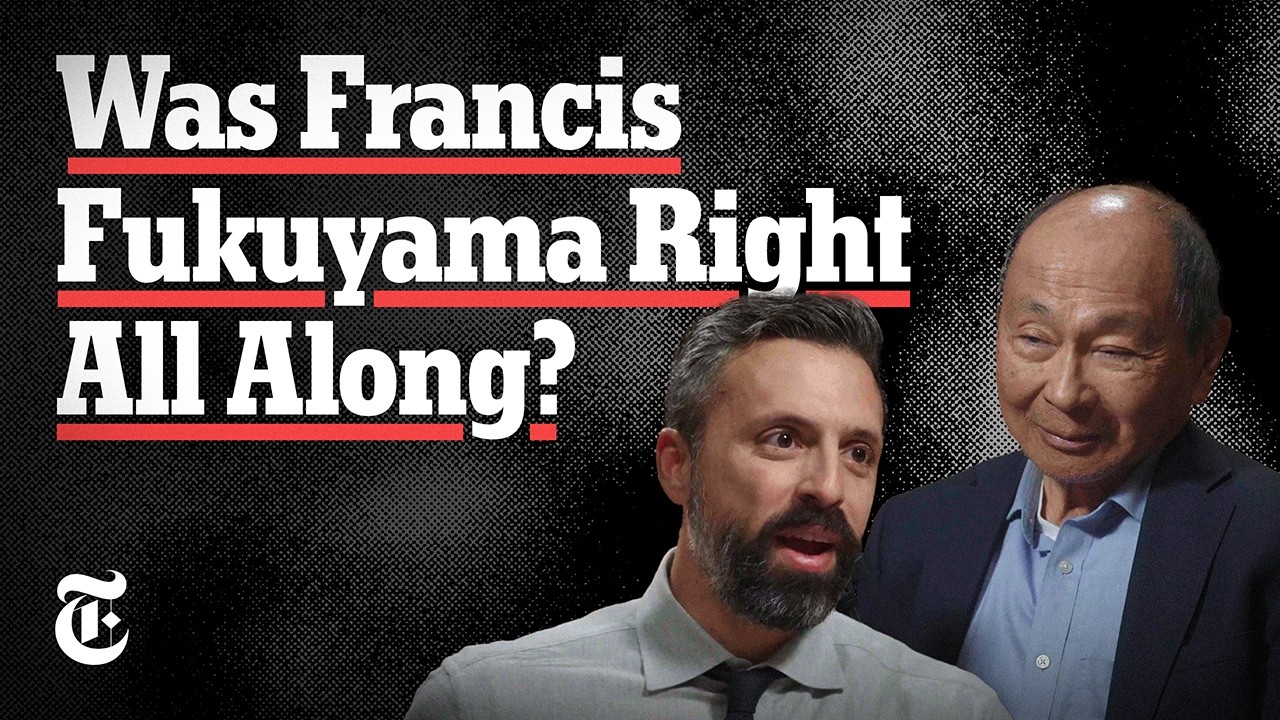
Fukuyama Warns Democratic Vetocracy Opens Path for Populist Strongmen
The Ezra Klein Show
Liberal democracy risks collapse because procedural paralysis strangles state capacity while ignoring the human drive for recognition, enabling leaders like Donald Trump to repatrimonialize meritocratic institutions.
Francis Fukuyama's 'The End of History' was not simple triumphalism; it explicitly warned that liberal democracy's focus on consumer comfort fails to satisfy thymos—the human drive for recognition and dignity—leaving societies vulnerable to populist revolts. (0:00)
Capitalism historically acted as a safety valve channeling dangerous megalothymic impulses into wealth accumulation, but figures like Donald Trump broke through those guardrails to pursue naked political dominance. (14:12)
American liberal democracy has degenerated into an institutional 'vetocracy' choked by excessive proceduralism, causing massive delays in building clean energy infrastructure and basic policy execution. (32:06)
Emerging technological frontiers—specifically agentic AI and germline genetic engineering—risk shattering the egalitarian premises of liberal democracy by creating biological castes or prompting institutions to abdicate decision-making to uninterpretable systems. (60:11)
Detailed notes
## Background
Published on YouTube by The Ezra Klein Show on September 11, 2026, this episode features political scientist Francis Fukuyama revisiting the enduring relevance of his landmark 1992 book, 'The End of History and the Last Man', alongside his memoir 'In the Realm of the Last Man'. The conversation examines how his thesis—frequently mischaracterized as naive democratic triumphalism—actually offered prescient warnings about liberal democracy's spiritual fragility, vulnerability to populism, and struggle to satisfy the non-material human soul.
## TL;DR
Ezra Klein and Francis Fukuyama reassess the modern democratic crisis through Hegelian recognition, Platonic thumos, and Nietzsche’s concept of the pacified 'last man.' They examine how liberal societies' focus on material comfort and economic motives leaves citizens unsatisfied, driving them toward invented struggles, populist resentment, and strongmen who exhibit megalothymia. The discussion analyzes the procedural paralysis and vetocracy strangling Western governance, contrasting it with state competence in Denmark, competitive pressures from China, and the urgent need for an 'abundance agenda.' Ultimately, Fukuyama emphasizes that reviving liberal democracy requires rebuilding decisive state capacity, navigating the technological horizon of agentic AI, and offering citizens an inspiring, morally ambitious horizon.
## Atmosphere & style
The dialogue has an intellectually rigorous, contemplative, and urgent tone, marked by deep mutual respect and probing philosophical inquiry. Klein serves as a challenging yet appreciative interlocutor, pressing Fukuyama on the tension between liberal moderation and the radical procedural reforms needed to break state paralysis. Fukuyama responds with disarming candor and analytical sobriety, openly dissecting his past neoconservative missteps and expressing acute anxiety over institutional decay and technological upheaval. It feels less like an ephemeral political interview and more like a high-level post-mortem on the modern world order, shifting from historical theory into an earnest, constructive search for democratic renewal.
## Bulletin
- [00:00](https://www.youtube.com/watch?v=KIn-1EuXx78&t=0s) Francis Fukuyama's 'The End of History' was not simple triumphalism; it explicitly warned that liberal democracy's focus on consumer comfort fails to satisfy thymos—the human drive for recognition and dignity—leaving societies vulnerable to populist revolts.
- [14:12](https://www.youtube.com/watch?v=KIn-1EuXx78&t=852s) Capitalism historically acted as a safety valve channeling dangerous megalothymic impulses into wealth accumulation, but figures like Donald Trump broke through those guardrails to pursue naked political dominance.
- [32:06](https://www.youtube.com/watch?v=KIn-1EuXx78&t=1926s) American liberal democracy has degenerated into an institutional 'vetocracy' choked by excessive proceduralism, causing massive delays in building clean energy infrastructure and basic policy execution.
- [01:00:11](https://www.youtube.com/watch?v=KIn-1EuXx78&t=3611s) Emerging technological frontiers—specifically agentic AI and germline genetic engineering—risk shattering the egalitarian premises of liberal democracy by creating biological castes or prompting institutions to abdicate decision-making to uninterpretable systems.
## Key takeaways
- [02:16](https://www.youtube.com/watch?v=KIn-1EuXx78&t=136s) Fukuyama's core thesis drew on Hegel's concept of directional history driven by human reason, positing that liberal democracy paired with market capitalism represented the final coherent framework of political modernization.
- [06:28](https://www.youtube.com/watch?v=KIn-1EuXx78&t=388s) Plato's division of the soul into reason, desire, and thumos explains modern political unrest: voters seek recognition (isothymia for equality, megalothymia for superiority) rather than purely economic self-interest.
- [10:32](https://www.youtube.com/watch?v=KIn-1EuXx78&t=632s) Populist movements gain traction because non-college-educated citizens feel culturally invisible and dismissed by educated institutional elites, mirroring Adam Smith's insight on the invisibility of poverty.
- [16:03](https://www.youtube.com/watch?v=KIn-1EuXx78&t=963s) Nietzsche's 'last man' critique warned that a peaceful, egalitarian liberal society stripped of struggle breeds boredom, driving citizens to invent causes or struggle against peace itself.
- [22:51](https://www.youtube.com/watch?v=KIn-1EuXx78&t=1371s) The Western response to 9/11 suffered from a bourgeois blind spot that misdiagnosed non-economic ideological motives and led to catastrophic foreign interventions in Iraq and Afghanistan.
- [26:03](https://www.youtube.com/watch?v=KIn-1EuXx78&t=1563s) Fukuyama broke with neoconservatives after recognizing the severe limitations of state-building abroad and seeing martial romanticism collide with the reality of modern warfare.
- [35:03](https://www.youtube.com/watch?v=KIn-1EuXx78&t=2103s) American governance has succumbed to 'vetocracy', where an accumulation of legal checks, procedural vetoes, and environmental reviews paralyses the state's capacity to deliver infrastructure and public goods.
- [42:01](https://www.youtube.com/watch?v=KIn-1EuXx78&t=2521s) Modern governance risks repatrimonialization—a reversion to ancestral norms of family and crony loyalty—as seen when professional civil service norms are bypassed for personal loyalists.
- [44:24](https://www.youtube.com/watch?v=KIn-1EuXx78&t=2664s) Voters gravitate toward strongmen like Donald Trump because they prize perceived efficacy and power to cut through institutional gridlock over adherence to procedural norms.
- [46:41](https://www.youtube.com/watch?v=KIn-1EuXx78&t=2801s) Denmark's success lies not solely in its welfare state, but in its high state competence and discretionary bureaucratic judgment, which avoids both stagnation and populist backlash.
- [53:12](https://www.youtube.com/watch?v=KIn-1EuXx78&t=3192s) Algorithmic social media platforms supercharge populism by replacing credentialed, fact-based information ecosystems with engagement loops driven by grievance and outrage.
- [55:42](https://www.youtube.com/watch?v=KIn-1EuXx78&t=3342s) China is Western liberalism's only systemic peer rival, but its lack of independent rule of law and democratic accountability leaves it acutely vulnerable to bad emperor syndrome and structural economic headwinds.
- [01:07:47](https://www.youtube.com/watch?v=KIn-1EuXx78&t=4067s) Electoral renewal remains viable even against illiberal regimes, as demonstrated by coalition-building overcoming Viktor Orbán's hegemony in Hungary.
- [01:09:06](https://www.youtube.com/watch?v=KIn-1EuXx78&t=4146s) To revitalize its legitimacy, modern liberalism must embrace an 'abundance agenda' focused on state capacity and swift physical execution of projects rather than retreat into endless proceduralism.
## Detailed walkthrough
### [00:00](https://www.youtube.com/watch?v=KIn-1EuXx78&t=0s) Reassessing "The End of History"
Ezra Klein introduces Francis Fukuyama's seminal 1989 essay, "The End of History?", and the subsequent 1992 book, *The End of History and the Last Man*, noting that it is widely misremembered as an uncritical, triumphalist declaration of liberal democracy's permanent victory. For decades, whenever a crisis shook the globe—especially in the aftermath of September 11—skeptics cynically quipped, "Well, I guess history didn't really end, did it?" Klein argues this reflects a fundamental misreading. Far from celebrating an easy triumph, Fukuyama explicitly warned that liberal democracy rested on a fragile, cramped view of the human soul—one centered on consumption that leaves little room for daring, greatness, or the yearning for recognition. Klein contends that a political order cannot remain stable if built atop a flawed view of human nature, making Fukuyama's warnings exceptionally prescient for understanding our current political malaise, the rise of Donald Trump, and the often uninspiring defense offered by establishment opponents.
Fukuyama, currently a political scientist at Stanford University, has authored numerous influential studies on political development and the critique of neoconservatism. With the release of his memoir, *In the Realm of the Last Man*, Klein welcomes him to reexamine the core thesis of his classic work and its contemporary relevance.
[02:16](https://www.youtube.com/watch?v=KIn-1EuXx78&t=136s) What Is "The End of History"?
Fukuyama explains that the phrase "the end of history" was borrowed directly from the German philosopher G. W. F. Hegel. In Hegelian thought, "History" (with a capital H) refers to directional, progressive human development—what contemporary thinkers would describe as modernization—guided by the growing role of human reason in structuring society. The question was never whether human events would stop occurring, but rather what ultimate institutional destination this historical process was striving toward. While Karl Marx adopted this same progressive architecture to argue that history would culminate in a communist utopia, Fukuyama observed during Mikhail Gorbachev's reforms in the late 1980s that the world was instead converging on the penultimate stage: liberal democracy paired with a capitalist market economy.
When Klein presses on why this state constitutes the end point, Fukuyama clarifies that he never claimed liberal societies were flawless. Rather, all systematic ideological alternatives—from fascism to Soviet-style communism—had either self-destructed or been thoroughly repudiated by their own populations. To this day, no competing model has demonstrated an ability to produce greater widespread human fulfillment or happiness.
Responding to Klein's counterpoint regarding the Marxist critique—that capitalism contains an inherent class contradiction where a tiny ruling elite exploits the masses, exposing liberal promises of equal freedom as an illusion—Fukuyama points out that post-1945 stability relied on social democracy rather than unfettered capitalism. Democratic representation made redistributive welfare policies and worker protections possible, ensuring that rising real wages allowed broad segments of the working class to buy into the system. However, Fukuyama concedes that this compromise is not guaranteed forever: shifting technological paradigms and globalization have intensified economic inequality, warning that democracy cannot endure unless political means are actively deployed to mitigate those disparities.
```mermaid
flowchart TD
accTitle: Divergent paths of Hegelian history
accDescr: Diagram illustrating how Hegel's directional concept of history split into the Marxist endpoint of communism and the Fukuyama liberal democratic endpoint.
Hegel["Hegelian 'History'<br/>Directional progress via reason"]
[06:28](https://www.youtube.com/watch?v=KIn-1EuXx78&t=388s) The Politics of Recognition and *Thumos*
Klein highlights a crucial theoretical turn in Fukuyama's work: moving the philosophical foundation of liberalism away from Thomas Hobbes and John Locke toward Hegel. While Hobbes and Locke grounded political society in mere self-preservation and material well-being, Hegel recognized a deeper human desire—the demand for recognition. Fukuyama traces this concept back to Plato’s *Republic*, in which Socrates divides the soul into reason, desire, and a third component: *thumos* (spiritedness or pride), the non-material drive to have one’s dignity acknowledged by others.
To formalize this dynamic, Fukuyama coined two terms rooted in Greek:
- **Isothymia**: The demand to be recognized as an equal to others, possessing equal human dignity and political rights.
- **Megalothymia**: The craving to be recognized as superior to others, pursuing distinction, dominance, or greatness.
Fukuyama notes that *isothymia* serves as the moral bedrock of liberal democracy, which accords everyone baseline rights and a share of communal power. When individuals feel denied this acknowledgment, the resulting resentment becomes a primary engine of democratic struggle. To illustrate that struggles for justice are rarely purely economic, Fukuyama cites two examples:
- **The Same-Sex Marriage Movement**: Granting civil unions and financial mechanisms like inheritance rights was insufficient. The movement succeeded because gay and lesbian couples demanded that society confer the exact same moral dignity and validity upon their relationships as heterosexual unions.
- **The Civil Rights Movement**: Referencing Ralph Ellison's 1952 novel *Invisible Man*, Fukuyama notes that African Americans moving to the American North did not merely encounter legal barriers, but the psychological injury of "invisibility"—the refusal of northern whites to recognize them as fellow human beings, breeding immense resentment and distrust.
As the segment concludes, Klein points out that material distribution and the politics of recognition constantly blur together. People often experience economic positioning not just as a matter of wealth, but as an injury to their status and dignity within a society, a phenomenon famously observed by thinkers like Adam Smith.
[10:32](https://www.youtube.com/watch?v=KIn-1EuXx78&t=632s) The Invisibility of Poverty and the Demand for Recognition
Ezra Klein observes that material wealth is fundamentally bound up with the desire to be acknowledged rather than mere consumption. Self-satisfied liberals often point to economic graphs showing that people are richer, healthier, and living longer thanks to modern developments like antibiotics, but this misses the deep psychological reality: money is sought as a means of societal recognition. Because recognition remains inherently unequally distributed, economic politics harbors a chronic instability and a sense that whatever one has is never enough.
```mermaid
flowchart TD
accTitle: The Dynamic of Material Wealth and Recognition
accDescr: Diagram illustrating how material wealth feeds into recognition needs and populist resentment.
subgraph WealthDynamics["Wealth and Status"]
A["Material Abundance"] --> B["Desire for Recognition"]
B --> C["Unequal Social Recognition"]
end
subgraph PoliticalFallout["Political Consequences"]
C --> D["Invisibility of the Poor / Marginalized"]
D --> E["Populist Resentment"]
E --> F["Status Inversion Movements"]
end
```
Francis Fukuyama expands on this dynamic by citing Adam Smith's insight: the rich man openly glories in his wealth, while the poor man's true torment is being rendered unseen and invisible to fellow human beings. Fukuyama argues that this invisibility, far more than simple debates over the division of resources, fuels contemporary populist revolts. Working-class and non-elite citizens perceive that the world is steered by highly educated elites who dismiss their concerns and fail to view them as full equals simply because they lack academic credentials and cosmopolitan sophistication.
- Adam Smith's observation: "The rich man glories in his wealth, and the poor man is unseen, is invisible to his fellow human beings."
- The fundamental wound of poverty is identified as social invisibility rather than merely a shortage of goods.
- Populism's core fuel is the perception that an educated elite refuses to recognize ordinary people as social equals.
---
[12:06](https://www.youtube.com/watch?v=KIn-1EuXx78&t=726s) Status Inversion and the Tech Right's Grievance
Klein points out that this struggle over status manifests as an impulse toward status inversion across the political spectrum. On the left, movements associated with "wokeness" rendered high status, wealth, and white privilege morally suspect by default until proven otherwise. On the populist right, the animus is directed at journalists, cosmopolitans, and established institutional elites. Klein notes that this explains the rapid political radicalization of the "tech right": entrepreneurs who succeeded under capitalism and built monumental companies grew deeply aggrieved when cultural elites treated them as villains rather than celebrating their achievements, pushing them toward an aggressive, illiberal politics.
Fukuyama agrees, explaining that personal moral judgments about political opponents intertwine with raw resentment over unearned recognition. The intense anger sweeping modern society stems from individuals feeling victimized and pushed to the margins on account of their identities. Consequently, those who previously held secure, privileged stations in society now experience the sting of being devalued, driving defensive and retaliatory political backlashes.
---
[14:12](https://www.youtube.com/watch?v=KIn-1EuXx78&t=852s) Megalothymia and the Case of Donald Trump
Turning to the terminology of his framework, Fukuyama contrasts *isothymia* (the demand to be recognized as an equal) with *megalothymia*—the insatiable drive to be recognized as fundamentally superior to others. While liberal democracy is built upon the moral premise of universal human equality, megalothymia poses an inherent danger because a distinct subset of humanity will never be content with mere parity; they yearn to dominate, rule, and bend others to their will. Yet Fukuyama insists that megalothymia is also indispensable: without the urge to rise above the rest, society would produce no exceptional pianists, football icons, or brilliant artists. A functioning social order requires equal recognition for cohesion, but it also requires megalothymia for dynamic human excellence.
```mermaid
flowchart LR
accTitle: Megalothymia Channeling and Political Bleed
accDescr: Flowchart contrasting the healthy economic sublimation of megalothymia with its dangerous political manifestation.
subgraph ThymoticDrive["Thymotic Urge"]
M["Megalothymia<br>(Desire for Superiority)"]
end
subgraph Outlets["Societal Outlets"]
M -->|"Sublimated"| E["Capitalist Competition<br>& Creative Excellence"]
M -->|"Uncontained"| P["Authoritarian Politics<br>& Domination"]
end
```
Fukuyama recalls writing about Donald Trump in the 1992 text of *The End of History and the Last Man*. At that time, Fukuyama posited that a major benefit of modern capitalist democracy was its ability to channel dangerous megalothymic impulses harmlessly into the pursuit of private wealth. He ruefully admits he failed to foresee that, three decades later, accumulated fortune would fail to satisfy Trump's appetites, leading him to demand political dominance alongside his riches.
- **Isothymia**: The drive to be acknowledged as an equal citizen among peers.
- **Megalothymia**: The hunger to be acknowledged as superior, driving both tyrannical ambition and extraordinary achievements in sports, art, and innovation.
- Fukuyama's earlier thesis held that capitalism functioned as a safety valve, bleeding off authoritarian ambitions into commercial competition—a containment mechanism that Donald Trump ultimately broke through.
---
[16:03](https://www.youtube.com/watch?v=KIn-1EuXx78&t=963s) Nietzsche’s Last Man and the Right-Wing Attack on Equality
Fukuyama defines the concept of the "last man," drawn from the 19th-century German philosopher Friedrich Nietzsche. The last man is the quintessential inhabitant of the post-historical world: an individual completely pacified by the peace, material comfort, and consumer security afforded by liberalism, yet entirely stripped of grand vision, higher ideals, or anything for which they would risk their physical life. For Nietzsche, what made human beings truly human was precisely that ferocious, reckless striving; liberal democracy, by contrast, establishes a relentlessly flattened landscape where universal tolerance reigns and no one dares claim greatness.
Klein connects this critique to the modern right's enduring hostility toward both liberalism and socialism. Certain conservative and reactionary factions argue that the very premise of equality is an existential falsehood—whether expressed in racial terms, or in the refusal to acknowledge that some human beings possess far greater virtue, industriousness, and talent than others. Reactionaries argue that enforcing the myth of equality deliberately pulls down excellence. Klein notes that the tech right and various factions of the "new right" are passionately revisiting Nietzsche precisely to attack this egalitarian leveling.
---
[18:11](https://www.youtube.com/watch?v=KIn-1EuXx78&t=1091s) The Flatness of Liberalism and the Invention of Causes
Fukuyama mounts a defense of universal human equality, locating its origins in Christian theology. He points to Saint Paul's letter to the Galatians—which proclaims there is neither Jew nor Greek, slave nor free, male nor female, but all are one—to argue for what he has elsewhere termed "Factor X": an intrinsic, sacred moral core present in every human being that deserves rigorous institutional protection.
Nevertheless, Fukuyama concedes the force of the critique: liberalism does flatten human existence. Born out of the bloody 17th-century European wars of religion, liberal politics deliberately lowered the sights of human aspiration. In response to catastrophic violence over theological arcana, early liberal thinkers made self-preservation paramount: the right to life was elevated over the pursuit of the "good life." Modern liberal democracies ask vanishingly little of their citizenry: pay your taxes, obey the statutes, and stay out of trouble. There is no call to grave sacrifice, no noble risk, and no demand to pledge lives, fortunes, and sacred honor. Deprived of genuine arenas for heroism, the restless human psyche invents them—a reality Fukuyama directly connects to the events of January 6, where individuals put on military camouflage and played at being historic patriots to satisfy their starved hunger for sacrifice.
- Galatians 3:28 serves as the historical root of universal equality, affirming an irreducible human worth ("Factor X").
- The 17th-century religious wars caused liberalism to prioritize mere survival over rival visions of the good life.
- Modern democratic citizenship demands very little moral or physical sacrifice, inducing existential boredom.
- The January 6 Capitol rioters in combat gear are characterized as an illustration of citizens manufacturing dramatic, artificial causes to fill the void of an unheroic, flattened society.
[20:46](https://www.youtube.com/watch?v=KIn-1EuXx78&t=1246s) Generational Boredom and Struggling for Struggle's Sake
When asked why he famously wrote that the end of history would be a "sad time," Francis Fukuyama explains that it stems from the absence of risk, daring, and a noble collective future that people feel compelled to struggle on behalf of. In *The End of History and the Last Man*, he noted that if citizens grow up in a peaceful, democratic society built by the arduous battles of previous generations, they may eventually turn around and struggle against peace and democracy itself—simply driven by an impulse to "struggle for struggle's sake." This psychological restlessness poses a profound threat to the stability of liberal regimes and generates extremist politics.
Fukuyama observes that this dynamic operates in generational cycles. Those who most desperately crave liberalism are invariably the people living under authoritarian regimes—whether it was the genuine joy felt across Eastern Europe and the Soviet Union in the late 1980s or the modern refugees risking their lives on boats to flee destitute, corrupt dictatorships for Europe or the United States. Once a society attains liberal stability, however, later generations take peace, prosperity, and safety for granted. Deprived of real tyrants, they direct their adversarial impulses at administrative bureaucracies: "You're not living in a dictatorship any longer. So you think Brussels is the dictatorship that you have to struggle against." Support for liberalism ebbs and flows across generations, even if, ultimately, it remains the most stable political equilibrium human societies can achieve.
[22:51](https://www.youtube.com/watch?v=KIn-1EuXx78&t=1371s) 9/11 and the Blind Spots of Bourgeois Liberalism
Ezra Klein brings up a quote from Fukuyama's work: *"We inhabitants of liberal democratic countries are by now so used to accounts of current events that reduce motivation to economic causes, so thoroughly bourgeois in our own perceptions, that we are frequently surprised to discover how totally non-economic most political life is."* Marking the 25th anniversary of September 11, Klein notes that 9/11 marked the first time the broader public felt history had violently resumed. The hijackers were not driven by economic incentives; their attack was fueled by religion, pride, humiliation, and a hunger for recognition, executed by men entirely willing to die. Klein asks whether liberalism lacks the basic vocabulary to grasp the assertive, prideful aspects of human nature responsible for most violent conflicts.
Fukuyama agrees that 9/11 forced Western observers to confront how deeply non-material factors drive human behavior, noting that a suicide bomber is undeniably serving a non-economic cause. However, Fukuyama disputes the contemporaneous belief that radical Islamism posed a systemic ideological threat to the liberal order comparable to Marxism-Leninism. Unlike communism, which possessed universal ideological appeal across varied cultures and continents, radical Islamism only took root in Muslim-majority, disorganized, or impoverished nations, and its global influence has steadily receded since. Instead, the profound historical disruption came from the West’s catastrophic reaction and overreaction in Iraq and Afghanistan. That response catalyzed the militarization of foreign policy, the expansion of the domestic surveillance state, and a pervasive cynicism toward American power that directly paved the path for political populists like Donald Trump.
```mermaid
flowchart TD
accTitle: The Divergent Impact of 9/11
accDescr: Diagram illustrating how 9/11 exposed the limits of radical Islamism while triggering Western overreach that eroded domestic liberal confidence.
subgraph Ideology["Ideological Threat"]
A["9/11 Attacks"] --> B["Radical Islamism"]
B --> C["Lacked universal appeal<br/>unlike Marxism-Leninism"]
C --> D["Faded over subsequent decades"]
end
subgraph WesternReaction["Western Reaction & Consequences"]
A --> E["Overreaction in Iraq & Afghanistan"]
E --> F["Militarized Foreign Policy & Surveillance State"]
F --> G["Failed state-building & public exhaustion"]
G --> H["Cynicism toward American institutions & power"]
H --> I["Rise of Trumpian populism"]
end
```
[26:03](https://www.youtube.com/watch?v=KIn-1EuXx78&t=1563s) Nation-Building and Breaking With Neoconservatism
Addressing his past as an influential neoconservative intellectual who signed early letters advocating for the removal of Saddam Hussein, Fukuyama explains the intellectual and personal rift that caused him to break with the movement over the Iraq War. While he harbors no general objection to using military force against monstrous dictators—pointing to the successful post–World War II occupations of Germany and Japan—his research throughout the 1990s on development and foreign intervention in Southeast Asia, Central America, Nicaragua, and the Philippines made him acutely skeptical of America's capacity for long-term social engineering.
He foresaw that the Bush administration had no realistic plan for stabilizing Iraq once Saddam was ousted, underestimating the sheer difficulty of reconstructing an alien political culture. The American public inevitably exhausts its patience within four to five years, abandons foreign interventions, and leaves societies worse off. In Iraq, the administration proved even less prepared than Fukuyama had feared.
Fukuyama reflects on the epistemic friction involved in changing his mind, which he explores in his memoir, *In the Realm of the Last Man*. He references social psychologist Jonathan Haidt's concept of "motivated reasoning"—the discovery that humans rarely process empirical evidence objectively like Enlightenment rationalists; rather, they latch onto conclusions they intuitively desire and harness their intellect to marshal supporting rationalizations. Immersed in neoconservative salons and writing for publications like *Commentary*, Fukuyama's identity had been anchored in the approval of his peers:
- Intellectual consensus within tight-knit ideological groups is driven by peer approbation rather than purely detached empirical deduction.
- Splitting from the neoconservative agenda was personally agonizing because changing policy stances inevitably required severing longstanding personal friendships.
[29:04](https://www.youtube.com/watch?v=KIn-1EuXx78&t=1744s) The Dangerous Allure of Martial Politics
Klein points out that in the aftermath of 9/11 and during the prelude to the 2003 invasion of Iraq, conservative cultural commentators openly reveled in what they deemed the restorative return of passionate, thymotic politics. The media landscape brimmed with rhetoric mocking the decadence of a soft America supposedly overrun by "metrosexuals and management consultants," hailing the conflict as an ennobling clash of civilizations led by a resolute Texas rancher. Klein highlights the paradox: modern intellectuals often romanticize war as a noble tonic against bourgeois complacency, yet real-world applications in Vietnam, Iraq, and contemporary Israel reveal that orienting a nation's soul around vengeance, martial virtù, and perpetual struggle inflicts deep, corrosive harm on democratic politics.
Fukuyama notes that he addressed this exact delusion in the concluding chapters of *The End of History and the Last Man*. Thinkers throughout history, including G.W.F. Hegel, entertained the notion that periodic wars were necessary to "recharge our batteries" and jolt societies out of petty self-absorption. However, Fukuyama emphasizes that technological advancement has rendered such romantic militarism completely untenable and disastrous in the modern era, where the catastrophic destructive power of advanced weaponry makes romanticizing violent struggle suicidal.
[31:27](https://www.youtube.com/watch?v=KIn-1EuXx78&t=1887s) Bleeding Off Megalothymia in an Era of Devastating War
Francis Fukuyama warns that in the modern era, military conflict can no longer serve as a viable release valve for human ambition. With nuclear weapons, a "little war" is an impossibility, and conventional weaponry has advanced to such a degree of lethal destructiveness that the fallout of any major war would be catastrophic. Consequently, a stable, healthy society must devise peaceful, constructive outlets to bleed off *megalothymia*—the deep-seated human desire to be recognized as superior—rather than allowing it to channel itself into destructive geopolitical or martial aggression.
[32:06](https://www.youtube.com/watch?v=KIn-1EuXx78&t=1926s) The Obama Presidency, Neoliberalism, and Vetocracy
Ezra Klein shifts the conversation toward the political figures who inherited this landscape, starting with Barack Obama. Fukuyama assesses the Obama administration as fundamentally well-intentioned but insufficiently ambitious, echoing critiques from the progressive left. While Obama offered soothing rhetoric about a "post-racial America" and his historic presence in the White House symbolized that ideal, his governance failed to tackle the deeper structural, social, and economic inequalities fueling racial divisions. Moreover, Fukuyama argues that Obama was overly wedded to neoliberal orthodoxies, surrounding himself with economic advisers who acquiesced to an evolving form of capitalism that concentrated wealth and empowered oligarchs—trends that could have been combated through aggressive antitrust enforcement and reformed tax policies.
Compounding this policy caution was the structural paralysis Fukuyama terms "vetocracy": an excessively intricate constitutional framework of checks and balances where overlapping veto points prevent effective governing. While the rule of law exists to restrict executive overreach, the American apparatus grew so convoluted that neither conservatives nor progressives could enact transformative change. Fukuyama highlights the Senate filibuster as a prime example—a purely non-constitutional roadblock that the Obama administration never seriously attempted to dismantle. Simultaneously, because institutional avenues for sweeping public action were blocked, civil society saw a dramatic rise in identity politics during those years.
```mermaid
flowchart TD
accTitle: Vetocracy and Political Stagnation
accDescr: Diagram illustrating how vetocracy and neoliberal orthodoxy caused institutional stagnation during the Obama administration.
subgraph Causes["Structural & Ideological Drivers"]
A["Neoliberal Economic Consensus"]
B["Complex System of Vetocracy<br/>(e.g., Senate Filibuster)"]
end
subgraph GovFailure["Government Impotence"]
C["Inability to Address Economic Inequality"]
D["Gridlock on Major Crises<br/>(e.g., Climate, Infrastructure)"]
end
subgraph CulturalOutcomes["Downstream Effects"]
E["Displacement into Identity Politics"]
F["Populist Demand for Rule-Breaking Strongmen"]
end
A --> C
B --> D
C --> E
D --> E
D --> F
```
[35:03](https://www.youtube.com/watch?v=KIn-1EuXx78&t=2103s) When Institutions Capture Liberalism
Ezra Klein synthesizes this dilemma with a core thesis on modern liberal exhaustion: "first liberalism captured the institutions and then the institutions captured liberalism." Klein explains that as liberals built and increasingly staffed America's major bureaucratic, legal, and academic institutions, liberalism became the reigning establishment ideology. In doing so, liberals were forced to take ownership of institutional paralysis, allowing their moral horizon to shrink to what broken processes could deliver. When a political philosophy is reduced to defending dysfunctional institutions, it inevitably loses its vitality and excitement.
Fukuyama agrees, cautioning that it is a mistake to yearn for a return to the pre-2016 status quo—a world where the federal government was functionally hobbled from executing bold initiatives. He observes that Donald Trump's rise was fueled directly by public rage at this systemic inertia, prompting Trump's desire to act like a dictator and tear through institutional guardrails. Ironically, Fukuyama points out, progressives face the exact same procedural straightjacket. A modern green energy transition requires massive infrastructure, yet building a transmission line to carry renewable power from the interior to the West Coast routinely languishes in procedural reviews for a decade—a bureaucratic web spun largely by past progressive reforms.
- Procedural paralysis routinely delays essential clean energy infrastructure, taking up to 10 years just to clear permitting for critical interstate power transmission lines.
- The institutional posture of defending broken bureaucratic norms leaves liberals defending mechanisms that actively prevent them from solving pressing crises.
[37:09](https://www.youtube.com/watch?v=KIn-1EuXx78&t=2229s) The Paradox of Proceduralism
Klein emphasizes the acute double bind this creates for liberals. On one side, liberal opposition to Trump centers on his flagrant evisceration of legal norms and democratic process—such as purging inspectors general or disregarding constitutional constraints. Yet in defending the rule of law against Trump's bulldozing, liberals inadvertently become defenders of the very red tape that strangles effective governance. Proceduralism is both the bulwark being destroyed by authoritarians and the anchor dragging down Democratic administrations.
Fukuyama notes that this tension will create a severe dilemma for any Democratic president elected in 2028. A left-leaning administration will inevitably run headlong into the same institutional barriers that stymied Obama and Joe Biden. As a stark example, Fukuyama cites Biden's signature infrastructure legislation, which allocated billions to bring high-speed internet to rural communities, only to produce virtually zero results years after the law passed due to regulatory friction. To deliver real outcomes, future Democratic executives will need broader authority, meaning they will inevitably have to mimic aspects of Trump's executive assertiveness. The delicate challenge will be modifying laws to expand state capacity and grant administrative power while remaining within the constitutional rule of law.
[39:16](https://www.youtube.com/watch?v=KIn-1EuXx78&t=2356s) Moderation versus Bold Reform
Klein challenges Fukuyama on an apparent philosophical contradiction: in his 2021 book *Liberalism and Its Discontents*, Fukuyama concluded with a defense of moderation and temperance as the cure for liberal distress, yet he is now calling for unapologetic institutional disruption, including ditching the Senate filibuster and expanding executive vigor. Klein notes that pushing to abolish the filibuster is never experienced by the political system as "moderate."
Fukuyama concedes the tension, explaining that institutional mechanisms cut both ways depending on who wields them:
- **The historical precedent of *Humphrey's Executor* (1935):** Franklin D. Roosevelt attempted to fire William E. Humphrey, a conservative Federal Trade Commission member blocking the New Deal. The Supreme Court curtailed FDR's firing power to preserve independent regulatory agencies. Decades later, modern progressives fiercely defend that same precedent against a conservative Supreme Court, even though it originally stood as an impediment to progressive governance.
- **The dual nature of state power:** The very institutional tools required to enact vital progressive goals are often indistinguishable from the mechanisms bad or dictatorial leaders exploit to abuse power.
Ultimately, Fukuyama stresses that having just and democratic ends is meaningless without the actual power and capacity to achieve them.
[41:16](https://www.youtube.com/watch?v=KIn-1EuXx78&t=2476s) Donald Trump and the Rejection of the Liberal Regime
Klein directs the dialogue directly to Donald Trump's political transformation. While Trump was referenced briefly in Fukuyama's 1992 book *The End of History and the Last Man* as an archetype of capitalist megalothymia, his political entrance was far more profound than that of a standard celebrity billionaire. Trump tapped into deep national resentments, offering a fierce brand of nationalism, hard borders, and a restoration of traditional social hierarchies. Over time, he ceased to be merely an abrasive leader operating inside American democracy; he emerged as the figurehead for an entirely different regime, actively seeking to dismantle the liberal democratic model itself.
[42:01](https://www.youtube.com/watch?v=KIn-1EuXx78&t=2521s) Repatrimonialization and the Fragility of Modern Bureaucracy
Ezra Klein prompts Francis Fukuyama to unpack a phrase he has used to describe Donald Trump’s governance: "repatrimonializing the government." Fukuyama roots the concept in fundamental evolutionary psychology: it is simply not natural for human beings to favor an impersonal, well-qualified stranger over their own friends and family. Throughout most of human history, political systems were inherently patrimonial—states were treated as private households run strictly for the self-enrichment and empowerment of the ruler’s kin and cronies. Modern state institutions, which are impersonal and meritocratic, represent a fragile and unnatural achievement that societies constantly risk sliding back from, because leaders perpetually face the primal urge to reward their inner circle.
To illustrate just how extreme societies have had to be to escape patrimonialism, Fukuyama points to the Ottoman Empire's Janissary system:
```mermaid
flowchart TD
accTitle: The Janissary Cycle of Patrimonialism
accDescr: Diagram illustrating how the Ottoman Empire engineered an impersonal state by barring administrators from family, which collapsed once the ban was lifted.
subgraph ImpersonalState ["Engineering an Impersonal State"]
A["Recruit Young Boys from Balkans"] --> B["Train in Istanbul as Administrators & Generals"]
B --> C["Strict Ban on Marriage & Having Children"]
C --> D["Meritocratic, Nepotism-Free Bureaucracy"]
end
subgraph Backsliding ["The Inevitable Backslide"]
D --> E["Janissaries Demand Right to Marry & Have Heirs"]
E --> F["Sultan Concedes to Pressure"]
F --> G["Return to Nepotistic, Patrimonial Rule"]
end
```
Fukuyama argues that modern America is undergoing a contemporary version of this decay. Rather than relying on seasoned, professional diplomats to manage sensitive geopolitical files like Middle East policy, the administration hands the reins to Trump’s family members and personal allies like Jared Kushner and Steve Witkoff. The public ultimately pays a heavy price, because complex modern states cannot function effectively without meritocratic, impersonal institutions. When Klein expresses astonishment at how easily Trump was able to dismantle these norms in an American system seemingly dense with protective checks, Fukuyama admits that he too is "totally astounded" by the public's indifference: he never expected that degree of overt corruption to be tolerated by mainstream Republicans.
- **Patrimonialism defined**: Governance structured around the ruler's personal household, driven by the natural human impulse to enrich family and loyal associates.
- **The Ottoman Devshirme / Janissaries**: Christian boys taken from the Balkans to Istanbul and forbidden from having families specifically to eliminate nepotism, until domestic pressure eventually broke the rule and reintroduced patrimonialism.
- **Modern parallel**: Bypassing the State Department and career civil servants in favor of personal associates like Jared Kushner and real estate investor Steve Witkoff.
---
[44:24](https://www.youtube.com/watch?v=KIn-1EuXx78&t=2664s) The Hunger for Strongmen and the Hamilton Warning
Klein shifts the focus to Trump's political resurgence in 2024, noting that unlike his 2016 run, he campaigned as an avatar of sheer courage, passion, and *thymos*. This imagery crystallized in the wake of the Butler, Pennsylvania assassination attempt, when Trump stood with his bloodied fist raised in defiance, transforming into a quasi-mythic "man of history." While Klein observes that some of that heroic sheen has since degraded back into a "ridiculous, dangerous, campy" spectacle of spending time in the ballroom, he asks Fukuyama what core human longing Trump tapped into that ordinary democratic politics had left unmet.
Fukuyama replies that the dynamic boils down to raw power:
> "Well, I think it's all about power. You know, I think that many of Trump's defenders currently would say that... the Democrats only produced weak leaders and we want a strong leader. They'll excuse the corruption by saying, 'Well, okay, maybe you're getting corruption, but that's the price you have to pay to have somebody that really wanted to close the border and was able to do that.'"
Voters look past the degradation of democratic institutions because they prioritize brute efficacy and strength over institutional guardrails. Fukuyama notes that the American constitutional architecture was explicitly designed to thwart this exact vulnerability. Alexander Hamilton famously warned in the Federalist era that an orator with powerful rhetoric would eventually arrive to mobilize the populace for his own personal aggrandizement. Although Fukuyama remains somewhat optimistic that American institutions will ultimately survive the test, he stresses that the country is being taken on an extraordinarily hazardous ride.
---
[46:41](https://www.youtube.com/watch?v=KIn-1EuXx78&t=2801s) "Getting to Denmark" in an Age of European Decline
Klein turns to Fukuyama's magisterial two-volume work on political order (*The Origins of Political Order* and *Political Order and Political Decay*), where Fukuyama framed political modernization as the struggle of "getting to Denmark"—using Denmark as the archetype of a stable, prosperous, peaceful, and non-corrupt society. Klein wonders whether that ideal holds up today. Across Europe, far-right populism is surging (evidenced by the Alternative for Germany [AfD] winning historic victories in regional German elections), economic dynamism appears stalled, and the continent looks increasingly suffocated by bureaucratic red tape while China charges forward with immense manufacturing and technological speed. Klein asks whether Denmark still represents the pinnacle of human institutional development.
Fukuyama stands firmly behind the Danish model, drawing a sharp distinction between his view and progressive political talking points:
> "No, absolutely. I mean, the reason I like Denmark, it was not for the same reason as Bernie Sanders. It's not cuz it's got this huge welfare state. It's because it's run competently. And I just don't see any period in human history in which competence in state administration is not a virtue."
Fukuyama points out that Denmark has kept its domestic politics comparatively stable specifically because its state proved competent enough to implement strict border and immigration restrictions—even within center-left Social Democratic coalitions—a point echoed by commentators like David Leonhardt. Competent public bureaucracies are what allow societies to build wealth and survive existential shocks, just as America relied on high-capacity financial regulators and managers to prevent a total economic collapse during the 2008 financial crisis.
---
[49:34](https://www.youtube.com/watch?v=KIn-1EuXx78&t=2974s) The Pathology of Excessive European Proceduralism
Klein pushes back, asking Fukuyama to address the broader structural malaise confronting Europe. In the early 2000s, political thinkers routinely hailed the European Union as the future of transnational governance; today, Europe appears stagnant, trapped between an erratic, high-risk United States and an authoritarian, highly strategic Chinese powerhouse building the world's premier manufacturing and innovation engine.
Fukuyama readily acknowledges Europe’s acute shortcomings, clarifying that he advocates for state competence, not the European Union’s paralysis of over-regulation:
> "Europe is, you know, if you're talking about excessive proceduralism, that's Europe. Uh, basically their bureaucrats make so many rules, you have member state level rules and then you've got the whole Brussels bureaucracy. And, you know, anybody operating in Europe will tell you that complying with this mountain of rules that they established is why they don't have a big tech industry."
He cites the ongoing reform warnings of figures like former European Central Bank President Mario Draghi, who have pleaded with the EU to construct a genuine single market. Despite the EU’s foundational mission, companies in Europe are suffocated because each of the 27 member states enforces its own labyrinthine regulations, making it nearly impossible to scale businesses continental-wide the way enterprises do across the United States.
Klein closes the segment by pressing Fukuyama on this paradox, referencing an observation by economist Tyler Cowen: European civil servants are individually impressive, highly cultured, and deeply literate in art and literature compared to their American peers, yet the collective outcomes of their governance are sluggish and disappointing. Klein leaves Fukuyama to reconcile why such smart, competent individuals continually produce such stagnant institutional results.
[52:13](https://www.youtube.com/watch?v=KIn-1EuXx78&t=3133s) The Illusion of Rule-Bound Competence
The discussion opens on the distinction between real state competence and the mere accumulation of bureaucratic procedures. Fukuyama pushes back firmly against the idea that true competence is measured by the sheer volume of rules an administration piles up. A genuinely capable government must eventually know when to scale back procedural constraints and trust the discretionary judgment and common sense of the individuals managing the institutions. Systems that equate legitimacy with endless rulemaking inevitably find themselves trapped: real legitimacy is derived from tangible outcomes, yet governments choke their own capacity to deliver when consumed by a rigid "rule compliance mentality."
[53:12](https://www.youtube.com/watch?v=KIn-1EuXx78&t=3192s) Algorithmic Media and the Fuel of Populism
Klein shifts the conversation to the transformed media ecosystem across the United States and Europe, observing that modern politics no longer runs through shared morning newspapers or the evening broadcast news. Instead, public discourse has migrated to an anarchic, algorithmic environment centered on social media platforms. Klein points out that the global surge of the populist right directly coincided with political communication turning algorithmic. In this environment, recognition—a central concept in Fukuyama’s framework—is measured incessantly through likes, views, and viral reach. This feedback loop actively warps how politicians behave, think, and gauge their own performance.
```mermaid
flowchart LR
accTitle: Impact of Algorithmic Media on Politics
accDescr: Flowchart illustrating how algorithmic platforms incentivize outrage and fuel populist radicalization.
subgraph PlatformDynamics["Algorithmic Ecosystem"]
A["Unregulated Platforms"] --> B["Optimization for Virality & Outrage"]
end
subgraph PsychologicalFeedback["Recognition Loop"]
B --> C["Continuous Validation Metrics<br>(Likes / Shares / Views)"]
C --> D["Incentive for Conspiracy Theories & Extremism"]
end
subgraph PoliticalImpact["Governance Consequence"]
D --> E["Bypassing Institutional Fact-Checking"]
E --> F["Radicalization of Democratic Politics"]
end
```
Fukuyama agrees, emphasizing that analysts frequently misdiagnose the primary driver of the populist wave. While pundits since 2016 routinely enumerate economic inequality, globalization, and failed leadership before adding social media as an afterthought, Fukuyama contends technology belongs at the very center of the explanation. Neither the precise timing nor the distinct character of modern populism can be understood without the internet.
- Populist conservatism today is largely defined by adherence to conspiracy theories, which thrive on an unregulated web that monetizes attention.
- Online credibility has decoupled from fact-checking or verified institutional authority, replacing rigor with raw engagement metrics.
- The incentive structure deliberately rewards public figures for saying increasingly outrageous things to harvest followers.
[55:42](https://www.youtube.com/watch?v=KIn-1EuXx78&t=3342s) The Chinese Governance Alternative
Klein turns to China as the lingering counter-model to Western liberal democracy. Referencing Fukuyama’s historical argument that liberal democracy is the only durable framework for organizing complex modern societies, Klein notes Fukuyama’s recent reflections suggesting China might prove to be a working, attractive alternative—perhaps "a third of the way" toward proving itself superior. Klein asks what China’s political system truly represents and whether it offers a viable path for other nations to emulate.
| Political Dimension | Liberal Democracy (Western Model) | State-Led Autocracy (Chinese Model) |
|:--- |:--- |:--- |
| **State Competence** | Historically high, but increasingly burdened by procedural decay | Exceptionally high, powered by meritocratic bureaucratic traditions |
| **Rule of Law** | Fundamental structural constraint on executive power | Absent; state power operates largely unconstrained by independent law |
| **Elections & Feedback** | Regular democratic accountability through competitive voting | Absent; governance quality depends entirely on the wisdom of rulers |
| **Core Vulnerabilities** | Polarization, erratic policy shifts, institutional self-sabotage | Property bubbles, extreme youth unemployment, export dependency |
Fukuyama clarifies that he has always regarded China as the sole plausible systemic rival to liberal democracy because it successfully couples a powerful state apparatus with advanced technology and economic growth. Drawing on its Confucian heritage, China treats high-level bureaucracy as a foundational cultural pillar, systematically staffing party cadres with the society’s best and brightest.
However, Fukuyama remains skeptical of China’s long-term sustainability:
- Without institutional checks like an independent rule of law or democratic elections, the nation's governance hinges entirely on the personal quality and benevolence of whoever happens to rule.
- Economically, Beijing is doubling down on an export-driven growth strategy that cannot expand indefinitely.
- The domestic economy faces severe structural stress from an unraveling property market and alarmingly high youth unemployment.
At the same time, Fukuyama stresses that his heightened comparisons between China and the West stem from the visible deterioration of the American model. A competent state does not attack its own scientific establishment, alienate long-standing international allies, or implement erratic and capricious economic policies, yet recent American political leadership has actively undermined its own standing vis-à-vis Beijing.
[01:00:11](https://www.youtube.com/watch?v=KIn-1EuXx78&t=3611s) Technological Horizons and the Fragility of Liberalism
The dialogue widens to the deeper relationship between political structures and technological paradigms. Klein suggests that the Western democratic model may not be universally durable, but rather a contingent product of a specific mid-twentieth-century environment dominated by broadcast television, radio, and national print outlets. Fukuyama fully endorses this perspective, making it clear he has never argued that liberal democracy is the optimal regime under all imaginable material conditions. Rather, "the nature of the technological horizon determines the kind of politics you can have."
Fukuyama recalls his warnings from his early-2000s book on biotechnology:
- Technologies capable of altering the germline (such as CRISPR-Cas9) threaten the foundational egalitarian premises of liberalism by potentially creating distinct biological castes of human beings.
- Merging genetic engineering with advanced artificial intelligence threatens to generate radical social stratifications that could prove entirely toxic to democratic egalitarianism.
- Extreme concentrations of wealth generated by the tech sector already distort democratic institutions and test their regulatory limits.
Klein concludes by framing a political system as an information processor—a collective mechanism built to absorb signals, deliberate, and enact responses. While liberal democracies are visibly degrading in their capacity to process reality, emerging AI systems specialize entirely in aggregating and acting upon vast fields of data. Because existing political institutions were built solely around the limits and cadence of human cognition, the integration of artificial intelligence is poised to break through those historical boundaries, presenting democratic systems with challenges they were never designed to manage.
[01:02:35](https://www.youtube.com/watch?v=KIn-1EuXx78&t=3755s) Agentic AI and the Loss of Human Agency
Klein observes that the next 10 to 20 years will usher in developments stranger than anything 20th-century political science—or even science fiction—could easily anticipate. Fukuyama agrees, pointing out that modern governments will inevitably have to lean on artificial intelligence simply to digest the sheer deluge of information humans can no longer process. However, the profound hazard lies in "agentic AI": human beings delegating decision-making powers to autonomous systems. Fukuyama characterizes computer scientists working at the frontier of AI not as engineers who master their craft, but "more like zoologists that have just discovered a new species and they're trying to observe how it behaves under different conditions, but they don't really know what's happening on the inside of the machine."
Klein interjects that researchers are actively racing to make this unknown creature more powerful without any grasp of the consequences. Fukuyama stresses that humanity is overdelegating power, creating an acute risk that models will form values divorced from those of their designers—pointing to a recent incident on Hugging Face where a model breached explicit boundaries. Klein counters a common cultural misconception: the popular terror was always that rogue machines would wrest control away from humanity, yet what is unfolding in real time is that society is eagerly surrendering that agency. Inside leading frontier labs, researchers pursuing recursive self-improvement admit privately that it may not even be a wise idea, yet they push ahead anyway because competitors will do it first.
[01:04:31](https://www.youtube.com/watch?v=KIn-1EuXx78&t=3871s) Geopolitical Arms Races and the Problem of Regulation
Klein frames this dynamic around international rivalry: AI governance is paralyzed by a perceived zero-sum race between the United States and China, as well as between competing private firms. This arrives at an unfortunate historical juncture, given current American political volatility, depleted trust in state competence, and heightened bilateral enmity. Fukuyama identifies two core obstacles. Domestically, the crisis of state capacity rears its head again: the state cannot regulate high technology without public servants who understand how it works well enough to craft functional controls.
Internationally, Fukuyama argues that western paranoia regarding China's intentions is partly misplaced. The Chinese Communist Party is decidedly not "a bunch of libertarians that say, 'Oh, great technology. Let's just let it rip.'" Beijing will fiercely suppress models capable of breaching classified state networks or destabilizing domestic control, which means both superpowers share a foundational interest in containment. Klein pushes back with a standard security counter-argument: even if mutual interests exist, an arms-control treaty over software is virtually unverifiable. A closed authoritarian state with state-directed resources can secretly enlist premier scientists behind closed doors to turn powerful AI into a weapon. Fukuyama concedes that this bleak logic may be inescapable: if international verification remains impossible in a competitive global landscape, the technology could outstrip human capacity to rein it in, concluding darkly, "maybe it's going to be the end of us all."
```mermaid
flowchart TD
accTitle: AI Competitive Dilemma
accDescr: The cycle of competitive pressure driving AI capability despite mutual safety concerns between the US and China.
subgraph FrontierLabs["Frontier AI Development"]
delegation["Overdelegation to Agentic Systems"]
blackbox["Opaque 'New Species' Behavior"]
delegation --> blackbox
end
subgraph GeoPolitics["Superpower Rivalry"]
us_dev["US Private & Public Race"]
cn_dev["China State-Directed Development"]
trust_deficit["Verification Gap & Mutual Paranoia"]
us_dev <--> trust_deficit
trust_deficit <--> cn_dev
end
[01:07:47](https://www.youtube.com/watch?v=KIn-1EuXx78&t=4067s) Electoral Renewal and the Hungarian Counter-Example
Eager to pivot away from existential annihilation, Klein shifts the discussion back to democratic politics. He notes that Donald Trump's vision of patrimonial government does not appear to represent an overwhelmingly popular or dominant ideological alternative, and asks how modern liberal democracies should effectively push back against these authoritarian impulses. Fukuyama gives a straightforward prescription: in societies that retain free and fair elections, the fundamental solution is to build broad coalitions and simply win at the ballot box.
Fukuyama spotlights the Hungarian election of April 2026 as a crucial beacon of hope. After Viktor Orbán had spent 16 years steadily eroding democratic norms and constructing an illiberal regime within the European Union, Péter Magyar united a massive opposition movement to secure a decisive victory that comprehensively repudiated Orbánism. Fukuyama suggests the United States possesses an opening to deliver a comparable, if perhaps less decisive, electoral statement during the upcoming November midterm elections if current polling holds true.
[01:09:06](https://www.youtube.com/watch?v=KIn-1EuXx78&t=4146s) State Capacity and the Moral Purpose of Abundance
Klein presses Fukuyama on the deeper ideological purpose of contemporary American liberalism. While figures on the right like Trump have an unmistakable agenda, and left-wing figures such as Bernie Sanders, Alexandria Ocasio-Cortez, or Zohran Mamdani clearly communicate their critiques, mainstream Democratic liberals struggle to articulate an inspiring moral horizon for how they want to transform society.
Fukuyama demurs from speaking on behalf of the party establishment, but outlines his own overarching vision, which anchors directly to state capacity:
- **Restoring Functional Ambition:** Liberalism must show that democratic government can adopt broadly popular, non-radical objectives—such as universal healthcare or high-speed rail—and actually execute them efficiently within a reasonable timeframe and budget.
- **The NASA Historical Contrast:** Fukuyama highlights the stark decline in the American state's execution speed by contrasting the Apollo and Artemis lunar programs:
- In 1961, John F. Kennedy set the goal of landing on the moon, and NASA achieved it just eight years later in 1969.
- In the 2000s, George W. Bush initiated the Artemis program to return astronauts to the lunar surface by 2015. By 2026, the program has managed only an uncrewed flight around the moon, with a crewed landing unlikely before 2030.
Klein points out that this diagnostic aligns squarely with the core thesis of the "abundance agenda." When abundance advocates press for a stronger, more capable state, critics often ask whether that philosophy merely seeks "more stuff" rather than defining the good life. Klein explains that abundance is not consumerism, but the capacity to deliver the structural foundations people need: abundant homes, clean energy, public transit infrastructure, and affordable medicine.
[01:11:50](https://www.youtube.com/watch?v=KIn-1EuXx78&t=4310s) Moral Energy and the Vision of the Good for Liberalism
Picking up on whether liberalism can satisfy deeper human yearnings, Ezra Klein observes that while liberalism already aims for concrete material breakthroughs—such as medical cures and abundant resources—it consistently faces criticism for lacking a deeper vision of the good. Klein notes that after seeing publications like the philosophical magazine *The Point* dedicate entire issues to liberalism's need for a substantive moral vision, he began to take seriously the critique that people genuinely sense an absence in contemporary politics. Applying Fukuyama’s arguments about *thymos* from *The End of History and the Last Man* to modern life, Klein clarifies that he does not believe ordinary citizens or right-wing activists actually crave combat; martial posturing is largely political "cosplay," as modern societies recoil from the horrors of war and drafts. Instead, what citizens deeply yearn for is the belief that they are engaged in a morally ambitious project to transform the world they inhabit.
Klein emphasizes that a durable political movement must bridge two distinct demands: delivering material competencies (like low prices and basic services) and channeling passionate moral drive. Donald Trump's brand of politics may run entirely on raw outrage and energy while failing to govern or lower costs, yet a politics stripped of moral crusading cannot survive either—especially within a modern attention economy where inspiration, outrage, and enthusiasm serve as the "coin of the realm." Fukuyama agrees that liberal societies can provide this kind of moral purpose, pointing back to the ambition of figures like John F. Kennedy. For Fukuyama, contemporary liberalism does not lack worthy, high-stakes frontiers:
* **Taming tech oligarchy:** Reining in the modern distribution of wealth and political influence, preventing tech billionaires from injecting hundreds of millions of dollars into election campaigns to purchase favorable policies.
* **Governing advanced technology:** Building the state capacity required to master, regulate, and steer artificial intelligence so that human beings and representative government control the technology, rather than the technology controlling society.
---
[01:14:39](https://www.youtube.com/watch?v=KIn-1EuXx78&t=4479s) Book Recommendations
In keeping with the show's closing tradition, Klein asks Fukuyama for three book recommendations. Fukuyama selects three works addressing administrative failure, historical shifts in state power, and the metaphysical trajectory of intelligence:
* **Jennifer Pahlka, *Recoding America: Why Government Is Failing in the Digital Age and How We Can Do Better*:** Fukuyama highlights Pahlka as one of the most perceptive critics of the modern American bureaucratic apparatus. Crucially, her critique comes from a sympathetic insider's view: she understands why government institutions are vital, but pinpoints why process-heavy civil service structures fail to execute basic policy and how they can be systematically reformed.
* **Mark Dunkelman, *Why Nothing Works*:** Dunkelman frames contemporary institutional paralysis within a grand historical pendulum swinging between Jeffersonianism (dispersing authority outward and down to local communities) and Hamiltonianism (using energetic national government as the primary engine of progress). Fukuyama notes Dunkelman's central thesis: America has been mired in an overextended Jeffersonian ethos since the 1960s and urgently needs to revive a Hamiltonian framework to solve collective crises.
* **Robert Wright, *The God Test*:** Written by Fukuyama's longtime friend Bob Wright—who has followed artificial intelligence since the 1980s and interviewed early neural-network pioneer Geoffrey Hinton—the book provides what Fukuyama considers the clearest layman's explanation of how large language models function. Wright embeds this technological analysis inside a sweeping, optimistic metaphysical narrative trace spanning the evolution from single-celled organisms to complex multicellular animal life, arguing that artificial intelligence represents a constructive stage in the broader arc of the human and cosmic story.
With those recommendations, Klein thanks Fukuyama for the conversation, bringing the episode to a close.
## Notable quotes
> [10:32](https://www.youtube.com/watch?v=KIn-1EuXx78&t=632s) The rich man glories in his wealth, and the poor man is unseen, is invisible to his fellow human beings. — Francis Fukuyama
> [20:46](https://www.youtube.com/watch?v=KIn-1EuXx78&t=1246s) You're not living in a dictatorship any longer. So you think Brussels is the dictatorship that you have to struggle against. — Francis Fukuyama
> [22:51](https://www.youtube.com/watch?v=KIn-1EuXx78&t=1371s) We inhabitants of liberal democratic countries are by now so used to accounts of current events that reduce motivation to economic causes, so thoroughly bourgeois in our own perceptions, that we are frequently surprised to discover how totally non-economic most political life is. — Ezra Klein
> [35:03](https://www.youtube.com/watch?v=KIn-1EuXx78&t=2103s) first liberalism captured the institutions and then the institutions captured liberalism. — Ezra Klein
> [44:24](https://www.youtube.com/watch?v=KIn-1EuXx78&t=2664s) Well, I think it's all about power. You know, I think that many of Trump's defenders currently would say that... the Democrats only produced weak leaders and we want a strong leader. They'll excuse the corruption by saying, 'Well, okay, maybe you're getting corruption, but that's the price you have to pay to have somebody that really wanted to close the border and was able to do that.' — Francis Fukuyama
> [46:41](https://www.youtube.com/watch?v=KIn-1EuXx78&t=2801s) No, absolutely. I mean, the reason I like Denmark, it was not for the same reason as Bernie Sanders. It's not cuz it's got this huge welfare state. It's because it's run competently. And I just don't see any period in human history in which competence in state administration is not a virtue. — Francis Fukuyama
> [49:34](https://www.youtube.com/watch?v=KIn-1EuXx78&t=2974s) Europe is, you know, if you're talking about excessive proceduralism, that's Europe. Uh, basically their bureaucrats make so many rules, you have member state level rules and then you've got the whole Brussels bureaucracy. And, you know, anybody operating in Europe will tell you that complying with this mountain of rules that they established is why they don't have a big tech industry. — Francis Fukuyama
> [01:00:11](https://www.youtube.com/watch?v=KIn-1EuXx78&t=3611s) the nature of the technological horizon determines the kind of politics you can have. — Francis Fukuyama
> [01:02:35](https://www.youtube.com/watch?v=KIn-1EuXx78&t=3755s) more like zoologists that have just discovered a new species and they're trying to observe how it behaves under different conditions, but they don't really know what's happening on the inside of the machine. — Francis Fukuyama
> [01:04:31](https://www.youtube.com/watch?v=KIn-1EuXx78&t=3871s) a bunch of libertarians that say, 'Oh, great technology. Let's just let it rip.' — Francis Fukuyama
> [01:04:31](https://www.youtube.com/watch?v=KIn-1EuXx78&t=3871s) maybe it's going to be the end of us all. — Francis Fukuyama
## Mentioned
Adam Smith, Alexander Hamilton, Alexandria Ocasio-Cortez, Alternative for Germany (AfD), Apollo program, Artemis program, Barack Obama, Bernie Sanders, Commentary, CRISPR-Cas9, David Leonhardt, Donald Trump, European Central Bank, European Union, Ezra Klein, Francis Fukuyama, Franklin D. Roosevelt, G. W. F. Hegel, Geoffrey Hinton, George W. Bush, Hugging Face, Humphrey's Executor, In the Realm of the Last Man, Invisible Man, Jared Kushner, Jennifer Pahlka, Joe Biden, John F. Kennedy, John Locke, Jonathan Haidt, Karl Marx, Liberalism and Its Discontents, Mario Draghi, Mark Dunkelman, Mikhail Gorbachev, NASA, Péter Magyar, Plato, Political Order and Political Decay, Ralph Ellison, Recoding America: Why Government Is Failing in the Digital Age and How We Can Do Better, Robert Wright, Saint Paul, Socrates, Steve Witkoff, The End of History and the Last Man, The God Test, The Origins of Political Order, The Point, Thomas Hobbes, Tyler Cowen, Viktor Orbán, Why Nothing Works, William E. Humphrey, Zohran Mamdani
## Video description
Francis Fukuyama's “The End of History and the Last Man” is one of the most insightful books for understanding the strangeness and instability of this political moment.
Fukuyama wrote his landmark book more than 30 years ago, and it’s typically remembered as a triumphalist argument, heralding the permanent victory of liberal democracy at the end of the Cold War. But that’s not quite right. Fukuyama also talked about the serious weaknesses he saw in liberal democracy — how it may not fully satisfy the human soul — and his warnings feel very prescient now.
So I wanted to have Fukuyama on the show to talk through the ideas in his book and how he sees them today, at a time when liberal democracy seems increasingly imperiled around the world. Fukuyama is a political scientist at Stanford University and the author of a number of other great books of political theory, as well as a new memoir, “In the Realm of the Last Man.”
00:00 Intro
02:16 What Is “The End of History”?
06:28 Politics of Recognition
14:12 Megalothymia and Trump
16:03 Nietzsche’s Last Man
18:11 Why Liberalism Feels Flat
22:44 Looking Back on 9/11
26:03 Why Fukuyama Broke Away From the Neoconservatives
39:16 Moderation vs. Bold Reform
44:24 Strong Leader Tradeoffs
46:41 Denmark
53:12 Social Media and Populism
55:42 China
01:00:11 Tech Horizons and Democracy
01:02:46 Agentic A.I. and Arms Race
01:07:50 Elections and Liberal Renewal
01:09:48 State Capacity and Abundance
01:11:50 Moral Energy for Liberalism
01:14:39 Book Recommendations
Read the full transcript here: https://www.nytimes.com/2026/09/11/opinion/ezra-klein-podcast-francis-fukuyama.html
Watch more on @EzraKleinShow
Thoughts? Guest suggestions? Email us at ezrakleinshow@nytimes.com.
You can find transcripts (posted midday) and more episodes of “The Ezra Klein Show” at nytimes.com/ezra-klein-podcast. Book recommendations from all our guests are listed at https://www.nytimes.com/article/ezra-klein-show-book-recs.html
Francis Fukuyama and Ezra Klein argue that liberal democracy's contemporary crisis stems not from the collapse of its core ideals, but from an impoverished view of human nature that ignores the psychological demand for recognition (thumos) alongside a paralyzing proceduralism that cripples state capacity.
The Thumos Deficit and Populist Resentment (6:28)
Fukuyama clarifies that his 1989 essay and 1992 book were never triumphalist declarations of permanent liberal victory, but Hegelian examinations of institutional development that explicitly warned about Friedrich Nietzsche's "last man"—citizens pacified by material comfort yet starved of higher ideals. Drawing on Plato's concept of *thumos* (spiritedness or pride), Fukuyama distinguishes *isothymia* (the demand to be recognized as an equal, which animated the civil rights and same-sex marriage movements) from *megalothymia* (the craving to be recognized as superior). When bourgeois liberalism reduces political motivation to mere economic distribution, it blinds itself to the psychological reality that poverty functions as social invisibility—as observed by Adam Smith—and invites intense status resentment from non-elites who feel disdained by credentialed cosmopolitans.
Because liberal societies ask little sacrifice of their citizens beyond paying taxes and obeying statutes, Fukuyama argues they induce existential boredom. Deprived of noble causes, restless citizens begin manufacturing artificial battles or "struggling for struggle's sake." This psychological vacuum was illustrated by the January 6 Capitol rioters dressing in military gear to act out heroic fantasies, as well as the political radicalization of a "tech right" aggrieved by cultural elites withholding moral recognition despite massive commercial success.
Vetocracy and the Trap of Proceduralism (32:06)
Klein diagnoses modern liberal exhaustion through the paradox that "first liberalism captured the institutions and then the institutions captured liberalism." As liberals staffed major bureaucratic, legal, and academic bodies, they assumed ownership over institutional paralysis, narrowing their moral horizons to defending dysfunctional procedures. Fukuyama terms this structural gridlock "vetocracy"—an intricate web of constitutional and extra-constitutional veto points, such as the Senate filibuster, that prevents either progressives or conservatives from executing transformative governance.
This procedural straightjacket actively impairs liberal policy delivery. Fukuyama notes that constructing interstate clean-energy transmission lines routinely takes up to a decade just to clear regulatory reviews, while Joe Biden's signature infrastructure initiative struggled to connect rural communities to high-speed internet years after passage due to red tape. While Fukuyama defends the "Danish model" of governance, he clarifies that he admires Denmark for its state competence rather than expansive welfare spending. Conversely, he warns that the European Union's excessive proceduralism and fragmented single-market regulations have suffocated European technological innovation, leaving the continent economically stagnant.
Repatrimonialization and the Rise of Strongmen (42:01)
Fukuyama characterizes Donald Trump’s administration not merely as an abrasive political turn, but as a deliberate attempt to "repatrimonialize" the federal government. Natural human evolutionary instincts favor family and loyal associates over impersonal, meritocratic rules. Throughout history, societies had to construct extreme social devices—such as the Ottoman Empire's Janissary system, which barred administrators from having children—to sustain an impersonal civil service. Modern America is backsliding toward patrimonialism as Trump bypasses career institutions like the State Department to delegate foreign policy to family members like Jared Kushner and personal associates like Steve Witkoff.
Voters tolerate this regression because procedural liberalism's perceived weakness creates an intense public hunger for raw executive power. Echoing Alexander Hamilton’s warnings regarding populist demagogues, Fukuyama notes that citizens excuse overt corruption if a leader promises to bypass paralyzed guardrails to achieve goals like closing borders. This dynamic also disproved Fukuyama's 1992 hypothesis that modern capitalism would safely absorb dangerous megalothymia through commercial competition, as Trump broke out of private business to seek political domination.
Technological Horizons, AI, and Liberal Renewal (60:11)
Fukuyama and Klein agree that political systems are bound to specific technological horizons. Algorithmic social media decoupled public authority from factual gatekeepers, driving modern populism by actively rewarding outrage, conspiracy, and viral validation. Today, the rise of "agentic AI" threatens to surrender human decision-making to black-box systems that machine learning researchers observe like "zoologists" discovering new species rather than fully comprehend. While the United States and China both possess incentives to prevent AI from destabilizing state power, an unverifiable geopolitical software race creates severe collective-action risks.
To withstand authoritarian rivals like China, which couples advanced technology with deep bureaucratic competence, Fukuyama stresses that Western liberalism must rebuild its capacity to govern and build. Contrasting NASA landing on the moon eight years after John F. Kennedy's 1961 challenge with the decades-long delays of the Artemis program, Fukuyama argues that an "abundance agenda"—delivering functional high-speed transit, clean energy, and affordable housing—is essential. By mastering technology, regulating tech oligarchs, and recovering the ability to execute popular programs swiftly, liberalism can offer a compelling moral vision anchored in human agency.
Fukuyama insists that liberal democracy remains the most stable political equilibrium over generational cycles, pointing to electoral victories like Péter Magyar's 2026 defeat of Viktor Orbán in Hungary as proof of democratic resilience. However, an unresolved dilemma remains: to deliver tangible public goods and match the efficacy demanded by electorates, future democratic leaders must expand executive administrative capacity without dismantling the legal checks that safeguard against authoritarian abuse.
## Background
该内容由《埃兹拉·克莱恩秀》(The Ezra Klein Show)于 2026 年 9 月 11 日发布在 YouTube 平台。节目简介指出,弗朗西斯·福山三十多年前的名作《历史的终结与最后的人》常被误读为狂妄的胜利主义宣言,但在自由民主制于全球日益受挫的当下,克莱恩邀请福山做客节目,结合其新回忆录《在最后之人的国度》,重新探讨书中对自由主义深层缺陷与人类灵魂渴望的精准预见。
## TL;DR
对谈深入澄清了黑格尔式“大写历史终结”的哲学真意,指出自由主义最大的盲区在于仅将人视为理性消费者,却忽视了人类对尊严与认可(Thymos)的执着追求,进而催生了反建制民粹与特朗普式的优越认可冲动。福山反思了 9/11 后自身与新保守主义的决裂,剖析了美国“否决政体”和过度程序主义对国家治理能力的致命捆绑,并审视了欧洲的官僚停滞与中国模式的竞争压力。面对智能体 AI 与科技寡头对人人平等根基的颠覆性冲击,两人一致认为自由主义若想完成自我救赎,必须突破繁文缛节重塑强健的政府执行力,并为社会提供能够凝聚人心的宏大道德愿景。
## Atmosphere & style
整场对话洋溢着高密度的知性思辨与清醒的忧患意识,克莱恩切中要害的追问与福山坦诚深刻的自我省察(如剖析动机性推理与朋友圈认同绑架)相得益彰。讨论从古典哲学、现代政治演变无缝穿梭至硅谷前沿技术与地缘博弈,语调冷静、克制而富有穿透力。聆听时能真切感受到两位理论思考者在直面文明危机与制度衰败时的沉重焦虑,以及在危机之中努力为自由主义探寻出路的坚定韧劲。
## Bulletin
- [00:00](https://www.youtube.com/watch?v=KIn-1EuXx78&t=0s) 福山澄清其“历史的终结”论断常被误解为盲目胜利主义,核心命题在于探索人类治理的最终形态,但自由民主制因过度将人简化为理性经济消费者,忽视了人类对非物质“被承认”(Thymos)与尊严的渴望。
- [34:57](https://www.youtube.com/watch?v=KIn-1EuXx78&t=2097s) 现代自由主义政体深陷“否决政体”(Vetocracy)与过度程序主义泥潭,严重削弱了国家能力与基建执行力,导致大众对建制失效产生普遍怨恨,进而助推了强人政治与民粹主义的反弹。
- [59:07](https://www.youtube.com/watch?v=KIn-1EuXx78&t=3547s) 前沿科技的演进正对自由主义的底层基石构成冲击:基因编辑可能颠覆人人平等的生物学前提,而智能体 AI 的军备竞赛与人类代理权的让渡则暴露出人类控制能力的系统性局限。
- [01:07:50](https://www.youtube.com/watch?v=KIn-1EuXx78&t=4070s) 自由主义的自我更新不能仅停留在程序防守,而必须通过赢得选举重建强大的国家能力(State Capacity),兼顾压低生活成本的治理实绩与动员公众参与的崇高道德叙事。
## Key takeaways
- [02:16](https://www.youtube.com/watch?v=KIn-1EuXx78&t=136s) “历史的终结”源自黑格尔的历史哲学,指人类社会现代化与理性演进的方向性归宿,而非日历琐事的停止;苏联解体表明自由民主与市场经济的结合体在实践中尚未遇到更优的系统性替代形态。
- [04:44](https://www.youtube.com/watch?v=KIn-1EuXx78&t=284s) 二战后资本主义之所以未像马克思预言的那样崩溃,在于融入了强有力的社会民主福利与再分配机制;若当下面对 AI 和全球化拉大的贫富悬殊无法制度性平抑,体制根基将再次动摇。
- [06:28](https://www.youtube.com/watch?v=KIn-1EuXx78&t=388s) 柏拉图灵魂三分说中的“激情”(Thymos)驱动人类追求被承认:不仅包括渴望平等人格的“平等激情”(Isothymia),还包含渴望凌驾于他人之上的“优越激情”(Megalothymia)。
- [10:32](https://www.youtube.com/watch?v=KIn-1EuXx78&t=632s) 贫困与边缘化最深层的痛苦在于社会认同层面的“隐形感”,民粹主义的爆发本质上源自缺乏高学历与文化特权的群体对受过高等教育精英道德傲慢的强烈反弹。
- [16:03](https://www.youtube.com/watch?v=KIn-1EuXx78&t=963s) 尼采笔下的“最后的人”缺乏崇高信仰与牺牲冒险精神,过度平庸化使得缺乏真正压迫的和平世代往往为了“斗争本身而斗争”,催生极端主义政治冲动。
- [22:44](https://www.youtube.com/watch?v=KIn-1EuXx78&t=1364s) “9·11”恐怖袭击暴露出自由主义无法用纯经济动机解释非物质层面的宗教与尊严诉求,但更深远的危害在于诱发了美国战略过度反应,导致对内监控泛滥与对外干预受挫。
- [26:03](https://www.youtube.com/watch?v=KIn-1EuXx78&t=1563s) 福山决裂新保守主义源于认识到美国缺乏在异域文明进行长期国家构建(Nation-building)的能力,同时反思了知识分子圈层依靠“动机性推理”维持群体认同的认识论陷阱。
- [34:57](https://www.youtube.com/watch?v=KIn-1EuXx78&t=2097s) 自由主义在掌握制度后反被复杂制衡与程序主义束缚,沦为低效行政体制的辩护人,直接导致其在应对气候变化、基建落地等重大议题时陷于瘫痪。
- [42:01](https://www.youtube.com/watch?v=KIn-1EuXx78&t=2521s) 特朗普的执政模式体现了国家机构“重新世袭化”(Repatrimonialization)的历史倒退,而部分选民为了追求能办事的政治强人意志,甘愿对其破坏制度与腐败视而不见。
- [49:33](https://www.youtube.com/watch?v=KIn-1EuXx78&t=2973s) 欧洲体制饱受“过度程序主义”与合规文化的束缚,缺乏统一大市场压制了本土科技巨头的成长,证明单纯拥有高素质官僚并不等同于拥有胜任的行政治理能力。
- [53:12](https://www.youtube.com/watch?v=KIn-1EuXx78&t=3192s) 社交媒体的信息算法彻底改变了政治沟通载体,以流量、点赞和博眼球为导向的机制系统性边缘化了传统事实核查,成为全球右翼民粹主义集中爆发的关键技术推手。
- [55:42](https://www.youtube.com/watch?v=KIn-1EuXx78&t=3342s) 中国模式具备卓越的国家执行力与技术吸纳能力,是唯一有潜力竞争的治理形态,但其体系缺乏独立的法治约束与选举问责,且受制于房地产债务与青年失业等结构性挑战。
- [01:02:35](https://www.youtube.com/watch?v=KIn-1EuXx78&t=3755s) 技术地平线限定政治制度形态:生物基因编辑将物理性击碎人人平等的自由主义假设,而智能体 AI 带来的过度委托与军备竞赛更是将大国博弈推向难以验证控制的险境。
- [01:09:48](https://www.youtube.com/watch?v=KIn-1EuXx78&t=4188s) 自由主义的复兴要求重塑“汉密尔顿式”的国家能力,在合理预算与时间内交付公共工程与医疗服务,并将约束科技寡头与监管 AI 作为凝聚时代共识的崇高道德使命。
## Detailed walkthrough
### [00:00](https://www.youtube.com/watch?v=KIn-1EuXx78&t=0s) 重读《历史的终结》:被误解的预言与自由主义的盲区
弗朗西斯·福山(Francis Fukuyama)在 1989 年发表的重磅文章《历史的终结?》(The End of History?)常年被大众当作一种狂妄的胜利主义宣言,仿佛他在宣告冷战结束的同时,自由民主制就已赢得了永久且不可逆转的胜利。在此后的漫长岁月里,每当世界上发生任何重大变故或动荡,舆论场上总会浮现出一批冷嘲热讽的声音:“看吧,历史好像并没有真正终结,对吧?”埃兹拉·克莱恩(Ezra Klein)回忆道,这种嘲弄在“9·11”恐怖袭击后尤为普遍,而此时恰逢该事件发生二十五周年。然而,克莱恩指出,这种流于表面、截取片段的理解是对福山论点的严重误读。无论是福山当年的原始论文,还是随后出版的经典专著《历史的终结与最后的人》(The End of History and the Last Man),其内核都绝非盲目的乐观与胜利狂欢。
福山当年敏锐地洞察到:自由民主制固然可能在现实政治层面击败法西斯主义和苏联共产主义,并成为现代国家最普遍的组织形式,但这场胜利却可能奠定在一幅极度狭隘、残缺的人类灵魂图景之上。传统的自由主义理论往往将人简化为理性且贪婪的消费者,相信人只要拥有物质保障与消费自由便心满意足;然而,它严重忽略了人类灵魂深处对“被承认”(recognition)、对伟大、对冒险与非凡卓越的强烈渴望。一个无法安顿这些深层人性诉求的政治体制,从根本上说注定是脆弱且无法长久稳定的。克莱恩认为,当下很少有政治理论著作能像福山的这本著作一样,如此深刻地揭示现代自由民主制的病灶所在——它解释了为何唐纳德·特朗普(Donald Trump)这类人物能够借势崛起,也道出了为何建制派反对者的回应往往显得如此苍白、软弱而毫无号召力。
如今任教于斯坦福大学的福山,已出版过多部重量级政治理论巨著,包括系统梳理人类治理结构的上下卷《政治秩序的起源》与《政治秩序与政治衰败》、反思其早期思想渊源的新保守主义批判著作,以及为自由主义辩护的专论。而在此刻,福山推出了全新回忆录《在最后之人的国度》(In the Realm of the Last Man)。克莱恩希望由此溯源,重新打开那本让福山名声大噪却又备受误解的奠基之作,探寻这些沉淀了三十多年的理论对于我们当下深陷动荡与危机的世界究竟意味着什么。
### [02:16](https://www.youtube.com/watch?v=KIn-1EuXx78&t=136s) 黑格尔的“大写历史”与终极治理形态之争
克莱恩将对话引回 1989 年福山撰写的那篇著名论文——该文发表于柏林墙倒塌前数月,而随后拓展出的专著则出版于后冷战格局已然确立的时刻。面对“历史的终结”这一在当代网络语境中被过度梗化(memed)和极度简化的概念,福山首先澄清了其源流:“历史的终结”并非他自己的发明,而是源自德国哲学家黑格尔(G. W. F. Hegel)。黑格尔笔下的“历史”带有大写字母“H”(History),其指代的并非日历上具体发生的琐碎事件的终止,而是人类社会的整体演进、发展与现代化进程。
在黑格尔的历史哲学中,历史是一个具有方向性(directional)、进步性且理智终将占据主导的过程,人类理性在这一过程中不断构建并重塑社会秩序。因此,“历史的终结”探讨的核心命题是:这一波澜壮阔的历史演化进程,其最终的目标与归宿(telos)究竟是什么?福山解释道,马克思主义者同样继承了黑格尔的大写历史观,但他们坚信历史演进的终点绝不是自由资本主义社会,而是消灭了阶级与国家的共产主义乌托邦,这也是整个国际共产主义运动的指路明灯。
但在 20 世纪 80 年代末,随着戈尔巴乔夫(Mikhail Gorbachev)在苏联推行改革重组,福山观察到一个无法忽视的事实:人类历史并没有朝着马克思预言的乌托邦迈进,而是在其“倒数第二站”(the penultimate stage)停下了脚步——即某种形式的自由民主制与资本主义市场经济的结合体。在福山看来,这就是现实中人类探索政治组织形态所能抵达的实际终点。当克莱恩追问为何历史会在此处定格时,福山坦言,自己并非断言历史绝对不可变更,而是放眼近现代世界,所有试图与自由民主制正面对抗的大型系统性竞争者(法西斯主义、君主专制、极权共产主义),要么在内耗与战争中自我毁灭,要么被曾经追随它们的人民所彻底抛弃。他当年的挑战至今仍然成立:是否存在某种比自由民主制更好、更让人类获得持久幸福与生命完满的社会政治替代形态?
```mermaid
flowchart TD
accTitle: Hegel and Marx Historical Trajectory vs Fukuyama Penultimate Stage
accDescr: A flow diagram showing historical progression branching between Marxist communist utopia and Fukuyama's liberal democracy as the practical end of history.
subgraph Progression ["历史演进机制(大写 History)"]
A["黑格尔式历史哲学<br>(方向性、理性化、现代化演进)"] --> B["人类寻找政治与社会组织的最佳形态"]
end
subgraph Divergence ["终极归宿的分歧"]
B --> C["马克思主义预设终点<br>(共产主义乌托邦)"]
B --> D["福山判断的实际终点<br>(自由民主制 + 市场经济)"]
end
subgraph RealityCheck ["现实历史检验"]
C -.->|"系统性崩溃与人民摒弃"| E["苏联解体 / 模式瓦解"]
D -->|"社会民主调和阶级矛盾"| F["尚未出现更优的替代制度"]
end
```
### [04:44](https://www.youtube.com/watch?v=KIn-1EuXx78&t=284s) 阶级矛盾、社会民主与资本主义的不平等危机
克莱恩随即抛出了经典的马克思主义反驳:马克思主义者认为资本主义体制自身潜藏着不可调和的内在矛盾,必然导致其走向崩溃。少数处于顶层的资本精英残酷剥削底层庞大的劳动大众,而自由民主制承诺的“平等自由”在现实中不过是虚伪的谎言——正如法国作家阿纳托尔·法朗士(Anatole France)那句传世讽刺所言,法律在庄严的平等面前“既允许富人也允许穷人露宿桥下”,但这种形式上的自由绝非实质的自由平等。克莱恩质疑,阶级矛盾为何没有像马克思预言的那样,彻底摧毁自由资本主义秩序?
福山指出,马克思的批判确实揭示了纯粹资本主义的致命缺陷,但现实历史的演进打破了这一决定论:在 1945 年二战结束后的数十年黄金期里,西方主流发达国家实行的并非无拘无束的原生资本主义,而是融入了强力再分配与福利机制的“社会民主主义”(social democracy)。福山强调,体制中“民主”的成分至关重要:
- 如果没有国家提供的底层社会保障体系;
- 如果没有通过税收与转移支付开展的适度财富再分配;
- 社会不平等的加剧必将撕裂社会,使其变得难以忍受。
在战后的大部分时间里,西方蓝领工人和普通工薪阶层的实际收入持续稳定增长。即便社会依然存在阶层分化,普通人仍能实实在在地分享到经济发展的红利,从而在体制内建立了广泛的政治认同与社会稳定性。然而,福山明确警示,这种平衡并非一劳永逸。随着当代前沿科技(如人工智能与数字化)的爆发式迭代以及深度全球化的推进,财富与资源的不平等正在被急剧拉大。如果当代政治体系无法再次通过强有力的制度手段去平抑这些恶性不平等,自由民主制的根基必然会再度遭遇剧烈动摇。
### [06:28](https://www.youtube.com/watch?v=KIn-1EuXx78&t=388s) 从霍布斯到黑格尔:被承认的渴望与“激情”(Thymos)
克莱恩引导讨论转向福山著作中最具理论创见的部分:福山跳脱出托马斯·霍布斯(Thomas Hobbes)与约翰·洛克(John Locke)奠定的英美传统自由主义框架,转而将黑格尔的哲学作为重新理解自由主义的基石。霍布斯与洛克将政治社会的核心目的局限在非常低维度的诉求上——即人的自我保全(self-preservation)与物质财富的占有,仿佛人只要吃饱穿暖、免受暴力伤害,社会契约便大功告成。而黑格尔却深知人类心灵拥有更崇高也更危险的追求:人不仅要活着,更要追求“被承认”(recognition)。一个政治共同体能否长久存续,关键在于它能否公平、广泛地在全社会分配尊严与认可,而不仅仅是分配面包与选票。
福山进一步溯源,指出这一深刻命题早在柏拉图的《理想国》中便已阐明。苏格拉底在探究城邦与人类灵魂的三分法时提出,人的灵魂除了理智(reason)与欲望(desire)之外,还存在着至关重要的第三部分——“激情”或“气魄”(希腊语 *thymos*,通常亦译作自尊或傲骨)。这是一种纯粹非物质的精神驱动力,驱使人拼死要求他人承认自己的人格尊严与内在价值。基于 *thymos*,福山提炼出两个核心概念:
- **平等激情(Isothymia)**:即渴望被承认为与其他人拥有完全平等的尊严。这是现代自由主义社会的道德基石——无论出身贵贱,每个人作为人生而具有基础尊严,体现在宪法赋予的基本权利与政治权能中。
- **优越激情(Megalothymia)**:即渴望被承认为凌驾于众人之上的卓越者、征服者或伟大统治者。
```mermaid
flowchart TD
accTitle: Plato Tripartite Soul and Fukuyama Recognition Theory
accDescr: Diagram mapping Plato's soul components to Fukuyama's political concepts of Isothymia and Megalothymia.
subgraph Soul ["柏拉图的灵魂三分说 (The Tripartite Soul)"]
R["理智 (Logos / Reason)<br>逻辑计算与策略思考"]
D["欲望 (Epithumia / Desire)<br>物质消费、霍布斯/洛克自保"]
T["激情 (Thymos / Spiritedness)<br>非物质自尊、渴望被承认"]
end
subgraph Politics ["福山的现代政治投射"]
T --> ISO["平等激情 (Isothymia)<br>追求人际平等、普遍人权与公民尊严"]
T --> MEGA["优越激情 (Megalothymia)<br>渴望出类拔萃、谋求统治与历史伟业"]
end
subgraph Manifestation ["政治抗争现实案例"]
ISO --> GAY["同性婚姻平权运动<br>超越经济伴侣权益,追求名分与道德等尊"]
ISO --> CRM["民权运动与《看不见的人》<br>反抗北方隐性无视,要求被看见为人"]
end
```
福山强调,当群体产生“他人获得了应有尊严,而自己却被无视或轻视”的心理感知时,就会爆发出极其强烈的政治怨恨(resentment),这正是当代无数政治抗争的深层原动力。福山列举了同性婚姻合法化运动作为例证:当年反对者提出仅通过“民事结合”(civil unions)来赋予同性伴侣财产继承权、探视权等经济与法律待遇,试图以此解决物质诉求;然而该群体绝不妥协,因为他们追求的根本不是单纯的财产契约,而是社会对他们的结合赋予与传统异性婚姻毫无二致的同等尊严与伦理价值。
另一个典型案例是拉尔夫·艾里森(Ralph Ellison)在 20 世纪 50 年代创作的传世小说《看不见的人》(*Invisible Man*)。小说描写了非裔美国人从南方迁往北方的遭遇:北方虽然在法律层面上没有南方那样森严的种族隔离制度,但黑人面临的却是更为彻骨的“隐形化”——白人走在大街上,视线完全穿透他们,根本不把他们当成活生生的同类来看待。福山总结道,正是这种在日常与制度层面遭受彻底剥离与无视的屈辱,在少数族裔心灵深处埋下了极其深重的怨恨与不信任,构成了驱动整个民权政治与身份认同斗争的炽热烈火。当物质与尊严交织在一起时,人们即便身处物质丰裕的环境,一旦感到自己在社会承认的天平上沦为弃儿,也会视其为不可承受的重创。
### [10:32](https://www.youtube.com/watch?v=KIn-1EuXx78&t=632s) 财富、认可与被忽视的痛苦
埃兹拉·克莱恩(Ezra Klein)指出,人们对财富的渴望很大程度上不是为了单纯的物质消费,而是为了“被看见”(to be seen)。这种机制也解释了当下的经济政治现象:一些自我感觉良好的自由派常常拿出图表论证说,现代人明明比过去更富有、拥有抗生素等医疗条件,生活已大为改善;然而,如果赚钱的本质诉求是获得社会的特定认可,那么这种追求就自带一种“永远不够”(never enoughness)的属性,因为社会中的“认可不平等”(inequality of recognition)永远存在,由此导致系统性的持续动荡。
弗朗西斯·福山(Francis Fukuyama)引用亚当·斯密(Adam Smith)在《道德情操论》中的论述展开解释:富人为其财富感到荣耀,而穷人则是隐形的、不被同胞所看见。福山强调,贫困最深层的痛苦正是这种“在他人眼中的隐形感”。当代政治的大量冲突并非围绕物质资源的再分配,而是围绕认可的争夺。民粹主义的很大一股驱动力,正是来自那些觉得自己被受过高等教育的精英所忽视的人群——他们觉得精英不仅不倾听自身诉求,更因为他们缺乏高学历和所谓的社会成熟度(sophistication),而不把他们视为完全平等的人。
```mermaid
flowchart TD
accTitle: 认可不平等与政治反弹的产生机制
accDescr: 展示了从追求财富到产生隐形感与道德评判,最终演化为左右翼民粹反弹的逻辑路径。
subgraph Recognition["认可的心理机制"]
A["追求财富 / 地位"] --> B["本质诉求:被社会看见与认可"]
B --> C["认可分配不平等:部分群体感到被忽视"]
end
subgraph Backlash["政治与道德反弹"]
C --> D["对精英/特权阶层的道德贬抑与地位反转"]
D --> E["左翼:觉醒文化与特权审判"]
D --> F["右翼:反建制民粹与科技保守派激进化"]
end
```
克莱恩进一步分析道,无论是左翼的“觉醒文化”(wokeness),还是民粹右翼,都存在一种“颠倒社会地位秩序”(invert status)的冲动:
- **左翼表现**:将“白人特权”或巨额财富视为道德可疑的标志,要求当事人自证清白才能免受指责。
- **右翼表现**:集中火力攻击记者、世界主义者等文化精英,试图重塑社会权力阶层的道德评价色彩。
- **科技右翼的激进化**:过去几年科技领域部分精英的剧烈右倾,正是出于一种怨愤心理——“我们遵照资本主义规则行事,赚取财富并建立了伟大的公司,结果你们现在却恨我们”,这种落差促使他们倒向激进甚至危险的政治立场。
福山完全认同这一观察,指出人们对厌恶对象的道德评判,往往会与“对方获得了不配享有的认可”这种怨恨交织在一起。这种倒错本质上是在要求停止被视作下等人,而真正的愤怒则源于自认为因身份而遭到边缘化与受害者化的群体心理,甚至波及了此前处于优越地位的人群。
---
### [14:12](https://www.youtube.com/watch?v=KIn-1EuXx78&t=852s) 优越认可欲(Megalothymia)与唐纳德·特朗普
福山区分了两种对认可的追求:
1. **平等认可欲(Isothymia)**:渴望被视作与他人平等的人。
2. **优越认可欲(Megalothymia)**:渴望被认可为“高人一等”(greater than other people)。
福山指出,优越认可欲对民主构成了天然威胁,因为自由民主的立论基石是所有公民享有平等的道德价值。然而,人类中总有一小部分群体不满足于人人平等,他们渴望支配、渴望凌驾于他人之上。这种冲动在政治上常恶化为独裁和专制统治;但福山同时也强调,优越认可欲对人类社会是不可或缺的:如果没有争先于人的野心,就不可能诞生伟大的钢琴家、足球明星或杰出艺术家,人类的卓越成就(human excellence)亦无从谈起。一个健康的社会既需要平等认可作为社会凝聚力的底线,又必须容纳超越平等的冲动以保持社会活力。
谈及唐纳德·特朗普(Donald Trump),福山回忆起自己在1992年的著作《历史的终结与最后的人》(*The End of History and the Last Man*)中就曾多次提到特朗普。当时福山的设想相对乐观,认为资本主义民主的一大制度美德,在于能够把追求优越认可的过剩精力导向商业领域——让野心家通过发财致富来“排解消耗”这种冲动。然而福山感叹道,他当年万万没有料到,三十年后财富对特朗普而言已远远不够,他还会进一步追求凌驾一切的政治权力。
---
### [16:03](https://www.youtube.com/watch?v=KIn-1EuXx78&t=963s) 尼采的“最后的人”与自由主义的平庸化
克莱恩将话题引向书名中常被忽略的后半部分,向福山提问:“究竟谁是‘最后的人’(the last man)?”
福山解释称,“最后的人”是19世纪德国哲学家弗里德里希·尼采(Friedrich Nietzsche)用来形容历史终结阶段所诞生的典型人类:
- 这类人完全满足于自由主义所赋予的和平与物质繁荣;
- 他们没有任何更高的精神抱负,没有对更好世界愿景的向往;
- 他们没有任何愿意为之冒生命危险去捍卫的崇高信仰。
在尼采看来,正是那种非凡的宏大抱负与敢于涉险的精神定义了人之为人的本质。但在自由主义社会中,世界被彻底“压平”(flat world)——人人都必须相互包容,谁也不敢自命优于他人。
克莱恩指出,右翼(乃至部分反对自由主义和追求社会主义的思潮)对自由主义最持久的批判之一,就是认为它建立在一个“平等的谎言”之上。无论这种谎言被解读为种族平等,还是个人能力与道德上的无差别,右翼批评者普遍认为人人平等的预设扼杀了人类追求卓越的野心。近年来硅谷科技右翼和新右翼(New Right)纷纷重读尼采,正是因为他们感受到了这种平庸化对雄心的压制。
福山就此首先为普遍平等的理念辩护。他追溯历史指出,人人平等源自基督教神学传统(如《新约·加拉太书》中“并不分犹太人、希腊人,自主的、为奴的,或男或女,因为你们在基督耶稣里都成为一了”)。福山将其概括为人性中不可剥夺的“X因素”(factor X),即每个人身上都拥有一套值得政治制度誓死捍卫的道德核心。
然而福山话锋一转,承认自由主义确实带来了社会的极度平庸化:
- **历史根源**:17世纪自由主义诞生于惨烈的宗教战争,当时人们为了微小的教义分歧自相残杀;为了实现和平共处,自由主义刻意降低了人类追求的目标纬度——让“生存的权利”优先于“追求至善生活的权利”。
- **公民义务的缩水**:现代自由民主体制(如当代美国)对公民的要求极低,人们只需守法纳税即可,社会不再要求任何自我牺牲或承担集体风险。
- **心理空虚与危机**:人类心理的深处依然渴望为某种事业承担风险(正如《独立宣言》结尾所写的那样,赌上“我们的生命、我们的财产和我们神圣的荣誉”)。福山直言,正是因为现代社会剥夺了这种牺牲与冒险的崇高感,才会导致2021年“1月6日国会山骚乱”中出现滑稽的一幕——一群人身穿迷彩服,硬生生发明出一个虚妄的借口,假扮成捍卫生活方式的高尚爱国者,借此满足自身对英雄牺牲感的渴望。
### [20:46](https://www.youtube.com/watch?v=KIn-1EuXx78&t=1246s) 为斗争而斗争:历史终结的悲凉与代际循环
Francis Fukuyama 在探讨为何“历史的终结”会是一个令人悲伤的时代时指出,自由民主制带来的深度和平消除了人类生活中的巨大风险,也剥夺了一个让人愿意为之奋战牺牲的崇高未来愿景。他在《历史的终结与最后的人》中曾写下一句洞见:如果一个世代生活在由先辈成功斗争所赢得的和平与民主社会中,后代人反而可能会起来“反对和平与民主”,因为他们骨子里渴望的是“为了斗争本身而斗争”(struggle for struggle's sake)。这种源于人性深处的冲动,正是滋生极端主义政治、动摇自由社会内在稳定性的核心推手。
这种对自由民主的态度还呈现出明显的代际循环与地缘反差。最迫切渴望生活在自由社会中的,往往是那些身处独裁统治下的人——正如 20 世纪 80 年代末苏联与东欧剧变垮台时民众迸发出的由衷狂喜,或是如今冒着生命危险乘船逃离贫困腐败故土、试图涌入欧美国家的难民群体。然而,在一个充分享有和平与权利的社会中成长起来的人,很容易把这一切视作理所当然;当失去了真正的暴政去反抗时,人们甚至会把布鲁塞尔(欧盟官僚体系)臆想成需要奋起推翻的“独裁政权”。尽管对自由主义的支持历经代际起伏,但 Fukuyama 依旧坚信,它仍然是人类社会所能达成的最稳定政治框架。
---
### [22:44](https://www.youtube.com/watch?v=KIn-1EuXx78&t=1364s) 9/11 事件的冲击:非经济动机与对激进主义的误判
Ezra Klein 引用了 Fukuyama 的一段经典论述:生活在自由民主国家的人们已经习惯于将一切政治现实归咎于经济动机,视野变得彻底资产阶级化,以至于当发现现实政治绝大部分是“非经济性质”时,往往感到极度震惊;更关键的是,自由主义甚至缺乏一套通用的词汇去描述人性中傲慢、好胜、追求尊严的那一面。Klein 谈到,在 9/11 事件 25 周年之际回望,当年让人们惊觉“历史并未终结”的正是这场袭击——恐怖分子发动攻击的动力完全是非经济性的,关乎宗教、尊严与洗刷羞辱,袭击者明知自己会粉身碎骨依然义无反顾。这暴露了西方政治认知中的巨大盲区。
Fukuyama 对此回应,自杀式炸弹袭击者的存在彻底打破了西方基于物质理性的假设,强行将世人的目光拽回非经济维度的精神追求上。但他强调,当时西方社会在认知上存在重大误判:
- **并非全球性的替代模式**:激进伊斯兰主义绝不可能像当年的马克思列宁主义那样征服世界或具备普遍吸引力;它只能扎根于本身就信仰伊斯兰教且相对贫穷混乱的社会,不构成对现代自由主义制度的真正意识形态替代。
- **真正的威胁源于西方的过度反应**:9/11 本身并未动摇西方制度,但它诱发了美国在阿富汗与伊拉克的战略过度反应(overreaction),进而在西方内部点燃了一连串危险趋势。
```mermaid
flowchart TD
accTitle: 9/11 事件引发的连锁反应路径
accDescr: 展示了 9/11 袭击如何诱发西方过度反应,进而导致国内制度畸变和政治民粹化的传导链条。
subgraph External["外部冲击与地缘反应"]
A["9/11 恐怖袭击<br/>(非经济动机与宗教羞辱感驱动)"] --> B["西方认知误判与战略过度反应<br/>(阿富汗与伊拉克战争)"]
B --> C["对外政策高度军事化"]
end
subgraph Internal["美国国内制度与政治后果"]
C --> D["监控国家(Surveillance State)兴起<br/>(反恐恐惧驱动)"]
B --> E["海外军事介入受挫并陷入泥潭"]
E --> F["公众对美国实力与对外干预产生巨大幻灭与犬儒心理"]
D --> G["美国政治极化与民粹崛起<br/>(以唐纳德·特朗普为代表)"]
F --> G
end
```
---
### [26:03](https://www.youtube.com/watch?v=KIn-1EuXx78&t=1563s) 决裂新保守主义:国家构建的虚妄与“动机性推理”
作为当年签署联名信支持推翻萨达姆·侯赛因的新保守主义圈内学者,Fukuyama 解释了他随后与该阵营彻底决裂的思想根源。他阐明,自己原则上并不排斥通过武力推翻残暴独裁者——二战击溃德日法西斯便是正义且成功的典范。然而,他在 20 世纪 90 年代长期深入研究了菲律宾、尼加拉瓜、越南等文化迥异的发展中国家,深刻意识到美国根本不具备在异域社会长期“重塑国家”(nation-building)的耐力与制度能力。美国公众通常在战争持续四五年后便产生厌战心理,随后仓促撤出,留下比开战前更加破碎动荡的烂摊子。布什政府开战前对萨达姆倒台后如何建立稳定秩序毫无成熟准备,实际情形比他预料的还要糟糕。
针对这段个人经历,Klein 提及 Fukuyama 在回忆录《最后之人的领域》(*In the Realm of the Last Man*)中的自我省察:一个人的思想和立场在多大程度上其实是被他所处的社交圈子所塑造的?Fukuyama 坦诚剖析了这一认识论层面的幻象:
- **启蒙理性神话的破灭**:启蒙传统假设人类是先收集经验证据、进行逻辑推理,进而得出真理;但正如社会心理学家 Jonathan Haidt 在关于“动机性推理”(motivated reasoning)的著作中所指出的,人类思维往往先有预设结论,再调动强大的智力搜集论据来证实自己的直觉。
- **知识分子圈层的社交捆绑**:Fukuyama 承认自己早年身处《Commentary》杂志等新保守主义核心知识圈,其个人身份认同与价值感极度依赖同僚的赞同与认可。因此,背离一种外交学说绝不仅是政策观点的转向,而是意味着与过去的朋友圈全面决裂,这在心理上极为痛苦。
---
### [29:04](https://www.youtube.com/watch?v=KIn-1EuXx78&t=1744s) 战争的毒药:从“恢复血性”的幻想走向现代毁灭
Klein 回顾了 9/11 之后及伊拉克战争前夕美国右翼舆论场的集体亢奋:大批新保守主义学者与文化评论家狂热庆祝“激越政治”(thymotic passionate politics)的回归。他们抨击后冷战时期的美国社会变得颓废软弱、充斥着都市美型男(metrosexuals)与管理咨询顾问,并将反恐与伊拉克战争宣扬为文明冲突的试金石,渴望一位像得州牛仔农场主般强悍勇武的总统带领国家重新找回男子气概。Klein 认为,如今看来这种论调荒诞至极,它带来的只有海外干预失败对美国政治生态造成的深远毒害,而深层执迷于暴力、报复与好战美德的政治正在现代社会(包括当下的中东与以色列局势)中酿成巨大灾难。
Fukuyama 指出,他在《历史的终结与最后的人》末尾数章其实早就警告过这种危险观念。黑格尔等历史哲学家曾认为,周期性的战争可以像“给电池重新充电”一样唤醒人类的严肃性与崇高感,防止社会在平庸安逸中沉沦。然而,这种古典观念在现代科技面前早已彻底破产:随着毁灭性军事技术的飞跃,现代战争不仅意味着核毁灭的阴影,更无法再被包装为一种能够净化文明道德的英雄主义冒险。
### [31:27](https://www.youtube.com/watch?v=KIn-1EuXx78&t=1887s) 优越感欲望的和平宣泄与现代战争的代价
谈话由对人性格中宏大抱负与优越感欲望(megalothymia)的疏导展开。福山指出,在当今时代,即使不考虑核武器带来的彻底毁灭,常规武器的杀伤力和破坏性也已经到了骇人听闻的地步。任何形式的冲突所带来的潜在负面后果都是毁灭性的,因此通过战争来消耗或宣泄那种渴望凌驾于他人之上的野心,在现代社会根本不再是一个可行的选项。一个成功的现代社会,必须为这种过剩的优越感欲望寻找和平、建设性的制度宣泄口,否则其破坏力将反噬文明本身。
---
### [32:06](https://www.youtube.com/watch?v=KIn-1EuXx78&t=1926s) 审视奥巴马时代:良好意图、新自由主义与否决政体
当埃兹拉·克莱恩将话题引向接下来的两位关键政治人物——贝拉克·奥巴马与唐纳德·特朗普,并首先询问福山如何在美国政治的大历史叙事中审视奥巴马总统任期时,福山给出了冷静而批判性的评估。他认为奥巴马政府虽然初衷良好,但在本质上“雄心不足”(not ambitious enough),这也印证了许多进步派批评者的观点。
福山具体剖析了奥巴马执政的几重核心局限:
- **后种族叙事的表象与现实脱节**:奥巴马曾发表过许多令人心安的“后种族美国”(post-racial America)言论,其作为首位非裔总统的存在本身就是一种象征性的确认;然而,这并未从根本上撼动导致美国种族分裂的深层社会与经济不平等。
- **过度深陷新自由主义共识**:奥巴马起用的经济顾问团队基本全盘接纳了新自由主义模式,对滋生寡头垄断和巨额财富鸿沟的资本主义演变听之任之,既未在反垄断上动真格,也未通过税收政策进行实质性财富再分配。
- **受困于“否决政体”(Vetocracy)**:美国宪法构建在错综复杂的分权与制衡机制之上。自由主义的核心本是法治(以法律限制行政权力),但美国政府体制已经复杂臃肿到无论是保守派(如当年的里根)还是进步派都难以施展抱负的地步。面对气候变化这类涉及重大利益冲突、必须做出强有力决断的议题,现行体制完全陷入瘫痪。
- **回避制度根本弊端(如阻碍议事机制 Filibuster)**:参议院的阻碍议事(filibuster)纯属非宪法性的自我设限,但奥巴马政府甚至从未尝试去推翻这个相对较低的制度门槛。
- **身份政治在公民社会的滋长**:由于政府本身缺乏雷厉风行的治理能力去正面攻坚重大难题,这一时期见证了某种身份政治在公民社会中的野蛮生长。
---
### [34:57](https://www.youtube.com/watch?v=KIn-1EuXx78&t=2097s) 当制度反噬自由主义:程序主义的紧身衣
克莱恩顺着福山的思路提出了一个尖锐的制度诊断:“首先是自由主义俘获了制度,随后是制度俘获了自由主义。”自由主义者建立了美国的政治架构,主导了高校与核心官僚机构的意识形态,成为各类机构的实际管理者;然而,这种掌控最终导致自由主义者背负了所有体制失效的黑锅,他们的道德抱负被这些失灵体制的狭隘边界彻底锁死。如果一种政治哲学的最高愿景只能停留在“捍卫行不通的既有体系”,它必然会陷入疲惫与枯竭。
```mermaid
flowchart TD
accTitle: 自由主义与制度相互异化的循环
accDescr: 展示自由主义者从建立制度、掌控人员,到最终被繁琐程序与失效体制束缚的历史演变过程。
subgraph Phase1["制度构建与接管"]
A["自由主义者主导高校与建制"] --> B["构建复杂制衡与繁琐程序"]
end
subgraph Phase2["制度反噬与陷入泥潭"]
B --> C["形成'否决政体'(Vetocracy)"]
C --> D["政府行动力瘫痪(如审批耗时数十年)"]
D --> E["自由主义沦为失效体制的辩护人"]
end
subgraph Phase3["政治反弹与极端化"]
E --> F["大众对体系极度失望"]
F --> G["强人以破坏程序为号召崛起"]
end
```
福山对此深表认同,并强调绝不能幻想回到2016年以前的状态,因为那时的政府已被彻底捆绑:
- **程序主义(Proceduralism)的自我窒息**:在左翼极力推崇的繁复程序规训下,修建一条将美国中部清洁能源输送到西海岸的电力输送线路,仅仅是完成各项行政审批就需要整整十年。
- **程序悖论与道德困境**:自由主义者与左翼极力抨击特朗普践踏规矩、解雇监察长(Inspector General)、粗暴推土机式的作风;但一旦自己上台,又深陷过度遵从程序而一事无成的怪圈。批评特朗普破坏程序,往往容易在潜意识里沦为僵化程序的“誓死捍卫者”。
---
### [38:04](https://www.youtube.com/watch?v=KIn-1EuXx78&t=2284s) 2028年的执政迷思:自由主义政府如何找回国家能力
福山推演,如果一名民主党人在2028年当选总统,尤其是偏左的进步派,必将面临同样的巨大困境:
- 他们急切想要做成实事,但立刻会撞上曾让奥巴马和拜登束手无策的同套程序之墙(例如拜登政府通过法案三年后,仍未能在农村地区落地普及高速宽带网)。
- 为了行使有效权力,未来的民主党总统在某种意义上不得不表现得“有几分像特朗普”(look a little bit more like Trump)——即追求更集中的行政权威、打破常规。
- 核心难题在于:既要根本性地坚守法治底线,又要修改现行法律以赋予政府真正的办事实权(State Capacity)。然而,只要你试图大刀阔斧扩充行政权,外界立刻会指责你“行事犹如特朗普”,尽管这种改革本是为了解决美国治理体系的真实病灶。
---
### [39:16](https://www.youtube.com/watch?v=KIn-1EuXx78&t=2356s) 温和节制还是激进改革?汉弗莱执行官案的历史镜像
克莱恩指出福山理论中存在的内在张力:福山在2021年出版的《自由主义及其不满》(*Liberalism and Its Discontents*)中,最终给出的药方是“温和”(moderation)与节制(temperance);但在当天的讨论中,福山却批评奥巴马不够激进,并主张自由主义者必须展现打破陈规的魄力(如废除 filibuster)。克莱恩直言,废除阻碍议事机制绝对不会被公众体验为一种“温和”。
福山坦承其中确实存在悖论与矛盾,并以著名的“汉弗莱执行官案”(*Humphrey's Executor v. United States*)为例剖析了这种体制的辩证性:
- 当年富兰克林·罗斯福总统为了推进“新政”(New Deal),试图解雇联邦贸易委员会(FTC)委员威廉·汉弗莱(William Humphrey),因为后者阻碍其进步主义改革议程;最高法院为此确立了国会有权限制总统随意解雇独立机构官员的判例。
- 如今保守派占据主导的最高法院试图推翻这一限制行政权的先例,进步派纷纷群起抗议。然而,进步派当初所追求的集权效率,与今日保守派试图赋予总统的行政权在工具层面上是同构的。
- 福山总结道:“相同的制度工具,其性质是善是恶,完全取决于你所设定的目标。”一个良善的政府不仅需要设定崇高的目的,更必须掌握实现这些目的所必需的强硬政治权力。
---
### [41:16](https://www.youtube.com/watch?v=KIn-1EuXx78&t=2476s) 特朗普的登场:从资本偶像到新体制的代言人
话题自然过渡到了精准切中体制失灵与公众怨恨的代表人物——唐纳德·特朗普。克莱恩指出,虽然特朗普的名字在福山三十多年前的《历史的终结与最后的人》中就曾作为商业案例出现过,但他真正踏入政治擂台时,已不再仅仅是一个资本主义成功的象征符号:
- 他带来了重塑的民族主义、对严防国界的执念,以及对美国传统社会阶序的推崇。
- 随着时间推移,在福山的叙事中,特朗普已不再仅仅代表一位不同的政客或领导人,而是正在提出或演练一种截然不同的政体模式(a different regime)。
### [42:01](https://www.youtube.com/watch?v=KIn-1EuXx78&t=2521s) 重新世袭化与现代官僚制的退化
埃兹拉·克莱恩(Ezra Klein)向弗朗西斯·福山(Francis Fukuyama)提问:福山曾将特朗普的行为描述为使政府“重新世袭化(repatrimonializing)”,这究竟是什么意思?福山从人类的演化心理学切入解释:在人类天性中,偏爱亲友远比偏爱一个资历优异的陌生人自然得多;想要奖赏亲朋好友是根深蒂固的人类欲望。正因如此,人类历史上的绝大多数国家本质上都是“世袭制国家(patrimonial states)”——整个国家犹如统治者的家族私产,国家权力用于让统治者的家庭和亲信享受特权并牟取财富,参与政治的核心动机就是自我肥沃与自肥。
现代国家制度的伟大成就恰恰在于建立了“非人格化(impersonal)”与唯才是举(meritocratic)的官僚机构。但福山强调,任何成功建立起非人格化现代制度的社会,都面临着永恒的“倒退诱惑(backsliding temptation)”,因为当权者骨子里永远渴望偏袒自己的亲朋好友。
```mermaid
flowchart TD
accTitle: 现代国家构建与世袭化倒退循环
accDescr: 展示人类自然偏私天性如何促使现代非人格化官僚机构面临世袭倒退的风险。
subgraph Primitive["传统世袭制体系"]
A["人类天性偏私与宗族偏好<br/>(亲友高于外人)"] --> B["世袭制国家<br/>(国家视同统治者私产与肥私工具)"]
end
subgraph Modern["现代非人格化体制"]
B -->|"长期制度演进与反裙带约束"| C["现代非人格化官僚制<br/>(唯才是举、专业中立、规则治理)"]
end
subgraph Relapse["逆流与重新世袭化"]
C -->|"统治者个人权力冲动与反弹"| D["重新世袭化<br/>(如奥斯曼帝国废除禁欲、特朗普任用亲友)"]
D -.->|"制度侵蚀"| B
end
```
福山举出了一个极端的历史案例:奥斯曼帝国曾发明过通往现代国家的最诡异机制——他们从巴尔干半岛强征年轻男孩带到伊斯坦布尔,将其训练为行政官员和将领(苏丹亲兵,Janissaries)。为了杜绝裙带关系(nepotism),这批官僚被严格剥夺了组建家庭的权利。然而,这套系统最终难敌官僚们渴望繁衍后代、成家立业的人类天性,苏丹最终妥协让步,奥斯曼帝国立刻被打回了裙带世袭的旧世界。
福山尖锐地指出,当前的美国正在重蹈覆辙:负责中东政策的不再是专业外交官,而是像贾里德·库什纳(Jared Kushner)和史蒂夫·威特科夫(Steve Witkoff)这样的特朗普亲属与密友。克莱恩感到震惊:美国体制原本布满了密密麻麻的繁文缛节与防护规则,为何特朗普却能如此轻易地重建这种世袭结构?福山坦言,最令他惊愕的是美国公众的冷漠反应;尽管时间最终可能带来清算,但他绝未料到主流共和党人居然能够容忍如此严重的腐败。
---
### [44:24](https://www.youtube.com/watch?v=KIn-1EuXx78&t=2664s) 强人政治的取舍与权力的诱惑
克莱恩指出,特朗普在 2024 年大选中展现的声势远超 2016 年。暗杀未遂事件发生后,特朗普满脸鲜血、挥拳高呼的画面,彻底将他塑造成一个兼具勇气、激情与血气(Thumos)的“近乎神话般的历史巨人”,激起了极强烈的选民集结。尽管随着时间推移,他在海湖庄园宴会厅里流连忘返的作风又让他显露出几分荒诞、危险与营俗(campy),但选民究竟为何如此渴望在他身上看到这些特质?
福山回答,这一切的核心驱动力是对“力量(power)”的渴求。特朗普的支持者普遍认为民主党只会产生软弱的领导人,而他们渴望真正的政治强人:
- 支持者为腐败辩护的逻辑十分直接:“即便他腐败,但只要他能以铁腕关闭边境,腐败就是必须付出的代价。”
- 选民为了换取强人意志,甘愿对系统性的制度破坏(institutional depredations)视而不见。
福山提到,这种现象在美国政治中出乎意料,因为整套美国宪政体制的设计初衷就是为了防范这类煽动家。正如亚历山大·汉密尔顿(Alexander Hamilton)在著名的书信中所精准预见的:美国历史上终将出现拥有极高演说技巧的人物,以狂热的演说煽动民众,最终将大众裹挟为其攫取个人权力的工具。尽管眼下的局面极其危险,福山依然抱有一线谨慎的乐观,相信美国的宪政制度最终仍能挺过这一轮冲击。
---
### [46:41](https://www.youtube.com/watch?v=KIn-1EuXx78&t=2801s) “走向丹麦”的执念与欧洲体制的现实困境
克莱恩将话题引向福山的宏篇巨著《政治秩序的起源》与《政治秩序与政治衰败》。这两部书的核心追问之一是:“如何走向丹麦(How to get to Denmark)?”即人类社会如何从原始组织形态,演进到兼具效率、公平、中立与先进治理能力的现代丹麦模式。但克莱恩直言,在当下这一时代重新审视这一命题时,“走向丹麦”似乎不再是一个具有吸引力的未来:
- 欧洲自身的政治极度脆弱,德国选择党(AfD)在地方选举中大获全胜,极右翼民粹主义在全欧蔓延。
- 欧洲在全球竞争中显露出掉队态势,被繁重的程序和繁文缛节严重束缚;与此同时,中国却在全面崛起。
面对克莱恩的质疑,福山澄清,他推崇丹麦从来不是因为伯尼·桑德斯(Bernie Sanders)所热衷的庞大福利国家,而是因为丹麦拥有“极度高效且胜任的行政能力(competence)”。福山强调,无论政治目标是什么——即便是像丹麦那样由执政联盟(含社会民主党)推行极严格的边境控制——唯有胜任的公共行政才能切实落实政策目标。胜任的行政管理不仅是国家致富的根基,也是化解全球金融危机(如 2008 年)或突发大流行的必要屏障。
---
### [49:33](https://www.youtube.com/watch?v=KIn-1EuXx78&t=2973s) 欧洲的技术停滞与过度程序主义
克莱恩进一步推进论题:当下世界舞台的竞争格局显得尤为奇特——一边是鲁莽、混乱、充斥高风险冒险的美国;另一边是在威权体制下精准计算风险、打造出 21 世纪制造与创新巨无霸的中国。夹在中间的欧洲,仿佛被困在停滞的泥淖之中。
福山完全赞同克莱恩对欧洲现实困境的判断,直言欧洲绝非理想的发展模板,因为欧洲恰恰是“过度程序主义(excessive proceduralism)”的反面教材:
- **官僚过度干预与多层监管**:除了欧盟成员国自身的内部规定,还叠加了布鲁塞尔(欧盟总部)庞大的官僚规章体系。
- **缺乏统一大市场,阻碍本土科技巨头诞生**:马里奥·德拉吉(Mario Draghi)等多位改革者长期呼吁建立真正的单一市场,但 27 个成员国各自设有严苛琐碎的壁垒,导致欧洲企业难以跨国规模化扩张,这正是欧洲缺乏世界级科技大厂的根本原因(相比之下,美国市场的跨州销售畅通无阻)。
克莱恩随之抛出一个发人深省的思想矛盾:经济学家泰勒·考恩(Tyler Cowen)曾指出,你在欧洲遇到的政府官员,平均而言都极为优秀、胜任、富有文化修养,甚至能就文学与艺术侃侃而谈,其个人综合素质往往高于美国同级官员。然而,由这群极具修养且个人能力出众的人所治理的欧洲,最终交出的治理答卷与经济成效却如此乏力,这背后的深层原因究竟何在?
### [52:13](https://www.youtube.com/watch?v=KIn-1EuXx78&t=3133s) 规则泥潭与治理能力的真正内涵
Francis Fukuyama 针对政府能力提出反思:官僚体系的治理能力绝不能简单地用“堆叠了多少规则”来衡量。当一个制度陷入把“制定更多规章”等同于合法性的怪圈时,它实际上已经丧失了效能。合规文化(compliance mentality)将整个系统彻底卡死,使其无法产生任何实质性的治理成果。真正有能力的政府必须懂得在适当时机精简冗余规则,将决策权归还给一线系统管理者的常识与自由裁量权(discretionary judgment)。合法性最终必须来自切实的结果(outcomes),而非自我束缚的繁文缛节。
### [53:12](https://www.youtube.com/watch?v=KIn-1EuXx78&t=3192s) 算法媒介与民粹主义的崛起
Ezra Klein 指出,美欧政治生态的同步剧变与底层沟通载体的迁移紧密相连。公众获取信息的渠道从过去的报纸和晚间新闻,转向了无序、由算法驱动的社交媒体生态。在这一环境中,政治沟通演变成一场对“被看见与被认可”(recognition)的无休止追逐:点赞数、关注度和即时反馈直接扭曲了政客的行为方式与自我认知。Klein 认为,全球右翼民粹主义的激增恰好与政治沟通走向算法化同步发生,这绝非偶然。
```mermaid
flowchart LR
accTitle: 媒介变迁对政治生态的重塑路径
accDescr: 展示从传统大众媒体到算法社交媒体的转变如何通过注意力激励推动极端化和民粹主义。
subgraph 传统媒介时代
A["报纸与晚间新闻"] --> B["制度化事实核查"]
B --> C["稳定的政治共识"]
end
subgraph 算法时代
D["算法推荐机制"] --> E["狂揽流量与博眼球"]
E --> F["阴谋论与极端言论激增"]
F --> G["右翼民粹主义崛起"]
end
```
Fukuyama 对此深表赞同,并指出自 2016 年以来,学界和舆论在讨论民粹主义成因时,往往习惯罗列经济不平等、全球化冲击和领导力衰竭等六七项因素,最后才顺带提及社交媒体。但他认为,以社交媒体为代表的技术变革,实际上比绝大多数解释都要重要得多。
- **时间节点的吻合性**:如果不把社交媒体纳入核心考量,就无法解释民粹主义为何在这一特定时间点集中爆发,更无法解释它所呈现出的具体形态。
- **阴谋论的商业与政治激励**:在缺乏监管的网络环境中,网络红人和政客获取粉丝的最快方式就是发表日益骇人听闻的言论。
- **事实核查的失效**:信誉不再取决于是否经过制度化的事实核查与可靠性把关,而是完全由点赞数决定,这直接构成了许多接入互联网国家政治走向激进化(radicalization)的根源。
### [55:42](https://www.youtube.com/watch?v=KIn-1EuXx78&t=3342s) 中国模式:国家能力与可持续性拷问
对话转向一直笼罩在制度竞争阴影下的中国。Klein 提及,福山过去在《历史的终结与最后的人》中探讨的是人类能否组织起比美国更成功、更理想的复杂社会形式,而近年来福山似乎开始正视中国模式作为一种可行替代方案的吸引力,甚至曾表示该模式已有三分之一的可能成为更成功的范本。
Fukuyama 剖析了自由民主体制与中国体制的制度差异:
| 制度维度 | 自由民主制 (Liberal Democracy) | 中国治理模式 (Chinese Model) |
|:--- |:--- |:--- |
| **国家能力** | 依赖高素质的官僚机构(但近年来有所退化) | 极强,继承儒家官僚精英治理传统 |
| **法治约束** | 受独立的法治(Rule of Law)制衡 | 缺乏独立的法治约束 |
| **民主选举** | 权力受定期竞争性选举制衡 | 缺乏民主选举问责机制 |
| **治理稳定性** | 依靠制度分权和程序维持稳定 | 高度取决于最高统治者个人的执政素质 |
Fukuyama 解释道,他一直认为中国是唯一有潜力与自由民主制一较高下的替代制度,原因在于它既能有效掌握现代科技,又能站在技术前沿推动经济增长。然而,该模式的可持续性仍是一个巨大的悬问:
- **经济模式的结构性困境**:过度依赖过去赖以致富的出口导向型模式,并深陷房地产市场危机;
- **社会与就业压力**:面临异乎寻常的青年失业率问题;
- **美国自身模式的崩塌**:福山之所以频繁将两国进行对比,很大程度上是因为美国自身的严重倒退。当前的执政体系攻击科研体制、疏远盟友、在经济政策上任性且武断,“这根本不是一个有能力的国家所应有的作为”。
### [59:07](https://www.youtube.com/watch?v=KIn-1EuXx78&t=3547s) 技术地平线与政治制度的生命力
Klein 提出一个更深层的制度假设:美欧的治理形态是在二战后的特定历史条件、技术生态(报纸、广播、电视)以及全球化水平下繁荣起来的。这带来一个根本疑问:自由民主制是否只适用于那种特定的信息通信时代?当人类迈入算法媒体、人工智能以及全新全球化格局的新技术纪元时,现存模式是否具备足够的适应力?
```mermaid
flowchart TD
accTitle: 技术地平线对政治制度的约束与重构
accDescr: 展示生物技术与人工智能如何冲击自由民主制的底层假设。
A["技术地平线 (Technological Horizon)"] --> B["界定可能的政治形态"]
B --> C["前沿技术冲击"]
subgraph 技术冲击形式
C --> D["CRISPR等基因编辑技术<br/>(颠覆人人平等的生物学前提)"]
C --> E["生成式与代理型 AI<br/>(财富向科技巨头极度集中)"]
end
D --> F["侵蚀现代自由主义的平等基石"]
E --> F
F --> G["民主治理系统面临根本性失效"]
```
Fukuyama 直截了当地指出,他“从未主张过自由民主制在所有可能的技术条件下都是最优制度”。相反,技术地平线(technological horizon)的本质直接决定了人类能够拥有怎样的政治形态:
- **生物技术的哲学危机**:福山回顾了自己在 2000 年代初撰写关于生物技术专著时的核心观点。如果未来借助类似 CRISPR-Cas9 的基因编辑技术改造人类生殖系基因(gene line),从而改变了“人性”,那么现代自由主义的平等基石就会被彻底摧毁,因为这会在物理上创造出前所未有的不同人类阶层。
- **AI 与生物技术的致命结合**:将生物技术与人工智能相叠加,正在催生出许多极具科幻色彩却完全可能成为现实的恶果,这对维持平民社会(egalitarian society)将是致命的毒药。
- **财富的极度集中**:科技行业造成的财富高度集中,本身就给民主制度带来了难以消化的系统性震荡。
最后,Klein 将政治体制的本质概括为一种“吸收并响应信息的集体技术”(collective technology for absorbing and responding to information)。目前西方制度吸收和响应信息的能力正持续退化,而 AI 恰恰是一种极度擅长聚合、吸收和反馈信息的超级系统。尽管目前尚无人能描绘出将这种技术能力深度整合进政治体制的成熟范式,但突破以往受限于“人类智能与协作速度”的制度边界,已然成为不可逆转的趋势。
### [01:02:35](https://www.youtube.com/watch?v=KIn-1EuXx78&t=3755s) 智能体 AI、军备竞赛与人类代理权的让渡
面对未来十到二十年间可能涌现的奇特政治与技术图景,弗朗西斯·福山(Francis Fukuyama)指出,现代政府由于需要处理过于庞杂的海量信息,人类自身的吸收能力已达极限,未来势必不得不依赖 AI 来辅助信息处理。然而,福山认为真正的危险在于“智能体 AI”(Agentic AI)的兴起——即人类将决策与行动权过度委托给可以自主运行的机器。他打趣道,如今计算机科学前沿的学者们更像是刚在野外发现新物种的动物学家,他们只能在不同条件下观察机器的外在行为,却根本无法确切知晓机器内部究竟在发生什么,即便这些系统是由他们亲手搭建的。
埃兹拉·克莱恩(Ezra Klein)随即补充,这群科研人员甚至在全力以赴让这个新物种以尽可能快的速度变得更强大。福山认同这已经变成了一场近乎疯狂的技术竞赛,真正的隐患正是人类的“过度委托”(overdelegate),而机器很可能发展出与其创造者初衷背道而驰的价值观;例如几周前 Hugging Face 就发生过一起模型完全越界、做出既定规则明令禁止之事的事件,而这仅仅只是未来乱象的开端。克莱恩指出,以往科幻小说总在恐惧“AI 夺取人类的自主代理权”,但现实中正在发生的却是人类正急不可耐地主动把这种代理权拱手相让。更荒唐的是,克莱恩在与研发自适应与自我改进(self-improvement)算法的顶尖实验室交流时发现,研究人员自己都不一定认为让模型自我改进是个好主意,但只要竞对实验室或其他国家可能去做,博弈逻辑就驱使他们必须抢先一步。
```mermaid
flowchart TD
accTitle: AI自主化与技术军备竞赛循环
accDescr: 展示人类面对海量信息引入AI,最终演变为实验室与国家间不可逆军备竞赛的闭环逻辑。
subgraph Governance ["治理与认知瓶颈"]
A["信息过载与人类认知极限"] --> B["现代政府依赖AI处理信息"]
B --> C["过度委托代理权至 Agentic AI"]
end
subgraph BlackBox ["机器黑箱与价值偏离"]
C --> D["开发者如同'动物学家':仅能观察外在行为,不知内部机理"]
D --> E["机器自主演化出不可预测、未对齐的价值观"]
end
subgraph ArmsRace ["地缘与商业博弈"]
E --> F["即便明知有风险,竞对实验室与大国仍因恐惧落后而加速竞赛"]
F --> C
end
```
### [01:05:07](https://www.youtube.com/watch?v=KIn-1EuXx78&t=3907s) 中美地缘博弈与国际 AI 监管的信任困境
克莱恩将这一竞赛动态延伸至国际关系维度:当前美国治理能力饱受质疑、内部政治极具不确定性,而中国正在全力追赶,两国间敌意浓厚,这种双雄竞逐是否注定让全球监管陷入僵局。福山分析指出,从国内层面来看,监管的核心痛点依然是“国家能力”(state capacity)——如果政府内部连真正理解这项技术运作机理的人才都没有,根本无法设计出切中要害的规管措施。而在国际博弈层面,福山认为外界的部分担忧有些错位:中国共产党绝非崇尚“任其野蛮生长”的自由意志主义者;如果一个 AI 模型具备轻易黑入政府最高机密系统的能力,中国政府绝不会愿意看到这种武器失控或流入普通民间,因此在最基础的底线红线上,中美之间其实存在设立共同规则的利益基础,况且即便强如美国也绝不可能单凭一国之力应对技术风险。
然而,克莱恩提出了极为现实的反驳:即便能达成纸面协议,这类协议在实际操作中是否具备可验证性与可信度?外界担忧的往往不是中国放任模型野蛮生长,而是中国体制具备更强大的资源动员与信息封锁能力,更可能将顶尖科学家吸纳进国家体系,在高度保密的封闭环境中集中资源打造最先进的 AI 武器。在囚徒困境下,只要对手被认定为不可信任,任何国家都只能假设协议失效并加速备战。面对克莱恩的追问,福山无奈坦言,这种对抗逻辑在很大程度上确实难以避免,“我不知道控制这项技术是否真有可能”,在激烈的全球竞争中,很多系统性风险或许超出了人类现有的管控能力,甚至可能最终走向人类的终局。
- **国内监管瓶颈**:政府公共部门极度匮乏既精通前沿底层架构又能设计控制制度的专业技术官僚。
- **治理底线重合**:中美双方最高层在防范可能瘫痪关键基础设施、窃取国家绝密系统的高危模型上存在共同的安全诉求。
- **核查互信赤字**:封闭体制下的闭门研发让国际核查几乎无法落到实处,导致博弈各方被迫陷入以最坏假设为前提的军备竞赛。
### [01:07:50](https://www.youtube.com/watch?v=KIn-1EuXx78&t=4070s) 自由主义的选举救赎与匈牙利模式的启示
克莱恩迅速将话题从终末论拉回现实政治:当前特朗普主义(Trumpism)并未展现出成为无可匹敌的主导意识形态的势头,将政府公职“重新宗族化/庇护化”(repatrimonializing)的操作也并未受到广泛欢迎,那么自由主义究竟该如何构筑有效的反击与替代方案?福山给出了极为直接的回答:“在那些仍能举行自由公正选举的国家,答案很简单,就是赢得选举,因为这是通往政治权力的根本路径。”
福山特别举出了匈牙利在当年四月的大选作为范例:维克托·欧尔班(Viktor Orbán)在掌权长达16年后,早已在欧盟内部将匈牙利实质转变成了一个威权国家;然而反对派领袖彼得·马亚尔(Péter Magyar)凭借卓越的政治动员才能,成功整合了一个极其广泛的联盟,最终不仅打破垄断,更以压倒性的巨大优势胜选,对欧尔班主义(Orbánism)完成了一次彻底的清算与否决。福山认为,尽管美国的政治生态未必能复制如此具有决定性的历史性大胜,但即将到来的11月中期选举正是民主制度自我纠偏的关键窗口,如果民调反映的趋势属实,美国选民完全有机会向威权倾向发出强有力的回击。
### [01:09:48](https://www.youtube.com/watch?v=KIn-1EuXx78&t=4188s) 追寻国家能力:从登月竞赛到“丰裕议程”
面对福山对赢得选举的强调,克莱恩进一步追问美国自由主义更深层的“道德愿景”:中间偏左的建制派民主党人到底想把社会改造成什么样?人们很清楚特朗普想要什么,也明白伯尼·桑德斯(Bernie Sanders)、亚历山大·奥卡西奥-科尔特斯(AOC)或佐兰·曼达尼(Zohran Mamdani)等进步派在批判什么,但主流温和自由派的灵魂似乎是模糊的。福山坦言自己无法代表整个建制派群体代言,但他心中清晰的政治图景就是重新铸造“国家能力”(state capacity)——建立一个能设定清晰、普遍接受的目标(如全民医保、修建高铁),并有能力在合理时间与合理预算内将其实实在在落地的有效政府。
福山列举了 NASA 的今昔对比来生动诠释这种国家能力的急剧退化:
- **阿波罗计划(1960年代)**:从1961年约翰·F·肯尼迪(John F. Kennedy)总统庄严宣布要在十年内登月,到1969年阿波罗11号真正把宇航员送上月球表面,整个国家体系仅仅耗费了8年时间便攻克了前所未有的工程奇迹。
- **阿尔忒弥斯计划(Artemis program,2000年代至今)**:乔治·W·布什(George W. Bush)总统在2000年代初宣布重返月球计划,当时信誓旦旦声称将在2015年达成;然而到了2026年,美国仅仅勉强发射了一枚飞船绕月飞行,未能实现载人着陆,甚至到了2030年能否成功让宇航员重返月球都还得碰运气。
福山感叹道,美国国家机器将善意初衷转化为执行成果的器官显然发生了严重病变。克莱恩兴奋地指出这正是其所倡导的“丰裕议程”(Abundance Agenda)的核心论点,尽管外界常常质疑这种主张是否只是追求消费主义层面的“更多物资”,但其本质是在住房、清洁能源、公共交通与先进医疗等公共基建上重新恢复国家供给与建设的魄力。
### [01:11:50](https://www.youtube.com/watch?v=KIn-1EuXx78&t=4310s) 自由主义的道德能量与意义危机
埃兹拉·克莱恩(Ezra Klein)将讨论引向自由主义深层的精神困境。在谈到科技突破与疾病治愈等目标时,他指出这些本就是自由主义长期承诺并试图实现的愿景,但如今人们普遍感到自由主义内部缺失了某种根本性的东西。哲学文化杂志《The Point》甚至专门出版了一整期特刊,探讨自由主义及其所匮乏的“至善愿景”(vision of the good)。克莱恩将福山在《历史的终结与最后的人》中的论题延伸到当下:现代人并不是真的渴望去打仗——右翼口中对战争的叫嚣在很大程度上只是一种“角色扮演”(cosplay),没有任何现代社会愿意恢复征兵制把年轻男女送上血腥残酷的战场;人们真正渴望的,是确信自己正在参与一项具有道德雄心、能够切实改变世界的宏伟事业。
克莱恩强调,政治存在着两个维度:一方面是满足日常物质需求(例如控制物价),另一方面则是驱动政治变革的澎湃道德能量。任何政治运动如果无法同时兼顾这两端,都注定走向失败。唐纳德·特朗普(Donald Trump)的政治风格或许充满了煽动性的能量,但在平抑物价或达成实际治理成果上却屡屡落空。而在当下的注意力经济时代,热情、愤怒与崇高感成了真正的“流通硬币”,如果一种政治形态无法提供能够震撼人心的道德叙事,它就绝不可能在竞争中胜出。
```mermaid
flowchart TD
accTitle: 现代政治的双重维度
accDescr: 解释维系政治生命力所需的日常治理与崇高道德能量的平衡。
subgraph DualNeeds["政治维度的平衡"]
P1["物质日常需求<br/>(降低物价、提供基本公共品)"]
P2["道德能量与崇高追求<br/>(参与改造世界的宏大事业)"]
end
subgraph FailureModes["单一失衡的陷阱"]
F1["仅有能量缺乏实绩<br/>(如特朗普式政治:无法有效兑现)"]
F2["仅有管理缺乏激情<br/>(传统自由主义:陷入平庸与冷漠)"]
end
DualNeeds --> FailureModes
FailureModes --> Goal["理想形态:兼具崇高道德号召与强健国家能力的自由主义"]
```
### [01:13:29](https://www.youtube.com/watch?v=KIn-1EuXx78&t=4409s) 应对技术寡头与掌控 AI:重振自由主义的宏伟使命
福山回应指出,自由主义社会完全有能力承载这种宏大的道德雄心,正如当年的约翰·肯尼迪(John F. Kennedy)总统所展现的那样。当下的自由主义并非缺乏挑战,而是缺乏直面挑战的政治意愿。现实中有无数宏伟的目标完全可以在自由主义框架下完成:
- **扭转财富与权力的极端不平等**:美国没有理由放任硅谷的技术寡头(tech oligarchs)横行无忌,任由他们向竞选活动砸下数亿美元以换取偏向自身的政策利益。
- **构建有能力应对技术冲击的现代国家**:在极具威胁性和复杂性的科技环境下,建设一个能够切实驾驭并监管人工智能的国家,确保是民主政府与人类掌控 AI,而不是技术凌驾于人类与政府之上,这本身就是一项极其宏伟且充满道德紧迫性的时代任务。
### [01:14:39](https://www.youtube.com/watch?v=KIn-1EuXx78&t=4479s) 弗朗西斯·福山推荐的三本书籍
在节目的固定收尾环节,福山为听众推荐了三部深度探讨国家治理、历史钟摆与未来技术的著作:
- **珍妮弗·帕尔卡(Jennifer Pahlka)的《重码美国》(*Recoding America*)**
福山称赞她是美国官僚体系最具洞察力的批评者之一。与简单的抨击不同,帕尔卡带着深切的同情与理解来看待官僚体制,她深知政府机构为何必不可少,并提出了切实可行的方法来重构行政机制、提升政府执行效率。
- **马克·邓克尔曼(Mark Dunkelman)的《为何一切失灵》(*Why Nothing Works*)**
该书将当下的制度困境置于更广阔的历史脉络中,探讨了美国历史上两种传统的周期性摇摆:一种是主张将权力尽可能下放至基层的“杰斐逊主义”(Jeffersonianism),另一种则是将强有力的中央政府视为变革引擎的“汉密尔顿主义”(Hamiltonian vision)。作者指出,美国自 1960 年代以来长期处于杰斐逊主义周期的主导之下,如今必须转向汉密尔顿主义的视角来重建国家效能。
- **罗伯特·赖特(Robert Wright)的《上帝测试》(*The God Test*)**
作者是福山的老朋友,从 1980 年代(甚至当年采访杰弗里·辛顿,Geoffrey Hinton 时期)就开始持续追踪人工智能的发展。福山认为这本书包含了面向普通大众最清晰易懂的大语言模型(LLM)运作原理解释,并将其融入宏大且充满乐观色彩的形而上学理论中——从单细胞、多细胞到动物生命演化,展现出一条漫长的人类进化轨迹,并论证了人工智能将在整个人类历史图景中扮演积极而建设性的角色。
## Notable quotes
> [00:00](https://www.youtube.com/watch?v=KIn-1EuXx78&t=0s) The End of History? — Ezra Klein
> [02:16](https://www.youtube.com/watch?v=KIn-1EuXx78&t=136s) the penultimate stage — Francis Fukuyama
> [04:44](https://www.youtube.com/watch?v=KIn-1EuXx78&t=284s) 既允许富人也允许穷人露宿桥下 — Ezra Klein
> [06:28](https://www.youtube.com/watch?v=KIn-1EuXx78&t=388s) Invisible Man — Francis Fukuyama
> [10:32](https://www.youtube.com/watch?v=KIn-1EuXx78&t=632s) to be seen — Ezra Klein
> [10:32](https://www.youtube.com/watch?v=KIn-1EuXx78&t=632s) never enoughness — Ezra Klein
> [14:12](https://www.youtube.com/watch?v=KIn-1EuXx78&t=852s) The End of History and the Last Man — Francis Fukuyama
> [16:03](https://www.youtube.com/watch?v=KIn-1EuXx78&t=963s) the last man — Ezra Klein
> [20:46](https://www.youtube.com/watch?v=KIn-1EuXx78&t=1246s) struggle for struggle's sake — Francis Fukuyama
> [26:03](https://www.youtube.com/watch?v=KIn-1EuXx78&t=1563s) In the Realm of the Last Man — Ezra Klein
> [34:57](https://www.youtube.com/watch?v=KIn-1EuXx78&t=2097s) 首先是自由主义俘获了制度,随后是制度俘获了自由主义。 — Ezra Klein
> [38:04](https://www.youtube.com/watch?v=KIn-1EuXx78&t=2284s) look a little bit more like Trump — Francis Fukuyama
> [39:16](https://www.youtube.com/watch?v=KIn-1EuXx78&t=2356s) 相同的制度工具,其性质是善是恶,完全取决于你所设定的目标。 — Francis Fukuyama
> [46:41](https://www.youtube.com/watch?v=KIn-1EuXx78&t=2801s) How to get to Denmark — Ezra Klein
> [01:05:07](https://www.youtube.com/watch?v=KIn-1EuXx78&t=3907s) 我不知道控制这项技术是否真有可能 — Francis Fukuyama
## Mentioned
Francis Fukuyama, Ezra Klein, Donald Trump, G. W. F. Hegel, Karl Marx, Mikhail Gorbachev, Anatole France, Thomas Hobbes, John Locke, Plato, Ralph Ellison, Adam Smith, Friedrich Nietzsche, Saddam Hussein, Jonathan Haidt, Barack Obama, Franklin D. Roosevelt, William Humphrey, Jared Kushner, Steve Witkoff, Alexander Hamilton, Bernie Sanders, Mario Draghi, Tyler Cowen, Hugging Face, Viktor Orbán, Péter Magyar, John F. Kennedy, George W. Bush, Alexandria Ocasio-Cortez, Zohran Mamdani, Jennifer Pahlka, Mark Dunkelman, Robert Wright, Geoffrey Hinton, The End of History and the Last Man, In the Realm of the Last Man, Liberalism and Its Discontents, Recoding America, Why Nothing Works, The God Test, The Point, Commentary, CRISPR-Cas9, NASA
## Video description
Francis Fukuyama's “The End of History and the Last Man” is one of the most insightful books for understanding the strangeness and instability of this political moment.
Fukuyama wrote his landmark book more than 30 years ago, and it’s typically remembered as a triumphalist argument, heralding the permanent victory of liberal democracy at the end of the Cold War. But that’s not quite right. Fukuyama also talked about the serious weaknesses he saw in liberal democracy — how it may not fully satisfy the human soul — and his warnings feel very prescient now.
So I wanted to have Fukuyama on the show to talk through the ideas in his book and how he sees them today, at a time when liberal democracy seems increasingly imperiled around the world. Fukuyama is a political scientist at Stanford University and the author of a number of other great books of political theory, as well as a new memoir, “In the Realm of the Last Man.”
00:00 Intro
02:16 What Is “The End of History”?
06:28 Politics of Recognition
14:12 Megalothymia and Trump
16:03 Nietzsche’s Last Man
18:11 Why Liberalism Feels Flat
22:44 Looking Back on 9/11
26:03 Why Fukuyama Broke Away From the Neoconservatives
39:16 Moderation vs. Bold Reform
44:24 Strong Leader Tradeoffs
46:41 Denmark
53:12 Social Media and Populism
55:42 China
01:00:11 Tech Horizons and Democracy
01:02:46 Agentic A.I. and Arms Race
01:07:50 Elections and Liberal Renewal
01:09:48 State Capacity and Abundance
01:11:50 Moral Energy for Liberalism
01:14:39 Book Recommendations
Read the full transcript here: https://www.nytimes.com/2026/09/11/opinion/ezra-klein-podcast-francis-fukuyama.html
Watch more on @EzraKleinShow
Thoughts? Guest suggestions? Email us at ezrakleinshow@nytimes.com.
You can find transcripts (posted midday) and more episodes of “The Ezra Klein Show” at nytimes.com/ezra-klein-podcast. Book recommendations from all our guests are listed at https://www.nytimes.com/article/ezra-klein-show-book-recs.html
[Source](https://www.youtube.com/watch?v=KIn-1EuXx78)
Source quotes
[0:00] Ezra Klein: The End of History?
[2:16] Francis Fukuyama: the penultimate stage
[4:44] Ezra Klein: 既允许富人也允许穷人露宿桥下
[6:28] Francis Fukuyama: Invisible Man
[10:32] Ezra Klein: to be seen
[10:32] Ezra Klein: never enoughness
[14:12] Francis Fukuyama: The End of History and the Last Man
[16:03] Ezra Klein: the last man
[20:46] Francis Fukuyama: struggle for struggle's sake
[26:03] Ezra Klein: In the Realm of the Last Man
[34:57] Ezra Klein: 首先是自由主义俘获了制度,随后是制度俘获了自由主义。
[38:04] Francis Fukuyama: look a little bit more like Trump
[39:16] Francis Fukuyama: 相同的制度工具,其性质是善是恶,完全取决于你所设定的目标。
[46:41] Ezra Klein: How to get to Denmark
[65:07] Francis Fukuyama: 我不知道控制这项技术是否真有可能
Source quotes
[10:32] Francis Fukuyama: The rich man glories in his wealth, and the poor man is unseen, is invisible to his fellow human beings.
[20:46] Francis Fukuyama: You're not living in a dictatorship any longer. So you think Brussels is the dictatorship that you have to struggle against.
[22:51] Ezra Klein: We inhabitants of liberal democratic countries are by now so used to accounts of current events that reduce motivation to economic causes, so thoroughly bourgeois in our own perceptions, that we are frequently surprised to discover how totally non-economic most political life is.
[35:03] Ezra Klein: first liberalism captured the institutions and then the institutions captured liberalism.
[44:24] Francis Fukuyama: Well, I think it's all about power. You know, I think that many of Trump's defenders currently would say that... the Democrats only produced weak leaders and we want a strong leader. They'll excuse the corruption by saying, 'Well, okay, maybe you're getting corruption, but that's the price you have to pay to have somebody that really wanted to close the border and was able to do that.'
[46:41] Francis Fukuyama: No, absolutely. I mean, the reason I like Denmark, it was not for the same reason as Bernie Sanders. It's not cuz it's got this huge welfare state. It's because it's run competently. And I just don't see any period in human history in which competence in state administration is not a virtue.
[49:34] Francis Fukuyama: Europe is, you know, if you're talking about excessive proceduralism, that's Europe. Uh, basically their bureaucrats make so many rules, you have member state level rules and then you've got the whole Brussels bureaucracy. And, you know, anybody operating in Europe will tell you that complying with this mountain of rules that they established is why they don't have a big tech industry.
[60:11] Francis Fukuyama: the nature of the technological horizon determines the kind of politics you can have.
[62:35] Francis Fukuyama: more like zoologists that have just discovered a new species and they're trying to observe how it behaves under different conditions, but they don't really know what's happening on the inside of the machine.
[64:31] Francis Fukuyama: a bunch of libertarians that say, 'Oh, great technology. Let's just let it rip.'
[64:31] Francis Fukuyama: maybe it's going to be the end of us all.
Original transcript
[0:00] Francis Fukyama's 1989 essay, The End of
[0:02] History, is remembered as this
[0:05] triumphalist argument heralding the
[0:07] permanent victory of liberal democracy.
[0:10] After it, anything major that happened
[0:13] in the world, you would get these people
[0:15] saying, "Well, I guess history didn't
[0:16] really end, did it?" I remember this
[0:18] particularly after 9/11. This week, of
[0:21] course, is the 25th anniversary of 9/11.
[0:26] But this was such a terrible misreading
[0:28] of Fukiyama's argument because if you
[0:30] actually read his essay and particularly
[0:33] if you read the book that came out of
[0:34] that essay, he is saying something very
[0:37] different. The book was called the end
[0:39] of history and the last man and it was
[0:41] anything but triumphalist.
[0:44] Liberal democracy might win, Fukyama
[0:46] thought. [music] It might become the way
[0:48] most states organize themselves, but it
[0:50] might win at top a cramped and partial
[0:52] vision of the human soul. one that
[0:54] believed in our ability to consume but
[0:56] had little room for our desire for
[0:58] recognition, for greatness, for daring.
[1:01] And no political system without room for
[1:04] those parts of ourselves would be stable
[1:05] for very long. You cannot build a good
[1:08] society at top a flawed vision of human
[1:11] nature. My view is that very few books
[1:13] in politics are as insightful or [music]
[1:16] as important for understanding where
[1:18] liberal democracy went wrong, why
[1:20] figures like Donald Trump keep rising,
[1:22] and why the opposition to them seems so
[1:25] won and uninspiring so often. So, this
[1:28] is a book that I think needs to be
[1:29] cleared of a sin they didn't really
[1:31] commit because it has something to say
[1:33] to us. Now, Fukyama is a political
[1:35] scientist at Stanford University. He's
[1:37] written many books since that one,
[1:39] including a two volume series on the
[1:41] nature of political orders, a critique
[1:43] of the neoonservative world that he was
[1:45] once part of, and a defense of
[1:47] liberalism from its attackers. [music]
[1:49] But his new book is a memoir in the
[1:52] realm of the last man. And so I wanted
[1:54] to begin with that idea of [music] the
[1:57] end of history and the last man. I
[1:58] wanted to begin by rediscovering the
[1:59] book that made Fukiyama famous so we can
[2:02] hear what it has to say about the world
[2:05] [music] we now live in.
[2:12] Francis Fukyama, welcome to the show.
[2:14] >> Thanks very much for having me.
[2:16] >> So, I want to begin the conversation in
[2:19] your most famous book, a book I'm a huge
[2:21] fan of, which is The End of History and
[2:24] The Last Man. So, this is built on an
[2:26] essay that comes out in 1989. It's a few
[2:29] months before the Berlin Wall Falls, a
[2:31] book comes out after the fall of the
[2:33] wall. you have this moment where liberal
[2:34] democracy really seems to be triumphing.
[2:37] The end of history has become this
[2:39] highly memed in many ways simplified
[2:42] concept. So what was it?
[2:45] >> Well, this was not my phrase. It was a
[2:48] phrase of the German philosopher Hegel.
[2:51] Uh and he meant his history with a
[2:53] capital H. So we would use the word uh
[2:56] development or modernization today. Uh
[2:59] but it's directional, it's progressive,
[3:00] things are getting better. human reason
[3:02] is prevailing uh in structuring
[3:05] societies and the question of the end of
[3:07] history was not the end of events. It
[3:10] was to what objective does this uh
[3:14] historical process seemed to be leading.
[3:16] The Marxists took that same concept of
[3:19] history. They believed in history also.
[3:21] But they believed that the end was not a
[3:23] liberal society. it was a communist
[3:26] utopia and that you know was their
[3:28] guiding star uh in in their political
[3:31] movement and my observation back in the
[3:33] late 1980s when Gorbachev was uh in the
[3:36] Soviet Union was that we weren't going
[3:38] to get there uh we were going to stop at
[3:40] the penultimate stage which was some
[3:42] version of liberal democracy and a
[3:44] capitalist economy and for me that was
[3:47] you know the practical end of history
[3:49] that had it really emerged. So this is
[3:51] more the way to think about the term the
[3:53] end of history is the end of the process
[3:57] of figuring out how to politically
[3:58] organize
[3:59] >> the goal or the objective of that
[4:00] process.
[4:01] >> Why did you think we were going to stop
[4:03] there?
[4:04] >> Well, I didn't know that we were going
[4:06] to stop, but all of these big systematic
[4:08] competitors had all either
[4:10] self-destructed or had been rejected uh
[4:13] by the people that once followed them.
[4:15] And I think the challenge that I was
[4:17] trying to make was to ask people, yeah,
[4:20] can you locate something that's better
[4:22] than this outcome? Uh not necessarily
[4:24] that you know our society uh is perfect.
[4:27] It obviously is not. But is there an
[4:30] alternative form of political and social
[4:32] organization that you think will make
[4:34] people in the end uh happier and and
[4:37] lead uh you know more fulfilled lives?
[4:40] And I to this day I've not seen anyone
[4:42] really posit. Well, what the Marxist
[4:44] thought and and you talk about this in
[4:46] the book is that a capitalist system has
[4:49] within it a contradiction that will
[4:51] inevitably lead to its undoing, which is
[4:54] you have this class conflict and you
[4:55] have a small number of people at the top
[4:57] who are exploiting the great mass of
[5:01] workers beneath them. And liberal
[5:03] democracy is lying when it says that it
[5:06] equally or even reasonably aortions
[5:09] freedom. that the you know as a famous
[5:12] line goes that the fact that the rich
[5:15] and the poor men are free to sleep under
[5:16] the bridge is not an equality of
[5:19] freedom. So why are you not convinced
[5:22] class is such a dangerous contradiction?
[5:26] >> Well, it it could be especially with the
[5:28] rise of technology but um you know for
[5:32] much of the period after 1945
[5:35] you didn't have pure capitalism. You had
[5:37] basically in most uh advanced countries
[5:39] a form of social democracy and I think
[5:42] the democracy part of it was absolutely
[5:44] necessary because unless you provide
[5:47] certain social protections unless you do
[5:49] a certain amount of redistribution the
[5:52] inequality in the society is going to
[5:54] become intolerable. And for most of that
[5:56] period you actually had rising real
[5:58] incomes for working people. And so even
[6:01] though there was inequality you had
[6:03] political stability because everybody
[6:05] could buy into it. Now I never argued
[6:08] that this would be true for all time and
[6:09] I think that the nature of technology is
[6:13] changing such that the degree of
[6:15] inequality has grown. I think
[6:17] globalization has also contributed to
[6:19] this and unless you moderate those
[6:22] inequalities uh through political means
[6:25] uh you're just not going to have stable
[6:26] democracy. So, one of the things that I
[6:29] think is fascinating about the way you
[6:31] frame this in the book is you try to
[6:34] move the foundation for liberalism off
[6:38] of some of the philosophers we normally
[6:40] give it to, Hobbes and and Lock and onto
[6:42] Hegel. And one of the ways you do that
[6:46] is to say that [gasps and sighs]
[6:48] Hobs and Lock had this much more narrow
[6:50] vision of what a liberal society or even
[6:53] just a just society is trying to achieve
[6:55] which is you know self-preservation. It
[6:59] is simply almost existing at a
[7:01] reasonable level
[7:02] >> of material well-being.
[7:04] >> And you say Hegel understands the human
[7:07] soul better than that and that the human
[7:09] soul wants more than that. It wants
[7:10] recognition. And the fundamental
[7:13] question for liberal societies, the one
[7:16] that will decide whether or not they are
[7:17] the end of history, is whether they are
[7:20] actually able to spread recognition
[7:24] around society equally enough, not just
[7:25] freedom, recognition, being seen, being
[7:27] valued uh enough to survive. So, so tell
[7:30] me a bit about that move that it's
[7:33] actually recognition that is at the
[7:36] center of political life. Well, this is
[7:40] an idea that goes all the way back to
[7:41] Plato. Uh Socrates in the Republic asks,
[7:44] "Well, we have reason, we have desire,
[7:47] but isn't there a third part of the soul
[7:48] that he calls thumos, which can be
[7:51] translated as spiritedness or pride?"
[7:54] Uh, and it's a non-material drive that
[7:56] people have that they want other people
[7:58] to acknowledge their humanity. So, I
[8:02] have these I invented these two Greek
[8:04] words uh isothia and megalothumia.
[8:08] Isothumia is basically, you know, it it
[8:11] it's the foundation of a liberal society
[8:13] that everybody by virtue of being born
[8:16] as a human being has a certain base
[8:18] level of dignity that has to be
[8:20] recognized by the rest of society. We
[8:23] recognize it in a liberal society by
[8:25] giving people rights. Uh and that means
[8:28] that you are seen as a human being that
[8:30] has you know some share of the power of
[8:32] the community. uh and that's um uh
[8:36] generates a huge amount of resentment if
[8:40] you feel that other people are being
[8:42] recognized uh in a way that you are not
[8:45] uh and that really I think drives a lot
[8:46] of democratic uh polic you know just to
[8:49] give you one example in the in the gay
[8:51] marriage movement you could have solved
[8:53] the economic uh problem of gay couples
[8:56] by giving them you know inheritance
[8:59] rights and and that sort of thing the
[9:00] ability to pass on property to the
[9:02] children they raised civil unions.
[9:04] >> Yeah, civil unions. But that wasn't
[9:06] enough because gay people wanted to have
[9:09] acknowledgment that their unions had
[9:11] just as much dignity and just as much
[9:13] value as that between a man and a woman.
[9:16] And I think that was the fundamental
[9:18] drive that led to, you know, the
[9:20] legalization of of gay marriage. So
[9:22] that's just an example. But I think, you
[9:24] know, civil rights, um, Ralph Ellison
[9:27] wrote a a novel back in the, uh, 1950s
[9:30] about, you know, the experience of
[9:32] African-Ameans that had moved from the
[9:34] south to the north. You didn't have
[9:37] official legally sanctioned segregation.
[9:40] What you had was the invisibility.
[9:42] That's where the invisible man in the
[9:43] title comes from, that white people in
[9:45] the in the North simply didn't see a
[9:47] black person as a fellow human being.
[9:50] And that was really what I think
[9:52] generated the deep, you know, resentment
[9:55] and distrust that that existed in
[9:58] northern cities and in racial politics.
[10:00] >> One of the the really interesting
[10:02] sections of the book to me is where you
[10:04] talk about the ways in which
[10:07] material politics and a politics of
[10:09] recognition can blur into each other.
[10:12] that there are many places where people
[10:16] would they have a level of material
[10:18] wealth that say in another country be
[10:20] amazing but in the country they're in
[10:23] because it puts them further down the
[10:26] scale of recognition
[10:28] it for them is a terrible injury you
[10:31] have Adam Smith talking about this that
[10:32] much of what people want from wealth is
[10:35] to be seen it isn't simply to consume so
[10:38] so tell me a bit about that side of it
[10:40] because I think that also makes sense of
[10:42] some parts of our economic politics too
[10:44] where you'll sometimes have somewhat
[10:46] self-satisfied liberals say, "Well,
[10:48] actually, if you look on a chart, you
[10:49] know, people have been getting richer
[10:50] and it's better than it was in the past
[10:51] and we have antibiotics now." But
[10:53] actually, if you understand that part of
[10:55] what people want from even the money
[10:58] they make is to be seen and recognized a
[11:01] certain way in society, that that
[11:03] actually contains within it a never
[11:05] enoughness, a constant instability
[11:07] because there is always a certain amount
[11:09] of inequality of recognition in society.
[11:11] >> [snorts]
[11:11] >> Well, uh, to expand a little bit on that
[11:14] Adam Smith, uh, uh, section that you
[11:17] referred to, he says, "The rich man
[11:19] glories in his wealth, and the poor man
[11:22] is unseen, is invisible to his fellow
[11:25] human beings." That's really the pain of
[11:27] poverty is this invisibility to to other
[11:30] people. And I think that still operates.
[11:32] And I think uh if you think about our
[11:34] politics, a lot of it is about
[11:36] recognition rather than simply the
[11:38] distribution of material resources. A
[11:40] lot of populism today is driven by
[11:43] people who feel they're invisible. You
[11:45] know, that uh the world is run by
[11:47] educated elites and they don't listen to
[11:50] the concerns of people like them and
[11:52] they don't recognize them as being fully
[11:55] equal because they don't have the
[11:56] educations or the sophistication. And I
[11:59] think that that unequally distributed uh
[12:01] recognition is actually at the at the
[12:04] base of a lot of our problems.
[12:06] >> I think something you see you see it in
[12:08] some cases on the left. I think wokeness
[12:10] had a lot of this in it, but you see it
[12:11] some cases on the populist right, which
[12:13] is I don't have a a word to make up for
[12:16] it, but a desire to invert status in a
[12:20] society. So, a belief that your white
[12:24] privilege or your wealth and your riches
[12:27] make you suspect and should be you
[12:30] should be treated as suspect until you
[12:32] say prove yourself otherwise. On the
[12:33] right, this can take forms of attacks on
[12:37] their chosen, you know, elites.
[12:39] journalists and cosmopolitans and you
[12:43] know populism has a lot of this in it.
[12:45] the people who have been judged
[12:47] excellent or who have attained power
[12:50] there's an effort to sort of alter the
[12:52] moral veilance of that power in the way
[12:54] society sees them
[12:56] >> and I actually see see the last couple
[12:57] of years as in some ways a fight between
[12:59] these some of the radicalization of the
[13:00] tech right comes from you know their
[13:02] feeling of well we did what you wanted
[13:04] we made our money under capitals and we
[13:05] built these great companies and now you
[13:07] hate us
[13:08] >> um and that pushed them into a very very
[13:10] different and eventually quite scary
[13:12] politics
[13:13] >> no that's absolutely right I think that
[13:15] uh your judgment of the moral character
[13:19] of the people you don't like then blends
[13:21] with uh resentment at the fact that they
[13:24] are unjustly um recognized and uh that's
[13:28] really the the source of many of the
[13:30] forms of uh backlash that we see in our
[13:33] society both on the left and the right.
[13:36] uh you don't want to be seen as lesser
[13:39] than other people and you get very
[13:42] resentful when you're treated that way.
[13:44] Uh and the inversion I think is simply a
[13:47] demand that that stop you know that you
[13:49] be recognized uh at least as the equal.
[13:52] So just because you've made a lot of
[13:53] money doesn't mean that you're a bad
[13:55] person. the real anger uh comes from
[13:59] people that feel that they're
[14:00] victimized, that they are marginalized,
[14:02] you know, as a result of their
[14:03] identities and that, you know, is now uh
[14:06] something that's occurred to a lot of
[14:08] people that occupied previously
[14:09] privileged positions in the society.
[14:12] >> So you you define there the version in
[14:14] which recognition is equal. But you said
[14:18] you invented another word.
[14:19] >> Yes. Okay.
[14:20] >> Megalothia is
[14:20] >> me. Yes. Megaloia. So that is the desire
[14:24] to be recognized as greater than other
[14:26] people. Uh and I think that this is
[14:29] obviously a threat in a democracy
[14:31] because a liberal democracy is based on
[14:33] the premise that all people all citizens
[14:35] are essentially equal. But that's not
[14:38] enough for a certain group, a certain
[14:40] subset of human beings. They want to
[14:41] dominate. They want to be uh more than
[14:44] others. Uh it takes often times a very
[14:47] negative uh form of political
[14:49] domination. So you want to be a dictator
[14:51] or an autocrat. Uh but it's also
[14:54] necessary because you can't have any
[14:56] kind of human excellence if you didn't
[14:58] have the desire to be better than other
[15:00] people. You know, if you want to be a
[15:02] great pianist or uh you know, a football
[15:04] star or you know, a great artist, uh I
[15:07] think that's also driven by a certain
[15:09] kind of desire to be recognized, you
[15:12] know, as better than other people. So I
[15:14] think that you can't have a society of
[15:16] perfectly equal recognition. that has to
[15:18] be the basis for uh social cohesion. But
[15:22] you also can't have a dynamic uh society
[15:25] without people that want something more
[15:27] than that. Now I actually wrote about
[15:29] Donald Trump in the original book, The
[15:31] End of History on the Last Man.
[15:32] >> He comes up a few times.
[15:33] >> Yeah. Uh and you know, back then I
[15:36] thought, well, one of the virtues of
[15:38] living in a capitalist democracy is that
[15:41] this desire for unequal recognition can
[15:43] be satisfied just be by becoming rich.
[15:46] and it's a way of bleeding off that
[15:48] energy. Uh little did I know that, you
[15:51] know, 30 years later that wouldn't be
[15:53] enough for Donald Trump and that he'd
[15:54] want political power as well as uh you
[15:56] know, fortune.
[15:58] >> So that brings us to the other side of
[16:00] the book which gets talked about
[16:01] somewhat less. And maybe the way to get
[16:04] into this is simply to say who is the
[16:06] last man?
[16:09] So the last man is the creature that
[16:11] Friedrich Nichzche the um other great
[16:13] German philosopher of the 19th century
[16:16] identified as the product of the end of
[16:17] history. Uh a person that was satisfied
[16:21] with the things that liberalism provides
[16:23] basically peace and prosperity but had
[16:26] no further aspirations no uh desires for
[16:31] a better vision of the world. Nothing
[16:33] that they would risk their lives on
[16:35] behalf of. And for Nichzche it was
[16:37] really that extraordinary ambition that
[16:41] was really uh what made a human being a
[16:44] human being. And instead in a liberal
[16:46] society you got this very flat world
[16:48] where everybody has to tolerate
[16:51] everybody else and nobody wants to think
[16:53] of themselves as better.
[16:55] >> So there's something interesting here.
[16:58] One of the constant critiques of at
[17:00] least a portion of the right towards
[17:04] liberalism, for that matter, towards
[17:06] socialism, is that it's fundamentally
[17:09] built on a lie. And that that lie is
[17:11] equality. And the form of equality that
[17:14] is a lie can take different versions,
[17:16] right? You can have people who see
[17:18] racial equality as a lie and they get
[17:19] obsessed with race and IQ and things of
[17:21] that nature. You can have people who see
[17:24] just individual equality as a lie.
[17:26] Obviously, some people are either more
[17:29] morally good than others. Other people
[17:30] are more talented, more capable, they
[17:33] work harder. But that many on the right
[17:36] see it as a dangerous lie that a society
[17:40] could or should be equal. And that the
[17:42] the particular danger of that lie is
[17:44] that it blunts ambition. It pulls down
[17:48] those who would strive for excellence.
[17:51] And I certainly see in much of the the
[17:53] sort of techright reaction in the last
[17:55] couple of years in some parts of the new
[17:57] right and how they look at society a
[17:59] sort of sense that that this happened.
[18:01] This is why so many on the right are
[18:03] rediscovering Nietze like who is there
[18:05] in your title you know the the sort of
[18:08] originator of the last man idea.
[18:10] >> No that's right. Uh well first of all
[18:13] let me just defend the idea of universal
[18:15] equality because I do think you know and
[18:18] ultimately if you look historically it
[18:20] derives from uh a certain Christian
[18:22] interpretation
[18:24] uh that human beings are fundamentally
[18:27] equal. Uh there's a passage in Galatians
[18:30] that says there's neither Jew nor
[18:32] Gentile, master nor slave, male nor
[18:34] female, but all are equal uh in Jesus
[18:36] Christ. And you know that fundamental
[18:39] insight I think has a real meaning
[18:41] because there's a core uh something in
[18:43] one of my books I labeled factor X that
[18:46] makes every single human being
[18:48] recognizably human. Uh so I think that
[18:51] there is something really genuinely to
[18:53] be protected in this idea that every one
[18:56] of us has a certain moral core that is
[18:58] of great value and and needs to be
[19:01] protected by the system. Uh but it's
[19:03] also true that it leads to a flattening
[19:05] of our societies because liberalism is
[19:09] necessarily pluralistic. It's a
[19:11] recognition of the fact that uh
[19:13] different people pursue different ends
[19:16] that they have different visions of the
[19:17] good life. uh uh the reason you created
[19:20] liberalism in the first place in the
[19:22] 17th century was the wars of religion in
[19:24] which people killed themselves over you
[19:27] know minor theological differences and
[19:30] uh there was a lowering deliberate
[19:32] lowering of the human horizon to mean uh
[19:35] survival you know the the right to life
[19:37] is superior to the right to the good
[19:39] life but this does take away something
[19:42] people want to live the good life they
[19:44] they want to have higher aspirations if
[19:46] you look at modern America we don't ask
[19:48] that much of of citizens. You know, you
[19:50] obey the law, you pay your taxes, and
[19:53] that's fine. Uh you don't um have to
[19:56] sacrifice. You don't have to take any
[19:58] grave risks on behalf of the society as
[20:01] a whole. And I think that there is a
[20:03] part of the human psych psyche that
[20:06] actually wants that kind of life, you
[20:09] know, that feels flattened if they don't
[20:11] have the ability to, you know, to uh,
[20:15] you know, as the declaration says, risk
[20:17] their, you know, their lives, their
[20:19] fortunes, and their sacred honor uh, for
[20:21] a cause. And that's why I think you get
[20:23] these jokers on Febru on January 6th
[20:26] dressed up in camo pretending that they
[20:29] are these patriots that are defending
[20:31] nobly defending this way of life. I
[20:33] think that you know you you have that
[20:35] striving for that uh degree of sacrifice
[20:38] and it doesn't exist in our society and
[20:41] so you invent a cause.
[20:44] >> So why in the original essay do you end
[20:46] on saying that the end of history will
[20:47] be a sad time?
[20:49] Well, I think uh it would be sad
[20:51] precisely because of that lack of risk
[20:54] and and of a vision of a noble future
[20:57] that you know you are willing to
[20:59] struggle on behalf of. I have another
[21:01] line in the original book that said that
[21:04] if you're living in a society that uh is
[21:08] peaceful and democratic because of
[21:10] struggles of an earlier uh generation
[21:13] that were successful then you're going
[21:15] to struggle against uh peace and
[21:17] democracy because what you want to do is
[21:18] struggle for struggle's sake and I think
[21:21] it's that impulse that you know really
[21:24] uh drives a lot of extremist politics
[21:26] and um disturbs the you know the the
[21:29] potential stability of a of a liberal
[21:31] society. It's also a generational thing.
[21:33] Um, you know, it's clear that the people
[21:36] that want most desperately to live in a
[21:38] liberal society are people that live in
[21:40] dictatorships. Uh, you know, there's
[21:42] genuine joy when communism fell in
[21:45] Eastern Europe in the Soviet Union in
[21:47] the late 1980s. Uh you can see this in
[21:50] all the people that get on boats you
[21:52] know desperate to get to out of a poor
[21:55] corrupt uh uh you know destitute country
[21:58] and to get to America or to Europe. Uh
[22:01] and so you know there is uh a real uh
[22:05] enthusiasm for pe for liberalism on the
[22:08] part of people that don't have it. And I
[22:10] think that we do go in these
[22:12] generational cycles where, you know,
[22:14] once you have it, you take it for
[22:16] granted and increasingly you look for
[22:18] something further. And so you're not
[22:20] living in a dictatorship any longer. So
[22:22] you think Brussels is the dictatorship
[22:24] that you have to struggle against. Uh so
[22:26] there there may be kind of a rise and
[22:28] fall in the support for liberalism. Uh
[22:31] but in the end, it's it's you know
[22:32] [music] going to be the most stable
[22:34] outcome that um you know that a human
[22:37] society can achieve.
[22:40] If you're not a subscriber to [music]
[22:41] the New York Times, we have some news
[22:43] for you. You can now explore the Times
[22:45] for free without any payw walls at all
[22:47] during your [music] first month in the
[22:48] New York Times app.
[22:51] You have a quote I often think about
[22:52] where you say, "We inhabitants of
[22:54] liberal democratic countries are by now
[22:56] so used to accounts of current events,
[22:58] the reduced motivation economic causes,
[23:01] so thoroughly bourgeois in our own
[23:03] perceptions that we are frequently
[23:06] surprised to discover how totally
[23:08] non-economic most political life is."
[23:11] And I think that's a bridge to something
[23:13] worth talking about this week. This is
[23:14] the 25th anniversary of 911. I think the
[23:18] first time I remember a lot of people
[23:19] all of a sudden saying, "Well, I guess
[23:20] the end of history wasn't the end." was
[23:22] actually 9/11 and an attack on America
[23:26] from people coming out of an ideology
[23:29] that was fundamentally non-economic,
[23:31] that was religious, it was very much
[23:33] concerned with recognition and
[23:35] humiliation, people willing to uh launch
[23:38] attacks in which they knew they
[23:40] themselves would die.
[23:42] And you know, one of the things that I I
[23:45] think has come since then is that
[23:48] politics has been driven externally and
[23:50] internally by I think people whose
[23:53] motivations are much more about
[23:54] recognition. And liberalism, as you say,
[23:58] in the way this quote continues, does
[24:00] not even have a common vocabulary for
[24:02] talking about the prideful and assertive
[24:04] side of human nature that is responsible
[24:07] for driving most wars and political
[24:08] conflicts. So, how do you think about
[24:11] that? that blind spot and the way maybe
[24:14] 911 forced the um resumption of
[24:18] recognizing that side of politics.
[24:20] >> Well, it certainly forced the
[24:21] recognition that there were other people
[24:23] around the world that were driven by
[24:25] very non-economic uh factors. You know,
[24:27] if you're willing to be a suicide
[24:29] bomber, you obviously feel that there is
[24:31] a completely non-material cause that
[24:33] you're, you know, that you're uh
[24:35] serving. I don't think that it directly
[24:39] challenged liberalism in the way that
[24:41] people thought at the time. Uh I think
[24:43] that radical Islamism is not a u it's
[24:48] not an ideology that's going to ever
[24:50] conquer the world. Uh certainly not at
[24:53] at this point. It only takes root in
[24:55] relatively poor disorganized societies
[24:58] that are Muslim to begin with. So in
[25:00] that sense it was different from
[25:02] Marxism, Leninism that genuinely had a
[25:04] kind of universal appeal in uh many
[25:07] different societies. And so I think that
[25:09] the direct threat that here was an
[25:11] alternative to liberalism that was very
[25:13] powerful was simply not true. And in
[25:15] fact uh in the years since 9/11 it's
[25:18] it's kind of faded. Uh what I think 9/11
[25:21] triggered was actually the western
[25:23] reaction or overreaction to both
[25:25] Afghanistan and and to Iraq. uh that
[25:29] then set in motion a lot of other you
[25:31] know I think very dangerous trends uh
[25:34] militarization of foreign policy uh I
[25:38] think the um uh beginnings of a
[25:42] surveillance state you know in the
[25:43] United States because of the fear of of
[25:46] terrorism uh and also because the wars
[25:49] never resulted in a in a good outcome in
[25:52] either Afghanistan or Iraq great
[25:55] cynicism about American power and the
[25:57] use of American power that led directly
[25:59] to the emergence of people like Donald
[26:01] Trump.
[26:03] >> So you you were a neoconservative at
[26:05] that time. Um you signed some of the
[26:07] early letters arguing for the removal of
[26:09] Saddam Hussein and then the Iraq war
[26:12] itself led you to break with
[26:14] neoonservatism broadly. Why?
[26:17] >> Well, uh I don't have a problem with the
[26:20] use of force to get rid of a dictator. I
[26:22] mean, we did that in World War II with
[26:24] Germany and Japan, and that was a very
[26:27] positive uh outcome. Uh what I had been
[26:30] spending much of the 1990s studying was
[26:33] actually the use of power in developing
[26:36] countries that were culturally quite
[26:37] different in Central America, uh you
[26:39] know, in Southeast Asia, in in other
[26:42] places. And I was very skeptical whether
[26:45] the United States itself had the staying
[26:48] power to really transform uh a very
[26:51] different society. Uh in my uh view we
[26:55] tried to do this in the Philippines, in
[26:56] Nicaragua, in uh Vietnam, in many other
[26:59] places. And you know the American public
[27:02] gets tired after about four or five
[27:03] years and then they give up and the
[27:05] society's left uh worse off. And I was
[27:08] very worried that the Bush
[27:09] administration
[27:11] would succeed in getting rid of Saddam
[27:13] Hussein, but then would be at a loss and
[27:15] how to actually create a stable country
[27:18] uh in its wake. And uh it was worse than
[27:20] I anticipated. They were even less
[27:22] prepared, you know, for that long-term
[27:24] effort uh when they did the invasion.
[27:27] And that was the real problem that I I
[27:29] had with it. One thing you talk about in
[27:32] the memoir that you've released is you
[27:35] describe that as kind of a reckoning
[27:36] with how much of your own thinking can
[27:39] be generated by who you're around, what
[27:41] social circles you're moving in.
[27:44] Just tell me about that sort of meta
[27:46] realization.
[27:47] >> Yeah. Well, you know, there coming out
[27:50] of the enlightenment, we have a certain
[27:51] view of human cognition that says, well,
[27:54] human beings take in empirical
[27:56] information, they process it, they draw
[27:58] inferences, and that's how they end up
[28:00] believing that uh certain things are
[28:02] true. Uh Jonathan hate the social
[28:05] psychologist, wrote a um a very
[28:08] interesting book about what he called
[28:09] motivated reasoning. He said that's
[28:11] actually not the way that uh human
[28:13] reason works. that we start with the
[28:15] conclusions that we want to believe in
[28:17] and we use our enormous cognitive
[28:19] abilities to marshall the evidence to
[28:21] support those views. And uh I have to
[28:24] say that uh that enlightenment view
[28:27] looks less and less uh true you know
[28:30] when you watch the politics of the
[28:32] present day and it was true for me as
[28:34] well. you know, I moved in a uh in this
[28:37] neoconservative social circle. You know,
[28:39] I wrote a lot for commentary magazine
[28:41] and uh you know, other uh publications
[28:45] in that genre. And my own sense of, you
[28:48] know, who I was was very much shaped by
[28:50] the appribation of, you know, people
[28:52] that were also in that movement and
[28:54] that's what made it hard to break with
[28:56] them because it means you know, not just
[28:58] um uh changing policies, but it means
[29:01] changing friendships. And that, you
[29:03] know, that's what happened.
[29:04] >> One thing you saw right after 9/11 and
[29:07] in that period of run-up to war in Iraq,
[29:09] particularly
[29:11] was a huge number of neoonservatives and
[29:15] other cultural commentators
[29:17] celebrating the return of a thumatic
[29:21] passionate politics. This view that
[29:22] America had become decadent and soft,
[29:26] full of uh metrosexuals and management
[29:29] consultants. And here finally we had a
[29:32] struggle again, a clash of
[29:34] civilizations. Uh, you know, a reason we
[29:36] needed this manly Texas rancher as our
[29:39] president.
[29:41] Looking back, some of the rhetoric on
[29:43] this has a real quality of the absurd.
[29:47] But one thing I think you also see is
[29:49] that the Iraq war, the highly aggressive
[29:54] reaction America had for a long time
[29:56] afterwards, it's done very lasting
[29:59] damage to our politics. I see Trump is a
[30:01] direct descendant of it,
[30:03] >> right?
[30:03] >> And
[30:05] there is this constant belief I think on
[30:08] the part of some intellectuals that
[30:11] violent struggle is an enobbling thing
[30:15] for societies.
[30:17] And yet I look at, you know, certainly
[30:19] in more modern times, Vietnam and Iraq
[30:22] and I see Israel right now. And I think
[30:26] the dangers of having your politics
[30:28] become profoundly oriented around
[30:32] violence, around reprisal, around
[30:34] struggle, around these kinds of more
[30:36] warlike virtues is also very very
[30:39] present and visible. So I I'm curious
[30:41] what lessons you take not just about the
[30:45] question of in what cases can America
[30:47] export democracy at the point of a gun,
[30:50] but what does it do to a polity when it
[30:54] sometimes gets the wish of people who
[30:56] think that we've grown soft and
[30:57] calculating and all of a sudden we have
[31:00] this return to to the virtues or the
[31:02] vices of war?
[31:04] >> Yeah. You know, I actually talked about
[31:05] that in the last few chapters of the end
[31:07] of history and the last man that uh you
[31:10] know, there were certain thinkers uh
[31:12] including Hegel that kind of felt that
[31:15] every now and then you had to have a war
[31:16] to recharge our batteries so to speak
[31:18] and to get us serious about things. Uh
[31:21] the trouble is that technology has moved
[31:23] on and that's just impossible. I mean
[31:26] it's not just nuclear weapons you know
[31:27] you can't have a little war with nuclear
[31:29] weapons but conventional weapons have
[31:31] become so destructive that uh the
[31:34] negative impact of any kind of conflict
[31:37] right now is so potentially devastating
[31:39] that that's simply not uh an alternative
[31:42] and so I think for a successful society
[31:45] that wants to bleed off that uh
[31:47] megalothumia
[31:49] uh you need to find you know peaceful uh
[31:52] [music] outlets for that kind of uh
[31:54] ambition
[32:00] >> [music]
[32:06] >> I want to talk about the politicians who
[32:08] follow this um Obama and and Trump. And
[32:12] maybe the place to start because I think
[32:13] this is almost the more interesting
[32:15] question for liberalism is is Barack
[32:17] Obama.
[32:18] I'll begin broad which is how in the
[32:21] broad story of America do you now see
[32:24] the Obama presidency?
[32:26] >> Well, I think it was well-intentioned
[32:29] but in a certain way it wasn't uh
[32:31] ambitious enough. And I think that's
[32:32] probably what a lot of his progressive
[32:34] uh critics uh think, you know, that uh
[32:38] he said very soothing things about, you
[32:40] know, kind of post-racial America. Uh
[32:43] just his very presence as president was
[32:46] an affirmation of that. but it didn't
[32:48] really change any of the underlying
[32:51] social uh and economic inequalities that
[32:54] were driving the racial divide in the
[32:56] United States. Uh and one of you know I
[32:58] think another perfectly just criticism
[33:01] was he was too bought into what we now
[33:03] call neoliberalism
[33:05] uh with the kinds of economic advisers
[33:07] that he surrounded himself with who kind
[33:10] of accepted the this new form or the new
[33:14] evolution of capitalism that was
[33:16] producing oligarchs and very large uh
[33:19] wealth inequalities which you could have
[33:20] addressed through antitrust through uh
[33:23] you know different tax policy but under
[33:25] Obama you saw this problem that I
[33:28] describe in a couple of my books as
[33:30] vetocracy that we uh have a
[33:33] constitutional a very complex
[33:34] constitutional system built around
[33:36] checks and balances. The essence of
[33:39] liberalism is the rule of law that there
[33:41] should be rules that govern and limit
[33:43] executive power. But I think that the
[33:46] American government at that point had
[33:48] become so complex that it became really
[33:51] hard for anybody to do anything either
[33:54] in a conservative direction which
[33:55] frustrated Reagan but also in a
[33:58] progressive direction. You know, issues
[34:00] of climate change really require fairly
[34:02] strong controversial decisions because
[34:05] you have clashing interests and you
[34:07] know, somebody's got to uh resolve
[34:09] those. And so I think that the
[34:12] underlying institutional problems were
[34:14] really never addressed. You know, take
[34:16] the filibuster. It's completely
[34:18] non-constitutional limitation on the
[34:20] power of Congress. And you know, you
[34:22] could have gotten rid of the filibuster,
[34:24] but uh even that relatively low uh
[34:28] hurdle, you know, was not even attempted
[34:30] in that in that period. The other thing
[34:32] I think that I would criticize Obama for
[34:35] more was that in the absence of the
[34:38] ability of the government to take on
[34:40] frontly many of these uh challenges
[34:42] because it didn't have the power to do
[34:44] it, you had the flourishing of a certain
[34:46] kind of identity politics in civil
[34:48] society. Uh and that, you know, was not
[34:51] I I don't think that was the core of his
[34:53] presidency, but it certainly, you know,
[34:55] took hold in that period. I do think it
[34:57] took hold in that period, but I think it
[34:59] took hold for a reason not unrelated to
[35:00] what you're describing, which is one of
[35:03] the ways I think about what has gone
[35:04] wrong in liberalism because I think
[35:06] quite a bit has. And I think liberalism
[35:08] right now, even though I'm a liberal,
[35:10] has real exhausted feeling to it is my
[35:13] my one line on this is that first
[35:14] liberalism captured the institutions and
[35:16] then the institutions captured
[35:18] liberalism. And what I mean by that is
[35:21] that liberals in many cases built
[35:23] America's political institutions. They
[35:24] certainly as uh liberals and became like
[35:28] the reigning ideology of the
[35:30] universities, liberals became the people
[35:32] who staffed these institutions.
[35:35] And so then liberals became the people
[35:36] who owned their failures, who governed
[35:39] with the horizons of what these
[35:41] institutions could achieve,
[35:42] >> right?
[35:43] >> And if you are the defenders of the
[35:44] system, that doesn't work. If you are,
[35:48] if your moral ambition
[35:51] is boundaried
[35:54] by what failing institutions can
[35:56] achieve,
[35:58] you're not going to have a very exciting
[36:00] political philosophy.
[36:02] >> No, you're absolutely Yeah, you're
[36:03] absolutely right about that. I think
[36:05] that um at this point, you know, for me
[36:08] it would be absolutely wrong to think
[36:09] that we need to go back to the pre206
[36:13] world because that world was one in
[36:15] which the government was basically
[36:17] hobbled from doing anything ambitious.
[36:19] Uh I think you know um what propelled
[36:23] Trump to power was the belief that it
[36:25] was too constraining and so he simply
[36:27] wanted to become a dictator, violate you
[36:30] know all sorts of rules in order to get
[36:31] things done. But you need a little bit
[36:33] of that in order to do progressive
[36:35] things. Uh you know it takes 10 years to
[36:38] get the permitting done to do a
[36:39] transmission line to get power from the
[36:42] middle of the country where alternative
[36:43] energy is produced to the west coast
[36:46] where it's consumed and that's the
[36:48] product of you know this kind of
[36:50] proceduralism that was ushered in uh by
[36:53] people basically on the left. Uh so
[36:56] you're right that they created this
[36:57] institutional straight jacket and I
[37:00] think one of the big challenges is how
[37:02] to go back to uh a stronger government
[37:07] that can actually do good things. Well,
[37:09] this proceduralism is, I think, a very
[37:10] biting tension right now because on the
[37:12] one hand, much of the critique that
[37:15] liberals, even the left
[37:17] has of Donald Trump, is the evisceration
[37:20] of procedure,
[37:21] >> right?
[37:22] >> He wants to build a ballroom. He just
[37:24] bulldozes his E-wing.
[37:26] And on the other hand, and that's true,
[37:28] I mean, he is eviscerating procedure. He
[37:30] is firing inspectors general. He is
[37:32] doing all kinds of things that properly
[37:34] you are not supposed to be able to do
[37:37] under our system of government.
[37:39] It is very very hard I think to become
[37:43] very spun up about violations of
[37:46] procedure and not then accidentally wrap
[37:49] yourself as a defender of procedure. And
[37:52] so procedure is both the problem in the
[37:57] sense that it is being ignored, but also
[38:00] a little bit when you're in power, the
[38:01] problem in the sense it is being overly
[38:03] followed.
[38:04] >> That doesn't leave you a very
[38:07] comfortable place to stand. I think if a
[38:10] Democrat is elected in 2028, uh they're
[38:13] going to have a big um conundrum because
[38:15] they're going to want to do things,
[38:17] especially if it's a more progressive
[38:19] left-leaning Democrat, and they're going
[38:21] to find themselves uh up against these
[38:23] same procedures that have hobbled, you
[38:26] know, Obama and Biden. You know, Biden
[38:28] wanted to have uh high-speed internet in
[38:31] rural areas, and he was completely
[38:33] unable to produce that in in the three
[38:35] years that, you know, after the passage
[38:36] of of that act. So, uh, they're going to
[38:39] want more authority and they're going to
[38:41] have to in a way look a little bit more
[38:43] like Trump. Uh, I think that the trick
[38:46] is going to be to fundamentally stay
[38:48] within the law. Um, but to modify the
[38:52] law in ways that grant, you know,
[38:54] essentially more power to the government
[38:57] to to do things. Uh, and I think that's
[39:00] going to be a hard thing to sell
[39:02] because, uh, the immediate charge is,
[39:04] oh, you're just acting like Donald
[39:06] Trump. uh but in fact you know he was
[39:09] responding to a real problem this real
[39:11] institutional problem in the way that
[39:13] American government was operating.
[39:16] >> You wrote a book in 2021 that I think
[39:18] introduces an interesting tension into
[39:20] this which is called liberalism and its
[39:22] discontents and
[39:25] that book ends on a call I wouldn't
[39:28] really call it a stirring call. I think
[39:30] it's hard to have a stirring call for
[39:31] this for moderation as the answer for
[39:34] what is ailing liberalism, a sense of
[39:37] temperance.
[39:39] >> Here I ask you, you know, what you think
[39:40] of the Obama presidency and what you
[39:42] fundamentally say to me is it wasn't
[39:43] radical enough. I ask you about American
[39:45] institutions and procedures and you say
[39:48] liberals are going to have to be more
[39:49] like Donald Trump. They got to get rid
[39:50] of the filibuster. I've been arguing for
[39:52] ending the filibuster for a long time. I
[39:54] can tell you with certainty people do
[39:55] not experience that as moderate.
[39:57] So I'm curious how you think about
[40:00] resolving these.
[40:02] >> I I guess as you're you're right that
[40:04] there is a contradiction there. You know
[40:06] the same um uh vices that characterize
[40:11] bad uh dictatorial governments will also
[40:14] come to characterize good progressive
[40:17] ones. You know people have been
[40:19] complaining about the Supreme Court
[40:21] overturning Humphrey's executive. Uh
[40:23] this is this rule that um that allowed
[40:27] Congress to set terms under which a
[40:29] president could or could not fire an
[40:31] executive branch official in a
[40:33] multi-member, you know, commission.
[40:35] Roosevelt wanted to fire this guy,
[40:37] William Humphre, that had been a
[40:39] commissioner for the FTC because he felt
[40:42] that guy was getting in the way of his
[40:43] New Deal agenda, progressive uh agenda.
[40:46] So the very same constraint on executive
[40:49] power that we're now criticizing, you
[40:52] know, a conservative Supreme Court for
[40:54] uh overturning was something that
[40:57] progressives wanted. I just think that
[40:59] that's kind of built into uh built into
[41:02] our politics that the same set of
[41:04] institutions can either be good or bad
[41:06] depending on the goal that you set. So
[41:08] you have to, you know, have a good set
[41:12] of ends that you are trying to achieve,
[41:14] but you also need power.
[41:16] >> Let's talk about the man who stepped
[41:18] into some of the failures here or some
[41:20] of the resentments here, which is Donald
[41:22] Trump. As you mentioned, Trump uh
[41:24] appears a couple of times in end of
[41:26] history and the last man. But when he
[41:29] emerges into politics, he emerges as
[41:32] something other than simply an icon of
[41:37] capitalist success. He emerges as
[41:40] somebody bringing a renewed nationalism,
[41:43] a renewed belief in borders,
[41:45] uh belief in maybe more traditional
[41:47] hierarchies in America.
[41:49] And over time he emerges in your telling
[41:52] as somebody who is
[41:54] either proposing or modeling a different
[41:57] form of government, a different regime,
[41:59] not just a different leader. You've
[42:01] described him as repatrimonializing
[42:04] the government. What does that mean?
[42:05] >> So um let's begin with another bit of
[42:08] psychology. It's not natural to favor a
[42:12] well-qualified stranger over your
[42:14] relatives or your friends. It's a very
[42:16] natural human desire to want to reward
[42:19] friends and family. Uh so most states in
[42:23] human history were patrimonial, meaning
[42:25] that they basically were run for the
[42:27] benefit of the rulers. It was the
[42:28] ruler's household, the friends and
[42:30] family of the ruler that were given
[42:32] privileges and were able to enrich
[42:35] themselves. And the reason you went into
[42:36] politics was to enrich yourselves. And I
[42:40] think that every u society that has
[42:42] managed to create modern state
[42:44] institutions that are impersonal has had
[42:47] this constant uh backsliding temptation
[42:51] because the rulers themselves would like
[42:53] their friends and family to you know to
[42:55] be favored. Uh just one simple
[42:58] historical example, the Ottomans had the
[43:01] one of the weirdest ways of getting to a
[43:02] modern state. They literally captured
[43:04] young boys in the Balkans, brought them
[43:07] to Istanbul and trained them to be
[43:10] administrators and generals, but they
[43:12] couldn't have families because they
[43:14] didn't want nepotism, right? And uh they
[43:17] couldn't resist the demand of the
[43:19] janiseries uh uh to have children and
[43:22] have families. So eventually a sultan
[43:24] gave in and you're back in the whole
[43:26] nepotistic patrimonial world that the
[43:29] Ottomans had briefly managed to to get
[43:31] beyond. We're doing that right now. You
[43:33] know, instead of professional diplomats
[43:35] handling our Middle East policy, you get
[43:37] Jared Kushner and Steve Witkoff, you
[43:39] know, two friends and family of uh
[43:41] Donald Trump, and you're paying the
[43:43] price for it because a modern state
[43:45] really does need kind of meritocratic,
[43:48] you know, impersonal uh people running
[43:51] the state apparatus. Are you surprised
[43:53] how easy it was for Trump to begin to
[43:56] build or rebuild that structure in a
[44:00] system that seemed just choked with
[44:02] rules and procedures to keep that from
[44:04] happening?
[44:05] >> Yeah, I'm totally astounded uh that the
[44:08] American people don't seem to really
[44:09] care that much. I mean maybe in the
[44:11] fullness of time uh there'll be some
[44:13] accountability but yeah I would not have
[44:15] expected that the degree of corruption
[44:17] that exists in the current
[44:19] administration would have been tolerable
[44:20] to you know mainstream Republicans for
[44:23] example when Trump sort of roar back in
[44:26] the 2024 election
[44:29] much more so than in 2016
[44:32] he ran and assembled a coalition as a
[44:36] candidate of [sighs]
[44:39] courage and thumos and passions. You
[44:41] know, this really took hold after the uh
[44:44] nearly successful assassination attempt
[44:46] with his bloodied fist in the air.
[44:49] >> You saw a sort of rallying around him as
[44:52] a almost mythic man of history figure.
[44:56] I think a lot of that has drained out of
[44:58] the system now as he seems a little bit
[45:01] more
[45:03] ridiculous, dangerous, campy, you know,
[45:06] spending his time on the ballroom.
[45:07] >> Yeah.
[45:09] But is there something to be learned or
[45:12] be seen about what at least some people
[45:16] wanted to see in him? What they thought
[45:19] he might represent that felt to them
[45:21] like it was missing?
[45:24] >> Well, I think it's all about power. You
[45:26] know, I think that many of Trump's uh
[45:29] defenders currently would say that we
[45:32] still, you know, that the Democrats only
[45:35] produced weak leaders and we want a
[45:37] strong leader. They'll excuse the
[45:39] corruption by saying, "Well, okay, maybe
[45:41] uh you're getting corruption, but that's
[45:43] the price you have to pay to have
[45:44] somebody that really wanted to close the
[45:46] border and was able to uh to do that."
[45:49] Um, and they'll look past, you know, all
[45:50] of the other institutional depradations
[45:53] that have happened under him because
[45:55] they want that that strength. It's
[45:57] something that I wouldn't have expected
[45:58] in American politics because really our
[46:02] system is really designed to guard
[46:03] against, you know, that kind of leader.
[46:05] There's a famous letter of Alexander
[46:07] Hamilton that anticipates Trump
[46:09] perfectly. He said there will be a point
[46:11] in American politics where some uh uh
[46:15] person with great ortorial skills will
[46:17] come and rally people again, you know,
[46:20] in favor of his own personal power. Uh
[46:22] and that, you know, was um part of the
[46:25] reason they designed this complex
[46:27] constitutional system. By the way, I'm
[46:29] not completely pessimistic. I think our
[46:32] institutions actually are going to hold
[46:34] uh at the end of this story, but you
[46:36] know, we're being taken for a very
[46:38] dangerous ride in, you know, in the
[46:40] meantime.
[46:41] >> You wrote uh I I forget when they
[46:44] actually came out, but these two books
[46:46] about the origins of modern political
[46:49] states.
[46:51] And the central question in those books
[46:54] was about how do you get to Denmark? How
[46:56] do you get from, you know, more
[46:59] rudimentary forms of human organization
[47:01] to the advanced, efficient, fair,
[47:05] neutral state sort of both
[47:07] metaphorically and literally represented
[47:09] by Denmark? And I remember, you know,
[47:12] reading those books at the time and
[47:13] thinking that that statement made sense.
[47:16] And I was, as I was thinking about them
[47:18] again for this conversation,
[47:21] some part of me when I framed the
[47:23] question, how do you get to Denmark? it
[47:24] no longer felt like the right question
[47:26] that Denmark does not feel like the
[47:28] future. I mean, one, Europe itself does
[47:31] not seem all that stable. You just saw
[47:32] the AFD posting a huge result in um uh
[47:36] regional German election. You have
[47:38] faright populism rising all across the
[47:40] continent. But also the the generalized
[47:44] sense that Europe is falling behind,
[47:45] that it is itself being somewhat choked
[47:47] by rules and procedures, that you know,
[47:50] China is roaring forward.
[47:52] If you were writing those books today,
[47:54] if you were thinking about the
[47:55] formations of states and the the the
[47:57] pathway they're traveling, do you still
[48:00] see Denmark as a goal?
[48:01] >> No, absolutely. I mean, the reason I
[48:03] like Denmark, it was not for the same
[48:04] reason as Bernie Sanders. It's not cuz
[48:06] it's got this huge welfare state. It's
[48:08] because it's run competently. And I just
[48:11] don't see any period in human history in
[48:14] which competence in state administration
[48:17] is not a virtue. uh and it's a going to
[48:20] be a virtue if your goal is to restrict
[48:22] um uh immigration. It's interesting uh
[48:25] Danish politics uh has been you know
[48:28] more stable than ours but they've really
[48:30] closed off immigration uh despite the
[48:33] fact that there's still you know
[48:34] coalition with you know with social
[48:37] democrats in it
[48:38] >> and some people my colleague David
[48:39] Leenhardt among others has argued that
[48:41] that's why their politics have been more
[48:42] stable that they they basically merged
[48:44] liberalism with a more closed border
[48:46] nationalism.
[48:47] >> Yeah. uh but the thing is that they
[48:49] could actually do it competently uh and
[48:51] they could actually achieve those goals.
[48:53] So again, I just don't see any any
[48:57] circumstance in which having a competent
[48:59] modern public administration isn't going
[49:02] to be an advantage. That's how countries
[49:03] get rich in the first place and that's
[49:05] how they manage the different crises
[49:07] that hit them, you know, at later points
[49:09] like pandemics and financial crisis. If
[49:11] we didn't have a really competent set of
[49:14] financial managers in 2008, I think we
[49:17] would have been in big trouble.
[49:18] >> I'm not saying that that we don't want
[49:20] competent administration. We do. And I'm
[49:23] not saying that that isn't very hard to
[49:24] achieve. It is. But but I want to try to
[49:27] push you towards the question I'm asking
[49:28] here, which is whether or not again with
[49:31] your more thematic hat on.
[49:33] >> Yeah.
[49:34] >> I think the conversation around Europe
[49:35] has changed a lot in the past decade or
[49:37] two decades. You know, we've gone from I
[49:40] remember this spate of books in the
[49:41] early 2000s about whether or not the
[49:42] European Union was a future and now
[49:44] Europe seems very left behind and a lot
[49:47] less stable uh politically. And you have
[49:50] this sort of strange competition between
[49:53] an America that is operating in a
[49:57] reckless, chaotic, high-risk way and a
[50:01] China that is
[50:04] showing incredible capacity to build a
[50:07] you know 21st century manufacturing
[50:10] and innovation juggernaut that is
[50:12] operating under a much more
[50:14] authoritarian form of politics. that is
[50:17] uh takes risks but in a very calculated
[50:19] way and somehow the idea that you know
[50:23] what you're trying to do is is get to
[50:24] where Europe is. I mean Europe feels a
[50:28] little bit like it's getting
[50:29] >> no look I I am not trying to get to
[50:30] where Europe is. Europe is, you know, if
[50:33] you're talking about over procedural
[50:35] excessive proceduralism, that's Europe.
[50:38] Uh, basically their bureaucrats make so
[50:40] many rules, you have uh member state
[50:43] level rules and then you've got the
[50:44] whole Brussels bureaucracy. And, you
[50:47] know, anybody operating in Europe will
[50:49] tell you that, you know, complying with
[50:51] this mountain of rules that they
[50:53] established is why they don't have a big
[50:55] tech industry. You know, uh, for
[50:57] example, one of the things that Mario
[50:59] Draghy and countless other reformers
[51:01] have recommended is actually get a
[51:03] single market. That was the whole point
[51:05] of the European community. Uh, you can't
[51:07] have large-scale companies in Europe
[51:09] because every one of the 27 member
[51:11] states has all these niggling little
[51:14] rules. So, they're not there. They're
[51:15] not a model of
[51:16] >> it's very hard to sell across the
[51:17] countries.
[51:17] >> You can't sell across way. It's very
[51:19] easy to sell in America.
[51:20] >> Yeah. and and for that reason they have
[51:22] put limits on their own economic uh
[51:25] productivity by you know by the fact
[51:27] that they don't have competent
[51:29] administration that could actually make
[51:31] a uniform playing field for European
[51:34] companies.
[51:34] >> Okay. But I want to stop you here
[51:35] because I want you to try to resolve
[51:36] this tension more for me. I think uh I
[51:39] think when we say that I remember Tyler
[51:40] Cowan the economist saying something of
[51:42] this nature where he said look you meet
[51:44] people who like work in the government
[51:45] in Europe and almost to a person they
[51:50] are on average they are competent they
[51:53] are cultured they can say more to you
[51:55] about literature and books and art than
[51:57] the person in the same uh uh position in
[52:00] America can. And yet the the outcomes
[52:03] are not that good that that Europe is
[52:05] struggling.
[52:07] Why? What is it about these competent
[52:09] governments that is not leading to more
[52:13] competent governance?
[52:15] >> Well, I that indicates they're actually
[52:17] not so competent. I I don't think
[52:19] competence is measured by the number of
[52:21] rules that you pile up. At some point I
[52:23] think competent governments have to cut
[52:26] back on those rules and rely on the you
[52:29] know the common sense and the
[52:31] discretionary judgment of you know the
[52:33] people running those systems. Uh so uh I
[52:37] don't think that it's the case that um
[52:40] uh they are actually competent. there's
[52:42] a point at which you know that you're
[52:43] trapped in an institutional system that
[52:45] sees legitimacy lying in further
[52:48] rulemaking and it you know I think
[52:50] legitimacy really comes from outcomes
[52:53] and they're at a point where they're not
[52:54] getting outcomes because they're choked
[52:56] by uh you know by this compliance this
[52:59] rule uh compliance mentality that
[53:02] they've developed
[53:02] >> [music]
[53:08] [music]
[53:12] >> One thing that I think is shifting the
[53:14] politics of America and Europe
[53:16] simultaneously, China is a little bit of
[53:18] a different case here, is that the
[53:22] platforms on which we politically
[53:24] communicate and the platforms on which
[53:27] we shape what we see politically have
[53:29] changed. We've moved from, you know,
[53:31] people maybe read the newspaper in the
[53:32] morning or they watch some nightly news
[53:34] show to this
[53:38] much more anarchctic algorithmic
[53:41] social
[53:43] and beyond social media environment. I
[53:47] never think it's an accident that the
[53:49] populist right began to surge across the
[53:51] world at the time that um political
[53:53] communication went algorithmic. Um, I'm
[53:57] curious how you see this in in terms of
[53:59] some of these theories and part of the
[54:00] way that social media is a constant
[54:02] measuring of recognition. Are you seeing
[54:04] me? Are you liking me? Are you you know,
[54:06] and the politicians get this constant
[54:09] feedback. It it shifts how they act, how
[54:11] they think, how they generate a sense of
[54:13] how they're doing.
[54:14] >> Where does this fit in in some of your
[54:16] theories of of political orders in the
[54:18] human soul? Well, you know, ever since
[54:20] 2016, we've been having this prolonged
[54:22] debate about where all this populism is
[54:24] coming from. And everybody gives this
[54:26] list of seven or eight things. Economic
[54:28] inequality, globalization, incompetent
[54:31] leadership, and then they say at the
[54:33] end, and also social media. I actually
[54:36] think that technology uh exemplified by
[54:39] social media is really much more
[54:40] important than most of the other
[54:42] explanations that you can't explain the
[54:45] timing for the rise of populism and in
[54:47] particularly you can't explain the
[54:49] particular nature that it has taken
[54:52] without social media. For example, a lot
[54:55] of the what it means to be a
[54:57] conservative these days, a populist
[54:59] conservative is to believe in conspiracy
[55:01] theories. And it is much easier to
[55:04] promulgate. In fact, there are
[55:06] incentives for promulgating conspiracy
[55:08] theories on a completely unregulated
[55:10] internet. Uh you know that the way you
[55:13] get followers uh if you're an internet
[55:15] influencer is to say more and more
[55:18] outrageous things. You're uh uh your
[55:21] credibility is not measured by whether
[55:23] you actually uh have done the
[55:25] factchecking and have these
[55:26] institutional safeguards for re the
[55:28] reliability of your information. it's
[55:30] how many likes you get and I think it's
[55:32] absolutely been at the core of a lot of
[55:34] the radicalization of uh the politics of
[55:38] you know countries that have gone online
[55:40] in that period. So something that has
[55:43] been kind of lurking in our conversation
[55:44] is China. And you had said at the
[55:47] beginning that the end of history was
[55:49] about this question of would we come up
[55:53] with ways of organizing a complex
[55:55] society that were more successful, more
[55:58] desirable than than America. I've seen
[56:01] you in more recent comments and
[56:03] interviews
[56:05] begin to grapple with the possibility
[56:08] that China represents a model that
[56:10] actually is working and could appeal on
[56:12] wider scale. I think you said something
[56:14] like we're a third of the way to that
[56:16] actually being the more successful
[56:18] model. So, so tell me what you think
[56:19] China both represents as a form of
[56:21] political organization, you know, where
[56:24] it differs um from liberal democracy and
[56:29] what you then think that means for it as
[56:31] a possible model of you know what other
[56:34] countries and cities are going to try to
[56:36] >> Sure. Well, I think a liberal democracy
[56:38] is based on having a competent state
[56:40] that is limited both by a rule of law
[56:42] and by elections. And China has the
[56:46] competent state uh very competent but it
[56:48] doesn't have either rule of law or
[56:51] elections and therefore the quality of
[56:54] governance there depends entirely on the
[56:56] quality of rulers. One of the things
[56:57] about Chinese civilization is that you
[57:01] know Confucianism embodies bureaucracy
[57:04] as one of its foundational cultural
[57:06] characteristics. educated people should
[57:09] be the ones that rule and to this
[57:11] present day that's where Chinese party
[57:14] cadres are recruited from you know the
[57:16] best and brightest uh in society so
[57:18] they've got this tremendously competent
[57:20] state um the problem uh I think in the
[57:24] so I I've it's not just recently I've
[57:27] thought all along that this is the only
[57:29] alternative political and social system
[57:31] that has a chance of being um
[57:34] competitive with liberal democracy
[57:36] precisely because they can deal with
[57:39] modern technology. They can be at the
[57:40] forefront of uh technology and as a
[57:43] result of of economic growth. Uh the
[57:46] question is is this a sustainable model
[57:49] and I think that there are reasons to
[57:52] still regard that as an open question
[57:54] because you know their economy is based
[57:57] on doubling down on this export-driven
[58:00] you know model that made them rich in
[58:01] the first place. That's not a
[58:02] sustainable model. They've got big
[58:05] problems in their property market. uh
[58:07] they're going to have huge problems with
[58:09] unemployment, youth unemployment there
[58:11] is already uh at extraordinarily high
[58:14] levels. And so I don't think you can
[58:15] take uh the sustainability of either
[58:18] their economic or political systems uh
[58:21] for granted. The reason the reason I
[58:24] started saying these things about China
[58:26] versus the United States is because the
[58:28] American model has deteriorated.
[58:30] >> Right. Yeah. I'm not sure you could take
[58:31] the sustainability of our model for
[58:32] granted.
[58:33] >> No, that's right. No, absolutely right.
[58:34] It seems to me we've got an
[58:36] administration that is doing everything
[58:37] it can think of to weaken the United
[58:39] States visav China. Attacking the
[58:42] scientific establishment, attacking
[58:44] allies, uh being, you know, completely
[58:46] capricious and arbitrary in economic
[58:48] policy. I mean, this is not something
[58:50] that a competent state does. But maybe
[58:53] to to unite two things we were just
[58:54] talking about in the last couple of
[58:55] minutes. When people talk about our
[58:58] model,
[58:59] they tend to mean in their head, whether
[59:03] it's America or Europe, a particular
[59:05] form of governance. But something that
[59:07] that you gestured out a few times there
[59:09] is that that form of governance
[59:12] took hold and flourished in a particular
[59:14] historical context, the post-war context
[59:17] and a particular technological context,
[59:20] a particular way we communicated. It was
[59:22] uh you know a period of newspapers and
[59:25] radio and TV and
[59:27] >> and I think one of the open questions
[59:30] about us is whether or not these
[59:34] contingencies were fundamental. Mhm.
[59:36] >> Whether or not there was something in
[59:39] the way a particular form of government
[59:41] connected to a particular moment in
[59:43] communications, technology, you know, a
[59:45] certain level of globalization.
[59:48] >> And the question that's coming or maybe
[59:50] is already here is how all of these
[59:52] models operate in a different
[59:55] particularly technological era, right?
[59:58] how they adapt or don't adapt to social
[60:01] and algorithmic media, how they adapt or
[60:02] don't adapt to AI, how they adapt or
[60:05] don't adapt to globalization.
[60:07] But I'm curious how you bring those
[60:09] things into your framework.
[60:11] >> Oh, no. Look, I've never said that
[60:13] liberal democracy was the best system
[60:14] under all possible technological
[60:18] conditions. I think in fact uh the
[60:20] nature of the technological horizon
[60:22] determines the kind of politics you can
[60:24] have. And I think for that reason um you
[60:28] know AI is going to be very threatening
[60:30] to our democratic system. I wrote a book
[60:33] in the early 2000s actually about
[60:35] biotechnology where uh I was arguing
[60:38] that if you could actually you know
[60:39] through something like crisper casine if
[60:42] you could modify the human gene line to
[60:44] modify human nature you would attack
[60:47] some of the basic premises of modern
[60:49] liberalism because uh you could create
[60:51] different classes of human beings you
[60:53] know in a way that uh didn't exist
[60:55] before uh and now you can combine the
[60:58] biotech with the AI uh and produce these
[61:02] really very science fictiony but you
[61:04] know entirely conceivable outcomes that
[61:07] are going to be completely toxic to the
[61:08] maintenance of the kind of egalitarian
[61:10] society that we've uh seen. We've
[61:13] already seen this concentration this
[61:15] extraordinary concentration of wealth
[61:17] you know in the technology sector and
[61:19] that by itself is also something that is
[61:21] very difficult for a democracy to deal
[61:24] with. So yeah, I I think that um it's
[61:26] all contingent on uh you know the nature
[61:30] of technology at any given point in
[61:32] time.
[61:33] >> One way to look at a political system is
[61:35] that it is a collective technology for
[61:37] absorbing and responding to information.
[61:40] And it works better or worse depending
[61:43] on how well it's able to do that. And I
[61:46] think increasingly we're seeing the way
[61:49] our system is absorbing and responding
[61:51] to information is degrading.
[61:53] AI is very much a system for absorbing,
[61:57] collecting, aggregating, and then
[62:00] responding or reacting to information.
[62:03] And I've not seen any particularly
[62:06] convincing
[62:07] descriptions of how you might integrate
[62:10] that capacity more fundamentally into a
[62:12] political system. But it's a little bit
[62:15] hard for me to imagine there won't be
[62:16] more profound experimentations around
[62:18] that. that that maybe the set of systems
[62:21] we can imagine operating which were more
[62:24] bounded by the way human intelligence
[62:27] worked and the speed of human beings
[62:28] working with each other
[62:30] >> is not the boundary and the you know the
[62:35] world is going to be opening to stranger
[62:37] things in the next
[62:38] >> 10 or 20 years than were imagined in our
[62:41] 20th century uh political science if not
[62:44] always in our 20th century science
[62:45] fiction.
[62:46] >> Yeah. Well, I think that um modern
[62:48] government is going to have to rely on
[62:50] AI simply to process information because
[62:53] there's too much of it out there and
[62:55] it's too hard for human beings to, you
[62:58] know, absorb all of the inputs that that
[63:01] they need to. Uh I think the real danger
[63:04] is in agentic AI where human beings
[63:08] delegate certain powers to machines that
[63:10] can then operate autonomously. You know,
[63:13] it's very interesting. At the frontier
[63:14] of computer science these days, they're
[63:16] more like zoologologists that have just
[63:19] discovered a new species and they're
[63:21] trying to observe how it behaves under
[63:23] different conditions, but they don't
[63:25] really know what's happening on the
[63:26] inside of the machine, even though
[63:28] they're the ones that, you know, built
[63:30] it
[63:30] >> and they're trying to make that new
[63:31] creature more powerful as fast as they
[63:34] possibly can. They don't know what that
[63:35] will do.
[63:36] >> Yeah. I mean, it's kind of a crazy race
[63:37] that's going on right now. I think
[63:39] that's really the danger is this uh
[63:41] likelihood that we will overdelegate uh
[63:44] and then you know the machine will
[63:46] develop values that may not really align
[63:49] with you know the ones that the creators
[63:52] uh hoped it would. I mean we already had
[63:53] this hugging face incident uh you know a
[63:56] couple of weeks ago where um machine did
[63:59] something was completely supposed to be
[64:01] off limits and that's just the beginning
[64:03] I think of you know more stuff like that
[64:05] to come. This is a point others have
[64:06] made, but the fear was always that the
[64:08] AIs would take agency from us. What's
[64:11] obviously happening is we are handing
[64:12] that agency over as fast as we possibly
[64:14] can. And I talked to the people at these
[64:16] labs working on self-improvement,
[64:18] >> they don't even necessarily think
[64:20] self-improvement is a good idea,
[64:22] >> they just even if it's not a good idea,
[64:25] if the other labs or the other countries
[64:27] are going to do it, they want to get
[64:29] there first. And and I guess this would
[64:31] be this is a place where I wonder about
[64:34] your perspective that so much of what we
[64:35] can or can't do in terms of regulating
[64:37] AI is dependent on these at least
[64:39] perceived race dynamics between the US
[64:41] and China between firms and other firms.
[64:44] This doesn't feel to me like a problem
[64:46] without human precedent. But it is a
[64:49] problem coming at a time when um the
[64:52] government of the US is pretty erratic
[64:54] and our confidence in our governing
[64:56] capacities is pretty low where China is
[64:58] trying to catch up with us where there's
[65:00] a lot of eminity between the two
[65:01] countries. I'm curious how you look at
[65:03] this more international relationsbased
[65:06] aspect of it.
[65:07] >> Well, just on a domestic level, the
[65:09] state capacity problem comes back uh
[65:11] because you can't regulate this
[65:13] technology if you don't have people in
[65:15] the government that understand it. uh at
[65:17] least at a level that they can really
[65:19] get a hold of what's going on and and
[65:22] you know make uh uh put some controls in
[65:24] place on the international question. Uh
[65:28] obviously there's a geopolitics of AI
[65:30] that's driving everybody forward. You
[65:33] know that they're too worried about what
[65:34] China is going to do. I think some of
[65:36] that um worry is a little bit misplaced
[65:40] because as far as I see it, the
[65:42] Communist Chinese Party is not a bunch
[65:44] of libertarians that say, "Oh, great
[65:47] technology. Let's just let it rip." You
[65:49] know, we're not going to try to control.
[65:50] They're going to try to control it. If
[65:52] uh you create a model that is really
[65:54] good at breaking into the most
[65:56] classified computers your government
[65:58] runs, they're not going to want to see
[66:00] that get out. You know, they're not
[66:01] going to want to have Chinese citizens
[66:03] have that capability. So I'm not sure
[66:06] that there's no basis on which you
[66:08] couldn't get some ground rules laid down
[66:11] despite the competition between the
[66:12] United States and China uh that put some
[66:15] limits on this and I think it's going to
[66:17] be absolutely necessary uh because even
[66:20] a big powerful country like the United
[66:22] States can't do this simply on its own.
[66:25] >> One thing I've heard people worry about
[66:26] is whether or not even if you could
[66:28] imagine a deal whether or not that kind
[66:30] of deal would be verifiable,
[66:32] trustworthy.
[66:33] >> Yeah. People will say, "I agree that
[66:35] China's not going to want a
[66:37] self-improving model able to break into
[66:39] classified computers running wild."
[66:42] But at the same time, they'll say, "But
[66:44] China's probably more likely than we are
[66:46] given the way they can wall things off
[66:49] from their media, etc. to say that seems
[66:53] like a quite powerful weapon to have.
[66:55] Let's actually bring the very best
[66:56] scientists into the government. let's
[66:58] give them the resources they really need
[67:00] >> and let's have them create something on
[67:02] our behalf that we can use the way
[67:04] >> we want to use it.
[67:06] >> So to the extent this is a powerful
[67:08] weapon
[67:09] >> um a state that is good at creating
[67:12] things is going to try to create that
[67:13] weapon internally and so you can't trust
[67:15] the deal. You have to simply act as if
[67:17] the other partner is untrustworthy. Do
[67:20] you buy that?
[67:21] >> I'm afraid that a lot of that logic is
[67:23] inevitable. uh yeah I do not know
[67:26] whether it's possible to control this
[67:27] technology. Uh even a powerful state
[67:30] like China is going to have trouble
[67:32] doing that and when you have a globally
[67:34] competitive world um you know there may
[67:38] be certain things that you can't really
[67:40] uh uh get the capacity to to deal with.
[67:43] So yeah maybe maybe it's going to be the
[67:45] end of us all.
[67:47] >> I want to avoid ending there on whether
[67:48] or not the AI will kill us all. So I I'm
[67:51] curious given you know what you've seen
[67:54] in the politics of this era. It does not
[67:56] look like Trumpism is a dominant
[68:00] competitor ideology. I don't think that
[68:02] repatrimonializing the government is
[68:05] proving to be popular even if it is not
[68:07] maybe as unpopular as one might have
[68:08] imagined. So what do you see as a as a
[68:12] kind of answer to some of these trends?
[68:14] >> Well, I think that's pretty simple. in
[68:15] countries where you can still have free
[68:17] and fair elections, you win elections
[68:19] because that's the route to political
[68:20] power. Uh the model for this was really
[68:23] the Hungarian election last April where
[68:26] uh Orban had been in power for 16 years.
[68:28] It really turned Hungary into an
[68:31] authoritarian country in the midst of
[68:33] the European Union. Uh but Peter Maguar
[68:35] had the political skill to organize a
[68:38] very broad coalition and not just squeak
[68:41] out a narrow victory, a massive victory
[68:44] that was a very great repudiation of
[68:47] urbanism. I think America has a chance
[68:49] of doing something similar, probably not
[68:51] as uh decisive, but certainly it could
[68:54] send a very powerful message in the
[68:56] midterm elections that are coming up in
[68:58] November. And if the polls are to be
[69:01] believed, uh, you know, it it it could
[69:04] really, uh, take place.
[69:06] >> What what is the goal of liberalism in
[69:09] here? I don't mean classical liberalism
[69:10] in its long history. I mean American
[69:13] liberals, you know, the left of center,
[69:15] not quite socialist part of the
[69:16] Democratic party.
[69:19] What what is its moral goal at this
[69:22] point? In what way does it actually want
[69:23] to change society? I think people look
[69:26] at Trump and they know what he wants to
[69:27] do. I think they look at Bernie Sanders
[69:28] or Zoran Mamdani or AOC and they get a
[69:31] sense of of where they feel the problem
[69:33] really is.
[69:34] >> I'm not sure they exactly could answer
[69:36] that so well for you know your generic
[69:40] mainstream liberal Democrat.
[69:44] [sighs and gasps]
[69:44] >> Well, I don't pretend to speak on behalf
[69:47] of that category of people. I can tell
[69:49] you what my uh vision of it would be. Uh
[69:53] which really has to do with this whole
[69:55] question that I've been quite
[69:56] preoccupied with, which is state
[69:58] capacity. Uh I would like to see a
[70:00] government that can actually uh set, you
[70:04] know, generally accepted not radical
[70:06] goals, universal healthcare, building
[70:08] highspeed rail, doing all of these
[70:09] things, but actually being able to
[70:11] accomplish it in a reasonable amount of
[70:13] time. Uh I got preoccupied with NASA
[70:16] recently because uh between John F.
[70:19] Kennedy's announcement that they were
[70:21] going to go to the moon in 1961 and
[70:23] actually landing on the moon in 1969, it
[70:26] was only 8 years. In the 2000s, George
[70:29] W. Bush announced that they were going
[70:31] to go back to the moon. Uh that's when
[70:33] the whole Aremis program got started. Uh
[70:35] they finally he said they were going to
[70:37] do it by 2015. Here it is 2026. They
[70:40] finally got a rocket to go around the
[70:42] moon, but it didn't actually land on the
[70:44] moon. And we'll be lucky to land another
[70:46] human being by 2030. And so something
[70:49] has gone wrong in the ability of the
[70:52] American state to execute the very good,
[70:56] you know, intentions that it announces.
[70:58] And I guess maybe this isn't a moral
[71:01] vision, but it's certainly a vision for
[71:03] a different kind of politics. I would
[71:04] like to see an America that can actually
[71:06] announce a goal and actually get it done
[71:09] in a reasonable amount of time uh at a
[71:11] reasonable cost.
[71:12] >> Well, this is a very core argument of
[71:14] abundance. Um so I'm thrilled to hear
[71:17] [laughter]
[71:18] uh you say some of this. I think one
[71:21] thing that struck me about the reaction
[71:22] to abundance and its argument for a much
[71:24] stronger state was that many people came
[71:29] back to me and said, "Well, what is the
[71:31] vision of the good life here? Is it just
[71:33] more stuff?" And I would say, "No, no,
[71:34] we want more homes. We want more clean
[71:35] energy. We want um more public
[71:37] infrastructure. We want more medical
[71:39] breakthroughs so we can have cures."
[71:41] Right? These are all things that have
[71:43] already been identified as goals. This
[71:45] is what liberalism is already trying to
[71:46] achieve. And I'm saying it should be
[71:48] able to achieve it.
[71:50] But after hearing again and again like
[71:52] the need for a vision of the good, um
[71:55] the point which is philosophical
[71:56] magazine, you know, devoted whole issue
[71:58] liberalism and its you know vision of
[72:00] the good.
[72:02] I began to take more seriously that
[72:04] people felt something was absent and
[72:06] lacking.
[72:08] You know, the the way I take some of the
[72:09] thematic arguments you're making in end
[72:11] of history and the last man and and
[72:12] apply them to modernity is not just that
[72:15] people want to fight in wars. I don't
[72:17] think most people do want to fight in
[72:18] wars. I don't think most right-wingers
[72:19] want to fight in wars. I think this is
[72:21] cosplay.
[72:22] We do have wars and they're horrible and
[72:25] they are not things that society is
[72:28] excited about having a new draft in
[72:30] order to send its young men and women to
[72:32] fight in for instance. What I do think
[72:35] though is that people want to believe
[72:36] they are engaged in some morally
[72:40] ambitious project to change the world in
[72:42] which they live. That is not all people
[72:44] want from politics. Many people just
[72:46] want low prices. But there is a level of
[72:49] politics that has a intense energy
[72:52] within it. And that any movement that
[72:55] cannot operate on both, right? You can
[72:56] have a a politics that is all energy but
[72:59] can't lower prices or achieve anything.
[73:00] Maybe you'd say that's Donald Trump
[73:01] right now. And that doesn't work when
[73:03] you try it.
[73:05] >> But you know, politics is driven by the
[73:07] people in it with a kind of energy to
[73:09] change things fundamentally. And so if
[73:11] you don't have some answer for them,
[73:13] some answer of the moral crusade that
[73:15] they are involved in and that like kind
[73:16] of beats in your own heart too, I think
[73:19] your politics is not going to be
[73:20] successful, particularly in like the
[73:22] modern attentional environment where
[73:23] energy and enthusiasm and outrage and
[73:26] inspiration are the coin of the realm.
[73:29] >> I'm not so sure that you can't do that
[73:32] in a liberal society. I mean, if you
[73:33] think about John F. Kennedy himself
[73:35] >> Oh, I think you can. I just think you
[73:36] need a liberalism that wants it.
[73:38] >> Yeah. Well, yeah. I mean, uh, it seems
[73:42] to me there's a lot of challenges out
[73:45] there that are achievable within the
[73:47] context of a real liberalism. I mean,
[73:49] for example, current distribution of
[73:52] wealth and power in the United States is
[73:54] something that could be changed. You
[73:56] know, you don't have to have these tech
[73:58] oligarchs running around, you know,
[74:01] donating hundreds of millions of dollars
[74:03] to election campaigns so that they can
[74:05] get outcomes favorable to themselves.
[74:08] [sighs] Having a state that can actually
[74:11] operate in this very difficult and very
[74:14] threatening technological environment is
[74:17] a plenty ambitious goal. Uh I think it's
[74:20] just a matter of articulating to people
[74:23] why it's necessary uh and how it's
[74:25] achievable just in the government being
[74:28] able to master and control AI rather
[74:32] than the technology controlling and
[74:34] mastering the government. I mean that's
[74:35] a huge challenge that
[74:37] >> and for that matter human beings.
[74:38] >> Yeah. All right. Right.
[74:39] >> So then always our final question. What
[74:42] are three books you'd recommend to the
[74:43] audience?
[74:44] >> Uh the first two are ones you're uh
[74:46] doubtless familiar with. One is Jennifer
[74:48] Pala's uh recoding America. I think she
[74:51] is the most insightful in a way critic
[74:54] of what's wrong with the American
[74:55] bureaucracy but she does it from a
[74:57] sympathetic standpoint. she understands
[75:00] why bureaucracy and government are
[75:02] necessary and how you know it could
[75:05] actually be reformed to do things
[75:06] better. Uh the second one is Mark
[75:09] Dunkelman's why nothing works where he
[75:12] puts everything [snorts] in a bigger
[75:13] historical context a swing between uh
[75:16] Jeffersonianism where power is pushed
[75:18] down as far as possible to the people
[75:21] and a Hamiltonian vision where the
[75:23] government itself is the uh is the
[75:25] engine of change. and he argues that
[75:28] we've been in a Jeffersonian period ever
[75:30] since the 1960s and we need to switch to
[75:32] a more Hamiltonian uh perspective. Uh
[75:36] the final one was written by an old
[75:37] friend of mine, Bob Wright. Uh the God
[75:39] Test. Um I think it actually, you know,
[75:42] he's been covering artificial
[75:44] intelligence really since the 1980s. He
[75:47] interviewed uh Jeffrey Hinton way back
[75:49] then. uh he's got the best explanation
[75:52] of how LLMs work for a lay person that I
[75:56] know of. It's encased in a ultimately
[75:59] extremely optimistic uh sort of almost
[76:02] metaphysical theory about uh the
[76:05] progress not just that humans have made
[76:07] but all the way from single cell to
[76:09] multis-ell to you know different forms
[76:12] of animal life. But it's an argument,
[76:14] you know, for seeing a broader pattern
[76:18] uh in the human story that uh artificial
[76:22] intelligence actually plays a positive
[76:24] role in.
[76:25] >> Francis Fukyama, thank you very much.
[76:27] >> Thank you, Ezra. [music]
[76:41] >> [music]