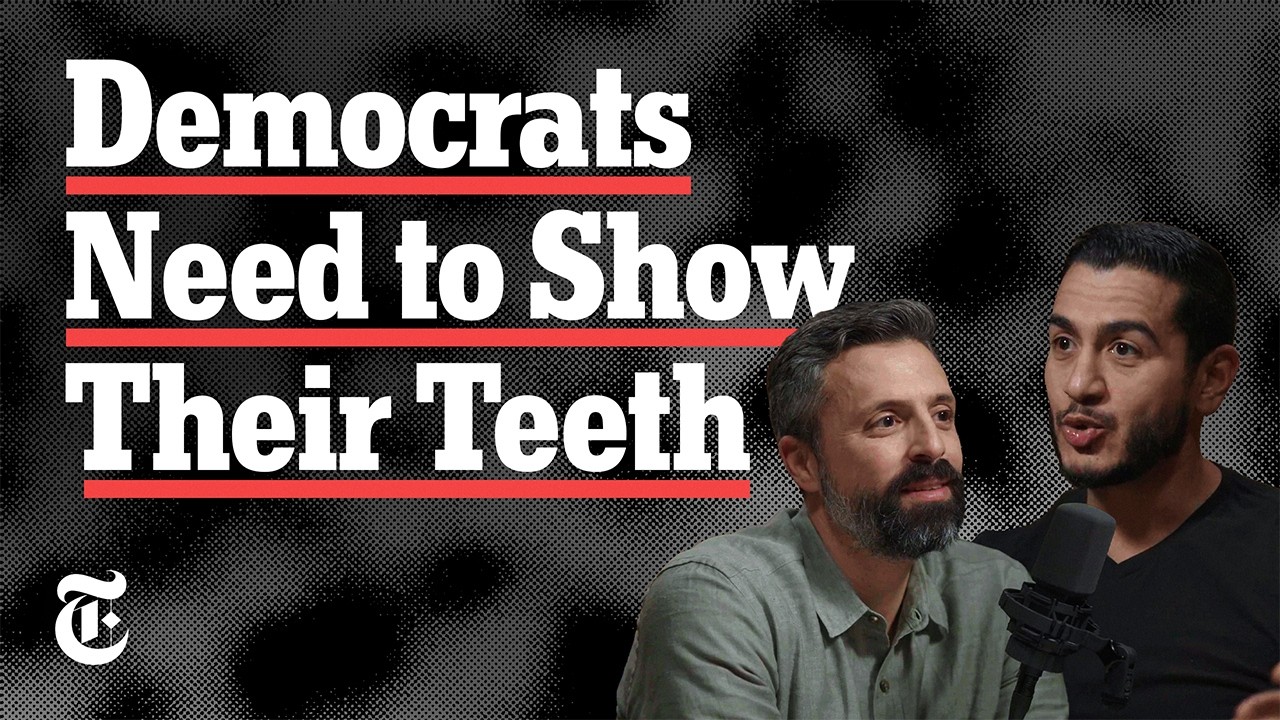
Democrat El-Sayed Targets Pharma Profits, Unconditional Israel Aid
The Ezra Klein Show
Michigan Senate nominee Abdul El-Sayed argues Democrats must dismantle commercial insurer leverage through phased public healthcare expansions and halt unconditional military financing to Israel.
In the high-profile Michigan Democratic Senate primary, external political spending reached historic levels, including $32 million deployed by AIPAC in an attempt to defeat Dr. Abdul El-Sayed over his progressive foreign policy platform. (72:00)
El-Sayed outlines a phased 'Medicare for More' framework that prioritizes fixing traditional Medicare—eliminating deductibles and integrating dental, vision, and hearing coverage—before progressively lowering the eligibility age toward universal coverage. (56:18)
To address skyrocketing drug costs, El-Sayed proposes treating the pharmaceutical sector like Costco by capping manufacturer profit margins at 15 percent over high-risk R&D that is already heavily derisked by public NIH funding. (47:28)
Facing right-wing attacks targeting his Muslim faith and Egyptian heritage, El-Sayed rejects political advice to soften his identity, instead directly challenging cultural grievance politics and redirecting campaigns toward working-class economic relief. (65:39)
Detailed notes
## Background
Published on YouTube by The Ezra Klein Show on September 25, 2026, this episode features an extended conversation with Dr. Abdul El-Sayed, the Democratic nominee for the U.S. Senate in Michigan. According to the episode description, the discussion investigates El-Sayed's personal background, his progressive platform on healthcare reform and Medicare for All, his stance on U.S. foreign policy toward Israel and Gaza, and the broader questions his campaign poses for the future of the Democratic Party in the Rust Belt.
## TL;DR
Dr. Abdul El-Sayed discusses how his family's Egyptian immigrant roots, experiences after 9/11, and clinical work confronting systemic healthcare failures shaped his political philosophy. He outlines a phased strategy for universal healthcare that prioritizes fixing traditional Medicare's benefit gaps before expanding coverage and curbing private industry extraction. Addressing right-wing cultural attacks, El-Sayed argues that progressive populism can succeed in Michigan by staying relentlessly focused on kitchen-table economic hardships like medical debt and corporate gouging. He also calls for a rules-based U.S. foreign policy that applies international law equally, demanding an end to unconditional military aid to Israel while advocating for universal self-determination for both Israelis and Palestinians.
## Atmosphere & style
The conversation is intellectually rigorous, reflective, and deeply personal, matching Ezra Klein's analytical prompting with El-Sayed's articulate, narrative-rich delivery. Even when unpacking emotionally charged topics—such as anti-Muslim prejudice, intense campaign scrutiny, and atrocities in Gaza—the tone remains measured, earnest, and policy-focused rather than rhetorical. Grounded by vivid clinical memories and philosophical reflections on luck and institutional drift, the exchange carries a persistent moral gravity that feels intimate yet urgent.
## Bulletin
- [01:12:00](https://www.youtube.com/watch?v=f7MVyjL-rbk&t=4320s) In the high-profile Michigan Democratic Senate primary, external political spending reached historic levels, including $32 million deployed by AIPAC in an attempt to defeat Dr. Abdul El-Sayed over his progressive foreign policy platform.
- [56:18](https://www.youtube.com/watch?v=f7MVyjL-rbk&t=3378s) El-Sayed outlines a phased 'Medicare for More' framework that prioritizes fixing traditional Medicare—eliminating deductibles and integrating dental, vision, and hearing coverage—before progressively lowering the eligibility age toward universal coverage.
- [47:28](https://www.youtube.com/watch?v=f7MVyjL-rbk&t=2848s) To address skyrocketing drug costs, El-Sayed proposes treating the pharmaceutical sector like Costco by capping manufacturer profit margins at 15 percent over high-risk R&D that is already heavily derisked by public NIH funding.
- [01:05:39](https://www.youtube.com/watch?v=f7MVyjL-rbk&t=3939s) Facing right-wing attacks targeting his Muslim faith and Egyptian heritage, El-Sayed rejects political advice to soften his identity, instead directly challenging cultural grievance politics and redirecting campaigns toward working-class economic relief.
## Key takeaways
- [06:15](https://www.youtube.com/watch?v=f7MVyjL-rbk&t=375s) American identity functions as an ongoing civic negotiation grounded in shared constitutional ideals rather than an ethnic monoculture, contrasting sharply with European models of national belonging.
- [08:31](https://www.youtube.com/watch?v=f7MVyjL-rbk&t=511s) Formative experiences in Alexandria, Egypt, shattered the illusion of meritocracy for El-Sayed, establishing a personal moral mandate to reinvest his unearned structural advantages on behalf of marginalized communities.
- [16:11](https://www.youtube.com/watch?v=f7MVyjL-rbk&t=971s) Navigating the aftermath of September 11 as a young Muslim American illustrated the unfair burden of collective guilt placed on minority communities while solidifying his refusal to compromise his heritage.
- [30:17](https://www.youtube.com/watch?v=f7MVyjL-rbk&t=1817s) Witnessing acute hospital systems act as high-margin billing machines that discharge medically stabilized patients back into unaddressed socioeconomic trauma prompted El-Sayed's pivot from clinical residency to public health.
- [34:25](https://www.youtube.com/watch?v=f7MVyjL-rbk&t=2065s) Fee-for-service reimbursement and administrative requirements restrict physician consultations to hurried eight-minute encounters dominated by insurance billing codes rather than holistic care.
- [40:53](https://www.youtube.com/watch?v=f7MVyjL-rbk&t=2453s) Market-based discipline fails in healthcare because medical care is an inelastic necessity where desperate patients cannot exercise meaningful consumer choice or price discovery.
- [43:07](https://www.youtube.com/watch?v=f7MVyjL-rbk&t=2587s) Insurance deductibles undermine the core purpose of health insurance by stripping away financial protections against catastrophic illness while failing to lower overall systemic costs.
- [45:34](https://www.youtube.com/watch?v=f7MVyjL-rbk&t=2734s) Universal single-payer reform relies on consolidating public monopsony purchasing power to aggressively rein in provider fees and drug prices in ways fragmented private insurers cannot.
- [47:28](https://www.youtube.com/watch?v=f7MVyjL-rbk&t=2848s) Because publicly funded National Institutes of Health research derisks early drug discovery, pharmaceutical companies should be limited to private ownership and a 15 percent profit margin cap over R&D.
- [50:18](https://www.youtube.com/watch?v=f7MVyjL-rbk&t=3018s) El-Sayed advocates for a healthcare system that establishes a comprehensive, high public floor for all citizens while allowing optional private supplemental coverage, similar to public education.
- [56:18](https://www.youtube.com/watch?v=f7MVyjL-rbk&t=3378s) Traditional fee-for-service Medicare must be fixed by eliminating cost-sharing and adding dental, vision, and hearing benefits before expanding eligibility, which prevents commercial insurers from poaching patients via Medicare Advantage.
- [56:46](https://www.youtube.com/watch?v=f7MVyjL-rbk&t=3406s) Incremental healthcare reform must adhere to a strict three-point test: it must cover more people, utilize public dollars, and systematically reduce the structural leverage of commercial insurers.
- [01:05:39](https://www.youtube.com/watch?v=f7MVyjL-rbk&t=3939s) Right-wing smears targeting immigrant and religious identities are best defeated by directly confronting political bullies and anchoring discourse to bread-and-butter economic issues like rent, groceries, and medical debt.
- [01:12:00](https://www.youtube.com/watch?v=f7MVyjL-rbk&t=4320s) U.S. foreign policy must consistently apply international human rights law to all sovereign states and non-state actors alike rather than offering unconditional diplomatic and financial shielding to allies.
- [01:24:56](https://www.youtube.com/watch?v=f7MVyjL-rbk&t=5096s) Unconditional military subsidies to foreign governments create severe moral hazards, insulating foreign leadership from having to pursue the difficult democratic compromises required to achieve lasting peace.
- [01:29:00](https://www.youtube.com/watch?v=f7MVyjL-rbk&t=5340s) Effective political leadership requires speaking 'truth to pain,' acknowledging deep-seated collective and generational traumas so defensive reflexes do not prevent vital systemic interventions.
## Detailed walkthrough
### [00:00](https://www.youtube.com/watch?v=f7MVyjL-rbk&t=0s) The Stakes of the Michigan Senate Race
Ezra Klein frames the Michigan Senate contest between Democratic nominee Dr. Abdul El-Sayed and Republican Mike Rogers as one of the pivotal battlegrounds defining the future of the Democratic Party. The race operates as a testing ground for several fundamental ideological questions: whether left-wing populism can succeed across the post-industrial Rust Belt, what the next horizon of Democratic healthcare policy should look like—whether defending the Affordable Care Act, pushing for full "Medicare for All," or settling on "Medicare for More"—and how the party must navigate its relationship with Israel and the Palestinians.
Despite being up by several points in most polls, El-Sayed has become one of the cycle's most scrutinized, clipped, and debated candidates. Seeking to cut through the campaign trail noise and online outrage, Klein introduces the conversation as an effort to understand El-Sayed's background, core philosophy, and specific legislative agenda for the United States Senate.
[01:01](https://www.youtube.com/watch?v=f7MVyjL-rbk&t=61s) Family Roots: From Alexandria to Michigan
El-Sayed traces his lineage back to Alexandria, Egypt, where his family faced profound poverty and systemic hardship. His paternal grandmother, whom he regards as the wisest person he ever knew, never received a formal education and gave birth to eight children, two of whom died before their first birthdays. El-Sayed’s father, the eldest child, watched two siblings die before he reached age five—a grief so deep that El-Sayed had only seen his father cry twice in his life: once when his grandmother died, and once while recounting the death of his sibling on a podcast episode examining infant mortality. His paternal grandfather sold vegetables in an Alexandrian fish market with only an eighth-grade education, while El-Sayed's father studied at night on the building rooftop, reading engineering textbooks under the glow of a streetlamp across the street.
Everything changed with the passage of the Immigration and Nationality Act of 1965, which dismantled national-origin quotas and allowed El-Sayed’s father to immigrate to the United States in 1978. He attended Wayne State University, trained as an automotive engineer, and laid the foundation for his family's opportunities in Michigan. El-Sayed's mother, trained as a physician in Alexandria, joined him a few years later. Following their divorce when Abdul was three years old, his father married Jackie, a member of the Daughters of the American Revolution who traces her lineage directly back to Abigail Adams. Raised in mid-Michigan by an Egyptian immigrant father and a stepmother rooted in the American Revolution whose parents were a General Motors Institute-trained engineer and a Flint nurse, El-Sayed spent his childhood learning to "code translate" between two radically different cultural worlds.
```mermaid
flowchart TD
accTitle: Abdul El-Sayed Family Background
accDescr: Flowchart illustrating Abdul El-Sayed's dual family lineage merging into his upbringing in Michigan.
subgraph PaternalLine["Egyptian Heritage"]
A["Grandfather (Fish market vendor)"] --> B["Mohamed El-Sayed (Alexandria)"]
B -- "1965 Act / Emigrates 1978" --> C["Wayne State University Engineer"]
end
subgraph MaternalLine["Early American Heritage"]
D["Lineage tracing to Abigail Adams"] --> E["Mid-Michigan Family (Flint Nurse & GMI Engineer)"]
E --> F["Jackie (Stepmother, DAR)"]
end
C & F --> G["Household of Mohamed & Jackie"]
G --> H["Abdul El-Sayed: Childhood of 'Code Translating'"]
```
- **Family adversity**: His father witnessed two of his infant siblings die before age five due to poor healthcare access in Egypt.
- **Upbringing**: Raised in Michigan between his father, Mohamed, who initially saw his stay in the United States as temporary, and his stepmother, Jackie, whose family had lived in the country for centuries.
[03:37](https://www.youtube.com/watch?v=f7MVyjL-rbk&t=217s) Student Activism and the Meaning of American Freedom
Before leaving Egypt, El-Sayed’s father was a prominent student activist and teaching assistant pushing for basic democratic freedoms under a military dictatorship. In the Egyptian educational system, national exam rankings funneled top students into medicine or engineering, while students near the bottom of the list were directed into the military—meaning the country’s ruling class was drawn from its poorest academic performers. Mohamed El-Sayed was vocal about the absurdity of this system and the total absence of free speech. After facing escalating harassment from university authorities and state security, he chose to emigrate to the United States so he could speak his mind openly.
That devotion to civic participation left a profound mark on young Abdul. When his father was naturalized as a U.S. citizen, the young boy humorously wondered whether naturalization meant his father would suddenly become blonde, blue-eyed, and lose his accent overnight. His stepmother clarified the reality of American civic life: citizenship was neither racial nor linguistic, but a sworn commitment to democratic ideals, constitutional rights, and personal freedoms.
- **Immigration timeline**: Arrived in the U.S. in 1978; Abdul was born six years later in 1984.
- **Father's core motivation**: A fundamental desire to live in a society where one could speak freely without fear of state retribution.
- **The naturalization lesson**: A realization that "nothing about him changed, but everything about him changed"—his identity stayed intact while his rights and civil horizons expanded completely.
[06:15](https://www.youtube.com/watch?v=f7MVyjL-rbk&t=375s) Redefining American Identity Across Cultures
Klein shares his own experience watching his Brazilian-born father undergo naturalization, observing the profound and peculiar line that citizenship draws. Reflecting on this, El-Sayed argues that the United States is exceptional precisely because it lacks a monolithic ethnic or religious foundation; it is held together by an evolving national and civic identity. He recounts how this distinction crystallized for him during graduate school in the United Kingdom, where third-generation British-born youths of Pakistani descent insisted to him that while they held UK passports, they could never truly be "British" because the culture reserved that label for an ethnic in-group.
By contrast, El-Sayed views the American project as an ongoing civic negotiation to broaden the definition of who belongs. Even though exclusionist movements periodically attempt to shrink the boundaries of American identity, the country possesses both the legal mechanisms and the cultural capacity to absorb differences into something greater than the sum of its parts. He jokes that despite living outside Egypt for two decades, his father still speaks with a thick accent, yet watching him root for the Detroit Lions on a Sunday reveals an unmistakably American life—one made possible because he can voice whatever opinion he holds without risk.
[08:31](https://www.youtube.com/watch?v=f7MVyjL-rbk&t=511s) A Formative Return to Egypt
When El-Sayed was 13 years old, his parents sent him to Egypt for the summer in the care of another family, eager for him to grasp the language, appreciate the depth of his extended family, and recognize the privilege of the opportunities he enjoyed in America. He had not returned to the country since he was a toddler. Stepping off the plane, he was greeted at the airport by a large gathering of grandparents, aunts, uncles, and cousins who represented his own flesh and blood.
Traveling with two suitcases—one containing his clothes for the summer and the other filled with consumer gifts for relatives—the journey triggered a sharp awakening. Having spent his early childhood in Michigan acutely aware of his difference, his unusual name, and his heritage, arriving in Alexandria placed him in immediate contrast with cousins whose lives were shaped by an entirely different economic and political system.
[10:00](https://www.youtube.com/watch?v=f7MVyjL-rbk&t=600s) The Egyptian "Santa Claus" and the Accident of History
Growing up in the United States, Abdul El-Sayed was acutely conscious of his skin color and the perpetual need to explain himself to others. He had imagined that visiting family in Egypt would offer an escape where explanation was unnecessary, only to discover that he had to explain himself just as intensely—often to himself—as he confronted differences not merely in material conditions, but in how life was valued and processed. During one memorable summer trip, feeling proud after handing out gifts like an adolescent "American Santa Claus," his grandmother pulled him aside for a blunt reality check. She pointed out one cousin who was smarter, another who was taller and better looking, one who worked harder, another who was nicer, and another who was far more athletic. When he finally asked her what he had going for him, she replied: "You get to go back to America at the end of the summer. The rest of your cousins stay here."
That sobering interaction reshaped his worldview. Spending that four-month summer living the daily life he would have lived "before the accident of history" that allowed him to be born in the United States, El-Sayed came away with a profound realization: effort does not guarantee reward everywhere. His father had tried to impress this upon him, but seeing cousins who were brilliant and hardworking remain trapped by their circumstances dispelled any illusion that talent alone dictated outcomes. He realized that privilege stripped away any right to simply coast through life. Because his grandmother had possessed immense intelligence and work ethic yet never received the opportunities he took for granted, he came to view public service through a singular ethical imperative: "to take whatever opportunity you had, put all the chips back in the middle of the table to make sure you're building opportunity for the folks who don't have it."
[13:12](https://www.youtube.com/watch?v=f7MVyjL-rbk&t=792s) Luck, Moral Responsibility, and the Trap of Institutions
For El-Sayed, one of the most foundational cleavages in politics hinges on whether a person believes success, failure, and struggle are determined by merit or by luck and circumstance—fundamentally, whether people truly "deserved it or not." Having had a front-row seat to the alternative life he might have led—exemplified by a cousin who was just as capable but died in a car accident at 27 while driving a cab—he rejects the myth of pure meritocracy. Whenever he contemplates whether he is doing the right thing, his touchstone is what his grandmother would advise. Unlike people shaped by modern society, she had never spent a single day inside an institution, leaving her moral clarity unwarped by bureaucratic self-preservation.
```mermaid
flowchart TD
accTitle: Institutional Pressures vs Moral Autonomy
accDescr: Diagram illustrating how institutions warp individual ethics compared to an uninstitutionalized moral compass.
subgraph InstitutionalTrap["The Institutional Track"]
A["Preschool to Higher Ed"] --> B["Internalized Incentives & Shiny Objects"]
B --> C["Institutional Drift: Donors & Endowments"]
C --> D["Moral Collapse Under Pressure"]
end
subgraph MoralClarity["The Moral Counterweight"]
E["Grandmother's Reality Check"] --> F["Accident of History Awareness"]
F --> G["Put Chips in Center: Serve the Excluded"]
G --> H["Challenging Institutional Incentives"]
end
```
El-Sayed argues that modern life inducts people into institutions from preschool onward, subtly bending their ethical compasses around institutional survival and dictating the "shiny objects" they ought to pursue. While early schooling aligns institutional obedience with basic morality, elite institutions—particularly universities—have recently shown their moral fragility under political and financial pressure. Instead of acting as independent moral arbiters, they collapse into maximizing donor engagement and accumulating the largest possible endowment. El-Sayed insists that the defining civic question today is not how well one complies with institutional incentives, but when one finds the courage to challenge them. In a perverse way, he observes, Donald Trump acts as a mirror to this systemic weakness: by operating with pure narcissistic disregard for norms, Trump exposed how utterly powerless these self-satisfied institutions really are when confronted with an actor who refuses to play by their rules.
- **The accident of birth:** Encountering cousins who worked harder and had equal or greater talent, including a cousin killed at age 27 driving a cab in Egypt, permanently shattered any belief that success is purely earned.
- **The institutional critique:** Modern institutions substitute their own preservation and fundraising metrics for ethical substance, requiring individuals to actively resist institutional drift rather than equating institutional praise with doing good.
[16:11](https://www.youtube.com/watch?v=f7MVyjL-rbk&t=971s) Growing Up with Beloved Names: Abdul, Osama, and September 11
When Ezra Klein notes their shared age and asks about navigating high school during September 11, El-Sayed recounts the cultural comedy and eventual heartbreak tied to his family’s naming traditions. Before his birth, his parents contemplated moving back to Egypt and gave him one of the three traditionally beloved names in Islam: Abdulrahman (alongside Muhammad and Abdullah). Following his parents' divorce, he stayed in the United States, raised by his father and his stepmother, Jackie, whom he also calls mom. Ahead of kindergarten, realizing "Abdulrahman" would be an arduous mouthful for American classmates, Jackie gingerly broached the subject with his father. Because Paula Abdul was topping the billboard charts with "Straight Up" and Kareem Abdul-Jabbar had just retired from the NBA, they settled on the familiar, digestible nickname "Abdul."
```
Tradition: Beloved Islamic Names
├── Muhammad
├── Abdullah
└── Abdulrahman ──► Trimmed to "Abdul" (1980s: Paula Abdul & Kareem Abdul-Jabbar)
Sibling Born in 1992:
└── Designed for Simplicity: "Sam with an O on the front and an A on the back" ──► Osama
```
By 1992, wanting to make life even easier for his younger brother, his parents constructed what they believed was a foolproof, phonetic American name: "Sam with an O on the front and an A on the back"—Osama. "And then that guy in Saudi Arabia went and ruined it," El-Sayed quips. When the planes hit the Twin Towers on September 11, 2001, El-Sayed watched the horror unfold on the wall-to-wall television news broadcast in his home. His mother rushed to the local elementary school to pull young Osama out of class and called to offer Abdul a ride home as well. Abdul, then a high school junior, refused. Aware of how few Muslim students attended his school and sensing immediately that the cultural atmosphere had turned hostile, he chose to stay on campus until the final bell just to stand watch and ensure the other Muslim students remained safe.
[19:03](https://www.youtube.com/watch?v=f7MVyjL-rbk&t=1143s) 9/11, Collective Blame, and an Elementary Schooler Named Osama
In the aftermath of September 11, Abdul El-Sayed experienced a profound rupture in his sense of safety and belonging. People confronted him directly, asserting, "Well, your people did this." When he asked what they meant, the answer was simply repeated: "Your people did this, right?" For El-Sayed, the defining feeling was an overwhelming loss of innocence—grappling with the reality that commercial airplanes intended for travel could be turned into weapons against the country, and that events occurring thousands of miles away could fundamentally derail daily life. Overnight, he was thrust into a position of having to constantly explain and answer for himself. He realized that as a Muslim American, "when you do something, you don't just represent you. You represent everybody who looks like you and everybody who prays like you."
Amid that climate of suspicion, El-Sayed watched his younger brother, who was only in elementary school at the time, demonstrate extraordinary resilience. When family members or acquaintances gently suggested that they could just change his name to "Sam" to make his life easier, the young boy pushed back with quiet defiance: "No, my name’s Osama. I didn't do anything wrong and I like my name and I’m going to go by Osama." To this day, he still goes by Osama—a principled stance that El-Sayed remembers with intense pride as part of a broader crucible forcing their family to ask, "Who are we and who do we want to be?"
[20:13](https://www.youtube.com/watch?v=f7MVyjL-rbk&t=1213s) The Insider-Outsider Paradox: Bill Clinton and the Rhodes Scholarship
Ezra Klein notes a striking paradox running through El-Sayed's memoir: an intense insider-outsider navigation of elite American institutions. On one hand, El-Sayed faced overt, stinging racism, having his name anglicized as a young child entering school and being subjected to racial slurs on the football field. On the other hand, he attained the absolute pinnacle of institutional success: he served as the captain of three varsity sports teams in high school, delivered the senior commencement address at the University of Michigan, and went on to win a Rhodes Scholarship to study at Oxford.
```mermaid
flowchart TD
accTitle: The Insider-Outsider Duality
accDescr: Diagram illustrating Abdul El-Sayed's simultaneous status at the heights and margins of American institutions.
subgraph Outsider["Outsider Experience"]
O1["Racial slurs on the football field"]
O2["Forced to justify identity after 9/11"]
O3["Early pressure to anglicize name"]
end
subgraph Insider["Institutional Pinnacle"]
I1["High school 3-sport team captain"]
I2["U of Michigan commencement speaker"]
I3["Rhodes Scholar at Oxford"]
end
Outsider <-->|"Dual Navigation"| Insider
```
His 2007 commencement speech at Michigan was so compelling that former President Bill Clinton, who was in attendance, stopped to single him out for extraordinary public praise:
> "I don't want to embarrass your senior speaker, but I wish every person in the world who believes that we are fated to have a clash of civilizations and cannot reach across the religious divides could have heard you speak today. I just wish every person in the world could have heard you speak today."
Privately, Clinton took El-Sayed aside and told him that he should run for public office. Klein pushes El-Sayed to explain how he reconciled moving through these prestigious corridors while simultaneously being targeted as an alien and an outsider.
[21:50](https://www.youtube.com/watch?v=f7MVyjL-rbk&t=1310s) Wrestling, Pure Meritocracy, and When the Rules Break Down
El-Sayed explains that his journey through childhood and schooling was anchored by athletics. His academic performance was originally driven by a strict household rule enforced by his father: "If you slip below an A, you don't play." Because playing sports was what he loved most, he kept his grades up so he could stay on the field and on the mat. For El-Sayed, sports—and wrestling in particular—represented a sacred, uncorrupted meritocracy. On the wrestling mat, two competitors square off under completely equal constraints: bounded strictly by weight classes, with identical, minimal equipment, stripped of external privilege, testing whether one person can pin the other before getting pinned themselves. "To this day," El-Sayed remarks, "I think I've never done a purer thing."
When he arrived at the University of Michigan, El-Sayed realized that he enjoyed thinking even more than running, and he applied that same athletic work ethic, discipline, and training regimen to his academic studies. Yet as he climbed higher into elite spaces, he began to see the clear boundaries where genuine meritocracy ended. He recognized that the mechanisms dictating who is invited in and who is kept out are rarely transparent or fair:
- **Unwritten Rules**: Unlike athletic matches, institutional access is governed by opaque social codes rather than clear scoreboards or sheer capacity.
- **The "Emperor Has No Clothes" Reality**: Elite credentials arbitrarily attribute superior intellect, virtue, or work ethic to people simply because they occupy prestigious rooms, ignoring countless talented individuals excluded by circumstance.
- **Power Imbalances**: Those inside elite institutions often comfortably wield immense authority against the excluded, reinforcing inequities under the guise of merit.
[25:00](https://www.youtube.com/watch?v=f7MVyjL-rbk&t=1500s) From the Clinic to the System: The Turn to Public Health
Klein observes that El-Sayed’s thinking naturally gravitates toward structural critique, institutions, and systemic conditions rather than individual-level explanations. He asks what prompted El-Sayed, while training as a physician, to pivot away from direct clinical care toward public health and the social determinants of health.
El-Sayed emphasizes that he genuinely loved clinical medicine. He found the patient-physician relationship to be a sacred gift: individuals show up on their worst days, bring their most agonizing vulnerabilities, and place their trust in the doctor’s hands. However, he quickly grew deeply disillusioned when he realized the healthcare system systematically refused to provide physicians with the actual tools required to heal people. If a provider's fundamental goal is ensuring that all human beings can live long, healthy lives, practicing within an institution that hamstrings care based on socioeconomic status produces immense moral injury and frustration.
[26:44](https://www.youtube.com/watch?v=f7MVyjL-rbk&t=1604s) The "Wallet Biopsy" at the Satellite Hospital
El-Sayed's frustration crystallized during a sub-internship rotation at a small satellite hospital at the northern tip of Manhattan, which primarily served marginalized patients from upper Manhattan and the Bronx. Early one morning, a woman arrived in the emergency room after suffering a bad fall on subway stairs. She had an obvious, growing welt on her head, was visibly intoxicated, and was agitated and yelling. Despite the severe blunt-force trauma to her head, the emergency medicine resident had not ordered a head CT scan—the standard, indispensable diagnostic step to rule out a fatal intracranial hemorrhage.
When El-Sayed confronted the resident to ask what the CT scan showed, the resident looked at him with pity and dismissed the patient as a "social admit." As Klein notes, this is the classic industry euphemism for a "wallet biopsy": an assessment that admitting an underinsured, complex patient will burden the hospital with thorny social service issues, generate no profit, and create discharge headaches. Refusing to let the woman die of an untreated brain bleed, El-Sayed bypassed the ER staff and called his attending physician to demand her admission and a comprehensive workup. Once admitted, the full scope of the system's neglect became glaringly evident:
- The patient had advanced, full-blown AIDS and an undiagnosed pelvic mass.
- She was suffering from active internal bleeding.
- Her blood sugar levels were swinging wildly out of control due to opportunistic HIV infiltration of her adrenal glands.
[28:57](https://www.youtube.com/watch?v=f7MVyjL-rbk&t=1737s) The Discharge Decision and the Limits of the Hospital
After two weeks of acute inpatient care, Dr. Abdul El-Sayed and the hospital’s social work team felt they had pulled off a rare logistical victory. Despite a lifetime of severe hypertension, the patient now presented with low blood pressure because the hormonal system regulating it was completely exhausted. Because of her HIV-positive status, options were scarce, but the team managed to secure a spot at the only rehabilitation facility that would accept HIV-positive patients, while also arranging Ryan White program housing for her post-discharge. Having walked her through the plan repeatedly, El-Sayed arrived on discharge day ready to see her off, only to be met with flat refusal: "I'm not doing that."
When pressed, the patient revealed she had reconnected with her daughter and planned to go home with her instead. When El-Sayed asked what had caused their previous estrangement, she admitted she had started drinking. Reminding her of her precarious sobriety, El-Sayed pushed back gently, pointing out that her two weeks without alcohol were only possible because the medical team had maintained her on a chemical benzodiazepine taper. The confrontation came to an abrupt head when the patient pushed back with fierce defiance: "Don't tell me what to do. You're not better than me." Conceding that she was entirely right about her autonomy, El-Sayed had no choice but to let her leave.
[30:17](https://www.youtube.com/watch?v=f7MVyjL-rbk&t=1817s) The Encounter on the A Train and Walking Away from Residency
A couple of weeks later, having just submitted his medical residency applications, El-Sayed boarded the downtown A train toward Columbus Circle on his way to meet a friend at a Turkish restaurant. Walking into the subway car, he experienced what he describes as an absolute "gut punch": his former patient was stretched out flat across the subway seats, unconscious. He went over and shook her gently to check her breathing. She was alive, but completely passed out, and had no recollection of who he was.
That encounter on the train became an instant referendum on El-Sayed's entire planned clinical career. That night, after dinner, he went home and formally withdrew his residency application. The realization stung deeply because the cynical resident who had dismissed the case on day one had been proven right: the modern American medical system simply is not engineered to rescue people facing compounded systemic trauma. If it were a just system, it would be built precisely for patients like her.
```mermaid
flowchart TD
accTitle: Divergence of Clinical Care and Upstream Realities
accDescr: Diagram illustrating how clinical discharge back into unaddressed socioeconomic failure leads to recidivism and career reconsideration.
subgraph AcuteCare["Inpatient Hospital Stay"]
A["2-Week Medical Stabilization<br/>(Benzodiazepine taper, social work)"] --> B["Discharge Plan Arranged<br/>(HIV-specialized rehab & Ryan White housing)"]
B -.->|"Patient refuses care plan<br/>Leaves with estranged daughter"| C["Discharge to Street / Home"]
end
subgraph SocietalFailure["Unaddressed Upstream Reality"]
C --> D["Untreated Addiction & Trauma"]
D --> E["Passed out on the A Train"]
end
subgraph Epiphany["Career Turning Point"]
E --> F["Recognition: System is a 'billing machine',<br/>not built for the most vulnerable"]
F --> G["Withdraws Residency Application<br/>Pivots to Public Health & Policy"]
end
```
[31:21](https://www.youtube.com/watch?v=f7MVyjL-rbk&t=1881s) "Billing Machines" and the Hospital on the Hill
Ezra Klein pushes on this anecdote, noting that a skeptic might view this as personal agency or unavoidable bad luck: the state and the hospital expended immense financial resources over two weeks, taxpayers footed the bill, and the patient simply refused help. El-Sayed counters that this perspective ignores the compounding trauma and learned helplessness inflicted over a lifetime. This was a Black woman who had dropped out of school in the eighth grade, had been abused by her mother's boyfriend as a child, and fell into alcohol dependence. After decades of bureaucratic abandonment, she had no reason to trust a doctor promising that everything was finally taken care of.
The tragedy, El-Sayed explains, is that while hospitals historically began as places of refuge and mercy, they have evolved into massive financial billing operations. He illustrates this sharp inequality through the geography of New York-Presbyterian Hospital. Down the street or a few floors up from where indigent patients cycle through, the hospital's elite pavilion features carpeted suites—a terrible choice for infection control, he notes wryly—and live pianists serenading wealthy domestic and international elites flying in for world-class surgeries. The contemporary healthcare system no longer exists primarily to relieve suffering; it operates as an engine for minting capital.
- **Upstream drivers neglected by acute care**:
- Deep underfunding of public schools lacking paraprofessionals and support for students with special needs.
- Absence of vocational training and non-college career pathways, such as apprenticeships.
- Lack of capital and small-business investments in historically marginalized neighborhoods.
- Severe scarcity of long-term community mental health and substance abuse infrastructure.
[34:25](https://www.youtube.com/watch?v=f7MVyjL-rbk&t=2065s) The Eight-Minute Encounter and Moral Injury
When Klein asks what El-Sayed believed he could actually change by leaving clinical practice, El-Sayed points directly to the fundamental mismatch between patient need and the economics of clinical practice. In a clinical setting, patients often summon immense courage to reveal their deepest shame, pain, or social distress. Physicians enter the field desperately wanting to help them, but they are trapped within an assembly-line schedule dictated by volume and reimbursement codes.
Doctors find themselves rationing an eight-minute appointment: taking one minute to absorb a devastating disclosure, and leaving seven minutes to churn through a list of seven complex chronic conditions. The interaction ends with the patient feeling dismissed and saddled with an exorbitant bill, while the physician spends uncompensated time altering documentation language so insurance claims aren't denied. The process breeds cynicism on both sides while enriching billing intermediaries, hospital conglomerates, and insurers.
[36:45](https://www.youtube.com/watch?v=f7MVyjL-rbk&t=2205s) The Broken Financial Dynamic of American Healthcare
Transitioning to El-Sayed’s national profile as a leading single-payer advocate and author of a book on Medicare for All, Klein asks what makes American healthcare uniquely dysfunctional when compared to peer industrialized nations. El-Sayed explains that the foundational error lies in treating the patient as a "customer" within an ordinary consumer market.
In reality, when an American falls ill, they are not a sovereign consumer shopping for goods. Instead, the patient is merely the passive catalyst for a high-stakes financial transaction negotiated between two massive corporate entities: the insurance provider and the healthcare delivery system. Every single player involved in that transaction—except the sick individual lying on the exam table—operates with a direct financial incentive to maximize revenue extraction, while the patient holds zero leverage and absorbs the financial consequences.
[38:10](https://www.youtube.com/watch?v=f7MVyjL-rbk&t=2290s) The Extraction Machine: How Private Health Insurance Fails Patients
Abdul El-Sayed breaks down the structural pathology of the American healthcare status quo, explaining that every single corporate entity in the chain is financially incentivized to maximize its own revenue at the patient's expense. Clinics and hospitals make money by performing procedures and billing for care. Pharmaceutical and medical device companies make money whenever a patient consumes their products, whether during an inpatient procedure or as a maintenance prescription. Insurers profit by collecting as much in premiums as possible while paying out as little for actual medical treatment as they can manage. The inevitable result is an ecosystem devoid of any structural incentive to prioritize patient well-being: "There is no perfect solution to any human problem. But if you were to design a system that was maximally painful for the patient, it would be this one because you're getting extracted from at every level."
```mermaid
flowchart TD
accTitle: The Private Healthcare Extraction Cycle
accDescr: Flowchart illustrating how paycheck deductions, deductibles, network cartels, and claims churn extract wealth from patients.
subgraph Paycheck ["Paycheck Deductions"]
A["W-2 Paycheck"] --> B["FICA / Uncle Sam Takes Cut"]
B --> C["Private Insurance Premium Deducted"]
end
subgraph OutOfPocket ["Point of Care Extraction"]
C --> D["Pay Out-of-Pocket Deductible"]
D --> E["Restricted Provider Network"]
end
subgraph Administration ["System Friction"]
E --> F["Denied Claims & Administrative Churn"]
F --> G["Shrinking Clinical Face Time"]
end
```
To illustrate the visceral reality of this extraction, El-Sayed walks through the ordinary financial routine of an American worker, using Ezra Klein's status as a W-2 employee at *The New York Times* as a concrete example. Before a worker even sees their earnings, the federal government takes its share via FICA taxes. Immediately following Uncle Sam, the health insurance company extracts a hefty biweekly or monthly premium shared between employer and employee. Yet despite surrendering that cash every pay period, workers are still saddled with high deductibles—meaning they must forfeit another full paycheck or more out of pocket just to access the care they already paid to secure. On top of that financial drain, patients are trapped inside opaque, artificially restricted provider networks shaped by corporate consolidation:
- **Consolidation cartels:** Insurance conglomerates and hospital systems engage in opaque backroom bargaining to swallow competitors and carve out sweetheart network deals, locking patients into narrow pools of doctors.
- **Administrative churn:** When a patient falls ill and a bill arrives, the insurer's core financial motive to deny coverage forces the patient into exhausting bureaucratic disputes just to get legitimate claims paid.
- **Erosion of clinical care:** Doctors and providers cope with endless administrative friction and billing battles by slashing the amount of face-to-face time they can afford to spend with each human being.
[40:53](https://www.youtube.com/watch?v=f7MVyjL-rbk&t=2453s) Ezra Klein’s Devil’s Advocate: Profit, Innovation, and Market Discipline
Ezra Klein intervenes to push back as a devil's advocate, arguing that identifying the profit motive as the root cause of healthcare dysfunction is insufficient. In almost every sector of a market economy—such as a neighborhood supermarket selling groceries at a markup—businesses operate strictly for profit, yet customers walk away fed and satisfied. In theory, private market competition in healthcare is supposed to drive breakthrough pharmaceutical discoveries, produce advanced medical devices, and incentivize hospitals and health plans to compete for business by delivering better quality and service. To an extent, the United States does possess an extraordinarily innovative biomedical sector, but market discipline fails to function where it matters most.
Klein identifies three distinct breakdowns that prevent market mechanics from delivering acceptable outcomes in American healthcare:
1. **Runaway prices over market savings:** Rather than driving prices downward through competitive pressure, the American system produces unit prices for medical care and prescription drugs that dwarf those in every other developed nation.
2. **The illusion of market efficiency:** The discipline of the marketplace has completely failed to streamline healthcare delivery or trim wasteful overhead, leaving administrative bloat at historic highs.
3. **Healthcare as an inelastic "weird good":** Unlike discretionary retail items, emergency medical care renders consumer sovereignty moot. As Klein puts it, while a consumer might spend weeks researching laptops or walk out of an apparel shop if they dislike the jackets, "My kid's sick and we're in the ER. I don't go down the street."
[43:07](https://www.youtube.com/watch?v=f7MVyjL-rbk&t=2587s) Healthcare as a "Weird Good" and the Fallacy of Deductibles
El-Sayed agrees with Klein's assessment of healthcare as an unusual commodity, noting that "nobody actually wants healthcare. They want health." Because a person facing a medical emergency has no choice but to do whatever it takes to survive, unregulated markets inevitably invite price gouging unless strong counter-institutions intervene. El-Sayed explains that traditional insurance mechanisms are fundamentally ill-suited for healthcare. Homeowners insurance works because a catastrophic house fire is a rare, unpredictable contingency that most policyholders will never experience. Healthcare, by contrast, is a universal certainty: every human being will inevitably require medical care over their lifetime, differing only in timing, frequency, and severity.
This structural mismatch reveals the inherent absurdity of cost-sharing mechanisms like deductibles in modern private plans:
- **The death of insurance value:** "The moment somebody created a deductible, the idea of private health insurance became useless." If a patient is guaranteed to get sick and must bear thousands of dollars in out-of-pocket deductibles before coverage begins, the policy completely fails its singular purpose—insulating families from catastrophic financial ruin.
- **Pharma production vs. insurance rent-seeking:** While pharmaceutical companies can legitimately point to tangible R&D and physical products—even if they exploit century-old discoveries or price gouge exorbitantly—private health insurers produce no tangible innovations whatsoever.
- **Pure bureaucratic extraction:** Health insurance intermediaries exist primarily to scoop capital off the top, neither curing illness nor providing genuine financial security when medical crises strike.
[45:34](https://www.youtube.com/watch?v=f7MVyjL-rbk&t=2734s) Bargaining Power and the Provider Price Problem
Ezra Klein challenges El-Sayed's assertion that Medicare for All is merely a reform of the insurance financing side rather than the provider side. Klein stresses that the true fiscal engine of single-payer reform lies in creating an immense, monopsonistic federal payer capable of dictating provider fees and suppressing artificially inflated prices. Without aggressively slashing what hospitals charge for services like MRIs or what pharmaceutical giants like Eli Lilly charge for blockbuster medications like tirzepatide (Mounjaro/Zepbound), an expansive universal benefit—such as the plans championed by Senator Bernie Sanders—would be mathematically unaffordable.
Klein emphasizes that peer nations such as Canada, the United Kingdom, and France do not simply have different insurance setups; their governments actively negotiate substantially lower per-service and per-drug fees across the board. The traditional policy counter-argument is the risk to innovation, rooted in the idea that the rest of the world effectively free-rides on America's astronomical drug spending to fund global pharmaceutical discovery. Private insurers fail consumers precisely because they lack the leverage and motivation to rein in provider costs. El-Sayed acknowledges that while Klein's analysis accurately reflects the systemic, macro-level economics of cost containment, it overlooks the paramount human reality: for the average working-class person, replacing bureaucratic denial with guaranteed, universal coverage at the point of care represents a transformative moral and political baseline.
[47:28](https://www.youtube.com/watch?v=f7MVyjL-rbk&t=2848s) Why Pharma Should Be Like Costco
Ezra Klein and Abdul El-Sayed pivot to the economics of drug development, with El-Sayed offering an unexpected corporate role model: Costco. El-Sayed confesses to being an admirer of the warehouse giant—joking about his affinity for "me and Kirkland"—specifically because the company caps its profit margins at no more than 15 percent on any item. He argues that the modern pharmaceutical industry could operate on a similar principle. Taxpayers already shoulder the burden of the riskiest foundational research through the National Institutes of Health (NIH), which derisks almost every prescription drug that eventually reaches the market.
Instead of allowing drugmakers to chase astronomical stock market valuations, El-Sayed envisions a regulatory landscape that restructures their incentives. If pharmaceutical companies were barred from trading publicly, kept private, and allowed a guaranteed 15 percent profit margin over their R&D costs for a 20-year exclusivity period—followed by aggressive competition from robust publicly funded generics—innovation would persist without crippling prices. While Klein points out that even with public NIH seed funding, private companies take on massive clinical-trial failure rates before bringing a drug to market, El-Sayed maintains that the current system's hyper-focus on Wall Street performance distorts genuine medical progress.
- **Costco Margin Benchmark:** Capping product margins at 15% above R&D costs to ensure steady, predictable returns without price gouging.
- **NIH Derisking:** Public funding already finances the riskiest, early-stage scientific research behind nearly every breakthrough drug.
- **Structural Corporate Reform:** Transitioning pharmaceutical firms from publicly traded equities to private entities disciplinable by generic manufacturing.
---
[50:18](https://www.youtube.com/watch?v=f7MVyjL-rbk&t=3018s) Setting a Floor Versus Setting a Ceiling
Klein challenges El-Sayed on how single-payer should actually be structured, distinguishing between systems that merely set a guaranteed baseline versus those that outlaw private alternatives. In some countries, such as Canada, private health insurance is strictly restricted, effectively imposing both a universal floor and a regulatory ceiling. In contrast, systems like France provide universal public coverage alongside supplemental private options. Klein asks whether El-Sayed envisions a system where everyone is restricted to "Costco for everyone"—with no Trader Joe's, Target, or Walmart—or one with room for private add-ons.
```mermaid
flowchart TD
accTitle: Single-Payer Floor vs Ceiling Models
accDescr: Visualizing the difference between a restrictive ceiling model and El-Sayed's high floor public education model.
subgraph Restrictive["Floor and Ceiling (e.g., Canada)"]
A1["Universal Public Coverage"] --> B1["Private Insurance Prohibited / Constrained"]
end
subgraph HighFloor["High Floor Model (El-Sayed / France)"]
A2["Universal Public Baseline (Medicare)"] --> B2["Comprehensive Core Benefits"]
B2 -. Optional Supplemental.-> C2["Private Top-Up Insurance"]
end
```
El-Sayed emphatically embraces the floor-only model, comparing universal healthcare to the American public school system. Every resident pays taxes into local public schools and is guaranteed an education there, but families remain free to opt into private schooling if they choose. The objective of Medicare for All, he argues, is "to build a floor so high that most folks would be like, why would I? This covers everything I possibly could need." Crucially, he stresses that Medicare for All reforms health *insurance*, not the physical provision of care, leaving doctors and hospitals autonomous.
---
[52:01](https://www.youtube.com/watch?v=f7MVyjL-rbk&t=3121s) Provider Reimbursements and Genuine Market Competition
El-Sayed explains that the fragmented multi-payer status quo actively suppresses innovation on the delivery side. Independent practitioners face profound disadvantages compared to consolidated hospital systems: an independent gastrointestinal (GI) specialist receives dramatically lower reimbursements from commercial insurers than a hospital-employed peer performing the identical procedure simply because mega-systems wield the leverage to negotiate lucrative bundled contracts.
Even worse is the distortion seen in Medicaid, where reimbursement rates hover around half of what commercial insurers pay—and fall far below standard Medicare. As a consequence, providers frequently turn away Medicaid recipients or outright discriminate against them. By contrast, a single-payer Medicare model would level the playing field by establishing clear, uniform reimbursement rates across all providers. This uniformity would eliminate administrative cherry-picking and force practices to compete for patients based on quality, access, and patient satisfaction rather than insurer bargaining muscle.
- **Reimbursement Inequity:** Private practice specialists receive far lower payouts than hospital networks for the exact same clinical care.
- **Medicaid Disparity:** Medicaid reimburses at roughly 50% of private insurer rates, creating provider avoidance and access bottlenecks.
- **True Consumer Choice:** Uniform rates allow patients to take their coverage to any provider, liberating clinicians to compete on actual care rather than billing leverage.
---
[53:27](https://www.youtube.com/watch?v=f7MVyjL-rbk&t=3207s) The Shift Toward "Medicare for More"
Klein reflects on the shifting ideological tides inside the Democratic Party over the past two decades. In the mid-2000s, bruised by the collapse of the 1994 Clinton healthcare push, Democrats converged around the market-based Massachusetts blueprint enacted under Mitt Romney—relying on individual mandates, private exchanges, and subsidies, which culminated in the Affordable Care Act. In contrast, following the fierce debates of the 2020 primaries over whether to abolish private insurance overnight, Klein observes an emerging center of gravity around "Medicare for More." Pragmatic progressives and moderates alike have largely abandoned faith in private insurance competition and discarded hopes of bipartisan Republican cooperation.
El-Sayed acknowledges the climbing-Mount-Everest metaphor Klein cites—where comprehensive single-payer is the summit and incremental expansions serve as base camps along the trail. While El-Sayed quips that the fastest route up Everest would be "to drop out of an airplane onto the top" should an incoming administration in 2029 possess the political momentum, he concedes that practical implementation requires the exact same foundational legwork. There is no simple switch in the Oval Office to turn on single-payer overnight.
---
[56:18](https://www.youtube.com/watch?v=f7MVyjL-rbk&t=3378s) Fixing Medicare Before Expanding It
The non-negotiable first step toward single-payer, El-Sayed argues, is making existing Medicare whole. In its current form, traditional fee-for-service Medicare is notoriously porous: it omits essential coverage categories like vision, dental, and hearing, while imposing complex cost-sharing across its disparate parts (Part A, Part B, Part D).
Klein observes that this exact vulnerability fueled the explosive growth of private Medicare Advantage plans, which offer attractive upfront perks like dental and gym memberships and have become wildly popular with seniors. El-Sayed contends that private insurers deliberately lobby to keep traditional Medicare porous so they can market Medicare Advantage as a necessary upgrade. To establish a legitimate foundation for a universal system, the federal government must first patch these structural gaps, transforming Medicare into a comprehensive program capable of earning public trust before expanding its rolls.
[56:46](https://www.youtube.com/watch?v=f7MVyjL-rbk&t=3406s) The Blueprint for "Great Medicare for Everyone"
Dr. Abdul El-Sayed outlines the specific mechanics of transforming Medicare from an imperfect program into an irresistible, comprehensive public system. The first priority is bolstering traditional fee-for-service Medicare to outcompete Medicare Advantage: integrating a robust Part D prescription drug benefit, adding coverage for vision, dental, and hearing, and eliminating all co-pays, deductibles, and premiums. If traditional Medicare offered that level of comprehensive, zero-cost-sharing coverage, patients enrolled in private Medicare Advantage plans would abandon them en masse.
```mermaid
flowchart TD
accTitle: Pathway to Universal Medicare Coverage
accDescr: Three-step reform showing the improvement of Medicare, expansion of eligibility, and the guiding legislative rubric.
subgraph Step1["Phase 1: Shore Up Traditional Medicare"]
A["Add Part D, Vision, Dental & Hearing"] --> B["Eliminate Co-pays, Deductibles & Premiums"]
B --> C["Outcompete Private Medicare Advantage"]
end
subgraph Step2["Phase 2: Expand Eligibility"]
C --> D["Enroll Children First"]
D --> E["Lower Age Incrementally: 60, 50s, 40s"]
end
subgraph Step3["Phase 3: Guiding Legislative Rubric"]
E --> F{"Three-Point Test for Any Health Bill"}
F --> G1["1. Covers more people"]
F --> G2["2. Uses public dollars"]
F --> G3["3. Disempowers corporate insurers"]
end
```
Once Medicare is solidified, eligibility should expand systematically. El-Sayed identifies children as the obvious first cohort to bring into the program, noting that while most children remain healthy, those who do face illness require intensive, catastrophic care. From there, the age threshold should ratchet downward from 65 to 60, then into the 50s and 40s. While his ultimate goal is "great Medicare for everyone" in a single omnibus bill, he maintains a strict, pragmatic three-point rubric for evaluating any intermediate health legislation:
- **Expands coverage:** Provides healthcare to more people.
- **Relies on public financing:** Directs public dollars into coverage rather than private profiteering.
- **Weakens commercial insurers:** Systematically disempowers the private health insurance industry.
---
[58:07](https://www.youtube.com/watch?v=f7MVyjL-rbk&t=3487s) Political Strategy, Industry Opposition, and the Lessons of Past Wars
Klein and El-Sayed pivot from policy design to the political battlefield. El-Sayed argues that the Democratic Party routinely falls into the trap of assuming industry pushback will scale down if they propose more moderate, incremental reforms. He cites the Affordable Care Act: originally conceived by the conservative Heritage Foundation in 1989 as a three-legged stool built around an individual mandate, enacted by Republican Mitt Romney in Massachusetts, and yet furiously attacked by the entire Republican apparatus the moment Barack Obama championed it—with Romney himself campaigning for president on repealing his own model. Democrats mistake policy calibration for political appeasement, offering half-measures that demoralize their base while still triggering total opposition from health care lobbies.
Klein pushes back, arguing that public resistance is not purely manufactured by Republican politicians or corporate advertisements, but driven by a legitimate lack of trust in government execution. Klein points to Vermont abandoning its attempt at single-payer healthcare once the necessary tax hikes were calculated, repeated failures of ballot measures in California, and public skepticism after botched rollouts like the initial Healthcare.gov launch. When hospital associations warn that reduced reimbursement rates could shutter rural facilities, or when voters fear losing existing private plans under a federal government recently managed by Donald Trump, anxiety naturally mounts.
El-Sayed responds that his primary concern has never been Republican politicians, but the massive, coordinated spending of the healthcare industry across lobbying, campaign finance, and targeted disinformation campaigns. He draws three core lessons for overcoming this resistance:
- **Start early:** The battle begins the moment you contemplate reform, requiring an early, proactive national campaign rather than an eleventh-hour defense after introducing a bill.
- **Embrace explanation over fear:** Politicians must reject the tired insider adage "when you're explaining, you're losing." Echoing Bill Clinton's maxim that "explanation is eloquence," El-Sayed argues that leadership requires unpacking the policy for the public to inoculate them against astroturfed town halls and industry-funded ads (reminiscent of the 1993 "Harry and Louise" campaign or corporate front groups like the Partnership for America's Health Care Future).
- **Harness the shifted economic baseline:** Health reform is no longer solely about covering low-income populations; runaway costs, deductibles, and corporate greed now squeeze the median American household, changing the public appetite and making traditional 30-second television attack ads far less dominant.
With this playbook, El-Sayed targets 2029 as a viable window for passing universal reform, emphasizing his ambition to serve as the first Democratic physician elected to the U.S. Senate since 1969 to reshape the national debate.
---
[01:04:34](https://www.youtube.com/watch?v=f7MVyjL-rbk&t=3874s) Attacks on the Campaign: From Ideology to Islamophobia
Klein shifts the conversation to the intense political and cultural attacks directed at El-Sayed throughout his 2026 Michigan Senate campaign. Klein notes that during the primary, right-wing opposition predominantly focused on his economic ideology, painting him as a "communist" or "socialist" due to his outspoken advocacy for Medicare for All. However, an analysis by *The Washington Post* revealed an abrupt shift the moment El-Sayed secured the Democratic nomination: the attacks quickly pivoted from policy critiques to vicious personal attacks targeting his Muslim faith, his heritage, and his name, with right-wing commentators smearing him as an Islamic jihadist seeking to impose Sharia law.
El-Sayed remarks that he anticipated this transition well in advance: "I saw it coming a mile away. In fact, I'm betting on it." He reflects on knowing that the minute he emerged victorious from the primary, Donald Trump and the Republican apparatus would attempt to weaponize his religious identity and background in an effort to "otherize" him in the eyes of Michigan voters.
[01:05:39](https://www.youtube.com/watch?v=f7MVyjL-rbk&t=3939s) Attacks on El-Sayed's Name and Turning the Bully's Playbook Around
Abdul El-Sayed discusses the incessant attacks directed at him by figures like JD Vance and Mike Rogers, observing that Republican consultants are likely begging candidates behind closed doors to stop obsessing over his Muslim name. Yet opponents seem incapable of stopping, having swallowed a media narrative from Fox News and Newsmax convincing them that their hostility represents the broader public. El-Sayed emphasizes that regular voters operate differently: people are inherently decent, and throughout his life, his name has functioned primarily as an invitation for curious, open conversations ("Who are you and what are you about?"). When ordinary people see a political bully attack someone over their name while that candidate stands his ground and gives as good as he gets, voters start asking what he actually stands for.
```mermaid
flowchart TD
accTitle: The Bully Playbook Backfire
accDescr: How right-wing attacks on El-Sayed's identity lead voters to discover his progressive policy record.
subgraph Attack ["Right-Wing Playbook"]
A["Obsession with El-Sayed's Name & Faith"] --> B["Echo Chamber Media (Fox News, Newsmax)"]
end
subgraph VoterReaction ["Voter Reassessment"]
B --> C["Voter Sees Bullying: 'He is different, but he is not afraid'"]
C --> D["Voter Looks into Record & Policies"]
end
subgraph Policies ["Core Platform"]
D --> E["Medicare for All & Cutting Debt"]
D --> F["Detroit Health Dept: Eyeglasses & Clean Air"]
D --> G["Kitchen-Table Focus: Gas, Groceries & Rent"]
end
```
The contrast between ugly personal attacks and real-world issues works in his favor. While opponents traffic in hostility, voters discover his tangible track record: he is a physician who wrote a book on healthcare access, rebuilt the Detroit Health Department, provided eyeglasses to schoolchildren, stood up to corporate polluters, and eliminated medical debt. El-Sayed stresses that his name is not causing high gas prices, grocery bills, or housing costs—failed governance is—and keeping the focus squarely on kitchen-table economics makes right-wing cultural grievances look desperate.
- Core contrast: Republican rhetoric fixated on identity versus voter concerns about affording groceries, rent, mortgages, and healthcare bills.
- Record cited: Rebuilding the Detroit Health Department, distributing eyeglasses to public school kids, confronting corporate polluters, and erasing medical debt.
---
[01:07:31](https://www.youtube.com/watch?v=f7MVyjL-rbk&t=4051s) Why Islamophobia Is Surging and the Trap of Political Timidity
Ezra Klein notes that the surge of Islamophobia on the right feels even more aggressive than the immediate aftermath of 9/11, having morphed into a master narrative linked to the Great Replacement theory and rhetoric about Europe. Klein highlights blatant statements from elected Republicans, including Representative Nancy Mace declaring every Muslim in public office a "Trojan horse," Representative Andy Ogles asserting that pluralism is a lie and Muslims do not belong in American society, and Representative Chip Roy arguing that Islam is incompatible with Western civilization while claiming an aggressive domestic war is being waged right now.
El-Sayed attributes this viciousness to the dying gasps of the MAGA movement. When an old strategy stops yielding the same political returns, partisans simply smash the button harder. With Donald Trump aging and his grip slipping, imitators around him attempt to mimic his brand of hostility without possessing his charisma or showmanship, resulting in rhetoric that is far uglier and ultimately off-putting to regular people.
Refusing to apologize for his identity, El-Sayed jokes about having "the most politicized beard in the country"—facial hair he has kept since he was nineteen to avoid looking like a teenager. He rejects advice to soften his edges or anglicize his name:
> "No, I've been Abdul since I was in kindergarten... The question is not are you in the arena. The question is, what are you doing in the arena?"
He argues that the Democratic Party repeatedly suffers from a "political moral hazard test," where voters hear promises but doubt politicians actually possess the courage to carry them out. By contrast, standing "ten toes down on the marker" proves that bullies can be beaten at their own game. Taking aim at JD Vance's manufactured persona, El-Sayed critiques Vance's selective nostalgia for his grandfather ("Papaw") to construct a vision of American identity that would paradoxically exclude Vance's own family choices, including his wife and immigrant in-laws.
---
[01:12:00](https://www.youtube.com/watch?v=f7MVyjL-rbk&t=4320s) A Rules-Based Policy Framework for Israel and Gaza
When Klein shifts to the defining foreign policy fault lines in the primary regarding Israel and Palestine, El-Sayed argues that American policy must adhere to a single standard rooted in post–World War II international law. The United States helped design the post-war architecture to prevent atrocities, yet routinely excuses violations when realpolitik dictates. Israel, he contends, has become the single greatest outlier between governmental behavior and the international accountability it receives.
El-Sayed characterizes Israel's nearly six-decade occupation of Gaza and the West Bank as an apartheid system, and asserts directly that Israel "did a genocide in Gaza." He criticizes American leadership for following Benjamin Netanyahu into open-ended regional conflict without clear American war aims, pointing out that Israel's military escalation has appeared aimed at annexing southern Lebanon. Furthermore, he calls out the profound contradiction in official U.S. policy: the administration pays lip service to a two-state solution while providing the weapons and funding to an Israeli government actively working to make a Palestinian state impossible.
Bringing the issue back home to Michigan, El-Sayed highlights the domestic opportunity cost of sending billions of dollars in unconditional foreign aid to countries like Israel and Egypt while American children suffer from severe underinvestment:
- Contrasts massive overseas military financing with visiting Spain Elementary School in Detroit, where first-graders tried to learn in freezing classrooms two weeks after the boilers broke down.
- Points out Michigan communities where the median household income is just $14,000 a year, arguing that public resources should serve vital public needs at home rather than underwriting foreign conflicts abroad.
[01:15:08](https://www.youtube.com/watch?v=f7MVyjL-rbk&t=4508s) Foreign Aid, AIPAC, and the Limits of Conditioning Money
Dr. Abdul El-Sayed questions the underlying morality of American foreign policy when billions in overseas aid flow to countries across the Middle East—from Jordan and Pakistan to the UAE and Qatar—while fundamental domestic needs go neglected. He argues that pouring taxpayer money abroad while American children struggle to read in under-resourced classrooms violates a basic standard of fairness. When public sentiment diverges sharply from a bipartisan consensus in Washington, he argues, the difference is almost always driven by money. To illustrate the distorting influence of campaign finance, El-Sayed points to his own Michigan Senate race, where AIPAC spent a record-shattering $32 million in the Democratic primary to defeat him. Klein quips dryly that AIPAC must have been "big fans" of his, prompting El-Sayed to snort and reply that they certainly "showed it in a very interesting way."
```mermaid
flowchart TD
accTitle: The Money and Policy Gap in Foreign Aid
accDescr: Diagram illustrating how campaign finance creates a disconnect between voter sentiment and bipartisan foreign policy.
subgraph Influence ["Campaign Finance Dynamics"]
A["Voter Priorities<br/>(Schools, healthcare, domestic investment)"]
B["Special Interest Spending<br/>($32M AIPAC primary expenditures)"]
end
subgraph Governance ["Policy Realities"]
C["Bipartisan Congressional Consensus<br/>(Billions sent abroad without conditions)"]
D["Strategic Inertia<br/>(Maintaining status quo regardless of outcomes)"]
end
B --> C
A -.->|Disconnected from| C
C --> D
```
Klein sets aside the influence of campaign money to press El-Sayed on the mechanics of actual foreign policy. He observes that an internal consensus is already forming within the Democratic Party to halt weapons sales to Israel, especially given that Israel is now a wealthy country no longer economically dependent on American subsidies. However, Klein asks what happens after the money is shut off: if Israeli leadership—whether Benjamin Netanyahu or Gadi Eisenkot—simply absorbs the budget shortfall and continues the current occupation, what should America's proactive posture be toward dismantling apartheid and securing Palestinian rights?
- AIPAC spent an unprecedented $32 million in the Michigan Democratic Senate primary against El-Sayed.
- Klein suggests that future Democratic administrations are increasingly unlikely to continue unconditional arms transfers to a wealthy Israel.
[01:17:06](https://www.youtube.com/watch?v=f7MVyjL-rbk&t=4626s) Self-Determination, International Law, and the Power Imbalance
El-Sayed grounds his foreign policy framework in a core philosophical principle: an equal entitlement to peace, dignity, and self-determination for both Palestinians and Jewish Israelis. Rather than Washington arrogantly attempting to mandate the exact blueprint—whether that ends up being a classic two-state solution, a democratic one-state solution, a confederation like "A Land for All," or even a "23-state solution"—El-Sayed insists that a free Palestinian people and a free Israeli people must work out those terms themselves. For American policymakers, the focus should strictly be on facilitating the process rather than enforcing a predetermined outcome.
The fundamental obstacle to that process, El-Sayed argues, is a profound structural power asymmetry. Israel is an established, recognized sovereign state with immense military power, whereas Palestinians possess no state at all. Israel has systematically dismantled coherent Palestinian political movements, jailed dissidents arbitrarily, maintained political fragmentation, and periodically engaged in military campaigns under the doctrine of "mowing the lawn." Under such conditions, El-Sayed defines his obligation as a senator representing 10 million Michiganders: ensure American dollars stop exacerbating foreign oppression, and enforce international law impartially without fear or favor against states and non-state actors like Hamas alike.
- Equal rights to dignity, self-determination, and peace must apply equally to Palestinians and Jewish Israelis.
- The United States should remain agnostic between a one-state, two-state, or confederal outcome, focusing instead on enabling a fair, uncoerced political process.
- El-Sayed emphasizes that holding actors accountable to international law must apply uniformly to both existing nation-states and groups like Hamas.
[01:20:11](https://www.youtube.com/watch?v=f7MVyjL-rbk&t=4811s) The Everest Analogy, Base Camps, and the Realities of International Law
Klein pushes back on the idea that political money alone explains Washington's enduring alignment with Israel. While acknowledging that AIPAC has done deep damage to American Jewry and Israel, Klein notes that leaders like Joe Biden did not form their worldview around donor money, but rather out of generational memories and deeply felt emotional attachments to a very different historical Israel. Turning to strategy, Klein draws an analogy to El-Sayed's earlier healthcare metaphor about Mount Everest: spending time envisioning an idealized final status settlement when no preconditions exist is a distraction that ignores reality. Furthermore, international law through bodies like the International Criminal Court is excruciatingly slow, litigated over years, easily ignored, and backed by no standing army to enforce its decrees.
Klein articulates the twin anxieties shaping the electorate. On one side, Jewish Democrats in Michigan fear that beneath progressive rhetoric lies a belief that Israel should be stripped of its right to exist as a Jewish homeland. On the other side, many defenders of Israel ignore the crushing power imbalance El-Sayed described, clinging to the false hope that merely swapping out Netanyahu for another leader will resolve systemic injustice. Klein asks directly whether progressive foreign policy actually has a concrete strategy to shift conditions on the ground, or if it merely amounts to the U.S. washing its hands and walking away.
[01:22:15](https://www.youtube.com/watch?v=f7MVyjL-rbk&t=4935s) Shifting Political Discourse and the Litmus Test of "Right to Exist"
El-Sayed responds by emphasizing that policy is inherently downstream of politics. To achieve meaningful diplomatic change, leaders must first reshape what is politically permissible to speak aloud in American civic life. For the sake of kids in Detroit and future generations globally, leaders must tell uncomfortable truths: that American taxpayers are actively subsidizing atrocities and genocide, that foreign policy rhetoric is riddled with hypocrisy, and that stated goals do not match real-world funding. Only when these truths are acknowledged openly can lawmakers begin to vote on them and assemble a coherent foreign policy.
```mermaid
flowchart LR
accTitle: The Downstream Progression from Speech to Policy
accDescr: Flowchart illustrating Abdul El-Sayed's view that shifting public discourse is the prerequisite to voting and legislative policy change.
A["Challenging the Civic Taboo<br/>(Speaking on aid, subsidies, and hypocrisy)"] --> B["Legislative Debate<br/>(Putting foreign military aid to a vote)"]
B --> C["Coherent Foreign Policy<br/>(Holding allies to international law)"]
```
The crucial first step, El-Sayed insists, is dismantling the conversational taboos that police mainstream American political debate. He points out that nearly every mainstream interview he conducts begins with the trap question: "Does Israel have a right to exist?" Klein interjects that he deliberately avoided asking that because he finds the premise absurd: "Israel does exist. We're way past this." El-Sayed agrees, but notes that this framing functions as an ideological gatekeeper requiring candidates to legitimize Israel's current power structure and policies just to be allowed into the room. Klein acknowledges that the debate is currently in a profoundly unstable equilibrium, with traditional norms fracturing in unexpected ways across the country.
[01:24:56](https://www.youtube.com/watch?v=f7MVyjL-rbk&t=5096s) A Principled Policy Framework for Democrats on Israel-Palestine
Reflecting on the shifting domestic debate, Ezra Klein notes that the old adage—that one could find a wider spectrum of debate about Israel inside Israel than within the United States—no longer holds true. Across the political spectrum, from those devoted to Israel’s status as a Jewish state to those deeply skeptical of it, observers have looked on in horror at the devastation of recent years. The current equilibrium feels profoundly unstable because an overwhelming reservoir of grief and outrage has yet to find a coherent path into political action. Klein wonders whether the United States, having acted as funder, protector, and diplomatic defense counsel, has ultimately made matters worse. Inside the Democratic Party, where divisions were sharply exposed during the Michigan primary, Klein asks what actionable policy platform could realistically unite a coalition spanning liberal Zionists to anti-Zionists—not around an elusive final-status accord, but on immediate, sensible next steps for American policy.
Abdul El-Sayed frames the way forward around two foundational principles. First, American politics must draw a hard distinction between safeguarding the Jewish community and engaging in legitimate criticism of a foreign government's actions: "the well-being of the Jewish community is different than good faith criticism of a foreign government." Defending Jewish safety and their right to advocate must never be conflated with unconditional support for Israeli state policy. Second, American foreign policy must re-anchor itself in universal rules rather than exceptionalism. That requires establishing clear guardrails: ending the unconditional financing of foreign militaries, halting diplomatic and legal cover for actions that constitute war crimes or genocide, and ceasing the open-ended security subsidies that effectively insulate an electorate from making rational, democratic choices about peaceful coexistence.
El-Sayed stresses that any principled policy must candidly reckon with the immense, competing traumas defining this conflict. On one side lies the existential trauma of the Holocaust and the enduring demand for refuge; on the other lies the trauma of the Nakba, marked by catastrophic displacement and families barred forever from returning home. Meaningful political leadership requires establishing conditions where these historical wounds can be acknowledged without abandoning bedrock moral and international standards.
- **Differentiating Community Safety from State Criticism:** Full protection for Jewish civil rights, security, and speech in the United States must be treated as independent of U.S. foreign policy toward the Israeli government.
- **Conditioning Military Assistance:** A refusal to provide unconditional foreign military financing or to shield overseas governments from international legal accountability regarding war crimes and genocide.
- **Ending Democratic Moral Hazard:** Halting external security guarantees that allow domestic electorates abroad to bypass the difficult political compromises required for sustainable, long-term peace.
- **Recognizing Generational Trauma:** Grounding diplomacy in mutual recognition of historic devastation—specifically the Holocaust and the ongoing legacy of the 1948 Palestinian displacement (Nakba).
---
[01:29:00](https://www.youtube.com/watch?v=f7MVyjL-rbk&t=5340s) Book Recommendations and the Imperative to Speak "Truth to Pain"
When asked for his traditional closing recommendations, El-Sayed quips about his "child of immigrant overachiever" tendency and brings four selections instead of three:
1. ***The Best and the Brightest* by David Halberstam:** An indictment of establishment elitism, institutional groupthink, and credentialed hubris during the Vietnam War, showing how policymakers with impeccable resumes led the nation into disaster because they lacked practical wisdom and moral grounding.
2. ***Amusing Ourselves to Death* by Neil Postman:** A study of how communication mediums warp public discourse. El-Sayed and Klein note that Postman's critique of television feels even more acute in the era of TikTok, where severe political analysis sits sandwiched between viral dance routines and e-commerce ads for hats. Because politics requires converting public attention into democratic power, leaders are increasingly forced to behave as "infotainers" to convey serious ideas amidst endless distraction.
3. ***The Sum of Us* by Heather McGhee:** An examination of how zero-sum racial politics and segregationist logic destroy public goods—such as drained public swimming pools—offering essential lessons for modern political fights like Medicare for All.
4. ***The Autobiography of Malcolm X* (as told to Alex Haley):** A text El-Sayed revisits for Malcolm X's willingness to serve as a prophetic voice (a "Jeremiah") willing to challenge comfortable consensus.
Beyond the familiar progressive maxim of speaking "truth to power," El-Sayed argues that modern politics desperately demands leaders capable of speaking "truth to pain." Power can be confronted with reasoned argument, but deep pain and trauma cause people to defensively cling to their wounds, often blinding them to the source of their injury or the interventions needed to survive.
To illustrate, El-Sayed recalls a formative memory from his medical training in an emergency trauma bay. A large gunshot victim lay on a gurney, clutching his bleeding wound with both hands in terror, physically fighting off the clinical team trying to treat him. The attending physician intervened, instructed the staff to pause, looked the patient in the eyes, and calmly told him: *"I get that really hurts and I'm so sorry that you're here. You don't want to be here, we don't want you to be here. But if you don't let us fix this, you could die. So I'm going to take your hand and I'm going to move it off, okay? Because I need to get in so that you can live."*
El-Sayed explains that this balance of deep empathy and unwavering resolve serves as an urgent metaphor for contemporary American politics. True leadership requires meeting collective trauma with compassion while refusing to let reflexive self-defense prevent the systemic treatment needed to heal.
## Notable quotes
> [10:00](https://www.youtube.com/watch?v=f7MVyjL-rbk&t=600s) You get to go back to America at the end of the summer. The rest of your cousins stay here. — Abdul El-Sayed's grandmother
> [10:00](https://www.youtube.com/watch?v=f7MVyjL-rbk&t=600s) to take whatever opportunity you had, put all the chips back in the middle of the table to make sure you're building opportunity for the folks who don't have it. — Abdul El-Sayed
> [19:03](https://www.youtube.com/watch?v=f7MVyjL-rbk&t=1143s) when you do something, you don't just represent you. You represent everybody who looks like you and everybody who prays like you. — Abdul El-Sayed
> [20:13](https://www.youtube.com/watch?v=f7MVyjL-rbk&t=1213s) I don't want to embarrass your senior speaker, but I wish every person in the world who believes that we are fated to have a clash of civilizations and cannot reach across the religious divides could have heard you speak today. I just wish every person in the world could have heard you speak today. — Bill Clinton
> [28:57](https://www.youtube.com/watch?v=f7MVyjL-rbk&t=1737s) Don't tell me what to do. You're not better than me. — Patient
> [38:10](https://www.youtube.com/watch?v=f7MVyjL-rbk&t=2290s) There is no perfect solution to any human problem. But if you were to design a system that was maximally painful for the patient, it would be this one because you're getting extracted from at every level. — Abdul El-Sayed
> [43:07](https://www.youtube.com/watch?v=f7MVyjL-rbk&t=2587s) nobody actually wants healthcare. They want health. — Abdul El-Sayed
> [43:07](https://www.youtube.com/watch?v=f7MVyjL-rbk&t=2587s) The moment somebody created a deductible, the idea of private health insurance became useless. — Abdul El-Sayed
> [50:18](https://www.youtube.com/watch?v=f7MVyjL-rbk&t=3018s) to build a floor so high that most folks would be like, why would I? This covers everything I possibly could need. — Abdul El-Sayed
> [01:07:31](https://www.youtube.com/watch?v=f7MVyjL-rbk&t=4051s) No, I've been Abdul since I was in kindergarten... The question is not are you in the arena. The question is, what are you doing in the arena? — Abdul El-Sayed
> [01:24:56](https://www.youtube.com/watch?v=f7MVyjL-rbk&t=5096s) the well-being of the Jewish community is different than good faith criticism of a foreign government. — Abdul El-Sayed
> [01:29:00](https://www.youtube.com/watch?v=f7MVyjL-rbk&t=5340s) I get that really hurts and I'm so sorry that you're here. You don't want to be here, we don't want you to be here. But if you don't let us fix this, you could die. So I'm going to take your hand and I'm going to move it off, okay? Because I need to get in so that you can live. — Abdul El-Sayed
## Mentioned
Abdul El-Sayed, Mike Rogers, Ezra Klein, Mohamed El-Sayed, Jackie, Abigail Adams, Daughters of the American Revolution, General Motors Institute, Wayne State University, Detroit Lions, Paula Abdul, Kareem Abdul-Jabbar, Osama El-Sayed, Bill Clinton, University of Michigan, Rhodes Scholarship, Oxford University, Donald Trump, Ryan White HIV/AIDS Program, New York-Presbyterian Hospital, Bernie Sanders, Mitt Romney, Barack Obama, JD Vance, Nancy Mace, Andy Ogles, Chip Roy, Benjamin Netanyahu, The New York Times, The Washington Post, Fox News, Newsmax, National Institutes of Health (NIH), Eli Lilly, Costco, Kirkland, Trader Joe's, Target, Walmart, Affordable Care Act, Heritage Foundation, Partnership for America's Health Care Future, Detroit Health Department, Spain Elementary School, AIPAC, Gadi Eisenkot, Hamas, Joe Biden, International Criminal Court, David Halberstam, The Best and the Brightest, Neil Postman, Amusing Ourselves to Death, Heather McGhee, The Sum of Us, Malcolm X, Alex Haley, The Autobiography of Malcolm X, TikTok
## Video description
Dr. Abdul El-Sayed, the Democratic nominee for Senate in Michigan, has been one of the most argued-over candidates this election cycle.
If he wins, he’d be the first-ever Muslim senator, and he’s faced a torrent of attacks about his faith. The race has also become a proving ground for a lot of questions about the Democratic Party and its future: What should U.S. policy toward Israel and the Palestinians be? Is the future of health care reform Medicare for all? Can a left-wing populist win in a state that twice voted for Donald Trump?
There’s been so much more heat than light in this race, so I wanted to invite El-Sayed on the show for a longer conversation. We talked about his upbringing, his views on U.S. foreign policy, his work on health care reform and what he would actually do if elected in November.
00:00 Intro
01:01 Abdul El-Sayed’s Family Roots
06:15 What It Means to Be American
16:11 How 9/11 Impacted His Identity
24:55 From Medicine to Public Health
26:44 Witnessing Systemic Failures
36:45 The Case for Medicare for All
40:53 Why Markets Fail in Healthcare
43:07 Insurance Deductibles and Incentives
45:34 Medicare Bargaining Power
46:32 The Innovation Tradeoffs Debate
47:44 Why Pharma Should Be Like Costco
52:01 Provider Rates And Choice
53:27 The Path Toward Medicare For More
56:18 Fix Medicare First
01:04:55 Attacks on El-Sayed’s Campaign
01:07:31 Why Islamophobia Is Surging
01:12:00 Israel Gaza Policy Framework
01:29:00 Book Recommendations
Read the full transcript here: https://www.nytimes.com/2026/09/25/opinion/ezra-klein-podcast-abdul-el-sayed.html
Watch more on @EzraKleinShow
Thoughts? Guest suggestions? Email us at ezrakleinshow@nytimes.com.
You can find transcripts (posted midday) and more episodes of “The Ezra Klein Show” at nytimes.com/ezra-klein-podcast. Book recommendations from all our guests are listed at https://www.nytimes.com/article/ezra-klein-show-book-recs.html
[10:00] Abdul El-Sayed's grandmother: You get to go back to America at the end of the summer. The rest of your cousins stay here.
[10:00] Abdul El-Sayed: to take whatever opportunity you had, put all the chips back in the middle of the table to make sure you're building opportunity for the folks who don't have it.
[19:03] Abdul El-Sayed: when you do something, you don't just represent you. You represent everybody who looks like you and everybody who prays like you.
[20:13] Bill Clinton: I don't want to embarrass your senior speaker, but I wish every person in the world who believes that we are fated to have a clash of civilizations and cannot reach across the religious divides could have heard you speak today. I just wish every person in the world could have heard you speak today.
[28:57] Patient: Don't tell me what to do. You're not better than me.
[38:10] Abdul El-Sayed: There is no perfect solution to any human problem. But if you were to design a system that was maximally painful for the patient, it would be this one because you're getting extracted from at every level.
[43:07] Abdul El-Sayed: nobody actually wants healthcare. They want health.
[43:07] Abdul El-Sayed: The moment somebody created a deductible, the idea of private health insurance became useless.
[50:18] Abdul El-Sayed: to build a floor so high that most folks would be like, why would I? This covers everything I possibly could need.
[67:31] Abdul El-Sayed: No, I've been Abdul since I was in kindergarten... The question is not are you in the arena. The question is, what are you doing in the arena?
[84:56] Abdul El-Sayed: the well-being of the Jewish community is different than good faith criticism of a foreign government.
[89:00] Abdul El-Sayed: I get that really hurts and I'm so sorry that you're here. You don't want to be here, we don't want you to be here. But if you don't let us fix this, you could die. So I'm going to take your hand and I'm going to move it off, okay? Because I need to get in so that you can live.
Original transcript
[0:00] The Michigan Senate race has emerged as
[0:02] perhaps the most important proving
[0:04] ground [music] for some of the key
[0:05] fights in the Democratic party right
[0:07] now. How will left populism perform in a
[0:10] rust belt state? What should the next
[0:12] Democratic idea for healthcare reform
[0:14] be? Is it [music] time to rebuild
[0:16] Obamacare? Or is it time finally for
[0:19] Medicare for all or Medicare for more or
[0:21] many? And what should the Democratic
[0:23] Party's relationship to Israel [music]
[0:25] and to the Palestinians be? What should
[0:28] America's role in that conflict be? Dr.
[0:31] Abdul Elsa is a Democrat's nominee in
[0:33] Michigan. He's running against
[0:34] Republican Mike Rogers, up by a few
[0:36] points in most polls. Very few
[0:38] candidates this cycle have been argued
[0:40] [music] over as much or clipped around
[0:42] the internet as often as him. But I
[0:45] wanted to talk to him myself [music] to
[0:47] hear who he is and what he would
[0:48] actually do in the US Senate. He joins
[0:51] me now. [music]
[0:58] >> [music]
[0:58] >> Abdul say, welcome to the show.
[1:00] >> Thank you for having me.
[1:01] >> So I want to start a bit in your family
[1:03] story. Your parents are Egyptian. Your
[1:05] stepmother is a distant relative of
[1:07] Abigail Adams. Tell me about them.
[1:11] So my parents had me and got divorced.
[1:14] But stepping all the way back, my dad,
[1:16] his mother is still to this day the
[1:19] smartest, wisest person I ever met in my
[1:21] life. Never got to go to school. She had
[1:23] eight babies. These two of them died
[1:24] before their first birthday. So my
[1:26] father was her eldest. He actually
[1:28] watched two of his siblings pass before
[1:30] he turned five. And I never really
[1:32] appreciated this. I actually interviewed
[1:33] him for my own podcast
[1:36] and I was it was a episode about infant
[1:39] mortality and I asked him about his own
[1:42] experience. I've seen my dad cry twice.
[1:43] Once when his mom passed and once when
[1:45] he was recounting the passing of his his
[1:48] second sibling. My dad really uh wanted
[1:51] to be an automotive engineer. His dad
[1:53] sold vegetables in a fish market. Had an
[1:54] eighth grade education. And um you know
[1:58] he would he would literally study on the
[1:59] rooftop of their building in Alexandria
[2:01] overlooking the fish market by the light
[2:03] of a lamp across the street. I'd spent a
[2:05] lot of my childhood summers there. Um my
[2:08] dad comes to America 1978, 6 years later
[2:11] I'm born, but that was after the passing
[2:13] of of the um immigration act in 1965.
[2:17] And it undid the quota system, right?
[2:20] And so it enabled a kid like him to
[2:22] actually come here. Goes to Wayne State
[2:24] University, becomes an automotive
[2:25] engineer and builds the, you know, the
[2:28] opportunity set that, you know, I get to
[2:31] live in. Um, my mother comes over a
[2:34] couple years later. Um, she was in
[2:36] Alexandria trained as a physician. Uh,
[2:38] and then realized they had some very
[2:41] serious creative differences after
[2:42] they'd created the one thing they
[2:43] created together, which was me. Um, and
[2:46] uh, so they got divorced, both
[2:47] remarried.
[2:48] >> How old were you? I was three. And my
[2:51] dad marries my stepmom, Jackie, who's a
[2:55] daughter of the American Revolution,
[2:56] like you said, traces her lineage back
[2:58] to Abigail Adams from the middle of the
[3:00] state of Michigan. Um, her father was a
[3:02] engineer who trained at GMI, uh, now
[3:04] Ketering University and and her mom was
[3:06] a a nurse who who was, uh, raised in
[3:10] Flint and and and trained as a a nurse
[3:12] in Flint. So, I was raised in the house
[3:14] built by Muhammad and Jackie. And I grew
[3:18] up in a house, you know, where the, you
[3:20] know, we talk about code switching. I
[3:22] was code translating my whole life,
[3:23] right, between my dad and his
[3:25] understanding of things as an immigrant
[3:27] from Egypt who always sort of told
[3:29] himself like it was only temporary. He
[3:31] was going to go back at some point. Uh,
[3:33] and and my stepmom who uh was born and
[3:35] raised in in Mid Michigan.
[3:37] >> You've talked a bit about the political
[3:38] work your father did in in Egypt and the
[3:41] role that had in bringing him to
[3:42] America. Tell me about that. a student
[3:44] activist and you know what he was
[3:46] agitating for was democracy. Egypt has
[3:49] been post the king, it has basically
[3:53] been a military dictatorship all for all
[3:55] but a year uh post Arab Spring and he
[4:00] was not only just a prominent student
[4:02] right for for so in Egypt anybody knows
[4:04] the Egyptian education system you take
[4:06] these exams and they rank on the exams
[4:08] and the top students either go to
[4:10] engineering or medicine every year and
[4:13] then way down the list are the folks who
[4:15] go to the army. Now, Egypt's a military
[4:17] dictatorship. So, you literally have
[4:19] your worst students who are funneled
[4:20] into the leadership of the country and
[4:23] um and for a lot of reasons my dad found
[4:25] this absurd. But then, you know, when it
[4:27] came to any sort of advocacy or freedom
[4:29] of speech, they didn't have that. And
[4:31] because he was a prominent student, he
[4:32] would he was basically the the uh
[4:34] equivalent of a a TA. And because he was
[4:38] an activist, the authorities at the both
[4:41] at the university and then generally um
[4:43] were kind ofounding him. And so when he
[4:45] got the opportunity to leave, he was
[4:46] like, "All right, I'm out." Uh, and for
[4:49] him, it was always this sort of notion
[4:51] of
[4:53] why can't I say what I think? He's still
[4:55] that way. I love him for it. And America
[4:58] to him was always just this this place
[5:01] where you would have real freedom. And
[5:04] there are not that many things that my
[5:06] dad beams with pride when he talks
[5:09] about. But having rights and voting and
[5:12] the ability to be a part of democracy is
[5:14] one of those things. I don't think he
[5:16] ever thought I would end up running for
[5:17] office. But you know this idea that you
[5:20] could go to a place and it didn't matter
[5:22] the color of your skin or or how you
[5:23] prayed that you could be American. He
[5:26] took that very seriously. And I remember
[5:28] watching him naturalize. I was uh quite
[5:31] young and I remember my mom stepmom
[5:36] Jackie telling me you know Bubba's going
[5:37] to become American tomorrow and I'm here
[5:40] like so he's going to be blonde and
[5:41] blue-eyed [laughter] how's that going to
[5:43] work no more accent [snorts] and so I'm
[5:45] watching him get naturalized and she's
[5:47] like no Bubba's an American now America
[5:49] is not what you look like or what you
[5:52] sound like when you speak English
[5:53] America is a set of ideals it's beliefs
[5:56] he he just swore an oath to the country
[5:58] um that we have democracy and and you
[6:01] know it it it was a moment I thought
[6:02] about quite a bit um because he became
[6:06] American and nothing about him changed
[6:10] but everything about him changed and
[6:11] everything about his opportunities had
[6:12] changed and that's still the beautiful
[6:14] thing about this country.
[6:15] >> I remember watching my father get
[6:16] naturalized. My father's from Brazil and
[6:19] it's a very moving
[6:21] and as you say very unusual to think you
[6:23] know on one side of this you're
[6:25] American, on the other side of it you're
[6:26] not. We're actually in this moment, of
[6:29] course, where there's so many fights
[6:30] over what it means to be American and
[6:32] such an effort to renegotiate the
[6:33] question of what it means to be an
[6:34] American. So, I'm curious what it means
[6:35] to you.
[6:39] This is a a country where
[6:44] there is no ethnic identity,
[6:47] there's no religious identity, there is
[6:50] just a national identity.
[6:53] And I didn't appreciate it as much
[6:56] until I went to grad school in the UK
[7:00] where I'd meet third generation like
[7:03] Pakistani kids and I'd be like, "You're
[7:06] British." They're like, "I'm not
[7:07] British. I'm Pakistani." I was like,
[7:09] "Yes, but you're British. Like you you
[7:10] have a British citizenship." They're
[7:11] like, "Yes, I'm a citizen of the United
[7:13] Kingdom, but I'm not British." They're
[7:14] British. I'm Pakistani.
[7:17] And the amazing thing about America is
[7:20] that we not only have the civics that
[7:25] enable us to become fully and
[7:28] foundationally American, but we also
[7:29] have a culture of that where yes, there
[7:33] are some people who want to define
[7:34] America as being smaller than that. It
[7:36] can't include certain groups of people,
[7:37] whoever the out group is that they want
[7:39] to point to, but we are constantly in
[7:41] this process of negotiating a bigger
[7:44] America. And so America to me is the
[7:48] notion that we can come together around
[7:51] our differences to build something
[7:53] that's greater than the sum of its parts
[7:55] because we believe in the process by
[7:57] which we do that thing. It's funny, you
[7:59] know, my dad, I don't think he's been to
[8:00] Egypt in like 20 years. And he still has
[8:03] an accent. He still looks the way he
[8:05] looks. And you watch him watch the Lions
[8:08] on Sunday and you're like, that's a
[8:10] full-blooded American.
[8:11] [snorts and laughter]
[8:12] Um
[8:14] or you know someone you were teasing uh
[8:16] we were teasing him and he was like well
[8:18] you know if I went back to Egypt I was
[8:19] like you would leave in like 3 weeks
[8:22] because you got opinions and in Egypt
[8:24] you can't share them and here you can
[8:27] whatever they are.
[8:29] That to me is America. You talk very
[8:31] movingly in your memoir about a trip you
[8:34] took back to Egypt, I think when you
[8:35] were an adolescent and seeing the
[8:38] difference in how your life worked and
[8:40] how the lives of your cousins worked.
[8:42] And it seems like it was quite formative
[8:44] for you. So tell me a bit about that.
[8:49] So I I was I was sent off to Egypt with
[8:52] uh another family. you know, my my folks
[8:54] really wanted me to have an
[8:55] understanding of just what it meant that
[8:58] I had the opportunities I had in
[9:00] America. And they wanted me to, you
[9:02] know, speak the language, etc. And so
[9:04] there was another family going and they
[9:05] sent me off. And I remember being
[9:07] greeted by like all of my aunts and
[9:09] uncles, cousins, grandparents, everyone
[9:11] at the at the uh airport, you know, and
[9:14] I when you when you go to visit whatever
[9:16] the uh the nation of your your your
[9:19] family's ancestry is, you always take
[9:21] gifts, right? So, I had two suitcases,
[9:23] one with my stuff for the summer and one
[9:25] with all those gifts. And, you know,
[9:29] pulling up and meeting all these folks
[9:30] who are my flesh and blood.
[9:31] >> And had you been, had you met them
[9:33] before?
[9:33] >> I had been. This was the first time I
[9:36] had gone since I was a toddler.
[9:39] >> Mhm.
[9:40] >> Um,
[9:41] >> you're how old?
[9:42] >> 13.
[9:43] >> 13.
[9:44] and just sort of taking in all all of
[9:48] this and marveling at the fact that like
[9:53] I my whole experience growing up, I
[9:57] always was very aware of my differences.
[9:59] I was very aware of my name and very
[10:00] aware of my skin color and very aware uh
[10:03] that I had to explain myself. But I had
[10:06] thought that like when I was going to go
[10:07] back to Egypt that I would be in a place
[10:10] where I didn't have to explain myself
[10:12] only to find myself constantly
[10:14] explaining myself sometimes to myself
[10:16] which is like what are these what are
[10:18] the differences? How is life lived here?
[10:20] And it wasn't just differences in the
[10:22] material lives that people led, but
[10:25] differences in the way that people
[10:26] process life. You know, how do you value
[10:28] different things? What is important?
[10:30] Right? Um I remember after I gave out
[10:33] all these gifts, my grandmother pulls me
[10:36] aside and you know, I I my my
[10:38] grandparents had come to the United
[10:39] States before, so I I had a pretty good
[10:41] relationship with them. I I knew them
[10:42] really well. It wasn't like the first
[10:43] time I was spending time with them. And
[10:45] [snorts] you know, I was feeling big
[10:47] about myself. I just brought all these
[10:49] gifts. So, I was like the, you know,
[10:50] adolescent version of an American Santa
[10:52] Claus.
[10:54] And my grandmother pulls me aside and
[10:55] she points to one of my cousins. That
[10:57] one's smarter than you. [laughter]
[10:59] Points to the next one. I don't even
[11:01] have to tell you who's taller and better
[11:02] looking. That one, she works harder than
[11:04] you. That one, she's nicer than you. He
[11:07] He's more athletic than you. And by the
[11:10] end of this, I'm like, "Okay, so TA,
[11:12] what do I have going for me?" She's
[11:13] like, "You're the best thing of all." I
[11:14] was like, "Okay." Like, "You get to go
[11:16] back to America at the end of the
[11:17] summer. the rest of your cousins stay
[11:19] here. And it was that moment that I
[11:23] actually thought a lot about as we spent
[11:25] the summer that summer, you know, went
[11:27] and saw all the sites, but most of the
[11:28] time I was just spending time with my
[11:30] cousins, my aunts and uncles, my
[11:32] grandparents, living life like I would
[11:36] have lived before the accident of
[11:37] history that allows me to be born here
[11:40] and thinking a lot about what it meant.
[11:42] And I remember going back at the end of
[11:44] the summer, you know, getting caught up
[11:45] in all like the latest music and all the
[11:48] stuff, but also as I what is it that I'm
[11:50] supposed to learn about myself from that
[11:53] 4 months that I spent there? And more
[11:55] than anything else, it was just the
[11:56] appreciation for not everybody gets
[11:59] this. And I think my dad had been trying
[12:02] to explain that to me. Look, I I got in
[12:03] trouble when I was in high school and
[12:04] whatever, but the appreciation that like
[12:07] I can put in work and my work turns into
[12:10] something. And so, at some point,
[12:12] there's two questions that you ask is
[12:14] like you don't actually get the
[12:16] privilege of just coasting when you know
[12:18] that there are a lot of people who are
[12:19] going to work a lot harder than you and
[12:20] not get where they where they need to
[12:22] go. And then two, what are you doing it
[12:24] for? Because, you know, growing up,
[12:27] people are like, "Oh, you're smart and
[12:28] you work hard." I was like, my
[12:29] grandmother was smart and worked hard
[12:31] and never got anything out of it. So
[12:34] what's the point of this? And I think a
[12:37] lot of the way I've sort of come to
[12:39] public service and I think about my
[12:41] responsibility set is to say look the
[12:43] responsibility is to take whatever
[12:45] opportunity you had put all the chips
[12:47] back in the middle of the table to make
[12:49] sure you're building opportunity for the
[12:50] folks who don't have it. I think in the
[12:51] end all of our output builds something
[12:53] for somebody right there is always
[12:55] output and the question is do you build
[12:57] it for you or other people around you or
[12:58] other people who already have capacity
[13:00] or are you trying to build it for folks
[13:02] who don't and that to me is the sort of
[13:06] great moral divide of the specific
[13:09] ethical or moral choices we make in our
[13:10] lives about how we spend our time. I
[13:12] always think one of the most
[13:13] foundational questions in a person's
[13:15] politics is how much of a role do you
[13:18] think luck and circumstance play in
[13:21] success and in failure right and in
[13:24] struggle but I think so much of where
[13:27] people end up uh on the political divide
[13:31] just comes down to at a very fundamental
[13:34] level do you believe that everybody
[13:36] deserved it
[13:38] >> or not? M and I think the great gift
[13:42] that I had was to get a front row seat
[13:44] to the life that I
[13:47] but for an accident of history would
[13:48] have led. Meeting cousins who were just
[13:51] as smart, just as capable. I had a
[13:52] cousin who died in an auto accident when
[13:55] he was 27 in a cab driving it. That's
[13:59] not my life. And so it's just a reminder
[14:02] that you're like, hey, you know that
[14:04] question of does everybody deserve it? I
[14:07] mean, no. And I sometimes wonder it's
[14:09] like if my grandmother had my
[14:11] opportunities, what would she do? I
[14:12] mean, when I think about like am I am I
[14:14] doing the right thing? The the question
[14:16] I always ask is like if I asked my
[14:17] grandmother what is the right thing,
[14:20] she'd have a very clear answer. And
[14:22] what's amazing about it is, you know, we
[14:23] spend all these times in these
[14:24] institutions. And we don't really quite
[14:26] appreciate the way that those
[14:27] institutions bend your morals around
[14:29] them, around their needs. In some
[14:31] respects, living and working in
[14:33] institutions is allowing them to dictate
[14:36] what shiny objects you're supposed to
[14:37] pursue. And my grandmother never spent a
[14:40] day in an institution at all. Like we
[14:42] don't appreciate the day you walked into
[14:43] preschool, there was an institution you
[14:44] were part of. It had its own incentive
[14:46] sets. It was trying to engage you about
[14:48] what you ought to be doing, what the
[14:50] right thing to do was. And if you
[14:52] deviate from that right thing to do,
[14:53] then you you know that you'd get in some
[14:55] some kind of trouble. Usually you expect
[14:56] the leaders of the institutions to
[14:58] connect the right thing to do with what
[15:00] the moral right thing to do is and
[15:02] preschool that's not that difficult. But
[15:03] then you start looking at the
[15:04] universities now, right? These places
[15:06] that are supposed to be these moral
[15:07] arbiters and you look at their collapse
[15:09] in the face of all this pressure and
[15:11] you're like so what is this institution
[15:13] supposed to maximize?
[15:15] Donor engagement
[15:17] the biggest possible endowment. Is that
[15:20] the goal? What is it supposed to do? And
[15:22] I I think the questions that matter most
[15:25] for us right now are not where do you
[15:26] follow the incentive of the institution.
[15:28] It's when do you challenge the
[15:29] incentives of the institutions? When do
[15:31] you ask them why we're doing what we're
[15:32] doing? And whether or not we're actually
[15:34] aligned to the things we think we're
[15:35] doing. Cuz a lot of us get off saying,
[15:37] "Well, if the institution said I did a
[15:38] good thing, then I did a good thing."
[15:41] And I think sometimes it takes courage,
[15:43] especially in moments like this, to
[15:45] force us to ask. And if Donald Trump has
[15:46] done something for our civics, he's like
[15:48] the mere opposite. he could give a damn
[15:50] about whether or not institutions are
[15:51] doing the right thing. Which force us
[15:53] then to ask, well, if we know that he
[15:55] sort of sets this northstar for the sort
[15:58] of convergence of narcissistic self-s
[16:00] serving behavior and these institutions
[16:03] are powerless in front of them, is
[16:05] following the institutional incentive
[16:07] actually the right thing? And I think we
[16:09] all ought to be asking those questions.
[16:11] >> You and I are about the same age. So,
[16:13] you were in high school as was I 25
[16:16] years ago when 911 happened. And you've
[16:18] written a lot about how that changed
[16:22] your space in your high school, the way
[16:24] people treated you after that, the way
[16:25] that led to some amount of political
[16:27] awakening for you. So, given that we're
[16:30] kind of in this anniversary period of it
[16:31] right now, talk me through that.
[16:36] [sighs]
[16:37] You know, I have a I have a little
[16:38] brother whose name is Osama. It's funny
[16:41] because, you know, I told you my parents
[16:43] um they were thinking about going back
[16:44] to Egypt. Uh and so they gave me in the
[16:48] Muslim tradition there are three names
[16:50] that are you know the the most beloved
[16:52] right one of them is Muhammad for
[16:53] obvious reasons uh name of the prophet
[16:56] uh the second one is Abdullah and Abd
[16:58] Rahman so my name is Abd Rahman and so
[17:01] they thinking they're giving me this
[17:02] beautiful you know beloved name uh and
[17:05] then you know they got divorced and I
[17:07] live my life out in the United States uh
[17:09] so Abdman tough name you know and I
[17:12] remember very specifically this
[17:14] conversation about I was about to start
[17:15] kindergarten and uh in pre-k we kind of
[17:18] got away with it, right? Because most of
[17:20] the time people give you a little
[17:21] nickname in pre-k, but I had to go
[17:22] introduce myself to people in
[17:24] kindergarten and um they're like, "What
[17:26] are we going to call him?" [laughter]
[17:27] And I remember my mom very gingerly
[17:29] raising this with my father and be like,
[17:30] "Honey, I think we got to talk about his
[17:33] name." And uh you know, they had spelled
[17:35] it abdul
[17:40] >> and this is Jackie here.
[17:41] >> This is Jackie, right? Um I I I refer to
[17:44] both my moms as mom. Um but uh because I
[17:46] was raised by by by Jackie since I was
[17:49] three. And um and so Paula Abdul was
[17:52] topping the charts that summer was
[17:53] straight up and Karim Abdul Jabbar had
[17:55] just retired. So I became Abdul, right?
[17:58] And fast forward to 1992
[18:01] and my parents very wisely are like we
[18:03] have to give this next child a name
[18:05] that's pronouncable. So they're like how
[18:08] about Sam with O on the front and A on
[18:09] the back. It's easy. [laughter] And then
[18:11] that in in Saudi Arabia went and
[18:13] ruined it. Um, but I remember, you know,
[18:15] the the the planes hitting the the Twin
[18:18] Towers and just being horrified by what
[18:20] I was seeing. Like literally what I was
[18:22] seeing, the loss of life, just I
[18:24] remember it was wall to-all coverage and
[18:27] it was what was on in our house. But I
[18:30] remember that that day my mom swinging
[18:32] by to pick up Osama from school and you
[18:37] know they were horrified. Um, and they
[18:40] asked, "Do you want to get picked up?" I
[18:41] was like, "No."
[18:42] And they asked why. I was like, "Well,
[18:44] you know, there's a couple of, you know,
[18:45] there's not that many Muslim kids in my
[18:46] school, but there are some." And, you
[18:48] know, I'm I'm a junior at this point, so
[18:50] I'm just going to stay back and just
[18:51] make sure everybody's okay. Um, I go
[18:53] home, uh, as usual that day. Uh,
[18:56] >> and so you that quickly felt that the
[18:59] energies would turn
[19:01] >> immediately. I remember a kid walking up
[19:03] just be like, "Well, your people did
[19:04] this."
[19:04] >> Mhm.
[19:05] >> I was like, "Why my people?" He's like,
[19:07] "Your people did this, right?" And in
[19:09] some respects, the overwhelming
[19:12] experience of it was just this
[19:16] loss of innocence about everything that
[19:18] somebody could attack our country like
[19:20] this using airplanes that are supposed
[19:21] to get you to where you need to go. This
[19:24] sense that the things that happen
[19:27] thousands of miles away can impact your
[19:30] life. And this sense of kind of always
[19:32] having to answer for myself and to
[19:34] explain. And for better or worse, it was
[19:37] always the experience of like, hey, when
[19:39] you do something, you don't just
[19:41] represent you. You represent everybody
[19:43] who looks like you and everybody who
[19:46] prays like you. Um, and I think in some
[19:49] respects like that, it became a fixture.
[19:52] I was also just really proud of my
[19:53] little brother. I mean, I remember they
[19:54] were like, you know, we could just
[19:55] change your name to Sam. It'll be okay.
[19:56] He's like, no, my name's Osama. I didn't
[19:58] do anything wrong and I like my name and
[20:00] I'm going to go buy Osama and he still
[20:01] to this day goes by Osama. And at this
[20:03] point, you know, he was in elementary
[20:05] school. Uh, and so I think there was
[20:08] also this sense of this broader testing
[20:11] of like who are we and who do we want to
[20:13] be? One of the things that that struck
[20:15] me reading your memoir is you have this
[20:18] very unusual
[20:20] insider outsider experience of the
[20:23] American institutions, right? You you
[20:24] you talk about having to change your
[20:26] name when you're young, starting
[20:27] preschool or I guess kindergarten. You
[20:29] talk about the very direct racism you
[20:31] experienced right after 9/11. There's
[20:32] sort of more stories of that in the
[20:33] book. You're also captain of three
[20:36] different sports teams at your high
[20:38] school. Um so good athlete. Uh you're
[20:40] commencement speaker at New
[20:42] >> I wouldn't say I was a good athlete, but
[20:43] yeah.
[20:43] >> Yeah. People who are good athletes
[20:45] always say they worked hard at it.
[20:46] [laughter]
[20:47] Uh I worked hard at it, but I was not a
[20:49] good athlete. Wasn't captain. President
[20:51] Clinton singles you out for this
[20:53] extraordinary praise um after your
[20:55] commencement speech at the University of
[20:56] Michigan. He tells you privately you
[20:57] should run for office.
[20:59] >> I don't want to
[21:02] embarrass your senior speaker,
[21:06] but I wish every person in the world who
[21:09] believes that we are faded to have a
[21:11] clash of civilizations and cannot reach
[21:13] across the religious divides could have
[21:16] heard you speak today. I just wish every
[21:19] person in the world could have heard you
[21:22] speak today. [applause]
[21:24] >> You become a road scholar which is how
[21:25] you end up studying in the UK. So tell
[21:28] me a bit about this kind of dual
[21:30] experience of both you know somebody who
[21:32] can move through these institutions sort
[21:34] of on the constant verge of either being
[21:36] at their very center right captain road
[21:38] scholar commencement speaker or you know
[21:41] other being you know called slurs on the
[21:43] football field uh you know all the
[21:45] things that you experienced on the other
[21:47] side of that
[21:50] first I just loved sports I mean they're
[21:51] the they're the thing that like got me
[21:53] through childhood and school you know I
[21:54] I for most of my life I got good grades
[21:57] cuz my dad was very clear. It's like if
[21:59] you slip below an A, you don't play. So,
[22:02] I was like, I got to get A's because
[22:04] because [laughter] that's the only way I
[22:05] got to play. Um, and sports were for me
[22:09] one of those places where you where
[22:13] there was a real meritocracy. And so,
[22:15] there were always a place for me where I
[22:16] could where the where the rules felt
[22:20] clear.
[22:21] >> You're a wrestler, right? I was a
[22:22] wrestler. I to this day I think I've
[22:25] never done a pure thing.
[22:26] >> Yeah, exactly. It's you and the other
[22:29] individual and you you you got the same
[22:31] equipment which is nothing, right?
[22:34] >> And and you know you're you're bounded
[22:35] by weights. So can you pin that other
[22:39] person before they pin you?
[22:41] >> And so a lot of the way I engaged all
[22:44] the rest of my life I think started with
[22:46] this this
[22:48] experience playing sports. And then I
[22:50] think in in college I kind of realized
[22:51] actually I like to think and thinking is
[22:53] fun. And um I'm I'm I'm much better at
[22:56] thinking than I am at at running. Uh and
[22:58] so um and so I I started to apply a lot
[23:01] of the same practices, the same
[23:03] discipline, the same sort of commitment
[23:05] um to to school. And what's interesting
[23:08] about it is that
[23:10] I had this incredible, you know, and I
[23:12] want to adjust for this. Like I got to
[23:13] go to amazing public schools. I a lot of
[23:16] kids never never have those
[23:17] opportunities. get to go to the
[23:18] University of Michigan and then I get to
[23:21] start applying these skills in this
[23:24] place and you start getting invited to
[23:27] places and to do different things and be
[23:29] a part of it and then you also start to
[23:31] appreciate exactly the bounds at which
[23:33] meritocracy ends right the ways that
[23:37] decisions get made about who's part of
[23:39] it and who's not that you start to get
[23:41] really sensitive to and you know you
[23:45] learn how to achieve on the
[23:49] merits of the institution or at least
[23:50] the way the institution divides itself.
[23:52] And then you start to appreciate that a
[23:54] lot of
[23:56] a lot of times who succeeds and who
[23:58] doesn't that gets predicted in ways that
[24:01] have less to do with hard work, sheer
[24:03] capacity, etc. And the rules by which
[24:06] people access aren't always clearly
[24:10] written. It's not like an athletic
[24:12] field. It's not like the pure experience
[24:13] of wrestling somebody.
[24:15] And that matters a lot for who gets and
[24:18] who doesn't get. And also there is this
[24:22] emperor has no clothes aspect to all of
[24:24] this which is just like hey there are a
[24:26] whole lot of super capable people who
[24:28] will never get in here. And meanwhile we
[24:32] ascribe a certain level of talent,
[24:34] ability, hard work, etc. to having been
[24:36] in this particular room when I don't
[24:39] know that that is entirely fair or true.
[24:42] And the amount of power that people
[24:43] willingly wield from inside of these
[24:45] spaces
[24:47] against often a lot of these other folks
[24:50] is is so far beyond what should be fair.
[24:55] I'm always interested at the level at
[24:57] which people think naturally. And one
[24:58] thing I notice with you is your mind
[25:00] goes very naturally and quickly to
[25:02] structures and institutions and
[25:03] circumstances.
[25:05] And I I guess that connects to to a move
[25:09] you make which is that you go to medical
[25:12] school and you pretty quickly move from
[25:15] that to public health. And the way you
[25:18] describe it as somebody who covered
[25:19] healthcare, you know, a lot back in the
[25:20] day is you sort of move from medicine to
[25:24] the social determinance of health. But
[25:26] but tell me about that decision because
[25:28] trending to be a doctor is a lot. But
[25:31] what is it that you saw that made you
[25:32] think I have to move towards the
[25:35] structure of this not the persontoperson
[25:40] service?
[25:42] I really loved the clinical care part of
[25:44] things. I really did. I I I love people.
[25:46] I love hearing their stories or
[25:47] something a gift that people give you
[25:49] when you talk to them in a clinical
[25:51] encounter where they bring you their
[25:53] worst problem on their worst day and
[25:55] they're willing to share that
[25:56] vulnerability with the belief that you
[25:58] can help them. And so often you'd be in
[26:01] those clinical encounters and realize
[26:04] that I actually am not being given the
[26:08] tools to help you fully.
[26:11] And this institution
[26:14] gives those tools to some people and not
[26:17] others. And
[26:20] if you're concerned with the idea that
[26:22] not everybody gets to live a long
[26:24] healthy life and you start wondering why
[26:26] and you spend a whole lot of your life
[26:30] learning how to be a a solution to that
[26:34] in part and then realize that you're in
[26:35] this institution. you've got these
[26:38] skills, but the institution itself
[26:40] hamstrings you from actually doing the
[26:42] thing that needs to be done, you start
[26:43] to get really frustrated. And I'm never
[26:46] going to forget a patient while I was at
[26:48] a um small satellite hospital. So, I
[26:50] went to med school in the city uh in New
[26:52] York and small satellite hospital, the
[26:55] tip, northern tip of of Manhattan. So, a
[26:57] lot of the the patients are um are from
[27:00] the Bronx and upper Manhattan. And there
[27:03] was this patient who would fall and hit
[27:04] her head on the subway stairs. She
[27:06] didn't want to be there. They didn't
[27:08] want her there. I'm in a sub internship,
[27:12] a rotation where, you know, I'm getting
[27:14] ready to do my internship in medicine.
[27:17] And my job is to be a liazison between
[27:20] the emergency room and uh the hospital
[27:22] wards. And this woman had fallen, hit
[27:24] her head, clearly had a wel forming,
[27:26] yelling at everybody there. She's
[27:28] inebriated uh and it's early in the
[27:30] morning, which you know, pathommonic for
[27:33] uh for having substance use. uh an
[27:36] alcohol dependency. And I go to talk to
[27:39] the resident who was in the emergency
[27:42] room. I was like, "What did the CT
[27:43] show?" And that's you're going to get a
[27:45] head CT if you fall and you hit your
[27:47] head and you wind up in an emergency
[27:48] room. It's like the the number one thing
[27:49] you do to rule out a brain bleed. And
[27:52] he's like, "Oh, we didn't do one." I was
[27:53] like, "Why not?" He's like, "Well," he
[27:55] looks at [snorts] me and he he almost
[27:56] has this like pitiful look in his eyes
[27:58] like she'd be a social admit. [snorts]
[28:01] And at this point, I'm like, "Oh, hell
[28:02] no, man." Like clearly has a wel on her
[28:04] head. I don't care whatever her social
[28:06] circumstances are. If she has a brain
[28:08] bleed, she is going to die.
[28:09] >> You want to see what a social admit is?
[28:11] This is the old wallet biopsy.
[28:13] >> Exactly. Meaning, we're going to if we
[28:15] admit her, we're going to run into so
[28:18] many social issues with her that at the
[28:20] end of the day, we're not going to be
[28:21] able to help her. There's really nothing
[28:22] we can do for her and the hospital's
[28:25] going to lose money. And you know, where
[28:28] do we how do you even discharge a
[28:29] patient like this?
[28:31] So, I call up my attending and I'm like,
[28:35] "Look, like, didn't even do a head CT.
[28:36] This is ridiculous. Like, no real HMP,
[28:38] no physical. Like, I this this is
[28:41] absurd." And my attending is like,
[28:43] "Okay, like if you think we should admit
[28:44] her, we should admit her." Turns out she
[28:47] has full-blown AIDS, actively bleeding,
[28:50] pelvic mass, her blood sugars are all
[28:51] over the place. One of the things I
[28:53] learned is that HIV can infest the
[28:55] adrenal glands, which manage your blood
[28:57] pressure. So despite having been
[28:58] hypertensive her whole life, she's now
[29:00] got low blood pressure because basically
[29:02] the hormone system that managed her
[29:04] blood pressure shot. Okay. Took care of
[29:06] her for 2 weeks, worked with the social
[29:08] work team. We we found her the only
[29:10] rehab facility that took HIV positive
[29:12] patients. Then got her hooked into her
[29:13] Ryan White housing, which she had access
[29:15] to because of her HIV status. And I was
[29:17] like, "All right, great." Right. And
[29:19] we've reviewed the plan over and over
[29:20] and over again. Last day, I'm like, "All
[29:22] right, today is the day you're headed
[29:24] off to rehab and then you're" And she's
[29:26] like, "I'm not doing that." I was like,
[29:27] "I'm sorry, what?" She's like, "I'm not
[29:28] doing that." I was like, "Why not?"
[29:30] She's like, "Well, I'm going home with
[29:31] my daughter." I was like, "I didn't know
[29:32] you had a daughter." She's like, "You
[29:33] didn't ask." I was like, "I definitely
[29:34] asked, but um" She's like, "Yeah, well,
[29:37] you know, I I reconnected with my
[29:39] daughter and my daughter wants to pick
[29:40] me up." I said, "That's great. It's
[29:41] great that you're you had this
[29:43] relationship with your daughter. It's
[29:44] fantastic. What happened last time?
[29:45] Like, it seems like you hadn't talked to
[29:46] her for a while." She's like, "Oh, I
[29:48] started drinking." I was like, "Well,
[29:49] you know what makes you think you're not
[29:50] going to start drinking again?" She's
[29:51] like, "I haven't had a drink in two
[29:52] weeks." I was like, "Well, we've had you
[29:53] chemically, you know, on a on a
[29:56] benzoazipene taper, right?" So, [snorts]
[29:59] uh, and you know, maybe you go to rehab,
[30:01] get your housing in order, you can
[30:02] rebuild that relationship. It's clear
[30:04] that you you got a relationship there.
[30:06] And she's like, "Don't tell me what to
[30:06] do. You're not better than me." I was
[30:07] like, "You're you're right. I'm not
[30:08] better than you. And if this is what you
[30:10] want to do, you know, I just got to tell
[30:12] you, I think it would be." And she's
[30:14] like, she's like, "No, I'm I'm going
[30:15] home with my daughter."
[30:17] I had just finished putting in my
[30:18] residency application like a couple
[30:20] weeks later and I'm I'm getting on the A
[30:24] train going downtown Columbus Circle
[30:27] area to have a meal at a Turkish
[30:30] restaurant with a friend I'm never going
[30:30] to forget. I get on the subway and my
[30:34] patient is laid out on the subway seats
[30:39] and it was like a gut punch. So I go and
[30:42] check up on her to make sure she's like
[30:44] okay.
[30:44] >> The same person you just ran. exact
[30:46] patient
[30:47] >> flat on the subway.
[30:48] >> Flat on the subway seats and I, you
[30:50] know, shake her a little bit. She didn't
[30:52] remember me. Didn't know who I was. She
[30:55] was alive and breathing and everything.
[30:56] She just um passed out. So, I go have my
[31:00] dinner. I come home and I pull my
[31:02] residency application cuz at the end of
[31:03] the day, she became a referendum on my
[31:05] entire clinical career. Like, she was
[31:06] the kind of patient I wanted to take
[31:07] care of. And the thing that I hate most
[31:09] about that experience is that that
[31:10] resident was right. And our system is
[31:13] not built to take care of those kinds of
[31:15] patients. And if it was a just system,
[31:18] it would be. And it's almost like she
[31:21] >> say what you mean to that because to go
[31:22] back to what we were saying a little bit
[31:23] ago about circumstance and luck,
[31:25] somebody else might look at the story
[31:26] and say, "Yeah, you can't help
[31:28] everybody, right? This is on some level
[31:30] on her. She's drinking. She chose not to
[31:32] go into rehab. The state did the state
[31:34] through the person of you did everything
[31:36] it possibly could for her, right? That
[31:38] hospital spent a lot of money over those
[31:39] two weeks. taxpayers paid for that and
[31:42] she still didn't want the help
[31:45] in that moment. Correct.
[31:48] But
[31:50] think how many times do you think she's
[31:52] interacted with the healthare system
[31:54] only to learn the same script?
[31:57] How often has she been let down by some
[31:59] bureaucrat somewhere so that she doesn't
[32:02] really trust when I tell her that this
[32:04] is all lined up for her?
[32:06] This is a woman who dropped out of
[32:08] schooling in the eighth grade. She was
[32:11] abused by
[32:13] her mother's boyfriend when she was a
[32:15] kid. She fell into alcohol dependence.
[32:19] And you're right, no one individual can
[32:22] help everybody.
[32:25] But we want to live in a world in the
[32:26] richest most powerful country in the
[32:28] world where you have structures and
[32:30] institutions that a prevent the worst
[32:33] things that happen to her and B can
[32:37] catch you when you fall into those
[32:40] cracks. And arguably a hospital is
[32:43] supposed to be that. Like you look at
[32:44] the history of the institution of the
[32:46] hospital, it was that place. it was we
[32:49] have stopped it from being coming that
[32:51] or being that place anymore because what
[32:52] we have are billing machines that are
[32:55] very very good at billing. The irony of
[32:57] it is just down from that hospital you
[32:59] have the main New York Presbyterian
[33:01] hospital. You go up to the top pavilion
[33:04] and you've got carpeted rooms, which is
[33:06] a terrible idea, but you got pianists
[33:08] who play piano from for for patients who
[33:11] come from all over the world to get care
[33:14] from some of the most talented surgeons
[33:17] and physicians in the world.
[33:20] And the difference is a couple of
[33:22] floors. Our health care system has no
[33:26] longer become the thing which is
[33:28] supposed to give us ease in our pain. It
[33:30] has become just another industry for the
[33:33] minting of money and it mints a ton of
[33:35] money for folks. It's also why it's way
[33:37] too expensive. It's deeply inequitable.
[33:40] The experience of it, whether you're a
[33:41] patient or a provider, is not
[33:43] satisfying. Um, and this one patient
[33:47] became emblematic of that for me. Before
[33:48] I go into the whole healthare system,
[33:50] when you when you say she became
[33:51] emblematic of that for you and you move
[33:55] the direction of your own career, what
[33:57] are you imagining you could do for her
[33:59] specifically? Because what you're just
[34:01] saying about hospitals is true enough,
[34:02] but I think the point I understand you
[34:04] as making is that once she showed up at
[34:08] the hospital, I mean, somebody did try
[34:10] to help her in that case. You did try to
[34:11] help her. You did get the rehab set up.
[34:13] The the the resources were there if she
[34:15] wanted it, but too much had happened
[34:17] before then. Yeah.
[34:18] >> So, what what did you think
[34:21] you could go out and change or you could
[34:23] be part of changing?
[34:25] >> I mean, frankly, it's generational,
[34:27] right? I mean, she was a black woman in
[34:30] America. You you could take that all the
[34:32] way back, right? So, what do we imagine
[34:35] we could do? Build far better schools
[34:38] where you have all of the
[34:39] paraprofessionals around teachers. um
[34:43] invest in in students with special needs
[34:46] or students who are struggling. Build
[34:48] more pathways for students that it's not
[34:50] just, you know, 2-year, four-year
[34:52] college or bust, um but that you have
[34:54] apprenticeship and training. Invest in
[34:56] small business opportunities for folks
[34:58] in communities like the one that she's
[34:59] from. Um build out the the kind of
[35:03] mental health services that we need, the
[35:05] kind of substance use treatment that we
[35:06] need. Those are all things that could
[35:08] have helped her. um could have probably
[35:10] helped her mom and changed the household
[35:13] in which she grew up. And so I wanted to
[35:15] be a part of of of addressing those
[35:18] challenges. Um and also a part of trying
[35:21] to fix our healthcare system so that we
[35:24] actually could do the thing that people
[35:25] wanted to do. And I'll go just go back
[35:26] to like a clinical interaction. There's
[35:28] something really precious about a moment
[35:30] that somebody tells you that they're in
[35:32] pain or discloses something that they're
[35:34] really embarrassed about. And as a
[35:36] doctor, you want to be that person who
[35:38] can help. You really do. And the problem
[35:40] right now is I think about all my
[35:42] clinical colleagues. They're like, "I
[35:44] have eight minutes. 8 minutes. This
[35:46] person has just disclosed this terrible
[35:48] moment. I got Okay, that's that's like 1
[35:50] minute. I got seven minutes. You got a
[35:51] problem list that's like seven problems
[35:52] long." And meanwhile, the patient's
[35:55] super frustrated because they're like,
[35:56] "Well, I just I just I just told you
[35:58] this big problem in my life. You can't
[36:00] help me." And then on the back end of
[36:01] it, they're going to get a a bill for
[36:04] this terrible interaction. And you're
[36:06] going to have to fight the insurance
[36:07] company as the as the provider, too,
[36:08] being like, "Wait a second. Wait a
[36:09] second. I I didn't write my note right.
[36:11] Okay, let me let me just change this
[36:12] word in my note." So you actually get
[36:13] the money for the interaction that I had
[36:14] for the 8 minutes that I had with this
[36:16] patient. The whole thing is just deeply
[36:18] broken. Um, but it makes a lot of money
[36:21] for a few people who run a whole bunch
[36:23] of industries.
[36:25] If you're not a subscriber to the New
[36:27] York Times, we [music] have some news
[36:28] for you. You can now explore the Times
[36:30] for free without any payw walls at all
[36:32] during your first month [music] in the
[36:33] New York Times app.
[36:45] You know, it's been interesting to me to
[36:47] watch your primary this year and and
[36:48] sort of watch the way that like American
[36:50] politics began to understand you because
[36:52] this is a version of you that I'd sort
[36:54] of been aware of for some time before
[36:56] this, which is a Medicare for all
[36:58] advocate, right? Somebody who's like
[37:00] kind of fundamental entrance into
[37:01] American politics is coming through
[37:04] healthcare reform. And so I want to
[37:06] spend some time on that because I think
[37:08] healthcare reform is coming back is one
[37:09] of my thesis about the next couple of
[37:11] years.
[37:13] and you got at some of it there, but
[37:17] you've written a full book on Medicare
[37:19] for all. It's a good book. It's like
[37:20] it's a not too many books for
[37:22] politicians worth reading, but if you
[37:23] want to sort of get the case for this,
[37:25] this one is. What do you find to be
[37:28] specifically dysfunctional about
[37:30] American healthcare compared to pure
[37:33] nations?
[37:35] >> Right now, you have a system in which we
[37:38] think of ourselves as the customer.
[37:40] But if you think about it, Ezra, if you
[37:43] get sick tomorrow, you are the reason
[37:46] for a financial transaction between your
[37:48] health insurer
[37:49] and your provider.
[37:52] And every single part of that financial
[37:56] transaction, every player in that
[37:57] transaction except for you, has a
[37:59] financial incentive
[38:01] to maximize the amount of money they get
[38:04] to pick. So your insurer makes money
[38:07] when you pay more into that insurance
[38:10] than gets paid out for your healthcare.
[38:13] The clinic or the hospital makes money
[38:15] because they provided healthcare and can
[38:16] bill for that healthcare. The device
[38:18] company or the pharmaceutical company
[38:20] makes money when you use that product
[38:23] whether in the context of a clinical
[38:25] interaction or the context of you taking
[38:27] medication.
[38:29] And for that reason, there is no actual
[38:34] incentive for any one of these players
[38:36] to look out for your well-being.
[38:39] There is no perfect solution to any
[38:41] human problem. But if you were to design
[38:44] a system that was maximally painful
[38:48] for the patient, it would be this one
[38:50] because you're getting extracted from at
[38:52] every level. So, let me just turn the
[38:53] page. Okay. Our experience of having
[38:55] private health insurance now is this.
[38:57] You pay every two weeks or four weeks. I
[39:00] assume you're a W2 employee of the New
[39:01] York Times company, right? Every two
[39:03] weeks or four weeks, you the first group
[39:05] that eats is is FICA. That's the
[39:07] government. Uncle Sam eats first. And
[39:09] then after that, your insurance company
[39:10] eats some premium for you, your family,
[39:13] right? The New York Times company pays
[39:15] for some of that. You pay for some of
[39:16] that. Chances are you probably have a
[39:18] deductible. Unless the New York Times is
[39:19] like gray ladies particularly.
[39:20] >> No, I got a deductible.
[39:21] >> Okay, you got a deductible. [laughter]
[39:22] If you think about it, that deductible
[39:24] is what you pay for to get the
[39:26] healthare. You already paid for every
[39:27] paycheck. And if you're doing the math,
[39:29] that means you're losing a whole another
[39:30] paycheck for that healthare. And then
[39:34] that's healthare that sits behind a
[39:37] network. A network that's negotiated
[39:40] between your insurance and a provider,
[39:42] both of whom are using that opaque
[39:45] negotiation to try to maximize their
[39:47] market position
[39:49] relative to others of their type. An
[39:51] insurance company wants to gobble up
[39:52] other insurance companies. A provider
[39:54] wants to gobble up other providers.
[39:57] And you're paying
[39:59] to see a small group of doctors that
[40:02] have a sweetheart deal with the
[40:04] insurance company that pays for your
[40:05] insurance or doesn't quite pay for your
[40:06] insurance. And then you get sick. You
[40:10] get a bill. The bill goes to your your
[40:12] insurance company. And because the
[40:13] insurance company is incentivized not to
[40:15] pay for your healthcare, then you
[40:17] probably have to fight them a certain
[40:18] amount of institutionalized churn. that
[40:21] you just have to put time into beyond
[40:23] the money you already put into it and
[40:25] ultimately to get less and less time
[40:27] with providers because the way the
[40:29] providers deal with this is to parse out
[40:30] less time. So what would Medicare for
[40:32] all do rather than
[40:36] this situation in which you have an
[40:39] insurance company that is profit
[40:41] motivated managing a lot of this
[40:43] transaction. You have one payer who is
[40:46] the federal government who by the way
[40:48] does this for people over the age of 65
[40:50] albeit not as efficiently as it should
[40:51] be. That's a whole another money and
[40:52] politics problem. But
[40:54] >> well well it isn't it isn't because I
[40:55] think it's worth stopping before we go
[40:56] fully into Medicare for all. Um, I'm
[40:58] going to take some of the other side of
[40:59] this part to be the devil's advocate
[41:01] here, which is the description you're
[41:03] giving of the fault of the American
[41:06] healthcare system is
[41:09] fundamentally that every player is
[41:11] interested in profit and not interested
[41:13] in you. And you could say that about any
[41:17] marketbased transaction, right? in the
[41:19] supermarket, you know, they want to make
[41:20] money on food. They sell you food. They
[41:22] sell you food in a markup and they're
[41:24] profiting uh, you know, from the
[41:26] difference.
[41:27] And the question in healthcare
[41:30] is whether like the market incentives
[41:32] are getting you something that's worth
[41:34] it, right? If you're getting innovation
[41:37] from the pharmaceutical companies, from
[41:39] the device manufacturers, right, that
[41:41] that they're incentivized to kind of
[41:43] come up with new ways of treating you
[41:45] and and you know, to some degree they
[41:47] are and they do, right? We have a kind
[41:48] of incredible pharmaceutical um industry
[41:52] in terms of innovation. Now the prices
[41:53] are a much more live problem. You know
[41:57] whether or not the hospitals have an
[41:58] incentive to kind of attract you by
[42:00] getting the best care, the insurers in
[42:02] theory have some reason to attract your
[42:05] business.
[42:07] And I always take that the problem of
[42:09] American healthcare
[42:11] is that in a set of these transactions
[42:15] two things have happened. One is that
[42:17] the prices we pay are way higher. You
[42:19] expect that the market will bring down
[42:21] prices. It hasn't. You talk a lot about
[42:23] this. I'd like you to explain to people
[42:25] why. The other is that people are
[42:27] supposed to be more efficient when
[42:28] disciplined by the market. It's not
[42:31] clear that's happened here.
[42:33] And maybe the third is that healthcare
[42:34] is a weird good
[42:36] where um I always feel like this is very
[42:39] undersold, but I'll spend a lot of time
[42:42] deciding, you know, which computer to
[42:44] buy. I'll walk out of a store if I don't
[42:46] like the jackets they have that day and
[42:47] I want a jacket. [gasps]
[42:49] My kid's sick and we're in the ER. I
[42:52] don't go down the street.
[42:53] >> Yeah.
[42:53] >> But but I'd like you to talk about that
[42:55] that dimension of pricing because I
[42:56] think it's not just about there being
[42:58] profit. There's profit in a lot of
[42:59] things in our life and they work, you
[43:00] know, to some degree or another fine.
[43:02] But why isn't the profit incentive here
[43:05] getting people what they want?
[43:08] >> So I I love how you broke down that
[43:09] problem. Let's just start actually with
[43:11] the third point that is a it's just a
[43:12] weird good.
[43:13] >> Mhm. Nobody actually wants health care.
[43:15] They want health. Yeah. When you need
[43:17] it, you will do whatever it takes to do
[43:20] it. And so we rely on other institutions
[43:23] to discipline the market from being able
[43:25] to price gouge us when we need
[43:27] healthcare. Here's the problem though.
[43:30] Insurance
[43:31] usually insurance markets don't work
[43:34] when you know you're going to need the
[43:36] the outcome. Like if you if you insure
[43:38] your home, you're not assuming your
[43:39] house is going to catch fire. Chances
[43:41] are you pay insurance, pay insurance,
[43:43] pay insurance. You never actually get
[43:44] any payout from the insurance because
[43:45] well that's just how it is, right? So
[43:47] insurance is not really the right
[43:49] mechanism because at the end of the day
[43:51] all of us are going to need some
[43:52] healthare. Some of us are going to need
[43:54] a lot more healthare and none of us know
[43:55] when that's going to happen.
[43:58] So we have this insurance market that
[44:01] was created to try to ease us from the
[44:04] financial burden of healthcare calamity.
[44:07] The problem though is once that health
[44:09] insurance system then starts to scoop
[44:12] some money off the top, the question
[44:14] becomes, well, how much and how? And
[44:17] here in lies the issue. The moment
[44:19] somebody created a deductible, the idea
[44:21] of private health insurance became
[44:22] useless. Because if you know you're
[44:24] going to get sick and you have to pay
[44:25] your deductible anyway and that
[44:26] deductible is unaffordable, at this
[44:27] point you are now being hit with the
[44:29] financial calamity of your healthcare
[44:32] consequence or issue. Like I don't
[44:34] begrudge the pharmaceutical industry for
[44:39] needing to charge for the innovation it
[44:41] creates. I begrudge them charging as
[44:43] much as they do and charging us for
[44:44] stuff that's created innovation that was
[44:45] created 100 years ago. But it's
[44:47] understandable in a market that you want
[44:50] to make something and then you want to
[44:52] sell something. I get that. But the
[44:54] insurance industry actually has no has
[44:57] no real purpose. They don't innovate
[44:59] anything and they're failing the
[45:01] responsibility which we pay them for
[45:03] which is buy me out of financial
[45:05] catastrophe.
[45:06] So that's why when I talk about Medicare
[45:09] for all, I'm not talking about reform of
[45:13] of the health care provision side of
[45:15] things, talking about reform of the
[45:17] insurance side of things.
[45:19] >> But that's not true.
[45:20] >> Hear me out. To discipline the rest of
[45:22] it.
[45:23] >> The re I think you're getting at what
[45:25] you're saying there. But but what I was
[45:27] about to draw you out on is that
[45:30] Medicare for all we can argue there are
[45:32] a lot of analyses about how much it
[45:34] would cost. It depends on what you cover
[45:35] and how you cover it. But the main thing
[45:37] it does aside from simplifying
[45:40] administration
[45:42] is it's a massive payer who can bargain
[45:44] down prices and the
[45:47] >> and guarantee everybody healthare
[45:48] >> and guarantee. Yeah. and guarantee
[45:49] everybody healthare. But I I mean that
[45:51] the way it would change what providers
[45:53] are doing.
[45:54] >> Like if you imagine you have Medicare
[45:56] for all and probably the kind of
[45:58] expansive versions of it that say Bernie
[46:00] Sanders has proposed and you don't
[46:01] change what anybody pays for a drug for
[46:04] a good for whatever there's no way you
[46:06] can afford that. The the theory here is
[46:09] that you have Medicare for all
[46:10] bargaining down how much the hospital
[46:13] can charge for an MRI. Medicare for all
[46:15] bargaining down how much Eli Liy can
[46:17] charge foreptide.
[46:19] Medicare for all pushing down the prices
[46:22] of healthcare which in other countries
[46:23] they are lower. Canada, UK, France per
[46:26] service, per drug, per all of it. They
[46:29] just pay less because the government
[46:31] negotiates it. The trade-off that people
[46:33] worry about there is innovation. Like
[46:35] there's this theory that the whole sort
[46:37] of world is free riding on how much
[46:39] America pays for drugs because it
[46:41] creates this incredibly robust market in
[46:43] in drug innovation. I sort of agree with
[46:46] you that insurers don't private insurers
[46:48] don't justify their existence all that
[46:50] well. We can talk about the arguments
[46:51] for them in a second, but I don't think
[46:52] they're doing a great job at really
[46:54] anything. But the the real money is
[46:57] coming from negotiating down providers.
[46:59] And the reason insurers are failing us
[47:01] is they don't negotiate down provider
[47:04] prices very well. Let me let me push on
[47:06] a couple things. I think that is true
[47:08] from a systems view of the health care
[47:10] system. From the average person's view,
[47:13] I just want to have healthare when I
[47:14] need it.
[47:15] >> Mhm.
[47:16] >> And just the fact that it would
[47:17] guarantee everyone coverage at the
[47:19] minimum is such an incredible value
[47:22] above and beyond the current system that
[47:25] from a a political standpoint, that
[47:28] alone is worth it. I lose my job, I
[47:31] still have my healthcare. That's huge.
[47:34] without having to pay some insane amount
[47:36] of money for the health insurance I
[47:38] thought I had. That's huge. Now, I want
[47:41] to push on a couple of the pieces here.
[47:44] I happen to be a huge fan of Costco. If
[47:45] there's one corporation I like, it's
[47:47] Costco. Now, some people might hate me
[47:48] for it, but like, you know, everybody's
[47:49] got to have their as a as a famous
[47:51] >> anti-orist. [laughter]
[47:52] >> Costco, me and me and Kirkland. Um, but
[47:57] one of the things that people like about
[47:58] Costco is that they have sort of t made
[48:00] a commitment to themselves that they are
[48:03] not going to make a margin of more than
[48:04] 15% on any product.
[48:06] A lot of the innovation in our system
[48:08] first the riskiest research we subsidize
[48:11] as a government through things like the
[48:12] NIH. Well, maybe not under Trump
[48:14] anymore, but like the NIH is intended to
[48:16] create the opportunity to derisk the
[48:18] riskiest research. You and I both know
[48:20] this. And almost every prescription drug
[48:24] that has that has made it all the way
[48:26] through the process has had some
[48:28] foundation in NIH funded research. So
[48:29] that's number one. Number two, imagine
[48:32] prescription drug companies just said
[48:34] listen, you know, we are going to charge
[48:36] 15% above and beyond the rate of of what
[48:41] it costs us to research and develop this
[48:42] drug and we go from there.
[48:45] There's a world in which not that that
[48:48] innovation doesn't go away. Costco is
[48:49] still a very profitable corporation.
[48:52] They're just not insanely profitable.
[48:54] And even then, pharmaceuticals and their
[48:57] business model tends to be more focused
[49:00] on the way they trade on a stock market
[49:02] than their actual profitability. So to
[49:05] be clear, the day you pass Medicare for
[49:07] all, you would have to be able to
[49:08] sustain the system as it is. Otherwise,
[49:10] you you in effect give the whole
[49:12] healthare system the equivalent of a
[49:13] stroke. Over time, you have this
[49:15] disciplining feature. But imagine you
[49:17] took all the pharmaceutical companies
[49:18] and just said, "You know what? None of
[49:20] you can be publicly traded. All of you
[49:23] have to stay private
[49:25] and you are allowed to make 15% over the
[49:29] top for a 20year period of every
[49:31] medication you had. And then we are
[49:35] going to discipline through real
[49:36] generics and publicly funded generics to
[49:40] compete with you." You would still get
[49:42] serious innovation because a lot of the
[49:44] riskiest research is already publicly
[49:46] funded. Yeah, but the riskiest research
[49:48] has a portion of public funding and then
[49:51] it gets taken up by the pharmaceutical
[49:52] industry and a huge amount of it fails.
[49:55] >> Sure.
[49:56] >> A huge amount of it fails.
[49:57] >> Sure.
[49:58] >> And it's funny because I almost want to
[50:00] separate these two thoughts a little
[50:02] bit. I think you can be uh supportive of
[50:04] Medicare for all or medical for most
[50:07] and then there's this question of
[50:09] [snorts]
[50:09] what should policy towards the
[50:12] pharmaceutical industry be? But I think
[50:15] that there is one version that you'll
[50:18] sometimes hear people talk about with
[50:18] Medicare for all which is putting a
[50:21] floor on the healthare system which is
[50:24] you were saying this a minute ago that
[50:25] part of the value of it is that
[50:28] everybody knows they have healthare all
[50:31] the time
[50:33] and then there's a version which is
[50:35] putting a ceiling on it too which is
[50:37] everybody's got the same healthcare
[50:38] right it's Costco but Costco for
[50:41] everyone there's no Trader Joe's is
[50:43] there's no Walmart, no Target, right?
[50:45] You're all at Costco. What Costco thinks
[50:47] is worth it to stock, you can have. What
[50:49] Costco doesn't think is worth it to
[50:51] stock, you can't. So, when you think of
[50:52] it, cuz there are there are countries
[50:54] that have Canada, for instance, much
[50:56] harder to get private health insurance
[50:57] in Canada, right? There are other
[50:58] countries like France that have a
[51:00] baseline public insurer and then
[51:02] supplemental insurance on top of that.
[51:04] So, when you think about the ideal
[51:05] healthare system, do you think about a
[51:08] floor and a ceiling? Do you think about
[51:10] a floor and not a ceiling? I think about
[51:12] it as a floor.
[51:15] And to get at the question explicitly,
[51:18] imagine it to be like public schools. No
[51:22] matter where you live, you have a public
[51:23] school system that is there for your
[51:25] kid. You pay taxes into that system.
[51:28] That system is always going to be there
[51:29] for you. You may enroll your kid, you
[51:30] may not enroll your kid. That is still
[51:32] there for you, right? You are guaranteed
[51:34] a public education.
[51:37] Medicare for all is that guarantee.
[51:38] Everyone's enrolled. Everyone pays in.
[51:41] If you would like to have a private
[51:42] insurer above that, you're welcome to do
[51:45] that. But our goal is to build a floor
[51:47] so high that most folks would be like,
[51:50] why would I? This got this covers
[51:52] everything I possibly could need. The
[51:54] other important differentiator here is
[51:56] that when we're talking about Medicare
[51:57] for all, we're not talking about
[51:58] healthare. We're talking about health
[51:59] insurance.
[52:01] One of the things that people don't
[52:02] appreciate about our current system is
[52:04] that the current system actually chokes
[52:06] off innovation in the health care
[52:08] provision side. So just to put in
[52:11] perspective, if you're a private
[52:12] practice GI doc, you're reimbursing at
[52:15] substantially lower rates than the same
[52:17] GI doc who is a part of a larger
[52:19] healthare system because the healthare
[52:21] system has negotiated a bundled deal
[52:22] with the health insurer. That itself is
[52:25] a problem. People don't appreciate that
[52:27] if you're on Medicaid, which is a a
[52:29] really important safety net program,
[52:31] Medicaid reimbursees at about half the
[52:33] rate of private health insurance,
[52:35] substantially lower rates than Medicare
[52:37] 2. And so people don't compete for
[52:39] Medicaid patients. If anything, they
[52:41] usually discriminate against them, which
[52:43] has a huge problem for people on
[52:45] Medicaid. So if you really want choice
[52:47] in the health care system, Medicare for
[52:49] all does two things that are really
[52:51] valuable. Number one, it sets a very
[52:53] very clear rate for what the
[52:55] reimbursements are and enables the rest
[52:57] of the market to go and innovate on who
[53:00] can get the customer base, the the
[53:03] client base, the patient base. And then
[53:06] the second thing it does is that it
[53:09] repatriates a whole bunch of people into
[53:11] the system. So it's not just Costco for
[53:13] all. It's like well what happens when
[53:15] you create this floor and now all the
[53:17] providers are set to compete and you
[53:19] actually have the enablement of a real
[53:20] market because you have paying customers
[53:23] who can choose where they want to take
[53:24] their Medicare reimbursement.
[53:27] One of the things I think I'm seeing
[53:28] here is something I'm sort of seeing
[53:30] more broadly in the Democratic party
[53:31] right now, which is I remember watching
[53:34] this form in 2006 2007 before the
[53:37] Affordable Care Act where you had a lot
[53:39] of parts of the party beginning to
[53:41] converge on roughly what was the
[53:44] healthcare vision that might be pursued
[53:46] next time. And over and over and over
[53:49] again, it was based on what Mitt Romney
[53:51] did in Massachusetts because Democrats
[53:53] are very scarred by failure after
[53:55] failure of healthcare reform. Most
[53:56] recently then Hillary Clinton and Bill
[53:58] Clinton in '94.
[54:00] And they're like, well, this got some
[54:02] Republican support. Maybe we can do
[54:03] this. And and sort of Obamacare is
[54:06] different than Romney, which is what had
[54:08] been done in mass, but it was sort of
[54:11] built on the same set of theories.
[54:12] Individual mandates, private insurance,
[54:14] a kind of like a set of moving parts.
[54:18] And what I see happening now is sort of
[54:20] another convergence which is sort of on
[54:22] the left there's been a Medicare for all
[54:24] vision and one version of that vision
[54:26] was much more maximalist and this was
[54:28] endlessly litigated in 2020 Democratic
[54:31] primaries which was it has to abolish
[54:33] all private insurance and I hear you
[54:35] saying I've heard AOC saying I hear
[54:37] others saying I think there's a sense
[54:38] that maybe that's not the first step. On
[54:41] the other hand, the sort of more
[54:42] moderate side of the party, the idea
[54:45] that what you want in health insurance,
[54:47] that the great goal is competition
[54:48] between private healthurers, I don't
[54:51] think people hold to that anymore. The
[54:53] idea that you're going to get Republican
[54:54] support for Democratic healthcare
[54:55] reform, nobody believes that for a
[54:57] second, or at least they shouldn't. And
[54:59] so, it feels to me like there is a
[55:01] converging
[55:03] I don't know exactly what its shape is
[55:04] going to look like yet. I don't think
[55:05] anybody does, but it's Medicare for
[55:08] more. You've used this analogy that I
[55:10] think is a good analogy that Medicare
[55:12] for all the the place you want to go is
[55:14] climbing Everest, but to climb Everest,
[55:16] you need to go to base camp. You need to
[55:18] get over to some smaller hills and
[55:19] mountains. What do you see as the most
[55:22] promising kind of steps between here and
[55:25] there? People want to go towards more
[55:26] Medicare. Where do you start? So, let me
[55:30] say the fastest way to get to uh Everest
[55:33] would probably be to drop out of an
[55:36] airplane onto the top of Mount Everest.
[55:38] So, I don't want to give up on the idea
[55:41] that
[55:43] we might have momentum into the first
[55:47] day of 2029 with a new president who's
[55:49] like, I'm ready to go on this.
[55:52] The nature of the debate has changed so
[55:54] much because the nature of private
[55:56] health insurance has become so porous
[55:58] and so frustrating for so many. If we
[56:01] can't, then the steps, even if you were
[56:04] to say we passed Medicare for all on,
[56:07] you know, in January of 2029,
[56:10] where would we go from here? Well, the
[56:12] steps would kind of be the same because
[56:13] you're not going to there's no light
[56:14] switch in the in the White House that
[56:16] like turns on Medicare for all. [sighs]
[56:18] So, you would make Medicare whole
[56:20] because right now Medicare is extremely
[56:22] poorest. You talk to seniors and they're
[56:23] like, "Well, there's all these different
[56:24] parts and it doesn't cover vision,
[56:26] dental, and hearing and and and so you
[56:28] >> and a lot of them are in Medicare
[56:29] Advantage plans
[56:30] >> and that whole
[56:31] >> which are these private plans and they
[56:32] like them. I mean, that's can that would
[56:34] be hard to take away.
[56:35] >> I mean, the whole the whole gambit on
[56:37] Medicare advantages, we give you some
[56:39] things on the front. So, we we lobby to
[56:41] keep Medicare porous. So, then we can
[56:43] offer you quote unquote advantages like
[56:45] vision, dental, and hearing, which
[56:46] normal Medicare doesn't offer. So you
[56:49] you you'd basically show up all the
[56:51] parts. You would include a full robust
[56:55] uh part D. You would have vision,
[56:57] dental, and hearing. It would go to zero
[57:01] co-pay deductible premium. Done. At this
[57:04] point, if you offered that as
[57:05] traditional Medicare, the speed with
[57:07] which everybody would jump from
[57:08] advantage would turn your head. That's
[57:12] number one. Then you start extending it
[57:14] to more people. I think kids are
[57:16] obvious, right? Children, thank God, are
[57:21] uncommonly healthy. And if they're not
[57:24] healthy, they're very sick. And so
[57:26] extending it to children is obvious.
[57:29] Extending it downward, right, from 65
[57:32] eligibility age to 60 and then down into
[57:35] the 50s, 40s. That's kind of what needs
[57:37] to happen, right? All of that
[57:38] articulates better Medicare for more
[57:40] people. What I'm articulating is great
[57:43] Medicare for everyone. Um, and if we can
[57:46] do that in one piece of legislation,
[57:47] amazing. If we can't, then my rubric is
[57:51] very quite simple. People ask me,
[57:52] they're like, "Oh, well, if you don't
[57:53] get Medicare for all, what would you
[57:54] vote for?" I said, "The rubric is
[57:56] simple. It gives more people healthcare
[57:58] through public dollars and disempowers
[58:00] corporate health insurance. If it meets
[58:03] those three things, I'm for it. I'm
[58:04] going to vote for it." I think getting
[58:07] into the politics of this for a minute,
[58:08] right? We we kind of walked out on the
[58:10] policy side.
[58:12] We make this mistake on the Democratic
[58:14] party of assuming that their push back
[58:16] is going to be consumate with the degree
[58:18] of policy change.
[58:20] The ACA was originally hatched as an
[58:23] idea by the Heritage Foundation in 1989,
[58:26] which you well know. It was a Republican
[58:29] idea and then
[58:30] >> this is the individual mandate
[58:31] structure.
[58:32] >> Individual mandates, the three-legged
[58:33] stool that becomes Romney. Yes. Then
[58:36] it's passed by a Republican governor in
[58:37] Massachusetts and then they attack the
[58:40] hell out of the Obama administration.
[58:42] >> That same governor runs for president on
[58:43] a promise to repeal it.
[58:44] >> Exactly. Right. It's insanity. So just
[58:46] assume that you're going to get maximal
[58:48] push back for anything.
[58:50] So then the question becomes, how do you
[58:53] get maximum momentum in the right
[58:54] direction? And the problem that I so
[58:56] often have with Democrats is that we
[58:59] mistake policy discussions for political
[59:01] discussions.
[59:02] It's not enough to tell people we're
[59:05] going to solve some of your problem.
[59:07] It's not enough.
[59:09] And we assume by saying we're going to
[59:10] solve some of your problem, then they're
[59:11] going to have some of the push back. No,
[59:13] you tell people you're going to solve
[59:14] some of their problem and you get all
[59:15] the push back. So, how come you lose the
[59:17] fight? Well, because you didn't create
[59:19] that much excitement about actually
[59:20] doing the thing you wanted to do and you
[59:22] got all the push back from the industry.
[59:23] I think everybody always wants to
[59:24] believe that and I don't mean to totally
[59:26] dismiss it but that you get this kind of
[59:29] constant level of push back and so it
[59:31] sort of doesn't matter what you propose
[59:34] and I think a lot of the people who got
[59:35] really battle scarred here like have a
[59:37] different view on this. I mean Vermont
[59:39] tried to do singlepayer. They tried to
[59:41] do it in a blue state where Bernie
[59:44] Sanders is a senator just a couple years
[59:45] ago um when they had a Democratic
[59:47] governor. It's a fiasco. And it was a
[59:50] fiasco because when people were told
[59:52] what it was going to cost them and they
[59:53] were going to have to move that to
[59:54] taxes, they rebelled against it.
[59:57] California has tried singlepayer a bunch
[59:58] of times. We've watched this on ballot
[60:00] initiatives. The the the point I'm
[60:02] making on this is simply that um
[60:06] I think a lesson a lot of people who
[60:07] have been scarred in these wars have
[60:09] learned is that people don't trust the
[60:12] government that much. And so when the
[60:14] government comes and says don't worry,
[60:16] we're taking away what you know. You can
[60:18] trust us. the people who brought you
[60:19] healthcare.gov that we're going to run
[60:21] this next one perfectly. You can trust
[60:23] us, the people who like just had Donald
[60:25] Trump in charge of everything and Doge
[60:27] was, you know, gutting the entire
[60:28] government that we can run this. Don't
[60:30] worry about it. And meanwhile, as you've
[60:32] sort of written about, you get a bunch
[60:33] of healthcare stakeholders, potentially
[60:35] doctors, definitely hospitals coming out
[60:39] and saying, you know, this is going to
[60:40] close rural hospitals or whatever it is.
[60:42] It gets really, really hard. So, you do
[60:44] get the Republican opposition, but the
[60:46] fear of just seeing the whole thing
[60:47] collapse in on itself because people
[60:49] fear having too much taken away from
[60:51] them, uh, you know, abolishing private
[60:54] health insurance, that kind of thing,
[60:55] like that comes from somewhere.
[60:57] >> Let me let me let me push back. It's not
[60:59] the Republican opposition I'm worried
[61:00] about.
[61:00] >> It's the industry opposition.
[61:03] >> Industry spends huge amounts of money to
[61:06] push back on all of this. They spend it
[61:09] in electioneering, they spend it in
[61:10] lobbying, and they spend it on ads,
[61:13] right? missing disinformation via ads.
[61:15] So, I think there are three things that
[61:16] that we really need to be learning from
[61:18] those wars, right? With all due respect
[61:20] to the people who fought them before.
[61:22] Number one, the war doesn't start the
[61:25] day you decide to do health reform. The
[61:27] war starts the day you start thinking
[61:30] about doing healthcare reform. And you
[61:32] have to have a broad national
[61:33] conversation early. Number two,
[61:36] understand how they jin up public
[61:39] discourse. understand what you're
[61:41] actually dealing with in the ways that
[61:43] they work to try to manufacture public
[61:45] disscent. Politicians who've championed
[61:47] a lot of these reforms have not actually
[61:50] gotten a running start on them, have not
[61:52] pushed in the way that we need to to
[61:55] build the public momentum and discussion
[61:58] around what exactly we're trying to do.
[62:00] There's this almost this fear of
[62:02] explanation in politics. Whoever came up
[62:04] with the statement when you're
[62:05] explaining you're losing has done a deep
[62:06] disservice to our whole political
[62:08] system. I prefer Bill Clinton's summary.
[62:10] He said explanation is eloquence. This
[62:13] job is an explanation job.
[62:14] >> Although he really failed at that on
[62:15] healthare
[62:16] >> when it comes to healthier, but also
[62:17] again it wasn't the thing he was running
[62:19] on. It was like we got here, let's do
[62:21] healthcare rather than let's have a big
[62:23] national conversation about healthcare
[62:25] and build a head of steam around the
[62:27] politics of this knowing full well that
[62:30] they are going to hit with a whole bunch
[62:32] of misinformation ads. I mean, you know,
[62:34] the Harry Louise ad. Find more you like
[62:37] in the president's [music] plan.
[62:38] >> Yeah.
[62:40] >> And
[62:41] >> well, it just it doesn't have the choice
[62:43] we want. Look at this.
[62:45] >> The government picks health plans, then
[62:47] we have to pick [music] a plan from
[62:48] their list. And that's the choice we
[62:50] get.
[62:51] >> But what if we don't like their choices?
[62:53] >> Right? That was a classic of the genre
[62:56] brought to you by what is it?
[62:57] Partnership for America's healthcare
[62:58] future. Whatever the one uh I think it
[63:00] was a organization for institution or
[63:02] healthcare choices, whatever it was,
[63:04] right? That's what they do. A lot of
[63:06] those astroturfed Obama era town halls
[63:09] that we saw, there were people paying
[63:10] for that stuff, right? And you've got to
[63:12] be thinking in the same attentional
[63:15] space as they're going to be thinking.
[63:17] And then number three, I think the
[63:19] infrastructure, like the the political
[63:21] infrastructure of this moment has
[63:22] changed. In the past, when we talked
[63:24] about health reform, it usually was a
[63:26] conversation about how you provide
[63:27] health care for lower income people.
[63:29] Today, it's not that. It's how do you
[63:31] provide health care for the median? And
[63:33] I think what's happened is that the
[63:35] industry has gotten so greedy that the
[63:38] floor underneath which we are having
[63:40] this conversation has so far shifted
[63:42] that we need to have the courage to be
[63:45] able to say actually this moment
[63:46] requires that kind of change. Also the
[63:50] tactics on which we are going to you
[63:52] have this debate have changed entirely
[63:53] too. The power of the industry to drop
[63:55] in with 30 secondond ads that's just not
[63:57] as powerful as it used to be anymore.
[63:59] And so I think they are losing power
[64:01] quickly and we really could actually get
[64:03] this done in 2029. That's what I'd like
[64:05] to do. But part of the reason I'm
[64:08] excited about this, I know I'm going to
[64:09] be one US senator if I get elected. Part
[64:12] of my job though is to be the first
[64:14] Democratic doctor in the US Senate since
[64:16] 1969 who wrote the book on doing this
[64:19] and to be moving that conversation in
[64:22] the space in which we are now electing
[64:24] the next [music] president.
[64:34] So, if you had told me a couple years
[64:36] ago Abdul Sad is going to win the
[64:38] Democratic primary for Michigan Senate
[64:41] in 2026, what are people going to be
[64:44] debating around him? Like this, I've
[64:47] watched this guy for a while. This is
[64:49] they're going to call him a communist, a
[64:50] socialist debating Medicare for all.
[64:52] >> You do know my name.
[64:53] >> I do know [laughter] your name. Um,
[64:57] but what's interesting, the Washington
[64:59] Post did an analysis of social posts on
[65:01] the right around you. And in the
[65:03] primary, they were about you being a
[65:05] communist and a socialist, the bulk of
[65:07] them. And since you won the primary,
[65:09] they're about you being Muslim, about
[65:11] your name, about you being, you know,
[65:14] you're getting called an Islamic
[65:15] jihadist who wants to impose Sharia law.
[65:18] And it it was a sharp change, right?
[65:20] They went from being about your ideology
[65:22] to to who you are, right? real effort to
[65:24] otherize you.
[65:26] Let's start here. What have you made of
[65:27] it? I saw it coming a mile away. In
[65:31] fact, I'm betting on it. I knew the day
[65:33] that I won, you were going to hear my
[65:35] name in the mouth of uh Donald Trump and
[65:39] JD Vance and Mike Rogers all day, every
[65:42] day. And I know I bet you there are
[65:45] Republican consultants out there being
[65:47] like, "Shut about his name. Stop talking
[65:49] about his name. Stop." But they can't
[65:51] help themselves because I hate to say
[65:53] it, like they've bought into the sort of
[65:55] picklebrain version of politics brought
[65:57] to them by News Nation or Newsmax or
[66:00] whatever the hell that is uh and Fox
[66:02] News that tells them that everybody
[66:03] agrees with them and most people don't.
[66:06] This is what they don't understand.
[66:08] People are good. You know, I've been
[66:10] Abdul my whole life and most people take
[66:13] my name as an invitation. Who are you
[66:15] and what are you about? It's curious.
[66:17] I've never met somebody like you. I want
[66:19] to have a conversation. What do you What
[66:20] do you want to do? What are you doing
[66:22] here? What are you about? Right? People
[66:24] are good. So all of the other people
[66:26] watching the bully in the room go after
[66:27] me because of my name and then watching
[66:30] me give as good as I get. They're like,
[66:32] "What am I learning about him?" Number
[66:33] one, they hate him because he's just
[66:35] different. And that's not fair. And
[66:37] number two, he's not afraid. And number
[66:40] three, what's he talking about? Wait,
[66:42] money out of politics? Money in my
[66:43] pocket? Medicare for all? I kind of like
[66:45] that. And what has he done? Oh, he's
[66:48] he's a doctor. He wrote a book on giving
[66:50] people healthcare, rebuilt that Detroit
[66:52] Health Department, put glasses on kids,
[66:54] took on corporate polluters, eliminated
[66:56] medical debt. He doesn't seem that bad.
[66:57] Why do they hate him so much? And so,
[67:00] I've always had a front row seat to
[67:02] seeing how this this works out. And so,
[67:04] what happens is all of their attacks are
[67:05] going to congeal into this like very
[67:07] hideous, ugly kind of thing. And most of
[67:12] us are going to be having a conversation
[67:13] about exactly what you and I talked
[67:15] about. Hey, uh, can you forge your gas?
[67:17] Can you afford your groceries? Can you
[67:19] pay your rent or afford a mo mortgage?
[67:21] Can you see a doctor without being so
[67:23] afraid of the bill that comes
[67:24] afterwards? Cuz that's what I'm trying
[67:26] to talk about. That's what I'm focused
[67:28] on. My name not raising your gas prices.
[67:30] Donald Trump is. We are in a moment on
[67:33] the right that it's I'd say worse than
[67:36] I've seen it since immediately post 911
[67:40] where just the level of Islamophobia
[67:44] has sort of escaped containment and
[67:47] become something really big. Uh we've
[67:49] seen Congresswoman Nancy May say that
[67:50] every single Muslim holding public
[67:52] office in America is a Trojan horse.
[67:55] Congressman Andy Augles saying Muslims
[67:57] don't belong in American society.
[67:58] Pluralism is a lie. Congressman Chip Roy
[68:00] wrote that Islam is incompatible with
[68:02] Western civilization. This was I thought
[68:05] crazy. He said, "Recognizing that as
[68:06] horrific as the attacks on 911 were, a
[68:08] much more aggressive war is being waged
[68:10] against us right now throughout America.
[68:12] It's really really vicious. It's all
[68:15] over News Nation, Fox News.
[68:18] Why? I guess there's a why now question,
[68:20] right? like 911, you sort of see what
[68:23] led to the kind of viciousness of that,
[68:26] but
[68:28] the sort of reemergence of this as a
[68:30] kind of master narrative. It's now
[68:32] hooked like great replacement theory
[68:34] kind of ideas. Um, it's hooked to a lot
[68:36] of ideas about Europe. Why do you think
[68:38] that is? It's not working as well. I
[68:42] mean, it's like, you know, you you you
[68:44] push a button and you get a particular
[68:45] outcome and then the button starts to
[68:47] stick and you don't get the same
[68:49] outcome. So, what do you do? you push it
[68:50] harder. So, you know, I think that this
[68:53] is the last gasp of a whole MAGA
[68:56] movement and you have an aging wannabe
[69:01] monarch whose grip on public discourse
[69:04] is starting to fade.
[69:07] A lot of the folks around him have so
[69:09] clearly tied their horse to his and now
[69:12] they're trying to figure out what do we
[69:14] do? So they found out that they're not
[69:15] as charismatic as he is when they go
[69:18] after the same enemies he tries to go
[69:20] after. They can't do it with the same
[69:21] verve and showmanship that he does. And
[69:25] so it comes out as uglier and more
[69:27] hideous. And that tends to be how these
[69:29] movements fizzle out because people look
[69:30] at that and be like, "Yeah, that's
[69:31] really ugly." And there's this sort of
[69:34] effort to sand off the edges of um your
[69:39] complex identity, especially when you
[69:41] walk into politics. You know, I mean, I
[69:43] probably have the most politicized beard
[69:44] in the country. Um, but I have a beard
[69:47] since I was 19. I always tell people
[69:49] like, "Look, if I if I shaved my beard,
[69:51] I'd look like I'm 19." But also, I'm not
[69:54] going to pretend like somehow I can be
[69:57] anybody I'm not, right? People are like,
[69:59] "Well, you you could change your name."
[70:00] You like some
[70:02] >> You might be late for that.
[70:03] >> Yeah. But I'm like, "No, I've been Abdul
[70:04] since I was in kindergarten." You know,
[70:06] and part of what I want to do is not
[70:08] just like what's the I think sometimes
[70:11] in our political system, we give prizes
[70:14] to having gotten into the arena, but the
[70:18] question is not are you in the arena.
[70:20] The question is, what are you doing in
[70:21] the arena? At the end of the day, people
[70:23] are looking at you and saying, "What do
[70:25] you really believe?" There's this
[70:26] problem we have in the party generally.
[70:27] It's like we tell people we're going to
[70:29] fight for and then there's this
[70:30] secondary question of how do I know
[70:31] you're going to fight for? It's like the
[70:32] the political moral hazard test. You say
[70:34] you're going to do a thing. How do I
[70:35] know you're going to do it? And at some
[70:38] point as Democrats, that's where we've
[70:39] been failing. You say you're going to do
[70:40] a thing, but I don't know you're really
[70:41] going to do it. And I think it's
[70:43] important for us when you when you when
[70:44] you you lay down a marker, you stand 10
[70:47] toes down on the marker. Come what may.
[70:50] So, if I can help our party sort of
[70:52] recognize you don't have to just take
[70:54] it, that actually these people can be
[70:56] beat at their own game and everything
[70:57] they're saying is ridiculous, I I hope
[71:00] we can learn something. I mean, let's
[71:02] stop here. JD Vance is a walking
[71:04] hypocrisy,
[71:06] you know, like this whole little bit he
[71:08] has about his long past. May he rest in
[71:10] peace, Papa. I'm like, so you had to
[71:13] invent a caricature of your grandfather
[71:15] from the past to make an argument about
[71:18] what America should be in which you
[71:22] yourself in your own choices wouldn't be
[71:24] included. What kind of ridiculousness is
[71:26] that? It's just such a
[71:27] >> What do you mean in his own choices?
[71:29] >> His own family choices, right? Right? I
[71:31] mean this is the thing about it is like
[71:33] I believe that my parents and my in-laws
[71:37] who are immigrants from India are as
[71:39] American as I am or you are or he is. He
[71:42] clearly doesn't which forces a a very
[71:46] odd set of questions I'm sure he has to
[71:47] sort of navigate in his own mind. And at
[71:50] the end of the day again the emperor has
[71:52] no clues.
[71:54] >> I'm going to leave Jade Vance to the
[71:55] side for a minute. The vice president
[71:57] it's a rich psychology that you can get
[71:59] lost in. Um, one thing that sort of
[72:02] broke your primary open this year
[72:04] [snorts] was Israel and Gaza. And so I
[72:07] want to just start with a very
[72:08] open-ended question, which is in your
[72:10] view, what should America's position
[72:13] towards Israel, towards Palestinians be?
[72:18] It should be the same approach that we
[72:20] should take to all other countries.
[72:24] And our approach, I mean, go back to the
[72:28] post World War II era. We fought this
[72:31] terrible war against terrible people.
[72:35] And coming out of it, we realized that
[72:38] we needed to build these institutions to
[72:40] protect the world from having to do this
[72:41] again. And we codified these
[72:45] institutions by way of a system of
[72:48] international law. And then we emerged
[72:50] as the global hegeimon and then
[72:53] proceeded when it was in our own real
[72:55] politique interest to violate those
[72:57] rules. [sighs]
[72:59] But we still expect everyone else to
[73:01] play by the rules of the international
[73:03] order. And my foreign policy views are
[73:07] very simple. I just think we should be
[73:09] the first among equals to enforce
[73:12] international law. I would argue that
[73:16] Israel is the greatest outlier when it
[73:20] comes to the behavior
[73:22] of the government of Israel relative to
[73:25] the appribation you would expect them to
[73:27] get.
[73:28] versus what they actually get.
[73:31] They've been able to sustain a
[73:34] aparthide system
[73:37] which is the only thing you can call
[73:39] sustained
[73:40] nearly six decade long occupation of a
[73:43] people in Gaza and the West Bank.
[73:49] They did a genocide in Gaza. [snorts]
[73:53] They led us into a war.
[73:56] Benjamin Netanyahu came to the situation
[73:58] room, made the argument for a war. He
[74:01] finally had a dupe big enough who was
[74:03] willing to do it. But think about war
[74:06] aims. We had no clear war aims for that
[74:08] war. Israel had clear war aims. And one
[74:12] of those big war aims seems to be
[74:14] setting up for the annexation of
[74:15] southern Lebanon.
[74:18] And we do all of this and all of this
[74:20] has been done while our stated policy in
[74:24] the region is that we believe in a
[74:25] two-state solution, which is wild
[74:27] because we're aiding, arming, and
[74:28] abetting the very government that is
[74:30] attempting to foreclose on the
[74:31] possibility of a second state openly.
[74:35] And so I'm just saying that we should
[74:37] treat Israel the way we treat any other
[74:40] country that did the same stuff.
[74:43] On top of that, I come from a state
[74:45] where there are communities where the
[74:47] median income is $14,000
[74:49] a year. I remember going to an
[74:51] elementary school, Spain Elementary in
[74:54] Detroit, 2 weeks after the boilers
[74:56] broke, watching first graders try to
[74:58] learn in a room without a boiler.
[75:02] And the idea that we send billions of
[75:03] dollars abroad, not just to Israel, but
[75:06] to Egypt, where my family came from, to
[75:08] Jordan, to Pakistan, to the UAE, to
[75:11] Qatar.
[75:13] The idea that we send billions there
[75:15] while our babies can't read in a
[75:18] classroom should violate every sense of
[75:22] basic fairness. And finally, too often
[75:26] in our politics, when you have a
[75:28] political consensus that's one place and
[75:30] a bipartisan consensus that's another,
[75:32] the difference is somebody's money. Apac
[75:35] spent $32 million in my primary. $32
[75:38] million for one US Senate. Set a record
[75:41] in that race.
[75:42] >> They were big fans of yours.
[75:44] >> I mean, they [snorts] showed it in a
[75:45] very interesting way.
[75:45] >> I'm going to hold the question of money
[75:47] to the side of this for a minute because
[75:48] I'm more interested in your policy here.
[75:50] So in in what you said, I think there
[75:52] are sort of two levels on which a policy
[75:53] like that could operate. [snorts] One is
[75:55] to shut off the money that America sends
[75:59] to an Israel to an Egypt, but in this
[76:01] case, let's keep the focus on Israel.
[76:04] And I think inside the Democratic party,
[76:07] you're getting to a fair amount of
[76:08] consensus on that, right? I I think that
[76:10] it is unlikely the next Democratic
[76:13] administration is going to be selling
[76:16] arms to Israel.
[76:18] Israel's pretty rich at this point.
[76:20] There might have been a time when our
[76:22] money was essential to the functioning
[76:25] of that state. I think that time has
[76:27] passed. So then there's this other
[76:29] question, right? You know, when you talk
[76:30] about the apartheid system, when you
[76:32] talk about rights of Palestinians, which
[76:34] is whether or not America engages in
[76:36] trying to change the status quo among
[76:41] Israelis and Palestinians. You know, you
[76:44] can imagine a world where the money
[76:46] shuts off and Benjamin Netanyahu wins
[76:49] again or you know, Eisenhot or whoever
[76:51] it might be says you fine like we'll you
[76:54] know, we'll replace you know our budget
[76:55] hole whatever it might be but you know
[76:58] this is our policy
[77:00] and then in your view what should
[77:03] America's policy be towards that?
[77:06] [sighs] So let's start from a
[77:09] philosophical standpoint of where what
[77:11] ought to be. [sighs]
[77:13] I believe in equal rights to peace,
[77:15] dignity, and self-determination for
[77:17] Palestinians and Jewish Israelis.
[77:19] I believe that it is up to a free
[77:22] Palestinian people and free Jewish
[77:23] Israeli people to decide how to maneuver
[77:28] the inconsistencies of that.
[77:31] Whether that's a two-state solution or a
[77:34] one-state solution or land for all as
[77:36] you had a discussion about on your show
[77:39] or a 23- state solution.
[77:44] Me as a US policy maker, I would be fine
[77:49] with any of those. It's about the
[77:51] process, not the outcome. And I think
[77:53] the problem right now is ultimately
[77:54] we've often had too much hubris to think
[77:56] that we get to dictate what happens
[77:58] rather than trying to enable the
[78:01] circumstances
[78:03] to allow for that discussion to happen.
[78:06] And the problem that I have is there is
[78:08] a deep power imbalance here.
[78:10] Israel is a state that actually exists.
[78:13] There is no Palestinian state.
[78:16] The state of Israel has openly and very
[78:19] directly tried to destroy any coherent
[78:23] movement for Palestinian
[78:25] self-determination
[78:27] and has often kept people divided on
[78:29] purpose or arbitrarily jailed people or
[78:31] you name the thing. And then there's the
[78:33] policy of mowing the lawn as they talk
[78:35] about. And so from where I sit, my
[78:40] responsibility is the 10 million people
[78:43] in Michigan
[78:45] and making sure that our money does not
[78:47] make other people's problems worse.
[78:50] And as the first among equals of
[78:54] enforcing international law, when the
[78:57] actually existing state violates
[78:59] international law, I think it's
[79:02] important for us to hold the actually
[79:03] existing state accountable to
[79:05] international law. Also, if other people
[79:08] violate international law, Hams, hold
[79:10] them accountable to international law,
[79:12] but to do so without fear or favor.
[79:14] Which is why it's hard not to talk about
[79:17] the money side. Because the reason that
[79:19] our policy is the way that our policy is
[79:21] is because of the massive power of
[79:23] internal spending in our elections to
[79:25] try to shape outcomes to make sure that
[79:27] there is a bipartisan consensus around
[79:29] the existing status quo, which is in
[79:31] direct contraosition to what we say we
[79:33] want the status quo to be. two-state
[79:35] solution. Apac is a big spender in
[79:37] politics and I think Apac has been I
[79:40] mean I've said this for a very long
[79:41] time. I think Apac has done terrible
[79:43] damage to
[79:45] all both Jews in America and Israel and
[79:48] I'm not a fan of Apac.
[79:50] I do think less of this is about money
[79:53] than sometimes you make it out to be.
[79:55] Joe Biden was not the issue for him was
[79:58] not Apac. Joe Biden had his beliefs and
[80:01] many people formed their beliefs on
[80:03] Israel in a very different era and they
[80:06] remember or at least believed in a very
[80:09] different Israel.
[80:11] The reason I ask you about this question
[80:14] of what would you actually make the
[80:15] policy into is because I think there's
[80:18] an analogy here to your Everest analogy
[80:21] on healthcare. One place I really agree
[80:24] with you is that this idea where people
[80:27] sit around and imagine what the
[80:30] long-term settlement that will fully
[80:33] solve the Israeli Palestinian conflict
[80:35] would be from where we sit right now
[80:37] when there's no preconditions for that
[80:39] kind of settlement is
[80:42] more than I think it's a distraction. I
[80:44] think it's a way of not apprehending
[80:46] reality as it is. It's more fun to
[80:49] imagine a world in which it is all
[80:51] solved than to try to think about the
[80:54] base camps, the hills that get you
[80:58] there.
[81:00] International law is slow.
[81:03] You know, even if the US was not
[81:06] blocking its application to the Israeli
[81:08] Palestinian conflict, it's long. It's
[81:12] years. It's court cases. It's easy for
[81:15] countries to ignore as many around the
[81:16] world do.
[81:18] the ICC doesn't command a expeditionary
[81:22] military force.
[81:24] And so, you know, you do get into this
[81:26] question of right on the one hand, there
[81:27] are Jewish Democrats in Michigan who the
[81:30] the the thing they worry about for you
[81:31] is not that they don't like the thing
[81:32] you just said, but that they suspect
[81:34] that at your heart you don't think it
[81:37] Israel should be a Jewish state, that
[81:38] it's like the one state in the world
[81:40] that should no longer exist.
[81:42] On the other hand, the thing that often
[81:43] times many I think Jewish Democrats
[81:45] don't think about is the thing you just
[81:47] described, the power imbalance that if
[81:49] you just let the conflict run from here,
[81:53] the imbalance does not get you anywhere
[81:54] good. It does not. There's no
[81:57] preconditions,
[81:58] it's easy to say, I don't like Benjamin
[82:00] Netanyahu, but you're not going to get
[82:02] an actual movement here just through a
[82:05] change of that government. So, do you
[82:08] think there's policy here or do you
[82:10] think it's simply America no longer
[82:12] making things worse?
[82:15] I take very seriously that policy sits
[82:16] downstream of politics. You can't get
[82:18] policy in democratic society unless
[82:20] you're willing to engage in politics.
[82:23] And so a lot of what I need to do for
[82:26] our children in Detroit and also for all
[82:30] of the kids whose lives should be free
[82:33] and clear without having to worry about
[82:35] inheriting all of the disaster of the
[82:38] past
[82:39] is about trying to move our conversation
[82:41] to a place where things that you cannot
[82:44] say need to be said. When it comes to
[82:47] the fact that our country is subsidizing
[82:49] genocide, it needs to be said. When it
[82:51] comes to the fact that our country is
[82:53] misusing our tax dollars, it needs to be
[82:54] said. When it comes to the fact that we
[82:56] are incoherent, if not hypocritical,
[82:58] about our stated aims and what we're
[83:00] actually allowing to happen, it needs to
[83:02] be said. And once it gets to be said,
[83:05] maybe it could be voted on. And once it
[83:07] gets voted on, maybe we can find our way
[83:09] to policy.
[83:11] I told you that I actually am somewhat
[83:13] agnostic to the outcome as long as the
[83:16] process that enables peace, dignity, and
[83:20] self-determination for both peoples is
[83:23] enabled. But from where we sit right
[83:25] now, we're not moving. So my job is to
[83:28] move us, take the first step because
[83:31] right now everybody and the first step
[83:33] is what?
[83:34] >> To challenge the status quo about what
[83:37] we can talk about when it comes to
[83:38] American politics. I mean, I always get
[83:40] the question, does Israel have a right
[83:41] to exist? And it's such an interesting
[83:44] question.
[83:44] >> Yeah, but I purposely haven't asked you.
[83:46] >> You haven't. You haven't. But
[83:47] >> because I think this is crazy.
[83:49] >> Exactly.
[83:49] >> Israel does exist. We're way past this.
[83:51] >> But here's the thing, Ezra. You're
[83:53] right. And you're a very thoughtful
[83:54] interoer on this issue.
[83:57] >> How many interviews have you seen with
[83:58] me where that's the first question?
[83:59] >> I have seen them.
[84:00] >> So, what that says is that the status
[84:02] quo of this debate in our civics starts
[84:06] there. that I have to accept the the
[84:09] existence in its current form with its
[84:11] current power structure under its
[84:12] current policy framework for me to even
[84:15] engage in a conversation. And I just
[84:18] don't accept that right now we are
[84:20] getting what we want. We we want equal
[84:22] rights of peace, dignity, and
[84:23] self-determination for all people. If
[84:24] that manifests in a state for both
[84:27] peoples, I'm fine with it. But it is
[84:29] those peoples who get to make a
[84:30] decision, not us. And right now, we are
[84:32] stopping that decision from happening.
[84:34] Well, I agree that we're in a very
[84:36] unstable equilibrium and I also think
[84:39] that the conversation on this is blown
[84:41] wide open, but to a different degree in
[84:44] different places, right? I've seen some
[84:45] of these interviews with you and then of
[84:46] course there are other places, right,
[84:48] where it's almost taken for granted that
[84:49] Israel does not have a right to exist. I
[84:51] mean, you can now in American life, the
[84:54] thing that many people, including me,
[84:56] said 15 years ago, which is that you
[84:58] have a wider range of debate in Israel
[85:00] over Israel than in America over Israel.
[85:02] It's not really true anymore.
[85:04] But what I wonder, one reason I think
[85:07] the equilibrium here is unstable
[85:10] is, you know, people with a variety of
[85:14] degrees of views on Israel itself from
[85:19] people who believe very much in his
[85:21] existence as a Jewish state to people
[85:22] who don't have watched and been, you
[85:25] know, quite horrified
[85:27] by the last 3 years.
[85:30] And one way that issues become very
[85:32] unstable is that they there's a lot of
[85:36] feeling that doesn't know how to
[85:38] translate itself into action.
[85:41] So maybe America just takes a step back.
[85:44] Maybe
[85:46] being in this conflict as a funer and as
[85:50] a protector and at times as kind of a
[85:52] lawyer um maybe we've just made things
[85:54] worse.
[85:57] But you could also imagine things
[85:58] getting worse from here. And right now,
[86:01] I think that the within the Democratic
[86:03] party, I mean, this was a, you know, a
[86:05] tough fight inside your primary. the
[86:07] question of how you hold a party
[86:09] together where maybe there's a lot of
[86:11] agreement that what is happening right
[86:13] now is not good but there's not a lot of
[86:15] agreement of like what is a stable
[86:17] policy point on which Democrats have
[86:20] many different perspectives ranging from
[86:22] you know liberal Zionists to uh you know
[86:25] to less liberal Zionists to people who
[86:29] are skeptical of Israel at a much deeper
[86:31] level.
[86:33] What is a an actual policy place where
[86:36] they can kind of stand together? Not
[86:38] because they all believe in the same
[86:40] eventual
[86:42] deal,
[86:43] but because they can agree on the next
[86:45] set of steps that it makes sense for
[86:47] America, which is not Israel, to take.
[86:51] And and that's frankly the conversation
[86:53] I want to have, right? And there are a
[86:54] couple of principal points I think we
[86:56] need to establish to be able to take a
[86:58] principled step that that most people
[87:00] probably agree with. number one that the
[87:02] well-being of the Jewish community
[87:06] is different than
[87:09] good faith criticism of a foreign
[87:11] government. Those are different things.
[87:12] You can stand with the Jewish community,
[87:15] guarantee their safety, guarantee their
[87:17] right to advocate for things that you
[87:18] disagree with, and that has to be held
[87:21] separate from the question of our
[87:23] foreign policy toward this country.
[87:27] Second is the question of what are our
[87:29] principles? And this is the part where I
[87:31] think we sometimes wrap ourselves around
[87:33] the axle a little too much, which is to
[87:35] say, what do we actually believe in? And
[87:37] how do we begin those beliefs? And I
[87:39] just think it's a lot easier for us to
[87:40] say, all right, here's the next step. We
[87:43] probably shouldn't be funding this
[87:45] military. We probably shouldn't be
[87:46] unconditionally funding any military. We
[87:48] probably shouldn't be running cover for
[87:52] the actions of this particular
[87:54] government, which at the minimum were
[87:55] war crimes, at the maximum were genocide
[87:58] in the courts of law.
[88:00] And we probably shouldn't be buying an
[88:04] added level of security that basically
[88:06] buys an electorate out of having to make
[88:09] democratically rational decisions about
[88:11] how to protect and how to behave. I
[88:14] think those things are things we should
[88:16] agree upon. Now, not everybody is going
[88:17] to agree with me. I get it. And I also
[88:19] understand on both the sides of this
[88:21] debate, we're also dealing with a lot of
[88:24] trauma. A lot of trauma. I understand
[88:27] that for a lot of Jewish Americans,
[88:28] there's the trauma of the Holocaust and
[88:31] the need to have a refuge. I understand
[88:33] that. And I also understand that for a
[88:35] lot of Palestinian Americans and
[88:37] Palestinians everywhere, there's the
[88:38] trauma of the and the great displacement
[88:41] of people told that they were just going
[88:42] to be able to come home in a couple of
[88:43] days, never ever to be able to go back.
[88:46] We've got to be able to create the
[88:49] circumstances within which both of these
[88:50] deeply traumatized people can have a
[88:53] conversation built on principle. But to
[88:56] me, the answer has to be principal. It
[88:58] has to be.
[88:59] >> That's where we'll end. What was our
[89:01] final question? What are three books you
[89:02] recommend to the audience?
[89:04] >> So, I thought this through and uh maybe
[89:07] this is a child of immigrant
[89:08] overachiever thing, but I've got four if
[89:09] that's okay. Um so, the first one is uh
[89:13] the best and the brightest uh David
[89:14] Hersam. And I think it's just an
[89:17] incredible
[89:20] observation on the nature of elitism,
[89:25] institutional priorities, group think.
[89:28] It's about the Vietnam War and the ways
[89:30] that we bungled our way through it with
[89:32] the best and the brightest folks who had
[89:34] all the credentiing but none of the
[89:35] common sense and none of the moral
[89:36] [snorts]
[89:37] uh engagement with what we were actually
[89:40] doing. Uh the second is amusing
[89:43] ourselves to death. I know you talk
[89:44] about all the time but
[89:47] >> you know I
[89:47] >> Neil Postman
[89:48] >> Neil Postman I shudder to think what
[89:50] Postman would make of Tik Tok
[89:52] >> like he was writing this in the ear of
[89:53] TV this idea that the medium is a
[89:54] message and by juxtaposing two
[89:57] completely contradictory messages next
[89:58] to each other you dumb down both of them
[90:00] Tik Tok is literally that right it's
[90:02] just a machine that like flows you know
[90:04] on one hand it's a dance craze and the
[90:06] other one it's a political analysis and
[90:07] then the third one is trying to sell you
[90:09] a hat right um and but at the same time
[90:12] it does really clearly clearly explain
[90:14] the nature of our political conversation
[90:16] right now and understanding attention.
[90:19] You know, politics is the alchemy of of
[90:21] turning attention and power in
[90:22] democracy. So, you have to understand
[90:24] how de attention moves to understand how
[90:27] to move it uh and to to try to get
[90:30] people to think about things like at our
[90:33] best infotainers, you know, and I wish
[90:36] it was just more informers, but we're
[90:38] infotainers. have to be able to say
[90:40] something meaningful, but say it in a
[90:41] way that people want to keep looking
[90:42] because there's so much to look at.
[90:44] >> The third is The Sum of Us, Heather
[90:47] McGee. I think you've had her on the
[90:48] show. Um, a really great book about the
[90:51] way that division and racism in
[90:53] particular keeps us from being able to
[90:54] build collective public goods. Uh, and I
[90:57] think, you know, when you think about
[90:58] Medicare for all, you think about the
[90:59] questions that get asked at the
[91:01] political level. It helps to guide uh us
[91:05] on the questions we're going to have to
[91:07] answer. Uh, and then the fourth one is
[91:09] the autobiography of Malcolm X, uh, as
[91:11] told to Alex Haley. Um, and I picked
[91:14] that one because his coming of age in a
[91:18] particular moment, his willingness to be
[91:20] a Jeremiah, the conversation that we
[91:23] often have about the nature of the civil
[91:24] rights movement and how much truth to
[91:26] power you can actually share
[91:29] is worth revisiting right now. Um, but
[91:33] there's also something about truths to
[91:34] pain. And I think we talk a lot about
[91:36] truths to power, but I think it's
[91:37] actually a lot harder to speak truths to
[91:38] pain. And I say that as someone who went
[91:40] to medical school, realizing that a lot
[91:42] of our politics right now, we've got to
[91:44] get a lot better at speaking truth to
[91:46] pain if we're going to get through some
[91:47] of these challenges that we have.
[91:48] >> What does truth to pain mean?
[91:50] >> It's one thing to to look power in the
[91:52] eye and say you're wrong about this. But
[91:54] there's a way in which pain is very
[91:58] difficult to reason with. Because when
[92:00] somebody's in their pain, they're in
[92:01] their trauma,
[92:04] they see that pain and they may not see
[92:07] what's causing it. So I remember just
[92:10] very explicitly
[92:12] being in a trauma ward with a gunshot
[92:16] wound patient
[92:18] and watching this doctor. This this guy
[92:20] was just I mean big guy with his hand on
[92:23] his gunshot wound and the emergency room
[92:26] doctor all the folks are trying to pull
[92:27] his hand off of his pain that point of
[92:30] his gunshot wound this clear
[92:31] vulnerability and this doctor had the
[92:33] presence of mind like everyone stop and
[92:35] she looks in the eyes like I get that
[92:37] really hurts and I'm so sorry that
[92:38] you're here you don't want to be here we
[92:40] don't want you to be here but if you
[92:42] don't let us fix this you could die so
[92:45] I'm going to take your hand and I'm
[92:46] going to move it off okay because I need
[92:49] to get
[92:50] so that you can live. And she was
[92:53] speaking truth to pain, which is he
[92:55] understands he's at the hospital. He
[92:57] needs care, but he also doesn't want
[92:58] anybody to touch the wound, which is a
[93:00] natural thing. And I think it is a is a
[93:03] really great metaphor for how we think
[93:04] about a lot of these challenges we
[93:05] talked about today. I'd be all said,
[93:07] thank you very much.
[93:08] >> Thank you.
[93:14] >> [music]
[93:15] >> Hey,
[93:20] hey, hey. [music]