Sophos Cuts Cyber Probe Times to 89 Seconds With OpenAI Agents
OpenAI
While autonomous models now resolve half of all investigations, human supervision remains mandatory for disruptive remediation to prevent AI from causing operational outages.
AI-assisted summary of Building the partner ecosystem with Sophos — original source. Check the original for full context.
Source published:
Key ideas
- Sophos integrated OpenAI's Daybreak frontier intelligence into its Sophos Fusion platform, slashing SOC investigation times from an industry-leading 38-minute benchmark down to approximately 89 seconds. (3:44)
- Autonomous Daybreak-powered agents now handle approximately 50% of the 1,000 to 2,000 high-priority security cases distilled daily from trillions of telemetry events across 500+ integrations. (3:44)
- To govern automated response without risking production outages, Sophos enforces three operating tiers (Notify, Collaborate, Authorize) and mandates strict human-in-the-loop sign-off for any potentially destructive action. (6:57)
- As frontier model capabilities trickle down into open-weight tools and empower novice attackers, Sophos cautions that foundational security hygiene—patch management, endpoint security, universal MFA, and network segmentation—is more vital than ever. (11:08)
Detailed notes
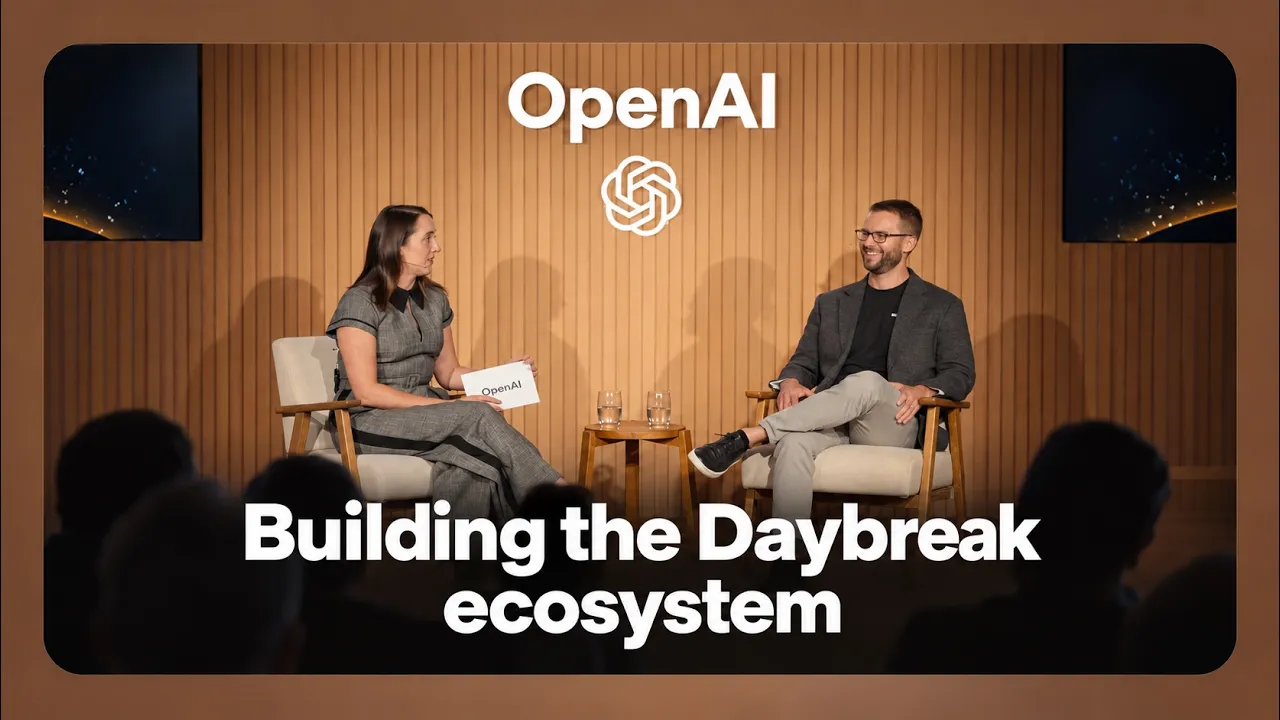
## Background Published on YouTube by OpenAI on September 29, 2026, this session features Claire Lawlor, Digital Native AD EMEA at OpenAI, in conversation with John Peterson, CTO at Sophos. The video explores the critical role of strategic technology partnerships in safeguarding organizations against accelerating cyber threats.
## TL;DR Sophos CTO John Peterson outlines how Sophos integrates OpenAI's Daybreak program to counter the narrowing defender's window in an era of rapid AI advancement. By deploying autonomous investigation agents within the Sophos Fusion platform, the company slashed median investigation times from an industry-leading 38 minutes down to roughly 89 seconds across half of its incoming security cases. Despite these dramatic speed gains across a customer base of 650,000 organizations, Peterson emphasizes that strict human-in-the-loop governance remains essential for destructive remediation decisions. Ultimately, he stresses that cutting-edge AI automation must complement, rather than substitute for, foundational cybersecurity practices like continuous patching, endpoint defense, MFA, and network segmentation.
## Atmosphere & style The presentation carries the warm, collegial tone of an executive fireside chat, punctuated by lighthearted banter regarding the post-lunch conference slump and Peterson's cross-country red-eye travel. Lawlor provides an empathetic and conversational sounding board, encouraging Peterson as he candidly navigates jet lag to deliver sharp architectural insights. Despite the urgent context of accelerating cyber warfare and automated threat vectors, the mood remains pragmatic and reassuring, grounded in strict operational guardrails and common-sense defensive fundamentals before winding down toward an informal open bar reception.
## Bulletin - [03:44](https://www.youtube.com/watch?v=zoohZ1BiHs0&t=224s) Sophos integrated OpenAI's Daybreak frontier intelligence into its Sophos Fusion platform, slashing SOC investigation times from an industry-leading 38-minute benchmark down to approximately 89 seconds. - [03:44](https://www.youtube.com/watch?v=zoohZ1BiHs0&t=224s) Autonomous Daybreak-powered agents now handle approximately 50% of the 1,000 to 2,000 high-priority security cases distilled daily from trillions of telemetry events across 500+ integrations. - [06:57](https://www.youtube.com/watch?v=zoohZ1BiHs0&t=417s) To govern automated response without risking production outages, Sophos enforces three operating tiers (Notify, Collaborate, Authorize) and mandates strict human-in-the-loop sign-off for any potentially destructive action. - [11:08](https://www.youtube.com/watch?v=zoohZ1BiHs0&t=668s) As frontier model capabilities trickle down into open-weight tools and empower novice attackers, Sophos cautions that foundational security hygiene—patch management, endpoint security, universal MFA, and network segmentation—is more vital than ever.
## Key takeaways - [00:08](https://www.youtube.com/watch?v=zoohZ1BiHs0&t=8s) The defender's window is narrowing rapidly as frontier intelligence advancements quickly propagate to open-weight models, driving a surge in CVE exploitation velocity. - [00:08](https://www.youtube.com/watch?v=zoohZ1BiHs0&t=8s) With 40 years of experience and 650,000 customers worldwide, Sophos leverages OpenAI's Daybreak program to protect both its vast customer footprint and its own high-profile infrastructure. - [02:30](https://www.youtube.com/watch?v=zoohZ1BiHs0&t=150s) Defending modern enterprise workloads requires marrying deep proprietary domain expertise—threat telemetry, playbooks, and practitioner know-how—with frontier AI reasoning to scale protection globally. - [03:44](https://www.youtube.com/watch?v=zoohZ1BiHs0&t=224s) The Sophos Fusion platform ingests trillions of daily events across 500+ security integrations, distilling them into 1,000 to 2,000 high-priority cases investigated daily across nine global SOCs. - [03:44](https://www.youtube.com/watch?v=zoohZ1BiHs0&t=224s) Daybreak-powered investigation agents leverage a cyclical plan-execute-review loop to evaluate detections, IOCs, and environment context, generating structured summaries and remediation recommendations. - [03:44](https://www.youtube.com/watch?v=zoohZ1BiHs0&t=224s) Investigation times dropped from an average of 38 minutes under human analysts to roughly 89 seconds with autonomous agents, which now process roughly half of all inbound cases. - [06:57](https://www.youtube.com/watch?v=zoohZ1BiHs0&t=417s) Autonomous security agents solve the chronic cybersecurity talent shortage by scaling compute resources rather than headcount, liberating human analysts to handle high-stakes threats. - [06:57](https://www.youtube.com/watch?v=zoohZ1BiHs0&t=417s) Sophos aligns AI response actions to customer risk tolerance using three MDR tiers: Notify (advisory only), Collaborate (co-managed response), and Authorize (autonomous proactive remediation). - [10:06](https://www.youtube.com/watch?v=zoohZ1BiHs0&t=606s) Operational stability remains paramount; potentially destructive response actions—such as isolating critical infrastructure—strictly require human oversight and sign-off. - [11:08](https://www.youtube.com/watch?v=zoohZ1BiHs0&t=668s) Security leaders must avoid being distracted by AI tooling at the expense of non-negotiable fundamentals: rigorous patch management, endpoint protection, universal MFA, and network segmentation. - [11:08](https://www.youtube.com/watch?v=zoohZ1BiHs0&t=668s) AI agents are designed to wrap around and scale foundational cybersecurity practices rather than replace baseline hygiene.
## Detailed walkthrough ### [00:08](https://www.youtube.com/watch?v=zoohZ1BiHs0&t=8s) Introduction to Sophos and the Narrowing Defender's Window
Claire Lawlor opens the session with a warm welcome and a lighthearted nod to the dreaded "post-lunch slump," pointing out that John "JP" Peterson has the best possible excuse to feel tired after an intense travel schedule that took him from the US East Coast to the West Coast and finally into London the night before. Introducing himself, Peterson explains his role as Chief Technology Officer at Sophos, one of the world's largest cybersecurity providers. Over four decades in the industry, Sophos has built a massive global footprint supporting approximately 650,000 customers spanning virtually every market segment and sector, providing the company with an expansive vantage point across an extraordinary variety of cyber threats.
```mermaid flowchart TD accTitle: Threat Landscape and Defender Advantage accDescr: Diagram illustrating how frontier intelligence advances vulnerability exploitation and how the Daybreak partnership counters it.
subgraph ThreatDynamics ["Threat Landscape Acceleration"] FIM["Advancing Frontier Models"] --> OWM["Open-Weight Model Capabilities"] OWM --> EXP["Accelerated Exploitation & Rising CVEs"] end
subgraph DefenderResponse ["Defender Strategy"] EXP --> DEF["Narrowing Defender's Window"] DBP["OpenAI Daybreak Program"] --> ADV["Frontier Intelligence Integration"] ADV --> PROT["Proactive Protection for 650K+ Customers"] end
DEF -.-> DBP ```
Turning to the core theme of the day, Lawlor asks Peterson to unpack the concept of the "narrowing defender's window" in the context of Sophos and its participation in OpenAI's Daybreak program. Peterson explains that this window is defined by the rapid pace of acceleration in frontier intelligence. As frontier models gain increasingly sophisticated cyber capabilities, those same capabilities quickly trickle down into open-weight models, accelerating vulnerability exploitation paths and driving a massive surge in Common Vulnerabilities and Exposures (CVEs). For Sophos, which represents both a high-profile target as a major security firm and the protector of 650,000 customer organizations, the Daybreak program represents an essential opportunity to leverage frontier intelligence to stay a step ahead of malicious actors.
- **Customer reach**: Approximately 650,000 customers worldwide across diverse industry verticals. - **Industry longevity**: Over 40 years of accumulated cybersecurity domain expertise. - **Threat acceleration**: Rising CVE volumes and rapid weaponization driven by advancing frontier and open-weight models.
---
[02:30](https://www.youtube.com/watch?v=zoohZ1BiHs0&t=150s) Combining Domain Expertise with Frontier Intelligence
Addressing how the broader security ecosystem collaborates, Lawlor asks how OpenAI, Sophos, and end customers collectively make protection work. Peterson frames the relationship as a complementary union between deep cybersecurity domain knowledge and cutting-edge artificial intelligence. Over decades of defending organizations, Sophos has amassed immense operational assets, including rich threat intelligence repositories, battle-tested incident response playbooks, and specialized human practitioner know-how.
Peterson highlights that domain expertise alone cannot easily scale to match the sheer volume and velocity of modern attacks. By partnering with OpenAI and integrating Daybreak's frontier intelligence, Sophos is able to operationalize and scale its accumulated playbooks and threat insights across its entire global customer base. Lawlor remarks on the momentum of the partnership, noting how rapidly it has grown from strength to strength.
- **Sophos contribution**: Proprietary threat intelligence, response playbooks, operational telemetry, and human domain experts. - **OpenAI contribution**: Frontier intelligence and reasoning capabilities via programs like Daybreak to scale human expertise across enterprise workloads.
---
[03:44](https://www.youtube.com/watch?v=zoohZ1BiHs0&t=224s) Architecture and Impact: From 38 Minutes to 89 Seconds
Moving to concrete technical implementations, Peterson details how Daybreak-powered autonomous agents operate within the Sophos Fusion platform—the underlying engine powering Sophos Managed Detection and Response (MDR) as well as its Extended Detection and Response (EDR/XDR) product suite. The system ingests telemetry across more than 500 integrations spanning both third-party security tools and native Sophos sensors. These sensors generate trillions of raw telemetry events every day, which the platform aggregates and distills down to roughly 1,000 to 2,000 high-priority cases investigated daily across nine Security Operations Centers (SOCs).
```mermaid flowchart LR accTitle: Sophos Fusion AI Investigation Pipeline accDescr: Workflow showing telemetry ingestion from 500+ integrations distilled to cases processed by an agentic plan-execute-review loop down to analyst review.
subgraph Ingestion ["Telemetry & Distillation"] SENS["500+ Integrations & Sensors"] --> EVT["Trillions of Daily Events"] EVT --> CASES["1,000 - 2,000 Cases / Day"] end
subgraph AgentLoop ["Daybreak Investigation Agent"] CASES --> PLAN["Planning Model"] PLAN --> LOOP["Plan-Execute-Review Loop\n• Context & Detections\n• Threat Intel & IOCs"] LOOP --> SUM["Investigation Summary &\nRecommended Response"] end
subgraph Execution ["Resolution"] SUM --> SOC["9 Global SOC Analysts"] SUM --> AUTO["Automated Response Agents"] end ```
In what Peterson jokingly refers to as the "before time" roughly 18 months prior, investigations were driven almost entirely by human analysts. Sophos maintained an average investigation time of approximately 38 minutes—a benchmark that outperformed 96% of professional SOCs worldwide. With the deployment of Daybreak-powered investigation agents, that investigation time plummeted to roughly 89 seconds for agent-handled cases. Currently, about half of all incoming cases are automated by these models. The investigation agent ingests the complete context of a case—including telemetry detections, indicators of compromise (IOCs), customer environmental factors, and threat landscape data—and feeds it into a planning model. This model executes a cyclical "plan-execute-review loop," performs required forensic steps, produces a structured investigation summary, and drafts concrete remediation actions for analysts or automated response agents.
- **Telemetry scale**: Trillions of events daily from over 500 security integrations distilled into 1,000–2,000 actionable cases per day across 9 global SOCs. - **Investigation speed transformation**: Reduced from an industry-leading 38-minute human baseline to approximately 89 seconds with AI agents. - **Automation penetration**: Approximately 50% of all incoming SOC cases are now handled by autonomous Daybreak investigation agents.
---
[06:57](https://www.youtube.com/watch?v=zoohZ1BiHs0&t=417s) Scaling Talent and Managing Risk with Operating Modes
When asked how Sophos reallocates the significant time and labor saved by slashing investigation times, Peterson explains that the core bottleneck in the industry has always been a chronic deficit of skilled cybersecurity talent. Staffing a 24/7 internal SOC with top-tier talent is notoriously difficult and cost-prohibitive for most organizations. AI automation allows Sophos to scale compute resources rather than headcount, freeing experienced human analysts from routine investigations to focus on complex, high-stakes threats while maximizing operational efficiency.
Lawlor notes that while threat identification is difficult, deciding how and when to remediate requires critical judgment and trust. Peterson explains that Sophos applies the exact same governance framework to AI agents as it has traditionally applied to human analysts through three distinct MDR operating tiers:
| Operating Mode | Investigation Responsibility | Response & Action Authority | |:--- |:--- |:--- | | **Notify** | Fully conducted by Sophos SOC / Agent | Sophos provides guidance and recommended actions; never takes independent remediation action. | | **Collaborate** | Fully conducted by Sophos SOC / Agent | Sophos works side-by-side with the customer; actions are executed only with direct customer involvement. | | **Authorize** | Fully conducted by Sophos SOC / Agent | Sophos is fully empowered to immediately execute proactive containment and remediation actions on behalf of the customer. |
These distinct modes enable customers to align Sophos's automation and human capabilities with their internal comfort level, risk tolerance, and technical maturity. Peterson emphasizes that while speed and automation are paramount, human oversight remains non-negotiable whenever potentially destructive remediation actions—such as isolating critical infrastructure or terminating sensitive services—are on the table, ensuring agents automatically escalate critical decisions for human verification.
[10:06](https://www.youtube.com/watch?v=zoohZ1BiHs0&t=606s) Human Supervision and Preserving Customer Control in Automated Response
Even as autonomous AI agents shoulder a massive share of the investigative workload, John Peterson emphasizes that human judgment remains non-negotiable when it comes to remediation and response. After sharing a brief, candid moment of fatigue from the previous evening—drawing warm reassurance from Claire Lawlor that he was doing great—Peterson outlines how he envisions this dynamic progressing. In his view, response capabilities will steadily grow in technical sophistication, and Sophos will broaden the array of complex use cases their agents can tackle. However, when an action poses any potential to disrupt or damage a production environment, Peterson insists that a human must remain in the supervisory loop. At its core, Sophos’s overarching priority—"mission one"—is ensuring customers stay both fully protected and continuously operational.
Lawlor notes that this philosophy centers on customer agency: organizations must be empowered to calibrate their own operational risk tolerances, choosing whether agents possess full authorization to act autonomously or are restricted to notification-only alerts requiring explicit sign-off. Peterson confirms that maintaining this clear boundary ensures security automation accelerates incident handling without ever jeopardizing operational stability.
```mermaid flowchart TD accTitle: Incident Response Workflow with Human Oversight accDescr: Diagram illustrating agent automation handing off to human supervision before taking destructive action.
subgraph Investigation["Agent Investigation Layer"] A["Threat Telemetry & Signals"] --> B["AI Investigation Agents"] B --> C["Automated Context & Analysis"] end
subgraph ActionBoundary["Operational Safeguards"] C --> D{"Potentially Destructive Action?"} D -- "Non-Destructive / Safe" --> E["Automated Remediation"] D -- "Destructive / High Impact" --> F["Human Supervisor Review"] end
subgraph Execution["Customer Control Modes"] F --> G["Full Authorization Mode"] F --> H["Notification-Only Mode"] G --> I["Controlled Incident Resolution"] H --> I end ```
- **Core Operational Mandate**: Protect systems without causing operational downtime or self-inflicted outages. - **Supervisory Boundary**: Absolute human oversight is required for any system action that is potentially destructive. - **Customer Governance**: Organizations retain the choice to grant autonomous execution privileges or enforce notification-only gating.
---
[11:08](https://www.youtube.com/watch?v=zoohZ1BiHs0&t=668s) The Non-Negotiable Fundamentals in an Era of Accelerated Frontier AI
Shifting the conversation toward practical advice for security leaders, Lawlor asks what initial steps organizations should take when partnering with Sophos. Peterson explains that the broader security landscape is experiencing an intense squeeze: the defender window is rapidly closing, frontier AI intelligence is accelerating, and relatively novice attackers can now inflict significant real-world damage with minimal effort. In such a high-velocity threat environment, Peterson argues that executing core cybersecurity hygiene and fundamentals is more urgent and critical than ever before. Rather than replacing the basics, modern AI threats raise the bar on foundational defense.
```mermaid flowchart LR accTitle: Foundational Cybersecurity Defense Layers accDescr: Flow diagram showing fundamental cybersecurity pillars wrapped by security operations.
subgraph Fundamentals["Defensive Pillars"] A["CVE Vulnerability & Patch Management"] B["Top-Tier Endpoint Protection"] C["Ubiquitous MFA on Identity"] D["Rigorous Network Segmentation"] end
Fundamentals --> E["SecOps Wrapping Layer<br/>(AI Agents + Human Expertise)"] ```
Peterson cautions that security teams often get dazzled or distracted by the blistering pace of emerging AI technologies. While Sophos aggressively leverages agents to help overburdened Security Operations (SecOps) teams process mounting alert volumes, technology cannot compensate for neglected groundwork. Organizations must maintain rigorous patch management programs to remediate CVEs published across vendor software and open-source packages, deploy best-in-class endpoint protection, enforce multi-factor authentication (MFA) across all identity infrastructure, and establish tight network segmentation. A mature security operations framework must wrap around all these pieces to provide holistic resilience.
Closing out the session, Lawlor thanks Peterson and encourages attendees to connect with him over drinks at the upcoming open bar to pick his brain on security strategy. She then concludes her hosting duties by introducing the next speaker, Tom Duff Gordon, OpenAI's Policy VP for EMEA.
- **Closing Defender Advantage**: Novice cyber adversaries are achieving outsized attack capability due to accelerated frontier intelligence. - **Essential Security Hygiene Pillars**: - Continuous vulnerability management and proactive patching across third-party and open-source software. - Deployment of top-tier, robust endpoint protection. - Universal multi-factor authentication (MFA) across the entire identity layer. - Strict internal network segmentation to halt lateral threat propagation. - Comprehensive security operations programs enhanced by AI agents to absorb operational workload.
## Notable quotes > [00:08](https://www.youtube.com/watch?v=zoohZ1BiHs0&t=8s) narrowing defender's window — Claire Lawlor
> [03:44](https://www.youtube.com/watch?v=zoohZ1BiHs0&t=224s) before time — John Peterson
> [03:44](https://www.youtube.com/watch?v=zoohZ1BiHs0&t=224s) plan-execute-review loop — John Peterson
> [06:57](https://www.youtube.com/watch?v=zoohZ1BiHs0&t=417s) Notify — John Peterson
> [06:57](https://www.youtube.com/watch?v=zoohZ1BiHs0&t=417s) Collaborate — John Peterson
> [06:57](https://www.youtube.com/watch?v=zoohZ1BiHs0&t=417s) Authorize — John Peterson
> [10:06](https://www.youtube.com/watch?v=zoohZ1BiHs0&t=606s) mission one — John Peterson
## Mentioned Claire Lawlor, John "JP" Peterson, Tom Duff Gordon, OpenAI, Sophos, Sophos Fusion, Sophos Managed Detection and Response (MDR), Sophos Extended Detection and Response (EDR/XDR), OpenAI Daybreak program
## Video description Claire Lawlor, Digital Native AD EMEA at OpenAI, and John Peterson, CTO at Sophos, explain the role of technology partnerships in keeping organizations safe from cyber threats
[Source](https://www.youtube.com/watch?v=zoohZ1BiHs0)