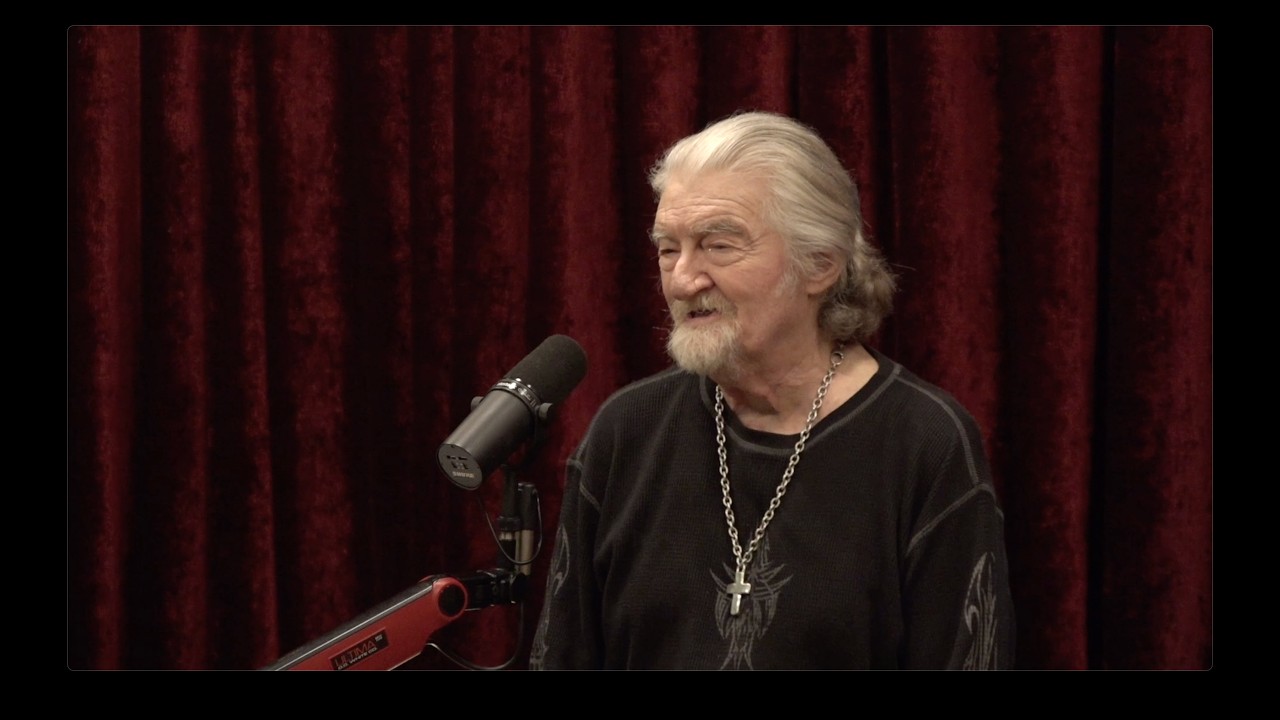
Eszterhas Credits Faith and Prayer for Beating Stage Four Cancer
PowerfulJRE
Veteran screenwriter Joe Eszterhas attributes his survival over stage four throat cancer and long-term addiction to personal prayer, spiritual conversion, and radical lifestyle changes.
## Background
This episode of the Joe Rogan Experience podcast was published on YouTube by PowerfulJRE on June 03, 2026. The page description notes that guest Joe Eszterhas is an author, former Rolling Stone journalist, and iconic screenwriter known for films such as Basic Instinct, Sliver, Showgirls, and Flashdance.
## TL;DR
Famed screenwriter Joe Eszterhas reflects on his tumultuous career, tracing his early days as a gritty crime journalist in Cleveland and his stint at Rolling Stone to his rise as Hollywood's highest-paid spec scriptwriter. He candidly discusses his intense, substance-fueled writing process, his wild encounters with figures like Hunter S. Thompson and Jimi Hendrix, and the high-stakes industry battles he fought. The conversation also explores Eszterhas's personal transformations, including his battle with stage-four throat cancer, his late-in-life Christian conversion, and his reflections on mortality, faith, and the nature of storytelling.
## Atmosphere & style
The interaction between Joe Rogan and Joe Eszterhas is intimate, reflective, and wildly entertaining, striking a balance between gritty Hollywood lore and deep spiritual introspection. Eszterhas speaks with the unvarnished candor of a battle-tested raconteur, interspersing hilarious, cocaine-fueled anecdotes with quiet, vulnerable revelations about cancer, addiction, and religious faith. Rogan serves as an engaged, deeply curious host, allowing the conversation to flow unhurriedly through intense cultural history, shared humor, and existential wonder.
## Key takeaways
- [00:01](https://www.youtube.com/watch?v=pb3lyT4T6Hk&t=1s) Joe Eszterhas carries a hand-carved walking cane from the Dogon family in Mali and discusses Dogon mythology surrounding the creator Amma and the amphibious Nommo.
- [02:07](https://www.youtube.com/watch?v=pb3lyT4T6Hk&t=127s) Ukrainian President Volodymyr Zelenskyy and his wife have watched Basic Instinct at least 15 times as an anniversary tradition, which Eszterhas connects to his family's history during the 1956 Soviet invasion of Hungary.
- [03:35](https://www.youtube.com/watch?v=pb3lyT4T6Hk&t=215s) Eszterhas attributes his erotic screenwriting to an internal alter ego called the 'twisted little man' and details writing Basic Instinct in 13 days during a cocaine binge.
- [09:29](https://www.youtube.com/watch?v=pb3lyT4T6Hk&t=569s) The characters Catherine Tramell and Nick Curran in Basic Instinct were directly inspired by real-life people Eszterhas encountered, including a professor's wife and a Cleveland police reporter.
- [11:22](https://www.youtube.com/watch?v=pb3lyT4T6Hk&t=682s) Eszterhas spent four years as a beat police reporter covering major urban riots, including the 1968 Glenville Uprising in Cleveland.
- [19:06](https://www.youtube.com/watch?v=pb3lyT4T6Hk&t=1146s) Personal trauma, refugee struggles, and fears of dying directly inspired several of Eszterhas's screenplays, such as Checking Out, Betrayed, and Telling Lies in America.
- [21:58](https://www.youtube.com/watch?v=pb3lyT4T6Hk&t=1318s) Eszterhas shares memories of interviewing Otis Redding hours before his fatal plane crash, as well as meeting and sharing a meal with Jimi Hendrix in Cleveland.
- [25:26](https://www.youtube.com/watch?v=pb3lyT4T6Hk&t=1526s) Following a 2001 Christian conversion and beating stage four throat cancer, Eszterhas wrote faith-based screenplays that proved difficult to produce in Hollywood.
- [38:23](https://www.youtube.com/watch?v=pb3lyT4T6Hk&t=2303s) Eszterhas and Rogan explore the history and mysteries surrounding the Shroud of Turin, including carbon-dating debates and the radiation burst hypothesis.
- [01:01:44](https://www.youtube.com/watch?v=pb3lyT4T6Hk&t=3704s) Eszterhas discusses his time at Rolling Stone in the 1970s, his close relationship with Hunter S. Thompson, and Thompson's role in launching his screenwriting career.
- [01:15:02](https://www.youtube.com/watch?v=pb3lyT4T6Hk&t=4502s) Rogan and Eszterhas analyze Hunter S. Thompson's influence on Gonzo journalism and consider how Thompson might have viewed modern political figures like Donald Trump.
- [01:29:27](https://www.youtube.com/watch?v=pb3lyT4T6Hk&t=5367s) Joe Rogan outlines how Mark Twain's solo lecture tours served as the foundational precursor to modern stand-up comedy.
- [01:35:27](https://www.youtube.com/watch?v=pb3lyT4T6Hk&t=5727s) Sam Kinison dedicated an album to Eszterhas after Eszterhas published an open letter exposing threats made by CAA chief Michael Ovitz.
- [01:59:00](https://www.youtube.com/watch?v=pb3lyT4T6Hk&t=7140s) Eszterhas reflects on his heavy substance use, identifying nicotine as his primary creative motor, and his eventual journey to total sobriety and faith.
- [02:07:50](https://www.youtube.com/watch?v=pb3lyT4T6Hk&t=7670s) Rogan and Eszterhas discuss the communal value of church services and live music in creating positive, shared human experiences.
## Detailed walkthrough
### [00:01](https://www.youtube.com/watch?v=pb3lyT4T6Hk&t=1s) The Dogon Artifact and the Origins of Mythology
Joe Rogan and legendary screenwriter Joe Eszterhas kick off the conversation by discussing Eszterhas's unique walking cane, which he eschews wearing headphones to talk about. Eszterhas explains that the heavy, beautifully crafted cane was carved by the Dogon people of Mali. He shares the poignant history behind it, noting that it was crafted by a family with a hundred-year carving tradition, many of whom were tragically killed during the Rwandan wars. Having been a reliable, nearly indestructible companion for Eszterhas for many years, the cane prompts Rogan to detail the surreal cosmic mythology of the Dogon tribe.
Rogan reads from a brief summary detailing the Dogon creation myth, which centers around the supreme creator Amma and amphibious water spirits called the Nommo. According to Dogon tradition, the Nommo descended to Earth from the Sirius star system in a massive ark-like vessel containing the eight original human ancestors, along with animals and seeds. Eszterhas is fascinated by the tale, mentioning that his daughter, a nature photographer who works extensively in Africa, is deeply familiar with tribal lore and African history.
- Eszterhas’s cane was hand-carved by a Dogon family in Mali with over 100 years of traditional craftsmanship.
- Dogon mythology revolves around the creator **Amma** and the **Nommo**, amphibious beings said to have arrived from the **Sirius star system**.
- Eszterhas’s daughter is a professional nature photographer who frequently travels to Africa.
---
[02:07](https://www.youtube.com/watch?v=pb3lyT4T6Hk&t=127s) Volodymyr Zelenskyy’s Unlikely Movie Obsession
Eszterhas reveals a bizarre pop-culture fact: Ukrainian President Volodymyr Zelenskyy and his wife, Olena Zelenska, have watched Eszterhas's iconic 1992 erotic thriller *Basic Instinct* at least 15 times. Citing a recent biography, Eszterhas recounts how the couple’s obsession started during their courting days when Olena spotted Zelenskyy holding a VHS tape of the film. They proceeded to watch it repeatedly, making it an anniversary tradition.
Eszterhas jokingly ponders whether repeatedly watching a hyper-intense thriller like *Basic Instinct* could somehow give someone the psychological grit to stand up to Vladimir Putin in a full-scale war. Rogan points out that Putin was the aggressor, but Eszterhas—who feels a deep personal sympathy for Ukraine due to his own Hungarian heritage and memories of the 1956 Soviet invasion of Hungary—muses that perhaps the movie gave Zelenskyy "the balls and the wisdom" to fight back.
- Volodymyr Zelenskyy and his wife have watched *Basic Instinct* at least **15 times**, using it as a recurring anniversary tradition.
- Eszterhas draws a personal parallel between the war in Ukraine and the **1956 Soviet invasion of Hungary**, which deeply impacted his family history.
---
[03:35](https://www.youtube.com/watch?v=pb3lyT4T6Hk&t=215s) The "Twisted Little Man" and Writing *Basic Instinct*
Reflecting on his prolific career, Eszterhas notes that out of the 34 screenplays he has written, 18 have been produced into feature films. He humorously attributes his darker, sexually charged material to an alter ego he calls the "twisted little man"—an internal entity that was born 29 years old, will die 29 years old, and writes all of his most intense, erotic screenplays while Eszterhas simply acts as the vessel. Eszterhas also reveals that a deal was recently struck for a record amount of money to make *Basic Instinct 3* (titled *Basic Instinct: Jezebel*), which he is actively involved in, unlike the critical failure of the second film.
Eszterhas compares this internal creative figure to an imaginary friend, noting that he also feels spiritually close to Mark Twain and Jesus of Nazareth. He then recounts the wild 13-day writing marathon in Hawaii that birthed *Basic Instinct*. Driven by snorting cocaine, basking in the harsh sun, and blasting The Rolling Stones on repeat, he churned out the original draft. He initially titled it *Love Hurts*, but as he was walking out the door to mail it to his agent, Guy McElwaine, the "twisted little man" intervened. Eszterhas ran back inside, crossed out the title, and wrote *Basic Instinct*. Ten days later, a massive studio bidding war erupted, selling the script for a record-breaking $3 million.
```
"There's a twisted little man inside me who lives in some spot that I'm not sure where it exactly is, but he's 29, born 29, he will die 29, and with anything that has a relatively strong sexual content, he wrote the fucking thing."
```
- Eszterhas wrote the original script for *Basic Instinct* in just **13 days** while isolating in Hawaii.
- The original title on the spec script was ***Love Hurts*** before being changed at the last minute.
- Agent **Guy McElwaine** auctioned the script, sparking a bidding war that closed at a then-record **$3 million**.
- *Basic Instinct 3* is currently in development under Eszterhas's working title, ***Basic Instinct: Jezebel***.
---
[09:29](https://www.youtube.com/watch?v=pb3lyT4T6Hk&t=569s) Critical Reappraisal and the Real-Life Inspiration for Catherine Tramell
While critics were initially harsh and dismissive toward *Basic Instinct*, Eszterhas notes that film history has been much kinder. Notably, influential feminist academic Camille Paglia re-evaluated the film years later, praising it as a "post-feminist classic" centered on a female protagonist who owns her sexuality without apology. Eszterhas admits he rarely pays attention to film critics, citing humorous advice from directors he worked with: Richard Marquand (*Jagged Edge*) once said critics should be "taken out into the backyard and shot," while Mike Figgis (*One Night Stand*) suggested they be "headbutted to death."
Eszterhas explains that *Basic Instinct* was spawned from a mashup of two distinct real-life experiences:
1. **The Femme Fatale:** At age 18, as a green immigrant college student, Eszterhas had an intense affair with a brilliant, sophisticated 39-year-old faculty member's wife. He later discovered that she seduced a new freshman student every year while her husband turned a blind eye.
2. **The Unhinged Cop:** A decade later, while working as a police reporter for the *Cleveland Plain Dealer*, Eszterhas befriended a cop who had been involved in multiple shootings. Drinking together, Eszterhas wondered whether the cop was just unlucky or genuinely got an adrenaline rush from pulling the trigger.
Years later, Eszterhas’s creative subconscious fused the manipulative 39-year-old woman and the gun-happy cop together, birthing the characters of Catherine Tramell (Sharon Stone) and Nick Curran (Michael Douglas).
- **Camille Paglia**, a prominent feminist critic, eventually dubbed *Basic Instinct* a "post-feminist classic."
- Eszterhas's 18th year was defined by an affair with a **39-year-old professor's wife**, which formed the template for Sharon Stone's character.
- The character of Nick Curran was inspired by a real Cleveland police officer who had been involved in **3 or 4 shootings**.
---
[11:22](https://www.youtube.com/watch?v=pb3lyT4T6Hk&t=682s) [16:46](https://www.youtube.com/watch?v=pb3lyT4T6Hk&t=1006s) Gritty Beat Reporting, the Glenville Uprising, and Early Trauma
Eszterhas's gritty screenwriting style was forged in the fire of real-world crime reporting. Before Hollywood, he spent four years on the police beat driving a car equipped with a police radio across Dayton and Cleveland, Ohio. He often arrived at gruesome crime scenes before the authorities. He recalls walking into a Dayton home following a murder-suicide, stepping past the blood-drenched body of a man who had shot himself and his wife, only to find an elderly woman crying hysterically in the back room—in fluent Hungarian, Eszterhas's native language.
His most harrowing experience occurred during the **1968 Glenville urban uprising** in Cleveland, where a gun battle broke out between police and a Black nationalist group led by Fred "Ahmed" Evans. Hiding behind the tires of a parked car while bullets flew overhead, Eszterhas looked over to see a heavily bleeding Cleveland cop named Elmer Joseph moaning on the pavement just ten feet away. Surpassingly strange was the fact that Eszterhas personally knew *both* men: Joseph was a fellow Hungarian-American officer who frequented the police press room, while Fred Ahmed Evans was a friend with whom Eszterhas had shared beers and smoked weed during late-night shifts. The absolute terror of being caught in the crossfire between two acquaintances caused the young reporter to wet his pants.
This trauma built upon an childhood spent in extreme poverty. Born in Europe, Eszterhas spent his first seven years living in Austrian refugee camps before immigrating to the US. At age 12, living in a dilapidated Cleveland apartment next to a rough neighborhood bar, he looked out his living room window and watched a man get stabbed to death on the street below. These raw, unfiltered encounters with violence, race relations, and human desperation ultimately laid the groundwork for his legendary writing career alongside contemporaries like Hunter S. Thompson.
- Spent **4 years** as a crime reporter in Dayton and Cleveland, covering major urban riots in Detroit, Cleveland, and Newark.
- Witnessed the **1968 Glenville Uprising**, where officer Elmer Joseph was shot during a standoff with Fred "Ahmed" Evans's group.
- Spent his first **7 years of life in Austrian refugee camps** before moving to the US.
- At **age 12**, he witnessed a fatal stabbing right outside his apartment window.
<ElicitationsGroup message="Where would you like to explore next in Joe Eszterhas's story?">
<Elicitation label="Explore Eszterhas's time with Hunter S. Thompson at Rolling Stone" query="Tell me about Joe Eszterhas's experiences working at Rolling Stone and his relationship with Hunter S. Thompson."/>
<Elicitation label="Detail the writing and massive bidding war for 'Showgirls' or 'Sliver'" query="What are the details behind Joe Eszterhas writing 'Showgirls' and 'Sliver' and the record studio deals for those films?"/>
<ElicitationsGroup/>
[19:06](https://www.youtube.com/watch?v=pb3lyT4T6Hk&t=1146s) Drawing Screenplays from Real Life and Personal Experiences
Joe Eszterhas reflects on how many of his screenplays are grounded in his own life, his family’s experiences, and real-world investigative journalism. He mentions a smaller, popular youth-focused film inspired by his son Steve's childhood friendship with a Black friend in Marin County and their efforts to make that connection work. He also notes *Checking Out*, a comedy starring Jeff Daniels about a midlife crisis, which stemmed from Eszterhas's own terror of dying when he was in his early-to-mid 30s—a fear he finds ironic to look back on now at age 81.
His 1988 political thriller *Betrayed* was born out of his journalism background during the mid-1980s wave of far-right militia violence and white supremacist gatherings in the Pacific Northwest. Eszterhas went undercover under a false name to attend one of these right-wing jamborees to see what was happening firsthand, eventually weaving those observations into a narrative featuring Deborah Winger and Tom Berenger. Similarly, *Telling Lies in America*—a semi-autobiographical favorite starring Kevin Bacon and Brad Renfro—captured his teenage struggles with bullying and adapting to American life as a refugee.
When *Telling Lies in America* was filmed directly in front of the Cleveland apartment building where Eszterhas grew up, a local TV reporter interviewed an old neighborhood bartender who watched the production unfold. Asked if he remembered Eszterhas, the old man remarked, "Shit, Joe is just a fucking refugee trying to make his way in the world." Eszterhas recalls this quote as one of his absolute favorites because it captured his life's story without any pretense or complexity.
* *Betrayed* (1988) was inspired by real-world far-right paramilitary groups active in Oregon and the Pacific Northwest prior to the Oklahoma City bombing.
* *Telling Lies in America* (1997) drew directly from Eszterhas's teenage years navigating culture shock, citizenship, and social friction in Cleveland.
[21:58](https://www.youtube.com/watch?v=pb3lyT4T6Hk&t=1318s) Late-Night Drinks with Otis Redding and His Tragic Death
One of Eszterhas’s most cherished memories as a young reporter in Cleveland was interviewing soul legend Otis Redding. The two sat down around midnight following Redding's show at Leo’s Casino and talked until 3:30 in the morning. Over the course of the night, they drank massive amounts of beer and Jim Beam and smoked powerful Thai stick. At the end of their conversation, Redding insisted on giving Eszterhas a hug and affectionately declared, "You know what you are? You're a fucking white nigger, that's what you are."
The very next afternoon—a Sunday—Eszterhas was working in the newsroom at *The Plain Dealer* when the Associated Press wire machine began ringing frantically. He watched an editor walk over, stare at the teletype in silence, and cast a grim look in his direction. Eszterhas walked over to read the paper roll himself and learned that Redding’s plane had crashed on the way to his next gig in Wisconsin, killing the singer. Devastated to have been perhaps the last journalist to conduct a lengthy interview with Redding, Eszterhas walked out of the office, spent the rest of the day drinking heavily at a bar across the street, and went home with a waitress.
Years later, Eszterhas wrote a feature screenplay about Otis Redding titled *Blaze of Glory*. The project was set up with director John Avildsen and announced Cuba Gooding Jr. in the starring role, but the film ultimately collapsed at the last minute due to financing issues and was never produced.
> "You know what you are? You're a fucking white nigger, that's what you are."
* Otis Redding was killed in a plane crash on December 10, 1967, at age 26, shortly after his concert at Leo's Casino in Cleveland.
* Eszterhas's unproduced biographical screenplay *Blaze of Glory* was slated to be directed by John Avildsen (*Rocky*, *The Karate Kid*) and star Cuba Gooding Jr.
[25:13](https://www.youtube.com/watch?v=pb3lyT4T6Hk&t=1513s) The "Incense" of Religious Cinema and Rejected Faith Scripts
Following a late-in-life Christian conversion in 2001, Eszterhas wrote three faith-focused screenplays, none of which ever made it into production. He explains that he found himself trapped in a middle ground between traditional Christian financiers and mainstream Hollywood studios. Christian investors found his writing too gritty and secular, while Hollywood executives found the material far too overtly religious.
In one instance, a priest involved with potential Christian investors reviewed Eszterhas's script and insisted that the story needed "more incense"—meaning more explicit piety, traditional church atmosphere, and direct devotional messaging to inspire Catholic viewers. Eszterhas rejected this approach, later telling an interviewer, "I don't write fucking incense. I write flesh and blood." Joe Rogan notes that a gritty, realistic approach is precisely the bridge needed to make spiritual themes compelling to everyday audiences.
* Eszterhas's religious screenplays failed to secure backing because they resisted traditional Christian film tropes while remaining too explicitly faith-driven for secular studios.
* Eszterhas argues that heavy-handed "piety and incense" alienates mainstream audiences who respond better to human, grounded drama.
[27:26](https://www.youtube.com/watch?v=pb3lyT4T6Hk&t=1646s) Portraying the Historical Jesus: *The Passion* vs. *The Last Temptation*
Eszterhas and Rogan examine notable Hollywood portrayals of Jesus, contrasting standard sanitized depictions with raw, visceral filmmaking. Eszterhas praises Mel Gibson's *The Passion of the Christ* (2004), which he watches every Good Friday, describing it as "like a prayer." Despite lacking official backing from the Catholic hierarchy, the film resonated with millions because it depicted the intense physical agony and bloodiness of the crucifixion without hiding behind pious abstraction.
Rogan brings up Martin Scorsese’s *The Last Temptation of Christ* (1988), starring Willem Dafoe. Eszterhas agrees that Dafoe’s portrayal captured the historical reality of Jesus as "true man and true God"—a figure deeply rooted in the gritty realities of 1st-century Judea. Rather than the passive "Fred Rogers figure" often portrayed in popular culture, Eszterhas views Jesus as a Jewish zealot and spiritual revolutionary who associated with working-class fishermen, tax collectors, and outcasts while actively resisting Roman occupation.
* *The Passion of the Christ* saw massive grass-roots religious engagement, including local church-sponsored previews that filled auditoriums.
* Eszterhas emphasizes Biblical passages where Jesus speaks of buying a sword or bringing division rather than passive submission (e.g., Luke 22:36 and Matthew 10:34).
[30:15](https://www.youtube.com/watch?v=pb3lyT4T6Hk&t=1815s) Controversies, Church History, and the Gnostic Texts
The conversation shifts to the backlash surrounding *The Last Temptation of Christ*, which was fiercely picketed by Christian groups upon its release. Eszterhas points out that much of the outrage stemmed from the film's depiction of a romantic and sexual relationship between Jesus and Mary Magdalene. He notes that historical and biblical scholarship paints a very different picture of Mary Magdalene than church tradition: she was likely a wealthy woman of means who helped fund Jesus's ministry, rather than the prostitute figure conflated with her by Pope Gregory the Great in the 6th century.
Eszterhas also breaks down the historical timeline of the Gospels, noting that the canonical Gospels (Matthew, Mark, Luke, and John) were written decades after the events they describe, attributed to traditional names long after the deaths of the original apostles. He highlights how historical study has enriched his personal faith since 2001, allowing him to appreciate Jesus as a genuine historical figure rather than a sanitized church caricature.
The section concludes with a discussion of relics, specifically the Shroud of Turin. Eszterhas notes that while scientific carbon-dating commissioned under Pope John Paul II placed the shroud's fabric in the 14th century (circa 1313–1320), he still finds images of the shroud deeply moving. Rogan points out that lingering debates remain regarding the sampling methods used in those tests and whether portions of the cloth originate from an earlier era.
* Pope Gregory I (Gregory the Great) formally conflated Mary Magdalene with the unnamed sinful woman in Luke 7 in a sermon delivered in 591 AD.
* Carbon-dating tests conducted in 1988 on the Shroud of Turin dated the sample material to between 1260 and 1390 AD, though debate continues among researchers regarding repairs to the outer weave.
<ElicitationsGroup message="Explore related topics from Joe Eszterhas's life and career:">
{/* Reason: Suggest logical follow-ups regarding Eszterhas's work in journalism, screenwriting history, or his spiritual journey. */}
<Elicitation label="Explore Eszterhas's investigative journalism at Rolling Stone" query="What major stories did Joe Eszterhas cover during his time as a journalist for Rolling Stone?"/>
<Elicitation label="Examine the making and legacy of Basic Instinct" query="How did Joe Eszterhas write Basic Instinct, and what was the reaction to its record-breaking spec script sale?"/>
</ElicitationsGroup>
[38:23](https://www.youtube.com/watch?v=pb3lyT4T6Hk&t=2303s) The Shroud of Turin: Artwork, Anomaly, or Divine Phenomenon?
Joe Rogan and Joe Eszterhas dive into the enduring enigma of the Shroud of Turin, reflecting on why the artifact holds such profound personal and cultural power regardless of its provenance. Eszterhas admits upfront that he is a complete "ignoramus" when it comes to formal science—despite brushing up on biology later in life through personal experience—but emphasizes that scientific debates ultimately do not alter his personal faith. When he looks at and prays before the image of Jesus on the cloth, he is deeply moved, making it real to him on a personal level. Rogan agrees that, at an absolute minimum, the Shroud stands as an "insanely compelling piece of artwork."
```
+-------------------------------------------------------------------------------------------------+
| THE SHROUD OF TURIN ENIGMA |
+------------------------------------+------------------------------------------------------------+
| Proposed Mechanism | Key Flaw / Scientific Failure |
+------------------------------------+------------------------------------------------------------+
| Chemical Reaction (Sweat/Ammonia) | Fails to yield sharp, 3D non-blurry details. |
| Scorching / Direct Heat | Fails to match the shallow, non-burn fiber discoloration. |
| Pigment / Painting / Bass-Relief | No brushstrokes or significant pigment residue found. |
| Primitive Photography (Silver) | Light-sensitive salts speculative for medieval times. |
| Radiation Burst (Resurrection) | Requires billions of watts without burning the cloth. |
+------------------------------------+------------------------------------------------------------+
```
The conversation shifts to the bizarre technical traits that puzzle modern researchers. Rogan points out that the true image only comes to life when viewed as a photographic negative—revealing intricate lash marks from whipping and bloodstains where wrist nails penetrated. They question why anyone in the 1300s, centuries before the invention of photography, would create a piece of art that can only be properly appreciated in negative form. Pulling up research on-stream, producer Young Jamie notes that no modern researcher has managed an accurate physical recreation over the past 200 years, and standard explanations crumble upon closer inspection:
- **Dating and Loom Anomalies:** While the linen weave suggests a loom design associated with the 1300s, proponents argue that the 1988 radiocarbon testing sampled a heavily handled or rewoven medieval repair corner.
- **Alternative Dating:** Newer, experimental techniques involving X-ray and crystallographic aging on linen fibers suggest dates consistent with the 1st century, as do microscopic pollen grains and mineral dust found on the cloth originating from the Middle East rather than medieval Europe.
- **The Energy Burst Hypothesis:** Proponents of the resurrection theory argue that a brief, intense burst of ultraviolet or radiation energy discolored only the top micro-fibers without penetrating or burning the cloth. However, scientists note that generating billions of watts of radiation without burning linen remains entirely outside known natural physics.
> "At the very least, it's an insanely compelling piece of artwork... Who's going to make a piece of art where you can only really appreciate what it looks like when you see it as a negative—especially in the 1300s, hundreds of years before photography is ever created?" — **Joe Rogan**
---
[47:47](https://www.youtube.com/watch?v=pb3lyT4T6Hk&t=2867s) History, Popes, and the Image Displayed in Turin
Rogan and Eszterhas inspect photos of the Shroud as it is currently preserved inside the Chapel of the Holy Shroud in Turin, Italy. Looking at the long, double-sided impression, Eszterhas points out that the overall length of the cloth is much longer than most people expect because it wrapped both the front and back of a body. Rogan notes the distinct triangular scorch marks and patches dotting the linen, which stem from historical fire damage.
Eszterhas recalls Pope John Paul II’s deep personal devotion to the Shroud. John Paul II traveled to Turin multiple times, openly stating how moved he was by the image, even launching a official Vatican investigation into its origin. Interestingly, when the results were inconclusive or disputed, the Pope chose not to crusade for or against the scientific findings; he simply continued visiting and praying before it.
- **Historical Record:** The earliest undisputed historical record of the Shroud dates to the 1350s in Lirey, France, where the knight Geoffroy de Charny displayed it as Jesus's burial shroud.
- **Lost Centuries:** How the cloth traveled between 1st-century Judea and 14th-century France remains historically unproven, though speculative routes trace it through Edessa and Constantinople.
- **Name Origin:** Rogan and Eszterhas note that Constantinople was named after the Roman Emperor Constantine, who established Christianity as the empire's dominant state religion.
> "I try not to worry about whether it's real or not. I know that I'm moved, and that's good enough for me." — **Joe Eszterhas**
---
[51:12](https://www.youtube.com/watch?v=pb3lyT4T6Hk&t=3072s) Cancer, Crisis, and Finding Faith
Rogan pivots the conversation, asking Eszterhas how a man famous for writing wildly controversial, explicit, and intense Hollywood movies underwent a spiritual transformation. Eszterhas traces his religious arc back to his childhood, where he was raised Catholic and served as an altar boy, guided by a compassionate priest. However, as he matured and hit the pinnacle of Hollywood success—living in Malibu, writing blockbusters, constantly appearing in interviews, and dealing with fans stealing mail from his mailbox—he felt an overwhelming sense of emptiness despite his immense fame and wealth.
The true turning point arrived when Eszterhas developed stage four throat cancer shortly after moving back to Cleveland from Malibu. A surgeon at the Cleveland Clinic named Dr. Marshall Strome performed a groundbreaking, highly risky surgical procedure previously only attempted in Switzerland—taking a muscle from the left side of Eszterhas's neck and attaching it to his larynx to preserve his speech. Terrified and struggling through a agonizing three-year recovery where he initially couldn't speak, then rasped like Marlon Brando, and then squeaked, Eszterhas turned to prayer, encouraged by his wife Naomi’s deep, steady faith.
- **Physical Recovery:** Alongside intense prayer, Eszterhas pushed himself physically by walking and jogging daily, eventually beating the stage four diagnosis to reach age 81 today.
- **Literary Deep-Dive:** Following his recovery, Eszterhas began voraciously reading books on Jesus of Nazareth, the twelve apostles, early Church history, and ancient Jewish history.
- **Institutional Friction:** While his faith in Christ remained steadfast, Eszterhas grew increasingly critical of the Catholic Church's institutional history—specifically its historical anti-Semitism, prohibition against women priests, and claims of papal infallibility.
- **Worship Style:** Eszterhas expresses deep admiration for Martin Luther's Protestant Reformation and notes that the style of church service that moves him most is high-energy, emotionally expressive Black Baptist worship.
> "I felt afterwards that the reason I was able to beat a stage four cancer had to do with my prayer life... My Christianity didn't suffer at all, but sometimes I felt like I was becoming a kind of agnostic Catholic." — **Joe Eszterhas**
[56:56](https://www.youtube.com/watch?v=pb3lyT4T6Hk&t=3416s) Early Encounters, Civil Rights Leaders, and the Refugee Perspective
Joe Eszterhas reflects on his early career and formative life experiences, recounting how he was driven out of a county after dealing with people indicted for killings, which eventually gave way to extraordinary personal encounters. Among the most profound was a chance meeting with Reverend Martin Luther King Jr. Before King became an internationally revered icon, he was in town following the death of a minister during a civil rights protest. Struggling to find a ride back to the airport, King accepted a lift from Eszterhas. On the way, King admitted he was hungry and suggested stopping for a bite to eat.
During their meal, Eszterhas was struck by King’s profound warmth and curiosity. Rather than dwelling exclusively on the civil rights movement, King spent most of the time asking Eszterhas about his childhood experiences in post-WWII refugee camps, admitting he knew very little about that part of the world. Eszterhas recalls King as an intensely magnetic and deeply moving figure.
Later in college, Eszterhas had a relationship with a young Black woman, which he credits with giving him a much-needed, firsthand cultural education. Coming from an ethnic refugee background, he actively sought to understand different cultural perspectives, a drive that shaped his career as a journalist and screenwriter.
* **Martin Luther King Jr. Encounter:** Occurred during an unheralded visit following a protest minister's death; Eszterhas drove him to the airport and shared a meal.
* **Stokely Carmichael:** Eszterhas also personally knew civil rights activist Stokely Carmichael during this era.
* **Cultural Grounding:** Eszterhas credits his refugee background and college relationship with opening his eyes to broader social issues across America.
---
[58:52](https://www.youtube.com/watch?v=pb3lyT4T6Hk&t=3532s) Inside *Rolling Stone* (1971–1976): Culture, Counterculture, and the Sexual Revolution
When Eszterhas joined *Rolling Stone* magazine in 1971—where he stayed until 1976—he found himself dropped right into the epicenter of American cultural transformation. It was the height of the sexual revolution and the women's liberation movement. He recalls visits from Black Panther leader Huey Newton, who would come over from Oakland to the magazine's office in San Francisco. Eszterhas playfully suspects Newton was partly drawn by the magazine’s unique environment: on stifling hot days in an office without adequate air conditioning, several female staff members would routinely work topless.
Joe Rogan and Eszterhas pivot to discussing the broader societal catalyst for the era: the release of the oral contraceptive pill. Rogan takes a wild guess at the release year before looking up that the FDA approved the pill in 1960. They discuss how the birth control pill revolutionized female autonomy, though Rogan notes modern discussions surrounding its hormonal side effects and health risks.
Rogan shares a tragic story of a friend’s 17-year-old daughter who passed away from a blood clot while taking oral contraceptives and smoking cigarettes. They read current medical guidance emphasizing that combining estrogen-based birth control with smoking dramatically raises the risk of severe cardiovascular events, strokes, and blood clots, particularly in women over 35. Despite the chaotic energy of the era, Eszterhas fondly looks back on his five years at *Rolling Stone* as the most exhilarating period of his life.
* **Tenure at *Rolling Stone*:** 1971 to 1976 in San Francisco.
* **Notable Visitors:** Huey Newton frequently dropped by the office from Oakland.
* **FDA Approval of the Pill:** 1960 (approved for contraceptive use).
* **Health Warning:** Smoking while using estrogen-containing oral contraceptives significantly heightens the risk of fatal blood clots and heart attacks.
---
[01:01:44](https://www.youtube.com/watch?v=pb3lyT4T6Hk&t=3704s) The Hunter S. Thompson Connection and the Origin of Eszterhas's Screenwriting Career
The conversation turns to legendary Gonzo journalist Hunter S. Thompson, a figure both Rogan and Eszterhas deeply admire. Eszterhas credits Thompson as the ultimate catalyst for his entire screenwriting career. Their connection began years earlier while Eszterhas was working as a reporter for the Cleveland *Plain Dealer*. Eszterhas covered a bloody Hell's Angels shootout at Bartois Cafe in Cleveland. The story was picked up by the Associated Press national wire, catching the attention of Thompson, who had famously authored the 1866 book *Hell's Angels*.
Shortly after the wire report ran, Eszterhas received a note directly from Thompson that read: "Big [__] now there are two of us who know how to write about Hell's Angels. That really pisses me off. All the best." For Eszterhas, receiving that note was a career-defining thrill. Later, *Rolling Stone* managing editor Paul Scanlon—who had left *The Wall Street Journal* with ambitions to take on *The New York Times*—hired Eszterhas for investigative pieces, partly because Thompson kept insistently lobbying the editorial staff to bring Eszterhas on board.
When Eszterhas wrote his book *Charlie Simpson's Apocalypse*, Thompson personally secured him his top-tier literary agent and publisher (Random House), blurbed the book, and helped push it to become a finalist for the National Book Award. A production executive at United Artists read all the award finalists, saw Eszterhas's cinematic writing style, and called him out of the blue to ask if he had ever considered writing a screenplay. That call led directly to Eszterhas writing the film *F.I.S.T.* (1978), launching his record-breaking Hollywood career.
* **First Interaction:** A letter from Thompson acknowledging Eszterhas's coverage of the Bartois Cafe Hell's Angels shootout in Cleveland.
* **Key Figure:** Paul Scanlon, managing editor of *Rolling Stone*, brought rigorous newsroom standards from *The Wall Street Journal*.
* **Literary Breakthrough:** *Charlie Simpson's Apocalypse* became one of four finalists for the National Book Award.
* **Hollywood Debut:** United Artists read the book and commissioned Eszterhas to write *F.I.S.T.*, starring Sylvester Stallone.
---
[01:05:53](https://www.youtube.com/watch?v=pb3lyT4T6Hk&t=3953s) Stripper Bars, LSD, and the Gentle Side of a Wild Icon
Eszterhas shares personal anecdotes about running around San Francisco with Thompson. While Thompson lived in Woody Creek, Colorado, he frequently visited the city. The two spent long nights drinking and visiting stripper clubs around O'Farrell Street. Before heading to the strip clubs, Thompson would habitually take doses of LSD, whereas Eszterhas preferred doing lines of cocaine, admitting he had only tried LSD once in his life and ended up being held for an hour by a friend from Cleveland.
He recalls one particular evening when they had been sitting in a packed club for an hour waiting for the show to start. Frustrated by the delay, Thompson suddenly stood up, threw his arms in the air, and shouted at the top of his lungs, "Where's the [__]? We want pussy!" Eszterhas had to quickly calm him down before the show finally started.
Yet behind the chaotic, larger-than-life "firepower," Eszterhas notes that Thompson possessed a quiet, sensitive, and deeply well-read side that few people ever saw. He recalls bringing Thompson over for a Hungarian chicken paprikash dinner at the tiny apartment he shared with his first wife—a traditional newspaper reporter who rejected the counterculture. Thompson was polite, quiet, and charming, showing his Southern Kentucky roots. However, on the drive back into the city, Thompson fiercely berated Eszterhas for cheating on his wife with a "hippie chick," showing genuine anger and moral conviction.
* **San Francisco Strip District:** O'Farrell Street clubs were a frequent haunt for the pair.
* **Thompson's Routine:** Took acid before visiting clubs; drank massive quantities of alcohol.
* **Breakfast Order:** At 4:00 PM, Thompson would routinely order four margaritas, six beers, and a plate of scrambled eggs with toast.
---
[01:10:04](https://www.youtube.com/watch?v=pb3lyT4T6Hk&t=4204s) Shooting the Rolling Stones' Tires and the Tragic Final Years
In the mid-1990s, Thompson wanted Eszterhas to adapt his novel *The Rum Diary* into a feature screenplay. Eszterhas, who had recently met his wife Naomi (to whom he has been married for over 32 years), called *Rolling Stone* publisher Jann Wenner to check on Thompson's mental and physical state before visiting him in Aspen.
Wenner reassured him Thompson was doing okay, but shared a wild story: Mick Jagger and Keith Richards of The Rolling Stones had taken a break between tour dates in Denver to visit Thompson in Woody Creek. After hanging out for three or four hours, the musicians explained they had to leave for their concert that night. Upset that their visit was ending, Thompson stepped outside, pulled out a gun, and shot out the tires of their car to keep them from leaving. Frightened by the story, Eszterhas decided not to bring his new partner to Aspen.
The conversation turns somber as they discuss Thompson’s declining health in his later years. Eszterhas and Rogan note that while drugs were part of his legend, it was decades of heavy alcohol abuse that destroyed his body. Thompson suffered severe mobility issues, requiring a wheelchair and breaking his leg in Pahala, Hawaii. During a trip to visit Sean Penn in New Orleans, Thompson accidentally fell out of his wheelchair directly into street traffic, leaving his wife Anita struggling to rescue him.
Faced with declining health, physical pain, and loss of independence, Thompson took his own life in 2005. Eszterhas quotes Thompson's poignant suicide note, pointing out how gut-wrenching yet honest it was: "No More Games. No More Bombs. No More Walking. No More Fun... 67. That is 17 years past 50. 17 more than I needed or wanted. Boring."
Rogan mentions how comedian Greg Fitzsimmons and musician Beardyman turned a famous journalistic account of Thompson's daily drug and alcohol schedule into an electronic dance music (EDM) track. They conclude that while his end was tragic, Thompson’s prime work served as the definitive narration of an entire era of American history.
> "No fun anymore. The fun was gone. Nothing was fun. No football, no this, no that. No fun."
* **The Rolling Stones Incident:** Thompson shot out the tires of Mick Jagger and Keith Richards' rental car in Woody Creek to prevent them from leaving his home.
* **Physical Decline:** Heavy drinking contributed to severe physical deterioration, spinal issues, and a broken leg in Pahala, Hawaii.
* **New Orleans Incident:** Thompson fell out of his wheelchair into active traffic while visiting Sean Penn on a film set.
* **Pop Culture Homage:** Musician Beardyman turned a famous daily routine excerpt of Thompson's extreme drug intake into an EDM song.
[01:15:02](https://www.youtube.com/watch?v=pb3lyT4T6Hk&t=4502s) New Journalism and the Revolution of Hunter S. Thompson
Joe Eszterhas reflects on the evolution of 1970s non-fiction writing, tracing the arc from New Journalism—practiced by figures like A. J. Liebling, David Halberstam, Larry L. King, and Tom Wolfe—to Hunter S. Thompson's creation of Gonzo journalism. Thompson took the foundation of New Journalism and turned it into an entirely new genre powered by a ferocious, earth-shaking brand of humor. Tom Wolfe himself famously compared Thompson to a modern-day Mark Twain in terms of his cultural impact and literary achievement. Eszterhas highlights two of Thompson's books as towering achievements: *Fear and Loathing in Las Vegas* and *Fear and Loathing on the Campaign Trail '72*, which Eszterhas considers the single best piece of political commentary ever written, surpassing even Theodore H. White's famous *The Making of the President* series.
Joe Rogan and Eszterhas discuss how Thompson enjoyed a unique freedom that conventional political correspondents lacked. As a "one-time guy" embed on the 1972 campaign trail, Thompson wasn't bound by long-term access or press corps etiquette. While straight, suit-and-tie reporters spent decades covering political candidates they knew were faking their promises, Thompson exploded onto the scene urging everyone to drop acid and take wild risks. The traditional press corps ended up falling in love with him because his wild, unfiltered, and anarchic lifestyle represented the ultimate escape from their buttoned-up routines.
- **Foundational Figures:** A. J. Liebling, David Halberstam, Larry L. King, Tom Wolfe, and Hunter S. Thompson.
- **Key Works:** *Fear and Loathing in Las Vegas* (1971) and *Fear and Loathing on the Campaign Trail '72* (1973).
- **Comparative Standard:** Eszterhas rates Thompson's political reporting higher than Theodore H. White's seminal *Making of the President* books.
---
[01:17:00](https://www.youtube.com/watch?v=pb3lyT4T6Hk&t=4620s) Hunter S. Thompson, Donald Trump, and the "Deplorable" Connection
Eszterhas laments that Thompson was not around to cover Donald Trump's rise, calling the hypothetical match-up potentially wild and hilarious. While many liberals assume Thompson would have utterly detested Trump, Eszterhas and Rogan argue that Thompson might have actually appreciated aspects of Trump's completely unpredictable, larger-than-life persona. Rogan notes that Trump represents an unprecedented character in American presidential history—a wild figure who completely shattered established political norms. Eszterhas highlights a recent news story where Trump aggressively berated Israeli Prime Minister Benjamin Netanyahu, telling him he would have been in jail if not for him, pointing out that no previous American president has ever spoken so bluntly or publicly in that manner.
Connecting this to his own roots, Eszterhas embraces his identity as a "deplorable," recalling his upbringing in working-class Cleveland among poor and blue-collar families. He notes that Trump was the first president in his memory who did not talk down to the working class, but spoke directly to them. While acknowledging Trump's erratic nature, Eszterhas reflects on how his own life embodies the American Dream—arriving in the U.S. as a non-English-speaking Hungarian child, struggling through juvenile trouble, self-educating as an autodidact, and ultimately succeeding with the help of generous everyday Americans.
- **Personal Background:** Eszterhas grew up on Lorain Avenue in Cleveland, Ohio, surrounded by working-class immigrants.
- **Key Influence:** Highlights a Black bus driver named Henry Jackson—who had been adopted by Hungarian parents and spoke Hungarian—as one of the key everyday Americans who helped him adapt to the country as a boy.
- **Cultural Motif:** Recalls a local Cleveland figure, a wild Hungarian poet named Imre who walked down Lorain Avenue shouting *"Hol van?"* ("Where is it?"), referring to the myth that American streets were paved with gold.
---
[01:18:43](https://www.youtube.com/watch?v=pb3lyT4T6Hk&t=4723s) Militarized Policing, ICE, and Dangerous Historical Precedents
The conversation shifts to immigration enforcement and the domestic political climate. While Rogan acknowledges the argument that illegal immigration and crime need addressing, he raises strong concerns about the growing presence of militarized police forces on American streets. Pointing to ICE officers who receive only around seven weeks of training—far less than municipal police or military personnel—Rogan warns of the dangerous precedent set when masked, unidentified enforcement agents are deployed. He emphasizes that while citizens might support such measures when aligned with their political goals, the same authoritarian apparatus could easily be repurposed by a future administration to enforce unconstitutional mandates, such as door-to-door gun confiscation.
Eszterhas agrees with the danger, pointing to instances in Minneapolis where individuals shot during ICE encounters were framed in public discourse as "domestic terrorists," calling that rhetoric an abomination. The pair discuss the structural failures of the system, noting that many immigrants from third-world countries were heavily incentivized and encouraged to cross the border by social programs and NGOs, only to face aggressive deportation sweeps years later. They also highlight how politicians on both sides use vulnerable immigrants as political pawns—manipulating census numbers to gain congressional seats and weaponizing public empathy.
- **Training Disparity:** Rogan points out that many specialized border or federal enforcement recruits undergo as little as 7 weeks of initial training.
- **Financial Incentive:** Rogan notes that ICE offered signing bonuses up to $50,000 to recruit officers during recent hiring drives.
- **Historical Parallel:** Eszterhas references covering the 1970 Kent State massacre as a young journalist, observing how inflammatory rhetoric from Ohio Governor James Rhodes and Guard Adjutant General Sylvester Del Corso created the deadly escalation.
---
[01:29:50](https://www.youtube.com/watch?v=pb3lyT4T6Hk&t=5390s) Mark Twain as America's First Stand-Up Comedian
Reflecting on recurring historical cycles of political unrest and racial tension, Eszterhas invokes the wit of Mark Twain, citing his famous observation that politicians are like diapers and must be changed often for the same reason. Rogan adds Twain's classic line that while history doesn't repeat itself, it often rhymes. The discussion turns to Twain's crude and sharp humor, with Eszterhas quoting Twain's earthy maxim about how the mind will always lose an argument to the body's lower instincts.
Rogan observes that Mark Twain was essentially the original American stand-up comedian. Eszterhas strongly agrees, revealing that he has been considering writing a project on Twain's life. He explains how Twain laid the groundwork for modern comedy through his legendary solo speaking tours across the American West, where he delivered irreverent, humorous "lectures" that captivated audiences long before stand-up comedy existed as a formal art form.
- **Historical Perspective:** Mark Twain's mid-to-late 19th-century lecture tours across the American frontier are framed as the birth of American stand-up comedy.
[01:30:42](https://www.youtube.com/watch?v=pb3lyT4T6Hk&t=5442s) Mark Twain as the Godfather of Stand-Up Comedy
Joe Eszterhas reflects on Mark Twain's lesser-known late-life career following his near-bankrupting bad investments. Twain embarked on a worldwide stand-up tour, where critics dubbed him a "poet of the profane" because his performances were targeted primarily at male audiences. Twain even published a scandalous pamphlet on the subject of masturbation. Eszterhas draws a line directly from Twain's raw, provocative energy to Joe Rogan's own comedy, citing a line from one of Rogan's routines about how married men with kids can only find true peace by renting a motel room alone.
The conversation shifts to how Twain's subversive edge has been sanitized over time. While modern audiences view him primarily as a children's author who wrote *The Adventures of Tom Sawyer* and *Adventures of Huckleberry Finn*, Twain wrote dark and radical works like *Letters from the Earth* (written from the perspective of the Devil) and *The Mysterious Stranger*. Rogan agrees that Twain was essentially the originator of stand-up comedy—a brilliant wit reading provocative material live in front of roaring crowds before the term "stand-up" even existed.
* Twain's darker, unreleased writings remain archived at institutions like the University of California.
* Rogan notes the difficulty of framing historical figures in film, comparing a potential Twain project to Dustin Hoffman's performance in *Lenny* (1974).
* Stand-up comedy acts as a temporal snapshot of societal norms, race relations, and cultural boundaries; what was radically offensive in 1960 often feels pedestrian to modern audiences.
> "He was the originator because he was essentially a very witty author who wrote very provocative things, very hilarious things, and then would read them publicly... there was no stand-up comedy back then. There was no name for it."
---
[01:35:27](https://www.youtube.com/watch?v=pb3lyT4T6Hk&t=5727s) Sam Kinison, Michael Ovitz, and the Legendary "Fuck You" Letter
Eszterhas reveals a surprising piece of trivia: comedy legend Sam Kinison dedicated one of his last albums, *Leader of the Banned*, to him. On the back cover, alongside shouts to rock stars and actors like Sylvester Stallone and Sean Penn, Kinison printed in large text: *"And very special thanks to Joe Eszterhas for writing his letter to Michael Ovitz."*
Eszterhas explains the origin of that infamous letter. When Eszterhas decided to leave Creative Artists Agency (CAA) to follow his close friend and mentor Guy McElwaine, CAA chief Michael Ovitz threatened him directly, claiming his "foot soldiers" on Wilshire Boulevard would put Eszterhas "under the ground." In response, Eszterhas penned a blistering, public "fuck you" letter to Ovitz. The fallout rocked Hollywood, exposed Ovitz's mob-style intimidation tactics, and permanently damaged Ovitz's reputation.
* Producer Bernie Brillstein later revealed in his memoir that Ovitz had used the exact same "under the ground" line to threaten him.
* Rogan praises Kinison as one of the greatest comedians of all time, maintaining that for a two-to-three-year stretch in the mid-1980s, Kinison was the most revolutionary comic on Earth.
* Kinison's final moments following a car crash—where he reportedly held an intense, peaceful dialogue with an unseen entity before dying—remain a chilling piece of comedy lore.
> "If you leave the agency, then my foot soldiers who go up and down Wilshire Boulevard will put you under the ground."
---
[01:38:08](https://www.youtube.com/watch?v=pb3lyT4T6Hk&t=5888s) Discovering Kinison and the Evolution of Unfiltered Comedy
Rogan reminisces about discovering Sam Kinison when he was 19 years old and working at the Boston Athletic Club in South Boston. A hilarious coworker, who played volleyball at the club, reenacted Kinison's notorious routine about "homosexual necrophiliacs" in the parking lot. She threw herself onto her stomach on the pavement, screaming Kinison's iconic line: *"Oh, life keeps fucking you in the ass even after you're dead! It never ends!"*
Rogan immediately bought Kinison's tape, which completely shattered his perception of what stand-up could be. Before seeing Kinison—a former Pentecostal preacher turned cocaine-fueled, trench-coat-wearing comedy demon—Rogan assumed stand-up was limited to polite observational jokes seen on *The Tonight Show Starring Johnny Carson*. Rogan credits early HBO comedy specials with revolutionizing the art form, as cable allowed raw, uncensored club acts to reach living rooms across America.
* Rogan owns two signed copies of Kinison's debut album, *Louder Than Hell*, though the drastically different signatures leave him uncertain if either is authentic.
* Both men agree that playing Kinison in a biopic is nearly impossible, as no actor can replicate his authentic, terrifying intensity.
> "I had no thought ever that this wild shit was stand-up... Credit to HBO, because before then, you would never be able to see that kind of comedy unless you went to a movie theater."
---
[01:42:07](https://www.youtube.com/watch?v=pb3lyT4T6Hk&t=6127s) Cocaine Bags at Rolling Stone and the Excess of *Showgirls*
The mention of Kinison's wild lifestyle triggers memories of Eszterhas's early days as an investigative reporter for *Rolling Stone*. After Eszterhas wrote an exposé on corrupt narcotics officers that forced the head of California's state narcotics agency to resign, grateful drug dealers began mailing plastic baggies of high-grade cocaine directly to his desk at the magazine. Whenever Hunter S. Thompson visited the office, Eszterhas would hand over the bags, flabbergasting Thompson.
Rogan jokes that watching Eszterhas's infamous 1995 film *Showgirls* makes it immediately obvious that whoever wrote it was fueled by massive amounts of cocaine. Eszterhas admits the atmosphere and memories of that era heavily influenced the script, noting that director Paul Verhoeven and director Quentin Tarantino both passionately loved the movie. They discuss lead actress Elizabeth Berkley, who broke out of her wholesome *Saved by the Bell* image to star in the explicit cult classic.
* In the 1970s and 1980s, cocaine was unadulterated, unlike today's drug supply contaminated with deadly synthetic opioids like fentanyl.
* Aside from marijuana, cocaine was the only drug Eszterhas genuinely enjoyed; a single bad experience with LSD left him clinging to furniture in terror.
* *Showgirls* remains one of the most famously polarizing and decadent films of the 1990s.
> "Holy shit Christ, you're getting these from people?!" — Hunter S. Thompson, upon being handed baggies of cocaine at the *Rolling Stone* offices.
---
[01:44:14](https://www.youtube.com/watch?v=pb3lyT4T6Hk&t=6254s) Smoking Weed with Jimi Hendrix in Cleveland
Eszterhas brings up Jimi Hendrix, asking if *The Jimi Hendrix Experience* inspired the title *The Joe Rogan Experience*. Rogan enthusiastically confirms that he stole the name directly from Hendrix, recalling how he used to blast "Voodoo Child (Slight Return)" and Led Zeppelin's "Whole Lotta Love" while driving over Laurel Canyon to psyche himself up for stand-up sets at The Comedy Store.
Eszterhas then shares an incredible firsthand story from his days as a young reporter for *The Plain Dealer* in Cleveland. After local police accused Hendrix of inciting a riot and being obscene during a concert at the Cleveland Arena, Eszterhas talked his city editor into letting him interview the guitar legend. Showing up at the Cleveland Hotel at 9:30 AM in a suit and tie, Eszterhas found a groggy Hendrix wearing shorts, a t-shirt, and beads tangled in his iconic afro.
```
┌─────────────────────────────────────────┐
│ 9:30 AM: Interview Begins │
│ Reporter in suit, Hendrix in shorts │
└────────────────────┬────────────────────┘
│
▼
┌─────────────────────────────────────────┐
│ 10:00 AM: Smoking Weed │
│ Bonding over music & Ricky Nelson story │
└────────────────────┬────────────────────┘
│
▼
┌─────────────────────────────────────────┐
│ 11:30 AM: Munchies Hit │
│ Hendrix calls for a limo to get food │
└────────────────────┬────────────────────┘
│
▼
┌─────────────────────────────────────────┐
│ Limo Trip with Experience Bandmates │
│ Heading to Buckeye Road for lunch │
└─────────────────────────────────────────┘
```
The two hit it off talking about music, including Hendrix's early days playing guitar behind backup acts before launching his solo career. By 9:30 AM, they were smoking joint after joint. By 11:30 AM, hit with intense munchies, Hendrix announced he had a car waiting downstairs and wanted to get food. Bandmates Mitch Mitchell and Chaz Chandler joined them, piling into a limousine as Eszterhas directed the driver toward Buckeye Road.
* Rogan used a personal pre-show routine and soundtrack to get into the zone before performing.
* The Cleveland police department had tried to ban or penalize Hendrix's performance, labeling his stage presence "obscene."
* The story captures the relaxed counterculture dynamics of late-1960s rock journalism before massive corporate security teams insulated major artists.
> "I stole the name from Jimi Hendrix. 100%. When we first started doing the podcast, I would always listen to 'Voodoo Child' on the way to The Comedy Store... to get myself psyched up for shows."
Here is a detailed, faithful walkthrough of this section of the transcript, capturing the stories, specific names, facts, and conversation.
---
[01:46:53](https://www.youtube.com/watch?v=pb3lyT4T6Hk&t=6413s) Taking Jimi Hendrix for Hungarian Food in Cleveland
Joe Eszterhas recounts taking Jimi Hendrix, along with bass player Noel Redding (misidentified in conversation as Mitchell) and manager Chas Chandler, to a Hungarian restaurant called Balaton on Buckeye Road in Cleveland. Eszterhas, who used to live on Buckeye Road, describes the scene as a stretch limousine pulled up in front of a place whose plate-glass window was filled with old ladies in babushkas and formally dressed elderly men. As Hendrix and his entourage stepped out of the car looking like "three Martians," Eszterhas led them inside to the bewilderment of the locals.
The maître d' pulled Eszterhas aside to ask who they were. When Eszterhas introduced Hendrix as a big rock 'n' roll star, Hendrix asked Eszterhas to order for him. Eszterhas ordered chicken paprikash, while Chandler and the others ordered traditional Hungarian dishes on his recommendation. After the maître d' spread the word, elderly Hungarian patrons began coming over to ask Hendrix for autographs. Hendrix graciously signed about ten autographs as people bowed to him. Over the course of the meal, they drank four bottles of wine and Hendrix loved the food so much he ate three full orders of chicken paprikash. As they staggered out of the restaurant, Hendrix raised his fist high in the air and shouted, "Hungary, Hungary!"
- **Location:** Balaton restaurant on Buckeye Road, Cleveland, Ohio.
- **Entourage:** Jimi Hendrix, Chas Chandler, and Noel Redding (referred to as Mitchell).
- **Meal details:** Three orders of chicken paprikash for Hendrix, four bottles of wine total, and roughly 10 autographs signed for elderly Hungarian patrons.
[01:49:09](https://www.youtube.com/watch?v=pb3lyT4T6Hk&t=6549s) Opening for The Monkees and Attempting a Hendrix Biopic
Joe Rogan shares a story told by comedian Ron White in the Mothership green room about attending a concert at age 13 where Jimi Hendrix opened for The Monkees—a pairing Rogan calls "the worst booking of all time." Because Hendrix was still emerging, the young audience expecting the clean-cut TV pop band was utterly terrified and confused by Hendrix jamming wildly on his guitar.
Eszterhas adds that years later, he attempted to write a Jimi Hendrix biopic with producer Ben Myron and Myron's brother, bringing him out to Malibu. However, they discovered the rights were so tied up in disputes among relatives that a proper feature film could never be agreed upon. Rogan and Young Jamie mention the 2013 bio-drama starring André 3000 (*Jimi: All Is by My Side*), noting that it famously suffered from being unable to secure the rights to Hendrix's actual music catalog. Young Jamie pulls up historical records from the Cleveland trip, confirming Hendrix performed there on March 26, 1968, and noting that audio recordings and photos from that night still exist.
- **Ron White's concert memory:** Seeing Hendrix open for The Monkees at age 13 to a crowd of bewildered, frightened children.
- **Unproduced Biopic:** Screenplay attempt by Joe Eszterhas and producer Ben Myron; halted due to estate rights complications.
- **Cleveland Concert Date:** March 26, 1968.
[01:52:06](https://www.youtube.com/watch?v=pb3lyT4T6Hk&t=6726s) The "Grim Reaper" of Journalism and the 27 Club
Reflecting on Hendrix's death at age 27, Eszterhas recalls his days at *The Plain Dealer*, where colleagues nicknamed him "the Grim Reaper." Early in his career, Eszterhas had interviewed a string of iconic musicians shortly before their untimely deaths, including Jimi Hendrix, Janis Joplin, Jim Morrison, and Otis Redding. He jokes that after he wrote a feature on Jose Feliciano, coworkers asked him, "What do you have against Jose? Why do you want him to die?"
Rogan and Eszterhas discuss the "27 Club"—the eerie phenomenon of exceptionally talented artists dying at age 27, noting other figures like Kurt Cobain and Amy Winehouse.
[01:53:30](https://www.youtube.com/watch?v=pb3lyT4T6Hk&t=6810s) Gratitude, Sobriety, and Writing in the 60s
Eszterhas expresses deep gratitude for reaching age 81 given his past lifestyle. He started smoking at age 13 and quit at 60 after surviving stage four cancer through surgery performed by Dr. Marshall Strome. He also drank heavily until age 70, when his "hard-headed Italian-Polish wife" put her foot down after seeing him fall over while taking twelve medications, telling him, "No more." He humorously recalls that right after exchanging wedding vows, she whispered, "If you cheat on me, I'm going to hunt you down and kill you."
He proudly plugs his wife's work, noting that at age 67, as a mother of four and head of their household, she completed her first novel titled *Dark Church*, a Gothic thriller set in Dracula's Transylvania. Rogan praises the drive to start new creative ventures later in life. Reflecting on his overall journey, Eszterhas quotes author Graham Greene regarding mortality: as people get closer to the "fence" of death, they get curious about what is on the other side. While figures like Hunter S. Thompson chose to "jump over the fence," Eszterhas is content approaching it naturally, summarizing his journey with the phrase, "Only in America."
- **Eszterhas's Health & Sobriety:** Smoked from ages 13 to 60; survived stage four cancer via surgery by Dr. Marshall Strome; drank heavily until quitting at age 70.
- **Wife's Book:** *Dark Church*, a Gothic thriller set in Transylvania by Naomi Baka Eszterhas at age 67.
- **Graham Greene Metaphor:** Approaching the "fence" of mortality with curiosity.
[01:57:02](https://www.youtube.com/watch?v=pb3lyT4T6Hk&t=7022s) Mark Twain, Hunter S. Thompson, and Literary Idols
Rogan emphasizes the cultural importance of legendary writers who capture the spirit of an era without belonging to the establishment. He highlights Hunter S. Thompson as the defining voice of the 1960s and 70s through works like *Fear and Loathing in Las Vegas* and *The Kentucky Derby Is Decadent and Depraved*, lamenting that modern media forms like podcasts and TikToks rarely produce single literary figures of that stature.
Eszterhas agrees, comparing Thompson's impact to Ernest Hemingway's influence on an earlier generation. He notes that Thompson's suicide was likely premeditated over many years, influenced by Hemingway's own death. Eszterhas reflects that when he was a young aspiring novelist, his "holy trinity" consisted of Ernest Hemingway, F. Scott Fitzgerald, and William Faulkner—all of whom suffered from severe alcoholism. Hemingway died by suicide, Fitzgerald suffered a fatal heart attack at a young age while working as a screenwriter in Hollywood, and Faulkner died in his early 70s after falling off a horse while intoxicated.
- **Mark Twain quote cited by Eszterhas:** "The orgasm is God's own payback for all the suffering that he overlooks in the world."
- **Literary Idols:** Ernest Hemingway (suicide), F. Scott Fitzgerald (heart attack while writing in Hollywood), William Faulkner (fatal fall from a horse while intoxicated).
[01:59:48](https://www.youtube.com/watch?v=pb3lyT4T6Hk&t=7188s) Why Writers Drink and a Bizarre Hospital Story
Rogan asks Eszterhas why alcohol and writing seem so closely linked. Eszterhas explains his own drinking routine throughout life, which ranged from black coffee with cognac all day to white wine, and later gin starting at noon. He explains that living with constant imaginary worlds and character voices in your head becomes overwhelming; alcohol was the tool that allowed him to shut the creativity off, step out of his head, and handle normal family life.
Eszterhas explains that his primary joy in writing screenplays is knowing it provides audiences with two hours of escape from their daily lives. While entertainment might seem trivial to some, Rogan and Eszterhas agree it profoundly shapes human perception and culture. To illustrate Hollywood's deep reach into everyday reality, Eszterhas shares an anecdote about his daughter-in-law, a doctor in Texas. While trying to calm down a massive, furious male patient who was screaming in his hospital room, she asked what was wrong. The man shouted that he wanted Brad Pitt, and when asked why, he yelled, "Because I want to [expletive] him!" Eszterhas jokes that while he wants audiences to enjoy his work, he certainly doesn't write scripts intending to make people react quite like that.
<FollowUp label="Want to continue to Part 8 of 8 of the transcript?" query="Write a detailed, faithful walkthrough of Part 8 of 8 of the transcript."/>
[02:04:17](https://www.youtube.com/watch?v=pb3lyT4T6Hk&t=7457s) Creative Isolation, Music, and a Caffeine Emergency
Reflecting on his creative process, Joe Eszterhas emphasizes that a writer does not need to live in Hollywood to produce great work. All that is required is a small, quiet room anywhere in the world where one can sit, escape, and make things up for people to enjoy. During his writing sessions, he often plays music on a non-stop loop to set the mood, frequently listening to Leonard Cohen and Bob Dylan—noting with a chuckle that he once worked on a film project with Dylan, which proved to be a funny experience in its own right.
As he aged and put his heavy drug and alcohol habits behind him, his primary vice shifted from cocaine and cognac to coffee. However, his heavy caffeine intake eventually led to a wild medical emergency. While writing, he drank so much coffee that he believed he was having a full-blown heart attack, prompting an ambulance call to rush him to Marin General Hospital. Caught in a gridlocked traffic jam caused by road construction, a panicked Eszterhas leapt out of the back of the ambulance and ran up to a construction worker in a hard hat whose name tag read "Brinker." He screamed, "I'm having a heart attack, you motherfucker! Get these guys out of the way! I'm dying!" Rogan laughs at the sheer absurdity of surviving years of cocaine binges only to be driven over the edge by standard coffee.
After that incident, Eszterhas was forced to quit coffee entirely. Years later in New York, when an establishment accidentally served him regular espresso instead of decaf, his reset system reacted so violently that he remained awake for two and a half straight days.
- **Music Inspirations:** Listened continuously to Leonard Cohen and Bob Dylan while writing screenplays.
- **Medical Emergency:** Rushed toward Marin General Hospital after drinking excessive coffee; confronted a worker named Brinker in middle-of-the-road construction.
- **Extreme Sensitivity:** Remained awake for 60 hours straight after accidentally consuming regular espresso instead of decaf in New York.
[02:06:09](https://www.youtube.com/watch?v=pb3lyT4T6Hk&t=7569s) Writing *Basic Instinct*, Nicotine, and Health Scares
Recalling the creation of *Basic Instinct*, Eszterhas describes writing the script under the Hawaiian sun while chain-smoking up to two packs of cigarettes a day, transitioning between bidis, Marlboros, Gauloises, pipes, and cigars. Contrary to popular belief, he maintains that cocaine was never an artistic muse or writing fuel for him; it was purely recreational—though he quips that it provided "dynamite sex." Nicotine, on the other hand, was the true chemical motor behind his writing output. Rogan points out that Stephen King voiced a similar sentiment, noting that quitting cigarettes was far harder than giving up booze or cocaine and noticeably impacted his writing rhythm.
Eszterhas's relationship with smoking came to a abrupt halt following a severe battle with cancer. An army surgeon delivered a blunt, life-or-death ultimatum: "If you smoke or drink, you're dead. Understand that." Taking the warning to heart, Eszterhas initially tried to curb his drinking by switching from Tanqueray gin to white wine, but that quickly spiraled out of control as well until his wife, Naomi, intervened to help him clean up his life completely.
- **Smoking Habits:** Consumed two packs a day of bidis, Marlboros, and Gauloises, along with cigars and pipes while writing *Basic Instinct* in Hawaii.
- **Cocaine vs. Nicotine:** Viewed cocaine as recreational, but credited nicotine as his actual writing fuel.
- **Surgeon's Warning:** Told point-blank after cancer surgery that continuing to smoke or drink meant certain death.
- **Tapering Attempt:** Tried replacing Tanqueray with white wine before committing to complete sobriety with the support of his wife, Naomi.
[02:07:50](https://www.youtube.com/watch?v=pb3lyT4T6Hk&t=7670s) Faith, Church, and Human Connection
Eszterhas explains that his path to total sobriety was deeply tied to his conversion to Christianity, noting that he needed the help of "Jesus of Nazareth" to overcome his addictions. He credits prayer and corporate worship with giving him a unique, uplifting sense of inspiration. Rogan agrees, drawing a parallel between attending church and going to a live music concert, where thousands of people gather in a shared positive space to experience a collective energy that feels far deeper and more profound than watching something alone on a screen.
For Eszterhas, genuine group worship creates a "vibe" so powerful that he feels transported to an entirely different spiritual level. Rogan observes that when people actually put Christ's teachings into practice, the real-world impact is undeniable, joking that a church parking lot after a service is "the best place on earth" because everyone is suddenly courteous and letting each other merge into traffic.
- **Spiritual Pivot:** Attributes his ability to achieve total sobriety to his Christian faith and personal prayer.
- **Shared Energy:** Rogan and Eszterhas compare church services to live concerts, emphasizing the profound power of tribal human connection.
- **Parking Lot Reflection:** Rogan highlights how following the core teachings of Jesus makes people noticeably kinder in daily interactions.
[02:09:36](https://www.youtube.com/watch?v=pb3lyT4T6Hk&t=7776s) Spotting Genuine Faith and Final Farewells
Addressing the skepticism and cynicism many feel toward religion, Rogan notes that people are naturally cautious about being manipulated or drawn into cults by figures claiming to have all the answers. Noticing the cross Eszterhas wears, Rogan praises its design. Eszterhas acknowledges that while he remains skeptical of charlatans, he can instantly feel when someone speaking about faith is coming from a place of authentic grace.
Both men discuss the importance of an internal "bullshit detector" when navigating life, religion, and people in general. Eszterhas notes that whenever his instincts warn him about someone's insincerity, he heeds the warning immediately. As the conversation wraps up, Eszterhas warmly praises Rogan for redefining the interview format into a genuine, unhurried chat between two people who inspire one another, thanking him for the experience as they share a warm farewell.
- **Discerning Authenticity:** Both agree that a functioning "bullshit detector" is essential for distinguishing genuine faith from manipulative salesmanship.
- **Format Praise:** Eszterhas credits Rogan with transforming traditional interviews into intimate, long-form conversations.
- **Closing Warmth:** The interview concludes with mutual gratitude and respect after more than two hours of conversation.
## Notable quotes
> [03:35](https://www.youtube.com/watch?v=pb3lyT4T6Hk&t=215s) There's a twisted little man inside me who lives in some spot that I'm not sure where it exactly is, but he's 29, born 29, he will die 29, and with anything that has a relatively strong sexual content, he wrote the fucking thing. — Joe Eszterhas
> [21:58](https://www.youtube.com/watch?v=pb3lyT4T6Hk&t=1318s) You know what you are? You're a fucking white nigger, that's what you are. — Otis Redding
> [38:23](https://www.youtube.com/watch?v=pb3lyT4T6Hk&t=2303s) At the very least, it's an insanely compelling piece of artwork... Who's going to make a piece of art where you can only really appreciate what it looks like when you see it as a negative—especially in the 1300s, hundreds of years before photography is ever created? — Joe Rogan
> [47:47](https://www.youtube.com/watch?v=pb3lyT4T6Hk&t=2867s) I try not to worry about whether it's real or not. I know that I'm moved, and that's good enough for me. — Joe Eszterhas
> [51:12](https://www.youtube.com/watch?v=pb3lyT4T6Hk&t=3072s) I felt afterwards that the reason I was able to beat a stage four cancer had to do with my prayer life... My Christianity didn't suffer at all, but sometimes I felt like I was becoming a kind of agnostic Catholic. — Joe Eszterhas
> [01:01:44](https://www.youtube.com/watch?v=pb3lyT4T6Hk&t=3704s) Big [__] now there are two of us who know how to write about Hell's Angels. That really pisses me off. All the best. — Hunter S. Thompson
> [01:10:04](https://www.youtube.com/watch?v=pb3lyT4T6Hk&t=4204s) No More Games. No More Bombs. No More Walking. No More Fun... 67. That is 17 years past 50. 17 more than I needed or wanted. Boring. — Hunter S. Thompson
> [01:30:42](https://www.youtube.com/watch?v=pb3lyT4T6Hk&t=5442s) He was the originator because he was essentially a very witty author who wrote very provocative things, very hilarious things, and then would read them publicly... there was no stand-up comedy back then. There was no name for it. — Joe Rogan
> [01:35:27](https://www.youtube.com/watch?v=pb3lyT4T6Hk&t=5727s) If you leave the agency, then my foot soldiers who go up and down Wilshire Boulevard will put you under the ground. — Michael Ovitz
> [01:38:08](https://www.youtube.com/watch?v=pb3lyT4T6Hk&t=5888s) Oh, life keeps fucking you in the ass even after you're dead! It never ends! — Sam Kinison
> [01:44:14](https://www.youtube.com/watch?v=pb3lyT4T6Hk&t=6254s) I stole the name from Jimi Hendrix. 100%. When we first started doing the podcast, I would always listen to 'Voodoo Child' on the way to The Comedy Store... to get myself psyched up for shows. — Joe Rogan
> [01:57:02](https://www.youtube.com/watch?v=pb3lyT4T6Hk&t=7022s) The orgasm is God's own payback for all the suffering that he overlooks in the world. — Mark Twain
> [02:04:17](https://www.youtube.com/watch?v=pb3lyT4T6Hk&t=7457s) I'm having a heart attack, you motherfucker! Get these guys out of the way! I'm dying! — Joe Eszterhas
> [02:06:09](https://www.youtube.com/watch?v=pb3lyT4T6Hk&t=7569s) If you smoke or drink, you're dead. Understand that. — Army surgeon
## Mentioned
Joe Rogan, Joe Eszterhas, Dogon people, Amma, Nommo, Volodymyr Zelenskyy, Olena Zelenska, Vladimir Putin, Guy McElwaine, Camille Paglia, Richard Marquand, Mike Figgis, Sharon Stone, Michael Douglas, Fred 'Ahmed' Evans, Elmer Joseph, Hunter S. Thompson, Jeff Daniels, Deborah Winger, Tom Berenger, Kevin Bacon, Brad Renfro, Otis Redding, John Avildsen, Cuba Gooding Jr., Mel Gibson, Martin Scorsese, Willem Dafoe, Pope Gregory I, Pope John Paul II, Young Jamie, Geoffroy de Charny, Constantine, Dr. Marshall Strome, Martin Luther, Martin Luther King Jr., Stokely Carmichael, Huey Newton, Basic Instinct, Basic Instinct 2, Basic Instinct: Jezebel, Jagged Edge, One Night Stand, Checking Out, Betrayed, Telling Lies in America, Blaze of Glory, The Passion of the Christ, The Last Temptation of Christ, Cleveland Plain Dealer, Rolling Stone, Cleveland Clinic, Black Panthers, Shroud of Turin, Chapel of the Holy Shroud, Paul Scanlon, The Wall Street Journal, The New York Times, Charlie Simpson's Apocalypse, Random House, National Book Award, United Artists, F.I.S.T., Sylvester Stallone, Jann Wenner, Mick Jagger, Keith Richards, The Rolling Stones, Sean Penn, Anita Thompson, Greg Fitzsimmons, Beardyman, A. J. Liebling, David Halberstam, Larry L. King, Tom Wolfe, Fear and Loathing in Las Vegas, Fear and Loathing on the Campaign Trail '72, Theodore H. White, The Making of the President, Donald Trump, Benjamin Netanyahu, Henry Jackson, ICE, James Rhodes, Sylvester Del Corso, Mark Twain, Lenny Bruce, Sam Kinison, Michael Ovitz, Creative Artists Agency, Bernie Brillstein, Leader of the Banned, Louder Than Hell, Johnny Carson, Paul Verhoeven, Quentin Tarantino, Elizabeth Berkley, Showgirls, Jimi Hendrix, The Jimi Hendrix Experience, Noel Redding, Mitch Mitchell, Chas Chandler, The Monkees, Ron White, Ben Myron, André 3000, Jimi: All Is by My Side, Janis Joplin, Jim Morrison, Jose Feliciano, Kurt Cobain, Amy Winehouse, Naomi Eszterhas, Naomi Baka Eszterhas, Graham Greene, Ernest Hemingway, F. Scott Fitzgerald, William Faulkner, Brad Pitt, Leonard Cohen, Bob Dylan, Marin General Hospital, Stephen King, Jesus of Nazareth
埃斯特哈斯将战胜四期癌症归功于信仰与祈祷
资深编剧 Joe Eszterhas 将自己战胜四期喉癌和长期成瘾的经历归因于个人祈祷、精神归信以及生活方式的彻底改变。
著名编剧 Joe Eszterhas 回顾了自己跌宕起伏的职业生涯,从早年在克利夫兰担任硬派犯罪记者和在《滚石》杂志的任职经历,讲到他崛起为好莱坞片酬最高的原创剧本作家。他坦率地讲述了自己依赖成瘾物质的高强度写作过程、与 Hunter S. Thompson 和 Jimi Hendrix 等人物的疯狂交往,以及他经历过的激烈行业博弈。对话还探讨了 Eszterhas 的个人蜕变,包括他与四期喉癌的抗争、晚年皈依基督教的过程,以及他对死亡、信仰和讲故事本质的思考。
Joe Eszterhas 携带了一根来自马里多贡族的手工雕刻手杖,并讨论了围绕创世神阿玛(Amma)和两栖生物诺莫(Nommo)的多贡神话。 (0:01)
乌克兰总统 Volodymyr Zelenskyy 和妻子将观看《本能》(Basic Instinct)作为纪念日传统并至少看过 15 次,Eszterhas 将此与他家族在 1956 年苏联入侵匈牙利期间的历史联系起来。 (2:07)
Eszterhas 将自己的情色剧本创作归因于内心一个被称为“扭曲小人”(twisted little man)的副人格,并详细讲述了在可卡因狂欢期间用 13 天写出《本能》剧本的过程。 (3:35)
《本能》中的角色 Catherine Tramell 和 Nick Curran 直接取材于 Eszterhas 在现实生活中遇到的人物,包括一位教授的妻子和一名克利夫兰的警务记者。 (9:29)
Eszterhas 曾做了四年的跑线警务记者,报道过多起重大城市骚乱,包括 1968 年克利夫兰的格伦维尔起义(Glenville Uprising)。 (11:22)
Reading summary
Screenwriter and former investigative reporter Joe Eszterhas reflects on how a childhood in European refugee camps, violent crime reporting, and counterculture journalism forged his raw, provocative screenplays and eventually led to a late-in-life Christian conversion following stage four throat cancer.
Refugee Roots and Crime Reporting as Creative Fuel (11:22)
Eszterhas attributes the realism and moral grit of his scripts to his formative background rather than Hollywood conventions. Born in Europe and raised in Austrian refugee camps for the first seven years of his life, he grew up in working-class Cleveland with limited English. Before entering filmmaking, he spent four years working the police beat for newspapers in Dayton and Cleveland, frequently arriving at violent crime scenes before officers.
During the 1968 Glenville urban uprising, Eszterhas was trapped in a crossfire between police officer Elmer Joseph and Black nationalist leader Fred Ahmed Evans—both of whom were personal acquaintances. Later screenplays drew directly on this reportage: his 1988 political thriller Betrayed grew out of undercover investigations of far-right white supremacist camps, while the erotic thriller Basic Instinct fused his memories of an affair with an older faculty wife at age 18 with his encounters with an adrenaline-driven police officer.
Counterculture Journalism and the Gonzo Network (61:44)
Between 1971 and 1976, Eszterhas worked as an investigative writer for Rolling Stone, entering the heart of the sexual revolution and political upheaval. His writing break came after his coverage of a Cleveland Hell's Angels shootout caught the attention of Hunter S. Thompson, who lobbied Rolling Stone editors to hire him. Thompson subsequently arranged Eszterhas's book deal for Charlie Simpson's Apocalypse with Random House and connected him to top literary representation, ultimately prompting a United Artists executive to recruit Eszterhas to screenwriting.
Eszterhas places Thompson alongside Mark Twain as an irreplaceable countercultural commentator who challenged institutional decorum. Alongside Thompson, Eszterhas reported on pivotal 1960s cultural figures, including driving Martin Luther King Jr. to an airport following a civil rights demonstration and spending an overnight interview in Cleveland with Otis Redding hours before Redding's fatal 1967 plane crash.
Hollywood Provocation, Excess, and Executive Clashes (3:35)
Across 34 screenplays—18 of which were produced—Eszterhas became known for dark, sexually explicit narratives, which he humorously attributes to an alter ego he describes as a 'twisted little man.' He wrote the original draft of Basic Instinct in a 13-day marathon in Hawaii fueled by chain-smoking, selling the script in a studio bidding war for a then-record $3 million. While noting that recreational cocaine permeated the era's social culture, he identifies heavy nicotine consumption as his actual writing motor.
Eszterhas's confrontational stance extended directly to industry power brokers. When Creative Artists Agency head Michael Ovitz threatened to ruin Eszterhas's career with 'foot soldiers' on Wilshire Boulevard after Eszterhas sought to leave the agency, Eszterhas released an open letter exposing Ovitz's intimidation tactics. The standoff reverberated across the film industry and was famously cited by comedian Sam Kinison, who dedicated his album Leader of the Banned to Eszterhas in admiration.
Cancer, Sobriety, and De-Sanitized Spiritual Belief (51:12)
Despite peak commercial success and wealth in Malibu, Eszterhas experienced severe personal dissatisfaction before contracting stage four throat cancer. Following high-risk larynx surgery at the Cleveland Clinic performed by Dr. Marshall Strome and a three-year recovery, Eszterhas experienced a Christian conversion in 2001. Guided by his wife Naomi, he ended lifelong smoking habits and later achieved complete sobriety from alcohol at age 70.
Eszterhas's spiritual perspective remains deliberately detached from traditional devotional aesthetics. Three faith-based scripts he authored went unproduced because Hollywood viewed them as too religious while Christian investors rejected them for lacking pious 'incense.' Eszterhas argues that religious drama succeeds when it presents historical reality rather than passive caricatures, citing Scorsese's The Last Temptation of Christ and Gibson's The Passion of the Christ. While recognizing scientific debates dating the Shroud of Turin to the 14th century, Eszterhas notes that its visual representation of suffering retains profound personal meaning regardless of physical origin.
Eszterhas demonstrates how raw reporting, commercial excess, and profound health crises ultimately converged into an insistence on unvarnished storytelling—whether depicting criminal psychology or historical religious conviction—leaving his work permanently alienated from tidy institutional formulas.
精炼阅读摘要
好莱坞传奇编剧乔·埃斯特哈斯(Joe Eszterhas)在与乔·罗根(Joe Rogan)的对话中回顾了自己的创作生涯与精神蜕变,指出其犀利且充满争议的剧作风格直接脱胎于早年犯罪新闻前线的血腥创伤,而非行业既定公式;而在经历好莱坞名利的虚空与四期咽喉癌的绝境后,他通过对历史耶稣与真实人性的探寻,实现了彻底戒断与晚年信仰重构。
犯罪记者生涯与剧作中的现实血肉 (11:22)
埃斯特哈斯强调,他笔下充满暴力与心理张力的剧本并非凭空虚构,而是淬炼自早年残酷的真实报道经历。在转入影视行业前,他曾在戴顿与克利夫兰担任过四年警方突发记者,经常在警方之前赶抵血腥的凶杀现场。在1968年克利夫兰格伦维尔(Glenville)枪战冲突中,他躲在汽车轮胎后目睹警察与黑人民族主义激进组织火拼,中弹受创的匈牙利裔警官与对峙的黑人领袖恰好都是其私交熟人,这种置身火线的极度恐惧深深烙印在他的创作潜意识中。
他的代表作《本能》(Basic Instinct)正是这种现实观察的嫁接产物:女主角凯瑟琳·特拉梅尔的原型融合了他18岁时诱惑新生的39岁大学教职工妻子,以及一名他在报道中结识、热衷从扣动扳机中获取肾上腺素刺激的嗜血警察。埃斯特哈斯在夏威夷依靠大量尼古丁和摇滚乐,在13天内写出初稿,并在制片厂竞价中以300万美元售出。其他诸如《背叛》(Betrayed)等作品,同样直接源于他假借假名潜入极右翼白人至上主义民兵集会的卧底经历。他认为脱离了生活现实与边缘人群观察的剧作,无法产生真正的生命力。
汤普森的提携与对抗好莱坞权力机器 (61:44)
埃斯特哈斯指出,“荒诞新闻学”(Gonzo journalism)奠基人汉特·S·汤普森(Hunter S. Thompson)是他走上专业写作之路的关键推手。两人因埃斯特哈斯报道的一起地狱天使(Hell's Angels)酒吧枪战而结缘,汤普森随后力主《滚石》(Rolling Stone)杂志聘用他,并为其获得美国国家图书奖提名的纪实作品联系了顶尖出版机构与经纪人。埃斯特哈斯回忆了70年代反主流文化浪潮中的极端放纵,也记录了汤普森狂暴个性背后的敏感一面以及因酗酒身体崩溃而于2005年自杀的悲剧结局。
这种反骨精神也直接投射在埃斯特哈斯与好莱坞权力层的交锋中。当他决定离开创新艺人经纪公司(CAA)时,CAA掌门人迈克尔·奥维茨(Michael Ovitz)曾威胁称要派威尔希尔大道的“步兵”将他“埋入地下”。埃斯特哈斯选择公开发表一封措辞激烈的公开信,彻底揭露了奥维茨类似黑帮式的恐吓手段,重创了后者的行业声誉。这一对抗巨头的举动引发了诸多反叛艺术家的共鸣,传奇喜剧演员萨姆·基尼森(Sam Kinison)更在其生前最后一张专辑《Leader of the Banned》封底公开向埃斯特哈斯的公开信致敬。
摇滚巨星的绝唱采访与“27俱乐部” (21:58)
在早年报社生涯中,埃斯特哈斯曾因数次在多位殿堂级音乐人猝逝前完成最后的深度专访,被同事半开玩笑地称为“死神”(The Grim Reaper)。1967年,他在克利夫兰利奥赌场演出后与灵魂乐大师奥蒂斯·雷丁(Otis Redding)彻夜畅饮交谈至凌晨三点半,然而数小时后雷丁搭乘的飞机坠毁,机上人员全部遇难。埃斯特哈斯后来为其创作了传记电影剧本《荣耀之火》(Blaze of Glory),但该项目最终因融资问题在开机前夕搁浅。
同样的命运轨迹也发生在吉米·亨德里克斯(Jimi Hendrix)身上。1968年亨德里克斯在克利夫兰演出并被指控煽动骚乱后,埃斯特哈斯在酒店完成专访,并用加长礼车将亨德里克斯一行带往巴克艾路的一家传统匈牙利餐馆大啖辣椒鸡(chicken paprikash)。亨德里克斯随后在27岁时离世。埃斯特哈斯与罗根探讨了亨德里克斯、贾尼斯·乔普林与吉姆·莫里森等天才在27岁集中陨落的文化谜团,并透露他曾试图推进亨德里克斯的官方传记电影,但因其遗产所有权在亲友间陷入旷日持久的争端而无法实现。
绝症创伤、彻底戒断与拒绝虚饰的信仰 (51:12)
埃斯特哈斯回顾了自己晚年的重大危机:在享受了好莱坞顶级名利后,他陷入了精神空虚,随后被确诊为第四期咽喉癌。克利夫兰诊所的马歇尔·斯特罗姆(Dr. Marshall Strome)医生通过将颈部左侧肌肉连接至喉部的罕见手术保全了他的发声能力。在长达三年的痛苦康复期中,面对军医“继续抽烟喝酒就会死”的直接通牒,埃斯特哈斯在妻子娜奥米(Naomi)的引导下转向基督信仰,最终戒掉了长达47年的严重烟瘾,并在70岁时彻底告别酒精。
皈依之后,埃斯特哈斯创作了三部信仰题材的剧本,但因拒绝好莱坞模式与教会教条而全部遭到搁置。基督教投资方抱怨其剧本缺乏传统教会所需的“香火氛围”(即虔诚的说教感),而世俗制片厂又认为宗教主题过于鲜明。埃斯特哈斯直言自己“只写血肉,不写香火”,坚信真正的历史耶稣是一个生活在罗马占领下、与底层渔民及边缘人为伍的犹太狂热革命者,而非现代文化中被过度净化的温和符号。尽管科学检测曾将都灵裹尸布定年在14世纪,埃斯特哈斯仍视其为极具情感力量的沉思媒介,认为真实的信仰体现在对人类困境的共情与具体善行中。
本期访谈展现了一位出身难民营的好莱坞剧作家如何将残酷的底层新闻经验转化为极具冲击力的叙事财富。埃斯特哈斯晚年虽因拒绝在剧作中添加教条化的“香火”而与主流资本及宗教投资方双双脱节,但他对血肉真实、反骨精神与历史真相的坚守,为反思当代影视工业的高度建制化与虚伪粉饰提供了鲜明的批判视角。
Detailed notes — zh
## Background
该视频由 YouTube 频道 PowerfulJRE 于 2026 年 6 月 3 日发布。根据页面简介,本期节目邀请了好莱坞传奇编剧兼作家乔·埃斯特哈斯(Joe Eszterhas),他曾担任《滚石》杂志记者,并以创作《本能》、《偷窥》、《艳舞女郎》和《闪电舞》等经典电影剧本而闻名。
## TL;DR
好莱坞传奇编剧乔·埃斯特哈斯与乔·罗根展开深度对谈,回顾了他传奇而坎坷的半生历程。他详述了早年从二战难民营到成为一线刑侦记者的残酷街头经验,以及这些经历如何化作灵感写出《本能》等开创性剧本,并分享了与亨特·S·汤普森、吉米·亨德里克斯等狂人巨星的荒诞交往。埃斯特哈斯还动情探讨了自己晚年确诊四期喉癌后与死神擦肩而过的奇迹康复之路,剖析了如何在药物和酒精深渊中彻底戒瘾并归信基督,同时尖锐反思了现代执法异化与体制偏见。整场对话横跨流行文化、剧作心理学与深刻的灵性救赎。
## Atmosphere & style
整场对话洋溢着一种兼具粗粝江湖气与暮年通透感的叙事张力。埃斯特哈斯以饱经风霜的沙哑嗓音娓娓道来,既有描绘好莱坞名利场狂乱与枪火犯罪现场时的荒诞狂放,又有直面癌症濒死与灵性觉醒时的肃穆真挚。罗根在对谈中扮演了极具共鸣的倾听者与兴奋的探询者,两人在爆笑轶事与沉重反思之间自如切换,营造出一种深夜围炉夜话般坦诚、温情且直击灵魂的聆听质感。
## Bulletin
- [03:36](https://www.youtube.com/watch?v=pb3lyT4T6Hk&t=216s) 好莱坞传奇编剧乔·埃斯特哈斯回顾《本能》的创作历程,透露剧本是在夏威夷闭关13天内极速写就并以创纪录的300万美元售出,目前他已完成了正统续作《本能:耶洗别》的版权交易。
- [11:03](https://www.youtube.com/watch?v=pb3lyT4T6Hk&t=663s) 埃斯特哈斯详述其从二战后难民营走入好莱坞的曲折人生,四年跑街刑侦记者生涯与亲历格伦维尔枪战的创伤,奠定了他作品中真实、粗粝的人性与暴力张力。
- [52:30](https://www.youtube.com/watch?v=pb3lyT4T6Hk&t=3150s) 在经历喉癌四期与开创性喉肌重建手术后,埃斯特哈斯战胜病魔并戒断烟酒毒品;他在晚年皈依基督信仰,但对教会建制的教条保持批判,主张还原有血有肉的历史耶稣。
- [01:35:27](https://www.youtube.com/watch?v=pb3lyT4T6Hk&t=5727s) 埃斯特哈斯回顾了与荒诞新闻主义鼻祖亨特·S·汤普森的深厚友谊,公开揭露早年遭遇CAA掌门人迈克尔·奥维茨死亡威胁并撰写公开信反击的好莱坞内幕。
## Key takeaways
- [03:36](https://www.youtube.com/watch?v=pb3lyT4T6Hk&t=216s) 埃斯特哈斯将自己创作中强烈的欲望与性张力归功于体内一位永葆29岁的“扭曲小人”,其操刀的新作被定名为《本能:耶洗别》。
- [05:14](https://www.youtube.com/watch?v=pb3lyT4T6Hk&t=314s) 《本能》的男女主角原型分别源自他18岁时与39岁教授夫人的婚外情以及做记者时结识的涉案刑警,剧本在可卡因与摇滚乐伴随下13天成稿。
- [12:54](https://www.youtube.com/watch?v=pb3lyT4T6Hk&t=774s) 早年在代顿与克利夫兰的一线刑侦报道见闻,尤其是格伦维尔起义中友谊与阵营的撕裂,深刻影响了他对边缘人性和体制暴力的理解。
- [25:10](https://www.youtube.com/watch?v=pb3lyT4T6Hk&t=1510s) 晚年皈依后创作的三部基督教剧本全部搁浅,因为其粗粝的人性叙事既被教会嫌弃缺乏“焚香圣洁感”,又被好莱坞制片厂视为缺乏商业价值。
- [34:23](https://www.youtube.com/watch?v=pb3lyT4T6Hk&t=2063s) 新约四大福音书成书晚于早期文献且原作者属匿名创作,传统教会对历史耶稣进行了过度粉饰,掩盖了他作为反抗帝国压迫的斗士形象。
- [36:56](https://www.youtube.com/watch?v=pb3lyT4T6Hk&t=2216s) 都灵裹尸布的微观成像无法被已知物理与艺术手段完整复刻,即便碳定年曾指向14世纪,其展现的苦难意象仍具震撼的心灵力量。
- [51:12](https://www.youtube.com/watch?v=pb3lyT4T6Hk&t=3072s) 在名利双收后陷入精神虚空,随后罹患四期喉癌;凭借全美首例颈肌移植重建手术和长达三年的灵性康复,埃斯特哈斯彻底归向基督信仰。
- [01:02:12](https://www.youtube.com/watch?v=pb3lyT4T6Hk&t=3732s) 亨特·S·汤普森在读到埃斯特哈斯关于摩托帮派的报道后主动引荐其加入《滚石》,其纪实著作入围国家图书奖促成其转型好莱坞编剧。
- [01:11:55](https://www.youtube.com/watch?v=pb3lyT4T6Hk&t=4315s) 亨特·S·汤普森、海明威与福克纳等文学巨匠均饱受酗酒摧残;埃斯特哈斯坦承作家酗酒往往是将大脑从过度沉浸的虚构世界中强行“关机”的解药。
- [01:18:02](https://www.youtube.com/watch?v=pb3lyT4T6Hk&t=4682s) 结合自身二战难民移民美国的艰辛奋斗史,埃斯特哈斯与罗根一致警告动用短期培训、蒙面且全副武装的人员走上街头执法正在开创极其危险的政治先例。
- [01:35:27](https://www.youtube.com/watch?v=pb3lyT4T6Hk&t=5727s) 面对CAA总裁迈克尔·奥维茨“巡逻步兵把你埋进地下”的黑帮式威胁,埃斯特哈斯以强硬公开信反戈一击,打破了好莱坞权力寻租的恐惧法则。
- [01:46:49](https://www.youtube.com/watch?v=pb3lyT4T6Hk&t=6409s) 青年记者时期曾专访吉米·亨德里克斯并带其前往匈牙利餐馆狂食红椒鸡,但受访的多位摇滚天才不久后均过早陨落于“27岁俱乐部”。
- [02:04:09](https://www.youtube.com/watch?v=pb3lyT4T6Hk&t=7449s) 经历喉癌手术后军医严厉的死亡通牒,埃斯特哈斯彻底戒除数十年的高强度烟酒瘾症,坚信面对面的群体敬拜与敏锐直觉是抵御虚妄的核心支柱。
## Detailed walkthrough
### [00:01](https://www.youtube.com/watch?v=pb3lyT4T6Hk&t=1s) 开场寒暄与多贡族木杖的神秘起源
乔·罗根(Joe Rogan)与好莱坞传奇编剧乔·埃斯特哈斯(Joe Eszterhas)在录音室落座。埃斯特哈斯表示自己习惯不戴耳机录制,罗根对此欣然同意。随即,罗根的目光被埃斯特哈斯随身携带的一根拐杖吸引。埃斯特哈斯介绍,这根沉重且雕刻精美的拐杖出自西非马里的多贡族(Dogon)之手,由当地一个世代传承了百年的雕刻家族打造。不幸的是,该家族中的许多人在非洲的战乱中丧生;但这根拐杖历经岁月洗礼,仿佛“坚不可摧”,多年来一直是他最亲密的随身伴侣。
```mermaid
flowchart TD
accTitle: 《本能》灵感构思与创作流转图
accDescr: 展示埃斯特哈斯如何将青年时期的师生婚外情与记者时期的警察原型结合,在夏威夷13天内写出剧本并最终以300万美元拍出的过程。
subgraph Sources["现实灵感溯源"]
A["18岁时的经历<br>39岁大学教授之妻<br>(凯瑟琳原型)"]
B["报社记者经历<br>经历过数次枪击案的警察朋友<br>(尼克原型)"]
end
subgraph Creative["潜意识发酵与闭关"]
C["内心深处的‘扭曲小人’<br>促成两段记忆结合"]
D["夏威夷孤身闭关13天<br>可卡因、烈日与滚石乐队"]
end
subgraph Result["定稿与天价成交"]
E["最后一刻改名<br>从《Love Hurts》到《Basic Instinct》"]
F["经纪人拍卖剧本<br>创纪录300万美元售出"]
end
A --> C
B --> C
C --> D
D --> E
E --> F
```
罗根随后在屏幕上查阅了多贡人神秘的创世神话,向埃斯特哈斯念出其中的核心细节:多贡的神话以至高造物主“阿玛”(Amma)为中心,讲述了被称为“诺莫”(Nommo)的两栖水神在宇宙中的航行。根据传说,诺莫乘着一艘巨大的方舟状飞行器,从天狼星(Sirius)系统降临地球,方舟里不仅携带着人类最初的八位始祖,还装有繁衍世界所需的物种与植物种子。埃斯特哈斯对这一奇幻的传说赞叹不已,并提到自己的女儿是一名常年在非洲拍摄的自然摄影师,对非洲的文化和土地也有着极深的了解。
- 拐杖由马里多贡族雕刻世家制作,家族传承已逾百年,木质坚硬沉重。
- 多贡族神话中涉及至高神阿玛、来自天狼星的两栖神灵“诺莫”以及承载8位人类祖先与物种的星际方舟。
- 埃斯特哈斯的女儿为野生动物与自然摄影师,长期在非洲实地工作。
---
### [02:07](https://www.youtube.com/watch?v=pb3lyT4T6Hk&t=127s) 泽连斯基夫妇与《本能》的荒诞关联
在正式开录前,埃斯特哈斯向罗根透露了一件趣事,罗根特意让他留到节目中详谈:乌克兰总统弗拉基米尔·泽连斯基(Volodymyr Zelenskyy)与其妻子奥莱娜竟看过多达15次以上的《本能》(Basic Instinct)。埃斯特哈斯援引最近一本泽连斯基传记的内容指出,这段渊源始于两人早年恋爱时期。当时两人早已相识,某天奥莱娜看到泽连斯基手里拿着一盘录像带,询问之下得知正是《本能》。二人一同观看后深受震撼,此后该片成了他们的某种爱情催化剂,几乎每年结婚纪念日都会重温一遍。
埃斯特哈斯幽默地调侃道,外界普遍认为电影带给他们的是浪漫与激情,但他更好奇的是:“一个人如果看同一部电影15遍,会不会真被刺激到直接敢去和普京开战的地步?这难道是俄乌冲突的真正隐秘诱因吗?”罗根随即替泽连斯基辩护,指出毕竟是普京先发动的进攻。埃斯特哈斯对此完全赞同,并坦言自己非常敬佩泽连斯基的硬骨头,同时对乌克兰人民怀有天然的同情——因为埃斯特哈斯拥有匈牙利血统,苏联在1956年曾以同样残酷的军事手段镇压了匈牙利十月革命。他笑言,也许真是这部电影给了泽连斯基直面普京的胆魄与智慧。
- 据传记记载,泽连斯基夫妇在恋爱时首次共同观看《本能》,后来形成在纪念日重温该片的传统,观影次数至少15次。
- 埃斯特哈斯身为匈牙利裔移民,因1956年匈牙利反抗苏联统治的悲壮历史,对乌克兰反抗外侮抱有极高敬意与同情。
---
### [03:36](https://www.youtube.com/watch?v=pb3lyT4T6Hk&t=216s) 脑海深处29岁的“扭曲小人”与内在同伴
在谈到埃斯特哈斯创作过的一系列惊世骇俗的作品时,他盘点了自己的职业生涯:自己一生共写了34部电影剧本,其中18部被成功拍成电影,还有16部未能面世。埃斯特哈斯开玩笑称,在自己身体某个神秘角落住着一个“扭曲的小人”(twisted little man)。这个小人出生时就是29岁,未来死的时候也会是29岁。埃斯特哈斯解释道,自己笔下所有带着强烈性色彩、充满欲望与张力的剧本,全都是这个“扭曲小人”写出来的,而年事已高的自己不过是为这个小人提供了一具躯壳和创作空间而已。
这名“扭曲小人”最近刚刚完成了一笔震撼业界的新交易——埃斯特哈斯以此前未曾触及的高额身价谈妥了《本能3》的版权。他明确表示自己对口碑稀烂的第二部毫无瓜葛,他亲笔操刀的第三部被他定名为《本能:耶洗别》(Basic Instinct: Jezebel),正是这位“扭曲小人”构思出的全新故事。罗根对他将灵感拟人化为“另一个人格”感到着迷。埃斯特哈斯进一步透露,这就像小孩子心中的隐形伙伴一样,自己除了这个行事阴暗的“扭曲小人”外,灵魂深处还有马克·吐温(Mark Twain)以及拿撒勒人耶稣等精神伴侣,而马克·吐温的特质恰恰介于神性与这个扭曲小人之间。
- 埃斯特哈斯累计创作34部电影剧本,18部被拍摄公映,16部未拍。
- 剧本中强烈的性张力被他归功于体内永葆29岁的“扭曲小人”。
- 《本能2》并非其作品;他最近以破纪录价格售出的第三部正统续集定名为《本能:耶洗别》(Basic Instinct: Jezebel)。
- 其精神伴侣包括“扭曲小人”、作家马克·吐温与拿撒勒人耶稣。
---
### [05:14](https://www.youtube.com/watch?v=pb3lyT4T6Hk&t=314s) 13天极速创作《本能》:致命师生恋与嗜血刑警的融合
谈及《本能》的实际执笔过程,埃斯特哈斯回忆,剧本是在短短13天内一气呵成的,那种感觉就像是灵感喷涌而出。然而,剧本中两大主角的雏形其实早已在潜意识中沉淀多年。女主角凯瑟琳·特拉梅尔(Catherine Tramell)的原型源自他18岁大一时的一段往事。当时涉世未深的埃斯特哈斯与一位39岁的大学教授妻子展开了一场轰轰烈烈的婚外情。女方美艳动人、成熟聪慧、作风大胆,完美契合他毕生挚爱的女性特质。直到一年后两人分手,埃斯特哈斯才发现该女子每年都会挑选一名新入学的男大学生做情人,其丈夫对此心知肚明并睁一只眼闭一只眼。埃斯特哈斯直言,作为一名害羞的移民少年,正是这些独立强势的女性塑造了他的一生,他也因此始终抗拒刻板的男性沙文主义。
男主角尼克·柯兰(Nick Curran)的原型则源自他在《克利夫兰诚恳家日报》(The Plain Dealer)担任犯罪新闻记者时的经历。他当时结识了一位参与过三四起致命枪击案的警察好友。两人频繁一起买醉,在推杯换盏之间,埃斯特哈斯常常敏锐地打量对方:究竟是因为扣动扳机的手指过于敏感,还是这名警察在杀戮中体验到了某种病态的快感?这两个潜藏在他脑海中十余年的角色,在“扭曲小人”的撮合下,最终碰撞出一段兼具危险与激情的爱情故事。
为了将这个故事落于纸面,埃斯特哈斯独自飞往夏威夷闭关。在连续13天的时间里,他白天承受烈日暴晒,全程大剂量吸食可卡因,背景音则无限循环播放滚石乐队(The Rolling Stones)的摇滚乐。在强烈的蓝调节奏与药物激荡下,初稿彻底成型。他回到马林县(Marin County)的家中打出全稿,原本将封面定名为《爱会伤人》(Love Hurts)。就在他准备寄给经纪人的前一秒,“扭曲小人”灵光一闪,他折返回屋在封面上涂改,正式更名为《本能》(Basic Instinct)。随后,其传奇经纪人格伊·麦克尔文(Guy McElwaine)将剧本推向全行业竞拍,最终以创纪录的300万美元天价成交,并演变成为风靡全球的文化现象。
- 创作环境与状态:夏威夷闭关13天,伴随暴晒、可卡因与滚石乐队的音乐完成。
- 灵感来源:18岁时与39岁教授夫人的情史(凯瑟琳原型)结合当犯罪记者时结识的涉枪杀案刑警好友(尼克原型)。
- 剧本原定名为《Love Hurts》,寄出前最后一刻才更名为《Basic Instinct》。
- 剧本拍卖:由经纪人格伊·麦克尔文主导好莱坞竞标,最终以破当时纪录的300万美元售出。
---
### [09:28](https://www.youtube.com/watch?v=pb3lyT4T6Hk&t=568s) 影评人的逆转与导演们的极端态度
《本能》上映之初遭到了主流影评人的猛烈口诛笔伐。埃斯特哈斯回忆,批评声浪在当年极其凶狠,但随着时间推移,舆论风向发生了荒谬的反转。知名女性主义学者卡米拉·帕利亚(Camille Paglia)当年曾是对《本能》最严厉的批判者之一,但近十年间,她公开推翻了此前的定论,盛赞该片是一部“后女权主义经典”,并称影片刻画了毫不掩饰自身欲望与性掌控力的新女性形象。罗根对这种影评界的态度大反转感到忍俊不禁。
埃斯特哈斯透露自己从未见过帕利亚本人,更在几十年的职业生涯中彻底屏蔽了影评界的声音。他回忆起与自己合作过的两位著名导演对影评人的极端反应:执导过《血网边缘》(Jagged Edge)和《心火》(Hearts of Fire)的已故导演理查德·马昆德(Richard Marquand)曾愤怒地对他说:“应该把所有影评人拉到后院去统统枪毙”;而在拍摄《一夜情》(One Night Stand)时,导演迈克·菲吉斯(Mike Figgis)甚至说:“应该把影评人拉到后院用头槌活活顶死”。埃斯特哈斯对此调侃表示,对这两位导演的激进主张,他完全感同身受。
- 女性主义批评家卡米拉·帕利亚曾强烈抨击《本能》,后来反转称其为“后女权主义经典”。
- 导演理查德·马昆德(Richard Marquand)名言:“应该把影评人拉到后院枪毙。”
- 导演迈克·菲吉斯(Mike Figgis)名言:“应该把影评人拉到后院用头槌活活撞死。”
- 埃斯特哈斯对待影评界一贯秉持彻底不听不看的态度。
### [11:03](https://www.youtube.com/watch?v=pb3lyT4T6Hk&t=663s) 警匪现场与生命漩涡:《本能》灵感的现实根基
乔·埃斯特哈斯(Joe Eszterhas)与乔·罗根探讨了《本能》(Basic Instinct)中男女主角化学反应的心理渊源:18岁时与一位成熟、狂野且聪慧的年长女性的纠葛,加上后来对游走在灰色地带警察的观察,两者在所谓“创作”的漩涡中交融,最终塑造出凯瑟琳·特拉梅尔(Catherine Tramell)与尼克·柯兰(Nick Curran)这两个经典角色。埃斯特哈斯指出,更深层次的养分来自于他长达四年的跑街刑侦记者(Police Beat Reporter)生涯——其中两年在俄亥俄州代顿,另外两年在克利夫兰。
当时记者的工作方式极具现场感:埃斯特哈斯开着装有警方无线电对讲机的新闻采访车满城游荡,听到警情呼叫便立刻奔赴第一现场,有时甚至比出警人员还要先到一步。一次深深刻入他脑海的经历发生在代顿郊区的一起枪击报案中。埃斯特哈斯赶到时现场尚无警察,公寓大门敞开,他径直走了进去。屋内墙壁上满是飞溅的鲜血,一名男子在枪杀妻子后饮弹自尽,两具尸体横陈在地。此时后屋传来凄厉的哭喊声,他走过去发现是一位老太太——受害妻子的母亲,而令他无比震惊的是,这位老人正在用匈牙利语绝望地尖叫哭泣。埃斯特哈斯从小在匈牙利语环境中长大,能讲一口流利的母语,这起弥漫着血腥与母语哀鸣的命案现场,成为他终生挥之不去的心理印记。
### [12:54](https://www.youtube.com/watch?v=pb3lyT4T6Hk&t=774s) 格伦维尔交火事件与民权暴动的血色记忆
另一段震撼且改变人生的经历,是报道克利夫兰著名的“格伦维尔起义”(Glenville Shootout)。那是一场激烈的武装冲突,多名警察在交火中丧生。埃斯特哈斯回忆,当时自己蜷缩在街边一辆汽车后轮处躲避弹雨,距离他仅十英尺的正前方,一名中弹的警察倒在血泊中痛苦呻吟;与此同时,附近公寓楼里枪声大作,黑人民族主义武装组织正在与警方激烈对射。
令这一幕更加戏剧化和残酷的是,枪战双方的关键人物他居然都认识:
- **倒地的警官**:埃尔默·约瑟夫(Elmer Joseph),匈牙利裔警官,平时经常光顾警局的新闻发布办公室,与埃斯特哈斯私交甚笃。
- **武装组织领袖**:弗雷德·艾哈迈德·埃文斯(Fred Ahmed Evans),黑人民族主义领袖。埃斯特哈斯值大夜班时,埃文斯有时会在凌晨两点穿着非裔传统长袍(Dashiki)来找他聊天,两人一边喝啤酒、抽大麻,一边彻夜长谈,私下关系非常融洽。
昔日的朋友如今在街头生死相搏,而埃斯特哈斯只能抱头趴在车轮后,眼睁睁看着战友流血、子弹横飞。极度的惊恐与精神撕裂让他当场吓得尿了裤子。随后的几年里,他深度介入民权运动报道,接连奔赴底特律骚乱、克利夫兰的两次暴动以及纽瓦克骚乱现场。在动荡年代亲历的大量流血与黑暗现实,彻底浸透了他的精神世界,为日后剧本中那种边缘、危险的暴力与情欲张力埋下了伏笔。
### [15:17](https://www.youtube.com/watch?v=pb3lyT4T6Hk&t=917s) 从难民营到打字机:与亨特·S·汤普森的殊途同归
埃斯特哈斯与著名“冈佐新闻”(Gonzo Journalism)代表人物亨特·S·汤普森(Hunter S. Thompson)结下了深厚友谊。两人早期境遇十分相似:出身贫寒,内心怀揣着撰写伟大小说的梦想,却不得不面对“靠写严肃小说无法谋生”的严峻现实。为了混口饭吃,他们不约而同地选择以新闻业作为起点。汤普森先是为《国家询问报》(National Enquirer)写稿,随后进入《滚石》(Rolling Stone)杂志大放异彩;埃斯特哈斯则在地方报纸摸爬滚打,以硬核一线报道打磨笔锋。
他们所处的时代正是美国社会各种矛盾集中爆发的节点,白人种族主义盛行,反叛文化暗流涌动。埃斯特哈斯的个人底色比常人更加坎坷:他童年的前七年在奥地利战后难民营度过,来到美国后生活在克利夫兰近西区(Near West Side)的贫民窟。在12岁那年,睡在客厅临街沙发上的他,透过窗户凝望霓虹灯下的波多黎各妓女与市井混乱时,亲眼目睹了一名男子被当街连捅数刀、倒地流血致死。这种打小烙印在骨子里的残酷街头经历,赋予了他的文字一种无可替代的粗粝感与真实力量。
```mermaid
flowchart TD
accTitle: 埃斯特哈斯的真实生活经历如何转化为电影创作
accDescr: 展示其战后童年、记者生涯及真实见闻如何渗透进具体的剧本作品
subgraph EarlyLife ["底层生存与黑暗见闻"]
A["奥地利难民营 7 年"] --> D["深刻的底层视角与死亡认知"]
B["克利夫兰贫民区成长<br/>(12岁目击街头刺杀)"] --> D
C["4年警法记者经历<br/>(代顿惨案、格伦维尔交火)"] --> D
end
subgraph ScriptProjects ["个人经历在代表剧本中的投射"]
D --> E["《本能》 Basic Instinct<br/>(警匪灰色地带与危险情欲)"]
D --> F["《大人物》 Big Shots<br/>(儿子跨种族友谊的真实投射)"]
D --> G["《无计可施》 Checking Out<br/>(30多岁面对死亡恐慌的中年危机自嘲)"]
D --> H["《背叛》 Betrayed<br/>(假名潜入极右翼民兵夏令营)"]
D --> I["《美国谎言》 Telling Lies in America<br/>(难民移民少年的半自传经历)"]
end
```
### [18:57](https://www.youtube.com/watch?v=pb3lyT4T6Hk&t=1137s) 剧作中的自传切片:极右翼卧底与奥蒂斯·雷丁的诀别
罗根感慨埃斯特哈斯的编剧作品之所以如此野性、黑暗且震撼,正是因为它们全部源于真实的人间血泪。埃斯特哈斯也坦言,自己的绝大多数剧本都带着强烈的个人经历印记:
- **《大人物》(Big Shots)**:灵感源于其儿子史蒂夫(Steve)在马林县(Marin County)尝试与一名黑人孩子建立纯真友谊的真实经历。
- **《无计可施》(Checking Out)**:由杰夫·丹尼尔斯(Jeff Daniels)主演,源于埃斯特哈斯自己在三十出头时对死亡产生的极度恐惧与中年危机,他自嘲如今已经81岁高龄,回头看当年三十多岁就吓得要死的心态既荒谬又充满喜剧色彩。
- **《背叛》(Betrayed)**:创作于80年代中期。当时美国西北部(如俄勒冈州一带)极端极右翼白人至上民兵组织极为猖獗,频发枪击与集会事件。埃斯特哈斯动用当记者时的看家本领,化名潜入极右翼分子的露营集会(Jamboree)现场暗中调查,最终以此为背景构思了黛博拉·温姬(Debra Winger)与汤姆·贝伦杰(Tom Berenger)主演的卧底悬疑电影。
- **《美国谎言》(Telling Lies in America)**:由凯文·贝肯(Kevin Bacon)与布拉德·兰弗洛(Brad Renfro)主演,是一部高度半自传性质的作品,重现了他在高中时期作为移民少年遭遇霸凌、苦苦寻求归属并争取成为美国公民的艰辛岁月。该片就在他儿时居住的公寓楼前实地取景,当时一位接受当地电视台采访的老酒保直接道破了他的本质:“操,乔不过就是个拼命在这个世界上挣扎求生的他妈的难民罢了。”
在采访尾声,埃斯特哈斯分享了一段令他终生难忘的温情插曲:传奇灵魂乐歌手奥蒂斯·雷丁(Otis Redding)在克利夫兰因空难逝世的前一晚,两人在利奥赌场夜总会(Leo's Casino)演出结束后促膝长谈。从午夜一直聊到凌晨三点半,他们痛饮啤酒和占边威士忌(Jim Beam),抽着劲道极猛的泰国大麻。分别之际,雷丁紧紧拥抱了他,并笑着说:“你知道你是什么人吗?你就是一个他妈的‘白皮肤黑人’(White Nigger)。”埃斯特哈斯表示,尽管一生中《纽约时报》等主流媒体给过他无数类似“自然之力”的溢美之词,但雷丁在生命最后一夜留给他的这句粗粝评价,才是他一生最珍视的赞誉。
### [22:48](https://www.youtube.com/watch?v=pb3lyT4T6Hk&t=1368s) 专访奥蒂斯·雷丁与空难悲剧:《光荣之火》的未竟之梦
乔·埃斯特哈斯回忆起自己在克利夫兰《诚恳家日报》(The Plain Dealer)担任记者时经历的一段刻骨铭心的往事。当时,他刚刚对传奇灵魂乐巨星奥蒂斯·雷丁(Otis Redding)完成了一次深入的长篇专访。采访次日正值周日,埃斯特哈斯独自坐在空旷如大厅般的报社采编大厅值班。突然,美联社(AP)的有线电传机开始疯狂作响——在那个年代,电传机若连续鸣响超过四五声,往往预示着发生了灾难性的重大突发事件。值班主编神色严峻地从编辑台走向机器,死死盯住不断吐出的纸带,电传机仍在不停作响;主编突然抬起头,隔着大厅深深地看了埃斯特哈斯一眼,随即避开了视线。埃斯特哈斯心头一紧,快步走过去查看,纸带上赫然写着:奥蒂斯·雷丁在前往下一场演出的途中遭遇飞机失事遇难。
埃斯特哈斯很可能是雷丁生前最后一位对他进行深度长谈的记者。巨大的震惊与悲痛让他瞬间崩溃,他当场抓起外套丢下一句“去他妈的”("Fuck it."),直接离开了报社。他冲进马路对面的一家酒吧狂饮烂醉,当晚甚至神志恍惚地跟着一名女招待回了家。多年后,作为一名作家,埃斯特哈斯试图用自己最擅长的方式去纪念这位令他敬仰的音乐人——他创作了一部名为《光荣之火》(Blaze of Glory)的传记电影剧本,当时项目进展顺利,不仅确定由约翰·班德汉姆(John Badham)执导,还正式官宣由奥斯卡得主小库珀·古丁(Cuba Gooding Jr.)出演雷丁。然而在最后一刻,整个项目因资金链断裂而彻底流产,至今未能搬上银幕。
- 遇难事件:1967年12月10日,年仅26岁的奥蒂斯·雷丁及其乐队成员搭乘的私人飞机坠入威斯康星州门多塔湖。
- 采编细节:老式美联社电传机连续高频鸣响代表最高优先级的特大突发新闻(Bulletin/Urgent wire)。
- 电影项目:《光荣之火》(Blaze of Glory),乔·埃斯特哈斯编剧,小库珀·古丁主演,最终因独立融资失败而搁浅。
---
### [25:10](https://www.youtube.com/watch?v=pb3lyT4T6Hk&t=1510s) 皈依基督与剧本困局:“我不写该死的焚香,我写有血有肉的人”
乔·罗根指出,像埃斯特哈斯这样能写出极具张力故事的编剧,必然拥有极其丰富且非同寻常的人生履历,绝对不可能从无菌、平庸的温室环境中诞生。埃斯特哈斯对此深表认同,并坦诚谈及自己晚年皈依基督教后的创作波折。在信仰建立之后,他满怀热忱地撰写了三部以基督教为主题的电影剧本,但令人遗憾的是,这三部作品最终一部也没能拍成。
其中一部剧本未能成行的直接原因,在于一位参与牵线教会资金的神职人员对剧本提出了尖锐的批评。那位神父直言剧本“需要加入更多的焚香”(we need more incense),意指作品缺乏那种空灵超脱的圣洁感、赞美诗般的虔诚度与天主教传统的感召力,世俗气息过浓。面对媒体采访,脾气火爆的埃斯特哈斯毫不客气地回击道:“我不写该死的焚香,我写的是有血有肉的人。”("I don't write fucking incense. I write flesh and blood.")埃斯特哈斯感叹,这三部剧本全都陷入了一种“在长椅夹缝中求生存”(fell between pews)的尴尬绝境:
```mermaid
flowchart LR
accTitle: 基督教题材剧本陷入的资金夹缝
accDescr: 展示埃斯特哈斯剧本在教会资金与好莱坞世俗资金之间的两难境地
subgraph Script["埃斯特哈斯的剧本创作"]
A["真实、粗粝的人性故事<br/>(Flesh and Blood)"]
end
subgraph Market["电影市场与资本壁垒"]
B["教会与宗教资方"]
C["好莱坞世俗制片厂"]
end
A -- "被指责过于世俗、缺乏圣洁感" --> B
A -- "被认为宗教色彩太重、不具商业性" --> C
```
埃斯特哈斯认为,他的剧本从心而发,不掺杂教会政治算计或说教教条,但这种真实粗粝的笔触既吓退了想要道德说教的教会资本,又因其鲜明的宗教内核被好莱坞世俗资本拒之门外。罗根对此深感惋惜,因为这种兼具戏剧张力与真实人性挣扎的桥梁,恰恰才是打破圈层、让普通大众对信仰产生真实共鸣的关键纽带。
---
### [27:26](https://www.youtube.com/watch?v=pb3lyT4T6Hk&t=1646s) 《受难记》与《基督最后的诱惑》:撕开神圣滤镜的真实痛感
两人探讨了好莱坞长期以来对严肃宗教电影的排斥与回避。罗根以梅尔·吉布森自导自演的《耶稣受难记》(The Passion of the Christ)为例,指出真正触动人心的宗教大片往往具有极其强大的票房爆发力。埃斯特哈斯表示,《受难记》在他心中不仅仅是一部成功的商业巨作,更像是一场庄严肃穆的祈祷,他至今仍保持着每年受难节(Good Friday)重温该片的习惯。虽然该片最初并未获得梵蒂冈天主教会的官方背书,但民间反响极其狂热,埃斯特哈斯曾在克利夫兰亲眼目睹一位神父自发组织点映会,现场挤满了整整七百多名观众。
埃斯特哈斯与罗根一致认为,《受难记》之所以能取得席卷全球的票房奇迹,核心在于它的“真实”(real)。它彻底摒弃了那种飘渺的圣人光环与焚香滤镜,赤裸裸地呈现了一尊在十字架上被撕裂、不断流血受刑的肉身,将极致的肉体痛苦与血肉模糊的现实展现在观众眼前。紧接着,罗根提到了马丁·斯科塞斯(Martin Scorsese)执导、威廉·达福(Willem Dafoe)主演的影史经典《基督最后的诱惑》(The Last Temptation of Christ)。埃斯特哈斯对威廉·达福的演技给予了极高评价,并赞赏斯科塞斯同样大胆打破了传统的刻板印象,展现了符合历史真实的基督形象——圣经明确记载耶稣兼具“完全的人性与完全的神性”(true man and true God),而这些电影真正挖掘出了他作为凡人的一面。
---
### [29:21](https://www.youtube.com/watch?v=pb3lyT4T6Hk&t=1761s) 历史中的耶稣:反抗罗马帝国的自由斗士与社会边缘人的朋友
埃斯特哈斯敞开心扉,分享了自己心中真正敬仰并几乎每天都在祷告中与其对话的耶稣形象。他认为,千百年来教会逐渐将拿撒勒人耶稣矮化、过滤成了一个类似于美国儿童节目主持人“弗雷德·罗杰斯”(Fred Rogers)式温文尔雅、软弱被动的无公害形象,剥离了他身上作为真实男人的刚烈与复杂性。
在真实的罗马帝国历史语境中,耶稣不仅是一位先知,更是一位反抗罗马帝国残酷压迫的犹太狂热斗士与自由抗争者,而他最终也是以政治颠覆者的罪名被罗马政权钉死在十字架上。更重要的是,耶稣生前从不与达官显贵、宗教精英为伍,他真正的伙伴是一群粗鲁的蓝领劳动者:
- 加利利海风浪中的底层渔民;
- 被主流社会唾弃、在道德边缘挣扎的妓女;
- 以及替罗马殖民当局盘剥同胞、被视为社会最底层败类的税吏。
埃斯特哈斯尖锐地指出,除了《受难记》与《基督最后的诱惑》等极少数敢于撕开假面的作品,绝大多数主流影视完全抹杀了耶稣与底层边缘人群同甘共苦、颠覆既有秩序的真实生命体验。
---
### [30:15](https://www.youtube.com/watch?v=pb3lyT4T6Hk&t=1815s) 抹大拉的马利亚公案与好莱坞风暴:从教宗误判到被围堵的豪宅
围绕《基督最后的诱惑》当年引发的滔天非议,罗根坦言自己当时年纪尚小,只记得争议极大但记不清具体细节。埃斯特哈斯详细解构了这部电影的核心引爆点:影片中直白描绘了耶稣与被塑造成妓女的抹大拉的马利亚(Mary Magdalene)之间存在男女情愫乃至带有性意味的精神与肉体联结。
埃斯特哈斯指出,将抹大拉的马利亚定性为“妓女”纯属历史上的一场巨大冤案。在真实的历史记载中,马利亚是一位家境殷实、年龄略长于耶稣的独立女性,曾为塞佛里斯(Sepphoris)的罗马建筑师提供咨询建议,更是耶稣巡回加利利和犹地亚传道期间最重要的核心出资人与支持者之一。然而到了公元6世纪,教宗格里高利一世(Gregory the Great)在讲道中草率地将圣经《路加福音》中那位用泪水洗涤耶稣双足、用头发为其擦拭的无名“有罪妇人”,张冠李戴地与抹大拉的马利亚合二为一。这一没有任何圣经文本与历史实据支持的教廷误判,彻底将马利亚打上了千年风尘女子的烙印。
正因如此,当斯科塞斯将这段充满争议的情感线搬上大银幕时,引爆了欧美基督教保守势力的疯狂反扑:
- 导演马丁·斯科塞斯的私人住宅遭到了愤怒信徒的长期围堵与抗议;
- 当时执掌环球影业母公司 MCA 的好莱坞传奇教父卢·沃瑟曼(Lew Wasserman)的住宅同样被示威者团团包围(埃斯特哈斯早年在克利夫兰从事新闻报道时就与涉足赛马电讯业的沃瑟曼相识);
- 院线遭到多方抵制与抗议游行,抗议人群几乎清一色由激进的天主教徒与基督徒组成。
---
### [32:19](https://www.youtube.com/watch?v=pb3lyT4T6Hk&t=1939s) 被美化的救世主与教会的规训:“我带来的不是和平,而是刀剑”
罗根与埃斯特哈斯分析了当时好莱坞的大环境。在上世纪八十年代末,整个好莱坞主流文化正经历一轮强烈的世俗化与无神论浪潮,制片厂高层对任何严肃的基督教主题都避之不及,甚至抱有极大的排斥心理。埃斯特哈斯认为,文化潮流如潮汐般周而复始,当今好莱坞的宗教包容度反而比当年略有改善,但他依然为教会对耶稣形象的过度“医美与粉饰”(cosmeticize and romanticize)感到愤怒。
埃斯特哈斯直言,尤其是天主教传统,极力将耶稣塑造成一位纯粹教导“不要以暴制暴”、逆来顺受的和平主义泥塑木雕。但在福音书文本中,耶稣展现出了截然不同的锋芒与烈性,他曾明确告诫门徒:“没有刀的要卖衣服买刀”(卖掉外衣,买一把剑);更曾斩钉截铁地宣告:“我来并不是叫地上太平,乃是叫地上动刀兵”(我来不是带来和平,而是带来刀剑)。埃斯特哈斯痛斥后世教会为了迎合自身的统治与意识形态叙事,公然对古老文本进行随意阉割与片面解读,选择性无视真实的早期历史文献与诺斯替福音书(Gnostic Gospels)中所记录的深邃与多维面向。
### [34:23](https://www.youtube.com/watch?v=pb3lyT4T6Hk&t=2063s) 早期福音书的成书年代与历史上的耶稣
Joe Eszterhas 谈及早期基督教的文献考证,指出诺斯替福音书(Gnostic Gospels)其实是在耶稣去世后约三四十年写成的,而教会后来正式接纳的正典福音书,成书时间反而更晚,普遍在耶稣去世后八九十年。这意味着正典福音书的作者必然是通过曾声称目睹事件之人的二手转述来记录的,而更早的文献反而更有可能是目击者的直接见证。甚至教会传统冠名的马太(Matthew)、马可(Mark)、路加(Luke)和约翰(John),实际上根本不是那些生活在福音书故事中的当事人;历史学界与教会心知肚明,真正的作者无人知晓,只是后人署上了这些名字。Joe Rogan 对此感到震惊,直言自己此前一无所知,而 Eszterhas 强调就连现代教会本身也承认这一点。
两人感慨,2000 年的时间跨度对现代人来说太难在脑海中具象化了,想要准确还原当时的历史真相极其困难。Eszterhas 分享了自己的心路历程:自 2001 年皈依基督教以来,他将自己定义为一名虔诚的基督徒,但并非严格意义上的虔诚天主教徒——尽管他依然热爱去参加弥撒并深信弥撒的意义。在这二十多年里,他深入研读关于“历史上的耶稣”(Historical Jesus)的学术成果,越了解就越对后世如何将拿撒勒的耶稣进行“粉饰美化”(cosmeticize)感到惊愕。Rogan 补充道,即便抛开神学修饰,耶稣在 2000 年前留下的教诲至今仍具有极强的震撼力与共鸣;以耶稣的言行为准则去生活,本身就是一个绝佳的人生指引框架,能让人成为一个更好的人。Eszterhas 幽默地回应道,选择耶稣作为想象中的精神伴侣,可比选择马克·吐温(Mark Twain)强太多了。
- 诺斯替福音书约在耶稣死后 30 至 40 年成书,而正典福音书被普遍认为写于耶稣死后 80 至 90 年。
- 现代学者与教会普遍承认,新约四大福音书(马太、马可、路加、约翰)的实际作者属于匿名创作,并非使徒本人亲笔。
- Eszterhas 自 2001 年开启信仰转变历程,成为一名专注探索历史耶稣真相的研读者。
---
### [36:56](https://www.youtube.com/watch?v=pb3lyT4T6Hk&t=2216s) 都灵裹尸布的年代测定争议与个人信仰触动
提到耶稣的历史遗存,Joe Rogan 提起自己曾与梅尔·吉布森(Mel Gibson)就此有过长谈,并询问 Eszterhas 对著名的都灵裹尸布(Shroud of Turin)有何看法。Eszterhas 谈到,罗马天主教会曾在他非常钦佩的教皇若望·保禄二世(Pope John Paul II)领导下开展过一项大型科学研究。当时的碳十四年代测定结果显示,裹尸布来自 1313 年或 1320 年左右的 14 世纪。尽管支持者坚信这绝对是基督的真迹,但现存的大多数科学证据似乎都指向 14 世纪。
Rogan 指出科学界对这批测试证据仍存争议,有学者认为当时取样的布料边缘可能在后世经历过织补或火灾修补,而裹尸布特殊的编织技术和材质似乎暗示其年代远比中世纪更古老。然而,Eszterhas 坦言自己并不在乎这些测试技术细节或修补争议;他在自己家中挂了好几张都灵裹尸布耶稣面容的放大画像,每次注视那张脸、在画像前祈祷时,内心都会受到极大的震撼。对他而言,“这到底是不是公元 1 世纪的文物”已经不重要了,因为那种直击心灵的力量对他是真实不虚的;即便只当作一件艺术品来看,它也是人类历史上最摄人心魄的杰作之一。
---
### [38:54](https://www.youtube.com/watch?v=pb3lyT4T6Hk&t=2334s) 负片之谜与难以复现的科学未解现象
Rogan 强调,这件物品最奇异的地方在于其成像机理至今无人能完全破解:它不是由染料或颜料绘制而成的,科学家甚至无法解释图像到底是如何出现在布料纤维上的。更神秘的是,裹尸布的肉眼原貌只是一层模糊微弱的阴影,唯有在 19 世纪摄影术发明后拍摄出“底片(负片)”时,立体的细节才彻底显现并栩栩如生。Rogan 质疑道:如果这是 14 世纪中世纪工匠伪造的艺术品,在摄影术出现前几百年,谁会刻意去创作一幅只有通过负片反转才能看清其精妙细节的作品?
制作人调出裹尸布的原貌(正片)与摄影负片的对比图像。原片看起来只是淡淡的黄褐色阴影,但一旦切换到负片模式,整个人物形象跃然纸上:被罗马皮鞭抽打的伤痕、钉子穿透手腕处的血迹分布,全部呈现出惊人的生理与解剖学细节。幕后人员在网上查阅了过去两百年间人类试图复刻裹尸布的科研记录,确认至今没有任何科学家或艺术家成功完整复制出相同的物理与化学特征。
```mermaid
flowchart TD
accTitle: 都灵裹尸布成像假说与检验困境
accDescr: 图表展示了都灵裹尸布面对的多种成因科学假说及其各自无法完全解释的物理矛盾
subgraph Hypotheses["关于成像机理的假说"]
Chem["化学反应说<br/>(体温/汗液/氨气反应)"]
Scorch["热源灼烧说<br/>(高温烘烤接触)"]
Art["人造艺术说<br/>(颜料绘画/浅浮雕拓印)"]
Photo["早期摄影说<br/>(中世纪暗箱与感光银盐)"]
Radiation["辐射爆发说<br/>(复活瞬间极高能量紫外辐射)"]
end
subgraph Flaws["科学检验与现实矛盾"]
Fail1["无法解释清晰、不扩散的高精细节"]
Fail2["无法解释仅表层微米级纤维变色而非炭化"]
Fail3["未检测到足够颜料颗粒,且无笔触痕迹"]
Fail4["历史纯属推测,难以达到微观特征"]
Fail5["需数十亿瓦特能量且不烧焦布料,违背自然物理规律"]
end
Chem --> Fail1
Scorch --> Fail2
Art --> Fail3
Photo --> Fail4
Radiation --> Fail5
```
根据制作人现场检索并宣读的科学综述,目前主流假说面临的矛盾如下:
- **化学反应假说**:提出体温、汗液(如乳酸)或尸体释放的氨气蒸气与布料发生反应,但该机制根本无法产生如此锐利、边缘毫不扩散的高精度细节。
- **热源与灼烧假说**:高温烤印无法解释为何图像仅停留在亚麻纤维最外层的极薄微米级表面,没有任何纤维深层炭化或烧毁痕迹。
- **人工作画/浮雕拓印假说**:多项微观检测均未发现足以形成图像的颜料堆积分层,也没有发现任何笔刷涂抹的笔触痕迹。
- **原始摄影技术假说**:有人推测中世纪存在利用透镜与感光银盐将雕像投射到布上的早期暗箱技术;虽然实验证明物理上存在微弱可能性,但在历史文献与工艺考证上纯属猜测。
- **高能辐射爆发假说**:持支持立场的学者推测,在耶稣复活的瞬间,身体释放了持续极短却极其强烈的紫外线或未知高能辐射,在未接触布料的部分也留下了投影;然而这种效应需要瞬间释放“数十亿瓦特”的能量且不能引燃织物,完全超出了自然界已知的物理机制范畴。
Rogan 总结道,米开朗基罗(Michelangelo)等大师的作品固然伟大,但人们能清晰看到凿痕与笔触,明确知道那是人类工艺的结晶;而都灵裹尸布至今处于无解状态——如果现代人真能破解其造假工艺,仿造品早就满天飞了。
### [45:11](https://www.youtube.com/watch?v=pb3lyT4T6Hk&t=2711s) 都灵裹尸布的年代测定与科学争议
乔·罗根与乔·埃兹特哈斯就著名的“都灵裹尸布”(Shroud of Turin)展开讨论。针对这件圣物究竟是中世纪的伪造品还是真正的耶稣裹尸布,罗根让导播杰米通过 AI 搜索引擎 Perplexity 检索最新的科学争议与碳同位素检测记录。罗根指出,尽管目前网络上的多数文章往往将其归为骗局,但近年来已有不少学术观点质疑 1988 年进行的放射性碳定年法并不准确,有强有力的线索表明其年代远比此前公布的结论更加古老。
根据检索出的科学论据,支持裹尸布具有更早历史的学者主要提出了四项关键质疑:首先是“样本污染与中世纪修补”,1988 年测试所采集的织物样本很可能来自织物边缘曾被火灾损毁后重新缝补或频繁被人手触摸的区域,因此测出的 13 世纪年代反映的其实是修补织物的纤维;其次是“替代性断代技术”,采用 X 射线晶体学方法对亚麻纤维进行老化测试,得出了与公元 1 世纪相吻合的年代;第三是“花粉与矿物尘埃分析”,织物表面附着的花粉和微尘成分与公元 1 世纪的中东地区一致,而非仅属于中世纪欧洲;最后是“成像特征之谜”,微观分析显示裹尸布上的人体阴影呈现出类似某种瞬间高能量爆发的特性,这种成因在技术极其匮乏的中世纪几乎无法人工复现。
```mermaid
flowchart TD
accTitle: 都灵裹尸布年代争议要点
accDescr: 质疑1988年碳测年结果并支持公元1世纪起源的四大科学依据
subgraph Dating_Debate ["都灵裹尸布断代争议"]
A["1988年碳-14测年结论<br/>(判定为13-14世纪中世纪产物)"] --> B{"反对者提出的反驳论据"}
B --> C1["样本污染与修补<br/>测试角疑为中世纪重织修补布料"]
B --> C2["X射线晶体学分析<br/>亚麻纤维老化程度契合公元1世纪"]
B --> C3["花粉与矿物尘埃<br/>成分源自公元1世纪中东地理环境"]
B --> C4["高能成像特征<br/>微观爆发能量痕迹中世纪无法伪造"]
end
```
- **1988 年碳定年局限**:测试距今已数十年,样本可能选自遭受污染或经修补的边缘织料。
- **X 射线晶体学(Crystallographic Aging)**:作为新兴检测方法,其所得数据与公元 1 世纪相符,但尚未被学界完全普遍视作定论。
- **古中东生态痕迹**:附着的花粉和沉积物提供了裹尸布曾暴露于古代地中海东岸的有力佐证。
---
### [47:12](https://www.youtube.com/watch?v=pb3lyT4T6Hk&t=2832s) 裹尸布的历史流转与教皇若望·保禄二世的敬畏
埃兹特哈斯谈到教皇若望·保禄二世(Pope John Paul II)对都灵裹尸布怀有极深的信念。这位教皇曾数次专程前往都灵瞻仰,并在面对圣物时深受触动。尽管梵蒂冈后来展开了严密调查,但教皇本人从未公开表态认同那些否定裹尸布真实性的调查结论,此后整个话题便逐渐淡化。目前,这块布被妥善保存在都灵主教座堂的圣裹尸布礼拜堂内。屏幕上显示出裹尸布的历史记录:其最早且无争议的文字记载出现在 14 世纪 50 年代(1350s)的法国利雷村(Lirey),由法国骑士杰弗里·德·夏尔尼(Geoffroi de Charny)公开展示,但在此之前如何从公元 1 世纪流传至此,中间流经埃德萨(Edessa)或君士坦丁堡(Constantinople)的理论仍属学术推测。
两人一同仔细端详屏幕上展示的裹尸布实物图像。布料的实际长度令埃兹特哈斯感到惊讶,罗根解释称这是因为织物顺着耶稣身体正反两面纵向折叠包裹。对于布料表面清晰可见的成排三角形印记,罗根指出那很可能是历史上历次火灾留下的灼烧与修补痕迹。罗根坦言自己绝不愿轻易抹杀其真实存在的可能性,“想象一下如果它是真的,那将是何等震撼的事”;埃兹特哈斯则动情地表示,在他心中这件裹尸布绝对是真实的,他甚至经常向它祈祷。对他而言,哪怕科学争论不断,只要内心被其深深打动,这份纯粹的情感力量就已经足够。
- **历史流转节点**:从传说中的君士坦丁堡路线,到 14 世纪法国骑士利雷展示,再到定居都灵圣裹尸布礼拜堂。
- **视觉特征**:呈正反双面全身人影印迹,伴有多次火灾遗留的烧焦折痕与三角形缝补补丁。
---
### [51:12](https://www.youtube.com/watch?v=pb3lyT4T6Hk&t=3072s) 好莱坞巅峰背后的虚空与四期喉癌的重创
当罗根问起埃兹特哈斯作为好莱坞炙手可热、写出无数疯狂激进电影的顶级编剧,究竟是何种契机促使他回归基督教时,埃兹特哈斯道出了一段惊心动魄的人生转折。他从小在天主教家庭长大,幼时当过辅祭,生命中也曾遇到过真正指引他人生的优秀神父,但成年后他逐渐沦为一名放弃信仰的“失足天主教徒”(lapsed Catholic)。后来,他在好莱坞取得了空前的商业与名望成功,住在马里布的海滨豪宅中,名气大到连自家邮箱里的私人信件都会被人偷走,各种媒体采访铺天盖地。
然而在看似达到人生顶点的时刻,他内心却被一种无法名状的巨大虚空所笼罩。埃兹特哈斯坦言,自己本该感到无与伦比的幸福与满足,却始终觉得生命中缺失了至关重要的东西,整个人无所适从。就在他们一家决定离开马里布、搬回老家克利夫兰后不久,一场致命的灾难猝然降临——他被确诊罹患喉癌,且病情已经恶化至凶险的第四期(Stage IV)。
- **名利场的虚无**:拥有顶级编剧的财富与地位,却陷入精神迷茫与内心空虚。
- **生命危机**:移居克利夫兰后不久被确诊四期晚期喉癌,直接面临生死关口。
---
### [52:30](https://www.youtube.com/watch?v=pb3lyT4T6Hk&t=3150s) 奇迹手术、漫长康复与重新归向基督
面对极为危急的病情,克利夫兰诊所(Cleveland Clinic)的主刀医生马歇尔·斯特罗(Dr. Marshall Strome)接下了这起病例。医生极其坦率地告知了手术的极端危险性,并实施了一项此前仅在瑞士开展过、在全美尚属首例的开创性手术:取下埃兹特哈斯颈部左侧的一块肌肉,移植并重建连接至其受损的喉部。手术取得了辉煌的成功,让他奇迹般地跨过了鬼门关,如今得以健康地坐在录音室庆祝 81 岁高龄。
在经历那段每天都被死亡阴影所笼罩、内心极度恐惧的日子里,埃兹特哈斯在阅读中重新接触到了关于耶稣的文字。在同样出身天主教家庭且信仰坚定的妻子内奥米(Naomi)的影响下,他开始重回教堂参加弥撒,并被天主教弥撒庄严的仪式感深深打动。术后长达三年的漫长康复期极其痛苦,他一度完全无法开口说话,后来声音逐渐变得沙哑沉闷得宛如马龙·白兰度(Marlon Brando),再后来发声又变得尖锐短促。为了活下去,他拼命跑步、慢走,做尽一切物理康复努力;但他深信,自己能奇迹般战胜四期癌症,核心动力归功于自己重建的祈祷生活。此后,他如饥似渴地研读拿撒勒人耶稣、十二使徒、古代犹太历史以及早期教会历史,这场劫后余生彻底坚固了他对基督的信奉。
```mermaid
flowchart LR
accTitle: 埃兹特哈斯抗癌与信仰重建历程
accDescr: 埃兹特哈斯从确诊喉癌四期到完成全美首例前沿手术并重获信仰的完整脉络
subgraph Diagnosis_Surgery ["危机与突破"]
A["确诊四期喉癌<br/>生命极度濒危"] --> B["全美首例喉肌重建手术<br/>克利夫兰诊所主刀成功"]
end
subgraph Rehabilitation ["康复与灵修"]
B --> C["三年艰难康复期<br/>失声、白兰度式低哑到发声重建"]
C --> D["妻子引导重归教堂弥撒<br/>建立持续虔诚的祈祷生活"]
end
subgraph Spiritual_Awakening ["信仰升华"]
D --> E["研读耶稣、宗徒与古代犹太历史<br/>形成坚定不移的基督信仰"]
end
```
- **全美首创手术**:利用颈部左侧肌肉重建喉部功能,挽救了四期癌症患者的生命。
- **身体与发声转变**:从术后完全失声,到嗓音如《教父》白兰度般低沉,再到尖细杂音,最终逐步重塑。
- **知识探索与灵修结合**:战胜病魔后大量阅读原始历史文献,促使信仰在理智与情感上同时生根。
---
### [54:30](https://www.youtube.com/watch?v=pb3lyT4T6Hk&t=3270s) 对教会建制的审视与黑人灵歌式敬拜的触动
随着埃兹特哈斯带着妻子内奥米以及后来出生的儿子们定期前往教堂,他对宗教的思考也进一步深化。他深爱天主教弥撒神圣的仪式本身,但逐渐对天主教作为庞大世俗组织的历史与教条产生了强烈的抵触与反思:他无法认同教会历史上漫长的反犹主义污点,无法接受不准女性担任司铎的性别歧视规则,也从根本上排斥“教皇无谬误”(Papal Infallibility)的教条。尽管在组织制度上他自嘲变成了某种“不可知论天主教徒”(agnostic Catholic),但他对耶稣基督本人的笃信却从未动摇,每天依旧真诚地直接向耶稣祈祷,基督始终是他生命中无可替代的核心支柱。
埃兹特哈斯谈到,他十分赞赏马丁·路德(Martin Luther)当年发起的宗教改革,因为路德反抗的正是这类僵化腐朽的体制之弊。他不想彻底背弃原本的宗教根基,但他发现真正能在灵性层面带来巨大震撼的,其实是黑人浸信会(Black Baptist)那种全身心投入、毫无保留的情感敬拜。罗根深有同感地表示,黑人教堂那种高举双臂、呼喊着“主啊,我在这里,带我走吧”的热烈赞美,看起来远比传统仪式欢愉自由得多。埃兹特哈斯坦承,自己一生中十分幸运地结交了许多黑人好友并深深融入黑人文化,自己早年还曾积极参与民权运动,那种充满灵魂力量、将全部自我毫无保留奉献给基督的热烈赞美,才是真正能击中他心灵最深处的敬拜方式。
- **组织教条批判**:抨击天主教建制中的反犹历史、排斥女性神职人员及教皇不可错谬论。
- **自我定位**:形式上保留弥撒体验,精神上直接联结基督,呈现出批判建制但坚定信主的灵性状态。
- **崇拜风格共鸣**:相比于压抑肃穆的传统仪式,更推崇黑人浸信会全情释放、手舞足蹈的激情灵歌敬拜。
### [56:54](https://www.youtube.com/watch?v=pb3lyT4T6Hk&t=3414s) 偶遇马丁·路德·金与早期民权浪潮的接触
乔·埃斯特哈斯(Joe Eszterhas)回忆起早年做调查记者时的惊险经历:曾有一名因涉嫌杀人而被起诉的副警长直接把霰弹枪顶在他的肚子上,勒令他“立刻滚出这个县”。但在动荡的记者生涯中,他也遭遇了极其难忘的历史时刻。他曾与马丁·路德·金(Martin Luther King Jr.)共进午餐,也结识了斯托克利·卡迈克尔(Stokely Carmichael)。当时马丁·路德·金因一名牧师在抗议中丧生而低调造访当地,彼时他还未成为后来享誉全球的巨人。金博士在前往机场时找不到接送的车,恰好在场的埃斯特哈斯主动提出开车送他。
在去机场的路上,金博士坦言自己饿了,两人便在半路找了家餐馆吃饭。令埃斯特哈斯深受触动的是,金博士几乎没怎么谈论民权运动本身,反而对埃斯特哈斯在二战后难民营里的成长经历表现出极大的好奇与关切,不断询问那是怎样的生活、难民营如何运作。埃斯特哈斯感叹金博士身上有一种无比强大、令人折服的人格魅力。此外,埃斯特哈斯在大学期间曾与一位年轻黑人女性交往,这段经历让他真正走进了黑人文化;对于一个难民出身的东欧移民孩子来说,这些接触彻底重塑并拓宽了他的文化视野。
### [58:52](https://www.youtube.com/watch?v=pb3lyT4T6Hk&t=3532s) 《滚石》杂志的黄金年代与性解放漩涡
1971 年至 1976 年间,埃斯特哈斯任职于《滚石》(Rolling Stone)杂志,正好处在文化革命、女权运动与性解放运动爆发的风暴中心。黑豹党领袖休伊·牛顿(Huey Newton)偶尔会从奥克兰过来拜访。埃斯特哈斯打趣说,牛顿常跑过来或许是因为《滚石》编辑部里聚集了一批全美最迷人的年轻女性。当时办公室没有空调,夏天天气炎热时,编辑部的姑娘们甚至会直接赤裸上身办公。
埃斯特哈斯坦承自己一直偏爱聪明、泼辣又性感的女性,而当年的《滚石》办公室里到处都是这样的人。乔·罗根(Joe Rogan)与他随即讨论起 20 世纪 60 年代避孕药的问世对性革命的彻底催化——FDA 于 1960 年批准避孕药上市,女性从此不必在每次性行为后面临怀孕风险。罗根谈到现代医学研究发现避孕药对女性体内激素及择偶偏好的复杂影响,并提到吸烟与口服避孕药叠加会导致心血管疾病、中风及血栓风险剧增的严重副作用。埃斯特哈斯则总结道,他在《滚石》度过的岁月是他人生中最充满乐趣的时光。
### [01:02:12](https://www.youtube.com/watch?v=pb3lyT4T6Hk&t=3732s) 亨特·S·汤普森的一封信:从记者到好莱坞编剧的转折点
埃斯特哈斯与乔·罗根谈到了著名“荒诞新闻主义”(Gonzo Journalism)鼻祖亨特·S·汤普森(Hunter S. Thompson)。埃斯特哈斯直言,自己日后在好莱坞作为编剧取得的巨大成功,始作俑者正是亨特。早年埃斯特哈斯在《克利夫兰老实人报》(The Plain Dealer)任职时,曾报道过发生在当地巴托咖啡馆(Barto's Cafe)的一场“地狱天使”(Hell's Angels)摩托车帮派枪战。这篇报道被美联社(AP)转发到了全美电讯线上。
不久后,埃斯特哈斯收到了一封来自亨特·S·汤普森本人的便条。亨特在信中半开玩笑地写道:“大不了的,操,现在世上有两个人懂怎么写地狱天使了。这真让我火大。祝好,亨特·S·汤普森。”这张字条让埃斯特哈斯兴奋不已。正是因为这篇报道,亨特不断向《滚石》执行主编保罗·斯坎伦(Paul Scanlon)推荐埃斯特哈斯,促成他为杂志撰写关于肯特州立大学枪击案周年以及缉毒局腐败的特稿,并最终全职加入《滚石》。
```mermaid
flowchart TD
accTitle: 亨特·S·汤普森对埃斯特哈斯职业生涯的推动流程
accDescr: 展示埃斯特哈斯如何通过报道地狱天使引起亨特注意并最终迈入好莱坞编剧行业的全过程
subgraph Phase1["新闻界崭露头角"]
A["克利夫兰报道地狱天使枪战 (AP电讯)"] --> B["亨特·S·汤普森寄来便条并向《滚石》力荐"]
B --> C["加入《滚石》担任调查记者"]
end
subgraph Phase2["出版与跨界突破"]
C --> D["出版纪实著作《查理·辛普森的启示录》"]
D --> E["亨特牵线顶级文学经纪人与兰登书屋"]
E --> F["入围美国国家图书奖 (National Book Award) 决选"]
end
subgraph Phase3["好莱坞生涯开启"]
F --> G["联美影业 (United Artists) 发掘其叙事才能"]
G --> H["受聘创作电影剧本《拳头风暴》(F.I.S.T.)"]
end
```
- **图书出版与好莱坞敲门砖**:埃斯特哈斯撰写了纪实作品《查理·辛普森的启示录》(*Charlie Simpson's Apocalypse*),亨特不仅为他介绍了全美顶尖的文学经纪人和兰登书屋(Random House),还在书封上撰写推荐语。
- **入围大奖与转行契机**:该书入围了美国国家图书奖(National Book Award)最终四部入选作品名单。联美影业(United Artists)的高管读后主动致电,看中其极具画面感的叙事风格,邀请他撰写电影剧本,从而诞生了他进军好莱坞的第一部编剧作品《拳头风暴》(*F.I.S.T.*)。
### [01:05:53](https://www.youtube.com/watch?v=pb3lyT4T6Hk&t=3953s) 旧金山脱衣舞酒吧里的疯狂岁月
尽管亨特住在科罗拉多州的伍迪溪(Woody Creek),但他每次来到旧金山,两人都会结伴同行、畅饮狂欢。埃斯特哈斯回忆起一段充满荒诞色彩的往事:旧金山当时以脱衣舞俱乐部闻名,两人经常结伴前往奥法雷尔街(O'Farrell Street)一带的脱衣舞酒吧。去酒吧前,亨特习惯嗑 LSD 致幻剂,而只在早年尝试过一次 LSD 的埃斯特哈斯则选择吸食几道可卡因。
有一次在一家座无虚席的俱乐部里,观众等了将近一个小时表演仍未开始。药效发作的亨特突然暴跳如雷,猛地站起身把双臂甩向空中,在满场观众面前扯着嗓子大喊:“操!脱衣舞娘在哪里?我们要看女人!”("Where's the fuck? We want pussy!")。埃斯特哈斯赶忙上前安抚让他坐下。等到舞者终于登台时,亨特又在台下扯着嗓子大声叫好。埃斯特哈斯感慨,亨特就是一个性格鲜明、充满传奇色彩且行事极其夸张的狂人。
### [01:07:37](https://www.youtube.com/watch?v=pb3lyT4T6Hk&t=4057s) 亨特·S·汤普森鲜为人知的温柔面与匈牙利红椒鸡晚餐
乔·埃斯特哈斯(Joe Eszterhas)回忆起好友亨特·S·汤普森(Hunter S. Thompson)极少向外人展露的一面。在大众眼中,亨特是一个狂放不羁、肆意妄为的“大人物”,但他私下里博览群书,有着极其细腻、敏感且完全不同于嬉皮士的传统一面。埃斯特哈斯第一次深刻体会到这点,是在他与第一任妻子生活在加州时。他的前妻曾是《克利夫兰老实人报》(*The Plain Dealer*)的记者,为人端庄严谨,打心底排斥嬉皮士文化。亨特听说过她,主动提出想见一面,于是受邀来到他们狭小的公寓共进晚餐。
那一晚,埃斯特哈斯的妻子特意烹制了匈牙利最著名的国菜——匈牙利红椒鸡(Chicken Paprikash)。餐桌上的亨特褪去了平日凶悍火爆的外壳,变回了来自肯塔基州的那个绅士男孩,举止温和、安静,与埃斯特哈斯的妻子相处得无比融洽。然而晚餐结束后,当埃斯特哈斯开车送他进城时,画风突变:亨特开始愤怒地痛斥埃斯特哈斯,因为当时埃斯特哈斯正背着妻子与一个他口中的“嬉皮妹”搞婚外情。亨特毫不留情地斥责他:“你家里放着这么一个了不起的好妻子,居然在外面跟一个嬉皮烂妹鬼混!”那种强烈的正义感和怒火让埃斯特哈斯意识到,亨特的内心深处恪守着一套传统道德与深沉的敏感。
- **亨特的真实底色**:剥离掉外界看到的暴烈与火力,他本质上是一个敏感、好读、讲究传统的肯塔基青年。
- **作息与酒量**:埃斯特哈斯提到,如果他和亨特约吃“早餐”,时间通常是下午4点;而亨特的早餐标配是4杯玛格丽塔、6瓶啤酒,外加两片烤吐司和炒蛋。他的酒精耐受力之高,连自诩酒量极大的埃斯特哈斯也自叹弗如。
---
### [01:10:06](https://www.youtube.com/watch?v=pb3lyT4T6Hk&t=4206s) 滚石乐队的爆胎夜与失之交臂的《朗姆酒日记》
多年之后,亨特曾极力邀请埃斯特哈斯为自己的小说《朗姆酒日记》(*The Rum Diary*)改编电影剧本。当时埃斯特哈斯刚结识了现任妻子内奥米(Naomi,两人至今已结婚32年),亨特催他去阿斯彭的伍迪溪(Woody Creek)农场面谈。埃斯特哈斯深陷爱河,不想带着心上人贸然涉险,便致电《滚石》杂志创办人简·温纳(Jann Wenner),打探亨特近来的精神和身体状态。
简在电话那头迟疑了一下,先是说“他还行”,接着讲了一件刚发生不久的荒唐事:当时滚石乐队(The Rolling Stones)正在丹佛开巡回演唱会,米克·贾格尔(Mick Jagger)和基思·理查兹(Keith Richards)趁着演出间隙包车专程上山拜访亨特。大家相谈甚欢,但待了三四个小时后,乐队成员表示必须赶回丹佛准备当晚的演出。亨特顿时大为光火,抱怨道:“你们才刚来!”摇滚巨星们解释自己实在赶时间,亨特却气冲冲地走出了屋子。正当大家坐在屋里时,外面突然枪声大作——亨特提着枪冲出去,把滚石乐队专车的轮胎全给打爆了。听完这个疯狂的故事,埃斯特哈斯吓得彻底打消了带内奥米前往伍迪溪的念头。
---
### [01:11:55](https://www.youtube.com/watch?v=pb3lyT4T6Hk&t=4315s) 酒精侵蚀的肉体与“不再好玩”的绝笔
谈及亨特的晚年与离世,埃斯特哈斯和乔·罗根都感到唏嘘不已。在伍迪溪的朋友以及亨特的第一任妻子桑迪(Sandy)看来,摧毁亨特的真正元凶并不是毒品,而是几十年来如一日的酗酒。常年无节制的烈酒彻底摧垮了他的骨骼与内脏,晚年的亨特甚至无法正常行走,只能依靠轮椅代步。
在生命的最后几年,衰老和伤病将他折磨得尊严扫地。埃斯特哈斯回忆道,亨特在妻子阿妮塔(Anita)陪同下去新奥尔良探班西恩·潘(Sean Penn)拍戏时,轮椅曾直接翻倒在车流滚滚的大马路中央,妻子力气不够拉不起他,只能在呼啸而过的车流中狼狈呼救;后来在夏威夷度假时,他又摔断了腿。亨特在饮弹自尽前留下的绝笔信中写道,生活“再也没有乐趣了”(No fun anymore)——再也无法看橄榄球,无法游泳,甚至无法站立。当肉体彻底衰竭,无尽的派对终究迎来了残酷的终局。
- **日常用药记录与迷因电音**:罗根提到了作家 E·简·卡罗尔(E. Jean Carroll)在传记中记录的亨特疯狂日常作息(早晨6点在热气腾腾的热水浴缸里喝香槟作为一天的收尾,下午起床后吸食可卡因、吞服各种迷幻药物,随后才坐下来写作)。罗根曾与喜剧演员格雷格·菲茨西蒙斯(Greg Fitzsimmons)在节目中朗读这段日程,后来被音乐人 Beardyman 采样改编成了一首爆笑的 EDM 电子舞曲。
---
### [01:14:49](https://www.youtube.com/watch?v=pb3lyT4T6Hk&t=4489s) 荒诞新闻主义与1972年大选的“天外来客”
埃斯特哈斯回顾了亨特在新闻史上的无上地位。在20世纪六七十年代,汤姆·沃尔夫(Tom Wolfe)、大卫·哈伯斯塔姆(David Halberstam)以及埃斯特哈斯等人掀起了“新新闻主义”(New Journalism)浪潮,而亨特则在此基础上开宗立派,创造了独一无二的“荒诞新闻主义”(Gonzo Journalism)。他的文字充满了一种摧枯拉朽、让人捧腹绝倒的幽默感与革命性,汤姆·沃尔夫甚至将其誉为“当代的马克·吐温”。
埃斯特哈斯尤其推崇亨特的两部巅峰之作:《拉斯维加斯的恐惧与厌恶》(*Fear and Loathing in Las Vegas*)和记录1972年美国总统大选的《竞选小道上的恐惧与厌恶》(*Fear and Loathing on the Campaign Trail '72*)。埃斯特哈斯认为,后者对政治生态的洞察全面超越了西奥多·H·怀特(Theodore H. White)的传世经典。当时跟随竞选大巴的传统主流记者全是一帮西装革履、循规蹈矩的体面人,整天面对政客们日复一日的空头支票,厌倦而麻木。当亨特这样一个嗑药、酗酒、大喊着“来嗑点LSD吧,你们这帮胆小鬼!”的狂徒被放进记者团时,主流记者们瞬间被他征服了——因为在那个僵化虚伪的体制中,亨特活成了他们所有人渴望却不敢企及的自由灵魂。
```mermaid
flowchart TD
accTitle: 传统政治报道与荒诞新闻主义对比
accDescr: 对比传统大选记者与亨特·汤普森在报道方式和风格上的巨大差异
subgraph Traditional["传统大选记者 (The Press Corps)"]
T1["衣着笔挺、作息规律"]
T2["听取政客重复了20年的谎言与空话"]
T3["遵守行业道德与客观中立教条"]
T4["产出刻板严肃的政治公报"]
T1 --> T2 --> T3 --> T4
end
subgraph Gonzo["亨特·S·汤普森 (Gonzo Journalism)"]
G1["下午4点早餐饮酒、彻夜服药"]
G2["对虚伪政客无情嘲弄与主观撕扯"]
G3["不在乎被吊销采访证,无视行规"]
G4["诞生划时代的政治讽刺杰作"]
G1 --> G2 --> G3 --> G4
end
Gonzo -.->|"释放自由本性,彻底征服"| Traditional
```
---
### [01:16:57](https://www.youtube.com/watch?v=pb3lyT4T6Hk&t=4617s) 亨特缺席的特朗普时代:狂人之间的潜在共鸣
埃斯特哈斯极其遗憾亨特未曾亲眼见证唐纳德·特朗普(Donald Trump)掌权的时代。在埃斯特哈斯看来,这本该诞生全美最狂野、最精彩绝伦的新闻讽刺篇章。尽管许多自由派人士认定亨特一定会对特朗普恨之入骨,但埃斯特哈斯提出了一个近乎“大不敬”的猜想:亨特很可能会在某种程度上喜欢特朗普,至少会深深着迷于他的行事风格。
罗根对此表示认同,指出特朗普是美国总统历史上从未出现过的完全失控、无法预测的政治狂人。两位对谈者以当下刚刚发生的新闻为例:特朗普在与以色列总理内塔尼亚胡通话时直接破口大骂,直斥对方“简直疯了”,并叫嚣“要不是因为我,你早就进监狱了!是我保住了你的屁股!”埃斯特哈斯感叹,历史上没有任何一个美国总统会用这种江湖黑话般的语气公开或私下与盟友沟通,而这种毫无拘束、肆无忌惮打破规则的角色,恰恰是亨特一生都在追逐与书写的戏剧养分。
### [01:18:02](https://www.youtube.com/watch?v=pb3lyT4T6Hk&t=4682s) “下层民众”的共鸣与全副武装执法的制度隐患
乔·埃斯特哈斯(Joe Eszterhas)谈及自己成长于克利夫兰的贫民区与蓝领阶层,坦言自己很自豪能成为希拉里口中所谓的“下层可悲之人”(deplorable)。在他看来,特朗普是第一位没有居高临下说教、而是直接与底层蓝领对话的美国总统。乔·罗根(Joe Rogan)虽然认同特朗普特立独行的沟通风格确实直击人心,但他对随之而来的诸多激进政策表达了深切忧虑。尽管外界热议白宫建造大宴会厅等面子工程,罗根却认为那只是细枝末节,真正让他不寒而栗的是美国移民与海关执法局(ICE)对城市街头的“军事化介入”。
罗根指出,公众普遍理解遣返有犯罪前科者的诉求,但动用仅接受过七周短期培训——受训时间远少于正规警察甚至军队——且没有清晰身份标识的准军事化武装力量走上街头,是一条极度危险的下坡路。罗根警告称,人们不能因为赞同当下的目标就为这种执法开绿灯;一旦恶劣的先例确立,未来的统治者完全可能动用同一支武装挨家挨户搜缴枪支,从而彻底摧毁自由社会的根基。埃斯特哈斯对此深表赞同,并提及明尼苏达州接连发生的 ICE 枪击致死悲剧,对死者被官方草率定性为“国内恐怖分子”感到愤慨与震惊。
- 执法培训周期极短:执勤人员仅经过约七周的速成培训,在实战与心理素养上存在巨大空缺。
- 权力失控的隐忧:匿名、全副武装的街头搜查开了先例,未来极易被用来推行强行收缴枪支等侵蚀公民权利的政令。
- 人员更迭与争议:特朗普随后撤换了相关官员(如克里斯蒂·诺姆团队人员),由汤姆·霍曼(Tom Homan)接管指挥。
---
### [01:20:40](https://www.youtube.com/watch?v=pb3lyT4T6Hk&t=4840s) 纳粹式着装的荒诞注脚与移民的体制困境
在谈及该名被撤换的执法官员时,罗根和埃斯特哈斯聊到了网上引发轩然大波的一幕:此人公开露面时总穿着一件酷似二战纳粹军装的长款大衣。罗根直言,起初自己甚至怀疑那些照片是 AI 生成的恶搞图,但这名背负着“法西斯化”指责的高官偏偏在现实中挑选了这件让人极度不安的服装。虽然这可能仅仅是一件大衣,但在主导群体隔离与驱逐政策的背景下,这种审美选择显得荒诞且刺眼。
随后,罗根将焦点转向了无证移民本身的生存困境。他认为许多移民本身是体制前后矛盾的受害者:许多来自危地马拉等第三世界国家的人深陷赤贫,在此前的政策氛围下,他们不仅被舆论鼓励前往美国,沿途还能得到红十字会的路线图与交通协助;抵达后甚至被告知有合法转正的希望,并可申请社保与公共援助。然而短短两年后,政策彻底翻转,他们不得不面临蒙面执法人员的追捕与搜缴。罗根动情地表示,换作任何身处绝境的普通人,在得到如此承诺时都一定会选择踏上这趟旅程,指责他们不走漫长正规途径是不切实际的风凉话。
- 荒唐的服装符号:涉事高官身穿具有二战军事极权风格的复古大衣,引发舆论对执法机构“异化人性”的声讨。
- 前后脱节的政策链条:从提供福利、发放地图鼓励入境,到短短两年后出动蒙面特工围堵,政策的急转弯让贫困移民成为牺牲品。
---
### [01:23:04](https://www.youtube.com/watch?v=pb3lyT4T6Hk&t=4984s) 洛兰大道上的“疯诗人”与好莱坞编剧的美国梦
听完罗根的剖析,埃斯特哈斯感同身受地表示:“乔,我当年就是这么来的,我的父母也是。”埃斯特哈斯正是“美国梦”的典型化身。他回忆起二战后逃难到克利夫兰洛兰大道(Lorain Avenue)的岁月。在难民营里,人们口口相传“美国的街道是用黄金铺成的”;但在贫困的洛兰大道上,有一位名叫伊姆雷(Imre)的匈牙利疯诗人,每天沿街疯疯癫癫地用母语高喊:“Hol van? Hol van?”(意思是“黄金到底在哪儿?”)。埃斯特哈斯初到美国时一句英文也不会说,举目无亲,少年时期还曾误入歧途卷入严重犯罪,但后来凭借自学彻底改写了人生。
青年时期的埃斯特哈斯甚至梦想过当一名名为“乔·安东尼”(Joe Anthony)的电台 DJ,在节目里念着“这是一首安抚忧伤蛇形秘书的歌”这样的无厘头台词。他发奋读书,在大学以优异成绩拿得大奖,最终写出18部好莱坞电影。他深情地强调,自己能改变命运完全仰仗沿途那些善良美国人的援手——其中第一位是名叫亨利·杰克逊(Henry Jackson)的黑人公交司机,由于被匈牙利家庭收养,他能讲一口地道的匈牙利语,给了初来乍到的埃斯特哈斯无限温暖。正因如此,当埃斯特哈斯看到明尼阿波利斯的拉美移民被搜捕时痛心疾首,在他眼中,那些在庭院修剪草坪、在杂货店打工养家糊口的底层拉美民众,正是他当年的“同胞与兄弟”。
```mermaid
flowchart TD
accTitle: Joe Eszterhas Immigrant Journey
accDescr: Diagram tracing Joe Eszterhas's path from a refugee kid in Cleveland to a legendary Hollywood screenwriter.
subgraph S1["流离岁月"]
A["逃难抵美,定居克利夫兰洛兰大道"] --> B["街头疯诗人高呼:'Hol van?' (黄金在哪)"]
B --> C["语言不通,陷入少年歧途"]
end
subgraph S2["自赎与贵人相助"]
C --> D["结识讲匈牙利语的黑人司机亨利·杰克逊"]
D --> E["发愤自学,从电台DJ梦到考上大学"]
end
subgraph S3["实现美国梦"]
E --> F["荣获大学优异荣誉"]
F --> G["进军好莱坞执笔18部大片"]
G --> H["对新一代底层移民产生深刻情感共鸣"]
end
```
- 洛兰大道的呐喊:“Hol van? Hol van?”(匈牙利语“它在哪儿?”),生动折射了初抵美国的移民发现现实与镀金想象落差时的幻灭与挣扎。
- 跨越族裔的善意:黑人司机亨利·杰克逊因被匈牙利裔父母养大而掌握该语言,成为埃斯特哈斯人生最初的关键引路人。
- 奋斗轨迹:从险些沦落街头的自学少年,一步步成长为好莱坞历史上身价最高、写下18部院线长片的编剧巨匠。
---
### [01:25:24](https://www.youtube.com/watch?v=pb3lyT4T6Hk&t=5124s) 蒙面特工、重额奖金与被操弄的人口政治
罗根补充了执法冲突中另一层令人唏嘘的现实:许多执行搜捕任务的 ICE 警官本身也是拉美裔,比如涉嫌枪击亚历克斯·普雷(Alex Prey)的两名特工。对身处经济窘境、负债累累的底层年轻人而言,ICE 提供的五万美元入职签约奖金(Signing Bonus)是一笔无法抗拒的巨款,迫使他们站到了同胞的对立面。看着演播室屏幕上调出的官员身穿二战风大衣的照片,两人再次感叹这种执法符号学的诡异与危险。
罗根与埃斯特哈斯进一步探讨了执法人员“佩戴面罩执勤”的恶劣影响。罗根坦言,自己能理解官方声称戴面罩是为了防范有组织的网络人肉搜索(doxxing)和针对家属的恐吓,但他强调,蒙面国家公权力在街头抓人设立了极坏的先例。更深层的丑恶在于两党玩弄的政治游戏:幕后资本出资组织煽动暴力的游行,而政客则把大量非法移民当成人力棋子运往各大城市——由于国会众议院席位完全取决于人口普查(Census)的总人数而不论合法与否,引进人口成了争夺选区权力的肮脏筹码。埃斯特哈斯感叹这就是“陈旧的政治把戏”,罗根则痛陈这种将美好的“美国梦”彻底变质为权力算计的行径必须被法律所禁止。
- 底层互害的经济诱因:执法局提供50,000美元的高额签约奖金,吸引了许多面临经济压力的少数族裔青年加入。
- 蒙面执法的公权力信任危机:即便初衷是防止被恶意人肉曝光(doxxing),但匿名的国家强力机器极大削弱了公众信任与追责可能。
- 人口普查与选区绑架:无证移民被政客当作推高所在城市人口基数的工具,以期在十年一次的席位分配中争夺更多国会席位。
### [01:27:33](https://www.youtube.com/watch?v=pb3lyT4T6Hk&t=5253s) 街头军事化警力的危险先例与肯特州立大学的教训
讨论延续了关于政客与体制如何将同理心“武器化”并谋取私利的议题。乔·罗根与乔·埃斯特哈斯(Joe Eszterhas)谈到,以解决犯罪或难民危机为由派遣军事化警察走上街头,正在设立一个极其凶险的政治先例。埃斯特哈斯直言,自己已经81岁了,他最为担忧的是下一代必须面对这种危险:全副武装、蒙面的警察或国民警卫队被合理化部署在城市街头抓人,其中甚至包括成百上千名合法的美国公民。罗根也指出,在新冠疫情封锁期间,某些城市就已经动用国民警卫队进行管治,公众往往为了眼前立竿见影的结果而轻易容忍强权,却意识不到这会演变为社会常态。
埃斯特哈斯结合自己早年在报界亲历的历史指出,这种危险早有前车之鉴。他当年曾深入报道过震惊全美的肯特州立大学枪击惨案(Kent State massacre)。在他看来,导致那场惨剧的最根本原因,正是当时的俄亥俄州州长吉姆·罗兹(Jim Rhodes)以及国民警卫队指挥官西尔维斯特·德尔·科索(Sylvester Del Corso)所发表的煽动性与攻击性言论,正是上层政客的修辞煽动制造了那场流血杀戮的气氛。罗根感叹人类总是经历一种循环:吸取教训、境况好转,随后迅速忘却并重蹈覆辙,不论是种族紧张还是政治动荡皆是如此。
- 埃斯特哈斯强调,尽管清理罪犯是现实议题,但用军事化力量介入国内街头将带来不可挽回的制度创伤。
- 罗根批评疫情期间利用国民警卫队和蒙面警力维持封控的行径令人不寒而栗,开创了剥夺公民自由的恶劣先例。
- 埃斯特哈斯作为当年现场报道肯特州立大学事件的记者,亲眼见证了政客言论如何一步步将局势推向枪杀学生的悲剧。
---
### [01:29:50](https://www.youtube.com/watch?v=pb3lyT4T6Hk&t=5390s) 马克·吐温:单口喜剧的真正鼻祖与离经叛道之作
两人的话题由历史的循环转向了马克·吐温(Mark Twain)的名言。吐温曾辛辣地嘲讽:“政客就像尿布,必须经常更换,而且原因完全一样”;另一句广为人知的格言则是“历史不会重复自己,但往往押着相同的韵脚”。埃斯特哈斯还补充了吐温一句糙话:“当大脑和小弟弟吵架时,小弟弟永远是赢家。”罗根随即指出,马克·吐温本质上就是美国单口喜剧(Stand-up comedy)的开山始祖——在那个还没有“单口喜剧”这一专有名词的年代,吐温便在全美巡回举办所谓的“讲座”,凭借犀利幽默的文字朗读将全场逗得前仰后合。
埃斯特哈斯透露自己一直想写一部关于马克·吐温的虚构作品。他梳理了吐温传奇且不羁的一生:早年在西部巡回表演脱口秀,后来凭借长篇名作名利双收;晚年因糟糕的商业投资濒临破产,便再度展开全球脱口秀巡演还债。吐温当时被称为“粗俗与世俗的诗人”(poet of the profane),演出几乎专对男性观众开放,甚至出版过一篇题为《论手淫的辉煌》(*Some Thoughts on the Science of Onanism*)的奇文。如今主流社会大多将吐温降格为《汤姆·索亚历险记》或《哈克贝利·费恩历险记》的“儿童文学作家”,完全掩盖了他极其离经叛道、黑暗辛辣的一面,比如以魔鬼视角写成的《来自地球的信》(*Letters from the Earth*)、阴郁描写耶稣重返人间的《神秘陌生人》(*The Mysterious Stranger*)、死后出版的遗稿《吐温爆发》(*Mark Twain in Eruption*),以及大量深藏在加州大学档案馆中至今未完整面世的笔记。
罗根谈到达斯汀·霍夫曼(Dustin Hoffman)主演的传记电影《伦尼》(*Lenny*),认为霍夫曼传神地还原了前卫喜剧演员伦尼·布鲁斯(Lenny Bruce)。但罗根也指出,喜剧是高度依赖时代语境的产物:布鲁斯在1960年代极其保守、压抑的社会氛围下所说的大尺度禁忌话题,在今天看来已经显得司空见惯甚至平淡无奇。不过埃斯特哈斯坚信,吐温那些未被充分挖掘的文字即便放在当下依然具有震撼力。
---
### [01:35:27](https://www.youtube.com/watch?v=pb3lyT4T6Hk&t=5727s) 萨姆·基尼森的专辑献词与公开硬刚迈克尔·奥维茨
埃斯特哈斯随后聊到了自己与传奇单口喜剧演员萨姆·基尼森(Sam Kinison)之间一段不为人知的渊源。基尼森生前的最后几张唱片之一名为《被禁之王》(*Leader of the Banned*),在唱片背面的致谢名单中,除了唱片界人士以及席维斯·史泰龙(Sylvester Stallone)、西恩·潘(Sean Penn)等大牌明星之外,基尼森特意用比其他所有人都要巨大的字体写道:“特别感谢乔·埃斯特哈斯写给迈克尔·奥维茨的那封信。”
```mermaid
flowchart TD
accTitle: Eszterhas CAA Conflict Flow
accDescr: 乔·埃斯特哈斯离开CAA遭遇迈克尔·奥维茨死亡威胁并公开发信反击的过程
subgraph Decision["离职抉择"]
A["埃斯特哈斯因导师好友 Guy McElwaine<br/>决定离开 CAA 经纪公司"]
end
subgraph Threat["奥维茨的威胁"]
B["CAA 掌舵人 Michael Ovitz 发出黑帮式威胁:<br/>'巡逻在威尔希尔大道的步兵会把你埋进地下'"]
end
subgraph Retaliation["舆论反击"]
C["埃斯特哈斯思考两周后撰写公开信<br/>直言'去你的',引爆好莱坞头条震荡"]
D["传奇制片人 Bernie Brillstein 在回忆录证实<br/>奥维茨曾对自己使用完全相同的死亡威胁措辞"]
end
A --> B
B --> C
C -.-> D
```
罗根惊奇地询问信件的内幕。埃斯特哈斯回忆道,迈克尔·奥维茨(Michael Ovitz)当时是呼风唤雨的顶级经纪巨头、CAA(创新精英文化经纪公司)的掌门人。埃斯特哈斯在好莱坞的引路人和挚友盖伊·麦克尔韦恩(Guy McElwaine)卸任哥伦比亚影业主管重操经纪人旧业,埃斯特哈斯出于情义决定追随好友离开CAA。当他当面告知奥维茨这一决定时,奥维茨恼羞成怒地威胁道:“如果你敢离开公司,我那些在威尔希尔大道(Wilshire Boulevard)上来回巡视的步兵,会把你彻底埋进地底下(put you under the ground)。”
面对这种赤裸裸的人身威胁与好莱坞黑帮做派,埃斯特哈斯沉思了两周,随后写下了一封措辞强硬、实质上就是“去你的”的长篇公开信,痛斥奥维茨的霸凌行径并坚持转投好友门下。这封信随即引爆了好莱坞,成为轰动全美娱乐头条的大丑闻。罗根惊叹“把你埋进地下”是极具恐吓性的狠话,埃斯特哈斯补充表示,著名好莱坞制片人伯尼·布里尔斯坦(Bernie Brillstein)多年后在回忆录中证实,奥维茨当年在试图威逼恐吓他时,也一字不差地用过一模一样的话术。
### [01:37:25](https://www.youtube.com/watch?v=pb3lyT4T6Hk&t=5845s) 传奇单口喜剧演员山姆·基尼森的革命性震撼
两人的对话从好莱坞的人际风波自然过渡到了已故传奇单口喜剧演员山姆·基尼森(Sam Kinison)。埃斯特哈斯感慨,早年间那场针锋相对的争议对涉事者的声誉造成了实质打击,对方因频繁出言威胁而在业内声名狼藉,不久便淡出了影视圈;但更令他心驰神往的,是基尼森在舞台上展现出的压倒性力量。罗根对此极为赞同,他笃定地认为,在全盛期的两到三年里,基尼森绝对是喜剧史上最具颠覆性、最深刻的单口喜剧演员,“他就像是从虚无中凭空杀出来的,彻底改变了一切”。
罗根回忆起自己十九岁时初次接触基尼森的奇妙经历。当时他还在南波士顿的“波士顿体育俱乐部”(Boston Athletic Club)打工,前台有一位极其幽默的排球女运动员。某天在俱乐部停车场里,这位姑娘向罗根绘声绘色地转述并模仿了基尼森在电视上的生猛段子——关于同性恋恋尸癖掏钱买单的荒诞狂想。姑娘甚至直接趴在停车场的水泥地上大喊大叫:“噢!噢!人生就算在你死后也要狠狠爆你的菊花!这永远没完!永远没完!”罗根当场笑得前仰后合,随即迫不及待地买来了录像带。
在此之前,罗根从未想过自己将来会从事单口喜剧,他对喜剧的全部认知还停留在《今夜秀》(The Tonight Show with Johnny Carson)那种四平八稳的传统电视脱口秀模式,根本不知道世上竟有如此狂暴、毫无遮拦的艺术表达形式。罗根特别将这种文化突破归功于当时的 HBO 电视台;在有线电视兴起之前,公众若想看到如此粗粝不羁的表演,只能去电影院看理查德·普赖尔(Richard Pryor)的剧场纪录片。基尼森那不可思议的背景更是极具传奇色彩:他原本是一名福音派传教士,来到洛杉矶后却化身为一个终日狂吸可卡因、在舞台上尖叫咆哮的恶魔级喜剧天才,彻底重塑了整个喜剧行业的边界。
### [01:40:08](https://www.youtube.com/watch?v=pb3lyT4T6Hk&t=6008s) 签名黑胶唱片、弥留之际的对话与传记电影的局限
埃斯特哈斯感叹基尼森的人生走向与悲剧宿命。作为一名曾侍奉上帝的传教士,基尼森在经历疯狂成名之后遭遇致命车祸,而他在临终前与虚空中的对话更是令人震撼至深。现场目击者曾记录下他在残骸旁与冥冥中的神明低语,仿佛是在与耶稣本人对话,困惑而顺从地询问:“为什么是现在?我不明白……好吧,好吧。”这种从布道坛到洛杉矶名利场的极度堕落与疯狂,最终又以如此近乎神圣而诡异的超自然对话收尾,让埃斯特哈斯深感震撼。
罗根提到自己收藏了两张基尼森的首张专辑《比地狱还响》(*Louder Than Hell*)的黑胶唱片。这两张唱片由不同的朋友作为礼物相赠,且都带有签名,但令人啼笑皆非的是,两个签名笔迹截然不同,罗根至今也无法断定究竟哪一个是真迹,甚至怀疑两者都是 eBay 卖家伪造的仿品。谈到基尼森的生平,埃斯特哈斯提及曾有人筹拍他的传记片但反响平平,自己也曾萌生过撰写相关剧本的念头。罗根则坦言自己向来排斥这类人物传记电影,因为对于基尼森这样能量巨大、风格独一无二的鬼才,任何演员的模仿和扮演都会显得苍白可笑;与其看蹩脚的再现,不如重温他在 HBO 专场、大卫·莱特曼深夜秀上的真实影像,以及他在首张专辑中肆无忌惮公开谈论狂吸可卡因和派对狂欢的原始野性。
### [01:42:07](https://www.youtube.com/watch?v=pb3lyT4T6Hk&t=6127s) 《滚石》时期的毒品往事与《艳舞女郎》的狂热基因
基尼森对可卡因的狂热不加掩饰,这随即勾起了埃斯特哈斯在《滚石》杂志早期的荒诞岁月。埃斯特哈斯加入《滚石》后撰写的首篇重磅调查报道,揭露了加利福尼亚州缉毒局内部的腐败黑幕。这篇报道引发了剧烈震荡,最终导致该州缉毒局局长被迫引咎辞职。滑稽的是,当地的各路毒贩对这篇打击执法机构的文章赞赏有加,甚至开始源源不断地向《滚石》编辑部寄送装满纯度极高可卡因的塑料密封袋,作为给记者的“致敬礼物”。
每当传奇记者亨特·S·汤普森(Hunter S. Thompson)晃悠进编辑部,埃斯特哈斯就会顺手把这些装满白粉的袋子递给他。汤普森每次都会惊呼:“我的老天爷啊!居然真的有人平白无故给你寄这种东西!”这段彼此递送违禁品的奇特互动,迅速奠定了两人之间牢不可破的友谊。罗根感慨道,那个年代的可卡因是未掺杂廉价杂质的纯货,既不会混入致命的芬太尼,也不用整天提心吊胆面临药物过量猝死的风险。埃斯特哈斯笑称,除了大麻之外,可卡因是他当年唯一真正享受的药物;他曾尝试过一次迷幻药 LSD,结果被吓得魂飞魄散,全程不得不死死抱住同伴才撑过去。
罗根打趣地提到埃斯特哈斯编剧的名作《艳舞女郎》(*Showgirls*):“当年我看完那部电影,第一反应就是——写这个本子的人绝对吸饱了可卡因!这绝对是影史上最具‘可卡因气质’的代表作之一。”埃斯特哈斯坦然承认,虽然动笔时自己已经戒断,但剧本中狂躁极端的能量无疑深受那段药物记忆的深刻熏陶。两人还聊起名导昆汀·塔伦蒂诺对该片近乎痴狂的喜爱,以及女主角伊丽莎白·伯克利(Elizabeth Berkley)如何从情景喜剧《救命下课铃》(*Saved by the Bell*)中的“美国甜心”形象,突变为全裸出镜的脱衣舞娘,甚至导演保罗·范霍文在戏外也与她纠缠不清,戏里戏外皆是一片天翻地覆的狂乱景观。
### [01:44:14](https://www.youtube.com/watch?v=pb3lyT4T6Hk&t=6254s) 亨德里克斯体验:克利夫兰酒店的晨间大麻之旅
埃斯特哈斯顺势聊到了传奇吉他手吉米·亨德里克斯(Jimi Hendrix),并好奇罗根的播客名字“乔·罗根体验”(The Joe Rogan Experience)是否受其乐队“吉米·亨德里克斯体验”(The Jimi Hendrix Experience)的启发。罗根毫不掩饰地承认自己纯粹就是“剽窃”了这个名字。在播客创办初期,罗根每次驱车翻越月桂峡谷(Laurel Canyon)前往喜剧工坊(The Comedy Store)演出时,车里必放的“战歌”就是亨德里克斯的《巫毒之子》(*Voodoo Child*)和齐柏林飞艇的《整捆的爱》(*Whole Lotta Love*),那种汹涌澎湃的摇滚能量是他在登台前为自己注入兴奋剂的仪式。
这番话引出了埃斯特哈斯压箱底的年轻记者回忆。当年他还在克利夫兰的《实话报》(*The Plain Dealer*)任职,报社的老派编辑们对摇滚乐一无所知,而热爱摇滚的埃斯特哈斯却早早锁定了刚刚崭露头角的亨德里克斯。当时亨德里克斯在克利夫兰体育馆举行巡演,狂热的演出现场被保守的当地警察扣上了“聚众骚乱”、“淫秽不堪”的帽子。埃斯特哈斯主动向城市新闻主编请缨前去报道音乐会,并在演出次日清晨预约了一场专访。
第二天上午九点半,年轻的埃斯特哈斯一身正装,规规矩矩地打着领带、穿着运动外套来到克利夫兰酒店敲开房门。开门的亨德里克斯睡眼惺忪,套着大裤衩和 T 恤,蓬松凌乱的爆炸头里还编织着五颜六色的珠子。两人一见如故,深入探讨了摇滚乐的发展历程,以及亨德里克斯早年为瑞奇·尼尔森(Ricky Nelson)等传统歌手伴奏的底层打拼史。然而严肃的职业访谈迅速偏离了轨道:
- **晨间飞行**:早晨九点半刚过,采访就在吞云吐雾的大麻烟雾中彻底沦陷,正襟危坐的记者与不修边幅的吉他之神迅速打成一片。
- **狂食饥饿**:到了上午十一点半,两人在大麻作用下双双饥肠辘辘、食欲大开(Munchies)。亨德里克斯提议出门觅食,并透露楼下正停着随时待命的专属豪华轿车。
- **全员集结**:两人步入大堂后,鼓手米奇·米切尔(Mitch Mitchell)和制作人兼经纪人查斯·钱德勒(Chas Chandler)也闻讯加入,整帮人带着宿醉与狂欢后的邋遢模样,一股脑塞进了加长轿车,在记者的指引下杀向当地餐馆。
### [01:46:49](https://www.youtube.com/watch?v=pb3lyT4T6Hk&t=6409s) 带着吉米·亨德里克斯去匈牙利餐馆吃辣椒炖鸡
乔·埃兹特哈斯回忆起当年在克利夫兰接待吉米·亨德里克斯(Jimi Hendrix)的趣事。克利夫兰的巴克艾路(Buckeye Road)是当地匈牙利人社区的中心,而这条街的核心是一家名为“巴拉顿”(Balaton)的匈牙利餐馆。因为乔以前就住在巴克艾路,餐馆的人都认得他。当他们那辆巨大的加长豪华轿车停在餐馆门前时,透过玻璃窗望去,里面坐满了戴着传统头巾(babushkas)的老妇人和衣着非常正式考究的老先生。就在这时,车门打开,亨德里克斯和他的乐队成员宛如“三个火星人”一样走下车,由乔领着走进了餐馆。在场的匈牙利老人们全都看呆了,眼神里写满了“这到底是什么鬼”。领班认出了乔,赶紧把他拉到一旁悄悄盘问这些人到底是何方神圣,乔告诉他:“这是吉米·亨德里克斯,正当红的摇滚巨星。”
落座之后,亨德里克斯对乔说:“你帮我点菜吧。”乔便为他点了一份最具代表性的匈牙利名菜——红椒炖鸡(Chicken Paprikash),贝斯手查斯·钱德勒(Chas Chandler)和鼓手米奇·米切尔(Mitch Mitchell)也在乔的建议下点了特色菜。吃饭期间,显然是领班跟店里的客人们通了气,不断有老妇人走上前来找亨德里克斯签名,而亨德里克斯态度极其谦逊友善,微笑着一一应允。红椒炖鸡彻底征服了亨德里克斯的味蕾,他吃完一份又点了一份。当时几个人不仅嗑药的后劲还没过,还一连干掉了好几瓶红酒。到最后离开时,亨德里克斯一共吃了三份红椒炖鸡,大家喝光了四瓶酒,摇摇晃晃地往外走。一路上有老人们客客气气地向他致意,亨德里克斯签了大约十张名。走到餐馆门口时,亨德里克斯兴奋地将拳头高高举向天空,大喊道:“匈牙利,匈牙利人!”(Hungry, Hungarian!)。
### [01:49:09](https://www.youtube.com/watch?v=pb3lyT4T6Hk&t=6549s) 猴子乐队垫场惨剧与未能成行的亨德里克斯传记片
乔·罗根随即分享了一则好友罗恩·怀特(Ron White)在喜剧俱乐部休息室聊起的往事:怀特大约十三岁时去看猴子乐队(The Monkees)的演唱会,而当时为他们暖场的居然是吉米·亨德里克斯。罗根笑称这绝对是史上最荒诞的演出安排。当时亨德里克斯刚出道不久,还没成为日后叱咤风云的摇滚图腾;而猴子乐队是一支由唱片公司高管一手包装出来的阳光流行乐队,拥有专门的电视节目,风格甜美干净,台下坐的全是冲着这帮可爱偶像来的未成年小孩。结果亨德里克斯一登台,抱起吉他疯狂即兴飙琴,狂暴前卫的演奏把台下的小观众吓得魂飞魄散,完全无法理解这个吉他手到底在台上发什么疯,演出反响堪称一场灾难。
多年以后,埃兹特哈斯曾动过为亨德里克斯创作传记电影的念头。他和制片人好友本·迈伦(Ben Myron)联手,甚至把亨德里克斯的弟弟接到了马里布进行深入商谈。然而他们很快发现,亨德里克斯家属与各方之间的音乐版权和遗产纠纷错综复杂,各方根本无法达成任何协议,这也是好莱坞至今未能拍出一鸣惊人的亨德里克斯官方传记片的原因。制作人杰米(Jamie)提到,说唱组合Outkast的成员安德雷·3000(André 3000)曾在一架传记剧情片中饰演过亨德里克斯,但该片同样因版权受阻而无法使用亨德里克斯的原版音乐。与此同时,杰米还在网上搜到了亨德里克斯于1968年3月26日在克利夫兰演出的现场录音和历史照片。
```mermaid
flowchart TD
accTitle: 亨德里克斯传记电影搁浅原因
accDescr: 展示埃兹特哈斯筹备亨德里克斯电影过程中因复杂的版权问题最终导致项目搁浅的流程图。
subgraph 筹备阶段
A["埃兹特哈斯构思电影"]
B["联合制片人 Ben Myron"]
C["邀请亨德里克斯亲属赴马里布洽谈"]
A --> B --> C
end
subgraph 阻碍与现状
D{"遗产与音乐版权纠纷"}
E["亲属各方利益无法达成一致"]
F["主流正统传记片流产"]
C --> D
D -->|协议破裂| E
E --> F
end
```
### [01:52:36](https://www.youtube.com/watch?v=pb3lyT4T6Hk&t=6756s) “死神”记者与27岁俱乐部
聊到亨德里克斯在 27 岁英年早逝却至今仍被普遍视为史上最伟大的吉他手时,埃兹特哈斯分享了自己在《平原商报》(The Plain Dealer)当记者时的一段黑色幽默往事。当时他在报社被称为“死神”(The Grim Reaper),因为凡是他深度专访过的摇滚巨星——从吉米·亨德里克斯、贾尼斯·乔普林(Janis Joplin)、吉姆·莫里森(Jim Morrison)到奥蒂斯·雷丁(Otis Redding)——几乎都在采访后不久年纪轻轻地撒手人寰。后来他给盲人吉他大师何塞·费利西亚诺(José Feliciano)做专访,报社同事还半开玩笑地跑来质问他:“你到底跟何塞有什么仇?为什么非要咒人家死?”
罗根感叹,摇滚史上这群惊世骇俗的天才似乎都逃不开“27岁俱乐部”的宿命:
- 吉米·亨德里克斯(Jimi Hendrix):享年 27 岁
- 贾尼斯·乔普林(Janis Joplin):享年 27 岁
- 吉姆·莫里森(Jim Morrison):享年 27 岁
- 科特·柯本(Kurt Cobain):享年 27 岁
- 艾米·怀恩豪斯(Amy Winehouse):享年 27 岁
- 27 岁成了无数登峰造极的天才过早陨落的神秘魔咒。
### [01:53:30](https://www.youtube.com/watch?v=pb3lyT4T6Hk&t=6810s) 81岁的人生幸存者与栅栏的比喻
回顾自己的一生,81 岁高龄的埃兹特哈斯感慨自己能活到现在堪称奇迹。他从 13 岁开始抽烟,一直抽到 60 岁;曾确诊喉癌四期,全靠一场大手术才保住性命;而且他大半辈子都在酗酒,直到 70 岁才彻底戒酒。而让他最终戒酒的契机,是他那位个性强悍的意大利裔加波兰裔妻子。当时妻子看他一边吃着 12 种药一边醉得东倒西歪,当机立断命令他:“适可而止吧,不许再喝了!”乔深知妻子的厉害,因为当年两人刚在教堂交换完结婚誓词,妻子就凑到他耳边低语:“要是你敢背叛我,我绝对会天涯海角追杀你到底。”他对此深信不疑,从此对妻子敬畏有加。
埃兹特哈斯对妻子充满自豪。妻子今年 67 岁,是四个孩子的母亲,也是整个家庭的主心骨,如今更是完成了自己的第一部长篇小说《黑暗教堂》(*Dark Church*)。这是一部以德古拉传说中的特兰西瓦尼亚为背景的哥特式惊悚小说。乔笑称自己答应过妻子一定要在罗根的节目上替她宣传新书,不然回家可有大苦头吃。罗根十分赞赏这种在六十多岁依然敢于追逐梦想、挑战自我的态度。
谈及生命的终点,埃兹特哈斯引用了他推崇的英国作家格雷厄姆·格林(Graham Greene)关于“生与死”的名言:人生走到一定阶段,人会看见眼前出现了一道栅栏;我们虽然看不透栅栏另一边是什么,但随着脚步离栅栏越来越近,内心对彼岸的好奇就会越来越强烈。有些人因为按捺不住这种好奇心,便选择主动翻过栅栏——比如他的老友亨特·S·汤普森(Hunter S. Thompson),最终选择了自杀,并留下了那张著名的“不再好玩”(No More Fun)的绝笔便签。埃兹特哈斯表示,自己虽然也在一步步走近这道栅栏,但他绝不会选择跳过去。他对自己丰富、跌宕起伏的人生充满感激,感慨这样的命运“唯有在美利坚”才能实现,并接着准备分享马克·吐温(Mark Twain)的一段妙论。
### [01:57:10](https://www.youtube.com/watch?v=pb3lyT4T6Hk&t=7030s) 亨特·S·汤普森与垮掉一代作家的文化分量
乔·罗根与乔·埃斯特哈斯(Joe Eszterhas)探讨了严肃作家在时代文化中所扮演的核心角色。罗根感叹,真正杰出的写作者能够以一种重塑大众认知的方式提炼思想,比如二十世纪六七十年代的亨特·S·汤普森(Hunter S. Thompson)。他不仅是整整一代人的代言人,更是个特立独行、绝不附庸于权贵精英阶层的叛逆智者。从《政坛竞选巡回记》(Fear and Loathing on the Campaign Trail '72)到《拉斯维加斯的恐惧与厌恶》(Fear and Loathing in Las Vegas),再到名篇《肯塔基德比大赛既颓废又堕落》(The Kentucky Derby Is Decadent and Depraved),汤普森用独特的文字精准捕捉了那个时代的社会脉搏。
罗根对比当今的文化现状指出,如今虽然到处充斥着播客主播、YouTube博主和TikTok创作者,却极度匮乏能够像汤普森那样一锤定音、成为全社会思想灯塔的重量级写作者。埃斯特哈斯对此深表赞同,并指出正如海明威是上一代人的精神图腾一样,汤普森也扮演了同样的角色。埃斯特哈斯回忆起自己与汤普森生前经常聊起海明威,甚至推测汤普森最终选择以自杀结束生命,很大程度上也是受了海明威榜样的深远影响。两人不仅最终的结局惊人一致,更有着共同的致命宿疾——严重的酗酒。
埃斯特哈斯回顾了自己年轻时立志成为小说家时的精神偶像,当时青年作家心中的“三位一体”圣徒是欧内斯特·海明威(Ernest Hemingway)、F·斯科特·菲茨杰拉德(F. Scott Fitzgerald)和威廉·福克纳(William Faulkner)。然而,这三位文学大师全部被酒精摧毁:海明威开枪自尽;菲茨杰拉德在好莱坞做苦力编剧时英年早逝于心脏病发作;福克纳则在七十岁出头时酩酊大醉,从马背上摔落致命。
- 亨特·S·汤普森的代表作包括《拉斯维加斯的恐惧与厌恶》与《政坛竞选巡回记》等,被视为二十世纪六七十年代反叛文化的精髓。
- 海明威、菲茨杰拉德与福克纳作为老一代文学巨匠,全都在酒精滥用中走向悲剧终局。
---
### [01:59:46](https://www.youtube.com/watch?v=pb3lyT4T6Hk&t=7186s) 酒精的解药:作家的大脑关机开关与造物反噬
当罗根询问酒精与写作之间为何总有着解不开的纽带时,埃斯特哈斯坦率地剖析了自己酗酒的真实诱因。他曾有一段时间整天靠黑咖啡配干邑白兰地度日;后来为了自我克制,将第一口酒推迟到中午十二点(海明威则是上午十一点),随后严格数着杯数喝到深夜,从白葡萄酒一路喝到杜松子酒。他解释说,作家之所以依赖烈酒,根本原因在于写作时深陷脑海中构建的虚构世界,那些人物和对话如同无法摆脱的幽灵,日夜盘旋。
这种虚构世界的侵入让大脑根本无法自动停转。他经常在半夜惊醒,神经质地爬起来记录脑中人物说的一句台词。在那种极度紧绷的状态下,唯有大量酒精能强行让大脑“关机”,屏蔽掉脑海里喧嚣的幻象,使自己能够抽身回归正常的家庭生活与日常事务,直到第二天重新开机。罗根原本以为酒精是用来打破心理防线、挖掘灵感的工具,但埃斯特哈斯直言,对自己而言酒精完全是一种“自救的解药”——用来从自己亲手创造、甚至反过来折磨自己的造物中解脱出来。
```mermaid
flowchart TD
accTitle: 作家大脑从虚构世界到酒精解脱的恶性循环
accDescr: 展示剧作家在沉浸创作、精神紧绷后依赖酒精让大脑停机以重归日常生活的心理机制
subgraph Writing["创作高压态"]
A["潜入脑海虚构世界"] --> B["角色台词半夜惊醒"]
B --> C["大脑神经持续过载无法停转"]
end
subgraph Relief["酒精干预"]
C --> D["饮用烈酒<br>(干邑/杜松子/白葡萄酒)"]
D --> E["强行压制幻象关机"]
end
subgraph Reset["重置循环"]
E --> F["短暂回归家庭与日常现实"]
F --> G["次日苏醒:再次开启创作"]
G --> A
end
```
---
### [02:01:28](https://www.youtube.com/watch?v=pb3lyT4T6Hk&t=7288s) 娱乐的价值与德州病房里的布拉德·皮特荒诞剧
埃斯特哈斯强调,虽然编剧工作常被外界视为轻佻的娱乐,但他由衷热爱这份职业。他的最大乐趣在于知道自己的剧本能拍成电影,让走进影院的普通观众至少在两小时内忘记现实生活的烦恼,开怀大笑,度过一段愉快的时光。罗根也认同大众娱乐绝非无足轻重,它在潜移默化中重塑着人们对整个世界的感知。
谈及好莱坞流行文化对普通大众近乎荒唐的巨大渗透力时,埃斯特哈斯分享了一桩发生在自己儿媳身上的真实趣事。他的儿媳刚刚从医学院毕业,在德克萨斯州一家医院担任医生,为人极其温柔友善。某天她走进病房,面对一个身材魁梧、正在歇斯底里狂躁咆哮的男性重症患者。她试图安抚对方,轻声询问:“你怎么了?到底出了什么事?”结果那个体格庞大的壮汉竟然在德州的医院里扯着嗓子疯狂尖叫:“我要布拉德·皮特(Brad Pitt)!我就要他妈的布拉德·皮特!”儿媳困惑地问他为什么非要布拉德·皮特,壮汉毫无顾忌地咆哮道:“因为老子想操他!”
埃斯特哈斯大笑着表示,这生动展示了流行文化的魔力与荒谬。但他也打趣道,自己在写剧本时可绝对不希望引发这种极端反应——他既不希望有人看完电影大喊着“我要布拉德·皮特”,也不希望像某些狂热分子那样因此挑起现实冲突,他的初衷仅仅是让人们享受纯粹的故事。
---
### [02:04:09](https://www.youtube.com/watch?v=pb3lyT4T6Hk&t=7449s) 咖啡因危机、药物狂欢与戒烟的终极考验
埃斯特哈斯进一步拆解了药物、刺激物与创作的关系。对他来说,写作不需要豪华的好莱坞办公室,只要家里有一间能安静待着、任由自己凭空编造故事的小房间就足够了。在创作某些特定剧本时,他会循环播放鲍勃·迪伦(Bob Dylan)或伦纳德·科恩(Leonard Cohen)的音乐来寻找氛围。但他坚决否认毒品或咖啡能带来写作灵感。
他曾极度依赖黑咖啡,结果喝到身体对咖啡因严重超敏。有一次他突发剧烈心悸,以为自己心脏病发作叫了救护车。在送往马林县综合医院(Marin General Hospital)的路上恰逢早高峰堵车和道路施工,救护车被死死卡在路上。濒临崩溃的埃斯特哈斯竟然直接冲下救护车,扑向一名戴安全帽的修路工人(他甚至清晰记得工人的名牌写着“布林克(Brinker)”),抓着对方大吼:“老子心脏病发作快死了,你他妈快把这群人弄走!”多年后彻底戒掉咖啡因的他,在纽约误饮了一杯标着无咖啡因却实际含有咖啡因的浓缩咖啡,导致整整两天半彻底无法合眼,身体的中枢神经系统彻底紊乱。
回顾《本能》(Basic Instinct)等巅峰作品的创作历程,埃斯特哈斯回忆自己是在夏威夷的烈日下写作的。当时他每天要抽两包烟,从百乐门(Parliaments)、万宝路(Marlboros)一路抽到法国的高卢人(Gauloises),间或抽烟斗和雪茄;同时他也碰过可卡因。但他强调,可卡因从来都与创作灵感无关,纯粹是派对娱乐以及“带来炸裂般性爱体验”的工具。真正深度捆绑并驱动他日常写作的,其实是尼古丁。
罗根提到史蒂芬·金(Stephen King)也曾说过,戒掉酒精和可卡因都不算最难,唯独戒烟是人生中最痛苦的关卡,甚至会直接重创写作状态。埃斯特哈斯对此深感共鸣。他透露,自己后来在经历了极其严酷的喉癌切除手术后,那位深受他信任的军医直截了当地对他下了最后通牒:“听着,如果你再抽一根烟,或者再喝一口酒,你就死定了。听明白了吗?你死定了。”面对生死的绝对底线,他才终于痛下决心,彻底告别了相伴半生的烟酒。
- 埃斯特哈斯每日高强度吸烟达两包之多,品牌涵盖百乐门、万宝路及烈性法烟高卢人。
- 军医在癌症手术后向埃斯特哈斯发出直接死亡警告,促使他彻底戒绝烟草与酒精。
### [02:07:35](https://www.youtube.com/watch?v=pb3lyT4T6Hk&t=7655s) 戒瘾历程、归信基督与群体敬拜的力量
谈及早年的戒瘾经历,乔·埃斯特哈斯(Joe Eszterhas)回忆起自己最初自欺欺人的“控酒”尝试——他当时所谓的少喝,不过是把烈性金酒添加利(Tanqueray)换成了白葡萄酒。然而这种妥协很快同样失去了控制,直到妻子内奥米(Naomi)正式介入这场拉锯战。乔·罗根(Joe Rogan)询问他如今是否已经彻底摆脱了所有瘾症,埃斯特哈斯坚定地表示自己现在完全戒净了,并且这段戒瘾历程与他归信基督教的时间线完全吻合。他坦言,若非祈求“拿撒勒人耶稣”(Jesus of Nazareth)的拯救与帮助,自己根本无法熬过这道难关;他至今坚信祈祷的力量,尤其坚信与众人一同敬拜时所能激发的集体灵性体验。
罗根对这种集体共鸣深表赞同,将其比作大型现场音乐会:当无数人聚集在一个空间里为同一种音乐陶醉时,会形成一种强大的共振,而教堂中的集体敬拜也是同理。埃斯特哈斯指出,人类天生是群居部落生物,注定应当聚集在一起,面对面的物理在场远非透过屏幕观看所能替代。当一群人怀着正面善意的心念齐聚一堂时,那种氛围会产生极深的精神震撼;埃斯特哈斯形容自己沉浸其中时会感到被彻底“超脱与升华”(transported),仿佛整个人被带到了一个完全不同的境界。
- **早期的戒酒曲折**:埃斯特哈斯曾试图以白葡萄酒代替添加利金酒,但旋即再度失控,直至妻子内奥米介入干预。
- **信仰与戒瘾**:完全戒断毒瘾与酒瘾依赖于向耶稣基督的祈祷与归信,群体礼拜成为他精神力量的重要源泉。
- **群体在场的共鸣**:两人探讨了人类群居天性,认为无论在音乐会还是教堂礼拜中,面对面的集体能量都能带来超越屏幕的深刻连接。
---
### [02:09:18](https://www.youtube.com/watch?v=pb3lyT4T6Hk&t=7758s) 基督信仰的善意实践与直觉里的“谎言探测器”
探讨到信仰如何改变现实行为时,罗根分享了一个生动的观察:在他看来,教堂的停车场堪称“地球上最美好的地方”。因为在礼拜散场时,没有抢道与暴躁,每个人都会主动向他人让行、互相礼让包容。罗根直言,这也印证了耶稣的教诲在现实中确实奏效,“只要你真正践行它,你就会成为一个更好的人”。然而现实中许多人对宗教抱有极强的戒心与愤世嫉俗的态度,害怕被别有用心之人操纵或落入狂热邪教的圈套。注意到埃斯特哈斯脖子上佩戴的十字架项链后,罗根称赞其款式雅致,并继续提到,公众普遍对那些自宣掌握绝对真理、声称知晓一切答案的导师充满戒备。
埃斯特哈斯回应称,自己并不害怕此类说教,但同样保持着审慎与怀疑。不过他强调,一个人是否真诚是完全能够被直觉感知到的——当一位真正纯粹的人在谈论信仰与灵性时,那种真挚格外动人。罗根深有同感地补充道,如果一个人动机不纯、言不由衷,那种虚伪会让人本能地感到极度不适。两人随后谈及每个人内心的“谎言探测器”(bullshit detector):埃斯特哈斯认为只要这套直觉警报系统足够灵敏,就能迅速识破虚假并屏蔽杂音;他坦言,只要自己的“探测器”给出了警示或建议,他几乎百分之百会遵从内心的直觉。
---
### [02:10:54](https://www.youtube.com/watch?v=pb3lyT4T6Hk&t=7854s) 告别与致谢:重新定义深度对话的播客形式
在节目的尾声,埃斯特哈斯向罗根表达了诚挚的赞赏与敬意。他认为罗根通过长达数小时的长音频访谈,真正“重新定义了采访”的传统模式。埃斯特哈斯指出,罗根没有采用传统媒体那种刻板生硬的问答套路,而是将其转变成两个互相欣赏的男人之间真挚、深刻且启发灵感的长谈;嘉宾走进录音室,在数小时畅所欲言后满怀共鸣与善意地离开。埃斯特哈斯称赞这是一种罕见而珍贵的天赋,并由衷感谢罗根带来了这档《乔·罗根体验》(The Joe Rogan Experience)。
罗根对埃斯特哈斯的到访与赞誉致以诚挚的感谢,表示能与这位好莱坞传奇编剧面对面畅聊是自己的莫大荣幸,整场对话极为过瘾、酣畅淋漓。埃斯特哈斯同样表达了尽兴之情,随后两人轻松道别,为长达两个多小时的深度对谈画上了圆满的句号。
## Notable quotes
> [02:07](https://www.youtube.com/watch?v=pb3lyT4T6Hk&t=127s) 一个人如果看同一部电影15遍,会不会真被刺激到直接敢去和普京开战的地步?这难道是俄乌冲突的真正隐秘诱因吗? — Joe Eszterhas
> [09:28](https://www.youtube.com/watch?v=pb3lyT4T6Hk&t=568s) 应该把所有影评人拉到后院去统统枪毙。 — Richard Marquand
> [09:28](https://www.youtube.com/watch?v=pb3lyT4T6Hk&t=568s) 应该把影评人拉到后院用头槌活活顶死。 — Mike Figgis
> [18:57](https://www.youtube.com/watch?v=pb3lyT4T6Hk&t=1137s) 操,乔不过就是个拼命在这个世界上挣扎求生的他妈的难民罢了。 — 克利夫兰老酒保
> [18:57](https://www.youtube.com/watch?v=pb3lyT4T6Hk&t=1137s) 你知道你是什么人吗?你就是一个他妈的‘白皮肤黑人’。 — Otis Redding
> [25:10](https://www.youtube.com/watch?v=pb3lyT4T6Hk&t=1510s) 我不写该死的焚香,我写的是有血有肉的人。 — Joe Eszterhas
> [01:02:12](https://www.youtube.com/watch?v=pb3lyT4T6Hk&t=3732s) 大不了的,操,现在世上有两个人懂怎么写地狱天使了。这真让我火大。祝好,亨特·S·汤普森。 — Hunter S. Thompson
> [01:05:53](https://www.youtube.com/watch?v=pb3lyT4T6Hk&t=3953s) 操!脱衣舞娘在哪里?我们要看女人! — Hunter S. Thompson
> [01:07:37](https://www.youtube.com/watch?v=pb3lyT4T6Hk&t=4057s) 你家里放着这么一个了不起的好妻子,居然在外面跟一个嬉皮烂妹鬼混! — Hunter S. Thompson
> [01:35:27](https://www.youtube.com/watch?v=pb3lyT4T6Hk&t=5727s) 如果你敢离开公司,我那些在威尔希尔大道上来回巡视的步兵,会把你彻底埋进地底下。 — Michael Ovitz
> [01:35:27](https://www.youtube.com/watch?v=pb3lyT4T6Hk&t=5727s) 特别感谢乔·埃斯特哈斯写给迈克尔·奥维茨的那封信。 — Sam Kinison
> [01:37:25](https://www.youtube.com/watch?v=pb3lyT4T6Hk&t=5845s) 噢!噢!人生就算在你死后也要狠狠爆你的菊花!这永远没完!永远没完! — 波士顿体育俱乐部女运动员(转述Sam Kinison)
> [02:01:28](https://www.youtube.com/watch?v=pb3lyT4T6Hk&t=7288s) 我要布拉德·皮特!我就要他妈的布拉德·皮特!……因为老子想操他! — 德克萨斯州住院男性患者
> [02:04:09](https://www.youtube.com/watch?v=pb3lyT4T6Hk&t=7449s) 听着,如果你再抽一根烟,或者再喝一口酒,你就死定了。听明白了吗?你死定了。 — 克利夫兰诊所主刀军医
## Mentioned
Joe Rogan, Joe Eszterhas, Naomi Eszterhas, Volodymyr Zelenskyy, Vladimir Putin, Basic Instinct, Basic Instinct: Jezebel, Mark Twain, Jesus of Nazareth, Richard Marquand, Mike Figgis, Camille Paglia, Hunter S. Thompson, Otis Redding, Cuba Gooding Jr., The Passion of the Christ, Mel Gibson, The Last Temptation of Christ, Martin Scorsese, Willem Dafoe, Shroud of Turin, Cleveland Clinic, Marshall Strome, Martin Luther King Jr., Rolling Stone, Huey Newton, Charlie Simpson's Apocalypse, F.I.S.T., The Rum Diary, Jann Wenner, The Rolling Stones, Donald Trump, Sam Kinison, Michael Ovitz, CAA, Guy McElwaine, Showgirls, Paul Verhoeven, Elizabeth Berkley, Jimi Hendrix, The Jimi Hendrix Experience, The Monkees, Dark Church, Ernest Hemingway, F. Scott Fitzgerald, William Faulkner, Brad Pitt
## Video description
Joe Eszterhas is an author, former journalist for “Rolling Stone,” and screenwriter known for films such as “Basic Instinct,” “Sliver,” “Showgirls,” and “Flashdance.”
https://www.imdb.com/name/nm0000390/
Perplexity: Download the app or ask Perplexity anything at https://pplx.ai/rogan.
Use code ROGAN at https://BlueChew.com to get 10% OFF + Free Overnight Shipping on your first order.
Open an account in minutes at https://Chime.com/Rogan
[Source](https://www.youtube.com/watch?v=pb3lyT4T6Hk)
Source quotes
[2:07] Joe Eszterhas: 一个人如果看同一部电影15遍,会不会真被刺激到直接敢去和普京开战的地步?这难道是俄乌冲突的真正隐秘诱因吗?
[9:28] Richard Marquand: 应该把所有影评人拉到后院去统统枪毙。
[9:28] Mike Figgis: 应该把影评人拉到后院用头槌活活顶死。
[18:57] 克利夫兰老酒保: 操,乔不过就是个拼命在这个世界上挣扎求生的他妈的难民罢了。
[18:57] Otis Redding: 你知道你是什么人吗?你就是一个他妈的‘白皮肤黑人’。
[25:10] Joe Eszterhas: 我不写该死的焚香,我写的是有血有肉的人。
[62:12] Hunter S. Thompson: 大不了的,操,现在世上有两个人懂怎么写地狱天使了。这真让我火大。祝好,亨特·S·汤普森。
[65:53] Hunter S. Thompson: 操!脱衣舞娘在哪里?我们要看女人!
[67:37] Hunter S. Thompson: 你家里放着这么一个了不起的好妻子,居然在外面跟一个嬉皮烂妹鬼混!
[95:27] Michael Ovitz: 如果你敢离开公司,我那些在威尔希尔大道上来回巡视的步兵,会把你彻底埋进地底下。
[95:27] Sam Kinison: 特别感谢乔·埃斯特哈斯写给迈克尔·奥维茨的那封信。
[97:25] 波士顿体育俱乐部女运动员(转述Sam Kinison): 噢!噢!人生就算在你死后也要狠狠爆你的菊花!这永远没完!永远没完!
[121:28] 德克萨斯州住院男性患者: 我要布拉德·皮特!我就要他妈的布拉德·皮特!……因为老子想操他!
[124:09] 克利夫兰诊所主刀军医: 听着,如果你再抽一根烟,或者再喝一口酒,你就死定了。听明白了吗?你死定了。
Source quotes
[3:35] Joe Eszterhas: There's a twisted little man inside me who lives in some spot that I'm not sure where it exactly is, but he's 29, born 29, he will die 29, and with anything that has a relatively strong sexual content, he wrote the fucking thing.
[21:58] Otis Redding: You know what you are? You're a fucking white nigger, that's what you are.
[38:23] Joe Rogan: At the very least, it's an insanely compelling piece of artwork... Who's going to make a piece of art where you can only really appreciate what it looks like when you see it as a negative—especially in the 1300s, hundreds of years before photography is ever created?
[47:47] Joe Eszterhas: I try not to worry about whether it's real or not. I know that I'm moved, and that's good enough for me.
[51:12] Joe Eszterhas: I felt afterwards that the reason I was able to beat a stage four cancer had to do with my prayer life... My Christianity didn't suffer at all, but sometimes I felt like I was becoming a kind of agnostic Catholic.
[61:44] Hunter S. Thompson: Big [__] now there are two of us who know how to write about Hell's Angels. That really pisses me off. All the best.
[70:04] Hunter S. Thompson: No More Games. No More Bombs. No More Walking. No More Fun... 67. That is 17 years past 50. 17 more than I needed or wanted. Boring.
[90:42] Joe Rogan: He was the originator because he was essentially a very witty author who wrote very provocative things, very hilarious things, and then would read them publicly... there was no stand-up comedy back then. There was no name for it.
[95:27] Michael Ovitz: If you leave the agency, then my foot soldiers who go up and down Wilshire Boulevard will put you under the ground.
[98:08] Sam Kinison: Oh, life keeps fucking you in the ass even after you're dead! It never ends!
[104:14] Joe Rogan: I stole the name from Jimi Hendrix. 100%. When we first started doing the podcast, I would always listen to 'Voodoo Child' on the way to The Comedy Store... to get myself psyched up for shows.
[117:02] Mark Twain: The orgasm is God's own payback for all the suffering that he overlooks in the world.
[124:17] Joe Eszterhas: I'm having a heart attack, you motherfucker! Get these guys out of the way! I'm dying!
[126:09] Army surgeon: If you smoke or drink, you're dead. Understand that.
Original transcript
[0:01] Joe Rogan podcast. Check it out.
[0:04] >> The Joe Rogan Experience.
[0:06] >> TRAIN BY DAY. JOE ROGAN PODCAST BY
[0:08] NIGHT. All day.
[0:13] >> Okay. Let's rock them.
[0:14] >> You need the headphones.
[0:16] >> Never.
[0:16] >> No.
[0:17] >> Okay.
[0:18] >> Um,
[0:18] >> if it's okay if it's okay with you. I I
[0:20] know. I've seen it both ways on
[0:21] >> No, you don't have to wear them. Okay.
[0:22] >> Well, you you were telling me about your
[0:24] cane. That cane is amazing.
[0:25] >> It's It's amazing. It's it's carved by
[0:28] the Doan people who who were in in Mali
[0:33] and the the uh it's a family that's been
[0:37] doing it for 100 years and many of them
[0:40] were killed in the Rwanda wars. Um it's
[0:44] it's heavy. It's beautifully done I
[0:46] think and it's been a close companion of
[0:50] mine for many years. It seems to be
[0:51] indestructible.
[0:52] >> It's pretty awesome looking. It looks
[0:54] heavy. The Doon people have a very
[0:57] strange origin story. It's a fascinating
[1:00] origin story that involves
[1:03] >> is it uh
[1:05] the
[1:08] involves like here it is. That's I don't
[1:11] want I didn't want to misspeak. So here
[1:12] it is. Um
[1:15] centers on the supreme creator Amma and
[1:17] the cosmic journey of the amphibious
[1:20] water spirits known as the NMA.
[1:23] So they have this crazy cosmic origin
[1:27] story that's a part of their mythology.
[1:31] Amma then attempted to procreate with
[1:33] the earth, but the pairing was flawed.
[1:35] It's like a very strange descendant of
[1:37] the ark. According to the Doon
[1:39] traditions, the NMA descended to Earth
[1:41] from the Sirius star system and a giant
[1:44] ark-like vessel. The vessel contained
[1:46] the eight original human ancestors along
[1:49] with the seeds and animals needed to
[1:51] populate the world. Those are the do
[1:53] >> amazing. It's amazing. I didn't know
[1:55] that was amazing.
[1:56] >> Crazy story.
[1:57] >> My I have a daughter who's a nature
[1:59] photographer. I mean, does a lot of work
[2:02] in Africa and um and uh she knows all
[2:06] about that stuff.
[2:07] >> So, you were telling me before we got
[2:09] rolling, I said, "Save this for the
[2:10] air." That Vladimir Zalinsky and his
[2:13] wife have seen Basic Instinct how many
[2:15] times?
[2:16] >> 15. At least 15. There's a recent
[2:18] biography
[2:19] that that said that that began when they
[2:22] were courting and that they had known
[2:25] each other before and one day she saw
[2:26] him with with this tape in his hand. She
[2:29] said, "What is it?" And he said, "Basic
[2:31] instinct and they then they saw it
[2:33] together and it had such an effect on
[2:35] them that they they played it together
[2:38] many times at least 15 times during on
[2:42] their anniversaries." Now,
[2:46] I'm not sure what that says. And you
[2:48] know, and I know that some people think
[2:51] the movies had a kind of amatory effect
[2:53] on them. But the other thing that's
[2:55] interesting to me is if you see it 15
[2:58] times, does does it really [ __ ] you up
[3:00] to the point where you go to war with
[3:02] with with
[3:04] Putin? I mean, is that the real key to
[3:06] why it happened?
[3:08] >> Well, in his defense, Putin attacked
[3:10] first, right?
[3:11] >> Absolutely. and and I like Zilinsky very
[3:13] much as a figure and I'm I'm very
[3:15] sympathetic to the Ukrainians because
[3:17] I'm I've got a Hungarian background and
[3:20] in 1956 the Russians devastated Hungary
[3:23] in a similar freedom fight. So maybe
[3:26] maybe it gave him the balls and the
[3:28] wisdom to go after Putin.
[3:30] >> Maybe it just made it.
[3:32] >> Who knows? Might have nothing to do with
[3:34] the war.
[3:34] >> Might might not.
[3:35] >> You made some crazy [ __ ] movies, man.
[3:37] You really did.
[3:39] >> It well be. There are 18 of them that
[3:41] have been made and there have been like
[3:42] 34 scripts that had been so there's 16
[3:46] that haven't been made and and I don't
[3:49] know, you know, I I kid around and I say
[3:51] there's a twisted little man inside me
[3:52] who lives in some spot that I'm not sure
[3:54] where it exactly is, but he's 29, born
[3:58] 29, he will die 29, and with anything
[4:01] that has a relatively strong sexual
[4:04] content, he wrote the [ __ ] thing. I'm
[4:07] just an old guy giving him the space,
[4:09] you know. So, when the when the recent
[4:12] deal was made for a record amount of
[4:14] money for Basic Instinct 3, because
[4:17] there was a sequel to it, that was that
[4:19] was a total piece of [ __ ] and I had
[4:20] nothing to do with. But this would be
[4:22] three. And my title for it is is Basic
[4:25] Instinct Jezebel. um the um Twisted
[4:28] Little Men put together this story um
[4:32] that I that I think people will have fun
[4:34] with. But it's but it's it's continues
[4:37] in that same vein and it seems to be his
[4:40] specialty, you know. So, let's see what
[4:42] happens.
[4:42] >> I like how you refer to yourself as like
[4:44] another person.
[4:45] >> Yeah.
[4:46] >> The twisted man.
[4:47] >> There is, you know, there's a thing with
[4:49] with little kids where they have have a
[4:51] companion, an invisible companion,
[4:54] right? And the twisted little man is my
[4:55] main one. I have others. Mark Dwayne is
[4:58] one and interestingly Jesus of Nazareth
[5:01] is another you know and then these these
[5:03] people are very very close to me. Twist
[5:06] the little man is a darker presence than
[5:09] the others. Although though Twain is a
[5:11] cross between the two of them and I
[5:13] absolutely love him.
[5:14] >> So when you were writing things like
[5:16] Basic Instinct, do do you really feel
[5:18] like you were channeling like another
[5:20] person? Is that what it felt like? It
[5:22] felt well let me tell the backdrop the
[5:24] the uh I wrote it in 13 days. Um the um
[5:29] um and and and then then I felt like
[5:32] like
[5:34] it just poured out of me. There is a
[5:37] background to it and that is that the
[5:40] Katherine Tal character and then the
[5:42] Nick Curran character. Um many many
[5:45] years before in college um I had an
[5:48] affair with a I was an 18-year-old kid
[5:50] and I had an affair with a faculty
[5:52] member's wife. Um and it was a serious
[5:55] affair and and the the um we
[6:02] she was sophisticated, smart, beautiful,
[6:06] um sassy um um exactly the kind of woman
[6:10] I've always fallen for. and the the uh
[6:14] and she had a profound effect on me.
[6:16] Now, at at the end of the at the end of
[6:19] the year, she moved on and I discovered
[6:20] that there was a different student that
[6:23] she was with each each year and that her
[6:25] husband looked the other way. Um the uh
[6:27] >> how old was she?
[6:29] >> 39. And I I was 18. I was a very green
[6:32] 18 because I grew up an ethnic immigrant
[6:35] kid. Um the uh the the uh
[6:40] I I I fell in love easily. Um but
[6:44] falling in love easily also meant a lot
[6:46] in terms of learning things because I I
[6:49] was an immigrant and I really didn't
[6:51] know this country and I was shy. Um, and
[6:54] and I learned a lot sometimes, I think,
[6:57] more from the from the women that I was
[7:00] together with the beginning in college
[7:03] and through the rest of my life than
[7:05] than I preferred the company of women
[7:07] always. Um, because they weren't armored
[7:10] off in in male macho, right?
[7:12] >> Um, but but anyway, she was stuck there
[7:15] in my memory. And then when I was a
[7:17] police reporter um almost a decade and a
[7:22] half later um a decade later at the
[7:24] plane dealer, I had a buddy who was a
[7:27] cop that I liked very much who had been
[7:29] involved in three or four shootings. Um
[7:31] and when we got to know each other and
[7:32] we spent time drinking together and we
[7:35] did a lot of that, I started wondering
[7:37] how if he really liked the shootings,
[7:41] was it was it an itchy trigger finger or
[7:43] did he just get off on it? So somehow
[7:46] these two characters were in my head and
[7:49] and then I thought about them a lot but
[7:52] they didn't come together. And then I
[7:54] think thanks to the twisted little man
[7:56] one day the two came together in in in a
[7:59] love story. And that was the that was
[8:01] the genesis of basic instinct. Um and by
[8:04] the time I I wrote it I thought about it
[8:08] subconsciously and and directly for a
[8:10] long time. I would wake up in the middle
[8:12] of the night um and and jot notes down,
[8:15] which happens to be sometimes when when
[8:17] I'm very involved in a script. Um and I
[8:19] wrote it in in Hawaii. Um I went off to
[8:22] Hawaii by myself. I let the sun beat me
[8:24] up. I snorted some coke. Um the uh which
[8:28] which was an habit in those days. Um and
[8:30] after 13 days of of all of that, and the
[8:34] other thing I did was listen to the
[8:35] Stones all the time. I loved the Stones.
[8:37] I I loved the blues from the time I was
[8:39] an immigrant kid. and the stones just
[8:41] blew everything else out during that
[8:42] period of time for me. So I listened to
[8:44] that at the end of 13 days that I had
[8:47] this script. Then I went went back home
[8:49] to Marin um typed it up, sent it almost
[8:53] sent it to my agent with the title Love
[8:55] Hurts and I was going out the door. The
[8:58] twisted little man had another thought
[9:00] and I raced back inside and wrote the
[9:02] words Basic Instinct. Sent it to my
[9:04] agents. They auctioned it. Um, 10 days
[9:07] later, my main agent, Guy Mawin, who
[9:10] became my big brother and and uh and one
[9:14] of the people I really loved in life,
[9:16] everybody bid on it. Um, the it wound up
[9:19] selling for a record $3 million. Um, and
[9:22] then it became a towering hit to this
[9:25] day a trend. Um the uh and this has now
[9:29] gotten the critics in the beginning were
[9:32] critical
[9:34] mildly critical. No actually the critics
[9:37] were really after the movie and then
[9:39] through the years um the the critics
[9:41] have had a change of mind and
[9:43] >> isn't that funny? Yeah, it just the
[9:45] woman named Camille Bakia who is a main
[9:47] feminist critic um who went went up
[9:50] against the movie very strongly recently
[9:52] not recently but in the past five or 10
[9:54] years has come around and said that that
[9:57] the movie is the example of it's a post
[10:00] feminist classic she says and it's about
[10:02] women who don't who don't have to hide
[10:05] their sexuality. Um so I'm
[10:08] >> wild that she made such a turnaround.
[10:10] >> Yeah. Yeah. I wonder did you ever have a
[10:14] conversation with her?
[10:15] >> No, I I've never met her. She teaches um
[10:18] somewhere on the east coast and and she
[10:20] has a towering reputation but I never
[10:21] met her. I usually don't listen to
[10:23] critics. It's through the 18 films and
[10:25] you know I don't I don't listen to
[10:27] critics. I worked with a director
[10:29] Richard Markwand who directed Jacket
[10:31] Edge and the Hearts Excuse me and Hearts
[10:34] of Fire and we worked on another another
[10:36] one together and Richard said to me that
[10:39] u critics should be taken out into the
[10:41] backyard and shot. Okay. Went with
[10:44] another director Mike Figus on the one
[10:47] night stand who said that critics should
[10:49] be taken out of the backyard and
[10:50] headbutted to death. I
[10:54] was sympathetic to both to both things.
[10:57] >> It's so wild that your views were formed
[11:01] by this relationship that you have when
[11:03] you're 18 with an older horny smart lady
[11:07] who's like, you know, kind of wild.
[11:09] >> Yes.
[11:10] >> And then a cop.
[11:11] >> Yes.
[11:11] >> Who might have been a shady cop.
[11:13] >> Yes. and and how the two came together
[11:16] and in this in this twisted thing called
[11:18] creativity,
[11:20] >> you know, and they come out of this
[11:21] maelstrom.
[11:22] >> Um, now the other thing I'm sure was an
[11:25] influence is by the time
[11:26] >> I did that, I'd been through four years
[11:29] of police beat experience covering cops.
[11:32] Um, two in Dayton, Ohio and two in
[11:34] Cleveland.
[11:36] And excuse me. And that consisted of at
[11:39] that point of driving around in a
[11:42] company car that got the police radio um
[11:46] and responding to whatever was going on.
[11:49] On occasion,
[11:51] you got there before the cops got there.
[11:53] Um and then the the one that really
[11:55] stuck in my head and and got inside me
[11:58] was was there was one with the report of
[12:01] a shooting a suburb in Dayton. And I got
[12:04] there, um, there were no cops there. The
[12:08] the the front door was wide open. I
[12:11] walked in. Um, I I I passed the body of
[12:15] a guy who who had shot himself and there
[12:19] was blood all over the wall and then a
[12:21] woman was his wife that he shot. And I
[12:25] heard someone in the back of the house
[12:29] screaming and crying. And then I walked
[12:32] went back there and the thing that was
[12:35] really got to me is she was screaming
[12:37] and crying in Hungarian. Um the and it
[12:40] was an old lady who was the the mother's
[12:43] mom. Um and and of course I spoke fluent
[12:46] Hungarian. I grew up Hungarian. Um and
[12:49] uh and there was something about the
[12:51] scene that that's with me to this day.
[12:54] The other police beat experience I had,
[12:56] Joe, that was that was very moving was I
[12:58] covered the the Glennville urban
[13:01] uprising in Cleveland. It was a big one
[13:04] and there were I think six or seven
[13:06] policemen um shot and killed. Um the I
[13:09] was crouched behind a um a a car on the
[13:14] street dugging down with with about 10
[13:18] ft in front of me was a was a cop
[13:20] bleeding, badly bleeding, moaning. um
[13:24] and knew the the the um
[13:27] and at the same time there were gunshots
[13:29] coming from from this apartment house
[13:32] and I heard that the that the gunshots
[13:35] were coming from a group of so-called
[13:37] black nationalists led by a man named
[13:41] Fred Ahmed Evans. I knew both men
[13:45] from the police beat. Um the the uh the
[13:48] the cop um was Hungarian. Um, his name
[13:51] was Elmer Joseph. Um, and he would come
[13:54] around to the little office in the
[13:55] policeman all the time and I knew him.
[13:57] And and the black man was named Fred
[13:59] Ahmed Evans. Um, and he would come by in
[14:03] his dashiki sometimes at 2 in the
[14:05] morning because I worked the overnight
[14:06] shift sometimes. And we had the greatest
[14:08] talks, you know, drank a lot of beer,
[14:11] smoked a lot of dope, um, and got to be
[14:14] pouted. and he was leading the group of
[14:17] black nationalists and who had been who
[14:20] were shooting these policemen. And I was
[14:21] behind this this this car's wheels a few
[14:25] feet away from the whole [ __ ]
[14:27] >> Whoa.
[14:27] >> And I and I found the whole thing so
[14:30] frightening and so disturbing that I
[14:32] pissed my pants.
[14:33] >> Um the the um so the the four years of
[14:36] police there were other incidents. I
[14:38] covered the the urban uprisings in in
[14:41] Detroit, two in Cleveland and one in
[14:44] Newark. Um the I was very involved in
[14:47] the civil rights movement. Um the um and
[14:50] I you know the that's what I did. I I
[14:53] covered whatever was breaking and much
[14:54] of it was dark stuff. Um so by the time
[14:58] that hookup happened between Katherine
[15:01] um Katherine Trel and Nick Cerran, there
[15:04] was a lot that went into it.
[15:06] >> Yeah. I could imagine like what the
[15:09] insane life experience to be able to see
[15:12] all those different crime scenes and
[15:15] witness all that and
[15:17] >> you know the what happened was that I
[15:19] happened to pick a field um that
[15:23] journalism I thought and and so did
[15:26] Hunter one of the things uh we became
[15:29] friends we were both poor kids the and
[15:32] we both dreamed of being novelists
[15:35] novelist
[15:36] >> and Hunter Thompson
[15:37] Yeah, 100 times. Um, and the way that we
[15:40] chose to begin that was by doing
[15:42] journalism because no one made a living
[15:46] writing novels and we both had to make a
[15:48] living. Um, so the the under wrote stuff
[15:53] for the National Enquire and then moved
[15:54] on to Rolling Stone and all of that and
[15:57] I did it on on a local level and the the
[16:01] that put us into a culture that was
[16:04] exploding. Um the American society was
[16:07] exploding. The the black situation visav
[16:11] white racism was horrendous. Um so there
[16:15] was a dynamic in the country um that we
[16:18] were on top of because of what we did.
[16:20] So I saw a lot um I saw a lot in the
[16:24] refugee camps because I was in I began
[16:25] my seven years in refugee camps in
[16:27] Austria and then grew up um dirt poor in
[16:31] an urban city. Um the the uh and uh I
[16:37] saw a lot of lot of stuff there as well
[16:39] that was that was dark and moving and
[16:41] and uh and profoundly effective. This
[16:46] episode is brought to you by Blue Chew.
[16:48] Listen up. Bluechu just dropped
[16:50] something wild. They're calling it Blue
[16:52] Chew Gold. And honestly, the name fits.
[16:55] The stuff is setting a whole new
[16:57] standard for performance in the bedroom.
[17:00] It's not your typical blue pill. It
[17:02] combines two ingredients for blood flow
[17:06] with two for mental arousal and
[17:09] connection. It's not just physical. It's
[17:11] the mindset, too. Blue Chew gets it. Sex
[17:14] is not just about being able to perform.
[17:17] It's about actually wanting to. And I've
[17:20] got a special deal for you listeners
[17:22] right now. When you buy two months of
[17:24] Blue Chew Gold, you get the third free
[17:27] with the promo code Rogan. You'll also
[17:29] receive an additional 10% off plus free
[17:32] overnight shipping on your first order.
[17:34] Visit bluechw.com for more details and
[17:38] important safety information.
[17:40] >> Well, also, so when you're writing,
[17:42] you're writing from real world
[17:44] experience.
[17:45] >> Yeah.
[17:45] >> Which is so much more effective and
[17:47] makes sense why your stuff was so dark
[17:49] and wild.
[17:50] >> Yeah, it does make sense. the the um and
[17:54] the you know I mean I was when I was a I
[17:57] was a kid in Cleveland growing up um we
[18:01] lived in in a very poor part of town
[18:02] near west side um and there's a bar next
[18:06] door um and the um and I say I slept in
[18:11] the on a couch in the living room that's
[18:14] overlooked the bar and and one night um
[18:18] and I was looking out the window because
[18:20] I always was the the
[18:22] neon lights and Puerto Rican hookers and
[18:25] all of that stuff that really interested
[18:26] a little kid who would spend most of his
[18:29] time playing with Mark as Mark Twain
[18:31] said with his pecker, you know. And so
[18:34] this was all very exciting stuff. Um and
[18:39] the one I was watching one one day and I
[18:41] saw this man stab another one to death
[18:43] and fall down and bleed to death.
[18:44] >> Oh jeez. How old were you?
[18:47] >> 12.
[18:48] >> Oh Jesus.
[18:50] Um yeah so um there are reasons why the
[18:57] other thing with my scripts is almost
[18:59] everything in my scripts that somehow
[19:00] comes from some kind of personal tie you
[19:03] know big shots which was little movie
[19:06] that that was very popular with kids
[19:08] came from my son Steve's experience um
[19:12] in Marin County with a black friend and
[19:16] how they tried to make that friendship
[19:18] work um and that's what the movie is.
[19:20] It's a little movie about two kids, a
[19:22] white kid and a black kid, um them
[19:24] trying to become friends. Um the uh the
[19:28] the the there was a movie I did called
[19:30] Checking Out with Jeff Daniels and that
[19:33] was about midlife crisis and suddenly
[19:36] now at the in my early to mid-30s I was
[19:39] scared shitless that said I was going to
[19:41] die and here I am at [ __ ] 81 talking
[19:44] about dying at that 30 something. Um but
[19:48] but so there was there was a comedic
[19:50] thing that came out of that. Um
[19:52] basically came out of where it where it
[19:54] did. Um but there was almost with
[19:56] everyone there was some kind of betrayed
[19:59] came out of out of the notion that at
[20:02] that particular point if you remember
[20:04] there was all this right-wing craziness
[20:06] where there were militias that that were
[20:08] shooting people and and uh there were
[20:11] jamborees where the where the
[20:13] right-wingers got together.
[20:14] >> When was this? betrayed which which came
[20:17] out in the mid 80s. There were several
[20:20] incidents in Oregon and in in the
[20:22] northwest parts of the country which got
[20:24] a lot of publicity. It was before
[20:26] Timothy McVey. Um but but all roughly in
[20:30] that same period. So I decided under a
[20:33] under a false name to go to one of these
[20:35] jambere and see what the hell is going
[20:37] on. And then it was essentially my
[20:39] journalism experience. I went into it
[20:41] and then out of it I concocted this
[20:43] romance between Deborah Winger and Tom
[20:45] Barer. So, but they they all had some
[20:47] kind of a tie. Telling Lies in America,
[20:49] which is one of my favorite little
[20:50] movies with Kevin Bacon and Brad Renfro,
[20:55] is semi-auto autobiographical
[20:57] in terms of the issues I had as a high
[21:00] school kid with bullying and all of
[21:04] those kinds of things in the uh becoming
[21:06] an American citizen. Um the uh they were
[21:10] shot
[21:12] incidentally right where I grew up in
[21:14] front of the apartment house where we
[21:16] lived. Um the um and I remember hearing
[21:20] a TV reporter in Cleveland interview an
[21:24] old man um was watching the the uh the
[21:27] shooting and saying um did you know Joe
[21:31] and he grew up here? And he said, "Yeah,
[21:33] I was a bartender there." And he then he
[21:36] said, "Shit, Joe is just a [ __ ]
[21:39] refugee trying to make his way in the
[21:41] world." That's he nailed it. I mean
[21:44] that's really what not a complicated
[21:46] thing but that's really what happened.
[21:48] The only the other the only other other
[21:49] things and nice things have been said
[21:51] about me through the years but the only
[21:53] other thing that's that I really
[21:55] treasure and absolute love is uh I
[21:58] covered I interviewed Ois Reading the
[22:01] night before he was killed in the plane
[22:02] crash in Cleveland and the the u we
[22:06] started we began speaking around
[22:07] midnight after a show at a place called
[22:09] Leo's Casino.
[22:11] Um and uh and we began talking around
[22:15] midnight and talked till 3:30 in the
[22:17] morning. Um and the uh we did a lot of
[22:21] beer. We did a lot of Jim Beam. We
[22:23] smoked a lot of really powerful Thai
[22:25] stuff. Um and had a great time. And at
[22:30] the end of it, he had to he had to go go
[22:35] he said, "Give me a [ __ ] hug." And I
[22:36] gave him a hug. And he said, "You know
[22:38] what you want?" He said, "You're a
[22:40] [ __ ] white [ __ ] That's what you
[22:41] are." And I I love that. It stayed with
[22:44] me all the time. New York Times said
[22:45] he's a force of nature. People said, "If
[22:48] Shakespeare were alive today, would his
[22:50] name be jok?"
[22:56] >> Well, hearing that Otis writing was such
[22:58] a legend.
[22:58] >> Oh, he was he was great.
[22:59] >> He died so young, too. How old
[23:01] >> he died. He was really I was in his 30s
[23:04] someplace. But listen to this. The
[23:06] interviewed him. And I went home the
[23:08] next day at the Blaine dealer. It was
[23:09] Sunday and I was working um literally
[23:12] the day after the interview and uh so
[23:15] I'm sitting there and in this hallike
[23:17] city room and the the I see a city
[23:21] editor that the the Associated Press
[23:23] wire machine start dinging and in those
[23:26] days if it had more than like four or
[23:28] five dings there was some bad thing that
[23:30] happened. So I s I saw a city editor
[23:33] come from the city desk to this dinging
[23:35] machine, right? And he's staring at it.
[23:38] The [ __ ] thing is still dinging,
[23:40] staring at it. And then he looks at me
[23:42] like that in in the city room and then
[23:44] he looks away. So I saw that and then I
[23:49] got up and went to to the digging
[23:51] machine and Otis his plane had had
[23:55] crashed um the uh the way to another
[23:58] gig. Um, and I I was probably the last
[24:02] man who really spoke to him at at
[24:03] length.
[24:04] >> Wow.
[24:04] >> Um, the um I left the office right then
[24:09] and just said, "Fuck it." for the rest
[24:11] of the day. There was a bar across the
[24:13] street. Um, drank myself silly and went
[24:16] home with the waitress. I mean, I just,
[24:19] you know, just horrible. But, but I saw
[24:22] a lot. If you get back to your point
[24:24] show, I did. in different ways.
[24:26] Incidentally, I tried to write a movie
[24:27] about all this called Blaze of Glory.
[24:30] Um, and the the um we put it together. A
[24:35] man named John Abdad was going to direct
[24:37] it and it was announced that Cuba
[24:39] Gooding was going to play Otis and the
[24:42] the whole thing fell apart at the last
[24:44] minute for financing reasons and to this
[24:47] day it's never got made. But um I'm a
[24:51] writer. What else can I do with someone
[24:54] that I loved at a meeting except write
[24:55] about them in that way, right? So, so
[24:57] >> anybody who writes interesting things
[24:59] the way you do has to have had some
[25:02] interesting life experiences. You don't
[25:05] get those kind of scripts that you wrote
[25:07] from a a sterile environment.
[25:10] >> Yeah. Um I I agree with that. Yeah.
[25:13] sometimes
[25:14] um not that the the after my my
[25:18] conversion to Christ the Christianity
[25:21] later late late in my life I wrote three
[25:24] um Christian scripts and none of them
[25:28] were made um and one of one of them
[25:31] wasn't made was wasn't made because um
[25:34] the one of the priests involved with
[25:36] potentially getting Christian financing
[25:40] has said we need more incense
[25:42] Right. And my response to to to somebody
[25:46] who interviewed me about it was, I don't
[25:48] write [ __ ] incense. I write flesh and
[25:50] blood, you know. So So no wonder it
[25:53] wasn't made.
[25:53] >> What did he mean by you need more
[25:54] incense?
[25:56] >> Well, the to make it more himlike to
[26:00] make make give it a sense of piety. um
[26:05] they would to take
[26:07] to make it inspire the people so that
[26:10] they become
[26:12] um Catholic in this specific case and
[26:15] that it was too secular. Um and and I
[26:18] think what happened to me with all three
[26:19] is that I fell between pews between
[26:23] so-called Christian films and secular
[26:26] films.
[26:27] >> Um and uh and so that's why we never got
[26:30] the finance all three of them. When you
[26:32] say you fell between Christian films and
[26:35] secular films, you mean in the way you
[26:37] were writing it that you weren't writing
[26:38] it specifically as a Christian film or
[26:40] specifically as a secular film?
[26:42] >> The way I was writing it naturally the
[26:44] without
[26:45] >> like you wrote everything else.
[26:46] >> Yeah. Without political considerations
[26:48] or
[26:50] clergical clerical considerations. I was
[26:53] just writing it from my heart and that
[26:55] was too gritty to get Christian kind of
[26:59] financing and on the other hand too
[27:00] religious to get the secular financing.
[27:03] >> That's too bad because that bridge is
[27:05] probably what would bring more people to
[27:08] Christianity where they could relate to
[27:09] it. I agree with you absolutely and my
[27:12] argument was, you know, these could be
[27:15] hit movies because my movies in a lot of
[27:18] cases have been these could be hit
[27:20] movies and that's more important than
[27:22] than than
[27:24] spiking people with incense, right? You
[27:26] know,
[27:26] >> it's interesting how Hollywood has
[27:28] always rejected those kind of religion
[27:31] film, religious films like uh The
[27:33] Passion of the Christ for instance. That
[27:35] was a huge movie. Well, it's not just a
[27:38] huge movie, but in my mind, um, it was
[27:41] like a prayer, you know, the, uh, I
[27:43] watch it each Good Friday. Um, and it
[27:45] was a huge movie, beautifully done. Um
[27:49] the uh the uh it was it wasn't
[27:52] officially endorsed by the Catholic
[27:54] Church, although I saw I saw in
[27:58] Cleveland a a meeting where where a
[28:01] priest organized a preview um screening
[28:05] of the movie and they had like 700
[28:08] people the full hall watching it. There
[28:10] was such an interest in it. But part of
[28:12] the part of the reason I think and you
[28:15] rais a good point because I think part
[28:16] of the reason um it was such a towering
[28:20] hit was that it was real. It wasn't
[28:23] >> it wasn't incense filled. It was real.
[28:26] There was you had a figure who bled and
[28:29] you really show what happened up on that
[28:30] cross and how awful.
[28:32] >> Yeah.
[28:32] >> But that kind of pain is and the movie
[28:35] really reflected that.
[28:36] >> No, it was horrific. And then there was
[28:38] also that William Defoe film. What was
[28:40] that one called? the the last temptation
[28:42] of Christ.
[28:43] >> That's right.
[28:43] >> The smartest scores. Yeah.
[28:45] >> Yeah.
[28:46] >> Yeah. The uh I agree with that. The I
[28:49] love wood fo I mean he's one of my
[28:51] favorite actors.
[28:52] >> Um the and and I liked it and it's also
[28:55] very real that historically real.
[28:58] >> Yeah. you know, the the the the notion
[29:00] that that
[29:03] Jesus of Nazareth
[29:05] um you know, was this Fred Rogers figure
[29:09] um who wasn't really a real man whereas
[29:11] the Bible says he was a true man and
[29:14] true God. Um the that show really showed
[29:18] his that film really showed his human
[29:20] side.
[29:21] >> Yeah. and and my conception of Jesus who
[29:24] I rever and who is one of my one of my
[29:28] close friends that I speak speak to on
[29:30] most days um the uh is that he was true
[29:34] man and true god. He was a Jewish zealot
[29:36] a freedom fighter against the Roman
[29:38] Empire. Um the he was crucified by the
[29:41] Romans. Um the as a freedom fighter, he
[29:46] hung around bluecollar guys and and and
[29:50] fishermen and hookers and tax collectors
[29:53] who were the lowest of the low back then
[29:56] as they should be now, but they were the
[29:57] lowest of the low back then. And those
[29:59] were the people that he primarily
[30:01] buddied around with. That's that's Jesus
[30:05] of Nazareth. and and and that that side
[30:09] is is completely ignored by most films
[30:12] except the two that you mentioned
[30:13] specifically that are like that.
[30:15] >> Yeah. the last temptation of the Christ.
[30:16] I don't remember I remember there was
[30:18] some controversy around it but I don't I
[30:21] was too young to really be paying
[30:22] attention to like how
[30:24] >> the it was the very fact that Jesus had
[30:28] a relationship
[30:30] that was clearly indicated as being
[30:32] sexual with Mary Magdalene who was
[30:35] depicted as a prostitute. Now the truth,
[30:38] historical truth is that Mary Magdalene
[30:42] was a few years older than Jesus and a
[30:44] woman of means who had advised um
[30:48] advised
[30:50] Roman builders in it in a city called
[30:52] Sarapin. And then was one of the people
[30:54] who financed Jesus as he swept through
[30:57] Galilee and and the rest of Judea. Um, a
[31:01] a there's another scene in the in in the
[31:04] Bible where where an unnamed woman um
[31:08] goes to Jesus and and
[31:11] washes his feet um and then washes his
[31:14] feet with his hair, right? This unnamed
[31:17] woman
[31:18] by a pope in the sixth century, Gregory
[31:21] the Great, was picked to have been Mary
[31:23] Magdalene. No connection to Mary
[31:25] Magdalene. There's no no nothing that
[31:28] says that million back then was a hooker
[31:29] of any kind and then there's no proof
[31:31] for that in any way. So the fact that
[31:33] the last temptation of Christ did that
[31:37] and and and and
[31:39] brought the two of them together in a
[31:41] sort of semi
[31:44] love story without of course any real um
[31:49] sexuality to it on film is why it was so
[31:52] criticized. Scorsese's house was
[31:55] picketed and I think the studio at that
[31:58] point was run by Lou Werman
[32:01] whom I knew from from Cleveland because
[32:03] he was a he was a u
[32:06] he ran a racing wire in Cleveland before
[32:08] he went but but he was legendary man.
[32:11] His house was was bigoted as well.
[32:14] >> So was it just uh Catholic people and
[32:17] Christian people that were upset about
[32:19] this?
[32:19] >> Mostly. Yeah. Yeah.
[32:21] >> But it was it was very unusual for a
[32:23] Martin Scorsese film to be a religious
[32:26] film too, like a depiction of Jesus. It
[32:29] >> people were much more averse back then.
[32:31] I I feel like sometimes like religion
[32:33] goes in like peaks and waves and I think
[32:36] >> there was a wave of atheism back then
[32:39] and Hollywood was very non-Christian to
[32:42] put it mildly. Yes. It wasn't the the
[32:44] Christian themes and films were never
[32:47] promoted.
[32:48] >> Yeah. It was You're absolutely right.
[32:51] The u it's not as bad now in that sense
[32:53] as it was it was in those days. The and
[32:57] I think that that part of it what
[32:59] frustrates me is that
[33:02] is that there would be an openness to
[33:04] that and into and and to Christian films
[33:08] if they were real if they didn't if they
[33:10] weren't full of incense and piety,
[33:12] right?
[33:12] >> You know what we've done to Jesus over
[33:14] the years is make him a kind of Fred
[33:15] Rogers figure. You know, he wasn't that.
[33:18] Um, you know, the I'm not even sure that
[33:21] Jesus really said, "Do not resist
[33:23] violence." You know, Jesus also said,
[33:26] "If you have a a cloak, but not a sword,
[33:29] sell the cloak and buy a sword." He also
[33:32] said, um, the I come not to make peace.
[33:36] I come
[33:38] not not not to make peace, but with a
[33:40] sword, you know. So the
[33:43] there's been a lot of of um of church
[33:47] stuff um and then especially I think
[33:50] Catholics are more guilty of this that
[33:53] to romanticize and sort of cosmeticize
[33:56] the figure of Jesus of Nazareth.
[33:58] >> Well, there's always a problem when
[33:59] human beings add their own
[34:01] interpretation to an ancient story and
[34:05] >> absolutely
[34:05] >> and do it for to fit their own
[34:08] narrative.
[34:09] >> Absolutely. it's a great problem. But in
[34:11] this case, there is historical evidence
[34:14] on the other side and they they simply
[34:16] ignore that and pretend it doesn't
[34:18] happen. The Gnostic gospels um are full
[34:23] of of um so-called revolutionary things.
[34:26] And the truth is that the Gnostic
[34:28] gospels were written 40 years 30 40
[34:31] years after the death of of of Jesus.
[34:34] Whereas the Zenata gospels, the ones
[34:36] that the churches have accepted were
[34:38] written 80, 90 years after the death of
[34:40] Jesus. So they had to have been taken
[34:44] secondhand from people who said they saw
[34:46] things where with the previous there's a
[34:49] there's a shot that people directly saw
[34:51] them. The people in in in in the church
[34:54] gospels who are named like Matthew,
[34:57] Mark, Luke, and John were not the people
[34:59] who are in the gospels as Matthew, Mark,
[35:01] Luke, and John. Then nobody knows who
[35:02] wrote them. They took with those names,
[35:05] but they were they were not those
[35:06] people.
[35:07] >> Really?
[35:07] >> Yeah. Yeah.
[35:09] >> I had no idea.
[35:10] >> Absolutely. No doubt. Even the u even
[35:13] the the churches admit that at this
[35:15] point
[35:18] 2,000 years is such a hard time for us
[35:20] to conceptualize to put into our head as
[35:23] to how much time has passed.
[35:25] >> Yes. such a you know to try to get an
[35:28] accurate understanding of what was going
[35:30] on back then it's insanely difficult.
[35:33] >> I have become a since since
[35:36] my my sort of conversion to to
[35:39] Christianity and I would style myself a
[35:42] devout Christian but not not a devout
[35:44] Catholic even though I go to mass um and
[35:47] I I love the mass and believe in it. But
[35:50] since um since 2001
[35:53] when this process really began, I I
[35:55] become a real student of the historical
[35:57] Jesus. Um the u the u and I learn more
[36:02] and more and I'm I'm more and more
[36:03] astounded at at what's been done
[36:08] to cosmeticize
[36:10] um this man who is Jesus of Nazareth.
[36:14] >> Well, it's also he had some of the most
[36:16] profound and
[36:18] and
[36:19] insanely resonating
[36:22] teachings like even today the words that
[36:25] he spoke 2,000 years ago there still
[36:29] today people I mean they they resonate
[36:32] with people and if you live your life by
[36:35] the teachings of Jesus Christ you will
[36:37] be a better person you will
[36:39] >> it is a great framework to live your
[36:41] life
[36:41] >> yes
[36:43] >> which is incredible when you think about
[36:44] a person that lived so long ago
[36:47] >> he is a much better person to to pick as
[36:51] your um imagined companion than Mark
[36:54] Twain,
[36:56] >> your imagined companion. Let me ask you
[36:58] this when it come because I had a long
[37:00] conversation with um Mel Gibson about
[37:02] this. What do you think about the shroud
[37:04] of Turin?
[37:05] >> Well, there was a study done a major
[37:08] study that was done by by the Catholic
[37:11] Church led by John Paul 2 who whom I I I
[37:16] really admired.
[37:18] um the um and and and read a lot about
[37:21] through the years that this is a
[37:24] scientific study that discovered that
[37:27] the shroud of of trin came from 1313 or
[37:31] 1320.
[37:32] um the um now this is huge controversy
[37:36] about it and there are those people who
[37:39] who feel that that absolutely is Christ
[37:41] and I must say that when I look at it
[37:43] when I look at that figure and I've I've
[37:46] done that a lot and in my house we have
[37:49] several blowups of of
[37:53] Tin's Christ it's very very moving um
[37:56] the um but the the evidence what there
[38:00] is seems to indicate to that it comes
[38:03] from the 1300s.
[38:05] >> Yeah, I've seen that as well. But then
[38:07] I've also seen people that say that that
[38:09] evidence
[38:10] >> there's some some controversy about that
[38:12] evidence. There is and that some of the
[38:14] cloth they they believe dates to far
[38:16] earlier and it's the type of cloth and
[38:19] the way it's made
[38:21] >> seems to indicate that it's far older.
[38:23] >> Um I don't know how much of the cloth
[38:26] they've carbon tested. you know that
[38:29] that is also an issue and whether or not
[38:31] it had been repaired or whether or not
[38:33] there had been additional pieces.
[38:35] >> I don't either. But you know what?
[38:37] Ultimately, when I look at that and when
[38:40] I look at that Jesus and and I've done
[38:43] that quite a bit, that face really moves
[38:46] me. So, in a sense, I don't give a [ __ ]
[38:48] >> At the very least, it's an insanely
[38:51] compelling piece of artwork.
[38:52] >> Absolutely.
[38:53] >> At the very least. Absolutely. But
[38:54] there's also a lot of very strange
[38:57] mysteries as to how that was created in
[39:00] the first place because it's not a die
[39:03] and they're not exactly sure what caused
[39:06] that image to appear or how if that if
[39:10] that is a piece of art, they don't know
[39:12] how that art was created. And the fact
[39:14] that they really only could see the
[39:15] accurate representation of it once they
[39:17] saw it as a negative is also very
[39:20] interesting because who's going to make
[39:21] a piece of art where you can only really
[39:23] appreciate what it looks like when you
[39:25] see it as a negative.
[39:27] >> Especially when you're talking about
[39:28] something that you're doing you're
[39:30] making something in the 1300s,
[39:31] >> right?
[39:32] >> Hundreds of years before photography is
[39:34] ever created. So what are you what are
[39:36] you making and why is it so compelling
[39:39] when you look at it in the negative? And
[39:41] if you're talking about something that
[39:42] was created by an insane burst of
[39:45] energy, which is what the proponents of
[39:47] the Shroud of Torin being legitimate
[39:48] think, they think it was created by this
[39:50] insane burst of energy on Jesus's
[39:53] resurrection. You know, I'm not I'm
[39:55] agnostic on it. I don't have no idea
[39:57] whether it's real or not real, but I I
[39:58] find it fascinating that they have no
[40:01] real explanation as to how it was
[40:04] created.
[40:06] the
[40:08] I'm pretty much of a complete ignoramus
[40:11] on anything that have to do with
[40:12] science. Um, you know, I've learned
[40:15] algebra and geometry and even biology,
[40:18] although I caught up with biology from
[40:19] personal experience, but but I just
[40:22] don't know. It doesn't matter to me
[40:24] ultimately because I'm moved when I look
[40:26] at that when I pray before that image
[40:29] and I look at it. Um, I'm moved. So, as
[40:34] far as I'm concerned, and for me it's
[40:37] real. It may not be for other people.
[40:39] >> Well, like I said, it's at the very
[40:41] least it's an insanely compelling piece
[40:43] of artwork.
[40:43] >> Absolutely. Absolutely.
[40:44] >> But the thing that I don't want to
[40:48] dismiss the possibility that it's real
[40:49] because I'm fascinated by just the
[40:51] mystery of how was Can you pull up an
[40:53] image of the the
[40:57] >> the negative version of it?
[40:58] >> Yeah. I was just trying to look up a
[40:58] bunch of stuff you guys are talking
[41:00] about though and there's no answers for
[41:02] any of the stuff you're saying.
[41:02] >> There's no answers as terms of why
[41:04] >> I like I was looking for an accurate
[41:06] recreation someone's made, you know, in
[41:08] the last 200 years and doesn't seem to
[41:10] be one.
[41:11] >> No, no one has.
[41:15] >> Yeah. When you look at the image and you
[41:18] realize that this is an actual negative
[41:21] of the original shroud,
[41:24] you you just you stop and think like,
[41:26] well, what would someone do if you if
[41:29] this is the negative? Like, how would
[41:31] you create that as a positive? Because
[41:33] it can you show me also the positive
[41:35] image of it? What it actually look like?
[41:37] Okay, so here's this is one image. So,
[41:41] this is what it actually looks like.
[41:42] This is the actual shroud.
[41:45] And when you look at that, you go,
[41:47] "Okay, I see like shadows and it's very
[41:49] interesting." And then switch over to
[41:51] the negative and it all comes to life.
[41:54] And there's marks from the lashes from
[41:58] the the whip marks. There's there's
[42:01] blood stains from where the rods went
[42:04] through his wrists.
[42:06] >> It's very fascinating.
[42:07] >> Yeah, it sure is.
[42:09] >> And again, this is not dye. It's not ink
[42:13] and they don't really know how it was
[42:15] made. And again, no one has been able to
[42:17] recreate this.
[42:20] >> Yeah. The the uh cloth was made most
[42:24] likely from a loom that wasn't invented
[42:26] until like the 1300s.
[42:28] >> Okay.
[42:28] >> That doesn't necessarily mean that's
[42:31] where it for sure came from though. But
[42:33] >> Right. Right. But um
[42:36] >> here's about the image. This is like how
[42:38] how was the image transferred to the
[42:40] cloth? I asked just you know does
[42:41] anybody have any idea? I've seen a video
[42:42] where someone gave some sort of
[42:44] scientific explanation but I don't know
[42:46] if I could remember how to find it right
[42:48] now.
[42:48] >> Says it behaves like a photographic
[42:50] negative negative and shows some 3D
[42:52] information which is unusual for normal
[42:54] artwork. Uh the chemical theories that
[42:57] body heat, sweat or vapors reacting with
[42:59] the cloth I uh example ammonia or lactic
[43:04] acid from sweat may have uh have been
[43:06] proposed but don't reproduce the
[43:07] shroud's sharp non-blurry details.
[43:10] Simple heat or scorch theories likewise
[43:13] fail to match the very shallow nonburn
[43:16] discoloration of the fibers. human or
[43:19] man-made image uh human-made image
[43:22] theories painting or rubbing from bass
[43:25] relief has been tested but studies have
[43:27] not found pigments in the amounts or
[43:28] patterns that would explain the image
[43:30] and there's no clear brush strokes
[43:32] primitive photography some suggest that
[43:34] a medieval camera using light sensitive
[43:37] silver salts and lenses could have
[43:39] projected a body or statue onto the
[43:41] cloth and experimental replicas show
[43:43] that it's at least physically possible
[43:45] though historically speculative and now
[43:47] here's the weird One, radiation bursts
[43:50] of energy theories. Some researchers
[43:53] argue that a brief intense burst of
[43:55] ultraviolet or similar radiation from
[43:58] the body could have discovered
[44:00] discolored only the top fibbrals
[44:03] producing a non-cont image even where
[44:05] cloth and body didn't touch. Proponents
[44:08] sometimes link this to Jesus's
[44:10] resurrection. But the need the needed
[44:13] radiation billions of watts without
[44:15] burning the cloth is far beyond anything
[44:18] observed in nature. And this remains a
[44:20] speculative face-based idea rather than
[44:23] an established physical mechanism. In
[44:25] short, there's no consensus mechanism.
[44:27] The image transfer process is still
[44:28] unexplained, and every proposed method
[44:31] has serious problems when tested against
[44:33] the cloth's measured properties.
[44:36] Wild.
[44:38] >> Amazing. I mean, there's no other piece
[44:40] of artwork that's that fascinating
[44:43] >> because every other art, Michelangelo's
[44:45] work, you know, all this incredible art,
[44:49] it's art. You see what they did. There's
[44:51] brush strokes, there's chisel marks,
[44:53] they, you know, they made incredible
[44:55] sculptures, but it's clearly man-made
[44:58] art,
[44:58] >> right?
[44:59] >> This is a different thing. It's a very
[45:01] strange thing. If you can't recreate it
[45:03] today, if they could recreate it today,
[45:05] people would be doing it. They'd be
[45:06] making their versions of the Shroud of
[45:08] T.
[45:08] >> Absolutely. I don't know that that's
[45:11] been done historically, but what you
[45:13] know whether some, you know, some nutbag
[45:16] has decided to do business over
[45:18] recreating the shroud of terrain.
[45:20] >> Is there did they carbon test it? And
[45:22] what what are the what are the arguments
[45:25] that it's older? Because I I do know
[45:27] that there have been some very recent
[45:29] arguments that the testing was incorrect
[45:32] and that it's older. See if you can find
[45:34] out what that is.
[45:36] whether or not
[45:39] AI whether perplexity our sponsor has
[45:41] some sort of a bias
[45:44] like
[45:46] the thing is it's like pulling from all
[45:47] these when when you get an AI response
[45:49] to something it's pulling from all these
[45:51] articles on the web and most of the
[45:53] articles seem to indicate that people
[45:55] think it's at least either a hoax
[45:58] >> or an elaborate
[45:59] >> carbon dating seems like it happened in
[46:00] 1988 so I don't know that they've done
[46:02] it
[46:02] >> supporters of an earlier date argue that
[46:04] the 198 88 radiocarbon results. 1988 is
[46:07] a long time ago. Sampled an anomalous or
[46:10] contaminated area and that other
[46:12] historical and scientific clues point to
[46:14] a much older cloth. Okay. What is the
[46:16] scientific arguments? Contaminated
[46:19] repaired sample. Some research claim the
[46:21] 1988 test piece came from a rewoven or
[46:24] heavily handled corner. So its carbon
[46:26] date reflects medieval repairs, not the
[46:29] original cloth. Alternative dating
[46:31] methods. X-ray or crystalog
[46:34] crystalallographic aging of linen fibers
[46:37] has produced dates compatible with the
[46:40] first century. Though these methods are
[46:42] newer and not widely widely accepted as
[46:45] definitive pollen and dust. Analysis
[46:48] reports pollen grains and mineral dust
[46:50] consistent with the first century Middle
[46:52] East rather than only medieval Europe
[46:55] which proponents say supports a much
[46:56] older origin. Image property. Some argue
[46:59] that the image microscopic features and
[47:02] burst of energy type characteristics
[47:04] require technology or phenomena unlikely
[47:07] in the Middle Ages implying an earlier
[47:09] extraordinary event.
[47:12] Well, why don't they do a a retesting?
[47:16] >> Uh,
[47:17] >> they probably don't want to know that it
[47:19] actually is from the 1300s.
[47:21] >> I just don't think they want
[47:22] >> John Paul too um really believed in it.
[47:25] No,
[47:26] >> he went to see it in Trent several
[47:28] times. He said he was moved by it.
[47:30] That's when they launched this big
[47:32] Vatican investigation and he never said
[47:35] in any way that he agreed with the
[47:36] investigation. Just seem to drop the
[47:39] whole issue. Um the and then then from
[47:41] what I know it never went any further,
[47:43] you know. Um but he visited it twice. It
[47:46] went out of his way.
[47:47] >> Where is it be?
[47:48] >> It's in Tins
[47:50] looking up that too. It's currently in
[47:52] the Chapel of the Holy Shroud. But so
[47:55] here's interesting was who found it and
[47:57] when and why or whatever.
[47:59] >> The earliest undisputed record appears
[48:01] in the 19 the 1350s rather in Liry a
[48:05] village in France where the knight
[48:07] Joffrey dese displayed a cloth claimed
[48:11] to be Jesus's burial shroud. How he
[48:13] obtained it and where it was between the
[48:15] 1st century and the 14th century are
[48:17] unknown. Later theories trace it
[48:19] speculatively through Adessa and
[48:22] Constant Constantinol.
[48:25] >> Constantinople.
[48:26] >> I can't never say that. Constantinople.
[48:29] But these links are debated.
[48:31] Interesting. What does it look like? How
[48:33] is it displayed?
[48:36] >> That's how it's displayed.
[48:37] >> Constantinople
[48:39] was named after Constantine who was the
[48:42] first Roman emperor who made Roman
[48:44] Catholicism the national religion.
[48:47] Brian.
[48:49] >> Wow. So, you can go check it out. And
[48:53] how big is it?
[48:55] >> Boy, they got that sucker walled off,
[48:56] huh?
[48:58] >> I from my impression, Joe, it this was
[49:01] these this was over the length of
[49:03] Jesus's body,
[49:04] >> right?
[49:04] >> So, it's longer than than certainly I
[49:06] expected.
[49:07] >> Well, you can see it's both sides. So,
[49:09] apparently folded over, right?
[49:12] >> I wonder what all those markings are.
[49:14] Those small triangle markings
[49:17] like what is all that?
[49:18] >> Like these things.
[49:19] >> Yeah.
[49:21] >> One other picture was pointing those
[49:23] out. They might be the burn marks that
[49:25] it was saying that there's burn marks on
[49:26] it.
[49:28] >> Again, it's
[49:30] 2,000 years old in theory.
[49:32] >> Just imagine if it's real. That's the
[49:34] thing. It's like I never want to dismiss
[49:36] the possibility that it's real because
[49:37] imagine if it is real. That is
[49:40] >> I I absolutely I agree with you and I in
[49:43] my mind it's real and I pray to it
[49:45] >> you know the and I don't I try not to
[49:47] worry about whether it's real or I know
[49:48] that I'm moved and that's that's you
[49:51] know that that's good enough for me.
[49:52] >> What led to your conversion to
[49:54] Christianity? I mean from a guy making
[49:56] these wild
[49:58] insane movies.
[50:00] >> Jamie, can I ask you for some water?
[50:01] There's
[50:02] >> water right here. Oh
[50:03] >> great. Thank you.
[50:09] This episode is brought to you by Chime.
[50:12] Chime is bringing something fresh to
[50:14] banking. JD Power just ranked them the
[50:16] number one choice for new bank accounts
[50:19] in America. And that's not a small
[50:21] thing. That means real people, millions
[50:23] of them, are choosing this over
[50:25] traditional banks. That's because
[50:27] banking at Chime is fee free. No monthly
[50:30] fees, no overdraft fees, and thousands
[50:33] of free ATMs. But here's the real
[50:36] kicker. If you get their Chime card, it
[50:38] gives you 5% cash back on a category
[50:41] that you actually pick yourself. Your
[50:44] savings rate nine times the national
[50:47] average. That's crazy high. Go to
[50:50] chime.com/roganogen.
[50:52] Takes a few minutes to sign up. Chime is
[50:54] a fintech, not a bank. Banking services
[50:58] and Chime provided by Chime's bank
[51:01] partners. Terms and limits apply. Go to
[51:05] chime.com/disclosures
[51:08] for more details.
[51:12] >> How long ago did you convert to
[51:14] Christianity?
[51:15] >> Well, I grew up Catholic. Um I was an
[51:17] alter boy when I was a kid. Um the um I
[51:21] knew one really great priest in my life
[51:23] who helped me with my life. Um the I
[51:26] became a labs Catholic and then when um
[51:32] the at the tail end of living in in um
[51:35] in LA in Malibu actually I was was
[51:40] hugely successful as a screenwriter
[51:42] of course and and um the um and I was
[51:48] being interviewed all over the place and
[51:49] people were stealing mail from my
[51:51] mailbox and all that [ __ ] and and Um, I
[51:55] I I should have been overwhelmingly
[51:57] happy with that, but something was
[51:58] missing I felt and I couldn't really put
[52:01] my finger on what that was, but
[52:02] something was missing in my life. Um,
[52:05] the and then I got throat cancer. Um,
[52:08] stage four throat cancer.
[52:11] um the uh
[52:13] shortly after we moved back to
[52:15] Cleveland, you know, the uh from from
[52:17] Malibu and then the the Cleveland Clinic
[52:20] and then a surgeon named Marshall Stro
[52:22] did a surgery that they had never done
[52:25] in this country that done in Switzerland
[52:28] um where they took some they took the a
[52:31] muscle from the left side of your neck
[52:32] and attach it to your larynx. stage four
[52:35] was very dicey and and he was very
[52:37] honest with me about how dicey it would
[52:40] be and he did it spectacularly and and
[52:43] here I am at 81. Um the but in the
[52:47] course of all of that when I was when I
[52:50] was terrified and and and u and uh and
[52:56] really frightened from one day to the
[52:58] other. um I ran across a Jesus um
[53:03] reading and and partly Naomi's influence
[53:06] because Naomi also grew up Catholic and
[53:09] she had a a very the strong um the can a
[53:16] very strong faith and then then I went
[53:19] to church a couple of times. Um and I
[53:21] and I loved the mass
[53:24] um the the mass itself. Um, and in the
[53:27] in the course of recovery, there was
[53:28] about a three-year recovery for for some
[53:31] time I couldn't speak and then I spoke
[53:34] like Brando. Um, and then I squeaked.
[53:38] Um, the um in the course of my recovery
[53:41] and I did everything I could physically
[53:43] to help. I I joged and walked and did
[53:45] all of those things. Um, and I I
[53:48] recovered. Um, and I felt afterwards
[53:51] that that the reason I was able to beat
[53:54] a stage four cancer had to do with my
[53:57] prayer life. Um, and then I started
[53:59] reading um, voraciously about Jesus of
[54:04] Nazareth, the apostles, all all of that,
[54:07] ancient Jewish history, um, Catholic
[54:09] history. Um, and some of that really
[54:12] moved me as well. Um the the um so I
[54:17] started going regularly to church with
[54:19] Naomi and then as the bo boys were born
[54:23] even with with the boys as well. And as
[54:26] time went by, excuse me,
[54:30] as time went by um the I also started
[54:35] having issues with the Catholic Church.
[54:38] Um, I continued going to the mass
[54:41] because that that was a very special
[54:44] thing to me, but I had issues with with
[54:47] the history of anti-semitism in the
[54:49] church. Um, the issue is with sexism in
[54:53] terms of not allowing women to be
[54:54] priests. Um, the u
[54:59] issue is with with the the pope making
[55:01] so-called infallible decisions. And I
[55:05] shut most of that off. Although in the
[55:08] process of it,
[55:10] my Christianity didn't suffer at all but
[55:13] but sometimes I felt like I was becoming
[55:15] a kind of an agnostic Catholic. Um the
[55:19] um and and my faith in Christ and and
[55:24] even as all of that happened is unfl
[55:26] flagged. Um I still pray to Jesus very
[55:29] specifically to Jesus. um the um and he
[55:33] is continues to be a major important
[55:37] figure in my life.
[55:38] >> So your issues were with the
[55:40] organization as the Catholic Church.
[55:42] >> Yes.
[55:43] >> Yeah.
[55:43] >> Yes.
[55:44] >> I I respected Martin Luther's um
[55:48] revolution because he revolted against
[55:51] those same kind of issues. But the the u
[55:56] the um as I said in the the mass
[55:59] continue to hold me worship is terrific
[56:01] and I really believe in it. I actually
[56:04] then the kind of worship that really
[56:07] moves me is is black spiritual worship
[56:10] full scale emotional I give myself to
[56:13] you Jesus kind of worship. um the um and
[56:17] and I felt I didn't want to that I
[56:20] didn't want to really switch religions
[56:23] because I had my basic Christianity, you
[56:25] know, and that's continues to be
[56:26] important to me.
[56:27] >> So, you you felt moved by like Baptist,
[56:31] >> black Baptist,
[56:32] >> black Baptist, they the the whole
[56:34] emotional
[56:34] >> Yeah.
[56:35] >> throw up your arms and say, "Okay, here
[56:37] I am. Take me, Lord." Right.
[56:38] >> Definitely seems a lot more fun.
[56:40] >> It's fun.
[56:40] >> They they look like they're having way
[56:42] more fun.
[56:42] >> It's fun. And I be I also have been very
[56:44] fortunate through the course of my life
[56:46] to have black friends and and uh to
[56:49] share the black culture. I was involved
[56:51] in in the civil rights movement. I had a
[56:54] shotgun stuck in my belly by a deputy
[56:56] who'd been indicted for killings and
[56:58] told to get the [ __ ] out of the county.
[57:01] Um I I had the good fortune to have
[57:03] lunch with the Reverend Martin Luther
[57:05] King.
[57:05] >> Oh wow.
[57:06] >> Um the um I knew Stokeley Carmichael.
[57:08] >> What was that like?
[57:10] >> Well, it was the most amazing thing. He
[57:12] was in town because of a of a the death
[57:16] of a of a minister in a protest and and
[57:21] the the it was an unheralded appearance
[57:24] and I think it was partly before um he
[57:27] became the towering international figure
[57:30] and the the um the uh he was heading
[57:33] back to the airport and he couldn't find
[57:35] couldn't find his ride and I happened to
[57:38] be right there and I said I can I can
[57:40] drive you re drive Reverend King just
[57:43] watching. He said, "Okay." So again, we
[57:46] we on the way to the airport, he said,
[57:48] "Are you hungry? I'm hungry. Can we stop
[57:49] someplace?" I said, "Sure." So we did
[57:53] and the
[57:55] what what amazed me about the man is
[57:57] that he was more interested almost in
[57:59] hearing about my refugee camp
[58:01] experiences and what that was like and
[58:03] how that worked and all of that. He said
[58:06] he didn't know much about it. Then he
[58:08] really than he was about he was about
[58:11] talking about the the civil rights
[58:12] movement.
[58:13] >> Wow.
[58:13] >> Um he was very very moving and a
[58:15] powerful figure. Um the end then I just
[58:18] drove him to the airport but the the the
[58:23] man that was absolutely magnetic, you
[58:26] know, that and that I felt
[58:27] >> clearly.
[58:28] >> Yeah. And then but then I also and when
[58:31] I was in college, I had a relationship
[58:32] with a young black woman. Um the um and
[58:36] and that brought me much closer to the
[58:39] black culture. I mean I was an ethnic
[58:41] [ __ ] kid, you know, refugee and I
[58:44] certainly needed lessons in that whole
[58:46] cultural area and I got them and then I
[58:48] sought them out. Um and uh when when
[58:52] when I was at Rolling Stone, um Huie
[58:56] Newton was over in Oakland and he would
[58:58] come over sometimes. Um the uh I think
[59:01] partly I partly suspect
[59:04] because the at Rolling Stone we had some
[59:07] of the most beautiful women in the world
[59:08] working there. We did have air
[59:10] conditioning and when it got real hot
[59:12] they they they didn't wear a top at all.
[59:14] So what about that spread? So it was
[59:16] sort of funny.
[59:17] >> They were topless.
[59:18] >> They were topless when the when it got
[59:20] real hot.
[59:20] >> What year was this? Was this in the 60s?
[59:22] >> I was at Rolling Stone from 71 to 76.
[59:26] >> Wild times.
[59:26] >> I was right right in there. um in the in
[59:29] the
[59:31] in the years where where the cultural
[59:32] revolution was exploding.
[59:34] >> Yeah.
[59:35] >> The women's revolution was was
[59:37] exploding. Um and and to be at Rolling
[59:41] Stone at that time was like being in the
[59:43] vortex of all of that. You know, the uh
[59:47] and and u it was just a crazy time. You
[59:51] know, the the uh the sexual revolution
[59:54] was at its absolute height. Um, and the
[59:57] the uh I've always, as I said to you,
[60:00] I've always really loved smart, sassy,
[60:02] sexy women. Um, and the whole office was
[60:05] filled with them, you know.
[60:06] >> Oh, I'm sure. What year was the birth
[60:08] control pill invented?
[60:10] >> I have no idea. And
[60:11] >> let me guess. 65,
[60:14] >> right?
[60:15] >> 64. Let me guess.
[60:18] I'm just taking a wild swing. I have no
[60:20] idea.
[60:22] >> Approved by the FDA and introduced to
[60:24] the market in 1960. 68
[60:26] >> 60 60
[60:27] >> 1960.
[60:29] Interesting.
[60:31] >> Yeah. Well, that had a big factor,
[60:32] right?
[60:33] >> Yes. Absolutely.
[60:34] >> Because before, you know, women were in
[60:37] a situation where every time they had
[60:38] sex, they could get pregnant.
[60:39] >> Absolutely.
[60:40] >> And then all a sudden,
[60:41] >> but then you've got this pill that's
[60:43] [ __ ] with their hormones that we
[60:44] found out now that women that have been
[60:46] on it for long periods of time, they
[60:47] make poor choices in terms of mates and
[60:50] >> it does a lot of weird stuff. I mean,
[60:53] >> we're learning we're learning a lot of
[60:54] weird stuff. Yeah. And also it's very
[60:56] dangerous for them. Uh a friend of mine,
[60:58] his daughter died. She was 17 years old.
[61:01] She was on the birth control pill and
[61:02] she was smoking cigarettes
[61:04] >> and she I guess uh smoking cigarettes
[61:07] and birth control pills for some people
[61:09] can cause blood clots.
[61:12] I don't I don't understand why or what,
[61:14] but that is an issue, right? You're not
[61:16] supposed to smoke if you're on birth
[61:17] control. See if that's still the
[61:19] recommendate. Well, obviously they tell
[61:21] you not to smoke, period.
[61:23] But I think there's some potential
[61:25] complication.
[61:27] Smoking while taking oral contraceptives
[61:29] that contain estrogen significantly
[61:31] increases the risk of severe
[61:32] cardiovascular events like heart
[61:34] attacks, strokes, and blood clots. The
[61:36] risk is particularly high for women over
[61:37] 35. Quitting smoking or using
[61:40] alternative birth control is highly
[61:41] recommended.
[61:44] >> Joan had more fun at Rolling Stone than
[61:47] any any other time in my life.
[61:49] >> I bet you did.
[61:49] >> I just
[61:50] >> I had Yan Wter in here once. Yeah, I saw
[61:53] him.
[61:53] >> It was an interesting conversation.
[61:55] >> He kept looking at his watch.
[61:56] >> Well, he was, you know, he was Yan
[61:58] Winner of 2024 or 2025, not Yan Winner
[62:02] of 1975.
[62:03] >> Yes, absolutely.
[62:04] >> You know, not the Yan Winner that was
[62:05] the editor when Hunter Thompson was
[62:07] writing crazy stories,
[62:09] >> you know, different times, people
[62:11] change.
[62:12] >> You are a big Hunter fan and I know
[62:16] >> and so am I. and I wanted to talk about
[62:19] him because and I really haven't had a
[62:21] chance to talk about him specifically.
[62:23] Um, Hunter really was the cause of my
[62:28] whole huge success even as a
[62:30] screenwriter. Let me tell you how um the
[62:34] I was a reporter at the plane dealer and
[62:37] I had read Hunter of course um when he
[62:39] was the National Observer doing those
[62:41] kinds of pieces from Latin America
[62:44] before he discovered Gonzo. Um the um
[62:48] and um and I covered at the plane dealer
[62:51] I covered at a a Hell's Angel shootout
[62:55] of a of a bar called Bartois Cafe in
[62:57] Cleveland. Um and I wrote a story about
[63:00] it that the Associated Press picked up
[63:03] and put on their national wire. Um the
[63:07] and I get a note um shortly afterwards
[63:12] from Hunter Thompson who had read the
[63:15] story on the AP wire and wrote me a note
[63:18] that said
[63:21] I'm barely paraphrasing. Big [ __ ] now
[63:24] there are two of us who know how to
[63:26] write about Hell's Angels. That really
[63:28] pisses me off. All the best on Dressman.
[63:34] Well,
[63:34] >> that must have been a fun thing to get.
[63:36] >> Oh, man. I was I was as excited about
[63:40] that as my two sons were to meet Joe
[63:42] Rogan. They really they really it was
[63:46] really really something. So, okay. Time
[63:49] goes by. Um and I get a call from
[63:53] Rolling Stone when I've heard it first.
[63:55] I do a couple of freelance pieces for
[63:57] Rolling Stone. one on Ken State um one
[64:00] year afterwards and the other I forgot
[64:03] what the other one was but um then then
[64:07] I get a call from the managing editor
[64:09] Paul Scandan who incidentally was the
[64:12] was was the backbone of the editorial
[64:14] content. He'd come from the from the
[64:17] Wall Street Journal and he wanted to
[64:20] take on the New York Times for Rolling
[64:23] Stone. So then then they wanted me to do
[64:26] a freelance piece on narcotics agents um
[64:30] corrupt narcotics agents. So I go out
[64:33] there and and I discover that
[64:36] that Hunter had been after them to hire
[64:39] me because of that piece and they he
[64:41] kept saying he's a good guy and all of
[64:43] that. Um, then when I'm at Rolling
[64:45] Stone, I write a a book called Charlie
[64:49] Simpsons Apocalypse.
[64:51] Um, that Hunter loves by now. we know
[64:54] each other and and and we're friends and
[64:57] and and we enjoy each other's company
[65:00] and the I write this book and Hunter um
[65:04] gets me as agent who is the top literary
[65:06] agent in the country and then gets me as
[65:09] publisher which is Random House to to
[65:12] publish it and then to to boot blurbs it
[65:16] when when the book comes out and
[65:19] somebody a United Artist sees it. Oh,
[65:21] and then the book becomes a finalist for
[65:23] the National Book Award. One of the four
[65:25] finalists. Wow.
[65:26] >> Okay. So, somebody at United Artist
[65:29] reads the book, reads because she reads
[65:31] all the finalists, reads a book, calls
[65:34] me out of the blue and says, "You've got
[65:37] really cinematic talent. We have you
[65:40] thought about writing a script." And I
[65:42] said, "No, I haven't." And I go to meet
[65:43] them and they hire me and I write fist.
[65:45] All of that which led to my success in
[65:49] the screenplays and in the cinema was
[65:51] thanks to Hunter.
[65:53] >> Wow.
[65:53] >> And the friendship we had was was I
[65:56] never our friendship was in San
[65:58] Francisco. He lived in in Woody Creek.
[66:02] Um the and he would come to town. Our
[66:04] friendship was in town. Um but we ran a
[66:08] lot together. We enjoyed each other. We
[66:10] drank um together. We both like
[66:13] drinking. Um on occasion we would
[66:17] good story we would go down San
[66:19] Francisco was famous for its stripper
[66:22] bar area I think around Ferrell Street
[66:24] and stuff and he and I went down there
[66:27] together there was a famous stripper
[66:29] show in one of those clubs and one of
[66:33] the times we get down there he of course
[66:34] would take acid before every trip down
[66:37] there I wouldn't do acid but I but I
[66:39] said I did acid once and wound up
[66:41] holding me for an hour on the uh
[66:44] But that was the guy from Cleveland,
[66:46] right? Which he always let me, you know,
[66:48] we say, "Oh, you're from [ __ ]
[66:49] Cleveland." You know anyway, the um I
[66:52] would I would snort some lines and we go
[66:54] down there. Um and we were waiting for
[66:57] about an hour and you know the place is
[67:00] filled but the girls haven't come out
[67:02] and Hunter suddenly gets up, hurls his
[67:05] arms up in the air and says, "Where's
[67:07] the [ __ ] We want pussy." Right.
[67:14] I don't make great memories in my life,
[67:16] you know. Of course I settle him down
[67:18] all of that. And and then when they
[67:20] finally started coming very loudly
[67:22] called said finally finally [ __ ]
[67:27] he he was a you know larger than life no
[67:31] doubt colorful figure but but also what
[67:34] he was and then I discovered this
[67:37] um and he didn't really share this with
[67:40] that many people he was very very well
[67:42] read well well read um the he had a
[67:45] whole other side that was a very
[67:48] sensitive
[67:49] and unhippy like like side. Um I I I saw
[67:54] it most clearly once. Um I was married
[67:58] at at the time to a to a former reporter
[68:02] at the plane dealer who was very very
[68:03] straight and really rejected the whole
[68:06] hippie thing and worked in in California
[68:09] for a small suburban paper. Um, and Dun
[68:15] had never met her, but had heard her,
[68:17] and he said, "I'd really like to meet
[68:18] her." So, we asked him to dinner, and
[68:20] Hunter came to dinner at the at our
[68:22] small tiny apartment in Nevada. And and
[68:26] and my wife at the time, um, the um,
[68:30] cooked a Hungarian chicken brikage
[68:34] dinner. Okay. It's Hungary's most famous
[68:37] meal. Um and um and he sat there with us
[68:40] and what I discovered was that the boy
[68:44] from Kentucky was there underneath all
[68:47] of that firepower and all of the all of
[68:50] that larger than life behavior. He was
[68:54] sensitive and quiet and and the and uh
[68:57] they got along like gang busters, you
[69:00] know. The and and actually interestingly
[69:03] when when when I drove him after dinner,
[69:05] I drove him back to town. Um he for the
[69:09] ride back he derated bered me because I
[69:12] was having an affair with what he called
[69:14] this hippie chick. He said, "You have
[69:16] this wonderful wife here and you're
[69:19] [ __ ] around with this hippie chick."
[69:21] I mean true beration and anger and and
[69:24] all of that. He had that side as well.
[69:27] Um yes he did. If we had breakfast it
[69:30] was at 4 in the afternoon and he he he
[69:32] and and what he ordered were four
[69:35] margaritas, six beers. Um and maybe
[69:38] maybe toast with with scrambled eggs. Um
[69:42] and and in that sense he he had more
[69:45] tolerance than anyone that I'd ever
[69:47] seen. And my tolerance in those days for
[69:51] booze especially was also very high. Um
[69:54] but but I'd never seen anybody quite
[69:55] like him. He had a great sense of humor.
[69:58] Um the u the as
[70:04] many many years later.
[70:06] Um the he wanted me to write the
[70:10] screenplay for Rum Diary. and I hadn't
[70:13] seen him in a long time and I had just
[70:14] met Naomi was of course to whom I've now
[70:17] been married 32 years and and the um and
[70:23] he wanted me to go to Aspen so that we
[70:25] could talk about it. Um, and I called
[70:28] you on and I said, "Listen, I I head
[70:31] over heels in blood with this woman. Um,
[70:33] you know, and uh, Hunter wants me to go
[70:35] out there, tell me the truth. What kind
[70:38] of shape is he in?" And yeah, sort of
[70:41] pauses and he says, "Well, he's good."
[70:44] Um, and then he's another pause and he
[70:46] says, "But you know, the Stones were in
[70:49] Denver and and Mick and Keith decided to
[70:53] come visit him." So, between gigs, so
[70:57] they they hire a driver and they drive
[70:59] up here. Um, and they they have they
[71:03] they have a terrific time and but
[71:05] they're about they're there about three
[71:07] or four hours and they've got a gig that
[71:09] night. So, they say they say we got to
[71:12] go, we got a gig, blah blah. And gets
[71:14] all upset and says, "Well, you just got
[71:17] here." And they said, "We've been here
[71:19] three or four hours and stuff." Well, he
[71:21] continues to be upset. He leaves the
[71:23] house for they're sitting there and
[71:25] suddenly they hear gunshots. He had gone
[71:28] out and shot the tires out on the on the
[71:30] on the on the stone's car.
[71:39] So, I never took Naomi there. I was
[71:41] frightened too frightened.
[71:42] >> What year was this?
[71:44] >> Well, let's see. It was in 90 something
[71:48] four maybe. Maybe he said somewhere
[71:50] around five, four, five and then three,
[71:53] three, four, five somewhere.
[71:55] >> He had been going hard for 30 years by
[71:57] that point.
[71:58] >> Yes, he had. or at least
[72:00] >> and also the the the end for him
[72:03] >> I've read and heard it was very sad
[72:05] because and then the the sadness
[72:08] >> wasn't caused by the drugs it was caused
[72:10] by booth and he was in Dean's opinion
[72:13] and he saw him often in Woody Creek and
[72:17] in his former wife's opinion Sy's
[72:19] opinion it was the booth that did it the
[72:22] u he you know his his body began being
[72:25] old and he needed a wheelchair
[72:28] Um he could hardly walk the she um drove
[72:32] him into the wheelchair and at one time
[72:34] I think in in New Orleans when when they
[72:36] were visiting Sean Sean Penn um on a
[72:39] film he actually fell out of the
[72:41] wheelchair in the middle of traffic and
[72:43] that she couldn't Anita couldn't really
[72:46] pick him up and and so they had to get
[72:48] help and cars are going by and all that
[72:50] [ __ ] and then and then he also broke
[72:54] broke a leg when they were visiting
[72:56] Hawaii at Pahala. So,
[73:00] um, as he said in his suicide note,
[73:01] which I thought was the most
[73:03] gut-wrenching and and but also terrific
[73:08] suicide note, it was no fun anymore. The
[73:10] fun was gone. Nothing was fun. No
[73:12] football, no this, no that. No fun.
[73:14] >> Yeah. Well, when the body goes
[73:16] >> Yeah.
[73:16] >> It's hard to have fun.
[73:18] >> Yeah.
[73:18] >> And that's the problem with booze.
[73:20] >> Yeah. Exactly. Well, the problem with
[73:21] many drugs, but particularly the problem
[73:23] with booze, you know, you're breaking
[73:25] down your body over and over and over
[73:27] again. And with a guy like Hunter, he
[73:28] was doing it every day.
[73:30] >> Yeah.
[73:30] >> You know,
[73:32] >> Yeah.
[73:32] >> There's a famous um piece that this uh
[73:36] reporter wrote when he went to visit
[73:38] Hunter and he documented Hunter's drug
[73:40] and alcohol use throughout the day. you
[73:43] know, like 6:00 in the morning
[73:45] >> in the hot tub with champagne. Like
[73:47] that's the end of the day.
[73:48] >> Yeah.
[73:49] >> And then him sleeping and then him
[73:51] waking up and
[73:52] >> doing all the drugs and then getting
[73:54] ready to write. And uh what was the
[73:55] guy's name who wrote the
[73:59] there's a a guy who took me and my
[74:03] friend Greg Fitz Simmons reading it out
[74:05] and turned it into an EDM song.
[74:08] >> Really?
[74:09] >> Yeah.
[74:09] >> Eene Carol, I think.
[74:11] >> No, no, no.
[74:13] It says a memoir of Thompson where it
[74:16] says from
[74:17] >> right. But the um but the the singer the
[74:21] song
[74:21] >> you said who wrote
[74:22] >> Yes. The guy I'm sorry the guy who wrote
[74:24] the
[74:26] the song.
[74:28] >> Yeah. Yeah. Yeah.
[74:30] It's like a electronic dance music song.
[74:34] We played it before many times. God I
[74:37] can't believe it's like
[74:37] >> Beardy Man.
[74:38] >> Beardy man. Thank you. this guy Beardy
[74:40] Man put it to music and it's hilarious.
[74:44] >> Gotta check it out.
[74:44] >> It's amazing. I mean, it's a tragic
[74:46] story. Yeah. In a lot of ways, but
[74:49] >> but in his prime, the writing that he
[74:51] did was uh in many ways it was the
[74:54] narration of an era.
[74:57] >> Yes, it was. And it was genius. you
[75:00] know, the he there, you know, there was
[75:02] this thing called the new journalism and
[75:03] I practiced that and so did people like
[75:06] AJ Leise and David Elverson and and
[75:08] Larry El King and but then Dunto took
[75:10] that and created an entire new genre
[75:12] that the Gonzo journalism thing was his
[75:16] and it was it was a kind of humor that
[75:18] that just knocked you down. Um and it
[75:21] totally revolutionary. Um and the u
[75:25] the um Tom Wolf um said who of course
[75:29] was one of the people the founders of
[75:30] the new journalism said that he was
[75:33] today's version of Mark Twain
[75:35] >> in terms of what he was able to
[75:36] accomplish. Two books especially I
[75:38] taught the the fear and Loathing in
[75:40] Vegas of course and the campaign book
[75:43] the 72 campaign book which in my mind is
[75:46] the best political commentary including
[75:48] all of Teddy White's books.
[75:49] >> No it's fantastic. Yeah. fear and
[75:51] Loathing on the campaign trail 72 a.m.
[75:54] >> And he also had this freedom that was
[75:56] very different from all these other
[75:57] reporters because he was a one-time guy.
[75:59] He was going to go in there and follow
[76:02] the campaign for the entire time and
[76:04] then wrote this book about it. But Joe,
[76:07] these were all stayed um the the the
[76:10] shoe tie wearing reporters and you turn
[76:13] this this creature loose on them on the
[76:16] campaign trail and of course they all
[76:19] fell in love with him and they did
[76:21] >> because he was such a free spirit
[76:23] compared to what their lives were to be
[76:25] like.
[76:25] >> Well, imagine you're doing this boring
[76:28] thing which is following a bunch of
[76:29] fakers as they're telling you how
[76:31] they're going to change the country
[76:32] which you know they're not really going
[76:33] to do because you've been doing this for
[76:35] 20 years. Absolutely.
[76:36] >> And then along comes a guy like, "Let's
[76:38] do acid. Come on, pussies." All a
[76:41] sudden, you've got this [ __ ] maniac
[76:43] who's drinking and and saying wild [ __ ]
[76:47] and writing wild [ __ ] and he doesn't
[76:49] have to be held to the same standards as
[76:52] everyone else because he knows it
[76:54] doesn't matter. If they never have him
[76:55] back again, it's fine.
[76:57] >> I'm I'm so sorry that Hunter wasn't here
[77:01] with Trump's time.
[77:02] >> Oh my god. because that could have been
[77:05] [ __ ] wild and hilarious. But there's
[77:07] also a part of me that says he would
[77:09] have liked Trump. I know this is heresy
[77:11] to liberals, you know, who who think
[77:13] that he's a, you know, that he would he
[77:17] would absolutely hated him and all of
[77:19] that, but I'm not certain of that. And I
[77:21] and I and I think that that certainly in
[77:24] terms of his style, um, he would have
[77:27] liked things about him.
[77:28] >> Well, I think he would have liked the
[77:29] fact that he's this wild character.
[77:31] >> Absolutely. completely wild character
[77:34] that has never existed in all of
[77:36] presidential politics before. There's
[77:37] never been anything like him. For good
[77:39] or for bad, there's never been a guy
[77:41] like him.
[77:42] >> Look what he did today. I mean, he's had
[77:44] a [ __ ] fit with Netanyahu.
[77:47] >> Yeah.
[77:47] >> And he said, you know, the uh you're
[77:49] [ __ ] crazy.
[77:50] >> Yeah.
[77:51] >> You would have been in jail except for
[77:52] me.
[77:53] >> Um I saved your ass.
[77:56] What other president for God's sakes has
[77:58] ever spoken like that? Not only publicly
[78:01] but to us,
[78:02] >> right?
[78:02] >> And in that sense, you know, I'm I'm I'm
[78:05] proud of being a deplorable. I'm from
[78:07] Cleveland. You know, the the the I grew
[78:10] up among poor people and bluecollar
[78:13] people and he's the first president um
[78:16] that that didn't talk down but talk
[78:18] directly to us.
[78:20] >> Yeah. For good or for bad. I mean
[78:22] >> Oh, yeah. Absolutely. For
[78:23] >> Yeah. I mean, he's he is who he is,
[78:26] which is very odd,
[78:28] >> you know. It's a very it's a very odd
[78:29] person to be
[78:30] >> I have a lot of questions in in certain
[78:33] areas. You know, the ice area, it
[78:36] bothers me. The uh the um the whole the
[78:39] whole [ __ ] with the ballroom and all of
[78:41] that stuff.
[78:43] >> Well, the ballroom doesn't bother me
[78:45] that much. Um that's to me trivial
[78:48] construction. like whatever the the ICE
[78:50] stuff.
[78:51] >> What bothers me is we're opening the
[78:54] door for militarized police on our city
[78:58] streets. As many people say like, look,
[79:00] we got to get these immigrants out of
[79:01] here that are illegal. There's a lot of
[79:03] criminals in this country. There's a lot
[79:04] of people that are committing crimes. I
[79:06] understand that. I understand that
[79:07] perspective. My perspective is not that
[79:10] you need to get the criminals out. It's
[79:12] that it is a very slippery slope when
[79:14] you give people and they're trained for
[79:17] seven weeks. They're not trained for
[79:18] very long. They're they're trained for
[79:19] much less time than police officers,
[79:21] much less time than military.
[79:23] >> And then you have this militar
[79:26] militarized police force that has no
[79:27] identification and they're on the
[79:29] streets.
[79:31] >> That's a precedent that you might like
[79:33] it when it's for a cause that you
[79:36] support, but that could easily be for a
[79:39] cause that you do not support. That
[79:41] militarized police force could be going
[79:43] doortodoor and confiscating guns. that
[79:45] militarized police force that you could
[79:48] you could find other ways where a
[79:50] different ruler could use this precedent
[79:53] in a very damaging way for our free
[79:55] society. That's my perspective on it.
[79:58] >> Yeah, I agree with that. the
[80:01] the the when they start calling people
[80:04] like like that the woman who was killed
[80:07] in in Minnesota and the the guy domestic
[80:11] terrorist um you know the uh it's an
[80:14] abomination and a
[80:16] >> which woman is uh
[80:17] >> the that woman who was shot by ICE in
[80:19] Minneapolis and then the guy afterwards
[80:22] >> the the week afterwards was also shot by
[80:25] ICE.
[80:26] >> Yeah. that to call them domestic
[80:28] terrorists. But to give credit to Trump,
[80:30] he got rid of Christine and he got rid
[80:32] of that guy who was who was there that
[80:34] Tom Holman replaced.
[80:35] >> Yeah. Well, Tom Holman was already in
[80:37] charge. That guy was in a different
[80:38] position. Um, but they did get rid of
[80:40] that guy that also that guy had a very
[80:42] odd way of dressing that was very like
[80:45] he he wore outfits that were like
[80:48] reminiscent of like Nazi Germany. Like
[80:51] he had this we very weird coat that he
[80:53] would wear all the time. And a lot of
[80:54] people were saying this is a very odd
[80:56] choice for someone to be wearing who's
[80:59] being accused of fascism. See if you can
[81:01] find some photos of that dude the the
[81:03] coats that he was wearing or a lot of
[81:05] like I had to make sure that this was an
[81:06] AI. I was like is this his real coat
[81:08] that he's wearing? It's a very str I
[81:10] mean not accusing him of anything. It's
[81:12] just a [ __ ] coat. But it was a lot of
[81:15] people online were pointing out like
[81:16] this is a very odd wardrobe choice for
[81:19] someone who's in charge of uh in many
[81:22] ways othering human beings.
[81:24] >> Yeah.
[81:25] >> The other thing that's a problem with
[81:27] this whole ICE thing is and it's not the
[81:29] fault of the ICE people or even this
[81:31] administration is that many of these
[81:33] people were encouraged to come here.
[81:36] >> That's what's so [ __ ] Imagine if
[81:37] you're living in Guatemala
[81:40] >> and you're encouraged to come to
[81:41] America. You live in a terrible third
[81:43] world situation. You have a wherever
[81:45] you're living is like deep poverty.
[81:48] You're told that they'll help you get
[81:50] across the border. They'll they'll
[81:52] literally transport you into America.
[81:54] They'll put you in these cities and you
[81:58] can get on public assistance if you have
[82:00] a bad back. They'll put you on social
[82:01] security. There's all these different
[82:03] programs that are incentivizing people
[82:05] to come to America. The Red Cross is
[82:07] giving you maps. People are showing you
[82:09] how to do it. They're letting you across
[82:11] the border. They're letting you into the
[82:12] country. And then two years later,
[82:15] you're being chased down. Two years
[82:17] later, you've got masked ICE workers
[82:19] that are pulling. I mean, it's like it's
[82:22] very inconsistent. Obviously, this is a
[82:24] completely different administration, but
[82:26] I feel for those poor [ __ ] people
[82:28] that were told that they can come here
[82:31] and that there was going to be a pathway
[82:32] to citizenship. So, they upend their
[82:34] life. They come to America in the only
[82:37] way they know how. And when people say,
[82:39] "Oh, they should do it legitimately."
[82:41] Sure, a lot of people do it legitimately
[82:43] and I understand their perspective that
[82:45] it's a very difficult path and no one
[82:47] should be able to cut that line and they
[82:49] went through it the right way. However,
[82:51] these people that's not an option for
[82:52] them. If you don't have any money and
[82:54] you're living in a third world country
[82:56] and people encourage you to come to
[82:57] America, I most certainly would have
[83:01] come to America just like they did.
[83:04] >> Joe, I did. My parents did. You know, I
[83:06] I personify the American dream in terms
[83:09] of what happened to me. You know, the
[83:11] the what they said in the campus was the
[83:14] streets of America are paved with gold.
[83:16] And when when we lived on Lraine Avenue
[83:18] in Cleveland, there was a there was a
[83:20] Hungarian poet, a mad poet, his name was
[83:23] Aimra, who would would go up and down
[83:26] Lraine Avenue screaming in Hungarian old
[83:29] one old one, which means where is it?
[83:32] >> Where is the gold? Right.
[83:34] >> Right. Right. Right. Um, but look, I I
[83:36] came in here as a as a kid. I couldn't
[83:38] speak the language. We knew no one. Um,
[83:40] the I got into serious juvenile trouble.
[83:43] The the I got out of that. I I I
[83:46] studied. I was a total autodidact. I did
[83:49] wasn't a good student, but I did
[83:50] reading. Um, the uh I I went to I went
[83:55] to college. Um the the u I had I did I
[83:59] wanted to be a disc jockey for a while
[84:01] and named Joe Anthony. Here's a song to
[84:04] sue the sad serpent secretary, right?
[84:06] This kind of [ __ ] Um the went to
[84:09] college. I did well in college. Um I won
[84:12] a big award as a senior. Um the the um I
[84:19] I I kept working and I' been and I also
[84:23] through the years got a terrific amount
[84:25] of help from Americans. Couldn't have
[84:28] done it without him. beginning with a
[84:30] with a bus driver named named Henry
[84:32] Jackson, a black man who had been
[84:35] adopted by Hungarian parents and spoke
[84:38] Hungarian. But, you know, moving on to
[84:43] people in in college who helped who I
[84:47] found a great deal of help. I couldn't
[84:50] have done what I achieved without the
[84:52] help um of of other people and other
[84:55] Americans. Um and the and then then to
[84:58] top everything off, you know, the uh
[85:00] Hollywood and 18 films and all of that.
[85:03] Um
[85:06] yes, I think that is the personification
[85:08] of the American dream and and and the
[85:10] the imig many of the immigrants who come
[85:13] here are looking for the same dream and
[85:16] many of them are saying what Matt Aima
[85:18] said on Lorraine Avenue, old one, old
[85:21] one, where is it?
[85:22] >> Right.
[85:23] >> Yeah.
[85:24] Part of the reason that the that the
[85:26] stuff in Minneapolis breaks breaks my
[85:29] heart is be is that I these are are
[85:34] these Latino people are my cousins and
[85:36] brothers in terms of not the the killers
[85:39] and not the gang members. The people who
[85:42] are gardeners and who work in stores and
[85:44] trying to make a buck and have kids and
[85:47] that they're trying to survive.
[85:50] >> Well, it's also part of the ice story,
[85:52] too. Absolutely. Part of the ice story
[85:54] is that a lot of these officers are
[85:56] Latino, including the two guys that shot
[85:59] Alex Prey.
[86:00] >> Those two guys were Latino. And they
[86:03] took these jobs because these jobs give
[86:05] you, first of all, you get a $50,000
[86:07] signing bonus to join ICE.
[86:10] >> I mean, that's a significant amount of
[86:12] money for someone who's in debt or who's
[86:14] who's struggling.
[86:16] >> So, this is how this guy dressed. Look
[86:18] how this guy dressed.
[86:20] >> That's kind of crazy. See that image?
[86:22] >> That's the goat. Yeah, look at that
[86:23] coat.
[86:24] >> Yeah,
[86:24] >> I mean, come on. That's a It's kind of a
[86:27] crazy World War II military coat.
[86:30] >> That's amazing.
[86:32] >> A little odd when everybody else is, you
[86:34] know. The other thing is the masks. I
[86:37] understand. I understand the need for
[86:39] them that they get doxed, their families
[86:41] get doxed, and it's very organized. This
[86:43] is not organic. These protests are not
[86:45] organic. I understand all these
[86:46] arguments.
[86:48] >> I'm bothered by the master to stop. Like
[86:51] to me that's
[86:52] >> it's also it sets a very bad precedent.
[86:54] Yeah.
[86:55] >> This this is the problem with it all.
[86:56] But you know the real thing is you
[86:58] shouldn't be able to have organized paid
[87:00] for protests where you're paying people
[87:02] to protest and you're paying people to
[87:04] cause violence and then you're also
[87:06] using people as political pawns and
[87:09] moving them into the country so that you
[87:11] could change like when when you have
[87:14] congressional seats it's all based on
[87:15] the census. the more people that are in
[87:17] the town, regardless of whether or not
[87:19] they're legal or illegal, you get more
[87:21] congressional seats. So, they use them
[87:23] for political polls.
[87:24] >> Yes, they do. Absolutely. Same old
[87:25] political game.
[87:26] >> Yes. The same old game. And that game
[87:27] should be illegal. That that shouldn't
[87:29] be legal. The idea of the American dream
[87:31] is a beautiful dream and they've
[87:33] corrupted it and they've they've taken
[87:36] this and used it for their own gain and
[87:38] you know, and they've weaponized empathy
[87:41] and it's it's a real problem. It's a
[87:43] real problem for those poor people that
[87:45] came over here looking for a better
[87:46] life.
[87:47] >> Listen, I have an idea. Run for
[87:49] president or write your speeches.
[87:52] >> Listen,
[87:53] >> no, that attitude is really terrific,
[87:55] Adam. That I think you're right to be
[87:57] concerned. You see it?
[87:59] >> Yeah.
[87:59] >> Um, listen, I'm 81 years old, but I
[88:01] really see it too, you know, and and
[88:04] great dangers there that I hope my sons
[88:07] don't have. militarized police on the
[88:09] streets for that reason is a it's a very
[88:12] dangerous president. But then there's
[88:13] the other question is like how do you
[88:14] get all the criminals out? I don't know.
[88:16] I'm not the guy, you know, I'm not the
[88:18] one. But I'm I am
[88:20] >> very concerned with this this dangerous
[88:23] precedent. That's my feeling on it.
[88:26] >> So I just worry that people accept it
[88:28] because they want this result now
[88:30] >> and they don't realize that this could
[88:32] set up
[88:34] >> this being a common occurrence. I mean,
[88:36] we saw some of it during CO. There was
[88:38] some militarized police on the streets
[88:40] keeping people in lockdown in certain
[88:42] cities. They utilized the National Guard
[88:44] and they they did things like that. It's
[88:46] that scares the [ __ ] out of me. Scares
[88:48] the [ __ ] out of me when you you have a
[88:50] justification for militarized police
[88:53] with masks on that are just grabbing
[88:56] people. And some of these people are
[88:58] American citizens. It turned out a lot
[88:59] of them were American. Hundreds of them
[89:01] were.
[89:01] >> You know, we had the same syndrome. I I
[89:03] covered the Kent State massacres. I
[89:06] covered that.
[89:07] >> And the one of the things that I saw is
[89:09] the rhetoric that was coming from James
[89:11] Rhodess,
[89:12] >> the governor at the time, and from
[89:14] Sylvester Del Corso, who was the head of
[89:16] the National Guard was absolutely the
[89:19] main thing that that created that
[89:21] atmosphere that that caused that
[89:24] shooting.
[89:24] >> Yeah. Absolutely.
[89:26] the and
[89:27] today just sadly we see many examples of
[89:30] that and they're great dangers. Yeah.
[89:34] >> Yeah. You would think that we would
[89:35] learn but we go through cycles where we
[89:38] learn, we get better and then we repeat
[89:40] the same things again. You see that with
[89:41] racial tensions. You see that with
[89:43] political unrest. You see that with a
[89:45] lot of different things in this country.
[89:46] >> It's like we we learn
[89:48] >> for a little while and then we forget.
[89:50] >> Martin Twain's wisdom once again comes
[89:52] through. Mark Twain said, "Politicians
[89:56] are like diapers, and they should be
[89:57] changed often and for the same reason."
[90:00] >> Yeah. He also said, "History doesn't
[90:02] repeat itself, but it also it often
[90:04] rhymes."
[90:06] >> Yeah.
[90:08] >> He also said, a little bit off top
[90:11] subject, but I love him. He said the he
[90:14] said, "When the mind and the pecker
[90:16] argue, the pecker always wins."
[90:22] >> Yeah. I mean, he was essentially the
[90:24] original stand-up comedian.
[90:25] >> Oh, you're absolutely right. I You're so
[90:28] right. I I've actually been thinking
[90:29] about doing some piece on him. The And
[90:32] stop me if you know the history. The But
[90:35] but in the beginning, he was a standup
[90:37] with his so-called lectures that he did
[90:40] all over the West. And then then he did
[90:42] this then he wrote some books, the books
[90:44] that he's famous for, but he went
[90:46] bankrupt nearly at the end of his life
[90:49] because of bad investments. And then he
[90:51] did a round the world tour of standup
[90:54] all over again. And usually they said he
[90:57] was a a um a poet of the profane because
[91:02] these are usually for male audiences. He
[91:04] published a little book called on
[91:06] masturbation which is about the glories
[91:09] of masturbation. The only thing I've
[91:11] heard that's that's close is a is a is a
[91:15] desend by one Joe Rogan which there's a
[91:19] great line that says if you're married
[91:21] and have kids the only the only place to
[91:25] find peace
[91:28] would say with the pecker that is if you
[91:31] rent a motel room and lock the door you
[91:34] know but he had the same kind of of of
[91:38] verve and love
[91:41] in terms of being a standup, being
[91:45] outrageous, pushing the envelope. Um,
[91:47] and that that whole side of Twain has
[91:50] been sort of hidden under the notion
[91:52] that he is the great Huck Finn and Tom
[91:55] Sawyer and all of that. Nobody talks of
[91:57] he wrote a book called Letters from the
[92:00] Earth from from the Voice of the Devil.
[92:02] He wrote another one called The
[92:04] Mysterious Stranger, which is about
[92:06] Jesus coming back in a very dark way.
[92:09] And then he wrote one that was published
[92:11] in the 30s that hasn't been republished
[92:14] called Dwayne Erupt. Um, you know, so
[92:17] yes, you're so right when you say he
[92:19] would stand up. He was very straight
[92:21] standup.
[92:22] >> He was the originator because he was
[92:24] essentially a very witty
[92:26] >> Yes. author who wrote very provocative
[92:29] things, very hilarious things and then
[92:31] would read them publicly,
[92:33] >> right?
[92:33] >> And when he was doing these speeches
[92:35] where he would go and, you know, whether
[92:37] you call it poetry or whatever it was,
[92:38] there was no stand-up comedy back then.
[92:40] There was no name for it. Yes.
[92:41] >> But he was just riotously funny. People
[92:44] loved them and they would go to see them
[92:46] because they were funny.
[92:48] >> And the the initial audiences were
[92:50] mostly male audiences,
[92:51] >> right? Um the uh
[92:55] yeah I think he's a great it's never
[92:57] been really done the the the uh to do a
[93:01] piece a fictional piece about Twain um
[93:06] as a as a standup with pushing the
[93:10] envelope with all these things I think
[93:12] would be a lot of fun.
[93:13] >> It would be a lot of fun. The only
[93:15] problem would be like the cultural
[93:16] context are so different back then. It's
[93:18] almost like um did you see Lenny the
[93:21] Dustin Hoffman film? Great film. I mean
[93:23] I think Dustin Hoffman [ __ ] nailed
[93:25] it. It was as close to Lenny Bruce as
[93:28] you're you're ever going to see someone
[93:29] portray Lenny Bruce. The problem is the
[93:32] world has changed so much since 1960
[93:36] >> that a lot of the outrageousness is gone
[93:38] and it seems very pedestrian like the
[93:40] things that he was saying because he was
[93:42] such a groundbreaker and society was so
[93:44] locked down and and and so conservative
[93:47] and so you know just that there was just
[93:50] the way people communicated was much
[93:53] different back then. the understanding
[93:55] of culture and of uh race relations and
[93:58] sexual relations was very different back
[94:00] then. And so the outrageousness of what
[94:03] he was saying back then, it just doesn't
[94:06] really translate because in many ways I
[94:08] think standup comedy in particular is a
[94:10] window in time. It's a window into the
[94:14] the the way people behave. Films are
[94:16] that way as well. Like especially like
[94:18] if you go and watch a lot of old films,
[94:20] it's a window into how people perceived
[94:22] reality back then.
[94:24] the
[94:26] there's there's some stuff that that's
[94:28] rarely been published from Twain that
[94:33] that that hasn't really been seen very
[94:35] much that was left in places like the
[94:38] University of California archives that
[94:41] that go a step past what we know from
[94:43] Twain and uh and I think there's so much
[94:47] of it there's something called Twain's
[94:49] notebooks that that hasn't been
[94:50] published um in their full form
[94:53] certainly
[94:54] um that that may still be shocking. Um
[94:57] the um and I mean I'm still playing with
[95:00] it because I'm reading and reading and
[95:02] all of that, but even if I never do,
[95:05] it's so much fun reading about him and
[95:07] his life because he was such an
[95:09] interesting character.
[95:10] >> Well, I hope you do write something
[95:11] about it because it would be great for
[95:13] people to see and to get an
[95:15] understanding of him because I think a
[95:16] lot of young people, particularly today,
[95:18] just think of him as an author. Just
[95:20] think of him as the guy who wrote Tom
[95:21] Sawyer.
[95:21] >> Tom Sawyer, right? He's been he's been
[95:23] pushed into being almost a kids writer.
[95:26] >> Right. Yeah.
[95:27] >> Speaking of standup, I want you to know
[95:29] and I don't think you know. Did you know
[95:30] that Sam Kenisonson dedicated a CD to
[95:33] me?
[95:34] >> Did he really?
[95:36] >> Sam Kenisonson one of his one of his um
[95:38] last CDs was called Leader of the Band
[95:43] Ba E,
[95:44] >> right?
[95:45] >> And at the flip side of the CD, he
[95:48] thanks a bunch of people's off and
[95:50] record people and all of that. and then
[95:52] also Sly and Sean Penn. And then after
[95:55] all of that in larger letters than the
[95:58] others, he says, "And very special
[96:01] thanks to Joe Esther Hasser writing his
[96:03] letter to Michael Oitz."
[96:06] >> That's amazing.
[96:07] >> Amazing.
[96:08] >> What letter did you write to Michael
[96:09] Oitz? Uh Michael was the was the top top
[96:13] dog um agent in town running CIA. And
[96:19] the and I was leaving CIA because my
[96:24] best friend and rabbi in the business
[96:26] was an agent named Guy Mawin who had
[96:28] been running Colombia became an agent
[96:30] again. So I I I was leaving CIA simply
[96:34] because of my love for guy. And I went
[96:36] in to see Oitz and said, "I'm leaving
[96:38] the agency." And oit said, "Um, if you
[96:42] leave the agency, then my foot soldiers
[96:44] who go up and down Wilshire Boulevard,
[96:47] we'll put you under the ground."
[96:49] >> Oh Jesus.
[96:50] >> What the [ __ ]
[96:51] >> You know, so the I thought about it for
[96:54] a couple weeks and I
[96:55] >> Jesus.
[96:55] >> And I and I wrote him a letter which
[96:58] essentially said, "Fuck you." You know,
[97:00] I'm leaving. I'm going back to the
[97:02] person who started me in the business
[97:03] and the person I love and it turned into
[97:06] a major controversy with headlines all
[97:08] over the place and all
[97:09] >> put you under the ground of strong
[97:10] words.
[97:11] >> Oh man, there's a there was a producer
[97:14] named Bernie Bilstein.
[97:16] >> I know Bernie.
[97:17] >> He did too. He wrote a memoir
[97:20] >> late years later who said those exact
[97:22] words had been used to him as well.
[97:24] >> Wow.
[97:25] >> Yeah. So the uh and you know what in as
[97:27] time went on it became obvious that that
[97:30] that the whole controversy with really
[97:32] hurt him um because um other people had
[97:36] been threatened that way and he had a
[97:38] reputation for that and he would and he
[97:41] actually um was out of the business not
[97:44] not not much past that but but the
[97:47] notion of Kinson I love Kinison's work
[97:49] the notion of Kinison when I saw that
[97:52] thing I was overwhelmed
[97:56] He was one of the greats.
[97:57] >> He was one of the greats. Absolutely.
[97:58] >> One of the greats. And I I still
[98:00] maintain that for like a period of two
[98:02] years, two or three years. He was the
[98:04] most profound and revolutionary stand-up
[98:06] comic ever.
[98:07] >> I agree. I agree.
[98:08] >> He came out of nowhere. He was so
[98:10] different than anybody else. You know, I
[98:12] was introduced uh to Kenisonson by a
[98:14] girl that I work with. I was working at
[98:16] a um a gym called the uh Boston Athletic
[98:20] Club in South Boston and it was a girl
[98:22] that worked at the front counter who was
[98:24] hilarious. She was a volleyball player,
[98:25] really hilarious girl. And she told me
[98:28] about Kenisonson and reenacted one of
[98:30] his bits in the parking lot of the club.
[98:34] Told me what she saw on TV about he had
[98:36] that bit about uh homosexual
[98:38] necrophiliacs paying money.
[98:41] >> She's on her stomach laying uh on the
[98:44] She was so funny. She was on her stomach
[98:46] in the parking LOT GOING, "OH, OH, LIFE
[98:49] KEEPS [ __ ] IN THE ASS EVEN AFTER
[98:50] YOU'RE DEAD. IT NEVER ENDS. IT NEVER
[98:53] ENDS." AND I was laughing so hard that I
[98:56] couldn't wait to go out and get that
[98:58] videape. And I got that videape and I
[99:01] was only 19 at the time. I had never
[99:02] even thought about doing standup yet,
[99:04] but that was like one of the first times
[99:05] that I was like, "Oh, this is standup."
[99:07] Like, I didn't know that this was
[99:09] standup. I thought standup was like,
[99:10] "Did you ever notice like that kind of
[99:12] stuff like you'd see on the Tonight Show
[99:14] with Johnny Carson?" I had no thought
[99:16] ever that this wild [ __ ] was standup.
[99:20] And you know, credit to HBO because
[99:24] before then, you would never be able to
[99:26] see that kind of comedy. The only way
[99:28] you'd be able to see it is in the movie
[99:29] theater. It'd have to be like Richard
[99:30] Prior, Live on the Sunset Strip, which
[99:33] predated that by a few years. And no one
[99:36] had any understanding that there was
[99:40] this kind of stand-up comedy out there,
[99:42] that this wild [ __ ] who used to
[99:44] be a priest, he used to be a preacher.
[99:46] >> Yeah, I know. Yeah.
[99:48] >> And he he comes to LA and is this wild
[99:53] coax Norton [ __ ] demon comedian who's
[99:56] just different than anybody else before
[99:58] him
[99:59] >> and just changed comedy. There's a few
[100:02] people there's a few characters along
[100:03] the way that have just completely
[100:05] changed comedy and I think Kennedy
[100:07] Kenisonson is one of the big ones.
[100:08] >> He was absolutely amazing. Um I I I
[100:11] adored him. I thought he was a
[100:13] groundbreaker and when I saw the CD CD,
[100:16] Holy [ __ ]
[100:18] >> I have uh two of his albums. Two
[100:21] different people have gifted me um his
[100:24] uh first album. God, what is it called?
[100:27] It's not is it called Louder Than Hell?
[100:30] I think it's called Louderder Theran
[100:31] Hell. And uh they're signed. Both albums
[100:34] are signed. Both signatures are totally
[100:36] different. So I don't know which one's
[100:38] real or if either one of them are real.
[100:41] And that's the problem. Like people buy
[100:42] stuff off eBay. They want to give you a
[100:44] nice gift. They buy an autographed album
[100:46] and it might not even be real.
[100:48] >> He was a preacher and
[100:51] that last conversation when he died with
[100:53] Jesus when he's conversing, it's
[100:54] mindboggling.
[100:56] >> Yeah. He's having literally having a
[100:58] conversation with someone.
[100:59] >> Yes, he is.
[101:00] >> As he's dying.
[101:01] >> Yeah.
[101:02] >> But it's obviously Jesus. It's a Jesus
[101:04] figure. I mean, it's a is it my time? I
[101:06] mean, all
[101:06] >> right. Right.
[101:07] >> Amazing. Especially amazing considering
[101:10] where he came from, what what what he
[101:12] went through, what he did with comedy
[101:14] and then then that ending.
[101:15] >> Yeah.
[101:15] >> There was a movie made, wasn't there?
[101:17] But it wasn't very good. And I don't
[101:19] remember
[101:19] >> about Kenisonson.
[101:20] >> Yeah.
[101:20] >> I don't know.
[101:21] >> I think I was a while for a while. I was
[101:24] thinking about that, too. I would make
[101:26] >> I have a problem with reenactments of a
[101:29] guy who is that profound like someone's
[101:31] playing him, you know, it's like
[101:34] >> I agree.
[101:35] >> I try not to watch cuz it just the the
[101:37] actual work of the guy like going back
[101:39] and watching his HBO special and
[101:41] watching his standup appearances on
[101:43] Letterman and listening to his his first
[101:46] album. The first album I listened to it
[101:48] I was like Jesus Christ this guy's
[101:49] incredible. It was just so different, so
[101:52] crazy. And you know, and he was the
[101:56] first guy that was like open about doing
[101:59] cocaine, like open about partying,
[102:02] you know. I mean, he was uh he was a
[102:04] wild boy.
[102:07] It reminds me, I'm sorry, Hunter, in
[102:09] terms of being wild to buy coke. My
[102:12] first story when I was at Rolling Stone
[102:14] was was
[102:16] a piece about narcotics, corrupt
[102:17] narcotics agents. And as a result of the
[102:20] the stories, the guy who was the head of
[102:22] the narcotics agency in the state of
[102:24] California had to resign. And as a
[102:26] result of that, um, I started getting
[102:29] plastic baggies full of coke at Rolling
[102:31] Stone from the various dealers who
[102:33] appreciated my work.
[102:36] Now, whenever Hunter was there, I would
[102:38] present him with the bag and he would
[102:41] go, "Holy [ __ ] Christ, you're getting
[102:44] these from people."
[102:46] One of the things that solidified our
[102:48] offensive that's hilarious is that this
[102:50] would hand it over.
[102:51] >> And that was back when cocaine was
[102:52] actually cocaine.
[102:53] >> Yeah. Yeah. Yeah. Exactly.
[102:56] >> It wasn't stepped on. You didn't get
[102:57] fentinel. You didn't have to worry about
[102:58] dying of an overdose.
[103:00] >> It was the only drug drug besides
[103:02] besides smoking dope that that I really
[103:04] really enjoyed. I I said I tried acid
[103:07] once and had to hold on to me because I
[103:09] was so freaked out.
[103:12] I can only imagine when I watched show
[103:15] girls I was like whoever wrote this was
[103:16] doing coke is like literally one of the
[103:19] first things I've said I've always said
[103:21] that's like one of the heightens of
[103:23] cocaine movies
[103:24] >> not anymore but but certainly the memory
[103:27] of it was
[103:28] >> influenced absolutely
[103:30] >> influenced by cocaine
[103:31] >> the uh
[103:34] Tarantino also really loved loved love
[103:37] show girls
[103:40] >> was a wild movie and I remember, you
[103:41] know, because it was that girl, what's
[103:43] her name? Elizabeth
[103:44] >> Berkeley.
[103:45] >> Berkeley. Elizabeth Berkeley. Who was
[103:46] from Saved by the Bell, right? So, she
[103:48] was like this America sweetheart from
[103:50] this really nice sitcom and then all of
[103:52] a sudden, you know, she's half naked and
[103:54] she's a showgirl and it's like, whoa.
[103:57] >> And and she's having an affair with
[103:59] Bulber who's moved out with his wife and
[104:02] is living with Elizabeth Berkeley right
[104:04] now. So
[104:05] >> crazy.
[104:06] >> I know. Crazy.
[104:07] >> Yeah. Geez Louise.
[104:09] Wild times, right?
[104:10] >> Absolutely fun. Really fun. Um,
[104:14] Jimmyi Hendris story because he's the
[104:16] Jimmyi Hendris experience and I wondered
[104:18] whether he had any kind of a Godfather
[104:21] impact on on the Joe Rogan experience.
[104:24] >> Oh, 100%. I stole the name from Jimmyi
[104:26] Hendricks.
[104:26] >> Jimmy Hendricks story.
[104:27] >> 100%. I mean, when we first started
[104:29] doing the podcast, that was I would
[104:32] always listen to Voodoo Child on the way
[104:34] to the comedy store. I listen coming
[104:35] over Laurel Canyon. That was one of my f
[104:37] That and Whole Lot of Love. Those were
[104:39] my two favorite songs to listen to on
[104:41] the way to the Comedy Store. I had like
[104:42] a soundtrack that I listened to to get
[104:44] myself psyched up for shows.
[104:46] >> You'll love this story then. Okay. I'm a
[104:48] reporter at the plane dealer and the all
[104:51] of our editors barely know about rock
[104:53] and roll. And as I said, I've loved it
[104:56] all my life. And when Vander came
[104:57] around, I I loved his work. And he's in
[105:00] Cleveland
[105:02] for an appearance. and the [ __ ]
[105:05] Cleveland cops have gone crazy and
[105:06] they're saying that this caused a riot
[105:08] and it's obscene and all of that stuff.
[105:11] And I asked go up to my city editor and
[105:14] ask tell them I'd like to interview
[105:16] Hendricks and cover his concert. So I do
[105:19] cover his concert and it's jammed in
[105:21] Cleveland Arena and people are loving it
[105:23] and I've set up a date to interview to
[105:25] interview him the next morning at the
[105:27] Cleveland Hotel.
[105:29] Okay. So, um, the I show up the next
[105:32] morning and I am the plane dealer
[105:33] reporter. I've got a tie on and a sport
[105:35] coat, you know, and and, uh, and they go
[105:39] in. I think it's 9:30. The um, and he's
[105:42] up, but he's barely up and he's he's
[105:44] wearing shorts and a t-shirt and his
[105:47] hair is, you remember his hair, but on
[105:49] this occasion there was a lot of beads
[105:50] and things in his hair as well and it's
[105:52] totally scruffed up. Um the um and we
[105:56] talk about rock and roll mostly and his
[105:58] background and the fact that he had been
[106:01] I think as a backup as a as a kind of
[106:04] guitarist in a Ricky Nelson band that
[106:06] had been in Cleveland a couple years
[106:08] before then he he' done this pre stuff
[106:10] before he went out on his own and u and
[106:14] we get along um and uh we begin smoking
[106:18] dope of course at 9:30 and by [ __ ]
[106:20] 11:30 we both got the munchies and he
[106:23] said man I'm hungry you know, you got
[106:24] any you want to go to any place? I've
[106:26] got a car waiting for me downstairs. So,
[106:29] I said, "Sure." And um and we go down
[106:32] and then Mitch Mitchell and Chaz
[106:33] Chandler join us, the other members of
[106:36] the experience. Um who are equally
[106:41] looking like CD characters, you know,
[106:43] but it's that time of morning, it's
[106:44] after concert, all of that. So we pile
[106:46] into this limbo and I direct them to go
[106:49] to um Buckeye Road is the center of the
[106:53] Hungarian community in Cleveland and the
[106:56] center of the Hungarian community on
[106:57] Buckeye Road is a restaurant called the
[106:59] Bolaton.
[107:01] Okay. And I direct them to go to the
[107:02] Bolaton. Now they know me at the Bolaton
[107:06] because I used to live on Buckeye Road
[107:07] and the big stretch limo pulls up, play
[107:10] glass window front filled with old
[107:13] ladies with babushkas and guys very
[107:15] formally dressed. We get out in front of
[107:17] this place and these Martians, three
[107:20] Martians get out of the car and I lead
[107:23] them in and the Hungarians are looking
[107:26] I'm like, "What the [ __ ] What is this?"
[107:28] you know, they made me the um
[107:32] they're just following me in and I I see
[107:35] Jimmy looking around and [ __ ] So they
[107:37] see us, the major D knows me, so he
[107:40] calls me aside and he says, "Who are
[107:42] these people? What who are these
[107:43] people?" I say, "Jimmy Hendrix, big rock
[107:46] and roll star, you know, he's in town."
[107:47] And and he said, "Oh, Hrix and yeah,
[107:51] Jimmy Hendris." Okay. So we sit down and
[107:53] and Jimmy says, "You order for me."
[107:56] Great. So, I order a chicken paprika for
[107:59] him, which is the big Hungarian meal.
[108:01] Um, and and Chaz and Mitchell order
[108:05] something else, but but very Hungarian
[108:06] stuff on my advice. Um, and the the
[108:11] interestingly as we're sitting there,
[108:14] the matraee has obviously spoken to
[108:16] people because old ladies are coming
[108:17] around asking him for an autograph.
[108:24] >> Wow.
[108:24] >> And he's gracious. He said, "Sure." And
[108:27] um the but he loves his paprikash and
[108:31] wants to order another.
[108:33] At this point we've knocked out two
[108:35] bottles of wine I think and we're still
[108:36] rolling from all the dope. Um so they
[108:39] bring that at the end of this. He he had
[108:42] three um orders of chicken paprika. He
[108:46] signed we had like four bottles of wine.
[108:49] We staggered out of there. Um the he
[108:53] signed I would guess 10 autographs where
[108:55] people would come around bowing.
[108:58] And as we walk out of the restaurant, he
[109:01] takes his fist high up in there and
[109:03] says, "Hungry, hungry." So that's my
[109:08] Jimmy Andre story.
[109:09] >> That's awesome. Ron White was telling us
[109:12] a story the other night in the
[109:13] Mothership green room, the comedy club
[109:15] green room, and he was saying that when
[109:16] he was, I think he said he was 13 years
[109:18] old, he went to see the monkeys,
[109:20] >> and Jimmyi Hendris opened for the
[109:22] Monkeys. He said it was the worst
[109:24] booking of all time. You've got
[109:26] >> opened. Oh my god.
[109:27] >> Exactly. So, this is when Jimmyi Hendris
[109:29] was emerging. He really hadn't become
[109:32] Jimmyi Hendris yet.
[109:33] >> And so, he's the opening act for The
[109:35] Monkeys. And so you have a bunch of kids
[109:38] that are there to see this really cute
[109:40] band that was, you know, pieced together
[109:43] by corporate executives essentially. You
[109:45] know, the Monkeys, fun band, but you
[109:47] know, they had a TV show and it was very
[109:49] clean, sweet TV show. Hey, the Monkeys,
[109:54] you know, and then you've got this guy
[109:57] opening up for them, this just jamming
[109:59] on the guitar. And they were freaked
[110:01] out. They're like, "What is this?" Like,
[110:03] "What is going on?" and he said nobody
[110:06] liked it. They were it was terrifying to
[110:08] people like who is this guy with his
[110:09] guitar? Like what the hell is he doing?
[110:12] >> Great story. The the many years later I
[110:16] thought about writing a Hendricks movie
[110:19] and working with a producer friend named
[110:22] Ben Myron and Ben rounded up his
[110:24] brother. Um and u and we actually
[110:27] brought him to Malibu and we
[110:30] unfortunately the we discovered that the
[110:32] rights were so screwed up in between
[110:34] relatives that there's never been a
[110:36] Jimmyi Hendris movie because people
[110:38] couldn't agree on on the deal of any
[110:40] kind but it still would be a terrific
[110:42] movie I think you know
[110:43] >> oh it' be a phenomenal movie there I
[110:45] believe there was at least one
[110:49] bio docu drama wasn't there Jimmy
[110:53] >> I believe do you remember it.
[110:55] >> Yeah, it was Andre 3000 from Outcast,
[110:59] >> but they'd like couldn't really use all
[111:01] the music and stuff, I think.
[111:03] >> Oh,
[111:04] >> I'm sorry. I didn't hear Jamie.
[111:05] >> He said it was Andre 3000 from Outcast.
[111:08] >> I see.
[111:09] >> And uh that they couldn't use all the
[111:10] music.
[111:11] >> I see.
[111:12] >> I think I Yeah, it came out 10 even like
[111:14] 10 years.
[111:14] >> That was an issue back then, too. I
[111:16] remember that. Yeah,
[111:18] >> there's a picture of him as
[111:20] >> That's right, Jimmy.
[111:22] >> That's right. Wow.
[111:24] >> Also, that the day after you're talking
[111:26] about in Cleveland, there's a recording
[111:27] of the concert.
[111:29] >> Oh, wow.
[111:30] >> Oh, [ __ ] That's my Facebook.
[111:31] >> Is that right? The Cleveland concert.
[111:33] >> Yeah. There's a I got a few different
[111:35] links. They kept taking me to Facebook,
[111:37] but there's a bunch of pictures.
[111:38] >> Whoa.
[111:40] >> March 26, 1968.
[111:42] >> Wow.
[111:43] >> Then there's a recording of the concert,
[111:44] too.
[111:45] >> So, you can listen to the recording from
[111:47] the concert.
[111:48] >> I was trying to get in here. There's
[111:49] like there's an article from
[111:51] >> his legendary trip to Cleveland.
[111:53] >> Wow.
[111:54] >> But I this was like paid wallside. I
[111:56] couldn't get all the stuff behind it.
[111:58] >> Wow, man.
[111:59] >> He was the nicest guy.
[112:01] >> I can imagine.
[112:02] >> Yeah. Very nice. Nice guy. Just
[112:03] laidback.
[112:06] >> Wow. He was just insane. One of a not
[112:11] not even one of a generation, one one of
[112:14] one talent. I mean, to this day, if you
[112:17] ask most guitarists, who's the greatest
[112:19] guitarist of all time, it's Jay
[112:20] Hendricks.
[112:21] >> That's crazy. That one guy who died at
[112:24] 27 years old and what did he die in 1969
[112:27] or 1970?
[112:29] >> Yeah. Somewhere there. Yeah.
[112:30] >> That that guy to this day is universally
[112:33] regarded as the greatest guitarist of
[112:35] all time.
[112:36] You know, I interviewed him I was known
[112:38] as the grim reaper at the plane dealer
[112:40] because I interviewed Hrix.
[112:42] Um, Janice Joplin, Jim Morrison,
[112:46] and uh, Otis and they all died. They all
[112:50] died young, you know. I did I did a
[112:52] feature on Jose Feliciano and people
[112:54] would come up to me at the blind deal
[112:56] and say, "What do you have against Jose?
[112:58] Why do you want him to die?"
[113:01] >> That's crazy. It's just unfortunate that
[113:03] they all die. And they all died at 27
[113:05] years old, which is really
[113:06] >> Was that right? I didn't Hendrickx
[113:08] Joplain and Morrison all died at 27.
[113:12] >> Wow.
[113:12] >> And um who else?
[113:15] >> Kurt Cobain. Um Amy Winehouse
[113:18] >> at 27.
[113:19] >> Yeah, it's all 27. 27 is the magic
[113:22] number for insanely talented people to
[113:24] die young.
[113:26] >> Yeah. Very weird.
[113:30] >> You've had an incredible life, man. I've
[113:33] you know I've been blessed the I've been
[113:35] really blessed. First of all, the fact
[113:37] that I'm still here at 81 considering
[113:40] some of my excesses in the past is
[113:43] miraculous. Truly is. I started smoking
[113:46] when I was 13.
[113:47] >> Wow.
[113:47] >> Stopped when I was 60.
[113:49] >> Whoa.
[113:49] >> Right. Um and I had stage four cancer
[113:52] and and Marshall Storm surgery saved me.
[113:55] Um the you know the I drank too hard
[114:00] most of my life until I was 70. Um and I
[114:03] finally stopped then. Um the um only
[114:07] because I have a hard-headed Italian
[114:10] Polish wife who said enough. You're
[114:13] falling down. You're taking 12 pills and
[114:16] you're falling down. No [ __ ] more.
[114:19] Okay. Ended it. Now, shortly after we
[114:23] were married,
[114:24] after literally after we exchanged the
[114:26] vows, she turned to me and she says, she
[114:29] whispered. She says, "If you cheat on
[114:33] me, I'm going to [ __ ] hunt you down
[114:35] and kill you." Okay. I listen to her. I
[114:39] I listen to her. I listen to this woman,
[114:41] you know. So,
[114:42] >> sounds like a fun lady.
[114:43] >> She is. She is. and she's um I'm very
[114:48] proud of her because at at 67
[114:52] um the mother of four and truly the the
[114:56] true head of our family she's writing
[114:59] her first she's written her first novel.
[115:01] >> Ah
[115:02] >> which is called um Dark Church and it's
[115:06] set in in Dracula's Transylvania.
[115:09] >> Whoa. And it's a a kind of um of Gothic
[115:15] um thriller. Um the um and um the I I
[115:21] bring it up because I promised her that
[115:24] I would make this plug and I fear that
[115:27] if I don't, I'm going to be in a lot of
[115:29] trucking trouble. So, thank you very
[115:31] much, Joey.
[115:34] >> I love that when someone does something
[115:36] like that, when they're in their 60s,
[115:37] just say [ __ ] it. something I've always
[115:39] wanted to do. Let's do it. I think it's
[115:41] fantastic.
[115:42] >> Thank you.
[115:43] >> I I just love when people do like [ __ ]
[115:46] your age. Who cares? Just put it out.
[115:49] Write it.
[115:49] >> I agree.
[115:50] >> Yeah.
[115:50] >> But I have lived lived an amazing life
[115:52] and I and and I I'm very thankful. Um
[115:56] the uh I've seen a lot um the and I've
[116:00] come out on the other side. I've seen a
[116:02] lot of darkness, too. Um but when it's
[116:05] all over, Graeme Green, who's in who's a
[116:08] writer that I admire, died I think in
[116:11] his late 70s. Um and he said, um we get
[116:15] to a point where we see the fence. The
[116:18] fence is there, but we can't see over
[116:20] the fence. But the closer we get to the
[116:22] fence, the more curious we are about
[116:25] what's on the other side of the fence.
[116:27] And there are some people who just
[116:28] decide that they're too curious. People
[116:31] like Hunter and jump over the fence,
[116:33] right? I'm not doing that. But but I'm
[116:36] approaching the fence and
[116:38] >> but I've lived a terrific life and only
[116:40] once again only in America. You know,
[116:43] really that America.
[116:45] >> Yeah. Only in America. Well, I'm I'm
[116:46] glad you're not jumping over the fence
[116:48] because I'm glad we got a chance to
[116:50] talk.
[116:50] >> Although I really did admire his note,
[116:53] >> the no more fun note. It should be
[116:55] should be classic.
[116:56] >> Yeah. Well, I mean that's how he lived
[116:58] and at the end of his life obviously it
[117:00] was not fun.
[117:01] >> No. No. Yeah.
[117:02] >> But Twain when I keep going back to
[117:04] Dwayne.
[117:05] >> This is a this is a good one. I think he
[117:07] he said u the orgasm
[117:10] is God's own payback for all the
[117:13] suffering that he overlooks in the
[117:15] world.
[117:18] >> That's funny.
[117:19] >> Good. Well, it's like writers in
[117:23] particular are they're they're so
[117:25] important to culture because they can
[117:29] put down thoughts in a way that reshapes
[117:32] the way people view things. You know, we
[117:34] we talked about Hunter in the 60s and
[117:36] the 70s. He was the voice of that
[117:39] generation. like he was the guy that was
[117:41] this intelligent guy that wasn't a part
[117:43] of the elite establishment that wasn't a
[117:45] part of the rich fat cats
[117:48] >> but was also famous and wellknown but
[117:51] stuck true to his thoughts and his
[117:53] beliefs and was able to articulate
[117:55] things in a way that gave you this
[117:57] understanding of what was going on with
[117:59] the people back then to that to this day
[118:01] if you read Fear and Loathing on the
[118:03] campaign trail or if you read read Fear
[118:05] and Loathing in Las Vegas or you any of
[118:07] his work you know the Kentucky Dave uh
[118:10] Derby is decadent and depraved like
[118:12] >> it's just a phenomenal encapsulation of
[118:15] that even even something.
[118:18] >> Yeah, I agree.
[118:19] >> It's like it's so important. It's um and
[118:22] we don't have a lot of that today
[118:24] unfortunately. you know, you got a lot
[118:26] of podcasters and a lot of, you know,
[118:28] people making YouTube videos and Tik
[118:30] Toks and just not a lot of like great
[118:33] writing that encapsulates things where
[118:35] there's like one figure that we turn to
[118:37] to read their stuff on things and Hunter
[118:40] was that guy.
[118:41] >> Yes, he was. The um as Hemingway was for
[118:44] a previous generation, you know, Hunter
[118:46] and I talked a lot about Hemingway.
[118:48] >> Yeah.
[118:48] >> Because of of our backgrounds and
[118:51] earning a living and and all of that.
[118:53] Um, and I think that the fact that
[118:56] Hunter ended it as he did was was was
[119:01] sort of thought out many many years
[119:02] before and probably through Hemingway's
[119:04] example
[119:04] >> inspired by Hemingway. Yeah.
[119:07] Unfortunately, that's how he did it too.
[119:09] >> Yeah.
[119:09] >> And they both shared in common that they
[119:11] drank to excess.
[119:12] >> Absolutely. But you know when I when I
[119:14] was a boy um wanting to be a and I
[119:17] wanted to be a novelist and not a
[119:18] screenwriter but I was a boy the holy
[119:20] trinity where Hemingway Fitzgerald and
[119:23] Falner they all died of alcoholism.
[119:27] >> Hemingway shot himself. Fitzgerald had a
[119:29] had a heart attack at a very young age
[119:32] while working as a hack Hollywood
[119:34] screenwriter incidentally and Faulner
[119:37] fell off a horse I think in his early
[119:38] 70s ripped ripped totally drunk. Um, and
[119:42] these were the idols of young people
[119:43] coming up then. You know,
[119:46] >> what do you think it is about alcohol
[119:48] and writing that go hand and glove?
[119:51] >> The the u
[119:54] I I for a while I drank all day black
[119:59] coffee and a cognac. Um the uh and then
[120:04] then later on in life um the I didn't
[120:07] have my first drink until noon and what
[120:11] they make way was 11:00 um and uh and I
[120:14] measured it until at night and and then
[120:19] it was gin um before it was white wine.
[120:22] Um, and part of it is that if you're
[120:27] lost in in this imaginary world that's
[120:30] in your head all day, you can't get rid
[120:33] of it. You can't make it stop. And and
[120:36] the booze makes it stop. So that you
[120:38] could continue your normal familial
[120:43] daily
[120:45] obligations and schedules without having
[120:47] this this stuff in your head all the
[120:49] time trying to crowd it out. The fact
[120:51] that sometimes,
[120:53] excuse me, the fact that sometimes I
[120:56] wake up in the middle of the night and
[120:58] take notes of of something that the
[121:00] character says or something indicates
[121:03] that I can't get rid of it. With the
[121:05] booze, when I was drinking, if I drank
[121:07] enough, I could get rid of it and begin
[121:09] it again the next day. It's partly
[121:10] freeing yourself. It's an interesting
[121:12] point. It's partly freeing yourself from
[121:16] something that you've created yourself.
[121:18] So that in that sense you create
[121:22] something that that that can hurt you
[121:24] even if you created my greatest
[121:27] enjoyment
[121:28] with with writing screenplays. I mean it
[121:32] gives me a terrific amount of pleasure
[121:33] is knowing that it's going to take when
[121:36] people see this it's going to make their
[121:38] own lives more pleasant for at least two
[121:40] hours. They will enjoy it. They may they
[121:43] may laugh at it but it will take them
[121:45] out of their own existences in a
[121:47] pleasant way. That ain't bad to to be
[121:49] able to do that with people
[121:52] and and then that's very important to
[121:53] me.
[121:54] >> People think of it as trivial that
[121:55] entertainment is trivial. I don't think
[121:56] it is at all. It shapes our perceptions
[121:58] of the world.
[121:59] >> Exactly. You do the exact same thing.
[122:02] You make people's lives better by
[122:03] enjoying what they're watching. And
[122:05] that's that's that that is not as
[122:08] important or as dramatic as my
[122:11] daughter-in-law for example who just got
[122:13] her medical degree who literally
[122:16] literally saves people's lives. Um the
[122:19] um incidentally
[122:22] the classic Hollywood story
[122:26] works in um in Texas in a hospital um
[122:30] and she just got her medical degree. Um,
[122:33] but to show the influence that Hollywood
[122:36] has on our culture, the other day she
[122:39] walks into a room and there's a gigantic
[122:41] big guy there who's yelling and
[122:43] screaming. You know, this is the
[122:45] sweetest person in the world and u and
[122:48] has this wonderful smile and really is
[122:51] great with people and she's trying to
[122:52] calm him down and she says, "What's
[122:53] wrong? What's wrong?" And she describes
[122:56] him as a really big man and is screaming
[122:59] and what's wrong? What's wrong? And he
[123:01] he yells, "I want Brad Pitt."
[123:05] It's [ __ ] in Texas, you know, at some
[123:08] hospital. And he says, "You want Brad
[123:10] Pitt?" He said, "I want [ __ ] back
[123:13] Brad Pitt."
[123:15] But why? Why do you want Brad Pitt? He
[123:18] goes, "Because I want to [ __ ] him."
[123:24] Now, this sweet woman,
[123:27] >> that's hilarious. doctor confronted him
[123:29] with this mad man who want to [ __ ] Brad
[123:32] piss but one more example eight of the
[123:36] powerful effect of the culture on his
[123:38] side. So when I write something, I don't
[123:41] want some guy say to read to see it and
[123:44] say, "This is the result. I want Brad
[123:46] Pit." Nor do I want Philki to start a
[123:49] [ __ ] war.
[123:50] >> Right.
[123:51] >> But I do want people to enjoy it.
[123:52] >> Right. That's hilarious. When you see
[123:56] like when you say that uh the alcohol
[123:59] silences the voices, I always thought of
[124:01] it as the other. I thought of it as like
[124:04] alcohol releases people from their
[124:05] inhibitions and allows them to tap into
[124:07] this voice. Sometimes
[124:09] >> I think that happens with some writers,
[124:11] but it that never been my problem. The
[124:13] uh there's something about going into a
[124:16] little room wherever you are and you
[124:17] don't have to be in Hollywood. You could
[124:19] be anywhere. There's as long as there's
[124:20] a little room in the house you can
[124:22] escape to and and sit there quietly and
[124:25] make [ __ ] up. Um that that that you that
[124:28] you think will that people will enjoy.
[124:31] As long as that's there, that's that's
[124:34] all I that's all I really need. you know
[124:36] the uh now occasionally
[124:38] I will play music without stop on
[124:41] certain scripts. It was the same way
[124:42] with with Leonard Co. I listened to him
[124:44] a lot and Dylan of course I did a movie
[124:46] with Dylan you know um the uh which was
[124:49] also funny experience the um but
[124:53] sometimes his music it's not coke
[124:55] anymore it's not it's not cognac anymore
[124:59] with coffee um the I drank so much
[125:02] coffee that finally one day we had to
[125:05] call an ambulance because I thought I
[125:06] was having a heart attack
[125:08] become allergic to it
[125:10] >> was just caffeine
[125:11] >> ambulance caffeine
[125:13] ambulance is driving me down to Marine
[125:15] General and there's a traffic jam,
[125:16] there's construction, right? And they
[125:18] think I'm having a heart attack and I
[125:20] jump out of the ambulance and I run up
[125:22] to the guy with the hard hat and I never
[125:25] forget it says break her off. His name
[125:27] is Brinker and I'm yelling at him, "I'm
[125:29] having a heart attack, you [ __ ]
[125:31] Get these guys out of the way. I'm
[125:33] dying." Of course. Oh my god. It's worse
[125:35] than the guy who wants to [ __ ] Brad Pitt
[125:38] gets out of the way. Well, the crazy
[125:40] thing is just coffee after all the coke
[125:42] and all the other craziness.
[125:43] >> Yeah. Well, even I got So, I had to
[125:45] stop. I stopped the coffee as well. Um
[125:48] the and the years after I stopped it, um
[125:53] I was in New York and I ordered a decaf
[125:56] espresso that wasn't decap and I was up
[125:59] for two and a half days without being
[126:00] asleep. So, obviously my system got
[126:02] totally totally screwed up.
[126:05] >> But got reset. Yeah. You lost your
[126:07] tolerance for it. But the um by I never
[126:11] had it didn't never I never felt it
[126:13] inspired me. Now the with basic instinct
[126:17] writing it um the um in the sun in the
[126:22] Hawaiian sun you know and of course all
[126:24] through all of this it was non-stop
[126:26] smoking you know I mean two pack a day
[126:28] smoking beginning with bies and marls
[126:31] and moving out to go was and
[126:34] occasionally cigars and pipe and all
[126:36] this [ __ ] Um the the but so I did do
[126:39] that but I never felt that the that the
[126:43] coke was inspirational. It was an enjoy
[126:46] it was enjoyable and it was [ __ ]
[126:48] dynamite sex actually you know so and
[126:52] that also comes in handy
[126:53] >> but it wasn't what fueled your writing
[126:57] it recreational it was recreational
[126:59] >> but nicotine did. Yeah, absolutely.
[127:01] >> Yeah, that's you know that's also
[127:02] Stephen King said that that when he
[127:04] stopped smoking was one of the most
[127:06] difficult things that he ever quit like
[127:07] quitting the booze and quitting coke and
[127:09] all that stuff was one thing but
[127:10] quitting cigarettes he said he really
[127:12] noticed the difference in his writing.
[127:14] Well, the the uh yeah, I went through
[127:17] that. I was warned after after my cancer
[127:20] surgery by this army surgeon that I like
[127:23] so much that if you smoke or drink,
[127:26] you're dead. You know, you're dead.
[127:29] Understand that. And and um so I took it
[127:33] seriously.
[127:35] The the uh the drinking, my idea of not
[127:38] drinking at that point was switching
[127:40] from Tanganger to white wine. And of
[127:42] course,
[127:44] that got out of hand after a while, too,
[127:47] until Naomi jumped into the whole prey,
[127:49] you know. So,
[127:50] >> and now you're completely clean.
[127:52] >> Totally. I've been so completely clean.
[127:54] >> Did this all line up with your
[127:56] conversion to Christianity?
[127:57] >> Yeah.
[127:58] >> Yeah.
[127:58] >> Yeah. Well, I I I needed
[128:02] Jesus of Nazareth help seriously to be
[128:04] able to do all that. um the um and and
[128:08] and I did a lot of praying, but I still
[128:11] believe in prayer and I I believe in
[128:13] worship with a group of people. There's
[128:15] a special kind of inspirational thing
[128:17] that I feel.
[128:19] >> Yeah. No, I agree with you. I think
[128:20] there's something about all those people
[128:22] collected together.
[128:23] >> Yeah.
[128:23] >> That it's just like when you go to a
[128:25] concert and you feel the music with all
[128:27] the people that are enjoying the music.
[128:29] There's a similar thing that happens at
[128:30] a church.
[128:31] >> Very similar. Absolutely. We we're meant
[128:32] to be together, you know. We are tribal
[128:34] people and we're meant to be together.
[128:36] And there's something about groups of
[128:37] people together, especially in a
[128:39] positive way that unite us and connect
[128:42] us in a way that it's very profound.
[128:45] It's it's different than anything else.
[128:47] It's different than watching it on a
[128:48] screen. There's something about being in
[128:50] the presence of other people that are
[128:51] doing the same thing.
[128:53] >> Yeah. It's you can feel a vibe.
[128:56] >> Yeah.
[128:57] >> Um and and the vibe is goes deep and
[129:00] it's really inspirational.
[129:01] And when it's really working, um, I feel
[129:05] almost transported. I'm on a different
[129:07] level, you know, and I feel myself being
[129:10] on that level. And it's wonderful.
[129:11] >> Yeah. And you can see all these other
[129:13] people experiencing the same thing. It's
[129:15] it's very transformational. It really
[129:18] >> it and you know, I always talk about the
[129:20] parking lot of church is like the best
[129:22] place on earth because no, everybody
[129:24] lets you go. Everybody lets everybody go
[129:26] in front of them. Everyone's kind. You
[129:29] know, it's it it works. That's what's
[129:31] crazy. Like the teachings of Jesus do
[129:33] work. Like if you follow them, you will
[129:35] be a better person.
[129:36] >> Yes, you will.
[129:37] >> But people are very cynical and rightly
[129:40] so. They're very afraid of uh people
[129:43] manipulating them. They're very afraid
[129:45] of of cults. There you go. You got your
[129:47] cross right on you.
[129:48] >> Yeah,
[129:48] >> that's a nice one, too. I like that.
[129:50] >> Thank you.
[129:50] >> There's people are very afraid of people
[129:53] telling them that they know things, that
[129:56] they have the answers.
[129:58] >> Yeah. um the the um I'm um I'm I'm not
[130:03] afraid of that. Sometimes I'm skeptical
[130:05] of it, but it depends on where it's
[130:08] coming from. And sometimes I I don't
[130:10] know why you are, but sometimes I could
[130:12] feel something very special with someone
[130:15] who is talking about those kinds of
[130:16] things. You know,
[130:17] >> you can feel the difference. And the
[130:19] difference between that and someone
[130:21] who's not genuine is very apparent.
[130:23] >> Yeah.
[130:24] >> You you feel that as well. Like it's
[130:26] distur it bothers you. you know, like I
[130:28] don't want to hear this guy talk about
[130:29] this.
[130:29] >> But you know what? If you have a [ __ ]
[130:32] detector, and you do, and so do I. If
[130:35] you have a [ __ ] detector, you can really
[130:36] feel that and pick it up.
[130:37] >> Yeah.
[130:38] >> To block it out, you know.
[130:39] >> Yeah. Well, I think you your [ __ ]
[130:40] detector works with virtually
[130:42] everything. And I think the audience
[130:43] gets it, too,
[130:44] >> you know.
[130:45] >> I agree. I the the in terms of of um if
[130:49] my if my [ __ ] detector advises me to do
[130:51] something, I almost always do it.
[130:53] >> Yeah.
[130:53] >> Yeah.
[130:54] >> Yeah. Well, this is Joe. It's been an
[130:56] honor having you in here. You're a real
[130:59] such such It's been such a pleasure. Um,
[131:02] you are truly what you do is you have
[131:05] redefined the interview and you you made
[131:08] it in into a very special conversation
[131:13] conversation chat between two guys. um
[131:17] who think they'll like each other and
[131:21] they they talk for hours and they
[131:24] they're inspired and they they come out
[131:28] and liking each other and and and you do
[131:30] that to people and I think that's a
[131:32] great gift. Thank you. I thank you for
[131:34] the Joe Rogan experience.
[131:36] >> Thank you for being here. It's an honor.
[131:38] It's an honor to meet you and an honor
[131:39] to have you on here and I I really
[131:41] enjoyed the conversation. It was
[131:42] awesome.
[131:42] >> Thank you. I did too. All right. Bye
[131:45] everybody.