Botswana Races to Diversify as Lab-Grown Diamonds Shrink Economy
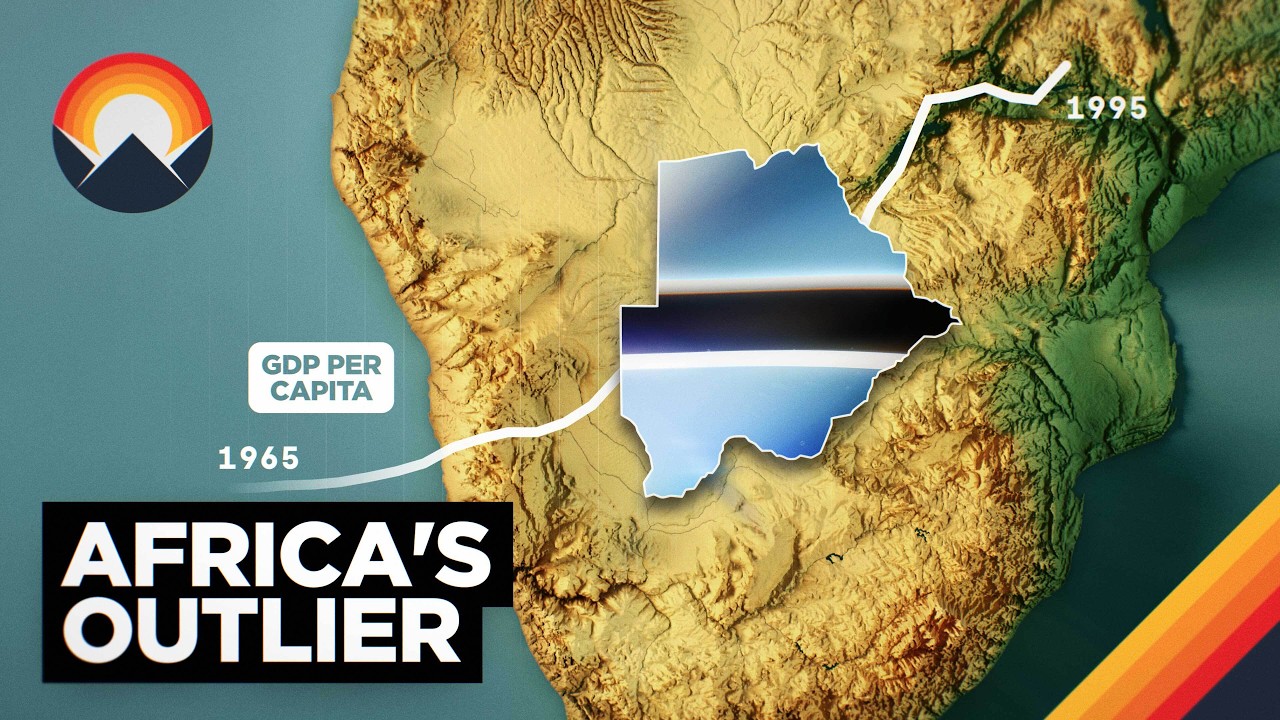
Why Botswana Got So Wealthy — Wendover Productions

Wendover Productions

Botswana avoided the resource curse by channeling centralized diamond windfalls into public infrastructure, but plunging natural gem demand now threatens its developmental model and forces an urgent push into new industries.

AI-assisted summary of Why Botswana Got So Wealthy — original source. Check the original for full context.

Source published:

Key ideas

  • Botswana systematically defied the post-colonial 'resource curse,' leveraging massive diamond reserves to achieve the world's highest GDP per capita growth rate between 1965 and 1995 while outperforming established European democracies on regional corruption indices. (0:00)
  • Preemptive governance prior to discovery centralized all subterranean mineral rights under the national treasury, enabling a 50/50 joint venture with De Beers (Debswana) that retains an estimated 80% of diamond revenues domestically. (11:15)
  • The 1895 diplomatic mission of Three Chiefs to London prevented Cecil Rhodes from annexing the territory, preserving indigenous consultative institutions like the kgotla that formed the foundation for modern inclusive governance. (6:23)
  • The rapid expansion of lab-grown diamonds contributed to a 20% collapse in domestic diamond output in 2025, catalyzing the ruling BDP's first electoral defeat in nearly six decades and triggering an urgent push to diversify into copper, critical minerals, and solar exports. (13:42)

Detailed notes

## Background Published on YouTube by Wendover Productions on September 30, 2026, the video examines the political and economic factors behind Botswana's rise to prosperity. The accompanying description highlights production credits featuring writers Sam Denby, Tristan Purdy, and Christine Benedetti, alongside an exclusive sponsorship promotion for Incogni.

## TL;DR Botswana defied the typical post-colonial 'resource curse' by transforming massive diamond discoveries into equitable, sustained national development. Rooted in pre-colonial consultative traditions and protected by astute nineteenth-century diplomacy, the country under founding president Seretse Khama centralized mineral rights, established the 50-50 Debswana partnership with De Beers, and channeled proceeds into roads, universal education, and healthcare. Although this governance model successfully countered challenges like the HIV/AIDS crisis, the rapid growth of lab-grown diamonds recently triggered domestic economic contractions. Following the historic 2024 election that peacefully ended decades of single-party rule, the country is now racing to diversify into solar power, eco-tourism, and critical minerals.

## Atmosphere & style The video maintains Wendover's signature analytical, measured tone, blending crisp exposition with thoughtful socioeconomic inquiry. Ground-level comparisons between Johannesburg's fortified compounds and Gaborone's peaceful streets immediately pull the viewer into an engaging institutional puzzle. The narrative evokes admiration for Botswana's prudent historical choices and consensus-driven statecraft, before pivoting toward a tense, cautious realism as global synthetic markets threaten the nation's economic bedrock.

## Bulletin - [00:00](https://www.youtube.com/watch?v=PXuQ5ZEBfTA&t=0s) Botswana systematically defied the post-colonial 'resource curse,' leveraging massive diamond reserves to achieve the world's highest GDP per capita growth rate between 1965 and 1995 while outperforming established European democracies on regional corruption indices. - [11:15](https://www.youtube.com/watch?v=PXuQ5ZEBfTA&t=675s) Preemptive governance prior to discovery centralized all subterranean mineral rights under the national treasury, enabling a 50/50 joint venture with De Beers (Debswana) that retains an estimated 80% of diamond revenues domestically. - [06:23](https://www.youtube.com/watch?v=PXuQ5ZEBfTA&t=383s) The 1895 diplomatic mission of Three Chiefs to London prevented Cecil Rhodes from annexing the territory, preserving indigenous consultative institutions like the kgotla that formed the foundation for modern inclusive governance. - [13:42](https://www.youtube.com/watch?v=PXuQ5ZEBfTA&t=822s) The rapid expansion of lab-grown diamonds contributed to a 20% collapse in domestic diamond output in 2025, catalyzing the ruling BDP's first electoral defeat in nearly six decades and triggering an urgent push to diversify into copper, critical minerals, and solar exports.

## Key takeaways - [00:00](https://www.youtube.com/watch?v=PXuQ5ZEBfTA&t=0s) At independence in 1966, Botswana was one of the poorest territories on Earth with just twelve kilometers of paved road, yet it avoided the instability, graft, and civil war that struck other mineral-rich post-colonial states. - [02:07](https://www.youtube.com/watch?v=PXuQ5ZEBfTA&t=127s) Urban life in Gaborone lacks the fortified, gated-compound infrastructure common in Johannesburg, reflecting lower historical economic inequality, safe civic spaces, and a minimal European settler footprint. - [05:00](https://www.youtube.com/watch?v=PXuQ5ZEBfTA&t=300s) The British established the Bechuanaland Protectorate in 1885 primarily as a strategic geopolitical buffer rather than an extractive colony, leaving traditional Batswana administration and customary law largely unmolested. - [06:23](https://www.youtube.com/watch?v=PXuQ5ZEBfTA&t=383s) In 1895, Chiefs Khama III, Bathoen I, and Sebele I toured Britain to build public support and negotiate directly with Colonial Secretary Joseph Chamberlain, successfully blocking Cecil Rhodes' British South Africa Company from seizing their territory. - [06:23](https://www.youtube.com/watch?v=PXuQ5ZEBfTA&t=383s) Pre-colonial Tswana political culture already featured inclusive checks and balances, including inter-tribal coalitions and the kgotla—a village assembly where leaders were held accountable to public debate. - [08:35](https://www.youtube.com/watch?v=PXuQ5ZEBfTA&t=515s) After British authorities forced Seretse Khama into exile due to his interracial marriage, his subsequent renunciation of hereditary chieftaincy enabled him to build democratic legitimacy as a civilian leader and founder of the Bechuanaland Democratic Party (BDP). - [10:00](https://www.youtube.com/watch?v=PXuQ5ZEBfTA&t=600s) Following independence, the Khama administration pursued centrist, consensus-based governance that retained experienced civil servants and protected private property rather than implementing destabilizing, radical indigenization policies. - [11:15](https://www.youtube.com/watch?v=PXuQ5ZEBfTA&t=675s) Before geologists located diamonds, Khama secured a national compact stipulating that all subterranean wealth belonged to the central state rather than individual tribes, preempting regional and ethnic resource conflicts. - [11:15](https://www.youtube.com/watch?v=PXuQ5ZEBfTA&t=675s) Revenues from the Debswana 50/50 partnership funded extensive public goods, expanding paved highways across the Kalahari, heavily subsidizing the cattle industry, and raising adult literacy to roughly 90% via guaranteed 10-year universal schooling. - [13:42](https://www.youtube.com/watch?v=PXuQ5ZEBfTA&t=822s) State capacity was demonstrated during the HIV/AIDS epidemic when Botswana became the first African country to distribute free, universal antiretroviral therapy in 2002, slashing mother-to-child transmission rates below 1%. - [13:42](https://www.youtube.com/watch?v=PXuQ5ZEBfTA&t=822s) The rise of lab-grown diamonds, capturing approximately 20% of the global market, has heavily disrupted Botswana's diamond-dependent mono-economy and sparked consecutive years of domestic economic contraction. - [15:00](https://www.youtube.com/watch?v=PXuQ5ZEBfTA&t=900s) Economic stagnation prompted voters in 2024 to peacefully end the BDP's 58-year governing tenure, transferring presidential power to Duma Boko without institutional disruption or unrest. - [15:00](https://www.youtube.com/watch?v=PXuQ5ZEBfTA&t=900s) To reduce its systemic diamond exposure, the new administration is pursuing diversification through expanded copper mining, high-end eco-tourism, unmapped critical mineral exploration, and a $100 million solar energy export project.

## Detailed walkthrough ### [00:00](https://www.youtube.com/watch?v=PXuQ5ZEBfTA&t=0s) The Sub-Saharan Outlier: Defying the Resource Curse

It reads like the textbook prelude to a modern tragedy: a newly liberated African nation enters the world stage in 1966 as one of the poorest and least developed territories on Earth. The very next year, while frantically trying to assemble basic state machinery, it strikes era-defining mineral wealth beneath its soil—massive diamond deposits—and promptly invites a multinational mining giant in to help extract them. Across the post-colonial world, that exact scenario has almost universally triggered the "resource curse," transmuting geologic abundance into systemic graft, ethnic slaughter, runaway inequality, and institutional collapse. Yet Botswana managed to break the mold entirely, transforming raw underground treasure into durable national prosperity without falling prey to the chaos seen elsewhere across the continent.

Half a century after independence, Botswana stands as a remarkable anomaly in mainland Sub-Saharan Africa. Rather than suffering the resource-fueled instability that plagued diamond- and lithium-rich Zimbabwe, the deep wealth disparities wrought by Angolan oil, or the decades of brutal warfare over minerals in the Democratic Republic of the Congo, Botswana channeled its diamond revenues into equitable, sustainable governance. It is "fortunate, but it's not lucky." By virtually every socio-economic benchmark, the nation outperforms its regional peers:

- **Perceived Corruption:** Botswana leads the entire region and ranks ahead of established European democracies like Spain and Italy. - **Human Development Index (HDI):** Ranks third overall in mainland Sub-Saharan Africa. - **GDP Per Capita:** Sits second in mainland Sub-Saharan Africa behind only oil-rich Gabon, outperforming neighboring regional heavyweight South Africa. - **Governance and Stability:** Recognized consistently as the most peaceful and most democratic nation in the region.

---

[02:07](https://www.youtube.com/watch?v=PXuQ5ZEBfTA&t=127s) Street-Level Realities: Gaborone vs. Johannesburg and Windhoek

The divergence between Botswana and its neighbors is immediately palpable on the ground. A traveler journeying from South Africa's commercial core, Johannesburg, to Botswana's capital, Gaborone, enters an entirely different urban reality. In Johannesburg, the legacy of apartheid-era segregation, intense economic stratification along racial lines, and an overwhelmed police force facing staggering rates of violent crime have turned suburban life into a landscape of fortified compounds. Neighborhoods like northern Johannesburg's Benmore Gardens are purpose-built behind barbed-wire-topped walls. Meanwhile, older neighborhoods like Parkmore have retrofitted extensive defensive perimeters—staffed boom gates and nocturnal street closures sanctioned through legal pacts between the Parkmore Community Association and the Johannesburg Roads Agency.

```mermaid flowchart TD accTitle: Urban Security Dynamics in Johannesburg vs Gaborone accDescr: Contrasting the high-security fortified enclaves of Johannesburg with the open civic safety of Gaborone.

subgraph JHB["Johannesburg: Fortified Enclaves"] J1["Severe Historical Stratification & High Crime"] J2["Police Forces Overwhelmed"] J3["Perimeter Walls, Barbed Wire & Retrofitted Boom Gates"] J1 --> J2 --> J3 end

subgraph GAB["Gaborone: Open Civic Space"] G1["Different Colonial Footprint & Lower Inequality"] G2["Walkable Streets & High Social Trust"] G3["Fenced Homes Standard, but Minimal Gated Compounds"] G1 --> G2 --> G3 end ```

By contrast, while standard residential fences exist in Gaborone, sweeping private security infrastructure is rare; only a handful of luxury enclaves, such as the Phakalane Golf Estate, utilize staffed gates to partition private fairway homes from the rest of the city. Gaborone remains a walkable, safe capital where residents navigate public spaces with ease, passersby are famously warm and talkative, and "bad neighborhoods are just less bad." While sheer scale accounts for some of this divergence—Johannesburg holds roughly five million residents, while all of Botswana counts just 2.5 million, with only 250,000 in Gaborone—population size alone cannot explain the chasm in crime and fear.

A comparison with Namibia’s capital of Windhoek, with under 500,000 residents, further highlights Botswana's unique background. Windhoek's downtown is visibly shaped by European rule, dotted with German Lutheran churches and Bavarian-style clock towers. Gaborone has no such European architectural imprint. With the lone exception of Francistown, urban centers in Botswana do not bear Dutch, German, or English place names. White citizens make up roughly 0.1% of Botswana’s populace, contrasted with roughly 2% in Namibia and 7% in South Africa. These visual and cultural contrasts trace back to a vastly different colonial experience—one anchored to a solitary ribbon of railway track.

---

[05:00](https://www.youtube.com/watch?v=PXuQ5ZEBfTA&t=300s) The Protectorate Buffer and Cecil Rhodes' Ambitions

Dodging the resource curse requires robust political institutions capable of withstanding the corrosive temptations of sudden windfalls. In Botswana, those checks and balances predate the modern state. During the late nineteenth-century Scramble for Africa, as British and German empires carved out brutal extraction colonies across southern Africa, the interior scrubland that would become Botswana was perceived as an impoverished, landlocked expanse devoid of economic value. Rather than being incorporated directly into the Cape Colony or annexed as German South West Africa, the area was designated the Bechuanaland Protectorate in 1885.

London established the protectorate not for what lay within it, but as a strategic geopolitical buffer to prevent rogue Boer frontiersmen and imperial Germany from linking territories. Because the imperial center saw little commercial potential in the Kalahari, Britain adopted a hands-off administrative posture, leaving local administration and customary law in the hands of indigenous Batswana rulers. For a decade, the Tswana polities governed themselves with minimal imperial meddling.

That autonomy was jeopardized in 1890 when Cecil Rhodes—the diamond magnate, imperial ideologue, and newly installed Prime Minister of the Cape Colony—set his sights northward. Rhodes envisioned British rule stretching from Cape Town to Cairo, and his British South Africa Company soon began sweeping into what would become Southern and Northern Rhodesia. Aware that Rhodes intended to swallow Bechuanaland into his commercial company rule, the Batswana leadership recognized that their survival demanded decisive political action.

---

[06:23](https://www.youtube.com/watch?v=PXuQ5ZEBfTA&t=383s) Three Chiefs in London and the Foundations of Inclusive Rule

Rather than resorting to a suicidal military stand against Rhodes' corporate forces, the Batswana chiefs turned to high-stakes diplomacy. Coordinated through the London Missionary Society, three paramount leaders—Kgosi Khama III of the Bangwato, Kgosi Bathoen I of the Bangwaketse, and Kgosi Sebele I of the Bakwena—embarked on an ocean voyage to the heart of the British Empire in 1895.

```mermaid flowchart LR accTitle: The 1895 London Diplomatic Mission accDescr: How the Three Chiefs outmaneuvered Cecil Rhodes through diplomacy with Joseph Chamberlain.

subgraph Threat["Imperial Pressure"] A["Cecil Rhodes & British South Africa Co."] end

subgraph Diplomacy["Batswana Counter-Strategy"] B["Three Chiefs: Khama III, Bathoen I, Sebele I"] C["Public Tour: Southampton, Leeds, Leicester, London"] D["Colonial Secretary Joseph Chamberlain"] end

subgraph Outcome["Settlement"] E["Protectorate Remains Under Crown"] F["Land Ceded for Eastern Rail Corridor"] end

A -->|"Threatens Annexation"| B B -->|"Builds Public Support"| C B -->|"Offers Rail Concession"| D D -->|"Rebuffs Rhodes"| E D --> F ```

In London, the chiefs met with Colonial Secretary Joseph Chamberlain and proposed a calculated compromise: they would welcome direct Crown oversight over their territory in exchange for blocking Rhodes' British South Africa Company from taking it over. Taking their campaign directly to the British public, the chiefs toured civic halls and church gatherings across Southampton, Leicester, Leeds, and London, rallying Christian and abolitionist sympathies. To seal the agreement, the chiefs agreed to cede a strip of land along their eastern border to allow the construction of a British rail line linking the Cape to the north. Chamberlain accepted the terms, leaving a frustrated Cecil Rhodes to admit in his private correspondence that he had been completely outmaneuvered.

The resulting railway remains the principal physical footprint of British presence in the territory; the protectorate's colonial capital, Mafeking, was situated outside its actual borders, south of the Molopo River in modern South Africa. More critically, as Daron Acemoglu and James A. Robinson note in *Why Nations Fail*, successful societies rely on "inclusive institutions"—governing and economic frameworks that foster broad participation rather than enriching an extractive elite. The 1895 mission proved that these indigenous institutional foundations were already functioning: - **Inter-Tribal Solidarity:** Despite historical rivalries, the three leaders built a durable coalition to negotiate collectively against existential external threats. - **Accountable Chieftaincy:** Although Tswana leadership was hereditary, power was tempered through the *kgotla*—a consultative assembly where adult males debated policy and aired grievances that leaders were bound to heed. - **Conditional Sovereignty:** Dynastic succession could be bypassed if a rival candidate showed superior administrative and military talent, a philosophy captured in the traditional Setswana proverb: "The king is king by the grace of the people."

---

[08:35](https://www.youtube.com/watch?v=PXuQ5ZEBfTA&t=515s) Seretse Khama's Exile and the Road to Statehood

For the next six decades, Bechuanaland slumbered in relative colonial obscurity. The Crown spent virtually nothing on physical or administrative development, leaving the territory with a meager seven miles (twelve kilometers) of paved road by 1966. Yet this benign neglect also meant the country was spared the invasive European settlement, land alienation, and coercive labor systems that ravaged neighboring colonies.

This isolation broke down when Seretse Khama, the grandson of Khama III and heir to the Bangwato chieftainship, went abroad to pursue his higher education in South Africa and the United Kingdom. While studying law in London, Khama met and married Ruth Williams, a white English woman. The cross-racial union provoked an immediate political crisis: - **South African Hostility:** The marriage coincided with the 1948 formalization of apartheid in South Africa, whose government was horrified by an interracial royal couple ruling an adjacent territory and banned Khama from transiting through South African territory. - **Local Tswana Skepticism:** Traditional Batswana tribal elders were initially dismayed that their future paramount chief had taken a foreign wife without communal consultation. - **British Imperial Capitulation:** Eager to appease Pretoria's apartheid regime to safeguard South African gold, uranium, and trade, the British government subjected the marriage to contentious House of Commons debates and ultimately forced Seretse Khama into foreign exile in 1951.

Khama was eventually permitted to return home only after renouncing all dynastic claims to the Bangwato throne, stepping back onto African soil as a private citizen. Shedding the hereditary crown freed Khama to enter democratic politics. He leveraged his profound personal stature and national popularity to launch the Bechuanaland Democratic Party (BDP)—a moderate, reformist political movement designed to fuse traditional village consensus with a modern, democratic vision of sovereign statehood.

[10:00](https://www.youtube.com/watch?v=PXuQ5ZEBfTA&t=600s) Seretse Khama’s Centrist Vision and Institutional Foundations

Seretse Khama surged to an overwhelming victory in the country's first universal elections by championing policies that protected private property—a platform that resonated deeply with the populace in a cattle-based economy. During an era defined by extreme left- and right-wing revolutions and bloody insurgencies across the globe, Khama remained steadfastly in the center of the political spectrum within the relatively tranquil protectorate. As Bechuanaland transitioned peacefully into the sovereign Republic of Botswana, Khama shifted from the protectorate's prime minister to the nation's inaugural president.

Unlike many neighboring states, post-independence Botswana had very little colonial baggage. It possessed no armed militias and was free from long-standing armed conflict between indigenous communities and settler populations. President Khama used every opportunity to institutionalize governance through a robust national constitution rooted in traditional consensus. The new system mandated that the executive branch remain accountable to a National Assembly while receiving input from a tribal advisory body (the *Ntlo ya Dikgosi*). It enshrined fundamental civil liberties, maintained multi-party democracy, and drew Khama’s legitimacy directly from free and fair universal elections rather than his hereditary royal status as chief of the Bangwato.

Khama also forcefully rejected radical or reactionary indigenization policies. Rather than summarily expelling colonial bureaucrats, the state retained them to onboard, train, and transfer administrative knowledge to local Batswana civil servants. Because the British protectorate era had been comparatively hands-off and non-violent, the general public harbored little extreme animosity toward the existing civil apparatus. While Khama's choices appear intuitive in retrospect, they succeeded because of a rare convergence of historical advantages: - Pre-existing tribal and linguistic commonalities among the populace. - A minimal colonial footprint followed by a non-violent transition to independence. - A political leader whose controversial marriage forced him out of traditional chieftaincy, compelling him to build legitimacy as a modern civilian politician. - A pragmatic, centrist political movement that rallied voters around tangible economic hope rather than inflammatory ideology.

---

[11:15](https://www.youtube.com/watch?v=PXuQ5ZEBfTA&t=675s) The Preemptive Resource Compact and the Debswana Miracle

Khama harbored an intuitive hunch that a monumental economic windfall might be lying beneath Botswana’s soil, given that major diamond deposits had already surfaced across Southern Africa. Rather than waiting for geologists to strike mineral wealth, Khama acted preemptively. He pushed through landmark national legislation granting the state sole jurisdiction and ownership over all subterranean resources. Crucially, he negotiated a binding national accord among the diverse tribal chiefs: wherever minerals were unearthed, the resulting riches would belong to the national treasury to be distributed equally across all communities, regardless of whose ancestral territory held the mother lode.

```mermaid flowchart TD accTitle: Resource Governance and Revenue Model in Botswana accDescr: Diagram illustrating how subterranean minerals were centralized, mined via Debswana, and reinvested into national infrastructure and public goods.

subgraph InstitutionalPrep["Preemptive Governance"] A["Pre-Discovery Legislation"] --> B["All Subterranean Wealth Owned by State"] B --> C["Inter-Clan Compact: Equal National Sharing"] end

subgraph JointVenture["Resource Exploitation"] C --> D["Discovery of Orapa Mine"] D --> E["50/50 Partnership: De Beers + Botswana (Debswana)"] E --> F["80% of Retained Value via Taxes, Royalties, and Dividends"] end

subgraph NationalReinvestment["Socioeconomic Reinvestment"] F --> G["Cattle Industry Subsidies & Abattoirs"] F --> H["Universal Public Education (10-Yr Guarantee)"] F --> I["Highways Across Kalahari"] F --> J["Public Health & Free HIV/AIDS ARVs"] end ```

The gamble paid off almost immediately with the discovery of the Orapa diamond mine, which grew into the largest open-pit diamond mine by area in the world. Instead of allowing international mining conglomerates to exploit the resource unilaterally, the government forged an unprecedented 50-50 joint venture with De Beers, creating Debswana. This structure prevented mineral profits from disappearing into foreign offshore accounts or the pockets of corrupt politicians. De Beers has estimated that approximately 80% of all revenues generated by Debswana operations—spanning dividends, concession fees, royalties, and direct corporate taxes—remain directly within Botswana's domestic borders.

Rather than squandering these proceeds on vanity projects or letting them sit idle, the government systematically channeled resource capital back into the real economy: - **Cattle & Agriculture:** The state nationalized and expanded modern beef-processing abattoirs, heavily subsidizing boundary fence construction, veterinary medicine, and mandatory livestock vaccinations to shield the nation's primary employment driver. - **Infrastructure:** The nation transformed its transport network from a mere 10 miles of paved road at independence into a nationwide grid of modern paved highways spanning the Kalahari Desert, linking every significant settlement. - **Public Education:** The government guaranteed every child free access to a minimum of 10 years of formal schooling. High school graduate counts shifted from roughly 100 individuals in the late 1960s to a national adult literacy rate hovering near 90%. - **Growth Records:** Driven by mineral sales comprising 80% of export trade and funding one-third of the national budget, Botswana achieved the single highest GDP per capita growth rate in the world between 1965 and 1995.

---

[13:42](https://www.youtube.com/watch?v=PXuQ5ZEBfTA&t=822s) The HIV/AIDS Crisis and the Threat of Synthetic Diamonds

Botswana’s state capacity was put to the ultimate test during the 1990s when the HIV/AIDS pandemic tore across Southern Africa. At its zenith, the crisis posed an existential threat to the nation's survival: one in eight infants was infected at birth, and mother-to-child transmission rates surged up to 40%. Backed by its mineral treasury, the state deployed a comprehensive healthcare mobilization. Destigmatization campaigns, aggressive community screening, and universal public education were launched, culminating in 2002 when Botswana became the first country on the continent to provide free, universal antiretroviral therapy (ART) to all HIV-positive citizens. This public health intervention drove mother-to-child transmission rates down below 1%, transforming the country into a celebrated global public health benchmark.

Yet, as the healthcare crisis stabilized, a fresh existential dilemma emerged from global technological disruption: the rise of laboratory-grown diamonds. Shifting consumer attitudes regarding environmental and ethical footprints, coupled with steep price drops for manufactured stones, resulted in lab-grown alternatives capturing roughly 20% of global diamond market share.

As the world's second-largest producer of mined diamonds, Botswana bore the full brunt of this shock: - In 2025, national diamond output collapsed by 20%. - The contraction caused the broader domestic economy to shrink for a second consecutive year. - A mono-economy that had relied on diamonds as the solution to every developmental puzzle suddenly found that the commodity itself had become its primary systemic liability.

---

[15:00](https://www.youtube.com/watch?v=PXuQ5ZEBfTA&t=900s) Democratic Transition and the Race to Diversify

Decades of extreme reliance on diamond extraction triggered rising structural unemployment and economic stagnation, directly sparking an unprecedented domestic political shift. Since achieving self-rule in 1966, the Botswana Democratic Party (BDP) had held uninterrupted legislative control. In the 2024 general election, the electorate broke with tradition, voting the BDP out of office. In stark contrast to the unrest common during political turnovers in the developing world, power transitioned with total calm and institutional stability. Duma Boko took office as president, tasked with executing an urgent, rapid economic diversification program.

```mermaid flowchart LR accTitle: Botswana's Economic Diversification Strategy accDescr: Flow diagram showing alternative sectors being developed to move away from diamond dependency.

A["Over-Reliance on Diamonds"] --> B["Economic Contraction"] B --> C["2024 Peaceful Transfer to Duma Boko"] C --> D["New Economic Pillars"]

subgraph Sectors["Diversified Sectors"] D --> E["High-End Eco-Tourism"] D --> F["Critical Minerals Exploration"] D --> G["Expanded Copper Mining"] D --> H["$100M Solar Generation Grid"] end ```

The new administration is attempting to activate multiple alternative economic levers: - **Eco-Tourism:** Leveraging pristine wildlife reserves, national parks, and an enviable safety record to attract high-value international travelers, though tourism returns historically struggle to distribute wealth broadly across the whole labor force. - **Critical Minerals:** Launching state-backed geological exploration programs across the vast unmapped portions of the country to identify lithium, rare earths, and other high-demand transition elements. - **Base Metals:** Escalating extraction across newly expanded domestic copper mining deposits. - **Renewable Energy Exports:** Capitalizing on intense Kalahari sunlight by constructing a $100 million solar energy farm designed to export electricity across the Southern African Power Pool (SAPP), offsetting severe regional power deficits caused by deteriorating legacy infrastructure in neighboring countries.

Botswana's modern success was never solely about geological luck; countless resource-rich states have succumbed to the resource curse. Botswana succeeded because deliberate institutional safeguards successfully turned mineral windfalls into broad human development. While historical shocks like Cecil Rhodes’ British South Africa Company and the HIV/AIDS epidemic were eventually overcome, the collapse of global mined-diamond pricing is unfolding far faster than the state can construct replacement industries. Navigating this transition will require the country to lean on its democratic resilience to avoid losing its hard-won outlier status.

---

[16:54](https://www.youtube.com/watch?v=PXuQ5ZEBfTA&t=1014s) Data Privacy Concerns and Incogni (Sponsor Segment)

The narrator points out that anyone searching their own name online will often find home addresses, personal telephone numbers, and relatives' names exposed on search engines. This pervasive data leakage puts citizens at risk from corporate tracking, relentless spam marketing, online fraudsters, and identity theft. Because statutory data protection regulations in the United States remain historically fragmented and weak, individuals generally possess little direct legal recourse to cleanse their footprint manually.

The segment introduces Incogni, a consumer data-privacy platform designed to automate the process of personal data erasure: - **Broker Sweeps:** Incogni continuously scours hundreds of commercial data brokers and people-search directories to catalog where your private identity profiles are being commercially traded. - **Automated Removal:** The platform automatically files, tracks, and enforces formal suppression and takedown requests with these entities without requiring user micromanagement. - **Persistent Audits:** The system periodically re-runs diagnostic checks against target brokers to verify that scrapped details do not quietly reappear when brokers re-index public records. - **Activity Dashboards:** Subscribers can monitor progress using an online dashboard that categorizes removal cases by those submitted, those actively in progress, and those successfully resolved. - **Specialist Support:** Under the platform's Unlimited tier, proprietary scans consolidate an individual's digital trail into a central interface, where users can direct human privacy specialists to execute custom data expungements. - **Third-Party Verification:** The procedural efficacy of Incogni's automated removal protocols has been independently audited and validated by international accounting firm Deloitte. - **Offer Details:** Viewers are directed to use promo code `WENDOVER` via the description link to claim an exclusive 60% discount on an annual Incogni protection plan.

## Notable quotes > [00:00](https://www.youtube.com/watch?v=PXuQ5ZEBfTA&t=0s) fortunate, but it's not lucky.

> [02:07](https://www.youtube.com/watch?v=PXuQ5ZEBfTA&t=127s) bad neighborhoods are just less bad.

> [06:23](https://www.youtube.com/watch?v=PXuQ5ZEBfTA&t=383s) The king is king by the grace of the people.

## Mentioned Alexander Williard, Austin Glass, Bakwena, Bangwato, Bangwaketse, Bechuanaland Democratic Party (BDP), Cecil Rhodes, Christine Benedetti, Daron Acemoglu, De Beers, Debswana, Deloitte, Dony Bullen, Duma Boko, Gabriel Ferreras, Incogni, James A. Robinson, Joseph Chamberlain, Kate Ermolenkko, Kgosi Bathoen I, Kgosi Khama III, Kgosi Sebele I, London Missionary Society, Manni Simon, Ntlo ya Dikgosi, Ruth Williams, Sam Denby, Sara Stoltman, Seretse Khama, Simon Buckmaster, Southern African Power Pool (SAPP), Tristan Purdy, Wendover Productions, Why Nations Fail

## Video description Use code "wendover" to get an exclusive 60% off an annual Incogni plan: https://incogni.com/wendover

Youtube: http://www.YouTube.com/WendoverProductions Instagram: http://Instagram.com/sam.from.wendover Twitter: http://www.Twitter.com/WendoverPro Sponsorship Enquiries: wendover@standard.tv Other emails: sam@wendover.productions Reddit: http://Reddit.com/r/WendoverProductions

Writing by Sam Denby, Tristan Purdy, and Christine Benedetti Editing by Alexander Williard Animation by Sara Stoltman, Gabriel Ferreras, Austin Glass, and Kate Ermolenkko Sound by Manni Simon and Dony Bullen Thumbnail by Simon Buckmaster

[Source](https://www.youtube.com/watch?v=PXuQ5ZEBfTA)

中文简报

培育钻石冲击经济,博茨瓦纳加速多元化转型 博茨瓦纳曾通过将集中的钻石收益注入公共基础设施,成功规避了“资源诅咒”,但如今天然宝石需求的暴跌对其发展模式构成了威胁,迫使其紧急向新产业推进转型。 博茨瓦纳通过将巨额钻石发现转化为公平、持久的国家发展,打破了后殖民时期典型的“资源诅咒”。该国植根于殖民前的协商传统,并在19世纪精明外交的庇护下,由开国总统塞雷茨·卡马(Seretse Khama)推行矿产权收归国有,与戴比尔斯(De Beers)建立了持股各半的Debswana合资公司,并将收益投入道路、全民教育和医疗卫生事业。尽管这种治理模式成功应对了艾滋病(HIV/AIDS)危机等挑战,但近期人造培育钻石的迅猛增长引发了该国国内经济的萎缩。在2024年以和平方式终结数十年一党执政的历史性大选之后,博茨瓦纳目前正加紧向太阳能、生态旅游和关键矿产领域推进多元化发展。 博茨瓦纳系统性地打破了后殖民时代的“资源诅咒”,利用庞大的钻石储量在1965至1995年间实现了全球最高的人均GDP增长率,并在区域廉洁指数上超越了老牌欧洲民主国家。 (0:00) 在矿藏发现前推行的先发制人式治理,将所有地下矿产权集中收归国库,从而促成了与戴比尔斯(De Beers)各占50%股份的合资企业(Debswana),使估算约80%的钻石收益得以留存在国内。 (11:15) 1895年三位酋长前往伦敦的外交出访阻止了塞西尔·罗兹(Cecil Rhodes)兼并该地的企图,保留了如“kgotla”等本土协商制度,为现代包容性治理奠定了基石。 (6:23) 人造培育钻石的迅速扩张导致2025年该国国内钻石产量暴跌20%,促成了执政党博茨瓦纳民主党(BDP)近六十年来的首次大选失利,并引发了向铜、关键矿产及太阳能出口多元化转型的紧迫推进。 (13:42)

Reading summary

Wendover Productions argues that Botswana avoided the post-colonial "resource curse" not through fortune alone, but by cultivating accountable political institutions prior to independence and preemptively managing its diamond reserves for broad public investment. Pre-Colonial Diplomacy and Institutional Foundations (6:23) Long before gaining independence in 1966, Batswana society operated under consultative governance structures that placed checks on autocratic power. Hereditary leaders ruled through the kgotla, a public assembly where male citizens debated community affairs and leaders were bound to address grievances under the traditional maxim that rulers held power only through popular consent. When Cecil Rhodes sought to absorb the Bechuanaland Protectorate into his British South Africa Company in the 1890s, three paramount chiefs—Khama III, Bathoen I, and Sebele I—traveled to London in 1895. By rallying British public support and offering a strip of border territory for a Crown railway, they successfully blocked company rule and preserved local self-governance. Because London viewed the arid territory as commercially negligible, it maintained a hands-off administrative approach that left indigenous legal systems and chieftaincies intact. As economists Daron Acemoglu and James A. Robinson observe in Why Nations Fail, these arrangements laid early groundwork for inclusive institutions. Spared the extensive European settlement, land alienation, and violent insurgencies that shaped neighboring South Africa and Namibia, Botswana transitioned to modern statehood with high social trust and minimal colonial baggage. Preemptive Mineral Legislation and Debswana (11:15) Anticipating that Southern Africa's mineral wealth might extend into Botswana, inaugural President Seretse Khama enacted institutional safeguards before geologists struck major deposits. Khama passed legislation vesting ownership of all subterranean minerals in the state rather than local tribes, brokering an inter-clan compact ensuring that extraction revenues would fund nationwide development rather than enrich individual territories. When geologists subsequently uncovered the massive Orapa deposit, the government formed Debswana, a 50-50 joint venture with De Beers. According to De Beers, approximately 80% of all Debswana revenue—derived from royalties, dividends, and corporate taxes—remains within Botswana's borders. This framework prevented capital flight and political misappropriation, driving the world's highest per capita GDP growth rate between 1965 and 1995. Reinvesting Diamond Riches into Public Goods (13:42) Rather than funding vanity projects, the state directed diamond proceeds into foundational infrastructure and human capital. Botswana expanded its paved highway network from just 10 miles at independence to a grid connecting remote Kalahari settlements, heavily subsidized cattle abattoirs to protect rural livelihoods, and guaranteed 10 years of free education, raising adult literacy from low baseline numbers to roughly 90%. This administrative capacity was tested in the 1990s by an HIV/AIDS epidemic that infected one in eight infants at birth and drove mother-to-child transmission rates to 40%. Financed by mineral receipts, the government initiated community screening and, in 2002, became the first African nation to provide free, universal antiretroviral therapy to all positive citizens, reducing mother-to-child transmission below 1%. Synthetic Diamond Pressures and Economic Diversification (15:00) Despite its historical stability, Botswana's reliance on diamonds—which historically accounted for 80% of exports and one-third of the state budget—has become an economic vulnerability. The rapid commercial expansion of lab-grown diamonds, which captured roughly 20% of the global market, caused national diamond production to drop by 20% in 2025 and triggered two consecutive years of economic contraction. Rising unemployment and stagnation led voters to end the Botswana Democratic Party's uninterrupted 58-year tenure in the 2024 general election. The peaceful transfer of power to President Duma Boko redirected state policy toward urgent diversification, including copper mining, rare-earth exploration, high-end wildlife eco-tourism, and a $100 million solar generation grid designed to export power across Southern Africa. Botswana demonstrated that strong governance and institutional foresight can turn natural resources into genuine human development, but the collapse of global mined-diamond pricing poses an urgent test of whether its democratic model can engineer a viable post-diamond economy.

Detailed notes — zh

## Background 该视频由知名知识科普频道 Wendover Productions 于 2026 年 9 月 30 日发布在 YouTube 平台。视频简介提供了赞助商 Incogni 个人隐私保护服务的独家 6 折优惠链接,并列出了包括作者 Sam Denby 在内的完整制作与动画团队名单。 ## TL;DR 视频深度剖析了博茨瓦纳如何打破非洲普遍存在的“资源诅咒”,崛起为撒哈拉以南非洲治理最好、最繁荣且制度最稳定的国家之一。早在殖民时期,茨瓦纳部族首领便通过高超的外交博弈抵御了帝国主义的掠夺,奠定了深厚的“包容性制度”传统;独立建国后,首任总统塞雷茨·卡马未雨绸缪,在钻石被发现前即立法将矿权收归国有并确立利益均分原则。博茨瓦纳通过与戴比尔斯建立平等持股的德比斯瓦纳合资模式,将巨额钻石红利倾注于免费基础教育、横跨沙漠的基础设施以及终结艾滋病危机的全民医疗体系中。面对近年来实验室培育钻石对传统采矿业的重创,博茨瓦纳在 2024 年以和平的民主政权交接展现了非凡的制度韧性,目前正积极向生态旅游、关键矿产与可再生清洁能源外销艰难推进多元化转型。 ## Atmosphere & style 全片呈现出一种严谨宏大而又不失人文关怀的分析格调,叙事沉稳、节奏明快,极具 Wendover Productions 标志性的地缘政治与宏观经济科普质感。开篇以约翰内斯堡与哈博罗内的街头安保反差切入,瞬间拉满了强烈的现实戏剧张力;随后在讲述部族酋长赴英博弈与卡马总统传奇人生的历史章节中,语调转为由衷的赞赏与致敬。而当论及艾滋病浩劫的绝地反击与培育钻石引发的当下经济阵痛时,情绪在历史宿命的沉重感与对包容性制度的坚定信任之间穿梭,为观众带来一场既发人深省又兼具知性审美的沉浸式视听体验。 ## Bulletin - [00:00](https://www.youtube.com/watch?v=PXuQ5ZEBfTA&t=0s) 博茨瓦纳打破了非洲常见的“资源诅咒”,在清廉指数上优于西班牙和意大利,人类发展指数位列撒哈拉以南非洲大陆第三,人均 GDP 更是超越了近邻南非。 - [05:00](https://www.youtube.com/watch?v=PXuQ5ZEBfTA&t=300s) 19 世纪末三位传统酋长赴英谈判换取直辖保护,以及开国总统塞雷茨·卡马建立的部族协商、宪政制衡与矿产全民均分机制,奠定了该国长远繁荣的“包容性制度”基石。 - [11:34](https://www.youtube.com/watch?v=PXuQ5ZEBfTA&t=694s) 通过与戴比尔斯设立五五持股的合资企业德比斯瓦纳,约 80% 的采矿收益通过税费和就业留存国内,并被大规模投入到免费教育、现代路网与抗艾公共卫生体系中。 - [13:16](https://www.youtube.com/watch?v=PXuQ5ZEBfTA&t=796s) 近年来实验室培育钻石蚕食了全球近 20% 的市场份额,博茨瓦纳钻石开采量骤降 20% 并引发经济衰退,迫使执政半个世纪的 BDP 在 2024 年大选中和平交权,国家正加速推进太阳能外销与矿产勘探等多元化转型。 ## Key takeaways - [00:00](https://www.youtube.com/watch?v=PXuQ5ZEBfTA&t=0s) 相较于安哥拉、津巴布韦与刚果(金)因资源引发的动荡,博茨瓦纳借助钻石开发成功逆转了“资源诅咒”,实现了相对公平且持久的发展。 - [00:00](https://www.youtube.com/watch?v=PXuQ5ZEBfTA&t=0s) 哈博罗内开放的城市街头与无刀片刺网的居住环境,与约翰内斯堡重度依赖私人安保的门禁社区形成鲜明对比,展现了优良的法治与治安水准。 - [00:00](https://www.youtube.com/watch?v=PXuQ5ZEBfTA&t=0s) 由于殖民期英国推行放任不干预政策,博茨瓦纳白人人口占比仅约 0.1%,不仅缺乏欧式复古地标,也避开了激烈的种族与土地撕裂冲突。 - [05:00](https://www.youtube.com/watch?v=PXuQ5ZEBfTA&t=300s) 1895 年卡马三世等三位酋长远赴伦敦游说,以让渡铁路走廊换取英国王室直接保护,成功化解了塞西尔·罗兹英国南非公司的吞并企图。 - [05:00](https://www.youtube.com/watch?v=PXuQ5ZEBfTA&t=300s) 茨瓦纳部族“国王因民而王”的传统协商集会机制(Kgotla),培育出对统治权力的早期制衡,成为阿西莫格鲁笔下“包容性制度”的典型实践。 - [10:00](https://www.youtube.com/watch?v=PXuQ5ZEBfTA&t=600s) 开国总统塞雷茨·卡马因跨种族婚姻放弃世袭特权,以平民身份建立博茨瓦纳民主党,走温和包容路线并坚定捍卫宪法多党制。 - [10:00](https://www.youtube.com/watch?v=PXuQ5ZEBfTA&t=600s) 卡马在探明钻石前通过预防性立法将地下矿权收归国有,并与各部族达成收益全国均分协议,从源头消除了宗派掠夺的制度诱因。 - [11:34](https://www.youtube.com/watch?v=PXuQ5ZEBfTA&t=694s) 博茨瓦纳政府与戴比尔斯平级合资组建德比斯瓦纳(Debswana),使高达 80% 的矿山收入留存国内,打破了跨国巨头单向吸血的旧殖民模式。 - [11:34](https://www.youtube.com/watch?v=PXuQ5ZEBfTA&t=694s) 矿产红利被定向反哺给非矿部门:国家补贴传统畜牧业、铺设横贯喀拉哈里沙漠的现代路网,并将识字率提升至近 90%。 - [13:16](https://www.youtube.com/watch?v=PXuQ5ZEBfTA&t=796s) 面对 1990 年代 HIV 母婴传播率达 40% 的灭顶之灾,博茨瓦纳依靠雄厚矿产外汇推行全员免费抗病毒治疗,成功将传播率压低至 1% 以下。 - [13:16](https://www.youtube.com/watch?v=PXuQ5ZEBfTA&t=796s) 实验室培育钻石凭借环保与低价蚕食全球近两成份额,致使博茨瓦纳钻石开采量萎缩 20%,暴露出过度依赖单一资源的系统性危机。 - [15:00](https://www.youtube.com/watch?v=PXuQ5ZEBfTA&t=900s) 钻石产业下行导致 2024 年执政党 BDP 历史性落败,新总统杜马·博科在完全和平透明的民主程序中完成权力交接。 - [15:00](https://www.youtube.com/watch?v=PXuQ5ZEBfTA&t=900s) 为破解经济单点风险,博茨瓦纳正全面布局铜等关键矿产勘探、依托南部非洲电力联盟开发 1 亿美元太阳能外销项目,并拓展生态旅游业。 ## Detailed walkthrough ### [00:00](https://www.youtube.com/watch?v=PXuQ5ZEBfTA&t=0s) 破除“资源诅咒”的非洲奇迹与哈博罗内的街头观察 在发展经济学中,所谓“资源诅咒”的剧本几乎千篇一律:一个非洲国家刚刚摆脱殖民枷锁宣布独立,作为全球最贫困、最不发达的经济体之一蹒跚起步;就在次年,正当年轻政权手忙脚乱地建立国家职能时,地底突然探明了足以改写时代的巨额财富——钻石,政府官员随即敞开大门,迎接跨国矿业巨头入场协助开采。然而,这笔天赐横财在非洲以至全球各地,几乎无一例外地演变成了中央政府腐败、族群冲突肆虐、贫富鸿沟拉大和国家政局陷入动荡的催化剂。安哥拉的石油催生出悬殊的贫富差距,津巴布韦的钻石与锂矿加剧了政权不稳,刚果民主共和国坐拥无尽矿藏却陷入长达数十年的内战与混乱。1966 年获得独立、次年便在境内发现大型钻石矿的博茨瓦纳,拿到的原本也是这样一副注定走向悲剧的底牌。 但博茨瓦纳却彻底打破了这一历史宿命。半个多世纪过去,这个深居内陆、人口稀少的发展中国家不仅没有被资源诅咒吞噬,反而蜕变成为撒哈拉以南非洲的“制度孤岛”。在廉洁感知指数上,博茨瓦纳不仅傲视整个非洲次大陆,甚至排在西班牙和意大利等欧洲发达国家之前;在人类发展指数(HDI)上,它位居撒哈拉以南非洲大陆第三;人均国内生产总值(GDP per capita)仅次于依靠石油的加蓬,牢牢甩开了近邻南非。它还是该地区最和平、民主制度最稳定的国家,借助钻石产业的红利实现了持久、相对公平且可持续的繁荣。“博茨瓦纳固然幸运,但它绝非侥幸”,其成功密码从微观的城市风貌便可见一斑。 从南非的经济中心约翰内斯堡驱车前往博茨瓦纳首都哈博罗内(Gaborone),最直观的冲击来自街头景观的戒备反差。在受种族隔离历史、极端阶级固化与失控的暴力犯罪重创的约翰内斯堡,门禁社区和私人安保几乎是生存刚需。北郊新建的高档社区本莫尔花园(Benmore Gardens)由布满刀片刺网的围墙整体合围,而邻近更老派的帕克莫尔(Parkmore)由于建成初期未考虑现代治安隐患,后来通过社区协会与约翰内斯堡道路局合作,在几乎所有公共街道强行加装升降道闸并派驻安保人员,到了夜间更是彻底封锁街道进出。相比之下,哈博罗内虽然也有类似帕卡拉内庄园(Phakalane Estates)这样围绕高尔夫球场建立的少数门禁社区,但整座城市基本没有与世隔绝的高墙电网。游客和市民在街头自在穿行,人与人之间热情攀谈,即便是所谓的贫民区也远谈不上凶险。 人口规模的悬殊(约翰内斯堡近 500 万人口,而博茨瓦纳全国仅 250 万人,首都仅 25 万人)固然降低了治安治理的难度,但人口并不是唯一的解释。即便是对比人口不足 50 万的纳米比亚首都温得和克(Windhoek),哈博罗内也大不相同:这里见不到欧式的大教堂,也没有巴伐利亚风格的复古钟楼;放眼全国主要城市,除弗朗西斯敦(Francistown)外,几乎找不到任何带有荷兰语、德语或英语色彩的地名。更显著的差异体现在人口构成上:博茨瓦纳的白人人口仅占总人口的约 0.1%,而南非约为 7%,纳米比亚约为 2%。这些街头细节折射出一段截然不同的殖民史,而这段历史的起点,正与该国境内一条至关重要的铁路线紧密相连。 - **廉洁与治理水平**:博茨瓦纳在清廉指数上优于西班牙和意大利,是非洲公认法治与治理最好的国家之一。 - **发展与经济指标**:人类发展指数(HDI)排名撒哈拉以南非洲大陆第三,人均 GDP 超过邻国南非。 - **白人人口占比差异**:博茨瓦纳仅约 0.1%,纳米比亚约为 2%,南非则达到 7% 左右。 --- ### [05:00](https://www.youtube.com/watch?v=PXuQ5ZEBfTA&t=300s) 铁路契约、三位酋长与“包容性制度”的根基 要避开资源诅咒,首要前提是建立起一套能够抵御资源暴利腐蚀的强韧国家制度。对于博茨瓦纳而言,这些制度甚至在国家真正建立之前就已成型。19 世纪末,正当英帝国与德意志帝国在南部非洲推行残酷的定居与掠夺性殖民统治时,如今被称为博茨瓦纳的土地——当时尚未探明钻石储量——基本处于帝国的雷达边缘。这片内陆荒原既无海岸线,在殖民者眼中也缺乏掠夺价值。英国出于遏制德国在西南非洲的扩张势头以及防范布尔人政权的考量,于 1885 年将该区域设立为“贝专纳保护国”(Bechuanaland Protectorate)。所谓保护国,意味着英国人采取了极其松散的“放任不干预”(hands-off)政策,实质治理权完全留给了当地的茨瓦纳(Tswana)各部族。 然而,这种超然的自治地位在 1890 年代险些毁于一旦。臭名昭著的帝国主义者、矿业大亨塞西尔·罗兹(Cecil Rhodes)于 1890 年出任开普殖民地总理,其向整个非洲大陆扩张的庞大野心很快蔓延到了贝专纳周边,建立了罗德西亚。面对罗兹种族主义统治和掠夺式特许公司的步步紧逼,茨瓦纳部族选择通过外交手段展开反击。1895 年,在伦敦传道会的协调与协助下,博茨瓦纳历史上著名的三位部族首领——卡马三世(Khama III)、巴托恩一世(Bathoen I)和塞贝莱一世(Sebele I)(如今他们的青铜塑像耸立在哈博罗内国家广场上)远涉重洋前往伦敦。他们与当时的英国殖民大臣约瑟夫·张伯伦(Joseph Chamberlain)举行会谈,并大胆提出:宁愿接受英国王室直接的官方保护管辖,以此在制度上架空罗兹的英国南非公司。为了争取英国民意支持,三位酋长从南安普敦、莱斯特、利兹一路巡回演讲至伦敦。最终,双方达成交易:各部族出让东部边界的一狭长土地,供英国修建连接南部非洲与内陆的铁路,作为交换,贝专纳维持英国直辖保护国的地位,罗兹彻底被边缘化。罗兹在通信中不得不沮丧地承认,自己在政治手腕上完全被这三位非洲酋长“智取”了。 这条沿国家东部边缘延伸的铁路线,几乎成为了贝专纳殖民时代留下的唯一大型物理遗迹。英国人在此的存在感微弱到了极点,甚至连保护国的行政首府马弗京(Mafeking/Mahikeng)都设在莫洛波河以南——也就是在今天的南非境内,而非博茨瓦纳本土。经济学家达龙·阿西莫格鲁(Daron Acemoglu)与詹姆斯·A·罗宾逊(James A. Robinson)在《国家为什么会失败》(*Why Nations Fail*)中提出,一个国家的兴衰关键不在于地理或资源禀赋,而在于能否建立起“包容性制度”(inclusive institutions)——即允许广大公众而非少数权贵参与的政治与经济体系。三位酋长的伦敦之行正是包容性制度萌芽的绝佳体现:一方面,来自不同部族的酋长能够在面对外敌时搁置分歧、紧密结盟;另一方面,部族内部早已形成了深刻的协商传统。人类学研究显示,尽管茨瓦纳部族首领由世袭产生,但酋长必须定期召集成年男性集会商讨国事,倾听民众诉求,倘若统治者昏庸无能,部族内部就会推举更有能力的候选人取而代之。正如当地一句古老谚语所言:“国王因民而王”("The king is king by the grace of the people")。这种对民意的敬畏,为日后博茨瓦纳的民主与法治埋下了关键种子。 ```mermaid flowchart TD accTitle: 贝专纳保护国抵御塞西尔·罗兹的外交博弈 accDescr: 展现塞西尔·罗兹的扩张威胁如何促成三位酋长赴英谈判,并以让渡铁路用地换取直辖保护,最终催生包容性制度。 subgraph 外部危机 A["塞西尔·罗兹扩张野心<br/>(英国南非公司意图吞并)"] end subgraph 部族联合与外交反制 B["三位酋长结成外交同盟<br/>(卡马三世 / 巴托恩一世 / 塞贝莱一世)"] C["远赴伦敦展开巡回演讲<br/>直接游说殖民大臣张伯伦"] end subgraph 谈判成果与制度根基 D["达成铁路换主权协议<br/>(割让走廊修路,换取王室直辖)"] E["罗兹被成功阻遏<br/>贝专纳保持独立自治与传统协商制度"] end A --> B B --> C C --> D D --> E ``` 在化解罗兹吞并危机的此后 60 年里,贝专纳保护国几乎与世隔绝:没有白人定居者掠夺土地,没有大规模的工业化开发,到 1966 年独立时,全境甚至只有区区 12 公里(7 英里)的铺面道路,经济几近停滞。然而,外部世界的风浪再次袭来。卡马三世的孙子塞雷茨·卡马(Seretse Khama)继承酋长之位后,先后前往南非和英国牛津大学深造。在英国期间,卡马与一位名叫鲁斯·威廉姆斯(Ruth Williams)的英国白人女性相恋并结为连理。这桩跨种族婚姻在当时引发了巨大的地缘政治风暴:正值南非刚刚确立种族隔离制度,南非当局严厉谴责这桩婚姻,并拒绝卡马途经南非返回贝专纳;与此同时,茨瓦纳部族内部的部分传统长老也对此表示不满。英国政府在南非的外交施压下退缩,在下议院展开旷日持久的辩论后,竟粗暴地将卡马流放海外,直至后来才勉强允许他仅以“普通平民”的身份返回故土。放弃了传统王位世袭特权的塞雷茨·卡马并未远离政坛,而是以公民身份全面投身于现代独立运动。他创建了走温和路线的贝专纳民主党(后更名为博茨瓦纳民主党,BDP),将个人极高的威望与现代政党政治及国家认同相融合,为这个即将问世的新生国家奠定了平稳过渡的政治基石。 - **三位历史酋长**:卡马三世(Khama III)、巴托恩一世(Bathoen I)与塞贝莱一世(Sebele I),被誉为现代博茨瓦纳的建国先驱。 - **极度的基础设施匮乏**:直至 1966 年独立建国前夕,整个博茨瓦纳境内仅有 12 公里(7 英里)的硬化柏油马路。 - **政治制度文化**:谚语“国王因民而王”("The king is king by the grace of the people")反映了传统部族会议(Kgotla)对王权的制衡约束与早期民主参与机制。 ### [10:00](https://www.youtube.com/watch?v=PXuQ5ZEBfTA&t=600s) 卡马的温和执政与制度先行的资源布局 在独立前夕,塞雷茨·卡马(Seretse Khama)推行保护私有财产的政策,这在以畜牧牛群为经济支柱的博茨瓦纳深得民心,使他在该国首次普选大选中取得压倒性胜利。当时非洲多国正陷入极左或极右派系的血腥革命与极端议程中,而卡马却在平静的保护领内坚定地坚守在温和的中间路线上。随着博茨瓦纳从保护领平稳过渡为主权独立国家,卡马顺理成章地由保护领总理转变为首任总统。博茨瓦纳迈入新时代时几乎没有背负沉重的殖民包袱:这里没有武装民兵,也从未存在过根深蒂固、互相攻伐的白人定居者与本土原住民集团。 卡马总统全力巩固并支持宪法建设,恪守该国源远流长的包容性传统:国家领导人必须接受国民议会的问责,并倾听部落咨询机构的建议;宪法明确保障公民的基本人权,坚持自由公正的定期选举——正是这种选举机制而非他原本的酋长头衔赋予了他统治的合法性。卡马在掌权后坚决捍卫多党制,极力反对任何形式的报复性或激进的“本土化”运动;他主张让前殖民地官僚协助培训和引导博茨瓦纳本土官员,而不是盲目将他们驱逐。这种务实态度得到了广泛接受,因为博茨瓦纳相对和平的殖民历史并未留下对旧官僚机构的极端敌意。卡马这一系列直觉般的建国决策,实际上深深植根于有利的现实土壤中:部族文化的同质性、相对短暂温和的殖民期、非暴力的独立历程,以及一桩迫使前酋长以平民身份重返政坛的戏剧性婚姻。 更具前瞻性的是卡马对地下资源的战略眼光。当时邻国已经发现了钻石矿藏,卡马敏锐察觉到本国也有可能迎来天降横财。在博茨瓦纳勘探出钻石之前,卡马便果断采取预防性立法,将所有地下矿产资源的控制权牢牢收归国有;同时与各部族达成划时代协议:未来无论在哪个部族的土地下挖掘出钻石,收益都必须在全国各部族间平均分配。这项政策确保了在财富真正显露之前,分配财富的制度架构已准备就绪。 ```mermaid flowchart TD accTitle: 博茨瓦纳独立初期制度与资源布局 accDescr: 展现博茨瓦纳早期温和建国理念与预防性资源立法的流程架构 subgraph Governance ["建国制度基石"] A["温和包容理念<br/>反对激进本土化"] --> B["宪法确立与权力制衡<br/>议会问责 / 部落咨询 / 普选"] B --> C["平稳过渡与政治稳定"] end subgraph Resource_Prep ["超前立法布局"] D["预判钻石潜力"] --> E["地下资源收归国家所有"] E --> F["部族利益均分协议<br/>打破地域与宗派壁垒"] end Governance --> G["制度先行:为资源开发筑牢防线"] Resource_Prep --> G ``` --- ### [11:34](https://www.youtube.com/watch?v=PXuQ5ZEBfTA&t=694s) 德比斯瓦纳合作模式与财富的全民再投资 这种制度前瞻性很快得到了丰厚的回报。奥拉帕(Orapa)钻石矿被发现,随后迅速被开发为全球露天开采面积最大的钻石矿。该矿藏由钻石巨头戴比尔斯(De Beers)投资建设,但博茨瓦纳政府绝非被动的旁观者,而是以对等股东身份参与其中,共同成立了各占50%股份的合资企业——德比斯瓦纳(Debswana)。这彻底改变了资源诅咒的宿命,钻石收益没有沦为跨国巨头或少数政客的私人腰包,而是真正实现了“全民共享”。据戴比尔斯估算,这些矿山创造的收入中有高达80%通过就业、税收和特许权使用费留存在了博茨瓦纳境内。 博茨瓦纳政府没有坐吃山空,而是将滚滚而来的钻石红利精准反哺到实体经济与公共民生中: - **扶持传统畜牧业**:政府将牛肉加工厂收归国有并扩大产能,同时提供建栏补贴、兽医服务和免费疫苗接种,极大地稳固并壮大了这一吸纳大量就业的核心传统支柱。 - **打造全国性基础设施**:用矿产收益铺设现代化柏油公路,不仅联通了全国主要城镇,更横跨了条件极其恶劣的喀拉哈里沙漠(Kalahari Desert)。 - **大力普及全民教育**:政府将公共教育列为重点开支,保障每个孩子享有至少10年的免费基础教育。 - **经济与社会指标的跃升**:在国家独立初期,境内仅有约10英里铺面道路和大约100名高中毕业生;而如今,沥青路面延伸至全国每一个主要聚落,全国识字率攀升至近90%。从1965年到1995年,钻石占到了全国出口额的80%并承担了三分之一的政府财政预算,推动博茨瓦纳实现了同期全球最高的人均GDP复合增长率。 --- ### [13:16](https://www.youtube.com/watch?v=PXuQ5ZEBfTA&t=796s) 应对艾滋病危机与培育钻石引发的新挑战 雄厚的国家财力不仅创造了繁荣,更在生死存亡的至暗时刻挽救了整个国家。1990年代,博茨瓦纳遭到HIV/艾滋病疫情的毁灭性冲击,成为全球疫情最严重的国家之一。当时新生儿感染率高达八分之一,母婴传播率一度飙升至40%,被政界视作动摇国本的“存亡威胁”。面对一场席卷全国的浩劫,这个在二十年前连健全医疗系统都没有的国家,凭借钻石储备的资金底气,果断发起了一场前所未有的公共卫生自救战役:普及防艾教育、消除社会歧视、大规模提供快速检测,并早在2002年就面向全社会免费提供抗逆转录病毒治疗药物。这一壮举最终将母婴传播率压低至1%以下,使博茨瓦纳从重灾区一跃成为全球公共卫生的标杆典范。 然而,眼下博茨瓦纳正面临着另一个同样具有“存亡威胁”级别的挑战:实验室培育钻石(培育钻)的崛起。出于环保、道德伦理审视以及低廉价格的优势,近年来全球近五分之一的钻石市场份额已被培育钻石侵蚀,这对全球第二大天然开采钻石生产国博茨瓦纳而言无疑是当头一棒。截至2025年,博茨瓦纳的钻石开采量骤降20%,国家经济已连续第二年陷入衰退。在过去几十年里,钻石是所有难题的解药;但现在,对钻石采掘的过度依赖本身已成为最刺眼的系统性风险。 --- ### [15:00](https://www.youtube.com/watch?v=PXuQ5ZEBfTA&t=900s) 2024年历史性政权交接与艰难的多元化突围 钻石产业的急剧萎缩引发了经济停滞和失业率攀升,博茨瓦纳迎来了独立以来最严峻的考验。自独立以来执政半个多世纪的博茨瓦纳民主党(BDP),在2024年的大选中遭遇惨败,选民决意寻求新的出路。令人瞩目的是,在国际社会的屏息注视下,政权实现了完全和平的民主交接,宪政机构经受住了历史风浪的考验。充满活力的新任总统杜马·博科(Duma Boko)临危受命,接过了经济转型与重塑国家生机的接力棒。 为了摆脱对钻石的单点依赖,博茨瓦纳正在多条战线上探索多元化转型路线: - **高端生态旅游业**:依托长期以来优良的治安记录和世界级自然保护区吸引游客,但旅游业资金流转面较窄,难以惠及全民。 - **关键矿产勘探开发**:国家已宣布成立勘探合资企业,全面摸排广袤未勘探国土下的矿藏;同时国内铜矿开采已出现明显反弹。 - **可再生清洁能源外销**:启动了一项耗资1亿美元的大型太阳能发电项目,计划接入南部非洲电力联盟(Southern Africa Power Pool)进行电力外销,精准切中了该地区电力需求高涨与老旧电网承载力不足的痛点。 从直面塞西尔·罗兹(Cecil Rhodes)时期的殖民图谋,到抵御HIV/艾滋病浩劫,博茨瓦纳的历史本就是一部克服生存威胁的历史。钻石并非这里繁荣的唯一秘密,“钻石财富与长远蓝图的有机结合”才是国家成功的根本逻辑。尽管培育钻石带来的冲击迅猛,且经济多元化步伐依然落后于危机蔓延的速度,但健全包容的制度韧性让这个南部非洲国家依然拥有破局求变的底气。 --- ### [16:48](https://www.youtube.com/watch?v=PXuQ5ZEBfTA&t=1008s) 赞助商插播:Incogni 个人隐私数据清理服务 在互联网数字化时代,个人隐私同样面临着失控的危机。如果用户尝试在搜索引擎中输入自己的名字,往往会震惊地发现个人住址、私人电话等敏感信息早已被公开展现在搜索结果中。这类隐私泄露令人不寒而栗,不论是广告追踪商、电信诈骗分子,还是潜在的恶意跟踪者,都能轻易获取这些私人数据;更无奈的是,在缺乏强力数据保护法案的环境下,普通人往往求告无门。 为此,本期视频推荐了个人数据保护服务 Incogni: - **全网扫描与代提交下架**:Incogni 能够自动扫描全网各大知名数据经纪商(Data Brokers)及人物信息搜索网站,代替用户向其发出具备法律效力的隐私清除要求。 - **长效监控与防止复发**:系统会定期进行周期性回访检索,防止新上线的流氓服务或被清除的数据重新泄露。 - **透明度看板与人工专员支持**:用户可以实时查看清除请求的详细统计,包括已提交、处理中和已完成的请求数量。在 Unlimited 套餐中,服务还能将散落全网的个人信息统一汇总,由专业人工团队协助用户逐一决定并实施下架。 - **第三方权威认证与专属优惠**:该服务的实际清除效果已获得四大会计师事务所之一的德勤(Deloitte)独立验证。观众使用专属折扣码“WENDOVER”,即可享受 Incogni 年度会员订阅计划的独家4折(减免60%)优惠。 ## Notable quotes > [00:00](https://www.youtube.com/watch?v=PXuQ5ZEBfTA&t=0s) 资源诅咒 > [00:00](https://www.youtube.com/watch?v=PXuQ5ZEBfTA&t=0s) 制度孤岛 > [00:00](https://www.youtube.com/watch?v=PXuQ5ZEBfTA&t=0s) 博茨瓦纳固然幸运,但它绝非侥幸 > [05:00](https://www.youtube.com/watch?v=PXuQ5ZEBfTA&t=300s) 放任不干预 > [05:00](https://www.youtube.com/watch?v=PXuQ5ZEBfTA&t=300s) 包容性制度 — 达龙·阿西莫格鲁与詹姆斯·A·罗宾逊 > [05:00](https://www.youtube.com/watch?v=PXuQ5ZEBfTA&t=300s) 国王因民而王 — 茨瓦纳部族传统谚语 > [05:00](https://www.youtube.com/watch?v=PXuQ5ZEBfTA&t=300s) 普通平民 > [11:34](https://www.youtube.com/watch?v=PXuQ5ZEBfTA&t=694s) 全民共享 > [13:16](https://www.youtube.com/watch?v=PXuQ5ZEBfTA&t=796s) 存亡威胁 > [15:00](https://www.youtube.com/watch?v=PXuQ5ZEBfTA&t=900s) 钻石财富与长远蓝图的有机结合 ## Mentioned 塞西尔·罗兹 (Cecil Rhodes), 卡马三世 (Khama III), 巴托恩一世 (Bathoen I), 塞贝莱一世 (Sebele I), 约瑟夫·张伯伦 (Joseph Chamberlain), 达龙·阿西莫格鲁 (Daron Acemoglu), 詹姆斯·A·罗宾逊 (James A. Robinson), 塞雷茨·卡马 (Seretse Khama), 鲁斯·威廉姆斯 (Ruth Williams), 杜马·博科 (Duma Boko), Sam Denby, 戴比尔斯 (De Beers), 德比斯瓦纳 (Debswana), 博茨瓦纳民主党 (BDP), 英国南非公司 (British South Africa Company), 伦敦传道会 (London Missionary Society), 南部非洲电力联盟 (Southern Africa Power Pool), Incogni, 德勤 (Deloitte), Wendover Productions, 《国家为什么会失败》(Why Nations Fail), 贝专纳保护国 (Bechuanaland Protectorate), 奥拉帕钻石矿 (Orapa Diamond Mine) ## Video description Use code "wendover" to get an exclusive 60% off an annual Incogni plan: https://incogni.com/wendover Youtube: http://www.YouTube.com/WendoverProductions Instagram: http://Instagram.com/sam.from.wendover Twitter: http://www.Twitter.com/WendoverPro Sponsorship Enquiries: wendover@standard.tv Other emails: sam@wendover.productions Reddit: http://Reddit.com/r/WendoverProductions Writing by Sam Denby, Tristan Purdy, and Christine Benedetti Editing by Alexander Williard Animation by Sara Stoltman, Gabriel Ferreras, Austin Glass, and Kate Ermolenkko Sound by Manni Simon and Dony Bullen Thumbnail by Simon Buckmaster [Source](https://www.youtube.com/watch?v=PXuQ5ZEBfTA)

Source quotes

[0:00] 资源诅咒 [0:00] 制度孤岛 [0:00] 博茨瓦纳固然幸运,但它绝非侥幸 [5:00] 放任不干预 [5:00] 达龙·阿西莫格鲁与詹姆斯·A·罗宾逊: 包容性制度 [5:00] 茨瓦纳部族传统谚语: 国王因民而王 [5:00] 普通平民 [11:34] 全民共享 [13:16] 存亡威胁 [15:00] 钻石财富与长远蓝图的有机结合

Source quotes

[0:00] fortunate, but it's not lucky. [2:07] bad neighborhoods are just less bad. [6:23] The king is king by the grace of the people.

Original transcript

[0:00] It seems like the perfect setup for the classic tale of the resource curse. One year, an African nation gains its independence, entering the global community as one of the poorest and least developed. The very next year, as the young country scrambles to set up state functions, it discovers era-defining resources under its soil in the form of diamonds, and government officials welcome a large multinational to help turn those resources into wealth. It's a setup that's perpetually turned what seemed to be a blessing in rich raw resource wealth into corrupted central governments, ethnic violence, exacerbated inequality, and destabilized nations across Africa and the world. It's a setup that Botswana faced when it gained independence in 1966, then identified diamond deposits within its borders the following year. But Botswana bucked the trend. The resource curse has not afflicted this landlocked, minimally populated African country. Half a century on, Botswana has become the sub-Saharan outlier. By just about every metric, it stands out from its neighbors on the continent. In perceived corruption, Botswana bests the rest of the region and ranks ahead of Spain and Italy. In the Human Development Index, it ranks third in mainland Sub-Saharan Africa, and in GDP per capita, it's only behind Gabon, but still outpacing neighboring South Africa. The merits go on. It's the region's most peaceful nation, and it's most democratic. Bolstered by the diamond industry, Botswana has boomed, and it's done so in a comparatively equitable and sustainable manner. In a region where diamonds and lithium have destabilized in Zimbabwe, oil in Angola has created massive wealth disparities, and the vast natural wealth of the Democratic Republic of the Congo has informed decades of civil unrest and war, Botswana has harnessed its natural wealth to create national wealth. The country is fortunate, but it's not lucky. How Botswana got to this point can best be told from the ground level. If a South African were to travel from the economic capital of South Africa, Johannesburg, to the economic and administrative capital of Botswana, Gaborone, they'd likely notice some distinct differences from one city to the other. Should they be exploring neighborhoods, they'd note the lack of gates. Certainly, Gaborone has some gated communities, most prominently here, at the Fakilani Estates neighborhood, where a staffed gate separates the private and exclusive golf course estates from the rest of the city. But such neighborhood security systems pale in comparison to those now fortifying more and more of suburban Johannesburg. Weighed down by a history of legal separation and extreme economic stratification along ethnic lines from a colonial past, and fueled by police forces unable to keep up with violent crime, gated communities and private security are ubiquitous with the South African city. Take just this swath of northern Johannesburg suburbs. This development is called Benmore Gardens, a collection of apartments, townhomes, and freestanding properties, all designed to exist within a wall topped with barbed wire. Benmore Gardens is newer, and it was designed with security in mind. But neighboring it is the older Parkamore development. Because of its age, it outdates modern concerns over crime, so it retrofitted its defenses. Electric booms and staffed gates now fortify the neighborhood across almost all streets. While public streets, this retrofitted access screens anyone entering and closes entirely at night. all of which is legal and maintained through a partnership between the Parkmore Community Association and the Johannesburg Roads Agency. All this is a reaction to nearly the highest violent crime rate on the continent, which has overwhelmed the conventional police force. While fenced homes are common around Botswana's capital city, Gaborone is just far safer. It's a city where people walk the streets, where tourists know how talkative and friendly most passersby are, where bad neighborhoods are just less bad. Of course, this is partially the result of a wide gap in population and the problems that come with being a really big city, as Johannesburg is a city of nearly 5 million, and all of Botswana is made up of 2.5 million people, with the capital sitting at just a quarter of a million residents. But population disparity alone doesn't explain the wide gap in violent crime and the subsequent extreme security measures taken by Johannesburg's wealthier residents. Namibia's capital, Windhoek, is perhaps a more apt comparison to Gaborone, as its population sits at just under half a million. But it too looks different at the ground level. Gaborone, quite simply, doesn't have downtown streetscapes that look like this. There are no old European-looking churches, there are no Bavarian-looking clock towers. Zooming out and going by place names of the largest population centers across Namibia, South Africa, and Botswana, besides Francistown, there really aren't any place names that sound Dutch, German, or English. It's more than just names and architecture too. There just really aren't a lot of white people walking the streets of Botswana. About 0.1% of the population is white, compared to 7% in South Africa and 2% in Namibia. All these subtle differences begin to explain how Botswana was able to avoid the resource curse. It had a far different colonial experience than many of its sub-Saharan neighbors, and exactly why has much to do with this railroad. It's broadly understood that to best avoid the resource [5:00] First, a nation needs strong governmental institutions able to withstand the corrupting pressures put on them by the valuable resource. In the case of Botswana, these date back before nationhood. In the late 1800s, as ruthless settler and extraction colonialism by the way of British and German empires gripped much of southern Africa, present-day Botswana, not yet known to be home to some of the biggest diamond reserves on the continent, largely existed beyond the purview of empire. It wasn't coastal, it didn't have a ton to offer, Rather than part of the Cape Colony that would become South Africa, or German Southwest Africa, this was part of the Betschwanaland Protectorate. And as a protectorate, the British were largely hands-off, leaving governance to the local tribes. The primary reason the British established it as a protectorate at all had little to do with what was there, but rather what was around it, as German expansion and rogue-boer sovereignty efforts made the British nervous. For a decade then, beginning in 1885, Bichwana lands, or the land of the Swana, largely operated independent of the empire. But that nearly changed once Cecil Rhodes turned his attention to the region. A minor entrepreneur and ruthless imperialist, Rhodes rose to Prime Minister of the Cape Colony in 1890 and, as summarized by this map, his vision for empire expanded across the continent. Largely left alone to this point, this vision spelled "trouble" for the Suwana tribes, so they quickly countered. As Rhodes' empire expanded into Rhodesia, the writing was on the wall for the Swana, and if they were to remain beyond the reach of the ruthless and racist rule of Rhodes, they'd have to do so through diplomacy. Coordinating through the London Missionary Society, the three chiefs now enshrined in bronze statues in Gaborone—Chiefs Kama, Bathune, and Sabele—made the long journey to the British Empire's capital. Meeting with Colonial Secretary Joseph Chamberlain, they pitched the idea of actually increasing British control as a means to undercut roads. Then they went public, speaking at social events from Southampton to Leicester, Leeds, and London. For more protection, the tribes were willing to cede land for what helped the British Empire the most, a rail line to the interior. Chamberlain agreed to the deal, and Cecil Rhodes, in his correspondence, conceded he had been outmaneuvered. The diplomatic trip resulted in this rail line running along the nation's southern and eastern edges, which is really the only major physical remnant of the colonial period, as even the protectorate's capital, Mafeking, lies just south of the Malopo River, meaning it sits in what is now South Africa rather than Botswana. But not only was the diplomatic mission a major fork in the road for the future of colonialism, or lack thereof in Botswana, it also points to the strong governmental organization and institutions that had already taken root in the future country by the time colonial threats had arrived. As the economists and authors Darren S. Moglou and James A. Robinson argue in Why Nations Fail, for a nation to actually succeed, it's less a matter of geography or natural resources and more the ability to establish what they call "inclusive institutions"—governmental and economic systems that allow participation and access to wide swaths of the population rather than a lucky few. The roots of inclusive institutions were on full display by the three chiefs. First, while representing different tribes, the coalition of chiefs expressed that their interests aligned well enough to work together against common threats. And second, that the chiefs took on such a monumental mission in the first place signifies just how invested in the well-being of their tribes they were to begin with. As anthropological research would show, while leadership across the tribes was largely hereditary, each chief was expected to hold counsel with the adult males of the tribe and to heed their grievances and concerns. And while the role was inherited, should competitors show more ability and potential to lead, the chieftainship would be flipped. These democratic underpinnings were summarized by a proverb: "The king is king by the grace of the people." So, rather than falling victim to extractive industry during the colonial period, Botswana remained above the fray and beholden to fairly democratic underpinnings. For the next 60 years, things stayed quiet in the Protectorate. No settlers, no infrastructure development, as the country would have all of 7 miles or 12 kilometers of paved roads by 1966 and no major economic boom. Then forces from the outside world again intervened when the grandson of one of the chiefs who had made the fateful trip to London, Saretzai Kama, rose to chief before going abroad for an education, first in South Africa, then in the United Kingdom. In the UK, he married Ruth Williams, a white woman, This had implications. Taking place exactly as apartheid began in South Africa, the South African government refused to let Kama return to Betuanaland through South Africa. For their part, leaders across the Suwana tribes were also not happy about the marriage. The result was a lengthy debate in the UK House of Commons, where the British government forced Kama into exile, before eventually allowing him to return home only as a private citizen. Once home, Kama got back into politics, not as a king but rather a citizen increasingly interested in independence. Forming the fairly moderate, Botswana-land Democratic Party that coupled Kama's popularity with a growing sense of national identity and policy, [10:00] protected private property that proved popular in the cattle-based economy, Kama surged to victory in the country's first universal elections. In a period where far left and far right factions were fighting bloody revolutions and pushing extreme agendas, Kama stayed conservatively in the middle in the Sleepy Protectorate. And as the peaceful process of transitioning to a sovereign state began in the following months, Kama went from protectorate's prime minister to the nation's first president. Entering a new era, Botswana had little colonial baggage. There was no armed militia and no historically embattled settler and indigenous groups. Through the establishment of a constitution that President Kama took every opportunity to back and bolster, Botswana stayed true to some important and inclusive principles that had guided it in the past: that leaders had to be held accountable by a national assembly and receive feedback from a tribal advisory body, that there'd be protection of fundamental rights, and that there'd be free and fair elections, the type which brought him into power rather than his formal title as chief. Furthering inclusive institutions, Kama backed his belief in a multi-party system once in power, and pushed against any sort of reactionary or radical indigenization project. Colonial bureaucrats were to help onboard the Botswana, not simply get pushed out. This wasn't a hard sell either, as a relatively peaceful colonial past left little in the way of extreme resentment towards the former bureaucracy. At each turn, it seemed President Kama made the intuitive decision when it came to state-building, but they were only decisions that felt intuitive given a favorable context of a history of tribal commonality, of a limited colonialist period and non-violent independence, and of a fateful marriage that pushed a former chief to re-enter politics as a civilian. In a period of pretty radical independence movements, this one was uniquely centrist, and rather than rhetoric getting voters excited, Kama sold hope of a more prosperous future as he had a hunch the nation may well be in for a windfall. There was reason to be hopeful, as diamonds had been found in neighboring countries. But before Botswana found out for sure, Kama moved proactively, establishing legislation that gave the state strong control over subterranean resources, and also struck a deal between the clans that should diamonds be discovered, the wealth would be shared equally across the groups, no matter whose territory they were found under. Before the resource was discovered, the institutions were ready. It didn't take long. This is the Arapa Mine, and it would become the largest pit diamond mined in the world. It'd be built out over the coming years by De Beers. But not only De Beers, but Suwana was vested too, and a 50-50 partner in the deal, forming Debswana. Now, rather than the mine lining the pockets of De Beers ownership or a handful of politicians, a state was sharing in the wealth. And through the jobs created and fees and taxes, De Beers has estimated that 80% of the money made at these mines stays within the nation's borders. But the government didn't sit on the wealth, it reinvested it in the nation. Some of the money went back into the cattle industry, a major employer in the nation, as the government nationalized and expanded beef processing plants and subsidized fence building, veterinary services, and vaccinations to prop up and expand the industry. Money from the mines also went towards infrastructure and public education, Paved roads now connect the nation, even across the vast expanse of the Kalahari Desert. Public education has now become a major expenditure as each child was guaranteed access to at least 10 years of education. In a nation where there was once only 10 miles of paved roads and about 100 high school graduates, one can now take paved roads to almost any population center, while national literacy rates are now at nearly 90%. With diamonds making up 80% of the nation's exports and funding about a third of all governmental costs, Botswana put the money to work and rode the resource to the highest GDP per capita growth of any nation from 1965 to 1995. It's also leaned on this wealth to get it through moments of crisis, too. In the 1990s, the HIV/AIDS epidemic hit Botswana as hard as anywhere in the world, with one in eight infants infected at birth and mother-to-child transmission hitting as high as 40%. It was so bad that politicians viewed it as an existential threat to the nation. But a country that had no medical system two decades prior went on a massive public health campaign, educating, destigmatizing, making testing readily available, and then offering free antiretroviral drugs as early as 2002. The program has slashed mother-to-child transmission down to under 1% and turned the country into a global standard-bearer. Made possible by the diamond money, the state made an impressive stand. More recently, another threat has come into focus: lab-grown diamonds. This, too, feels existential. Ethical and environmental concerns, along with cost, have pushed about a fifth of the global diamond market towards lab-grown in recent years, and that's a disaster for the world's second largest producer of mined diamonds. In 2025, Botswana reported a 20% drop in diamond production, and for the second consecutive year the economy contracted. In the past, diamonds have provided the answer, but now they themselves are the problem. And if there's been one flashing warning sign on the entire bots' [15:00] project, it has been the nation's extreme dependence on diamond mining. The moment represents the nation's biggest test since independence, but so far Botswana seems up to it. Since independence, the Botswana Democratic Party has maintained power consecutively, In 2024, that run came to an end as economic stagnation and increasing unemployment on account of a slow diamond industry sent Botswana looking for an alternative. As the international community looked on, the transition of power was a peaceful one. the institutions, held. And now the energetic candidate that represents change, Duma Boko, is getting to take a crack at reinventing and reinvigorating on the fly. Tourism is a fairly promising avenue, as the country can rely on its safety track record for travel and its nature reserves. But tourism money doesn't spread far. Mining for critical minerals represents another hopeful route, as the state has announced it is creating an exploratory venture to see what lies below much of the unexplored country. In the meantime, copper mining has seen an uptick in the nation, while Botswana has also launched a $100 million dollar solar project with the intention of selling the energy across the southern Africa power pool, which seems promising given the increasing demand across the region alongside the aging infrastructure. Ultimately, diamonds alone didn't get Botswana in the position of relative strength and prosperity it finds itself in today. It was leveraging diamonds for the nation's purposes that got it here. It was diamonds plus a well-thought-out vision. So it won't be diamonds alone that sink the nation, either. A peaceful transition of power to a party that says it's up to the challenge seems a good starting point, along with a testament to a long history of inclusive institutions capable of navigating a challenge for the best of the body politic. From Cecil Rhodes to HIV/AIDS, there have been existential threats before, and in this way, the drop in diamonds only seems the most recent of threats. But the drop of diamonds has been quick, and the diversification of Botswana's economy is far behind. Should the state remain the outlier it's grown into, it's going to need to figure out a pivot that reaffirms the moniker. If you've ever gone ahead and Googled your name and found that somehow your address or phone number popped up within the search results, you're unfortunately not an outlier. It's scary to see your information out there and to know that anybody from advertisers to scammers or outright stalkers can get their hands on your personal information. And scarier is the fact that there's just not a ton of recourse. Data protection laws in the US are just pretty weak across the board. But there is a service that can help keep your personal information off the internet, and it's called Incogni. Encodme is a service that helps remove your personal information from across all the internet with little of the hassle. They start by scanning all the data brokers and personal search sites for your personal information and send removal requests. Then the service intermittently runs searches to make sure that new services haven't begun to leak your personal information either. They work with you on it too, keeping you updated with how many removal requests have been made, how many are in progress, and how many have been completed. And with any unlimited plan, Incogni seeks out whatever your personal information info is online and surfaces it in one place, where you decide what to remove with the help of Incogni's human removal specialists. In a space that can be so complicated and so convoluted, with seemingly endless data brokers doling out your info, Incogni is refreshingly simple. Just opt in and get out of the way as it scans the internet on your behalf. The service is an awesome first line of defense in your own data privacy, and it really doesn't require you to do much. It's a service that's so robust that none other than Deloitte has independently verified Incogni's effectiveness. If it's a service that interests you, follow the link below and use code WENDOVER to get an exclusive 60% off an annual Incogni plan. You'll be taking back your information online and helping this channel while you're at it, so thanks!