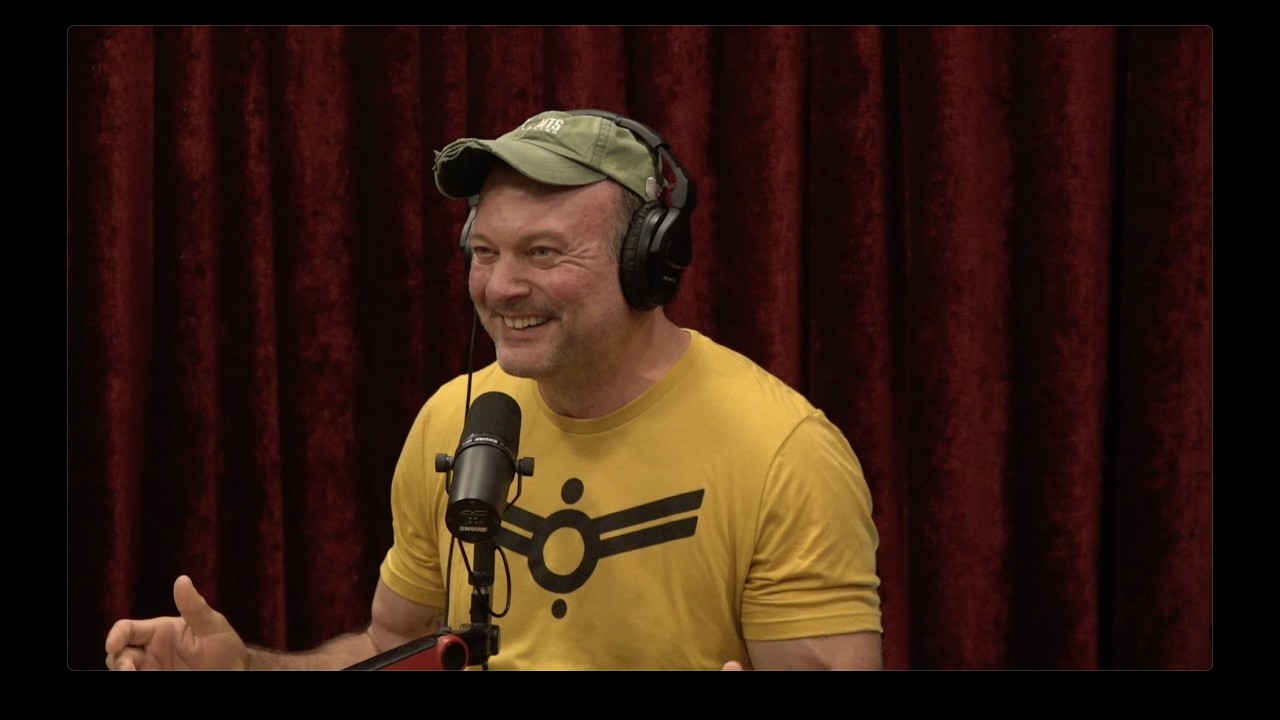
Devon Larratt Drops Gym Lifting to Target Levan Sagashvili Rematch
PowerfulJRE
The veteran arm wrestler is sacrificing full-body athleticism to focus entirely on specialized, right-handed table training for a 16-month preparation block against the world champion.
## Background
This episode of the Joe Rogan Experience features professional arm wrestler Devon Larratt and was published on YouTube by the PowerfulJRE channel on June 5, 2026. The page description notes that Larratt is a veteran of the Canadian Armed Forces and is widely considered one of the greatest competitors in the history of arm wrestling.
## TL;DR
In this milestone episode, Devon Larratt discusses his transition from an elite special operations soldier in Canada's JTF2 to a full-time professional arm wrestler. He breaks down the deep technicality, unique anatomical adaptations, and extreme specialization—such as his intensive 'pumpkin training'—required to compete at the world-class level. The conversation dives into the history of legendary pullers, elite genetics, and the sport's global evolution, alongside Larratt's intense preparation for an upcoming rematch against the undefeated giant Levan Sagashvili. Beyond sports, Larratt shares wild personal accounts from his military tours, including bizarre encounters with regional giants and a chilling event involving alleged demonic possession.
## Atmosphere & style
The podcast carries a deeply fascinating, gritty, and authentic vibe as it bridges the gap between extreme athletic mastery and intense military realism. Listening feels like sitting in a room with a battle-hardened yet highly philosophical 'psychotic farmer' who comfortably balances the brutal physical tolls of his sport with a witty, down-to-earth demeanor. The host-guest dynamic is intensely curious and supportive, shifting from amazement over freakish human physiology to shared awe regarding the mysteries of the wild. There is a profound underlying emotional arc of reflection, moving from the psychological terror of wartime operations to a personal sense of closure regarding Larratt's late brother.
## Key takeaways
- [00:01](https://www.youtube.com/watch?v=ZmejzHXudq0&t=1s) Devon Larratt makes history as the first professional arm wrestler to appear on the Joe Rogan Experience, discussing the physical toll of the sport, including his own 'weaponized arthritis' and limited elbow extension.
- [17:53](https://www.youtube.com/watch?v=ZmejzHXudq0&t=1073s) Larratt outlines his high-volume, low-weight recovery training philosophy, using high repetitions to pump blood through connective tissue as a therapeutic form of healing rather than heavy weightroom lifting.
- [21:11](https://www.youtube.com/watch?v=ZmejzHXudq0&t=1271s) Unlike contact sports, arm wrestling offers extreme athletic longevity, allowing top-tier open division world champions to remain highly competitive well into their 60s due to the decades it takes for dense hand and tendon tissues to mature.
- [01:23:33](https://www.youtube.com/watch?v=ZmejzHXudq0&t=5013s) Larratt explains his hyper-specialized 'pumpkin training' strategy, which focuses 85% to 90% of his finite training energy exclusively on his dominant right arm to build a singular lethal 'icebreaker' weapon.
- [01:12:48](https://www.youtube.com/watch?v=ZmejzHXudq0&t=4368s) The structural and financial evolution of arm wrestling, accelerated by a post-COVID digital boom on TikTok and YouTube, transformed the sport into a viable profession with elite modern competitors earning six-figure incomes through promotions like East vs. West.
- [02:08:36](https://www.youtube.com/watch?v=ZmejzHXudq0&t=7716s) Larratt reflects on his 20-year career in the Canadian Armed Forces, including 16 years in the elite Joint Task Force 2 (JTF2) unit, where he had to balance operational security anonymity with his rising public profile as a world-champion arm wrestler.
- [02:16:41](https://www.youtube.com/watch?v=ZmejzHXudq0&t=8201s) To cope with the extreme fear of night-time counterterrorism operations in Kandahar and static-line jumps, Larratt built an aggressive field persona and mentally accepted the worst-case scenario of dying to optimize his performance.
- [02:27:28](https://www.youtube.com/watch?v=ZmejzHXudq0&t=8848s) Larratt shares firsthand accounts of physical anomalies encountered during his military service and travels, including a sighting of an exceptionally massive local warlord in Afghanistan estimated to be over eight feet tall.
- [02:36:12](https://www.youtube.com/watch?v=ZmejzHXudq0&t=9372s) Larratt details a disturbing military account from Erbil, Iraq, where a fellow soldier allegedly experienced a severe demonic possession and displayed knowledge of people's deepest hidden childhood sins before undergoing a full exorcism.
## Detailed walkthrough
### [00:01](https://www.youtube.com/watch?v=ZmejzHXudq0&t=1s) The GOAT of Arm Wrestling and the "Loudspeaker of the Planet"
The episode kicks off with immediate energy as Joe Rogan and his guest, veteran arm wrestler Devin Larratt, exchange warm greetings. Larratt expresses his immense gratitude and honor to be on the show, colorfully referring to Rogan as the "loudspeaker of the planet, man." Rogan laughs it off, admitting that holding such a massive platform is a "very uncomfortable position to be in" and feels incredibly weird.
Larratt points out that while Rogan has spoken to virtually everyone of consequence on earth, he is deeply honored to be the very first professional arm wrestler to grace the podcast. When Rogan counters that if he is going to feature an arm wrestler, it has to be the GOAT (Greatest of All Time), Larratt humbly pushes back. He acknowledges that the title is "highly debated," but smilingly accepts that he is at least firmly in the conversation alongside a couple of other legendary pullers, mentioning John Brzenk as a prime example.
[00:53](https://www.youtube.com/watch?v=ZmejzHXudq0&t=53s) Weaponized Arthritis: The Cost of Admission
Rogan admits he follows professional arm wrestling very little, but reveals he is utterly fascinated by a striking physical trait of Larratt's: his inability to fully extend his arms. Larratt laughs, confirming his elbows simply do not straighten out anymore. He jokes that this severe lack of extension heavily limited his reach when he famously tried to fight Hafþór "Thor" Björnsson.
Larratt traces the origin of this condition back to his youth. He began club arm wrestling around age 18, and by the time he was 20, he encountered an old, highly decorated champion known as "Crazy George." George famously couldn't straighten his elbows, and a young Larratt foolishly thought, "Oh man, I can't wait till my elbows don't straighten." His wish came true in his late 20s when his range of motion began to shrink drastically due to the relentless, intense pressure placed on the elbow joints.
To manage the chronic buildup of osteophytes, bone chips, and scar tissue, Larratt has undergone three surgeries—two on his right arm and one on his left—primarily performed by Dr. Pollock at the Ottawa Hospital, whom Larratt credits for extending his career. Rogan asks if the bone growth has ever constricted his nerves or blood flow, and Larratt confirms it has. He demonstrates his maximum extension on camera, revealing a severely locked, bent angle. Despite the physical toll, Larratt views it as a "small price to pay," noting that he is completely all-in on the sport and considers this "weaponized arthritis" the necessary cost of admission. He explains that the limited range actually helps him by initiating muscular and tendon resistance much higher in the movement, effectively giving him a "higher arm bar" position, though he jokes it wouldn't save him from being snapped by a skilled jiu-jitsu practitioner.
[04:48](https://www.youtube.com/watch?v=ZmejzHXudq0&t=288s) Agony, Anatomy, and David Goggins's Knees
Rogan recalls watching a video of Larratt training with fitness influencer Jujimufu (John Call). In the video, they used heavy metal bars to aggressively roll out Larratt's arm muscles, leaving Larratt in absolute, screaming agony. Larratt shrugs it off, noting he has simply accepted his condition. He explains that even though bone has been removed, the capsule and connective structures (like fascia) surrounding the joint have condensed to hold everything tightly together.
This anatomical marvel prompts Rogan to compare Larratt's joint adaptations to the legendary endurance athlete David Goggins. Rogan explains that Goggins has been running "bone on bone" in both knees for years. Doctors were baffled by how Goggins could even walk, let alone run thousands of miles. Rogan and his producer, Jamie, pull up "Wolff's law," a biological principle stating that bones adapt, thicken, and grow denser under extreme physical stress. In Goggins's case, the bone mushroomed out so severely at the top of the knee that surgeons had to saw a wedge off his tibia, lower it to create a flat surface, and screw it back into place. Goggins then famously rode a stationary bike like a maniac for five months before returning to running.
Larratt resonates deeply with the story, revealing that he has also been competing bone on bone with zero cartilage for roughly two decades. Fifteen years ago, a doctor told him his career might only last a couple more years. Yet, at 51 years old, Larratt proudly shares that he pulled off one of his best competitive performances just six weeks prior and is still ranked number one, proof that "you can do anything" when you refuse to quit.
- **Age of Devin Larratt:** 51 years old.
- **First Elbow Surgery:** Occurred around 2013 (approximately 13 years prior to the discussion).
- **Cartilage Loss:** Larratt has been operating bone on bone in his elbows for about 20 years.
[09:32](https://www.youtube.com/watch?v=ZmejzHXudq0&t=572s) The Monotony of Daily Grip Training
The conversation shifts to the grueling reality of pain management and physical preparation. Larratt views pain merely as valuable guidance information that highlights where a competitor needs to improve. He notes that rehabilitating and developing the heavily taxed tendinous structures of the elbow requires a massive amount of time and monotony that most people simply refuse to endure.
Rogan expresses frustration with his own grip training, stating he has been trying to jack up his grip strength using standard squeezers. While his hands have grown bigger and stronger from wrist curls, cable rotations, and forearm tools, he hit a hard ceiling at 164 pounds of pressure and cannot break through to his goal of 200 pounds. Rogan complains that his hands are constantly tired and sore because he doesn't know when to rest. When Rogan asks Larratt how many days a week he trains his grip, Larratt immediately replies, "Every day. All day."
[11:17](https://www.youtube.com/watch?v=ZmejzHXudq0&t=677s) The Technical Nuance of "Rising"
Larratt clarifies a major misconception about arm wrestling: while a powerful grip is immensely important, the true technical mastery of the sport lies in making your opponent hold onto *you*. Grip strength is largely a defensive tool or an added offensive measure, but the premier objective is to tax the opponent's hands and fingers.
To illustrate, Larratt introduces the fundamental opening move of technical arm wrestling, a concept called "rising"—frequently dramatized in the Sylvester Stallone movie *Over the Top*. Rising is an upward, spinning, and slipping motion designed to establish a higher, superior grip. Instead of a standard, symmetrical palm-to-palm grip where the opponent is highly efficient, rising forces the pressure directly into the opponent's fingertips. By manipulating the interaction to be completely unfair, any move the opponent attempts is forced through their weakest structural system: their fingers. Larratt notes that out of his typical 21 working sets in a daily workout, only one set is purely dedicated to isolated grip, as the rest of his volume is distributed across these complex positional pressures.
[13:50](https://www.youtube.com/watch?v=ZmejzHXudq0&t=830s) The Life of a Retired Puller
Larratt describes his highly structured, simple life as a retired military veteran who now dedicates 100% of his time and energy to arm wrestling. His training regimen is structured around a weekly cycle. He trains intensely with his local club twice a week. These are his "redline" days where he completely maxes out his capacity alongside his training partners and his son, who has also become a professional competitor.
The remaining days of the week are entirely consumed by extreme, mindless monotony. Larratt wakes up and trains all day long using specialized equipment. Rogan brings up a video of Larratt working out on a unique machine, and Larratt explains it is a classic arm wrestling table fitted with a custom cable pulley system. This specific table is a 40-year-old piece of equipment handed down from legendary champions Leanne Drain and Johnny Roberts.
Using attachment handles like a thick PVC tube—which they call a "multi-spinner"—Larratt can replicate the precise vector pressures of a real match. Because the multi-spinner utilizes a single-point attachment, it creates an unstable surface that forces the wrist and fingers to constantly stabilize. Larratt humorously equates the device to a "Swiss ball for the wrist," comparing its balance-intensive mechanics to performing squats on an exercise ball in a commercial gym.
[16:35](https://www.youtube.com/watch?v=ZmejzHXudq0&t=995s) The Mechanics of Instability and High-Rep Recovery
The conversation kicks off with a brief back-and-forth clarifying fitness equipment, distinguishing between a half-sized Bosu ball and a fully round Swiss or yoga ball. A Swiss ball is "way more unstable," which mirrors the core concept of the speaker's arm wrestling training—creating intense instability through the wrist. In arm wrestling, the foundational movements center around top rolling, hooking, and pressing.
The speaker showcases a video of his own training routine, prompting an exclamation from the host: "And you just do [ __ ] like this all day." The speaker explains that the footage captures his final basement workout recorded six or seven weeks prior, right before his match against the Russian champion, Vitalia Leton. Even during this tapering phase, his routine consists of massive volume, usually hitting around 100 repetitions per movement to maximize blood flow. When asked if he is lifting about 50% of his max weight, the speaker reveals he actually uses "nothing"—amounting to a very light 20 pounds.
* **Base Arm Wrestling Moves:** Top rolling, hooking, and pressing.
* **Repetition Target:** 100 repetitions per movement to promote localized circulation.
* **Taper Weight:** Approximately 20 pounds (essentially "nothing" for the speaker).
* **Past Opponent:** Russian champion Vitalia Leton, fought roughly 6–7 weeks prior.
---
[17:53](https://www.youtube.com/watch?v=ZmejzHXudq0&t=1073s) Training Philosophy: Heavy Table Time vs. High-Rep Healing
The speaker describes himself as an experimenter who has tried countless training systems before settling on his current routine. His entire philosophy revolves around dedicated arm wrestling practice days where he pushes his body to the absolute limit. Conversely, his off days—Tuesdays and Wednesdays—are spent strictly on light, high-rep movements designed to pump blood through the fascia and connective tissue chains. The goal is pure circulation. When asked why he favors this over low-rep, heavy strength training, the speaker notes that energy resources are finite.
Because his most valuable training happens directly on the arm wrestling table, he aggressively cuts out any heavy weightroom lifting that drains his energy or interferes with table performance. While many people look at his 100-rep sets and view them as exhausting labor, the speaker views the high volume as a therapeutic necessity, stating, "the high rep training heals me... it's a form of healing almost." Over the years, he has disproven critics in the strength community who argue that high-rep endurance work makes an athlete weaker. He notes that when using light weight all day, the accumulated "work volume is tremendous" and the total tonnage lifted becomes "astronomical," driving incredible long-term structural adaptations. Now at age 51 and "plagued with injuries," this precise, high-volume blood flow formula is the only way he can keep his tendons and ligaments functional.
---
[21:11](https://www.youtube.com/watch?v=ZmejzHXudq0&t=1271s) Athletic Background and the Safe Fight
Reflecting on his younger years, the speaker laughs off his early approach to the sport, admitting he made countless mistakes by simply trying to "lift as heavy as I can." The host points out the speaker's naturally massive frame and genetic bone structure, asking if he started out as a powerlifter. The speaker explains he actually has a highly diverse, cross-trained background: he was a judo player, a basketball player, a military serviceman, and he even competed in a military version of the Iron Man. He clarifies that a military Iron Man differs from a traditional one because competitors run with heavy backpacks, paddle, and portage canoes, finishing in roughly 5.5 to 6 hours. Even in that world, his size was an anomaly, as most champions are average-sized or smaller.
Despite his varied athletic career, arm wrestling was his first love, sparked at just four years old when he would pull with his grandmother, Leavonne. He jokes, "Never underestimate the power of a grandmother," fondly remembering how his German mother ran a strict household, but his grandmother would reward him with arm wrestling matches after he finished his chores. He adds a "trippy" detail: he never managed to beat his grandmother, and coincidentally, the current super heavyweight world champion is also named Leavonne—a competitor he has similarly never beaten. Ultimately, he fell in love with arm wrestling because it satisfies his lifelong passion for combat sports at a "super low cost." Unlike sports where athletes get punched in the head or destroy their spines, arm wrestling allows longevity; top-tier open division world champions can compete into their late 60s.
---
[24:14](https://www.youtube.com/watch?v=ZmejzHXudq0&t=1454s) The Anatomy of Age and the Legend of Crazy George
The speaker explains that the human hand is uniquely designed for volume because its structure is packed with dense connective tissues and tendons that take decades to fully mature. This slow structural accumulation turns aging into a legitimate advantage in arm wrestling, allowing the 51-year-old speaker to compete at the highest level and still feel he has room to grow. Beyond the physical mechanics, his deepest love for the sport stems from its blue-collar, tight-knit community. Arm wrestling clubs operate with minimal money, open doors, and no membership fees, with athletes training intensely in each other's garages and houses.
While typical arm wrestlers peak in their early 30s, the speaker highlights clips of his legendary club mates, including a "tremendously jacked" 230-pound professional puller named Pork Chop who competes in the elite East versus West league. The tape shows Pork Chop getting his wrist completely bent back by "Crazy George," a 160-pound icon in his late 60s who possesses heavily locked-up arms that cannot fully straighten. George spent his first 20 years in the sport going "two up, two down" at double-elimination tournaments before completely revolutionizing the sport by mastering a highly defensive, body-weight-dropping style known as the "outside top roll" or "king's move."
---
[27:27](https://www.youtube.com/watch?v=ZmejzHXudq0&t=1647s) Muscle Weaponization and the Future of Genetics
The mechanics of arm wrestling break down into specific directional forces: rising strength, pronational strength, and cupping strength. The speaker points out a striking visual of his own forearm on screen, showcasing a massive, highly isolated pronator muscle bulging near his elbow. The host and crew react with disbelief, staring at the unique muscular development. The speaker jokes that it is his dream to see IFBB professional bodybuilders strike "pronator poses" on stage, guiding the host to turn his thumb down and pop his wrist back to find his own vastly smaller muscle. In an outside top roll or king's move, everything relies on weaponizing this twisting pronational force. The hand's complex angles create a constant battle between one athlete's pronation and the opponent's "cup" (flexion). The speaker notes he spent 30 years studying George's style because his own early coach, Troy Eaton, could never figure out how to beat him.
The conversation shifts back to how the speaker maintains this elite performance at 51, which he attributes to his obsessive training volume and "freaky genetics." This prompts the host to mention a mutual friend, a geneticist named Ryan Rosner, who frequently marvels at how unusual the speaker's DNA is. The speaker pivots to the broader societal impact of genetic mastery, calling it one of humanity's highest future priorities and advocating for universal genetic swabbing at birth to accompany official healthcare records. Looking at real-time news, the host reads a headline from a study by Beth Israel Deaconess Medical Center and Harvard Medical School published in the *Proceedings of the National Academy of Sciences*. The study outlines how scientists used genetic tools like CRISPR to successfully silence the extra chromosome 21 activity that causes Down syndrome, which currently affects 1 in every 640 babies born in the United States. The segment wraps up as the host presses the speaker to recall exactly what Ryan said was so anomalous about his own DNA.
* **Key Strengths in Arm Wrestling:** Rising, pronation (twisting), and cupping (flexion).
* **The King's Move:** A highly technical defensive style mastered by Crazy George that relies on a combination of joint locks, body-weight drops, and intense pronation.
* **Down Syndrome Metric:** Affects 1 in every 640 babies born in the United States, making it the country's most common chromosomal condition.
[33:32](https://www.youtube.com/watch?v=ZmejzHXudq0&t=2012s) Elite Genetics and the "Bible" Peak of Human Performance
The conversation dives into the fascinating world of elite human genetics, with the speaker self-deprecatingly noting that as a high school-educated guy who frequently hangs out with a researcher named Ryan in Austin, he simply absorbs all the information he can. He believes his own genetics predispose him toward endurance rather than raw power, though he admits he would "sound silly" if he tried to break down the science too deeply. The real intrigue lies in Ryan’s current research project, which scans elite physical performers to pinpoint highly favorable genetic mutations.
The ultimate example of this genetic anomaly is strongman Brian Shaw, whom they jokingly say is "in the Bible" because people like him make stories like David and Goliath feel historically real. Brian's genetic makeup is an ultra-rare 1-in-500-million phenomenon, placing him right at the absolute peak of human performance. It is not just his freakish bone density or his champion mindset that sets him apart; he possesses a completely unique, molecularly different mutation in his growth hormone that Ryan has never witnessed in anyone else.
* **Brian Shaw's Rarity:** His genetic profile is estimated to be a 1-in-500-million occurrence.
* **Physical Stats:** Brian stands at almost 7 feet tall and weighs roughly 400 pounds.
* **Growth Hormone Mutation:** Unlike normal individuals, Brian possesses a completely distinct molecular variant of growth hormone.
[36:19](https://www.youtube.com/watch?v=ZmejzHXudq0&t=2179s) Genetic Anomalies, Stop Codes, and the Mystery of Muscle Fibers
The speakers transition into discussing how genetic mutations express themselves, touching on the idea of "stop codes" on genes. The speaker explains his layman's understanding of how mRNA interacts with a gene, noting that a stop code essentially prevents a specific gene from expressing itself. This leads to a baffling contradiction in the sports world: there are world-record deadlifters who, according to their genetic testing, possess a natural stop code on their fast-twitch muscle genetics.
This revelation sparks an intense debate about how a world-class powerlifter could excel without fast-twitch fibers, given that a deadlift is inherently a fast-twitch, explosive movement. They ponder whether this is due to a scientific misunderstanding of what fast-twitch fibers actually do, or if these athletes' bodies somehow compensate using other musculature. The speaker jokingly asks strongman Eddie Hall not to sue him before revealing that Eddie famously has this exact stop code, yet still moves incredibly fast and hits "so fucking hard" when striking training mitts.
* **Genetic Stop Codes:** A mutation where a code prevents specific genetic traits from being expressed when mRNA processes the gene.
* **Eddie Hall's Contradiction:** Despite holding world records in strength and demonstrating extreme explosive power, genetic testing shows Eddie Hall has a stop code for fast-twitch muscle fibers.
[38:08](https://www.youtube.com/watch?v=ZmejzHXudq0&t=2288s) Myostatin Inhibitors and the "Hulk" Whippets
The discussion shifts from muscle fiber types to myostatin, a protein that naturally regulates and limits muscle growth so bodies do not get too large. When someone has a myostatin inhibitor mutation, their muscles grow unchecked. The host asks to see an image of a "whippet" dog with this mutation, reacting with pure laughter and disbelief, remarking, "That doesn't look like a real dog. That's a crazy bodybuilder dog."
While a regular whippet is a notoriously skinny, fast, greyhound-looking animal, a whippet with a myostatin deficiency looks like a freakish, cartoonish version of the Hulk. This same genetic phenomenon is responsible for the absurdly muscular Belgian Blue cattle. The speaker points out that these mutations exist naturally in some humans as well, which has paved the way for modern genetic therapies.
* **Myostatin:** A regulatory protein that signals to a cell to stop growing once it is big enough.
* **Folstatin:** The biological "turnkey" that signals a cell to grow; it acts in direct opposition to myostatin.
* **Belgian Blues:** A breed of beef cattle famous for having natural myostatin deficiencies, resulting in extreme muscle hypertrophy.
[39:54](https://www.youtube.com/watch?v=ZmejzHXudq0&t=2394s) Folstatin Gene Therapy and Spine Inflation Technology
The conversation evolves into the commercial availability of genetic therapies, specifically Folstatin injections. Because an individual's natural folstatin levels drop as they age—causing them to shrink and lose muscle mass—Folstatin therapy was initially engineered as an anti-aging remedy. However, it is now readily available to "anybody with enough money" who wants to rapidly boost athletic performance, such as football players or powerlifters looking to get "fucking huge."
Switching gears to structural health, the host highlights a wild new medical breakthrough for disc degeneration, a common affliction for heavy lifters and anyone who does jiu-jitsu. While spinal discs normally squash down and lose their soft cushion from years of heavy compression, this new therapy allows doctors to inject a substance directly into the spine to literally inflate the discs. The host passionately advises listeners to avoid dangerous back surgeries, fusions, and artificial replacements at all costs now that these non-surgical alternatives are emerging. He also heavily endorses Louis Simmons’ invention, the "reverse hyper" machine, which he keeps both at his home and his studio to decompress his spine and strengthen his lower back.
* **Folstatin Therapy:** Used primarily for longevity and anti-aging to maintain muscle mass, but heavily utilized by athletes for performance enhancement.
* **Disc Inflation:** A cutting-edge injection therapy that re-inflates compressed spinal discs, potentially eliminating the need for spinal fusions.
* **The Reverse Hyper:** An exercise machine invented by Louis Simmons that decompresses the spine during the execution of the movement.
[42:09](https://www.youtube.com/watch?v=ZmejzHXudq0&t=2529s) The "Juicy" Future of Aging Athletes and the Enhanced Games
Looking toward the future of sports, the speakers express optimism that medical advancements will continue to push the boundaries of athletic longevity, to the point where a person might not even become a sports champion until they are 60 years old. In regular sports, this longevity is being driven by performance-enhancing drugs (PEDs), peptides, stem cells, and testosterone. While combat sports strictly prohibit these substances, the host notes that when older athletes are allowed to use them, you get a terrifying competitor who pairs a lifetime of veteran fight intelligence with the explosive body of a young man.
The host's favorite example of this is "TRT Vitor" (Vitor Belfort in his prime around age 37), describing him as the scariest, most superhumanly fast version of a fighter because he was completely "juicy." This prompts a critique of the "Enhanced Games," a drug-tested alternative sports concept that ultimately failed to deliver the freakish world records people expected. The speaker explains that true, freakish strength cannot be built in a three-month drug cycle; it takes decades of grueling training. He points to legendary fitness personality Juju Mufu as an example of someone who has spent a lifetime building a massive, highly flexible frame that "would melt a piss cup."
* **TRT Vitor Belfort:** An iconic era of the UFC fighter at age 37, where Testosterone Replacement Therapy allowed him to retain youthful speed alongside veteran experience.
* **The Enhanced Games:** A real-world sports concept allowing PEDs, which failed to yield massive records because superhuman athletic adaptations require years, not months, to develop.
[45:50](https://www.youtube.com/watch?v=ZmejzHXudq0&t=2750s) Juji Mufu and Unlocking the "Two-Hand" Table Work Method
The conversation shifts entirely to Juji Mufu, a fitness icon known for his mind-bending flexibility and mass. Juji started out in "tricking"—a discipline the host jokingly mistakes for a less-than-reputable street activity before learning it is actually an intense blend of acrobatics, gymnastics, and flips. Despite being in his 40s, Juji remains incredibly massive, healthy, and celebrated as one of the most positive creators on YouTube.
The speaker reveals that training with Juji a year and a half ago completely revolutionized his entire philosophy on arm wrestling. During a grueling session where they were "redlining," Juji helped him unlock a deep understanding of sport-specific training. In their club, they use a system where the "senior" member holds a defensive position while the "junior" member works at maximum intensity. To level the playing field and allow the senior member to truly redline his exertion, they utilize "two-hand work," where one person uses both arms against the opponent. This session was so profoundly effective that the speaker completely stopped heavy gym lifting altogether, realizing that sport-specific table holding was far more critical to his success than traditional weightlifting.
[49:50](https://www.youtube.com/watch?v=ZmejzHXudq0&t=2990s) The Evolution of Training and a Balanced Protocol
An intense circuit training session followed by an evening club workout served as a definitive tipping point for the speaker. Earlier in the day, he had demonstrated all of his latest priority exercises, but when it came time for the night's "awesome two-arm work," he realized that the earlier singles had drained his energy. Determined never to let his table training suffer again, he committed to pouring his full energy directly into it. Even at 51 years old and with over 30 years of competitive experience in the sport, he emphasizes that he is still learning and actively changing his approach from event to event, which his host notes is a true sign of keeping the sport fun and growing.
To manage this, the speaker relies on a personalized training balance or "recipe" that he created entirely by himself. He constantly watches other sports and looks for ways to improve, tweaking his protocol based on performance outcomes. If things are going well, he keeps the routine stable; if he underperforms, he adjusts. That particular night of underwhelming table performance convinced him to eliminate heavy weights because he realized how incredibly effective proper table training can be. He cautions, however, that two-arm work must be done correctly, warning that "if you do two arm work wrong, it can hurt you. It can set you back."
[51:41](https://www.youtube.com/watch?v=ZmejzHXudq0&t=3101s) Specialization Versus Cross-Training
The speaker acknowledges that his extreme hyper-specialization draws significant criticism from others. Aside from arm wrestling, his physical activity is remarkably minimal, admitting, "I go for walks. That's it. I'm terrible." While he is attempting to minimally reintroduce some overall body training, he prefers pure specialization over cross-training. Having once been a broadly fit human being, he consciously chose to sacrifice full-body athleticism for elite success. He frames this choice bluntly: he could choose to be a healthier individual who runs, squats, and deadlifts, "or I can be a little bit of a [piece of shit] and be pulling for world title shots."
The host pushes back, arguing the common philosophy that heavy compounds like squats and deadlifts build a stronger core, foundation, and overall base strength that naturally translates to everything else. While the speaker admits that almost every reasonable person gives him this exact advice, he remains uncertain. His single-minded focus remains on a singular question: "If I want to beat Levan, what do I do from here?" His instinctual answer is always to simply add more precise movements like wrist curls rather than general strength exercises.
- Current walking weight: 265 lbs.
- Competition weight capability: Up to 300 lbs.
- Target weight for the next rematch: 310 or 320 lbs.
[53:40](https://www.youtube.com/watch?v=ZmejzHXudq0&t=3220s) Chasing Levan Sagashvili: The Pinnacle of the Sport
The conversation shifts to the ultimate benchmark in the sport: Levan Sagashvili. The speaker describes Levan as the undisputed "pinnacle of our sport," a massive athlete from the country of Georgia who weighs around 420 pounds. The host reacts with pure astonishment at Levan's photos, questioning if the images are AI-generated, and jokingly describes him as looking like a "primitive man" and a "science project" due to his immense, hairy physique. The speaker defends Levan warmly, calling him a very smart, cool, and beautiful human being, even though Levan has "beaten the piss out of me at every opportunity."
Unlike the speaker's hyper-focused routine, Levan utilizes a different formula that includes incredibly heavy rows, pull-ups, and a "stupid" 180-kilo curl. While acknowledging Levan's evolution through the World Championships—and jokingly giving a "shout out to steroids" and the scientists involved regarding Levan's physical transformation over the years—the speaker notes that he cannot train like a 25-year-old anymore due to past surgeries. He believes his own training is far more precise, targeting tight angles, pronation, and hand control, whereas Levan operates like a sledgehammer. Knowing he can never match Levan's raw weight, the speaker aims to defeat him through micro-advantages, like a pitbull nipping onto a fingertip. To pack on the weight needed to face him, the speaker avoids weightlifting and instead chooses a simple plan: "Eat. Stay in my basement."
- Levan Sagashvili's weight: ~420 lbs.
- Levan's undefeated streak: Undefeated since 2017.
- Levan's curl weight: 180 kg (two hands).
- Speaker's competitive career span: 32 years.
[01:00:46](https://www.youtube.com/watch?v=ZmejzHXudq0&t=3646s) The Haunting Open Division and Legendary Foes
The speaker explains that while he has the 105-kilo and 115-kilo divisions safely wrapped up, it is the absolute Open Division that truly haunts him. Chasing Levan is what motivates him to keep grinding in his basement, stating, "when you're not the champ, you're not happy." He details his history pulling Levan, recalling that during their first match, Levan literally tore his bicep off. The speaker even points out a tattoo of a cat with "415" on his arm, explaining that he used to tease Levan by calling him a "415-pound [pussy]," and added the text "Levan was here" to mark where the muscle was ripped in the second round.
Their second match in 2024 was the closest the speaker ever got, managing to achieve a "stop"—a state of deadlocked, zero movement where neither side is winning. They went to the straps, a common occurrence in modern arm wrestling when hands slip apart. During that intense encounter, the speaker top-rolled into Levan's wrist but was in such shock that he failed to seize the initiative. Levan transitioned into a flop wrist press, and the speaker was hit with a decisive second foul for "decline humerus," which occurs when the shoulder drops below the table line. The match resulted in a loss, leaving him unable to walk properly for four months because Levan "ripped my spine apart."
The conversation concludes with a look back at the sport's history. In 2008, the speaker won a monumental match against John Brzenk, the undisputed Greatest of All Time. Brzenk famously went virtually undefeated for about 25 years, competing from age 18 until nearly 60. The speaker notes that Brzenk was the real-life inspiration behind Sylvester Stallone's character in the movie *Over the Top*, confirming that the tournament featured in the film was entirely real.
- Year of match against John Brzenk: 2008
- Year of the speaker's last match with Levan: 2024
- John Brzenk's undefeated run: ~25 years
- John Brzenk's current age: 60 or 61 years old
[01:06:31](https://www.youtube.com/watch?v=ZmejzHXudq0&t=3991s) The Legend of John Brzenk
The conversation turns to the legendary movie *Over the Top*, which famously followed an arm wrestling tournament won by John Brzenk. The speakers marvel at the fact that Brzenk is not a massive man. On an absolute peak day, he might weigh around 230 pounds, but during his younger, healthier prime, he dominated the sport at just 195 to 210 pounds. For roughly 25 years, Brzenk went around the planet beating absolute monsters who dwarfed him. The secret to his success was simple: he was a masterful technician who started arm wrestling as a child with his father.
Brzenk uniquely shaped the evolution of arm wrestling into a respected sport. Forty years ago, the general consensus was that a person got better at arm wrestling by doing standard gym work—building up the pecs, glutes, and overall bodily strength. Brzenk pioneered a hyper-focused approach, proudly identifying solely as an arm wrestler who practiced at tournaments and skipped weightlifting entirely. While he stood around 6'1" or 6'2" and possessed a thumb "bigger than mine," his real superpower was an unmatched technical prowess that sat way above anyone else in the world.
- **John Brzenk's Prime Weight:** Maintained around 210 lbs for 25 years, dropping down to 195 lbs when young/healthy, and reaching 230 lbs on a great day.
- **Physical Stature:** 6'1" or 6'2" with an exceptionally massive thumb.
- **Era of Dominance:** Ruled the arm wrestling world silently for decades before the advent of the internet.
[01:08:04](https://www.youtube.com/watch?v=ZmejzHXudq0&t=4084s) Table Time Over Weightlifting
The speakers express genuine disbelief that Brzenk never lifted weights, relying entirely on "table time" to build his strength. The speaker recalls hearing mythic stories about Brzenk for years before ever seeing him in person due to the pre-internet era. Brzenk silently ruled the globe, culminating in the speaker winning the world title from him in 2008. Reflecting on that victory, the speaker notes how much the sport has changed, calling himself "the last of the small super heavyweights"—bigger than John, but not by much compared to the modern giants of the sport. They note other pivotal figures like Denis Cyplenkov (Slankoff), a famous arm wrestler who raised the strength bar entirely, winning a world title almost effortlessly.
The community thoroughly worships Brzenk as the undisputed "GOAT" and forefather of modern arm wrestling. The speaker confesses to reading every single thing Brzenk wrote while coming up in the sport. Brzenk became the ultimate poster boy for athletic specialization. When asked if Brzenk had a secret training setup hidden away in his basement, the speaker dispels the rumors, stating that everything points to pure, unadulterated table practice since childhood. They review old footage of a 17-year-old Brzenk defeating the original king of arm wrestling, Johnny Walker, famously known as "The Iceman."
- **2008 Title Match:** The speaker defeated John Brzenk to claim the world title.
- **Denis Cyplenkov:** Noted as a legendary figure who shifted the sport's strength requirements.
- **Johnny Walker:** Nicknamed "The Iceman," he was the original king of arm wrestling until a teenage Brzenk defeated him.
[01:11:01](https://www.youtube.com/watch?v=ZmejzHXudq0&t=4261s) The Physiology of Arm Wrestling Soreness
The sheer physicality of arm wrestling is enough to shock athletes from other disciplines. When powerlifters or strongmen try the sport, they experience a tier of soreness that leaves them completely incapacitated. The speaker shares personal anecdotes of being so incredibly sore after matches that he could barely move, let alone walk or get out of bed for days at a time. This happens because of human anatomy; the body is naturally designed to resist external forces rather than initiate them.
Arm wrestling hones in on this specific locking strength. Competitors get into rigidly fixed positions and try to force the other person's arm open. The physiological process of being "ripped open" is intensely taxing on the muscles and tendons. Despite the brutal toll it takes, Brzenk managed to rule this painful world for a quarter of a century. He is still active in the community, and the speaker notes he is scheduled to speak with him the very next day. Brzenk still harbors desires to compete, having last faced Yoshi Kanai, the number one arm wrestler from Japan, in a match in Dallas.
- **Anatomical Principle:** Humans are structurally stronger at stopping things from happening (resistance) than making things happen.
- **Yoshi Kanai:** The top-ranked Japanese competitor who faced an older Brzenk in Dallas.
[01:12:48](https://www.youtube.com/watch?v=ZmejzHXudq0&t=4368s) The Evolution and Financial Rise of the Sport
Arm wrestling underwent a massive structural evolution as it moved out of the underground. Around the turn of the millennium, international governments began recognizing it as a legitimate sport. This structural shift brought a massive influx of cash and systemic support to countries like Georgia, Turkey, and Kazakhstan, allowing athletes to become full-time pros. Even recently, countries like Sweden have officially recognized it. This global growth merged various fractured regional leagues—such as the PAL in Europe and the WAL in North America—eventually allowing top-tier athletes to comfortably quit their day jobs around 2015.
The growth was heavily accelerated by media pieces like the documentary *Pulling John*, alongside wealthy enthusiasts funding leagues like Robert Drenk's Ultimate Armwrestling League (UAL) in California. The speaker contrasts the modern era with his early days, remembering when winning $500 at the Mike Gould Classic felt like the greatest day of his life. By 2010, tournament payouts hit $10,000, and WAL's expansion pushed prizes to $20,000 alongside ESPN television coverage and sponsorships.
- **Government Recognition:** Shifted heavily around the year 2000; Sweden officially recognized it as a sport within the last year.
- **Financial Growth Milestones:** Went from $500 local prizes (Mike Gould Classic) to $10,000 (PAL) and $20,000 (WAL) with ESPN coverage by 2015.
[01:15:23](https://www.youtube.com/watch?v=ZmejzHXudq0&t=4523s) Post-COVID Era and the UFC of Arm Wrestling
When COVID-19 hit, it effectively "burnt down everything," destroying the fractured regional leagues that kept North American and European athletes isolated from one another. From these ashes, a massive digital boom occurred on TikTok and YouTube as a locked-down global audience discovered that arm wrestling was perfectly tailored for short digital attention spans. This media surge birthed "East vs. West," which the speaker characterizes as the undisputed "UFC of arm wrestling." This premier organization gathers the absolute best athletes globally for international events occurring every seven weeks.
Winning a world title is vastly more difficult now than it was 15 years ago due to titans like Levan Saginashvili. Financially, top guys no longer need side gigs and easily clear a healthy six-figure income. Interestingly, East vs. West does not feature any drug testing, earning it a comparison to Formula 1 racing, where "everything goes" and the focus is on absolute innovation. For those seeking a tested environment, athletes look to the World Armwrestling Federation (WAF), a government-funded pyramid system featuring state, provincial, national, and annual world championships.
- **East vs. West:** The premier international arm wrestling promotion, hosting events every 7 weeks.
- **Financial Status:** Elite modern arm wrestlers earn a healthy six-figure income.
- **World Armwrestling Federation (WAF):** The drug-tested, government-funded amateur and professional base of the sport.
[01:17:50](https://www.youtube.com/watch?v=ZmejzHXudq0&t=4670s) The Philosophy of Chaos and Order
The universal appeal of arm wrestling lies in its simplicity; almost everyone has arm wrestled a peer in high school. The speaker expresses a deep love for the sport's safety, longevity, and purity. However, as an elite athlete dives deeper into the technical subtleties, the sport transcends physical mechanics and overflows into lifestyle principles. The speaker notes that his biggest athletic gains now come from how he structures his life, finding a delicate "balance between chaos and order" to achieve perfect performance.
This philosophy was heavily inspired by a presentation from a geneticist named Mack, who detailed how life only thrives in the boundary between chaos and order. The speaker implemented this into his training using a childhood tactic: a sticker chart. Using only two stickers—blue for chaos (failing to meet strict parameters) and white for order (perfect structure)—he maps out his training cycles. Following a major competition, he intentionally plunges into a planned state of chaos. This doesn't mean letting his life catch fire; rather, it means letting go of strict routines, traveling, opening up his mind, and gathering fresh data to form a superior plan for his next training block.
- **The Training Chart:** A binary tracking system using blue stickers to represent chaos and white stickers to represent order.
- **The Levan Block:** The speaker is currently entering a massive 16-month preparation block to face Levan Saginashvili, utilizing the early phase for travel and open-ended chaotic exploration before locking back into his basement.
[01:23:13](https://www.youtube.com/watch?v=ZmejzHXudq0&t=4993s) The Psychological Toll and Pumpkin Training
To remain disciplined at 51 years old, having a definitive "finish line" of four or five months is a necessary psychological aid. Without that strict timeframe, lifestyle creep sets in and things fall apart. Setting a timeline allows for a controlled amount of chaos that satisfies human nature while still permitting a temporary escape from the box of rigid dedication. The hardest part of being a world champion at this age is funneling all available energy into a task as remarkably simple yet psychologically grueling as performing 10 hours of wrist curls a day. The routine involves waking up in the morning, getting assistance from a spouse, Jod, eating, and doing continuous repetitions.
Currently, a new formula is in development for the next project, but the previous routine consisted of 14 total sets—split into seven sets of two—because both the right and left arms were being trained. Now, the focus is shifting entirely back to "pumpkin training," which means specializing exclusively on the right hand. The term comes from the agricultural practice of growing giant competition pumpkins. To grow an 800-pound pumpkin, a grower must pinch off all the other flowers on the vine except for one, directing the plant's entire energy reserve into a single prize fruit.
* **Daily Routine:** Up to 10 hours of wrist curls a day, facilitated with help from his wife, Jod.
* **The Metaphor:** "Pumpkin training" refers to pinching off all other options to grow one massive point of focus, mimicking giant pumpkin farmers who remove all flowers but one from a vine.
* **Training Shift:** Moving away from a balanced 14-set routine (seven times two for right and left) to absolute specialization on the right arm only.
[01:25:17](https://www.youtube.com/watch?v=ZmejzHXudq0&t=5117s) Specialization and the Finite Energy Theory
Adopting absolute specialization means doing absolutely "nothing" with the left hand—no wrist curls and no specific training whatsoever. This hyper-focused strategy is an exercise in energy resource allocation. The visual difference between the arms is striking; the right forearm has grown to be "twice as big" as the left. This extreme imbalance is a deliberate tactical choice. Previously, a balanced approach yielded world championships in both the left and right hand categories, but aging necessitates cutting out extra physical demands to remain at the very top of the sport.
This training philosophy is built on the belief that human energy is finite rather than limitless. A bodybuilder might strive for proportionate development, but reaching the absolute pinnacle of arm wrestling requires being "very specialized and very focused" so the body knows exactly where to direct its developmental resources. This method draws heavy, continuous criticism, primarily from more junior players in the sport. Senior, elite arm wrestlers generally understand the logic because most of them practice resource allocation to a certain degree, though this particular routine represents the absolute extreme.
* **Physical Asymmetry:** The right arm has become twice as large as the left arm due to years of unilateral specialization.
* **Past Achievements:** Formerly held world champion titles with the left hand before retiring it from active training to preserve energy.
* **Resource Allocation:** The core belief that the human body possesses a finite pool of energy that must be concentrated on one objective rather than spread thin to achieve bodybuilding symmetry.
* **Community Reception:** The method receives "heaps of criticism" from junior competitors, while senior peers generally validate the strategy.
[01:27:14](https://www.youtube.com/watch?v=ZmejzHXudq0&t=5234s) Real-Life Hellboys and the Blood Flow Theory
The sport of arm wrestling naturally attracts "freaks" and unique individuals who serve as real-world examples of extreme physical asymmetry. Competitors like Oleg Zhokh and Matthias Schlitte are described as "real life Hellboys" because they possess a single arm that is insanely jacked while the other remains completely normal. Zhokh, a world champion who competed at around 165 to 170 pounds, possessed the left arm of a 300-pound man. Years ago at the Unified Forearm Championship (UFC), he nearly defeated the reigning heavyweight world champion despite the massive weight class difference, proving capable of competing near the top of the open division.
Zhokh's arm is remarkable not just for its hypertrophy, but for its unique muscle insertion points and altered skeletal angles. This distinct morphology stems from what is theorized to be an arterial blood flow disorder. While most people feature an even distribution of arteries across both sides of the body, these unique individuals appear to possess a heavy, congenital arterial spread dominant on one side, a condition likely determined *in utero*. This real-world anomaly highlights the immense value of targeted blood flow; circulation is what inherently heals and strengthens tissue, especially since the heart alone isn't strong enough to fully feed these dense structures without repetitive movement. Zhokh even managed to return to the top of the 85-kilo division as world champion after surviving a catastrophic car crash that caused severe trauma and broken bones.
* **Oleg Zhokh:** A world champion competitor weighing 165–170 lbs with a left arm scaled to a 300 lb man, featuring unique muscle insertion points and structural angles.
* **Matthias Schlitte:** A prominent German national champion who exhibits the same one-sided physical extremity.
* **The Arterial Theory:** A personal theory formed after conversations with Schlitte suggesting these athletes possess an uneven, heavy arterial spread to one side developed *in utero*.
* **Recovery Anecdote:** Oleg Zhokh successfully rehabbed back to world champion status in the 85 kg division after surviving a near-fatal, high-trauma car crash.
[01:32:54](https://www.youtube.com/watch?v=ZmejzHXudq0&t=5574s) Redefining Balance and the Concept of the "Icebreaker"
After temporarily backing off from extreme unilateral training for a couple of years, the routine has swung back to high asymmetry for a final competitive preparation. While homework in the basement used to sometimes be equal, the current split is heavily skewed, consisting of 85% to 90% work dedicated to the right arm, with only 10% left-arm work left in just to maintain timing. At the arm wrestling club, the approach is to pull everyone available right-handed until the room grows bored, only throwing in token left-handed work at the very end. Fears of developing severe back alignment or structural imbalances never manifested in reality.
The conventional notion of physical balance is ultimately "overrated" when the sole objective is winning a world title. While balance is a pleasant concept for an imaginary world, real-world elite performance requires sending an unconfused signal to the body. This mirrors strategies seen in Brazilian Jiu-Jitsu; for example, Eddie Bravo focuses his lethal attacks almost exclusively on the right side of the body. In high-level competition, having a definitive "icebreaker"—a hyper-developed tool that can reliably stop a match or secure a win—is everything. Sacrificing 15 points of performance on the left arm to elevate the right arm from a 99 to a 100 is a trade any elite competitor would willingly make.
* **Current Training Split:** 85% to 90% of home training is performed on the right arm, leaving roughly 10% for the left.
* **Club Strategy:** Training right-handed continuously with all available partners until they tire of it, followed by minimal left-hand tracking.
* **Jiu-Jitsu Parallel:** Eddie Bravo’s strategic philosophy of perfecting a hyper-lethal right-sided attack system rather than forcing perfect symmetry.
* **The Competitive Trade:** Shifting a primary weapon from a 99 to a 100 is worth letting the opposite side wither away.
[01:35:38](https://www.youtube.com/watch?v=ZmejzHXudq0&t=5738s) The Grip Strength Anomalies of Rock Climbing
An interesting crossover exists between arm wrestling and elite rock climbing, a sport famous for producing ridiculous grip strength that acts almost like a "cheat code" when brought to the table. On his YouTube channel, elite climber Magnus Midtbø highlighted a French-Canadian climber named Yves Gravelle, who also trains directly with local arm wrestlers. Gravelle is a literal physical freak who possesses leg-sized forearms on a compact frame and is capable of performing unbelievable feats, such as doing complete pull-ups while hanging from a ledge the thickness of a credit card or holding onto completely rounded, chalked surfaces with zero lip to bite into.
Gravelle brought this specialized background into arm wrestling while weighing only 150 pounds. He entered the Ottawa Open—a notoriously tough regional tournament that regularly draws the strongest competitors from the area—and won the entire event after training in the sport for only six weeks. Beyond climbing and arm wrestling, he dominates the highly specialized world of grip championships, which functions essentially as powerlifting for hand strength. The crossover potential between these disciplines is immense, driven by the unique adaptations built through years of micro-edge finger hanging.
* **Yves Gravelle:** An elite grip competitor and rock climber weighing 150 lbs with massive, leg-sized forearms.
* **Freakish Feats:** Renowned for performing pull-ups off a 2 mm edge (the width of a credit card) and hanging from smooth, vertical, rounded surfaces.
* **Instant Success:** Won the prestigious Ottawa Open title after only six weeks of formal arm wrestling training.
* **Grip Championships:** Dominates the grip sport community, a discipline described as "powerlifting for grip."
[01:39:02](https://www.youtube.com/watch?v=ZmejzHXudq0&t=5942s) The Wall vs. The Climber and the Ottawa Super Freaks
The discussion opens with an analogy comparing rock climbing to arm wrestling, specifically looking at how grip strength functions differently in each sport. While a great grip allows a climber to scale a wall, an arm wrestler actually wants to "be the wall" rather than the climber, turning themselves into an immovable structure that makes it incredibly difficult for the opponent to hold on. The speaker notes that while elite climber Eve is fully capable of climbing any wall, once he figures out how to conceptually become the wall in arm wrestling, "he's going to be so so difficult." This transitions into a broader reflection on the sheer talent entering the sport, particularly at a club in Ottawa that is now populated by "super freaks" and new guys possessing "ridiculous potential," including one individual who is physically larger than strongman champion Brian Shaw.
- Arm wrestling strategy requires becoming "the wall" rather than "the climber" to break down an opponent's grip.
- The speaker's home club in Ottawa is currently experiencing an influx of high-potential pullers, including one man larger than Brian Shaw.
---
[01:39:44](https://www.youtube.com/watch?v=ZmejzHXudq0&t=5984s) The Phenomenal Grip Strength of Magnus and Eve
The hosts shift to reviewing video footage of elite climbers displaying jaw-dropping feats of hand and forearm power. They watch a clip of a 150-pound climber lifting the famous Thomas Inch dumbbell, a feat they call "nuts" and "crazy" for someone of that weight class, especially while performing a pinch grip. They also marvel at Magnus Midtbø, noting that despite not being a massive individual, he is "crazy strong" and has been filmed training alongside Eddie Hall, doing one-arm rows with 180 pounds on each side. The speakers find this level of force production "bananas" because Magnus is completely dwarfed by the sheer strength of Eve, who is widely considered the strongest climber in the world.
- Eve is noted for his highly detailed, progressive, and "science-based" training methodologies.
- Aside from elite climbing and arm wrestling, Eve’s primary profession is an artist who crafts movie masks.
- Magnus Midtbø is highlighted for performing single-arm rows with 180 lbs on each side despite his smaller stature.
---
[01:41:10](https://www.youtube.com/watch?v=ZmejzHXudq0&t=6070s) Crossover Potential and the Scientific Approach to Training
The conversation turns to why more people do not adopt extreme climber-style grip training if it produces such a massive structural advantage. The speaker explains that while there are extreme "levels of specialization," Eve's decades of grip work have an immense crossover into arm wrestling. Even though Eve has been in the sport for less than a year—having only started the previous November—the speaker talks to him every week and believes he possesses "world championship potential." The speaker advises Eve that his rapid progression will come from mastering precise movements to "become the wall." What sets Eve apart is his unique, highly scientific approach to recovery; unlike traditional arm wrestlers who train through pain, Eve conducts systematic grip tests before every workout and will completely abort a session and continue to rest if his metrics do not feel right.
- Eve has been arm wrestling for less than a year (since November) but is projected to reach the top North American pro level within 2 to 3 years.
- Eve utilizes pre-workout isometric grip tests to gauge recovery, choosing to cancel training sessions if his baseline performance is down.
- Arm wrestling relies heavily on a locked isometric or negative strength capacity to maintain structural integrity.
---
[01:44:59](https://www.youtube.com/watch?v=ZmejzHXudq0&t=6299s) Measuring Raw Power and the Grip Strength Leaderboard
The speakers examine video clips of Eve executing isometric wrist tests with elastic bands and weights to measure his static capacity, which they identify as the exact type of locked, maximum output strength required for arm wrestling. This prompts a comparison of grip strength numbers across different athletes using dynamometer scores. They recount that elite climber Adam Ondra pulled a 161, which is roughly identical to other top climbers. In contrast, heavy-hitting UFC fighter Derrick Lewis casually pulled a 218 without appearing to try, thanks to his "giant paws." The conversation peaks when discussing Russian puller Vitali Laletin, who held the grip world record by registering a staggering 351 pounds (154 kg) on the device.
- Climbers like Adam Ondra register around 160–161 lbs on grip dynamometer tests.
- UFC heavyweight Derrick Lewis achieved a 218 lbs grip test score.
- Vitali Laletin holds an elite status in the community, documented hitting a massive 351 lbs (154 kg) on a grip device.
---
[01:49:14](https://www.youtube.com/watch?v=ZmejzHXudq0&t=6554s) The Illusion of Size vs. Tendon Strength
An entertaining back-and-forth ensues as one speaker claims his own grip score is likely a terrible 70 pounds due to being "crippled," which the other host vehemently rejects as "literally not possible" given his background. The speaker recalls that in his youth, he could close a Captains of Crush No. 3 gripper for eight or nine reps, but when handed a 200-pound gripper on the table, he struggles, laughing it off and telling the host, "You should come and arm wrestle with us." They analyze how elite athletes like Marine veteran Michael Eckert (Instagram: `@michael_eckert_fit`) can register a 262-pound (119 kg) grip score and perform crazy one-arm pull-ups despite looking like a normal, fit guy in a t-shirt. They conclude that in functional disciplines, force is often driven by profound tendon strength rather than massive muscle bulk, though "grip is only a small part of control" compared to managing hand angles and wrist rotation.
- The speaker previously could close the Captains of Crush No. 3 gripper for 8 to 9 repetitions.
- Michael Eckert (`@michael_eckert_fit`), a Marine fitness influencer, is highlighted for his 262 lbs (119 kg) grip score and specialized knurled-metal testing tutorials.
- True arm-wrestling hand control is dictated by the ability to manage angles and spin, with raw crushing grip serving as the final inflection point.
---
[01:53:00](https://www.youtube.com/watch?v=ZmejzHXudq0&t=6780s) The Mythic Status and Rumored Protocols of Denis Cyplenkov
The segment concludes with the speakers looking at images of the legendary Russian arm wrestler Denis Cyplenkov, whom they affectionately refer to as a "freak" and "something real." They marvel at his hands, exclaiming they "don't even look real" due to their unnatural, massive thickness. The dialogue shifts into the rumors surrounding Cyplenkov's physical longevity and his open attitude toward performance-enhancing substances. They debate a viral rumor regarding his chemical protocol, with one mentioning reports of him taking an astronomical 100 units of growth hormone a day, while the other notes that Cyplenkov reportedly debunked that specific figure. They agree that such an extreme dosage would mimic a severe pituitary disorder, causing a person to "just become a giant."
- The speakers discuss Denis Cyplenkov's famously thick, surreal hand structure and his impact on the sport.
- The hosts address the viral internet rumors regarding Cyplenkov's alleged use of extreme growth hormone doses (ranging from 10 to 100 units daily).
[01:54:14](https://www.youtube.com/watch?v=ZmejzHXudq0&t=6854s) The Freakish Strength of Smay
The speakers pull up photos of a strength athlete named Smay, marveling at his physical evolution. One speaker points out that while Smay looked like a "normal athlete" in his youth, his current form defies reality. Reviewing a photo of him at age 17, they agree he was already remarkably jacked for a teenager, but his current physique looks like "the Incredible Hulk" or a superhero rather than a real human being. His massive forearms and biceps make him look like a "complete freak of nature or science."
They discuss his specialized arm wrestling training, noting that his pronation lifts—which involve turning the wrist while lifting insane amounts of weight—are already at a world-class level. When trying to look up his Instagram to see these lifts, they discover his original page was taken down. They joke and speculate about why a platform would ban him, with one speaker humorously suggesting it is "cuz he's inspiring people to turn into monsters." Despite the missing official page, they find fan accounts showcasing his explosive jumps and specialized grip training.
- Smay weighs approximately 340 to 350 pounds and possesses "preposterous strength."
- The speakers reference UFC pioneer Mark Coleman’s famous philosophy that "strength is a skill," highlighting how devastating Smay could be if he pairs his raw power with an understanding of leverage positions and martial arts.
[01:57:38](https://www.youtube.com/watch?v=ZmejzHXudq0&t=7058s) Leonitis Arona's Upset Against Brian Shaw
The conversation shifts to a proposed matchup between Smay and a German arm wrestler named Leonitis Arona. The speakers crack up over Leonitis's formidable, historical-sounding name before revealing a shocking recent result: Leonitis defeated the legendary Strongman champion Brian Shaw in an arm wrestling match in Germany just six weeks prior. For one speaker, the idea of anyone besting the massive Brian Shaw in a physical contest "seems ridiculous" and hardly makes sense.
They pull up an image of the match, reacting with pure awe at the massive size difference between the two men. This serves as a prime example of how elite technique can overcome a massive weight deficit. While Brian Shaw has only been arm wrestling for less than two years and likely possesses a higher ultimate potential due to his frame, Leonitis has been in the sport much longer and used his deep technical background to secure the win.
- Leonitis Arona weighs around 285 pounds when he is in good shape and operates as a hybrid bodybuilder and arm wrestler.
- Brian Shaw is roughly 100 pounds heavier than Leonitis and is renowned for having a uniquely powerful "staring grip."
- One speaker reveals that he himself is currently ranked number two in the world in the open division, despite the fact that "everybody in the top 50 is stronger" than him, proving the extreme high-degree of skill required in the sport.
[01:59:45](https://www.youtube.com/watch?v=ZmejzHXudq0&t=7185s) The Mechanics of Power and "Miniature Martial Arts"
The speakers analyze why arm wrestling functions like a "miniature martial art." They compare it to Brazilian Jiu-Jitsu, bringing up legendary grappler Marcelo Garcia, who is not a physically imposing man but possesses "the craziest squeeze." They argue that power isn't just about genetic brute force; it is about the endless repetition of a movement until it creates a "perfect chain of energy from the floor to the strike." Arm wrestling is a fluid, high-speed chess match of adjustments, adaptation, and decision-making where competitors must constantly figure out when to counter, when to push, and when to "hit the gas."
The discussion then turns to Tom Havlin, an enigmatic strength icon from Australia who trains in his backyard wearing a shirt, jeans, and work boots. Havlin is a legendary figure in the underground strength community whom elite arm wrestlers are desperate to pull into the sport. The speakers chuckle over his bizarre social media presence, where almost all of his images only show his back. One speaker shares a personal theory that Havlin might be a special forces guy or part of a discreet organization, though others have denied it.
- Tom Havlin stands at 6'8", weighs almost 400 pounds, and is famously "shredded" and athletic.
- The speakers compare Havlin's baseline strength to giants like Brian Shaw and Smay, but note he looks uniquely mobile and athletic.
- Australian arm wrestling president Phil Rasmussen is good friends with Havlin and has been trying to introduce him to the table.
[02:03:56](https://www.youtube.com/watch?v=ZmejzHXudq0&t=7436s) The Elite Benchers and the Definition of Combat Sports
The speaker contrasts Tom Havlin’s reluctance to compete with Eric Spoto, a legendary powerlifter from Las Vegas. Spoto famously refused to show up to an official powerlifting meet until he knew he could definitively break the world record. He spent years hitting world-record numbers secretly in his basement, ignoring everyone telling him to make it legit, until he finally stepped out and "beat the world."
This phenomenon triggers a philosophical debate over whether arm wrestling should be classified as a "combat sport." While one speaker is skeptical because it isn't directly applicable to a real street fight, the other passionately defends the label. He argues that real fighting has levels, pointing out that humans invented guns and drones to the point where physical bodies are practically irrelevant in actual warfare. Therefore, any sport featuring a direct, unstructured, metaphorical fight between two human beings adjusting and adapting to one another qualifies as combat.
- Eric Spoto is a former number one in the world raw bench press record holder and is also described as a phenomenally strong arm wrestler who rarely competes.
- The speaker argues that an arm wrestler with four or five years of practice will easily dominate any untrained person, drawing a direct parallel to how a mid-level Jiu-Jitsu practitioner controls an untrained giant.
[02:08:36](https://www.youtube.com/watch?v=ZmejzHXudq0&t=7716s) The Military Roots and Operational Secrecy
The conversation shifts from the physical and psychological flow of arm wrestling to Devon's extensive military background. When asked about the Canadian version of the military branch he served in, Devon reveals he was a member of Joint Task Force 2 (JTF2), an elite special operations unit, where he spent 16 out of his 20 total years of service. He admits he would still be there today if things hadn't gotten so complicated, forcing him to leave. The complication largely stemmed from the rapid growth and public visibility of his arm wrestling career.
By 2014, Devon's arm wrestling matches were being broadcast on ESPN. Up until that point, he had maintained strict operational security, letting the public believe he was just a simple farmer. However, as an active JTF2 operator, his growing fame created a severe conflict with the anonymity required by his unit. "Part of being an operator is you know you have to you have to be anonymous," Devon explains, noting that you cannot have people recognizing you or taking photos on airplanes. Faced with an ultimatum from his command to choose between his military career and the sport he had loved since childhood, Devon accepted an offer for a one-year leave of absence without pay.
This transition year was incredibly lean and filled with doubt for Devon and his wife. To get by, they were gathering apples and eating sardines, even sending their children to school with dried apples, wondering if they were completely crazy for trying to make it purely on arm wrestling.
* Devon spent 16 out of 20 military years with JTF2.
* He successfully hid his active-duty status by pretending to be a farmer until 2014.
* His matches on ESPN forced a choice due to strict military operational security (OPSEC) rules.
[02:10:51](https://www.youtube.com/watch?v=ZmejzHXudq0&t=7851s) The Graying of War and a Stand for Sport
Devon reflects on the psychological toll of completing seven military tours, noting that after a while, "things start to gray out a little bit." He emphasizes that a person's life will fall apart without a strong, clear mission. Early in a military career, intense patriotism and a desire to help one's country keep a soldier undeterred. However, playing in that realm for too long can lead to confusion and questioning whether the mission is truly benefiting mankind. Devon notes that while no one stays in the special forces for the money, the moral ambiguity of prolonged warfare starts to feel like a "level of merc" where the right path is no longer clear.
This internal questioning, combined with the military command shutting down everyone's extracurricular activities due to OPSEC issues in other units, pushed Devon to take a stand. He was the reigning open world champion at the time, and being told he could no longer arm wrestle was a breaking point. Taking the final offer of a year's unpaid leave meant arm wrestling was no longer just a hobby; it became a high-stakes gamble where losing meant failing to provide for his family or losing his house.
* Devon completed 7 military tours during his service.
* In the Canadian Forces at that time, 20 years of continuous service were required to secure a base pension.
* At age 39, he risked his financial stability to pursue sport over war.
[02:14:09](https://www.youtube.com/watch?v=ZmejzHXudq0&t=8049s) The $20,000 Gamble and the Final Year
The stress of the unpaid leave culminated at the World Armwrestling League (WAL) Finals, where Devon competed in the 225-pound division. First place offered a $20,000 prize for both right and left hands. While he had a great sponsor who promised to match and double his winnings, the terms were brutal: if he lost, he would take home absolutely nothing.
While pacing and breathing heavily in the backstage warm-up area before facing his opponent, Ron Bath, Devon was approached by his longtime mentor and "older brother" figure, Mike Gould. Gould grounded him by reminding him of his roots, saying, "You used to run to practice when you were 18. You're just here cuz you love it. Don't worry about it. Just go and have fun." This advice shifted Devon's mindset, allowing him to compete freely and ultimately win.
Upon returning from his leave, the military pushed Devon into a recruiting role rather than returning him to his old operational job. Because he was in his 19th year of service, he spent his final year traveling across Canada telling people how great the JTF was to secure his 20-year pension baseline. He has now been a full-time professional arm wrestler for the last 10 years.
* **Tournament Division:** 225 lbs at the WAL Finals.
* **Prize Money:** $20,000 for first place, with a sponsor matching/doubling any winnings.
* **Final Opponent:** Ron Bath.
* **Career Status:** Full-time professional arm wrestler for 10 years since retiring at age 40.
[02:16:21](https://www.youtube.com/watch?v=ZmejzHXudq0&t=8181s) Transition to Civilian Life and Lessons from Combat
Reflecting on his massive career shift at age 39, Devon admits he initially felt incredibly selfish and irresponsible for chasing his passion at the potential expense of his children's university educations. Despite those heavy doubts, the gamble paid off, granting him what he describes as a "second life." Compared to the hyper-complex, stressful balancing act of special forces deployments—which he still wonders how his marriage survived—his civilian life is beautiful and simple. He is now home every day unless traveling for a tournament.
Devon firmly believes that the ultimate stakes of soldiering offer unparalleled life lessons that he is still digesting and integrating today. He places mothers and military fighters at the highest order of human callings. While he rarely speaks about his specific tours or uses them for self-promotion, he fondly recalls his time in Kandahar, Afghanistan, conducting high-intensity counterterrorism night hits alongside American and indigenous forces.
A humorous contrast of his dual life was hearing internet rumors that "Devon's scared to come to this tournament," while he was actively deployed in a war zone. He laughs remembering thinking, "I am in a goddamn war right now... you have to no idea how scared I am right now, what I'm doing."
* Devon views "being a mother" and "being a fighter" as two of the highest callings in society.
* His most memorable military work involved night-time counterterrorism operations in Kandahar, Afghanistan.
[02:20:41](https://www.youtube.com/watch?v=ZmejzHXudq0&t=8441s) Creating the Combat Persona and Overcoming Fear
Devon opens up about how combat shaped his psychology through intense fear and the humbling realization of "not being enough." He explains that while some rare soldiers genuinely do not get scared and lusted for the next mission, he was always "completely scared shitless" but went anyway. To survive and perform, he learned the art of psychological separation, discovering how to consciously transform his character by flipping a mental switch.
Returning from his first tour with PTSD—waking up with a racing heart—Devon realized that an emotional injury can either kill you or force you to develop resilience. He built a distinct persona for the field: a character that loved the violence, lusted for the aggression, and looked forward to the danger.
To build this persona, Devon's first step was to completely desensitize himself to his worst fears. For example, to overcome his intense fear of military static-line jumps, he watched parachute failure videos over and over until he became completely numb to the concept. He applied this exact same logic to war, mentally accepting the absolute worst-case scenario—that he was going to die—so that he could free his mind to focus purely on optimal performance. He concludes that humans are not fixed, singular entities; rather, a person has the power to deliberately build and roll out whatever psychology is required to perform best in a given circumstance.
[02:25:07](https://www.youtube.com/watch?v=ZmejzHXudq0&t=8707s) Theory Versus Application in High-Stakes Environments
The conversation explores the psychological demands of high-stakes situations, contrasting academic theory with raw, real-world application. Devin describes how he integrated a specific mindset into his arm wrestling, prompting Joe to doubt whether a standard psychologist would ever advise or fully comprehend such an experience. Joe argues that a massive gap exists between textbook learning and the reality of a life-or-death scenario where "you might lose your life and you have to take a life." He expresses skepticism toward sports or fight psychologists who attempt to prepare individuals for combat without personal experience, dismissing their advice as mere "theory."
Devin agrees that navigating the extremes of human experience requires keeping your brain together during what Joe calls "the craziest thing a human being can do"—parachuting down and gunning people down. However, Devin notes that his perspective on this has evolved over time. Rather than focusing purely on the madness of combat, he now views these extremes through the lens of "excellence and mastery," which he believes is the true purpose of life. Whether someone is a soldier, a businessman, an artist, or a farmer, Devin emphasizes that "there's levels" to dedication. He describes a standard farmer versus a "completely psychotic farmer" who rises at the crack of dawn to achieve total mastery, placing himself on that same obsessive level. He jokes that he has become the "Bonnie Blue of arm wrestling," inviting all challengers by saying, "I get to first base with everybody."
---
[02:27:28](https://www.youtube.com/watch?v=ZmejzHXudq0&t=8848s) The Eight-Foot Warlord of Kandahar
Joe shifts the conversation to the legendary "Kandahar giant," a famous piece of military folklore. Devin admits he is familiar with the story from YouTube and word-of-mouth, and validates it by sharing his own firsthand sighting of an exceptionally massive individual in Afghanistan. While participating in a two-week mobility exercise—an operation Devin despised because it essentially involved driving trucks around looking for a fight—his unit rolled into a large valley surrounded by mountains north of the Panjwayi. Acting as a machine gunner with clear visibility through his optics, Devin watched from about 200 meters away as his officer and a few soldiers went forward to meet a local warlord. He explains that in this region, political systems are replaced by raw dominance, meaning "the baddest dude in the region becomes in charge."
Through his optics, Devin observed a warlord of staggering proportions who appeared to be "twice as big" as a normal man, estimating his height at over eight feet. He recalls that their military officer only reached the bottom of the giant's chest. Surrounded by normal-sized lackeys, this massive Afghan man featured a great big beard and an incredibly broad frame, measuring roughly twice as wide across the shoulders as a standard human. Acknowledging how crazy it sounds, Devin emphasizes that he saw the man clearly from a distance, remarking on how wild and shocking the sight was, while also noting the brutal logic of their leadership hierarchy where the most massive individual commands authority.
- The meeting took place roughly 500 meters outside a local village.
- The military vehicles were positioned about 200 meters back from the meeting point.
- Devin describes the warlord as being "8 foot something" and "probably twice as broad" as a normal man.
---
[02:30:11](https://www.youtube.com/watch?v=ZmejzHXudq0&t=9011s) Anomalies in the Wild and the Kandahar Legend
The discussion expands into a broader debate about genetic anomalies and hidden populations. Devin claims he has personally seen people over eight feet tall on more than one occasion, pivoting to a story from northern Canada. While attending an arm wrestling tournament in the Cree village of Attawapiskat, Devin was walking up the stairs of a hockey arena when he encountered a colossal man. Even at his own height of 6'5", Devin realized he only reached the stranger's nipple. The man possessed misshapen facial features and massive, elongated hands "like out of the Goonies." When Devin asked how big he was, the man simply laughed and claimed his father was 8'11". Devin insists that massive people live hidden away in the woods, completely unknown to the Guinness World Records.
Joe pulls up records of exceptionally large individuals, noting a specific entry for someone who was 8 foot 2.5 inches tall and weighed 367 pounds at age 33. Devin notes that the Cree are naturally very large people, though modern diets have impacted their growth patterns. Returning to the Kandahar giant myth, Joe reiterates the internet lore of American soldiers encountering a 12-foot-tall giant in the mountains who allegedly possessed six fingers and six toes. Devin admits he believes these extraordinary accounts, musing that such beings could be the result of rare recessive genetics or ancient "Nephilim." He describes Afghanistan as a beautiful, fertile country with a perfect climate, concluding that if a 12-foot giant could live anywhere on earth, a remote Afghan valley fed by mountain rivers would be the ideal choice.
- Joe references an individual who was 8' 2.5" and 367 lbs at age 33.
- Devin mentions an individual named Edward Beaupré regarding regional giant genetics.
- The legendary Kandahar giant is rumored to be 12 feet tall with six fingers and six toes.
- Devin notes he asked around during his deployment but never met anyone who participated in the specific operation targeting the 12-foot giant.
---
[02:36:12](https://www.youtube.com/watch?v=ZmejzHXudq0&t=9372s) The Exorcism in Erbil
Devin transitions from cryptids to a highly personal account of the supernatural, detailing what he calls a case of genuine "demonic possession" involving a close military colleague. The incident occurred during a tour in Erbil, Iraq—an ancient part of the world where Devin notes "history is long." The soldier involved was Devin's former stall partner, whom he describes as a super smart, excellent soldier. According to Devin, the man became possessed by an entity, began freezing and locking up physically, and started speaking in tongues. Terrifyingly, the man suddenly possessed absolute knowledge of everyone around him, speaking multiple languages he didn't know and exposing people's deepest, hidden sins dating back to their childhoods.
The military medical system was unable to handle the situation, leading to the involvement of the unit's padre. The priest performed a full exorcism, after which the soldier was sent back to Canada. The incident permanently ended the man's military career, forcing a medical retirement. Devin shares that the soldier remains under the supervision of the church to this day, checking in on a weekly basis. In a bizarre twist, the priest who performed the ritual claimed he recognized the specific demon, stating he had already cast the same entity out of three or four different soldiers on previous occasions.
Joe questions whether the event could be attributed to a severe psychological break, such as a schizophrenic episode, but Devin argues that medical diagnoses fail to explain the sudden linguistic capabilities. He confirms that his friend remembers the entire ordeal, describing the sensation as being fully aware but trapped "like a visitor" who was just along for the ride. Though Devin was not on that specific tour himself, he vouches completely for the story due to his tight-knit bond with the eyewitnesses and the victim, even offering to connect Joe with them. Joe declines, admitting, "I'm nervous. I don't think I would." Joe reflects that if a demon were to manifest anywhere, a war zone in an ancient land would be the ultimate stage.
- The possession incident took place in Erbil, Iraq.
- The affected soldier was possessed for approximately a week to 10 days.
- The military padre claimed to have exorcised this specific demon 3 or 4 times prior from different individuals.
- The retired soldier is required to check in with the church every week.
[02:40:43](https://www.youtube.com/watch?v=ZmejzHXudq0&t=9643s) The Mystery of Martin and Basement Wrist Curls
The conversation turns to a mysterious and fascinating figure named Martin. The speaker expresses a sense of wonder mixed with resignation about certain unexplainable events or traits surrounding this individual, noting that they are misunderstood and that "something's going on." Rather than stressing over trying to decode every single mystery in life, the speaker adopts a humorous, carefree philosophy, joking that at this point in their life they realize they don't know everything and are content to just "do wrist curls in my basement for myself." The room breaks into laughter at the mental image, but the affection for Martin is palpable as the speaker declares their love for him and extends an open invitation: "Martin, if you're watching, come over. Let's party."
Joe and Jamie probe a bit deeper into Martin's willingness to share his experiences, asking if he actually talks about these mysterious events and whether he would be open to coming onto the show to tell his story. The speaker is completely confident that Martin would absolutely do it, prompting an amused but slightly anxious response from Jamie, who admits, "I'm nervous." The speaker reassures everyone that Martin is a "cool dude" and a "great soldier," reaffirming his deep respect and admiration for him.
---
[02:41:36](https://www.youtube.com/watch?v=ZmejzHXudq0&t=9696s) Reflecting on a Wild Life and Closing the Loop
Joe shifts the tone to a reflective note, remarking to the guest that he has had a "pretty wild life." The guest humbly accepts the compliment, describing it instead as having been a "ton of fun" and expressing genuine happiness to be sitting there sharing it. Joe extends his gratitude for the conversation, which prompts a deeply emotional acknowledgment from the guest. He reveals that being on the show feels like "closing the loop for something with my brother," bringing a poignant sense of resolution to the entire experience.
Joe then explains the touching backstory to the audience, revealing that he actually knew the guest's brother online before ever meeting the guest. He highlights a specific candle placed in the studio, sharing that it was personally crafted by the brother. Though the brother is no longer with us, Joe promises that "the candle will remain" right there in the studio as a lasting tribute.
* The guest extends a final, open invitation for Joe to try his hand at arm wrestling to get his grip strength working.
* Joe playfully declines the physical challenge, saying, "No, no, I'm good. But thank you. I appreciate it."
* Joe wishes the guest the best of luck in his upcoming match against a "giant dude" that is scheduled 16 months away.
* The segment wraps up with mutual thanks, a promise to potentially do a follow-up interview before the big match, and a final sign-off to the audience.
> [17:53](https://www.youtube.com/watch?v=ZmejzHXudq0&t=1073s) the high rep training heals me... it's a form of healing almost — Devon Larratt
> [21:11](https://www.youtube.com/watch?v=ZmejzHXudq0&t=1271s) Never underestimate the power of a grandmother — Devon Larratt
> [01:08:04](https://www.youtube.com/watch?v=ZmejzHXudq0&t=4084s) the last of the small super heavyweights — Devon Larratt
> [02:08:36](https://www.youtube.com/watch?v=ZmejzHXudq0&t=7716s) Part of being an operator is you know you have to you have to be anonymous, — Devon Larratt
> [02:10:51](https://www.youtube.com/watch?v=ZmejzHXudq0&t=7851s) things start to gray out a little bit. — Devon Larratt
> [02:25:07](https://www.youtube.com/watch?v=ZmejzHXudq0&t=8707s) the craziest thing a human being can do — Joe Rogan
> [02:27:28](https://www.youtube.com/watch?v=ZmejzHXudq0&t=8848s) the baddest dude in the region becomes in charge. — Devon Larratt
> [02:41:36](https://www.youtube.com/watch?v=ZmejzHXudq0&t=9696s) pretty wild life. — Joe Rogan
> [02:41:36](https://www.youtube.com/watch?v=ZmejzHXudq0&t=9696s) closing the loop for something with my brother, — Devon Larratt
## Mentioned
Joe Rogan, Devon Larratt, John Brzenk, Hafþór "Thor" Björnsson, Crazy George, Dr. Pollock, Ottawa Hospital, Jujimufu, John Call, David Goggins, Jamie, Sylvester Stallone, Over the Top, Leanne Drain, Johnny Roberts, Vitalia Leton, Leavonne, Pork Chop, East versus West league, Troy Eaton, Ryan Rosner, Beth Israel Deaconess Medical Center, Harvard Medical School, Proceedings of the National Academy of Sciences, CRISPR, Brian Shaw, Eddie Hall, Louis Simmons, Vitor Belfort, Enhanced Games, Levan Sagashvili, Levan Saginashvili, Denis Cyplenkov, Slankoff, Johnny Walker, Yoshi Kanai, Mike Gould Classic, PAL, WAL, ESPN, TikTok, YouTube, East vs. West, UFC, World Armwrestling Federation, WAF, Mack, Jod, Oleg Zhokh, Matthias Schlitte, Unified Forearm Championship, Eddie Bravo, Magnus Midtbø, Yves Gravelle, Ottawa Open, Thomas Inch, Adam Ondra, Derrick Lewis, Vitali Laletin, Captains of Crush, Michael Eckert, Smay, Mark Coleman, Leonitis Arona, Marcelo Garcia, Tom Havlin, Phil Rasmussen, Eric Spoto, Joint Task Force 2, JTF2, World Armwrestling League, WAL Finals, Ron Bath, Mike Gould, Kandahar, Edward Beaupré, Nephilim, Erbil, Martin
Veteran competitor Devon Larratt argues that elite arm wrestling is an intricate, leverage-driven martial art where long-term success depends on dense connective tissue conditioning, technical precision, and hyper-specialized training rather than conventional gym strength. Drawing on his military service and decades at the top of the sport, Larratt explains how structural adaptations and tactical resource allocation allow athletes to overcome substantial size and genetic deficits.
Hyper-Specialization and Connective Tissue Adaptation (17:53)
Larratt emphasizes that arm wrestling hinges on dense connective tissues that take decades to mature, turning aging into a distinct advantage for seasoned competitors. Because the extreme joint torque causes severe physical wear—including restricted elbow extension, osteophytes, and bone chips requiring multiple surgeries—he abandoned conventional heavy weightlifting. Instead, he relies on high-rep, table-specific endurance work to stimulate circulation and fascial recovery, asserting that astronomical lifting volume accumulated with light weights produces superior structural adaptations.
To manage finite bodily resources at age 51, Larratt adopted "pumpkin training," a radical unilateral protocol modeled on pruning giant competition pumpkins. By doing hours of targeted daily work solely with his right hand and leaving his left arm completely untrained, his right forearm has grown to twice the size of his left. While acknowledging criticism from younger competitors, Larratt argues that such extreme energy allocation is mandatory to remain world-class against younger and heavier opponents.
Positional Leverage and Hand Control Dynamics (11:17)
While raw grip is critical, Larratt clarifies that true technical mastery lies in forcing the opponent to hold on, manipulating hand angles and pronation to attack their structural weaknesses. Through opening moves like "rising"—an upward, spinning motion—a competitor establishes a higher grip that diverts force directly into the adversary's fingertips rather than permitting an efficient palm-to-palm contest. Using unstable table attachments like the "multi-spinner" cable handle, Larratt trains the micro-stabilizers required to act like an immovable wall rather than a climber trying to grasp a surface.
Larratt categorizes arm wrestling as a fluid, high-speed martial art comparable to Brazilian Jiu-Jitsu, where tactical adjustments override brute power. He points to historical precedents, such as 210-pound technician John Brzenk dominating heavier opponents for 25 years without conventional gym work, and recent upsets like 285-pound Leonitis Arona outmaneuvering 400-pound strongman Brian Shaw, to demonstrate that leverage and kinetic chains dictate match outcomes.
Genetic Anomalies and Open Division Benchmarks (33:32)
Despite holding titles in the 105-kilogram and 115-kilogram divisions, Larratt remains fixated on the absolute open division, benchmarked by Georgia's 420-pound super heavyweight Levan Saginashvili. Acknowledging that he cannot replicate Saginashvili's massive lifting numbers—and noting an earlier match where Levan tore Larratt's bicep—Larratt focuses on micro-advantages, wrist flexion, and tight angles. He views strength sports through the lens of genetic outliers, citing rare growth hormone mutations seen in athletes like Brian Shaw, myostatin deficiencies observed in Belgian Blue cattle, and unilateral arterial flow anomalies in arm wrestlers like Oleg Zhokh.
Larratt and Rogan discuss the future of athletic longevity, highlighting how advanced recovery protocols and unconstrained organizations like East vs. West mirror Formula 1 innovation. Larratt also reflects on anecdotal sightings of colossal individuals observed during his deployments in Afghanistan and visits to northern Cree communities, expressing belief in uncataloged recessive genetic anomalies.
Transition From Special Forces to Professional Sport (130:51)
Larratt's competitive philosophy is deeply informed by his 20-year military career, which included seven operational tours as a Canadian special operations soldier conducting counterterrorism missions in Kandahar. Experiencing the psychological fatigue and moral ambiguity of prolonged warfare, alongside military restrictions on outside sports, he reached a turning point at age 39. He took a one-year unpaid leave to gamble entirely on arm wrestling at the World Armwrestling League (WAL) Finals, where winning the $20,000 purse was essential to maintain financial solvency.
Following that tournament victory, Larratt completed his military tenure in a recruiting role to secure his pension before transitioning into a full-time athlete. This shift coincided with the broader financial maturation of arm wrestling, which moved from local $500 tournaments to premier digital promotions like East vs. West, where top international athletes regularly earn six-figure incomes.
While Larratt credits hyper-specialized unilateral conditioning for extending his career into his fifties, the physical damage sustained against open-weight champions like Saginashvili underscores the limits of technique against overwhelming mass. His extreme regimen remains an ongoing biological test of whether targeted connective tissue adaptations can continue to bridge the gap against the world's heaviest strength athletes.
[0:53] Devon Larratt: weaponized arthritis
[17:53] Devon Larratt: the high rep training heals me... it's a form of healing almost
[21:11] Devon Larratt: Never underestimate the power of a grandmother
[68:04] Devon Larratt: the last of the small super heavyweights
[128:36] Devon Larratt: Part of being an operator is you know you have to you have to be anonymous,
[130:51] Devon Larratt: things start to gray out a little bit.
[140:41] Devon Larratt: completely scared shitless
[145:07] Joe Rogan: the craziest thing a human being can do
[147:28] Devon Larratt: the baddest dude in the region becomes in charge.
[161:36] Joe Rogan: pretty wild life.
[161:36] Devon Larratt: closing the loop for something with my brother,
Original transcript
[0:01] Joe Rogan podcast. Check it out.
[0:03] >> The Joe Rogan Experience.
[0:06] >> TRAIN BY DAY. JOE ROGAN PODCAST BY
[0:08] NIGHT. All day.
[0:12] >> Check. Check. [music] What's happening,
[0:13] my man?
[0:14] >> I'm so happy.
[0:15] >> So happy to see you.
[0:16] >> Wow.
[0:17] >> What's going on?
[0:18] >> Thank you so much. First of all,
[0:19] >> pleasure.
[0:20] >> Feel like uh you know, you are the
[0:23] loudspeaker of the planet, man. And I'm
[0:25] so honored to be here.
[0:26] >> That's a very uncomfortable position to
[0:28] be in. I'll tell you that. It's very
[0:29] weird.
[0:30] >> Yeah, I bet. [laughter] I bet. But look
[0:32] at I mean, you've talked to everybody in
[0:34] the planet and uh I think I'm honored to
[0:36] be your first arm wrestler.
[0:38] >> Well, if I'm going to have an arm
[0:39] wrestler, it has to be the GOAT.
[0:41] >> Oh, highly debated. Highly debated, but
[0:44] uh I'll take it.
[0:45] >> You're in the conversation.
[0:46] >> Yeah, I'm in the conversation. There's a
[0:48] couple of us, I think.
[0:49] >> Um John Bzen, I don't know. How How
[0:52] close do you follow arm wrestling?
[0:53] >> Very little.
[0:54] >> Yeah,
[0:54] >> I follow you. Well, I'm I'm most
[0:56] fascinated by the fact that you can't
[0:57] extend your arm. [laughter and gasps]
[1:00] >> You don't Yeah.
[1:01] >> His arms don't straighten out.
[1:03] >> No, they don't. Unfortunately, that
[1:05] didn't work. Yeah,
[1:07] >> it didn't work when I was trying to
[1:08] fight Thor either. It kind of limited
[1:10] [laughter] the extension.
[1:13] But [snorts]
[1:13] >> when did that start happening? [gasps]
[1:16] >> So, I was uh I got into club arm
[1:20] wrestling. I arm wrestled with my when I
[1:22] was a kid, but I got into club arm
[1:24] wrestling around like 18. By the time I
[1:27] was 20 or so, we have this champion
[1:30] called Crazy George. Okay. He's like a
[1:34] very old, very decorated champion. And
[1:37] um he famously at the time for me, he
[1:39] couldn't straighten his elbows. And I
[1:42] was like, "Oh man, I can't wait till my
[1:44] elbows don't straighten." [laughter]
[1:46] Like a silly a silly wish, right? So it
[1:49] started early like I think I was like
[1:52] probably like in my late 20s and it just
[1:56] the the range started to shrink
[1:58] >> and but how what is that from?
[2:00] >> It's just pressure mostly like just the
[2:03] constant pressure on the elbow joint
[2:05] causes you know osteopites potentially
[2:08] like and it doesn't happen to all the
[2:10] arm wrestlers.
[2:11] >> Have you gotten an MRI on it? I've had
[2:13] three surgeries
[2:14] >> to straighten them out
[2:15] >> to remove uh bone and scar tissue,
[2:19] >> just chip bones and stuff.
[2:20] >> Chip bones. Um Dr. Pollock, bless his
[2:24] soul, at the uh Ottawa Hospital has
[2:26] extended my career till this age, you
[2:30] know. Uh yeah, it can that's probably
[2:33] one of the worst chronic conditions that
[2:35] arm wresters get is uh you know if the
[2:38] if the bone growth gets bad enough it
[2:40] can start to constrict your nerves or
[2:42] blood flow and that's when it becomes a
[2:44] problem.
[2:44] >> Has that happened to you?
[2:45] >> 100%. Yeah.
[2:46] >> Yeah. I So I was what I was probably um
[2:50] it was like 2013 so like 13 years ago is
[2:54] when I had my first surgery and at that
[2:56] point like trying to move forward trying
[2:59] to move forward and Pull it out as far
[3:00] as you can go. That's it.
[3:02] >> That's it, buddy. That's it.
[3:04] >> Wow.
[3:04] >> The left is a little more than the
[3:06] right. It looks like
[3:07] >> probably a little bit.
[3:08] >> Yeah.
[3:09] >> Yeah. And I've had two surgeries on the
[3:11] right, one on the left. But in my mind,
[3:13] you know, it's a small price to pay, you
[3:16] know, like I'm I'm as allin in arm
[3:18] wrestling as you can possibly be. And
[3:21] this is our cost of admission for some
[3:24] of us,
[3:25] >> you know. And
[3:25] >> does does that happen to every arm
[3:27] wrestler?
[3:27] >> No.
[3:28] >> No.
[3:28] >> No. Well, there's lots of arm wrestlers.
[3:30] It's it's a style thing. It's a it's a
[3:33] genetic predisposition. It's I rolled
[3:35] the dice wrong one day and had a bad
[3:37] match. You know, I think what happens is
[3:40] um it's really it's the pressure, it's
[3:43] the bones over time if you're and then
[3:46] it's if you're a dummy and you know,
[3:49] keep on doing it when you should
[3:50] probably rest.
[3:51] >> That probably doesn't help. And I'm I'm
[3:54] guilty, you know. So,
[3:55] >> like most of the greats
[3:58] Anyways, it it doesn't affect me in the
[4:01] sport. I I actually I call it weaponized
[4:04] arthritis. [laughter]
[4:06] >> Okay. Because there are ways you can
[4:09] kind of make your loss of range work for
[4:12] you at times.
[4:13] >> Really?
[4:13] >> Yeah. Because there's like right, you
[4:16] know, like if you're doing an arm bar,
[4:17] okay, like your body resists with the
[4:20] ligaments and the tendons.
[4:22] >> So that starts higher for me. And I
[4:24] think that there's a muscular strength
[4:26] component that kicks in as well right at
[4:28] the end of the range to protect you. So
[4:30] I just have a higher uh you know arm
[4:34] bar, you know.
[4:35] >> Does it did it help you in arm bars as
[4:36] well?
[4:37] >> Oh god. No, it doesn't. A good jiu-jitsu
[4:39] guy is still going to he's still going
[4:41] to arm bar me. No,
[4:42] >> it's also the bones would just snap.
[4:44] >> Yeah, it's just going to snap higher.
[4:46] >> Yeah, snap in bad places.
[4:47] >> Yeah.
[4:48] >> Do you ever try hanging from like a
[4:50] chin-up bar to straighten it out? Um,
[4:52] I've tried a lot of things.
[4:54] >> I saw a video with you and uh Juju Mufu.
[4:57] Yeah.
[4:57] >> Is that how you say his name?
[4:58] >> Yeah. Juji.
[4:59] >> Juji. Jujim Mufu.
[5:00] >> Yeah. Jujim Mufu. John Call. Yeah. He's
[5:03] great.
[5:03] >> He's great. He's he's such a character.
[5:06] But they were rolling. They were trying
[5:08] to like do some stuff with like these
[5:10] big metal bars to roll out your muscles
[5:12] and you were in [ __ ] agony.
[5:15] >> I was like, that is crazy to watch. Like
[5:17] you really can't straighten your arm.
[5:19] And when they were trying, you were
[5:20] screaming. Yeah. Yeah. It's terrible. Uh
[5:24] I've kind of just accepted it.
[5:26] >> Did you ever try to hang?
[5:27] >> I've tried so many things, but I when I
[5:32] was young, when I was 20, I was wishing
[5:35] for the day that I could be like Crazy
[5:37] George.
[5:37] >> Wait, your arm doesn't straighten out.
[5:39] >> It's It's interesting, you know, like
[5:41] I'm not If I was like all about
[5:44] straightening my arm, I could probably
[5:46] still do it because the bone is actually
[5:48] removed now. It's a sheath. There's like
[5:50] a capsule that surrounds a joint. Um,
[5:54] that is probably the root cause of it.
[5:56] Um,
[5:57] >> what is the capsule made out of?
[5:58] >> I believe it's uh was it fascia? U just
[6:02] connective structure. I think it
[6:03] encapsulates the joint.
[6:05] >> So everything is just sort of condensed
[6:07] to hold the joint together.
[6:08] >> I think so.
[6:09] >> Wow. Yeah. It's kind of a unique study.
[6:12] If you were like a physiologist or
[6:14] you're studying human anatomy, you would
[6:16] say, okay, like what is possible?
[6:19] >> Yeah. You know, like do you know about
[6:21] David Gogggins's knees?
[6:23] >> I know David Gogggins. I don't know
[6:24] about his knees.
[6:26] [snorts]
[6:26] >> His knees are so crazy. He's bone on
[6:28] bone. Yeah. With both knees. And he went
[6:30] to the doctor and the doctor said, "I
[6:32] don't know how you can walk with these
[6:34] knees. Forget about run thousands of
[6:36] miles."
[6:37] >> So his knees had the it's it's what is
[6:40] it called, Jamie? It's like wolf
[6:42] something. It's like there's a condition
[6:44] when you're bone on bone for so long
[6:46] where the bone actually spreads out. And
[6:49] the doctor said, "I'd heard about this
[6:51] in theory. I've never seen it on an
[6:53] actual human being where his knee, the
[6:56] bone had grown out so weird that his
[6:59] knees were moving at like odd angles. So
[7:01] they had to saw his tibia and move his
[7:06] knee down. So he's still bone on bone,
[7:08] but now he has a flat surface. And so
[7:11] they cut it and then screwed it into
[7:14] place and then he just rode a stationary
[7:16] bike for like [ __ ] five months like a
[7:18] maniac and then started running again.
[7:20] Bone on bone.
[7:22] >> Beautiful. Love it.
[7:23] >> It's crazy.
[7:24] >> He's wild, man.
[7:25] >> See if you can see if you can find what
[7:28] the condition is.
[7:29] >> Says it's called Wolf's law. Biological
[7:32] principle stating that bones adapt and
[7:33] grow thicker and denser physical stress.
[7:35] Is that
[7:36] >> I think that's it. Yeah. And his grew
[7:38] thicker and like kind of mushroomed out.
[7:41] Yeah.
[7:41] >> At the top of the knee because there's
[7:43] nothing there. There's no And it's just
[7:45] bang bang bang bang bang. So it just
[7:48] kept growing out. And if you see see do
[7:51] we have the images of the surgery?
[7:53] >> It's
[7:54] >> I know I sent it to you a long ass time.
[7:55] >> Yeah. I mean it's showing a bunch of
[7:57] pictures from when he was on here.
[7:58] >> See that where he the fingerprints on
[8:01] his shin. That's cuz he had so much
[8:03] edema on his leg that he could squeeze
[8:05] it and put his That's after the surgery.
[8:07] >> Awesome.
[8:08] >> Yeah. But look at the actual Yeah. Look
[8:10] at that. The photo of what the knee
[8:12] looks like.
[8:12] >> That's not him.
[8:13] >> That's not him. Where's
[8:15] >> That's the That's like an image of what
[8:16] it looked like.
[8:17] >> Okay. So, they saw it and then they
[8:20] screw it down in place. They saw it
[8:23] slightly, you know, like a wedge off a
[8:25] piece of wood.
[8:26] >> You lower it, level it out, and then
[8:28] screw it in place.
[8:31] Yeah, for sure. I have something
[8:32] similar. I've been bone on bone for
[8:35] probably two decades.
[8:36] >> Really? All the cartilage is gone.
[8:38] >> Nothing. So when when I went and got my
[8:41] surgery, uh doctor told me I have no
[8:44] like there's there's nothing there but
[8:46] bone. He said, Devin, maybe we can
[8:49] extend maybe we can give you another
[8:50] couple years on your on your career.
[8:53] Maybe.
[8:53] >> How long ago did he say this?
[8:55] >> That was uh like 15 years ago.
[8:58] [laughter]
[8:59] I'm probably, no kidding, I probably
[9:01] pulled off my best show ever 6 weeks
[9:03] ago. So,
[9:03] >> really?
[9:04] >> How old are you?
[9:05] >> I'm 51.
[9:06] >> That's amazing.
[9:07] >> And and and I have another shot at the
[9:09] world title. I'm still number one in the
[9:11] divisions. Uh so, you know, I'm I'm
[9:14] lucky, but I think it's all it's the
[9:18] doctors will say something, but it's
[9:19] just not true. You can you can do
[9:21] anything, you know.
[9:22] >> Well, Gogggins is a perfect example of
[9:24] that, and I guess so are you. It's like
[9:26] the idea that you can't do something is
[9:29] based on when most people quit.
[9:32] >> Yeah. Uh pain is a interesting thing to
[9:35] try and master, you know. Um it's it's
[9:39] information and you have to be able to
[9:40] live with it and work with it, but it's
[9:43] it's it's good. It's good to have this
[9:45] pain because it's kind of a guide on
[9:47] where you need to get better. Um, you
[9:50] know, the tendons and the tendonous
[9:52] structures of the elbow are super super
[9:55] taxed in arm wrestling and the process
[9:58] of rehabilitation
[9:59] and development of these structures
[10:02] under great duress and trauma is is is
[10:05] difficult and it it requires a lot of
[10:08] time and monotony which a lot of people
[10:10] aren't willing to put in.
[10:11] >> I'm shocked at how much time grip
[10:13] training takes.
[10:15] >> Yeah,
[10:15] >> it takes forever. I've I've been trying
[10:18] to jack my my the those grip strength
[10:21] things. The strongest I ever got to is
[10:23] 164. And I'm like, I want to get to 200.
[10:26] I feel like in my lifetime I can get to
[10:28] 200. I can't get past 164. And the thing
[10:31] is like I keep lifting weights with my
[10:33] arms. I keep and I'm always tired. So
[10:35] like every time I squeeze that thing,
[10:37] I'm my hands are always sore. So I'm
[10:40] like [ __ ] I got to take some time off
[10:41] to see if I can get it stronger. And so
[10:43] I'm doing all these wrist curls and I've
[10:45] got the forearm finisher from Golden
[10:48] Grip and I've got these big fat things
[10:50] that I use for for cables to rotate
[10:53] wrist and my hands got bigger. I'm
[10:55] definitely stronger, but it's like I
[10:58] don't know when to lay off of it and
[11:00] when to put like how many days a week do
[11:02] you do grip training?
[11:04] >> What's your guess?
[11:05] >> Every day.
[11:06] >> Of course.
[11:06] >> Every day.
[11:07] >> Every day.
[11:08] >> And is that the way to do it? Is that
[11:10] the smart way to do it? cuz I know you
[11:11] talked to a lot of those rock climber
[11:13] guys and they have the craziest grip
[11:15] strength.
[11:15] >> Yeah.
[11:17] One of the things that I'll just say
[11:18] right away is a lot of people associate
[11:21] grip with arm wrestling and 100%. It's
[11:24] it's of massive importance. But the real
[11:27] technical nuance of the sport is to try
[11:30] and make the other person hold on to
[11:32] you.
[11:33] >> Right? So it's not necessar grip is more
[11:37] like defense and added offense. But the
[11:40] first step is to try and tax the other
[11:42] person's grip. But
[11:43] >> how do you do that?
[11:44] >> Uh I think that everything there's we
[11:47] are opening up like technical arm
[11:49] wrestling. Okay.
[11:50] >> Open it up. Let's go.
[11:52] >> Okay. So I think in from my position the
[11:56] opening move in arm wrestling is a
[11:58] concept called rising. Like you know the
[12:01] movie Over the Top.
[12:02] >> Okay. This is the opening step of the
[12:05] sport. And what it is is basically an
[12:08] attempt to get a better grip. And if I
[12:11] can the concept of making the other
[12:13] opponent hold on to you, that's the
[12:15] first step in technical supremacy. Okay?
[12:18] If you can make the other person hold on
[12:20] to you, if you can touch their fingers,
[12:22] if you can get their fingers activated
[12:25] and they're holding on to you, that's
[12:28] they're they're less efficient.
[12:30] >> Okay.
[12:30] >> Yeah. So, it's about attacking weakness
[12:33] more than it is about going where you're
[12:34] strong. So, they're the most efficient
[12:36] when it's palm to palm and everything's
[12:38] gripped nice and tight and as soon as
[12:39] you get like out here,
[12:41] >> you want the pressure uh interaction to
[12:45] be unfair to your advantage. Right.
[12:47] >> Right. Like if if we were to arm
[12:48] wrestle, you would want to put the
[12:50] pressure in my fingertips like with like
[12:52] almost like a hammer type motion. Right.
[12:55] So, you're basically it's almost like a
[12:56] curl. It's it's more complicated, but
[12:59] that's like the first way to start to
[13:00] think about it. Like people think about
[13:02] arm wrestling, they think about pinning
[13:04] each other.
[13:05] >> And this is this is a very short-sighted
[13:07] way to think about the sport.
[13:09] >> You you think about pulling the match
[13:10] close to you. This this concept of
[13:12] rising is this upwards spinning slipping
[13:17] motion where the end result is you have
[13:19] a better grip and anything that they try
[13:22] and do it's going to go through the
[13:24] weakest system they have which is their
[13:26] fingertips.
[13:27] >> Yeah. So it is great to have an awesome
[13:29] grip. really.
[13:30] >> That's not everything.
[13:31] >> I I so like proportionately in my
[13:34] workload, if I was doing 21 sets, 21 or
[13:38] I think I do 21 working sets typically
[13:40] in my workouts. Um, one of them is
[13:43] dedicated purely to grip
[13:44] >> every day.
[13:46] >> All day.
[13:47] >> All day. So, you just do them throughout
[13:48] the day.
[13:50] >> I I lead a very simple life at the
[13:52] moment.
[13:53] >> So, structure it like how do you do it?
[13:56] uh my structure right now and I think
[13:59] that I'm probably one of the most
[14:01] dedicated arm wrestlers in the world in
[14:03] time in in terms of like what I do with
[14:06] my life and how much energy I give the
[14:08] sport is I I base it off of a week.
[14:12] Okay? So I train with the club probably
[14:15] twice a week. This changes, but
[14:18] typically I'm going twice a week and
[14:19] these are my hardest days. And I go in
[14:21] there and I just completely redline and
[14:24] max out in the sport. Okay. All the the
[14:28] exactly what I got to do, I'm doing at
[14:30] my highest highest capacity. I I have uh
[14:34] my my family where all my friends are.
[14:36] So my kid uh I mean he's a pro, too.
[14:39] He's Yeah, he's competing this weekend.
[14:41] >> That's crazy.
[14:42] >> Yeah, it's crazy. So we like we we have
[14:44] our own thing where we'll hit a hit a m
[14:46] like we'll train together. Um but really
[14:49] two hard sessions uh a week and then
[14:52] whatever I fit in with my kids. Uh and
[14:54] then uh the rest of the days are like
[14:57] mindless. Not just the monotony level is
[15:01] extreme. Uh my wife and I I'm retired,
[15:04] right? So I have nothing but time. Uh
[15:07] and I try to make I just try and put
[15:10] everything into it. So, like it's all
[15:13] day, man. It's all day. I wake up and
[15:16] I'm training like all day. Uh,
[15:19] >> so these machines, like this is some of
[15:21] the [ __ ] that you have. Now, is this a
[15:23] machine that's specifically designed for
[15:25] arm wrestling? This did this exist or
[15:27] did you go did you help create this?
[15:30] >> Uh, this actually machine is handed down
[15:32] for me from uh the best female arm
[15:35] wrestler ever to exist, uh, Leanne
[15:38] Drain, uh, Johnny Roberts. So, this is
[15:40] like a very standard arm wrestling
[15:42] equipment. It's basically an arm
[15:43] wrestling table with a cable system. And
[15:46] this is super old. Okay, this this table
[15:48] you're looking at here, that's like 40y
[15:51] old table and it's it's still working.
[15:53] But yeah, you can buy pulley system on a
[15:55] table. And that's really like this is
[15:57] basically all I do. I work on off of a
[15:59] table, different angles, different
[16:01] pressures that all just replicate the
[16:03] pressures in arm wrestling. So, you have
[16:05] a a fat grip, looks like a PVC tube, and
[16:08] then you're using that to work your
[16:11] fingertips and roll your wrists and just
[16:14] get to be really strong at that position
[16:16] where you're turning someone's wrist
[16:17] over.
[16:18] >> We call that a multi- spinner. And
[16:21] what's interesting about it is you see
[16:22] it's a single point attachment.
[16:24] >> So, it's a little bit like Swiss ball
[16:26] for the wrist. So, it's it's
[16:28] >> Swiss ball. What's that?
[16:29] >> You know, like a Swiss ball like uh
[16:30] people do like squats on them like the
[16:32] ball in the gym. People do like
[16:35] >> Oh, like a Bosu ball. Is that what it's
[16:37] called?
[16:37] >> Bosu is like a half, right?
[16:38] >> Oh, is that what it is? Okay.
[16:39] >> Swiss ball is like just the big round
[16:41] balls that you Okay.
[16:43] >> Yeah. And you see people
[16:44] >> like a yoga ball, whatever they they
[16:46] call them,
[16:46] >> right? You ever jumped on a Swiss ball
[16:48] and done squats or anything?
[16:49] >> No.
[16:50] >> Okay. Well,
[16:51] >> I have the the half one that I do stuff
[16:53] on.
[16:53] >> Yeah. Swiss ball is way more unstable.
[16:56] So, it's a similar concept where it's
[16:58] it's very unstable through the wrist.
[17:01] Uh, and there's different wraps, but
[17:03] there's like a few base moves in arm
[17:05] wrestling. Probably top rolling,
[17:08] hooking, and pressing.
[17:09] >> And you just do [ __ ] like this all day.
[17:11] >> All day. And this is in my taper. Okay.
[17:14] I know it's crazy. Uh, that's the
[17:17] hardest part.
[17:18] >> This is in your what room?
[17:19] >> This is in my basement.
[17:20] >> Oh, your base room.
[17:21] >> Yeah. And what you see here, this was
[17:23] actually my final workout um before I
[17:27] pulled the Russian champion Vitalia
[17:29] Leton like six, seven weeks ago. Um so
[17:32] I've tapered. Normally all these
[17:34] movements you see I'm doing like a 100
[17:37] repetitions.
[17:38] So lots of blood flow.
[17:40] >> And when you're doing 100 repetitions
[17:42] like a what 50% max weight? Like what do
[17:45] what do you weigh?
[17:46] >> Nothing.
[17:47] >> Nothing. Like 20 pounds something light.
[17:49] >> Yeah.
[17:50] >> Really? Is that the key?
[17:53] >> I'm a b I experiment a lot. Okay. I've
[17:56] done so many different systems, but this
[17:58] is what I've come up with that I think
[18:00] is best. So, I basically it all revolves
[18:02] around these arm wrestling practice days
[18:05] where um it's 100% this is what I want
[18:08] my body to to to maximize about. But the
[18:11] off days, the Tuesday, the Wednesday,
[18:13] the it's all day just doing blood flow,
[18:17] just increasing the amount of blood that
[18:20] flows through the fascia, flows through
[18:22] these chains in armresting motions. And
[18:26] the 100 is all all I'm trying to do is
[18:29] increase my circulation, especially
[18:31] through my connective structures. And
[18:33] movement is so essential.
[18:36] Why that over why is that more
[18:38] beneficial than like hard strength
[18:40] training like small uh reps like low
[18:43] numbers of reps but high weight?
[18:44] >> So super debatable. Okay. And I've done
[18:48] all of it.
[18:49] >> Mhm.
[18:50] >> Um what I've found is in my opinion you
[18:54] only have so much energy. And this is
[18:55] something we got to really weigh in
[18:57] because if I could just smash, you know,
[18:59] heavy stuff all the time and take steps
[19:01] forward, I'd do it. But um I I've found
[19:04] that you don't want to detract from the
[19:07] thing that you're really really trying
[19:08] to do. So anything that takes away from
[19:10] your ability to do that, I think you
[19:12] should look at cutting. The best part of
[19:14] my training is on the table. So anything
[19:16] that kind of messes with that, I don't
[19:17] want to do it. I've done a lot of
[19:19] systems where I'm lifting heavy, but the
[19:21] thing is is they take energy, they take
[19:23] resources, and what I really want to do
[19:25] is prepare my body so I can do that
[19:27] specific task as as good as possible.
[19:31] the the high rep training heals me. It
[19:35] heals me. A lot of people are like, "Oh,
[19:36] that's a lot of work." And I'm like,
[19:37] "It's really not." Um, it's just it's a
[19:41] form of healing almost.
[19:43] >> Yeah.
[19:43] >> Interesting.
[19:44] >> Yeah.
[19:44] >> Just the blood flow and the consistent
[19:47] movement and high repetitions.
[19:50] >> Yes. Um, it's this is highly debated,
[19:54] okay? But I'm proving it over and over
[19:58] over the years. I I I started doing cuz
[20:00] arm wrestling is a strength sport. No
[20:02] doubt about it. Uh so right away people
[20:05] think, oh, you know, heavy weight and
[20:08] you know, high reps is dangerous because
[20:10] you're going to become an endurance guy
[20:12] and it's it's going to make you weaker.
[20:14] Um but when you go low, your your work
[20:19] volume is tremendous. Okay? If you're
[20:21] doing light light weight all day long, I
[20:24] mean, the amount of total weight that
[20:25] you're lifting becomes astronomical. And
[20:28] I think that that adaptation over long
[20:31] periods is wonderful. And you can't get
[20:34] the blood flow through the connective
[20:36] structures without movement. So this is
[20:39] this is really why I do it. The healing
[20:41] aspect, the overall metabolic
[20:44] conditioning that you get. Um yeah, and
[20:47] and the taper is a big part of it as
[20:50] well, you know. Uh but yeah, I'm doing
[20:53] all my heavy lifting specifically in the
[20:56] sport. like I'm not I'm not doing my
[20:58] heavy lifting at this time in my career.
[21:01] >> Uh and also Joel, I'm 51 and I'm plagued
[21:04] with injuries. So I have to be very
[21:06] specific. I have to be very precise. Uh
[21:09] yeah, this is the best formula I've come
[21:10] up with.
[21:11] >> And when you were younger, did you
[21:13] approach it differently?
[21:14] >> I have made so many mistakes.
[21:15] >> What was the initial approach? Just lift
[21:17] as heavy as you can. [snorts]
[21:19] >> Yeah, lift as heavy as I can.
[21:21] >> Well, you're a giant dude already,
[21:22] right? So you already naturally have
[21:24] like big bones, big genetics. So did you
[21:27] powerlift? Like what did you what did
[21:29] you do initially?
[21:30] >> I was a a judo guy. I was a basketball
[21:34] guy. Um I was a military guy. So I did a
[21:39] lot of different stuff. I was very cross
[21:40] trained. I even I even did um Iron Man
[21:43] for a bit. Uh but
[21:45] >> that's got to be so hard for you.
[21:47] >> Yeah.
[21:47] >> All that weight.
[21:49] >> H Yeah. I so I would when I say iron man
[21:52] apologies uh not traditional military
[21:54] Iron Man. So
[21:55] >> what's the difference?
[21:57] >> Military iron man you're doing it with a
[21:58] backpack you're portaging a canoe you're
[22:01] paddling you're running with a backpack.
[22:03] So that race you know a winning time is
[22:07] you know probably anything under 6 hours
[22:09] like 5 and 12 to 6 hours. So it's long
[22:11] duration but it's slightly heavier. So
[22:14] I'm still big even for that. like most
[22:18] champions, most guys who win the Iron
[22:19] Man are, you know, average size or even
[22:22] smaller, but uh yeah, the side I mean
[22:25] I'm a bigger person, [laughter]
[22:28] but yeah, I I did a lot of different
[22:29] sports, but I've I've always loved arm
[22:31] wrestling. It's always been the one I've
[22:33] come back to. It's you know, what is it
[22:36] about it?
[22:37] >> I I think that there's a lot of things
[22:39] about it. You know, for me personally,
[22:41] it was my first sport. Like I started
[22:43] arm wrestling with my grandmother when I
[22:44] was like four years old. with your
[22:46] grandmother?
[22:47] >> Yeah. Yeah. Really?
[22:48] >> Never underestimate the power of a
[22:50] grandmother. [snorts]
[22:51] Yeah. [laughter]
[22:52] >> Yeah. Yeah. Um I was a rowdy little kid
[22:56] and you know in a in a with a German
[22:58] mother who didn't let me do too much
[23:00] crazy stuff around the house and my
[23:02] grandmother used to come over and it was
[23:05] a reward system. She'd tell me to do
[23:07] chores and uh the result was uh I got to
[23:10] arm wrestle with her. [laughter]
[23:13] >> Yeah. I never beat her. That's crazy.
[23:15] >> I never beat her. Uh it's it's funny. Um
[23:20] her name was Leavonne.
[23:22] Um and the current super heavyweight
[23:25] world champion is Leavonne. So I've
[23:28] never beat either of them. [laughter]
[23:29] Yeah. Yeah. It's a bit trippy. Uh but
[23:33] yeah, so I started I started young. Um I
[23:36] I love arm wrestling because it's uh
[23:39] it's a very safe fight. Okay. Okay. Like
[23:42] I I I I love fighting. Everything in my
[23:45] life has been about fighting. And um arm
[23:48] wrestling is one of those fight sports
[23:50] that has super low cost. Like we don't
[23:52] punch each other in the head. Uh I'll be
[23:54] able to walk. Uh nothing on my spine. Uh
[23:58] my elbows don't straighten, you know? So
[24:00] it's low cost. You can do it your whole
[24:03] life. Like we have we've had world
[24:05] champions in the open division who are
[24:08] almost 70.
[24:09] >> What?
[24:09] >> Yeah.
[24:10] >> What?
[24:11] >> Yeah. That's cool, right?
[24:12] >> That's incredible.
[24:13] >> I love it.
[24:13] >> How's that possible?
[24:14] >> Yeah, it the hand is weird. Like this
[24:17] thing here is designed for volume and it
[24:22] just slowly builds. You know, the hand
[24:24] is the structure is has so much
[24:27] connective tissues in it, so much
[24:29] tendon, and that's just it takes so long
[24:32] to build. You know, age is an advantage
[24:35] in a lot of ways because you just have
[24:37] more time to get further in arm
[24:39] wrestling. Yeah. I'm 51. I'm telling
[24:41] you, I I probably competed at the
[24:43] highest level and I I believe I can
[24:46] still go further. Uh it's non-typical,
[24:49] you know. It's non-typical. And I the
[24:51] the thing that I love most about it the
[24:54] very most is is the family and the
[24:56] bonds. Uh arrest and clubs are special
[24:59] places. Uh it's very bluecollar.
[25:03] Open doors, man. There's there's not a
[25:05] lot of money associated with the sport
[25:07] in terms of membership fees. we we are
[25:09] wrestling in each other's garages and
[25:11] houses and um and it it breeds a very
[25:14] tight family like I consider the club
[25:17] that I train with like they're my family
[25:19] like so um that's my I mean that's what
[25:22] sport's all about you know
[25:24] >> Mhm.
[25:24] >> Yeah. Yeah. And arm wrestling is very
[25:26] conducive to that.
[25:27] >> So when you say it's non-typical that
[25:29] you could compete at this level this at
[25:31] this age what what how old are like most
[25:35] of the top guys? I'd say that you hit
[25:38] your probably peak typically when you
[25:41] are low 30s. So very standard, you know.
[25:45] Oh, that's my buddy Pork Chop. Oh,
[25:47] there's Crazy George. This is the guy.
[25:48] Okay, so [snorts] this guy,
[25:50] >> which one's Crazy George?
[25:51] >> The dude who's down there. Uh, not the
[25:53] guy in the green shirt. So these are
[25:55] both my good buddies.
[25:55] >> And this is the guy who can't straighten
[25:56] his arms out.
[25:57] >> Uh, he can't. No, he's super locked up.
[25:59] Okay, but so he's doing this move called
[26:02] a king's move or outside top roll. And
[26:05] you see Pork Chop's wrist is bent back.
[26:07] I I love Porky. I train with Porky twice
[26:10] a week. Um, but yeah, Crazy George. And
[26:14] Crazy George is like 160 lbs. And Pork
[26:17] Yeah. And Porky's like 230 completely
[26:20] tremendously jacked and strong.
[26:22] >> Yeah. And Pork Chop is like a
[26:24] professional arm wrestler pulling at
[26:25] East versus West. Okay. That's our
[26:27] highest league. And Crazy George is
[26:31] [laughter] Yeah,
[26:32] >> he's incredible.
[26:33] >> Yeah. Yeah. It's completely incredible.
[26:34] Um, yeah, there's another guy from our
[26:38] club, Matt Smith, against Crazy George.
[26:40] I think Matt actually may have beaten
[26:41] him here. This is actually the time
[26:43] period of Crazy George's downfall. Okay,
[26:46] so
[26:46] >> how old is Crazy George in this film?
[26:48] >> He'd probably be late 60s here. Okay.
[26:51] >> Wow.
[26:51] >> Yeah. He's an absolute legend to me in
[26:54] the sport. Like technically, so this
[26:56] guy, he spent the first like 20 years in
[26:59] the sport. Two up, two down. Okay. Go to
[27:02] tournament, double elimination. And he's
[27:03] and that's the Canadian champ. These
[27:05] guys are all champions that you see him
[27:06] arm wrestling with. And he invented
[27:10] basically he didn't invent it, but there
[27:12] were very few people doing this style of
[27:14] arm wrestling. Okay, we call it an
[27:17] outside top roll or a kings move. And he
[27:20] really figured it out. And um
[27:24] very difficult, very difficult to deal
[27:26] with.
[27:27] >> And what is he doing? He's dropping down
[27:30] and lowering his body weight.
[27:33] >> Yeah. So, there's many kind of main
[27:36] strengths in arm wrestling. Okay.
[27:39] There's uh rising strength, there's
[27:42] pronational strength, there's cupping
[27:45] strength, and this pronational, you see
[27:48] this like this is like my favorite
[27:49] example.
[27:50] >> Jesus Christ. Look at that thing. That's
[27:51] so weird. Show that. Show that. Look at
[27:54] that. Who the [ __ ] has that muscle
[27:56] armrest? muscle. So weird, right? So
[27:58] that turn
[27:59] >> I don't even think I have that. Where is
[28:00] that?
[28:01] >> Yeah, it's right there.
[28:02] >> That's nuts.
[28:03] >> Right.
[28:04] >> That's mine is non-existent.
[28:05] >> I was going to interrupt. I saw it on
[28:06] this thumbnail and I was going to say,
[28:08] what is that? [laughter]
[28:09] >> Yeah,
[28:10] >> I couldn't figure it out.
[28:11] >> [ __ ] crazy.
[28:12] >> It's one of my dreams to have
[28:14] bodybuilders when they're, you know,
[28:16] IFBB just to be doing pronator poses one
[28:19] day. One day. It's the
[28:21] >> even have that.
[28:22] >> You got to first turn turn
[28:23] [clears throat] your thumb down
[28:24] >> like that.
[28:25] >> Yeah. And
[28:26] Pop your wrist back. There it is. See
[28:28] it? There is There you go.
[28:30] >> This little [ __ ] ass [ __ ] little
[28:34] [ __ ] ass muscle.
[28:36] >> God, that's hilar. That's gigantic.
[28:38] >> Yeah. Yeah. Yeah. So, like different
[28:40] styles in arm wrestling, okay? Like they
[28:43] have different roots. Okay. And the
[28:46] king's move top rolling in general,
[28:49] outside top rolling is super dependent
[28:52] on pronation.
[28:53] >> So, it's all this
[28:54] >> turn twisting. Yeah.
[28:56] >> Twisting. Yeah. It's it's it's
[28:58] weaponized, right? We get really strong
[29:01] to and and there's a relationship
[29:04] between all the angles in the hand. The
[29:05] hand is very complex, right? All sorts
[29:07] of stuff it can do. And the main two
[29:11] drivers,
[29:12] cupping, we call it flexion and
[29:15] pronation. And these two interact. So
[29:18] when one pronates, it attacks the other
[29:20] one's cup.
[29:22] >> So there's a relationship between them.
[29:24] So Crazy George is like the master of
[29:30] pronational styles. King's move is
[29:32] pronation styles. I over the course of
[29:35] my career change techniques, change
[29:37] techniques. Probably my best technique
[29:40] is a open top roll or a king's move now.
[29:43] Yeah. And and I learned a lot. It's like
[29:45] the guy that one of my first coaches,
[29:47] guy called Troy Eaton. Um he he could
[29:51] never beat George. He couldn't be
[29:54] George. We tried, we tried, we tried for
[29:56] years to figure him out. So, and that
[29:58] was back when I was like 20, right? So,
[30:00] I've been I've been studying this style
[30:02] for 30 years. Uh, and yeah, it's it's a
[30:07] combination of locks and giveaways and
[30:10] balancing. Arm wrestling things happen
[30:12] really quickly, very, very quickly. But
[30:14] it's a balancing act of of all these
[30:16] different strengths. So, what is it
[30:18] about you that's able to keep competing
[30:21] at a very high level into your 50s?
[30:23] [sighs]
[30:23] >> I think uh
[30:24] >> is it this approach where you're just
[30:26] doing all these reps all day long? Do
[30:28] you think that's a big part of it?
[30:29] >> Huge,
[30:30] >> huge,
[30:31] >> huge part of it
[30:32] >> because you're constantly forcing your
[30:34] muscles to work, you're constantly
[30:35] getting blood flow, and you're not
[30:36] losing any strength.
[30:38] >> Yeah.
[30:38] >> As you get older,
[30:39] >> it's a huge part of it. Yeah. the the my
[30:41] my work volume probably exceeds
[30:45] most people in in the sport with that.
[30:48] So, metabolically and from a health
[30:50] perspective, it keeps my tendons and
[30:52] ligaments really functional. Um, and you
[30:55] know, I'm I'm just I'm just a very
[30:56] simple and obsessed person and I just I
[30:59] I arm wrestle at every opportunity.
[31:01] >> Don't you also have some very freaky
[31:03] genetics? Like, didn't Ryan
[31:05] >> Yeah.
[31:05] >> Yeah. What is his last name?
[31:07] >> Rosner. He's This guy is the best. very
[31:10] interesting guy,
[31:10] >> smartest person I know,
[31:11] >> geneticist. And uh he was explaining to
[31:14] me how unusual your genes are.
[31:18] >> We all have unusual genes.
[31:20] >> Yeah, but you have like really unusual
[31:22] genes.
[31:23] >> Uh well, there that's that topic is so
[31:27] big, you know, the genetic uh piece. I
[31:30] think that what a massive piece going
[31:33] forward for our species. You know, um
[31:36] the mastery of genetics. Uh it's right
[31:40] at the top, I think, of our highest
[31:42] priorities. You know,
[31:43] >> there was a thing that they were talking
[31:45] about last night in the green room. See
[31:46] if you could find this. They think they
[31:48] might have figured out a way to end down
[31:51] syndrome.
[31:53] They think they might have figured out a
[31:54] way with genetic engineering with
[31:57] crisper or whatever they're using,
[31:58] whatever modalities they're using to end
[32:00] down syndrome.
[32:01] >> Sure.
[32:02] >> Which is wild.
[32:03] >> I think that there's so many answers
[32:05] with genetics, you know, from I
[32:08] personally believe that uh and you know,
[32:09] this is a big topic with freedom and
[32:11] everything like that, but I I really
[32:14] believe that when you're born, you
[32:16] should be swabbed and it should
[32:17] accompany your health, you know, card or
[32:19] whatever. And just as a information. You
[32:23] know, there's so much
[32:24] >> Well, it probably will be in the future
[32:25] as these all these techniques and all
[32:28] this new stuff comes out. Crisper takes
[32:30] a bold leap toward silencing Down
[32:32] syndrome's extra chromosome. Wow. So,
[32:35] [clears throat] scientists have taken an
[32:36] important step towards a gene therapy
[32:38] that could one day turn off the genetic
[32:40] material that causes Down syndrome. Down
[32:42] syndrome is a genetic condition caused
[32:44] by an extra chromosome 21 and
[32:47] consequently hundreds of triplicate
[32:49] genes that lead to developmental and
[32:51] neurological issues. According to
[32:53] Washington-based National Down Syndrome
[32:55] Society, one in every 640 babies in the
[32:59] United States is born with Down
[33:00] syndrome. That makes it the most common
[33:01] chromosomal condition.
[33:04] So there So what is it doing here? Um
[33:07] okay. So Beth Israel Deaconist Medical
[33:10] Center and Harvard Medical School found
[33:12] a way to silence much of the extra
[33:15] chromosomes activity in the cell at
[33:16] once. Details of the research are
[33:19] published in a paper in the journal
[33:20] Proceedings of the National Academy of
[33:22] Sciences. Wow. So what is weird about
[33:25] your genes though? Ryan told me, but I
[33:27] don't remember. He was He goes, "You got
[33:28] to talk to him about his jeans."
[33:29] [laughter]
[33:30] Well, Ryan's actually got to talk to. I
[33:32] mean, I'm a high school educated guy and
[33:33] I I've been down to Austin several times
[33:37] to hang out with Ryan. I I absorb
[33:38] everything I can from this guy. But, um
[33:42] I think that my genetics uh I think I'm
[33:46] predisposed to um endurance actually.
[33:50] >> Endurance.
[33:50] >> I think so. Well, I think if you take an
[33:52] overall look at my genetics, I think I
[33:55] have a lot of, you know, favorable
[33:57] mutations that are, you know, predispose
[34:00] me to to good. But it's weird. I don't
[34:03] know, man. Listen, the genetic side of
[34:05] things, I I I'll sound silly if I try
[34:07] and talk too much about it. I'll just
[34:10] tell you that there are there are
[34:12] favorable genetics for sure. you know,
[34:14] there's favorable mutations and it's
[34:17] amazing, you know, if you could capture
[34:21] all of them from everybody and
[34:24] >> you know, put it together and you never
[34:26] know what
[34:27] >> you'd get. Brian Shaw,
[34:28] >> we've we've scanned Brian.
[34:30] >> Yeah,
[34:31] >> that's the thing. So, this this this
[34:32] project that Ryan is doing and I I like
[34:34] to help him out a little bit. Uh we've
[34:38] been um we've been looking at elite
[34:41] performers and with the with the goal to
[34:44] find favorable mutations. And yeah, we
[34:47] scanned Brian. [laughter]
[34:50] >> He's in the Bible.
[34:51] >> That guy's in the Bible. He's like, you
[34:54] know, David and Goliath, that's they're
[34:56] real people out there like that.
[34:57] >> Yeah. Yeah. Brian.
[34:58] >> So his genetics are one out of every 500
[35:02] million people. Isn't it something crazy
[35:04] along those lines?
[35:06] >> Yeah. He's he's completely a um an he's
[35:10] he's right at the peak of human
[35:12] performance right from a genetic
[35:14] standpoint.
[35:14] >> Just freakish freakish
[35:16] >> bone density. Yeah. Everything.
[35:18] >> Everything. And it's not just his bone
[35:19] density, the dude's mindset. Like
[35:22] there's many pieces of Brian's genetics
[35:24] that that make him a champion. Um but
[35:27] yeah, he has some stuff in him that that
[35:30] Ryan's never seen. Yeah. No, nobody no.
[35:33] He has, and [snorts] I probably
[35:35] shouldn't be speaking about other
[35:36] people's medical stuff, but I love Brian
[35:38] and he he can sue me if he wants. Uh,
[35:41] nobody has his uh growth hormone. He has
[35:44] a different type of growth hormone.
[35:46] >> What do you mean?
[35:47] >> I don't think it's the same.
[35:48] >> What?
[35:49] >> I don't think he has a We're opening
[35:51] something so cool cuz you talked about
[35:53] the the Down syndrome and there's some
[35:55] very interesting stuff with that. But uh
[35:58] um yeah, Brian, I don't believe that uh
[36:01] Brian's growth hormone is the same as
[36:03] yours and mine.
[36:04] >> What does that mean?
[36:05] >> It might be molecularly different or it
[36:08] might have uh You're going to have to
[36:10] talk to Ryan,
[36:11] >> but his growth hormone is different.
[36:13] Like different kind of growth hormone.
[36:15] >> He has a mutation in his growth hormone.
[36:18] >> Well, that makes sense.
[36:19] >> Yeah, it does.
[36:19] >> I mean, he's almost 7 feet tall and he's
[36:21] 400 lb.
[36:22] >> Yeah. And and he and he doesn't stop. He
[36:25] doesn't stop. But it's weird the the
[36:27] whole like Down syndrome thing, they can
[36:29] do stop codes like some genes like some
[36:31] mutations that you get from what I
[36:33] understand there's like a stop code on a
[36:35] gene. So whatever your gene is uh when
[36:37] the I guess M lands on it and starts to
[36:41] do its thing like there can be a stop
[36:43] code or something that just stops that
[36:45] gene from expressing. And I think that
[36:48] that's likely what they they do with
[36:49] that. They'd somehow insert a stop code.
[36:52] But I mean there's people out there who
[36:55] have like world records like for things
[36:57] like deadlift
[36:59] that don't have fast twitch muscle
[37:02] according to their genetics. So it's
[37:04] really weird.
[37:05] >> What do you mean they don't have fast
[37:06] twitch?
[37:06] >> Like they have a stop code on their fast
[37:09] twitch genetics
[37:10] >> just naturally.
[37:11] >> Doesn't make any sense at all.
[37:12] >> They're just born weird.
[37:13] >> Born super weird. Yet they're capable of
[37:15] beating world records on the deadlift.
[37:18] So [snorts]
[37:18] >> wouldn't you think that deadlift is a
[37:20] fast twitch thing?
[37:21] >> Yeah. So I don't understand.
[37:23] >> I don't know either. Um it's an amazing
[37:26] field. Genetics is an amazing field.
[37:28] >> Is that a lack of understanding of what
[37:30] fast twitch do or is it they can
[37:33] compensate with the other muscles in
[37:35] some way?
[37:36] >> I don't think it's other muscles cuz I
[37:38] think that it would probably apply to
[37:40] all the musculature. So there's
[37:42] something that we don't understand.
[37:44] There's something weird going on. Uh
[37:46] Eddie, you can sue me. Eddie Hall, I
[37:49] love you. I love you.
[37:51] Uh Eddie's got a stop code
[37:54] >> in his jeans
[37:55] >> on fast switch muscle. Makes no sense.
[37:57] >> Well, that doesn't make any sense.
[37:58] [clears throat] He moves so fast.
[38:00] >> I know.
[38:00] >> And he hits so [ __ ] hard. That's
[38:02] crazy.
[38:02] >> It's crazy.
[38:04] >> How is that possible? I've seen that guy
[38:05] hit MITs and you're like, Jesus Christ.
[38:08] >> Is this what the the Hercules mean? Not
[38:10] that something else. Okay.
[38:12] >> Oh, that's myostatin. That's myostatin
[38:14] inhibitors.
[38:15] >> Yeah.
[38:15] >> So, it regulates the production of
[38:17] myostatin, a protein that stops muscles
[38:18] from growing too large. So with
[38:20] myostatin inhibitors, they've done that
[38:22] with I'm sure you've seen those
[38:24] whippetss that have it. So whippets are
[38:27] a weird dog. It's a very skinny fast
[38:29] dog. And some whippetss are born with
[38:32] this genetic mutation. That's a
[38:34] myostatin inhibitor. And they look like
[38:36] the Hulk. It's the cra Show show an
[38:38] image of that please. It is the craziest
[38:41] [laughter] that doesn't look like a real
[38:42] dog.
[38:43] >> That doesn't look like a real dog.
[38:45] That's a crazy bodybuilder dog. Because
[38:48] if you see a regular whippet, show me a
[38:50] regular whippet now, please.
[38:52] >> Yeah,
[38:52] >> regular whippets. That's a Yeah, look at
[38:55] a regular whippet. Like a real fast like
[38:57] almost like a greyhound looking dog. And
[39:00] then you see the ones with the mystatin
[39:01] inhibitor gene and you're like, what the
[39:04] hell is going on? They look like like
[39:07] the most freakish bodybuilder of all
[39:09] time, but in a dog form.
[39:11] >> And some humans have that.
[39:12] >> Belgian blues. Also, the Belgian uh
[39:14] >> the cows. Yes. Yeah. Yeah.
[39:16] >> And they have it too.
[39:17] >> Yeah.
[39:17] >> So they offer already genetic genetic
[39:20] therapy that gives you folstatin.
[39:24] So there's a balance between folstatin
[39:27] and myostatin. From what I understand
[39:29] like the key that turns on the cell for
[39:32] for growth
[39:34] >> is um is folstatin.
[39:37] And myostatin tells the cell to stop
[39:40] growing. You're big enough.
[39:41] >> Right.
[39:42] >> Important. Very important. And so if you
[39:45] don't have myostatin, all that that
[39:48] turnkey gets is folstatin. So the only
[39:51] thing signal that you're ever getting
[39:53] with a myostatin deficiency is full
[39:54] statin. And so yeah, so they offer a
[39:57] genetic therapy that increases your full
[40:00] statin.
[40:00] >> They offer it to who?
[40:05] >> Anybody? Anybody ready to get
[40:07] >> anybody with enough money with
[40:10] >> Yeah. Yeah. There's there's a bunch of
[40:11] genetic therapies that they've already
[40:13] created. Folstatin is one of them.
[40:15] >> And so that would be for powerliffters
[40:17] or football players or someone who just
[40:18] wanted to get [ __ ] huge.
[40:20] >> I think initially it was created for
[40:22] longevity because as you age your
[40:26] folstatin drops and that's why people
[40:28] get smaller, they shrink as they get
[40:30] older, right?
[40:31] >> And folstatin just helps you maintain
[40:34] muscle mass.
[40:35] >> Yes. So, it's it's I think it's mostly
[40:38] um promoted as a anti-aging remedy, but
[40:41] absolutely like you want to get your
[40:43] performance up. Yeah. Increase it.
[40:45] >> They're doing so many wild things now.
[40:47] They've got this new therapy now for
[40:50] people with disc degeneration. I'm sure
[40:51] you have it. I have it. A lot of people
[40:53] have it. Especially anybody who does
[40:55] jiu-jitsu has it.
[40:56] >> Your your discs just get worn out from
[40:58] getting cranked on and like heavy
[41:01] lifters always have it. Lower back
[41:03] issues. your the disc is the soft
[41:06] cushion in between the spinal columns
[41:08] and those those big bones push down that
[41:11] disc and over time and all that
[41:13] compression it squashes. But now they've
[41:15] got stuff that they can inject into the
[41:17] disc that inflates the discs.
[41:19] >> Yeah.
[41:20] >> And so all these people that have been
[41:21] getting artificial discs and fusions and
[41:24] all the problems that come with that
[41:26] because there's massive problems,
[41:28] they're going to be able to eliminate
[41:29] that which is amazing.
[41:32] >> Super cool. Oh, so super cool. And I
[41:34] tell everybody, if you could avoid back
[41:35] surgery, please avoid back surgery.
[41:37] Don't [ __ ] do it. There's a lot of
[41:39] different way like I always tell
[41:40] everybody and I'll tell everybody again.
[41:42] Louis Simmons, his invention, that that
[41:45] invention, the reverse hyper.
[41:47] >> Yeah.
[41:48] >> [ __ ] incredible. One of the the
[41:49] greatest invention ever for people with
[41:51] lower back problems. I have one here in
[41:53] the studio. I have one at my house. I
[41:56] [ __ ] swear by that machine. It's so
[41:58] good. It decompresses the spine on the
[42:01] on the del and on the uplift when you're
[42:03] lifting up the weights, it it
[42:05] strengthens the muscles out. It's like a
[42:07] perfect exercise for lower back issues.
[42:09] >> Yeah. Yeah. It's wild when we look at
[42:12] the future uh in terms of performance
[42:15] and how far the age is being pushed.
[42:18] like we see crazy George, but uh I think
[42:22] I I I'm optimistic that all the ages are
[42:24] just going to be pushed and pushed until
[42:27] >> you're probably maybe not going to be a
[42:29] champion until you're 60.
[42:30] >> That's crazy,
[42:31] >> right?
[42:32] >> That's crazy. Well, that's for arm
[42:34] wrestling.
[42:34] >> Well, I wonder what's going to happen
[42:35] with reg Well, the thing is with regular
[42:37] sports, the stuff that's pushing this
[42:39] stuff is performance-enhancing drugs.
[42:42] you know, peptides, stem cells, not
[42:44] really that's not really performance
[42:46] sensing drug, but for injuries, but
[42:48] testosterone, all the all these
[42:50] different steroids, all these different
[42:52] things. The thing about like combat
[42:55] sports in particular is that you can't
[42:57] use those things. They're not allowed.
[42:59] But when you can use them, you see these
[43:02] older athletes that have the mind of an
[43:04] older athlete, but the body that works
[43:05] like a young guy,
[43:06] >> right?
[43:07] >> My favorite example of that is Vtor
[43:08] Belffort when he was in his prime. TRT
[43:11] Belffor.
[43:12] >> Yeah.
[43:12] >> TRT Vtor was the scariest [ __ ] guy
[43:15] ever.
[43:15] >> Yeah.
[43:16] >> Because he was jacked up with
[43:18] testosterone, but he was also 37 years
[43:20] old with a lifetime of combat sport
[43:22] experience, a lifetime of intelligence,
[43:24] but hadn't lost any speed, hadn't lost
[43:26] any strength, and in fact had like
[43:27] superhuman speed and strength
[43:29] >> because he was
[43:31] >> juicy. Super juicy. But yeah,
[43:34] >> but it makes you think like, man, what
[43:36] would the sport look like if that was
[43:39] open to everybody,
[43:40] >> right? Yeah.
[43:42] >> Interesting.
[43:43] >> It is interesting because there's a lot
[43:45] of guys that want to keep competing, but
[43:47] their body just doesn't respond the way
[43:49] it used to to training because they're
[43:51] 37 or 38 or 39 or
[43:53] >> Yeah.
[43:54] >> But if you could get them on the sauce.
[43:56] >> Yeah. Right. Where's the limit?
[43:58] >> Yeah.
[43:58] >> Right.
[43:59] >> And why not let them?
[44:01] >> Absolutely. Why not? You know, I I I'm a
[44:04] big believer in tested sport. You know,
[44:06] I think that that's wonderful. Uh and I
[44:09] think that that'll never go away and I
[44:11] think it's it's important, but I I'm
[44:13] also a believer in open up the gates and
[44:15] let everybody play.
[44:16] >> Well, that's why I really love this
[44:17] whole idea of doing the enhanced games.
[44:20] It didn't really pan out the way
[44:22] everybody hoped. Nobody really won any
[44:24] records other than the one guy in the
[44:25] swimming, but he wore a prohibited suit
[44:27] that lets you swim quicker apparently. I
[44:29] don't understand swimming.
[44:30] >> Yeah. But I was hoping like you're going
[44:33] to see some freakish superhuman
[44:35] performances, but I feel like if that's
[44:37] going to happen, that's going to take
[44:39] years. I don't think you would get the
[44:41] kind of gains that these people are
[44:43] hoping to get to achieve like world
[44:44] record super freak human performance
[44:47] unless you're doing that stuff for a
[44:49] long like you know as well as anybody
[44:51] that training takes forever. Takes to
[44:54] build strength, to build speed, to build
[44:56] endurance takes a long ass time. You
[44:58] think you're going to get strength in
[44:59] three months. Like you get a little
[45:01] stronger
[45:02] >> for sure.
[45:02] >> But you're not going to get freakish
[45:04] strength for [ __ ] years. It takes
[45:07] years.
[45:08] >> Years. Decades.
[45:10] >> Like Juju Mufu. Like how long has that
[45:11] guy been lifting weights? That guy's a
[45:13] [ __ ] freak.
[45:14] >> Yeah. Yeah. Yeah. You can't build this
[45:16] stuff overnight.
[45:16] >> And I bet he would melt a piss cup.
[45:20] >> Listen, I I think
[45:21] >> Not a chance.
[45:23] >> Juji. Juji, look at so many. Look at
[45:24] myself included. You know, I I care
[45:27] about performance. This is this is what
[45:30] what I care about. And so many people
[45:32] fall into the same boat.
[45:33] >> Look at that guy. Damn. Chance in hell
[45:34] that dude's natural.
[45:35] >> You know, I'll tell you, uh Juji is
[45:37] probably
[45:38] >> That's amazing though that he can do
[45:39] that. That kind of flexibility with that
[45:41] kind of mass is Look at that while
[45:44] overhead pressing a full side squat or
[45:47] side split. That's nuts on chairs.
[45:50] JeanClaude Vanam style.
[45:52] >> Juji started out tricking.
[45:54] >> Okay. What does that mean?
[45:55] >> Uh, like it's a form
[45:57] >> because that sounds like,
[45:58] >> you know what I'm saying?
[45:59] >> Yeah. Yeah. Yeah. [laughter] So, so he
[46:01] actually started off
[46:02] >> Sounds like he's picking up guys.
[46:03] >> Yeah. No, no, Juji is super cool. Uh,
[46:06] it's like flipping.
[46:08] >> Oh, he was on America's Got Talent.
[46:09] >> Yeah.
[46:10] >> Oh, wow.
[46:10] >> It's like a form of uh like acrobatics
[46:14] or gymnastics,
[46:15] >> right?
[46:16] >> Yeah.
[46:16] >> Well, I've seen him do acrobatic stuff
[46:18] and it's really nuts,
[46:19] >> right? like his physical ability like it
[46:23] defies what you expect from a guy with
[46:24] that kind of mass,
[46:25] >> right? Yeah. So, he's a com combined
[46:29] like almost gymnast and bodybuilder
[46:32] >> and he's probably better now than ever
[46:35] and he's I mean I think Juji's in his
[46:37] 40s.
[46:38] >> Wow.
[46:38] >> Yeah. And uh yeah, he's massive and
[46:41] healthy and, you know, absolutely
[46:43] kicking ass. Probably the most positive
[46:46] human being that I've met. Well, he
[46:48] seems super positive in his YouTube
[46:50] videos and we have snorted his [ __ ]
[46:52] smelling socks like all
[46:54] >> he's got the best stuff. He does.
[46:55] >> We've snorted his stuff about a hundred
[46:57] times on this show. [laughter]
[46:59] >> Yeah. Actually,
[47:00] >> look at him doing flips. I mean, that's
[47:02] crazy that a guy with that kind of mass
[47:04] can move like that.
[47:06] >> Juji is actually the inspiration for
[47:10] this modern uh this this latest way that
[47:13] I'm training. It was actually
[47:14] >> really
[47:15] >> Yeah. Yeah. Yeah. Juji came up to my
[47:17] place uh probably about a year and a
[47:18] half ago and we were just redlinining in
[47:22] our two-hand work. Okay. And it was so
[47:25] good.
[47:25] >> Two hand work.
[47:26] >> Yeah. So, okay. So, I would be
[47:28] considered like the senior guy in in my
[47:31] club. Okay. So, and we have this kind of
[47:33] rule in the in the club just to make
[47:35] things work properly. Senior holds,
[47:38] junior works. Okay. So, so the senior is
[47:42] kind of staying with you, floating with
[47:44] you, and the junior is able to control
[47:47] their intensity. So, the guy who would
[47:50] normally win the match doesn't win.
[47:52] >> You're just holding him in place. Okay.
[47:54] Right. Like defense work in jiu-jitsu.
[47:56] >> Exactly. Okay. But just to help out the
[48:00] that guy typically um will do two arm
[48:03] work.
[48:04] >> Okay. to kind of flip the script for him
[48:06] so somebody can hold like me with two
[48:09] arms and kind of let me get to red line.
[48:12] >> Yeah. So Juji and I were doing that like
[48:15] a year and a half ago and it was so good
[48:17] and it was so much fun. I was like what
[48:19] am I doing you know having anything kind
[48:23] of cut into this and that's when I
[48:25] stopped doing heavy lifting. It was it
[48:28] was as a result of training with Juji.
[48:30] So this two arm work of just holding and
[48:33] just work on that you feel is more
[48:35] important than all the lifting and all
[48:36] the other stuff. Yeah, because it's
[48:37] sport specific.
[48:38] >> Exactly.
[48:40] >> And does he arm wrestle?
[48:41] >> He does a little bit. Juju does
[48:43] everything.
[48:43] >> But why did you working with him make
[48:46] you train differently?
[48:48] >> Juji is a special guy. Um I think that
[48:51] just you don't have to be the best in
[48:54] your field. If you have a certain energy
[48:55] or certain thing with you, Juji is a
[48:59] wonderful, creative, hardworking guy and
[49:02] when you get a chance to train with him,
[49:04] it doesn't matter that his skill level,
[49:06] it's just his level of energy is so good
[49:08] >> that when we work together, it it helps
[49:11] me. Um, I don't know. He I don't know
[49:13] how it happened, but he unlocked this
[49:16] understanding of the priority of that
[49:18] training for me. I've always done it,
[49:20] but never
[49:21] >> How did he unlock it? I'm not not
[49:23] getting it.
[49:24] >> I think that our training session uh I
[49:27] Okay, so what happened was Juji came
[49:29] over and I normally on days that I do
[49:33] table work, I do not hit the gym, okay?
[49:38] Because I don't want anything to kind of
[49:39] impact my my my table work. And because
[49:43] I only had a day with Juji, I wanted to
[49:45] show him how I was training. And at the
[49:48] time, I was training very heavy. I was
[49:50] training very heavy. So we did this
[49:51] circuit. I showed him all my latest
[49:53] exercises that I was prioritizing and
[49:55] then we went to the club that night and
[49:57] we had this awesome two- arm work, but I
[49:59] felt as though, you know, the singles
[50:01] and everything that I'd done earlier in
[50:02] the day had a slight effect and I was
[50:04] like, I can't ever let that happen
[50:05] again. I I need to put make sure I put
[50:07] all my energy into this table table
[50:09] training. And it's funny, you know,
[50:11] being 51 and having over 30 years
[50:14] competitively in the sport, I still feel
[50:16] like I learn, you know, I still feel
[50:18] like I change things from from event to
[50:21] event.
[50:22] >> Yeah.
[50:22] >> Well, that's a sign you're doing
[50:23] something fun.
[50:24] >> Yeah.
[50:24] >> Right. As you can continue to get better
[50:26] at it and continue to grow at it.
[50:28] >> Key to life.
[50:29] >> So, just the one training session with
[50:31] him changed your perspective on that
[50:34] because you just weren't performing as
[50:35] well.
[50:36] >> That was a tipping point. That was a
[50:38] tipping point for me. So, I generally
[50:41] have a protocol, like a training kind of
[50:44] balance, a recipe that I'm going to
[50:46] follow pretty much from event to event.
[50:49] >> And this is all made by you?
[50:51] >> Is made by me. Um, and I I watch
[50:54] everything, you know. I I love arm
[50:56] wrestling, but I'm looking at sports.
[50:57] I'm always trying to get better. Um, so
[51:00] yeah, it's my protocol that I come up
[51:01] with, and then I'll tweak it based off
[51:04] of my results. Okay? Okay. So, if I'm
[51:07] doing good, not much changes. If if uh
[51:10] if I don't do as good as I think I
[51:12] should do or there's like something,
[51:13] I'll tweak it from event to event. And
[51:16] yeah, and that night uh was the night
[51:19] that I decided I need to get rid of
[51:22] heavy weights because this is so good.
[51:23] This training is so good when done
[51:25] properly. And that's the key when done
[51:27] properly. Like two arm work can suck.
[51:30] Like if you do two arm work wrong, it
[51:32] can hurt you. It can set you back. But
[51:34] when done properly, it's the best
[51:36] training that there can be. Yeah.
[51:38] >> Specifically for
[51:39] >> super specific.
[51:41] >> And do you do stuff that's not specific
[51:43] for arm wrestling just for overall body
[51:45] strength? Like do you feel like there's
[51:46] a balance to be achieved?
[51:48] >> This is uh the greatest um criticism
[51:52] that I always receive as an athlete uh
[51:55] is because I don't really
[51:57] >> just arm wrestling stuff. I
[51:58] >> I go for walks.
[52:00] >> That's it.
[52:01] >> I'm terrible.
[52:02] >> Really? No lunges, no legs.
[52:04] >> I'm trying a little bit to work it back
[52:07] in in some minimal way. Uh but it's it's
[52:11] interesting, you know, cross trainining
[52:13] versus specialization. Uh I have a long
[52:16] background in in very broad training.
[52:19] Okay. Like I I once upon a time was a
[52:22] fit human being in many aspects, but I
[52:25] really care about being a champ, you
[52:27] know, and I could probably be a
[52:30] healthier guy and be able to run and
[52:33] squat and deadlift. Uh or I can be a
[52:37] little bit of a [ __ ] and be pulling
[52:39] for world title shots is the way I kind
[52:41] of look at it. And I chose that. Uh
[52:44] >> wow.
[52:44] >> I should do more squats. Well, my only
[52:46] thought would be that if you conditioned
[52:49] and strengthened your overall body, it
[52:51] would just help your overall strength.
[52:54] >> Yeah.
[52:54] >> I mean, that is the thought about
[52:55] deadlifting and squatting is that it
[52:58] helps everything because your whole body
[53:00] just becomes stronger and it would just
[53:02] n like naturally like your base,
[53:04] everything, your core, everything would
[53:07] just be much more your foundation would
[53:11] be stronger.
[53:12] >> I I hear you.
[53:13] >> But I don't know. I don't I'm not
[53:15] obviously I'm not an arm wrestler.
[53:16] >> I don't know either. Okay. Everything.
[53:18] I'm I'm playing with everything. Uh
[53:21] >> this is constantly what pretty much
[53:23] every reasonable person tells me and I
[53:26] just I'm like I get to a point where I
[53:28] do my arm wrestling work and I'm like,
[53:29] "Okay, here I am.
[53:30] >> If I want to beat Leavonne,
[53:33] um what do I do from here?" And I just
[53:35] I'm like more wrist curls,
[53:38] you know? Uh look at mine.
[53:40] >> What does he do?
[53:41] >> Uh he's a bit more balanced than me. He
[53:43] He Leavonne lifts super heavy weights.
[53:46] Uh like stupid.
[53:47] >> What does this dude looks like? Show me
[53:49] Show me Leavonne.
[53:50] >> What is his last name?
[53:52] >> Sag Philly.
[53:53] >> Whoa.
[53:54] >> This is the pinnacle of our sport.
[53:56] >> Okay. This is the guy.
[53:57] >> How big is this dude?
[53:59] >> He gets about 420.
[54:01] [laughter]
[54:01] >> Yeah.
[54:02] >> Oh my god.
[54:03] >> I love this guy.
[54:04] >> Look at the size of this [ __ ]
[54:06] >> This This is
[54:08] That can't be real. Is that AI? Is that
[54:10] picture AI? That one right there. Okay,
[54:12] that's real.
[54:13] >> Oh my god, this is real.
[54:16] >> I don't know, Jamie. That might be real.
[54:17] He might just be pumped.
[54:18] >> Leavonne is the pinnacle. Okay, we
[54:22] scanned him, too. [laughter] And
[54:23] surprise, he's a weirdo, also.
[54:25] >> Oh, yeah. Duh.
[54:27] >> Yeah. Yeah.
[54:28] >> Look at the size of that [ __ ]
[54:30] >> He's in Little Rock in two days.
[54:32] >> In Little Rock, Arkansas.
[54:33] >> Yeah.
[54:33] >> Where does he live right now?
[54:34] >> Georgia.
[54:35] >> Georgia. The country.
[54:36] >> There's so many weirdos that come from
[54:38] Georgia.
[54:39] >> Really?
[54:40] >> Yeah. proportionately their strength is
[54:41] is not normal. Jo Leavonne is uh he
[54:45] hasn't nobody has beat this guy since
[54:48] 2017.
[54:49] He has absolutely [laughter]
[54:51] flattened the field. Okay. Like
[54:53] >> he's so hairy, too. He He looks like a
[54:56] primitive man. He looks like a science
[54:59] project. Look at the [ __ ] size of
[55:01] that guy. [laughter] Oh my god.
[55:04] >> Smart guy. Very cool guy. Um I I
[55:08] absolutely love Leavonne. Um he has
[55:11] beaten the piss out of me at every
[55:13] opportunity.
[55:14] >> Oh, he's so big, though.
[55:15] >> Yeah, he is. He is so big and uh and
[55:17] he's so good. He's like he grew up in
[55:20] the trenches arm wrestling. Okay. He
[55:22] didn't he's not one of these guys who
[55:24] came in uh you know, he he made his way
[55:27] through the world championships.
[55:29] >> Yeah. He hasn't lost in 10 years, man.
[55:31] >> And so he does he do different stuff
[55:33] than you do?
[55:34] >> He does. Um, a lot of the guys have
[55:37] different formulas. Okay, Leavonne does
[55:40] a lot of pull-ups, really heavy ones,
[55:43] and he does a lot of really heavy curls.
[55:46] >> This is the base, but he does all the
[55:48] same, like we do all the same exercises,
[55:50] just different different formulas. Um,
[55:53] >> now when you hear the best guy is doing
[55:56] things different than you,
[55:58] >> Yeah.
[56:00] >> what keeps you from doing what he does?
[56:02] >> So, we are all different,
[56:04] >> right? Um,
[56:05] >> that's what he used to look like. That's
[56:06] [laughter] crazy.
[56:08] >> Shout out to steroids.
[56:11] >> Shout out Shout out to all the
[56:13] scientists out there.
[56:14] >> He's very young in that first photo, of
[56:16] course.
[56:17] >> You know, he he slowly evolved through
[56:20] the world championships to what he is
[56:22] today. Um,
[56:25] yeah, it's interesting when when you see
[56:27] different champions, and I try and learn
[56:29] from everybody. I I I watch what
[56:30] everybody does. I I see what they're
[56:33] doing. Uh, you have to also consider
[56:36] where your body's at. Okay. I can't do
[56:38] the things I did when I was 25
[56:40] >> physically.
[56:41] >> I just can't. I I I have I have, like I
[56:44] said, I've had surgeries. Um,
[56:46] >> but yet you can still arm wrestle.
[56:48] >> Yeah.
[56:49] >> So So obviously you're very strong in
[56:51] these particular areas and it's not
[56:53] holding you back at all. So what what is
[56:55] holding you back? Um,
[56:57] >> when you say injuries,
[57:00] >> well, arm wrestling is a big thing.
[57:03] Okay. There's several things that you
[57:05] can kind of choose to focus on.
[57:08] Probably my biggest limiting factor is
[57:10] my elbow because I've had multiple
[57:13] surgeries on it. I burn it out. Like at
[57:15] the beginning of my career, I was more
[57:17] of a a hook style arm wrestler. That's
[57:19] where like the primary kind of drive in
[57:22] the sport is is the flexion of the wrist
[57:24] and and you're moving forward with your
[57:25] shoulder and you're kind of trying to
[57:27] attack the person's arm more. Uh but
[57:30] over time, my elbow just got broke down
[57:32] to the point where, you know, I just
[57:34] don't have a lot of stability. Now, I
[57:36] continue to work on it
[57:37] >> and and quite honestly, my hooking now,
[57:40] my this stability is probably pretty
[57:43] good. Um,
[57:45] I think I think that we do we all as
[57:48] athletes do the best thing we think we
[57:50] can and um I think that the work that I
[57:55] do is very precise. Like the way that
[57:59] Leavonne trains and I and and please I
[58:02] don't like to criticize Leavonne. He's
[58:04] the best. Okay. Um but egotistically and
[58:08] arrogantly I'm going to say that my
[58:10] training is more precise than his. Okay?
[58:12] So, I'm working on very precise angles
[58:15] where he's a sledgehammer at times, you
[58:18] know, um like I'm working on very fine
[58:21] angles through my wrist. Uh you know, a
[58:23] lot of pronation in my style, a lot of
[58:25] hand control, a lot of table time. Like
[58:28] I'm doing a lot of skill-based training.
[58:30] uh Leavon's base movements, his his row,
[58:34] his is I mean he's doing he's doing a
[58:38] 180 kilo curl, [laughter]
[58:41] you know,
[58:42] >> two hands or one hand,
[58:44] >> two, but that's a crazy but he's the the
[58:47] amount of weight that he's wrist
[58:48] curling. Okay, I'm ne I'm I'm never
[58:51] going to get there. Okay, I'm never
[58:53] gonna catch him there. Okay, I need to
[58:56] catch him through something smaller.
[58:58] Like I need to be able to like a pitbull
[59:00] like somehow nip onto like his fingertip
[59:03] and not let it go.
[59:05] >> Um
[59:05] >> because you're never gonna be as big as
[59:06] him.
[59:07] >> Probably not.
[59:09] >> But do you think that it would benefit
[59:11] you at all to add size to get
[59:15] >> I I try it for every single prep that I
[59:19] do? I'm trying in the super heavyweight
[59:21] division. I'm trying to get as big as
[59:22] strong as I can.
[59:23] >> What do you weigh now?
[59:24] >> Today I'm probably 265. And so you're
[59:27] giving up a a considerable amount of
[59:30] weight.
[59:30] >> When I compete, I can I can get up to
[59:32] 300, okay, when I'm competing. Uh and
[59:36] hopefully by the time I face him again,
[59:37] I'll be my biggest ever. I hope when I
[59:40] pull him, I'll be 310 or 320, you know.
[59:43] >> And when you do that, what would you do
[59:44] to get that big? Would you add a bunch
[59:46] of weightlifting stuff?
[59:48] >> No.
[59:49] >> No. What would you do? Just eat?
[59:51] >> Eat. Stay in my basement, you know?
[59:54] [laughter] Yeah. Yeah. Uh,
[59:56] >> but he's doing all this other stuff.
[59:57] This is why I'm confused. Like, have you
[60:00] tried adding all those chin-ups and all
[60:02] the different things that he does?
[60:04] >> I am very far down the road. I'm very,
[60:06] very far down the road. I've been doing
[60:08] this for like 32 years competitively.
[60:12] I've gone through so many systems. Um,
[60:16] while it is incredible to have a great
[60:18] row, while it is incredible to have a
[60:21] great um a great wrist flexion, while
[60:25] it's incredible to have great legs, like
[60:26] I go to tournaments sometimes and my
[60:28] legs are sore, but typically the reason
[60:30] why you win and lose the match is very
[60:33] small things in the hand and the wrist.
[60:35] Like this is typically the failure
[60:36] point. So I just try and put everything
[60:40] into the most valuable pieces that I
[60:43] think is actually going to determine my
[60:44] victory. And look at apart from
[60:46] Leavonne,
[60:47] >> it's working. You know, [clears throat]
[60:49] this guy has raised he's raised the
[60:52] sport, you know, and I continue to chase
[60:55] him. I continue to try and beat this
[60:58] dude. You know, my wife,
[60:59] >> you gotten close. [sighs]
[61:02] [laughter]
[61:05] The first time, the first time he tore
[61:07] my bicep.
[61:08] >> Oh, whoa.
[61:09] >> You know, see, see that tattoo?
[61:11] >> Uhuh.
[61:11] >> See, it's a cat with 415. I used to call
[61:14] him a a 415 pound [ __ ] you know, in
[61:16] the workup to the match. I was teasing
[61:18] him and and George and it says Leavonne
[61:20] was here because he ripped it. Second
[61:23] round. Uh so that was the first time was
[61:25] a wash. Uh the second time I pulled him,
[61:29] uh I stopped him. I stopped him round
[61:32] one. What does that mean?
[61:35] >> So, a lot of times in arm wrestling, get
[61:37] everything straight, don't move, go. And
[61:42] uh to stop a match means there's no
[61:45] movement.
[61:46] >> So, no one's winning.
[61:47] >> Nobody's winning.
[61:48] >> And you don't just keep going to the
[61:50] death.
[61:50] >> Oh, yeah.
[61:51] >> You do.
[61:51] >> Oh, yeah. 100%. Yeah. But I I got like
[61:54] if you look up the second time that I
[61:56] arm wrestled for round one. Yeah. Okay.
[61:59] So, this is this is the last time I
[62:00] pulled him, which is 2024. And when you
[62:03] say pulled them, it means you have a
[62:04] match with them.
[62:05] >> Yeah, that's right.
[62:05] >> Okay.
[62:06] >> So, everything goes to the straps.
[62:11] >> And I'm telling you, like
[62:12] >> So, is that what happens when the match
[62:14] doesn't work out and the hands slip away
[62:16] from each other?
[62:17] >> Straps.
[62:18] >> Straps. Do you guys put powder in your
[62:20] hands or anything? Yeah.
[62:21] >> Yeah. Use chalk. But
[62:24] yeah, every this sport is a strap-based
[62:26] sport at this point. Like rules are
[62:28] evolving in arm wrestling. It used to be
[62:31] well in some leagues still you get a
[62:33] foul if you if there's a slip somebody's
[62:35] intentionally did it or it's a neutral
[62:37] slip and then they go to the straps. Um
[62:40] but yeah so we get to the straps and
[62:42] this first round is the closest I've
[62:44] gotten to him. Um and in this match I
[62:48] think he I think he might have ripped my
[62:51] spine apart like [laughter] Yeah. I
[62:54] couldn't walk properly for like four
[62:56] months after Yeah. Yeah.
[62:59] Okay. So, I'm top rolling. I get into
[63:02] his wrist and uh and I'm just like I'm
[63:05] in shock. I'm like I can't believe. So,
[63:07] I kind of I think I had the opportunity
[63:09] here to do a little bit more like to
[63:11] seize the initiative, but I was in such
[63:13] shock that I got him to this point. Um
[63:16] you know, I'm just And then here we go.
[63:19] His wrist is starting to go and so
[63:21] that's a flop wrist press. And I get a
[63:23] foul. Okay. For See, my shoulder goes
[63:26] below the table.
[63:27] >> Uhhuh. This is called decline humorous
[63:30] and it's and it's a foul. You can't you
[63:32] can't do that.
[63:32] >> So you start from scratch.
[63:34] >> Well, I'm actually on my second foul. So
[63:36] that's a loss because I was being too
[63:38] much of an idiot in the setup and they
[63:40] and they gave me a foul and then from
[63:42] here on he just he just runs me.
[63:44] >> So it's a loss. What do you mean?
[63:46] >> So in arm wrestling if you get two fouls
[63:49] >> Uhhuh.
[63:49] >> it's a loss.
[63:50] >> So the match is over.
[63:51] >> Match is over. But see this is best of
[63:53] seven. So from here he runs me over. But
[63:57] this is the closest I've gotten. Okay,
[63:59] we've practiced since then. We've we've
[64:02] we've gone on to I'll probably practice
[64:03] with him this weekend. Um, but I'm
[64:06] slated to pull this monster again. It's
[64:09] going to happen one more time for sure.
[64:11] It's uh it's what keeps me in my
[64:13] basement. It's
[64:15] >> that one guy.
[64:16] >> This guy,
[64:17] >> the size of that [ __ ]
[64:18] >> He's awesome. Oh, he's a he's a
[64:20] beautiful human. I I I love I love this
[64:23] guy. He's he's the he's lifting the
[64:26] sport in terms of performance, you know,
[64:28] like he's so hard to deal with. Yeah.
[64:33] And that's it, man. It just gets worse.
[64:35] It just gets worse.
[64:37] >> But, uh,
[64:39] yeah. So, I I can still win in like the
[64:41] 115 kilo division, in the 105 kilo
[64:44] division. I think I've got those ones
[64:46] pretty much wrapped up. It's But but
[64:49] it's the open, man. To be the best.
[64:51] >> Yeah.
[64:51] >> Regardless of weight. Um,
[64:53] >> that's so much weight to give up.
[64:55] >> I know. But
[64:55] >> you giving up what? 135 lbs.
[64:59] >> Yeah.
[64:59] >> But it's so cool to try, [laughter] you
[65:02] know? It's so cool to try. And what he
[65:05] does is he cleans my life up. If it
[65:07] wasn't for him, I wouldn't do all this.
[65:09] >> Really?
[65:10] >> Oh, no. I'd be happy being the champ,
[65:13] [laughter] you know. But when you're not
[65:14] the champ, you're not happy. And you're
[65:16] going to do everything you can. So,
[65:18] >> so even though you're a champ at your
[65:19] weight class, it's the open that
[65:22] >> open
[65:22] >> haunts you.
[65:22] >> Haunts me. Yeah, I've been there before.
[65:26] Like, so in 2008, I was actually I I won
[65:29] against this legendary figure of the
[65:31] sport, John Bzen. He's considered the
[65:33] greatest of all time. John Bzen uh
[65:36] basically for 40 years, 40 years from
[65:40] the time he was like 18 to like almost
[65:44] 60. Okay. He He went undefeated for like
[65:47] basically undefeated for like 25 years.
[65:51] Yeah. Ain't American. This guy This guy
[65:55] super cool. Okay. Different era and
[65:56] you'll see the difference. Okay. So,
[65:58] you'll see that this sport has changed.
[66:00] >> Can we pull him up?
[66:01] >> John Bzink. John Bzink's the goat. Yeah.
[66:05] Yeah. He'll be there this weekend, too.
[66:07] >> And is he still competing? [gasps]
[66:09] >> John is not really competing, but he's
[66:12] just so tied into the sport. I think
[66:14] it's inevitable that he comes back. But
[66:16] >> how old is he?
[66:17] >> He's like 60 61 or Yeah.
[66:19] >> Wow.
[66:20] >> Yeah. Yeah. He's the man. This guy's the
[66:22] man. So, you know the movie Over the
[66:23] Top?
[66:25] >> Uh, so Sylvester, that's actually John.
[66:29] The tournament was real.
[66:31] >> Over. Yeah, that was a real The movie
[66:34] followed the tournament
[66:35] >> and John is actually the guy who won it.
[66:38] >> And John's not that big.
[66:39] >> No, he's not.
[66:40] >> How much does John weigh
[66:42] >> on a good day? On a great day, John's
[66:44] like 230. But but but when he was young
[66:47] and healthy, probably 195 like
[66:50] >> so when he was winning
[66:51] >> when he like he went like he went like
[66:55] 25 years around 210 lbs beating every
[66:59] single person on the planet. How? He's
[67:01] awesome. He's awesome. John Bzen. So
[67:04] John started arm wrestling was when he
[67:05] was a kid with his dad and he's one of
[67:08] the first guys. Can
[67:09] >> we see him do it?
[67:10] >> Yeah. Yeah. I'm trying.
[67:10] >> John's one of the first guys who arm
[67:14] wrestling has kind of evolved in its
[67:17] respectedness, okay, as a sport. I think
[67:19] if you went back like 40 years and you
[67:22] talk about arm wrestling, uh people
[67:24] would be like, "Oh, that's cool. Yeah,
[67:25] let's go arm wrestle." Like, and I'm
[67:27] going to get better by arm wrestling by
[67:29] doing pecs and glutes and, you know, get
[67:31] my whole body strong. And John was kind
[67:33] of one of the first guys who was like,
[67:35] I'm an arm wrestler. I I practice arm
[67:37] wrestling. I go to tournaments. I don't
[67:39] need to lift weights. Okay. So, he
[67:41] started young. Uh the dude's thumb is
[67:44] probably like bigger than mine and he's
[67:46] like, you know, 6'1, 6'2. So, he's to a
[67:50] certain degree built for it. But, um
[67:53] masterful technician. Um
[67:55] >> so, he doesn't lift weights.
[67:57] >> No.
[67:58] >> So, all he did was arm wrestle to train
[68:00] for arm wrestling.
[68:01] >> Isn't that wild?
[68:02] >> That's crazy.
[68:02] >> Right. So, so it gave
[68:04] >> He's not a big guy.
[68:04] >> No, he's not. That's a former Russian
[68:07] champion, Zhour. Uh, actually, no, Zar
[68:09] might be Georgian. He might have been
[68:11] Russian at this time, but he's a he's a
[68:12] Georgian. Um, yeah. Yeah, John's
[68:16] technique was way above everybody's. Way
[68:20] way above. Uh, I remember coming up like
[68:25] I had heard about John Bersink for years
[68:28] before I ever saw him because, you know,
[68:30] it's pre- internet, right? John Berszen
[68:33] like silently ruled the arm wrestling
[68:35] world for decades, you know, pre-
[68:37] internet, pre pre uh pre- all this
[68:40] stuff. And yeah, and he went around the
[68:42] world beating all the monsters, all the
[68:46] and this is who I actually got the the
[68:48] world title from. So I beat John in 2008
[68:51] for the world title
[68:53] and it looks very different now, you
[68:55] know, like so before. So, I was probably
[68:58] the last of the small super heavyweights
[69:01] if you call if you call me small. Like,
[69:02] I'm bigger than John, but not by a lot.
[69:05] Not by a lot. Um, see Dennis Slankoff on
[69:08] the left. That guy's a really famous arm
[69:10] wrestler. He was one of the guys who
[69:12] really raised the level. So, that guy
[69:14] had a strength level. Dennis, he came in
[69:16] and he won the world title without
[69:18] really doing anything.
[69:20] >> Yeah.
[69:21] >> I can't believe he doesn't lift weights.
[69:22] >> He doesn't lift weights.
[69:24] >> All he does is arm wrestle. All he does
[69:26] is arm wrestle.
[69:27] >> No other kind of physical training at
[69:28] all.
[69:29] >> He's a mechanic.
[69:31] [laughter]
[69:35] >> He's a special guy. Listen. Listen.
[69:37] >> That's incredible, man. The the the arm
[69:39] wrestling world loves and worships John
[69:41] Bzink. He's he's the goat. He's like the
[69:43] forefather. Like um I remember when I
[69:45] was coming up, I read everything this
[69:47] dude wrote. He is the one of the reasons
[69:51] why we all kind of respect table time.
[69:54] don't need weight so much.
[69:56] Specialization, John is kind of the
[69:58] poster boy for for specialization.
[70:01] >> And what kind of training did he do?
[70:03] >> Dude, he arm wrestled.
[70:04] >> Just arm wrestled. Do specific things
[70:07] when he was arm wrestling?
[70:08] >> And that we keep asking the same
[70:10] questions about John. Um, like we think
[70:13] like some people think he had like a
[70:14] secret setup in his basement and stuff
[70:16] like, but everything kind of points
[70:19] towards um, even if he's kind of kidding
[70:22] us and tricking us, it's certainly not a
[70:24] lot. Uh, he arm wrestled with his dad as
[70:27] a kid, okay? And you know, they're
[70:30] practicing all the time. So this Iceman,
[70:32] okay, that's the that's the guy who John
[70:34] beat to become kind of the best. Okay,
[70:37] this guy is like the guy before John.
[70:41] So, he was the original king of arm
[70:43] wrestling.
[70:44] >> He is. Yeah.
[70:45] >> Johnny Walker.
[70:45] >> Johnny Walker. Yeah. Iceman. Uh, and he
[70:49] he was the best for a long time, but
[70:51] John eventually beat him,
[70:53] >> you know. You see, that's John is like a
[70:54] kid,
[70:55] >> right? John's probably like 17 there.
[70:58] >> Wow.
[70:59] >> Yeah. Yeah. But no, John arm wrestled
[71:01] all John like arm wrestling is going to
[71:03] make you strong. Make Oh, imagine.
[71:05] >> Oh, you you will get that. And that's a
[71:08] lot of reason why we get guys into the
[71:10] sport who are in the strength field.
[71:12] Like if you're a strong man, if you're
[71:13] powerlift, you try arm wrestling, you'll
[71:15] be so sore. You'll be like, "Oh my god."
[71:17] Cuz people look for that, right? Like
[71:19] people want
[71:20] >> something that can get you really sore.
[71:21] >> Arm wrestling will get you so sore that
[71:24] you can barely move. I I've been so sore
[71:26] from arm wrestling matches. I can't even
[71:28] walk. I can't even get up for for days.
[71:31] For for days. Like wow. Yeah. Yeah.
[71:34] Yeah. Yeah. Unbelievable. Because it's
[71:36] something about the way the body is
[71:38] designed. Like we are actually probably
[71:41] designed to resist things from happening
[71:44] more than we are to make things happen.
[71:46] So we're very very strong to stop things
[71:49] from happening. And arm wrestling is
[71:51] what that that's the strength we really
[71:53] hone in on, right? Because we're
[71:54] locking. We get into these locked
[71:56] positions and then we're trying to open
[71:58] the other person up. M
[72:00] >> and this process of being ripped open is
[72:04] super taxing. Super super t tax taxing.
[72:07] So yeah, John John ruled the arm
[72:10] wrestling world for like 25 years. Uh
[72:13] he's still around. Yeah, I'll get to
[72:15] I'll get to talk to him tomorrow. Yeah.
[72:19] >> And so do you think he thinks about
[72:20] competing again?
[72:22] >> Of course he does. Of course he does.
[72:25] >> But he doesn't When was the last time he
[72:26] did it?
[72:27] >> Last time he competed was in Dallas. He
[72:29] competed against a guy called Yoshi
[72:30] Kana. Uh who's the number one guy from
[72:33] Japan. Um John is way past his prime.
[72:37] Okay. Like John John uh when John was
[72:40] like in his 30s, he was like the
[72:44] Leavonne but 210 lbs. Nobody could beat
[72:48] him. It It took a while, but the thing
[72:50] is arm wrestling got cool, you know, to
[72:53] a degree where we were on ESPN.
[72:56] uh governments started to recognize it.
[72:59] So if you were from the right country,
[73:01] you know, you could be a pro arm
[73:02] wrestler like if you're from Georgia or
[73:04] Turkey or Kazakhstan, you know, so the
[73:07] level started rising.
[73:09] >> When did this start happening?
[73:10] >> Um I think that governments started to
[73:13] recognize it. I'm going to guess here
[73:15] that a lot of them started to do it
[73:17] around the turn of the millennia. Okay.
[73:20] probably they started around then, but
[73:22] it takes a long time for the it all to
[73:24] like get in and and some countries are
[73:26] still switching over. I think Sweden
[73:28] just got recognized like I think within
[73:30] the last year or so, but once a country
[73:33] recognizes it as a sport, it's a massive
[73:35] influx of cash and support. So, that'll
[73:39] raise the level. Um, but what happened
[73:44] was we got there was all these leagues
[73:47] like there was uh the PL in Europe,
[73:50] there was the W in in North America and
[73:53] it and it and it got the sport to a
[73:55] point where if you were the best, you
[73:58] could probably quit your job.
[74:01] >> Okay. And that was a huge step forward
[74:03] because you know um Yeah, that's a big
[74:07] step, right? And that happened around uh
[74:11] 2015.
[74:12] >> And do you think that's because of the
[74:13] internet like YouTube videos like
[74:16] popularity increases, Tik Tok,
[74:18] Instagram, that kind of [ __ ]
[74:19] >> I that was massive, but that happened a
[74:22] bit later. Um first what happened a lot
[74:25] of small little steps. Uh you know there
[74:28] was a documentary pulling John that came
[74:31] out. Uh there was a couple rich guys who
[74:34] thought arm wrestling was cool and they
[74:36] just started to run leagues. Uh Robert
[74:39] Drank with the UA uh Ultimate Arm
[74:41] Wrestling League out of California. I
[74:43] mean it went from like when I first
[74:45] started the sport, Mike Ghoul Classic,
[74:47] if we won 500 bucks, it was the greatest
[74:49] day of our life, you know. It was so
[74:51] cool. We won 500 bucks like you know. Um
[74:54] that was it. Uh, and then with by by by
[74:59] 2010 or so, even before that, the PLA,
[75:03] we were talking about thousands of
[75:04] dollars, $10,000,
[75:07] WA came along and we got a massive
[75:09] influx of money. You were talking about
[75:11] $20,000. Okay? And then we were on ESPN,
[75:14] so there were sponsors. Okay? So, you
[75:16] could get some sponsor money. If you
[75:17] were the best, you could barely make it.
[75:20] You could barely make it. And then, uh,
[75:23] and then CO happened. and COVID burnt
[75:26] down everything. Burnt down all the
[75:28] leagues which were kind of fractioning
[75:30] the sport, right? We had the best guys
[75:32] from Europe competing together, best
[75:35] guys from North America when all the
[75:37] leagues burnt down from the ashes and a
[75:40] lot of people and that's when Tik Tok
[75:41] and YouTube really started kicking
[75:43] because everybody was locked in their
[75:44] house and somehow arm wrestling got
[75:46] found and our views went through the
[75:48] roof. People started to follow. Arm
[75:51] wrestling is good for Tik Tok attention
[75:52] span. you know, you can see a whole
[75:55] Yeah.
[75:56] >> And uh and then Yeah. So, East versus
[75:57] West came along and
[76:00] >> now we're everything UFC, we're like the
[76:04] UFC of of arm wrestling now, East versus
[76:06] West. All the best guys in the world all
[76:08] pull it east versus west. And there's an
[76:10] event every seven weeks international.
[76:13] >> So, like what does a top guy make to win
[76:15] a tournament? No.
[76:16] >> Um,
[76:18] you know, it's it's tricky when we talk
[76:20] about money, but you will make like if
[76:22] you're a if if you're a top arm wrestler
[76:24] now, you're you're definitely you
[76:26] definitely don't need a side job. You
[76:28] definitely don't. Um, and you're and
[76:31] you're you're probably definitely making
[76:33] a healthy a healthy six figures, you
[76:35] know, definitely. Um, so yeah, so East
[76:40] versus West kind of raised the level
[76:43] after CO. It's not the same sport. It's
[76:46] not like the champions now. Like,
[76:49] [gasps]
[76:50] it's tough. It's tough to win a world.
[76:52] Way harder to win a world title now than
[76:53] it was 10 or 15, 20 years ago.
[76:56] >> Yeah. Yeah. Now we have Leavon,
[76:58] >> right? Is there any drug testing
[77:01] >> at East versus West? There's not. Okay.
[77:02] So, it's it's F1, you know, everything
[77:05] everything goes. But
[77:06] >> what does F1 mean?
[77:08] >> You know, like indie car,
[77:09] >> everybody's got the same car,
[77:11] >> right? F1 like in innovation,
[77:14] >> right?
[77:14] >> Innovation. Um
[77:17] >> um WFT government funded that has
[77:20] testing.
[77:21] >> What is WFT?
[77:21] >> Oh, sorry. World Arm Wrestling
[77:23] Federation. So, World Arm Wrestling
[77:25] Federation is kind of like the base of
[77:27] the sport. Okay. It's it's uh a world
[77:31] level. So, every country kind of plugs
[77:34] into it. They have uh state or
[77:36] provincial. Uh then they have national.
[77:39] They have like Europeans or North
[77:41] Americans and then they have a world
[77:43] championships annually different part of
[77:46] the world every year that's tested.
[77:50] >> It's such a universal thing. Like I
[77:53] remember arm wrestling kids in high
[77:55] school. Yeah.
[77:55] >> You know, everybody knows how to arm
[77:57] wrestle. It's always been around. It's
[77:58] always been a thing. So, it's really
[78:00] interesting to think that it's becoming
[78:02] more popular now than ever.
[78:05] >> It is. It's wonderful. I I love the
[78:07] sport. Uh I I think that it's a great
[78:12] sport because of its safety, its
[78:14] longevity, um its simplicity. Yeah.
[78:19] Beautiful sport,
[78:20] >> but there's a lot of aspects to it. It's
[78:22] simple, but you're still learning.
[78:23] >> It is.
[78:24] >> So, it can be that simple.
[78:25] >> Like anything, you know, the more you
[78:28] dive into something, the more it opens.
[78:30] >> Yeah.
[78:31] >> Yeah. at at the level that I'm at now,
[78:34] uh, you know, I continue to learn
[78:36] subtleties on a technical level, but it
[78:39] overflows more now into more vague and
[78:42] kind of like lifestyle principles. Uh,
[78:44] and I feel like that's how I get my big
[78:46] gains now is, uh, you know, is is the
[78:49] way I live my life. Like the sport, you
[78:51] know, kind of cleans up my whole life.
[78:53] >> Yeah.
[78:55] >> Because you want to perform well.
[78:56] >> That's it. And so you're just so
[78:58] dedicated that like you're on top of
[79:00] your nutrition, your sleep, everything.
[79:02] >> Everything. Yeah. Yeah. Somewhere
[79:05] between a balance between chaos and
[79:07] order, perfect performance is found.
[79:10] Yeah.
[79:11] >> Yeah.
[79:12] >> The balance between chaos and order is
[79:13] interesting because you kind of to
[79:15] become great, you kind of have to have
[79:17] some chaos.
[79:18] >> You It's so essential.
[79:20] >> Yeah.
[79:20] >> Chaos is a huge part.
[79:22] >> Talk to me about that. What is that?
[79:23] >> This is this is I love this one. This is
[79:27] so good. Um, this is one of my latest
[79:31] learning points that I I've taken into
[79:33] account. Uh, and it's massively affected
[79:36] my planning, um, the way I the way I
[79:39] plan events. Uh so I have met many
[79:43] people in my life and I've met probably
[79:47] in my entire life probably like two
[79:49] people who I would consider completely
[79:52] pure, you know, like basically like a
[79:54] Jesus Christ kind of person like no sin.
[79:57] Okay. But and then and on the other
[79:59] side, I've met only like a couple people
[80:01] who I thought were genuinely pure evil
[80:04] or you know uh but I think most people
[80:06] are somewhere in the middle. Okay. and
[80:08] and they need that balance in their
[80:10] life, you know. Um, and I think that you
[80:14] need to if you're talking about
[80:16] performance on a single date, this
[80:18] balance of what you are needs to be
[80:20] structured. Um, so I think that actually
[80:24] in the fight, like when you're actually
[80:25] fighting, um, a lot of people I think
[80:29] perform best in chaos. Okay? So when you
[80:31] get into the stage, you have to be
[80:32] completely wild. Uh, no rules, like you
[80:35] need to be completely unhinged. Um, but
[80:39] leading up to it, you need to structure.
[80:41] You need to really become very ordered.
[80:45] And the more you can bring order into
[80:46] your life, the better. Um, I went to a
[80:51] um kind of a a presentation
[80:54] uh by this by this guy Mack, okay? He's
[80:57] a geneticist as well, and he was talking
[80:59] about how life only exists in this
[81:01] balance between chaos and order. And
[81:03] from that I I brought that into my
[81:07] training by making sticker charts.
[81:10] So when I was young, my mom used to
[81:13] motivate me through sticker charts. So
[81:16] when I did a good job, she'd give me a
[81:18] sticker and I loved it. So I have
[81:22] brought this concept into my training
[81:24] where uh there's only two stickers.
[81:27] There's there's a blue sticker which is
[81:29] uh you didn't quite make it. It's
[81:31] representative of chaos and uh and and a
[81:35] white sticker which is representative of
[81:37] order. And after I compete, I I
[81:42] purposefully move into chaos. And it's
[81:44] not as though like, oh, I'm in chaos and
[81:46] I let everything catch on fire. I just I
[81:49] don't need structure. I can go wherever.
[81:52] I can learn new things. I can try new
[81:54] things. I can open up my mind to
[81:56] whatever I want. Nothing's required. But
[81:59] [snorts] really I'm trying to gather
[82:01] data, put together a plan so that when I
[82:03] move into structure, I have a new kind
[82:05] of plan. Um,
[82:08] >> so how do you structure that like when
[82:11] when you say you move into chaos like
[82:13] you allow yourself to not have a plan?
[82:15] Yeah. Like what?
[82:16] >> So this is obviously very planned.
[82:19] >> Yes. Yeah. So I will move from major my
[82:23] life is structured that I'm move it's in
[82:26] blocks. Okay. So, I move from major
[82:29] event to major event. I am now at the
[82:33] very beginning of probably the longest
[82:37] block that I've ever had in my life. I'm
[82:40] going to face that guy Leavonne in like
[82:43] 16 months. It's forever. It's an
[82:45] eternity, [snorts] you know. So, I am
[82:49] now in this period when I can travel. I
[82:52] can I can just I can be more open. Um,
[82:55] in a way it it helps get me there. You
[82:59] know, I am trying to come up with what I
[83:01] think is the perfect blend so that when
[83:03] I lock into my basement, I'm being super
[83:05] accurate. But I do believe that if you
[83:09] just try and be good every day, if you
[83:11] try and live a certain way every day, it
[83:13] creeps into your life. I need like a
[83:15] finish line. Okay? Like if I know I only
[83:19] have to be like this for four months or
[83:20] five months, [snorts] I can make it. you
[83:24] know, if I'm like, I have to be like
[83:25] this for my whole life, everything
[83:27] creeps in. It falls apart. But it's a
[83:30] it's a aid for me psychologically to
[83:32] remain disciplined and it's and it's a
[83:34] way for me to fit chaos into my life
[83:37] where it satisfies me as a human being
[83:40] and I get to have fun and uh I get to go
[83:43] outside of my box. But um that's the
[83:47] hardest thing to be a world champion at
[83:49] 51 is to put all your energy into
[83:52] something so simple. This is the most
[83:55] difficult piece is the psychological
[83:58] dedication to do 10 hours of wrist curls
[84:01] in a day. You know, this is the
[84:03] difficult.
[84:03] >> You do 10 hours of wrist curls in a day.
[84:05] >> I do. I I'll go I'll get up in the
[84:08] morning and my wife Jod will help me.
[84:13] Okay. they will have food and I'm doing
[84:16] like and and that's the thing. So, right
[84:19] now I'm coming up with the formula for
[84:21] the next one, but I was doing 14
[84:25] uh seven times two uh cuz I was doing
[84:28] right and left. I'm going back to
[84:29] pumpkin training, which is right hand
[84:31] only. Uh
[84:32] >> they call that pumpkin training.
[84:33] >> You know about growing giant pumpkins?
[84:35] >> No.
[84:36] >> You know those you know you ever seen
[84:38] those fairs where they have like a 800
[84:41] pound, right?
[84:41] >> Yeah. So what that tells what that
[84:45] teaches is if you want to have a giant
[84:47] pumpkin, you pinch off all the flowers
[84:50] on the vine except for one.
[84:52] >> Oh
[84:52] >> yeah.
[84:53] >> My giant pumpkin. [laughter]
[84:55] >> Yeah. So I try and put everything into
[84:58] the right. I try and put all And this is
[85:00] So this is specialization.
[85:03] So I've done this project for like I did
[85:05] it for like six years before. So when
[85:07] you're saying you put everything in the
[85:09] right, you mean you don't do li wrist
[85:10] curls or anything with your left hand?
[85:12] >> Nothing.
[85:12] >> Nothing.
[85:13] >> Nothing.
[85:14] >> Really?
[85:15] >> Yeah.
[85:17] >> Yeah. Now
[85:18] >> is this a energy resource allocation?
[85:22] Yes.
[85:22] >> Yeah.
[85:23] >> It's interesting.
[85:24] >> Interesting.
[85:25] >> Yeah.
[85:25] >> Is the difference between your right and
[85:27] your left?
[85:27] >> Yeah.
[85:28] >> Jesus Christ.
[85:29] >> So you see, and I I came up with this
[85:31] theory, you know, a little bit because
[85:33] of just nature, okay? And I see how
[85:35] nature works. And um but um
[85:38] >> yeah, you have one giant form. Look at
[85:42] the size of the difference. Put those
[85:43] up.
[85:43] >> It's a bit It's a bit bigger.
[85:45] >> It's twice as big.
[85:46] >> Okay. And and I was balanced. Okay. I
[85:50] was equal. I I was left-hand world
[85:52] champion also. Okay. I I've But but as
[85:55] I've aged, I'm like, how can I remain at
[85:58] the top of the sport? I'm going to have
[85:59] to cut things, you know. But why does
[86:02] training your left arm take away from
[86:04] your right arm?
[86:06] >> I think we only have so much energy. I
[86:08] think there's like a finite amount of
[86:10] energy that we have. And if I tell my
[86:13] body that my energy goes here, more of
[86:16] it will go there and more development
[86:18] will happen. I don't think it's like I
[86:20] have this limitless amount of energy
[86:23] where I can be like a proportionate
[86:25] bodybuilder and be a world champion. I
[86:27] think that to be at the very top, you
[86:29] need to be very specialized and very
[86:31] focused.
[86:32] >> That's that's what I believe. This comes
[86:34] like a lot of people criticize me for
[86:36] this. Okay. I get I get heaps of
[86:38] criticism and and I I'm very well aware
[86:40] of it. Um and I think that if you were
[86:44] >> when you can I stop you there. When you
[86:45] say heaps of criticism by who and is it
[86:47] valid?
[86:49] >> Uh I don't think it's valid.
[86:51] >> So who's criticizing you? I think that
[86:53] most of the criticism comes from more
[86:56] junior players. Okay? I think that most
[86:59] senior arm wrestlers, most guys who are
[87:02] like on my level, uh they understand it
[87:04] and to a certain degree we all do it.
[87:07] Okay? I'm just an extreme example. But a
[87:09] lot of guys do it. Okay? A lot of guys
[87:11] do this in the sport.
[87:14] >> There's a couple things that lead me to
[87:16] this. Okay? The the the pumpkin is just
[87:18] a fun metaphor. Okay? But um when you
[87:23] get hurt in the one side, I think that a
[87:26] lot of people notice that somehow
[87:27] there's this amazing compensation that
[87:30] happens. Um another thing is we have
[87:33] freaks in the sport. We have we attract
[87:37] some real weirdos, okay? A guy called
[87:39] Oleg Zach or uh or Matias Schliti. Okay.
[87:44] And these are hellboys.
[87:47] Real life Hellboys. Okay. So they have
[87:49] like one arm that is crazy jacked.
[87:52] >> I've seen this one cat. He's a small
[87:55] dude. Yeah.
[87:55] >> And he has one arm that's like a leg.
[87:58] >> Yeah.
[87:58] >> What is his name?
[87:59] >> Probably Oleg. It's Oleg or Matias.
[88:02] There are best examples. Oleg is is
[88:04] better. Like Oleg. Oleg's a world
[88:06] champion.
[88:06] >> What's his last name?
[88:07] >> Zach.
[88:09] >> What a great name.
[88:10] >> Oh, he's so cool.
[88:10] >> What a great name. Oh, that's the dude.
[88:12] Yeah, that's the dude.
[88:13] >> And I've fought him. I've
[88:14] >> Look at the size of his [ __ ] left
[88:16] arm. That is That is insanity.
[88:19] >> Yeah. Yeah. Okay. I actually pulled this
[88:21] guy at the U many years ago and he was
[88:23] like 165 lbs and I was and I was the
[88:27] current world champion and the kid
[88:28] almost beat me. Okay. Yeah. Yeah.
[88:30] >> Left-handed.
[88:31] >> Left-handed. Yeah. Um
[88:33] >> Jesus Christ, his arm is insane.
[88:35] >> Isn't that awesome?
[88:36] >> That is so crazy. Yeah. He has the arm
[88:39] of a 300lb man,
[88:40] >> dude. at at 170 pounds, he was almost
[88:45] not even the the world champion in his
[88:48] division. He was almost the world
[88:50] champion in the open.
[88:52] Okay.
[88:53] >> God, look at his left arm. And it's
[88:55] crazy.
[88:56] >> And what's extra crazy about it is the
[88:58] insertion points. It's not just that
[89:01] he's hypertrophied and blown up. Like
[89:03] the insertion points are different. He's
[89:06] like the angles of his musculature, the
[89:09] development like it's it's wild.
[89:11] >> And how is that genetic? Is that built?
[89:14] >> He was born like that to a certain
[89:16] degree. He
[89:17] >> But his right arm looks normal.
[89:18] >> Normal.
[89:19] >> So how is it so different on his left
[89:21] arm?
[89:21] >> So it's my theory, okay, that he has a
[89:25] bit of a blood flow disorder. Okay. I
[89:28] believe that. So the arterial spread in
[89:32] the body for most of us is all all the
[89:34] same. and we have like an even
[89:36] distribution across our body, but I
[89:39] believe that his arterial spread is
[89:41] different. I I think he's got a heavy
[89:44] heavy arterial flow to one side.
[89:46] >> This is just your own personal theory.
[89:48] >> I I've heard M I talked to Matias.
[89:51] Matias is another guy with this
[89:53] disorder. He was the one who kind of led
[89:56] me to believe that this was what was
[89:57] going on with him. And um so this made
[90:02] me believe
[90:04] that there was so much value in blood
[90:07] flow alone when it comes to the
[90:09] expression of of what you are like I
[90:12] think anything that just gets more blood
[90:15] flow enhances.
[90:17] >> Yeah. The expression of the human being
[90:20] uh is largely determined by the
[90:22] circulation of that the genetic you know
[90:25] piece receives. Um, and I think with
[90:28] guys like this, it happened like in
[90:31] uterro.
[90:32] >> That is cra that left arm is [ __ ]
[90:35] crazy.
[90:35] >> Yeah. Yeah. And he got in a vicious car
[90:39] crash. A horrible one. Almost killed
[90:41] him. Um, and he's he rehabbed and he's
[90:44] and once again he's he's the world champ
[90:47] again in the 85 kilo division completely
[90:49] and he like he should be dead. like he
[90:52] broke everything like super trauma and
[90:55] he's still the best. Uh
[90:57] >> just pieced it back together again.
[90:58] >> Yeah, pieced them back together and he's
[91:00] still he's still the man. Um but yeah,
[91:03] but what what he taught me and what
[91:06] other people taught me is the value and
[91:08] I believe it's all theories, okay? I
[91:10] could be wrong on everything, but I I
[91:12] think that it's the blood flow that
[91:14] really it heals, it strengthens.
[91:18] Um, and a lot of the thing is is um, the
[91:21] heart isn't strong enough [snorts] to
[91:24] feed all the structures and that's where
[91:26] movement comes in. So that's why I train
[91:29] this way,
[91:31] increase circulation.
[91:33] Yeah.
[91:34] >> Wow. So, but I still don't understand
[91:38] like clearly he's working that one arm
[91:41] more than he's working the left arm or
[91:42] excuse me, the right arm.
[91:43] >> Yeah, I think to a certain degree. Um
[91:46] but because of the way he was Yeah. This
[91:49] is Matias, right?
[91:50] >> Same deal.
[91:51] >> Yeah. And he's and he's like German
[91:53] German national champion kind of level.
[91:56] >> Yeah. And like it's just it's hard to
[91:58] compete with,
[91:59] >> right? But how much of that is just work
[92:01] with the right side over and over and
[92:02] over again? And how much of it is you
[92:04] think a genetic component
[92:06] >> with these guys? It's a lot of genetic
[92:09] >> really.
[92:10] >> Yeah. With them. I believe the reason
[92:12] why it's expressing that way is because
[92:14] of an art arterial spread. Okay. And
[92:16] talking to Matias, he's the one that led
[92:18] me to believe that initially.
[92:20] >> Is that arterial spread influenced by
[92:22] work? Like does it change the expression
[92:25] of the arteries in the in the muscles?
[92:27] >> I think you can influence blood flow for
[92:30] sure. Like I think if you are repeatedly
[92:32] working one region very heavily, your
[92:35] your circulatory system is going to
[92:37] adapt. like my endurance capabilities on
[92:40] my right and my left are completely
[92:42] different. And that's from years of
[92:44] doing this. And so I have to think that
[92:47] uh you know it's not just a a cellular
[92:49] thing. It's got to be the blood flow.
[92:51] It's got to be everything that is
[92:52] adapted over years.
[92:54] >> Yeah. And look at I I really care about
[92:56] being the best. And all the information
[92:59] that I have makes me I'm doing it again.
[93:02] like I laid off it for a couple years,
[93:05] but I've started to do it again as I do
[93:07] my final prep. One more time for
[93:09] >> When you say do it again, what are you
[93:10] doing differently?
[93:11] >> I'll go back to so my work um capacity
[93:15] work work amount that I'm doing between
[93:18] my right and left arm. It's sometimes
[93:21] it's equal. Sometimes is what I do with
[93:24] the right is what I do with the left. Uh
[93:26] sometimes when I go to the club, I'll do
[93:27] right arm, I'll do left arm. And now
[93:30] I've just swung it back. So, I go to the
[93:32] club and I'm basically arm wrestling
[93:34] everybody I can right hand until people
[93:36] are kind of bored and then I'll do some
[93:37] left-hand work. But the right is the
[93:38] priority. And the same thing when I do
[93:40] my homework in the in the basement, I'm
[93:43] doing like 85 to 90% work on the right
[93:47] and maybe like just 10% like just, you
[93:49] know, just for timing and whatever on
[93:50] the left. Yeah.
[93:52] >> Wow.
[93:53] >> Yeah. Yeah. Super specialized. Yeah.
[93:55] >> Yeah. It's It's insane.
[93:57] >> I I was I'm sorry. Uh, I was so worried
[94:00] like that I was going to develop like
[94:03] back issues, imbalance issues.
[94:05] >> Yeah.
[94:06] >> None of that ever happened.
[94:07] >> Huh.
[94:08] >> Yeah.
[94:08] >> Guys do that from archery. They develop
[94:11] imbalance issues just from pulling a bow
[94:13] one-sided. Like my friend Evan, he got a
[94:15] left-handed bow just so he could
[94:17] practice left-handed as well because he
[94:20] felt like it would balance them out.
[94:21] >> Right. I think balance is overrated.
[94:24] >> Really?
[94:24] >> Yeah. I think balance is a nice concept
[94:28] for like some imaginary world that you
[94:32] live in. But if I live in a world where
[94:35] I'm trying to win a world title
[94:37] right-handed, then I need to let my body
[94:39] know that this is what I'm getting ready
[94:40] for and not confuse it.
[94:41] >> There's an interesting comparison in
[94:43] jiu-jitsu because there's a lot of guys
[94:44] that have like a very strong right side
[94:46] attack.
[94:47] >> Like Eddie Bravo for instance. Eddie
[94:49] Bravo's attack is almost always on the
[94:51] right side of the body. Obviously, he
[94:52] has a black belt level attack on the
[94:54] left, but his right side attack is where
[94:56] he puts all his energy to and his
[94:59] philosophy was along those same lines.
[95:01] If you just develop this one side, like
[95:04] so lethal.
[95:05] >> Yeah. I think that um so much is about,
[95:09] you know, being able to have an
[95:10] icebreaker, you know, something that
[95:12] stops a match or wins you the match. And
[95:16] at at a world level, it's it's
[95:18] everything. Like if you can if you can
[95:20] bring something from a 99 to 100, you
[95:23] know, but it takes 15 points off your
[95:25] left, that's a trade that a lot of
[95:27] people are willing to make. You know, if
[95:28] I can do anything to push my right a
[95:31] level up, if it let makes me, you know,
[95:34] wither away in my left,
[95:37] good trade.
[95:38] >> One of the things that I watched that I
[95:39] thought was really interesting, I've
[95:40] been watching a lot of uh these rock
[95:43] climbers and their ridiculous grip
[95:45] strength. Yeah,
[95:46] >> a lot of these guys. There's that cat
[95:47] that has a YouTube channel. I know
[95:49] you've been on it. Magnus. Magnus.
[95:50] Magnus. How do you say his last name?
[95:52] Midbow. Midbow. And he had that one dude
[95:55] who's just a super freak.
[95:56] >> Eve Grall.
[95:57] >> Yes.
[95:58] >> He trains with me.
[95:59] >> Okay. That guy went right into arm
[96:02] wrestling and was [ __ ] people up
[96:04] >> right away,
[96:04] >> which is crazy. Which makes me think
[96:07] that maybe that kind of specialized
[96:09] training is like a cheat code.
[96:11] >> It's close. It's close. Yeah. Right.
[96:14] That guy also has like enormous legs
[96:16] sized forearms.
[96:18] >> Eve Grall.
[96:19] >> See, you can find him training with
[96:21] Magnus because they're in uh Eve's
[96:24] basement where he does all of his
[96:25] training and he's doing these like how
[96:27] many millimeters is the holes?
[96:28] >> Two.
[96:29] >> Okay. So, he's doing two millimeter
[96:31] holes with his fingers where he's
[96:32] hanging.
[96:33] >> Yeah.
[96:33] >> I'm I'm telling you, it makes no sense.
[96:36] >> He's such a freak.
[96:37] >> It makes zero sense. Um like Magnus is
[96:41] is super stud. Okay. Magnus is like
[96:43] worldle climber. Eve when it comes to
[96:46] the strength component of climbing, it's
[96:49] it doesn't even make strength. I don't
[96:51] even understand how it's how anybody
[96:53] could even do it. Like it's like credit
[96:55] card.
[96:56] >> He can do pull-ups off of a credit card.
[96:59] >> That's insane.
[97:00] >> Yeah.
[97:00] >> How
[97:01] >> I I I don't know. I don't know how he
[97:02] does it. It doesn't And like he has like
[97:05] rounded surfaces where there is nothing
[97:08] to bite on. Right there. There's
[97:10] nothing. So, he's just chalking up his
[97:12] fingers and he hangs off of those. I
[97:14] want to see that.
[97:15] >> There's nothing there. I I I don't know
[97:16] how he does it. Um there's nothing to
[97:19] bite. There's nothing. And he's pulling
[97:21] up off. I I can't [snorts] even
[97:23] understand how he does it. So, he came
[97:26] into arm wrestling um and he's like 150
[97:29] lbs. And
[97:30] >> but it's 40 lbs of his forearms.
[97:33] >> So, we have a tournament in in Ottawa
[97:35] where we both live. It's called the
[97:37] Ottawa Open. And it attracts the
[97:40] strongest dudes in the region. To win
[97:41] the Ottawa Open is is really tough. He
[97:44] won it his first year after arm
[97:45] wrestling six six weeks.
[97:47] >> What?
[97:47] >> Yeah.
[97:49] >> He's completely and he weighs what?
[97:52] >> 150 lbs.
[97:53] >> Oh my god. Eve Grall is a complete
[97:56] weirdo. Uh I I've never in my life met
[98:00] somebody who can do the stuff with grip
[98:02] that he can do.
[98:03] >> And it's all that training that he's
[98:04] doing. He's doing all this insane grip
[98:06] training. Yeah. Which makes me think
[98:08] like what if you did that stuff?
[98:10] >> Yeah.
[98:12] Yes. Let me tell you, as good as Eve is
[98:14] now, he's gonna get even better. Okay.
[98:17] >> I can only imagine.
[98:18] >> Yeah. Nobody is touching Eve's fingers.
[98:22] But
[98:24] like I talked about earlier. So if you
[98:26] kind of relate it to climbing. Okay. Can
[98:29] you show me some stuff with that guy
[98:31] doing things? Well, I was trying to find
[98:32] that one.
[98:33] >> But just show me some of the other
[98:34] freakish things he does cuz he could
[98:36] pick up things from the ground that
[98:37] nobody could pick up.
[98:38] >> Yeah, he does grip competition, too. So,
[98:40] so that's another world that's closely
[98:42] tied to arm wrestling is the grip
[98:44] championships,
[98:45] >> right? Where they're just It's like
[98:46] powerlifting for grip,
[98:48] >> right?
[98:48] >> Yeah. And he's the best at that, too.
[98:50] >> Yeah.
[98:51] >> It's just nuts, man.
[98:52] >> Yeah. It's really nuts. Yeah. So, there
[98:54] is a high degree of crossover, right?
[98:56] There there is. But there are slight
[98:59] intricacies like a kind of way to think
[99:02] about it in climbing. If you have a
[99:03] great grip, you are able to climb the
[99:06] wall. Okay. But in actual arm wrestling,
[99:11] you actually don't want to be the
[99:12] climber. You want to be the wall. Right.
[99:16] Right.
[99:17] >> You want to make it hard for the other
[99:18] person's grip.
[99:20] >> You don't necessarily He's capable of
[99:22] climbing any wall. Okay. But once he
[99:24] figures out how to be the wall instead,
[99:27] he's going to be so so difficult.
[99:29] [snorts]
[99:30] >> It's fun to work with him. Our club in
[99:32] Ottawa, we have like super freaks now.
[99:34] We have all these new guys with
[99:36] ridiculous potential. We got a guy come
[99:37] in who's bigger than Brian Shaw. Did you
[99:40] ask this? Can you show me some video of
[99:41] this guy?
[99:42] >> He wasn't doing anything there. He was
[99:43] like,
[99:43] >> there's a bunch,
[99:44] >> right?
[99:44] >> And I'm on not his channel, too. I'm
[99:46] like it's bouncing back in between that
[99:49] >> doing fat grip one arm chin-ups. Did you
[99:52] see the uh the Thomas Inch?
[99:55] >> You know, see see the Thomas inch on the
[99:57] left.
[99:57] >> Yes.
[99:57] >> Right. Nobody picks up the Thomas inch
[99:59] when they're 150,
[100:01] >> you know?
[100:01] >> That's nuts.
[100:02] >> That's crazy.
[100:04] >> Like this kind of grip is just insane.
[100:06] Oh my god, that's crazy. He's pinch
[100:08] gripping.
[100:09] >> Yeah.
[100:09] >> And that guy Magnus is strong as [ __ ]
[100:11] too. Like I saw a video of him training
[100:13] with Eddie Hall.
[100:14] >> Crazy strong.
[100:15] >> And he's doing these one arm rows with
[100:17] like 180 lbs on each side. And I'm like,
[100:19] that is bananas. cuz he's not a big guy.
[100:22] >> No, but he's ridiculously strong as
[100:24] well. And that
[100:25] >> and even him, he's dwarfed by this guy's
[100:28] strength. Yeah. Which is crazy.
[100:30] >> Yeah. Eve is considered the strongest
[100:31] climber in the world.
[100:34] >> And did you ask him when he started this
[100:36] and how he got that strong?
[100:38] >> I've talked to Eve a lot about his
[100:40] training. He's so detailed. Like the way
[100:44] he trains is very interesting, very
[100:46] progressive, very science-based. Um,
[100:49] >> look at those forearms. That's bonkers.
[100:52] >> Yeah. Yeah. Eve is uh and and he's an
[100:56] artist, too. He makes masks.
[100:58] >> Masks.
[100:58] >> Yeah. You know, like movie movie masks
[101:00] like
[101:01] >> Oh, wow.
[101:01] >> Yeah. That's that's his main job. He he
[101:03] makes masks and he and he can climb
[101:06] anything. [laughter] Yeah. He's super
[101:09] cool guy. Yeah.
[101:10] >> Wow. Well, it just so seeing that though
[101:13] makes me think if a guy is that small
[101:15] and he has that kind of grip strength
[101:17] that that has to be a massive factor.
[101:20] >> It is
[101:20] >> in your ability to arm wrestle. So why
[101:22] wouldn't everybody do that? If a guy is
[101:24] 150 pounds that he could do that [ __ ]
[101:27] and he's doing it with two arms. I mean
[101:29] both of his arms are super jacked.
[101:32] >> There are levels of specialization,
[101:34] >> right? Do you think it's maybe too late
[101:37] for you to do what he's doing because
[101:39] he's been doing this for decades and
[101:41] decades?
[101:43] >> I believe that he
[101:46] is so good at all his grip work and his
[101:49] grip work [clears throat] is so high and
[101:51] it does have a lot of crossover. It
[101:53] does. Would I want that strength? Yes,
[101:55] of course. I just think that the motions
[101:58] that I'm doing are actually even more
[102:00] dangerous for the sport of arm
[102:01] wrestling. Like if I was to advise Eve,
[102:04] and I do I talk to Eve like every week,
[102:07] um I tell Eve, you know, the way he's
[102:09] going to progress his game is by
[102:11] probably doing these more precise
[102:13] movements to become the wall, you know,
[102:14] to become the thing that's hard to hold
[102:16] on to, right?
[102:17] >> He has an amazing ability to hold on to
[102:19] anybody. Okay? And that's going to take
[102:21] him really, really far in the sport. Uh,
[102:24] but I think that as he's Eve, I've told
[102:28] him he he's older in terms of entry, but
[102:32] he has world championship potential, you
[102:34] know? He's less than a year in the
[102:36] sport.
[102:37] >> Wow.
[102:38] >> Yeah. He's been arm wrestling since like
[102:39] last November.
[102:41] Yeah. Give him give him like a uh give
[102:44] him like a a year or two or three and
[102:47] he's going to be knocking on the North
[102:48] American like, you know, top pro level.
[102:52] >> Wow.
[102:52] >> Yeah. It won't take him long. Yeah, he's
[102:54] he's a freak for one and he's super
[102:56] smart and arm wrestling is a very nice
[102:59] crossover for climbers because so many
[103:01] of the strengths are similar.
[103:02] >> Really similar.
[103:04] >> Um,
[103:04] >> and when you say so, he's very
[103:06] scientific about his training. Like what
[103:08] does he do?
[103:09] >> The thing that struck me when I spoke to
[103:11] him about his training is he kind of
[103:13] does testing. I found that very very
[103:16] different from the way I train. Uh, so
[103:18] before he does his workout, he does
[103:21] these tests like with his grip and he
[103:23] like says how easy or hard they are and
[103:25] if and if he's not feeling right, he
[103:28] won't do the training. So he'll continue
[103:30] to rest. He'll abort a training session
[103:32] because it doesn't feel right.
[103:33] >> Well,
[103:34] >> yeah. Yeah. And I and I like I'm doing
[103:36] it no matter
[103:38] >> interesting.
[103:38] >> Yeah. Look at whatever I've seen it.
[103:40] It's very detailed. It's um
[103:43] >> And where did he learn this from?
[103:45] I think he's he's crazy. He loves armor.
[103:49] Sorry. He loves he loves climbing and I
[103:51] think he's just obsessed and I think he
[103:53] probably digests everything. I probably
[103:56] I think he's probably studies everything
[103:57] about climbing and strength and he just
[103:59] put it all together.
[104:01] >> So, what is he doing here?
[104:02] >> It looks like a static wrist uh test.
[104:05] Looks like he's measuring it through a a
[104:08] weight to see how much in a static
[104:10] capacity he can generate. [snorts]
[104:13] >> Wow.
[104:14] >> Yeah. pushing isometrics for arm
[104:16] wrestling.
[104:16] >> Yeah.
[104:17] >> So, all just wrist curling ability.
[104:20] >> Isometric.
[104:21] >> Yeah. Maximum output, which is really
[104:24] the main strength that arm wrestlers
[104:27] need. That locked isometric or even
[104:29] negative strength.
[104:31] >> Um, and all his squeezing.
[104:35] >> That's crazy.
[104:36] >> Yeah. Yeah. He's very special.
[104:39] >> That is crazy.
[104:42] >> Yeah. So, that's the thing. He's got all
[104:44] these charts.
[104:46] >> And so he's doing this all himself
[104:48] because there's probably no one that
[104:50] could teach him this stuff.
[104:52] >> Yeah.
[104:52] >> Cuz he's probably at the top of the food
[104:54] chain with this.
[104:55] >> Yeah.
[104:56] >> Wow.
[104:57] >> Yeah.
[104:59] >> Yeah. He's a gift to have come around.
[105:01] We We love that. We love that he we've
[105:04] kind of got him cuz uh
[105:06] >> Oh, I'm sure. Because when you get a
[105:08] freak like that like out of nowhere,
[105:12] >> what is he doing here?
[105:13] >> Right. So, he's working his curls and
[105:14] he's adding resistance through the
[105:16] elastic. So, you can see he's This is
[105:19] not a climber exercise, I don't think,
[105:20] anymore. He's really switching, you
[105:23] know. I think I think he's got the bug.
[105:26] [laughter]
[105:26] >> Yeah. Yeah. [sighs and gasps]
[105:29] >> Wow.
[105:30] >> It won't be long. It won't be long.
[105:32] He'll be at East versus West for a 70
[105:34] kilo world title.
[105:35] >> Well, it's such a an enormous advantage
[105:38] to have these [ __ ] gigantic forearms
[105:40] and insane strength.
[105:42] >> Yeah. And it's just so weird that you
[105:44] could get these guys that are so
[105:46] physically small that are so damn
[105:48] strong. Like when Magnus was doing rows,
[105:51] you're like, where's the force coming
[105:53] from? You have 150 lb, 160lb body, and
[105:57] you're doing these 180 lb single arm
[106:00] rows.
[106:01] >> Yeah.
[106:01] >> Like where's the force coming from? Like
[106:04] where's the is it tendon strength? Is it
[106:07] where's the tissue? Right? Like you look
[106:09] at Eddie Hall, you're like, "Okay, it
[106:10] makes sense that that guy could lift
[106:12] that much weight. He's massive."
[106:13] >> Yeah.
[106:13] >> This guy's not massive. If you saw him
[106:16] in a t-shirt, you wouldn't even unless
[106:18] you looked at his forearms, you wouldn't
[106:19] even think he was strong.
[106:20] >> You' say, "Oh, it probably runs or
[106:22] something." Looks like a normal guy that
[106:24] spit. He doesn't look like a guy who can
[106:26] do 180 lb one- arm rows. So, what what
[106:31] is that? How do you do that?
[106:32] >> Where's it coming from?
[106:34] >> Yeah. I think that for I think that arm
[106:37] wrestlers, climbers, a lot of athletes,
[106:39] fighters too, they start to recognize
[106:42] the value of the hand. You know, uh, a
[106:45] lot of guys, you know, in the in the
[106:47] communities like strongman,
[106:49] powerlifting, other strength
[106:51] disciplines, they get immense strength
[106:54] through their body and through their
[106:55] shoulders and different parts that by
[106:58] the time it goes through the chain,
[107:00] through the elbow, through the wrist,
[107:01] into the fingers, only a small portion
[107:04] of that is able to get managed,
[107:06] >> right? I see that with guys when they
[107:08] work out with straps. I've never used
[107:10] straps, right? Cuz to me with jiu-jitsu,
[107:13] grip is so important. I never wanted to
[107:15] rely only on my muscles and not have a
[107:17] strong grip. Like it didn't make any
[107:19] sense to me.
[107:20] >> In so many functional things, the hand
[107:23] is the shortcoming.
[107:24] >> Or the feet.
[107:25] >> Or the feet.
[107:26] >> Yeah. I talked to Nick Kersonen once
[107:27] who's a strength and conditioning
[107:29] trainer and I said, "What do you think
[107:31] is like the number one thing that
[107:33] fighters uh lack on?" He said, "Foot
[107:35] strength." Yeah.
[107:36] >> I said, "Foot strength." He goes, "Yeah,
[107:38] foot strength." Because it once foot
[107:40] strength breaks down, everything breaks
[107:42] down. Your movement breaks down, your
[107:43] power breaks down, your ability to get
[107:45] out of the way of things, the ability to
[107:47] close the distance.
[107:48] >> Yeah,
[107:49] >> there's a score on the grip strength.
[107:50] >> What is it? What did he get?
[107:51] [clears throat]
[107:51] >> 160.
[107:52] >> Oh, that's crazy. I got more than him.
[107:54] >> Yeah, he just did it really hard, too.
[107:56] >> That's crazy. But that makes sense. I'm
[107:58] 200 lb, right?
[108:00] >> But it's it's it's a chain and grip is a
[108:04] part of the functional hand chain,
[108:06] right? you know,
[108:07] >> well, it's clearly he's way stronger
[108:09] than me with Rose.
[108:11] >> The the interesting thing with grip is
[108:14] grip is only a small part of control.
[108:18] Oh, this guy uh what's that guy's name?
[108:20] He's he's actually the best Andra,
[108:22] right?
[108:23] >> What did he get?
[108:23] >> He's actually the best climber in the
[108:25] world right now.
[108:25] >> 161. Same thing.
[108:28] >> Yeah, I saw.
[108:28] >> Okay. That's crazy.
[108:30] >> Yeah.
[108:30] >> Derrick Lewis got 218.
[108:32] >> Derrick Lewis, the guy who fights in the
[108:34] UFC and he did it casually.
[108:36] >> Yeah. He just I mean Derrick's got giant
[108:38] paws like catcher Smith paws.
[108:41] >> Yeah.
[108:41] >> And he he pulled 218. He got higher than
[108:43] anybody. And it didn't even look like he
[108:44] was trying.
[108:45] >> The guy I just arm wrestled I think had
[108:47] the world record for for some time.
[108:49] Vitali Lettin.
[108:50] >> What was that?
[108:51] >> I don't know what the number is. It was
[108:52] but I know he had the world record.
[108:54] Vitali Lettin. He So I I'm actually not
[108:58] big on grip. I'm not
[109:00] >> really
[109:00] >> I'm not. But most people are.
[109:02] >> There's a guy that I follow on
[109:04] Instagram, Jamie. Pull him up. His name
[109:06] is Michael Eert and 351.
[109:09] >> Boom.
[109:10] >> Is that Vitali?
[109:11] >> Yeah.
[109:11] >> Yeah.
[109:12] >> Oh my god.
[109:14] >> So listen. So listen. So mine is
[109:16] probably like 70 lbs, but I beat him.
[109:19] >> Wait a minute. You You don't
[109:20] >> No. No. No. It's terrible.
[109:21] >> No. No.
[109:22] >> I'm crippled.
[109:23] >> Shut the [ __ ] up.
[109:23] >> I'm telling you. There's no way I
[109:26] squeeze stronger. Yeah, you do. That's
[109:27] not possible. You probably do.
[109:28] >> That is literally not possible. I'm
[109:30] telling you.
[109:30] >> Look at the size of this guy.
[109:31] >> Yeah. He's like 6'9. Like he's about
[109:34] three. Yeah. [laughter]
[109:36] Yeah. Yeah.
[109:36] >> That is so crazy. 154 kg is so bananas.
[109:41] >> Yeah.
[109:41] >> That's so strong. You can only do 70.
[109:44] That doesn't make any sense.
[109:45] >> When I was younger, I could do like
[109:47] eight or nine reps of the number three
[109:49] Captains of Crush.
[109:51] >> Wow. I have this sucker here on the
[109:53] table.
[109:54] >> I don't know what [clears throat] this
[109:55] is. You tell me. Squeeze it. Tell me
[109:56] what you think.
[109:57] >> Oh my god.
[109:59] >> 200 lb. So, this isn't a Captain the
[110:01] Crush. This is a
[110:02] >> I think it is. It's not. No, I bought
[110:04] those. They just have a number on the
[110:06] bottom.
[110:06] >> Can't do it, Joe. Can't I can't do it.
[110:11] >> I do that all day long,
[110:12] >> man. You should come and arm wrestle
[110:13] with us.
[110:14] >> No, I could beat people who suck.
[110:16] [laughter]
[110:17] >> Grip is interesting. Okay, grip is a
[110:19] part of control, but so much of the
[110:22] control through your hand has to do with
[110:24] the ability to control the angles. You
[110:26] know, can you control this way, this
[110:27] way, this way, this way? You know, can
[110:29] you spin? You know, the grip is like the
[110:32] final inflection point. It's the final
[110:35] piece to add,
[110:36] >> right?
[110:36] >> Yeah.
[110:37] >> Well, I understand that it's not
[110:38] everything. I It's a thing that I've
[110:39] been obsessed with lately because I'm
[110:41] not strong at it.
[110:42] >> Grip's beautiful.
[110:43] >> So, this 162 kg
[110:47] this guy Michael Eert on uh Instagram,
[110:50] he's a guy that I follow and he has all
[110:53] these grip strength tutorials. He's a
[110:55] marine and I guess has a that's him. and
[110:58] he can do 220. And he doesn't look like
[111:01] a very big guy either, but he does like
[111:02] crazy one- arm pull-ups and and he has
[111:05] massive forearms, but like look at his
[111:07] thing right there.
[111:08] >> This thing I don't see.
[111:10] >> Uh there's a thing below it. You see
[111:11] numbers. There it is.
[111:14] >> Oh, so this is what he's lifting. This
[111:16] is he's doing this for chin-ups.
[111:19] >> But he has uh the grip strength thing.
[111:23] The really good one is the one that has
[111:25] knurled metal. It has very little play
[111:27] in it. And so you get a real accurate.
[111:30] He said it's the most accurate one of
[111:32] all of them. Um, gold. That one right
[111:34] there. See it says 119. So I think
[111:37] that's 119 kilograms.
[111:44] >> Hand.
[111:46] >> Yeah.
[111:47] >> What is that? 262. So he could do 262.
[111:51] And he's not a very big guy. So he does
[111:54] 100 pounds more than me. And he's not a
[111:56] big guy. Yeah.
[111:58] >> I mean, when you're looking at him,
[111:59] >> but he does crazy like chinup stuff.
[112:03] 256. That's [ __ ] nuts.
[112:06] >> So, his It's uh Michael Eert. Uh
[112:12] >> Elart.
[112:13] Yeah.
[112:14] >> No, Eert. E E C K E R T. E C K E R T.
[112:19] So, it's Michael Eert uh_fitit on
[112:22] Instagram. And uh this guy's uh turned
[112:25] me on to a bunch of stuff. told me stuff
[112:27] to get and what to work out with. But I
[112:30] just I'm blown away because I I look at
[112:32] him and I go, "Well, you're not that
[112:34] big." That's what's crazy. Like, you
[112:36] look at his
[112:37] >> forearms are obviously very big, very
[112:39] strong, but he's not like this massive
[112:41] guy. Like, who's that giant Russian cat
[112:43] that Yeah,
[112:45] >> boy.
[112:47] >> He's He's something real.
[112:48] >> That makes If that guy pulled 262, I go,
[112:51] "Okay, that makes sense." But I look at
[112:53] Michael and I'm like, he's not the
[112:55] biggest guy in the world, but he does so
[112:58] much grip stuff.
[113:00] >> Yeah. We're praying for Smay to come
[113:02] into the sport.
[113:03] >> Oh my god.
[113:04] >> Yeah,
[113:04] >> that guy's a [ __ ] freak.
[113:07] >> Freakiest. Not just freak, freakyest.
[113:10] >> Yeah. Yeah.
[113:10] >> How is he alive? Like, you got to think
[113:13] there's not a lot of time on that
[113:14] hourglass.
[113:16] [snorts]
[113:16] >> Live hard, die fast.
[113:18] >> Yeah. Yeah. I mean, he's pushing. There
[113:20] he is.
[113:21] >> Yeah. [laughter]
[113:22] But um yeah, [snorts] I mean all these
[113:25] strengths for our sport, they all add
[113:28] together.
[113:29] >> His hands. [screaming] Look at his
[113:30] [ __ ] hands.
[113:32] >> They don't even look real.
[113:34] >> Oh, he's
[113:36] >> and he's open about all the sauce that
[113:38] he's on. He's on everything.
[113:40] >> I mean, someone who was in here that was
[113:42] explaining how much uh growth hormone he
[113:44] takes.
[113:45] >> I heard he debunked that.
[113:47] >> Oh, really? I I saw a video where he
[113:49] said it wasn't true,
[113:50] >> but I have no idea
[113:52] >> that he wasn't taking that much.
[113:53] >> Yeah. I mean,
[113:54] >> someone was saying he was taking
[113:56] >> 100 or something.
[113:56] >> Some crazy thing like 10 units of growth
[113:58] a day.
[113:59] >> I No, I heard it was 100
[114:00] >> 100 units.
[114:01] >> Yeah, I heard it was like
[114:02] >> Well, that doesn't even make that seems
[114:04] like you would just grow. You would just
[114:06] become a giant. Like that's like a
[114:07] pituitary disorder, right?
[114:09] >> Yeah. More than
[114:10] >> Right. Cuz that's what you're getting.
[114:12] >> It's a lot.
[114:14] >> Clearly, he's done a bunch of stuff
[114:16] though. I mean, if you see him when he
[114:17] was younger, he looked like a normal
[114:18] athlete.
[114:19] >> I never saw him normal. I mean, I've
[114:21] been following him for probably like six
[114:22] or seven years.
[114:24] >> Yeah.
[114:24] >> I mean, I think the first time I saw
[114:25] him, he was doing chin-ups with like 250
[114:28] lbs strapped to him,
[114:30] >> you know? I think that's the first time
[114:31] I saw him.
[114:32] >> Uh, he's not normal.
[114:33] >> Yeah. Look at his [ __ ] side. So, the
[114:36] is the left size. Who's What's the left
[114:38] >> when he's 17?
[114:39] >> Yeah. I mean, he was Look at that's not
[114:41] a se that's not a normal 17-year-old.
[114:43] No, clearly he's pretty jacked. But I
[114:46] that makes sense. Like that guy on the
[114:48] left makes sense. Like I've seen guys
[114:49] like that before. 17. No, but go to that
[114:52] photo again. But the guy on the right,
[114:55] he looks like the Incredible Hulk. Like
[114:57] he looks like a superhero. Like it
[114:59] doesn't look like a real human being.
[115:01] Like the size of his forearms, the size
[115:03] of his biceps. That doesn't look like a
[115:06] regular human being. It looks like a
[115:08] complete freak of nature or science.
[115:10] >> And he's training for arm wrestling. I
[115:12] could only imagine. So he's like, if you
[115:15] follow his Insta or whatever, he's doing
[115:17] the arm wrestling lifts like the
[115:18] pronation and his lifting is already at
[115:22] a level of like world world.
[115:24] >> Go to his Instagram, please.
[115:25] >> I was trying to
[115:26] >> It's his Instagram got taken down. So
[115:28] it's like some new That's right. He
[115:30] didn't have it last.
[115:31] >> Why'd it get taken down?
[115:32] >> I don't know. I don't know. But I heard
[115:34] it was taken down, but he does have a
[115:36] new one. Whether it's his or it's a fan
[115:38] one. I know. I just saw it yesterday.
[115:39] Why would they take down his Instagram?
[115:42] >> Yeah, the only one I could find is this.
[115:44] It's like SM of official and it's 27
[115:47] weeks ago. There's a tag and that's all
[115:48] that.
[115:49] >> But no, there is there I know cuz I saw
[115:51] it like yesterday.
[115:52] >> Oh, so it's gone. The page is gone.
[115:55] >> There's some fan page where he's doing
[115:57] pronation lifts.
[115:59] >> What the [ __ ] What is wrong? Why would
[116:01] they take this guy's Instagram down
[116:04] >> cuz he's inspiring people to turn into
[116:07] monsters? Do you think that's what it
[116:09] is? I
[116:09] >> I don't know. I don't know. There. This
[116:11] is what I'm talking about. See, now this
[116:13] is a much more normal like for arm
[116:16] wrestling. This is actually more
[116:18] functional than anything through the
[116:19] grip, I think.
[116:21] >> So, this is all pronation.
[116:22] >> That's pronation.
[116:23] >> Turning the wrist,
[116:24] >> lifting insane weight.
[116:26] >> Yeah. And just based off of that
[116:28] information that I see there, I already
[116:30] know.
[116:31] >> Click on that one that you got your
[116:32] Yeah. [ __ ] size of this guy.
[116:35] >> Yeah. That is so crazy. Explosive jumps.
[116:39] >> Yeah.
[116:40] >> And the the crazy thing about him is
[116:42] he's not competing in anything,
[116:46] >> right?
[116:46] >> But I think that this is a guy who's
[116:49] just going to show up whether it's in
[116:51] anything. He gets to pick and he's
[116:54] probably going to show up at like a
[116:56] world level
[116:58] >> like anything like what besides
[117:00] >> I'd say anything whether powerlifting,
[117:02] right?
[117:03] >> Strong man. Um I I'd be terrified if he
[117:06] even got to like blue belt in
[117:08] >> Oh my god.
[117:09] >> Like what are you gonna do?
[117:09] >> What are you gonna do? How much does he
[117:11] weigh?
[117:11] >> I think like 340 350
[117:13] >> 340 and preposterous strength. Like
[117:15] >> yeah,
[117:16] >> strength, you know, Mark Coleman always
[117:18] used to say that strength is a skill.
[117:20] And there's something to to that because
[117:22] if you are that strong, there's only so
[117:24] much you can do with that guy's body.
[117:26] >> Yeah.
[117:26] >> Especially if he developed actual skills
[117:28] and understanding of leverage positions.
[117:31] >> There you go. Even just the base
[117:32] movement patterns that are really
[117:34] >> 52 Lee.
[117:38] >> He was supposed to pull there was a
[117:40] proposal for him to pull one of our guys
[117:42] called Leonitis Arona. He
[117:44] >> What a great name.
[117:45] >> Yeah, [laughter] it's a German guy. He
[117:47] just competed against Brian Shaw like
[117:49] six weeks ago. He beat Brian.
[117:51] >> What? Yeah.
[117:51] >> Someone beat Brian Shaw in an arm
[117:53] wrestling match.
[117:55] >> Leonitis, uh, young German champion. Uh,
[117:58] they competed in Germany. It was a great
[118:00] fight. Big is Leonitis.
[118:02] >> Leonitis is pretty awesome. Okay.
[118:04] Leonitis.
[118:04] >> This is Leonitis and Brian Shaw.
[118:06] >> Yeah. Yeah.
[118:08] >> Oh my goodness.
[118:10] That is crazy.
[118:12] >> Yeah. Right. And nobody's got a staring
[118:14] grip than Brian either. Brian's grip is
[118:16] completely wild. But
[118:17] >> seeing someone beat Brian Shaw in
[118:18] anything physical seems ridiculous. It
[118:21] doesn't even make sense.
[118:22] >> How much does this guy weigh?
[118:24] >> He like 285 when he's in good shape. But
[118:27] again, stupid strength. He's like a
[118:30] bodybuilder/arm
[118:32] wrestler. He's not a
[118:34] >> picture of me reacting.
[118:36] [laughter]
[118:38] >> Yeah. He's been in the sport like,
[118:40] >> "Oh my god, he's going to curl a dude."
[118:41] >> Yeah. [laughter]
[118:44] >> Yeah. Crazy strength.
[118:46] >> Oh my god. He's massive.
[118:47] >> Massive.
[118:49] >> I just can't believe that he beat Brian
[118:50] Shaw. That is nuts.
[118:52] >> And that's where skill comes in.
[118:53] >> Well, because Brian Shaw is 100 pounds
[118:54] heavier than him.
[118:55] >> Yeah. But it's it's levels, you know,
[118:57] like it's and that's the thing. Like arm
[118:59] wrestling has enough technique to it.
[119:01] It's not just how strong you are. Look
[119:02] at you can look at me, okay?
[119:04] >> I'm not on any of these guys' levels.
[119:07] They're all stronger than me, but I'm
[119:09] the number two in the world in the open
[119:10] division.
[119:12] >> Everybody in the top 50 is stronger than
[119:14] me, you know, but there's a there's a
[119:16] high degree. That's a great picture.
[119:18] >> Wow. That is crazy.
[119:21] >> The size difference is so massive. But
[119:23] I'll tell you, Brian probably has a
[119:26] higher potential than Leonitis, right?
[119:28] Brian's been arm wrestling less than two
[119:29] years,
[119:30] >> right? And Leonitis has been arm
[119:32] wrestling.
[119:33] >> Okay.
[119:33] >> Yeah. So,
[119:34] >> so there's a lot of technique to it.
[119:35] >> There's a ton of technique
[119:36] >> and a lot of just repetition,
[119:38] understanding the positions, where to
[119:40] go, what to do, how to hold.
[119:42] >> Yeah.
[119:43] >> Miniature martial art.
[119:45] >> Interesting. Yeah.
[119:46] >> Makes sense. Yeah. Because there's some
[119:48] people that are not that. Like Marcelo
[119:49] Garcia, for instance, not not a
[119:51] physically imposing guy. has the
[119:53] craziest squeeze,
[119:54] >> right?
[119:55] >> Like there's something about a squeeze,
[119:57] like learning a position over and over
[119:59] and over again,
[120:01] fine-tuning it. That's what's
[120:03] interesting about power in general. It's
[120:05] like the repetition of movement creates
[120:08] more power.
[120:09] >> Yeah.
[120:09] >> And some of it is genetic, but some of
[120:11] it is also just fine-tuning that motion
[120:15] to just this like perfect chain of
[120:17] energy from the floor to the strike. And
[120:21] it's and it's two of us,
[120:23] >> you know, and it's that interaction.
[120:25] It's what you're doing, what I'm doing.
[120:27] >> And the more you're doing it, the more
[120:29] you understand what to do and when to do
[120:31] it and what's happening and how to
[120:33] counter it and when to push, when to
[120:35] pull, when to hit the gas
[120:37] >> and somebody's leading the dance
[120:39] >> and someone's following
[120:41] >> and the efficiency just changes very
[120:43] quickly and before you know it, you're
[120:44] gassed out.
[120:45] >> I'm sure you're aware of that guy in
[120:47] Australia, that Tom Havlin.
[120:48] >> Tom Han.
[120:49] >> Yeah.
[120:51] He's another one.
[120:51] >> That's another one who's doing this
[120:53] stuff in his backyard with a [ __ ]
[120:55] shirt on and jeans and work boots.
[120:57] >> Yeah.
[120:57] >> And all the images, most of them are
[121:00] just his back.
[121:01] >> Yeah.
[121:02] >> Awesome. He's another one. He's another
[121:05] one of these strength giants that lives
[121:06] out there that everybody kind of wants
[121:08] to pull in. I I message Tom every once
[121:11] in a while like, "Dude, when are you
[121:13] coming in arm wrestling? When are you
[121:14] coming in?"
[121:14] >> And what did he say?
[121:15] >> Yeah, I'm optimistic. I'm optimistic.
[121:19] What? Is he interested?
[121:20] >> I think so.
[121:21] >> Well, he's also crazy lean, too, which
[121:23] is really weird.
[121:24] >> He's a strange character.
[121:25] >> Oh, the strangest because like this is
[121:27] most of his images are his back.
[121:30] >> Yeah.
[121:31] >> Which I don't understand why he's doing
[121:32] that.
[121:33] >> Well, I had the theory that he was an SF
[121:35] guy.
[121:36] >> You know, I I had the theory that he
[121:38] belongs to some organization that
[121:40] requires him to be discreet,
[121:42] >> but there are photos of him.
[121:44] >> Yeah. Not many.
[121:45] >> There's But there's plenty where you
[121:46] could see his face.
[121:47] >> Yes. But he doesn't go around
[121:49] broadcasting it too much, does he? I
[121:51] don't know. Look at I I don't know what
[121:52] he is. I I've I've asked and guys say
[121:54] he's not. I don't know what the deal is,
[121:56] but for whatever reason, and he could,
[121:59] right? This is a guy who could probably
[122:00] again go to any one of the strength
[122:02] disciplines and compete happily. Yeah,
[122:04] >> cuz he's almost 400 lb. He's 6'8.
[122:08] >> Yeah.
[122:09] >> And [ __ ] shredded.
[122:12] See if you could find some of the
[122:13] images. There are images on this page of
[122:15] him with his shirt off doing stuff where
[122:17] he's like walking with, you know, doing
[122:19] like farmer carries there. So, there's
[122:22] some images of him with his shirt off.
[122:23] Yeah. Like there he is.
[122:26] >> Yeah. Yeah. He's he's a he's a Brian
[122:28] Shaw type. He's a He's a Smay type, you
[122:32] know, just where the baseline level of
[122:34] strength,
[122:34] >> but looks more athletic than those guys.
[122:38] Do you know what I'm saying? Like it's
[122:39] it's He's not as massive. He's massive,
[122:43] but he looks massive in a more mobile
[122:45] way. [sighs]
[122:47] >> Do you know what I'm saying?
[122:48] >> I do, but you know, Brian Shaw won
[122:50] strong man and like there's a lot of
[122:52] athleticism in strongman.
[122:54] >> Oh, for sure. I'm not saying there's
[122:55] not. I mean, but Brian Shaw looks like
[122:58] an ape. He looks like a [laughter] giant
[123:00] ape, whereas this guy looks like a super
[123:02] athlete.
[123:03] >> He does.
[123:03] >> You know, he looks like Look like Look
[123:04] at that image of him with his shirt off
[123:06] on the far right. Like he's shredded.
[123:08] >> Yeah.
[123:09] >> He looks different.
[123:10] >> Yeah. Yeah. Yeah.
[123:12] >> And he it seems like he's just working
[123:15] on his strength.
[123:17] >> He's just like constantly
[123:18] >> Yeah.
[123:19] >> Look at his [ __ ] forearm muscles.
[123:21] Like what the [ __ ] is going on with the
[123:23] the top of the forearm where it meets
[123:25] the bicep? What the [ __ ] is that?
[123:27] >> Tom, if you're watching this, come to
[123:29] East versus West, buddy. We love you. We
[123:31] love you.
[123:31] >> Has he ever done anything? Yeah.
[123:33] >> Any arm wrestling stuff? Yeah, I know he
[123:35] has because uh so down in Australia, the
[123:37] the president there, Phil Rasmmanson, um
[123:40] he's good friends with him and I know
[123:43] that they're arm wrestling a little bit,
[123:44] but yeah, there's something with him
[123:45] where he doesn't kind of he doesn't want
[123:47] to kind of show up. I think I don't know
[123:49] what it is with some of these people
[123:50] where they they have this amazing
[123:53] ability, but they don't really pop. You
[123:56] know, um do you know who Eric Spot is?
[123:58] >> No.
[123:59] >> Eric Spot is a guy out of Vegas. um
[124:02] former uh number one in the world bench
[124:04] guy, okay? Like he broke the world
[124:06] record for bench. Okay. But he didn't go
[124:09] to a powerlifting meet until he could
[124:11] break the record. He didn't even
[124:12] [laughter] show up. He just showed up
[124:14] and he beat the world. He was he was
[124:15] doing the world record in his basement.
[124:17] >> Wow.
[124:18] >> And and everybody's like, "Yo, Eric, why
[124:20] don't you go and make it legit?"
[124:22] >> You know, but these guys exist out
[124:24] there. these guys in their basements or,
[124:26] you know, wherever they're living and
[124:28] they and they for whatever reason that
[124:30] they don't show up until they're the
[124:32] best. Yeah. Eric, this guy. Yeah. And
[124:37] he's an amazing arm wrestler, too. Same
[124:39] theory, though. Like, it was hard to get
[124:41] him into competition, but I I personally
[124:44] know that he's like one of the strongest
[124:45] arm wrestlers. Um, but he doesn't
[124:48] compete.
[124:49] >> Doesn't compete. Yeah. Yeah.
[124:52] >> Yeah. Strength's amazing, man. It's It's
[124:54] fun to chase strength.
[124:56] >> It's not everything in your sport,
[124:58] though, which is interesting.
[125:00] >> Yeah. Strength, combat. So, we're we're
[125:02] a combat sport that relies heavily on
[125:04] strength.
[125:05] >> Yeah.
[125:06] >> It's interesting you consider it a
[125:07] combat sport.
[125:08] >> It's 100% combat sport.
[125:10] >> Why? So, because it's not applicable to
[125:12] real fighting. So, why do you call it a
[125:14] combat sport?
[125:14] >> I mean, real fighting is hard to define
[125:16] anyways. I mean,
[125:17] >> is it?
[125:17] >> Well, there's levels, you know, there's
[125:20] levels of real fighting. I mean, what we
[125:22] look at, I I love UFC. It's cool, but we
[125:24] invented guns long ago, you know,
[125:26] >> of course, but that's not a sport. I
[125:29] mean, it is a sport in terms of like
[125:31] being able to shoot accurately and stuff
[125:33] like that, but you're using an external
[125:35] device. You're using a weapon,
[125:36] >> right?
[125:37] >> With your physical body, combat sports.
[125:40] Why would you consider arm wrestling to
[125:41] be a combat sport?
[125:43] >> [sighs and gasps]
[125:44] >> Well, because it's between two people
[125:47] and um there's so much interplay and you
[125:52] know there's not the rigidity of a lot
[125:55] of sports that measure strength. Okay,
[125:57] it's very much adjustment uh adaption uh
[126:02] decision- making um a lot of games, a
[126:06] lot of a lot of technique, a lot of
[126:08] adaptation.
[126:09] uh you can be super strong but if you
[126:11] can't adapt, if you can't think, if you
[126:13] can't speak, if you can't play,
[126:16] >> right?
[126:16] >> Yeah. You're
[126:17] >> But in that sense, do you consider
[126:18] football a combat sport?
[126:20] >> Yeah.
[126:20] >> Okay.
[126:21] >> Yeah.
[126:21] >> There's there's two sides and you're
[126:23] fighting. It's metaphor. Okay. Look at
[126:25] all this stuff. Uh I I love the UFC, but
[126:29] I consider it a combat sport, you know.
[126:31] >> Well, it definitely is a combat sport.
[126:33] >> 100%. probably one of the best examples
[126:34] of but
[126:36] >> the primary example
[126:37] >> if I was going to put together like you
[126:39] know the ultimate like you know we were
[126:42] going to take out like like if we were
[126:44] going to go to war against another
[126:46] nation or whatever you know yeah for
[126:48] sure I'm looking at UFC guys for sure
[126:49] I'm looking at football guys you know um
[126:51] looking at whoever can get the job done
[126:54] and um there's a lot of pieces to that
[126:57] >> well that's different I mean you're look
[126:58] if they're going to war with just bodies
[127:00] only using your body that's one thing
[127:02] but you know obviously with war,
[127:04] >> weapons, rule above all.
[127:07] >> Absolutely.
[127:07] >> Yeah.
[127:08] >> I think that that's where we're at these
[127:09] days.
[127:10] >> So,
[127:11] >> well, now we're with thumbs because now
[127:13] it's basically drones.
[127:14] >> Yeah.
[127:15] >> You know, I mean, that's the you're
[127:17] going to get to a point soon where human
[127:19] beings are going to be irrelevant. So
[127:21] when it comes to sport, arm wrestling is
[127:25] falls for me it falls into that combat
[127:27] sector, you know, where two people are
[127:30] are engaging in a a fight, a
[127:33] metaphorical fight against each other.
[127:35] >> I get it.
[127:35] >> Yeah. Yeah. you'll you'll I mean if if
[127:39] it wasn't um a combat sport then the
[127:43] stronger guy would normally win and and
[127:45] it normally does but as soon as you I
[127:47] can get like if I could get like a guy
[127:49] who's been practicing arm wrestling for
[127:50] like four or five years they'll beat
[127:52] anybody anybody that's not practicing.
[127:56] It's the same thing as like a jiu-jitsu
[127:58] guy. If you if you give a jiu-jitsu guy
[128:00] like four or five years on the mat and
[128:02] you get Brian Shaw or like some giant
[128:05] come in, who's going to win?
[128:07] >> It really depends. I could teach Brian
[128:10] Shaw a few things real quick. You could
[128:12] strangle pretty much anybody.
[128:14] >> And Brian Shaw is an extreme example.
[128:16] >> Yeah. But someone your size
[128:19] Yeah. It's like size the size is
[128:21] commensurate. Yeah. The person who's
[128:23] training
[128:23] >> Yeah.
[128:24] >> they're going to win every time. and and
[128:25] small people dominate big people all the
[128:27] time,
[128:28] >> right? Because it's that technical, it's
[128:30] that skill-based.
[128:32] >> It's just it's also repetition under
[128:34] understanding the positions,
[128:36] understanding mistakes, understand, you
[128:37] know, knowing where to be and what to
[128:39] do, how to flow, how to move with
[128:41] someone. So, you're not just going
[128:42] strength for strength against them.
[128:44] You're you're flowing with them.
[128:46] >> I think I think of it as a combat sport
[128:48] as well because I try and make it that
[128:51] way,
[128:51] >> right? Yeah.
[128:52] >> Well, you definitely do. And you
[128:53] definitely make it like psychologically.
[128:55] >> I try.
[128:56] >> Yeah.
[128:56] >> I try and pull all that stuff in.
[128:58] >> Well, you have a extensive military
[128:59] experience, too. Like you started off
[129:01] like when what what is the Canadian
[129:04] version of what you what what branch of
[129:06] the military you were in?
[129:08] >> I was with a unit called JTF2 for 16 out
[129:11] of my 20 years.
[129:13] >> Yeah,
[129:14] >> it was great. I' I'd still be there if I
[129:16] could really, but it got too complicated
[129:19] and I had to leave. But, uh,
[129:22] >> how so? What do you mean?
[129:23] >> Uh, it w, you know, I don't want to say
[129:26] it was entirely one thing or another,
[129:28] but it it really probably had a lot to
[129:30] do with arm wrestling and and the
[129:31] visibility of arm wrestling. Like, I've
[129:33] been arm wrestling my whole life, but
[129:35] uh, jeez, it was 19, I think. Um, or
[129:38] sorry, not 19. It was 200
[129:41] 14 and we were on ESPN at the time. And
[129:46] up to that point, I was not declared
[129:48] military in the public eye. like I was a
[129:51] farmer as far as everybody was
[129:52] concerned. You know, I tried to play the
[129:55] operational security as as well as I
[129:57] could and uh you know um I was an active
[130:01] active JTF2 member. Um but there were a
[130:04] lot of concerns about the growth of arm
[130:06] wrestling for me and my you know
[130:09] exposure and you know part of being an
[130:12] operator is you know you have to you
[130:14] have to be anonymous. you get on an
[130:16] airplane, you can't have people taking
[130:17] pictures of you and
[130:19] >> Oh, right.
[130:20] >> Right. So, arm wrestling because of
[130:21] where where I was and it was on ESPN and
[130:24] going further, they're like, "Devon, you
[130:25] have to choose." And I'm like, "Oh my
[130:27] god, I've been armor since I was a kid."
[130:29] So, the long and short of that is uh
[130:31] they offered me a year off. Uh no pay. I
[130:34] took it. I took it. I took the year off.
[130:36] And we were I was gathering apples and
[130:40] eating sardines and sending my kids to
[130:43] school with dried apples. And me and my
[130:45] wife were like, "Oh my god, are we
[130:47] crazy?" Like, "Are we crazy?"
[130:48] >> Just so you try to make it in arm
[130:50] wrestling.
[130:51] >> It was uh It was complicated. It was
[130:53] complicated. Yeah. I I' I'd done like
[130:55] seven tours and um
[130:59] it's weird when you do a lot of tours,
[131:01] you know. Um things start to gray out a
[131:04] little bit.
[131:05] >> And so
[131:06] >> everything is about mission in life,
[131:08] right? Like everything. Like if you
[131:11] don't have a good mission, your life is
[131:13] going to fall to [ __ ] And as soon as
[131:17] you start to question any kind of that
[131:22] and you know you you you play in that
[131:25] realm long enough, most guys start to at
[131:28] the beginning I mean you're just either
[131:30] so patriotic or you know just so down to
[131:34] uh you know help your country or
[131:36] whatever or the people around you that
[131:37] you don't really you're undeterred. And
[131:40] I think that probably sometime around
[131:43] that point in my career um maybe I was
[131:47] struggling slightly and that combined
[131:49] with the uh them telling me that I
[131:52] wasn't able to do something that was
[131:55] like the only thing I did you know when
[131:57] I left work uh was kind of the thing
[132:00] that kind of make me take kind of a
[132:03] stand in my life that I was going to you
[132:06] know
[132:08] follow sport instead of
[132:10] Um,
[132:12] sport's beautiful. Sport's very clearly
[132:16] building civilization and war, you know,
[132:18] the further you go and it just gets to a
[132:20] level of merc where you're not sure. So,
[132:24] yeah. So,
[132:24] >> when you say you're not sure, you're not
[132:25] sure if you should be doing what you're
[132:27] doing. You're not sure if the mission
[132:28] should be happening.
[132:30] >> Yeah. Because I think most people join
[132:32] the military and stay in the military
[132:34] because they genuinely believe that
[132:36] they're benefiting mankind or
[132:38] civilization to some degree. It's a big
[132:40] part of it. Not nobody's there for the
[132:42] money, you know? I mean, some at the
[132:44] beginning some people are cuz we're
[132:45] broke, right?
[132:46] >> But I mean, once you spend like 10
[132:48] years, I mean, u you're you're probably
[132:50] okay. And
[132:51] >> um yeah, so it start I mean you you you
[132:54] play enough in that world and it starts
[132:56] to get confusing that you're maybe
[132:58] you're not doing the right thing. So,
[133:01] uh, and look, it I I loved my work. I
[133:04] thought it was great. I loved all the
[133:06] people I worked with. Some of the best
[133:07] people in the world. Um, but yeah, it
[133:10] came to a point where there was some
[133:13] issues, you know, with OBSC, not even in
[133:16] my career, but in others, and it kind of
[133:18] trickled down into unit policy, and they
[133:20] shut down everybody's extracurricular.
[133:22] And yeah, they're like, Devin, you can't
[133:24] arm wrestle anymore. And I'm like, oh my
[133:26] god, I'm a current world champion. like
[133:28] I I am currently the open world champion
[133:30] and you're telling me I can't do it.
[133:33] >> So I was like, "Yeah, we're going to
[133:35] have to come up with some other
[133:36] solution." They're like, "Yeah, okay.
[133:37] Years leave without pay. Here's your
[133:39] final offer." So we took it and my wife
[133:41] and I were like, "Oh my god." So yeah,
[133:44] so I I went from making money and I had
[133:46] and I didn't come we didn't have money,
[133:48] you know. Uh
[133:50] >> but you were getting by.
[133:51] >> Yeah. Getting by. Uh but it meant that
[133:54] on that year I like had to win. It was
[133:56] no longer like my hobby. It was like if
[133:59] I don't win like my kids are like not
[134:02] I'm gonna have to sell a house or like
[134:04] I'm gonna have to It was a gamble. Uh it
[134:08] worked out.
[134:09] >> Yeah.
[134:09] >> What was that stress like,
[134:11] >> dude? It was a lot.
[134:12] >> How old were you at the time?
[134:14] >> Uh Okay, that was 2014, so I'd be 39.
[134:18] >> Oh, wow. So, you're already older as an
[134:20] athlete?
[134:21] >> Yeah. Yeah.
[134:22] >> Wow.
[134:23] >> Yeah, it was totally trippy. I remember
[134:26] being so stressed out. I was I was So it
[134:30] was uh it was a W finals. Okay. I was in
[134:32] the 225lb division, 20,000 bucks for
[134:36] first place. Uh right hand, left hand.
[134:39] And um and I had a great sponsor. Okay.
[134:41] They were matching uh my pay. So
[134:43] anything I won, they doubled it and they
[134:45] were doing some other stuff, too. So But
[134:47] but if I lost, I got nothing.
[134:49] >> Right. So I'm I'm in the back. I'm in
[134:52] the back in the warm-up area and I'm
[134:54] [snorts]
[134:55] I'm breathing. I'm getting ready. I'm
[134:56] going against this guy Ron Bath in the
[134:58] finals. And uh longtime mentor of mine,
[135:02] guys like my older brother, this guy
[135:04] Mike Gould comes over to me. He's like,
[135:06] Devin, he's like he's like, "You used to
[135:08] run to practice when you were 18." He's
[135:10] like, "You're just here cuz you love it.
[135:12] Don't worry about it. Just go and have
[135:13] fun." And I'm like, "Okay, you're right.
[135:15] You're right." And I went out and I just
[135:16] had fun and worked out. But but yeah, so
[135:20] I ended up uh I ended up um doing my
[135:23] year's leave without pay as soon as I
[135:25] was taking my leave. They're like, "We
[135:27] want you to declare like we want you to
[135:30] tell people that you're special forces
[135:31] now." So I went from
[135:33] >> Why' they want you to do that?
[135:34] >> Cuz they pushed me into recruiting.
[135:37] >> Yeah. So when I got back, I tried again
[135:39] to I think they'd already made up their
[135:40] mind. Uh when I got back, I'm like,
[135:43] "Yeah, can I have my old job back?" And
[135:44] they're like, "You going to keep arm
[135:46] wrestling?" And I'm like, well, you
[135:48] know, and they're like, okay, you're
[135:50] going to recruiting. And I was on, so at
[135:52] that point, I was on my 19th year. Okay.
[135:57] And you only in the Canadian Forces at
[136:01] that time. Now, I think you need 25, but
[136:03] it 20 years continuous service and you
[136:05] get like a base pension.
[136:08] So, I did my 19th to 20th year, I went
[136:11] around Canada and I told people how
[136:13] great the JTF was and that was it. That
[136:16] was my career done. Yeah.
[136:17] >> Wow.
[136:17] >> Yeah. Now full-time armorist for the
[136:19] last 10 10 years.
[136:21] >> What a what a jump [laughter] at 39.
[136:23] >> Yeah.
[136:24] >> That had to be so [ __ ]
[136:25] nerve-wracking.
[136:26] >> It was I I just, you know, I thought it
[136:30] was very selfish of me, you know. Um I I
[136:34] thought that I was being very
[136:36] irresponsible. I thought, you know,
[136:39] because I really believed in soldiering.
[136:41] I did. And you know to leave it you know
[136:45] made me question very much whether I was
[136:47] doing the right thing with my life and
[136:50] and then on a family level I was like
[136:54] I'm being am I being irresponsible
[136:56] chasing this you know thing that I love
[136:59] to do and it's costing my my kids you
[137:01] know their their university education
[137:03] it's costing my kids you know um but
[137:07] yeah we we we believed in it we went for
[137:10] it and uh it's all worked out. It's all
[137:13] worked out. I mean, um, it's been a
[137:16] second life for me. Um, I still love all
[137:21] the guys I work with, some of them are
[137:23] still working. My god, guys do like 30
[137:25] year careers in the special forces. It's
[137:27] crazy. It's crazy. Yeah. A lot of the
[137:29] guys that I went through with are now in
[137:31] senior positions and I bump into them
[137:33] every once in a while and it's I just
[137:36] tell them how much I love them and how
[137:37] great they are and
[137:39] yeah I'm I live a civil simple life now.
[137:43] It it's beautiful you know like uh
[137:45] before life was very complicated going
[137:48] on tours you know special forces life is
[137:50] is super complex you know you're it's
[137:52] it's difficult to balance how my wife
[137:54] and I made it through that I have no
[137:56] idea. I have no idea what we did. But uh
[137:59] yeah, now now I'm at home every day. I
[138:02] wake up unless I'm on, you know, going
[138:04] to some arm wrestling tournament. It's
[138:06] beautiful.
[138:06] >> Well, I got to think that the discipline
[138:08] that came from that life transferred
[138:10] over to the discipline of becoming a
[138:12] great arm wrestler.
[138:14] >> I think I'm still learning today from my
[138:17] career. I'm still digesting some of the
[138:21] greatest days and some of the stuff that
[138:23] I did. I'm still integrating it into my
[138:25] life. Yeah. It's a great teacher.
[138:29] >> Well, you can't fail.
[138:31] >> No, you can't.
[138:32] >> It's just like you can't
[138:33] >> the ultimate consequences, the ultimate
[138:35] stakes.
[138:36] >> Yeah. Yeah. Yeah. It's beautiful. I I I
[138:39] love the concept of soldiering. I think
[138:41] I I have it as one of the highest things
[138:44] that you can do. Like there's being a
[138:47] mother and there's being a fighter, you
[138:49] know. And I I personally have always
[138:51] believed that one of the highest orders
[138:53] of fighters are the guys in the
[138:54] military, you know, the SF guys. Like
[138:56] it's it's it's it's pretty awesome. Um
[139:00] but uh yeah, it's it's it's I try and
[139:05] take all those lessons and bring them
[139:06] into the sport and I try to um well, I
[139:11] try and let that chapter of my life, you
[139:14] know, feed and inspire me today. Do you
[139:18] talk much about your tours? The
[139:19] different
[139:20] >> I I don't a lot. Um I it's not that uh
[139:26] you know anything matters at this point.
[139:28] And I mean it's all like it's all in the
[139:30] past and you know there's nothing that I
[139:32] could really say now that influences too
[139:33] much but um yeah I don't make it part of
[139:37] my general promotion too much but
[139:40] everybody knows that I was you know uh
[139:43] it's a it's a it's a wild time in my
[139:45] life you know uh it's a huge chapter you
[139:48] know the military stuff the tours that I
[139:50] did you know we we did a lot of work in
[139:53] Afghanistan so you know the highlight of
[139:56] my career is working in Kandahar
[139:59] um you know working with the American
[140:01] forces working with the indage forces
[140:03] you know we JTF does like
[140:05] counterterrorism so we're doing hits
[140:07] doing hits at night you know going out
[140:09] and various kinds but yeah it was always
[140:13] funny to me people would because people
[140:15] didn't know I was you know widely and oh
[140:18] Deon's scared to come to this tournament
[140:21] you know and I was like [ __ ]
[140:23] [laughter] I am in a goddamn war right
[140:25] now like I am not scared scared to go to
[140:28] Nearro Cup, you know.
[140:30] >> But yeah,
[140:31] >> that's funny.
[140:32] >> Yeah, it was that must have been
[140:33] hilarious.
[140:34] >> It was so funny for me. I'm like, you
[140:36] have no idea how scared I am right now,
[140:38] what I'm doing, you know. [laughter]
[140:41] War war is a war is a wild thing, you
[140:44] know. Um
[140:45] the degree that it's psychologically
[140:48] affected me is uh it's been it's been
[140:50] neat, you know. I think that a lot of
[140:54] who I am was shaped by combat, you know,
[140:58] by the fear um and um and the lacking
[141:04] that I had like the the the the not
[141:08] being enough to to be everything I could
[141:11] be in combat uh shaped me so much. you
[141:15] know, um, you know, when you go on a
[141:20] tour and there's different people,
[141:22] there's different dudes, okay? I know
[141:23] some dudes who really don't get scared.
[141:26] They really don't. Like, they're like so
[141:29] down for it. Like, they can't wait to go
[141:31] on the next mission, you know? Uh, and I
[141:33] was kind of the guy who was like
[141:35] completely scared shitless, but I'd go
[141:37] anyways, you know? Um, and what I kind
[141:42] of learned to do, which I have a great
[141:46] value in, is kind of the separation of
[141:49] of myself. You know, I am a very
[141:52] different person dayto-day than when I
[141:55] compete or when I, for example, went and
[141:57] actually did the job. You know, I I
[142:00] would completely transform my character.
[142:02] And this is something that I learned.
[142:03] The first tour was hard. you know,
[142:05] you're a regular dude with a regular
[142:06] brain and a regular mindset doing this
[142:08] terrifying thing. Um, and then, you
[142:11] know, you come back and you, you know,
[142:13] you've seen a lot of [ __ ] and you you
[142:15] got PTSD. You wake up and your heart's
[142:18] going and it's like an injury and you
[142:21] can let an injury kill you or you can
[142:25] heal and develop some kind of resilience
[142:28] to it. And I think that I to some degree
[142:31] did that by learning how to become a
[142:35] different person. Uh people call it a
[142:39] switch, you know, where you like all
[142:42] your values, the person that you are is
[142:44] different. You're not the same person
[142:46] when you're out in the field than you
[142:48] are when you're you're back on base. And
[142:52] I created a persona that loved it, that
[142:56] looked forward to it, that lusted for
[142:58] it, because that's what you need to be
[143:00] to actually perform properly.
[143:02] >> When you say you created a persona, what
[143:04] was the steps like? What did how did you
[143:06] do that?
[143:07] >> Well, [sighs]
[143:08] um I think that one of the things is to
[143:11] really wrap your mind. I think the first
[143:13] step is to wrap your mind about the
[143:16] worst possible outcomes um with any
[143:18] fear. And I don't know if a psychologist
[143:21] is going to tell you to do this, but
[143:23] like for example, like um I I'll take it
[143:26] a step back. We'll talk about jumping.
[143:28] Okay, I I don't like to jump at
[143:30] airplanes. Okay, didn't really, you
[143:32] know, it's kind of scary. Uh so I had a
[143:35] certain fear there. Okay, now I got over
[143:37] it. I've got, you know, I've got
[143:39] hundreds of jumps. Um, but what I did
[143:43] was I used to watch parachute fails over
[143:46] and over and over and over and over and
[143:48] I just kind of desensitized myself to it
[143:50] and kind of became okay with it. Uh, and
[143:53] I think to a certain degree I did the
[143:56] same thing with the overall concept of
[143:58] worst case scenario with the war. You
[144:01] know, kind of accepted that I'm I'm
[144:04] going to die. It's okay. I I believe in
[144:06] the cause. Believe in the mission. It's
[144:07] it's okay. So now I have to solve how to
[144:10] actually how do I get to the best
[144:12] performance state to do that? And you
[144:15] have to love what you do. You got to
[144:17] love what you do. So you have to find a
[144:19] way to love the violence. You have to
[144:21] find a way to love the aggression. You
[144:25] have to find a way to and I think it's
[144:28] inside all of us. I think that the
[144:30] person that you are is, you know, who
[144:32] you've kind of created for a certain
[144:34] circumstance. But the truth is is you
[144:36] might act a little bit different when
[144:37] you're sitting at the table with your
[144:39] mother than when you're sitting at the
[144:40] table with your best friend to when
[144:43] you're going out and doing a hit on the
[144:44] front lines, you know, and it's a
[144:46] different psychology that's going to
[144:48] perform best, you know, in each of
[144:50] those. And it's it's learning that you
[144:52] are not necessarily one thing. You are
[144:56] whatever you want to be, you know, and
[144:58] you can you can change that. You can and
[145:00] you can become that. And the more time
[145:02] that you spend as that role, the more
[145:05] you [snorts] roll it out, the more you
[145:07] build it out, the more you're
[145:08] comfortable with it, the more you might
[145:11] even look forward to doing it again, you
[145:13] know. Um, I certainly rolled that
[145:16] psychology into my arm wrestling.
[145:19] >> What's interesting you say, I don't know
[145:20] if a psychologist would tell you to do
[145:22] that. I don't think a psychologist would
[145:24] have the ability to understand what that
[145:26] experience even is. There's one thing
[145:29] about theory and about books and about
[145:31] learning in school. There's a giant
[145:33] difference between that and application
[145:35] in a real world scenario where you might
[145:38] lose your life and you have to take a
[145:40] life.
[145:40] >> That's I don't think there's a
[145:42] psychologist in the world that could
[145:43] explain that. That's why I'm always very
[145:46] hesitant about even sports psychologists
[145:49] or fight psychologists that like teach
[145:52] people how to prepare for fight. Like
[145:54] you could probably give a fighter some
[145:56] tools, but for you to actually tell them
[145:59] what needs to be done and you if you're
[146:01] not doing that, how can you what you
[146:05] It's just theory.
[146:06] >> Theory.
[146:07] >> Yeah. And there's a giant difference
[146:08] between theory and application where you
[146:11] are trying to keep your [ __ ] brain
[146:13] together in the craziest thing a human
[146:16] being can do.
[146:17] >> Yeah.
[146:17] >> Parachute down and gun people down. Like
[146:20] what what is [ __ ] crazier on earth
[146:23] than that? I say nothing.
[146:26] >> Well, look, I I used to have that
[146:28] attitude as well. Um but I I've I've
[146:31] changed my attitude when it comes to
[146:32] that. I think that
[146:34] >> it's about um excellence and mastery. I
[146:38] think that that's what life is about.
[146:39] And if you're in the soldiering realm,
[146:42] yeah, that's that's excellence and
[146:44] mastery in that field. But I think
[146:46] wherever you are, if you're a
[146:48] businessman, if you're an artist, if if
[146:50] you're a farmer, um there's levels. You
[146:53] know, you can be you can be a farmer
[146:54] that, you know, has weeds and, you know,
[146:57] kind of, you know, doesn't get up at the
[146:59] crack of dawn or whatever, and then you
[147:00] can be a completely psychotic farmer
[147:02] that does. And I think that you're on
[147:04] that level.
[147:05] >> Yeah.
[147:05] >> You're just you're on that level of
[147:07] mastery. And I think that that is what
[147:09] life is really about is finding that
[147:12] thing that you're comfortable doing and
[147:14] becoming a master at it.
[147:16] >> Yeah.
[147:16] >> Yeah.
[147:17] >> Yeah.
[147:17] >> And now I am the Bonnie Blue of arm
[147:20] wrestling. [laughter]
[147:23] Come one, come all.
[147:25] >> I got I get the first base with
[147:27] everybody.
[147:28] >> I got to ask you about this and this is
[147:29] a silly thing to ask you because you
[147:31] said Kandahar.
[147:32] >> Have you heard of the legend of the
[147:34] Kandahar giant?
[147:35] >> Of course.
[147:36] >> Yeah. What did you hear?
[147:38] >> When did you hear?
[147:39] >> Oh, I've seen Okay. [laughter] There's
[147:41] some freaks out there, man. There's some
[147:43] freaks. Uh, so yeah, I mean, I've seen
[147:46] the YouTube video. I've I've heard about
[147:49] it from other people, but legit legit.
[147:53] Okay. Um, hard for me because I was far
[147:57] away. Okay. I was probably about 200
[148:01] meters away. We were doing a mobility
[148:04] exercise. Okay. Mobility. I hate
[148:06] mobility. Okay, mobility was my least
[148:09] favorite op. Mobility basically you get
[148:11] a bunch of trucks and you kind of roll
[148:13] out and you kind of look for a fight.
[148:15] Okay, so we were doing like a two-eek
[148:17] mobility in this this region kind of
[148:21] north north of the Pangway.
[148:24] [sighs] I don't remember exactly what it
[148:25] was called. There's this surrounded by
[148:27] mountains, this big valley and we were
[148:29] rolling around
[148:31] and um
[148:34] and so there was a village that we were
[148:36] going to check out and I'm I'm like a
[148:40] gunner, okay? So I don't know everything
[148:43] that's going on. I'm a dude on a machine
[148:45] gun, okay? But I can see everything
[148:47] that's happening. I kind of know what
[148:48] we're doing all but I know that there's
[148:51] a meeting and what they have is they
[148:53] have these warlords. It doesn't it's not
[148:55] the same kind of political system or
[148:57] anything that we have in like North
[148:59] America. Kind of the baddest dude in the
[149:03] region becomes in charge. Okay. So we
[149:07] were meeting with one of the local
[149:10] warlords
[149:12] and so the town was like 500 meters
[149:15] away. They drove out from the town about
[149:18] 500 meters and we had our our trucks
[149:20] about 200 mters from the meeting point.
[149:24] our officer and a couple dudes went
[149:26] forward and we're looking.
[149:29] [sighs] This guy, I mean, he was maybe
[149:32] twice as big. He was huge. He was a
[149:35] massive dude.
[149:36] >> Like how big?
[149:37] >> I I I I think he was 8 feet. I think he
[149:40] was 8 foot something. And it's
[149:41] embarrassing. It's It's like Devin,
[149:43] you're crazy. And he's big.
[149:45] >> How And he was 200 meters away.
[149:47] >> He's about 200 meters away, but I can
[149:48] see the guys. We've got We got optics.
[149:51] Um he was our officer was probably
[149:54] somewhere between at the bottom of his
[149:56] chest. Um great big Afghan dude, big
[150:00] beard, big dude. Big dude. And his
[150:03] lackeyis around them were normal size.
[150:05] Great big warlord. Um so they're out
[150:08] there. There's big people. There's
[150:10] >> 8 feet is nuts.
[150:11] >> I have personally seen um people who
[150:14] were probably over eight feet.
[150:16] >> What?
[150:17] >> Yeah. In Afghanistan.
[150:18] >> No. No. I saw these guys up north,
[150:21] northern Canada, Cree. Um, I was up in
[150:25] Ojibumo. Okay, this Cree village. Uh, I
[150:29] remember walking up. I'm there for arm
[150:30] wrestling. We're having an arm wrestling
[150:32] tournament and I'm looking up. We're
[150:35] walking up the stairs in this hockey
[150:36] arena and this dude, I'm like, that's a
[150:37] really big dude. And by the time I got
[150:39] there, I was about me and I'm like 6'5.
[150:42] I was about at his nipple. Okay.
[150:44] >> What?
[150:44] >> Yeah. Big big hands. big long hands like
[150:49] out of the Goonies like misshapen face.
[150:52] I'm like my god. I'm like like how big
[150:54] are you? He's like just laughed at me
[150:56] and he's like my brother my he's like my
[150:58] dad's 8 foot 11. He's like like
[151:00] >> what?
[151:01] >> Yeah. Big [sighs and gasps] big
[151:03] >> my dad's [clears throat] 8 foot1.
[151:04] >> I tell you there's big people and and
[151:06] people don't know about him. Guinness
[151:07] doesn't know about them. They live up in
[151:09] the woods. There's big people out there
[151:11] and not all
[151:12] >> that guy Jamie.
[151:12] >> He's from that region apparently. I
[151:14] don't know how to say that. Edward
[151:17] Papri.
[151:18] >> So there's just giants that live in that
[151:20] region.
[151:21] >> There's the CRE are very big people. And
[151:23] the thing is is when they get to eat
[151:25] what they're supposed to eat. The
[151:27] problem is so many of them eat junk now,
[151:29] right? Because they, you know, they grow
[151:31] up
[151:32] >> maybe or 367, sorry.
[151:34] >> 8 foot 2 and a half, 367bs,
[151:37] age 33.
[151:39] >> Whoa. Yeah. I forget the name of these
[151:42] brothers, but there there's a bunch of
[151:43] them. Yeah. Yeah. There's some weird
[151:46] genetics out there, you know.
[151:48] >> Yeah.
[151:48] >> Yeah. And we're gonna try and swab them.
[151:50] I'll give it to Ryan [laughter] before
[151:53] you know it.
[151:54] >> But so this guy in Afghanistan was this
[151:56] uh one isolated incident.
[151:59] >> I saw one.
[152:01] >> Yeah. I just saw the one
[152:02] >> and he had to be 8 feet tall.
[152:03] >> He is big. He's big. Yeah. He's big big
[152:07] human being. Far out of the standard.
[152:09] Yeah. And he was a warlord.
[152:11] >> Wow.
[152:12] >> Yeah. Yeah. They're big. There are big
[152:14] people out there.
[152:16] >> And so the Kandahar giant story, the guy
[152:18] is supposed to be even bigger than that.
[152:20] >> Yeah. Yeah, I heard it.
[152:21] >> Can you believe it?
[152:22] >> Uh I I do. Yeah, I do. There's freaks
[152:25] out there. There are. Uh
[152:27] >> but this guy supposedly had like six
[152:29] fingers and six toes.
[152:31] >> Yeah. Yeah. Yeah. I believe I believe
[152:34] that stuff. I I just I mean I think that
[152:37] we get so used to normal people and
[152:39] every once in a while there's a weirdo.
[152:40] Um
[152:41] >> and these people are not being studied.
[152:43] There's no one there. Like the that
[152:45] region of the country is extremely
[152:48] remote.
[152:48] >> Extremely
[152:50] extremely like they don't it's it's like
[152:52] going back to like the 15th century.
[152:55] Like there's there's motorcycles and
[152:57] some people have gas. I mean, but they
[152:59] don't have electricity. Um [snorts]
[153:02] Yeah. There's not even really roads.
[153:04] Yeah.
[153:04] >> And there was this one guy who was a
[153:06] warlord that was 8t tall.
[153:08] >> I saw him.
[153:09] >> You saw him?
[153:10] >> I saw him. Yeah. From a distance. But I
[153:13] mean, there's no way he was any shorter.
[153:15] Like, he was huge. He was a massive And
[153:17] he was broad across his shoulders, too.
[153:19] He was probably twice as broad. Um,
[153:22] massive massive human. Yeah.
[153:25] >> What [snorts] was that like just seeing
[153:26] something like that?
[153:27] >> It's wild, man. Yeah. You know, it's
[153:31] it's neat. Um
[153:33] Yeah. Yeah. It it was it was shocking,
[153:37] but uh but you know, it's neat how they
[153:40] structure their leadership. That's the
[153:42] guy in charge.
[153:43] >> The most massive guy.
[153:44] >> I hope he was a nice guy. [laughter]
[153:46] >> Probably wasn't.
[153:47] >> I don't know. I don't know. I mean, he
[153:49] seemed reasonable. Like, we didn't get
[153:51] in the fight.
[153:52] >> Like, we didn't there was no fight
[153:54] there.
[153:54] >> Wow.
[153:54] >> So, we worked it out, whatever it was.
[153:57] But,
[153:58] >> yeah, there's there are anomalies and
[154:00] and it's it's neat. It's kind of cool
[154:02] that he made it to a leadership
[154:03] position. So, he must have been a smart
[154:05] guy, too. And he must have been a good
[154:06] guy because a I don't think a a dick
[154:09] could have been in charge. So did you
[154:11] hear of that story? The Kandahar giant
[154:14] story. So supposedly what happened is
[154:16] it's American military guys encountered
[154:19] this guy in the mountains.
[154:21] >> Yeah.
[154:21] >> That was just absolutely enormous. They
[154:23] said he was like 12 feet tall.
[154:25] >> Yeah. Well, what happened with the
[154:28] Nephilim, you know,
[154:29] >> right? That's the thing. Well, that was
[154:30] [snorts] the thing is like supposedly
[154:33] they had six fingers and six toes as
[154:35] well.
[154:36] Look, it I I believe that uh things come
[154:39] to visit and sometimes things get left
[154:42] behind and who knows who knows, you
[154:45] know, there's a good chance that he's
[154:47] maybe just a little bit closer to all
[154:49] that or somehow a recessive and a
[154:51] recessive somehow found their ways
[154:54] together. And there you go.
[154:56] >> And somehow there's a surviving
[154:58] population of these people still in the
[155:00] world that are undiscovered. It's a
[155:02] beautiful part of the world that region,
[155:05] perfect climate, super fertile like if
[155:08] you were going to like if there was
[155:10] nothing uh what a beautiful place to
[155:12] start life. Afghanistan's beautiful
[155:15] country, so rich for agriculture. The
[155:18] climate is perfect, you know, with the
[155:20] mountains and the rivers, uh the
[155:23] seasons, it's it's tough to beat, you
[155:25] know. I would understand why people
[155:26] would fight so hard to have that
[155:28] territory. And uh you know if you were a
[155:31] giant 12t tall and you could live
[155:34] anywhere you wanted you know in a valley
[155:36] where the rivers fed your land I could
[155:39] pick there. Yeah.
[155:41] >> Did you hear that story when you were
[155:43] over there?
[155:43] >> That story is famous.
[155:45] >> Yeah. And I asked around. I've never met
[155:47] anybody who was involved in that op. I
[155:50] haven't. But
[155:52] >> but it seems like a story that has
[155:54] something to it because there's too many
[155:57] people telling that story. There's only
[155:59] only one story like that.
[156:02] >> There are a lot of stories.
[156:03] >> There's more stories like that.
[156:05] >> There are
[156:06] >> I mean I should say there's only one
[156:07] story like that online that people
[156:09] repeat over and over again. This one
[156:11] encounter.
[156:12] >> There are fascinating stories out there.
[156:14] Uh some that I'm closer to um
[156:17] >> like what
[156:18] >> probably the most interesting story that
[156:20] I'm in any way kind of close to is um
[156:23] from that region of the world. And this
[156:25] is a whole another can of worms, but
[156:27] it's um it's so weird. Uh demonic
[156:31] possession, you know, we've we had a guy
[156:34] a guy he was my he I I worked with him
[156:37] very closely for super smart guy, great
[156:40] guy, awesome dude, awesome soldier.
[156:42] [snorts] And uh and yeah, I mean he got
[156:44] possessed by a demon. He started
[156:46] speaking in tongues. He knew everything
[156:48] about everybody. He could speak
[156:50] different languages. Uh he uh
[156:54] [sighs and gasps]
[156:55] He knew everything about everybody's
[156:56] life. He knew all their sins.
[156:59] >> Yeah. He knew he knew all the sins
[157:00] people did even from their childhood.
[157:02] And
[157:02] >> what
[157:03] >> that he got taken to uh he got taken to
[157:07] the medical through the medical system
[157:10] before they knew it. He was out of the
[157:12] medical system and he was with uh the
[157:13] padre the like the priest that comes
[157:16] along on some military missions. They uh
[157:19] they did a what what do you call that
[157:20] when you cleanse a demon from what do
[157:23] you call it?
[157:24] They did an exorcism. [snorts] He he
[157:26] they sent him back to Canada. He uh he's
[157:30] now watched by the church. He has to go
[157:32] and check in with the church every every
[157:34] every week.
[157:36] I don't know what to tell you, Joe.
[157:38] There's a lot. I don't know. Uh but
[157:40] yeah, and and the crazy thing was is the
[157:42] priest who did the exorcism said he knew
[157:45] the demon.
[157:46] >> He he'd already exorc he'd already done
[157:49] the exorcism like three or four times.
[157:52] Different people. Yeah. That demon was
[157:53] like popping in and out other guys.
[157:56] Yeah. So I look I Joe, I don't know
[157:57] what's going on in the world. I'm an arm
[157:59] wrestler. Okay.
[158:00] >> But this guy knew things about you.
[158:03] >> No, I wasn't on the tour. But the unit's
[158:06] very small. Okay. I All the guys who
[158:08] were there I have very close personal
[158:10] relationships with and there's no reason
[158:11] for me not to trust him. And this is the
[158:14] all the and and the guy who had it done
[158:16] to him I'm very close with. Like he
[158:19] comes over my he was my stall partner.
[158:21] Okay. Uh, and I see him all
[158:23] >> when you say had it done to the guy who
[158:24] was possessed.
[158:25] >> Yes,
[158:25] >> you knew him.
[158:26] >> I know him very well.
[158:27] >> And what did he say about it?
[158:29] >> Yeah, he doesn't like it very much.
[158:31] Yeah, he's he it scared him a lot. Yeah.
[158:35] Yeah, he
[158:36] >> does he recall being able to speak
[158:38] different languages?
[158:38] >> Yeah, he can remember it. Yeah, he can
[158:41] remember.
[158:41] >> But he can't speak those languages
[158:42] anymore.
[158:43] >> Speak those languages.
[158:44] >> No, it was like he was aware of
[158:46] everything happening, but he was like he
[158:48] was a a visitor. He was like there for
[158:50] the ride. Whoa.
[158:52] >> Yeah. Yeah. Apparently he when it
[158:54] started it started to like it started he
[158:56] was freezing. He was locking up and then
[158:59] he was locking and then he started
[159:01] speaking in tongues and then he was like
[159:02] fully
[159:04] Joe. It's it's it's it's weird stuff out
[159:07] there, man. There's a lot of things that
[159:08] we don't understand, right? And um yeah.
[159:12] Uh yeah. I don't know what to tell you.
[159:15] I don't know. It wasn't me. Uh, but I
[159:18] trust the story because I know the
[159:20] people. Um, I know them. I know them
[159:23] very I could hook you up with them. You
[159:25] want to talk to him?
[159:26] >> Tell you.
[159:27] >> I'm nervous.
[159:27] >> Tell you all about it.
[159:28] >> I don't think I would.
[159:30] >> Yeah.
[159:30] >> Wow.
[159:31] >> Yeah.
[159:32] >> And how long was he possessed for?
[159:34] >> He was possessed, I think, for a couple
[159:36] of weeks. Maybe like a week or 10 days.
[159:40] Something like that. Wasn't super long,
[159:42] but he was all messed up afterwards.
[159:45] Like he got like he was done working
[159:46] after that.
[159:47] >> Really? He retired
[159:49] >> medical.
[159:50] >> Wow.
[159:51] >> Yep.
[159:53] >> But psychologically like it wasn't like
[159:55] he had a schizophrenic break.
[159:58] >> So whatever it was he came back from.
[160:01] >> I don't know that schizophrenia can
[160:03] explain the languages. I don't know.
[160:05] >> No, I don't think it it can. But what
[160:06] I'm saying is they didn't diagnose him
[160:08] as having
[160:09] >> No, the diagnosis was he had to go to
[160:11] church.
[160:12] >> Jesus Christ. Yeah. Literally. Yeah.
[160:14] Yeah. Right. Isn't
[160:16] >> that wild?
[160:16] >> That's so crazy.
[160:17] >> That's one of the craziest ones that
[160:19] I've seen personally.
[160:21] >> Have you heard of other experiences like
[160:22] that where people have been possessed?
[160:25] >> That's it.
[160:26] >> Well, you would think that if a demon
[160:27] was going to visit someone, war would be
[160:29] the place to visit him.
[160:30] >> And and that's an ancient that was in
[160:32] Iraq. That was in Urbil.
[160:35] >> Okay. And I mean that's a ancient
[160:37] ancient part of the world.
[160:39] >> Yeah. So whatever's like history is long
[160:43] and
[160:44] misunderstood and um something's going
[160:48] on. Something's going on. I can't
[160:52] explain it. And I've kind of just been
[160:54] like I'm kind of like at this point in
[160:56] my life I'm like whatever. I know I
[160:57] don't know everything. I'm just going to
[160:59] I'm just going to do wrist curls in my
[161:00] basement for myself. [laughter]
[161:04] Yeah. He's awesome. Martin, if you're
[161:06] watching, come over. Let's party. Yeah.
[161:08] Yeah. I love this guy.
[161:09] >> Does he talk about it?
[161:11] >> A little bit. A little bit. I I'm so
[161:13] curious about
[161:14] >> Do you think he would come on here and
[161:15] tell the story?
[161:16] >> Yep.
[161:17] >> Really?
[161:18] >> Sure. Of course.
[161:19] >> Jeez.
[161:20] >> Of course he [snorts] would.
[161:22] >> I'm nervous. You [laughter]
[161:24] >> are you nervous, Jamie?
[161:26] >> Yeah. Yeah. Yeah. Yeah. Martin. Yeah.
[161:29] He's a cool dude.
[161:30] >> Wow.
[161:30] >> Yeah. I love him. I love him. Yeah.
[161:33] Great soldier.
[161:34] >> Yeah.
[161:36] Brother, you've had a pretty wild life.
[161:38] >> It's been great. Really? Um, ton of fun.
[161:42] Happy happy to be here. Um, yeah, it's
[161:45] been good. It's been good.
[161:47] >> Well, I really enjoyed this
[161:48] conversation, man. I'm glad we did it.
[161:50] >> Joe, thank you so much. And, uh, really
[161:52] like I feel like it's kind of closing
[161:54] the loop for something with my brother.
[161:56] >> Yeah. Well, you should we should tell
[161:57] everybody uh I knew your brother uh
[162:00] before I met you online and this is from
[162:02] your brother. Your brother made this
[162:03] candle and this candle will now sit
[162:06] here. He uh is no longer with us, but
[162:09] the candle will remain.
[162:11] >> Thank you so much for your time, Joe.
[162:13] >> My pleasure, brother.
[162:14] >> Anytime you want to get into arm
[162:15] wrestling,
[162:16] >> come on over. We'll get your grip
[162:18] strength working for you. [gasps]
[162:20] >> No, no, I'm good. But thank you. I
[162:23] appreciate it.
[162:24] >> Wonderful.
[162:24] >> And good luck.
[162:25] >> Yeah.
[162:26] >> Good luck beating that giant dude.
[162:28] >> I'm going to need it.
[162:28] >> 16 months.
[162:29] >> 16 months, man.
[162:30] >> Maybe we'll talk to you before then.
[162:31] We'll do it again. Yeah, cool. Yeah.
[162:33] Thank you so much. [music] Thanks,
[162:34] brother. All right. Bye, everybody.
[162:41] [music]