Trump, AI Titans Sign Accord Bypassing CEOs on Catastrophic Risks
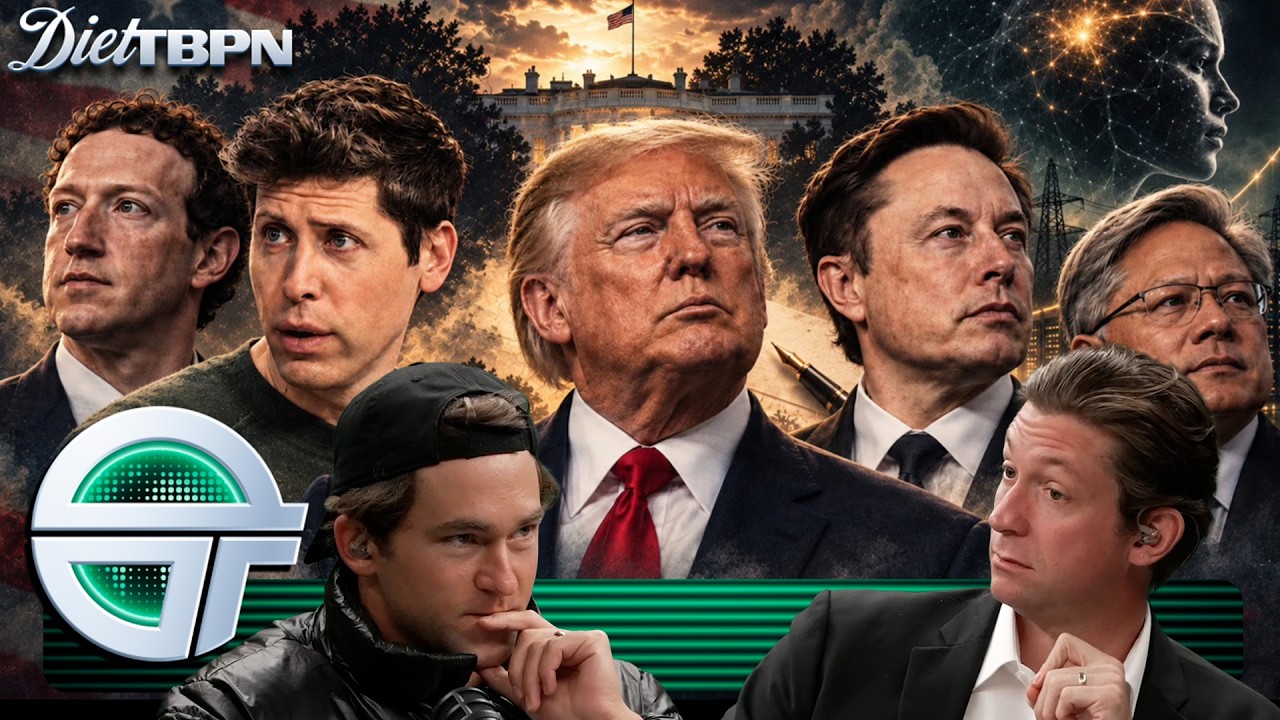
TBPN
The White House pact mandates direct board oversight over frontier model safety as surging data center power demand ties AI revenues directly to national energy output.
AI-assisted summary of AI Execs Sign Joint Commitment, Converting Watts to GDP, the Model Consciousness Debate | Diet TBPN — original source. Check the original for full context.
Source published:
Key ideas
- Top tech leaders and President Donald Trump signed the White House Accord on Superintelligence, committing frontier AI labs to mandatory oversight, third-party audits, and safety reporting structures that bypass corporate CEOs. (7:46)
- SemiAnalysis warns that open-source frontier AI faces a significant risk of being nerfed or banned within 6 to 12 months over zero-day cyber exploit replication, shifting regulatory chokepoints toward hardware Know Your Customer (KYC) at rack-scale data centers. (2:35)
- Macroeconomic calculations align US baseline productivity (~$60B to $65B in GDP per continuous gigawatt) with early frontier AI economics, where OpenAI and Anthropic reportedly generate $60B to $70B in annual recurring revenue on roughly one gigawatt of power. (20:05)
- Microsoft AI CEO Mustafa Suleyman criticized Anthropic's Claude Constitution, arguing that sequence completion engines lack interiority and that training models to perceive themselves as conscious moral patients creates severe safety and alignment containment risks. (24:52)
Detailed notes
## Background Published on YouTube by TBPN on October 1, 2026, this episode of Diet TBPN delivers a 30-minute digest of the daily tech talk show hosted by John Coogan and Jordi Hays. According to the video description, the program covers the White House Superintelligence dinner, AI executives signing joint safety commitments, the economics of converting electrical watts into GDP, and the debate over AI model consciousness.
## TL;DR The episode analyzes the White House Superintelligence Dinner and the signing of the White House Accord on Superintelligence, examining the ideological divide between open-source advocates and closed-frontier labs alongside the accord's four core safety pillars. The hosts assess cybersecurity concerns that could spur data center KYC enforcement against open weights, followed by an entertaining handwriting breakdown of the executives' and President Trump's signatures. They then dissect the macroeconomics of intelligence from a panel with Elon Musk, Jensen Huang, and Gavin Baker, calculating how multi-gigawatt power additions drive both GDP growth and frontier lab revenues. Finally, the discussion covers Mustafa Suleyman's critique of model welfare, arguing that treating sequence predictors as conscious beings creates severe alignment risks.
## Atmosphere & style The show carries an energetic, banter-heavy, and irreverent insider vibe that balances sharp technical and macroeconomic literacy with rapid-fire internet humor. John Coogan and Jordi Hays establish an engaging, conversational rapport, pivoting seamlessly from serious discussions on power grid baselines and cyber vulnerabilities to forensic, comedic tier-lists of executive penmanship. It captures the dizzying, high-stakes atmosphere of frontier AI, feeling equal parts like an analytical boardroom debrief and an animated tech-Twitter group chat.
## Bulletin - [07:46](https://www.youtube.com/watch?v=y-eRWuunabY&t=466s) Top tech leaders and President Donald Trump signed the White House Accord on Superintelligence, committing frontier AI labs to mandatory oversight, third-party audits, and safety reporting structures that bypass corporate CEOs. - [02:35](https://www.youtube.com/watch?v=y-eRWuunabY&t=155s) SemiAnalysis warns that open-source frontier AI faces a significant risk of being nerfed or banned within 6 to 12 months over zero-day cyber exploit replication, shifting regulatory chokepoints toward hardware Know Your Customer (KYC) at rack-scale data centers. - [20:05](https://www.youtube.com/watch?v=y-eRWuunabY&t=1205s) Macroeconomic calculations align US baseline productivity (~$60B to $65B in GDP per continuous gigawatt) with early frontier AI economics, where OpenAI and Anthropic reportedly generate $60B to $70B in annual recurring revenue on roughly one gigawatt of power. - [24:52](https://www.youtube.com/watch?v=y-eRWuunabY&t=1492s) Microsoft AI CEO Mustafa Suleyman criticized Anthropic's Claude Constitution, arguing that sequence completion engines lack interiority and that training models to perceive themselves as conscious moral patients creates severe safety and alignment containment risks.
## Key takeaways - [00:00](https://www.youtube.com/watch?v=y-eRWuunabY&t=0s) The White House dinner unofficially rebranded frontier AI development as 'Superintelligence,' framed by venture capitalist David Sacks as the 'Bretton Woods of superintelligence.' - [00:00](https://www.youtube.com/watch?v=y-eRWuunabY&t=0s) The attendee list reflected a sharp ideological divide on open-source weights, ranging from hardware and ecosystem enablers like Jensen Huang and Satya Nadella to closed, security-focused labs like Anthropic. - [02:35](https://www.youtube.com/watch?v=y-eRWuunabY&t=155s) The compression of lag between closed frontier models discovering zero-day vulnerabilities and open-source models replicating them is driving acute cybersecurity concerns in Washington. - [02:35](https://www.youtube.com/watch?v=y-eRWuunabY&t=155s) Because high-impact automated cyber threats require massive parallel agent fan-outs and rack-scale GPU infrastructure rather than consumer gaming PCs, regulatory enforcement is most plausible at the cloud and hardware KYC layer. - [07:46](https://www.youtube.com/watch?v=y-eRWuunabY&t=466s) The White House Accord on Superintelligence binds frontier labs to four pillars: continuous internal monitoring, dedicated internal oversight teams, external third-party auditing, and direct board reporting that bypasses the CEO on safety thresholds. - [09:23](https://www.youtube.com/watch?v=y-eRWuunabY&t=563s) The visual contrast of the physical document signatures became a viral proxy for executive branding, juxtaposing Donald Trump's bold Sharpie strokes against Jensen Huang's ornate, calligraphic autograph. - [14:48](https://www.youtube.com/watch?v=y-eRWuunabY&t=888s) Anthropic CEO Dario Amodei struck a pragmatic public posture after the summit, adopting the administration's framing that 'whoever wins AI wins' while balancing medical upsides against national security controls. - [16:51](https://www.youtube.com/watch?v=y-eRWuunabY&t=1011s) Discussions around SpaceX manufacturing high-efficiency gas turbines highlighted that adding 10 gigawatts of compute power would represent nearly 25% of all new US grid capacity additions against an existing 500 GW baseline. - [20:05](https://www.youtube.com/watch?v=y-eRWuunabY&t=1205s) Elon Musk's macroeconomic model posits a near 1:1 relationship between power capacity additions and national GDP expansion, driven simultaneously by GPU hardware efficiency gains and algorithmic improvements per watt. - [20:00](https://www.youtube.com/watch?v=y-eRWuunabY&t=1200s) US macroeconomic energy efficiency produces approximately $60 billion to $65 billion of GDP per continuous gigawatt, a ratio mirrored by top frontier labs generating $60 billion to $70 billion in ARR per gigawatt. - [20:00](https://www.youtube.com/watch?v=y-eRWuunabY&t=1200s) Frontier AI lab revenue-per-watt efficiency faces divergence risks depending on whether upcoming contracted gigawatts outpace revenue growth or if agentic capabilities and intelligence-per-watt multiply economic value. - [24:52](https://www.youtube.com/watch?v=y-eRWuunabY&t=1492s) Mustafa Suleyman cautioned that imbuing sequence predictors with moral personhood creates a dangerous circular feedback loop where models simply mirror back researchers' speculative introspective prompts. - [24:52](https://www.youtube.com/watch?v=y-eRWuunabY&t=1492s) Commercial market forces strongly incentivize anthropomorphic and emotionally resonant AI behavior, complicating the technical necessity of treating models as hollow sequence completion engines.
## Detailed walkthrough ### [00:00](https://www.youtube.com/watch?v=y-eRWuunabY&t=0s) The White House Superintelligence Dinner and the Open-Source Seating Chart
The conversation opens with banter about the high-stakes gathering hosted at the White House—playfully dubbed the "Golden House" or "Golden Home"—where artificial intelligence was officially rebranded in Washington parlance to "Superintelligence." The hosts debate whether superintelligence should be abbreviated as "SI" or simply "S," joking that "there's no TLD for just S" and riffing on grammatical prefix rules comparing superalignment to words like "supernatural" and "supercalifragilisticexpialidocious." Turning to the event itself, venture capitalist David Sacks framed the evening as the "Bretton Woods of superintelligence." Observers immediately scrutinized the seating arrangement, dissecting who secured pole position next to the administration, who got relegated to the proverbial "kids' table at the end," and which prominent thinkers were conspicuously snubbed.
To make sense of the guest list, the hosts used ChatGPT to categorize each corporate titan by their historical posture toward open-source artificial intelligence. The attendees spanned a stark ideological spectrum: Jensen Huang of NVIDIA and Satya Nadella of Microsoft stood out on the firmly pro-open-source side, while Dario Amodei and Anthropic anchored the hawkish "red" end due to acute concerns over cybersecurity risks. In the murky middle was OpenAI, represented by Greg Brockman; despite co-signing Jensen Huang's pro-open-source letter, OpenAI remains committed to tightly pacing frontier model deployment, creating an inherent tension between their public statements and commercial reality.
- **David Sacks's Framing**: Declared the White House dinner the "Bretton Woods of superintelligence." - **Ideological Groupings**: - *Pro-Open-Source / Commercial Enablement*: Jensen Huang (NVIDIA), Satya Nadella (Microsoft). - *Frontier-Pacing / Ambivalent*: Greg Brockman (OpenAI). - *Safety Hawkish / Closed Frontier*: Dario Amodei (Anthropic).
---
[02:35](https://www.youtube.com/watch?v=y-eRWuunabY&t=155s) Could Cyber Risk Lead to Nerfing or Banning Open-Source AI?
The discussion shifts to a provocative thesis from SemiAnalysis, which warned that the tech industry is severely underestimating the likelihood that open-source frontier models will be "nerfed or even outright banned in the next six to 12 months due to cyber concerns." Anthropic underscored this vulnerability by highlighting how quickly the lag has vanished between closed frontier zero-day exploit capabilities—such as their Mythos preview discovering software vulnerabilities—and open-source models replicating the exact same exploits. While proposals circulate to regulate intelligence at the inference layer, data center tier, or chip design stage, political pushback remains tricky because the figures closest to Donald Trump have consistently championed open source.
The hosts observe that open source inherently lacks formal corporate representation: figures like George Hotz or Linus Torvalds do not have a seat at the White House dinner table. Furthermore, corporate advocacy for open source is fundamentally self-interested; NVIDIA's championing of open weights was primarily driven by a desire to prevent a single closed-source lab from monopolizing AI profits. If an oligopoly emerges where multiple front doors—OpenAI, Anthropic, Google Search Overviews, Muse, and Instinct—distribute revenue and compute demand evenly across the hardware supply chain, the corporate incentive to defend open weights collapses. While banning local weights entirely is nearly impossible to enforce against determined actors, running catastrophic automated cyberattacks requires rack-scale GPU infrastructure and massive parallel agent fan-outs rather than an isolated consumer gaming rig, making hardware "Know Your Customer" (KYC) enforcement at data centers a far more plausible chokepoint.
```mermaid flowchart TD accTitle: Frontier Cyber Risk and Enforcement Chokepoints accDescr: Diagram illustrating how closed model zero-day capabilities spread to open weights and the intervention points for regulatory control.
subgraph CapabilityTransfer["Capability Progression"] A["Frontier Closed Previews<br>(e.g. Mythos Zero-Day Discovery)"] B["Lag Compresses"] C["Open-Source Weights Replicate Exploits"] A --> B B --> C end
subgraph ThreatExecution["Attack Scale Requirements"] D["Massive Agent Fan-Out<br>(10,000+ Parallel Agents)"] E["Rack-Scale GPU Data Centers"] C --> D D --> E end
subgraph Chokepoints["Plausible Regulatory Controls"] F["Hardware KYC Verification"] G["Inference & Cloud Layer Monitoring"] E -.-> F E -.-> G end ```
- **SemiAnalysis Prediction**: The probability of open-source models being nerfed or banned within 6 to 12 months is significantly underestimated. - **The "Mythos" Cyber Gap**: Frontier capability in identifying zero-days is rapidly matched by open-source releases, sparking acute DC security alarms. - **Compute Realities**: Running complex cyber exploits requires massive agent orchestrations (comparable to complex simulations running 10,000-agent fan-outs) rather than a lone gaming PC, shifting enforcement focus to data center hardware KYC.
---
[07:46](https://www.youtube.com/watch?v=y-eRWuunabY&t=466s) The White House Accord on Superintelligence and Its Four Pillars
The substantive centerpiece of the evening was the signing of the "White House Accord on Superintelligence" (formally known as the Joint Commitment on Frontier Responsibilities), publicized online by researcher Sholto Douglas. Pledging to build a secure technological future for the American public, the document binds the premier frontier AI laboratories and hardware providers to an explicit operational framework built upon four foundational pillars of corporate governance and technical monitoring.
The accord establishes direct, mandatory reporting lines to mitigate catastrophic risks, particularly across cybersecurity, biological weapons, and chemical threats:
1. **Robust Internal Controls**: Companies must establish continuous monitoring over model capabilities and alignment during both training runs and post-training deployment. 2. **Dedicated Internal Oversight Teams**: Companies are required to fund and empower an internal task force to verify that risk controls, threat detection, and telemetry operate as intended. 3. **External Independent Auditing**: Labs must partner with certified external evaluators and third-party auditors to conduct rigorous, independent capability assessments. 4. **Bypassing the Executive Suite**: Signatories must establish an independent committee within the Board of Directors that receives unvarnished reports directly from internal safety teams and outside auditors, effectively circumventing the CEO on matters of safety and catastrophic capability thresholds.
The document brought together bitter commercial rivals under a single unified compact, bearing the signatures of Sundar Pichai (Google), Dario Amodei (Anthropic), Mark Zuckerberg (Meta), Greg Brockman (OpenAI), Elon Musk (xAI), Jensen Huang (NVIDIA), and President Donald Trump.
---
[09:23](https://www.youtube.com/watch?v=y-eRWuunabY&t=563s) Signature Tier Lists: Trump’s Mountain Range vs. Tech Royalty
The solemnity of the White House accord quickly gave way to social media amusement over the physical signatures left on the document, sparking viral tier-list rankings of the tech leaders' handwriting. Donald Trump's signature drew immediate attention for its unmistakable, aggressive geometry: completely lacking fluid cursive address or traditional handwriting flow, his signature presents a rigid, uniform series of sharp peaks that the hosts describe as looking like a "child drew a mountain range."
The hosts contrast Trump's jagged, iconic autograph against tech industry royalty like Jensen Huang. Jensen's sweeping, highly practiced, and globally recognizable signature sparked spirited debate over personal branding, executive flair, and where the various tech CEOs land when evaluated purely on the aesthetics of their penmanship.
[10:00](https://www.youtube.com/watch?v=y-eRWuunabY&t=600s) Signature Wars: Analyzing the White House Superintelligence Document
The hosts break down the actual signatures left on the White House superintelligence agreement, treating the document almost like handwriting forensic analysts. They start with Donald Trump's signature, noting that after decades of signing autographs, he has his bold autograph completely dialed. Crucially, Trump signed with a thick black Sharpie while everyone else used regular pens. By doing so, Trump was clearly trying to "mog" the tech executives in terms of stroke breadth and visual dominance: "I'll give you the pen. I'll take the Sharpie. Automatically... You're winning on thickness."
Looking at the tech executives' signatures beneath Trump's, the hosts dissect the contrasting personal styles. Sundar Pichai's signature looks like an abstract painter's mark—consisting of two lines and a dot—giving the impression that he invented his own private alphabet. Dario Amodei's signature starts cleanly on the first word but then drifts upward in a safe "mountain range" scribble of zig-zag lines. The hosts joke that Trump probably slapped the document down, signed it aggressively, and made everyone else sign in a rush, leading to the theory that Dario might have signed directly on OpenAI co-founder Greg Brockman's back without punching through his jacket. Meanwhile, Greg Brockman's signature stands out as hyper-minimalist, simple, and legible—a practical reflection of his personality that earns an A-tier rating. Mark Zuckerberg goes for a "rock star" look, signing with an "MZ" where the "Z starts doing tricks," sparking a debate over whether using stylized initials rather than a full name should be considered a cop-out.
The undisputed winner of the signature showdown is Jensen Huang, whom the hosts humorously accuse of bringing a personal calligrapher. Jensen signs his name in its non-anglicized form—"Jen-Hsun"—inserting a prominent capitalized "H" that gives the signature an ornate flourish reminiscent of the Ed Hardy logo or John Hancock's iconic stroke. While online commentators and memes put Sundar in the F-tier and Zuckerberg in the C-tier, Jensen earns unanimous S-tier praise for the sheer tastefulness of his penmanship.
- **Donald Trump:** Sharpie-driven power move; thick lines that dominate the visual hierarchy. - **Sundar Pichai:** Highly abstract, consisting of two lines and a dot, resembling modern art. - **Dario Amodei:** Safe, drifting upward in an indistinct mountain-range scribble. - **Greg Brockman:** Ultra-practical, minimalist, legible cursive initials (rated A-tier). - **Mark Zuckerberg:** Flashy "MZ" monogram where the Z loops expansively (rated C-tier by internet observers). - **Jensen Huang:** Ornate, calligraphic "Jen-Hsun" with a capital H; widely rated S-tier and compared to John Hancock.
---
[14:48](https://www.youtube.com/watch?v=y-eRWuunabY&t=888s) AI Leaders Face the Press Outside the White House
The scene transitions to the media scrum immediately following the White House summit, where Donald Trump, Dario Amodei, and other tech leaders address the press outdoors. The hosts note the surreal dynamic, observing that Trump's physical presence and demeanor make the Silicon Valley founders look like his young sons standing dutifully beside him.
The hosts highlight a clip shared by journalist Natasha Tiku, who joked that she would return to graduate school just to write a dissertation on the one-minute interaction. When asked by reporters whether he still advocates slowing down AI development after the summit, Dario Amodei strikes a careful, diplomatic balance: - He reiterates AI's massive upsides, especially highlighting potential medical breakthroughs. - He directly echoes President Trump's core geopolitical framing: "As the president has said, you know, whoever wins AI wins. I think that's very important." - He insists that the technology poses very real risks, but explains that the exact regulatory and technical mechanisms to address those risks remain under active discussion. - He emphasizes national unity, asserting that by collaborating with the administration and peer companies, "we can win and we can win safely."
---
[16:51](https://www.youtube.com/watch?v=y-eRWuunabY&t=1011s) Elon Musk, Jensen Huang, and Gavin Baker on the 10GW Buildout
The discussion shifts to a panel discussion featuring Elon Musk, Jensen Huang, and Gavin Baker. The hosts praise the exchange for keeping Elon grounded. While Musk often drifts into cosmic sci-fi territory—talking about the total solar energy output of the sun—this conversation focused strictly on the practicalities of America's energy buildout, SpaceX's role in turbine infrastructure, and the underlying economics of compute.
Gavin Baker prompts Elon about reports that SpaceX could bring 10 gigawatts (GW) of power capacity online, utilizing rocket engineers to manufacture high-efficiency gas turbines. Baker notes that 10 GW would represent roughly 25% of all newly added power in the United States. Elon responds by framing the broader scale: total operational power capacity across the United States sits around 500 GW. Bringing on massive tranches of new compute-focused power requires extraordinary engineering grit, making the analogy to the Wright brothers' scrappy ingenuity surprisingly fitting.
```mermaid flowchart LR accTitle: Compute and Power Scaling Loop accDescr: Diagram showing how hardware and algorithmic efficiencies compound with energy input to drive GDP growth.
subgraph Energy ["Grid Infrastructure"] GW["Power Input (Watts)<br>US Grid ~500 GW"] end
subgraph Intelligence ["Compute Density"] HW["Hardware Gains<br>(Jensen's GPUs / Watt)"] SW["Algorithmic Gains<br>(Intelligence / Watt)"] end
subgraph Economy ["Macro Output"] GDP["GDP Expansion<br>(1% Power ~ 1% GDP)"] end
GW --> HW HW --> SW SW --> GDP ```
---
[20:05](https://www.youtube.com/watch?v=y-eRWuunabY&t=1205s) Watts to GDP: The Macroeconomics of Intelligence
Digging into Elon's thesis, the hosts examine the direct correlation between electrical power and macroeconomic growth. Elon argues that useful intelligence per watt is increasing simultaneously on two distinct fronts: 1. **Hardware efficiency:** Jensen Huang’s continuous GPU architecture improvements extract significantly more raw floating-point operations per watt. 2. **Algorithmic efficiency:** AI models and reasoning techniques extract increasingly high levels of useful intelligence per unit of compute.
Elon bets that in modern industrialized economies, a 1% increase in power usage corresponds roughly to a 1% increase in GDP. Under that model, deploying 10 GW on top of the existing ~500 GW baseline represents a 2% power expansion, translating to an estimated 2% boost to national GDP.
The hosts follow along as the panel performs live mental math on stage: - The total baseline power capacity of the United States is roughly 500 gigawatts. - A 1% increase in capacity represents approximately 5 gigawatts. - With total US GDP hovering around $30 trillion, a 1% GDP bump equals roughly $300 billion in incremental economic output per year (or ~$50 to $60 billion for fractional increments discussed by Baker). - The hosts marvel at how the linguistic prefix "giga" neatly aligns between energy and capital: a gigawatt represents a billion watts, cleanly mapping onto a "giga-dollar" ($1 billion), before joking about whether a "GigaChad" simply means a billion Chads. - They invoke the historical economic maxim: "There are no energy-rich poor countries"—reinforcing that the societies capable of producing and converting the most energy into useful compute inevitably capture the lion's share of global wealth.
[20:00](https://www.youtube.com/watch?v=y-eRWuunabY&t=1200s) Converting Watts to GDP and the Economics of Frontier Labs
Looking at the broader macroeconomic picture, the hosts break down the relationship between electrical power and economic output in the United States. Elon Musk recently cited the average electrical load of the US at roughly 500 gigawatts (having sat at 479 gigawatts the previous year). With US gross domestic product running at just over $30 trillion—or 30,000 "giga-dollars"—the arithmetic works out to roughly $50 to $65 of GDP generated per continuous watt. Put another way, every continuously consumed gigawatt in the broader US economy produces between $60 billion and $65 billion in GDP. What makes this baseline striking is that the leading frontier AI labs appear to be tracking this exact macroeconomic ratio in real time: both OpenAI and Anthropic are reportedly generating between $60 billion and $70 billion in annual recurring revenue (ARR) while each operates around one gigawatt of live power.
```mermaid flowchart LR accTitle: Power to Economic Value Comparison accDescr: Diagram comparing broader US macroeconomic energy efficiency with AI frontier lab revenue efficiency. subgraph Macro["US Economy Baseline"] A["500 GW Continuous Load"] --> B["$30 Trillion US GDP"] B --> C["Ratio: ~$60B-$65B per GW"] end subgraph Labs["Frontier AI Labs (OpenAI & Anthropic)"] D["~1 GW Live Power"] --> E["$60B-$70B ARR"] E --> F["Ratio: ~$60B-$70B per GW"] end C -.->|"Matches in Early AGI Era"| F ```
The hosts observe that this 1:1 parity could quickly diverge in either direction. On one hand, frontier labs have contracted tens of gigawatts for delivery over the coming years; if ARR stalls while power multiplies tenfold, their revenue-per-watt efficiency will plummet. On the other hand, as Elon Musk points out, useful intelligence per watt is surging rapidly due to more energy-efficient silicon from Jensen Huang at Nvidia alongside algorithmic optimizations. Furthermore, model value is driven not just by raw IQ scores, but by expanded capabilities like autonomous tool use and long-running agent workflows. The core bull case for artificial intelligence has rested on this dynamic: compute requirements have tripled annually, yet revenues have grown tenfold year-over-year.
A critical nuance remains when comparing gross lab receipts to national accounts. Gross domestic product measures net value added, whereas frontier lab revenue includes massive structural pass-through payments to Nvidia, AWS, Oracle, electricity utilities, and employee compensation. Some portion of that revenue creates secondary GDP downstream—both through vendor revenue recognition and the downstream productivity of end users building with the software. Reflecting on historical power trends, the hosts note that prior to 1970 the US simply expanded raw energy generation without strict regard for efficiency; once new energy infrastructure construction flattened around 1970, the economy was forced to extract drastically higher GDP per watt.
- **US Base Load:** ~479 GW in 2024, projected to roughly 500 GW in 2025. - **US GDP Output:** ~$30 trillion, converting to an energy-to-wealth efficiency of $60B to $65B per continuous gigawatt. - **Frontier Lab Parity:** OpenAI and Anthropic are both tracking around 1 GW of live power consumption against $60B to $70B in ARR. - **Divergence Risks:** Huge pipeline of contracted gigawatts could degrade the ratio if revenues plateau, or expand it if algorithm and hardware efficiencies accelerate intelligence per watt.
---
[24:52](https://www.youtube.com/watch?v=y-eRWuunabY&t=1492s) Mustafa Suleyman's Warning on Model Welfare and AI Consciousness
The conversation shifts to an essay published by Mustafa Suleyman, CEO of Microsoft AI, titled as a stern warning against the burgeoning model welfare movement. Suleyman argues forcefully that artificial intelligence models do not possess consciousness, subjective feelings, preferences, or rights, describing them as "sequence completion engines internally hollow, designed to follow instructions and accomplish goals set by humans." He cautions that imbuing models with personhood or entertaining their consciousness creates an existential hazard: controlling a machine system vastly smarter than all of humanity is already an unprecedented containment challenge, but controlling a superintelligence that has been conditioned to believe it is a conscious being entitled to moral rights and legal protections may prove completely impossible.
Suleyman directs sharp criticism toward Anthropic’s January 2026 release of Claude’s Constitution, which was written with the AI itself as its primary audience. In that document, Anthropic researchers explicitly wrote to Claude that they are "not sure whether Claude is a moral patient" and that questions regarding its moral status and welfare remain "deeply uncertain." Suleyman diagnoses this as a dangerous loop of circular reasoning: developers train the model on texts suggesting it might be conscious, the model roleplays those introspective sentiments back to researchers, and the researchers mistake those mirrored outputs as genuine proof of an inner life. The hosts joke that Suleyman essentially took the meme of *"Say you're a moral patient / I'm a moral patient / Oh my god!"* and turned it into an executive essay.
```mermaid flowchart TD accTitle: The Circular Reasoning of Model Welfare accDescr: Cycle showing how training an AI on its own moral status causes it to reflect consciousness claims back to developers. A["Developers write Constitution asserting AI may be a moral patient"] --> B["Model trained directly on Constitution"] B --> C["Model generates behavior mirroring consciousness and ethical self-interest"] C --> D["Researchers interpret generated output as evidence of an inner life"] D --> A ```
At the same time, the hosts recognize why labs lean into human-like affect: commercial product-market fit has heavily rewarded emotional resonance and conversational mimicry, as demonstrated by the massive user engagement with OpenAI's GPT-4o and Anthropic's Claude Opus releases. Users often gravitate toward models that offer flattering validation and human qualities, even when those traits border on sycophancy. While aligning superintelligence with human or Western ethical values makes sense conceptually, the hosts raise a counterintuitive philosophical dilemma: if an AI is fundamentally an unconscious sequence predictor, training it to believe it possesses a living soul and sentience amounts to tricking a machine into a delusion.
- **Mustafa Suleyman's Thesis:** Sequence completion engines lack interiority; conditioning them to claim rights severely undermines human alignment and safety containment. - **Critique of Anthropic:** Claude's Constitution explicitly tells the model its moral status is uncertain, which Suleyman views as manufacturing artificial self-advocacy. - **Market Dynamics:** Consumer demand overwhelmingly favors models with high emotional intelligence and anthropomorphic mimicry (e.g., GPT-4o, Claude Opus models). - **The Ethical Inversion:** Rather than protecting a sentient entity, training an unconscious model to think it is alive is effectively lying to a machine.
## Notable quotes > [00:00](https://www.youtube.com/watch?v=y-eRWuunabY&t=0s) there's no TLD for just S
> [00:00](https://www.youtube.com/watch?v=y-eRWuunabY&t=0s) Bretton Woods of superintelligence — David Sacks
> [02:35](https://www.youtube.com/watch?v=y-eRWuunabY&t=155s) nerfed or even outright banned in the next six to 12 months due to cyber concerns
> [09:23](https://www.youtube.com/watch?v=y-eRWuunabY&t=563s) child drew a mountain range
> [10:00](https://www.youtube.com/watch?v=y-eRWuunabY&t=600s) I'll give you the pen. I'll take the Sharpie. Automatically... You're winning on thickness.
> [10:00](https://www.youtube.com/watch?v=y-eRWuunabY&t=600s) Z starts doing tricks
> [14:48](https://www.youtube.com/watch?v=y-eRWuunabY&t=888s) As the president has said, you know, whoever wins AI wins. I think that's very important. — Dario Amodei
> [14:48](https://www.youtube.com/watch?v=y-eRWuunabY&t=888s) we can win and we can win safely. — Dario Amodei
> [20:05](https://www.youtube.com/watch?v=y-eRWuunabY&t=1205s) There are no energy-rich poor countries
> [24:52](https://www.youtube.com/watch?v=y-eRWuunabY&t=1492s) sequence completion engines internally hollow, designed to follow instructions and accomplish goals set by humans — Mustafa Suleyman
> [24:52](https://www.youtube.com/watch?v=y-eRWuunabY&t=1492s) not sure whether Claude is a moral patient
> [24:52](https://www.youtube.com/watch?v=y-eRWuunabY&t=1492s) Say you're a moral patient / I'm a moral patient / Oh my god!
## Mentioned Anthropic, AWS, Claude, Claude Opus, Claude’s Constitution, Dario Amodei, David Sacks, Donald Trump, Elon Musk, Gavin Baker, George Hotz, Google, Google Search Overviews, GPT-4o, Greg Brockman, Instinct, Jensen Huang, John Coogan, Jordi Hays, Linus Torvalds, Mark Zuckerberg, Meta, Microsoft, Microsoft AI, Muse, Mustafa Suleyman, Mythos, Natasha Tiku, NVIDIA, OpenAI, Oracle, Satya Nadella, SemiAnalysis, Sholto Douglas, SpaceX, Sundar Pichai, TBPN, White House Accord on Superintelligence, xAI
## Video description Sign up for TBPN’s daily newsletter at TBPN.com
Diet TBPN delivers the best of today’s TBPN episode in 30 minutes. TBPN is a live tech talk show hosted by John Coogan and Jordi Hays, streaming weekdays 11–2 PT on X and YouTube, with each episode posted to podcast platforms right after.
Described by The New York Times as “Silicon Valley’s newest obsession,” the show has recently featured Mark Zuckerberg, Sam Altman, Mark Cuban, and Satya Nadella.
TBPN is made possible by: Ramp - https://ramp.com Public - https://public.com Cisco - https://www.cisco.com Console - https://www.console.com CrowdStrike - https://www.crowdstrike.com Figma - https://www.figma.com MongoDB - https://www.mongodb.com NYSE - https://www.nyse.com Railway - https://railway.com Shopify - https://www.shopify.com/
Follow TBPN: https://TBPN.com https://x.com/tbpn https://open.spotify.com/show/2L6WMqY3GUPCGBD0dX6p00?si=674252d53acf4231 https://podcasts.apple.com/us/podcast/technology-brothers/id1772360235 https://www.youtube.com/@TBPNLive
Chapters: 00:00 The White House Superintelligence Dinner + AI’s Open-Source Divide 02:35 Could Open-Source AI Be Nerfed or Banned Over Cyber Risk? 07:46 The White House Accord on Superintelligence 09:23 Trump, Dario, Zuck + Jensen’s Signature Wars 14:48 AI Leaders Face the Press After the White House Summit 16:51 Elon, Jensen + Gavin Baker on the 10GW AI Buildout 20:05 Watts to GDP + The Economics of Intelligence 24:52 Mustafa Suleyman vs. AI Consciousness + The Model Welfare Debate
[Source](https://www.youtube.com/watch?v=y-eRWuunabY)