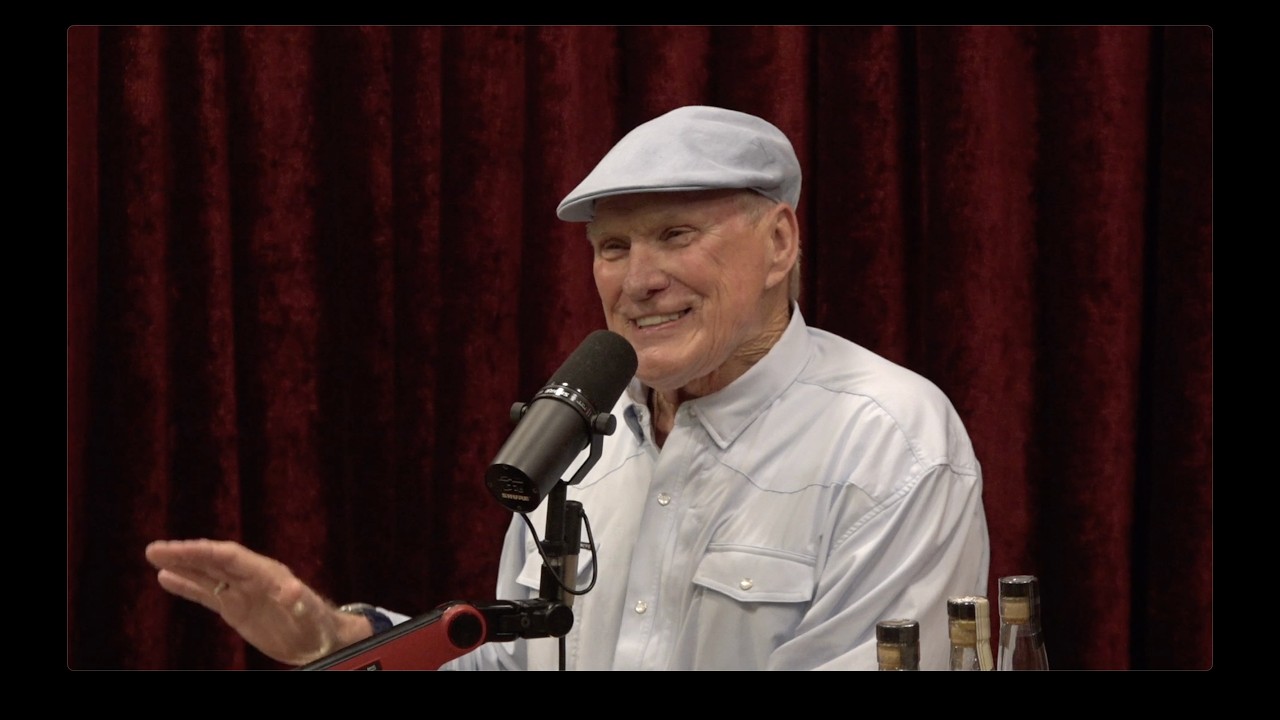
Terry Bradshaw Reveals Seven-Year Bourbon Pivot After Cancer Battles
PowerfulJRE
The Hall of Fame quarterback credits strict corporate discipline and brand ownership for navigating his post-football life after overcoming multiple carcinoma diagnoses.
## Background
Published on YouTube by the PowerfulJRE channel on June 9, 2026, this episode of the Joe Rogan Experience features retired NFL quarterback and Pro Football Hall of Famer Terry Bradshaw. The page description highlights Bradshaw's storied 14-season career with the Pittsburgh Steelers, including four Super Bowl victories, alongside his multi-faceted post-football life as a musician, actor, author, entrepreneur, and co-host of “Fox NFL Sunday.”
## TL;DR
In this extensive conversation, Terry Bradshaw and Joe Rogan delve into Bradshaw's diverse entrepreneurial ventures, including the long-term development of Bradshaw Bourbon and his elite horse-breeding operations. Bradshaw candidly reflects on his 14-year NFL career, detailing the intense physical toll of 1970s football, his diagnoses of rheumatoid arthritis and Attention Deficit Disorder, and his ultimate survival of bladder cancer. The pair also explore the evolution of physical mass in modern sports, the intricacies of the corporate speaking circuit, and share personal, humorous anecdotes ranging from home invasions to the tight-knit locker room chemistry of the Fox NFL pregame show.
## Atmosphere & style
The conversation carries a warm, highly convivial, and narrative-rich energy, flowing like a classic late-night locker room storytelling session between two seasoned peers. Bradshaw brings a self-deprecating, old-school charm and emotional vulnerability, balanced beautifully by Rogan's grounding presence, active curiosity, and mutual respect. The atmosphere seamlessly shifts between lighthearted, chaotic humor—such as banter about backyard ducks, target fluid retention, and live TV pranks—and deeply reflective, serious moments regarding health struggles, aging, and the driving desire for personal connection.
## Key takeaways
- [04:14](https://www.youtube.com/watch?v=wyceothkkzQ&t=254s) Terry Bradshaw established his new spirits venture, Bradshaw Bourbon, highlighting a flagship single-barrel bourbon bottled straight from the barrel at 145 proof, alongside standard varieties resting at 103.8 proof.
- [33:41](https://www.youtube.com/watch?v=wyceothkkzQ&t=2021s) Joe Rogan outlines his personal battle with COVID-19, criticizing mainstream media for mischaracterizing his prescribed treatments and allegedly altering video footage to make him appear physically ill.
- [38:07](https://www.youtube.com/watch?v=wyceothkkzQ&t=2287s) Joe Rogan details his successful recovery from a full-length rotator cuff tear using stem cell therapy, noting its efficacy for soft tissue damage despite its limitations for severe bone-on-bone arthritis.
- [49:24](https://www.youtube.com/watch?v=wyceothkkzQ&t=2964s) Terry Bradshaw details the severe physical toll of playing 14 years of professional football in the 1970s, an era defined by primitive medical protocols and immense pressure to play through major injuries.
- [57:01](https://www.youtube.com/watch?v=wyceothkkzQ&t=3421s) Joe Rogan and Terry Bradshaw discuss the legacy of the late 1990s baseball steroid era, arguing that players like Barry Bonds, Mark McGwire, and Sammy Sosa tragically deserve induction into the Hall of Fame.
- [01:01:59](https://www.youtube.com/watch?v=wyceothkkzQ&t=3719s) Terry Bradshaw contrasts the massive size of modern NFL linemen with the highly mobile, athletic 'flatbelly' offensive and defensive lines that defined his championship teams in the 1970s.
- [01:27:24](https://www.youtube.com/watch?v=wyceothkkzQ&t=5244s) Joe Rogan breaks down the evolutionary concept of Dunbar's number to explain the cognitive limits human brains face regarding the number of stable social relationships they can actively maintain.
- [02:18:34](https://www.youtube.com/watch?v=wyceothkkzQ&t=8314s) Terry Bradshaw details his 43-year career on the professional corporate speaking circuit, explaining his approach to crowd-work, mid-presentation adjustments, and structural inspiration from Jay Leno.
## Detailed walkthrough
### [00:01](https://www.youtube.com/watch?v=wyceothkkzQ&t=1s) Catching Rainbow Trout and the Power of "Baby Jesus"
The conversation kicks off with Terry Bradshaw recapping his recent fishing escapades, proudly declaring that he has been coming up to the same spot for four years now to catch rainbow trout. Joe Rogan dives right into the mechanics of the sport, clarifying whether Terry is true fly fishing. Terry explains that while it technically qualifies as fly fishing, the method utilizes a boat on incredibly fast-moving water, targeting the pools near jetties where the fish wait. They use a setup featuring a "fly bobber"—a large cork indicator shaped like a big moth to hold the line up—paired with a bug so microscopic you can barely see it. While Joe notes that fly fishing is typically an intense, highly skillful endeavor where catching five or six trout a day is considered a massive success, Terry reveals that his group managed to catch nearly 100 trout over a span of 10 hours.
To explain this absurdly high yield, Terry launches into a humorous, lighthearted anecdote about a small, bearded religious figurine he keeps in his pocket, which they affectionately call "baby Jesus." Stymied by a lack of bites early in the trip, Terry pulled the figurine out of his pocket and set it on top of their Igloo cooler facing him. Miraculously, he reeled in six giant rainbow trout in a row. Seeing this, his son-in-law in the back of the boat desperately yelled, "Turn baby Jesus towards me." Terry obliged, and his son-in-law promptly caught six consecutive trout of his own, culminating in a spectacular haul of 12 rainbows ranging from 15 to 20 inches long. The fishing guide was completely "tripped out" by the unfolding scene, admitting to Terry that the display was genuinely messing with his head. Terry ultimately gifted the figurine to the guide, who promised to use it every day, prompting Joe to joke that you probably shouldn't bother Jesus for fishing assistance on a daily basis. Terry agrees, noting that while he is skilled enough on his own for bass fishing, desperate trout excursions require all the extra help he can get.
- **Total Catch:** Nearly 100 trout within a 10-hour timeframe.
- **Specific Haul:** 12 rainbow trout measuring between 15 and 20 inches long directly attributed to the figurine.
- **The Setup:** A fly rod equipped with a large, moth-like bobber and a tiny, almost invisible bug fly.
---
[04:14](https://www.youtube.com/watch?v=wyceothkkzQ&t=254s) The Spirits Business and Buffalo Trace
The banter shifts sharply when Terry casually notes that a mutual acquaintance, Jeff, had died to him today, prompting Joe to warmly validate Jeff as a "good dude" and a "man's man." Terry explains their history together, having spent two years working alongside Jeff on the show *Better Late Than Never*. Eyeing the table, Terry shifts his attention to the alcohol display, asking Joe about the massive spread of whiskey. Terry explains that he brought his own brand, Bradshaw Bourbon, which has been in development for seven years. While Joe mentions he had previously quit drinking for eight months solely for health reasons rather than a dependency issue, both men are eager to dive into a tasting.
Terry proudly showcases his lineup, starting with his award-winning 12-year-old bottle—which has since aged to 13 years—noting it swept the "Golden Awards" in the spirits circuit. Joe shares that he usually drinks Buffalo Trace, leading Terry to confidently assert that once Joe tastes the Bradshaw selection, he will completely jump ship—provided Buffalo Trace isn't an official sponsor. Joe admits they are a sponsor, but both express immense respect for the company, noting it has been operating since 1773, making it older than America itself. Terry details the deep history of bourbon, mentioning the historical claim that a preacher named Elijah Craig is considered the father of bourbon whiskey, even if historical research cannot definitively trace it back quite that far.
- **Bradshaw Bourbon Timeline:** The project has been active for 7 years; the flagship bottle is a 12-year-old blend that is now technically aged 13 years.
- **Buffalo Trace History:** Established in 1773, predating the founding of the United States.
- **The Lineup:** Terry presents three distinct varieties: a 2-year original, a 6-year bottle, and the award-winning 12-year blend.
---
[05:52](https://www.youtube.com/watch?v=wyceothkkzQ&t=352s) Proofs, Processes, and Tattoos
Terry guides Joe through the differences across his bourbon portfolio, explaining how they cleverly used a specific yeast to make their original two-year aged whiskey mimic the deeper flavor profile of a four-to-six-year pour. He contrasts this with his high-end six-year bottle and the single-barrel 12-year flagship. When Joe questions why the older vintage boasts a significantly higher alcohol content, Terry attributes it directly to the unique single-barrel aging process. He explains that they chose to bottle the bourbon exactly as it emerged from the barrel at a staggering 145 proof, though it could easily be diluted down with water to match the 103.8 proof (or 51.9% alcohol by volume) found in his other selections. Eager to try it, Joe calls for Jamie to bring over a knife, glasses, and ice to crack the bottle open.
As they prepare the drinks, Terry shifts his gaze around the studio, observing that there are "a lot of tattoos in here." Joe laughs, clarifying that the building itself is full of them but points out that "Jamie's tattoo free." Joe cracks a joke that Jamie has been contemplating getting Joe's face tattooed across his entire back, which Terry jokingly likens to a "bullseye." Joe and Jamie riff back and forth about a hypothetical deal where they would tattoo each other's faces, with Joe imagining "young Jamie" written out in dramatic gothic script across his back. Turning back to the alcohol, Terry admits he cannot fully articulate why he fell in love with bourbon, but treasures it because true bourbon is a uniquely American spirit, adding that many purists in Kentucky argue it isn't authentic unless it is distilled directly in their state.
- **Bourbon Proof Variations:** The single-barrel flagship sits at a potent 145 proof, while the standard vintage rests at 103.8 proof.
- **Inventory Scarcity:** Terry reveals that only about 15 cases remain of this specific award-winning 12-year limited edition batch.
---
[09:20](https://www.youtube.com/watch?v=wyceothkkzQ&t=560s) Branding, Guilt, and a Two-Month Corporate Stint
Joe toasts Terry, thanking him for coming on the show, and takes a sip of the high-proof bourbon, instantly reacting to its intense kick. Terry urges him to let the alcohol sit and breathe. The drink prompts Terry to reflect on the emotional origin of the business. He recalls approaching his father prior to his passing to ask for his thoughts on entering the spirits industry. Because Terry's grandfather had been a severe alcoholic, his father flatly refused, saying, "Absolutely not." Respecting his father's wishes, Terry completely shut the idea down. His father passed away 12 years ago, followed by his mother two years ago.
Years after his father's death, Terry found himself reflecting on a poignant conversation he once had with former Secretary of Defense William Cohen. When Cohen asked Terry what he did for a living, Terry listed his work as a broadcaster for Fox, his public speaking gigs for major corporations, and his extensive business breeding and training quarter horses and registered cattle. Sensing Terry's chaotic schedule, Cohen wisely advised him that he needed to actively brand himself so he wouldn't be forced to travel so heavily, noting that Terry had spent a staggering 250 days on the road the previous year.
This conversation triggered a memory from 30 years prior when Terry felt an overwhelming sense of guilt for not having a "normal job." Feeling uncomfortable with the unstructured lifestyle of an athlete—where he played golf for two weeks at a time between scattered public speaking events—he begged a friend who owned a cosmetics company to hire him. He wanted to understand "how America works" by waking up, kissing a family goodbye, and putting on a coat and tie. His friend hired him at a salary of $5,000 a month. However, the corporate lifestyle was short-lived; Terry's office window sat directly across the street from his country club, and after spending two months watching his buddies play through the fairways, he couldn't stand the routine any longer and quit.
- **Travel Demands:** Terry traveled 250 days in a single year alongside his wife before focusing on branding.
- **Cosmetics Job Salary:** Paid $5,000 a month but lasted only 2 months due to the temptation of the adjacent golf course.
---
[14:14](https://www.youtube.com/watch?v=wyceothkkzQ&t=854s) Domestic Concessions and Foundation Cigars
The atmosphere becomes incredibly relaxed as Joe offers Terry a cigar, which Terry enthusiastically accepts on the condition that it is a "really good one." Terry chuckles about his home life, noting he is incredibly lucky to be married to a wife who actually permits him to smoke directly inside the house. Joe laments that he enjoys no such luxury at home. He explains that the entirety of his studio space—with its sprawling elk heads, racing simulators, and vivid Jimi Hendrix artwork—exists solely because his wife controls the decor at home. Joe jokes that if he were left to design his own house, it would look exactly like a "16-year-old boy won the lottery." Terry nods in agreement, admitting that while his own wife loves him dearly, they still make plenty of domestic concessions; Terry typically retreats out to the barn by his pool table whenever he wants to enjoy a cigar in peace.
Joe hands Terry a premium cigar from Foundation Cigars, which Terry labels as "legit" and jokes that you need Joe's level of wealth to regularly afford them. Joe gives a shout-out to the brand, specifying that the cigar is a Nicaraguan blend called "The Tabernacle." Savoring the high-end combination of the award-winning Bradshaw Bourbon and the premium smoke, Terry smiles broadly, telling Joe that this is shaping up to be "the greatest interview I've ever been a part of."
- **Cigar Details:** A Nicaraguan cigar manufactured by Foundation Cigars, specifically from their line called "The Tabernacle."
[16:20](https://www.youtube.com/watch?v=wyceothkkzQ&t=980s) The Seven-by-Seven Elk and the Wife's Ultimatum
The conversation kicks off with a lighthearted exchange about setting up a monthly delivery of a product from a "friend of the show" via an Instagram shoutout. This quickly transitions into a vivid hunting story about a friend who built the speaker's house. Knowing his host is an avid bowhunter, the speaker details how this friend went out to New Mexico and shot a massive, "monster" 7x7 elk. The base of the horn was extraordinarily thick, which prompts a brief tangent clarifying that New Mexico is indeed famous for producing exceptionally large elk.
The heart of the story unfolds as the friend brings the trophy home to display over his fireplace, aiming for a perfectly balanced arrangement of his European mounts—two on one side, two on the other, and this massive new one right in the center. He gets up on his stepladder, hangs the heavy horn on the wall, and steps back to his chair to admire his handiwork. Just as he is savoring the view, his wife walks in. Rather than sharing his awe at the 7x7 majesty, she delivers a swift reality check: "I want that out of here." Despite his protests about a "perfectly balanced wall," the ultimate consequence is that the massive trophy now resides out in the garage. The speaker laughs, noting he offered to hang it in his own living room since his wife wouldn't care, while his host sympathizes with the tragedy of having a prize banished to the garage.
- **Location of Hunt:** New Mexico (initially guessed as Idaho).
- **Elk Size:** Massive 7x7 European mount with a remarkably thick horn base.
- **Current Location of Trophy:** The garage, due to the wife's strict veto.
The episode features a promotional segment for DraftKings, highlighting the excitement of fight night, title shots, and rising contenders.
- **Availability:** The DraftKings app is available in all 50 states and includes all markets.
- **Promotional Offer:** New customers signing up with code `Rogan` can spend $5 to receive $200 in rewards within 21 days.
- **Partnership & Legal:** In partnership with DraftKings. Gambling problem helpline: 1-800-GAMBLER. Specific state hotlines and restrictions apply (e.g., NY, CT, KS, IL), 21+ only, void in Ontario, offer ends June 28th.
---
[19:30](https://www.youtube.com/watch?v=wyceothkkzQ&t=1170s) The Philosophy of Hunting and the Horror of Hawaiian Centipedes
The host shares that he only keeps one elk trophy in his house—the very first one he ever killed. He acknowledges that hunting anything with a bow and arrow is an intense, grueling process because you have to get incredibly close to the animal, admitting, "it's a lot of work, man." He dedicates a week every year to it, prompting a discussion about prime elk territories. While the host hasn't been to New Mexico yet, he expresses a strong desire to hunt the Gila Mountains. They swap knowledge on top locations, mentioning Arizona, Utah (famous for volume), parts of California, Montana, and Idaho. The speaker notes he isn't an elk hunter himself, but learned about these spots during a single hunting trip where he gave his tag to his horse trainer. He simply tagged along, crawling around in the brush, and watched his trainer successfully harvest a huge 6x6.
When asked why he doesn't hunt, the guest explains that he simply doesn't like to shoot things, though he "will kill a snake in a heartbeat." He confesses to having a hard time even killing a mouse, but makes a stark exception for centipedes. This triggers a visceral memory of encountering centipedes in Hawaii, warning the host to "hear me loud and clear... they're dangerous" and "gross." The host pulls up an image on the studio screen of a massive, foot-long giant Hawaiian centipede caught on the Big Island. They marvel at its terrifying size, wondering aloud if it is an invasive species or native. Amidst the disgust, the guest briefly struggles with the mechanics of a studio lighter, which the host notes "confuses the [__] out of people," before they return to the topic of wildlife.
- **Top Elk Hunting Spots Mentioned:** Gila Mountains (New Mexico), Arizona, Utah, California, Montana, Idaho.
- **Guest's Family History:** His father, brother, and uncles were all hunters, but the trait skipped him.
- **Hawaii Wildlife Fact:** Discussion of the "Hawaiian giant centipede," showcasing a foot-long specimen.
---
[22:38](https://www.youtube.com/watch?v=wyceothkkzQ&t=1358s) The Misadventures of Backyard Ducks and Cooking Disasters
The host points out a harsh reality of nature: if humans don't hunt animals, they usually suffer grim fates via harsh winters or mountain lions. The guest counters with his own domestic wildlife tragedy. He and his wife raised 27 mallard ducks out in the country just "for fun" alongside chickens and guineas. However, he had just informed his wife that morning that they were down to only five ducks. The culprits weren't wild predators, but the ducks' own lack of traffic safety; they repeatedly left the lake, walked through a field, and got crushed trying to cross the road.
This leads to a culinary debate about duck eggs and wild game. The host describes duck eggs as having a darker yolk and a rich, distinct taste that oddly "coat your mouth," though they are incredibly high in protein. The guest notes that while he was gifted five mallards by his banker—ironically named Drake Mills, a serious duck hunter who plants 500 acres of rice—his own attempt to cook them was a total catastrophe. He and his wife tried to follow a recipe from the internet to make a traditional roux sauce. They kept stirring and heating the pot, but the more they stirred, the worse it got, until the mixture literally "ended up looking like a rubber tire" or tar. The host chuckles and compares learning to cook purely from a text recipe to trying to play football for the first time by watching a single YouTube video—you are inevitably going to look terrible.
- **Duck Population Drop:** 27 ducks reduced to 5 because they kept crossing a country road.
- **Irony Point:** The guest's duck-hunting banker is literally named Drake.
- **The Banker's Operation:** Plants 500 acres of rice and faces water issues in 80-degree weather.
---
[27:10](https://www.youtube.com/watch?v=wyceothkkzQ&t=1630s) Elite Chefs, High-Proof Bourbon, and Eating Squirrel Brains
Defending his culinary honor, the guest notes he actually published a book called the *Bradshaw Family Cookbook*, proving he can cook standard fare, just not complex wild game sauces. Furthermore, his son-in-law, Noah, is a celebrated chef who was voted the number one chef in Dallas. Originally from Hawaii, Noah is hired by high-end companies and individuals to cater events. The guest shares a piece of advice he got from Noah just the previous day after church regarding how to stop ruining pork chops: cook them at 350 degrees for exactly 20 minutes and take them off. The host uses this to reiterate his point about duck: it doesn't taste bad, people just don't know how to prepare it. He references an episode of Anthony Bourdain's show where Bourdain got angry at hunters complaining about duck flavor, cooked it properly for them, and completely changed their minds. To toast the conversation, the guest calls for a break to try some more of their drinks, noting the high-proof spirit has "quite a kick" and a noticeable 135-proof burn.
The conversation takes a wild turn when the host asks if the guest has ever eaten wild turkey or squirrel. The host loves wild turkey and has eaten squirrel, describing it as a light meat that is "kind of chicken-like" rather than a traditional red meat. This triggers a nostalgic, albeit graphic, childhood memory for the guest, who grew up eating squirrel in a way that horrifies his current wife and kids. He reveals that he and his brother used to fight over the squirrel heads when they were around 15 years old. They would crack the skulls open by hitting them with a spoon to eat the brains, describing it as "delicious" at the time. The host shares his own childhood memory from New Jersey, where his Uncle Vinnie would buy split lamb skulls at the grocery store and grill the brains right in the skull. However, the host warns that "brains are sketchy" due to the health risks involved. The segment wraps up with the guest jokingly asking if this is the first time brain-eating has ever come up in an interview, to which the host and crew laughingly confirm it has definitely been discussed on the show before.
- **The Chef Son-in-Law:** Noah, a Hawaiian chef voted #1 in Dallas, who cooks for private clients and companies.
- **Pork Chop Tip:** 350°F for 20 minutes.
- **Studio Drink Strength:** 135 proof.
- **Childhood Anecdotes:** The guest ate cracked-open squirrel brains up until age 15; the host ate grilled lamb's brains in New Jersey around age 10.
[31:30](https://www.youtube.com/watch?v=wyceothkkzQ&t=1890s) Mad Cow Disease, Screw Worms, and the Ivermectin Narrative
The conversation kicks off with a casual discussion about mad cow disease, noting its origin from feeding cows to other cows, which is compared to the disease cannibals contract. The topic then shifts to a current agricultural threat in South Texas: the screw worm. This dangerous parasite, also known as the New World screw worm, poses a significant risk to horses, dogs, and various other animals. The speakers recollect that while the United States successfully pushed back and eliminated the parasite in the 1980s, its resurgence presents a serious problem.
This discussion of parasites reminds the guest of a time he faced public backlash during the COVID-19 pandemic for mentioning Ivermectin. He admits he used to administer the drug to his cattle and initially thought of it strictly as a cattle dewormer. He shares an anecdote about running into a brain surgeon in Hawaii who asked how he was doing with COVID. When the guest said he had recovered, the surgeon revealed that he took Ivermectin. Perplexed, the guest internally questioned how a literal brain surgeon could rationalize taking a cattle dewormer, unaware at the time of its applications for human medicine.
Joe corrects this misconception by pointing out that Ivermectin actually won the Nobel Prize for its use in human beings, noting its effectiveness against diseases like yellow fever and dengue fever due to its antiparasitic and antiviral properties. The guest concedes that he was not well-informed at the time, though both men acknowledge they got into trouble publicly for discussing it.
* Mad cow disease is noted as being structurally similar to the disease contracted by human cannibals.
* The screw worm is identified as a dangerous parasite currently affecting livestock and pets in South Texas, which was previously eradicated from America in the 1980s.
* Ivermectin won a Nobel Prize for its application in human medicine, specifically targeting tropical diseases and exhibiting antiviral replication properties.
[33:41](https://www.youtube.com/watch?v=wyceothkkzQ&t=2021s) Joe's COVID-19 Controversy and the Media "Filter"
Joe opens up about his high-profile controversy with CNN and the White House during the pandemic. While doing a show in Nashville with comedian Dave Chappelle, Joe tested positive for COVID-19 and had to cancel the performance. He posted a video explaining that although he was sick for a couple of days, he felt better after taking a regimen prescribed by his doctor, which included monoclonal antibodies and Ivermectin. Because of the intense media push for universal vaccination, mainstream media outlets framed his treatment as "horse dewormer," completely ignoring that it was human-grade medication prescribed by a medical professional who had also used it to successfully treat his own bout with COVID.
Joe highlights the lengths to which the media went to manipulate the narrative, claiming CNN literally applied a video filter to his face to make his skin look sickly and green. The guest expresses genuine surprise, admitting he never knew Ivermectin was originally invented for humans and had only known it as a cattle product from his farming background. Joe explains that calling Ivermectin strictly animal medicine is as absurd as calling penicillin a veterinary drug just because it is used on livestock. He asserts that the media narrative deliberately suppressed alternative treatments to protect the massive financial interests tied to the vaccines. "The reason why they wanted to get everyone to get vaccinated is not because it was effective. It's because they wanted to make a lot of money," Joe states.
* Joe canceled a Nashville show with Dave Chappelle after contracting COVID-19.
* Joe's treatment protocol included monoclonal antibodies and human-grade Ivermectin prescribed by his physician.
* Joe claims CNN altered his skin tone to look green in their broadcast to make him appear more ill.
* The economic scale of the pharmaceutical industry is highlighted as the primary driver behind the singular vaccine narrative.
[36:34](https://www.youtube.com/watch?v=wyceothkkzQ&t=2194s) Missing Vitamins and a Fox Dressing Room Diagnosis
The guest shares his own experience with contracting COVID-19, which began unexpectedly while he was sitting in his dressing room at Fox. He felt completely fine, but because the network implemented mandatory testing every Sunday morning, a staff member came in and abruptly told him he had to pack up and leave immediately. This created a logistical logjam, leaving him to figure out how to get home safely without exposing his drivers or having to quarantine in a local hotel for 10 to 12 days. Though asymptomatic at first, the virus hit him hard about four days later, causing severe illness.
Joe is stunned to learn that the guest took absolutely no vitamins or supplements during those four days or during his recovery. Even more shocking to Joe is the fact that the guest is married to a doctor, yet has never taken vitamins in his life, even during his professional athletic career. The guest explains he has simply never felt the need for them, though he does concede to regularly self-administering an intramuscular B12 shot for energy after hot, tiring practices. While he fully trusts heavy medical interventions like MRI machines, PET scans, and surgeries, vitamins remain entirely off his radar.
* The guest tested positive during a routine Sunday morning screening in his Fox dressing room.
* The diagnosis caused a major travel dilemma regarding a 10-to-12-day hotel quarantine versus traveling home safely.
* The guest developed severe symptoms four days after his initial positive test.
* Despite being married to a physician, the guest shuns standard vitamins, only utilizing intramuscular B12 shots for physical fatigue.
[38:07](https://www.youtube.com/watch?v=wyceothkkzQ&t=2287s) The Great Stem Cell Debate and a Miraculous Rotator Cuff Recovery
The conversation shifts to joint pain when the guest mentions a severe hip issue that is currently "killing" him, which he recently had treated with a standard injection. When Joe asks if stem cells were included, the guest flatly states that he does not believe in stem cells because he has seen too many friends with knee and ankle arthritis go back for repeated treatments because the effects wore off. Joe counters with good-natured humor, teasing the guest for rejecting biological science while relying on a "little baby Jesus" figurine to catch fish for him. The guest laughs along, warning Joe not to mock the figurine, and promises to give Joe one of his many extra copies so they can use it if they ever go fishing together.
Joe defends stem cell therapy by sharing his personal medical success story. He suffered a full-length rotator cuff tear, and an orthopedic surgeon recommended by the UFC explicitly told him that surgery was 100% unavoidable and that physical rehab would only delay the inevitable. Instead, Joe sought out Dr. Rody McGee in Las Vegas for a stem cell injection. Six months later, a follow-up MRI revealed the tear had completely vanished, leaving the surgeon utterly shocked. Joe explains that while stem cells cannot perform miracles on bone-on-bone advanced arthritis, they are breakthrough science for repairing soft tissue tears and dramatically reducing inflammation.
* The guest rejects stem cells because acquaintances with knee and ankle injuries required repetitive treatments.
* Joe successfully treated a full-length rotator cuff tear using stem cells administered by Dr. Rody McGee in Las Vegas.
* A follow-up MRI six months after Joe's injection showed the tear was completely gone, avoiding a mandatory surgery.
* Stem cells are clarified as ineffective for structural bone-on-bone arthritis but highly effective for tissue regeneration.
[41:17](https://www.youtube.com/watch?v=wyceothkkzQ&t=2477s) Bladder Cancer, Divorce Jokes, and Medical Travel
The guest opens up about his complex medical history, detailing struggles with rheumatoid arthritis, bladder cancer, and Merkel cell carcinoma—a rare skin cancer affecting only 2% of the American population. He explains that his rheumatoid arthritis pain has flared up significantly because he cannot take his standard medication following radiation therapy. His journey with bladder cancer began when a doctor in Dallas dismissed blood in his urine as normal. Trusting his instincts that something was wrong, his wife researched top specialists and found the best care at Yale University. He traveled to New Haven, Connecticut, where an exploratory biopsy confirmed the cancer.
The grim diagnosis leads to a humorous aside about his past relationships. The guest recalls that during his last divorce, his ex-wife asked him to sit down before delivering the news that she wanted out. When his current wife received the cancer report at Yale and said, "Honey, I need for you to sit down," his immediate instinctual reaction was panic that he was getting another divorce. He jokes that he was relieved it was just bladder cancer because he could handle cancer, but he could not handle another divorce.
Joe matches this with an incredible medical account of a woman who had her bladder removed due to disease. Scientists successfully bioengineered a completely new, functioning bladder using stem cells and her own skin tissue grown in a lab dish, which was then successfully transplanted back into her body.
The segment wraps up with a discussion on why people travel internationally for cutting-edge medical care. While the guest jokes that people sometimes go to Tijuana for stem cells and die, Joe notes that elite athletes have long traveled abroad to bypass domestic regulations. They discuss how legends like Kobe Bryant, Peyton Manning, and golfer Fred Couples traveled to Germany for Regenokine treatments—an advanced, highly effective variant of Platelet-Rich Plasma (PRP) therapy which Joe credits with personally curing his own bulging disc. The guest concludes by acknowledging that while he is skeptical of some procedures, he has no issue with people finding success with treatments that work for them.
* Merkel cell carcinoma is noted as a rare cancer afflicting only 2% of the US population.
* The guest's bladder cancer was diagnosed via an exploratory biopsy at Yale University in New Haven, Connecticut, after a misdiagnosis in Dallas.
* Joe cites a documented medical case where an entirely new human bladder was grown in a lab utilizing a patient's own skin tissue and stem cells.
* High-profile athletes including Kobe Bryant, Peyton Manning, and Fred Couples traveled to Germany for Regenokine therapy.
* Joe notes that an advanced form of Platelet-Rich Plasma (PRP) successfully cured a bulging disc in his back.
[46:43](https://www.youtube.com/watch?v=wyceothkkzQ&t=2803s) Medical Risks and a Mysterious Diagnosis
The conversation kicks off with a lighthearted inquiry about being cautious with medical procedures, specifically whether the guest has ever injected anything into his body with a needle. While he emphasizes that he is generally very careful, he jokes that he wouldn't just "try it out" blindly. He contrasts his risk-tolerant mindset with his sister-in-law, whom he describes as a staunch Republican conservative rather than a liberal, but notes that they are polar opposites when it comes to medical experimentation. If he believes a treatment has a chance of working, he is entirely unafraid to give it a shot.
This willingness to experiment leads into a dramatic story about his sudden diagnosis with rheumatoid arthritis. He recalls being isolated in a hospital room while doctors ran a relentless barrage of tests, unable to determine what was wrong with him. In a rush to find relief, he underwent a procedure where a substance—which he believes might have been stem cells—was injected directly into his knee. After resting in the hospital for two more days, he felt completely fine and was released to go home. However, the relief was short-lived; during his very first night back, he woke up in the middle of the night screaming and hollering in agonizing pain. Fortunately, he owned his own airplane at the time, allowing him and his wife to quickly fly back to Florida. It was only after a specialist was brought in that they finally discovered he had rheumatoid arthritis, a condition that completely surprised him since there was zero family history of the disease.
- The guest's rheumatoid arthritis primarily affects his knee, though he notes his fingers and thumbs are just now beginning to turn.
- He manages his condition without heavy medication, taking only an anti-inflammatory called Celebrex in the morning, which eliminates about 80% of his pain.
- He notes that his hip and ankle have also recently started to cause him severe pain.
[49:24](https://www.youtube.com/watch?v=wyceothkkzQ&t=2964s) The Brutal Reality of 1970s Football
The host pivots the conversation to the guest's extensive football career, prompting a reflection on the sheer physical toll of playing 14 years of professional football, in addition to junior high, high school, and college. Playing back in the 1970s meant enduring an era where massive hits were the norm and medical protocols were primitive compared to modern standards. The surgeries were tough, and the prevailing team philosophy was simple: "you're going to play."
To illustrate the extreme measures taken to keep players on the field, the guest shares an anecdote about tearing his oblique abdominal muscles. He was shot up with masking agents before the game and received a second "stomach block" injection at halftime just to get through the match. When the host asks if they were pumping him full of cortisone, the guest laughs and admits he had no idea, jokingly saying, "Joe, I'm not a doctor. Come on, man. Are you a doctor?" He didn't care what was in the needle as long as he could play. This reliance on anonymous medical injections was part of an "unspoken bravado" that defined the era, a culture where players accepted being numbed up as completely normal. The guest, who is 77 years old and turning 78 soon, points out that he grew up with this environment, making it feel entirely standard. He emphasizes that as a quarterback, a coach needed to know they could rely on him to be out there no matter what. One of his coaches even explicitly told him, "You always play hurt."
- The guest played 14 years in the professionals, starting his pro career in 1970.
- Before a game against Cincinnati, the guest witnessed a literal lineup of players waiting outside a room the night before just to get shot up with unknown substances.
- Despite the lack of informed consent regarding the drugs, players didn't think twice because the overriding imperative was that they had to play.
[52:16](https://www.youtube.com/watch?v=wyceothkkzQ&t=3136s) The Dawn of Steroids and Physical Destruction
The discussion naturally transitions into the historical presence of performance-enhancing drugs during his playing days. The guest admits that steroids existed back then, though he was incredibly naive about them at the time. He recalls looking at teammates who were built like Atlas with skin-tight, bulging muscles and simply assuming they just lifted a lot of weights. He shares a hilarious story passed down by Hall of Famer Howie Long. When Long was a rookie defensive end, he lined up opposite the guest's tight end, Larry Brown. Brown possessed a staggering physique: a 22-inch waist, massive ripped legs, and arms that were enormous. Upon seeing this human specimen place his hand in the dirt, a stunned Howie Long looked at him and said, "You got to be effing kidding me."
The host explains the physiological dangers of early steroid use, noting how it became a major issue in the Olympics, particularly with Eastern Block women who were forced to take hyper-male substances that ultimately ruined their lives. The host details how steroids cause severe injuries because muscle tissue grows and strengthens at a much faster rate than tendons and ligaments. Because tendons have a poor blood supply and limited circulation, they cannot keep up with the explosive power of steroid-boosted muscles, frequently causing athletes to blow them out entirely. They note that this hyper-muscular look was dominant in the early pro-wrestling scenes and the era of Arnold Schwarzenegger, who has since been completely open about his extensive steroid use.
- The host points out that in sports like bodybuilding, achieving a Mr. Olympia physique is completely impossible without steroids.
- The guest acknowledges participating in WrestleMania events and assumes many of those iconic, hulking wrestlers relied heavily on steroids to maintain their unnatural physiques.
- In the early days of the UFC and Pride Fighting Championships in Japan, steroid use was rampant due to a total lack of athletic commission testing.
- The UFC eventually brought in USADA to conduct random, year-round testing to eliminate the "intelligence test" of traditional, predictable drug testing.
[57:01](https://www.youtube.com/watch?v=wyceothkkzQ&t=3421s) The Steroid Era of Baseball and Everyday Supplements
The conversation shifts to the legendary baseball home run race of the late 1990s, an era when players were hitting 60 home runs like it was nothing. The host highly praises this era, jokingly declaring, "they should give them all steroids... It's the only time baseball's fun." Both reflect on the excitement of watching giants like Mark McGwire, Sammy Sosa, and Barry Bonds shatter records. The host recalls meeting Barry Bonds when he was a normal-sized, exceptionally talented athlete before he transformed into a giant. He argues that baseball executives should have simply looked the other way because the fans were 100% tuned in. The guest counters that the backlash occurred because baseball is considered the "great American pastime," and fans did not want it associated with what they perceived as cheating. They both agree it is tragic that all-time greats like Bonds, McGwire, and Sosa are barred from the Hall of Fame despite their incredible baseline talent.
Reflecting on his own naivety, the guest shares a funny encounter he had at the Hall of Fame. When asked by a reporter about steroids on his old team, he naively replied, "Well, hell, everybody takes steroids. I took steroids for this," thinking entirely of the anti-inflammatory cortisone shots he received for injuries. A man had to pull him aside and call him an idiot, explaining the massive difference between anabolic steroids and medical corticosteroids. The guest is grateful for his past ignorance, stating he is glad his brain didn't look at his teammates suspiciously. He concludes that even if his team used them, it wasn't illegal at the time, and professional athletes will always seek an edge to perform at their highest level.
- The host compares the historic panic over steroids to the way people used to falsely view creatine as a dangerous drug.
- The host advocates for creatine, noting it is a highly beneficial supplement for the brain, muscle development, and mitochondrial function.
- The guest fondly remembers his late teammate Franco Harris constantly checking in on him to ensure he was eating blueberries, citing their exceptional benefits for brain health and antioxidant count.
[01:01:59](https://www.youtube.com/watch?v=wyceothkkzQ&t=3719s) Steroids and the Evolution of Size in Football
The conversation shifts from a casual remark about blueberries to the reality of physical enhancement in professional sports. It is openly acknowledged that a significant number of professional athletes use steroids, with one speaker pointing out that if the goal is to get bigger, "that's the way to do it," and to pretend otherwise is simply lying. When asked if athletes still use them today, the consensus is that they definitely do, taking advantage of whatever they can possibly get away with. However, they note that modern high school kids are coming out larger than ever not just due to genetics, but because of massive advancements in training and nutrition.
This leads to a stark comparison between different eras of football. In the 1970s, an offensive line averaged around 260 pounds. Today, coaches boast about lines averaging 6-foot-5 and 372 pounds, often excusing the massive weight by claiming the players "got quick feet." They pull up a picture of Desmond Watson, an absolute giant who weighed 450 pounds as an eighth grader in junior high school and went on to become the heaviest player in NFL history at 464 pounds.
- In the 1970s, the offensive line averaged roughly 260 pounds.
- Modern college and NFL coaches frequently recruit linemen weighing over 370 pounds.
- Desmond Watson weighed 450 pounds in junior high school at 6-foot-10, eventually reaching 464 pounds in the NFL.
[01:03:55](https://www.youtube.com/watch?v=wyceothkkzQ&t=3835s) Athleticism vs. Pure Mass on the Line
Reflecting on the old days, the guest proudly states that his linemen were "flatbelly" and in great shape, meaning that when they put on their pants, nothing rolled over the waistband. The game back then relied heavily on motion, traps, specials, and leads, which meant the linemen had to be incredibly mobile. If a coach wanted to pull a guard or tackle, a 400-pound player simply wouldn't be able to run fast enough. If he were coaching today, he would still prioritize an athletic guy over a massive guy, rather than having to excuse a 380-pound player from running conditioning drills like "gassers."
While there is a clear bias toward the smaller, more agile players of the past, the hosts acknowledge that a massive, wall-like human does have a distinct function in modern football. Even if a giant player cannot run a "Steeler mile" at training camp, they can stop a play dead in its tracks if they only need to cover five yards. The guest concedes that while that was not how he was brought up or taught, there is an absolute utility to a "brick wall" on defense. When asked if the legendary Hall of Famers from the 1970s could fit into today's game, the guest says absolutely not when it comes to size, pointing out that defensive tackle Mean Joe Green played at 275 pounds, middle linebacker Jack Lambert was a mere 218 pounds, and even the dominant Jim Brown only ran at about 215 to 220 pounds.
- The 1970s Steelers had to run a "Steeler mile" every year at the start of training camp.
- Pro Football Hall of Famer Joe Greene played defensive tackle at 275 pounds.
- Hall of Fame middle linebacker Jack Lambert weighed only 218 pounds.
- Legendary running back Jim Brown played at approximately 215 to 220 pounds.
- The guest's former center weighed 252 pounds.
[01:06:21](https://www.youtube.com/watch?v=wyceothkkzQ&t=3981s) The Angus Bull and the Mind of Mike Tyson
Using a colorful analogy from his personal life, the guest explains his football philosophy through his experience in the cattle business. He explains that he would take a smaller, compact Angus bull over a massive Charolais or Simmental bull any day. The larger bulls are high off the ground, allowing a lower, lighter Angus bull to get underneath, secure leverage, and control them using superior technique. The host initially misunderstands, jokingly asking if the guest is staging literal bullfights, but quickly grasps the concept of leverage, comparing it to how Mike Tyson fought in his prime as a "bad sucker" who used his lower center of gravity to destroy taller opponents.
The mention of Tyson sparks a great personal anecdote. The guest recalls a time he was sitting in a restaurant when Tyson walked in, recognized him, and pulled up a chair right in the middle of the aisle, blocking it completely just so they could sit and talk about legendary quarterback Johnny Unitas for an hour. The host underscores that Tyson is a massive student of history, obsessed with warriors, athletes, and ancient generals. Tyson reportedly knows everything about Genghis Khan, including his birth name, Tejudin (Temüjin), and the legend that he was born holding a blood clot in his hand. The host admits that he also became obsessed with Genghis Khan after listening to Dan Carlin’s *Hardcore History* podcast series, "The Wrath of the Khans," which prompted him to read books and watch documentaries on the conqueror.
[01:08:40](https://www.youtube.com/watch?v=wyceothkkzQ&t=4120s) The Intelligence of Elite Fighters
The conversation shifts to how the media and public distort the image of elite athletes. The guest notes that his own public image was often that of a "dumb guy," and asks the host how his perspective on Mike Tyson changed after actually interviewing him. The host explains that unless someone is a true student of boxing, they only see the brutal violence and miss the profound intelligence required to fight at that level. Tyson wasn't just running and punching; he was bobbing, weaving, cutting angles like a middleweight, and doing things no heavyweight had ever done before.
Tyson’s intelligence was nurtured from the age of 13 by his manager, Jim Jacobs, a legendary handball player and boxing historian who possessed a massive collection of rare historic fight reels. Tyson spent hours every single day absorbing the styles of old-time greats like Jack Johnson, Stanley Ketchel, Jack Dempsey, Sugar Ray Robinson, Willie Pep, and Rocky Marciano. This extensive film study allowed him to master complex ring patterns and counter-punching. The guest marvels at the sheer processing speed required to execute a counter-punch, noting how fast the brain has to work to see a punch coming, duck it, and strike back instantly.
- Mike Tyson's early manager was Jim Jacobs, a 5-foot-11 tank with a 20-inch neck who was a renowned boxing historian.
- Tyson began intensely analyzing historic boxing film reels at 13 years old.
[01:11:42](https://www.youtube.com/watch?v=wyceothkkzQ&t=4302s) Meeting Muhammad Ali and Psychological Warfare
The grueling nature of boxing reminds the guest of his one and only meeting with Muhammad Ali. Standing at 6-foot-3 and a half at the time, the guest felt like he was looking up at Ali out of sheer awe. To his delight, Ali was a fan of his, and the two crossed paths at several banquets where Ali would send notes asking the football star to come over. Instead of talking trash, Ali surprisingly just wanted to tell him jokes. Despite this fond memory, the guest admits that during Ali's active career, he actually disliked him because he was raised in an era of strict opponent respect. He hated showboating, pointing out that he even had a hard time back then watching Billy "White Shoes" Johnson do his famous touchdown celebration dance for the Houston Oilers.
The host defends Ali’s behavior as brilliant "psychological warfare," recalling how Ali completely unhinged Sonny Liston before their famous fight by doing things like showing up at Liston's house in the middle of the night to scream at him from the lawn. Liston was so convinced that Ali was a genuinely insane, irrational person that he grew constantly worried. The host then prompts his producer, Jamie, to pull up a famous archival video clip of a wild encounter between the two fighters at a casino in Las Vegas.
- The guest used to be 6-foot-3 and a half, but notes he has shrunk to 6-foot-1 and a half today.
- Billy "White Shoes" Johnson played for Houston (the Oilers) and was famous for his celebratory endzone dances.
[01:14:45](https://www.youtube.com/watch?v=wyceothkkzQ&t=4485s) The Casino Gun Incident: Liston vs. Ali
The speakers listen to the vintage audio narration of the video clip. The narrator explains that the bitter rivalry between the two fighters came to a head at the Desert Inn in Las Vegas, where Sonny Liston was shooting craps and losing money. When a young Muhammad Ali (then still going by Cassius Clay) approached the table to loudly harangue him, Liston lost his patience. He pulled out a gun and fired it directly at Ali, sending his young tormentor into a hasty, terrified retreat.
The twist, as the narrator reveals, was that the gun was filled entirely with blanks, and Liston casually fired a shot into his own jacket afterward to prove it to the crowd. The host laughs, calling it a brilliant, calculated move to "out-crazy" an opponent who was trying to play mind games. The guest is stunned by the story, calling it dangerous and drawing a parallel to Alec Baldwin's high-profile movie set lawsuit where a prop gun tragically killed someone due to poor handling. In a humorous concluding mix-up, the guest mistakenly questions whether the man in the video was even Sonny Liston, prompting the host to firmly correct him.
[01:16:37](https://www.youtube.com/watch?v=wyceothkkzQ&t=4597s) The Truth Behind the Sunny Liston Footage
The conversation begins with a reality check regarding a viral video clip. It turns out that the dramatic footage widely circulated online, which allegedly shows boxing legend Sunny Liston firing a gun at Muhammad Ali in a casino, is actually a staged recreation from a movie. The speaker points out that the man with the gun is an actor and that the clip comes from a 1977 film titled *The Greatest*. One of the speakers admits they would have sworn it was the real Sunny Liston, laughing off their confusion by noting that the video was incredibly blurry. The humor escalates as they try to remember if Liston was bald, only to realize the actor in the video is actually Roger E. Mosley, famous for his role in *Magnum, P.I.* One speaker jokes about feeling like a "dumbass" but gets a brief boost of pride for correctly identifying the *Magnum, P.I.* actor.
Shifting away from the fictional footage, the conversation turns toward Liston's actual, terrifying legacy in the heavyweight division. They recount how Liston was the ultimate "scary heavyweight" of his era, a hulking figure who had served time in prison and possessed legendary, "murderous punching power." They recall his absolute destruction of Floyd Patterson to win the title, noting that Patterson looked like he had no business being in the ring with him. Going into the famous fight against Muhammad Ali, the public consensus was that Ali had absolutely no chance and was going to get killed. Even though Ali was incredibly fast with brilliant footwork, everyone assumed it was only a matter of time before Liston caught him. The speaker describes how Liston would rock opponents with mere jabs and put physical holes in the heavy bags during training due to his massive hands and extraordinary power.
- The viral video of Sunny Liston shooting at Muhammad Ali is actually a scene from the 1977 movie *The Greatest*.
- The actor playing the role in the film is Roger E. Mosley from *Magnum, P.I.*
- Sunny Liston won the heavyweight title by completely dominating and knocking out Floyd Patterson.
- The famous, highly controversial second fight between Ali and Liston took place in Lewiston, Maine.
---
[01:19:42](https://www.youtube.com/watch?v=wyceothkkzQ&t=4782s) Boxing, Hard Hits, and Old-School Football
The topic shifts to personal experiences with combat sports. When asked if he has ever boxed, one speaker notes he did a bit of kickboxing but stayed away from traditional sport boxing. The other speaker reacts strongly, saying, "Forget that. Bad enough. You hit me with your fist. Don't kick me with your feet." He shares a story of boxing exactly one round in his life before immediately quitting, comparing the sport to cooking a duck: "It's something you got to learn how to do. You can't just jump in and think you're going to be good at it." Ultimately, he jokes that he simply had no desire to get hit because it is just "not fun."
This leads to a reflection on how sports culture has dramatically changed regarding head injuries. In the older generation, there was no such thing as sitting out a game to get evaluated or entering a concussion protocol; the standard mentality was simply to "hop right back in." The speaker shares a striking anecdote from his professional football career where he was completely knocked out during a playoff game against the undefeated Miami Dolphins. He suffered the injury in the first quarter right after keeping the ball to score a touchdown. He notes with a laugh that he didn't even come to until the fourth quarter, yet he went right back into the game and "played pretty good, too," despite ultimately losing the game to Miami's perfect season.
---
[01:21:07](https://www.youtube.com/watch?v=wyceothkkzQ&t=4867s) Modern Concussion Protocols vs. High School Memories
The speakers contrast these old-school football stories with the highly regulated medical procedures found in modern sports. Today, if an NFL player gets stunned or knocked out, they are immediately sent to a medical tent and evaluated by an independent concussion expert stationed in the booth. The speakers discuss how players must progress through rigid, multi-phased exertion protocols involving prescribed rest and monitored aerobic exercise before they are ever allowed back on the field. They note that the UFC handles things even more strictly, with athletic commissions routinely enforcing mandatory 90-day medical suspensions and 60-day no-contact rules to protect an athlete's brain after a knockout.
This discussion prompts another nostalgic football story. The speaker recalls the absolute best game he ever played in high school, which happened against Menden High School. He fumbled the ball while rolling out of the pocket, and as he chased the bouncing football down to grab it, an opposing player named Larry Brewer hit him so hard he was instantly knocked out. He remembers absolutely nothing about the rest of the game, yet somehow he was put back in and played the game of his life. He jokingly muses that maybe he played so well because the hit made him completely stop worrying.
---
[01:23:28](https://www.youtube.com/watch?v=wyceothkkzQ&t=5008s) Brain Health, ADD, and the Reality of Hollywood Acting
The conversation takes a more serious turn as the speaker admits he visited specialized clinics about 30 years ago to undergo extensive testing for brain health and memory issues. He had grown deeply concerned because he was constantly forgetting basic daily tasks, such as wondering if he had already opened his security gate. He explains how he would watch the gate button change colors from green to yellow to red, yet he would still feel compelled to check it six distinct times because his memory felt completely shot. While the clinics didn't offer any major treatment for his brain, the testing did reveal he had Attention Deficit Disorder (ADD). The host validates this, noting that almost all highly creative or intensely successful people have ADD because they can hyper-focus on their passions but have absolutely zero interest or focus when it comes to subjects they find boring, like geometry.
The talk then meanders into Hollywood movies and actors, specifically discussing Bradley Cooper's directorial work. There is a humorous moment of confusion where they try to remember if Cooper was in the movie *Oppenheimer*. After mistakenly attributing the film to Cooper, they remember that Christopher Nolan actually directed *Oppenheimer* and that Cillian Murphy starred as the title character, winning an Oscar for his phenomenal performance. They clarify that Bradley Cooper actually directed and starred in *Maestro*, playing Leonard Bernstein. The speaker marvels at the insane, ultra-realistic makeup used in modern filmmaking, though he hilariously admits that when he had Cooper on his show, he completely lied and pretended he had seen the movie just to be polite.
- The speaker underwent extensive neurological testing 30 years ago due to severe short-term memory lapses.
- The medical evaluation resulted in a formal diagnosis of Attention Deficit Disorder (ADD).
- Cillian Murphy starred in *Oppenheimer* and *Peaky Blinders*, while Bradley Cooper directed and starred in *Maestro*.
---
[01:27:24](https://www.youtube.com/watch?v=wyceothkkzQ&t=5244s) Forgetting Names and Dunbar's Number
The group shares a laugh about the awkward social dynamics of forgetting people's names. The speaker tells a funny story about running into his old high school assistant trainer. A buddy of his enthusiastically hugged the trainer, acting like they were the best of friends, only for the trainer to bluntly look him in the eye and ask, "What's my name?" The speaker found the encounter hysterical because his friend didn't have a single clue. To handle this common problem, the host explains his own strategy: he directly tells people right off the bat that he is terrible with names, warns them that he might ask for their name multiple times, but assures them he genuinely wants to get it right so nobody gets offended.
The host explains that this struggle is actually rooted in human evolution, introducing the concept of "Dunbar's number." He details how human brains evolved in small tribal societies, meaning there is a strict cognitive limit to the number of social relationships a person can naturally maintain. They pull up a chart displaying the layers of Dunbar's number, mapping out how human networks are structurally organized.
The speaker chuckles and confesses to his own bad habit of automatically claiming people are his close friends just because he met them once or has their number in his phone. He shares an example involving actor Henry Winkler, whom he considers a complete sweetheart. His wife frequently calls him out on this habit by asking, "When'd you talk to them last?" even though he hasn't spoken to them in years. Ultimately, he notes that while he is a genuinely friendly guy who likes a lot of people, his true innermost circle consists of a tight-knit group who share his core values and specific lifestyle.
| Relationship Layer | Number of People Allowed |
|:--- |:--- |
| **Closest Support Group** | 5 people |
| **Sympathy Group** | 15 people |
| **Close Network** | 50 people |
| **Personal Network** | 150 people |
| **Acquaintances** | 500 people |
| **Recognizable Faces** | 1,500 people |
- Dunbar's number dictates the maximum number of stable social relationships a human being can maintain due to evolutionary limits.
- The speaker's primary social circle and personal life revolve entirely around horses, cattle, and his professional speaking engagements.
- He notes that his close professional colleagues include sports media figures like Howie Long and Kirk Menefee.
[01:30:52](https://www.youtube.com/watch?v=wyceothkkzQ&t=5452s) Friendship Dynamics and Celebrity Insecurities
The conversation opens with a warm exchange of affection between the speakers, with Ted declaring his love for Joe. This prompts a lighthearted breakdown of what it actually means when men throw around the phrase "I love you, man." They joke that it is a way of elevating someone slightly above a standard acquaintance, essentially meaning, "I like you more than I just like you." This leads into a discussion about the realities of maintaining friendships when you have a massive social circle. Ted mentions that his wife is incredibly sharp and sees right through his claims of having people's numbers or being tight with them, often asking when they last actually spoke. Ted admits it had been a few years, but notes that with a large network, it is impossible to stay in constant communication. He emphasizes that if he runs into these old friends, he will absolutely hug them, even if years have passed without a single conversation.
The topic then shifts to the unique tensions that arise when one person achieves a high level of fame. Joe asks if Ted has ever had an old friend confront him by saying they used to be close until fame got in the way. While Ted says no, Joe admits he has experienced this firsthand. When asked whether the friend became famous or if he did, Joe laughs it off, stating he has been famous for a "long time." Ted reflects on his own nature, admitting that his major flaw is that when he likes someone, he invests heavily in them and loves being in their company. However, he confesses to feeling insecure and taking it personally when he realizes he is always the one initiating contact, noting that if he texts someone, they reply instantly, yet they never reach out first. He jokes about how he might swap numbers with Joe and follow up about his wife, deer, and elk hunting, only to get a brief response and nothing back for months. He admits he recently finished a book that highlighted this exact insecurity—his constant desire for people to like him as much as he likes them.
- Ted admits he takes it personally when he has to always initiate relationships.
- Joe has had people confront him about growing distant after he became famous.
- Ted describes his tendency to over-invest in people as a form of personal insecurity.
---
[01:33:11](https://www.youtube.com/watch?v=wyceothkkzQ&t=5591s) The Steroid Blow-Up and the Kmart Over-Share
Ted transitions into a humorous, self-deprecating anecdote from the time he was diagnosed with rheumatoid arthritis. To combat the severe pain, doctors placed him on a 90-day trial-and-error regimen of steroids to find the right chemical balance for his body. The side effects were intense: he developed an insatiable appetite, suffered from severe insomnia, and despite working out twice a day, he blew up and gained roughly 60 pounds. Extremely puffy and feeling a bit self-conscious, he and his wife went to a nice, now-defunct Kmart while visiting Hawaii to pick up items for their house.
As they walked down the aisles, locals recognized him and called out, "Hey, Terry. How you doing?" Feeling embarrassed by his altered appearance, Ted found himself over-explaining his medical situation to every single fan. He would launch into a detailed spiel about his rheumatoid arthritis, the steroids, and the massive weight gain. After he did this three or four times, they got back into the car, and his wife gently intervened. She explained to him that when regular fans ask how he is doing, they don't actually want a detailed medical breakdown about steroids; they are simply thrilled to meet him and recognize him. Ted was mortified, realizing he was dumping his health anxieties onto unsuspecting strangers.
- Ted gained 60 pounds over a 90-day period due to a trial-and-error steroid regimen for rheumatoid arthritis.
- The over-sharing incident occurred at a Kmart in Hawaii while shopping for household items.
- Ted's wife pointed out that fans just wanted to say hello, not hear a medical explanation.
---
[01:35:13](https://www.youtube.com/watch?v=wyceothkkzQ&t=5713s) The Target Indentation and the Saint Jo Suit
The retail journey continued just across the highway at a massive, brand-new Target. When Ted mentions shopping there, Joe surprises him by revealing that he also shops at Target and has even been to Walmart within the last couple of years. This prompts Ted to gasp in comedic disbelief before joking about his own local culture back in Saint Jo, Texas, claiming that going to Walmart is such an event for them that they literally get dressed up and "put a suit on."
Returning to his Hawaii story, Ted explains that despite his wife's earlier warning in the Kmart parking lot, his habit of over-explaining immediately kicked in again at Target. As he was pushing the shopping cart down an aisle, a fan asked how he was doing. Ted instantly forgot his wife's advice and blurted out, "Man, you're not going to believe this, but I got rheumatoid arthritis and I've been taking steroids." To make matters hilariously worse, Ted actually stood up, leaned down, pulled his pant leg up, and pushed his sock down right there in the aisle to show the fan the massive, deep ring indentation left in his leg from all the fluid retention. Mid-demonstration, Ted caught sight of the ring on his leg and burst out laughing at his own absurdity, realizing just how much of a "big idiot" he was being. Joe comforts him, saying there is nothing wrong with being completely genuine and that over-sharing is far better than being an aloof celebrity.
- Joe reveals that he still shops at Target and occasional visits Walmart.
- Ted resides in Saint Jo, Texas, and jokes about the town's reverence for Walmart.
- In a Hawaii Target, Ted pulled down his sock to show a stranger the deep fluid-retention indentation caused by his medication.
---
[01:37:28](https://www.youtube.com/watch?v=wyceothkkzQ&t=5848s) The Dunbar Number, Grudges, and the Church Stallion Incident
Joe tries to put Ted's social anxieties into perspective by bringing up the Dunbar number, explaining that human brains aren't wired to maintain infinite connections. He points out that as Terry Bradshaw, Ted has literally met a million people in his lifetime, but like anyone else, he really only has a small handful of core people he can call if things go truly sideways. Joe emphasizes that maintaining close friendships takes immense effort, and trying to manage 15 or 20 deep relationships would completely wear a person out. They both agree that while you try to nurture those close bonds, people will inevitably disappoint you along the way. Ted expresses deep frustration over people who refuse to accept apologies, while Joe notes that some toxic personalities genuinely enjoy being in conflict because it serves as a distraction from correcting the flaws in their own lives.
Ted validates this with a fresh story that had happened just the day prior involving a two-year-old stallion named Bradley. Ted had given the horse to a trainer family he had known for over 40 years—the trainer was actually his first ever. After they did a great job showing the young stud, Ted brought the horse home to mature for another year before the world show. Ted invited this trainer family to his church to hear him sing, and they loved the service so much they returned the following week. However, during the church's meet-and-greet segment, Ted excitedly told them that another competitive trainer had come by his house, fallen in love with Bradley, and taken the horse home to train him. The family immediately became visibly angry and upset right there in the sanctuary. Ted felt a cold chill run over him, realizing too late that by bragging about a rival trainer taking the horse they had worked so hard on, he had deeply wounded their feelings.
- Joe references the "Dunbar number" to explain why it is impossible to remember or stay close with everyone.
- Bradley is the barn name of Ted's young two-year-old stallion.
- The trainer family involved in the misunderstanding has a 40-plus-year history with Ted.
---
[01:41:58](https://www.youtube.com/watch?v=wyceothkkzQ&t=6118s) Making Things Right and the Inner "Roy"
Distracted throughout the otherwise great church service, Ted spent the sermon praying for the guidance to fix his mistake because he couldn't bear the thought of having upset his dear friends. The moment the service ended, he rushed over to them, apologized profusely, and admitted he had made a huge, thoughtless mistake. Joe praises Ted for taking action, noting that a bad guy wouldn't care, especially since the trainers had driven a long way to attend. Ted laments that he once apologized a hundred times to a former best friend over a golf course joke, but the man chose to never speak to him again. Joe reassures him that such an extreme reaction is a flaw on the other person's part, as healthy friendships require human forgiveness.
As the segment wraps up, Ted acknowledges his own flaws, stating that he knows his own "bad side." He shares that his wife has even given a specific name to his negative alter ego: "Roy." He compares this internal duality to a psychological twist in a movie, trying to recall the title and tossing out *True Grit* before settling on the thriller *Primal Fear*, recalling the chilling feeling of the ending where a character leaves you realizing you've been completely fooled.
- Ted used the conclusion of the church service to immediately apologize and mend fences with the horse trainers.
- Ted once lost a best friend permanently over a joke he made while playing golf.
- Ted's wife nicknames his negative or angry alter ego "Roy," which Ted compares to the twist in the movie *Primal Fear*.
[01:45:23](https://www.youtube.com/watch?v=wyceothkkzQ&t=6323s) Smart Actors and the Elusive George Foreman
The conversation shifts back to Hollywood and exceptional intelligence in the acting world. After briefly discussing a dark character who took on the name "Roy" and reflecting on the striking twist ending of that particular film, the host highlights Edward Norton as "another very smart guy" whom he previously welcomed onto the podcast. The guest echoes this sentiment, remarking that actors in general are quite interesting—especially the really talented ones. He fondly name-drops Bradley Cooper and expresses a deep appreciation for "MCA," whom he worked with on a movie.
The topic transitions to boxing legend George Foreman, whom the guest spent two years with while filming a television show called *Better Late Than Never*. Despite that extended time frame, the guest emphasizes that he "never got to know him in two years," explaining that Foreman completely isolated himself from the rest of the cast. During lunch or dinner, Foreman would choose to sit far apart with his son. The guest speculates that Foreman might have just been incredibly shy, or perhaps he disapproved of the cast's drinking and coarse language, given his background as a preacher.
The guest recalls asking Foreman about his ministry, discovering that his congregation numbered only 120 people. When asked why it remained so small after roughly 20 years, Foreman simply replied, "No, 120 is enough." Even more surprising to the guest was Foreman's preparation style; rather than outlining a sermon days in advance, Foreman told him, "When I stand up to preach, God tells me what to say." The guest jokingly acknowledges that he was not about to argue with George Foreman, though the encounter left him mystified.
* **Cast Isolation:** George Foreman chose not to associate with the rest of the production crew or cast during his two years on *Better Late Than Never*.
* **The Congregation:** Foreman's church group was strictly capped at 120 members because he believed that was sufficient.
* **Sermon Preparation:** Foreman claimed he did not write his sermons on Tuesdays or Wednesdays like typical preachers, relying instead on direct divine inspiration at the pulpit.
[01:47:44](https://www.youtube.com/watch?v=wyceothkkzQ&t=6464s) The Rumble in the Jungle and Exhaustion
The host notes that Foreman has been famous for a long time and likely mastered the art of blocking people out, particularly after the dark ten-year hiatus he took from fighting following his historic loss to Muhammad Ali. The guest mistakenly refers to the fight as the "Thrill in Manila," but the host gently corrects him, noting it was actually the "Rumble in the Jungle," which was famously promoted by Don King.
The guest shares a personal anecdote from a conversation where Foreman opened up about that legendary defeat in Africa. Foreman confessed that the actual physical hit that put him down "was nothing." Instead, the true culprit was sheer exhaustion. Foreman recounted being so profoundly tired that when he went down, his immediate thought was, "Thank God I'm down. I can get some air and get some breath."
The host affirms that Foreman was visibly exhausted during that fight, even though he possessed extraordinary power. They marvel at his physical dominance, recalling how Foreman famously lifted Joe Frazier clear off his feet with a single punch. The host notes that the Ali fight was a massive upset, much like Ali’s earlier fight against Sonny Liston, drawing parallels to how unexpected the outcome was to the public at the time.
* **The Ali Fight:** George Foreman's loss occurred at the "Rumble in the Jungle" in Zaire, orchestrated by promoter Don King.
* **The Knockdown:** Foreman personally revealed that the final punch did not hurt; he welcomed the canvas just to finally catch his breath.
* **Frazier Fight:** Highlights Foreman's legendary power, specifically how he physically launched Joe Frazier into the air with his strikes.
[01:49:17](https://www.youtube.com/watch?v=wyceothkkzQ&t=6557s) Hunter S. Thompson and "Limousine" Confusion
The host shares a piece of trivia about the legendary Gonzo journalist Hunter S. Thompson, who flew to Africa on assignment for *Rolling Stone* to cover the Ali-Foreman fight but skipped the event entirely. Out of a deep fear of seeing his hero Ali get knocked out, Thompson spent the match drinking and floating around in his hotel pool. The guest admits he has absolutely no clue who Hunter S. Thompson is, jokingly asking if he writes for the *Quarter Horse Journal* or the *Angus Weekly*. The host explains Thompson's legacy, referencing his famous book *Fear and Loathing in Las Vegas* and the subsequent Johnny Depp movie adaptation, while mentioning that Thompson did actually write a brilliant piece centered around horses titled *The Kentucky Derby is Decent and Depraved*.
This mention of livestock prompts the guest to share a hilarious story from early in his cattle business career. He and his ex-wife attended a major cattle sale where a prominent auctioneer wanted to meet him. Eager to learn about the trade, the guest asked what item or category brought in the most revenue. The auctioneer enthusiastically responded, "Terry, we're really hitting a home run right now with limousines."
Because they were standing at a livestock auction, the guest's brain immediately stalled. He wondered why a cattle auctioneer would be selling luxury cars. Before he could voice his confusion and risk embarrassment, his ex-wife blurted out, "You mean to tell me that you sell cars?" The auctioneer chuckled and replied, "No, honey. Limousine is a breed of cattle." The producer, Jamie, instantly flashes a picture of a Limousin cow on the screen, earning high praise from both men.
* **Hunter S. Thompson's Absence:** Flown to Africa by *Rolling Stone*, Thompson completely missed the "Rumble in the Jungle" to lounge in a pool because he could not bear to watch Ali lose.
* **The Livestock Mix-up:** The guest and his ex-wife genuinely mistook the "Limousin" cattle breed for luxury stretch vehicles during a professional auction.
[01:52:08](https://www.youtube.com/watch?v=wyceothkkzQ&t=6728s) Podcast Musings and Old Television Days
The conversation shifts to the possibility of the guest writing a book or filming a documentary to preserve his endless collection of entertainment and sports stories. When the host suggests starting a podcast—humorously suggesting the title *The Terry Bradshaw Experience*—the guest flatly rejects the idea. He notes that the host started his show 15 years prior before the market was saturated, whereas now there are a million active podcasts. "I would not like doing it," the guest admits, stating his plate is already entirely full. He also doubts his ability to secure high-profile guests.
The host counters this doubt by reminding the guest that he was actually a guest on the guest's old daytime talk show on Fox back when the host was starring in the sitcom *News Radio*. The guest initially pretends to remember, drawing laughs before confessing that the memory is completely blank. The host reassures him that he would have no trouble finding guests, though the guest recalls a previous radio show he hosted out of Los Angeles where booking talent proved surprisingly difficult. The only major star they consistently secured was Whoopi Goldberg, whom he describes as an absolute "blast" to interview.
* **The Podcast Boom:** The host started his podcast journey roughly 15 years ago, which the guest views as a stark contrast to trying to enter the crowded landscape today.
* **Past Collaborations:** The host was a star guest on the guest's old Fox daytime show during his *News Radio* television era.
* **Los Angeles Booking:** Despite operating out of LA, the guest struggled to secure premier talent for a previous radio venture, with Whoopi Goldberg being their biggest booking success.
[01:54:40](https://www.youtube.com/watch?v=wyceothkkzQ&t=6880s) Charlton Heston and Gun Ownership
The guest shares his fond memories of interviewing Charlton Heston, granting him a full, uninterrupted hour-long block for the interview. He describes Heston as "fabulous" and incredibly kind, noting that he could have easily extended the conversation for three hours. The host points out that Heston was one of the very first major Hollywood actors to be publicly and fiercely conservative, famously serving as a highly visible figure for the National Rifle Association (NRA) and delivering his iconic "cold dead fingers" line.
This discussion prompts the guest to reveal his own complicated relationship with firearms. While his brother Gary hoards firearms—including rifles that "shoot 5,000 rounds in 10 seconds"—the guest does not shoot guns at all. Despite constantly being gifted firearms by various people, he gives them away. His wife strictly permits only a single defensive weapon kept right by the bed, a rule instituted because the guest has been burglarized an astonishing six times over the years on his various 400-acre ranches in Ruston and Mansfield, Louisiana.
* **Charlton Heston Interview:** The guest modeled a successful one-hour television block entirely around Heston, praising his charm and demeanor.
* **Brother's Collection:** The guest's brother, Gary, owns multiple AR-15 rifles, defending the collection with the classic rationale that "you never know when you're going to need a gun."
* **Ranch Burglaries:** The guest has endured six separate break-ins across his properties in Ruston and Mansfield, Louisiana.
[01:56:56](https://www.youtube.com/watch?v=wyceothkkzQ&t=7016s) Shotguns, GTOs, and the Princess Phone
The guest vividly recounts a terrifying incident where an intruder shot at him with a shotgun. Through this harrowing experience, the guest learned firsthand that true "flames come out of the gun" when a shotgun fires in the dark. He fled into his backyard to escape to his car while the burglar rounded the corner of the house and fired another round, sending BBs flying everywhere.
The guest jumped into his classic yellow-and-black 1970 GTO, desperate to flee. Panicked and operating on adrenaline, he slammed the shifter down into what he assumed was reverse. Instead, he engaged a forward gear and drove his beloved car directly through his own wall, forgetting that the classic transmission shift required a single, precise click to find reverse gear properly.
He then shifts to another terrifying nighttime burglary story. He describes the agonizing, paralyzing sensation of waking up at 1:00 AM to the unmistakable presence of an intruder in the house, watching a flashlight beam track across the headboard and dance along the bedroom wall. Paralyzed with fear and flattening himself against the mattress so he couldn't be seen, the guest slowly slid his left hand toward his bedside "princess phone"—a classic piece of technology that the host and producer Jamie have to look up. Whispering into the receiver, he dialed his uncle, who lived a mere 200 yards away, attempting to summon help without alerting the criminal in the dark.
* **The GTO Incident:** The guest crashed his yellow-and-black 1970 GTO into a wall while trying to escape a shotgun-wielding burglar due to a gear shifting error.
* **The Princess Phone:** A classic vintage push-button telephone model used by the guest to secretly dial his nearby uncle during a 1:00 AM home invasion.
* **Proximity of Help:** The guest's uncle lived only 200 yards away from his home, making him the quickest line of defense during the nighttime break-in.
[01:59:41](https://www.youtube.com/watch?v=wyceothkkzQ&t=7181s) Intruder Encounters and House Break-Ins
The conversation details a chaotic encounter with an intruder. The speaker recounts calling his uncle, exclaiming, "Bobby, I got a burglar. He's at my He's at my bedroom window." His uncle immediately replied, "All right, I'm on my way." As the speaker put the phone down, the intruder heard the uncle arriving and bolted. The uncle chased him down through the pasture but ultimately lost track of him.
This was not an isolated incident; the speaker notes he has experienced six break-ins in total. He recalls another instance during college where a guy went through his house, making excessive noise and "tearing up my dishes in my kitchen." The speaker initially assumed the man was trying to run him off while he was living at a Methodist parsonage on the edge of town. It was later discovered that the intruder had actually been living in the attic right over the office, where police discovered a variety of "parafinalia, cans of food, beer". Joe suggests the person might have just been on drugs, to which the speaker notes he never fully found out, but simply wanted out of there. On two separate occasions, the speaker came home only to find men running out of his house and taking off.
- Total number of break-ins: 6
- Items found by cops in the attic: Paraphernalia, cans of food, beer
- Location of college break-in: Methodist parsonage on the edge of town
[02:01:12](https://www.youtube.com/watch?v=wyceothkkzQ&t=7272s) Guard Dogs and Living in Isolation
Joe asks why the same place kept getting targeted for break-ins. The speaker explains that he lives "out in the middle of nowhere," making him a prime target for thieves who knew he was Terry Bradshaw and wanted to steal his belongings. One burglar successfully wiped out his garage, stealing his chainsaw alongside any tools he could easily resell. Because there was "no security system, nothing" at the time, he has since completely changed his approach. For the past 22 years—the entire duration of his marriage to his wife, Tammy—the speaker has kept guard dogs. He refuses to leave his wife home alone, proudly stating that they have only spent two days apart in 22 years.
To ensure high-level security, he bought a "badass" trained German Shepherd named Legend from Wayne Simonovich in South Carolina, and recently added a female named Freya, named after the Viking queen. He intends to breed them because he is "tired of spending $20,000" for a pre-trained guard dog and prefers to raise his own. He emphasizes that true guard dogs are treated like serious "soldiers" rather than regular pets. You cannot play with, rough up, grab, or tackle them because "they don't mess around." Joe contrasts this by mentioning his own golden retriever, joking that his dog wouldn't guard anything and would instead invite intruders in, saying, "Hey y'all, come on in. There's ice cream up there."
- Duration of marriage to Tammy: 22 years
- Guard dog breeder: Wayne Simonovich in South Carolina
- Cost of a pre-trained guard dog: $20,000
- Names of guard dogs: Legend (male) and Freya (female)
[02:02:55](https://www.youtube.com/watch?v=wyceothkkzQ&t=7375s) Life with a Pack of Dachshunds
The speaker reveals that in addition to his protection animals, he owns eight dachshunds, bringing his total count to 9 or 10 dogs. Joe shares that he also has a one-year-old King Charles Cavalier who has recently learned to swim in the pool, getting so excited that he whines as if he is in pain. The speaker notes that two of his own dogs "talk constantly." He shares a humorous, exhausting story from the previous night involving his two indoor dogs, Sadie Lynn (a black miniature dachshund) and Baby Girl (an Australian Shepherd lookalike with black, tan, and spotty markings).
Baby Girl has a habit of waking him up to go outside by climbing onto his chest and placing her chin right under his mouth. The speaker recounts waking up, shaking his television remote control just to get the light to turn on, and realizing it was 11:00 PM. While they usually go out once at most, last night they forced him out of bed three separate times, including at 1:30 AM and 3:30 AM. He recalls sitting on the steps in a daze, putting his head against the porch pole because he was so sleepy, only to look up and see his dogs just staring at him from the doorway as if to say, "What are we doing?"
- Total number of dachshunds owned: 8
- Names of indoor sleeping dogs: Sadie Lynn and Baby Girl
- Breeds of indoor dogs: Black miniature dachshund and an Australian Shepherd lookalike
- Middle-of-the-night trip timestamps: 11:00 PM, 1:30 AM, and 3:30 AM
[02:05:33](https://www.youtube.com/watch?v=wyceothkkzQ&t=7533s) Brain Vitamins and Banter with Young Jamie
The conversation shifts abruptly when the speaker notices Joe putting something in his mouth and asks, "What are you doing? What is that?" Joe explains that it is Ultra, a "neutropic" pouch containing "brain vitamins" or nutrients. The speaker jokingly mishears it as a nicotine pouch, teasing Joe about having a smoking or nicotine addiction. The group breaks into laughter, and the speaker playfully ribs the podcast's producer, mistakenly calling him Simon before being corrected that his name is Jamie, or "Young Jamie." The speaker jokes about needing to ask his name one more time, prompting Jamie to laugh and reply that he has already stated it three times.
The guys engage in lighthearted banter with Jamie, with Joe singing a line from the Van Halen song "Jamie's Crying" to help the speaker remember. They quiz Jamie about his personal life, revealing that he is 43 years old, unmarried, has no children, and currently does not have a girlfriend. The speaker playfully declares that "Young Jamie's on the prowl" and notes that there are plenty of attractive women in Austin, Texas. He offers to put in a good word for Jamie or go out on the town with him tonight, before realizing they should probably get back on track.
- Name of the nootropic supplement: Ultra
- Producer's name and age: Young Jamie, 43 years old
- Location mentioned: Austin, Texas
[02:10:56](https://www.youtube.com/watch?v=wyceothkkzQ&t=7856s) The Magic and Trust of the Fox Pregame Show
The speaker reflects passionately on his career with Fox, calling himself the "luckiest guy in the world" because he gets to work with a network cast of four or five men who genuinely love and care for one another. He acknowledges that putting five big egos together and maintaining that bond is incredibly rare and special. Unlike other pregame shows where announcers just rattle off stats or lack real passion for football, their show feels like a genuine locker room. The speaker expresses a deep love for the format of long-form conversations, noting how incredible it is to sit down with people from all walks of life—including politicians and religious figures—and truly get to know them. He expresses so much devotion to his job that he jokes, "if I could just die on set," he would love to get a few final words out to become "forever immortal," such as, "I really do think Dallas is going to win the Super Bowl."
The foundation of their successful television show relies entirely on trust. Because they are on live television, they learn exactly where they can and cannot go with their jokes to avoid embarrassing one another. This deep trust creates a strong bond where the cast routinely hugs, asks about each other's wives and daughters, and engages in playful ribbing. To illustrate this, the speaker shares a story about Michael Strahan's very first day on the show, where the crew handed him exactly half of a cake. When a confused Strahan asked why he was only getting half, they quipped that since he had just gotten divorced, he must have lost the other half to his ex-wife.
- Network show discussed: Fox NFL pregame show
- Number of men on the main set: 4 to 5 guys
[02:11:56](https://www.youtube.com/watch?v=wyceothkkzQ&t=7916s) A Live TV Prank on Howie Long
The speaker shares a favorite behind-the-scenes story involving his best friend on the show, Howie Long. Despite their close bond, they come from very different backgrounds; Howie went to Villanova, while the speaker graduated with a college degree from an engineering school at Louisiana Tech, jokingly whispering that Howie never actually graduated. During a live broadcast with guest Jimmy Johnson, Jimmy told a hilarious story that had the entire set, including Michael Strahan, laughing hysterically. The show's director had a strict camera progression order: Jimmy, Michael, Terry, and then Howie.
Following Jimmy's story, Strahan chimed in with an addition that made it even funnier. Feeling the comedic pressure to keep the momentum going, the speaker added his own layer to the joke, leaving the set absolutely roaring with laughter. When the camera finally panned to Howie, instead of continuing the comedy, Howie looked directly into the lens with complete seriousness and read a dry injury report: "The outside linebacker for Seattle, Bucky Buck Halter, sprained his ankle in pregame warm-up, and he won't be starting today for the Seahawks. Jasper Julian will be in his place out of Kansas State."
As soon as they hit a commercial break, the speaker stared down Howie. When Howie turned around and asked "What?", the speaker fired back, "You can't help it, can you?... You're boring." The jab broke the tension, and because of the deep trust between them, Howie leaned into the joke for the rest of the episode, opening his segments by saying, "Well, you know, being boring, let me say."
- Speaker's alma mater: Louisiana Tech (Engineering school)
- Howie Long's alma mater: Villanova
- Guest on the episode: Jimmy Johnson
- Show camera order: Jimmy Johnson, Michael Strahan, Terry Bradshaw, Howie Long
- Players mentioned in the injury report: Bucky Buck Halter (Seattle Seahawks) and Jasper Julian (Kansas State)
[02:15:28](https://www.youtube.com/watch?v=wyceothkkzQ&t=8128s) Prioritizing Family: Howie Long's Hollywood Exit
The conversation begins with a reflection on friendship and knowing when it is appropriate to trade jokes. Terry Bradshaw mentions that he speaks with his friend Howie Long "all the time," sharing the proud news that Howie's son, Kyle Long, was recently signed by CBS for *The Today Show*. This prompts a tangent about Howie's own brief stint in the film industry. Terry recalls how Howie had been voted an up-and-coming star but ultimately decided to walk away from Hollywood entirely. Blessed with three young children at the time, Howie made a deliberate choice that he did not want to raise his family in Los Angeles. Instead, he sought out an exceptional school system and relocated to Charlottesville, Virginia. Joe Rogan commends the move as a sign of someone "having your priorities together."
Joe notes he had read that Howie genuinely disliked his experience with movies and the Hollywood scene. The room breaks into laughter when Joe brings up a rumor, asking if it was true that a guy had hit on Howie. Terry, caught off guard, asks his producer, "Young Jamie"—whom he jokingly calls "Simon"—to look it up, before Joe quickly retracts the request, admitting he might have completely made the story up. Shifting back to a more serious note, they agree that Howie possessed all the traits of a major action star: he was a "giant guy, handsome," and had a perfect physique for the role. Terry respects how Howie realized that the reality of Hollywood life did not match the perception.
Reflecting on his own acting career, Terry notes that he has done five movies himself. He admits he loathes the grueling routine of sitting around all day on a film set just to deliver a single line. Furthermore, Terry acknowledges his limitations in the medium with self-deprecating humor: "I'm not ever going to be a leading man. I'm always going to be Terry Bradshaw. And that just sucks." Joe counters that it is different if someone is given an authentic opportunity to really act, but notes that many people simply do not enjoy the process. Terry adds that the grueling schedule breaks people down; for instance, when Howie was filming *Firestorm* in Vancouver, he spent a whole year flying in on Saturdays and leaving on a red-eye every week, which was incredibly tough on his three little kids.
- Howie Long relocated his family to Charlottesville, Virginia, to access a better school system.
- Terry Bradshaw has acted in 5 movies throughout his career.
- Howie Long spent a year filming *Firestorm* in Vancouver while managing a grueling commute home on weekends.
---
[02:18:34](https://www.youtube.com/watch?v=wyceothkkzQ&t=8314s) The Corporate Speaking Circuit: 43 Years of Motivation
Terry praises Howie for being an exceptional husband, father, and grandfather, while jokingly labeling himself a "terrible grandfather" because he is constantly traveling for work. Joe asks what keeps him so busy, leading Terry to reveal his extensive work giving corporate speeches. He explains that he is currently preparing a speech for a bank group on Wednesday morning. When Joe inquires what exactly Terry says to a room full of bankers, Terry notes that his talks focus heavily on leadership, ambition, dreams, drive, goals, and overcoming failure. His material weaves together motivational speaking with a bit of practical psychology. Terry winks at Joe, joking that Joe had tried to use psychology on him earlier in the show, drawing laughter from the room.
Joe is stunned to learn that Terry has been doing corporate speaking for 43 years. Terry recounts his very first major gig, which took place in Destin, Florida, for Frito-Lay. At a time when Terry was charging anywhere from $50 to $1,200 a speech, Frito-Lay offered him a staggering "$5,000 bucks." He went down, built up an impactful speech, and nailed it. The company recorded the session on a VHS tape and mailed it to him. One day, Terry's then-wife put the tape on and realized how funny and effective he was. Assisted by a friend's company in Atlanta, Georgia—Harkins—she researched the top ten speaking bureaus in the country and sent them Terry's tape and biography. Almost immediately, bureaus began booking Terry for $5,000 per speech across the country.
- Terry has been working as a professional corporate speaker for 43 years.
- His standard topics include ambition, drive, goals, dealing with failure, and handling success.
- His first major paid speaking gig was for Frito-Lay in Destin, Florida, which paid $5,000.
- Terry's then-wife circulated his Frito-Lay VHS tape and bio to 10 major speaking bureaus.
---
[02:21:46](https://www.youtube.com/watch?v=wyceothkkzQ&t=8506s) The Big Break with the Washington Speakers Bureau
While on vacation in Hawaii, Terry received a life-changing morning phone call at 7:00 AM from Bernie Swain, the co-founder of the prestigious Washington Speakers Bureau (WSB). At the time, WSB primarily represented high-profile political speakers, alongside sports icons like Joe Theismann, Jim Valvano, and Lou Holtz. Swain explained that they pulled Terry's tape out of their "rainy day file"—the big box where unsolicited submissions were kept—and were completely blown away. Swain offered to represent Terry exclusively, but Terry was hesitant at first, questioning why he should leave the 10 separate bureaus that were already successfully booking him.
To sweeten the deal, Swain offered an incredible contractual guarantee: 50 speeches at a rate of $7,500 per speech. Floored by the "pretty good chunk of dough," Terry agreed to fly from Hawaii to Washington, D.C., to review the formal proposal. He fell in love with the team, signed the exclusive contract, and within six months, the bureau successfully raised his commanding fee to $10,000 per speech.
- Bernie Swain of the Washington Speakers Bureau (WSB) called Terry while he was vacationing in Hawaii.
- WSB's sports roster at the time included Joe Theismann, Jim Valvano, and Lou Holtz.
- WSB guaranteed Terry 50 speeches at $7,500 each, promising to raise his rate to $10,000 within six months.
---
[02:24:14](https://www.youtube.com/watch?v=wyceothkkzQ&t=8654s) The Art of the Speech and Adjusting Mid-Chaos
Joe asks Terry if he explicitly writes out his scripts when a major corporation, like a tire company, hires him. Terry emphatically replies, "Never. I never write a word. I cannot write. I write here," pointing to his mind. He explains that his preparation consists entirely of sitting around and thinking through his concepts. He actually learned his structural strategy from late-night legend Jay Leno. Terry once asked Leno how he managed a grueling schedule of 100 stand-up gigs a year. Leno revealed that he creates one overarching theme for the year and keeps the core material identical, simply swapping out local references depending on where he is performing. Terry adopted this format, keeping his core message intact while tailoring specific references to a tire company or whatever business is hosting him.
To sharpen his mind, Terry began reading extensively about psychology, salesmanship, and leadership to "get smarter" and gather knowledge for his career. He notes that most self-help books share a very basic foundation and common denominator. Terry mentions that one of his major inspirations, Admiral William H. McRaven—the military mastermind who designed the raid that took down Osama bin Laden—actually came to see him speak in Austin, Texas. Terry playfully scolds Joe for not having McRaven on the podcast yet, saying, "You ought to be ashamed of yourself, Joe." Joe defends his schedule, noting he can only do so many shows a week. Terry asks about his schedule, and Joe confirms he tapes four days a week, usually taking Fridays off.
Terry prefers a highly freelance, crowd-working style on stage, though it backfired massively once in Las Vegas. Performing for a massive crowd of 5,000 people, Terry was spending the first ten minutes casually bantering and "messing with" the audience to warm them up before diving into his actual speech. Suddenly, the impatient meeting planner ran out, cut him off, and escorted him off the stage. Terry was deeply shaken, but his wife reassured him in the car that he did nothing wrong; the planner simply didn't understand his improvisational style and had hired him strictly on name recognition. Terry connects this ability to pivot to his days winning four Super Bowls. He notes how he completely ran the team huddle as the "chairman of the board," but was smart enough to look for input from his players when things weren't working. He states, "Smart people make adjustments in the middle of chaos." Having over 40 years of experience and eight hours of deep material, Terry can read an audience within five minutes and completely alter his direction. He and Joe conclude by discussing the contrasting emotional highs and lows of live performance, agreeing there is nothing better than totally nailing a set where the audience is rolling with laughter, and nothing more "miserable" than falling flat.
- Terry does not write out his speeches; he creates an annual theme and adapts it to specific clients, a trick he learned from Jay Leno.
- Terry reads extensively on psychology, salesmanship, and leadership to continuously improve his material.
- Admiral William H. McRaven designed the Osama bin Laden raid and once attended Terry's speech in Austin.
- Joe Rogan records his podcast four days a week, typically taking Fridays off.
- Terry was once escorted off a Las Vegas stage after 10 minutes by a meeting planner who did not understand his crowd-work style.
- Terry compares managing a corporate audience to running an NFL huddle, emphasizing the value of team input and mid-chaos adjustments.
[02:31:27](https://www.youtube.com/watch?v=wyceothkkzQ&t=9087s) The Vulnerability of Corporate Speaking
The conversation delves into the emotional stakes of corporate public speaking, with the guest explaining that they view their role primarily as an entertainer. They admit that their deep desire is to provide a truly great experience for the audience, which makes any perceived failure "devastating." When Joe Rogan suggests that a corporation would find it highly entertaining to hear from a Super Bowl winner, the guest shifts to comparing their upbeat, inspirational speaking style to a well-known preacher. They initially call him "Joel Holstein" before being jokingly corrected that it is Joel Osteen—laughing off the slip by noting that the guy correcting him probably doesn't even go to church. The guest notes that Osteen is a "feel-good guy" whose large-scale messages help people look at the mountain ahead of them, admitting that they embrace a similar feel-good energy when addressing corporate crowds.
However, corporate speaking isn't purely freewheeling inspiration. The guest explains that corporations always provide specific directions and clear goals regarding where the audience is struggling, giving each presentation a deliberate purpose. While the guest jokes about the brutal grind of doing massive numbers of events, they clarify that they actually limit themselves to 30 corporate dates a year, which they feel is plenty. Joe playfully teases about the massive hypothetical payouts per speech, prompting a laugh about a companion named Buck, who is waiting on the sidelines and looking forward to the boy finally being done speaking.
- **Joel Osteen Comparison:** The guest compares their positive corporate speaking style to Joel Osteen's uplifting, mountain-climbing style of preaching.
- **Speaking Schedule:** Clarifies that while they don't do hundreds of dates, they still complete 30 corporate speeches per year.
[02:33:47](https://www.youtube.com/watch?v=wyceothkkzQ&t=9227s) Closing Thanks and Cattle Lessons
Joe wraps up the main interview by expressing immense gratitude to Terry, telling him how much fun the conversation was. Terry warmly returns the compliments, praising Joe as smart, insightful, and someone who genuinely does his homework. Terry jokes that he "helped" Joe today by teaching him a few things about the world, specifically mentioning "limousine cattle." He then takes the humor a step further by asking Joe if he knows how to fix a prolapsed uterus, prompting Joe to jokingly ask Jamie to pull up a visual representation. Jamie quickly declines, saying, "I'd rather not," which keeps the room laughing.
---
[02:34:24](https://www.youtube.com/watch?v=wyceothkkzQ&t=9264s) Crafting the Perfect Juice: Bradshaw Bourbon
The discussion shifts to promoting Terry's whiskey brand, which is currently available in 11 states. Terry directs listeners to TerryBradshawBourbon.com, prompting Joe to pull up the website on-screen. Looking at a promotional photo of Terry with a cigar and a serious whiskey glass, Joe laughs and points out that Terry looks about 58 in the image. Terry embraces the compliment and explains that the glass is a snifter, the definitive tool for a serious taster. He addresses the public perception of celebrity alcohol brands, debunking the myth that he is "making a killing" by revealing he might only clear $6,000 this year. He explains that bourbon is a notoriously slow, difficult business driven by the aging process, which makes competing on shelves against 5,000 other brands incredibly tough.
Despite the slow financial return, Terry expresses immense pride in the product, emphasizing that they have beaten the competition to win numerous awards. Crucially, he notes that he didn't just slap his name on it; he created the "juice" himself, spending a year and a half perfecting the blend before ever agreeing to put it in a bottle. He designed the packaging with a gritty, classic aesthetic in mind, aiming for an old "Gunsmoke" look with an original label colored in "gunpowder gray." While the bottling company added Super Bowl imagery to the final packaging without his explicit creative input, Terry ponders a deeper philosophical question about his fame, asking Joe if he ever wishes he could just sell an excellent product strictly on its own merits without relying on his own name and celebrity status.
- **Availability:** Bradshaw Bourbon is currently distributed across 11 states, with regional availability detailed on their website.
- **Development Time:** It took a year and a half of blending and testing to get the "juice" exactly right before bottling.
- **Design Inspiration:** The bottle was styled to evoke an old "Gunsmoke" aesthetic, featuring a custom gunpowder gray label.
- **Financial Reality:** Terry notes the slow growth of the bourbon market, mentioning he may only make $6,000 from it this year while building the brand.
---
[02:36:40](https://www.youtube.com/watch?v=wyceothkkzQ&t=9400s) Elite Stud Horses and a Non-Political Goodbye
Terry contrasts the hands-on marketing hustle of his bourbon with his highly successful horse breeding operation. He boasts that he owns the absolute best stud horses in America, which are actively breeding world champions. This particular business is so well-established that Terry notes he doesn't have to actively pitch or sell them—the top-tier offspring simply sell themselves based on their undeniable quality. He looks back at the whiskey bottle, jokingly remarking that he wouldn't want his father to see him selling alcohol, but stands by it proudly nonetheless.
Joe brings the episode to an official close, thanking Terry once again and reaffirming that he has been a massive fan for many years. Both men express a shared sense of profound relief that the conversation steered completely clear of politics, agreeing happily that there is already more than enough of that in the world today. With a final sign-off, Joe bids goodbye to the audience as the closing music fades in.
- **Horse Breeding Success:** Terry manages a premier equine business producing world-champion offspring that sell successfully without active promotion.
- **Shared Agreement:** Both host and guest express explicit gratitude for avoiding political topics during the interview.
## Notable quotes
> [00:53](https://www.youtube.com/watch?v=wyceothkkzQ&t=53s) Turn baby Jesus towards me. — Terry Bradshaw's son-in-law
> [06:35](https://www.youtube.com/watch?v=wyceothkkzQ&t=395s) a lot of tattoos in here. — Terry Bradshaw
> [06:41](https://www.youtube.com/watch?v=wyceothkkzQ&t=401s) Jamie's tattoo free. — Joe Rogan
> [09:43](https://www.youtube.com/watch?v=wyceothkkzQ&t=583s) Absolutely not. — Terry Bradshaw's father
> [49:24](https://www.youtube.com/watch?v=wyceothkkzQ&t=2964s) You always play hurt.
> [57:01](https://www.youtube.com/watch?v=wyceothkkzQ&t=3421s) they should give them all steroids... It's the only time baseball's fun. — Joe Rogan
> [57:01](https://www.youtube.com/watch?v=wyceothkkzQ&t=3421s) Well, hell, everybody takes steroids. I took steroids for this — Terry Bradshaw
> [01:35:13](https://www.youtube.com/watch?v=wyceothkkzQ&t=5713s) Man, you're not going to believe this, but I got rheumatoid arthritis and I've been taking steroids. — Terry Bradshaw
> [01:45:23](https://www.youtube.com/watch?v=wyceothkkzQ&t=6323s) When I stand up to preach, God tells me what to say. — George Foreman
> [01:47:44](https://www.youtube.com/watch?v=wyceothkkzQ&t=6464s) Thank God I'm down. I can get some air and get some breath. — George Foreman
> [02:01:12](https://www.youtube.com/watch?v=wyceothkkzQ&t=7272s) Hey y'all, come on in. There's ice cream up there. — Joe Rogan
> [02:10:56](https://www.youtube.com/watch?v=wyceothkkzQ&t=7856s) if I could just die on set — Terry Bradshaw
> [02:10:56](https://www.youtube.com/watch?v=wyceothkkzQ&t=7856s) I really do think Dallas is going to win the Super Bowl. — Terry Bradshaw
> [02:11:56](https://www.youtube.com/watch?v=wyceothkkzQ&t=7916s) You can't help it, can you?... You're boring. — Terry Bradshaw
> [02:24:14](https://www.youtube.com/watch?v=wyceothkkzQ&t=8654s) Smart people make adjustments in the middle of chaos. — Terry Bradshaw
## Mentioned
Terry Bradshaw, Joe Rogan, Jeff, Better Late Than Never, Bradshaw Bourbon, Buffalo Trace, Elijah Craig, Jamie, William Cohen, Fox, Foundation Cigars, The Tabernacle, New Mexico, Gila Mountains, Arizona, Utah, California, Montana, Idaho, Drake Mills, Bradshaw Family Cookbook, Noah, Dallas, Hawaii, Anthony Bourdain, Vinnie, New Jersey, Dave Chappelle, Nashville, CNN, Dr. Rody McGee, Las Vegas, Yale University, New Haven, Connecticut, Kobe Bryant, Peyton Manning, Fred Couples, Germany, Regenokine, DraftKings, Celebrex, Howie Long, Larry Brown, Arnold Schwarzenegger, UFC, Pride Fighting Championships, USADA, Mark McGwire, Sammy Sosa, Barry Bonds, Franco Harris, Desmond Watson, Joe Greene, Jack Lambert, Jim Brown, Charolais, Simmental, Mike Tyson, Johnny Unitas, Genghis Khan, Dan Carlin, Hardcore History, Jim Jacobs, Jack Johnson, Stanley Ketchel, Jack Dempsey, Sugar Ray Robinson, Willie Pep, Rocky Marciano, Muhammad Ali, Billy "White Shoes" Johnson, Houston Oilers, Sonny Liston, Desert Inn, Alec Baldwin, Roger E. Mosley, Magnum, P.I., Floyd Patterson, Miami Dolphins, Larry Brewer, Bradley Cooper, Oppenheimer, Christopher Nolan, Cillian Murphy, Maestro, Leonard Bernstein, Dunbar's number, Henry Winkler, Kirk Menefee, Kmart, Target, Walmart, Saint Jo, Texas, Bradley, Roy, True Grit, Primal Fear, Edward Norton, MCA, George Foreman, Thrill in Manila, Rumble in the Jungle, Don King, Joe Frazier, Hunter S. Thompson, Rolling Stone, Fear and Loathing in Las Vegas, Johnny Depp, The Kentucky Derby is Decent and Depraved, Quarter Horse Journal, Angus Weekly, Limousin, The Terry Bradshaw Experience, News Radio, Whoopi Goldberg, Los Angeles, Charlton Heston, National Rifle Association, NRA, Gary, Ruston, Louisiana, Mansfield, GTO, Bobby, Methodist parsonage, Tammy, Legend, Wayne Simonovich, South Carolina, Freya, King Charles Cavalier, Sadie Lynn, Baby Girl, Ultra, Van Halen, Austin, Super Bowl, Michael Strahan, Villanova, Louisiana Tech, Jimmy Johnson, Bucky Buck Halter, Seattle Seahawks, Jasper Julian, Kansas State, Kyle Long, CBS, The Today Show, Charlottesville, Virginia, Frito-Lay, Harkins, Bernie Swain, Washington Speakers Bureau, Joe Theismann, Jim Valvano, Lou Holtz, Jay Leno, Admiral William H. McRaven, Osama bin Laden, Joel Osteen, Buck, Gunsmoke
Terry Bradshaw透露抗癌后的七年波旁威士忌转型之路
这位名人堂四分卫在战胜多次癌症确诊后,将退役后生活的成功归功于严格的企业纪律和品牌所有权。
在这次深入交谈中,Terry Bradshaw 与 Joe Rogan 探讨了 Bradshaw 多元化的创业投资,包括 Bradshaw Bourbon 的长期发展以及他的优质马匹育种业务。Bradshaw 坦诚地回顾了他 14 年的 NFL 职业生涯,详细讲述了 20 世纪 70 年代美式橄榄球带来的沉重身体代价、他被诊断出的类风湿性关节炎与注意力缺陷障碍(ADD),以及他最终战胜膀胱癌的历程。两人还探讨了现代体育中体格力量的演进、企业演讲巡回活动的复杂运作,并分享了从住宅遭入侵到 Fox NFL 赛前节目中亲密融洽的更衣室氛围等幽默的个人轶事。
Terry Bradshaw 创立了他的新烈酒企业 Bradshaw Bourbon,重点推介了一款直接从橡木桶装瓶、酒精度达 145 度的旗舰单桶波旁威士忌,以及酒精度为 103.8 度的标准品类。 (4:14)
Joe Rogan 概述了他个人与 COVID-19 抗争的经历,批评主流媒体歪曲报道他所使用的处方疗法,并指责其涉嫌篡改视频画面以让他显得病态虚弱。 (33:41)
Joe Rogan 详细介绍了利用干细胞疗法成功从肩袖全层撕裂中康复的经历,指出该疗法对软组织损伤有效,但对严重的骨磨骨型关节炎存在局限性。 (38:07)
Terry Bradshaw 详细讲述了在 20 世纪 70 年代征战 14 年职业橄榄球所付出的惨重身体代价,那个时代的特征是医疗方案简陋且要求带重伤上场的压力巨大。 (49:24)
Joe Rogan 和 Terry Bradshaw 讨论了 20 世纪 90 年代末棒球类固醇时代的遗产,认为像 Barry Bonds、Mark McGwire 和 Sammy Sosa 这样的球员未能入选名人堂实属遗憾,他们理应获此殊荣。 (57:01)
Reading summary
Former NFL quarterback and broadcaster Terry Bradshaw reflects on building ventures in spirits and equine breeding, four decades of corporate speaking, and navigating extensive health challenges from cancer to era-defining athletic wear.
Ventures in Bourbon, Livestock, and Personal Branding (9:20)
Prompted years ago by former Secretary of Defense William Cohen to brand himself rather than spending 250 days a year on the road, Bradshaw diversified into several commercial operations. His spirits brand, Bradshaw Bourbon, took seven years to develop and has released 12- and 13-year-old award-winning batches. Despite retail shelf placement across 11 states against roughly 5,000 competing brands, Bradshaw notes celebrity brands are rarely immediate windfalls, projecting modest net earnings of approximately $6,000 for the current year. He had previously delayed entering the spirits industry out of deference to his late father, who objected due to a family history of alcoholism.
In addition to whiskey, Bradshaw operates a registered quarter horse and cattle breeding business. Applying principles of leverage that he also uses to analyze physical matchups in football, Bradshaw prefers compact Angus bulls over larger breeds like Charolais or Simmental because a lower center of gravity permits better control. His horse operation focuses on breeding world-champion stud horses, which he notes require little outbound marketing due to established industry demand.
The Mechanics of a 43-Year Speaking Career (138:34)
Bradshaw has sustained a corporate motivational speaking career spanning 43 years, an endeavor that started with a $5,000 booking for Frito-Lay in Destin, Florida. Today, he limits his corporate calendar to 30 events annually, addressing professional audiences such as banking associations on ambition, resilience, and leadership. Viewing his platform primarily as live entertainment, he likens his energetic delivery style to pastor Joel Osteen's focus on morale while addressing specific institutional challenges identified by his clients.
Bradshaw never utilizes written scripts during his speeches. Instead, he structures his material around a method learned from comedian Jay Leno: formulating one core conceptual theme per year and adjusting corporate or local references to fit each specific audience. He notes that studying psychology and leadership principles helped refine this unscripted approach, drawing inspiration from figures such as Admiral William H. McRaven.
Medical History, Head Injuries, and Athletic Size (41:17)
Bradshaw details an extensive medical history, including battles with Merkel cell carcinoma and bladder cancer—the latter diagnosed through an exploratory biopsy at Yale University after a doctor in Dallas dismissed early symptoms. He also manages rheumatoid arthritis flare-ups, which were exacerbated when radiation therapy required pausing his regular medications. Testing conducted 30 years prior for persistent short-term memory lapses and gate-checking rituals led to an Attention Deficit Disorder (ADD) diagnosis rather than an underlying degenerative brain issue.
Reflecting on football culture, Bradshaw contrasts modern concussion protocols with his playing days. During a playoff game against the undefeated Miami Dolphins, he suffered a severe concussion in the first quarter after running for a touchdown, regaining full awareness only in the fourth quarter while remaining in the contest. Bradshaw and host Joe Rogan also examine physical shifts in contact sports, noting that offensive lines expanded from 260-pound averages in the 1970s to modern college and NFL rosters featuring players over 370 pounds, such as Desmond Watson at 464 pounds. Rogan points out that steroid-accelerated muscular growth often outpaces tendon and ligament adaptation, resulting in high rates of soft-tissue failure.
Cognitive Limits, Isolation, and Ranch Security (97:28)
Bradshaw and Rogan explore the social strain of fame through the evolutionary lens of Dunbar's number, which posits strict cognitive caps on the number of stable social relationships an individual can maintain. Bradshaw acknowledges that while he has met vast numbers of people and often reflexively calls acquaintances close friends, his true support circle remains minimal. He admits to habitually over-sharing personal health details with everyday strangers in retail settings, including displaying leg fluid retention caused by arthritis medication to shoppers.
Living in remote rural areas has also presented acute physical security challenges. Bradshaw recounts experiencing six burglaries across his 400-acre properties in Louisiana, including an encounter where an intruder fired a shotgun at him as he attempted to flee in his 1970 GTO. Due to repeated garage thefts and rural vulnerability, Bradshaw ended years of having no security system by integrating specialized protection animals. For 22 years he has kept trained German Shepherds, avoiding leaving his wife unattended and relying on personal protection dogs alongside a domestic pack of eight dachshunds.
The conversation demonstrates how Bradshaw transitioned an elite athletic career into sustainable commercial and media ventures, balancing persistent health and physical limitations against high-energy public and corporate engagements.
## Background
本期节目于2026年6月9日由YouTube频道“PowerfulJRE”发布。页面简介介绍了特里·布拉德肖(Terry Bradshaw)的辉煌背景——他曾作为匹兹堡钢人队四分卫在14个赛季中四夺超级碗冠军并入选职业橄榄球名人堂,退役后身兼音乐人、演员、作家、农牧业企业家以及《Fox NFL Sunday》常驻联合解说等多重角色。
## TL;DR
节目中,特里·布拉德肖与乔·罗根品尝着布拉德肖自创的高酒度单桶波旁威士忌,畅谈了长达数十年的体坛经历与传奇人生。对话从飞钓趣闻、野味烹饪翻车与童年吃松鼠肉展开,深入探讨了1970年代NFL粗暴的“带伤打封闭”文化、违禁药物历史、现代进攻锋线球员的体型巨化,并现场打假了有关穆罕默德·阿里与索尼·利斯顿的赌场拔枪录像传闻。布拉德肖敞开心扉讲述了自己抗击双重癌症、类风湿性关节炎与注意力缺陷障碍(ADD)的挣扎,以及在偏远农场历经六次入室盗窃甚至交火的惊险往事。最后,他还揭秘了《Fox NFL Sunday》更衣室般的真挚友情、长达43年无讲稿商业演讲的即兴哲学,以及打造自创烈酒品牌的匠人初心。
## Atmosphere & style
整场对话洋溢着老派南方硬汉的豁达豪爽与源源不断的爆笑声浪,布拉德肖毫无传奇巨星的偶像包袱,展现出罕见的自嘲精神与甚至略显孩子气的人际脆弱感。两人在雪茄与高度威士忌的微醺催化下如同多年挚友促膝长谈,话题在荒诞的超市掀袜子轶事、残酷的赛场伤病以及深沉的衰老与健康话题之间无缝切换。现场氛围既充满男人间肆无忌惮的插科打诨,又流淌着真诚而厚重的生命温情,给听众带来极为纯粹、放松且充满烟火气的心灵共鸣。
## Bulletin
- [04:14](https://www.youtube.com/watch?v=wyceothkkzQ&t=254s) 特里·布拉德肖(Terry Bradshaw)携自创波旁威士忌(Bradshaw Bourbon)做客节目,介绍包括获得金奖的12年单桶原酒(103.8 proof)等多款产品,并坦言波旁威士忌陈化周期漫长,目前仍处于重质轻利、精细打磨品牌的阶段。
- [49:24](https://www.youtube.com/watch?v=wyceothkkzQ&t=2964s) 布拉德肖回忆了1970年代NFL职业生涯残酷的硬汉文化:球员常靠队医注射未知成分的封闭针强行带伤登场,甚至发生过首节脑震荡断片到第四节才清醒并继续比赛的经历,与现代NFL严苛的脑震荡保护协议形成鲜明对比。
- [41:17](https://www.youtube.com/watch?v=wyceothkkzQ&t=2477s) 布拉德肖分享了自己罹患膀胱癌与罕见默克尔细胞癌、以及多年对抗类风湿性关节炎的健康历程,并与乔·罗根就干细胞注射与再生医学的有效性展开深度探讨。
- [02:18:34](https://www.youtube.com/watch?v=wyceothkkzQ&t=8314s) 布拉德肖总结了长达43年的商业演说生涯,透露自己从不写讲稿,而是借鉴脱口秀的模块化架构,将超级碗赛场上的即兴临场应变与团队领导力逻辑迁移至企业演讲之中。
## Key takeaways
- [09:46](https://www.youtube.com/watch?v=wyceothkkzQ&t=586s) 受前国防部长威廉·科恩建议启发,布拉德肖跳出无休止的长途差旅走穴,将自身幽默感与公众影响力沉淀为个人品牌,打造出屡获金奖的 Bradshaw Bourbon 波旁威士忌。
- [37:40](https://www.youtube.com/watch?v=wyceothkkzQ&t=2260s) 针对类风湿性关节炎与髋部退行性磨损,布拉德肖对干细胞复购现象持怀疑态度,而乔·罗根则结合自身肩袖全层撕裂自愈等真实病例力挺生物再生疗法的消炎与修复潜力。
- [49:24](https://www.youtube.com/watch?v=wyceothkkzQ&t=2964s) 布拉德肖回顾1970年代NFL的更衣室医疗文化,指出当年为了争夺胜利,球员打封闭针带伤出战被视作理所当然,与现代体育对脑震荡与运动伤病的科学保护有着本质代差。
- [56:05](https://www.youtube.com/watch?v=wyceothkkzQ&t=3365s) 罗根与布拉德肖回顾了竞技体育中的违禁药物演进史,涵盖UFC药检机制的建立、棒球全垒打时代的神话与争议,以及当年因消炎类固醇与同化类固醇概念混淆引发的轶事。
- [01:02:36](https://www.youtube.com/watch?v=wyceothkkzQ&t=3756s) 现代美式橄榄球进攻锋线体型极度膨胀(常超370磅),布拉德肖结合农场公牛杠杆原理,强调70年代260磅级别平坦腹肌、精通掩护拉开的高机动性锋线在实战耐力中更具优势。
- [01:07:13](https://www.youtube.com/watch?v=wyceothkkzQ&t=4033s) 大众常对明星运动员产生扁平化刻板印象,但无论是迈克·泰森对早期拳击史与战术角度的深研,还是顶级四分卫临场高速对抗中的决策,本质上都是极其敏锐的神经反应与高维智慧。
- [01:11:46](https://www.youtube.com/watch?v=wyceothkkzQ&t=4306s) 布拉德肖反思老派体育道德与现代炫耀文化的冲突,认为在橄榄球这项极其依赖团队协同掩护的运动中,达阵跳舞等过度彰显个人主义的举动是对队友付出的漠视。
- [01:23:26](https://www.youtube.com/watch?v=wyceothkkzQ&t=5006s) 探讨脑震荡后遗症与注意力缺陷障碍(ADD)特质:高度聚焦于热爱的赛马、竞技与钓鱼,但在面对枯燥无趣的领域时注意力则极易涣散。
- [01:30:49](https://www.youtube.com/watch?v=wyceothkkzQ&t=5449s) 通过“邓巴数”认知理论剖析人际社交,布拉德肖坦承自己既有过度付出、渴望被同等喜欢的脆弱敏感,也在阅历增长后学会将核心精力精简在少数真正彼此滋养的至交身上。
- [01:56:33](https://www.youtube.com/watch?v=wyceothkkzQ&t=6993s) 布拉德肖分享农场遭遇六次入室行窃甚至霰弹枪交火的惊险往事,促使其转向购置并繁育两万美元级别的专业工作护卫德牧来守护家庭安全。
- [02:07:33](https://www.youtube.com/watch?v=wyceothkkzQ&t=7653s) 揭秘《Fox NFL Sunday》数十年长盛不衰的更衣室氛围:退役名宿放下虚荣与防备,建立深厚信任与默契,坚决摒弃死板生硬的技术统计流播报。
- [02:18:34](https://www.youtube.com/watch?v=wyceothkkzQ&t=8314s) 从菲多利5000美元走穴到签约华盛顿演讲局(WSB),布拉德肖提炼出独特的商业演讲哲学:全凭大脑即兴构建,融合赛场逆境与一线反馈的四分卫领导力。
## Detailed walkthrough
### [00:01](https://www.youtube.com/watch?v=wyceothkkzQ&t=1s) 飞钓的门道与“耶稣小塑像”的奇迹钓获
节目刚开场,乔·罗根(Joe Rogan)让特里·布拉德肖(Terry Bradshaw)把麦克风拉近,两人随即聊起近期的钓鱼经历。布拉德肖提到自己刚去钓了虹鳟,并且战果辉煌。这是他连续第四年去那里。罗根询问他是不是在进行传统的飞钓(fly fishing),布拉德肖解释道,真正的纯粹飞钓通常得等到七月份,而他们这次用的是带有“飞钓浮漂”(fly bobber)的方式——浮漂本质上做得像一只大蛾子,下方挂着肉眼几乎看不清的极微小虫饵。他们乘船沿着湍急的水流漂行,将钓组精准送入沿岸的防波堤坝(jetties)或鳟鱼潜伏等待的深潭中,只要位置找对,立刻就能中鱼。
虽然布拉德肖也喜欢飞钓的高技术门槛,但他坦言去年七月用传统飞钓时收获寥寥,一天顶多抓到五六条。罗根表示对于传统飞钓来说五六条已经不算少,但布拉德肖透露,这次他们仅仅在十个小时内就狂揽了近一百条鳟鱼。罗根惊呼这个数字太疯狂,并打趣让他千万别透露具体地点,否则钓友们会蜂拥而至。紧接着,布拉德肖分享了一桩令人忍俊不禁的荒诞趣事:当时他们一度半天没有鱼咬钩,他在口袋里摸索鱼线时意外摸到了一个小小的“耶稣塑像”(二人打趣到底是圣婴还是长着胡子的成年耶稣形象)。他顺手把塑像放在保温箱(Igloo cooler)上,让雕像面朝自己。不可思议的是,塑像一摆好,他接连钓起六条巨大的虹鳟。坐在后头的女婿见状急忙大喊:“把耶稣转过来对着我!”他将塑像转向女婿,结果女婿也连续中鱼六条。
他们两人接连钓上12条体长在15到20英寸之间的巨型彩虹鳟鱼。这一幕把同船的向导看得目瞪口呆、当场懵掉,直呼“哥们,你这波操作彻底把我整不会了”。布拉德肖大笑着回答:“你见识到耶稣的力量了吧!”离开前,布拉德肖甚至把这个塑像送给了向导,向导视若珍宝,发誓以后每天出钓都要带上。罗根笑着吐槽,这种向耶稣祈求渔获的“大招”可不能天天用,只能留给特殊的钓行;布拉德肖也赞同地表示,自己平时钓鲈鱼技术过硬根本不需要外力求助,但在鳟鱼钓不上来的绝境时,确实不得不“求助神力”。
- 钓法细节:使用飞钓竿搭配仿大飞蛾的浮漂,下接肉眼极难辨识的微型拟饵,乘船顺流寻找急流中的深潭。
- 渔获战绩:10小时内钓获近100条鳟鱼;摆放耶稣像后两人连拔12条15至20英寸的大型虹鳟。
### [04:14](https://www.youtube.com/watch?v=wyceothkkzQ&t=254s) 偶遇老友杰夫·戴与自创波旁威士忌(Bradshaw Bourbon)的登场
聊完钓鱼,布拉德肖提到今天早些时候碰巧遇见了喜剧演员杰夫·戴(Jeff Dye)。罗根十分欣喜,表示杰夫是个纯爷们、大好人;布拉德肖则透露自己曾与杰夫共同录制过两季真人秀节目《晚做总比不做好》(*Better Late Than Never*),两人交情匪浅。随后,话题转向桌上摆满的威士忌酒瓶。罗根好奇布拉德肖怎么带了这么多酒,并问他平时是否饮酒。罗根表示自己曾戒酒八个月,并非因为酗酒成瘾,纯粹是出于健康考虑;布拉德肖则自豪地介绍起自己创立已经七年的威士忌品牌——布拉德肖波旁威士忌(Bradshaw Bourbon)。
布拉德肖带了多款产品来到录播室,其中包括刚刚斩获烈酒界全套金奖的12年陈酿(现已陈酿13年),还有最初推出的2年陈酿(通过特殊的酵母工艺让其具备4至6年的风味),以及陈酿6年的批次。罗根提及自己曾与著名酒厂水牛足迹(Buffalo Trace)探讨过威士忌年份,布拉德肖则笑称只要罗根喝了他的酒,就不会再碰水牛足迹了——除非对方是罗根的赞助商。罗根坦言水牛足迹确实是自己的金主,布拉德肖随即肯定了对方的悠久历史,指出该品牌始于1773年,比美利坚合众国的建国历史还要悠久。两人还简短探讨了波旁威士忌的历史溯源,提到曾有说法认为浸信会传教士以利亚·克雷格(Elijah Craig)是“波旁威士忌之父”,尽管确凿的历史记载早已无从考证。
```mermaid
flowchart TD
accTitle: 布拉德肖波旁威士忌产品系列与规格
accDescr: 展示布拉德肖带到现场的三款波旁威士忌的陈酿年份及工艺酒精度特点
subgraph Portfolio["Bradshaw Bourbon 核心系列"]
A["旗舰款:12年陈酿(现陈化达13年)"] --> A1["全金奖得主 / 单桶原酒(Single Barrel) / 限量仅剩15箱"]
B["经典款:原版2年陈酿"] --> B1["通过特殊酵母赋予4至6年老酒风味"]
C["主力款:6年陈酿"] --> C1["平衡口感与高陈化熟成度"]
end
```
### [06:23](https://www.youtube.com/watch?v=wyceothkkzQ&t=383s) 品尝单桶烈酒:103.8高酒度与纯正美国波旁文化
两人逐一对比酒精度和工艺细节。布拉德肖指出,他们带来的这款单桶波旁(Single Barrel)原酒在出桶后未经加水稀释,有着惊人的浓度。瓶身标示酒精度高达103.8 proof(即51.9% ABV),甚至提到某些批次高达140多proof。罗根询问为何陈年越久度数反而越高,布拉德肖解释这与单桶陈化过程中水分与酒精在橡木桶内的蒸发和浓缩息息相关。罗根迫不及待想开瓶畅饮,打趣问今天打算聊多久;罗根说准备聊两三个小时,布拉德肖则大笑打预防针说喝了这烈酒,他们俩可能撑不到两个小时。
在找工具开酒的间隙,现场制作人杰米(Young Jamie)递过一把小刀。布拉德肖环顾四周,感叹工作室里的人个个都有大面积文身,唯独杰米身上没有。罗根借机拿杰米开涮,声称杰米一直计划在整个后背文上罗根的巨幅大头照,甚至两人曾达成协议要互文对方的面孔,杰米还得文上哥特体(Gothic script)的“Young Jamie”字样,惹得现场笑声不断。玩笑过后,布拉德肖严肃地阐述了自己对波旁威士忌的挚爱。他强调,波旁是完完全全属于美国的专属骄傲——在法律与定义上,唯有美国生产的才能被称为波旁,而且在许多人(包括他自己和肯塔基当地人)心中,唯有肯塔基州出产的波旁才是最正统的血脉。
布拉德肖为两人倒上这款极为珍稀、库存仅剩约15箱的12年陈酿。他叮嘱罗根不要一饮而尽,要让酒液在杯中与空气接触醒一阵再品。罗根闻了闻连连赞叹香气浓郁,布拉德肖也提醒这是一款限量版,卖完就得等待后续的新批次。两人郑重碰杯致谢。罗根抿了一口,瞬间被其强劲凌厉的辛烈冲击感(kick)所震撼,直呼“今天必须得有人开车送我回家了”。布拉德肖满意地看着罗根的反应,并准备引出自己家族——尤其是其祖父早年间与烈酒的渊源故事。
- 酒精度数据:现场品尝的单桶12年波旁酒精度为 103.8 proof(51.9% ABV),部分特殊单桶批次高达 145 至 149 proof。
- 稀缺性:该款金奖12年限量单桶波旁当时仅存最后15箱左右。
### [09:46](https://www.youtube.com/watch?v=wyceothkkzQ&t=586s) 父亲的反对与威廉·科恩的品牌建议
特里·布拉德肖(Terry Bradshaw)回忆起自己最初萌生进军烈酒行业想法时的情景。在父亲过世之前,他曾郑重地征求父亲的意见:“嘿,老爸,如果我涉足烈酒生意,你怎么看?”父亲毫不犹豫地回答:“你知道我怎么想的,绝对不行。”听到这番话,特里立刻打消了念头,将计划彻底搁置。他的父亲大约在十二年前离世,而母亲也在两年前走了。
父亲去世数年之后,特里一直在琢磨自己未来的出路。他想起曾与前国防部长威廉·科恩(William Cohen)有过一次深谈。科恩当时问他平时靠什么谋生,特里列举了自己在福克斯体育台(Fox Sports)担任解说、经营纯种夸特马(Quarter Horse)与注册肉牛繁育农场,以及频繁为各大企业做商业演讲。科恩听后直言,他应该学会经营打造自己的个人品牌,而不是一年四处奔波两百五十多天。特里坦言自己去年确实奔波了足足250天,好在妻子一路相伴。他深知自己在商业运作上并无深厚学术背景,但清楚自己的长处所在:“我懂橄榄球,能逗人发笑,擅长在企业大型演讲中调动气氛,也精通夸特马和牛群的血统挑选,但实际的配种训练都有专业团队在做。”科恩的一席话在他心头埋下了一颗种子。
```mermaid
flowchart TD
accTitle: 特里·布拉德肖的职业转型契机
accDescr: 展示特里从多头奔波到听取科恩建议确立打造个人品牌的过程
subgraph 繁重现状["多重业务奔波"]
A["福克斯NFL解说"]
B["夸特马与肉牛繁育"]
C["企业商业演讲<br/>(年差旅达250天)"]
end
subgraph 关键建议["威廉·科恩的点拨"]
D["梳理自身核心优势<br/>(幽默、号召力、公众形象)"]
E["摆脱无休止的长途奔波"]
F["打造个人专属商业品牌"]
end
A & B & C --> D
D --> E --> F
```
---
### [12:06](https://www.youtube.com/watch?v=wyceothkkzQ&t=726s) 渴望“正常工作”:两个月的化妆品公司奇遇
随着日子一天天过去,特里心中常有一种莫名的焦虑与负罪感。大约三十年前,他因为退役后没有像普通人那样上过按部就班的班而感到坐立不安。在他眼中,全美国的普通上班族每天早晨起床,亲吻伴侣与孩子,穿戴整齐出门上班;而他自己除了每隔一两周接一场企业演讲之外,大部分时间都在漫无目的地打高尔夫。这种强烈的内疚感促使他做出了一个令人啼笑皆非的决定。
特里找了一位开化妆品公司的熟人,恳切地问对方能否雇佣自己去学习化妆品行业。对方爽快答应,并开出每月5000美元的薪水。为了“像个正经上班族”,特里每天系上领带、穿上西装外套准时去公司打卡。然而讽刺的是,他的办公室窗户正好正对着他常去的高尔夫球场球道。每当他站在窗前,看着球友们在球道上惬意挥杆时,心里便狂喊:“我本该和那帮家伙在球场上潇洒才对!”这份体验美国普通人通勤生活的冲动仅仅维持了两个月,特里便彻底投降,辞职不干。
---
### [14:14](https://www.youtube.com/watch?v=wyceothkkzQ&t=854s) 雪茄时刻与男人的家庭装饰妥协
谈话间,乔·罗根(Joe Rogan)问特里是否抽雪茄,特里欣然应允并半开玩笑地要求来一根“真正的好货”。罗根拿出 Foundation Cigars 旗下的尼加拉瓜雪茄“The Tabernacle”递给他。特里点燃后大加赞赏,感叹今天不仅能喝到他自己屡获殊荣的 Bradshaw Bourbon 波本威士忌,还能抽上顶尖的雪茄,堪称是他参与过“最棒的访谈”。
借着雪茄的烟雾,两人聊起了各自的婚姻生活与家庭地位。特里炫耀自己的妻子极其包容,是极少数允许丈夫在房子里抽雪茄的伴侣,不过他自己通常更喜欢去谷仓里专门摆放台球桌的活动房抽烟。罗根则笑称自己在家里毫无装饰权,家里完全由妻子布置,如果全由他做主,房子准会被装成“一个16岁少年中了彩票后的混搭模样”——塞满麋鹿头标本、吉米·亨德里克斯(Jimi Hendrix)的疯狂艺术画像和飞行模拟器。
---
### [16:32](https://www.youtube.com/watch?v=wyceothkkzQ&t=992s) 7x7巨型马鹿挂饰的“车库宿命”
罗根对猎鹿的热情引出了特里分享的一则好友趣事。特里认识一位帮他建造房子的承建商朋友,也是个狂热的弓猎爱好者。该朋友在新墨西哥州用弓箭猎获了一头极其罕见的庞然大物——角底粗大惊人、鹿角分叉达到“7乘7”(左右各七叉)的巨型马鹿。朋友将这头怪兽制成了白骨头骨外露的欧式标本(European mount),兴高采烈地带回家中。
回到家后,朋友精心规划客厅壁炉上方的布局:壁炉两侧各挂两个战利品,中间正上方留出核心C位。他搬来折梯,打好螺丝,费尽九牛二虎之力把这尊7x7的巨型马鹿头挂在正中心。他走下梯子坐进椅子,满心陶醉地欣赏着这面完美对称、雄伟霸气的战利品墙。就在这时,他的妻子推门走入客厅,面无表情地打量了一番,冷冷下达最后通牒:“把它从这里拿走。这东西绝不能挂在客厅,立刻弄走。”最终,这位硬汉只能灰溜溜地收起梯子,把引以为傲的巨角挂饰移到了车库里。特里曾跟朋友开玩笑说不如送给自己挂在自家客厅,反正自己的妻子根本不会介意。罗根听后深有共鸣,并补充道自己家里其实也只挂了一具鹿头标本,那就是他人生中亲手猎获的第一头鹿。
- **关键背景与细节:**
- **威廉·科恩(William Cohen):** 曾任美国国防部长兼参议员,其建议推动了特里去构想属于自己的品牌,不再将精力无节制地耗费在长途商旅中。
- **夸特马业务:** 特里自身拥有纯种夸特马繁育与赛马挑选的专业知识,但他将具体的训练与日常配种交由聘请的专业团队打理。
- **雪茄品牌:** 访谈中点燃的雪茄为 Foundation Cigars 生产的 “The Tabernacle”(采用尼加拉瓜烟叶)。
- **巨型马鹿标本:** 朋友在猎鹿胜地新墨西哥州猎获的7x7分叉巨鹿,即便达到欧式标本制作的极高规格,依然难逃被妻子勒令搬入车库的下场。
### [19:35](https://www.youtube.com/watch?v=wyceothkkzQ&t=1175s) 弓猎麋鹿与特里的“不杀生”哲学
乔·罗根(Joe Rogan)与特里·布拉德肖(Terry Bradshaw)聊起了弓猎麋鹿的艰难与震撼。特里对罗根能用弓箭近距离猎杀体型庞大的麋鹿表示赞叹,罗根坦言这需要付出难以想象的艰苦努力,但他每年都无比期待这项为期约一周的狩猎之旅。两人盘点了全美几大著名的猎鹿圣地,罗根提到新墨西哥州的吉拉山脉(Gila Mountains)是公认出产极品大鹿的宝地,亚利桑那州、犹他州(以数量见长)、蒙大拿州以及加利福尼亚州的部分地区也有极大的麋鹿。特里虽然清楚蒙大拿、爱达荷和犹他州盛产大鹿,但他坦承自己压根不是个猎人。他唯一一次参与猎麋鹿,还是把自己的狩猎配额标签(tag)送给了自己的驯马师,自己仅仅作为跟随者在后方匍匐跟拍,亲眼见证驯马师射杀了一头巨大的“6×6”(双角各六个角尖)公麋鹿。
特里表示自己这辈子都无法开枪打猎,因为他打心底不喜欢射杀动物。尽管他的父亲、兄弟以及所有叔伯全都是经验丰富的猎人,这个家族传统却唯独没有遗传给他。罗根对此表示充分理解,笑称现代社会完全可以去超市买肉,打猎并非生存所必需。特里解释道,自己其实非常喜欢陪别人去打猎或钓鱼,就像他热衷于钓鱼,哪怕自己不上杆,只要同行的伙伴能钓到大鱼、玩得开心,他就能获得同等的乐趣。
- 麋鹿狩猎胜地:新墨西哥州吉拉山脉、亚利桑那州、犹他州、蒙大拿州与爱达荷州。
- 特里曾将自己的麋鹿配额标签转赠给驯马师,亲历过一次近距离追踪并收获“6×6”大公鹿的过程。
- 特里全家(父亲、兄弟、叔伯)皆为狂热猎人,但他本人完全无法对野生动物痛下杀手。
---
### [20:53](https://www.youtube.com/watch?v=wyceothkkzQ&t=1253s) 夏威夷巨型蜈蚣与打火机插曲
尽管特里对体型庞大的野生动物甚至小老鼠都心怀恻隐,但他对某些害虫却毫不留情。他直言自己极度怕蛇,一见到蛇就会毫不犹豫地打死;更让他深恶痛绝的是蜈蚣。特里绘声绘色地描述,自己在家里只要撞见蜈蚣,必定会将其彻底碾碎,甚至直接扔进厨房水槽的厨余粉碎机里疯狂打磨,即便这样还担心那家伙活着。他激动地询问罗根是否去过夏威夷并见识过当地可怕的蜈蚣,甚至特意提高音量强调:“乔,你给我听仔细了,那玩意儿极度危险!”
```mermaid
flowchart TD
accTitle: Terry Bradshaw's Animal Stance
accDescr: Diagram contrasting Terry Bradshaw's protective stance toward mammals with his hostility toward pests.
subgraph Pests["毫不手软的害虫"]
P1["毒蛇"]
P2["夏威夷巨型蜈蚣"]
P3["彻底碾碎 / 厨余粉碎机搅烂"]
P1 --> P3
P2 --> P3
end
subgraph Wildlife["无法下手的生物"]
W1["麋鹿 / 野鹿"]
W2["家养野鸭 / 雏鸡"]
W3["甚至包括普通小家鼠"]
W4["拒绝开枪 / 坚决不杀生"]
W1 --> W4
W2 --> W4
W3 --> W4
end
```
此时录音室的屏幕上调出了一张夏威夷大岛(Big Island)居民捕获一英尺长(约30厘米)巨型蜈蚣的新闻图片,庞大狰狞的外形让两人直呼恶心与疯狂。随后特里试图点燃手中的雪茄,却被罗根工作室里结构复杂的打火机难住。罗根耐心地远程指导他“先将顶盖翻向另一边,然后再往下拉动按钮”。特里摸索着点燃后连连道歉,罗根笑着安慰说,这个特殊的打火机平时把几乎所有做客的嘉宾都搞得晕头转向。
- 特里对待动物的态度具有鲜明反差:对哺乳动物不忍下手,但对蛇类和蜈蚣极其痛恨。
- 夏威夷大岛曾记录到长达一英尺的巨型蜈蚣(Hawaiian giant centipede)。
- 录音室现场插曲:罗根向特里示范特制雪茄喷枪打火机的翻盖与点火机关。
---
### [22:38](https://www.youtube.com/watch?v=wyceothkkzQ&t=1358s) 农场的野鸭与家中的“野味禁令”
聊到动物保护的话题,罗根指出大自然是残酷的,即便猎人不杀,野生动物往往也会死于严冬或被美洲狮等天敌捕杀。特里随之分享了自己在乡村农场的生活趣事:他和妻子塔米(Tammy)纯粹为了玩乐和陪伴,养了27只绿头野鸭(mallard ducks),此外还养了鸡和珍珠鸡(guinea fowl)。然而当天早上特里从农场飞往奥斯汀录制节目时,妻子无奈地告诉他鸭子只剩下5只了。原因令人啼笑皆非又十分心痛——这些鸭子放着好好的湖泊不待,非要结伴从湖里爬出来穿过草地去横穿马路,结果接二连三惨遭过往车辆碾压。
两人由此聊到了各种禽蛋的风味。特里表示自己没吃过鸭蛋,只知道蛋黄颜色更深,但对珍珠鸡蛋比较了解;罗根则评价鸭蛋口感极其厚重,吃起来“会在嘴唇和口腔里糊上一层膜”,虽然口感奇特,但蛋白质含量极高。特里提到在来演播室的路上还谈起吃野牛(buffalo)和麋鹿肉,当年驯马师打到那头大鹿后,本答应分给他所有想要的肉,但他最终只带回了一块小牛排,因为妻子塔米定下了死规矩:“绝对不允许任何野味进家门厨房”。罗根调侃特里刚才应该当面说服塔米尝尝麋鹿牛排,特里大笑表示那绝无可能。罗根感叹很多人对野生猎物抱有偏见,总觉得野味有一股腐臭或腥膻怪味。
- 农场野鸭遭遇:特里夫妇养的27只绿头野鸭因频繁横穿乡村公路,只剩下5只幸存。
- 鸭蛋特性:蛋黄颜色深、蛋白质含量极高,但口感厚重具有特殊的包裹感。
- 家庭铁律:特里的妻子塔米严禁家中厨房烹饪任何野生肉类。
---
### [24:40](https://www.youtube.com/watch?v=wyceothkkzQ&t=1480s) 烹饪野鸭的灾难与伯尔顿的烹饪哲学
特里表示自己完全吃不惯鹿肉,但很喜欢野牛肉。罗根坚持认为,绝大多数人觉得野味不好吃,纯粹是因为烹饪方法不当。特里赞同某些专业餐厅确实能把鸭肉做得无与伦比,例如洛杉矶比弗利山庄的著名中餐厅华裔餐馆(Mr. Chow),那里的鸭肉就是他的最爱。然而轮到自己动手时,情况却完全失控。特里曾从朋友那里收到了五只处理好的野生绿头鸭,他和妻子照着网上的食谱试图大展身手,准备熬制搭配鸭肉的鲁克斯酱(roux,法式面糊炒面酱)。结果夫妻俩在锅前手忙脚乱地加料、疯狂搅拌,最后整锅酱汁直接熬成了黑漆漆的“柏油”甚至“橡胶轮胎”,整只鸭子也被糟蹋得无法下咽。
听到特里夫妇根据网课生搬硬套做鸭子,罗根举了已故名厨安东尼·伯尔顿(Anthony Bourdain)的著名轶事:伯尔顿曾和一群猎人去打鸭子,猎人们一边打一边抱怨野鸭肉质柴硬难吃,伯尔顿当场发火痛斥:“听着,别胡说八道!不是鸭肉不好吃,而是你们根本不知道怎么做!”随后伯尔顿在节目中亲自操刀示范烹饪,猎人们尝后彻底心服口服。罗根幽默地打了个比方:“这就好比一个从未摸过橄榄球的人,仅仅在 YouTube 上看了一段教学视频就硬着头皮上场打比赛,打出一场狗屎般的灾难表现,然后抱怨橄榄球不好玩一样——做饭也是一模一样的道理。”
- 特里盛赞比弗利山庄 Mr. Chow(周先生餐厅)的鸭肉料理水平顶尖。
- 特里夫妇自制野生绿头鸭惨剧:因鲁克斯酱火候与配比失控,整锅料熬成了形同车胎胶皮的焦黑胶状物。
- 罗根引述安东尼·伯尔顿的观点:没有难吃的野禽,只有不会处理的厨子;并以“看视频学打橄榄球”痛批外行盲目照搬食谱。
---
### [27:10](https://www.youtube.com/watch?v=wyceothkkzQ&t=1630s) 布拉德肖家常菜谱、名厨女婿与鸭猎人德雷克
特里反驳称自己其实懂得做饭,甚至还出版过一本名为《布拉德肖家族烹饪食谱》(The Bradshaw Family Cookbook)的美食书,只是不擅长摆弄复杂的法式面糊。为了证明自己的美食人脉,特里提到了自己的女婿诺亚(Noah Hester)。诺亚来自夏威夷,是曾被评为达拉斯第一名的顶尖大厨,经常为大型企业和高端私人客户包办高端私宴。特里昨天做完礼拜后还特意打电话向女婿求救,因为自己总是烤不好最爱吃的猪排。诺亚仅仅在电话里问了一句烤箱温度,得知是350华氏度后,给出了极其干脆利落的专业指点:“烤20分钟,立刻拿出来。”特里照做后端出的猪排鲜嫩多汁、完美无瑕。
谈及那几只被糟蹋掉的野鸭来源,特里透露这是他的私人银行家德雷克·米尔斯(Drake Mills)送的。这件趣事充满讽刺戏剧性:这位银行家的名字恰好叫“Drake”(在英文中正是成年雄鸭的意思),而他本人偏偏是个极其狂热的硬核鸭猎人。为了吸引野鸭栖息以供狩猎,德雷克甚至大手笔种植了足足500英亩的水稻田。罗根听闻这位真名叫“雄鸭”的人专门种了几百亩稻田来猎鸭,忍不住感叹现实生活的离奇巧合。
- 特里著有个人家庭食谱书《The Bradshaw Family Cookbook》,具备日常家常菜烹饪经验。
- 特里的女婿诺亚(Noah Hester)为达拉斯知名主厨,指导特里以“350华氏度烤20分钟”的精准火候完美烤制猪排。
- 赠送野鸭的朋友是特里的银行家德雷克·米尔斯(Drake Mills),其人名“Drake”意为雄鸭,名副其实地包种了500英亩水稻田专门从事狂热的猎鸭活动。
### [28:34](https://www.youtube.com/watch?v=wyceothkkzQ&t=1714s) 烹饪野味与童年吃松鼠肉的经历
两人一边继续品尝着 135 proof(酒精度约 67.5 度)的波旁威士忌,一边把话题聊到了烹饪野禽野味。特里·布拉德肖(Terry Bradshaw)提到有人送了他五只野鸭,但他自己平时不打猎,也不太清楚怎么做最好吃,只能照着书上的指南摸索。乔·罗根(Joe Rogan)举杯与他碰杯,直言这烈酒后劲十足,并指出很多人误以为野味口感差,其实关键在于烹调方法,真正的高手做法往往需要向懂行的人请教。
罗根问布拉德肖是否吃过野生火鸡和松鼠,布拉德肖笑着承认自己从小就是吃松鼠肉长大的,虽然现在跟妻子和孩子们提起这些,他们总会觉得不可思议。罗根表示松鼠肉其实跟鸡肉很像,并不像红肉那样厚重。布拉德肖随即追问罗根有没有吃过松鼠脑,罗根表示自己没吃过松鼠脑,但小时候在纽泽西吃过文尼叔叔(Uncle Vinnie)在烤架上烤的羊脑——当年杂货店里甚至会直接卖劈成两半的羊头骨连带着脑子。布拉德肖则透露,自己十五岁以前经常跟兄弟抢着吃松鼠头,用勺子把头骨敲开剥着吃,味道十分鲜美,不过他笑着补充道,为了不恶心观众,现在的自己绝对不会再去碰那种东西了。
- **野味食谱**:布拉德肖收到朋友送的 5 只野鸭,完全照着书本指南烹饪,罗根建议烹调野味最好向有经验的老手请教。
- **威士忌度数**:两人在对话中喝的是 135 proof(约 67.5% ABV)的高度烈酒,口感猛烈。
- **松鼠头童年记忆**:布拉德肖在 15 岁之前常和兄弟争抢松鼠头骨,用勺子敲开吃里面的脑髓。
---
### [31:11](https://www.youtube.com/watch?v=wyceothkkzQ&t=1871s) 从食用脑部、疯牛病到螺旋蝇蛆寄生虫
罗根指出,食用动物脑部其实潜藏着极大的健康风险。他提到疯牛病(Mad Cow Disease)的根源,就是因为人们用同类的骨肉饲料去喂养牛群,这种朊病毒机制和人类食人族所患的疾病本质相同。虽然布拉德肖对这种疾病的具体机制并不完全了解,但他紧接着提到,最近在南得克萨斯州又出现了一种危害严重的动物病害——新世界螺旋蝇蛆(Screw worm)。
罗根补充说,这种寄生虫会严重伤害马匹、狗以及几乎所有温血动物。美国早在上世纪 80 年代曾成功将其驱逐并消灭,但如今它又卷土重来,是一种极具破坏性、非常危险的寄生虫病,需要极大的努力才能再次控制住。
---
### [32:16](https://www.youtube.com/watch?v=wyceothkkzQ&t=1936s) 伊维菌素的争议:兽药误区与 CNN 舆论风波
谈到牲畜寄生虫,布拉德肖顺势提到了在新冠(COVID-19)疫情期间闹得沸沸扬扬的药物——伊维菌素(Ivermectin)。布拉德肖分享了一件真事:有一次他在夏威夷偶遇一位脑外科医生,对方在得知布拉德肖曾感染新冠后,极力推荐他使用伊维菌素。然而,作为长年在农场给牛群驱虫的牧场主,布拉德肖当时十分错愕,心里暗想:“开什么玩笑,你一个堂堂脑外科医生,居然叫人吃给牛驱虫的药?”他甚至无法理解这种思维逻辑。
罗根随即向布拉德肖解释了其中的认知盲区:伊维菌素最初因在人体上的抗寄生虫应用而获得过诺贝尔奖,被广泛用于治疗黄热病、登革热等疾病,并且它本身也具有抗病毒复制的特性。罗根讲述了自己亲身经历的舆论漩涡——他在与戴夫·查普尔(Dave Chappelle)筹备纳什维尔演出期间确诊新冠,被迫取消演出的同时在社交媒体上公布了自己使用的治疗方案,包括单克隆抗体以及医生开具的处方伊维菌素。结果 CNN 和白宫大肆宣扬他在吃“马用驱虫药”,甚至在电视转播中恶意调整滤镜,将他的肤色调成了病态的绿色。罗根直言,青霉素同样既给动物用也给人用,媒体和医药巨头将人体处方药贬低为牲畜药,背后其实是庞大的疫苗商业利益推动。
```mermaid
flowchart TD
accTitle: 罗根的伊维菌素争议过程
accDescr: 展示罗根确诊新冠后接受处方治疗到被媒体歪曲报道的全过程
subgraph Infection["感染与治疗"]
A["筹备纳什维尔演出期间确诊新冠"] --> B["医生开具处方方案<br/>单克隆抗体 + 人用伊维菌素"]
B --> C["病情迅速好转并公开发布视频"]
end
subgraph MediaBacklash["媒体舆论发酵"]
C --> D["主流媒体报道将伊维菌素定性为'马药'"]
D --> E["CNN 电视画面施加滤镜将肤色调绿"]
E --> F["罗根指出其背后是疫苗利益驱动的叙事压制"]
end
```
- **伊维菌素的人类应用**:该药物不仅是兽用驱虫药,在人类医学上荣获过诺贝尔奖,具备抗寄生虫与抑制病毒复制的双重效用。
- **媒体画面篡改**:罗根在视频中说明自身疗程后,CNN 在报道画面中把他的脸部滤镜调成绿色,以制造病态效果。
- **商业利益推手**:罗根认为压制廉价现成药物信息的主要动力,是医药行业为了推广疫苗而攫取巨额利润。
---
### [36:23](https://www.youtube.com/watch?v=wyceothkkzQ&t=2183s) 福克斯演播室的突发阳性与迟来的重病
布拉德肖坦言,自己作为农场主过去只将伊维菌素视作极其有效的牲畜驱虫药,由于妻子就是医生,妻子明确表态不让他吃伊维菌素,因此即便别人推荐他也不会尝试。随后他回忆起自己在福克斯体育(Fox NFL Sunday)演播室感染新冠的突发状况。
当时正值常规赛期间,所有工作人员每个周日早晨都要做例行核酸检测。布拉德肖正坐在自己的化妆间里,自我感觉一切正常,毫无任何异样。突然有防疫人员敲门走进来,严肃地通知他:“你必须立刻离开这里,你的检测结果是阳性。”这突如其来的诊断让布拉德肖不知所措——送他来的司机该怎么办?怎么前往机场?要不要在酒店就地隔离十到十二天?更糟糕的是,虽然最初毫无症状,但在四天之后,真正的病情凶猛袭来,他病得极其严重,而且在此期间他完全没有服用任何维生素或进行预防干预。
### [37:40](https://www.youtube.com/watch?v=wyceothkkzQ&t=2260s) 维生素争议与对干细胞疗法的怀疑
Terry Bradshaw 随口提到自己从不吃维生素,这让 Joe Rogan 感到十分吃惊,毕竟 Bradshaw 的妻子就是一名医生。Bradshaw 表示自己这辈子确实从没吃过维生素,即便在打球的巅峰期也是如此,唯一的例外就是自己肌肉注射维生素 B12——过去每次高强度训练结束后,更衣室里都会准备一大袋 B12 注射剂,球员们大汗淋漓、精疲力竭地打上一针来补充体能。当话题转向近年来的身体伤痛时,Bradshaw 透露自己目前正饱受髋关节疼痛折磨,尽管打过封闭针,但他坚决拒绝尝试干细胞注射,直言自己“根本不信干细胞”。
Rogan 随即调侃道,Bradshaw 宁可迷信口袋里能保佑钓到鱼的“小耶稣”雕像,却不相信科学医疗手段。Bradshaw 为此辩护称,身边有太多朋友去做了干细胞治疗,结果每隔一段时间就得回去再做一次,反复折腾无休无止。在 Bradshaw 看来,频繁复购正是“疗法无效”的铁证。Rogan 则分析道,这些人大多是膝盖和踝关节受损,往往伴随着严重的退行性关节炎或软骨磨损(Bone-on-bone);在病灶损伤极度严重的情况下,干细胞虽不能创造肉白骨的奇迹,但能提供阶段性的消炎与镇痛,这也是患者愿意反复接受治疗的原因。
- Terry Bradshaw 终生不吃口服复合维生素,仅在职业球员时期给自己做过维生素 B12 肌肉注射。
- 面对严重的髋部病痛,Bradshaw 对干细胞疗法持强烈怀疑态度,主要依据是身边膝盖、脚踝受损的朋友频繁复诊。
- Joe Rogan 指出退行性关节炎晚期单靠干细胞无法实现根本逆转,但其抗炎与缓解症状的效果十分明确。
---
### [39:52](https://www.youtube.com/watch?v=wyceothkkzQ&t=2392s) 乔·罗根的肩袖自愈亲历与干细胞再造器官
为了破除 Bradshaw 的偏见,Rogan 分享了自己的亲身经历:他曾遭遇严重的肩袖全层撕裂(Full-length rotator cuff tear)。当时 UFC 推荐的一位顶尖骨科专家明确告知,这种伤势 100% 必须动手术,物理康复只能拖延时间。后来,拉斯维加斯的 Roddy McGee 医生为 Rogan 注射了干细胞;仅仅六个月后的 MRI 复查显示,原本严重的撕裂口竟然彻底愈合消失了,连主治医生都惊呼从业生涯中从未见过这种自愈奇迹。Rogan 直言,面对如此突破性的生物科学成果,盲目抗拒是非常愚蠢的。
```mermaid
flowchart TD
accTitle: Rogan's Rotator Cuff Recovery Flow
accDescr: Flowchart illustrating Joe Rogan's diagnosis of a torn rotator cuff and subsequent recovery via stem cell therapy.
subgraph Diagnosis["确诊阶段"]
A["肩袖全层撕裂 (Full tear)"] --> B["顶尖骨科医生断言:必须手术"]
end
subgraph Treatment["干细胞介入"]
B --> C["Roddy McGee 医生实施干细胞注射"]
end
subgraph Outcome["康复结果"]
C --> D["6个月后 MRI 复查"]
D --> E["撕裂彻底消失 / 组织完全再生"]
end
```
紧接着,Rogan 又抛出了一个医学突破范例:有医学团队利用患者本人的干细胞和皮肤组织,在体外生物培养中再造了一个全新的完整膀胱,并成功植入患者体内正常运作。尽管 Bradshaw 听到“在培养皿里种出一个器官”时觉得难以置信,但 Rogan 强调这在同行评审期刊上有大量严谨的论文报道,是确凿无疑的医学事实。
- 经 UFC 推荐的骨科专家原本断定 Rogan 必须进行肩袖手术修复。
- 拉斯维加斯的 Roddy McGee 医生通过干细胞注射治疗,使 Rogan 的肩袖撕裂在半年内完全消失。
- 医学界已有利用自体干细胞培育人工膀胱并完成移植的成功先例。
---
### [41:17](https://www.youtube.com/watch?v=wyceothkkzQ&t=2477s) 癌症确诊、婚姻幽默与赴外医疗热潮
聊到膀胱健康,Bradshaw 坦承自己曾同时罹患两种癌症:罕见的默克尔细胞癌(Merkel cell carcinoma,全美仅约 2% 的罕见皮肤恶性肿瘤)以及膀胱癌。因为接受过癌症放疗,他被迫停用了控制类风湿性关节炎(Rheumatoid arthritis)长达三年的药物,至今饱受关节疼痛煎熬。回忆起膀胱癌的确诊过程,达拉斯的医生起初误诊为“尿血属于正常情况”,但在妻子坚持下,他前往康涅狄格州纽黑文的耶鲁大学医学院进行穿刺活检,最终确诊。Bradshaw 用幽默化解沉重,笑称妻子拿到报告时严肃地让他“坐下”,他吓得魂飞魄散,以为妻子又要提出离婚——因为上一段婚姻破裂时前妻也是这么开头的。得知只是膀胱癌而非离婚时,他反而松了一口气,调侃道:“膀胱癌我还能对付,再离一次婚我可顶不住。”
两人随后探讨起干细胞和先进血液疗法的发展历程。早年美国监管严苛、尚未批准相关疗法时,大批名人和职业运动员选择前往墨西哥蒂华纳(Tijuana)或德国就医。Rogan 纠正并补充说明,科比·布莱恩特(Kobe Bryant)、佩顿·曼宁(Peyton Manning)以及高尔夫名将弗雷德·卡波斯(Fred Couples)当年奔赴德国接受的其实是 Regenokine 疗法——这是一种比普通富血小板血浆(PRP)更为先进的血液处理技术,Rogan 自己当年也是靠这种疗法治愈了腰椎间盘膨出。谈到最后,Bradshaw 意识到现代医学中将血液离心分离后再回输的技术(如 PRP 和血浆置换术)已经非常普及,尽管他个人依然对某些新潮疗法抱有心理戒备,但也不再全盘否定 Rogan 的真实获益。
- Bradshaw 曾同时抗击膀胱癌与罕见的默克尔细胞癌,放疗导致其类风湿关节炎药物停服三年。
- 膀胱癌由耶鲁大学医学院最终确诊,Bradshaw 回忆确诊现场时调侃“得癌症总比再次被离婚好受”。
- 早期美国干细胞及再生医学受限期间,Kobe Bryant 与 Peyton Manning 等顶级运动员曾远赴德国接受 Regenokine(高级自体血清抗炎)治疗。
### [46:41](https://www.youtube.com/watch?v=wyceothkkzQ&t=2801s) 试探性注射、干细胞与类风湿性关节炎的折磨
Terry Bradshaw 和 Joe Rogan 聊起对往身体里注射药物的态度。Bradshaw 直言自己只要觉得有效就“全天候奉陪”,毫不在乎打针;而 Rogan 则显得相对谨慎,表示绝不会随随便便往血管或肌肉里扎针看会有什么反应。Bradshaw 顺势提到人与人的差异,像他的妯娌(sister-in-law)思想非常保守偏共和党,对待事物也完全是另一种极端,但正是这种差异构成了多元的世界。 Bradshaw 坚信只要一种疗法可能管用,他就绝不畏惧去尝试。
随后 Bradshaw 回忆起当年确诊类风湿性关节炎(rheumatoid arthritis)的可怕经历。最初他在医院被隔离审查,医生们完全摸不清他身体到底出了什么状况,反反复复做检查。后来医生往他的膝盖注射了疑似干细胞(stem cells)的物质。在医院多观察了两天后,他感觉一切良好便出院回家。然而仅仅过了一天,半夜里他突然痛到歇斯底里地大喊大叫,妻子惊醒后不知所措。幸好 Bradshaw 当时拥有一架私人飞机,连夜飞回佛罗里达求医。在那里的专科医生介入后,才最终确诊为类风湿性关节炎。
- Bradshaw 强调家族中完全没有类风湿性关节炎的遗传病史。
- 尽管 Rogan 提出该病通常是全身系统性的,但 Bradshaw 称早期剧烈剧痛主要集中在膝盖。
- 目前他的手部也开始出现症状,手指和拇指关节正在变形弯曲。
- Bradshaw 平时不吃其他常规药物,全靠早晨服用抗炎药塞来昔布(Celebrex),能缓解大约 80% 的疼痛;此外他的髋关节与脚踝也因长年运动磨损而疼痛难耐。
---
### [49:24](https://www.youtube.com/watch?v=wyceothkkzQ&t=2964s) 70 年代 NFL 的更衣室医疗:“只要能上场,随便打什么针”
两人谈及职业橄榄球生涯带来的沉重身体代价。Bradshaw 在初中、高中、大学及 14 个赛季的 NFL 职业生涯中摸爬滚打了大半辈子。他回忆起 1970 年代打球的环境,那时的赛场文化极其残酷,面对伤病的处理方式简单粗暴——赛前打针镇痛,只要能站起来就必须上场。Bradshaw 曾严重撕裂腹斜肌(oblique),队医就在赛前给他进行腹部局部封闭阻滞打针,到了中场休息时再补一针,硬顶着剧痛打完整场比赛。
当 Rogan 追问队医到底给他注射了什么(是否是可的松之类)时,Bradshaw 坦承自己根本一无所知,当年球员们私下管它叫“那些玩意儿(stuff)”。大家完全信任医生,毫不怀疑,更没人追问成分。Bradshaw 笑着说:“我当时只想继续打球,只要能上场,我才不管他们往我体内扎了什么。这是一种秘而不宣的硬汉作风(unspoken bravado)。”
```mermaid
flowchart TD
accTitle: 70年代NFL伤病处理流程
accDescr: 展示1970年代NFL球员赛前与中场依靠封闭注射硬撑比赛的循环过程。
subgraph GameDay["比赛日伤病应对流程"]
A["球员赛前遭遇严重肌肉撕裂/疼痛"] --> B["队医在更衣室注射未知成分封闭针(Stuff)"]
B --> C["球员麻木痛感,登场参加上半场"]
C --> D["半场休息时药效减退,痛感反扑"]
D --> E["更衣室二次追加注射封闭针"]
E --> F["重返赛场打完全场"]
end
```
- Bradshaw 现年 77 岁(即将 78 岁),而 Rogan 当时 58 岁(快 59 岁)。Bradshaw 提到自己从小就是在这种“带伤出战”的硬汉文化中长大的,早习以为常。
- 他回忆教练曾当面赞叹:“你永远都在带伤作战!”四分卫作为全队的指挥官,必须给教练绝对的可靠感。
- Bradshaw 披露了当年客场挑战辛辛那提猛虎队时的一幕奇景:比赛前一晚,客队更衣室门外甚至排起了长队,全队球员挨个排队进屋接受注射打针,大家全都神色自若,无人提出质疑。
---
### [52:16](https://www.youtube.com/watch?v=wyceothkkzQ&t=3136s) 类固醇阴影:从阿诺德健美到格斗擂台的肌腱隐患
话题自然过渡到职业体育界泛滥的类固醇(steroids)现象。Bradshaw 回忆当年他在球场上看到一些队友肌肉鼓胀如希腊神话中的阿特拉斯(Atlas)、青筋暴起,自己当时单纯天真,根本不懂类固醇是怎么回事。他分享了队友 Howie Long(名人堂防守端锋)刚进联盟还是新秀时的一个段子:Long 首次与匹兹堡钢人队近端锋 Larry Brown 对位,看到 Brown 拥有 22 英寸极细的腰身、大腿粗壮如柱、双臂青筋虬结,宛如一尊不可思议的雕像。Long 惊得目瞪口呆,当场脱口而出:“你他妈在跟我开玩笑吧!”
Rogan 随后深入解析了类固醇在竞技体育中的泛滥轨迹。从冷战时期东德等东欧女运动员被迫服药导致严重男性化并摧毁健康,到早期的 UFC 终极格斗冠军赛以及日本的 Pride 擂台,滥用类固醇几乎是公开的秘密。Rogan 解释了类固醇导致的严重生理失衡:肌肉在药物作用下可以迅速变得硕大而强壮,承受巨大负荷,但肌腱(tendons)和韧带由于血液循环供应差,其生长和强化速度远远落后于肌肉组织。这种力量输出与结缔组织耐受度之间的严重脱节,直接导致许多长期使用类固醇的选手遭遇惨烈的肌腱撕裂或断裂。谈到健美圈如阿诺德·施瓦辛格(Arnold Schwarzenegger)以及早期的职业摔角界,两人一致指出,在 Mr. Olympia 等顶级健美舞台上,如果不靠类固醇药物辅助,人类天然生理机制根本无法练出那样极致夸张的体格。
### [56:05](https://www.youtube.com/watch?v=wyceothkkzQ&t=3365s) 摔角、综合格斗与类固醇药检的演进
特里·布拉德肖(Terry Bradshaw)与乔·罗根(Joe Rogan)从职业摔角手夸张的体格切入,探讨了类固醇在竞技体育中的普遍性。罗根指出,职业摔角手为了在台上呈现出那种如同绿巨人般庞大威猛的体格,几乎只有注射类固醇这一条路可走,因为普通人的生理极限根本无法自然练出那种维度的肌肉,更何况摔角界并没有严格的违禁药物检测。罗根由此联想到早期终极格斗冠军赛(UFC)的演化历程:在没有正规监管的蛮荒年代,UFC 同样完全不查药检;后来赛事受到州体育委员会监管,选手开始接受单日检测,但运动员们很快就摸索出在药检当天规避阳性反应的漏洞,因此当时的药检被戏称为“智商测试”(测的是选手会不会合理卡周期),而非真正的兴奋剂清查。直到 UFC 正式引入美国反兴奋剂机构(USADA)实施全年无休的突击飞检,许多名将接连落马,八角笼内选手的体格形态才发生了肉眼可见的彻底变化。
```mermaid
flowchart TD
accTitle: 战斗运动药检机制演化历程
accDescr: 展现从无监管时代到随机飞检阶段的药检严格度提升路径
subgraph Early["早期蛮荒时代"]
A["无药检监管<br/>(早期 UFC / 摔角表演)"] --> B["追求超常体格与绝对力量"]
end
subgraph Commission["委员会监管阶段"]
B --> C["比赛日单日药检"]
C --> D["选手利用代谢周期规避<br/>(被称为‘智商测试’)"]
end
subgraph USADA["现代严格飞检"]
D --> E["USADA 随机突击飞检"]
E --> F["大量违规暴露 / 选手身材趋于自然"]
end
```
---
### [57:05](https://www.youtube.com/watch?v=wyceothkkzQ&t=3425s) 棒球的“类固醇时代”与球迷狂欢
两人随即把话题转向了美国职业棒球大联盟(MLB)轰动一时的“类固醇时代”。当时马克·麦奎尔(Mark McGwire)、萨米·索萨(Sammy Sosa)和巴里·邦兹(Barry Bonds)等人动辄单季狂轰 60 多支全垒打,将棒球收视率推向了历史巅峰。罗根戏谑地调侃道:“他们真应该给所有人都发类固醇,那是棒球唯一好玩的时代!”他认为大联盟官方当年原本就应该“睁一只眼闭一只眼”,因为球迷买票入场本质上就是为了看爽快的外野全垒打。罗根回忆自己曾见过身材尚未膨胀的巴里·邦兹,邦兹原本就是极具天赋的顶尖击球员,在药物催化下肌肉维度暴增至如同超人一般,出棒便能轻易将球轰出球场。
谈到这些传奇重炮手因涉药丑闻而被棒球名人堂拒之门外时,布拉德肖与罗根都感叹有些唏嘘。布拉德肖指出,邦兹、麦奎尔和索萨在涉药之前就已经具备了入选名人堂的绝对实力,却因追求极致表现而毁了历史声誉。回忆起自己打球的年代,布拉德肖坦言当时对类固醇一无所知。有一次在名人堂面对记者提问时,他随口答道:“见鬼,每个人都吃类固醇啊,我自己受伤也打过类固醇。”当时他完全把消炎用的可的松(皮质类固醇)和违禁的同化类固醇混为一谈,直到被旁人提醒“你这个笨蛋,这是两种完全不同的东西”,他才恍然大悟。布拉德肖笑着感慨,自己很庆幸当年保持着一种“无知即幸福”的心态,看到队友身材变大只单纯觉得是对方练杠铃练得刻苦,而不会疑神疑鬼地琢磨对方吃了什么。
---
### [01:01:01](https://www.youtube.com/watch?v=wyceothkkzQ&t=3661s) 时代的产物:肌酸、蓝莓与现代球员的体格进化
在谈到 1970 年代匹兹堡钢人队是否全队服用类固醇的质疑时,布拉德肖直言,在那个时代该药物既没有被明确禁止,各支球队为了争冠也都在寻找一切能变得更强的手段,这本身就是那个时代的产物。罗根也表示赞同,职业运动员必然会竭尽所能追求竞技优势,就像早年人们将“肌酸”(Creatine)视为近乎违禁药物的外来补剂,而现代医学已经证实肌酸对线粒体功能、大脑认知和肌肉合成都极为有益,属于人人都适用的日常补剂。
聊到健脑营养,布拉德肖分享了一段故友轶事:已故的钢人队传奇跑卫弗兰科·哈里斯(Franco Harris)生前总是不停督促他:“布拉德,你最近蓝莓吃得够多吗?多吃蓝莓,对你的脑子好!”布拉德肖至今依然保持着听从弗兰科建议、大量采购蓝莓的习惯。紧接着两人讨论起当今高水平橄榄球手是否依然在私下使用违规药物,罗根断言只要能逃避检测,运动员一定会尝试一切尖端手段;不过两人也承认,现代青训球员从初中、高中起就享有更科学的体能训练、更精准的营养摄入和基因筛选,导致年轻一代的身形呈现出不可思议的飞跃。
---
### [01:02:36](https://www.youtube.com/watch?v=wyceothkkzQ&t=3756s) 进攻锋线体型的惊人膨胀与机动性之辩
球员身材巨型化的现象在现代橄榄球进攻锋线(Offensive Line)上体现得尤为夸张。布拉德肖回忆,在 20 世纪 70 年代他们夺冠时期,钢人队进攻锋线球员的平均体重仅在 260 磅(约 118 公斤)左右;而如今的高校和 NFL 球队,动辄充斥着身高 6 英尺 5 英寸(约 196 厘米)、体重超过 370 磅(约 168 公斤)的庞然大物。教练们还总喜欢挂在嘴边夸赞这些巨汉“脚步极度敏捷”。罗根与布拉德肖在演播室屏幕上翻看了一系列夸张的身体数据与影像:
- 佛罗里达大学的防守截锋德斯蒙·沃森(Desmond Watson),体重高达惊人的 464 磅(约 210 公斤),体格宛如移动山丘。
- 另有一名球员在读初中八年级时,身高就已达到 6 英尺 10 英寸(约 208 厘米),体重突破 450 磅(约 204 公斤)。
布拉德肖对此表达了自己的建队哲学。他强调 70 年代的钢人队锋线队员全部都是“肚子平坦、穿上护裤绝不溢出赘肉”的精壮运动员。当时的进攻战术极度依赖拉开移动、陷阱掩护(traps)、特别配合与领头开路(pulling guards),锋线球员必须具备长距离奔跑冲刺的充沛体能。如果自己今天担任主教练,他宁愿挑选运动能力强、机动性高的全能运动家,也不会盲目追求 380 磅的纯大块头。布拉德肖调侃说,如果球队在训练营跑折返跑(Gassers)或每年例行的“钢人一英里测验”(Steeler Mile),那些 380 磅的巨汉根本跑不下来,教练甚至只能无奈地让他们提前去冲凉更衣,这在讲究体能硬仗的比赛中是致命的缺陷。
### [01:05:06](https://www.youtube.com/watch?v=wyceothkkzQ&t=3906s) 时代演变与球员体型的巨大差距
Joe Rogan 和 Terry Bradshaw 探讨了现代美式橄榄球与20世纪70年代 Bradshaw 刚进联盟时的剧烈变化。Rogan 提出疑问:球场上难道不需要那种虽然跑不快、但能像一堵砖墙一样卡死前进路线的庞大防守球员吗?Bradshaw 承认这种球员有战术价值,但明确指出两代球员在体型上根本无法同日而语。当时的超级巨星放在今天的 NFL 赛场上,体格明显偏小:入选名人堂的防守截锋“Mean” Joe Greene 当年体重仅为 275 磅,传奇中线卫 Jack Lambert 只有 218 磅,而传奇怪兽跑卫 Jim Brown 巅峰期大概也只有 215 到 220 磅。
Bradshaw 认为,70年代的外接手、四分卫、跑卫以及部分近端锋或许还能适应现代比赛,但锋线球员的体型已天差地别(当年他的主力中锋只有 252 磅)。作为经营牧场的人,Bradshaw 借用养牛打了个生动的比方:面对夏洛莱牛(Charolais)或西门塔尔牛(Simmental)那种高大威猛的巨型公牛,他宁愿选择自己的年轻安格斯牛(Angus)。因为较矮的公牛可以钻到大牛身下,利用低重心和杠杆原理(Leverage)彻底压制并掌控对手。
```mermaid
flowchart TD
accTitle: 70年代与现代NFL锋线身体对抗的杠杆对比
accDescr: 对比高大体型与低重心技术在对抗中的发力与控制差异
subgraph HighMass["高大沉重型(现代锋线 / 夏洛莱牛)"]
A["庞大身形与绝对体重"] --> B["必须向下压低身体寻找杠杆点"]
end
subgraph LowLeverage["低重心技术型(70年代老派 / 安格斯牛)"]
C["相对紧凑灵活体型"] --> D["天然潜入对方重心下方"]
end
D --> E["占据优势杠杆 (Leverage)"]
B -.-> E
E --> F["凭借精准技术掌控对抗局面"]
```
- “Mean” Joe Greene 入选名人堂时的体重仅约 275 磅。
- 传奇中线卫 Jack Lambert 的比赛体重仅为 218 磅。
- Jim Brown 在其职业巅峰期的体重约 215 至 220 磅。
- Bradshaw 当年在匹兹堡钢人队的中锋体重仅为 252 磅。
---
### [01:07:13](https://www.youtube.com/watch?v=wyceothkkzQ&t=4033s) 颠覆公众认知的拳王迈克·泰森
由低重心和强大杠杆力的物理优势,Rogan 联想到了巅峰时期的迈克·泰森(Mike Tyson)。Bradshaw 分享了一段与泰森相遇的轶事:有一次泰森走进他正在用餐的餐厅,直接搬了一把椅子坐到过道上,挡住路与 Bradshaw 兴致勃勃地聊了一个小时的传奇四分卫 Johnny Unitas。Rogan 补充道,泰森对各类战士、运动员以及历史名将极度痴迷,比如泰森对成吉思汗的了解深入到了骨子里,不仅知道其原名是铁木真(Temüjin),还熟知成吉思汗出生时手中握着血块的传奇细节。
两人探讨了为什么大众媒体常常把某些运动员打上单向度的刻板标签。Bradshaw 坦言自己长期被外界塑造成“傻大个四分卫”("the dumb guy"),而泰森在早期公众眼中也常被视作单纯依靠蛮力的破坏狂。Rogan 指出这完全是一种误解,泰森在拳击上的智慧是惊人的:他 13 岁时师从拳击史学家兼经纪人 Jim Jacobs,Jacobs 拥有从 Jack Johnson、Stanley Ketchel、Jack Dempsey 到 Sugar Ray Robinson、Willie Pep 和 Rocky Marciano 的珍贵历史胶片。泰森整日钻研这些宗师的走位、躲闪与角度切换,将轻量级选手的摇避(bob and weave)和切角度步伐完美融入重量级打法中。Bradshaw 亦感慨道,在高速对抗中能瞬间做出精准反击拳(counter punch),拳手的大脑神经反应速度必须堪称雷霆万钧。
- 迈克·泰森身高约 5 英尺 11 英寸,拥有惊人的 20 英寸颈围。
- 泰森的早期导师兼经纪人 Jim Jacobs 是一位资深拳击史学者,收藏了大量早期传奇拳手的原始胶卷。
- 泰森自 13 岁起便系统性研摩 Sugar Ray Robinson、Jack Dempsey 等历史大师的打法并融入训练。
- Dan Carlin 的知名历史播客《Hardcore History》系列中的“可汗之怒”(*The Wrath of the Khans*)曾是引发 Rogan 深度钻研成吉思汗历史的契机。
---
### [01:11:46](https://www.youtube.com/watch?v=wyceothkkzQ&t=4306s) 阿里轶事与老派职业体育的尊重信条
谈到格斗运动的残酷性,Bradshaw 回忆起自己与拳王穆罕默德·阿里(Muhammad Ali)的交往。年轻时身高 6 英尺 3.5 英寸的 Bradshaw(现因脊椎压缩等约为 6 英尺 1.5 英寸),初次见阿里时依旧感到需要“仰望”对方的气场。阿里当时主动向他示好并表示自己是他的球迷,甚至在后来的多次宴会上托人递纸条叫 Bradshaw 过去。然而令 Bradshaw 忍俊不禁的是,每次走过去问候“拳王最近如何”,阿里开口第一句居然是兴致勃勃地给他讲冷笑话。
尽管阿里幽默且聪明,并且开创了通过赛前叫嚣(trash-talking)制造噱头与关注度的先河,但 Bradshaw 承认自己年轻时非常反感阿里这种作风。Bradshaw 解释道,自己成长和受训的环境信奉极为严格的传统体育道德——必须全心全意尊重对手,赛后把赞美留给对手,绝对不准当众炫耀(showboat)。他至今反感在达阵后跳舞庆祝的举动,例如休斯敦油人队的“白鞋”Billy Johnson(Billy "White Shoes" Johnson)招牌式的达阵舞,即便他人很随和,Bradshaw 依然无法苟同。在 Bradshaw 看来,高尔夫或网球这种个人项目宣扬个性无可厚非,但在美式橄榄球这类团队运动中,每一次达阵背后都凝聚着多名队友拼尽全力的掩护,过分彰显个人英雄主义是对团队与其他队友付出的不尊重。
### [01:13:51](https://www.youtube.com/watch?v=wyceothkkzQ&t=4431s) 穆罕默德·阿里与索尼·利斯顿的心理战与“赌场拔枪”传闻
乔·罗根与特里·布拉德肖聊到了竞技体育中的垃圾话与心理战。虽然布拉德肖起初并不喜欢拳击手过度吹嘘张扬,但如今他也承认穆罕默德·阿里当年深谙此道。罗根指出,阿里对阵索尼·利斯顿(Sonny Liston)前运用的完全是“心理战”(psychological warfare):阿里不仅在半夜跑到利斯顿家门前的草坪上大喊大叫,还故意举止疯癫、举止反常,让利斯顿误以为自己面对的是一个无法用常理揣度的真疯子,从而整日疑神疑鬼。布拉德肖赞同道,如果你敢这么狂,前提是你必须真有本事兑现它,而阿里确实做到了。
罗根随后兴致勃勃地提到了一段在网络上流传甚广的经典轶事:据说当年还是卡修斯·克莱(Cassius Clay)的阿里在拉斯维加斯的“沙漠旅店”(Desert Inn)赌场撞见利斯顿正在掷骰子输钱。阿里走上前疯狂叫嚣挑衅,结果利斯顿早有预判,直接掏出一把装有空包弹的手枪朝天开枪,甚至还对着自己的夹克开了一枪以证明是空包弹,吓得阿里抱头鼠窜。利斯顿用这种“以疯制疯”的方式狠狠吓退了对手。在让制作人杰米(Jamie)调出这段泛黄视频的同时,布拉德肖联想到了现实中空包弹的危险性,随口提到了演员亚历克·鲍德温(Alec Baldwin)在电影片场的枪击意外诉讼。
### [01:16:30](https://www.youtube.com/watch?v=wyceothkkzQ&t=4590s) 录像乌龙:经典片段竟出自传记电影与《夏威夷神探》演员
然而,当杰米戴着耳机仔细查证后,剧情迎来了令人捧腹的反转——这根本不是什么赌场真实监控录像,而是1977年阿里自传体电影《天下第一》(The Greatest)中的戏剧化重现片段。画面中拔枪的根本不是利斯顿本人,而是一名专业演员。听到这个事实,罗根大为吃惊:“我简直觉得自己像个大傻瓜!”
```mermaid
flowchart TD
accTitle: 网络传闻与事实核查流程
accDescr: 乔·罗根以为的利斯顿赌场拔枪视频被现场查证为1977年自传电影片段的过程
subgraph Rumor["网络流传的'真实历史'"]
A["阿里在赌场挑衅利斯顿"] --> B["利斯顿拔出空包弹手枪开火吓退阿里"]
B --> C["网传珍贵'历史监控影像'"]
end
subgraph FactCheck["节目现场事实核查"]
C -.-> D["杰米现场查证背景信息"]
D --> E["证实出自1977年电影《天下第一》"]
E --> F["拔枪者为演员罗杰·E·莫斯利"]
end
```
两人盯着模糊的录像重新端详,布拉德肖问利斯顿是不是光头,罗根解释利斯顿并不秃头,随即突然从画面中认出了那位演员:“等等,那不是《夏威夷神探》(Magnum, P.I.)里的那个演员吗?”杰米核实后确认该演员正是罗杰·E·莫斯利(Roger E. Mosley)。罗根开玩笑地自我解嘲:“看着我,你现在为自己骄傲了吗?稍微好一点了,但我真为自己没认出那不是利斯顿而感到丢脸。”
### [01:18:40](https://www.youtube.com/watch?v=wyceothkkzQ&t=4720s) 利斯顿的恐怖重拳、擂台挨揍与“学做烤鸭”
玩笑过后,罗根让杰米调出利斯顿真实的训练影像。罗根感叹,在那个年代,蹲过大狱的利斯顿绝对是重量级拳坛最令人胆寒的恶魔。利斯顿以摧枯拉朽之势两次击倒弗洛伊德·帕特森(Floyd Patterson)夺冠,当时所有人都认为年轻的阿里根本毫无胜算,只会被他活活打死。利斯顿身材魁梧,拥有一双常人难以想象的巨手,打沙袋时能直接打出深坑,在实战训练中更是把陪练打得落花流水,甚至他的刺拳就能把人震懵。
布拉德肖顺势询问罗根是否打过拳击。罗根表示自己练过跆拳道和踢拳,也打过一点纯拳击。布拉德肖连连摆手,幽默地表示踢拳太可怕了:“用拳头打我还不够,还要用脚踢?我可一点都不想沾!”布拉德肖坦言自己一辈子就体验过一次拳击,只打了一个回合就果断放弃:“就跟学做烤鸭一样,这玩意儿你得正儿八经去学才能掌握,根本不可能脑子一热跳进去就觉得自己很擅长。更重要的是,我讨厌被人正面痛揍,一点都不好玩。”
### [01:20:15](https://www.youtube.com/watch?v=wyceothkkzQ&t=4815s) 昔日“打昏了第四节再上”与如今严苛的脑震荡协议
从拳击擂台上的重击,两人自然聊到了美式橄榄球对脑部撞击的巨大观念差异。罗根提到在布拉德肖那个年代,根本不存在所谓的脑震荡协议或休赛检查,球员撞晕了直接被教练拍拍肩膀喊一句“准备好了吗,小子?麻溜滚回去!”
布拉德肖随即分享了一段不可思议的真实经历:在一场对阵迈阿密海豚队的季后赛中,他在首节持球达阵后遭到猛烈冲撞,直接被当场打昏过去。不可思议的是,他直到第四节才清醒过来,醒来后竟然又被换上场打完了比赛,而且发挥得相当不错(虽然最终还是输给了那支保持全胜战绩的海豚队)。
两人随后对比了当今 NFL 的严苛规则:
- **场边即时排查**:一旦球员出现眩晕或疑似脑震荡,包厢内的 NFL 独立医疗观察员会立即指令将其撤下,带入场边的专属医疗帐篷进行细致评估,通常当场绝不允许重返赛场。
- **阶梯式康复阶段**:球员没有固定的复出时间表,必须每周接受复检,在各项无症状的情况下通过分级的渐进负荷运动测试(graded exertion phases),才能获得出场许可。
谈话间,罗根掏出了一支蒙特克里斯托(Montecristo)迷你雪茄,笑称在不想抽完一整支大雪茄时,这种小雪茄是绝佳的选择。
### [01:22:13](https://www.youtube.com/watch?v=wyceothkkzQ&t=4933s) 脑震荡协议与高中时期的“断片神勇战”
节目一开始延续了对运动脑震荡与恢复协议的讨论。标准的恢复流程包含限制症状诱发活动、要求严格卧床并限制身体和认知活动,随后才过渡到轻微拉伸以及在监控下进行的轻度有氧运动。Joe Rogan 提到在 UFC 综合格斗中,选手被击倒昏迷(KO)后,州运动委员会通常会强制实施医疗停赛令,比如长达 90 天的禁赛期,其中前 60 天属于“无身体接触期”,甚至连实战对练(sparring)都被禁止,以此保护受到剧烈震荡的脑部。
随后,Terry Bradshaw 分享了一段自己高中橄榄球时期的离奇经历。在对阵明顿高中(Minden High School)的一场比赛中,名叫 Larry Brewer 的球员向他扑来。当时 Bradshaw 刚持球滚出传球保护区(pocket),球不小心碰到了自己的腿弹落在地。当他弯腰追球、双手刚抓到球抬起头的瞬间,砰的一声遭遇重击,当场陷入昏迷并彻底“断片”。离奇的是,他随后重返赛场,居然打出了“高中生涯表现最好的一场比赛”。Bradshaw 笑着发誓自己绝对是认真的,甚至调侃说可能被打断片之后自己反而完全不紧张、不瞻前顾后了。
---
### [01:23:26](https://www.youtube.com/watch?v=wyceothkkzQ&t=5006s) 记忆衰退、就医检查与“偏执型专注”的 ADD 特质
聊到脑部撞击的后遗症,Bradshaw 透露自己早在三十多年前就曾因为严重的记忆力问题去过多所专业诊所做全面脑部检查。他回忆当时最困扰自己的症状就是强迫性遗忘,比如早晨出门时总是怀疑自己到底有没有开大门。尽管大门按钮有明确的指示灯(绿灯表示运转、黄灯表示停止、红灯表示保持开启),他反反复复按了六次,依然在离开后纠结“我刚才到底按了没有?”这种失常让他意识到必须看医生。
检查结果并没有查出脑损伤,医生反而诊断出他患有注意力缺陷障碍(ADD)。Joe Rogan 宽慰道,几乎所有在某个领域极具才华或富有创造力的人都有 ADD 特质,这种人只要对某个事物产生兴趣,就会进入近乎疯狂的极致专注,反之则完全无法集中。Bradshaw 深表认同,他解释说当自己钓鱼或参加马术展示比赛时,注意力可以百分之百集中;但如果是去上几何课或面对毫无兴趣的学科,大脑就会彻底罢工。
```mermaid
flowchart TD
accTitle: 注意力与兴趣驱动机制
accDescr: 展示具有 ADD 特质的人在不同兴趣驱动下专注力的差异。
subgraph Trigger["认知驱动因素"]
I["高兴趣领域<br/>(钓鱼 / 赛马 / 竞技)"]
N["低兴趣领域<br/>(几何学 / 枯燥课程)"]
end
subgraph State["专注状态表现"]
F["极致专注状态<br/>(Hyper-focus)"]
D["注意力涣散<br/>(Zero Focus / ADD表现)"]
end
I --> F
N --> D
```
---
### [01:25:25](https://www.youtube.com/watch?v=wyceothkkzQ&t=5125s) 聊布莱德利·库珀与《音乐大师》:真正的演技
Bradshaw 顺着“做功课需要极强兴趣”的话题,提到了好莱坞影星布莱德利·库珀(Bradley Cooper)。Bradshaw 误以为库珀参演或执导了原子弹传记电影《奥本海默》(Oppenheimer),Rogan 先是顺着话头疑惑库珀到底演了谁,随即纠正《奥本海默》是克里斯托弗·诺兰(Christopher Nolan)执导、基里安·墨菲(Cillian Murphy)主演的。墨菲在片中以及在《浴血黑帮》(Peaky Blinders)里的神级演技让两人赞不绝口。
经过提醒,Bradshaw 恍然大悟自己混淆的是库珀自导自演的传记电影《音乐大师》(Maestro),库珀在片中饰演著名指挥家伦纳德·伯恩斯坦(Leonard Bernstein)。两人惊叹于现代特效化妆技术的逼真程度。聊到演戏,Rogan 和 Bradshaw 都坦言自己客串情景喜剧或演个小角色只是“本色出演”(Bradshaw 演 Terry Bradshaw,Rogan 演 Joe),而像丹尼尔·戴-刘易斯(Daniel Day-Lewis)和布莱德利·库珀那种深入骨髓、脱胎换骨的表演才是真正令人敬畏的演技。Bradshaw 还打趣 Rogan 之前采访库珀时有没有撒谎说自己看过《音乐大师》,Rogan 坦承自己根本没看过,也没假装看过。
---
### [01:27:25](https://www.youtube.com/watch?v=wyceothkkzQ&t=5245s) 尴尬的认人瞬间、邓巴数与朋友圈社交
Bradshaw 分享了一件让人啼笑皆非的往事:他曾回高中参加活动,遇到多年未见的高中助理教练,自己完全叫不出对方名字。身旁的一位好友却热情无比地迎上去大喊“兄弟最近怎么样!快过来抱一个!”正当 Bradshaw 以为好友记性真好时,那个朋友冷不防转头问了一句:“等一下,你叫什么名字来着?”把 Bradshaw 逗得前仰后合。Bradshaw 坦言自己现在遇到记不住名字的情况都会坦白承认:“抱歉,你叫什么名字来着?我待会儿可能还会再问你一遍,但请放心,我一定会把你的名字记牢。”
Joe Rogan 解释说记不住人名是极普遍的生理限制,特别是在社交极其广泛的人群中,并顺势科普了“邓巴数”(Dunbar's number)理论:
- **0 层级(个体核心)**:你自己(Patient Zero)。
- **5 人支持圈**:最核心、最亲密的极少数支持者。
- **15 人同情群**:关系非常紧密、能倾诉共情的亲友。
- **50 人密切圈**:经常往来的紧密社交网络。
- **150 人人际网络**:人类大脑能够保持稳定社交关系的最大限度(典型的原始部落规模)。
- **500 人熟面孔与 1,500 人可辨认群**:泛泛之交及仅能认出长相的群体。
Bradshaw 笑称自己有个坏毛病,就是把只要认识或留过电话的名人都当成“朋友”(例如亨利·温克勒 Henry Winkler),经常被妻子无情拆台打脸:“你上次跟人家说话是什么时候?”Bradshaw 承认自己性格热情友善,虽然可能几年没联系,但心里依然把他们当朋友。不过随着年岁渐长,他真正的核心圈子其实非常纯粹,全部是志同道合、有共同生活价值观的人——他的现实世界几乎全由马匹和肉牛所填满,此外就是为他安排演讲的挚友,以及像豪伊·朗(Howie Long)和柯特·梅纳菲(Curt Menefee)这样共事多年、彼此深爱的工作搭档。
### [01:30:49](https://www.youtube.com/watch?v=wyceothkkzQ&t=5449s) 友谊中的“主动付出”与内心深处的不安全感
特里·布拉德肖(Terry Bradshaw)直率地向乔·罗根(Joe Rogan)表达爱意,坦言自己总有一个习惯,就是喜欢直接对身边的朋友说“我爱你,伙计”。罗根也欣然回应,表示自己同样如此。然而,特里随后聊到了自己在人际交往中的敏感一面。他的妻子非常敏锐,常常看穿他的社交假象——特里嘴上说某人是自己的好哥们、手里有对方的电话号码,但妻子一问才发现两人已经好几年没联系了。罗根安慰他说,当认识的人太多时,不可能和每个人随时保持联络,哪怕几年没通电话,见面时依然能热情相拥。特里则谈到另一种令他纠结的情况:在某些曾经亲密的关系里,随着某一方名气越来越大,彼此就疏远了;更普遍的是,在日常社交中,只要特里发短信给对方,对方通常都会迅速回复,但对方却几乎从不主动找他。
久而久之,特里心里便会产生芥蒂,感到被冷落:“为什么每一次开启对话的都是我?”他承认自己在这方面非常脆弱且敏感,会把这种不对等上升到个人层面。比如今天如果他和罗根互留了电话,回去后他主动发短信关心罗根的生活、家人和狩猎日常,两人聊得很投机,但若两三个月过去罗根全无动静,特里就会陷入自我怀疑,觉得全是自己在单向维系。特里坦言,这其实源于内心深处的不安全感——他刚读完的一本书里也提到了这点,他总是在寻找别人能像自己喜欢对方那样喜欢自己,但现实往往无法尽如人意。
- 特里坦言自己容易在人际关系中陷入患得患失,过于在意社交中的双向对等。
- 妻子经常“拆穿”他自称熟络的社交圈,指出他手机里很多所谓的好友其实数年都未曾说过一句话。
- 特里反思道:“我总是希望别人喜欢我的程度,能比得上我喜欢他们的程度,但事实往往并非如此。”
---
### [01:33:10](https://www.youtube.com/watch?v=wyceothkkzQ&t=5590s) 夏威夷 Kmart 超市的“过度坦诚”
聊到自己待人过于热情的性格,特里分享了一段既心酸又滑稽的亲身经历。当他被确诊患有类风湿性关节炎(rheumatoid arthritis)时,医生为了帮他抵御全身剧痛,让他服用皮质类固醇进行为期 90 天的试药调理。在类固醇药物的作用下,特里的食欲彻底失控,夜夜失眠并且疯狂暴饮暴食。尽管他坚持每天高强度锻炼两次,身体还是迅速吹气球般膨胀,体重猛增了整整 60 磅(约 27 公斤),整个人肿胀不堪。
随后他和妻子前往夏威夷度假,顺路逛一家当地的高档 Kmart 超市采购生活用品。走在货架过道上,不少偶遇的顾客热情地向他打招呼:“嗨,特里,最近过得怎么样?”特里毫无防备,开始一五一十地跟陌生人诉说自己的病情:“我最近整个人浮肿得厉害,正在吃类固醇药物,长了特别多肉,正如你们看到的那样。虽然有点不好意思,但我得把药量调平稳……我得了类风湿性关节炎,必须吃这个止痛。”在超市里逛了一会儿,特里不知不觉连续对三四个路人重复了这套详尽的病理报告。回到车里后,深爱他的妻子终于忍不住拉住他:“宝贝,听着,当别人问你‘过得怎么样’时,他们根本不想听什么类固醇!他们只是认出了你,单纯想打个招呼而已。”特里这才恍然大悟,感到无比尴尬与羞愧。
---
### [01:35:13](https://www.youtube.com/watch?v=wyceothkkzQ&t=5713s) Target 超市的“拉袜子”闹剧与接地气幽默
妻子刚告诫完特里不要再对路人过度倾倒私生活,夫妻俩就穿过公路,走进了马路对面一家崭新的大型 Target 超市。两人顺着货架推车漫步期间,还插话闲聊起去平价超市购物的日常。罗根表示自己平时也会逛 Target 和沃尔玛(Walmart),特里则打趣称自己在德克萨斯州圣乔(Saint Jo, Texas)生活,当地人去趟沃尔玛甚至得穿上体面的西装。
进到 Target 没走几步,一位热情的路人迎面走来:“嗨,特里,近来如何?”特里脑子一热,把妻子的叮嘱瞬间抛在脑后,脱口而出:“伙计,你肯定不敢相信,我得了类风湿性关节炎,天天在吃激素,整个人肿成这样!”更离谱的是,特里一边说着,一边真的当着对方的面站住、弯下腰,一把掀起裤腿、拉下袜子,展示自己脚踝处因严重体液滞留而压出的深深凹痕(水肿印子)。当他的手摸到那个巨大的深坑时,他自己突然回过神来,当场忍不住狂笑起来,心里暗骂自己:“你这个大白痴(You big idiot),人家根本不在乎你他妈得没得类风湿!”罗根听完全场大笑,连连安慰特里,这恰恰证明了他骨子里的真诚与接地气,热情友善总比冷若冰霜、傲慢待人要好得多。
---
### [01:37:26](https://www.youtube.com/watch?v=wyceothkkzQ&t=5846s) 邓巴数、精简朋友圈与沉溺于冲突的人
罗根从科学角度为特里解围,指出特里之所以记不住所有人、在庞大的人际网络中感到疲惫,本质上是人类神经认知中的“邓巴数”(Dunbar's number)在起作用。特里作为四届超级碗冠军四分卫、全美知名的电视名嘴,这辈子亲身打过交道的人恐怕超过百万人,但无论名气有多大,人在陷入绝境时真正能掏出手机拨打的至交好友,永远只有屈指可数的“一小撮人”。
```mermaid
flowchart TD
accTitle: 社交圈层与精力分配示意图
accDescr: 展示从数以百万计的公众交集到核心少数挚友的精力分配机制
subgraph BroadGroup["外围社交圈(海量)"]
A["公众与偶遇人群<br/>(终身接触超百万人)"]
B["点头之交 / 熟人<br/>(短信能回复但从不主动联络)"]
end
subgraph DunbarLimit["认知瓶颈(邓巴数)"]
C["精力极限<br/>(维系15-20人便会精力耗竭)"]
end
subgraph InnerCircle["核心朋友圈(极少)"]
D["关键少数挚友<br/>(危难时刻真正能求助的人)"]
end
A --> B
B --> C
C --> D
```
罗根强调,维系和滋养真正亲密的友谊需要耗费大量心力,如果试图对 15 到 20 个人都保持高度深度的联系,人很快就会心力交瘁。特里十分认同,并感叹在漫长的人生岁月中,难免会遇到辜负自己信任的朋友。特里提到,自己有时全身心投入去信任一个兄弟,对方却会狠狠反咬一口;每当发生误会,特里总是第一个站出来真诚道歉说“对不起,我不是那个意思”,然而某些人却永远不肯翻篇,反复翻旧账指责。特里在多次认错无果后,最终只能彻底心凉挂断电话。
罗根对此进行了犀利的剖析:生活中有很多人在本质上“并不想获得快乐”。他们甚至沉溺于人际冲突,因为陷入争吵、扮演受害者,能让他们理所当然地逃避审视自身生活中的种种缺陷。每当挑起事端或者纠结于别人是否对自己不够尊重时,这些闹剧就成了掩盖其内心匮乏的绝佳遮羞布。特里听后深有感触地表示,就在昨天,自己身边才刚刚上演了完全一样的事情。
### [01:39:33](https://www.youtube.com/watch?v=wyceothkkzQ&t=5973s) 教堂里的失言风波与公马“布拉德利”的转让尴尬
特里·布拉德肖(Terry Bradshaw)分享了一件刚发生不久的尴尬往事。他隐去了对方的名字,但解释说对方是他交往超过四十年的老友兼练马师,也是他人生中雇佣的第一位练马师。当时这位练马师负责调教布拉德肖的一匹两岁公马(马厩名叫“布拉德利” / Bradley),并将它照顾得非常好。由于这匹马暂时达不到去参加相当于“超级碗”级别的世界大赛(World Show)的标准,布拉德肖决定把它接回家,打算再养一年继续训练。两周前,布拉德肖邀请这位练马师及其家人去他的教堂听他唱歌,对方非常喜欢那里的牧师,于是昨天再次前来做礼拜。
在礼拜期间的互动问候环节,布拉德肖热情地上前打招呼,但在毫无戒心的情况下脱口而出:“猜猜前几天谁来我家马厩看布拉德利了?他一看到它就爱上了,我就让他把马牵走带去参赛了。”话音未落,对方的脸色瞬间沉了下来,在教堂里当场动了真怒。布拉德肖顿时倒吸一口凉气,浑身直冒冷汗。他立刻意识到自己犯了严重的错误:对方花了大量心血把这匹年轻公马调养到最佳状态,结果自己把马带回家后,转头就送给了对方在业内的竞争对手,甚至还大剌剌地在教堂里炫耀。
布拉德肖回到座位后向妻子塔米(Tammy)坦承自己的失误,心里充满自责与不安。虽然从产权上说“这是我自己的马,我想怎么处理就怎么处理”,但在人情上,这极大地伤害了老朋友的尊严。在整场礼拜中,布拉德肖一边听牧师讲道,一边默默祈祷上帝能赐予他化解矛盾的力量。仪式一结束,他立刻追上去抓住对方由衷道歉,承认自己没过脑子、犯了天大的糊涂,并重申彼此四十多年的深厚友谊,这才在最后一刻挽回了关系。乔·罗根(Joe Rogan)称赞布拉德肖是一个真正有同理心、在意他人感受的好人,因为冷漠的人只会觉得“管他们呢,爱来不来,别毁了我的礼拜”。
---
### [01:43:08](https://www.youtube.com/watch?v=wyceothkkzQ&t=6188s) 无法挽回的友谊、内心的暗黑人格“罗伊”与高尔夫调侃
布拉德肖进而谈到自己处理人际关系的痛苦经历:他曾因为在高尔夫球场上开玩笑,彻底失去了一位当时最好的朋友。布拉德肖坦言自己的球技很烂,所以平时喜欢和朋友玩5美元的小赌注,并喜欢在别人击球时大喊“好球啊”来打趣对方。然而那一次玩笑彻底触怒了对方,即便布拉德肖事后向他道歉了成千上万次,那位挚友自此再也没有和他说过一句话。罗根指出,有些人天生缺乏宽容心,甚至享受扮演受害者或沉浸在人际冲突中;但只要两人真心相待,就必须懂得原谅,因为人类总会犯错。
探讨到人性中的阴暗面时,布拉德肖承认自己也有刻薄刻薄的一面,他的妻子将他的这种阴暗人格戏称为“罗伊”(Roy)。这个名字源自经典悬疑电影《一级恐惧》(*Primal Fear*)中爱德华·诺顿(Edward Norton)饰演的双重人格角色。布拉德肖回忆起电影结局的反转时依然赞叹不已,罗根也对诺顿的演技与智慧赞不绝口。
```mermaid
flowchart TD
accTitle: 布拉德肖的人际冲突与和解机制
accDescr: 对比布拉德肖在对待不同朋友时的冲突应对与两种截然不同的结局
subgraph Case1["练马师风波(成功挽回)"]
A["无心之失:将马转送竞争对手并在教堂提及"] --> B["对方极度愤怒与难堪"]
B --> C["布拉德肖自省并诚恳道歉"]
C --> D["友情得以化解与修复"]
end
subgraph Case2["高尔夫挚友断交(无法和解)"]
E["球场嘴碎调侃:内心的刻薄人格'罗伊'作祟"] --> F["挚友被彻底激怒"]
F --> G["道歉千百次依然被拒绝沟通"]
G --> H["彻底绝交,形同陌路"]
end
```
- **高尔夫球场恶习**:布拉德肖承认自己球技极差,喜欢用带有讽刺意味的喝彩(如大喊“OH, NICE SHOT”)来逗弄球友,但有时玩笑开得过火。
- **“罗伊”人格**:布拉德肖用《一级恐惧》里诺顿角色的第二人格“罗伊”来代指自己偶尔失控、带有攻击性的暗黑人格。
---
### [01:45:48](https://www.youtube.com/watch?v=wyceothkkzQ&t=6348s) 难以亲近的乔治·福尔曼与百人教会的即兴传道
布拉德肖将话题转向与名人的相处,提到他曾与拳王乔治·福尔曼(George Foreman)共同录制真人秀旅游节目《晚做总比不做好》(*Better Late Than Never*)。尽管共事了整整两年,布拉德肖却感叹自己始终无法真正了解福尔曼。在拍摄期间,福尔曼非常内向闭塞,午餐和晚餐永远只和自己的儿子坐在一起,从不与摄制组其他人交往。布拉德肖推测,除了天生害羞外,作为传教士的福尔曼非常反感其他人喝酒以及说脏话的习惯。
布拉德肖曾好奇地询问福尔曼的传教生活。浸信会出身的布拉德肖深信教会应当不断扩张,但当他得知福尔曼传教二十余年、教会却始终只有120人时感到十分诧异。福尔曼平静地回答:“120人就够了,我不打算扩大规模。”当布拉德肖进一步打听福尔曼平时在周二还是周三开始准备布道文时,福尔曼给出了一个震撼人心的回答:“我从来不提前准备。当我站上讲台准备传道的那一刻,上帝自会告诉我该说什么。”
面对福尔曼坚定的信仰,布拉德肖虽然无法理解,但也自知无法与这位传奇拳王争辩。罗根分析道,福尔曼成名太久,早就学会了如何在外人面前筑起防线,加上他在拳击生涯中经历了长达十年的退役低谷期,特别是当年在非洲输给穆罕默德·阿里(Muhammad Ali)的打击极大。布拉德肖在谈及那场历史性大战时口误称其为“马尼拉震颤”(Thrilla in Manila),罗根随即纠正那是“丛林之战”(Rumble in the Jungle),并打趣这两个由唐·金(Don King)一手策划的赛事名称确实非常押韵。
### [01:48:12](https://www.youtube.com/watch?v=wyceothkkzQ&t=6492s) 乔治·福尔曼的毁灭性力量与亨特·S·汤普森的非洲轶事
特里·布拉德肖(Terry Bradshaw)与乔·罗根(Joe Rogan)继续热烈讨论传奇拳王乔治·福尔曼(George Foreman)在擂台上的震撼表现。布拉德肖提到,福尔曼深谙如何推广赛事,但他曾私下透露,当年倒地的那一击本身并没有多重,真正让他倒下的是无法支撑的极度疲惫;那一刻倒在地上,他甚至觉得“谢天谢地,我终于倒下了,可以喘口气了”。罗根对此表示认同,指出福尔曼当时确实精疲力竭,但他本以为凭自己的神力至少能打断对方一两根肋骨。
罗根惊叹于福尔曼恐怖的爆发力:当年他对决乔·弗雷泽(Joe Frazier)时,一记重拳竟然将弗雷泽整个人打得双脚离地。布拉德肖感慨这么大体型的人居然能有如此迅捷的身手,罗根则笑称“这就是他的饭碗”。两人随即聊到了著名的“丛林之战”(The Rumble in the Jungle),穆罕默德·阿里(Muhammad Ali)对阵福尔曼,当时外界普遍认为阿里毫无胜算,就像当年对阵索尼·利斯顿(Sonny Liston)一样。
罗根分享了一则著名的文化轶事:冈索新闻主义(Gonzo journalism)鼻祖亨特·S·汤普森(Hunter S. Thompson)当时受《滚石》(Rolling Stone)杂志委派飞往非洲报道这场比赛。因为阿里是汤普森心中的偶像英雄,汤普森极其害怕亲眼目睹阿里被福尔曼残暴KO,索性彻底翘掉了比赛,整晚泡在酒店泳池里喝酒漂浮,完全搞砸了采访任务。
- 乔治·福尔曼在“丛林之战”中因体能耗尽倒地,心理上反而松了一口气以求喘息。
- 福尔曼曾在比赛中一拳将乔·弗雷泽打离地面,展现出惊世骇俗的力量。
- 记者亨特·S·汤普森因不忍心看阿里被击倒,在非洲泡泳池饮酒缺席了该场世纪大战。
---
### [01:49:37](https://www.youtube.com/watch?v=wyceothkkzQ&t=6577s) 谁是亨特·汤普森?利木赞牛拍卖会的经典乌龙
当罗根兴致勃勃地提到亨特·S·汤普森时,布拉德肖一脸茫然地问:“亨特是谁?他在《夸特马杂志》(Quarter Horse Journal)或者《安格斯牛周刊》(Angus Weekly)上发过文章吗?”罗根解释他是《赌城风情画》(*Fear and Loathing in Las Vegas*,电影由约翰尼·德普主演)的作者,并且写过关于赛马的名篇《堕落与堕落的肯塔基德比》(*The Kentucky Derby Is Decadent and Depraved*)。
布拉德肖听后哈哈大笑,顺着话题分享了一段自己刚踏入养牛业时的经典糗事。当时他和前妻参加了一场大型牲畜拍卖会,拍卖师和场圈管理员专门过来与这位NFL超级巨星打招呼。布拉德肖随口问了一句:“拍卖师先生,你们拍卖什么东西最赚钱?”对方回答:“特里,我们现在靠利木赞(Limousines / Limousin)赚大钱,简直像打出全垒打一样!”
布拉德肖的脑子一下子卡了壳:在牛牲畜拍卖会上,这群卖牛的人怎么开始卖起“豪华轿车”(Limousine)来了?他刚准备发问,旁边的前妻就抢先脱口而出:“你是说你们卖豪车?”拍卖师当场忍俊不禁,宠溺地回道:“噢,宝贝,不,利木赞是一种肉牛品种(Limousin cattle)!”布拉德肖调侃前妻真是替自己挡了枪,当时场面极为滑稽。此时制作人杰米(Young Jamie)迅速在录音室大屏幕上投射出了利木赞牛的照片,引得布拉德肖对杰米的搜寻反应速度赞不绝口。
---
### [01:52:08](https://www.youtube.com/watch?v=wyceothkkzQ&t=6728s) 播客劝退指南与布拉德肖当年的脱口秀回忆
看到杰米的操作,布拉德肖感叹自己经历的奇葩趣事多到足够写本书,罗根则建议他出一本回忆录或者拍部纪录片。当布拉德肖半开玩笑地询问自己是否该搞个播客时,两人一致认为没必要。布拉德肖直言,罗根十五年前起步时根本没想到播客会变成今天的庞然大物,现在市面上有上百万个播客,“除非你真心热爱,否则为什么要做?我手头的事已经够多了,而且谁会愿意上我的节目?”
罗根立刻反驳说肯定会有很多人愿意来,并揭秘自己当年就曾作为嘉宾参加过布拉德肖在洛杉矶主持的电视日间脱口秀节目。
布拉德肖起初完全想不起这回事,直问:“你上过?哪档节目?”罗根提醒他那是在自己拍情景喜剧《广播新闻》(*NewsRadio*)的年代。布拉德肖随即打趣道:“噢对,我想起来了,你表现棒极了!不过我其实全忘了。”
谈起在洛杉矶录日间节目的艰难岁月,布拉德肖坦言最头疼的就是邀请嘉宾。即便洛杉矶明星云集,他也常常请不到人。当时节目的超级大牌是琥碧·戈德堡(Whoopi Goldberg),布拉德肖夸赞她非常幽默有趣;罗根则讽刺道,琥碧只要不坐在《观点》(*The View*)那帮女人堆里叽叽喳喳,私下其实很随和。
---
### [01:54:43](https://www.youtube.com/watch?v=wyceothkkzQ&t=6883s) 采访查尔顿·赫斯顿与弟弟的枪械迷思
在布拉德肖的主持生涯中,真正让他崇拜倾倒的嘉宾是传奇影星查尔顿·赫斯顿(Charlton Heston)。布拉德肖回忆说赫斯顿为人极其绅士谦逊,两人那一期的对谈畅聊了整整一个小时,布拉德肖直言哪怕聊三个小时自己都不会腻。布拉德肖还请过乡村巨星加斯·布鲁克斯(Garth Brooks)。聊到采访心态时,布拉德肖表示自己深知罗根的规矩——只邀请自己感兴趣、相处舒服的人上节目;他无法想象去采访一个自大混蛋有多痛苦,整场都在绞尽脑汁试图套出点内容。
话题转到了查尔顿·赫斯顿作为好莱坞早期著名的保守派代表。罗根提到赫斯顿晚年深度参与美国步枪协会(NRA),甚至发表过震动全美的名言:“想拿走我的枪,除非从我冰冷僵硬的死人手指里抠出来!”("From my cold, dead hands")。
布拉德肖顺势聊起了自己家里对枪支的态度:他自己连一把枪都没有,但他的弟弟加里(Gary)却是个超级枪迷。布拉德肖曾困惑地问弟弟:“你屯那么多枪到底要干什么?”弟弟拥有好几支“十秒钟能射出五千发子弹”的步枪——罗根在旁边笑着纠正那是 AR-15。布拉德肖回忆弟弟总是严肃地回答:“你永远不知道哪天就会用得上!”引得两人在录音室里放声大笑。
### [01:56:33](https://www.youtube.com/watch?v=wyceothkkzQ&t=6993s) 遭遇六次入室盗窃:开枪交火与撞墙的GTO跑车
特里·布拉德肖(Terry Bradshaw)坦言,虽然全美很多人都酷爱枪支,他也经常收到别人赠送的枪,但他自己根本不玩枪。目前家里除了床头按妻子要求放了一把防身之外,其他枪全被他送了出去。这并非因为他生活在太平盛世,正相反,他在路易斯安那州的拉斯顿(Rustin)和曼斯菲尔德(Mansfield)的大农场上,生平总共遭遇过整整六次入室盗窃。那些占地多达400英亩的广阔农场往往大门紧锁,但贼人总有办法摸进腹地。
布拉德肖绘声绘色地回忆了其中一次极为惊险的经历——他被人用霰弹枪迎面射击。他向乔·罗根(Joe Rogan)形容,现实中霰弹枪开火时枪口真的会喷出巨大的火光。当时他吓得拼命穿过自家后院,试图逃进车里,而对方绕到屋后直接开火,伴随着烈焰和呼啸而过的霰弹钢珠,场面骇人至极。他慌不择路地钻进自己心爱的1970年款黄黑双色庞蒂亚克GTO跑车,本打算挂倒挡倒车逃命,但由于慌乱中习惯了普通汽车的挡位逻辑(以为向后拉是倒挡,实际上这辆车需要先推一格),他挂着前进挡一脚油门踩下去,直接连人带车一头撞穿了墙壁,狼狈收场。
### [01:58:05](https://www.youtube.com/watch?v=wyceothkkzQ&t=7085s) 凌晨一点的“公主电话”与阁楼里的流浪汉
布拉德肖接着描绘了另一种更令人毛骨悚然的惊悚场景:在凌晨一点漆黑寂静的农场卧室内,你躺在床上,突然真切地感知到屋里还有别人。紧接着,一道手电筒的光柱划过头顶的墙壁,那一瞬间人会被吓得屏住呼吸、动弹不得。布拉德肖当时整个人平贴在床上不敢动弹,用左手摸索到床头著名的老式“公主电话”(Princess phone)——在与罗根和制作人杰米(Jamie)解释这到底是什么早期按键电话时,布拉德肖还逗趣地吐槽现在的年轻人竟然连这个都不知道。他悄无声息地拨通了住在200码外的叔叔鲍比(Bobby)的电话,压低声音求救说窗外有窃贼。鲍比随即驱车赶来,贼人听到动静后拔腿就跑,鲍比一路追进牧场,最终窃贼借着夜色逃之夭夭。
这种被擅闯家门的荒诞事不仅发生在农场。布拉德肖念大学时借住在镇子边缘的一间卫理公会牧师寓所里,有天夜里他听到厨房里传来噼里啪啦摔盘子的巨响,吓得他以为有人要赶他走,赶紧搬了出去。后来警察搜查才发现,居然有个居心叵测的流浪汉长期暗中住在办公室上方的阁楼里,上面堆满了各种违禁品、罐头食品和啤酒罐。除此之外,布拉德肖还曾两次回到家时,撞见贼人正好从他屋里夺路而逃。由于农场地处偏远,再加上他作为NFL明星四分卫的名气,车库里值钱的电锯、各类工具常被窃贼一扫而空,转手倒卖变现。
- 布拉德肖的住所历史上遭遇过6次盗窃,包括农场住宅、大学租住的牧师寓所等不同地点。
- 在大学寓所事件中,入侵者长期潜伏在办公室阁楼,遗留了大量罐头、啤酒和杂物。
- 农场车库内被盗走的物品主要包括电锯及各类易于转手变现的五金维修工具。
### [02:01:43](https://www.youtube.com/watch?v=wyceothkkzQ&t=7303s) 两万美元的专业护卫犬与对妻子的依恋
频繁的安全隐患让布拉德肖彻底改变了防范策略。如今他不再寄希望于形同虚设的传统门锁,而是依靠专业烈性护卫犬。布拉德肖提到,他和妻子塔米(Tammy)相伴22年,感情极深,两人在22年里分开的时间加起来还不超过两天,他绝不肯把妻子一个人孤零零留在农场。为此,他从南卡罗来纳州著名的训犬专家韦恩·西马诺维奇(Wayne Simanovich)那里斥资两万美元,购买了一只经过严苛训练的纯种德国牧羊犬,取名为“传奇”(Legend)。
这只护卫犬性格极为刚烈严肃。布拉德肖和罗根一致认同,这种工作犬本质上就是“军人”,不能像普通宠物那样扑抱、打闹嬉戏,它们时刻处于高度警惕的警戒状态。因为实在厌倦了每次买成年防卫犬都要花上两万美元,布拉德肖今年又买了一只以北欧神话女王命名的雌性德牧“芙蕾雅”(Freya),计划未来自己配种培育护卫犬。两人顺势聊起了宠物狗的性格差异:罗根养了一只金毛寻回犬,笑称如果贼进家门,金毛不仅不会反抗,反而会热情摇尾巴招呼小偷进门吃冰淇淋;不过罗根还养了一只极度活泼的查理王骑士小猎犬(King Charles Cavalier),一岁大就迷上了游泳,每次跳进泳池前都会兴奋得呜呜直叫。
```mermaid
flowchart TD
accTitle: 布拉德肖的安防演变
accDescr: 展示布拉德肖从遭遇治安威胁到建立专业护卫犬防护体系的发展流程
subgraph 过去的安全隐患
A["偏远农场与名人身份"] --> B["遭遇6次入室行窃与霰弹枪袭击"]
B --> C["缺乏有效安防系统与工具失窃"]
end
subgraph 现代防御方案
D["引进专业级护卫犬"] --> E["从训犬师处购置德牧'Legend'<br/>(耗资2万美元)"]
D --> F["购置母德牧'Freya'"]
E --> G["构建不可侵犯的戒备体系"]
F --> G
G --> H["自主繁育后代降低防卫成本"]
end
C -.-> D
```
### [02:03:29](https://www.youtube.com/watch?v=wyceothkkzQ&t=7409s) 吵闹的腊肠犬与罗根的促智药含包
虽然拥有凶悍的德牧护院,但真正与布拉德肖同床共枕的却是家里的迷你腊肠犬。布拉德肖总共养了10只狗,其中包括8只腊肠犬。每天晚上跟他一起睡在床上的两只分别叫“萨迪·琳”(Sadie Lynn)和“宝贝女孩”(Baby Girl)。布拉德肖无奈又宠溺地抱怨,前一天晚上自己被折腾得精疲力竭,“宝贝女孩”想要出门上厕所时,就会爬到他的胸口,把下巴直接顶在他的嘴唇下方重重喘气。
布拉德肖半夜迷迷糊糊醒来,伸手抓过电视遥控器用力晃动,借着背光看时间,发现才晚上11点。平常它们一晚顶多出去一次甚至不出去,但昨晚却在11点、凌晨1点半和3点半连续叫醒了他三次。布拉德肖半夜梦游般地下床,坐在台阶上把头靠在门廊柱子上打瞌睡,两只小狗却在门口探着脑袋呆呆地看着他,好像在反问“我们出来干嘛”,直到第三趟才真正解手。故事讲到一半,布拉德肖突然注意到罗根正往嘴唇内侧塞东西,立刻好奇地追问那是什么。罗根向他解释,这并不是治疗烟瘾的尼古丁贴包,而是一种名为Alpha BRAIN的促智药含包(Nootropic Pouch),通过口腔黏膜吸收来为大脑补充营养成分。
### [02:05:50](https://www.youtube.com/watch?v=wyceothkkzQ&t=7550s) 友谊的红线与被朋友妻子“拉黑”的经历
两人从益智营养素(Nootropics)和脑部维生素的玩笑话切入,随即探讨起成年人之间脆弱的人际关系。特里·布拉德肖(Terry Bradshaw)此前开玩笑调侃一个打高尔夫的朋友,结果对方彻底与他绝交,乔·罗根(Joe Rogan)感叹这人未免太敏感脆弱,布拉德肖算是“逃过一劫”。紧接着,布拉德肖分享了另一段更让人匪夷所思的真实遭遇:在他退役赋闲、专心打高尔夫的那段日子里,他有一位每周要一起待上四天的密友。两人一起四处打球,两家人常聚在一起吃晚饭、烧烤,私交甚笃。
然而毫无征兆的一天,布拉德肖给这位朋友发语音留言约隔天下午一点半的高尔夫开球时间,请对方回电,结果石沉大海。两天、三天、五天、两周乃至整整一个月过去,对方完全音讯全无,彻底人间蒸发。直到很久之后布拉德肖才辗转得知背后的真相:竟然是朋友的妻子讨厌他。布拉德肖对此极为纳闷,觉得自己为人随和友好,只能推测或许是女方嫉妒他们之间亲密的兄弟情谊。罗根指出,在现实男女关系中,有一类伴侣会刻意将对方与其社交圈、好兄弟彻底孤立隔绝,这种行为绝对是恋爱或婚姻关系中巨大的“危险信号”(Red Flag)。
### [02:07:33](https://www.youtube.com/watch?v=wyceothkkzQ&t=7653s) 《Fox NFL Sunday》的更衣室氛围与死在直播台的玩笑
布拉德肖感叹自己是全世界最幸运的人,因为他在福克斯体育台(Fox Sports)主持《Fox NFL Sunday》已有数十年。在一个演播室里聚拢四到五个各自拥有庞大名气与自尊心(Big egos)的退役球星或教练,大家不仅没有争风吃醋,反而能真正关爱彼此、亲如一家,这是极为罕见的奇迹。整个演播室的氛围就像真正的球队更衣室一样充满欢声笑语,观众也能清晰感受到镜头前那份未经雕琢的真诚友谊。
布拉德肖提到,因为是全国直播节目,大家在日常相处中摸索出了彼此的边界,建立了极度深厚的信任——知道什么玩笑可以开、什么底线绝对不能踩,绝不会在几千万观众面前让兄弟下不来台。每周节目录制时,所有人见面都会热情拥抱,嘘寒问暖,关心彼此的妻子和孩子。布拉德肖动情地表示,如果哪天自己的职业生涯走向终点,他甚至希望自己能直接死在演播室的直播席上。他开玩笑模仿自己临终前的遗言:“我真的认为达拉斯牛仔队今年能赢超级碗……”如果能在倒下前喊出这句话,绝对会成为流传千古的名场面。罗根对此深有同感,认为做播客最棒的地方也正是能够不带偏见地与来自各行各业、持不同政见或信仰的人坦诚交流,建立真实的连接。
### [02:09:54](https://www.youtube.com/watch?v=wyceothkkzQ&t=7794s) 调侃“年轻的杰米”:奥斯汀黄金单身汉
布拉德肖随性跳跃的话题风格让录音室笑声不断。中途他突然转向导播台,把导播“年轻的杰米”(Young Jamie)的名字误记成了“西蒙”(Simon)。罗根笑着提醒他联想范·海伦乐队(Van Halen)的经典老歌《Jamie's Cryin'》来加深记忆。布拉德肖确认记住了杰米的名字后,立刻像长辈一样操心起杰米的个人生活。
得知杰米今年43岁、未婚且目前处于单身状态后,布拉德肖瞬间来了兴致,当场对着镜头向女性观众推销杰米,称他是个“自由之身”(Free man),正处于“四处觅食寻偶”(On the prowl)的绝佳状态。布拉德肖热情地表示,奥斯汀有这么多漂亮的姑娘,杰米需要有人替他好好美言几句,甚至现场提议录完节目后今晚就带杰米一起出门狂欢,引得全场哄堂大笑。
### [02:11:00](https://www.youtube.com/watch?v=wyceothkkzQ&t=7860s) 抛弃死板数据:豪伊·朗的“冷水式”转场与半个蛋糕恶作剧
话题转回体育解说行业,两人一致吐槽那些照本宣科、毫无激情的赛前预热节目。许多解说员只是机械式地背诵技术统计,罗根对此直呼听着想让人闭嘴;布拉德肖也表示自己极度讨厌生硬的数据流解说,除非那些数据在特定关键时刻能说明真正的战略问题,否则“第三节西南风吹向下的某某数据”对观众而言毫无意义。
随后,布拉德肖分享了一段发生在《Fox NFL Sunday》演播席上的经典爆笑往事,主角是他节目中最好的兄弟豪伊·朗(Howie Long)。两人背景截然不同——豪伊毕业于名校维拉诺瓦大学(Villanova),而布拉德肖则毕业于路易斯安那理工大学,布拉德肖还趁机调侃豪伊当年其实没能顺利拿到学位。在某次直播中,节目组安排的前瞻发言顺序依次是吉米·约翰逊(Jimmy Johnson)、迈克尔·斯特拉汉(Michael Strahan)、特里·布拉德肖和豪伊·朗:
```mermaid
flowchart TD
accTitle: Fox NFL Sunday 节目发言接力流程
accDescr: 展示四位解说嘉宾从爆笑段子逐渐升级,直到豪伊·朗突然念出死板伤病报告导致冷场的完整过程
subgraph HumorChain ["笑料持续升级阶段"]
A["吉米·约翰逊:讲述爆笑趣事,全场笑翻"]
B["迈克尔·斯特拉汉:完美接梗并加码笑料"]
C["特里·布拉德肖:使出浑身解数进一步推向高潮"]
A --> B
B --> C
end
subgraph Antimax ["情绪骤降与商业插播"]
D["豪伊·朗:面无表情直视镜头,念出西雅图外线卫踝关节扭伤的伤病报告"]
E["进广告倒计时:特里转头无情嘲讽 '你太无聊了!'"]
C --> D
D --> E
end
```
- **笑料的梯级轰炸**:吉米·约翰逊先讲了一个极具喜感的趣事,演播室全员笑到肚子痛;轮到斯特拉汉接棒时,他顺着故事添油加醋,笑果进一步翻倍;轮到布拉德肖时,他作为资深整蛊高手更是不甘示弱,再次把全场气氛推向爆笑狂欢的顶点。
- **豪伊·朗的硬核“破壁”**:就在全场笑到不能自已时,轮到豪伊·朗发言。他神情严肃地直视镜头,宛如一台冷冰冰的播报机器:“西雅图海鹰队的外线卫巴基·巴克哈尔特在赛前热身中扭伤了脚踝,今天不会首发出战,来自堪萨斯州立大学的朱利安将顶替他的位置……”
- **无情的当面拆台**:这突如其来的死板伤病报告让全场气氛瞬间降到冰点。演播室进入商业广告倒计时“三、二、一”红灯熄灭的瞬间,布拉德肖转过头死死盯着豪伊。豪伊被盯得发毛问他怎么了,布拉德肖毫不留情地当面吐槽:“你真是无可救药地无聊(You're boring)!”正是因为两人私交极深,豪伊不仅没有生气,反而在后半段节目中借着“作为一个无聊的人”这一自嘲梗制造了无数笑料。
- **斯特拉汉的“半个蛋糕”**:布拉德肖还回忆起迈克尔·斯特拉汉第一天加盟节目时的恶作剧。当时节目组为了“欢迎”斯特拉汉,特意送给他半个蛋糕;当斯特拉汉困惑不解时,大家笑着调侃说因为他刚办完离婚手续,另一半蛋糕已经被前妻分走了。这种毫不留情的互相开涮,恰恰建立在彼此绝对的信任与深厚的兄弟情义之上。
### [02:15:24](https://www.youtube.com/watch?v=wyceothkkzQ&t=8124s) 豪伊·朗的急流勇退与好莱坞经历
罗根与布拉德肖谈起朋友之间互相开玩笑与知晓分寸的默契。布拉德肖提到自己经常与老搭档豪伊·朗(Howie Long)通电话,并为豪伊的儿子凯尔(Kyle)签约哥伦比亚广播公司(CBS)的发展感到由衷高兴。两人随后聊起豪伊·朗当年在好莱坞的发展轨迹——豪伊身高马大、英俊硬朗,曾被评为最具潜力的新晋动作明星。然而,在好莱坞前途无量之时,豪伊身边已有三个年幼的孩子,他不希望让孩子在洛杉矶的环境中长大,于是四处寻找最优质的公立学区,最终举家搬迁到弗吉尼亚州的夏洛茨维尔(Charlottesville),并为此毅然放弃了电影演艺事业。
罗根对此大加赞赏,认为这体现了极为清醒的人生优先级。谈话间罗根随口提及似乎听过豪伊在好莱坞被人搭讪的八卦,让制作人年轻的杰米(Young Jamie)去查证,随即又改口打住。布拉德肖在旁边把杰米误叫成了“西蒙”(Simon),惹得两人哈哈大笑,调侃“西蒙”成了杰米的新名字。布拉德肖透露,当年豪伊在温哥华拍摄动作大片《火风暴》(Firestorm)时整整耗费了一年时间,每周六从温哥华飞回洛杉矶录节目,周日录完又乘红眼航班赶回片场连轴转拍戏,这种巨大的消耗对一个有三个幼童的父亲来说极为残忍。豪伊果断抽身回归家庭,在布拉德肖眼中不仅是一位模范丈夫与伟大父亲,更是一位极具耐心的好爷爷。
- 豪伊·朗为了孩子的教育与成长环境,放弃在好莱坞成为一线动作硬汉的机会,将家安在弗吉尼亚州夏洛茨维尔。
- 拍摄电影《火风暴》(Firestorm)期间长年往返于温哥华片场与演播室之间的高压节奏,促使豪伊重新评估家庭生活的重要性。
---
### [02:17:15](https://www.youtube.com/watch?v=wyceothkkzQ&t=8235s) 演员生活的枯燥与做自己的宿命
话题延伸到电影拍摄的现实体验。布拉德肖坦言自己参演过五部电影,罗根也有过片场经历,但两人对这种工作模式毫无留恋。布拉德肖直言,他实在无法忍受在片场拖车里枯坐一整天,就为了走出去念一句台词。更重要的是,他对自己有极为清醒的认知:“我永远当不了男主角,我走到哪里都只能是特里·布拉德肖(Terry Bradshaw)。”这种被角色固化的无奈让他觉得索然无味。
罗根对此深有同感,指出好莱坞往往用丰厚的片酬作为诱饵,合同在纸面上看似诱人,但一旦实际进组,就意味着连续五个月远离家人与正常生活。如果不是真正热爱表演艺术本身,这种日复一日的等待和机械工作会极快地消磨一个人的心智与幸福感。
---
### [02:18:34](https://www.youtube.com/watch?v=wyceothkkzQ&t=8314s) 误打误撞开启43年商业演讲之路
布拉德肖打趣说,比起豪伊这个模范爷爷,自己算个“糟糕的爷爷”,因为他总是四处奔波、居无定所。罗根询问他常年在全国各地奔波的商业演讲究竟讲些什么。布拉德肖解释,比如他即将为一家银行做开场演讲,内容核心贯穿着他在职业生涯与生活中沉淀的智慧——雄心、梦想、内驱动力、目标设定、面对失败与挫折的应对方式、如何从低谷重回巅峰、如何面对成功带来的名利,以及最关键的“如何善待身边的人”。他将励志故事与实用的心理学巧妙糅合在一起。
这项巡回演讲事业布拉德肖已经做了整整43年。回顾起步阶段,他过去四处走穴,出场费从50美元、800美元到1200美元不等。转折点发生在佛罗里达州德斯廷(Destin),知名零食巨头菲多利(Frito-Lay)出资5000美元邀请他做了一场演讲。那场演讲反响极佳,活动方录下了全程并寄给他一盘VHS录像带。他的前妻看完录像带后敏锐地意识到这场演讲既幽默又极具启发性,便主动联络亚特兰大的专业机构,找出了全美最顶尖的10家演讲经纪局,并将录像带和个人简介一一寄出。很快,各大经纪局纷纷打来电话邀约,且开价清一色都是每场5000美元,这让当时的布拉德肖大感震撼。
---
### [02:21:46](https://www.youtube.com/watch?v=wyceothkkzQ&t=8506s) 签约华盛顿演讲局与无稿即兴的演讲哲学
好运随后接踵而至。布拉德肖在夏威夷度假期间,突然接到了来自著名演讲经纪机构“华盛顿演讲局”(Washington Speakers Bureau, WSB)联合创始人伯尼·斯温(Bernie Swain)与哈里·罗兹(Harry Rhoads)的越洋电话。该机构当时主要代理政界名流,旗下体育界人物仅有乔·塞斯曼(Joe Theismann)、吉姆·瓦尔瓦诺(Jim Valvano)以及卢·霍尔茨(Lou Holtz)等寥寥数人。他们从堆积如山的备选录像带箱中抽中了布拉德肖的带子,看后大为惊艳,当即开出极为优厚的条件寻求独家代理:承诺一年为他安排50场演讲,保底单场出场费7500美元,并承诺在半年内将报价提升至每场10000美元。
面对这笔丰厚的合约,布拉德肖欣然飞往华盛顿特区签约,自此开启了顶级商业演讲家的生涯。当罗根问起他如何为不同行业(如轮胎企业或银行)准备定制演讲稿时,布拉德肖给出了令人意外的答案:他从不落笔写一个字,所有构思完全在大脑中完成。他提到自己曾请教著名脱口秀主持人杰·雷诺(Jay Leno)一年演出上百场巡演的秘诀,雷诺的经验是设定一个年度核心母题并贯穿始终,布拉德肖也运用了类似的逻辑,依托统一的人生哲理框架,根据不同受众的大脑临场应变,全凭即兴发挥完成每场演讲。
```mermaid
flowchart TD
accTitle: Bradshaw Corporate Speaking Career Evolution
accDescr: Flowchart showing Terry Bradshaw's rise in corporate speaking from low-fee gigs to WSB exclusive contract.
subgraph Early["起步摸索阶段"]
A["小额走穴演讲<br/>(50至1200美元不等)"] --> B["菲多利公司演讲<br/>(德斯廷,5000美元)"]
B --> C["录制现场VHS录像带"]
end
subgraph Breakthrough["破局与推广"]
C --> D["妻子将VHS与简介寄给<br/>全美10大演讲经纪局"]
D --> E["多方经纪局频繁邀约<br/>固定出场费5000美元"]
end
subgraph WSB["签约华盛顿演讲局(WSB)"]
E --> F["WSB从备选箱中挖掘录像带"]
F --> G["伯尼·斯温夏威夷致电邀约"]
G --> H["独家代理协议:<br/>保底50场 / 单场7500美元"]
H --> I["6个月内出场费提升至单场10000美元"]
end
```
### [02:24:50](https://www.youtube.com/watch?v=wyceothkkzQ&t=8690s) 演讲的艺术:从杰·雷诺的套路到麦克雷文上将
特里·布拉德肖(Terry Bradshaw)回忆起自己如何打磨演讲手艺。他从传奇脱口秀主持人杰·雷诺(Jay Leno)那里学到了一招:准备一套坚实的演讲核心框架,然后根据主办方的行业进行灵活填空与重组——如果是轮胎公司,就把轮胎行业的元素融入故事之中,不必每次都全盘重写。与此同时,为了让内容更有深度,他开始大量阅读心理学、销售技巧和领导力方面的书籍。布拉德肖提到,曾任美国特种作战司令部司令、亲自策划击杀本·拉登突袭行动的海军上将威廉·麦克雷文(William H. McRaven,也是《整理床铺》等成功学畅销书作者)曾专程在奥斯汀听他演讲。布拉德肖惊讶地发现乔·罗根竟然还没请过麦克雷文,开玩笑责备罗根“就住在人家眼皮底下,真该感到惭愧”。罗根则苦笑着解释,自己一周只能录四天节目,通常周五休息,日程排得太满,实在不可能请到所有人。
布拉德肖表示,自己大量阅读最初是为了让自己“变聪明”,并为职业演讲生涯打下坚实的知识底座。大学时他虽然学过心理学和市场营销,但随着深入阅读大量成功学书籍,他发现这些理论的底层逻辑其实非常朴素且共通。凭借天生的幽默感和控场能力,他把这些知识与临场段子融合在一起,形成了一套自成一派的演说风格。
- **核心技巧**:借鉴杰·雷诺的模块化演讲法,保留通用内核,依据客户行业定制细节。
- **阅读领域**:广泛涉猎心理学、领导力与销售管理。
- **人物插曲**:海军上将威廉·麦克雷文曾现场聆听布拉德肖演说;布拉德肖催促罗根邀请这位军界传奇上节目。
---
### [02:27:13](https://www.youtube.com/watch?v=wyceothkkzQ&t=8833s) 拉斯维加斯滑铁卢:自由发挥与台下主办方的冲突
尽管布拉德肖经验丰富,但在演讲台上也曾遭遇过尴尬时刻。他坦言自己偶尔会把赞助公司的名字忘在脑后,甚至遭遇过一次离谱的“被赶下台”经历。那是在拉斯维加斯面对5000名观众的一场大型活动,布拉德肖登台后习惯先做暖场互动,跟台下观众谈笑风生。然而才开场不到十分钟、正题还没切入,活动组织者兼公司老板就突然冲上台拿起话筒大喊:“让我们把掌声送给特里·布拉德肖!非常感谢特里!”随后直接把他护送下了台。布拉德肖事后推测,主办方可能根本没看过他的过往录像,误以为他大脑空白、不知道自己在讲什么。
在乘车前往机场的路上,布拉德肖感到非常郁闷,困惑地问妻子自己到底做错了什么。妻子安慰他说,他表现得没有任何问题,纯粹是主办方不懂他的幽默风格。罗根对此评价道,很多企业完全是冲着“布拉德肖”这个响亮的名气砸重金请人,缺乏耐心也不了解嘉宾的控场节奏。布拉德肖无奈地调侃,对方既然掏得起巨额演讲费却连正文都不听,那也只能由他们去了。
---
### [02:28:55](https://www.youtube.com/watch?v=wyceothkkzQ&t=8935s) 达阵区的领导哲学:四分卫战术与即兴调整
布拉德肖指出,四次赢得超级碗的经历赋予了他面对极度高压的底气,也教会了他如何带队伍。在NFL的战术围拢(huddle)中,现在的四分卫前臂上都贴着密密麻麻的战术提示板,但他当年完全是靠脑子当场临机应变。他认为四分卫在场上就像“董事会主席”,真正的领袖不能自以为掌握了所有答案。当一次进攻受挫时,他会坦诚地向队友征求意见:“我觉得这个战术行得通,但大伙儿觉得呢?”从一线队员那里获取真实的反馈,才能在混乱与危机中迅速做出调整。这与企业管理中销售总监听取一线销售员的实战反馈如出一辙。
布拉德肖把这种在混乱中调整战术的本领完全移植到了演讲舞台上。凭借40多年的登台经验和积累的8小时原始素材,他通常登台五分钟内就能看清现场的气氛走向,并随时转向完全不同的讲稿分支。随后他和罗根探讨起舞台表演的心理落差:当台下笑声雷动、全场起立欢呼时,那种掌控全场的快感无与伦比;而一旦段子冷场、掌声寥落,那种从台上走下来的挫败感是无比痛苦的。罗根十分认同这种体会,无论脱口秀还是演讲,观众花钱就是为了获得享受,表演失败对于依靠现场反馈的表演者来说是毁灭性的打击。
```mermaid
flowchart TD
accTitle: 橄榄球领导力与演讲调整对比
accDescr: 展示布拉德肖如何将超级碗比赛中的即兴战术决策迁移至企业演讲与团队管理之中。
subgraph NFL["NFL赛场决策"]
A["战术围拢 (Huddle)"] --> B["放弃自负,征询队友意见"]
B --> C["混乱与高压中临场变阵"]
end
subgraph Corp["企业团队管理"]
D["销售管理者"] --> E["听取一线业务员真实反馈"]
E --> F["动态调整市场打法与数据策略"]
end
subgraph Stage["演讲与舞台表演"]
G["登台观察观众反应 (前5分钟)"] --> H["调动储备素材即兴转向"]
H --> I["营造全场共鸣与积极体验"]
end
NFL -.->|"思维模型迁移"| Corp
NFL -.->|"实战心理迁移"| Stage
```
---
### [02:32:04](https://www.youtube.com/watch?v=wyceothkkzQ&t=9124s) 激励人心与尾声致谢
谈到自己在企业演讲中的定位,布拉德肖开玩笑地提到了著名电视布道家约尔·欧斯汀(Joel Osteen,布拉德肖一度口误说成“荷斯坦”奶牛,引来罗根的纠正)。布拉德肖表示自己扮演的也是那种“传递正能量、让人感觉良好”的角色。虽然他内心有时也渴望被严厉的导师“抽手板”敲打,但在面对客户时,除非对方明确提出希望他就某个经营痛点展开分析,否则他的主基调始终是鼓舞人心。企业客户通常会给出明确的演讲指引,帮助他把握演说的核心诉求。
对于全年的日程安排,布拉德肖澄清虽然日程很紧凑,但他现在一年严格控制在30场演讲左右,开玩笑称“一场赚500万的话这就足够了”。节目在轻松幽默的氛围中走向尾声,布拉德肖向导播杰米(Jamie)和棚内的团队打趣道别,并真诚赞扬罗根聪明、有洞察力、做足了功课。罗根也由衷感谢布拉德肖的到来,笑称自己不仅享受了一场充满欢笑的对话,还意外学到了关于利木赞牛(Limousin cattle)等农场养殖的硬核知识,两人在互致敬意中圆满结束了本次访谈。
### [02:34:14](https://www.youtube.com/watch?v=wyceothkkzQ&t=9254s) 布拉德肖波旁威士忌与品牌推广
随着谈话接近尾声,乔·罗根向特里·布拉德肖询问观众该如何购买他的威士忌,以及该品牌是否已经全美铺开。布拉德肖介绍称,目前其波旁威士忌(Bradshaw Bourbon)已进驻全美 11 个州,消费者可以通过官网(bradshawbourbon.com)查询得克萨斯州等地的具体销售网点。
制片人杰米·弗农(Jamie Vernon)随即在演播室屏幕上调出了该威士忌的官方网站页面。布拉德肖看着网页上的宣传照打趣起来,笑称那张照片拍得不太理想,甚至拿自己叼着雪茄、手里拿着闻香杯(snifter)的形象开玩笑。罗根则认为照片很硬朗、很有味道,并称赞那种威士忌品鉴闻香杯非常专业。布拉德肖澄清道,外界可能以为他靠这款威士忌大赚特赚,但现实是陈酿波旁威士忌的发展非常缓慢,今年自己可能只能从中赚到 6000 美元,不过他们一直在扎扎实实地建立品牌。尽管起步不易,该品牌已经斩获了多项业界大奖,击败了众多竞争对手,布拉德肖对能够亲自把关并创造出这款酒液深感自豪。
- **销售渠道**:目前覆盖全美 11 个州,官网为 bradshawbourbon.com。
- **盈利状况**:威士忌产业周期漫长、陈化耗时,布拉德肖调侃今年可能仅盈利 6000 美元。
- **获奖荣誉**:在威士忌赛事中屡获殊荣,击败了同货架上的众多竞品。
---
### [02:35:43](https://www.youtube.com/watch?v=wyceothkkzQ&t=9343s) 调配历程、设计理念与圆满收尾
罗根指出,与伏特加或龙舌兰这种可以快速蒸馏生产的酒类不同,陈酿威士忌具有极高的技术门槛和时间成本。布拉德肖坦言,自己花了整整一年半的时间反复调整配方,直到调配出口感完全符合标准的酒液才同意装瓶。在瓶身与外观设计上,他希望呈现出经典西部剧《荒野大镖客》(Gunsmoke)那种复古硬朗的质感,选用了“火药灰”(gunpowder gray)作为主色调标签。不过,装瓶公司在酒标上印上与超级碗相关的内容并不是他的初衷。布拉德肖感慨,自己有时甚至希望能单纯凭借产品本身的优异品质来赢得市场,而不是全靠自己的名人名气去带货。
他以自己的种马培育业务作对比:他在全美拥有顶级的种公马,繁殖出的后代多次斩获世界冠军,马匹仅凭血统与实力就能热销,完全不需要依靠个人明星光环去推销。布拉德肖开玩笑说,要是自己的父亲看到他卖威士忌可能不会太高兴,但这款酒确实倾注了他的心血。最后,两人互致谢意,布拉德肖表达了对罗根节目的长久喜爱,并庆幸整场对谈完全没有卷入枯燥的政治话题,彼此都认为当下的世界充斥了太多政治纷扰,能纯粹地聊聊人生与热爱十分尽兴。罗根向布拉德肖致谢并向观众告别,录制在轻松愉快的氛围中圆满结束。
- **产品研发**:耗时 18 个月反复调试拼配,才最终确定上市酒液的口感风味。
- **设计元素**:酒瓶造型受经典西部题材《荒野大镖客》(Gunsmoke)启发,标签采用经典的火药灰配色。
- **产业心态**:布拉德肖更希望产品凭借纯粹的硬实力立足,正如他名下多次培育出世界冠军马匹的繁育业务一样。
## Notable quotes
> [00:01](https://www.youtube.com/watch?v=wyceothkkzQ&t=1s) 把耶稣转过来对着我! — 女婿
> [00:01](https://www.youtube.com/watch?v=wyceothkkzQ&t=1s) 你见识到耶稣的力量了吧! — Terry Bradshaw
> [06:23](https://www.youtube.com/watch?v=wyceothkkzQ&t=383s) 今天必须得有人开车送我回家了。 — Joe Rogan
> [09:46](https://www.youtube.com/watch?v=wyceothkkzQ&t=586s) 你知道我怎么想的,绝对不行。 — 父亲
> [24:40](https://www.youtube.com/watch?v=wyceothkkzQ&t=1480s) 听着,别胡说八道!不是鸭肉不好吃,而是你们根本不知道怎么做! — Anthony Bourdain
> [32:16](https://www.youtube.com/watch?v=wyceothkkzQ&t=1936s) 开什么玩笑,你一个堂堂脑外科医生,居然叫人吃给牛驱虫的药? — Terry Bradshaw
> [41:17](https://www.youtube.com/watch?v=wyceothkkzQ&t=2477s) 膀胱癌我还能对付,再离一次婚我可顶不住。 — Terry Bradshaw
> [49:24](https://www.youtube.com/watch?v=wyceothkkzQ&t=2964s) 我当时只想继续打球,只要能上场,我才不管他们往我体内扎了什么。 — Terry Bradshaw
> [52:16](https://www.youtube.com/watch?v=wyceothkkzQ&t=3136s) 你他妈在跟我开玩笑吧! — Howie Long
> [57:05](https://www.youtube.com/watch?v=wyceothkkzQ&t=3425s) 他们真应该给所有人都发类固醇,那是棒球唯一好玩的时代! — Joe Rogan
> [01:54:43](https://www.youtube.com/watch?v=wyceothkkzQ&t=6883s) 想拿走我的枪,除非从我冰冷僵硬的死人手指里抠出来! — Charlton Heston
> [02:11:00](https://www.youtube.com/watch?v=wyceothkkzQ&t=7860s) 你真是无可救药地无聊! — Terry Bradshaw
## Mentioned
Terry Bradshaw, Joe Rogan, Bradshaw Bourbon, Buffalo Trace, Elijah Craig, Jeff Dye, Young Jamie, William Cohen, Fox Sports, Fox NFL Sunday, Foundation Cigars, The Tabernacle, Jimi Hendrix, Anthony Bourdain, Mr. Chow, Noah Hester, Drake Mills, Dave Chappelle, CNN, Roddy McGee, Kobe Bryant, Peyton Manning, Fred Couples, Regenokine, Pittsburgh Steelers, Howie Long, Larry Brown, Arnold Schwarzenegger, USADA, Mark McGwire, Sammy Sosa, Barry Bonds, Franco Harris, Desmond Watson, Joe Greene, Jack Lambert, Jim Brown, Mike Tyson, Johnny Unitas, Jim Jacobs, Sugar Ray Robinson, Jack Dempsey, Dan Carlin, Muhammad Ali, Billy Johnson, Sonny Liston, Floyd Patterson, Roger E. Mosley, Alec Baldwin, Larry Brewer, Bradley Cooper, Christopher Nolan, Cillian Murphy, Daniel Day-Lewis, George Foreman, Joe Frazier, Hunter S. Thompson, Wayne Simanovich, Jimmy Johnson, Michael Strahan, Kyle Long, Bernie Swain, Harry Rhoads, Washington Speakers Bureau, Jay Leno, William H. McRaven, Joel Osteen
## Video description
Terry Bradshaw is a retired NFL quarterback whose 14 seasons with the Pittsburgh Steelers included four Super Bowl wins, leading to his induction into the Pro Football Hall of Fame. Bradshaw is also a musician, actor, author, entrepreneur, commentator, and co-host of “Fox NFL Sunday.”
https://www.foxsports.com/personalities/terry-bradshaw
https://www.steelers.com/history/bios/bradshaw_terry
https://www.bradshawbourbon.com
[Source](https://www.youtube.com/watch?v=wyceothkkzQ)
Source quotes
[0:01] 女婿: 把耶稣转过来对着我!
[0:01] Terry Bradshaw: 你见识到耶稣的力量了吧!
[6:23] Joe Rogan: 今天必须得有人开车送我回家了。
[9:46] 父亲: 你知道我怎么想的,绝对不行。
[24:40] Anthony Bourdain: 听着,别胡说八道!不是鸭肉不好吃,而是你们根本不知道怎么做!
[32:16] Terry Bradshaw: 开什么玩笑,你一个堂堂脑外科医生,居然叫人吃给牛驱虫的药?
[41:17] Terry Bradshaw: 膀胱癌我还能对付,再离一次婚我可顶不住。
[49:24] Terry Bradshaw: 我当时只想继续打球,只要能上场,我才不管他们往我体内扎了什么。
[52:16] Howie Long: 你他妈在跟我开玩笑吧!
[57:05] Joe Rogan: 他们真应该给所有人都发类固醇,那是棒球唯一好玩的时代!
[114:43] Charlton Heston: 想拿走我的枪,除非从我冰冷僵硬的死人手指里抠出来!
[131:00] Terry Bradshaw: 你真是无可救药地无聊!
Source quotes
[0:53] Terry Bradshaw's son-in-law: Turn baby Jesus towards me.
[6:35] Terry Bradshaw: a lot of tattoos in here.
[6:41] Joe Rogan: Jamie's tattoo free.
[9:43] Terry Bradshaw's father: Absolutely not.
[49:24] You always play hurt.
[57:01] Joe Rogan: they should give them all steroids... It's the only time baseball's fun.
[57:01] Terry Bradshaw: Well, hell, everybody takes steroids. I took steroids for this
[95:13] Terry Bradshaw: Man, you're not going to believe this, but I got rheumatoid arthritis and I've been taking steroids.
[105:23] George Foreman: When I stand up to preach, God tells me what to say.
[107:44] George Foreman: Thank God I'm down. I can get some air and get some breath.
[121:12] Joe Rogan: Hey y'all, come on in. There's ice cream up there.
[130:56] Terry Bradshaw: if I could just die on set
[130:56] Terry Bradshaw: I really do think Dallas is going to win the Super Bowl.
[131:56] Terry Bradshaw: You can't help it, can you?... You're boring.
[144:14] Terry Bradshaw: Smart people make adjustments in the middle of chaos.
Original transcript
[0:01] Joe Rogan podcast. Check it out.
[0:04] >> The Joe Rogan Experience.
[0:06] >> TRAIN BY DAY. JOE ROGAN PODCAST BY
[0:08] NIGHT. All day.
[0:14] >> Pull up on the microphone. Mr.
[0:16] >> W up there catching rainbow trout.
[0:19] >> Oh yeah. Killed them. I've been up this
[0:22] our fourth year. Catch
[0:24] >> you. Fly fish.
[0:25] >> Yeah. Oh yeah. But you're not fly
[0:27] fishing. You come back in July for fly
[0:31] fishing. This is fly fishing, but you've
[0:34] got a fly bobber. It's a fly.
[0:37] >> And then you got that tiny tiny bug.
[0:42] >> I mean, you can't even see it. And
[0:43] that's what you catch them on.
[0:44] >> So you fly, you're using a fly rod, but
[0:46] you have a bobber and a little tiny
[0:48] >> The bobber. The bobber is a
[0:52] basically a big moth or something.
[0:55] >> Okay.
[0:55] >> That holds it up.
[0:56] >> Right. Right. bobber, cork, whatever.
[0:59] >> Yeah.
[1:00] >> So, it's just a different kind of fly
[1:02] fishing
[1:03] >> what you're doing because you're not
[1:05] you're in a boat, you know, fast that
[1:07] water's moving,
[1:08] >> right?
[1:08] >> And you just go down through there and
[1:10] they move it to the jets jetties and
[1:13] stuff and
[1:14] >> so you find like the pools where they're
[1:16] waiting.
[1:16] >> Yeah. You go and you just find it go
[1:18] boom.
[1:20] >> Yeah. Fun, man. Oh, brown trout. Yeah,
[1:23] it was good time.
[1:25] >> Yeah, trout fishing is very fun. Yeah,
[1:26] it is.
[1:27] >> Fly fishing is a completely different
[1:28] thing. It's very It's very skillful.
[1:31] >> I like fly fishing, too. We did that
[1:33] last year in July and didn't have nearly
[1:38] didn't I mean, we didn't catch hardly
[1:40] anything to be honest with you.
[1:42] >> Yeah.
[1:42] >> I mean, maybe five or six a day.
[1:45] >> That's a lot for fly fishing.
[1:47] >> We caught almost 110 hours.
[1:50] >> Really?
[1:50] >> Yeah.
[1:52] >> 100 trout? That's crazy. Don't say where
[1:55] you were. or people are all going to
[1:56] swarm that place.
[1:57] >> I don't I didn't bring my phone. I'd
[1:58] show you pictures [laughter] of But
[2:00] yeah, it was it was crazy. I mean,
[2:03] >> Wow.
[2:03] >> Yeah. I tell you something funny. I
[2:05] carry I carry Oh, are we
[2:08] >> Yeah, we're filming.
[2:08] >> I figured we were I carry a baby Jesus
[2:11] with me. Let me tell you what happened.
[2:13] >> You carry a baby Jesus?
[2:14] >> Baby Jesus.
[2:16] >> Like from the manger?
[2:17] >> Yes. Jesus. It's Jesus. We call it baby
[2:20] Jesus.
[2:21] >> Okay.
[2:21] >> Okay.
[2:22] >> Oh, so it is just grown up Jesus. has a
[2:24] beard and everything.
[2:25] >> Yeah, exactly. So,
[2:27] >> we're not catching anything. And so, I
[2:29] reach in my pocket. I don't know why.
[2:30] Looking for my line. I don't know what I
[2:32] was doing. And I had this baby Jesus. I
[2:35] said, "Oh,
[2:38] my son-in-law is in the back." I said,
[2:39] "I got baby Jesus with me." And I set
[2:41] him on the on the igloo on the box
[2:45] facing me. You ready, Joe? One, two,
[2:49] three, four, five, six. Six giant
[2:54] rainbow in a row. So my son-in-law is in
[2:57] the back. He's going, "Turn baby Jesus
[3:00] towards me." [laughter] I turned around.
[3:02] I took baby Jesus toward him. One, two,
[3:06] three, four, five, six. I went, "Now
[3:10] this we caught 12
[3:14] rainbow
[3:16] anywhere from 15 to 20 inches." That's
[3:19] big. Yeah, that's big.
[3:20] >> That's a good rainbow. So the so the so
[3:22] the the um the um guide I mean he's he
[3:27] got a little tripped out. He he he
[3:29] [laughter]
[3:30] said he said hey man you kind of you're
[3:34] kind of messing with me here. That's
[3:35] kind of that's kind of got got me a
[3:37] little screwed up here. [laughter]
[3:39] I started laughing. I said man you get
[3:41] the power of Jesus in here. So we kept
[3:43] it all before I left. I gave it to him.
[3:45] So he he said I'm going to use this
[3:47] every day. So that's it was kind of fun.
[3:49] I don't think that's something you
[3:50] should use every day. I think that that
[3:52] should be like for special trips. You
[3:53] don't want to ask Jesus every day to
[3:55] help you catch fish.
[3:56] >> I don't go fishing every day. But yeah,
[3:58] you're right. You know what I'm saying?
[3:59] >> I I didn't I didn't need I wouldn't
[4:01] normally need help, but trout fishing,
[4:04] you need help. I'm bass fishing and
[4:07] yeah, I I'm I'm pretty good on my own,
[4:09] but if things get desperate, I'm not I
[4:10] mean, I don't want to push it. You know
[4:12] what I'm saying? I don't want to
[4:13] [laughter] push it. Oh, by the way, Jeff
[4:15] died to me today. Hello.
[4:17] >> Oh, you know Jeff?
[4:18] >> Yeah. Dude, I know. I did a two years of
[4:21] uh um Better Late Than Never with him.
[4:23] >> Oh, I love Jeff. Yeah, he's good dude.
[4:25] >> Yeah.
[4:26] >> Solid dude.
[4:28] >> Man's man. What What's with all the
[4:30] whiskey?
[4:31] >> Um
[4:32] >> did you bring that?
[4:33] >> Yeah.
[4:33] >> I was wondering.
[4:34] >> You don't drink?
[4:35] >> I'll drink.
[4:36] >> Yeah. This
[4:36] >> I I quit and then I came back.
[4:38] >> I quit for eight months.
[4:40] >> Not Not really like I didn't have a
[4:42] problem. I just health reasons. I
[4:43] decided it wasn't a good thing for you.
[4:45] >> Smart. I um
[4:46] >> Do you have your own Terry Bradshaw
[4:47] whiskey? Yeah, we've had it now going.
[4:48] >> Come on, son. We got to have a glass of
[4:50] that.
[4:50] >> Seven years.
[4:51] >> Do you drink?
[4:52] >> Yes. Selling whiskey. Better.
[4:54] >> Yeah, I drink this. Um,
[4:56] >> let's have a Let's have
[4:57] >> This is our 12 year that just won all
[5:00] the Golden Awards and spirits and
[5:01] >> Oh, nice.
[5:02] >> Yeah. Won all of them.
[5:03] >> So, age 12 years.
[5:04] >> 12 years. 13 now.
[5:06] >> I was talking with Buffalo Trace about
[5:08] that and they're like, we
[5:09] >> Yeah, you're that's what you drink. Once
[5:11] you drink this, you'll stop drinking
[5:13] that unless Unless they're a sponsor.
[5:15] >> They are a sponsor.
[5:16] >> Okay, there you go. And they're nice
[5:17] guys,
[5:18] >> okay?
[5:18] >> And I respect them. I mean, that
[5:19] country, that company's been around
[5:21] longer than the country.
[5:22] >> Long.
[5:22] >> Longer than America.
[5:23] >> Long time.
[5:25] >> They started in 1773.
[5:26] >> I mean, when you go back to Sedi
[5:28] Whiskey.
[5:28] >> Yeah.
[5:29] >> Got Well, they they claim that Elijah
[5:31] Craig was the father of bourbon whiskey.
[5:36] Uh, and it's they do research and then
[5:39] they don't have it back that far where
[5:41] they can can actually say because Elijah
[5:43] Craig was a preacher.
[5:45] >> Oh, really?
[5:45] >> Yeah. So that freezer who made whiskey.
[5:48] >> Yeah.
[5:49] >> Wow.
[5:49] >> So anyway, that's that's awardw winning
[5:52] 12.
[5:52] >> Get some ice and glasses.
[5:53] >> This is uh this is our original. This is
[5:57] our two year. This is the original brand
[6:00] right there. We still have that.
[6:02] >> What is the original? It's twoyear aged
[6:04] >> two. Two. Then with our with our uh
[6:06] yeast, we were able to make it taste
[6:08] like four to six.
[6:10] >> Okay.
[6:10] >> And so now and then we don't do that
[6:12] anymore. And then this is the uh this is
[6:16] this is the good stuff right here. This
[6:18] six year
[6:18] >> six year.
[6:19] >> Oh yeah. Good.
[6:20] >> So you got 12 two and six.
[6:22] >> Yeah. Actually 124.
[6:23] >> Can you really tell the difference?
[6:25] >> Yeah, absolutely. Oh, I'm going to tell
[6:27] you right now.
[6:29] This is
[6:32] 145 proof.
[6:34] >> Whoa.
[6:35] >> Okay.
[6:36] >> That's a lot.
[6:37] >> This This is 108
[6:40] 103.8. eight. This is amazing. This is
[6:45] This This is a
[6:48] >> Why is the older stuff have more
[6:50] alcohol? Is it because of the process of
[6:52] aging?
[6:52] >> Well, yeah. Because it's also This is a
[6:55] bourbon that it's a single barrel
[6:56] bourbon. And when we brought it out, you
[6:59] leave it in there. And this is what it
[7:00] turned out to. Now, we could dilute it
[7:02] by simply putting water in it and dilute
[7:06] it down to This is 103.8. Then it's 51.9
[7:11] proof or proof of alcohol. This this
[7:17] 149.
[7:19] >> Bust it out, Terry. Let's [laughter] go.
[7:21] >> If we bust it How long we planning on
[7:23] talk today?
[7:23] >> Let's talk for a couple hours.
[7:25] [laughter]
[7:25] >> We may not be able to make a couple
[7:27] hours.
[7:27] >> We'll give it our best shot.
[7:28] >> Okay, we'll do our best. You Who's got a
[7:30] knife? Who can open this?
[7:32] >> I don't have a knife here. Jamie got a
[7:34] knife.
[7:34] >> Oh, yeah. So, we started this. throws
[7:38] everything, but he didn't throw the good
[7:39] man.
[7:40] >> Good man.
[7:41] >> Lot of You know what I noticed coming
[7:43] over here today? A lot of tattoos in
[7:45] here.
[7:46] >> Yes.
[7:46] >> Yeah. Lot lot of tattoos.
[7:49] >> You mean the building? Jamie's tattoo
[7:50] free.
[7:51] >> Yeah. A lot of tattoos.
[7:52] >> He's been thinking about getting my face
[7:53] tattooed on his back. You still doing
[7:56] that?
[7:56] >> Is that like a bullseye? [laughter]
[7:59] >> Stand up.
[7:59] >> Waiting for a good drawing.
[8:00] >> We made a deal. I'll do his face. He'll
[8:02] do mine.
[8:03] >> Oh my [laughter] god. Anyway,
[8:04] >> and I'll have like young Jamie and like
[8:06] gothic script on my back.
[8:08] >> The thing about the thing about bourbon,
[8:10] I don't know how to explain it. I don't
[8:11] know why I fell in love with bourbon. I
[8:13] find it to be
[8:16] first of all, it's the only thing that's
[8:18] it's only is in America. Bourbon is only
[8:22] bourbon if it's in America.
[8:24] >> Right.
[8:24] >> And I think it's only bourbon if it's if
[8:27] it's made in Kentucky because
[8:29] >> a lot of Kentucky people feel the exact
[8:31] same way.
[8:32] >> I mean, you ready? Yes, sir.
[8:34] >> Okay,
[8:34] >> let's go. Time to party.
[8:36] >> I'm just going to This might This might
[8:39] be the best show you ever have.
[8:41] >> All right. I'm excited.
[8:42] >> Yeah, you you will be after you drink
[8:44] that. Let it sit.
[8:45] >> Smells good.
[8:46] >> Let it sit.
[8:47] >> It smells good.
[8:48] >> Let it sit.
[8:48] >> So, this is the 12-year-old stuff. And
[8:51] it What is it called? [clears throat]
[8:52] >> Bradshaw bourbon. That's the name.
[8:55] >> Can I see?
[8:55] >> Here's the thing about the 12-y old. We
[8:57] only have
[8:59] >> um
[8:59] >> Bradshaw bourbon. Look at that. We only
[9:01] have uh 15 cases left. 15 cases I think
[9:06] they told me.
[9:07] >> So this is a limited edition and then we
[9:10] have to come out with some new stuff.
[9:11] But this is actually 13 years old now.
[9:14] >> So you obviously started this project a
[9:18] long time ago, right? If you've been
[9:19] aging it for 12 years.
[9:20] >> What I did.
[9:21] >> Cheers, sir. Thank you for being here.
[9:23] >> Thank you, Joe. Thanks for having me.
[9:24] >> My pleasure. Thank you. [snorts]
[9:25] >> Um what happened? I don't I don't know
[9:28] why I I went to my
[9:31] Woo.
[9:33] >> Hey. Wow.
[9:34] >> You got to let it sit.
[9:36] >> Yeah, that's that's got a kick.
[9:37] >> We're going to try this and then we'll
[9:39] try this and you'll definitely see the
[9:41] different. But I was going to my I went
[9:42] to my dad who saw
[9:43] >> someone's driving me home today.
[9:44] >> Yeah. My father's father was an
[9:46] alcoholic [snorts] and um I went to my
[9:50] dad prior to him passing and I said,
[9:52] "Hey, Dad, what would you think if I got
[9:54] into the spirits business?" And he says,
[9:56] "You know what I think." And I went,
[9:58] "Well, I'm just asking you." And he
[10:00] says, "Absolutely not." And I said,
[10:02] "Okay." So I shut her down.
[10:05] [clears throat] My dad died.
[10:08] Oh, wow. It's um 12 years ago, he died.
[10:11] My mother died two years ago. Anyway,
[10:14] so after his passing,
[10:17] two or three years, four years, I was
[10:19] sitting and I was sitting around. I was
[10:22] trying to I remember um uh William
[10:24] Cohen, Secretary of State William Cohen.
[10:26] He says, "What do you do to make a
[10:28] living?" I said, "Well, I work on Fox.
[10:30] I'm a broadcaster." And he says, "Is
[10:32] that it?" And I said, "Well, I'm a horse
[10:33] and cattle breeder. I raise uh
[10:35] registered cattle and in the breeding
[10:38] business, training business with quarter
[10:39] horses." He said, "Oh, okay." Okay. He
[10:41] says, "Is there anything else?" I said,
[10:43] "Well, I get public. I speak for
[10:45] corporations." So, he was trying to find
[10:48] out. And he he took a liking to me. He
[10:52] says, basically what he was telling me,
[10:54] you should brand yourself and not have
[10:55] to travel so much.
[10:57] >> Yeah.
[10:57] >> Cuz I travel 250 days last year. We
[11:00] travel.
[11:00] >> That's a lot.
[11:01] >> That's a lot. But my wife travels with
[11:03] me. So, that's good.
[11:04] >> That helps.
[11:04] >> Yeah. What do you want to do with baby
[11:06] Jesus? Let's sit him right here.
[11:07] >> Sit him right there. see if any fish got
[11:09] him flop out of I got him facing you.
[11:12] [laughter]
[11:12] >> We'll see what happens. And anyway, so
[11:15] he said, "Basically, you ought to brand
[11:17] yourself. Get into something that you
[11:18] can." And I said, "Well, I don't really
[11:20] know anything. I know football. I can
[11:23] talk football. I know how to make people
[11:26] laugh. I know how to I know how to give
[11:28] speeches to major corporations and build
[11:30] a build a program in the speeches. I
[11:33] know quarter horses. I know how to um um
[11:37] select horses, show horses. I know how
[11:41] to train them. I don't do that, but I
[11:43] have a trainer for all that now. And I
[11:45] have people for the breeding part of it.
[11:47] And I said, "In cattle, I I know I know
[11:50] the bloodlines and things of that
[11:52] nature, but I got people doing that."
[11:54] So, I I I just got this I never forgot
[11:57] that, you know, that's William Cole, one
[11:59] of he's pretty smart dude. And um so
[12:02] we're
[12:04] I'm home
[12:06] think it was kind of a rainy day and I'm
[12:07] sitting there my little brain's going
[12:09] I'm going you know what what do you want
[12:12] to do? What do you For some reason I was
[12:14] going what do you want to do? Cuz I
[12:15] remember one time I remember one time I
[12:17] got real uncomfortable because I didn't
[12:18] have a normal job. So I I ran into this
[12:21] guy that owned this cosmetic company and
[12:23] I said, "Do you have a job? Could you
[12:25] could you hire me to teach me the
[12:26] cosmetic industry?" And he said, "Yeah,
[12:29] yeah." And he gave me $5,000 a month. So
[12:33] I I I had to go to work and put a tie on
[12:36] and a coat because I wanted to be like
[12:38] everybody. Everybody goes to work,
[12:40] right?
[12:40] >> But me, I'm I'm playing golf in between
[12:44] speeches, which may be week, two weeks
[12:46] apart. So I got two weeks of golf and I
[12:49] got, you know, and I just got When was
[12:51] this that you started?
[12:52] >> This was 30 years ago.
[12:53] >> So 30 years ago, you decided to get into
[12:56] the cosmetics business.
[12:57] >> Yeah. Yeah. just for just to do
[12:59] something.
[13:00] >> I wanted to be I wanted to have a job.
[13:03] Really? I Yeah, I know.
[13:05] >> Wow.
[13:05] >> I wanted to have a job. I wanted to be
[13:08] like I wanted I think I wanted to see I
[13:12] wanted to see how America works. People
[13:15] get up and kiss their kids goodbye and
[13:18] their wives or husbands and they go off
[13:20] to work. And I for some reason I felt
[13:22] guilty.
[13:24] [laughter] I didn't have a job. I know
[13:25] it's stupid. I know.
[13:27] >> It's [clears throat] interesting.
[13:28] >> So, I I got a job. Now, here's the
[13:30] thing, Joe. My office was right on the
[13:34] road across the street from the golf
[13:36] course I was a member of and I was
[13:39] watching my buddies come up the fair
[13:41] fairway and I'd stand at the window and
[13:44] I'd look at them and I go, "That
[13:47] I I should be playing golf with those
[13:49] guys right now."
[13:50] >> Yeah.
[13:50] >> So,
[13:52] >> how long did you last?
[13:54] >> Two months. [laughter]
[13:56] I couldn't stand it. Hey, I'll tell you,
[13:58] man. I couldn't stand it. Most people
[14:00] can't.
[14:00] >> I ju but I can't explain it other than I
[14:04] just felt guilty
[14:07] that, you know, people say, "Well,
[14:09] athletes, they got, you know, it's true.
[14:12] >> They got all this money and they got
[14:13] this and they got that." And
[14:14] >> you smoke cigars, Terry?
[14:16] >> I do.
[14:16] >> You want one?
[14:17] >> Yeah, I do.
[14:17] >> All right, let me get you.
[14:18] >> I want I want a really good one.
[14:20] [laughter]
[14:22] >> You got them? Oh, yeah.
[14:24] Hey, I
[14:26] I love Hey, that's my wife. I've got the
[14:29] only I'm probably married to the only
[14:31] wife who lets me smoke in the house.
[14:34] >> Really?
[14:34] >> You married?
[14:35] >> Yes. I can't smoke in the house.
[14:37] >> Oh, see there.
[14:38] >> Everything you see in this place is
[14:40] because I can't do anything at home. All
[14:42] the elkheads and all the crazy artwork
[14:44] and Jimmyi Hendris and all that jazz.
[14:47] >> Yeah. It's like I let her decorate the
[14:49] house. Yeah. You know what I mean?
[14:51] >> It's beautiful. It's very excit if if my
[14:53] house would look like a 16-year-old boy
[14:56] won the lottery. That's what it looked
[14:58] like.
[14:58] >> I can understand that. I don't know why
[14:59] I honestly simulators. And
[15:01] >> I don't know why my why my wife lets me
[15:04] smoke, but if she said if she Yeah. Oh,
[15:08] you're saying yours don't. Doesn't mine
[15:10] loves me, too. But we make concessions.
[15:12] >> Okay.
[15:13] >> You know what I mean?
[15:14] >> All right. So, anyway, I
[15:15] >> But I have a a pool room like where I
[15:17] play pool. No, it's out.
[15:19] >> Oh, outside.
[15:20] >> Out in the barn. And I go out there and
[15:22] I smoke.
[15:24] >> I have a cigar.
[15:25] >> Yeah.
[15:25] >> This one, sir.
[15:26] >> Oh, bless you. Yeah. This is good.
[15:29] >> You smoke Cuban cigars?
[15:30] >> I do when I can get them. But you know
[15:32] what I mean. There's a lot of them that
[15:33] aren't even really Cuban. They're lying
[15:35] to you.
[15:39] >> There you go, sir. I think out of all
[15:41] the counterfeit stuff,
[15:42] >> be the greatest interview I've ever been
[15:45] a part of. Not only are we going to
[15:46] drink award-winning bourbon, Bradshaw
[15:48] Bourbon, by the way,
[15:50] >> and we're smoking this is amazing cigar.
[15:52] >> Yeah. Shout out to Foundation Cigars.
[15:54] >> Wow.
[15:55] >> What is this?
[15:56] >> Uh Dominican, I believe. No, Nicaraguan.
[16:00] >> Yeah. Is it our fathers or our fathers?
[16:04] >> The name of the company?
[16:04] >> Yeah.
[16:05] >> No, it's uh Foundation. Foundation
[16:07] cigars.
[16:08] >> I got to get the name.
[16:09] >> This is called the Tabernacle. This is
[16:11] his uh
[16:11] >> Foundation Cigars.
[16:13] >> Yeah. Good. Right. Oh,
[16:14] >> legit, right?
[16:15] >> Yeah.
[16:16] >> Yeah. If I had your kind of money, I
[16:17] could afford these, you know.
[16:19] >> Foundation.
[16:20] >> I'll have him send you a box. He give
[16:21] them to me for free.
[16:22] >> Serious.
[16:23] >> Yeah. He's a friend of the show.
[16:24] >> Can I get like a monthly deliver?
[16:26] [laughter]
[16:26] >> I bet he will. I bet he will. Just make
[16:29] a little Instagram post or something.
[16:30] He'll be happy to hook you up.
[16:32] >> I got this friend. He built our house.
[16:34] Huge elk hunter, which I know you are.
[16:36] And so [laughter]
[16:37] he goes out and he shoots this massive
[16:41] elk. I mean, this monster. His the
[16:44] bottom of his horn was like this big
[16:46] around just massive. 7 by7
[16:50] >> in Idaho.
[16:51] >> Uh New Mexico.
[16:52] >> New Mexico's big extraordinary big elk
[16:55] in New Mexico.
[16:56] >> Yeah. Shot him with a bow. He's a bow
[16:58] hunter like you. And so he brings it
[17:00] home. Now he's got his fireplace. All
[17:03] right. He's got two over here, two over
[17:07] here.
[17:09] But you got to balance it up, right? one
[17:12] right in the middle. So he's he gets his
[17:14] horn. You got the European European
[17:16] mount? Yes. That's what he does. So he's
[17:18] gets his stepladder. He got his horn.
[17:22] He's got the screw in the wall or
[17:23] whatever you do to hold it and he's
[17:25] putting it up and he's looking at it and
[17:29] he's like, "Oh, [snorts]
[17:31] this is good. This is good." He takes a
[17:35] ladder and he moves out. He goes gets
[17:37] gets in his chair and he's admiring his
[17:39] trophies
[17:40] >> and it falls down. No, no, no, no, no.
[17:42] [laughter] The wife walked in.
[17:44] >> Oh, no.
[17:44] >> And she says, "What are you doing?" He
[17:46] goes, "Look, babe. Seven by seven.
[17:50] Look." Two, two, one in the middle.
[17:52] Perfectly balanced wall. I want that out
[17:54] of here.
[17:55] >> Oh,
[17:56] >> what? I want that out of here. Get that
[17:58] out of here. That's not going up there.
[17:59] Baba, get it out of here.
[18:02] >> He had to take it down. You know where
[18:04] it is now?
[18:04] >> Where is it now?
[18:05] >> Garage.
[18:06] >> I know. [laughter] I killed him. I said
[18:10] I said, "Give it to me. I'll hang it in
[18:11] my living room. My wife doesn't care."
[18:13] >> That's not good.
[18:14] >> Massive.
[18:15] >> Yeah.
[18:15] >> Get it out of here. That's That's not
[18:18] what you want to hear.
[18:19] >> Fight night is here. Title shots, debut
[18:22] killers, and the rising contender
[18:24] nobody's talking about yet. And only
[18:26] DraftKings has you covered every step of
[18:29] the way. The DraftKings app is now
[18:31] available in all 50 states and includes
[18:34] all markets, bringing the game straight
[18:37] to your fingertips wherever you are. No
[18:40] matter where you're watching, you're
[18:42] always connected and in the game with
[18:44] one app. New DraftKing customers, sign
[18:47] up with the code Rogan. Spend five bucks
[18:49] to get 200 in rewards within 21 days.
[18:53] That's code Rogan in partnership with
[18:56] DraftKings. The crown is yours. Bet with
[18:59] DK Sportsbook gambling problem, call
[19:01] 1800 gambler. 1800 MY reset. New York,
[19:03] call 8778 hope and wire. Text hope and
[19:06] y. Connecticut, call 8887897777
[19:09] or visit ccpg.org. On behalf of bootill
[19:11] casino in Kansas, bet tax pass through
[19:13] may apply in Illinois. 21 and over. Void
[19:14] in Ontario. Event contract trading with
[19:16] DraftKings predictions involves risk of
[19:18] loss. Sports book bonus bets expire in 7
[19:20] days. $50 in predictions dollars issued
[19:22] weekly for 3 weeks expire in one year.
[19:23] Redeem one non-withdrawable reward.
[19:25] Availability varies. Predictions offer
[19:27] void in New York. Ends June 28th. Terms
[19:28] at dk&ng.co/audio.
[19:30] >> I only have one in my house. It's the
[19:32] first one I ever killed.
[19:33] >> Yeah,
[19:34] >> I have uh
[19:35] >> It's pretty impressive. You shoot an elk
[19:37] or anything, but with a bow and arrow,
[19:39] you're close.
[19:40] >> Yeah, it's a lot of work, man.
[19:41] [clears throat]
[19:41] >> Yeah,
[19:42] >> it's not easy.
[19:43] >> It's not easy, but I I look forward to
[19:46] it every year like nothing else.
[19:48] >> Do you go out for two weeks a week?
[19:50] >> A week. Usually a week. Week at a time.
[19:52] Yeah.
[19:52] >> You go to Mexico or I
[19:54] >> I haven't been to New Mexico. Uh, but I
[19:56] I want to New Mexico is like uh the Hila
[19:59] Mountains out there. That's supposed to
[20:00] be like
[20:02] >> one of the best elk that Arizona um
[20:05] spots of Utah just for volume parts of
[20:07] California.
[20:08] >> Montana's got big elk. Montana's huge
[20:10] elk.
[20:10] >> I don't know about Wyoming. I know Idaho
[20:12] has big Utah has huge elk. I'm not an
[20:15] elk hunter, but I know all this because
[20:17] for the one time I went elk hunting, I
[20:19] gave my trainer, my horse trainer, my
[20:21] tag.
[20:22] >> Oh, really?
[20:23] >> And I just followed him.
[20:24] >> Oh, wow. Yeah, it was cool. And he shot
[20:27] this huge 6x6.
[20:28] >> Oh, that's cool. So, you gave him the
[20:29] tag and just went along with it.
[20:30] >> Yeah, I just went along. Stayed behind
[20:32] when he when they had we got down, you
[20:34] know, crawling around. It was Hey, it's
[20:37] it's impressive animal.
[20:39] >> You've never done it?
[20:40] >> I don't hunt.
[20:41] >> You don't hunt at all? Just fish?
[20:42] >> I I can't hunt. I hunt. I don't like to
[20:44] shoot stuff.
[20:45] >> I get it.
[20:45] >> Yeah,
[20:46] >> I get it.
[20:46] >> I'll kill a snake in a heartbeat.
[20:49] >> Or or I even have a hard time killing a
[20:52] mouse. I
[20:53] >> really
[20:53] >> Yeah. I don't know what it is. Snake.
[20:55] Snakes scare me. Centipede. I'll crush a
[20:58] centipede for all he's worth. Then put
[21:00] him in a grinder in the kitchen.
[21:03] Grind that sucker up. He might still be
[21:05] alive. You ever been to Hawaii and got a
[21:08] hold of some centipedes? Joe. [laughter]
[21:10] Joe. Joe, hear me loud and clear.
[21:14] They're dangerous.
[21:15] >> Yeah, some of them are. Yeah.
[21:16] >> Oh, yeah.
[21:17] >> Oh, they're gross. Yeah.
[21:18] >> Yeah. So,
[21:20] >> no, I'm not hunter. My brother's a
[21:22] hunter. My dad was a hunter. All my
[21:24] uncles are hunters. I don't know why I I
[21:26] I never did.
[21:27] >> Hey, nothing wrong with that. You don't
[21:28] have to do it. It's not necessary. You
[21:30] could always go to the grocery store.
[21:32] >> I do that.
[21:33] >> Yeah. But if you wanted to get it
[21:34] yourself,
[21:35] >> it's uh
[21:36] >> Yeah. I I don't I'll go I enjoy It's
[21:39] like fishing. I'll go fishing with you.
[21:40] I don't have to fish and I love to fish.
[21:43] I don't have to fish as long as you're
[21:44] catching fish and having a good time.
[21:46] That's as much fun for ME AS ANY
[21:48] >> OH, MERCY.
[21:50] A big island man caught a foot long
[21:53] centipede. That dude caught that on the
[21:55] big island of Hawaii.
[21:56] >> Hey, check that out. Hey, but look here.
[21:59] Right here.
[22:00] >> That's crazy.
[22:01] >> I didn't know they got that big.
[22:04] >> Is that an invasive one or is that That
[22:06] can't be native to Hawaii, is it?
[22:10] >> Hawaiian giant centipedes. Whoa.
[22:12] >> Is there a secret to this?
[22:14] >> No. Yeah, you flip the top the other
[22:17] way. There you go. That's it. Now pull
[22:20] that button down.
[22:21] >> Oh, this.
[22:22] >> Yep. There you go.
[22:22] >> Sorry about that.
[22:23] >> No worries.
[22:25] >> That one, for some reason, that lighter
[22:27] confuses the [ __ ] out of people.
[22:29] >> Yeah, that's pretty good lighter, too.
[22:30] >> Yeah.
[22:31] >> Yeah. That was gross, huh?
[22:34] >> Yeah. So, you have no problem killing
[22:35] sun bees. You just don't want to kill an
[22:36] animal. I get it.
[22:38] >> Yeah. Yeah. I don't
[22:40] >> But the thing is, if you don't kill
[22:41] them, they get killed by something. It's
[22:42] usually either winter or mountain lions.
[22:44] >> We raised 27 m ducks, my wife and I.
[22:47] >> You raise them. raise them. Raised
[22:50] raised them. And so I told her this
[22:51] morning flying down here to Austin. So I
[22:54] told her, I said, "We got five ducks
[22:55] left."
[22:57] What happened to them? Stupid ducks. Now
[23:00] we we live way out in the country. What
[23:02] what they're doing is coming out of the
[23:03] lake, walking through the field,
[23:05] crossing over the road.
[23:07] >> Oh, they get crushed
[23:08] >> and they're getting hit on the road.
[23:09] >> Oh.
[23:10] >> Why?
[23:12] Why? I have no idea. But we got five
[23:14] left out of 27. Are you raising them for
[23:16] eggs or you just
[23:17] >> No, we just rais them for fun.
[23:18] >> For fun. Just to have ducks hanging
[23:20] around.
[23:20] >> Yeah, with ducks. We had ducks,
[23:22] chickens, guineies.
[23:23] >> Duck eggs are interesting. You ever have
[23:25] them?
[23:25] >> I've not eaten a duck egg. I don't know
[23:26] why. They're darker yolk. I know that.
[23:28] You ever had a guinea egg?
[23:30] >> Guinea. What is it? Like
[23:33] >> guinea hen? Yeah.
[23:34] >> No, I don't think so.
[23:35] >> Yeah. Yeah. It's it's it's good for you,
[23:37] but I
[23:38] >> The duck eggs are weird. They like coat
[23:40] your mouth.
[23:43] >> You know what I mean? But when you eat
[23:44] them, it just it tastes different. But
[23:46] apparently it's massively high in
[23:47] protein.
[23:48] >> Yeah. We were talking about eating
[23:50] buffalo and elk, you know, coming in
[23:53] today.
[23:54] >> And I said, "Well, I've had buffalo and
[23:56] and that elk that my
[23:59] trainer killed.
[24:01] I could have all of it I want. I got one
[24:03] little steak. My my wife won't let me
[24:06] cook it." So
[24:07] >> she won't let you cook it.
[24:08] >> So I have it. So, it's still sitting at
[24:12] no wild game in the house.
[24:14] >> See, I know,
[24:16] >> but it's just meat.
[24:17] >> I Well, you met her earlier, didn't you?
[24:19] >> Yeah. [laughter] She seems like a lovely
[24:21] lady.
[24:21] >> She is understand why she has a problem
[24:24] with when we when we leave here today,
[24:26] go over and say, "Hey, Tammy, how about
[24:27] how about we go over to the house and
[24:29] have a nice little little elk steak and
[24:32] you know,
[24:34] >> that ain't going to happen."
[24:35] >> Some people have a a bad misconception
[24:37] about wild game. You know, they think
[24:39] that it smells bad or tastes bad.
[24:41] >> I think it's taste. I don't like deer.
[24:43] >> Really?
[24:44] >> I don't like deer. I like buffalo.
[24:46] >> I think it's how it's prepared. I
[24:48] guarantee you if you had deer from
[24:50] someone who prepares it well.
[24:51] >> Do you eat duck?
[24:52] >> You eat duck?
[24:53] >> Yes.
[24:54] >> We try to eat We try to cook some duck.
[24:57] >> Yeah.
[24:57] >> It was horrible.
[24:59] >> See, this is what we're talking about.
[25:00] No, I think it's just how you're
[25:02] preparing it. Really?
[25:03] >> I I don't know. I do know this. Mr.
[25:07] Child's got some of the best duck I've
[25:09] ever had. Right. Mr. Chows in Los
[25:11] Angeles, Beverly Hills.
[25:13] >> That's where I eat duck.
[25:14] >> Fantastic duck.
[25:15] >> Yes.
[25:15] >> Yeah.
[25:16] >> Yeah. Now that's good.
[25:17] >> I think they probably do a better job of
[25:19] preparing it. That's all it is.
[25:21] >> We tried to do the rue. The rue that you
[25:24] cook duck in.
[25:25] >> Yeah.
[25:26] >> It ended up looking like tar,
[25:28] >> right? Do you guys But do you know how
[25:30] to cook?
[25:31] >> Well, we thought we did. [laughter]
[25:35] >> We found out. Is your wife a good cook?
[25:37] Is your wife?
[25:38] >> Yes, she is. She is.
[25:39] >> Anthony Bourdain went on this duck hunt
[25:41] with these guys and cooked the duck for
[25:43] them cuz they were complaining that duck
[25:45] doesn't taste good. And he got mad at
[25:47] them. He's like, "Listen, listen,
[25:48] listen. Don't say that. It's not that
[25:50] duck doesn't taste good. It's just you
[25:52] don't know what you're doing." And on
[25:53] the show, he prepares it for them. And
[25:54] they're like, "This is fantastic." Like,
[25:56] that's how you're supposed to prepare
[25:58] duck. It tastes really good if you do a
[26:00] good job.
[26:00] >> Mrs. Charles got it down.
[26:02] >> Yeah, they do. They're chefs.
[26:04] >> Professionals. But my wife and I, we got
[26:06] it out of out of the computer.
[26:08] >> Oh, okay. You got a recipe?
[26:10] >> Yeah.
[26:11] >> So, we got a friend of mine sent us five
[26:14] malards,
[26:15] >> right?
[26:16] >> I think we got two of them out. We
[26:17] didn't know what we were doing. Do they
[26:19] cook down and you don't have a half a
[26:20] bird or what? I don't know.
[26:22] >> So, we got So, you got to make a rue,
[26:24] right? You know, the the sauce,
[26:26] >> right? The sauce, right? [clears throat]
[26:28] So, we got the big pot out and we're
[26:30] putting this in, that in, this in, that
[26:34] in. Right
[26:34] >> now, you heat it, get it this and that.
[26:36] Then you stir, add this and that. And we
[26:38] stir and we stir. And the more we stir,
[26:40] I end up looking like a rubber tire. I
[26:42] [laughter] It was It was horrible.
[26:47] I I It was seriously But Terry, I want
[26:50] you to think about it this way. Imagine
[26:51] if someone learned how to play football
[26:53] from YouTube. Never played football
[26:56] before. Oh, let's figure out how to play
[26:57] football. We're going to watch a YouTube
[26:58] video on how to play football. And then
[27:00] they went out there and had a [ __ ]
[27:02] terrible game. They look like [ __ ]
[27:04] Right. Right.
[27:04] >> That's the same thing as like you learn
[27:06] how to cook from a recipe if you don't
[27:09] know how to cook.
[27:10] >> Have you I've got a book out called the
[27:12] Bradshaw Family Cookbook. And
[27:14] >> so you can cook.
[27:15] >> Yeah. Oh, yeah. But I I don't cook stuff
[27:19] like that. I make a R.
[27:21] >> Now my son-in-law, you met Noah.
[27:23] >> Yes. He's a worldrenown, not a
[27:25] worldrenown, but he was he's number one
[27:27] voted the number one chef in Dallas.
[27:29] >> Oh, wow.
[27:30] >> Yeah. He's from Hawaii. What uh
[27:32] restaurant does he cook out of Dallas?
[27:34] >> Uh hams. He he they hire him.
[27:38] >> Okay. Does that make sense?
[27:39] >> Yeah. Sure. Sure.
[27:39] >> They hire him. He does these goes out
[27:42] and cooks for companies and people. It's
[27:44] amazing.
[27:45] >> Amazing. Matter of fact, I called him
[27:46] yesterday after church and I said, "I
[27:48] got some I always mess up um pork pork
[27:51] chops. I love pork chops, but I screw
[27:53] them up. And he said, "What you got
[27:56] temperature at?" 30. I said, "350." He
[27:57] said, "20 minutes. Take them off."
[28:00] >> That's all I needed to know. It's
[28:02] perfect. It's beautiful.
[28:04] >> Yeah.
[28:05] >> Yeah. You just got to learn how to do
[28:06] it. That's all it is. But it's not that
[28:08] the duck tastes bad.
[28:09] >> Here's the bad thing about it. And I
[28:10] know my I know my banker, who's the one
[28:12] I got the ducks from, his name is Drake
[28:14] Mills.
[28:15] >> His name is Drake. And he has
[28:17] >> Drake ducks.
[28:18] >> And he has ducks.
[28:19] >> Ducks. He's a duck hunter.
[28:20] >> But his name is Drake. Drake. Yeah, I
[28:22] call him crazy. I
[28:24] >> I know. But he's
[28:25] >> How ironic.
[28:26] >> Serious duck hunter.
[28:28] >> Serious. He plants 500 acres of rice.
[28:30] >> Oh, shoot. Serious. Okay.
[28:32] >> Then he's on the phone with me bitching.
[28:34] It's 80°. [laughter]
[28:38] >> Duck. I mean, they are coming in at 80°
[28:41] is is rice and he's got water issues.
[28:43] Does he know how to cook duck?
[28:46] >> I guess. I never he's never asked me if
[28:48] what I want to eat any duck, but
[28:51] I asked for some duck. He he told me one
[28:54] day he had plenty of duck and I said,
[28:56] "Well, Tammy, we don't shoot stuff, but
[28:58] I like duck." So, he sent us five duck
[29:01] ducks, you know.
[29:03] >> Mhm.
[29:04] >> And that's So,
[29:05] >> so that's what you cook.
[29:06] >> That's what I cooked his ducks. Did you
[29:09] ask him how he cooks it?
[29:10] >> No, I don't think so. No,
[29:12] >> probably should have.
[29:12] >> No, probably a good idea. Well, I mean,
[29:14] don't the book,
[29:16] >> right?
[29:17] >> The book. Come on, Joe.
[29:18] >> Yeah, the books are okay.
[29:19] >> The book says a quarter.
[29:21] >> Really, the right way to do it is to
[29:22] learn from someone who is really
[29:23] >> I tell you, I got to take a break here.
[29:25] This is pretty dang good. Have you had
[29:26] Have you had any more?
[29:27] >> I have. Cheers.
[29:28] >> We need to bump again. Let's go.
[29:30] >> I'm tell you, when this is over with,
[29:32] >> let's go.
[29:32] >> You'll be sitting over there and I'll be
[29:34] sitting over there.
[29:35] >> Let's try it. It's got quite a kick.
[29:37] I'll tell you that. There's a lot in
[29:39] there. You can tell it's 135 proof.
[29:41] >> Oh, it's good.
[29:43] But I think duck cooking like I've heard
[29:45] people say that wild game tastes bad.
[29:48] >> It's It's the best tasty meat in the
[29:50] world. It's just how do you cook it?
[29:51] >> You eat turkey. Wild turkey.
[29:53] >> I've had wild turkey.
[29:54] >> Dang.
[29:54] >> Oh, you're crazy. I don't know.
[29:56] >> It was delicious.
[29:57] >> I mean, only way wild turkey you eat
[29:59] squirrel.
[30:00] >> I've had squirrel.
[30:01] >> Yeah.
[30:01] >> Now, see, I grew up on squirrel now. You
[30:03] tell my wife that or you tell any of my
[30:05] kids that. Oh, God. That
[30:06] >> this is a lot like chicken, right? It's
[30:08] a lot like chicken.
[30:09] >> Is that a You're a stand-up comedian. So
[30:11] is that is that a funny
[30:12] >> No, it's kind of chicken-like. It's
[30:14] almost like a
[30:15] >> squirrels taste like chicken.
[30:17] >> Well, it's not like a red meat.
[30:19] >> Do you eat the brain?
[30:20] >> I have not eaten squirrel brain.
[30:21] >> Yeah. Then the brain.
[30:22] >> I've had lamb's brain before.
[30:24] [clears throat]
[30:26] >> Yeah. My uncle Vinnie used to cook it.
[30:27] He used to slice up. They used to sell
[30:29] in the grocery store in New Jersey.
[30:31] They'd slice up a lamb's skull with the
[30:33] brain inside like sliced in half and
[30:35] they put two halves on the grill and
[30:37] they would cook lamb's brains on the
[30:39] grill. [laughter]
[30:40] Hey, I was like 10. I don't know.
[30:42] >> Yeah, we used my brother and I used to
[30:45] fight over the squirrel head. Now, I
[30:46] don't want to
[30:47] >> The squirrel head used to fight over it.
[30:48] >> I don't want to gross out our viewers
[30:50] out there. [laughter]
[30:53] >> Well, we You take them and you take them
[30:56] and you hit them with a spoon and rip
[30:57] it. Whoa.
[30:58] >> Crack it open. Delicious. We I mean, now
[31:01] would I eat one today? No.
[31:03] >> How old were you when you were doing
[31:04] this?
[31:05] >> I was I know at least 15 up to 15. Yeah.
[31:09] >> Yeah. I didn't think anything of it.
[31:11] Brains are sketchy. Like eating brains
[31:13] can get you in trouble. Like that's uh
[31:16] >> Can I honestly say this? Is this the
[31:17] first interview you ever done with
[31:19] brains eating brains has been brought
[31:20] up?
[31:21] >> Probably not.
[31:22] >> Oh, not.
[31:22] >> Have we talked about eating brains
[31:24] before?
[31:24] >> We have. Yeah, for sure.
[31:25] >> Definitely.
[31:25] >> We have. Yeah, definitely.
[31:27] >> Yeah. Well, I'm not pron
[31:30] today, but evidently not.
[31:32] >> I think we talked about it in terms of
[31:33] what mad cow disease is. You know, mad
[31:36] cow disease comes from them feeding cows
[31:38] cows. It's It's basically the same
[31:40] disease that cannibals get.
[31:41] >> Yeah. Yeah. I'm not familiar with that.
[31:44] >> I know about mad cow disease. They got
[31:46] another one going on right now in South
[31:48] Texas.
[31:49] >> Kind of some kind of disease. Yeah.
[31:51] >> Oh, the screw worm.
[31:52] >> Screw worms.
[31:53] >> Yeah. Yeah. Tell me about that.
[31:55] >> Which can bother
[31:56] >> New World you horses, dogs, pretty much
[31:59] everything.
[32:00] >> Yeah. Yeah. It's a bad It's apparently a
[32:02] huge problem. And they they had it in
[32:04] America in I think in the 80s and they
[32:06] pushed it back.
[32:08] >> They got rid of it. So hopefully they
[32:10] can get rid of it again. But it's
[32:11] apparently a really dangerous parasite.
[32:13] >> I don't Yeah, it's a parasite. So
[32:16] >> I mean I got in trouble one time for
[32:19] saying uh people were having during the
[32:22] COVID thing and they were taking
[32:24] Ivormect. You may have taken Ivormect.
[32:27] >> And I gave I I didn't know any better. I
[32:30] thought I knew but I didn't know.
[32:32] >> But Ivormectum, we I used to give it to
[32:35] the cattle,
[32:36] >> right?
[32:38] >> That's what
[32:39] >> Yeah.
[32:39] >> And I had a Now, speaking of brains,
[32:41] this is true. We're in Hawaii. I run
[32:44] into a brain surgeon. And he says, "Are
[32:47] you okay with the CO thing?" And I said,
[32:50] "Um, I had it, got over it, you know,
[32:54] I'm all right now." And he says, "Well,"
[32:56] he says, "Boy, I tell you," he said, "I
[32:57] take ivormect, man. That's been I said
[33:00] brain surgeon and I said to him
[33:02] obviously I said really you it's a
[33:06] cattle dewormer Ivormect kills parasites
[33:11] so I just left it at that and I walked
[33:14] away and going brain search [laughter]
[33:16] I never could rationalize that kind of
[33:19] thinking but you know
[33:20] >> well you know ivormectin won the Nobel
[33:22] Prize for human beings for use in human
[33:24] beings
[33:25] >> no I didn't know that
[33:25] >> yeah it's good for yellow fever deni
[33:28] fever
[33:29] Um, it's an antiparasitic that also has
[33:32] antiviral properties. So,
[33:34] >> I I didn't know that. Obviously, I
[33:36] wasn't as well informed as you are.
[33:38] >> Yeah. Well, I got in trouble for it.
[33:39] >> Oh, well, I So did I.
[33:41] >> Well, I I got in trouble like publicly
[33:43] like on CNN. the the the White House
[33:45] talked about it dur I got over co you
[33:48] don't know the story so and for the
[33:49] people that know the story I'm sorry I
[33:51] have to repeat it but during the
[33:53] pandemic um I got co and we had a me and
[33:56] Dave Chappelle were doing a show in
[33:57] Nashville and I had to cancel it because
[34:00] I had CO and so I made a video um saying
[34:05] that I feel better but we have to cancel
[34:07] the shows I had COVID I was sick for a
[34:09] couple days but now I'm fine and I
[34:11] explained all the stuff that I took I
[34:13] took a bunch of monoconal antibodies and
[34:15] one of the things that I took was
[34:16] ivormectin.
[34:17] >> Yeah.
[34:17] >> So it became this huge thing on CNN
[34:19] because they wanted everybody to get
[34:21] vaccinated. So they had all these
[34:23] different people saying that I was
[34:25] taking horse dewormer. Well human
[34:27] medication prescribed to me by my doctor
[34:30] who also took ivormectin also got co
[34:33] also got better. And he didn't take all
[34:34] the stuff that I took.
[34:35] >> Yeah.
[34:36] >> I took a bunch of stuff but they changed
[34:38] the color of my skin. They made my skin
[34:39] look green on CNN.
[34:41] >> Like no [ __ ] Oh,
[34:43] >> no [ __ ] Like I do.
[34:45] >> They they literally put a filter on my
[34:47] my face to make me look green.
[34:49] >> They would put a callous head over me.
[34:53] >> I honestly did not know that you that a
[34:56] human inside and takes me.
[34:59] >> But I I will say
[34:59] >> it was actually invented for humans.
[35:01] >> Yeah, I actually didn't know that and I
[35:03] and I'm thankful that I didn't argue
[35:05] with anybody and he wasn't the only one
[35:07] that told me that. Well, the problem was
[35:08] it was that was a narrative that was all
[35:10] over the news is that it was horse
[35:12] dewormer. And if you're a person who
[35:13] works with animals, with horses, cows, I
[35:15] only knew it was cattle.
[35:16] >> It's a it is a dewormer, but that's like
[35:19] saying penicellin is a veterinary
[35:20] medicine. No. Well, they use penicellin
[35:22] on on animals. They also use penicellin
[35:25] on humans. It's like it's medicine.
[35:27] We're mammals. We have similar
[35:28] medicines. That's what ivormectin is.
[35:30] It's it stops viral replication. And
[35:33] that's the benefit that a lot of people
[35:35] >> Was it proven to stop? Was it proven?
[35:37] There's a ton of studies. There's a lot
[35:38] of people that have written books. I'm
[35:39] not the guy to talk about it, but
[35:40] there's
[35:42] >> a lot of evidence that the reason why
[35:43] they were not telling people to take
[35:45] ivormectin is because they wanted
[35:46] everybody to get vaccinated. I got one
[35:48] over here. Thank you. But the reason why
[35:50] they wanted to get everyone to get
[35:51] vaccinated is not because it was
[35:52] effective. It's because they wanted to
[35:53] make a lot of money and that's what they
[35:55] did.
[35:56] >> Don't wait. Well, when you're talking
[35:57] about drugs, you're talking about a lot
[35:58] of money.
[35:59] >> A lot of money.
[36:01] >> A lot of money. So that's why it's
[36:04] ironic that you brought that up because
[36:05] I got caught in the crossfires of the
[36:06] Ivormectton [ __ ]
[36:08] >> And
[36:10] see I but I you knew [clears throat]
[36:13] more about it than I did because I had
[36:15] >> a farmer. That's all I'd used it for.
[36:17] >> All I used very effective as a dewormer.
[36:20] Yeah.
[36:20] >> But it it it also stops viral
[36:22] replication and
[36:23] >> but I wasn't going to take it. I don't
[36:25] care if they just said this is gu I
[36:26] wasn't going to take that.
[36:27] >> You wouldn't take it even if it was
[36:28] prescribed to you by your doctor.
[36:30] Well, it'd be a different story,
[36:32] >> right? Well, described to me.
[36:34] >> Well, I'm married to a doctor and my
[36:36] doctor said, "We're not taking him, but
[36:38] but I took, you know, I'm one of those
[36:40] guys that if they say I mean,
[36:44] when I when I got uh COVID,
[36:48] I was sitting in my dressing room at
[36:52] Fox. Felt fine. Felt fine. We got tested
[36:56] every every Sunday morning. We got
[36:58] tested."
[36:58] >> Mhm. They came in and said, "You got to
[37:00] go. You got to leave."
[37:02] What happened? "Oh, you you got you got
[37:05] CO." I'm like, "What?
[37:06] >> Did you get sick?"
[37:08] >> No. Oh, now here's the thing.
[37:10] >> Okay,
[37:11] >> here's the thing.
[37:13] >> The question that came to mind later
[37:16] was, okay, the guy that drove me over
[37:18] here, the guy that's going to take me to
[37:20] the airport, how am I getting home,
[37:22] >> right?
[37:23] >> Do I stay here in the hotel for 10, 12
[37:25] days?
[37:26] >> That was my dilemma.
[37:28] >> Mhm. What do I do? But I did get sick. I
[37:30] got
[37:30] >> You did eventually.
[37:31] >> I did. Yeah. You got real sick.
[37:33] >> It took me about 4 days and I got real
[37:34] sick.
[37:35] >> Yeah. Did you do anything during those
[37:37] four days? Were you taking vitamins?
[37:39] Nothing?
[37:39] >> No.
[37:40] >> Why not?
[37:40] >> I don't take vitamins.
[37:41] >> What?
[37:42] >> I don't take vit.
[37:43] >> How come?
[37:44] >> You're married to a doctor.
[37:46] >> I never I never have taken vitamins. I
[37:48] don't know why.
[37:48] >> Really?
[37:49] >> No.
[37:49] >> Even when you're playing?
[37:50] >> No. No. I take a B12 shot.
[37:52] >> Okay. Well, I give it to myself.
[37:54] >> You give it to yourself? Yeah.
[37:55] Intramuscular?
[37:56] >> Uh, yeah.
[37:57] >> Okay. Okay. Little tube. We take it
[37:58] after practice. Had them in a big bag.
[38:00] We take them.
[38:00] >> Okay. That's good for energy.
[38:02] >> Yeah.
[38:02] >> But there's tired. Hot. Tired. But now
[38:05] >> Sure. A lot of other vitamins, too,
[38:06] though.
[38:07] >> I don't have a problem with MRI
[38:09] machines, PET scans,
[38:11] >> surgery. No. Now I got a bad hip right
[38:13] now. I'm I'm telling you, Joe, it's
[38:15] killing me.
[38:15] >> Yeah.
[38:16] >> And I got it injected.
[38:18] And [clears throat]
[38:19] >> stem cells with the injection?
[38:20] >> No. No. I don't do stem cells.
[38:22] >> Why not?
[38:22] >> I don't believe in stem cells.
[38:24] >> You don't believe in them? No. But you
[38:25] believe in that little baby Jesus
[38:27] >> absolutely catches fish for you.
[38:28] [laughter]
[38:28] >> No, this this I do believe in.
[38:31] >> Go ahead and laugh that Joe. You don't
[38:33] want to laugh when I got [laughter] baby
[38:34] Jesus pointing at. You better cut that,
[38:37] bro. You better shut you and I go
[38:38] fishing. I'm going to beg you to point
[38:40] that baby Jesus.
[38:41] >> No, no, no. I'm going to give you one. I
[38:42] got hundreds of these.
[38:43] >> If we go fishing, I I really want to
[38:45] point my way. I believe
[38:47] >> Yeah.
[38:48] >> I believe that little baby Jesus works.
[38:50] But my question is, how come you don't
[38:51] believe in stem cells?
[38:55] I had too many people based just on
[38:59] people that went and did stem cells.
[39:01] >> Uhhuh.
[39:02] >> And what happened? They went back and
[39:04] did it again.
[39:05] >> Okay.
[39:05] >> Did it again.
[39:06] >> Right.
[39:07] >> Then what happened?
[39:08] >> What happened?
[39:09] >> They went back and did it again.
[39:10] >> Okay.
[39:10] >> Then what happened?
[39:11] >> What happened?
[39:12] >> They went back and did it again.
[39:13] >> Got it.
[39:14] >> Okay.
[39:14] >> Right. Why' they keep going back?
[39:16] >> Because it didn't work.
[39:17] >> Okay. Didn't work at all.
[39:18] >> The same symptoms came. No, no, no. It
[39:20] worked. It worked for a little bit.
[39:21] >> Right. What are these people dealing
[39:22] with? What's wrong with them that
[39:24] they're going back and back and back?
[39:26] >> Mostly knees and ankles.
[39:30] >> Okay. So, you're probably talking about
[39:31] arthritis. You're probably talking about
[39:33] degenerative
[39:35] >> knee conditions, ankle conditions. So,
[39:38] the amount of damage that you're trying
[39:40] to repair with stem cells, you're going
[39:42] to get a little bit of benefit in
[39:43] something like that if it's that far
[39:44] gone. But stem cells work.
[39:46] >> I don't I you know, good. I'm glad. I'm
[39:49] glad they work. You do stem cells
[39:51] >> 100%. Yeah.
[39:52] >> What? What hurts?
[39:54] >> I had a rotator cuff tear that
[39:55] completely went away.
[39:56] >> No, that's at least a year.
[39:58] >> That's what you say?
[39:59] >> At least a year.
[40:00] >> I had a full length rotator cuff tear. I
[40:02] got stem cell shot into it.
[40:04] >> A full tear.
[40:04] >> Full tear. My doctor told me I 100% was
[40:08] going to need surgery. I went to an orth
[40:10] orthopedic surgeon that the UFC
[40:12] recommended. So, they sent me to Joe,
[40:14] excuse me, but if I finish this, I'm
[40:17] probably going to believe you. You don't
[40:18] have to believe me or not believe me.
[40:20] I'm telling the truth. So, I went to
[40:21] this doctor. He said, "You have a
[40:23] fulllength rotator cuff tear. You're
[40:25] going to need surgery." He goes, "You
[40:26] could rehab it if you want. You could
[40:27] try maybe make it a little bit better,
[40:29] but ultimately, you're just putting off
[40:31] the surgery." So, I get this stem cell
[40:33] treatment in Vegas. Dr. Rody McGee hooks
[40:36] me up with the stem cell treatment. And
[40:37] then 6 months later, he gives me an MRI
[40:40] and he says, "The rotator tough tear is
[40:42] completely gone." He goes, "I've never
[40:44] seen anything like this in my life." He
[40:45] goes, "It's gone. It literally the tear
[40:48] doesn't exist.
[40:49] >> Baby Jesus in your pocket.
[40:50] >> No, I had science. [laughter]
[40:53] >> All right. Hey,
[40:54] >> it works.
[40:56] >> You'd be silly to ignore breakthrough
[40:59] science like this because there's a
[41:01] reason why so many people are doing it.
[41:02] And the reason why so many people are
[41:03] doing it is look, it's not a miracle.
[41:05] It's not going to fix things that are
[41:06] unfixable like like bone on bone
[41:09] arthritis. It's not going to fix that.
[41:11] But it might reduce some of the
[41:12] inflammation and give you at least
[41:13] temporary relief, which is why these
[41:15] people keep going back again and again
[41:16] and again.
[41:17] >> When I got cancer, I had to do um
[41:21] certain treatments and I have rheumatoid
[41:23] arthritis. Now, if I were still on my
[41:26] rheumatoid arthritis medicine, which I
[41:28] haven't been for three years now,
[41:31] um I probably wouldn't be having the
[41:32] pain that I'm having, but you can't take
[41:36] the rheumatoid arthritis after you have
[41:39] radiation. And so do you want to risk
[41:43] that? Plus plus I kept getting all these
[41:46] um cancer things. What do you
[41:49] >> So you had two types of cancer, right?
[41:51] You had skin cancer.
[41:51] >> I had bladder and Merkel cell which is
[41:53] 2% of America has two has Merkel cell.
[41:57] Both of them the bladder cancer was was
[42:01] uh
[42:02] I went to a doctor in Dallas. He checked
[42:06] me and he says, "Well, you got a little
[42:08] blood in your urine, but that's fine.
[42:09] that's normal or something like that.
[42:12] And I kept complaining, man. Went on.
[42:14] Finally, I told my wife, I said, "Boy,
[42:16] something's not right." And so, she
[42:18] researched and found the best doctor was
[42:20] at Yale University, Yale. So, I went up
[42:23] to New Haven, Connecticut for testing,
[42:26] went in, exploratory biopsy, came out
[42:29] and said, "You got bladder cancer."
[42:32] Wow. It's a a funny story about that.
[42:35] Funny story. There's nothing funny about
[42:37] cancer, but I [clears throat] the last
[42:40] time I got divorced, you ever been
[42:41] divorced?
[42:42] >> No.
[42:42] >> Okay, good. Good for you. So, the last
[42:44] time I got divorced,
[42:47] my wife calls me and she says, "I need
[42:50] for you to sit down.
[42:52] I don't love you anymore. I want a
[42:53] divorce."
[42:56] Oh, all right. End of that story.
[42:59] >> Right.
[42:59] >> So, my wife the wife's sitting outside
[43:02] after they get she gets the reports. I
[43:04] didn't know she got the report. She
[43:05] says, "Honey, I need for you to sit
[43:08] down.
[43:10] I ain't sitting down. [laughter]
[43:13] I don't want another divorce." That's
[43:14] the first
[43:17] laugh into my head. The last time I
[43:19] heard a woman tell me, "Sit down. I need
[43:21] for you to sit down." My ass is out of
[43:23] there at 5:00 that afternoon.
[43:25] >> Oh, yeah.
[43:26] >> Oh, yeah.
[43:29] >> Yeah. That was I wouldn't sit down. She
[43:31] said,
[43:32] >> she said, "You got bladder cancer." And
[43:33] I said, "All right. All right. At
[43:35] >> least we're not getting divorced.
[43:36] >> I can deal with bladder cancer.
[43:37] [laughter] I can't deal with another
[43:39] divorce.
[43:39] >> You want to hear a crazy story about
[43:41] stem cells and bladder?
[43:43] >> Um,
[43:43] >> and let me ask you something. Let me
[43:45] tell you something. Let me tell you
[43:46] something about stem cells. They made a
[43:48] bladder for this woman out of stem
[43:49] cells. She had uh some sort of a bladder
[43:52] issue. I don't remember if it's cancer
[43:54] or what it was, but she had to have her
[43:55] bladder removed. They made a completely
[43:57] new bladder for her out of stem cells
[44:00] with her own skin tissue, put it back in
[44:03] her body, and now that's her bladder. So
[44:06] stem cells work.
[44:08] >> Did that make the news?
[44:09] >> Yeah. Oh, sure. There's there's articles
[44:11] written about it, peer-reviewed papers.
[44:13] No, she has not been here, nor has the
[44:15] doctor that did it, but uh I'm I'm aware
[44:17] of the story.
[44:17] >> It's like putting it in a bowl and you
[44:19] grow it in a bowl. I don't know how they
[44:21] did it cuz I'm a [ __ ] But someone
[44:23] someone
[44:24] >> [ __ ] when it comes stuff like that.
[44:26] >> Someone very smart figured out how to
[44:27] make a bladder for
[44:28] >> it. Works for you and you believe it or
[44:30] who am I to quit?
[44:30] >> What do you mean believe it? Like she
[44:32] she's got a bladder now.
[44:33] >> No, if you believe what fine, but I mean
[44:36] I mean fine. That's
[44:38] >> Listen, if you ever get injured, holler
[44:40] at me. I'll bring it a ways to well, get
[44:42] you some stem cells and then we'll have
[44:43] another conversation afterwards. You're
[44:45] like, "Wow, it fixed it."
[44:46] >> That we're not arguing here.
[44:48] >> No, we're not arguing. I'm saying it.
[44:49] >> But I just
[44:50] >> there's there's real reasons why these
[44:53] people travel to Tijana and go to these
[44:56] different places
[44:57] >> and they die in Tijana. [laughter]
[45:00] What was a great actor that went to to
[45:02] Mexico to have all the stem cells done.
[45:05] And
[45:05] >> who did that?
[45:06] >> Um he was uh the ghost. Uh what was his
[45:10] name? The the actor. Uh also um
[45:13] >> went to Mexico died.
[45:15] >> Two two actors went down there for stem
[45:17] cells. When STE cell sales first came
[45:18] out, you know, they they wouldn't do it.
[45:20] Remember when they wouldn't do it in
[45:21] America?
[45:22] >> Yes.
[45:22] >> So they were going to Germany
[45:24] >> and they were going to Mexico.
[45:26] >> Yeah. Germany was a lot for Reginaine.
[45:28] Yeah. They were going for
[45:29] >> I know Fred Couples was going to
[45:31] Germany.
[45:32] >> Well, I mean Kobe Bryant went to
[45:34] Germany. Pton Manning went to Germany.
[45:36] They went to Germany for regenine which
[45:39] is like a very that's not stem cells as
[45:41] much. That's something it's
[45:42] >> What is it? It's a very advanced form of
[45:45] plateletri plasma like PRP. It's like
[45:47] PRP but it it's way more effective. I
[45:50] had that done too. I had that that cured
[45:51] a bulging disc for me.
[45:53] >> Now one of the things they're doing now
[45:54] and I don't know what it is. I don't
[45:56] have a guy on this by the way but
[45:58] >> stem cells.
[45:59] >> Yeah. But uh cancer is now what are they
[46:04] what is what's it called where you go in
[46:06] they spin your blood and they then put
[46:08] it back in you
[46:10] um what is that called? You you know
[46:12] what
[46:12] >> PRP that's what we were just talking
[46:14] about platelet rich plasma
[46:16] >> then it put it back in
[46:19] >> interesting look
[46:20] >> there's a well there's a bunch of
[46:21] different plasma feresis that's another
[46:23] thing they take the plasma out
[46:25] >> I don't know why and I'm not sitting
[46:27] here
[46:29] I'm not sitting here saying hey Joe
[46:31] you're crazy all right you did it
[46:34] >> you wouldn't be the first
[46:34] >> no you did it you believe in it happened
[46:37] for you know all right I don't mind
[46:41] taking A shot. I'll take a shot all day
[46:42] long.
[46:43] >> Okay.
[46:43] >> You don't Have you put anything in your
[46:45] body with a needle?
[46:46] >> Anything?
[46:47] >> Not anything. [laughter]
[46:49] >> I mean, I'm pretty careful about it.
[46:51] >> Yeah. I I would hope so. Yeah.
[46:53] >> Yeah. Don't just try it out. Like see
[46:54] what what happens when I put this in my
[46:56] body with a needle.
[46:56] >> Yeah. Yeah. You It's
[46:59] >> Look, I got a sister-in-law that's
[47:02] totally this way and I'm totally that
[47:04] way. I You're one way and I'm That's
[47:06] good. That's what make the world.
[47:07] >> What does a sister-in-law do? What do
[47:08] you mean?
[47:09] >> Well, what does that mean? She's
[47:12] >> she a liberal? She
[47:14] >> No, absolutely not. Very much Republican
[47:17] conservative. Yeah.
[47:18] >> Okay. So, what how is she different than
[47:20] you? What way?
[47:21] >> Well,
[47:23] if so, if it works and I think it's
[47:25] going to work, I I'm not afraid to try
[47:27] it,
[47:28] >> right?
[47:28] >> I was I was uh when I got diagnosed with
[47:32] with rheumatoid arthritis and I'm laying
[47:35] in a hospital and they take me and they
[47:36] isolate me.
[47:38] >> Mhm. isolate me because they didn't know
[47:40] what's wrong with me.
[47:42] Test, test, test, test.
[47:46] Boy, I'm in hurry. Then to go in and do
[47:49] um
[47:50] um I want to say stem cells. I want to
[47:53] say it because that's the first thing
[47:54] that comes to mind. Um went into my knee
[47:59] and
[48:00] I sat in the hospital for two more days
[48:02] and felt fine. Then they released me and
[48:04] I went home and I was home one day and
[48:09] in middle of the night I'm screaming and
[48:10] hollering in pain. My wife, she gets up
[48:14] and then thank God I at that time I
[48:16] owned a plane so I could get on the
[48:19] plane and get back to Florida and got
[48:23] down there and that's when they found
[48:24] out I had rheumatoid arthritis
[48:26] [clears throat] and they had to bring a
[48:28] specialist in to find out what the hell
[48:30] was going on with me.
[48:30] >> So is it only the knees? Yeah. Only the
[48:33] knee.
[48:33] >> Okay.
[48:34] >> Only the knee. That's where the knee. I
[48:36] never There's no There's no rheumatoid
[48:38] arthritis in my family. None. You can't
[48:41] >> But isn't rheumatoid arthritis systemic?
[48:43] Don't you When most people have it,
[48:44] don't they have it everywhere? That's
[48:46] what I thought.
[48:47] >> Well, yeah, but look at
[48:48] >> But if you have it in
[48:49] >> Yeah, but look, this finger's just
[48:52] turning. That thumb's just now turning.
[48:54] My hands
[48:56] right now because I'm not I don't take
[48:58] any medicine. The only thing that hurts
[49:01] in the morning before I take I take a do
[49:03] you take Celre? Do you believe in Celre?
[49:05] >> What is Celre?
[49:06] >> Cre anti-inflammatory.
[49:07] >> No, I don't take
[49:08] >> Okay. I take an inflammatory in the
[49:10] morning. That's all I can take.
[49:11] >> Okay. I take an anti-inflammatory and
[49:14] that makes that takes about 80% of the
[49:16] pain away. Doesn't hurt anywhere else.
[49:19] >> Now my hip is you starting to kill me.
[49:23] >> My ankle was killing me.
[49:24] >> How about How many years did you play
[49:26] football for?
[49:27] >> 14. 14 professional. That's four. That's
[49:29] high school, junior high, high school,
[49:31] college, professional. And I and I
[49:34] played back in the 70s when
[49:36] >> I mean, come on.
[49:38] >> Yeah.
[49:38] >> [ __ ] hit the fan back then,
[49:40] >> right? What were the surgeries like back
[49:41] then?
[49:42] >> You know, you I mean, it was tough.
[49:43] >> Yeah.
[49:44] >> Back then they shoot you up. You know,
[49:47] you you're going to play. That's how it
[49:49] was. you're going to play. When I
[49:52] >> pulled my stomach muscles and they would
[49:53] shoot me up before the game
[49:56] and then at halftime, I'd get shot up
[49:58] again. Stomach block. I torn I torn the
[50:02] the um oblique.
[50:04] >> You tore your oblique and they just made
[50:05] you keep playing.
[50:06] >> They didn't make me, but I wanted to
[50:08] keep playing.
[50:09] >> What were they shooting you up with?
[50:10] Cortisone or something?
[50:11] >> Stuff? I don't know.
[50:12] >> Stuff. [laughter]
[50:13] >> Stuff? I don't know. Joe, I'm not a
[50:15] doctor. Come on, man. Are you a doctor?
[50:17] Hey, let me just say this. I could play.
[50:19] All right.
[50:19] >> I get it.
[50:20] >> I didn't have a problem with it.
[50:21] >> Okay. Worked.
[50:22] >> Scary. You don't want your legs up in
[50:25] the air and some doctor coming in there
[50:27] and didn't give it didn't give it a
[50:28] thought.
[50:29] >> Okay.
[50:29] >> At at all. You know, just
[50:32] >> it's it's kind of the way it it was.
[50:34] It's it was uh the unspoken
[50:38] bravado.
[50:39] >> Got it.
[50:40] >> Yeah. You know that football players,
[50:42] they back in the Can you imagine the 50s
[50:44] and the 60s?
[50:45] >> Oh my goodness.
[50:46] >> Jeez Louise. Well, when what year did
[50:48] you start playing professionally?
[50:50] >> 707.
[50:52] >> Wow.
[50:53] >> I'm 77.
[50:55] >> Wow.
[50:56] >> You're what? 50
[50:57] >> 58.
[50:57] >> 58.
[50:58] >> Almost 59.
[50:59] >> Yeah. I'm 77.
[51:00] >> Yeah. Soon be 78.
[51:02] >> So, he just didn't think anything. I
[51:04] said, "Well, how'd you get used to all
[51:05] that?" I grew up with it. When you grow
[51:08] up with it,
[51:09] >> it's normal. It's
[51:10] >> normal.
[51:10] >> Yeah.
[51:10] >> It's all part of the you play. And as a
[51:13] quarterback, I think back then or
[51:14] anytime quarterbacks play, coaches got
[51:17] to know that he can rely on his
[51:18] quarterback to be out there and no
[51:20] matter what. And I even had
[51:23] [clears throat]
[51:23] one coach say, "Hey, you always play
[51:25] hurt.
[51:27] YOU ALWAYS PLAY HURT." YEAH, I DO. Don't
[51:30] shoot me up. [laughter]
[51:32] >> Knock it.
[51:33] >> Shoot me up with stuff.
[51:34] >> Yeah, let's have it. Stuff. Yeah. Yeah.
[51:37] >> Yeah. You don't ask what it is. Jesus.
[51:38] Yes. I I You want to hear
[51:42] We played Cincinnati one year and the
[51:44] night before the game there's a lineup
[51:47] of players going into a room to be shot
[51:50] up.
[51:52] >> Whoa.
[51:52] >> Yo. Yeah. It's just normal. And you
[51:57] don't know what they were shooting them
[51:58] up with.
[51:59] >> Well, we played, didn't we? [laughter]
[52:01] I told you stuff.
[52:05] >> And you didn't think anything of it?
[52:07] Nobody. Right.
[52:08] >> It was just normal.
[52:10] >> Normal.
[52:10] >> Normal.
[52:11] >> You got to play.
[52:12] >> Yeah.
[52:12] >> He's a doctor.
[52:13] >> Hey, it's part of the, you know,
[52:15] everybody. Hey, you know,
[52:16] >> did they have steroids back then?
[52:18] >> Yeah, they did. I just didn't I didn't
[52:21] know why why one player was built like
[52:25] Atlas,
[52:27] skin tight, muscles bulging. Didn't
[52:29] know, you know,
[52:32] didn't know anything about it. Howie
[52:33] Long, you never had Howe Howie's? No,
[52:36] I've never had
[52:36] >> How's amazing Howie tells this story. He
[52:40] was a rookie defensive tackler, no
[52:42] defensive end at this time. He lined up
[52:44] over our tight end, Larry Brown, whose
[52:46] arms were this big around and he was had
[52:48] like a 22 inch waist, massive legs,
[52:51] ripped every muscle. You could see the
[52:53] muscles in it. He's most gorgeous body
[52:57] on a [laughter] human being you've ever
[52:58] seen. And he put his he put his arm he
[53:01] put his arm down, you know, getting in
[53:03] position and how he lined up over him
[53:05] and now he tells us how he's the best
[53:07] and how he goes, "YOU GOT TO BE EFFING
[53:11] KIDDING ME." [laughter] He said he'd
[53:13] never seen anything like that. So I
[53:16] don't I'm not saying Larry did
[53:18] steroids or anything like that, but he
[53:20] was some
[53:20] >> But he might have
[53:22] >> might have. I don't know.
[53:23] >> He might have somewhere.
[53:24] >> Yeah.
[53:25] >> Where did steroids enter into sports?
[53:27] Well, I think it came [laughter]
[53:28] I think it became an issue after the
[53:31] 70s. Correct.
[53:32] >> Well, it was an issue in the Olympics
[53:34] and one of the things they were noticing
[53:36] was Eastern Block women.
[53:38] >> They were I'm going to do an interview.
[53:40] Okay, Nancy.
[53:42] >> They were very womenly.
[53:44] >> Yeah, [clears throat]
[53:44] >> they they seem to. And then those women
[53:47] reported about it. They talked about it
[53:49] back in the day that, you know, that
[53:51] they were forced to take steroids and it
[53:52] ruined their life. And,
[53:54] >> you know,
[53:54] >> not good for you. That's for sure.
[53:56] Especially for a woman to take hyper
[53:59] male for sure.
[54:01] You and I could probably sit here
[54:05] >> and talk about certain athletes that
[54:07] have had such a body change.
[54:09] >> Mhm.
[54:09] >> All right.
[54:10] >> Yeah. For sure.
[54:11] >> And go,
[54:14] you know, Yeah. You got to be kidding
[54:16] me.
[54:16] >> Yeah.
[54:16] >> And and and then I think rightly or or
[54:20] justifiably so
[54:22] it was probably due to steroids. We
[54:24] wouldn't want to say that. I wouldn't
[54:25] want to mention I'd say it. Yeah. Well,
[54:27] I know a lot of guys who have taken
[54:29] steroids, especially because of the
[54:31] early days of the UFC.
[54:33] >> Everybody was taking steroids.
[54:34] >> Yeah. You can't
[54:35] >> And Pride in Japan, everyone was taking
[54:37] steroids.
[54:38] >> Yeah.
[54:38] >> Not everyone, but most people. A Rampage
[54:41] didn't, but there's a good percentage.
[54:42] And you found out what you found out
[54:45] later that steroids are not good for
[54:47] you. They soften the tendons, the
[54:49] ligaments, and you never And then all of
[54:50] a sudden, these athletes start having
[54:52] problems. They start getting hurt. They
[54:54] start getting hurt. start getting hurt.
[54:56] >> And you know,
[54:57] >> I think what happens is the muscles are
[54:58] too strong for the tendons. The tendons
[55:00] take too long. They don't grow at the
[55:03] same pace as muscle tissue does when
[55:05] you're on steroids. They don't have the
[55:06] same sort of circulation.
[55:07] >> I don't know anything about steroid. I
[55:08] don't know. I don't know the dynamics or
[55:10] the phys
[55:12] physics of it.
[55:13] >> I know the muscles get big, right?
[55:15] >> But the tendons don't grow
[55:18] >> to it. The muscles. Exactly. It takes
[55:21] longer for tendons to strengthen.
[55:23] tendons don't have as much circulation.
[55:24] They don't have a good blood supply.
[55:26] That's why it's so hard when a tendon
[55:27] gets injured injured to heal.
[55:29] >> Yeah.
[55:29] >> So, uh, what happens a lot of times is
[55:31] these guys develop these massive muscles
[55:33] and they can move so much more weight,
[55:35] but the tendons haven't really caught up
[55:37] to what the muscles can do. And a lot of
[55:39] times these guys wind up blowing out
[55:40] tendons.
[55:41] >> I mean, the the that wrestling bunch, I
[55:43] mean, every one of those guys looked
[55:44] like an Adonis.
[55:46] >> Oh, yeah. Especially back in the day.
[55:48] >> The early Schwarzenegger.
[55:49] >> Schwarzenegger was there.
[55:51] >> Yeah. Well, he's open about it. You
[55:52] know, he took a lot of stories.
[55:53] >> You know what?
[55:55] >> We know it. Someone say it.
[55:57] >> Yeah. Yeah. We're not stupid.
[55:58] >> Well, that's a sport where it's
[56:00] required. If you want to be Mr. Olympia,
[56:01] it's no there's no way to get that kind
[56:03] of a body without steroids. Doesn't
[56:05] exist.
[56:05] >> What about the What about the
[56:07] Wrestlemania bunch? You were part of
[56:09] that.
[56:10] >> I'm a part of that. Uh but I'm sure a
[56:12] bunch of those No, no, no. Okay. No, but
[56:14] I'm sure a bunch of those guys probably
[56:16] take it, too. That's how you get big,
[56:18] >> you know. And if you're a wrestler and
[56:20] you want to be on wrestle, I mean, if
[56:21] you want to be a professional wrestler,
[56:23] you want to be this hulking figure,
[56:24] there's one way to do it. You got to
[56:25] take steroids,
[56:27] >> you know, it's not a normal physique for
[56:29] someone to attain
[56:30] >> and you don't get tested for it.
[56:31] >> Yeah. Exactly. That's why the early days
[56:33] of the UFC, there was no testing.
[56:35] >> And then when it started getting
[56:37] sanctioned, then we were tested by
[56:39] athletic commissions. And then
[56:40] eventually the UFC realized, we've got a
[56:42] real problem where these guys are
[56:44] figuring out how to beat the athletic
[56:46] commission's testing because it's only
[56:48] one day. So it was really more they they
[56:50] they would call it an intelligence test
[56:52] rather than an IQ test.
[56:53] >> Yeah.
[56:54] >> And so then they started using USADA and
[56:56] USADA would just randomly test people
[56:58] and then they started catching people
[56:59] and that's when physiques really
[57:00] changed.
[57:01] >> Yeah. I you know
[57:05] that year I'll say it that year when
[57:07] those baseball players were hitting
[57:10] >> 60 home runs like it was nothing. Yeah.
[57:12] >> And they were you're looking at them
[57:13] you're going.
[57:15] This episode is sponsored by BetterHelp.
[57:17] Summer is great, isn't it? It's the
[57:20] perfect season for adventures, but it
[57:22] can also be pretty exhausting, juggling
[57:24] chaotic schedules and trying to make the
[57:27] most of summer. That's why it's
[57:29] important to take a moment for you. Go
[57:32] out for a weekend without planning
[57:34] anything and just have fun or relax at
[57:37] home. Or if you're really struggling,
[57:40] try therapy with BetterHelp. With a
[57:43] network of over 30,000 quality
[57:45] therapists, they can connect you with
[57:48] the right one just like they have for
[57:50] millions already across the globe.
[57:53] Together, you can work out what you need
[57:56] and how you can enjoy summer to the
[57:59] fullest. You don't have to say yes to
[58:01] everything this summer. Find support in
[58:04] therapy. Sign up and get 10% off at
[58:07] betterhelp.com/jre.
[58:10] That's better. H E LP.comjre.
[58:16] >> Oh yeah.
[58:16] >> Yeah,
[58:17] >> that was the best.
[58:18] >> Yeah,
[58:18] >> they should give them all steroids.
[58:21] [laughter] It's the only time baseball's
[58:22] fun.
[58:22] >> I tell you what,
[58:24] >> it was um
[58:25] >> Yeah,
[58:25] >> the viewers were tun were tuning in
[58:28] >> 100%. Yeah,
[58:29] >> the Mark Magcguire Sammy Sosa days.
[58:31] Barry Bonds. Yeah,
[58:33] >> Barry went from 185 to
[58:38] >> I met Barry when he was normal sized.
[58:40] Yeah,
[58:40] >> when he was like a normal athlete and
[58:42] then he just got giant. But also, he was
[58:44] a great baseball player first and then
[58:47] you give him all those steroids and now
[58:48] he's got all this muscle and he's just
[58:50] cracking him out of the park. Those are
[58:52] the good old days. They should have
[58:53] looked away.
[58:55] They should have turned their head away.
[58:58] >> Boy, I tell you what,
[58:59] >> I don't see nothing. They should have,
[59:00] everybody should have shut the [ __ ] up
[59:02] and let these guys take steroids. Let's
[59:04] go. Do you like home runs or not? Let's
[59:08] go.
[59:11] >> That's from Joe Rogan, ladies and
[59:12] gentlemen. We'll be back in a minute.
[59:14] >> The problem is [laughter] it's the great
[59:15] American pastime and you don't want to
[59:17] associate the great American pastime
[59:19] with what people think is cheating.
[59:21] >> But that's
[59:22] >> Yeah.
[59:23] >> Look, there's guys that didn't need to
[59:26] do it to be in the Hall of Fame and
[59:27] they're getting barred from the Hall of
[59:28] Fame. That's true.
[59:29] >> Barry's one of them. Barry is Barry was
[59:31] a great player without it.
[59:32] >> Fantastic player. Yeah.
[59:34] >> Mark Magguire.
[59:34] >> Mark Magcguire and so was Sammy Sosa.
[59:36] >> Yeah. Didn't need it. I don't
[59:39] >> Maybe they Maybe they didn't think
[59:40] they'd be noticed. Maybe they didn't
[59:42] think they'd get caught. Maybe.
[59:43] >> These guys got giant. I don't know how
[59:46] they didn't think the people would
[59:47] notice. They got They got enormous.
[59:49] >> Yeah, for sure.
[59:51] >> But, you know, hey, it is what it is. I
[59:54] mean, um it was a fun time though.
[59:56] >> Yeah. fun time for baseball.
[59:58] >> You know,
[60:00] I remember people asked me said, "You
[60:02] didn't know your guys were on steroids?"
[60:03] And hell, I didn't know what steroids
[60:05] was. I remember one time I was at the
[60:08] Hall of Fame. Someone that was the
[60:10] question that came to me about steroids.
[60:12] I didn't know any better. I said, "Well,
[60:13] hell, everybody takes steroids." I took
[60:15] steroids for this, you know, but not
[60:18] antibiotic steroids,
[60:19] >> right? He took cortisone.
[60:20] >> Yeah. I didn't I didn't correlate the
[60:22] two diff the differences. And one guy
[60:24] comes up to me, you idiot. It's
[60:27] There's there's two types at least we
[60:29] know of and I went I didn't know you
[60:31] know
[60:31] >> that's actually funny
[60:32] >> I'm you know what you let me tell you
[60:34] the truth
[60:35] >> tell me the truth
[60:35] >> I'm glad I'm glad that I was blindfolded
[60:39] I'm glad my brain didn't function like
[60:41] that I'm glad I didn't look at anybody
[60:42] and go what's he on I look I just hell I
[60:45] just they're lifting weights brother
[60:47] they just lifting weights go bless them
[60:50] >> you know
[60:50] >> well that's a good attitude to have
[60:52] >> yeah and then they say well your team
[60:54] was on steroids Well,
[60:57] if that's the case, wasn't illegal.
[61:01] Everybody was doing it,
[61:02] >> right? Not only that, but let's be
[61:04] realistic. Most teams were on steroids
[61:06] because you're professionals and you
[61:08] want to do your best. And if uh you got
[61:10] a bunch of guys and the way they could
[61:12] do their best is to be as strong as they
[61:13] possibly can be, they're going to take
[61:15] steroids. Especially when it's legal.
[61:17] >> Yeah. It just
[61:19] >> especially when
[61:19] >> you don't want to say it's a it was a
[61:21] product of the times, but in essence, it
[61:24] was. Well, every time the times change,
[61:25] when there's something effective that
[61:26] comes along like steroids, you're going
[61:28] to have a bunch of people that want an
[61:29] edge. And you know, there was a time
[61:31] where people thought of creatine like
[61:32] steroids,
[61:33] >> right? Yeah.
[61:34] >> Creatine is a very beneficial supplement
[61:37] that everybody should take. It's great
[61:38] for your brain. It's great for
[61:40] mitochondrial function. It's great for
[61:42] muscle.
[61:43] >> Blueberries are good for your brain.
[61:44] Blueberries are good for your brain.
[61:45] >> Frank Harris, she used to tell me,
[61:47] "Brad, are you eating a lot of
[61:49] blueberries?" I said, "Frankco, you're
[61:50] not going to believe this, but I buy
[61:52] blueberries all the time because of
[61:53] you." He's good for your brain. Good for
[61:55] your brain.
[61:56] >> They are.
[61:56] >> And I love blueberries. Yeah.
[61:58] >> A lot of antioxidants in them, too.
[61:59] Yeah. Blueberries are great. Just great.
[62:01] Period. But but you know, when you're
[62:04] doing things for your body when you're a
[62:06] professional athlete, it's of course
[62:09] there's going to be a bunch of people
[62:10] that are on steroids. Like, yeah, if you
[62:12] want to get bigger, that's the way to do
[62:13] it. Like, what what are we doing here?
[62:15] We lying.
[62:16] >> Think they do it today?
[62:18] Do you think they don't do it today?
[62:20] That's the real question I asked you.
[62:22] >> They definitely do something. They do
[62:23] whatever the [ __ ] they can get away
[62:24] with.
[62:24] >> See how big these kids are coming out of
[62:26] high school.
[62:26] >> Well, there's also genetics like people
[62:28] change.
[62:29] >> Well, kids kids nowadays are eating
[62:31] better, training better, eating better,
[62:33] more nutrition.
[62:34] >> Exactly. Exactly. They're huge.
[62:36] >> They're huge. You know, I think my I
[62:39] think my offensive line in the 70s
[62:41] average about maybe 260. 260.
[62:44] >> Wow. That's like a 100 pounds difference
[62:47] than today, right? Yeah, now you love
[62:48] these coaches. My offensive line this
[62:51] year going to be 65 372
[62:55] [laughter] and you go, "WHOA."
[62:58] NOW, CAN they move? And then they'll say
[63:00] something like, "BUT GOT QUICK FEET."
[63:03] OKAY. [screaming] GOT quick feet. I love
[63:05] quick feet.
[63:06] >> It's crazy when you see some of these
[63:07] guys doing the 40.
[63:09] >> You You go You've been on a sideline.
[63:10] >> I've watched videos. I haven't been
[63:12] live.
[63:12] >> Go to the sideline. Go to the side.
[63:14] >> Seven feet tall. 440 lb. That is crazy.
[63:22] >> 7 foot 380. Oh my god. Look at that.
[63:26] [laughter]
[63:26] As an eighth grader, go back to that
[63:28] picture. As an eighth grader, he was 6'
[63:31] 10, 450 lbs in [ __ ] junior high
[63:35] school. Junior high school. [laughter]
[63:39] >> Yeah. I you know I
[63:40] >> Desmond Weston. Look at the Desmond
[63:42] Watson.
[63:44] >> 464 lbs. heaviest player. Wow.
[63:48] >> Oh, he's in the NFL.
[63:49] >> Yeah. NFL history. 464
[63:52] lbs. That's so big.
[63:55] >> But here's what I'll say about my guys.
[63:58] My guys could put on their pants and
[64:00] that nothing rolled over.
[64:02] >> Oh, I see what you're saying. Yeah.
[64:03] >> They were flatbelly. They were in shape
[64:05] cuz we ran an we ran a [clears throat]
[64:07] our game was
[64:09] >> all about motion traps and specials and
[64:12] leads and stuff like that. They had to
[64:14] run. They had to run and they ran. And
[64:17] if they were 400 pounds, you're gonna
[64:20] pull this guy,
[64:21] >> right? Right.
[64:21] >> 400 pounds. I mean, so I if if I were
[64:26] coach today, just my my thinking, what I
[64:29] want,
[64:30] >> I want an athletic guy. I don't want a
[64:32] big guy.
[64:33] >> I want I don't want a guy that you go,
[64:34] "All right, we're going to do Gassers.
[64:36] Uh Billy, John, William, William Earl,
[64:40] uh, y'all go ahead and go on and get
[64:42] shower." No, 380 or whatever. They can't
[64:45] they can't run gassers,
[64:46] >> right?
[64:46] >> They can't run gassers,
[64:48] >> right?
[64:48] >> You know, I run the mile. We had to run
[64:50] a Steeler mile every year when we got to
[64:52] training camp. Well, if you're 325,
[64:55] 30 pound. Now, I I don't want to pigeon
[64:58] hole everybody because there are some
[64:59] guys I've seen in the NFL that I've
[65:01] walked by before the game started and I
[65:04] turned to to Howie. How's always at
[65:06] we're always together and went, "Holy."
[65:09] >> Isn't there a utility though? Isn't
[65:11] there a value, a function of a big giant
[65:14] dude that maybe can't run gassers, but
[65:17] can stop a play dead in its tracks cuz
[65:19] you're running into a brick wall,
[65:20] >> right? Maybe he's only got to go five
[65:22] yards.
[65:22] >> That's what I'm saying. Absolutely.
[65:24] Yeah. Yeah. But that wasn't how I was
[65:26] brought up,
[65:27] >> right? I understand.
[65:28] >> That wasn't what I was taught.
[65:29] >> But obviously, you're a fan of the game
[65:31] still and you still watch the game. How
[65:33] much has the game changed from when like
[65:35] 1970 your first year in the
[65:36] >> talking about it? [laughter] But like
[65:38] big.
[65:39] >> But would you imagine that the guys from
[65:41] 1970 would fit right into today's game?
[65:44] >> Oh, no, no,
[65:45] >> no,
[65:46] >> no, no, no. Size Joe Green made the Hall
[65:49] of Fame at 275. Defensive tackle 275.
[65:53] >> Uh, Jack Lambert, uh, 218 at Middle
[65:56] linebacker, Hall of Famer. Jack,
[65:58] >> how big was Jim Brown in his prime?
[66:00] >> Jim Brown I I never played against Jim
[66:02] Brown,
[66:02] >> right? It was before your time, but how
[66:03] big was Jim Brown?
[66:04] >> Probably what, 220, maybe 215. Isn't
[66:06] that crazy?
[66:07] >> Yeah. So, I I always I always say
[66:11] size-wise, that's we can't do it. And
[66:13] then, of course, if you want to really
[66:14] get into it, then talk about money and
[66:16] stuff like that. But, right,
[66:18] >> size-wise,
[66:19] >> size-wise, now I will say this, the wide
[66:22] receivers, the quarterbacks and running
[66:24] backs could play today and probably the
[66:26] tight ends. But then when you get my
[66:29] center weight 252
[66:31] and I always say since I'm in the cattle
[66:33] business, I'll take a little young bull.
[66:36] I'll take my Angus bull over your
[66:38] Charlay bull anytime. Your Charlay bull
[66:40] is going to be or Simmonto is going to
[66:41] be huge up off the ground. But my Angus
[66:44] bull's going to get under him and be
[66:45] able to control him with with with
[66:48] technique. And
[66:49] >> wait a minute. You got bulls fighting
[66:50] each other. Is that what you're saying?
[66:51] >> No. No, Joe, you're not listening.
[66:53] [laughter] See, I'm trying to listen.
[66:56] >> You're okay. You get some rest last
[66:57] night. Just Okay, good.
[66:59] >> Fully rested to work,
[67:01] right?
[67:02] >> Yeah.
[67:02] >> Got a big bull.
[67:03] >> The little bull can get under. He's
[67:05] already got the leverage cuz he's under
[67:06] the big bull.
[67:07] >> Got it.
[67:07] >> The big bull's got to get down to get
[67:10] leverage on the little bull. He's got
[67:11] all the mass and the weight outnumber.
[67:13] >> Sort of like Mike Tyson in his prime.
[67:16] >> Right.
[67:16] >> That's a bad sucker.
[67:18] >> Bad as bad as it gets.
[67:19] >> Bad.
[67:20] >> Baddest man ever.
[67:21] >> He came in a restaurant I was in and he
[67:23] saw him and he came over and he pulled
[67:24] up a chair. There was a owl and I'm
[67:27] sitting over here next to the wall and
[67:28] then there's dinner chairs here. He went
[67:31] over. He pulled up a chair, slid over,
[67:33] blocked the aisle, and we talked about
[67:35] Johnny Aninus for an hour.
[67:37] >> Wow.
[67:38] >> Mike Tyson. Then that's pretty cool.
[67:39] >> Well, he's a a giant fan of all kinds of
[67:42] athletes, you know. I mean, that that
[67:44] guy studies
[67:45] >> he studies warriors and athletes and
[67:48] former generals and he's Oh, he knows so
[67:51] much about Jenis Khan. Me and we had
[67:54] this long convers. He knew his original
[67:56] name, which is
[67:57] >> Jenus Khan.
[67:58] >> Yeah, I did. I knew a lot about it.
[67:59] Well, not a lot, I would say, but I I
[68:01] got pretty obsessed and I there's a guy
[68:04] named Dan Carlin. He's got a fantastic
[68:06] series called uh Hardcore History. Yeah,
[68:08] it's a podcast and he had this series on
[68:11] Genghaskhan called The Wrath of the Khan
[68:13] and that that got me obsessed. That
[68:15] opened up the door and then I started
[68:17] reading books on Genghaskhan and
[68:18] watching documentaries and I got
[68:20] obsessed.
[68:21] >> Yeah, I'm a huge documentary guy.
[68:23] >> But he knew so much about Genghaskhan.
[68:25] He knew his original name which was
[68:26] Teogen. He knew his whole story about
[68:28] how he was born with a blood clot in his
[68:30] hand. It Mike knew everything about it.
[68:32] >> Yeah.
[68:32] >> Yeah. Mike studies like conquerors, you
[68:36] know? He's like really know that.
[68:38] >> Yeah.
[68:38] >> He's a very smart guy.
[68:40] >> Yeah. That people [clears throat] would
[68:40] know that.
[68:41] >> Mike is a very interesting guy. He's not
[68:44] he's not what people think of. If you
[68:45] think of Mike Tyson being this like
[68:47] mindless destroyer now, he's very
[68:48] intelligent. And do you ever you ever
[68:51] you ever you ever think about
[68:54] >> why do why do athletes
[68:58] have an image my image was I was the
[69:00] dumb guy? You ever have you ever ask
[69:02] yourself a question why why is your
[69:05] opinion about Mike Tyson so different
[69:08] now since you interviewed him? But prior
[69:11] to that wasn't out in the press was it?
[69:14] >> No. No, I mean maybe later in his
[69:16] career, but
[69:16] >> you you'd have to you watch a guy fight
[69:19] like that and he fought so brutally. And
[69:22] if you weren't a student of boxing, you
[69:24] wouldn't understand like the amount of
[69:26] thinking that has to take place to get
[69:28] that good. Like it's not just that he's
[69:30] just running at people and punching
[69:32] them. He's bobbing and weaving. He's
[69:34] being incredibly elusive. He's shifting
[69:37] his weight to the left and shifting his
[69:38] weight to the right. He's cutting angles
[69:40] like a middleweight. He's doing things
[69:42] to these guys that they've never seen a
[69:43] heavyweight do before. And he also was a
[69:46] giant student of boxing. So his manager
[69:50] was a guy named Jim Jacobs, a short guy.
[69:52] He was like 5'11 in his
[69:56] bull issue right there. Bull like 20inch
[69:57] neck. I mean he was a tank.
[69:59] >> And he his manager was this guy Jim
[70:02] Jacobs. Jim Jacobs was a boxing
[70:04] historian. And he had all of these old
[70:07] film reels of everyone from Jack Johnson
[70:10] to Stanley Ketchel to Jack Dempsey, like
[70:13] all the oldtime fighters. And Mike would
[70:16] watch those on a re all day long. So he
[70:18] would train and they would watch these
[70:20] guys all day long. So he had an access
[70:22] to film footage that most fighters all
[70:26] you could see is the guys in the gym and
[70:28] the guys that you saw fight live back in
[70:30] those days in the 80s. There was no
[70:31] there was no VHS tapes, you know. Well,
[70:33] there was there was no like real tapes
[70:35] of boxing that you could watch back
[70:36] then. So when Mike this is when Mike was
[70:38] like 13. So Mike was 13 years old and
[70:41] he's watching film of the greatest Sugar
[70:44] Ray Robinson, the greatest boxers of all
[70:45] time, Willie Pep, Rocky Marciano. He's
[70:48] watching all these guys and absorbing
[70:49] their styles and figuring out like it
[70:52] takes intelligence to do that. Like it's
[70:55] not a that's not what a dumb guy would
[70:57] do. A dumb guy wouldn't see, oh, when he
[71:00] does this, it's because of that. So, he
[71:02] can he can avoid the counter and duck
[71:04] underneath and hit him at an angle where
[71:06] he can't hit him. Beautiful. I'm going
[71:08] to incorporate that into my training and
[71:10] figure out how to how to find [snorts]
[71:11] those patterns in
[71:12] >> I always thought
[71:14] cuz you hear a counter punch.
[71:16] >> Mhm. Do you know how hard how hard it
[71:18] is? And I'm not a boxer, but when
[71:21] someone swing, you you watch their
[71:23] training and then and then there when
[71:26] does this counter punch, do you know how
[71:28] fast that you know how fast that brain
[71:30] >> Oh, yeah.
[71:30] >> has to work for you to counter punch.
[71:32] >> Oh, you have to be lightning fast.
[71:33] >> Lightning fast.
[71:34] >> And you have to have trained it a
[71:36] thousand times.
[71:37] >> You want to be hit all day long in the
[71:39] face and the stomach and
[71:41] >> it's tough way to make a living. But so
[71:42] is football. And especially back when
[71:44] you guys were playing when they were
[71:45] just shooting
[71:46] >> different for sure, but not boxing. Holy
[71:48] cow. I met I met Muhammad Ali one time.
[71:53] I was 6'3 and a half. I'm 6'1 and a half
[71:56] now.
[71:57] >> And I was looking up to him and I'm sure
[71:59] he wasn't any taller, but I was looking
[72:00] up to him because I was so impressed.
[72:04] And you know, we got we had a we had a
[72:07] great first time meeting. He was a fan
[72:10] of mine. I didn't know it. And it was
[72:12] like, "Oh, that made me great." And I
[72:14] went to a couple of banquetss that he
[72:15] was at and he'd send notes down to me to
[72:18] come down and say hello to him. Well,
[72:20] you know, I'm going to bother him. And
[72:22] I'd go I'd go down, "Hey, hey, champ.
[72:25] How you doing?" Terry Bradshaw. Yeah.
[72:26] Yeah. Hey, have you heard this one? He'd
[72:28] tell me a joke. [laughter] A joke.
[72:31] That's the last thing I expected, you
[72:33] know, from Muhammad Ali. Yeah. But I
[72:35] loved Muhammad Ali. That was a
[72:37] incredibly incredibly intelligent guy
[72:39] and also the first guy to figure out how
[72:41] to get attention by talking
[72:43] >> and we hated him for I didn't like him.
[72:46] >> Did you like him?
[72:47] >> I loved him but I was like I was younger
[72:49] when
[72:50] >> I didn't like him. I I grew up in an era
[72:53] of respect,
[72:54] >> right?
[72:54] >> You respect your opponent.
[72:57] >> You don't say anything bad about him.
[72:59] You give them all the play praise when
[73:00] it's all said. You respect your oppon
[73:04] show showboat. You don't do anything.
[73:05] you don't run into the end zone, you
[73:07] don't do this, you respect your
[73:09] opponent. And that's the way that I was
[73:12] raised. And that's how and I and
[73:14] actually the way I was coached and I had
[73:17] a I had a hard time a hard time when
[73:21] Billy White Shoes Johnson of Houston
[73:23] would get in the endzone, he'd start
[73:24] doing that dance and everything. I don't
[73:26] like it at all. And Billy White shoes is
[73:29] a he's a good dude, you know, and but I
[73:32] didn't like it. I just don't like I
[73:34] don't like any athlete drawing attention
[73:37] to himself. If you're playing tennis or
[73:40] golf, okay, that's one thing because
[73:41] it's you, but when you're playing a a a
[73:45] team a team event, everybody somebody
[73:47] else had to do that job, too. And I just
[73:50] had a hard time.
[73:50] >> I see what you're saying.
[73:51] >> Yeah.
[73:52] >> In a team sport, but in boxing, boxing
[73:54] is just one-on-one. But you still didn't
[73:56] like it even in boxing.
[73:57] >> Bragging and
[73:59] >> Yeah.
[73:59] >> And now I look back and now, of course,
[74:01] I love it now. Yeah,
[74:02] >> but he knew what he was doing.
[74:04] >> Well, it's psychological warfare.
[74:06] >> Yeah,
[74:06] >> that's what it is. I mean, he had Sunny
[74:08] Liston so confused before he fought him.
[74:11] He would show up at Sunny Liston's house
[74:12] in like the middle of the night and
[74:13] stand on his lawn and scream at him.
[74:15] Yeah. He was just [ __ ] with that
[74:17] guy's head. He was climbing inside of
[74:19] his head and like making sure that all
[74:20] day long he's thinking about him and and
[74:23] he also thought he was a legitimate
[74:25] insane person. Like the way he was
[74:27] acting, he was not acting like a
[74:28] rational person. So, he was worried all
[74:30] the time. So he's like worried you're
[74:32] around this insane person.
[74:33] >> Well,
[74:34] >> you ever see the video where they
[74:36] >> You better be ext you listen if if you
[74:38] can do if you can do that
[74:40] >> and back it up, which
[74:42] >> he did.
[74:43] >> He did. Then I tip my hat to you.
[74:45] >> Did you ever see the video where um they
[74:47] ran into each other at a casino?
[74:49] >> No.
[74:49] >> So Sunny Liston was at a casino. I think
[74:52] Sunny was playing cards and Muhammad Ali
[74:54] came I think back when he was cashless.
[74:56] Clay came up behind him and he starts
[74:58] ranting and raving and saying crazy [ __ ]
[75:00] and get and Sunny pulls out a gun.
[75:02] >> Oh.
[75:03] >> And shoots it into the air and everybody
[75:05] scatters. It was a blank gun.
[75:07] >> But he anticipated
[75:09] that Ali was going to do that to him. So
[75:11] he said, "I'm going to scare the [ __ ]
[75:12] out of this. You think you want to play
[75:14] crazy? Let's play." See if you can find
[75:16] that video, Jamie. The video is amazing.
[75:18] It's amazing because he just pulls his
[75:20] and then he shows he like shoots. Here
[75:22] it is. Put your headphones on real
[75:23] quick.
[75:24] >> Grab these headphones.
[75:27] >> Yeah. Pull it up. Pull it. Bring it back
[75:29] to the beginning.
[75:30] >> Drawing a gun. Sunny.
[75:32] >> Yeah.
[75:32] >> The whole situation finally came to a
[75:34] head when Clay approached Lon at the
[75:36] Desert Inn in Las Vegas where the champ
[75:38] was shooting craps and losing.
[75:41] >> Lon was in no mood to be heranged by the
[75:44] mouth from the south. Drawing a gun,
[75:46] Sunny fired, frightening his young
[75:48] tormentor into a hasty retreat. The gun
[75:51] was filled with blanks.
[75:54] [laughter]
[75:54] >> So he shot the gun into his jacket to
[75:56] show everybody that it was just a blank.
[75:59] >> THAT IS CRAZY THOUGH.
[76:01] >> SO he was prepared. Isn't that funny? He
[76:03] had
[76:04] >> That's crazy, brother.
[76:05] >> That's pretty smart.
[76:06] >> Well, is it?
[76:07] >> Yeah, because like you got this guy's
[76:09] acting crazy like I'm going to out crazy
[76:11] him. I don't want to shoot anybody, but
[76:13] I'm gonna out crazy him. Give me a gun
[76:15] with some blanks and just pull it out in
[76:18] the
[76:19] Alex Bowman had a huge lawsuit because
[76:22] he pulled out whether it was a gun with
[76:23] a blank and killed somebody. I mean,
[76:24] that's
[76:25] >> Yes, that was a problem with the person
[76:28] who was handling the guns.
[76:29] >> Yeah, exactly. But
[76:30] >> what?
[76:31] >> Well, okay. That wasn't even Sunny
[76:33] Listen.
[76:34] >> What do you mean that wasn't Sunny
[76:35] Listen? That absolutely was Sunny
[76:36] Liston.
[76:37] >> Says it's from a movie,
[76:39] >> bro. That's Sunny L himself. dramatizing
[76:41] retelling of his own life. The man with
[76:43] the gun is is an actor. Not saying that
[76:45] casino was a movie set.
[76:47] >> What?
[76:47] >> That's what it says.
[76:48] >> So, it's a recreation of the actual
[76:50] scene that happened.
[76:52] >> There's no real footage of Lon firing a
[76:54] gun at Ali. No. What?
[76:55] >> The dramatic clip circulating online.
[76:58] The one in nearly every rare footage
[77:00] post is a scene from a 1977 film called
[77:03] The Greatest.
[77:04] >> Oh, I saw that movie. So, let me see it
[77:06] again.
[77:07] >> Uh,
[77:07] >> can I see the video again? I have to
[77:09] pull it back up.
[77:10] >> That's crazy.
[77:11] >> There you are.
[77:12] >> That's crazy. I would have swore that's
[77:14] Sunny Liston.
[77:15] >> You're You're listening to a narrator
[77:17] talk. And this one even has a narrator.
[77:19] >> Wasn't Sunny Liston bald?
[77:21] >> No. No. Sunny Liston wasn't bald.
[77:23] >> No.
[77:23] >> Oh, that isn't Sunny List. Well, the
[77:25] video's so blurry.
[77:28] >> All right, there you have it.
[77:30] >> Wow. That's not Sunny Liston. Oh my god,
[77:33] I feel like such a dumbass. Um, find
[77:36] footage of Sunny Liston training. So he
[77:38] was for back in the day he was the
[77:42] scariest heavyweight. Sunny Lon was the
[77:44] guy. He was he
[77:45] >> when he in prison.
[77:46] >> What's that?
[77:47] >> When he p went to prison.
[77:49] >> Yeah, he went to prison. Um but it was
[77:51] the way he won the title. The way he
[77:53] knocked out Floyd Patterson. It looked
[77:55] like Floyd Patterson had no business
[77:57] being in there with him. He was that
[77:58] good. That good and that big. And a lot
[78:00] of people going into that fight thought
[78:01] Muhammad Ali had no chance.
[78:03] >> They thought that he was going to get
[78:04] killed because, you know, Ali was a very
[78:06] good fighter. He was up and coming fast
[78:10] really fast with his footwork and his
[78:11] movement, but everybody thought that it
[78:13] was just a matter of time before Liston
[78:15] got him. That's crazy. I recognize that
[78:17] guy. That actor. Is that the actor that
[78:19] was in um
[78:22] Magnum PI?
[78:25] I think it is.
[78:27] >> The actor's name is Roger E. Mosley.
[78:29] Yeah. Magnum PI.
[78:30] >> Aha.
[78:31] >> Look at you.
[78:32] >> Look at me.
[78:33] >> You proud of yourself?
[78:34] >> A little bit. I feel slightly better
[78:35] now, but I'm ashamed that I didn't
[78:37] realize that that wasn't actually Sunny
[78:39] Liston.
[78:40] >> So, so find some footage of Sunny Liston
[78:42] training.
[78:43] >> Even on this, some of this, I think, is
[78:45] already got some AI footage in it, but
[78:47] >> Oh, really?
[78:48] >> Well, there's there's footage of him
[78:49] hitting the There's Sunny
[78:51] >> and this footage of Sunny hitting the
[78:53] bag and he would just put these holes in
[78:56] the bag. He had just murderous punching
[78:58] power. He was such a dangerous guy and
[79:01] everyone was scared of him back then,
[79:02] you know, because he was this towering
[79:04] hulking figure who doctor he had massive
[79:06] hands and I mean he would brutalize his
[79:09] sparring partners. I mean Sunny Lon was
[79:12] putting people away. I mean he had look
[79:15] at the size of his hands just gigantic
[79:18] hands and tremendous power.
[79:21] >> But you know Ali figured out a way to
[79:23] just
[79:25] the punch that took him out was even
[79:26] that big a punch. That's the second
[79:28] fight. That's the Lewon Main fight.
[79:30] Yeah, that's the fight when they fought
[79:32] in Lewon, Maine. And that one is very
[79:34] tricky because in that So he would hit
[79:36] guys with jabs and have them rocked. His
[79:39] his hands were so massive and his power
[79:41] was so extraordinary.
[79:42] >> Yeah. You ever boxed?
[79:44] >> I did some boxing.
[79:45] >> I did. I did it. I did it. I did it once
[79:47] kickboxing, but I didn't do any like
[79:49] sport boxing.
[79:49] >> Kickboxing.
[79:51] >> Forget that. Bad enough. You hit me with
[79:53] your fist. Don't kick me with your feet.
[79:56] I don't want any part of that. But I
[79:57] boxed one time, one round.
[79:59] >> Yeah.
[79:59] >> And I said, "That
[80:01] >> that's it.
[80:01] >> That's it."
[80:02] >> Yeah.
[80:03] >> Again, it's like cooking. It's like
[80:04] cooking duck. It's something you got to
[80:06] learn how to do.
[80:07] >> You can't just jump in and think you're
[80:08] going to be good at it.
[80:10] >> Yeah. [laughter] Well, I wasn't good at
[80:11] it. And not only that, I don't want to
[80:13] be hit.
[80:14] >> Yeah.
[80:14] >> Yeah. Not fun. Well, back in the day, in
[80:17] your your day, the the way guys would
[80:20] treat getting hit, if you got hit, there
[80:23] was no like take a game off, get
[80:25] evaluated.
[80:27] >> No, nothing.
[80:28] >> Concussion protocol.
[80:30] >> Hop right back in, [laughter] son. Are
[80:32] you ready?
[80:32] >> I remember I played against the
[80:34] Minnesota, no, the uh Miami Dolphins in
[80:37] a playoff game and I got knocked out.
[80:39] And I mean knocked out. And I guess I
[80:43] came two in the fourth quarter.
[80:45] [laughter]
[80:46] I WENT BACK IN, PLAYED PRETTY GOOD, TOO.
[80:48] WOW.
[80:49] >> Not bad. Lost the game. But
[80:50] >> yeah,
[80:51] >> they went undefeated.
[80:52] >> Woke up and then they put you back in
[80:53] after you woke up.
[80:54] >> Well, I I I something like that.
[80:57] >> I went out in the first quarter. I think
[80:59] I scored on touchdown, kept it, got
[81:01] knocked out and came back in the fourth
[81:04] quarter.
[81:05] >> Yeah. Different.
[81:07] >> Different.
[81:07] >> Different. Oh, yeah. Nowadays, if a if a
[81:09] player gets knocked out, how much time
[81:11] do they make them take off?
[81:12] >> They go into a tent. And now you have a
[81:15] concussion guy in the booth representing
[81:17] the NFL. So they they'll tell you, "Get
[81:20] him out,
[81:21] >> right?"
[81:21] >> And they go into a tent and they get
[81:23] evaluated. More than likely, if they've
[81:25] been stunned, they're not going back in.
[81:28] >> How much time do they make them take off
[81:29] before they let him play again?
[81:30] >> I But they have to get evaluated every
[81:32] week. So it could be it could be you.
[81:34] What What is that?
[81:35] >> Little baby cigars. So when you don't
[81:37] want to finish a big one.
[81:38] >> Oh,
[81:39] >> little tiny ones. They're little Monty
[81:40] Cristos.
[81:41] >> Oh, okay.
[81:41] >> Like these sometimes.
[81:44] >> All right.
[81:45] >> Um, so but when they do that and these
[81:47] guys are um KO'ed today if they get
[81:50] knocked out, do they have like a 30-day
[81:52] rule? Like
[81:53] >> it's not 30 days, but they do go it's a
[81:55] week. It's they go in they keep getting
[81:57] eva keep getting evaluated and uh they
[82:01] have to you'll have you'll have some
[82:03] guys
[82:04] >> there's no set timeline for discovery.
[82:06] There you go.
[82:06] >> Or for recovery rather, players must
[82:08] progress through these graded exertion
[82:10] phases without any increase in symptoms.
[82:13] Symptom limited activity, prescribed
[82:15] rest with limited physical and cognitive
[82:16] activity, transitioning to light
[82:18] stretching and monitored light aerobic
[82:21] exercise.
[82:22] >> So with the UFC, when a guy gets knocked
[82:24] out, generally athletic commissions put
[82:26] a hold on them, like like it's a 90-day
[82:28] hold, and then some of them have like
[82:30] 60-day no contact, so they're not even
[82:32] allowed to spar for 60 days. If you get
[82:34] knocked out and that brain gets rattled
[82:36] like that, [clears throat] if
[82:40] >> the best game I played in high school,
[82:42] the best game I played in high school,
[82:45] >> a guy by the name of Larry Brewer, I
[82:47] fumbled coming out of out of the pocket
[82:49] in high school against Menon High
[82:50] School. I'm rolling to the right and I
[82:53] think the ball hits my leg and it hits
[82:56] the ground and it's go boom boom and I'm
[83:00] [laughter] chasing it and by the time I
[83:03] get to the ball and get my hands on it
[83:05] and pick my head up, boom, out.
[83:11] I don't remember anything. And then I'm
[83:15] back in the game and I mean it's the
[83:17] best game I played in high school.
[83:19] [laughter] Dead. Hey Joe, dead serious.
[83:22] Best game best game I played in high
[83:24] school. Maybe I wasn't worried. I don't
[83:25] know. But
[83:26] >> that's what I was going to ask you.
[83:27] >> It's crazy,
[83:28] >> you know. And I I went in, listen, I
[83:30] went
[83:31] >> I've been to a couple of clinics
[83:34] >> just for just for brain work, just to
[83:38] get get um
[83:39] >> checked out.
[83:40] >> Yeah. All the tests that they could
[83:42] possibly do, extensive test because I
[83:45] was having trouble remembering, did I
[83:46] open the gate? Did I open the gate this
[83:48] morning?
[83:49] >> Right. Right. Where
[83:50] >> I did I opened the gate. I'm sure I
[83:52] opened the gate and I push the button
[83:54] and when the button's green, the gate is
[83:56] moving. Then it goes red, it stopped. I
[84:00] mean, it goes yellow, it stopped. Then I
[84:01] push a button, it goes red. It's
[84:03] holding. It's staying open. Six times. I
[84:06] remember six times. And I'm like, did I
[84:08] push this button?
[84:10] >> Then I I remember I remember, okay, this
[84:12] something's wrong a second. Someone got
[84:13] checked. Yeah.
[84:14] >> How long ago was this?
[84:16] >> Years ago. Years. 30 plus years ago. Did
[84:18] they do something for you?
[84:20] >> Um, golly. Did they?
[84:24] Uh, [sighs]
[84:25] no. I don't think so. I don't think I I
[84:28] don't think anything came. I remember
[84:30] testing. I got tested and found out I
[84:32] had ADD, which was which was not a
[84:36] shocker, but was a shocker cuz I
[84:38] >> I think everybody has that.
[84:39] >> Yeah. Yeah.
[84:40] >> Everybody's any good at anything has it.
[84:42] >> Yeah. Creative people have ADD. creative
[84:45] people and people that are like really
[84:47] into one thing. Yeah. Like full on into
[84:49] it.
[84:49] >> Well, they said, "Well, you're focused
[84:51] in this." Yeah. But when when I'm
[84:52] fishing,
[84:53] >> I'm focused.
[84:54] >> Right.
[84:54] >> When I'm showing horses, I don't have a
[84:56] problem. I'm focused. But if I'm taking
[84:58] geometry or going to
[85:00] >> Exactly. Yeah. Exactly.
[85:02] >> No interest. Exactly.
[85:03] >> No interest. So, yeah. So, that
[85:05] >> if I'm learning something I'm not
[85:07] interested in, I no focus.
[85:09] >> I mean, you got to sit here and study
[85:10] all this stuff for all these different
[85:11] people,
[85:12] >> right? And I know you got to be
[85:13] interested in them.
[85:14] >> You have to be interested.
[85:15] >> Yes, you got to be interested.
[85:17] >> But I think there's people that don't
[85:19] have a problem being interested and they
[85:20] could study anything and God bless him.
[85:22] I'm not one of those people. I have to
[85:24] be interested in what I'm
[85:25] >> You had Bradley Cooper on.
[85:26] >> Love Bradley Cooper.
[85:27] >> Yeah, he did. Uh
[85:28] >> he's awesome
[85:28] >> with the um the brain guy, the Adam
[85:32] Bomb. Um
[85:34] >> Oenheimer.
[85:35] >> Oppenheimer.
[85:36] >> He was in that movie.
[85:36] >> Well, he he directed it. That's right.
[85:39] And he was in it. He was He directed it,
[85:42] right? I think No, he did. He did,
[85:44] right? He didn't direct it.
[85:46] >> What's that?
[85:46] >> Christopher.
[85:47] >> That's right. It's Christopher Nolan
[85:48] directed.
[85:49] >> Directed. But Bradley was in Oenheimer.
[85:51] >> Yes. Yes.
[85:52] >> What was his role? He's been at so many
[85:54] things. I forgot.
[85:54] >> In Oenheimer.
[85:56] >> Okay. Oh, my bad.
[85:58] >> What do you think?
[85:59] >> The music guy.
[85:59] >> The maestro.
[86:00] >> Yeah.
[86:01] >> He did.
[86:02] >> He directed that and starred in it.
[86:03] >> Oh, yes.
[86:04] >> Oh,
[86:05] >> yes.
[86:05] >> Phenomenal.
[86:06] >> I was I was I was trying to agree with
[86:07] you. I was like, what was Bradley and
[86:08] Oppenheimer? I haven't seen Oenheimer in
[86:10] a couple years.
[86:10] >> I was just checking to see if you were
[86:12] on paying attention.
[86:16] >> That dude who was played Oenheimer, Sir,
[86:19] >> he won an Oscar. Did he win an Oscar? At
[86:21] least he was up for it.
[86:22] >> Sir Murphy, right?
[86:23] >> Yeah.
[86:24] >> That guy is phenomenal in what?
[86:27] >> Murphy.
[86:28] >> Silian Murphy. Silly Murphy.
[86:30] >> Well, anyway,
[86:31] >> he's phenomenal in Piquey Blinders.
[86:33] >> Yeah. Anybody that can act has got my
[86:35] attention because Cooper Bradley's
[86:37] >> Well, real acting, right?
[86:39] >> Real acting.
[86:40] >> Real acting. I've done some sitcom
[86:41] acting. That shit's pretty easy.
[86:42] >> Yeah. And you were probably Joe, right?
[86:44] I play Joe.
[86:44] >> And I'm Terry Bradshaw. And I've done
[86:46] like five movies and people say, "Oh,
[86:48] man. No, I'm not. I'm no actor."
[86:50] >> But um like you know, Daniel D. Lewis
[86:52] type acting. Whoa. That's him. That's
[86:55] crazy. That's crazy.
[86:58] >> That's Bradley.
[86:59] >> My god. And he [ __ ] makeup they do
[87:02] today is insane.
[87:03] >> He was amazing in that movie.
[87:04] >> Isn't that crazy? They can make it look
[87:06] that realistic. That is nuts.
[87:09] >> Leonard Bernstein.
[87:10] >> Hell. There you go.
[87:11] >> Yeah. Good. Did you see the movie?
[87:13] >> Amazing. Did
[87:13] >> you see it?
[87:14] >> I did not.
[87:15] >> Oh, when you had him on here, did you
[87:17] tell him you saw it?
[87:18] >> I did not. [laughter] I would have
[87:20] probably.
[87:22] >> I'm like, "Oh, yeah. I saw it."
[87:24] >> No. Hey, it's like I had a guy, we went
[87:26] back to high school and met the
[87:27] assistant trainer for the first time in
[87:29] years. I didn't know his name and THIS
[87:32] BUDDY OF MINE,
[87:34] HOW YOU DOING, MAN? GET OVER HERE. I'M
[87:37] LIKE, he knows this. AND THEY'RE GOING
[87:39] ON, MAN. GIVE ME GIVE ME, HEY, GIVE ME A
[87:41] HUG. YOU KNOW, YOU SON OF A GUN. And for
[87:45] why he did this, I'll never know. He
[87:47] goes,
[87:49] what's my name?
[87:51] What's my name? He said that to him.
[87:53] What's my name? And I'm over there and
[87:55] I'm like, "Oh my god, this is
[87:57] hilarious."
[87:58] >> That is hilarious.
[87:59] >> He'd have a clue. He'd have a clue.
[88:01] >> Well, he probably forgot if he left the
[88:02] gate open, too. [laughter]
[88:05] >> I mean, give the guy a break.
[88:06] >> He may have.
[88:07] >> Give the guy a break. But still, he's
[88:09] had a few head games.
[88:10] >> If you You know what I do all the time,
[88:11] and I'll tell people this. What?
[88:13] >> Look, I don't What's your name again?
[88:15] Joe. Joe. Hey, I I may ask you again,
[88:20] [laughter]
[88:20] >> right? what your name is and then I may
[88:23] ask you again but I'm going to get your
[88:26] name right. I don't want to sit here and
[88:29] and not know people get mad at that.
[88:32] That's I don't think people should get
[88:33] Yeah. I don't think they should get cuz
[88:35] here's what I'm saying.
[88:36] >> That's just a thing that happens to
[88:37] people and it definitely happens to
[88:38] people that meet too many people.
[88:40] >> Do you know do you know what Dunar's
[88:42] number is?
[88:43] >> No. Dunar's number is a number of people
[88:45] that you can keep in your memory
[88:47] >> because we evolved in tribal societies
[88:50] of small groups of people.
[88:52] >> Where you getting all this?
[88:53] >> I just remember things.
[88:55] >> Somebody tell you this?
[88:55] >> Somebody Oh, definitely. I didn't study
[88:57] it. [laughter]
[88:58] >> This is Dunar's number. So, the max
[89:01] amount of relationships a person can
[89:02] maintain.
[89:04] >> So, you have
[89:05] >> Which one are you? Whoa, whoa, whoa.
[89:06] Where are you?
[89:08] >> Where do you mean?
[89:08] >> Where where are you in the in five?
[89:10] >> Well, you are zero. your patient zero
[89:13] and five are the people that are very
[89:14] close to you. So that's your support
[89:16] people and then 15 are your sympathy
[89:19] group. They're not quite as close as
[89:21] like the closest people to you but
[89:23] they're they're pretty close. And then
[89:24] there's a close network of 50 people.
[89:27] Then you have a personal network of 150
[89:29] people. You have 500 acquaintances and
[89:31] then 1,500 people that are recognizable.
[89:34] >> You know what's funny? My I'll make this
[89:36] bad habit. We all have bad habits. My
[89:39] bad habit is oh he's friend of mine. I
[89:40] know Henry Winkler. I know Henry
[89:42] Winkler.
[89:43] >> I know Henry Winkler, too. I did a movie
[89:45] with him once. He's a great guy.
[89:47] >> Sweetheart.
[89:47] >> And And my my wife says, and I'll say
[89:52] I have his number. I have his number in
[89:53] my phone. My wife [laughter] and I do
[89:56] have Henry's number, but I'll say,
[89:58] "Well, so and so, oh, because I've met
[90:00] them, I automatically associate them
[90:03] with being my friend."
[90:04] >> I do the same thing.
[90:05] >> Yeah. It's my wife will say, "Uh, when'd
[90:09] you talk to them last?" Well, I
[90:12] >> haven't these people I haven't talked to
[90:13] for years and years and years. They're
[90:15] still my friends. Yeah.
[90:16] >> Yeah. I like a lot.
[90:17] >> I'm a friendly guy.
[90:18] >> Yeah. I like a lot of people. I do.
[90:21] >> Mhm.
[90:22] >> But in my circle, we all surround
[90:25] ourselves. Our best friends are people
[90:28] that we have a lot in common with and we
[90:31] share common values, common likes,
[90:34] whether it's horses, cattle. My whole
[90:35] world is horses and cattle. Horses and
[90:38] cattle.
[90:39] >> The people that booked me for speeches
[90:41] are dear dear friends of mine.
[90:43] >> Howie dear friend Kirk Meny different
[90:46] different. I work with him. I love being
[90:49] around him. Tell him I love I have a
[90:50] heart. I have a habit of telling you I
[90:52] love you, Joe. I love you, man.
[90:53] >> I love you, too, Ted.
[90:54] >> I love you, man. And my I do the same
[90:56] thing.
[90:56] >> Yeah. Yeah. Okay. We're See,
[90:59] >> do you really love him? Well, it means
[91:02] it No, what it means is I like you more
[91:04] than I just like you're just
[91:06] >> I'm elevating you a little bit here. And
[91:08] my wife is so smart. She's just like,
[91:11] "You really got their number?" I say,
[91:12] "Yeah, I got their number." And they're
[91:14] friends of yours. Yeah, they're
[91:16] [laughter] friends. When's the last time
[91:17] they talked to Well, I had talked to
[91:19] them in a few years.
[91:21] Hey,
[91:22] >> but if you're friends with a lot of
[91:23] people, sometimes you can't be
[91:26] communicating with everybody all the
[91:27] time. There's friends that I've I'm
[91:29] friends with. If I see them, I'm going
[91:30] to hug them, but I haven't talked to
[91:32] them in years.
[91:32] >> You ever You ever You ever told someone
[91:34] this? You ever told someone this? Hey,
[91:37] you know what? Before you became really
[91:39] famous, we used to be really close and
[91:41] now we're not. You ever said that?
[91:44] >> No.
[91:45] >> You ever Okay, I have. So, so before
[91:49] when they're famous or you're famous?
[91:51] >> I'm Joe. I've been famous a long time.
[91:53] >> Long time. [laughter]
[91:55] >> A long time.
[91:56] >> Yeah.
[91:56] >> Yeah.
[91:57] >> Long time.
[91:57] >> Long time. But I I've actually I My
[92:01] problem is if it's a problem is when I
[92:04] like somebody, I really like them.
[92:06] >> I like being with them.
[92:08] >> Yeah.
[92:09] >> And And then you don't ever hear from
[92:12] them, but if you text them, they fire
[92:14] right back. And after a while I'm going,
[92:17] why am I the one starting this
[92:19] relationship? Why am I? And I take it
[92:21] personal.
[92:21] >> Do you really?
[92:22] >> Yeah, I do.
[92:24] >> Okay.
[92:24] >> Yeah, I do. I'm sensitive about stuff
[92:26] like that. I mean, if you say if we swap
[92:29] numbers today before I leave and I don't
[92:32] and I'm going to text you and say, "Hey,
[92:34] man. How's it going? How's the wife?
[92:35] How's the deer? How's the elk hunting?
[92:37] How you doing?" "Fine." And and we get
[92:39] along great. And then two or three
[92:41] months go by. I haven't heard from Joe.
[92:43] Hey Joe, how you doing, man? It's good
[92:44] to see you. I mean, how you doing? So
[92:46] you get upset of you're the one always
[92:47] initiating.
[92:48] >> I don't want to always initiate. I want
[92:49] I want someone else to feel the same way
[92:51] towards me. And that's insecurity. I
[92:54] know. I just finished this book. And the
[92:56] whole thing is I'm always looking for
[92:58] people to like me as much as I like
[93:00] them. And that's not always the case.
[93:03] >> Well, you're a very friendly guy.
[93:05] >> I am.
[93:06] >> Yeah.
[93:06] >> I wish I weren't.
[93:08] >> Why?
[93:08] >> I don't know why. I like being friend.
[93:10] Let me tell you a funny story.
[93:11] [laughter] You want a funny story? All
[93:13] right. Here's a funny story. So when you
[93:14] get diagnosed with rheumatoid arthritis,
[93:16] you get put on steroids. You get a
[93:18] balance of steroids in your body to find
[93:21] out what holds off the pain because that
[93:23] you got to block the pain. And so you go
[93:26] on a 90day trial and error. So I'm doing
[93:30] I do the steroids and I'm I'm eating my
[93:33] ass. I'm
[93:37] boy, I'm eating everything. I can't
[93:39] sleep and I'm eating. I'm doing a good
[93:41] job eating and I'm working out twice a
[93:44] day. Are you kidding me? And I blow up,
[93:46] man. I put on like 60 pounds. Whoa.
[93:49] >> Huge. Go to Hawaii.
[93:52] My wife and I are in
[93:55] Kmart. Nice Kmart. It's closed down, but
[93:58] it's really nice Kmart. So, we're in
[94:00] there. We're getting stuff for the house
[94:02] and stuff. And we get we're going down
[94:05] the aisles and people are, "Hey, Terry.
[94:08] How you doing?" Yeah, you know, I'm
[94:09] doing I'm doing good. You know, I'm a
[94:11] little puffy right now. I'm I'm I'm I'm
[94:13] on steroids. I put on quite a bit of
[94:14] weight, as you probably can see. And you
[94:16] know, I'm a little embarrassed, but you
[94:18] gonna get it balanced out. Oh, yeah.
[94:20] Sorry to hear about that. Hey, Terry,
[94:22] how you doing? Well, you know, I'm a
[94:23] little puffy right now, and I'm taking,
[94:25] you know, I'm on steroids. I got
[94:27] rheumatoid arthritis. You have to take
[94:28] steroids and get to balance the pain.
[94:30] And I do this without even thinking
[94:33] about it, Joe. Three or four times in
[94:35] Kmart.
[94:37] So we walk out, get in the car, my wife,
[94:39] my wife who loves me to death says,
[94:41] "Honey, honey, honey, listen." When
[94:44] people say, "How you doing, Terry?" They
[94:47] don't They don't want to hear about
[94:48] steroid. They don't [laughter] want to
[94:50] hear.
[94:52] >> They just want to hear how you doing.
[94:54] They don't care. They recognize you and
[94:57] they're just happy to meet you. They
[94:58] don't care that you've, you know,
[94:59] whatever. I went, "Am I really am I
[95:02] really doing that?" She said, "Yes,
[95:04] baby. You're doing that to everybody,
[95:06] right? I was so embarrassed, Joe. I'm
[95:08] like, "Oh, oh my god. I can't believe
[95:11] I'm doing that." [laughter]
[95:13] We cross the highway and we go where?
[95:15] Brand new Target. Massive Target.
[95:17] Awesome. Target, you know. Yeah. Now,
[95:20] you don't shop at these places, but I
[95:22] do.
[95:22] >> I shop at Target.
[95:23] >> Do you?
[95:24] >> Yeah.
[95:24] >> Love I love Target. You go to Walmart?
[95:27] >> I've been to Walmart.
[95:27] >> I love been to Walmart. [laughter]
[95:30] >> It's been a couple years.
[95:33] >> [gasps]
[95:33] >> Well, I live in St. Joe, Texas in
[95:36] Walmart. We get dressed up and put a
[95:37] suit on when we go to Walmart.
[95:39] [laughter]
[95:39] That's nice. Anyway, so we go over to to
[95:43] Target and I my wife's daughter told me,
[95:46] so we go to Target, I'm pushing the
[95:48] buggy and we're going down the aisle.
[95:50] Hey Terry, how you doing? How am I
[95:54] doing? said, "Man, you're not going to
[95:56] believe this, but
[95:58] I got rheumatoid arthritis [laughter]
[96:01] and I've been taking steroids and I'm
[96:02] I'm really put on a lot of weight. I'm
[96:04] really puffy." Now, I stand up. Joe, no
[96:07] kidding. And I lean down and I pull my
[96:10] my pants leg up where my sock is and I
[96:14] push my sock down and you can see that
[96:17] giant indention from all the fluid that
[96:19] you're holding,
[96:20] >> right? And when I put my [laughter] hand
[96:23] down and I see that ring, I start
[96:27] laughing, I can't help myself. I just
[96:30] start laughing. You big idiot.
[96:32] [laughter]
[96:33] They don't give a [ __ ] if you got
[96:35] rumator start. Oh, I was so embarrassed,
[96:38] [laughter]
[96:38] but I just couldn't help myself. I just
[96:40] started laughing. Caught me. Caught me.
[96:43] >> Well, you're just a genuine guy. Just
[96:45] being genuine. There's nothing wrong
[96:47] with that.
[96:47] >> No,
[96:48] >> nothing wrong with that. That's way
[96:49] better. apologizing.
[96:51] >> Yeah.
[96:52] >> But sometimes you just want
[96:53] reciprocation. I do have it with
[96:54] >> I understand what you're saying. But
[96:56] it's way better to be super friendly
[96:58] than do the opposite.
[96:59] >> Is your wife super friendly?
[97:00] >> She's friendly. Yeah,
[97:01] >> she's friendly.
[97:02] >> Yeah.
[97:03] >> Is she friendly as you?
[97:04] >> Uh, yeah. She's pretty friendly. Yeah.
[97:07] >> Can you go anywhere in Austin and
[97:09] >> Yeah. I mean, you talk to a lot of
[97:11] people. You're going to talk to people,
[97:12] but most people are really nice. So,
[97:16] >> yeah. Most people are just happy to see
[97:17] you and say hi. How you doing? Shake
[97:18] your hand. Give you some knuckles.
[97:20] >> Yeah. Take a selfie.
[97:21] >> Yeah.
[97:21] >> Yeah. Take a selfie.
[97:23] >> I like selfies. [laughter]
[97:26] >> I mean, I don't see what the problem is.
[97:28] >> There's no problem. There's nothing
[97:29] wrong with that. You're just a friendly
[97:30] guy. And that but that Dunbar number is
[97:33] what's going on. Like that's why you
[97:34] can't remember people. That's really all
[97:36] it is. I mean, you think about you're
[97:37] Terry Bradshaw. How many people have you
[97:39] met in your life? You probably met a
[97:41] million people. Like literally a million
[97:43] people. If you were if you were in bad
[97:45] shape right now,
[97:48] you got people you'd call. You got a
[97:50] handful you could call.
[97:51] >> Oh, yeah. For sure. Yeah.
[97:53] >> Really care about you.
[97:54] >> Yeah. Okay. Yeah. But that's how
[97:56] everybody is. Like a handful. You have a
[97:57] handful that you really care about.
[97:59] >> And you know what?
[98:02] >> To take care and nurture your
[98:03] friendships that are really close takes
[98:05] effort.
[98:06] >> It does.
[98:07] >> And if you 15 or 20, you're you don't
[98:10] have any time, man. You wear yourself
[98:11] out. I I think we all we start here and
[98:15] we
[98:16] >> Yes. Yeah. Well, there's also some
[98:18] people that disappoint you along the
[98:19] way, unfortunately.
[98:20] >> Man, love. Are you kidding?
[98:22] >> Yeah.
[98:22] >> That is Have you ever
[98:24] >> Have you ever just thrown all your trust
[98:27] and love into your your buddy and then
[98:32] that sucker 15 or six, whatever, and
[98:34] just boom,
[98:35] >> some of them. Yeah.
[98:36] >> You go, whoa.
[98:37] >> It's been a long time since I've had
[98:39] that happen. But there's some people
[98:40] that just don't. And then and then I'm
[98:43] the first one to say, "I'm sorry.
[98:45] >> I'm sorry. I I didn't I didn't mean
[98:47] that. I'm sorry." And then they don't
[98:49] take your apologies. And they bring it
[98:51] up again. I I'm sorry. Look, I told you.
[98:54] I'm sorry. I had no Then they do it
[98:56] again.
[98:57] >> Look.
[98:58] >> Yeah,
[98:59] >> I said I'm sorry.
[99:01] >> And then hang up. That's it.
[99:03] >> Well, some people just don't want to be
[99:05] happy and some [laughter] they don't.
[99:07] and they they they actually enjoy being
[99:10] in conflict because conflict takes them
[99:13] away from thinking about all the things
[99:14] that they need to correct in their life.
[99:16] So they always like to be in some sort
[99:18] of a situation where there's some sort
[99:20] of a dispute or some someone wronged
[99:22] them or something's
[99:24] >> disrespectful or something.
[99:26] >> Yeah.
[99:26] >> It's just distractions. Most of it is
[99:28] distractions. It's a personality flaw.
[99:30] >> I had this just happened yesterday. Did
[99:32] you?
[99:33] >> I'm not going to mention their name
[99:34] because they're
[99:35] >> Okay. So, I tell this person,
[99:39] they had a stallion of mine, a young
[99:41] two-year-old, and they were showing it,
[99:42] and they did a great job. I brought the
[99:44] horse home. Horse wasn't horse wasn't
[99:47] going to be good enough to go to the
[99:48] world show, which is the Super Bowl, but
[99:51] he needed another year of growing
[99:54] training. So, I brought him home. Crazy
[99:57] about these people. Been with them
[100:00] years. I mean his
[100:03] the the trainer was my first trainer
[100:05] ever and that's been 40 something years
[100:07] ago. Anyway,
[100:10] so I'm over there. They came to church.
[100:11] I got them to come to church. I was
[100:12] singing in church last two weeks ago and
[100:15] they came. I asked them to come. I'm
[100:17] singing in church and they said, "Okay,
[100:18] great." So they came to hear me sing.
[100:20] They loved our preacher and they said,
[100:21] "We're going to come back." Well, they
[100:22] came back yesterday. All right. They
[100:25] came back yesterday. Uh we have a meet
[100:27] and greet during the service. I got up
[100:29] and went, "Oh, man. It's great to see
[100:31] you. And not even thinking that they had
[100:36] had this stud for so long and did a
[100:38] great job. I said, "Guess who came by
[100:40] the house the other day and saw the barn
[100:43] name for the stud is Bradley and saw
[100:45] Bradley. Fell in love with him." And I I
[100:47] sent him home with him. He's he's going
[100:49] to show him. Oh, Bob. It wasn't pretty.
[100:54] Got mad. Got real in church. Got mad.
[100:57] Got upset. And I just cold chills went
[101:00] over me. I went and I got to thinking,
[101:02] what did I do? What did I do? What did I
[101:04] do? And then I got to thinking, I took
[101:06] this horse from them and I gave it to
[101:08] another trainer. And they got this horse
[101:10] looking as good as he could get. They
[101:12] got him going. Now I'm giving it to a
[101:14] competitive trainer and I'm telling
[101:16] them, "Hey, yeah, he fell in love with
[101:18] him." I said, "Sure, take him home with
[101:19] you." It hurt it hurt them.
[101:24] And it was obvious that they were very
[101:27] one of them was really upset with me in
[101:30] church. And so with church preachers up
[101:32] getting ready to start and I had to go
[101:33] get back in my seat. And I went I told
[101:35] Tammy, my wife, I said, "Holy cow, man.
[101:38] I just hurt their feelings. I mean, they
[101:40] are upset with me because I sent this
[101:42] horse with some other trainer." And I
[101:44] said, "God, I would have never done
[101:45] that. I would have never done that. Had
[101:47] I been thinking, I wouldn't have said a
[101:49] word about that. Not a word. But since
[101:52] they had had the horse, I figured they
[101:53] it was no big deal, right? My horse, I
[101:56] do with what I want.
[101:58] >> Throughout the service, which was a
[102:00] great great service, I was picking up on
[102:03] what the preacher was saying.
[102:05] >> I found myself during that service. You
[102:07] ready for this? Praying that God would
[102:09] help me go make things right with them
[102:13] because it I couldn't stand the fact
[102:15] that I'd upset them so much. So when the
[102:18] service was over and they were going, I
[102:20] went and grabbed said, "I am so sorry. I
[102:22] I want to apologize. I wasn't thinking.
[102:25] I made a huge mistake. You're my dear
[102:28] friends. I just don't you know you're
[102:30] and I feel like I made it right, but I
[102:33] had to go and and make that right cuz it
[102:36] just Well, that's great, Terry. That
[102:38] means you're a good guy. That's great.
[102:40] >> I hope so.
[102:41] >> Yeah. No, you're a great guy. That's a
[102:43] great thing to do because you care. If
[102:45] you didn't care, if you were like, "Ah,
[102:46] screw them. What's wrong?
[102:48] >> Run my service."
[102:49] >> That's because you
[102:50] >> driving a long way to go to church.
[102:52] [laughter]
[102:52] >> That's because you're a good guy. That's
[102:54] because you're a good guy. I really
[102:55] believe that. You wanted them to feel
[102:57] better. And you know, and I bet you did
[102:59] make it right.
[103:00] >> And I didn't do it on purpose. Exactly.
[103:03] >> Of course. Of course. Well, sometimes
[103:04] people don't think
[103:06] >> you know that I I mean, some people
[103:08] >> You ever done that? You ever gone to
[103:10] someone and say, "Hey,
[103:11] >> I went to a guy and told him a 100,000
[103:14] times how sorry I was. And I want you to
[103:16] know he was my best friend at the time
[103:18] and we have not spoken since."
[103:20] >> That's now
[103:21] >> Well, some people are not that kind.
[103:23] >> That That's not on me.
[103:25] >> No, that's on him.
[103:25] >> That's on him.
[103:26] >> Well, some people are not charitable and
[103:28] they don't want to forgive people. They
[103:29] like to be wronged. There's There's
[103:31] people that like to be in conflict with
[103:33] people and generally those people their
[103:35] life is a mess. That's generally not a
[103:37] balanced person. This guy's life's not a
[103:39] mess, but I just
[103:40] >> Well, why is it? So,
[103:41] >> look, if you tell, look, let's say you
[103:43] say something here today and it really
[103:44] upsets me.
[103:46] >> You're probably going to know it now
[103:47] that we've been getting and you're
[103:50] probably, hey, are you okay with this?
[103:52] And I'm going to tell you, you know, no,
[103:54] I'm not I'm not okay with that.
[103:56] >> Well, then I Well, I would apologize.
[103:59] >> That's what I'm that's my point is.
[104:00] >> And if you said something that pissed me
[104:02] off, I would I think if you apologize,
[104:04] I'd accept it immediately, too.
[104:05] >> But you've already said I'm a good guy.
[104:06] I'm not going to do that.
[104:07] >> Mean [laughter] people don't mean to
[104:09] hurt people's feelings for the most
[104:10] part.
[104:11] >> Some do.
[104:12] >> Some people do, but those people you
[104:13] generally know that that's that kind of
[104:15] person in the first place and you
[104:16] probably wouldn't be hanging out with
[104:18] them.
[104:18] >> No.
[104:19] >> But when so when you're close to
[104:20] someone, you love someone, you got to
[104:22] have some forgiveness. You got to
[104:23] realize that people are human and humans
[104:25] make
[104:26] >> friends for as long as I have been with
[104:28] this one person.
[104:30] >> I have another person.
[104:31] >> What was the issue?
[104:32] >> Issue was I made fun of him on the golf
[104:34] course. He's
[104:35] >> That's it. Yeah, I make fun of everybody
[104:38] on the golf course. You know why?
[104:39] Because I'm I suck. [laughter]
[104:42] I'm bad, Joe. I'm bad. Now, I love to
[104:44] play and I love to play with my friends
[104:47] and have a simple little $5 bet and just
[104:49] not much, but I love to say, "OH, NICE
[104:52] SHOT." YOU KNOW,
[104:53] >> it's fun.
[104:54] >> Me, I know I'm an [ __ ]
[104:57] >> right?
[104:57] >> You know, you know the bad side of you,
[104:59] right?
[105:00] >> You know your bad. I know mine.
[105:02] >> I know mine. Yeah. I my wife calls it
[105:05] Roy.
[105:06] >> Oh, you have a different guy inside of
[105:07] you.
[105:07] >> What is that movie? Um,
[105:09] >> True Git,
[105:10] >> Primal Fear.
[105:11] >> Oh, okay.
[105:16] It's he looks at me at the end, you go
[105:19] had me fooled. You go, "Holy cow." So, I
[105:23] took on the name Roy. So, when when I
[105:25] when I'm going into a dark character,
[105:27] was it Roy?
[105:28] >> Yes, I think it was Roy.
[105:30] >> That movie was great.
[105:31] >> Oh,
[105:31] >> that turn at the end. You're like, you
[105:33] know,
[105:33] >> have you fooled?
[105:34] >> Yeah.
[105:35] >> Oh, I'm lost. I was like,
[105:37] >> what?
[105:38] >> I know.
[105:39] >> At the end of that movie, I'm like,
[105:41] whoa.
[105:41] >> Whoa.
[105:42] >> That's That's another very smart guy,
[105:44] Edward Norton. I had him in on the
[105:46] podcast.
[105:47] >> Yeah. Very interesting guy.
[105:48] >> Yeah. I I find actors in general very
[105:51] >> Well, they're really good ones.
[105:52] >> Yeah. They're
[105:54] They are Cooper. I love MCA. [snorts]
[105:58] I've done a movie. I love
[106:00] >> He's great. Um,
[106:02] >> great guy too.
[106:03] >> Who else do it? George Foreman.
[106:04] >> Also very smart.
[106:05] >> Yeah, very smart. Uh, George Foreman. We
[106:08] did a show together called um, Better
[106:09] Late Than Never. Never got to know him
[106:12] in two years. Never got to know him in
[106:14] two years. Really never got to know him
[106:15] in two years. He totally didn't
[106:17] associate with any of us. We have lunch,
[106:19] he'd sit over here with his son. So at
[106:21] dinner, he sit over here with his son. I
[106:23] I I it could be I I would only guess
[106:26] that he's shy. He didn't like the fact
[106:28] that we drank.
[106:30] >> Oh.
[106:30] >> He didn't like the language that was
[106:32] used because he's a preacher,
[106:33] >> right?
[106:34] >> And I asked him one time, I said,
[106:35] "George,
[106:36] >> how big's your congregation?" He said,
[106:37] "120."
[106:39] >> I said, "Really? How long you been doing
[106:40] this?" I think he said something maybe
[106:42] 20 years or something. I said, because
[106:44] I've been taught as a Baptist and as a
[106:46] preacher, your congregation grows.
[106:48] Right.
[106:48] >> Right. Right.
[106:49] >> Right. Your congregation grows. And um I
[106:52] said, "So, how many?" 120. I said, "Oh,
[106:56] wow. It's small." I said, "You building,
[106:59] you growing?" He said, "No, 120 is
[107:00] enough." And I went, "11 120 is enough?"
[107:03] I said, "So, George,
[107:07] when do you start preparing your
[107:08] sermon?" You start on Tuesday like most
[107:10] preachers. No. Oh, you don't. So, when
[107:14] do you start preparing for your sermons?
[107:16] Wednesday? No. That's
[107:19] So, when do you start preparing for your
[107:21] sermon? He says, "When I stand up to
[107:23] preach, God tells me what to say."
[107:26] >> Wow. Okay, you're gonna argue with
[107:28] George Foreman and I'm not. But I looked
[107:31] [laughter] like All right, brother.
[107:35] >> Yeah, I'm not arguing.
[107:36] >> But yeah, he was I I wanted to get to
[107:38] know him. He was friendly,
[107:41] >> but he was just it was blocked. Yeah.
[107:44] >> Yeah.
[107:44] >> Well, he's also another guy that's been
[107:46] famous for a long time.
[107:47] >> Long time.
[107:48] >> He's probably figured out how to block
[107:49] people out. And also, he went through
[107:51] that dark period when he quit fighting
[107:53] for 10 years. And you know the losing to
[107:56] Ali, I mean that was very hard on him.
[107:58] You know,
[107:59] >> he knew better
[108:01] when he lost the Thrill in Manila. He
[108:04] knew better.
[108:04] >> It was uh Rumble in the Jungle. Yeah.
[108:06] >> Okay. Well,
[108:07] >> yeah. That was
[108:08] >> They both They both rhyme. Yeah. Yeah.
[108:10] Right.
[108:10] >> They [laughter] definitely rhyme. Well,
[108:11] that was Don King, right?
[108:12] >> Yeah. Oh, wow. Yeah,
[108:13] >> he knew how to promote a fight.
[108:15] >> But he knew better. He told me that the
[108:18] hit that I took
[108:21] was nothing. But he said, "I was so
[108:25] tired."
[108:26] >> Yeah.
[108:27] >> And he and I went, "You're kidding." He
[108:29] said, "Yeah." He said, "The hit the hit
[108:31] was nothing.
[108:32] >> Nothing."
[108:33] >> But he went down. He just Thank God I'm
[108:35] down. I can get some air and get some
[108:37] breath.
[108:38] >> But he was definitely exhausted. Oh,
[108:40] >> that was a
[108:40] >> But he knew. He knew what was going on.
[108:43] He But he thought with his power,
[108:45] >> he'd break a rib or something, you know.
[108:48] >> Well, he had so much power. Oh, I mean
[108:50] when he fought Joe Frasier, he lifted
[108:52] him off his feet with a punch.
[108:54] >> I mean, he was extraordinarily powerful.
[108:57] He He hit so hard. Yeah. George,
[108:59] >> how can you be that quick? I mean, that
[109:01] big.
[109:03] >> Yeah. Well, that's his job.
[109:05] >> Impressive, man.
[109:06] >> Yeah. Oh, he was very impressive.
[109:08] >> I mean, that Ali fight was so crazy.
[109:11] That was another fight where Ali was
[109:12] expected to lose just like the Sunny
[109:14] Liston fight.
[109:14] >> Yeah. And it was such a upset that
[109:17] Hunter Thompson flew to Africa to cover
[109:19] it and didn't go to the fight. He wound
[109:21] up just drinking and floating around in
[109:24] his pool and blew off the fight because
[109:26] he didn't want to watch Ali get knocked
[109:27] out.
[109:28] >> Really?
[109:29] >> Cuz Ali was his hero and he messed it up
[109:32] cuz he was supposed to be a journalist
[109:33] for Rolling Stone at the time.
[109:34] >> So he they flew him over there to cover
[109:36] that fight.
[109:37] >> So you threw out your intelligence on me
[109:40] throwing me a curveball cuz I'm I'm
[109:43] going, "Oh, Hunter." Okay. Yeah. Okay.
[109:45] Who's Who's Hunter? I [laughter] have no
[109:48] idea who that guy was.
[109:50] >> You don't know who Hunter S. Thompson
[109:51] is?
[109:51] >> Why would I know him?
[109:52] >> You don't you never heard of him? The
[109:54] Gonzo journalist. Hunter S. Thompson. A
[109:56] very famous journalist.
[109:57] >> Is he in the quarter horse journal?
[109:59] >> No. The Angus Weekly. No.
[110:02] >> No.
[110:03] >> He's the guy from Fear and Loathing in
[110:05] Las Vegas. Do you know that? You never
[110:06] heard of that book?
[110:07] >> No.
[110:08] >> The movie that Johnny Depp did, Fear and
[110:09] Loathing in Las Vegas, where he played
[110:10] Hunter Thompson.
[110:11] >> He did write that about horses. The
[110:13] Kentucky Derby is decadent and depraved.
[110:15] That's one of his best works.
[110:16] >> Really?
[110:17] >> It's a fantastic story.
[110:18] >> Hey, listen. When I first
[110:19] >> That's Hunter Thompson. He was amazing.
[110:20] >> When I first got into the cattle
[110:22] business, my wife ex-wife and I went to
[110:24] a big cattle sale. So, you're to your
[110:27] point about me saying, "I don't know who
[110:29] he is." Now, I just played it off. All
[110:31] right.
[110:32] >> I didn't want to embarrass myself, but
[110:34] then I got to thinking, I don't know who
[110:35] this guy is. Now, you answered who he
[110:37] was, but I didn't care. I You know, I
[110:39] get it.
[110:40] >> So, I go to this cattle sale. this
[110:41] auctioneer and I this auctioneer is out
[110:43] there and he wants to meet me, Terry
[110:45] Bradshaw. So I got my ex-wife there, the
[110:46] auctioneer and a couple of his ring
[110:48] stewards, you know, and we're sitting
[110:50] there talking. So I asked a simple
[110:51] question. So tell me, Mr. Auctioneer,
[110:55] what do you make the most money on
[110:58] in auctioning off stuff? He go, Terry,
[111:01] we we're really hitting a home run right
[111:03] now with limousines.
[111:06] Limousines. Now, see my brain I'm at a
[111:09] cow auction,
[111:10] >> right? And he's a cow auctioneer,
[111:13] >> right?
[111:13] >> He's not supposed to sell cars,
[111:15] >> right?
[111:16] >> Cars. When you think cars, limousines.
[111:19] >> That's what I would have thought.
[111:19] >> That's what I'm about [laughter] I was
[111:22] about to say to him, "Oh my god, you
[111:26] mean to tell me you sell cars?" And my
[111:28] ex ex-wife goes, "You mean to tell me
[111:31] that you sell cars?" [laughter]
[111:33] And I'm AND HE GOES, "OH, SWEETIE." And
[111:37] I'm like, [laughter] "This is some funny
[111:39] [ __ ] here, boy."
[111:43] What a dumbass. [laughter]
[111:45] >> And he goes, "No, honey. Limousine is a
[111:47] breed of cattle."
[111:49] >> Oh, that's a limousine.
[111:50] >> There you go. There's a limousine right
[111:52] there. You know what I like about this
[111:54] show? When you just think you're
[111:55] throwing everybody a curveball, they
[111:57] throw it up on the screen. That's Jamie.
[111:59] >> Jamie, you're amazing, man.
[112:00] >> He's the best.
[112:01] >> When he's sober, he is numb. Numbutter.
[112:04] Seriously.
[112:04] >> When he's sober.
[112:05] >> When he's sober. You should see him when
[112:06] he's drunk.
[112:06] >> Oh my god.
[112:07] >> It's even better.
[112:08] >> But anyway, I thought, you know, I could
[112:10] I should write a book about some of
[112:12] these stuff. But
[112:13] >> you should.
[112:13] >> I should.
[112:14] >> Why not?
[112:16] >> I don't know. I think I got enough time.
[112:18] >> Yeah. Maybe a documentary. Maybe just
[112:20] >> sit down with someone, have them tell
[112:22] tell all these stories.
[112:23] >> Yeah. You thinking nobody care about
[112:25] these stories?
[112:25] >> Sure they would.
[112:26] >> Absolutely. Edit them up. Do a good job
[112:28] with the editing.
[112:29] >> Should I start a podcast?
[112:31] >> Yeah.
[112:31] >> No, I don't think so.
[112:32] >> Terry Bradshaw experience.
[112:33] >> No, I don't think so. No. [laughter] You
[112:35] know, you know what, Joe? Listen.
[112:38] >> You started this 15 years ago or so.
[112:40] >> Something like that. Yeah.
[112:41] >> Do you have any idea it would be like
[112:43] this?
[112:43] >> No.
[112:43] >> No.
[112:44] >> So, why do I want to do something like
[112:46] this when there's a million podcasts
[112:48] going on?
[112:49] >> Well, you would only do it if you like
[112:51] doing it.
[112:51] >> I I would not like doing it.
[112:53] >> Well, then don't do it.
[112:54] >> I don't want to. Look, I got enough
[112:55] [laughter]
[112:56] I got enough on my plate right now.
[112:58] >> Yeah. Don't do it unless it seems
[112:59] interesting to you.
[113:00] >> And besides that, who's going to come on
[113:01] my show? A lot of people would come on
[113:03] the Terry Bradshaw show. I don't think
[113:05] so.
[113:05] >> I came on your show when you had a TV
[113:06] show.
[113:07] >> Did you? Yeah.
[113:08] >> What show was that?
[113:09] >> Remember you had a TV show?
[113:10] >> Yeah.
[113:10] >> Yeah. I was on it. I was a guest
[113:12] >> when I had uh the Fox show. The
[113:15] >> whatever that talk show thing you did
[113:16] was.
[113:17] >> Get out.
[113:18] >> Yeah.
[113:18] >> You were one of my star guests.
[113:20] >> I was a guest when I was on News Radio.
[113:23] That was a a sitcom. Yeah.
[113:26] >> Oh. Well,
[113:26] >> I believe it was News Radio. It was a
[113:28] long time ago.
[113:29] >> Oh, I remember. [laughter]
[113:30] >> No, you don't. No, you know.
[113:32] >> Oh, no. No, Joe. Yeah, you were great,
[113:34] BY THE WAY.
[113:35] >> I LOVED YOU, MAN. You were great.
[113:37] >> We talked about Limousine Cattle.
[113:38] >> Oh, yeah.
[113:39] >> Yeah. Hunter Thompson.
[113:41] >> Are you What are you drinking? I'm
[113:42] drinking coffee now. Smart.
[113:44] >> Yeah.
[113:44] >> Yeah. That was a fun show.
[113:47] >> I know. I don't remember.
[113:48] >> But you could do something like that if
[113:50] you wanted to. I mean, you could do
[113:52] anything if you wanted to, but you
[113:53] definitely would get guests if you ever
[113:55] wanted to do a podcast.
[113:56] >> I did a radio show once.
[113:58] >> How was that?
[113:58] >> It was good. It's good, but it was just
[114:01] hard to get people.
[114:02] >> Really?
[114:03] >> Yeah.
[114:04] >> That doesn't make sense to me.
[114:05] >> Well,
[114:06] >> where were you doing it out of
[114:07] >> LA?
[114:08] >> Oh, there's so many people in LA. How's
[114:10] that hard to
[114:10] >> When I had my daytime show in LA, I
[114:12] couldn't get anybody.
[114:13] >> Really?
[114:14] >> I got um Whoopi Goldberg one time. But
[114:18] you're laughing.
[114:19] >> How was she? Was she fun?
[114:22] >> Yeah, she was a blast.
[114:23] >> Yeah, she was. She was the biggest thing
[114:25] we ever had on.
[114:26] >> Probably fun when she's not on the view.
[114:28] >> Yeah. Well, [snorts]
[114:29] I don't know.
[114:30] >> All those hands get together and it's
[114:37] >> I watched that show. I'm like, "Ladies,
[114:38] go outside. Hug a child."
[114:40] >> I had Whoopi that you know who I really
[114:43] I had Charlton H.
[114:44] >> Ah,
[114:45] >> now you're talking.
[114:46] >> How was he?
[114:47] >> Oh, fabulous.
[114:48] >> Yeah.
[114:49] >> I I couldn't The show could I could have
[114:51] done three hours. I was just fascinated
[114:54] with He was so nice, you know. Is there
[114:57] anything worse, Joe, than thinking you
[115:01] and it's my understanding you won't
[115:02] bring people on here that you don't feel
[115:05] comfortable with?
[115:06] >> No. If I'm not interested in talking.
[115:08] >> Yeah. So, I'm I'm very honored to be
[115:09] here today, but can you can you imagine
[115:14] can you imagine having people on that
[115:17] are just jerks?
[115:20] >> Yeah.
[115:20] >> Oh. and are interviewing them and it's
[115:23] like oh god where can I go here to get
[115:27] something out of this interview you know
[115:29] it's just God
[115:31] that's just but yeah but Charlton H
[115:35] >> I had Gar Brooks which was fabulous I
[115:37] gave him the whole I gave Charlton H the
[115:39] whole hour just me and him it was kind
[115:42] of like this
[115:43] >> he was amazing yeah
[115:45] >> he was like one of the first big actors
[115:47] that was like publicly conservative
[115:50] remember he was Well, he did the NRA.
[115:51] That was They caught hell for that.
[115:53] >> Yeah.
[115:54] >> Yeah.
[115:54] >> Was he the head of the NRA at one point?
[115:55] >> No. No. No. It was a part of the NRA.
[115:57] >> Part of it. I think he
[115:58] >> did something with the NRA.
[116:00] >> Yeah.
[116:00] >> Yeah. But he was Yeah. He was huge.
[116:03] >> He famously was like, "You can have my
[116:04] gun when you pry my cold dead fingers
[116:07] from it." [laughter]
[116:08] >> Say, "I'm Yeah. I'm My brother has I
[116:12] don't have any guns." And what do you do
[116:13] with all those guns, man? You got to
[116:15] have guns. I said, "Gary, he's got those
[116:19] those rifles that shoot 5,000 rounds in
[116:22] 10 seconds." The NR [laughter]
[116:24] what are those things called?
[116:26] >> AR-15.
[116:27] >> He's got five or six. What do you do
[116:29] with all those? You never know when
[116:31] you're going to need a gun. [laughter]
[116:33] >> There's a lot of people like that in
[116:34] this country.
[116:34] >> Oh my god, they are.
[116:37] >> And I got a I got a um
[116:40] >> What did I got? I got a bunch of guns,
[116:42] but I gave them all Everybody gives me
[116:44] guns. I don't shoot guns.
[116:45] >> You don't shoot guns at all?
[116:46] >> No.
[116:47] >> No.
[116:47] >> No. My wife only let me put a gun by the
[116:50] bed. I've been I've been um burglarized
[116:54] six times.
[116:54] >> Have you? Really?
[116:55] >> Yeah.
[116:56] >> I GOT SHOT AT with a shotgun. This is
[116:58] how I can tell you that when you get
[117:00] shot at with a shotgun, flames come out
[117:03] of the gun.
[117:05] >> Flames. And I'm [laughter] running the
[117:07] backyard jump to get in my car and this
[117:10] guy goes around the backside. Boom. and
[117:14] flames every and and BB's [laughter]
[117:17] >> and I get in the in the old uh GTO 19 70
[117:22] GTO
[117:23] >> yellow and black. Oh man, get her done.
[117:26] Yeah, boy. This is nice. And I got in,
[117:29] but I'm used to pushing the button or
[117:32] pull in reverse, you go down, right? I
[117:34] pull it down, I turn around, I hit the
[117:36] brake, I go forward, right in through
[117:38] the wall. Realized you got to go one
[117:40] click. Ah,
[117:41] >> so yeah, it was not good. Not good. But
[117:44] my wife won't let me keep anything.
[117:46] >> So where where did you get burglarized
[117:48] six times?
[117:49] >> Rustin.
[117:50] >> Rustin.
[117:50] >> Rustin, Louisiana. Mansfield, Louisiana.
[117:53] On my ranches. Yeah.
[117:54] >> On your ranches?
[117:55] >> Yeah.
[117:56] >> So they came onto the ranch?
[117:57] >> Yeah.
[117:57] >> How big was the ranch?
[117:59] >> Uh 400 acres at the time.
[118:01] >> Oh. So they had to do some driving to
[118:02] get to the house
[118:03] >> and they had to go through a the gate.
[118:05] The [clears throat] gate the gate are
[118:07] locked. So how did they get in? And you
[118:10] ever let me tell you something. You are
[118:12] lay in bed at night and it's 1:00 am in
[118:14] the morning and you feel the presence of
[118:17] somebody else in your house.
[118:20] >> All right? And a flashlight is going
[118:23] over your head and going through the
[118:26] wall like this.
[118:28] You
[118:30] I I can't even begin to tell you. You
[118:32] can't breathe. And you don't And I'm
[118:34] laying down like this and I'm flattening
[118:36] myself. And back in those days, you're
[118:38] too young to know this. Remember the
[118:40] well the princess phone? You know what
[118:43] the princess phone is?
[118:44] >> Princess phone.
[118:45] >> You know everything we've been talking
[118:47] about today. You've been throwing all
[118:48] kind of [ __ ] up here. And you don't know
[118:49] what a princess phone. Do you know what?
[118:51] >> You say, are you saying prince phone?
[118:53] >> Princess.
[118:54] >> Princess Princess phone.
[118:56] >> It's a phone. It was one of the first
[118:57] push button phones. You didn't have to
[119:00] >> Okay.
[119:01] >> It's Princess. So I took my Look at you.
[119:07] >> [laughter]
[119:07] >> It doesn't.
[119:08] >> That's a princess phone.
[119:09] >> THERE YOU GO. Thank you so much.
[119:11] >> Did you know what that is, Jamie?
[119:13] >> No. [laughter]
[119:14] >> Hey, look. Look. I'm Look, Joe. I'm
[119:16] laying in bed. I take my left hand and I
[119:20] slide it over to my prince's phone. I
[119:22] take this receiver off and I take my
[119:25] fingers and I go across the dials and I
[119:27] dial
[119:28] and I'm my uncle who lives 200 yards
[119:32] away. I get the phone.
[119:34] >> Pull up to the microphone so people can
[119:35] hear you. I pull I pull up I I pull the
[119:37] phone up. I'm laying back trying so he
[119:40] can't see me or anything. And I said,
[119:41] "Bobby, I got a burglar. He's at my He's
[119:44] at my bedroom window." He says, "All
[119:47] right, I'm on my way." So I take the
[119:49] phone down and go and you can see that
[119:52] guy hears my hears uncle coming and this
[119:56] guy takes off and he chases him down
[119:58] through the pasture and he loses him out
[120:00] through the
[120:02] I had another guy go through my house
[120:04] tearing up my kitchen. Different place.
[120:05] >> No, different place. In college, tearing
[120:09] up my
[120:10] >> tearing up my dishes in my kitchen.
[120:13] >> He was looking through the dishes.
[120:15] >> He was making noise. I only
[120:18] [clears throat] thing I could figure was
[120:19] a guy was trying to run me off. I was
[120:21] living in the Methodist parsonage out on
[120:24] the edge of town. Come to find out this
[120:26] guy was living in the attic over the
[120:28] office. So the cops found all kind of
[120:32] paraphernalia, cans of food, beer up in
[120:35] the office. So only thing I could figure
[120:37] is trying to run, but I he ran me off.
[120:39] >> Oh, he might have just been drug.
[120:40] >> I'm out of there. I don't know what he
[120:41] was. I wanted to find out.
[120:43] >> But you So you
[120:44] >> I've come home. I've come home twice and
[120:47] had guys running out of my house, taking
[120:49] off.
[120:50] >> Same house.
[120:51] >> Yeah. Yeah. Six. Six of these I had.
[120:55] >> Jeez. You
[120:56] >> ever been shot at? So, you were running
[120:59] away from these guys.
[121:00] >> What's his name again? I forgot.
[121:01] >> Jamie. You can call Young Jamie. Jamie.
[121:03] One more time, son. I'm going to ask you
[121:05] what your name is. [laughter] Okay. All
[121:07] right. One more. I told you three times,
[121:09] right?
[121:10] >> All right. I got you down now.
[121:12] >> So, the same place. Why'd you keep
[121:14] getting broken into this one place?
[121:16] >> I'm out in the middle of nowhere. I'm
[121:18] Terry Bradshaw. They want to come in.
[121:19] They want to steal my Another guy came
[121:20] down. He stole all the He stole all my
[121:23] stuff out of my garage. all the all the
[121:26] um um the um chainsaw. He got all the
[121:30] kind of tools and stuff that he could go
[121:32] and sell.
[121:34] >> Just wipe me out.
[121:36] >> No security.
[121:38] >> I mean, no.
[121:39] >> No security system, nothing.
[121:41] >> No, I got dogs now. And now I I have had
[121:45] since Tammy and I 22 years now. And I
[121:49] got a guard dog. But I will I will not
[121:52] leave my wife at home. My wife My wife
[121:56] and I 22 years have been apart two days.
[121:58] I will not leave without my wife.
[122:00] >> What kind of guard dog did you get?
[122:01] >> German Shepherd. I got him from Wayne
[122:03] Simonovich in South Carolina.
[122:05] >> Okay. So, you got a train.
[122:05] >> I got a badass dog. His name is Legend.
[122:08] >> Then I bought him I got a a female this
[122:11] year. Her name is u we named her after
[122:13] the Viking character Freya.
[122:16] >> Oh, Freya the queen. Freya. So, I'm
[122:19] going to breed those because I'm tired
[122:21] of spending $20,000 for it. So, I'm
[122:23] gonna raise my guard dog.
[122:25] >> Nice.
[122:26] >> Nice. Really? And you know what's great
[122:27] about them? They're guard dogs.
[122:29] >> Mhm.
[122:30] >> You don't play with them,
[122:30] >> right?
[122:31] >> You don't play with You don't rough
[122:33] them. You don't grab them. You don't
[122:34] tackle them. You those they they don't
[122:37] mess around,
[122:38] >> right?
[122:38] >> They don't mess around. They're serious.
[122:40] >> Yeah. They're serious. They're
[122:41] >> soldier. Very Yeah, exactly.
[122:43] >> Yeah. Well,
[122:44] >> you got a dog.
[122:44] >> Sucks. Yeah. What do you got?
[122:46] >> I have a golden retriever.
[122:47] >> I love them. They're great, but he ain't
[122:49] guarding [ __ ]
[122:50] >> No, I know HE'LL PROBABLY HEY Y'ALL,
[122:51] COME ON IN. THERE'S ICE CREAM UP THERE.
[122:54] Y'all open it. We'll share it.
[122:55] >> He'll let everybody in. I have another
[122:57] dog.
[122:57] >> I've got eight dachshunds.
[122:59] >> I have another dog that's a King Charles
[123:01] Cavalier. You know what those are? The
[123:03] little tiny dogs. Oh my god, he's so
[123:05] adorable. He jumps in the pool and he
[123:08] he's just started he's a year old and he
[123:10] started swimming over the last couple
[123:12] months and he gets so excited that he
[123:14] whines like you you you think he's in
[123:17] pain or something.
[123:19] >> He's talking he's talking he's talking
[123:21] to you.
[123:21] >> Yeah. And he just can't wait to jump in
[123:23] the water.
[123:23] >> Really free.
[123:24] >> Oh, he loves it.
[123:25] >> Two of my dogs talk constantly.
[123:28] >> Oh, really? Oh, and oh, and this morning
[123:30] I'm a little tired today cuz for some
[123:32] reason these two these two they sleep
[123:35] with me every night. Their names are
[123:37] Sadie Lynn and Baby Girl. One's a black
[123:40] miniature ducks and the other one is a
[123:43] Australian Shepherd looking black and
[123:45] tan, you know, Spotty. And oh, they are
[123:48] precious. But baby girl likes to get on
[123:50] my ch when she's got to go outside. She
[123:52] gets on my chest, puts her chin right
[123:55] under my mouth. [gasps]
[123:58] A
[124:00] and I'll wake up and I know exactly
[124:02] what's and I'll sit there and I go,
[124:05] "What time is it?" And I I'll go over
[124:08] and I'll get the TV control and I'll
[124:11] shake it so the light will come on.
[124:12] [laughter]
[124:15] Oh my god, it's 11:00. You got to be
[124:17] kidding me. So, I'll take them outside
[124:18] and they'll go potty. This is good. Once
[124:21] normally, a lot of times never, but once
[124:24] max. Last night, three times. three
[124:27] times.
[124:27] >> Oh yeah. 130. 130.
[124:31] Oh, what? You gotta pee again? You got
[124:34] to be kidding me. Uh, so I slide to the
[124:37] right. Down off the bed. These two come.
[124:40] We go outside. I'm so sleepy. I sit on
[124:44] the steps and put my head against the
[124:46] porch pole and I'm like this. [laughter]
[124:50] Their heads are in the doorway and
[124:53] they're looking at me like, "What are we
[124:55] doing?
[124:56] >> [laughter]
[124:56] >> I'm like, "You got to pee, right?"
[125:01] No, no, not really. You know, it's so I
[125:04] go back 3:30. Here I go again. Then they
[125:06] went to the bathroom. But this is, you
[125:09] know, [snorts] so sometimes they just
[125:10] want to wake you up.
[125:11] >> They just Yeah. I mean, I look, I'm a
[125:14] dog lover. Okay.
[125:15] >> Me, too.
[125:16] >> I I I got nine 10 dogs now. Do you
[125:18] really? Oh, yeah. I got
[125:20] >> So, 10 dogs and two serious guard dogs.
[125:22] >> Two badass dog.
[125:23] >> Yeah. So those
[125:24] >> the one guard dog is badass. The other
[125:26] one's going to be badass.
[125:28] >> Yeah,
[125:29] >> it sucks.
[125:29] >> And you know what? When you live where I
[125:30] live, out where I live, I don't know
[125:32] where you live, but I What are you
[125:33] doing? What is that?
[125:34] >> Um, this is ultra. It's a neutropic. Do
[125:38] you know what that is? It's like
[125:39] essentially brain vitamins.
[125:42] >> How come you don't swallow it?
[125:43] >> Cuz you It's a pouch. You
[125:46] >> like a nicotine pouch? Same kind of
[125:47] thing.
[125:47] >> Oh, like you got a smoking addiction.
[125:50] >> Yeah, but it's not.
[125:51] >> You got nicotine addiction. Nicotine.
[125:53] >> What is it? You said nicotine.
[125:55] >> It's neutropics.
[125:56] >> Neutrop. Is that one of those things
[125:57] that you're
[125:57] >> It's vitamins. It's like brain vitamins.
[125:59] >> Is it Is it like I
[126:01] >> No, it's like nutrients. Brain
[126:03] nutrients.
[126:05] [laughter]
[126:06] >> Sorry. It sucks that I couldn't help
[126:09] myself.
[126:09] >> Listen, we we're not friends anymore.
[126:11] I'm upset with you now and I'm never
[126:13] going to forget again.
[126:14] >> Isn't that hilarious though that you
[126:16] could make fun of a guy playing golf and
[126:17] he doesn't want to be your friend
[126:18] forever because of that?
[126:22] I was shocked.
[126:23] >> Yeah. You got off light.
[126:24] >> And I had another friend.
[126:25] >> You got off light. Yeah. That's a
[126:27] sensitive
[126:28] >> another friend I spent four days a week
[126:29] with cuz I like I said I'm playing golf
[126:31] and didn't have a job.
[126:33] We hung out. His wife and I went to
[126:36] dinner all the time, cooked out all the
[126:38] time. And then one one day
[126:40] [clears throat]
[126:40] I said, "Hey, we just recently passed
[126:44] away. Said, "Hey man, um I got us a tea
[126:46] time from tomorrow at 1:30. Da da da.
[126:48] Call me back." Nothing. Hey. Uh, no.
[126:52] Nothing. Two days, three days, four
[126:54] days, 5 days, a week, two weeks, a
[126:56] month. Nothing. Nothing. Nothing.
[126:59] Never heard of Never heard from him
[127:01] again.
[127:01] >> What happened?
[127:03] >> His wife didn't like me.
[127:04] >> Whoa.
[127:05] >> That's what I found out.
[127:07] >> His wife didn't like you.
[127:08] >> Yeah. What's not to like? I'm a nice
[127:10] guy.
[127:10] >> Yeah. I [laughter] don't understand that
[127:11] at all.
[127:12] >> Yeah. I think she's just jealous of our
[127:13] relationship.
[127:14] >> Oh, there's those kind of relationships.
[127:18] Guys and gals will do that. Will they
[127:20] separate you from your friends? That's a
[127:22] real [ __ ] problem.
[127:23] >> That's a That's a giant red flag right
[127:26] there.
[127:26] >> That's not good. A person who doesn't
[127:28] want you having good friends. That's
[127:30] crazy.
[127:31] >> Yeah, I know. It's
[127:32] >> That's crazy.
[127:33] >> You know, I'm the luckiest guy in the
[127:35] world because I work
[127:37] >> for a network
[127:39] with four, sometimes five guys.
[127:43] And if you can put five big egos
[127:45] together and have everybody love and
[127:47] care about one another, I'm gonna tell
[127:49] you that's special.
[127:50] >> That is special.
[127:51] >> That that Fox show
[127:53] is so special. It is. You've seen the
[127:58] show, I assume. And we're just like it's
[128:01] like a locker room.
[128:02] >> Well, that's how it's supposed to be.
[128:04] >> So much fun.
[128:05] >> Yeah. And that's what people like
[128:06] watching, too.
[128:07] >> I think so. 100%.
[128:09] >> People want to watch people that
[128:10] actually are friends.
[128:11] >> Yeah. And we have giant fun. We had this
[128:14] one. I mean, you you learn where you can
[128:16] go with your friends.
[128:18] >> Yeah.
[128:19] >> All right. You know, you learn don't go
[128:20] here, don't go there, which is fine. You
[128:23] want you want to make sure that because
[128:24] we're on live television.
[128:26] >> So, you want to you don't ever want to
[128:27] embarrass anybody on live television.
[128:29] So, you learn where to go and you build
[128:32] that trust
[128:33] >> and then that trust because you have the
[128:35] trust, you you become you bond. You
[128:37] become, hey, how you doing? Hey, man. I
[128:39] was this week. How's your daughter's
[128:40] great? Hey, how's your wife?
[128:43] I mean it's just you just get everybody
[128:45] hugs everybody. Hey, how how was your
[128:47] week? I mean it's I can't even begin the
[128:49] day that that show is over for me and I
[128:52] hope I die on set which is I've always
[128:53] said if I could just die on set. Think
[128:56] about it Joe. Think about it. [laughter]
[128:58] If I die on set. Seriously, if I could
[129:02] just get a couple words out before I go.
[129:06] [laughter]
[129:07] I I don't want to just
[129:10] last.
[129:11] >> I really do think Dallas is going to win
[129:13] the Super Bowl. If I could just get
[129:16] something out.
[129:17] >> Yeah.
[129:17] >> You know, forever immortal. Right.
[129:20] >> Right.
[129:20] >> Ah, great.
[129:21] >> Yeah.
[129:22] >> So, I said that that's and that's the
[129:24] way I feel. I It's I assume that's the
[129:26] way you do this show. You can't wait to
[129:28] do You should. This is awesome to get
[129:30] down and sit down with people from
[129:32] different walks of life, basically.
[129:35] >> Yeah. politicians don't agree with you,
[129:38] religious people, whatever. And you just
[129:41] sit there and you build this, you know,
[129:44] you get to know these people. You ask
[129:45] all these questions or in my case, I'm
[129:48] >> I'm just jumping around here. That's
[129:50] what I [laughter]
[129:51] Well, he hadn't asked me about this.
[129:53] >> I like a jump around.
[129:54] >> IS IT SIMON?
[129:55] >> JAMIE.
[129:56] >> JAMIE. I TOLD YOU. Just that's it. No, I
[129:58] got it. Oh, no. I got it.
[130:00] >> Young Jamie. Think of like Van Halen.
[130:02] Jamie's crying. Whoa. Whoa. Jamie, he's
[130:06] remember that song.
[130:06] >> Look, I got it here.
[130:08] >> Jamie.
[130:09] >> Jamie. Young Jamie.
[130:11] >> Jamie, you married?
[130:12] >> Nope.
[130:12] >> Had a boy.
[130:13] >> Free man.
[130:14] >> Free
[130:14] >> ladies.
[130:15] >> How old are you, Jamie?
[130:17] >> Old [snorts] enough. [laughter]
[130:19] >> What' he say?
[130:20] >> Old enough.
[130:21] >> What's that? What's old enough?
[130:22] >> Old enough to know.
[130:23] >> So, how old are you, Jamie?
[130:25] >> 43.
[130:26] >> H. Okay. Got a girl?
[130:29] >> Not right now.
[130:30] >> Okay.
[130:31] >> He's free right now.
[130:34] Ladies.
[130:35] Okay.
[130:35] >> Young Jamie's on the prow.
[130:37] >> Jamie, you on the prowl?
[130:39] >> Sure.
[130:39] >> All right. [laughter]
[130:41] >> Where's your There's a lot of good
[130:44] looking women in Austin, Texas. Jamie,
[130:46] >> there is. It's a good good place.
[130:47] >> You need some help. You need to put a
[130:49] big word in for you, bub.
[130:50] >> Let's go out tonight. [laughter]
[130:54] >> I guess we need to move on, right?
[130:56] >> Yeah, let's move on. But anyway, I'm so
[130:58] in talking about that show, it just
[131:00] >> Well, having a show like that where a
[131:02] bunch of people are really actually
[131:04] friends is so huge for the viewer.
[131:06] >> It is. You want to listen. Do you want
[131:08] to turn on this a show like a pregame?
[131:11] Come on. Pregame shows. I watch them and
[131:12] I go, "Oh god."
[131:14] >> Especially if IT'S DONE THIS. SHUT UP.
[131:16] >> RIGHT.
[131:18] >> Shut up. Announces pre guys doing game.
[131:21] Shut the up.
[131:22] >> Right. or when they're just sports guys
[131:25] that really aren't actually passionate
[131:26] about football.
[131:27] >> Yeah.
[131:28] >> And you hear them talking, you're like,
[131:30] "What?"
[131:30] >> You know what they're talking about?
[131:32] Stats. Yeah.
[131:32] >> They get it all right here.
[131:34] >> Yeah.
[131:34] >> You know, and let me tell you something.
[131:37] >> I hate stats.
[131:38] >> I hate them.
[131:39] >> They're okay occasionally.
[131:41] >> If they should make a real point.
[131:44] >> Yeah. But if all you got is well 50
[131:47] third quarter when the wind's blowing
[131:48] out of the southwest if if it makes a
[131:52] point in a big but otherwise.
[131:55] >> Right. Right. Right.
[131:56] >> I remember once Well anyway I was
[131:58] talking about all the guys and I love
[132:00] telling this story
[132:02] on Howie. Howie is is is my best friend
[132:06] on the show without question. I mean we
[132:08] are we are so different. He went to
[132:10] Villanova. I went to an engineering
[132:12] school at Louisiana Tech. I got a
[132:15] college degree. Howie, I'm sorry. He
[132:18] didn't graduate. [laughter]
[132:20] I'm sorry, Howie. Don't hate me for his
[132:23] big asses. What are you telling
[132:24] everybody? I didn't gra Hey, I love you.
[132:26] I shouldn't have said Joe. I didn't say
[132:28] that. Anyway, so we're doing this show
[132:33] and we had Jimmy Johnson on the show.
[132:35] Jimmy's great. Oh, Jimmy was awesome.
[132:39] So Jimmy's telling this story. All
[132:41] right. And Jimmy's Jimmy tell and it's a
[132:45] funny story. And we Jimmy starts
[132:48] laughing. We all start laughing.
[132:50] Strahan. [laughter]
[132:53] We're belly aching. It's funny. That's
[132:55] funny. Jimmy Michael Strahan's next. The
[132:58] director. We got it all worked out. It
[133:00] goes Jimmy Michael Terry Howie. Jeremy
[133:02] How? Yeah. Howie. So Michael Strahan. He
[133:07] adds to that story and it's even
[133:10] funnier.
[133:14] OH MY GOD. STOP. STOP. RIGHT NOW.
[133:18] Now it's my turn. Now I'm I've got to I
[133:21] got to I got to You're a comedian. You
[133:23] know, you got to you got to match it at
[133:25] least, right? Or do it one better. I'm
[133:28] adding to what Michael said to what
[133:30] Jimmy said. And we're rolling.
[133:34] OH, GOD. STOP. OH, THIS IS FUN. This is
[133:36] killing me. Oh, how he's turned.
[133:40] How he looks at the camera.
[133:43] The outside linebacker for Seattle,
[133:47] Bucky Buck Halter, sprained his ankle in
[133:50] pregame warm-up, and he won't be
[133:52] starting today for the Seahawks. Uh
[133:55] Jasper uh Julian will be in his place
[134:00] out of uh Kansas State.
[134:08] What? And I'm and we go to commercial
[134:11] break and I'm like three haha
[134:16] one.
[134:18] So [laughter] I'm looking at Howie and
[134:20] I'm staring at Howie. I'm just like
[134:22] this. He's turn. He feels me. He turns
[134:26] around. He says, "What?" I said,
[134:30] "You can't help it, can you? Help what?
[134:34] You know what I'm talking about. No, I
[134:35] don't. What are you talking about? And I
[134:37] said,
[134:38] >> you're boring. [laughter]
[134:44] [applause]
[134:45] I wouldn't have said it if I didn't know
[134:47] I could get away with it. And for the
[134:49] rest of the show, he was hilarious
[134:51] because he said, "Well, you know, being
[134:53] boring, let me say." And it was funny.
[134:56] But yeah, it was
[134:57] >> You can't do that unless there's trust,
[135:00] right? You know, right? and Strahan, we
[135:02] made fra the first day Strahan was on
[135:04] the show, we gave him half a cake. He
[135:06] said, "Why am I getting half a cake?"
[135:08] Well, he just got divorced, so you lost
[135:09] the other half to her.
[135:12] >> So,
[135:12] >> that's hilarious.
[135:13] >> Well, if you can't joke around with
[135:15] people, that's no fun.
[135:16] >> No,
[135:17] >> that's not a good relationship.
[135:18] >> Well, you better know you better know
[135:20] who you're joking around with.
[135:21] >> Yeah, but it's like you can't if you
[135:22] can't joke around with someone, like,
[135:24] what's the point? That's what people do.
[135:26] >> It's part of fun in life. You should be
[135:28] able to take a joke. You should be able
[135:29] to give a joke. should be able to have
[135:30] fun with each other.
[135:31] >> You just got to know when. You just got
[135:32] to know when.
[135:33] >> Sure.
[135:34] >> I mean, friends, friends know when I
[135:36] mean I,
[135:37] >> you know, I I talk to Howie all the
[135:39] time. All the time. And his son Kyle
[135:41] just got signed with CBS for their Today
[135:44] Show, which is
[135:45] >> Oh, that's awesome.
[135:46] >> Great. Great for him. And he's good.
[135:48] >> How did movies for a while, right?
[135:50] >> How he was voted the upand cominging
[135:52] star
[135:54] and he had these three young kids and he
[135:55] says, "I don't want to raise my kids in
[135:57] LA. Where's the best place I can raise
[135:59] my kids and they found a school system?
[136:01] Charlottesville, Virginia. He moved to
[136:04] Virginia and took his kid there and quit
[136:05] doing movies for him.
[136:06] >> Yeah, that's that's having your
[136:08] priorities together.
[136:09] >> I remember reading something about him
[136:11] talking about it like his experience
[136:12] with movies like he didn't like it.
[136:14] >> Well, he didn't like Hollywood. He
[136:16] didn't like the whole thing. And
[136:18] >> he
[136:20] he could have been
[136:21] >> Didn't someone hit on him, too?
[136:23] >> Hit on him?
[136:24] >> I think some guys hit on him.
[136:26] >> A guy hit on him?
[136:27] >> Yeah. Is that true?
[136:29] >> Find out if that's true.
[136:30] >> I don't know if I'd find that out.
[136:31] >> Yeah, maybe don't look that up. Forget
[136:33] it. Don't look that up. [laughter]
[136:36] >> But the point being
[136:37] >> Simon
[136:39] >> Jamie.
[136:39] >> Jamie. [laughter]
[136:41] >> Simon. That's your new name, bro.
[136:44] >> I don't think Jamie. Don't look that up
[136:45] cuz
[136:46] >> Yeah, don't look it up. I think I might
[136:47] have made that up or somebody might have
[136:49] told it to me. It might not be true. But
[136:50] the point is like he
[136:51] >> he could have been
[136:52] >> he did a bunch of big movies and he was
[136:55] on his way to being a big action star.
[136:57] action star
[136:58] >> for sure. I mean, of course, giant guy,
[137:00] handsome,
[137:01] >> good looking guy, great body,
[137:03] >> perfect for an action star and then just
[137:05] I like it when a guy realizes like this
[137:07] is, you know, life is
[137:08] >> I didn't want to raise my kids in LA.
[137:10] >> Yeah. Also, it's just like you don't
[137:11] want you don't want it's what what you
[137:13] think that life is, it's not.
[137:15] >> Listen, I also I've done five movies and
[137:19] you've done I don't know how many.
[137:21] >> And look, I don't want to sit around
[137:23] >> Yeah.
[137:24] >> all day long and go in and deliver one
[137:26] line. Exactly.
[137:27] >> And here's the other thing.
[137:30] I'm not ever going to be a leading man.
[137:33] I'm always going to be Terry Bradshaw.
[137:35] >> Right. Right.
[137:36] >> And that just sucks. [laughter]
[137:38] >> Seriously. You always want to be Joe
[137:40] Rogan.
[137:41] >> No.
[137:42] >> No.
[137:42] >> No. You would like to be given an
[137:44] opportunity to really act.
[137:45] >> Well, if I actually wanted to act. Yes.
[137:47] >> Well, yeah. But
[137:49] >> but I mean, some people they just don't
[137:50] like to do it. And I think with te I
[137:52] think with Howie, it was probably one of
[137:54] those things where they probably offered
[137:56] him a bunch of money. It looks good on
[137:58] paper and then you start actually doing
[138:00] it and you realize like you're gonna be
[138:01] away for five months filming this.
[138:03] >> He was away all year one year doing um
[138:06] the firestorm.
[138:08] >> Mhm.
[138:09] >> And and he was filming in Vancouver. He
[138:12] was flying in on Saturday from Vancouver
[138:14] and leaving on a redeye to Vancouver and
[138:17] filming all week. And I think
[138:21] >> breaks you down.
[138:22] >> Three little kids.
[138:23] >> Yeah. It breaks you down. It's not good
[138:25] for you. You don't like it. It doesn't
[138:26] feel good.
[138:27] >> And I I applaud him for that. And he's
[138:29] not only is he a great husband,
[138:32] great dad.
[138:34] >> He's a great grandfather. I'm a terrible
[138:36] grandfather.
[138:37] >> You got grandkids?
[138:38] >> No. Why you terrible?
[138:41] >> You know, I just I'm gone all the time.
[138:44] And uh
[138:46] it's kind of like getting that job.
[138:48] Yeah.
[138:48] >> I got to have a job. I got to go suit
[138:50] >> on if you have to travel. You were
[138:52] saying that you give corporate speeches.
[138:54] Like what do you do? Like what are the
[138:55] what are those about?
[138:56] >> Speeches.
[138:57] >> Like what what do you speak about?
[138:58] >> Well, I'm talking to a bank Wednesday
[139:01] morning. So, I'm preparing a bank speech
[139:06] and then
[139:07] >> what do you say to like what do you say
[139:08] to a bank to a bunch of bankers?
[139:12] >> Uh I know what I know.
[139:14] >> Is [clears throat] it about leadership?
[139:15] Like what is it? So yeah, some of it's
[139:17] about leadership. It's about it's bas
[139:20] it's basically all the things that I
[139:22] know Joe have to do with um ambition,
[139:26] dreams, drive, goals, failure,
[139:31] overcoming failure, how to deal with
[139:33] failure, how to rise, how to deal with
[139:35] success, how to treat people. So it's a
[139:38] little bit of motivational, a little bit
[139:40] of psychology like you use earlier with
[139:42] me. Um
[139:43] >> I use psychology with you. But you know,
[139:45] you know when you did it, [laughter] you
[139:47] know, right? Hey, Bernie. Bernie, he
[139:51] knows.
[139:53] [laughter]
[139:54] >> And so, so you do different ones for
[139:57] different kind of corporations.
[139:59] >> Yeah.
[139:59] >> So, it's like kind of like a team
[140:00] building thing. They get together and
[140:02] you want
[140:04] >> Interesting. When did you start doing
[140:05] that?
[140:06] >> I've been doing it uh 43 years.
[140:09] >> Really?
[140:10] >> Wow.
[140:11] >> I know. It's amazing, isn't it?
[140:12] >> That's crazy. And how did you get into
[140:14] that?
[140:14] >> I gave a speech in Dest, Florida for
[140:18] Fredo Lelay
[140:20] [clears throat] and it was taped and
[140:23] they paid me $5,000 and I was doing
[140:25] speeches for $1,200 $800 $50 and they
[140:29] offered me 5,000 ducks. Five 5,000
[140:32] bucks. Are you kidding me? I go down
[140:35] there. It's for Fredo [clears throat]
[140:36] Lace. I build this speech up and da da
[140:38] da da da and they go give this speech
[140:41] and the speech is really good and they
[140:43] taped it and they sent me a VHS copy and
[140:47] my my then wife put it on one day and
[140:51] thought, "Oh my god, this is really good
[140:53] and it's funny and so she found out
[140:55] where where the bureaus were who booked
[140:59] speakers." There were 10 really good
[141:01] ones. And she sent this tape
[141:04] and a bio to 10 different
[141:08] speaking associations. All right. We got
[141:10] that through friends Harkin's company in
[141:12] Atlanta, Georgia. They're the ones that
[141:14] turned us on to it. So I come in. She
[141:16] says, "I sent this off. I'm getting
[141:20] calls now uh for speeches." I went,
[141:23] "What?" She said, "Yeah." She says, "We
[141:25] got you want to do this, you want to do
[141:27] that?" And all of them were for 5,000.
[141:29] 5,000? Are you [ __ ] me? Five? I'm
[141:32] getting five grand. Five? I'm like, oh
[141:35] my god. Five grand? Really? I'm like,
[141:41] amazing. So, I start doing these
[141:43] speeches for all these different bureaus
[141:44] for five grand.
[141:46] >> Wow. So I go to Hawaii on vacation
[141:49] and I'm in Hawaii and a company called
[141:52] Washington Speakers Bureau, WSB, they
[141:54] speak nothing. They book political
[141:56] speakers and they had Joe Thyman
[142:00] and Jim Balvano
[142:03] and maybe Lou Holtz that the three guys
[142:06] they had. So they [clears throat] call
[142:08] it the rainy day file and they got a big
[142:10] box where they get all the you know
[142:12] people send them to them all the time.
[142:14] Hey Joe, will you come on your show?
[142:16] Okay, put it over there. Put it over
[142:17] there. Put it over there. And eventually
[142:18] you go through, oh, we ought to have
[142:19] them on. Right. That's kind of how it
[142:21] went. So one day they're looking at
[142:22] these tapes and they're going, "Oh, no.
[142:24] Spit spitting it." Then you get they
[142:27] came across Terry Brataw. Hey,
[142:30] hey, I I hear this guy's pretty good.
[142:33] Really? We put it on. They put it on. I
[142:35] went, we want to sign him. So I'm in
[142:38] Hawaii. I get a phone call. It's in the
[142:40] morning. Hello. This is Bernie Swain
[142:43] with Washington Speakers Bureau. problem
[142:45] here with Harry Rhodess. Uh, we just
[142:47] looked at your tape. We think you got
[142:49] great possibilities. We'd love to
[142:51] represent you exclusively. Da da da da
[142:54] da. Please call us back.
[142:57] I thought, what? So, you know, it's
[143:00] Hawaii. It's what, 7 in the morning, so
[143:02] it's what? It's 1:00 there time. I
[143:06] called him and they said, "Um, look,
[143:10] we think you got great possibility and
[143:12] we think he can we can book you and book
[143:15] you a lot." And I said, "Well, I'm being
[143:18] booked by 10 people right now. Why would
[143:20] I want to go one one person?" Well,
[143:22] we're going to guarantee you 50
[143:25] speeches. That's $7,500 a speech.
[143:29] Excuse me. Did you say $7500? [laughter]
[143:34] I'm like, "Holy cow." So, they said,
[143:37] "We'll fly you from Hawaii to Washington
[143:41] DC and we'd like to sit down with you
[143:43] and go over a proposal." So, I did. They
[143:45] did and I did. We sat down. Fell in love
[143:48] with these guys. They were awesome. Gave
[143:50] me a proposal. 50 speeches, 7,500. Add
[143:54] that up. That's pretty good. That's
[143:56] pretty good chunk of dough. So, I
[143:58] signed. I'm with them exclusively now.
[144:00] And they said, "We'll have you at 10,000
[144:02] in six months." 10 thou 10 thou? You're
[144:06] you're going to book me for 10 grand?
[144:08] Are you kidding me? That ain't That's
[144:10] crazy. Sure enough.
[144:13] >> So, that's how you got into speeches.
[144:14] >> Yeah.
[144:14] >> So, when you do speeches like say of
[144:16] like uh a tie like tire company calls
[144:19] you, whatever it is, do you write it out
[144:22] for that?
[144:23] >> Never. I never write a I I do not write
[144:26] a word. I cannot write. I write here.
[144:31] >> So, how do you plan out a speech? I I
[144:33] write here.
[144:34] >> You just sit around and think about what
[144:36] you're going to say.
[144:37] >> Exactly. And over time, what speakers do
[144:40] because I asked Jay Luno this one time.
[144:42] Oh, you're doing all you're doing a
[144:43] hundred standups. And he says, "Well,
[144:46] I'll take a theme for this year and I do
[144:48] it all. I don't change anything under
[144:50] the name where I'm going." And so I'm
[144:53] Oh, so I don't have to change all of
[144:55] this every time. And I learned that from
[144:57] Jay Leno. take the same thing and then
[144:59] put tire company in there
[145:01] >> and build it around that. And you know
[145:04] what else I started doing? I started
[145:07] reading a lot. Psychology, salesmanship,
[145:12] leadership.
[145:14] Um, you know, one of the guys I that
[145:16] came to hear me speak here in Austin,
[145:20] McRaven. Admiral McRaven. Have you Have
[145:22] you had him on yet?
[145:23] >> No.
[145:24] >> Oh my god. the guy that gives the 10
[145:26] points of success.
[145:29] >> Yeah. Texas. Oh,
[145:31] >> amazing. F the OB the uh um Osama bin
[145:36] Laden.
[145:37] >> He that's his that's his raid. The whole
[145:40] thing was him. He designed that whole
[145:42] raid.
[145:44] Amazing human being. He's right here in
[145:46] your backyard. You haven't had him on.
[145:47] You ought to be ashamed of yourself,
[145:48] Joe.
[145:49] >> There's only so many days in a week you
[145:50] could do shows, you know. Can't have
[145:52] everybody on.
[145:52] >> Okay, man. Do you do you do a show every
[145:54] day?
[145:55] >> Four days a week.
[145:56] >> Okay. What's the day off?
[145:57] >> Usually Friday, but it it shifts.
[145:59] >> Yeah,
[146:00] >> it shifts depending on, you know, what I
[146:03] got going on.
[146:04] >> But anyway, so I I um
[146:08] I build a show according to what they're
[146:11] doing and through all my reading.
[146:14] Um, and I'm naturally I think I'm gifted
[146:18] enough humor-wise that I've incorporated
[146:20] a ton of humor and I mix the humor in
[146:24] and I'm and I incorporate the audience.
[146:27] >> And so did you start doing all this
[146:29] reading just to make your speeches
[146:31] better?
[146:31] >> I wanted to get smarter.
[146:33] >> That's
[146:33] >> I wanted to get smarter. I wanted to be
[146:36] Yeah, I wanted to be a little bit up on
[146:39] things. I took psychology and marketing
[146:41] and all that in college. But I
[146:43] >> I thought, hey, if I'm going to make a
[146:45] career out of this, get all the gather
[146:47] all the knowledge you can gather.
[146:49] >> And so that's what I did. I started I
[146:51] started reading all these self-help
[146:53] books and and you know what, when you do
[146:55] read all that, you find out it's pretty
[146:57] basic. There is a common there is a
[147:00] common there's a foundation, a common
[147:01] denominator that all of them have. And I
[147:05] don't steal I don't steal material, but
[147:08] I do steal I do program my speeches.
[147:13] I've gone on stage and forgot the name
[147:15] OF THE COMPANY THAT
[147:18] I did that once. I did that once.
[147:21] >> Um I went on stage in Vegas for a huge
[147:25] 5,000 people and I went out there and
[147:28] I'm, you know, I've got a style about
[147:30] me. It's a freelance. It's hey, you
[147:32] know, I work the crowd. Got to get to
[147:34] know him. I'm having a good time.
[147:35] Feeling good. And I haven't even started
[147:38] my speech in the the the meeting
[147:40] planner. The guy that own LET'S GIVE IT
[147:42] UP. GIVE IT UP. TERRY BRADSHAW. TERRY.
[147:45] THANK YOU, TERRY. Thank you so much.
[147:47] Terry Bradshaw. They escort me off. I 10
[147:51] minutes. 10 minutes. So there's three
[147:55] there.
[147:55] >> What happened? Why did they escort you
[147:57] off?
[147:57] >> He He thought I didn't He thought I
[148:00] didn't know what I was doing, I guess.
[148:03] But that he did obviously didn't look at
[148:05] my tapes and but I was just I was just
[148:08] having fun with the crowd before I you
[148:10] know I work my Sometimes I work
[148:12] sometimes I'll go right into it.
[148:14] >> Uhhuh.
[148:15] >> Sometimes I won't sometimes I'll Hey,
[148:17] you know I'm I mess with them, right?
[148:19] >> I'm just having fun.
[148:21] >> Yeah.
[148:21] >> Yeah.
[148:21] >> He out of there.
[148:23] >> Wow.
[148:24] >> Oh. And very
[148:25] >> What kind of company was that?
[148:27] >> Um someone that could afford to pay me
[148:30] and not have me give a speech.
[148:32] Yeah, bad.
[148:33] >> Well, some people are very impatient,
[148:35] you know,
[148:35] >> bad. It was bad. I asked my wife in the
[148:37] car going to the airport, you know, when
[148:39] you said, "What's wrong?" And I said,
[148:40] "What' I do? Is something wrong?" She
[148:42] said, "You did nothing wrong. This guy
[148:44] just doesn't know your style."
[148:46] >> Oh, so they just hired you based on name
[148:48] alone and didn't know what they were
[148:49] getting.
[148:49] >> Excuse me.
[148:50] >> I would imagine that for
[148:51] >> I would think I would think name alone
[148:53] has a lot to do with all my
[148:55] >> Oh, 100%. But that's what I was going to
[148:57] say. And if you win four Super Bowls,
[148:59] you know pressure. You know up and down.
[149:01] You know how to deal with you get in a
[149:03] huddle. How do you manage a huddle? How
[149:05] do you do this? How do you call plays?
[149:06] And I make fun of all these guys that
[149:08] have placards on their forearms. There
[149:10] go number four. Number four where I had
[149:14] to go
[149:17] >> second and eight. Okay, look. Second and
[149:18] eight. Here we Let's go. Let's go
[149:22] and No, no, no. Wait a minute. Wait a
[149:24] minute. Let's No, no, I don't want to
[149:25] run that. Let's go this and do this. I
[149:27] totally ran the I totally ran the
[149:30] huddle. The whole thing. What do y'all
[149:31] say? Can we do that? No, we can't. What
[149:33] do you want to do that? I ran the
[149:35] huddle.
[149:37] I was smart enough as the
[149:42] chairman of the board in the huddle to
[149:45] say, "I don't have all the answers. I I
[149:49] thought I did. We're not doing very well
[149:51] here. I want to try this play, but what
[149:54] do y'all think?" And I got input. Oh, is
[149:57] there anything better than input? Is
[149:59] there anything better than the people
[150:01] that are do as as a as a sales team? You
[150:04] got a sales manager and sales teams come
[150:05] back said, "No, no, no, no, no, no. This
[150:08] is not a good this isn't working. They
[150:10] don't like this data." And you change
[150:11] it. Smart people make adjustments in the
[150:14] middle of chaos,
[150:16] >> right?
[150:17] >> Competition. And that's how that's how I
[150:21] ran I ran the the huddle.
[150:23] >> The huddle. and speaking.
[150:26] Speaking is
[150:28] I know where I'm going when I walk on
[150:30] stage.
[150:32] And once I get on stage, I can tell
[150:34] within five minutes I'm going to change
[150:36] my direction.
[150:38] And I can I've been doing it 40ome
[150:40] years, right? I got, you know, eight
[150:42] hours of material, not to mention all
[150:45] the new material I'm getting every week.
[150:47] So I can change it.
[150:49] >> And I got to tell you, you're standup
[150:52] comedian. Is there anything better than
[150:56] getting on stage and deliver a
[150:58] performance and they are just laughing
[151:00] to every just rolling just rolling just
[151:04] rolling and you walk off and they're
[151:06] screaming Joe Joe and you're like God
[151:08] man I nailed it tonight and then you
[151:11] walk off or going out and go hey did you
[151:13] hear this did the other day what about
[151:16] and everything falls flat and when you
[151:18] leave [applause]
[151:21] and you go off stage and you're m are
[151:23] You're not miserable.
[151:23] >> Miserable.
[151:24] >> Miserable.
[151:25] >> Sure.
[151:25] >> You don't want to be miserable.
[151:27] >> No.
[151:27] >> You did everything you could to make
[151:28] them enjoyable. I'm entertaining them.
[151:31] >> I I want this to be a great experience
[151:34] for them. And when you fail, it's
[151:37] devastating. It's devastating.
[151:39] >> Yeah.
[151:40] >> Yeah.
[151:40] >> Yeah. It's uh hard to pay you.
[151:42] >> What do you think?
[151:43] >> They pay you to be They pay you to be
[151:44] entertaining.
[151:45] >> They can hang.
[151:46] >> Yeah. [laughter]
[151:47] >> Poor Jamie.
[151:48] >> Poor Oh, Jamie. Sorry, Jay. I'm sorry,
[151:50] man.
[151:51] >> Yeah. Yeah, I mean I would imagine that
[151:53] it's a completely different thing, but
[151:54] but having a guy like you
[151:56] >> go and talk to a corporation has got to
[151:59] be very fun for them,
[152:01] >> you know, because you know, you're a guy
[152:02] who's won the Super Bowl. You guys like
[152:04] >> My speeches my speeches are
[152:10] Do you know who Joel Holstein is?
[152:12] >> I know the name.
[152:14] >> He's the He's the preacher and
[152:16] >> Joel Olstein.
[152:17] >> Oh, what did I say? Holstein like the
[152:19] cow. You're right.
[152:21] Olstein, right? Oh, he doesn't go to
[152:23] church. He doesn't know it's that guy.
[152:26] >> He's a feel good guy.
[152:27] >> He does the giant.
[152:28] >> Yeah. It's all preacher.
[152:30] >> God, look at the mountain. You see the
[152:32] mountain climb mountain. One of those
[152:34] good guys. You know, it's a good guy.
[152:35] And people need that in their life.
[152:38] >> Uhhuh.
[152:38] >> I like to say it's it's there's another
[152:41] mountain up there. But if you continue
[152:42] down the path you're going and I want I
[152:45] want I want my hand spanked. You know, I
[152:48] don't need it spanked. I know it should
[152:49] be spanked, but I want him to spank.
[152:51] It's fine with me speaking.
[152:55] When I go out to speak, I'm a feel good.
[152:58] I I want I'm a feel-good guy, you know,
[153:02] unless they say to me, "Here's where
[153:05] we're struggling. Can we need you to add
[153:06] this, did this, and this."
[153:08] >> Oh, so sometimes they'll give you a
[153:09] direction like they'd like.
[153:10] >> They always give you a direction.
[153:12] >> Okay. So, they have like a purpose for
[153:13] why
[153:14] >> you always know where you're going. You
[153:15] always know what your audience is.
[153:17] >> Yeah. Well, it sounds like you really
[153:19] enjoy it, but that's a lot. So, is that
[153:21] what you're doing when you're doing 250
[153:22] dates a year? You doing a lot of those?
[153:24] >> Oh, I do. Yeah. A lot. Tuesday,
[153:27] Wednesday of this week, then I'll get
[153:30] off. I do 30 a year, which is plenty.
[153:32] >> That's a lot. Yeah.
[153:33] >> Yeah. That's a lot.
[153:35] >> When you're getting five million a
[153:36] speech, I mean, you got to think about
[153:37] it.
[153:39] >> What do you think, Buck? [laughter]
[153:42] Oh, Buck's over there. He's like, I'll
[153:45] be so glad when this boy is off.
[153:47] >> [laughter]
[153:47] >> Oh, he likes you,
[153:49] >> Terry. Thank you very much for being
[153:51] here, man. This was a lot of fun. I
[153:52] really enjoyed it. It was great to talk
[153:54] to you.
[153:54] >> Me, too.
[153:55] >> I'm uh Thank you.
[153:56] >> Thanks, Joe. Been watching you. Enjoy.
[153:59] You're smart.
[154:00] >> Thank you.
[154:01] >> You're insightful. You do your homework.
[154:04] I helped you today, though.
[154:06] >> You did. You helped me a lot. Yeah.
[154:08] >> That doing what you do is not easy.
[154:10] >> I found out about limousine cattle.
[154:13] >> Yeah.
[154:13] >> You taught me some things.
[154:14] >> I know. I know. You know how to fix a
[154:16] pearlap uterus? What's that?
[154:21] >> Show him, Jamie.
[154:22] >> I'd rather not.
[154:22] >> I'd rather not.
[154:24] >> Um, so tell everybody how they buy this
[154:26] whiskey. Is it everywhere? Can you get
[154:28] Is there
[154:29] >> We're in 11 states right now. You can go
[154:31] Terry Bradshaw um bourbon.com.
[154:35] You'll find out where we are in Texas.
[154:37] >> Terry Bradshaw bourbon.com. There it is.
[154:39] Look at that.
[154:40] >> There it is. That's not a good picture.
[154:42] I should have had Oh, look at the cigar,
[154:44] Joe. Solid picture. Yeah. Cigar.
[154:46] >> That's an old man. You're 58.
[154:48] >> Yeah. And look at that. You got a
[154:50] serious whiskey sifter there. What are
[154:52] those things called?
[154:53] >> Snifter.
[154:54] >> Yeah. Those are good things.
[154:55] >> That's like if you're a serious taster,
[154:57] >> you know. It It is the the thing about
[155:02] Now people think, "Boy, he's making a
[155:04] killing off that whiskey." I'm not I may
[155:06] make $6,000 this year. Six. But we're
[155:11] building the we're building it. It's
[155:13] slow. Whiskey is bourbon is slow, man.
[155:15] It's hard to age. You go down, you go
[155:17] down that aisle, 5,000
[155:20] >> and we've won all these awards.
[155:23] >> All the We beat them all.
[155:24] >> That's awesome.
[155:25] >> Beat them all.
[155:26] >> Congratulations.
[155:27] >> Thank you. I'm so proud of that. And the
[155:29] thing about the juice is mine. I created
[155:31] this juice.
[155:31] >> It has to be something that you love
[155:33] doing. Yeah. That's not something you
[155:34] >> You know what? It it it could be it
[155:36] could be any other product. I think it's
[155:40] just the fact that I get to go out and
[155:42] sell it. I like
[155:43] >> Well, it's an aged product. It's a
[155:44] different like if you were selling vodka
[155:46] or tequila, something you could just
[155:48] make real quick.
[155:49] >> No, this is
[155:49] >> this is it's a different thing. Aged
[155:51] whiskey is a very different.
[155:52] >> It took me a year and a half to get the
[155:53] blend right.
[155:55] >> The blend the juice.
[155:57] >> Took me a year and a half before I
[155:58] agreed to put it in a bottle. Then when
[156:01] I put it in a bottle, I wanted this is
[156:04] old gunm smoke. Set it on the count. I
[156:07] wanted a gunm smoke bottle. And this is
[156:10] the original label. And that's gunpowder
[156:14] gunpowder gray. And uh the Super Bowl
[156:18] stuff is put on there by, you know, the
[156:21] bottling company, which I didn't really
[156:23] I I that wasn't part of it. You know,
[156:26] Joe, you ever got to a point in your
[156:27] life when you go, can I not sell
[156:29] something that's really good without
[156:30] having to be me,
[156:32] >> right? I mean, well, it would have been
[156:34] like that if it hadn't been you, Terry,
[156:35] right?
[156:35] >> Can it can it not be just because it's
[156:38] good?
[156:39] >> You certainly could do that.
[156:40] >> Yeah. Yeah. my stud horses. I have the
[156:42] best stud horses in America, you know,
[156:45] best. And they're breeding world
[156:47] champions and I'm so proud of that. And
[156:50] the business is good, you know, but I
[156:53] don't have to sell them. They're selling
[156:55] there. We have offspring that sell.
[156:57] >> But this is Bradshaw whiskey.
[156:59] >> This is this I wouldn't want my dad to
[157:00] see it, [laughter] but
[157:03] there it is.
[157:04] >> There it is.
[157:05] >> There it is. All right. But thank you.
[157:07] >> Thank you.
[157:07] >> Thank you so much. I've been a huge fan
[157:09] for many years
[157:10] >> and and me and me.
[157:11] >> Thanks. We didn't get into politics,
[157:13] which I'm very thankful for.
[157:14] >> I'm glad too.
[157:15] >> Yeah, me too. I bet you are. I know I
[157:16] am.
[157:17] >> Enough
[157:17] >> enough
[157:18] >> enough of that in this world. Thank you,
[157:20] Terry. That was fun. All right. Bye,
[157:22] everybody.
[157:29] [music]