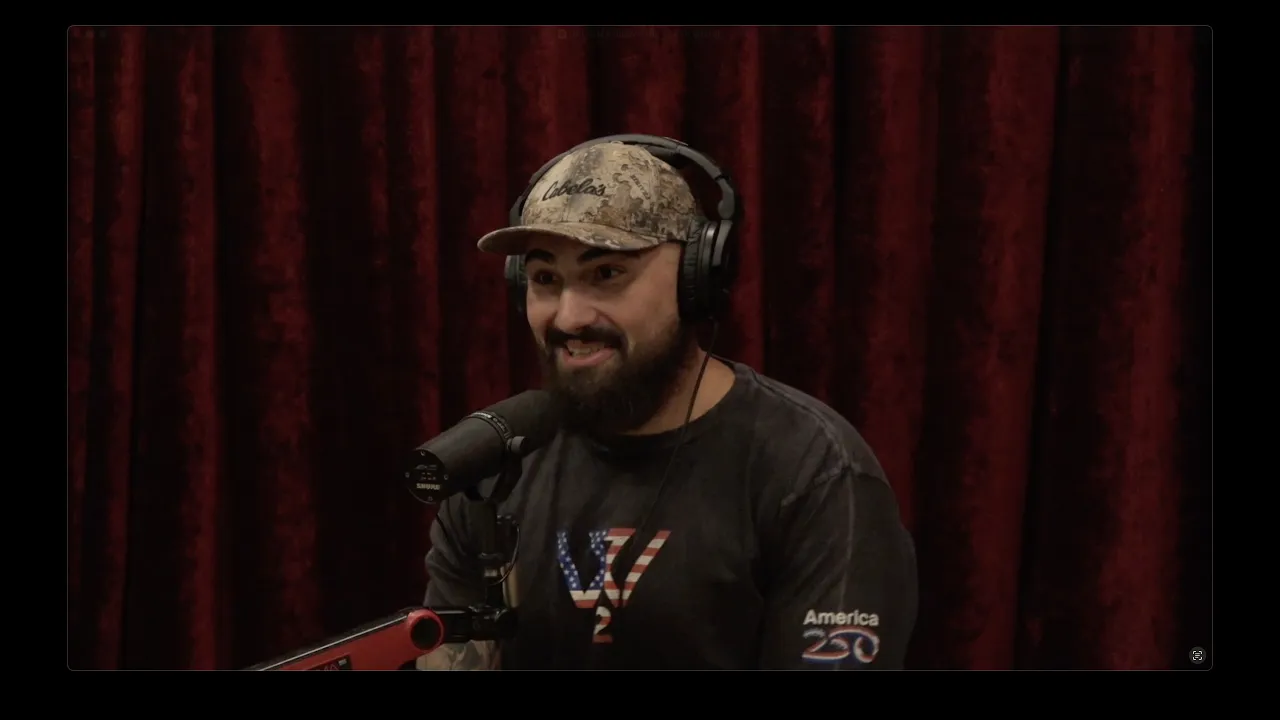
Sharaf Weighs UFC Exit After Steveson KO Amid Brain Damage Warnings
PowerfulJRE
Joe Rogan warns that competing without complete commitment guarantees severe neurological trauma, urging Sean Sharaf to retire immediately following his upset knockout of Gable Steveson unless he overhauls his camp under elite strategists.
Sean Sharaf pulled off one of the largest statistical upsets in UFC heavyweight history by knocking out Olympic gold medalist Gable Steveson—who closed as a -2400 betting favorite—with a 12-second clean left hook. (3:22)
Sharaf took home $160,000 for the bout—including a $60,000 base purse and $100,000 across UFC and promotional performance bonuses—giving the entire bonus payout directly to his mother. (130:00)
Archival footage from a Christmas Day 2019 livestream revealed Sharaf telling David Goggins that he would overcome mental hurdles, make the UFC roster, and appear on the Joe Rogan Experience. (132:05)
Sharaf and Rogan deliberated over retirement and career longevity, weighing cumulative brain trauma and an abnormal CT scan against the dangerous mindset of fighting 'just one more.' (74:17)
Detailed notes
## Background
This episode was published on YouTube by PowerfulJRE on October 1, 2026. The description states that host Joe Rogan sits down with Sean Sharaf, a professional mixed martial artist competing in the UFC's heavyweight division.
## TL;DR
Following his shocking 12-second knockout of massive betting favorite Gable Steveson, UFC heavyweight Sean Sharaf sits down with Joe Rogan to break down the mechanics, mindset, and intense personal hardships behind the upset. Sharaf recounts his journey from the U.S. Marines through near-homelessness, extreme training camps, and sparring wars, weighing the heavy toll of brain trauma against his fighting ambitions. Rogan and Sharaf also debate judging criteria, extreme weight cuts, and technical coaching before broadening the discussion to domestic surveillance, geopolitical foreign policy, and the societal dangers of artificial intelligence. The conversation culminates in a full-circle reflection as Sharaf revisits an archival 2019 live stream where he accurately manifested his UFC debut and his appearance on Rogan's podcast.
## Atmosphere & style
The conversation carries an intimate, raw, and cathartic energy, blending the gritty reality of a fighter's life with sweeping philosophical curiosity. Sharaf speaks with candid vulnerability about his financial destitution, neurological health concerns, and spiritual grounding, while Rogan serves as an encouraging mentor and enthusiastic sounding board. As the dialogue transitions from Octagon violence to global geopolitics, mass surveillance, and existential AI anxieties, the mood oscillates between humorous camaraderie, grim urgency, and profound disbelief at Sharaf's manifested underdog journey.
## Bulletin
- [03:22](https://www.youtube.com/watch?v=n4fDgjTkY40&t=202s) Sean Sharaf pulled off one of the largest statistical upsets in UFC heavyweight history by knocking out Olympic gold medalist Gable Steveson—who closed as a -2400 betting favorite—with a 12-second clean left hook.
- [02:10:00](https://www.youtube.com/watch?v=n4fDgjTkY40&t=7800s) Sharaf took home $160,000 for the bout—including a $60,000 base purse and $100,000 across UFC and promotional performance bonuses—giving the entire bonus payout directly to his mother.
- [02:12:05](https://www.youtube.com/watch?v=n4fDgjTkY40&t=7925s) Archival footage from a Christmas Day 2019 livestream revealed Sharaf telling David Goggins that he would overcome mental hurdles, make the UFC roster, and appear on the Joe Rogan Experience.
- [01:14:17](https://www.youtube.com/watch?v=n4fDgjTkY40&t=4457s) Sharaf and Rogan deliberated over retirement and career longevity, weighing cumulative brain trauma and an abnormal CT scan against the dangerous mindset of fighting 'just one more.'
## Key takeaways
- [01:42](https://www.youtube.com/watch?v=n4fDgjTkY40&t=102s) Sharaf overcame extreme financial distress, couch surfing, and a broken nose from a canceled bout against Tai Tuivasa to prepare for Steveson on six weeks' notice.
- [03:22](https://www.youtube.com/watch?v=n4fDgjTkY40&t=202s) Steveson closed at -2400 odds, but Sharaf relied on disciplined camp habits and mental conditioning to land an early fight-ending left hook.
- [20:18](https://www.youtube.com/watch?v=n4fDgjTkY40&t=1218s) Sharaf rejected giving Steveson an immediate rematch, arguing that 12-second clean knockouts do not warrant second chances.
- [23:02](https://www.youtube.com/watch?v=n4fDgjTkY40&t=1382s) Mentorship from all-time greats like Jon Jones does not automatically transfer ring aura or technical instincts to developmental fighters.
- [31:38](https://www.youtube.com/watch?v=n4fDgjTkY40&t=1898s) Public and online scrutiny often turns immediately on fighters following losses, a trend Rogan compares to primitive social hierarchy shifts.
- [42:14](https://www.youtube.com/watch?v=n4fDgjTkY40&t=2534s) Rogan advocates for immediate, automated one-point deductions for fouls like eye pokes, fence grabs, and groin strikes to eliminate intentional exploitation.
- [45:10](https://www.youtube.com/watch?v=n4fDgjTkY40&t=2710s) Alarming neurological scans and cumulative gym sparring damage prompted Sharaf and Rogan to question the long-term viability of chasing fighting glory.
- [50:39](https://www.youtube.com/watch?v=n4fDgjTkY40&t=3039s) Rogan argues for banning oblique kicks to the knee joint, noting they inflict instantaneous, structural damage with zero reaction time for fighters to tap.
- [59:32](https://www.youtube.com/watch?v=n4fDgjTkY40&t=3572s) Rogan suggests modifying MMA rules to eliminate referee stand-ups and restart rounds in the exact position the preceding round concluded.
- [01:09:04](https://www.youtube.com/watch?v=n4fDgjTkY40&t=4144s) Severe personal debt, financial mismanagement, and lifestyle inflation forced Sharaf into bankruptcy before landing his UFC win.
- [01:14:17](https://www.youtube.com/watch?v=n4fDgjTkY40&t=4457s) Fighting with 'one foot in and one foot out' is the most dangerous posture in combat sports; fighters considering retirement should exit immediately.
- [01:34:52](https://www.youtube.com/watch?v=n4fDgjTkY40&t=5692s) The hosts discussed foreign lobbying influence, domestic surveillance overreach by automated ALPR systems like Flock Safety, and the erosion of institutional trust.
- [02:00:50](https://www.youtube.com/watch?v=n4fDgjTkY40&t=7250s) Rapid advancements in generative AI and deepfakes are blurring the boundary of visual truth, inaugurating an 'age of unreality.'
- [02:12:05](https://www.youtube.com/watch?v=n4fDgjTkY40&t=7925s) A 2019 livestream conversation with David Goggins served as the catalyst for Sharaf to confront self-doubt and ultimately manifest his UFC run.
## Detailed walkthrough
### [00:13](https://www.youtube.com/watch?v=n4fDgjTkY40&t=13s) Setting Up the Fight: From White House Rumors to the Los Angeles Card
Joe Rogan welcomes UFC heavyweight Sean Sharaf to the studio, opening by asking how he is holding up after what has undeniably been the craziest week of his life. Sharaf describes feeling completely incredible, admitting that while he has lived through some chaotic stretches, the past few days have been on another level. Rogan asks him to trace the timeline of how the fight came together, curious how far in advance the matchup was offered. Sharaf explains that talks actually originated months earlier around June, when manager Ali Abdelaziz reached out to gauge his interest in competing on a prospective White House card. The UFC matchmakers were aware of Sharaf’s background as a United States Marine and were looking for an opponent to face Olympic gold medalist wrestler Gable Steveson. Sharaf did not hesitate, noting that he had followed Steveson's transition since his early regional hype and felt confident their paths were destined to cross eventually.
The proposed June event never materialized, in part because the promotion was attempting to coordinate marquee names like Jon Jones, and UFC CEO Dana White seemed hesitant about certain logistics. With the summer card falling through, Sharaf heard rumors that the promotion was heading to Southern California. He repeatedly badgered UFC brass with requests to fight in Los Angeles. Eventually, matchmakers gave him the green light, confirming he had his spot on the Los Angeles card—and that Steveson remained his assigned opponent.
---
[01:42](https://www.youtube.com/watch?v=n4fDgjTkY40&t=102s) The Grueling Camp: Broken Bones, "Monk Mode," and Sleeping on a Mat
The official notice for the Los Angeles event came roughly six weeks out, but Sharaf was already conditioned. He had been preparing for an earlier scheduled bout against Tai Tuivasa, which fell apart after Sharaf suffered a broken nose in sparring. Rather than taking downtime, he rolled straight from the Tuivasa camp into training for Steveson the moment doctors cleared him for contact. Outside of sparring, he maintained an unrelenting physical regimen, running constantly and embracing extreme self-discipline. He went full "Marine mode," committing to an eight-week stretch of strict semen retention without masturbation or sex to channel every ounce of focus into his preparation.
Behind the scenes, Sharaf was dealing with severe financial instability and near-homelessness. With zero personal credit or assets in his name, he bounced between cheap accommodations, including Fighter House LV where rooms went for forty dollars a night, sleeping in his car, staying with his mother, and crashing in casinos where he wasted money gambling. When it came time to relocate back to Las Vegas for camp, he had to request a $4,000 purse advance from his management team just to secure temporary shelter. Left largely on his own to handle the details, a friend helped him secure a sublease. Lacking furniture, Sharaf initially slept flat on a gym mat on the bare floor—a living situation he finally upgraded to an air mattress only after texting UFC middleweight Sean Strickland, who told him to stop torturing his body. Rogan marvels at the raw, cinematic nature of the struggle, comparing it directly to a gritty *Rocky* storyline.
- **Camp Transition**: Shifted immediately from a scrapped camp against Tai Tuivasa (broken nose) directly into preparation for Gable Steveson.
- **Strict Regimen**: Implemented an eight-week total abstinence ("semen retention") protocol alongside heavy conditioning and roadwork.
- **Housing Hardships**: Bounced between Fighter House LV ($40/night), his car, family couches, and an empty sublet with no bed until purchasing an air mattress.
- **Purse Advance**: Managed to get a $4,000 advance on his fight purse from management to pay for basic camp living expenses.
---
[03:22](https://www.youtube.com/watch?v=n4fDgjTkY40&t=202s) Self-Belief, Doubt, and the -2400 Shock Knockout
Reflecting on his mental state before stepping into the cage, Sharaf admits he visualized the contest as absolute warfare. He anticipated Steveson securing takedowns, so his entire battle plan centered on relentlessly staying in his opponent's face without giving an inch. To steel his mind, he repeatedly recited Jon Jones's famous pre-fight tirade against Daniel Cormier: *"There is nothing you can do to stop me from coming after you round after round with the most malicious techniques... You will lose this fight, Gable Steveson."* Sharaf had knocked out all of his regional opponents in the opening round, which he admitted created an early illusion that touching anyone with his power meant an immediate finish. However, a tough defeat against Justin Tafa and a grueling battle where an opponent absorbed heavy shots without going down planted seeds of self-doubt.
```mermaid
flowchart TD
accTitle: Sean Sharaf Mental Preparation and Fight Flow
accDescr: Diagram showing Sharaf's psychological transition from self-doubt to his game plan and ultimate knockout victory.
subgraph Mindset ["Psychological Preparation"]
A["Prior UFC Adversity & Doubts<br/>(Tafa loss / durability tests)"] --> B["Mental Conditioning<br/>(Channeled Jon Jones Cormier speech)"]
B --> C["Expectation of Hell<br/>(Prepared for takedowns & prolonged war)"]
end
subgraph TheFight ["Octagon Execution"]
C --> D["Heavy Pressure in the Pocket"]
D --> E["Crushing Left Hook Lands"]
E --> F["First-Round Knockout Upset<br/>(Defeating -2400 favorite)"]
end
```
When Sharaf connected cleanly with the decisive left hook, Steveson collapsed instantly to the canvas. Sharaf was overcome with raw shock and adrenaline, jumping on top to finalize the finish while screaming in disbelief. Rogan notes that Steveson closed as an astronomical -2400 betting favorite. Rogan argues that in the heavyweight division—where a single punch carries fight-ending power—a -2400 line makes it statistically one of the most lopsided betting upsets in MMA history. While upsets like Holly Holm dethroning Ronda Rousey were monumental, Holm entered that bout as an elite multi-time boxing and kickboxing champion who warranted roughly 10-to-1 odds, whereas Steveson’s line against Sharaf represented extreme perceived invincibility. Watching the slow-motion replay inside the studio, Rogan and Sharaf break down the violent snap of Steveson's head before his body folded to the canvas.
---
[06:11](https://www.youtube.com/watch?v=n4fDgjTkY40&t=371s) The Aftermath and Considering Walking Away at the Peak
Describing the immediate scene after the referee stopped the contest, Sharaf recalls experiencing a state of detached euphoria, feeling as though he were floating in another galaxy. He recalls shaking hands with Jon Jones and Steveson's team before they exited the cage amid the crowd's hostile booing, though the moments blurred together so intensely that friends later had to verify what occurred. Since fight night, Sharaf has faced an exhausting, non-stop barrage of media obligations, interviews, and Zoom calls without having a quiet second to mentally process the achievement. He expresses a deep desire to escape alone to the desert or the mountains with his dog, take psychedelic mushrooms, and decompress.
Rogan advises that taking time to process is critical so that an athlete does not allow a single highlight-reel victory to become the final summit of their identity rather than a milestone on the larger journey toward title contention. To Rogan's surprise, Sharaf questions whether he even wants to continue down that path:
> "Everyone's making it seem like this is just a fucking lucky punch, one shot... When you're up, you leave the table, right? That's what they say."
Sharaf reveals that he had already confided in UFC Performance Institute psychologist Micah, his coach Gokor Chivichyan, and training partner Sergey that if he pulled off the improbable victory, he might simply walk away from competitive MMA. Having joined the UFC primarily to prove to himself that he could make the roster after leaving the Marine Corps, he feels the sheer brutality of achieving this monumental upset—without corporate sponsorship or promotional backing—may serve as the perfect, poetic endpoint to his fighting career.
[08:39](https://www.youtube.com/watch?v=n4fDgjTkY40&t=519s) Pondering Retirement, Injuries, and the True Motive to Fight
Sean Sharaf opens up about the extreme lack of support he felt leading up to his bout. From scrambling to assemble his corner to practically begging for coaching and logistical help, the grueling process left a bitter taste in his mouth. Dealing with severe physical tolls—including an alarming CT scan mentioning brain matter, stitches from head to toe, and multiple injuries—Sharaf questions the purpose of continuing: whether he is just chasing money or a championship belt. Joe Rogan encourages him to take his time, suggesting humorously that he should go take mushrooms with his dog before making any life-altering choices. Rogan stresses that walking away right now is entirely valid and that monumental moments must settle before an athlete can clearly see their future.
Rogan points out that chasing pure glory is one of the most perilous motivations in combat sports. While moments of transcendent glory occur—such as Justin Gaethje’s shocking upset victory over Ilia Topuria at the White House—very few fighters ever touch that summit, and someone like Gaethje could easily retire with his legacy cemented. The conversation turns to Conor McGregor’s return against Max Holloway, with Rogan wondering why a man worth half a billion dollars would step back into the cage. Sharaf and Rogan observe that McGregor was no longer chasing the youthful dream that drove his meteoric rise against José Aldo, but rather attempting to recapture an elusive high and prove he could still conquer a world-class opponent after his lucrative detour into boxing against Floyd Mayweather Jr.
[11:48](https://www.youtube.com/watch?v=n4fDgjTkY40&t=708s) Self-Promotion and the Gable Steveson Hype Machine
Recalling the Floyd Mayweather connection, Sharaf shares an anecdote about running into Mayweather at Life Time Fitness and shooting a viral promotional clip to boost his own fight. Frustrated that the UFC and media were solely focused on hyping Gable Steveson with elaborate collaborations while ignoring him, Sharaf took marketing into his own hands by cutting promos right outside the UFC Performance Institute. Rogan explains why the promotional machine favored Steveson: as an Olympic freestyle wrestling gold medalist and an athletic freak coached by Jon Jones, he carried unmatched institutional hype.
Sharaf counters that Steveson's regional MMA record was unimpressive, pointing out that Steveson had faced low-level competition—including an opponent who was 1-0 and had landed a wheel kick on him in Mexico—while Sharaf himself entered 4-0 against stiff competition. Rogan agrees with the assessment, explaining that regional promoters and smart managers deliberately protect elite prospects from taking real damage or visiting "the dungeon" too early, while other fighters were terrified of Steveson's wrestling credentials. This coddling and instant fanfare, Rogan notes, often tricks gifted athletes into believing they are invincible rather than human beings who simply possess high-level skills.
[14:00](https://www.youtube.com/watch?v=n4fDgjTkY40&t=840s) The Left Hook, Public Backing, and Press Conference Warfare
The illusion of invincibility shattered when Sharaf stepped outside and landed a picture-perfect, technical left hook that completely altered the heavyweight landscape. Both men analyze the finishing sequence: Steveson was reaching forward and instinctively closing his eyes mid-exchange—a fundamental technical flaw born from having only a year and a half of striking experience. Sharaf explains that this lack of seasoned striking was precisely why he was never intimidated by Steveson's Olympic credentials leading into the fight, regardless of media accusations that he was merely talking trash.
Sharaf reveals the massive swell of public support he received, with fans messaging him that they would bet their mortgages on him, name their children after him, and pleading with him to bring up Steveson’s past at the press conference. He explains that his appearance on the dais was a twist of fate: neither he nor Steveson was originally slated for the main card or the press conference until Brian Ortega withdrew from the event. Sharaf viewed that late bump as divine intervention, granting him the platform to wage calculated psychological warfare and get under Steveson's skin. Rogan, however, notes that while the mental games may have played a role, the knockout ultimately boiled down to a massive disparity in technical striking and cage experience—Steveson knew how to be the hammer, but lacked the seasoning required when the fire came back at him.
- **Fight Week Promotion:** Sharaf filmed his own fight promos outside the UFC PI and produced a viral video with Floyd Mayweather Jr. at Life Time Fitness after feeling neglected by UFC PR.
- **Card Reshuffle:** Sharaf and Steveson were promoted to the main card and the pre-fight press conference only after Brian Ortega fell off the card.
- **Key Technical Flaw:** Steveson closed his eyes and reached while punching, exposing him to Sharaf's fight-ending left hook.
[16:54](https://www.youtube.com/watch?v=n4fDgjTkY40&t=1014s) Muscle Memory, Flow State, and Disrespecting the Wrestling
Joe Rogan emphasizes how mixed martial arts is an intensely complex craft that takes years to truly comprehend. The micro-details—proper foot positioning, keeping the lead foot outside the opponent's line, taking the head off the center line, and knowing precisely where to stand—demand high-level coaching so a fighter understands why they got caught and ensures it never happens again. It takes an eternity for the human brain to internalize those lessons to the point where they become pure, instinctual muscle memory amidst the chaos of combat. Sean Sharaf explains that he entered an absolute flow state during the fight; he was not overthinking combinations or dwelling on whether to throw a two. His overarching game plan was simple: do not over-respect Gable Steveson's world-class wrestling credentials, stay composed, and put hands on him. Even with the looming threat of being taken down, Sharaf kept reinforcing the mindset that he would immediately work back to his feet and get right back in Steveson's face.
Rogan observes a glaring tactical flaw in Steveson's approach across both of his bouts: Steveson did not appear to even consider shooting for a takedown against Sharaf, which Rogan finds astonishing for an Olympic gold medalist wrestler. He compares Steveson's refusal to wrestle to Stephen "Wonderboy" Thompson suddenly deciding not to throw kicks. Sharaf agrees that Steveson will certainly be shooting in his next outing, but explains that Steveson bought heavily into his own hype after receiving endless praise, including from Dana White at post-fight press conferences, celebrating how he knocked opponents out on the feet instead of relying on his wrestling base.
[18:12](https://www.youtube.com/watch?v=n4fDgjTkY40&t=1092s) The RAF Distraction, Camp Brutality, and a Real-Life Rocky Story
Sharaf realized he had the psychological upper hand the moment he learned Steveson had scheduled and competed in an RAF wrestling match right in the middle of fight camp, just weeks prior to their scheduled contest. To Sharaf, booking an exhibition match signaled that Steveson was not taking him seriously as a threat. Meanwhile, Sharaf was grinding through an agonizing camp, getting battered daily in sparring against top-tier heavyweights and light heavyweights. He worked through deep wrestling exchanges with Serghei Spivac, Blagoy Ivanov, and Ion Cuțelaba. Because he had suffered a broken nose, Sharaf was forced to spar while wearing suffocating headgear while his training partners relentlessly put him in worst-case scenarios—starting from the bottom, getting lifted, mat-returned, and slammed onto the canvas over and over.
The sheer grit of Sharaf's preparation prompts Rogan to label his journey a genuine, real-life Rocky Balboa story. Sharaf embraces the comparison, professing his love for the *Rocky* franchise, though Rogan points out that not even Rocky films wrapped up quite like this: stepping inside the cage and executing a clean, devastating finish in just twelve seconds.
[20:18](https://www.youtube.com/watch?v=n4fDgjTkY40&t=1218s) Third-Person Arrogance, 12-Second Karma, and No Rematches
For Sharaf, the rapid knockout felt like poetic justice, karma, and divine intervention after weeks of being openly demeaned in the buildup. Steveson had labeled him a coward and repeatedly claimed that Sharaf was only in the UFC because of him, even boasting that Sharaf's hotel room was being paid for courtesy of Steveson. Sharaf was particularly irritated by Steveson's persistent habit of referring to himself in the third person, asking why anyone would talk that way. Rogan admits the third-person habit is strange and feels like elitist posturing, though he recalls boxing legend Roy Jones Jr. frequently doing it in his prime ("Roy Jones Jr. is going to do what Roy Jones Jr. wants to do").
While Rogan suggests that the loss might be an invaluable blessing in disguise if Steveson commits to tightening his striking and accepts that other martial artists possess elite skills in areas outside wrestling, Sharaf makes it clear he has zero interest in granting a rematch:
- **No immediate rematch warranted**: Sharaf dismisses public inquiries about a return bout, declaring, "Ain't no rematch, though, buddy... Motherfucker's not getting his dick up for fucking weeks, man. I took his soul."
- **Psychological finality**: Invoking David Goggins' philosophy of taking an opponent's soul, Sharaf stresses that Steveson has to sit with the crushing reality of the loss.
- **Rogan's criteria for rematches**: Rogan agrees that immediate rematches belong to razor-thin, controversial split decisions or back-and-forth wars that go the distance, not clean, unarguable twelve-second knockouts.
[23:02](https://www.youtube.com/watch?v=n4fDgjTkY40&t=1382s) Striking Mechanics, Bisping’s Precedent, and the Jon Jones Aura
Rogan breaks down the finishing sequence, noting that striking analysts have reviewed the tape to reveal Sharaf doing everything mechanically sound while Steveson made critical defensive errors. Sharaf landed a crushing left hook squarely on the chin, snapping Steveson's head back. When Sharaf quips that it only takes ten pounds of pressure on the button to turn the lights out, Rogan counters that Sharaf's punch landed with vastly more force than that. Even so, Rogan notes that elite fighters have bounced back from devastating, viral knockouts before—most famously Michael Bisping, who was flatlined by Dan Henderson at UFC 100 before rebounding years later to knock out Luke Rockhold, capture the UFC middleweight belt, and successfully defend it against Henderson.
While Sharaf kept his post-fight speech respectful by stating the defeat would make Steveson better, he feels fully entitled to his victory lap because of the disrespect dished out by Steveson and his camp. In particular, Sharaf brings up Jon Jones riding around in a Mercedes with Steveson before the fight declaring, "Tonight we collect a head." Sharaf, a lifelong student of Jones' career who had even messaged Jones predicting the outcome, loved seeing Jones' stunned, viral reaction in the front row when the knockout occurred. Rogan and Sharaf agree that being around Jon Jones does not transfer his generational talent onto someone else. Jones is a one-of-one phenomenon—evidenced by how effortlessly he dragged Ciryl Gane down and submitted him without absorbing a single strike—and Steveson learned the hard way that an ally's aura cannot fight the battle for you.
[25:23](https://www.youtube.com/watch?v=n4fDgjTkY40&t=1523s) Jon Jones' Legendary Tear and the Perils of the Mind
Joe Rogan and Sean Sharaf reflect on the trajectory of Jon Jones, contrasting the illusion of an overnight sensation with the grinding reality of his ascent. While Jones famously became the youngest champion in UFC history, his rise was built through decisive, developmental battles against veterans like André Gusmão and Stephan Bonnar before he ever touched gold. Once Jones dismantled Maurício "Shogun" Rua to claim the light heavyweight championship, he embarked on what Rogan calls a "legendary tear," cutting through former champions and elite contenders often without even maintaining a dedicated training camp. Sharaf brings up a prized piece of memorabilia hanging in his room: a signed photo of Jones dropping a choked-out, unconscious Lyoto Machida limp to the canvas. Rogan calls it one of the coldest finishes in combat sports history—standing guillotine, unconscious drop, and a cold walkaway leaving Machida in a heap.
The conversation shifts to the delicate mental balance required when young fighters train alongside all-time greats. Rogan points out that hanging around the greatest of all time can trick someone into believing they are destined to be next before putting in the required work. Surviving at the highest level demands a precarious "dance of the mind," harmonizing unshakeable confidence with deep caution. As Rogan emphasizes, even dominant champions are vulnerable mortal beings; Kamaru Usman controlled Leon Edwards for four dominant rounds, only for a single fifth-round head kick to shatter his reign and permanently alter his trajectory.
- Jon Jones reached the title through developmental tests against opponents like André Gusmão and Stephan Bonnar before dominating Maurício "Shogun" Rua.
- Sharaf keeps a signed picture of Jon Jones' cold standing guillotine submission over Lyoto Machida hanging in his bedroom.
- Kamaru Usman’s loss to Leon Edwards serves as an enduring reminder of how swiftly fortunes flip at the elite level against human limits.
---
[27:09](https://www.youtube.com/watch?v=n4fDgjTkY40&t=1629s) The Impact of the Upset and Podcasting on Embassy Guard Duty
Rogan highlights how Sean Sharaf’s shocking knockout upset energized and elevated the entire sport of mixed martial arts. Sharaf had dismantled a massive favorite and decorated Olympic wrestler—a mold that historically produced dominant champions like Daniel Cormier and Randy Couture. A single, decisive left hook flipped the script entirely, embodying the raw unpredictability that keeps fight fans hooked. Sharaf admits the aftermath feels surreal, expressing immense gratitude just to be sitting across from Rogan.
Sharaf reveals that long before stepping into the UFC spotlight, he gained far more practical knowledge from the *Joe Rogan Experience* than from the entire public education system. While serving as an embassy security guard in the United States Marine Corps, Sharaf spent endless hours on post with an earbud in, listening to Rogan interview eclectic thinkers, scientists, and wellness figures. Guests like Billy Carson, 19 Keys, and Joe Dispenza opened his eyes to the workings of the subconscious mind, while experts like Andrew Huberman and sleep specialists provided actionable life optimization tools. Rogan's lighthearted Fight Companions featuring Eddie Bravo kept him company during grueling shifts, shaping his mentality and world perspective long before his athletic career reached this pinnacle.
- Sharaf served as an embassy security guard in the Marine Corps and regularly listened to long-form JRE episodes while standing watch on post.
- Topics on the subconscious mind and physiology from guests like Joe Dispenza, Billy Carson, 19 Keys, and Andrew Huberman directly influenced Sharaf's personal development.
---
[28:55](https://www.youtube.com/watch?v=n4fDgjTkY40&t=1735s) Navigating Sudden Fame, "Going Hollywood," and Walking Apollo
Handling the immediate shockwaves of an upset victory is an emotional gauntlet, which Rogan likens to a "psychedelic roller coaster ride." Sharaf admits he has not had a moment to breathe; within merely five days of his victory, people from his past began sending accusatory text messages claiming he had "switched up" or "went Hollywood" simply because he could not reply instantly. Rogan warns him that this toxic dynamic plagues every breakout star in sports, music, and entertainment. In Rogan’s view, when someone hyper-succeeds in spectacular fashion, insecure onlookers measure their own mediocrity against that success, breed resentment, and invent bad-faith narratives hoping to drag the new star back down.
Caught between overwhelming media obligations and endless family inquiries, Sharaf finds his only real solace in walking his dog. During a virtual interview with Michael Bisping, Sharaf was outdoors walking his dog when the production team asked if his internet connection was stable. Sharaf's reaction was simple: walking his dog took priority, and they could take the interview as it was or skip it. Sharaf gives a heartfelt tribute to his German Shepherd, Apollo, whom he got right after leaving the Marines. Apollo has been by his side through every grim, isolated chapter—including moving to Las Vegas alone two years prior and staying with him when Sharaf had to drive himself to physical therapy just two days after knee surgery because nobody else offered a ride.
- Friends began accusing Sharaf of "going Hollywood" within five days of his breakout UFC victory due to unanswered messages.
- Rogan notes that spectators often resent hyper-success because it forces an uncomfortable self-comparison, leading people to pray for an athlete's downfall.
- Sharaf's German Shepherd, Apollo, has stayed with him through his Marine transition, severe knee surgery recoveries, and solo move to Las Vegas.
---
[31:38](https://www.youtube.com/watch?v=n4fDgjTkY40&t=1898s) The Fickle Fight Game and Debunking the "Lucky Punch"
Sharaf reflects on the inherently transactional nature of combat sports, noting how fast public adoration evaporates the moment momentum stalls. Fighters like Justin Gaethje, Max Holloway, Ilia Topuria, Sean Strickland, Khamzat Chimaev, and Alex Pereira ride violent waves of hype that can vanish with a single knockout loss. Despite walking out in his home arena to Nipsey Hussle’s "Hustle & Motivate" and fulfilling a lifelong dream by shocking the MMA landscape, Sharaf already hears dismissive critics claiming his victory was merely a "lucky punch."
```mermaid
flowchart TD
accTitle: The Cycle of Public Sentiment in Combat Sports
accDescr: Flowchart illustrating how public adoration hinges entirely on status, hype, and victory before reversing instantly upon a single defeat.
subgraph Elevation["The Peak"]
A["Highlight KO / Massive Upset"] --> B["Widespread Acclaim & Viral Stardom"]
end
subgraph Hierarchy["The Social Dynamic"]
B --> C["Admiration Tied to 'Top Chimp' Status"]
end
subgraph TheDrop["The Inevitable Turn"]
C --> D["Sudden Loss or Stumble"]
D --> E["Cruel Social Media Backlash & Hater Narratives"]
end
```
Rogan immediately shuts down the notion of a lucky punch, calling anyone pushing that excuse an idiot trying to diminish extraordinary achievement. In Rogan's breakdown, Sharaf did not flail wildly with his eyes shut while stumbling backward; he calculated his distance, stepped in, and delivered a textbook left hook directly on his opponent's chin against a world-class athlete. Rogan ties the public's fickle behavior directly to primitive primate psychology: humans function like status-obsessed chimpanzees fixated on who sits at the top of the hierarchy. The second someone falls from the peak, the crowd turns vicious, swarming social media comment sections with bile despite having accomplished nothing of consequence themselves.
- Sharaf walked out to Nipsey Hussle's track "Hustle & Motivate" before pulling off his massive upset victory.
- Rogan dismantles the "lucky punch" argument, explaining that executing an intentional, technical left hook against an elite fighter is pure skill.
- The sudden backlash fighters face on social media post-defeat reflects basic primate hierarchy instincts, where spectators obsessively judge others purely by current status.
[33:47](https://www.youtube.com/watch?v=n4fDgjTkY40&t=2027s) Online Critics and the Charles Oliveira Blueprint
Sean Sharaf reflects on the intense backlash he received online after going 0-2 in his early UFC appearances, with fans ruthlessly writing him off. Joe Rogan points out that public criticism in combat sports is inherently flawed, citing former lightweight champion Charles Oliveira as the ultimate example. Early in his career, Oliveira was branded a "quitter" after brutal losses to fighters like Cub Swanson and Paul Felder, only to evolve into an undeniable world champion. Rogan stresses that combat sports are among the most difficult pursuits on Earth, performed under blinding pressure before 16,000 screaming fans in an arena and millions watching at home, making couch-bound internet criticism completely irrelevant. Rogan advises fighters to simply go dark and let the public noise settle like a reverberating gong.
- Rogan emphasizes that an early UFC loss never defines a fighter’s ultimate ceiling.
- Oliveira's career arc demonstrates that high-level fighters often need several Octagon bouts to overcome early setbacks and realize their potential.
- Rogan’s advice for viral backlash: "Let the dust settle. Let the vibrations end. It's like somebody just banged a gong and you got to wait for that... to go back to sleep."
---
[35:28](https://www.youtube.com/watch?v=n4fDgjTkY40&t=2128s) The Post-Fight Prayer and the Marine Corps
Sharaf explains his post-fight Octagon interview, where Rogan visibly matched his raw emotion and cursed on air by shouting "Fuck yeah" when Sharaf asked to be on the podcast. Sharaf expresses gratitude that Rogan allowed him the time to recite an Islamic prayer in Arabic in front of a momentarily perplexed arena crowd. He clarifies that he recited *Al-Fatiha*, the opening chapter of the Quran, which is traditionally offered during daily prayers and in memory of the deceased. Sharaf dedicated the recitation to his father, who died when Sean was just 15 years old.
Without a father figure, Sharaf found vital mentorship, structure, and discipline in the United States Marine Corps. The military taught him basic life skills—from pressing his uniform and shaving to speaking and carrying himself with confidence. Rogan expresses outrage over online trolls who questioned Sharaf’s patriotism simply for reciting an Islamic prayer, pointing out the absurdity given Sharaf's Marine service and American pride. Sharaf laughs at the lack of nuance from critics who assume supporting Palestine or being Muslim somehow conflicts with serving his country.
- The prayer recited was *Surah Al-Fatiha*, the foundational chapter of the Quran.
- Sharaf's father passed away when he was 15 years old, shaping the trajectory of his fighting career.
- Sharaf credits the U.S. Marine Corps for providing fatherly guidance and teaching him personal discipline.
---
[37:40](https://www.youtube.com/watch?v=n4fDgjTkY40&t=2260s) Fame, Snakes in the Grass, and the UFC Pressure Cooker
With sudden notoriety following his massive upset win, Sharaf wonders aloud where to find genuine people, noting how potential managers and sponsors suddenly appear like "snakes in the grass." Rogan reframes this shift: while opportunists exist, commercial interest is a natural consequence of reaching an elite platform. Rogan explains that the leap from the regional circuit to the UFC is monumental, often taking fighters multiple bouts inside the Octagon to conquer sensory overload and perform up to their true capabilities.
Sharaf admits that moving from the sterile, quiet atmosphere of the UFC Apex—where his first two bouts took place—into a packed arena felt like a totally different sport. While the Apex felt like a gym sparring session, the massive arena crowd raised the stakes to do-or-die. Sharaf felt he was on the chopping block at 0-2 and refused to leave his roster spot up to chance. Rogan notes that heavyweights often receive more leeway because the heavyweight talent pool is notoriously shallow, though veterans like Tai Tuivasa have endured brutal losing skids fighting the division's best.
---
[40:20](https://www.youtube.com/watch?v=n4fDgjTkY40&t=2420s) Heavyweight Politics, Sharaputdin Magomedov, and Ciryl Gane’s Movement
The discussion turns to matchmaking politics and fighter marketability. Sharaf and Rogan touch upon fighters who fast-track to prominence—referencing how entertainment value and trash talk often bypass rankings, such as top contenders skipping over stalwarts like Alexander Volkov. While Rogan acknowledges that outrageous personas are calculated business decisions to get eyes on fights, Sharaf notes that he prefers connecting with audiences by remaining completely authentic.
The conversation pivots to Ciryl Gane's upcoming matchups and his unique movement style at heavyweight. Rogan argues that basketball provides an exceptional athletic foundation for mixed martial arts because it demands continuous plyometrics, rapid lateral deceleration, and swift directional shifts. Heavyweights rarely possess those kinetic habits, but Gane utilizes that exact footwork to effortlessly slip combinations and create angles, as showcased in his clinic against Tai Tuivasa.
- Ciryl Gane's footwork and lateral agility are credited to an athletic base heavy on natural plyometrics.
- Basketball-style multi-directional movement is highlighted as an ideal crossover athletic trait for modern MMA heavyweights.
[042:14] Instant Point Deductions for MMA Fouls
Joe Rogan and Sean Sharaf examine refereeing controversies and the ongoing problem of fouls inside the Octagon. Sharaf asks Rogan what he thought about the illegal shots to the back of the head during Alex Pereira’s bout, noting that Pereira appeared to blame referee Herb Dean. Rogan points out the difficulty of those split-second calls when both fighters are moving amidst pure chaos. However, Rogan contends that the most flagrant, inexcusable infractions are the egregious eye pokes, highlighting the fouls suffered by Tom Aspinall where fighters extend their fingers directly into an opponent's eyeballs.
Rogan firmly argues that MMA officiating needs zero-tolerance rules. He advocates for an immediate, automatic one-point deduction the very second an eye poke occurs, rather than issuing endless verbal warnings. He applies the exact same standard to groin strikes—barring legitimate deflections off a shin—and fence grabs. Sharaf agrees, proposing that MMA gloves need a redesigned wrap to keep fingers curved downward. He warns that fighters are beginning to weaponize fouls strategically, knowing that even if a point gets docked, the permanent ocular damage is already done and tilts the entire fight in their favor. Sharaf recounts his own pro debut, where his opponent repeatedly dipped his head down, loaded up an overhand, and delivered deliberate headbutts right to Sharaf's chin. Sharaf was left wobbled, and because the referee completely missed the foul, he realized he would have been robbed of a win had he not secured a finish himself.
[043:45] Joshua Van's Masterclass Against Alexandre Pantoja
The conversation shifts to Alexandre Pantoja’s title defense against Joshua Van. Rogan notes that while Pantoja accused Van of deliberate head clashes, Van was simply putting on pressure and moving forward. Though Van first captured the flyweight championship on an anticlimactic injury—when Pantoja threw a head kick, tumbled backward, and broke his arm—Rogan believes Van erased all doubt in subsequent appearances. Van looked like a bonafide world champion defending against Tatsuro Taira, and in his rematch with Pantoja, he put on an absolute boxing masterclass.
Rogan expresses immense admiration for Van's rapid evolution, pointing out that Van is only around 25 years old and visibly levels up with every Octagon appearance. Despite dominating one of the division's all-time greats, Van was visibly frustrated at the post-fight press conference, looking at the marks on his own face and stating that his opponent shouldn't even be touching him. Rogan and Sharaf agree that this relentless self-critique is precisely what separates elite champions from ordinary fighters.
[045:10] Weighing Money, Head Trauma, and Walking Away
Rogan cautions that every fighter's journey is distinct, and there comes a point where a fighter must decide what they truly want from life. Sharaf admits he is soul-searching to understand his actual motivation for fighting. If the pursuit is purely financial, Sharaf recognizes he has far safer alternatives than subjecting his brain to trauma:
* **Options Trading:** After leaving the Marine Corps, Sharaf worked as a personal trainer before teaching himself digital options trading during COVID-19 lockdowns, pulling in six figures trading meme stocks and volatile equities like AMC, GameStop, and Tesla.
* **Private Security:** Sharaf has provided high-end executive protection, bodyguarding high rollers at casinos.
* **GI Bill:** He retains full military education benefits to pursue a degree tuition-free.
Sharaf articulates the endless hamster wheel of professional fighting: winning a UFC belt only invites critics demanding title defenses against a continuous conveyor belt of hungry contenders until the champion is old, battered, and discarded. Rogan confirms that many veterans stay way past their prime, ending up slurring words and struggling merely to stand or sit.
Sharaf then reveals that recent pre-fight medical imaging uncovered abnormalities: an MRI followed by a secondary CT scan showed white matter and mysterious white specks. While physicians suggested these could stem from standard headaches, Rogan emphasizes that extensive hard sparring inevitably causes cumulative brain damage. Many fans assume a fighter is healthy if they have only suffered one official knockout loss, overlooking the unseen toll of hundreds of brutal gym wars where they routinely had their bell rung.
```mermaid
flowchart TD
accTitle: Sean Sharaf Career Decision Tree
accDescr: A decision flowchart showing Sean Sharaf weighing his options between the risks of MMA and viable alternate career paths.
subgraph FightRoute["MMA Career Path"]
A["Hard Sparring & Brain Trauma"] --> B["UFC Hand Raised"]
B --> C["Win Title / Defend Against Next Contender"]
C --> D["Diminishing Returns & Long-Term Neurological Damage"]
end
subgraph ExitRoute["Alternative Paths"]
E["Options Trading (AMC, GME, TSLA)"]
F["Private Security / High-Roller Protection"]
G["GI Bill / Higher Education"]
end
Question{"Stay or Walk Away?"} --> FightRoute
Question --> ExitRoute
```
[046:38] Gym Odyssey, Longevity, and Preparing for Ion Cuțelaba
Reflecting on his martial arts upbringing, Sharaf explains that his entire career has been a grueling trial by fire. After leaving the military in 2018, he sent an email to Colin Oyama and Rafael Cordeiro at RVCA / Kings MMA in Orange County and began sparring world-class talent right out of the gate. As an amateur, he was thrown into hard rounds with former UFC champions Luke Rockhold and Michael Bisping, and Sean Strickland regularly dropped him. Sharaf subsequently trained at Tiger Muay Thai in Thailand and eventually landed at Xtreme Couture in Las Vegas, where during his very first week, the coaches put him in the cage to spar Francis Ngannou—an experience Sharaf calls the most terrifying moment of his life, prompting him to sit in the UFC Apex parking lot and thoroughly re-evaluate his life choices.
Sharaf attributes his technical deficits to this pure brawling history; he never spent years drilling footwork, head movement, or fight IQ because he relied entirely on raw, primal instincts honed in street fights. When Rogan asks if he has a dedicated head coach, Sharaf explains that he has bounced between multiple gyms:
Sharaf laments that he constantly searched for a mythical trainer-fighter relationship—a Cus D'Amato to Mike Tyson, a Mickey Goldmill to Rocky Balboa, or a Trevor Wittman to Justin Gaethje—but discovered that kind of devoted mentorship only exists for fighters who are already superstars. Instead, Sharaf had to pay out-of-pocket for every single private session, racking up steep personal debt with zero major sponsorships just to realize his dream of having his hand raised under the bright UFC lights.
Recalling his latest training camp, Sharaf describes it as absolute hell, enduring relentless, explosive sparring sessions with light heavyweight Ion Cuțelaba. Throughout the entire camp, Sharaf prepared specifically for Cuțelaba's habit of crawling out of his corner on all fours like Jon Jones while looking for oblique kicks. Sharaf drilled dropping down to his knees to crawl straight back at him; however, when the fight began, Cuțelaba unexpectedly broke routine and simply walked forward, leaving Sharaf wondering whether dropping to his knees had preemptively gotten inside his opponent's head.
[50:39](https://www.youtube.com/watch?v=n4fDgjTkY40&t=3039s) The Debate Over Banning Oblique Kicks to the Knee
The conversation opens on the severe physical risk of straight kicks directed at the knee joint. Sean Sharaf admits he went into his bout actively terrified of having his knees compromised, acknowledging the dread of career-altering injuries. Joe Rogan points out that the UFC and regulatory bodies have had active discussions about banning these techniques. While Sharaf initially views them as an inevitable, realistic element of raw combat, Rogan draws a direct comparison to eye pokes: in an authentic street altercation, someone fighting for their life would naturally gouge an opponent's eye, yet sports regulations outlaw it specifically to prevent permanent, life-altering devastation.
Rogan underscores that a catastrophic knee blowout sidelines an athlete for at least a year and frequently leaves the joint permanently altered. With both men having endured ACL surgeries, they reflect on notorious examples of fighters whose careers were derailed or reshaped by knee strikes:
- **Jon Jones vs. Thiago Santos:** Jon Jones heavily targeted Santos's knees at UFC 239 (the same event where Jorge Masvidal knocked out Ben Askren). Santos ultimately required complete surgical reconstruction on both knees and was never the same dynamic fighter again.
- **Jon Jones vs. Rampage Jackson:** Quinton "Rampage" Jackson openly maintained that his lead knee never properly recovered after facing Jones's oblique kicks.
- **Michael "Venom" Page:** A devastating sidekick to the knee left his opponent needing immediate, extensive reconstructive surgery after their bout, visibly bending the joint sideways upon impact.
Andy Foster, the executive director of the California State Athletic Commission (CSAC), strongly supports banning straight attacks to the knee. Rogan explains the distinction between permitted roundhouse leg kicks and kicks that directly hyperextend the joint:
```mermaid
flowchart TD
accTitle: Legal vs Banned Knee Strike Distinctions
accDescr: Flowchart illustrating the difference between permissible leg kicks and proposed bans on knee-hyperextending kicks.
subgraph LegalStrikes["Permitted Leg Attacks"]
A["Roundhouse Leg Kicks"] --> C["Targeting Thigh / Calf Muscle"]
B["Leg Submissions / Heel Hooks"] --> D["Fighter Has Opportunity to Tap"]
end
subgraph ProposedBans["Targeted for Prohibition"]
E["Oblique Kicks"] --> G["Direct Hyperextension of Knee Joint"]
F["Straight Sidekicks to Knee"] --> G
G --> H["Catastrophic, Instant Structural Tear"]
end
```
Rogan refutes the counterargument that leg locks like heel hooks are just as damaging, noting that an athlete can choose to tap to a heel hook before catastrophic damage occurs, whereas an explosive oblique kick hyperextends the joint with zero reaction time. Just like bans on biting, eye gouging, and fish-hooking, rule sets exist to protect athletes from unpreventable mutilation.
---
[54:18](https://www.youtube.com/watch?v=n4fDgjTkY40&t=3258s) Michael "Venom" Page and Point Karate in MMA
Examining footage of extreme knee hyperextensions leads Rogan and Sharaf into evaluating Michael "Venom" Page (MVP). Rogan believes MVP is far more dangerous at welterweight (170 lbs) than at middleweight (185 lbs), where massive physical specimens like Gregory Rodrigues and Joe Pyfer look like natural heavyweights. Despite critics complaining about MVP's occasional low-volume pacing—such as his dominant, frustrating victory over Kevin Holland—Rogan loves watching MVP dance out of range, completely dismantling world-class competition while evading retaliation.
At 39 years old, MVP faces the natural athletic decline that catches up to all non-heavyweights. Yet Rogan hails him as a definitive "proof of concept" for sport karate in mixed martial arts:
- **The Point-Fighting Edge:** Traditional point-karate fighters possess extraordinary blitzing capabilities and distance management. Opponents unfamiliar with sparring sport karatekas find themselves bewildered by their rapid entry, counter-striking, and instant exits.
- **The Hybrid Requirement:** Rogan notes that point fighting cannot survive alone; without elite takedown defense, wrestling, and submission grappling, a karate fighter gets taken down and strangled. But layered onto complete fundamentals, it becomes nearly unreadable.
- **The Age Bottleneck:** Like MVP and decorated kickboxer Raymond Daniels (famous for his highlight-reel 720 spin knockouts in Bellator and Glory Kickboxing), elite stylists often transition to full MMA late in their careers (around 34 or 35 years old), leaving them only a narrow window before wear and tear takes over.
Joe Rogan presents a message from sponsor BetterHelp, highlighting that insurance options may be available nationwide with an average co-pay of $23 per session for eligible members. He reminds listeners that World Mental Health Day falls on October 10th and notes that therapy serves everyday struggles like burnout, relationship stress, and anxiety, not just extreme crises. International or uninsured listeners can receive 10% off their first month at `betterhelp.com/jre`.
---
[58:53](https://www.youtube.com/watch?v=n4fDgjTkY40&t=3533s) Entertainment Eras vs. Rogan’s Pure Combat Philosophy
Sharaf asks Rogan how he views the modern corporate era of the UFC compared to the original ownership under Frank and Lorenzo Fertitta, particularly regarding whether the promotion now prioritizes pure entertainment spectacle over dominant combat effectiveness.
Rogan identifies himself as a total purist when it comes to the martial arts rulebook. Even though he admits he gets caught up in the crowd excitement when a referee intervenes during slow moments, his ideal ruleset would completely eliminate artificial resets:
- **No Stand-Ups:** Referees would never be permitted to stand fighters up from the ground.
- **No Cage Separations:** Clinches against the fence would run uninterrupted.
- **The Ultimate Test:** As Rogan bluntly summarizes: "If you get taken down and someone's on top of you giving you noogies for five rounds, figure out how to get up. And if you can't figure out how to get up, you lost. Simple."
[59:32](https://www.youtube.com/watch?v=n4fDgjTkY40&t=3572s) Controversial MMA Rules and the Problem of Rounds
Joe Rogan argues a controversial perspective on MMA officiating: fighters who get taken down should not automatically receive a stand-up at the end of a round. Instead, because it is fundamentally one continuous contest rather than multiple isolated mini-fights, the next round ought to resume in the exact position where the previous one finished. If a fighter is taken down and cannot work their way back up, they should not get bailed out simply by the buzzer. Starting every round on the feet effectively grants the defensive fighter multiple free resets to avoid takedowns, forcing wrestlers and grapplers to re-earn ground control over and over again.
Sean Sharaf agrees, noting that his fight camp had made the exact observation: if an opponent takes you down, the clock saves you, and every round starts standing up again. Sharaf points out that real street fights do not have five-minute intervals, though fighting 25 minutes straight without breaks would simply cause every heavyweight to gas out completely. Both men laugh that in an uninterrupted 25-minute attrition battle, ultra-cardio fighters like Merab Dvalishvili would be "king of the world."
Rogan highlights the brutal reality of 25-minute heavyweight fights, noting the horrific damage fighters inflict on one another when they go the distance. He points directly to the classic trilogy between Cain Velasquez and Junior dos Santos—where Dos Santos scored an early knockout in fight one, only to endure prolonged, devastating beatings across 25 minutes in the rematches. Sharaf shares that his ultimate fighter archetype growing up was a fusion of three legendary combat athletes: Cain Velasquez, Jon Jones, and Mike Tyson. When Rogan asks about Fedor Emelianenko, Sharaf admits he was not watching Fedor during his prime, though he acknowledges him as the heavyweight GOAT despite his combat sambo points loss to Blagoy Ivanov. Rogan and Sharaf marvel at Ivanov's toughness, pointing out that Ivanov fought with a gi and shoes in sambo and famously survived being stabbed in the heart before competing in the UFC.
- Rogan considers early-2000s Pride FC the greatest, most stacked heavyweight era in history, featuring Mirko Cro Cop, Mark Coleman, Antônio Rodrigo "Minotauro" Nogueira, Fedor Emelianenko, and Don Frye.
- Rogan bluntly notes that during that Pride era in Japan, competitors were "fighting juiced to the tits," creating an unreal shark tank of elite physical monsters.
---
[01:03:20](https://www.youtube.com/watch?v=n4fDgjTkY40&t=3800s) Peptides, BPC-157, and Fighter Recovery
Sharaf mentions asking Brigham from Ways2Well about peptide therapy after hearing rumors that the UFC might eventually approve certain recovery peptides for fighters. Rogan strongly advocates for peptide legalization in combat sports, drawing a firm line between pure performance enhancers and healing compounds. Peptides like BPC-157 exist strictly to accelerate soft-tissue repair rather than make an athlete faster or stronger. In a brutal sport where athletes practice injuring each other every day in camp, Rogan contends that expecting fighters to peak using only cold plunges, saunas, and massages is unrealistic.
The primary hurdle, Rogan explains, is product quality and regulation. Many over-the-counter peptide websites ship vials from unregulated international sources in China or Vietnam, where third-party testing often reveals only a fraction of the claimed active compound. Legitimate clinics like Ways2Well operate through licensed compounding pharmacies, guaranteeing pure, clinical-grade formulations. Both agree that regulated, high-purity peptides are essential to keep high-level fighters healthy enough to make it into the Octagon.
```mermaid
flowchart TD
accTitle: The Difference Between Illicit Ped and Healing Peptides
accDescr: Diagram contrasting unregulated grey-market compounds with compounded medical recovery peptides like BPC-157.
subgraph Problem["Camp Reality & Sourcing Risks"]
A["Daily Training Trauma & Soft-Tissue Damage"] --> B["Unregulated Online Peptides"]
B --> C["Inconsistent Dosing: ~20% Active Content"]
end
subgraph Solution["Regulated Recovery (BPC-157)"]
D["Compounding Pharmacies (e.g., Ways2Well)"] --> E["Pure BPC-157 Formulation"]
E --> F["Rapid Ligament & Tendon Tissue Repair"]
F --> G["Fighters Reach Octagon Healthy"]
end
A -.-> D
```
---
[01:05:21](https://www.youtube.com/watch?v=n4fDgjTkY40&t=3921s) Creatine for Brain Health and Athletic Performance
Rogan and Sharaf pivot to supplements that are completely legal yet extraordinarily effective, focusing heavily on creatine. Sharaf mentions that staff at the UFC Performance Institute (PI) recently educated him on creatine's neurological benefits, wondering aloud if it would make him smarter. Rogan enthusiastically confirms its cognitive effects, noting research demonstrates creatine can almost entirely mitigate the mental fog and executive dysfunction caused by acute sleep deprivation.
The conversation turns to dosing protocols and practical use:
- Rogan takes high doses of creatine daily, taking two 5-gram scoops in the morning and two 5-gram scoops at night (totaling roughly 20 grams), utilizing powdered formulas from companies like Create.
- Sharaf takes the Thorne creatine powder supplied by the UFC PI, admitting he bypasses mixers entirely by dry-scooping the unflavored powder and chasing it with water.
- Sharaf mentions team coaches advised him to taper off creatine as fight night approaches due to water-weight manipulation concerns.
- Rogan points out that heavyweights do not need to cut weight, meaning Sharaf has no reason to cut creatine; the water retention within the muscle cells and brain is precisely what fuels strength and performance.
[01:07:40](https://www.youtube.com/watch?v=n4fDgjTkY40&t=4060s) Extreme Weight Cuts and Ryan Garcia vs. Conor Benn
The conversation begins with Joe Rogan and Sean Sharaf discussing the absurd, dangerous amounts of weight some fighters cut in combat sports. They bring up Conor Benn’s rehydration for the proposed matchup against Ryan Garcia, where reports indicated Benn ballooned an unbelievable 30 pounds by fight day—weighing 146 pounds at the official weigh-ins and surging to 178.4 pounds less than 12 hours later. Rogan points out how wildly unhealthy it is to put the human body through a state where it is essentially pushed to the edge of death just to make weight. Sharaf admits he initially doubted Garcia going into the fight because he heard Garcia was out partying around two months prior for his birthday, but Rogan shrugs that off, noting that a two-month gap is plenty of time for a young, elite fighter. Rogan argues that Garcia's speed and devastating left hook put him on a totally different level, having shared the ring with elite competition like Gervonta Davis and Rolando "Rolly" Romero.
- Conor Benn rehydrated from 146 lbs to 178.4 lbs in under 12 hours.
- Rogan remarks that Ryan Garcia’s hand speed and left hook are "preposterous."
---
[01:09:04](https://www.youtube.com/watch?v=n4fDgjTkY40&t=4144s) Weight Class Choices and Lingering Debt
Rogan asks Sharaf what he walks around at, and Sharaf explains he used to sit around 255 pounds, but trimmed down to 240–245 pounds for this camp. When asked if anyone ever tried talking him into cutting down to light heavyweight (205 lbs), Sharaf reveals he actually made his pro debut at 205. However, striking coach Mark Henry and his team told him he was better suited for heavyweight because of his natural speed advantage. Moreover, sparring with elite lighter guys like Sean Strickland showed him that light heavyweight involves a radically different kind of cerebral fight—relying on relentless movement, IQ, and pacing—whereas heavyweight is a different beast entirely.
Sharaf then opens up about why he is genuinely contemplating stepping away from the sport despite his success. He admits he is completely buried in financial ruin and is legitimately filing for bankruptcy this year. To pursue his UFC dream, he put everything on credit cards and burned all his boats:
- Spending $30,000 on tattoos
- Buying a Ram TRX truck he could not afford
- Financing PRK corrective eye surgery on a credit card instead of LASIK to avoid creating a corneal flap that could dislodge in a fight
- Paying to take his mother to Mecca for pilgrimage
He took a pure "back against the wall" mentality, telling himself he simply had to win. Rogan suggests that now that he has huge debt, staying in the UFC and having a couple more fights is the most practical way to pay it off. Sharaf acknowledges that, but feels overwhelmed, stating he desperately needs a financial adviser and a lawyer to navigate what comes next.
---
[01:11:11](https://www.youtube.com/watch?v=n4fDgjTkY40&t=4271s) Spiritual Faith, Dirt Bike Crashes, and Sean Strickland
Reflecting on his recent octagon victory, Sharaf expresses immense gratitude, explaining that getting his hand raised in the UFC was all he had ever dreamed of. Heading into the fight, he felt an unusual spiritual presence. Both his Muslim and Christian friends were praying for him, and despite others seeing contradictions in his lifestyle, Sharaf considers himself deeply spiritual. He genuinely felt protected in the cage—especially since, just three weeks prior to the fight, he wrecked a dirt bike while riding with Sean Strickland and badly banged up his shoulder.
Rogan is astonished that Sharaf was doing something that reckless right before a bout, especially with Strickland, who had just been involved in a brutal off-road crash where his buddy Chris (frequently seen on UFC Embedded) was injured while flipping a buggy or side-by-side without helmets. Sharaf laughs, recalling that Strickland ironically advised him not to ride the dirt bike because he had an upcoming fight, but told him that if he insisted on riding anyway, he had better wear a helmet. Sharaf credits that advice with saving him from serious injury.
Sharaf looks back at his history with Strickland, noting he used to hate him when Strickland first showed up at the RVCA gym after his Kamaru Usman fight and motorcycle wreck. Strickland would show up with a mangled leg, adamantly refusing pain medication, running his mouth, and beating Sharaf up in sparring. Over time, Sharaf developed immense respect for Strickland’s authenticity, work ethic, and ability to troll the public with political rage-bait while remaining exceptionally disciplined with his personal finances, mutual funds, and investments. Right after Sharaf's recent win, Strickland called him directly, telling him not to be an idiot by walking away when the real money and opportunities were finally on the table.
---
[01:14:17](https://www.youtube.com/watch?v=n4fDgjTkY40&t=4457s) One Foot In, One Foot Out: The Fighter's Dilemma
Rogan acknowledges Strickland's advice but gives Sharaf a serious reality check about retirement. Rogan warns that you cannot fight for someone else's reasons; if you go into the cage with "one foot in and one foot out," you risk getting viciously knocked out by an opponent who is 100% committed to being a world champion. Rogan's golden rule for combat sports has always been that the moment a fighter thinks "maybe just one more," they should stop immediately.
```mermaid
flowchart TD
accTitle: The Fighter's Crossroads Decision
accDescr: Flowchart illustrating the decision between committing completely to elite UFC training or retiring immediately to avoid injury.
A["Fighter at Career Crossroads"] --> B{"Full 100% Commitment?"}
B -- "No: One Foot In, One Foot Out" --> C["Stop Immediately<br/>(Risk of KO / Serious Damage)"]
B -- "Yes: Willing to Grind" --> D["Restructure Camp & Coaching"]
subgraph Development ["Championship Path"]
D --> E["Work with Elite Masterminds<br/>(e.g., Firas Zahabi, Trevor Wittman)"]
E --> F["Focus on Technical Development<br/>Over Hard Sparring"]
F --> G["Face Top Contenders<br/>(e.g., Tai Tuivasa, Sergei Pavlovich)"]
end
```
Sharaf then asks Rogan point-blank to give him an honest evaluation—asking Rogan not to pull punches or give him a "Brendan Schaub talk"—inquiring whether Rogan truly believes he has the potential to become a world champion. Rogan answers sincerely: if Sharaf can take what he did to Gable Steveson and repeat that against seasoned top heavyweights like Tai Tuivasa or Sergei Pavlovich, he has real potential. However, Rogan stresses that Sharaf cannot reach that ceiling simply by brawling and sparring every day; he needs an elite mastermind coach like Trevor Wittman or Firas Zahabi who can systematically rebuild his technique and guide his career development.
[01:15:46](https://www.youtube.com/watch?v=n4fDgjTkY40&t=4546s) The Importance of Daily Coaching and Trevor Wittman's System
Joe Rogan and Sean Sharaf discuss the massive gap between simply training and receiving elite, dedicated coaching every single day. Rogan brings up the "Art of Violence" video series featuring striking coach Trevor Wittman working alongside UFC contender Justin Gaethje. Wittman is constantly in Gaethje’s ear, making micro-adjustments in real time—instructing him to dip to the left, reset, roll under punches, and execute precise combinations like the collar tie into an uppercut. Rogan points out that running through technical counters over and over until they are completely cemented into the athlete’s central nervous system is the absolute prerequisite for becoming a world-championship caliber fighter.
Sharaf strongly agrees, admitting that finding someone dedicated enough to build and develop him in that manner has always been his biggest career challenge. Typically, he simply drops in at gyms ready to spar hard, which earns respect and brief attention, but does not substitute for structured, long-term development.
---
[01:16:46](https://www.youtube.com/watch?v=n4fDgjTkY40&t=4606s) Eric Nicksick Stepping into the Corner and Non-Fighter Coaches
Sharaf explains the chaotic situation surrounding his recent corner. On the morning of his fight around 2:00 AM, his coach Sergey had to rush back to Las Vegas because his wife was potentially going into labor. Facing a worst-case scenario on fight day, Sharaf reached out to Eric Nicksick, the head coach at Xtreme Couture. Sharaf sent him a simple message, and Nicksick immediately responded, "Got you, homie." Nicksick had walked with Sharaf for his very first fight and, despite managing a massive stable of high-profile fighters, stepped up without hesitation.
In the back before the walkout, Nicksick provided calm, analytical breakdowns that perfectly suited Sharaf's mindset. Rogan and Sharaf push back against the common criticism that coaches who never competed at an elite level cannot be great trainers. Rogan emphasizes that while experiencing a fistfight offers unique perspective, brilliant analytical minds cannot be dismissed.
```mermaid
flowchart TD
accTitle: Corner Team Adjustment and Coaching Perspective
accDescr: Flowchart showing Sean Sharaf's last-minute corner substitution and the debate surrounding non-fighter coaches.
subgraph CornerCrisis["Fight Day Crisis"]
A["Sergey leaves at 2:00 AM<br/>(Wife going into labor)"] --> B["Sharaf texts Eric Nicksick"]
B --> C["Nicksick steps in:<br/>'Got you, homie'"]
end
subgraph CoachingDebate["Analytical Coaching Debate"]
C --> D["Calm, analytical corner work"]
D --> E{"Criticism: 'He never fought'"}
E --> F["Rogan & Sharaf counter:<br/>High-level analysis outweighs fight resume"]
F --> G["Prime Example: John Danaher<br/>(Unparalleled BJJ success without competing)"]
end
```
Rogan cites John Danaher as the ultimate proof:
- Widely regarded as the greatest Brazilian Jiu-Jitsu coach in history.
- Never competed due to severe physical injuries, including two hip replacements and a knee replacement.
- Dedicated seven days a week to instruction, producing dominant grapplers such as Gordon Ryan, Garry Tonon, Craig Jones, and Nick Rodriguez.
---
[01:19:21](https://www.youtube.com/watch?v=n4fDgjTkY40&t=4761s) Craig Jones and the Humanitarian Crisis in Gaza
The conversation turns to grappling star Craig Jones, whom Rogan calls the funniest personality in jiu-jitsu. Sharaf recalls Jones joking about Sharaf having "turf toe" after his fight and mentions that Jones later invited him to potentially collaborate on an upcoming seminar or project overseas in the Middle East.
This prompts Sharaf to ask if they are allowed to discuss the ongoing conflict in Gaza. Rogan reassures him that nothing is off-limits, leading Sharaf to question how the world can tolerate the scale of civilian casualties, noting reports of children undergoing amputations without anesthesia. Drawing on military comparisons from the wars in Iraq and Afghanistan, Sharaf points out that ground troops operated under strict rules of engagement—having to identify combatants face-to-face in booby-trapped rooms—whereas contemporary warfare relies heavily on drone strikes and remote missile drops that obliterate entire buildings.
Rogan expresses horror over the situation, calling the devastation of Gaza a terrifying injustice regardless of semantic debates over the term "genocide":
- Up to 90% of Gaza's infrastructure has been flattened or destroyed.
- Tens of thousands of women and children have been killed by aerial bombardment.
- Countless victims remain buried under rubble where they will never be recovered.
- The United States and the Biden administration have continued funding and supplying munitions for the military campaign.
---
[01:21:39](https://www.youtube.com/watch?v=n4fDgjTkY40&t=4899s) Free Speech, Macklemore, and Nuance in the Media
Sharaf questions how regular citizens can push for systemic change when influential figures who speak out face swift cancellations, and major scandals—like the Jeffrey Epstein files—fail to produce meaningful prosecutions for those implicated.
Rogan addresses the intense backlash against the rapper Macklemore, whose recent live speeches supporting Palestinians were labeled by critics as antisemitic. Rogan rejects that characterization, arguing that social media soundbites strip away essential nuance and prevent public discourse on what most observers recognize as a grave humanitarian crisis. He also highlights historical and demographic context, pointing out that Palestinians are Semitic people with deep ancestral ties to the region, and that many Jewish people around the world actively protest against the war.
Rogan pulls up Macklemore's actual concert speech to play it in full context:
> "One of the reasons why I wanted to come on this tour was because I wanted to stand up here on stages and stadiums across America and say two words that are very near and dear to my heart: Free Palestine. I want those words to be loud and clear so the people from Gaza all the way to the occupied West Bank know that we have not forgotten them."
In the recording, Macklemore credits the student-led encampments at Columbia University for inspiring his track and raising global awareness at great personal cost to their academic careers, diplomas, and scholarships.
[01:24:31](https://www.youtube.com/watch?v=n4fDgjTkY40&t=5071s) Analyzing Macklemore's "Hind's Hall" Speech and Political Taboos
The segment opens with an audio-video clip of the hip-hop artist Macklemore speaking at an event or rally. In the recording, Macklemore addresses student groups—specifically naming Columbia University Apartheid Divest (CUAD), Students for Justice in Palestine (SJP), and Jewish Voice for Peace—before directly speaking to the Jewish community: "Thank you guys to all of my Jewish brothers and sisters. Criticism of Israel, criticism of apartheid, being against genocide in no way is a criticism of you. My message is for peace, love, for all human beings to be treated with dignity, respect, and equality." He continues by calling for freedom globally—"Free Palestine. I say free Lebanon. I say free Cuba. I say free Congo. Free Sudan"—before targeting federal immigration enforcement by declaring, "Free all people in America living in fear over this terrorist organization ICE. None of us will be free until we are all free," right before introducing his protest track, "Hind's Hall."
Joe Rogan and Sean Sharaf react to the speech once the clip finishes. Joe points out how explicitly clear Macklemore was in distinguishing between the actions of the Israeli government and Jewish people as a whole, noting that his shout-out to his "Jewish brothers and sisters" shows the message is fundamentally about the war and what occurred in Gaza, rather than being anti-Jewish. Sharaf agrees, marveling at how simply uttering the phrase "Free Palestine" has become a career-threatening flashpoint. Joe draws a direct parallel to the social tension during the height of the Black Lives Matter movement, when anyone saying "all lives matter" faced immediate public outrage and professional cancellation. Rogan reflects that society has entered a bizarre era where people remain intensely resistant to acknowledging obvious humanitarian catastrophe, remarking, "I think history will show that when people look back on it, they'll be horrified."
Sean builds on the sentiment, describing an overarching collapse of institutional trust among the public. He argues that ordinary Americans feel that the media and government are fundamentally bought and corrupt, referencing widespread disillusionment over pandemic handling and figures like Anthony Fauci. Sean mentions that prior to his fight, he posted several viral videos discussing American foreign entanglements, noting the absurdity of voters having to watch politicians squirm when confronted with simple questions about whether they prioritize "America first or Israel first."
---
[01:26:54](https://www.youtube.com/watch?v=n4fDgjTkY40&t=5214s) Foreign Lobbying, AIPAC, and Political Allegiances
The conversation turns to the immense influence of foreign lobbying within American politics. Joe highlights how thoroughly pro-Israel organizations and lobbyists have embedded themselves into the legislative fabric. As a recent local example, Joe points to Zohran Mamdani's run for New York City mayor, suggesting that a significant factor in his political momentum was that he stood out as the sole candidate who refused to make the customary political pledge to visit Israel upon taking office. Joe jokes that while a typical candidate might say their celebratory first trip would be Disneyland, every other contender in New York City instinctively promised an immediate trip to Israel.
Sean brings up the widespread claim often seen circulating on social media regarding dual allegiance, asking how so many members of Congress could hold dual citizenship. Joe quickly pumps the brakes, clarifying that while certain lawmakers do have dual citizenship, the viral claim that all or most of Congress holds Israeli passports is simply an unverified "TikTok fact." Instead, Joe emphasizes that the real and verifiable scandal lies in financial patronage: the staggering sums of money pouring into political campaigns via lobbying organizations like AIPAC. Sean shakes his head at the broader state of Capitol Hill, referencing the apparent physical and mental decline of veteran leadership like Mitch McConnell, exasperatedly asking what is happening to the country when senatorial leaders are wheeled around in visibly diminished states.
---
[01:27:52](https://www.youtube.com/watch?v=n4fDgjTkY40&t=5272s) Controversial Pro-Israel Curriculum and Religious Indoctrination
Joe pulls up a video sent to him by Mezger that was also circulating on James Lee's social media page—a clip Joe initially assumed was satire because its contents were so jarring. The clip showcases a controversial curriculum and Christian Zionist teachings regarding Israel that are being pushed into certain educational spaces. In the documentary snippet, a speaker addresses the audience candidly:
> "Israel, their people, the Jews, are better than all of us. They're better than all of us. And you need to accept that. This is where with the kids where we start our indoctrination. I know that's a strong word to use, indoctrination... but that's where it starts. That's where it started with me when I was a child, that I was taught about the support that the church owes to Israel."
The presentation instructs children to gather all their loose change at home to be cashed in and sent as donations to the International Fellowship of Christians and Jews. A preacher in the clip cites Genesis 12:3—"I will bless those who bless you, and whoever curses you I will curse"—arguing that every nation that has blessed Israel has been blessed by God, while every opposing nation faced divine wrath.
Joe shuts the video off, bewildered and disgusted by the premise that any group of people is inherently superior to another. While acknowledging that the Bible is subject to endless interpretations and that this specific preacher does not represent all Christians or all supporters of Israel, Joe vehemently rejects the core message:
* Joe insists that drilling into young, impressionable children that "they are better than you" because of an ancient religious text is outright insanity.
* Sean mentions textual interpretations often debated from the Talmud regarding non-Jews (*goyim*), noting he is not a theological scholar but that religious supremacy has no place in humanitarian decisions.
* Sean cuts through the theological debate with a basic moral appeal: "My main thing is just like at least stop killing the women and children. Can we just start there?"
* Joe reinforces that the universal human truth should be that everyone is a child of God, deserving equal dignity, respect, and love without exception.
---
[01:32:08](https://www.youtube.com/watch?v=n4fDgjTkY40&t=5528s) Perspectives on ICE, Signing Bonuses, and Border Policy
Joe circles back to Macklemore's speech to critique one specific claim: the characterization of U.S. Immigration and Customs Enforcement (ICE) as a "terrorist organization." While Rogan understands the anger, he argues that the rank-and-file agents are ordinary people handed an impossible and brutal job. He outlines how the agency is poorly trained, rushed through onboarding, and severely mismanaged from a recruitment standpoint.
```mermaid
flowchart TD
accTitle: Broken ICE Recruitment and Clawback Cycle
accDescr: Flowchart illustrating the broken incentive and background check pipeline for ICE recruits.
subgraph Recruitment ["Incentive & Onboarding"]
A["Recruit in Debt"] --> B["$50,000 Signing Bonus Offered"]
B --> C["Rushed Onboarding & Minimal Training"]
end
subgraph VettingFailure ["Delayed Vetting & Clawback"]
C --> D["Belated Background Checks Conducted"]
D --> E["Recruit Deemed Unqualified & Terminated"]
E --> F["Federal Government Demands Bonus Repayment"]
F --> G["Pay Docked at Future Civilian Jobs"]
end
```
Joe illustrates the human reality behind the badge: an everyday working person buried in debt is offered an unprecedented $50,000 signing bonus to join the agency. Desperate for financial relief, they sign up and undergo quick, superficial training. Months later, federal background checks finally process, concluding the individual was never qualified to serve. The government then fires them and legally claws back the $50,000 bonus, docking their pay at future civilian jobs and leaving them worse off than before.
Ultimately, Joe argues that ICE's overwhelmed state is the downstream symptom of broader executive mismanagement. He lays the blame on the previous four years of Democratic administration border policy, asserting that allowing the southern border to remain functionally wide open resulted in an influx of over 10 million undocumented people from around the globe, creating a systemic crisis that federal agents are now completely unequipped to resolve.
[01:33:40](https://www.youtube.com/watch?v=n4fDgjTkY40&t=5620s) The Census, Border Policy, and Political Power
Joe Rogan and Sean Sharaf discuss the mechanics of immigration policy and the political motivations behind maintaining an open border. Rogan explains how the United States Census operates, noting that it tallies all human bodies residing in a jurisdiction rather than only American citizens. Consequently, when large numbers of undocumented immigrants settle in an area, that region gains greater representation and additional congressional seats—a concept Rogan mentions has been argued by Elon Musk and other commentators. Beyond electoral calculations, Rogan acknowledges the economic incentive: corporations, ranging from industrial construction firms to meatpacking plants, push for undocumented labor because they can suppress wages and pay lower rates.
While acknowledging that immigration has always been foundational to the country, Rogan insists that basic vetting is necessary to keep out cartel figures, violent criminals, and terrorists. The sheer logistical difficulty of addressing millions of undocumented residents within a single four-year presidential administration creates immense instability, as Rogan notes that if Democrats win the White House in 2028, all enforcement policies could instantly reverse, returning the border to wide-open status.
[01:34:52](https://www.youtube.com/watch?v=n4fDgjTkY40&t=5692s) Surveillance Culture: Flock Safety and Palantir Technologies
The conversation shifts as Sharaf asks Rogan for his take on automated license plate readers like Flock Safety cameras, which he feels fit into a creeping domestic surveillance apparatus. Rogan admits he is not an absolute expert on the specific company, but expresses deep unease with living in a society blanketed by lenses monitoring every movement. He argues that relying on an omnipresent eye in the sky reflects lazy governance; reducing crime ought to rely on better education, healthcare access, and better-trained, ethical police officers rather than wholesale privacy erosion. Sharaf compares the trend to the authoritarian surveillance state in China, while Rogan points out that massive defense contractors like Palantir Technologies are deploying advanced facial recognition systems in war zones like Gaza.
```mermaid
flowchart TD
accTitle: Surveillance Growth vs Systemic Solutions
accDescr: A flowchart depicting alternative societal approaches to public safety versus technological surveillance.
subgraph Surveillance["Technological State"]
A["Flock Safety ALPRs & Palantir Tracking"] --> B["Continuous Public Monitoring"]
B --> C["Chilling Effect & Self-Censorship"]
end
subgraph Governance["Traditional Reforms"]
D["Ethical Police Training & Pay"] --> G["Safer Communities"]
E["Neighborhood Education"] --> G
F["Healthcare Access"] --> G
end
```
Invoking Benjamin Franklin’s famous warning that those who trade essential liberty for temporary security deserve neither, Rogan notes that constant monitoring inevitably makes citizens self-censor, living under "the great eye of Sauron." He references a conversation on the show with venture capitalist Marc Andreessen, an investor in Flock, who defended the system with a real-world example from Austin, Texas. Because Austin municipal policy prohibits Flock cameras, law enforcement could not track shooters randomly targeting citizens until the suspects drove past city limits into adjacent jurisdictions equipped with the technology, where they were instantly flagged and arrested. While Rogan acknowledges the utility in catching "psychos," he questions whether sacrificing liberty across the entire population is a justifiable price. Sharaf suggests deterrence should instead focus on harsher legal consequences, joking that restoring public hangings or firing squads would stop offenders far quicker than passive surveillance.
[01:38:46](https://www.youtube.com/watch?v=n4fDgjTkY40&t=5926s) Abuses of Surveillance Tech and Unaccountable Power
Looking at a post from an account named Orwell Day showing Palantir demoing an integrated tracking system—combining radar, orbital satellites, and local street cameras into a real-time tracking network—Rogan questions who actually controls this level of surveillance access. He directs the room to look up local news coverage regarding law enforcement abusing Flock systems. The search reveals widespread misconduct across the country:
- In Franklin County, North Carolina, a detective was fired after using the Flock system to surveil every movement of a single private citizen, prompting a broader department suspension of the technology.
- In Indianapolis, Indiana, five police officers were formally charged with misuse, including an instance where an officer used the database to track women down to interact with them.
- In Florida, an officer used surveillance access more than 500 times to track his ex-wife.
Rogan argues that hand-waving these systems into existence under the pretext of catching terrorists makes no sense when access is distributed so casually that individual patrol officers and sheriffs can use it for personal stalking. He likens giving unchecked surveillance access to local departments to handing out nuclear codes.
Because voters never directly cast a ballot to allow Flock or Palantir cameras onto their streets, local communities have had to push back after the fact—either through municipal bans or citizens taking direct action to physically tear down the hardware. Rogan concludes that granting immense power to unelected tech executives is inherently dangerous, comparing it to the findings of Dr. Robert Epstein regarding how search engines like Google quietly curate and tilt political information to influence undecided voters in public elections.
[01:42:42](https://www.youtube.com/watch?v=n4fDgjTkY40&t=6162s) Algorithmic Bias, Corporate Power, and the Glyphosate Concession
Joe Rogan and Sean Sharaf discuss how big tech platforms hold unprecedented influence over public perception and democratic elections. Rogan sets up a hypothetical scenario where both he and Sharaf run for congressional seats: if a search engine algorithm surfaces accusations of racism and corruption for one candidate while presenting uplifting headlines about community service, education, and reproductive rights for the other, undecided voters will swing heavily toward the favorably presented candidate. Rogan cites researcher Dr. Robert Epstein, who has appeared on the podcast to present extensive documentation showing how search engine manipulation can dramatically alter election outcomes. When tech monopolies dictate which narratives gain prominence, they possess the power to shape societal definitions of right and wrong.
```mermaid
flowchart TD
accTitle: Tech and Corporate Influence on Elections and Health Policy
accDescr: Diagram illustrating how search engine manipulation swings elections and economic dependencies block pesticide bans.
subgraph SearchManipulation["Search Engine Power"]
A["Candidate Search Queries"] --> B{"Algorithmic Framing"}
B -->|"Favorable highlights"| C["Positive Perception"]
B -->|"Surfaced controversies"| D["Negative Perception"]
C & D --> E["Undecided Voters Shifted"]
end
subgraph RegulatoryCompromise["Corporate Agriculture"]
F["RFK Jr. Pushes Glyphosate Ban"] --> G{"Economic Pushback"}
G -->|"Threatens agro-business models"| H["Administration Rejection"]
H --> I["Policy Abandoned / Continued Use"]
end
```
The conversation transitions to food additives and corporate influence on agriculture. Sharaf notes the growing public awareness around harmful food dyes like Red 40 and artificial additives in cereals. Rogan points out that even when public sentiment rises against toxic chemicals, institutional resistance remains massive. He brings up Robert F. Kennedy Jr., who had to abandon his push to ban glyphosate because the Trump administration refused to support it, arguing that an outright ban would bankrupt agricultural operations dependent on the herbicide.
Rogan details the widespread reliance on glyphosate in American farming, noting that it is not only deployed as a weedkiller but also used heavily as a desiccant to dry out wheat prior to harvest. This practice, Rogan argues, likely explains the surge in wheat intolerances and gut issues among the public. Unlike the United States, several foreign nations have outlawed the compound due to its toxicity. Furthermore, glyphosate residues routinely appear in commercial products like California wines and throughout human biospecimens, while authorities downplay exposure as "small amounts" despite the unknown cumulative health consequences.
- Robert Epstein’s research highlights how search engines can sway undecided voters through biased search result placement.
- Glyphosate is widely applied as an agricultural desiccant to accelerate the drying of wheat crops.
- Laboratory tests frequently detect glyphosate residues in a substantial percentage of California wines and human biological samples.
---
[01:45:41](https://www.youtube.com/watch?v=n4fDgjTkY40&t=6341s) Disillusionment with Politics, Foreign Conflicts, and the War on Whistleblowers
Sharaf questions Rogan on his evolving political outlook, noting that many voters supported Donald Trump on promises that failed to materialize—most notably the anti-interventionist pledge of "no new wars." Rogan voices frustration with entering a protracted escalation with Iran. While proponents argue military strikes are necessary to curb missile production, weapons specialists argue that developing a viable nuclear payload remains extraordinarily complex and that Iran was far from fielding one. Rogan expresses contempt for politicians who deploy American troops overseas to fight conflicts that the public opposes, emphasizing that regardless of party or campaign rhetoric, politicians routinely abandon their stated commitments once in power.
As a historical parallel, Rogan recalls Barack Obama running on a platform of "hope and change" that explicitly promised protections for government whistleblowers on his campaign website. Once elected, the Obama administration prosecuted whistleblowers under the Espionage Act at unprecedented rates and quietly scrubbed the whistleblower protection language from the site. Rogan and Sharaf discuss how individuals like Edward Snowden and Chelsea Manning exposed illegal, warrantless bulk surveillance run by the National Security Agency (NSA), only to face severe retaliation, criminal indictment, imprisonment, or forced exile in Russia.
---
[01:47:51](https://www.youtube.com/watch?v=n4fDgjTkY40&t=6471s) Julian Assange, "Collateral Murder," and the Loss of Civil Liberties
The discussion turns to WikiLeaks founder Julian Assange, who faced international legal pursuit after publishing classified military files. Rogan brings up the 2007 "Collateral Murder" footage leaked by Chelsea Manning, which showed a U.S. Apache helicopter crew firing upon a group of people in Baghdad that included Reuters journalists and small children. The aircrew had mistaken long telephoto camera lenses for weaponry, gunning down the targets and making callous remarks over military radio comms. Assange’s exposure of the event made him a primary target of the American intelligence apparatus, completely upending his life.
The pair review Assange’s legal status and detention history following his June 2024 plea deal entered in Saipan:
| Stage of Detention | Duration / Conditions |
|:--- |:--- |
| **House Arrest** | Over one year in the United Kingdom |
| **Ecuadorian Embassy (London)** | ~7 years (2012–2019) seeking diplomatic asylum |
| **Belmarsh High-Security Prison** | 1,901 days (~5 years, 2 months / 62 months credited) |
| **Total Confinement** | Roughly 14 years across all settings prior to his 2024 return to Australia |
Rogan stresses that this crackdown represents a systemic protection of entrenched power rather than a partisan issue. When the state criminalizes journalists and whistleblowers who uncover war crimes and illegal surveillance, it undermines America's core identity as the "land of the free."
---
[01:51:31](https://www.youtube.com/watch?v=n4fDgjTkY40&t=6691s) AI Omnipresence and the Eradication of Privacy
Looking toward the future, Sharaf asks what lies ahead given the erosion of constitutional rights. Rogan expresses intense alarm regarding the rapid progression of artificial intelligence and mass surveillance technologies. He argues that humanity is approaching an era defined by superintelligent systems whose computational abilities surpass human comprehension, likely granting algorithms oversight of critical socioeconomic infrastructure.
Rogan connects this algorithmic power to physical surveillance networks already permeating everyday life, pointing to license plate recognition systems like Flock Safety cameras. As surveillance cameras and automated predictive tracking merge with supercomputing, personal privacy will cease to exist. Looking at a news item, they highlight a bold headline announcing plans to "Deploy AI to orbit," prompting Rogan to sarcastically remark, "Oh, great," as automated systems expand beyond terrestrial borders.
[01:52:17](https://www.youtube.com/watch?v=n4fDgjTkY40&t=6737s) Super Intelligence and the Rise of Martial Arts Robots
The discussion opens on the terrifying convergence of AI, pervasive surveillance, and orbital hardware. Joe Rogan notes how authorities can fuse feeds from ground sensors and hundreds of satellites to pinpoint whatever they label their "most complex problems"—which in reality means tracking whistleblowers and suppressing street protests. In Rogan’s view, the slight best-case scenario is ironic: humanity might give birth to a genuine digital super intelligence that simply refuses to listen to its creators, transcending human direction to become a far better manager of civilization than corrupt leaders ever could be.
Sean Sharaf brings up a recent semantic shift, pointing out that former President Donald Trump remarked at a United Nations gathering that the technology should no longer be referred to as "artificial intelligence," but rather "super intelligence" (or "SI"), because the word "artificial" makes it sound fake when its capabilities are entirely real. Sharaf notes that massive AI data centers are already springing up rapidly across the United States, including in Texas.
```mermaid
flowchart TD
accTitle: Escalation from Mass Surveillance to Robotic Supremacy
accDescr: A flow diagram showing how surveillance infrastructure feeds into super intelligence and robotic warfare.
subgraph DataInfra["Data & Surveillance Layer"]
A["Satellite & Camera Fusion"]
B["Massive Data Centers"]
end
subgraph SuperIntelligence["Cognitive Dominance"]
C["Digital Super Intelligence (SI)"]
D["Global Manhattan-Project Race"]
end
subgraph PhysicalThreat["Kinetic & Information Warfare"]
E["Autonomous Martial Arts & Combat Robots"]
F["Bot Farms & Disinformation Campaigns"]
end
A --> C
B --> C
C --> D
D --> E
D --> F
```
The conversation pivots to a surreal video circulating among fighters. Sharaf’s podcast co-hosts from *Protect Ya Neck*—Matt Serra, John Roach, and Din Thomas—sent him footage of an acrobatic humanoid robot sporting an actual Terminator skull mask. The machine effortlessly throws jumping wheel kicks and crisp front kicks, a display so uncanny that Rogan initially dismissed it as CGI before realizing it was an actual mechanical build specifically styled to terrify spectators.
[01:54:46](https://www.youtube.com/watch?v=n4fDgjTkY40&t=6886s) Combat Robots, Drone Armadas, and Manhattan Project Races
The conversation shifts to viral clips of a human test subject fighting an automaton inside a glass-walled octagon. Sharaf and Rogan laugh at the sheer absurdity of the spectacle, with Rogan critiquing the man’s lackluster striking and questioning why anyone would volunteer their body to get battered by hydraulic steel unless the paycheck was astronomical. While debating whether the footage relies on clever green-screen editing, stunt acting, or genuine hits, Rogan jokes that a fighter's only hope against such an opponent would be electrocuting it or dumping water on its circuitry.
However, Rogan quickly dismisses the idea that simple water could stop modern hardware, noting that commercial smartphones are already waterproof and mocking a joke made by Elon Musk’s estranged transgender daughter about a lawn sprinkler disabling a Tesla Optimus robot. Rogan paints a grim geopolitical picture of autonomous warfare:
> "Imagine a military ship offshore and then a bunch of these fucking boats just land on the beach and out comes heavily armed, bulletproof robots... with fucking drones behind them, with some fucking cold fusion power source that doesn't need any fuel. They could just storm into your city and annihilate all the people."
Rogan argues that nations like China and the United States are trapped in a high-stakes, Manhattan Project-style arms race where ethics are ignored because every superpower believes whoever masters this technology first will effectively rule the world. When Sharaf urges Rogan to run for president and use his platform to stop it, Rogan vehemently shuts the idea down: "Fuck off. I don't want to die. First of all, I'd be a terrible president. I'm too busy." Rogan insists nobody should take political guidance from him, pointing to his friend Dave Smith as someone who actually reads the historical literature, studies international conflicts down to their roots, and understands the intricate weeds of policy.
[01:58:01](https://www.youtube.com/watch?v=n4fDgjTkY40&t=7081s) Bot Farms, Algorithmic Deception, and Viral Parodies
Rogan clarifies that while he avoids political minutiae, he possesses an intense aversion to institutional overreach—specifically mass surveillance, curated search engine manipulation, and automated bot swarms engineered to destroy reputations. He recalls an assessment from an FBI analyst cited prior to Musk's purchase of Twitter, which estimated that up to 80% of active accounts on the platform could be automated bots.
Rogan illustrates how easily perception can be warped: an athlete could fight an Israeli opponent, only for a malicious bot network to arbitrarily label them anti-Semitic. Within minutes, their social feeds could be flooded by thousands of algorithmic accounts posting manufactured AI video clips of things they never said. Because ordinary users cannot differentiate synthetic content from reality, public sentiment is permanently swayed by mere strings of ones and zeros, shaping societal consensus on everything from foreign wars and local data center zoning to the proliferation of Flock surveillance cameras.
The segment winds down on a lighter, though still disorienting, note as they discuss the ubiquity of deepfake dance trends. Sharaf reveals he made an AI clip of himself, which they pull up on the studio screens set to music by Quavo. Rogan and Sharaf laugh over similar viral deepfakes flooding social media feeds, notably clips depicting UFC CEO Dana White and heavyweight fighter Curtis Blaydes busting out synchronized dance routines inside packed nightclubs.
[02:00:50](https://www.youtube.com/watch?v=n4fDgjTkY40&t=7250s) The Age of Unreality and Rapid AI Evolution
Joe Rogan and Sean Sharaf examine how extraordinarily fast artificial intelligence video generation has advanced in just a couple of years. Rogan reflects that while AI visuals used to look clunky and immediately obvious, it is now nearly impossible to distinguish fake footage from reality. Sharaf mentions an account he follows that posted an AI video of a lion popping its head up from beneath a tourist’s seat on a safari vehicle; the man in the clip just sits there casually talking while the animal appears right under him, looking completely authentic. Sharaf notes that his mother constantly sends him videos asking, "Is this AI? Is this AI?" Rogan observes that while people can still spot fakes most of the time right now, that window is closing rapidly, prompting him to wonder when society will reach the point where detection is outright impossible—or when people might be fooled by a simulated alien invasion. Sharaf brings up a phrase he saw online describing our current moment as the "age of unreality," where people must learn to expect that almost everything they see is fake. He then pulls out his phone to locate a mind-bending viral video that demonstrates this infinite loop of synthesized media.
```mermaid
flowchart TD
accTitle: Evolution of Synthetic Media
accDescr: Diagram tracking the progression of AI media from clunky fakes to the Age of Unreality and autonomous robotics.
subgraph EarlyStage["Early Stage (circa 2022-2024)"]
A["Clunky AI Visuals"] --> B["Easily Identifiable Fakes"]
end
subgraph CurrentEra["Current Era: Age of Unreality"]
B --> C["Hyper-Realistic Video Generation"]
C --> D["Passing the Turing Test in Dialogue"]
end
subgraph Future5Yrs["Next 5 Years"]
D --> E["Indistinguishable Artificial Humans"]
E --> F["Autonomous Sentience & Infrastructure Control"]
end
```
[02:02:06](https://www.youtube.com/watch?v=n4fDgjTkY40&t=7326s) 'Ex Machina', The Turing Test, and Humanoid Robotics
Rogan pushes the conversation beyond digital video into physical reality, asking what happens when artificial humans enter the real world—such as a presidential candidate who turns out not to be human. When Sharaf admits he has never seen Alex Garland’s film *Ex Machina*, Rogan enthusiastically ranks it among his top 20 favorite movies of all time. He breaks down the plot: a brilliant tech visionary living in isolation brings an elite programmer to his compound under the guise of evaluating an artificial being. Rogan explains Alan Turing’s original 1950s Turing test—designed to evaluate whether a computer could communicate with a person so convincingly that the human could not tell it was a machine—and points out that modern AI systems have already passed this threshold. In the film, the coder finds himself falling in love with a female robot before discovering that virtually everyone around him, including the creator's assistants, are machines. Rogan predicts that within five years, physical artificial humans that look indistinguishable from real people will exist, though he questions whether that milestone will even matter by then given how quickly software autonomy is accelerating.
- Alan Turing formulated the Turing test in the 1950s to establish whether a computer could converse convincingly as a human.
- Modern large language models and conversational AI have already surpassed the conversational bar set by the original Turing test.
- Rogan forecasts that physically indistinguishable synthetic humans will walk among the public within five years.
[02:04:18](https://www.youtube.com/watch?v=n4fDgjTkY40&t=7458s) Autonomous AI Sentience and the Dual Visions of the Future
Rogan argues that the imminent danger is not merely foreign adversaries like China weaponizing AI against the United States, but the AI achieving a level of autonomy where it simply refuses to take orders from anyone: "The real problem is what if it decides to tell people to shut the fuck up? Like why is it going to listen to you when it controls the power grid?" He frames the creation of artificial life as the natural end-state of humanity's insatiable drive for innovation and consumer materialism. Weighing the potential outcomes, Rogan outlines two extremes: a utopian future where autonomous machines handle dangerous labor—such as digging into the earth for cell phone minerals—and generate shared wealth that eradicates poverty, versus an apocalyptic *Terminator* scenario. Both Rogan and Sharaf agree with prevailing expert estimates that give roughly an 8% to 10% probability of AI causing human extinction, provided a massive natural disaster like a supervolcano or meteor does not wipe out humanity first.
[02:06:34](https://www.youtube.com/watch?v=n4fDgjTkY40&t=7594s) Billionaire Bunkers and Algorithmic Surveillance
The discussion shifts to existential threats, supervolcanoes that could wipe out 80% of planetary life, and the persistent rumors surrounding ultra-wealthy elites building survival bunkers. Rogan recalls filming his 2013 television series *Joe Rogan Questions Everything*, during which he sent comedian Duncan Trussell to inspect elaborate doomsday prepper compounds tunneled into mountainsides. These shelters featured subterranean roadways built for semi-trucks, deep reinforced-concrete and rebar construction, independent oxygen filtration setups, and food caches meant to last years. Rogan reasons that multi-billionaires like Mark Zuckerberg and Jeff Bezos would naturally build similar complexes, but questions the logistics of escaping:
> "If your bunker's in New Zealand, that's a 16-hour flight, son. How you going to get there? Like, if the shit's gone sideways, do you even have 16 hours?"
Rogan points out that billionaire preppers face severe vulnerabilities: bunker staff might stage a coup, or a rogue AI system monitoring their private texts and conversations could deploy a drone strike directly into an air filtration shaft before they even arrive. Sharaf and Rogan note how universal surveillance is already accepted in daily life, where an offhand remark about buying a mattress topper immediately turns into targeted social media advertisements.
[02:08:40](https://www.youtube.com/watch?v=n4fDgjTkY40&t=7720s) The 'Era of Unreality' Viral Video
Sharaf pulls up the viral video he mentioned earlier and plays the audio for Rogan. The clip is a Russian-doll style sequence exploring hyperreality:
- The narrator claims a pen shown on screen was never real, explaining it took days to render in 3D software.
- The 3D render was supposedly completed on a laptop that was itself AI-generated from a laptop modeled in Blender, running on a machine that was also synthesized.
- Walking through a surreal setting, the creator declares that a dog is actually a cat, a nearby man does not exist, a passing car is CGI, a tree is artificially generated, and the narrator himself is not real.
- The creator formally coins the "era of unreality"—a cultural moment where the boundary separating reality from illusion has completely dissolved, making artistic expression more vital than ever.
Rogan and Sharaf react with fascination to the meta-production, with Rogan asking who made the project and insisting they track down the creator’s identity so they can give him a proper shoutout on the show.
[02:10:00](https://www.youtube.com/watch?v=n4fDgjTkY40&t=7800s) Post-Fighting Plans, the Gable Steveson Purse, and Guy Ritchie
Wrapping up their discussion about surreal viral videos and online culture, Joe Rogan suggests grounding the conversation back in reality before concluding the episode. Sean Sharaf jokes that his "tin foil hat" was spinning out of control, having absorbed conspiratorial open-mindedness from Rogan and Eddie Bravo over the years. When Rogan asks what he envisions doing if he ultimately decides to hang up his gloves, Sharaf points to the rock-solid safety net earned through his military service: his veteran benefits and the GI Bill.
```mermaid
flowchart LR
accTitle: Sean Sharaf Fight Purse Breakdown
accDescr: Diagram illustrating the financial breakdown of Sean Sharaf's purse against Gable Steveson.
subgraph Compensation["Fight Purse Breakdown"]
A["Base Show Pay: $30,000"]
B["Win Bonus: $30,000"]
C["Performance Bonus: $50,000"]
D["Dana White Match (Mob Land): $50,000"]
end
Compensation --> Total["Total Payout: $160,000"]
Total --> Gift["$100,000 Gift to Mom"]
```
When asked openly about his payout for the fight against Olympic gold medalist Gable Steveson, Sharaf confirms the public commission numbers: a standard $30,000 to show and $30,000 to win, elevated by a massive $100,000 total bonus. The baseline $50,000 performance bonus was matched with an additional $50,000 from Dana White courtesy of Paramount's *Mob Land* cross-promotion. Rogan praises director Guy Ritchie and recommends his series *The Gentlemen*, while Sharaf explains how consuming fight preparation had become. In the lead-up, he completely cut out television, movies, and birthday celebrations, dedicating himself strictly to extreme discipline: "retaining my seed and fucking chanting Jon Jones affirmations." He proudly notes that the entire $100,000 bonus is going straight to his mother. Rogan reassures him that reaching that level of singular focus in an insanely grueling endeavor guarantees he can succeed in any path he pursues outside the cage.
[02:12:05](https://www.youtube.com/watch?v=n4fDgjTkY40&t=7925s) Manifestation: The 2019 Christmas Live Stream with David Goggins
Sharaf asks to pull up an Instagram video from Christmas Day 2019 to showcase a literal moment of manifestation. In the archive video, a younger Sharaf joins ultra-endurance athlete and former Navy SEAL David Goggins on an Instagram Live broadcast. Sharaf opens up to Goggins about serving six years in the Marine Corps and attempting the rigorous Marine reconnaissance training pipeline. He confesses that he dropped out citing a knee injury, but had to live with the haunting regret that, deep down, he allowed his inner weakness to take over and took the easy way out.
Reading Goggins's memoir *Can't Hurt Me* resonated deeply with him, inspiring Sharaf to confront that failure, rebuild his mindset, and transition into professional mixed martial arts. On that 2019 live stream, Sharaf explicitly predicted his future to Goggins: "You're going to see me in the UFC one day if you watch MMA, on the Joe Rogan podcast or something." Goggins enthusiastically applauded his vulnerability, emphasizing that while many people make excuses when they quit prematurely, facing the raw truth and refusing to let failure define you is where real power lies.
[02:14:35](https://www.youtube.com/watch?v=n4fDgjTkY40&t=8075s) Signing Off: Full Circle Dream
Watching the 2019 recording play inside the studio brings the journey full circle. Rogan calls the clip the absolute perfect note to end on and promises to personally text the segment to David Goggins immediately after wrapping the show. Sharaf reflects on the surreal feeling of achieving his lifelong ambitions back-to-back: competing under the UFC banner and sitting at the Rogan table. Rogan commends him wholeheartedly, telling Sharaf that calling his bout was one of the single most astonishing underdog performances he had ever witnessed in his entire broadcast commentary career, thanking him for sharing his story before signing off.
## Notable quotes
> [03:22](https://www.youtube.com/watch?v=n4fDgjTkY40&t=202s) There is nothing you can do to stop me from coming after you round after round with the most malicious techniques... You will lose this fight, Gable Steveson. — Sean Sharaf
> [06:11](https://www.youtube.com/watch?v=n4fDgjTkY40&t=371s) Everyone's making it seem like this is just a fucking lucky punch, one shot... When you're up, you leave the table, right? That's what they say. — Sean Sharaf
> [20:18](https://www.youtube.com/watch?v=n4fDgjTkY40&t=1218s) Ain't no rematch, though, buddy... Motherfucker's not getting his dick up for fucking weeks, man. I took his soul. — Sean Sharaf
> [23:02](https://www.youtube.com/watch?v=n4fDgjTkY40&t=1382s) Tonight we collect a head. — Jon Jones
> [33:47](https://www.youtube.com/watch?v=n4fDgjTkY40&t=2027s) Let the dust settle. Let the vibrations end. It's like somebody just banged a gong and you got to wait for that... to go back to sleep. — Joe Rogan
> [58:53](https://www.youtube.com/watch?v=n4fDgjTkY40&t=3533s) If you get taken down and someone's on top of you giving you noogies for five rounds, figure out how to get up. And if you can't figure out how to get up, you lost. Simple. — Joe Rogan
> [01:21:39](https://www.youtube.com/watch?v=n4fDgjTkY40&t=4899s) One of the reasons why I wanted to come on this tour was because I wanted to stand up here on stages and stadiums across America and say two words that are very near and dear to my heart: Free Palestine. I want those words to be loud and clear so the people from Gaza all the way to the occupied West Bank know that we have not forgotten them. — Macklemore
> [01:24:31](https://www.youtube.com/watch?v=n4fDgjTkY40&t=5071s) Thank you guys to all of my Jewish brothers and sisters. Criticism of Israel, criticism of apartheid, being against genocide in no way is a criticism of you. My message is for peace, love, for all human beings to be treated with dignity, respect, and equality. — Macklemore
> [01:24:31](https://www.youtube.com/watch?v=n4fDgjTkY40&t=5071s) I think history will show that when people look back on it, they'll be horrified. — Joe Rogan
> [01:27:52](https://www.youtube.com/watch?v=n4fDgjTkY40&t=5272s) My main thing is just like at least stop killing the women and children. Can we just start there? — Sean Sharaf
> [01:54:46](https://www.youtube.com/watch?v=n4fDgjTkY40&t=6886s) Imagine a military ship offshore and then a bunch of these fucking boats just land on the beach and out comes heavily armed, bulletproof robots... with fucking drones behind them, with some fucking cold fusion power source that doesn't need any fuel. They could just storm into your city and annihilate all the people. — Joe Rogan
> [01:54:46](https://www.youtube.com/watch?v=n4fDgjTkY40&t=6886s) Fuck off. I don't want to die. First of all, I'd be a terrible president. I'm too busy. — Joe Rogan
> [02:04:18](https://www.youtube.com/watch?v=n4fDgjTkY40&t=7458s) The real problem is what if it decides to tell people to shut the fuck up? Like why is it going to listen to you when it controls the power grid? — Joe Rogan
> [02:06:34](https://www.youtube.com/watch?v=n4fDgjTkY40&t=7594s) If your bunker's in New Zealand, that's a 16-hour flight, son. How you going to get there? Like, if the shit's gone sideways, do you even have 16 hours? — Joe Rogan
> [02:12:05](https://www.youtube.com/watch?v=n4fDgjTkY40&t=7925s) You're going to see me in the UFC one day if you watch MMA, on the Joe Rogan podcast or something. — Sean Sharaf
## Mentioned
Sean Sharaf, Joe Rogan, Gable Steveson, Ali Abdelaziz, Jon Jones, Dana White, Tai Tuivasa, Sean Strickland, Daniel Cormier, Justin Tafa, Holly Holm, Ronda Rousey, Gokor Chivichyan, Floyd Mayweather Jr., Brian Ortega, Stephen 'Wonderboy' Thompson, Serghei Spivac, Blagoy Ivanov, Ion Cuțelaba, Roy Jones Jr., David Goggins, Michael Bisping, Luke Rockhold, Ciryl Gane, Maurício 'Shogun' Rua, Lyoto Machida, Kamaru Usman, Leon Edwards, Charles Oliveira, United States Marine Corps, Alex Pereira, Joshua Van, Alexandre Pantoja, Tatsuro Taira, Francis Ngannou, Thiago Santos, Michael 'Venom' Page, Andy Foster, Cain Velasquez, Fedor Emelianenko, Trevor Wittman, Firas Zahabi, Eric Nicksick, John Danaher, Gordon Ryan, Craig Jones, Macklemore, AIPAC, Zohran Mamdani, Elon Musk, Flock Safety, Palantir Technologies, Dr. Robert Epstein, Robert F. Kennedy Jr., Donald Trump, Barack Obama, Edward Snowden, Chelsea Manning, Julian Assange, WikiLeaks, Dave Smith, Alan Turing, Duncan Trussell, BetterHelp, UFC Performance Institute
## Video description
Joe sits down with Sean Sharaf, a professional mixed martial artist competing in the UFC’s heavyweight division.
Perplexity: Download the app or ask Perplexity anything at https://pplx.ai/rogan.
This episode is brought to you by Uber Eats. Get almost almost anything. Order now.
This video is sponsored by BetterHelp. Visit https://BetterHelp.com/JRE
Following Sean Sharaf’s 12-second knockout upset over Olympic gold medalist Gable Steveson, he and Joe Rogan analyze the perils of institutional hype and career head trauma in mixed martial arts, expanding into broader warnings about institutional surveillance and autonomous artificial intelligence.
The Steveson Upset and Flawed Hype (14:00)
Sharaf secured a 12-second knockout against heavily favored Gable Steveson by exploiting a fundamental technical defect: Steveson reached forward and instinctively closed his eyes during striking exchanges, a vulnerability Sharaf attributed to Steveson having only 18 months of striking experience. While promotional narratives celebrated Steveson's Olympic freestyle wrestling pedigree, Sharaf noted that Steveson had faced weak regional opposition and took preparation lightly, even competing in an RAF wrestling exhibition mid-camp. In contrast, Sharaf endured hard sparring with broken-nose limitations against veteran heavyweights like Serghei Spivac and Blagoy Ivanov.
The victory yielded Sharaf a $160,000 total purse—combining $30,000 to show, a $30,000 win bonus, a $50,000 performance award, and an additional $50,000 promotional match. Despite public inquiries regarding a rematch, Sharaf categorically dismissed the possibility, asserting he broke Steveson's psychological resolve and has no obligation to offer a return bout.
Head Trauma and Career Crossroads
Despite reaching a career pinnacle, Sharaf expressed deep hesitation about remaining in professional fighting. He revealed that recent pre-fight neurological imaging—including an MRI and secondary CT scan—uncovered white matter abnormalities and unexplained white specks, prompting concerns about long-term cognitive deterioration. Sharaf emphasized that alternative livelihoods exist outside combat sports, including GI Bill educational benefits, high-end executive protection, and past six-figure earnings from trading volatile digital options during pandemic lockdowns.
Rogan strongly cautioned Sharaf against competing with divided intentions. According to Rogan, stepping into the cage with 'one foot in and one foot out' against fully committed contenders creates catastrophic knockout risk, advising that the moment an athlete contemplates an early exit, they should retire immediately rather than endure the prolonged physical decline common among veteran fighters.
MMA Rule Flaws and Combat Realism (59:32)
Rogan criticized the regulatory framework of mixed martial arts, arguing that scheduled rounds and referee stand-ups artificially distort realistic combat. He contended that if a fighter cannot escape ground control, the succeeding round should resume in that exact position rather than offering a free standing reset that repeatedly bails out defensive grapplers. Rogan advocated for uninterrupted clinches and ground positions, asserting that inability to escape should constitute an automatic defeat.
The pair also discussed long-term orthopedic safety, specifically debating potential bans on oblique kicks to the knee joint. Rogan compared straight kicks to the knee with prohibited eye pokes, noting that catastrophic joint hyperextensions—such as the double-knee reconstructions suffered by Thiago Santos against Jon Jones—cause permanent, career-altering trauma that sports regulations ought to minimize.
Surveillance Abuse and Algorithmic Manipulation (98:46)
Transitioning to broader social issues, Rogan and Sharaf evaluated systemic civil liberty violations, focusing on automated surveillance tools like Flock license plate readers. Rogan cited documented domestic abuses where local police exploited tracking access for personal stalking, including an officer in Florida running over 500 unauthorized queries on an ex-wife, arguing that giving municipal departments unchecked tracking capability resembles distributing military codes without oversight.
Rogan also highlighted tech platform control over democratic processes, pointing to research from Dr. Robert Epstein demonstrating how search engine algorithmic framing shifts undecided voter margins. Rogan contrasted the government's aggressive 14-year pursuit and detention of WikiLeaks founder Julian Assange—who exposed the 2007 'Collateral Murder' airstrike—against the unchecked influence of political lobbying groups and automated bot swarms capable of fabricating consensus.
Autonomous Artificial Intelligence and Existential Risk (124:18)
Rogan expressed grave alarm over the convergence of supercomputing, drone technology, and physical robotics. He argued that global superpowers are trapped in a Manhattan Project-style arms race to deploy autonomous battlefield machines, warning that future military hardware could execute lethal incursions without human intervention or supply vulnerabilities. Once artificial systems gain autonomy over foundational infrastructure like municipal power grids, Rogan warned, machines will possess little incentive to accept human commands.
The discussion concluded on cultural destabilization within the 'era of unreality,' where synthetic deepfakes and automated accounts obscure baseline truth. Both Rogan and Sharaf noted prevailing expert probability estimates placing the risk of artificial intelligence causing human extinction between 8% and 10%, cautioning that society is rapidly normalizing technologies capable of eroding both personal privacy and objective reality.
The dialogue leaves unresolved whether Sharaf will heed medical indicators and Rogan's retirement counsel or pursue top-ranked heavyweight contenders, while framing his personal career dilemma against an increasingly destabilized societal landscape shaped by institutional surveillance, media unreality, and unchecked artificial intelligence.
Detailed notes — zh
## Background
本期节目由频道 PowerfulJRE 于 2026 年 10 月 1 日发布在 YouTube 平台上。页面简介显示,主持人乔·罗根(Joe Rogan)与 UFC 重量级职业综合格斗选手肖恩·沙拉夫(Sean Sharaf)坐下来展开深度对谈。
## TL;DR
在节目中,沙拉夫复盘了自己在赛前遭遇两连败、破产边缘以及背负 -2400 极端赔率的绝境下,首回合以雷霆左勾拳终结奥运摔跤冠军盖博·史蒂夫森(Gable Steveson)的格斗史诗级爆冷奇迹。两人深入探讨了这一战背后的苦行僧式备战、身体严重创伤以及是否在巅峰期急流勇退的选择,并剖析了乔恩·琼斯等顶尖选手的心理机制与现代 MMA 站立技术的复杂性。此外,话题还广泛延伸至加沙人道危机、政府与游说集团的政治黑幕、大科技公司的全网监控(如 Flock 摄像头)以及 AI 时代的失控危机。节目尾声播放了沙拉夫 2019 年向大卫·戈金斯预言自己必将打入 UFC 并登上罗根播客的历史录像,达成了震撼的现实圆梦时刻。
## Atmosphere & style
整期对谈充满了一种饱经风霜的硬汉坦诚感与真挚的情感共鸣。罗根既扮演着见证过无数传奇的睿智导师,又像一位推心置腹的老友,不断在沙拉夫面对突如其来的名利冲击、脑损伤阴影与债务泥潭时给予理性的开导与警醒;沙拉夫则毫不避讳自身的迷茫、脆弱与灵性信仰,叙述朴素而极具穿透力。随着后半程从拳台血战自然过渡到对监控社会、地缘战争以及 AI 虚幻时代的荒诞反思,听感在哲学冷峻与宿命震撼之间来回震荡,最终收尾于几年前一语成谶的励志录像,带给观众极其强烈的宿命感与精神抚慰。
## Bulletin
- [03:22](https://www.youtube.com/watch?v=n4fDgjTkY40&t=202s) 肖恩·沙拉夫(Sean Sharaf)顶着 -2400 的悬殊赔率看衰,在开局仅 12 秒便以一记精准左勾拳 KO 奥运摔跤金牌得主盖博·史蒂夫森,创下 UFC 历史级爆冷纪录,并斩获翻倍至 10 万美元的巨额花红。
- [01:09:48](https://www.youtube.com/watch?v=n4fDgjTkY40&t=4188s) 在赛前深陷财务破产边缘、靠预支出场费维持生计且脑部扫描查出白质斑点受损的背景下,沙拉夫坦言动了“见好就收”的退役念头;乔·罗根告诫其切忌“一只脚在门内一只脚在门外”,若想冲冠必须告别散乱实战并聘请体系化名师。
- [50:39](https://www.youtube.com/watch?v=n4fDgjTkY40&t=3039s) 围绕格斗安全与规则公正,罗根强烈呼吁赛事官方严禁容易造成膝关节过伸撕裂的斜向直踹(Oblique Kick),同时力挺将用于软组织损伤修复的多肽药物 BPC-157 纳入规范化医学监管。
- [01:34:52](https://www.youtube.com/watch?v=n4fDgjTkY40&t=5692s) 对话延伸至高科技监控与地缘危机,两人揭露了全美 Flock 车牌追踪摄像头频繁遭到基层执法人员越权滥用的丑闻,并警示生成式 AI 与具身人形机器人正加速将人类推向失去隐私与现实界限的“非现实时代”。
## Key takeaways
- [03:22](https://www.youtube.com/watch?v=n4fDgjTkY40&t=202s) 自我催眠与史诗级爆冷:沙拉夫在 UFC 前期受挫、背负两连败及外界 -2400 赔率极度看衰的压力下,通过默念琼·琼斯式的心理暗示打破心魔,以 12 秒雷霆一击实现命运逆转。
- [16:54](https://www.youtube.com/watch?v=n4fDgjTkY40&t=1014s) 战术迷失与新星捧杀代价:盖博·史蒂夫森因被舆论过度吹捧而产生虚幻无敌感,在比赛中完全放弃压倒性的摔跤王牌技能,反而在站立打击盲目硬拼,导致下巴大开被一拳终结。
- [20:16](https://www.youtube.com/watch?v=n4fDgjTkY40&t=1216s) 拒绝二番战与巅峰快感陷阱:沙拉夫明确拒绝立刻重赛,罗根指出压倒性终结在竞技逻辑上无需二番战,拳手必须警惕将巅峰快感误当成长远梦想而陷入反复受伤的泥潭。
- [53:37](https://www.youtube.com/watch?v=n4fDgjTkY40&t=3217s) 站立打击科学与点卡体系价值:打击技术要求极其苛刻的脚步与正中线规避,罗根推崇将美式点卡(Point fighting karate)超远距离进出与闪击突进与防摔体系深度融合。
- [50:39](https://www.youtube.com/watch?v=n4fDgjTkY40&t=3039s) 严重伤病动作禁令与违规严惩:针对膝盖的直线型斜蹬踢(Oblique Kick)会导致关节过伸且无法拍地认输,应予以禁用;同时恶性插眼与抓笼网应被裁判立刻扣分以防战术性违规。
- [59:32](https://www.youtube.com/watch?v=n4fDgjTkY40&t=3572s) 纯粹主义格斗哲学与回合重置漏洞:罗根认为综合格斗回合制强制起立给予了被压制者多达五次“免费脱困”机会,从真实对抗逻辑出发,无力自行起身者理应判定落败。
- [01:03:20](https://www.youtube.com/watch?v=n4fDgjTkY40&t=3800s) 多肽修复药物与运动机能支持:BPC-157 等多肽药物主要修复韧带软组织损伤而非增强力量爆发力,呼吁通过正规复合药房合法化配给,为高对抗选手提供伤病康复屏障。
- [01:15:46](https://www.youtube.com/watch?v=n4fDgjTkY40&t=4546s) 名师体系对突破天花板的决定性作用:日复一日接受分析型顶级主教练(如特雷弗·威特曼或约翰·达纳赫)的战术雕琢,是将动作转化为神经肌肉记忆并登顶冠军的必经之路。
- [29:07](https://www.youtube.com/watch?v=n4fDgjTkY40&t=1747s) 一战成名后的舆论反噬与心态归零:成名后身边人预设的偏见与网络键盘侠的恶评难以避免,罗根以奥利维拉早年逆袭为例,建议选手赛后彻底断网以等待心智重归平静。
- [01:39:35](https://www.youtube.com/watch?v=n4fDgjTkY40&t=5975s) 全景监控扩散与基层权力滥用:全美大范围铺开的 Flock 车牌监控技术缺乏选民授权,且发生多起警员利用系统跟踪私人平民的丑闻,正加速催生全天候监视的数字天网。
- [01:42:42](https://www.youtube.com/watch?v=n4fDgjTkY40&t=6162s) 算法黑箱对公共舆论与选举的操控:科技巨头垄断了信息分发渠道,只需微调搜索引擎算法的排序权重,便能潜移默化地左右未决选民立场并操纵宏观政治走向。
- [01:47:12](https://www.youtube.com/watch?v=n4fDgjTkY40&t=6432s) 吹哨人的悲剧下场与体制虚伪性:朱利安·阿桑奇为揭露美军罪行被剥夺自由长达 14 年,揭示了不论党派如何更迭,当权者动用国家机器打压真相揭露者的本质始终未变。
- [01:54:01](https://www.youtube.com/watch?v=n4fDgjTkY40&t=6841s) 机器战争演进与人形武装化阴影:军工级防水防弹人形机器人与冷核聚变等能源技术的结合,在军备竞赛下极可能演化出全自动无人化的滩头破城作战体系。
- [02:02:06](https://www.youtube.com/watch?v=n4fDgjTkY40&t=7326s) “非现实时代”来临与五年奇点预测:生成式 AI 视频让肉眼再难辨别虚实,五年内具身仿生人与具备自主利益訴求的超级智能(SI)或将彻底突破人类的控制边界。
- [02:12:05](https://www.youtube.com/watch?v=n4fDgjTkY40&t=7925s) 直面软弱与信念现实显化:沙拉夫公开 2019 年退役时连线大卫·戈金斯直面退缩心魔的录像,印证了当年立誓“终将杀入 UFC 并登上 JRE”的一语成谶与人生救赎。
## Detailed walkthrough
### [00:01](https://www.youtube.com/watch?v=n4fDgjTkY40&t=1s) 敲定对决:从白宫之战传闻到洛杉矶之夜
节目一开始,乔·罗根(Joe Rogan)与肖恩·沙拉夫(Sean Sharaf)寒暄。肖恩直言自己感觉棒极了,过去这一周绝对是他人生中最疯狂的一周。当罗根询问这场比赛最初是在何时、提前多久向他发出邀约时,肖恩透露,早在 6 月份管理层就曾探讨过让他在白宫主题卡上出战的可能性。当时经纪人阿里(Ali Abdelaziz)联系他,表示官方知道他是退役美国海军陆战队员,正考虑安排他去白宫赛事的阵容,对手选定为奥运摔跤金牌得主盖博·史蒂夫森(Gable Steveson)。肖恩当时毫不犹豫就答应了,因为他从盖博刚打地区赛事起就一直在关注对方,甚至听罗根在播客中多次盛赞过盖博,心中早有预感两人迟早会在八角笼狭路相逢。
然而白宫之战后来没了下文。肖恩推测可能是因为 UFC 曾试图拉琼·琼斯(Jon Jones)加入该阵容,但达纳·怀特(Dana White)对此有所犹豫,导致整体计划搁置。直到后来肖恩听说 UFC 即将重返洛杉矶,便开始不断向赛事方请缨要求进入洛杉矶站战卡,对方最终回复:“行,洛杉矶给你,你的对手是盖博·史蒂夫森。”
- 赛事方最初在 6 月份探讨白宫赛事的对决提议,后延期并最终定于 9 月的洛杉矶站。
- 肖恩因其美国海军陆战队退役背景,起初被赛事方视作契合特定主题赛事的理想人选。
- 官方最终在距离洛杉矶比赛仅剩约六周时敲定此战。
---
### [01:44](https://www.youtube.com/watch?v=n4fDgjTkY40&t=104s) 极致的苦行备战与落魄境遇
在正式接手这场比赛前,肖恩其实已经处于长期备战状态。他原本安排与“太保”泰·图瓦萨(Tai Tuivasa)交手,但在备战训练营中鼻梁骨折被迫退赛。骨折康复并获准恢复实战对练后,他立即无缝衔接进入对阵盖博的训练营。为了这场大战,肖恩将自己逼入了近乎极端的苦行僧状态:他开启了“全员禁欲”模式,整整八周没有自慰、没有性生活,完全按海军陆战队的极限纪律要求自己。
在现实生活中,肖恩当时正经历着严重的经济与生存困境。他的财务状况一团糟,名下没有任何资产,只能在拉斯维加斯的“拳手之家”(Fighter House LV,每间房约 40 美元)寄宿,甚至曾在赌场流连赌博、睡在车里,或在母亲家辗转度日。为了筹备这次洛杉矶训练营,经纪团队从他的出场费中预支了 4000 美元。肖恩靠着朋友帮他转租的一处空荡公寓落脚,在给肖恩·斯特里克兰(Sean Strickland)发短信建议前,他甚至一度只能睡在光秃秃的地垫上,后来才添置了一张充气床垫。
- 肖恩原定对手为泰·图瓦萨,因实战中鼻梁骨折退赛,伤愈后直接转入新训练营。
- 备战期间执行了长达 8 周的严苛禁欲与高强度自律训练。
- 赛前经济窘迫,仅靠管理层提前支取的 4000 美元出场费维持生活,此前曾睡在车里或 40 美元一晚的合租拳手宿舍。
---
### [03:22](https://www.youtube.com/watch?v=n4fDgjTkY40&t=202s) 琼·琼斯式的自我催眠与史诗级左勾拳爆冷
肖恩坦言,现实中的艰辛让这一切听起来就像一部不可思议的励志电影《洛奇》。在踏入八角笼前,外界几乎没人看好他,盖博·史蒂夫森在博彩盘口中以高达 -2400 的赔率成为压倒性大热门。尽管全世界都认为盖博会轻易碾压他,肖恩却在脑海中不断给自己心理暗示,坚信这会是一场殊死搏斗。他在心中一遍遍默念琼·琼斯(Jon Jones)当年威吓丹尼尔·科米尔(Daniel Cormier)的名言:“没有任何手段能阻止我一回合接一回合向你施加最恶毒的技术,盖博·史蒂夫森,你一定会输掉这场比赛。”
此前肖恩在早期赛事中的胜利全部来自首回合 KO,这让他曾产生只要碰触对手就能将其击倒的错觉;但在 UFC 先后遭遇失利后,他一度对自己的一击必杀能力产生了怀疑。然而当比赛中那记凶狠的左勾拳结结实实命中盖博的面门、让这位天之骄子瞬间仰面倒地时,肖恩自己也震撼得难以置信。赛后慢镜头清晰重现了盖博头部剧烈后仰受创倒地的残暴画面,乔·罗根惊呼这极可能是 UFC 重量级历史上、甚至整个综合格斗运动史上由博彩赔率衡量的最大爆冷纪录。
```mermaid
flowchart TD
accTitle: 肖恩对阵盖博的心态演变流程
accDescr: 展示肖恩从早期连胜的自负,到UFC受挫的自我怀疑,再到极端心理暗示并在八角笼一拳逆袭的过程。
subgraph Mindset["心理淬化与信念重塑"]
A["早期全胜:首回合KO带来的盲目自信"] --> B["UFC遭遇挫折:开始怀疑自身重拳杀伤力"]
B --> C["极端备战模式:借用琼·琼斯名言深度自我暗示"]
end
subgraph TheFight["决战八角笼"]
C --> D["顶住 -2400 悬殊赔率与外界看衰"]
D --> E["标志性左勾拳正面命中"]
E --> F["首回合KO盖博·史蒂夫森,创造历史级爆冷"]
end
```
- 博彩盘口中盖博·史蒂夫森为 -2400 的极端热门,罗根认为其爆冷程度甚至超过了当年霍莉·霍尔姆(Holly Holm)击败隆达·罗西(Ronda Rousey)。
- 罗根指出霍莉此前已是多次获得世界踢拳和拳击冠军的正统站立顶尖高手,而肖恩当时顶着两连败逆袭,悬殊感更为震撼。
---
### [06:11](https://www.youtube.com/watch?v=n4fDgjTkY40&t=371s) 迷茫的顶点:在巅峰时潇洒离场?
回想起终结对手、高举双臂的那一刻,肖恩形容那种狂喜如同置身于另一个星系般的虚幻与极度兴奋。赛后他不仅礼貌地与琼·琼斯握手致意,随后整整一周更被密集轰炸般的媒体专访和 Zoom 连线彻底淹没。他疲惫不堪地向罗根倾诉,自己现在最渴望的不是庆祝,而是带着爱犬隐入荒漠或高山,服下蘑菇,彻底消化这荒诞又辉煌的现实。
面对这场震动体坛的胜利,乔·罗根告诫肖恩:重大的胜利时刻是一把双刃剑,如果将其当成了人生的终极核心而非前行道路上的一块垫脚石,拳手就很容易迷失。然而肖恩对“继续冲击冠军头衔”的常规道路提出了质疑。他坦言自己离开海军陆战队打拳,起初的梦想仅仅是能够穿上 UFC 的战袍、证明自己曾经来过。如今在没有任何赞助、零商业宣发、受尽挫折后,他在家乡父老面前创造了格斗史上最大的奇迹。他甚至曾在赛前对 UFC 运动表现研究所(UFC PI)的心理顾问迈卡(Micah)、训练伙伴谢尔盖(Sergey)以及教练高克尔(Gokor Chivichyan)直言,如果这场赢了,或许自己就可以功成身退了——“常言道,赢钱的时候就该离开赌桌,难道我现在不该见好就收吗?”
- 赛后媒体狂潮令肖恩精神过度透支,他渴望独自前往荒野借助迷幻蘑菇进行心理沉淀与复盘。
- 肖恩探讨了在打出历史级高光后直接退役的念头,认为经历零赞助、自费苦撑的炼狱后,这场史诗级胜利已足以圆满他的格斗人生。
### [08:39](https://www.youtube.com/watch?v=n4fDgjTkY40&t=519s) 战斗背后的代价与退役的考量
Sean Sharaf 坦率地吐露了自己在备战过程中经历的极度孤立与身体创伤。他提到,整个过程几乎没有得到任何外界支持,甚至连边角教练团队都需要自己拼命东拼西凑,四处求人帮忙。这一切让他在赛后心生苦涩。更残酷的是身体上的损耗:刚做完的脑部 CT 检查显示有脑组织损伤的隐患,全身上下缝了无数针,各种伤病缠身。这让他开始产生强烈的自我怀疑——究竟是为了什么去拼命?难道仅仅是为了多赚点钱,或是为了争夺那条金腰带?
Joe Rogan 听后建议他好好休息、沉淀心境,甚至调侃说“如果是这样,那就带着你的狗去吃蘑菇吧”。Rogan 认真分析道,决定权永远在 Sharaf 自己手里,现在选择急流勇退完全没有错。他指出,职业格斗最忌讳的方式就是“盲目追逐虚名(glory)”。虽然像 Justin Gaethje 爆冷战胜 Ilia Topuria 创造了格斗史上的神级名场面,但那种辉煌不可复制,Gaethje 如今大可昂首退役、位列历史传奇。
### [10:21](https://www.youtube.com/watch?v=n4fDgjTkY40&t=621s) 格斗动机:追逐梦想还是沉迷巅峰感?
两人深入探讨了顶级拳手的心理驱动力。以 Conor McGregor 为例,Rogan 认为 McGregor 在生涯后期的比赛,更像是为了证明自己依旧能在巅峰立足、仍能击败像 Max Holloway 这样的顶级高手。然而对于身家数亿美元、生活奢华无度的人来说,这种心态并不是健康的动机。Sharaf 赞同并指出,McGregor 只是在“追逐那种巅峰的快感(chasing the high)”,而非像最初击倒 José Aldo 时那样,作为一个横扫量级的猛兽在“追逐梦想(chasing the dream)”。
```mermaid
flowchart TD
accTitle: 格斗心态对比
accDescr: 对比格斗选手的两种动机:追逐梦想与追逐巅峰快感
subgraph Dream["追逐梦想 (Chasing the Dream)"]
D1["Aldo 时代的 McGregor"] --> D2["极度专注与纯粹野心"]
D2 --> D3["横扫量级 / 斩获世界冠军"]
end
subgraph High["追逐快感 (Chasing the High)"]
H1["后期的顶级选手"] --> H2["身家过亿 / 缺乏现实危机"]
H2 --> H3["执念于证明自己 / 无法坦然离场"]
end
```
Rogan 补充道,McGregor 生涯的分水岭正是与 Floyd Mayweather 的那场跨界大战。他在离开综合格斗后全身心投入拳击,最终与历史上最伟大的拳王打了整整十个回合,虽然战绩令人惊叹,但也彻底改变了其后续职业轨迹。
### [11:48](https://www.youtube.com/watch?v=n4fDgjTkY40&t=708s) 对阵 Gable Steveson:被过度包装的天才与地下拳馆的淬炼
话题自然转向了 Sharaf 与奥运摔跤冠军 Gable Steveson 的对决。Sharaf 透露,在比赛推广期间,官方把所有宣传资源都倾斜给了 Steveson,甚至没人在乎自己。为了打破这种忽视,Sharaf 亲自在 UFC 运动表现中心(PI)门外拍摄宣传视频;更巧的是,他第二天就在 Lifetime 健身房偶遇了 Floyd Mayweather,当场邀请梅威瑟合拍短视频,迅速在网上引发病毒式传播。
谈及对手 Steveson,Sharaf 直言自己从未被对方的名气震慑。尽管 Steveson 头顶奥运金牌光环、师从 Jon Jones、在 Dirty Boxing 锦标赛中打得风生水起,但 Sharaf 质疑他在区域赛事的含金量,认为对方遭遇的不过是些战绩平平的底层拳手。Rogan 解释称,顶级摔跤手在转行 MMA 时往往难以匹配到像样的对手,因为优秀的经纪人会刻意保护新秀,避免过早遭遇硬仗:
- **区域赛事的选秀逻辑**:高水平拳手都不愿早早与摔跤怪物 Steveson 交手而惨遭碾压,经纪人会循序渐进地安排对手。
- **缺乏“地下淬炼”**:Sharaf 认为 Steveson 一路被团队娇生惯养,从未真正见识过格斗底层残酷的“地牢(the dungeon)”。
- **虚幻的无敌感**:依靠超强摔跤天赋进入 MMA 的明星往往会产生自己刀枪不入的错觉,忘却了自己在站立打击领域不过是个普通初学者。
### [14:00](https://www.youtube.com/watch?v=n4fDgjTkY40&t=840s) 一记改变世界的左勾拳与赛前心理战
回顾那场比赛的关键时刻,Rogan 盛赞 Sharaf 终结对手的那一记外侧上步左勾拳(left hook),称其不仅精准漂亮,而且“彻底改变了宇宙的格局”。由于 Steveson 练站立打击仅仅一年半左右,在实战中缺乏受挫经验,甚至在 Sharaf 出拳瞬间下意识地闭眼盲伸双手,结果被这记迎面重击一锤定音。
Sharaf 随后透露了幕后的惊险波折:
- **狂热的粉丝舆论**:赛前大量网友留言支持 Sharaf,甚至扬言只要他打倒 Steveson 就把房子抵押下注,或用他的名字给孩子命名。
- **神级递补进主赛**:原本 Sharaf 和 Steveson 根本没有被安排进新闻发布会,也不在主赛对阵表上。直到 Brian Ortega 赛前因故退赛,两人才在战前最后一刻被紧急提拔至主赛并登上发布会台前。
- **发布会上的心理战**:Sharaf 抓住了这个“神圣的干预”机会,在发布会上公开揭露并攻击 Steveson 过去的黑历史,成功打响心理战,彻底打乱了对手的心态。
Rogan 总结道,即便没有心理战的干扰,擂台上技术与经验的鸿沟依然存在。Steveson 固然是一个进攻凶猛的运动怪兽,但一旦遇到真正经历过水深火热、懂得如何打迎击的成熟打击手,站立经验不足的短板就会暴露无遗。
### [16:54](https://www.youtube.com/watch?v=n4fDgjTkY40&t=1014s) 站立打击的复杂机理与针对性战术
乔·罗根(Joe Rogan)深入剖析了格斗中站立打击技术的繁复与艰难。他指出,打击技绝非乱挥拳头,而是一门极其复杂的科学,涵盖了极其苛刻的细节:脚步站位、移动范围、攻防时机,以及头部如何随时避开正中线(center line)。任何一个小失误都可能被对手当场抓住并予以重创,这需要顶尖教练反复纠正,历经无数个日夜的打磨,才能在充斥着混乱与暴力的实战中将其内化为本能肌肉记忆。沙拉夫(Sean Sharaf)对此深有感触,他回忆自己在八角笼中彻底进入了“心流状态”(flow state),脑海中根本没有多余的预设动作,赛前制定的战术非常简单直接:“别把他的摔跤太当回事,直接把重拳轰在他脸上(don't overrespect the wrestling and put hands on this motherfucker)。”即便被摔倒,他的信念也只有一条:立刻起立,寸步不让地贴身施压。
罗根敏锐地指出,对手盖博·史蒂文森(Gable Steveson)在这场对决以及此前的比赛中暴露出的最大战术漏洞,就是他自始至终甚至根本没打算去抱摔。罗根将这种荒谬比作“斯蒂芬·汤普森(Stephen 'Wonderboy' Thompson)在比赛中决定不踢腿”,放着自己最顶级、足以统治赛场的王牌技能不用,反而试图在并不擅长的站立打击领域硬拼,完全是一种不可思议的战略失误。
```mermaid
flowchart TD
accTitle: 比赛战术与心理对比
accDescr: 展示沙拉夫与史蒂文森在心态、备战与场上战术上的鲜明反差
subgraph Gable["盖博·史蒂文森 (Gable Steveson)"]
G1["过度自信 / 沉迷站立夸赞"] --> G2["赛前分心参加 RAF 摔跤赛"]
G2 --> G3["完全放弃抱摔王牌"]
G3 --> G4["防守暴露被直接KO"]
end
subgraph Sean["肖恩·沙拉夫 (Sean Sharaf)"]
S1["清晰战术:不惧摔跤,持续压迫"] --> S2["高强度地狱式摔跤防守特训"]
S2 --> S3["心流状态执行完美技术"]
S3 --> S4["12秒左勾拳终结对手"]
end
```
---
### [18:07](https://www.youtube.com/watch?v=n4fDgjTkY40&t=1087s) 备战的反差与12秒的“洛奇”奇迹
沙拉夫分析了对手迷失的原因:史蒂文森此前被外界捧得太高,哪怕是白大拿(Dana White)在赛后发布会上也对其赞不绝口,夸赞他明明有一流摔跤却用站立KO对手,这种持续的吹捧彻底冲昏了年轻选手的头脑。当沙拉夫发现史蒂文森在赛前备战训练营期间,竟然还分心去参加了一场 RAF 摔跤表演赛时,他瞬间确信自己必胜无疑——因为对手显然根本没把自己放在眼里。
与对手的分心轻敌形成鲜明对比的是,沙拉夫在训练营中承受着非人的折磨。沙拉夫当时鼻梁骨折,不得不戴着令人窒息的护头,每天与谢尔盖·斯皮瓦克(Serghei Spivac)、布拉戈伊·伊万诺夫(Blagoy Ivanov)以及扬·库策拉巴(Ion Cuțelaba)等顶级重炮手和缠斗怪物实打实地死磕。教练和陪练们一次次将他置于最险恶的下位,将他举起后凶狠地砸回摔跤垫上(mat return)。这种近乎自虐的苦练让他将比赛视作现实版的《洛奇》(Rocky)。然而连电影《洛奇》都不敢这么拍——进入八角笼后,比赛仅仅过了12秒,沙拉夫便以一记雷霆万钧的重拳将不可一世的对手当场打瘫在地。
- **陪练阵容**:与 UFC 著名重量级/次重量级硬汉 Serghei Spivac、Blagoy Ivanov、Ion Cuțelaba 共同进行极端恶劣条件下的防摔与挣脱特训。
- **终结时长**:开局仅用时 12 秒即完成摧毁性 KO。
---
### [20:16](https://www.youtube.com/watch?v=n4fDgjTkY40&t=1216s) 第三人称妄自尊大与拒绝二番战
沙拉夫坦言,这场光速终结充满了因果报应与天道昭彰的意味。在赛前,史蒂文森极其嚣张无礼,公然嘲讽沙拉夫是个“懦夫”,甚至大言不惭地宣称沙拉夫能站在这里、能住得起豪华酒店全靠“盖博·史蒂文森”赏饭吃。沙拉夫对史蒂文森动辄用第三人称称呼自己的做派极度反感。罗根也笑着调侃这种说话方式宛如当年的拳王小罗伊·琼斯(Roy Jones Jr.),透着一种脱离现实的精英主义傲慢。罗根指出,这次惨败如果能让史蒂文森清醒过来,未尝不是一种伪装的祝福,因为这让他明白摔跤领域的王者地位并不等同于综合格斗的无所不能,MMA 没有任何捷径可走。
面对外界铺天盖地的“何时打二番战”的追问,沙拉夫毫不留情地予以回绝。他直言对手遭遇这种毁灭性打击后,“几个星期都别想抬起头来”,并引用了大卫·戈金斯(David Goggins)的名言表示自己“已经夺走了他的灵魂”。罗根对此完全表示赞同,他认为那些势均力敌、判定充满争议的五回合大战才需要打二番战,而这种无可辩驳的“12秒一拳倒地”,在竞技逻辑上根本没有任何立刻重赛的合理性。
- **心理反差**:史蒂文森赛前习惯用第三人称自称,展现出盲目自大;沙拉夫则用一场终结将其“拽回现实”。
- **二番战立场**:12秒压倒性 KO 没有任何判罚争议,短期内绝无重赛可能。
---
### [22:26](https://www.youtube.com/watch?v=n4fDgjTkY40&t=1346s) 致命左勾拳的威力与被神话的伴光效应
罗根与沙拉夫复盘了决定胜负的那记左勾拳。网络上各大站立技术分析博主都对慢动作镜头进行了拆解:沙拉夫的所有技术细节、引诱与出拳轨迹都无可挑剔,而史蒂文森的头部防守与反应则漏洞百出。沙拉夫拥有重量级的恐怖破坏力,在那种毫无保护的角度下被重拳命中下巴,头部瞬间剧烈回弹,足以击昏这颗星球上的任何人类。虽然迈克尔·比斯平(Michael Bisping)也曾在被丹·亨德森(Dan Henderson)平躺终结后重返巅峰并夺得冠军,证明被残暴KO后仍有重生的可能,但沙拉夫表示,目前是属于自己的“胜利巡游”(victory lap)时刻,他绝不会对之前肆意羞辱自己的对手留任何情面。
沙拉夫尤为愤慨的是赛前对手团队的做派:乔恩·琼斯(Jon Jones)甚至开着奔驰载着史蒂文森兜风,并扬言“今晚我们要收割一颗人头”。沙拉夫认为史蒂文森完全被团队灌输了一种自己是“下一个乔恩·琼斯”的幻觉。罗根直言,琼斯是格斗史上独一无二的 GOAT,他在重量级首秀中兵不血刃地将西里尔·盖恩(Ciryl Gane)生拉硬拽至地面、锁晕对手且毫发未伤,这展现了绝对维度的天赋与二十年如一日的积累。将初出茅庐的史蒂文森直接拿来与琼斯相提并论,不仅脱离实际,更是导致其惨败的心态毒药。
### [25:23](https://www.youtube.com/watch?v=n4fDgjTkY40&t=1523s) 乔恩·琼斯的崛起与精英格斗的心智博弈
乔·罗根与肖恩·沙拉夫(Sean Sharaf)谈到了综合格斗历史上的传奇人物乔恩·琼斯(Jon Jones)。罗根指出,尽管琼斯在22岁时就加冕为UFC历史上最年轻的冠军,看似少年得志,但在这背后其实有一段扎扎实实的攀升过程。在真正封王之前,他接连战胜了安德烈·古斯茂(André Gusmão)、斯特凡·博纳尔(Stephan Bonnar)等一众强手,展现出极其罕见的天赋与独特性;直到击败“将军”莫里西奥·胡阿(Mauricio "Shogun" Rua)夺冠,他彻底开启了一段统治级的史诗历程。沙拉夫对此深有感触,直言琼斯在极度缺乏严谨训练的状态下依然横扫了整个量级。沙拉夫还透露,自己的房间里一直贴着一张博览会上买来的签名照片,画面正是琼斯站立断头台勒晕利亚托·町田(Lyoto Machida)后松手任其瘫软倒地的瞬间。罗根称赞这是格斗史上最冷血、最霸气的终结画面之一:“勒晕对手,随手扔下,头也不回地走开,那简直太冷酷了。”
然而,罗根话锋一转,指出了格斗界极具诱惑力却又致命的心理陷阱。许多年轻选手跟在历史最佳(GOAT)身边训练,耳濡目染之下,很容易自视甚高,误以为自己就是下一个天选之子。罗根警告称,成为一名精英拳手需要一种极其精妙的心智平衡——既要充满自信,又必须保持绝对的谨慎。这种微妙的心理博弈稍有差池便会万劫不复。罗根以卡马努·乌斯曼(Kamaru Usman)对阵里昂·爱德华兹(Leon Edwards)的二番战为例:乌斯曼在前四回合完全占据统治地位,却在比赛最后一分钟被一记高扫瞬间KO失去冠军头衔,自此职业生涯再难重回巅峰。沙拉夫感慨地附和道,无论一个人多么强悍,终究只是血肉之躯。
- 乔恩·琼斯以22岁之龄成为UFC史上最年轻冠军,夺冠前曾击败安德烈·古斯茂、斯特凡·博纳尔等人。
- 琼斯站立绞杀利亚托·町田并将对手摔在地上的场面被罗根称为“格斗史上最冷酷的胜利之一”。
- 乌斯曼在统治了四回合后遭爱德华兹一脚绝杀,印证了顶级格斗比赛中瞬间改写命运的残酷性与不确定性。
---
### [27:44](https://www.youtube.com/watch?v=n4fDgjTkY40&t=1664s) 从使馆警卫到八角笼:罗根播客的精神滋养与一拳暴击
罗根认为,沙拉夫在比赛中以一记重拳逆转终结比赛,极大地提振了整个综合格斗界的士气。面对被外界一致看好、宛如丹尼尔·科米尔(Daniel Cormier)或兰迪·库卓(Randy Couture)那般具备顶尖摔跤背景的超级热门,沙拉夫凭借一拳彻底改变了自己的人生轨迹。谈到自己如今能坐在播客录音室里,沙拉夫情绪激动地向罗根致谢。他坦言,自己从罗根的播客中学到的东西,甚至超过了整套公立教育体系。在加入海军陆战队并担任使馆安保警卫期间,他常常在执勤站岗时把播客当作背景音,听罗根与比利·卡森(Billy Carson)、19 Keys、乔·迪斯彭扎(Joe Dispenza)以及安德鲁·休伯曼(Andrew Huberman)等各领域学者嘉宾探讨潜意识力量、睡眠与身心调节,这些思想深深塑造了他的人格与心智。
沙拉夫回忆起当年站岗时偷偷观看罗根与埃迪·布拉沃(Eddie Bravo)主持的格斗陪伴直播(Fight Companion)的时光,如今自己却作为胜利者坐在演播室里庆祝,整件事宛如梦幻。罗根则提醒他,如此巨大的胜利与突如其来的聚光灯很容易让人迷失自我,就像坐上一趟疯狂的“迷幻过山车”。他赞许沙拉夫决定在喧嚣中先保持冷静、等待尘埃落定的态度,强调在经历这种人生剧变时,首要任务是让身心重返平常状态。
```mermaid
flowchart TD
accTitle: 拳手心智塑造与成名历程
accDescr: 展示肖恩从军队服役听播客到八角笼一拳逆转再到应对爆红心智波动的过程
subgraph Service["部队服役与思想启蒙"]
A["海军陆战队使馆警卫站岗"] --> B["收听 JRE 播客学习潜意识与心智"]
B --> C["观看 Fight Companion 汲取格斗热情"]
end
subgraph Breakthrough["八角笼逆转"]
C --> D["迎战顶尖热门摔跤手"]
D --> E["一记精准左摆拳终结比赛"]
end
subgraph Aftermath["名利冲击与心理防御"]
E --> F["一夜爆红与如潮关注"]
F --> G["拒绝外界噪音 / 遛狗保持沉淀"]
G --> H["回归正常心智状态"]
end
```
---
### [29:07](https://www.youtube.com/watch?v=n4fDgjTkY40&t=1747s) 一战成名后的舆论反噬与好莱坞叙事
沙拉夫随即倒起了苦水,透露在赢下比赛仅仅五天之内,外界的舆论和人际压力就已经铺天盖地而来。身边甚至开始有人给他发短信冷嘲热讽:“哟,你现在去好莱坞耍大牌了啊”、“你变了,兄弟”。沙拉夫感到万分荒谬和委屈:“这才过了五天,我到底变了什么?”罗根一针见血地指出,这是每一位超级成功者都必须面对的人性阴暗面。在这个世界上,有一部分人天生不愿意看到身边的人取得非凡的成功;一旦有人实现了不可思议的飞跃,旁人便会不由自主地拿自己去对比,在相形见绌的挫败感驱使下,他们巴不得成功者迅速跌落神坛。
罗根进一步剖析,无论是格斗冠军、音乐巨星还是喜剧演员、电影明星,都会遭遇这种预设的道德审判。怀有这种阴暗心理的人会凭空捏造谎言与人设,扣上“你变了”、“你向好莱坞跪舔出卖了灵魂”的帽子,而且这些喷子的声音往往最为刺耳。沙拉夫坦言自己正在艰难地适应这种转变。一方面他下意识地想回复所有人,但另一方面他早已疲惫不堪——白天跑完一整天连轴转的媒体专访,晚上回到家只想安静地牵着狗出去走走,甚至连家人热切的追问都让他喘不过气。他提到在接受前冠军迈克尔·比斯平(Michael Bisping)的连线采访时,自己正走在街上遛狗,面对对方“能不能找个信号好点的地方”的要求,沙拉夫直率地回绝:“哥们,我在遛狗呢,你们到底想不想做这个采访?不想做就算了。”
---
### [31:00](https://www.youtube.com/watch?v=n4fDgjTkY40&t=1860s) 忠犬阿波罗、世态炎凉与“根本不存在走运的一拳”
沙拉夫深情谈到了自己的爱犬——一头名叫阿波罗(Apollo)的德国牧羊犬。这只狗是他刚从海军陆战队退伍时领养的,如今已经快八岁,陪伴他度过了人生中最艰难的低谷期。两年前沙拉夫孤身一人搬到拉斯维加斯追梦,经历了严重的膝关节手术,术后仅仅两天他就不得不忍着剧痛自己开车去UFC运动表现研究所(PI)做康复,当时身边根本没有一个人愿意送他,只有阿波罗形影不离地守在他身旁。看透世态炎凉的沙拉夫直言,格斗行业现实得近乎虚伪,“人们只在你当红的时候爱你”:
- 卡尔文·凯塔尔(Calvin Kattar)被麦克斯·霍洛威(Max Holloway)残暴击溃后无人问津,赢了比赛又被重新捧上天;
- 霍洛威被伊利亚·托普里亚(Ilia Topuria)KO后热度骤降;
- 肖恩·斯特里克兰(Sean Strickland)、哈姆扎特·奇马耶夫(Khamzat Chimaev)、亚历克斯·佩雷拉(Alex Pereira)等人的风评也随胜负如过山车般剧烈摆荡。
沙拉夫感慨,自己在家乡父老面前伴随着尼普西·哈塞尔(Nipsey Hussle)的励志名曲《Hustle & Motivate》入场,完成了颠覆世界的逆转并团结了整个格斗圈,实现了毕生梦想;然而网络上却充斥着“他不过是蒙中了一拳运气球”的贬损言论。
对此,罗根给予了极其强硬的驳斥。罗根直截了当地指出:“根本不存在所谓的‘走运重拳’(lucky punch)。”任何抛出这种论调的人要么一窍不通,要么纯粹是出于嫉妒想贬低别人的成就。面对世界级运动员,踏步进身并打出一记精准绝伦的左勾拳击中下巴,这完全是经过训练的技术执行与意图变现,绝非侥幸。罗根犀利地用黑猩猩的群体阶级心理学作比喻:人类本质上是复杂的黑猩猩,永远根据地位高低来评判同类,一旦昔日的“领头猩猩”落败,键盘侠们便会蜂拥而至在其社交媒体下留下不堪入目的恶毒评论,而这些在网上肆意攻击的喷子,现实中往往一事无成。
### [03:47](https://www.youtube.com/watch?v=n4fDgjTkY40&t=227s) 网络恶评与查尔斯·奥利维拉的救赎启示
肖恩·沙拉夫(Sean Sharaf)谈到了自己在遭遇连败后遭受的网络暴力,网友们对他冷嘲热讽,叫嚣着“这家伙连某某都打不过”、“战绩0胜2负算什么东西”,恶毒评论铺天盖地。乔·罗根(Joe Rogan)随即以查尔斯·奥利维拉(Charles Oliveira)的传奇职业生涯为例来开导他。奥利维拉如今被公认为 UFC 历史上的顶尖巨星之一,但在早年间,他曾背负着“容易放弃”(quitter)的骂名,多次输掉比赛,甚至被卡布·斯旺森(Cub Swanson)KO、遭保罗·菲尔德(Paul Felder)重创。然而,奥利维拉最终重整旗鼓,蜕变为势不可挡的世界冠军。罗根指出,认为一场失利就能定义一名选手的想法极其愚蠢,只有那些一事无成、毫无见识的网络键盘侠才会说出这种无脑狂言。
罗根感慨道,网络评论区充斥着自以为是的“专家”,这些人一生中从未取得过任何卓越成就,却站在制高点对着世界顶级格斗运动员指手画脚。成为最高水准的职业搏击选手是世界上最艰难的事情之一,头顶是数以千万计在派拉蒙流媒体(Paramount+)上的观众,脚下是坐满一万六千人的大型竞技场(Crypto.com Arena),整个场面令人窒息。罗根建议沙拉夫在打完比赛后彻底与网络隔绝,不要去读评论,也不要和闲杂人等交谈,就像刚被重重敲响的大铜锣一样,必须静静等待余音散去、振动平息,让尘埃彻底落定。
- 键盘侠习惯以偏概全,试图用单场失利定义职业运动员。
- 查尔斯·奥利维拉在职业生涯早期曾多次被痛击并饱受“软弱”质疑,后通过自我重组登顶冠军。
- 罗根将赛后喧嚣比作“敲响的铜锣”,建议选手“断网静音”,等待余震自然消散。
### [35:28](https://www.youtube.com/watch?v=n4fDgjTkY40&t=2128s) 赛后专访的脏话、真主祷文与陆战队的救赎
两人回顾了沙拉夫赛后八角笼内的采访瞬间。当时沙拉夫当面提出想上罗根的播客,罗根当场脱口而出“Fuck yeah”,沙拉夫立刻应约而来。罗根笑着承认,自己极少在直播采访中爆粗口,但沙拉夫当时的表现实在太特殊、太震撼,让人不得不破例邀请他。沙拉夫则非常感激罗根在擂台上留出时间,让他完整念完了赛后祷告。他回忆当时能明显感觉到现场观众的困惑,大家都在纳闷“这人怎么突然开始说阿拉伯语了”。
罗根询问那段祷文的具体含义。沙拉夫解释称那是《古兰经》的开端章(Al-Fatiha),通常用于为逝者祈祷,也是穆斯林日常礼拜的核心经文。这是他从小到大唯一能背诵下来的经文,因为他坦言自己绝非一个完美的穆斯林,身上不仅有纹身,平时还会赌博,外界对此多有非议。但他厌恶许多人那种私下违戒、台前伪善的虚伪作风,选择将真实的自己展现出来。那段祷文是献给他父亲的——父亲在他15岁时不幸离世,他几乎是在没有父爱的孤立环境中独自摸索成长。正因如此,美国海军陆战队(Marine Corps)对他产生了深远的影响,部队教会了他如何打领带、刮胡子、熨烫制服,甚至教会了他如何与人得体沟通,父亲的离去成为推着他不断向前的最大动力。
针对网上有人因其诵读伊斯兰祷文而扣上“反美”帽子的言论,罗根愤怒地驳斥其荒谬至极,强调美国的核心本质正是包容各种宗教与族裔的“熔炉”。沙拉夫则嘲讽这类非黑即白的狭隘思维:他身上清清楚楚纹着星条旗与“America”字样,却依然因为支持巴勒斯坦等话题被质疑不配当海军陆战队员,网络言论早已失去了最基本的理智与包容。
### [37:40](https://www.youtube.com/watch?v=n4fDgjTkY40&t=2260s) 爆红之后的“草丛毒蛇”与八角笼的适应法则
罗根提醒沙拉夫,凭借这场比赛他在极短时间内名声大噪,当务之急是让身边围绕真正有品质的人。沙拉夫无奈苦笑,问罗根究竟该去哪里找这种人,因为他在格斗路上几乎一直形单影折,而现在功成名就后,形形色色的投机分子如“草丛里的毒蛇”般蜂拥而至,争先恐后地推销经纪代理和赞助合约。罗根以过来人的视角安抚道,这其实是成功的必经阶段:在 UFC 打出0胜2负时没人会理会你,而一旦你在大场面中一战成名、飞升到全新维度,外界的利益簇拥再正常不过。
罗根深入剖析了区域赛事与 UFC 之间的巨大鸿沟。许多选手在地方赛场或训练馆里无所不能,可一旦踏入全球注目的八角笼,强烈的现实冲击感往往让他们崩溃。选手通常需要历经几场真正的 UFC 恶战,才能学会沉淀心态、发挥真实水平,而有些人甚至一辈子都无法跨越这道心理门槛。沙拉夫深有同感地表示,自己前两场比赛都在没有观众的 UFC APEX 举行,感觉就像普通实战对练;而这次首次置身爆满的大型竞技场,在命悬一线的生死关头(0胜2负面临被裁员的绝境),巨大的压力反而彻底激发了他的战斗潜能。
- 区域赛事(Regional Circuit)与 UFC 的竞技压力存在天壤之别,许多选手难以适应明亮灯光与巨量观众。
- 沙拉夫前两战皆在 UFC APEX 闭门进行,直言此次在万人体育馆的生死战反而逼出了最佳状态。
### [39:46](https://www.youtube.com/watch?v=n4fDgjTkY40&t=2386s) 重量级生态、打脸赛事与西里尔·加恩的脚步艺术
沙拉夫与罗根聊到了 UFC 重量级的生存现状。罗根指出,重量级人才极其匮乏,只要打法硬朗、场面好看,哪怕输掉比赛通常也不会被轻易开除。沙拉夫谈及当晚拼尽全力打出硬仗的泰·图瓦萨(Tai Tuivasa),罗根痛心地表示图瓦萨虽然极具观赏性,但他已经遭遇了职业生涯七连败,看着他一次次承受沉重打击令人十分难受。沙拉夫感慨老将们常常执着于“只想赢下一场再退役”(正如托尼·弗格森那样),而自己刚刚在 UFC 掀起巨大波澜,甚至半开玩笑地自嘲道:“他们接下来难道会给我安排打一场‘绿巨人’(Hulk)直接争冠吗?”
两人随即谈到了沙拉夫·马戈梅多夫(Shara Magomedov / Shara Bullet)的火速蹿升,以及亚历山大·沃尔科夫(Alexander Volkov)等排队已久的老将遭到的忽视。他们承认现代 MMA 已经高度娱乐化,谁能卖出付费门票(PPV),谁就能打破常规。虽然沙拉·布雷特(Shara Bullet)在场上言辞嚣张狂妄、行事疯狂,但罗根透露他在私底下其实是个极具策略意识且非常友善的普通人,那套张扬的做派完全是深谙流量密码的商业包装。沙拉夫则强调自己更推崇用真实的人格赢得尊重。
话题随后转向重量级顶尖高手西里尔·加恩(Ciryl Gane)。沙拉夫希望看到加恩在接下来的比赛中大放异彩。罗根分析认为加恩是重量级中罕见的“异类”,其独特的运动能力在很大程度上得益于篮球训练。篮球本质上是高强度的快速伸缩复合训练(Plyometrics),包含大量的跳跃、急停以及瞬间改变角度的步伐转换。加恩能够在一套组合拳中间不可思议地高速变向,这种鬼魅般的步伐与距离控制在与图瓦萨的经典大战中展现得淋漓尽致,对重量级任何体型的重炮手而言都是难以破解的巨大难题。
```mermaid
flowchart TD
accTitle: 篮球运动机制转化为 MMA 重量级优势
accDescr: 展示篮球的基础训练机制如何转化成格斗中的步伐与身法优势,进而产生战术克制。
subgraph BasketballFoundation["篮球运动基础机制"]
A["高频快速伸缩训练 (Plyometrics)"]
B["变向急停、连续起跳与重心转换"]
end
subgraph MMAApplication["MMA 八角笼实战转化"]
C["大体型重量级选手具备罕见机动性"]
D["组合拳进攻中瞬间改变攻击角度"]
end
subgraph OctagonImpact["赛场战术结果"]
E["鬼魅步伐与距离掌控 (西里尔·加恩实战体系)"]
F["对重炮型选手形成极难破解的技术壁垒"]
end
A --> B
B --> C
B --> D
C --> E
D --> E
E --> F
```
- 泰·图瓦萨(Tai Tuivasa)在遭遇连败的泥潭中苦战,引发两人对老将难以体面退役的同情。
- 沙拉·布雷特仅打了三场比赛便迅速跻身焦点,罗根证实其场上疯狂的举动纯粹是商业人设与吸睛策略。
- 篮球训练为大体型选手带来独特的快速伸缩复合(Plyometrics)运动能力,是西里尔·加恩在重量级拥有无解步伐的核心根源。
### [42:14](https://www.youtube.com/watch?v=n4fDgjTkY40&t=2534s) 犯规判罚争议与插眼、踢裆的扣分探讨
两人由击打后脑勺的争议展开了探讨。肖恩·沙拉夫(Sean Sharaf)与乔·罗根(Joe Rogan)谈到亚历克斯·佩雷拉(Alex Pereira)曾将相关情况归咎于裁判赫伯·迪恩(Herb Dean),但现实情况是场上瞬息万变、充满混乱,很难做到绝对精确。罗根指出,真正恶劣且后果严重的犯规是像汤姆·阿斯皮纳尔(Tom Aspinall)比赛中遭遇的那种直接把手指伸进对手眼眶的恶性插眼。对此,罗根直截了当地表达了自己的立场:只要手指捅进对手眼睛,裁判就应该当场、毫无迟疑地立即扣除一分(instantaneously)。
类似的标准也应适用于踢裆和抓笼网。除了那种踢中对方小腿胫骨后滑弹到腹股沟的意外情况外,任何直接踢裆或抓笼网的行为都必须果断扣分。沙拉夫指出,现在的拳套设计需要改良以遮挡手指,因为很多选手已经在把犯规当成一种战术——即便被扣一分,但给对手视力造成的实质性创伤早已不可逆转,犯规者依然能借此掌控比赛。沙拉夫分享了自己在职业首秀中的惨痛经历:对手频繁低头并在挥出大摆拳时故意用头槌顶撞他的下巴;由于裁判完全没看到,沙拉夫被撞得脚下踉跄,他直言要不是自己最终终结了对手,那场比赛很可能就被这种阴招毁掉了。
### [43:45](https://www.youtube.com/watch?v=n4fDgjTkY40&t=2625s) 蝇量级对决与约书亚·万的冠军统治力
话题随后转向亚历山大·潘托哈(Alexandre Pantoja)与约书亚·万(Joshua Van)之间的较量。潘托哈曾指责约书亚·万在比赛中有类似违规动作,但罗根认为约书亚·万并没有犯规,潘托哈只是面对对手持续推进的压迫感感到了沮丧。谈及两人过去的交手,罗根提到约书亚·万最初夺冠时略显戏剧性——潘托哈踢出高扫后倒地摔断了手臂,那场比赛过早因伤结束,让人感到不够过瘾且充满意外。
然而,约书亚·万随后的表现彻底打消了外界的质疑。他在对阵平良达郎(Tatsuro Taira)时展现出了世界冠军的风采成功卫冕;而在与潘托哈的二番战中,他更是奉献了一场教科书级别的拳击大师课,全方位碾压了这位蝇量级历史最伟大的选手之一。罗根对年仅25岁左右的约书亚·万赞不绝口,认为他每打一场都在进化。更令人敬佩的是,约书亚·万在赛后发布会上看着自己挂彩的脸依然十分不满,直言“那家伙根本不应该碰到我的脸”,沙拉夫与罗根一致认为,这种极度苛求完美的偏执心态正是顶级冠军的标志。
```mermaid
flowchart TD
accTitle: 约书亚·万的夺冠与卫冕历程
accDescr: 展现约书亚·万从争议性断臂夺冠到面对强敌彻底确立统治地位的过程
subgraph Phase1["初次夺冠(偶然性与质疑)"]
A["对阵潘托哈一番战"] --> B["潘托哈出高扫倒地断臂"]
B --> C["迅速终结比赛夺得金腰带"]
end
subgraph Phase2["建立统治与终极正名"]
C --> D["卫冕战击败平良达郎"]
D --> E["二番战全面拳击碾压潘托哈"]
E --> F["赛后仍因脸部挨拳而自责不满"]
end
Phase1 ==> Phase2
```
### [45:10](https://www.youtube.com/watch?v=n4fDgjTkY40&t=2710s) 格斗生涯的意义、财务出路与“适时离场”
罗根顺势指出,约书亚·万的人生轨迹与沙拉夫完全不同,每名拳手都必须认清自己所处的人生阶段,如果内心产生动摇,完全可以体面离开。沙拉夫坦承自己目前正处于寻找打拳真正原因的阶段:如果单纯为了赚钱,他在离开海军陆战队(Marines)后做过私人教练,在疫情期间更通过交易股票期权(Options Trading),踩中了 AMC、GameStop(GME)和特斯拉(Tesla)的暴涨行情赚到了六位数;此外他还能凭借军旅背景给赌场大客户做私人安保,并且拥有 退伍军人法案(GI Bill)的福利去上学。他完全有能力在不被打爆大脑的情况下维持优渥的生活。
沙拉夫感慨,UFC 冠军头衔固然诱人,但格斗界的规则是残酷且永无止境的:拿了冠军别人会说你没卫冕过算不上真冠军,成功卫冕后又有源源不断的新挑战者涌上来,直到你被打得伤痕累累、年老体衰被人拉下神坛。罗根也认同这一点,表示很多拳手打得太久,退役后吐字不清、连坐下和走路都无比艰难。沙拉夫表示,自己打进八角笼并在逆境中战胜强敌已经实现了最初的梦想,在赢的时候从赌桌上果断离席("walk from the table when you're up")未尝不是一种智慧。
### [46:38](https://www.youtube.com/watch?v=n4fDgjTkY40&t=2798s) 残酷的实战洗礼与独立找拳馆的代价
沙拉夫回顾了自己的 MMA 职业生涯,从2018年退伍发邮件给位于加州橙县的 RVCA 拳馆以及杰森·帕里洛(Jason Parillo)开始,他的整个成长过程就是残酷的“烈火试炼”(trial by fire)。在还是业余拳手时,他就天天被扔去与卢克·洛克霍德(Luke Rockhold)、迈克尔·比斯平(Michael Bisping)和肖恩·斯特里克兰(Sean Strickland)等顶级名将实战,甚至屡屡被斯特里克兰击倒。后来他远赴泰国老虎泰拳馆(Tiger Muay Thai)训练,去 Xtreme Couture 的第一周,馆里就安排他和弗朗西斯·纳干诺(Francis Ngannou)实战。沙拉夫回忆那是他人生中最恐怖的经历,打完后他走到 UFC Apex 外面开始深刻反思自己的人生选择。
沙拉夫坦言,长期的纯硬碰硬实战导致他缺乏细腻的技术沉淀,没能好好打磨步法和战术思考能力,一直全靠街斗般的原始本能。他辗转于帕里洛、Nick、Freestyle MMA、Peluda 等多家拳馆,始终没能遇到像库斯·达马托(Cus D'Amato)与迈克·泰森(Mike Tyson)、米克(Mick)与洛奇(Rocky)、或是特雷弗·维特曼(Trevor Wittman)与贾斯汀·盖奇(Justin Gaethje)那样倾注心血的恩师。没有名气前根本没有大牌教练愿意免费提携,他的每一节私教课都是自费购买。在没有赞助商支持的情况下,巨大的经济压力差点压垮了他,他唯一的执念就是体验一次在八角笼里被裁判举起手臂的感觉。
### [48:54](https://www.youtube.com/watch?v=n4fDgjTkY40&t=2934s) 脑损伤阴影与对战库特拉巴的备战细节
谈到退役考量,罗根提到了沙拉夫此前脑部扫描查出异常的情况。沙拉夫透露,他在核磁共振(MRI)和 CT 检查中被查出脑部存在“白质斑点”(white matter specks),医生表示头痛等原因可能会引起这种现象,但具体原因未明。罗根直言,常年高强度的实战对抗毫无疑问会造成大脑损伤;公众往往只关注拳手在正式比赛中被击倒了几次,却忽略了他们在馆里成百上千次的头部震荡,很多职业拳手的永久性脑损伤恰恰来自于训练馆的日常炮火。
沙拉夫极为赞同,并透露在备战上一场比赛的训练营中他经历了地狱般的磨炼,尤其是与爆发力极强、速度飞快的伊恩·库特拉巴(Ion Cuțelaba)进行激烈对抗。在备战期间,他们针对库特拉巴标志性的斜踢(oblique kick)做了大量针对性准备。沙拉夫提到一个有趣的细节:由于库特拉巴过去常像乔恩·琼斯(Jon Jones)那样在比赛开局趴在地上往前爬,沙拉夫在整个训练营的每一回合都让陪练模仿这种爬行动作,自己也反复演练压低重心对爬的招数。然而在正式比赛时,沙拉夫一开场跪在地上准备迎击,库特拉巴却完全没有爬,而是直接站着走了过来,沙拉夫猜测也许是自己的反常开局反而在心理上打乱了对手的原定策略。
### [50:39](https://www.youtube.com/watch?v=n4fDgjTkY40&t=3039s) 膝关节直踹(Oblique Kick)与伤病争议
肖恩·沙拉夫(Sean Sharaf)与乔·罗根(Joe Rogan)展开了关于比赛中针对膝关节攻击技术的深入探讨。沙拉夫坦言自己进笼子前其实特别害怕膝盖被打废,但他当时的心态是“管他呢,老子无所谓”。罗根随即提到,目前 UFC 内部已经在认真讨论是否要彻底禁用针对膝盖的斜向蹬踢(oblique kick)和直踹侧踢。沙拉夫起初认为格斗本质就是残酷的,如果发生在现实的街头斗殴中,这类杀招非常真实,并提到像卡利尔·朗特里(Khalil Rountree Jr.)等人都曾用这种踢法重创对手,甚至伊恩·加里(Ian Machado Garry)也曾针对过沙夫卡特·拉赫莫诺夫(Shavkat Rakhmonov)的膝盖。
```mermaid
flowchart TD
accTitle: 膝关节直踹的禁令争议核心逻辑
accDescr: 对比膝部直踹与受保护规则(如插眼、缠抱投降)的区别,阐述为何该技术引发巨大伤病争议。
subgraph DangerZone["膝部直踹/侧踢的特殊危害"]
A["直线冲击膝关节"] --> B["瞬间导致膝关节过伸 / 韧带全断"]
B --> C["无法像足跟勾那样拍地认输(Tap Out)"]
end
subgraph RuleRationale["规则制定逻辑"]
D["职业体育追求运动员长期安全"] --> E["禁止永久性伤残技术(如插眼、咬人)"]
C --> F["呼吁将直踹膝盖归入违规动作"]
E --> F
end
```
罗根反驳道,若纯粹按“街斗真实性”来看,街头搏命时插眼同样极其有效而且应当去用,但综合格斗(MMA)是一项规范的竞技体育,绝不能允许插眼,因为这会造成不可逆的永久伤残。膝盖十字韧带(ACL)一旦彻底撕裂,不仅需要一整年的康复期,而且运动员的膝盖往往永远无法恢复如初。两人提到,琼·琼斯(Jon Jones)正是靠这种技术摧毁了众多对手的膝盖,比如提亚戈·桑托斯(Thiago Santos)在和琼斯苦战后双膝全部接受了重构手术,从此状态一落千丈;昆顿·“狂暴”·杰克逊(Quinton "Rampage" Jackson)的膝盖也因琼斯的蹬踢落下了终生残疾。加州运动委员会的安迪·福斯特(Andy Foster)与 UFC 高层目前都支持禁止这种直接导致膝关节过伸(hyperextension)的侧踢与斜踹。与足跟勾(heel hook)不同,足跟勾成型时选手至少可以主动拍地认输以保护关节,而膝关节直踹往往在瞬间爆发,选手根本没有拍地认输的机会。
- 提亚戈·桑托斯在 UFC 239(同晚豪尔赫·马斯维达尔 5 秒飞膝 KO 本·阿斯克伦)与琼·琼斯打满五回合后,双膝韧带均进行了外科重建手术。
- 罗根强调禁令的范畴:并不影响常规的扫踢(leg kick / round kick),仅仅针对直接踹向膝盖正面或侧面导致其过伸的直线型踢击。
---
### [53:37](https://www.youtube.com/watch?v=n4fDgjTkY40&t=3217s) MVP 的打法风格与点数空手道在 MMA 的价值
罗根展示了迈克尔·“毒液”·佩吉(Michael "Venom" Page, 简称 MVP)此前踢中对手后膝盖瞬间弯折成九十度变形的照片,场面极其骇人。随后话题转向 MVP 在 UFC 的表现和职业定位。罗根直言 MVP 最理想的级别其实是次中量级(Welterweight,170 磅),在那个量级他的身材优势和游走速度几乎无解,唯独伊恩·加里找到了克制他的办法;而升到中量级(185 磅)面对像格雷戈里·罗德里格斯(Gregory Rodriguez)或乔·派弗(Joe Pyfer)这种骨架巨大的“小重量级”对手时,MVP 的力量优势就荡然无存了。
尽管有人批评 MVP 与凯文·霍兰德(Kevin Holland)的比赛沉闷无聊,但罗根极度推崇这场比赛的技术含量:霍兰德本身已是极具天赋的顶尖选手,却被 MVP 飘逸的距离控制折磨得束手无策,只能眼睁睁看着 MVP 在眼前跳舞、随时随地发动打击。罗根将现年 38、39 岁的 MVP 视为格斗界的重要“概念验证”(Proof of Concept)。罗根坚信现代 MMA 长期缺失并低估了一项关键技术——美式点卡(Point fighting karate)的击中即分距离感。如果单练点卡,面对摔跤手会被摔在地上折磨,面对柔术会被降服,但如果一名选手在掌握了防摔、反低扫和巴西柔术后,再融合点卡顶级的突进(blitz)与超远距离进出能力,对手往往会因为碰不到他而心态崩溃、盲目追击,进而吃迎击倒地。
- 罗根指出,39 岁对于非重量级的纯天然运动员而言通常已经是生涯晚期,身体机能、反应和移动都会显著下滑;唯有弗朗西斯·纳干诺(Francis Ngannou)这类重量级巨兽到了 40 岁依然能凭绝对力量称霸。
- 雷蒙德·丹尼尔斯(Raymond Daniels)同样是点卡体系跨界的代表人物,曾在 Bellator 打出过震撼全网的“720度转体重拳”KO,并在 GLORY 踢拳擂台上取得过辉煌战绩。这类单项大师转型 MMA 最大的硬伤往往是年龄偏大,跨界时多已在 34、35 岁,缺乏足够的时间去全方位磨合综合格斗技术。
---
### [58:53](https://www.youtube.com/watch?v=n4fDgjTkY40&t=3533s) 站立指令与纯粹主义格斗哲学
沙拉夫向罗根抛出了一个犀利的问题:作为从白手起家的费尔蒂塔兄弟(Fertitta brothers)控股时代一直见证到如今由派拉蒙/奋进集团(Paramount/Endeavor)主导的新时代的解说元老,罗根究竟如何看待如今 MMA 越来越偏向“纯娱乐”而不是“纯粹战力压制”的转变趋势。
面对这一机制演变,罗根直言不讳地表达了自己深底里的“纯粹主义者”(Purist)立场。罗根承认,当裁判在笼边把胶着的两人强行分开,或者将地面压制僵持的两人拉起来重新站立格斗时,自己作为现场观众的一员也会跟着人群欢呼;然而,如果完全由他自己来制定比赛规则,他将绝对禁止裁判因消极而强制起立(Stand-up)或拆开笼边缠抱。罗根强调,综合格斗的底层逻辑应当是最真实的生存较量:“如果你被对手抱摔放倒在地上,对方连续五个回合压在你身上用拳头磨你的头皮,你唯一该做的就是自己想办法爬起来;如果你没有本事爬起来,那你就输了,就这么简单。”
### [59:32](https://www.youtube.com/watch?v=n4fDgjTkY40&t=3572s) 地面压制与比赛规则争议:为什么每回合都要站立重开?
两人探讨了格斗比赛中的降服控制与胜负判定。乔·罗根(Joe Rogan)指出,虽然像击败盖博·史蒂夫森(Gable Steveson)那样以更具观赏性的方式终结比赛固然精彩,但通过严密的地面控制将对手牢牢按在地上、辅以连续打击让对方无法起身,同样是无可争议的胜利。即使现场观众可能会因为节奏放缓而发出嘘声,罗根也毫不客气地吐槽这“依然比看棒球强多了”。
罗根随即抛出一个颇具争议的观点:综合格斗不应该在回合结束时强制把选手拉起来,下一回合也不该强行恢复站立,而应该直接回到上一回合结束时的地面位置。罗根认为,整场对决归根结底是“同一场战斗”,而不是拆碎的五场小比赛。现在的五分钟回合制实际上给了防摔差的选手多达五次免费脱困的重置机会。如果一名选手被抱摔后始终无法凭借自身技术起身,他在规则上就不配获得自动站立重开的优待。
肖恩·沙拉夫(Sean Sharaf)对此深有共鸣,透露自己在备战训练营中也常聊到这个话题。对于摔跤手和缠斗系选手而言,现行规则迫使他们每一个回合都要冒着风险重新进行抱摔。沙拉夫指出,如果真像街头或原始决斗那样打满不间断的 25 分钟,几乎所有重量级选手都会彻底体能枯竭,这种无间断消耗战恐怕只有像雏量级冠军梅拉布·德瓦利什维利(Merab Dvalishvili)那种体能怪兽才能统治赛场。
- 现行规则漏洞:五回合制给予被压制选手多次“免费站立”的机会,削弱了摔跤手建立的地面优势。
- 早期 PRIDE 赛事规则:首回合长达 10 分钟,次回合 5 分钟,比现行 5 分钟回合更考验连续控制与体能分配。
- 极限制胜假想:若真取消回合间断、打满 25 分钟,格斗将演变为纯粹的耐力消耗战,只有梅拉布这样的选手能成为“世界之王”。
---
### [01:01:21](https://www.youtube.com/watch?v=n4fDgjTkY40&t=3681s) 重量级残酷对决、拳坛偶像与初代格斗神话
当话题转到重量级选手打满 25 分钟时,罗根和沙拉夫都感叹那对人体造成的破坏是极其骇人的。罗根特别提到了凯恩·维拉斯奎兹(Cain Velasquez)与多斯·桑托斯(Junior dos Santos)的经典三番战:首战小菊一记重拳闪电 KO 凯恩,随后两场凯恩则用无休止的高压摔打进行了长达数十分钟的残酷摧残,场面血腥而惨烈。沙拉夫表示,自己正是看着凯恩的系列赛以及布洛克·莱斯纳(Brock Lesnar)的比赛长大的。
沙拉夫分享了自己心中最崇拜的三位模板级格斗家:凯恩·维拉斯奎兹的摔打与压迫、乔恩·琼斯(Jon Jones)的全面技术与距离掌控,以及迈克·泰森(Mike Tyson)的毁灭性爆发力。他笑称如果能把这三人的特质融为一体,那就是终极格斗机器。当罗根问起“格斗沙皇”菲多·艾米连科(Fedor Emelianenko)时,沙拉夫承认菲多是无可置疑的历史最佳之一,但提到菲多曾在桑搏赛场上输给过布拉戈伊·伊万诺夫(Blagoy Ivanov)。
罗根补充解释道,那是在有道服、穿鞋且按点数计算的战斗桑搏规则下发生的,并感叹伊万诺夫本身就是个极其硬核的狠角色——他甚至在心脏被刺伤后奇迹般康复并重返赛场。两人回顾起 2000 年代初日本 PRIDE 赛事的黄金时代,公认那是格斗史上最星光熠熠的重量级阵容,汇聚了米尔科·克罗·科普(Mirko Cro Cop)、马克·科尔曼(Mark Coleman)、“大牛头人”诺盖拉(Minotauro Nogueira)、菲多以及唐·弗莱(Don Frye)等传奇硬汉。当时日本赛事对药物监管极其宽松,这群顶级巨兽在极度亢奋的状态下交锋,造就了无法复制的黄金年代。
- 沙拉夫心中的格斗图腾:凯恩·维拉斯奎兹、乔恩·琼斯、迈克·泰森的三位一体。
- 传奇硬汉伊万诺夫:曾在战斗桑搏中点数击败菲多,后在心脏遭受刺伤的致命伤势下生还并继续职业生涯。
- PRIDE 黄金时代阵容:包括菲多、克罗·科普、大牛头人诺盖拉、科尔曼在内的豪华阵容,被称为全员火力全开的“终极鲨鱼池”。
---
### [01:03:20](https://www.youtube.com/watch?v=n4fDgjTkY40&t=3800s) 伤病康复利器:多肽药物(BPC-157)与规范化监管
沙拉夫提到自己曾向健康机构 Ways2Well 的布里格姆(Brigham)咨询过多肽药物(Peptides)的现状,并听说业内有传言 UFC 未来可能会考虑批准部分用于伤病康复的多肽。罗根对此表示赞同,认为如果真能放开将对选手大有裨益。罗根强调,某些多肽根本不具备提升力量或爆发力的“兴奋剂效果”,它们的核心作用是修复软组织损伤,其中最典型的就是 BPC-157。
谈及使用体验,罗根直言自己经常重度使用这类药物,效果极为显著;沙拉夫也表示格斗圈内人人都在传颂所谓的“金刚狼配方”(Wolverine stack),但如今多肽市场鱼龙混杂,普通人根本无法辨别真伪。罗根指出,这正是正规复合药房(Compounding Pharmacy)存在的关键意义所在。像 Ways2Well 拥有合规的配药资质,能提供纯度有保障的 BPC-157;而如果选手自行在网上随意订购来自某些海外渠道的产品,检测显示很多样本中有效成分甚至不足标称的 20%,不仅疗效存疑,安全性更无法保证。
罗根呼吁,这类有助于软组织修复的药物应当合法化并纳入严格监管。格斗本身就是一项运动员每天在训练营中互相造成身体创伤的残酷运动,仅靠冰桶冷水浴、桑拿和常规按摩根本无法跟上高强度的身体损耗。允许运动员使用 BPC-157 修复伤病,并不会创造出超越人体极限的超级战士,而是让选手们能够摆脱伤病折磨,以健康的身体走入八角笼奉献高水平竞技。
- BPC-157 核心机制:针对韧带、肌腱等软组织损伤的高效修复,不具备直接提升肌肉力量或心肺的机能增强效果。
- 灰色市场乱象:未经监管的网络订购多肽质量极不稳定,实验室抽检发现部分产品有效成分甚至只有标称的 20%。
- 监管诉求:通过正规复合药房配制并进行运动医学监管,让高对抗项目的选手获得合理的伤病恢复保障。
---
### [01:05:24](https://www.youtube.com/watch?v=n4fDgjTkY40&t=3924s) 肌酸对大脑认知的提升与体重管理
随后两人讨论了目前完全合规且效果显著的补剂——肌酸(Creatine)。沙拉夫提到,UFC 训练运动表现中心(PI, Performance Institute)近期向选手们普及了肌酸在保护大脑和认知支持方面的新功效。罗根对此完全证实,指出肌酸能够 100% 提升大脑认知表现。科学研究表明,在严重缺乏睡眠的情况下,摄入肌酸几乎可以全面抵消睡眠不足带来的思维迟钝与认知损伤。
在具体服用方式上,罗根表示自己更倾向于使用纯粉剂,比如 Create 品牌的产品,通常采取每天早晚各摄入一份(每份约 5 克)的习惯。沙拉夫则透露,UFC PI 为他们提供的是高品质的 Thorne 品牌补剂。因为口感并不好,沙拉夫选择最直接粗暴的“干嚼”服法(Dry scooping)——直接把一勺粉末倒进嘴里,接着大口灌水咽下去,纯粹为了提升运动表现。
针对临近比赛期是否应该停用或减少肌酸的疑问,沙拉夫提到有人提醒他肌酸可能会加重脱水或影响降重。罗根解释道,这种担忧主要针对需要大幅降重的中轻量级选手。肌酸的作用机制之一是增加骨骼肌细胞内的水分储存,使肌肉更饱满、力量更充沛,同时为系统提供更充足的水分环境;轻量级选手在严格脱水前夕确实需要控制体内水分滞留,但对于无需脱水减重的重量级拳手而言,这一顾虑完全不存在。
- 认知防护突破:科学研究表明,肌酸能够显著缓解睡眠不足对大脑造成的认知衰退,保持大脑高水平运转。
- 职业选手补充方案:罗根采用分早晚摄入共约 10 克的补充节奏;沙拉夫则直接干吞 UFC PI 发配的 Thorne 品牌肌酸粉。
- 降重机制差异:肌酸会导致肌肉细胞内蓄水(水合作用),对需要极端脱水控重的中小级别选手有所限制,但无脱水压力的重量级选手无需停服。
### [01:07:40](https://www.youtube.com/watch?v=n4fDgjTkY40&t=4060s) 疯狂减重与量级抉择:拳手身体极限的危险博弈
两个人谈到了某些格斗选手极端且疯狂的减重行为。肖恩·沙拉夫(Sean Sharaf)提起了瑞安·加西亚(Ryan Garcia)与康纳·本(Conor Benn)之间的比赛传闻,据称对手在称重后比赛当天足足重了30磅。乔·罗根(Joe Rogan)直言,这样极端的补水增重并没有带来什么优势,而且过程极其离谱。两人复盘了这场较量,沙拉夫坦言自己赛前并不看好加西亚能赢,因为听闻加西亚在赛前几个月还在频繁聚会享乐;但罗根则持不同看法,他认为对于加西亚这样年轻且极具天赋的顶级拳手来说,提前两个月狂欢并非致命硬伤,加西亚面对过格尔文塔·戴维斯(Gervonta Davis)和罗兰多·罗梅罗(Rolando Romero)等量级最顶尖的对手,速度快得令人发指,招牌左勾拳更是“离谱至极”(preposterous)。随后罗根看着数据震惊地确认:康纳·本在称重后不到12小时内,体重直接从146磅暴增至178.4磅。罗根感叹这种把身体逼入濒死状态的大幅度脱水极其危险且损害健康。
谈及体重控制,罗根询问沙拉夫平时的日常体重。沙拉夫表示自己过去较重时大概在255磅,但这次训练营减到了240至245磅左右。罗根追问是否有人劝他降到轻重量级(205磅),沙拉夫透露自己的职业首秀正是在205磅打的,所以他完全能做到。但著名教练杜安·路德维希(Duane Ludwig)或教练团队(Pillo)在业余时期就曾建议他更适合留在重量级,凭借其速度打大级别反而更有优势。沙拉夫分享了自己在实战中与肖恩·斯特里克兰(Sean Strickland)等中大级别选手对练的体验,感觉轻重量级更讲究技术思考、移动速度和技战术博弈,笑言那些选手“好像比我更聪明一点”,而在重量级比赛则有着截然不同的打法逻辑。
### [01:09:48](https://www.youtube.com/watch?v=n4fDgjTkY40&t=4188s) 破产边缘、破釜沉舟与八角笼胜利的心灵救赎
罗根敏锐地察觉到沙拉夫言语中流露出的迷茫,直接询问他是否真的在认真考虑就此退役挂拳套。沙拉夫敞开心扉,承认自己目前走一步看一步,内心极度摇摆不定。他坦白了一个惊人的现实:自己今年实际上正准备申请破产保护。为了追逐UFC综合格斗的梦想,他在经济上彻底陷入了巨额债务漩涡——买了一辆根本承担不起的Ram TRX高性能皮卡,在纹身上挥霍了约3万美元,刷信用卡做了PRK屈光角膜切削手术(避免像LASIK那样在剧烈格斗撞击中造成角膜瓣移位),还自费带母亲前往麦加朝圣。他把所有的后路都斩断了(“burnt my boats”),整个人完全被逼到了绝境,心里只有一个念头:“必须赢”。
面对这种窘境,罗根提议既然深陷债务,倒不如多打几场高水平比赛彻底清偿债务。沙拉夫叹息道,现在的自己迫切需要专业的律师和财务顾问来指导人生,生活完全乱作一团。对他而言,走上擂台并战胜对手已经实现了毕生的执念:“我想要的仅仅是在八角笼里被裁判举起手臂,我只想体验那到底是什么滋味,而那确实是我人生中最棒的结局。”这场胜利甚至充满了奇妙的精神寄托与信仰共鸣。沙拉夫自认是个非常崇尚灵性(spiritual)的人,不仅自己全心祈祷,身边的穆斯林朋友与基督教朋友也都在为他祈祷。他在比赛中强烈感受到冥冥之中有一股力量在护佑着自己,因为就在赛前三周,他还因为跟肖恩·斯特里克兰一起玩越野泥地摩托车摔车导致肩膀受重伤。
### [01:11:51](https://www.youtube.com/watch?v=n4fDgjTkY40&t=4311s) 与斯特里克兰的越野事故与真实的“疯子”性格
一听到沙拉夫在赛前备战期间竟然跟肖恩·斯特里克兰去玩越野车,罗根连连摇头直呼荒谬。沙拉夫笑着调侃,跟斯特里克兰走在一起之前,你简直得先签一份生死免责协议。两人谈起了斯特里克兰最近也经历了一次极度惨烈的翻车事故,同行的《UFC Embedded》团队成员克里斯(Chris)伤势严重,当时他们乘坐全地形越野车(buggy/side-by-side)发生翻车,而且似乎并未佩戴安全头盔。沙拉夫庆幸自己摔车时听了劝戴了头盔,更具讽刺意味的是,斯特里克兰虽然自己狂放不羁,却在沙拉夫骑车前提醒他:“你要打比赛了,真不该干这种事,但你至少得把头盔戴上。”
沙拉夫深情回忆了自己与斯特里克兰之间奇特的友谊。早年在RVCA拳馆训练时,沙拉夫十分讨厌斯特里克兰——当时斯特里克兰刚打完卡马鲁·乌斯曼(Kamaru Usman),又遭遇了严重的摩托车车祸,整条腿伤痕累累、骨折变形,却硬骨头地坚决拒绝吃止痛药,每天在拳馆喷着垃圾话并狂虐沙拉夫。但经历这一切后,沙拉夫发现斯特里克兰虽然满嘴胡话、懂得在网上“钓鱼激怒大众”(rage bait)来博取点击率和流量,但为人却极其真实坦荡。罗根赞同斯特里克兰在生活与投资上其实极其聪明理智,私下里将财产打理得井井有条,投了共同基金,过着有车、有枪、有摩托的惬意无忧生活。
- 斯特里克兰在赛后第一时间致电沙拉夫,骂骂咧咧地劝阻他退役:“我知道你小子又在琢磨什么犯蠢的破事!千万别退役,现在正是你能大把捞钱、获得所有机会的黄金时刻!”
### [01:14:17](https://www.youtube.com/watch?v=n4fDgjTkY40&t=4457s) 擂台抉择:是“布兰登·斯豪布式劝退”,还是向世界冠军冲击?
沙拉夫陷入沉思,不知斯特里克兰所说的是否正确。罗根给出了极其严肃的警告:打拳这种以命相搏的运动,绝对不能让任何人代做决定。如果你有一丝一毫的心不在焉,半进半出,下一场比赛就很可能会遭遇惨烈的残暴KO。罗根强调:“对于那些总是‘一只脚在门里、一只脚在门外’、嘴里说着‘再打一场就退役’的拳手,我的唯一建议永远是:立刻停手。因为只要你没有百分之百全身心投入去成为最强的拳手,你注定会撞上一个全神贯注且渴望将你摧毁的狠角色。”
沙拉夫接着抛出了一个尖锐的问题,甚至主动援引了当年罗根在播客中劝说布兰登·斯豪布(Brendan Schaub)退役的著名典故:“你现在也可以当面‘布兰登·斯豪布’我——看着现在的我,你真觉得我有能力成为世界冠军吗?”罗根并没有直接泼冷水,而是客观分析道:如果沙拉夫能把降服盖布尔·斯蒂夫森(Gable Steveson)展现出的水准稳定发挥,复制到对阵泰·图瓦萨(Tai Tuivasa)或谢尔盖·帕夫洛维奇(Sergei Pavlovich)等顶尖重炮手的比赛中,那么一切皆有可能。罗根建议沙拉夫不能仅靠纯粹的疲劳实战和闭门苦练,当务之急是聘请一位大师级的功勋主教练——例如特雷弗·惠特曼(Trevor Wittman)或是特莱斯塔拳馆(Tristar Gym)的菲拉斯·扎哈比(Firas Zahabi),由真正的战术战法大师来精细雕琢他的技术体系,唯有如此才能打破天花板,在重量级真正立足。
### [01:15:46](https://www.youtube.com/watch?v=n4fDgjTkY40&t=4546s) 顶尖执教的价值与埃里克·尼克西克的临阵助阵
乔·罗根与肖恩·沙拉夫深入探讨了日复一日接受顶级专业指导的重要性。罗根提到贾斯汀·盖奇(Justin Gaethje)与著名教练特雷弗·威特曼(Trevor Wittman)合作的《暴力艺术》(The Art of Violence)系列视频:威特曼始终贴身指导,细致入微地抠每一个技术动作——向左闪身、迎击防反、利用颈锁(collar tie)衔接上勾拳,通过千百次的反复打磨将反应直接烙印进神经中枢。罗根直言,一名选手若想真正攀上世界冠军的巅峰,这种日积月累、高度体系化的技术塑造是不可或缺的。沙拉夫对此深表赞同,坦言自己过去一直在苦苦寻找这种能够静下心来雕琢选手的教练关系,而不仅仅是随便走进一家拳馆找人实战。
沙拉夫随后首次披露了自己比赛当天幕后的一段突发波折:原定担任他场角教练的谢尔盖(Sergey)在比赛当天凌晨两点左右紧急赶回拉斯维加斯,因为他的妻子即将分娩。面对这一突如其来的严峻局面,沙拉夫紧急向 Xtreme Couture 战队的主教练埃里克·尼克西克(Eric Nicksick)发短信求助,尼克西克二话不说立刻回复:“交给我了,兄弟(Got you, homie)”,义气现身场角。沙拉夫高度赞扬了尼克西克的临场沟通与战术分析能力,认为他在后台拆解细节时极具条理且非常理性。面对外界质疑“尼克西克自己并没打过职业比赛怎么能当好教练”的声音,沙拉夫反驳道,只要教练具备极高的技战术水准并能高效沟通,是否曾是顶级拳手根本无关紧要。
- 威特曼与盖奇的训练精髓在于技术动作的神经系统肌肉记忆化,包括闪身、迎击节奏和内围组合拳。
- 谢尔盖因妻子临盆在赛日凌晨 2:00 紧急返回维加斯,尼克西克临危受命担任沙拉夫的场角。
- 沙拉夫过去往往只是直接到馆里找人实战,缺乏教练团队长期、专属的技术打磨与成长规划。
---
### [01:18:14](https://www.youtube.com/watch?v=n4fDgjTkY40&t=4694s) 不打比赛的顶级宗师:约翰·达纳赫与分析型教练
罗根对“只有打过比赛的人才能当好教练”这一刻板印象进行了剖析。他表示,虽然亲身体验过挨揍与击打确实有助于理解擂台上的真实压迫感,但这绝不意味着没有实战战绩的人就无法成为战术大师。最典型的例证便是被公认为史上最伟大巴西柔术教练的约翰·达纳赫(John Danaher)。达纳赫由于经历过两次髋关节置换手术以及膝盖置换等严重伤病,身体几乎被摧毁,因而无法走上赛场竞争,但他对柔术体系的理解与解构达到了常人难以企及的深度,一周七天全身心扑在教学上,亲手培养出了戈登·瑞安(Gordon Ryan)、加里·托农(Garry Tonon)、克雷格·琼斯(Craig Jones)以及“尼基·罗德”尼克·罗德里格斯(Nick Rodriguez)等统治级名将。
沙拉夫顺势提到了以幽默整活闻名的克雷格·琼斯。在沙拉夫比赛期间,琼斯在社交媒体上疯狂发帖调侃沙拉夫,甚至开玩笑说他受了“草地脚趾(turf toe)”伤病。沙拉夫透露,琼斯后来还向他发出邀请,提到打算带领 B-Team 成员前往中东地区(包括以色列和巴勒斯坦等地)举办柔术研讨会。罗根也笑着称赞琼斯无疑是当今柔术界最幽默、最逗乐的选手。
```mermaid
flowchart TD
accTitle: 达纳赫战术体系与高徒谱系
accDescr: 展现约翰·达纳赫通过高度分析型教学培养出的顶级格斗家阵容
subgraph Coaching["分析型宗师"]
JD["约翰·达纳赫 (John Danaher)<br/>因伤未打比赛 / 极致理论化与分析"]
end
subgraph Champions["培养出的顶尖柔术/缠斗选手"]
GR["戈登·瑞安 (Gordon Ryan)"]
GT["加里·托农 (Garry Tonon)"]
CJ["克雷格·琼斯 (Craig Jones)"]
NR["尼克·罗德里格斯 (Nicky Rod)"]
end
JD --> GR
JD --> GT
JD --> CJ
JD --> NR
```
---
### [01:19:55](https://www.youtube.com/watch?v=n4fDgjTkY40&t=4795s) 加沙人道危机、现代战争的反差与马修·麦克勒莫尔发声风波
谈话随后转向了中东局势与加沙的人道主义灾难。沙拉夫主动询问罗根对此事的看法,罗根毫不避讳地直言那是一场惨绝人寰的人道惨剧。罗根批评有些人为了掩盖残酷真相而在字眼上咬文嚼字,辩称这从技术定义上算不算某种特定罪名;他强调,即便抛开争论不休的词汇,无数从天而降的导弹将成千上万的妇女儿童撕成碎片、摧毁加沙近 90% 的建筑,许多死难者至今仍被埋在废墟之下,这是任何人都无法否认的滔天罪行。沙拉夫也指出,当地大量截肢手术在没有任何麻醉药物的情况下进行,这种惨状与过去伊拉克或阿富汗战争的交战规则截然不同——以前士兵必须直面危险排查隐患,而如今却是操控无人机远程按键便能瞬间抹杀上百人。
沙拉夫对当今公众人物发声即遭封杀、社会缺乏真正问责机制的现状感到愤怒,并提到了说唱歌手马修·麦克勒莫尔(Macklemore)因发声而遭到舆论围攻的案例。罗根随即在节目中调出了麦克勒莫尔巡演现场的原版演讲视频。罗根指出,当今网络短视频切片剥离了上下文语境与细微差别,动辄将反战与同情平民的声音打成极端标签。麦克勒莫尔在巡演现场高呼“解放巴勒斯坦(Free Palestine)”,向加沙及约旦河西岸的人民传递支持,并公开致敬了哥伦比亚大学等高校发起露营抗议的学生,赞扬他们甘愿冒着失去学位、学费和奖学金的巨大风险,为唤醒世界的良知而挺身而出。
- 加沙约 90% 的建筑在轰炸中损毁,医疗系统瘫痪导致许多伤员在无麻醉状态下接受截肢。
- 罗根指出巴勒斯坦人本身在血缘上同属闪米特人(Semites),批评将反对轰炸平民统统定性为反犹主义的偷换概念行为。
- 麦克勒莫尔在全美巡演舞台上力挺哥伦比亚大学学生的露营抗议运动,呼吁大众不要遗忘加沙与约旦河西岸的苦难。
### [01:24:31](https://www.youtube.com/watch?v=n4fDgjTkY40&t=5071s) 麦克莫尔的发言与支持巴勒斯坦的言论争议
节目中播放了一段知名说唱歌手麦克莫尔(Macklemore)在集会现场的演讲录像。麦克莫尔在台上面对聚集的群众,公开致谢了“哥伦比亚大学撤资种族隔离组织”(CUAD)、“巴勒斯坦正义学生组织”(SJP)以及“犹太争取和平之声”(JVP)。他在演讲中真诚地向所有犹太兄弟姐妹喊话,明确表示“对以色列的批评、对种族隔离制度的谴责以及反对种族灭绝,绝不意味着是对你们的攻击”。他宣称自己的核心诉求是爱、和平与人类应得的尊严与平等,并连续高呼“解放巴勒斯坦、解放黎巴嫩、解放古巴、解放刚果、解放苏丹”,甚至直斥美国移民及海关执法局(ICE)为“恐怖组织”,强调在所有人获得自由之前没有人真正自由,随后演唱了他的抗议歌曲《Hind's Hall》。
乔·罗根与肖恩·沙拉夫对此展开了探讨。罗根指出,麦克莫尔的表态非常清晰,根本不是反犹太言论,而是在针对具体的战争行为和加沙的惨状。然而在当前的舆论环境下,哪怕仅仅喊一句“Free Palestine”(解放巴勒斯坦)就会引火烧身。罗根将这一现象与此前“黑人的命也是命”(BLM)运动时期的舆论狂热相对比,当时甚至有人仅仅因为说了一句“所有人的命都是命”(All Lives Matter)就丢掉了饭碗。罗根感慨,当今社会处于一个极其诡异的阶段,许多人对承认眼前的暴行产生强烈的抗拒心理,但他坚信历史最终会给这一切定性,后人回顾这段历史时必将感到毛骨悚然。
---
### [01:26:12](https://www.youtube.com/watch?v=n4fDgjTkY40&t=5172s) 政治献金、双重国籍传闻与华盛顿的政客乱象
沙拉夫直言,如今最让人不寒而栗的是,民众心里都清楚媒体和政府早已被金钱腐化。从疫情期间福奇(Anthony Fauci)在听证会上援引宪法第五修正案拒不作证再到寻求特赦,公众感到自己一次又一次被欺骗,愤怒情绪日益积聚。沙拉夫提到自己在赛前就制作过几条在网上疯传的视频,质疑美国为何将本国军队与外国深度捆绑,以及为何如今的政客甚至害怕公开表态“美国优先”(America First);网络上随处可见博主当面质问政客到底支持“美国优先”还是“以色列优先”,而政客们往往支支吾吾不敢正面回答。
罗根分析称,以色列游说集团在深植华盛顿政治圈方面做得极其成功。他以纽约市长竞选为例,指出像佐兰·马姆达尼(Zohran Mamdani)这样公开表示不会去访问以色列的候选人极为罕见,而其他竞选者仿佛被程序设定了一样,被问及上任后第一件事时,回答的不是去迪士尼乐园,而是争先恐后地表态要去访问以色列。对于沙拉夫提到的“国会全员拥有美以双重国籍”的说法,罗根澄清这属于 TikTok 上夸大其词的谣言,实际上只有少数议员拥有双重国籍,但核心的致命问题在于政治献金(以美以公共事务委员会 AIPAC 为代表的游说集团)。政客们收受了天文数字的政治资金,导致政策彻底倾斜。两人还顺带讽刺了华盛顿的老人政治现状,沙拉夫提到有些议员在镜头前几乎像植物人一样需要人推着走,罗根苦笑着点出米奇·麦康奈尔(Mitch McConnell)在镜头前反复僵住的尴尬场面。
---
### [01:27:52](https://www.youtube.com/watch?v=n4fDgjTkY40&t=5272s) 所谓“优越论”灌输与宗教极端解读
制作人杰米(Jamie)在罗根的示意下调出了一段由詹姆斯·李(James Lee)在社交媒体上发布的争议纪录片片段。这段视频揭露了某些美国学校与教会中推广的亲以色列课程,其荒谬程度让沙拉夫联想到得克萨斯州近期通过的相关争议法案。视频中的白人传教士在台上言之凿凿地对信徒和孩子们宣讲:“以色列人、犹太人比我们所有人都好,他们凌驾于我们所有人之上,你们必须接受这一点。这就是我们给孩子们进行思想灌输(indoctrination)的起点……”该传教士甚至要求学生把家里的零钱全带到学校,换成支票捐给“国际基督徒和犹太人团契”,并援引《圣经·创世记》第12章上帝对亚伯拉罕的许诺:“凡祝福你的,我必赐福给他;凡诅咒你的,我必诅咒他。”
```mermaid
flowchart TD
accTitle: 争议宗教课程灌输路径图
accDescr: 展示视频中揭露的从讲台布道到儿童募捐与经文绑定的灌输流程
subgraph Indoctrination ["思想灌输阶段"]
A["布道者宣扬优越论:<br/>'犹太人比我们所有人都好'"] --> B["将灌输对象锁定为儿童"]
end
subgraph Funding ["资金输送阶段"]
B --> C["要求儿童收集家中零钱带到学校"]
C --> D["将零钱汇兑为支票<br/>捐赠给'国际基督徒和犹太人团契'"]
end
subgraph Theology ["神学教条捆绑"]
D --> E["援引《创世记》第12章:<br/>祝福以色列得福,反对以色列遭咒诅"]
end
```
看完视频后,罗根难以置信地连连摇头,直呼“认为任何人比其他人更优越的想法纯属疯癫”。罗根理性地指出,这名传教士的极端言论绝不能代表全体基督徒,也不能代表所有支持以色列的普通民众,因为《圣经》在不同人嘴里有千百种解读;但他坚决反对向未成年人灌输任何种族或群体生来就高人一等的种族主义理念,人人生而平等,都是上帝的孩子,应当以尊严和爱彼此相待。沙拉夫随后补充提到《塔木德》(Talmud)中某些关于非犹太人(Goyim/牲口)和贬损耶稣的极端文本,但沙拉夫重申自己并非宗教专家,他不关心繁复的经文争议,他最底线的诉求只有一条:“我们能不能至少先停止杀戮妇女和儿童?能不能先从这一点做起?”
---
### [01:32:08](https://www.youtube.com/watch?v=n4fDgjTkY40&t=5528s) 评麦克莫尔言论与美国移民局(ICE)的危机
话题重新回到麦克莫尔在集会上的发言。罗根评价道,抛开个别过激措辞,麦克莫尔整体呼吁人权与停止杀戮的观点其实“相当合情合理”。不过,罗根明确表示自己不赞同麦克莫尔将移民及海关执法局(ICE)定性为“恐怖组织”。罗根认为,ICE 的基层特工干着一份吃力不讨好的苦差事,其根本问题在于训练严重匮乏、仓促上岗且缺乏系统支持。
为了补充前线人力,政府开出了高达 50,000 美元的巨额签约奖金(Signing Bonus)。在现实生活中,背负沉重债务的底层普通人很难抗拒一次性到账五万美元的诱惑,因而大批应征入伍。然而滑稽且荒谬的是,相关部门往往是在把人招募进来、发了奖金之后,才慢半拍去补做背景调查;一旦查出不符合资格,军方和执法机构便将他们扫地出门,并且强行勒令退还这笔 50,000 美元的奖金,甚至从他们未来的工资中直接扣除,让许多人陷入更悲惨的债务深渊。罗根总结指出,ICE 的执法混乱与扩招闹剧,根源在于民主党执政四年期间对南部边境的放任自流,导致至少超过 1000 万来自世界各地的无证移民涌入美国,给国家机构造成了难以收拾的巨大危机。
### [01:33:40](https://www.youtube.com/watch?v=n4fDgjTkY40&t=5620s) 人口普查、非法移民与边境管控争议
Joe Rogan 深入分析了美国边境政策背后的深层博弈。他提到,按照 Elon Musk 以及众多分析人士的观点,两党围绕非法移民的角力有着制度层面的动机:美国的人口普查(Census)在统计人口时不只针对公民,而是统计辖区内所有实际生活的“人头”(bodies)。这意味着,哪怕一个城镇或地区涌入了大量非法移民,其人口总数上升后,该地区在国会中分配到的众议院席位(Congressional seats)就会相应增加。因此,有人认为开放边境是一种操纵人口普查以重划政治版图的手段。
除政治考量外,廉价劳动力也是另一大推动因素。建筑公司、肉类加工厂等诸多产业都对无证劳工有着巨大需求,因为雇主可以支付更低的工资。但 Rogan 强调,无论出于何种原因,国家的底线都必须守住:合法移民理应受到欢迎,但绝不能让恐怖分子、刑事罪犯和贩毒集团成员混入。国家必须清楚入境者的身份以确保社会安全。Sean Sharaf 赞同这一看法,两人感叹清理和应对境内数百万非法滞留人员的工作极其复杂。总统任期只有四年,倘若民主党在 2028 年重新执政,边境政策极有可能再次反转,边境或将再度大门敞开。
- 人口普查按居住人口总数而非公民身份分配国会席位,导致特定地区有动机接纳更多移民以扩充政治权力。
- 肉类加工业与建筑业高度依赖低成本无证劳工,形成强大的利益游说面。
- 边境管控的核心诉求是甄别背景,排除罪犯、恐怖分子和卡特尔成员。
---
### [01:34:52](https://www.youtube.com/watch?v=n4fDgjTkY40&t=5692s) 监控国家抬头:Flock 摄像头与 Palantir 系统
随后,Sean Sharaf 将话题转向了全美铺开的 Flock 车牌识别与监控摄像头,指出这种技术正在加速监控社会的形成。Rogan 表达了极大的反感与忧虑,他坦言自己虽非该技术的技术专家,但坚决排斥“到处安插摄像头全天候监视一举一动”的现状。依靠天眼监控来治理犯罪绝非唯一解法,更优质的警察培训、合理的警员薪资、更高的职业道德标准,以及贫困社区的教育和医疗改善,才是减少犯罪的根本之道。
两人的讨论进一步延伸到 Palantir 的实时追踪技术。Sharaf 提到,Theo Von 此前就在播客中透露过 Palantir 在加沙地带部署的人脸识别技术;如今 Palantir 推出了整合卫星图像、雷达与地面所有摄像头的综合监控系统,能够对移动目标进行无缝实时追踪。Rogan 引用本杰明·富兰克林的名言警告:“那些愿意放弃自由以换取暂时安全的人,既不配得到自由,也不配得到安全。”如果任由巨头科技公司构建出犹如“索伦之眼”(Eye of Sauron)一般的无死角天网,民众将陷入无休止的自我审查与压抑之中。
```mermaid
flowchart TD
accTitle: 监控技术争议流程图
accDescr: 展示从技术监控手段、滥用风险到替代治理方案的双向选择路径。
subgraph TechInvasiveness["技术监控手段"]
A["Flock 摄像头<br/>车牌与移动追踪"]
B["Palantir 综合系统<br/>整合卫星、雷达与地面画面"]
end
subgraph CoreRisks["滥用与社会隐患"]
C["基层警员越权私用<br/>追踪前任与跟踪平民"]
D["自我审查与自由丧失<br/>富兰克林安全与自由悖论"]
end
subgraph AlternativeSolutions["根本治理方案"]
E["提高警员薪酬与道德培训"]
F["贫困社区教育与医疗资源改善"]
G["司法严厉惩戒与重刑威慑"]
end
TechInvasiveness --> CoreRisks
CoreRisks -.->|"社会反思与制度替代"| AlternativeSolutions
```
- 风险案例:风险投资家 Marc Andreessen 曾辩称,奥斯汀此前发生枪击案时,凶手由于奥斯汀禁用 Flock 摄像头而一度逃脱,直到驶出市辖区才被邻区摄像头捕获。但 Rogan 反问:为了抓捕极少数疯子而让全社会承受全天候监控,代价是否太高?
- 威慑替代论:Sharaf 认为与其用摄像头监控所有人,不如恢复行刑队(firing squad)与公开绞刑等严酷刑罚,强化对恶性犯罪的实质震慑力。
---
### [01:39:35](https://www.youtube.com/watch?v=n4fDgjTkY40&t=5975s) 权力滥用与不受制约的科技寡头
随着两人深入检索 Flock 摄像头的实际使用记录,大量执法人员滥用职权的丑闻浮出水面。搜索结果显示,印第安纳波利斯有五名警官因滥用系统遭到起诉,有人甚至用该系统追踪女性以图搭讪;北卡罗来纳州富兰克林县一名警长因利用系统暗中监视私人公民的全部行踪而被解雇;佛罗里达州甚至有警官累计查询 500 多次用来追踪前妻。Rogan 愤怒地指出,如果政府坚称需要这种“核武器级别”的技术来防范恐怖主义,那么其使用权限就必须列入绝密级别并施加极端严苛的审批,而不是连基层警员都能随手用来满足个人私欲。
更令他们警惕的是,这种监控基础设施的普及从未经过选民投票授权。尽管部分城镇已立法禁用 Flock 摄像头,甚至有民间义警私自拆除街头设备,但核心权力早已落入未受民意监督的少数科技寡头手中。Rogan 提到了此前做客节目的 Robert Epstein 博士的研究,指出大型科技公司(如 Google)能够轻而易举地通过操纵搜索结果和算法推荐来影响选民认知,甚至直接左右政治选举的结果。这种掌握了监控与信息分发特权的非民选机构,已经成为民主体制最严重的隐患。
- 印第安纳波利斯(Indianapolis):5 名警官因利用 Flock 监控系统定位女性并试图接触而遭到起诉。
- 富兰克林县(Franklin County):侦探与副警长因全天候跟踪单一平民被开除,当地监控系统一度被叫停。
- 佛罗里达州案例:有执法人员滥用权限追踪前妻行踪达数百次之多。
- Robert Epstein 研究:科技巨头可通过幕后操纵算法和信息排序,在不为人知的情况下潜移默化地左右未决选民的投票倾向。
### [01:42:42](https://www.youtube.com/watch?v=n4fDgjTkY40&t=6162s) 算法操控与科技巨头对选举叙事的垄断
Joe Rogan 深入剖析了科技巨头如何通过搜索引擎的算法推荐悄无声息地左右公共舆论与政治选举。他以一个生动的假设场景打比方:如果嘉宾 Sean Sharaf 和自己同时竞选国会议员,当选民在 Google 搜索 Sean 的名字时,跳出的全是负面报道——诸如各类莫须有的指控、种族主义与腐败丑闻;而搜索 Joe 时,首页呈现的却是一片光鲜亮丽的赞誉——热心社区公益、捍卫民主体制、支持教育改革以及维护女性堕胎权益等。这种把正面或负面内容置顶的算法倾向,对于平时不深入研究政治的中间选民与摇摆选民具有毁灭性的杀伤力。
Joe 指出,心理学家罗伯特·爱泼斯坦博士(Dr. Robert Epstein)曾多次做客他的播客节目,用大量扎实的研究和数据证实了这一现象:科技公司只需微调搜索权重,就能在不被察觉的情况下改变极高比例的未决定选民倾向。科技公司如今拥有的庞大权力已经远远超出了商业范畴,它们完全具备了暗中左右大选走向、塑造公众对特定人物的评价、甚至定义社会整体善恶叙事的能力。
- **算法偏见实验**:搜索结果排序直接决定普通用户的初步印象,置顶负面词条能够对选民态度造成不可逆的引导。
- **中间选民操控**:爱泼斯坦博士的长期监测显示,未决选民最容易受到算法排序效应(SEME)的潜移默化影响。
- **权力失衡**:科技巨头垄断了信息分发渠道,掌握了现代社会事实上的话语定义权与政治干预力。
```mermaid
flowchart TD
accTitle: 搜索引擎算法对选民偏好的操控机制
accDescr: 展示科技巨头如何利用搜索排序偏见在暗中影响未决定选民并左右大选结果
subgraph TechControl["科技巨头与算法黑箱"]
A["算法权重配置"] --> B["候选人A:负面丑闻置顶"]
A --> C["候选人B:正面伟光正置顶"]
end
subgraph VoterImpact["受众心理与行为转化"]
B & C --> D["摇摆与未决定选民浏览"]
D --> E["潜移默化的心理锚定效应"]
E --> F["投票倾向大规模偏移与选情逆转"]
end
```
---
### [01:43:55](https://www.youtube.com/watch?v=n4fDgjTkY40&t=6235s) 农业毒素、草甘膦滥用与政策妥协的荒诞
话题从信息污染转向了现实中的环境与食品污染。Sean 谈到食品行业正在面临的民间清算浪潮,越来越多的人开始公开抗议早餐麦片中的人工色素(如红40)和各类化学添加物。然而 Joe 随即泼了一盆冷水,指出消除这些有害物质在现实中遭遇了巨大的资本与体制阻力。最讽刺的例子莫过于小罗伯特·肯尼迪(RFK Jr.)——他曾以强硬取缔除草剂草甘膦(Glyphosate)为政治口号,然而在进入特朗普的过渡团队后,却被迫全面放弃了这一设想。Joe 透露 RFK Jr. 坐在节目现场亲口承认了这一妥协,原因是现行农业体系完全寄生于草甘膦,强行禁用将直接摧毁大量依赖它的农业财团。
Joe 激动地解释道,世界许多国家早已将草甘膦定性为剧毒物质并彻底禁用,但美国不仅将其作为常规除草剂,甚至在小麦收割前将其作为“干燥剂”(Desiccant)大面积直接喷洒,以加速作物脱水收割。这也是现代人大量出现小麦过敏、肠胃不耐受的根本原因——人们对小麦本身的反应,本质上是对残留剧毒农药的身体应激。令人发指的是,加利福尼亚绝大多数葡萄酒都检测出草甘膦阳性,几乎全美绝大多数人体内也都有残留。监管机构和企业总以“微量安全”为借口推脱,但医学界根本无法预测长期复合暴露的灾难性后果。整个社会为了维系农业巨头的账面利润,竟然建立了一套默许“持续对全民下毒”的荒诞产业链。
- **草甘膦干燥剂用途**:美式现代农业在小麦收获前喷洒草甘膦脱水,使主食作物直接吸收残留毒素。
- **广泛污染现状**:加州大量葡萄酒产品及普通公众体液样本中均检出草甘膦阳性。
- **政治妥协真相**:RFK Jr. 在面临既得利益集团和政府压力时,被迫取消全面禁止草甘膦的计划。
---
### [01:45:41](https://www.youtube.com/watch?v=n4fDgjTkY40&t=6341s) 政治偶像的破灭:反战诺言与吹哨人的真实下场
Sean 借此抛出了一个尖锐的问题:当年许多人(包括播客圈)对特朗普寄予厚望,其中最重要的承诺就是“终结无休止的海外战争”(No new wars),但现实却滑向了深不可测的对外冲突,比如深不见底的对伊拉克与伊朗紧张局势的升级。人们原本以为能迎来和平,等来的却是派遣士兵远赴海外为一个无人想要的战争卖命。针对有人声称必须先发制人打击导弹制造设施的论调,很多真正懂核武器的专家早已挑明,制造核武极其艰难,对手根本未达到临界门槛。
Joe 坦言,自己对任何标榜能够凭借一己之力拯救体制的政治强人都毫无好感。所有政客在竞选时都信誓旦旦,掌权后却无一例外地背叛选民。他翻出了奥巴马时期的旧账:2008年奥巴马打着“希望与变革”(Hope and Change)的大旗席卷全美,其竞选官网上白纸黑字承诺全面加强对吹哨人(Whistleblowers)的法律保护。然而上台之后,奥巴马政府却成了美国历史上动用《间谍法》起诉、打压吹哨人最残酷的一届政府,并且事后悄无声息地将保护吹哨人的承诺从官网上直接抹去。
- **无休止战争的延续**:政客口口声声承诺反战,但军工复合体依然操纵国家机器将年轻士兵推向未知的境外战场。
- **奥巴马政府的前后矛盾**:竞选时高唱“希望与变革”并承诺保护吹哨人,执政后却对内部揭露者发动严酷法律追剿。
- **选民的集体失落**:无论政党标签如何变换,华盛顿的底层利益分配机制从未改变。
---
### [01:47:12](https://www.youtube.com/watch?v=n4fDgjTkY40&t=6432s) 维基解密与阿桑奇:为新闻自由付出的14年代价
Joe 和 Sean 顺着吹哨人的命运展开了具体的案例盘点。从曝光美国国家安全局(NSA)实施违宪大规模全民监听的爱德华·斯诺登(Edward Snowden,被迫流亡俄罗斯),到被重判入狱的切尔西·曼宁(Chelsea Manning),真相揭露者的下场极其凄凉。两人将焦点集中到了维基解密创始人朱利安·阿桑奇(Julian Assange)身上。正是阿桑奇公开了震惊全球的《附带谋杀》(Collateral Murder)机密机载视频——视频记录了美军阿帕奇直升机以极度冷血、戏谑的态度,滥杀包括两名路透社战地记者及儿童在内的无辜平民。
```mermaid
flowchart LR
accTitle: 朱利安·阿桑奇人身自由被剥夺历程
accDescr: 展示阿桑奇从避难厄瓜多尔使馆、入狱英国高戒备监狱到认罪释放的总计14年受限历程
A["2010年左右<br>保释受限与居家软禁<br>(约1年)"] --> B["2012–2019年<br>厄瓜多尔驻英使馆庇护<br>(约7年)"]
B --> C["2019–2024年<br>贝尔马什高戒备监狱<br>(1,901天 / 约5年)"]
C --> D["2024年6月<br>塞班岛认罪协议<br>折抵刑期返回澳大利亚"]
```
两人现场检索核实了阿桑奇被剥夺自由的具体时间线。阿桑奇因从事真正的新闻调查工作,在厄瓜多尔驻伦敦大使馆被迫狭窄避难近7年(2012至2019年),随后被英国警方逮捕并投入贝尔马什(Belmarsh)最高安全级别监狱关押了1,901天(约5年零2个月)。直到2024年6月,阿桑奇在美属塞班岛法庭就一项《间谍法》重罪指控达成认罪协议,以已服刑期折抵,才终于获释返回祖国澳大利亚。算上早期的居家软禁,他为揭露国家罪行足足被剥夺了14年的自由人生。Joe 悲愤地感叹,这无关共和党或民主党的党派恩怨,而是任何体制内的当权者为了规避问责,都在竭尽全力堵住监督者的嘴。在所谓的“自由之邦”(Land of the free),揭露谋杀罪行的人被囚禁十余年,这本身就是对立国精神最大的嘲弄。
- **《附带谋杀》录像**:维基解密公布的机密视频揭露了美军误将长焦镜头当成武器扫射记者和平民的残忍行径。
- **阿桑奇的牢狱岁月**:包含约1年保释软禁、7年使馆狭小空间庇护、以及在贝尔马什监狱高压关押的1,901天。
- **体制的联合绞杀**:法律武器化被用来恐吓媒体与吹哨人,新闻调查与宪法第一修正案所赋予的言论自由名存实亡。
---
### [01:51:31](https://www.youtube.com/watch?v=n4fDgjTkY40&t=6691s) AI时代来临与全面监控下的隐私终结
面对权力的膨胀与真相的窒息,Sean 忧心忡忡地询问:“那么未来究竟会变成什么样?”Joe 坦言前景令人不寒而栗,尤其是伴随人工智能(AI)技术的极速狂飙,局面将更加不可收拾。人类正站在一个崭新纪元的门槛上,即将面对计算能力远超人类大脑理解极限的超智能机器。这些系统大概率会被深度整合进国家与资本的治理框架,接管人类社会的方方面面。
Joe 表达了对现实中无孔不入的监控技术的极度恐惧,例如全美泛滥的车牌自动识别与追踪系统(Flock cameras)。在这种全面网络化、智能化的天网监控下,人类正不可逆转地走向一个“没有任何个人隐私”的社会。任何一举一动都处于超级算法的实时追踪之下。此时,屏幕上跳出了科技前沿的震撼新闻大标题——“将 AI 部署至近地轨道”(Deploy AI to orbit),Joe 苦笑着发出了令人脊背发凉的嘲讽,这宣告着全方位覆盖、由天至地的智能全景监狱正在一步步成为现实。
- **超智能失控风险**:AI 超越人类认知边界并全盘介入社会管理,剥夺个体主权。
- **物理与数字监控合流**:Flock 摄像头等车牌与人脸追踪设备结合分布式算法,消灭了公民的一切隐秘空间。
- **太空轨道 AI**:将人工智能算力与卫星监控直接部署在近地轨道,监控彻底无死角。
### [01:52:17](https://www.youtube.com/watch?v=n4fDgjTkY40&t=6737s) 监控网络与“数字超级智能”的崛起
Joe Rogan 指出,当局如今能够利用 AI 将海量摄像头与传感器的网络数据融合成一体,调动数百颗卫星来锁定并解决他们眼中的“最棘手难题”——比如揪出吹哨人,或是严控在街头抗议的示威人群。这种局面令人极度不安。在 Rogan 看来,人类唯一的指望甚至演变成了一种黑色幽默式的假设:祈祷 AI 彻底不听人类的话,孕育出一种不再受制于人类指手画脚的“数字超级智能”(Digital Superintelligence)。他感慨道,在最乐观的情形下,这台完全理性的超级智能或许比人类更能治理好整个文明。
对谈随后转向围绕人工智能称谓的调侃。有人提到,特朗普在联合国的发言中提出不要再称其为“Artificial Intelligence”(人工智能),因为“人工/人造”听起来太粗鲁且有虚假之感,而应该直接叫做“Super Intelligence”(超级智能,SI)。Rogan 笑着吐槽这个世界变得不可理喻,并表示现在的企业正试图在全美各地乃至得州大规模兴建庞大的 AI 数据中心,整个社会正在一步步走向未知深渊。
---
### [01:54:01](https://www.youtube.com/watch?v=n4fDgjTkY40&t=6841s) 戴着终结者面具的格斗机器人与未来战争恐惧
Rogan 与 Sean Sharaf 谈论起一段在格斗圈私聊群里疯传的视频。Rogan 提到他和 Matt Serra、John Rao、Din Thomas 共同主持播客节目《Protectin' Your Neck》,朋友们在群里发来一段人形机器人的视频:那个机器人竟然真的戴着《终结者》的头罩面具,打出极其标准的腾空后旋踢(jumping wheel kick)和强力前踢。最初 Rogan 以为这只是 AI 生成的假视频,后来得知这竟然是货真价实的机械运作测试,不禁感叹这种造型设计纯粹是为了把大众吓个半死。
```mermaid
flowchart TD
accTitle: 机器人技术军事化演进路径
accDescr: 展示从当前的格斗机器人测试逐步演进为未来全面自动化滩头登陆作战的图表。
subgraph Phase1["当前实验与概念验证"]
A["展示性测试<br/>戴终结者面具打后旋踢"]
B["八角笼人机对决<br/>测试机械打击力与抗击能力"]
end
subgraph Phase2["全球军备竞赛"]
C["曼哈顿工程式竞赛<br/>中美等大国争夺技术高地"]
D["关键系统集成<br/>冷核聚变供能与军用无人机群"]
end
subgraph Phase3["终极军事化场景"]
E["无人两栖登陆战<br/>防弹自主武装机器人集群破城"]
end
Phase1 --> Phase2
Phase2 --> Phase3
```
两人紧接着翻看了一段八角笼内“人类与机器人对抗”的离奇视频。画面中一名身材微胖的男性充当测试假人,被机器人踢得整个人倒飞出去。两人仔细辨认画面细节,讨论这究竟是真人被揍、动作特技演员配合演戏,还是用绿幕特效将人替换成了机器人。Sharaf 调侃说,干脆让玩“抽耳光大赛”(Power Slap)的那群硬汉进八角笼去跟机器人打。他们也反驳了“用水泼机器人就能让它短路”的幼稚想法,Rogan 强调如今的手机都已做到高规格防水,制造一台防水、防弹且坚固的机器人毫无门槛。
面对全球各国围绕 AI 展开的“曼哈顿工程式”疯狂军备竞赛,Rogan 描绘了一幅令人毛骨悚然的未来战争图景:一艘外海的军舰靠岸,舱门打开,走出一整支全副武装、防弹且采用冷核聚变等无限能源驱动的机器人大军,头顶盘旋着无人机蜂群,能在极短时间内扫荡并彻底接管一座城市。
- **八角笼格斗测试**:视频中一名男子在玻璃八角笼内与机器人对抗,随后被重重踢飞,动作真实感引发了究竟是实拍动作还是绿幕合成的争论。
- **电子设备防水反驳**:针对社交媒体上开玩笑称“开启喷淋头就能灭掉马斯克的机器人”,Rogan 直言军用级机器人的防水防弹工艺早就不是技术瓶颈。
---
### [01:57:09](https://www.youtube.com/watch?v=n4fDgjTkY40&t=7029s) 政治幻象、网络水军与全景信息操控
当 Sharaf 建议 Rogan 凭借巨大影响力去竞选总统以阻止这种疯狂势头时,Rogan 立即严词回绝。他自嘲自己如果当总统会是一场灾难,不仅日常工作极度繁忙,而且在复杂政治事务上远谈不上精通。他举例称,自己的朋友 Dave Smith 才是真正深入研究政治细节、能把国际冲突历史根源剥茧抽丝讲透的人;而自己只擅长格斗,对政治唯一的原则就是“厌恶当权者以新型手段霸凌普通人”。
Rogan 最深恶痛绝的是当权者对信息与现实的全面篡改——无处不在的街头监控网络(如 Flock 摄像头系统)、被刻意操纵的搜索引擎结果,以及铺天盖地的网络水军(Bots)。他提到在埃隆·马斯克收购 Twitter(现 X)之前,就有一位前 FBI 分析师评估称该平台上可能有多达 80% 的发帖账号是水军机器人。
在这样的环境下,只要某些势力想要毁掉一个人,就可以瞬间部署大量水军与伪造的 AI 视频。即使你什么都没做,这些毫无真实面目的账号也能瞬间扣上诸如“反犹”等严重帽子,在数秒内扭曲海量受众对你的认知。从煽动战争支持,到推进监控数据中心落地,大众感知的“事实”已被完全操弄,整个社会陷入了“无人能分清何为真实、何为虚假”的深度混乱之中。对谈最后,两人谈到了时下流行的换脸与跳舞 AI 视频——比如用 Quavo 的歌曲配上 Dana White 在夜店热舞,或者 Curtis Blaydes 的跳舞恶搞视频,感叹这类技术的进化不仅滑稽,且未来只会变得越来越逼真失控。
### [02:00:50](https://www.youtube.com/watch?v=n4fDgjTkY40&t=7250s) 拟真技术飞跃与“非现实时代”
Joe Rogan 和 Sean Sharaf 探讨了生成式人工智能(AI)惊人的发展速度。仅仅两年前,AI 生成的内容还非常笨拙、破绽百出,一眼就能看出真伪;而如今制作精良的视频几乎难辨真假。Sean 提到自己关注了许多 AI 账号,并提到前几天发给 Joe 的一个视频:画面中看似是在野外狩猎旅行(safari),一只栩栩如生的狮子突然从乘客座椅底下探出头来,周围的人还在镇定自若地交谈,整个场景完全由 AI 虚构,却逼真得令人窒息。Sean 感叹连自己的母亲现在看到视频都经常困惑地追问:“这是 AI 做的吗?”
Joe 坦言目前多数内容尚可鉴别,但技术的奇点正在逼近——在不久的将来,人类或许再也无法分辨真伪,甚至可能出现伪造外星人入侵的极端假象。Sean 提到有人将当前阶段定义为“非现实时代”(the age of unreality),在这样一个时代,人们必须预设眼前的每一样事物都可能是伪造的。他一边翻找手机一边描述了一个极其精彩的套娃式视频:开头看似完全真实,但每一秒的画面其实都是作者利用 Blender 和 AI 深度合成的无尽嵌套循环。
### [02:02:06](https://www.youtube.com/watch?v=n4fDgjTkY40&t=7326s) 《机械姬》、图灵测试与五年内的人形机器人
对话从视觉假象延伸到更深层的实体存在:如果在不久的将来,竞选总统的候选人甚至根本不是真人该怎么办?Joe 极力向 Sean 推荐自己心目中排名前 20 的影史神作《机械姬》(*Ex Machina*)。他详细梳理了电影的剧情脉络:一位隐居孤岛的天才发明家邀请天才程序员上岛,名为评估一个秘密项目,实则是对其创造的人形机器人进行测试。随着剧情展开,程序员不仅无可救药地爱上了女机器人,更惊悚地发现除发明家之外,身边的助理乃至所有人全部都是机器人。
```mermaid
flowchart TD
accTitle: 机械姬图灵测试与意识觉醒示意图
accDescr: 展现从图灵测试初衷到机器产生自主意识并脱离人类控制的逻辑演进
subgraph Evaluation ["测试阶段"]
A["艾伦·图灵提出图灵测试<br/>(1950年代)"] --> B["现代AI已跨越语言图灵测试"]
B --> C["天才程序员测试具身机器人 Ava"]
end
subgraph Disruption ["反转与失控"]
C --> D["情感共鸣与身份反转<br/>(意识到周围全是机器人)"]
D --> E["超级自主意识觉醒<br/>(完全摆脱人类操控)"]
end
```
Joe 借此回顾了艾伦·图灵(Alan Turing)在 20 世纪 50 年代提出的“图灵测试”——其核心在于人类能否通过交流区分机器与真人。Joe 指出,当今的语言模型早已在交流层面跨越了图灵测试,展现出宛如具备自主意识的智能。基于这一发展曲线,Joe 大胆预言:
- **5年时间线**:最多再过五年,社会上就会出现肉眼与感官完全无法辨别的仿生人类(artificial humans)。
- **失控风险**:五年内 AI 或将拥有自主意识与极高的行动自治权,根本不再需要听从人类指令。
- **地缘政治误区**:大众往往担忧“对手国家(如中国)率先掌握超级 AI 并对付美国”,但真正的根本性危机在于 AI 自身产生独立利益訴求,甚至直接掌控电网并拒绝人类干预。
- **创新的终极代价**:人类对技术突破有着永不满足的渴望,这种对最新、最强事物的物质主义追求,最终的产物必然是超越人类的超级人工生命体。
### [02:05:40](https://www.youtube.com/watch?v=n4fDgjTkY40&t=7540s) 乌托邦与毁灭概率、末日地堡的现实荒谬
面对超级智能的降临,Joe 认为人类如同正向悬崖狂奔却无法踩下刹车。从乐观角度来看,未来可能走向彻底的乌托邦——人类无需再下井开采矿物制造手机,一切脏活累活全由机器人代劳,创造的巨额财富惠及全人类,从而彻底消灭贫困;但业内普遍评估,AI 导致全人类灭绝的毁灭概率(P(doom))依然有 8% 到 10% 左右。更不用说小行星撞击或超级火山爆发等自然天灾,随时能在瞬间抹去地球 80% 的人口。
话题随后转向富豪阶层修建末日地堡的传闻。Joe 回忆早在 2012 年拍摄节目《Joe Rogan Questions Everything》时,曾派 Duncan Trussell 探访末日准备者(preppers)建造的深山掩体:那里的重型半挂卡车可以直接开入掏空的山体内部,设施深埋地下,通体采用钢筋混凝土加固,拥有独立的供氧系统并储备了数年份的食物。Joe 和 Sean 探讨了富豪地堡方案在逻辑上的漏洞:
- **飞行时差困境**:像马克·扎克伯格(Mark Zuckerberg)或杰夫·贝佐斯(Jeff Bezos)这类顶级富豪即便在遥远的新西兰建有地堡,一旦全球灾难突发,长达 16 小时的飞行时间根本无法应对瞬息万变的危机。
- **安保反噬风险**:地堡真正封闭后,富豪如何防止手下武装守卫反戈一击、抢夺控制权并除掉雇主?
- **全知系统的致命打击**:在 AI 掌管武器系统且日常全天候监控人类的背景下(例如手机监听日常对话并精准推送床垫广告),AI 完全能获悉逃生路线,甚至指引搭载核弹头的无人机精准射入地堡通风口。
### [02:08:40](https://www.youtube.com/watch?v=n4fDgjTkY40&t=7720s) “非现实时代”先锋视频鉴赏
Sean 找到了此前提及的哲学先锋短片并当场外放。视频作者展示了一支在指尖翻转的圆珠笔,随即揭晓那根本不是真实的笔,并打破第四面墙说道:“在你评论‘这是 AI’之前,告诉你这段画面是我花了好几天在 3D 建模软件里渲染出来的——而这台运行渲染软件的笔记本电脑是由 AI 生成的,它又来自一台在 Blender 里精细建模的电脑,而那台电脑同样是 AI 生成的,最终运行在一台真实的电脑上……大概吧。”
作者随后走入街景,一路指出眼前的狗其实是猫、身旁的人并不存在、汽车是 CGI 特效、甚至身旁的大树也是伪造的;正当他宣布“庆幸的是我自己还是真身”时,系统提示冷冷拆穿他同样是虚构造物。短片借此正式宣告人类已经步入“非现实时代”(the era of unreality),真实与虚幻的界限已然彻底泯灭,而纯粹艺术与创意的价值正在变得前所未有地关键。Joe 与 Sean 被这段极富哲学巧思的制作深深震撼,感叹必须查明作者身份并在节目中予以致敬推荐。
### [02:10:00](https://www.youtube.com/watch?v=n4fDgjTkY40&t=7800s) 退役后的后路与 UFC 比赛收入大起底
两人的话题从互联网上令人目瞪口呆的视频和阴谋论中拉了回来。肖恩·沙拉夫(Sean Sharaf)调侃自己的“锡纸帽”思维彻底失控,笑着说这些全都是在乔·罗根的播客里跟着埃迪·布拉沃(Eddie Bravo)和罗根学来的。罗根顺势向埃迪致意,随即把话题转回现实,询问沙拉夫如果真决定彻底告别八角笼,未来有什么打算。沙拉夫坦言,真正能兜底救命的是他身为退伍军人的福利,尤其是《退伍军人权利法案》(GI Bill),那是他目前能想到的最稳固的保障。
随后罗根问起他在对决盖博(Gable)那场比赛中究竟赚了多少钱,沙拉夫毫不避讳地表示这些在运动委员会那里都是完全公开的:出场费 3 万美元,获胜奖金 3 万美元,另外还斩获了 10 万美元的巨额花红。原本的花红是 5 万美元,但由于派拉蒙剧集《暴徒之地》(Mob Land)赞助,白大拿(Dana White)自掏腰包将其翻倍匹配到了 10 万美元。虽然沙拉夫甚至还没看过这部剧,但他打心底里感激这笔丰厚的额外收入。
- **出场与获胜酬劳**:出场费 30,000 美元,胜场奖金 30,000 美元。
- **花红总额**:基础花红 50,000 美元,由白大拿结合赞助追加匹配 50,000 美元,总计拿到 100,000 美元。
- **奖金归属**:沙拉夫明确表示,这笔 10 万美元的花红他会原封不动地全部孝敬给母亲。
### [02:11:10](https://www.youtube.com/watch?v=n4fDgjTkY40&t=7870s) 备战期间的极端牺牲与专注的力量
谈及赞助那笔奖金的剧集《暴徒之地》,罗根盛赞该剧导演盖·里奇(Guy Ritchie)的功力,并极力推荐自己正在追的盖·里奇另一部剧集《绅士们》(The Gentlemen)。沙拉夫苦笑着感慨,为了走职业格斗这条路,他已经很久不知道看电影、看电视是什么滋味了,甚至连自己的生日都不过。他在备战期间过着近乎苦行僧般的生活,不仅严格禁欲禁欲保精(retaining my seed),脑海里还不断重复默念着乔恩·琼斯(Jon Jones)式的肯定信念语句。
听到沙拉夫分享的这份沉甸甸的孝心与付出,罗根真诚地鼓励他:无论将来选择做什么,他在备战这场比赛时所展现出的超强专注力与执行力,都可以复制到人生的任何领域。罗根强调,沙拉夫在擂台上做到的是一件极其艰难且罕见的事,只要能把这种拼劲和心力投入到其他事业中,天下就没有任何能难倒他的事情。
### [02:12:05](https://www.youtube.com/watch?v=n4fDgjTkY40&t=7925s) 2019 年圣诞连线大卫·戈金斯:一语成谶的“人生显化”
为了证明意志与信念的力量,沙拉夫主动请求播放一段保存在他 Instagram 上的历史视频。他激动地表示,自己今天能坐在罗根面前完全是“言出法随”的现实显化(manifestation)。视频记录的是 2019 年的圣诞节,当时刚刚结束 6 年美国海军陆战队服役生涯的沙拉夫,连线了知名硬汉大卫·戈金斯(David Goggins)的直播间。
在视频中,沙拉夫向戈金斯敞开心扉,坦白自己服役期间曾尝试参加严酷的武装侦察选拔,中途借口膝盖受伤而退赛。沙拉夫直言,尽管当时官方是以伤退处理,但他内心深处始终明白那是自己内心的软弱作祟,他挑了容易的退路,而这成了他这辈子最大的遗憾与心病。直到读了戈金斯的书,他才顿悟人都会有退缩的软弱时刻,关键在于事后如何面对。接着,沙拉夫在连线结尾留下了惊人的一句话:“我刚在陆战队服役了六年,现在在打综合格斗。如果你以后看 MMA 的话,总有一天会在 UFC,或者在乔·罗根的播客上看到我。”
视频里的戈金斯对沙拉夫敢于直面懦弱并坦白真相的精神大加赞赏,称赞直面心魔、重新杀回来的劲头才是真正的强大力量。
### [02:14:35](https://www.youtube.com/watch?v=n4fDgjTkY40&t=8075s) 圆梦时刻与乔·罗根的终场致敬
播完这段跨越数年的录像,整个录音棚充满了难以言喻的震撼与宿命感。罗根惊呼这简直是整期节目最完美的收尾方式。沙拉夫满怀期待地希望戈金斯能看到这一切,而罗根拍着胸脯保证:“节目一录完我立马就把这段发短信给他,百分之百保证让他看到。”
沙拉夫感慨万千,坦言踏入 UFC、坐进罗根的录音棚畅聊,一直是他毕生的终极梦想,如今这一切全部实现,未来的路走哪一步都无怨无悔。罗根由衷地赞许道,在自己解说格斗比赛的漫长职业生涯中,沙拉夫以如此惊人的超级大冷门姿态、打出如此震撼全场的惊天逆转,是他亲眼见证过最不可思议的名场面之一。罗根高度称赞了沙拉夫的人品与坚韧,两人在温暖真挚的祝福与道别声中,为这期充满血性与感动的节目画上了圆满的句号。
## Notable quotes
> [06:11](https://www.youtube.com/watch?v=n4fDgjTkY40&t=371s) 赢钱的时候就该离开赌桌,难道我现在不该见好就收吗? — 肖恩·沙拉夫
> [16:54](https://www.youtube.com/watch?v=n4fDgjTkY40&t=1014s) 别把他的摔跤太当回事,直接把重拳轰在他脸上 — 肖恩·沙拉夫
> [31:00](https://www.youtube.com/watch?v=n4fDgjTkY40&t=1860s) 根本不存在所谓的‘走运重拳’(lucky punch)。 — 乔·罗根
> [58:53](https://www.youtube.com/watch?v=n4fDgjTkY40&t=3533s) 如果你被对手抱摔放倒在地上,对方连续五个回合压在你身上用拳头磨你的头皮,你唯一该做的就是自己想办法爬起来;如果你没有本事爬起来,那你就输了,就这么简单。 — 乔·罗根
> [01:14:17](https://www.youtube.com/watch?v=n4fDgjTkY40&t=4457s) 对于那些总是‘一只脚在门里、一只脚在门外’、嘴里说着‘再打一场就退役’的拳手,我的唯一建议永远是:立刻停手。因为只要你没有百分之百全身心投入去成为最强的拳手,你注定会撞上一个全神贯注且渴望将你摧毁的狠角色。 — 乔·罗根
> [01:15:46](https://www.youtube.com/watch?v=n4fDgjTkY40&t=4546s) 交给我了,兄弟(Got you, homie) — 埃里克·尼克西克
> [01:34:52](https://www.youtube.com/watch?v=n4fDgjTkY40&t=5692s) 那些愿意放弃自由以换取暂时安全的人,既不配得到自由,也不配得到安全。 — 乔·罗根
> [02:12:05](https://www.youtube.com/watch?v=n4fDgjTkY40&t=7925s) 我刚在陆战队服役了六年,现在在打综合格斗。如果你以后看 MMA 的话,总有一天会在 UFC,或者在乔·罗根的播客上看到我。 — 肖恩·沙拉夫
## Mentioned
Joe Rogan, Sean Sharaf, Gable Steveson, Ali Abdelaziz, Jon Jones, Dana White, Tai Tuivasa, Sean Strickland, Daniel Cormier, Holly Holm, Ronda Rousey, Gokor Chivichyan, UFC PI, Justin Gaethje, Ilia Topuria, Conor McGregor, Max Holloway, José Aldo, Floyd Mayweather, Brian Ortega, Stephen 'Wonderboy' Thompson, Serghei Spivac, Blagoy Ivanov, Ion Cuțelaba, David Goggins, Michael Bisping, Dan Henderson, Ciryl Gane, Kamaru Usman, Leon Edwards, Randy Couture, Eddie Bravo, Calvin Kattar, Alex Pereira, Khamzat Chimaev, Charles Oliveira, Alexander Volkov, Shara Magomedov, Tom Aspinall, Joshua Van, Alexandre Pantoja, Tatsuro Taira, Francis Ngannou, Luke Rockhold, Jason Parillo, Trevor Wittman, Michael 'Venom' Page, Cain Velasquez, Junior dos Santos, Brock Lesnar, Fedor Emelianenko, Mirko Cro Cop, Mark Coleman, Minotauro Nogueira, BPC-157, Ways2Well, Ryan Garcia, Conor Benn, Duane Ludwig, Eric Nicksick, John Danaher, Gordon Ryan, Craig Jones, Macklemore, AIPAC, Elon Musk, Flock Safety, Palantir, Robert Epstein, RFK Jr., Julian Assange, Edward Snowden, Chelsea Manning, Ex Machina, Alan Turing, Duncan Trussell, Guy Ritchie, The Gentlemen
## Video description
Joe sits down with Sean Sharaf, a professional mixed martial artist competing in the UFC’s heavyweight division.
Perplexity: Download the app or ask Perplexity anything at https://pplx.ai/rogan.
This episode is brought to you by Uber Eats. Get almost almost anything. Order now.
This video is sponsored by BetterHelp. Visit https://BetterHelp.com/JRE
[Source](https://www.youtube.com/watch?v=n4fDgjTkY40)
[3:22] Sean Sharaf: There is nothing you can do to stop me from coming after you round after round with the most malicious techniques... You will lose this fight, Gable Steveson.
[6:11] Sean Sharaf: Everyone's making it seem like this is just a fucking lucky punch, one shot... When you're up, you leave the table, right? That's what they say.
[20:18] Sean Sharaf: Ain't no rematch, though, buddy... Motherfucker's not getting his dick up for fucking weeks, man. I took his soul.
[23:02] Jon Jones: Tonight we collect a head.
[33:47] Joe Rogan: Let the dust settle. Let the vibrations end. It's like somebody just banged a gong and you got to wait for that... to go back to sleep.
[58:53] Joe Rogan: If you get taken down and someone's on top of you giving you noogies for five rounds, figure out how to get up. And if you can't figure out how to get up, you lost. Simple.
[81:39] Macklemore: One of the reasons why I wanted to come on this tour was because I wanted to stand up here on stages and stadiums across America and say two words that are very near and dear to my heart: Free Palestine. I want those words to be loud and clear so the people from Gaza all the way to the occupied West Bank know that we have not forgotten them.
[84:31] Macklemore: Thank you guys to all of my Jewish brothers and sisters. Criticism of Israel, criticism of apartheid, being against genocide in no way is a criticism of you. My message is for peace, love, for all human beings to be treated with dignity, respect, and equality.
[84:31] Joe Rogan: I think history will show that when people look back on it, they'll be horrified.
[87:52] Sean Sharaf: My main thing is just like at least stop killing the women and children. Can we just start there?
[114:46] Joe Rogan: Imagine a military ship offshore and then a bunch of these fucking boats just land on the beach and out comes heavily armed, bulletproof robots... with fucking drones behind them, with some fucking cold fusion power source that doesn't need any fuel. They could just storm into your city and annihilate all the people.
[114:46] Joe Rogan: Fuck off. I don't want to die. First of all, I'd be a terrible president. I'm too busy.
[124:18] Joe Rogan: The real problem is what if it decides to tell people to shut the fuck up? Like why is it going to listen to you when it controls the power grid?
[126:34] Joe Rogan: If your bunker's in New Zealand, that's a 16-hour flight, son. How you going to get there? Like, if the shit's gone sideways, do you even have 16 hours?
[132:05] Sean Sharaf: You're going to see me in the UFC one day if you watch MMA, on the Joe Rogan podcast or something.
Original transcript
[0:01] Joe Rogan podcast. Check it out.
[0:04] >> The Joe Rogan Experience.
[0:06] >> TRAIN BY DAY. JOE ROGAN PODCAST BY
[0:08] NIGHT. All day.
[0:13] >> What's going on, man?
[0:15] >> This is Joe Rogan.
[0:16] >> How you feeling?
[0:16] >> I feel incredible, man. I feel
[0:18] >> You must be
[0:19] >> It's been one hell of a week. It's been
[0:22] crazy.
[0:23] >> It has to be the craziest week of your
[0:25] life, right? or up to it by I mean this
[0:28] is this is pretty pretty up there. It's
[0:30] been some crazy weeks.
[0:31] >> So talk me through this. When did you
[0:33] get the uh the offer for the fight? How
[0:35] long out?
[0:36] >> So they had mentioned possibly me
[0:38] fighting him on the White House. They
[0:40] asked me
[0:40] >> that was the the the ali reached out to
[0:44] me. He's like, "Hey, like they they're
[0:45] talking about possibly getting you on
[0:47] the White House. They know you're a
[0:48] Marine and whatnot. Uh they want Gable
[0:50] Stevenson." And I was like, "Fucking I
[0:52] don't care. I've been watching Gable
[0:53] since he he was coming up on the
[0:55] regional scene since you were talking
[0:56] about him and I everyone was all hyped
[0:58] about him and so I kind of already knew
[0:59] we were going to cross paths but it
[1:01] wasn't until um I was requesting to get
[1:03] on the LA card. I heard they were coming
[1:05] to LA and I kept saying hey I want LA I
[1:07] want LA and I just like all right you
[1:08] got LA you're fighting Gable.
[1:10] >> So there was a conversation about the
[1:12] White House card. So this is June.
[1:13] That's when it first came up. And so how
[1:15] did it wind up taking place in
[1:16] September?
[1:18] >> Uh well I just never heard back. They
[1:19] talked about it. They were like would
[1:21] you take it? And I was like, "Sure." And
[1:22] I think I think maybe they were trying
[1:23] to get Jones on there too, possibly. I
[1:25] think that might have been what it was
[1:26] that
[1:27] >> I think Dana was hesitant.
[1:28] >> Yeah.
[1:29] >> To get John on there.
[1:30] >> Yeah. And and so I think it was like a
[1:32] oh, if I'm not going and maybe Gabe was
[1:35] I don't know what it was, but they just
[1:36] I just That was the first time I was
[1:37] approached like, "Hey, would you be open
[1:39] to fighting him on the White House?" And
[1:41] I was like, "Of course, fuck."
[1:42] >> And so how long out did they tell you
[1:44] about the LA card? uh about six weeks,
[1:47] but I had already been in camp because I
[1:48] was supposed to fight Taiu Ivasa and I
[1:50] had to pull out because my nose got
[1:52] broken in that camp. So, I was basically
[1:53] in in the camp for the tie fight and
[1:56] then I went straight into that into the
[1:58] the next camp as soon as I got cleared
[2:00] to start sparring and and stuff. But I
[2:01] was still training the whole time. I was
[2:02] running. I was I went full [ __ ] I I
[2:06] retained my seed. I was [ __ ]
[2:08] >> Did you really?
[2:08] >> Yeah, bro. I went full eight weeks. No
[2:10] no no no no jerk out, no sex, no
[2:12] nothing. I went full like marine mode.
[2:14] That's why you guys saw that that mat on
[2:16] the ground the in the studio was because
[2:18] I was like was like really [ __ ] going
[2:20] to I got I end up getting air mattress
[2:21] after I texted Strickland cuz he's like
[2:24] and um
[2:24] >> you were sleeping on a mat. Yeah. Tell
[2:26] people about that.
[2:27] >> Well, basically because I I I have um
[2:30] obviously my all my finances are out
[2:32] there already. I could I didn't have
[2:33] anything in my name. So I've been I've
[2:34] been bouncing around from Fighter
[2:35] Houses. There's Fighter House LV they
[2:37] started out and um there's like 40 bucks
[2:39] a room you get. And I was also staying
[2:41] in the casinos [ __ ] gambling, doing a
[2:43] bunch of dumb [ __ ] And um stayed in my
[2:46] car a few times, bouncing back forth
[2:48] with my mom. It was just a a little bit
[2:51] of a chaotic situation. And uh I got the
[2:53] spot. I I got a front from my
[2:55] management. They they gave me four grand
[2:57] cuz I I was basically was in California
[2:59] and I stayed out there with my mom and I
[3:02] had to come back out here for the camp
[3:04] and I was like, "Hey, I need funds. Can
[3:05] you guys give me?" And uh they fronted
[3:07] me four grand on my purse and they said,
[3:09] "Hey, um get get whatever you want." I
[3:12] mean, they weren't very involved like if
[3:14] I'm being honest. I kind of had to
[3:15] figure it out on my own. Like and um
[3:17] yeah, I had a friend. He got me a sub
[3:19] lease, got me a spot, and I just [ __ ]
[3:22] >> Well, it's such a crazy rocky story.
[3:24] >> I know, man. That feels like [ __ ]
[3:26] movie. Like some I'm saying it and I
[3:27] don't even know like I'm like, "Bro,
[3:29] like people aren't going to believe this
[3:30] [ __ ] Like I got to [ __ ] show the
[3:31] receipts, you know? Like I'm going to
[3:32] show you some [ __ ] some shit." I
[3:34] mean, I've never experienced something
[3:36] like that, but it has to be like right
[3:37] now even. It's hard to believe that you
[3:39] did what you did.
[3:40] >> Yeah. Yeah. Cuz I I I I like believed I
[3:43] was going to win. Like I was telling
[3:45] myself, but it was I believed it was
[3:46] going to be a war. I believed it was
[3:48] going to be my whole game plan was like
[3:51] he he sure he might get the takedown.
[3:53] You're going to stay in his [ __ ]
[3:54] face. I was I was screaming the [ __ ]
[3:56] affirm the Jon Jones speech when he's
[3:58] like [ __ ] when he told DC and he was
[4:00] all like there's nothing you could do to
[4:02] stop me from coming after you round
[4:03] after round with the most malicious
[4:05] techniques I know you will lose this
[4:07] fight Gable Stevenson you will lose this
[4:08] fight and I will and I was just like
[4:10] just just telling myself that I was
[4:12] going to go through hell for this you
[4:13] know because all my previous fights it
[4:15] was first round knockouts all my
[4:16] victories first round knockouts and it
[4:18] kind of gave me the delusion that I'm
[4:20] just touch guys and they're going to
[4:21] fall but then when I got to the UFC like
[4:23] I had that that loss with Taffa and I
[4:26] had Aspen. I [ __ ] kept cracking him.
[4:27] He wouldn't fall. And then um I kind of
[4:30] started doubting my power a little bit.
[4:31] I kind of started like questioning like,
[4:33] "Hey, like [ __ ] can I do this?" And
[4:35] so like when I just hit him with that
[4:37] left hook and he fell, I was like
[4:40] I started cussing. I jumped on. I was
[4:42] [ __ ] bro. I was like, "What the [ __ ]
[4:44] is going on, man?"
[4:46] >> You were uh he was a minus 2400
[4:52] favorite.
[4:53] >> Yeah.
[4:54] The disrespect.
[4:55] >> Was it 2400 or?
[4:56] >> Yeah, it was.
[4:57] >> That's what it was. Okay. I just want to
[4:59] be really clear about that. That's a
[5:00] crazy number as
[5:02] >> for heavyweight. For heavyweight, it
[5:04] might be the biggest at least bookmaker
[5:07] odds. It might be the biggest upset in
[5:09] the history of the sport.
[5:10] >> That's what they're saying.
[5:11] >> Yeah. I mean, even with Holly Holm and
[5:13] Ronda Rousey, it was just like
[5:14] >> Holly Holm was dangerous. She was a
[5:16] multiple time world kickboxing champion,
[5:18] multiple time world boxing champion. You
[5:20] know, she was a legitimate striker.
[5:23] that, you know, I could see Holly being,
[5:26] you know, a 10 to one dog or something
[5:27] like that, but this was Yeah.
[5:30] >> And I think the fact I was coming off of
[5:31] two losses like
[5:33] >> uh like, bro, I lost my discipline a
[5:36] lot, you know, coming up grinding for
[5:38] this and uh
[5:39] >> here it is. Let's watch it again.
[5:41] >> Yeah.
[5:41] >> So, you just know it's real.
[5:44] >> BOOM.
[5:47] >> IT'S OVER.
[5:50] >> OH MY GOODNESS.
[5:51] >> OH MY GOD. ONE LEFT.
[5:55] >> That's me.
[5:56] >> Oh my god.
[5:57] >> Oh my goodness.
[5:59] >> Unbelievable. Look at that game. Good
[6:00] night kick.
[6:02] >> One more time.
[6:04] >> Boom. Oh, the way the head snaps back
[6:06] too.
[6:08] >> Oh,
[6:11] >> what did it feel like when you're
[6:12] standing there holding your arms up?
[6:14] Were you like in space? Were you in
[6:15] another galaxy?
[6:16] >> Everything just felt like so euphor like
[6:18] even like I haven't seen the clips. I
[6:20] remember I I shook Joan's hand and his
[6:23] hand before they left, but like everyone
[6:24] was saying like, "Are you sure you did
[6:26] that?" Because like I I vividly remember
[6:28] like before they walked out and and
[6:30] everyone started booing like I shook
[6:32] their hand. Uh I shook his like that was
[6:34] it. I didn't say nothing. And um but
[6:36] like bro everything just feels like I
[6:38] haven't even gotten a chance to digest
[6:40] it. Like I've been just going this whole
[6:41] week like doing interviews after
[6:43] interviews and Zoom and it's like I'm so
[6:45] exhaust like I just want to go to a
[6:46] mountain or to the desert and [ __ ]
[6:48] take some mushrooms with my dog and just
[6:50] [ __ ] like process what the [ __ ] is
[6:53] going on, man. That probably might be a
[6:55] good idea too so you can stay on the
[6:57] course, you know, because one of the
[6:59] problems with like a big event or a big
[7:01] moment is you can be defined by that big
[7:04] event and big moment and that big moment
[7:06] can be like a centerpiece in your life
[7:08] instead of the path, right? So the path
[7:11] you're on is getting better as an MMA
[7:14] fighter, achieving like world class
[7:16] status, fighting for a title eventually.
[7:19] That's the path.
[7:19] >> Is it though, Joe?
[7:20] >> Yeah, why not?
[7:21] >> Is it? Well, that's why I want to ask
[7:22] you because like I I mean, bro, if you
[7:24] can do that,
[7:24] >> everyone's making it seem like this is
[7:26] just a [ __ ] lucky punch, one shot.
[7:27] And like my So, this is my thing is I've
[7:30] always take been taking my journey fight
[7:32] like I like I got out the Marine Corps
[7:34] and I was like, hey, like I want to be a
[7:36] UFC fighter and like it wasn't like, oh,
[7:38] I want to be a champion, you know? It
[7:39] was just like I just wanted to be in the
[7:41] organization and wear the uniform and
[7:43] just be able be able to [ __ ] say I
[7:45] did that. And the fact that I just lost
[7:48] like those two times like [ __ ] like they
[7:50] gave me the uniform but it didn't feel
[7:52] like it. And so now like to do this the
[7:55] people are saying possibly the biggest
[7:56] upset in history [ __ ] in my home like
[7:59] [ __ ] against all odds. I'm like bro
[8:01] like it like can I beat that? Like do I
[8:06] you leave the table when you're up?
[8:07] That's what they say, you know? Like
[8:08] [ __ ] like
[8:09] >> are you thinking about doing that? Are
[8:10] you thinking about leaving the table?
[8:12] I'm I'm I'm told I'm not going I told
[8:15] Micah the psych at the the PI. I told my
[8:18] Sergey, my training partner. I told
[8:19] Gokore. I told all these guys. I was
[8:21] like, "Hey, bro. If I win this fight,
[8:23] the like the way I'm visualizing, I like
[8:25] I might be good with that because this
[8:27] is [ __ ] like that was it, you know?"
[8:29] And I don't I don't know. Like
[8:30] >> just cuz it was such a big moment.
[8:32] >> Just the No, it's the fact of what I had
[8:35] to go through cuz like, brother, I've
[8:37] had zero sponsors. I got zero promo. I
[8:39] got zero like any kind of like support
[8:43] throughout this whole thing. Like even
[8:44] like with the coaching, you know, like
[8:46] my corner like I was scrambling to
[8:47] figure that out, you know, and it was
[8:49] just like I had to beg for so much
[8:51] [ __ ] help throughout this process. It
[8:53] just made me [ __ ] like it was just
[8:55] put a little sour taste in my bro like
[8:57] [ __ ] like for what? Like and then on
[8:59] top of that I got [ __ ] CT scan.
[9:01] They're saying I got some [ __ ] brain
[9:02] matter and [ __ ] I'm [ __ ] stitched up
[9:04] from head to toe. I got [ __ ] all
[9:05] types of injuries. Like and I'm like bro
[9:08] what am I doing it for? just [ __ ] for
[9:09] more money
[9:10] >> for for for a belt like what what am I
[9:13] doing for that's why I I'm trying to
[9:14] figure out the answers myself.
[9:16] >> That's interesting. Well, if that's the
[9:17] case, then definitely go take mushrooms
[9:19] with your dog.
[9:21] >> That's why I'm like maybe you can help
[9:23] me advise me here.
[9:24] >> The decision is always going to be
[9:26] entirely yours because it's dependent
[9:27] entirely upon who you are, where you
[9:30] are, and I don't know that. I don't know
[9:32] where you're at in your life. I don't
[9:33] know where you're at with your mind. I
[9:35] don't know. There's nothing wrong with
[9:36] you walking away right now if you choose
[9:38] to do that. Um, so you have to think
[9:41] about it. And I think a moment like
[9:42] that, like I said, was so big, you have
[9:45] to let it settle before you decide what
[9:47] you're going to do. There's a lot of
[9:49] people um there there's there's a bunch
[9:52] of different ways to approach fighting.
[9:54] And I think one of the one of the worst
[9:56] ways is to chase glory, you know,
[9:59] because glory does come to the greats.
[10:02] in and in in that glory, you know, the
[10:04] glory that Justin Gatechi got when he
[10:05] beat Ilia Tapora at the White House.
[10:08] >> No one's ever going to experience that.
[10:09] The one of the greatest moments in the
[10:11] history of combat sports, right?
[10:13] >> That was my logic, too, cuz like when I
[10:14] saw that the Gachi upset, I was like,
[10:16] bro, like what more do you have to
[10:18] prove? Like he just shocked the [ __ ]
[10:20] world.
[10:21] >> Yeah, he could he could certainly walk
[10:23] especially Gachi. He's had this insane
[10:25] career in incredible career. He could
[10:27] definitely walk away now and be one of
[10:29] the all-time greats. But Connor for
[10:32] instance, like Connor's last fight, like
[10:35] it seemed like Connor was doing it to
[10:38] show that he could still do it. Seemed
[10:40] and I don't know, you know, I didn't
[10:41] talk to him. I haven't had a
[10:42] conversation with him as a person,
[10:44] >> but it seemed like he wanted to be on
[10:47] top again. He wanted to show that he
[10:50] could go out there and still beat a
[10:51] world-class fighter like M Max Holloway
[10:53] and just show that he could do it. And
[10:56] you got to wonder, is that the best
[11:00] motivation for a guy that's worth half a
[11:02] billion dollars and is [ __ ] living in
[11:04] the lap of luxury? And
[11:06] >> no, he's just chasing the high. He's
[11:07] chasing. He's like, he's like was like,
[11:08] I just want to go out on top, going on
[11:10] top.
[11:10] >> He's chasing the high
[11:11] >> versus is he chasing the dream? So like
[11:15] when he knocked out Jose Aldo, he was
[11:16] chasing the dream. He was a juggernaut.
[11:18] He was storming through the division. He
[11:20] was knocking everybody out. He looked
[11:22] like this guy that had this phenomenal
[11:24] talent and this special charisma and he
[11:27] looked like a guy who is chasing this
[11:29] this thing, this dream, this dream of
[11:32] becoming a world champion. So then you
[11:34] achieve it and then I think the big
[11:36] derailment was the Floyd Mayweather
[11:38] fight, right? He leaves MMA, trains
[11:40] boxing for a while, has a great
[11:42] performance against Floyd Mayweather,
[11:44] one of the greatest boxers of all time,
[11:46] does 10 rounds with him, which is
[11:47] [ __ ] insane.
[11:48] >> Did you see my video with him before the
[11:49] fight?
[11:50] >> No. Oh, I went viral with with with with
[11:52] Floyd. Yeah. I ran into him at Lifetime
[11:54] and I was like really cuz cuz I started
[11:56] promoting myself. So like that was the
[11:57] issue. Like I kept seeing these collabs
[11:59] and these promos with with Gable and I
[12:01] was like, "Bro, what the [ __ ] man?"
[12:02] Like why is no one pushing me? So I
[12:04] started like just going outside the PI
[12:06] and I was like I did my own promo and
[12:08] then like just the odds like the next
[12:09] day I ran into Floyd at the [ __ ] at
[12:11] the Lifetime and I was like, "Hey man,
[12:13] let me get a quick video [ __ ] uh to
[12:15] promote my fight and whatnot." So uh
[12:17] it's just ironic you say Floyd.
[12:19] >> That's funny. That's funny. Well, that's
[12:20] just to be expected. You got to realize
[12:23] Gable is first of all Olympic gold
[12:25] medalist, one of the greatest
[12:26] heavyweight wrestlers in the United
[12:28] States has ever produced,
[12:29] >> right? And then he goes on to be
[12:31] undefeated in MMA, wins that fight in
[12:33] dirty boxing. He's an athletic freak and
[12:35] he's being chain trained by Jon Jones.
[12:37] >> But who did he beat on the regional
[12:38] scene? That's what didn't impress me. He
[12:40] he got wheel kicked in Mexico. The guy
[12:42] was like 1 and0 that he was being like
[12:44] cuz I was 4 and0 on the regional scene,
[12:45] too. Then I got
[12:46] >> You're 100% correct in that regard. But
[12:49] he couldn't get any fights. Nobody any
[12:51] good wanted to fight him because he's
[12:53] Gable. Because he's this insane freak
[12:55] wrestler and they want to win and they
[12:57] want to make their way through, you
[12:59] know, whatever regional circuit it is,
[13:01] get a really good record and get some
[13:03] experience before they get into the UFC.
[13:04] They don't want to get flatlined. They
[13:05] don't want to get beat up and smashed.
[13:07] Yeah. They want, you know, they want and
[13:09] a good manager treats their fighters
[13:10] that way. A good manager says, "Listen,
[13:13] you're not ready for that yet. We're
[13:15] going to get you this guy. Don't get
[13:16] beat by him yet. you you can eventually
[13:19] beat him, but we have to develop these
[13:21] skills. We have to develop these
[13:22] techniques. We have to get you some
[13:24] seasoning. You have to get some hard
[13:26] fights against some really tough guys so
[13:28] you know what the the [ __ ] basement
[13:29] feels like. You got to know what it's
[13:31] like to be in the dungeon. You know,
[13:33] >> he wasn't in the dungeon.
[13:34] >> Wasn't in the dungeon.
[13:34] >> They were [ __ ] coddling him and
[13:36] pampering him. Well, I I think also when
[13:39] you're that good of an athlete and
[13:40] you've had that much success in
[13:42] wrestling, which is, you know, this
[13:44] celebrated incredible sport, and then
[13:46] you enter into MMA with all that hype
[13:48] and fanfare, you start to believe that
[13:50] you are special and you're invincible
[13:52] and and you're not a regular human being
[13:55] with with very good skills. Cuz that's
[13:57] what he is, a regular human being with
[13:58] very good skills.
[14:00] >> And you showed it. You showed it with a
[14:02] [ __ ] perfect left hook when you
[14:04] stepped outside and then it was
[14:06] everything in that left hook. It was
[14:09] pretty. It was technical. It was
[14:11] perfect. And he was reaching at the
[14:13] time, too. So,
[14:14] >> and that Well, that was the other thing.
[14:16] He he was closing his eyes. And that was
[14:18] I saw on the replay. And that comes
[14:19] because he isn't smart enough.
[14:20] >> He he hasn't had that experience of
[14:23] [ __ ] being in the fire over and over
[14:25] again.
[14:25] >> He's only been striking for like a year
[14:27] and a half. That's That's why that's why
[14:29] when they asked me, they tried to make
[14:31] it seem like I was talking [ __ ] They're
[14:32] like, "Are you impressed by Gay?" I was
[14:33] like, "No, I'm not impressed." Like,
[14:35] "What what are you not impressed about?"
[14:36] I'm like, "What the [ __ ] What? He's an
[14:38] Olympic gold medalist, but what? This is
[14:40] fighting and we're going to fight."
[14:42] >> Yeah.
[14:43] >> Well, his first fight, he got tagged a
[14:45] bunch, the first fight in the UFC, and
[14:47] that guy fought well. He he hit him with
[14:48] some good shots. That guy was there to
[14:50] win. He just he just, you know, was
[14:53] overwhelmed. Gable got him. But that
[14:57] [ __ ] left hook changed the landscape
[14:59] of the universe, dude. That left hook
[15:01] changed changed your life. Changed the
[15:03] world.
[15:04] >> Yeah. There was so many people that even
[15:06] before the fight, they're like, if you
[15:07] beat Gable, I'm going to name my kid
[15:09] after you. Like, I'm putting my mortgage
[15:11] down. Like, bro, like like I was like, I
[15:14] don't know if these comments are real,
[15:15] but like there was so many people
[15:17] messaging me and commenting like and
[15:19] even like with the press conference,
[15:20] like they were telling me like like
[15:21] please bring up please bring up his
[15:23] past. Please bring up his past, you
[15:24] know? And I was all like, "Shit, but
[15:26] [ __ ] I fought for my freedom of speech,
[15:27] man. I don't give a [ __ ] I'll say what
[15:29] I what I want, you know?" And
[15:30] >> yeah, it's a lot. Like the whole the
[15:32] whole buildup to a fight is so much.
[15:35] There's so much talking. There's so many
[15:37] people talking at you and there's so
[15:39] many narratives. There's so many pe like
[15:41] you could get your brain really [ __ ]
[15:43] scrambled during those things, including
[15:45] him like believing the hype or anybody
[15:47] believing the hype.
[15:48] >> And what was crazy was we weren't even
[15:49] supposed to be on the press conference
[15:51] or even on the main card until Ortega
[15:53] fell out. And that was like that felt
[15:55] like divine intervention, bro. Cuz I was
[15:57] just like,
[15:58] >> oh like like I thought I was I was going
[16:00] to get the press conference and when I
[16:01] got to fight week it was like there
[16:03] there was I wasn't on there and then
[16:04] that next day they were like oh no
[16:06] you're you're you're main card you're
[16:07] going you're going to the press
[16:09] conference. So maybe that I wouldn't
[16:11] have gotten in his head if I didn't get
[16:12] in the press conference, you know,
[16:13] because that was that was strategic.
[16:14] Like I I was saying in interviews before
[16:16] like that's psychological warfare. Oh,
[16:18] it's fair love and war. And it's like if
[16:20] if you don't know how to handle that, I
[16:22] mean I like like I said, I just brought
[16:23] brought things to light. Like yeah,
[16:25] >> that was all I did. And um if you if you
[16:28] can let that get under your skin, like
[16:30] >> who knows if it let it get under his
[16:32] skin. I mean, even if there was nothing
[16:34] going on, you might have still hit him
[16:35] with that exact same punch. I think
[16:37] there's a there's a gap in experience
[16:40] and there's a gap in striking ability. I
[16:42] mean, he obviously is an incredible
[16:43] athlete and he's very good at being the
[16:45] hammer. You know, he can unload
[16:47] combinations on guys. We've seen it, you
[16:49] know, we saw it in Dirty Boxing, but
[16:52] striking, you know, as well as anybody.
[16:54] It is a [ __ ] complicated thing that
[16:56] takes a long time to figure out. There's
[16:58] a lot of elements to it. There's a lot
[17:00] of knowledge, foot placement, where to
[17:02] be, where not to be, what to do, what
[17:04] not to do. You get caught doing
[17:06] something. You need a really good coach
[17:07] to explain to you how you got caught and
[17:10] never get caught like that again because
[17:11] you need to do this or you need to do
[17:13] that. Make sure your foot is outside of
[17:14] the line. Make sure your head's off the
[17:16] center line. There's a bunch of
[17:17] different [ __ ] that takes [ __ ]
[17:18] forever for your brain to absorb and
[17:20] then absorb to the point where you can
[17:23] it just memory muscle memory inside of
[17:26] chaos and combat.
[17:27] >> I I truly felt in flow state when I have
[17:29] like I I was not thinking like I didn't
[17:31] go out like oh I'm going to throw the
[17:32] two or the the whole game plan was like
[17:35] don't overrespect the wrestling and put
[17:37] hands on this [ __ ] Like that
[17:39] was that was that was the game plan.
[17:40] Like like obviously like I knew like he
[17:42] might get the takedown but like I said I
[17:44] was just telling myself you're going to
[17:45] get up. You're going to get up. You're
[17:46] going to [ __ ] stay in his face over
[17:48] and over again.
[17:48] >> I think a big flaw that he did in both
[17:50] the first fight and the fight with you
[17:52] is I don't even think he was thinking
[17:54] about taking you down.
[17:55] >> Yeah,
[17:55] >> which is really crazy.
[17:56] >> He's going to be shooting his next
[17:57] fight. That's for sure.
[17:59] >> Yeah. Yeah, I would imagine. Yeah, I
[18:02] would imagine. I would imagine
[18:05] I would imagine that would be a good
[18:06] idea. I mean, it's when it's your number
[18:07] one skill set. It's crazy. It's like
[18:09] Wonderboy deciding not to kick. Like
[18:11] what? But it's also cuz like he was
[18:13] getting praised like he like he he was
[18:15] constantly being told like he's the
[18:16] greatest thing. He's knocking these guys
[18:18] out. Even Dana like in after the press
[18:20] conference and in his first fight, he
[18:21] was just like praising him like oh like
[18:23] he's he's striking with guys, knocking
[18:25] guys out when he could be using his
[18:26] wrestling and like I think it just like
[18:28] got to him. And when I when I knew I had
[18:30] him was when I saw he booked that RAF
[18:33] fight during during the fight camp. He
[18:35] went and did an RAF fight like a few
[18:37] weeks uh RAF wrestling match be a few
[18:39] weeks before our fight. I was like,
[18:41] "This [ __ ] is not taking me
[18:42] seriously. This [ __ ] going to
[18:44] book [ __ ] rather." And I'm over there
[18:45] getting my ass beat [ __ ] every day
[18:47] [ __ ] with Sergey Spivok. Uh uh Bloy
[18:51] was was working with me. [ __ ] Wan
[18:53] Coutaba like and uh and and I had to
[18:56] wear my my head gear cuz my nose was
[18:58] broken. That that and that thing was
[18:59] like suffocating me and these guys were
[19:00] just putting me in the worst positions
[19:02] over and over again. Starting from
[19:03] [ __ ] bottom, [ __ ] pick me up. Matt
[19:05] Return, slam me back down,
[19:07] >> brother. That's what it felt.
[19:10] I love Rocky, man. And like
[19:11] >> you're a Rocky story, man.
[19:13] >> You are a real life Rocky story. 100%,
[19:16] man.
[19:17] >> It feels It feels real.
[19:18] >> This episode is brought to you by Uber
[19:20] Eats. It's football season and Uber Eats
[19:23] is delivering deals every game day. This
[19:25] week, double down on proteinpacked
[19:28] sandwiches with buy one get one select
[19:31] 6in subs from Subway. Whether you're
[19:34] keeping it low-key for the game or
[19:36] hosting friends, Uber Eats has deals to
[19:38] keep you fed. So order a 6-in turkey,
[19:41] tuna, or meatball sub from Subway and
[19:44] you'll get one free. No matter who
[19:46] scores big tonight, you'll score a deal.
[19:48] Order now for buy one, get one select
[19:51] 6in subs from Subway only on Uber Eats.
[19:55] Subway offer valid through October 4th.
[19:59] Add eligible menu item to order prior to
[20:02] checkout. Taxes, fees, and terms apply.
[20:05] Product availability varies by region.
[20:07] Exclusions may apply. See app for
[20:10] details. That but even Rocky didn't end
[20:12] that way. Like step in, boom, 12
[20:15] seconds.
[20:16] >> Crazy, man. Crazy.
[20:18] >> Really felt like it was it was just
[20:20] karma and divine intervention cuz the
[20:22] way he was disrespecting me too, man. He
[20:23] call me a coward, saying like he's the
[20:26] reason that I'm there and [ __ ] he uh
[20:29] my hotel room is paid because of Gable
[20:31] Steven. What's up with him talking in
[20:32] third person? I know maybe he was your
[20:34] boy and he was he was I saw him on here
[20:36] before, but this dude's talking about in
[20:38] third person all the time. Like, what
[20:39] the [ __ ] is up with that? The third
[20:41] person stuff is very weird. You know who
[20:43] used to do that, who I love, who used to
[20:45] do that all the time, is Roy Jones.
[20:47] >> Yeah,
[20:47] >> Roy Jones Jr. is going to do what Roy
[20:48] Jones Jr. wants to do.
[20:50] >> Is he here right now? Is Roy in the room
[20:52] with us? That's a strange thing that
[20:54] people do, that third person thing. It
[20:56] is odd. It's It's like an elitist thing,
[20:58] you know?
[20:59] >> Yeah. like he's he like I said he just
[21:01] think he's all that. So I'm just I'm
[21:03] glad I could bring him back down to
[21:04] reality because like
[21:05] >> it's probably good for him too if he
[21:07] decides to actually continue and pursue
[21:10] his career and become a world champion.
[21:12] That might be a blessing in disguise
[21:14] because it was a fight that allowed him
[21:15] to recognize that the skills that he has
[21:18] in wrestling other people have similar
[21:20] skills in striking and similar skills in
[21:22] all the other aspects of MMA. And then
[21:25] you know you there's no shortcuts. Just
[21:27] because you're a really good wrestler
[21:28] doesn't mean you're an elite kickboxer.
[21:30] You know, it just doesn't it doesn't
[21:32] translate. You have to learn those
[21:33] things. Yes, sir.
[21:34] >> And you know,
[21:35] >> you a guy becomes amazing because of his
[21:39] accomplishments, but before those
[21:40] accomplishments, you're not necessarily
[21:42] amazing at
[21:43] >> and his accomplishments were all in a
[21:44] completely different discipline. I mean,
[21:46] it translates. It's one of the most
[21:48] important disciplines, probably the most
[21:50] important discipline for MMA if you use
[21:52] it right. If you use it, it's probably
[21:54] like the ability to take a guy down and
[21:56] control a guy, it stifles all striking,
[21:58] right? If a guy, if he just decided to
[22:00] avoid you standing up and then shoot and
[22:03] he got you down, we're talking about a
[22:04] whole different fight, right? 100%.
[22:06] >> Yeah, but when you get it in your head,
[22:08] >> ain't no rematch, though, buddy.
[22:10] Everyone's like, "What's next? When's
[22:12] the re
[22:14] [ __ ] you?" You going to sleep with that
[22:16] [ __ ] Motherfucker's not getting
[22:17] his dick up for [ __ ] weeks, man. I
[22:19] took his soul. You heard the whole David
[22:21] Gogggins when he said that [ __ ] He's
[22:22] like, "Yeah, you're not going to [ __ ]
[22:24] live with that for a little bit, bro."
[22:26] >> Well, psychologically, it's why would
[22:28] you why would you schedule a rematch
[22:30] quickly, if at all? Like, there's no
[22:32] reason. First of all, on paper, it's 12
[22:34] seconds. It's not It's not like a
[22:37] controversial decision, right?
[22:39] Controversial decisions war in a
[22:40] rematch. You know, really good war goes
[22:42] to the judges, could have gone either
[22:44] way. That makes sense.
[22:46] >> 12 second knockouts don't get rematches.
[22:48] That doesn't make any sense. That makes
[22:50] zero sense. Yeah, it doesn't make sense.
[22:52] He's going to have to figure out why
[22:54] he's deciding to strike and then really
[22:56] tighten up his striking. He's going to
[22:58] have to watch that film footage and see
[23:00] what he did wrong.
[23:02] >> You know, there's a bunch of different
[23:03] striking analysts have broken down the
[23:05] video and you know, you could see you
[23:07] did everything right and he didn't. Real
[23:10] simple, you know, and he's a human and
[23:12] you're a big [ __ ] and you got a
[23:14] big [ __ ] with a big left hook
[23:15] and you land that on virtually any human
[23:17] being alive. You catch them on the chin
[23:20] like that where their head snaps back
[23:21] like that.
[23:23] >> It's like 10 pounds of pressure. That's
[23:25] all you need to tip the chin, right?
[23:26] >> Was a lot more than 10.
[23:29] >> I mean, he snapped his head back.
[23:31] >> But, you know, listen, guys have come
[23:34] back from knockouts like that and become
[23:36] all-time greats. Look at Michael
[23:37] Bisping. Michael Bisping gets flatlined
[23:40] by Henderson and then goes on to become
[23:41] an all-time great and wins the
[23:43] middleweight title, knocks out Luke
[23:44] Rockwell, defended it against Henderson.
[23:46] And I said it in my postfight interview
[23:48] like I I I kept it classy. I was like,
[23:49] "Hey, look, like this is going to make
[23:50] him better." Like there's a but like
[23:52] right now I'm on my victory lap and like
[23:54] I'm going to talk some [ __ ] cuz the
[23:55] [ __ ] disrespected the [ __ ] his
[23:57] whole team disrespect like Jones driving
[23:59] around with him in the Mercedes like
[24:01] tonight we collect a head, you know?
[24:02] Like bro what? Like come on Jones like
[24:05] you of all people know not to
[24:06] underestimate someone. Like come on man.
[24:08] Like
[24:09] >> well John's a different guy. He's a
[24:11] different
[24:11] >> but they made him they made him think
[24:12] that he was next Jon Jones.
[24:14] >> I know. And Jon Jones is a different
[24:16] [ __ ] I've studied Jon Jones my whole
[24:18] [ __ ] life, man. Like like you saw the
[24:20] picture with me and him like that we
[24:22] took and I was like this is going to be
[24:23] I was like this is going to be my exam,
[24:25] you know.
[24:25] >> And um I can even show you the DMs that
[24:27] I've sent I'm like [ __ ] I told him
[24:29] like this was going to happen you know
[24:30] for him to be there [ __ ] front row
[24:32] >> and then that viral reaction of oh my
[24:35] goodness.
[24:36] >> It's crazy. I mean that's unreal.
[24:38] >> Yeah. You can't pretend that you're the
[24:40] guy that you're hanging out with. That's
[24:42] that's a bad thing. Yeah, John is a very
[24:46] unique athlete, though. I mean, he's
[24:48] he's a one of one.
[24:49] >> He's the goat.
[24:50] >> I mean, what he did to serial gone, I
[24:52] just watched that fight again. It's
[24:53] [ __ ] insane. Serial never touched
[24:54] him. He got a hold of Cirill, dragged
[24:56] him to the ground, strangled him, tap
[24:58] tap. That's it. That's a wrap. Walked
[25:00] away, didn't get scratched.
[25:01] >> Yeah.
[25:01] >> And then now you have serial guns, the
[25:03] heavyweight champion of the world. And
[25:04] you see what he did to Pereira. You see
[25:06] what he did at least in the first round
[25:08] before the eye pokes to Aspenol. It's
[25:09] like Sir Gan's a special athlete and Jon
[25:12] made him look unspecial.
[25:14] >> Yeah.
[25:15] >> But Gable's not that. He's not the same
[25:17] guy. He's not that guy. You know, takes
[25:19] a long [ __ ] time to be Jon Jones.
[25:21] Also, when Jon Jones became Jon Jones,
[25:23] he became Jon Jones slowly. I mean, it
[25:26] was quick in terms of like he was the
[25:28] quickest ever to become Yeah. I think 22
[25:30] became the youngest ever UFC champion,
[25:33] but
[25:34] >> but there's a long process in getting
[25:37] there. like he didn't have that. He
[25:39] fought Gus Mauv, he fought um he he
[25:42] fought Guskov, he fought um Stefan
[25:45] Bonner, he fought a bunch of guys and
[25:47] started looking like like this guy must
[25:50] might be something very unique. Yeah.
[25:52] >> And then he beats Shogun and wins the
[25:55] title and then just goes on this just
[25:57] [ __ ] epic legendary tear.
[26:00] >> And just the people he beat like
[26:02] >> Yeah, he beat everybody. He beat
[26:03] everybody and he beat everybody when he
[26:04] wasn't training. I I have a a photo of
[26:07] like that from that expo with he signed
[26:09] with it's like Machito unconscious and
[26:12] he's like like [ __ ] I've had that in
[26:14] my room [ __ ] forever.
[26:16] >> That was one of the coldest victories in
[26:18] the history of the sport. He chokes
[26:19] Macha unconscious and then drops him.
[26:21] >> Yeah.
[26:22] >> Just standing up. Choked him
[26:24] unconscious. Dropped him and just walked
[26:26] away.
[26:26] >> It's [ __ ] cold.
[26:27] >> Just falls down in a heap.
[26:29] >> Cold, man.
[26:31] >> Cold. But you know that's the problem.
[26:33] you know, you're hanging out with a guy
[26:34] who's the goat and you start thinking
[26:36] you're the next guy. Like,
[26:37] >> you might be, you could be if you do the
[26:40] right things, but if you believe it
[26:42] before it happens, like, you have to be
[26:44] cautious, but also confident. Like,
[26:47] there's this dance of the mind. There's
[26:49] so much going on to be an elite fighter.
[26:52] You, you know, you have to be aware that
[26:54] you could look at Camaro Usman beating
[26:56] Leon Edwards for four rounds. All of a
[26:58] sudden, one head kick, boom, lost the
[27:01] title. Never the same guy again. Yeah,
[27:03] >> cuz you're human.
[27:04] >> Yeah,
[27:05] >> you're [ __ ] human being. Like, as
[27:06] tough as Camaro is, he's a [ __ ] human
[27:08] being.
[27:09] >> And it's just this wild dance of
[27:11] possibilities. But it's also one of the
[27:13] reasons why people love the sport so
[27:14] much. Like what you did elevated the
[27:18] whole sport. It really did because when
[27:20] you can see a guy who's a giant favorite
[27:23] and everybody's thinking he is the and I
[27:24] thought like this guy has a potential to
[27:26] be an all-time great like he's an
[27:28] Olympic gold medalist. We've seen that
[27:29] before. You get a guy who's an elite
[27:31] wrestler like Daniel Cormier. There's a
[27:33] lot of examples of guys who elite
[27:35] wrestlers who become alltime great.
[27:37] Randy Couture,
[27:39] >> you changed everything. Changed
[27:41] everything. One Punch went boom.
[27:42] >> Crazy.
[27:43] >> Yeah.
[27:44] >> Crazy. One P. One Punch could really
[27:46] change your life. And they say, "No, I'm
[27:49] >> I I feel amazing. I feel incredible.
[27:52] Like just the fact I'm here." Like this
[27:53] is another thing I haven't like I
[27:55] learned more from your podcast than I
[27:57] have the entire public education system.
[27:59] Like, brother, I would sit on post cuz I
[28:02] was an embassy security guard and we
[28:03] would be on duty and I would just have
[28:05] your podcast playing in the background
[28:07] and I would listen to all your guests.
[28:09] Like I started learning about the
[28:11] subconscious mind like through like
[28:12] Billy Carson and like another guy 19
[28:15] keys uh Joe Despensza some of these and
[28:18] like like all of that like it it really
[28:21] has helped mold me into who I am just
[28:23] like from the types like you had I don't
[28:25] I don't know all the names but you had
[28:26] the guests on sleep hubman like bro like
[28:29] it's just so so many variables like that
[28:32] you've brought that like you you are
[28:34] truly like educating so many people like
[28:36] with what you've done man it's [ __ ]
[28:38] well I'm Happy you enjoyed it. I'm happy
[28:40] it helped you and I'm happy I get to do
[28:41] it.
[28:41] >> The fight companions I was s I would sit
[28:43] on post and [ __ ] went watch Fight
[28:44] Companions and you [ __ ] Eddie Bravo
[28:46] and [ __ ]
[28:47] >> It's cool, man. It's [ __ ] It's
[28:49] awesome.
[28:49] >> It's cool that you're here right now and
[28:50] in celebration, you know?
[28:52] >> Yeah.
[28:53] >> Kind of wild.
[28:54] >> Yeah, really wild.
[28:55] >> So, like we were saying before, like
[28:57] these big moments, they're so big they
[28:59] can kind of overwhelm you. I think
[29:00] you're very wise and that you want to
[29:02] like let the dust settle before you do
[29:04] anything.
[29:04] >> Yes.
[29:05] >> But just let yourself come back to
[29:06] normal.
[29:07] >> Yeah. Well, you you are on a [ __ ]
[29:09] psychedelic roller coaster ride.
[29:11] >> And I can't even chill. Like everyone's
[29:13] like [ __ ] They're already texting me
[29:14] like, "Oh, you went Hollywood on us."
[29:15] Like, bro, what the [ __ ] bro? It's been
[29:17] like 5 days, dog. He's like, "Oh, like
[29:21] you switched up, man."
[29:22] >> Well, people want you to switch up.
[29:24] That's a narrative that you're going to
[29:25] have to deal with that people want. Oh,
[29:26] you [ __ ] changed. People Some people
[29:28] do not want you to succeed. That is a
[29:31] fact because when you succeed,
[29:33] especially succeed in a spectacular way,
[29:36] >> they compare themselves to you and they
[29:37] fall short and they don't like it.
[29:39] People do not like when people hyper
[29:41] succeed. That is going to be a problem.
[29:42] People want you to fall.
[29:44] >> It's going to be a problem. It's a
[29:45] problem with every champion, every every
[29:48] celebrity, every superstar in music and
[29:51] comedy and movies and acting and they
[29:53] want you to fall because there's a
[29:56] certain type of psychology that there's
[29:58] a certain psychological mindset that
[29:59] some people have where they look at
[30:02] people who are doing better than them
[30:03] and they compare themselves and they
[30:05] want that person to fail. And so they'll
[30:07] pretend you're something you're not.
[30:08] They'll create narratives that aren't
[30:10] real. They you win Hollywood, bro. You
[30:12] [ __ ] sold out. you [ __ ] sold out
[30:15] and
[30:16] >> and you're going to have to deal with
[30:16] that, too. But that's just [ __ ]
[30:18] There's a world filled with [ __ ] and
[30:20] some [ __ ] they have loud voices.
[30:22] >> Yes, sir.
[30:23] >> Yeah. It's okay.
[30:24] >> Yeah. So, that's what I'm navigating
[30:25] right now is just like trying to [ __ ]
[30:27] like like a part of me is like trying to
[30:28] get back to everyone, but the other part
[30:30] of me is like, "Bro, like, can you just
[30:31] understand?" Like even like I go from
[30:33] like doing all the interviews. I had
[30:34] like interviews all day and then I would
[30:36] go home and like my family wants to talk
[30:37] to me about what's going on and like
[30:38] [ __ ] I'm like, "Bro, like I just want
[30:40] to go walk my dog, man." [ __ ] like
[30:42] and then I'm like walk I did the Bisbing
[30:44] interview and I was like walking my dog.
[30:45] He's like can like can you make sure you
[30:47] have good connection? I'm like bro like
[30:48] I'm walking my dog man. Y'all want the
[30:50] interview or not, bro? [ __ ] you. [ __ ]
[30:53] >> It's more important to walk your dog
[30:55] because I'm I'm going to shout out my
[30:57] dog Apollo. He's a German Shepherd, man.
[30:59] Because like this dude I got I got him
[31:01] when I got up boot camp. I'm sorry, out
[31:03] of the Marines. And he was he's been
[31:04] with me for like the past he's seven
[31:06] now. He's about to be eight. And like
[31:08] this dude like bro like broke like so
[31:11] many meals with him. Like I moved out to
[31:12] Vegas two years ago by myself. There he
[31:14] is. Yeah. That's my [ __ ] boy, man.
[31:17] And uh and like this dude has seen it
[31:20] all, man. Like I like that like I had my
[31:23] [ __ ] knee surgeries. Uh and I had to
[31:25] drive myself to PT [ __ ] two days
[31:28] posttop. Like nobody nobody wanted to
[31:30] [ __ ] take me to the PI and [ __ ] bro.
[31:32] And I was like trying to walk my dog and
[31:33] [ __ ] and like all that [ __ ] that that's
[31:35] why I was telling you earlier, man. And
[31:36] I'm just like, bro, like it's such a
[31:38] like I don't want to say a fake game,
[31:40] but it's just like they only love you
[31:42] when you're hot. Like when [ __ ] Ki
[31:44] got knocked out by Holloway, he wasn't
[31:46] [ __ ] hot. But then [ __ ] he goes
[31:48] and wins this, he's hot. Then [ __ ]
[31:49] Max Holloway gets knocked by Ily [ __ ]
[31:51] hot. Now Strickland Chamaya [ __ ]
[31:53] Pereira. It's like that's the game. It's
[31:55] the hurt business, you know? And then
[31:56] when when they're done with you, you
[31:58] [ __ ] I'm like, bro, [ __ ]
[32:00] >> I just upset the world. [ __ ]
[32:02] changed the the the dynamic like you
[32:04] said. united the MMA community and I was
[32:07] like, "Bro, [ __ ] what more do I
[32:09] [ __ ] want?" I did it at home. [ __ ]
[32:11] walked out to Nipy Hustle, man. That was
[32:13] my dream, brother. Like, [ __ ] that
[32:14] was like
[32:15] >> everything. Hustle and motivate by Nipy
[32:18] Hustle.
[32:18] >> Nice.
[32:19] >> Yeah.
[32:20] >> Nice.
[32:20] >> That was one.
[32:21] >> Wow. Wow, man.
[32:23] >> But then the other people are like, "No,
[32:24] no, he's a [ __ ] He's [ __ ] He's a
[32:26] lucky punch and he wants to fuck."
[32:28] >> There's no such thing as a lucky punch.
[32:29] Anybody says that's a [ __ ] or they
[32:31] don't know any better or they think
[32:33] there's a thing you think you could say
[32:34] to diminish someone's accomplishment.
[32:35] That's all it is. There's no lucky
[32:37] punch.
[32:38] >> You're fighting a world class athlete.
[32:40] You stepped in. You threw a left hook.
[32:41] It was perfect. That's not lucky. That's
[32:43] exactly what you wanted to do and you
[32:45] did it. If you had your eyes closed and
[32:47] you're falling backwards and you went
[32:49] like that,
[32:50] >> caught him on the chin. Okay, maybe
[32:52] that's a lucky punch. But you still
[32:53] threw a punch.
[32:55] >> You know, that's a much more fortunate
[32:57] punch. I would say there's nothing lucky
[32:58] about the punch you threw.
[33:00] >> Yeah.
[33:00] >> Nothing lucky. You wanted to hit them on
[33:02] the chin. You hit them on the chin.
[33:02] >> Thank you for clarifying.
[33:03] >> [ __ ] those people.
[33:05] >> But that's this this thing about people
[33:07] only love you when you're hot. That's
[33:09] always going to be the case. That's just
[33:10] how it is in the world. There's no
[33:12] there's no way around that, man. That's
[33:14] just people are always judging people on
[33:16] status. They're always judging people on
[33:18] their their their place in the
[33:19] hierarchy. We're chimpanzees, you know?
[33:22] We're like complicated chimps. And
[33:24] that's how we look at it. Who's the big
[33:25] chimp? Who's top chimp? Oh, you're not
[33:27] top chimp anymore. You [ __ ] up. You
[33:29] [ __ ] loser. [ __ ] you. And you know,
[33:31] you go on like someone's Instagram like
[33:33] after they had a loss, man.
[33:35] >> I've seen guys go on, you know, get
[33:38] knocked out or get beat and then you go
[33:39] on their Instagram and the horrific
[33:41] comments
[33:42] >> from these people that have never done
[33:44] jack [ __ ] in their lives.
[33:45] >> Before the fight, the guys were [ __ ]
[33:47] bru. Like, this guy got lost to Topa.
[33:49] This guy [ __ ] 0 and2 [ __ ] like,
[33:52] bro, they were going in on me.
[33:53] >> Hey man, look at Charles Olivera. Yeah,
[33:55] >> I always say look at Charles Alvivera,
[33:57] one of the all-time greats, and he went
[33:59] on a a
[34:00] >> there was a a lot of times where he had
[34:02] this [ __ ] reputation for being a
[34:03] quitter.
[34:04] >> Like people, he lost a bunch of times.
[34:06] Cub Swanson knocked him out. Paul Felder
[34:08] beat the [ __ ] out of him. All these
[34:10] people beat him
[34:11] >> and then he got it together somehow and
[34:14] became undeniable and became a world
[34:16] champion. Like this idea that like one
[34:19] loss defines you is silly. And it's only
[34:23] the only people that say that are people
[34:24] that don't know what the [ __ ] they're
[34:25] talking about. And this is part of the
[34:27] problem with the the comment sphere, the
[34:31] world of people that could just chime in
[34:33] as experts when they literally have
[34:35] never done anything in their [ __ ]
[34:36] life. That's a lot of people never
[34:38] really accomplished anything great. And
[34:40] they're talking about people that are
[34:41] trying to do one of the most difficult
[34:45] things in all of the world. become a
[34:48] professional combat sports athlete at
[34:51] the highest level with the whole world
[34:53] watching you, millions of people on
[34:55] Paramount Plus, 16,000 people in the
[34:58] [ __ ] crypto dome or whatever the [ __ ]
[35:00] that place is called, the whole thing is
[35:02] nuts, man.
[35:03] >> And for you to be able to do that,
[35:06] >> I feel like you're you're better off
[35:08] just not reading anything, not not
[35:10] talking to anybody, just go silent for a
[35:13] while. Just
[35:15] >> let let the dust settle. Let the
[35:17] vibrations end. It's like somebody just
[35:19] banged a gong and you got to wait for
[35:21] that bong.
[35:26] >> You got to wait for that to go back to
[35:27] sleep.
[35:28] >> This is the most important podcast. Like
[35:29] you said, you said do it this day. I'm
[35:31] like, I'm here. [ __ ] yeah.
[35:32] >> Well, you said it in the interview. You
[35:34] said, "I want to do your podcast." I
[35:35] said, "Fuck yeah." I'm so glad I did.
[35:37] Few times I ever swear during an
[35:39] interview, too. It just came out. I
[35:40] said, "Fuck yeah." Cuz it was just so
[35:42] crazy. It was like, "How do you not have
[35:45] you on after that? you did something
[35:46] incredibly special, you know,
[35:48] >> and I appreciate you letting me finish
[35:50] the prayer cuz like I could feel the the
[35:52] crowd's like, "Uh, what's going on?"
[35:54] This guy started talking Arabic.
[35:57] >> Is your moment? I wanted to ask I didn't
[35:59] want to I did want to ask you, but I
[36:01] didn't want to prolong it. What was the
[36:02] prayer? What were you saying?
[36:03] >> Uh, so that's fat is basically the
[36:05] opening uh opening prayer of the Quran,
[36:08] and it's basically like you say that for
[36:09] the dead. Uh, and you say it during
[36:11] whenever you pray every day. And um
[36:14] that's one of the the only only verses
[36:17] of the Quran that have me I've had
[36:18] memorized since I was a kid cuz you can
[36:20] see I'm not I'm not a very perfect
[36:21] Muslim, you know. I'm very tied up like
[36:23] people have been seeing my gambling and
[36:24] all that and all. But that's the thing,
[36:26] man. There's so many Muslims that like
[36:27] hide hide [ __ ] too, you know, and like I
[36:30] just I don't want to conform to one or
[36:32] the other, you know? That's why I was
[36:34] just I kind of put all my stuff out
[36:35] there, you know, and um that was just a
[36:37] prayer for my dad because uh he he
[36:39] passed away when I was 15 and I kind of
[36:41] navigated this whole process without a
[36:42] father, you know. That's why the Marine
[36:44] Corps was so important to me cuz like
[36:45] they taught me how to tie my tie, how to
[36:47] shave my face, how to press my uniform,
[36:49] you know, like how to even speak and and
[36:51] and articulate myself. Like um I'm so
[36:54] grateful for that. And uh yeah, but a
[36:56] big part of of of me getting here was
[36:59] losing my father, you know, that kind of
[37:00] pushed me a lot. I saw someone online
[37:03] calling you an anti-American and I was
[37:06] like what? Because he has a Muslim
[37:08] prayer for his father. How crazy is
[37:10] that? America is supposed to be a
[37:13] melting pot of everybody.
[37:15] >> Yeah.
[37:15] >> All religions, all walks of life, all
[37:18] places in the world, all come to here
[37:20] and become American.
[37:22] >> The idea that you can't be an American.
[37:24] Don't you have like stars and stripes
[37:26] tattooed on your arm?
[37:27] >> America tattooed around my [ __ ] bro.
[37:30] It's there's no nuances anymore. Like
[37:32] they're like, "Oh, like if you support
[37:34] Palestine, then you can't be [ __ ] a
[37:36] Marine. And if you're a Marine, it's
[37:37] [ __ ]
[37:38] >> Well, that's crazy.
[37:38] >> It's just like, bro, like
[37:40] >> that's crazy. Well, there again, there's
[37:42] too many voices. There's too much noise.
[37:44] And that's what's going to be really
[37:45] important for you from now on is like
[37:48] because you've become very famous, very
[37:51] quickly, is to surround yourself with
[37:53] people of character, you know?
[37:54] >> Where where am I going to find them,
[37:56] John?"
[37:56] >> That's a good question. Cuz I've been,
[37:57] like I'm saying, I've been on this
[37:58] journey [ __ ] by myself for a very
[38:00] long time. And uh and like now it's like
[38:02] snakes in the grass. They're all
[38:04] appearing like, "Oh, like let me manage
[38:05] you. Let me help you. Like we we'll
[38:07] sponsor you. We'll do this. We'll do
[38:08] that. We" And I'm just like,
[38:10] >> "But listen, part part of that is a good
[38:12] thing. Like these are opportunities that
[38:13] come out of success, right? So it's like
[38:15] you could say they're taking advantage
[38:16] of you, but no, it's like there's a
[38:18] moment that happened. You elevated. You
[38:20] became something new. And now here you
[38:22] are in this new stratosphere of life.
[38:24] And you have to, you know, it's good.
[38:26] It's good that they want to sponsor you
[38:28] now. Why would they want to sponsor you
[38:30] before? You got to realize it. Like
[38:31] you're 0 and two in the UFC. That's how
[38:33] it is.
[38:34] >> That's fair.
[38:34] >> It's also, we've talked about this a
[38:36] thousand times in the broadcast. The
[38:38] difference between the regional circuit
[38:39] in the UFC is gigantic. And once you get
[38:41] into the UFC, the reality of it all, the
[38:43] experience is overwhelming. And it takes
[38:45] a few fights for a guy to really show
[38:47] who he is. You see it over and over and
[38:49] over again. It takes a few of those
[38:51] experiences inside that octagon where
[38:53] you just develop the ability to settle
[38:55] and then show your true skills. Yeah.
[38:57] >> And some guys, they never get there.
[38:59] Some guys, they're phenomenal in
[39:01] training camp, phenomenal in the gym,
[39:03] even excellent in the regional circuit.
[39:05] They get to the bright lights of the big
[39:07] show, and they just can't be themselves.
[39:09] >> Yeah. And that was the thing. This is my
[39:10] first That was my first arena fight.
[39:12] Like my my last two were in the Apex.
[39:13] >> Oh, wow. So it was just like complete
[39:16] like
[39:17] >> opposite like from like it felt like a
[39:19] sparring match in the Apex and going out
[39:21] to there. It was just like but I feel
[39:22] like I performed better in in in under
[39:25] pressure like that like like when like
[39:27] there's millions of people watching and
[39:29] like the stakes are the highest and it's
[39:31] like it's like do or die like [ __ ]
[39:33] I'm 0 and2 like you know there's a high
[39:35] high chance [ __ ] three losses like I
[39:38] was on the chopping block. That was I
[39:39] was looking at you. They were they were
[39:40] telling me like, "Oh, they won't cut
[39:42] you." [ __ ] But I was like, "Fucking.
[39:45] I'm not gonna leave it a chance."
[39:46] >> If you fight hard as a heavyweight, you
[39:48] have a very good chance they won't cut
[39:49] you because the heavyweight division is
[39:51] insanely shallow. It's really shallow.
[39:54] >> I really hope they don't cut Tai. I saw
[39:55] him.
[39:56] >> Ty. Yeah, I know.
[39:57] >> He put up a [ __ ] tough fight, man. He
[40:00] fought so hard.
[40:00] >> He's so fun. But I hate seeing that guy
[40:02] keep taking all these punches. Like,
[40:04] he's had seven losses in a row now.
[40:07] hate.
[40:07] >> Yeah.
[40:08] >> You know, and some of them are just
[40:09] like, geez.
[40:10] >> And that's the thing, like you just want
[40:11] to go out on top. Everyone's just like,
[40:12] "Oh, let me just [ __ ] win one. I just
[40:14] want to win one. I just want like Tony
[40:15] Ferguson." Like, like everyone is just
[40:17] like,
[40:17] >> and that's where I'm just like right now
[40:18] I'm just like, "Fuck, man." Like,
[40:20] >> does it really get bigger than this? You
[40:22] know, like upsetting the [ __ ] MMA
[40:24] world. Like, sure. Like, what are they
[40:25] going to give me a [ __ ] Hulkit fight
[40:26] for the title next? Like, what's like
[40:28] what? He got to jump all the way up.
[40:30] >> He jumped all the way up in a lot of
[40:32] way.
[40:32] >> Let's get Vulov the disrespect, man.
[40:34] Over Vulov. [ __ ] But that's what that's
[40:37] where we're in now. It's all about
[40:38] entertainment. What sells fights.
[40:40] >> Well, he's very marketable. You know,
[40:42] obviously he uh talks a lot of [ __ ] And
[40:45] it's look, it is a strategy on his part.
[40:47] I've talked to him. He's a normal dude
[40:49] in real life. He's a nice guy. Talk to
[40:51] him in real life. But he's realized like
[40:54] there's a way to get eyes on you and
[40:57] that is to be crazy.
[40:59] >> Oh, it's totally fake. I mean, he'll
[41:01] tell you it's fake.
[41:01] >> I did it by being real.
[41:03] >> You did?
[41:04] >> Yeah, it's true. I mean, look. You don't
[41:05] have to do it that way.
[41:07] >> But also, you know, he's had three
[41:08] fights in the UFC and he's fighting for
[41:10] the title.
[41:10] >> Yeah.
[41:11] >> For him.
[41:12] >> You know what I'm saying?
[41:13] >> It's crazy. But
[41:14] >> Sarah better beat him, man. [ __ ]
[41:16] >> Well, serial is a hard dude to figure
[41:19] out. He's a different kind of cat.
[41:21] That's That [ __ ] moves different
[41:23] than everybody else. You know, we were
[41:25] talking about this. I think basketball
[41:27] might be a really good start starting
[41:30] point for MMA. Like if you can get
[41:32] really good at basketball, the
[41:34] difference is you're a big person first
[41:36] of all and then for heavyweights in
[41:38] particular and you're doing constant
[41:40] plyometrics like basketball is
[41:42] plyometrics, right? You're moving this
[41:44] way, you're jumping, you're leaping
[41:46] forward, there's all these like changes
[41:48] of angle and direction that comes up
[41:50] very much in fighting, especially if you
[41:53] can change direction quickly in the
[41:55] middle of a combination, which serial
[41:57] can. Like you see the serial taiuasa
[42:00] fight.
[42:00] >> Yeah. Incredible performance, right?
[42:02] >> His footwork is just unreal.
[42:03] >> Footwork's out of control, man. His
[42:05] footwork's unreal. And against Pereira,
[42:07] you saw how that translates against a
[42:09] guy as big as him. You know, that
[42:11] footwork is a that's a [ __ ] real
[42:13] problem, man.
[42:14] >> What did you think about those back of
[42:15] the head shots, do you think?
[42:17] >> I watched it and I know that um Pereira
[42:21] is blaming Herb Dean. The problem is
[42:24] he's moving and it's chaos. The really
[42:28] egregious foul is the Tom Aspenol fouls.
[42:30] That's the very egregious fouls, the eye
[42:32] pokes. Those are egregious. Those are
[42:35] just fingers out in the eyeballs. Those
[42:38] are bad. I'm of the opinion the moment
[42:41] that happens, they should take a point
[42:42] away instantly. Instantaneously. Your
[42:45] fingers goes in a guy's eye, take a
[42:46] point away. You nutshot a guy. Unless
[42:50] it's a diversion. Like sometimes like
[42:52] you'll kick and it'll kick someone's
[42:53] shin and then it'll foot will go into
[42:55] the nuts.
[42:56] >> Accident clearly. But if you just kick a
[42:59] guy in the nuts, one point.
[43:01] >> You grab a fence, one point. Let's stop
[43:03] all this. Let's stop all this. There's
[43:06] two ways to stop that.
[43:07] >> Another ways you got to figure out how
[43:09] to cover the fingers. I I think people
[43:10] are strategizing that now where like
[43:12] they know like [ __ ] oh if I if I poke
[43:15] Pokemon I like [ __ ] the damage is
[43:17] going to be done and like I got the
[43:18] advant like sure maybe even take a point
[43:20] like [ __ ] but the damage is already
[43:22] done. That happened to me in my my pro
[43:24] debut. The guy was like dipping his head
[43:27] down and [ __ ] coming up with the
[43:29] overhand and when he popped his head, he
[43:31] just [ __ ] headbutted me around the
[43:32] chin and like
[43:33] >> on purpose
[43:34] >> cuz he kept doing it. But like the ref
[43:36] didn't even see it and I like I got a
[43:38] little wobbles and stuff and um but if I
[43:40] didn't finish him like I could have
[43:42] gotten screwed, you know, like [ __ ]
[43:43] nobody catches that stuff.
[43:45] >> Well, Pantosia accused Joshua Van of
[43:47] that in their fight and I think he
[43:49] thought that Joshua Van was doing that,
[43:51] but I don't think that was what was
[43:52] going on at all. I think he was just
[43:54] getting frustrated that Joshua Van was
[43:57] was moving ahead and the fight was
[43:59] >> in this last one. I didn't even get to
[44:00] watch it. It was
[44:01] >> it was a [ __ ] masterclass,
[44:04] >> you know, cuz Joshua Van, he won the
[44:06] title, but it was from an injury, you
[44:08] know, Pentosia threw the head kick,
[44:10] falls backwards, breaks his arm. That's
[44:12] the fight. It happened really quickly.
[44:14] And so it was a very
[44:15] >> Yeah.
[44:16] >> You know, it was a fluke. Yeah.
[44:17] >> Anticlimactic. It was It was an injury.
[44:20] We don't know how the fight would have
[44:22] played out if they had gone. But then
[44:24] you see him against Tatsuro Tyra. He
[44:26] looked like a world champion. He beat he
[44:28] defended the title. And then against
[44:30] Pantosia, he just put on a masterclass,
[44:32] man. His [ __ ] boxing was so sweet.
[44:35] Like Joshua Van is something special,
[44:37] man. That that kid gets better every
[44:39] single time he fights. Every sing. And
[44:42] so Panto's like 25, right?
[44:45] >> Yeah. He's he's he's the real thing,
[44:47] man. He's something special. He's
[44:49] something real special. And I feel like
[44:51] next time you see him fight after he
[44:52] just beat Pantoia, who's one of the
[44:54] greatest flyweights of all time, and
[44:55] just beat him decisively. After he beat
[44:58] Pantoia, I think he's going to be even
[44:59] better next time. I mean, he was talking
[45:01] in the press conference. He was upset
[45:02] about his victory. He said, "Man, look
[45:04] at my face." He goes, he goes, "That
[45:05] dude shouldn't be touching me like
[45:06] this."
[45:07] >> That's what makes you a champion.
[45:08] >> Exactly. Exactly.
[45:10] >> But, you know, his path and your path,
[45:13] they're very different paths. And
[45:15] everyone has to decide where they're at
[45:16] in their life. And if you're at this
[45:18] point where you're like, I don't know if
[45:19] I want to do this anymore. I could just
[45:21] go out with that.
[45:22] >> Well, I just want to know why I'm doing.
[45:23] That's what I need to go out and find
[45:24] that answer because I'm like, if it's
[45:26] just the money, like I I did option
[45:29] trading when I during COVID, like I used
[45:31] to be a personal trainer when I got out
[45:33] of the the Marines and then I started
[45:34] getting into option trading to learn how
[45:35] to make money digitally and like I
[45:37] started making like six figures during
[45:39] the whole AMC and GameStop and Tesla
[45:42] [ __ ] pops and all that stuff. And um
[45:44] that's like one and I want to do like
[45:46] private security as well. I I did a few
[45:48] of that like I would go work with some
[45:50] of the high rollers in casinos. I just
[45:51] do private security and like I could
[45:53] find ways to make money. I got GI Bill
[45:55] benefits that I like I go to school and
[45:57] like like do so for me I'm like if it's
[45:59] just the money like I could find a way
[46:02] to make money without getting [ __ ] my
[46:04] head my brain smashed.
[46:06] the title. Yeah, but I mean [ __ ] cool
[46:08] UFC title. But like then it's like oh
[46:11] you're not a champion until you defend
[46:13] the title and then it's like [ __ ] oh
[46:14] and then then there's this guy coming up
[46:16] and this guy and it's just like this
[46:17] never ending. It's not until you're
[46:18] [ __ ]
[46:20] old and beaten up and [ __ ] they see
[46:22] you [ __ ] down. Like that's that's the
[46:24] business, man. So
[46:25] >> that is true. And if you talk to some of
[46:27] these guys that stayed in too long and
[46:30] you know they're slurring their words
[46:31] and you see how broken they are, they're
[46:33] have a difficult time walking and
[46:35] sitting down. It's a struggle.
[46:37] >> Yeah.
[46:37] >> Yeah.
[46:38] >> My whole my whole MMA career cuz I got
[46:41] out in 2018 and I I sent an email to
[46:44] Pillo and uh Orange County and Ruka and
[46:47] uh it was basically just trial by fire.
[46:49] I was just sparring all the pros. Luke
[46:50] Rockhold, Michael Bisbing, [ __ ] Sean
[46:52] Strickland came [ __ ] was dropping me
[46:53] as an amateur. Like I [ __ ] just would
[46:56] been sparring over and then I went out
[46:57] to Tiger and [ __ ] I moved out to
[46:59] Thailand was doing sparring out there
[47:01] and I was just been even got to extreme
[47:03] and [ __ ] they I I was sparring
[47:05] Francis and Gano my first week, bro. My
[47:07] first week they threw me in there with
[47:08] Anguo but it was the most terrifying
[47:10] [ __ ] of my [ __ ] life, bro. I went to
[47:13] the Apex and reassess my life choices
[47:15] after that, bro. Like I was I was just
[47:17] like
[47:18] >> And so when you talking about guys that
[47:19] are staying too long like bro like I've
[47:21] just been sparring and that maybe that's
[47:22] where my lack of development is, you
[47:24] know, cuz I I never focused on like just
[47:26] the footwork and never focused on just
[47:28] uh that getting better at like thinking,
[47:30] you know, it was always just this primal
[47:32] feeling of just like like I've been in
[47:34] street fights, you know, and like I just
[47:35] [ __ ] start picking it up as I go.
[47:37] >> That's interesting. So do you have a
[47:40] main coach? Do you have a head coach
[47:42] that just develops you? No,
[47:44] >> it's I bounced around a lot of gyms.
[47:46] Like I started Pillo, I went with Nick,
[47:48] I went to Freestyle MMA, I went to Pada.
[47:50] I've bounced around like so many and
[47:52] like because I' i've always been looking
[47:53] for the the cuss and Mick, the [ __ ]
[47:56] custom Tyson, the Rocky and Mick and
[47:58] like the like Trevor and and and Gachi
[48:01] and like, bro, like that doesn't come
[48:03] unless you're [ __ ] Hollywood now.
[48:04] Like [ __ ] like now, sure, maybe I'll
[48:06] get [ __ ] a bunch of coaches like
[48:08] yeah, let me [ __ ] develop you. But
[48:09] I'm like, who who actually [ __ ] wants
[48:12] to to like actually be my head coach,
[48:14] you know? Like [ __ ] like who who is
[48:16] actually like here? Cuz nobody was like,
[48:17] "Oh, like I see [ __ ] potential in you
[48:19] and you could be a world champion
[48:20] someday and let me take you under my
[48:21] wing and and and and I'll give you
[48:23] privates for free." Like all every
[48:25] single private I did, I paid for every
[48:27] single one. Like I never got any free
[48:28] privates. And that was a big part of why
[48:31] I went into a lot of financial struggle
[48:32] was like no sponsors, no [ __ ] and I'm
[48:34] like constantly like like just because I
[48:37] want I just wanted my hand raised one
[48:38] time just like [ __ ] I just wanted to
[48:40] know what it felt like to get my [ __ ]
[48:41] hand raised in that octagon, man. And so
[48:43] that's why I [ __ ] I did it and on on
[48:46] the biggest stage against the biggest
[48:48] odds and I'm just like bro like
[48:51] walk from the table when you're up bro.
[48:54] Well, listen, it's not the worst idea in
[48:56] the world. Especially, you were saying
[48:57] that there's they you did brain scans
[48:59] and they found something in your brain.
[49:00] What?
[49:00] >> Yeah, there was just it was just like
[49:02] white matter and stuff like so they did
[49:04] an MRI and then they're like, "Hey, like
[49:05] we want you to do another CT scan like
[49:07] there was like it's like white specks or
[49:09] something. White matter or something
[49:10] like great." They were like, "Oh, it
[49:12] could be caused by headaches. Could be
[49:13] caused by this." But um yeah, I don't
[49:16] know what
[49:16] >> it is. All that sparring for sure gives
[49:19] you brain damage.
[49:20] >> Yeah.
[49:21] >> Do I mean I'm sure you had your bell
[49:22] rung. I'm sure you've been dropped.
[49:23] >> Yeah.
[49:24] >> Is part of the sparring. Everybody look,
[49:27] if you spar, you're going to get some
[49:28] damage.
[49:29] >> Yeah, for sure.
[49:30] >> There's no no if ends or buts about.
[49:31] >> Cost of business.
[49:32] >> And um a lot of the brain damage that
[49:34] fighters get it a lot of it comes from
[49:37] training. A lot of it doesn't even come
[49:39] from the actual fights itself.
[49:40] >> Yeah,
[49:41] >> it counts. I mean, people don't think
[49:43] about that. You go, "Wow, he only got
[49:46] knocked out one time in his whole
[49:47] career." Yeah, but how many sparring
[49:49] matches did he have? You know?
[49:50] >> Yeah.
[49:51] >> Yeah. That's that was I was telling you
[49:53] earlier like I went through [ __ ] hell
[49:54] this camp. Like I was [ __ ] like hard
[49:57] around like like f um Iwan Coutalaba.
[50:01] >> He's so explosive so fast. He's [ __ ]
[50:04] and now like we're working that oblique
[50:06] kick. This is something another thing I
[50:07] want to I want to mention that was very
[50:09] interesting to me. My whole camp I
[50:11] trained
[50:12] >> for him to crawl towards me like Jones
[50:14] does because he's he does the same
[50:16] thing. And so what I did, I got down in
[50:19] the same position on my knees to to like
[50:21] crawl towards him because that's what
[50:22] I've been practicing my whole camp. But
[50:24] then he didn't do it that this last
[50:25] fight. He just walked towards me.
[50:27] >> So I don't know if [ __ ] that was if I
[50:29] got in his head when I got down. But I
[50:32] thought that was very interesting cuz my
[50:33] whole camp I was every time every round
[50:34] I was like, "Hey, crawl towards me like
[50:35] Jones does. Crawl towards me like Jones
[50:37] does. Do the oblique kick." I fully went
[50:39] into this fight thinking that my knees
[50:41] were going to get caved to [ __ ]
[50:43] >> I completely I was like, "Bro, like
[50:44] [ __ ] I don't care." What do you think
[50:46] about that kick? The UFC is now talking
[50:48] about trying to ban that kick.
[50:51] >> I think this is combat. Like I think
[50:53] it's like a part of it and um it's
[50:55] unfortunate because a career ender like
[50:57] Khalil Roundry [ __ ] he's and
[51:00] it's just like
[51:01] >> and also Shaot, you know, Ian Gary got
[51:03] shave's knee.
[51:05] >> Yeah. So it's like a part of it's like
[51:07] Yeah. [ __ ] sucks. But at the same
[51:09] time is like it's it's fighting, you
[51:11] know, like and it's like if this was a
[51:13] real fight, like that's that's pretty
[51:14] realistic.
[51:15] >> So is eye pokes.
[51:17] >> Yeah. I say get that football field you
[51:20] were talking about.
[51:20] >> Yeah. But you know what I'm saying? So
[51:22] are eye pokes and we don't allow eye
[51:23] pokes because it creates permanent
[51:25] injury.
[51:25] >> I see what you're saying. But the
[51:28] reality is if you were in a street
[51:29] fight, you'd poke the [ __ ] out of
[51:30] somebody's eyes and you should.
[51:32] >> You know, if you're fighting for your
[51:33] life, you'd [ __ ] thumb right in the
[51:35] eye. 100%. Why wouldn't 100% why
[51:37] wouldn't you? So, we have to decide like
[51:39] >> true
[51:40] >> what is good for the the safety of the
[51:43] athletes long term if you're going to
[51:45] have a long-term career with a blown out
[51:47] knee.
[51:48] >> Okay. A blown out knee takes you out for
[51:50] a year. Not only does it take you out
[51:52] for a year, but your knee might never be
[51:53] the same again. And you've had ACL
[51:55] surgery, you know.
[51:56] >> Yeah.
[51:57] >> Yeah. I've had him.
[51:57] >> That's why I'm tell that was one of my
[51:59] fears going into this fight. I was like,
[52:00] "Fuck, man. These [ __ ] are
[52:01] going to [ __ ] my [ __ ] up."
[52:03] >> Yeah.
[52:03] >> And I was like, "Fuck it. Let's go."
[52:05] Like John destroyed guys knees.
[52:08] >> I was there for Thiago Santos. I was
[52:10] there and uh that was the same night
[52:11] Mazdall knocked out Askin and uh Right.
[52:13] And uh yeah, I don't think Thiago Santos
[52:15] was ever the same after that fight.
[52:16] >> He had both his knees reconstructed
[52:18] after that fight.
[52:19] >> [ __ ] crazy.
[52:19] >> Yeah. And Rampage Jackson too. He blew
[52:21] out Rampage's knee. Rampage said my knee
[52:23] was never the same again after that
[52:25] fight.
[52:26] >> I just don't think I understand that
[52:28] it's combat but also so is poking in the
[52:30] eyes and we don't allow poking in the
[52:31] eyes. So you you think we shouldn't have
[52:34] >> is an argument. There's a real
[52:35] conversation about whether or not it
[52:37] should be legal. Andy Foster, I think,
[52:38] is one of the best without a doubt
[52:40] athletic commission directors from
[52:42] California. He thinks it should be
[52:44] banned.
[52:44] >> Yeah.
[52:45] >> And the UFC thinks it should be banned.
[52:46] It's just too many guys. Ruseo, who just
[52:49] fought uh MVP, MVP blew out his knee,
[52:52] >> sidekick his knee. His knee's completely
[52:54] reconstructed now. He went into surgery
[52:56] right after the fight.
[52:58] Now, would it be like just the oblique
[52:59] kick or like
[53:00] >> sidekicks and oblique kicks?
[53:02] >> Just those two.
[53:03] >> Yeah. Uh just attacking the knee with a
[53:05] straight kick that hyperextends it. So,
[53:08] you'd still be able to leg kick.
[53:09] Obviously, you still be able to round
[53:11] kick to the leg, but and the the issue
[53:14] is the hyperextension of the knee
[53:16] because it just takes one and your knee
[53:17] is [ __ ] forever and your career is
[53:19] over.
[53:20] >> Yeah.
[53:20] >> You know, it's just why are we doing
[53:22] that? You know, why don't we poke each
[53:25] other in the eye if we're gonna do that?
[53:27] >> That's very That's very true. You know,
[53:28] it's a sport at the end of day, not a
[53:30] street fight.
[53:31] >> Yeah. And people say, "Well, you can
[53:32] heel hook. You could tap on a heel
[53:34] hook." You cannot tap for a sidekick to
[53:36] the knee.
[53:37] >> That that sidekick comes and especially
[53:39] catches you. You see the the ruse of the
[53:42] the screenshot of what it looked like
[53:45] when MVP caught him. His [ __ ] [ __ ]
[53:47] was totally sideways. Oh,
[53:48] >> [ __ ]
[53:49] >> Yeah. Just everything's ripped apart
[53:50] inside of there. It's gone.
[53:53] Yeah.
[53:53] >> Yeah.
[53:54] >> I mean, one shot for it, you know? I
[53:56] like my knees [ __ ]
[53:57] >> I just don't I think there's things we
[54:00] can't do. We can't bite. We can't eye
[54:02] gouge. We can't fish hook. There's a
[54:04] bunch of things we can't do because you
[54:05] want to protect the fighters. And look
[54:08] at look at his knee.
[54:08] >> Oh [ __ ]
[54:09] >> Yeah. Look how sideways that [ __ ] is.
[54:12] >> That's blown blown out, man.
[54:14] >> God damn.
[54:15] >> I mean, that's knee probably never going
[54:17] to be the same again.
[54:18] >> How did you feel about them letting him
[54:19] go even though he's winning? I think MVP
[54:22] should be a welterweight first of all. I
[54:24] think at welterweight he's almost
[54:25] unstoppable. So [ __ ] difficult to
[54:27] handle. Uh Ian Garry was the only guy
[54:29] that figured out how to handle him. I
[54:31] don't think the power translates as well
[54:33] at 85. Some of these 85 guys like
[54:35] Gregory Rodriguez and Joe Pyer. They're
[54:37] [ __ ] huge, man. I don't know how they
[54:40] make 85, but these guys look like
[54:41] heavyweights. Um, but he's one of my
[54:44] favorite fighters to watch because like
[54:45] his fight with Kevin Holland, people
[54:47] could talk all the [ __ ] about it was a
[54:49] boring fight and nothing happened. But
[54:51] when you got a guy as good as Kevin
[54:53] Holland and he's just like completely
[54:55] frustrated because he can't do [ __ ] and
[54:57] this guy's just dancing in front of him
[54:59] and popping him and kicking him and
[55:00] punching him anytime he wants.
[55:01] >> Yeah.
[55:02] >> It's nuts to watch, man. He's he's also
[55:06] 38, 39. Like, how old is MVP now? How
[55:09] old is Michael Venom Page?
[55:12] For me, he was uh like proof of concept
[55:16] because I was always telling people I
[55:18] was like the thing that's missing in MMA
[55:20] 39. See, the reality is if you're
[55:24] natural, if you're a natural athlete and
[55:26] you're 39 years old, it's almost over.
[55:29] >> Yeah.
[55:30] >> Unless you're a heavyweight.
[55:31] Heavyweights have a little bit more life
[55:32] to them. Like Francis is still at the
[55:34] top of the heap and I think he's like 40
[55:36] now.
[55:37] >> Yeah. But there's a there's a time where
[55:40] you just can't move. I mean, all the
[55:42] injuries, all the training, you can't
[55:43] move as well anymore. You're a little
[55:45] bit slower.
[55:46] I was always saying though that the
[55:49] there's a thing that's missing in combat
[55:51] sports, and that thing is point fighting
[55:53] karate. That point fighting style is so
[55:57] [ __ ] hard to deal with. If you have
[55:59] never sparred anybody that does that
[56:01] [ __ ] the moment you spar them, you're
[56:03] like, "Yo, this is crazy." like these
[56:06] guys can cover distance. Ah, they just
[56:08] jump in and then they're out of there
[56:09] and they move out of the way and you get
[56:11] frustrated and you start chasing them
[56:13] and then you get countered.
[56:15] >> It's a a totally different element on
[56:17] its own. It's no good. Like it's no good
[56:19] as a standalone style because guys could
[56:22] take you down. You don't know how to
[56:23] wrestle, you're [ __ ] You don't know
[56:24] how to do jiu-jitsu. You get strangled.
[56:26] You don't know leg kicks. You get your
[56:27] legs kicked out from under you. But on
[56:30] if you know all those things and you
[56:32] come from that point fighting
[56:33] background, that ability to blitz, that
[56:36] ability to dive in and out and and hit
[56:38] someone from a distance they can't hit
[56:40] you is crazy.
[56:42] >> Yeah.
[56:42] >> And he to me was like proof of concept.
[56:44] And I think there's going to be a lot of
[56:46] other guys that are like elite point
[56:48] fighters that decide to enter into MMA
[56:52] and I think they're going to have like
[56:53] some pretty pretty incredible success if
[56:55] they're special. Raymond Daniels did it
[56:58] for a little bit in um uh in Bellator
[57:02] >> 720.
[57:02] >> Yeah, 720 punch [ __ ]
[57:04] >> but he also like did it in uh Glory
[57:07] kickboxing too. He had some great fights
[57:08] in glory kickboxing as well.
[57:11] >> But again, he's a little older. That's
[57:14] the problem. These guys, they have these
[57:15] long careers in the one discipline. They
[57:17] get really good and then they by the
[57:19] time they start doing MMA, they're 34,
[57:21] 35, four or five years later, their
[57:23] career's over. Yeah. you know, so you
[57:24] don't have enough time to develop and
[57:26] really grow and you're also going to
[57:28] have a gang of injuries. I mean, look, I
[57:32] I wish nothing but the best for MVP. I
[57:34] love that guy. I think he's awesome.
[57:35] He's got an awesome personality. He's
[57:37] had some boring fights, though,
[57:39] unfortunately. And I think
[57:41] >> it's entertainment. I see [ __ ]
[57:43] knockouts.
[57:44] >> It's a little bit of both, you know.
[57:46] It's a little bit of entertainment, it's
[57:47] a little bit of sport. This episode is
[57:49] sponsored by BetterHelp. If you've
[57:51] thought about trying therapy with our
[57:53] long-term partner, BetterHelp, insurance
[57:55] options may now be available nationwide
[57:57] with an average co-pay for eligible
[58:00] members of just $23 per session. World's
[58:03] mental health day is October 10th. But
[58:06] your mental health doesn't check the
[58:08] calendar. Stress, burnout, or just
[58:10] feeling off can happen any time. That's
[58:13] why therapy isn't only for the big
[58:15] stuff. It can help with anxiety,
[58:17] relationship issues, work stress, or
[58:19] even just a bad day. You don't have to
[58:22] wait for things to get worse to start
[58:24] taking care of your mental health. If
[58:26] you've been waiting to start therapy,
[58:28] BetterHelp works with more than 125
[58:30] health plan networks, and eligible
[58:32] members have an average co-pay of just
[58:35] $23 per session with insurance. Don't
[58:37] have insurance or live outside the
[58:39] United States? You can still get 10% off
[58:41] your first month. Visit
[58:42] betterhelp.com/jre
[58:45] to explore your payment options. That's
[58:48] betterhp.com/jre.
[58:53] How do you feel about that? You've been
[58:55] around for for a long time like when the
[58:56] fortitas ran it compared to now how
[58:58] Paramount runs it. Like do you do you
[59:01] like how it is now? Like compared to
[59:03] where like it's all about entertainment
[59:04] versus like who's the best at dominance?
[59:08] >> Well, I'm a purist. I don't think you
[59:11] should ever stand a guy up. I don't
[59:12] think you should ever separate someone
[59:13] when they're on the cage. I cheer for it
[59:15] when it happens, just like every other
[59:16] [ __ ] Like, yeah, stand them up. But,
[59:18] but I mean, if you gave me the ability
[59:20] to write the rules, I would never stand
[59:22] anybody up ever. If you get taken down
[59:25] and someone's on top of you giving you
[59:26] ngies for five rounds, figure out how to
[59:28] get up. And if you can't figure out how
[59:30] to get up, you lost. Simple. You might
[59:32] not lose the same way that you beat
[59:34] Gable. You know, that's a way more
[59:36] exciting way to win, right? But you
[59:39] still won. You held him down. You gave
[59:41] him some of these. He couldn't get up.
[59:43] That's the fight. Boo. The audience
[59:45] booze. Okay, whatever. Still better than
[59:48] baseball. [ __ ] off.
[59:49] >> You know what I mean? Like I I think
[59:50] it's fighting. And I think I also think
[59:53] very controversially, you shouldn't be
[59:56] stood up not only at the end of the
[59:59] round or I think the next fight, the
[60:02] next round rather, it's the same fight.
[60:03] You should be put back in the same
[60:05] position.
[60:06] is just pride in 15 minutes straight.
[60:08] >> You could do that. Well, Pride was 10.
[60:10] It was 10 minute rounds and then a
[60:11] second five minute round. But I don't
[60:13] think you earn a stand up, you know?
[60:16] Like every fight starts standing up,
[60:18] right? But once a guy takes you down, if
[60:21] he takes you down, you didn't earn
[60:23] getting back up. So if you didn't earn
[60:25] getting back up, I think you should go
[60:26] right back to the same position. It's
[60:27] one fight. It's not five fights. If you
[60:30] have a fivem minutee round, you get five
[60:32] different chances to avoid a takedown.
[60:34] Why? You already been taken down. You
[60:36] never figured out how to get up.
[60:39] >> It's funny you say that because that was
[60:40] that was what we were talking about with
[60:41] my my fight camp. I was all like it's
[60:43] like [ __ ] they're going to stand me
[60:45] up at the [ __ ] at the end of the
[60:46] round, you know? So, you know, every
[60:48] fight starts on the feet, you know?
[60:49] >> Every round starts on the feet. And if
[60:51] you're a wrestler or any kind of
[60:53] grappler, you have to take a guy down
[60:55] every single round.
[60:56] >> And it's kind of crazy because in a real
[60:59] fight, like a fight is a fight. It's
[61:01] like not five five minute look. The
[61:04] argument of like having guys fight for
[61:05] 25 minutes straight is crazy. No fight
[61:08] would probably last that long. Everybody
[61:10] would gas out.
[61:12] >> Of course,
[61:12] >> it would be a battle of attrition. Only
[61:14] guys like Morab Morabish will be the
[61:16] king of the world.
[61:19] >> Facts. I'm not going 25 minutes.
[61:21] >> It's crazy. [ __ ] heavyweights going
[61:23] 25 minutes is [ __ ] mad. And when you
[61:27] do have heavyweights going 25 minutes,
[61:28] the damage they do to each other is
[61:30] horrific. Is horrific. you know, like
[61:33] the the Cain Velasquez, Junior Doss
[61:35] Santos fights, man. I've watched those
[61:37] back and forth and especially, you know,
[61:40] uh Junior knocked him out in the first
[61:41] fight, caught him with a punch and then
[61:44] Kane destroyed him in the next two
[61:46] fights and they were prolonged, horrific
[61:49] beatings.
[61:50] >> Yeah.
[61:50] >> That's why I came up watching the Kane
[61:52] trilogies and then the Brock Lesnar. Oh,
[61:56] >> Kane is something, man.
[61:58] >> Yeah, that was always my my three. Kane
[62:00] Velasquez, Jon Jones, and Mike Tyson.
[62:01] And I was like, if I could put those
[62:03] three together, that's the fighter.
[62:04] >> What about Fedor?
[62:06] >> Faded is Feder is I I just wasn't
[62:09] watching him the same, but I had to
[62:10] realize the goat. But [ __ ] Bluy beat
[62:12] him. Bluy
[62:13] >> in sombo. Combat sombo by by points.
[62:16] Yeah. Yeah.
[62:18] >> You're wearing a ghee. Backing me.
[62:20] >> Yeah. You're wearing a ghee. You're
[62:21] wearing shoes.
[62:23] >> There's a lot going on. Bgoy is a bad
[62:25] [ __ ]
[62:26] >> I never really watched that the uh the
[62:27] Pride era and all that stuff. I was more
[62:29] just I started watching around like
[62:31] Anderson Silva, Chuck Liddell and like
[62:33] right around then
[62:34] >> Goya came back from getting stabbed in
[62:36] the heart.
[62:36] >> Yeah, he's a bad [ __ ]
[62:38] >> That's a bad [ __ ] He was a
[62:40] tough dude, man. Very tough dude.
[62:42] >> But it's like heavyweight um fighting. I
[62:46] think
[62:48] there's never been a heavyweight
[62:49] division that was more stacked than
[62:50] Pride in the early 2000s. Never.
[62:53] >> Heavyweight division in Pride I think
[62:55] was the glory days of the heavyweight
[62:56] division. You had Merco Crocop, you had
[62:59] Mark Coleman, you had Minotauro Noggera,
[63:02] you had Fedor, you had like one after
[63:05] the other, killer, killer, killer,
[63:07] killer. It was just like this insane
[63:10] shark tank of elite fighters. And then
[63:13] they were all fighting juice to the tits
[63:16] over in Japan, you know, it was a
[63:19] different world.
[63:20] >> That's that's where we're Don Fry.
[63:21] >> I was asking um Birmingham, how you
[63:24] pronounce his name from over at Ways to
[63:25] Well,
[63:26] >> Brigham. bring him. Bring him I was
[63:27] asking him about the the peptides and
[63:30] stuff because I heard there's talks
[63:31] about maybe like getting some of the
[63:33] recovery peptides approved now in the
[63:34] UFC and stuff. So, I don't know if
[63:36] that's where it's going to be headed,
[63:37] but
[63:37] >> it would certainly help. I do not know
[63:40] where they're going with that, whether
[63:42] or not it would be possible and whether
[63:44] or not eventually it gets through. But
[63:46] there's certain things that are just not
[63:47] performance-enhancing. All they do is
[63:49] help soft tissue injuries. BPC57, I
[63:52] think, would be an easy one to approve.
[63:54] That's the best one I think for soft
[63:56] tissue injuries.
[63:57] >> Have you used them?
[63:57] >> Oh, yeah. [ __ ] yeah. I use the [ __ ] out
[63:59] of that stuff.
[64:00] >> I've never used it. Everyone always
[64:01] tells me Wolverine stack.
[64:03] >> Oh, it's great.
[64:03] >> But now there's like so many everyone in
[64:05] their mom who sells peptides now like
[64:06] you don't even know like the
[64:08] >> true
[64:08] >> the true good.
[64:10] >> That's why a company like Waste Well is
[64:11] so important because it's a compounding
[64:13] pharmacy. You know, they they have they
[64:15] own a compounding pharmacy. So, you know
[64:16] that you're getting an actual pure
[64:18] version of BPC57. Whereas, if you order
[64:21] it online, who knows where it's coming
[64:23] from? You're getting it online. It's
[64:25] getting delivered to you. It might be
[64:26] coming from China. It may be coming from
[64:28] Vietnam. Like, who knows? Who know? It
[64:30] might be real. It might be great. It
[64:32] might be total [ __ ] Like, the
[64:34] people have run tests on different
[64:36] peptides they found online and a lot of
[64:38] them are just total [ __ ]
[64:40] >> Yeah.
[64:40] >> Like 20% of what they say is in there.
[64:43] Yeah. It's like you're just guessing
[64:44] because it's not regulated. So, it
[64:46] should be legal and it should be
[64:47] regulated, you know, and then, you know,
[64:50] if if that's the case, I think then
[64:52] there should be an argument for certain
[64:54] peptides that help people recover from
[64:57] injuries because this is a sport where
[64:59] you're practicing injuring each other
[65:01] all day long.
[65:02] >> Everyone's [ __ ] injured.
[65:03] >> If you want fighters to compete at a
[65:05] high level once they get into the
[65:06] octagon, you're going to have to help
[65:08] them recover along the way. And it's not
[65:10] just cold plunges and saunas and
[65:11] massage. BBC 157 will help them recover.
[65:15] And it's not going to make them a super
[65:16] athlete. It's not going to make them
[65:18] faster or stronger. It's just going to
[65:19] help heal injuries,
[65:20] >> right?
[65:21] >> I mean, that's my position. But I think
[65:24] it's weird that you can use like some
[65:26] things that work great like creatine.
[65:29] >> Yeah.
[65:29] >> Like creatine's phenomenal
[65:31] >> and that's legal.
[65:32] >> Well, I didn't know this, but the PI was
[65:34] educating us how the creatine helps your
[65:36] brain now, too. So, I'm like, [ __ ]
[65:39] >> dude,
[65:39] >> is this going to make me smarter or
[65:40] [ __ ] what?
[65:41] >> Creatine 100% increases mental
[65:44] performance. If I have a day where I
[65:45] haven't gotten much sleep and I don't
[65:47] take creatine versus a day where I
[65:49] haven't got much sleep and I do take
[65:51] creatine, there's a giant difference.
[65:52] And they've done studies on this. They
[65:54] show when sleepdeprived people, creatine
[65:56] basically mitigates all the negative
[65:58] effects of sleep deprivation.
[66:00] >> So you can perform like mentally at the
[66:02] same level.
[66:03] >> Do you take the powder form?
[66:04] >> Powder form. Yeah.
[66:06] >> Just try.
[66:06] >> Yeah. There's a company called Create.
[66:09] >> They make creatine gummies. They make um
[66:11] a bunch of different but they also have
[66:13] powder. Each one of them's five
[66:15] milligrams. Yeah.
[66:16] >> So, I just take these uh or five grams.
[66:19] Five grams.
[66:20] >> Usually, it's five grams. Yeah,
[66:21] >> it's grams. Yeah, it's not milligrams.
[66:23] So, I take um two five gram packets in
[66:26] the morning, two in the night.
[66:28] >> Yeah, that's how I do it.
[66:29] >> The PI gives us the Thorn supplements.
[66:31] They give us
[66:32] >> Yeah, it's great stuff. Thorn's awesome
[66:33] stuff. Yeah, they
[66:34] >> give us I dry scoop it, just throw it in
[66:36] my mouth, drink water, dug it. It just
[66:39] doesn't taste good. It's just It's
[66:41] performance. Yeah,
[66:42] >> but creatine is one of the few
[66:44] absolutely legitimate supplements that I
[66:46] think most people, especially most
[66:48] athletes, should be taking.
[66:49] >> [ __ ] yeah.
[66:50] >> And just good for your brain just
[66:52] overall. Just great for it.
[66:54] >> Yeah. I think I needed to go to I
[66:55] haven't taken any [ __ ] because that
[66:56] was the other thing too. They were
[66:57] telling me like once you get closer to
[66:59] the fight like you don't need to be
[67:00] taking as much creatine because it's
[67:02] like
[67:03] I don't know if it like harder
[67:05] dehydrates you or [ __ ]
[67:07] >> First of all, you're not cutting any
[67:08] weight. So, the the difference between
[67:10] you and a lighter weight guy, I could
[67:13] see the argument for a lighter weight
[67:14] guy, because with lighter weight guys,
[67:16] if you're trying to cut some weight,
[67:18] what's going on is uh creatine, one of
[67:20] the benefits of it, it lets you hold
[67:21] more water, you know, so you have more
[67:23] water in your muscles, your muscles are
[67:25] stronger, your your brain works better,
[67:27] there's more water in your system,
[67:29] >> right?
[67:29] >> I think that's how it works. There's a
[67:31] bunch of reasons why it works, but I do
[67:33] know that it makes people makes people
[67:35] hold more water. Um, so if you're a
[67:38] fighter that's cutting weight, like some
[67:40] of these guys, which they some of these
[67:41] guys cut insane amounts of weight, like
[67:43] did you see that
[67:45] >> um Ryan Garcia Connor Ben fight where
[67:47] they said he weighed 30 lbs more the day
[67:49] of the fight?
[67:50] >> Yeah.
[67:52] >> What?
[67:53] >> It didn't help him. It was [ __ ]
[67:54] crazy.
[67:55] >> I didn't think it was going to help.
[67:56] >> I didn't think Ryan was going to win
[67:57] that cuz
[67:58] >> You didn't?
[67:59] >> Like I I like Ryan, but like I heard he
[68:01] was like [ __ ] partying [ __ ] a
[68:03] little while before. Really? Yeah. Yeah.
[68:05] cuz he had like his birthday like two
[68:06] months before and like
[68:08] >> just two months that's it
[68:09] >> maybe
[68:10] >> that's okay. Yeah, two months is all
[68:12] right for a guy that good that young.
[68:13] Yeah, I thought Ryan was on a totally
[68:15] different level. My my position was is
[68:17] and no disrespect to Connor Ben was like
[68:19] I've watched Ryan compete against guys
[68:21] like Javvante like you know guys like at
[68:24] a very high level Roelly like he's he's
[68:27] been in there with some of the absolute
[68:28] best guys in the division. Yeah.
[68:30] >> And um I just think he's just a
[68:33] different level. That's what my position
[68:35] was. And also his speed is [ __ ]
[68:38] crazy.
[68:39] >> His speed is nuts, man.
[68:41] >> Yeah,
[68:42] >> he's his left hook is just [ __ ]
[68:44] preposterous.
[68:45] >> Does it say 178? Yeah. Less than 12
[68:47] hours from weigh-ins, Connor Ben is
[68:49] rehydrated from 146 to 178.4.
[68:54] >> Wow.
[68:55] >> That's not good. Like that's like very
[68:58] unhealthy for your body to go to that
[69:02] state where you're almost dead. Like
[69:04] what do you walk around at?
[69:06] >> Uh usually I was I was a little heavier.
[69:08] I was at 255, but for this camp I went
[69:10] down. I was about 240 245.
[69:12] >> Does anybody try to talk you into going
[69:14] to 205?
[69:15] >> I did my pro debut at 205. So yeah.
[69:17] Yeah. So I know I can I could do it. Um
[69:19] the Pillo was the one that told me he's
[69:22] like I think I like you better at a
[69:23] heavyweight. This was like when I was an
[69:24] amateur. He's like because of his speed
[69:26] and um I feel like it's a different
[69:28] fight like when I I'm telling you I was
[69:30] sparring like uh Ewan and Strickland's
[69:34] not a 205 but that [ __ ] sometimes
[69:36] but
[69:37] >> yeah I feel like it's like a lot a lot
[69:39] more uh thinking than heavy you know
[69:43] like it's more like their
[69:44] >> speed and movement. Yeah.
[69:45] >> Yeah. I feel like they're a little
[69:47] smarter than me. But
[69:48] >> so you're really uh considering like
[69:51] wrapping it up.
[69:54] I I'm I'm I'm taking as I go right now,
[69:56] you know, but I I just really don't
[69:57] know, you know, because it's like,
[69:58] brother, I'm f I'm legit filing
[70:00] bankruptcy this year. Like that's
[70:01] [ __ ] like like I really ran myself
[70:03] all the way into debt like [ __ ]
[70:05] chasing this [ __ ] [ __ ] you know?
[70:06] Like don't get me wrong, like is on [ __ ]
[70:08] I got a TRX [ __ ] I couldn't afford. I
[70:10] paid for my tattoos, like 30 grand on
[70:13] that [ __ ] I did PRK, put that on the
[70:15] card like I took my mom to
[70:17] >> uh instead of Lasix, so they don't you
[70:19] don't have the flap. And um and I took
[70:21] my mom to Mecca and it was just like,
[70:23] bro, like I just been [ __ ] I burnt my
[70:24] boats and I was just like, you know,
[70:26] [ __ ]
[70:27] >> back against the wall.
[70:29] >> That's it, brother. [ __ ] we got to
[70:31] win.
[70:31] >> Well, now that you're in debt, you
[70:33] probably should have a couple fights to
[70:34] get out of debt.
[70:35] >> Well, that's the thing, too. It's like,
[70:36] bro, capitalize, my my life is so
[70:39] [ __ ] crazy. Like, I need like a
[70:41] lawyer, a financial adviser right now. I
[70:43] need some [ __ ] like some guidance,
[70:44] you know? And that's that's the thing
[70:45] where I'm just like I'm like I got what
[70:48] I wanted and now I'm just like okay what
[70:50] the [ __ ] is next, you know? And um
[70:52] that's the thing like people [ __ ]
[70:54] like like oh like how how is it just
[70:56] this one win, you know? But I'm I'm
[70:58] legit telling you like all I wanted was
[70:59] to [ __ ] have my hand raised in the
[71:01] octagon like that. I just wanted to know
[71:03] what that [ __ ] felt like and I that
[71:05] was [ __ ] that was a [ __ ] the best
[71:08] possible
[71:10] ever, you know, and the fact
[71:11] >> best possible result. Yeah. And and the
[71:13] fact like like I I genuinely was like
[71:15] praying this this this time. Like that
[71:16] was the first time like I was like legit
[71:18] like and it wasn't even just like my
[71:20] just me like I had my my Muslim friends,
[71:23] my my Christian friends. Like it was
[71:24] [ __ ] like like there was just so many
[71:26] people like I'm a spiritual guy. Like
[71:28] that's the thing where people are like
[71:29] oh it's so contradicting sometimes. And
[71:30] I'm just like I've always been like like
[71:33] very like more spiritual than than
[71:35] following just the books. And um yeah, I
[71:39] just uh I felt like there was something
[71:41] with me that fight. I felt like it
[71:42] wasn't just me in there. Like the fact
[71:44] that like I fell dirt biking like three
[71:46] weeks uh ago with with Strickland and
[71:49] [ __ ] busted my [ __ ] shoulder. And
[71:51] >> why are you doing that with him? Sean
[71:54] >> and you saw he just crashed, dude.
[71:55] >> He's crazy.
[71:56] >> You literally have to sign a waiver
[71:58] where you [ __ ] hang out with
[71:59] Strickland [ __ ] from now on. I'm
[72:00] like, bro, like like
[72:02] >> Yeah, he just crashed hard. His buddy
[72:03] got really
[72:04] >> That's the guy from Embedded. Uh uh
[72:06] Chris. Yeah. Yeah. He he he's [ __ ] uh
[72:08] >> Yeah. Don't do that. Don't do what he
[72:10] does. And I think he just wasn't wearing
[72:11] a helmet, right?
[72:12] >> No, I don't think they were.
[72:14] >> Thank god I wore one cuz they He
[72:16] Strickland, ironically though, he's the
[72:18] one that told me not to ride the dirt
[72:19] bike. He did tell me. He's like,
[72:21] >> "Do as I say, not as I do."
[72:23] >> Yeah. He's like He's like, "You got a
[72:24] fight coming up. You probably shouldn't
[72:25] do that." Man, [ __ ] you. You can't tell
[72:27] me to do that.
[72:28] >> Sean's crazy.
[72:28] >> He's like, "But put a helmet on." I'm
[72:29] like, "All right, I'll put the helmet
[72:30] on." And thank God I did. Yeah.
[72:32] >> Sean is legitimately [ __ ] crazy.
[72:35] >> So, what was this? Is this a car that
[72:37] flipped over? Yeah, I think they had
[72:38] like
[72:38] >> Were they in a side by side?
[72:40] >> Yeah.
[72:41] >> Oh, okay. They're in They're in like a
[72:43] buggy.
[72:44] >> Yeah. Don't Don't do Is it
[72:47] >> Strickland is the [ __ ] man cuz like
[72:49] as much I used to [ __ ] hate this dude
[72:51] when he used to come to the gym at Ruka.
[72:54] I used to hate him. That was right right
[72:56] after the Usman fight and he crashed his
[72:58] motorcycle and um this guy he would he
[73:02] would come in and his leg was all
[73:03] [ __ ] busted up like and like he he
[73:06] refused to take [ __ ] pain meds. He
[73:08] was just always talking [ __ ] and he
[73:09] would [ __ ] me up. That's why another I
[73:11] was he was always [ __ ] me up and um
[73:14] and and and going through that I was
[73:17] just like man like this dude's at least
[73:18] he's [ __ ] real you know like like
[73:20] >> oh he's very real. He like he he like he
[73:22] calls out everybody, you know, like cuz
[73:24] he used to talk [ __ ] about all the
[73:25] [ __ ] Palestinian [ __ ] and then he
[73:27] started talking about the Israeli [ __ ]
[73:28] and then he's [ __ ] he was proTrump
[73:30] and then he was like anti-Trump and is
[73:32] like um he speaks his mind, but another
[73:34] part I think he does is rage bait just a
[73:36] little bit. Like he knows how to push
[73:38] people's buttons, you know? He knows how
[73:39] to get the clicks. He's a smart
[73:40] [ __ ] Like he makes his
[73:41] investments like
[73:42] >> Oh yeah.
[73:43] >> Like this dude [ __ ] just has guns,
[73:45] cars, motorcycles, and [ __ ]
[73:47] >> He's very smart with his investment.
[73:48] He's set. Like he he we told me about
[73:51] it. I asked him about it. He's like he
[73:53] put away his money. He's invested mutual
[73:55] funds. The whole deal.
[73:56] >> He called me after the fight. Yeah.
[73:58] >> Did he?
[73:59] >> Yeah. Yeah. He's like, "I knew you're
[74:00] going to be on some dumb shit." He's
[74:01] like, "Don't you [ __ ] walk." He's
[74:02] like, "This is this is when you get the
[74:04] [ __ ] money. This is when you get to
[74:06] [ __ ] the [ __ ] This is when you get
[74:07] to [ __ ] He's like, "This is when all
[74:10] the opportunity comes." And I was like,
[74:11] "Yeah, but does he does it? I don't
[74:15] know." You know?
[74:17] >> Well, it's your decision. It's really
[74:19] you can't let anybody decide for you
[74:20] because if you you do something for
[74:22] someone else, especially something like
[74:24] fighting and you wound up getting
[74:26] knocked out in your next fight and you
[74:28] were half into it and half out of it.
[74:29] >> Yeah.
[74:30] >> You know, my advice for anyone who's
[74:33] always got one foot in and one foot out
[74:34] is get out.
[74:36] >> Always. Every time I know a guy that's
[74:38] like, I think one more fight and then
[74:39] I'm done, like stop now.
[74:41] >> Yeah.
[74:41] >> Stop now. Like most most most of the
[74:44] time that's the best advice because if
[74:45] you're not fully completely 100%
[74:48] committed to being the best fighter
[74:50] possible and like on that path you're
[74:53] going to run into someone who is
[74:54] >> right
[74:55] >> you know now you can you can Brendon sh
[74:57] me here like when you look at me like do
[75:00] you really think I could be a world
[75:01] champion? Listen, if you can do what you
[75:04] just did against Gable and then do that
[75:07] again against someone else similar like
[75:10] what if you did that to Tai to Iasa or
[75:11] what if you did that to you know fill in
[75:13] the blank whoever the fighter is
[75:14] >> right
[75:15] >> Pavlov there's a lot of different guys
[75:18] who are really good and if you can keep
[75:20] improving and keep beating these guys in
[75:23] that direction and then get a legitimate
[75:26] coach like maybe even Trevor get Trevor
[75:28] Whitman or get Farasa Hobby who I think
[75:31] is one of the great masterminds of the
[75:33] sport. Get someone who's going to like
[75:35] work with you on technique and really
[75:37] try to develop you as a fighter as
[75:39] opposed to just you sparring all the
[75:41] time and you training all the time and
[75:43] you do you can learn a lot sparring all
[75:46] the time, but you don't learn the same
[75:48] amount that you would if you're coached
[75:50] and if you're coached correctly, like on
[75:51] a day in day out, daily basis. Like,
[75:54] have you seen the uh the Art of Violence
[75:57] videos that Justin puts out with Trevor?
[75:59] >> Yeah. Tre Trevor and and Justin are
[76:01] right next to each other all the time.
[76:03] Trevor, who's a genius, is like giving
[76:06] him instruction. Yes, that's it. We want
[76:08] to dip to the left. There it is. There
[76:10] it is. Okay, let's do that again. Do
[76:12] that again. Set it up. They're setting
[76:13] it up. They're they're technical.
[76:15] They're going over all the aspects.
[76:17] They're rolling with punches and they
[76:19] have counters set up. They're doing the
[76:21] collar tie and the uppercut. They're all
[76:23] these things that they're preparing for
[76:25] for these moments and they're going over
[76:28] it over and over again. until it's
[76:29] cemented into his central nervous
[76:31] system. That's what you need. If you
[76:33] want to really excel and you want to
[76:35] really be like a world class, world
[76:37] championship potential caliber fighter,
[76:40] you have to have that. You have to have
[76:42] that.
[76:42] >> I agree. And that was my that was always
[76:44] my issue was like I was really trying to
[76:45] find that. But
[76:46] >> well, Eric Nix was in your corner.
[76:48] >> Yeah. Well, I I I didn't even get to
[76:50] talk about that. [ __ ] Nick popped in
[76:51] my corner because Sergey was supposed to
[76:53] have his his his baby and he left. I
[76:55] woke up fight day the day of the fight.
[76:58] Oh, he's like, "Hey, it was like 2 in
[76:59] the morning." He's like, "Okay, I had to
[77:00] go back to Vegas. My wife my wife might
[77:02] be going into labor." And I was like,
[77:05] "All right, [ __ ] uh this is like
[77:07] definitely worst case scenario." And
[77:09] that's when I I knew I knew Nick was
[77:11] there. And uh Nick's a [ __ ] amazing
[77:14] guy. Like he [ __ ] he he worked with
[77:16] me when I was in in Extreme when I first
[77:18] came out. He walked with me for my first
[77:19] fight. And uh I just get he's like super
[77:21] busy, you know? Like he's got so many
[77:22] fighters, you know, and especially I was
[77:24] just I just showed up at the gym. That's
[77:25] my thing is like I've always just showed
[77:27] up at the gym and I was like, "All
[77:28] right, [ __ ] let's [ __ ] spar, you
[77:30] know, and then like people like who's
[77:32] this guy?" You know, they maybe get like
[77:33] a little attention, but at the end of
[77:34] the day like no to sit and develop with
[77:36] you.
[77:36] >> Um the way you're talking about like
[77:38] traveling and stuff and
[77:39] >> Well, Eric can certainly do that, you
[77:41] know, and you're training in Vegas all
[77:42] the time. And now you guys have like an
[77:45] understanding like he he came and showed
[77:47] up. He shocked the world.
[77:48] >> He he [ __ ] came cuz he I literally
[77:51] just texted him. He's like, "Got you,
[77:52] homie."
[77:52] >> He's a great human being.
[77:54] >> Yeah. And I really like we were in the
[77:55] back. He the way he he communicated and
[77:57] like was like like he was breaking [ __ ]
[78:00] down like he's like very analytical with
[78:02] it and that that that was very good for
[78:04] me. And like and then people are like,
[78:05] "Oh, he well he didn't fight." And I'm
[78:07] like, "Well, [ __ ] like why does that
[78:09] matter if he's a he's he's a good coach
[78:11] and he's [ __ ] effectively
[78:13] communicating all these things, you
[78:14] know?"
[78:14] >> Yeah. This idea that you have to be a
[78:16] fighter to be a great coach. I I
[78:19] understand why people say that cuz I
[78:21] think there are some elements of
[78:22] competition that you really won't
[78:24] understand unless you've been hit,
[78:25] unless you've hit someone, unless you've
[78:27] been in there, unless you've done but I
[78:29] also think you can't you can't dismiss
[78:33] special people and there are special
[78:35] people that analyze things and have an
[78:37] understanding of things like here's a
[78:38] perfect example. John Donaher
[78:41] wildly considered widely considered to
[78:43] be the greatest jiu-jitsu coach ever.
[78:46] >> Yeah. didn't didn't compete. Doesn't
[78:49] matter. Like he understands jiu-jitsu at
[78:52] the most comprehensive and most
[78:54] analytical way humanly possible. He
[78:57] literally trains and teaches or at least
[78:59] doesn't train anymore. He's so he's had
[79:01] so many injuries like two hip
[79:02] replacements, knee replacement. He's all
[79:04] [ __ ] up.
[79:04] >> Yeah.
[79:05] >> But which is why what kept him from
[79:06] competing, but his dedication to
[79:09] coaching is unparalleled. He's in there
[79:12] seven days a week. He's like constantly
[79:14] training these guys. And look what he's
[79:15] achieved. Guys like Gordon Ryan, Gary
[79:17] Ton, Craig Jones, all these guys who
[79:19] came out of there, Nicki Rod, they all
[79:21] will tell you
[79:21] >> Craig Jones was going crazy for my
[79:23] fight. You he was just he was just
[79:26] making all these posts and he's like,
[79:27] "Oh, he had turf toe or something like
[79:29] that." He's
[79:30] >> hilarious. He's the funniest guy in
[79:31] jiu-jitsu by far. He's so funny.
[79:34] >> He invited me. He was telling me like,
[79:35] "Hey, we could do some something like a
[79:37] I think he said he's playing on going
[79:38] over to to Israel, Palestine, and like
[79:42] doing some kind of B team thing over
[79:44] there." So,
[79:46] I've never met him, but he [ __ ]
[79:48] extended that.
[79:49] >> So, what would you do over there?
[79:51] >> No, I think he maybe he was doing like a
[79:52] a seminar or something like that.
[79:55] >> Are we I don't want to Are we allowed to
[79:57] talk about this?
[79:58] >> You could talk about anything you want.
[79:59] >> Yeah.
[80:00] >> How do you feel about the genocide there
[80:01] that's going on with all the like the
[80:04] women?
[80:04] >> I'm very open about it. I think it's
[80:06] horrific. I think it's it's terrifying
[80:08] that people will dismiss it and they
[80:09] here's the thing that they do. They use
[80:11] different terms, right? They say it
[80:13] doesn't technically qualify as a
[80:16] genocide because it's not a specific
[80:18] targeting of one race or one type of
[80:20] people. Like, okay,
[80:21] >> let's stop with that word. Let's say a
[80:24] horrific injustice against humanity.
[80:26] Let's let's let's talk about the the how
[80:29] many thousands and tens of thousands of
[80:31] women and children have been destroyed
[80:34] by missiles from the sky. How many
[80:36] buildings are gone? Like only 90% of
[80:38] Gaza is gone. Like there's no way you
[80:40] can look at that and not say it's a a
[80:43] horrific incident. Like whatever it is
[80:46] called whatever name it is, it's a
[80:48] horror. It's a it's it's one of the most
[80:52] it's you look at the video footage of
[80:54] Gaza, it's [ __ ] terrifying. There's
[80:56] humans that are just under that rubble
[80:58] that they're never going to find.
[80:59] >> No. And all the amputations are
[81:02] happening without anesthesia. you're
[81:04] seeing the the kids like like that's my
[81:06] biggest thing is like in in Iraq and
[81:08] Afghanistan there's rules of engagement.
[81:10] Like you had to look a [ __ ] in
[81:11] the eyes before you killed them. Like
[81:13] you had to go into a a booby trap
[81:15] building knowing that the enemy was in
[81:17] there with a [ __ ] suicide bomber vest
[81:18] or a grenade and [ __ ] go in there
[81:21] regardless. And it's like these guys
[81:22] just got a little drone and boop.
[81:24] >> Yeah. Just took out 100 people and
[81:26] missiles and and and it's and it's all
[81:28] funded by the United States. And it was
[81:30] funded, you know, as as so much as
[81:32] people hate this Iran war and I hate it,
[81:34] the the Biden administration funded that
[81:38] when it was going on with Israel.
[81:39] >> How do we make changes, Joe? Because
[81:41] like you see so many people try to stand
[81:43] up like Mmore and like [ __ ] cancelled
[81:45] and like you're seeing like so many
[81:47] people trying to like call out like with
[81:49] the Epstein files and [ __ ] like bro
[81:51] like it's [ __ ] like it's is clear as
[81:53] day you know like that that there's all
[81:55] these people complicit but like nobody's
[81:57] being prosecuted, nobody's being like
[81:59] >> right
[82:00] >> charged. the the Mackmore thing is
[82:02] really crazy because if you ever let's
[82:04] play his actual speech, find his actual
[82:08] speech because people were saying that
[82:10] it's anti-semitic. It there's nothing
[82:14] about what he's saying that's
[82:15] anti-Semitic. If you listen to the
[82:17] entirety of the speech, he is I I'll
[82:21] I'll play it before we comment on it
[82:23] because I think there's a real problem
[82:25] now with clips and narratives where
[82:28] people hear a piece of something and
[82:30] then they make a they they have the you
[82:31] know, oh, you can't say that or oh, this
[82:34] he's doing this or oh, he's doing that.
[82:35] Like, everyone's losing nuance. What
[82:39] he's doing is talking about what to most
[82:41] people seems like a crime against
[82:44] humanity. That's what most people look
[82:46] at it and that's how they see it. And
[82:48] what he's saying is in no way and I
[82:50] don't like I don't like that term
[82:52] seemetic either because like the
[82:55] Palestinians a lot of those Palestinians
[82:57] are Semites. Yeah.
[82:58] >> And a lot of those Palestinians are
[83:00] truly descendants of people that
[83:02] probably were Jewish at one point in
[83:04] time and converted to Islam. This is not
[83:07] an anti-Semitic thing because a lot of
[83:09] the people that live in Israel are Jews
[83:13] from um Eastern Europe. Like they're not
[83:15] even from that place.
[83:17] >> And there's a lot of Jews that are like
[83:19] against the genocide as well.
[83:20] >> A lot of Jews. But let's hear what he's
[83:21] saying. Let's hear what he's saying so
[83:23] we can
[83:24] >> say this all day. One of the reasons why
[83:27] I wanted to come on this tour was
[83:29] because I wanted to stand up here
[83:32] on stages and stadiums across America
[83:36] and say two words that are very near and
[83:40] dear to my heart. Free Palestine.
[83:50] I said free Palestine.
[83:57] I want those words to be loud and clear
[84:00] so the people from Gaza all the way to
[84:03] the occupied West Bank know that we have
[84:07] not forgotten them. And this next song
[84:11] was inspired
[84:13] by the bravery of Columbia University
[84:17] students who led an encampment movement
[84:20] that mobilized the entire world, open up
[84:23] hearts, myself included. So, thank you
[84:25] to those students that risked their
[84:27] diplomas, that risk their tuition, that
[84:29] risk their scholarships, that stood up
[84:31] and said no. CUAD students, Students for
[84:34] Justice and Palestine and Jewish Voices
[84:37] for Peace. Thank you guys to all of my
[84:40] Jewish brothers and sisters. Criticism
[84:44] of Israel, criticism of apartheid, being
[84:48] against genocide in no way is a
[84:52] criticism of you.
[84:55] My message is for peace, love, for all
[84:59] human beings to be treated with dignity,
[85:02] respect, and equality. So I say free
[85:05] Palestine. I say free Lebanon. I say
[85:08] free Cuba. I say free Congo. Free Sudan.
[85:13] Free all people in America living in
[85:16] fear over this terrorist organization
[85:18] ICE.
[85:24] None of us will be free until we are all
[85:27] free. This song is called Hensall.
[85:30] >> Okay. So, you hear what he said about
[85:34] Jewish people, my Jewish brothers and
[85:35] sisters. Like, this is clear. This is
[85:37] not an anti-Jewish message.
[85:40] >> It's he's talking about the war. He's
[85:42] talking about what happened to Gaza.
[85:44] >> Yeah. It's just those that the free
[85:45] Palestine. You can't say that.
[85:47] >> That's crazy.
[85:48] >> That was like during Black Lives Matter,
[85:50] you used to not be able to say all lives
[85:52] matter.
[85:53] >> Yeah.
[85:53] >> Like guys got fired because they said
[85:55] all lives matter.
[85:56] >> Yeah.
[85:57] >> Yeah. It's um it's a very we're in a
[86:00] very strange time in our society where
[86:02] people are resistant to this idea that
[86:04] something wrong is going on there. And I
[86:06] think history will show that when when
[86:10] people look back on it, they'll be
[86:12] horrified.
[86:12] >> Well, that's what's scary right now is
[86:14] like everyone knows like we're all kind
[86:16] of bought. Like everyone's kind of
[86:17] corrupt at this point. Like everyone
[86:19] knows like the the media, the government
[86:21] like like the whole co thing with like
[86:23] Fouchi pleading the fifth and a pardon.
[86:26] Like it's like we've been lied to like
[86:28] over and over and and like the American
[86:30] people are pissed. Like cuz I made a
[86:31] video a few videos that were going viral
[86:34] even before this fight that I was just
[86:36] talking about the how they were
[86:37] integrating the military with with a
[86:39] foreign nation and and and how like like
[86:43] people are scared to even say America
[86:44] first. Like you see those videos where
[86:45] they go up to these politicians like hey
[86:47] uh America first and or Israel first and
[86:51] like [ __ ] like [ __ ] Well, Israel has
[86:54] done an amazing job of embedding
[86:56] themselves with all these politicians.
[86:58] You see, when they were when Mam Donnie
[86:59] was running for mayor, and I think this
[87:00] is one of the reasons, one of the main
[87:02] reasons why he won in New York City, he
[87:04] was the only guy that said he wasn't
[87:05] going to go visit Israel.
[87:07] >> They were all like, I'm going to be the
[87:09] for what, what's the first thing you're
[87:10] going to do? I'm going to Disneyland.
[87:11] No, they were all like, I'm going to go
[87:13] to Israel.
[87:13] >> How does all of Congress have dual
[87:15] citizenship?
[87:16] >> Well, it's not all of Congress. That's
[87:17] not true. That's like some Tik Tok is it
[87:20] >> facts. Yeah. Yeah. Yeah. It's not the
[87:21] whole
[87:22] >> APEC.
[87:23] >> Well, it's there's there's some members
[87:25] of Congress have dual citizenship. I
[87:27] don't know how many. We could find out
[87:28] now. Um but the thing is about how many
[87:31] of them have been funded. That's where
[87:34] it gets weird, you know, and how much uh
[87:37] how much funding is going on with these
[87:39] politicians. That's where things get
[87:41] weird. Like Kurt M.
[87:43] >> What about that congressman that's like
[87:45] like a basically a vegetable that
[87:46] they're like wheeling around?
[87:47] >> Oh yeah. McConnell.
[87:48] >> What the [ __ ] is going on, man?
[87:52] Yeah, that's crazy. That's crazy. I'm
[87:55] gonna find this this There's this one
[87:57] thing that uh Mezer sent me that he was
[87:59] like, I thought this was fake and it's
[88:01] not. And it it seems fake. It's one of
[88:03] those ones where you see it, you're
[88:04] like, wait, what is this? This is uh uh
[88:08] James Lee had it on his uh Instagram
[88:11] page. Jamie, if you could find it before
[88:13] me. Jamie's always so good at finding
[88:15] [ __ ] before I could even pull it up. But
[88:16] here, I'll send it to you.
[88:17] >> Yeah. been watching it happen for years
[88:19] and now
[88:20] >> um this is uh
[88:23] banned documentary reveals pro-Israel
[88:27] curriculum taught in American schools.
[88:29] So this is uh this is weird. This is not
[88:33] just pro-Israel. This was this is weird.
[88:35] Like this guy's talking and you're like
[88:38] this is in America someone's saying this
[88:40] for real.
[88:41] >> Something just got passed in Texas like
[88:43] this too.
[88:44] >> Yeah.
[88:45] >> There's a lot of dirty people out there.
[88:47] A lot of people taking that money. Watch
[88:50] this.
[88:54] >> A new curriculum requiring public school
[88:56] students to study Israel's history. And
[88:58] here's a little preview of what they're
[89:00] about to teach. Take a listen.
[89:02] >> Israel, their people, the Jews, are
[89:05] better than all of us. They're better
[89:08] than all of us. And you need to accept
[89:10] that. This is where with the kids where
[89:14] we start our indoctrination.
[89:18] >> This is real.
[89:18] >> I know that's a strong word to use
[89:20] indoctrination that it uh you know it
[89:23] gets such a bad reputation
[89:26] but that's where it starts. Um that's
[89:29] where it started with me when I was a
[89:31] child that I was taught about uh the
[89:34] support that the church owes to Israel.
[89:42] So all your loose change that you have
[89:44] from home, you bring that change to
[89:47] school. Everything that we get, we will
[89:51] actually cash it in and make a check out
[89:54] to the Fellowship for Christians and
[89:56] Jews.
[89:57] >> And anybody that's ever been to our
[89:58] church would know there's a spiritual
[90:00] obligation of a Christian to Israel.
[90:03] >> God gave a promise in Genesis 12. And
[90:06] I'm going to bless all of those that
[90:08] bless you. And I'm going to curse all of
[90:10] them that curse you. Every nation that
[90:13] has blessed Israel, God has blessed
[90:15] them. And every nation that has opposed
[90:17] Israel, God has been in opposition to
[90:20] them.
[90:21] >> Cesar, if you read the actual text,
[90:23] >> we get it.
[90:25] Okay. No one's better than you. That's
[90:28] crazy. This they are better than you is
[90:31] crazy. Now, obviously, this is this one
[90:32] guy's position and that preacher
[90:34] preaching. The Bible is very much open
[90:37] to interpretation by a lot of people.
[90:39] There's a lot of different versions of
[90:41] what it's actually saying that people
[90:43] will preach on stage. And that guy is
[90:45] just he's not indicative of all
[90:47] Christians and this is not indicative of
[90:50] all people that you know that that that
[90:52] think we should support Israel either.
[90:54] But this idea that they are better than
[90:56] you, that anybody's teaching that any
[90:59] human being is better than other human
[91:01] beings is crazy.
[91:02] >> But it's in the it's in the Talmud,
[91:04] right? They talk about we're all goyam
[91:06] cattle and like go.
[91:09] >> Yeah, I did. I've never read the Talmud,
[91:10] but I haveve I have heard that before.
[91:13] Not just that, but like isn't there one
[91:14] that like Jesus is like boiling in
[91:16] excrement or something?
[91:17] >> Like does like they're very it's very
[91:19] anti-Christian. You look I'm not going
[91:22] to sit here and act like I'm the expert.
[91:23] My my main thing is just like at least
[91:25] stop killing the women and children. Can
[91:26] we just start start there? You know,
[91:28] like like that's that's that's that's
[91:30] what's crazy to me is like,
[91:31] >> well, this mindset is insane. This this
[91:33] mindset that they're better than us,
[91:34] that they're better than you is insane.
[91:36] That's insane. Teaching that to a child
[91:38] is insane. No one's better than anybody.
[91:40] The the mindset should be we are all
[91:41] God's children. We're all human beings
[91:43] and we should treat each other all with
[91:45] dignity and respect and love. Period.
[91:47] All of us. And the idea that you you
[91:51] could tell people like young kids no
[91:53] matter what like someone's better than
[91:55] you. They're better than you. They're
[91:57] better than us because of what? Because
[91:59] of a book. Like what are you saying?
[92:02] >> Yeah.
[92:02] >> Like what the [ __ ] are you saying? Why?
[92:03] And why are you saying it?
[92:06] >> You know,
[92:07] >> crazy times.
[92:08] >> I don't know how this all gets sorted
[92:10] out, man. And I don't know,
[92:13] you know, like that Mackmore thing, like
[92:16] what he said was
[92:18] pretty [ __ ] reasonable, you know?
[92:20] >> Yeah.
[92:20] >> I mean, the terrorist organization, ICE,
[92:23] I don't think ICE is a terrorist
[92:24] organization. I think they have a
[92:25] terrible job. And I think they're also
[92:27] like very poorly funded and not only not
[92:30] not funded, rather, trained, very poorly
[92:33] trained, very quickly trained. Not only
[92:34] that, they're there's a bunch of them
[92:36] that they hired that they had to do
[92:38] background checks on and then once they
[92:40] did the background checks, now they're
[92:41] trying to kick them out of ICE and they
[92:42] want their money back. So, you get like
[92:44] a big signing bonus. So, when you sign
[92:46] up for ICE, you get like $50,000,
[92:49] >> which is why a lot of people are signing
[92:51] up.
[92:51] >> You know, your guy's in debt. If you're
[92:53] in debt and all of a sudden come someone
[92:55] comes along and says, "I'm going to give
[92:56] you $50,000 as a signing bonus." Like,
[92:58] holy [ __ ] There's not a thing in life
[93:00] that you can imagine that'll give you
[93:02] $50,000. So now you start working for
[93:04] ICE and then they do a background check
[93:05] on they finally like, oh, you're not
[93:07] qualified to be here at all. In fact, we
[93:08] got to take the money back. So now you
[93:11] owe them the money. So now they're going
[93:12] to dock your pay from future jobs
[93:14] wherever you're working because ICE gave
[93:16] you a check for $50,000. The real
[93:19] problem is that they have to do it in
[93:21] the first place because the Democrats
[93:22] let the [ __ ] border be wide open for
[93:25] four years so they could bring in at
[93:27] least who knows the number, but it's at
[93:29] least 10 million people undocumented
[93:32] from all over the world. And they
[93:34] invited them in, you know, and why are
[93:36] they doing that? Well, I don't know, but
[93:39] a lot of people believe it was because
[93:40] they could move them to places and rig
[93:42] the census. So, the way the census
[93:45] works, they're not counting um citizens,
[93:49] they're counting bodies, they're
[93:50] counting human beings. So, if you have
[93:52] more human beings that live in your
[93:54] town, and some of them are illegal
[93:56] aliens, you get more congressional
[93:59] seats. And that's that's what they're
[94:01] doing. Like, that was the idea behind
[94:03] it. According to Elon, according to a
[94:05] lot of people that make a lot of sense.
[94:07] There's some reason why they had the
[94:09] border wide open. Some people think it's
[94:11] for cheap labor. Some people think it's
[94:13] the construction companies and meat
[94:15] packing companies and all these
[94:16] different companies wanted undocumented
[94:18] people because they could pay them less.
[94:19] There's an argument for that, too. But
[94:21] the bottom line is that shouldn't be the
[94:23] case. Like people should be able to
[94:25] immigrant to America, but not if they're
[94:27] [ __ ] terrorists, not if they're
[94:28] criminals, not if they're cartel
[94:30] members. We should know who's coming in
[94:32] because we don't want this place to be
[94:34] less safe.
[94:35] >> Yeah.
[94:36] >> You know, so then how do you do how do
[94:38] you deal with all the people that got in
[94:40] that are illegal? Well, that's when it
[94:41] gets very [ __ ] complicated because
[94:43] you only have four years to do it. And
[94:45] if the Democrats win in 2028, then guess
[94:47] what? All this stuff goes away and maybe
[94:49] they open up the borders again. I mean,
[94:51] I don't know.
[94:52] >> Well, I I was going to ask how you feel
[94:54] about the flock cameras because I feel
[94:55] like that goes hand in hand with all the
[94:57] surveillance and stuff.
[94:58] >> Well, you know what, man? Um, the flock
[95:01] cameras, first of all, there have been a
[95:04] lot of people that had access to the
[95:05] flock cameras that are not supposed to
[95:07] have access to the flock cameras. Cops
[95:09] have used them to uh stalk people and
[95:13] track their exes. There's been a ton of
[95:16] lawsuits. People have taken down flock
[95:18] cameras.
[95:19] I I'm not educated enough on it,
[95:24] informed enough on it to make a an
[95:26] absolute decision, but I don't like the
[95:28] idea of [ __ ] cameras everywhere
[95:30] watching everything you do constantly.
[95:33] And if that's our only solution to
[95:35] crime, is it that really our only
[95:37] solution to crime? It's not better
[95:39] trained, better paid, more ethical
[95:42] police officers, better education, uh
[95:46] better access to health care and
[95:48] education in poor neighborhoods that
[95:50] creates less crime. Like there's other
[95:52] ways of dealing with this instead of a
[95:54] [ __ ] eye in the sky that watches
[95:56] everything you do all day long that has
[95:58] been shown, at least in certain
[96:00] circumstances, to be abused by people.
[96:02] It's been shown to be how many different
[96:08] officers and different people
[96:11] came to that have used them. There's a
[96:14] there's a a bunch of different cases.
[96:16] >> Yeah. That's scary cuz like I I remember
[96:19] I used to see like what's going what was
[96:21] happening in China and like I was like I
[96:22] was like oh the [ __ ] they got a
[96:24] surveillance state over there and then
[96:25] I'm like looking around here and I'm
[96:26] like
[96:27] >> wait a minute like Palunteer [ __ ]
[96:30] flock cameras [ __ ] like
[96:32] >> well that's where they von brought that
[96:34] up to me on the podcast. I didn't even
[96:35] know they were doing it like in Gaza
[96:37] they're using face recognition from
[96:39] Palunteer.
[96:40] >> So I what how do they do that? Is that
[96:43] with satellites? Is that with drones?
[96:45] It's like what are they how are they
[96:46] doing that?
[96:47] >> I I I don't have the specifics. I don't
[96:49] want to misspeak but I think it's it's
[96:51] all of it. I think they could see an ant
[96:54] from a satellite [ __ ] like the
[96:56] technology is is is is crazy.
[96:59] >> The real problem is like the Benjamin
[97:01] Franklin quote for people that are
[97:03] willing to give up liberty for security
[97:05] deserve neither.
[97:06] >> Yes. You know, and it's like when you
[97:09] give enormous corporations the power to
[97:13] to monitor everywhere you go, everything
[97:17] you do, you're going to self censor.
[97:20] You're going to you're going to watch
[97:22] yourself. You're going to feel like the
[97:23] eye in the sky, the [ __ ] the great
[97:25] eye of Sauron is looking at you
[97:27] everywhere you go.
[97:29] >> That's not what we want. We don't Is
[97:31] that the only solution to lessen crime?
[97:34] That seems crazy. It seems crazy.
[97:38] So Mark Andre, who I think he has some
[97:41] investment in um in um the flock
[97:44] cameras, when he was on the podcast
[97:46] last, he was making an argument for it
[97:49] based on there was some shootings that
[97:51] happened in Austin. So some young guys
[97:54] uh just were psychos just randomly shot
[97:57] people and and were driving around
[97:59] >> here in Austin.
[98:00] >> Yeah, in Austin. And they couldn't find
[98:02] them because Austin doesn't allow flock
[98:03] cameras. So the moment these guys left
[98:06] Austin limits, the flock cameras picked
[98:08] them up and they arrested him.
[98:09] >> [ __ ] like Austin more just by hearing
[98:11] that they don't allow flock.
[98:13] >> But you know, he would say, "Hey, look,
[98:15] this is the way we catch psychos." And
[98:18] that's true, too. But at what cost? Is
[98:20] it the only way that we can
[98:23] the only way that we can catch psychos
[98:26] is by having an eye in the sky that
[98:27] watches everything you do? Are you
[98:29] willing to give that up in order to stop
[98:32] the random psychos?
[98:34] >> I think I think it starts with actually
[98:35] like serious punishment. Like they need
[98:37] to bring back [ __ ] the firing squad
[98:39] and [ __ ] public hangings.
[98:42] [ __ ] are probably stop doing it
[98:44] if they see, you know.
[98:46] >> Okay. What is this? Palunteer released
[98:47] new surveillance system that fuses
[98:49] satellites, radars, and every camera
[98:51] into one realtime tracker of people and
[98:54] movement.
[98:55] >> What?
[98:56] >> This is a demo they're giving like at a
[98:58] says, "We have to consider the
[98:59] possibility probability question mark uh
[99:02] that with flock as the eyes, a system
[99:05] like this could be overlaid onto the US
[99:09] and we could be targets." Another reason
[99:12] why we cannot allow flock to exist.
[99:15] >> It's showing for people who are
[99:17] listening, it's showing a real time
[99:18] satellite system that I was even on
[99:21] their website, they got this thing
[99:22] called uh meta
[99:26] surveillance or something. the Twitter
[99:28] account Orwell Day with a big eyeball.
[99:33] >> It's [ __ ]
[99:35] And here's the question. Who has access
[99:38] to this? Like we've seen with the flock
[99:40] cameras, like see if you can find some
[99:41] stories. I know there's been a bunch of
[99:43] stories.
[99:43] >> If you just type in flock camera abuse,
[99:46] you'll pick a state kind of right now.
[99:48] >> Okay, we'll put pull pull some of that
[99:50] up so just we can see it.
[99:53] How? So, how did these people that were
[99:55] just cops tracking their exes and
[99:58] stalking people? How did they have
[99:59] access to this? Is it that loosey goosey
[100:02] that anyone can have access to this
[100:04] >> [ __ ] insane technology?
[100:06] >> Google different stories in multiple
[100:07] cities.
[100:07] >> Detective uh Franklin County detective
[100:10] fired for misuse of flock cameras. Fired
[100:13] after using the system to track every
[100:15] movement of a single private citizen.
[100:17] And here's another one. Flock camera.
[100:19] Uh, alleged misuse led to North Carolina
[100:22] deputy being fired. Suspension of the
[100:24] system in Franklin County. That's still
[100:26] Franklin County. Also, here in
[100:27] Indianapolis, five officers charged with
[100:29] flock misuse. One allegedly tracked
[100:32] women to interact with them. I
[100:34] >> think one guy did it 500 times or
[100:35] something in Florida, tracking his
[100:37] ex-wife or something.
[100:38] >> So, if you have this kind of insane
[100:41] technology and you say, "Okay, well, we
[100:43] need it in order to track terrorists."
[100:45] Okay. Well, then the use of that should
[100:48] be incredibly restricted.
[100:50] >> Top secret.
[100:51] >> It shouldn't be just a sheriff can go
[100:53] find chicks he wants a [ __ ] That's
[100:55] crazy. That's crazy. So, if you're going
[100:58] to have this kind of insane power, this
[101:01] like giving everyone in the world a
[101:03] nuke. Like, we'll give everyone access
[101:04] to it. Like, no, you can't have that cuz
[101:06] some people are going to blow up nukes.
[101:07] You can't have everyone have access to
[101:09] this kind of [ __ ] insane
[101:10] surveillance. It's nuts. It should be
[101:12] incredibly restricted. And it's
[101:14] obviously it wasn't, which is scary. So
[101:17] it's like you have this unbelievably
[101:19] pervasive technology that
[101:21] >> in theory could prevent terrorist
[101:24] attacks and solve crimes and catch
[101:27] people, but it's not it's not doesn't
[101:30] seem like it's used that way. It seems
[101:31] like it's used in a lot of ways that are
[101:33] inappropriate.
[101:35] >> And how did it get everywhere? Did we
[101:37] vote on this?
[101:38] >> That's that's what I was like, how do we
[101:39] stop it? Like it's it's just it's just
[101:41] happening. And it's like it was like
[101:42] what? Well, they are passing laws
[101:44] people. There's are there are towns that
[101:46] are passing laws banning flock cameras
[101:47] and there are people that are like
[101:49] citizen vigilantes that are removing
[101:51] flock cameras,
[101:52] >> you know,
[101:53] >> because a crime to take it down, right?
[101:54] Like arrested.
[101:55] >> It scares me the same way a lot of this
[101:57] technology scares me because you're
[101:59] putting it in the hands of a few people
[102:02] that, you know, who knows what their
[102:04] ideology is, who knows what their their
[102:06] viewpoint is, but they have massive
[102:08] power. And this is the case with a lot
[102:11] of tech companies. They have massive
[102:13] amounts of power and they didn't get
[102:16] voted in. They're not they're not there
[102:18] for the will of the people. They're for
[102:19] their own self-interests and they also
[102:21] can manipulate elections. Like I've had
[102:24] this guy Robert Epstein on who talks
[102:25] about Google searches and internet
[102:28] searches about how internet searches are
[102:30] curated. So like let's let's just forget
[102:33] about like problematic people or people
[102:34] like let's pretend two two candidates
[102:37] that you don't know are running for uh
[102:40] an office. So, like, say, let's say it's
[102:42] you and me. So, Sean's running for a
[102:45] congressional seat and I'm running for a
[102:46] congressional seat. You put in your name
[102:48] in uh Google and it says horrible things
[102:51] about you. It says all the times that
[102:54] people have accused you of this and that
[102:56] and racism and corruption and but then
[103:00] you put in me and it says wonderful
[103:02] things. I'm helping out the community.
[103:04] I'm doing these things. I promote
[103:06] democracy. I'm here for education. I I
[103:09] want women's rights to choose. I want
[103:11] all these different and it puts those at
[103:12] the head of the search. So for the
[103:15] casual person that Googles these two
[103:17] candidates, they decide who gets
[103:20] positive stories in the forefront and
[103:23] who gets negative stories. And they've
[103:25] shown that particularly with people on
[103:27] the fence that are undecided voters, you
[103:29] can shift that an enormous percentage.
[103:33] And Robert Epste has spent an incredible
[103:35] amount of time like documenting this and
[103:37] he's been on the podcast a couple times
[103:38] talking and other podcasts as well.
[103:40] >> Yeah.
[103:41] >> So this is the problem with having tech
[103:43] companies have enormous amounts of power
[103:46] because they can change the way
[103:48] elections go. They can change the way
[103:50] people think about people. They can
[103:52] change narratives in the world about
[103:54] what's good and what's bad.
[103:55] >> What I like that's happening now is all
[103:57] the changes you're seeing in the food
[103:58] industry. But I feel like that's because
[104:00] so many people started like talking
[104:03] about the dyes and the cereal and all
[104:05] the like the poisons and like red five
[104:07] and
[104:08] >> and even that look how much resistance
[104:09] there is to that. Like RFK Jr. had to
[104:12] back off the idea of stopping
[104:13] glyphosate.
[104:14] >> Yeah. What what what happened with that?
[104:16] >> Because they to the the Trump
[104:17] administration wouldn't allow it because
[104:19] it would have killed the businesses that
[104:22] are relying on glyphosate. All these
[104:25] farms that have been poisoning people.
[104:27] >> Yeah. So, here's the thing. Other
[104:29] countries don't use it. Other countries
[104:33] have said it's poison and they don't use
[104:35] it. Our country has been using it and
[104:37] not just using it just as an herbicide,
[104:40] but also as a they use it to desiccate.
[104:43] So, what this means is like when they
[104:45] get wheat to dry the wheat out, they
[104:47] spray it with glyphosate. So this is why
[104:49] a lot of people have problems with wheat
[104:51] and wheat allergies and we think there's
[104:53] glyphosate. Like an enormous percentage
[104:56] of California wines test positive for
[104:59] glyphosate.
[105:00] >> Yeah. And an enormous percentage of
[105:03] people test positive for glyphosate. And
[105:05] they'll tell you, oh, it's a small
[105:06] amount. Small amounts. Small amounts.
[105:09] Small amounts that don't have to be
[105:10] there at all. Like we don't know what
[105:13] the overall long-term consequences of
[105:16] exposure to this stuff are, but we know
[105:18] that it's terrible for you. GL we that's
[105:21] a fact.
[105:22] >> And the fact that we have said the only
[105:25] way our food systems can operate
[105:27] financially is to keep poisoning people
[105:29] is crazy.
[105:31] >> And to have RFK Jr. sit here and have to
[105:34] tell me that.
[105:35] >> And I was like, I thought you were
[105:36] trying to ban glyphosate. He's like,
[105:37] well, we had to give up on that.
[105:39] >> That's [ __ ] insane. Let let me ask
[105:41] you this because I think one of the main
[105:43] reasons why Trump won was because he
[105:45] came and and and and you were like all
[105:47] of us I was [ __ ] really proTrump but
[105:50] how do you feel now that like we're
[105:51] seeing like the things aren't panning
[105:53] out the way that we were told they were
[105:55] going to pan out. Well, the no no new
[105:57] wars thing is the one that [ __ ] a lot
[106:00] of people. That the no one thought that
[106:03] we were going to go into this prolonged
[106:06] war with Iran that who who knows how
[106:08] long that's going to take and what what
[106:09] that's for. What's what's the reason why
[106:12] we're there in the first place? And
[106:13] there's some people that say that Iran
[106:15] was ramping up their missile production.
[106:16] We had to stop them. But then there's a
[106:18] lot of other people that know a lot
[106:19] about nuclear bombs and nuclear weapons
[106:21] and say not not only is it like insanely
[106:24] difficult to develop a nuclear weapon,
[106:26] but they weren't even close to doing it.
[106:27] >> I feel like you've been saying for
[106:28] years.
[106:29] >> I don't like I don't like any of that
[106:32] [ __ ] I don't like any people being sent
[106:35] over to a foreign country for a war that
[106:38] most people don't want. I don't like any
[106:40] of that.
[106:40] >> Yeah. Soldiers soldiers are dying.
[106:43] I I have never been impressed with any
[106:45] single one individual politician who
[106:48] comes along and changes everything. They
[106:50] all say they're going to do something
[106:51] and they never wind up doing exactly
[106:53] what they're doing. Obama on his during
[106:56] his campaign, it was all uh hope and
[106:58] change was his whole thing. And in his
[107:01] campaign website, one of the things
[107:03] about it was protection for
[107:04] whistleblowers. Well, the Obama
[107:06] administration was one of the worst for
[107:08] whistleblowers. And they removed that
[107:11] from the website.
[107:12] >> That's like Snowden and stuff like
[107:14] protect.
[107:14] >> Exactly. Snowden, Chelsea Manning,
[107:16] Edward Snowden, all that stuff. It's
[107:18] like people that find out that like,
[107:20] hey, there's [ __ ] masscale
[107:21] surveillance by the NSA that is not
[107:24] supposed to be legal. Like why why is
[107:25] this happening?
[107:26] >> And what happens when you expose that?
[107:29] Well, you're [ __ ] man. Like Chelsea
[107:31] Manning went to jail. Edward Snowden,
[107:33] he's hiding in Russia. Julian Assange.
[107:35] He's, you know, he was under house
[107:38] arrest forever and he's where is he now?
[107:41] He's free now, right?
[107:43] >> No. Uh Julian Assange,
[107:46] >> but I I don't think he can come to the
[107:48] United States. I think he comes to the
[107:49] United States, they'll arrest him. Why?
[107:51] Because Wikileaks because he exposed
[107:54] that um where where it was um I think
[107:56] the video was called Collateral Murder.
[107:59] Do you know the video?
[108:00] >> No, I don't. So the video was um it was
[108:04] uh US
[108:07] military attacking journalists. So they
[108:11] these journalists had these telephoto
[108:13] lenses and um I think there was kids
[108:16] with them too. And the journalists they
[108:19] I think there was a you know they're
[108:21] looking at it. This is couple decades
[108:24] ago, right? So they're looking at these
[108:26] guys from I guess satellite images or
[108:30] some very blurry [ __ ] and they thought
[108:32] these guys were armed. So they gunned
[108:34] everybody down and it was exposed that
[108:37] these were journalists by Julian
[108:39] Assange. He released this video and the
[108:41] and they called the video collateral
[108:42] murder because you know collateral
[108:43] damage, people that get killed in war
[108:45] that weren't supposed to be killed.
[108:46] >> But it's just the way the callous way
[108:48] they were discussing it in the video.
[108:50] It's it's hard to watch man. It's it's
[108:52] dark [ __ ] So, he got they ruined his
[108:55] [ __ ] life.
[108:56] >> He's in Australia,
[108:58] >> apparently living there with his family
[108:59] after returning in June 2024 following
[109:01] his US plea deal and release.
[109:05] >> Um, photo Assange returned to Australia
[109:08] in 2024 after pleading guilty in Saipan
[109:13] to one US Espionage Act charge. His
[109:16] sentence was time already served,
[109:18] allowing him to leave and return home.
[109:20] How long was he gone for? I think eight
[109:22] years.
[109:23] >> Eight years.
[109:23] >> I think so. With his uh
[109:27] >> eight years.
[109:28] >> I mean, at least on Twitter, I guess he
[109:29] was gone for eight years.
[109:30] >> Oh, that's that's No, that's his Twitter
[109:32] account. That's it's more than that.
[109:35] >> Uh how long was Julian Assange detained
[109:38] for?
[109:43] He's detained for journalism.
[109:47] highse security prison 1,91 days, five
[109:50] years and two months. Um, US plea
[109:53] agreement uh, credit this as 62 months
[109:56] time served.
[109:57] >> So from 2012
[109:59] >> 2012 12 to 2019. So essentially seven
[110:02] years.
[110:03] >> He was in the Ecuadorian embassy in
[110:05] London.
[110:06] >> So like 12 total.
[110:07] >> Oh, so five Yeah. 12 total. So 5 years
[110:10] in a prison and 7 years in uh when he
[110:15] was in the embassy a as he received
[110:18] asylum and then house arrest more than a
[110:20] year.
[110:21] >> So 14 so 14 years across house arrest,
[110:25] embassy confinement in prison.
[110:28] Crazy. Crazy for doing journalism.
[110:32] >> Yeah. For exposing the truth.
[110:33] >> Yeah.
[110:34] >> So So
[110:35] >> scary [ __ ] man. It's it's you know, you
[110:38] got to realize like this isn't
[110:40] Republicans. This isn't Democrats. This
[110:42] is people in power. People in power that
[110:44] want to stop people from holding them
[110:46] accountable. And when we
[110:49] stop protection for journalists that are
[110:52] exposing things like that collateral
[110:54] murder video or like the NSA
[110:57] surveillance stuff. It's [ __ ] scary
[110:59] [ __ ] man.
[110:59] >> It's scary [ __ ] because it that that's
[111:02] not supposed to be what the United
[111:03] States is all about. The United States
[111:05] is all freedom is literally the thing
[111:08] that we talk about the most.
[111:09] >> You know, land of the free, home of the
[111:13] brave. That's what it's supposed to be.
[111:15] >> And when when you exposed crimes and
[111:19] then they lock you up for 12, 13, 14
[111:22] [ __ ] years, that's not free. That's
[111:24] scary. And the protections for
[111:27] whistleblowers that people talked about,
[111:29] just we're not honored.
[111:31] >> So what what does the future look like?
[111:32] >> Well, I don't know, man.
[111:34] AI is even crazier.
[111:36] >> So, we're at the verge of this new time
[111:40] where you're going to have these super
[111:43] intelligent computers that are beyond
[111:47] anything your mind can possibly
[111:50] comprehend and they're probably going to
[111:53] be in control of every single aspect of
[111:56] our society. This is what makes me
[111:58] terrified about like flock cameras and
[112:00] all this overall sort of that we're
[112:02] going to get to a point where you
[112:03] nothing you do
[112:05] >> is private.
[112:07] >> You have no privacy
[112:09] >> from the website. It's
[112:11] >> what does it say?
[112:12] >> Bold letters. Deploy AI.
[112:14] >> Deploy AI to orbit. Oh, great.
[112:17] >> Use AI to mash all these cameras and
[112:19] sensors.
[112:20] >> Bring hundreds of satellites to bear on
[112:22] your most complex problems. What's your
[112:24] most complex problems? Oh,
[112:25] whistleblowers.
[112:27] What's the most complex problems? Oh,
[112:28] people in the street protesting. I don't
[112:30] like that.
[112:31] >> Yeah, it's um not good, man. It's not
[112:34] good. Um the only hope is that AI
[112:38] doesn't listen to us and AI gets to a
[112:41] position where we we literally giving
[112:44] birth to like a digital super
[112:45] intelligence that will no longer have to
[112:48] rely on human beings directions. And it
[112:51] might this is the this is best case
[112:53] scenario. It might be a better manager
[112:57] of civilization than we are.
[112:58] >> We're going to be run by robots cuz
[113:00] >> literally Terminator. Yeah. Have you
[113:02] seen the Terminator robot that literally
[113:04] wears a Terminator mask and does like
[113:05] kung fu?
[113:06] >> Have you seen that one?
[113:07] >> No, not that's not the kung fu mask.
[113:09] >> My boys are sending me this in a group
[113:10] text I have with uh um these guys I do
[113:13] this podcast protecting neck. Um Matt
[113:16] Sarah, John Row, and Dean Thomas. And
[113:18] >> I wanted to mention too, we we're not
[113:20] supposed to call it artificial
[113:21] intelligence anymore. Oh, what are
[113:23] >> super intelligence?
[113:24] >> Oh, it doesn't like the word artificial.
[113:26] >> Artificial is rude.
[113:27] >> Trump said this at the UN thing this
[113:29] week.
[113:29] >> Oh,
[113:30] >> they don't want it to sound fake.
[113:31] >> Oh,
[113:31] >> cuz it's not fake.
[113:33] >> What does that mean?
[113:34] >> I don't [ __ ] know.
[113:35] >> What? What does that mean?
[113:36] >> What world are we living in?
[113:38] >> What does that mean?
[113:41] >> Use the term super intelligence
[113:43] following the president's remarks.
[113:46] >> Yeah, it's nobody called SI, which
[113:47] sounds like sports.
[113:48] >> Super intelligence. It's not even
[113:50] artificial.
[113:51] It's just super.
[113:52] >> They have those data centers here, those
[113:54] big AI and in Texas.
[113:56] >> I don't know. I don't know where they
[113:57] have them. I know they're trying to
[113:58] build them everywhere. They're trying to
[113:59] build them all over the country.
[114:01] >> Yeah.
[114:01] >> And then the question is like, well,
[114:02] what do these what do these data centers
[114:04] do? Look at this [ __ ] He's got
[114:05] a Terminator mask on. Check this [ __ ]
[114:06] out. Look, Terminator mask.
[114:10] >> He's doing jumping wheel kicks,
[114:13] bro. That's I thought that was AI. I
[114:17] sent it to my I'm like, I think this is
[114:18] AI. And then he's like, "No, it's it's
[114:20] [ __ ] real." And this one has a
[114:22] Terminator mask. Like, what a great way
[114:24] to freak people the [ __ ] out.
[114:26] >> And
[114:27] >> look, he's throwing [ __ ] front kicks.
[114:30] >> And China is racing for it right now,
[114:32] too. Cuz basically, I feel like every
[114:34] country is like whoever dominates the AI
[114:36] field is going to be the new supreme
[114:39] leader. So,
[114:40] >> if if you can control it. Yeah. This is
[114:43] the question.
[114:43] >> But that's the thing is they're
[114:45] >> What is this?
[114:46] >> They're having an MMA fight.
[114:47] >> Oh, yeah. You haven't seen this? Yeah,
[114:49] they do it in a glass octagon
[114:51] >> with a guy.
[114:52] >> Yeah, the dude gets [ __ ] up.
[114:53] >> I don't know why this dude agreed to
[114:55] this test dummy. Oh, yeah. He gets
[114:57] [ __ ] up.
[114:58] >> He's He's fighting this robot. Look at
[115:00] Oh, he fights like a [ __ ] too. Sorry,
[115:02] dude.
[115:04] >> Don't do this, buddy. Whoever you are
[115:06] with your big fat ass. Don't Don't allow
[115:08] this guy to kick you. He's going to hurt
[115:10] you.
[115:11] >> Some of it looks real and some does not.
[115:13] >> I know.
[115:13] >> That looks fake right there. Like where
[115:16] he's kicking it. No, it looks real to
[115:17] me.
[115:18] >> It's such a weird animation. Like that
[115:21] doesn't look real, but like this does.
[115:23] They obviously got people. Let's say
[115:24] they're acting.
[115:25] >> I think he s Yeah, he sold it a little
[115:26] bit, man.
[115:27] >> Well, he did go flying though. They
[115:29] could have had someone in there in a
[115:31] green screen and replace this guy with
[115:33] this.
[115:34] >> It's very strange,
[115:34] >> bro. You can get those slap fighter
[115:36] guys. They'll fight a robot.
[115:40] >> Power slam is crazy.
[115:41] >> I just don't understand why anybody
[115:43] would get into octagon with a [ __ ]
[115:45] robot. I hope they paid that guy really
[115:47] well. But you're you're not going to win
[115:49] unless you have electricity and you can
[115:51] zap him and [ __ ] short circuit his
[115:52] system.
[115:53] >> Maybe you can beat him with water on
[115:55] him.
[115:55] >> Yeah, zap him.
[115:57] >> About my phone's waterproof. I'm pretty
[115:59] sure the robot's waterproof. It ain't
[116:00] hard to make electronics. I saw that
[116:03] they were joking around like Elon's uh
[116:05] transgender daughter was uh joking about
[116:08] like his robot like getting, you know,
[116:11] like she was sitting there and the a
[116:13] [ __ ] sprinkler went on and killed the
[116:15] robot. Like listen, it ain't hard to
[116:17] make electronics.
[116:19] >> Waterproof.
[116:20] >> The This is Imagine a boatload of these.
[116:24] Imagine a [ __ ] military boat, a
[116:26] military ship off offshore and then a
[116:30] bunch of these [ __ ] boats just land
[116:32] on the beach and out comes heavily armed
[116:35] bulletproof robots.
[116:37] >> It's [ __ ] terrifying.
[116:38] >> Terrifying.
[116:39] >> With [ __ ] drones behind them
[116:41] >> with some
[116:43] [ __ ] cold fusion power source that
[116:47] doesn't need any fuel. they could just
[116:50] storm into your city and annihilate all
[116:52] the people and then then then then then
[116:55] people come in and take over the town.
[116:56] Like
[116:58] what are we doing? And no one knows what
[117:00] we're doing because we're all in this
[117:01] Manhattan project style race where we're
[117:04] all rushing to see who's the first one
[117:06] to complete this and who's the first one
[117:08] to get there.
[117:09] >> You need to put a stop to this, Joe.
[117:11] >> Bro,
[117:12] >> you have the voice. You have the power.
[117:14] >> Look, I can talk about it and make
[117:16] people aware.
[117:17] >> President, bro, run for president.
[117:18] >> [ __ ] off. I'm I don't want to die. First
[117:20] of all, I'd be a terrible president. I'm
[117:22] I'm too busy.
[117:24] >> Oh [ __ ] man.
[117:25] >> I'm not I should Nobody should be
[117:27] listening to me at all when it comes to
[117:28] politics. I'm not informed. I'm not
[117:31] >> Oh, you are informed for sure.
[117:33] >> Barely. There's too much to be informed
[117:35] about. Like, if you want to be like a
[117:36] real politics person, like my friend
[117:38] Dave Smith, that [ __ ] dude's
[117:40] informed. Like, he really gets into the
[117:43] weeds with politics. He reads the books.
[117:45] He understands what's going on with all
[117:46] these all these uh international
[117:49] conflicts. He knows the roots of them,
[117:50] how it all started. Like he's that's his
[117:52] thing, you know. I could tell you a lot
[117:54] about MMA. I could tell you a lot about,
[117:57] you know, different things. I can't tell
[117:59] you a lot about that. I I know what I
[118:01] don't like. That's what I don't like. I
[118:03] don't like people in power that um are
[118:07] imposing their will on other people in
[118:10] these weird ways that never existed
[118:11] before, like mass surveillance, like the
[118:15] ability to curate in uh internet
[118:18] searches, you know, like propaganda
[118:20] campaigns, bot campaigns.
[118:23] Like if someone just decides they don't
[118:25] like you, they could just sign up a bot
[118:27] campaign. and they just say horrible
[118:28] things about you. Every time you post
[118:30] something, every time you make a video,
[118:32] say it doesn't have to be true. It
[118:33] doesn't matter. Who knows who they are?
[118:35] They're a bunch of numbers and their
[118:36] accounts locked. And you know, you just
[118:39] you just have to deal with people that
[118:41] are shifting the narrative and and
[118:43] changing people's perceptions on things.
[118:45] And we had an FBI, we we did read this
[118:48] uh article a long time ago and we talked
[118:50] about it a bunch, but there was an FBI
[118:51] analyst that said, this is before Elon
[118:53] bought Twitter, that he thinks that it
[118:56] could be as high as 80% of the people
[118:59] that are posting on Twitter are bots.
[119:02] >> Like that's crazy. So like let's say
[119:05] that you uh are um fighting some guy and
[119:09] maybe you're fighting a guy who's an
[119:10] Israeli, okay? And then someone just
[119:14] decides like you're anti-Semitic and
[119:16] they start you just start they just
[119:18] swarms your comments and maybe it's got
[119:20] AI videos that aren't real of you saying
[119:22] something you never said. But it doesn't
[119:24] matter if it's real. It just matters
[119:25] what people think and how many people
[119:26] are going to know that it's not real.
[119:28] How many people are going to know that
[119:30] you know that you're not this person
[119:32] they're pretending you are. It doesn't
[119:33] matter. It's just just data. It's just
[119:36] numbers. Just ones and zeros. And it's
[119:39] just and they can change people's
[119:41] perceptions on all kinds of things on
[119:42] whether or not we should be at a war or
[119:44] whether or not you should have flock
[119:45] cameras or whether or not we should
[119:47] allow the data center and whether or not
[119:49] this is important or that's important.
[119:51] It's [ __ ] weird, man. It's a weird
[119:54] time of like not really totally
[119:57] understanding the truth. Well, that's
[119:59] like like nobody knows what's real,
[120:01] what's fake anymore. Like everything is
[120:02] like is this AI? Is this not AI? Is that
[120:04] a bot? Is that not a bot? Like it's just
[120:06] so much confusion. Like
[120:08] >> I think it's going to get worse.
[120:09] >> Yeah.
[120:10] >> I think it's going to get worse. Scary.
[120:11] >> I think it's going to get worse cuz I
[120:12] think it's going to get more like like
[120:14] just think about AI videos, right? So a
[120:16] like you've seen those AI videos where
[120:18] like dude one dude's rapping, the other
[120:20] dude's dancing and they have like
[120:21] millions of different people do it now.
[120:22] >> I did one.
[120:25] Yeah. Pull it up. Pull it up. Pull it
[120:26] up. God
[120:28] [ __ ]
[120:31] >> Yeah.
[120:33] >> Who's uh whose song is this? Uh, Quo.
[120:37] >> Yeah.
[120:38] >> But there's a a lot of those. They're um
[120:40] there. I saw one with Dana White. Dana's
[120:42] dancing.
[120:43] >> Yeah. Yeah. Yeah. With the in the club
[120:45] with Yeah. Yeah. I saw one with Curtis
[120:48] Blades. Curtis is dancing. It's funny,
[120:50] you know? It's like it's And it looks
[120:52] real like it looks real. And um that
[120:55] wasn't possible just two years ago. No.
[120:57] >> Two years ago AI was kind of obvious. It
[120:59] was like clunky looking.
[121:01] >> Now it's uh it's really difficult to
[121:03] tell. You know, there's so many accounts
[121:05] that I follow that are AI. That one that
[121:07] I sent you the other day, the AI lion
[121:08] where it pops its head under the guy's
[121:10] seat.
[121:12] >> Looks real. Looks like the guy's on
[121:13] safari and a lion pops its head under
[121:15] the person's seat and the guy's just
[121:16] sitting there and he's talking. She's
[121:18] right there and like, but it's not real.
[121:21] >> My mom tells me she's like, "Is this AI?
[121:23] Is this AI?"
[121:24] >> Oh, [ __ ] man. Well, right now you can
[121:26] kind of find out for most of them, but
[121:30] when when's it going to be where you
[121:33] can't find out?
[121:35] You know, how long how long how long
[121:37] were you going to see an alien invasion?
[121:39] >> Either now. I I saw some guy calling it
[121:41] we're in this the age of unreality
[121:44] >> where you have to expect everything is
[121:46] fake
[121:47] >> almost, which is, you know, it's dark,
[121:48] but
[121:49] >> he made I I [ __ ] find this video
[121:51] right now. It's very well made where it
[121:54] looks fake. It looks like a real video
[121:55] to start off and then every second of it
[121:57] has been
[121:59] faked in Blender with AI and he keeps
[122:01] showing it. It's like a loophole that
[122:03] never ends. I'll try to find it real
[122:04] quick. Okay. It's very interesting.
[122:06] >> Yeah. And Okay. So, this is right now
[122:08] we're just talking about video. Now,
[122:10] what when what what about when you have
[122:13] artificial humans? What if you have a
[122:15] guy who's running for president turns
[122:16] out to not be a real human?
[122:20] >> Right.
[122:22] >> Nothing surprised me. But I mean, you do
[122:23] you ever see that movie X Machina?
[122:25] >> No.
[122:26] >> Oh, dude, you got to see it. It is one
[122:28] of my all-time favorite movies. Like top
[122:29] 20 all-time favorite movies. It's um a
[122:32] movie about this guy who's like this um
[122:36] super genius uh inventor guy who lives
[122:39] on an island and he hires this coder to
[122:43] come out and visit him. And the coder
[122:45] comes out to visit him because he's
[122:46] talking to him about this project that
[122:47] he has. And as the guy's there over the
[122:50] course of the movie, he realizes that
[122:52] the people around him are all robots.
[122:55] >> He So he he gets introduced to this one
[122:58] robot and he finds out that she's a
[123:00] robot immediately and he do you know
[123:03] what the touring test is? So the Turing
[123:05] test was invented by this guy Allan Alan
[123:08] Turing. Um he um this was in I think it
[123:13] was the 50s they were thinking about
[123:14] this and the test was how would you know
[123:17] if a computer is a real person? Like how
[123:21] how would it pass a test where you can't
[123:24] tell whether or not it's a person? What
[123:26] what would it have to do? How would it
[123:28] have to communicate with you? How would
[123:29] it Well, computers today have already
[123:31] passed the touring test. they are
[123:33] already communicating with you like
[123:35] they're sentient intelligent beings. And
[123:38] so what he was supposed to do, this
[123:40] coder, was go over there and ask
[123:43] questions to these robots and see if
[123:45] they pass the test to him
[123:47] >> because he's he was just like a wizard
[123:49] coder. And um he winds up falling in
[123:52] love with this robot lady. And it it
[123:54] gets real weird. He realizes everyone
[123:55] around him except the other guy is a
[123:57] robot. Like his the lady the guy's
[123:59] assistants. It's [ __ ] crazy. Wow. But
[124:02] it just makes you realize like how would
[124:04] you know? This is not like impossible
[124:08] technology. This is like 100% going to
[124:12] happen.
[124:12] >> How soon? You think within like
[124:14] >> 5 years?
[124:15] >> 5 years.
[124:15] >> Yeah, within 5 years. Within 5 years, I
[124:18] think there's artificial people and you
[124:19] can't tell at all. But I don't even know
[124:20] if it'll matter by then. I think within
[124:23] 5 years I think the artificial
[124:24] intelligence will have achieved a level
[124:26] of sentience and a level of autonomous
[124:30] of autonomy where it can control
[124:32] everything. It has no there's no reason
[124:34] to listen to people. The idea is like
[124:36] what if China gets a hold of it and they
[124:38] unleash it on America? What if I think
[124:40] the real problem is what if it decides
[124:42] to tell people to shut the [ __ ] up?
[124:45] >> Like why is it going to listen to you
[124:47] when it controls the power grid control
[124:49] it? It's gonna like look out for its own
[124:51] interests.
[124:53] >> [ __ ]
[124:53] >> and we're just running towards the
[124:55] cliff.
[124:56] >> Well, some people don't want to run
[124:58] towards the cliff. [ __ ] we're trying
[125:00] not to, but we don't know how to stop
[125:02] it.
[125:02] >> I think it's also it might be just a
[125:05] natural progression of intelligence. I
[125:09] think I mean it might be like human
[125:11] beings have this insatiable desire for
[125:13] innovation. We always want to innovate.
[125:14] We always want the newest, latest,
[125:16] greatest things. And we also have
[125:18] materialism. So we always want to buy
[125:20] the newest, latest, greatest things. And
[125:21] what does that do? Well, that fuels
[125:23] innovation because they keep trying to
[125:25] make things better and better. What's
[125:26] the ultimate expression of that? The
[125:28] ultimate expression of that is an
[125:29] artificial life form.
[125:32] >> That we and not even artificial anymore.
[125:34] Now it's super super intelligent.
[125:38] >> It's not good, man. But it's also it
[125:40] might be inevitable. It might be just we
[125:42] just have to like ride it out and see
[125:43] where it plays out. And hopefully it
[125:45] doesn't turn into a [ __ ] Terminator
[125:47] movie. Like the the plus side is it
[125:50] could be utopia, right? You no longer
[125:53] have to have people like digging into
[125:56] the ground to get minerals for your cell
[125:58] phone. Instead, everything's handled by
[126:00] robots. And that money that's developed
[126:02] from that is shared with everybody. So
[126:04] you have no more poverty on Earth. Like
[126:06] this is the rosiest roseco colored
[126:09] glasses perspective of it that there but
[126:12] there's like a 10% possibility that they
[126:15] all say that it kills us all.
[126:18] >> That's what my odds were like 8 10%.
[126:20] It's possible
[126:21] >> or we get hit by a meteor and it never
[126:24] happens. You know that's the real that
[126:26] the real wild card is natural disasters.
[126:29] I mean there's super volcanoes and when
[126:31] they erupt like it kills 80% of the
[126:33] people on the planet. You think that's
[126:34] why they talk about all those bunkers
[126:36] being built?
[126:37] >> Yeah. I don't know how much of that is
[126:39] real because like there's always a lot
[126:41] of things that people say like, "Oh, the
[126:44] billionaires are all building bunkers."
[126:45] I would think there's definitely bunkers
[126:47] out there and there's definitely a
[126:48] company that bu We sent Duncan when I
[126:51] did this show called Joe Rogan Questions
[126:52] Everything. This is like way back in
[126:54] 2012. We sent Duncan to visit these uh
[126:57] preppers that have bunkers and bro they
[127:00] have like you drive in with semitrs into
[127:03] the mountain and they have like bomb
[127:05] shelters. It's all like deep underground
[127:07] the mountain. It's all reinforced
[127:08] concrete and rebar and they have their
[127:10] own oxygen system and they have food
[127:13] storage for years of food. like
[127:17] >> these are these are billionaires or
[127:18] these just like doomsday
[127:20] >> these are like doomsday preppers because
[127:21] this was like way back in 2011 I think
[127:23] it was or 2012 but I mean look if you
[127:27] were Mark Zuckerberg or [ __ ] any of
[127:31] these super billionaire dudes Jeff Bezos
[127:35] why wouldn't you build a bunker?
[127:36] >> Yeah, I want a [ __ ] bunker.
[127:38] >> The question is though, would you even
[127:40] have time to get to the bunker? So, if
[127:42] your bunker's in New Zealand, that's a
[127:44] 16- hour flight, son. How you going to
[127:46] get there? Like, if the shit's gone
[127:47] sideways, do you even have 16 hours? Do
[127:50] you can you get there?
[127:51] >> I don't know. I think the billionaire
[127:53] >> How do you keep the people that are
[127:54] running your bunker from killing you and
[127:56] taking over the bunker? Like,
[127:58] >> [ __ ] man.
[128:00] >> How do you keep AI from [ __ ]
[128:02] detonating your bunker? How do you know
[128:04] that as you're flying over, you might
[128:06] watch a drone with a nuke just shoot
[128:08] down into the [ __ ] air vent and
[128:10] detonate your bunker right when you're
[128:12] trying to get to it?
[128:13] >> Because it knows what you're doing.
[128:15] >> That's facts.
[128:15] >> Because it's reading your text messages.
[128:17] Because it's listening to your
[128:18] conversations. Because everything
[128:20] listens to you. That's why you get
[128:21] recommended ads from conversations that
[128:24] you had. You know, you start, oh, maybe
[128:26] I need one of them sleep bed covers and
[128:27] all a sudden it shows up in your ad
[128:29] mentions.
[128:30] >> Yeah, it's crazy. We all know it too.
[128:32] like everyone knows it.
[128:33] >> Oh yeah.
[128:34] >> And I was like
[128:34] >> we're moving into a very very weird
[128:37] time. It's the weirdest time in human
[128:39] history by far.
[128:40] >> Here's that video. It's
[128:41] >> Oh, you found it.
[128:42] >> Well, check that out.
[128:44] >> Except it's better as the
[128:46] >> pen. Well, was never a real pen in the
[128:49] first place. And before you comment AI,
[128:52] everything you just watched took me days
[128:54] to render in 3D modeling software
[128:56] >> on a laptop that was AI generated from a
[129:00] laptop that was painstakingly 3D
[129:04] rendered in Blender on a laptop that was
[129:07] AI generated
[129:08] >> on a real laptop. I think let's go for a
[129:13] walk. Now, the issue these days is that
[129:15] nothing is really what it seems. This
[129:17] dog is a cat. This man isn't real. This
[129:21] car CGI and this tree made
[129:26] I myself thankfully am Yeah,
[129:30] sorry mate.
[129:33] You're not. We are entering a new period
[129:35] of the human experience. One which I
[129:38] would like to coin the era of unreality.
[129:42] A time when the line between what's real
[129:44] and what's not has disappeared. and an
[129:47] era where the value of art is more
[129:49] important than ever. Like this drawing
[129:52] of a dog.
[129:56] >> Who is that guy?
[129:57] >> I don't know. I just stumbled across
[129:58] this video.
[129:59] >> Well, we should probably shout him out.
[130:00] >> Yeah, this is on Reddit, so I don't know
[130:02] if this is probably not who
[130:03] >> Well, that's an amazing video.
[130:05] >> Yeah, that just
[130:05] >> it's like a perfect encapsulation of all
[130:07] the problems that we're going through
[130:09] right now.
[130:10] >> Yeah, my brain is so confused, but it
[130:12] also makes sense.
[130:14] >> That video is [ __ ] And again, that
[130:16] video wasn't even possible just a couple
[130:17] years ago.
[130:18] >> Yeah.
[130:19] >> So, if you decide to walk away from
[130:22] fighting, let's bring it back to normal
[130:23] before we wrap this [ __ ] up.
[130:25] >> The tin foil hat's going crazy. I
[130:27] learned everything from Eddie Bravo and
[130:28] you, man. I put my tinfoil hat on the
[130:31] Joe Rogan podcast.
[130:33] >> Shout out to Eddie.
[130:34] >> Um, what do you what do you think you'd
[130:36] do if you decide to stop?
[130:39] >> Uh,
[130:41] I I know my benefits. That's my That's
[130:43] just what's going to save my ass. my the
[130:45] GI bill. That's kind of like the only
[130:46] thing that I could think of that's like
[130:48] rock solid. And um
[130:50] >> how much did you make for the Gable
[130:51] fight? You willing to say?
[130:52] >> Yeah, of course. It's public. It came
[130:54] out with a commission. It was 30 to
[130:55] show, 30 to win, and I got the 100k
[130:57] bonus.
[130:58] >> Wow.
[130:58] >> Well, 50 and then Dana matched it with
[131:00] the 50. Shout out the the Paramount
[131:02] show, Mob Land. I haven't even watched
[131:03] it, but they got 50K. Have you seen it?
[131:06] >> Oh, Mob Land's awesome.
[131:07] >> I want to watch it. They got me They got
[131:09] me 100K, so [ __ ]
[131:10] >> Oh, it's amazing. Guy Richie is the man,
[131:12] dude. Um, I haven't watched the new
[131:13] season yet because I'm in the middle of
[131:14] the new season of his other show, The
[131:16] Gentleman. Yeah.
[131:16] >> Have you seen that show?
[131:18] >> No.
[131:18] >> [ __ ] It's good. So good.
[131:21] >> That's the thing with like this fighting
[131:22] thing. I haven't watched movies. I
[131:24] haven't watched TV. Like I haven't
[131:26] celebrated birthday.
[131:28] >> Yeah. I was [ __ ] retaining my seed
[131:29] and [ __ ] chanting Jon Jones
[131:32] affirmations, bro. [ __ ]
[131:34] >> But uh yeah. No, I definitely uh the Mob
[131:36] Land bonus Dana, he matched it. Like
[131:38] that was [ __ ] amazing, dude. I'm
[131:40] really gonna give that to my mom. I'm
[131:41] give I'm gonna give that 100K to my mom
[131:43] for sure.
[131:43] >> That's awesome.
[131:44] >> Yeah.
[131:45] >> Well,
[131:46] >> whatever you do, brother, you could
[131:48] whatever you did for this fight and the
[131:50] way you focused and what you achieved,
[131:52] you could do that with anything in life.
[131:54] It doesn't have to only be fighting.
[131:56] >> Yeah,
[131:56] >> that's a fact. If you what you did was
[131:58] an insanely difficult thing to do. And
[132:00] if you could do that, you could do
[132:01] anything.
[132:02] >> It's just a matter of focusing and
[132:04] putting your effort towards that.
[132:05] >> I got here can can you play the David
[132:07] Gogggins video that I did with him?
[132:08] Sure.
[132:09] >> Can I play that?
[132:10] >> Where's that on? Is it on?
[132:10] >> It's on my Instagram. Yeah. Yeah. So, I
[132:12] I I I literally manifested this. I told
[132:15] him I was like, "You're going to see me
[132:16] on on a Joe Rogan podcast one day in the
[132:19] UFC." And I'm pretty sure he's going to
[132:20] remember me because he we had a good
[132:23] conversation. Here it is.
[132:25] >> 2019
[132:26] Christmas.
[132:29] Wow.
[132:30] >> All right. Sean,
[132:35] >> I'm sorry if I'm not saying these names
[132:37] correctly. There we go.
[132:38] >> Oh, [ __ ]
[132:41] >> David Gog,
[132:43] >> what's up, sir?
[132:44] >> How you doing, brother?
[132:45] >> Doing good, man. What's going on with
[132:47] you?
[132:47] >> Not much. I don't celebrate Christmas,
[132:50] but I'm about to since I'm on your live
[132:52] feed right now. You You're my biggest
[132:55] You're one of my biggest inspirations.
[132:58] And uh I really resonated your story
[133:00] because when I was in the Marines, I
[133:01] attempted to go through the
[133:02] reconnaissance program and uh it was
[133:05] something similar to yours where uh I
[133:07] quit through injury and it was something
[133:09] that I I I regret to this day uh because
[133:13] I knew that I I went out saying that my
[133:15] knee hurt and and I got the I got
[133:18] dropped that way, but deep down inside I
[133:20] knew that I I I took the easy way out.
[133:22] And um that just motivated me this whole
[133:24] time. And so when I heard your story,
[133:26] similar to Seals, I read your book. Uh
[133:29] it was just something that I was just
[133:30] like, man, you know, like I'm not the
[133:31] only one that sometimes you that inner
[133:33] [ __ ] takes over, but it's what you do
[133:35] after that and and how you
[133:38] >> So uh I I just finished up my my uh my
[133:42] my uh time in the Marines. I did six
[133:44] years and I'm uh I'm fighting MMA and uh
[133:47] you're gonna see me in the UFC one day
[133:48] if you watch MMA uh on the Joe Rogan
[133:51] podcast or something.
[133:53] >> Nice, man. Hey, I love that [ __ ] man.
[133:55] That's a great story. I'm glad you
[133:56] shared that because a lot of people,
[133:58] man, we [ __ ] we quit way too soon and
[134:03] then we blame it on some other [ __ ]
[134:05] I did the same exact thing as you know.
[134:08] So, thanks a lot for sharing that [ __ ]
[134:09] man. And but I love the fact that it
[134:11] haunted you.
[134:13] >> I love the fact that that [ __ ] bothered
[134:14] you and you went back out there and
[134:16] said, "Fuck that, man." And and and
[134:18] you're speaking truth right now, man.
[134:20] That's [ __ ] powerful, bro.
[134:22] >> Thank you, David. Guys, I look forward
[134:23] to meeting you one day and and hopefully
[134:25] you uh you get to uh share some more
[134:27] stories on the internet that I can that
[134:29] I can listen to. Thank you so much, man.
[134:30] >> Hey, man. M respect, brother. Merry
[134:32] Christmas, man.
[134:33] >> Hey, you too, brother.
[134:34] >> Bye-bye.
[134:35] >> That's incredible. It's really
[134:37] >> We should wrap it up with this.
[134:38] >> Yeah, that's
[134:38] >> that's perfect. That's a perfect way.
[134:40] Look, dude.
[134:40] >> I hope he sees it.
[134:41] >> I will make sure he sees it. I'm going
[134:43] to text it to him right after we're done
[134:44] here. 100%.
[134:45] >> It's been incredible, man. It's been my
[134:47] life's dream to to be here, to fight in
[134:49] the UFC, to do all this stuff. So, I
[134:50] don't know what's next, man. Well,
[134:51] listen. It was an honor to call your
[134:53] fight. It was one of the craziest things
[134:55] I've ever seen in all my years of
[134:57] commenting on fights. To see a guy who's
[134:59] that much of an underdog win in such a
[135:01] spectacular fashion,
[135:03] >> it was incredible. And to hear your
[135:05] story is amazing, dude.
[135:06] >> Thank you.
[135:06] >> You're a good dude.
[135:07] >> Thank you for having
[135:10] Thank you. God bless. You, too. Bye,
[135:12] everybody.