Nvidia Shelves Cloud Aggregation as CoreWeave Outperforms DGX Lepton
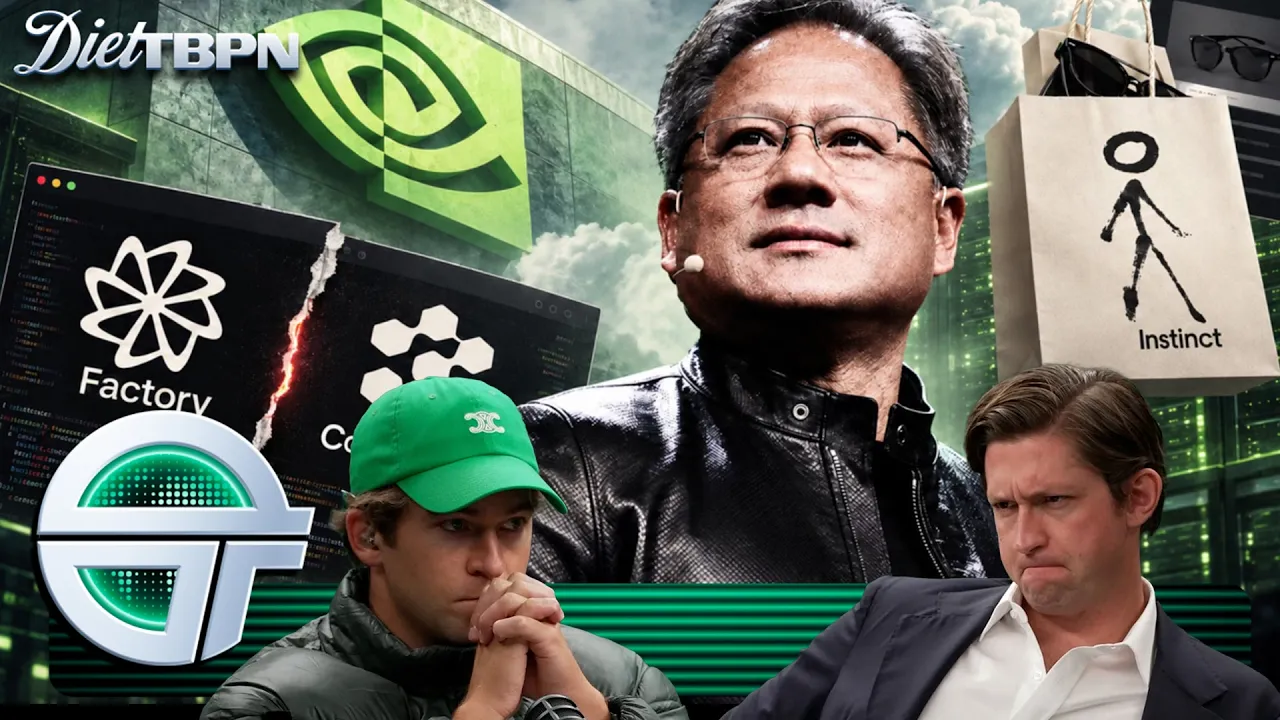
Nvidia’s Cloud Strategy Evolves, Factory-Cognition Drama, Instinct Pushes Into Shopping | Diet TBPN — TBPN

TBPN

Nvidia retreated from centralizing GPU workloads through DGX Cloud because dedicated neo-clouds delivered superior performance while funding the chipmaker's hardware buildout.

AI-assisted summary of Nvidia’s Cloud Strategy Evolves, Factory-Cognition Drama, Instinct Pushes Into Shopping | Diet TBPN — original source. Check the original for full context.

Source published:

Key ideas

  • Nvidia pivoted its DGX Cloud strategy from an aggressive aggregator model that threatened neo-clouds into an orchestration and software platform, as benchmarks demonstrated that direct providers like CoreWeave delivered superior performance. (3:25)
  • A vicious public timeline feud erupted between AI coding assistant startups Factory and Cognition over executive advisor poaching, sparking an open civil war within shared investor Khosla Ventures. (6:41)
  • AI companion startup Instinct faced backlash over unsolicited 'shop slop' product recommendations, underscoring the operational hazards of conversational commerce and aggressive SMS filtering. (18:53)
  • Google DeepMind launched Gemini 4 Argon with periodic table-inspired naming, but the release was largely overshadowed by interpersonal Silicon Valley drama. (29:25)

Detailed notes

## Background Published by TBPN on YouTube on October 2, 2026, this Diet TBPN episode delivers a condensed 30-minute tech talk show hosted by John Coogan and Jordi Hays. The broadcast breaks down major tech industry developments, including the evolution of Nvidia's cloud infrastructure strategy, a fiery public feud between AI coding startups Factory and Cognition, and Instinct's polarising push into sponsored e-commerce shopping.

## TL;DR The hosts analyze Nvidia's DGX Cloud shift away from an aggressive compute aggregator toward a cooperative software orchestration layer alongside neo-clouds like CoreWeave. They dissect the explosive timeline clash between Factory and Cognition, spotlighting Vinod Khosla's public broadside against Factory founder Matan Grinberg over poached executive advisors despite Khosla Ventures backing both firms. The discussion evaluates consumer backlash against Instinct's new agent-driven shopping recommendations, the commercial perils of unsolicited SMS pushes, and Google DeepMind's benchmark-setting Gemini 4 Argon release getting overshadowed by tech drama.

## Atmosphere & style Fast-paced, witty, and deeply immersed in Silicon Valley online culture, the episode feels like eavesdropping on an insider tech chat brimming with lively back-and-forth banter. Coogan and Hays blend razor-sharp industry analysis with irreverent humor, cracking jokes about VC 'crashouts' and naming conventions while trading comedic jabs with their producer. The tone effortlessly balances high-level compute economics and startup strategy with unvarnished internet absurdity and consumer-culture tangents.

## Bulletin - [03:25](https://www.youtube.com/watch?v=Ze2rzx4Nnfo&t=205s) Nvidia pivoted its DGX Cloud strategy from an aggressive aggregator model that threatened neo-clouds into an orchestration and software platform, as benchmarks demonstrated that direct providers like CoreWeave delivered superior performance. - [06:41](https://www.youtube.com/watch?v=Ze2rzx4Nnfo&t=401s) A vicious public timeline feud erupted between AI coding assistant startups Factory and Cognition over executive advisor poaching, sparking an open civil war within shared investor Khosla Ventures. - [18:53](https://www.youtube.com/watch?v=Ze2rzx4Nnfo&t=1133s) AI companion startup Instinct faced backlash over unsolicited 'shop slop' product recommendations, underscoring the operational hazards of conversational commerce and aggressive SMS filtering. - [29:25](https://www.youtube.com/watch?v=Ze2rzx4Nnfo&t=1765s) Google DeepMind launched Gemini 4 Argon with periodic table-inspired naming, but the release was largely overshadowed by interpersonal Silicon Valley drama.

## Key takeaways - [00:02](https://www.youtube.com/watch?v=Ze2rzx4Nnfo&t=2s) Nvidia initially envisioned DGX Cloud and Lepton AI as an all-encompassing front door to global compute, raising fears among neo-clouds of customer disintermediation and margin compression. - [03:25](https://www.youtube.com/watch?v=Ze2rzx4Nnfo&t=205s) The anticipated neo-cloud war fizzled out after SemiAnalysis benchmarks proved that AI developers achieved superior performance and control by working directly with dedicated operators like CoreWeave and Nebius. - [03:25](https://www.youtube.com/watch?v=Ze2rzx4Nnfo&t=205s) CoreWeave launched CoreWeave Forge to evolve from a GPU rental provider into a comprehensive AI cloud offering CPUs, enterprise storage, and custom fleet management. - [06:41](https://www.youtube.com/watch?v=Ze2rzx4Nnfo&t=401s) Vinod Khosla publicly attacked Factory founder Matan Grinberg as a desperate second-tier competitor, despite Khosla Ventures holding major stakes in both Factory and its rival Cognition. - [11:30](https://www.youtube.com/watch?v=Ze2rzx4Nnfo&t=690s) Khosla Ventures partner Keith Rabois took the opposing side to defend Matan Grinberg, asserting that it is inherently unethical for an advisor to interview at a competitor while attending board meetings. - [14:43](https://www.youtube.com/watch?v=Ze2rzx4Nnfo&t=883s) Frontier AI research talent poaching routinely occurs behind closed doors without social media fallout, in stark contrast to the public drama surrounding high-profile venture-backed enterprise executives. - [16:25](https://www.youtube.com/watch?v=Ze2rzx4Nnfo&t=985s) Sequoia's Shaun Maguire fueled the timeline conflict by branding Cognition as 'Infosys masquerading as Anthropic,' highlighting the divide between pragmatic enterprise coding tools and frontier foundation research. - [19:00](https://www.youtube.com/watch?v=Ze2rzx4Nnfo&t=1140s) To secure meaningful take rates, AI shopping agents must generate net-new purchase intent rather than merely functioning as low-margin checkout utilities for pre-existing demand. - [21:50](https://www.youtube.com/watch?v=Ze2rzx4Nnfo&t=1310s) Instinct's early commerce push drew criticism as 'shop slop' after subtle personalization failures—such as recommending paint-damaging car covers to a Porsche owner—eroded user trust. - [24:39](https://www.youtube.com/watch?v=Ze2rzx4Nnfo&t=1479s) Delivering unsolicited commercial promotions over SMS exposes AI agents to heavy unsubscribe rates and risks being algorithmically routed to spam or promotions folders on iOS and Android. - [24:39](https://www.youtube.com/watch?v=Ze2rzx4Nnfo&t=1479s) Pull-based, user-initiated shopping assistants like Dot AI illustrate a more reliable paradigm by handling on-demand queries and background inventory tracking without intrusive outbound sales pitches. - [27:06](https://www.youtube.com/watch?v=Ze2rzx4Nnfo&t=1626s) Instinct hired former Snapchat partnerships executive Ben Schwerin as Chief Business Officer to transition the product toward an elevated, curated concierge model rather than low-tier affiliate links. - [29:25](https://www.youtube.com/watch?v=Ze2rzx4Nnfo&t=1765s) Gemini 4 Argon's launch buzz was muted on tech social media, illustrating how executive drama and boardroom feuds increasingly capture more mindshare than frontier model benchmark updates. - [29:25](https://www.youtube.com/watch?v=Ze2rzx4Nnfo&t=1765s) Leading AI labs have established contrasting naming conventions: OpenAI favors celestial Latin terms, Anthropic selects poetic forms, and Google DeepMind relies on the periodic table.

## Detailed walkthrough ### [00:02](https://www.youtube.com/watch?v=Ze2rzx4Nnfo&t=2s) DGX Cloud Lepton and Nvidia’s Bid to Front-Door AI Compute

Reflecting on the whirlwind following the 2022–2023 "ChatGPT moment," the hosts revisit Jensen Huang’s audacious keynote declaration that artificial intelligence had reached its "iPhone moment." Back then, Nvidia pitched a grand vision where it would act as the ultimate front door to global compute through DGX Cloud and its acquisition of Lepton AI. Rather than simply supplying silicon to hyperscalers like AWS, Microsoft Azure, and Google Cloud Platform, Nvidia proposed aggregating all underlying compute across third-party providers into a unified one-stop shop. The proposition sent shockwaves through the emerging class of specialized "neo-clouds." If providers joined the ecosystem, they risked ceding their customer relationships directly to Nvidia and facing brutal margin compression in an ultra-competitive auction-style pool; if they refused, Nvidia wielded the ultimate leverage to redirect massive customer workloads exclusively to competing partners.

That tension reached a boiling point in April 2025 when Nvidia acquired Lepton AI for a rumored $300 million to $900 million to power the DGX Cloud initiative. Jensen Huang was thoroughly energized, hyping the integration by declaring: "Nvidia DGX Cloud Lepton connects our network of global GPU cloud providers with AI developers together with our NCPs [Nvidia Cloud Providers]... we're building a planetary scale AI factory." The ambitious language prompted a comedic aside between the hosts, who lamented their failure to stop friends and executives from rebranding supercomputers as "AI factories." At this rate, the industry jargon will soon devolve into calling data centers an "AI refinery," an "AI offshore derrick," or, as a commenter chimed in, a "data ranch, brother" placed right in your backyard.

```mermaid flowchart TD accTitle: Nvidia DGX Cloud Aggregation vs Neo-Cloud Provider Tension accDescr: Flow diagram showing how Nvidia DGX Cloud positioned itself between AI developers and neo-cloud providers.

subgraph Clients ["Demand Layer"] Devs["AI Developers & Enterprises"] end

subgraph Aggregator ["Nvidia Front Door"] DGX["Nvidia DGX Cloud / Lepton<br/>'Planetary Scale AI Factory'"] end

subgraph Supply ["Compute Supply Layer"] direction LR NCP["Participating NCPs<br/>(CoreWeave, Nebius)"] Direct["Direct Private Workloads"] Hyperscalers["Hyperscalers<br/>(AWS, Azure, GCP)"] end

Devs -->|"Workload Scheduling"| DGX DGX -->|"Directs Workloads"| NCP DGX -.->|"Bypasses Non-Participants"| Hyperscalers NCP --- Direct ```

- **The Neo-Cloud Dilemma**: Scoops reported by *The Information* revealed deep anxiety among neo-cloud executives who feared that Lepton posed an existential threat, as non-participation meant Nvidia could steer lucrative enterprise demand to rivals. - **The Acquisition Price Tag**: Industry rumors pinned Nvidia’s acquisition of Lepton AI in April 2025 between $300 million and $900 million. - **The Pivot to Software**: Instead of turning into an all-encompassing "Expedia for GPUs" that cannibalized infrastructure partners, DGX Cloud ultimately materialized as a software and standards platform that reinforces the CUDA moat without stripping infrastructure providers of their end-user relationships.

---

[03:25](https://www.youtube.com/watch?v=Ze2rzx4Nnfo&t=205s) Why the Neo-Cloud War Fizzled: CoreWeave Forge and ClusterMax

The anticipated bloodbath between Nvidia and the neo-clouds never fully materialized because raw market realities intervened. When benchmarking firms like SemiAnalysis evaluated DGX Cloud, testing revealed that AI practitioners still achieved far better performance, control, and efficiency by provisioning capacity directly through dedicated, top-tier operators like CoreWeave and Nebius. Nvidia realized its strategic interest lay in nurturing dozens or hundreds of sophisticated compute operators whose capital expenditures directly drove Nvidia’s own chip sales, while DGX Cloud settled into providing orchestration and CUDA tooling—managing GPU node groups, interactive development pods, distributed batch jobs, inference endpoints, storage, observability, and reservations.

This symbiotic relationship was underscored by CoreWeave’s launch of CoreWeave Forge, an expansion into a full-fledged AI cloud equipped with CPUs, storage, and proprietary fleet management. Far from alienating the ecosystem, the move showed how neo-clouds are racing to climb the tiers on benchmarking trackers like ClusterMax. Suppliers of CPUs and storage gained a massive buyer, customers gained expanded feature sets, and CoreWeave continued to dispel lingering doubts over GPU asset depreciation. With dollar-per-watt efficiency increasing rapidly, top operators are aligning themselves with the ambitious buildout metrics espoused by Elon Musk and Jensen Huang, which target capital expenditures on the scale of $60 billion per gigawatt.

- **Benchmark Realities**: SemiAnalysis testing showed that going direct to "Platinum tier" neo-clouds consistently outperformed orchestrating through early iterations of DGX Cloud Lepton. - **CoreWeave Forge Launch**: Expanded CoreWeave’s footprint beyond pure GPU rentals into comprehensive compute environments featuring CPUs, enterprise storage, and administrative tooling. - **Capital Intensity Scale**: Neo-cloud unit economics are rapidly shifting from initial hardware depreciation fears toward massive power-density scaling, pacing toward the $60B/gigawatt benchmarks set by industry leaders.

---

[06:41](https://www.youtube.com/watch?v=Ze2rzx4Nnfo&t=401s) Factory vs. Cognition Drama Explodes: Vinod Khosla’s Unfiltered Crashout

The conversation shifts to the tech timeline’s latest public spectacle—a vicious corporate war between AI coding assistant startups Factory and Cognition that escalated into full-blown executive "crash out on crash out violence." The feud blew wide open when venture capitalist Vinod Khosla publicly launched a scathing, unvarnished attack against Factory’s founder Matan Grinberg, writing: "You are a struggling second tier competitor that is more unethical and lying just because you have no decency or sense of proper behavior and shows your desperation. Straight out lying about Chris being fired I thought would be below even you."

The drama immediately turned bizarre when observers noted that Khosla Ventures holds major investment stakes in *both* Factory and Cognition. While venture capital firms technically maintain internal firewalls between competing portfolio investments, the sight of a multi-billionaire firm namesake publicly tearing down one of his own portfolio companies was extraordinary. The hosts pointed out that fellow Khosla Ventures partner Keith Rabois took the opposing side by rushing to defend Matan Grinberg, spotlighting a sharp internal rift within Khosla Ventures itself. Laughing over Khosla’s raw, grammatically chaotic phrasing ("more unethical and lying"), the hosts joked that Khosla was unmistakably typing from the hip without AI polish—even floating a "15% chance" that Vinod, in his sheer fury, had simply forgotten he personally held bags in Factory.

- **Vinod Khosla’s Unvarnished Broadside**: Khosla unloaded directly on Factory founder Matan Grinberg over accusations regarding executive departures, blasting Factory as a "struggling second tier competitor" lacking basic decency. - **The Khosla Ventures Civil War**: Khosla Ventures backed both Factory and Cognition, with Vinod Khosla actively attacking Factory on X while partner Keith Rabois publicly defended Matan Grinberg. - **Unfiltered Posting**: The hosts observed that the spelling and syntax of Vinod’s timeline tirade proved he was writing completely unfiltered and without the aid of an LLM.

[09:42](https://www.youtube.com/watch?v=Ze2rzx4Nnfo&t=582s) Vinod Khosla’s Timeline Intervention: Truth Nuke or Ad Hominem?

The hosts question why the brewing dispute between Factory and Cognition immediately erupted onto public timelines instead of being handled privately. In standard venture protocol, if a portfolio founder gets out of hand, an investor typically sends a blunt text behind closed doors warning them: "Hey, you are in the wrong. You're about to get smoked. You don't have the leverage here," pointing out they are acting unethically against a competitor and advising them to take the post down and apologize. Instead, Vinod Khosla bypassed backchannels entirely, dropping what was described as a "truth nuke from outer space" barely two and a half hours into the fracas.

A debate emerges between the hosts and producer Tyler over whether Vinod’s salvo was an authentic "truth nuke" or merely an ad hominem attack. While Tyler dismisses it as a straight ad hominem that ignored the underlying facts, the hosts suggest Vinod might actually have had access to internal facts through Khosla Ventures channels. An investor of his stature could easily check the internal Slack to see who held formal board seats, whether the advisor had actual board access, or whether any sensitive proprietary files had crossed over from Factory that would be material to Cognition. In the end, they agree to settle the debate by labeling it an "ad hom."

[11:30](https://www.youtube.com/watch?v=Ze2rzx4Nnfo&t=690s) Rippling vs. Deel Comparisons and the Ethics of Poaching Advisors

The discussion turns to a post by Luke Metro pleading: "Can we please not start Cognition versus Factory before we get a resolution to Rippling versus Deel?" The hosts acknowledge the humor but emphasize that the situations are fundamentally different. Rippling vs. Deel erupted with immediate, dramatic smoking guns and what amounted to an elaborate honeypot operation that is still winding its way through the legal system. In the Factory-Cognition dispute, the sequence appears to be that the advisor went to Factory founder Matan, notified him that he was being recruited away, and days later Matan publicly claimed he was fired for unethical conduct.

```mermaid flowchart TD accTitle: Advisor Departure Sequence accDescr: Sequence of events surrounding the advisor poaching dispute between Factory and Cognition. subgraph Transition["Recruitment & Firing"] A["Advisor notifies Factory (Matan) of recruitment"] --> B["Factory fires advisor days later citing unethical conduct"] B --> C["Cognition hires advisor as Chief Revenue Officer"] end subgraph Repercussions["Public Fallout"] C --> D["Keith Rabois calls interviewing while attending board meetings 'unethical per se'"] D --> E["Public timeline war erupts between founders and VC backers"] end ```

Keith Rabois entered the fray, stating that it is "unethical per se to even interview at a competitor while attending board meetings and board dinners." While the hosts initially find themselves agreeing with Rabois's principle, they grapple with how an executive could realistically handle such an exit more cleanly. In tech, direct competitors frequently share stages or make polite small talk at conferences about agentic AI without resigning preemptively. They draw historical parallels: - **Steve Jobs and Eric Schmidt:** Schmidt famously remained on Apple's board while Google acquired and developed Android, leading to intense behind-the-scenes fury from Jobs that never spilled out as raw timeline drama. - **Mike Krieger and Figma:** Krieger resigned from Figma’s board just days before launching or joining a competing effort. - **Advisor vs. Board Observer:** Clarifying that Chris Degnan (former Snowflake CRO) held only the technical title of "advisor" rather than an official fiduciary board director seat.

[14:43](https://www.youtube.com/watch?v=Ze2rzx4Nnfo&t=883s) Research Poaching vs. Enterprise App Drama

The hosts point out the irony of high-profile VCs and founders engaging in massive public drama over enterprise application startups, whereas the frontier research side experiences far more ruthless, cutthroat talent poaching with almost no public timeline meltdowns. In AI research, labs routinely poach scientists with deep knowledge of proprietary architectures and training breakthroughs, allowing them to carry crucial institutional know-how directly to a competitor within a single twenty-four-hour window.

The contrast between the two worlds comes down to proximity to venture capital and the public stage: - **Researcher Poaching:** While high-profile incidents happen—such as the recent Wall Street Journal report concerning three OpenAI researchers fired for leaking confidential information—researchers rarely interface directly with venture capital boards, keeping their movements off the public timeline. - **VC Visibility:** Board advisors and executive CROs spend significant time directly with venture capitalists and board members. When someone at that level defects, it becomes deeply personal, resulting in public executive broadsides rather than quiet corporate transitions.

[16:25](https://www.youtube.com/watch?v=Ze2rzx4Nnfo&t=985s) Shaun Maguire’s "Truth World War II" and the Infosys Jibe

Deciding to head back into "the trough" where the fight is playing out, the hosts highlight a comment from Miles, who shared a story about an executive being poached from a thriving portfolio company without any public hysterics: the founders tried to retain him, accepted his departure gracefully when they could not, and the board sent thank-you notes—a display of mature, adult behavior. In response, Andreessen Horowitz general partner Martin Casado replied with a single word: "Boring."

Shaun Maguire of Sequoia Capital fired back at Miles, retorting: "Nice one from the cheap seats. You know 1% of the story." Maguire hinted that explosive evidence was coming, teasing that he possessed a nuclear weapon on the timeline that would ignite "Truth World War II." Maguire also took a direct shot at Cognition, tweeting that "Cognition is Infosys masquerading as Anthropic."

The hosts break down Maguire's barb: - **Infosys Analogy:** Infosys is renowned for massive IT transformation and enterprise software consulting, which aligns with Cognition automating corporate coding tasks; however, the hosts reject the idea that Cognition ever masqueraded as an Anthropic-style frontier foundation model lab. - **Cognition's Real Focus:** Scott Wu has been explicit about delivering pragmatic enterprise value through business and code automation rather than chasing basic frontier model research. - **Diverging Paths:** The jab underlines that Factory and Cognition are taking radically different technical paths, rendering the drama over an enterprise sales leader somewhat overblown. As the hosts joke, an enterprise sales heavyweight like a Snowflake CRO probably does not care about the underlying research "mumbo jumbo" anyway—he just wants to know who to call and sell the software to.

[18:53](https://www.youtube.com/watch?v=Ze2rzx4Nnfo&t=1133s) Transition: Instinct Enters Shopping and the "Shop Slop" Backlash

The hosts bring the Factory-Cognition feud to a close and pivot to the next developing story on the internet: Instinct rolling out sponsored product recommendations and commerce ads, which has triggered an immediate backlash from users complaining about low-quality "shop slop." While online sentiment has turned critical, the hosts confess they have their "helmets on" because they believe the shopping push might actually be a promising move.

[19:00](https://www.youtube.com/watch?v=Ze2rzx4Nnfo&t=1140s) Driving Net-New Demand and the Economics of Agent E-Commerce

The hosts examine Instinct’s controversial push into e-commerce recommendations, putting on the "steel man helmet" to evaluate whether the startup is already monetizing these product suggestions or simply running early behavioral experiments. While Instinct co-founder Noah has been explicit about long-term plans to partner with retailers and take a cut of driven purchases, the underlying unit economics of AI-driven commerce remain unproven. A fundamental principle of commerce take rates is that platforms can only command substantial affiliate or referral fees if they generate net-new demand. If a user simply instructs their personal AI agent to execute a purchase for an item they already decided to buy, the demand was created upstream via organic discovery or paid advertising, meaning brands will refuse to hand over hefty margins.

To prove real commercial leverage, Instinct must successfully predict and prompt purchases the user was not previously contemplating. Early test runs showed users being inundated with universal, low-risk utility items like sunscreen, phone chargers, and power banks. While pushing high-turnover consumer hardware is a proven retail playbook—echoing Ridge wallet strategies—the hosts ponder whether Instinct is already plugging in basic Amazon affiliate links like Wirecutter does with NYT-backed referral cookies. Ultimately, the immediate goal may not be instant monetization but establishing critical metrics for their next venture round. Facing massive compute bills, Instinct needs to return to VCs with concrete proof points demonstrating conversion rates that dramatically outstrip traditional channels like Instagram Reels ads.

```mermaid flowchart TD accTitle: AI Agent E-Commerce Demand Dynamics accDescr: Diagram contrasting pre-existing purchase requests with net-new agent recommendations and their monetization potential.

subgraph PreExisting ["Low Take-Rate: Pre-Existing Demand"] A["External Ad / Organic Discovery"] --> B["User tells Agent: 'Buy X'"] B --> C["Brand Refuses Referral Fee"] end

subgraph NetNew ["High Take-Rate: Agent-Generated Demand"] D["Context / Personal Profile"] --> E["Agent Surfaces Proactive Suggestion"] E --> F["Net-New Conversion"] F --> G["High-Margin Retailer Take Rate"] end ```

- High affiliate take rates require driving net-new purchase intent rather than acting as a passive checkout utility. - Instinct’s early recommendations leaned heavily on generic commodities, with users reporting dozens of identical screenshots recommending portable power banks. - Proving superior conversion metrics over legacy social advertising is essential for Instinct to justify its heavy compute burn to prospective Series A and B investors.

---

[21:50](https://www.youtube.com/watch?v=Ze2rzx4Nnfo&t=1310s) The "Shop Slop" Backlash and Nuanced Personalization Failures

Public reaction to Instinct’s proactive shopping feature soured quickly online, culminating in OpenClaw’s Dave Morin dismissing the experience as "shop slop." While Morin’s critique carries the ideological bias of the open-source movement—which advocates for user-owned, ad-free compute where the agent remains strictly aligned with the individual—the pushback highlights how delicate recommendation engines must be. An agent that delivers a genuine "10 out of 10 recommendation," such as surfacing elusive, sold-out The Row loafers to a high-fashion shopper, creates consumer delight. However, slightly missed context completely destroys trust.

A prime illustration of this failure was an interaction where Instinct surfaced car accessories for a user who had shared insurance records for a Porsche 911 Targa. Recognizing the user was an automotive enthusiast, the model recommended an indoor garage dust cover and a battery trickle charger. To actual sports car purists, these recommendations were completely misguided: modern 911s rarely need trickle chargers, and indoor car covers are notoriously avoided by collectors because any dust trapped between the fabric and paint scratches the clear coat. The interface design compounded the awkwardness, peppering conversational text with five repetitive "Let's buy this" action buttons. Having a trusted personal assistant suddenly pivot into a pushy, high-pressure car salesman exposes the awkward growing pains of conversational monetization.

- Dave Morin of OpenClaw branded the unsolicited e-commerce suggestions as "shop slop," advocating instead for fully aligned, ad-free, local agent architectures. - Instinct successfully surfaced scarce luxury fashion pieces like The Row loafers in select instances, showing glimpses of high-intent utility. - The model's Porsche 911 Targa recommendations backfired by suggesting an indoor car cover, which enthusiasts avoid due to paint-abrasion risks from trapped debris. - The repetitive visual UI, featuring multiple conversational calls to action urging "Let's buy this," made the AI feel uncomfortably aggressive.

---

[24:39](https://www.youtube.com/watch?v=Ze2rzx4Nnfo&t=1479s) Conversational Shopping, SMS Fatigue, and Inbox Filtering Risks

The fundamental problem with agent-driven commerce delivered via SMS is the hyper-personal nature of text messaging. While Noah has championed a UI-light philosophy—insisting agents only need a phone number rather than complex apps—pushing commercial sales via text carries severe churn hazards. Consumers are vastly more prone to unsubscribing from SMS outreach than email newsletters. Even more perilous is the threat of modern operating system categorization: modern iOS iMessage and Android systems aggressively route unsolicited or transactional messages into segregated folders for Unknown Senders, Promotions, and Spam. If an AI companion gets algorithmically demoted from a personal friend thread to a promotional bucket, open rates collapse, replicating the "newsletter apocalypse" that occurred when Gmail introduced its Promotions tab.

The alternative model is on-demand, user-initiated shopping workflows, illustrated by a recent voice demo with the Dot AI app. While on a commute, a host instructed Dot over a voice call to dig through Gmail receipts, locate a previously purchased pair of pants, and track down an alternative colorway. When Dot candidly quipped back that everything was out of stock in his size—joking that there was no "global pants outage"—the host simply instructed the agent to spin up a silent background daemon to monitor inventory daily and send a single notification when restocked. That pull-based utility stands in stark contrast to unsolicited push marketing.

```mermaid flowchart LR accTitle: Messaging Channel Filtering Risk accDescr: Flowchart showing how pushy AI text interactions risk being sorted into spam or promotions folders.

Agent["Instinct Agent via SMS"] --> Carrier["Carrier / iMessage Classifier"] Carrier -->|"Trusted Context"| Inbox["Primary Inbox (High Engagement)"] Carrier -->|"Repeated Sales Pushes"| Spam["Promotions / Unknown Folder (Ghosted)"] ```

- Unsolicited commercial SMS texts suffer significantly higher opt-out and block rates than email marketing campaigns. - AI agents delivered via raw phone numbers risk being filtered into iMessage's Unknown Senders and Promotions folders, severely destroying engagement. - Dot demonstrated an effective pull-based shopping paradigm by conducting voice-driven inventory searches and managing quiet background restock monitors.

---

[27:06](https://www.youtube.com/watch?v=Ze2rzx4Nnfo&t=1626s) Instinct's Rapid Team Growth and the Silicon Valley Bubble

Despite the intense scrutiny on X, the hosts emphasize that Instinct remains an agile team of only 13 or 14 people experimenting in public at high velocity. A significant structural milestone is their recent hire of Ben Schwerin as Chief Business Officer. Schwerin, who previously led content and partnerships at Snapchat for nearly a decade before a stint at Coatue, brings deep institutional experience in structuring commercial deals. His background positions Instinct to pivot its monetization model away from cheap spam toward an elevated, American Express-style rewards and partnership ecosystem that feels native and premium rather than intrusive.

Finally, the hosts caution against mistaking the tech bubble's vocal disdain for advertising with the broader consumer market. While Silicon Valley software engineers and X power users actively despise ads and fight for pristine interfaces, millions of everyday consumers actively consume promotional materials, clip digital coupons, scroll through promotional emails, and purchase directly from algorithmic Instagram feeds. The tension facing personal AI agents is balancing elite tech sensibilities with the mass-market reality of consumer appetite for well-timed, curated shopping discovery.

- Instinct continues to ship core product experiments rapidly with a lean team of roughly 13 to 14 employees. - Former Snapchat partnerships head and Coatue partner Ben Schwerin joined Instinct as Chief Business Officer to formalize its commercial partnerships. - The vision for Instinct's business development is transitioning from intrusive affiliate links to an elevated, curated platform akin to an Amex concierge experience. - The tech community's reflexive allergy to ads conflicts with mainstream consumer behavior, where millions actively enjoy promotional newsletters and curated social commerce.

[28:37](https://www.youtube.com/watch?v=Ze2rzx4Nnfo&t=1717s) Unsolicited Ads, Car Negs, and Curated Shopping

The hosts share a lighthearted tangent about real-world physical spam versus digital recommendations. Jordi describes parking in Los Angeles and returning from a restaurant only to find a business card slipped into the car window offering cash for clunkers: "I will buy your junk car." He laughs at the unintended insult, admitting it felt like an unprovoked shot fired when he thought he was doing just fine. John points out that while he regularly gets flyers jammed into his window for local gardening or tree-trimming services, he has never had someone look at his vehicle and assume it was ready for the scrap heap.

The conversation circles back to consumer retail and personalized commerce agents. John remarks that despite the general fatigue around advertising, plenty of consumers would genuinely embrace a clean, automated daily ping delivering a curated recommendation for the single best product they could buy. Referencing the Instinct shopping pivot, John echoes the sentiment that "nobody on earth can do what Ben can change his instinct overnight."

---

[29:25](https://www.youtube.com/watch?v=Ze2rzx4Nnfo&t=1765s) Gemini 4 Argon, Timeline Distractions, and the AI Naming Wars

Google DeepMind picked an unfortunate news cycle to drop Gemini 4 Argon, releasing their latest flagship right as the tech timeline was consumed by the bitter public feud between Factory and Cognition. While Gemini 4 Argon posted breakthrough benchmark numbers and stirred up fresh debate over the extent to which Google engineers are actually relying on it internally to write code, the launch was completely overshadowed by Silicon Valley drama. The hosts joke about the meme playing out in real time: Google steps up to announce a major frontier model, only for tech Twitter to briefly glance over, say "cool," and immediately pivot back to watching two enterprise model-agnostic coding harnesses wage war over poached advisors and board seats. The raw "model wars" that once dominated industry discourse have officially taken a back seat to interpersonal founder conflict and executive boardroom politics.

```mermaid flowchart TD accTitle: AI Lab Model Naming Schemes accDescr: Comparison of naming conventions used by OpenAI, Anthropic, and Google DeepMind.

subgraph OpenAI["OpenAI: Celestial / Solar System"] O1["Luna (Moon)"] O2["Terra (Earth)"] O3["Sol (Sun)"] O4["Astra (Stars)"] end

subgraph Anthropic["Anthropic: Literary & Poetic Forms"] A1["Haiku (Japanese Poem)"] A2["Sonnet (14-Line Poem)"] A3["Opus (Major Work)"] A4["Fable (Moral Story)"] end

subgraph Google["Google DeepMind: Periodic Table"] G1["Argon (Noble Gas)"] G2["Greek: 'Argos' = Lazy / Inactive"] end ```

The hosts also examine how ridiculous and distinct the naming schemes across leading AI labs have become: - **OpenAI** has anchored its brand around celestial and planetary Latin roots: **Luna** (the moon), **Terra** (the earth), **Sol** (the sun), and **Astra** (the stars). - **Anthropic** draws from classic poetic structures and literary traditions: **Haiku** (the concise Japanese verse form), **Sonnet** (the traditional 14-line poem), **Opus** (a creator's major artistic work), and **Fable** (a moral tale). - **Google DeepMind** opted for elemental chemistry with **Argon**, likely kicking off a march through the noble gases and the periodic table.

However, John cautions tech founders to actually research the etymology of their project code names before shipping them. Ancient Greek roots reveal that *argon* stems from *argos*, literally translating to "lazy" or "inactive"—perhaps an awkward moniker for a high-performance reasoning engine. Recalling Apple's ill-fated "Project Titan," John warns that Silicon Valley remains far too prone to hubristic branding mistakes.

---

[31:13](https://www.youtube.com/watch?v=Ze2rzx4Nnfo&t=1873s) Brand Collabs: Pop-Tarts BuzzBallz Out, Feastables Liquid Death In

The episode closes out with absurdity from the world of consumer packaged goods collaborations. On one hand, culture suffered a blow with the announcement that the Pop-Tarts partnership with BuzzBallz—which spawned the infamous Frosted S'mores ready-to-drink cocktail—has officially come to an end. Yet the cosmic ledger remains completely net neutral, as another chaotic crossover has arisen in its place: MrBeast's Feastables brand has teamed up with Liquid Death to produce a peanut butter cup soda-flavored sparkling water.

John and Jordi immediately turn to their producer, Tyler, declaring that this hyper-sweet, canned concoction has his name written all over it and pitching a Friday broadcast challenge to chug an entire six-pack of peanut butter cup carbonated water live on air. The hosts leave the audience with a burning question: would you rather knock back a can of Feastables Liquid Death peanut butter cup sparkling water or a Pop-Tarts Frosted S'mores BuzzBall? After declaring their enduring love for BuzzBallz, the hosts urge listeners to drop a five-star review on Apple Podcasts before signing off until tomorrow.

## Notable quotes > [00:02](https://www.youtube.com/watch?v=Ze2rzx4Nnfo&t=2s) Nvidia DGX Cloud Lepton connects our network of global GPU cloud providers with AI developers together with our NCPs... we're building a planetary scale AI factory. — Jensen Huang

> [06:41](https://www.youtube.com/watch?v=Ze2rzx4Nnfo&t=401s) You are a struggling second tier competitor that is more unethical and lying just because you have no decency or sense of proper behavior and shows your desperation. Straight out lying about Chris being fired I thought would be below even you. — Vinod Khosla

> [09:42](https://www.youtube.com/watch?v=Ze2rzx4Nnfo&t=582s) Hey, you are in the wrong. You're about to get smoked. You don't have the leverage here — John Coogan

> [11:30](https://www.youtube.com/watch?v=Ze2rzx4Nnfo&t=690s) Can we please not start Cognition versus Factory before we get a resolution to Rippling versus Deel? — Luke Metro

> [11:30](https://www.youtube.com/watch?v=Ze2rzx4Nnfo&t=690s) unethical per se to even interview at a competitor while attending board meetings and board dinners. — Keith Rabois

> [16:25](https://www.youtube.com/watch?v=Ze2rzx4Nnfo&t=985s) Boring. — Martin Casado

> [16:25](https://www.youtube.com/watch?v=Ze2rzx4Nnfo&t=985s) Nice one from the cheap seats. You know 1% of the story. — Shaun Maguire

> [16:25](https://www.youtube.com/watch?v=Ze2rzx4Nnfo&t=985s) Cognition is Infosys masquerading as Anthropic. — Shaun Maguire

> [21:50](https://www.youtube.com/watch?v=Ze2rzx4Nnfo&t=1310s) shop slop — Dave Morin

> [28:37](https://www.youtube.com/watch?v=Ze2rzx4Nnfo&t=1717s) nobody on earth can do what Ben can change his instinct overnight. — John Coogan

## Mentioned Amazon, Andreessen Horowitz, Anthropic, Apple, AWS, Ben Schwerin, BuzzBallz, Chris Degnan, Cisco, ClusterMax, Coatue, Cognition, Console, CoreWeave, CoreWeave Forge, CrowdStrike, Dave Morin, Deel, DGX Cloud, Dot AI, Elon Musk, Eric Schmidt, Factory, Feastables, Figma, Gemini 4 Argon, Google, Google Cloud Platform, Google DeepMind, Infosys, Instinct, Jensen Huang, John Coogan, Jordi Hays, Keith Rabois, Khosla Ventures, Lepton AI, Liquid Death, Luke Metro, Mark Cuban, Mark Zuckerberg, Martin Casado, Matan Grinberg, Microsoft Azure, Mike Krieger, MongoDB, MrBeast, Nebius, Noah, Nvidia, NYSE, OpenAI, OpenClaw, Pop-Tarts, Public, Railway, Ramp, Rippling, Sam Altman, Satya Nadella, Scott Wu, SemiAnalysis, Sequoia Capital, Shaun Maguire, Shopify, Snowflake, Steve Jobs, TBPN, The Information, The New York Times, The Row, Vinod Khosla, Wirecutter

## Video description Sign up for TBPN’s daily newsletter at TBPN.com

Diet TBPN delivers the best of today’s TBPN episode in 30 minutes. TBPN is a live tech talk show hosted by John Coogan and Jordi Hays, streaming weekdays 11–2 PT on X and YouTube, with each episode posted to podcast platforms right after.

Described by The New York Times as “Silicon Valley’s newest obsession,” the show has recently featured Mark Zuckerberg, Sam Altman, Mark Cuban, and Satya Nadella.

TBPN is made possible by: Ramp - https://ramp.com Public - https://public.com Cisco - https://www.cisco.com Console - https://www.console.com CrowdStrike - https://www.crowdstrike.com Figma - https://www.figma.com MongoDB - https://www.mongodb.com NYSE - https://www.nyse.com Railway - https://railway.com Shopify - https://www.shopify.com/

Follow TBPN: https://TBPN.com https://x.com/tbpn https://open.spotify.com/show/2L6WMqY3GUPCGBD0dX6p00?si=674252d53acf4231 https://podcasts.apple.com/us/podcast/technology-brothers/id1772360235 https://www.youtube.com/@TBPNLive

Chapters: 00:00 Nvidia’s Cloud Ambitions + What Happened to DGX Cloud Lepton? 03:25 Nvidia, CoreWeave + Why the Neo-Cloud War Never Really Happened 06:41 Factory vs. Cognition Explodes on the Timeline 11:30 The Ethics of Poaching Advisors + Silicon Valley’s New Talent War 16:25 “Truth Nukes,” VCs + Why the Factory Drama Got So Personal 18:53 Instinct Pushes Into Shopping + The “Shop Slop” Backlash 24:39 Can Personal AI Agents Actually Make Advertising Work? 29:25 Gemini 4 Argon Launches + AI Model Naming Has Gone Off the Rails

[Source](https://www.youtube.com/watch?v=Ze2rzx4Nnfo)

中文简报

因CoreWeave性能优于DGX Lepton,英伟达搁置云聚合计划 英伟达放弃通过DGX Cloud集中GPU工作负载的做法,原因是专注的新型云服务商在资助该芯片制造商硬件扩建的同时,提供了更优异的性能。 主持人们深入分析了英伟达DGX Cloud的战略转向:从激进的算力聚合平台,转变为与CoreWeave等新型云服务商协同合作的软件编排层。他们详细剖析了Factory与Cognition之间激烈的公开冲突,重点关注了尽管Khosla Ventures同时投资了这两家公司,Vinod Khosla仍因争夺高管顾问而公开猛烈抨击Factory创始人Matan Grinberg的事件。讨论还评估了消费者对Instinct新型智能体驱动购物推荐的反弹、未经请求的短信推送带来的商业风险,以及Google DeepMind发布树立基准的Gemini 4 Argon却在很大程度上被科技圈戏剧性内讧掩盖风头的情况。 基准测试显示CoreWeave等直接服务商性能更优,英伟达因此将DGX Cloud战略从威胁新型云服务商的激进聚合模式转向编排与软件平台。 (3:25) AI编程助手初创公司Factory与Cognition因争夺高管顾问爆发激烈的公开争端,在其共同投资方Khosla Ventures内部引发了一场公开内讧。 (6:41) AI伴侣初创公司Instinct因推送未经请求的劣质购物推荐(shop slop)遭遇抵制,凸显了对话式商务的运营风险以及激进短信过滤的隐患。 (18:53) Google DeepMind发布了以元素周期表为灵感命名的Gemini 4 Argon,但该发布在很大程度上被硅谷的人际纠葛掩盖了风头。 (29:25)

Reading summary

TBPN explores how practical market forces reshaped Nvidia's cloud orchestration strategy, while public boardroom conflict and unproven consumer monetization models underscore the operational strains confronting generative AI startups. Nvidia’s Shift From Aggregator to Software Moat (0:02) Nvidia initially pitched DGX Cloud and its April 2025 acquisition of Lepton AI—rumored between $300 million and $900 million—as a unified front door to global compute. This posed an existential challenge to specialized neo-cloud providers like CoreWeave and Nebius, who feared losing direct customer relationships or facing margin compression. However, independent testing by firms such as SemiAnalysis revealed that developers achieved superior performance, control, and efficiency by provisioning capacity directly through dedicated infrastructure providers rather than routing through DGX Cloud Lepton. Recognizing that its core commercial interest lay in encouraging massive capital expenditures from third-party operators, Nvidia pivoted DGX Cloud away from becoming an 'Expedia for GPUs.' Instead, it positioned the service as an orchestration and CUDA software platform managing GPU node groups, batch jobs, and inference endpoints. This symbiotic relationship allowed neo-clouds to expand—such as CoreWeave launching its full-fledged 'Forge' cloud with CPUs and enterprise storage—as buildout targets scaled toward $60 billion per gigawatt. Executive Warfare at Factory and Cognition (6:41) A high-profile dispute between AI coding assistant startups Factory and Cognition erupted publicly after venture capitalist Vinod Khosla launched an unfiltered attack on Factory founder Matan Grinberg, labeling the company an unethical, desperate 'second tier competitor.' The altercation stemmed from Cognition poaching an advisor, former Snowflake Chief Revenue Officer Chris Degnan, after which Factory publicly claimed he was fired for misconduct. The spat exposed internal fractures within Khosla Ventures, which backs both firms; while Vinod Khosla attacked Factory on X, partner Keith Rabois defended Grinberg, arguing that interviewing with a competitor while attending board meetings is unethical per se. The drama highlighted a distinct contrast between enterprise software startups and foundation research labs. While research facilities routinely poach scientists carrying proprietary model architectures without public fanfare, enterprise application startups depend heavily on venture capital boardrooms and commercial sales networks. Sequoia Capital partner Shaun Maguire further escalated the feud online by deriding Cognition as 'Infosys masquerading as Anthropic,' even as Google DeepMind's concurrent launch of Gemini 4 Argon was largely overshadowed by the social media brawl. Instinct’s Friction in Agentic E-Commerce (18:53) AI assistant startup Instinct sparked user backlash after rolling out proactive product recommendations and commercial advertisements, an experience critic Dave Morin described as 'shop slop.' The economic challenge for agentic commerce lies in monetization mechanics: platforms only earn substantial referral or affiliate margins if they generate net-new demand. If an agent merely executes an existing purchase intent, upstream brands will not concede significant margins. Consequently, Instinct tested proactive recommendations for high-turnover utilities like power banks, aiming to validate conversion metrics ahead of upcoming venture capital fundraising. The deployment suffered from context and channel mismatches. In one instance, an enthusiast who shared insurance papers for a Porsche 911 Targa received recommendations for an indoor car cover and trickle charger—accessories real collectors actively avoid to prevent paint abrasion. Furthermore, delivering unsolicited commercial pushes over SMS risks severe user churn and algorithmic filtering into iMessage or Android 'Promotions' and 'Spam' folders. To pivot away from cheap affiliate links toward a curated, premium partnership model, Instinct recently hired former Snapchat executive and Coatue partner Ben Schwerin as Chief Business Officer. Across infrastructure, enterprise coding, and consumer assistants, the ecosystem is shifting from unbridled technical hype to thorny operational realpolitik. The lingering question is whether agentic startups like Instinct can convert conversational interactions into sustainable commercial revenue without destroying trust or succumbing to messaging platform spam filters.

Detailed notes — zh

## Background 该内容由科技播客频道 TBPN 于 2026 年 10 月 2 日在 YouTube 上发布,节选自主播 John Coogan 和 Jordi Hays 主持的每日科技直播谈话节目 Diet TBPN。根据页面介绍,本期节目回顾了当天科技圈的重磅头条,涵盖英伟达云战略演变、Factory 与 Cognition 两大 AI 编程初创公司的推特公开撕逼、个人 AI Agent 产品 Instinct 试水电商推荐遭遇的舆论反弹,以及 Google DeepMind 全新模型 Gemini 4 Argon 的发布与大模型命名学大乱斗。 ## TL;DR 本期节目首先深入复盘了英伟达从最初试图成为统揽一切的 GPU 聚合层,最终走向提供底层统一软件栈与生态共存的云战略演进历程;紧接着详细拆解了硅谷知名投资人 Vinod Khosla 在社交媒体公开痛骂 Factory CEO 并力挺 Cognition 所引爆的高管跳槽与道德风波,揭示了风投双重下注与顶尖人才争夺战背后的尴尬现实。随后,主播们剖析了个人 AI 助手 Instinct 试水主动推送商品可能面临的商业逻辑隐患与翻车公关风险,并调侃了当天发布的 Gemini 4 Argon 大模型如何在激烈的八卦吃瓜浪潮中惨遭忽视,最后梳理了各大 AI 实验室天马行空的模型命名风格。 ## Atmosphere & style 整期节目的氛围轻松诙谐又充满硅谷业内人士的敏锐洞察,两位主持人之间的插科打诨配合默契,叙事节奏紧凑明快。在围观 VC 与创始人的公开撕逼时,两人语带调侃、毒舌吐槽拉满,甚至戏称这是在看“跟猪摔跤”与“真相核弹”互掷;而在切入商业模式和技术分歧时,又能迅速切换到冷静硬核的分析视角,呈现出一场兼具吃瓜快感与商业思考的高密度科技脱口秀。 ## Bulletin - [00:02](https://www.youtube.com/watch?v=Ze2rzx4Nnfo&t=2s) 英伟达此前以传闻 3 亿至 9 亿美元收购 Lepton AI 打造的 DGX Cloud Lepton,并未演变为控制需求的“GPU 版 Expedia”,而是转型为支持 CUDA 生态的统一软件基础设施,与 CoreWeave 等新兴云服务商共生共赢。 - [06:41](https://www.youtube.com/watch?v=Ze2rzx4Nnfo&t=401s) AI 编程初创公司 Factory 与 Cognition 因高管跳槽在社交媒体引爆公开互撕,Khosla Ventures 创始人维诺德·科斯拉亲自下场公开痛骂 Factory 创始人,暴露出顶级风投双重下注及高管挖角潜规则下的伦理与利益冲突。 - [19:00](https://www.youtube.com/watch?v=Ze2rzx4Nnfo&t=1140s) 个人 AI Agent 产品 Instinct 试水电商推荐引发“购物垃圾”争议,凸显出 AI Agent 必须创造真正的“净增量需求”才能收取可观抽成,而仅凭静态标签推荐往往会脱离垂直圈层的真实使用语境。 - [29:25](https://www.youtube.com/watch?v=Ze2rzx4Nnfo&t=1765s) Google DeepMind 发布全新模型 Gemini 4 Argon,但其基准测试与关注度被硅谷当天的八卦大戏完全冲淡,同时各大前沿实验室在天体、文学和化学元素等代号命名上的体系分歧也成为谈资。 ## Key takeaways - [00:02](https://www.youtube.com/watch?v=Ze2rzx4Nnfo&t=2s) 英伟达云战略从早期试图聚合算力、直面传统云巨头的“GPU 版 Expedia”构想,转变为提供集群管理、调度与推理端点的统一软件基础设施层。 - [03:25](https://www.youtube.com/watch?v=Ze2rzx4Nnfo&t=205s) 新兴 AI 云服务商(NeoCloud)如 CoreWeave 和 Nebius 并未被英伟达边缘化,反而凭借单位功耗利润跑通了早期折旧质疑,并推出了自有云平台产品 CoreWeave Forge。 - [06:41](https://www.youtube.com/watch?v=Ze2rzx4Nnfo&t=401s) Khosla Ventures 创始人维诺德·科斯拉在社交媒体公开痛斥被投企业 Factory 首席执行官,暴露出风投机构同时投资两家竞品时的利益冲突与合伙人派系分歧。 - [09:42](https://www.youtube.com/watch?v=Ze2rzx4Nnfo&t=582s) 维诺德·科斯拉舍弃闭门调解、直接在社交网络发射“真相核弹”的极端做法,打破了传统风投私下沟通敲打创始人的常规公关范式。 - [11:30](https://www.youtube.com/watch?v=Ze2rzx4Nnfo&t=690s) Factory 与 Cognition 纠纷的核心在于前顾问克里斯·德农跳槽出任 Cognition 首席营收官(CRO),引发了关于在职期间面试竞品是否具备道德合法性的激烈争论。 - [13:20](https://www.youtube.com/watch?v=Ze2rzx4Nnfo&t=800s) 硅谷对商业高管与顾问跳槽的敏感程度远高于底层技术研究员,后者即便携带多年认知跳槽或被解雇,也罕见引发董事会级别的公共舆论风暴。 - [16:25](https://www.youtube.com/watch?v=Ze2rzx4Nnfo&t=985s) 红杉资本肖恩·马奎尔讽刺 Cognition 是“披着 Anthropic 外衣的 Infosys”,直指其重在企业级 IT 自动化改造落地的业务本质,而非底层大模型研究突破。 - [19:00](https://www.youtube.com/watch?v=Ze2rzx4Nnfo&t=1140s) 个人 AI Agent 要在电商分成中跑通商业模式,必须主动推荐并激发用户原本不存在的“净增量需求”,单纯作为履约与结账工具无法获得品牌方的高抽成。 - [20:50](https://www.youtube.com/watch?v=Ze2rzx4Nnfo&t=1250s) Instinct 向用户高频推送充电宝等通用配件以测试转化率,很大程度上是为了向风险投资人证明其商业化潜力并获取融资以支撑算力开销。 - [21:51](https://www.youtube.com/watch?v=Ze2rzx4Nnfo&t=1311s) AI 推荐系统若仅依靠粗粒度静态标签(如识别出保时捷车主却狂推涓流充电器和车罩),很容易因不懂垂直圈层文化而引发“购物垃圾”的负面舆论反弹。 - [24:42](https://www.youtube.com/watch?v=Ze2rzx4Nnfo&t=1482s) 依托短信(SMS)作为 AI Agent 交互界面的高侵入性面临极高风险,极易触发 iOS 的推广或垃圾信息分类,从而失去核心触达入口。 - [26:40](https://www.youtube.com/watch?v=Ze2rzx4Nnfo&t=1600s) Instinct 引入前 Coatue 与 Snapchat 高管 Ben 出任首席业务官,旨在将粗糙的短信推销重塑为兼具商业转化与品质感的高端管家式会员体验。 - [29:25](https://www.youtube.com/watch?v=Ze2rzx4Nnfo&t=1765s) Google DeepMind 发布的 Gemini 4 Argon 遭遇社交媒体舆论冷落,显示出单纯的基准测试和大模型军备竞赛在眼球吸引力上正逐渐输给行业抓马故事。 - [30:10](https://www.youtube.com/watch?v=Ze2rzx4Nnfo&t=1810s) 头部大模型实验室形成了迥异的代号命名文化:OpenAI 偏好天体宇宙、Anthropic 选用文学体裁,而 Google 则遵循化学元素周期表体系。 ## Detailed walkthrough ### [00:02](https://www.youtube.com/watch?v=Ze2rzx4Nnfo&t=2s) 英伟达的云战略演变与 DGX Cloud Lepton 的真相 回顾过去一两年的 AI 算力市场,英伟达曾高调喊出要成为算力入口。事情始于 2023 年 ChatGPT 引爆行业后,黄仁勋在主题演讲中称当前为“iPhone 时刻”,并宣布英伟达将聚合底层算力基础设施,让开发者能直接通过英伟达部署所需的一切资源,直面 AWS、Azure、Google Cloud 等传统云巨头的竞争。英伟达在 2025 年 4 月以传闻 3 亿至 9 亿美元的价格收购了 Lepton AI,推出了所谓前台产品“DGX Cloud Lepton”。黄仁勋当时雄心勃勃地表示,该产品将连接全球 GPU 云服务商与 AI 开发者,与各家英伟达云服务商(NCPs)携手打造一个“行星级 AI 工厂”。 主持人调侃道,科技圈现在动辄把超算中心称为“AI 工厂”,如果继续听任这种风潮演变,大家以后可能会把数据中心叫做“AI 炼油厂”、“海上钻井平台”,甚至像观众戏称的那样,直接叫“数据农场”(Data Ranch)。但在宏大叙事的背后,《The Information》等媒体当时曾爆料,众多 NeoCloud(新兴 AI 云)计算服务商将 Lepton 视作巨大的竞争威胁——如果你不接入,英伟达就可能把客户和工作负载导流给配合的竞争对手;而一旦接入,你又会丧失与终端客户的直接联系,面临利润被大幅挤压的困境。 ```mermaid flowchart TD accTitle: 英伟达算力聚合平台构想演变 accDescr: 展示英伟达从最初试图垄断算力入口到最终转型为软件调度平台的路径变化。 subgraph Phase1["最初构想:算力聚合层 (GPU 版 Expedia)"] A["开发者需求"] --> B["DGX Cloud Lepton 统一入口"] B --> C1["CoreWeave"] B --> C2["Nebius"] B --> C3["其他 NeoCloud"] end subgraph Phase2["实际落地:统一 AI 软件基础设施"] D["开发者自由选择云厂商"] --> E["直接接入 CoreWeave / Nebius"] E --> F["底层统一软件栈与 CUDA 生态 (节点管理/推理端点/调度)"] end ``` 然而,这场所谓颠覆性的“算力聚合战”并没有演化成残酷的收割。DGX Cloud 上线后,实际测评表现并不比直接使用 CoreWeave 等云服务优秀;分析机构 SemiAnalysis 在测试后也明确指出,直接接入 CoreWeave 或 Nebius 等白金级云服务商体验更好。最终,DGX Cloud Lepton 没有变成控制总需求的“GPU 版 Expedia”,而是演变成了一套统一的 AI 平台标准软件。它涵盖了 GPU 节点组管理、交互式开发 Pod、分布式批处理、推理端点、存储、可观测性及算力预留等整套支撑 CUDA 护城河的专有软件体系,让云厂商既能保留自有客户关系,又能运行这套生态。黄仁勋并未强行扼杀新云厂商,而是选择与数十家充满动力的生态伙伴共生共赢。 - **收购细节与估值**:英伟达在 2025 年 4 月完成对 Lepton 的收购,交易对价据传在 3 亿到 9 亿美元之间。 - **CoreWeave 最新动态**:CoreWeave 近日推出了自己的 AI 云平台产品 CoreWeave Forge,补齐了 CPU、存储以及相应的管理工具,进一步巩固自己在集群测评中的领先地位。 - **商业模型前景**:在单位功耗价值(Dollar per Watt)飞速上涨的背景下,随着马斯克与黄仁勋描绘的“每吉瓦 600 亿美元”投资蓝图展开,新兴 AI 云跑通了早期关于硬件快速折旧的质疑,展现出了惊人的利润扩张潜力。 --- ### [06:41](https://www.youtube.com/watch?v=Ze2rzx4Nnfo&t=401s) Factory 与 Cognition 在社交媒体引爆公开冲突 节目话题转向了前一天在社交媒体 X(原 Twitter)时间线上爆发的公开互撕大战。两位主播开玩笑称,这就像明知会沾一身泥却偏要去“跟猪摔跤”。这起事件的核心是两家主打 AI 软件工程智能体(Coding Agent)的创业公司——Factory 与打造了 Devin 的 Cognition。 事情的导火索是风投教父 Vinod Khosla(Khosla Ventures 创始人)突然在时间线上公开发难,言辞极其激烈地怒喷 Factory 首席执行官 Matan Grinberg。Vinod 在推文中痛骂对方是“一个垂死挣扎的二流竞争对手(struggling second-tier competitor),极其缺乏道德且满嘴谎言,毫无体面和修养,完全暴露了自身的绝望”,并直接指责对方捏造了关于 Chris 被解雇的谣言。这种顶级投资人毫无保留地“破防破罐破摔”(crash out)的公开攻击,立刻在硅谷科技圈掀起了惊涛骇浪。 - **风投双重下注的尴尬局面**:网友在 20 秒内就扒出,Khosla Ventures 本身同时是 Factory 和 Cognition 两家公司的早期重要投资方,引发了投资界关于利益冲突和“防火墙”机制的热议。 - **合伙人立场分歧**:同在 Khosla Ventures 的著名投资人 Keith Rabois 则公开站出来力挺 Matan Grinberg,展现了风投机构内部在两家被投竞品之间的微妙分裂与派系分歧。 - **情绪失控与真实动因**:主播调侃 Vinod 这次发言显然没有任何公关润色或 AI 辅助,语法混乱、充满情绪化的冲动言辞。主播推测,要么是即使存在经济利益纽带,Vinod 也认定 Matan 越过了道德底线因而必须公开划清界限;要么也有大约 15% 的概率是作为身家百亿的投资大佬,他当时甚至一时忘了自家基金其实两边都投了钱。 ### [09:42](https://www.youtube.com/watch?v=Ze2rzx4Nnfo&t=582s) 资本家在时间线上引爆“真相核弹” 围绕 AI 编程初创公司 Factory 与 Cognition 之间的公开冲突,主播们展开了激烈的复盘与讨论。最令大家匪夷所思的是,这样的争端为什么没有走私下沟通流程,而是直接在 X(Twitter)时间线上引爆。按常理来说,如果投资人发现自己投资组合中的创始人失控或者犯错,正常的做法是在幕后发短信敲打:“你这次理亏了,你不仅没有筹码,而且你的对手处于优势;作为次级竞争对手,你既不道德还在撒谎,我建议你删帖并公开道歉。”但维诺德·科斯拉(Vinod Khosla)完全没有私下警告,而是如同从外太空直接发射了一枚“真相核弹”(truth nuke)。 ```mermaid flowchart TD accTitle: VC应对创始人失控的两种路径 accDescr: 展现了传统的幕后沟通私聊方式与公开在社交平台上投掷言论核弹的方式对比 subgraph Normal["常规幕后处理"] A["创始人行为失控 / 跨界挑衅"] --> B["合伙人发私信警告: 理亏/无筹码"] B --> C["建议删帖、私下道歉闭门解决"] end subgraph KhoslaPath["维诺德·科斯拉模式"] D["公开时间线冲突"] --> E["直接引爆'真相核弹' (Truth Nuke)"] E --> F["演变为人身攻击 (Ad Hominem) 与公开围观"] end ``` 针对维诺德的言论究竟是一枚“真相核弹”还是一枚纯粹的“人身攻击核弹”(ad hominem nuke),主播内部产生了一番分歧。有人认为维诺德直接发起人身攻击,并未摆事实讲道理;但另一派观点指出,作为资深顶级投资人,维诺德很可能完全掌握内部真相——他大可直接在内部 Slack 频道里核实董事会成员名单与共享文件,确认 Factory 是否真的有核心技术资料泄露给 Cognition。在得出“泄露的文件对 Cognition 根本毫无价值”的结论后,他才选择了最暴力的回应方式。 - 整个事件从私下矛盾到社交媒体彻底爆发,只间隔了约两个半小时。 - 节目制作人 Tyler 将维诺德的攻击方式定性为纯粹的“人身攻击”(Ad hom)。 --- ### [11:30](https://www.youtube.com/watch?v=Ze2rzx4Nnfo&t=690s) 顾问跳槽、道德边界与硅谷挖角潜规则 卢克·梅特罗(Luke Metro)在推特上的发言道出了吃瓜群众的心声:“在 Rippling 与 Deel 的世纪诉讼尘埃落定之前,能不能先别开打 Cognition 和 Factory 的新剧场?”但主播们指出,Factory 与 Cognition 这场纠纷跟 Rippling 对阵 Deel 截然不同。Rippling 当时抓住了近乎疯狂的“铁证”(Smoking gun),甚至涉及类似“蜜罐操作”(honeypot operation)的技术诱捕,如今正在法院打官司;而 Factory 的风波本质上是一起高管跳槽事件。 事件的真实脉络在于:Cognition 新任首席营收官(CRO)克里斯·德农(Chris Denon)此前担任 Factory 的顾问。他告知 Factory 创始人马坦(Matan)自己被对手挖角,而 Factory 方面的反应则是火速反击并宣称:“你不是被挖走的,你是因为不道德行为被我们开除了。”但事实显示,开除声明是在得知他即将跳槽数天后才发出的。基思·拉博伊斯(Keith Rabois)对此公开定性:在参加某家公司的董事会和董事晚宴的同时,去直接竞争对手那里参加面试,本身就属于不道德行为(unethical per se)。 对此,主播展开了现实维度的反思:如果一位高管或顾问想合规跳槽,难道必须先辞去职务,在真空期里再去对手那里接触?现实中这种操作极其罕见。即便是直接竞争对手的高管,在各类技术峰会或 Agentic AI 分坛上碰面时,表面上也往往谈笑风生。科技史上类似的案例屡见不鲜: 1. **史蒂夫·乔布斯与埃里克·施密特**:施密特身处苹果董事会,却主导了 Google 收购并推出 Android 系统,导致乔布斯勃然大怒,但当时并未演变成推特骂战。 2. **迈克·克里格(Mike Krieger)与 Figma**:克里格曾深度参与 Figma,但在推出竞品的前一两天辞去了董事会职务。 主播们感叹,如今为了几家提供企业级应用(Enterprise applications)的初创公司,投资圈竟然能撕得如此难看。相比之下,AI 基础研究领域的顶尖学者与工程师跳槽要残酷得多:研究人员在一家公司摸索出五年核心底层技术经验,24 小时之内就可以带着全套认知跳槽到对家,而整个行业对此甚至没有任何有效的知识产权保护屏障。《华尔街日报》前不久披露 OpenAI 开除了三名涉嫌泄露信息的研究员,但底层技术人才的流失很少引发董事会层面的公共骂战,唯独商业高管(CRO)与董事会顾问的离职会把 VC 之间的私人恩怨彻底点燃。 --- ### [16:25](https://www.youtube.com/watch?v=Ze2rzx4Nnfo&t=985s) 投资人隔空交火与“Infosys 假扮 Anthropic”之争 当事人各方在社交媒体上的情绪继续升级。投资人迈尔斯(Miles)发文试图呼吁行业理性,分享了一个成熟案例:一家表现优异的公司的高管被另一家顶级大厂挖去负责核心产品,创始人挽留未果后坦然送上祝福并启动招聘,投资人也致信感谢其贡献,没有巨婴式发飙(temper tantrums),也没有在推特上进行道德审判。然而 Andreessen Horowitz(a16z)的马丁对此评价只有两个字:“无聊”(Boring)。 红杉资本合伙人肖恩·马奎尔(Shaun Maguire)更是直接下场反讽迈尔斯不过是“站在便宜看台上看戏,只掌握了 1% 的真相”,并暗示手中掌握着更致命的爆料,称其为“第二次真相世界大战”(truth World War II)的核武器级别材料。紧接着,肖恩抛出了极具杀伤力的嘲讽:指责 **Cognition 是“披着 Anthropic 外衣的 Infosys”**。 ```mermaid flowchart LR accTitle: 肖恩·马奎尔对Cognition与Factory的定位分歧 accDescr: 展现了Cognition被指责为IT外包转型模式,与Factory追求底层研究突破的发展分歧 subgraph CognitionPosition["Cognition 业务定位争论"] C1["肖恩讽刺: Infosys外包模式"] C2["实际业务: 自动化代码生成/企业级落地"] C3["Scott Wu战略: 注重企业商业变现"] end subgraph FactoryPosition["Factory 潜在方向"] F1["自称底层研究驱动"] F2["CRO出走引发争议"] end ``` 主播们深入拆解了这句讽刺的意味: - **Infosys 定位**:印度老牌 IT 咨询巨头,主营业务是企业级 IT 架构改造与数字化转型,这恰恰是 Cognition 目前推进企业自动化代码生成落地的模式。 - **与事实的偏差**:虽然讽刺辛辣,但 Cognition 的创始人斯科特·吴(Scott Wu)一直强调为企业提供自动化编程与实际商业价值,他们从未刻意将自己伪装成 Anthropic 那样的前沿模型研究实验室。 - **两家公司的未来分道扬镳**:这番骂战表明 Factory 与 Cognition 在商业化与技术路径上已分道扬镳。Factory 似乎自诩拥有某种底层的研究突破,但主播调侃道,如果真的掌握了核心底层突破,甚至连那位来自 Snowflake 的大牌 CRO 都不再重要——“反正销售高管大概也听不懂技术部门搞出的那些复杂研发黑话,只要直接告诉他该打电话卖给谁就行了。” 随着这场闹剧告一段落,讨论迅速转向下一个前沿话题:AI 购物助手 Instinct 突然向用户大量推送 AI 生成的“劣质广告”(shop slop),在科技圈引发了一片抗议与声讨。 ### [19:00](https://www.youtube.com/watch?v=Ze2rzx4Nnfo&t=1140s) Instinct 试水电商推荐与“创造增量需求”的商业逻辑 主持人讨论了由 Noah 创立的个人 AI Agent 产品 Instinct 最近在电商推荐领域的尝试。外界普遍质疑 Instinct 是否已经开始变现,主持人们戴上“钢人假人头盔”(steel man,指给出最善意的解释)分析认为,这很可能还只是早期的产品实验。Noah 曾非常明确地表示,未来的商业化路径是与各大零售商和电商平台达成合作,通过促成交易来抽取分成。 然而,要支撑起可观的抽成率(take rate),核心前提是必须“创造净增量需求”(driving net new demand)。如果用户只是命令自己的个人 Agent “帮我买这个东西”,这种需求其实早就在其他渠道(如社交媒体广告、原生内容或朋友推荐)被激发了,品牌方绝不可能为早已支付过获客成本的既有需求再向 AI Agent 支付高昂的引流分成。因此,Instinct 的这套测试逻辑在于:既然它深度理解用户,就主动推荐一些用户平时可能没想过、但大概率会买的通用型刚需商品,例如充电宝(power bank)、手机充电器或防晒霜。网络上流传出十几个不同的截图,几乎清一色都在推充电宝。尽管 Instinct 也可以像 The Wirecutter(被《纽约时报》收购的导购网站)那样简单挂个亚马逊联盟(Amazon Referral)链接靠 Cookie 结算佣金,但目前它更大的驱动力在于为下一轮融资提供数据支撑——通过证明自己的电商转化率远超 Instagram Reels 等传统广告,向风投展示巨大的商业化潜力,以支撑其快速扩张所消耗的高昂算力成本。 ```mermaid flowchart TD accTitle: AI电商分成模式与增量需求逻辑 accDescr: 解释AI Agent为何必须创造净增量需求才能向品牌收取高抽成 subgraph 存量需求模式 A["外部渠道激发需求<br/>(社媒广告/内容/口碑)"] --> B["用户指令 Agent<br/>'帮我买这件商品'"] B --> C["仅作为履约/结账工具"] C --> D["品牌不愿支付高分成<br/>(已支付获客成本)"] end subgraph 增量需求模式 E["Agent 理解用户背景与画像"] --> F["主动推荐潜在需求商品<br/>(如通用配件/小众好物)"] F --> G["激发原本不存在的购买决策"] G --> H["创造净增量需求<br/>(品牌乐于支付高抽成)"] end ``` ### [21:51](https://www.youtube.com/watch?v=Ze2rzx4Nnfo&t=1311s) “购物垃圾”争议与 AI 推荐的翻车现场 Instinct 推送商品的行为在社交媒体上引发了不小的反弹,OpenClaw 基金会的 Dave Morin 甚至直接将其讽刺为“购物垃圾”(shop slop)。主持人们指出 Morin 自身存在立场偏向,因为 OpenClaw 倡导的是“拥有自己的算力、拥有自己的 Agent、拒绝广告植入、让 Agent 完全与用户利益对齐”。但抛开立场,推荐功能的好坏完全取决于精准度——如果推荐能达到“十拿九稳”(10 out of 10),比如帮用户抢到平时极难买到且经常断货的 The Row 乐福鞋,用户会奉为神作;但一旦脱离现实语境,就会显得无比愚蠢。 节目中分享了几个典型的翻车案例。例如,Instinct 检测到某位用户在处理车险文件,便敏锐地识别出对方拥有一辆保时捷 911(Porsche 911),判定他是个“车迷”。然而,系统随后却向其狂推“涓流充电器”(trickle charger)和“室内车罩”(indoor car cover)。懂车的人都知道,现代 911 根本用不着涓流充电器;至于在车库里用车罩,车迷更是避之不及——车罩与车漆之间的摩擦以及夹带的微小碎屑,对车漆造成的刮伤往往远大于直接裸车停放。这恰恰暴露了 AI 模型的致命弱点:它仅仅抓取到了用户的静态标签,却完全不懂垂直圈层真正的文化和使用习惯。此外,截图中密集出现的五六个“让我们买这个”(Let's buy this)的强引导购买按钮,让原本应当像朋友般值得信赖的助手瞬间变成了咄咄逼人的推销员,极具侵入感。 ### [24:42](https://www.youtube.com/watch?v=Ze2rzx4Nnfo&t=1482s) 短信界面的高危博弈与 Instinct 的未来走向 针对交互形态,Noah 曾倡导“极简界面”(UI light),主张通过现有的短信和电话进行交互,但主持人们认为定制化交互界面依然不可或缺。纯靠短信(SMS/iMessage)推送商品的风险极高,因为短信是一种极度私密且易引发抵触的触达渠道,用户退订短信营销的概率比退订邮件营销高出千倍。更危险的是系统的垃圾分类机制:现在的 iOS 系统已将短信细分为未知发件人、推广、垃圾和交易等标签页;一旦 AI Agent 被苹果判定为推广工具而非私人朋友,不仅会被移出主收件箱,打开率更会遭遇断崖式下跌,重演当年 Gmail 推广标签页引发的“通讯录浩劫”(newsletter apocalypse)。 对比之下,主持人分享了自己测试另一款 AI 助手 DOT 的愉快经历:在开车回家的路上,他通过语音电话让 DOT 去翻自己的 Gmail 订单记录,查找之前买过的一条裤子,并寻找另一款稍有差异的颜色。虽然最后因为断货没买成,两人还在电话里开玩笑吐槽“是不是全球裤子短缺了”,但主持人最终将该需求设置为后台监控任务——只有当裤子补货时才发送一次通知,这种把控制权交还给用户、按需提醒的体验显然更加舒服。 - **团队规模极度精简**:截至上周,Instinct 整个团队仅有约 13 到 14 人,依然处于极小团队敏捷试错、快速发布迭代的早期阶段。 - **重磅高管加盟**:Instinct 刚从 Coatue 挖来了曾在 Snapchat 主导内容与合作伙伴关系近十年的 Ben,出任首席业务官(CBO)。 - **产品体验转型**:Ben 的加入被视为关键突破点,有望将简陋的短信推销升级为类似美国运通(AMEX)那种兼具商业化价值与高级感、真正以用户为中心的高端会员服务体验。 - **受众心态割裂**:科技圈和 X(原 Twitter)的核心用户极度反感广告推销,但大众市场其实存在相当一部分喜欢看促销邮件和 Instagram 广告并享受被种草的消费者。 ### [28:37](https://www.youtube.com/watch?v=Ze2rzx4Nnfo&t=1717s) 实体小广告的冒犯幽默与 Instinct 每日购物推送 主持人分享了关于现实生活中街头广告的一段趣事:大家可能在餐馆吃完饭出来,常会看到车窗上夹着那种“高价回收二手破车”(I will buy your junk car)的招贴名片。另一位主持人笑称自己从来没被塞过买车的广告,顶多收过园艺修剪树木的小名片;而前者则吐槽在洛杉矶曾多次收到这种收破烂车的名片,当时心里还在纳闷“这算人身攻击吗?我还以为我的车开着挺像回事呢”,对方打趣这完全是一种轻度贬低(neg)。 话题随即转回到 AI 购物体验。对于 Instinct 试图介入的购物推荐模式,主持人认为很多人其实非常期待能收到一条“每日最佳商品推荐”的短信,直接告诉他们今天最值得买什么。观众互动中,John 评价道:“世界上没人能像 Ben 那样一夜之间彻底颠覆 Instinct。”主持人对此完全赞同。 ### [29:25](https://www.youtube.com/watch?v=Ze2rzx4Nnfo&t=1765s) Gemini 4 Argon 撞车吃瓜大戏:大模型命名学大乱斗 Google DeepMind 团队挑了一个极具戏剧性的日子发布全新的 Gemini 4 Argon——恰逢全网注意力都被 Factory 与 Cognition 的管理层公开撕逼所吸引。尽管 Gemini 4 Argon 刷新了多项令人瞩目的基准测试,关于 Google 员工内部使用该模型编写代码的比例也引发了不小的争议,但在社交媒体上的反响却被完全冲淡。网络上的现状是:DeepMind 高调宣布推出 Gemini 4 Argon,但所有人转头就去问“你看到 Factory 那位哥公开挂 Cognition 那位哥了吗?”。整个 X(Twitter)时间线仅仅敷衍地回了一句“挺酷的”,随即就继续投入到企业级模型外挂工具(enterprise model agnostic harnesses)的八卦争吵中。曾经牵动整个硅谷神经的“大模型军备竞赛”(Model Wars),如今在眼球吸引力上已经全面败给了创始人与董事会之间的人际狗血剧。 紧接着,主持人盘点了各大顶尖 AI 实验室堪称“群魔乱舞”的命名体系: ```mermaid flowchart TD accTitle: 各大 AI 实验室的模型命名灵感来源 accDescr: 对比 OpenAI、Anthropic 与 Google 在模型代号与命名风格上的差异 subgraph OpenAI["OpenAI: 天体与宇宙"] OA1["Luna (月球)"] OA2["Terra (地球)"] OA3["Sol (太阳)"] OA4["Astra (星辰)"] end subgraph Anthropic["Anthropic: 文学与诗歌体裁"] AN1["Haiku (日式俳句)"] AN2["Sonnet (十四行诗)"] AN3["Opus (巨著 / 传世之作)"] AN4["Fable (寓言故事)"] end subgraph Google["Google: 化学元素周期表"] GO1["Argon (氩气)"] GO2["希腊语词源: Argos (懒惰 / 惰性)"] end ``` 针对 Google DeepMind 这次选用的“Argon”(氩气),主持人开玩笑指出,Argon 的词源其实是古希腊语中的“Argos”,意为“懒惰”或“无活性”(惰性)。虽然 Google 很可能是打算直接按照化学元素周期表一路命名下去,这种命名库本身挺酷,但科技界领袖在起代号时真的该认真查查词源,别再搞出类似“Project Titan”这种带着希腊神话傲慢悲剧色彩的名字。 - **OpenAI 命名风格**:主打太阳系天体系列(Luna 代表月球、Terra 代表地球、Sol 代表太阳、Astra 代表星辰)。 - **Anthropic 命名风格**:主打文学体裁系列(Haiku 为日式三行短诗、Sonnet 为十四行诗、Opus 为鸿篇巨著、Fable 为道德寓言故事)。 - **Google DeepMind 风格**:以化学元素为主(本次的 Argon 取自惰性气体氩)。 ### [31:14](https://www.youtube.com/watch?v=Ze2rzx4Nnfo&t=1874s) 奇葩联名交替:Pop-Tarts 散伙与 Liquid Death 花生酱苏打水挑战 节目尾声,主持人聊到了消费品圈里最新上演的离奇联名动态。Pop-Tarts 已经正式终止了与酒精饮料 BuzzBallz 的联名合作,但消费品跨界整活并没有因此停歇,反而以另一种形式“转世重生”——MrBeast 旗下的零食品牌 Feastables 与易拉罐装饮用水品牌 Liquid Death 联名,推出了一款极其离谱的“花生酱巧克力杯风味苏打气泡水”(peanut butter cup soda flavored sparkling water)。 主持人们互相打趣,把这种猎奇产品推给团队成员 Tyler,发起周五挑战:“一口气炫完一整提(6罐)花生酱水”。最后他们抛给听众一个终极二选一难题:你宁愿喝一整罐 MrBeast Feastables × Liquid Death 的花生酱风味气泡苏打水,还是选择去喝 Pop-Tarts × BuzzBallz 的冰霜棉花糖夹心饼干(Frosted S'mores)风味酒精饮料?节目在一片欢声笑语中提醒听众在 Apple Podcasts 留下五星好评并相约明天再见。 ## Notable quotes > [06:41](https://www.youtube.com/watch?v=Ze2rzx4Nnfo&t=401s) 一个垂死挣扎的二流竞争对手(struggling second-tier competitor),极其缺乏道德且满嘴谎言,毫无体面和修养,完全暴露了自身的绝望 — Vinod Khosla > [11:30](https://www.youtube.com/watch?v=Ze2rzx4Nnfo&t=690s) 在 Rippling 与 Deel 的世纪诉讼尘埃落定之前,能不能先别开打 Cognition 和 Factory 的新剧场? — Luke Metro > [11:30](https://www.youtube.com/watch?v=Ze2rzx4Nnfo&t=690s) 你不是被挖走的,你是因为不道德行为被我们开除了。 — Factory 团队 > [11:30](https://www.youtube.com/watch?v=Ze2rzx4Nnfo&t=690s) 在参加某家公司的董事会和董事晚宴的同时,去直接竞争对手那里参加面试,本身就属于不道德行为(unethical per se)。 — Keith Rabois > [16:25](https://www.youtube.com/watch?v=Ze2rzx4Nnfo&t=985s) 无聊 — Martin > [16:25](https://www.youtube.com/watch?v=Ze2rzx4Nnfo&t=985s) 站在便宜看台上看戏,只掌握了 1% 的真相 — Shaun Maguire > [16:25](https://www.youtube.com/watch?v=Ze2rzx4Nnfo&t=985s) Cognition 是“披着 Anthropic 外衣的 Infosys” — Shaun Maguire > [21:51](https://www.youtube.com/watch?v=Ze2rzx4Nnfo&t=1311s) 让我们买这个 — Instinct 界面提示 > [28:37](https://www.youtube.com/watch?v=Ze2rzx4Nnfo&t=1717s) 世界上没人能像 Ben 那样一夜之间彻底颠覆 Instinct。 — John Coogan > [29:25](https://www.youtube.com/watch?v=Ze2rzx4Nnfo&t=1765s) 你看到 Factory 那位哥公开挂 Cognition 那位哥了吗? — 社交网络舆论 ## Mentioned 英伟达 (Nvidia), 黄仁勋 (Jensen Huang), DGX Cloud Lepton, Lepton AI, CoreWeave, CoreWeave Forge, Nebius, SemiAnalysis, 埃隆·马斯克 (Elon Musk), Factory, Cognition, Devin, Vinod Khosla, Khosla Ventures, Matan Grinberg, Keith Rabois, Luke Metro, Rippling, Deel, Chris Denon, 史蒂夫·乔布斯 (Steve Jobs), 埃里克·施密特 (Eric Schmidt), Google, 迈克·克里格 (Mike Krieger), Figma, OpenAI, Miles, Andreessen Horowitz (a16z), Shaun Maguire, 红杉资本 (Sequoia Capital), Infosys, Anthropic, Scott Wu, Instinct, Noah, The Wirecutter, Dave Morin, OpenClaw, The Row, Porsche 911, DOT, Coatue, Ben, Snapchat, Google DeepMind, Gemini 4 Argon, Pop-Tarts, BuzzBallz, MrBeast, Feastables, Liquid Death, John Coogan, Jordi Hays, Tyler ## Video description Sign up for TBPN’s daily newsletter at TBPN.com Diet TBPN delivers the best of today’s TBPN episode in 30 minutes. TBPN is a live tech talk show hosted by John Coogan and Jordi Hays, streaming weekdays 11–2 PT on X and YouTube, with each episode posted to podcast platforms right after. Described by The New York Times as “Silicon Valley’s newest obsession,” the show has recently featured Mark Zuckerberg, Sam Altman, Mark Cuban, and Satya Nadella. TBPN is made possible by: Ramp - https://ramp.com Public - https://public.com Cisco - https://www.cisco.com Console - https://www.console.com CrowdStrike - https://www.crowdstrike.com Figma - https://www.figma.com MongoDB - https://www.mongodb.com NYSE - https://www.nyse.com Railway - https://railway.com Shopify - https://www.shopify.com/ Follow TBPN: https://TBPN.com https://x.com/tbpn https://open.spotify.com/show/2L6WMqY3GUPCGBD0dX6p00?si=674252d53acf4231 https://podcasts.apple.com/us/podcast/technology-brothers/id1772360235 https://www.youtube.com/@TBPNLive Chapters: 00:00 Nvidia’s Cloud Ambitions + What Happened to DGX Cloud Lepton? 03:25 Nvidia, CoreWeave + Why the Neo-Cloud War Never Really Happened 06:41 Factory vs. Cognition Explodes on the Timeline 11:30 The Ethics of Poaching Advisors + Silicon Valley’s New Talent War 16:25 “Truth Nukes,” VCs + Why the Factory Drama Got So Personal 18:53 Instinct Pushes Into Shopping + The “Shop Slop” Backlash 24:39 Can Personal AI Agents Actually Make Advertising Work? 29:25 Gemini 4 Argon Launches + AI Model Naming Has Gone Off the Rails [Source](https://www.youtube.com/watch?v=Ze2rzx4Nnfo)

Source quotes

[6:41] Vinod Khosla: 一个垂死挣扎的二流竞争对手(struggling second-tier competitor),极其缺乏道德且满嘴谎言,毫无体面和修养,完全暴露了自身的绝望 [11:30] Luke Metro: 在 Rippling 与 Deel 的世纪诉讼尘埃落定之前,能不能先别开打 Cognition 和 Factory 的新剧场? [11:30] Factory 团队: 你不是被挖走的,你是因为不道德行为被我们开除了。 [11:30] Keith Rabois: 在参加某家公司的董事会和董事晚宴的同时,去直接竞争对手那里参加面试,本身就属于不道德行为(unethical per se)。 [16:25] Martin: 无聊 [16:25] Shaun Maguire: 站在便宜看台上看戏,只掌握了 1% 的真相 [16:25] Shaun Maguire: Cognition 是“披着 Anthropic 外衣的 Infosys” [21:51] Instinct 界面提示: 让我们买这个 [28:37] John Coogan: 世界上没人能像 Ben 那样一夜之间彻底颠覆 Instinct。 [29:25] 社交网络舆论: 你看到 Factory 那位哥公开挂 Cognition 那位哥了吗?

Source quotes

[0:02] Jensen Huang: Nvidia DGX Cloud Lepton connects our network of global GPU cloud providers with AI developers together with our NCPs... we're building a planetary scale AI factory. [6:41] Vinod Khosla: You are a struggling second tier competitor that is more unethical and lying just because you have no decency or sense of proper behavior and shows your desperation. Straight out lying about Chris being fired I thought would be below even you. [9:42] John Coogan: Hey, you are in the wrong. You're about to get smoked. You don't have the leverage here [11:30] Luke Metro: Can we please not start Cognition versus Factory before we get a resolution to Rippling versus Deel? [11:30] Keith Rabois: unethical per se to even interview at a competitor while attending board meetings and board dinners. [16:25] Martin Casado: Boring. [16:25] Shaun Maguire: Nice one from the cheap seats. You know 1% of the story. [16:25] Shaun Maguire: Cognition is Infosys masquerading as Anthropic. [21:50] Dave Morin: shop slop [28:37] John Coogan: nobody on earth can do what Ben can change his instinct overnight.

Original transcript

[0:02] It was just like last year that Nvidia [0:03] was like, "We're going to layer Coreweee [0:07] or we're going to layer all the [0:08] NeoClouds. We're going to be the front [0:10] door to compute uh with DGX cloud [0:13] leptin." I don't know if you remember [0:14] any of this, but uh this started uh back [0:18] in like 2023 post the chat moment. [0:21] Jensen comes out on stage at one of the [0:24] keynotes he gives and he says like this [0:26] is the iPhone moment and we're going to [0:29] aggregate all of the underlying compute [0:32] and you're going to be able to come to [0:33] us and deploy whatever resources you are [0:35] and we're going to compete with like AWS [0:37] and Azure and GCP and we're going to be [0:40] a one-stop shop for this stuff and it's [0:42] going to be really important. And at the [0:43] time I feel like people were sort of [0:45] like wa okay this is bold but this could [0:48] be really really powerful because they [0:51] have this odd tension between the uh the [0:54] neoclouds where if you go in you lose [0:56] your connection to your customer [0:58] effectively uh and the marses could get [1:01] compressed you're in a much more [1:02] competitive environment and at the same [1:04] time if you don't go in then Nvidia can [1:08] just say hey like you know all the DGX [1:10] cloud leptin customers well we're going [1:12] sent them to the clouds that did sign [1:13] up. And so you have this like tension. [1:16] They really did really did it really did [1:17] feel like Nvidia had some leverage. [1:19] biggest company in the world very [1:20] shortly after and obviously a very [1:23] aggressive business like they're they're [1:25] not just gonna be like oh that would be [1:26] improper to compete but it but it played [1:29] out very differently and Nvidia has [1:32] become very friendly with coreweave and [1:33] they both found their places where [1:35] there's still a little competition here [1:37] and there but uh I was just reflecting [1:39] on like how that journey came together [1:41] where that where that landed and and the [1:44] long story short is that like uh the the [1:46] DJX product it came out And the reviews [1:50] weren't like, okay, yeah, this is [1:51] actually better than working with [1:52] Coreweave. And there was still so many [1:55] benefits from going to a Neocloud or [1:57] even a, you know, true cloud provider. [2:00] There was just more to do. Uh, Nvidia [2:02] made an acquisition. They bought Leptin, [2:04] where the name came from, uh, in April [2:06] 2025, which sort of kicked most of that [2:08] discourse off. The rumor was that they [2:10] paid between 300 and 900 million dollars [2:13] for that. And, uh, and and Jensen was [2:16] like so gassed up on this. I loved his [2:18] quote. He said, "Nvidia DJX Cloud Leptin [2:21] connects our network of global GPU cloud [2:23] providers with AI developers together [2:25] with our NCPs, which is Nvidia cloud [2:28] providers." Uh, we're we're building [2:31] planet a planetary scale AI factory. [2:35] That's what his tagline was. Uh, which [2:37] makes sense like there is a world where [2:39] that would have played out. That's not [2:41] >> one second. talk about how we have [2:44] failed so far to convince a lot of our [2:46] friends not to call supercomputers AI [2:49] factories. Yeah. Right. [2:50] >> If we continue to fail, they're going to [2:52] be like, "It's a refinery. [2:56] It's a It's an AI offshore decker. It's [2:59] an oil decker for AI." [3:01] >> Gabe says, "It's a data ranch, brother." [3:03] >> Data ranch. There we go. [3:05] >> Putting a data ranch in your backyard. [3:06] >> Yeah. But yeah, I mean at at the time uh [3:09] there was a bunch of reporting sort of [3:10] like people familiar with the matter, [3:12] the information got a scoop from a bunch [3:14] of the Neocloud compute providers saying [3:16] leptton was a potential competitive [3:18] threat and uh and if you refuse to [3:20] participate that creates a risk that [3:22] Nvidia could direct workloads toward [3:24] competitors. It was a bit of this tense [3:26] time. Uh but the end result was more [3:27] balanced. So instead of layering their [3:29] customers and trying to control [3:30] aggregate demand, which would be really [3:33] powerful if it happened, uh the product [3:35] evolved into this unified AI platform, [3:38] which is their their words, but [3:39] basically it's it's between an actual [3:43] like Expedia for GPUs and just a set of [3:46] standards. So it's a bunch of [3:48] proprietary software. It is sort of what [3:50] makes up the CUDA moat. So everything [3:53] from handling GPU node groups, [3:55] interactive dev pods, distributed batch [3:57] jobs, inference endpoints, storage, [3:59] observability, reservations, more. So [4:01] all the things that you need to actually [4:03] schedule, manage GPUs, you can run that, [4:06] but you can still use your own hardware, [4:08] do whatever you need to have the [4:09] relationship with the underlying owner [4:12] of the GPUs. Uh, and so the rest of the [4:15] NeoClouds are are generally like uh you [4:17] know pretty safe. Um, and so it was it [4:20] was interesting because it was it was it [4:21] was heralded as this like, oh, okay, [4:23] things could get spicy. You could see [4:25] all the neoclouds like really chirping [4:27] at Jensen, Jensen really coming for the [4:29] throat. Didn't really play out that way. [4:31] But it does sort of go to show that uh [4:34] uh Jensen is does not take lightly to uh [4:37] to any whispers that the Cuda moat is [4:40] going away anytime soon. Like he he's [4:42] like the ace is still up the sleeve in [4:44] my opinion. like they still have to do a [4:46] lot of work because when semi analysis [4:48] actually like demoed it they were like [4:49] it's not working as well as some of the [4:51] other systems like if you were to put I [4:53] don't even know if Nvidia cloud leptin [4:55] is on cluster max but but they would [4:57] they would at at the time that they [4:59] tested it they were like yeah you're [5:00] going to have a better experience if you [5:01] just go direct coreweave nebas the other [5:04] ones that are in the platinum tier um [5:06] >> yeah and overall overall I think in many [5:08] ways we've seen it's been very strategic [5:10] to work with 50 100 really really really [5:14] smart teams that are going to have their [5:15] own incentives to grow their businesses, [5:18] grow their their buying of of Nvidia. [5:20] >> Yeah. And if you just use the if you [5:21] just use the framework of like who was [5:23] upset yesterday about Coreeave launching [5:28] their what was the actual product [5:29] called? Coreweave Forge, which is their [5:31] like AI cloud, right? So, they're just [5:34] saying, "Hey, we got CPUs now. We got [5:35] storage. We got tools to manage all of [5:37] that." Who's really mad? It's like it's [5:38] only their direct competitors basically [5:40] who are like, "Ah, now we got to catch [5:41] up." If you're a CPU seller or you're a [5:44] compute a storage seller or something [5:46] like that, you're like, great, I got a [5:48] new customer. I'm happy. And then if [5:49] you're a customer of Core Weave, you're [5:51] like, "Okay, I'm happy. I get more [5:52] stuff." And so, uh, it was yesterday's [5:55] Core Weave move was not particularly a [5:57] uh uh like a shot across the bow to [5:59] anyone other than just like, "Hey, we [6:01] know we're in a race with like 300 other [6:03] NeoClouds. You see them on Cluster Max. [6:05] We're going to do more to reach that [6:07] diamond tier," which is what you [6:09] proposed. But yeah, really really [6:11] remarkable margin expansion story. I [6:13] mean the depreciation uh the [6:15] depreciation story like they beat the [6:17] depreciation allegations pretty quickly. [6:19] But that that value of like dollar per [6:22] watt is increasing really really [6:24] quickly. And so if they can get in line [6:26] with uh with the Elon and Jensen 60 [6:29] billion a gigawatt uh it's it's going to [6:32] be a very very exciting business. It [6:33] already is an exciting business but and [6:35] that's what my wheels were turning about [6:37] yesterday. Let's go over to the [6:39] timeline. You You [6:41] >> Anything going on yesterday? [6:42] >> You said you wanted to get in the mud [6:45] and wrestle with pigs, even though the [6:46] pig likes it and you get muddy. [6:48] >> Yeah. [6:48] >> Okay, let's wrestle. What are we [6:50] wrestling about today? [6:51] >> Uh yeah, so we we kind of caught some of [6:54] this live at the beginning of the show [6:55] yesterday, but the post [6:57] >> kept flowing yesterday. What really got [7:00] people up in arms was Venode [7:03] >> coming in and saying, "You are a [7:05] struggling second tier competitor that [7:07] is more unethical and lying just because [7:08] you have no decency or sense of proper [7:11] behavior and shows your desperation." [7:13] Straight out lying about if Chris being [7:15] fired I thought would be below even you [7:18] just like the most the most um crashing [7:21] out on Matan's personal crash. Um [7:25] >> sure. [7:26] >> So crash out on crash out violence [7:28] >> of a three car pile. [7:29] It only took about 20 seconds for people [7:32] to put it together that Coastal Ventures [7:34] is of course an investor in factory and [7:36] cognition [7:37] >> and pretty big one, right? [7:39] >> But is funny enough an example that like [7:42] venture firms can have firewalls and [7:45] individual people y [7:46] >> that have exposure to one company that [7:49] might want to get involved with another [7:51] company can still behave in a way that [7:54] is ultimately like ethical. Yeah. Right. [7:57] I'm not saying that Fenode, you know, [7:59] attacking his port co is, but [8:01] >> yeah. Was Keith still at FF when [8:02] Cognition when they did Cognition? I [8:05] think he might have already been at Kla [8:08] potentially then. And so I I think Keith [8:12] might be the the the factory board [8:14] member or something. I don't know. I I [8:15] just saw Keith coming to Matan's [8:17] defense. Yeah. Right. Which is obviously [8:20] the the Coastal Ventures divide, but [8:22] that's the nature of these of these uh [8:24] these partnerships. sort of auh he sort [8:28] of clear that Venode's not using AI for [8:29] these posts. [8:30] >> Totally [8:31] >> totally all all over the place [8:32] grammatically [8:35] >> straight out lying. [8:36] >> You are a competitor that is more [8:38] unethical and lying. That's not right. [8:41] >> This was firing from the hip. He's down [8:43] here just [8:44] >> but he's he's got to lay it down. He's [8:47] got to lay it down. I mean what what [8:49] this really could say is that even [8:51] though you have an economic incentive to [8:55] align with this person, you need to [8:57] distance yourself from them because you [8:59] know that they are in the wrong. Like [9:00] that's like the fact that Venode has [9:04] bags here and he's still posting this [9:06] makes it more severe, right? Like [9:09] >> Yeah, but I I think there is a chance [9:11] that Venode kind of forgot that [9:14] >> Oh, you think that's [9:15] >> had exposure? I think I I got you got to [9:17] put that at like 15%. [9:20] >> I forgot. Is that possible? I don't [9:23] know. I don't know what I mean. He's a [9:26] multi-billionaire. [9:27] The the the economic [9:29] >> I mean, he was coming here. [9:31] >> He was coming he came on the show last [9:32] week last week to talk about uh FO. [9:38] >> He's clearly working more closely with [9:41] another [9:42] >> was it called FA? Uh I I like that. I [9:46] would sign up for that. Uh but uh yeah, [9:49] he's clearly like on the board of that [9:51] company and not on the board of factory [9:53] because the really crazy thing is like [9:55] how did this not how did this go [9:56] straight on the timeline? Like this [9:58] should have been a text message and [9:59] maybe it was but you're only talking [10:01] about two and a half hours. I feel like [10:03] if a portfolio founder is out of [10:06] control, you would text them and say, [10:09] "Hey, you are in the wrong. You're about [10:11] to get smoked. you don't have the [10:13] leverage here. Like you would say, "Hey, [10:15] look, you're you're a second tier [10:16] competitor and you're being unethical [10:18] and you're lying, so I think you should [10:20] take the post down and apologize." You [10:21] know, you would say that behind closed [10:23] doors. Yeah. You would text that. You [10:24] would not just go straight to the truth [10:26] nuke from outer space, which is what [10:28] Venode did. It's a truth, right? [10:30] >> Well, well, I don't I don't even think [10:31] it's necessarily I wouldn't call it a [10:33] truth nuke because it's it's an ad [10:35] hominant like he just went directly at [10:37] him. He didn't even talk about any of [10:39] the facts. So, here's the thing. So, so [10:41] Luke Metro, [10:42] >> if he knows if he knows the facts are [10:44] true and it's we don't we don't disagree [10:47] that it's a nuke. Correct. [10:48] >> It's definitely a nuke. [10:49] >> It's definitely a nuke. The question is, [10:50] is it a truth nuke or is it an ad [10:52] hominemm nuke? And I think it might be a [10:54] truth nuke because I think as an [10:56] investor, you might actually know the [10:58] truth of what happened. You might know [11:00] because he could go into like the [11:03] internal KOA Slack or something and say [11:06] like, who are the board members? Is this [11:08] guy actually a board member? You know, [11:10] like like what what files have been [11:12] shared from factory to our board? Oh, [11:16] nothing relevant that would be useful to [11:18] cognition. You know, he could have made [11:20] that decision. [11:21] >> What are you What are you calling it, [11:22] Tyler? Ad hom. [11:24] >> Ad hom. Okay, it's an ad hom. We'll [11:27] leave it there. I think we we close that [11:29] out. But [11:30] >> so Luke Metro said what I think everyone [11:32] was thinking. Can we please not start [11:34] cognition versus factory before we get a [11:36] resolution to rippling versus deal? [11:38] Great post. That being said, wildly [11:40] different situation than Ripling versus [11:42] Deal. When the Ripling Deal drama broke, [11:46] there was immediately [11:48] insane, seemingly insane smoking guns. [11:52] Yep. [11:52] >> That are getting worked out through the [11:53] court system, but it was like a Ripling [11:57] had basically tricked deal in some ways, [12:00] right? [12:00] >> Wait, really? Oh, I don't remember that [12:02] at all. [12:02] >> Um, I mean, it it's it's sort of fuzzy [12:05] at this point. [12:05] >> It was like a honeypot operation. That [12:07] is sort of a trick. this were tricky. [12:09] Okay. [12:10] >> Yeah. [12:10] >> Well, yeah. Honeypot is a better way. [12:13] >> I I think that was like their their [12:14] term, right? They they put the honeypot [12:16] in this current my current read is that [12:20] CRO, you know, the adviser goes to Matan [12:24] and says, I'm getting poached. And Matan [12:26] says, you can't get poached. You're [12:29] being fired for unethical conduct. But [12:31] the firing happened days after he was [12:35] notified that he was leaving for a [12:37] competitor. Yeah. Yeah. Keith Keith uh [12:40] said it is unethical per se to even [12:42] interview at a competitor while [12:44] attending board meetings and board [12:46] dinners. And and I I I read this and I [12:49] was like, yeah, I I think that's right. [12:51] I think I agree with that. But then I [12:52] was thinking about like how would you do [12:55] this? How would he have done this more [12:57] responsibly if that's what happened? And [13:00] I was like, "So, so the you have to you [13:04] have to resign because you think that [13:07] you should go interview at a competitor [13:09] and then reach out to them." And it [13:11] doesn't it doesn't seem it doesn't seem [13:14] like that's the way things happen that [13:17] often. I don't know. People like even [13:19] direct competitors will maintain, you [13:22] know, somewhat jovial uh you know, [13:24] interactions. Oh, how's it going? Oh, [13:26] it's going great. Yeah, cool, man. like [13:28] and both parties are kind of just saying [13:30] nothing, but you are having like a [13:32] conversation technically because you [13:33] like bump into someone at a conference. [13:36] You might both be on stage at the same [13:37] part talking about agentic AI or [13:39] something. I don't know. Um, and then [13:42] and then I was thinking about like how [13:43] does this rank if he was uh if the if [13:47] the new cognition CRO, I forget his [13:49] name, was um on the uh Chris Denon. No, [13:52] if Chris Denon was on the he was a board [13:56] observer or board advisor. What's the [13:59] terminology? [14:00] >> I think his only from what I understand [14:02] his only technical title was adviser. [14:04] >> Adviser. Okay. So, I'm just thinking [14:05] like back to your back to your original [14:07] frame of like is this more or less [14:09] hardcore than before. And I'm thinking [14:11] about like the Steve Jobs and Eric [14:14] Schmidt interaction where like Eric [14:15] Schmidt is on the board of Apple and [14:17] being like we're buying Android over at [14:20] Google. We're launching Android over at [14:22] Google and Steve Jobs gets pissed. Yeah. [14:24] >> Uh but it doesn't spell out on the [14:26] timeline. So that's where Steve Jobs [14:27] >> or another another comp is like Mike [14:29] Kger. [14:30] >> Oh yeah. [14:31] >> Uh his involvement with Figma. [14:33] >> Yeah. and resigned from the board I [14:36] think a couple days like a day before [14:39] launching a a competitor. Right. So [14:42] again this stuff has been happening but [14:43] the funny thing is to see this like [14:45] whole all this drama around companies [14:47] that provide basically enterprise [14:50] applications. [14:51] >> Mhm. When you look at what's happening [14:53] on the research side where aggressive [14:56] constant aggressive poaching around like [14:58] truly like companies developing truly [15:01] novel IP that basically have no [15:04] protections where you can work at a [15:05] company for 5 years learn a bunch about [15:07] what they do get poached and bring all [15:10] of that knowhow over to a new company [15:12] within the same 24-hour period. Right? [15:14] this whole situation like an adviser [15:16] that gets poached doesn't feel like a [15:18] big deal at all to me in the context of [15:22] everything else that's been happening. [15:23] >> Yeah. It's just [15:24] >> like and and and ultimately I don't [15:26] think I think the story is like over [15:28] like I think it's it [15:29] >> No, I think you're right. It's Yeah, [15:32] it's different because like the [15:32] researchers do post but they don't they [15:35] don't have like they don't have as many [15:36] interactions with VCs. So, like there's [15:38] uh there's that back and forth about the [15:41] three OpenAI researchers who were just [15:43] fired according to the Wall Street [15:44] Journal for sharing information, but [15:46] like that doesn't reach the level of [15:48] like board interaction, right? So, [15:50] you're not going to see board members, [15:52] at least that I can tell, um like doing [15:54] drama about it. And even when the talent [15:57] wars happened between Meta and OpenAI, [15:59] like we were the ones that were posting [16:01] the most like spicy stuff about it, [16:04] right? Uh because like the board [16:06] members, they don't necessarily have the [16:08] same level of interaction with the [16:10] researchers as the other board advisers. [16:12] Yeah. [16:12] >> And so I think this this just gets a lot [16:15] more personal, I think. Anyway, you want [16:17] to close the book on this? Are you sure? [16:20] >> Miles says, "I work." [16:21] >> Okay, we're going back into the trough. [16:23] >> Let's go back. [16:24] >> Let's go back. [16:25] >> Let's go find the pigs. [16:26] >> Let's do it. [16:27] >> Uh Miles says, "I work with a company [16:28] that's doing great by all definitions. [16:30] Recently, one of its star executives was [16:32] poached by an A+ company to lead a very [16:34] popular product. Founders tried to [16:35] retain him. They couldn't. So, they [16:37] wished him well and began the [16:38] recruitment process replace him. The [16:39] investors sent him notes thanking him [16:41] for all his work. No temper tantrums or [16:43] ethics debate debates or Twitter name [16:46] dragging. Just grown-ups get back to [16:48] work. And Martin over at A16C says, [16:51] "Boring." [16:56] Uh, yeah. But that's kind of what Miles [16:58] is advocating for. He's like, "These [16:59] these types of interactions should be [17:01] boring, right?" Sean Magcguire says, [17:03] "Nice one from the cheap seats. You know [17:05] 1% of the story." And Sean's really like [17:07] teasing something. He's like, "There's [17:09] going to be the files. There's going to [17:10] be some crazy drop. There's going to be [17:13] another truth nuke. It's going to be [17:15] truth World War II." Something like [17:17] that. But has he actually posted [17:19] anything? Like it feels like today is [17:21] the day to like share the like the [17:24] truth. I hope everyone can uh sort it [17:27] out behind the scenes. [17:29] >> Yeah, he said he has a nuclear weapon [17:31] and Yeah, that's a truth nuke. He has a [17:32] truth nuke. That's what he's saying. A [17:34] nuc nuclear weapon on the timeline. But [17:36] >> he did come out and say cognition is [17:37] Infosys masquerading as anthropic, which [17:40] is funny because Infosys does like [17:43] technology it transformation, which is [17:46] in many ways what cognition does. But [17:49] the only thing I would disagree with [17:50] Sean on is I I don't see cognition like [17:53] masquerading as enthropic. [17:55] >> No, not at all. You talked to Scott Woo [17:57] and he was like, "Yeah, we're providing [17:59] enterprise value [18:00] >> automating code generation and [18:01] business." [18:02] >> Yeah. Yeah. It's not an anthropic [18:03] library at all over there. I mean, like [18:06] they they they take their business [18:07] seriously, but that's not an anthropic [18:09] that's not a uniquely anthropic. Well, [18:11] and also also this would tell me that [18:13] the two that factory and cognition are [18:16] going in very different directions. He [18:18] thinks the infosys direction is bad and [18:20] hopefully they can go in different [18:21] direction. [18:22] >> That's great. [18:22] >> And maybe they could even work together [18:24] at some point. [18:26] >> Okay. Yeah. Uh and maybe you don't need [18:28] the snowflake CRO if you have discovered [18:31] some fundamental thing, right? Like like [18:33] the whole the whole tease was like we [18:35] did something on the research side, but [18:37] like that doesn't matter if your CRO [18:39] leaves, right? [18:40] >> Yeah. Hopefully he didn't hopefully he [18:42] doesn't even understand it. He doesn't [18:43] even understand what's going on in the [18:45] research department. He's like, I don't [18:46] know. That's a bunch of mumbo jumbo. [18:47] Just tell me who to call and sell it to. [18:49] Moving on. What's next? [18:54] >> Bunch of people got slop ads from [18:56] Instinct. They're upset. I'm helmet cuz [19:00] I think it's good. [19:00] >> Yeah, get the steel man helmet. [19:03] >> But I would clarify. I don't I don't [19:04] think they're I would be shocked if [19:06] they're actually monetizing this [19:08] already. Seems like it was just an [19:09] experiment, right? [19:10] >> Yes. [19:11] >> And we can we suggest products that [19:13] people will want to buy. Noah's been [19:14] very explicit that they plan to do this, [19:16] right? They plan to get deals with [19:19] different retailers and platforms and be [19:20] able to monetize the purchases that they [19:22] draw. Yeah. [19:23] >> Now, something I've always said, [19:25] >> or at least said a lot in the last month [19:27] or so, is that if you want to get to the [19:30] point where you can have meaningful take [19:32] rates, you need to be driving net new [19:34] demand. Right? So if I go to my personal [19:37] agent and say buy me this thing, right? [19:39] The demand was created elsewhere like [19:41] that that it was generated with like [19:43] advertisement or organic content or some [19:47] something caused me to want to go and [19:48] buy it. And brands are not going to be [19:51] standing up and lining up to pay big [19:54] referral fees effectively when they [19:57] already paid to create the demand [19:58] elsewhere. And so [19:59] >> this instinct test is is hey we [20:02] understand this person. Mhm. [20:04] >> Let's basically suggest some products [20:05] that they maybe weren't thinking about [20:07] >> but they would buy and [20:10] >> like a phone charger. [20:11] >> Like a power bank. [20:12] >> Like a power bank [20:13] >> or some sunscreen. [20:14] >> I just like I saw like 12 different [20:17] screenshots that were all power banks. [20:19] And it's like it is sort of universal. [20:21] Like if you were going to if you were [20:22] going to blast just blast that. I mean I [20:25] mean we talked to the shot at the ridge [20:26] and he's like yeah they just move like [20:28] it's a good business. [20:30] But uh I don't know. We got to just [20:32] figure out like are they actually [20:33] monetizing this? Because Instinct is in [20:35] a position where you could literally [20:36] just go and set up an Amazon referral uh [20:40] fee thing and start taking a cut. And [20:43] websites have done that for a long time. [20:45] Like if you go to the wire cutter, now [20:47] owned by the New York Times, you will be [20:49] able to click on checkout for a [20:52] suitcase, for some sunglasses, for the [20:55] best TV they have. And if you click on [20:58] one of their partner sites, it puts a [21:00] cookie there and when you check out, [21:02] they actually do make a referral [21:04] commission. I would be surprised if [21:06] Instinct wasn't monetizing that. Um, but [21:10] at the same time, I think they might not [21:12] even need to because the scale of what [21:16] they're trying to do is more just like [21:18] understand the consumer and then have a [21:20] ne have a have the next proof point for [21:23] the next raise because obviously it's [21:25] incredibly compute intensive. They're [21:27] going to be they're growing very [21:28] quickly. they're going to be raising [21:29] very quickly. And being able to go back [21:32] to the next round of ECS and say, "Hey, [21:34] we've actually tested e-commerce and it [21:36] converts at seven times the rate of [21:38] Instagram reel ads or whatever." And [21:40] it's like, "We have this this much [21:41] surface area and here's the response." [21:44] And yes, there was a lot of feedback [21:46] that was like, "Oh, this is slop." Uh, [21:48] who who said it's shop slop or whatever? [21:51] >> Shop slop. Dave Morren called it from [21:53] OpenClaw. [21:54] >> Yeah. Some somewhat somewhat biased, [21:56] right? He's running the the open like [21:58] he's running the foundation. [21:59] >> Oh, sure. [22:00] >> Claw. Which, you know, is like basically [22:03] own your compute, own your agent, [22:05] >> don't get ads pushed to you, have your [22:07] agent be aligned to you. That that's [22:09] that's their stance. [22:10] >> I think that [22:12] here's here's the thing. Here's the [22:13] thing. [22:14] >> If they can actually give you a 10 out [22:17] of 10 recommendation, people will love [22:19] it. When someone recommends you a [22:20] product and you're just instantly like, [22:22] "Yes, this is great." Yeah, [22:23] >> that's a wonderful experience. The [22:25] question is how quickly how quickly can [22:28] they get there? It didn't really feel [22:30] like they were nailing it, but we don't [22:32] know. Like maybe people are sharing [22:34] screenshots. Like one of these was [22:36] pretty cool. Uh it was um they found [22:39] like some row loafers which are [22:42] generally they generally sell out. [22:44] They're kind of hard to find and so it's [22:46] possible. This person didn't like it but [22:48] I think a lot of people would be like [22:50] cool thank you. [22:52] >> You're like this is this is the worst [22:53] thing ever. And then you see one thing [22:54] you like and you're like, [22:56] >> "Okay, I'm No, the one that I saw that [22:58] that I thought was funny was Instinct [23:00] knew that this guy had a 9/11 target [23:04] >> and uh because they'd worked on some [23:07] insurance stuff." [23:08] >> But the issue is that Instinct was like [23:11] basically clock like, "Okay, this guy's [23:12] a car guy. I got to hit him with a bunch [23:14] of car stuff." [23:15] >> Then it recommends a trickle charger, [23:17] which 911s [23:19] >> really don't need, especially modern [23:20] 911s. and an indoor cover. Yeah. [23:24] >> To use inside your garage, which car [23:27] guys I know would never use an indoor [23:29] cover because said this yesterday [23:31] briefly at the end of the show, but the [23:33] cover against the paint can cause more [23:35] damage than it just like sitting there, [23:37] right? So, you generally want it out of [23:39] the sun. But uh but you're better off [23:41] just like leaving it especially because [23:43] if there gets if if there can be any de [23:45] debris between the cover and the paint [23:47] and [23:47] >> but you can imagine how the model it [23:49] knows about the user but it doesn't know [23:51] about what car people actually want. [23:54] Right. [23:54] >> Yeah. With the shop slop screenshot here [23:57] from Dave Morin. What sticks out to me [23:59] is uh the the fact that there's like [24:02] five let's buy this buttons. I don't [24:05] know. Like, this seems like a normal [24:08] e-commerce site, but the the repetition [24:11] there of all the calls to action is [24:14] what's throwing me off and making this [24:16] look sloppy. I don't know if that's [24:18] what's triggering me, but the actual [24:21] recommendations there of a couple [24:23] things. Well, it's funny because this [24:24] was this was always a historical concern [24:26] with AI ads is the AI that you trust for [24:30] information and to help you do things [24:32] suddenly is like come on let's like I [24:33] think we should buy this you know let's [24:35] buy this what do you think should we buy [24:36] this right and it's like it it ends up [24:39] feeling a little this feels a little bit [24:40] pushy the other thing that stands out is [24:42] is you know they've taken a very UI [24:45] light approach right there the Noah has [24:47] said you don't need new interfaces you [24:50] know it has a computer it has a phone [24:52] number it has a number that you can [24:53] text, but I feel like they're going to [24:55] need to they have to make interfaces, [24:57] right? And this is one one of the first. [25:00] >> Yeah. [25:01] >> And um and then yeah, again, the [25:03] challenge is like getting pushed [25:05] products in text is just very very very [25:08] person. It's just very very personal, [25:10] right? Um and I think that a lot of [25:12] e-commerce brands, you know, will use [25:15] text marketing. I find that I'm like [25:17] thousand times more likely to [25:18] unsubscribe from text marketing than I [25:21] am to uh from email marketing, right? [25:24] >> Um [25:25] >> well, yeah. I mean it can be dangerous [25:27] to operate on the previous era of like [25:31] text message conversion rates and open [25:33] rates because we have moved into a [25:36] regime where my iMessage at least [25:38] probably yours as well has a number of [25:41] folders for unknown senders promotions [25:44] spam transactions and if it starts [25:49] flagging instinct or your AI agent not [25:52] as a friend but as a promotions vehicle [25:56] it goes in that bucket and then the open [25:59] rate goes way down. And this is what [26:00] happened with like the newsletter [26:02] apocalypse and Gmail where you got [26:04] filtered off into a different section. [26:06] You're not actually in the inbox [26:07] anymore. And so that's that that's [26:10] pretty risky. I I was I was demoing DOT [26:12] yesterday and just had a phone call with [26:15] it on the way home and was shopping and [26:18] said like go find this pair of pants [26:20] that I bought in my Gmail. go find [26:23] another uh pair in like a slightly [26:26] different color. And it was hunting [26:28] around and it was just like I nothing's [26:29] in stock in your size, bro. And I was [26:31] like, uh, is there some like global p [26:34] pants outage or something? What's going [26:35] on? And it was like, no, this isn't like [26:37] a conspiracy or something. Uh, but I was [26:40] actually like kind of laughing back and [26:41] forth. [26:42] >> They're not crazy. They're crazy. [26:43] >> It was a pretty it was a pretty [26:44] delightful experience. But but like my [26:46] end result was like I was like I don't [26:48] want you just to send me random stuff, [26:50] but I do actually want you to check on [26:52] this. So go create a background task to [26:55] check like every day for this pair of [26:57] pants and then just let me know if they [26:59] come back and stop. And it's like I'm [27:00] expecting one notification sometime in [27:02] the next few months for that particular [27:04] pair of pants and then I can just be [27:05] like get it. Uh [27:06] >> anyways, closing this segment out. [27:08] Instinct is as of I think last week was [27:10] like 13 or 14 people, right? Like tiny. [27:13] They're shipping super quickly. Yeah. As [27:16] a as a small team experimenting. I think [27:19] that's important. Y [27:20] >> um and they just hired our friend Ben [27:23] >> from COTU who was at Snapchat for almost [27:27] a decade. Yeah. [27:28] >> Leading like content and partnerships [27:30] there. Yeah. [27:30] >> He joined as a chief business officer at [27:33] Instinct and I think that that is going [27:35] to be a massive unlock for them. Um [27:38] there's so much that Ben can do. Yeah, I [27:40] do think that there is [27:41] >> to improve this experience and make it [27:43] more like an MX style experience, right? [27:46] Where it's very mass market and [27:49] commercial, but they're trying to make [27:50] it feel like elevated and and put the [27:53] put the user first. [27:54] >> They might need to do a new pre-train [27:56] specifically on car guy data to uh to [27:59] really nail that, really dial that in. [28:01] Um, no. I I think that there is a little [28:04] bit of a gap between the ex Twitter [28:07] community, the tech people, the insiders [28:10] who are like, I don't want a bunch of [28:11] ads. And like there's a lot of people [28:13] who are like, yeah, like I actually [28:16] enjoy going through all the newsletters [28:18] and sales in my email. I like the email [28:21] email, you know, promotional marketing [28:24] materials. And I watch the ads on [28:26] Instagram. I like them. I enjoy having [28:29] products be shown to me in a [28:31] >> There's some people that, you know, they [28:33] maybe they park their car on a on a [28:35] public street and then they go back to [28:37] their car maybe after going to a [28:38] restaurant there's one of those like um [28:40] business card ads like I will buy your [28:43] junk car you ever get you ever get [28:46] those? [28:46] >> No. there in LA there's people that like [28:48] they put a they'll put a business card [28:50] like in your windows like [28:51] >> I I've gotten that business card but for [28:54] like uh like gardening or like we'll [28:57] trim your trees like that type of stuff. [28:58] I've never gotten an offer to buy my [29:00] car. [29:00] >> Yeah, I've got the multiple times in LA [29:02] they're like we buy junk cars. I'm like [29:04] wow shots fired. I thought I was thought [29:07] I was doing all right. [29:08] >> Yeah, it was kind of a kind of a neg. [29:10] Um, but yeah, I I I think a lot of [29:12] people will will will be excited to have [29:15] the daily text of like the best product [29:17] that they could be that they could [29:18] possibly buy. [29:19] >> John says, "Nobody on earth can do what [29:22] Ben can change his instinct overnight." [29:25] I agree. [29:25] >> The folks over at Debine picked the best [29:28] day to launch Gemini for Argon when [29:30] everyone's talking about factory and [29:32] cognition, of course. But, uh, it did [29:34] break through some really impressive [29:35] benchmarks. Uh, also some controversy [29:38] over how much Google employees are using [29:40] it internally to code. Of course, we'll [29:43] need to see the meme is we're launching [29:45] Gen Gemini 4 Argon and a group of people [29:48] are talking about did you see the [29:50] factory guy calling out cognition guy? [29:52] The Twitter sphere goes cool and then [29:53] goes back to um uh the the the model [29:57] agnostic the enterprise model agnostic [30:00] harnesses are fighting. Uh, and so it is [30:02] certainly a tough day to launch when [30:04] there's a lot of drama on the timeline [30:05] that is more engaging than the model [30:08] wars. The model wars used to be the most [30:09] engaging thing, but now the [30:11] interpersonal board dynamics are clearly [30:13] taking a lead. Um, but what's going on [30:16] with the naming schemes here? So, open [30:18] eyes [30:19] >> says all my tokens are gone. [30:23] >> That's pretty funny. Uh so the naming [30:25] schemes uh open ais in the solar system [30:28] you got luna for the moon terra for the [30:30] earth soul for the sun astra for the [30:34] stars anthropic is doing haik coup a [30:37] Japanese poem a sonnet it's a 14line [30:40] poem opus major work fable moral story [30:44] and then Google arrives with argon just [30:46] look at the image the word argon comes [30:49] from the ancient Greek word argos which [30:51] means lazy or inactive [30:54] I think they're named after the element [30:56] Argon and they're probably just going to [30:57] go down the list of elements which is a [30:59] cool [31:00] >> place to pull from. But uh yeah, tech [31:03] leaders, you got to dig into these [31:04] words. I keep saying this. Too many too [31:08] many hubristic tales. I don't need any [31:10] more project Titan project. Uh Pop-Tarts [31:15] has ended their buzz partnership. This [31:18] is huge. But on the other side of [31:20] things, there's more collabs happening [31:22] because uh Mr. Beast Fastables partnered [31:25] with Liquid Death peanut butter cup soda [31:28] flavored sparkling water. So, [31:32] >> okay. So, we kind of we kind of ended up [31:34] like net neut. We're net neutral. [31:36] >> Yes. Yes. It's reincarnated in some [31:38] ways. [31:38] >> It never really It never really died. [31:40] >> This has been reincarnated as the Mr. [31:43] Beastables [31:44] Mr. Beast Festivals liquid death peanut [31:47] butter cup soda flavored sparkling [31:48] water. [31:49] >> Tyler, this is this has got you written [31:51] all over it. [31:53] >> Chug it up. [31:54] >> Friday challenge. Drink a six-pack of [31:57] peanut butter cup water. [31:58] >> Would you rather drink the Mr. Beast [32:01] Festivals liquid death peanut butter cup [32:03] flavor soda flavored sparkling water or [32:05] the Pop-Tarts buzzball frosted s'mores? [32:09] >> We love you buzz. [32:10] >> Leave us five stars on Apple podcast. [32:11] >> See you tomorrow.