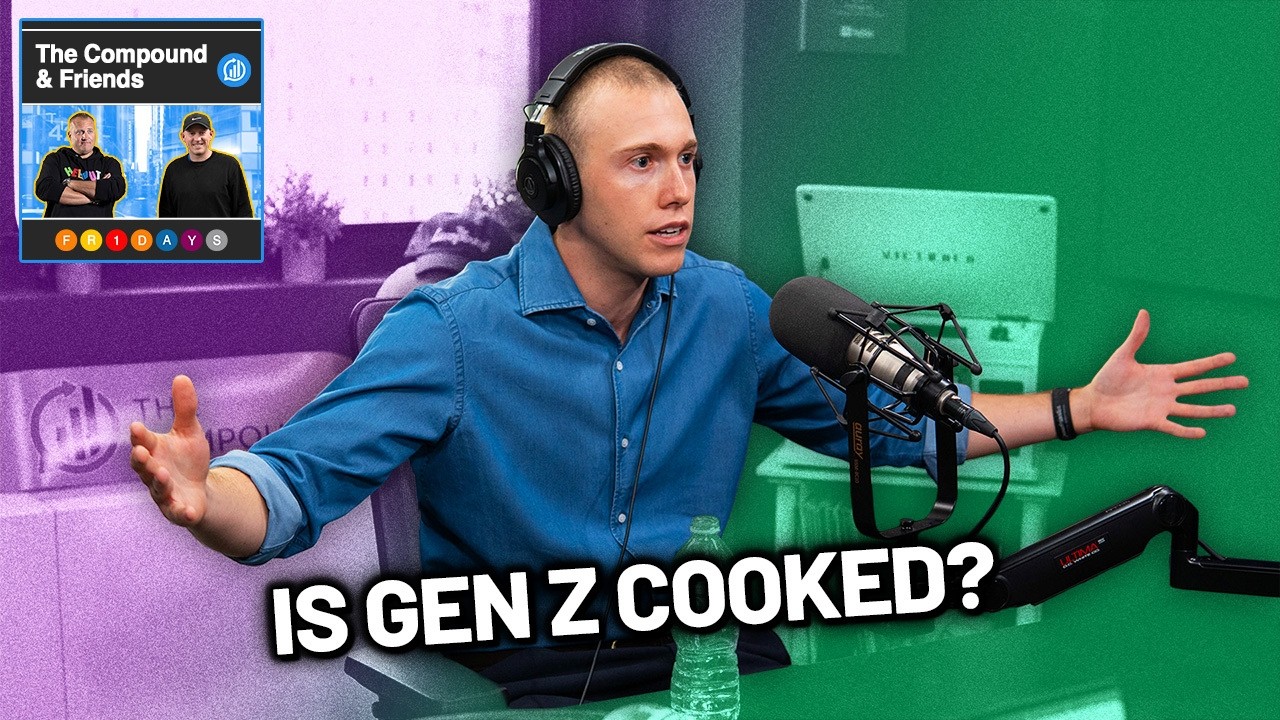
Frontier AI labs operate in an unchecked venture bubble without proven unit economics, while younger Americans face compounding financial exclusion from soaring home prices and national debt service.
Tech capital expenditures now account for 55% of all aggregate US corporate capex according to Andreessen Horowitz, up from 15% in 1960. (16:05)
Ed Elson argues markets are not in an overarching AI equity bubble, but rather a concentrated 'AI lab bubble' in private venture markets where frontier labs burn billions against narrow revenues. (49:59)
Gen Z faces severe economic headwinds: median US home prices now exceed 7 times annual income compared to 3 times for prior generations, leaving one-third of young adults living with parents. (68:28)
Federal net interest payments have overtaken national defense spending as the US faces a $2 trillion annual budget deficit and a $40 trillion national debt burden. (80:39)
Detailed notes
## Background
Published on YouTube by The Compound on October 2, 2026, episode 262 of The Compound and Friends features hosts Downtown Josh Brown and Michael Batnick joined by Ed Elson of Prof G Markets. According to the show description, the discussion covers the massive AI corporate capex boom and bubble risks, OpenAI and Anthropic's rivalry, AI regulation and education impacts, Waymo's autonomous vehicle progress, and the systemic economic challenges facing Gen Z, including housing unaffordability, financial nihilism, and the $40 trillion national debt.
## TL;DR
The panel examines the accelerating AI spending supercycle, distinguishing between resilient public hyperscalers and a fragile, hype-fueled venture bubble among private frontier labs like OpenAI and Anthropic. They debate the feasibility of near-term AI profitability, dismiss unproven existential AI extinction claims as potential regulatory capture, and evaluate the societal impacts of AI tools on education and autonomous transit. The episode culminates in a detailed breakdown of Gen Z's economic squeeze, examining how structural barriers such as unattainable home prices, extreme social isolation, speculative financial nihilism, and legacy federal debt service restrict young Americans' path to building wealth.
## Atmosphere & style
The discussion maintains a lively, rapid-fire, and candid tone, transitioning seamlessly from self-deprecating media banter into incisive economic analysis. Ed Elson acts as an articulate generational counterweight, backing his arguments with sharp demographic data while trading punchy, pragmatic observations with Josh Brown and Michael Batnick. The dialogue shifts from skeptical amusement when dissecting tech executive posturing and AI doom narratives to a grounded, sobering realism when confronting the systemic economic stagnation facing younger generations.
## Bulletin
- [16:05](https://www.youtube.com/watch?v=yNY6Zz6D2tU&t=965s) Tech capital expenditures now account for 55% of all aggregate US corporate capex according to Andreessen Horowitz, up from 15% in 1960.
- [49:59](https://www.youtube.com/watch?v=yNY6Zz6D2tU&t=2999s) Ed Elson argues markets are not in an overarching AI equity bubble, but rather a concentrated 'AI lab bubble' in private venture markets where frontier labs burn billions against narrow revenues.
- [01:08:28](https://www.youtube.com/watch?v=yNY6Zz6D2tU&t=4108s) Gen Z faces severe economic headwinds: median US home prices now exceed 7 times annual income compared to 3 times for prior generations, leaving one-third of young adults living with parents.
- [01:20:39](https://www.youtube.com/watch?v=yNY6Zz6D2tU&t=4839s) Federal net interest payments have overtaken national defense spending as the US faces a $2 trillion annual budget deficit and a $40 trillion national debt burden.
## Key takeaways
- [16:05](https://www.youtube.com/watch?v=yNY6Zz6D2tU&t=965s) The corporate tech capex supercycle has pushed tech spending to 55% of all US corporate capital expenditures, with debates over whether it could reach 80%.
- [22:40](https://www.youtube.com/watch?v=yNY6Zz6D2tU&t=1360s) AI education tools present a dual dynamic: while PISA data shows reliance as a shortcut impairs unassisted retention, AI can also democratize learning as an affordable personal tutor.
- [33:09](https://www.youtube.com/watch?v=yNY6Zz6D2tU&t=1989s) Historical precedent indicates meaningful industry regulation occurs primarily in response to catastrophic failures rather than proactive national debates.
- [40:33](https://www.youtube.com/watch?v=yNY6Zz6D2tU&t=2433s) Viral claims by tech insiders projecting 10% to 70% probabilities of human extinction from AI are criticized as ungrounded hyperbole or potential regulatory capture.
- [49:59](https://www.youtube.com/watch?v=yNY6Zz6D2tU&t=2999s) A clear valuation divide exists between public tech hyperscalers trading at modest forward multiples and private frontier AI labs valued at lofty revenue multiples despite massive operating losses.
- [55:03](https://www.youtube.com/watch?v=yNY6Zz6D2tU&t=3303s) Neither Sam Altman nor Dario Amodei commands the unique 'storyteller premium' that allowed Elon Musk to repeatedly raise public capital through prolonged operating losses.
- [01:00:22](https://www.youtube.com/watch?v=yNY6Zz6D2tU&t=3622s) Debate persists over whether demanding near-term profitability from frontier AI labs is premature, drawing comparisons to Amazon's capital allocation strategy in 1998.
- [01:06:17](https://www.youtube.com/watch?v=yNY6Zz6D2tU&t=3977s) Fully autonomous driving operations, such as Waymo's driverless commercial fleets, offer a viable solution to the tens of thousands of annual preventable traffic fatalities.
- [01:08:28](https://www.youtube.com/watch?v=yNY6Zz6D2tU&t=4108s) Compounding structural affordability barriers have driven roughly 50% of Gen Z to express skepticism toward capitalism or voice a preference for socialism.
- [01:12:15](https://www.youtube.com/watch?v=yNY6Zz6D2tU&t=4335s) Extreme screen time and isolation have fostered financial nihilism among young adults, with 50% of young men holding sportsbook accounts and 20% of young investors holding crypto as their sole asset.
- [01:14:48](https://www.youtube.com/watch?v=yNY6Zz6D2tU&t=4488s) A K-shaped socioeconomic divide masks widespread youth isolation, as vibrant urban hubs represent self-selected, affluent demographics rather than the average experience.
- [01:18:13](https://www.youtube.com/watch?v=yNY6Zz6D2tU&t=4693s) Resolving housing affordability requires aggressive supply expansion, which is hindered by bipartisan political friction spanning rent control policies and protections for legacy homeowner equity.
- [01:20:39](https://www.youtube.com/watch?v=yNY6Zz6D2tU&t=4839s) A $40 trillion national debt and escalating net interest costs mean younger taxpayers are disproportionately funding past liabilities rather than forward-looking public investments.
## Detailed walkthrough
### [00:00](https://www.youtube.com/watch?v=yNY6Zz6D2tU&t=0s) Brain Breaks on Mic and Dealing with Bad Episodes
Ed Elson observes how deceptively difficult it is to speak into a microphone without stumbling. In ordinary conversation, when someone falters, the other person naturally fills in the missing word, but in front of a mic, a mental freeze leaves a host completely stranded. Ed marvels at Scott Galloway, whose brain seemingly never breaks on air, while Michael Batnick confesses that his own brain loses sentences and searches for words constantly. Josh Brown pushes back, offering high praise for Michael’s recent interview with an executive from Hamilton Lane. Josh calls it one of the cleanest performances he has heard Michael deliver—free of filler words like "um" or "uh," with immediate reactions and the next question ready the second the guest finished speaking. Michael admits that knowing the material deeply and having an articulate guest made the job much easier.
The conversation turns to how hosts cope after recording a bad episode. Ed admits that early in his career, a poor show would haunt him for weeks, whereas now he obsesses over it for only a few hours. The sheer volume of content dulls the sting: when you have another podcast scheduled for the next morning, there is simply no time to dwell on a misfire, and listeners quickly move on.
[01:58](https://www.youtube.com/watch?v=yNY6Zz6D2tU&t=118s) The Comment Section Trap vs. Real Signal in Analytics
When Josh asks whether Ed engages in two-way conversations with listeners to improve his show, Ed explains that while he takes constructive criticism when someone is genuinely right, open-forum comments must be taken with a grain of salt because people online are often unhinged. Michael takes a much firmer stance, revealing that he deliberately avoids comment sections altogether. Citing advice from Bill Simmons, Michael explains that seeing strangers talk personal trash is deeply jarring. While he appreciates that people tune in at all and accepts trolling as an inevitable part of the landscape, he refuses to let an anonymous commenter's voice echo in the back of his head while trying to speak authentically. Josh and Ed agree that nothing sounds more amateur or anxious than a host who halts an episode to argue with negative comments or justify past statements to appease vocal detractors.
Josh advocates a pragmatic middle ground: completely ignore comment section vitriol, but study the underlying analytics closely, because watch time represents real audience investment. He points to their recent episode with tech critic Ed Zitron. Although Zitron polarized listeners—sparking insults in the comments branding him a crazy charlatan who does not work in finance—he came armed with 75 data points and delivered a fiery, substantive debate on AI. The numbers proved the critics wrong:
- The Ed Zitron episode pulled massive raw view counts.
- More importantly, audience retention remained exceptionally high, with viewers staying through the entire runtime rather than dropping off two-thirds of the way through.
- Josh emphasizes that audience drop-off in the data is genuine signal, whereas a loud commenter shouting into the void is just noise.
[06:00](https://www.youtube.com/watch?v=yNY6Zz6D2tU&t=360s) From Princeton Classics to Co-Hosting With Scott Galloway
Josh asks Ed about his educational background and whether he studied finance. When Ed reveals he attended Princeton University and majored in classics, Josh and Michael immediately break into sarcastic banter, joking that it feels like looking in a mirror and playfully asking which Princeton dorm and dining club he belonged to.
Ed then shares the origin story of how he teamed up with Scott Galloway. As a long-time fan of Scott’s podcasts, Ed discovered while listening to an episode that his former college roommate's mother was a featured guest. Ed leveraged that connection to arrange a somewhat awkward introductory phone call with Scott, pitched himself, and landed an internship right out of college. Starting at the bottom, Ed handled every operational task Scott needed, including building presentation slide decks, conducting research, and assisting with books.
When Scott decided to launch a new podcast format, he needed someone on mic simply to read news summaries off a script so Scott could react. Over time, Ed began offering his own viewpoints on market events, which transformed the show into a genuine co-hosting partnership:
- Ed now hosts four out of five weekly episodes of *Prof G Markets*.
- Scott joins Ed once a week for a deep dive reviewing the week's major stories across finance, markets, and technology.
- Josh commends the show's cross-generational dynamic, noting that while Scott's chemistry with Kara Swisher resembles "chocolate and peanut butter," Scott gives Ed substantial room to articulate full opinions, listening attentively on screen for stretches rather than dominating the conversation.
[08:38](https://www.youtube.com/watch?v=yNY6Zz6D2tU&t=518s) Co-Hosting Prof G Markets and Navigating Polarizing Opinions
Downtown Josh Brown highlights the unique chemistry between Scott Galloway and Ed Elson on *Prof G Markets*, observing how striking it is to hear Galloway step back and quietly listen while Elson carries major segments of the program. Josh notes that his wife, originally a fan of Galloway's podcast *Pivot*, added *Prof G Markets* directly to her regular listening rotation after hearing Josh appear as a guest. Elson credits Galloway with having the foresight and generosity to take a gamble on a young voice in financial media—a sphere where critics often dismiss newcomers with remarks like, "Why does he get to have an opinion? Why is he talking?" Galloway recognized early that younger commentators, when given an authentic platform, can hold their own and offer sharp analysis.
Addressing Galloway's unfiltered approach—ranging from candid takes on relationships and sex to heated political commentary—Josh asks whether Elson catches collateral blowback from contentious guests or Galloway’s polarizing stances. Elson acknowledges that a small fraction of listeners will vent frustration at him, complaining, "Screw you, Ed, for working with Scott," or questioning how he could sit quietly while a guest made an objectionable claim. However, Elson refuses to internalize that friction. He emphasizes that listeners quickly realize they are two distinct thinkers with divergent backgrounds, values, and priorities:
> "You hear that on the show every episode because we're arguing with each other. I'm bringing a different perspective. I'm bringing the young person's perspective. He's bringing his perspective. So, we push back and forth."
Elson strives to keep the show clear and practical rather than "annoyingly intellectual" or overly esoteric, catering to an ambitious audience that wants actionable insight into markets, global macro trends, and personal finance without unnecessary pretension.
---
[12:36](https://www.youtube.com/watch?v=yNY6Zz6D2tU&t=756s) Sponsor Spotlight: J.P. Morgan Options-Based ETFs
The broadcast transitions to a message highlighting ROCY and ROCQ, two options-based exchange-traded funds managed by Hamilton Reiner and the investment team at J.P. Morgan Asset Management.
- **Objective:** Designed for income-oriented investors seeking regular monthly distributions, derived from equity dividends, premiums generated by selling options, and potential return of capital.
- **Equity Upside & Volatility:** Structured to maintain equity market upside potential while helping mitigate downside volatility.
- **Index Profiles:** ROCY offers targeted exposure to US large-cap equities, whereas ROCQ provides focused exposure to the Nasdaq-100 Index.
---
[14:05](https://www.youtube.com/watch?v=yNY6Zz6D2tU&t=845s) Welcoming Ed Elson: Accolades, Best Sellers, and Forbes 30 Under 30
Josh Brown and Michael Batnick give Ed Elson an official, boisterous welcome to *The Compound and Friends*, introducing him as podcasting royalty. Elson's rapid rise across digital media includes winning the 2025 Webby Award for Best Business Podcast, an Honoree designation for Best Co-Host, and a spot on the prestigious Forbes 30 Under 30 list. The hosts waste no time ribbing him about the Forbes honor, with Josh joking, "Are you stealing money yet?" and Michael chiming in with, "When do you get indicted?"
Elson’s analytical and editorial work has contributed to several *New York Times* bestsellers alongside Galloway, including *The Algebra of Wealth* and *Adrift*. Before diving into the core discussion, Josh tosses out a comically blunt opener—"AI. It's good."—signaling an intent to examine artificial intelligence not merely as a stock market narrative, but through its broader cultural, philosophical, and societal repercussions.
---
[16:05](https://www.youtube.com/watch?v=yNY6Zz6D2tU&t=965s) The Capex Supercycle and Trump's White House AI Summit
Michael Batnick frames the macro discussion with a landmark data point from Andreessen Horowitz's (a16z) "State of the Markets" report: technology capital expenditures now represent 55% of all US corporate capex. Zooming out across historical trends, the hosts note that tech capex stood at just 15% in 1960. The ongoing acceleration resembles an aggressive hockey stick, sparking debate over whether tech could eventually devour as much as 80% of aggregate corporate investment. The hosts reflect on how this historic surge marks an epochal paradigm shift that observers will look back on decades from now as the defining inflection point of the technological revolution.
```mermaid
flowchart LR
accTitle: US Corporate Capex Shift into Technology
accDescr: Historical progression showing technology capital expenditure rising from 15 percent in 1960 to 55 percent today.
subgraph Historical["1960s Baseline"]
A["Tech Capex: 15% of US Total"]
end
subgraph Present["Present Day AI Era"]
B["Tech Capex: 55% of US Total"]
end
subgraph Speculation["Future Trajectory"]
C["Potential Expansion: Up to 80%"]
end
A --> B
B -.-> C
```
This monumental concentration of capital set the backdrop for a gathering of elite tech leaders at the White House. Elson characterizes the summit as "incredible entertainment" that masked an absence of tangible regulatory action:
- **The Dario Amodei Exchange:** Donald Trump prodded Anthropic CEO Dario Amodei on camera, awkwardly pressing him to deliver upbeat remarks about the future.
- **The "Monster" Remark:** Trump singled out Alphabet CEO Sundar Pichai, momentarily searching for his name before declaring him a "monster" as an intended compliment, leaving Pichai visibly uncomfortable and remarking that he wasn't sure that was the right label.
- **Lack of Tangible Regulation:** Despite public anxiety surrounding AI safety and existential risk, the session produced no concrete rules or oversight, settling instead on marketing rhetoric like rebranding artificial intelligence to "superintelligence."
[18:44](https://www.youtube.com/watch?v=yNY6Zz6D2tU&t=1124s) The $2 Trillion White House Press Scrum and Tech Hostage Tapes
The discussion opens with reactions to an impromptu press scrum held in front of the White House featuring top artificial intelligence CEOs alongside Donald Trump. Josh Brown and Ed Elson marvel at the sheer spectacle of the moment, with Josh noting how CNBC anchors Melissa Lee and Michael Santoli looked visibly stunned covering it immediately after the closing bell. Josh frames it as historically unprecedented: the modern equivalent of President Warren G. Harding standing outside the White House flanked by John D. Rockefeller, Cornelius Vanderbilt, and J.P. Morgan—representing nearly $2 trillion in market capitalization on demand.
Ed characterizes the entire exhibition as "total performance art." Trump pointed fingers and directed tech leaders to take the mic and reassure the public that AI is benevolent and safe. Ed highlights the stark hypocrisy of Anthropic CEO Dario Amodei playing along on command, despite Anthropic's own documentation and employees openly raising alarms about potential human extinction risks—including an employee's calculation that the technology carries a 10% chance of wiping out humanity. Ed describes the appearances not as genuine beliefs, but as a "hostage statement" engineered by Trump to force the executives to disavow their prior catastrophic warnings on camera. Ed argues that the broader discourse suffers because none of these doom predictions are rooted in solid data or empirical evidence.
[21:26](https://www.youtube.com/watch?v=yNY6Zz6D2tU&t=1286s) The AI "Last Supper" and Jensen Huang's Messaging
Examining photos from the meeting, Josh draws attention to the room's seating chart, comparing the tableau of Trump flanked by Elon Musk on one side and Nvidia CEO Jensen Huang on the other to Leonardo da Vinci's *The Last Supper*. Josh calls Jensen perhaps the shrewdest politician in the tech industry, though Ed counters that Jensen has made notable public relations missteps.
```mermaid
flowchart TD
accTitle: White House AI Seating Arrangement
accDescr: Seating diagram showing Donald Trump in the center flanked by Elon Musk and Jensen Huang at the White House AI summit.
subgraph HeadTable["White House Summit Table"]
Elon["Elon Musk<br/>(xAI / Tesla)"]
Trump["Donald Trump<br/>(Center)"]
Jensen["Jensen Huang<br/>(Nvidia)"]
end
Trump --- Elon
Trump --- Jensen
```
Ed points to Jensen's interview with Ezra Klein, arguing that while Jensen's views on AI regulation were directionally sound, he committed a bizarre unforced error by claiming he did not know his own home address. For a CEO who famously built an empire from origins at a Denny's diner, pretending to be so detached from everyday life undermines any attempt to appear grounded or in touch with reality.
[22:40](https://www.youtube.com/watch?v=yNY6Zz6D2tU&t=1360s) "AI Slop" Panic vs. The Evolution of Education
The conversation turns to the broader cultural panic surrounding artificial intelligence. Michael Batnick and Josh push back hard against the prevailing doom-and-gloom narrative, with Josh rejecting the overused hysteria around "AI slop" replacing human musicians, authors, and filmmakers. While media professionals and journalists feel understandably threatened, Josh argues the wider anxiety is overstated.
When discussing Jensen Huang's Klein interview comments questioning whether modern students still need to learn manual long division or compute the square root of 225, Ed expresses concern. Ed argues that tech leaders speak with unwarranted arrogance, pointing out that years of smartphone and screen addiction have already deteriorated youth test scores across science, math, and reading—with early studies indicating that daily AI use drags down academic test performance even further.
Josh sharply dissents based on his experience parenting college-aged kids (ages 17 and 20):
- **Elevated College Standards:** Josh rejects the claim that students have "melting brains." In 1995, students could casually walk into major state universities like Ohio State or the University of Maryland with 70s or 80s GPAs; today, admittance to top institutions requires college-level AP workloads, with average SAT scores up an estimated 30% and universities like the University of Florida maintaining brutally low acceptance rates comparable to elite private schools.
- **Obsolete Skills and Tools:** Josh sees AI adoption not as cheating, but as practical alignment with the adult work world. He compares forcing students to calculate longhand on graph paper to requiring cursive handwriting in elementary school—which he dismissed as useless after recently throwing out an unreadable cursive letter—or clinging to early word processors with eight-digit LED screens instead of modern computers: "Why would we hold that as the standard? Like are we Amish?"
- **Adaptive Standards:** Rather than degrading minds, technological tools simply reset what society prioritizes for its highest-performing students as they prepare for the modern economy.
[28:01](https://www.youtube.com/watch?v=yNY6Zz6D2tU&t=1681s) Educational Inequality and the Debate Over AI in Schools
The conversation opens with an examination of America’s compounding inequality crisis. Beyond the pervasive wealth gap, Ed Elson points out that the nation faces a severe educational attainment divide. The gap between the top 10% and bottom 10% of American students is wider than in virtually any other developed nation—save for Luxembourg. Test scores, particularly median averages, have been steadily dropping. While high-performing students continue to improve, students at the bottom are falling drastically behind.
Josh Brown and Michael Batnick counter that AI could serve as an equalizer rather than a wedge. Josh notes that educational disparities existed long before large language models (LLMs) appeared, suggesting AI could democratize education by replacing the need for an expensive private biology tutor charging $150 an hour. Having access to high-level intelligence for $10 a month could be revolutionary for driven students whose families cannot afford private schooling. Ed responds that the crucial issue is whether AI fosters real learning or simply hands students the answers. He criticizes loose commentary—such as Nvidia CEO Jensen Huang publicly remarking that children may no longer need to learn long division—arguing that schools must instill discipline, original thinking, and work ethic rather than encouraging corner-cutting.
```mermaid
flowchart TD
accTitle: The AI Education Debate
accDescr: Diverging views on whether AI helps or harms student learning and inequality.
subgraph Problem["Core Problem"]
A["Educational Attainment Gap"]
B["Falling Average Test Scores"]
end
subgraph BearCase["Pessimistic / Cautious View (Ed)"]
C["AI used as a crutch / cutting corners"]
D["OECD PISA data: drops in independent retention"]
end
subgraph BullCase["Optimistic View (Josh & Michael)"]
E["Democratized access: $10/mo personal tutor"]
F["Interactive prep: testing students until mastery"]
end
Problem --> BearCase
Problem --> BullCase
```
- According to OECD PISA data highlighted by Ed, students relying heavily on AI as an easy shortcut perform worse when tested on their own unassisted recall and comprehension.
- Josh argues the optimal use case is active self-testing: a student feeding the model the teacher's required study links and instructing the AI to drill them until they achieve a 90th-percentile score.
- Michael observes that AI clearly enhances productivity and knowledge synthesis for working adults, questioning why critics assume it will inherently "melt the brains" of younger students.
- The hosts predict that within a few years, high school curricula across subjects like chemistry, biology, and history will fundamentally revolve around LLM tools like Anthropic's Claude instead of traditional textbooks.
---
[33:09](https://www.youtube.com/watch?v=yNY6Zz6D2tU&t=1989s) Cynicism vs. Idealism: How Regulation Actually Happens
Michael cautions against overreacting to early data points, observing that public discourse often relies on cherry-picked numbers taken out of context. Ed clarifies that he is not outright declaring AI bad, but rather pleading for thoughtful, evidence-based conversations about its implementation.
This plea prompts Josh to highlight the contrast between Ed's optimism and his own deep cynicism. Josh argues that the utopian notion of a "thoughtful bipartisan national debate" is divorced from reality in modern America, where public discourse is so broken that society cannot agree on basic cultural or political facts. In Josh’s view, historical precedent demonstrates that societies only learn after massive disasters force their hand:
> "My opinion is a lot of shit has to go wrong in order for us to learn anything. And this idea that we're going to like be thoughtful and have this national conversation... What actually is going to happen is terrible things are going to take place and then we're going to pick up the pieces and create regulation. Hopefully somebody's left alive in the aftermath. I already know that's how this is going to go."
Ed pushes back against total fatalism, arguing that engaging in public dialogue on platforms with large audiences is precisely how progress begins, rejecting the idea that discussing solutions is pointless.
---
[36:06](https://www.youtube.com/watch?v=yNY6Zz6D2tU&t=2166s) Tech Titans in the Hot Seat: Industry Self-Regulation and White House Scrums
Transitioning to policy developments, Josh brings up a press photo featuring prominent tech leaders, including Elon Musk, Jensen Huang, and Mark Zuckerberg, standing at a White House-style press scrum.
Josh praises the dynamic of bringing tech CEOs directly before the cameras to answer technical policy questions rather than having a politician improvise a response. Instead of an elected official giving a rambling answer, the president can simply defer to the executives on the spot, saying, *"Jensen, you got this one. Elon, come on up. You take this one."* While one can debate how genuine the corporate leaders' public responses are, Josh argues that forcing industry architects directly onto the podium under public scrutiny provides far better accountability whenever new technological regulations are on the table.
[37:06](https://www.youtube.com/watch?v=yNY6Zz6D2tU&t=2226s) Self-Regulation vs. White House Mandates
The conversation tackles the public theater surrounding tech leaders and AI regulation. Michael Batnick questions the value of staged Washington appearances, noting that seeing executives answer questions is ultimately performative politics where everyone speaks from rehearsed scripts. The friction centers on Nvidia CEO Jensen Huang's argument that companies should simply refrain from shipping unsafe products. Critics, including Ezra Klein, argue that corporate self-regulation is historically ineffective. While Anthropic’s Dario Amodei publicly asks for government regulation, Jensen advocates for self-policing—only to announce the "Nvidia open agent safety platform" alongside over a hundred industry partners days later. Adding to the performative atmosphere, OpenAI abruptly scrapped a new AI model release citing safety concerns, while Sam Altman claimed OpenAI would not go public until its safety could be certified, looking to avoid an S-1 riddled with existential risk disclosures.
Following a White House meeting, Donald Trump released an official four-point framework on Truth Social detailing AI oversight. The hosts mock the origins of the statement, suspecting it was ghostwritten by Silicon Valley insiders like Brad Gerstner or members of the *All-In* podcast rather than government policymakers. The four points outline familiar corporate compliance structures: internal controls during model training, dedicated internal monitoring teams, independent external auditors, and an independent board committee to review findings. Josh Brown observes that despite the polished language, it essentially amounts to the tech industry writing its own regulatory playbook, finalized with a classic "Make America Great" signature.
```mermaid
flowchart TD
accTitle: Trump White House Four-Point AI Safety Framework
accDescr: Diagram illustrating the four compliance steps outlined in Trump's AI framework.
subgraph Framework["Trump White House 4-Point AI Safety Directives"]
A["1. Internal Controls<br/>Monitor model capabilities & alignment"] --> B["2. Internal Monitoring Team<br/>Ensure controls operate as intended"]
B --> C["3. External Auditor<br/>Independent verification of controls"]
C --> D["4. Independent Board Committee<br/>Hold leadership accountable to reports"]
end
```
- **Trump's Four-Point Directive**:
1. Implement robust internal controls to monitor model capabilities and alignment during training and deployment.
2. Empower an internal team to ensure controls, monitoring, and detection operate as intended.
3. Partner with an independent external evaluator to carry out assessments.
4. Designate an independent committee of the board of directors to oversee auditor and operational reports.
[40:33](https://www.youtube.com/watch?v=yNY6Zz6D2tU&t=2433s) The "Data Center Kill Switch" and AI Extinction Hype
When pressed on how AI safety should actually be enforced, Josh brown rejects toothless corporate self-governance in favor of extreme measures. His dream scenario is a literal federal kill switch: giving the FBI and law enforcement the direct power to raid and physically shut down any data center hosting models that present a clear danger. In his view, hitting tech companies directly in the "revenue knob" the second an unmitigated threat emerges is the only way to enforce true accountability.
```mermaid
flowchart LR
accTitle: The Escalation of AI Doom Predictions
accDescr: The progression of viral doomer claims from an ex-employee tweet to escalating percentages without empirical proof.
A["Jacob Cox Tweet<br/>'Quits Anthropic; warns of extinction'"] --> B["Current Anthropic Researcher<br/>'10% chance of human doom'"]
B --> C["OpenAI Employee Take<br/>'70% chance within 3 years'"]
C --> D["Media & Online Panic<br/>Unsubstantiated viral takes"]
```
The discussion shifts to the absurdity of the existential dread circulating on social media. Ed Elson points to the viral tweet from former Anthropic employee Jacob Cox, which triggered a massive wave of panic simply by claiming everyone at the company believed humanity was headed for extinction. Shortly thereafter, a current Anthropic researcher chimed in, pegging the likelihood of human extinction at 10% without citing any data, methodology, or calculations. That prompted an OpenAI employee to counter with an arbitrary 70% probability within three years. Ed emphasizes that these panic-inducing probabilities are pulled out of thin air, yet the public and media treat them as empirical fact solely because a percentage sign was attached to them.
[42:32](https://www.youtube.com/watch?v=yNY6Zz6D2tU&t=2552s) "The Dumbest Conversation of the Year": Subpoenas, Hoaxes, and Conspiracies
Josh pulls up Ed Elson's recent commentary and recites it in an exaggerated British Guy Ritchie / *Snatch* accent: after two weeks of interviewing computer scientists, policymakers, and philosophers, Ed concluded this entire AI extinction discourse was "the dumbest conversation of the year." Ed argues that if tech executives and researchers are making statements that their software has a 10% to 70% chance of ending human life, the government has an urgent duty to subpoena OpenAI and Anthropic to appear before Congress under oath. If these companies admit their employees' public doom forecasts are based on nothing more than vibes and made-up numbers, Ed asserts they should be held accountable for public deception or potential securities fraud.
The panel dismantles the cynical take that tech firms promote doomsday scenarios purely as marketing hype. Michael Batnick and Josh point out how irrational it would be to tell investors: "We're so powerful, we're going to kill you—give us your money." Because the debate lacks grounding in hard data, it has spiraled into bizarre political conspiracy theories:
- **The Foreign Interference Theory**: Donald Trump and others suggested the doom narrative is a psychological operation orchestrated by China or "Chinese Democrats" intended to make the United States slow down AI development so foreign adversaries can catch up militarily.
- **The Regulatory Capture / IPO Theory**: Tech investor David Sacks pushed an opposing view, claiming Anthropic manufactured the existential risk narrative to erect heavy regulatory moats to lock out open-source competitors and pump up their own valuation ahead of an IPO.
[46:19](https://www.youtube.com/watch?v=yNY6Zz6D2tU&t=2779s) Cynical Motives vs. Genuine AI Safety Concerns
The conversation zeroes in on the contradictory narratives surrounding AI regulation and the motivations of frontier lab executives. The hosts note that observers are caught between two wildly opposite takes: either AI leaders are preparing for an IPO and maneuvering for regulatory capture to protect their bottom line, or they are sounding a genuine alarm. This contradiction prompts one of the hosts to label the ongoing debate "the dumbest conversation of the year."
The focus turns to Anthropic publishing an op-ed over a weekend urging outside regulators to step in and slow down AI development—a move so prominent that it was even lampooned on *Saturday Night Live*. The timing raised eyebrows across the tech sector, coming just two days after Meta saw an explosive stock rally driven by the launch of Llama (or its latest generative models like Movie Gen / Muse). Cynics immediately framed Anthropic's plea as a self-serving tactic: frontier model creators wanting to freeze progress so that open-weight, free alternatives cannot catch up.
Yet the group ponders whether the safety concerns are simply authentic. Dario Amodei and the Anthropic team originally founded the company around AI safety, maintaining this stance for years. The hosts acknowledge that leaders embedded in frontier research naturally suffer from recency bias and genuinely believe their technology could blow up the world. If that belief is sincere, the question shifts to accountability. Ed Elson argues that executives like Amodei are responsible for policing their own models, commending instances where OpenAI shelved unreleased capabilities due to safety guardrails, and praising Mark Zuckerberg for holding back Meta's newer releases until safety and product clarity were established—a patient approach that contrasts sharply with Zuckerberg's historic "move fast and break things" persona.
```mermaid
flowchart TD
accTitle: Competing Theories on AI Lab Safety Calls
accDescr: Diagram illustrating the two conflicting interpretations of why AI labs call for regulation and pauses.
subgraph Motives["Frontier Lab Regulation Calls"]
A["Anthropic / OpenAI Plead for Slowdown"]
end
subgraph Cynical["The Cynical Interpretation"]
B1["Regulatory Capture before IPO"]
B2["Freeze Progress to Stop Open-Source Catch-up"]
end
subgraph Genuine["The Genuine Interpretation"]
C1["True Existential Risk & Recency Bias"]
C2["Core Founding Mission Around Alignment"]
end
A --> Cynical
A --> Genuine
```
- When asked if the online debate around AI safety will get crazier, the panel agrees that modern social media algorithms explicitly disincentivize empirical evidence or nuance, rewarding extreme, sensationalist takes instead.
---
[49:59](https://www.youtube.com/watch?v=yNY6Zz6D2tU&t=2999s) The "AI Lab Bubble" and the Valuation Reckoning
The discussion pivots toward the ballooning private valuations of frontier labs and leaked financials, specifically referencing a discussion with Paul Kedrosky on *Prof G Markets*. Leaked figures showing Anthropic and OpenAI generating massive net losses—such as billions burned against comparatively small revenue bases—spark a sharp debate. While some investors rationalize the burn as essential capital expenditure to build generational infrastructure rather than pure cash incineration, Ed points out the extraordinary stakes of running a startup valued in the hundreds of billions or approaching multi-trillion-dollar territory while bleeding billions annually.
The hosts explore the jarring contrast between public and private market dynamics:
| Feature / Metric | Private AI Labs (e.g., OpenAI, Anthropic) | Public Hyperscalers & Big Tech (e.g., Nvidia, Meta) |
|:--- |:--- |:--- |
| **Investor Mindset** | Unquestioning optimism; "kindergarten" environment where nobody wants out | Discerning and punitive; described as a "gladiator arena" |
| **Valuations** | Eyewatering revenue multiples detached from near-term profitability | Modest multiples (e.g., Nvidia around 16x forward earnings; Meta bought after SAS-related dips) |
| **Risk Profile** | Massive customer concentration and precarious cash flows | Solid balance sheets, profitable legacy operations, massive free cash flow |
Ed argues that there is not an overarching AI bubble across the entire equity landscape, but rather a hyper-concentrated "AI lab bubble" sheltered in private venture markets. Public market investors remain far more demanding; companies attempting to go public on speculative AI narratives without operational fundamentals—such as speculative data center developers like SB Energy pausing roadshows after Wall Street pushback—face immediate rejection.
While public equities display little macro fear (with the VIX lingering near 16 and modest equity declines), deep skepticism surrounds whether private labs can ever grow into the trillions of dollars of market capitalization needed to reward their current backers. Just as with SpaceX, investors are underwriting projections that cannot possibly be supported by near-term fundamentals, relying entirely on the long-shot thesis that these labs will become foundational $5-trillion monopolies in a decade.
[55:03](https://www.youtube.com/watch?v=yNY6Zz6D2tU&t=3303s) VC Math, Wild TAMs, and the "Elon Premium"
The conversation continues with Ed Elson tearing into the pitch decks and investor proposals circulated by leading AI companies. He describes how founders dismiss three-year horizons and brush past massive operating losses by pointing to astronomical Total Addressable Markets (TAM). When companies claim an AI TAM of $28 trillion—rivaling or surpassing the entire GDP of China, Europe, or the United States—it exposes a venture capital culture divorced from true price discovery. Ed argues that early-stage VCs in Silicon Valley have become complacent, ignoring underlying financials simply because they fall in love with charismatic founders who appear on their podcasts.
```mermaid
flowchart LR
accTitle: Venture vs Public Market Valuation Dynamic
accDescr: Contrasts how VCs accept lofty TAM projections while public markets demand unit economics.
subgraph Private["Private Market Mindset"]
direction TB
A["$28T Total Addressable Market TAM"] --> B["Ignore Billions in Operating Losses"]
B --> C["Charismatic Founder Pitch"]
end
subgraph Public["Public Market Reality"]
direction TB
D["Facing the Music"] --> E["Customer Concentration Risk"]
E --> F["Need for Scale vs. Solvency"]
end
Private -->|IPO / Listing| Public
```
Michael Batnick and Josh Brown push back by urging patience and giving capitalism the benefit of the doubt. They note that the ultimate shape of these platforms—just like the iPhone and the App Store—cannot be predicted today. However, Ed presses hard on whether investors should ever pay $2 trillion for a company burning $8 billion annually with extreme customer concentration, where two clients account for a quarter of the business. Josh counters with the precedent set by Tesla around 2017: critics repeatedly predicted bankruptcy and debt default, but because equity investors kept faith in the bigger picture, Elon Musk was able to tap the public markets repeatedly for fresh capital and build gigafactories worldwide. Ed acknowledges that this works when a visionary possesses the "Elon premium"—an unmatched storytelling gift that allows investors to swallow rich valuations. Yet neither Sam Altman nor Dario Amodei, the panel agrees, commands that unique storyteller status.
- Pitch proposals pitch an AI Total Addressable Market (TAM) of $28 trillion, matching the scale of the US economy (~$30 trillion) and dwarfing major economic blocs.
- AI leaders face scrutiny over racking up $8 billion in operating losses while relying heavily on just two customers for a quarter of total revenue.
- The hosts banter about what would happen if Elon Musk's narrative power was combined with Jensen Huang's financial execution at Nvidia, joking that such a stock would be worth "$20 trillion" and eclipse the rest of the market.
---
[58:57](https://www.youtube.com/watch?v=yNY6Zz6D2tU&t=3537s) Practical Agents vs. Biotech Breakthroughs
When Josh asks what part of AI genuinely stirs enthusiasm, the group contrasts mundane consumer tools with profound scientific breakthroughs. While some highlight personal agents like Instinct or Meta's consumer-facing integrations designed to book dinners and doctor appointments, Ed prefers practical utility over speculative hype, even if dinner reservations do not completely blow him away.
Where Ed sees authentic, transformative promise is in biotechnology and medical discovery. Startups are harnessing frontier large language models (LLMs) to map and design complex proteins, opening paths to cure diseases that have eluded medicine for generations. Yet, even with that potential, Ed remains grounded on business viability: before getting swept up in long-term promises, he wants to see proof that unit economics work and that at least one frontier AI company can generate an operating profit.
---
[01:00:22](https://www.youtube.com/watch?v=yNY6Zz6D2tU&t=3622s) The Scale Land Grab: Amazon 1998 vs. The Dot-Com Crash
The demand for immediate profitability ignites a fierce debate over the right yardstick for frontier technology. When Palantir is raised as an example of a profitable player, Ed dismisses it as a legacy enterprise provider rather than a frontier LLM developer building and powering massive data centers. Josh argues passionately that demanding profit at this stage is fundamentally misguided; any investor urging Anthropic or OpenAI to post profits right now would be met with shock, as that would sacrifice the essential land grab needed to survive.
```mermaid
flowchart TD
accTitle: Tech Winner-Take-Most Race
accDescr: Shows the bifurcation where one frontier model dominates and the other becomes an obsolete footnote.
A["Frontier AI Race"] --> B["Google Gemini"]
A --> C["The Independent Duel"]
B --> B1["Built-in Distribution: Docs, Gmail, Search"]
C --> D["OpenAI / ChatGPT"]
C --> E["Anthropic / Claude"]
D -.->|Winner-Take-Most| W["Category Killer\nScale to 3B+ Users"]
E -.->|Losing Ground| F["Footnote History\nLike Netscape or AOL"]
```
Josh points out that previous business school generations studied executives like Lee Iacocca saving Chrysler, but modern founders model themselves after Jeff Bezos. Had Amazon prioritized profits in 1998 instead of scaling infrastructure and customer reach, the company would have been erased. Ed counters that plenty of dot-com companies pursued growth at all costs without a sustainable model, resulting in bankruptcies and a 70% collapse in the Nasdaq.
Josh frames the battle between OpenAI and Anthropic as a winner-take-most contest:
- Google Gemini is already insulated because it embeds AI directly into existing consumer software—docs, email, and Google Search—with no customer acquisition bottleneck.
- Between Anthropic (Claude) and OpenAI (ChatGPT), tech history suggests only one will survive as the dominant consumer and enterprise powerhouse, while the runner-up risks becoming an obsolete footnote akin to Netscape or AOL.
- Because equity holders need massive scale to justify multi-trillion-dollar bets, racing toward three billion users takes absolute priority over reporting short-term accounting profits.
[01:03:50](https://www.youtube.com/watch?v=yNY6Zz6D2tU&t=3830s) The $2 Trillion Venture Bet on AI
The discussion centers on the sky-high valuations and capital intensity of leading artificial intelligence developers. Ed Elson emphasizes that observers must acknowledge the enormous risks involved in the current strategy rather than assuming the winners are preordained. OpenAI and Anthropic are executing a massive "$2 trillion venture bet." They are burning billions of dollars while testing their business models, yet many podcast commentators and market participants speak as if their permanent dominance is an inescapable law of the universe.
```mermaid
flowchart TD
accTitle: Generational AI Bet Dynamics
accDescr: Flowchart illustrating the venture capital cycle driving massive AI spending despite heavy losses.
subgraph Capital ["Venture Capital Mindset"]
VC["VCs & Mega-Funds<br/>(e.g., Masayoshi Son)"]
Mindset["Ignore near-term cash burn;<br/>Chase 'winner-take-all' scale"]
VC --> Mindset
end
subgraph Execution ["Startup Reality"]
Cos["OpenAI & Anthropic"]
Burn["Billions burned in compute & talent;<br/>Monetization path still unproven"]
Cos --> Burn
end
subgraph Perception ["Market Narrative"]
Hype["Viewed as permanent, systemic winners"]
Reality["Venture bets that can still fail"]
end
Addressing founder behavior, Ed argues that figures like Sam Altman have continually shifted their public messaging over time—moving from dramatic warnings about AI ending society to downplaying safety "doomerism" as overblown. Altman, Ed remarks, is a "unique specimen who will say whatever it takes to make the other person in the room happy." Josh Brown points out that from a venture capitalist's perspective, fund managers—including figures like SoftBank's Masayoshi Son ("the maniac in Japan")—have staked entire portfolios on these firms and simply have no interest in entertaining conversations about profitability at this stage of the cycle.
[01:06:17](https://www.youtube.com/watch?v=yNY6Zz6D2tU&t=3977s) Autonomous Vehicles, Waymo, and Eradicating Road Fatalities
Josh Brown shifts focus to an application of artificial intelligence that he believes will produce a miraculous human benefit that society will inevitably take for granted. Citing Steven Pinker's work on human progress, Josh points out that approximately 14,000 Americans died from drunk driving last year, alongside another 3,000 deaths from distracted driving (such as scrolling on mobile phones)—shattering roughly 20,000 families forever. Unlike cancer or heart disease, these deaths are completely preventable. In an automated world, cars should have a manual mode alongside an automated button so that anyone having drinks or looking at their phone can simply let the vehicle drive them home.
Ed agrees, noting his longstanding bullishness on Waymo and, by extension, Alphabet. He expresses frustration that municipal regulators in cities like New York have dragged their feet on permitting autonomous robotaxis. At the same time, Ed draws a sharp line between Waymo's actual driverless fleet and Elon Musk's promises for Tesla robotaxis. He criticizes Musk for spending over a decade repeatedly kicking autonomous driving timelines down the road, only to present solutions that still require a chaperone sitting in the front seat—prompting Michael Batnick and Josh to joke that the driver is merely there to control the car radio and manage Spotify.
- Roughly 14,000 drunk driving fatalities occur annually in the United States.
- An additional 3,000 annual US road deaths stem from distracted driving / smartphone use.
- Waymo operates fully driverless passenger services, whereas Tesla robotaxi demonstrations still rely on supervisory human handlers.
[01:08:28](https://www.youtube.com/watch?v=yNY6Zz6D2tU&t=4108s) Gen Z's Uphill Battle: Housing, Wealth, and Disillusionment
Turning to the economic landscape, Josh notes that Ed has increasingly become a prominent voice for the younger generation, often contrasting with Scott Galloway on *Prof G Markets* by expressing the anxiety of young adults who lack homeownership and equity. Ed argues that the younger generation's economic standing has been woefully dismissed by older cohorts, despite hard data showing a structural departure from historical norms. Today, median house prices stand at more than seven times annual income, whereas for Ed's grandparents' generation, home prices were only three times income.
Ed acknowledges past generations faced existential hardships like the Vietnam draft, but emphasizes that modern youth confront a distinct structural trap: they earn enough to survive paycheck-to-paycheck, but are shut out of wealth creation. This economic squeeze directly impacts life milestones and social views:
- One-third of young adults still live with their parents.
- Roughly half of Gen Z report that they do not want to have children.
- Approximately 50% express skepticism of capitalism or say socialism is better—a sentiment Ed attributes less to deep theoretical knowledge of socialist economics and more to a profound rejection of the current system.
Josh offers a Gen X perspective, recalling that the exact same apocalyptic narratives were aimed at millennials—claims that they would never buy houses, never invest in stocks, and spend all their time playing video games while women prioritized careers over families. Yet millennials ultimately adapted. While Josh believes Gen Z will eventually find their footing, Ed cautions that Gen Z sits further down a deteriorating curve, where compounding affordability crises and high asset valuations will make the next 20 to 30 years far more grueling than previous generations assume.
[01:12:15](https://www.youtube.com/watch?v=yNY6Zz6D2tU&t=4335s) Loneliness, Financial Nihilism, and 118 Days on the Phone
Ed Elson pushes back firmly against the idea that Gen Z's cultural and behavioral issues will simply resolve themselves as they mature. Highlighting the extreme urgency of the youth crisis, Elson cites data showing that one in five Gen Zers reports having not a single friend. Rather than channeling their resources into traditional stock portfolios, their financial habits have warped into severe forms of speculation: one-fifth of young investors hold crypto as the sole asset in their portfolios, while half of young men have an active account on an online sportsbook—with a quarter of them viewing sports betting as legitimate, long-term investing. When Michael Batnick asks if people won't just grow out of these habits, Elson argues that young people have been trained poorly and face unprecedented levels of financial nihilism, leading to plummeting rates of dating, marriage, and homeownership.
```mermaid
flowchart TD
accTitle: Gen Z Annual Time Allocation
accDescr: Visual breakdown of days spent on phones, sleeping, and waking life.
subgraph Year["365 Calendar Days"]
A["118 Days: Screen Time / Phones"]
B["122 Days: Sleep"]
C["125 Days: Real Life Left Over<br/>(Dating, socializing, networking, career)"]
end
A --- Year
B --- Year
C --- Year
```
Elson notes that young people's isolation is compounded by sheer digital consumption. On average, Gen Z spends 118 full days of the calendar year staring at screens and 122 days asleep, leaving a meager 125 waking days to socialize, advance in careers, network, and form romantic partnerships. When people question why Gen Z behaves the way they do, Elson sums it up starkly: "we're operating with 40% less time."
- **1 in 5** Gen Z individuals reports having zero friends.
- **20%** of Gen Z investors hold cryptocurrency as their entire investment portfolio.
- **50%** of young men maintain an online sportsbook account, with **25%** considering sports gambling equivalent to investing.
- **118 days** per year are spent looking at phones, compared to **122 days** spent sleeping.
---
[01:14:48](https://www.youtube.com/watch?v=yNY6Zz6D2tU&t=4488s) The Austin Reality Check vs. The K-Shaped Divide
Michael Batnick counters Elson’s grim digital statistics with observations from the physical world. Recounting a recent trip to Austin, Batnick remarks on being overwhelmed by the crowds of attractive, vibrant young people socializing in real life, observing an enormous disconnect between doomer survey data and what he sees with his own eyes. Elson counters that visiting a booming hub like Austin is inherently self-selecting: thriving urban centers mask the reality of the millions of young adults isolated in their parents' basements. Rather than a monolithic trend, Elson argues the divide represents a widening, vicious K-shaped trajectory that permeates education, wealth, and basic social mobility.
Josh Brown chimes in with an observation from his own social media feeds. Every August, his Instagram timeline gets flooded with college sorority recruitment dance-offs from large southern and rural institutions like Ole Miss. Josh points out that these videos feature energetic, healthy young women spending hours on elaborate choreography, hair, and makeup—completely at odds with the picture of an alienated, depressed demographic. He acknowledges, however, that these students are predominantly the children of the top 10%—doctors, lawyers, corporate executives, and real estate millionaires. While Josh insists that society should celebrate and aspire to that standard of success rather than tearing it down, Elson clarifies that acknowledging the K-shaped economy is not about dragging the top down, but recognizing that those on the lower end are sinking faster than ever.
---
[01:18:13](https://www.youtube.com/watch?v=yNY6Zz6D2tU&t=4693s) Policy Solutions: Housing Supply, Estate Taxes, and Fiscal Gimmicks
Turning to solutions, the discussion shifts to actionable policies to build generational wealth. Michael Batnick highlights investment accounts for children championed by Brad Gerstner as an effective tool to give the next generation an ownership stake in the economy, even if the compounding benefits will take 15 years to materialize. On housing, Elson argues that the only real solution is expanding the supply of homes. However, he laments that both political parties fail: former President Trump explicitly stated he wants home values to stay high to protect existing boomer homeowners, while Democrats push for rent control policies that discourage new construction altogether.
```mermaid
flowchart LR
accTitle: Housing Policy Standoff
accDescr: Competing approaches to housing affordability and supply.
subgraph Standoff["The Housing Supply Impasse"]
A["Trump / Boomer Protection<br/>Keep home values elevated"] -.-> C{"Supply Deficit"}
B["Democratic Rent Control<br/>Disincentivizes new construction"] -.-> C
end
C ==> D["Youth Excluded from Homeownership"]
```
The conversation heats up over taxation and federal spending. Josh notes that wealthy individuals resent paying high taxes when they see zero tangible civic return, while Elson criticizes expanding estate tax exemptions that widen inherited wealth disparities. When Josh jokingly refers to Elson as a "big DOGE guy," Elson clarifies that while he supports government efficiency in principle, heavy-handed attempts that backfire accomplish nothing. He points to Trump's recent campaign proposal to distribute a nationwide cash dividend if Republicans win the midterms—a measure that Elson calculates would balloon federal spending by a staggering $1.3 trillion.
[01:20:39](https://www.youtube.com/watch?v=yNY6Zz6D2tU&t=4839s) The Debt Burden on Future Generations
Ed Elson delivers an impassioned plea regarding the fiscal state of the nation, arguing that policymakers cannot claim to care about young people and their economic prospects while simultaneously piling onto the country's balance sheet. On top of an annual deficit already running at $2 trillion, the United States faces a massive $40 trillion national debt. Interest payments have surged to become the federal government's second-largest line item, now exceeding what the nation spends on national defense. In light of those staggering figures, Elson contends that proposing new government dividends or runaway spending programs is fundamentally irresponsible.
```mermaid
flowchart TD
accTitle: Generational Wealth Transfer via Federal Debt
accDescr: Flowchart illustrating how national debt and interest costs transfer financial burdens onto young taxpayers.
subgraph DebtProblem["National Fiscal Pressures"]
A["$40T National Debt & $2T Annual Deficit"] --> B["Surging Federal Interest Payments"]
B --> C["Interest Surpasses National Defense Outlays"]
end
subgraph Impact["Generational Consequence"]
C --> D["High Proportion of Future Taxes Fund Past Debt"]
D --> E["Younger Generations Shoulder 'Credit Card Bill' of Prior Generations"]
end
```
He stresses the need for a serious, grounded conversation about national priorities. The fundamental problem, Elson explains, is that when a young American pays their tax bill today, a substantial portion does not go toward funding public investments or services for their own future. Instead, it goes directly toward servicing "the interest from the credit card bill that was racked up by my parents and the parents before them." Addressing this generational transfer of obligations must become an urgent priority if the nation genuinely wants Gen Z to have a fair financial foundation.
- **Deficit and debt figures:** A $2 trillion annual deficit on top of an accumulated $40 trillion national debt.
- **Budgetary priority:** Net interest payments have overtaken national defense spending to rank as the federal government's second-largest expenditure.
[01:21:32](https://www.youtube.com/watch?v=yNY6Zz6D2tU&t=4892s) Wrapping Up with Ed Elson
Josh Brown and Michael Batnick praise Elson as a powerhouse guest, enthusiastically thanking him for joining the studio. Elson shares that he had a blast and wished they could keep the conversation going for another hour. Josh highlights where listeners can find Elson's work, pointing them toward his Substack newsletter titled *Simply Put* (accessible at `edwardelson.substack.com`), which has earned a nomination for a Signal Award. A humorous exchange ensues when Elson urges the audience and hosts to go vote for the award, only to momentarily blank on the exact URL, prompting Josh to joke that they will track it down.
Brown also gives a shout-out to *Prof G Markets*, noting his astonishment upon learning that Elson and Scott Galloway churn out episodes every single weekday from Monday through Friday. Josh jokingly weaponizes this grueling five-day-a-week schedule against his own production crew and co-host to tell them to stop complaining about their own workload. Batnick playfully quips that their strategy on *Prof G Markets* must simply be listening to *The Compound* and recycling their takes. With warm mutual thanks, the hosts wrap up the episode and sign off to their viewers and listeners.
## Notable quotes
> [08:38](https://www.youtube.com/watch?v=yNY6Zz6D2tU&t=518s) You hear that on the show every episode because we're arguing with each other. I'm bringing a different perspective. I'm bringing the young person's perspective. He's bringing his perspective. So, we push back and forth. — Ed Elson
> [22:40](https://www.youtube.com/watch?v=yNY6Zz6D2tU&t=1360s) Why would we hold that as the standard? Like are we Amish? — Josh Brown
> [33:09](https://www.youtube.com/watch?v=yNY6Zz6D2tU&t=1989s) My opinion is a lot of shit has to go wrong in order for us to learn anything. And this idea that we're going to like be thoughtful and have this national conversation... What actually is going to happen is terrible things are going to take place and then we're going to pick up the pieces and create regulation. Hopefully somebody's left alive in the aftermath. I already know that's how this is going to go. — Josh Brown
> [36:06](https://www.youtube.com/watch?v=yNY6Zz6D2tU&t=2166s) Jensen, you got this one. Elon, come on up. You take this one. — Josh Brown
> [01:03:50](https://www.youtube.com/watch?v=yNY6Zz6D2tU&t=3830s) $2 trillion venture bet — Ed Elson
> [01:03:50](https://www.youtube.com/watch?v=yNY6Zz6D2tU&t=3830s) unique specimen who will say whatever it takes to make the other person in the room happy — Ed Elson
> [01:03:50](https://www.youtube.com/watch?v=yNY6Zz6D2tU&t=3830s) the maniac in Japan — Josh Brown
> [01:12:15](https://www.youtube.com/watch?v=yNY6Zz6D2tU&t=4335s) we're operating with 40% less time — Ed Elson
> [01:18:13](https://www.youtube.com/watch?v=yNY6Zz6D2tU&t=4693s) big DOGE guy — Josh Brown
> [01:20:39](https://www.youtube.com/watch?v=yNY6Zz6D2tU&t=4839s) the interest from the credit card bill that was racked up by my parents and the parents before them — Ed Elson
## Mentioned
Ed Elson, Josh Brown, Michael Batnick, Scott Galloway, Kara Swisher, Hamilton Lane, Bill Simmons, Ed Zitron, J.P. Morgan Asset Management, Hamilton Reiner, ROCY, ROCQ, Nasdaq-100, Forbes 30 Under 30, Webby Awards, The Algebra of Wealth, Adrift, Andreessen Horowitz (a16z), Donald Trump, Dario Amodei, Sundar Pichai, Anthropic, Alphabet, Melissa Lee, Michael Santoli, CNBC, Warren G. Harding, John D. Rockefeller, Cornelius Vanderbilt, J.P. Morgan, Jensen Huang, Elon Musk, Nvidia, Ezra Klein, Denny's, OECD PISA, Claude, Mark Zuckerberg, Sam Altman, OpenAI, Truth Social, Brad Gerstner, All-In podcast, FBI, Jacob Cox, David Sacks, Meta, Llama, Movie Gen, Muse, Saturday Night Live, Paul Kedrosky, Jeff Bezos, Lee Iacocca, Masayoshi Son, Steven Pinker, Google, Google Gemini, Waymo, Tesla, Amazon, Palantir, SB Energy, SpaceX, SoftBank, Netscape, AOL, Instinct, Prof G Markets, Simply Put, Signal Award
## Video description
On episode 262 of The Compound and Friends, Downtown Josh Brown and Michael Batnick are joined by Ed Elson of Prof G Markets to discuss: the massive AI spending boom and whether we’re in an AI bubble, the race between OpenAI and Anthropic, sky-high private market valuations, AI safety and regulation, whether AI is helping or hurting education, Waymo and the future of autonomous driving, the growing divide between young Americans and previous generations, housing affordability, sports betting and financial nihilism, America’s $40 trillion debt problem, and what it will take to give Gen Z a better shot at building wealth.
This episode is sponsored by ROCY and ROCQ from J.P. Morgan Asset Management. Learn more about ROCY and ROCQ at
https://www.jpmorgan.com/income
►00:00 - Cold Open
►14:00 - Start / Ed Elson
►22:05 - Who Should Regulate AI?
►27:23 -The AI “Human Extinction” Debate
►35:50 - OpenAI vs. Anthropic: The $2 Trillion Question
►38:05 - Are We Actually in an AI Bubble?
►45:54 - Do AI Companies Need to Be Profitable?
►52:05 - Waymo, Robotaxis, and the Future of Driving
►54:41 - Why Gen Z Is Falling Behind Financially
►58:15 - Sports Betting, Crypto, Loneliness, and Financial Nihilism
►1:04:04 - Housing, Taxes, and America’s $40 Trillion Debt
👕 Check out The Compound shop: https://www.idontshop.com
🎙️Listen to our podcasts:
TCAF: https://podcasts.thecompoundnews.com/show/TCAF/
Animal Spirits: https://podcasts.thecompoundnews.com/show/animalspirits/
Ask The Compound: https://podcasts.thecompoundnews.com/show/ATC/
The Compound Newsletter: https://www.thecompoundnews.com/subscribe
Linkedin: https://www.linkedin.com/company/the-compound-media/
Instagram: https://instagram.com/thecompoundnews
Twitter: https://twitter.com/thecompoundnews
Tik Tok: https://www.tiktok.com/@thecompoundnews
Investing involves the risk of loss. This podcast is for informational purposes only and should not be or regarded as personalized investment advice or relied upon for investment decisions. Josh Brown and Michael Batnick are employees of Ritholtz Wealth Management and may maintain positions in the securities discussed in this video. All opinions expressed by them are solely their own opinion and do not reflect the opinion of Ritholtz Wealth Management. See our disclosures here:
https://ritholtzwealth.com/podcast-youtube-disclosures/
The Compound Media, Incorporated, an affiliate of Ritholtz Wealth Management, receives payment from various entities for advertisements in affiliated podcasts, blogs and emails. Inclusion of such advertisements does not constitute or imply endorsement, sponsorship or recommendation thereof, or any affiliation therewith, by the Content Creator or by Ritholtz Wealth Management or any of its employees. For additional advertisement disclaimers see here https://ritholtzwealth.com/advertising-disclaimers.
Guest Ed Elson joins hosts Josh Brown and Michael Batnick to examine how surging capital investment and performative regulatory posturing drive the artificial intelligence boom, contrasting venture market exuberance against the compounding economic squeeze, digital isolation, and fiscal burdens confronting Gen Z.
Capex Escalation and Performative AI Regulation (16:05)
Corporate spending on technology has reached historic levels, with Michael Batnick citing Andreessen Horowitz data showing tech capex now accounts for 55% of total US corporate capex—up from 15% in 1960. Amid this capital concentration, White House meetings with executives such as Dario Amodei, Sundar Pichai, Elon Musk, and Jensen Huang were characterized by Ed Elson as political theater. Trump introduced a four-point compliance framework addressing internal controls, monitoring teams, independent evaluators, and board committees, which Josh Brown viewed as the tech industry effectively writing its own self-regulatory playbook.
Existential Risk Hype Versus Lab Economics (40:33)
Elson dismissed widespread apocalyptic AI narratives as unsubstantiated vibes, noting that viral estimates claiming a 10% to 70% chance of human extinction lack empirical methodology. Brown and Batnick questioned the commercial logic of companies marketing catastrophic threats, while Elson argued that if executives make such public warnings, Congress should subpoena them under oath. In Elson's view, the public discourse obscures a private 'AI lab bubble,' where venture capital underwrites pitch decks claiming total addressable markets of $28 trillion to excuse multi-billion-dollar operating losses and severe customer concentration.
Educational Debate: Equalizing Tool Versus Shortcut (28:01)
The panel sharply diverged over the educational implications of generative AI models. Elson pointed to OECD PISA data indicating that unassisted recall and retention drop among students who rely on AI as a shortcut, exacerbating an already broad achievement gap between the top and bottom 10% of US students. Conversely, Brown and Batnick argued that access to advanced models for $10 a month can democratize tutoring for students who cannot afford $150-an-hour private instruction, asserting that high academic standards persist and that curricula will naturally evolve around large language models rather than traditional rote coursework.
Gen Z's Asset Deficit and Financial Nihilism (68:28)
Turning to youth demographics, Elson argued that Gen Z faces a structural economic disadvantage distinct from prior generations. Median home prices have escalated to over seven times annual income compared to three times for prior generations, leaving one-third of young adults living with parents and half indicating reluctance to have children. This lack of access to equity generation has catalyzed financial nihilism: 20% of Gen Z investors hold crypto as their entire portfolio, and 50% of young men use online sportsbooks, with a quarter treating sports betting as genuine investing.
Digital Isolation and Long-Term Fiscal Pressures (72:15)
Elson observed that youth distress is compounded by time allocation, with Gen Z averaging 118 full days per year staring at screens and 122 days asleep, leaving just 125 waking days for career development and social connection. While Batnick and Brown cited visible pockets of vibrancy in affluent metros and universities as evidence of an uneven K-shaped economy, Elson highlighted that macro policy continues to handicap youth. With national debt at $40 trillion and annual deficits near $2 trillion, federal net interest expenses have overtaken national defense spending, channeling young taxpayers' funds into servicing legacy obligations rather than forward-looking public investments.
The discussion leaves unresolved whether private frontier AI labs can generate sustainable unit economics before venture capital enthusiasm wanes, as well as whether policymakers will enact substantive supply-side housing reforms and deficit reduction before generational wealth inequality widens further.
Detailed notes — zh
## Background
本期视频由 YouTube 频道 The Compound 于 2026 年 10 月 2 日发布,为《The Compound and Friends》播客第 262 期。根据节目简介,主持人 Downtown Josh Brown 与 Michael Batnick 邀请了《Prof G Markets》的青年主播 Ed Elson 作客,围绕科技资本支出与 AI 泡沫争论、OpenAI 与 Anthropic 的竞争、Waymo 自动驾驶前景,以及 Z 世代面临的高房价、体育博彩成瘾、金融虚无主义与全美 40 万亿美元债务危机展开了深入探讨。
## TL;DR
三位嘉宾首先深入剖析了当下狂热的 AI 投资潮,犀利指责白宫峰会的政治作秀与“人类灭绝论”背后的公关闹剧,并指出当前并非全面泡沫,而是一级市场“AI 实验室”估值脱离现实财务基础的虚火。随后,讨论转向技术与教育的现实碰撞,对比了 AI 作为平民化家教赋能与沦为学习拐杖的利弊,并高度评价了 Waymo 落地对于减少伤亡的社会价值。最后,Ed Elson 代表年轻一代直陈残酷现实,用详实数据揭示了 Z 世代面对翻倍的房价收入比、日益严重的孤独危机、体育博彩投机以及沉重的代际国债利息所陷入的“金融虚无主义”困境。
## Atmosphere & style
整场对话在轻松风趣的兄弟会式插科打诨与极其严肃、尖锐的宏观批判之间自如切换。Ed Elson 作为青年一代代表,观点犀利且情绪充沛,展现出深厚的研究功底与现实危机感;而 Josh 和 Michael 则以成熟投资人的老练与适度的愤世嫉俗从容接招、互相拆台。现场节奏紧凑而充满张力,既有对硅谷科技寡头和华盛顿政客毫无留情的辛辣嘲弄,也有在剖析代际财富脱节与青年精神困境时流露出的深刻反思与现实沉重感。
## Bulletin
- [15:34](https://www.youtube.com/watch?v=yNY6Zz6D2tU&t=934s) 科技行业资本支出已攀升至全美企业总资本支出的 55%,远高于 1960 年代的 15%,显示出强劲的基础设施扩张浪潮。
- [52:21](https://www.youtube.com/watch?v=yNY6Zz6D2tU&t=3141s) 市场出现一级市场与公开市场严重脱节的“AI 实验室泡沫”,初创公司以数百亿美元亏损博取数万亿美元估值,而二级市场如英伟达远期市盈率仅约 16 倍,定价相对克制。
- [01:08:28](https://www.youtube.com/watch?v=yNY6Zz6D2tU&t=4108s) Z 世代面临严峻的资产壁垒与财务脱节,当前房价中位数超过家庭年收入的 7 倍(祖辈时期仅约 3 倍),导致 20% 的年轻投资者仅持有加密货币、50% 年轻男性涉足体育博彩。
- [01:20:39](https://www.youtube.com/watch?v=yNY6Zz6D2tU&t=4839s) 美国国债总额触及 40 万亿美元且年财政赤字逼近 2 万亿美元,利息支出已跃居联邦第二大开支并超过国防预算,正在将财政负担系统性转嫁给年轻一代。
## Key takeaways
- [01:26](https://www.youtube.com/watch?v=yNY6Zz6D2tU&t=86s) 做播客应忽略极端评论区的噪音干扰,重点关注听众注意力留存与完播率等后台数据分析指标。
- [15:34](https://www.youtube.com/watch?v=yNY6Zz6D2tU&t=934s) 科技行业资本支出占全美总额的 55%,呈曲棍球棒式剧增,成为驱动当下宏观经济与政策博弈的核心力量。
- [17:18](https://www.youtube.com/watch?v=yNY6Zz6D2tU&t=1038s) 白宫 AI 峰会充斥着政治表演性质的表态,科技巨头在监管红线与公众舆论之间缺乏实质性的行业共识与政策落地。
- [24:38](https://www.youtube.com/watch?v=yNY6Zz6D2tU&t=1478s) 名校录取标准与竞争门槛较数十年前大幅提高,AI 工具的普及正在重构卓越的定义而非单纯导致年轻一代智力退化。
- [28:01](https://www.youtube.com/watch?v=yNY6Zz6D2tU&t=1681s) AI 在教育领域呈现双刃剑效应:一方面可能沦为学生逃避深度思考的拐杖,另一方面每月 10 美元的成本也能成为抹平阶级鸿沟的平民化私人家教。
- [37:06](https://www.youtube.com/watch?v=yNY6Zz6D2tU&t=2226s) 科技巨头难以实现真正的自我监管,历史规律往往是重大危机爆发后监管体系才会仓促出台硬性约束。
- [41:33](https://www.youtube.com/watch?v=yNY6Zz6D2tU&t=2493s) 行业内部宣扬的 AI 导致人类灭绝论调缺乏严谨实证依据,甚至沦为企业规避竞争或进行公关操弄的筹码。
- [52:21](https://www.youtube.com/watch?v=yNY6Zz6D2tU&t=3141s) 当前资本市场正经历“AI 实验室泡沫”,一级市场以宽松态度给予天量估值,而二级市场则严苛审视真实的商业变现模型与现金流能力。
- [55:03](https://www.youtube.com/watch?v=yNY6Zz6D2tU&t=3303s) 初创企业兜售 28 万亿美元的市场空间缺乏现实基础,且难以复制特斯拉依托埃隆·马斯克个人光环所建立的愿景溢价模式。
- [01:00:43](https://www.youtube.com/watch?v=yNY6Zz6D2tU&t=3643s) AI 赛道处于赢家通吃的早期圈地阶段,争夺数十亿级用户规模的重要性暂时压倒了短期实现盈利的诉求。
- [01:06:13](https://www.youtube.com/watch?v=yNY6Zz6D2tU&t=3973s) Waymo 等完全无人驾驶技术的商业化落地能切实减少酒驾与分心驾驶伤亡,展现出 AI 拯救生命的务实社会价值。
- [01:08:28](https://www.youtube.com/watch?v=yNY6Zz6D2tU&t=4108s) 资产价格暴涨使得年轻一代失去积累财富的阶梯,引发三分之一与父母同住、半数拒绝生育等深层社会绝望感。
- [01:12:15](https://www.youtube.com/watch?v=yNY6Zz6D2tU&t=4335s) 屏幕时间过度挤占现实社交导致五分之一的年轻人毫无朋友,孤独感催生了押注体育博彩和加密代币的金融虚无主义。
- [01:14:42](https://www.youtube.com/watch?v=yNY6Zz6D2tU&t=4482s) 社会呈现残酷的 K 型分化,顶层精英群体生活丰富光鲜,而底层年轻人则在经济与心理层面加速坠落。
- [01:20:39](https://www.youtube.com/watch?v=yNY6Zz6D2tU&t=4839s) 40 万亿美元的美国国债及超过国防预算的债务利息支出,正在将沉重的历史债务枷锁套在年轻纳税人身上。
## Detailed walkthrough
### [00:00](https://www.youtube.com/watch?v=yNY6Zz6D2tU&t=0s) 录音室的麦克风恐慌与播客心理学
开场时,Ed Elson 与主持人 Josh Brown、Michael Batnick 聊起了录制播客时的真实体验与心理负担。Ed 坦言,对着麦克风讲话是一件非常困难的事,他越来越频繁地感觉到自己的大脑会在录制中突然“死机”;在日常生活中与人交谈时,如果你卡壳了,对方通常会自动替你补上你想说的词,但在麦克风前,一旦卡住就会陷入纯粹的僵局与尴尬。Josh 指出,唯一的解决方式就是“硬着头皮录上无数次”,唯手熟尔。
大家随即对比了不同名嘴的表现风格。Ed 佩服地提到 Scott Galloway,称赞其大脑在麦克风前从未死机过;而 Josh 则认为自己经常把句子说丢或者满脑子找不到想用的词。Michael Batnick 马上反驳并赞扬了 Josh 本周与 Hamilton Lane 嘉宾的深度对话,认为那期节目几乎挑不出毛病,Josh 反应敏捷、毫无停顿,只要嘉宾一说完,下一个连环问题就已经准备就绪。面对这种高强度的表达工作,大家探讨了“做砸了一期节目后会纠结多久”:
- **从内耗到释怀**:过去搞砸一期可能会反复反刍内疚好几个星期,但现在的状态是最多纠结几个小时;
- **边际效应递减**:节目录得越多,单期节目在心里的分量就越轻,因为第二天紧接着就要录下一档节目;
- **听众遗忘曲线**:现实是没有人在意你某一期的失常,每个人都有自己的下一件事要忙。
---
### [01:26](https://www.youtube.com/watch?v=yNY6Zz6D2tU&t=86s) 评论区有毒:数据指标 vs. 噪音
三人深入探讨了如何处理听众反馈。Ed Elson 认为线上公众的反馈需要带着强烈的怀疑态度来筛选,因为网络上的言论往往充满非理性。Michael 极为坚定地表示自己刻意远离评论区。他引用了著名体育评论员 Bill Simmons 的观点:看到陌生人以极具人身攻击的方式在网上贬低你,是一种非常奇怪且不健康的体验。Michael 强调,自己非常感激听众愿意花时间收听,但播客主播绝不能被极少数匿名黑评绑架。
```mermaid
flowchart TD
accTitle: 播客反馈筛选策略
accDescr: 对比错误聚焦评论区与正确聚焦数据分析两种路径
subgraph Trap["错误的反馈循环(噪音)"]
A["极端负面评论 / 喷子"] --> B["主播产生防御焦虑"]
B --> C["为了迎合评论改变言论风格"]
C --> D["丧失真实观点,背叛主流听众"]
end
subgraph Correct["正确的反馈循环(信号)"]
E["关注后台分析数据 (Analytics)"] --> F["留存率与完播率指标"]
F --> G["评估听众真实时间和注意力投放"]
G --> H["优化内容节奏与选题深度"]
end
```
主播如果在节目里跟负面评论较劲,或者为了迎合评论区而自我阉割、改变用词,对绝大多数根本不看评论区的正常听众是非常不公平且极其乏味的。对此,Josh 提出了一个黄金折中方案:“完全忽略评论区,但必须死盯数据分析(Analytics)”。因为播放量可能包含水分,但听众的注意力留存(Retention)和跳出点才是真金白银的投票。
- **案例分析(Ed Zitron 访谈)**:Josh 提到他们曾邀请科技评论人 Ed Zitron 做客。尽管评论区充斥着“这人是个金融骗子”、“观点全是胡扯”等恶评,但后台数据却异常优异——听众几乎全程听完了整场对话。
- **真信号 vs. 假噪音**:如果听众在节目播放到三分之二时出现大规模流失,这是必须重视的内容失败信号;而评论区几个人的情绪发泄则只是纯粹的噪音。
- **观点碰撞的意义**:节目的本质是呈现不同观点的碰撞,主持人不应只听取最喧闹的 1% 极端群体的意见,而应当保持独立思考与立论依据。
---
### [06:00](https://www.youtube.com/watch?v=yNY6Zz6D2tU&t=360s) 从普林斯顿古典学到 Prof G Markets 主播:Ed Elson 的入行之路
谈到背景履历时,Josh 询问 Ed 是否在大学专攻金融。Ed 透露自己其实毕业于普林斯顿大学(Princeton University),专业是古典学(Classics)。Josh 和 Michael 随即借机插科打诨,戏称自己俩人“也是这种学术名校范儿”,瞬间把气氛带得十分轻松。
随后,Ed 讲述了自己结识 Scott Galloway 并一路晋升的真实历程:
1. **破冰机缘**:作为 Scott 播客的忠实粉丝,Ed 偶然在一期节目中发现大学室友的母亲受邀成了嘉宾,于是借由这层人际关系,勇敢争取到了一通略显尴尬的引荐电话,并成功拿到为 Scott 实训的机会。
2. **大学毕业后的多面手**:大学毕业后,Scott 正式录用了 Ed。Ed 最初包揽了一切繁杂的基础工作,包括协助 Scott 撰写新书、整理研究资料和制作演讲幻灯片(Decks)。
3. **从读报员到联合主持人**:后来 Scott 决定拓展播客形式,需要有人按稿子播报早间商业资讯,Ed 承担了这项“读报”工作。随着对商业事件的理解逐渐深刻,Ed 开始在节目中加入自己的主观分析与独立观点。
4. **节目爆发式增长**:随着听众规模激增,《Prof G Markets》形成了独特的搭档模式。如今每周五期节目中,Ed 独立主持四期,Scott 则在其中一期与他合体,共同深度复盘全球市场、金融与前沿科技趋势。
Josh 称赞了节目的化学反应,指出 Scott Galloway 在与 Cara Swisher 搭档时如同“巧克力配花生酱”般默契互怼,但在与 Ed 搭档时,两代人之间的年龄跨度反而让 Scott 展现出极高水准的倾听姿态,给予了年轻一代充分表达个人观点的自由空间。
### [08:38](https://www.youtube.com/watch?v=yNY6Zz6D2tU&t=518s) 与 Scott Galloway 搭档主持与受众反馈
Josh Brown 和 Michael Batnick 谈及 Ed Elson 与知名商业评论家 Scott Galloway 共同主持播客《Prof G Markets》时的奇妙化学反应。Josh 提到,自己的妻子最初是科技政治播客《Pivot》的忠实听众,后来因为 Josh 去录过一次节目而发现了《Prof G Markets》,从此便将他们两位列入常听播放清单。让大家感到新鲜的是,平时极为能说、甚至有些强势的 Scott Galloway,在节目中经常安静地倾听 Ed 表达,把大量单集的内容重担托付给这位年轻搭档。Ed 对此坦言,他非常感激 Scott 愿意在年轻人身上下注;许多外界听众起初会质疑:“这年轻人到底凭什么有发言权?为什么要听他在那里高谈阔论?”但事实证明,只要给年轻人机会,他们同样能够拿出高质量的输出,节目获得的成功便是最好的证明。
关于 Scott Galloway 经常触及政治、性话题以及邀请各派争议人物所引发的舆论风波,Josh 询问 Ed 是否会承受来自听众的迁怒与反噬。Ed 回应称,偶尔确实会有听众愤怒地留言指责:“去你的 Ed,你怎么能跟 Scott 一起同流合污,任由某某嘉宾在节目里胡说八道?”但他个人从不往心里去,因为那只是极少数人的极端反应。绝大多数听众非常清醒,明白他和 Scott 是拥有不同价值观、不同视角、不同代际立场的独立个体。在每期节目中,两人经常激烈交锋,Ed 负责带来年轻一代的思考,Scott 则输出他的长者见闻。在谈到受众画像时,Ed 强调自己始终尽量避免让节目变得过于晦涩小众或带有令人厌烦的学究气(“annoyingly intellectual”),而是力求把复杂的市场和商业逻辑拆解得通俗易懂;来收听这档节目的人往往雄心勃勃,真正关心世界正在发生什么、资本市场如何运转以及金钱背后的运作逻辑。
### [12:38](https://www.youtube.com/watch?v=yNY6Zz6D2tU&t=758s) 节目赞助:J.P. Morgan 的 ROCY 与 ROCQ ETF
在正式引入正题前,节目播放了由摩根大通资产管理(J.P. Morgan Asset Management)赞助的广告插播。该系列推出了两只全新的期权策略类 ETF——ROCY 与 ROCQ,由 Hamilton Reiner 及其资深团队负责操盘,旨在为追求收益增强型配置的投资者提供补充工具。
- **产品定位与收益机制**:ROCY 与 ROCQ 致力于提供按月分配的收益(Monthly Distributions),其分红来源涵盖股票股息收益、期权卖出权利金收入,有时也可能包含资本返还(Return of Capital)。
- **标的资产与风控特征**:两只产品在追求权益资产上涨弹性的同时,力图降低整体波动率。其中 ROCY 主要追踪美国大盘股(US Large Cap),而 ROCQ 则聚焦于纳斯达克 100 指数(NASDAQ 100)成分股。
### [14:05](https://www.youtube.com/watch?v=yNY6Zz6D2tU&t=845s) 嘉宾登场:Ed Elson 的经历与成就
Josh Brown 宣布第 262 期节目正式启动,热情欢迎被誉为“播客界新星贵族”的嘉宾 Ed Elson。作为一名青年商业作者、分析师以及《Prof G Markets》的主持人,Ed 在业内崭露头角并斩获了多项殊荣:
- 2025 年荣获威比奖(Webby Award)最佳商业播客奖,此前还曾获得最佳播客联合主持人(Best Co-Host)荣誉提名。
- 入选 2025 年度《福布斯》30 位 30 岁以下精英榜(Forbes 30 Under 30)。Josh 借此开玩笑调侃:“你开始挪用资金了吗?你什么时候被起诉?”Ed 幽默接梗:“我明年就入狱。”
- 深度参与了多部《纽约时报》畅销书的写作与研究支持,包括《The Algebra of Wealth》(财富代数)、《Adrift》(漂流)和《Post Siege》。
### [15:34](https://www.youtube.com/watch?v=yNY6Zz6D2tU&t=934s) 科技资本支出占比飙升至 55%
三人将讨论焦点切入当下的科技投资大浪潮。风投机构 Andreessen Horowitz(A16Z)近期发布的《市场现状报告》(State of the Markets)中展示了一张震撼的宏观图表:科技行业如今已占据全美所有企业资本支出(Capital Spending)的 55%。
```mermaid
flowchart LR
accTitle: US Tech CapEx Share
accDescr: 1960年至现今美国科技资本支出占全美总资本支出的比例变化趋势
subgraph 历史对比
A["1960 年代:科技资本支出仅占 15%"] --> B["当前水平:科技资本支出激增至 55%"]
B -.-> C["未来远景:是否可能攀升至 80%?"]
end
```
从 1960 年代的 15% 飙升至如今的 55%,科技支出的增长曲线在当前水平上依然呈现出陡峭的“曲棍球棒”(hockey stick)式爆发形态。Josh 和 Michael 感叹,尽管外界总在争论这种疯狂扩张何时见顶,但在眼下完全看不到尽头;如果未来科技资本支出占比进一步冲上 80%,也绝非不可能。全美最显赫的科技巨头之所以能被白宫奉为座上宾,背后正是这股不可逆转的超级资金洪流。若干年后人们回望当下,定会意识到这正是一场划时代的技术革命。
### [17:18](https://www.youtube.com/watch?v=yNY6Zz6D2tU&t=1038s) 白宫 AI 峰会的政治大戏与监管虚无
谈及科技巨头高管日前齐聚白宫与唐纳德·特朗普会面的 AI 峰会,Ed Elson 评价称这根本不是严肃的产业政策会议,而是一场十足的“顶流娱乐秀”(incredible entertainment)。现场的名场面层出不穷:特朗普当着媒体的面不断挑逗 Anthropic 首席执行官 Dario Amodei,催促他“说点积极的好话”,让性格内敛严肃的 Amodei 尴尬不已;随后特朗普又指着谷歌母公司 Alphabet 首席执行官 Sundar Pichai 大喊“看这个怪物(monster)”,而一开始甚至想不起 Pichai 的全名。面对这种猝不及防的特朗普式“霸凌幽默”,Pichai 只能苦笑应对,回应说“我不确定这是个合适的标签”。
Ed 指出,公众原本以为白宫能在席卷全美的 AI 恐慌浪潮中拿出实质性的监管框架或行业安全红线,但峰会最终没有任何实质政策落地。全场唯一的产出,似乎只是把 AI 这个叫法换了个新马甲——因为“人工智能”听起来还不够宏大,他们开始高调鼓吹“超级智能”(Super Intelligence)。在充满戏剧性政治作秀的背后,行业真正的监管问题依然处于悬空状态。
### [18:44](https://www.youtube.com/watch?v=yNY6Zz6D2tU&t=1124s) 白宫前的两万亿圆桌与“人质声明”
主持人们首先聚焦前一天发生在白宫前的罕见一幕:总市值加起来超过两万亿美元的科技巨头高管们,在白宫前参加了一场即兴的新闻发布会。在 CNBC 节目中,主播 Melissa Lee 和 Michael Santoli 看到这一幕时也感到十分错愕。这在历史上几乎前所未见,就像一百年前沃伦·哈丁(Warren Harding)总统把约翰·D·洛克菲勒(John D. Rockefeller)、康内留斯·范德比尔特(Cornelius Vanderbilt)和 J.P. 摩根(J.P. Morgan)召集在白宫门前一样不可思议。
更为戏剧化的是现场的气氛:特朗普总统在现场发号施令、指点江山,要求科技巨头们挨个上前发言表态。Anthropic 的 CEO 达里奥·阿莫代伊(Dario Amodei)等人在台上显得结结巴巴,努力向公众解释“AI 其实是一件大好事”。然而讽刺的是,Anthropic 自家员工此前公开发表过言论,甚至公司招股书或安全报告中都曾暗示 AI 有可能导致人类灭绝。这种反差被主播们戏称为一场“人质声明式的行为艺术”——特朗普明确要求每个人进场去表态证明“AI 会很友好、很安全”,而高管们即便心知肚明自己此前宣扬过什么,也只能配合演戏,把所谓的“AI 有 10% 几率消灭人类”的论调抛在脑后。这种毫无确凿数据和事实支撑的言论转变,暴露出当下围绕 AI 末日论的讨论充满了虚伪与不透明。
随后大家端详了白宫会谈的排位照片,称这场景堪比达芬奇的名作《最后的晚餐》:
- 特朗普稳坐正中央,左膀右臂分别是埃隆·马斯克(Elon Musk)与英伟达(NVIDIA)CEO 黄仁勋(Jensen Huang)。
- 坐在桌子另一侧的科技大佬们则只能背对镜头,形成了一种极具政治隐喻与等级意味的视觉构图。
```mermaid
flowchart TD
accTitle: White House AI Meeting Seating
accDescr: Visualizing the seating dynamic described in the White House tech scrum.
subgraph Front["聚光灯核心"]
Trump["Donald Trump<br/>(中心控场/总导演)"]
Musk["Elon Musk<br/>(一侧护法)"]
Jensen["Jensen Huang<br/>(另一侧护法 / 政客型发言者)"]
end
subgraph Back["背对镜头与发言者"]
Execs["科技巨头与 AI 实验室高管<br/>(如 Dario Amodei 等)"]
end
Trump --- Musk
Trump --- Jensen
Trump -->|"指派表态 / 要求展现积极态度"| Execs
```
---
### [22:05](https://www.youtube.com/watch?v=yNY6Zz6D2tU&t=1325s) 黄仁勋的失误与“AI 垃圾”的社会恐慌
谈及科技巨头们的公关水平,主播们公认黄仁勋是整个房间里最懂政治手腕的发言者,但即便如此,他最近也有不少令人匪夷所思的言论翻车。最典型的是他在接受 Ezra Klein 采访时的对话:黄仁勋在阐述 AI 监管和发展时大体思路清晰,但在聊到对技术的依赖时,竟然宣称“我甚至记不住自己的家庭住址”。对方反复追问他是否当真,他仍坚持声称确实不知道。主持人吐槽道,英伟达的创业故事原本是极接地气的“我们在 Denny's 通宵餐馆创业”,如今却变成了不食人间烟火的“我记不住家住哪儿”,这种试图表现出超凡脱俗的方式实际上让人觉得他完全脱离了现实。
此外,针对目前舆论中对 AI 的广泛恐慌,主持人表示坚决反对滥用“AI 垃圾(AI slop)”这个概念。外界充斥着一种歇斯底里的情绪,宣称 AI 音乐、AI 电影和 AI 写作很快会彻底替代人类创造力。媒体和记者群体感到生存危机是情有可原的,但直接断言人类将被替代完全是言过其实。黄仁勋在采访中提出的另一个尖锐观点引发了广泛争议:在 AI 时代,年轻一代真的还需要学习长除法吗?他们还需要手算 225 的平方根是多少吗?这种看似激进的抛弃基础运算的言论,在播客中引发了一场激烈的代际教育辩论。
- 黄仁勋在专访中因声称自己记不住家庭住址而遭到主持人的猛烈调侃。
- 舆论对 AI 吞噬人类创作的恐慌被指过度夸大,但内容创作者和记者的焦虑确实非常真实。
---
### [24:38](https://www.youtube.com/watch?v=yNY6Zz6D2tU&t=1478s) 年轻人的大脑被屏幕熔化了吗?名校竞争与工具进化
针对“屏幕成瘾和 AI 正在让年轻人大脑退化”的流行观点,Josh Brown 提出了完全相反的现场观察。他结合自己 17 岁和 20 岁孩子的成长经历指出,当下这一代年轻人非但没有“智力熔解”,反而面临着史上最残酷、要求最高的竞争环境:
现在的顶级名校申请门槛早已今非昔比。在 30 年前的 1995 年,学生拿着百分制 70 或 80 分的平均绩点(GPA)就能轻松迈进许多知名州立大学,例如俄亥俄州立大学(Ohio State)或马里兰大学(University of Maryland),当时学校还要招大量外州生源填补配额。而今天,像佛罗里达大学(UF)这种热门公立学校的录取难度甚至能与常春藤名校相抗衡。顶尖 50 所大学的平均 SAT 分数比当年高出近 30%,高中生如果不修大量的 AP 课程(Advanced Placement),甚至连商学院的门槛都摸不到。
对于学生使用 AI 工具完成学业,Josh 认为不必过度道德审判:
1. **现实环境的匹配**:年轻人未来进入的职场中,给他们分配任务的成年人同样在使用 AI 提效,拒绝工具毫无意义。
2. **拒绝无意义的形式主义**:现实社会不会给一个拿着 2B 铅笔在坐标纸上手算的人额外颁发奖牌。
3. **技术标准的迭代**:从过去的打字机、只能显示 8 位 LED 屏幕的原始文字处理机,到今天的小学不再教授草书(cursive),时代的淘汰是必然的。“今天有人给我寄了一封用草书写的信,我直接扔进了垃圾桶,因为我根本读不懂。既然它毫无价值,我们为什么还要守旧,强迫孩子去学呢?难道我们是阿米什人吗?”
年轻人的竞争标准并没有降低,而是社会对于“卓越”的定义随着技术工具的跃升而发生了根本性的迁移。
### [28:01](https://www.youtube.com/watch?v=yNY6Zz6D2tU&t=1681s) 教育不平等与 AI 的双刃剑
Ed Elson 指出,美国不仅面临着普遍且日益恶化的贫富差距,还面临着严重的教育不平等问题。数据显示,美国前 10% 顶尖学生与后 10% 底层学生之间的学业成绩差距,在所有发达国家中高居第二,仅次于卢森堡。更严峻的是,全美学生的平均考试成绩在整体下滑:顶尖学生表现依然优异甚至持续进步,但底层学生正在彻底掉队。Ed 担心这种差距会进一步拉大,并对 AI 介入后学生的职业道德(work ethic)表示忧虑。
Josh Brown 提出了完全相反的视角:这种教育差距在大语言模型(LLM)出现之前就已经长期存在,而 AI 恰恰可能是打破这一困境的解药。Josh 批评英伟达(NVIDIA)CEO 黄仁勋(Jensen Huang)在公开场合轻率宣称“学生不需要学长除法”的言论,但同时强调科技巨头们没有讲好 AI 的核心故事——AI 是一个每月仅需 10 美元的顶尖私人家教。以往底层家庭根本无力承担每小时 150 美元的生物家教,也上不起私立学校;如今只要孩子想学、家长重视,AI 就能抹平资源鸿沟,这是技术民主化最直接的收益。
```mermaid
flowchart TD
accTitle: AI对教育不平等的双向影响
accDescr: 展示Ed对AI加剧惰性的担忧与Josh对AI平民化家教赋能的乐观视角对比
subgraph Problem["教育现状与困境"]
A["美国学业差距极度悬殊<br/>(发达国家中仅次于卢森堡)"] --> B["平均成绩下滑<br/>底层学生全面掉队"]
end
subgraph EdView["Ed 的担忧:拐杖效应"]
B --> C["直接索取答案 / 投机取巧"]
C --> D["缺乏深度记忆与痛苦磨练"]
D --> E["真实应试与能力崩塌"]
end
subgraph JoshView["Josh 的设想:平民化私教"]
B --> F["每月 10 美元随时可用"]
F --> G["替代 150 美元/小时的昂贵家教"]
G --> H["针对薄弱环节反复考核练习"]
end
```
### [30:25](https://www.youtube.com/watch?v=yNY6Zz6D2tU&t=1825s) 拐杖还是助推器:PISA 调查与认知能力的拷问
Michael Batnick 从自身经验切入提出质问:作为 41 岁的成年人,AI 毫无疑问让成年人的工作效率更高、获取知识更快,那为什么大家会预设 AI 放到孩子手里就会“融化他们的大脑”?Ed Elson 引述了经合组织(OECD)国际学生评估项目(PISA)的测试数据进行反驳。数据显示,频繁使用 AI 辅助学习的学生,其真实考试成绩反而更差。因为学生将 AI 当成了“拐杖”,遇到难题直接调取答案,跳过了死记硬背与深度思考的痛苦过程,导致在没有 AI 的考场环境下知识完全脱节。
Josh 则阐述了 AI 正确的使用方式:学生应该把考试大纲或老师给的 7 个网站资料喂给 AI,并下达指令:“来考考我,反复测试我,直到我的得分能进入前 90% 为止。”Josh 预测,对于目前 10 岁以下的孩子来说,等他们升入高中,无论是化学、生物还是欧美历史,教学与考核模式将 100% 围绕大模型展开,教材也极有可能被 Claude 等 AI 替代。Ed 对此表示认可,但他坚持认为社会必须认真探讨“努力工作与吃苦钻研”在未来的意义,而不是任由学生用 AI 走捷径。
- **OECD PISA 测试发现**:过度依赖 AI 的学生在独立闭卷测试中的表现明显下滑,反映出“代劳式学习”对核心知识吸收的负面影响。
- **教育成本对比**:传统高端私人家教费用约为 150 美元/小时,而顶尖大模型订阅费用仅约 10 美元/月。
### [33:09](https://www.youtube.com/watch?v=yNY6Zz6D2tU&t=1989s) 现实主义者的冷水:危机驱动还是理性对话?
针对 Ed 一再强调的“全社会需要就 AI 展开理性、深思熟虑的对话”,Michael 提醒大家在解读数据时要警惕片面引用的风险,并且现在给 AI 下定论为时尚早。随后,Josh 给 Ed 浇了一盆现实主义的冷水。Josh 直言自己比 Ed 更加愤世嫉俗(cynical):“必须有极其糟糕的烂事(a lot of shit)发生,人类才能真正吸取教训。”
Josh 嘲讽道,当今美国的公共舆论环境早已极度撕裂,两党在最基本的事实上都无法达成共识(“我们甚至无法就奥巴马妻子的性别达成一致,甚至无法一致谴责恐怖主义是坏事”),指望全美开展一场深思熟虑、两党协同的 AI 顶层设计根本是天方夜谭。现实的历史规律向来如此:只有当灾难性的严重危机切实爆发后,监管机构才会仓促出面收拾残局、制定规则。Ed 反驳称,即使宏观舆论环境一团糟,播客平台上的理性思辨依然具备启迪公众的价值,不该因此走向彻底的虚无。
### [36:06](https://www.youtube.com/watch?v=yNY6Zz6D2tU&t=2166s) 政治秀场:特朗普与科技寡头的白宫点将
话题随后转向华盛顿政界对科技行业的最新动态。Josh 调侃了一段记者在白宫围堵提问的场景照片,画面中埃隆·马斯克(Elon Musk)位列正中。
Josh 指出,在以往的白宫记者推挤提问(scrum)环节,总统往往会选熟悉的记者回应;但在面对专业监管问题时,特朗普采用了一种前所未有的应对机制——直接将问题甩给科技巨头本人,喊道:“黄仁勋,这个问题你来答;埃隆,你上来讲这个;扎克伯格,你来。”尽管外界可以质疑这些科技巨头给出的答案是否出于自身利益、是否真诚,但 Josh 坦言他相当欣赏这种把产业领袖直接推到聚光灯下、让他们就行业监管当场表态的直面机制。
### [37:06](https://www.youtube.com/watch?v=yNY6Zz6D2tU&t=2226s) 政治作秀与自我监管的虚妄
嘉宾与主持人们深入探讨了科技巨头高管面对公众和监管时的表态究竟有多大含金量。Josh Brown 认为,虽然这些高管在镜头前的回答听起来像是事先编排好的“漂亮话(happy talk)”,但让美国公众亲眼看到他们的神情、面对质询时的临场反应,依然具有不可替代的价值。对此,Ed Elson 则持怀疑态度,指出这些高管早就经过严密公关辅导,背诵既定脚本,在镜头前的言辞不过是一场“表演性质的政治娱乐”,根本说明不了实质问题。
```mermaid
flowchart TD
accTitle: 科技高管监管博弈
accDescr: 展现高管言论与实际公关动作之间的戏剧性博弈
subgraph Perspectives["核心分歧"]
A["Jensen Huang (英伟达)<br/>'不要发布不安全的产品'"]
B["Dario Amodei (Anthropic)<br/>'请主动监管我们'"]
end
subgraph Actions["公关与反转行动"]
C["英伟达推出开源智能体安全平台<br/>(联合上百家行业伙伴)"]
D["OpenAI 突然叫停新模型发布<br/>(宣称出于安全担忧 / 暂停IPO直到安全)"]
end
A --> C
B --> D
```
针对英伟达(Nvidia)CEO 黄仁勋(Jensen Huang)此前关于“如果不安全就不要推出产品”的言论,主持人与嘉宾们表达了强烈的异议。他们指出,历史证明科技企业几乎从来无法做到完全的“自我监管”。Anthropic 的首席执行官 Dario Amodei 呼吁政府主动进行强力监管,而黄仁勋却主张靠行业自觉把控产品安全。更富戏剧性的是,黄仁勋表态仅仅一两天后,英伟达便高调联手 100 多家行业伙伴推出了开源智能体安全平台(Nvidia Open Agent Safety Platform);仅仅三天后,OpenAI 也宣布因“安全担忧”暂缓推出某款新 AI 模型。这一连串举动被讽刺为高度同步的公关表演,甚至 OpenAI 首席执行官 Sam Altman 还在白宫会议后放话称:“在我们能够证明产品绝对安全之前,公司绝不推进 IPO。”
### [38:46](https://www.youtube.com/watch?v=yNY6Zz6D2tU&t=2326s) 特朗普的“白宫四点安全协议”与数据中心断电权争论
讨论转向了特朗普在 Truth Social 上发布的官方声明——这份在白宫闭门会议后出炉的所谓“AI 安全监管四点倡议”。主持人逐条拆解了这份文件的核心内容,并一针见血地指出这明显是科技行业游说集团(如 Brad Gerstner 或 All-In 播客的科技大佬)代笔的结果,根本就是“行业在自己给自己写规则”:
1. **建立强大的内部控制机制**:在模型训练与部署期间持续监控其能力和对齐情况(嘉宾吐槽这本该是基础常识)。
2. **设立专职内部团队**:确保所有控制、监控和检测流程均按预期规范运行。
3. **引入独立外部审计与评估机构**:与第三方伙伴合作,独立评估内控和监控系统是否达标。
4. **董事会设立独立监督委员会**:由董事会独立委员会专门听取内外部审计及技术团队的合规汇报,确保有高层为此承担实质责任。
文件末尾还带着极具特朗普个人风格的“让美国再次伟大(Make America Great Again)”落款。在谈及如何才能真正形成威慑时,Josh Brown 提出了一个激进的主张:建立**“数据中心物理断电开关(Kill Switch)”**。他直言自己不信任任何科技巨头的自律,理想的方案是由执法部门(如增设专门的 AI 与网络安全分支机构的 FBI)进驻,一旦发现模型对公共安全产生重大威胁,有权立即在物理层面查封并关闭托管该模型的数据中心,“一旦发生威胁,立刻切断他们的收入阀门”。Ed Elson 则认为这种一刀切的物理关停过于严苛。
### [41:33](https://www.youtube.com/watch?v=yNY6Zz6D2tU&t=2493s) “人类灭绝论”闹剧:毫无根据的数字恐慌
话题随后聚焦到引发全网恐慌的人类灭绝预测上。整场恐慌的导火索是前 Anthropic 员工 Jacob Coxin 发帖宣称因“公司内部人人都认为人类即将走向灭绝”而离职。随后,一名现任 Anthropic 研究员公开附和这一言论,并轻率地抛出“人类有 10% 概率会灭绝”的论断。紧接着,一名 OpenAI 员工不甘示弱地加码宣称“灭绝概率高达 70%,而且就在未来 3 年内”。Ed Elson 在节目中直斥这是**“全年度最愚蠢的对话”**。
- **毫无证据支撑的荒谬概率**:没有任何计算模型、没有白皮书数据支撑,仅凭个人主观臆想就给末日随意贴上 10% 或 70% 的数字标签,却在全网掀起海啸般的过度解读。
- **政府调查责任与证券欺诈质疑**:Ed Elson 强调,如果白宫和监管机构真的将灭绝论当回事,就应当对 OpenAI 和 Anthropic 发出传票,传唤核心团队到国会作证,彻底厘清这些企业员工散布的“产品可能毁灭人类”的官方或半官方言论究竟有何实据。如果纯属信口开河,这本质上就是误导公众乃至涉嫌潜在的证券欺诈(Securities Fraud)。
- **荒诞的公关营销论与阴谋论风暴**:对于外界猜测这些言论是企业为了 IPO 故意夸大自身模型强大威力的营销手段,主持人一致认为这种解释荒谬透顶——“‘我们强大到能毁灭你,快把钱投给我们’,没有比这更愚蠢的募资逻辑了”。
- **政治阴谋论的交叉火力**:该事件迅速被政治化。特朗普声称这是中国设置的圈套,企图借由环境恐慌让美国放慢 AI 发展步伐,好让对手的军事 AI 赶超;与此同时,其科技顾问 David Sacks 则走向另一个极端,坚信这是 Anthropic 内部为了上市估值而自导自演的一场炒作闹剧。各方在毫无事实基础的情况下互相攻讦,使严肃的科技安全讨论彻底沦为一地鸡毛。
### [46:19](https://www.youtube.com/watch?v=yNY6Zz6D2tU&t=2779s) AI 监管的动机之争与扎克伯格的“反常克制”
讨论从对 AI 监管呼吁的深度怀疑拉开序幕。现场谈到围绕 AI 安全呼吁的动机存在彻底的自相矛盾:一边是呼吁警惕人类灭绝风险,另一边则可能仅仅是为了在 IPO 前建立监管壁垒(Regulatory Capture)以保护自身商业利益。两派观点完全背道而驰,这被评为“年度最荒谬的对话”。
Anthropic 在两周前的一个周六发布了一篇呼吁监管的专栏文章,甚至登上了《周六夜现场》(SNL)的舞台进行嘲讽,表明这一话题已经彻底出圈。该举动的时机尤为耐人寻味——就在 Meta 凭借推出 Muse 模型引发股价大涨的两天之后。一种刻薄的猜测认为,前沿闭源模型厂商之所以呼吁踩刹车,是因为不想让开源权重模型(Open-weight models)追赶得太快;如果大家都被迫停下,开源阵营也就无法超车。不过,对于 Anthropic 联合创始人 Dario Amodei,大家认为他的动机更可能是出于真实担忧,毕竟其创立公司的初衷多年来始终围绕安全风险展开,而且身处其中难免受到近因效应(Recency bias)的影响,误以为世界即将毁灭。
对于如何应对安全问题,嘉宾们赞赏了 OpenAI 在模型未达到安全护栏时果断下架的做法,同时也对 Meta 和黄仁勋(Jensen Huang)的表现给予了肯定:
- **扎克伯格的形象转变**:此前外界嘲讽 Meta 租赁数据中心、缺乏自主产品,导致其股价重挫(有嘉宾在此低点买入了 Meta 股票)。但扎克伯格在发布 Muse 时明确表示,在彻底解决所有安全问题之前坚决不对外发布,这种沉稳与以往“快速打破一切”的硅谷作风截然相反。
- **极端观点与社交媒体**:当被问及这个话题是否会变得更荒谬时,嘉宾一致认为算法驱动的社交媒体从来不奖励严谨的实证分析或理性的长篇推演,而是奖励情绪最极端、姿态最狠辣的“耸人暴论”(Takes)。
---
### [50:01](https://www.youtube.com/watch?v=yNY6Zz6D2tU&t=3001s) 财务底牌揭开:Anthropic 与 OpenAI 的“烧钱陷阱”
讨论转向即将到来的 Anthropic IPO 传闻及其泄露的财务数据。前一日节目与大空头 Paul Kedrosky 深入探讨了这些数据,暴露出的基本面让对冲基金和分析师倍感震惊:这些 AI 独角兽的巨额亏损与实际收入极不匹配。
```mermaid
flowchart TD
accTitle: AI独角兽业务模式与风险流向
accDescr: 展示巨额资本支出转化为基础设施,以及面临客户集中与一级市场泡沫的风险链路。
subgraph Capital ["资本与收入失衡"]
A["巨额亏损与基础设施投入"] --> B["收入依赖少数头部核心客户"]
end
subgraph Valuation ["估值体量与市场承压"]
B --> C["1.5 万亿至 2 万亿美元天价估值"]
C --> D["IPO 解禁面临巨大抛售压力"]
end
subgraph RealityCheck ["二级市场检验"]
D --> E["公开市场严苛审视真实盈利能力"]
end
```
尽管有观点认为初创公司亏损十分正常,因为这属于基础设施投资(为了支撑未来实现 100% 营收增长所需的能力),而非“用五毛钱卖一块钱”的纯亏损买卖。但反方随即尖锐指出:
- **体量本质不同**:这绝非普通的车库创业,而是估值高达 1.5 万亿至 2 万亿美元的超大型实体,年运营亏损动辄数十亿美元,一旦受挫,波及面极广。
- **客户集中度风险**:泄露的数据显示其大部分收入竟然仅依赖极少数核心大客户,抗风险能力远低于外界想象。
- **解禁抛售风险**:一级市场投资人目前无人愿意在 IPO 前离场,但这种拥挤的仓位极具隐患。就像此前 SpaceX 发生的情况一样,一旦真正挂牌公开上市,极可能遭遇剧烈的套现抛售潮。
---
### [52:21](https://www.youtube.com/watch?v=yNY6Zz6D2tU&t=3141s) 一级市场幼儿园 vs 二级市场角斗场:“AI 实验室泡沫”
面对巨头的基础脆弱性,场上抛出了一个极具对比意味的反思:如今整个市场并不是笼统的全面 AI 泡沫,而是一场高度集中的**“AI 实验室泡沫”(AI Lab Bubble)**。
一级市场与二级市场之间呈现出不可思议的脱节现象:
| 市场维度 | 一级市场(Private Market) | 公开市场(Public Market) |
|:--- |:--- |:--- |
| **整体氛围** | 如同“幼儿园”,人人彼此客气,盲目确信一切都会好起来 | 犹如“角斗场”(Gladiator),极其严苛,迅速惩罚不讲逻辑的溢价 |
| **代表标的** | OpenAI、Anthropic、拟 IPO 数据中心公司 | 英伟达(NVIDIA)、Meta、微软(Microsoft) |
| **估值表现** | 带着数十亿美元的运营亏损冲击数万亿天价估值 | 英伟达远期市盈率仅约 16 倍,几乎接近消费必需品股的平价水准 |
| **市场反应** | 投资人对 80 亿美元的运营亏损习以为常、毫不担忧 | 一旦掀开遮羞布发现没有真实商业模型,会毫不犹豫地给予重击 |
这种脱节的最佳例证是试图以 500 亿美元估值冲刺上市的 SB Energy:这家公司号称是数据中心巨头,但实际上甚至连一座投入运营的数据中心都没有,没有产生一分钱的相关收入。当他们把路演材料拿到华尔街并展开路演后,敏锐的公开市场投资人立刻看穿了虚实,导致该项目不得不暂停 IPO。
当前公开市场的情绪处于一种“无恐慌但充满怀疑”的奇特状态:恐慌指数 VIX 维持在 16 附近的极低水平,标普 500 指数波动温和,但二级市场对所有与 AI 挂钩的股票定价都极其克制。投资人清醒地意识到,即便 OpenAI 或 Anthropic 十年后真有可能成为价值 5 万亿美元的基石科技公司,但它们在未来三年内创造的现金流,根本无法支撑眼下一级市场吹出的天价倍数。正如 SpaceX 一样,这种过早透支数十年预期的定价,已经脱离了商业现实的基本常识。
### [55:03](https://www.youtube.com/watch?v=yNY6Zz6D2tU&t=3303s) 私募市场的估值幻象与“28万亿美元”大饼
Ed Elson 指出,当前的 AI 初创公司在路演提案中简直是在向投资人“扔独角兽粪便”(flung unicorn feces)。这些公司完全不在乎未来三年的财务报表,甚至理直气壮地要求投资人忽略其巨额运营亏损,转而大肆兜售一个高达 28 万亿美元的潜在市场规模(TAM)。这个数字堪比把中国和欧洲的 GDP 相加,甚至逼近美国约 30 万亿美元的经济总量。Ed 认为,这种故事之所以能在硅谷早期创投圈吃得开,是因为那些风投机构已经变得自满——他们根本不看财务数据,满脑子只有技术本身,并在播客上互相吹捧某个创始人多么天才。然而,这种由播客和闭门推介构筑的体系根本不是真正的“价格发现”,一旦上市走向公开市场,企业就必须面对残酷的现实。
Michael Batnick 则提出了另一层考量:若给资本主义一些包容空间,这些前沿公司展现的潜力确实令人难以置信。今天的状态绝不是最终形态,就像当年人们无法预见 iPhone 会孕育出庞大的 App Store 一样,谁也说不准 5 到 10 年后它们会演变成什么样。但 Ed 随即反问:即便前景广阔,投资人真愿意为一家去年产生 80 亿美元运营亏损、且仅两家大客户就占据全公司四分之一营收份额的企业支付 2 万亿美元估值吗?
- AI 初创公司声称的 28 万亿美元 TAM 相当于中欧 GDP 总和,直逼美国约 30 万亿美元的经济体量。
- Ed 批评硅谷风投依据播客造势和创始人个人光环进行定价,缺乏真正的公开市场价格发现机制。
- 核心分歧聚焦于估值合理性:是否有必要以 2 万亿美元的天价去买单一家年运营亏损 80 亿美元、客户集中度极高的公司。
---
### [56:46](https://www.youtube.com/watch?v=yNY6Zz6D2tU&t=3406s) 特斯拉剧本、叙事溢价与“埃隆·马斯克溢价”
Josh Brown 回忆起 2017 年特斯拉面临的至暗时刻:当时市场上到处充斥着特斯拉每季度烧掉数十亿美元、即将破产且无法偿付债券持有人的言论。但实际结果证明,只要股权投资人保持信仰,马斯克就能通过两三次配股增发彻底终结“还不起债”的质疑,转头在全球大建超级工厂。Josh 强调,只要能让股东将目光死死锚定在更宏大的愿景上,这种“靠愿景终结财务争论”的商业神话就完全行得通。
```mermaid
flowchart LR
accTitle: Elon Premium vs AI Founders
accDescr: 比较埃隆·马斯克的叙事溢价模式与当前 AI 创始人的现实差距
subgraph TeslaModel["特斯拉模式"]
A["画出宏大愿景"] --> B["维持股东极度信仰"]
B --> C["高位增发股权融资"]
C --> D["化解债务并扩建产能"]
end
subgraph AIReality["前沿 AI 现实"]
E["缺乏超强叙事者"] --> F["巨额运营亏损"]
F --> G["无法享有'马斯克溢价'"]
end
```
然而 Ed 认为特斯拉和 SpaceX 的案例是极罕见的特例,甚至戏称其股票曾直接腰斩(从 200 美元跌至 100 美元套牢无数人)。特斯拉和 SpaceX 能够维持离谱估值的唯一支柱,在于埃隆·马斯克是一个“无与伦比的故事大王”(tremendous storyteller)。讨论随即转向当下的 AI 巨头:
- Sam Altman(OpenAI)或 Dario Amodei(Anthropic)是否具备马斯克那种点石成金的讲故事能力?全场一致认为“绝无可能”(No way)。
- 席间开玩笑畅想:如果让马斯克去掌管英伟达(NVIDIA),用马斯克“满嘴跑火车”的叙事功力搭配黄仁勋扎实硬核的实际业务,“那这家公司的市值恐怕能飙到 20 万亿美元,比其余整个股票市场加起来还要大”。
- 结论是:这种“埃隆溢价”(Elon premium)是不可复制的独角兽特质,绝不能理所当然地套用在 Anthropic 或 OpenAI 身上。
---
### [58:57](https://www.youtube.com/watch?v=yNY6Zz6D2tU&t=3537s) 真正令人兴奋的 AI 应用:个人助理、生物医药与落地现实
在探讨 AI 的真正应用价值时,嘉宾们分享了各自兴奋的领域与务实态度:
- **个人代理与日常减负**:Michael 对 Instinct 等面向忙碌人群的个人代理工具赞不绝口,认为体验如同魔法。Ed 虽然没有那么狂热,但他极其赞同 Meta(Muse 等)所走的方向——抛弃那些虚无缥缈的前沿概念炒作,专注于能解决生活痛点的实在功能,比如轻松预订餐厅、预约医生门诊,这才是切合实际的产品。
- **生物科技与医疗突破**:Ed 最看好的是前沿大语言模型在生物医药研发领域的应用。许多初创公司正利用底层 LLM 的强大算力破解复杂蛋白质结构,以攻克人类此前束手无策的绝症。
- **盈利能力的执念**:尽管这些远期前景诱人,Ed 依然坚持底线——他迫切希望能看到“哪怕只有一家 AI 公司能实现盈利”,因为只有这样才能证明其单位经济模型(unit economics)是真实成立的。
当 Michael 顺势提出 Palantir 已经实现盈利时,Ed 立即反驳称 Palantir 根本算不上真正的前沿大模型公司:它没有自己的基础 LLM,也不重资产持有数据中心,它更像是一家卖 AI 解决方案的“老牌 IT 遗留企业”(legacy firm)。
---
### [01:00:43](https://www.youtube.com/watch?v=yNY6Zz6D2tU&t=3643s) 圈地运动 vs 盈利指标:AI 赛道残酷的“赢家通吃”逻辑
面对 Ed 对“证明盈利”的执念,Josh 提出了极其强烈的反对,直言用“盈利能力”来衡量当前阶段的 AI 巨头是完全用错了标尺。如果这些公司现在为了短期利润踩刹车,投资人反而会愤怒质问。这代创始人在商业学派上对标的不是当年拯救克莱斯勒的李·艾科卡(Lee Iacocca),而是 1998 年的杰夫·贝佐斯(Jeff Bezos)——如果贝佐斯在 1998 年就追求盈利,亚马逊早就夭折了。
Josh 剖析了科技行业残酷的竞争格局:
- **谷歌已立于不败之地**:Google Gemini 凭借海量的现有装机量(Gmail、Google Docs、搜索)赢得了底层普及,无需费力拉新,用户在日常检索和办公中早已被动嵌入了 Gemini。
- **双雄决战,败者退场**:在剩下的前沿模型中,真正的对决发生在 Anthropic(Claude)与 OpenAI 之间。科技行业的历史反复证明,重大领域从容纳不下五家通吃型巨头,通常只有第一名(偶尔能容纳第二名),落败者最终会沦为像曾经的 AOL 或 Netscape 那样的时代注脚。
- **抢占地盘才是唯一正解**:既然胜负关系到生死存亡,现在的核心战役必然是“谁能以最快速度抢下 30 亿用户”的圈地运动(land grab)。投资人购买的是股权而非低风险债券,唯一能支撑当前天量估值的方式,就是在规模上膨胀到无可匹敌。此时去索要“2028 年盈利时间表”,无异于在投资逻辑上自杀。
### [01:03:50](https://www.youtube.com/watch?v=yNY6Zz6D2tU&t=3830s) AI 初创公司的两万亿美元豪赌与狂热泡沫
对话紧接着前文关于 AI 商业模式的讨论展开。Ed Elson 直言不讳地指出,外界需要客观看待这种押注背后的巨大风险:目前对 OpenAI 和 Anthropic 的追捧,实际上是一场高达 2 万亿美元的巨额风险投资(Venture Bet)。既然是初创公司,就必然伴随着极高的失败率,不能理所当然地把它们当成经济体中不可或缺、稳赚不赔的基础支柱。他对于许多人频繁上播客吹嘘“这些公司早已胜券在握、无需担心”的说辞感到厌烦,强调它们目前依然处于烧钱和测试阶段。
Josh Brown 质疑道,OpenAI 创始人 Sam Altman 在谈论机遇时是否真的如此不克制。Ed 评价 Altman 是一个极其特殊的人物,甚至会为了讨好当下交谈的对象而随时改变口吻。几年前 Altman 还在大肆渲染 AI 会毁灭人类的末日论,如今却突然改口称末日论被夸大了。Ed 指出,不仅是创始人自身言行多变,目前整个一级市场的投资者更是盲目认定这两家巨头不可撼动。对此,Michael Batnick 和 Josh 也认同,仅指出它们亏损数字庞大并不代表就是“死空头(Doomer Bear)”;但这正是风投的逻辑所在——像软银的孙正义(Masayoshi Son)这样的狂热投资者,此刻根本不想探讨利润。
- **高额风险赌注**:市场对大模型初创企业的押注规模已达 2 万亿美元级别,每年持续烧掉数十亿美元,商业化与盈利路径仍有待验证。
- **估值逻辑冲突**:风投机构目前将市场视作“赢家通吃(Winner-take-all)”,刻意回避利润指标,全力争夺市场垄断地位。
---
### [01:06:13](https://www.youtube.com/watch?v=yNY6Zz6D2tU&t=3973s) 自动驾驶的终极价值:终结酒驾与 Waymo 的领先地位
Josh Brown 将话题转向 AI 真正让人兴奋的应用场景——自动化与自动驾驶。他援引斯蒂芬·平克(Steven Pinker)关于“世界在悄然变好却未被新闻报道”的观点,列举了令人痛心的数据:美国每年约有 1.4 万人死于酒后驾驶,另有约 3,000 人死于分心驾驶(如开车看手机),总计近 2 万条无辜生命以及背后无数破碎的家庭。Josh 强调,这些悲剧不是绝症,本完全可以被预防。在 AI 和自动化时代,只要车辆普及自动代驾模式,无论是喝了酒还是想刷手机,按一个按钮就能安全回家,这将是能够拯救无数家庭的“奇迹成果”,哪怕未来人们可能对此习以为常。
Ed 对此表示强烈赞同,并透露自己长期坚定看好 Waymo 以及其母公司 Alphabet(Google)。他认为 Waymo 是不可思议的技术标杆,甚至批评纽约市试图阻挠和推迟 Waymo 落地的监管态度极其荒谬。同时,Ed 将 Waymo 与特斯拉的 Robotaxi 进行了鲜明对比:Elon Musk 已经画饼承诺了十多年,不断推迟发布时间;即便落地,前排居然还需要配备一名“安全协助人员”,这在 Ed 看来根本不是真正的自动驾驶,更像是一个“在副驾驶上帮忙调收音机和播 Spotify”的伴随员。
- **美国道路伤亡数据**:每年约 14,000 人死于酒驾,约 3,000 人死于分心驾驶,合计近 20,000 起本可避免的死亡事故。
- **Waymo vs. 特斯拉**:Ed 高度认可 Waymo 真正的无人驾驶商业化运营能力,对特斯拉长达十年的口头承诺及仍需安全员的方案表示强烈质疑。
---
### [01:08:28](https://www.youtube.com/watch?v=yNY6Zz6D2tU&t=4108s) Z 世代被剥夺的财富路径与制度绝望感
节目的最后部分转向了年轻一代的财务困境。Josh 提出,Ed 某种程度上已经成为当下年轻群体的代言人,表达了年轻人“买不起房、在股市里没有几百万美元”的真实处境。面对 Josh 关于“每一代年轻人都曾面临类似困境”的质疑,Ed 拿出一系列残酷的经济数据予以反驳。他指出当今年轻人积累真实财富的路径与父辈有着本质差异:如今的房价中位数已超过家庭年收入的 7 倍,而祖父母那一代仅为 3 倍左右;与此同时,股票市场也处于历史高估值区间。
```mermaid
flowchart TD
accTitle: 世代经济困境演变
accDescr: 对比前几代年轻人与当前Z世代面临的困境差异与社会反应
subgraph Past ["前几代人面临的困境"]
A["越战征兵 / 宏观动荡"] --> B["生活艰难但具备高性价比资产<br>(房价约年收入3倍)"]
end
subgraph Present ["Z 世代面临的结构性壁垒"]
C["资产价格暴涨<br>(房价超年收入7倍 / 美股历史高位)"] --> D["无法建立实际财富体系"]
end
subgraph Impact ["引发的青年社会行为"]
D --> E["1/3 年轻人仍与父母同住"]
D --> F["半数年轻人不愿生育"]
D --> G["半数年轻人质疑资本主义转向社会主义"]
end
```
Ed 承认尽管老一辈经历过越战征兵等极为残酷的考验,但如今的问题截然不同:现在的年轻人虽然能勉强糊口,却彻底失去了通向丰裕生活的路径。这直接体现在严酷的现实行为中:三分之一的年轻人仍和父母同住,半数人不打算要孩子,半数人甚至声称更偏向社会主义。Ed 指出,年轻人未必真懂社会主义的严格定义,但这个选择代表了他们对现有资本主义分配体系的彻底幻灭。尽管 Josh 回顾千禧一代当年也曾被唱衰(如被认为不结婚、沉迷游戏、买不起房),并认为一代人终究会找到出路,但他也不得不承认年轻一代面临的挫败感和绝望情绪真实且值得警惕。
- **房价收入比悬殊**:当今年轻人面临的房价中位数超过年收入的 7 倍,而其祖父母一代仅为 3 倍左右。
- **社会学指标恶化**:三分之一的年轻群体仍与父母合住;约半数年轻群体没有生育意愿;约半数年轻人对现有资本主义体系失去信心并转向推崇社会主义倾向。
### [01:12:15](https://www.youtube.com/watch?v=yNY6Zz6D2tU&t=4335s) Z 世代的孤独危机与金融虚无主义
Ed Elson 情绪激烈地指出,年轻一代面临的心理与财务危机不容小觑。统计数据显示,如今有五分之一的 Z 世代表示自己连一个朋友都没有。孤独感催生了严重的成瘾机制与扭曲的投资行为:他们并没有把钱投向稳健的股票市场,而是涌向体育博彩和加密货币。在 Z 世代投资者中,整整五分之一的人投资组合里“只有加密货币”;而在年轻男性群体中,半数拥有线上体育博彩(Sportsbook)账户,甚至有四分之一的人将其等同于长期投资。
面对 Michael Batnick “年轻人会不会随着年龄增长自然脱离这种状态”的疑问,Ed Elson 坚决反对。他认为这代人接受了极度糟糕的行为驯化,陷入了前所未有的“金融虚无主义”(Financial Nihilism)。年轻人不再建立恋爱关系,也失去了组建家庭和购买房产的轨道;结婚率和年轻人置业率正在断崖式下跌。
```mermaid
flowchart TD
accTitle: Z 世代的时间挤压与危机循环
accDescr: 展示手机时间挤占导致现实社交匮乏,进而滑向孤独与金融虚无主义的过程
subgraph Time_Allocation ["年度时间分配(365天)"]
A["睡眠消耗:122 天"]
B["屏幕时间:118 天"]
C["剩余现实时间:仅 125 天"]
end
subgraph Consequences ["现实功能受损"]
D["社交圈萎缩:1/5 毫无朋友"]
E["恋爱与成家轨迹中断"]
F["职业发展与人脉建立受限"]
end
subgraph Coping_Behaviors ["不良代偿机制"]
G["线上博彩与高杠杆加密代币"]
H["沉迷虚拟陪伴 / OnlyFans"]
I["彻底滑入金融虚无主义"]
end
Time_Allocation --> Consequences
Consequences --> Coping_Behaviors
```
- **五分之一的 Z 世代**:在调查中表示自己没有哪怕一个朋友。
- **20% 的年轻投资者**:加密货币是其投资组合中唯一的资产。
- **50% 的年轻男性**:拥有线上体育博彩账户;其中 25% 认为博彩就是投资的一部分。
- **118 天 vs 122 天**:年轻一代每年花在手机屏幕上的时间高达 118 天,睡眠占去 122 天,留给现实社交、找对象、工作精进的时间仅剩 125 天(相当于可用时间直接缩水了 40%)。
---
### [01:14:42](https://www.youtube.com/watch?v=yNY6Zz6D2tU&t=4482s) 现实观察与统计数据的撕裂:K 型社会的两极
Michael Batnick 提出质疑,认为存在“数字世界里的绝望问卷”与“真实世界的生机勃勃”两个截然不同的现实。他提到自己前一天在得州奥斯汀(Austin)的街头,放眼望去全都是年轻、健康、充满活力的高颜值人群,这与统计数据中描绘的阴暗景象存在巨大反差。
Josh Brown 也加入讨论,调侃自己的 Instagram 动态每到八月就会被南部各大学联谊会(Sorority)的招新舞蹈视频刷屏:成百上千名大学生展现着灿烂的笑容、精致的妆容与排练数小时的舞姿,丝毫不见萎靡之态。不过 Josh 也承认,这群光鲜亮丽的年轻人大概率属于前 10% 的优势阶层——父母是医生、律师、企业高管、地产商或股市富豪。
Ed Elson 指出,奥斯汀和联谊会现场都是极度“幸存者偏差”的样本。当前社会正在经历残酷的“K 型分化”(K-shaped split):
- **处于 K 字上端的人群**:家庭优渥、懂得规划,在现实中如鱼得水;
- **处于 K 字下端的人群**:深陷父母地下室,沉溺于 OnlyFans 聊天和虚无的投机博彩,这部分人的比例正在持续攀升。
Ed 强调,指出 K 型危机并非为了仇富或把顶层的人拉下水,而是必须正视底层年轻人正在飞速坠落的残酷现实。
---
### [01:18:14](https://www.youtube.com/watch?v=yNY6Zz6D2tU&t=4694s) 政策死局:住房短缺、代际利益与财政失控
讨论转向如何通过政策挽救底层年轻人。对于 Brad Gerstner 推动的账户政策(如为新生儿设立投资账户),众人认为虽然见效需要十几年,但强制实施依然是一大进步。然而在最核心的住房问题上,两党政策陷入了完全相反却同样失效的泥潭。
各方针对住房危机与财政赤字展开了尖锐的交锋:
- **特朗普与共和党立场**:特朗普曾公开表示“不希望房价下跌,希望房价上涨”,本质上是为了讨好拥有房产的婴儿潮一代(Boomers);虽然声称降息,却拒绝从供给端降低房价。
- **民主党方案**:倾向于推行租金管制(Rent Control),这在几位主持人看来无异于饮鸩止渴,只会彻底扼杀开发商的建房意愿,导致未来更加无房可建。
- **税收与财政失控**:遗产税免税额度不断被扩大。Josh 辩解称,如果富人们觉得交上去的税真能解决社会问题,就不会这么执着于避税;而 Ed Elson 反击指出,当前的政府效率方案(如打着效率旗号的粗暴削减)往往沦为操作拙劣的政治秀,甚至特朗普还承诺在中期选举获胜后向全民派发现金分红,一笔账算下来将直接砸出 1.3 万亿美元的惊人赤字。
### [01:20:39](https://www.youtube.com/watch?v=yNY6Zz6D2tU&t=4839s) 40 万亿美元国债危机与年轻一代的财务枷锁
针对不断膨胀的财政赤字,Ed Elson 情绪激昂地剖析了美国年轻人所背负的沉重代际负担。他指出,除了目前高达 2 万亿美元的年度预算赤字之外,美国国债总额已经攀升至 40 万亿美元的惊人关口。如果政策制定者口口声声说关心年轻人和国家的未来,就必须正视一个严峻现实:债务利息支出如今已经成为联邦政府的第二大开支项,甚至超过了国防预算总额。在这种背景下,政客们却仍在继续鼓吹发放各种补贴和无节制的肆意开支,这在他看来是极度不负责任的。
Ed 进一步质问,社会各界到底在为什么目标而努力?年轻人辛辛苦苦缴纳税款,其中很大一部分却只是在替父母甚至祖辈偿还早已挥霍殆尽的“信用卡账单”。他强调:“年轻人的财务前景正被持续加码的债务彻底绑架,当我去支付自己的税单时,很大一部分钱只是在偿还前人刷爆的利息,这是一个巨大的隐患,我们必须严肃面对。” 这种将前代人造成的财政亏空转嫁给下一代的做法,正在剥夺 Z 世代积累财富与实现财务自由的可能。
- **年度赤字水平**:美国年度财政赤字已逼近 2 万亿美元。
- **国债总规模**:国家债务总额达到 40 万亿美元。
- **利息支出结构**:国债利息支出已上升为联邦第二大开支,超过了全年的国防预算。
### [01:21:32](https://www.youtube.com/watch?v=yNY6Zz6D2tU&t=4892s) 节目尾声与 Ed Elson 的内容推介
随着对国债与青年困境的深刻讨论告一段落,Josh Brown 对 Ed Elson 的精彩分享赞不绝口,直呼他是一位思想上的“强力引擎”(Powerhouse)。Ed 也表达了对本期节目的喜爱,甚至笑称希望能再接着聊上一个小时。随后,Josh 向听众介绍了 Ed 目前正在运营的高质量内容渠道,包括他的个人 Substack 专栏《Simply Put》(域名为 edwardelson.substack.com)。Ed 补充说,该专栏近期刚刚获得了西格纳尔播客奖(Signal Award)的提名,正在号召读者前往投票支持。
节目现场随后展开了一番轻松幽默的调侃。Josh 提到 Ed 担任联合主播的播客《Prof G Markets》每周一至周五全勤上线、几乎每个工作日都会发布新节目,震惊于其惊人的产出效率。Ed 则开玩笑回应道,他们其实只是“偷听你们的节目然后把观点回收利用罢了”。Josh 借机转头向导播 Nicole 打趣,要求自团队也要向这种一周五更的劳模标准看齐。最后,主持人向广大观众与听众致谢道别,本期播客在欢声笑语中圆满落幕。
## Notable quotes
> [01:26](https://www.youtube.com/watch?v=yNY6Zz6D2tU&t=86s) 完全忽略评论区,但必须死盯数据分析(Analytics)。 — Josh Brown
> [24:38](https://www.youtube.com/watch?v=yNY6Zz6D2tU&t=1478s) 今天有人给我寄了一封用草书写的信,我直接扔进了垃圾桶,因为我根本读不懂。既然它毫无价值,我们为什么还要守旧,强迫孩子去学呢?难道我们是阿米什人吗? — Josh Brown
> [33:09](https://www.youtube.com/watch?v=yNY6Zz6D2tU&t=1989s) 必须有极其糟糕的烂事(a lot of shit)发生,人类才能真正吸取教训。 — Josh Brown
> [37:06](https://www.youtube.com/watch?v=yNY6Zz6D2tU&t=2226s) 在我们能够证明产品绝对安全之前,公司绝不推进 IPO。 — Sam Altman
> [41:33](https://www.youtube.com/watch?v=yNY6Zz6D2tU&t=2493s) ‘我们强大到能毁灭你,快把钱投给我们’,没有比这更愚蠢的募资逻辑了。 — Josh Brown
> [56:46](https://www.youtube.com/watch?v=yNY6Zz6D2tU&t=3406s) 那这家公司的市值恐怕能飙到 20 万亿美元,比其余整个股票市场加起来还要大。 — Ed Elson
> [01:00:43](https://www.youtube.com/watch?v=yNY6Zz6D2tU&t=3643s) 谁能以最快速度抢下 30 亿用户 — Josh Brown
> [01:20:39](https://www.youtube.com/watch?v=yNY6Zz6D2tU&t=4839s) 年轻人的财务前景正被持续加码的债务彻底绑架,当我去支付自己的税单时,很大一部分钱只是在偿还前人刷爆的利息,这是一个巨大的隐患,我们必须严肃面对。 — Ed Elson
## Mentioned
Ed Elson, Josh Brown, Michael Batnick, Scott Galloway, Hamilton Lane, Bill Simmons, Ed Zitron, Kara Swisher, J.P. Morgan Asset Management, ROCY, ROCQ, Hamilton Reiner, Andreessen Horowitz (A16Z), Donald Trump, Anthropic, Dario Amodei, Alphabet, Google, Sundar Pichai, Melissa Lee, Michael Santoli, Warren Harding, John D. Rockefeller, Cornelius Vanderbilt, J.P. Morgan, Elon Musk, Jensen Huang, NVIDIA, Ezra Klein, OECD, PISA, Claude, Brad Gerstner, All-In Podcast, OpenAI, Sam Altman, Jacob Coxin, David Sacks, Meta, Muse, Paul Kedrosky, SpaceX, SB Energy, Microsoft, Tesla, Instinct, Palantir, Jeff Bezos, Amazon, Google Gemini, AOL, Netscape, Masayoshi Son, SoftBank, Steven Pinker, Waymo, OnlyFans, Simply Put, Signal Award
## Video description
On episode 262 of The Compound and Friends, Downtown Josh Brown and Michael Batnick are joined by Ed Elson of Prof G Markets to discuss: the massive AI spending boom and whether we’re in an AI bubble, the race between OpenAI and Anthropic, sky-high private market valuations, AI safety and regulation, whether AI is helping or hurting education, Waymo and the future of autonomous driving, the growing divide between young Americans and previous generations, housing affordability, sports betting and financial nihilism, America’s $40 trillion debt problem, and what it will take to give Gen Z a better shot at building wealth.
This episode is sponsored by ROCY and ROCQ from J.P. Morgan Asset Management. Learn more about ROCY and ROCQ at
https://www.jpmorgan.com/income
►00:00 - Cold Open
►14:00 - Start / Ed Elson
►22:05 - Who Should Regulate AI?
►27:23 -The AI “Human Extinction” Debate
►35:50 - OpenAI vs. Anthropic: The $2 Trillion Question
►38:05 - Are We Actually in an AI Bubble?
►45:54 - Do AI Companies Need to Be Profitable?
►52:05 - Waymo, Robotaxis, and the Future of Driving
►54:41 - Why Gen Z Is Falling Behind Financially
►58:15 - Sports Betting, Crypto, Loneliness, and Financial Nihilism
►1:04:04 - Housing, Taxes, and America’s $40 Trillion Debt
👕 Check out The Compound shop: https://www.idontshop.com
🎙️Listen to our podcasts:
TCAF: https://podcasts.thecompoundnews.com/show/TCAF/
Animal Spirits: https://podcasts.thecompoundnews.com/show/animalspirits/
Ask The Compound: https://podcasts.thecompoundnews.com/show/ATC/
The Compound Newsletter: https://www.thecompoundnews.com/subscribe
Linkedin: https://www.linkedin.com/company/the-compound-media/
Instagram: https://instagram.com/thecompoundnews
Twitter: https://twitter.com/thecompoundnews
Tik Tok: https://www.tiktok.com/@thecompoundnews
Investing involves the risk of loss. This podcast is for informational purposes only and should not be or regarded as personalized investment advice or relied upon for investment decisions. Josh Brown and Michael Batnick are employees of Ritholtz Wealth Management and may maintain positions in the securities discussed in this video. All opinions expressed by them are solely their own opinion and do not reflect the opinion of Ritholtz Wealth Management. See our disclosures here:
https://ritholtzwealth.com/podcast-youtube-disclosures/
The Compound Media, Incorporated, an affiliate of Ritholtz Wealth Management, receives payment from various entities for advertisements in affiliated podcasts, blogs and emails. Inclusion of such advertisements does not constitute or imply endorsement, sponsorship or recommendation thereof, or any affiliation therewith, by the Content Creator or by Ritholtz Wealth Management or any of its employees. For additional advertisement disclaimers see here https://ritholtzwealth.com/advertising-disclaimers.
#thecompound #investing #stockmarket #stocks
[Source](https://www.youtube.com/watch?v=yNY6Zz6D2tU)
Source quotes
[1:26] Josh Brown: 完全忽略评论区,但必须死盯数据分析(Analytics)。
[24:38] Josh Brown: 今天有人给我寄了一封用草书写的信,我直接扔进了垃圾桶,因为我根本读不懂。既然它毫无价值,我们为什么还要守旧,强迫孩子去学呢?难道我们是阿米什人吗?
[33:09] Josh Brown: 必须有极其糟糕的烂事(a lot of shit)发生,人类才能真正吸取教训。
[37:06] Sam Altman: 在我们能够证明产品绝对安全之前,公司绝不推进 IPO。
[41:33] Josh Brown: ‘我们强大到能毁灭你,快把钱投给我们’,没有比这更愚蠢的募资逻辑了。
[56:46] Ed Elson: 那这家公司的市值恐怕能飙到 20 万亿美元,比其余整个股票市场加起来还要大。
[60:43] Josh Brown: 谁能以最快速度抢下 30 亿用户
[80:39] Ed Elson: 年轻人的财务前景正被持续加码的债务彻底绑架,当我去支付自己的税单时,很大一部分钱只是在偿还前人刷爆的利息,这是一个巨大的隐患,我们必须严肃面对。
Source quotes
[8:38] Ed Elson: You hear that on the show every episode because we're arguing with each other. I'm bringing a different perspective. I'm bringing the young person's perspective. He's bringing his perspective. So, we push back and forth.
[22:40] Josh Brown: Why would we hold that as the standard? Like are we Amish?
[33:09] Josh Brown: My opinion is a lot of shit has to go wrong in order for us to learn anything. And this idea that we're going to like be thoughtful and have this national conversation... What actually is going to happen is terrible things are going to take place and then we're going to pick up the pieces and create regulation. Hopefully somebody's left alive in the aftermath. I already know that's how this is going to go.
[36:06] Josh Brown: Jensen, you got this one. Elon, come on up. You take this one.
[49:59] kindergarten
[49:59] gladiator arena
[55:03] $20 trillion
[63:50] Ed Elson: $2 trillion venture bet
[63:50] Ed Elson: unique specimen who will say whatever it takes to make the other person in the room happy
[63:50] Josh Brown: the maniac in Japan
[72:15] Ed Elson: we're operating with 40% less time
[78:13] Josh Brown: big DOGE guy
[80:39] Ed Elson: the interest from the credit card bill that was racked up by my parents and the parents before them
Original transcript
[0:00] It is difficult talking into a
[0:01] microphone and and I've noticed this
[0:02] increasingly about myself that my brain
[0:04] breaks all of the time. And I think when
[0:06] you're talking to somebody in like
[0:08] normal life and you sort of stumble like
[0:10] they just fill in whatever word you're
[0:11] looking for. But when you're on the
[0:13] microphone, you're like
[0:15] >> that's why you got to do it like a
[0:16] bazillion times.
[0:18] >> So Scott is incredible. Like his brain
[0:20] his brain does not break on mic. Josh's
[0:22] brain your brain does I always lose the
[0:25] sentence or lose the word that I'm
[0:26] looking for all the time.
[0:27] >> Oh, I don't think you always do. I mean,
[0:28] it feels I feel like I do it a lot. You
[0:30] never do.
[0:32] >> I just I told you I listened to your
[0:34] conversation with the guy from Hamilton
[0:35] Lane that you did it this week.
[0:39] >> I thought it was like one of the best
[0:41] things I've ever heard you do. And maybe
[0:43] it's cuz you know the topic so well.
[0:45] There was It was like a flawless no um
[0:49] no uh like as soon as he finished a
[0:51] sentence, you had the next question
[0:53] ready.
[0:53] >> Well, thank you. I I did
[0:54] >> you reacted to his statements
[0:56] immediately. I don't think barely feel
[0:58] like I finished something. I'm like,
[0:59] "Yeah, that was pretty good." But I I
[1:00] did do a good job. But also,
[1:02] >> really good.
[1:02] >> I know the content. And he was he was
[1:04] very good. So, he made it easy.
[1:06] >> He was very He was very good, too.
[1:07] >> When you do a bad show, how long do you
[1:08] think about it for?
[1:10] >> I used to think about it for weeks. Now,
[1:12] I think about it for hours,
[1:14] >> yeah,
[1:15] >> I'm I'm hours.
[1:16] >> Yeah. But the thing I've learned is that
[1:17] the more you do, the less each one
[1:19] matters.
[1:20] >> And there's also less time to work cuz
[1:22] you have another pod the next day.
[1:23] >> You got another thing to figure out
[1:24] >> and and nobody cares. Are you are you in
[1:26] a lot of are you in a lot of like
[1:28] two-way conversations with your
[1:30] audience? Um like do you get a lot of
[1:33] feedback and do you respond to any of
[1:35] it? Do you use that to try to improve
[1:37] the show?
[1:38] >> Yeah, I do. But I think you got to take
[1:39] everything with a grain of salt because
[1:41] people online are generally insane.
[1:43] >> I don't mean comments. I mean like
[1:45] literally somebody comes into you and
[1:47] says
[1:48] says something constructive but
[1:50] critical.
[1:52] >> Not not in a not in an open forum. if
[1:54] they're right.
[1:55] >> Okay.
[1:55] >> Sometimes they're wrong and I'm like
[1:57] >> I so I feel strongly I feel strongly
[1:58] about this. I very much not try to I do
[2:03] avoid the comment section.
[2:04] >> Yes.
[2:05] >> Because Bill Simmons said this and it
[2:06] crystallized with me because I obviously
[2:08] like everybody else it's it's weird to
[2:09] see strangers talking [ __ ] about you in
[2:11] a personal way. It's just a bizarre
[2:13] feeling. Yeah.
[2:13] >> I understand and I'm I'm thrilled that
[2:16] people even care to listen to us. So I'm
[2:17] not mad that people talk [ __ ] That's
[2:19] part of the game. I accept it. I totally
[2:20] get it. But I don't want to subject
[2:22] myself to it. Number one, like it's not
[2:23] healthy. But number two, and more
[2:24] importantly for the audience's point of
[2:26] view,
[2:26] >> I don't I want to say what I want to say
[2:30] >> exactly
[2:30] >> without a random anonymous person
[2:33] comment in the back of my brain. It's
[2:34] not fair to the audience because the
[2:36] audience isn't reading the comment
[2:37] section for the most part.
[2:38] >> So why would you like steer the
[2:40] conversation away that's going to like
[2:41] make like try to avoid language?
[2:43] >> Just to please them going to say the
[2:45] things they want. Then you're not going
[2:46] to say your opinion anymore. And I think
[2:48] the most lame thing that a podcaster can
[2:50] do is talk to the negative comment
[2:52] section. That's not what the audience is
[2:54] there for. They don't give a [ __ ] that
[2:55] somebody
[2:56] >> oh fight with the comments.
[2:57] >> Threw a tomato at you. Like they don't
[2:59] care. Just
[3:00] >> you got to you got to move on. But I
[3:01] think I I some people say don't read
[3:04] them at all. Zero. I I think that it's
[3:07] worth just checking them out and getting
[3:09] a sense of just where people where
[3:12] people land.
[3:12] >> But at a certain at a certain point you
[3:14] don't have to anymore.
[3:16] >> Yeah. I think I think I think read them
[3:18] and don't take them too seriously every
[3:21] now and
[3:21] >> here's a happy medium. Skip the comments
[3:24] entirely.
[3:25] >> Mhm.
[3:26] >> But pay attention to the analytics.
[3:30] >> Of course, pay attention.
[3:32] >> That's people putting their money where
[3:33] their mouth is. And by money, I mean
[3:35] their actual time and attention.
[3:36] >> Yeah.
[3:37] >> So if you do a show um which we we had
[3:40] Ed Zitron on.
[3:42] >> Yeah.
[3:43] He he'sing crazy, but he's a great guest
[3:46] and we really enjoyed the conversation.
[3:48] And
[3:48] >> and by the way, he does his homework and
[3:51] so this is the thing.
[3:52] >> Listen, I don't have to agree with his
[3:53] conclusions, but he's
[3:54] >> doing his homework.
[3:55] >> 75 numbers ready. He was Yeah, he was
[3:58] very prepared.
[3:58] >> Correct. He's a great guest for any show
[4:01] that wants to have a an opinionated
[4:05] spirited discussion about AI, which is
[4:07] the most important topic of our time.
[4:08] >> That's what you want. That's what you
[4:09] want. You don't have to agree with him,
[4:10] but you know, his view is valid, I
[4:13] think, because he's doing his homework.
[4:14] He's looking at the numbers and he's
[4:16] coming up with a view. You don't have to
[4:17] agree with it, but I think that
[4:19] >> So, we did a great show and then I
[4:20] looked at the analytics. First of all,
[4:22] the show did huge numbers.
[4:24] >> So, yes, we had people in the comments
[4:26] like, "Oh, that guy's the worst." or um
[4:30] charlatan. He doesn't work in finance.
[4:33] Uh he's not he's saying like don't even
[4:35] invest on what my opinions I'm just
[4:38] spouting off like every criticism you
[4:40] could think of. But you know what?
[4:42] Forget about the the views. People
[4:44] stayed for the whole thing. The thing
[4:46] that I look like I if if I have a guest
[4:48] where people drop off twothirds of the
[4:50] way through in big numbers, I'm paying
[4:53] attention to that. That's signal.
[4:54] >> Yeah.
[4:55] >> That's not one guy spouting off in the
[4:57] comments. I don't want my I never want
[4:59] my fans and my audience to be like,
[5:01] "This is not a good use of my time."
[5:03] Exactly.
[5:03] >> Then I'm failing.
[5:04] >> And you don't have to agree with them.
[5:06] And that's the point of having guests on
[5:08] is to have a different point of view.
[5:09] You guys have your point of view, have
[5:11] the guest on, then bringing on another
[5:12] guest who has a different point of view.
[5:14] This is the whole point of all of this.
[5:15] >> To be clear, I am If anybody heard me
[5:17] say the audience, that's obviously not
[5:18] what I'm saying. I just say I think
[5:21] >> he knows the cameras are rolling now.
[5:22] He's got to hedge his [ __ ]
[5:24] >> No, no. I think you're doing your
[5:26] audience a disservice if you focus on
[5:28] the negative comments. Bring it into the
[5:29] show. That's my point.
[5:30] >> I agree. And you can feel the anxiety on
[5:33] the host like, well, this is what I
[5:34] said. You're trying to justify that.
[5:36] Just it's okay. You have an opinion.
[5:39] >> That's out of respect for the audience.
[5:41] Michael is not going to slavishly focus
[5:44] on what the like the 1% of the audience
[5:48] thinks just cuz they're the loudest.
[5:49] >> Exactly. Then you wouldn't be here. You
[5:51] wouldn't be telling your own opinions
[5:52] that come from your own experience, from
[5:54] your own view, your own data. You
[5:56] wouldn't be here telling your opinions
[5:58] if all you cared about is what other
[5:59] people think.
[6:00] >> So, did you did you did you go to school
[6:02] for finance? Like, what is what is your
[6:05] >> I went to Princeton uh and I studied
[6:07] classics and I was, you know, deep into
[6:10] >> just like us.
[6:12] >> I was going to say, are we looking in a
[6:14] mirror?
[6:15] >> That's crazy. Wait, what dorm?
[6:20] What uh dining club did you?
[6:22] >> All right. So, Princeton Classics. Go
[6:24] on.
[6:24] >> All right. I was going I would have said
[6:26] Princeton or cuz you told me the story,
[6:28] but I don't remember. Um
[6:30] >> and then but you had a great story of
[6:32] how you met Scott.
[6:34] >> Let's let's let's hear it cuz I know it
[6:36] but Michael doesn't know.
[6:37] >> Well, I I was a huge fan of Scott for a
[6:39] long time. I was listening to his
[6:40] podcasts. Uh, and then I found out that
[6:43] an old roommate of mine, I I was
[6:45] listening to one of his episodes and I
[6:46] found out that an old roommate of mine,
[6:48] his mom was a guest on the show. I'm
[6:50] like, "Oh my god, this is my hero." So,
[6:52] I try to get connected. I have a kind of
[6:55] awkward phone call with Scott, but I try
[6:56] to make my pitch. I end up being his
[6:58] intern. He hires me out of college. Uh,
[7:01] I work with him doing everything,
[7:03] helping him with his books and his
[7:05] research and his decks. And then one day
[7:06] he says, "Okay, I want to start a
[7:08] podcast. I need someone to read the
[7:10] news." And I said, "Okay."
[7:11] >> I was on one of those first episodes
[7:13] with you guys.
[7:14] >> Right. And I would literally read the
[7:15] news. I would I would just boom. I had a
[7:18] script. I'd write up what happened the
[7:20] previous day and start to react.
[7:21] Exactly. And uh eventually I start
[7:25] realizing, okay, I have a viewpoint. I
[7:26] want to start expressing it. So I do.
[7:29] >> The podcast grows and now we have a
[7:31] relationship where it is a co-hosting
[7:32] dynamic. I host uh now four out of five
[7:36] episodes a week and Scott joins me on
[7:38] one of them. We review the previous week
[7:40] in markets and finance and tech and
[7:44] anything that is relevant to us. Um, and
[7:47] yeah, and and and here we are. And
[7:50] >> the show is so brag a little bit. The
[7:52] show is the show is on fire. You guys,
[7:54] it's a great dynamic when the two of you
[7:56] are on because you're not the same
[7:58] generation. You don't agree on
[8:00] everything.
[8:02] >> He actually is a very good listener on
[8:04] the show with you. And I I I think like
[8:07] him and him and Carara is obviously
[8:09] chocolate and peanut butter. It's a
[8:11] great combo and they have great banter.
[8:13] I think with you, you probably say more
[8:15] than she says. I think you like he
[8:18] really gives you room to express an
[8:20] opinion. He's a great listener.
[8:22] >> Yeah, he is
[8:22] >> better than I am at that. Like he
[8:24] >> as you'll as as you'll come to find out
[8:27] shortly. No, I think that's cool, man.
[8:30] Like I watch I watch you guys um on
[8:32] YouTube or whatever or on Spotify and
[8:34] I'm looking at the screen and there are
[8:36] long stretches where he's just sitting
[8:38] quietly listening and nobody would
[8:41] expect that because it's Scott Galloway.
[8:44] Of course he's doing the talking.
[8:45] >> So I think that's a really cool um
[8:47] dynamic that you guys have
[8:49] >> and then you have a lot of the episodes
[8:50] on your shoulders and um
[8:53] >> it's I think it it just it works. My
[8:55] wife listens. She's uh she started out
[8:57] as a pivot fan
[8:59] >> and then discovered PropG Markets
[9:01] because I was on the show
[9:02] >> and you're in her rotation. She loves
[9:04] you guys.
[9:05] >> Well, I I totally agree and I think it's
[9:06] credit to Scott for deciding to take a
[9:09] bet on someone who is young on someone
[9:12] who a lot of people would say, "Why does
[9:14] he get to have an opinion? Why is he
[9:16] talking? I understand it. And if you
[9:18] don't want to listen what I want to talk
[9:19] about, then don't listen to the show and
[9:21] that's okay." But I think what he has
[9:24] been really good at is identifying that
[9:26] actually young people if you give them a
[9:29] shot they can be pretty good. And uh I
[9:32] think that that that show is sort of the
[9:34] evidence of that. And so I'm super
[9:36] grateful that he was willing to take a
[9:38] bet with me and he didn't have to do it.
[9:40] Uh but he did.
[9:42] >> Shout out to uh Professor Scott Galloway
[9:44] for sure. Um
[9:45] >> you know Barry and I know Scott for a
[9:47] really long time. He's been at some of
[9:49] our events. We uh we think we think he's
[9:51] one of the most interesting people we we
[9:53] know and uh
[9:54] >> he is a fascinating character
[9:56] >> 100%. And um
[9:58] >> and very polarizing.
[10:00] >> Yeah. Well, so that's that's another
[10:01] interesting thing that I'd love to just
[10:03] hear from you on. So he's not afraid to
[10:07] go there. Like he talks about sex and
[10:11] tons of politics especially lately and
[10:14] I'd imagine that'll get louder as we go
[10:16] into the midterms. He had he he has
[10:19] people on both sides of every debate.
[10:21] He's not he's not afraid to listen to
[10:23] what people have to say. How much uh
[10:26] blowback do you get um depending on who
[10:29] his guest is? And is that something that
[10:31] like you can just let run off your back
[10:34] or what what's that like?
[10:36] >> Yeah, I I I sometimes get blowback if
[10:40] people are upset with Scott and they
[10:41] say, "Oh, screw you, Ed, for working
[10:43] with Scott."
[10:44] >> How would you sit there silently while
[10:45] he let so and so say blank? Exactly. So,
[10:48] I I personally don't worry about that
[10:49] because I know that it has nothing to do
[10:50] with me, but it's a very small minority
[10:53] of listeners. I think most listeners
[10:55] listen to the show and they know that
[10:56] we're different people. We have
[10:57] different views. We have different
[10:59] priorities, different values. And you
[11:00] hear that on the show every episode
[11:03] because we're arguing with each other.
[11:04] I'm bringing a different perspective.
[11:06] I'm bringing the young person's
[11:08] perspective. He's bringing his
[11:09] perspective. So, we push back and forth.
[11:11] And so I think generally speaking it's
[11:14] not a problem for me because I think
[11:15] people recognize that I am a different
[11:17] entity, different mind, different view.
[11:20] Uh and I think most people can
[11:22] understand that.
[11:23] >> Yeah, I think your audience is very you
[11:25] probably have a very highly educated
[11:27] audience. Um just given the nature of
[11:30] the content and Scott's persona, you're
[11:33] you're I think you're talking to people
[11:35] that are accustomed to being confronted
[11:37] with other points of view.
[11:38] >> Yeah, I think so.
[11:39] >> I would hope like that's what we aim
[11:40] for. Yeah, I we I I I try to make sure
[11:43] that the show isn't too like esoteric or
[11:46] like annoyingly intellectual. It's
[11:48] important to me that we're very clear
[11:51] about everything. Everything's simple to
[11:53] understand. Anyone can understand what
[11:54] we're talking about and understand the
[11:56] point of view. But I think one thing
[11:58] that is probably true about the show is
[11:59] that people who listen to it are
[12:01] ambitious and they give a [ __ ] about
[12:04] what's happening in the world, what
[12:06] happens in markets, what matters, why
[12:09] money matters. I mean, all of these
[12:10] things I think is probably true of most
[12:12] of our audience, which I love because
[12:14] that's how I feel about the world, too.
[12:16] >> Very cool. Well, get ready for some
[12:18] esoterica on on today's edition of the
[12:21] company. Uh, how we doing, guys? All
[12:24] right, we got John uh John Grayson and
[12:27] Daniel Parah in the house in the control
[12:29] room right now. They will be piloting
[12:31] the show. Thank you guys as always.
[12:33] >> Hey, John, what episode is it?
[12:36] Oh my.
[12:39] This episode is sponsored by Rocky and
[12:42] Rock Q from JP Morgan Asset Management.
[12:45] Two new option-based ETFs for investors
[12:48] looking to complement an income approach
[12:50] led by Hamilton Riner and an experienced
[12:52] team. ROCY and ROCQ seek to provide
[12:57] monthly distributions. These
[12:58] distributions may come from stock
[13:00] dividends and selling options and they
[13:02] may also include return of capital. Both
[13:05] also seek equity upside potential with
[13:08] less volatility.
[13:09] >> ROCY
[13:11] offers exposure to US large cap stocks
[13:13] while ROQ offers exposure to the NASDAQ
[13:16] 100. Investing involves risk including
[13:19] possible loss of principle.
[13:20] >> Investors should review a mutual fund or
[13:22] ETF's investment objectives, risks,
[13:24] charges, and expenses before investing.
[13:27] This and other information is in the
[13:29] perspectus. Read it carefully. To obtain
[13:31] an ETF perspectus, call 1844
[13:35] JPM ETF.
[13:38] >> JP Morgan Distribution Services, Inc.
[13:40] member FINRA. To learn more, visit
[13:42] jporggan.com/income
[13:44] or search RC
[13:47] and RQ.
[14:05] Ladies and gentlemen, you are now
[14:07] rocking with the greatest investing
[14:08] podcast of all time.
[14:11] I listen to all of them. You can take my
[14:13] word for it. Not the only good show, of
[14:16] course, the control board. Just a gold
[14:19] standard. All right, guys. My name is
[14:21] Downtown Josh Brown. First time
[14:23] listeners, welcome to the show. With me
[14:25] as always, my co-host, Mr. Michael
[14:27] Batnik is with me today as well.
[14:28] Michael, say hi.
[14:29] >> Hello. Hello.
[14:30] >> All right. And we have podcasting
[14:32] royalty. Today, my buddy Edson. Ed is a
[14:35] business writer, analyst,
[14:39] and co-host of the Prof Markets podcast
[14:42] with Professor Scott Galloway. In 2025,
[14:45] he received the Webbby Award for best
[14:49] business podcast. Did we ever win that
[14:52] twice? Amazing. And before that, the
[14:55] honore award for best co-host. I like
[14:58] that. That's cool.
[14:59] >> In 2025, he has included he was included
[15:02] in the Forbes 30 under 30 list. So, are
[15:05] you stealing money yet?
[15:07] >> I'm going to jail next year.
[15:08] >> When do you go when do you get indicted?
[15:11] Uh, his work has been featured in
[15:12] multiple New York Times bestsellers,
[15:14] including The Algebra of Wealth, A
[15:16] Drift, and Siege. Edson, I can't believe
[15:19] we haven't done this yet. So happy to
[15:21] have you.
[15:21] >> So happy to be here. So excited. Big
[15:23] great big fan of the show.
[15:24] >> All right.
[15:25] >> Greatest intro music in all of podcast.
[15:28] >> I definitely agree with that. I
[15:29] definitely agree with that. All right.
[15:32] Question one.
[15:34] AI. It's good.
[15:38] >> All right. Question.
[15:39] >> Yeah. No.
[15:39] >> Is that how we're starting?
[15:40] >> Speaking of All right. Speaking of
[15:42] giving you room. Um,
[15:44] >> yeah.
[15:45] >> We're going to t tackle this from a
[15:47] markets perspective, but we're also
[15:48] going to get into this from a societal
[15:50] perspective. And I know you're very
[15:52] passionate on the on that end of the
[15:54] debate. I am too. I just don't I don't
[15:57] spend a ton of time on it just because
[15:59] the focus of the show, but I do want to
[16:00] do that with you.
[16:01] >> Um, we have this setup where tech is the
[16:04] everything cycle. Are we starting there?
[16:05] >> Yeah. So, just to frame the
[16:07] conversation, A16Z put out their state
[16:09] of the markets and one of the first
[16:11] charts is, as Josh mentioned, uh, this
[16:14] is how we got here. Daniel, turn on,
[16:16] please. It's they have a chart showing
[16:18] that tech is now 55% of all US capital
[16:21] spending.
[16:22] >> Yeah.
[16:23] >> And they zoom out from the 1960s to
[16:26] today. And this really does a great job
[16:29] visualizing the story of why all of the
[16:32] most famous and most powerful CEOs in
[16:35] our country were at the White House
[16:36] yesterday talking about technology and
[16:39] the next wave and AI and super
[16:41] intelligence and this is it.
[16:43] >> Yeah, that's exactly right. And it
[16:45] really I mean I know there is an end in
[16:47] sight but it's not in sight today. It
[16:50] really I mean it looks like it's hockey
[16:51] sticking even from these levels from
[16:54] >> I mean could could tech become 80% of US
[16:58] capital spending. Yes. As inconceivable
[17:01] as that sounds again in 1960 it was 15
[17:04] and today it's 55. It just it seems like
[17:07] we're in an like these are the times
[17:10] that people will look back 20 years
[17:12] later and say, "Holy cow, that was that
[17:14] was it. That was the revolution."
[17:16] >> 100%.
[17:16] >> All right, so let's start here.
[17:18] >> From a markets perspective, it's a
[17:20] pretty exciting time for you to be
[17:22] covering the markets.
[17:24] >> Every day every day is an incredible new
[17:26] story. I mean, the the White House
[17:29] meeting of all of the AI leaders, I
[17:31] thought was incredible entertainment. Uh
[17:33] I thought the clips were amazing. Trump
[17:36] jabbing at Daario Amade trying to get
[17:38] him to say something. Him feeling
[17:40] awkward. Say something positive. Him
[17:42] calling Sund Pachai a monster but then
[17:45] saying that as if it's a good thing and
[17:46] then Sunder Pachai saying I don't know
[17:47] if that's the right label. I mean
[17:49] incredible entertainment.
[17:50] >> He pointed at Sundar Pachai at first
[17:54] monster who no one knows.
[17:55] >> He couldn't say he couldn't remember his
[17:56] name at first. Eventually he goes
[17:58] Sundar.
[17:59] >> It sounded like he was searching for it.
[18:01] >> Exactly.
[18:02] >> So he was like look AT THIS MONSTER.
[18:06] SENATOR PACHAI of course doesn't know
[18:08] what to do with that because he's never
[18:09] confronted an individual like Trump.
[18:12] >> So incredible entertainment and that's
[18:15] it. That's all that was that meeting. I
[18:18] think that there was nothing that
[18:20] actually came out of it that actually
[18:21] mattered. Uh we thought that maybe they
[18:24] were going to come up with some level of
[18:25] regulation that was actually important
[18:27] coming out of this AI hysteria which I
[18:30] know you and I have talked about and we
[18:31] could talk about again. Uh in terms of
[18:34] what actually got done in this meeting,
[18:36] nothing really got done other than
[18:37] >> Wait, what do you mean? This super
[18:38] intelligence. We got a new name. What
[18:40] are you talking about?
[18:41] >> It's not artificial cuz artificial is
[18:43] >> super intelligence. Exactly.
[18:44] >> Super. Did you watch any of this?
[18:46] >> Zero.
[18:47] >> Okay. You got to find some clips of
[18:49] this. It's um I was watching it. I was
[18:51] watching it yesterday.
[18:53] >> Melissa Lee and Michael Sani were I
[18:56] think their show is the one right after
[18:59] the closing bell, like right after 4:00.
[19:02] I think it's I guess it's the clo I
[19:04] don't know doesn't matter. Uh they were
[19:07] like stunned because it's $2 trillion of
[19:11] market cap in an impromptu
[19:14] press scrum in front of the White House.
[19:18] Nobody has ever seen anything like this.
[19:20] This would be the equivalent a 100 years
[19:22] ago if you saw like I I don't even know
[19:25] Warren Harding standing in front of the
[19:28] White House with John D. Rockefeller,
[19:30] Cornelius Vanderbilt,
[19:32] >> uh JP Morgan, like this is it's totally
[19:35] unprecedented
[19:36] >> and he's demanding and pointing fingers.
[19:38] Okay, now you speak and they go in there
[19:40] and they bumble their way through trying
[19:42] to talk about how AI is actually a good
[19:44] thing. Dario Amade is saying this.
[19:46] Meanwhile, the anthropic S1 is literally
[19:48] saying that it might extinct humanity.
[19:50] So I mean the the extent of the
[19:53] hypocrisy here, the way that these guys
[19:55] are folding themselves into bits is
[19:57] astounding, but they have to do it in
[20:00] front of the big man. And that's why I
[20:02] think this whole thing was it it was
[20:04] total performance art. Donald Trump
[20:06] said, "I want you to get in there and I
[20:07] want you to say that AI is going to be
[20:09] nice and AI is going to be safe."
[20:10] >> You think they needed the co You think
[20:12] they needed the coaching? You don't
[20:14] think they know?
[20:15] >> You you you watch those clips? Those
[20:16] guys do not know what they're talking
[20:18] about.
[20:18] >> No, no, no. But you think they needed
[20:20] him to say, "All right, I want you to be
[20:22] positive." No, that that they know like
[20:25] my my role here.
[20:26] >> I think Dario Yeah, I think they
[20:27] eventually showed up and they realized,
[20:29] "Okay, the memo here is President Trump
[20:31] wants me to come in and disavow all of
[20:34] the things that I've said in the past
[20:35] about how AI might extinct us. And I'll
[20:38] just forget about the fact that my
[20:39] current employee of the company said
[20:41] that there is a 10% chance that my own
[20:43] technology is going to wipe out all of
[20:46] humanity. I'm just going to try to put
[20:48] that aside because I know that the
[20:49] president doesn't like that. I know that
[20:51] generally speaking, the business world
[20:53] isn't a huge fan of that. I'll show up
[20:55] and say what I'm supposed to say. And
[20:56] you listen to the way that they
[20:57] delivered those messages. Those were not
[20:59] honest expressions of their views of AI.
[21:01] That was a hostage statement. That was
[21:03] President Trump putting them on the spot
[21:04] doing it well. I will I will give him
[21:06] that of saying, "Okay, now tell us how
[21:09] actually AI is fine." And who knows what
[21:11] they believe at this point. And this is
[21:13] the problem with the whole conversation
[21:14] that no one actually really knows what
[21:16] they're talking about. None of it is
[21:17] based in evidence. None of it is based
[21:19] in data. That 10% calculation.
[21:21] >> Well, we're going to we're going to go
[21:22] there in a sec. Let's put a pin in that.
[21:23] I want to I want to show a few pictures.
[21:25] Okay.
[21:26] >> Um Daniel, you have some uh you have
[21:28] some shots here.
[21:30] >> All right. So, beautiful.
[21:31] >> All right. I thought this was
[21:32] interesting. The seating chart. So, the
[21:34] guys standing in the back row were
[21:36] obviously seated on the side of the
[21:38] table where their backs would be to us.
[21:40] So, but look at who's sitting where.
[21:43] It's It's almost um it's Da Vinci.
[21:46] >> It's It's almost It's almost like um
[21:50] >> Last Supperish and uh All right. So,
[21:52] Trump in the middle, Elon on one side,
[21:55] Jensen on the other. Let's just start
[21:56] there.
[21:57] >> Yeah.
[21:58] >> Jensen is the best I think the best
[22:02] politician in that room, right? Would
[22:04] you agree with that?
[22:05] >> I think Jensen Hong has been really good
[22:07] on the messaging. I think that there
[22:10] there's a lot of people who would say
[22:12] that he's made a lot of a lot of
[22:14] screw-ups as well. The the first one
[22:16] that comes to mind for me is in the Ezra
[22:18] Klein interview. I thought that actually
[22:20] a lot of what he laid out about AI
[22:22] regulation was directionally correct.
[22:23] His only mistake was saying, "I don't
[22:25] know my home address." That was weird.
[22:27] >> That was weird.
[22:28] >> That was weird.
[22:28] >> And he said, "I don't know. Are you
[22:30] sure? You don't know?" He said, "Yeah,
[22:31] I'm I'm sure of it."
[22:32] >> But it went from, "We started a company
[22:34] at Denny's to I don't know my home.
[22:35] >> I know my home address."
[22:36] If you're trying to communicate that
[22:38] you're in touch with reality, it's not a
[22:40] very good way to do it.
[22:40] >> I think there's a lot of hysteria around
[22:42] what AI is going to do to humanity.
[22:44] >> Yeah.
[22:44] >> And I was saying this to Ben yesterday.
[22:46] I I think the term AI slop is so
[22:49] overused. I think people have lost their
[22:51] minds. This idea that a that um AI
[22:55] music, AI language, AI movies, it's all
[22:58] going to replace humanity. Nope. Not
[23:00] even like stop. Just stop. I reject all
[23:02] of that. Um, and I understand why
[23:05] certain groups of people, journalists
[23:07] for example, feel threatened. They
[23:08] should. I totally understand that part
[23:10] of it. What Jensen said with Ezra that I
[23:13] was nodding my head out and I think I
[23:14] don't know if this is controversial or
[23:15] not. Do do young people need to know how
[23:19] to do long form division?
[23:21] >> Do they need to know the square root of
[23:23] 225? I don't know. But then when he
[23:26] said, I don't even know my own address,
[23:28] I think he probably regrets that.
[23:30] >> But I was like, wait, what? That's
[23:32] bizarre.
[23:32] >> I think I think that it is a a very bold
[23:36] statement and I think a lot of
[23:37] statements are being made that are very
[23:39] hot takes, very bold statements and
[23:41] they're being expressed with a lot of
[23:42] confidence and certainty about where the
[23:45] world is headed to say as confidently as
[23:47] he did that you don't need to know how
[23:49] to do basic math in this world of AI. To
[23:51] me, I mean, it's a viewpoint, but it
[23:54] doesn't mean that he's correct. And I
[23:55] think that he should be expressing these
[23:57] views with a little bit more caution
[23:59] because I mean I'm I'm I'm with you. I
[24:02] think that young people need to have a
[24:04] basic understanding of how the world
[24:05] works. They need to understand basic
[24:07] math. They need to understand history.
[24:09] We got to know arithmetic. And this is
[24:11] all important. And we're already seeing
[24:13] that young people's brains are melting
[24:16] not not even because of the AI but
[24:18] because of the years of screen
[24:20] addictions that have led us to this
[24:22] point. And we're seeing it in the
[24:23] testing scores in science, in math, in
[24:25] reading. It's all going down. And then
[24:28] we see these new reports that AI
[24:29] actually makes it worse. That if you're
[24:31] using AI daily, your testing your test
[24:34] scores on science tests is actually
[24:36] lower than if you were you if you were
[24:38] not using
[24:38] >> I have a different I have a very
[24:39] different point of view. Okay.
[24:40] >> I have college age kids in no way,
[24:44] shape, or form. And this might be very
[24:46] specific to where I live or the level at
[24:49] which I'm trying to have my kids
[24:50] compete. In no way, shape, or form would
[24:53] I say their age cohorts, one is 17, one
[24:56] is 20, have melting brains. It is so
[24:59] much harder to get into the schools that
[25:02] my generation was able to walk into with
[25:05] 70s and 80s GPA. And the level of work
[25:08] they're doing in high school looks more
[25:10] like college. If they want to go to
[25:12] business school and they're not taking
[25:13] advanced placement classes, where I
[25:15] live, don't even bother applying. The
[25:18] average SAT scores for the 50 schools
[25:20] that we've all heard of, like whatever
[25:22] that list is, they're probably up 30%
[25:25] from the averages of just 30 years ago
[25:27] when when me and my friends were
[25:29] applying. Schools that like, no offense
[25:32] to anyone listening to this, you could
[25:34] waltz into Ohio State or University of
[25:36] Maryland in 1995
[25:39] like with the bare minimum amount of
[25:41] work done. They were filling quotas of
[25:42] out of state kids. Now these schools are
[25:46] almost imp the schools in Florida. You
[25:48] cannot cannot UF might have a lower
[25:51] acceptance rate than Princeton right
[25:52] now. You might not believe me, but I
[25:54] think it's I think that's actually
[25:55] accurate. So I don't think that these
[25:57] kids screen addictions and these screen
[26:00] addictions are very real. I don't think
[26:02] that's universal to all kids.
[26:05] >> Correct. I think we're still creating um
[26:08] stars and performers and I've met with
[26:13] tons of college age kids over the last
[26:14] couple of years, both friends of the
[26:17] family and randomly just speaking at
[26:19] univers. These kids are so much further
[26:22] ahead than we were. The last thing is
[26:24] >> I I'm going to respond.
[26:25] >> I'm going to let you. The last thing is
[26:29] I think it's fine if they're quote
[26:31] unquote cutting corners with AI cuz
[26:34] that's the world they're going to
[26:35] graduate into. That's what the adults
[26:37] are going to be doing who are handing
[26:40] them tasks. There's no brownie points
[26:43] for taking a number two pencil to a
[26:45] piece of graph paper. No, you don't win
[26:47] any awards for doing that in most
[26:49] vocations. Um, when I went to school, we
[26:53] didn't even have computers. There was no
[26:54] internet, no phones. What we had were
[26:57] word processors where you would
[26:59] literally type and there was an an
[27:01] 8digit LED screen to read your work. Why
[27:04] would we hold that as the standard? Like
[27:06] are we Amish? Like why would why would
[27:09] we force kids to they're not teaching
[27:11] them cursive anymore in elementary
[27:13] school? Good [ __ ] riddens.
[27:14] >> Yeah.
[27:15] >> Somebody sent me a letter written in
[27:16] cursive today. I threw it out. I can't
[27:19] read it. Like I don't Why would we still
[27:22] be teaching that? It's ridiculous. it
[27:23] has no value. So I I don't know that I
[27:26] fully buy into this idea that the screen
[27:28] addiction and the AI is melting brains.
[27:31] I think it's just changing what we as a
[27:33] society say is important of the top
[27:36] performing kids that are that are coming
[27:38] through the world.
[27:39] >> So what I would say to you is I I agree
[27:41] with your point that
[27:43] >> his mic that's good enough. we can move
[27:45] on
[27:45] >> that the standards are high and
[27:47] especially when you look at some of
[27:48] these top schools that you're talking
[27:50] about and I have no doubts that your
[27:52] kids are excelling uh in their
[27:55] education.
[27:56] >> You could have some doubts.
[27:57] >> They're doing okay though.
[27:58] >> What I can tell you is in the same way
[28:01] that we have a wealth inequality problem
[28:03] in America that is pervasive and getting
[28:05] worse, we also have an educational
[28:07] inequality problem. 100%
[28:08] >> and I can tell you that the the gap in
[28:10] attainment between the top 10% of
[28:12] students, the bottom 10% of students in
[28:14] America is higher than any other
[28:16] developed nation in the world aside from
[28:18] Luxembourg. I don't know what's going on
[28:20] in Luxembourg, but that's what I can
[28:21] tell you. And I can also tell you that
[28:23] the gap is getting worse. I can also
[28:25] tell you that just in terms of the
[28:27] median average score, we have the test
[28:30] scores. The test scores are going down.
[28:32] They h it's just a fact. And I I would I
[28:35] think it's possible There's a there's a
[28:39] wealth inequality
[28:40] story there. I agree with you.
[28:42] >> And and the top students are doing well
[28:44] and they're getting better. The bottom
[28:46] students are completely falling behind
[28:47] and we're seeing it literally in the
[28:49] test scores. And so I think that's going
[28:51] to be the real problem here is that how
[28:53] do we make sure that we have an equal
[28:55] platform for everyone? And in terms of
[28:56] AI, I mean I think there's a question
[29:00] about work ethic.
[29:01] >> Wait, but wait a minute. What if another
[29:03] version of this
[29:05] is that AI does not not only not
[29:08] exacerbate what you just described,
[29:10] which by the way was pre-existing way
[29:11] before we had LLM.
[29:13] >> Um, and you're dead right on it.
[29:16] >> What if that is part of the solution?
[29:18] >> It might be, but I'd like to see a bit
[29:20] more of a thoughtful conversation around
[29:21] it. I would rather not see Jensen Huang
[29:23] going on and just randomly saying you
[29:25] don't need to do long division. And
[29:27] there are, to be fair, there are
[29:28] thoughtful conversations being had, but
[29:29] it needs to be about, okay, how do we
[29:31] think about work ethic? How do we think
[29:33] about attainment? What does intelligence
[29:35] actually look like? If the answer is,
[29:36] oh, use AI because it's better to
[29:38] [ __ ] and cut corners. I don't think
[29:40] that's going to make for a very
[29:41] >> No, use AI to tutor you because your
[29:44] parents can't afford $150 an hour for a
[29:47] biology tutor. But here's the good news
[29:50] that I like.
[29:50] >> No longer necessary. That's the story
[29:52] that these guys, I think, have done a
[29:54] very poor job at telling, but it's
[29:57] actually one of the one of the most
[29:59] immediate consequences of intelligence
[30:02] at everyone's fingertips for $10 a
[30:04] month.
[30:05] >> It literally could be revolutionary for
[30:07] the kid who does care and whose parents
[30:11] care but lack the resources so that they
[30:14] can't put their kid into a private
[30:16] school or bring in tutors.
[30:17] >> But it's a question of learning versus
[30:19] just being given the answer by AI. Ask
[30:21] those kids. Let me ask a question.
[30:23] >> They have to learn because they can't
[30:24] pass the tests if they don't learn.
[30:25] >> I think I understand that there is a
[30:27] large difference. I'm a 41y old male
[30:29] versus children. But I think you guys
[30:33] would agree that that AI is making us
[30:35] better at what we do. It is making us
[30:37] more knowledgeable. We know more things.
[30:39] We can do more things better, faster,
[30:41] easier. Why do we think that it's going
[30:43] to be the opposite for children? Why is
[30:46] it going to melt their brains? because
[30:48] I'm just looking at the numbers that
[30:50] that was reported on by the OECD their
[30:52] pizza test where they literally just
[30:54] looked at the amount the frequency with
[30:56] which students are using AI and compared
[30:58] it to the students that aren't and just
[31:00] seeing the test scores are better
[31:01] because they're using it as a crutch
[31:04] because that you can just get the answer
[31:06] from the AI and then eventually when you
[31:08] get tested and you have to use your own
[31:10] knowledge you don't have it you haven't
[31:11] done the memorization you haven't gone
[31:13] through the pain of actually learning
[31:15] something I think this is true of any
[31:16] skill that
[31:18] But I'm saying tell the AI, "Test me. I
[31:22] have a test coming up."
[31:23] >> I like that.
[31:23] >> Here are the here are
[31:25] >> here are the seven websites that the
[31:27] teacher has directed us to to study
[31:29] from. Test me until I can get a 90th uh
[31:33] 90th percentile. Like
[31:35] >> that's the practical. I'm not saying
[31:38] everyone should doing that, but it
[31:39] should turn into
[31:40] >> that's what it should look like. But
[31:41] that's not really the conversation
[31:42] that's being had. And to be clear, I'm
[31:44] not an expert on education. It's just
[31:45] something that I think is important. And
[31:47] so I've done a lot of reading and
[31:48] research on it. But I think that that's
[31:50] the direction that we need to be going
[31:52] in is okay, what does it actually mean
[31:54] to be a productive member of society?
[31:56] What does it mean to learn? What's the
[31:58] point in having a work ethic and working
[32:01] hard? What is what do we think about
[32:03] BSing tests and cheating and cutting
[32:06] corners? Do we think it's okay or do we
[32:08] think that actually we need to go
[32:09] through the hard and painful process of
[32:11] learning a skill and applying it,
[32:13] bringing your own originality to a
[32:15] problem? Those are the skills I need we
[32:17] need to think about and we need to think
[32:18] about how to thoughtfully put AI into
[32:21] that system. But if it's just, you know,
[32:24] his kids are under 10,
[32:28] their high school classes are, I'm
[32:30] guessing, all going to uh uh revolve
[32:34] around how to use AI.
[32:36] >> Mhm. like all of them. Like in other
[32:38] words, they'll be in chemistry, biology,
[32:40] European history, American history,
[32:42] global uh history, what like whatever
[32:44] they're studying, that's not going to
[32:46] change the way that the teachers
[32:50] um get the curriculum across and test
[32:53] the kids 100% will involve LLM.
[32:57] >> Well, instead of textbooks, it'll be
[32:58] it'll be Claude or whatever. So, all
[32:59] right.
[33:00] >> I'm not against that. I'm not against
[33:01] that. I just think we need to have a
[33:02] thoughtful conversation about how we
[33:04] inject it into our education. We
[33:06] definitely do because
[33:07] >> that's our economy right there. That's
[33:08] our
[33:09] >> This is This is a dangerous potentially
[33:11] dangerous statement. But I really
[33:12] believe that a lot of times in the
[33:14] discourse the numbers either are lying
[33:18] or they're taken out of context or
[33:20] there's not enough zooming out
[33:22] >> or cherry
[33:23] >> like Yeah. like what were the test
[33:24] scores before? Were we going in the
[33:25] right direction and then all of a sudden
[33:26] AI came out? It's like like we're we're
[33:28] we're so they got they were bad and they
[33:31] got worse. So I and I also I think it's
[33:33] I think so that could be true. Obviously
[33:35] people are going to cut corners and get
[33:36] lazy like yes that is not not happening
[33:38] but I think it's also very early and I'm
[33:40] not here to be the math piece of of of
[33:42] artificial intelligence or super
[33:43] intelligence. I don't know. We don't
[33:45] know how the story is going to play out.
[33:46] It's it's very very early to make%
[33:49] declarations of it's good, it's bad,
[33:50] it's this or that.
[33:51] >> But you hear me? I'm not declaring that
[33:53] it's bad. I'm saying that I'm I'm in
[33:55] agreement with you. I'm saying let's
[33:57] stop declaring that it's good declaring
[33:59] that it's bad. Let's have a thoughtful
[34:01] conversation grounded in evidence,
[34:03] grounded in scores. Let's have a more
[34:05] This is where I hang. Well, that's Well,
[34:08] then we can go.
[34:09] >> So, I sort of think that massive rabbit
[34:10] hole.
[34:11] >> So, I've you know, you know, I'm very
[34:12] I'm I'm
[34:13] >> You and I in in some way are opposites
[34:17] of each other. I think
[34:19] >> I'd say.
[34:20] >> No, no, no. I think No, we agree on a
[34:23] lot. So, I don't want to phrase this
[34:24] wrong. I'm just a lot more cynical than
[34:27] you are. I don't think it's just age. I
[34:29] think I've always been this way.
[34:31] >> My opinion is a lot of [ __ ] has to go
[34:33] wrong in order for us to learn anything.
[34:35] And this idea that we're going to like
[34:37] be thoughtful and have this national
[34:39] conversation.
[34:40] >> We we can't even like agree on uh what
[34:44] gender Obama's wife is. What? We're
[34:46] going to have this thoughtful bipartisan
[34:49] national debate about how to implement
[34:51] AI?
[34:52] >> She is.
[34:52] >> No, but but like like think about the
[34:55] things that we're arguing about right
[34:56] now. We can't even we can't even say
[34:58] terrorism is bad. We we can't even agree
[35:01] on what day of the week it is. So that's
[35:03] not going to happen. What what actually
[35:05] is going to happen is terrible things
[35:07] are going to take place and then we're
[35:09] going to pick up the pieces and create
[35:11] regulation. Hopefully somebody's left
[35:14] alive in the aftermath. I already know
[35:17] that's how this is going to go. So I'm
[35:19] not hand ringing over, oh we need
[35:21] thoughtful regul. Gooding luck. we 100%
[35:25] will have a series of crises and then
[35:28] things will um because that and by the
[35:31] way that's only the way it's always ever
[35:34] happened and that's why I know it won't
[35:36] be different this time.
[35:36] >> I I I can hear where you're coming from
[35:38] and I'm completely with you that the
[35:40] national conversation is a [ __ ] show on
[35:42] basically every dimension.
[35:44] >> But here we are having a thoughtful
[35:46] conversation on a big podcast. What else
[35:48] are we supposed to do? We want to show
[35:50] you can I show you around and just say
[35:52] AI is great. No, we're here to have a
[35:54] conversation. I think people will listen
[35:55] to this. I think they'll start thinking
[35:57] about it. I think it matters. I think
[35:58] it's worth having that conversation. So,
[36:00] I would disagree that it's all
[36:02] pointless. Why talk about anything?
[36:04] >> I don't think it's pointless. I want to
[36:06] show you what was actually announced.
[36:07] Okay. And I I sort of know what your
[36:09] take is going to be, but I want you to
[36:10] get a chance to say it. Okay.
[36:12] >> Um, put that last picture up with uh
[36:14] Elon in the middle.
[36:16] >> So,
[36:18] so this is the part we've never seen
[36:20] before. to your point,
[36:23] you know, like the scrum. They're like,
[36:24] "Mr. President, Mr. President, Mr.
[36:25] President." He picks somebody um
[36:28] probably probably like uh somebody that
[36:30] he's somewhat familiar with. Let's
[36:32] assume, right? Like he's not picking
[36:34] somebody from the back that he's never
[36:35] seen before. But even then, I I like
[36:38] this. Rather than answer the question in
[36:41] Trump, which we know would be hilarious,
[36:44] >> he goes, "Jensen, you got this one.
[36:46] Elon, come on up. You take this one.
[36:48] Zuckerberg. I actually like this as a
[36:52] format
[36:53] >> um going forward. Anytime there's some
[36:55] sort of like industry related regulation
[36:59] being considered, I like him putting
[37:01] them on the spot. We can argue about how
[37:04] genuine their answers were if it was
[37:06] just happy talk. But like I sort of
[37:08] think the American public needs to see
[37:10] these people's faces, see how they react
[37:13] to questions, and listen to the words
[37:15] that they're willing to say into a
[37:16] camera. What What do you think about
[37:18] that? I'm I'm okay with it. I don't feel
[37:20] that strongly about it. I don't think it
[37:22] tells us much because, as we know,
[37:23] they've been put on the spot. They've
[37:25] been given a a a rough instruction of
[37:28] what exactly they should be saying. So,
[37:30] the words that come out of their mouth,
[37:31] I don't find that significant. It's all
[37:34] politics. It's all entertainment. It's
[37:35] all performative.
[37:37] >> Let me ask you this. Getting back to
[37:38] what Jensen said, part of what he said
[37:40] that I strongly disagreed with was don't
[37:43] ship a product if it's not safe.
[37:45] >> 100%. We need and and Ezra pushed back
[37:47] rightly so we need regulation. The
[37:50] market these companies cannot always
[37:52] self-regulate. Obviously we've seen that
[37:54] a million different times. Daario is
[37:56] saying regulate me. Regulate me. Jensen
[37:58] is saying just ship safe products. And
[38:00] then interestingly the next day or two
[38:02] days later Jensen says today with over
[38:04] 100 industry partners we are introducing
[38:05] the Nvidia open agent safety platform.
[38:08] Whatever whatever. And then to the point
[38:10] of it's alling performative of nonsense.
[38:13] Literally three days later, OpenAI
[38:15] scraps release of new AI model over
[38:17] safety concerns. Who knows if that's
[38:18] true? Were they doing that just to show
[38:21] that they're playing ball? Like, it's
[38:22] very hard to be
[38:23] >> actually said. He actually took it
[38:26] further.
[38:27] >> After this White House meeting, Sam
[38:29] Alman said, "We will not go public until
[38:32] we can certify that what we're doing is
[38:36] safe." meaning he doesn't want to put
[38:38] out an S1 that has those safety concerns
[38:41] that Daario just put out anthropic.
[38:44] Here's what they actually
[38:45] >> third of the risk.
[38:46] >> It's four things. It's four things. This
[38:48] is Trump on Truth Social. This is the
[38:51] official statement of what came out of
[38:53] yesterday.
[38:55] >> One, implement robust internal controls.
[38:58] I I would assume they're already trying
[39:00] to do that. I would hope. um to monitor
[39:02] the capabilities and alignment of models
[39:04] during training and deployment. Uh I
[39:08] think like Brad Gersonner probably
[39:09] helped write this or some of the all-in
[39:11] guys that are right cuz he's not I I
[39:13] don't
[39:14] >> he doesn't know what he's talking about.
[39:14] We know we know that
[39:15] >> but I don't think he's would even
[39:16] represent that he wrote this. I don't
[39:18] think his people like Trump White House
[39:21] people are writing this. I think the
[39:23] industry is writing their own regulation
[39:25] which usually goes well. Two, empower an
[39:28] internal team to ensure all of the
[39:30] controls, monitoring, and detection are
[39:32] operating as intended. Again, something
[39:34] I would hope is already happening.
[39:37] Three, there's two more. Three, partner
[39:39] with an independent external auditor or
[39:42] evaluator to carry out independent
[39:45] assessments of whether the controls,
[39:47] monitoring, and detection are operating
[39:48] as intended. The partner with part is
[39:52] Oh, sure. We brought in a partner.
[39:54] They're going to monitor. Okay, fine.
[39:56] Uh, four, designate, All right, now
[39:58] we're getting somewhere. Designate an
[40:00] independent committee of the board of
[40:02] directors to oversee and receive reports
[40:06] from the teams operating the controls
[40:08] and the internal and external auditors
[40:11] and evaluators. Yeah, like somebody's
[40:14] ass has to be on the line.
[40:15] >> You forgot the the most important part
[40:17] of the contract though as the final
[40:19] piece of it. Make America great
[40:21] >> signed president of the United States.
[40:26] Listen, we're moving at rapid speed and
[40:28] it's AI and it's
[40:29] >> wolf speed AI regulation.
[40:31] >> You know, we're we're spitballing.
[40:33] >> Well, look, the the part I actually
[40:36] agree with Jensen on on a lot of this is
[40:39] that there is a fundamental lack of
[40:41] accountability in this entire
[40:43] conversation. Um, and I think that
[40:45] they're doing their sort of Trumpian way
[40:47] of getting to a place of accountability.
[40:50] It's kind of scrappy and it's not very
[40:51] thorough and it's a little bit
[40:52] >> What would you rather? All right. So,
[40:54] tell me in your My dream scenario is a
[40:57] data center kill switch. I don't trust
[40:59] anybody. I don't trust any of these
[41:00] guys. I want uh the FBI to be able to
[41:04] shut down any data center that's hosting
[41:07] models that are endangering like
[41:09] on-site. And I and I I think we do have
[41:11] existing law enforcement and we need to
[41:13] maybe have uh a beefed up AI, cyber
[41:17] security, whatever div. I like just shut
[41:19] the whole thing down if these guys can't
[41:21] get their act together. Let's
[41:22] immediately turn off the revenue knob
[41:25] this the second we have a threat that
[41:27] these people should have been
[41:28] responsible enough to have prevented.
[41:30] That's my opinion. What would you have
[41:32] preferred to hear?
[41:33] >> I think that that's I think that's
[41:35] probably pretty severe. I would say I
[41:38] mean the thing that I wanted after we
[41:39] had that that Jacob Coxin tweet which
[41:42] literally melted the entire world
[41:44] essentially this guy says I've quit
[41:46] anthropic and everyone at the company
[41:49] thinks that uh humanity is going to go
[41:51] extinct. He didn't reveal anything we
[41:53] didn't already know. We already knew
[41:55] about the hugging face incident which
[41:56] happened months before. The only thing
[41:58] he said was an opinion. Then a current
[42:01] anthropic researcher endorses that and
[42:03] says but by the way it's a 10% chance of
[42:06] that happening does not site any numbers
[42:08] does not cite any calculations he just
[42:10] attaches a number to an opinion and then
[42:12] suddenly everyone says oh my god it must
[42:14] be true because it's got a number
[42:15] attached to it then an open AI employee
[42:18] says oh no I think it's 70%. And I think
[42:20] it's not going to be within the next 10
[42:21] years. I think it's going to be in the
[42:23] next three years. And then suddenly, oh
[42:25] my god. And then the takes start to
[42:27] roll. Then everyone starts to pile on
[42:30] with the opinions. None of it's based in
[42:32] reality.
[42:32] >> Well, here's your here's your actual
[42:34] words.
[42:34] >> Okay.
[42:35] >> Edson, can I do it in your voice?
[42:38] >> Please. I'm excited to hear.
[42:39] >> I've spent the past two weeks discussing
[42:42] this topic with everyone from engineers.
[42:45] >> You sound like from computer scientists,
[42:48] policy makers. it. I'm going to do it.
[42:50] I'm going to do it as uh I'm going to do
[42:52] it as snatch. Now, policy makers and
[42:55] philosophers, I've talked about it on my
[42:58] own podcast and on national television
[43:00] after hours of rumination.
[43:02] >> You like how terrible it makes me sound.
[43:04] >> Yeah.
[43:05] >> I finally cuz you have like a posh
[43:07] British. I'm not good at distinguishing
[43:09] between I just do Guy Richie or Michael
[43:11] Kane.
[43:11] >> The guy Richie is good.
[43:12] >> I finally reached my conclusion. This is
[43:14] the dumbest conversation of the year.
[43:16] And as soon as you said it, I said,
[43:18] "He'sing right. These guys are saying
[43:21] there's a 17% chance we will wipe out
[43:24] humanity in 38 months." Based on what?
[43:26] >> What are you talking about? Okay.
[43:29] >> So, can I tell you what?
[43:30] >> But they're guessing. They're guessing.
[43:32] >> Sure.
[43:33] >> What else can they do if they're
[43:34] worried?
[43:36] >> Okay.
[43:36] >> Well, here's what you do. If if if you
[43:38] take this if you take their statement
[43:40] seriously, and we should because we're
[43:42] talking about humanity going extinct. If
[43:45] you take your statement seriously, then
[43:46] you have an obligation. It is on you as
[43:50] the government to investigate the [ __ ]
[43:52] out of their claims. And to me, what
[43:54] does that look like? It means handing a
[43:55] subpoena to OpenAI. It means handing a
[43:58] subpoena to Anthropic. It means bringing
[44:01] those people into Congress in for
[44:04] questioning. It means getting to the
[44:05] bottom of their claims and asking them,
[44:07] "Hey, you just released a corporate
[44:09] communication from a current employee.
[44:11] Forget about Jacob Coxin. He's no longer
[44:13] with the company. guy is saying this
[44:16] >> the CEO didn't double down on the 10%
[44:18] but he didn't say anything about he
[44:19] didn't say it wasn't true so what are we
[44:21] supposed to believe so then you need to
[44:23] bring them in and say okay what was that
[44:25] based off of how did you come up with a
[44:27] 10% probability that your technology
[44:30] your product is going to kill all of us
[44:31] >> it's that meme I made it up
[44:34] >> I made it up and then and then when we
[44:36] find that out it's like okay this guy
[44:39] just said it it's an opinion it's
[44:41] [ __ ] which I think is probably the
[44:42] answer you say Hey, what are we going to
[44:44] do about that? What are we going to do
[44:46] about the fact that your current
[44:47] employees are issuing corporate
[44:48] communications, that your technology is
[44:50] going to destroy humanity, and it's
[44:52] based on absolutely nothing? Now, we're
[44:54] talking about public deception. Now,
[44:56] we're talking about potentially
[44:57] securities fraud. A lot of people think
[44:59] that the reason they're doing this is
[45:00] because they want to have a successful
[45:01] IPO. To be clear, I don't really believe
[45:03] that.
[45:05] >> I agree. the argument that it's it's
[45:07] it's marketing. Like, oh my god, you
[45:09] wouldn't believe how powerful our market
[45:11] powerful this is. That would be the
[45:12] dumbest marketing I've ever heard.
[45:13] That's what I cynical explanation. It's
[45:16] a very cynical. It's stupid. We're so
[45:18] powerful. We're going to kill you. Give
[45:19] us your money. Why would anybody give
[45:20] them their money?
[45:20] >> But this is the problem with the
[45:22] conversation, Michael, is it it all
[45:24] started from a place of total opinion.
[45:26] None of it based in evidence. So, the
[45:27] responses were ridiculous, too. That
[45:29] wasn't the only conspiracy theory.
[45:31] President Trump said the conspiracy
[45:32] theory is that the Chinese set them up.
[45:34] Then he said it was the Democrats that
[45:36] >> the Chinese want the Americans the
[45:39] Chinese Democrats.
[45:40] >> Exactly. The Chinese Democrats are up to
[45:42] it. The takes were explain that. The the
[45:46] hoax is like explain what Trump is
[45:48] saying.
[45:49] >> The hoax is this
[45:50] >> this is like they the Chinese want us to
[45:53] take our foot off the gas so they have
[45:55] time to catch up so that their military
[45:58] has access to stronger AI than ours
[46:01] does.
[46:01] >> Yes. The hoax is that the Chinese have
[46:04] set up this guy Jacob Coxin to make us
[46:06] slow down AI and slow down anthropic and
[46:09] open AI. On the other side, you have his
[46:12] advisor David Saxs saying the total
[46:15] opposite take. No, it's a hoax by
[46:17] anthropic so that they have a successful
[46:19] IPO or because they want regulatory
[46:21] capture to increase the prospects of
[46:23] their business.
[46:24] >> They're totally contradictory.
[46:26] >> They're completely different statements
[46:28] that are going in completely different
[46:29] directions. And that's when I realized
[46:32] this is the dumbest conversation of the
[46:34] year. What about this one? None of this
[46:35] makes sense.
[46:36] >> The timing of Anthropic coming out with
[46:40] an oped on the weekend. You dropped this
[46:42] on a Saturday two weeks ago. Um,
[46:45] somebody needs to step in here and slow
[46:47] us down. Saturday Night Live lampooned
[46:49] it. So, this is now mainstream. This is
[46:51] not just a nail story, by the way.
[46:53] >> Um,
[46:54] >> it was funny. So, but like uh the timing
[46:57] of that that happened two days after uh
[47:00] Meta had this explosive stock move
[47:02] because of the launch of Muse
[47:05] >> like um so the another cynical take
[47:08] would be oh the frontier models want a
[47:13] pause cuz they don't want the openweight
[47:15] models the free models to be able to
[47:17] catch up as quickly or or get so it's
[47:21] almost like all right we'll be frozen
[47:22] but so will they.
[47:23] >> Yeah, makes sense. But you know what's
[47:25] so
[47:25] >> so do a lot of takes.
[47:26] >> You know what's so interesting about
[47:28] this?
[47:29] >> Everybody has to go to the cynical.
[47:30] What's the motive?
[47:31] >> Exactly. Is it possible
[47:34] >> that maybe it's it's just genuine?
[47:37] >> I think I think it is genuine on the
[47:39] part of uh Dario Amade because look at
[47:42] the danger that he puts himself into.
[47:44] >> Dario saying this. That's why they
[47:46] started the company. They've been saying
[47:48] this for years and years and years.
[47:50] >> That's what I think too. I think that I
[47:52] think that the Jacob I think these
[47:53] people have a lot of sort of recency
[47:55] bias where they're very involved in this
[47:56] stuff and so they think that it's going
[47:58] to blow up the world. I think that it's
[47:59] genuine. Then the question is okay what
[48:01] do you do about that?
[48:03] >> Yes.
[48:03] >> If it's if it's if you really believe
[48:05] that then who's whose responsibility is
[48:08] it to deal with the situation?
[48:10] >> Scott Galloway.
[48:12] >> Exactly. We're going to solve the
[48:13] problem. No, Dario Amade is responsible.
[48:16] So here's the thing. This is why
[48:18] actually I liked what OpenAI did. We can
[48:20] have debates over whether it was
[48:21] genuine, but I like that the fact that
[48:23] they said, "Okay, we're going to pull
[48:25] this model because it doesn't meet
[48:27] safety regulations or that guardrails
[48:28] that we believe are appropriate and so
[48:30] we're going to stop the thing." Good.
[48:31] Great. That's what you should do. And by
[48:33] the way, you know who's been doing this
[48:34] really well? Mark Zuckerberg, who came
[48:36] out with Muse. And remember when we all
[48:38] said, "Oh my gosh, they're renting out
[48:40] the data centers. They don't have their
[48:42] own product. It's going to be a
[48:44] nightmare." And Meta Stock absolutely
[48:46] tanked, which by the way, I went and
[48:47] bought because it got so oversold. But
[48:49] then
[48:51] >> alpha, that's what I call alpha.
[48:52] >> But then then he comes out and he
[48:54] releases Muse and he says, "We didn't
[48:57] talk about this and we didn't release it
[48:58] because we didn't want to release it
[48:59] until we knew exactly what the product
[49:01] was and we had solved all of the safety
[49:04] issues and then they came
[49:05] >> very un Zuckerberg like I I would like
[49:08] to he's he's changed his going."
[49:11] >> I respect that. That's how you should be
[49:13] doing it. And I respect that Jensen
[49:14] Huang said, "Okay, there's clearly a
[49:17] safety issue here. I'm not wearing a
[49:19] software platform.
[49:21] >> How do I get home?
[49:22] >> This is the trouble. They say some good
[49:24] things and some bad things.
[49:25] >> Last question on this. Is it going to
[49:26] get dumber?
[49:29] >> Yes. What?
[49:31] >> No. This is it.
[49:33] >> Is it going to get crazier?
[49:35] >> I I would imagine based on the way that
[49:37] social media works today, it is not a an
[49:40] environment that is cohesive or that
[49:42] rewards uh empirical evidence,
[49:46] >> thoughtful conversation. And it's a it's
[49:48] an algorithm. It's an environment that
[49:49] rewards takes.
[49:51] >> The harder the take,
[49:52] >> oh,
[49:52] >> the more successful.
[49:53] >> Wait till you see the title of this
[49:54] episode on YouTube. Edson hates AI.
[49:57] >> All right. Wait,
[49:58] >> there we go. Hit the clicks.
[49:59] >> Do you have your guest lined up for uh
[50:02] the Anthropic IPO week, which I think is
[50:04] like imminent.
[50:05] >> Well, we got some leaked financials that
[50:07] we discussed with Paul Kadroski on our
[50:09] show yesterday.
[50:10] >> Okay. Big bear.
[50:11] >> Big bear on on on OpenAI and Anthropic.
[50:14] Um I think that the
[50:16] >> are you as pessimistic on anthropic?
[50:19] >> I I know the financials the uh loss of
[50:22] 42 billion on 4 and a.5 billion in
[50:24] revenue blah blah blah the invest well
[50:26] I'm glossing over it because the
[50:27] investors all know these numbers and
[50:29] they keep investing. So either the
[50:31] smartest money I don't know how many of
[50:33] >> is going off the cliff
[50:35] >> you so all right so the part that the
[50:37] part that I was surprised by and maybe
[50:39] it's different now from when these
[50:41] financials were dated
[50:42] >> is the concentration of uh like a few
[50:46] customers
[50:46] >> yes
[50:47] >> I was a little bit surprised by I was
[50:48] surprised by that I don't think I was
[50:50] surprised by the losses because it's it
[50:52] it what it is it's it's investing it's
[50:55] not losses like we're selling uh a
[50:57] dollar for 50 cents and we lose 50 cent
[51:00] It's more like we're building
[51:01] infrastructure that we will need as our
[51:04] revenue gets to 100%.
[51:05] >> Startups lose money. That's what they
[51:06] do.
[51:06] >> Startups do lose money. This is a really
[51:08] big startup.
[51:09] >> A2 trillion startup. So the stakes are
[51:12] pretty damn high here. And yeah,
[51:14] startups have a very high failure rate.
[51:16] So I agree, it's a startup, but let's be
[51:17] real about what the risks are here. The
[51:19] risks are enormous.
[51:20] >> Nobody wants out.
[51:21] >> This thing could Have you talked to an
[51:23] investor who's like, I want to get out
[51:25] before the IPO? I haven't heard from
[51:27] anyone. I would be I would be shocked if
[51:30] we don't see a significant amount of
[51:31] selling when they go public.
[51:33] >> We saw with SpaceX
[51:34] >> and that's what exactly what I predicted
[51:36] would get cut in half and it's had a
[51:38] little bit of a bounce back. So, we'll
[51:40] see where things go from here, but I
[51:41] think that it's it's I think we need to
[51:43] be at least real and recognize that the
[51:46] profitability and the sustainability of
[51:48] these businesses are precarious. That's
[51:51] not a hot take, but you have a lot of
[51:53] investors who are just saying that's not
[51:56] a problem. No, no, no. Don't worry about
[51:57] it because it's going to be okay because
[51:59] this is what startups do. Okay, I I get
[52:01] it. But this we're talking about a $2
[52:03] trillion company and a $1.5 trillion
[52:05] company. Both of which are losing
[52:07] billions of dollars a year.
[52:08] >> Not I was going to say not just
[52:09] precarious for the shareholders in those
[52:11] companies.
[52:12] >> These are literally the numbers one and
[52:16] two foundational bricks
[52:18] >> underlying like a lot of market cap.
[52:21] >> Counter point.
[52:21] >> Exactly right. Counterpoint. And not to
[52:23] disagree with what you're saying because
[52:24] yeah, you're right. It's just
[52:26] interesting the juxtaposition between
[52:28] how private markets treating these
[52:30] companies.
[52:30] >> That's right.
[52:31] >> Versus public markets where Nvidia is at
[52:32] 16 times forwardings. It's traded like a
[52:34] consumer staple valuation.
[52:36] >> This is Yeah, this is a extremely
[52:37] important point which is why I believe
[52:39] that we don't have an AI bubble
[52:41] necessarily. We have an AI lab bubble. I
[52:44] think that we have bubbles in pockets of
[52:46] the market. And if you look at Nvidia
[52:48] right now and if you go back a few
[52:49] months ago and you look at some of the
[52:50] hyperscalers which were actually trading
[52:52] pretty cheap. I told you I bought Meta
[52:54] at the low of 560. I bought Microsoft
[52:56] before that because they were getting
[52:58] punished for the after the SAS
[52:59] apocalypse. But the reality is that
[53:02] there is an AI bubble that is that is
[53:04] infecting only certain parts of the
[53:06] market. And I do believe that the
[53:07] private markets are where it's at right
[53:09] now because those guys are the ones who
[53:11] are the most delusional in my view about
[53:14] this is always going to work out. It's
[53:15] going to be totally fine. Don't worry
[53:17] about the $8 billion in operating
[53:19] losses. To be clear, operating losses.
[53:22] Those are rookie numbers.
[53:24] >> Michael and I say that uh the private
[53:26] markets are like kindergarten where
[53:28] everyone's nice to everyone.
[53:29] >> Yes.
[53:30] >> Um
[53:31] >> public market public market is a is is
[53:34] uh a gladiator
[53:36] >> or a looked behind the curtain and they
[53:37] were like, "Oh, uh I don't know about
[53:39] that." And by the way, a lot of these
[53:41] IPOs are now getting delayed. I mean, we
[53:43] SB Energy, which was this, in my view,
[53:45] [ __ ] data center company. They
[53:46] haven't generated any revenue off of
[53:48] their data centers. They don't even have
[53:50] any data centers in operation. They're
[53:51] calling themselves a data center
[53:52] company. They want to go out and I think
[53:54] it was something like $50 billion. They
[53:56] go they they show the materials. They
[53:58] take it to Wall Street. They they go on
[54:00] the road show and then they say,
[54:01] "Actually, we're going to pause this
[54:02] thing." And I think it's because the
[54:04] public markets investors are more
[54:06] discerning. They'll kill you. I think
[54:07] that we're seeing it in the valuations
[54:09] today.
[54:10] >> And they look at this stuff and they
[54:11] say, "This is this is a little bit
[54:12] ridiculous."
[54:13] >> So, I think there's there's a lot of
[54:14] doubt.
[54:15] >> I was there there's no fear in the
[54:17] market. The VIX is at 16. the S&P the
[54:19] the the the average stock is going down
[54:21] a little bit every day but very little.
[54:22] There's there's no fear in the market
[54:24] but there is a lot of doubt because the
[54:26] publicly traded AI exposed names are
[54:28] trading at relatively modest not even
[54:31] premiums discounts but to your point
[54:33] maybe there is and I don't know if
[54:34] there's a bubble in in in anthropic and
[54:35] open AI I would have no idea. Um, is it
[54:38] possible I these are foundational
[54:40] companies, technologies. Is it possible
[54:42] that Open AI and Oranthropic could be
[54:44] worth $5 trillion in 10 years?
[54:47] >> Hard to say.
[54:47] >> Sure. But that that's the pitch that I
[54:50] and I don't think it's
[54:53] SpaceX is the same thing. It's there's
[54:55] there's no revenue they will be able to
[54:57] do in the next three years that could
[54:59] possibly justify what people are paying
[55:01] in terms of a multiple. the
[55:03] >> which is why they had to tell you I
[55:04] don't care about the next three years
[55:05] >> which is why they flung the the unicorn
[55:08] feces at us in the proposal I'm going to
[55:11] put it
[55:12] >> because and that's what we saw we they
[55:14] said that okay don't worry about our
[55:15] financials don't worry about the fact
[55:17] that we're losing billions of dollars on
[55:19] an operating basis don't worry about
[55:21] that all you need to know is that the
[55:23] total addressable market of AI is 28
[55:26] trillion
[55:28] which would make it
[55:29] >> a larger market a larger opportunity the
[55:32] GDP of China and the GDP of Europe on
[55:35] par with the GDP of America which is
[55:37] around 30. That's what they told us and
[55:39] they want us to believe that. I think
[55:41] that works in early stage in the private
[55:43] markets and I think these companies have
[55:45] gotten complacent because they go to
[55:46] these VCs, they go to Silicon Valley and
[55:49] they don't really care about the
[55:50] financials. I can tell you that because
[55:51] I talk with these people. All they care
[55:53] about is the technology itself
[55:55] >> and the guy
[55:56] >> and the guy found and they say this is
[55:57] an amazing founder. He knows how to how
[56:00] to build a business. this is an awesome
[56:01] guy and they go on their podcast. That's
[56:03] the way that they're doing their
[56:04] pricing. But that's not real price
[56:06] discovery.
[56:07] >> That's not what happens after you go
[56:08] public.
[56:09] >> After you go public, suddenly you have
[56:11] to start facing the music. But also, if
[56:13] you think about if you give capitalism
[56:14] the benefit of the doubt, these
[56:16] companies are unbelievable. This is not
[56:18] the final version. Who the hell knows
[56:20] what this these companies will look like
[56:21] in five and 10 years? Think about the
[56:23] iPhone, the app store. We couldn't have
[56:25] foreseen. There's so many exciting
[56:27] things coming. Uh, I don't know if the
[56:29] company is worth $2 trillion, but
[56:30] >> that's the question. I agree. The
[56:32] question is, what price do you want to
[56:33] pay? Do you really want to pay $2
[56:35] trillion for a company that last year
[56:38] racked up $8 billion in operating
[56:40] losses? Do you really want to pay that
[56:42] amount of money for a company whose
[56:43] customer concentration has two customers
[56:45] that makes up a quarter of the entire?
[56:46] >> I heard all this stuff, but I heard all
[56:48] this stuff um in 2017 about Tesla
[56:52] burning billions of dollars, going out
[56:54] of business, not going to be able to pay
[56:56] their bond holders. And like in the end,
[57:00] what actually happened was as long as
[57:02] the equity owners maintained their faith
[57:04] and their belief, he was able to sell
[57:07] stock two or three times and end that
[57:09] conversation about we can't pay our our
[57:11] debt. Now, what are you going to tell
[57:13] me? Now, not only can I pay my debt, I'm
[57:16] building two more gigafactories around
[57:18] the world. So, like like I've seen
[57:20] companies end those debates about their
[57:22] financials. it happens
[57:23] >> by keeping the shareholders focused on
[57:27] the bigger picture. Like I've seen that
[57:30] I've seen multiple versions of that
[57:32] working.
[57:33] >> So I I I'll agree.
[57:35] >> You were there too. You saw
[57:36] >> Elon Elon the reason that Tesla works
[57:39] and the reason SpaceX I mean didn't
[57:41] really work. Got cut in half
[57:42] immediately.
[57:43] >> It's held the IPO bid.
[57:44] >> It's 150. It's okay.
[57:45] >> Okay. It's it's come back. But a lot of
[57:47] people went in at the top. They went in
[57:48] at 200. They got they they sold at 100.
[57:51] And that's what I was worried about and
[57:52] it's exactly what happened because that
[57:54] thing was in my view ridiculous. But why
[57:58] does it work? Because Elon is a
[58:01] tremendous storyteller and he's able to
[58:03] tell the story and people buy it. I
[58:05] think that the the valuation of Tesla is
[58:07] ridiculous. I think the valuation of
[58:08] SpaceX is ridiculous. But as you say,
[58:10] it's okay because he can tell the story.
[58:12] Here's my question. Can Sam Alman tell
[58:14] the story?
[58:14] >> No way. No way.
[58:16] >> Can Dario Amade tell that story? He's
[58:18] the only He's the one. He's the one of
[58:21] one. Actually,
[58:22] >> could you imagine if he was running
[58:24] Nvidia?
[58:25] >> That would be a 20 trillion stock.
[58:28] >> Can you imagine if Elon had Jensen's
[58:30] fundamentals?
[58:31] >> Yeah.
[58:31] >> Like Elon Elon's line of [ __ ] with
[58:34] Jensen's actual business.
[58:35] >> Yeah.
[58:36] >> It could be it could be bigger than the
[58:38] rest of the stock market.
[58:39] >> And that's the Elon premium right there.
[58:41] And and so no, I I I'm not going to make
[58:43] a bet on the Elon premium existing for
[58:47] Anthropic and Dario Amade. I'm not going
[58:48] to make that bet for Sam Alman either. I
[58:50] think that if you get that is a unicorn
[58:53] stock and the same is true of SpaceX
[58:55] even after getting cut.
[58:57] >> What's the part of AI that most excites
[58:59] you? For me, like I I'm incredibly over
[59:02] the moon about Instinct and these
[59:04] personal agents for busy people. I think
[59:07] it's it's magical. Uh, I think that I'm
[59:10] not over the moon about things like
[59:13] Instinct, but I like the direction where
[59:14] they're headed. I like what what Meta is
[59:16] doing with Muse where they're basically
[59:18] saying like, "Okay, all of this frontier
[59:20] stuff, let's forget about that. Let's
[59:22] just focus on stuff that makes your life
[59:23] easier. Let's focus on make it easy
[59:25] making it easier to get a dinner
[59:26] reservation. Let's make it easier to
[59:28] book your doctor's appointment." I like
[59:30] that because it's it's getting to the
[59:32] reality of what would make your life
[59:34] better instead of feeding us BS. So, you
[59:37] know, I like that. I respect it. I'm not
[59:39] super excited about it. Something I am
[59:41] excited about. Where I think that AI
[59:43] could make a difference is in biotech
[59:45] and in and in medical discovery. What I
[59:47] what I my understanding is that there
[59:48] are a lot of companies, a lot of
[59:50] startups that are using the the power of
[59:53] those frontier LLMs and they're using it
[59:55] to figure out how to uh create complex
[59:58] proteins that can solve diseases that we
[60:00] haven't been able to solve yet. I think
[60:02] that that is an exciting piece of the AI
[60:04] story that I think could turn into
[60:06] something. But again, we're thinking a
[60:09] lot into the future. And the first thing
[60:11] that I'd really love to see is a single
[60:13] AI company show profitability. That
[60:15] would make me feel really good about
[60:17] this whole thing.
[60:17] >> But why? Because I would understand then
[60:19] that the unit economics actually work.
[60:21] And this
[60:22] >> Palanteer is profitable.
[60:24] >> You think of Palanteer as an AI.
[60:26] Palanteer isn't a frontier frontier
[60:28] model. They don't have an LLM and they
[60:30] don't own a data center, but that's they
[60:32] sell AI,
[60:33] >> but they've been around. Yeah. So,
[60:35] Palanteer would be an example of a maybe
[60:38] we'd call it a legacy
[60:40] >> LLM go profitable. Well, can I be honest
[60:43] with you? That's the wrong yard stick.
[60:45] None of them are
[60:46] >> none of them are aiming for that. If
[60:47] they did that, their investors would
[60:48] say, "What the [ __ ] are you doing?"
[60:50] That's not the game right now.
[60:51] >> What's the point of business other than
[60:53] to make profit?
[60:54] >> Yeah. Scale profits.
[60:56] >> Okay. Well, let's see. Let's see.
[60:57] because this story has been playing out
[60:58] for a long time now. I'd like to see it.
[61:00] I'm not saying it's not going to happen.
[61:02] >> This generation of founders, this
[61:04] generation of founders is closer in HTU
[61:06] than me. The people who who went to
[61:09] business school, my generation, were
[61:11] studying Leiaoka
[61:13] running Chrysler. These guys starting
[61:16] these firms studied Jeff Bezos. If Jeff
[61:20] Bezos were striving for profitability in
[61:22] 1998, you would never have heard of
[61:25] Amazon again. agree
[61:26] >> because what was necessary at that stage
[61:28] in the game was scale.
[61:31] >> Get to scale and I also profit a lot of
[61:33] companies who had the same mindset and
[61:35] they went out of business and they were
[61:36] easy everybody would do it
[61:37] >> and the NASDAQ got reduced by 70%. And
[61:40] so look I'm easy everybody would do it.
[61:42] >> I'm just saying it would make if we're
[61:43] talking about what would make me feel
[61:45] more comfortable about the AI story. It
[61:48] would be okay show me that you're
[61:49] profitable but I don't think that anyone
[61:51] >> I I hard disagree with that. No one
[61:53] wants to have the conversation because
[61:54] it's it's it's it's so impossible. I'll
[61:57] show you where the profits are.
[61:58] >> Wait, what if I told you what if I told
[62:00] you there's going to be What if I told
[62:01] you Google Gemini will accept as a
[62:03] given? They won cuz they have the
[62:05] installed base. They don't need new
[62:06] customers. They just need to get their
[62:08] AI in use by existing customers. And
[62:10] that's easy. They built it into the
[62:12] email. They built it into docs. Like
[62:15] whether you know it or not, when you
[62:16] search, you're using Gemini all day
[62:18] long. Okay, put that one aside.
[62:21] >> Yep.
[62:23] Now you have um Claude and you have
[62:26] OpenAI
[62:28] and I don't think we put Muse in this
[62:31] category because it's an agent more than
[62:33] it's like the LLM seems to not be the
[62:35] thing. So between these two companies,
[62:36] what if I told you only one of them 10
[62:39] years from now is going to have any
[62:41] meaning and the other one
[62:42] >> between anthropic and open AI? Is that
[62:44] your question?
[62:44] >> It's Claude or Open AI. One of them is
[62:47] going to win the enterprise and the
[62:49] consumer and one of them is going to be
[62:51] a footnote like AOL or Netscape or
[62:55] things that seem like they were really
[62:56] big deal and just faded. If that's the
[62:59] world that we live in, and you know it
[63:01] is, and so do I. We don't have five
[63:03] category killers in anything that
[63:05] matters in tech. We have one, sometimes
[63:08] two. If we know that already, why on
[63:11] earth would profitability be the yard
[63:12] stick for this stage in the game? How
[63:15] could it not be the land grab and who
[63:17] can get to three billion users the
[63:19] fastest? Like from my perspective, that
[63:22] is the thing that the investors care
[63:24] more about. I don't think there's anyone
[63:26] on the cap table of either of those
[63:28] companies saying, "Show me show me 2028
[63:32] profits." That that almost would
[63:34] completely work against their
[63:36] investment. Remember, these aren't
[63:37] bonds. These are equities. The only way
[63:39] these work as equities is if they
[63:41] somehow could justify the current
[63:43] valuation. The only way they could do
[63:45] that is if they get big enough to
[63:49] someday
[63:50] ring ring the profits out of the user
[63:53] base. So I I feel like
[63:55] >> I have to we have to think
[63:57] >> we have to think in a different way
[64:00] knowing that these are winner take all
[64:02] markets.
[64:02] >> I I understand what they have to do and
[64:05] I understand the pitch that they're
[64:06] making.
[64:07] >> Yeah. Yeah, but let's have an honest
[64:08] conversation about the risks involved in
[64:11] that strategy. Let's have an honest
[64:12] conversation about the fact that this is
[64:15] a $2 trillion venture bet. This is a
[64:18] this is, as you say, this is a startup.
[64:20] Startups are risky. A lot of them fail.
[64:23] Let's stop pretending like OpenAI and
[64:26] Anthropic are a given that they're just
[64:27] a systemic part of our economy that are
[64:29] going to exist no matter what. No, they
[64:32] are making extremely bold bets. They are
[64:35] burning billions and billions of
[64:37] dollars. And I'm sick of these people
[64:39] going on these podcasts and saying, "No,
[64:40] they they've got it all figured out.
[64:42] Don't worry about them. These guys have
[64:44] already made it. They haven't already
[64:45] made it. They're still testing."
[64:46] >> You think the founders act like they've
[64:48] already made it?
[64:48] >> Yeah, I think they do.
[64:49] >> You think uh Sam Alman is unmeasured in
[64:53] the way he talks about the opportunity?
[64:55] I I don't if I go along with that. I
[64:57] think that he is a very unique specimen
[65:00] who will say whatever he it takes to
[65:02] make the other person in the room happy.
[65:04] So I think that he's flip-flopping all
[65:06] the time. I mean go back a few years ago
[65:08] and hear about what he was saying about
[65:09] how AI will end society and then you
[65:12] fast forward to today and says suddenly
[65:13] he says oh no all of this doomerism is
[65:15] overblown. So to be honest it's not
[65:17] totally clear to me what what to believe
[65:20] when it comes to Sam Alman. But what I
[65:21] can tell you from talking to investors
[65:23] and talking to to anyone who has any
[65:25] interest in anthropic or open AI, they
[65:27] seem to just believe that this is just a
[65:31] law of the universe that these companies
[65:33] are going to be them and not somebody
[65:35] else.
[65:35] >> Exactly. And it's like, okay, let's not
[65:38] freak out when someone just points to
[65:40] the losses and says, hey, that's a big
[65:42] number. That's a little nuts. Why do we
[65:45] have to start jumping on people and say,
[65:46] oh, you must be a total doomer bear for
[65:49] just looking at a number. I'm with you
[65:50] on that. I'm with you on that. I'm just
[65:53] what I'm trying to do,
[65:54] >> I guess, is frame this from the
[65:56] perspective of a venture capitalist who
[65:58] has bet his fund or her fund on one or
[66:02] the other of these companies. They I
[66:04] don't think that they're interested in
[66:05] talking about profits.
[66:06] >> They don't want to talk about it.
[66:08] >> You know, the maniac in Japan doesn't
[66:10] want to talk about Masan does.
[66:13] >> Um what I'm most excited about and we
[66:17] will and oh, this is the other thing. We
[66:19] will take this for granted. Uh when it
[66:22] happens, we won't even notice it. Um
[66:24] who's the guy that wrote the book about
[66:25] how things keep getting better, but it's
[66:27] never in the news.
[66:28] >> Was it Pinker?
[66:29] >> Pinker.
[66:29] >> Okay.
[66:31] Um 14,000 people died in America last
[66:34] year from drunk driving.
[66:36] >> Another 3,000 people died from
[66:38] distracted driving, which is people on
[66:39] their phones while the right says let
[66:42] like call 20,000 people. These are these
[66:46] pe the family's lives are shattered
[66:48] forever. It's never fixed because it's
[66:51] not like oh it's uh so and so got
[66:53] cancer, so and so got uh uh had a heart
[66:56] attack. Those things are already
[66:58] horrible enough. This is like a thing
[67:00] that could and should be prevented. It's
[67:02] not genetic die in a drunk driving
[67:04] accident.
[67:05] There should theoretically in the age of
[67:07] AI and automation like there should
[67:10] never be a drunk driving death ever
[67:11] again or injury or like we literally
[67:15] like we could end that. Everybody has a
[67:17] car. Every car has a mode where the
[67:20] person drives and if they don't feel
[67:21] like driving or they want to scroll
[67:23] their phone or they want to have a few
[67:25] drinks at dinner, press the automation
[67:27] button and the car just takes me home.
[67:29] Like that to me
[67:31] >> that's a miraculous outcome. Think about
[67:33] how many lives and families shattered
[67:36] that where that does not ever have to
[67:38] happen again. We won't appreciate it.
[67:41] Nobody will be excited about it.
[67:42] >> Well, I can tell you right now I'm
[67:44] excited about it right now. I've been
[67:45] bullish on Whimo for a long time, which
[67:47] means I've been bullish on Google for a
[67:48] long time. I think Whimo is a miraculous
[67:51] company and I think the fact that New
[67:53] York City is trying to figure out a way
[67:54] to not include it and not get it
[67:56] regulated here, I think is ridiculous. I
[67:58] think that Whimo and robo taxis are
[68:00] great. Now, I can also separate that
[68:02] from my views on the Tesla robo taxi,
[68:04] which is that that this guy has been
[68:06] promising this thing for over a decade
[68:08] and he keeps on kicking the can down the
[68:10] road and then suddenly we learn, oh,
[68:11] it's not actually going to happen this
[68:13] year or, oh, it is going to happen, but
[68:14] we're going to need to have an
[68:15] assistance person who sits in the front
[68:17] seat. Okay, so it's not an autonomous
[68:19] vehicle. You have someone chaperoning.
[68:21] >> No, no, no. He's just He's doing the
[68:22] He's doing the radio.
[68:23] >> He's Exactly.
[68:25] >> He's He's got the Spotify. Um, all
[68:28] right. We want to do one more thing with
[68:29] you before we we let you escape.
[68:32] >> You are very passionate about um
[68:36] the younger generation and I think
[68:38] you're sort of become would you agree
[68:40] with this? I think you sort of are like
[68:42] the the voice of like the younger I
[68:45] don't want to say the younger investor
[68:46] because they listen to a lot of voices
[68:48] and some of them are not as sane as you
[68:49] are. But I do think like there's a
[68:52] generational thing where Scott sits back
[68:54] and lets you emote from the point of
[68:57] view of somebody that you know we don't
[69:00] my generation doesn't own houses. We
[69:02] don't have millions of dollars in the
[69:04] market. Like we're not right. We're not
[69:05] there yet. So I do think you speak for
[69:08] that cohort or at least from your
[69:09] audience. Do you agree with that?
[69:11] your words, not mine. But I I mean, if I
[69:14] think you represent them, I feel honored
[69:16] to hear that. Okay. But I, you know, I I
[69:19] care about I care about the young
[69:22] person's view, which I think has been
[69:24] woefully disregarded and ignored for a
[69:28] very long time. And I think that it's
[69:30] reflected in the way that our economy is
[69:31] set up.
[69:32] >> I think that it's reflected in all of
[69:33] the numbers.
[69:34] >> Do you not think that it's always been
[69:35] that way and you just aren't aware of
[69:36] it?
[69:37] >> I don't. I think that when I look at the
[69:40] generational differences in the way that
[69:41] our paths to building real wealth and
[69:44] actual value creation, when we compare
[69:46] it to previous generations, I think it's
[69:47] a totally different story. If you look
[69:49] at housing as just a perfect example,
[69:52] cost of housing today, the price of a
[69:53] house is more than seven times annual
[69:55] income. My grandparents were my age, it
[69:57] was three times. Uh we can also look at
[69:59] the stock market, which is historically
[70:01] pretty expensive. Now, that's not to say
[70:03] that other generations didn't have it
[70:06] hard. I mean, we'd never got drafted
[70:09] into a war yet.
[70:11] >> I was say my dad's generation, you know,
[70:13] young men were sent to Vietnam. We
[70:15] haven't had that, thankfully.
[70:16] >> That's right. Um,
[70:17] >> and that was and that was hard, but it's
[70:20] a different type of problem. Uh, and the
[70:22] problems that we have is yes, we have
[70:24] enough money to get by, but we're not
[70:27] having we don't have enough money. We
[70:29] don't have the paths to actually build a
[70:31] real life. And you see it in the way
[70:32] that we live our lives. A third of us
[70:34] still live with our parents. I mean,
[70:36] half of us don't want to have children.
[70:38] Half of us don't believe in in
[70:40] capitalism. We I mean, you look at the
[70:43] way that young people think about the
[70:44] system itself. Half of us say that
[70:46] socialism is better. I don't think that
[70:48] if you pled them that many of them even
[70:50] know what socialism even means. But I
[70:52] think what I can tell you is that they
[70:53] know that it means that it's something
[70:55] completely separate from the current
[70:56] system. To me, that matters. That
[70:59] matters that young people feel that they
[71:01] don't have any pods. So, Michael,
[71:03] Michael's generation though, we said the
[71:05] same thing. They're never going to
[71:06] invest in stocks, never going to own
[71:08] homes. Um, they're not going to start
[71:11] families or they're starting them too
[71:13] late or they're the women are too
[71:15] focused on their careers and the men are
[71:17] too focused on video games. And I I I
[71:21] have a little bit of perspective on this
[71:22] just because I'm Gen X and I watched
[71:25] them say all these things about the
[71:26] millennials and then like sort of it
[71:29] didn't play out. like the millennials.
[71:31] I'm not going to say
[71:32] >> this has been a gradual development. I
[71:34] mean,
[71:34] >> I just I sort of feel like
[71:36] >> that was the beginning of the short end
[71:38] of the curve and we're talking about
[71:39] let's go, you know, 20 years out here. I
[71:41] mean, we're on a path. You guys were
[71:43] early in that path and now we're talking
[71:46] about let's let's see where this goes 20
[71:49] 30 years from now.
[71:49] >> I think you guys will be fine and it's
[71:51] not to sweep the sweep the concerns
[71:53] under the rug. I think two things are
[71:55] true. It's always
[71:56] >> I think people figure it out. It's
[71:57] always been hard for young people and I
[71:59] think that each generation of young
[72:01] people should be heard and they
[72:03] shouldn't be dismissed or dis or or
[72:05] discarded or told that they're going to
[72:07] be fine like I just did. But I I do
[72:09] believe that like young people will be
[72:11] fine. I don't like a lot of the things
[72:12] that you that you said. The socialism
[72:15] aspect is super scary. You see it in the
[72:16] voting patterns. Like there is a lot of
[72:18] [ __ ] to be aware of. So I think two
[72:19] things can can coexist at the same time.
[72:22] >> I I I disagree. Uh, I think that we have
[72:25] to take this problem extremely seriously
[72:27] and we have to be active about it. Um,
[72:29] when we look at the loneliness numbers
[72:31] among young people, one in five Gen Zers
[72:34] today say they do not have a single
[72:36] friend. And then we look at all of the
[72:38] patterns and all of the addictions that
[72:39] have come out of this trend. I mean, we
[72:42] could talk about investing. Oh, they're
[72:44] going to invest in stocks. No, what are
[72:46] they doing? They're investing in sports
[72:47] betting and crypto. A fifth of us, a
[72:50] fifth of Gen Z investors, their only
[72:52] investment, the only thing that they own
[72:54] in their portfolio portfolio is crypto.
[72:56] Half of us young men specifically have
[72:59] an online sports book. And for a quarter
[73:01] of us, we think of it as the same thing
[73:03] as investing. It's part of our long
[73:06] >> You don't think people will grow out of
[73:07] that?
[73:08] >> I think that we've been trained really
[73:10] badly. And I think that we're not on the
[73:11] right path right now. And I think that
[73:14] the way that we live our lives and the
[73:16] the extent of the financial nihilism
[73:19] that is pervasive to young people right
[73:22] now is unprecedented. I look at I I do
[73:25] worry in the same way that Scott worries
[73:26] about this stuff. I worry about the fact
[73:28] that we're not establishing romantic
[73:30] relationships. I mean, you you you look
[73:32] at what what it takes to end up building
[73:35] a family and then going and buying a
[73:37] home. None of us are getting on that
[73:39] trajectory right now. I mean, I look at
[73:40] Only Fans as an example. None of us is
[73:43] is okay. Few of us.
[73:45] >> There are weddings every weddings
[73:47] everywhere every weekend.
[73:49] >> The share expensive for a lot of people
[73:51] to do these things. I agree with you.
[73:53] >> The share of young people who are
[73:55] getting married and owning homes is
[73:57] plummeting. Yes, it is.
[73:58] >> We agree.
[73:59] >> Um
[74:00] >> it's been a decline and now it's falling
[74:01] off
[74:01] >> and now and now it's exact to go back to
[74:04] what we said earlier. It was bad and
[74:05] it's getting worse. The amount of time
[74:07] that we spend looking at our phones
[74:09] today, it's 118 days out of the calendar
[74:11] year.
[74:12] >> Okay, we spend 12. That's the number.
[74:15] >> We spend 122 days asleep. So that leaves
[74:19] us with 125 days left over to do
[74:22] everything else, to network, to
[74:25] socialize, to figure out how to be good
[74:27] at our jobs, to to figure out how to
[74:29] meet someone, to go on a date. Everyone
[74:31] asks, "Why are young people the way they
[74:33] are?" My usual response is we're
[74:35] operating with 40% less time, but I
[74:37] think young people are doing great and I
[74:39] know so you're hold on hold on you're
[74:42] obviously a lot closer to this than I
[74:44] am. Okay, so I'm not trying to like uh
[74:46] project my my
[74:48] perhaps ignorant opinion but I think
[74:50] hold on I think there are two I think
[74:52] there are two worlds. There is the
[74:54] digital world where we compile these
[74:56] surveys and we say the world is falling
[74:58] apart and then when you are in the real
[75:00] world I was in Austin yesterday and I'm
[75:02] looking around and I was struck. I can't
[75:04] believe how many young good-looking
[75:07] people I know it's a specific area of
[75:09] the world are out there and I'm just
[75:11] blown away by that and every time I talk
[75:14] to young people again maybe it's self-
[75:16] selecting I can't believe the disconnect
[75:18] between what I hear the statistics and
[75:21] what I'm seeing with my own eyes and
[75:24] Austin you're not in rural America
[75:25] >> and you said it it's self selected but
[75:27] don't you think both things can be true
[75:29] that it's not all or nothing this this
[75:31] goes to our conversation about education
[75:32] which is I think that the inequality is
[75:34] widening. You're self- selecting for a
[75:36] very specific group of people that have
[75:38] decided to go out to this event, figure
[75:40] out how to get their life on track, and
[75:42] yeah, they're doing great. I I'm not
[75:43] disputing that, but you're not seeing
[75:45] all of the people who are actually in
[75:47] their basement and who are living at
[75:48] home. And based on what we see in the
[75:50] statistics, that share is rising. So, I
[75:52] agree, but it's going it's the it the K
[75:55] shape is extremely real and it pervades
[75:58] every single dimension. Don't you think
[76:00] that all of this boils
[76:02] >> education, economic opportunity, it's
[76:04] everything?
[76:05] >> Don't you think though that all of this
[76:06] just boils down to um people who come
[76:08] from families with means are not sitting
[76:12] in their basement sending Only Fans
[76:14] messages?
[76:15] >> Yes.
[76:16] >> When every August rolls around, my
[76:19] Instagram time, I don't know why I'm not
[76:20] into this. my Instagram timeline and
[76:23] probably everybody's gets flooded with
[76:26] the sarity danceoffs
[76:29] like I'm not into any of
[76:30] >> study his algorithm later.
[76:32] >> Be my guest. I don't understand why I'm
[76:33] getting it. The only thing I could think
[76:34] of is all my friends are into this and
[76:37] it like geo I I hate it. I have a
[76:40] college-aged daughter. I don't want to
[76:41] watch other people's college-aged
[76:42] daughters dance around. But I see one
[76:45] after another. These are southern
[76:46] schools. These are rural schools. Like
[76:49] this is not NYU. They're not in the
[76:51] running for this, but these are young,
[76:54] healthy people in college, huge smiles
[76:57] on their faces. Obviously, they have
[77:00] hours and hours to spend on choreography
[77:02] and hair and makeup and costumes, and
[77:05] they just don't seem to match with what
[77:07] you're describing. And so, I just have
[77:10] to think like, well, whose kids are
[77:12] those,
[77:12] >> right,
[77:13] >> that are doing that are doing these
[77:15] marathon presentations of their sorority
[77:17] at Miss? Whose kids are these?
[77:20] >> Yes. These are the children of doctors,
[77:22] lawyers, executives, real estate owners,
[77:25] stock market millionaires. That's who
[77:27] that is. I know that's only 10% of the
[77:30] population. I get that.
[77:32] >> And this is
[77:33] >> But the thing is that's not the that's
[77:36] not the thing that we should look at and
[77:37] say that's the problem.
[77:38] >> Why not?
[77:40] >> Because we should encourage everyone to
[77:42] want that rather than mock it or put it
[77:44] down or say it's evidence of a sick
[77:47] society.
[77:48] >> Who's mocking it? who's mocking
[77:50] >> everyone that does this K-shaped thing.
[77:52] The the implication is we have to drag
[77:55] these people at the top of the K down
[77:56] first.
[77:56] >> That's not what I believe. I believe in
[77:58] recognizing the reality of the Kshape
[78:01] and that doesn't mean we need to drag
[78:03] everyone down who's at the top and get
[78:04] everyone on the same level. It means we
[78:06] need to invest and take seriously the
[78:09] fact that the people on the lower end of
[78:10] the curve are falling.
[78:13] >> So, how do you do it?
[78:14] >> Okay, Trump accounts is a great thing.
[78:17] We won't feel the the effects of that
[78:19] for 15 years.
[78:20] >> We won't see it for a while. But but the
[78:22] Trump accounts are I think personally
[78:24] that this administration has been a
[78:26] disaster.
[78:26] >> And now they're mandatory,
[78:28] which I like even better.
[78:29] >> Brad Gersonal was the one who put them
[78:31] through. Those are a great thing. We
[78:32] should double down on those. Oh, we
[78:34] should make housing more affordable. 4%
[78:35] mortgages for young people or 3%,
[78:37] whatever it is.
[78:38] >> Well, I agree. We should make housing
[78:40] more affordable. How do we do that? It
[78:41] means we have to build more housing. The
[78:43] trouble is the president literally just
[78:46] said a couple of months ago, he says, "I
[78:47] don't want housing prices to go to go
[78:50] down. I want them to go up." The reason
[78:52] he wants that to happen is because he
[78:53] wants to reward existing homeowners.
[78:55] >> Well, the Democrats are no better. They
[78:57] want to do rent control, which will
[78:59] basically guarantee that no one builds
[79:01] anything ever again.
[79:02] >> I agree that rent control is a bad
[79:04] system. What we should do is build more
[79:06] housing. I thought we had all agreed on
[79:08] this. I thought that Trump had agreed on
[79:10] this. And then suddenly he comes out and
[79:12] he reverses on his position and he says,
[79:14] "Actually, no. I'm gonna protect boomers
[79:16] again. I'm gonna make sure I I'm down to
[79:18] focus on the rates, but I'm not down to
[79:20] focus on the price. I'm not down to
[79:21] figure out on the supply side." That's
[79:24] something that we should think about. We
[79:25] should think about completely
[79:26] re-evaluating the tax code here. I I
[79:29] mean, I I I think that the fact that
[79:31] we're creating even more estate tax
[79:33] exemptions, you talk about how the kids
[79:34] who are succeeding
[79:35] >> and what a great episode we had.
[79:38] >> My thanks to Edson.
[79:40] All right, go on. I'll let I'll let you
[79:42] cook. What else you got?
[79:43] >> Well, the reality is with the estate,
[79:46] >> we wouldn't need all these estate tax
[79:47] exemptions if millionaires felt that the
[79:50] money that they were paying into the
[79:51] system was actuallying accomplishing
[79:53] anything from the way that you're
[79:55] describing the state of the world. No
[79:56] matter how much tax I pay,
[79:59] >> everything is so I agree. We need to get
[80:01] serious about fiscal responsibility.
[80:03] That means
[80:03] >> big Doge guy
[80:05] >> that I'm I'm down for efficiency. I'm
[80:07] not down for doing it in an extremely
[80:09] ham-handed way and it never actually
[80:10] working and then getting shut down and
[80:12] then backfiring. That's seems a little
[80:14] bit stupid, but you know, Trump, this is
[80:16] the guy who said he's going to he's
[80:18] going to balance the budget.
[80:19] >> You're fired.
[80:20] >> Yeah, exactly. I mean, that's literally
[80:21] what happened. They just fat fingered
[80:23] the whole thing. Trump is now saying
[80:26] that he wants to issue a I think it was
[80:29] I forget how much money it was. He wants
[80:30] to issue a dividend to every American if
[80:33] the Republicans win the midterms. And
[80:34] then you do the math and it comes out to
[80:36] $1.3 trillion. That's a $1.3 trillion
[80:39] addition to our already $2 trillion
[80:41] annual deficit. We have a $40 trillion
[80:44] national debt. To me, if we care about
[80:46] young people, if we care about our
[80:48] future, if we care about the fact that
[80:49] our interest payments are now our second
[80:51] largest expenditure, we spend more on
[80:53] interest than our national defense, then
[80:55] we don't go out and support issuing
[80:57] these dividends and ridiculous amounts
[80:59] of spending. Yeah, I agree that that's
[81:01] something that is important. I think we
[81:03] can get behind these things, but to me,
[81:05] we need to have a serious conversation
[81:06] about what are we actually trying to
[81:08] work towards. Do we care about the
[81:11] future of young people and their
[81:12] financial prospects? Do we care that we
[81:15] are loading up our system with even more
[81:17] debt? And that young people when I go
[81:19] pay my tax bill, a very significant
[81:22] percentage of that is going to be paying
[81:23] off the interest from the credit card
[81:25] bill that was racked up by my parents
[81:27] and the parents before them. That to me
[81:29] is a huge problem and we should get
[81:31] serious about it.
[81:32] >> I love this. Ladies and gentlemen, the
[81:34] magnificent Edson. Did you have fun on
[81:37] the show today?
[81:37] >> I had so much fun. I wish we could do it
[81:39] for another hour,
[81:40] >> dude. He's He's a powerhouse, right?
[81:41] >> Excellent. Excellent podcast. The best.
[81:44] >> All right. Uh guys, thank you so much
[81:45] for watching. Thanks for listening. I
[81:47] want to let you know where you can hear
[81:48] more from my buddy Ed. Uh number one,
[81:51] you're writing on Substack.
[81:53] >> That's right.
[81:53] >> Okay. How do people find that?
[81:55] >> Uh go to edwardson.substack.com.
[81:58] Okay.
[81:58] >> My newsletter is called Simply Put. I
[82:00] was also just uh nominated for a Signal
[82:03] Award.
[82:04] >> Look at you.
[82:05] >> Fantastic.
[82:06] >> Now we got to win. So, go vote.
[82:07] >> Okay. Do I get to vote? Can anybody
[82:09] vote?
[82:10] >> Yeah. You can go to
[82:12] >> Where do I go?
[82:12] >> I forget the domain.
[82:13] >> I will find it.
[82:14] >> You'll figure it out.
[82:15] >> Guys, uh I subscribe to Ed stuff. I read
[82:17] it. He's fantastic. And of course, Prop
[82:19] G Markets, which you just told me. I
[82:21] didn't even realize this. You guys are
[82:22] putting out an episode every weekdayish,
[82:25] >> correct?
[82:25] >> Oh my god.
[82:26] >> Monday to Friday. Unbelievable. I don't
[82:28] know how you So you you two stop
[82:30] complaining.
[82:32] >> Well, we just listen to you guys in
[82:34] recycling takes.
[82:35] >> Nicole. Nicole, did you hear that? 5
[82:37] days a week, Queen.
[82:38] >> All right, Ed, you're the best. Thank
[82:40] you for coming.
[82:40] >> Thank you. Thank you very much,
[82:41] >> guys. Thank you so much uh watching,
[82:43] listening. We appreciate you. We'll see
[82:44] you soon.