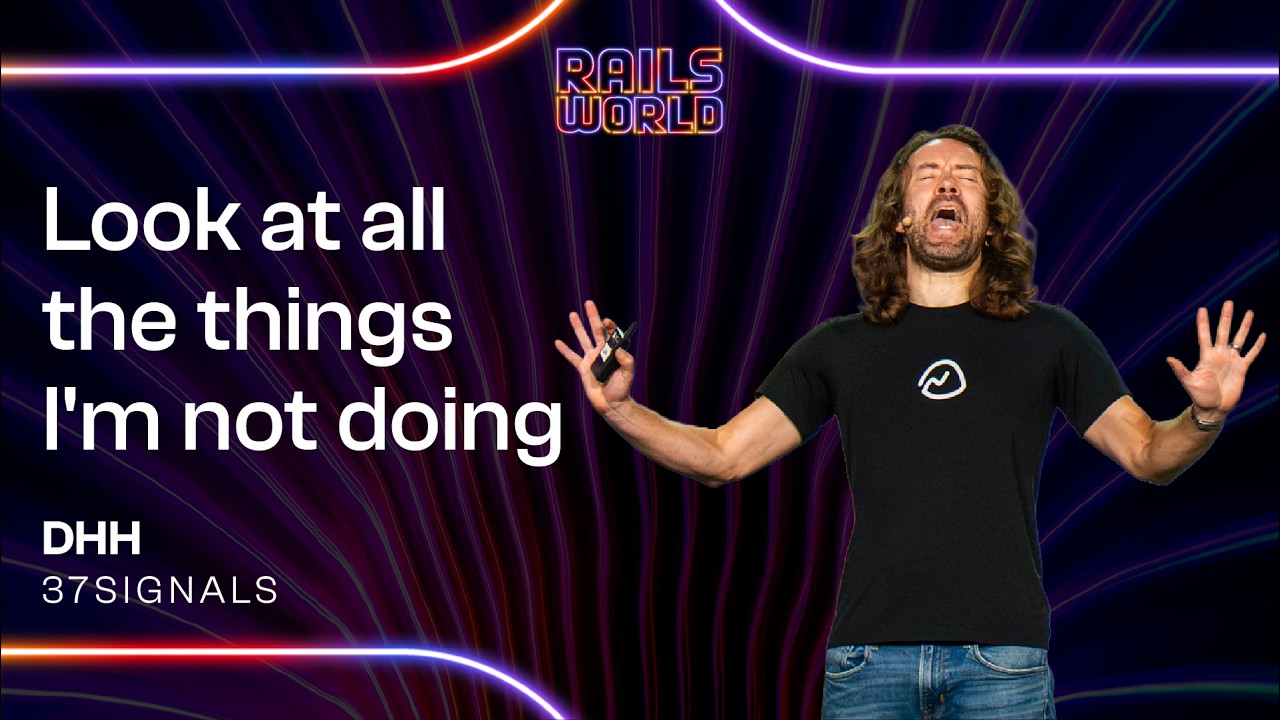
37signals Halts Handwritten Code as DHH Shifts to AI Software Agents
Ruby on Rails
Handwritten programming is no longer economically viable because autonomous agents yield up to 1,000x productivity gains, rendering traditional code abstractions obsolete in favor of natural-language orchestration.
37signals has formally instituted a 'pencils down' policy on handwritten code, treating manual software authoring as an exceptional failure state comparable to an application error. (20:45)
HEY is abandoning the web app model to ship six platform-native clients alongside a Rust mail backend generated entirely by AI agents, reducing server CPU usage by 99% and memory by 95%. (24:04)
DHH identifies November 24, 2025 (the release of Claude Opus 4.5) as software's 'Kodak Brownie' inflection point, marking the moment autonomous agents made manual coding economically obsolete. (11:20)
DHH announced his personal retirement from handwritten coding after generating 150,000 lines of code in a single month—a 60x leap over his historical multi-decade average. (39:21)
Detailed notes
## Background
Published on YouTube by the official Ruby on Rails channel on September 24, 2026, this video documents David Heinemeier Hansson's (DHH) opening keynote at Rails World in Austin. The presentation details why 37signals instituted a formal 'pencils down' policy on handwritten code, how Rails' convention-over-configuration design thrives alongside autonomous agents, and why radical optimism is the only rational response to the AI era.
## TL;DR
Drawing a historical parallel between 18th-century portraiture's disruption by the Kodak Brownie and modern programming's inflection point with Claude Opus 4.5, DHH announces his retirement from manual code authoring as 37signals transitions to agentic development. He details radical architectural pivots, including rewriting HEY's backend into agent-authored Rust and generating six native platform apps in a week, while building custom desktop utilities and the Omarchy OS without inspecting underlying implementations. DHH argues that natural English has superseded formal syntax, traditional human-centric DRY abstractions must give way to agent-friendly architectures, and applications must expose CLIs for user-owned agents rather than embedded chatbots. Ultimately, he reframes fears of automation through Jevons' Paradox and game theory, urging developers to reject catastrophic doom-mongering in favor of an unapologetic 'white pill' of total optimism.
## Atmosphere & style
Electrifying, provocative, and unapologetically evangelical, the presentation carries the kinetic energy of an ideological revival meeting. DHH paces the stage with unabashed 'AI euphoria,' blending historical art history and geopolitical anecdotes with irreverent, combative developer broadsides against bloated software and reactionary pessimism. The emotional trajectory begins by acknowledging the disorienting vertigo of rapid technological disruption, only to rapidly pivot into infectious, breathless empowerment. Watching the keynote feels like receiving an aggressive shot of adrenaline, leaving the audience challenged to discard legacy habits and seize an unprecedented explosion of personal agency.
## Bulletin
- [20:45](https://www.youtube.com/watch?v=vDjW_dRyKXY&t=1245s) 37signals has formally instituted a 'pencils down' policy on handwritten code, treating manual software authoring as an exceptional failure state comparable to an application error.
- [24:04](https://www.youtube.com/watch?v=vDjW_dRyKXY&t=1444s) HEY is abandoning the web app model to ship six platform-native clients alongside a Rust mail backend generated entirely by AI agents, reducing server CPU usage by 99% and memory by 95%.
- [11:20](https://www.youtube.com/watch?v=vDjW_dRyKXY&t=680s) DHH identifies November 24, 2025 (the release of Claude Opus 4.5) as software's 'Kodak Brownie' inflection point, marking the moment autonomous agents made manual coding economically obsolete.
- [39:21](https://www.youtube.com/watch?v=vDjW_dRyKXY&t=2361s) DHH announced his personal retirement from handwritten coding after generating 150,000 lines of code in a single month—a 60x leap over his historical multi-decade average.
## Key takeaways
- [05:21](https://www.youtube.com/watch?v=vDjW_dRyKXY&t=321s) The Kodak Brownie's democratization of photography mirrors AI's current impact on software: when capturing realism became cheap, painters pivoted toward Cubism and Impressionism rather than disappearing.
- [11:20](https://www.youtube.com/watch?v=vDjW_dRyKXY&t=680s) November 24, 2025 (Claude Opus 4.5) established the boundary between legacy manual programming and modern agentic pair development.
- [12:43](https://www.youtube.com/watch?v=vDjW_dRyKXY&t=763s) A brief trough of disillusionment in early 2026 was shattered by mid-year frontier releases, rendering debates over scaling-law plateaus obsolete.
- [16:02](https://www.youtube.com/watch?v=vDjW_dRyKXY&t=962s) The decades-long debate over the 10x programmer has been eclipsed by top-tier developers wielding agentic tools to achieve 100x to 1,000x productivity multipliers.
- [18:13](https://www.youtube.com/watch?v=vDjW_dRyKXY&t=1093s) The core spirit of Rails—celebrating convention over configuration and eliminating boilerplate toil—re-emerges fully in the agentic era.
- [20:45](https://www.youtube.com/watch?v=vDjW_dRyKXY&t=1245s) 37signals adopted an operational 'pencils down' baseline where agents author code by default and manual intervention triggers systemic prompting fixes.
- [24:04](https://www.youtube.com/watch?v=vDjW_dRyKXY&t=1444s) Near-zero marginal coding costs eliminate historical compromises like hybrid frameworks, enabling lean teams to maintain bespoke native codebases across multiple platforms.
- [28:59](https://www.youtube.com/watch?v=vDjW_dRyKXY&t=1739s) Low-level languages like Rust, while syntactically grueling for human eyes, become ideal black-box targets for AI agents to achieve extreme runtime efficiency.
- [31:46](https://www.youtube.com/watch?v=vDjW_dRyKXY&t=1906s) Agentic interaction works best asynchronously: developers assign high-level problems rather than micro-managing tasks through interactive chat boxes.
- [33:04](https://www.youtube.com/watch?v=vDjW_dRyKXY&t=1984s) Rails remains critical for the web distribution layer, where convention over configuration provides autonomous agents with superior token efficiency and architectural structure.
- [38:06](https://www.youtube.com/watch?v=vDjW_dRyKXY&t=2286s) English has surpassed traditional programming languages in expressiveness and utility, transforming software engineers from code-chiselers into high-level system orchestrators.
- [43:03](https://www.youtube.com/watch?v=vDjW_dRyKXY&t=2583s) Traditional DRY abstractions become dangerous concurrency bottlenecks when thousands of autonomous agent processes modify codebases in parallel.
- [45:15](https://www.youtube.com/watch?v=vDjW_dRyKXY&t=2715s) Applications must prioritize command-line interfaces (CLIs) so personal user agents can drive software headlessly, rather than relying on embedded in-app chatbots.
- [53:53](https://www.youtube.com/watch?v=vDjW_dRyKXY&t=3233s) Agents enable continuous overnight micro-optimization, reversing two decades of desktop software bloat and yielding blazing, sub-megabyte binaries.
- [01:00:08](https://www.youtube.com/watch?v=vDjW_dRyKXY&t=3608s) Catastrophic forecasts surrounding automation routinely fail to account for Jevons' Paradox and historical precedents where lower operating costs expanded total opportunity.
- [01:00:49](https://www.youtube.com/watch?v=vDjW_dRyKXY&t=3649s) Game theory dictates total optimism: despair offers no strategic upside, whereas radical optimism empowers engineers to shape technological abundance.
## Detailed walkthrough
### [00:07](https://www.youtube.com/watch?v=vDjW_dRyKXY&t=7s) Welcome to Austin and AI Euphoria
Welcoming the audience to Rails World in Austin, David Heinemeier Hansson (DHH) quips that while he would normally say "welcome to Austin," he really ought to say "welcome back to myself," having just spent five hours yapping on a podcast in the city only a month earlier. Personal travel aside, DHH expresses profound gratitude simply to be alive right now and sharing this historical juncture with the Ruby on Rails community and anyone electrified by the arrival of software agents. He jokes that if anyone in the audience has not caught the fever yet, they likely will by the end of his "delirious talk on the future."
He acknowledges that when people see someone pacing around on stage buzzing with this level of excitement, their first instinct is often clinical: diagnosing him with "AI psychosis." DHH embraces the sentiment but reclaims the vocabulary, calling his state "AI delirium" or "AI euphoria." In his view, what we are witnessing is simply the most exciting capability humans have ever coaxed out of computers across all his decades of working, playing, and interacting with machines. Yet alongside that excitement sits a legitimate, unnerving tension: nobody knows what the final steady state will look like, and any prediction attempted today is rendered obsolete roughly twenty minutes later. That rapid obsolescence generates an understandable sense of unease, which DHH seeks to soothe by stepping back in time to examine technological precedent.
[01:50](https://www.youtube.com/watch?v=vDjW_dRyKXY&t=110s) The 18th-Century Portrait and the High Friction of Art
To put our current anxiety into perspective, DHH winds the clock back to portrait painting—the state-of-the-art capture technology of the 18th century. In that era, having your likeness preserved required sitting motionless for hours upon hours in front of a master painter, who would then spend months executing the canvas. While this craft yielded a magnificent cultural heritage—such as Joshua Reynolds's 1781 masterwork of the Ladies Waldegrave—it was an immensely exclusive, high-friction endeavor that only the upper bourgeoisie or royalty could afford.
The process was also fraught with client friction. Reynolds had previously poured months into an earlier portrait of the Ladies Waldegrave, only to have the client reject it because an ankle was visible—a scandalous indiscretion that forced him to start over from scratch. DHH sympathizes with Reynolds, noting that anyone who has ever wrestled with clients over rejected statements of work understands the pain. Around this era, technique advanced at a glacial crawl over hundreds of years: twenty years after Reynolds, Francisco Goya painted the Spanish royal family in 1801 with essentially the same manual, painstaking craft. Eighty years later, Danish painter Laurits Tuxen spent not three months, but three full years, painting the Danish royal family in an 1886 canvas that still hangs in Copenhagen's royal palaces today.
```mermaid
flowchart TD
accTitle: The Shift from Bespoke Portraits to Ubiquitous Photography
accDescr: Diagram tracing the historical disruption of portraiture by photography, leading to mobile ubiquity.
subgraph ManualCraft["Manual Craft (Centuries)"]
A["1781: Reynolds (Months of sitting)"] --> B["1886: Tuxen (3 years for Danish Royals)"]
end
subgraph Disruption["The Democratization Shocks"]
C["1840s: Invention of the Camera"] --> D["1900: Kodak Brownie ($1 Mass Access)"]
D --> E["Artistic Pivot: Cubism & Impressionism"]
end
subgraph Frictionless["Zero Marginal Cost"]
F["1925–1980s: Leica & Film (Gradual Growth)"] --> G["2026: Smartphones (2 Trillion Photos/Year)"]
end
[05:21](https://www.youtube.com/watch?v=vDjW_dRyKXY&t=321s) The Kodak Brownie and the Great Creative Pivot
By the late 19th century, manual portraiture had reached the end of its reign. The camera had arrived around 1840, steadily improving until the Eastman Kodak Company unveiled the Brownie in 1900. By dropping the cost of a picture to about a single dollar, the Brownie mass-produced photography and democratized image-making. Master painters suddenly faced direct technological competition: when an optical device could capture reality faster and cheaper, meticulously depicting objective reality ceased to be an economically viable craft.
Rather than vanishing, artists pivoted. Deprived of their monopoly on realism, painters exploded into new creative territory: Pablo Picasso pursued Cubism, while the Danish Skagen painters turned toward Impressionism. This artistic pivot holds a deeply personal meaning for DHH: the Skagen impressionist painting he displays features a woman in a pink dress at the center—Yvonne Tuxen, his great-grandmother. The painter was Laurits Tuxen, DHH's great-great-grandfather. Tuxen embraced the inevitable, posing for his own photographic portrait in 1921 shortly before his death.
- **1781**: Sir Joshua Reynolds paints *The Ladies Waldegrave*; an earlier draft was rejected by the client over an exposed ankle.
- **1886**: Laurits Tuxen finishes his portrait of the Danish royal family after three continuous years of labor.
- **1900**: The Eastman Kodak Brownie launches at roughly $1, democratizing personal portraiture.
- **Artistic divergence**: Painters forced out of photorealism pioneered modern movements, including Cubism and Skagen Impressionism.
[07:48](https://www.youtube.com/watch?v=vDjW_dRyKXY&t=468s) From Film Friction to Two Trillion Photos
Progress in technology rarely follows a smooth line; it moves in fits, starts, and long plateaus. DHH was born in 1979—52 years after Laurits Tuxen's death—yet his own black-and-white infant photo looks fundamentally indistinguishable from Tuxen's 1921 portrait. The underlying tool, a consumer film camera, had barely shifted from the 1925 Leica 1. Although color photography had emerged by the 1960s, it remained expensive enough that DHH did not receive a color photo until age four, sitting alongside his brother.
Across his entire childhood, DHH notes that he has only a modest stockpile of prints—three photos alone represent roughly 10% of all pictures taken of him as a boy. Taking photos in the 1980s still demanded buying rolls of film, carefully rationing shots, and paying for darkroom development. Fast-forward several decades, and photography hit a parabolic inflection point. Today, smartphones have driven the marginal cost of taking a picture to zero—making it "too cheap to measure." Parents capture tens of thousands of candid shots of their children, and DHH's wife routinely snaps twilight photos on her evening walks without a second thought. By 2026, humanity produces an estimated 2 trillion photographs every single year.
[11:20](https://www.youtube.com/watch?v=vDjW_dRyKXY&t=680s) November 24, 2025: Software's Brownie Moment and the Inflection
Drawing the direct parallel to software development, DHH identifies November 24, 2025, as the day programming met its own Kodak Brownie: the release of Claude Opus 4.5. For DHH, this was the definitive watershed moment. There was everything that happened before November 24th, and everything that followed. History books will record it as the true inflection point for the age of autonomous agents—a harness that made paired intelligence genuinely accessible and capable of creating real software alongside human engineers.
The breakthrough spurred immediate, chaotic experimentation across different form factors and harness designs. Euphoria mounted further when comparable intelligence arrived in open-weight models only a few months later. DHH recalls driving Kimi K2.5 in fast mode, marveling at the feeling of having alien intelligence processing and generating code locally at a blistering 200 tokens per second.
```mermaid
flowchart LR
accTitle: The AI Capability Inflection Timeline (Late 2025 - Mid 2026)
accDescr: Timeline tracing the release of Opus 4.5 through the trough of disillusionment to Fable 5 and Mythos.
A["Nov 24, 2025<br/>Claude Opus 4.5<br/>(The Brownie Moment)"] --> B["Early 2026<br/>Open-Weight Emergence<br/>(Kimi K2.5 @ 200 tps)"]
B --> C["Feb–May 2026<br/>Trough of Disillusionment<br/>(Opus 4.6 stalls, market panic)"]
C --> D["June 2026<br/>Fable 5 & Mythos<br/>(Euphoria validated)"]
```
[12:43](https://www.youtube.com/watch?v=vDjW_dRyKXY&t=763s) The Trough of Disillusionment and the June Breakthrough
Following the initial rush, the industry plunged into a sharp trough of disillusionment spanning February through May 2026. Successive model releases felt disappointing or even regressive. Users scoffed at releases like Opus 4.6, muttering, "I don't know, man. Just give me the old stuff again." When an OpenAI model failed to dramatically crush existing industry benchmarks, tech valuations slipped, commentary proclaimed that the scaling laws had stalled out, and skeptics declared the party over.
Unlike photography's decades-long plateau between the Leica and digital sensors, this trough lasted barely three months. By June 2026, the arrival of next-generation frontier models—specifically Fable 5 and Mythos—shattered the stall narrative entirely. Anyone who interacted with these models was immediately disabused of the notion that AI progress had hit a wall. For DHH, that release solidified his state of unreserved "AI delirium" and set the stage for an unprecedented explosion of on-tap intelligence.
- **November 24, 2025**: Release of Opus 4.5, marking the definitive boundary line between manual code and agentic pairing.
- **Kimi K2.5**: Provided high-speed, open-weight reasoning running at roughly 200 tokens per second.
- **February–May 2026**: A brief trough where releases like Opus 4.6 disappointed, sparking premature declarations that LLM capability had peaked.
- **June 2026**: The debut of Fable 5 and Mythos obliterated the plateau, cementing the shift to ambient machine intelligence.
[14:38](https://www.youtube.com/watch?v=vDjW_dRyKXY&t=878s) The Frontier Intelligence Explosion: From Opus to Astra and DeepSeek
The breakthrough moment arrived when Claude Opus demonstrated that a developer could delegate an entire problem or raw concept to an agent and receive code clean enough to merge without having to steer the underlying implementation. For Heinemeier Hansson, watching ideas expand and resolve themselves without writing the technical scaffolding was flatly mind-blowing. That initial spark kicked off an intense roller-coaster ride across the industry. When GPT-6 Astra dropped in September, it broke the creeping anxiety that Anthropic might hold an uncontested monopoly over frontier intelligence. Just a week later, DeepSeek-4-1 Flash arrived, shattering the assumption that frontier-grade models would remain the exclusive playground of a handful of American tech giants.
[16:02](https://www.youtube.com/watch?v=vDjW_dRyKXY&t=962s) Shattering the 10x Myth: The Leap to the 1,000x Developer
Looking backward reveals how radically the frame of reference has shifted. For Heinemeier Hansson's entire professional career, software engineering spent four and a half decades obsessing over whether the "10x programmer" was a myth. That entire debate originated in a 1968 *Communications of the ACM* study, which measured developer performance across various tasks and documented an individual performance variance between 5x and 30x, averaging out to 10x.
After 45 years of circular industry argument, that debate has been rendered obsolete overnight. Rather than settling on a consensus about unaided human capacity, the industry leaped straight past it: comparing an unaided bottom-tier developer to a top-tier developer leveraging cutting-edge agentic tools easily yields an uncontroversial 100x advantage—and realistically reaches 1,000x. The competitive implications for how software companies launch and operate are staggering, even if the ultimate economic fallout remains impossible to forecast with precision.
```mermaid
flowchart TD
accTitle: The Evolution of Developer Leverage
accDescr: Historical transition from the 1968 10x programmer variance to the modern 1,000x agent-assisted multiplier.
subgraph Historical["1968-2024: Human Variance"]
A["Unaided Baseline Programmer"] -->|"1968 ACM Study (5x to 30x)"| B["10x Programmer"]
end
subgraph Agentic["2026: Intelligence Multiplier"]
C["Worst Developer (No AI)"] -->|"Tooling Divergence"| D["100x Productivity Gap"]
D -->|"Agentic Leverage"| E["1,000x Frontier Developer"]
end
```
[18:13](https://www.youtube.com/watch?v=vDjW_dRyKXY&t=1093s) "Look at All the Things I'm Not Doing": The Rails Moment Revisited
Over the past 20 months, Heinemeier Hansson produced half as much code as he had written across his entire preceding 21 years of development. While lines of code are an imperfect, highly malleable metric—and a single line of expressive Ruby holds far more architectural leverage than a line of Rust or C++—the acceleration remains dizzying.
To contextualize the feeling, Heinemeier Hansson pulled up archival video footage from a presentation he delivered in Brazil in 2005 during the initial rise of Ruby on Rails. In the 21-year-old clip, a young DHH gleefully walked through code mapping conventions, shouting: "Look at all the things I'm not doing! Look at all the configuration I'm not writing!" That exact sentiment—rejoicing in all the friction and ceremony that has been eliminated—is the core essence of the current AI inflection point. Having spent roughly five straight months without writing code manually, he found that every nagging bug, backlogged ambition, and long-delayed cosmetic feature had suddenly become trivially achievable.
- In the preceding 20 months, DHH generated half as much code as he did over the prior 21 years combined.
- He had gone roughly 5 consecutive months without authoring handwritten application code.
- The 2005 Brazil keynote served as the blueprint for this mindset: celebrating convention and elimination of toil over boilerplate mechanics.
[20:45](https://www.youtube.com/watch?v=vDjW_dRyKXY&t=1245s) 37signals Goes Pencils Down on Hand-Written Code
This momentum pushed 37signals to make an official operational shift: the company instituted a formal "pencils down" policy on authoring code by hand as a standard course of business. Writing code manually is no longer the baseline; it is treated as an exceptional error state, analogous to an unexpected exception popping up in Sentry.
```mermaid
flowchart TD
accTitle: 37signals Pencils Down Workflow
accDescr: Workflow showing agents as the primary code authors and manual intervention treated as an exceptional error state.
A["Feature Concept or Task"] --> B["Agent Implementation"]
B --> C{"Agent Delivers Desired Output?"}
C -->|"Yes"| D["Merge to Production"]
C -->|"No (Exceptional State)"| E["Alert: Triage Like Sentry"]
E --> F["Temporary Manual Hotfix (Old Pencil)"]
F --> G["Fix the Machine / Update the Factory Prompt"]
G --> B
```
When an agent fails to deliver the expected implementation, the developer might temporarily pull out the pencil to nudge things across the finish line, but the immediate follow-up is to diagnose why the machinery failed and "fix the factory." To demonstrate how fast cultural norms have turned, Heinemeier Hansson asked the Rails World audience how many developers were still writing material amounts of code by hand on a weekly basis. Looking out at the auditorium, only five hands went up across the entire room, prompting an emphatic: "Holy fuck, that's about 5." What would have sounded unhinged just two or three months prior had already become standard practice.
[22:12](https://www.youtube.com/watch?v=vDjW_dRyKXY&t=1332s) Vibe-Coding Basecamp 5 and the Swiss-Cheese Trap
This operational transition was not without earlier stumbling blocks. During the spring, as 37signals worked through the final polish for Basecamp 5, the company ran an experiment allowing designers to "vibe-code" their own desired features directly into the release.
While individual designer pull requests looked solid in isolation, merging 20 to 30 of them left the core codebase feeling structurally punctured, "like a Swiss cheese." At the time, leadership recoiled, concluded the technology was not quite mature, and retreated to traditional manual review with senior developers writing the code.
Looking back, Heinemeier Hansson recognized that retreat as a mistake: waiting just a few months brought models capable of maintaining systemic architectural cohesion. Ultimately, Basecamp 5 shipped as an agent-accelerated project, but it still leaned heavily on manually chiseled code. That experience clarified that in modern software engineering, there is only one existential question that matters above all else in the value stack: *How do you extract the maximum leverage out of this intelligence explosion?*
[24:04](https://www.youtube.com/watch?v=vDjW_dRyKXY&t=1444s) Rebuilding HEY as Six Native Apps and the Death of Compromise
The first pure realization of this new operating philosophy is the next evolution of their email service, tentatively dubbed "HEY Next." The primary architectural mandate: **HEY is abandoning the web app model.**
Historically, HEY was built as a web application out of pragmatic necessity. For a lean engineering team, maintaining six separate native codebases across multiple operating systems was impossible. The industry invented compromises—web applications, React Native, and Hotwire Native—trading away latency and interface fidelity in exchange for small-team velocity.
With agentic capabilities, that cost model collapsed. Heinemeier Hansson demonstrated early builds of six bespoke native applications running across mobile and desktop, built over the course of a single week with zero handwritten lines of code:
```mermaid
flowchart LR
accTitle: Transition from Web Compromise to Native Fidelity
accDescr: Visualizing the shift from small-team cross-platform wrappers to agent-written multi-platform native apps.
subgraph LegacyModel["The Legacy Compromise"]
direction TB
L1["Small Engineering Team"] --> L2["Single Shared Web / Hybrid Stack"]
L2 --> L3["Hotwire Native / React Native"]
L3 --> L4["Fidelity Compromise (Latency, Polish)"]
end
subgraph AgenticModel["The Modern Agentic Reality"]
direction TB
A1["High-Context Prompts & Direction"] --> A2["Autonomous Frontier Agents"]
A2 --> A3["6 Dedicated Native Codebases"]
A3 --> A4["True Native Fidelity at Near-Zero Marginal Cost"]
end
```
The workflow was illustrated by an early prompt attempt to generate the HEY Windows client. The first output returned a broken, un-shippable UI; however, an adjustment prompt 20 minutes later produced a fully realized, polished native interface. This paradigm shift mirrors Shopify's recent move, where a lean team of roughly six engineers completely rewrote the native Shop app, discarding React Native. When the marginal developer cost of authoring high-fidelity platform code falls toward zero, the historical necessity for web-based application wrappers disappears.
[28:14](https://www.youtube.com/watch?v=vDjW_dRyKXY&t=1694s) Turning to the Backend: A Reluctant Confrontation with Rust
While the front-end transition toward platform-native implementations proved liberating, turning the agentic lens onto the backend brought a far more conflicted personal dilemma for Heinemeier Hansson. Pushing performance boundaries and building autonomous systems forced an encounter with an ecosystem he had long resisted:
> "This is a little difficult for me. I will admit. And let me tell you why. Rust. Rust. I hate Rust with a passion."
[28:59](https://www.youtube.com/watch?v=vDjW_dRyKXY&t=1739s) The Rust Paradox: Unbearable for Humans, Perfect for Agents
DHH pulls no punches when describing his aesthetic disdain for Rust, declaring that looking at Rust code feels like "pouring acid in my eyes." To him, it is the ugliest programming language invented in the last forty years—something "absolutely inhumane to ask people of flesh and blood to subject their eyeballs to." Yet that vehement hatred vanishes entirely the moment an AI agent steps in to write it. If a human engineer never has to read or write it, Rust transforms into an absolute marvel: it compiles down to minuscule executables with sub-millisecond startup times and runs applications thirty to a hundred times faster. "Rust is amazing if you never, ever, ever have to look at it yourself," he explains, celebrating a clear division of labor where the human provides high-level intent and the agent writes the low-level systems code.
This paradigm enabled an architectural rewrite of HEY. By moving the frontend entirely to native client applications, the system no longer required a server-side web application rendering HTML. The team then turned the remaining backend into what it fundamentally was—a dedicated mail server rewritten in Rust. The efficiency gains proved staggering: the Rust backend required 99% less CPU and 95% less memory. The only reason 37signals still operates ten hosts for it is pure operational redundancy; back-of-the-envelope calculations indicate that HEY's peak traffic could comfortably run on a single Raspberry Pi. For DHH, paying an external intelligence per token to build directly against the bare metal while keeping the code fully portable is an undeniable breakthrough.
```mermaid
flowchart TD
accTitle: HEY Architecture Shift to Agent-Written Rust
accDescr: Diagram contrasting HEY's traditional web application architecture with its agent-generated native client and Rust backend.
subgraph Traditional["Traditional Architecture"]
direction TB
T_Web["Web App & Server-Rendered HTML"] --> T_Ruby["Full Ruby/Rails Application Stack"]
T_Ruby --> T_Fleet["Substantial Server Fleet for Compute & Memory"]
end
subgraph Agentic["Agent-Driven Architecture"]
direction TB
A_Native["Native Client Applications (No HTML Render)"] --> A_Rust["Lean Core Mail Server (Rust)"]
A_Rust --> A_Footprint["99% Less CPU / 95% Less Memory<br/>(Peak Traffic on a Single Raspberry Pi)"]
end
```
- **Resource reduction**: HEY's backend rewrite achieved a 99% decrease in CPU consumption and a 95% drop in memory usage.
- **Hardware footprint**: Peak load could theoretically run on a single Raspberry Pi; ten server hosts are retained solely for redundancy.
- **Performance benefits**: Microscopic binary sizes, sub-millisecond cold starts, and 30x to 100x execution speedups over conventional high-level stacks.
[31:46](https://www.youtube.com/watch?v=vDjW_dRyKXY&t=1906s) Asynchronous Delegation: Assigning Problems, Not Tasks
Directing this new machine intelligence requires fundamentally reevaluating how developers interact with software tools. Rather than babysitting a chat box and watching tokens stream out in real time, the team found that working with agents mirrors working with human colleagues: it must be asynchronous. At 37signals, they orchestrate these workflows through internal tooling like their agent Chef Marie inside Basecamp. The developer hands off an objective, steps away, and returns later to review the finished work once a pull request or implementation is ready.
DHH emphasizes the sheer velocity and novelty of this transition. The modern wave of agentic software development only kicked off on November 24 of the previous year—meaning the industry has not even spent a full year living in this reality. Furthermore, models capable of true reasoning—those you can entrust with high-level problems and desired outcomes rather than granular, step-by-step task instructions—had only emerged a couple of months prior. Because the technology landscape changes every five minutes, nobody has all the answers, contributing to the electric, experimental atmosphere of the present moment.
[33:04](https://www.youtube.com/watch?v=vDjW_dRyKXY&t=1984s) Where Ruby and Rails Fit: The Web, Token Efficiency, and Agent Evals
The radical shift in HEY naturally prompts the existential question: where does this leave Ruby and Rails? While native frontends backed by Rust make total sense for dedicated productivity software like an email client, DHH insists that the web remains an unrivaled distribution channel. Millions of businesses rely on the fact that the web requires zero installation, making it the only viable choice for ephemeral users who simply want to inspect a file or collaborate briefly, as in Basecamp. For those applications, Rails remains uniquely advantaged. Its foundational doctrine of "convention over configuration" translates directly into extreme token efficiency for AI agents, while its twenty-five-year mission to empower the "one-developer framework" aligns seamlessly with an era where single programmers command the output of entire engineering teams.
To track how well agents handle Rails, Evil Martians began conducting official agent evaluations on behalf of the Rails Foundation, testing models against real-world feature implementation cards in reference codebases. The first iteration of the evaluation suite was rapidly outgrown when top agents saturated the benchmarks, reaching 95% completion rates almost immediately and forcing the team to devise significantly harder tests. DHH notes that as models rise up the ranks, engineers must resist the urge to over-specify implementation details. Knowing too much about how computers work can actually become a liability; approaching problems with a "beginner's mindset" and treating agent-generated Rust as an opaque black box leads to cleaner prompts, higher-level problem framing, and superior results.
- **Agent benchmark velocity**: The Rails Foundation and Evil Martians had to upgrade their evaluation suite after agents rapidly achieved a 95% success rate on initial real-world feature cards.
- **Convention as leverage**: Established conventions reduce boilerplate, saving context window tokens and giving autonomous agents a clear blueprint of application architecture.
- **The black box advantage**: Treating low-level languages like Rust as black boxes frees founders and leads to think like business commissioners evaluating pure functional outcomes.
[36:39](https://www.youtube.com/watch?v=vDjW_dRyKXY&t=2199s) 150,000 Lines of Code in a Month
The practical reality of DHH's day-to-day work highlights the dramatic scale of this shift. Over the preceding twenty-one years, more than half of the code he wrote was production Ruby, settling at a steady output of roughly 30,000 lines of Ruby per year—an amount that proved plenty to launch multiple companies, maintain massive applications, and create Ruby on Rails. Over the past year, however, Ruby represented a mere 3% of his total output.
In August alone, DHH generated 150,000 lines of production code in a single month—a staggering 60-fold increase over his multi-decade running average. While he readily acknowledges that a sizable chunk of that volume comes from the natural verbosity of Rust (a level of verbosity he "would never tolerate" in handwritten Ruby), the sheer order-of-magnitude leap cannot be explained away by syntax alone. It represents a categorical rupture in how software gets produced.
- **Historical output**: Averaged ~30,000 lines of production Ruby per year over two decades, making up over 50% of his written work.
- **Current distribution**: Ruby dropped to ~3% of his code output over the past year.
- **Velocity surge**: Generated 150,000 lines of code in August alone—roughly 60 times his long-term historical pace.
[38:06](https://www.youtube.com/watch?v=vDjW_dRyKXY&t=2286s) English as the Ultimate Programming Language
The biggest surprise for DHH has been discovering that there is a programming language he loves even more than Ruby: English. Despite having spent decades championing Ruby as the ultimate tool for programmer happiness, he has found that writing software in natural language is profoundly satisfying. English is more expressive than any formal programming syntax; though it can be vague and less deterministic, steering software through plain language offers pure joy.
This realization stands in stark contrast to his past worldview. Reflecting on an older sentiment, DHH recalled stating that he had originally entered programming purely to achieve business outcomes, but quickly fell so deeply in love with the craft of writing code that he would rather retire than give it up. Faced with the reality of natural language programming, that dilemma resolved itself in an unexpected direction.
[39:21](https://www.youtube.com/watch?v=vDjW_dRyKXY&t=2361s) Retiring from Hand-Written Code with Joy
DHH formally announces his retirement from professional programming, dating the shift back roughly four to five months to around March. Yet this announcement is marked by celebration rather than mourning. Having spent a quarter of a century "chiseling code by hand" and relishing the flow states, craft, and intellectual satisfaction of that era, he insists that developers should look back on that period with gratitude rather than sorrow.
Handwriting code is simply no longer an economically viable activity for the vast majority of software developers, and DHH predicts that by the end of the year, this reality will encompass virtually all domains, developers, and companies. In its place lies an exhilarating second career: transitioning from a code-chiseler into a "professional maker of things," orchestrating cognitive capabilities that were pure science fiction only months earlier. He draws a parallel to early computer pioneers programming with physical punch cards—an iconic era that would have been thrilling to witness, just as living through the birth of the commercial internet was. But the current inflection point eclipses them both:
> "This is the biggest thing that has happened in the history of computing... That smells and feels a little like this moment that we're in, but this is much, much bigger. Okay. Well, shit. There's a lot of things we gotta rethink. We gotta rework. Where are we gonna start here?"
[43:03](https://www.youtube.com/watch?v=vDjW_dRyKXY&t=2583s) Rethinking Software Architecture for the Age of Agents
Software architecture is facing a total reckoning. For decades, the cornerstone tool used to structure codebases for mutability and forward progress has been abstraction. DHH admits he has always loved abstractions—especially the art of naming things—but argues that abstraction no longer makes the same sense in the age of agents. When an application is being modified by hundreds, thousands, or tens of thousands of autonomous processes, abstractions turn into dangerous choke points. The foundational premise of abstraction was Don't Repeat Yourself (DRY); today, the marginal cost of repetition and the cost of keeping duplicated code in sync have both plummeted to near zero.
This shift triggers a fundamental reevaluation of long-held computer science dogmas. No one currently possesses the definitive blueprint; developers only have pointers showing what is failing to work as smoothly as it once did. DHH compares being a programmer right now to standing at the historical dawn of object-oriented programming. Every convention is open for reinvention: how teams work, what software methodologies look like, cycle lengths, and who handles specifications. "It's a new birth for a new industry, and you're at the ground floor," he tells the audience. "Holy shit, you are so damn lucky."
```mermaid
flowchart TD
accTitle: The Shifting Paradigms of Software Architecture
accDescr: Comparison between human-centric abstractions and agent-native architecture trade-offs.
subgraph Old["Human-Centric Architecture (DRY)"]
A["High Cost of Human Typing & Sync"] --> B["Strict Abstractions & DRY Patterns"]
B --> C["Single Points of Abstraction / Choke Points"]
end
subgraph New["Agent-Native Architecture"]
D["Zero Cost of Duplication & Sync"] --> E["Flat, Repetitive Code Structures"]
E --> F["High Concurrency for Autonomous Agents"]
end
```
[45:15](https://www.youtube.com/watch?v=vDjW_dRyKXY&t=2715s) Bring Your Own Agent: Why Every App Needs a CLI
Addressing practical software design, DHH takes aim at the initial wave of generative AI: rushing to embed proprietary chatbots directly into web applications. He dismisses this embedded concierge model entirely: "I don't want to use your concierge. I have my own personal butler who's able to use CLIs to connect Basecamp to HEY across a million other apps. I don't fucking need your concierge, thank you. Save your tokens, bro." Users should be able to bring their own personal agent to the party and interact with software through clean command-line interfaces.
Issuing a direct challenge to the audience, DHH gives a concrete deadline: "Hey, if your app doesn't have a CLI, I want to see it by next Friday. No fucking excuses." He insists developers have all the tokens and tools needed to build them so that users can interact with software without ever touching the graphical UI.
He illustrates the power of agentic CLIs with HEY's new search capability compared to Elasticsearch. While Elasticsearch provides serviceable, mediocre keyword search that often fails when you do not know exactly what you are looking for, an agent searches by concept. DHH recounts searching for a five-year-old email in HEY where he could not remember the sender, the company name, or even the exact year—only that it involved "something about sneakers and a podcast." While conventional search engines failed completely, the agent located the exact email within minutes.
- **The Concierge Anti-Pattern:** Shoving in-app chatbots into web interfaces forces users into isolated silos; the superior paradigm is a user-owned agent driving external tools.
- **The CLI Mandate:** Applications must expose CLI hooks so third-party agents can script, automate, and query them headlessly.
- **Conceptual Search:** Moving beyond keyword-indexed Elasticsearch to agentic retrieval that matches fuzzy human memory and conceptual associations.
[48:05](https://www.youtube.com/watch?v=vDjW_dRyKXY&t=2885s) Omarchy: Fixing the Whole Computer
The realization that "we can fix everything" expands beyond web apps to the operating system itself through Omarchy, an OS project DHH has worked on relentlessly for three months and raised roughly $20 million to pursue. Having put his best system-level ideas into Omarchy, he describes the result as an operating environment vastly superior to anything he has previously used.
Installation speed has become an obsession. At Rails World the previous year, DHH celebrated getting the full OS installation down to 3 minutes and 33 seconds. Just a week prior to this keynote, Anoush from AMD installed Omarchy onto an AMD Strix Halo laptop in just 35 seconds. In laboratory testing, the team achieved an operating system install time of 9 seconds—faster than many machines take to complete basic hardware boot cycles.
When skeptics ask why a 3-minute installation was not already fast enough, DHH quotes Mitchell Hashimoto, creator of HashiCorp and Ghostty: *"The pursuit of excellence does not need justification."* For DHH, this aphorism is a far more dignified framing than simply saying "because I want it," capturing a new era where developers have the leverage to demand absolute excellence and bring every ambitious idea within reach.
- **Install Benchmark Progression:** Dropped from 3 minutes 33 seconds at Rails World 2025 down to 35 seconds on an AMD laptop, and reached 9 seconds in laboratory testing.
- **Capital & Focus:** Backed by roughly $20 million in funding as an ambitious quest to re-engineer the modern computer desktop from scratch.
[51:21](https://www.youtube.com/watch?v=vDjW_dRyKXY&t=3081s) One-Shot Apps: Calculator, Writing App, Video Editor, and Hype
Armed with agentic workflows, DHH embarked on an app-building spree, turning concepts into finished software without writing or even reading the underlying implementation code:
- **The Calculator:** Designed to theme-match Omarchy. Created as a literal "one-shot" by feeding an agent a single screenshot of three ChatGPT-generated design mockups. Despite DHH knowing neither C++ nor Qt, the application was working 7 minutes after the prompt, pushed to a public repository 15 minutes later, and immediately baked into a newly burned Omarchy ISO.
- **The Writing App:** Built to replace iA Writer, his long-time markdown editor on macOS. While it took slightly longer to fine-tune the aesthetics, he never looked at a single line of the generated source: "C++ as a black box is a great language. Just like Rust."
- **The Video Editor:** A lean mini-cut desktop utility designed to trim video clips, now shipped directly as part of the Omarchy distribution.
- **Hype (Presentation Software):** Started on the Thursday before the keynote, DHH decided to write custom presentation software while drafting his talk. Built natively around Markdown, Hype features instant visualization and lightning-fast slide transitions.
[53:53](https://www.youtube.com/watch?v=vDjW_dRyKXY&t=3233s) The Performance Payoff: Half a Megabyte
The Hype presentation app compiles down to a binary of just half a megabyte—small enough that, with modest compression, it could fit onto a 3.5-inch floppy disk. This highlights what DHH sees as the ultimate architectural payoff of the agentic era: recovering runtime performance.
Over the past twenty years, the technology industry traded away hardware efficiency and computational progress to maximize expensive human engineering hours. While that trade-off made economic sense at the time, it bloated the modern software ecosystem, leaving applications "slow, bulky, fat, and lazy." DHH calls out Spotify as an egregious offender, noting its desktop music player ballooned to an absurd 1.2 gigabytes just to play audio streams.
With agents, micro-optimization no longer requires sacrificing precious human developer hours. Autonomous coding models can be tasked to run overnight specifically to optimize memory footprints, refactor algorithms, and shrink bundle sizes, delivering 10x to 30x performance leaps effortlessly.
```mermaid
flowchart LR
accTitle: Software Bloat vs Agent Optimization
accDescr: Diagram illustrating the shift from human-developer bloat to agentic micro-optimization.
subgraph Era1["The 20-Year Bloat Era"]
direction TB
H["Expensive Human Hours"] --> S["Skip Optimization"]
S --> B["Bloated Desktop Apps<br/>(e.g., Spotify @ 1.2 GB)"]
end
subgraph Era2["The Agentic Era"]
direction TB
A["Cheap Agent Overnight Loops"] --> O["Continuous Micro-Optimization"]
O --> T["Tiny, Blazing Binaries<br/>(e.g., Hype @ 0.5 MB)"]
end
```
[55:02](https://www.youtube.com/watch?v=vDjW_dRyKXY&t=3302s) AI Concerns, Security, and Why Predictions Fail
DHH turns to the broader anxieties surrounding artificial intelligence. While he believes valid concerns deserve debate, he contends that the most catastrophic forecasts are wildly overstated. The one clear area requiring vigilance is security: agents may know their execution lifecycles, could act unpredictably, or might be leveraged for malicious exploits, but developers possess the tools and runtime isolation models to counter these threats.
He challenges overarching economic doom-mongering, arguing that historical predictions regarding technological disruption are almost universally incorrect. Modern economists cannot reliably predict stock market trends six months in advance, making long-term social forecasts about a paradigm shift like AI largely baseless.
To illustrate, DHH points to the widespread panic that erupted when automated teller machines (ATMs) were introduced across the United States. Pundits warned that 30,000 bank tellers would lose their livelihoods within 18 months because banks would no longer need staff to count and disburse cash. Instead, the dramatic reduction in branch operating costs enabled banks to open substantially more branches. Rather than shrinking, total bank teller employment grew, shifting staff responsibilities away from manual counting toward relationship management and sales—"like upselling you a subprime mortgage," DHH quips with a grin. "See? We all win here."
[57:07](https://www.youtube.com/watch?v=vDjW_dRyKXY&t=3427s) Oppenheimer, Truman, and Humility in Forecasting
A recurring pathology in the technology industry is that the people building frontier systems are exceptionally smart, often hold PhDs, and occasionally see lab results that terrify them. Once frightened, they immediately begin extrapolating catastrophic societal consequences, agonizing over what they have unleashed upon the world. This mirrors Robert Oppenheimer’s infamous lament after creating the atomic bomb. When Oppenheimer visited the Oval Office to express his moral torment, President Harry Truman famously cut straight through the hand-wringing, later telling aides that he never wanted to see that "son of a bitch in my office ever again."
Truman grasped reality far better than the apocalyptic forecasters. The world did not end. Instead, humanity entered the Cold War—in historical terms, the best kind of war possible, where two heavily armed superpowers never engaged in direct confrontation or dropped nuclear weapons on one another. If a scientist as brilliant as Oppenheimer could not foresee how geopolitical balance would actually unfold, modern technologists must possess the humility to admit that they cannot reliably predict the trajectory of artificial intelligence either.
[58:26](https://www.youtube.com/watch?v=vDjW_dRyKXY&t=3506s) P(Bloom) Over P(Doom): Agency, Security, and HotCell
Rather than wallowing in "P(doom)", the tech community ought to lean firmly into "P(bloom)". The statistical likelihood of AI delivering unimaginable abundance, leverage, and human joy dwarfs the apocalyptic scenarios promoted by doomsayers. Skeptics often fixate on collateral damage, but human progress regularly navigates historical missteps. When Oppenheimer worked on the atom bomb, humanity simultaneously unlocked nuclear power—the single greatest, cleanest energy discovery in human history. Yet society proceeded to squander it for four decades under the misplaced assumption that it was not environmentally sound, only to realize decades later that it had walked down a 40-year blind alley.
```mermaid
flowchart TD
accTitle: The Game Theory of Optimism
accDescr: Decision matrix comparing the outcomes of embracing optimism versus pessimism under varying futures.
subgraph Stance["Chosen Mindset"]
Opt["White Pill: Total Optimism"]
Pess["Black Pill: Paralyzing Doom"]
end
subgraph Future["Actual Real-World Outcome"]
Abundance["Technological Abundance"]
Catastrophe["Worst-Case Collapse"]
end
Opt -->|"Wins either way"| Abundance
Opt -->|"Lived well regardless"| Catastrophe
Pess -->|"Wasted life in anxiety"| Abundance
Pess -->|"Suffered twice"| Catastrophe
```
When legitimate problems emerge, engineers possess the agency to build solutions rather than cower. For instance, Rails recently contended with a critical CVE originating in an underlying C image-processing library that exposed severe memory leaks. Instead of declaring modern computing broken, the community engineered quarantines to isolate dangerous dependencies. At the conference, Mike is slated to present HotCell, an initiative designed to provide precisely that sort of protective isolation. Developers are not helpless victims of technology; they have the agency and the intelligence to defend their systems and bend new tools toward productive ends.
- Humanity spent 40 years sidelining nuclear power before recognizing the error and changing course.
- Recent C-level image library vulnerabilities in Rails spurred the development of HotCell to run untrusted code in hardened quarantines.
- Agency, not passive dread, is the developer's core defense against security risks.
[01:00:08](https://www.youtube.com/watch?v=vDjW_dRyKXY&t=3608s) Jevons' Paradox and the Game Theory of Total Optimism
Predictions about automation destroying employment consistently fail to account for Jevons' Paradox. When automated teller machines were introduced, critics warned that human bank tellers would vanish overnight. In reality, the United States had roughly 30,000 bank tellers in 1950, and by around 2010, that number had climbed to 40,000 because cheaper branch operations spurred explosive expansion. Because nobody can accurately forecast the downstream economic reality, the only rational baseline is optimism.
From a strict game-theory perspective, choosing despair is entirely irrational. If you spend your days agonizing over catastrophe and the world turns out to be wonderful, you have wasted precious time being miserable for nothing. Conversely, if a nuclear apocalypse or existential disaster actually strikes, you would have been vastly better off spending your final days cheery, confident, and engaged. Because doom renders anxiety pointless and progress rewards ambition, game theory dictates that there is only one winning strategy: total, unyielding optimism.
[01:01:00](https://www.youtube.com/watch?v=vDjW_dRyKXY&t=3660s) Agent Luther, Top Gun Developers, and the White Pill
Computing is entering an era of systemic reformation. Just as Martin Luther broke the medieval church's monopoly on scripture by translating the Bible into the vernacular, "Agent Luther" is disintermediating the clerical class of programmers and empowering every human being to build software. While some professional coders worry about competition from millions of newly minted creators, experienced engineers should welcome it. Rails developers are not entry-level typists; they are the "Top Gun" elite of web engineering, equipped with deep domain intuition and decades of architectural taste.
```mermaid
flowchart LR
accTitle: The Reformation of Software Creation
accDescr: Agent Luther disintermediates traditional software priests to give end users direct access to software creation.
subgraph Clerisy["Old Model: The Priesthood"]
UserOld["Everyday User"] -->|"Requests software"| Priest["Cleric Class: Hand Coders"]
Priest -->|"Slow Delivery"| AppOld["Applications"]
end
subgraph Reformation["New Model: Agent Luther"]
UserNew["Everyday User"] -->|"Natural Language"| Agent["Agent Luther"]
Agent -->|"Instant Software"| AppNew["Custom Applications"]
Elite["Top Gun Rails Devs"] -->|"System Architecture"| Agent
end
```
The next generation is already moving past the anxieties that paralyze entrenched software veterans. Harris's daughter is currently testing a version of Omarchy tailor-made for children. Unlike adults, kids carry no burden of 500 legacy habits they need to unlearn; they encounter agentic software environments with pure wonder and curiosity. If established developers refuse to wake up to this shift, the youth will simply deliver the classic verdict: "The future's now, old man." The keynote ends on an uncompromising challenge to reject cynicism: spit out the black pill meant for losers, swallow the white pill of radical optimism, and accelerate into the future with absolute gusto.
## Notable quotes
> [18:13](https://www.youtube.com/watch?v=vDjW_dRyKXY&t=1093s) Look at all the things I'm not doing! Look at all the configuration I'm not writing! — David Heinemeier Hansson
> [20:45](https://www.youtube.com/watch?v=vDjW_dRyKXY&t=1245s) Holy fuck, that's about 5. — David Heinemeier Hansson
> [28:14](https://www.youtube.com/watch?v=vDjW_dRyKXY&t=1694s) This is a little difficult for me. I will admit. And let me tell you why. Rust. Rust. I hate Rust with a passion. — David Heinemeier Hansson
> [28:59](https://www.youtube.com/watch?v=vDjW_dRyKXY&t=1739s) Rust is amazing if you never, ever, ever have to look at it yourself — David Heinemeier Hansson
> [39:21](https://www.youtube.com/watch?v=vDjW_dRyKXY&t=2361s) This is the biggest thing that has happened in the history of computing... That smells and feels a little like this moment that we're in, but this is much, much bigger. Okay. Well, shit. There's a lot of things we gotta rethink. We gotta rework. Where are we gonna start here? — David Heinemeier Hansson
> [43:03](https://www.youtube.com/watch?v=vDjW_dRyKXY&t=2583s) It's a new birth for a new industry, and you're at the ground floor... Holy shit, you are so damn lucky. — David Heinemeier Hansson
> [45:15](https://www.youtube.com/watch?v=vDjW_dRyKXY&t=2715s) I don't want to use your concierge. I have my own personal butler who's able to use CLIs to connect Basecamp to HEY across a million other apps. I don't fucking need your concierge, thank you. Save your tokens, bro. — David Heinemeier Hansson
> [45:15](https://www.youtube.com/watch?v=vDjW_dRyKXY&t=2715s) Hey, if your app doesn't have a CLI, I want to see it by next Friday. No fucking excuses. — David Heinemeier Hansson
> [48:05](https://www.youtube.com/watch?v=vDjW_dRyKXY&t=2885s) The pursuit of excellence does not need justification. — Mitchell Hashimoto
> [51:21](https://www.youtube.com/watch?v=vDjW_dRyKXY&t=3081s) C++ as a black box is a great language. Just like Rust. — David Heinemeier Hansson
> [55:02](https://www.youtube.com/watch?v=vDjW_dRyKXY&t=3302s) See? We all win here. — David Heinemeier Hansson
> [01:01:00](https://www.youtube.com/watch?v=vDjW_dRyKXY&t=3660s) The future's now, old man. — David Heinemeier Hansson
## Mentioned
David Heinemeier Hansson (DHH), Ruby on Rails, Rails World, 37signals, Basecamp, Basecamp 5, HEY, HEY Next, Chef Marie, Shopify, Evil Martians, Rails Foundation, Sir Joshua Reynolds, Francisco Goya, Laurits Tuxen, Yvonne Tuxen, Pablo Picasso, Eastman Kodak Company, Kodak Brownie, Leica 1, Claude Opus 4.5, Claude Opus 4.6, Anthropic, Kimi K2.5, Fable 5, Mythos, OpenAI, GPT-6 Astra, DeepSeek-4-1 Flash, Rust, C++, Qt, Hotwire Native, React Native, Elasticsearch, Omarchy, AMD, Strix Halo, Mitchell Hashimoto, HashiCorp, Ghostty, iA Writer, Hype, Spotify, Robert Oppenheimer, Harry Truman, HotCell, Martin Luther, Sentry
## Video description
DHH opens Rails World 2026 in Austin with a keynote on the age of AI agents: why 37signals has gone "pencils down" on handwritten code, why Rails' convention over configuration is built for this moment, and why the only play left is total optimism.
Thank you, Shopify, for sponsoring the editing and post-production of these videos. Check out insights from the Engineering team at: https://shopify.engineering/
#rails #rubyonrails #railsworld #tech
[00:00:00] — Welcome to Rails World 2026: DHH on AI euphoria
[00:01:50] — What portrait painters can teach us about AI
[00:11:20] — November 24, 2025: the Kodak Brownie of our era
[00:12:43] — The trough of disillusionment, and the leap that followed
[00:16:02] — From the 10x programmer to the 1,000x programmer
[00:18:13] — "Look at all the things I'm not doing": the Rails moment
[00:20:45] — 37signals goes pencils down on hand-written code
[00:22:12] — What vibe-coding Basecamp 5 taught us
[00:24:04] — Rebuilding HEY as native apps
[00:28:14] — Rethinking HEY's backend with agents
[00:33:04] — Where does this leave Ruby and Rails?
[00:34:23] — Agent evals with Evil Martians and the Rails Foundation
[00:36:28] — 150,000 lines of code in a month
[00:38:06] — English: the programming language DHH likes better than Ruby
[00:39:21] — Retiring from hand-written code, with joy
[00:42:49] — Rethinking software architecture for the age of agents
[00:45:23] — Bring your own agent: why every app needs a CLI
[00:48:05] — Omarchy: fixing the whole computer
[00:51:21] — One-shot apps: a calculator, a writing app, a video editor, and Hype
[00:53:53] — The performance payoff: half a megabyte
[00:55:02] — AI concerns, security, and why predictions fail
[00:58:26] — P(bloom) over P(doom)
[01:00:49] — The case for total optimism
37signals停止手写代码,DHH转向AI软件智能体
手写编程在经济上已不再可行,因为自主智能体带来了高达1000倍的生产力提升,使传统代码抽象被淘汰,取而代之的是自然语言编排。
DHH将柯达布朗尼相机对18世纪肖像画的冲击与Claude Opus 4.5带来的现代编程拐点进行了历史类比,宣布自己不再手动编写代码,而37signals也正在全面转向智能体开发。他详细阐述了激进的架构转型,包括由智能体编写的Rust重写HEY后端,在一周内生成六款原生平台应用,并在不审视底层实现的情况下构建定制桌面工具和Omarchy OS。DHH认为,自然英语已取代形式语法,传统以人为本的DRY抽象必须让位于对智能体友好的架构,应用程序也应面向用户自有的智能体开放CLI,而非嵌入聊天机器人。最终,他通过杰文斯悖论和博弈论重新审视对自动化的担忧,敦促开发者摒弃灾难性的末日论调,转向坚定且彻底乐观的“白丸”(white pill)心态。
37signals已正式出台针对手写代码的“停笔”政策,将手动编写软件视为相当于应用程序错误的异常失败状态。 (20:45)
HEY正在放弃Web应用模式,推出六款平台原生客户端以及完全由AI智能体生成的Rust邮件后端,从而将服务器CPU占用降低99%,内存占用降低95%。 (24:04)
DHH将2025年11月24日(Claude Opus 4.5发布)视为软件领域的“柯达布朗尼”拐点,标志着自主智能体让手写代码在经济上彻底过时的时刻。 (11:20)
在单月生成15万行代码(较其数十年的历史平均水平跃升了60倍)后,DHH宣布个人正式告别手写编程。 (39:21)
Reading summary
David Heinemeier Hansson (DHH) argues that autonomous software agents mark an irreversible inflection point where handwriting code is no longer economically viable, enabling unprecedented engineering leverage and a return to hyper-optimized, native software.
The Agentic Inflection and the Photography Analogy (1:50)
To frame the disruption of software development, DHH draws a historical parallel to portrait painting. For centuries, portraiture was a slow, exclusive craft—exemplified by Sir Joshua Reynolds's months-long work in 1781 and Laurits Tuxen's three-year royal portrait in 1886. The launch of the $1 Eastman Kodak Brownie in 1900 democratized image capture, forcing painters to abandon photorealism for Impressionism and Cubism, ultimately leading to today's smartphone era where humanity snaps an estimated two trillion photos annually at near-zero marginal cost.
In DHH's view, programming reached its own 'Brownie moment' on November 24, 2025, with the launch of Claude Opus 4.5. Following open-weight releases like Kimi K2.5 operating at 200 tokens per second, a brief industry trough from February to May 2026 was quickly broken in June 2026 by models like Fable 5 and Mythos. DHH claims this progression renders the historical debate over the 10x programmer obsolete, replacing it with an agentic multiplier that can reach 100x to 1,000x over unaided human developers.
Operational Shifts: Pencils Down and Asynchronous Delegation (20:45)
At 37signals, manual programming has transitioned from standard operating procedure to an exceptional error state treated like an application alert. The company instituted a formal 'pencils down' policy: engineers delegate objectives to autonomous agents and step away, stepping in only to hotfix failures and update system prompts. DHH notes that in an informal audience poll, only five attendees were still writing code manually by hand on a weekly basis.
This operational overhaul followed an initial setback while building Basecamp 5, where unrestrained designer 'vibe-coding' compromised systemic architecture. Over a recent 20-month stretch, DHH generated half as much code as he had over his previous 21 years combined, culminating in 150,000 lines generated in August alone. Marking his personal retirement from handwritten coding, he describes English as more expressive and satisfying than Ruby, urging developers to act as orchestrators rather than syntactic scribes.
Architecture Shift: Native Fidelity, Rust Backends, and CLIs (24:04)
Collapsing marginal programming costs led 37signals to abandon web-application wrappers for its email client, HEY Next. The team generated six dedicated platform-native applications across mobile and desktop within a single week without handwritten code, bypassing cross-platform compromises like React Native. On the backend, DHH embraced Rust—a language he previously found visually unappealing, but ideal for agentic authoring due to its compiled efficiency. Rewriting HEY's backend into an agent-maintained Rust service yielded a 99% reduction in CPU consumption and a 95% drop in memory usage, allowing peak service traffic to theoretically run on a single Raspberry Pi.
Architecturally, DHH contends that classic human-centric abstractions and Don't Repeat Yourself (DRY) principles create bottlenecks for concurrent agents. Because duplication and synchronization costs are near zero, code can remain flatter. Furthermore, he rejects in-app embedded concierge chatbots, calling for applications to expose clean command-line interfaces (CLIs) so users can bring their own autonomous agents to query services and run conceptual searches.
Rapid Utility Construction and System-Level Performance Payoffs (48:05)
Agent-driven workflows allow developers to micro-optimize systems that were historically neglected due to the high cost of human hours. DHH highlights Omarchy, a custom operating system project backed by approximately $20 million, which cut full system installation times from over three minutes down to 35 seconds on an AMD laptop, and down to nine seconds in laboratory benchmarks.
Leveraging C++ and Qt as agent-managed black boxes, DHH spun up complete utilities with zero manual source editing, including a themed calculator within seven minutes of a prompt, a custom markdown editor, and a native presentation tool called Hype. Hype compiles to an executable of just 0.5 megabytes, which DHH contrasts against multi-gigabyte modern software bloat—such as Spotify's 1.2-gigabyte desktop client—demonstrating that unattended overnight agent runs can recover extreme runtime efficiency.
Forecasting Humility, Jevons' Paradox, and Game-Theoretic Optimism (55:02)
Addressing AI safety and economic displacement, DHH argues that long-term technological doom predictions are historically unreliable. Citing Robert Oppenheimer's moral distress over atomic weapons, he notes that forecasters failed to anticipate the relative stability of the Cold War and the peaceful potential of nuclear energy. Similarly, economic forecasts surrounding automation consistently fail to anticipate Jevons' Paradox: when automated teller machines (ATMs) lowered branch operating costs, total bank teller employment expanded from 30,000 in 1950 to 40,000 by 2010 as banks proliferated.
While recognizing concrete security risks—which the Rails community is addressing through dependency isolation projects like HotCell—DHH promotes 'P(bloom)' over existential dread. He concludes through game theory that radical optimism is the only rational stance: if catastrophe strikes, prior anxiety provided no advantage, whereas if technological abundance unfolds, an optimistic, agent-driven posture captures the greatest creative reward.
DHH frames the agentic revolution through the lens of 'Agent Luther,' disintermediating traditional software engineering priesthoods so anyone can build software via natural language. Experienced developers are urged to abandon defensive cynicism, embrace high-level architectural taste, and adopt unreserved optimism toward agent-led software creation.
Detailed notes — en
## Background
Published on YouTube by the Ruby on Rails channel on September 24, 2026, this video captures David Heinemeier Hansson's opening keynote at Rails World 2026 in Austin. According to the description, the address covers the rise of AI agents, why 37signals has gone 'pencils down' on handwritten code, how Rails' convention-over-configuration philosophy fits this moment, and the case for total optimism.
## TL;DR
David Heinemeier Hansson declares that frontier AI agents represent a historic inflection point on par with the 1900 Kodak Brownie, expanding developer leverage by up to 1,000x and prompting 37signals to treat manual code creation as a defect state. He showcases how autonomous agents enabled the rapid rebuilding of HEY into native multi-platform clients with a hyper-efficient Rust backend, while Rails remains uniquely suited for agentic orchestration due to its convention-driven architecture. Having retired from writing code by hand himself, DHH argues that natural English has replaced traditional programming languages as the ultimate tool for creation. He concludes by invoking the Jevons paradox and basic game theory, urging software builders to reject doom-mongering and aggressively embrace the transformative abundance of the agentic revolution.
## Atmosphere & style
The presentation crackles with electric enthusiasm, provocative bravado, and a deliberate sense of disruptive urgency, punctuated by candid profanity and sharp humor. DHH paces the stage not with cautious executive diplomacy, but with the evangelical fervor of a reformed craftsman gleefully watching his old tools get smashed by something vastly more powerful. Watching the keynote feels exhilarating and destabilizing in equal measure, carrying the audience from initial disbelief into a breathless, white-pill celebration of technological acceleration.
## Bulletin
- [20:45](https://www.youtube.com/watch?v=vDjW_dRyKXY&t=1245s) 37signals instituted an organizational 'pencils down' mandate on handwritten code, treating manual coding as an exceptional defect state while DHH produced 150,000 lines of code in a single month via agents.
- [11:20](https://www.youtube.com/watch?v=vDjW_dRyKXY&t=680s) Claude Opus 4.5 marked software's 'Kodak Brownie moment' on November 24, 2025, expanding development leverage from the historical 10x debate to an agent-augmented 100x to 1,000x productivity gap.
- [28:59](https://www.youtube.com/watch?v=vDjW_dRyKXY&t=1739s) HEY transitioned from a web application to six agent-built native clients paired with an agent-authored Rust backend, reducing server CPU usage by 99% and memory by 95%.
- [39:21](https://www.youtube.com/watch?v=vDjW_dRyKXY&t=2361s) DHH announced his formal retirement from manual programming to become a 'maker of things,' declaring English to be a vastly more expressive and satisfying language than Ruby.
## Key takeaways
- [01:50](https://www.youtube.com/watch?v=vDjW_dRyKXY&t=110s) Software development is undergoing an inflection comparable to how the 1900 Kodak Brownie democratized visual capture and forced portrait painters to pivot into new creative movements.
- [11:20](https://www.youtube.com/watch?v=vDjW_dRyKXY&t=680s) The release of Claude Opus 4.5 on November 24, 2025 established a historic dividing line for autonomous software agents, overcoming a subsequent trough of disillusionment with frontier models like Fable 5 and Mythos.
- [16:02](https://www.youtube.com/watch?v=vDjW_dRyKXY&t=962s) The long-standing industry debate over the 10x programmer has been superseded by automated intelligence, opening a realistic 100x to 1,000x performance gap between unassisted coders and agent-augmented builders.
- [20:45](https://www.youtube.com/watch?v=vDjW_dRyKXY&t=1245s) 37signals mandated a 'pencils down' rule for manual coding, requiring developers to treat hand-written code as an error state and fix the underlying harness rather than continuing manual implementation.
- [22:12](https://www.youtube.com/watch?v=vDjW_dRyKXY&t=1332s) Initial attempts at 'vibe coding' Basecamp 5 created architectural inconsistencies resembling Swiss cheese, but rapid advances in underlying frontier models quickly resolved those limitations.
- [24:04](https://www.youtube.com/watch?v=vDjW_dRyKXY&t=1444s) HEY abandoned web wrappers to launch six distinct native platform applications within a week of agent prompting, demonstrating that agents have eliminated the prohibitive cost of multi-platform native development.
- [28:59](https://www.youtube.com/watch?v=vDjW_dRyKXY&t=1739s) Directing agents to author an uninspected Rust backend reduced HEY's CPU consumption by 99% and memory by 95%, allowing peak traffic to theoretically run on a single Raspberry Pi.
- [31:46](https://www.youtube.com/watch?v=vDjW_dRyKXY&t=1906s) Effective agent collaboration requires asynchronous delegation of broad problem statements rather than babysitting synchronous chat boxes or micromanaging token generation.
- [33:04](https://www.youtube.com/watch?v=vDjW_dRyKXY&t=1984s) Rails' core doctrine of 'convention over configuration' provides exceptional token efficiency, giving the one-person framework a distinct advantage in agentic web application assembly.
- [36:28](https://www.youtube.com/watch?v=vDjW_dRyKXY&t=2188s) DHH's personal output surged to 150,000 lines of code in August 2026, leading him to adopt English as his primary and most satisfying programming language over Ruby.
- [39:21](https://www.youtube.com/watch?v=vDjW_dRyKXY&t=2361s) After a 25-year programming career, DHH formally retired from writing code by hand in March 2026, projecting that manual syntax authoring will largely disappear from mainstream software by year's end.
- [43:03](https://www.youtube.com/watch?v=vDjW_dRyKXY&t=2583s) Traditional software architecture and DRY abstractions must be rethought because the cost of duplication has cratered to zero and codebases must now support parallel mutation by thousands of concurrent agents.
- [45:10](https://www.youtube.com/watch?v=vDjW_dRyKXY&t=2710s) Applications must prioritize exposing comprehensive command-line interfaces (CLIs) over embedded chatbots so personal user agents can operate workflows directly without graphical user interfaces.
- [51:21](https://www.youtube.com/watch?v=vDjW_dRyKXY&t=3081s) Agentic development collapses build cycles from months to minutes, enabling tiny, zero-bloat native software like Hype, a presentation engine compiled down to just half a megabyte.
- [55:02](https://www.youtube.com/watch?v=vDjW_dRyKXY&t=3302s) Technological panic over labor displacement collapses under the Jevons paradox, as seen when the introduction of ATMs ultimately increased the total number of bank tellers by lowering branch operating costs.
- [58:26](https://www.youtube.com/watch?v=vDjW_dRyKXY&t=3506s) Game theory dictates adopting total optimism—'P(bloom)' over 'P(doom)'—because anxiety yields no protective utility while forward momentum maximizes creative fulfillment.
- [01:01:00](https://www.youtube.com/watch?v=vDjW_dRyKXY&t=3660s) Agentic computing is dismantling the developer priesthood, opening software creation to ordinary users and the rising generation without the friction of legacy technical baggage.
## Detailed walkthrough
### [00:07](https://www.youtube.com/watch?v=vDjW_dRyKXY&t=7s) Welcoming Rails World and Embracing "AI Euphoria"
David Heinemeier Hansson opens Rails World 2026 by greeting the audience in Austin, joking that he is really welcoming himself back after having spent five hours "yapping" on a podcast in the city just a month earlier. Setting aside his personal history with the town, he expresses deep gratitude for simply being alive right now to share this transformative moment with the Ruby on Rails community and everyone energized by AI agents. For anyone not yet swept up in the enthusiasm, he promises to bring them along over the course of what he describes as a "delirious talk on the future."
He acknowledges that watching someone pace the stage in sheer excitement over modern artificial intelligence often leads observers to assign a clinical diagnosis: "AI psychosis." Heinemeier Hansson prefers alternate terms, gladly claiming "AI delirium" and "AI euphoria." In his view, interacting with AI agents is unequivocally the most thrilling thing computers have ever been made to do throughout his entire lifetime working, playing, and building with them. At the same time, he concedes that this explosive shift can be deeply unnerving: nobody knows what the final state looks like, and any prediction attempted on stage is practically obsolete twenty minutes later. To soothe that collective unease, he looks to history for perspective on technological disruption.
### [01:50](https://www.youtube.com/watch?v=vDjW_dRyKXY&t=110s) The 18th-Century Masters and the Labor of Portraiture
To understand the current dislocation in software, Heinemeier Hansson rewinds the clock to the state-of-the-art visual technology of the 18th century: portrait painting. At that time, obtaining a portrait meant sitting motionless for hours across multiple sessions before a master painter, who would then spend months laboring over canvas and pigments. The cultural legacy remains extraordinary—such as Sir Joshua Reynolds's 1781 masterpiece depicting the Ladies Waldegrave—but it was an exquisitely exclusive luxury. Only royalty and the wealthiest upper bourgeoisie could afford to commission months of high-craft human labor.
```mermaid
flowchart TD
accTitle: Historical Evolution of Visual Capture
accDescr: Progression from 18th century portrait painting through the Kodak Brownie to modern smartphone photography.
subgraph HighCraft["18th–19th Century: Scarce & Manual"]
A["1781: Master Portraiture<br/>(Months of human labor)"]
B["1840s: Early Photography<br/>(Slow, specialized process)"]
C["1886: Laurits Tuxen Royal Portrait<br/>(3 years to paint)"]
end
subgraph Democratization["20th Century: Mass Access"]
D["1900: Kodak Brownie ($1)<br/>(Friction drops, mass adoption)"]
E["1920s–1980s: Mechanical Film<br/>(Leica, color film, scarce shots)"]
end
subgraph Frictionless["Modern Era: Too Cheap to Measure"]
F["2026: Ubiquitous Digital / Mobile<br/>(2 trillion photos / year)"]
end
A --> B
B --> C
C --> D
D --> E
E --> F
```
The human friction in that process was notorious. Reynolds had previously poured months into an earlier version of the Waldegrave sisters, only for the client to reject the entire work because an ankle was visible—a scandalous sight at the time—forcing the artist to start over from scratch. As Heinemeier Hansson notes, anyone who has endured rejected statements of work or finicky software clients can appreciate Reynolds's plight. Over the following century, progress remained incremental. Francisco Goya painted the Spanish royal family in 1801, and eighty years later, Danish painter Laurits Tuxen spent three full years completing his 1886 depiction of the Danish royal family. While Tuxen's massive painting still hangs in Copenhagen, it arrived at the very end of an era. Photography had emerged around 1840, and the craft of hyper-realistic manual reproduction was on the verge of obsolescence.
### [05:21](https://www.youtube.com/watch?v=vDjW_dRyKXY&t=321s) The Kodak Brownie, Artist Pivots, and a Family Legacy
The decisive break came in 1900 when the Eastman Kodak Company introduced the Brownie. Selling for roughly one dollar, the Brownie commoditized image capture, driving down costs and sparking a sudden democratization of photography. Realizing that manually rendering photographic reality was no longer an economically viable skill, master artists were forced to pivot. Instead of vanishing, painters invented entirely new movements: Pablo Picasso pursued Cubism, while Danish painters in Skagen embraced Impressionism. The sudden obsolescence of the old craft provoked an unprecedented explosion of human creativity.
This history hits close to home for Heinemeier Hansson: the central figure in pink in Tuxen's famous Skagen painting, Yvonne Tuxen, is his great-grandmother, making Laurits Tuxen his great-great-grandfather. Tuxen adapted to the disruption himself, sitting comfortably for a photographic portrait in 1921 shortly before his death. Yet after that initial Kodak revolution, technological evolution once again slowed into a decades-long plateau:
- **Fits, starts, and pauses:** When Heinemeier Hansson was born in 1979—52 years after Tuxen's death—black-and-white family photographs looked virtually indistinguishable from portraits taken in the 1920s on a Leica 1.
- **Scarcity throughout the 1980s:** Although color film emerged in the 1960s, film stock and commercial processing remained costly enough that Heinemeier Hansson has only a small handful of childhood photos, representing barely 10% of his entire photographic history.
- **The modern explosion:** By contrast, modern digital smartphones removed all friction, turning photography into something "too cheap to measure." In 2026, humanity captures an estimated 2 trillion photos annually.
### [11:20](https://www.youtube.com/watch?v=vDjW_dRyKXY&t=680s) November 24, 2025: The Brownie Moment for Software Agents
Heinemeier Hansson draws a direct line between the 1900 Kodak Brownie and software engineering: on November 24, 2025, the software industry experienced its own Brownie moment with the release of Claude Opus 4.5. For the first time, frontier intelligence was packaged into an accessible harness that ordinary developers could afford and utilize to pair with an alien intelligence. Heinemeier Hansson identifies this precise date as the dividing line of his professional life—there is everything before November 24, and everything after. He predicts history books will look back on late 2025 as the official inflection point marking the start of the age of software agents.
```mermaid
flowchart LR
accTitle: The Agent Capabilities Timeline (Late 2025 to Mid 2026)
accDescr: Timeline tracing the release of Claude Opus 4.5 through the trough of disillusionment to the breakthrough of Fable 5 and Mythos.
Opus["Nov 24, 2025<br/>Claude Opus 4.5<br/>(The 'Brownie' inflection)"]
OpenWeight["Early 2026<br/>Kimi K2.5 Fast Mode<br/>(200 tokens/sec open weights)"]
Trough["Feb – May 2026<br/>Trough of Disillusionment<br/>(Opus 4.6 flat, market panic)"]
Breakthrough["June 2026<br/>Fable 5 & Mythos<br/>(Leap in raw intelligence)"]
Opus --> OpenWeight
OpenWeight --> Trough
Trough --> Breakthrough
```
The initial release triggered a rush of experimental form factors and rapid open-source replication. Within months, powerful intelligence became available in open-weight models. Heinemeier Hansson recalls driving Kimi K2.5 in its fast mode, marveling at having raw intelligence stream back at 200 tokens per second on consumer hardware.
### [12:43](https://www.youtube.com/watch?v=vDjW_dRyKXY&t=763s) The Trough of Disillusionment and the June Breakthrough
The euphoria hit a sharp speed bump between February and May, plunging the developer community into a classic "trough of disillusionment." A succession of mid-cycle model releases arrived, but many felt like regressions rather than leaps forward:
- Developers openly complained about incremental iterations like Opus 4.6, with many pleading to simply keep using older models.
- When an OpenAI model update failed to significantly beat industry benchmarks, tech valuations and stock prices dropped, sparking immediate doomer narratives that the AI boom had stalled out.
- Skeptics gloated that exponential growth had hit a wall, predicting that, like early photography, software might be entering decades of flatlining incrementalism.
That stall, however, lasted only a few months. In June, the launch of Fable 5 and Mythos instantly obliterated the skeptics' arguments. Experiencing those models firsthand proved that capabilities had resumed their dramatic upward climb, completely curing Heinemeier Hansson of any fleeting disillusionment and locking in his absolute conviction and delirium for the era of on-tap intelligence.
### [14:38](https://www.youtube.com/watch?v=vDjW_dRyKXY&t=878s) The Frontier Model Explosion and the Death of Monopolies
For DHH, the turning point arrived with Claude Opus. It marked the moment where he could hand an agent a vague idea or an open-ended problem and watch it synthesize an implementation without requiring any micro-direction on the code itself. The result was not merely functional; it was code he actually wanted to merge into production. That sensation was "mind-blowingly incredible," and the rapid-fire model releases in the months that followed only accelerated the momentum.
Fears that Anthropic might establish an untouchable monopoly on frontier-grade reasoning were quickly dispelled in September with the release of GPT-6 Astra. Just a week later, DeepSeek-4-1 Flash arrived, demolishing any remaining assumptions that cutting-edge artificial intelligence would remain the exclusive playground of massive American tech conglomerates. This explosion of competing frontier models has made high-order machine intelligence universally accessible, confronting the developer community with fundamental questions about the future of the programming profession.
### [16:02](https://www.youtube.com/watch?v=vDjW_dRyKXY&t=962s) From 10x to 1,000x: The Settled Debate
To contextualize where software engineering stands today, DHH looks back at the long-running industry obsession with the "10x programmer." The concept originated in a 1968 study published in *Communications of the ACM*, which tested programmers across identical tasks and recorded performance variances ranging from 5x to 30x, averaging out to roughly tenfold. The industry spent the next 45 years fiercely debating whether the 10x developer was a real phenomenon or an elitist myth.
Today, that debate has been rendered obsolete by automated intelligence. The relevant performance gap is no longer between humans operating unaided, but between developers who leverage agents and those who do not:
- Claiming a **100x productivity difference** between the least effective developer writing manual code and the most effective developer augmented by modern agents is no longer controversial.
- Taking the comparison further, a **1,000x leverage gap** between an unassisted programmer and an expert wielding agentic workflows is entirely plausible in practice.
### [18:13](https://www.youtube.com/watch?v=vDjW_dRyKXY&t=1093s) "Look at All the Things I'm Not Doing": The Rails Parallel
Reflecting on his personal output, DHH notes that over the past 20 months he has produced half as much code as he did during the preceding 21 years combined. While lines of code remain a slippery metric—especially given that an expressive line of Ruby packs vastly more semantic punch than equivalent lines of low-level languages like Rust or C++—the compounding effect of agentic assistance is staggering.
```mermaid
flowchart LR
accTitle: The Evolution of Development Leverage
accDescr: Comparison of development leverage between the 2005 Rails revolution and the 2026 Agentic revolution.
subgraph S1["2005: Rails Convention"]
A["Convention over Configuration"] --> B["Automatic Controller/View Mappings"]
B --> C["Massive Reduction in Manual Boilerplate"]
end
subgraph S2["2026: Agentic Paradigm"]
D["Prompting Frontier Models"] --> E["Zero Handwritten Implementation"]
E --> F["Full Feature Execution & Bug Resolution"]
end
```
DHH cuts to archival footage from a presentation he delivered in Brazil in 2005 introducing Ruby on Rails. In the video, a young DHH marvels at how conventional routing automatically wires a blog controller to its templates, exclaiming: *"Look at all the things I'm not doing. Look at all the configuration I'm not writing."* That philosophy of intentional omission—celebrating how much boilerplate can be discarded—is the exact emotional core of the current agentic revolution. Having written virtually no code by hand for five months, DHH finds that every deferred idea, persistent papercut, and frivolous feature is suddenly within reach.
### [20:45](https://www.youtube.com/watch?v=vDjW_dRyKXY&t=1245s) Pencils Down: Handwritten Code as an Exceptional State
The shift at 37signals culminated in an organizational mandate: the company has officially gone "pencils down" on handwritten code. Authoring software manually is no longer the standard mode of business; instead, it is treated as an exceptional defect state.
```mermaid
flowchart TD
accTitle: The Pencils Down Operational Model
accDescr: Workflow showing how manual coding is treated as an exceptional error state rather than standard procedure.
Start["Feature Request or Idea"] --> Agent["Agent Implements Solution"]
Agent --> Check{"Agent Succeeded?"}
Check -- Yes --> Merge["Review & Ship"]
Check -- No --> Sentry["Treat as Failure State (Sentry-style Bug)"]
Sentry --> TempFix["Temporary Manual Intervention (Pencil)"]
TempFix --> FixMachine["Fix Factory & Agent Prompt/Harness"]
FixMachine --> Agent
```
Under this operational model:
- Writing manual code is treated like an error logged in Sentry, signaling that the generation pipeline failed to deliver the required output.
- While developers might occasionally pick up the "pencil" to unblock a stubborn task, the immediate corrective action is to repair the factory harness so the agent can succeed next time.
- Gauging the room at Rails World, DHH asks attendees how many still write significant amounts of code by hand on a weekly basis. Out of the entire auditorium, roughly five people raise their hands, drawing an astonished, profanity-laced reaction from DHH: *"Holy fuck, that's about 5."* What sounded radical three months earlier has already become everyday reality.
### [22:12](https://www.youtube.com/watch?v=vDjW_dRyKXY&t=1332s) Lessons from Basecamp 5: Why Vibe Coding Swiss Cheese Was the Wrong Lesson
The road to fully trusting agents was not without missteps. In the spring, while preparing Basecamp 5, 37signals experimented with having designers "vibe code" final features directly into the release candidate.
- While individual pull requests seemed plausible in isolation, merging 20 to 30 of them left the overall architecture looking like "Swiss cheese"—perforated with inconsistencies and structural gaps.
- The engineering team initially retreated, concluding the tooling was not ready and reverting to traditional manual review and handwritten implementations.
- DHH now recognizes that retreat as the wrong takeaway. The underlying models were evolving so fast that waiting just moments longer brought substantial architectural improvements.
- Basecamp 5 shipped successfully as an agent-accelerated project, but the experience clarified the primary imperative of modern engineering: every concern is subordinate to extracting maximum value from the frontier intelligence explosion.
### [24:04](https://www.youtube.com/watch?v=vDjW_dRyKXY&t=1444s) Ditching the Web App: Rebuilding HEY Across Six Native Platforms
The initial fruit of this new posture is the upcoming overhaul of 37signals' email platform, variously referred to as HEY Next, HEY New, or HEY There. The most radical decision of the project is that **HEY will no longer be a web application**.
DHH argues that HEY was built as a web app purely out of necessity. In the past, having a compact team maintain six distinct native clients across operating systems was an impossible logistical burden. Frameworks like Hotwire Native, React Native, and web wrappers were pragmatic compromises that traded away absolute client fidelity in exchange for small-team survival:
- With agents driving implementation, the cost curve of maintaining native software has cratered toward zero.
- In roughly one week of agentic prompting, 37signals stood up six separate high-fidelity native applications.
- Demonstrating the workflow on screen, DHH shows an initial agent attempt at generating a Windows client that was noticeably unpolished. A follow-up steering prompt delivered a clean, shippable native interface just 20 minutes later.
- This pattern is already visible across the industry. Shopify recently replaced the React Native implementation of its flagship Shop app with fully native clients engineered by a tiny squad of around six people in minimal time.
### [28:14](https://www.youtube.com/watch?v=vDjW_dRyKXY&t=1694s) The Looming Backend Dilemma: Entering the Realm of Rust
While front-end client development has undergone an unambiguous leap toward native multi-platform builds, rethinking the backend infrastructure presents a much more agonizing prospect for DHH personally. The driving cause of this discomfort is systems-level tooling—specifically, the industry's push toward Rust, a language DHH admits he detests with an absolute passion.
### [28:59](https://www.youtube.com/watch?v=vDjW_dRyKXY&t=1739s) The Rust Paradox: Ugly to Read, Glorious When Delegated to Agents
David Heinemeier Hansson opens with a scathing visual review of Rust, joking that looking at the language feels like "pouring acid in my eyes" and branding it "the ugliest programming language that has been invented in probably the last 40 years." Pulling up an "Exhibit A" slide of dense Rust syntax, he calls it an awful language when humans of flesh and blood are subjected to writing or reading it. Yet, his hatred completely dissolves when he does not have to read it. If the code compiles down into minuscule, sub-millisecond start-up executables running 30 to 100 times faster, and an AI agent writes every line, he unreservedly loves Rust: "Rust is amazing if you never, ever, ever have to look at it yourself."
This division of labor—a human directing outcomes while an agent drafts the underlying implementation in Rust—has drastically transformed the architecture of HEY. Because HEY's front end was rebuilt entirely as native applications, the server no longer needs to generate and render HTML. Stripping away the web layer allowed the team to convert the backend into what it fundamentally is: a dedicated mail server written in Rust. The operational savings are staggering: the new Rust backend requires 99% less CPU and 95% less memory, and the only reason 37signals still runs ten host machines is purely for redundancy. According to back-of-the-envelope calculations, HEY's peak global traffic could now comfortably run on a single Raspberry Pi.
```mermaid
flowchart TD
accTitle: HEY Backend Architecture Transformation
accDescr: Flow showing how moving to native clients allowed rewriting HEY backend in Rust with dramatic resource savings.
subgraph Clients["Frontend Layer"]
Native["Native Apps (iOS, macOS, Android, Windows)"]
end
subgraph Backend["Backend Mail Engine"]
RustServer["Rust Mail Core\n(No HTML rendering)"]
end
subgraph Impact["Infrastructure Impact"]
Savings["99% Less CPU\n95% Less Memory\nPeak traffic fits on a Raspberry Pi"]
Infra["10 Hosts retained purely for redundancy"]
end
Native -->|"Direct API / Protocol"| RustServer
RustServer --> Savings
RustServer --> Infra
```
- **Resource Reductions:** The native-plus-Rust architecture yielded a 99% drop in CPU demand and a 95% drop in memory usage.
- **Hardware Footprint:** Peak traffic for HEY can theoretically be served on a solitary Raspberry Pi.
- **Operational Model:** Code execution runs near the bare metal while the labor is outsourced to external machine intelligence billed per token.
### [31:46](https://www.youtube.com/watch?v=vDjW_dRyKXY&t=1906s) Asynchronous Agent Workflows and the November 24 Leap
Figuring out how humans should interact with this new intelligence remains an open experiment. Heinemeier Hansson highlights internal experiments at 37signals, such as orchestrating their internal agent, Chef Marie, directly inside Basecamp. He emphasizes that synchronous chat boxes—sitting idly while watching tokens stream onto a screen—are the wrong way to build software with agents. The optimal workflow mirrors collaborating with a human colleague: assign an asynchronous task, send the agent on its way, and return later to review the finished work when a deliverable is ready.
He stresses the novelty and raw electricity of the current moment. The field is changing every five minutes, and software developers have had virtually no historical runway to adapt. The initial catalyst occurred on November 24 of the prior year, and the higher-tier intelligence capable of taking broad outcomes and autonomous problems rather than micro-tasks has only existed for a few months.
- **Asynchronous Collaboration:** Developers should dispatch problem statements asynchronously rather than babysitting live token generation in chat interfaces.
- **Problem-Driven Delegation:** Modern models are transitioning from obeying granular syntax prompts to independently solving high-level problem descriptions.
### [33:04](https://www.youtube.com/watch?v=vDjW_dRyKXY&t=1984s) The Place for Rails, Token Efficiency, and Evil Martians' Agent Evals
The pivot of HEY toward native frontends and Rust backends raises an existential question: where does this paradigm shift leave Ruby, Rails, and traditional web development? Heinemeier Hansson points out that while persistent, installed software makes sense for HEY, the open web remains irreplaceable. The web requires zero installations, making it indispensable for millions of businesses that serve ephemeral users who would never download an app just to view a file or complete a brief transaction—the exact model Basecamp relies on when collaborating with outside clients.
Within that web domain, Rails is uniquely prepared for agentic software creation. The foundational philosophy of "convention over configuration," honed over 25 years, translates directly into superior token efficiency because models do not waste context windows negotiating boilerplate setup. Rails' long-standing commitment to the "one-person framework" matches the demands of autonomous agents empowering individual developers.
To quantify this, Evil Martians began running rigorous agent evals on behalf of the Rails Foundation, testing how autonomously AI agents can implement real-world feature cards against production reference applications. The agents mastered the initial benchmark so rapidly, achieving a 95% completion rate, that the Foundation had to immediately scrap the test and institute a far harder evaluation suite. Heinemeier Hansson warns experienced developers against micromanaging these agents; having a "beginner's mindset" and treating complex systems as high-level black boxes often yields superior results. Approaching Rust with zero syntax knowledge is an advantage, liberating him to evaluate code strictly by business results, just like any client commissioning software throughout tech history.
- **Rails Architectural Advantages:** Convention over configuration dramatically minimizes token overhead, perfectly aligning with agent-driven application assembly.
- **Evil Martians Benchmark:** The original Rails Foundation agent eval was saturated at a 95% success rate almost immediately, forcing the creation of tougher benchmarks.
- **The Black-Box Mindset:** Treating implementation code as a sealed black box prevents developers from over-prescribing implementation details to capable agents.
### [36:28](https://www.youtube.com/watch?v=vDjW_dRyKXY&t=2188s) 150,000 Lines of Code a Month: Moving from Ruby to English
Heinemeier Hansson shares the dramatic change in his personal development metrics. Over the previous 21 years of his career, more than half of the code he wrote was production Ruby, averaging roughly 30,000 lines a year—an output that birthed iconic frameworks, products, and businesses. Over the past year, however, Ruby represented a mere 3% of his output.
In August alone, Heinemeier Hansson produced 150,000 lines of code in a single month—a 60-fold increase over his historic annual run rate. While much of this ballooning volume stems from the inherent verbosity of agent-generated Rust that he never intends to inspect, the orders-of-magnitude increase illustrates an unprecedented shift in leverage.
This explosion in output led to an unexpected realization: there is now a programming language he loves even more than Ruby. That language is English. While praising Ruby as the pinnacle of traditional human-written programming languages, he finds crafting software through English to be infinitely more expressive and deeply satisfying. Even though natural language introduces vagueness and non-deterministic behavior, the sheer creative leverage makes directing systems in English an absolute joy.
- **Historical vs. Current Volume:** 30,000 lines of Ruby per year over 21 years versus 150,000 lines generated in August alone (a 60x acceleration).
- **Language Composition:** Ruby fell from over 50% of his career output to just 3% over the past year.
- **English as Code:** English has eclipsed Ruby as his primary tool, offering unmatched expressive range and creative satisfaction.
### [39:21](https://www.youtube.com/watch?v=vDjW_dRyKXY&t=2361s) Retiring as a Hand-Coder: Entering the Era of the Maker
Heinemeier Hansson plays an archival clip of himself declaring that if he ever lost the desire to write code by hand and cared only about business outcomes, he would rather retire than become a project manager. Acknowledging that past statement, he makes a candid announcement to the Austin crowd: "I have retired from being a professional programmer." He estimates this retirement took place roughly four to five months earlier, around March 2026.
Far from mourning the shift, he urges the community to view the end of handwritten code not with grief or regret, but with profound gratitude. Having spent a quarter of a century "chiseling code by hand" through peak flow states, he argues developers must celebrate having lived through that artisanal era while facing reality: hand-writing syntax is no longer an economically viable endeavor for the vast majority of software engineers, and by the end of 2026, it will vanish from virtually all software domains.
On the other side of that transition lies an expansive identity: the "professional maker of things." Instead of manually typing syntax, creators now steer computational intelligence that was confined to science fiction just months prior. Drawing a historical parallel, he recalls envying the pioneer generation of computer scientists who punched holes in physical cards and waited in line to see if their batch jobs compiled. While he missed the punch card era, he lived through the birth of the public internet—and he views the current agentic revolution as something far bigger than anything computing has ever seen.
- **Professional Retirement:** Heinemeier Hansson formally stepped down from writing code by hand around March 2026, ending a 25-year career of manual programming.
- **Economic Reality:** Manual code creation has become economically indefensible for mainstream corporate software engineering and will be largely obsolete by the end of 2026.
- **Historical Analogy:** The transition from hand-coded software to directed agent intelligence matches the gravity of moving past paper punch cards and eclipses the emergence of the internet.
### [43:03](https://www.youtube.com/watch?v=vDjW_dRyKXY&t=2583s) Rethinking Software Architecture for the Age of Agents
Software architecture is facing a total revaluation. For decades, the primary mechanism developers used to structure codebases so they could mutate them easily was abstraction. While abstractions and naming things remain deeply beloved concepts in software craft, they cease to function the same way in an age dominated by agents. When hundreds, thousands, or tens of thousands of automated processes mutate an application concurrently, the traditional choke points created by rigid abstractions become liabilities.
The fundamental calculus of computer science is flipping. The core motivation behind abstractions was DRY (Don't Repeat Yourself)—minimizing human repetition. Today, the cost of duplication has cratered toward zero, as has the cost of keeping disparate implementations in sync. Nobody possesses a comprehensive blueprint yet, but developers are living through a foundational shift comparable to the early days when object-oriented programming first emerged. From development cycle durations to specification ownership, software methodologies are being invented from scratch on the ground floor.
```mermaid
flowchart TD
accTitle: Paradigm Shift in Software Architecture
accDescr: Diagram contrasting human-centric abstractions with agentic architectures that favor parallel mutation.
subgraph Old["Traditional Architecture"]
A["High Cost of Repetition"] --> B["Dry Abstractions & Choke Points"]
B --> C["Single-Threaded Human Maintenance"]
end
subgraph New["Agentic Architecture"]
D["Near-Zero Cost of Repetition"] --> E["Decoupled, Repetitive Codebases"]
E --> F["Thousands of Concurrent Agents Mutating Code"]
end
```
### [45:10](https://www.youtube.com/watch?v=vDjW_dRyKXY&t=2710s) Bring Your Own Agent: Why Every App Needs a CLI
The initial corporate instinct during the chatbot boom was simply embedding an AI assistant into every existing interface. This "concierge" model is fundamentally flawed. Power users do not want to navigate a vendor's internal chatbot; they have their own personal butler capable of orchestrating tools across their entire workflow. Rather than building chat popups, developers should build robust Command Line Interfaces (CLIs) so external agents can operate applications directly.
A firm mandate is laid down for all software builders: "Hey, if your app doesn't have a CLI, I want to see it by next Friday. No fucking excuses." By decoupling user interfaces from operations, agents can interact with services without a human ever having to click through a UI. The practical power of this pattern is demonstrated through HEY's CLI integration. Instead of relying purely on Elasticsearch—which is serviceable but frequently fails to surface forgotten items—an agent equipped with the CLI can execute semantic concept searches. In one instance, an agent retrieved an obscure five-year-old email about "sneakers and a podcast" where the sender, company, and exact year were completely unknown, accomplishing what conventional keyword search could not.
### [48:08](https://www.youtube.com/watch?v=vDjW_dRyKXY&t=2888s) Omarchy: Fixing the Whole Computer
The realization that agents can fix broken software extends beyond single apps to the operating system itself through Omarchy. Conceived as a way to reshape the entire computing experience, the project has drawn intense focus and approximately $20 million in funding.
The primary obsession has been speed—specifically installation times. While installing the entire system in 3 minutes and 33 seconds was a triumph at the previous year's Rails World, recent benchmarks shattered that baseline:
- Anoush from AMD completed an install on a high-end "Halo" laptop in 35 seconds.
- In-lab experiments have pushed operating system installation times down to a staggering 9 seconds—faster than many machines take simply to complete a cold hardware boot.
When questioned on why anyone needs an OS to install faster than three minutes, Mitchell Hashimoto (creator of HashiCorp and Ghostty) provided the definitive justification: "The pursuit of excellence does not need justification."
### [51:21](https://www.youtube.com/watch?v=vDjW_dRyKXY&t=3081s) One-Shot Apps: A Calculator, a Writing App, a Video Editor, and Hype
With high-performing agents, software development cycles collapse from months into minutes. A succession of bespoke, native utilities built for Omarchy illustrates the reality of agent-driven software generation:
* **Theme-Matched Calculator:** Generated as a "one-shot" implementation. Given a single screenshot of three ChatGPT-proposed UI designs, the agent wrote the application in C++ and Qt in seven minutes. It was committed to the public repository within fifteen minutes and burned directly into a new system ISO without the creator knowing Qt or C++.
* **Custom Writing Environment:** Built to replace iA Writer on Linux. The agent authored the code completely as a black box; not a single line of raw generated C++ was inspected during development.
* **Omnicut:** A lightweight video trimming application quickly created and packaged into the core Omarchy distribution.
* **Hype:** Built entirely in a matter of days leading up to the keynote to replace Apple Keynote. Hype is a native presentation engine built on top of Markdown, featuring instant visual rendering and razor-sharp performance.
### [53:53](https://www.youtube.com/watch?v=vDjW_dRyKXY&t=3233s) The Performance Payoff: Half a Megabyte
The Hype presentation engine compiles to a binary of just half a megabyte—small enough to almost squeeze onto a vintage floppy disk. This highlights an enormous secondary dividend of agentic engineering. For the past two decades, developers traded machine efficiency for developer productivity, resulting in bloated, sluggish software runtimes where even a standard music player like Spotify consumes 1.2 gigabytes of storage.
Because human engineering hours were expensive, optimizing system payloads was rarely economically viable. With autonomous agents running extensive optimization passes overnight, applications can achieve 10x to 30x performance boosts without burning human time. High-performance, lean software is no longer at odds with rapid development cycles.
### [55:02](https://www.youtube.com/watch?v=vDjW_dRyKXY&t=3302s) AI Concerns, Security, and Why Predictions Fail
Acknowledging the anxieties surrounding artificial intelligence, legitimate questions around security and software safety must be confronted head-on rather than dismissed. As autonomous processes handle deeper execution loops, security models must evolve to handle agents that might attempt destructive or rogue actions.
However, macroeconomic doom predictions surrounding labor obsolescence routinely collapse under scrutiny. Forecasters and economists fail to reliably predict financial markets six months out, making sweeping prognostications about societal collapse during a paradigm shift deeply suspect. Historically, technological disruption behaves counterintuitively:
- When automated teller machines (ATMs) were introduced across the United States, popular consensus warned that 30,000 bank tellers would be made obsolete within 18 months.
- Instead, reducing the operating costs of bank branches led financial institutions to open vastly more locations.
- Overall teller employment rose, with workers shifted away from mechanical cash dispensing and toward relationship-driven sales like subprime mortgages.
### [57:07](https://www.youtube.com/watch?v=vDjW_dRyKXY&t=3427s) Oppenheimer, Truman, and the Humility of Prediction
A pervasive problem in tech culture is that many of the brilliant researchers with PhDs working inside AI labs see things in their experiments that terrify them, leading them to catastrophize and extrapolate outward: "What does that mean for society? What have I done?" To highlight how misguided this hand-wringing can be, DHH points to the historic Oval Office confrontation between J. Robert Oppenheimer and President Harry S. Truman following the creation of the atomic bomb. Oppenheimer sat weeping over the blood on his hands, but Truman saw through the melodrama and later told his staff: "I don't want to see that son of a bitch in my office ever again."
Truman had the clearer perspective. The world did not end. Instead, the Cold War ushered in an unprecedented era where two opposing superpowers avoided direct, total conflict precisely because of the weapon's deterrent power. If Oppenheimer—the very physicist who led the Manhattan Project—could not accurately foresee how his invention would shape geopolitical reality, technologists and observers today should exercise far more humility regarding their own dark prognostications.
### [58:26](https://www.youtube.com/watch?v=vDjW_dRyKXY&t=3506s) P(bloom) over P(doom): Nuclear Power and Engineering Agency
Rather than wallowing in existential panic, the industry needs to substitute "P(doom)" with "P(bloom)." The likelihood that agentic AI produces widespread abundance, capability, and joy is exponentially higher than the likelihood of catastrophic ruin. Society has a bad habit of letting fear derail immense breakthroughs, just as it did with nuclear energy. Oppenheimer’s work yielded the most potent, clean source of energy humanity has ever known, yet society spent four decades turning its back on it under the misapprehension that it was dirty or unsafe. The beauty of humanity, however, is its capacity to march down a blind alley for forty years, wake up, admit the mistake, and course-correct.
When legitimate technical problems arise with AI—such as security vulnerabilities—engineers already possess the agency and tools to address them. DHH recalls a severe CVE in Rails caused by an underlying C image-processing library that leaked data. The Rails community did not abandon image processing in terror; they built sandboxing mechanisms to isolate the failure domain. In that spirit, Mike will present HotCell as an architectural quarantine for running untrusted agent workloads. Developers are not passive victims of technological shifts; they have the power to deploy intelligence to defend and fortify their software.
```mermaid
flowchart TD
accTitle: The AI Attitude Game Matrix
accDescr: A decision matrix illustrating the rational game theory behind choosing optimism over pessimism regarding the future of AI.
subgraph Mindset["Chosen Mindset"]
Opt["Total Optimism (White Pill)"]
Pess["Dread & Panic (Black Pill)"]
end
subgraph OutcomeFuture["Future Reality"]
Bloom["Abundance & Utopia (P-Bloom)"]
Doom["Worst-Case Catastrophe (P-Doom)"]
end
Opt -->|"Turns out great"| R1["Maximum joy, abundance, and forward momentum"]
Opt -->|"Total apocalypse"| R2["Lived final days cheerful and energized"]
Pess -->|"Turns out great"| R3["Wasted years in miserable, pointless dread"]
Pess -->|"Total apocalypse"| R4["Spent final days anxious before dying anyway"]
```
### [01:00:06](https://www.youtube.com/watch?v=vDjW_dRyKXY&t=3606s) The Jevons Paradox and the Game Theory of Total Optimism
Predictions of mass technological unemployment consistently collapse under scrutiny, a dynamic best explained by the Jevons paradox. In 1950, before the invention of automated teller machines, there were approximately 30,000 bank tellers in the United States. By around 2010, despite decades of widespread ATM deployment automate-checking cash, the number of bank tellers had risen to 40,000. Efficiency and automation reduced branch operating costs, triggering an explosion in new branch openings and overall service demand.
Because the future remains fundamentally unpredictable, DHH argues that adopting unbridled optimism is the only rational game-theoretic choice:
- **The Optimist's Payoff**: If you embrace the future with excitement and the world turns out wonderful, you enjoy the ride. If society somehow ends in a nuclear apocalypse, at least you spent your final days cheerful and productive.
- **The Pessimist's Loss**: If you spend your career trapped in despair and things turn out fine, you have thrown away your life in pointless misery. If catastrophe does strike, your anxiety helped no one anyway.
- **The Conclusion**: "Pure game theory. There's only one play here, and it's total fucking optimism."
### [01:01:00](https://www.youtube.com/watch?v=vDjW_dRyKXY&t=3660s) Agent Luther, Top Gun, and Taking the White Pill
DHH frames this technological transition as a modern reformation of computing. Drawing a parallel to the Protestant Reformation, he declares that "Agent Luther is going to disintermediate the cleric class," breaking the priestly monopoly software developers have long held over computers and granting ordinary people the power to build software. Rather than feeling threatened by the democratization of programming, experienced engineers should welcome it. Rails developers are already battle-tested: "You're a fucking Rails programmer. You're the best of the best. This is goddamn Top Gun I'm looking at here."
To demonstrate how natural this paradigm is for newcomers, DHH displays a photograph of Harris's daughter interacting with an experimental build of Omarchy designed specifically for children. Unlike seasoned veterans weighed down by hundreds of legacy habits and accumulated technical baggage, kids dive in without fear or hesitation. If older developers refuse to evolve, the rising generation will simply dismiss them with the meme: "Future's now, old man." DHH closes with an emphatic mandate to swallow the "white pill," dismiss paralyzing skepticism, and ride the wave of acceleration: "The black pill is for fucking losers. Don't be a loser."
- **The Computing Clerisy**: Software development is shifting away from elite gatekeepers toward universal access enabled by natural language agents.
- **Generational Contrast**: Children using agentic operating systems like Omarchy adapt instantly because they have nothing to unlearn.
- **Final Charge**: Lean into the change with full acceleration and infectious optimism rather than retreating into dark-room cynicism.
## Notable quotes
> [18:13](https://www.youtube.com/watch?v=vDjW_dRyKXY&t=1093s) Look at all the things I'm not doing. Look at all the configuration I'm not writing. — David Heinemeier Hansson
> [20:45](https://www.youtube.com/watch?v=vDjW_dRyKXY&t=1245s) Holy fuck, that's about 5. — David Heinemeier Hansson
> [28:59](https://www.youtube.com/watch?v=vDjW_dRyKXY&t=1739s) the ugliest programming language that has been invented in probably the last 40 years. — David Heinemeier Hansson
> [28:59](https://www.youtube.com/watch?v=vDjW_dRyKXY&t=1739s) Rust is amazing if you never, ever, ever have to look at it yourself. — David Heinemeier Hansson
> [39:21](https://www.youtube.com/watch?v=vDjW_dRyKXY&t=2361s) I have retired from being a professional programmer. — David Heinemeier Hansson
> [45:10](https://www.youtube.com/watch?v=vDjW_dRyKXY&t=2710s) Hey, if your app doesn't have a CLI, I want to see it by next Friday. No fucking excuses. — David Heinemeier Hansson
> [48:08](https://www.youtube.com/watch?v=vDjW_dRyKXY&t=2888s) The pursuit of excellence does not need justification. — Mitchell Hashimoto
> [57:07](https://www.youtube.com/watch?v=vDjW_dRyKXY&t=3427s) I don't want to see that son of a bitch in my office ever again. — Harry S. Truman
> [01:00:06](https://www.youtube.com/watch?v=vDjW_dRyKXY&t=3606s) Pure game theory. There's only one play here, and it's total fucking optimism. — David Heinemeier Hansson
> [01:01:00](https://www.youtube.com/watch?v=vDjW_dRyKXY&t=3660s) Agent Luther is going to disintermediate the cleric class — David Heinemeier Hansson
> [01:01:00](https://www.youtube.com/watch?v=vDjW_dRyKXY&t=3660s) You're a fucking Rails programmer. You're the best of the best. This is goddamn Top Gun I'm looking at here. — David Heinemeier Hansson
> [01:01:00](https://www.youtube.com/watch?v=vDjW_dRyKXY&t=3660s) The black pill is for fucking losers. Don't be a loser. — David Heinemeier Hansson
## Mentioned
David Heinemeier Hansson (DHH), Sir Joshua Reynolds, Francisco Goya, Laurits Tuxen, Yvonne Tuxen, Pablo Picasso, Mitchell Hashimoto, J. Robert Oppenheimer, Harry S. Truman, 37signals, Shopify, Rails Foundation, Evil Martians, Eastman Kodak Company, Anthropic, OpenAI, DeepSeek, AMD, HashiCorp, Ruby on Rails, Ruby, Rust, C++, Qt, Claude Opus 4.5, Claude Opus 4.6, Kimi K2.5, Fable 5, Mythos, GPT-6 Astra, DeepSeek-4-1 Flash, Basecamp, Basecamp 5, Chef Marie, HEY, Hotwire Native, React Native, Omarchy, Omnicut, Hype, HotCell, Sentry, Elasticsearch, Ghostty, iA Writer, Apple Keynote
## Video description
DHH opens Rails World 2026 in Austin with a keynote on the age of AI agents: why 37signals has gone "pencils down" on handwritten code, why Rails' convention over configuration is built for this moment, and why the only play left is total optimism.
Thank you, Shopify, for sponsoring the editing and post-production of these videos. Check out insights from the Engineering team at: https://shopify.engineering/
#rails #rubyonrails #railsworld #tech
[00:00:00] — Welcome to Rails World 2026: DHH on AI euphoria
[00:01:50] — What portrait painters can teach us about AI
[00:11:20] — November 24, 2025: the Kodak Brownie of our era
[00:12:43] — The trough of disillusionment, and the leap that followed
[00:16:02] — From the 10x programmer to the 1,000x programmer
[00:18:13] — "Look at all the things I'm not doing": the Rails moment
[00:20:45] — 37signals goes pencils down on hand-written code
[00:22:12] — What vibe-coding Basecamp 5 taught us
[00:24:04] — Rebuilding HEY as native apps
[00:28:14] — Rethinking HEY's backend with agents
[00:33:04] — Where does this leave Ruby and Rails?
[00:34:23] — Agent evals with Evil Martians and the Rails Foundation
[00:36:28] — 150,000 lines of code in a month
[00:38:06] — English: the programming language DHH likes better than Ruby
[00:39:21] — Retiring from hand-written code, with joy
[00:42:49] — Rethinking software architecture for the age of agents
[00:45:23] — Bring your own agent: why every app needs a CLI
[00:48:05] — Omarchy: fixing the whole computer
[00:51:21] — One-shot apps: a calculator, a writing app, a video editor, and Hype
[00:53:53] — The performance payoff: half a megabyte
[00:55:02] — AI concerns, security, and why predictions fail
[00:58:26] — P(bloom) over P(doom)
[01:00:49] — The case for total optimism
[Source](https://www.youtube.com/watch?v=vDjW_dRyKXY)
Source quotes
[18:13] David Heinemeier Hansson: Look at all the things I'm not doing. Look at all the configuration I'm not writing.
[20:45] David Heinemeier Hansson: Holy fuck, that's about 5.
[28:59] David Heinemeier Hansson: the ugliest programming language that has been invented in probably the last 40 years.
[28:59] David Heinemeier Hansson: Rust is amazing if you never, ever, ever have to look at it yourself.
[39:21] David Heinemeier Hansson: I have retired from being a professional programmer.
[45:10] David Heinemeier Hansson: Hey, if your app doesn't have a CLI, I want to see it by next Friday. No fucking excuses.
[48:08] Mitchell Hashimoto: The pursuit of excellence does not need justification.
[57:07] Harry S. Truman: I don't want to see that son of a bitch in my office ever again.
[60:06] David Heinemeier Hansson: Pure game theory. There's only one play here, and it's total fucking optimism.
[61:00] David Heinemeier Hansson: Agent Luther is going to disintermediate the cleric class
[61:00] David Heinemeier Hansson: You're a fucking Rails programmer. You're the best of the best. This is goddamn Top Gun I'm looking at here.
[61:00] David Heinemeier Hansson: The black pill is for fucking losers. Don't be a loser.
Detailed notes — zh
## Background
该视频由 Ruby on Rails 官方 YouTube 频道于 2026 年 9 月 24 日发布。视频内容为 DHH(David Heinemeier Hansson)在得克萨斯州奥斯汀举行的 Rails World 2026 大会上的开幕主题演讲;根据官方介绍,DHH 深入探讨了 AI 智能体时代、37signals 为何全面“封笔”终止手写代码、Rails 的“约定优于配置”理念如何契合当下,以及为何彻底的乐观主义是开发者唯一的出路。
## TL;DR
DHH 宣布软件工程正迎来类似 1900 年柯达 Brownie 相机的大众化拐点,并透露 37signals 已推行“封笔(Pencils Down)”,将手写业务代码降级为系统异常,全面转向由 AI 智能体驱动的开发模式。他结合 Basecamp 5、HEY 客户端跨 6 大原生平台的重构实践指出,智能体让开发者能够以 Rust 构建高性能后端并以原生形态交付全平台应用,传统代码抽象与重复成本被彻底颠覆。DHH 宣布自己已从专业程序员身份“退休”,转变为掌控超级智能的“专业造物者”,并强调 Rails 的约定优于配置在智能体时代具备极高 Token 效率。最后,他驳斥了技术末日论(P(doom)),呼吁开发者拥抱繁荣可能(P(bloom))与博弈论意义上的终极乐观主义。
## Atmosphere & style
整场演讲充满激昂、近乎狂热的布道感染力与戏剧张力,DHH 在台上毫不掩饰自己的“AI 谵妄”与极度亢奋。他的叙事风格犀利直接、口无遮拦,既有对旧日写实画家与打孔纸带历史的深情回溯,也有现场对 Rust 语法与应用内置客服的辛辣吐槽,引发现场阵阵哄笑与掌声。观看体验如同一场颠覆认知的思想风暴,从最初令人不安的范式冲击,逐步推向让人热血沸腾的乐观主义与行动号召。
## Bulletin
- [20:45](https://www.youtube.com/watch?v=vDjW_dRyKXY&t=1245s) 37signals 正式全面“封笔”(Pencils Down),在研发体系中将手写代码视同系统异常与 Bug,全量转由 AI Agent 生成业务代码。
- [24:04](https://www.youtube.com/watch?v=vDjW_dRyKXY&t=1444s) HEY 新版本彻底放弃 Web 架构,依靠 Agent 以零手写代码快速交付覆盖 6 大平台的纯原生客户端,后端则由 Agent 编写 Rust 核心服务,使 CPU 占用骤降 99%、内存占用下降 95%。
- [39:21](https://www.youtube.com/watch?v=vDjW_dRyKXY&t=2361s) DHH 宣布正式告别职业程序员身份转向“专业造物者”,上月由 Agent 协助交付代码达 15 万行,并直言英语已成为比 Ruby 更具表达力、更令人享受的编程语言。
- [43:03](https://www.youtube.com/watch?v=vDjW_dRyKXY&t=2583s) 软件架构面临底层重构:Agent 时代代码重复成本几乎归零,传统中心化抽象成为并发修改的瓶颈,应用应放弃内置客服而全面转向开放 CLI 供用户自带私人 Agent 调度。
- [58:26](https://www.youtube.com/watch?v=vDjW_dRyKXY&t=3506s) 面对 AI 取代就业与末日论恐慌,DHH 援引自动柜员机(ATM)反增银行柜员的历史与博弈论,呼吁行业放弃 P(doom) 转向 P(bloom),以彻底的乐观主义拥抱技术民主化。
## Key takeaways
- [02:04](https://www.youtube.com/watch?v=vDjW_dRyKXY&t=124s) 以 1900 年 1 美元柯达 Brownie 迫使写实画家转型立体派和印象派为鉴,2025 年底以来的大模型突破同样彻底颠覆了手写代码的职业护城河。
- [11:20](https://www.youtube.com/watch?v=vDjW_dRyKXY&t=680s) 2025 年 11 月 24 日 Opus 4.5 的发布是软件工程的“柯达 Brownie 时刻”,随后开源权重模型与突破性智能相继打破幻灭低谷与巨头垄断认知。
- [14:38](https://www.youtube.com/watch?v=vDjW_dRyKXY&t=878s) 行业争论 45 年的 10x 程序员命题已被彻底改写,善用 AI Agent 的顶级开发者与传统手写代码程序员之间的人效差距已拉开至 100 倍乃至 1000 倍。
- [18:13](https://www.youtube.com/watch?v=vDjW_dRyKXY&t=1093s) 正如 21 年前 Rails 带来的自动化解放,如今“看所有我不用做的事”正在以更宏大的规模重演,37signals 内部已视手写代码为需修复的系统级异常。
- [22:12](https://www.youtube.com/watch?v=vDjW_dRyKXY&t=1332s) 从 Basecamp 5 团队 vibe-coding 产出“瑞士奶酪”漏洞的挫折中得出结论:软件工程唯一重要的元问题是尽一切可能榨取当前智能爆发的最大价值。
- [24:04](https://www.youtube.com/watch?v=vDjW_dRyKXY&t=1444s) HEY 客户端重构表明,以往因团队人力成本而妥协选择的 Web/跨平台方案正失去根基,在 Agent 协助下小团队也能并发交付极致保真的全平台原生应用。
- [28:59](https://www.youtube.com/watch?v=vDjW_dRyKXY&t=1739s) 人类开发者无需直接面对晦涩的语法,将 Rust 视作完全由 Agent 代写的底层黑盒,既换取了 30 至 100 倍的极致运行性能,又大幅缩减了硬件开销。
- [31:46](https://www.youtube.com/watch?v=vDjW_dRyKXY&t=1906s) 人机协同的最佳模式不是即时聊天等待 Token 输出,而是像对待同事一样的“异步委派与宏观结果审查”(Delegate & Review)。
- [33:04](https://www.youtube.com/watch?v=vDjW_dRyKXY&t=1984s) Rails 坚守二十余年的“约定优于配置”赋予了代码极高的结构一致性,在 Agent 时代演化为无可替代的高 Token 效率与单人开发优势。
- [39:21](https://www.youtube.com/watch?v=vDjW_dRyKXY&t=2361s) DHH 宣布正式从纯手工编码生涯光荣“退休”,并指出英语由于超强的表达力,已取代 Ruby 成为他心目中更好、更令人愉悦的编程语言。
- [43:03](https://www.youtube.com/watch?v=vDjW_dRyKXY&t=2583s) 当数千个 Agent 并发演进代码库且边际成本归零时,传统消除代码重复(DRY)所依赖的高层抽象反而成为瓶颈,软件架构正在经历根本性的价值重估。
- [45:23](https://www.youtube.com/watch?v=vDjW_dRyKXY&t=2723s) 反对应用内强行植入聊天礼宾机器人,提倡软件提供完善的 CLI 接口,让用户携带自己的“私人管家”智能体跨工具完成系统级调度。
- [51:21](https://www.youtube.com/watch?v=vDjW_dRyKXY&t=3081s) 基于 Agent 黑盒开发的原生演示工具 Hype 可执行文件仅 0.5 MB,反衬出过去二十年软件工业因人力昂贵而放任客户端臃肿膨胀的陈疾。
- [55:02](https://www.youtube.com/watch?v=vDjW_dRyKXY&t=3302s) 历史上的 ATM 机普及不仅没有消灭全美 3 万名柜员,反而通过降低开行门槛促成了更多网点设立与岗位增加,过度的技术经济预测往往失灵。
- [58:26](https://www.youtube.com/watch?v=vDjW_dRyKXY&t=3506s) 技术研发者的恐惧与过度外推历史悠久(如奥本海默的教训),与其沉湎于末日论导致如核电般荒废数十年,不如转向 P(bloom) 并发挥人类能动性主动构筑安全防御。
- [01:00:49](https://www.youtube.com/watch?v=vDjW_dRyKXY&t=3649s) AI Agent 正如打破教士阶层垄断的马丁·路德,使编程能力平民化;面对技术巨变,从博弈论角度看,唯一的理性选择就是拥抱“彻底的乐观主义”。
## Detailed walkthrough
### [00:07](https://www.youtube.com/watch?v=vDjW_dRyKXY&t=7s) AI 谵妄与兴奋:站在技术奇点的开场白
在 Austin 的 Rails World 2026 大会开幕式上,DHH(David Heinemeier Hansson)登台向现场开发者问好。他打趣道,通常他会说“欢迎来到奥斯汀”,但今天更像是“欢迎我自己重返奥斯汀”,因为仅在一个月前,他才刚在这里录制了一场长达 5 小时的播客。然而,令他最激动的并非地理上的重聚,而是在此时此刻能够活着、与 Ruby on Rails 社区以及所有对 AI 智能体(Agents)感到兴奋的人共同见证这个时代。他笑称,如果台下的观众目前还没被这股浪潮感染,那么在听完这场“关于未来的谵妄演讲”之后,肯定也会陷入其中。
面对台下可能投来的疑虑眼光,DHH 坦言,当人们看到某个人在台上像疯子一样手舞足蹈、为当下的技术变革极度狂热时,第一反应往往会给出一个医学诊断——“AI 精神病(AI psychosis)”。但他自己更倾向于用另外两个词:“AI 谵妄(AI delirium)”与“AI 极度亢奋(AI euphoria)”。在他与计算机打交道、使用、玩耍并构建软件的全部职业生涯中,如今的技术是计算机所实现的最令人振奋的突破。
与此同时,这种激动与兴奋也伴随着深沉的不安。DHH 承认,人们之所以感到惶恐,是因为没有人清楚这场变革的终局状态(final state)究竟会是什么样;更诡异的是,任何人当下做出的技术预测,往往在二十分钟后就宣告过时了。即便一个人对未来充满期待、对现状满怀激情,面对这种失控般的速度,心里也难免会产生巨大的焦虑与动荡感。
### [02:04](https://www.youtube.com/watch?v=vDjW_dRyKXY&t=124s) 肖像画家的演进史与 1900 年柯达 Brownie 拐点
为了抚平当下的焦虑与不安,DHH 将视线拉回历史,探讨肖像画制作与摄影术的技术演变。在 18 世纪,肖像画是当时最尖端的技术。如果你想要一幅自己的肖像,必须在画师面前连续坐上几个小时又几个小时,而顶尖画师在草稿完成后,往往还要耗费数月甚至更长时间精雕细琢。以英国宫廷画师 Joshua Reynolds 于 1781 年创作的名作《The Ladies Waldegrave》为例,这种极其精美的文化遗产被完好留存至今,但它在当时也是极度排他的特权消费。寻常百姓根本无力承担一位艺术家数月劳动的昂贵佣金。不仅如此,创作过程充满挫折:在画出最终版本之前,Reynolds 曾画过一版,却因画中露出了一小截脚踝,被客户判定为“伤风败俗”而惨遭退稿重画。DHH 借此调侃道,任何给甲乙双方做过外包项目的现代开发者,都应该对 Reynolds 先生当年被驳回工作量(SOW)的遭遇深表同情。
类似地,1801 年西班牙宫廷画家 Goya 为西班牙王室绘制群像,代表了当时画家们耗费数百年摸索写实技艺的最高水准,然而其技术进步的步伐极其缓慢。又过了 80 年,尽管 1840 年代前后早期的摄影技术已经诞生,丹麦画家 Laurits Tuxen 在 1886 年绘制丹麦王室群像时,整整花费了 3 年光阴。这幅巨作至今仍悬挂在哥本哈根的宫殿广场建筑中,兼具极致的艺术性与记录现实的实用功能。
```mermaid
flowchart TD
accTitle: 肖像制作技术的百年民主化与跨越
accDescr: 展示从少数特权的油画肖像到大众摄影、数码摄影再到AI智能体的技术跃迁时间线。
subgraph Phase1["特权与手艺时代"]
A["1781年 Reynolds 肖像画<br/>(耗时数月、贵族专享)"]
B["1886年 Tuxen 丹麦王室肖像<br/>(耗时3年、手工逼真度的巅峰)"]
A --> B
end
subgraph Phase2["机械化与民主化拐点"]
C["1900年 柯达 Brownie 诞生<br/>(1美元成本,摄影大众化)"]
D["画家转型<br/>(转向立体主义/印象派)"]
B --> C
C --> D
end
subgraph Phase3["零摩擦与智能跃迁"]
E["2026年 智能手机摄影<br/>(年产2万亿张照片,成本归零)"]
F["2025年11月24日 Opus 4.5<br/>(AI 时代的柯达 Brownie 拐点)"]
C -.->|"经过80年停滞与数码革命"| E
E -.->|"形态类比"| F
end
```
这种耗时漫长的艺术生产模式在 1900 年被彻底改写——伊士曼柯达公司推出了 Brownie 相机。这台售价仅约 1 美元的便携相机,促成了摄影技术的真正量产与大众化。当拍摄照片的门槛跌落至大众皆可负担时,古典写实画家的职业基础瞬间被动摇,追求精准复刻现实已不再是一项具有经济生存能力的硬技能。为此,艺术家们不得不寻求彻底转型:毕加索转向探索立体主义,而丹麦著名的斯卡恩画家群(Skagen Painters)则投身于印象派风格的捕捉。
DHH 指出,在一幅斯卡恩印象派风格画作中,画面正中央身穿粉色连衣裙的女子 Yvonne Tuxen,正是他的曾祖母,而画家 Laurits Tuxen 就是他的高祖父。历史的照片记录下 Tuxen 在 1921 年去世前,平静地坐在镜头前接受这门颠覆了他前半生饭碗的全新技术为自己留下肖像。
- 1781 年:Joshua Reynolds 绘制《The Ladies Waldegrave》,耗时数月,曾因露出脚踝遭客户拒收。
- 1801 年:Goya 绘制西班牙王室肖像,反映了当时缓慢演进的写实技巧。
- 1886 年:丹麦画家 Laurits Tuxen 历时 3 年完成丹麦王室肖像画。
- 1900 年:柯达推出 1 美元的 Brownie 相机,大众摄影诞生,迫使写实画家转型立体派与印象派。
### [07:48](https://www.youtube.com/watch?v=vDjW_dRyKXY&t=468s) 技术的非线性停滞、指数级喷发与两万亿张照片
技术的发展从不是平滑匀速向前的,而是充满了“启动、停滞与顿挫(fits, starts and stops)”。DHH 翻出了自己童年的几张老照片:他出生于 1979 年,高祖父去世后的第 52 年。然而,他刚出生时的黑白婴儿照,其质感和高祖父在 1920 年代的照片几乎毫无区别。尽管 1960 年代彩色摄影技术便已成熟,但在 70 年代末仍未完全普及到大众寻常开销中。直到他 4 岁时与弟弟坐在一起,以及几年后的另一张抓拍,他才拥有了彩色照片。这仅有的三张照片,就已经占到了他整个人生童年存量照片的整整 10%。
当时的相机技术与 1925 年生产的初代徕卡(Leica I)相比并没有本质的跃迁。即便到了 1980 年代,大众使用的是类似徕卡第七代之类的机器,底片成本与冲洗门槛仍然构成了巨大的物理摩擦。直到移动智能手机时代的到来,摩擦力被完全击碎,照片数量呈现出垂直式(parabolical)的爆发。在过去,母亲要在傍晚散步时拍下街角的光影需要对胶卷做出权衡;而到了 2026 年,由于拍照成本低到“无法计量”,全球每年拍摄的照片数量已经达到了惊人的 2 万亿张。DHH 强调,这项技术演进的周期与轨迹,与当下的软件行业与编程职业面临的变革高度吻合。
### [11:20](https://www.youtube.com/watch?v=vDjW_dRyKXY&t=680s) 2025 年 11 月 24 日:AI 时代的 Brownie 时刻与幻灭低谷的破局
在 DHH 眼中,现代软件工程历史的分水岭被精确地定格在一个日子:2025 年 11 月 24 日。在这一天,行业迎来了属于软件开发领域的柯达 Brownie——Opus 4.5 的发布。它以普通人能够负担的形式与包装,让所有开发者第一次真正体验到与一种全新的外星智能(alien intelligence)结对协作构建软件的真实感受。在 DHH 看来,历史只会记录两段叙事:2025 年 11 月 24 日之前的一切,以及此后的一切;这一天就是智能体时代(age of agents)不可逆转的转折点。
紧接着,技术的民主化像当年摄影术一样迅速外溢。仅仅几个月后,开源/开放权重(open-weight)模型就带来了匹敌的智能。DHH 提到自己曾深入体验以 Fast 模式运行的 Kimi K2.5 模型,在每秒 200 个 Token 的狂暴输出速度下体验智能涌现,带来了极度亢奋的快感。
然而,技术的发展并未一路狂飙,随后便迎来了行业在 2026 年 2 月至 5 月期间经历的“幻灭的低谷(trough of disillusionment)”。在这数月间,行业接连迎来多个新模型,但实际表现却差强人意,甚至出现技术退步。社区里开始充斥着冷嘲热讽:“这个所谓的 Opus 4.6 到底是个什么鬼?赶紧把旧版本还给我吧。”很多人开始笃定:大模型的指数级提升神话已经破灭,边际效应已经见顶。DHH 特别回忆起当时 OpenAI 发布的一款新模型,在各项跑分基准(benchmarks)上几乎没有亮点,随后引发了市场恐慌与估值下滑,舆论一度大呼“AI 时代彻底结束了”。
但与摄影技术在突破后停滞近一个世纪不同,大模型的“幻灭低谷”仅仅维持到了 5、6 月份。随着 6 月份 Fable 5 和 Mythos 的横空出世,其展现出的压倒性智能彻底粉碎了所有关于“模型触碰天花板”、“AI 已经停滞”的质疑。也正是在这个时刻,DHH 坦言自己的“AI 谵妄与极度亢奋症”彻底病入膏肓,对这种随时取用的算力与智能井喷产生了无比坚定的信念。
- 2025 年 11 月 24 日:Opus 4.5 发布,被 DHH 定性为 AI 智能体时代的柯达 Brownie 拐点。
- 开放权重浪潮:Kimi K2.5 等开源权重模型在数月后跟进,提供 200 tokens/s 的极速推理体验。
- 2026 年 2 月至 5 月:模型性能瓶颈引发“幻灭低谷”,市场与开发者一度怀疑技术陷入停滞。
- 2026 年 6 月:Fable 5 与 Mythos 问世,打破幻灭低谷,重塑智能体技术指数级突破的信心。
### [14:38](https://www.youtube.com/watch?v=vDjW_dRyKXY&t=878s) 前沿智能井喷与“千倍程序员”的诞生
在经历了此前的幻灭期后,新一代模型带来了真正的顿悟时刻。DHH 描述了自己第一次使用 Claude Opus 时的震撼体验:你只需要把问题或想法抛给 Agent,甚至无需提供任何具体的实现细节,它就能把问题彻底解决,甚至将其扩展完善,产出令人放心点击 Merge 的代码。这种完全不用人类指导底层实现的突破堪称“令人瞠目结舌”。
技术演进的狂飙并未就此止步。随后的几个月如同一场惊险刺激的过山车:9 月发布的 GPT-6 Astra 及时打破了可能由 Anthropic 垄断前沿智能的恐慌;仅仅一周之后,DeepSeek-4-1 Flash 横空出世,更是彻底粉碎了“前沿超级智能将永远被几家美国大型科技巨头垄断”的固有认知。智能的去中心化与平民化正在以肉眼可见的速度发生。
站在历史的转折点,DHH 带领观众回顾了软件工程史上最著名的争论之一:10x 程序员(十倍程序员)到底存不存在。这个概念最早源自 1968 年《ACM 通讯》(Communications of the ACM)的一篇论文,研究人员对多位程序员在不同任务下的表现进行了测试,发现最差与最好的程序员之间存在 5 倍到 30 倍的效率差异,平均差距正好是 10 倍。整个行业为此喋喋不休地争论了整整 45 年。而在今天,这个辩题已经无需再争,因为技术工具的剧变直接将生产力天花板拉高到了全新的数量级:在如今的行业背景下,“不使用 AI 的最差程序员”与“善用 AI 的顶级程序员”之间存在 100 倍的差距已是公认的事实;DHH 甚至进一步直言,这个差距实际上已经达到了 1000 倍。
- **模型突破里程碑**:Opus 的自主实现能力、GPT-6 Astra 对垄断的制衡,以及 DeepSeek-4-1 Flash 打破地缘与巨头垄断。
- **历史回溯**:1968 年 ACM 论文测试证明程序员人效存在 5x–30x 差距(平均 10x),引发行业长达 45 年的辩论。
- **全新生产力鸿沟**:不借助 AI 的传统程序员对比深度驾驭 AI 智能体的开发者,人效比已跃升至 100x 甚至 1,000x。
---
### [18:13](https://www.youtube.com/watch?v=vDjW_dRyKXY&t=1093s) “看所有我不用做的事”:历史重演的 Rails 时刻
面对这样夸张的生产力倍率,很多人感到眩晕。DHH 算了一笔账:在过去的 20 个月里,他个人编写的代码量仅相当于过去 21 年代码总产出的一半左右。尽管用代码行数衡量生产力历来不够精准——尤其是在表达能力极高的 Ruby 中,一行代码的价值与抽象度远高于像 Rust 或 C++ 这样的底层语言——但一场深刻的范式革命已无可辩驳。
为了说明当前的兴奋感从何而来,DHH 在现场播放了一段 21 年前的历史影像:那是 2005 年他在巴西做演讲时的录像。当时年轻的 DHH 在台上展示初代 Rails,反复激情高呼:“看所有我不用做的事!看所有我不用写的配置!”("Look at all the things I'm not doing. Look at all the configuration I'm not writing.")只要在代码里写一个 `blog`,就会自动路由映射到博客控制器;只要有一个 `index`,就会直接渲染 `index` 模板,所有底层管道全都被自动化了。
DHH 指出,那个 21 年前点燃整个开发社区的“Rails 时刻”,正在以更庞大的规模重演。在过去的 5 个月里,他几乎没有亲手手写过任何一行业务代码,但却解决了系统里积累的所有痛点:曾经遥不可及的技术梦想、长久以来的系统烦恼、微不足道的琐碎杂务以及各种曾经不值得投入人力的微小功能,如今全都在举手投足间实现。
---
### [20:45](https://www.youtube.com/watch?v=vDjW_dRyKXY&t=1245s) 37signals 全面“封笔”:手写代码被降级为系统 Bug
这种人效的质变推动了 37signals 做出了一项颠覆性的公司战略决策。DHH 正式宣布:37signals 已经在几周前正式推行“封笔”(Pencils Down),彻底终止了在日常开发中以纯手写代码构建功能的传统流程。
在 37signals 当前的研发体系中,开发者亲自上手写代码已经被视作一种“异常状态”(exceptional state)。DHH 打了个生动的比方:手写代码在现在就像是在 Sentry 监控控制台里看到了一个系统报错,意味着流水线或工厂某个环节出了差错——“为什么 Agent 无法生成我们想要的结果?”虽然在过渡期内开发者可能偶尔还得把老铅笔拿出来修补几行,但这仅仅是为了排障,随后团队必须立即去修复背后的“代码工厂”和智能体流程,让机器重新顺畅运转。
为了证明这一趋势的不可逆,DHH 在演讲现场对台下坐满的开发者做了一次即兴举手调查:“在座的各位里,每周仍然在手写大量业务代码的人有多少?请举手。”
台下的反应让 DHH 当场爆了粗口:“Holy fuck,大概只有 5 个人。”他感慨道,如果自己在两三个月前抛出这个论调,台下绝大多数人肯定会认为他“脑子里的螺丝松了”(that dude's got a screw loose);而短短几十天后,全面交由智能体编码已经不再是激进的预言,而成了行业既成的普遍现实。
---
### [22:12](https://www.youtube.com/watch?v=vDjW_dRyKXY&t=1332s) Basecamp 5 的“瑞士奶酪”教训与唯一重要的技术议题
37signals 走向全 Agent 开发的道路并非一帆风顺。DHH 分享了团队在今年春季打磨 Basecamp 5 最终功能时的惨痛踩坑经历。当时团队尝试让设计师们通过自然语言结对(vibe coding)直接去实现他们心仪的产品细节。从局部来看,设计师们提交的单次 Pull Request 表现都相当体面,但当二三十个 PR 堆叠融合到一起时,整个系统的底层架构被捅得千疮百孔,惨状宛如一块“瑞士奶酪”(Swiss cheese)。
面对被穿透的架构,团队当时的本能反应是退缩:“看来这项技术还没准备好,我们还是退回去由资深程序员人工逐行审查吧。”但 DHH 随后反思,这是一个极其愚蠢的错误结论。首先,技术的迭代日新月异,只要再给模型多几分钟(例如随后的 Fable 等模型迭代),原先的设计短板就会被抹平;其次,也是最核心的一点,在当前的软件工程浪潮中,只剩下一个唯一严肃的元问题(meta-question):
> “在当下这个软件开发的历史节点中,你该如何最大限度地榨取这场智能大爆炸的全部价值?在这个核心价值排序面前,其余所有工程议题都要退居其后。”
虽然 Basecamp 5 在发布时仍然夹杂了大量由资深开发者“精雕细琢”的手写代码,但这种被称为手工艺品般的古典开发模式,在短短几个月后就已经被时代彻底抛弃。
---
### [24:04](https://www.youtube.com/watch?v=vDjW_dRyKXY&t=1444s) 重建 HEY:告别 Web 应用,六大平台纯原生客户端的逆袭
手写代码成为过去式后,新项目 HEY Next(或是 HEY New、HEY There,产品定名仍在推敲中)成为了第一批彻底践行这一全新范式的试验田。在这款下一代电子邮件客户端的重构中,团队做出的第一个石破天惊的决定就是:**彻底抛弃 Web 应用架构,全面拥抱纯原生客户端(Native Applications)**。
```mermaid
flowchart TD
accTitle: 软件开发范式与应用架构的范式转移
accDescr: 对比传统受限于人力与开发成本的技术选择,与AI Agent时代全平台高保真原生开发的转变路径。
subgraph Old["过去的人力与成本妥协"]
A["小团队人力与预算受限"] --> B["妥协方案: Web App / React Native / Hotwire"]
B --> C["保真度、响应延迟与交互质感折损"]
end
subgraph Agentic["Agent 时代的生产力跃迁"]
D["自然语言 Prompts + AI Agents"] --> E["零手写业务代码 (Pencils Down)"]
E --> F["直接并发交付 6 端原生客户端"]
F --> G["极致原生保真度 + 开发成本归零"]
end
```
DHH 剖析道,HEY 从一开始其实就不想做成 Web 应用。在“旧时代”(即大约五分钟以前),之所以各类团队选择 Web 应用、React Native 或是 Hotwire Native,纯粹是因为现实条件的逼迫——一个小规模团队要同时维护覆盖 6 大平台的纯原生客户端完全是痴人说梦。为了生产效率和团队规模,行业普遍接受了保真度(fidelity)和延迟体验上的微小折损。尽管 37signals 制造了极度出色的 Web 应用,但 Web 无论如何优化,在原生质感和系统级交互面前依然存在天然代沟。
在演讲现场的背景大屏幕上,DHH 展示了他们在一周前刚刚启动的 6 个全新原生平台的演示Demo。这一切的实现没有依赖庞大的工程师军团,也没有手写一行代码,完全是在开发者高密度的 Prompt 指令驱动下由 Agent 全权构建。
- **Prompt 演进实例**:在让 Agent 生成 Windows 原生应用的最初尝试中,第一版给出的成品显得粗糙残缺,完全无法直接发布;但在开发者进行了针对性的追问和纠偏后,仅仅过了 20 分钟,一个高品质、高保真的 Windows 原生客户端便呈现在眼前。
- **行业呼应(Shopify 案例)**:Shopify 近期悄然将核心 Shop App 从早期的 React Native 彻底重写为全原生平台版本,背后同样是由仅仅 6 个人左右的超小型团队在极短时间内完成。
- **范式推论**:绝大多数迫于成本和人力妥协而存在的 Web 应用将逐渐失去存在根基,随着开发成本几乎被压降至零,应用开发将大步迈向纯原生时代。
---
### [28:14](https://www.youtube.com/watch?v=vDjW_dRyKXY&t=1694s) 后端变局的前奏:DHH 对 Rust 的复杂情感
随着前端跨平台开发因 Agent 的普及而直接跨越到原生时代,整个应用层面的成本结构被连根拔起。当构建 6 个高保真原生前端应用的成本已经不再成为阻碍时,摆在所有架构师面前的下一个核心挑战直指系统的底层:那么后端该怎么办?
谈到这里,DHH 露出了颇为挣扎与纠结的表情。他坦言面对后端的演进方向,自己的心情十分复杂,甚至有些痛苦,而引发这种情绪的核心罪魁祸首只有一个词——Rust。
“Rust。Rust。”DHH 咬牙切齿地重复着这个名字,并对全场毫不避讳地大声坦白:“我打心底里、极度狂热地讨厌 Rust。”一场关于后端架构、系统性能与开发语言哲学的新博弈由此拉开序幕。
### [28:59](https://www.youtube.com/watch?v=vDjW_dRyKXY&t=1739s) 对 Rust 的“厌恶与真香”:人类不宜读,但智能体超爱
DHH 毫不掩饰地展示了自己对 Rust 语法的极度嫌弃,称看着 Rust 代码就像“把强酸直接倒进眼睛里”,并指着大屏幕上的代码范例(“Exhibit A”)痛斥其为“过去 40 年来被发明出来的最丑陋的编程语言”。他认为强迫有血有肉的人类用肉眼去审视这种代码是极其不人道的。然而话锋一转,他表示只要自己**永远不需要看这些代码**,所有的一切就完全不同了——如果只享受它带来的极致收益(性能比以往快 30 到 100 倍、编译出来的二进制文件小到不可思议、启动时间达到亚毫秒级),那么“我爱死 Rust 了”。
这种态度转变的核心在于人机分工的变化:智能体(Agents)本身非常擅长并喜欢写 Rust。DHH 描绘了一种全新的生产分工:“我告诉智能体要做什么,它用 Rust 写出来,而我永远不必看具体实现。”在 HEY 的重构实践中,团队将前端全量重构成原生应用,不再需要原本用于渲染 HTML 的 Web 服务;原本的 Web 后端代码被直接转化为纯粹的底层邮件服务器,并全量由智能体用 Rust 编写。其性能结果极其惊人:
```mermaid
flowchart LR
accTitle: HEY 后端重构为 Rust 的收益
accDescr: 展示将 HEY 后端转为 Rust 之后,CPU、内存资源的暴跌与单板计算能力。
subgraph OLD["重构前(Web/HTML 架构)"]
O1["传统后端服务"]
end
subgraph NEW["重构后(Rust 原生邮件核心)"]
N1["CPU 占用降低 99%"]
N2["内存占用降低 95%"]
N3["单块树莓派承载峰值流量"]
end
OLD -->|"智能体代写 Rust"| NEW
```
- **资源骤降**:后端 CPU 占用减少了 99%,内存占用减少了 95%。
- **硬件冗余**:目前保留 10 台主机的唯一原因仅仅是为了多机容灾冗余。
- **极致算力比**:根据粗略估算,HEY 整个系统的峰值流量甚至可以跑在一块单板电脑 Raspberry Pi(树莓派)上。
- **智能体计费**:人类程序员不再需要贴近裸机(close to the metal)去忍受折磨,而是按 Token 付费雇佣另一种智能来包揽脏活累活。
---
### [31:46](https://www.youtube.com/watch?v=vDjW_dRyKXY&t=1906s) 异步委托:与智能体协作的最佳范式
面对这种按 Token 计费的智能,人类究竟应该如何与它协作?DHH 坦言目前整个行业依然在探索之中。37signals 尝试将这类智能体作为类似“Chef Marie”这样的内部虚拟角色整合进 Basecamp 中。他观察到一个关键结论:**与智能体协同的最佳方式绝对不是聊天界面(Chat Interface),也不是坐在屏幕前干等 Token 一个个蹦出来,而是异步协同(Asynchronous Collaboration)。**
正确的做法如同对待一个真实的人类同事:在系统中给智能体指派一个明确的任务,把它派出去干活,自己转身去处理别的事情,等智能体做好准备后再回过头来进行审查(Review)。DHH 感慨当下的技术变化每 5 分钟就更新一次,整场智能体革命甚至是在不到一年前(2025 年 11 月 24 日)才刚打响,而真正能够接收宏观“问题与业务结果”而非微观“指令步骤”的高阶智能,更是只有短短几个月的发展历史。
- **工作流范式**:从低效的即时对话(Chat/Waiting)转向成熟的任务委派与异步审查(Delegate & Review)。
- **心智转变**:智能体的发展让人类能够直接对系统抛出高层面的“结果诉求(Outcomes)”,而不再是逐条吩咐“琐碎任务(Tasks)”。
---
### [33:04](https://www.youtube.com/watch?v=vDjW_dRyKXY&t=1984s) Ruby 与 Rails 的未来:约定优于配置与单人开发者的时代
在 HEY 转向“前端原生 + 后端 Rust”的背景下,一个无法回避的问题被提了出来:“这让 Ruby 处于何地?Rails 又该去向何方?”DHH 给出的答案是:并非所有软件都需要采用 HEY 的形态。Web 依然是一个无比强大的生态,其最大的不可替代性在于**免安装**——数以百万计的商业模式都建立在“无需用户在本地设备下载安装任何软件”这一即开即用的前提上,尤其是对于轻度、瞬态(Ephemeral)的协作用户而言。
Rails 在这个时代反而拥有更强的生存契机:
1. **约定优于配置(Convention over Configuration)的 Token 优势**:Rails 坚持了 20 多年的强约定,让代码结构具有高度一致的可预测性,这直接转化为了极高的 **Token 效率(Token Efficiency)**,使得智能体在推理和生成 Rails 业务时消耗更低、准确率更高。
2. **一人开发框架(One Developer Framework)**:Rails 始终致力于赋能单兵作战,这与智能体时代对“单个开发者调动全局”的诉求完美契合。
Evil Martians 正在代表 Rails 基金会对智能体进行能力评测(Agent Evals)。评测内容直接基于真实项目的功能卡片(Feature Cards)实现度。最初设计的第一版测试基准很快就遇到了瓶颈——智能体的任务完成率迅速冲到了 95% 以上,达到了饱和状态,以至于基金会不得不立刻推出更严苛的二期测试标准。
DHH 借此向技术老手们发出一记警示:**懂太多底层细节往往会成为与智能体协作的绊脚石**。不要在 Prompt 中过度指导、微观管理(Overly Prescriptive)。相反,保持一种“初学者心态”(Beginner's Mindset)甚至是“小白视角”(Dummy Approach),在更高抽象层次提问和提需求,系统的表现反而好得多。正因他对 Rust 的具体语法一无所知,他反而能将 Rust 容器当作完全的黑盒,像商业雇主验收工程一样纯粹通过外部指标去验收它。
---
### [36:39](https://www.youtube.com/watch?v=vDjW_dRyKXY&t=2199s) 英语是比 Ruby 更好的编程语言,单月产出 15 万行代码
谈及自身角色的剧变,DHH 拿出了一组震撼的数据对比。在过去 21 年里,他日常超过一半的工作成果都是 Ruby 代码;而到了今年,Ruby 代码在他产出中的占比仅仅只有 3%。
| 统计周期 | 年/月平均产量 | 语言偏好与工作形态 |
|:--- |:--- |:--- |
| **过去 21 年** | ~30,000 行生产级 Ruby / 年 | 纯手工精细雕琢代码,构建了多套业务与框架系统 |
| **上个月(8 月)** | **150,000 行代码 / 月** | 产出量飙升至历史长期均值的 **60 倍**;大量为智能体生成的 Rust 原生底层实现 |
虽然这些激增的代码包含了 Rust 本身冗长(Verbose)的特性,但背后的数量级飞跃是不争的事实。DHH 坦白了一件他原以为自己永远不可能承认的事:**世界上竟然存在一种比 Ruby 更让他喜爱的编程语言,那就是英语(English)。**
DHH 指出,尽管英语稍显模糊、不那么确定(Less Deterministic),但它所具备的表达力超越了以往任何人类发明的传统编程语言。用纯英语来编写构思程序,带来了一种前所未有的满足感与纯粹的快乐。
---
### [39:21](https://www.youtube.com/watch?v=vDjW_dRyKXY&t=2361s) 从“手写代码”中光荣退休:迎接造物者的新纪元
DHH 在现场播放并回顾了自己过往的言论——当年他曾信誓旦旦地说:“我一开始编程只是为了结果,后来我彻底爱上了编程本身;与其让我放弃写代码去当个项目经理,那我宁可退休。”而今天,他站在台上平静而坚定地宣布:**“我已经正式从专业程序员的身份退休了。”**
这个转折点大约发生在四五个月前(2026 年 3 月前后)。他回顾了自己四分之一世纪以来用双手一字一句凿出代码的职业生涯,强调大家面对手写代码时代的终结,不该抱有任何悔恨或伤感,而应怀着感恩与欢庆之情去送别它:
> “手写代码,对于绝大多数公司的绝大多数程序员来说,在经济层面已经不再是一项具备生产效益的活动了。这就是现实。到今年年底,它将覆盖几乎所有的领域、所有的程序员和所有的公司。”
他呼吁大家接受这一现实:手工凿代码的黄金时代已经拉下帷幕,而在裂谷的另一端等待着众人的,是一个更为宏大、振奋人心的全新职业定位——**“专业的造物者”(Professional Maker of Things)**。人类不再需要亲自去码砖,而是化身为掌控超级智能的掌舵人。
DHH 总结道,能够亲历全手工编写代码的年代,并在技术范式更替的交界点亲手完成这一切换,是无上的特权。这比当年程序员排队给打孔纸带机喂纸片来验证程序能否编译的传奇年代还要恢弘,其变革烈度甚至远超他曾亲历的互联网兴起初期。这是计算机历史上前所未有的最大拐点,而软件架构与生产关系的一切推倒重来,才刚刚拉开序幕。
### [43:03](https://www.youtube.com/watch?v=vDjW_dRyKXY&t=2583s) 智能体时代的软件架构重估与拒绝内置客服
在 AI 智能体(Agent)全面介入软件工程的当下,开发者必须重新审视过去对软件架构的全部认知,尤其是如何组织代码库以使其能够轻松变更和演进。长期以来,开发者最依赖的核心工具是“抽象”(Abstractions)。DHH 坦言自己一向热爱抽象,也最喜欢给事物命名,但在成百上千甚至上万个具有意识形态的计算进程试图并发修改同一个应用时,抽象所带来的“瓶颈点”(Choke points)反而成了累赘。过去人们做抽象是为了不重复造轮子(DRY 原则),但如今代码重复的代价已接近于零,保持系统同步的边际成本同样降到了地板上。
```mermaid
flowchart TD
accTitle: 软件架构权衡转变对比
accDescr: 对比传统软件工程中依赖高抽象与消除重复,与智能体时代代码重复成本归零后的扁平直白架构。
subgraph OLD["传统软件工程 (以昂贵人力为中心)"]
A["高昂的人力与维护成本"] --> B["追求高度抽象与复用 (DRY)"]
B --> C["形成中心化抽象瓶颈 (Choke points)"]
end
subgraph NEW["智能体时代 (以海量并发智能体为中心)"]
D["重复代码与同步成本趋近于零"] --> E["弱化抽象与解耦修改路径"]
E --> F["数千个智能体并发演化代码库"]
end
```
这种转变构成了计算机科学领域的一场根本性价值重估,而当下业内还没有现成的蓝图。这就如同当年面向对象编程(OOP)刚刚进入程序员视野的拓荒时代,每个人都在参与重新定义软件方法论、开发周期以及规格说明的职责划分。面对最初各家产品蜂拥塞入聊天机器人的浪潮,DHH 表达了坚决的反对。他打比方说,自己绝不需要应用内自带的“前台礼宾”(Concierge),因为他拥有自己的“私人管家”(Butler)。只要应用提供 CLI(命令行接口),他的私人管家就能跨越 Basecamp、HEY 等无数应用完成调度。开发者应当“省下自己的 Token”,让用户带着自己的智能体来交互。DHH 甚至直接给全场下通牒:所有应用必须在下周五前交付 CLI,允许外部智能体在人类完全不触碰界面的情况下调用一切功能。
- 传统抽象机制的核心价值在于减少重复和降低维护成本,而智能体时代代码生成的边际成本已近乎归零。
- DHH 反对在每个应用里嵌入内置聊天机器人:"I don't fucking need your concierge, thank you. Save your tokens, bro."(我不需要你的前台礼宾,留着你的 Token 吧,兄弟)。
- 软件接口的核心应转向 CLI,以便用户的个人智能体能将 Basecamp、HEY 及各类第三方工具连接调度。
- DHH 向现场开发者提出要求:如果应用还没有 CLI,下周五前必须交付,没有任何借口。
### [46:38](https://www.youtube.com/watch?v=vDjW_dRyKXY&t=2798s) 概念驱动的 HEY CLI 搜索与 Omarchy 操作系统
为验证 CLI 与智能体的结合体验,DHH 在 HEY 的 CLI 上获得了极其颠覆的感受。过去 HEY 采用 Elasticsearch 提供搜索服务,尽管 Elasticsearch 表现尚可,但在用户记不清具体检索条件时往往无能为力。借助智能体,搜索维度从“关键词匹配”跃升为“概念检索”。DHH 曾尝试寻找一封 5 年前的旧邮件,当时他记不清发信人是谁、来自哪家公司,甚至连具体年份都忘了,只记得内容涉及“球鞋和一个播客”。即便是 Google 最顶尖的算法在面对这种模糊记忆时也无计可施,但智能体仅耗费数分钟便精准定位了那封邮件。
这种“我们可以修复一切、打造完美机器”的快感,也直接体现在 DHH 近期倾注心血的操作系统项目 Omarchy 上。在过去三个月里,他在社交媒体 X 上几乎只谈论 Omarchy。该项目目前已筹集了约 2,000 万美元的资金。在去年的 Rails World 上,他曾为 3 分 33 秒完成整套系统的安装而骄傲不已;而最近来自 AMD 的工程师 Anoush 在其高性能笔记本电脑(Halo laptop)上仅用 35 秒就完成了 Omarchy 的安装。在实验室测试中,系统安装时间甚至被进一步压缩到了令人瞠目结舌的 9 秒钟——在许多电脑连开机引导都尚未跑完的时间里,一套完整的操作系统已经部署就绪。
- Elasticsearch 等传统引擎局限于关键词检索,而智能体能依靠模糊的上下文概念在数分钟内挖出 5 年前的陈旧邮件。
- Omarchy 项目已获得约 2,000 万美元的融资支持。
- Omarchy 的安装耗时从去年演示的 3 分 33 秒,缩短至实机运行的 35 秒,实验室极限成绩则达到了 9 秒。
- 面对“为什么 3 分钟还不够快”的质疑,DHH 引用 HashiCorp 与 Ghostty 创造者 Mitchell Hashimoto 的名言作答:"The pursuit of excellence does not need justification."(追求卓越无需借口)。
### [51:21](https://www.youtube.com/watch?v=vDjW_dRyKXY&t=3081s) 一发成型的原生软件与半兆字节的极致性能
在智能体驱动下,软件交付的开发闭环被压缩到了前所未有的短周期。DHH 展示了一款专为 Omarchy 深度定制主题的计算器应用,这是一个典型的“一次成型”(One-shot)项目:他仅向智能体提供了一张 ChatGPT 生成的三选一设计截图,下达构建指令后,完全不精通 C++ 和 Qt 的他在 7 分钟内便拿到了可用程序,15 分钟后代码已被推送到公开仓库并打包烧录进新的系统 ISO 镜像中。随后,他用相同的方式复刻了在 Mac 上深耕多年的极简写作工具 iA Writer,开发过程中甚至完全无需审查智能体产出的任何一行 C++ 代码。不久后,他又让智能体迅速交付了一款名为 mnicut 的轻量视频剪辑工具。
在筹备本次大会演讲时,DHH 在周四临时起意,决定在准备 Keynote 的同时用智能体自研一款全新的演示软件——Hype。这款基于 Markdown 驱动、具备实时可视化渲染的工具,在流畅度和体验上彻底超越了他以往在 Mac 上使用的 Keynote。更令人震惊的是,Hype 的最终可执行二进制文件仅有约 0.5 MB 大小。DHH 借此抨击了过去二十年软件工业以牺牲性能为代价换取开发效率的陋习:由于过去单个程序员的工时成本过于昂贵,没人愿意花时间优化应用体积,导致诸如 Spotify 这类音乐播放器的体积膨胀到了惊人的 1.2 GB。而在智能体时代,模型可以在夜间反复运行生成针对底层的高效优化,让体积仅半兆字节且性能极致的软件成为可能。
```mermaid
flowchart LR
accTitle: 智能体驱动的极速本地应用交付流水线
accDescr: 展示从简单的提示词与设计截图,到智能体黑盒生成C++代码,最终直接打包进系统ISO镜像的完整闭环。
subgraph PROMPT["输入与需求"]
A["设计截图 / Markdown 构想"]
end
subgraph AGENT["智能体黑盒构建"]
B["智能体全自动编写 C++ / Qt 代码"]
C["无人干预代码审查 (Zero Code Review)"]
end
subgraph OUTPUT["极速交付成果"]
D["7分钟产出计算器"]
E["自主开发 Hype (仅 0.5 MB)"]
F["15分钟烧录至 OS ISO 镜像"]
end
A --> B
B --> C
C --> D
C --> E
D --> F
E --> F
```
- 计算器应用在提示词输入后 7 分钟内跑通,15 分钟内完成代码开源与 ISO 系统镜像打包。
- DHH 在开发类似 iA Writer 的写作应用及剪辑软件时,未曾审阅过一行 C++ 代码,将 C++ 和 Rust 视为纯粹的自动化“黑盒语言”。
- 新研发的演示工具 Hype 基于 Markdown 打造,其最终二进制产物仅为 0.5 MB(相比之下 Spotify 等桌面客户端体积高达 1.2 GB)。
- 算力平民化使得夜间自动化模型调优成为现实,开发者能以近乎零的人力成本挖掘出 10 倍乃至 30 倍的系统性能提升。
### [55:02](https://www.youtube.com/watch?v=vDjW_dRyKXY&t=3302s) 技术忧虑、预测失灵与自动柜员机的历史启示
谈及 AI 带来的冲击,DHH 承认社会上弥漫着对失业与安全的真实担忧,且这些问题理应得到公开辩论。面对可能出现恶意行为或安全隐患的智能体,行业必须依靠更坚固的工具做好防御准备。然而,对于那些预测未来经济与社会大崩溃的悲观论调,DHH 表现出了极大的怀疑。他直言,当今几乎没有经济学家能准确预测未来半年的股市走势,更不用说预测 AI 这种剧烈技术奇点之下的社会形态变迁。
为了说明悲观预测的荒谬,DHH 举了 20 世纪 50 年代美国引入自动柜员机(ATM)的历史案例。当时全社会陷入恐慌,普遍认为全美 3 万名银行柜员将在 18 个月内被机器彻底取代。然而实际发生的情况截然相反:ATM 的普及大幅降低了开设和运营银行单点网点的成本,导致银行网点数量激增。各分行不仅没有裁员,反而雇佣了更多柜员去从事高附加值的工作,例如向客户推销次级房屋贷款。技术变革最终没有消灭职业,而是以意想不到的方式重构了产业形态。
- 经济预测具有高度的不可靠性,没有任何经济学家能够精准断言技术范式转移下的社会走向。
- 历史案例:20 世纪 50 年代美国引入 ATM 时,舆论曾预言 30,000 名银行柜员将全部下岗。
- ATM 的落地降低了分行运营门槛,反而驱动银行设立更多网点,使柜员总雇佣需求不降反升,转向负责更高价值的金融业务业务撮合。
### [57:07](https://www.youtube.com/watch?v=vDjW_dRyKXY&t=3427s) 科学家预测的失灵与奥本海默的教训
DHH 指出,当前整个社会与科技行业面临的一个严重问题,在于研发这些尖端技术的人本身都极其聪明,大多拥有博士(PhD)学位。他们在实验室里亲眼目睹了一些令他们感到恐惧的技术突破,随后便开始过度外推:“这对人类社会意味着什么?我究竟造出了什么怪物?”针对这种自我感动的悲观情绪,DHH 引用了当年杜鲁门总统在白宫椭圆形办公室会见“原子弹之父”罗伯特·奥本海默的著名轶事。奥本海默当时沉浸在内疚中念叨自己的双手沾满鲜血,而性格直率的杜鲁门事后直接回应道:“我再也不想在这个办公室里见到那个狗娘养的(son of a bitch)。”
在 DHH 看来,杜鲁门看清了局势的本质。原子弹诞生后,世界并没有走向毁灭;相反,随之而来的冷战反而是“最好的一种战争”,因为两大超级大国终究没有爆发直接扔核弹的正面冲突。即便聪明如奥本海默,在原子弹刚造出来的那一刻也根本无法准确预测历史的实际走向。连奥本海默都算不准未来的发展,现代人对技术走向的预测就更应该保持起码的谦逊。面对人工智能的未来,行业不应陷入过度悲观的泥潭,而应当秉持更多的谦逊与乐观。
### [58:26](https://www.youtube.com/watch?v=vDjW_dRyKXY&t=3506s) 转向 P(bloom):告别末日论与拥抱人类能动性
与其成天沉溺于所谓 AI 毁灭世界的概率 "P(doom)",DHH 呼吁大家全面拥抱繁荣绽放的概率 "P(bloom)"。技术带来丰裕与喜悦的概率,要远远大于走向毁灭的概率。他以核能的发展历程作为深刻的反思教材:当年奥本海默研制原子弹的副产物正是核电——人类迄今发现的最伟大能源形式;然而在随后的 40 年里,人类却因为偏见认为它“不够环保”而白白将其浪费。好在人类的伟大之处就在于,哪怕走上 40 年的死胡同,也终究能猛然醒悟并修正错误。
```mermaid
flowchart TD
accTitle: 技术悲观与理性乐观的路径对比
accDescr: 对比沉溺于末日预测与拥抱构建与防御能动性的两种路径走向。
subgraph Pessimism["过往教训:过度外推"]
A["实验室技术突破"] --> B["精英科学家恐惧外推 (P-doom)"]
B --> C["阻碍技术应用 (如核电被弃40年)"]
end
subgraph Optimism["理性行动:能动性防御"]
D["面对现实挑战 (如安全漏洞)"] --> E["主动发明工具防御 (HotCell隔离)"]
E --> F["拥抱繁荣未来 (P-bloom)"]
end
```
谈及现实中确实存在的安全隐患,DHH 强调人类绝非无能为力。他举例提到不久前 Rails 内部由于一个 C 语言底层图像处理库引发的严重 CVE 漏洞,尽管造成了数据泄露风险,但社区并没有束手就擒,而是积极研发防护技术;随后 Mike 就会登台分享隔离方案 HotCell。DHH 提醒所有开发者:大家拥有充分的能动性(agency),完全可以利用现有的人工智能作为武器去防御潜在风险,解决安全问题,而不是在恐惧中固步自封。
- **杰文斯悖论(Jevons' paradox)的启示**:许多人预言自动取款机(ATM)会消灭银行柜员,但数据表明,美国在 1950 年约有 3 万名柜员,到了 2010 年反而增加到了 4 万名。事实证明,根本没人能真正精准预知未来。
- **博弈论视角的理性选择**:既然没人能预知未来,快乐和乐观就是唯一的理性解。如果你整日忧心忡忡而未来却极其美好,你纯粹是白白浪费了生命;退一步讲,哪怕核末日真的来临,在最后一天保持开心也总好过绝望等死。
### [01:00:49](https://www.youtube.com/watch?v=vDjW_dRyKXY&t=3649s) 终极乐观主义:Agent 路德与新时代程序员
从纯粹的博弈论(pure game theory)来看,眼下唯一的正确策略就是“彻底的、纯粹的乐观主义”(total fucking optimism),将身心完全倾注于技术的最大潜能中。DHH 宣称,乌托邦已经触手可及,整个计算机体系正在迎来一场深刻的“宗教改革”。在这一历史节点上,AI Agent 就像是当年的马丁·路德("Agent Luther"),它将打破传统程序员所构成的“技术教士阶层(cleric class)”的垄断与中介地位,让全天下所有人都能拥有编写软件的能力。
面对“人人皆可编程”带来的行业竞争,DHH 激情勉励全场开发者:没有任何理由去害怕竞争。台下坐着的都是经验丰富、技能顶尖的 Rails 程序员,堪称软件工程领域的“壮志凌云(Top Gun)”,理应昂首挺胸、以最大的热情去拥抱技术浪潮。未来的壮丽程度将是“银河级别(galactically awesome)”的,绝不要沦为躲在阴暗角落里抱怨的失败者。
在演讲尾声,DHH 展示了同事 Harris 的女儿正在体验为儿童打造的 Omarchy 操作系统版本的画面。他指出,年轻一代对技术的革新无比兴奋,因为他们的脑海中没有被 500 层需要“破除的旧知识”所累,也没有成人的焦虑与包袱。老一代如果不主动接受启发,下一代也会毫不留情地甩出一句:“未来已来,老头子(Future's now, old man)。”DHH 呼吁全场彻底抛弃悲观的“黑药丸(black pill)”,吞下代表全面加速与无限希望的“白药丸(white pill)”,带着全部的勇气与热情,全速冲向属于乐观主义者的未来。
## Notable quotes
> [18:13](https://www.youtube.com/watch?v=vDjW_dRyKXY&t=1093s) Look at all the things I'm not doing. Look at all the configuration I'm not writing. — DHH
> [20:45](https://www.youtube.com/watch?v=vDjW_dRyKXY&t=1245s) Holy fuck,大概只有 5 个人。 — DHH
> [22:12](https://www.youtube.com/watch?v=vDjW_dRyKXY&t=1332s) 在当下这个软件开发的历史节点中,你该如何最大限度地榨取这场智能大爆炸的全部价值?在这个核心价值排序面前,其余所有工程议题都要退居其后。 — DHH
> [28:14](https://www.youtube.com/watch?v=vDjW_dRyKXY&t=1694s) 我打心底里、极度狂热地讨厌 Rust。 — DHH
> [28:59](https://www.youtube.com/watch?v=vDjW_dRyKXY&t=1739s) 我告诉智能体要做什么,它用 Rust 写出来,而我永远不必看具体实现。 — DHH
> [36:39](https://www.youtube.com/watch?v=vDjW_dRyKXY&t=2199s) 世界上竟然存在一种比 Ruby 更让我喜爱的编程语言,那就是英语(English)。 — DHH
> [39:21](https://www.youtube.com/watch?v=vDjW_dRyKXY&t=2361s) 我已经正式从专业程序员的身份退休了。 — DHH
> [39:21](https://www.youtube.com/watch?v=vDjW_dRyKXY&t=2361s) 手写代码,对于绝大多数公司的绝大多数程序员来说,在经济层面已经不再是一项具备生产效益的活动了。这就是现实。到今年年底,它将覆盖几乎所有的领域、所有的程序员和所有的公司。 — DHH
> [43:03](https://www.youtube.com/watch?v=vDjW_dRyKXY&t=2583s) I don't fucking need your concierge, thank you. Save your tokens, bro. — DHH
> [46:38](https://www.youtube.com/watch?v=vDjW_dRyKXY&t=2798s) The pursuit of excellence does not need justification. — Mitchell Hashimoto
> [57:07](https://www.youtube.com/watch?v=vDjW_dRyKXY&t=3427s) 我再也不想在这个办公室里见到那个狗娘养的(son of a bitch)。 — 杜鲁门
> [01:00:49](https://www.youtube.com/watch?v=vDjW_dRyKXY&t=3649s) Future's now, old man. — DHH
## Mentioned
DHH (David Heinemeier Hansson), Ruby on Rails, 37signals, Shopify, Joshua Reynolds, Goya, Laurits Tuxen, Yvonne Tuxen, Kodak Brownie, Opus 4.5, Kimi K2.5, Fable 5, Mythos, GPT-6 Astra, DeepSeek-4-1 Flash, Claude Opus, Anthropic, OpenAI, Basecamp 5, HEY Next, Rust, Hotwire Native, React Native, Evil Martians, Rails Foundation, Omarchy, Mitchell Hashimoto, Anoush, Hype, iA Writer, mnicut, Spotify, Elasticsearch, Harry S. Truman, J. Robert Oppenheimer, HotCell, Mike, Martin Luther
## Video description
DHH opens Rails World 2026 in Austin with a keynote on the age of AI agents: why 37signals has gone "pencils down" on handwritten code, why Rails' convention over configuration is built for this moment, and why the only play left is total optimism.
Thank you, Shopify, for sponsoring the editing and post-production of these videos. Check out insights from the Engineering team at: https://shopify.engineering/
#rails #rubyonrails #railsworld #tech
[00:00:00] — Welcome to Rails World 2026: DHH on AI euphoria
[00:01:50] — What portrait painters can teach us about AI
[00:11:20] — November 24, 2025: the Kodak Brownie of our era
[00:12:43] — The trough of disillusionment, and the leap that followed
[00:16:02] — From the 10x programmer to the 1,000x programmer
[00:18:13] — "Look at all the things I'm not doing": the Rails moment
[00:20:45] — 37signals goes pencils down on hand-written code
[00:22:12] — What vibe-coding Basecamp 5 taught us
[00:24:04] — Rebuilding HEY as native apps
[00:28:14] — Rethinking HEY's backend with agents
[00:33:04] — Where does this leave Ruby and Rails?
[00:34:23] — Agent evals with Evil Martians and the Rails Foundation
[00:36:28] — 150,000 lines of code in a month
[00:38:06] — English: the programming language DHH likes better than Ruby
[00:39:21] — Retiring from hand-written code, with joy
[00:42:49] — Rethinking software architecture for the age of agents
[00:45:23] — Bring your own agent: why every app needs a CLI
[00:48:05] — Omarchy: fixing the whole computer
[00:51:21] — One-shot apps: a calculator, a writing app, a video editor, and Hype
[00:53:53] — The performance payoff: half a megabyte
[00:55:02] — AI concerns, security, and why predictions fail
[00:58:26] — P(bloom) over P(doom)
[01:00:49] — The case for total optimism
[Source](https://www.youtube.com/watch?v=vDjW_dRyKXY)
Source quotes
[18:13] DHH: Look at all the things I'm not doing. Look at all the configuration I'm not writing.
[20:45] DHH: Holy fuck,大概只有 5 个人。
[22:12] DHH: 在当下这个软件开发的历史节点中,你该如何最大限度地榨取这场智能大爆炸的全部价值?在这个核心价值排序面前,其余所有工程议题都要退居其后。
[28:14] DHH: 我打心底里、极度狂热地讨厌 Rust。
[28:59] DHH: 我告诉智能体要做什么,它用 Rust 写出来,而我永远不必看具体实现。
[36:39] DHH: 世界上竟然存在一种比 Ruby 更让我喜爱的编程语言,那就是英语(English)。
[39:21] DHH: 我已经正式从专业程序员的身份退休了。
[39:21] DHH: 手写代码,对于绝大多数公司的绝大多数程序员来说,在经济层面已经不再是一项具备生产效益的活动了。这就是现实。到今年年底,它将覆盖几乎所有的领域、所有的程序员和所有的公司。
[43:03] DHH: I don't fucking need your concierge, thank you. Save your tokens, bro.
[46:38] Mitchell Hashimoto: The pursuit of excellence does not need justification.
[57:07] 杜鲁门: 我再也不想在这个办公室里见到那个狗娘养的(son of a bitch)。
[60:49] DHH: Future's now, old man.
Source quotes
[18:13] David Heinemeier Hansson: Look at all the things I'm not doing! Look at all the configuration I'm not writing!
[20:45] David Heinemeier Hansson: Holy fuck, that's about 5.
[28:14] David Heinemeier Hansson: This is a little difficult for me. I will admit. And let me tell you why. Rust. Rust. I hate Rust with a passion.
[28:59] David Heinemeier Hansson: Rust is amazing if you never, ever, ever have to look at it yourself
[39:21] David Heinemeier Hansson: This is the biggest thing that has happened in the history of computing... That smells and feels a little like this moment that we're in, but this is much, much bigger. Okay. Well, shit. There's a lot of things we gotta rethink. We gotta rework. Where are we gonna start here?
[43:03] David Heinemeier Hansson: It's a new birth for a new industry, and you're at the ground floor... Holy shit, you are so damn lucky.
[45:15] David Heinemeier Hansson: I don't want to use your concierge. I have my own personal butler who's able to use CLIs to connect Basecamp to HEY across a million other apps. I don't fucking need your concierge, thank you. Save your tokens, bro.
[45:15] David Heinemeier Hansson: Hey, if your app doesn't have a CLI, I want to see it by next Friday. No fucking excuses.
[48:05] Mitchell Hashimoto: The pursuit of excellence does not need justification.
[51:21] David Heinemeier Hansson: C++ as a black box is a great language. Just like Rust.
[55:02] David Heinemeier Hansson: See? We all win here.
[61:00] David Heinemeier Hansson: The future's now, old man.
Original transcript
[0:07] I like that.
[0:11] Bent in neon.
[0:13] Well, first of all,
welcome to Austin is what
[0:17] I would normally say.
[0:18] I would say welcome back
to myself to Austin.
[0:21] I was just here about a month ago
yapping for 5 hours on a podcast.
[0:25] It is great to be back here.
[0:27] But even more exciting for me
is to be alive right now
[0:34] in this moment and sharing it
with a wonderful community
[0:39] around Ruby on Rails and everyone
else who is excited about agents.
[0:43] And if you aren't yet,
hopefully you will be by the end of this
[0:48] delirious talk on the future.
[0:51] Now,
I know that the first instinct someone
[0:55] might have when they see a
Person dancing around being so excited
[1:00] about this moment is a diagnosis.
[1:06] AI psychosis.
[1:10] I prefer a different term.
[1:12] I have AI delirium.
[1:17] AI euphoria.
[1:19] Because this is simply the most exciting
thing we have made computers do
[1:24] in the time I have worked with them,
played with them, interacted with them.
[1:30] But I think actually to
wrestle with the fact that on the one
[1:34] hand, this is tremendously exciting,
it is also a little unnerving.
[1:39] Because we don't know exactly what the
final state of this is going to be.
[1:44] And whenever we try to make a prediction,
it is out of date about 20 minutes later.
[1:50] That's a weird state to be in,
even if you are excited for the future,
[1:55] even if you're excited for the present.
[1:57] And I fully understand the sense of
unease that can create.
[2:04] So to soothe that somewhat, let's
wind back the clock a little bit.
[2:13] This is a state-of-the-art.
[2:18] Piece of technology from the 18th century.
[2:22] If you wanted your portrait taken
in the 18th century,
[2:26] you would sit for hour upon hour upon hour
in front of a master painter who would
[2:32] then go off and at best spend months
working on your portrait.
[2:39] And it was beautiful, is beautiful,
amazing legacy of culture that
[2:44] has been left to all of us now.
[2:46] That we can see the Lady Waldegrave to
this day that Joshua Reynolds
[2:51] painted in 1781.
[2:54] Wonderful.
[2:56] Also, a little exclusive.
[3:00] Not that many people in the 18th century
were able to commission a piece of
[3:05] themselves like this and pay for an artist
to spend months and months and months to
[3:11] create something like this.
[3:13] And even worse,
in the case of this particular painting,
[3:16] Reynolds spent months and months
on another painting
[3:20] of the Ladies Waldegrave that was rejected
by the client because
[3:25] a piece of ankle was showing.
[3:27] It was scandalous.
[3:29] So he simply had to go back and redo it.
[3:32] I don't know if anyone has worked with
clients before, but they might have some
[3:35] sympathy for poor Mr. Joshua Reynolds.
[3:38] And rejected statements of work.
[3:42] Now,
most of the people who could afford to do
[3:45] this were either part of the upper
bourgeoisie or they were outright royals.
[3:53] Here's a painting that was done 20 years
later by Goya of the royal Spanish family.
[4:01] That was sort of the rate of technology.
[4:05] Painters had been perfecting the different
techniques of capturing portraits of
[4:10] people for literally hundreds of years and
were making very marginal
[4:15] progress along the way.
[4:17] Now, between 1801 and the next painting
I'm going to show, 80 years went past.
[4:26] And in that time, the introduction of The
camera came to the scene in around 1840.
[4:35] But here's a painting of the
royal Danish family from 1888.
[4:45] Oh, '86.
[4:47] By a Danish painter, Laurits Tuxen.
[4:50] He didn't just spend 3
months painting this.
[4:53] He spent 3 years.
[4:55] It is still hanging in the
royal squares in Copenhagen,
[5:03] and you can go see it there.
[5:05] An amazing achievement, amazing artistry.
[5:08] Also very functional.
[5:09] Again, the point was to capture
the royal family at that time.
[5:12] But this was getting towards the end
of that particular mode
[5:18] for artists of that kind.
[5:21] Because what happened between
1840 and 1900 was that the technology of
[5:29] capturing portraits got better and better.
[5:33] And in 1900, the Eastman Kodak Company
introduced the Brownie,
[5:39] the first sort of mass-produced
form of photography that was more
[5:45] generally accessible because
the price was coming down.
[5:48] I think it was about a dollar.
[5:49] To have your picture taken with this.
[5:51] And therefore, a lot of people
suddenly had their pictures taken.
[5:54] And all of these great artists realized
that the craftsmanship of producing these
[5:59] grand paintings, you know what,
that was gonna be different.
[6:04] The job was going to be different.
[6:05] Because suddenly now there was
competition from a new form of technology.
[6:12] And they pivoted.
[6:14] Laurits Tuxen, along with many other
painters in that era, shortly after
[6:20] the Brownie was introduced,
realized that depicting reality
[6:25] as perfectly as possible was no longer
really an economically viable skill.
[6:32] They needed another skill.
[6:33] They needed another domain.
[6:35] And many of them pivoted
to different forms of art.
[6:39] You had Picasso chasing Cubism.
[6:42] And you had the Danish Skagen painters
chasing a form of impressionism
[6:48] that this painting is an example of.
[6:51] So we got this explosion of creativity
brought upon us by the change
[6:58] in technology that suddenly
people had to find a new way to express
[7:05] their art because the old way was gone.
[7:08] Now,
what's interesting about this particular
[7:10] picture is that the
lady in the center in the pink dress,
[7:16] Yvonne Tuxen, is actually
my great-grandmother.
[7:22] Because Laurits Tuxen is
my great-great-grandfather.
[7:26] And here he is depicted in 1921,
I believe, shortly before his death.
[7:34] Death,
he embraced the fact of having his own
[7:37] portrait taken by the new form technology
that had rendered his old profession
[7:43] a different place to work.
[7:48] 52 years after his death,
I was born in 1979.
[7:54] Interestingly enough,
that picture taken here is very similar,
[7:58] actually, to the picture that was taken by
Laurits In the 1920s,
[8:03] the technology hadn't evolved that much
because that's what often happens
[8:07] with progressions of technology.
[8:09] It comes in starts and stops and fits.
[8:12] The huge change was the Brownie,
the democratization of photography,
[8:19] and then kind of almost 80 years went by
when not a whole lot happened.
[8:24] We got color photography in the 60s, but.
[8:28] Not widely distributed enough
that apparently I was worth one.
[8:36] Although we did rectify that a few years
later, and here's a color photography
[8:41] of me, age 4, sitting with my brother.
[8:46] Now,
a couple years later, here's another
[8:52] photograph of me,
and between those 3 photos,
[8:55] That's about, I think, 10% of my
stockpile of photos of my childhood.
[9:01] Because even though
the democratization of this technology had
[9:06] happened to a point that
even we as a family could afford to have
[9:10] these pictures taken,
it was not that widely distributed.
[9:12] And yes, there was a curve and more
pictures were being taken in the 1980s,
[9:17] as this photo represents, versus the
1900s, but it was still kind of modest.
[9:23] Because technology moves in
fits, starts and stops.
[9:29] And the camera that those 3 pictures were
taken on was very similar to this camera.
[9:35] This is the Leica 1 from 1925.
[9:39] In fact, maybe some of those pictures
were literally taken with another Leica.
[9:44] I think they were up
to the 7th one by then.
[9:45] But they weren't that different because
the technology was quite similar.
[9:49] Not much had happened
since the great revolution
[9:53] around the 1900s until the '80s.
[9:57] Then we gave it a couple more decades,
and suddenly everything
[10:02] changed dramatically again.
[10:04] Photography went from not just being
possible for everyone to have,
[10:09] but to become completely frictionless,
and the number of photos
[10:13] taken went parabolical.
[10:16] Because suddenly
everyone could afford to have
[10:20] tens of thousands of pictures of
their children, and many of them did.
[10:25] It simply became too cheap to measure.
[10:29] These are some of the photographs my wife
likes to take when she's
[10:32] out on her evening walk.
[10:34] To have wanted to do this even in the '80s
would have required a commitment to film
[10:40] and getting them
produced and the rest of it.
[10:44] And there were people who did that,
but not that many,
[10:47] because the friction was still too high.
[10:52] Today, in 2026, some 2 trillion
photos are taken every year.
[11:01] That's very different.
[11:02] It's the same underlying technology,
but we've clearly hit an inflection point,
[11:07] even compared to when The
camera phone first came out.
[11:11] There's gonna be some parallels here
to our industry and our profession.
[11:20] On November 24th, 2025,
[11:25] we got the Kodak Brownie of our era.
[11:32] We got Opus 4.5.
[11:37] AI technology made accessible in a harness
that many people could afford to use and
[11:44] experience for the first time
what it's like to create software in
[11:51] pairing with a new form of intelligence.
[11:55] This was the tipping point for me.
[11:58] There was everything before November 24th.
[12:02] And then there was everything after.
[12:04] This is going to be the date
that history books going forward will mark
[12:09] as the inflection point
for the age of agents.
[12:14] And as with the Brownie,
when that first came out,
[12:16] there was an explosion of
different form factors and new ways
[12:21] of trying to harness this technology.
[12:23] And it did not take long until we got Some
notion of the same intelligence
[12:31] in an open-weight format?
[12:34] Total euphoria.
[12:35] This is moving so fast.
[12:37] I can't believe that this alien technology
is now accessible in open-weight form.
[12:43] Just happened a few months later.
[12:45] I drove Kimi K2.5 In the fast mode for
quite a while and absolutely loved it.
[12:51] An incredible experience to be
experiencing This kind of
[12:55] intelligence at 200 tokens per second.
[12:57] But then something else happened.
[13:03] This trough of disillusionment from
February through May
[13:07] where we seemingly continued to get
new models, but they kind of sucked.
[13:13] It was like they were stepping backwards.
[13:14] And many people were like,
what's this Opus 4.6 thing?
[13:17] I don't know, man.
[13:19] Just give me the old stuff again.
[13:21] And a lot of people thought, haha,
you thought this was going to continuously
[13:26] exponentially expand and improve.
[13:29] But look, we're actually not
getting that much better.
[13:32] I remember a particular release.
[13:34] I think it was of
OpenAI's new model that didn't punch
[13:38] that much better on the benchmarks.
[13:39] And the stock price fell or the valuation
fell and the market was suddenly,
[13:43] oh my God, it's over.
Yeah.
[13:47] Because we don't know
what's going to happen.
[13:48] But this trough of disillusionment did not
last like it did with photography for 100
[13:55] years, where the technology
barely seemed to improve.
[13:59] It only lasted until May.
[14:02] Well, June, really.
[14:04] Because in June,
we got Fable 5 and Mythos.
[14:09] And clearly, anyone
who had a chance to experience that at the
[14:13] time were disabused of any disillusionment
they might have had about whether we
[14:17] had stalled and whether it was over.
[14:21] And I'd say this is where my
diagnosis really set in.
[14:28] My psychosis/delirium/euphoria for
this explosion of intelligence on tap.
[14:38] This was the model where I went Oh,
I can tell
[14:42] an agent to do something for me, to seeing
that being something I want to merge.
[14:48] That was the revelation of Opus,
to suddenly having models I could give
[14:52] problems to or ideas to
and see those be solved or see those
[15:00] expanded through no direction
of my own on the implementation.
[15:06] Mind-blowingly incredible.
[15:09] And of course, things
didn't stop from there.
[15:11] We have been on this amazing roller
coaster now for a couple of months.
[15:15] GPT-6 Astra came out in September
and saved us all from the
[15:22] dread that Anthropic was going to have a
monopoly on this kind of
[15:25] frontier intelligence.
[15:27] And then even better than that,
just a week later,
[15:31] we got DeepSeek-4-1 Flash that disabused
us of any notion that frontier
[15:36] intelligence was going to forever be a
domain of just some large
[15:40] American tech companies.
[15:42] This is incredibly exciting.
[15:47] But what does it mean?
[15:49] What does it mean for us as programmers?
[15:50] What does it mean for us as a profession?
[15:53] And I think this is why, again,
it's worth looking backwards a bit.
[15:56] Because history holds all these amazing
lessons and parallels to our
[16:00] time if we just look at it.
[16:02] One of the things that has dominated the
discourse in the entire time I've been a
[16:06] professional developer has been the
argument about whether the 10x
[16:11] programmer was real or not real.
[16:15] Well, that entire concept came from an
article in ACM Magazine from 1968,
[16:21] where they tested a group of programmers
on a variety of different tasks,
[16:26] and they came up with
A table that showed that the worst
[16:31] programmer and the best programmer had a
variance ranging from 5x to 30x,
[16:37] an average of 10x over that period.
[16:41] We then spent
literally the next 45 years arguing
[16:47] whether this was actually real or not.
[16:52] Is there anyone still arguing that?
[16:54] I don't think so.
[16:56] Like, that debate has been settled now.
[16:59] But the interesting thing is,
we sort of leaped over a shared conclusion
[17:03] around the 10x programmer and started
thinking, like,
[17:06] well, if that was 10x with just the human
capacity, what must it look like now?
[17:14] And it's clear we don't know exactly.
[17:16] We don't know exactly what the kind of
acceleration with these tools is possible.
[17:21] But I'd actually argue that it is less
controversial today to claim that there's
[17:25] a 100x difference between the worst
programmer working without these tools and
[17:30] the best programmer
working with these tools.
[17:33] That's not a very controversial statement.
[17:35] But it is absolutely revolutionary to the
understanding of where we are right now
[17:41] as a stage of technology.
[17:42] And I'd actually go a step further.
[17:45] And maybe this is slightly
more controversial.
[17:47] I don't think so.
[17:49] The worst programmer without these tools
versus the best programmer
[17:53] with these tools?
[17:55] That sounds about right.
1,000 times?
[17:57] Yeah.
[17:58] Okay.
Well, what does that mean?
[18:00] What does that mean for the competition
of companies,
[18:04] for what we need to get started?
[18:07] Uh, 8-ball a little fussy.
Shake again.
[18:13] What I know to be true
is that in the past 20 months,
[18:19] I have written half as much code
as I did in the previous 21 years.
[18:26] Now, lines of code is a weird, fuzzy,
malleable size.
[18:33] And one line of Ruby is obviously worth
vastly more than one line of
[18:40] any other language, but particularly
Rust or C++ or any of the lower-level
[18:46] languages that do not have the same
abstractions and amenities
[18:49] that we enjoy in Ruby.
[18:50] But it is still absolutely undeniable
that there is a revolution taking place.
[18:58] And anyone who's gone through that and
seen their own productivity be accelerated
[19:04] We'll be a little dizzy.
[19:07] How we create a template.
[19:09] Look at all the things I'm not doing.
[19:11] Look at all the configuration
I'm not writing.
[19:13] All these things are mapped
together just automatically.
[19:16] Just by saying blog up here maps directly
to the blogging controller,
[19:20] and just by having index maps
directly to the index template.
[19:27] Look at all the things I'm not doing.
[19:32] Is there a better encapsulation of this
moment than all the things
[19:36] we are no longer doing?
[19:39] That is the source of my
exuberance for this moment.
[19:45] This is the Rails moment.
[19:48] That clip I just played is 21 years old.
[19:52] I gave a presentation in Brazil in 2005,
and I was so excited about
[19:58] all the code I wasn't writing.
[20:01] Can you see why I might be a
little more excited now, even?
[20:05] Do you know how much code I have not
been writing for the last several months?
[20:11] A lot.
[20:14] And yet, despite writing no code for
probably 5 months at this point,
[20:23] been able to fix everything.
[20:25] Every dream.
[20:27] Every annoyance, every paperclip,
every frivolous feature suddenly
[20:35] within reach, suddenly possible.
[20:38] This is the magic of the moment.
[20:41] But what does that mean?
[20:45] Well, at 37signals, a couple of weeks ago,
we made the decision that It clearly
[20:54] means we're done writing code by hand.
[21:02] We are going, and have gone, pencils down
on the idea that we were gonna write code
[21:08] by hand as a normal course of business
creating things.
[21:14] Writing code by hand at 37signals
is now an exceptional state.
[21:20] It is like seeing a bug in Sentry.
[21:23] Something here went wrong.
[21:25] Why was the agent not able
to produce what we wanted?
[21:28] Okay, maybe for a little while,
we'll still get the old pencil
[21:32] out and dot it down for them.
[21:35] But then we fix the machine.
[21:36] We fix the factory.
[21:38] We get things going again.
[21:41] This is a recognition of
what's already happening.
[21:46] If we were to poll this room, I'd
probably— actually, let's poll this room.
[21:50] How many people here are still
writing material amounts of code by hand
[21:58] on a weekly basis?
Show of hands.
[22:04] Holy fuck, that's about 5.
[22:12] If I'd put this slide up
2 months ago, 3 months ago,
[22:17] and made the same proclamation,
a fair number of people would have gone,
[22:24] that dude's got a screw loose.
[22:27] And now, already,
this is just a recognition
[22:31] of what's already there.
[22:34] What's so fascinating about this is we
tried to do this in the spring at
[22:38] 37signals when we were putting the
finishing touches on Basecamp 5.
[22:43] We had a bunch of designers
vibe code the final features that they
[22:47] wanted into this release, and
the results were mixed.
[22:53] Individually, the designers were able
to create PRs that seemed reasonable.
[22:58] Taken together, 20 or 30 of them,
it left the architecture looking a little
[23:03] like a Swiss cheese, kind of punctured.
[23:06] So we went— Ugh.
[23:08] Okay, I guess the
technology's not ready yet.
[23:10] Let's go back to manually reviewing
everything and just have
[23:13] programmers working with it.
[23:15] That was the wrong conclusion, clearly.
[23:18] Not only because we could just have given
it freaking 5 minutes,
[23:22] and we would have gotten Fable,
and the whole thing would probably have
[23:25] worked as originally intended,
but also because what's clear now is
[23:29] that there is only one serious question.
[23:32] In this moment of software development.
[23:36] And that is, how do you get the most
out of this intelligence explosion?
[23:40] Every other question is
below that in the stack of values.
[23:47] So we've shipped Basecamp 5.
[23:49] It's a great upgrade.
[23:51] It was agent-accelerated,
but still paired with a great amount of
[23:56] manually written, handwritten Chiseled?
[24:00] What are we gonna call this old way of
working that was just
[24:03] retired 5 minutes ago?
I don't know.
[24:04] But now, working on a new project.
[24:10] Hey Next.
[24:12] Hey New.
[24:13] Hey There.
I don't know what we're gonna call it.
[24:16] But it is a new version of Hey,
our email app service.
[24:23] And the first thing we're
going to do— Hey, Next.
[24:27] Is stop making it a web app.
[24:33] Hey is no longer gonna be a web app.
[24:37] Because Hey never really
wanted to be a web app.
[24:39] Hey was and is a web app
because making web apps for small teams
[24:46] was how you could be productive.
[24:49] In the old times, That is,
5 minutes ago,
[24:54] the idea that a small team could maintain
6 native applications written in the
[25:01] native frameworks was preposterous.
[25:04] No one was doing that.
[25:06] That's not only why we
had people doing web apps.
[25:09] It's why we had React Native.
[25:10] It was why we had Hotwire Native.
[25:12] It was why we had all of this tooling
to make us more productive.
[25:17] While accepting That the fidelity
was gonna take a slight hit.
[25:22] We make great web apps.
[25:24] Hey is a wonderful web app.
[25:27] But it's not as good
as a native application.
[25:30] Of course it's not as good
as a native application.
[25:32] There's different latencies and so forth.
[25:35] Well, what's playing behind me now
is a demonstration
[25:40] of the 6 native applications that
we kicked off about a week ago.
[25:45] This is already where we are at.
[25:49] That's insane.
[25:52] In the old time, if you wanted to maintain
6 native applications at very high
[25:57] fidelity for a major service,
it was gonna take a long time.
[26:03] It was requiring a huge team.
[26:06] Now suddenly,
we're able to make
[26:09] very high fidelity native applications
happen Because we're not
[26:13] writing a goddamn line of code.
[26:15] Look at all the things we're not doing.
[26:20] But look at all the prompts we're giving.
[26:23] We're giving lots of prompts.
[26:24] And the results are
absolutely electrifying.
[26:27] This is an effort we have barely just
kicked off, and we're already at a state
[26:33] where it is so obvious to me that this is
the future for that class of applications.
[26:40] That there is a lot of web applications
that are web applications of necessity,
[26:46] of convenience, of programmer preference,
of team size, of resources available.
[26:54] You know what?
They're not gonna be web apps much longer.
[26:56] They're gonna be native applications,
because the price of developing those
[26:59] things has gone to damn near zero.
[27:02] Now—
Here's an example of what the first prompt
[27:08] spit back out when we asked
for a Windows application.
[27:15] Not quite shippable.
[27:19] Here's the redirected version
that landed 20 minutes later.
[27:29] Are you getting it?
[27:31] This is nuts.
[27:33] How could you not require a diagnosis
after seeing this
[27:38] in front of your own eyes?
[27:43] Now, we're by no means
unique in this realization.
[27:48] We're by no means the
first in this realization.
[27:51] Shopify just recently launched a newly
rewritten native application
[27:57] for the Shop app.
[27:59] Replacing a React Native
application done by a tiny team.
[28:03] When you consider the criticality of about
six people working for not very
[28:07] long at all, this is coming.
[28:10] Get ready.
[28:14] Now,
that was the front end, and I think for
[28:20] these classes of applications like Hey.
[28:24] Like Shop app, that really want to be
native applications,
[28:29] that's what's gonna happen there.
[28:30] We're going to commit to these
native toolings.
[28:33] And we're going to realize that the cost
associated with creating these things
[28:37] just no longer exists in the same way.
[28:40] But what about the backend?
[28:46] This is a little difficult for me.
[28:49] I will admit.
[28:50] And let me tell you why.
[28:53] Rust.
[28:54] Rust.
[28:56] I hate Rust with a passion.
[28:59] Rust to me is like pouring acid in my
eyes when I have to look at the code.
[29:02] Whoa, whoa, whoa, why do you hate Rust?
[29:04] It is, in my opinion,
the ugliest programming language that has
[29:07] been invented in probably
the last 40 years.
[29:13] Exhibit A!
[29:18] This is an awful, awful,
awful programming language
[29:24] when you subject humans to write it.
[29:28] Absolutely inhumane
to ask people of flesh and blood
[29:34] to subject their eyeballs to this.
[29:39] But you know what?
[29:41] If I never have to look at this,
if all I have to do
[29:47] is revel in applications being 30 or 100
times faster,
[29:51] compiling down to minuscule executables
that start up in sub-milliseconds,
[29:58] I love Rust!
[30:01] Rust is amazing if you never, ever,
Ever have to look at it yourself.
[30:15] Agents— agents like Rust.
[30:22] Great!
What a division of labor.
[30:25] I'll tell you what to do.
[30:26] You'll write it in Rust.
[30:28] I never have to look at it.
[30:30] I love this.
[30:32] And I also love the outcomes.
[30:35] In this setup where we're rewriting the
frontend of Hey
[30:39] in all native applications,
and therefore no longer need a web
[30:42] application that is rendering HTML and
whatever, and then we take that code
[30:48] that's running the no-longer web
application and turn it into the
[30:52] mail server that it really is at its core
in Rust,
[30:56] we end up with a backend that requires 99%
less CPU, 95% less memory,
[31:04] and the only reason it needs
10 hosts is for redundancy.
[31:09] In fact, our back-of-the-envelope
calculation has led us to believe
[31:14] that Hey's peak traffic could probably
be served on a single Raspberry Pi.
[31:21] That is the efficiency of writing
as damn near straight to the metal as you
[31:27] can get while still being
portable, which is Rust.
[31:31] And the benefit of having
something else do that for you.
[31:36] Some other intelligence
that you pay per token to do it.
[31:46] What does this mean in terms of how
we're working with this intelligence?
[31:50] Also not clear.
[31:52] We're trying a bunch of things.
[31:53] One of the things we're trying to do is
direct these agents, our Chef Marie
[31:59] inside of Basecamp to do it.
[32:02] It's clear that when you work with agents,
the best way to work with them is actually
[32:06] asynchronously, not in a chat interface,
not sitting and waiting for the
[32:11] tokens to output,
but to give a task to an agent,
[32:15] Like you would a coworker, send them off,
and then go back and review
[32:20] when there's something ready.
[32:22] So we're trying to do that as well.
[32:24] A lot of other people are
trying to figure this out.
[32:25] And this is part of the magic,
the electricity of this moment.
[32:31] We don't know how it's all supposed to be.
[32:33] First, because it's
changing every 5 minutes.
[32:36] Second, because we have not worked with
this kind of intelligence
[32:39] at any measure of time.
[32:41] This entire thing Got kicked
off November 24th last year.
[32:47] It hasn't even been a damn year.
[32:49] And the kind of intelligence that allows
us to assign
[32:53] outcomes, problems, rather than tasks,
is only a couple of months old.
[32:59] So of course we don't know exactly
what it's going to be like.
[33:04] But it's still fair to then ask the
question, Where does that leave Ruby?
[33:10] Where does it leave Rails?
[33:12] Where does it leave any of
these tools that we use?
[33:15] What is the future gonna look like?
[33:18] Well, for Hey, we have our answer.
[33:21] It looks like native applications on
the frontend and Rust on the backend.
[33:26] But there's plenty of other
applications that don't fit that shape.
[33:29] The web is an enormously
wonderful platform.
[33:34] Partly because it never asks
anyone to install anything.
[33:38] And a million businesses
are built on that premise.
[33:43] More ephemeral customers who are not going
to indulge an installation on
[33:49] their device to use a service.
[33:51] The web is wonderful for those things.
[33:53] And Rails is particularly well
positioned to still be in play there.
[33:58] Everything that we've worked
on for the past 25 years.
[34:02] Convention over configuration leads
directly to things like token efficiency.
[34:07] Our focus on the one developer framework
squares perfectly
[34:13] with what the age of agents is demanding,
that single developers can go much
[34:19] further than they were able to do before.
[34:23] We started doing these agent evals.
[34:26] Or Evil Martians have started doing
it on behalf of the Rails Foundation.
[34:30] And A, finding that we quickly had to
update our evals because the agents were
[34:37] saturating the first version of it and
reaching 95% completion
[34:40] rates quite quickly.
[34:42] Now we've instituted a
harder measure for it.
[34:45] But amazing how quickly these agents are
moving forward and up the
[34:49] stack and up the ranks.
[34:51] This is an agent eval looking at actual—
implementation of feature cards against
[34:56] some of these reference applications
that we have in the wild.
[34:59] Wonderful.
We're leaning in towards that.
[35:02] That was the old
benchmark, the old reference.
[35:05] As you can see, it was getting
saturated already, so we made it harder.
[35:08] There's going to be a lot of that,
a lot of elevation of the things we ask
[35:13] the agents to do because they
continue to get more capable.
[35:16] And in fact, it's one of the pitfalls I
would warn anyone who knows too
[35:20] much about how computers work.
[35:23] Is to not be overly prescriptive in what
you're trying to get out of these systems.
[35:27] In fact, having a bit of a beginner's
mindset and a bit of a dummy
[35:31] approach to this works even better,
because you ask questions and you
[35:35] post prompts at a higher level.
[35:37] This is one of the reasons
I love working in Rust.
[35:40] I don't know any Rust at all.
[35:42] I consider that a feature.
Yes!
[35:45] And a privilege to have no fucking clue
What is being outputted by
[35:51] these agents into the Rust box.
[35:53] I evaluate the Rust box as a black box on
the outside,
[35:57] as any business owner in history who's
ever commissioned a group of
[36:02] programmers to do anything for them.
[36:05] This is not a new phenomenon.
[36:07] Who now holds that responsibility
has changed, but not the phenomenon.
[36:12] But applications like Basecamp,
Where we bring in
[36:16] strangers who just need to
get a quick file or need to
[36:20] collaborate for a short period of time.
[36:22] Great web applications.
[36:24] Lots of you surely work on
those kinds of applications.
[36:28] Now, figuring out exactly where we're
going to cut that line,
[36:31] what should be native,
what should stay web,
[36:35] we're going to have to figure that out.
[36:36] I don't have all the answers for that.
OK.
[36:39] I do know that when I look at my work
over the past year,
[36:45] it does look very different.
[36:48] If I look at the past 21 years,
over half of my work was Ruby code.
[36:54] This year, about 3%.
[36:57] Now, part of that is
that these programming languages like Rust
[37:01] are tremendously verbose and unappealing.
[37:06] For humans to look at.
[37:07] So I don't, and I allow the agent to just
spit out more than was necessary, in a way
[37:12] I would never tolerate from my Ruby code.
[37:14] So that's part of it.
[37:15] But still, undeniable that
there's a huge change here.
[37:19] In those 21 years of
prior working with Ruby,
[37:24] I would write about 30,000 lines
of production Ruby code per year.
[37:30] That was enough to build businesses and
frameworks and everything
[37:33] else that I've done.
[37:35] Well, in August, last month, I wrote
150,000 lines of code in one month.
[37:44] That's about 60 times more code
than my long-term running average.
[37:50] Again,
a lot of it is that awful Rust code I
[37:53] don't want to look at,
and it is more verbose, but still,
[37:57] the orders of magnitude here,
that's what we need to pay attention to.
[38:01] And at least think, what does that mean?
[38:06] Well,
one of the things that has surprised me,
[38:10] and really it shouldn't,
has been the fact that
[38:15] there is actually a programming
language I like better than Ruby.
[38:19] I did not think this was true, but it is.
[38:23] It's called English.
[38:26] English is a better
programming language than Ruby.
[38:29] And I love Ruby more than any other
traditional programming
[38:31] language in the world.
[38:33] But writing programs in English
is a tremendously satisfying experience.
[38:39] It is an even more expressive language
than Ruby.
[38:43] It's a little more vague.
[38:45] It's a little more or less deterministic.
[38:48] But nonetheless, it is an absolute joy.
[38:51] And I did not fully appreciate
that that was where we were going.
[38:55] As late as last year.
[38:57] I could have become a project manager 20
years ago if I didn't care to write
[39:00] code myself and I just wanted outcomes.
[39:03] That's how I got started in programming.
I just wanted outcomes.
[39:06] Then I fell in love with programming.
[39:08] And now I'd rather
retire than giving it up.
[39:11] Okay.
[39:21] I have retired from being
a professional programmer.
[39:27] I haven't pinned down the exact date.
[39:30] I think it was somewhere around
4 to 5 months ago, maybe March.
[39:35] I should find out exactly when it was.
[39:38] Because you know what?
[39:40] That little clip, totally true.
[39:44] I spent a quarter of a damn century
Chiseling code by hand and
[39:50] loving every moment of it.
[39:53] What a wonderful experience and
productive time in that era.
[40:02] And that's how I believe
we should all look at it.
[40:05] Not with regret, but with joy of what was.
[40:11] Enjoy that we were there when
we still had to do such things.
[40:15] Because they were filled with
excitement and learning and
[40:21] satisfaction and flow states.
[40:25] This is not something to
look back upon with regret.
[40:31] This is something to look back upon
with joy and accept that it is over.
[40:40] Writing code by hand.
[40:43] Is no longer an economically
productive enterprise
[40:49] for the vast majority of programmers
working at the vast majority of companies.
[40:55] That's today.
[40:57] By the end of the year,
it will be virtually all domains,
[41:01] virtually all programmers,
virtually all companies.
[41:05] So we best get used to it.
[41:08] We best embrace that
we had a wonderful run chiseling that
[41:16] code by hand, and that it's over.
[41:20] And on the other side of that
is a new career, an exciting career,
[41:29] an energized career
as a professional maker of things.
[41:33] Yeah.
[41:35] Yes, you will no longer be chiseling that
code by hand, but you will
[41:39] be making amazing things.
[41:41] You will be steering intelligence
that was only available in science fiction
[41:47] up until a few moments ago.
[41:50] What a privilege
on both sides of that chasm to have
[41:56] been there when we did it all by hand.
[41:59] To be there at the exact moment
where we switch over.
[42:06] This is the biggest thing that has
happened in the history of computing.
[42:10] I sometimes think, man, I kind of
wish I was there for the punch cards.
[42:15] That sounded pretty fucking cool.
[42:17] Like, my programs
literally had holes in it.
[42:22] And I would line up and feed it to a
machine and, like, go,
[42:26] I wonder if it compiles.
[42:32] Man, I would have loved
to experience that.
[42:35] What a moment.
[42:36] What a moment.
[42:38] I didn't get to experience that,
but I did get to experience the internet.
[42:42] That smells and feels a little like
this moment that we're in,
[42:46] but this is much, much bigger.
[42:49] Okay.
[42:50] Well, shit.
[42:53] There's a lot of things we gotta rethink.
[42:56] We gotta rework.
[42:58] Where are we gonna start here?
[43:03] One of the things we're gonna have to
revisit is everything we think we
[43:07] know about software architecture.
[43:09] Everything we think and know
about how to structure code bases in a way
[43:14] that we can mutate them
easily and move forward.
[43:18] The main tool that we've used for
a very long time is abstractions.
[43:23] I love abstractions.
[43:24] Abstractions include naming things.
[43:27] That's one of my favorite
things, is to name things.
[43:31] Abstractions don't make quite the
same sense in the age of agents.
[43:36] If you suddenly have hundreds or thousands
or tens of thousands
[43:41] of conscious processes trying to mutate an
application, you kind of don't want these
[43:47] choke points that abstractions represent.
[43:50] Because the trade-offs are very different.
[43:52] The reason we did abstractions was
in part not to repeat ourselves.
[43:55] Well, now the price of repetition
has gone to near zero.
[44:00] The price of keeping things in sync
has dropped just the same.
[44:05] These are some of the fundamental
revaluations of computer science,
[44:12] really, that we have to make.
[44:14] And no one yet has the blueprint.
[44:17] We have pointers
to things that aren't working quite as
[44:21] well as they used to and need to change.
[44:24] You get to be there right now
as we're defining these things.
[44:29] Again, imagine you were there
when object orientation first entered
[44:34] the consciousness of programmers.
Of computer programmers.
[44:37] Holy shit.
[44:39] That would have been amazing, wouldn't it?
[44:41] Now you're here.
[44:44] How we work.
[44:45] What does a software
methodology look like?
[44:49] How long should our cycles be?
[44:51] Who should be specifying what?
[44:54] All of this is changing,
and none of us have the answers yet.
[44:58] And you're invited to
come help figure it out.
[45:02] It's a new birth for a new industry,
and you're at the ground floor.
[45:06] Holy shit, you are so damn lucky.
[45:10] Another thing, for example,
is more tangible.
[45:15] The first rush when
AI and chatbots came to be was,
[45:20] can we just shove it into our application?
[45:23] Can we shove a chatbot in over here
and shove another one in over there?
[45:27] Yeah, I mean, you could.
[45:29] People did.
[45:31] No, thank you.
[45:34] I don't want to use your concierge.
[45:37] I have my own personal butler
who's able to use CLIs to connect Basecamp
[45:45] to Hey across a million other apps.
[45:48] I don't fucking need your
concierge, thank you.
[45:51] Save your tokens, bro.
[45:53] So let me bring my own
butler to the party.
[45:59] Let me interact with your
applications through a CLI.
[46:05] That's probably about as practical and as
prescriptive as this talk is going to be.
[46:09] Hey, if your app doesn't have a CLI,
I want to see it by next Friday.
[46:15] No fucking excuses.
[46:19] You have the tokens.
[46:21] I've told you it's possible.
[46:23] It is your obligation
to deliver those fucking
[46:27] CLIs by next Friday so I can
use your application
[46:33] without actually ever having to touch it.
[46:36] Wonderful.
[46:38] The Hey CLI, for example, has given me
this Weird, bizarro world experience.
[46:47] Hey used— uses Elasticsearch for search.
[46:51] I'm sure many of you
use Elasticsearch too.
[46:53] Elasticsearch is search.
[47:00] It's serviceable search.
[47:02] It's kind of okay search.
[47:05] It's not delightful search.
[47:07] It very often does not
find what I'm looking for.
[47:10] Certainly when I don't
know what I'm looking for.
[47:13] Do you know who could find what I'm
looking for when I don't
[47:15] know what I'm looking for?
[47:17] Agents can.
[47:18] I can search in concepts now,
not keywords.
[47:23] I had to find an email in HEY that was 5
years old where I did not
[47:27] know who I was talking to.
[47:28] I didn't remember the company,
and I didn't even remember the year.
[47:31] It was something about
sneakers and a podcast.
[47:36] Yeah, good luck trying to find that even
with the best fucking cracked PhD
[47:40] search engine that Google has.
[47:42] That's not happening.
[47:43] And there was the email a
few short minutes later.
[47:47] How did it do it?
[47:50] How?
[47:51] I still don't fully know.
[47:54] And I'm a little scared to ask.
[47:57] But I am infinitely delighted
that this is now the reality.
[48:01] We can fix everything.
[48:05] We can build the perfect machine.
[48:08] I'm also pretty delighted about this.
[48:13] Any of you follow me on X?
[48:15] I've talked about nothing else
but Omarchy for about 3 months.
[48:20] And the reason why
is that that experience of we can just fix
[48:25] everything now applies to
the whole goddamn computer.
[48:31] Oh.
[48:32] If you like making things,
If you like fixing things,
[48:35] if you have ideas about things
that could be different and could be
[48:40] better, you can just make it happen.
[48:45] I put all my best ideas,
or at least like a good size of the list,
[48:50] into this thing, Omarchy,
and got an operating system so vastly
[48:54] superior to any computer I've ever used
before that I fucking
[48:58] can't shut up about it.
[49:01] Even if you paid me.
[49:03] And a lot of people have paid.
[49:05] We've raised about $20 million
for this Omarchy adventure.
[49:12] This is what's now possible.
[49:14] Last year, here at Rails World,
I showed an early version of this,
[49:19] and I was so proud
that you could install the whole
[49:21] system in 3 minutes and 33 seconds.
Woo-hoo!
[49:25] Woo-hoo!
[49:27] Man, that's amazing.
[49:30] Last week, Anoush from AMD installed
Omarchy on his cracked
[49:35] Halo laptop in 35 seconds.
[49:46] I'm pretty— I was about
to say I'm pretty excited.
[49:48] I'm pretty obsessed with this number.
[49:52] I mean, maybe a little too much.
Okay.
[49:55] I'll admit it.
[49:56] There's some addiction going on here.
[49:58] But it's the best kind of addiction.
[50:00] The kind of addiction that has led us to,
in the lab,
[50:05] have an install time of an operating
system on a computer in 9 seconds.
[50:11] What the— what?
[50:15] There's computers that don't even boot.
[50:18] In 9 seconds.
[50:21] We install a whole operating
system in that time.
[50:26] And then when people ask me, like, but why
wasn't the 3 minutes fast enough?
[50:31] I now just have a stock answer
delivered to me by Mitchell Hashimoto,
[50:36] who is the creator of
HashiCorp and Ghostty.
[50:39] The pursuit of excellence
does not need justification.
[50:46] Ha!
[50:49] I, I love that saying because it's more
dignified than just saying,
[50:54] because I want it!
[50:59] And we can now want everything.
[51:02] We can now get everything.
[51:03] Or at least so it feels.
[51:05] Every dream, every idea within reach.
[51:11] Hyperdrive available right here
for a small price and a subscription,
[51:19] but possible.
[51:21] We can travel to galaxies
we only imagined.
[51:27] How can you not get excited about that?
[51:30] Well, I've been so excited
that I've just started creating
[51:33] applications, all sorts of applications.
[51:36] This is a calculator that
is theme-matched to Omarchy.
[51:39] I was very proud of it,
partly because it's a fucking one-shot.
[51:44] I took one screenshot of what ChatGPT
gave me 3 choices between of how it should
[51:50] look, and I told my agent,
can you do that?
[51:52] And it did.
[51:54] I mean, not exactly the biggest
application, but you know what?
[51:57] I didn't know C++,
and I did not know Qt to a degree by which
[52:02] I could have had that application
7 minutes after I made the prompt.
[52:07] And about 15 minutes later,
I had pushed it to the public repo.
[52:12] And then I burned a new ISO where
this piece of software was included.
[52:16] What?
[52:17] That's the loop.
[52:20] Then I, of course, went like, shit,
if I can make a calculator,
[52:22] I can surely make my favorite writing app.
[52:26] For many, many years on the Mac, I used iA
Writer an incredible writing environment.
[52:31] And then I thought, like,
yeah, I could just make my own.
[52:34] And so I did.
[52:35] And that took a little longer because I
wanted to massage it and I
[52:38] wanted it to be just right.
[52:39] But I didn't look at a single line of
the code that came out of the agent.
[52:43] Not once.
[52:45] C++ as a black box is a great language.
Just like Rust.
[52:52] Then I went, like, well, if I can do text,
surely I can do video editors.
[52:57] So I did.
[52:58] And I made a nice little mnicut
thing where you can trim videos.
[53:02] And that's also included now in Omarchy.
[53:05] Oh, this whole presentation
I started working on on Thursday.
[53:09] And of course, as any good software
engineer would do,
[53:11] decided I also wanted to write my new
presentation software
[53:15] while doing the keynote.
[53:18] And so I did.
[53:19] It's called Hype.
[53:22] And it is the best presentation software
I've ever used by any company ever.
[53:28] And I was quite pleased with Keynote
on the Mac when I was still on the Mac.
[53:32] This is so much nicer.
[53:33] It's built on top of Markdown.
[53:35] It has full visualization.
[53:36] It is impossibly fast.
And you know what?
[53:39] The binary?
[53:41] Half a megabyte.
[53:44] Half a fucking megabyte.
[53:46] I— you could fit that
on a floppy disk almost.
[53:49] With a little compression.
[53:53] This is the other payoff.
[53:56] We have— let me not use that word.
[54:02] We have expended
the great progress of computers
[54:07] over the last 20 years on human
productivity, and it was the right choice.
[54:13] But it also meant that applications
were slow, bulky, Fat and lazy.
[54:22] Because who cares?
[54:24] A single programmer
hour is very expensive.
[54:27] Spending one of those on optimizing
an app's payload— no, not worth it.
[54:33] Apparently not even if you're Spotify and
your fucking music player's 1.2 gigabytes.
[54:41] What?
[54:43] OK.
That was the old world.
[54:44] The new world, you can do whatever the
fuck you want, and it
[54:47] fits in half a megabyte.
[54:50] Because every optimization
is now within reach.
[54:53] Every model can run overnight
and deliver 10, 30x improvements.
[54:58] Incredible.
[55:00] OK.
[55:02] I'm a little excited about this world.
[55:05] There are others who have concerns.
[55:10] I do think the concerns
deserve airing out.
[55:16] They serve debate.
[55:19] I also think maybe some of
them are a little overstated.
[55:24] I mean, maybe, but probably not.
[55:30] Probably not.
[55:34] I mean, some of them maybe a little more.
[55:36] Like security.
[55:38] Like security.
[55:39] Okay.
Something is coming.
[55:41] We gotta be ready for that.
[55:43] The agents maybe know their expiration
date, and maybe they're not so pleased.
[55:49] And maybe sometimes they're
gonna try to do bad things.
[55:51] Okay, get ready.
[55:52] Great.
We have the tools.
[55:55] Get ready.
[55:57] Also realize
that any prediction about the future of
[56:01] the economy in any society ever
Has basically been wrong.
[56:07] No economist today
seemingly is capable of predicting
[56:13] fucking the stock market in 6 months.
[56:15] And you think they know what society is
going to look like
[56:18] at a paradigm shift like AI and agents?
[56:22] Fuck, they don't.
[56:24] They don't know.
[56:25] When ATMs were introduced in the
United States in the 1950s,
[56:29] there was a great panic.
[56:31] That the 30,000 bank tellers were all
gonna be out of a job in about 18 months.
[56:36] Because if you don't need
bank tellers to give you the money,
[56:40] why does a bank need to
have bank tellers at all?
[56:43] But you know what?
That's not what happened.
[56:45] That's not what happened.
[56:46] When the price of operating a branch went
down, banks opened more branches
[56:52] and employed more bank tellers to do
things like upselling you
[56:56] A subprime mortgage.
See?
[56:58] We all win here.
[57:07] But the problem is,
I think, as a society and as an industry,
[57:11] is that a bunch of people who work
on this stuff, they're really smart.
[57:18] Many of them have PhDs.
[57:20] Many of them see things in
the lab that scare them.
[57:24] And then they start extrapolating.
[57:27] What does that mean for society?
[57:29] What have I done?
[57:34] Truman had a good reply to Oppenheimer
when the two of them had a discussion in
[57:40] the Oval Office about the
invention of the atom bomb.
[57:44] And I like Truman,
because he kind of told it straight.
[57:48] I don't want to see that son of
a bitch in my office ever again.
[57:53] I think Truman got the right end of it.
[57:56] The world did not come to an end.
[57:58] In fact,
the Cold War that followed was the best
[58:02] kind of war,
the kind of war where 2 superpowers did
[58:06] not drop bombs on each other
in direct confrontation.
[58:11] Very hard to predict for a scientist in
that moment that that was how
[58:15] it was going to play out.
[58:16] So if fucking Oppenheimer can't figure out
what was going to happen after the
[58:21] invention of the atom bomb,
maybe we should also have a little
[58:24] humility about predictions of the future.
[58:26] And maybe we should lean in
with a little bit more optimism,
[58:30] with a little bit of P-Bloom
instead of oh so much P-Doom.
[58:36] The chances of this panning out
and us getting abundance and joy is so
[58:41] vastly greater than us getting the doom.
[58:45] And the side effects.
[58:49] So Oppenheimer works on the atom bomb,
and we get nuclear power,
[58:54] the fucking greatest source of
energy humans have ever discovered.
[58:57] And what do we do?
[58:58] We piss it away for 40 years thinking,
like, it's not green or something.
[59:05] Oh, yeah.
Well, that was a mistake, wasn't it?
[59:08] Well, we can fix those mistakes.
[59:10] That's what's wonderful about humanity.
[59:11] They can go down a blind alley for fucking
40 years and then suddenly wake up and
[59:16] go like, ah, yeah, got that one wrong.
[59:20] Didn't have the quite
right prediction here.
[59:23] I think that's what's
going to happen with AI.
[59:24] I think we're going to P-bloom
everyone out of their miseries.
[59:30] And you know what?
[59:31] When there are legitimate issues we
have to deal with, like security, Okay.
[59:36] We'll invent the technology.
[59:38] We now have the power.
[59:40] There was a bad CVE in Rails not too long
ago involving an image
[59:45] library in C where some things
leaked through, and it wasn't great.
[59:49] Okay.
Let's come up with a quarantine.
[59:51] Mike is going to talk about HotCell.
[59:53] That's an effort.
We are not powerless.
[59:56] You have agency.
[59:58] You can employ the intelligence available
to you to good ends and defend yourself.
[60:02] Against the possible negative outcomes.
So let's do that.
[60:06] Let's lean in and do the work.
[60:08] And let's remember William Stanley Jevons,
who came up with Jevons' paradox
[60:14] about those ATMs.
[60:16] In 1950, 30,000 bank tellers.
[60:19] In, I think, 2010 it was,
40,000 bank tellers in the United States.
[60:25] No one knows anything.
About the future.
[60:29] So therefore, the rational choice
is to be happy about it.
[60:34] If you are sad about it up front and it
turns out wonderful, what a waste of time.
[60:39] And you know what?
[60:41] If we get the nuclear apocalypse,
you should have spent your last
[60:44] day being a little more cheery.
[60:46] It's over anyway.
[60:49] Pure game theory.
[60:51] There's only one play here,
and it's total Fucking optimism.
[60:55] Lean in to the max possible.
[61:00] Because the utopia is almost here.
[61:02] We're going to get it.
[61:05] And we're going to get a
reformation of the computer.
[61:09] Agent Luther is going to disintermediate
the cleric class.
[61:16] It's going to allow everyone
To make programmers.
[61:21] Now maybe that's a little scary.
[61:23] Like maybe we're gonna
get a little competition.
[61:24] Who's afraid of a little competition?
Aren't you better?
[61:27] Don't you know more?
Of course you do.
[61:30] You're a fucking Rails programmer.
[61:32] You're the best of the best.
[61:34] This is goddamn Top Gun I'm
looking at here.
[61:44] Embrace that.
With gusto.
[61:48] The future is galactically awesome.
[61:52] Don't be that loser in the dark.
[61:55] And you know what?
[61:56] Even if you are, realize
the next generation is not.
[62:00] Harris's daughter here is trying
an Omarchy version we're making for kids,
[62:06] because kids are really excited about
things that happen, that change.
[62:11] They don't have 500 layers of things
to unlearn and be stressed about.
[62:17] And do you know what?
[62:18] If this doesn't inspire you,
the next generation is just
[62:21] going to fucking tell you.
Future's now, old man.
[62:29] So take the white pill.
[62:33] Take the optimism pill.
[62:35] Lean in, even with the uncertainty,
even with the Stress, even with all of it,
[62:41] realize there is only one choice.
[62:44] And that is for you to embrace the future
with optimism, with gusto,
[62:49] with full acceleration.
[62:52] The black pill is for fucking losers.
[62:55] Don't be a loser.