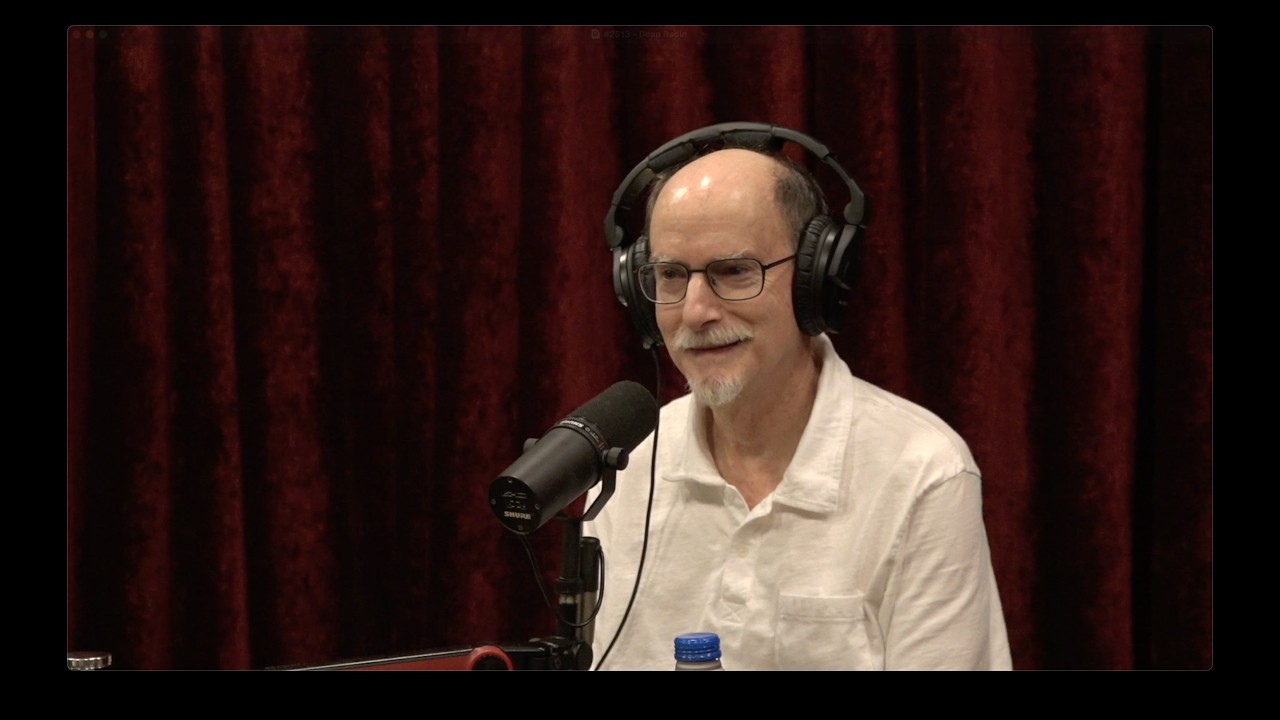
Cognigenics Chairman Radin Seeks Genetic Push to Unlock Human Telepathy
PowerfulJRE
Centuries of the Inquisition executing mystics systematically pruned psychic sensitivity genes out of the European population, prompting the need for modern RNA treatments to restore consciousness capabilities.
## Background
This episode of the Joe Rogan Experience, featuring guest Dean Radin, PhD, was published on YouTube by the PowerfulJRE channel on June 11, 2026. The page description highlights Dr. Radin's roles as Chief Scientist at the Institute of Noetic Sciences (IONS) and co-founder of Cognigenics, promoting his latest book, "The Science of Magic: How the Mind Weaves the Fabric of Reality."
## TL;DR
Dr. Dean Radin details his extensive career transitions from classical violin to electrical engineering, experimental psychology, and classified parapsychological research within the Stargate program. The conversation explores the scientific evidence for telepathy, remote viewing, and mind-matter interactions like spoon bending, challenging the dominant worldview of scientific materialism. Radin explains recent advancements in genetic 'psi-gene' mapping and his company Cognigenics' development of an intranasal RNA delivery system aimed at treating cognitive decline. Additionally, the dialogue tackles anomalies in human history, quantum entanglement, and the 'ultraterrestrial' hypothesis regarding unexplained oceanic and aerial phenomena.
## Atmosphere & style
The conversation carries an intriguing, open-minded vibe that blends rigid laboratory data with deeply esoteric concepts, feeling less like a clinical lecture and more like a late-night exploration of the world's hidden fringes. Joe Rogan guides the discussion with his trademark curiosity and grounded skepticism, providing a relatable sounding board for Radin's analytical yet revolutionary claims. Radin maintains a calm, intellectually precise, and humble demeanor, which grounds the wildly extraordinary stories of synchronicity and psychic phenomena in a sense of objective reality. The emotional arc moves from lighthearted personal anecdotes about music and genetic quirks to a profound, high-stakes contemplation of human potential and the future of collective consciousness.
## Key takeaways
- [00:01](https://www.youtube.com/watch?v=4Uk0_1yqdJo&t=1s) Dean Radin discovered he has Gilbert's syndrome, a genetic liver enzyme mutation that eliminates his recovery time after physical exertion but provides powerful cardiovascular benefits and promotes longevity.
- [06:31](https://www.youtube.com/watch?v=4Uk0_1yqdJo&t=391s) The Institute of Noetic Sciences (IONS) was founded by Apollo 14 astronaut Edgar Mitchell after experiencing the 'overview effect' on his journey back to Earth.
- [09:20](https://www.youtube.com/watch?v=4Uk0_1yqdJo&t=560s) Radin argues that the dominant scientific worldview of materialism or physicalism is fundamentally incapable of explaining subjective human experience.
- [15:07](https://www.youtube.com/watch?v=4Uk0_1yqdJo&t=907s) A massive body of cumulative evidence built over 150 years provides strong proof that telepathy exists, despite mainstream scientific skepticism and refusal to review the data.
- [20:21](https://www.youtube.com/watch?v=4Uk0_1yqdJo&t=1221s) Radin joined the classified Stargate program, a Top Secret SCI Special Access Program at SRI International studying remote viewing, and discovered elite viewers were completely ordinary individuals.
- [31:56](https://www.youtube.com/watch?v=4Uk0_1yqdJo&t=1916s) In precognition experiments, human intention statistically altered the distribution of random bits produced by random number generators, showing a personalized signature of mind-matter interaction.
- [37:07](https://www.youtube.com/watch?v=4Uk0_1yqdJo&t=2227s) The presentiment experiment demonstrated that a subject's skin conductance spikes 1.5 seconds before a random number generator selects an emotional image, showing the body physically reacts to unpredictable future events.
- [01:09:42](https://www.youtube.com/watch?v=4Uk0_1yqdJo&t=4182s) The 'Psi Genes' study found that a control group had a significant intron mutation that turns off psychic sensitivity, while a population genetics analysis revealed that countries exposed longer to Christianity and the Inquisition had a higher prevalence of this mutation due to the execution of mystics.
- [01:22:27](https://www.youtube.com/watch?v=4Uk0_1yqdJo&t=4947s) Spoon-bending and macro psychokinetic events rely on a high-motivation state that alters the probabilistic structure of matter at a deep atomic level, forming a temporary grain boundary that softens metal.
- [01:30:25](https://www.youtube.com/watch?v=4Uk0_1yqdJo&t=5425s) The philosophy of dual-aspect monism, supported by Carl Jung's concept of 'unus mundus,' argues that mind and matter split out of a single, uniform underlying reality because of meaning.
- [01:31:55](https://www.youtube.com/watch?v=4Uk0_1yqdJo&t=5515s) Spiritual traditions and religious institutions historically prohibited the exploration of psychic phenomena or 'siddhis' to prevent practitioners from inflating their egos and to maintain institutional control.
- [01:34:55](https://www.youtube.com/watch?v=4Uk0_1yqdJo&t=5695s) Radin co-founded Cognigenics, a neuroengineering company developing an intranasal RNA interference delivery method to downregulate 5-HT2A brain receptors for treating dementia and memory loss without permanent DNA changes.
- [01:47:55](https://www.youtube.com/watch?v=4Uk0_1yqdJo&t=6475s) A published case study showed that an 80-year-old late-stage Alzheimer's patient temporarily regained fluent speech, memory recall, and basic daily functionality after being administered a high dose of psilocybin.
- [02:18:39](https://www.youtube.com/watch?v=4Uk0_1yqdJo&t=8319s) Radin supports the 'ultraterrestrial' hypothesis proposed by Hal Putoff, which suggests that UAP entities are an ultra-advanced species from Earth's own distant past that may reside in the deep oceans.
- [02:22:56](https://www.youtube.com/watch?v=4Uk0_1yqdJo&t=8576s) Anomalous human skulls discovered in Peru feature a brain capacity 30% larger than modern humans, lack a sagittal suture, and possess a uniquely repositioned spinal column entry point, challenging standard cranial deformation theories.
- [02:31:56](https://www.youtube.com/watch?v=4Uk0_1yqdJo&t=9116s) Radin experienced a profound four-part synchronicity in Silicon Valley when he discovered an identical, mirrored laboratory setup run by a stranger who had intensely visualized meeting him using yoga nidra.
## Detailed walkthrough
### [00:01](https://www.youtube.com/watch?v=4Uk0_1yqdJo&t=1s) Early Life, Career Shifts, and Gilbert's Syndrome
The conversation begins with lighthearted banter about whether the guest managed to manifest this appearance on the podcast. To establish his background, the guest offers a quick three-minute summary of a 45-year career arc. He explains that he started out as a classical violin player, pursuing it until about halfway through college. He eventually abandoned this path after realizing that a professional musician must essentially be an athlete who makes a living with their body. Lacking the necessary physical strength and stamina, and realizing he could not simply build it up, he sought a different direction.
Years later, the guest discovered the genetic root of his low physical stamina: Gilbert's syndrome. While most people experience a rush of good feelings and energy after exercising, he would feel completely exhausted. The condition involves a mutation of a liver enzyme that leaves him with virtually no recovery time, a state driven by an excess of unconjugated bilirubin. When asked by the host if anything can be done to treat it, the guest notes that outside of hypothetical genetic engineering, there is no remedy.
Despite the intense fatigue and inability to handle heavy exertion, the condition has a surprising upside. Because unconjugated bilirubin acts as a powerful natural antioxidant, it offers profound cardiovascular benefits and promotes longevity. The guest shares that his doctor ordered a cardiac calcium scan because his cholesterol levels were exceptionally high. While a score of 100 on the scan indicates a severe risk of death, the guest scored a perfect zero. At 74 years old, he completely defies typical aging expectations, prompting the host to remark, "you look like maybe 15 20 years younger than you're supposed to look."
- **Exercise Tolerance:** The guest walks daily as his primary exercise; walking too fast or too hard leaves him feeling the physical toll for three to four days.
- **Micro-dosing Movement:** The host suggests doing very light, spaced-out exercises—like two push-ups every four hours—to maintain bone mass without triggering the syndrome's profound exhaustion.
- **Cardiac Calcium Scan Scale:** Ranges from 0 (no visible calcium/plaque build-up) to 100 (severe cardiovascular risk).
[04:02](https://www.youtube.com/watch?v=4Uk0_1yqdJo&t=242s) The Transition from Violin to Fiddle
Shifting topics, the host asks about the difference between a violin and a fiddle. The guest explains that the distinction is partly how the instrument is played, but it mostly comes down to the style of music and the career track. A violin belongs to the classical music realm and a path toward becoming a concert violinist, whereas a fiddle is tied to genres like bluegrass and folk. After realizing he would not pursue classical music professionally, the guest transitioned to bluegrass fiddle and banjo, playing for another 25 years.
Amusingly, the guest notes that playing bluegrass required him to unlearn his rigorous classical training and purposefully "learn not to play that well." To achieve an authentic, gritty bluegrass sound, a musician needs to be slightly off-tune and deliberately hold the instrument incorrectly. He recalls competing in the Illinois State Fiddler Contest when he was around 25 years old. He "lost miserably" to a then-teenaged Alison Krauss, whom he praises as a fantastic vocalist and an incredible instrumentalist even at that young age.
- **Cultural Context:** The host notes that in popular culture, the fiddle was widely introduced to mainstream America through the Charlie Daniels Band song "The Devil Went Down to Georgia."
- **Musical Aesthetics:** The guest describes popular mainstream fiddling as "fiddle on steroids," but validates it as genuinely good fiddling that resonates with audiences.
[06:31](https://www.youtube.com/watch?v=4Uk0_1yqdJo&t=391s) Exploring "Door Number Two" and the Institute of Noetic Sciences
Desiring a career where he could use his mind instead of his body, the guest transitioned from music to electrical engineering during college because he loved taking things apart and building things. After earning a master's degree in the field, he realized he no longer wanted to be an electrical engineer, so he pivoted again to earn a PhD in experimental psychology. He describes his career strategy as treating life like a game show: whenever he was presented with a stable path to do one thing forever, he almost always chose "door number two" to explore something entirely new.
During his senior year of college, he discovered the Institute of Noetic Sciences (IONS). The institute was founded by Apollo 14 astronaut Edgar Mitchell, the sixth man to walk on the moon. On his journey back to Earth, Mitchell experienced a powerful mystical realization known widely today as the "overview effect." This transformative space experience frequently alters astronauts' perspectives, shifting their focus toward global unity. Driven by his profound sense of feeling "one with the universe," Mitchell established the institute to pivot from exploring outer space to investigating the frontier of inner space.
- **Noetic Definition:** The guest defines "noetic" as an intuitive feeling or "download" that carries an absolute, internal sense of certainty that more often than not proves to be entirely correct.
- **IONS Motto:** "Exploring the frontiers of consciousness," a phrase that captivated the guest in college and became his lifelong career target.
[09:20](https://www.youtube.com/watch?v=4Uk0_1yqdJo&t=560s) The Paradigm of Materialism and "Weirdness" in the World
The host points out that until the last couple of decades, mainstream rational circles openly dismissed mystical or intuitive experiences. Society often attempts to define the world in rigid, ego-driven terms to maintain a sense of control, brushing off thousands of years of mystical traditions as mere "woo-woo." However, the host and guest agree that anomalous "weirdness" is a persistent reality. People frequently experience sudden, intense connections, such as thinking of a long-lost friend right before they call, sensing unspoken anger from someone across a room, or experiencing a strong gut warning that prevents a disaster.
The guest emphasizes that while conventional science spokespeople attribute these events to coincidence or the frailty of human memory, a dedicated branch of controlled science has studied these phenomena since the late 1800s. He notes that human beings possess a very limited band of natural senses, and it is highly probable that forces exist which impact us despite our inability to weigh them on a traditional scale or measure them with a tape measure. He was drawn to this field by a lifelong love of fairy tales and science fiction, where stories are consistently saturated with psychic elements like "The Force" in *Star Wars* or the awareness-expanding "spice" used to navigate wormholes in Frank Herbert's *Dune*.
- **Materialism/Physicalism:** The dominant scientific worldview assuming that physical matter is all that exists. The guest notes that students are taught this as absolute fact rather than as a set of underlying assumptions.
- **The Number One Mystery:** The guest asserts that materialism is fundamentally incapable of explaining subjective human experience, which is why he writes books exploring a more comprehensive framework of reality.
[15:07](https://www.youtube.com/watch?v=4Uk0_1yqdJo&t=907s) The Evolution of Telepathy and Experimental Controls
The host asks what early researchers in the 1800s were specifically trying to isolate when they first began examining these phenomena. The guest explains that early scientists were trying to investigate real-world accounts of apparitions, telepathic links, and precognitions using controlled experiments. The objective was to design environments that completely excluded alternative explanations, such as information leaks or pure coincidence. If a phenomenon like "thought transference" was genuine, it would manifest clearly under these rigorous laboratory conditions.
Reflecting on the historical evolution of the field, the guest admits that the experimental methods utilized in the 19th century would not pass modern scientific muster. Early studies often relied on pairs of children who claimed to share a telepathic link, only for researchers to discover later that the subjects were utilizing subtle, hidden physical signals to communicate. Today, experimental standards are incredibly strict to ensure total isolation. Neither the sender nor the receiver can have any prior knowledge of the target information, and researchers rely on extensive replications across large groups of people. This rigorous process has built a massive body of cumulative evidence over the last 150 years, providing incredibly strong proof that telepathy does exist.
- **Modern Standards:** Subjects must be strictly isolated from one another to prevent any sensory leakage.
- **The Skeptic's Challenge:** The guest notes that the modern body of data has become so robust that even informed skeptics struggle to identify a fundamental experimental flaw in the top-tier literature.
[16:46](https://www.youtube.com/watch?v=4Uk0_1yqdJo&t=1006s) The Dismissal of Remote Viewing Data
The scientific and mainstream response to evidence regarding remote viewing has shifted into a stance that is no longer rooted in scientific argument. Historically, critics spent a vast amount of time trying to identify plausible flaws in the data. More recently, however, the approach has transformed into an outright refusal to even look at the evidence, based entirely on the assumption that the phenomenon is impossible. This dismissive attitude stands in stark contrast to the actions of intelligence agencies, which have invested enormous sums of money and considerable amounts of time studying remote viewing. It defies logic that these agencies would dedicate such extensive resources to something devoid of positive results or empirical evidence.
The conversation highlights that individuals involved in these government experiments, such as physicist Hal Putoff, derived actionable data specifically from remote viewing. While the host admits he has never attempted remote viewing, cannot do it, and does not fully understand it, he recounts a television show experiment where a self-proclaimed remote viewer was tested under the duress of cameras. The viewer was off target, which raises the critical point that a high-anxiety environment filled with distractions—like a nearby jackhammer or a barking dog—is entirely counterproductive to achieving the necessary state of mind.
Brain waves demonstrate that the human mind is not a static binary system like an on-and-off toaster; it experiences a fluid range of states. Dismissing remote viewing, which allows certain individuals to establish a bizarre, non-local connection to reality and describe things like Soviet submarine construction in detail, is described as foolish. The only way to truly understand if there is substance to these claims is for intelligent people to be willing to look a little foolish themselves and commit to studying the data.
* **Intelligence Agency Investment:** Huge financial and time commitments contradict the mainstream narrative that remote viewing is complete nonsense.
* **The Duress Factor:** Success depends heavily on being totally relaxed and focused rather than experiencing anxiety, fear, or external environmental distractions.
* **Historical Successes:** Remote viewers historically provided highly detailed, non-local descriptions, including tracking submarines in the Soviet Union.
[20:21](https://www.youtube.com/watch?v=4Uk0_1yqdJo&t=1221s) From Bell Labs to the Classified Stargate Program
After earning his doctorate, the guest began working at Bell Laboratories, which was the largest laboratory in the world at the time and still part of the Bell System. Fueled by a personal interest in anomalous phenomena, he utilized some of his time at Bell Labs to conduct small-scale psychic experiments focusing on mind-matter interaction and precognition. During this era, Edgar Mitchell, the Apollo astronaut, was funding SRI International—where Hal Putoff and Russell Targ were conducting remote viewing studies. Mitchell had also brought Israeli performer Uri Geller to the United States, sparking widespread interest across various institutions, including Bell Labs, where several staff members witnessed Geller's demonstrations.
The guest sought and received official permission to present his precognition research at the annual conference of the Parapsychological Association. Crucially, he was granted permission to use the Bell Labs imprimatur, giving his presentation the formal backing of a highly prestigious institution. Many people remain unaware that the Parapsychological Association is a legitimate scientific organization and one of the 200-plus affiliates of the American Association for the Advancement of Science (AAAS). Following his presentation, a few audience members approached him and extended a life-changing offer: a chance to join the classified Stargate program.
* **Bell Labs Backing:** The guest presented his findings with the official stamp of approval from Bell Labs, lending mainstream scientific weight to the topic.
* **The Edgar Mitchell Connection:** Mitchell provided the foundational funding for SRI International's remote viewing research and initially brought Uri Geller to the U.S.
* **The Secret Offer:** The presentation directly led to an invitation to join the Stargate program, an offer the guest described as a "door looked really interesting" that he couldn't refuse.
[22:32](https://www.youtube.com/watch?v=4Uk0_1yqdJo&t=1352s) Inside the Special Access Layers of Stargate
Securing an exciting one-year leave of absence from Bell Labs, the guest transitioned to SRI International to work under Hal Putoff, who served as his boss until 1985 when Ed May took over as director for the subsequent decade. Navigating the government clearance process proved to be an eye-opening experience for a civilian academic unfamiliar with military classification. The project was not merely "secret" or "top secret," but classified as Top Secret SCI (Sensitive Compartmented Information) Special Access Program (SAP). This extreme level of security required signing a literal book of cleared individuals and meant that even someone possessing a standard top-secret clearance was barred from knowing about the facility or its highly classified code word.
While public fascination with the Stargate program typically centers on the operational and military applications, the guest's mandate on the research side was fundamentally different. Their mission was to answer scientific questions: Is this real? How does it work? What are its limits? They investigated whether the phenomenon could be blocked, shielded, or camouflaged, and scrutinized what separated "superstars" like remote viewer Joe McMonicle from the rest of the population. Meeting legendary viewers like Ingo Swann and McMonicle shattered the guest's stereotypes; they did not resemble a mystical "Madame Zodiac" but were completely ordinary men and women.
* **Security Infrastructure:** The program operated as a Special Access Program (SAP), meaning its very code name and existence were shielded from the broader military and intelligence community.
* **Program Leadership:** Hal Putoff originally led the project, followed by Ed May, who served as the director for 10 years after Putoff's departure in 1985.
* **Research Focus:** The scientific team examined variables like shielding, camouflage, and the psychological or physiological profiles of elite viewers.
[24:51](https://www.youtube.com/watch?v=4Uk0_1yqdJo&t=1491s) The Traits of Talent and the Silos of Academia
Extensive psychological, physiological, and medical testing failed to identify any consistent bodily or medical factors that explained exceptional remote viewing abilities. The army was deeply invested in finding a baseline metric to select and train a broader pool of talented individuals, but no uniform physical indicators emerged. Instead, the research pointed toward two defining qualities: natural talent and openness. Talent appears to be an inherent capability partly rooted in genetics, which modern researchers are currently exploring by hunting for what they call a "psy-gene." Openness, a standard psychological trait, allows a person to be receptive to new experiences, whereas closed-minded individuals possess a strong ability to completely block these non-local perceptions.
Following his time with Stargate, the guest accepted an invitation to Princeton University, joining a multidisciplinary program linked with the Princeton Engineering Anomalies Research (PEAR) laboratory. Led by the dean of the engineering school, the PEAR lab spent nearly 30 years researching mind-matter interaction and remote viewing. Positioned within the psychology department, the guest's daunting assignment was to corral various silos—including philosophy, psychology, civil engineering, and the PEAR lab—into cohesive, cross-disciplinary projects. From day one, peers warned him that the task was impossible because the academic world reward structures force scholars to succeed strictly within isolated silos.
* **The Two Success Factors:** Natural talent (genetic) and openness to experience (psychological) were the only consistent indicators of remote viewing success.
* **The "Psy-Gene" Study:** Lacking advanced genetic tools during the 1980s, researchers in the present day have utilized modern technology to run studies tracking a potential genetic marker for psychic ability.
* **The PEAR Laboratory:** Operating for roughly 30 years at Princeton, this lab focused heavily on engineering anomalies and mind-matter interaction.
[28:13](https://www.youtube.com/watch?v=4Uk0_1yqdJo&t=1693s) Breaking Academic Silos and Consciousness Studies
The resistance to interdisciplinary collaboration at Princeton was fierce. Although various departments accepted funding from the large research grant, they actively resisted true cross-filtering of their work. In higher education, a scholar's professional value is tied exclusively to their narrow expertise, often causing next-door neighbors in social psychology and perceptual psychology to avoid speaking with one another. While this system makes sense given that it takes 20 years to become a world-class expert in a hyper-specific field, it creates an institutional barrier to solving complex realities that require multiple viewpoints.
Historically, new fields are born when major foundations throw enough money at a problem to force separate disciplines to merge, just as neuroscience was synthesized 60 to 70 years ago out of biology, anatomy, and chemistry. The guest views his current field, consciousness studies, as undergoing a similar slow evolution into a legitimate, standalone discipline, having previously been left entirely to a handful of philosophers and anesthesiologists.
To overcome academic inertia during his time at Princeton, the guest relied heavily on meta-analysis. This statistical technique pools the data from numerous independent, similar experiments—such as separate telepathy tests—and evaluates them as one giant experiment. Meta-analysis successfully answers whether a phenomenon can be replicated by independent researchers and reveals the true collective strength of the data.
* **Academic Isolation:** The strict silo culture means departments heavily resist collaboration because institutional value and career survival depend on insular specialization.
* **Birth of Disciplines:** Just as neuroscience was forged by foundation funding decades ago, consciousness studies is slowly transitioning from a fringe philosophical topic into its own formal scientific discipline.
* **Power of Meta-Analysis:** By combining distinct studies into a single statistical overview, meta-analysis determines if independent replications yield a unified, scientifically valid result.
[31:56](https://www.youtube.com/watch?v=4Uk0_1yqdJo&t=1916s) Neural Networks and the Signature of Intention
In addition to meta-analysis, the guest ran precognition experiments utilizing neural networks, which represented the cutting edge of machine learning at the time. Applying these networks to data generated by the PEAR lab, they tested human interaction with random number generators. In a typical session, a subject was asked to focus their intention on a machine designed to output entirely random binary code. The subject faced three distinct tasks within a single session: consciously force the machine to generate more "1" bits than "0" bits, force it to generate more "0" bits, or act as a control baseline by doing nothing at all.
The collective data from these trials demonstrated that human intention does influence the machine's output, causing the random bits to skew significantly in the requested direction. However, this success was not uniform across all participants. Some subjects achieved highly positive results when aiming high but failed completely when trying to force a low output, while others experienced the exact opposite. This divergence revealed that individuals possess a highly personalized "signature" or unique style of interacting with the machinery, an anomalous pattern that the guest began training neural networks to recognize and decode.
* **The Binary Task Structure:** Participants tried to mentally influence a random number generator to output more ones, more zeros, or remain neutral during control periods.
* **The Intentional Skew:** Over large numbers of trials, human intention statistically altered the distribution of random bits in alignment with what the subject wanted.
* **Personalized Signatures:** Because individuals displayed highly specific strengths and failures when interacting with the generators, researchers used early machine learning to identify individual behavioral styles.
[33:26](https://www.youtube.com/watch?v=4Uk0_1yqdJo&t=2006s) The Technology of Intention and Corporate Bureaucracy
The speaker transitions from their time at Princeton, which they left out of frustration regarding the steep challenges of managing multidisciplinary teams, to their return to the private sector. Upon taking a job in industry, the speaker explicitly informed recruiters of their desire to pioneer a new field: a technology capable of utilizing machines to identify human identity and intention. They liken this concept to Neuralink, but with a crucial distinction—it requires absolutely no physical brain implants or connections, relying purely on raw intention.
Working for a company just outside of Washington, D.C., the speaker utilized advanced neural networks paired with random number generators to bring this concept to life. The device proved so successful that the team was on the verge of filing a patent. The organization's head, a retired general, even looped in an admiral buddy because the Navy was highly interested in the technology's obvious potential for communicating with submarines. However, right on the precipice of a breakthrough, the company was acquired. The new management abruptly shut down the project. Despite the "golden handcuffs" of a high salary and a prestigious position, the speaker felt deeply unfulfilled. When asked if the cancellation was due to profitability, the speaker reveals that the vice president in charge of the lab simply refused to look at the data and "did not believe that it was possible," preferring to avoid looking "silly" by backing something so unconventional.
[35:40](https://www.youtube.com/watch?v=4Uk0_1yqdJo&t=2140s) From the Stargate Program to the University of Edinburgh
Unable to drop such an inherently fascinating subject, the speaker spent the next few years keeping the research alive as a side project outside of work. In 1992, a recession hit, resulting in the layoff of the speaker's entire department. This setback opened an unexpected door involving the Stargate program—which went by various highly classified code words at the time. Stargate was issuing classified contracts globally, including one to a colleague at the University of Edinburgh in Scotland who was building an automated Ganzfeld testing system. This telepathy system was designed to entirely remove the human researcher from the loop by automating the process with a simple button press for the two experimental participants.
When the researcher developing the system suddenly passed away, leaving the project unfinished, the speaker approached Ed May—the director of Stargate at the time—and asked for permission to go to Scotland to complete it. May agreed, and the speaker spent about a year at the University of Edinburgh finishing the automated telepathy system, which has since been used to test thousands of subjects.
- **Automated Ganzfeld System:** A telepathy testing setup designed to eliminate human-investigator bias by fully automating the interactions between the two experimental subjects.
- **Ed May:** The director of the Stargate program who greenlit the speaker's journey to Scotland to preserve the unfinished research.
[37:07](https://www.youtube.com/watch?v=4Uk0_1yqdJo&t=2227s) The Presentiment Experiment and the Red Light Story
After quickly wrapping up the telepathy system in Edinburgh, the speaker began developing the "presentiment experiment" around 1993. This research focuses on whether the human body physically reacts to unpredictable, completely randomized future events. The inspiration for the experiment came from a classic real-world scenario: a person drives the exact same route to work thousands of times, approaching a green light they would normally accelerate through. Suddenly, an internal "little voice" urges them to slow down. Despite impatient drivers honking behind them, they brake, only for a massive truck to blast through a red light a split second later. By listening to that internal warning, they avoid a fatal broadside collision, experiencing a massive shock of relief.
To safely simulate this emotional arc in a laboratory setting, the speaker wired subjects up to apparatuses measuring nervous system responses like skin conductance, pupil dilation, and brain waves. Subjects pressed a button and waited to see an image on a screen. The images were selected by a true random number generator *after* the button was pressed, meaning neither the subject nor the experimenter could know what was coming. The images were split into two emotional valences: calm pictures versus highly emotional pictures (which could be negative, like an explosion or surgery, or positive, like a smiling baby).
[39:20](https://www.youtube.com/watch?v=4Uk0_1yqdJo&t=2360s) The Bullet in the Safety Deposit Box
After leaving Edinburgh, the speaker turned down a classified offer from Oak Ridge National Labs to instead run a laboratory at the University of Nevada, funded generously by Robert Bigelow. There, the speaker finally ran the presentiment experiment, and the data was "unbelievably good." Instead of minor statistical anomalies, the results were glaringly obvious. One and a half seconds before the true random number generator even selected an image, a subject's skin conductance would spike if an emotional image was incoming, while remaining perfectly flat if a calm image was next. The body or unconscious mind somehow knew what it was about to see.
Upon hearing these results, a colleague at the university shared an even more extreme real-world example of presentiment that occurred two weeks in advance. The colleague, an avid hunter, was cleaning his favorite double-action six-shot revolver. His routine was to load five bullets and leave the hammer resting over the empty sixth chamber to prevent accidental discharge. While picking up the fifth bullet, an overwhelming intuition told him "something about this bullet isn't right." He set it aside, leaving only four bullets in the gun, and went hunting. Two weeks later, after returning from the trip, the hunting party uncharacteristically began drinking heavily. A chaotic fight broke out, and a severely intoxicated man grabbed the colleague's revolver, pointing it point-blank at another person's face. As the trigger was pulled and the cylinder rotated from chamber six to chamber five, the colleague lunged in front of the gun. It went *click*. The hammer struck the exact empty chamber where the rejected bullet should have been. The colleague later put that specific bullet into a safety deposit box, declaring that everyone has a bullet with their name on it, and he knows exactly where his is.
- **Presentiment Timeline:** In a controlled lab environment, the physical pre-stimulus response occurs roughly 1.5 seconds before an asset is randomly generated; in chaotic real-world survival scenarios, anecdotes suggest it can manifest weeks early.
- **Robert Bigelow:** The aerospace figure who funded the speaker's independent university lab in Nevada, allowing this anomalies research to bypass traditional institutional roadblocks.
[43:38](https://www.youtube.com/watch?v=4Uk0_1yqdJo&t=2618s) The Protocol and State of Mind of Remote Viewing
The conversation shifts to the precise protocol and mental state required to execute successful remote viewing. The speaker explains that the approach depends entirely on whether a person is naturally gifted. For hyper-talented viewers like Joe McMoneagle, the process is practically effortless. The speaker notes that if you ask McMoneagle at breakfast to view the contents of a hidden folder, he can casually continue eating his meal while instantly giving the correct answer. McMoneagle often reports that if he knows he has a viewing scheduled for the afternoon, the target data simply lands in his mind "like bang" first thing in the morning.
For the average person lacking raw talent, systematic training is required—and the speaker emphasizes that almost anyone can learn the basics. The hardest hurdle in the protocol is training the mind "to not name an impression." Typically, a viewer is given nothing but a random five-digit number assigned to a hidden target (such as a specific location like Moscow, an envelope, or a secure facility). When a prompt is given, the untrained mind might get a brief flash of the color yellow and immediately leap to a conclusion like "bananas," effectively locking up the analytical mind and ruining the viewing. Training teaches students to ignore names and instead record basic abstract scribbles, slowly layering in physical sensations, textures, and emotional data until a coherent, veridical image naturally gels together.
[47:29](https://www.youtube.com/watch?v=4Uk0_1yqdJo&t=2849s) Quantum Entanglement, Non-Locality, and the Animal Mind
When asked how a completely random five-digit number can instantly establish a cognitive bridge to a hidden target, the speaker admits that science does not yet have a concrete answer. However, explaining the phenomenon requires completely stepping away from strict materialism as the sole framework of reality. The speaker suggests that consciousness possesses a "non-local" quality, behaving remarkably similarly to quantum mechanics and the phenomenon of quantum entanglement. Just as particles maintain instantaneous, non-local connections across vast distances, consciousness appears to connect things seamlessly through both space and time. The speaker humorously notes that if you push this concept to its logical conclusion, you end up with a reality mirroring the film *Everything Everywhere All at Once*. Without this intrinsic, non-local interconnectedness woven into the fabric of reality, phenomena like telepathy, precognition, and remote viewing simply could not function.
The host muses on whether this psychic ability is an emerging human trait or an atrophied ancient sense drowned out by modern distractions like books, written language, and media. To illustrate, the host points to wolves, who coordinate highly sophisticated, multi-role hunting ambushes—such as one wolf intentionally herding an elk into a tight corridor while others wait on high ground to drop down—implying a form of quiet, unspoken communication that goes far beyond simple learned experience. The speaker agrees enthusiastically, noting that wolves are vastly more intelligent than society gives them credit for. The host adds that while highly driven military-grade dogs like Belgian Malinois possess firing, hyper-active brains that demand constant mental stimulation, a wild wolf possesses that exact baseline raw intelligence multiplied "times 100."
[50:11](https://www.youtube.com/watch?v=4Uk0_1yqdJo&t=3011s) The Evolutionary Purpose of Attentional Blindness and the Shamanic Talent
When looking at the broad question of whether non-local consciousness is an emerging phenomenon or an ancient human trait, human evolution reveals a distinct pattern. Humans are evolutionary shaped to prioritize the immediate present over the "there and then." From a survival standpoint, a person walking around a million years ago contemplating Pluto would have quickly been "pruned out of existence" by a lurking tiger. Attentional blindness to non-local consciousness was essentially a survival mechanism.
Historically, only a very specific group of people could afford to let their minds drift into these non-local spaces. These individuals were known as shamans. Shamans played a vital, practical role within their tribes because they could instinctively know that food would be waiting ten miles away the following week. However, because their minds were figuratively "off in Pluto," they often could not take care of their own basic needs, requiring the tribe to protect and sustain them. In modern society, this dynamic has largely atrophied due to constant distractions and a lack of immediate survival needs, though it still lingers in certain indigenous cultures.
An illustrative example occurred during a presentation given to the Australian government, which was attended by military personnel and ministers. After a lengthy lecture on telepathy, an indigenous representative approached the speaker and remarked, "well we've known this stuff for thousands of years." In the remote outback, where no telephone infrastructure existed, indigenous people utilized non-local communication as a functional, distraction-free necessity of life. This suggests that remote viewing and similar phenomena represent the relearning of an ancient skill. While the trait has atrophied globally, the underlying genetic talent still persists in certain ancestral bloodlines.
- **The Shaman's Role:** Provided crucial operational intelligence (e.g., predicting food locations 10 miles away a week in advance) while relying on the tribe for physical protection.
- **Genetic Underpinnings:** The capability for non-local awareness behaves like a natural talent, with a "good chunk of it" being explicitly genetic and passed down from ancient ancestors.
This portion of the program is brought to you by BetterHelp. While summer brings opportunities for adventure, managing chaotic schedules and trying to maximize the season can quickly become exhausting. It is vital to carve out spontaneous moments for yourself, whether that means going on an unplanned weekend getaway or simply relaxing at home. For those facing deeper personal struggles, professional therapy offers a structured path toward support.
BetterHelp provides a global network of over 30,000 quality therapists to match individuals with the right professional guidance. Engaging in therapy can help people identify their specific mental health needs, set healthy boundaries, and learn that they "don't have to say yes to everything this summer."
- **Promotional Offer:** Listeners can access a 10% discount on therapy services by signing up through the dedicated link at `[betterhelp.com/jre](https://betterhelp.com/jre)`.
---
[53:50](https://www.youtube.com/watch?v=4Uk0_1yqdJo&t=3230s) Combat Intuition and the Las Vegas Parapsychology Lab
The real-world application of genetic psychic traits is highly evident in military operations, such as the career of Joe McMonagle. McMonagle served in search-and-rescue teams operating behind enemy lines, establishing an extraordinary record where his team always found their target and always returned alive. His survival relied entirely on acute field intuition—making split-second decisions to avoid specific roads without conventional justification. When the military recruited for specialized psychic programs, they actively sought combat veterans like McMonagle who possessed an uncanny ability to completely avoid getting hit in battle. Notably, McMonagle and his sister both shared a history of anomalous experiences, further reinforcing the concept of a "familial genetic underpinning."
Shifting from military tracking to academia, a unique research opportunity emerged at the University of Nevada, Las Vegas (UNLV). The New York Times ran a character profile on the anomaly of a parapsychologist operating out of Las Vegas—a city frequently described as "the largest parapsychology lab in the world." In a casino, thousands of individuals simultaneously attempt to mentally influence random physical systems, such as the rolling of dice.
Through a cooperative relationship with a general manager at a smaller casino, access was granted to comprehensive, unedited data tracking slot machine jackpots and table game payouts. The subsequent analysis yielded a striking correlation: jackpot frequency and table game payouts peaked within a strict window of "plus or minus one day from the full moon." This finding directly mirrors traditional magical lore regarding lunar cycles. When the general manager was jokingly warned that publishing this might cause a massive influx of players during full moons, she welcomed it, noting that the mathematical house edge ensures players would simply "lose a little bit slower" because the environment is fundamentally rigged against them.
- **Joe McMonagle's Record:** Perfect safety and retrieval record behind enemy lines driven by intuitive navigation; shared these non-local experiences with his biological sister.
- **The Las Vegas Casino Study:** Statistical analysis of real casino data proved that peak payouts and jackpots occurred within a 1-day variance of a full moon.
---
[56:49](https://www.youtube.com/watch?v=4Uk0_1yqdJo&t=3409s) Silicon Valley Research and the Move to Noetic Sciences
The media exposure from the New York Times piece completely shifted an academic career. A book manuscript originally written at Princeton—which publishers initially refused to touch—suddenly sparked a bidding war among companies asking, "Do you ever think about writing a book?" The publication of this book caught the attention of Interval Research, a highly exclusive Silicon Valley organization funded by Microsoft co-founder Paul Allen.
Launched in 1990 as a strict 10-year project, Interval Research brought together a 100-person elite team poached directly from Apple, Xerox PARC, and the MIT Media Lab to map out the future of a "wired world" ahead of the mainstream internet explosion. The invitation to launch a dedicated psi research program came with a budget ten times larger than UNLV's and a salary that was three times larger. While much of the work at Interval was strictly proprietary and led to foundational modern patents, the psi project operated as a "blue sky" initiative meant to force scientists to push the conceptual envelope. Following the conclusion of the 10-year project in 2000, a brief venture into a non-profit called the Boundary Institute was cut short by the dot-com crash. This eventually led to a permanent 25-year tenure at the Institute of Noetic Sciences, fulfilling a college dream of studying the absolute frontiers of consciousness.
- **Interval Research Specs:** Founded by Paul Allen in 1990; limited to a 10-year operational lifespan; staffed by 100 top-tier tech industry researchers.
- **Career Chronology:** Transitioned from UNLV to Interval Research (1990s), co-founded the Boundary Institute (2000), and spent the subsequent 25 years at the Institute of Noetic Sciences.
---
[59:35](https://www.youtube.com/watch?v=4Uk0_1yqdJo&t=3575s) Jimmy Carter’s Missing Bomber and Telepathy at 300 Meters Submerged
When assessing the most spectacular operational successes of remote viewing, one definitive historical event stands out—a case publicly acknowledged by President Jimmy Carter. A Soviet nuclear bomber carrying a highly sensitive weapon crashed somewhere in Africa, completely hidden from aerial reconnaissance by a dense jungle canopy. Traditional intelligence networks had no way of locating the wreckage.
The military turned to a specialized remote viewer named Fran, who was an expert in the incredibly difficult sub-discipline of map dowsing. Given nothing but a blank sheet of paper marked with abstract coordinate associations to protect operational security, Fran successfully placed a mark indicating where the aircraft was hidden. Military recovery teams deployed to the designated coordinates and discovered the crashed bomber "within a couple of kilometers of that spot," confirming the location with local natives. Beyond this event, lore suggests President Carter was once briefed so intensely on alien life that he began weeping. Given Carter's deeply religious background, it is highly probable that whatever information he received directly assaulted his fundamental theological worldview, matching persistent rumors regarding strategic briefings given to religious leaders to prepare their congregations for anomalous disclosures.
The structural similarities between UAP research and parapsychology are profound, particularly regarding the vast amounts of government misinformation deployed to deflect public attention. This intersection is well-understood within select research circles, including figures like Jacques Vallée and Garry Nolan. A striking validation of these phenomena occurred during a lecture series at the Naval War College regarding the empirical evidence for telepathy.
Following a presentation, two independent submarine commanders came forward with identical operational anomalies. While submerged at classified depths—meaning at least 300 meters below the ocean surface where all electromagnetic communication is physically impossible—a crewman on each submarine awoke from a vivid dream insisting they needed to surface because a crisis had occurred at home. In both instances, there were zero false positives; when the vessels eventually surfaced and made contact, the crisis events were completely real and verified. Submariners are selected through rigorous psychological screening to ensure they are completely stable, highly resilient, and entirely free of claustrophobia or neuroses, making them the ultimate objective observers. Though military officers, generals, and admirals might be expected to dismiss such claims as impossible, they are overwhelmingly supportive because they routinely encounter actionable, anomalous data in the field.
- **The Missing Bomber Incident:** Map dowser named Fran successfully located a hidden nuclear bomber crash site in Africa using abstract paper coordinates, verified within a few kilometers.
- **Submarine Telepathy Conditions:** Occurred at classified depths of at least 300 meters; entirely isolated from electromagnetic signals; experienced by psychologically stable crew members in an altered dream state.
[01:06:39](https://www.youtube.com/watch?v=4Uk0_1yqdJo&t=3999s) Bell Labs, Roswell Folklore, and Special Access Programs
The conversation shifts to the unexpected lack of pushback received from military leaders regarding psychic phenomena. These leaders are routinely thrust into intense, life-and-death situations where gut feelings inevitably bubble up. Because their climb through the ranks depends directly on making high-stakes choices that affect countless lives, they have to trust their intuition and become exceptionally good at it.
This leads into a discussion about Bell Labs, a legendary hub of technological innovation that is also famously tied to UFO folklore. A speaker brings up a "crazy" story regarding the 1947 Roswell crash, noting a widespread myth that pieces of the crashed craft were sent to Bell Labs to be reverse-engineered. While acknowledging familiarity with the rumors, the guest states they have no direct knowledge or firsthand evidence from their time working there. The host reminisces about an old company called the American Computer Company, which built custom Windows PCs online but dedicated a whole page of their website to Bell Laboratories. The site claimed that a nearby military base existed not to protect New York City, but to safeguard Bell Labs because of their top-secret reverse-engineering of Roswell technology.
The speakers marvel at how fun these conspiracy theories are, though the guest points out that a standard, ordinary history easily explains how Bell Labs invented modern staples like fiber optics and lasers without needing alien technology. There is a documented timeline of scientific progression showing how researchers realized what could be achieved with glass, though the guest playfully admits, "Whether the idea came from somewhere else, that's that I don't know." The conversation moves to the reality of deeply classified Special Access Programs (SAPs) that exist beyond top-secret clearance—programs so restricted that even the President of the United States cannot gain access. A major downside of working within a SAP is the extreme isolation; scientists often work right next to colleagues for years without ever being allowed to discuss what they are doing.
- **American Computer Company:** A defunct company that sold customizable PCs online and hosted a webpage dedicated to Bell Labs conspiracy theories.
- **The Stargate Archives:** A public, four-volume collection detailing the Stargate program, though substantial military research, methods, and personnel details remain classified permanently.
- **Hal Puthoff:** A prominent researcher in the program who frequently had to stonewall questions by stating, "Well, I can't talk about that."
---
[01:09:42](https://www.youtube.com/watch?v=4Uk0_1yqdJo&t=4182s) The Secret-Keeping Dilemma and the Eugenics of the Inquisition
The psychological toll of working in a classified psychic program is profound. The guest describes the frustrating "weird psychological dilemma" of entering a secure building to perform fascinating psychic feats, only to step outside where the work officially does not exist. To maintain the cover story, researchers cannot even use the phrase "I can't talk about it," as that would confirm a secret exists; instead, they have to play along with the public consensus and openly agree that the phenomena are "all nonsense."
However, the deepest irony of the Stargate program is that while the entire military apparatus is designed to keep secrets, the research itself is uncovering ways to make secrets impossible. With highly talented remote viewers and telepaths, nothing can be shielded or hidden. The guest suggests that the persistent social stigma and deliberate disinformation campaigns surrounding psychic phenomena exist because elite institutions fear how society would function if absolute secrets no longer existed. When asked if technology like Neuralink will eventually eliminate secrets, the guest clarifies that it won't be brain-computer interfaces, but the "real thing" assisted by technology.
This leads to a fascinating genetic discovery born from a conversation with scientist Garry Nolan, who asked about the lineage of highly talented psychics. To test the folklore that psychic abilities run in families, a study called "Psi Genes" was launched. They used the internet to recruit 3,000 self-proclaimed psychics from psychic families, thoroughly vetted them, and conducted face-to-face interviews to ensure "they weren't nuts." Due to funding limits, they sequenced the DNA of 13 top performers and compared them against matched controls. To their surprise, the psychics possessed standard "wild type" DNA, whereas the control group showed a significant mutation in an intron sequence—the epigenetic "junk DNA" that turns genes on and off. The controls possessed a mutation that actively turned off psychic sensitivity.
A specialist in population genetics on the team analyzed different global societies and discovered that the longer a country had been exposed to Christianity, the more prevalent this intron mutation was. The researchers realized this was the direct genetic consequence of the Inquisition. For hundreds of years, the Church systematically hunted down, targeted, and killed people displaying precognition, healing abilities, or alternative visions under the label of "witches." The guest characterizes this historical pruning as a reverse form of eugenics: "They weren't trying to pull people for talent but get rid of the talent." Magic was perfectly acceptable to the Church if performed within its own bounds—such as a priest performing the Eucharist—but practicing it outside church walls threatened their monopoly on power.
- **Psi Genes Study:** An experiment that analyzed the genomes of highly vetted psychic individuals against a control group to identify genetic markers for psychic traits.
- **Exon vs. Intron:** Only about 50,000 base pairs of DNA (the exon) produce proteins to build the body; the rest consists of intron sequences which regulate gene expression.
- **The Inquisition's Genetic Impact:** Centuries of executing mystics and healers effectively pruned psychic traits out of the European gene pool, leaving behind a population with a mutated intron sequence that blocks psychic sensitivity.
---
[01:15:39](https://www.youtube.com/watch?v=4Uk0_1yqdJo&t=4539s) Historical Levitators and the Reality of Spoon Bending
The guest highlights historical anomalies within the Catholic Church, specifically saints who exhibited profound psychic traits but escaped execution because they were already ordained. Joseph of Cupertino, famously known as the "patron saint of air travelers," was witnessed by thousands of people—including Pope Urban VIII—levitating up to 30 feet into the air and drifting into the rafters of churches. To avoid a public spectacle that undermined Church authority, the Inquisition struck a deal with him, ordering him to live out his days in a remote location and cease his public levitations. Another famous mystic, St. Teresa of Ávila, recorded that her unexpected levitations during deep spiritual raptures felt like a violent force lifting her from beneath her feet, causing her so much embarrassment that she ordered her fellow nuns to physically hold her down.
When the host asks why no one captures levitation on an iPhone today, the guest recalls visiting a Transcendental Meditation (TM) university to witness their "yogic flying" program. The demonstration featured four young men in full lotus positions hopping about two and a half feet in the air. The host jokingly dismisses it as mere "plyometrics," noting he knows guys who can do that. When the Maharishi was asked why no one was truly flying or hovering, his sociological explanation was that too many surrounding people firmly believe it is impossible, creating a collective mental block.
The guest explains that mainstream laboratory experiments typically yield tiny, statistically driven psychic effects rather than massive feats like levitation, which keeps the phenomenon boxed in. Seeking to find the true limits of these effects, the guest attended a spoon-bending party. They were highly skeptical after hearing that a woman there could bend the bowl of a spoon just by touching it. While standing face-to-face with the woman and mimicking her grip with a 1961 spoon to spot the trick, nothing seemed to happen. Suddenly, someone yelled, "Dean, look what you did." The guest looked down to find they had inexplicably bent the heavy bowl of their own spoon 90 degrees without utilizing any physical force, skin indentation, or muscle strain. Urged by onlookers to finish it, they easily bent it all the way. The experience left them completely "mind-bended." Flying home on a commercial airliner with a duplicate spoon, the guest attempted to repeat the feat but was suddenly struck by an intense wave of fear, realizing they were sitting inside a metal tube 30,000 feet in the air and didn't want to accidentally warp the plane's wings. Today, the metallurgy explains that an sudden impulse of 50 to 70 pounds of force can disrupt the metal's lattice structure.
- **Joseph of Cupertino:** A Franciscan friar and Catholic saint famous for documented accounts of levitation and bilocation.
- **St. Teresa of Ávila:** A Spanish mystic who recorded experiencing uncontrollable, embarrassing levitations during prayer.
- **Spoon Bending Physics:** While the neck of a spoon can easily be bent using sleight of hand or leverage, bending the thick bowl of a vintage 1961 spoon without tool assistance or physical strain defies normal physical expectations.
[01:22:27](https://www.youtube.com/watch?v=4Uk0_1yqdJo&t=4947s) The Mechanics and Motivation of Spoon Bending
The speaker explains that during a macro psychokinetic event, the energy cause forms a grain boundary in the metal that momentarily softens, remaining "really really soft" for about 20 seconds. During this window, a person can literally take a thumb and a finger and squish the metal over, after which it instantly tightens up again. However, there is no conventional explanation for what causes that initial force. The conversational partner tries to replicate this with the actual spoon used in the event, but finds it very difficult to bend. They examine the spoon together, noting that while the neck of a spoon might be easy to bend with enough force, the shell shape of the bowl strongly resists bending. The speaker recalls a man who claimed spoon bending was just a trick of rubbing the metal, but stresses that doing it with just a finger and thumb without leverage is incredibly hard, admitting, "I don't know how I did it."
The discussion shifts to the peculiar psychological state required for the feat. The speaker describes being in a "very weird state of motivation" at a conference because they were promised a button labeled "certified warm former" if they could successfully mold the spoon like putty. The speaker jokes about a "weird ego thing," imagining himself wearing a suit with the button to demonstrate his abilities to the audience. Though not typically self-aggrandizing, the obsession took over to a bizarre degree: "I felt if I don't do this, the universe will end." This absolute, desperate need is what traditional magic relies upon, combining belief, motivation, and imagination. The moment the feat was accomplished and the button was handed over, the obsession vanished, and "everything in the universe was okay again."
- **The 20-Second Window:** The metal remains in a softened, putty-like state for roughly 20 seconds before instantly tightening back up.
- **The "Warm Former" Button:** The driving motivation was a novelty button awarded at the conference for forming the metal as though it had become warm.
- **Two Paths to Magic:** The speaker identifies two ways to manifest these anomalies: long-term meditation to gain specific skills, or a high-motivation state he calls "screaming at fire."
[01:27:36](https://www.youtube.com/watch?v=4Uk0_1yqdJo&t=5256s) The State of Mind and Anomalous Research
When asked if he ever tried to replicate this extreme mental state, the speaker notes he achieved it once on an airplane but avoids doing so now because he doesn't fully understand how he managed it. He has since attempted the feat several times using a quarter-inch aluminum bar—the rigid, stiff kind used in aircraft. While he was able to make the flat bar warp just enough to rock a fraction of a millimeter, he couldn't achieve a dramatic bend without that original "crazy motivation" of wanting the button. He confirms he never filmed himself doing this, though 1970s films of others usually just show the spoons snapping at the neck. This phenomenon drew significant attention from metallurgists and physicists in the 1970s, dividing the academic community into believers and skeptics.
The speaker equates this macro-bending to micro-psychokinetic (micro-PK) events, suggesting that instead of transmitting a generic "unknown energy," the mind alters the probabilistic structure of matter at a deep atomic level. By targeting a specific strip across the metal, the grains are momentarily caused to shift. Crucially, the speaker was not analytically focusing on the mechanics while it happened: "I'm pretty sure if I was being analytical at the time, it would not have happened." The conversational partner compares this to intuition, where overthinking skews or defines the phenomenon until it can no longer be seen, mirroring a general right-brain versus left-brain dynamic.
- **Aluminum Bar Experiments:** The speaker managed to warp a rigid aircraft-grade quarter-inch aluminum bar by a fraction of a millimeter.
- **1970s Metallurgy Research:** The phenomenon of spoon bending underwent intense scientific scrutiny by physicists and metallurgists during the 1970s.
- **Left vs. Right Brain Roles:** The analytical left brain maintains stability and our standard view of how the world works, while the right brain deals with form, function, remote viewing, and psychic phenomena.
[01:30:25](https://www.youtube.com/watch?v=4Uk0_1yqdJo&t=5425s) The Side Genes Study and Dual-Aspect Monism
The conversation transitions to the speaker’s second published "side genes" study. To properly map the genetic basis of psychic experiences—much like researchers do with tens of thousands of cases to find the genetic roots of schizophrenia—requires massive datasets. Lacking the funding for standard clinical genomic sequencing, the team utilized exome data from 23andMe and Ancestry users who also completed an experiential questionnaire. Their analysis revealed 212 SNPs (single nucleotide polymorphisms) correlated with psychic experiences. Amazingly, one specific SNP showed a correlation with a probability of a million to one, indicating a highly probable real connection. This particular SNP is associated with various functions inside the brain. The speaker jokes that if anyone listening has $10 million to spare, they have the technology ready to uncover the rest of the story, prompting his partner to joke, "Elon, you got some cash? Throw it at this thing."
The discussion then deepens into the relationship between individual biological entities and consciousness. The speaker explains the premise of his book's subtitle, *How the Mind Weaves the Fabric of Reality*, describing consciousness and the physical world as a tightly woven tapestry where both elements are required to understand reality. He references a philosophy known as dual-aspect monism, which argues that mind and matter split out of a single, uniform underlying reality because of "meaning." He invokes Carl Jung’s concept of the *unus mundus* (the one world), noting that while mind and matter are two sides of the same coin deeply correlated by meaning, an infinite number of other aspects, universes, or even entities could theoretically split out from this ultimate source.
- **Side Genes Findings:** The study identified 212 SNPs correlated with psychic experiences, with one peak finding reaching a $1,000,000:1$ significance level.
- **Dual-Aspect Monism:** A philosophy stating that mind and matter are two complementary aspects of a single, unknown underlying reality.
- **The Unus Mundus:** Carl Jung’s term for the "one world" from which mind and matter separate, a split driven fundamentally by meaning.
[01:34:20](https://www.youtube.com/watch?v=4Uk0_1yqdJo&t=5660s) Science, Quantum Mechanics, and Idealism
The speaker concedes that at the leading edge of any science, "we really don't know" the ultimate answers, primarily because science is designed to observe and build explanatory models rather than answer the fundamental "why." For instance, physics can measure an electron's charge, but it cannot explain * why* it has that specific charge. This limitation becomes glaringly obvious at the base of the observable universe in quantum mechanics, where phenomena like superposition and "spooky action at a distance" connect particles across vast distances instantaneously. To the average observer, these quantum properties look like pure magic because they defy the provincial, human-centric rules of day-to-day reality.
To illustrate how our understanding of reality shifts, the speaker contrasts ancient human stargazing with modern cosmologies enabled by the James Webb Telescope, which reveals at least 3,000 galaxies in a tiny, historically "fuzzy" patch of the dark sky. Every time a new instrument extends human senses, entirely unimagined realms of reality open up. This constant frontier keeps the speaker intensely focused on the nature of consciousness, arguing that without it, we wouldn't be aware of or able to create any of this reality. He takes this concept to its ultimate conclusion: full-blown idealism, the philosophy that the physical world completely emerges out of consciousness. He highlights the historical irony that nearly all the founders of quantum mechanics—the most successful physical theory ever developed—were idealists and mystics who read eastern philosophy deeply, a trait still shared by some of today's leading physicists.
- **James Webb Telescope Scale:** Modern instruments have revealed at least 3,000 galaxies in areas of the sky that ancient humans saw as mere smudgy stars.
- **Quantum Mechanics Founders:** Most of the physicists who founded quantum mechanics held idealist philosophies and were deeply invested in mystic traditions.
The Seductive Power and Prohibition of Psychic Phenomena
The discussion touches upon the distortions of history and language regarding truth in religious texts. While spiritual traditions and major religious bodies—like the Catholic Church—frequently acknowledge the existence of supernatural or magical realms, they paradoxically instruct followers to avert their attention from them. To explore this dynamic, a story is shared about a conversation with the famous guru, Sadhguru. When asked why yogic and other spiritual traditions uniformly warn against exploring psychic phenomena—and whether a scientist studying them is simply wasting their time—Sadhguru offered a striking analogy. He compared it to someone riding in a car for the very first time who sticks their arm out because they enjoy the feeling of the wind, completely unaware that a passing tree could rip their arm off. The core message of the tradition is that these forces are simply too powerful for humans to handle safely.
The speakers laughingly agree that telling someone not to do something "only makes me want to do it more," highlighting the natural human drive to decode the unknown. This deflection by spiritual institutions is criticized as an attempt to maintain control, positioning themselves as the sole purveyors of knowledge so that no one steps outside the established ideological realm to question authority. Within Christianity and Catholicism, this prohibition is explicitly written into the catechism, often branding outside magical practices as demonic. The speakers note that this fear-based stigma remains deeply embedded today, even influencing individuals within the government and military. This demonic framing is cited as a primary reason why official channels have historically deflected serious discussions around both psychic phenomena and UFOs, with a humorous nod to politician JD Vance allegedly stating he believes UFOs are demons.
* **The Seductive Power of "Siddhis":** Within yogic traditions, the supernatural powers or "siddhis" are viewed as highly seductive. Practitioners traditionally spend the first three to five years strictly learning how to keep their egos in check to prevent the inevitable abuse of power.
* **The True Purpose of Western Yoga:** The physical stretching and maneuvers popularized as yoga in the West were originally designed strictly to make the physical body strong enough to endure sitting in a lotus position for eight hours, which is where true meditative action actually begins.
Cognenics and Nasal RNA Delivery Systems
The narrative shifts to a highly ambitious genetic engineering venture. Seven years prior, the speaker and a few colleagues formed a company called Cognenics to explore whether genetic engineering could significantly enhance human perception, cognition, and memory. The radical ultimate goal was to bypass the traditional requirement of a monk meditating in a cave for 30 years by offering a rapid "genetic edit." Setting aside the massive ethical implications, the company has developed a functional intranasal delivery method using RNA interference. By administering a compound directly up the nasal passage, it enters the brain and effectively downregulates specific receptors. Because it uses RNA rather than a permanent DNA alteration, it acts as a temporary, multi-time treatment that naturally degrades over a few months, allowing patients to safely re-up their dosage every two to three months.
While psychic or performance-enhancing applications remain a future consideration, Cognenics is currently applying this platform to a critical medical front: treating dementia and short-term memory loss. The treatment targets the exact same 5-HT2A brain receptors affected by psilocybin, but downregulates them directly to eliminate the intense hallucinations associated with psychedelics. While a standard psilocybin trip moves through the body very quickly, the RNA treatment is designed to come on fast and remain stable for a couple of months. Pre-clinical trials have already progressed significantly, showing profound success in the brains of mice, rats, and primates.
* **Primate Brain Testing:** Researchers use Positron Emission Tomography (PET scans) combined with a radioactive tag on the compound to verify that the intranasal spray successfully bypasses the bone separating the nasal cavity from the brain.
* **Targeting the Limbic System:** The compound specifically targets the limbic system, where the hippocampus encodes memory.
* **Animal Study Metrics:** In trials with both aged and completely normal mice and rats, the treatment yielded a 100% improvement in memory alongside an approximate 100% reduction in anxiety. This dual effect is ideal for dementia patients, who frequently suffer from severe anxiety.
The Hidden Demographics and Regulatory Realities
The host pushes past official boundaries, joking "wink wink" that surely someone must have already shot this compound up their own nose to see what happens to a healthy human brain. The speaker clears his throat and firmly states that they cannot admit to or perform human trials without official FDA approval. From a mechanical standpoint, the compound mirrors the beneficial neurological comedown of psilocybin but acts with surgical precision on a single receptor, avoiding the chaotic receptor binding that triggers psychedelic hallucinations. This makes it an ideal prospective treatment for terminal patients or elderly individuals who want their memories back without enduring an intense psychedelic trip. For permanent terminal cases, the genetic edit could theoretically be rendered permanent.
The conversation turns to the potential for abuse and unintended consequences, drawing a comparison to Ritalin. The speakers speculate that if the drug safely optimizes human memory, students and healthy individuals will inevitably attempt to abuse it as a performance-enhancing substance. The speaker emphasizes that it will absolutely never be an over-the-counter (OTC) drug; it will strictly require a prescription. Furthermore, administering the drug requires a highly specialized delivery system. Unlike a standard over-the-counter nasal spray that merely atomizes fluid into the lower nose, this treatment requires a high-velocity stream shot directly to the deep cleft at the back of the nasal cavity, enabling the specific molecular size of the compound to cross the blood-brain barrier through the bone.
* **Ethical Guardrails:** Cognenics employs a dedicated board of ethicists to carefully evaluate the societal implications of human cognitive enhancement and the eventual frontier of testing for Extra Sensory Perception (ESP).
* **The Danger of Unintended Consequences:** The speaker notes a historic parallel, recounting a meeting with the inventor of trans fats who genuinely believed he was helping humanity, only for the technology to cause massive, unintended health crises down the line.
The 80-Year-Old Patient Case Study and the 5-HT2A Receptor
To contextualize how recovering seemingly lost cognitive functions is biologically possible, a landmark case study published in *Frontiers in Neuroscience* is introduced. The study documented an 80-year-old Japanese American woman suffering from late-stage Alzheimer's disease. Over a decade of severe neurodegeneration, she had been reduced to speaking only in single syllables, suffering from urinary incontinence, and remaining entirely dependent on round-the-clock caregivers for mobility. Under medical supervision, she was administered a substantial 5-gram dose of magic mushrooms. Her initial reaction was intensely physical: she became severely agitated, sweated profusely, and fell into a prolonged, unconscious sleep state. However, approximately 19 hours after ingestion, she woke up and miraculously began speaking in full, fluent sentences, effortlessly recalling complex life events she hadn't been able to articulate for years.
> "Miraculous as the mushrooms may seem, the study authors note that the patient's improvements were temporary and psilocybin did not reverse the disease as her neurodegeneration remained."
In the weeks following that single dose, the woman regained nighttime urinary continence, began dressing herself, maintained direct eye contact, and engaged in lucid, emotionally responsive conversations with humor and improved walking agility after a subsequent 3-gram dose. The speaker explains the underlying science: psilocybin acts initially as a 5-HT2A receptor agonist, heavily "souping up" its expression and causing hallucinations. In response to this hyper-activation, the brain actively compensates by downregulating and suppressing the 5-HT2A receptors. It is this subsequent reduction of hyperactivity—which is heavily linked to neurodegeneration—that temporarily restores the brain's access to deeply buried functions. By directly downregulating the receptor from the very beginning, Cognenics hopes to achieve these phenomenal, game-changing clinical results immediately, completely bypassing the dangerous and distressing hallucinatory phase.
* **Current Animal Side Effects:** While no human side effects are documented yet, the speaker notes that in their ongoing primate safety trials, two tested monkeys became noticeably and highly aggressive whenever researchers stepped anywhere near their enclosures.
[01:53:14](https://www.youtube.com/watch?v=4Uk0_1yqdJo&t=6794s) The Biological Cost of Social Harmony and the Dementia Dilemma
The conversation centers on a nasal spray compound that has shown an impressive "anzolytic effect" in laboratory testing. After receiving just a single dose, two highly aggressive monkeys that would normally bear their teeth and reject human contact became completely chill and non-aggressive for two full days. This prompts an enthusiastic, idealistic suggestion that such a compound could "pick society" up if distributed to everyone via a nasal spray, allowing people to bypass conflict and connect on an entirely new realm. However, this utopian vision is immediately met with scientific caution. The brain naturally compensates for any foreign drug, reinforcing the idea that "there's no biological free lunch" and that unintended long-term consequences must be mapped out before such an intervention could ever be given to healthy populations.
The primary target for this compound is not the general public, but individuals suffering from severe cognitive decline for whom no effective treatments currently exist. Existing solutions are mostly stimulants that do not work well. The personal stakes of this research are deeply emotional; one of the speakers recounts the painful experience of watching their father succumb to advanced dementia. The father was a highly intellectual man with five academic degrees, including a law degree, who made his living as a graphic artist. By the time his dementia had fully advanced, his short-term memory was so shattered that he could no longer track the plots of television shows or listen to audiobooks, a tragic reality for someone who spent their entire life relying heavily on their mind. Witnessing this loss creates a powerful drive to find a way to restore short-term memory, to the point where the speaker admits they would take the compound "in a second" if they began experiencing similar cognitive decline.
* **Anzolytic Effect:** Two aggressive lab monkeys remained entirely calm and non-hostile for two days following a single dose of the compound.
* **The Target Population:** The medication is specifically designed to treat individuals with severe cognitive deficits, rather than serving as a general societal supplement.
* **Personal Motivations:** The drive to develop this short-term memory treatment is fueled by the loss of a father who held 5 degrees (including law) but could no longer follow a TV show or audiobook by the end of his life.
[01:55:36](https://www.youtube.com/watch?v=4Uk0_1yqdJo&t=6936s) Seductive Powers, Telepathy, and Pro-Social Transformations
The dialogue shifts toward a deeper ethical dilemma when a question is raised about what a scientist should do if they successfully developed a supplement or medication that granted undeniable, real psychic abilities, such as literal telecommunication between minds. The immediate instinct is that a researcher would absolutely need to pause. This caution is validated by a past conversation with the spiritual leader Sadhguru regarding research into telepathy. When told that science might find a way to make people super-telepathic, Sadhguru warned it was a dangerous idea. Because telepathy is a "two-way street," it involves not just receiving thoughts but also the ability to inject thoughts and control others. Such an immense, seductive power could easily corrupt people unless they underwent rigorous spiritual training to entirely remove the ego first.
This requirement for extensive preparation connects directly to the study of noetic sciences. When individuals experience profound psychological shifts—whether through psilocybin, meditation, or other ego-dropping methods—they often undergo a permanent personality transformation. This shift is described as "the positive side of PTSD," where a person's mind is completely blown, causing them to instantaneously become pro-social, compassionate, and dedicated to helping others, even if they were a "complete jerk beforehand." While science knows these instantaneous, sticking transformations happen, it does not yet understand *why* a broader understanding of the universe triggers this sudden shift toward empathy.
* **The Two-Way Street of Telepathy:** Psychic communication is inherently dangerous because the ability to read minds carries the corresponding ability to inject thoughts and exert mental control.
* **Sadhguru's Warning:** Super-telepathy should not be unleashed without significant preparatory training akin to monastic meditation to eliminate egoic desires.
* **Pro-Social Transformations:** Psychedelic or mystical experiences can function like a positive inversion of PTSD, permanently shifting a hostile personality into an empathetic, service-oriented one in a single flash.
[01:57:54](https://www.youtube.com/watch?v=4Uk0_1yqdJo&t=7074s) Balancing Ego Control and the Danger of Manipulative Psychopaths
The speakers debate the relationship between psychedelic-induced ego death and supplemental medications that unlock legitimate psychic abilities. One speaker expresses an intense, long-held fascination with this combination, though they admit they would be "weirded out" and struggle to function if they were the only person alive with these abilities. Historically, ancient societies managed these profound mental openings through structured institutions like the mystery schools of ancient Greece. In those schools, participants would ingest a substance, experience an opening, and use that altered state to suppress the ego enough to realize that "we are all interconnected" and that "it's all one thing." Today, this concept of universal interconnectedness has shifted from an eccentric idea into a mainstream, acceptable topic of discussion over the last few decades, allowing people to talk about it openly without being immediately dismissed as a "kook."
However, unleashing raw psychic potential without managing human tribalism poses an existential threat. For the last 20,000 years, human evolution has been dominated by barbaric acts and encoded tribal behaviors. If humanity develops advanced psychic technology before mastering ego control, the first individuals to seize it will likely be "manipulative psychopaths" and power-hungry people desperate to dominate the world. Clarifying the terminology, the speakers note that a complete "ego death" is impractical because human beings are embodied biological systems that require an ego to operate on a basic level. Instead, the goal should be "recognition of it and control," much like teaching an angry child not to act out on their emotions, or practicing mindful meditation to keep the ego in check.
* **Ancient Precedents:** Ancient Greek mystery schools utilized specific drug experiences to intentionally lower the ego and reveal human interconnectedness within a structured environment.
* **Evolutionary Baggage:** Human biology carries 20,000 years of encoded tribalism and barbarism that must be actively suppressed to safely transition to the next stage of human experience.
* **Ego Management vs. Ego Death:** True psychological safety relies on the cognitive discipline to recognize and control the ego rather than totally destroying it.
[02:01:11](https://www.youtube.com/watch?v=4Uk0_1yqdJo&t=7271s) The Paradigm Shift, Public Domain Safety, and the Collective Hive Mind
If these noetic technologies continue to bear fruit, humanity will face a completely different paradigm of social interaction. This inevitable shift will face fierce resistance from entrenched "powers that be" who are actively uninterested in widespread psychic transparency because it directly threatens their business models and social control. The speakers acknowledge the dark rumors surrounding the Unidentified Anomalous Phenomena (UAP) narrative, where researchers and scientists have mysteriously ended up dead or disappeared—a phenomenon so statistically anomalous that even the modern White House has publicly acknowledged the need to investigate it. To neutralize this danger, the scientists in this field maintain strict safety by ensuring that everything they discover is immediately published directly into the public domain, operating completely without secrets.
The conversation explores how a truly interconnected cognitive supplement would completely upend modern society by rendering traditional forms of propaganda totally useless. If widely adopted, the forms of control exerted by governments, mass media, and corporations would instantly evaporate because "parasites and psychopaths and sociopaths would literally be exposed." While this transparency would profoundly reshape justice systems, economics, politics, and resource distribution, it also carries the terrifying sci-fi risk of a homogenized hive mind. The speakers reference *Incurabus* (and the Borg from *Star Trek*), noting that while hive minds are traditionally portrayed as horrifying because they strip away individual expression and creativity, a "glass half full" interpretation could mean a massive boom in collective efficiency, where an individual could simply ask the collective consciousness how to fix a carburetor or perform a surgery and instantly possess that skill.
* **Open-Source Security:** The research team protects themselves from the suspicious fates of past UAP researchers by publishing all findings directly into the public domain.
* **The Collapse of Propaganda:** Widespread cognitive transparency would instantly expose institutional scams, corrupt non-profits, and manipulative political agendas, preventing these shifts from safely occurring overnight.
* **The Science Fiction Parallel:** Fictional hive minds often depict a loss of creativity, but a truly optimized collective mind could democratize complex technical skills across the entire population.
[02:06:23](https://www.youtube.com/watch?v=4Uk0_1yqdJo&t=7583s) Tech Integration and the Invisible Intimacy of In-Person Connection
The rapid, world-changing adoption of new technologies is not unprecedented, as evidenced by the sudden rise of GLP-1 weight loss drugs like Ozempic and Wegovy, which went from obscurity to a multi-trillion dollar industry utilized by roughly 39 million Americans in just a decade. Similarly, modern society has completely normalized carrying smartphones that possess 24-hour battery lives and instant access to AI platforms like Perplexity. Thirty years ago, any science fiction depiction that accurately predicted people carrying devices capable of instantly downloading movies, recording audio, and answering complex coding or mathematical questions on a whim would have been written off as crazy.
Looking forward 10, 20, or 30 years into the future of this cognitive research, the speakers reflect on why preserving physical, in-person human connection remains vital amidst staggering technological progress. Even though high-quality virtual podcasts can be conducted across the globe via Zoom with figures like Edward Snowden when necessary, an intangible element is always lost through a screen. Being physically present in the same room creates an intuitive, distinct experience where minds connect deeply in real-time proximity—a phenomenon that cannot yet be simulated. However, this total immersion in digital devices and constant cellular connectivity introduces a massive biological compensation and societal downside that humanity is only beginning to calculate.
* **The GLP-1 Comparison:** The rapid commercial expansion of Ozempic and Wegovy demonstrates how quickly a novel biochemical breakthrough can reshape modern infrastructure.
* **Smartphones as Normal Tech:** Modern consumers take for granted pocket devices that instantly synthesize the entirety of human history, a concept absent from most mid-century science fiction.
* **Proximity Effect:** Physical presence in a room fosters a unique psychological and cognitive resonance between speakers that digital platforms like Zoom fail to replicate.
[02:08:16](https://www.youtube.com/watch?v=4Uk0_1yqdJo&t=7696s) AI Hallucinations and the Danger of Delegating Thought
The conversation turns to how teachers are "running scared" because students are increasingly losing the ability to write independently. This dependency extends to AI platforms like Perplexity, which poses serious risks because these systems are far from perfect and frequently hallucinate bad information. To illustrate this, a famous recent case is brought up involving a lawyer who cited various legal precedents in court that simply did not exist. The AI generated arguments that appeared structurally correct, leaving the lawyer believing he had the case beautifully wrapped up, only for the judge to point out that none of the cited events had ever actually occurred.
The speakers note that while these early technical glitches may eventually get ironed out, the deeper issue is that people are relying on devices to do their thinking for them, which fundamentally alters how information is absorbed. As a scientist, one speaker admits that AI makes his job significantly easier, noting that he frequently uses Claude Code in genetic research to write complex code efficiently—a task that previously demanded immense skill and time. However, the other speaker counters that this is because he is already a disciplined thinker with a mature mind, rather than a developing student. The scientist notes that when he uses AI, he immediately spots its limitations, often questioning where it sourced its information. When the AI admits to scraping the entire internet, he can easily point out gaps it missed, prompting immediate apologies from the machine.
- AI algorithms are built for speed, causing them to pull superficial data from the internet that may originate from unreliable sources like troll Reddit posts or Wikipedia entries written by teenagers.
- Users require a pre-existing knowledge base to effectively challenge and filter incorrect AI outputs.
- The early adoption stage of AI is compared to the dawn of the printing press, when many of the earliest published books were bizarre guides on "how to spot witches."
- A looming danger is that AI will eventually begin writing itself, leading to a level of complexity where humans completely lose track of how the underlying neural networks are operating.
- The scientist recalls using early neural networks in the 1980s, noting that even back then, the weights and nodes inside a trained network encoded information in ways that made it impossible to extract exactly *how* the system had learned.
---
[02:11:47](https://www.youtube.com/watch?v=4Uk0_1yqdJo&t=7907s) Podcasting, Discipline, and Technological Optimism
The debate shifts to whether emphasizing disciplined thinking can teach people to use AI as an expansion tool rather than a crutch. While neither speaker has seen this educational shift happen yet, they find reason for hope in the massive popularity of long-form podcasts. Despite the popular narrative that modern human beings are completely losing their attention spans to rapid-fire media, millions of people still passionately seek out multi-hour audio format conversations. This indicates a lingering hunger for deep stimulation that simple TikTok videos and Instagram reels cannot satisfy.
Using a food analogy, the speakers discuss how junk food will always be consumed if left out, but disciplined, thinking people will actively choose healthy options like eggs and vitamins because they understand the long-term benefits. They suggest that future education might shift toward teaching personal psychology, self-discipline, and structured thinking. Students must realize that AI only provides data, not inherent intelligence or knowledge, and they must learn how to assimilate that data into actionable real-world insights.
- Historically, new technologies have always triggered societal panic; when television arrived, people feared everyone would stare at screens all day—which many did—but it ultimately paved the way for the internet and unprecedented access to information.
- The host expresses deep optimism for the future, rejecting a doomsday outlook on technology because "exceptional people are always going to exist" who refuse to become button-pressing blobs.
- The scientist shares this optimism based on genetic resilience, pointing out that every human being, including identical twins, carries roughly an 11% rate of unique genetic mutations.
- This high level of biological diversity and mutation is precisely what allows the human species to survive catastrophic events, such as an asteroid impact or global mistakes.
---
[02:16:14](https://www.youtube.com/watch?v=4Uk0_1yqdJo&t=8174s) Non-Linear History and Ancient Civilizations
The discussion shifts from future technologies to the mysteries of the ancient past, questioning what happened to the highly advanced societies that built structures like the Pyramids. Joking that "they took off," the speakers guess that an asteroid or the onset of the Ice Age might have caused a massive displacement, leading ancient populations to migrate into Africa. They challenge the mainstream view of human history as a clean, linear progression from caveman to modern citizen, noting that nature itself rarely operates linearly.
They point to the Great Pyramid as undeniable material evidence that defies easy explanation: 2,300,000 perfectly cut stone blocks aligned precisely to true north, south, east, and west. This monumental feat was accomplished by a civilization that seemingly emerged out of nowhere with highly specialized engineering abilities. The host argues that writing this off as simply "people were smart" ignores the reality that they possessed technical capabilities we still struggle to explain today. They wonder how long it would take humanity to rebuild if a nuclear war wiped out all but 50,000 survivors, suggesting humanity might currently be stuck in a "rough adolescence" of a recurring high-technology cycle.
---
[02:18:39](https://www.youtube.com/watch?v=4Uk0_1yqdJo&t=8319s) UAPs, Convergent Evolution, and Anomalous Skulls
The conversation enters "weird" territory as the speakers discuss UAPs (Unidentified Anomalous Phenomena) and the origin of these mysterious entities. While some hypothesize that these beings are future humans traveling back in time to hold our hands through a dangerous evolutionary experiment, the scientist reveals he is a fan of Hal Puthoff’s "ultraterrestrial" hypothesis. This theory proposes that these entities are not from our future, but are actually an ultra-advanced species from Earth's own distant past, potentially dating back a million years or more.
To explain how separate intelligent lineages could coexist or look alike, the scientist introduces the concept of convergent evolution. He shares an anecdote from his time at UNLV near an ornithology museum, where he mistook a display of auks for penguins. The museum director corrected him, explaining that despite looking identical in color and shape to an amateur observer, auks and penguins are completely different bird species from the North and South poles that independently evolved identical traits to suit their environments. This concept of convergent evolution could explain why alleged "Nordic" aliens look remarkably humanoid; the humanoid form is highly optimized by evolution for Earth-like atmospheres.
- The host references real, non-theoretical archaeological discoveries of highly anomalous skulls found in places like Peru that feature a brain capacity 30% larger than modern humans.
- These physical skulls lack a sagittal suture and feature a distinct, elongated shape that stands apart from standard human anatomy.
- While mainstream anthropology often attributes these shapes to the historical cultural practice of artificial cranial deformation (head-binding), the host raises the question of whether this practice originally emerged to mimic a distinct, larger-brained creature that already existed.
- The host instructs his producer, Jamie, to look up images of these genuine skulls, distinguishing them from separate, highly controversial "alien" mummies that many researchers dismiss as outright frauds.
[02:22:56](https://www.youtube.com/watch?v=4Uk0_1yqdJo&t=8576s) The Elongated Skulls and Brain Capacity
The conversation turns to anomalous archaeology as the speakers examine images of elongated human skulls on a screen. While acknowledging that some of these skulls are undoubtedly the result of artificial cranial deformation—a known practice of shaping a child's head—they point out that certain specimens lack a sagittal suture entirely. This is highly unusual because all normal human babies possess this malleable feature to allow the skull and brain to grow.
The speakers express genuine surprise and intrigue, noting that some of these specific skulls actually exhibit a larger brain capacity, which cannot be achieved simply through physical binding or shaping. Furthermore, they discuss how the physical connection point where the spinal column enters the bottom of the skull is positioned much further back than normal. This leads them to wonder aloud if these skulls represent a distinct genetic adaptation or even "a different kind of person that coexisted" alongside modern humans. The realization that an entirely different human species might have lived next to us prompts the exclamation, "God, that explains a lot."
- Artificial skull shaping cannot increase the actual brain capacity of a skull, yet some elongated specimens possess higher capacity.
- The entry point for the spinal column at the bottom of the skull is reportedly located much further back than normal human anatomy.
- The speakers note a specimen with the tag "118" that is particularly strange and lacks a sagittal suture.
[02:25:32](https://www.youtube.com/watch?v=4Uk0_1yqdJo&t=8732s) Ultraterrestrials and Deep Ocean Activity
As they contemplate where this potential sister species went, the discussion shifts toward the concept of ultraterrestrials. They theorize that a highly advanced civilization could eventually reach a point where biological bodies are no longer necessary, freeing them from a dependence on oxygen or surface environments. This could explain how an intelligent entity could thrive undetected at the bottom of the ocean. The premise reminds one speaker of the movie *The Abyss*, where divers encounter lights rising from the deep sea near a missing submarine.
The host brings up a previous podcast guest, Congressman Tim Burchett, who revealed that the government is aware of persistent, unexplained activity occurring in five distinct locations across the deep ocean. The speakers argue that the ocean is the most logical home base for an outside entity to observe Earth locally, referencing documented sightings of "transmedium crafts" capable of seamless travel between the air and the water.
- Congressman Tim Burchett previously stated on the podcast that there are five known deep-ocean locations experiencing ongoing anomalous activity.
- Transmedium crafts have been observed flying and diving directly into the water without losing functionality.
- The speakers jokingly compare transmedium travel to a hypothetical "alien form of a penguin."
[02:27:14](https://www.youtube.com/watch?v=4Uk0_1yqdJo&t=8834s) Star Trek, Advanced Civilizations, and Non-Intervention
The speakers agree that if a human civilization became advanced enough to discover a society operating at our current developmental stage, we would inevitably visit, observe, and likely attempt to prevent catastrophic events like a nuclear war. This brings up the "prime directive" from *Star Trek*, the absolute rule against interfering with developing worlds, though they laughingly acknowledge that the characters "always do." The host jokingly ribs the original 1960s series for its retro tech, prompting a defense of its visionary nature given the era it was made.
One of the speakers shares that a part of his own personal mission in life was to "make Star Trek real," right down to the concept of beaming people up. He references the Vulcans—the most rational beings in the series—and their ability to perform a mind meld as an example of how an advanced species takes higher consciousness for granted. He suggests that humanity might just need a minor "evolutionary push with genetics" to achieve similar capabilities.
- *Star Trek* debuted in the 1960s and featured futuristic concepts despite the real-world absence of the internet.
- The guest views the Vulcan mind meld as a representation of advanced psychological and physical capabilities that humanity could eventually unlock.
[02:28:34](https://www.youtube.com/watch?v=4Uk0_1yqdJo&t=8914s) The North Sentinel Island Analogy and Tolerance for Ambiguity
To explain how ultraterrestrials could exist alongside us without making open contact, the guest presents a thought experiment: if modern humanity knew an ice age was coming in a thousand years, we would likely build underground shelters to survive it. Fast forward another thousand years, and surface-dwelling cavemen would eventually emerge. The underground survivors would face the dilemma of whether to interact with them, likely choosing to stay out of "all that mess."
The host compares this choice to our modern relationship with North Sentinel Island, where an uncontacted tribe is intentionally left alone, and visitors are legally prohibited from landing. The guest agrees with the comparison, stating we should "let them develop the way they shall develop." Navigating these deep, unproven mysteries requires a "very high tolerance for ambiguity." The guest admits he embraces not knowing everything, while the host expresses gratitude for the tiny community of researchers dedicated to exploring questions that could fundamentally change the human race.
- The guest describes a scenario where an advanced civilization isolates itself underground during a cataclysm, eventually becoming "ultraterrestrials" to the new surface dwellers.
- North Sentinel Island is cited as a real-world example of modern humans enforcing a policy of absolute non-interference with an isolated society.
- Only a very small group of researchers worldwide are actively studying these anomalous phenomena.
[02:31:20](https://www.youtube.com/watch?v=4Uk0_1yqdJo&t=9080s) A Four-Part Synchronicity in Silicon Valley
Prompted by a question about his book, *The Science of Magic*, the guest shares an extraordinary story of synchronicity from his career. After leaving Interval Research, he co-founded a nonprofit called the Boundary Institute in Los Altos, just outside Silicon Valley. One day, he took an unfamiliar walking route to work and passed a small company called "PsiQuest, Inc." He initially laughed it off as a funny coincidence, assuming the "Psi" stood for Personnel Services Incorporated.
Weeks later, he took yet another alternate path through the office park and discovered a tiny sign right next door to his own office that read "PsiQuest Labs." Driven by curiosity, he spent weeks knocking on the blinds of the empty room. When someone finally answered, the man inside opened the door, dropped his jaw in shock, and immediately recognized him, saying, "Dean Radin."
- The guest hired a professional actor to record the 12-hour audio version of his book so listeners wouldn't have to suffer through his voice.
- The Boundary Institute was located in an office park in Los Altos, California.
- The global community of parapsychology researchers at the time consisted of only about 40 people scattered across five or six locations.
[02:33:40](https://www.youtube.com/watch?v=4Uk0_1yqdJo&t=9220s) Manifestation and the Whiteboard Mirror
The stranger revealed that he was running an unlisted parapsychology lab and had been actively trying to find Radin to invite him onto his board of directors. To locate him, the man had been practicing *yoga nidra*—the yoga of sleep—alternating between three hours of sleep and three hours of wakefulness over a 24-hour period. While awake, he intensely visualized Radin walking through the door, effectively manifesting the encounter.
The coincidence turned jaw-dropping when Radin was given a tour of the laboratory. On his side of the shared office wall, Radin had been drawing plans on a whiteboard for a custom, shielded research room with a specialized chair and specific laboratory equipment. On the exact other side of that very wall, the stranger had already built that identical setup. Radin describes it as a "four-part synchronicity" where both men, fueled by focused intention in non-ordinary states of consciousness, literally pulled each other into the exact same physical space.
- *Yoga nidra* is a yogic tradition involving focused intention within a non-ordinary state of consciousness, which contains a "magical element."
- Radin discovered that his neighbor had constructed the exact physical laboratory setup that Radin had been drawing on his own whiteboard on the opposite side of the wall.
[02:36:26](https://www.youtube.com/watch?v=4Uk0_1yqdJo&t=9386s) Overlapping Science and Real Magic
Reflecting on the incident, Radin notes that while he and his colleagues eventually stopped talking about the bizarre event, it deeply inspired his investigation into the real science of magic. He clarifies that real-world magic operates through intention and resonance rather than the theatrical spells seen in *Harry Potter*, but it is nonetheless entirely real and increasingly supported by modern scientific overlaps.
The episode wraps up on a warm note, with the host enthusiastically thanking Radin for his time and holding up his copy of *The Science of Magic*, which is available everywhere. Looking forward to a future appearance, Radin jokingly promises to bring a special "nose spray" next time, and the host enthusiastically accepts as the closing music swells.
- The guest emphasizes that the real-world "science of magic" is based on focused intention, though it is not at the fantastical level of fiction like *Harry Potter*.
- The segment concludes with an exchange of mutual thanks and a promise to return for a future podcast episode.
## Notable quotes
> [00:01](https://www.youtube.com/watch?v=4Uk0_1yqdJo&t=1s) you look like maybe 15 20 years younger than you're supposed to look. — Joe Rogan
> [06:31](https://www.youtube.com/watch?v=4Uk0_1yqdJo&t=391s) Exploring the frontiers of consciousness, — Dean Radin
> [01:06:40](https://www.youtube.com/watch?v=4Uk0_1yqdJo&t=4000s) Whether the idea came from somewhere else, that's that I don't know. — Dean Radin
> [01:06:40](https://www.youtube.com/watch?v=4Uk0_1yqdJo&t=4000s) Well, I can't talk about that. — Hal Puthoff
> [01:09:42](https://www.youtube.com/watch?v=4Uk0_1yqdJo&t=4182s) They weren't trying to pull people for talent but get rid of the talent. — Dean Radin
> [01:22:27](https://www.youtube.com/watch?v=4Uk0_1yqdJo&t=4947s) I felt if I don't do this, the universe will end. — Dean Radin
> [01:27:36](https://www.youtube.com/watch?v=4Uk0_1yqdJo&t=5256s) I'm pretty sure if I was being analytical at the time, it would not have happened. — Dean Radin
> Miraculous as the mushrooms may seem, the study authors note that the patient's improvements were temporary and psilocybin did not reverse the disease as her neurodegeneration remained.
> [02:28:34](https://www.youtube.com/watch?v=4Uk0_1yqdJo&t=8914s) let them develop the way they shall develop. — Dean Radin
> [02:28:34](https://www.youtube.com/watch?v=4Uk0_1yqdJo&t=8914s) very high tolerance for ambiguity. — Dean Radin
## Mentioned
Joe Rogan, Dean Radin, Institute of Noetic Sciences (IONS), California Institute of Integral Studies, Cognigenics, The Science of Magic: How the Mind Weaves the Fabric of Reality, Perplexity, Visible, BetterHelp, Gilbert's syndrome, Charlie Daniels Band, The Devil Went Down to Georgia, Illinois State Fiddler Contest, Alison Krauss, Edgar Mitchell, Apollo 14, Star Wars, Dune, Frank Herbert, Hal Putoff, Soviet Union, Bell Laboratories, SRI International, Russell Targ, Uri Geller, Parapsychological Association, American Association for the Advancement of Science (AAAS), Stargate program, Ed May, Joe McMonicle, Ingo Swann, Joe McMoneagle, Princeton University, Princeton Engineering Anomalies Research (PEAR) laboratory, Neuralink, U.S. Navy, University of Edinburgh, Ganzfeld testing system, Oak Ridge National Labs, University of Nevada, Robert Bigelow, Moscow, Everything Everywhere All at Once, Belgian Malinois, Pluto, Australian government, Las Vegas, UNLV, New York Times, Princeton, Interval Research, Paul Allen, Microsoft, Apple, Xerox PARC, MIT Media Lab, Boundary Institute, Jimmy Carter, Africa, Fran, Jacques Vallée, Garry Nolan, Naval War College, Bell Labs, Roswell, American Computer Company, Windows, New York City, Special Access Programs, President of the United States, Stargate, Psi Genes, Christianity, Inquisition, Church, Eucharist, Joseph of Cupertino, Pope Urban VIII, St. Teresa of Ávila, Transcendental Meditation, Maharishi, iPhone, 23andMe, Ancestry, Elon, Carl Jung, unus mundus, James Webb Telescope, Sadhguru, JD Vance, FDA, Frontiers in Neuroscience, Edward Snowden, Zoom, Claude Code, TikTok, Instagram, Hal Puthoff, Jamie, Tim Burchett, The Abyss, Star Trek, Vulcans, PsiQuest, Inc., PsiQuest Labs, The Science of Magic, Harry Potter
Cognigenics董事长Radin寻求通过基因手段解锁人类心灵感应
宗教裁判所数百年间对神秘主义者的处决系统性地清除了欧洲人口中的通灵敏感基因,从而催生了利用现代RNA疗法恢复意识能力的需求。
Dean Radin博士详细讲述了自己跨度广泛的职业转型历程,从古典小提琴到电气工程、实验心理学,再到参与“星门计划”(Stargate program)的机密超心理学研究。对话探讨了关于心灵感应、遥视以及弯勺等心物相互作用的科学证据,对占据主导地位的科学唯物主义世界观提出了挑战。Radin阐释了超心理基因(psi-gene)图谱绘制的最新进展,以及其创立的Cognigenics公司为治疗认知能力衰退而开发的鼻内RNA递送系统。此外,对话还探讨了人类历史中的反常现象、量子纠缠,以及针对无法解释的海洋和空中现象的“超地球人”(ultraterrestrial)假说。
Dean Radin发现自己患有吉尔伯特综合征(Gilbert's syndrome),这种肝酶基因突变消除了他体力消耗后的恢复时间,同时提供了强大的心血管保护并有助于长寿。 (0:01)
纯智科学研究所(IONS)由阿波罗14号宇航员Edgar Mitchell在返回地球途中体验到“总观效应”(overview effect)后创立。 (6:31)
Radin认为,唯物主义或物理主义这一占主导地位的科学世界观,从根本上无法解释人类的主观体验。 (9:20)
尽管主流科学界抱持怀疑并拒绝审查数据,但150年来积累的大量证据为心灵感应的存在提供了有力证明。 (15:07)
Radin加入了机密的星门计划——这是SRI International一项研究遥视的绝密级SCI特别访问项目,他发现顶尖遥视者其实完全是普通人。 (20:21)
Reading summary
Dean Radin argues that anomalous phenomena such as telepathy, remote viewing, and psychokinesis are empirically demonstrable expressions of non-local consciousness rather than scientific impossibilities. Integrating evidence from classified defense research, laboratory statistics, and emerging genetics, Radin contends that mainstream materialism fails to account for how mind directly interfaces with physical reality.
Empirical Evidence and Classified Government Research (22:32)
Radin highlights a persistent divide between institutional academia and national security agencies regarding parapsychological phenomena. While mainstream critics often refuse to review empirical data on the assumption that psi effects are impossible, intelligence agencies funded classified initiatives like the Stargate program under Top Secret Special Access Program security layers. At SRI International and later through automated Ganzfeld testing at the University of Edinburgh, researchers sought to isolate telepathy and remote viewing under strict experimental controls designed to eliminate sensory leakage and investigator bias.
Operational intelligence applications yielded actionable results, including an incident acknowledged by President Jimmy Carter in which a remote viewer accurately mapped the African crash site of a concealed Soviet bomber. In laboratory settings, Radin utilized meta-analyses to aggregate independent trials and deployed neural networks at Princeton's PEAR lab, demonstrating that conscious human intention statistically skews the binary outputs of random number generators according to individual participant signatures.
Non-Local Consciousness and Attentional Evolution (47:29)
To account for remote viewing and precognition, Radin rejects strict materialism in favor of dual-aspect monism and philosophical idealism, proposing that consciousness exhibits non-local properties analogous to quantum entanglement. In this framework, conscious awareness can access information across spatial and temporal barriers without physical signals. Operatively, remote viewing protocols require participants to bypass analytical interpretations—such as prematurely naming an image—in order to record raw sensory impressions and coordinate data.
Radin and Rogan hypothesize that modern humans developed an evolutionary attentional blindness to non-local information as a survival mechanism, prioritizing immediate environmental threats over distant awareness. Historically, this non-local state was relegated to specialized tribal roles, such as shamans supported by their communities. Laboratory presentiment experiments reflect this latent capacity, showing that human skin conductance spikes roughly 1.5 seconds before a random number generator displays an emotionally charged image, indicating unconscious anticipation of future stimuli.
Genetic Markers and Mind-Matter Interactions (90:25)
Radin’s research extends into physical anomalies and genomic sequencing. In examining psychokinesis, Radin asserts that focused intention can alter the probabilistic atomic structure of materials. He cites personal demonstrations of macro-scale spoon bending, claiming metal undergoes a temporary grain-boundary softening for roughly twenty seconds when approached in a motivated, non-analytical mental state, contrasting this with conventional mechanical force.
To identify biological correlates of anomalous experiences, Radin analyzed exome data from 23andMe and Ancestry participants alongside experiential surveys. The investigation identified 212 single nucleotide polymorphisms (SNPs) associated with self-reported psychic abilities, including a brain-expressed SNP showing a correlation probability of one in a million. Radin argues that these findings point toward an underlying genetic basis for intuitive capacity, though extensive clinical sequencing remains constrained by research funding.
Biotechnological Modulation and Systemic Transparency (113:14)
Through a biotechnology venture called Cognenics, Radin is investigating intranasal RNA interference designed to downregulate 5-HT2A brain receptors. Unlike psilocybin, which binds broadly and induces hallucinations, this temporary RNA therapy aims to enhance neuroplasticity and short-term memory without psychedelic effects. The primary objective is mitigating severe cognitive decline, contextualized by a published case study where an advanced Alzheimer's patient achieved temporary conversational fluency and behavioral lucidity following supervised psilocybin administration. Radin notes that human applications remain subject to FDA approvals.
The discussion addresses the profound societal ramifications of cognitive and telepathic technologies. While acknowledging spiritual warnings that unintegrated psychic expansion could foster psychological manipulation, Radin suggests that widespread cognitive transparency would neutralize traditional propaganda, institutional deceit, and political sociopathy. To mitigate institutional resistance or suppression, parapsychology researchers emphasize publishing discoveries directly into the public domain.
Radin acknowledges that consciousness research lacks a definitive explanatory physics and remains burdened by academic stigma. Commercial applications, including RNA cognitive treatments, remain constrained by pending FDA evaluations and ethical challenges regarding mental privacy and human optimization.
精炼阅读摘要
意识研究学者 Dean Radin 认为,人类意识并非局限于大脑内部的机械副产物,而是具备跨越时空的“非定域”连接特性;从冷战时期军方的“星门计划”到受控实验室测试,再到当下的基因关联与神经受体调控,多项跨学科证据正推动对传统物理唯物主义范式的重构。
机密星门计划与实验室中的意识效应 (22:32)
Radin 回顾了超心理学从早期唯灵论走向严密受控实验的演变。在持有贝尔实验室正式许可发表预知成果后,他受邀加入美国政府顶级机密的特别访问项目(Top Secret SCI SAP)“星门计划”(Stargate),在 SRI International 与物理学家 Hal Puthoff、Ed May 等人共同以科学手段测定远程透视(Remote Viewing)的有效性及物理屏蔽边界。军方曾借助特异功能者利用地图勘测,在非洲密林中精确定位坠毁的苏联核轰炸机,该案例曾获吉米·卡特(Jimmy Carter)总统公开确认。
在民用与学院研究中,Radin 借助统计元分析和排除研究者偏差的自动化甘兹菲尔德(Ganzfeld)系统来确立数据效度。在普林斯顿大学 PEAR 实验室的随机数发生器试验中,受试者的心理意图显著改变了二进制随机输出的分布概率,呈现出独特的个人交互特征;而在内华达大学的生理预感实验中,受试者的皮肤电反应在电脑随机选取情绪图像前 1.5 秒即出现显著脉冲峰值,显示机体潜意识能够在物理刺激呈现前产生先验感知反应。
物理范式超越:量子纠缠与双面一元论 (47:29)
面对主流学界近年来因预设现象不可能发生而直接拒绝审视数据的阻力,Radin 提出必须突破纯粹唯物主义框架来解释超常认知。他指出意识具有非定域(Non-locality)特征,其运作方式与量子力学中的叠加态和量子纠缠展现出高度相似性:正如微观纠缠粒子能瞬时跨越时空距离互通,非定域意识同样跨越了常规物理维度的阻隔。若无这种深层织入现实结构的非定域关联,心灵感应与远程透视在物理上将无法成立。
从演化生物学角度分析,Radin 认为现代人普遍缺失超感知能力是一种生存适应性选择。远古人类若沉迷于感知远距离时空(“神游冥王星”),极易被身边的捕食者淘汰,因而大脑演化出了聚焦于眼前的“注意盲区”;唯有部落中专职的萨满等极少数个体能被集体供养以保留这种远距信息获取能力。在形而上学层面,Radin 倾向于“双面一元论”(Dual-Aspect Monism)与唯心论(Idealism),主张物质与心灵是同一基底实体的两个面向,物理世界最终完全从深层意识中显现。
遗传关联探索与靶向 RNA 神经调控 (90:25)
为解开超感知体验的生物学机制,Radin 团队分析了数万份外显子测序与主观体验问卷数据,鉴别出 212 个与通灵体验存在统计关联的单核苷酸多态性(SNP),其中某个大脑相关 SNP 的关联概率达到百万分之一,显示此类认知特质可能具备特定基因背景。针对宏观意念致动(如弯勺现象),他推测这并非释放未知的机械能量,而是意图在特定瞬间改变了金属微观晶界的原子概率排布,使其短暂发生软化。
在生物技术应用上,Radin 参与创立的 Cognenics 公司开发了基于 RNA 干扰的鼻腔递送系统。该化合物精确靶向致幻剂所作用的 5-HT2A 受体并予以直接下调,在实验室动物测试中表现出显著的抗焦虑与去攻击性效应,且能避免裸盖菇素引发的剧烈幻觉。这项非永久性基因表达调控技术当前正针对认知衰退与阿尔茨海默病展开转化研究;已有医学文献证实,晚期认知症患者在特定受体受刺激后,曾出现短暂但显著的语言流利度与自理能力恢复。Radin 强调该药剂必须通过严密处方与特制喷雾递送设备管理,以防被健康人群滥用为智力增强剂。
信息透明冲击、意识伦理与同步性共振 (69:42)
Radin 探讨了意识机密研究中的制度悖论:整个军事保密机制致力于维护信息垄断,但高精度的远程透视研究在本质上却使任何物理与数字秘密不再可能绝对存在。他推论,若非定域认知技术被广泛证实并应用,传统依靠信息封锁、商业谎言与政治宣传的权力体系将被动摇,反社会欺诈行为将无所遁形;为此,研究团队坚持将全部科学数据公开发表于公共领域以规避人身安全风险。
这种认知能力的技术化也伴随着严峻的伦理隐患。Radin 援引与灵性人士 Sadhguru 的对话指出,心灵感应属于双向通道,不仅涉及信息接收,更涉及思想注入与精神操控的潜在威胁,若使用者缺乏消除自我膨胀(Ego)的道德修养,极易被力量所腐化。最后,Radin 分享了在硅谷 Boundary Institute 期间经历的“四重同步性”奇遇:一墙之隔的独立研究员不仅通过梦瑜伽(Yoga Nidra)精准意念搜索并指名找到了他,还在隔壁建成了与 Radin 白板设计分毫不差的屏蔽实验室,印证了专注意图在深层意识中共振并塑造物理现实的可能性。
Radin 将超心理学研究从边缘异闻推向结合量子模型、统计元分析与靶向分子神经生物学的前沿假说,构建了挑战机械唯物论的意识理论。然而,其论据体系中包含大量基于问卷统计的外显子关联、尚未进入正式 FDA 双盲临床阶段的实验性 RNA 疗法,以及高度依赖个人叙事的同步性体验。非定域意识概念能否获得现代科学共同体的广泛承认,仍取决于未来能否在消除系统偏差的前提下建立可被完全独立复现的物理与生理机制。
[0:01] Dean Radin: 要想成为一名职业音乐家,本质上必须成为一名“运动员”,因为音乐家是靠身体来谋生的。
[11:42] Dean Radin: 唯物主义完全无法解释主观体验。这成为了当今科学界的头号未解之谜。
[8:49] Joe Rogan: 我们要讲科学,我们要数据。但诡异的是,这方面其实是有数据的。
[8:49] Joe Rogan: 我们在世界上体验到的这些东西,是无法放在秤上称重的,是无法用卷尺去测量的,也无法测量其密度,但它们确实存在。
[16:46] Dean Radin: 因为我们知道这不可能,所以根本不看数据。
[43:38] Dean Radin: 任何你脑海中能叫得出具体名字的东西,大概率都不是目标本身。
[50:11] 澳大利亚土著女部长: 我们几千年来早就知道这些了。
[41:01] 雷丁博士的实验室同事: 每个人都有一发写着自己名字的子弹,而我的那一发现在躺在保险箱里,绝对不会再拿出来。
[75:39] Maharishi: 因为有太多人认为这是不可能的。
[78:47] Dean Radin: 我正坐在一个 3 万英尺高空的金属铁皮罐子里,而我甚至不知道自己是怎么做到的。
[84:36] Dean Radin: 如果我不做成这件事,宇宙就会毁灭。
[115:34] Dean Radin: 生物学上没有免费的午餐。
[151:20] Dean Radin: 我在我们办公室那面共用的墙这侧的白板上,刚刚画了一张我们想要的特殊椅子的设计图……而当我走到墙的另一侧,他的实验室里竟然摆着一模一样的东西。
Source quotes
[0:01] Joe Rogan: you look like maybe 15 20 years younger than you're supposed to look.
[6:31] Dean Radin: Exploring the frontiers of consciousness,
[66:40] Dean Radin: Whether the idea came from somewhere else, that's that I don't know.
[66:40] Hal Puthoff: Well, I can't talk about that.
[69:42] Dean Radin: They weren't trying to pull people for talent but get rid of the talent.
[82:27] Dean Radin: I felt if I don't do this, the universe will end.
[87:36] Dean Radin: I'm pretty sure if I was being analytical at the time, it would not have happened.
Miraculous as the mushrooms may seem, the study authors note that the patient's improvements were temporary and psilocybin did not reverse the disease as her neurodegeneration remained.
[148:34] Dean Radin: let them develop the way they shall develop.
[148:34] Dean Radin: very high tolerance for ambiguity.
Original transcript
[0:01] Joe Rogan podcast. Check it out.
[0:03] >> The Joe Rogan Experience.
[0:06] >> TRAIN BY DAY. JOE ROGAN PODCAST BY
[0:08] NIGHT. All day.
[0:12] >> Thank you for being here.
[0:14] >> Good to be here.
[0:14] >> I'm excited [music] to talk to you. Did
[0:17] you maybe manifest this conversation
[0:19] somehow?
[0:19] >> Maybe. [laughter]
[0:22] Um I've seen a bunch of your talks
[0:24] online and um the first of all let's
[0:28] start from the beginning like what what
[0:30] is your background?
[0:32] >> Uh I thought I'd give you a 40 45 year
[0:37] arc.
[0:37] >> Okay.
[0:38] >> In about 3 minutes.
[0:39] >> Perfect.
[0:40] >> Because then there's a lot of places you
[0:41] can get into it. So I started out as a
[0:44] musician violin
[0:46] uh up until about halfway through
[0:48] college. And then I realized to be a
[0:51] musician means you have to be an athlete
[0:53] because you're making your living with
[0:54] your body. No one told me that up
[0:58] through until I finally decided I don't
[1:00] think I want to make my living with my
[1:02] body because I've never been very
[1:04] strong. And more importantly, you also
[1:05] need to have a lot of stamina and I
[1:07] didn't have that.
[1:08] >> And you weren't interested in gaining
[1:09] it.
[1:10] >> I I couldn't. I I have a genetic
[1:13] mutation that that creates it uh like
[1:17] most people when they exercise you feel
[1:19] really good afterwards. I feel really
[1:21] exhausted and I never understood why
[1:23] until many years later I realized that I
[1:26] have something called Jill Bear syndrome
[1:28] which is a mutation of a liver enzyme
[1:31] and you have no recovery time.
[1:34] >> Whoa.
[1:35] >> Yeah. So,
[1:36] >> is there anything they can do for that
[1:38] >> other than something like genetic
[1:40] engineering, which I've never heard
[1:41] anybody try yet? The answer is no.
[1:44] >> I've never heard of that condition
[1:45] before, I don't think.
[1:46] >> Yeah, it's uh there's some missing
[1:48] enzymes and more importantly the Billy
[1:50] Rubin, which is unconjugated Billy
[1:53] Rubin, you have way too much of it. So,
[1:56] there's an upside and a downside. The
[1:57] downside is that there you you can't
[1:59] recover from exercise quickly, and so
[2:02] there's a lot of fatigue
[2:03] >> that happens. The upside is that
[2:06] unconjugated Billy Rubin is an
[2:08] antioxidant. It's one of the most
[2:11] natural antioxidant. So, my
[2:14] cardiovascular system is like a
[2:15] 20-year-old.
[2:16] >> Oh. So, you got your pros and your cons
[2:19] with this.
[2:20] >> Yeah.
[2:21] >> Have you ever tried exercising in very
[2:24] small doses, like throughout the day?
[2:27] >> Well, I I walk every day, so that's
[2:29] that's my primary exercise.
[2:31] >> That's always great exercise. If I walk
[2:33] too fast, too hard, I will feel it for
[2:37] the next three or four days.
[2:38] >> Wow. Um, so too fast, too hard, too
[2:42] long.
[2:42] >> Yeah.
[2:43] >> So, what if you do like two push-ups and
[2:45] then just do two push-ups like four
[2:47] hours later and then two push-ups like
[2:49] four hours later?
[2:50] >> I can do that. Yeah.
[2:51] >> Yeah.
[2:51] >> I can do seven push-ups.
[2:53] >> Yeah, maybe that's the move. Maybe the
[2:55] move is just make yourself do things
[2:57] very lightly throughout the day just to
[2:59] keep your bone mass and all that Yeah.
[3:02] >> good stuff that we lose when we get
[3:05] older.
[3:06] >> Yeah.
[3:07] >> You know, but it sounds like there's a
[3:08] pro the cardiovascular benefits. Pretty
[3:11] sweet.
[3:11] >> Yeah. So, when you get to a certain age,
[3:13] your your doctor says, "Let's take a uh
[3:16] cardiac calcium scan to see what what
[3:20] are your arteries doing." And the the
[3:22] range is from zero, so they don't see
[3:24] anything in there, up to 100 where
[3:26] you're basically about to die. So I my
[3:29] doctor did said, "Does do that because
[3:31] your cholesterol is like off it. It's
[3:34] way too high." And I have zero.
[3:37] >> Oh wow.
[3:38] >> And say, "Well, how how could you have
[3:40] zero?" Because I'm 74. I should not be
[3:43] zero, but I do. And it's because of
[3:44] this.
[3:44] >> You look really good for 74.
[3:46] >> Thank you.
[3:47] >> You do. you you look like maybe 15 20
[3:51] years younger than you're supposed to
[3:52] look.
[3:53] >> Yeah. So that's the other advantage of
[3:55] this particular mutation is longevity.
[3:58] >> Damn, son.
[3:59] >> Well, that's good. There's a positive to
[4:01] it.
[4:02] >> So violinists Oh, can I ask you this?
[4:05] Totally unrelated. What is the
[4:06] difference between a violin and a
[4:07] fiddle?
[4:09] >> Well, a violin is a career track towards
[4:12] concert violinist. So classical music.
[4:15] >> So it's how you play it. It's partially
[4:17] how you play it, but it's mostly about
[4:20] the nature of the music that you're
[4:21] playing.
[4:22] >> So, is it just how it's referred in
[4:24] different cultures? Like in southern
[4:26] music, it would be a fiddle.
[4:28] >> It's also style.
[4:29] >> It's style and it's also the the
[4:31] intonation. Like if you're if you're did
[4:34] like I did, I transitioned from
[4:36] classical violin when I knew I wasn't
[4:38] going to do that as a career into
[4:40] bluegrass fiddle and banjo.
[4:42] >> Oh. So I actually ended up playing 25
[4:45] years, the last five years being
[4:47] bluegrass. And so there I actually had
[4:50] to learn not to play that well. Like you
[4:54] have you it sounds better for bluegrass
[4:56] if you're a little bit off tune and
[4:58] you're not you're not holding it right
[5:00] and it's
[5:01] >> authentic.
[5:02] >> Yes.
[5:02] >> Scratchy something to it.
[5:04] >> So in fact in graduate school I uh I was
[5:07] in the competition for the Illinois
[5:09] State Fiddler Contest. And so I was
[5:13] probably 25 or something at the time.
[5:16] Uh, and Allison Krauss was like a like a
[5:19] teenager and she was in the same
[5:20] competition and I lost miserably and she
[5:24] was incredible even at that time.
[5:26] >> Who is she?
[5:27] >> Allison Krauss.
[5:28] >> I don't know who she is.
[5:30] >> Sorry.
[5:31] >> She she is a
[5:32] >> Do you know who she is, Jamie?
[5:33] >> Yeah.
[5:33] >> Yeah. She's a very very well-known uh
[5:36] somewhere between country singer, but
[5:39] she plays the violin and the fiddle and
[5:41] is a fantastic voice.
[5:42] >> I'm out of the loop. I'm sorry.
[5:44] >> Yeah. If you heard if you heard one of
[5:46] her songs, I'm sure you would know it.
[5:47] >> Yeah. If you made me name a fiddler, I
[5:50] would say,
[5:52] well,
[5:54] the devil went down to Georgia was the
[5:56] first time like America really
[5:57] understood like popular culture like the
[6:00] fiddle got introduced. Is that fair to
[6:02] say?
[6:03] >> Yeah. Yeah.
[6:03] >> Like that for a lot of people that song,
[6:06] that Charlie Daniels Jr. song, right?
[6:08] That's that's the fiddle.
[6:11] >> Yeah. That's like
[6:11] >> Is that good?
[6:12] >> Well, yeah, it's pretty good. It's a
[6:14] little bit like fiddle on steroids, but
[6:16] Yeah.
[6:17] >> But I mean, like as a fiddler, do you
[6:19] hear that or is it like only for the
[6:21] unwashed masses to think that's good?
[6:22] >> Oh, no. [clears throat] That it's good.
[6:24] Good fiddling. Yeah.
[6:26] >> Yeah. It's fiddling around.
[6:27] >> It's a beautiful instrument. Sorry for
[6:29] the sidetrack. So, um
[6:31] >> Okay. So I I did that for for 20 years
[6:34] or so and then in the middle of college
[6:36] I decided I think I want to get a job
[6:39] where I could use my mind instead of my
[6:41] body. So I switched into electrical
[6:43] engineering. Uh why? Because I like to
[6:45] take stuff apart and I I used to make
[6:47] things in high school. Uh so then I
[6:51] didn't know what I wanted to do after I
[6:53] got my degree. So I went on to get a
[6:54] master's in electrical engineering and
[6:56] then I didn't want to be an electrical
[6:58] engineer anymore. So, I got a PhD in
[7:00] experimental psychology.
[7:02] And so, it it sounds like like flipping
[7:04] back and forth between lots of different
[7:06] things. And it kind of is, but you'll
[7:09] see that my career is a little bit like
[7:11] a game show and that uh you're presented
[7:14] with this is what you could do like
[7:16] forever. Or you can choose door number
[7:19] two. And I almost always chose door
[7:21] number two because like I I would do
[7:24] this for a while and say I sort of
[7:25] understand that now I want to do
[7:26] something different. Door number two. So
[7:30] in the as a senior in college uh I
[7:34] learned about this place called the
[7:35] Institute of Noetic Sciences which was
[7:38] started by Apollo 14 astronaut Edgar
[7:40] Mitchell who was the six man on the moon
[7:43] and on the way back to the earth he had
[7:45] a mystical experience and so today a lot
[7:48] of people who go into space talk about
[7:50] the overview effect and he was one of
[7:53] the first to talk about it openly even
[7:55] though all of the other astronauts had
[7:57] it. It expresses itself in different
[7:59] ways. So people generally will turn from
[8:02] whatever they were, it's a
[8:04] transformative experience and they
[8:06] become different. And so in his way of
[8:10] expressing that after the mystical
[8:11] experience and thinking what in the
[8:13] world is that because he felt one with
[8:15] the universe literally
[8:17] he decided to create this institute that
[8:20] would study what he had been studying
[8:22] for outer space but for inner space to
[8:25] to explore inner space. So I remember in
[8:28] college reading about this new institute
[8:30] and their motto was uh the exploring the
[8:34] frontiers of consciousness and I thought
[8:37] that sounds like something I want to do
[8:40] but there wasn't any place to do that
[8:42] other than this one institute. So I
[8:45] always had in the back of my mind that
[8:47] that's that's where I want to end up.
[8:49] >> Is that term noetic? I know I've heard
[8:51] it before but I I never looked it up.
[8:52] >> Noetic. So knowetic is
[8:57] uh a feeling of intuition except that it
[8:59] carries a sense of certainty that the
[9:01] intuition is correct.
[9:03] >> So intuition is knowing something
[9:05] without knowing how you know it. It just
[9:07] sort of arrives but it's knowing with
[9:10] with certainty and more often than not
[9:13] the certainty is correct. So people talk
[9:15] about downloads in meditation and other
[9:17] places that's what that is. This is a
[9:20] subject that
[9:22] up until I would say last couple decades
[9:26] was pretty openly dismissed by rational
[9:29] people. Right? There's there's almost
[9:31] like um a desire to dismiss it like a
[9:36] desire to define the world in much
[9:38] clearer terms where you it's maybe
[9:41] ego-driven. You're in control of your
[9:43] own destiny and then there's certain
[9:44] factors that are out of your control and
[9:46] just this is how it is and this is life.
[9:48] deal with it. And all this mystical woo
[9:50] woo magic that people have been
[9:53] talking about for some strange reason
[9:54] for thousands of years that we just
[9:56] dismiss and we dismiss it um under the
[10:00] narrative of science. We're talking
[10:02] about science. We're science people. We
[10:04] want data. But there is data. That's
[10:06] what's weird. And if you're willing to
[10:09] look a little preposterous, which I
[10:11] certainly am, uh I think it's a good
[10:13] thing to do every now and then.
[10:15] take a chance and try to figure
[10:18] out if the world is exactly constructed
[10:22] the way you've been told because it
[10:24] might not be. There might be some
[10:26] weirdness to it all. And it seems like
[10:27] we all agree. We all agree there is some
[10:30] weirdness. You could chalk it off to
[10:33] coincidence when you think about a
[10:34] person and you haven't thought about
[10:36] them forever and all a sudden they call
[10:37] you. There's there's some weirdness in
[10:39] the world.
[10:41] There's some weirdness in the world like
[10:42] knowing not to do something and then
[10:44] something happens.
[10:46] And there's some weirdness in knowing
[10:47] something's going to happen and you
[10:49] ignore that feeling and then something
[10:50] terrible happens. You're like, "Fuck, I
[10:52] knew I shouldn't have gone there."
[10:54] There's there's weirdness in the world.
[10:57] And it's not necessarily just pattern
[10:59] recognition and un understanding
[11:03] scenarios because you've experienced
[11:04] them before. There's something to that,
[11:06] too. That's part of it, too. But there's
[11:08] also something else. There's some weird
[11:10] connection that people have. There's a
[11:12] thing that when you know someone's mad
[11:13] at you and they don't say anything,
[11:14] you're like, "What is this weird
[11:16] energy I'm getting off this guy?"
[11:17] There's some stuff we're we're
[11:19] experiencing in the world that you can't
[11:21] put on a scale. You can't put a tape
[11:23] measure to it. You know, you can't you
[11:26] can't measure its density, but it's
[11:28] there. There's something. And we have a
[11:31] very limited amount of senses in terms
[11:33] of our ability to see, feel, touch,
[11:35] smell. It's not enough. there probably
[11:38] some other stuff out there we don't have
[11:40] the tools to measure but it impacts us
[11:42] >> but we do have the tools to measure. So
[11:44] that's what attracted me to the rest of
[11:47] my career because exactly for the same
[11:50] reason you just said that people have
[11:52] experiences oftenimes they feel pretty
[11:54] strange and so they start looking for
[11:56] well what what is that? So if you go to
[11:59] a uh like a conventional science
[12:01] spokesperson, they will echo back
[12:03] exactly what you were saying. It's
[12:05] coincidence. It's a it's frailty of
[12:07] memory, all of that stuff.
[12:09] >> But I learned early on, even in college,
[12:12] that there is a branch of science that
[12:15] has studied these things. I mean, it's
[12:17] been going on since the late 1800s, that
[12:19] there scientists have been interested in
[12:21] these kinds of phenomena. And science is
[12:23] really really good at taking even
[12:25] strange subjective experiences and
[12:28] figuring out is that a coincidence or is
[12:30] that what what is that? Is it real? That
[12:33] attracted me. So and it it partially
[12:36] came out of reading a lot of science
[12:38] fiction. So your science fiction is
[12:40] saturated with these kinds of stories
[12:42] where the the element of the story is
[12:44] revolving around some kind of psychic or
[12:46] noetic thing.
[12:47] >> The force.
[12:48] >> Yeah.
[12:49] the force uh in in Dune, the series
[12:53] Frank Herbert's Dune series, the whole
[12:55] thing about spice. Why did they have to
[12:57] take spice? Because that's the only way
[12:59] you can navigate when you're you're
[13:01] jumping through wormholes. Like you
[13:03] needed to know what you're about to
[13:04] expect in the other side. It just
[13:06] saturates novels and science fiction.
[13:09] It's there. And generally if if you have
[13:12] a topic that people are paying attention
[13:14] to like that and are very popular, it's
[13:17] because something is resonating like if
[13:19] if if it was so strange that nobody even
[13:22] had a way of thinking about it, it it
[13:24] wouldn't be popular. But it is and it's
[13:27] perennially popular. So So I took the
[13:30] science fiction interest and as even a
[13:33] younger kid about fairy tales, which is
[13:34] saturated with these things, too, and I
[13:37] thought, well, that I wonder if that's
[13:38] real. But then you kind of get shuttled
[13:41] into a scientific career. And one thing
[13:44] that happens for fledgling engineers and
[13:46] scientists and for a lot of other
[13:48] academics is that you're being taught a
[13:50] set of assumptions about the way that
[13:52] the world works called materialism or
[13:55] physicalism. And the thing is you're not
[13:58] taught that that is a set of
[13:59] assumptions. You take it for granted
[14:01] after a while because after you go
[14:03] through college for 20 plus years and no
[14:05] one ever mentions that we're working
[14:08] under a set of assumptions materialism
[14:11] and no one ever talks about the
[14:13] philosophy of science which is all about
[14:15] studying the assumptions and are they
[14:17] correct.
[14:19] Once you do start studying the
[14:20] philosophy of science you find out that
[14:22] there's lots of different ways of
[14:23] understanding reality. And so there's
[14:26] the whole materialistic side which is
[14:28] really really good at explaining aspects
[14:31] of the physical world. It it gives us
[14:33] these kinds of technologies,
[14:35] but it doesn't explain subjective
[14:37] experience at all. And so that's that's
[14:40] like a existing number one mystery in
[14:43] science today because you have to
[14:46] challenge the idea that materialism is
[14:48] all there is. And so people have weird
[14:51] experiences. They're talking about a
[14:53] more comprehensive way of understanding
[14:54] reality. That's what's going on. And so
[14:57] that's that's why I end up writing a
[14:59] book like this. So the magic here is not
[15:01] stage magic. It's it's the real magic
[15:05] which we don't have a name for yet.
[15:07] >> When they first started studying this in
[15:08] the 1800s, what were they specifically
[15:11] trying to isolate or figure out?
[15:13] >> Well, just like today, people would see
[15:15] apparitions. They would have the sense
[15:17] that there were telepathic connections
[15:19] between people. uh they'd have
[15:21] precognitions. And there was the
[15:23] beginning of figuring out ways of using
[15:26] experimental science to be able to study
[15:28] these things under controlled
[15:30] conditions. And and the word control is
[15:33] important because it means you exclude
[15:35] coincidence by the design and you
[15:37] exclude leakage of information. You
[15:39] exclude all kinds of things. So the only
[15:41] thing left over is if that telepathic
[15:45] thing was real, then we'd be able to see
[15:47] it in the lab. And the short story is
[15:50] yeah, so we're now 150 years past that
[15:52] and we have very very strong evidence
[15:55] that telepathy does exist.
[15:57] >> So what was the first evidence that they
[16:00] they were able to get out of these
[16:02] initial experiments?
[16:04] >> They used to call it thought
[16:05] transference. And so the methods they
[16:07] were using then would not pass muster
[16:09] today. They they would have like two
[16:12] kids who said we we can we can do
[16:14] telepathic transfer between us. And then
[16:17] many times it would find that the kids
[16:18] were using some kind of signal. And so
[16:21] that that wouldn't work today. Today
[16:23] people have to be strictly isolated. Uh
[16:26] neither can know what the target is that
[16:28] they're trying to transfer to the other
[16:30] person. And we do lots and lots of
[16:32] replications with lots of people. And so
[16:34] that that then forms a body of evidence
[16:38] where it becomes extremely difficult to
[16:40] think of what the flaw might be. And in
[16:42] fact, if you ask skeptics about it who
[16:44] know the literature, their usual
[16:46] response now is either uh there's no
[16:49] plausible flaw that they can identify
[16:52] because a lot of time has been spent to
[16:54] figure out what might be a flaw.
[16:56] >> And the second response, which is more
[16:58] recent now, is we're not even going to
[17:00] look at the evidence because we know
[17:01] it's impossible, which is no longer a
[17:04] scientific argument, but that's that's
[17:06] the approach. We're not going to look at
[17:07] the data.
[17:08] >> That's silly.
[17:08] >> Yeah. Well, it's really silly when you
[17:10] consider the intelligence agencies have
[17:12] spent an enormous amount of money and a
[17:14] considerable amount of time studying
[17:16] remote viewing. Like why why would they
[17:20] invest that much time in nonsense? Why
[17:22] would they invest that much time in
[17:24] something where there's no evidence
[17:25] whatsoever and they've never achieved
[17:27] positive results? That doesn't seem to
[17:29] be correct.
[17:30] >> No. If you just if you listen to the
[17:32] stories of the guys like Hal put off and
[17:34] all these different people that have
[17:35] been involved in these remote viewing
[17:37] experiments, they had actionable data
[17:40] that they they they derived specifically
[17:43] from remote viewing. I don't understand
[17:45] it. I can't I've never done it. I've
[17:47] never attempted it. I don't know if I
[17:49] can do it. I did it once. Uh we we had
[17:52] an experiment on a television show that
[17:54] I did where we had this guy who claimed
[17:56] to be a remote viewer remote view this
[17:58] area and it was he was off but it was
[18:00] also under duress with cameras. Like is
[18:03] that the state of mind that you want to
[18:05] be in when you're trying to remote view?
[18:07] No, that's not ideal at all. And that is
[18:09] a factor a major factor in whether or
[18:13] not you can understand intuition is
[18:16] where where what is your state of mind.
[18:18] Are you in a place of complete anxiety
[18:20] and fear? Or are you totally relaxed and
[18:23] focused on what you're doing? Is there
[18:25] any distractions? Is there a jackhammer
[18:26] nearby? Is there a dog barking? What is
[18:29] there something that could interrupt
[18:30] this state of mind that you're trying to
[18:32] achieve? Because there's different
[18:35] states of mind. We know this. We can
[18:37] measure this. We can measure the brain
[18:38] waves. We can we can we understand that
[18:41] the state of mind, it's not a static
[18:43] thing like a toaster, you know? It's not
[18:45] on or off. There's a bunch of different
[18:47] going on in your brain, in your
[18:49] mind at any given time. And so the idea
[18:52] that remote viewing, which is some very
[18:56] bizarre connection that some people have
[18:58] to reality that's nowhere near local,
[19:02] they can describe things in detail, talk
[19:04] about submarines that are being
[19:06] constructed in the Soviet Union. Like
[19:09] it's there's weird to that. And if
[19:11] you dis if you just dismiss that, you're
[19:14] being a fool. there's something there.
[19:17] And the only way anybody figures out if
[19:20] there's something there is if you study
[19:21] it. If actually intelligent people are
[19:24] willing to look a little foolish and
[19:26] spend some time studying it. This
[19:27] episode is brought to you by Visible.
[19:29] How many of you are currently listening
[19:31] to this podcast on your phone? If you
[19:34] are chronically online, like most of us
[19:37] are these days, your wireless network
[19:39] should be too. With Visible, you get
[19:41] unlimited 5G and unlimited hotspot. All
[19:46] powered by Verizon's 5G network. The
[19:49] perks of big wireless for half the cost.
[19:53] Visible isn't just a wireless plan. It's
[19:56] unlimited wireless designed to keep you
[19:59] connected and no contract holding you
[20:02] back. Switch today at visible.com.
[20:05] plans start at just $25 a month. Or get
[20:09] our premium Visible Plus Pro plan and
[20:12] save $10 on your first month when you
[20:15] use promo code Rogan, an exclusive offer
[20:18] for podcast listeners.
[20:21] >> Right. So that brings us to my next job.
[20:24] So after I got my my doctorate, I
[20:26] started working at Bell Laboratories.
[20:28] >> So it was the biggest laboratory in the
[20:31] world at the time. It was still a Bell
[20:32] system. And because I was interested in
[20:35] these kinds of things, for some of my
[20:38] time at Bell Labs, I started doing
[20:40] little psychic experiments involving
[20:42] mind matter interaction and also
[20:44] involving precognition.
[20:46] So there there's a an ongoing link here
[20:50] that goes back to the Institute of
[20:51] Duetic Sciences in a strange way. Edgar
[20:54] Mitchell was gave the first money to
[20:57] SRRI International which is where
[20:59] Halputo off and Russ Tar was to do
[21:02] remote viewing studies. He also brought
[21:04] Yuri Geller to the United States and
[21:07] they brought SRI and a bunch of other
[21:09] places including Bell Labs. So when I
[21:11] was working at the labs I knew that
[21:13] there had been people who had seen some
[21:15] of the stuff that Geller did and I was
[21:17] doing these little psychic things. So I
[21:19] asked for permission to be able to
[21:21] present some of the work I was doing at
[21:23] a annual conference of the
[21:25] parasychological association which is an
[21:28] affiliate of the largest scientific
[21:30] organization in the United States the
[21:33] American association for the advancement
[21:34] of science. So many people don't know
[21:36] that the parasychological association is
[21:39] one of the 200ome affiliates of the
[21:42] tripleas. It's a legitimate scientific
[21:44] organization. So I did this precognition
[21:47] test. I asked for permission and I got
[21:49] permission not only to give my
[21:52] presentation at the conference but to
[21:53] use the Bell Labs impremature. So I was
[21:56] giving this as some guy from Bell Labs
[21:59] talking to this audience.
[22:02] Unbeknownst to me there were a few
[22:04] people in the audience who came up
[22:06] afterwards and one of them said uh if
[22:09] there was an opening would be you be
[22:10] interested in joining the Stargate
[22:12] program.
[22:13] >> Whoa.
[22:14] >> And so that was an offer I couldn't
[22:16] refuse. That's one of these cases of you
[22:18] have this door or you have that door.
[22:20] Well, that door looked really
[22:21] interesting because it was known at the
[22:24] time that there were people at SRRI
[22:25] doing this sort of thing, but the
[22:26] classified portions were a rumor. Like
[22:29] nobody knew what was really going on,
[22:31] >> right?
[22:32] >> So, I took a leave of absence.
[22:34] >> That must have been exciting.
[22:35] >> Yeah.
[22:35] >> You get that offer. Yeah. Stargate.
[22:38] >> Yeah. Are you kidding?
[22:39] >> Holy
[22:41] >> So, I took a leave of absence for one
[22:43] year from Bell Labs. And so I went to
[22:46] SRI International.
[22:48] Hal Putoff was my boss. And then uh Ed
[22:51] May when Hal left in 1985, Ed May took
[22:54] over. He's it may not be a name that is
[22:57] known as well, but he was the director
[22:59] for 10 years. Uh and so I worked on that
[23:02] project and it took a long time to get
[23:04] the clearances because first of all, I
[23:07] didn't know anything about
[23:08] classification or anything. But I
[23:11] figured, well, maybe it's just secret.
[23:13] No, it's just top secret. No, it's top
[23:16] secret SEI. No, it's top secret SEI
[23:20] special access program, which means
[23:22] there's literally a book that you have
[23:25] to sign and you can see all the other
[23:26] people who have signed that book,
[23:28] special access means even if you have a
[23:31] top secret clearance, you cannot know
[23:32] about this place. You cannot know about
[23:35] the code word. You can't the code word
[23:38] was classified. So I mean which seems
[23:41] kind of odd because if you have a code
[23:43] word it's not saying anything but
[23:45] nevertheless that's how it worked.
[23:47] >> Wow.
[23:48] >> So we were the research side of people
[23:50] who talk about Stargate. Mostly they're
[23:52] talking about the military side, the
[23:54] operational side. Well, we knew what
[23:56] they were doing but our mission was
[23:59] different. Our mission was figure out
[24:01] those questions that you're asking. How
[24:02] does this stuff work? Like is it real?
[24:05] Yes. Some people are very talented. uh
[24:09] what are the limits of it? Can you block
[24:11] it? Can you shield it? Can you do
[24:13] camouflage? And one of the main areas
[24:16] was what's the difference between
[24:18] someone like Joe McMonicle who's a
[24:20] superstar in this area. Why is he any
[24:23] different than anybody else? Because
[24:25] like when I first met the Ingo Swan and
[24:28] Joe and a bunch of other people, they
[24:30] were the kind they were so different
[24:32] than my stereotype of Madame Zodiac that
[24:35] that they like I say, you got to be
[24:37] kidding. these people are remote
[24:38] viewers. They're just like guys and
[24:41] gals.
[24:43] And so every method was used to try to
[24:45] figure out is it psychological
[24:47] difference? Is it physiological? Is it
[24:49] medical? What what is it? And the answer
[24:51] was we couldn't find anything. Now there
[24:54] may be some background about the people
[24:56] themselves. But in terms of finding out
[24:59] something that we could use to select
[25:01] because the the army and others were
[25:04] interested in getting lots of other
[25:05] people who would be talented too.
[25:07] >> So was there was no consistent factors?
[25:09] >> No, there wasn't wasn't anything.
[25:11] >> Wow.
[25:12] >> So
[25:13] >> that seems crazy
[25:14] >> except maybe talent. Two things talent
[25:17] and openness. So talent is natural
[25:20] talent. It's it did partially based on
[25:22] genetics. And openness is a
[25:24] psychological trait where you're simply
[25:26] open to experience. So people who tend
[25:28] to be to to have like a certain way of
[25:31] thinking about things and not not open
[25:33] to other stuff, they block it. They
[25:36] could block it real good. People who are
[25:38] open to experience and willing to try
[25:39] new things, they in general tend to do
[25:42] better. So that brings us to talent,
[25:46] which I'll get to a little bit later,
[25:48] especially about the genetics of talent.
[25:51] So we didn't have the genetic tools at
[25:53] the time. Now we do have the genetic
[25:55] tools. And so we've done a couple of
[25:57] studies looking for what we call the
[25:59] syene. [clears throat] So we've we think
[26:02] we're on to something. Okay. So so I
[26:05] work on Stargate for a year. Uh the go
[26:08] back to Bell Labs and almost immediately
[26:10] get another invitation. It's one of
[26:12] these doors open again. How would you
[26:14] like to go to Princeton? Because at
[26:16] Princeton at the time was the Princeton
[26:18] engineering anomalies research
[26:20] laboratory. It was the a lab doing cyber
[26:23] research that was headed by the dean of
[26:25] the school of engineering. And so that
[26:28] lab went almost for 30 years doing mind
[26:31] matter interaction doing remote viewing
[26:32] and a bunch of other stuff at Princeton.
[26:35] So my position was in the psych
[26:38] department because that's where I had my
[26:39] PhD, but to lead a program among many
[26:44] departments, one of which was the pair
[26:46] lab. And the idea was uh in order to
[26:50] have any chance of beginning to
[26:52] understand this stuff, you need to pull
[26:53] in every discipline because it's way too
[26:56] big. It's it's too complicated for a
[26:58] single discipline. So we had the
[27:01] philosophy department and the psychology
[27:03] department and civil engineering and the
[27:06] pair lab and a bunch of other
[27:08] departments. My job is to sort of corral
[27:10] it together to create multiddisciplinary
[27:13] research projects and I was told in day
[27:16] one that's impossible. You this is a job
[27:18] you cannot do. Well why? I mean we had
[27:21] the money for it and the answer is that
[27:25] in the academic world you succeed within
[27:27] silos. you know an enormous amount about
[27:30] a very particular kind of topic. Like
[27:33] even in the psych department there you
[27:35] have cognitive psychologists, perceptual
[27:37] psychologists, social psychologists and
[27:39] on and on and on. They don't even talk
[27:41] to each other because it's outside of
[27:44] your discipline, outside the little
[27:45] silo. My job was to sort of mash it
[27:48] together and it was ridiculously
[27:50] complicated.
[27:52] >> Was there resistance?
[27:54] >> Oh my god, resistance is not quite
[27:57] strong enough. [laughter]
[27:58] It's like uh each one of the departments
[28:01] was getting money from this big grant
[28:02] that we had. So they were willing to
[28:04] play the game, but when it actually came
[28:05] down to doing some kind of a cross
[28:07] filtering
[28:09] no
[28:10] >> why didn't they want to collaborate?
[28:13] >> Because everything of value in the
[28:15] academic world is in your silo.
[28:18] >> And so if you're trying to work across
[28:19] silos, again, even within the same
[28:21] department,
[28:23] >> social psychology and perceptual
[28:25] psychology might not even talk to each
[28:26] other. and they their offices are right
[28:28] next to each other. But that's simply
[28:30] the way
[28:31] >> insane.
[28:31] >> Yeah. But it also it sort of makes sense
[28:33] when you think about it to become an
[28:35] expert in something takes 20 years from
[28:38] from the university and then the rest of
[28:40] your academic career just to keep up
[28:42] with it. So it kind of makes sense that
[28:45] you don't want to start turning your
[28:47] attention off to something else because
[28:48] you're not in that department anymore.
[28:50] So it it's a problem and it's always
[28:53] been there. It's not getting any better
[28:55] either. Well, it seems like there should
[28:56] be a way to fix that. The ultimate goal
[28:58] should be whatever we're all working on
[29:01] collectively should benefit mankind. And
[29:03] if you're in the psychology industry,
[29:06] which you are, if you're teaching
[29:08] psychology, if you're working on
[29:10] psychology, you should want to get
[29:12] involved in this. The fact that they're
[29:13] all siloed off like that seems insane.
[29:15] >> Yeah. So the the approach that's
[29:17] sometimes taken in the academic world is
[29:19] to create a center center for the study
[29:21] of fill-in- thelank that brings in
[29:23] people from different disciplines and
[29:25] then they're kind of forced together
[29:26] >> but these people from dis different
[29:28] disciplines probably are already working
[29:29] on important stuff to them and this is
[29:31] taking away from their time.
[29:34] >> It it could be except that uh depending
[29:37] on the nature of the work it may be
[29:38] something that requires another
[29:40] discipline. So you might have somebody
[29:42] in computer science who's working on
[29:43] that. And then you have somebody in
[29:45] psychology who's interested in the human
[29:47] side. Like how do you connect the
[29:48] computer and the people
[29:50] >> well there's a subdiscipline called
[29:51] human factors. That's where I was
[29:53] working in Bell Labs because I had
[29:55] engineering and psychology. So you kind
[29:57] of mash those two together and then you
[29:59] could actually learn some new stuff
[30:00] that's of value to both. And also you
[30:03] that's how you create new disciplines.
[30:04] That's how the discipline of
[30:05] neuroscience began. So you go back now
[30:09] it's more like 60 to 70 years ago.
[30:11] Somebody noticed that you have all these
[30:14] people in biology and all these people
[30:15] looking at cells and people looking at
[30:18] things having to do with with the
[30:21] nervous system that were all different
[30:23] disciplines. So a a large foundation
[30:26] came along and said I think we need to
[30:29] create a discipline of the
[30:30] neurosciences.
[30:32] and they threw enough money at it to
[30:34] bring people together and that formed a
[30:36] new discipline. So I work in the area of
[30:39] consciousness studies which is only now
[30:42] starting to become its own discipline.
[30:45] >> Because before that it was maybe a few
[30:47] philosophers interested in it and
[30:48] anesthesiologists and that's it but it's
[30:51] changing.
[30:52] >> So when you were at Princeton what what
[30:54] specifically did how did you start it?
[30:56] Like what what specifically were you
[30:57] working on initially?
[30:59] Well, besides trying to get people to
[31:01] talk to each other, which was
[31:03] frustrating, a
[31:03] >> big task.
[31:04] >> Yeah. So, one of the things I did was
[31:06] metaanalysis. So, this is a way of
[31:09] taking results of individual experiments
[31:12] that are similar to each other like
[31:14] telepathy experiments and putting them
[31:17] all together with a statistical method
[31:18] to see whether independent people are
[31:21] able to replicate the same thing. It's
[31:23] called metaanalysis. Meta meaning it's
[31:25] like an analysis of analyses. And so it
[31:28] answers two questions. One is if this is
[31:31] really real in a scientific sense, then
[31:34] other independent people ought to be
[31:36] able to do the same experiment and get
[31:37] the same result. So that's one part. The
[31:40] other part is if you do have a lot of
[31:42] people doing the same experiment, then
[31:44] what is the overall result? It's like
[31:45] one gigantic experiment now. So I I did
[31:49] a number of metaanalyses,
[31:51] ended up writing a book on it that
[31:53] nobody wanted to buy. So it just sat
[31:55] there. uh and then I was doing
[31:57] experiments on precognition as as part
[32:00] of my job and because of my engineering
[32:02] background I was using the ver the
[32:05] latest version of machine learning at
[32:07] the time which was neural networks and
[32:09] applying it to the data from the pair
[32:11] lab to see if uh you know when you do an
[32:14] experiment involving mind matter
[32:16] interaction usually use a random number
[32:18] generator and you ask somebody this
[32:21] thing is you tell them this is going to
[32:23] push out a whole bunch of bits random
[32:25] bits and I want you to make more one
[32:27] bits than zero bits. That's your task.
[32:29] So they press a button and they get some
[32:31] kind of result. And now make more zero
[32:33] bits and now don't do anything. So this
[32:35] is a uh three different kinds of tasks
[32:38] in one session. And so what what they
[32:41] were finding was that in general if you
[32:43] run a lot of people and this kind of
[32:45] task, yes, their intention makes the
[32:48] bits go in the direction that you want.
[32:50] So you aim high, it goes up, aim low, it
[32:53] goes down, so on. So the question then
[32:56] is not everybody can do that. Some
[33:00] people get the opposite result. So some
[33:03] people get really good on making it go
[33:05] high but they can't make it go low. So
[33:07] the idea came about that there's s
[33:09] something like a signature
[33:11] that was from each person. People had a
[33:14] way of interacting with the machine that
[33:16] made it do certain things that was
[33:18] unique to them but overall it worked
[33:20] out. So I started using neural networks
[33:22] to see if I could train a neural network
[33:26] to tell who was doing the task based on
[33:29] how the random bits were working. And it
[33:32] turns out you can. So when I left
[33:34] Princeton because it was getting way too
[33:37] frustrating, I took that idea
[33:38] >> just trying to get people to work
[33:39] together
[33:41] >> trying to to do this multidisciplinary
[33:44] teams. It Yeah. And as I told you the
[33:46] first day I was there for the job. I was
[33:49] told by the way you have you have an
[33:51] impossible job. It's necessary though
[33:53] because this was part of the grant. What
[33:56] you're doing is part of the grant. So
[33:57] you have to do it anyway. And I I did it
[34:00] for three years and then I decided I I
[34:01] don't want to do that anymore.
[34:04] But so I went back to to industry but I
[34:06] I specifically told the people I was
[34:08] interviewing with I want to pursue this
[34:11] like this is the beginning of a
[34:12] technology where that will have a
[34:15] machine identify who you are and your
[34:17] intention
[34:19] kind of like neuralink except there's no
[34:21] connection there's nothing going in the
[34:23] brain it's purely intention so I did end
[34:26] up working for a company outside of
[34:28] Washington DC where part of my work was
[34:31] doing exactly that we're using for
[34:33] advanced neural networks with random
[34:35] number generators and got to the point
[34:37] where uh we're about to set a patent for
[34:41] this device because it worked. And the
[34:44] head of the organization at the time was
[34:46] a retired general who had a buddy who
[34:48] was an admiral and he said the the
[34:50] Navy's interested in this for kind of
[34:53] for obvious reasons. They want ways of
[34:55] communicating with submarines.
[34:58] So, uh, at that point, we're like right
[35:01] on the edge of doing that and we get
[35:02] bought by another company. And the new
[35:05] company said, "You're not going to work
[35:06] on that anymore." So, the wheels
[35:09] internally started. It was like golden
[35:11] handcuffs. A lot of money. Let's I mean,
[35:14] it's a very good position, but I didn't
[35:16] really want to do that anymore.
[35:18] >> Did they have a re was it a profitable
[35:20] issue?
[35:21] >> The vice president in charge of the lab
[35:24] did not believe that it was possible.
[35:25] >> Oh god. He also didn't look at the data,
[35:28] >> of course.
[35:28] >> So, he said, "No, we're not going to do
[35:30] that."
[35:30] >> He doesn't want to be silly.
[35:32] >> Yeah. So, I I mean, it's so frustrating.
[35:34] You have that it worked. We have a thing
[35:36] here. It's working. No, he just he
[35:38] didn't want to do it.
[35:39] >> Oh, that's so frustrating.
[35:40] >> Yeah. So, few years goes by. I kept
[35:43] doing all this stuff on the side now
[35:45] outside of work because it was just too
[35:48] interesting to drop. Uh my there was a
[35:51] recession. This was 1992. There was a
[35:53] recession. uh part of my department was
[35:57] laid off, including myself. So,
[36:00] unbeknownst to most people at the time
[36:02] that the Stargate program uh and by the
[36:06] way, it wasn't called Stargate then.
[36:08] There's a lot of code words involved,
[36:10] but it's just known as Stargate, so I'll
[36:12] use that. That program was giving
[36:15] classified contracts to other people
[36:18] around the world, including at the
[36:20] University of Edinburgh in Scotland. So,
[36:23] we had a colleague at the University of
[36:25] Edinburgh who was creating an automated
[36:27] Gansfeld testing system. This is a
[36:29] telepathy system where you press a
[36:31] button and the people are involved and
[36:33] everything is automated. It's kind of
[36:34] getting the human out of the loop except
[36:36] for the two people in the experiment.
[36:39] Well, the man who was developing that
[36:41] unfortunately died. And so, this was an
[36:43] unfinished project. So, I went to Ed May
[36:46] who was director of Cart Stargate at the
[36:48] time and I said, "Well, can I go there
[36:50] and finish the project?" Yeah, sure.
[36:53] Okay. So, I went to the University of
[36:55] Edinburgh for about a year and I worked
[36:58] on this project to finish the automated
[37:00] telepathy system and they've run many,
[37:03] many, many people through that system by
[37:05] now.
[37:07] Um, and so while I was there, I finished
[37:10] that pretty quickly. I was started to
[37:12] develop the presentiment experiment and
[37:15] you had Julia Mos on the show recently.
[37:17] Mh.
[37:17] >> So she was I think she was talking about
[37:19] this experiment where you can see if
[37:24] somebody's body is reacting to something
[37:26] in the future that is unanticipated
[37:28] that's random. Well, I I was developing
[37:30] that at the time. This would have been
[37:31] around 93 or so. And like uh and so let
[37:37] me let me tell you a story about the
[37:40] kind of effect that gave me the idea to
[37:43] do this experiment.
[37:45] So, the the usual way that people talk
[37:47] about it is that you're you drive to
[37:49] work the same way every every day,
[37:50] thousands of times, and you have a a
[37:53] traffic light that you're coming up to,
[37:54] and it's green, and normally you start
[37:56] accelerating towards it because you want
[37:58] to get through the light. Something
[38:00] tells you today there's something wrong.
[38:02] I don't know what it is, but I'm going
[38:04] to slow down. And you keep slowing down.
[38:06] The cars behind you are beeping and
[38:08] saying, "What? What's going on?"
[38:10] You get almost up to the intersection
[38:11] and a truck blast through their red
[38:13] light and you would have been hit
[38:15] broadside if you didn't slow down. So
[38:17] you have this momentary shock of relief
[38:20] realizing that you just saved your life
[38:22] by paying attention to that little voice
[38:23] inside your head. So I thought, okay,
[38:26] let's simulate that in the laboratory.
[38:29] Well, we can't put people in danger, but
[38:31] we can do emotional tests like that. So
[38:35] you wire somebody up looking at skin
[38:37] conductance or pupil dilation or brain
[38:40] waves all kinds of things in your
[38:41] nervous system
[38:43] and then you just record that
[38:44] continually tell them press a button and
[38:47] then they're going to see something on a
[38:48] screen. So it could be a very calm
[38:51] picture or it could be a very emotional
[38:53] picture. So emotion can split in two
[38:56] ways. It could be a very negative
[38:58] picture like picture of surgery or an
[39:01] explosion or something or it could be a
[39:03] positive like a smiling baby. So the two
[39:06] different veilances they're called and
[39:08] you don't know which is going to come up
[39:10] because a true random number generator
[39:12] is a thing that decides after you press
[39:14] the button then it decides what it's
[39:16] going to show you. So nobody knows in
[39:18] advance including the experimentter. So
[39:20] I set up an experiment to do that. Uh
[39:23] and by this time I already I'd left
[39:26] Edinburgh. I had to make a decision then
[39:28] again do you want to go back into
[39:30] industry and I had an offer from Oakidge
[39:32] National Labs which would have put me
[39:35] back in the classified world or this
[39:37] other opportunity which was to uh work
[39:40] at at the University of Nevada funded by
[39:43] Robert Bigalow who's probably best known
[39:45] for the OAP.
[39:46] >> He's been on here before.
[39:47] >> Yeah. So Bigalow is very generously
[39:51] said, "Yeah, I'll I'll pay for your way
[39:53] to go into the university there." And I
[39:55] was able to run my own lab. So one of
[39:57] the very first things I set up then was
[40:00] first of all, I want to continue working
[40:02] on this neural network or machine
[40:04] learning method for making a technology
[40:07] of intention. That was one of the
[40:09] things. But the other one was this
[40:10] presentiment experiment. So I ran that
[40:13] experiment and it was unbelievably good.
[40:16] Like it's it's normally you have little
[40:18] statistical effects. This is like in
[40:21] your face. Holy smoke. This is a big
[40:23] thing. Big big uh pre presentiment
[40:26] effects. Like if skin conductance one
[40:30] and a half seconds before you well you
[40:33] press a button you wait 5 seconds then
[40:35] it selects a picture. So one and a half
[40:37] seconds before the picture is selected.
[40:39] If it's emotional you start to become
[40:41] emotional. If it's calm you remain calm.
[40:44] So that difference beforehand we call
[40:47] the presentiment effect. It's your body
[40:49] somehow or unconscious knowing what
[40:52] you're about to see. Just like
[40:53] approaching a light and slowing down.
[40:56] Something is telling you something.
[40:58] So we did that experiment and I told
[41:01] this to one of the guys at the at the
[41:02] center I was working at and he told me a
[41:04] story which is far more interesting than
[41:10] than not going through a red light. So
[41:12] the story is this.
[41:14] So he used to go hunting with his
[41:16] buddies and they had a whole bunch of
[41:18] guns. His favorite gun was a sixshot
[41:22] revolver, a double-action revolver. And
[41:25] so the way that he he would take all the
[41:26] bullets out, he'd clean the whole thing
[41:28] out. And he put in 1, two, three, four,
[41:30] five bullets and leave the hammer over
[41:32] the empty chamber so it wouldn't get
[41:33] jostled accidentally. So he he's
[41:36] cleaning the gun, he's putting in bullet
[41:38] 1, two, three, four. where he picks up
[41:39] the fifth bullet and he has that feeling
[41:43] something about this bullet isn't right.
[41:45] So, he didn't put it in, left it aside,
[41:47] put the hammer over cylinder six and
[41:50] then they went hunting. So, this is now
[41:53] two weeks in advance. They they come
[41:56] back from hunting. His pistol wasn't
[41:57] used and a bunch of other guns weren't
[41:59] used, but they do what you should not do
[42:01] after you go hunting, which is starting
[42:04] to drink. So, they're all getting a
[42:06] little bit too tipsy and drinking too
[42:08] much, and a fight breaks out between two
[42:11] people there. One of them picks up my
[42:13] friend's gun, points it point blank at
[42:16] somebody else, like right in their face,
[42:18] and my friend is now looking with horror
[42:20] because the trigger's getting pulled.
[42:22] The hammer's going back, the cylinder is
[42:25] turning, and he's trying to intervene
[42:26] now. He steps right in front of the gun,
[42:30] and it goes click.
[42:32] The hammer hit. It hit that fifth
[42:34] chamber because it rotated from six to
[42:37] five.
[42:38] >> Whoa.
[42:39] >> So he realized with horror at that
[42:41] moment that if he had not taken out that
[42:42] bullet, he would be shot in the head.
[42:45] And so the afterwards he said, "Everyone
[42:48] has a bullet with their name on it and
[42:50] mine is in a safety deposit box and I
[42:53] know exactly where it is and it's not
[42:54] coming out."
[42:55] >> Wow.
[42:56] >> So that's a real life version of this
[42:59] which is two weeks in advance. In the
[43:01] laboratory, we can only look seconds in
[43:03] advance.
[43:04] >> Also, you should have the intuition and
[43:05] not go hunting and drinking with psychos
[43:08] that are willing to shoot somebody in
[43:09] the face over an argument.
[43:11] >> Nevertheless, yeah. So, so what happens?
[43:14] Uh yeah. So
[43:16] >> that's crazy though.
[43:17] >> So that but see this is this is where we
[43:19] want to go in these kinds of
[43:20] experiments. You need like real life
[43:22] stuff that you can actually test in a
[43:24] controlled way in the laboratory. But
[43:27] there's all kinds of ethical reasons
[43:28] obviously why you can't do that. But I'm
[43:31] pretty sure that if we're able to do to
[43:33] get something at that level in the
[43:35] laboratory, we would have much much
[43:36] stronger results than we currently do.
[43:38] Now, when it comes to things like remote
[43:42] viewing and being able to be open and
[43:47] being able to actually pull it off and
[43:50] actually
[43:52] remote view things that you can prove,
[43:55] wh what is the state of mind these
[43:58] people are trying to achieve is and what
[44:00] is the protocol for achieving that state
[44:02] of mind?
[44:03] >> It depends on whether you're naturally
[44:05] talented or not. So, uh, Joe McMmonicle
[44:09] and a few others that that I know, uh,
[44:13] if if you, uh, were to ask them at, uh,
[44:17] at breakfast, uh, [clears throat] could
[44:19] you remove you what I have in I have a
[44:21] hidden folder over here, they would
[44:23] continue eating and tell you the answer
[44:24] immediately. So, for them, it doesn't
[44:26] take much at all. And in fact, what Joe
[44:29] would say, and I I have I have some
[44:31] pictures from what Joe had done. Joe
[44:34] would say that uh if he knows in the
[44:36] afternoon he's going to do a remote
[44:37] viewing he'll get all the information in
[44:39] the morning like instantly it'll just
[44:41] it'll just be there and then he has to
[44:43] wait until the you know the whole thing
[44:45] plays out but it's like bang you got it
[44:48] so it's a matter internally of simply
[44:50] knowing I need to get this information
[44:51] and it happens immediately for people
[44:54] who don't have that natural talent you
[44:56] go through training where and by by the
[44:59] way almost everybody can do this but it
[45:01] does require some training now So for a
[45:04] an average person the training typically
[45:07] is to not name an impression which is
[45:11] really tough. So you have a target which
[45:14] may which may be somewhere in the world
[45:16] maybe a person somewhere maybe in an
[45:18] envelope something like that.
[45:20] You're taught uh the you will have
[45:23] something come to mind. You know that
[45:25] that's the target. You have no idea what
[45:27] it is but you know that there is a
[45:28] target you're going to have to describe.
[45:30] So name the first thing that comes to
[45:31] mind but not the without naming it. So
[45:34] you start little scribbles and then you
[45:36] have more complicated scribbles and you
[45:38] start adding feelings and senses that
[45:42] are associated with these scribbles.
[45:44] Eventually you get to the point where
[45:45] it's kind of all gels together and then
[45:47] you get a a coherent image. The problem
[45:50] is that if you tell somebody, I'm going
[45:52] to show you a picture in 20 minutes that
[45:54] you don't know what it is and you say,
[45:56] "Okay, well, just imagine what you're
[45:58] going to get and you get a flash of
[45:59] yellow, you're instantly going to start
[46:02] thinking of bananas." And once that
[46:04] happens, you can't not think of bananas
[46:06] anymore. So that's what I mean by not
[46:08] naming.
[46:10] >> So that's one of the very first things
[46:11] that you learn is anything that comes to
[46:14] mind that you have a name to is probably
[46:16] not it. It takes practice, but you can
[46:19] get there.
[46:20] >> Wow. What was the most impressive thing
[46:22] that you ever saw anybody achieve with
[46:25] remote viewing?
[46:27] >> After I got the clearances, uh, Hal gave
[46:31] me the briefing that that everyone gets
[46:33] like in in skiffs in Congress and
[46:35] presidents, whatever. I got the same
[46:37] briefing. So, uh, one picture after the
[46:41] other of experiments
[46:44] by Joe and by a bunch of other people
[46:46] who are not as well known, they
[46:48] basically give almost a veritical
[46:49] drawing of the target. And these are
[46:52] targets that are elsewhere in the world.
[46:54] These are targets that are in envelopes.
[46:56] These are targets that are in skiffs.
[46:58] All of all different kinds of targets
[47:00] where nothing about the target is known.
[47:03] like I will tell you a five-digit number
[47:06] which stands for the target and so all
[47:08] you have is a five-digit number. Now
[47:10] give me a description of what I'm going
[47:11] to show you in two hours and they do it.
[47:14] >> So you're putting the number to the
[47:16] target. You're just saying like uh
[47:18] Moscow is number 654.
[47:21] >> A random number. Yes.
[47:23] >> And just by you attributing that number
[47:25] to whatever this target is, there's a
[47:27] connection made.
[47:28] >> Yep.
[47:29] >> What's happening? How is that?
[47:31] >> Yeah. [laughter] So
[47:33] >> what's that?
[47:33] >> Yeah, we we don't know why that is. Uh
[47:37] there are theories about it and the
[47:39] theory requires probably stepping away
[47:41] from materialism as the only model of
[47:44] reality. So there are other models which
[47:47] allow for consciousness whatever that is
[47:49] because we don't know that either. But
[47:51] consciousness seems to have a non-local
[47:53] quality. So it's the same kind of
[47:55] non-locality that you talk about in
[47:57] quantum mechanics. M
[47:59] >> so quantum mechanics has entanglement
[48:01] which are non-local connections between
[48:02] things. Uh it is also through time. So
[48:06] connections through space and time. So
[48:08] we know that that's a real thing. That's
[48:09] what the physical world allows. It is as
[48:12] though consciousness whatever that is
[48:15] also has that property. It is non-local.
[48:18] So if you push it hard enough you end up
[48:21] with something like the mo that movie uh
[48:24] everything all at the same time. That's
[48:26] basically what we're talking about.
[48:28] There is an aspect of reality which we
[48:30] don't ordinarily see but nevertheless
[48:33] connects everything throughout space and
[48:36] time. And so if it that were not true
[48:38] then things like precognition wouldn't
[48:40] work so well, telepathy wouldn't work,
[48:42] remote viewing wouldn't work. None of
[48:44] that would work. But nevertheless, it
[48:47] does work. So that is like a more
[48:49] comprehensive way of understanding what
[48:51] reality is like. Do you think this is an
[48:53] emerging quality in human beings or do
[48:56] you think this is an atrophied quality
[48:58] that we used to all have before the
[49:02] development of written language, books,
[49:06] media, all these different things that
[49:08] sort of take away this quiet
[49:10] communication that people probably had
[49:13] with each other. We believe wolves have
[49:15] that with each other. Wolves coordinate
[49:17] somehow. They coordinate attacks on
[49:19] animals. And it could be through learned
[49:21] experience, but how do they how do they
[49:23] remember it and know what to do? And how
[49:25] do each one have specific roles? Like
[49:27] one wolf will chase the elk into like a
[49:30] certain corridor and the other wolves
[49:32] will wait and be on like a higher ground
[49:35] and come down and attack. They know that
[49:36] they do weird stuff that somehow or
[49:39] another requires some kind of
[49:40] communication.
[49:42] >> Yes. And they're way more intelligent
[49:44] than we have usually thought.
[49:46] >> Well, think about how intelligent some
[49:48] dogs are.
[49:49] >> Yeah. you know, like a Belgian malammoir
[49:51] or something like that. One of those
[49:52] dogs they use for military training.
[49:53] Those those dogs are incredibly
[49:55] intelligent and they need act. They need
[49:58] activities. They need things to
[50:00] stimulate them because their brain is
[50:01] like firing all day long. Wolf is that
[50:04] times 100.
[50:05] >> Yeah. And so most animals, plants,
[50:08] insects maybe are have consciousness in
[50:11] some form. And if that consciousness is
[50:12] similar to ours, it is non-local. Do you
[50:15] think it's an emerging thing or do you
[50:17] think it's a thing that we've always
[50:19] had?
[50:20] >> I I think that uh we are shaped as
[50:22] humans by evolution to not pay attention
[50:26] to the there and then because if we were
[50:29] paying attention to there and then a lot
[50:31] then you may not notice that there's a
[50:32] tiger in front of you who's about to eat
[50:34] you. And so if you like look over the
[50:36] the long span of development of whatever
[50:39] it is we are, people who are walking
[50:42] around thinking about Pluto a million
[50:45] years ago would have been pruned out of
[50:47] existence. [laughter]
[50:49] So only certain kinds of people
[50:51] historically were able to do that. We
[50:52] call them shaman. And the shaman as part
[50:55] of a tribe were extremely important
[50:57] because they knew the food would be 10
[51:00] miles away that way next week. But the
[51:03] shaman typically could not take care of
[51:05] themselves very well. You know, their
[51:06] their minds were off in Pluto and so the
[51:10] tribe took care of them. And so today,
[51:12] we don't have that very much. There are
[51:15] we're distracted by everything. And we
[51:18] don't have the same uh kinds of needs
[51:21] that they would have had 10 20,000 years
[51:24] ago
[51:26] uh except in some indigenous societies.
[51:29] So one time I gave a talk for the
[51:31] Australian government. There was a whole
[51:33] bunch of ministers there and people in
[51:34] the military and I was talking about
[51:36] this sort of stuff and unbeknownst to me
[51:38] one of the ministers was representative
[51:41] of the indigenous people there. So I
[51:43] finished this long talk on telepathy
[51:46] uh and and she came up afterwards and
[51:48] said well we've known this stuff for
[51:51] thousands of years. that's they they
[51:53] would use it like in the outback there
[51:55] was no phones but somehow they were in
[51:57] communication part of the culture. So
[51:59] they didn't have the distractions and
[52:01] they had a need. So you can imagine a
[52:04] more or less isolated culture for a long
[52:07] period of time that didn't have tigers
[52:09] immediately always trying to capture
[52:11] them. They had the need to be able to
[52:13] communicate that way. We don't have the
[52:15] need anymore. So it atrophies.
[52:18] >> Okay. So it atrophies and so with things
[52:21] like remote viewing, do you think this
[52:23] is almost like a relearning of a skill
[52:26] that people had at one point in time?
[52:28] >> Yeah. And there's still some people who
[52:30] have some of the genetics because all of
[52:33] this is basic is devolving back into
[52:35] talent. Some people have that talent.
[52:38] >> And you think that's a genetic thing?
[52:40] >> I think a good chunk of it is genetic.
[52:42] Yes. So, it's from people in their
[52:43] ancient past that had that quality, had
[52:46] that ability, and they've passed on that
[52:48] trait.
[52:49] >> Yeah.
[52:49] >> This episode is sponsored by BetterHelp.
[52:52] Summer is great, isn't it? It's the
[52:54] perfect season for adventures, but it
[52:56] can also be pretty exhausting, juggling
[52:58] chaotic schedules and trying to make the
[53:01] most of summer. That's why it's
[53:03] important to take a moment for you. Go
[53:06] out for a weekend without planning
[53:08] anything and just have fun. Or relax at
[53:11] home. Or if you're really struggling,
[53:14] try therapy with Better Help. With a
[53:17] network of over 30,000 quality
[53:20] therapists, they can connect you with
[53:22] the right one, just like they have for
[53:24] millions already across the globe.
[53:27] Together, you can work out what you need
[53:31] and how you can enjoy summer to the
[53:33] fullest. You don't have to say yes to
[53:36] everything this summer. Find support in
[53:38] therapy. Sign up and get 10% off at
[53:41] betterhelp.com/jre.
[53:44] That's betterh elp.com/jre.
[53:50] >> So like in Joe McMonicle's case, he was
[53:53] one of those guys who did search and
[53:54] rescue behind enemy lines and he always
[53:57] came back. His team always found their
[53:59] guy and they always came back alive.
[54:02] and and so well where did that come
[54:04] from? Well, he used his intuition in the
[54:06] field to decide uh let's not go down
[54:09] that road, let's go over here and and he
[54:11] was safe. So afterwards when asked when
[54:15] there was recruiting for people who had
[54:17] some abilities like this, they would ask
[54:19] people like that, do you find like and
[54:21] you're in combat, you never get hit?
[54:23] Okay, let's talk. Uh the other thing of
[54:26] course is did you ever have any
[54:28] experiences beforehand that suggests
[54:30] that maybe you had these experiences?
[54:32] Well, Joe did and his sister did too. So
[54:36] there suggests again some kind of a
[54:38] familial genetic underpinning for why
[54:41] people have these experiences.
[54:43] So I will continue the story because I'm
[54:46] going to intersect with this genetic
[54:47] part in a minute. So I'm at UNLV
[54:51] u doing all kinds of interesting stuff.
[54:54] Uh somehow the uh the New York Times
[54:58] learns about what I'm doing. They think
[54:59] it's an interesting character story for
[55:01] a parasychologist be working in Las
[55:04] Vegas because Las Vegas is sometimes
[55:07] called the the largest parasychology lab
[55:10] in the world. You have a whole bunch of
[55:12] people trying to mentally influence more
[55:15] more or less random systems like they
[55:17] are all the time.
[55:19] >> So okay,
[55:20] >> it's an interesting way to look at
[55:21] Vegas.
[55:21] >> Yeah. Well, it kind of is, right? you
[55:24] toss the dice, you want a certain
[55:25] result. Well, we do that in the
[55:26] laboratory, except we don't have a lot
[55:28] of money associated with it. Uh, I was
[55:31] able to actually get data from one of
[55:33] the casinos, the smaller casinos, and
[55:36] because the general manager was
[55:37] interested in what I was doing. So, I
[55:39] said, "Well, could I get all the data,
[55:41] as much as you have on jackpots for slot
[55:44] machines and also the table games?" And
[55:47] a miracle occurred. And she said,
[55:48] "Yeah." So she gave us the data, was
[55:50] able to analyze it and among other
[55:52] things found that jackpots happen more
[55:55] often and payouts happened were larger
[55:59] and table games did better between one
[56:03] one or plus or minus one day from the
[56:05] full moon
[56:07] which by the way matches magical lore. I
[56:10] mean all kinds of things are are related
[56:12] to when the full moon happens religious
[56:14] effects and all kinds of things. So I
[56:16] thought, well, that's interesting. More
[56:18] jackpots happen plus or minus the day of
[56:21] the full moon. And so I said to the
[56:23] general manager, maybe this is something
[56:25] you don't want to tell people because
[56:27] they'll all start coming in the full
[56:28] moon. She said, "Yeah, bring them in
[56:32] because all you could do with this
[56:34] information was lose a little bit slower
[56:36] because everything is, you know, you
[56:38] Vegas rigged."
[56:39] >> Yeah. It Well, it's not rigged, but it's
[56:41] set up in such a way that
[56:42] >> the odds are against you. Yeah.
[56:44] >> So, you would lose slower, but but
[56:46] nevertheless, you'd see that in the
[56:48] data. So, there's something interesting.
[56:49] Okay. So, I get to the to the end of my
[56:52] time at UNLV and a new door opens. And
[56:55] partially because I because of the New
[56:58] York Times piece, that book that I had
[57:01] written at Princeton that nobody wanted
[57:03] to buy, I suddenly had publishers
[57:05] calling me and saying, "Do you ever
[57:06] think about writing a book?" Yeah, I I
[57:09] have one. So, I published that book.
[57:12] that caught the attention of people at a
[57:14] organization called Interval Research
[57:18] which was funded by Paul Allen the the
[57:21] co-founder of Microsoft.
[57:23] So Paul Allen was interested in doing
[57:25] what he called uh developing the wired
[57:27] world. This was uh this would have been
[57:31] started in 1990 as a 10-year project to
[57:36] figure out given that the internet was
[57:38] going to be a gigantic thing, what do we
[57:40] do with it? So this was people that were
[57:44] that were poached from Apple and from
[57:46] Xerox Park and the MIT lab and all lots
[57:49] of places. They brought a hundred people
[57:51] together. And so I was invited to do a
[57:54] SAI research program there with a budget
[57:56] that was 10 times larger than I had at
[57:58] UNLV and a salary that was three times
[58:01] larger. So I thought, yeah, that's the
[58:03] door that I want. So at interval
[58:06] everything was proprietary because it
[58:08] was all leading into patents that would
[58:09] eventually create things and so some of
[58:12] the things we take for granted now were
[58:13] developed there. Uh I was there not so
[58:17] much to develop a psychic technology but
[58:20] because a small percentage of the
[58:22] projects were considered blue sky. is
[58:26] kind of to make sure that everybody in
[58:28] the lab realize that we're trying to
[58:30] push the envelope hard in developing new
[58:33] things. And so it's always useful to
[58:35] have a couple of speculative projects
[58:37] around. So I worked on that and then uh
[58:42] that the 10 years was over in 2000. So
[58:44] this was all in Silicon Valley. So a
[58:47] couple of us then left to create a
[58:49] nonprofit
[58:51] uh which which we called the boundary
[58:53] institute which would continue the
[58:55] research that we were doing and then
[58:58] that lasted for about a year because
[58:59] there was the dot crash and we couldn't
[59:02] raise money to keep ourselves afloat. I
[59:05] was invited then to join the Institute
[59:07] of Noetic Sciences where I've been now
[59:09] for the last 25 years. So the the the
[59:13] circle here is here I am in college and
[59:15] looking at this this place studying the
[59:17] frontiers of consciousness and that's
[59:19] where I end up and I've been there ever
[59:21] since and no new doors have opened that
[59:24] have attracted me. So I'm I'm there and
[59:27] I've been having great fun at the
[59:29] institute. I interrupted you when we
[59:31] were talking about numbers being
[59:33] associated with targets and you were
[59:35] expanding on actionable data like real
[59:39] like what what was the most impressive
[59:41] thing to you that you saw that people
[59:44] achieve with remote viewing?
[59:46] >> Do you mean from an operational sense or
[59:48] or
[59:48] >> I mean just just for people listening
[59:50] like what would be
[59:52] the most spectacular example of
[59:54] something that couldn't be achieved any
[59:56] other way?
[59:58] Well, one of the things was actually
[60:00] admitted by President Carter way back
[60:02] when when they found a a bomber, a
[60:06] nuclear bomber that that landed
[60:08] somewhere in Africa uh which could not
[60:11] be seen from above because of the canopy
[60:13] of of all the and and nobody knew where
[60:15] it actually landed.
[60:16] >> It crashed, right?
[60:17] >> It crashed. There was a a bomb on board
[60:19] that they did not want anybody else to
[60:21] get.
[60:23] Um, and so they asked one of the remote
[60:25] viewers. In fact, this one they they
[60:27] asked several of them, but one of them
[60:29] specialized in location, which is very
[60:31] difficult for remote viewing. Like if
[60:33] you look at a map and you say, well, you
[60:34] know, put a dot on the map of where it
[60:36] is. That turns out to not be very easy
[60:39] even for remote viewers. But this one
[60:41] lady
[60:43] was very, very good at that. She was a
[60:45] dowser. In fact, she was a map dowser.
[60:48] So you get a big piece of blank. You're
[60:50] saying dows are like those people that
[60:51] walk around with the the stick to find
[60:53] water.
[60:53] >> Yeah. Except map dowsing is you have a
[60:56] blank sheet of paper which is linked by
[60:58] association to an actual map somewhere.
[61:01] You don't you know you don't want to
[61:02] give anything away. So you don't use a
[61:04] real map. Use a piece of paper which is
[61:07] has little X's on it that map onto an
[61:09] actual map.
[61:10] >> Okay.
[61:11] >> So we asked this lady, her name was
[61:12] Fran, uh put a mark on the map of where
[61:15] this bomber landed. And of course, she
[61:18] doesn't know it's Africa. She doesn't
[61:19] know anything. She does her thing. She
[61:22] puts a mark on the map. It says, "I I
[61:24] think it's there." And so they go there
[61:26] and they find it within a couple of
[61:28] kilometers of that spot.
[61:30] >> Whoa.
[61:30] >> And so they they originally go to that
[61:33] spot. They see natives nearby. So they
[61:36] asked the natives, you know, was there
[61:38] anything crashing out of the sky
[61:39] recently? Said, "Yeah, something
[61:41] happened over there. That's where it
[61:43] was." Now, what did Carter say when he
[61:46] when he spoke about this publicly?
[61:48] >> Carter was asked a very similar question
[61:51] that did you ever encounter anything
[61:53] really weird? So, that's the example
[61:55] that he used.
[61:56] >> Didn't Carter have a UFO experience
[61:59] before?
[61:59] >> He had that as well. Yeah.
[62:01] >> And Carter was the the folklore is that
[62:03] Carter was briefed about something
[62:06] having to do with alien life and he was
[62:09] so upset that he he started weeping.
[62:11] >> Yes, I've heard those stories. Yes.
[62:14] >> What do you think about those stories?
[62:15] >> It could well be true. Yeah. I mean, so
[62:19] here there's actually
[62:19] >> Did you ever hear a rumor of what he was
[62:21] told?
[62:22] >> Uh, no. I don't know what he was told.
[62:24] If I had to guess, given that he was a
[62:26] very religious person, it probably was
[62:28] pushing against his religious beliefs.
[62:31] >> Yeah,
[62:31] >> that's what I would guess. Well, you
[62:33] know, that was the the giant rumor that
[62:35] was going around recently that there was
[62:37] going to be some big disclosure by the
[62:39] White House and that a bunch of pastors
[62:41] had been briefed about this to try to
[62:43] talk to their flock and and to, you
[62:46] know, get ahead of it.
[62:48] >> Yeah. Yeah.
[62:49] >> You heard that, right?
[62:50] >> Yeah.
[62:50] >> What did you think of that?
[62:51] >> It could well be true. So, I I know
[62:54] Jacqu Valet really well. Uh
[62:56] >> he's a fascinating guy.
[62:58] >> Yeah. And and I know Gary Nolan and
[63:00] >> another fascinating
[63:01] >> Yeah. I' I've I've wor circles where we
[63:04] basically all known each other for a
[63:06] long time. uh and the the UFO business
[63:09] UAP is very similar in some respects to
[63:12] the psychic side be both in that there's
[63:16] an enormous amount of misinformation
[63:18] that has been pushed by government by
[63:20] other places to deflect attention
[63:23] >> right
[63:24] >> and so there there's lots of examples of
[63:26] that um which I mean because of what we
[63:31] know now about the UFO thing it's
[63:34] relatively easy to see how that could
[63:36] have happened for uh for the SAI
[63:40] business as well. So just one example, I
[63:42] I go to the Naval War College and I've
[63:45] given a number of lectures and one of
[63:48] them is on telepathy. How do we know
[63:50] that telepathy actually exists? There's
[63:51] a bunch of different ways of knowing
[63:53] that. And so afterwards, two
[63:55] subcommanders come up. In fact, that's
[63:57] that's the story. That's the opening
[63:59] story gambit in my book, The Science of
[64:02] Magic. So, the two subcommanders come up
[64:04] and they say, "Uh, well, we have a story
[64:06] to tell you. These are two independent
[64:08] subs." They're the commanders of two
[64:10] subs. So, I'm telling them all
[64:12] everything we know about telepathy. And
[64:14] they say, "Well, one time in we're we're
[64:17] submerged. We're under maneuvers. A
[64:20] crewman wakes up from a dream and tell
[64:22] goes to the commander and says, "We need
[64:24] to surface because something bad has
[64:26] happened at home."
[64:28] Well, we can't. We're under maneuvers.
[64:30] next time we can surface. Well, then you
[64:32] can call home. So the next time they
[64:34] surface, they call home. And sure
[64:35] enough, when the sailor woke up from his
[64:37] dream, there was indeed something bad
[64:39] happening at home.
[64:41] So I had So both of the commanders had
[64:43] the same story. So I said, well, does
[64:45] this happen like every Tuesday? No,
[64:48] there were no false positives. It
[64:50] happened once and both times it was it
[64:52] was correct. That's very important to
[64:55] know. Not simply that it happens, but it
[64:58] is happening when the submarines are at
[65:00] a classified depth, which means at least
[65:02] 300 meters, probably more below the
[65:05] surface of the ocean where it's
[65:06] extremely difficult to get any kind of
[65:08] message there. So, it's not
[65:10] electromagnetic. We don't know what that
[65:12] would be.
[65:13] >> What were the events at home that were
[65:14] bad?
[65:15] >> They didn't tell me the events at home,
[65:17] but it was
[65:18] >> personal events like some in someone's
[65:19] family,
[65:20] >> something in their family, something was
[65:22] going wrong,
[65:23] >> uh, which turned out to be correct. So,
[65:25] so one thing is yes, it tells us
[65:27] something that's important to know from
[65:28] a scientific perspective because they
[65:30] are not reachable by ordinary means.
[65:33] That's the whole point about having a
[65:34] submarine. Very difficult to know where
[65:36] they are and get messages to them. The
[65:39] other thing is that people who are
[65:41] selected to be submariners are
[65:43] psychologically extremely stable.
[65:46] They're not prone to flights of fantasy.
[65:48] They don't have claustrophobia. They
[65:50] they don't have any kind of the neurosis
[65:52] that you would imagine that somebody
[65:53] would need that go into a submarine for
[65:56] months submerged who knows where.
[65:58] >> Right?
[65:59] >> So it means that this happens to
[66:00] ordinary people in this case in an
[66:03] altered state of awareness namely in a
[66:05] dream state but nevertheless they got it
[66:07] and there were no false positives. So, I
[66:11] was a little whenever I give a talk to a
[66:13] new type of group, especially in the
[66:14] military, always thinking these guys are
[66:17] they think I'm nuts because I'm telling
[66:19] them stuff that shouldn't exist by any
[66:23] conventional perspective. It's exactly
[66:25] the opposite. I'm mostly have talked to
[66:28] officers like up to generals and
[66:31] admirals and few levels below that. They
[66:34] are all completely on board and I began
[66:37] to understand why that not only are they
[66:39] in in life and death situations and
[66:42] that's where these things tend to bubble
[66:43] up but also they had to trust their
[66:46] intuition and making lots of decisions
[66:48] that affect other people and they would
[66:50] not have risen through the ranks unless
[66:52] they were really really good at it. So
[66:55] that that's why I was not getting the
[66:57] kind of push back that I expected to
[66:59] get.
[67:00] >> Interesting. The Bell Labs connection is
[67:02] very interesting too. You know, Bell
[67:04] Labs is a it's also the source of myth
[67:07] and folklore about the Roswell crash
[67:11] that they received things from the
[67:14] Roswell craft and backgineered it. Do
[67:17] you know that whole crazy?
[67:19] >> I I know about those stories. I I don't
[67:21] know any I don't have any direct
[67:23] knowledge of anything.
[67:24] >> Never heard anything when you were
[67:24] there. There was a company called the
[67:27] American Computer Company way back in
[67:28] the day and they just would sell, you
[67:30] know, Windows computers. You could you
[67:33] pick out the hard drive and all this
[67:34] jazz online. They'd build it for you.
[67:36] >> And they had a whole page of their
[67:38] website that was dedicated
[67:40] >> to uh Bell Laboratories and Bell
[67:43] Laboratories being close to a military
[67:46] base, not because the military base was
[67:48] really to protect New York City. It was
[67:50] really to protect Bell Labs cuz they
[67:51] were working all this top secret stuff
[67:53] there and that they had back engineered
[67:55] some stuff from the Roswell crash. This
[67:57] is all like this.
[67:58] >> Maybe
[67:59] >> it's so fun. Why is that stuff so fun?
[68:02] >> Yeah, maybe. I mean, after all, they
[68:04] they invented the fiber optics and
[68:06] lasers and everything in modern modern.
[68:09] >> The fiber optics specifically was one of
[68:10] the things that they discussed as being
[68:12] something that they discovered. Well,
[68:14] there is I mean, if you go to the to to
[68:17] the ordinary history, you can figure out
[68:19] why that happened. Not that it didn't
[68:21] involve reverse engineering anything
[68:23] that there's a long history about why
[68:25] somebody would have gotten to the point
[68:27] to realize that you can do certain
[68:28] things with glass. That would be
[68:31] interesting.
[68:31] >> Mhm.
[68:32] >> Whether the idea came from somewhere
[68:34] else, that's that I don't know.
[68:36] >> It's just interesting. It's just it's
[68:38] it's fascinating when you find out that
[68:40] there are these very limited access
[68:42] programs that are beyond top secret that
[68:45] even the president can't find out about
[68:46] them.
[68:47] >> Yeah. Yeah. And so one of the
[68:49] disadvantage of a special access program
[68:51] is that you could be working next to
[68:53] somebody and are not allowed to talk
[68:55] about what they're doing. And that that
[68:57] was happening a lot.
[68:59] >> So a lot of the Stargate program is now
[69:02] public. There's like four volumes that
[69:05] that go through great gory detail on
[69:07] this called the Stargate Archives.
[69:10] Not all of it has been released. So, a
[69:12] lot of the military stuff won't will
[69:14] never be released because it involves
[69:16] people and methods and so on. Some of
[69:18] the research side is not released
[69:20] either. And so, I know about that
[69:22] because I was I was in there. I also
[69:26] just by virtue of hanging around other
[69:28] people, you learn things that that they
[69:31] talk about. So we knew about some of
[69:33] those things too. And I know when you
[69:35] talking to Halpoff and occasionally you
[69:37] would ask him something and he say,
[69:38] "Well, I can't talk about that." Well, I
[69:40] can't talk about this.
[69:42] >> Right. That's a problem. Does that
[69:45] frustrate you that you can't openly
[69:47] discuss some of these things?
[69:50] >> Yes. It was especially frustrating when
[69:52] I was working there because we go into
[69:54] the building and we're doing all kinds
[69:56] of interesting psychic things and you go
[69:58] out of the building and it does not only
[70:00] doesn't exist that if it ever comes up
[70:03] in conversation, you don't say I can't
[70:04] talk about it because that would mean
[70:06] they know this, you have to go along
[70:08] with the game and just agree with
[70:10] everybody else that it's all nonsense.
[70:12] >> Wow.
[70:12] >> So, it's nonsense out there and in here
[70:15] we're working on it. So, that kind of
[70:17] >> what a weird psychological dilemma.
[70:19] Well, even worse,
[70:22] the whole point about classification is
[70:24] to keep secrets.
[70:26] We were figuring out ways that you can't
[70:28] keep secrets, right? I mean, the whole
[70:31] thing about remote viewing and telepathy
[70:32] and all that stuff, there are no secrets
[70:35] with the right talented people. Nothing
[70:37] can be shielded. Nothing
[70:41] >> outside. Everything is all about
[70:42] secrets. So one of the reasons I think
[70:45] that these topics are still have a
[70:47] stigma attached to them and why there's
[70:48] disinformation
[70:50] is because imagine how the society would
[70:52] work if there were no secrets.
[70:55] >> Do you don't you think that technology
[70:56] is eventually taking us into that
[70:58] direction?
[71:00] >> Yes, but it's not going to be neurolink.
[71:02] It's it's not going to be brain
[71:05] computer stuff. It's going to be the
[71:07] real thing. You so you think technology
[71:10] will aid us in achieving the real thing?
[71:13] >> Yes.
[71:13] >> How so?
[71:14] >> Okay. So,
[71:17] one day we're talking to Gary Nolan. Uh
[71:20] Gary says, "Uh, have you ever looked at
[71:22] the genetics of of highly talented
[71:25] people? There's a lot of folklore out
[71:27] there that there are people who are
[71:29] psychic who come from psychic families
[71:32] and then there are people who don't have
[71:33] anything psychic and don't have anybody
[71:35] talking about psychic stuff
[71:38] that suggests genetics. So this was a
[71:40] couple years ago. We decided to do an
[71:42] experiment that we call side genes.
[71:45] We're looking for the psychic gene. More
[71:47] likely a polygenetic trait but
[71:49] nevertheless something about genetics.
[71:52] So, we do an experiment where we recruit
[71:55] 3,000 people using the internet who say
[71:58] that they're psychic from psychic
[71:59] families. And then we do all kinds of
[72:01] vetting to make sure that they are who
[72:03] they say they are and they have some
[72:05] talent. And we get their DNA. Uh we only
[72:08] had enough money to find out of the
[72:10] 3,000 people 13 because we also did
[72:13] face-to-face interviews to make sure
[72:15] they weren't nuts. So, we get their DNA.
[72:17] Then we find match controls and we do
[72:20] standard methods of comparing the two
[72:23] the two sets of genomes. And so we found
[72:26] something that we didn't expect which
[72:28] was that the psychics were all so-called
[72:32] wild type. They didn't have any unusual
[72:35] things happening in their their DNA. The
[72:38] controls had a significant effect in an
[72:41] intron sequence. So when you you have
[72:44] you have DNA, it's billions of base
[72:45] pairs. Only about 50,000 of them produce
[72:49] proteins. It's the e called the exo.
[72:51] It's a portion that creates our body.
[72:53] It's it's that stuff. All of the rest of
[72:56] it used to be called junk DNA because
[72:58] they didn't know what it it did. It's
[73:00] the intron sequence. It's the thing
[73:02] between the genes
[73:04] that now we know is the epigenetic
[73:07] portion. It's the portion of the DNA
[73:09] that turns genes on and off. These
[73:12] controls had a mutation in their intron
[73:15] sequence. So they were turning something
[73:18] off. We still don't know exactly what it
[73:20] is, but something about their makeup was
[73:23] turning off psychic sensitivity. And so
[73:26] one of the people on our our project was
[73:28] a specialist in the genetics of
[73:31] societies. Different societies have
[73:33] different genetic makeup. And he found
[73:36] that to our surprise there too that
[73:40] countries that were exposed to
[73:41] Christianity, the longer they were
[73:44] exposed, the more this intron sequence
[73:46] was there, the mutation. We started
[73:49] thinking, well, how does that make any
[73:51] sense? Then suddenly we understood
[73:54] the uh the Inquisition had
[73:57] systematically looked for people over
[74:00] hundreds of years who had these
[74:01] abilities and then they killed them. And
[74:04] so You think about this is a uh a none
[74:08] evolutionary method but nevertheless a
[74:10] pruning of a portion of humanity. So
[74:14] they were getting rid of people who had
[74:15] this and what were left over were people
[74:17] who had this no psychic stuff at all.
[74:21] >> So
[74:22] >> yeah, so it's like a a eugenics in an
[74:25] opposite direction where they weren't
[74:27] trying to pull people for talent but get
[74:30] rid of the talent. And you can see it in
[74:32] the in the genome.
[74:33] >> And this is directly connected the to
[74:35] the Inquisition because so the
[74:38] Inquisition
[74:40] this is
[74:42] what what were they like who were they
[74:43] targeting specifically?
[74:45] >> They were targeting witches. So the
[74:47] witches were once I mean an awful lot of
[74:50] innocent people were caught up in that
[74:52] as well.
[74:53] >> But people who were known as healers
[74:56] were people who had precognition. And of
[74:58] course, the the church at the time was
[75:00] just concerned that somebody's going to
[75:02] come along that's going to attract our
[75:04] followers away from us. So magic was
[75:08] okay within the church, within the
[75:09] bounds of the church. If a priest is
[75:11] anointed in a certain way, they can do
[75:13] magic. The whole ceremony of the
[75:15] Eucharist is a magical practice. It's
[75:18] okay. Outside of the church, it was not
[75:20] okay. And so it was a very heavy-handed
[75:23] way of ensuring that the power would
[75:26] remain in the church. So by enforcing
[75:28] their Christian ideology, they
[75:30] eliminated anybody that had any
[75:32] alternative powers or visions or
[75:37] anything weird, any other kind of
[75:38] practices.
[75:39] >> Yeah. And so the the case of the
[75:42] Catholic saints is very interesting like
[75:44] uh Joseph of Certino was said to have
[75:47] levitated and also to do by location
[75:50] very psychic things.
[75:52] He was very he was lucky in a sense that
[75:57] he was already a priest. Uh lots of
[76:00] people thousands of people saw him
[76:02] levitate and he made basically a deal
[76:05] was made with the Inquisition that you
[76:07] now need to go to this place out in the
[76:09] middle of nowhere and don't show this
[76:11] anymore to anybody because we don't. So
[76:13] when you say he could levitate like how
[76:14] high
[76:15] >> there are stories of him levitating 30
[76:17] feet
[76:19] >> sometimes drifting into the rafters of
[76:21] churches in front of astonished crowds
[76:23] and even Pope Urban the eth
[76:25] >> you could read more about it in his
[76:27] extraordinary life through Franciscan
[76:29] media
[76:31] >> yeah St. Teresa live
[76:33] >> the patron saint. Go back, please. The
[76:35] uh often called the patron saint of air
[76:37] travelers.
[76:38] >> Yeah, why not? Right. We're all
[76:40] levitating.
[76:41] >> Well, that is cra the most famous
[76:43] levitator in Catholic history. So,
[76:44] there's other levitators.
[76:45] >> Oh, yeah. Yeah. There there's a book
[76:47] called
[76:48] >> How come nobody could do that now?
[76:50] >> Uh there were stories that people can do
[76:52] it now, but so far in the laboratory, we
[76:54] haven't been able to see this.
[76:57] >> So, there's a book called
[76:58] >> Stop. Stop. Please go back. Um
[77:01] [clears throat] this one, St. Teresa of
[77:02] Aila. Yeah. A Spanish mystic who
[77:05] famously recorded that her levitations
[77:06] occurred unexpectedly during states of
[77:08] deep spiritual rapture. She described
[77:11] the sensation as a violent force lifting
[77:13] her up from beneath her feet and was so
[77:15] embarrassed by it that she instructed
[77:17] fellow nuns to physically hold her down.
[77:21] >> Whoa.
[77:22] >> Dozens. Dozens.
[77:23] >> Francis of Aisi. But it's like do it
[77:27] now.
[77:29] Why do you think people don't do it now
[77:30] and film it on their iPhone?
[77:32] >> Well, so the TM organization had a city
[77:35] program, the city yogic powers
[77:38] >> and and they had this whole thing for a
[77:39] long time about yogic flyers. So one
[77:41] time I went to the university where they
[77:44] were going to show the four best yogic
[77:47] flyers. They were all excited about that
[77:49] and a few other people.
[77:50] >> And so there are four young men who go
[77:52] in full lotus position and then hop.
[77:55] >> I've seen that.
[77:56] >> Yeah. So, so we were like, you know,
[77:58] right next to them and seeing hopping
[77:59] and the hopping's pretty good because
[78:01] you're in a full lotus position and you
[78:03] hop around two and a half feet.
[78:04] >> It's plyometrics though.
[78:06] >> Yeah. Yeah,
[78:06] >> it was hopping. So, I I asked them,
[78:09] well, why why aren't anybody flowing?
[78:11] Why why is the flying not happening?
[78:13] There they go.
[78:14] >> Right. But
[78:14] >> yeah.
[78:15] >> Yeah.
[78:15] >> So, that's that takes you have to be
[78:17] pretty strong to do that.
[78:18] >> Yeah. But that's all that is.
[78:19] >> Yeah.
[78:19] >> Yeah. I know guys who can do that.
[78:21] >> So, the Maharishi was asked why why
[78:24] don't why isn't anybody flying? And his
[78:26] response was there's too many people who
[78:28] think it's impossible. So it's it
[78:30] becomes like a sociological thing. So is
[78:32] that true?
[78:34] >> I don't know.
[78:35] >> Do you think it's people are are more
[78:38] closed-minded to the ideas than anything
[78:40] outside the norm? Anything like that?
[78:43] Levitation. It's nonsense. So it's like
[78:45] it's permeated our our zeitgeists.
[78:47] >> Yes. It it also I believe that it can
[78:49] act as a block for other people. So what
[78:52] one is so you haven't asked yet uh why
[78:55] as a scientist who worked at Princeton
[78:57] and Bell Labs why am I writing about
[78:59] magic it's because of a couple of
[79:01] experiences that told me that our
[79:03] understanding of psychic effects now is
[79:06] like in a box we we generally do
[79:09] experiments we get relatively small
[79:10] effects they're not gigantic effects
[79:13] they're not levitation well maybe it's
[79:16] the same thing somebody can make a
[79:18] random number generator do something.
[79:21] It's you need statistics to see it.
[79:23] They're really small, but we don't know
[79:25] the limits. So, I've had a few
[79:27] experiences that told me I really don't
[79:30] know what the limits are. And so, that
[79:33] that brings up this. So, bending a bowl
[79:36] of a spoon without force, which I did.
[79:40] And so, I I brought you a spoon. This is
[79:42] the same spoon from the It's from 1961.
[79:45] It's this particular. So, I set up this
[79:48] I I went to a a spoke spoon bending
[79:52] party because
[79:53] >> you bent that spoon with your brain or
[79:56] your mind
[79:57] >> or your consciousness or whatever it is
[79:59] >> something.
[79:59] >> I mentally did something but I'll show
[80:01] you in a minute how we did this. So I
[80:03] the reason I did this because I was at
[80:04] interval and at the time Russ Tar was
[80:07] working for me in EdMay too and Russ
[80:11] came back from one of these parties and
[80:13] he said he had bent a a rebar a half
[80:17] inch rebar
[80:18] which that I mean some musclemen can do
[80:21] that but you have to be pretty strong to
[80:23] bend a rebar and have it stay there. So
[80:26] I was thinking that is ridiculous. I
[80:28] didn't say that, but I was thinking
[80:30] that's impossible. And the same thing
[80:33] about this. If you bend the neck of a
[80:35] spoon, which is what typically people
[80:37] do, a person can do that just and it's
[80:40] gone so fast that you you can't see it.
[80:42] And then you hide it and you reveal it
[80:44] and it looks like you bent it.
[80:46] >> So I went to one of these parties and I
[80:49] heard that there was a woman there who
[80:50] was able to bend the bowl of the spoon
[80:52] just by touching it.
[80:54] >> Not by itself, but sort of touching it
[80:55] and moving it over. And I said, "I want
[80:57] to see that because it's ridiculous."
[81:00] So, I'm standing in front of this woman
[81:02] and she's holding it like this. She has
[81:04] a a thumb there and a finger here
[81:06] >> and and so she's I I'm waiting for her
[81:09] to do it and I'm mimicking her because I
[81:12] want to I want to see how she's doing
[81:13] it. You know, is it a trick?
[81:15] >> So, we're doing that and nothing is
[81:17] happening. And then somebody says, "Look
[81:19] what you did." And I'm looking, oh,
[81:21] somebody did something. No, Dean, look
[81:23] what you did. I had bent it 90 degrees
[81:26] and immediately look at my fingers. Did
[81:27] I do this by force? No. No. No
[81:30] indication, no indentation or anything.
[81:33] And so the person said, "Bend it all the
[81:34] way." So it was halfway and I I
[81:37] literally went and went all the way. So
[81:41] I So now I have this spoon and I'm sort
[81:43] of mindled by it because I know it
[81:46] wasn't force. I'm not strong enough to
[81:48] be able to do that. Very few people
[81:50] would be able to do it. So, I have
[81:52] another spoon just like it. And I'm on
[81:54] the plane flying home and I'm I'm like
[81:57] trying to do it with the spoon and I
[81:59] suddenly get a huge shock of fear
[82:02] because I'm in a metal tin can 30,000 ft
[82:05] up and I don't know how I did it and I
[82:07] don't want the wings to suddenly go
[82:10] because I'm I'm
[82:12] >> I still don't know exactly how, but I
[82:14] know the metallergy now. So, it turns
[82:16] out that if if you're holding it like
[82:18] that and you can do between 50 and 70
[82:21] pounds of force suddenly, like a like an
[82:23] impulse, you will cause the the lattice
[82:27] that that forms the grain boundary to
[82:30] momentarily soften. And then for about
[82:32] 20 seconds, it will be really really
[82:34] soft. And that that's and and at that
[82:37] point, you can literally just take a
[82:38] thumb and finger like this, which is
[82:40] what I did, and squish it over.
[82:42] Instantly tightens up again. But there's
[82:44] no explanation for what caused the
[82:45] initial force.
[82:47] >> No, because I I was holding it like this
[82:49] and I I I can't do that.
[82:51] >> Can you do that now?
[82:52] >> No, I don't I don't know how I did it. I
[82:55] do know, however,
[82:56] >> can I Is that the actual spoon you did
[82:57] it with?
[82:58] >> Yeah, this this is the spoon.
[82:59] >> Can't feel it.
[83:01] >> This is a regular spoon.
[83:02] >> Yeah,
[83:03] >> it's Yep.
[83:03] >> I want to show you. It's pretty easy to
[83:05] bend.
[83:05] >> I want to show you this other part here.
[83:09] >> This is the motivation.
[83:11] So, I was told
[83:16] Well, more importantly than that is to
[83:18] take the full spoon that you have
[83:21] because this this is what I was working,
[83:23] >> right? This one was already weakened,
[83:24] right?
[83:24] >> No,
[83:25] >> no, but but I mean now it is.
[83:27] >> No, that that is the way it is. It's a
[83:29] little spongy, but
[83:31] >> that's what I'm saying. Like that I just
[83:32] did that.
[83:33] >> Yeah. You're
[83:34] >> straight it out.
[83:36] >> Yeah. And you have to apply a lot of
[83:38] force to do it.
[83:39] >> A lot. Yeah. I got to really strain.
[83:41] >> Yeah. And I have fat thumbs.
[83:45] But once it's like that, I could kind of
[83:46] do that pretty.
[83:47] >> Yeah. Well, now of course you you
[83:48] smoothed it out. So now try to do it
[83:51] without it being in that position
[83:53] >> with just one finger. One hand.
[83:55] >> No, just like like this. Hold hold it
[83:57] like that.
[83:58] >> Hold thumb underneath, finger on top.
[84:01] Yeah. And and bend it down.
[84:03] >> Not the neck. The neck. It's bending the
[84:05] neck. Yeah.
[84:07] >> The shell shape resists bending.
[84:09] >> It's very hard to bend.
[84:10] >> Yeah. And more importantly, don't hurt
[84:12] your fingers on this.
[84:13] >> Yeah, [clears throat] I can't do it.
[84:14] Well, I I might be able to do it if it
[84:16] was more stable, but it's very hard to
[84:18] do. It's not something that's easy at
[84:19] all.
[84:20] >> With leverage, certainly you can do it.
[84:21] But there there was
[84:23] >> a clamp. Maybe I could do it.
[84:24] >> Oh, yeah.
[84:24] >> But I mean, I would want to use both
[84:26] hands. I'd want to like get in there
[84:27] with my No,
[84:29] >> that's not what happened.
[84:30] >> But to do it with a finger, that's very
[84:32] hard to do. And you don't know how you
[84:33] did it. Well, so I was in a very weird
[84:36] state of motivation because we were told
[84:39] that if you could do that without force
[84:42] that you would get this button
[84:44] [laughter]
[84:46] >> certified warm former.
[84:47] >> Yeah. So, so that was called warm warm
[84:50] former because you're forming this as
[84:53] though it became warm because it feels
[84:55] like it feels like putty when it
[84:57] actually
[84:57] >> that's what I had heard that people do
[84:59] with like the necks of them.
[85:01] >> Oh, yeah. No, the neck. I wasn't
[85:02] interested in the necks. seen a guy do
[85:04] that and he told me it was a trick. He
[85:05] goes, "I'm not going to tell you how I
[85:06] do it, but I'm not using magic.
[85:09] >> You could just do it."
[85:09] >> And he said he was like doing something
[85:11] like rubbing it with his fingers and it
[85:12] would like it was a specific type of
[85:14] spoon or something like
[85:16] >> But even with this spoon, I mean, you're
[85:17] certainly strong enough to be able to
[85:18] push it over. Yeah. At at the neck,
[85:21] >> the shell shape is very difficult.
[85:23] >> Yeah. I can't I can't do it.
[85:26] >> So, I was told if if
[85:28] >> I did it,
[85:29] >> but look, [clears throat] I had to use
[85:30] both hands.
[85:31] >> Yeah. And you you apply leverage and
[85:33] you're going to feel it tomorrow in your
[85:34] fingers, too.
[85:35] >> Nah, I'll be all right. But yeah, this
[85:38] is um that's very hard to do.
[85:40] >> So if you could do it, you get a button.
[85:43] So the next day I was giving a talk to
[85:45] this conference. This was held at a
[85:47] conference and I imagined myself with my
[85:49] suit on with the button and it was like
[85:52] some kind of weird ego thing where I
[85:54] felt I needed to demonstrate to the
[85:56] people in the audience that I can do
[85:57] this stuff. And it and it was so strange
[86:00] because I I I'm not very egotistical and
[86:04] and I'm not self argrandizing either,
[86:06] but there was something about getting
[86:08] the stupid button that put me in a
[86:11] position where I felt if I don't do
[86:13] this, the universe will end. I mean,
[86:15] that kind of level of obsessiveness, I
[86:17] needed the button
[86:18] >> for no reason.
[86:20] >> Well, I because I needed the button.
[86:22] >> I know, but that's kind of crazy. I but
[86:24] I I don't know how to
[86:25] >> seem like something you would be
[86:26] interested in knowing you for the brief
[86:28] amount of time that I've known you.
[86:29] >> Nevertheless, that is the ca that is the
[86:32] the strange state I was in. And it's
[86:34] it's relevant to the idea of of how
[86:37] traditional magic is supposed to work.
[86:40] There's a number of factors involved.
[86:41] There's belief and motivation is very
[86:44] important, imagination and a bunch of
[86:45] other things. So it's very difficult in
[86:48] an experiment to create that level of
[86:50] motivation. this is not something I
[86:53] want. This is something I need. I need
[86:56] this to happen. So well, so I got the
[86:59] button and the moment I I did that and
[87:01] he gave me the button, it all vanished.
[87:04] The whole thing about the need was
[87:06] suddenly and then everything in the
[87:07] universe was okay again. So that's when
[87:10] you you know you look into how magic
[87:13] works, you build up this sense and
[87:16] there's two ways of doing it. One is
[87:19] very long-term meditation where you can
[87:21] gain certain skills and the other one I
[87:23] call screaming at fire. So that the
[87:26] image that that evokes you're screaming
[87:29] at fire. It's that kind of motivation
[87:31] which allows things to unfold that
[87:33] otherwise wouldn't happen.
[87:36] >> So this state, have you ever tried to
[87:39] achieve this state again under any other
[87:41] circumstances?
[87:42] >> Well, yeah, in the airplane. And now I
[87:44] don't do that in the airplane because
[87:45] [laughter] I I don't know how I did it
[87:47] in the first place. And yeah,
[87:49] >> uh I have tried several times since with
[87:52] a quarter inch aluminum bar. This is the
[87:54] same kind of bar used in aircraft. It's
[87:56] very strong, very stiff. And if you you
[88:00] start with it flat and it doesn't rock
[88:02] at all. And so I was able to make it go
[88:04] so that it rocks a little bit. So it
[88:06] moved it a probably a fraction of a
[88:08] millimeter. Hm.
[88:10] >> And using the same kind of thing, but
[88:11] without that crazy motivation because I
[88:13] didn't have a button.
[88:14] >> Did you film yourself ever doing this?
[88:16] >> No.
[88:16] >> No. Has anybody ever filmed themselves
[88:19] doing something like this?
[88:20] >> There are some films of people doing
[88:22] this. Generally, what you see is it
[88:24] breaking like a spoon. A spoon will
[88:27] break here and it goep.
[88:29] But again, there there was a lot of
[88:31] research on this in the 1970s by
[88:34] metallurgists and physicists. Some came
[88:36] became convinced that it's real and some
[88:39] came convinced that it wasn't real.
[88:41] >> So there's some kind of energy, some
[88:43] unknown energy that you're transmitting
[88:46] to that spoon.
[88:47] >> I think what what's happening is very
[88:49] similar to what's going on with these
[88:51] micro PK events, microcysinetic events
[88:56] that you're changing probabilistic
[88:57] structure at a very deep level at the
[88:59] atomic level. And that that would
[89:02] actually do it here. If you're able to
[89:03] to target a like a strip across here,
[89:07] you can momentarily cause the the grains
[89:10] to shift.
[89:11] >> And the fact that you didn't know you
[89:12] did it.
[89:13] >> I didn't know how I did it. I just know
[89:15] what I wanted to happen.
[89:17] >> But did you recognize it was happening
[89:18] while it was happening?
[89:19] >> No. No. I was too freaked out.
[89:20] >> That's what I'm saying. That's like So
[89:22] the state of mind was so peculiar.
[89:24] >> Yeah.
[89:26] >> That you were doing it without even
[89:29] focusing on the fact that you were doing
[89:30] it. I'm pretty sure if I was being
[89:32] analytical at the time, it would not
[89:34] have happened. [sighs and gasps]
[89:37] >> That's what's so weird about the whole
[89:39] idea of intuition is that if you try it,
[89:43] if you like really think about it too
[89:44] much, then you get
[89:47] by your own perceptions in some
[89:50] way. Like you you skew the thing. You
[89:53] start defining it and you can't see it
[89:55] anymore. It's uh in a in a very general
[89:58] sense it's right versus left brain. Our
[90:01] left brains are analytical. It's it's
[90:03] what allows us to do this sort of
[90:04] communication. Uh it is maintaining
[90:07] stability about the way that we think
[90:09] the world works. The right brain isn't
[90:11] interested in that stuff at all. It's
[90:13] about form and function. That's where
[90:15] remote viewing and most psychic stuff
[90:17] takes place. And it's not simple as left
[90:20] and right brain. It's but it's generally
[90:22] a general idea. So the second level of
[90:25] our side genes test so this they're both
[90:28] published now. So the second one uh we
[90:31] need thousands of cases and controls in
[90:35] order to do this right like if you're if
[90:37] you're studying schizophrenia what's the
[90:39] genetic basis use tens of thousands of
[90:42] cases and they do they know the genes
[90:45] now as a result we we don't have money
[90:48] to do that. So, we've got uh data from
[90:50] 23 and me and from uh Ancestry and those
[90:54] kinds of places that give you your exo.
[90:57] So, it's not the full genome, it's a
[90:59] portion of it. And we had people fill
[91:01] out a questionnaire of what kind of
[91:03] experiences you had. And then we're able
[91:05] to do an analysis. Is there a
[91:07] correlation between the two? And the
[91:09] answer is yes. We found 212 SNIPS. These
[91:12] are single nucleot nucleotide
[91:15] polymorphisms. So it's a piece of of the
[91:18] genome 212 correlated with these psychic
[91:21] experiences. One of which correlated
[91:24] with a probability of a million to one.
[91:26] So it pro that one's probably a real
[91:28] thing. So what is that snip associated
[91:31] with? You go into the atlas and you can
[91:33] say well what portion of the body is
[91:36] that involved in. And it's involved with
[91:38] a whole bunch of different things
[91:39] happening in the brain.
[91:43] So we So anybody who's listening who has
[91:45] $10 million to spare and [laughter] and
[91:47] wants us to figure out uh what is the
[91:49] rest of the story, we can we can do that
[91:50] because we have the technology now.
[91:52] >> Elon, you got some cash? Throw it at
[91:53] this thing. Um, so do you when you think
[91:58] of consciousness, do you think that we
[92:00] as individual biological entities are
[92:03] interacting with consciousness and with
[92:06] different levels of achieving like
[92:09] certain aspects of consciousness, some
[92:11] of it being genetic, some of it being
[92:15] life experience, education, training,
[92:18] but that we're just these individual
[92:20] biological entities that are tapping
[92:22] into whatever consciousness is
[92:25] >> uh yes and no. But you see the the uh
[92:30] the subtitle how the mind weaves the
[92:32] fabric of reality. So I'm I'm viewing
[92:35] this as consciousness and the physical
[92:37] world are like a tapestry. They're both
[92:41] necessary for understanding of reality
[92:43] and they're weaved together. They're
[92:45] both part of it. You can't have just a
[92:47] physical world. Maybe you can't just
[92:49] have a consciousness world either.
[92:51] They're they're working together. So we
[92:53] are that our physical body our
[92:55] consciousness are woven together into
[92:57] the form that we currently take. So that
[93:00] is essentially a philosophy called dual
[93:02] aspect monism says there are two there's
[93:05] one world of which we don't know what
[93:07] that is but two things split out of it
[93:10] mind and matter but they come out of
[93:13] something that is uniform it's one thing
[93:18] so Carl so Carl Young called it the unis
[93:20] mundus the one world out of which things
[93:23] split well why does it split his idea
[93:26] was that it splits because of meaning.
[93:29] So meaning is what caused this mind
[93:31] matter split. And because they come out
[93:33] of the same place, they're tightly
[93:34] correlated. Like two sides of the same
[93:36] coin.
[93:37] >> But meaning being very subjective,
[93:39] right?
[93:40] >> What is meaning?
[93:42] >> Yeah, that's a good question because
[93:44] Young did not clearly define what he
[93:45] meant by meaning.
[93:47] >> We we sort of know what that means, what
[93:50] meaning means, but it's in that theory
[93:52] at least or the philosophy, it's not
[93:54] clearly defined. So when you get down to
[93:56] this one thing that these two things
[93:58] branch off, what is the one thing?
[94:00] >> It's the one thing that that everything
[94:02] comes from
[94:04] and and also mind and matter are two
[94:06] aspects that split. But there's an
[94:08] infinite number of other aspects that
[94:10] can split out of this one thing.
[94:13] So maybe it splits into other worlds. It
[94:15] splits in other universes. It splits we
[94:17] don't know how. Splits into aliens. We
[94:20] don't know.
[94:20] >> That's a lot of we don't know.
[94:23] >> Yeah. When it comes down to comes down
[94:25] to anywhere in science,
[94:28] we don't know the leading edge. We do
[94:30] not know. And it's largely because
[94:32] science doesn't answer why.
[94:35] We don't know why. Why does an electron
[94:36] have a certain charge on it? We don't
[94:38] know. That's the way it is. Science
[94:40] observes stuff and then tries to make
[94:42] theories to explain it. And sometimes
[94:44] we're really good. We can make stuff out
[94:46] of it. But when it comes down to brass
[94:48] tax, most of the answers are we really
[94:50] don't know. And it gets down to the base
[94:52] of the observable universe. You get to
[94:54] like quantum mechanics and quantum
[94:57] theory and particles being connected,
[95:01] spooky action at a distance. You get you
[95:03] get to the the weird stuff about quantum
[95:06] the quantum world and you particles
[95:09] being in superp position, moving and
[95:10] still at the same time being connected
[95:13] over vast distances. Like what? That's
[95:16] magic. like whatever the hell that is
[95:18] that doesn't seem to follow any of the
[95:21] rules of reality that we like average
[95:24] people exist in.
[95:25] >> Yeah. But our average experience is
[95:27] provincial.
[95:29] >> It's it's human centric at human time
[95:32] scales.
[95:32] >> Yes.
[95:32] >> And so imagine a few thousand years ago
[95:36] you'd look up at in the dark sky and see
[95:39] a bunch of stars and a couple of them
[95:40] look kind of fuzzy. Well, you didn't
[95:42] know they were galaxies. Well, you take
[95:44] the the James Webb telescope now and you
[95:47] the estimate is at least 3,000 galaxies
[95:51] in the observable universe. So imagine
[95:53] how your cosmology changes between those
[95:56] two. In one case, you're the center of
[95:58] the universe and there's some smudgy
[96:00] stars, a few of them, five of them
[96:01] about. Now we know we are in the middle
[96:05] of nowhere in some gigantic universe
[96:08] with basically no understanding of the
[96:10] rest of it. Cosmology is changing day by
[96:12] day. So, I gave a talk on this recently
[96:15] about how every time a new instrument
[96:18] extends our senses, whole new realms of
[96:21] reality open up that weren't even
[96:22] imagined before. So,
[96:26] the the reason why I'm I'm continuing to
[96:29] be so interested in what is the nature
[96:30] of consciousness, what is the frontier
[96:33] is because without consciousness, we
[96:36] wouldn't know anything. Quite literally,
[96:38] we wouldn't be aware of anything. So in
[96:40] some respects we are creating all of
[96:43] this and so something seems weird
[96:45] because we we don't have the senses yet
[96:47] to be able to actually experience it
[96:49] directly.
[96:51] >> God is such a fascinating subject and
[96:53] the the the concept of consciousness
[96:55] interacting with things
[96:59] >> less than yes interacting but more so
[97:02] that it is everything is built of it.
[97:05] It's like it's part of it. Right. So, so
[97:08] if you're if you're
[97:09] >> it's not just experiencing it.
[97:11] >> It is it in a sense.
[97:13] >> It is it.
[97:14] >> Yeah. If you go all the way to
[97:15] full-blown idealism, which is the
[97:17] philosophy that everything is
[97:19] consciousness, everything. The physical
[97:21] world emerges out of consciousness.
[97:23] That's idealism.
[97:25] It turns out that almost all of the
[97:27] founders of quantum mechanics were
[97:29] idealists,
[97:32] which is pretty odd when you think about
[97:34] it. Yeah. The most successful physical
[97:36] theory developed so far were people who
[97:39] are idealists who felt that everything
[97:41] ultimately was consciousness. Not only
[97:44] that, most of them were also mystics.
[97:46] They read very extensively in eastern
[97:49] philosophy. They knew about uh
[97:51] mysticism. They were deeply into it. And
[97:54] that still is true for leading
[97:56] physicists today. Do you think there's
[97:58] ancient truths in all that all the
[98:01] mystic traditions and all these
[98:03] different things that have existed in
[98:05] religious texts and
[98:07] >> there there is truth there that has been
[98:09] distorted by history and language. Yes.
[98:13] And it doesn't help that uh the the not
[98:17] and not going to pick on the Catholic
[98:18] Church but but religion in general has
[98:20] said of course there's magic like
[98:23] everything is magic supernatural fill in
[98:25] the blank. uh but don't pay too much
[98:28] attention to it which is which is kind
[98:30] of strange especially in the spiritual
[98:32] traditions. So I had an opportunity to
[98:35] talk to a famous guru called Sadguru and
[98:38] I was on okay so I I asked Sadguru uh
[98:42] I'm a scientist and I'm studying psychic
[98:44] phenomena but within the yogic tradition
[98:46] and virtually every other spiritual
[98:48] tradition you're told not to do that
[98:50] don't pay attention to these psychic
[98:52] things for a deflection. So I said,
[98:54] 'Well, am I wasting my time as a
[98:56] scientist? I mean, what what do I do
[98:58] then? And also, why do the spiritual
[99:00] traditions say that? And his answer was,
[99:05] uh, imagine you're riding in a car and
[99:07] you've never ridden in a car before and
[99:09] you like the feeling of the air as it's
[99:11] going against your arm. Well, it might
[99:13] rip your arm off if you go near a tree.
[99:16] So the underlying story is you're
[99:18] dealing with something which is so
[99:19] powerful you don't know what you're
[99:21] doing and it's too powerful so don't do
[99:24] it. To which I was saying thinking well
[99:27] you're saying I shouldn't be doing this
[99:29] but that only makes me want to do it
[99:31] more [laughter] because like I we need
[99:33] to figure out what this stuff is. Right.
[99:35] >> Right. The idea that you should just
[99:37] ignore it is ridiculous.
[99:38] >> But that's what the spiritual traditions
[99:40] do. They say ignore it.
[99:42] >> Is that so they can maintain control?
[99:44] Well,
[99:45] >> so they can be the purveyors of
[99:47] knowledge and no one goes outside of
[99:49] that realm and questions the ideology.
[99:53] >> Some of it is that. Yes, that certainly
[99:55] within Catholicism, Christianity in
[99:57] general. Yes. Don't do don't do that.
[99:58] It's written into the catechism like
[100:01] don't don't do this magic stuff
[100:03] >> because it's demonic. I mean, that's
[100:05] kind of beaten in into your head for a
[100:07] long time.
[100:08] >> Where did that come from? Why demonic?
[100:10] >> Because the potential for it going
[100:11] wrong?
[100:12] >> Because it's not within the bounds of
[100:13] the church. That's it.
[100:14] >> Yep. Everything else is demonic and it
[100:17] will get you.
[100:18] >> And by the way, there's still a lot of
[100:19] people in our own government and in the
[100:22] military who believe that and that is
[100:23] one of the reasons why UFOs has been
[100:26] deflected.
[100:27] >> Oh, JD Vance said he thinks they're
[100:28] demons.
[100:29] >> Yeah. [laughter]
[100:30] Yeah. I mean, so
[100:32] >> I can't wait to ask him about that
[100:33] again.
[100:33] >> The same is true for for psychic stuff
[100:35] and UFOs, right? This is demonic people
[100:38] like we shouldn't be doing this.
[100:40] >> Yeah. So within spiritual traditions, uh
[100:43] the other reason given is that the power
[100:45] is seductive and people are too weak.
[100:48] And so if you gain this power by one
[100:51] means or the other, you're going to use
[100:53] it badly. And and that probably is true.
[100:56] That's why at least within the yogic
[100:57] tradition, if you're going through
[100:59] through the path where you're eventually
[101:01] going to gain the cities,
[101:03] you spend probably the first three to
[101:05] five years not doing that. You learn how
[101:08] to get your ego in check. And so that
[101:10] that turns out to be an extremely
[101:13] important aspect of the yogic training.
[101:15] And the yoga by the way has very little
[101:17] or nothing to do with with the whole
[101:19] stretching and the maneuvers all of
[101:21] that. All of the things that we think of
[101:24] as yoga in the west are designed to get
[101:27] you strong enough so you can sit in the
[101:29] in a lotus position for eight hours
[101:31] because that's where the action starts
[101:33] in meditation.
[101:35] It's not the physical side.
[101:38] It is a a reality of the human condition
[101:40] that if you give people that kind of
[101:42] power and that kind of influence over
[101:44] others,
[101:46] a a large percentage will abuse it.
[101:49] >> Yeah.
[101:49] >> Or at least use it to their own for
[101:51] their own personal gain to control
[101:52] people. And
[101:54] >> so
[101:54] >> and to set themselves up as being
[101:56] godlike or
[101:58] >> so here's what I I told Sadguru. So one
[102:00] of the projects because of our interest
[102:02] in this side genes thing uh it's going
[102:05] to be a very complicated series of genes
[102:08] and probably intron sequence and so on
[102:10] but nevertheless we have the tools we
[102:12] can do it if we had enough money uh
[102:15] setting aside issue about ethics about
[102:17] whether or not it's a good thing to do
[102:20] seven years ago a couple of colleagues
[102:22] and I formed a company called cognenics
[102:26] to see if we could use genetic
[102:28] engineering methods to do something like
[102:30] that. Could we significantly enhance
[102:32] perception and cognition and memory and
[102:34] all of that stuff so that you don't need
[102:37] to be a monk going into a cave for 30
[102:39] years, but you can take a genetic edit
[102:40] and kind of get there quickly? So again,
[102:43] setting aside for a moment the ethics
[102:45] and the power seduction and all that. Is
[102:48] it possible?
[102:50] And we now think it's possible because
[102:53] we've developed an interasal delivery
[102:55] method for RNA interference. You shove
[102:58] it up the nose, you snort it up the
[102:59] nose, it gets into the brain, and it
[103:02] downregulates certain receptors.
[103:04] >> Is it a one-time treatment?
[103:06] >> It's a multi-time treatment because it's
[103:08] RNA. So, our RNA will last for a while
[103:10] and then months later you'd have to
[103:12] re-up it. You can do it as a one-time.
[103:15] >> So, you could literally blast something
[103:17] up your nose and it'll affect your
[103:20] ability to do this stuff
[103:23] >> in principle for psychic things. But but
[103:26] we see that that's far in the future.
[103:28] What we're doing now as a company is
[103:31] addressing dementia. So we're looking
[103:33] for ways of how do you how do you fix
[103:36] memory loss, especially short-term
[103:38] memory loss. It is related to certain
[103:40] receptors. Turns out to be the same
[103:42] receptors as in psilocybin 5HD2A.
[103:45] We can downregulate them. You saw that
[103:47] study where that where that um article
[103:50] recently about a woman who was uh she I
[103:53] believe she had dementia but she
[103:54] couldn't speak anymore. She took five
[103:56] grams of psilocybin mushrooms and all a
[103:58] sudden she could talk.
[103:59] >> Yeah. So this this is doing that without
[104:02] the hallucinations
[104:04] and much much longer. Psilocybin will
[104:07] get in and out of your body pretty
[104:08] quickly. the RNA interference will take
[104:11] will will come up and then stay for
[104:13] about a we think a couple of months and
[104:16] then slowly begin to to decline. And so
[104:18] you you would need to take this this
[104:21] treatment a the uh intraasal treatment
[104:24] probably every two or three months and
[104:27] we don't know about the dosing yet.
[104:29] We've done studies with mice and rats
[104:31] and now with monkeys so we know it works
[104:33] in a primate brain. The next couple of
[104:36] steps
[104:37] >> when they do the studies with monkeys,
[104:38] what happens?
[104:40] >> Well, they there are two things that you
[104:42] look at. Well, first of all, you want to
[104:44] make sure that actually gets into the
[104:45] brain. So, you do a radioactive tag on
[104:48] the compound itself and then use a PET
[104:51] scan, a depositron emission tomography,
[104:54] and you can then see does it actually
[104:56] get out of the nose and go into the
[104:57] brain. The answer is yes. We can track
[104:59] where in the brain it's going. We mainly
[105:02] want to it to get down to the lyic
[105:03] system because that's that's where the
[105:06] hippocampus is and where memory is
[105:07] encoded. And we know from our studies
[105:10] with mice and rats, you get a 100%
[105:12] improvement in memory in mice and rats
[105:16] that are either aged or normal. So
[105:19] normal mouse will get 100% improvement
[105:22] in memory exactly at the same time.
[105:25] They'll get a almost 100% reduction in
[105:27] anxiety. So as you think about a
[105:30] treatment for dementia, dementia
[105:32] patients get very anxious. So you want
[105:34] to calm them down and improve their
[105:36] memory. This does both in one shot.
[105:38] >> Wow.
[105:40] >> Yeah.
[105:41] >> And what does it do to regular people
[105:44] >> with no no ailments?
[105:46] >> We don't know yet.
[105:47] >> No one's tried.
[105:48] >> Well, we don't have permission from the
[105:50] FDA to do clinical trials yet.
[105:52] >> Wink wink. Uh if you ask the people if
[105:56] you ask
[105:57] >> someone must have done it.
[105:58] >> No, [clears throat] we haven't tried it
[105:59] yet.
[105:59] >> Not not a single person has said shoot
[106:01] it up my nose.
[106:02] >> That would admit it. No.
[106:04] >> Oh, that would admit it.
[106:05] >> Yeah.
[106:05] >> Yeah.
[106:05] >> Um
[106:06] >> that's my point.
[106:07] >> Yeah. So, it actually has pretty much
[106:09] the same effect as as psilocybin, but it
[106:13] is only doing this one receptor because
[106:15] when you take psilocybin, there's all
[106:17] kinds of things going on, which is one
[106:18] of the reasons you get hallucinogenics.
[106:20] Uh so we wanted to do this for people
[106:22] who probably wouldn't take hallucinogen.
[106:25] Uh it would probably come on faster and
[106:27] it would last a lot longer. And for some
[106:29] cases like if somebody was terminal and
[106:32] they're losing their memory, you can
[106:34] make this a permanent edit as well.
[106:36] >> I wonder what would happen if you
[106:37] combine the two
[106:39] whi which two
[106:40] >> the RNA and psilocybin.
[106:43] >> Uh well we once we get this approved
[106:45] we'll have you do it and see what
[106:48] happens.
[106:48] >> Yeah. Let's find out. Yeah. Yeah. Well,
[106:51] yeah.
[106:52] >> I'll come back and quit the podcast
[106:53] immediately. Like, I've got other things
[106:55] to do.
[106:56] >> Yeah. No, this would only last for a
[106:58] while. I mean, we're specifically making
[107:00] it temporary because if somebody had a
[107:02] bad trip on it essentially,
[107:04] >> right,
[107:04] >> it'll it'll eventually go away and so
[107:06] it's not a big deal.
[107:07] >> But if you continue to do it, like
[107:09] brushing your teeth.
[107:10] >> Yeah. Well, so one one of our concerns
[107:13] is that because this is going to improve
[107:15] memory, if you if a normal person who
[107:18] doesn't have dementia, would it be
[107:19] something that that kids are going to
[107:21] try to just snort all the time, right?
[107:23] So like rolin,
[107:25] uh, that would not be good. So this
[107:27] would
[107:27] >> or would it be awesome?
[107:30] >> Let's put it this way. It probably will
[107:31] not ever be OTC. It's not going you're
[107:34] not going to be able to buy this at the
[107:36] drugstore.
[107:38] >> It's going to be have you'll have to be
[107:39] prescribed. You have to be prescribed.
[107:40] >> You have to find a dirty doctor in
[107:42] Tijana. [laughter]
[107:44] >> You also you will need uh you need a a
[107:48] special kind of delivery system. So you
[107:50] think of a nose spray. It's atomizing
[107:52] the stuff. It gets down in the lower
[107:54] nose. In order to get it into the brain,
[107:56] you need to shoot a stream all the way
[107:59] up to the back. It's like the cleft
[108:00] right up here. And just beyond that is a
[108:04] bone that separates it from the brain. A
[108:07] compound gets through that bone. Whoa.
[108:10] >> So, and it has all to do with how how
[108:12] big is the is the compound,
[108:14] >> right?
[108:14] >> So, similar to like if you snort
[108:16] cocaine, it'll get in there. It gets in
[108:18] your brain because it's a certain size.
[108:20] >> But you can imagine if this just becomes
[108:22] a performance-enhancing substance that
[108:23] normal people take, you know,
[108:26] >> that could very likely happen. Yeah.
[108:28] >> Wow.
[108:29] >> Yeah. So, I mean, we're we're being very
[108:31] careful at this point. We have people on
[108:33] board who are ethicists to say because
[108:35] we're talking about enhancing human
[108:38] performance and human cognition and
[108:40] perception. Can we enhance it all the
[108:42] way out into extra sensory perception
[108:45] ESP meaning psychic stuff? We don't
[108:48] know. But as I said, once we find what
[108:51] the polygenetic trait is the story of
[108:53] the lady who did the mushrooms.
[108:55] >> Yeah. So case study published in
[108:57] Frontiers in Neuroscience. Researchers
[108:59] focused on an 80-year-old Japanese
[109:01] American woman with Alzheimer's. Her
[109:03] condition had declined over the last
[109:04] decade and was reduced to urinary
[109:06] incontinents, speaking in single
[109:08] syllables, and dependence on caregivers
[109:10] for mobility and support. She was then
[109:13] given a 5 g dose of magic mushrooms.
[109:15] During the initial phase, she was
[109:17] agitated, sweated profusely, and entered
[109:19] a prolonged sleep state that suggested
[109:21] unconsciousness. But around hour 19, she
[109:24] began speaking in full sentences,
[109:26] recalling life events she had been
[109:27] unable to articulate for years. In the
[109:30] days and weeks that followed, more
[109:31] incredible changes emerged. She regained
[109:34] urinary continence even in the evenings
[109:36] and began dressing herself. She was able
[109:38] to make and maintain eye contact,
[109:40] remember social interactions,
[109:42] emotionally respond to others, and hold
[109:44] lucid conversations.
[109:45] >> Right.
[109:46] >> And that's one dose.
[109:47] >> Yeah. So what is what happens when you
[109:49] take this? When you take psilocybin,
[109:52] the first effect is that it is a 5HD2A
[109:56] agonist. It means it it's souping up
[109:58] that particular receptor. But the brain
[110:01] notices that and then it downregulates.
[110:03] >> You see what it says here? A subsequent
[110:05] 3 g dose of psilocybin was given to the
[110:07] patient and was followed by increased
[110:09] verbal expression, humor, and greater
[110:11] walking agility. Yep.
[110:13] >> Miraculously, miraculous as the
[110:15] mushrooms may seem, the study authors
[110:16] note that the patients improvements were
[110:19] temporary and psilocybin did not reverse
[110:21] the disease as her neurodeeneration rema
[110:24] remained. They did not specifically they
[110:27] did not specify exactly how long the
[110:28] improvements lasted. However, the
[110:30] researchers the research does
[110:32] demonstrate that some function believed
[110:33] to be irrevocably lost to latestage
[110:36] dementia may not be gone but merely
[110:38] inaccessible and that a mushroom trip
[110:40] has the potential to recover it albeit
[110:42] briefly. But it sounds like this would
[110:44] be even better at that.
[110:46] >> Well, this has the hallucinatory
[110:49] part in the beginning. The reason why we
[110:51] think this works and the reason why
[110:53] we're doing a down reggulation of 5HD2A
[110:56] is because when you take psilocybin it
[110:58] it soups it up. It's an agonist. It
[111:01] makes makes it more expressed. That's
[111:02] when all the hallucinations and stuff
[111:04] happens. Then the brain compensates and
[111:07] it starts pushing it back down. So it
[111:09] starts suppressing 5HD2A.
[111:11] We're doing that directly. So we would
[111:14] guess then that if the reason why this
[111:16] happened is because of the the reduction
[111:18] of hyperactivity which is what involved
[111:21] with neurodeeneration that it would
[111:24] happen immediately. So you don't you
[111:26] don't need that initial push that you
[111:28] you're starting right from the get-go
[111:30] with the reduction in this 5HD2A.
[111:32] >> God that would be a phenomenal gamecher
[111:34] for people that are suffering from this.
[111:36] >> Yes. And also the same platform that we
[111:39] use to deliver this particular uh
[111:42] compound can be used with lots of other
[111:44] compounds. So the more that psychiatry
[111:46] learns about neurodeeneration and about
[111:49] memory loss and all that, we can just
[111:52] change the compound and change the
[111:54] receptors. So yeah, we can do it now.
[111:58] >> Wow.
[111:59] >> Yeah. So this this now links back into
[112:02] the Institute of Noetic Sciences Sai
[112:04] genes project which launched this thing.
[112:07] So we're launching it in a very
[112:09] pragmatic way which could help a lot of
[112:10] people keeping in mind that we we can go
[112:14] into a place where we're beginning to
[112:16] enhance people. Uh that's going to take
[112:19] a while to to get there and again we re
[112:22] we think carefully about is this a good
[112:24] thing or not.
[112:25] >> I think it's
[112:26] >> why of course why would it be a bad
[112:27] thing?
[112:28] >> I think it's a good thing. What would be
[112:29] the bad part of it when you you know
[112:32] tried to look at it in the worst case
[112:34] scenario?
[112:34] >> What I have in mind is every time a new
[112:36] technology came along people think this
[112:38] is the best thing ever. Like I met the
[112:40] guy who developed trans fats who thought
[112:43] he was going to help a lot of people
[112:44] because then they wouldn't you know fat
[112:46] wouldn't be so bad. Turned out to be
[112:48] really bad.
[112:49] >> Yeah.
[112:50] >> And so unintended consequences when when
[112:52] we're developing new things.
[112:54] >> Are there side effects that have been
[112:56] observed? Uh, not yet. It's partially
[112:59] because when you do pre-clinical work,
[113:02] there's only so many things you can
[113:03] infer about what a mouse or a rat is
[113:06] doing. Right
[113:06] >> now that we're doing monkeys,
[113:08] >> we do know that there were two monkeys
[113:10] in our test that were very aggressive.
[113:12] They you get clear near them, they'd
[113:14] bear their teeth. They don't want you to
[113:16] deal with them.
[113:17] >> They took the compound and then they
[113:19] were chill for two days afterwards
[113:22] having the having a single dose. Those
[113:24] two monkeys were no longer aggressive.
[113:26] So that's the anzolytic effect.
[113:28] >> We could pick society.
[113:30] >> Yeah. Yeah. It's a nasal spray.
[113:32] >> Can you imagine that?
[113:34] >> Just give it to everybody and everyone
[113:35] just gets along.
[113:36] >> Well, I mean, you probably need
[113:39] permission,
[113:40] >> right? But I mean, if you just like told
[113:42] people
[113:43] >> that this is available and we we don't
[113:45] no longer have to be in conflict with
[113:47] each other.
[113:47] >> That would be nice.
[113:48] >> And we might be able to connect with
[113:50] each other on some new realm.
[113:51] >> That would be very nice. Yes.
[113:54] >> Yeah. And so
[113:55] >> it sounds like the the pluses way way
[113:59] outweigh what potential negatives could
[114:01] be.
[114:02] >> We would need need to figure out first
[114:03] what the unintended consequences are.
[114:05] >> I like how you think like a real
[114:06] scientist.
[114:07] >> Yes. The the brain
[114:08] >> I'm thinking like a person's like let's
[114:10] go give it a shot.
[114:11] >> No. The brain always compensates of
[114:13] course
[114:14] >> for any kind of drug. It compensates.
[114:16] >> There's no biological free lunch.
[114:17] >> No. So it's something would happen and
[114:20] maybe good may be bad. We don't know
[114:22] yet.
[114:22] >> Right. particularly for people that
[114:23] don't have a problem.
[114:24] >> Right. Right.
[114:25] >> Right. We're we're targeting people who
[114:26] do have a problem and so far there's no
[114:29] treatment for it. I mean, there's
[114:31] there's a couple of of things that are
[114:32] mostly stimulus stimulators and and they
[114:35] don't work that well. My dad died of
[114:37] dementia. I saw that happen. M
[114:39] >> so I'm thinking if I can prevent that in
[114:42] anybody else just to just to get
[114:44] short-term memory back because he my dad
[114:47] had five degrees including a law degree
[114:50] made his living as a graphic artist. So
[114:52] he was very intellectual but had a very
[114:55] pragmatic kind of job. By the time he
[114:57] had advanced dementia he could no longer
[114:59] watch TV. And I said well well why not?
[115:02] He couldn't track what was happening in
[115:05] a show.
[115:06] >> He couldn't listen to audiobooks. I mean
[115:08] it that's not good.
[115:10] >> That's a terrible thing for someone who
[115:12] just relies on their mind.
[115:13] >> Yeah.
[115:15] >> So I rely on my mind.
[115:17] >> Yeah.
[115:17] >> I don't if I would take this stuff in a
[115:20] second.
[115:20] >> You would
[115:21] >> if if something like that started to
[115:22] happen. So yeah, I'm I'm thinking ahead.
[115:25] >> Yeah.
[115:26] >> U so if we have time I would I'd like to
[115:30] explain one other um experience that I
[115:33] had which led me into thinking more
[115:35] about magic. Can I ask you one more
[115:37] question about this?
[115:38] >> Sure.
[115:39] >> If you developed some sort of a compound
[115:43] that
[115:44] gave
[115:48] real psychic ability, like some
[115:51] something that was just undeniable. You
[115:53] you could literally communicate with
[115:55] people
[115:57] and you found out that this is something
[115:59] that you could give people as a
[116:01] supplement or some sort of a medication.
[116:03] What what would you do with that
[116:05] information?
[116:08] >> Would you pause?
[116:10] >> Yes.
[116:11] >> Yeah.
[116:11] >> Yeah. I would pause for the same reason
[116:14] that Sadguru said this is not a good
[116:16] idea
[116:17] because like I I told him we were doing
[116:19] this this research on telepathy. We
[116:21] might be able to make people super
[116:23] telepathic. He said that would be a bad
[116:26] idea.
[116:26] >> Why? Because we orly we kn nor normally
[116:29] think of being telepathic as as
[116:31] receiving other people's thoughts, but
[116:34] it's actually a two-way street. You
[116:36] could then inject thoughts,
[116:37] >> right,
[116:38] >> and control people.
[116:40] >> Yeah.
[116:40] >> And he said that that would be that is
[116:43] would be such a seductive power for most
[116:45] people that unless they were had
[116:48] significant training beforehand, you
[116:50] don't want to do that.
[116:51] >> Significant training like you were
[116:53] talking about the monks.
[116:53] >> Ego out of the way. Yeah. go through
[116:56] meditation
[116:57] and one of the things one of the reasons
[116:59] why I'm interested in in the knowetic
[117:01] sciences in general is that when
[117:02] somebody has an experience whether it's
[117:05] psilocybin or some other method
[117:08] oftentimes there's a personality
[117:10] transformation
[117:11] the personality transformation is like
[117:13] the positive side of PTSD like their
[117:16] mind is blown they become pro-social
[117:19] which is the fancy term meaning they
[117:21] suddenly become compassionate they
[117:22] become more interested in service they
[117:24] want to help others. They could have
[117:27] been a complete jerk beforehand,
[117:28] >> right?
[117:29] >> Something changes and it changes in a
[117:31] flash and it sticks.
[117:34] Well, we probably ought to understand
[117:36] why that happens. What is it about
[117:39] simply getting an like a larger picture
[117:41] of who and what we are and what the
[117:43] nature of the universe is. That becomes
[117:45] really really important to understand.
[117:47] So, we know what happens. We don't know
[117:48] why it happens.
[117:49] >> Well, that's one of the most fascinating
[117:50] aspects of the psychedelic experience is
[117:52] the ego death.
[117:54] >> Right. Right. Yeah. And so and but
[117:57] >> so it's also like you you would have to
[117:58] have the two of them together if you had
[118:01] ego death induced by psychedelics along
[118:05] with some sort of supplemental
[118:08] medication that allowed you to achieve
[118:10] like legitimate psychic ability.
[118:13] >> Yeah. I see you you really want to do
[118:15] this.
[118:15] >> I'm fascinated by it. Yeah. I would be
[118:17] weird I I would be weirded out by it for
[118:19] sure. I I mean I don't know how I would
[118:21] function if I was the only one who had
[118:24] it. That I don't think that would be a
[118:26] fun place to be.
[118:28] >> You would have to be prepared.
[118:29] >> Yeah. I think it would be a real
[118:31] struggle.
[118:33] >> Yeah. I mean, think about in the old
[118:34] days when there were mystery schools
[118:36] like in ancient Greece and elsewhere.
[118:38] So, everybody would get the drug. They
[118:40] they'd have this opening,
[118:41] >> right?
[118:42] >> Uh some people would be opened and more
[118:44] more or less stay open. But there was
[118:46] that drug experience that that did an
[118:50] ego change. And so they so may you may
[118:52] be right that you need to have some kind
[118:54] of a knowetic whatever in order to push
[118:58] the ego down far enough to realize that
[119:00] we are all interconnected,
[119:02] >> right?
[119:02] >> It's all one thing,
[119:03] >> right?
[119:04] >> And so
[119:04] >> well, I think that idea has to get out
[119:06] there more. And I think it is more now
[119:09] than ever before. It's it's more of a a
[119:12] common discussion that we're all
[119:15] connected. Uh I feel like over the last
[119:17] few decades that's much more acceptable
[119:21] to discuss this concept of us being all
[119:24] connected without being dismissed as
[119:26] being a kook.
[119:27] >> Yep.
[119:28] >> Yeah.
[119:29] >> Yeah. So this which is part of the whole
[119:31] thing of like if you don't believe it,
[119:33] if you're completely skeptical, you're
[119:35] blocking it, right? And then we have to
[119:37] kind of understand that there's real
[119:39] evidence that we are all connected and
[119:42] this biological
[119:45] being that we live in that is you know
[119:48] millions and millions of years of
[119:49] evolution have led us to this position
[119:51] and over the last you know 20,000 years
[119:55] it's filled with barbaric acts and
[119:57] tribalism. Like all this stuff is
[119:58] encoded in us and we have to figure out
[120:01] how to squash that and how to move past
[120:04] it. move into whatever the next stage of
[120:06] the human experience is.
[120:09] >> Yeah, we had better do that.
[120:10] >> And it better it better involve ego
[120:13] death. It it had it can't just be the
[120:16] psychic ability because then you're just
[120:17] going to have manipulative psychopaths
[120:19] that have the ability that other people
[120:21] don't. And of course, all these crazy
[120:24] people that want to control the world
[120:25] and they're the one going to be the ones
[120:26] that first have access to it.
[120:29] >> Yeah. And I think it's not exactly ego
[120:31] death. It's not not a complete right.
[120:33] You still need some ego because we're
[120:35] embodied systems. We need to operate
[120:37] broad term.
[120:37] >> It's it's more like a recognition of
[120:40] like you teach a kid uh you're really
[120:42] really angry. That doesn't mean you need
[120:43] to act on it,
[120:44] >> right?
[120:45] >> You recognize it and like mindful
[120:48] meditation, you're learning that you
[120:50] Yeah. You can call
[120:50] >> control of the ego is a better term.
[120:52] >> Recognition of it and control. Yeah.
[120:53] >> Yeah. An understanding of it, having
[120:55] like legitimate methods that you use to
[120:58] keep it in check,
[120:59] >> right?
[120:59] >> Yeah. And but it's also like
[121:03] in sort of encoding in people the
[121:05] discipline to be able to do that to to
[121:07] because that's also involved in
[121:09] controlling the ego,
[121:10] >> right?
[121:11] >> But having that and we're it seems like
[121:14] we're if all these things come to pass
[121:16] and this this technology emerges and
[121:20] this research continues to bear fruit,
[121:22] you're you're looking at the potential
[121:24] for a completely different way of human
[121:27] beings interacting with each other,
[121:28] right? completely different paradigm
[121:31] like society moves into a totally
[121:33] different realm
[121:34] >> right not everybody will are interested
[121:37] in that
[121:37] >> right
[121:38] >> so
[121:38] >> a lot of people are very uninterested in
[121:40] that in fact and it would with
[121:42] their business
[121:42] >> actively not interested like in we don't
[121:46] want that
[121:47] >> right
[121:47] >> and we don't want you to have it either
[121:48] >> well that's a fear that that's a fear
[121:50] that like if you had some real
[121:52] breakthroughs that were
[121:55] somehow or another going to be a problem
[121:57] for powers it be.
[122:00] >> Yeah, that's a problem.
[122:02] >> Like when you hear about these
[122:03] scientists that all all involved with
[122:05] the UAP story wind up dead or
[122:08] disappearing and people say, "Well, the
[122:10] statistically this can't be a
[122:12] coincidence. This is a little too weird.
[122:13] It's gotten to some weird number. Where
[122:16] are you going? We have to look at this."
[122:17] >> Yeah.
[122:18] >> You know, so you hear the actual White
[122:20] House is now talking about it. Like we
[122:21] have to look into this. So the way I
[122:23] keep myself safe and our other
[122:26] colleagues,
[122:28] we publish [clears throat] everything we
[122:29] do, right? It's all it's all public
[122:31] domain. So we're not doing anything
[122:32] that's secret.
[122:35] >> The and the long-term consequences most
[122:37] people don't think about at all.
[122:40] >> So So that too, I mean there all kinds
[122:42] of technologies that are being developed
[122:44] that may have bad consequences in the
[122:46] future. Not that many people except
[122:48] maybe professional ethicists are
[122:50] thinking about is this a good thing or
[122:52] not.
[122:52] >> Well, just imagine a world where
[122:55] something comes along like let's for
[122:58] lack of a better example, let's use
[122:59] GLP1s, right? GLP1s. Nobody heard about
[123:03] Ompic and WGO just a decade ago. Right
[123:06] now all of a sudden it's a multi-
[123:08] trillion dollar industry. It's gigantic.
[123:10] There's something like 39 million
[123:11] Americans are on these GLP-1 drugs.
[123:15] Imagine if something comes along that
[123:19] is beneficial in I'm I'm sure it's
[123:22] beneficial to obese people but
[123:24] beneficial
[123:25] in a cognitive way for people that you
[123:29] have real science real science which
[123:33] actually achieves a result this result
[123:36] becomes a supplement and it becomes
[123:38] something widely used and spread.
[123:41] Imagine the forms of control that are
[123:44] used by society, that are used by
[123:47] governments, that are used by mass
[123:49] media, that are used by corporations in
[123:52] order to pass whatever regulations they
[123:54] want. When when you see politicians
[123:56] talking, when you see the real agenda
[123:58] behind it, all of it would evaporate.
[124:01] All the all propaganda would
[124:03] be completely useless.
[124:06] You would you would enter into a
[124:08] completely new cooperative society where
[124:10] all the parasites and psychopaths and
[124:13] sociopaths would literally be exposed
[124:16] >> and you'd have to deal with them. You'd
[124:18] probably be terrified to realize how
[124:20] many of them are in control of so many
[124:21] institutions.
[124:22] >> Yep.
[124:23] >> And how much of what you've been told is
[124:25] complete horseshit.
[124:26] >> How many nonprofits are a scam? How many
[124:29] how many different things that are
[124:30] happening are just happening in order to
[124:32] maintain control.
[124:34] That's why you can't do this overnight.
[124:36] >> Right.
[124:37] >> Right.
[124:37] >> So the justice system would be totally
[124:40] different.
[124:41] >> Politics would be totally everything
[124:42] would be totally different.
[124:44] >> Economics, everything. Yes. Resources,
[124:47] everything.
[124:48] >> So the there is a TV show kind of with
[124:50] this plot. Now the the one called
[124:54] Plurabus.
[124:55] >> Yes.
[124:55] >> Right. The science fiction show. Uh
[124:57] which I think is doing a great job in
[124:59] illustrating then that people
[125:00] >> But it's a nightmare. Well, people who
[125:03] are who are involved in the hive mind,
[125:05] it's like suddenly everything is fine.
[125:08] >> Yeah. I don't like it. I like the lady
[125:09] that gets drunk and yells at everybody
[125:11] >> because Yeah. Because it's a nice It's a
[125:13] nice story. It's like
[125:14] >> it's also it's more recognizable. It's
[125:16] human.
[125:17] >> That's that she's she's us. Yeah. But I
[125:21] And of course there's stories like the
[125:23] Borg in Star Trek and and the that the
[125:25] way of hive mind is portrayed is
[125:28] horrific, right?
[125:29] >> Why? Because it's egodropping. That's
[125:31] why
[125:31] >> it also eliminates creativity,
[125:34] individual expression. We don't know
[125:36] that we don't know. When we think of it
[125:37] in the in the show, it does. In the
[125:38] show, everybody just becomes a worker.
[125:41] >> Not no impurabus.
[125:42] >> No, not a worker, but I mean they're all
[125:44] connected. They're all like
[125:46] everybody can have a skill of a surgeon.
[125:49] >> Everybody, right? So, so you have a
[125:51] bunch of of naturally creative people
[125:53] out there. Well, they all have it now,
[125:55] >> right? That's that's the glass half full
[125:57] version of it, right?
[125:58] >> Yeah.
[125:59] >> Right. So would we collectively even be
[126:02] more creative?
[126:03] >> Right. If instead of, you know, asking
[126:06] perplexity a question, you just ask the
[126:08] universe a question.
[126:09] >> You ask the collective.
[126:10] >> You ask the collective how to fix a
[126:12] carburetor.
[126:13] >> Yeah. And then you know how to do it.
[126:16] >> Yeah. So that's So I mean from a point
[126:18] of view of efficiency and peace and all
[126:20] that stuff, I think it'd be great.
[126:23] >> Well, it's also people have to look at
[126:25] it this way. just what you have now by
[126:28] having a phone and being able to like I
[126:31] said just ask perplex perp perplexity
[126:33] any question on human history any
[126:35] question on mathematics coding anything
[126:37] it gives you all the available
[126:39] information instantaneously in your
[126:40] phone right
[126:41] >> if you just said that to someone 30
[126:43] years ago they would say you're
[126:44] crazy you look at all the depictions in
[126:46] science fiction about the future none of
[126:48] them involve the internet none of them
[126:49] involve phones none of them involve
[126:52] devices that you carry around that have
[126:54] 24 hours of battery life that
[126:56] can essentially do whatever you want.
[126:58] Take pictures, make videos, record
[127:00] audio,
[127:02] download
[127:04] movies, watch them instantaneously. You
[127:07] could do anything in these
[127:08] things,
[127:09] >> right?
[127:09] >> And we're just accustomed to it. It's
[127:11] just normal. [clears throat]
[127:12] >> Imagine a society where this technology
[127:16] that you're developing, imagine this.
[127:18] You continue this research 10, 20, 30
[127:21] years. What do we have? What what what
[127:24] does this look like? What does you and
[127:26] me even talking look like? One of the
[127:29] reasons why I insist on doing these
[127:31] things in person because I think it's a
[127:33] very different experience. I just
[127:35] intuitively it just feels different when
[127:37] someone's in the room. When you're
[127:39] having a conversation with someone in
[127:40] the room, it's I've had great
[127:42] conversations with people through Zoom
[127:43] like with Edward Snowden when we do
[127:45] podcasts. We have to do it that way for
[127:47] obvious reasons. But there's something
[127:49] missing.
[127:50] People when you and I are talking right
[127:52] now, there's something else going on.
[127:54] We're we're we're
[127:56] our minds are connecting and we're
[127:58] connecting somehow with all the people
[128:00] that are listening. There's this weird
[128:02] thing that happens and it happens when
[128:03] people in proximity to each other when
[128:05] they're right in the same room with each
[128:06] other. There's something to that,
[128:09] >> right? So now think of the the downside
[128:12] the the compensation for having phones
[128:15] everywhere.
[128:16] >> Oh yeah.
[128:16] >> So you talk to teachers about it and
[128:18] they are running scared.
[128:20] >> Sure.
[128:20] >> Right. Kids don't know how to write
[128:22] anything anymore.
[128:24] and and not only that, if you start
[128:25] relying on on Perplexity or any other
[128:28] kind of AI, you're in serious trouble
[128:31] because those things are not perfect.
[128:33] >> Right.
[128:33] >> Right. They have hallucinations. They
[128:35] give you bad information.
[128:36] >> Right.
[128:37] >> I'm sure you saw this uh there was a a
[128:39] gentleman who was recently um he was a
[128:42] lawyer involved in a case and he was
[128:44] citing these
[128:45] >> Oh, yeah.
[128:46] >> You know that story? Yeah. So, he's
[128:47] citing various cases that just didn't
[128:49] exist.
[128:50] >> Yep.
[128:50] >> And he had gotten them from AI. Yeah.
[128:53] >> And
[128:53] >> it probably looked structurally correct
[128:55] except it wasn't actually real.
[128:57] >> He thought he had it like beautiful. I
[128:59] got this case wrapped up and the judge
[129:01] was like none of these things you're
[129:03] saying have happened. They're not true.
[129:05] >> That's some other world.
[129:06] >> Bizarre, right? Well, hopefully that'll
[129:09] get ironed out. Right. But the point is
[129:11] you're relying now on the device
[129:14] >> to do all the thinking for you. Yeah.
[129:16] And you're not you're not absorbing much
[129:18] of that information. You're not
[129:20] absorbing it the same way. I can say as
[129:22] a scientist that AI is making my job
[129:24] much much much easier. So I use claude
[129:27] code a lot. We use it also in our
[129:29] genetic research. Uh it it is making
[129:33] things more efficient because basically
[129:37] for coding up until things like claude
[129:39] code it took a lot of skill and time to
[129:42] be able to write something that did what
[129:44] you wanted to do.
[129:45] >> But you're already a disciplined
[129:46] thinker. You're not a developing mind.
[129:48] Well, not only that, but when I ask uh I
[129:51] ask AI to help me write something, I
[129:53] immediately see all kinds of things that
[129:55] it doesn't know. You know, I say, "Well,
[129:57] where did where did you even get that
[129:58] information?" It it basically responds,
[130:00] "Well, I scraped it off of the entire
[130:02] internet." Well, you didn't scrape very
[130:05] well because, you know, did you look at
[130:07] this and did you look at this and that?
[130:09] And it comes back immediately and says,
[130:10] "Oh, I apologize. I I didn't I didn't
[130:12] look at that part."
[130:13] >> Because the algorithms are designed to
[130:15] work fast,
[130:16] >> right? And so it'll it'll pull like the
[130:18] the surface off and usually that's okay.
[130:21] >> It could be a troll Reddit post where
[130:23] someone's just around.
[130:24] >> Who knows what it is? Like half of
[130:26] Wikipedia is written by teenagers,
[130:28] right?
[130:28] >> So yeah. So you you need to already have
[130:30] a a knowledge base so they can challenge
[130:33] what it's telling you because sometimes
[130:35] it's completely off.
[130:36] >> Right. Well, this is in the beginning
[130:38] stages of this application, right? If
[130:40] you think about the beginning stages of
[130:42] the printing press, most of the books
[130:43] were like how to spot spot witches.
[130:46] Yeah, it's true. So, one hopes that
[130:48] things will well, of course, the the
[130:50] danger at this point is the AI is
[130:53] eventually right itself,
[130:54] >> right?
[130:54] >> And it's already getting to that point
[130:56] and then we completely lose what's going
[130:58] on. We have no idea,
[131:00] >> right? That gets weird.
[131:02] >> Yeah, that that was already true with
[131:04] the development of neural networks. So,
[131:05] I was using neural networks back in the
[131:07] 80s when the first idea first came up.
[131:10] And so you would you would learn that
[131:13] this is related to that and it would do
[131:15] it through the neural network training.
[131:16] And then you say, well, what did you
[131:17] learn?
[131:19] You couldn't figure it out because you
[131:21] have all of these these weights and
[131:22] nodes inside the network that were
[131:25] encoding the information, but you
[131:26] couldn't then extract out from it to
[131:29] say, well, what how do how did you learn
[131:30] this?
[131:32] It couldn't even tell you how it learned
[131:34] it, but it did and it learned it really
[131:36] well. So that's a lot of that is going
[131:39] on in the AI world too that it's
[131:42] learning things really really well but
[131:44] it's too complex for us to understand
[131:47] right but do you think if you emphasize
[131:50] disciplined thinking and teach people
[131:52] specifically how to think and how to
[131:55] learn and how to do for themselves that
[131:58] they could then expand upon that
[132:00] knowledge with AI instead of using it as
[132:02] a crutch.
[132:03] >> Yes.
[132:04] >> Yes.
[132:04] >> Yes. Is that happening? I haven't seen
[132:07] that yet.
[132:07] >> Well, I haven't seen it either. But one
[132:09] of the things that gives me pause is the
[132:11] popularity of long- form conversations
[132:13] like this because we have this concept
[132:16] about today and about human beings in
[132:18] general that we're losing our attention
[132:20] span. But yet, what's one of the most
[132:22] popular mediums? It's long form
[132:24] podcasts. Yeah.
[132:25] >> Right. Because I think there is still a
[132:26] hunger from a lot of people and whether
[132:28] it's people that grew up at a different
[132:30] time where they did learn how to think
[132:32] and now they're they're missing it and
[132:34] then they could find it in long form
[132:36] conversations or whether it's just
[132:39] always going to be something that some
[132:42] people intuitively gravitate towards
[132:43] because they need more stimulation than
[132:45] they're getting from these simple Tik
[132:46] Tok videos and Instagram reels.
[132:48] >> Yeah. I think there's like we we have
[132:51] this generalization about the
[132:53] perceptions of people and oh we've lost
[132:55] all of our ability to concentrate like
[132:57] we don't care everyone has a short
[132:59] attention span I don't think everyone I
[133:02] think a lot of people because it's easy
[133:04] right if you leave junk food in front of
[133:06] a lot of people they will eat it if you
[133:09] leave healthy food in front of
[133:10] disciplined people they will say I don't
[133:12] want the junk food I'm going to have the
[133:14] eggs and I'm going to eat healthy I'm
[133:16] going to take vitamins I'm going to do
[133:17] what I'm supposed to do because I know
[133:18] the benefits of it because I'm a
[133:20] thinking person,
[133:20] >> right?
[133:21] >> You may still want the junk food, right?
[133:23] >> But you're able to override that.
[133:24] >> Yes. You'll discipline thinking, right?
[133:26] So I think maybe education will move
[133:29] into a realm of being able to understand
[133:32] your own personal psychology, being able
[133:34] to understand the value of discipline
[133:37] and the value of having a structure to
[133:40] the way you think and being able to
[133:42] apply those things. And then also
[133:44] recognizing that whatever this AI is
[133:46] doing, it's just giving you information.
[133:48] It doesn't make you smarter.
[133:49] >> It's not giving you more knowledge. It's
[133:51] just giving you data. And you have to
[133:53] then learn how to assimilate that data
[133:56] in an actionable way where you could use
[133:58] it in life, right? And we could teach
[133:59] people how to do that maybe.
[134:02] >> I hope so.
[134:02] >> Yeah. I mean, it seems possible, but
[134:04] again, it's like every single technology
[134:06] that comes around when television came
[134:07] around, people were terrified that
[134:08] people were just going to stare at the
[134:09] TV all day. And a lot of them did. They
[134:11] do.
[134:12] >> A lot of them did. But also television
[134:14] which led to the internet. Yeah. It's
[134:16] definitely distracting people. Yeah.
[134:18] Yeah. Yeah. But also we have more access
[134:20] to information, more of an understanding
[134:22] of so many different things than have
[134:24] ever before. And you have the ability to
[134:26] have a conversation like this.
[134:29] >> A three-hour weird conversation about a
[134:32] very esoteric subject.
[134:33] >> It's not that weird.
[134:35] >> No, I mean it's not weird. And it's
[134:37] cool.
[134:37] >> It's Yeah, it's different.
[134:38] >> It's exciting. I mean, for the people
[134:41] that are interested in this kind of
[134:42] conversation, this is like food for
[134:44] them. They're like, "Oh, exciting, you
[134:46] know. I guarantee you a bunch of people
[134:48] will see this and see the description of
[134:49] it in Spotify and go, "Oo, this going to
[134:51] be a good one."
[134:52] >> You know, because there's a lot of
[134:53] people that have a hunger for
[134:55] interesting things. You know, I'm not a
[134:58] dooms guy when it comes to technology. I
[135:01] have a feeling we're going to sort it
[135:02] out, but I think it's going to be a it's
[135:05] going to be a bit of a battle, bit a bit
[135:07] of a struggle. It's going to it's a new
[135:09] thing and you're going to exceptional
[135:12] people are always going to exist and
[135:14] there's always going to be people that
[135:15] aren't going to be willing to just give
[135:17] in to whatever this thing is that gives
[135:19] them this crutch and just become a blob
[135:22] that just presses buttons to get
[135:24] information instead of thinking. I think
[135:25] people are always going to want to
[135:26] think. It's part of what's fascinating
[135:28] about being a person is learning new
[135:30] things and expanding your understanding
[135:32] of things and just pretending you do is
[135:35] a it's it's a party trick. But the the
[135:37] real people that the real fascination is
[135:41] actually learning something that changes
[135:42] your perceptions. I think people are
[135:44] always going to want that.
[135:45] >> Well, I'm optimistic because uh humanity
[135:48] at least our species is extremely
[135:50] resilient.
[135:51] >> Yes.
[135:52] >> So all of us have some percentage of
[135:55] mutations which is part of the
[135:57] resilience. I forget exactly 11% or
[136:00] something like that. Every every single
[136:02] person even identical twins. Uh that's
[136:05] why we can survive an asteroid hit or
[136:08] that's why we can survive a mistake that
[136:10] happened somewhere.
[136:11] >> Yeah.
[136:11] >> So ultimately I'm I'm optimistic about
[136:13] it.
[136:14] >> I am too. But I mean I look back at
[136:16] things like you know I mean there's been
[136:19] moments in so like you look at the
[136:20] pyramids you go okay what happened?
[136:22] Where are those folks?
[136:23] >> They took off. [laughter]
[136:25] >> Yeah.
[136:25] >> I don't know. What do you think
[136:28] happened?
[136:29] >> Uh an asteroid or or I don't know. I
[136:33] mean, it could have been the Ice Age,
[136:35] right? We we don't still don't know
[136:37] exactly how old the pyramids are,
[136:38] >> right?
[136:39] >> So, it may have been the Ice Age and now
[136:41] they all moved to Africa and they're
[136:42] Africans now.
[136:44] >> Yeah.
[136:45] Something something definitely happened.
[136:47] Some strange shift. And that's the the
[136:50] question is how many times has that
[136:51] happened over the course of human
[136:52] civilization. We want to think of it as
[136:54] been this linear progression from
[136:55] caveman to where we are now. It doesn't
[136:57] seem to be accurate.
[136:59] >> No, I don't think so. But there's a lot
[137:00] of people along with the same type of
[137:03] people that want to resist the idea even
[137:06] if you have data. They don't want to
[137:07] look at it because they think it's
[137:08] nonsense. There's there's also a
[137:09] perception of that like there's no way
[137:11] people were more advanced 5,000 10,000
[137:15] 15,000 years ago than they are now.
[137:16] That's not possible.
[137:17] >> Like well it kind of is.
[137:20] >> Yeah.
[137:20] >> Kind of. It's not impossible. That's for
[137:22] sure. And there seems to be some very
[137:25] weird [clears throat] evidence in the
[137:26] form of 2,300,000
[137:28] perfectly cut stones that point to true
[137:31] north, south, east, and west that were
[137:33] put in place by the civilization that
[137:35] just emerged out of nowhere with this
[137:38] ability. Kind of weird. That's kind of
[137:41] weird, too, to pretend it's not and just
[137:43] write it off to, oh, people were smart.
[137:45] Like, yeah. Yeah. That's it. That's it.
[137:49] Seems like they knew some We don't
[137:50] know. They they did something we can't
[137:53] explain to this day.
[137:54] >> Yep.
[137:55] >> Like uh I don't know if I would be so
[137:58] confident as to be able to say that
[138:00] there's a linear progression from
[138:01] caveman to us. I don't think that's
[138:04] true.
[138:04] >> No. Hardly anything in in uh the natural
[138:09] world is linear,
[138:10] >> which just scares me. If we it all
[138:12] up right now and we have a nuclear war
[138:13] and there's only like 50,000 people
[138:15] left, like how long before we get to
[138:18] this position where we're trying to
[138:19] almost get past this again?
[138:22] >> Yeah. It's like it's rough adolescence.
[138:25] >> Yeah.
[138:25] >> And so it's true. How long do you need
[138:27] to take is do you need a 100,000 years
[138:30] of a high technology society? Maybe.
[138:32] Well, where are we? Well, like 20 years,
[138:35] 50 years.
[138:36] >> Yeah.
[138:36] >> Into it. And we're Yeah, we're having a
[138:39] problem. Well, that's where things get
[138:40] really weird when people start talking
[138:42] about UAPs and these whatever these
[138:45] beings are, if they are real. Like, are
[138:48] they us? Are they us from the future
[138:51] that is coming back to make sure that we
[138:52] don't it up and to sort of hold our
[138:54] hand through this experiment and just
[138:57] watch and observe on the outside in case
[138:59] things go horribly wrong, but allow all
[139:01] these mistakes to take place and allow
[139:03] this progression to take place and just
[139:07] wait it out. I'm a I'm a fan of
[139:09] Halputoff's ultraterrestrial idea that
[139:12] that these are not from the future.
[139:14] They're from the past. They just happen
[139:16] to be way more advanced than we thought.
[139:19] >> The past?
[139:20] >> Yeah.
[139:21] >> Like how far in the past?
[139:23] >> A million years more, 100,000, something
[139:27] like that. Uh it's because you you think
[139:31] about uh convergent evolution. So, one
[139:35] when I was at UNLV, one of the places
[139:37] nearby was a uh ornithology laboratory,
[139:41] so birds. So, I would I would went to to
[139:45] the museum and I said, "Oh, these are
[139:46] very nice penguins here." And the
[139:49] director said, "Those those aren't
[139:50] penguins." Well, what is that? It looks
[139:52] exactly like a penguin. No, those are
[139:54] ox. So, there's different birds from the
[139:56] North Pole and the South Pole because of
[139:59] convergent evolution were shaped to be
[140:01] like this bird. And so I mean they
[140:04] looked absolutely identical to me
[140:06] because I don't know that much about
[140:07] penguins anyway. But I, you know, I said
[140:09] looks like a penguin. It's not a
[140:11] penguin.
[140:12] >> Evolved independently in the Wow.
[140:14] >> And so why is it that the aliens that
[140:17] that we
[140:18] >> That's not a penguin.
[140:21] >> It's probably an O.
[140:22] >> That's crazy.
[140:23] >> I know. It's crazy.
[140:24] >> That's crazy.
[140:25] >> Yeah. So yeah. So we had one of those
[140:27] and had an actual a penguin next to each
[140:30] other in in the museum. And I thought,
[140:32] well, that, you know, what is that?
[140:34] >> Wow.
[140:35] >> So, a lot of these aliens that people
[140:37] talk about are basically like humans.
[140:39] >> Ox can fly and swim and they're smaller.
[140:43] >> Yeah.
[140:44] >> Wow. But they're so similar. Even the
[140:47] color.
[140:47] >> Yeah. The color, the shape,
[140:48] >> the color is crazy. Like, what is the
[140:51] benefit of the the whole thing is very
[140:54] odd.
[140:54] >> So, why do we have so-called Nordic
[140:57] aliens that look a lot like people in
[140:59] Scandinavia,
[141:00] >> right?
[141:01] But that would I mean they you think
[141:04] either come from a planet that is almost
[141:06] exactly Earthlike which is possible I
[141:09] guess uh or they've already been here.
[141:12] They've been here a long long time. And
[141:13] the same for many of the other aliens
[141:15] that people talk about. It's they're
[141:17] they're humanoid. Well, humanoid is
[141:19] shaped by evolution to be in a certain
[141:22] place because like we're we're so well
[141:25] shaped by evolution that we can go
[141:28] outside on an average place and even
[141:31] though there's only a couple of miles of
[141:33] atmosphere, we're perfectly fine. Are
[141:36] you aware of those examples of very
[141:38] bizarre heads that they found, skulls
[141:40] they found in places like Peru that
[141:43] don't have the sagittal suture that have
[141:45] a brain capacity that's 30% larger than
[141:48] ours? There's some weird skeletons.
[141:51] >> Yeah. So Gary Nolan talked about this, I
[141:53] think. Yeah.
[141:54] >> Mhm. Yeah. Um and there's real examples
[141:57] of it. These aren't theoretical. Like
[141:59] you can find these skulls that have a
[142:01] larger brain capacity. And you know
[142:04] they've attributed to a a real practice
[142:06] of uh flattening heads of shaping
[142:09] skulls. That's a real practice.
[142:11] >> But the question has become was did that
[142:14] real practice emerge to mimic
[142:17] >> a type of creature that was already that
[142:19] already existed.
[142:20] >> Yep.
[142:21] >> The because these skulls see if you can
[142:23] find one of them, Jamie.
[142:25] >> They're very weird looking. Like they're
[142:28] very weird. They're big. They're bigger
[142:31] than a normal human skull. They have
[142:33] more brain capacity and it's an
[142:36] elongated shape. It's a different shape.
[142:38] This is not like a science fiction
[142:41] theory. This is not like an artist
[142:43] rendition. This is an actual real skull
[142:45] that doesn't have the sagittal suture.
[142:47] No, no, no. That's the alien things.
[142:49] These are that's uh that's those uh
[142:52] those monstat. That's that thing that a
[142:55] lot of people think is a fraud.
[142:56] >> That's the skulls they were talking
[142:57] about. No.
[142:58] >> Yeah. Yeah. Yeah. But there's actually
[142:59] elongated skulls that they found.
[143:01] elongated sk just don't pull in tractal
[143:04] mummy.
[143:05] >> Um just put in uh elongated skull no
[143:10] sagittal suture. There you go.
[143:13] >> Like that. That one right there. Like
[143:15] what the is that?
[143:18] >> That does not look like a person. That
[143:20] is a real skull.
[143:23] >> Yeah. So some of that is shaping.
[143:26] >> Sure.
[143:26] >> Right.
[143:27] >> Some of it some of these are. But the
[143:29] ones without the sagittal suture are
[143:31] really weird.
[143:32] >> Yeah.
[143:32] >> Because that's a thing that all human
[143:34] babies have because as your brain grows
[143:36] and your head grows, your, you know,
[143:38] your your brain your skull is kind of
[143:41] malleable.
[143:41] >> Mhm.
[143:42] >> That doesn't have it. And some of these
[143:45] that they found actually have more brain
[143:48] capacity. So the shaping of it wouldn't
[143:51] change the brain capacity. So some of
[143:53] them do have that sagittal crest, that
[143:55] sagittal suture. Um, but some of them
[143:58] don't. And that one that you showed up
[144:00] there, I I hope that's not AI. That one
[144:02] doesn't. I think that's real.
[144:05] >> Could just be hard to see.
[144:07] >> Could be.
[144:08] >> Could be. But it's been described by
[144:10] people who have examined them as being
[144:12] different. There's also the positioning
[144:14] of where it connects with the spine is
[144:16] different.
[144:18] >> Oh, Sarah, that goes right there. Where
[144:19] the spinal column enters the bottom of
[144:21] the skull is very much further back than
[144:23] normal. a genetic adaptation or a
[144:26] different kind of person.
[144:27] >> Yep.
[144:28] >> A different kind of person that
[144:29] coexisted. Like look at that one right
[144:31] there, Jamie. The Eviron. Click on that.
[144:34] That's crazy.
[144:36] Like that is really crazy.
[144:37] >> That's a replica.
[144:40] >> Wild looking. That's a replica. So
[144:42] what's the real one? The real one is the
[144:43] one that you showed that has Instagram
[144:44] on it. That's a real one.
[144:47] >> Like that is kind of bananas. Yeah. And
[144:50] if that's not done through forming of
[144:53] the skull and pushing the skull into the
[144:56] new shape, what is it? And were they
[144:58] doing that because they were trying to
[144:59] mimic something that was superior to
[145:01] them?
[145:01] >> And that's where it gets weird. Like
[145:03] that those real elongated skulls in a
[145:06] museum up there right above your cursor.
[145:08] Yeah. To the left. Right there. That's
[145:11] crazy looking, man. That's really crazy
[145:14] looking. And again, that one doesn't
[145:16] seem to have that sagittal suture.
[145:19] Neither what does that one down there
[145:21] that says 118. They're strange.
[145:24] So if that was an actual different kind
[145:27] of human being that existed along with
[145:29] us,
[145:30] God, that explains a lot.
[145:32] >> Well, they're not here anymore,
[145:34] >> right?
[145:35] >> And unless they're ultraterrestrials and
[145:37] they're living in the bottom of the
[145:38] ocean,
[145:39] >> right? I don't know about that. But if
[145:41] they are if that's them, who knows? I
[145:44] mean,
[145:45] you could get to a point where a
[145:48] civilization becomes so advanced that
[145:49] the biological entities aren't necessary
[145:51] anymore. And then that would explain why
[145:54] they why they could exist at the bottom
[145:56] of the ocean, why they could exist with
[145:57] no oxygen, why they could they no longer
[146:00] become dependent upon their environment
[146:03] to survive.
[146:04] >> They might have creative environments,
[146:07] >> right?
[146:08] >> Like the like the movie uh there was a
[146:11] movie
[146:14] I forget the name now.
[146:16] >> What was the premise?
[146:17] >> It was that the there's a ship and um
[146:21] there's like a missing submarine and so
[146:23] they they dive down to it, but then they
[146:25] see lights coming up.
[146:27] >> Oh, the abyss.
[146:28] >> Yes.
[146:28] >> Yeah, that was a great movie.
[146:29] >> Yeah,
[146:30] >> that was a good one. Yeah. Well, there's
[146:32] always been stories about I mean Tim
[146:34] Bashett, the congressman, came on this
[146:36] podcast and was talking about how
[146:37] there's five different locations in the
[146:40] deep ocean that they're aware of
[146:41] activity that things have happened
[146:43] there. They continue to happen.
[146:45] >> But if you were going to study Earth, if
[146:48] you if you had to be like local, like
[146:50] where would you go? I mean, if you can
[146:51] come here from another dimension or
[146:53] another galaxy or wherever you're coming
[146:54] from, you'd probably go in the ocean.
[146:57] You you'd have trans I mean, they've
[146:58] observed these transmedium crafts.
[147:01] They're able to fly and go into the
[147:02] water.
[147:04] >> Isn't that orc that orc thing? Isn't
[147:06] that kind of trans medium? It flies,
[147:08] swims.
[147:09] >> Yeah.
[147:10] >> Could be an alien. It's an alien form of
[147:12] a of a penguin. [gasps]
[147:14] >> But it just at a certain point in time,
[147:16] you would imagine if we could get far
[147:19] more advanced than we are now, and we
[147:21] found out about a society that is at a
[147:23] stage where we are currently, for sure,
[147:26] we would go visit. For sure we would
[147:28] observe and we would also probably try
[147:30] to stop nuclear war.
[147:33] >> It it is an interesting question because
[147:35] the the prime directive in Star Trek is
[147:38] you don't mess with them,
[147:39] >> right?
[147:39] >> Right. But they always do.
[147:41] >> Yeah. Yeah. Well, Star Trek is they
[147:44] didn't even have the internet. They had
[147:46] walkie-talkies. Kirk out. Remember
[147:48] >> No, they had the communicator thing. So
[147:49] we don't know.
[147:50] >> I'm talking about the next generation.
[147:51] >> Yeah. We don't know how that worked. But
[147:52] >> yeah, I'm talking about the original.
[147:54] >> Yeah. No, we were original is pretty
[147:56] good though. really good. Yeah.
[147:58] Especially when you think about it was
[147:59] like the 19 what60s when it came out.
[148:01] >> Yep.
[148:02] >> Yeah.
[148:02] >> Yeah. So, part of my my personal mission
[148:05] was to make Star Trek real. [laughter]
[148:07] >> That's that's like it's
[148:09] >> including beaming people up.
[148:10] >> Oh, no. It's like uh the Vulcan, the
[148:12] most rational creature on there was the
[148:14] one who could do the mind melt.
[148:16] >> Yes.
[148:17] >> That's why I was thinking, yeah, okay.
[148:19] An advanced species. This stuff is taken
[148:22] for granted,
[148:23] >> right? That's that's where my vision is
[148:26] seeing. Yeah. And so that advanced
[148:28] species may be us might need a little
[148:31] evolutionary push with genetics, but
[148:33] yeah, we could do that too.
[148:34] >> So in this concept of the
[148:36] ultraterrestrial that these things have
[148:38] come from the past like how are they
[148:40] here?
[148:41] >> They've always been here.
[148:42] >> They've always been here. So they just
[148:44] exist, but they exist in a different
[148:46] way. Well, so imagine even given current
[148:49] technology, if there was another ice age
[148:51] coming and we may have a thousand years
[148:53] to prepare, would we be smart enough to
[148:56] do that? I don't know. Could we do it?
[148:59] Yes, probably could.
[149:02] >> Boy.
[149:03] >> Yeah. And then so so another thousand
[149:05] years passes and you're below ground
[149:07] somewhere and then there the cavemen who
[149:10] are beginning, well, do we interact with
[149:12] them or not? Well, it's an interesting
[149:15] question. like we we don't want to get
[149:17] involved in all that mess because we
[149:19] don't
[149:19] >> sort of like how we don't visit North
[149:20] Sentinel Island.
[149:23] >> Maybe,
[149:24] >> you know, like those people that live
[149:25] the unconted tribe.
[149:27] >> Yeah.
[149:28] >> Yeah.
[149:29] >> It's like
[149:30] >> you're literally not allowed to go
[149:31] there.
[149:32] >> Let them develop the way they shall
[149:34] develop. Yeah.
[149:35] >> Wow.
[149:36] >> Yeah. I can I can I can accept that.
[149:41] Well, there's if if it turns out that
[149:44] there is some activity, that there are
[149:47] some things that we can't explain that
[149:49] are happening from deep in the ocean,
[149:51] we're going to have to come up with some
[149:52] sort of an explanation. If that is an
[149:54] actual intelligent
[149:56] species, an intelligent life form,
[149:58] something, whatever it is,
[150:01] there's got to be some explanation for
[150:02] that. So, the ultraterrestrial one is
[150:06] just as good.
[150:07] >> Yeah, there's an explanation for
[150:09] everything. The question is a are we
[150:11] smart enough to figure it out and b how
[150:15] long will it take? And and both of those
[150:18] are complete unknowns.
[150:20] But that's I mean that that's yet
[150:21] another reason why I like the kind of
[150:23] work that I do that you need to have
[150:24] very high tolerance for ambiguity
[150:27] >> of of which I do. Like I'm I'm okay with
[150:29] not knowing a lot of basically
[150:31] everything. I I know enough to be able
[150:34] to be dangerous, but otherwise I I don't
[150:37] mind that I don't know. Well, I am very
[150:39] thankful that people like you are out
[150:40] there because if you weren't out there
[150:42] doing this work and you weren't out
[150:44] there expanding on this, I mean, it it's
[150:45] really fascinating when the if if
[150:47] something like this does emerge, it
[150:49] would change the human race. And think
[150:51] about the small amount of people that
[150:53] are involved in this research.
[150:55] >> Tiny kind of kind of crazy.
[150:57] >> Yeah,
[150:58] >> it's a huge responsibility you have in a
[151:00] lot of ways.
[151:00] >> Well, fortunately, I also enjoy it. So,
[151:02] I I mean, I'm I'm having fun while I'm
[151:05] doing this. Uh because otherwise I I
[151:08] think I would have chosen some other
[151:09] door. I mean I had plenty of
[151:10] opportunities to to work with golden
[151:13] handcuffs somewhere but I I get bored
[151:16] easily and this is the one area where I
[151:18] have never gotten bored.
[151:20] >> Well, I'm very thankful. Thank you for
[151:22] being here too. And tell everybody where
[151:24] they get Did you do an audio version of
[151:25] this book?
[151:26] >> Uh I have an actor do it because I don't
[151:28] want anybody to have to suffer with 12
[151:31] hours of my voice [laughter] because it
[151:33] won't last that long. Yeah. So there
[151:35] there's an actor that does it who's very
[151:37] very good. Um and so yeah this is
[151:42] there's one other story I want to say in
[151:43] this that's in the book.
[151:44] >> So this is a synchronicity which again
[151:47] gave me the idea that we don't know the
[151:48] limits of what we're dealing with but
[151:50] it's important.
[151:52] >> So I had mentioned that uh after
[151:53] interval we started a nonprofit.
[151:56] This was called boundary institute. It
[151:57] was in Silicon Valley. Uh we found a an
[152:02] office park uh in Los Altos which is
[152:05] just outside of Silicon Valley. Um and
[152:08] so we we found a space like we liked it.
[152:11] We decided to get that. So that's where
[152:14] our new place would be. So I were close
[152:17] enough to where I live so I was able to
[152:19] walk to work. I always walked a certain
[152:20] way. One day I decided to walk a
[152:22] different way and I go past another
[152:25] office called Syquest Inc. PSI Quest,
[152:29] Inc. And I thought that that's an
[152:31] interesting coincidence because we're
[152:33] doing SI research and now we have
[152:35] Saiquest, Inc. We thought it was
[152:37] Personnel Services Incorporated
[152:39] something. We didn't know what it was.
[152:40] We thought that was funny.
[152:43] About three weeks go by and I decide to
[152:45] walk you a different way to work. I'm
[152:47] going through this office place
[152:48] different ways and I notice that right
[152:51] next to our office is something with a
[152:53] tiny little sign that says Saiquest
[152:56] Labs. And so now we're thinking, what
[152:59] does a personnel services thing need
[153:01] with a laboratory? So I look through the
[153:03] mini blinds. There's nobody in there. So
[153:05] now I'm determined to find out what what
[153:07] are you guys doing? So every day over
[153:10] the next couple of weeks, I go past that
[153:13] place. I knock on the door and I'm
[153:14] looking through the blinds. There's
[153:15] nobody there. Finally, one day I see
[153:18] somebody in there. Knock on the door and
[153:19] I'm going to say, "Hello, my name is."
[153:22] The door opens. The guy's jaw drops.
[153:25] before I could say my name. And he says,
[153:28] "Dean Raiden."
[153:30] And then now I'm thinking, "Well, I have
[153:32] never seen you before. I don't know who
[153:34] you are. How do you know who I am?"
[153:37] So he says,
[153:39] who says his name? And I I said, "Well,
[153:42] what do you what are you doing here?"
[153:44] I'm doing what you're doing. What do you
[153:46] think we're doing? Cyber search,
[153:49] parasycchology, like what you're doing.
[153:51] So I I had to sit down at that point
[153:53] because we knew everybody in the world
[153:56] who's doing this. There's only like 40
[153:58] of us around the world in maybe five or
[154:00] six different locations. Here is a SAI
[154:03] research laboratory in Silicon Valley
[154:05] that no one has ever heard about before.
[154:08] And so I said, "Well, how did you know
[154:10] who I was?" Even if you knew, you know,
[154:13] we had nothing in our our door that said
[154:15] it was Cyber Search. It said Boundary
[154:16] Institute.
[154:18] He said, "I was looking to contact you
[154:21] because I want you to be on my board of
[154:23] directors, but I didn't know where you
[154:25] were and I didn't know how to contact
[154:27] you." So, I opened the door and there I
[154:30] am. So, I said, "Well, what what were
[154:32] you doing?" He was doing an exercise
[154:34] called the yoga nidra, which is the yoga
[154:37] of sleep, but there's a magical element
[154:39] to it as well. So over a course of 24
[154:42] hours, for 3 hours he was awake, 3 hours
[154:45] he sleeps back and forth over the course
[154:47] of 24 hours. While awake he's picturing
[154:51] that I show up
[154:53] and so I opened the door and that's why
[154:55] his jaw dropped because at that point he
[154:57] was awake. He was walking around but I
[155:00] showed up and he was trying to make me
[155:03] show up. So in a sense he manifested me.
[155:06] Now I think I have free will. Like we,
[155:08] you know, we freely chose that office
[155:11] next door. I freely went to the door. I
[155:12] freely did everything. But apparently
[155:15] was being pulled by him. So well that
[155:19] was strange.
[155:20] And so I said, "Well, so how are you
[155:23] doing this? What are you doing?" And so
[155:25] he gave me a tour of his laboratory.
[155:28] That's when my jaw dropped because what
[155:30] I had been doing adjacent wall next to
[155:34] his without knowing what's going over
[155:35] there on a whiteboard. I was drawing a
[155:37] special kind of chair that we wanted and
[155:39] a special shielded room and equipment
[155:41] and everything on the whiteboard. That's
[155:44] what he had. The other side of that wall
[155:47] is what he had in his laboratory.
[155:50] >> Whoa.
[155:51] >> Yeah. So, it's like a four-part
[155:53] synchronicity where I was drawing to me
[155:57] what I wanted. I didn't know it was the
[155:58] other side of the wall, but I was
[156:00] drawing it into existence. He was in the
[156:03] same time drawing me. So, we had the
[156:05] same intentions, draw each other
[156:07] essentially, and we literally got pulled
[156:10] into the same location at the same time.
[156:12] >> That's incredible.
[156:13] >> Yeah. So it was so incredible that I I
[156:16] told the other guys in in our institute
[156:20] and in a sense they they understood what
[156:22] was happening because they saw the same
[156:23] laboratory and stuff.
[156:26] After a while we never talked about it
[156:27] again but I mean it was so bizarre that
[156:31] and and so magical in a sense that we we
[156:34] all thought we were doing things of our
[156:36] own free will but apparently not. So I
[156:40] started looking into yoga nidra the
[156:43] magical side of it. It's all about
[156:45] intention. It's focused intention and a
[156:48] non-ordinary state. And it is it is
[156:50] literally a magical practice out of the
[156:53] yogic tradition. So yeah, another reason
[156:55] why I'm writing about the science of
[156:57] magic, the real magic, and showing how a
[157:00] lot of the science that we know now
[157:02] actually overlaps.
[157:03] >> Wow.
[157:04] >> It's just it's not at the level of what
[157:06] you would get in in Harry Potter. But
[157:09] nevertheless, a lot of it is real.
[157:12] >> Thank you for telling that story. That's
[157:14] awesome.
[157:14] >> Thank you for being here, too. This is
[157:16] really exciting. I really enjoyed it
[157:18] very much.
[157:18] >> Thank you.
[157:19] >> Um, so the book, The Science of Magic,
[157:21] >> Y,
[157:22] >> uh, available everywhere.
[157:23] >> Thank you.
[157:24] >> Yep.
[157:25] >> Was this for me?
[157:26] >> Yep.
[157:26] >> Oh, I got a copy. All right. Thank you
[157:28] very much. This is really, really,
[157:30] really fun.
[157:30] >> Thank you.
[157:31] >> Uh, let's do it again. I'm I'm excited
[157:33] to hear where you go with this stuff.
[157:34] >> Okay.
[157:35] >> All right.
[157:35] >> Maybe next time I'll bring that nose
[157:36] spray.
[157:37] >> Let's do it. [music] Bring it. All
[157:38] right. Thank you. Bye, everybody.
[157:45] [music]