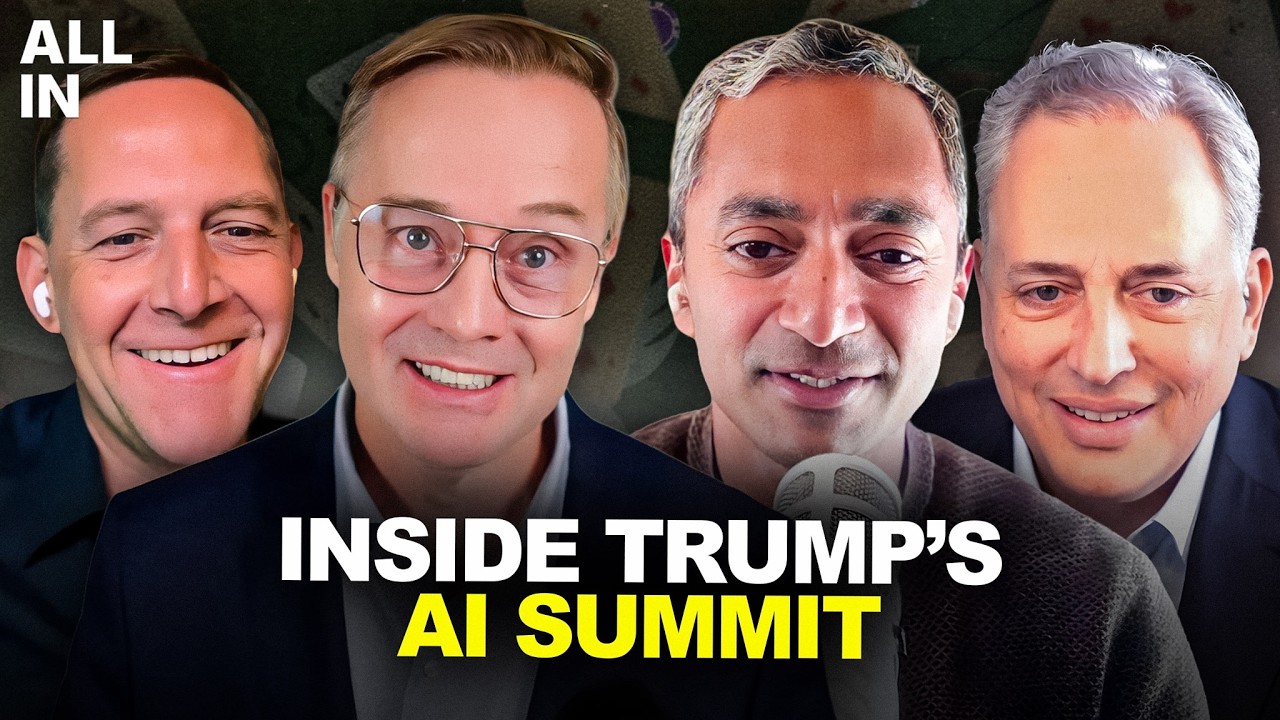
President Trump convened top frontier AI leaders to sign the White House Accord on Superintelligence, establishing mandatory corporate internal controls, independent certified audits by major accounting firms, and board fiduciary liabilities to bypass bureaucratic state licensing schemes. (2:01)
Upward revisions to economic data showed Q2 GDP expanding at 2.2% alongside 162,000 added August payrolls and an all-time low poverty rate of 10.2%, even as the capital build-out for AI infrastructure surpasses the historical investments of canals, transcontinental railroads, and the national grid combined. (45:22)
Banking stress signals resurfaced after analysis of FDIC data indicated approximately 95 institutions face trailing 30-day equity impairments greater than 20%, driven by a 60-basis-point surge in short-term Treasury yields ahead of mandatory October disclosures. (50:00)
Prediction markets on Polymarket heavily price in midterm Democratic gains (93% for the House and 63% for the Senate), driven by persistent consumer dissatisfaction over sticky inflation and diesel transport bottlenecks despite headline macro resilience. (60:00)
Detailed notes
## Background
Published on YouTube by the All-In Podcast on October 2, 2026, this episode features co-hosts Chamath Palihapitiya, Jason Calacanis, David Sacks, and David Friedberg discussing tech policy, macroeconomics, and politics. According to the show description, the episode covers Donald Trump's Super Intelligence Summit and the signing of an AI safety accord, national security and data center infrastructure, recent GDP and economic revisions, midterm election projections, and media coverage of an attempted in-flight hijacking.
## TL;DR
David Sacks delivers an insider account of Trump's White House Accord on Superintelligence, where frontier AI executives committed to corporate governance and independent third-party audits in lieu of heavy state licensing regimes. The hosts debate the staggering infrastructure and power generation demands required to compete with China, contrasting decentralized open software against centralized regulatory controls. Shifting to macroeconomics, the group analyzes robust GDP growth and low unemployment while cautioning against rising Treasury yields, regional banking impairments, and refinery bottlenecks driving diesel inflation. The conversation concludes with midterm forecasts on Polymarket and an impassioned rebuke of mainstream news outlets for sanitizing a violent mid-air hijacking attempt on a flight to Tel Aviv.
## Atmosphere & style
The discussion combines the energetic, high-insider swagger of White House dealmaking with rigorous technical and balance-sheet dissection. Host dynamics oscillate between friendly ribbing, ideological debate over state intervention versus free-market dynamism, and unified frustration with media narratives. The pacing shifts smoothly from triumphant technological optimism to sobering macroeconomic realities, culminating in a blunt, morally charged confrontation of journalistic cowardice.
## Bulletin
- [02:01](https://www.youtube.com/watch?v=ZJKs08oU1zg&t=121s) President Trump convened top frontier AI leaders to sign the White House Accord on Superintelligence, establishing mandatory corporate internal controls, independent certified audits by major accounting firms, and board fiduciary liabilities to bypass bureaucratic state licensing schemes.
- [45:22](https://www.youtube.com/watch?v=ZJKs08oU1zg&t=2722s) Upward revisions to economic data showed Q2 GDP expanding at 2.2% alongside 162,000 added August payrolls and an all-time low poverty rate of 10.2%, even as the capital build-out for AI infrastructure surpasses the historical investments of canals, transcontinental railroads, and the national grid combined.
- [50:00](https://www.youtube.com/watch?v=ZJKs08oU1zg&t=3000s) Banking stress signals resurfaced after analysis of FDIC data indicated approximately 95 institutions face trailing 30-day equity impairments greater than 20%, driven by a 60-basis-point surge in short-term Treasury yields ahead of mandatory October disclosures.
- [01:00:00](https://www.youtube.com/watch?v=ZJKs08oU1zg&t=3600s) Prediction markets on Polymarket heavily price in midterm Democratic gains (93% for the House and 63% for the Senate), driven by persistent consumer dissatisfaction over sticky inflation and diesel transport bottlenecks despite headline macro resilience.
## Key takeaways
- [02:01](https://www.youtube.com/watch?v=ZJKs08oU1zg&t=121s) The White House Accord on Superintelligence, signed by six frontier AI labs, relies on private audits by certified accounting firms and board fiduciary duty rather than a slow, centralized state licensing regime.
- [05:00](https://www.youtube.com/watch?v=ZJKs08oU1zg&t=300s) President Trump personally lobbied Anthropic CEO Dario Amodei during a private dinner to secure full industry alignment, framing AI leadership with the principle that 'Whoever wins super intelligence wins.'
- [10:00](https://www.youtube.com/watch?v=ZJKs08oU1zg&t=600s) Capital and infrastructure expenditure for the AI build-out is projected to exceed the combined historical costs of the Industrial Revolution, transcontinental railroads, canals, and the electric grid.
- [16:50](https://www.youtube.com/watch?v=ZJKs08oU1zg&t=1010s) Proponents of open-source models argue that centralized kill switches and state licensing choke points cannot halt decentralized software execution and will ultimately hand the competitive advantage to China.
- [23:45](https://www.youtube.com/watch?v=ZJKs08oU1zg&t=1425s) American electrical grid capacity has plateaued for roughly 25 years while China doubles its grid capacity each decade, making domestic power generation and data centers foundational national security assets.
- [33:38](https://www.youtube.com/watch?v=ZJKs08oU1zg&t=2018s) Voluntary, market-driven safeguards like Google DeepMind's SynthID for Bio illustrate how technical self-regulation can outpace slow-moving legislative mandates.
- [35:48](https://www.youtube.com/watch?v=ZJKs08oU1zg&t=2148s) New public modernization efforts such as America.gov risk provoking severe populist backlash unless AI visibly lowers everyday expenses in healthcare, housing, and education for working-class households.
- [45:22](https://www.youtube.com/watch?v=ZJKs08oU1zg&t=2722s) Strong macro data contradicted stagflation narratives, with Q2 GDP revised upward to 2.2%, unemployment steady at 4.1%, and median household income crossing record highs near $90,000.
- [50:00](https://www.youtube.com/watch?v=ZJKs08oU1zg&t=3000s) An FDIC balance-sheet analysis revealed nearly 100 banks experiencing equity impairment exceeding 20% over 30 days due to rapidly rising short-term borrowing yields.
- [52:45](https://www.youtube.com/watch?v=ZJKs08oU1zg&t=3165s) Persistent inflation is tightly coupled with domestic refining shortages and diesel transport costs, which are worsened by geopolitical supply shocks and Ukrainian strikes against Russian refineries.
- [01:00:00](https://www.youtube.com/watch?v=ZJKs08oU1zg&t=3600s) While Polymarket odds show a near-certain Democratic House takeover, David Sacks forecasts a narrower 'blue spritz' where Republicans retain the Senate due to economic strength.
- [01:05:00](https://www.youtube.com/watch?v=ZJKs08oU1zg&t=3900s) Looming fiscal cliffs in Social Security and rising interest on the national debt cannot be solved purely by taxing billionaires, because $160 trillion of the nation's $183 trillion total wealth is concentrated in the middle class.
- [01:10:00](https://www.youtube.com/watch?v=ZJKs08oU1zg&t=4200s) Major news outlets drew intense criticism for adopting sanitized language like 'altercation' and 'struggle' to describe an intentional midair stabbing and terror hijacking attempt aboard a Tel Aviv-bound flight.
## Detailed walkthrough
### [00:00](https://www.youtube.com/watch?v=ZJKs08oU1zg&t=0s) Starlink's Stealth Radar and the "Bretton Woods 2.0" High
The episode kicks off with enthusiastic praise for Starlink's reliability, highlighting a behind-the-scenes look at the remote setup that kept the feed pristine. The conversation quickly shifts to the technical side of the satellite mega-constellation: because Starlink satellites constantly emit and receive radio frequencies across a dense global mesh, the constellation functions essentially as an inverted phased-array telescope looking downward. Rather than relying on ground-based radar that stealth aircraft are designed to evade, the networked satellites create an overhead sensor canopy capable of detecting stealth planes and aerial anomalies—prompting the crew to joke that it doubles as a space-based UFO detector, effectively knocking out the need for a dedicated "Science Corner."
The banter shifts into full gear as Jason accidentally introduces the broadcast as "This Week in AI," sparking immediate ribbing from the table about him plugging his side newsletter (`ThisWeekinAI.ai`) on the pod. The besties tease each other that the room already holds "four superintelligences" convened to digest the week's breaking developments. All eyes turn to David Sacks, who is riding high after serving as a key architect behind what he calls the "Bretton Woods 2.0" gathering in Washington, D.C.—a rapid culmination of the debates over model audits and AI regulation that the besties had floated just weeks earlier.
[02:01](https://www.youtube.com/watch?v=ZJKs08oU1zg&t=121s) The White House Accord on Superintelligence
Three weeks after informal debates on model auditing, President Donald Trump hosted a high-stakes Superintelligence Summit at the White House, convening the top leaders across the entire AI ecosystem: data center providers, semiconductor manufacturers, hyperscalers, and frontier lab chief executives—including Elon Musk, Jensen Huang, Mark Zuckerberg, Dario Amodei, Sundar Pichai, and Satya Nadella. Sacks explains that Trump was uniquely positioned to get these fierce rivals, many embroiled in active commercial disputes and lawsuits, into the same room. Dubbed the "Bretton Woods of superintelligence," the gathering produced the White House Accord on Superintelligence, an agreement signed by the six leading frontier model developers to introduce verifiable oversight without waiting on sluggish legislative or international bodies.
```mermaid
flowchart TD
accTitle: Architecture of the White House Accord Governance
accDescr: Flow diagram showing how internal controls lead to external audits, board fiduciary duty, and regulatory enforcement.
subgraph LabLevel["Frontier Model Lab"]
A["Company Development"] -->|"1. Accepts responsibility"| B["Internal Controls Team"]
B -->|"2. Internal verification"| C["External Independent Auditors"]
end
subgraph GovernanceLevel["Board & Legal Oversight"]
C -->|"3. Formal audit report"| D["Independent Board Committee"]
D -->|"4. Triggers fiduciary duty & D&O risk"| E["Mandatory Board Oversight"]
end
subgraph FederalLevel["Federal Enforcement"]
E -.->|"Public commitments backed by"| F["FTC & SEC Enforcement"]
end
```
The Accord establishes a pragmatic, multi-layered governance framework designed to build public trust while avoiding innovation-stifling bureaucracy:
- **Corporate Responsibility:** Frontier AI labs explicitly acknowledge direct accountability for their systems, dispensing with attempts to deflect blame onto external bodies or anthropomorphize models.
- **Internal Verification:** Companies must maintain rigorous internal controls verified by dedicated, internal compliance teams.
- **Independent External Audits:** Third-party auditors inspect and validate the efficacy of internal controls rather than relying solely on self-policing.
- **Independent Board Oversight:** Audit reports are delivered directly to an independent committee of the board of directors.
- **Fiduciary Teeth:** Because boards have an unavoidable fiduciary obligation upon receiving external audit findings, failing to remediate risks puts their Directors and Officers (D&O) liability insurance in immediate jeopardy.
- **Federal Enforcement Backstop:** Public commitments made under the accord remain enforceable by the Federal Trade Commission (FTC) and the Securities and Exchange Commission (SEC).
[05:00](https://www.youtube.com/watch?v=ZJKs08oU1zg&t=300s) Bypassing the Bureaucracy and Dario Amodei's Turnaround
Sacks argues that this market-based governance model delivers rapid, enforceable results that render theoretical United Nations treaties or slow-moving state licensing bureaus ("a DMV for models") counterproductive. Unlike unilateral pauses or heavy domestic red tape—which would needlessly hand global dominance to China—the accord implements controls immediately. Even vocal AI safety critics and controversial former industry whistleblowers acknowledged the move as a major step forward, despite partisan resistance from congressional Democrats who preferred to keep AI risk alive as an election issue.
The table then turns to the palace intrigue surrounding Anthropic CEO Dario Amodei. Anthropic had historically leaned heavily anti-Trump, with a workforce overwhelmingly skeptical of the administration, and Amodei had previously acted as a conscientious objector skipping administration-linked events. Chamath recounts how Trump personally rectified an earlier omission by inviting Amodei to a private one-on-one dinner at the White House two nights prior to the summit. The outreach proved successful, bringing Amodei fully into the fold as an active signatory alongside his peers.
Chamath recalls the profound impression made by the president’s opening line at the summit luncheon, which Trump delivered and then repeated in total silence: *"Whoever wins super intelligence wins."* The statement underscored the stakes for everyone in the room: artificial superintelligence is not a technology that can be amicably divided by global committees, but an epochal race on the scale of the Industrial Revolution where second place receives nothing.
[10:00](https://www.youtube.com/watch?v=ZJKs08oU1zg&t=600s) Scale of the Superintelligence Build-Out and Corporate Governance
The discussion frames the artificial superintelligence build-out as an undertaking of unprecedented magnitude. Citing recent reporting in *The Wall Street Journal*, the speakers emphasize that the capital and infrastructure poured into AI eclipse the Industrial Revolution, the railroads, the canal networks, and the electrical grid combined—surpassing even mega-monuments like the Pyramids and the Great Wall of China. Because the economic and strategic stakes are so monumental, the imperative for the United States to win the race is absolute. At the summit, leaders were told they carry a civic responsibility to lead with the positive use cases of superintelligence and to meaningfully invest in their local communities. Meta was highlighted as a positive example for funding local teacher bonuses and hospital initiatives, though it was made clear that aggressive expansion must be matched by robust "trust and verify" checks and balances.
Immediately following the White House luncheon, Chamath flew to Orlando to address 3,400 partners at Ernst & Young (EY), where his firm, 8090, has been co-developing an audit infrastructure specifically engineered for superintelligence. While initially designed with EY as the launch customer, this framework is positioned to become standard operating procedure across corporate America to protect boards, provide CEOs with real-time operational visibility, and preserve director and officer (D&O) insurance coverage. The fast-tracked accord bypassed what would have otherwise been a disastrous multi-year pause on trillions of dollars of American GDP in front of an international regulatory body.
```mermaid
flowchart TD
accTitle: Three Pillars of Superintelligence Audit Infrastructure
accDescr: Diagram illustrating the three components required for enterprise superintelligence compliance.
subgraph Framework["Superintelligence Audit & Governance Framework"]
T["1. End-to-End Traceability<br/>(Track what AI executes in real time)"]
R["2. Policy-to-Risk Mapping<br/>(Tie AI actions to SOPs & compliance rules)"]
E["3. Auditable Evidence<br/>(Defensible records for regulators & legal defense)"]
T --> R
R --> E
end
```
- **Three Core Pillars for Superintelligence Governance**:
- **End-to-End Traceability**: Complete visibility into what a model executes when deployed across enterprise systems.
- **Policy-to-Risk Mapping**: Integrating AI operations directly into standard operating procedures (SOPs) to monitor enterprise risk thresholds.
- **Auditable Evidence**: Producing verifiable paper trails and records defensible before external regulators, auditors, corporate attorneys, or lawsuits.
---
[11:45](https://www.youtube.com/watch?v=ZJKs08oU1zg&t=705s) Jensen Huang on Alarmism and Dario Amodei's Reaction
Behind closed doors, the conversation turned directly toward the friction between AI doom-mongering and pragmatic technological progress. Nvidia CEO Jensen Huang delivered a pointed remark that set the tone for the room, arguing that "alarmism without solutions is unproductive," whereas "alarmism with solutions is helpful." The room largely aligned with this practical approach, viewing generalized panic without engineering or policy remedies as dead weight.
The comment carried an obvious undercurrent aimed at Anthropic CEO Dario Amodei, known for his cautious, catastrophic-risk framing of advanced AI. Sitting directly across from Dario, Chamath and White House Chief of Staff Susie Wiles watched his immediate reaction as Jensen spoke. When pressed on how Dario responded, Chamath noted that he simply sat and listened attentively without launching a rebuttal, absorbing the consensus of the room.
---
[12:35](https://www.youtube.com/watch?v=ZJKs08oU1zg&t=755s) Trump as Moderator and the Underground White House Expansion
President Trump took direct charge as moderator rather than delegating the role to aides or staff. Before formally starting the summit, he guided the tech leaders through the back of the East Room out to the construction perimeter of the new White House ballroom and East Wing expansion. The massive project is planned as a seven-story complex—featuring a two-story grand ballroom above ground and five subterranean stories descending deep beneath the executive mansion.
Trump showcased the active construction cranes and deep foundation work, noting that the underground floors are designated for fortified military vaults rather than entertainment spaces like a bowling alley. Trump claimed the entire complex would be completed in roughly a year, on schedule and under budget, asserting that future presidents will look back and wonder why anyone gave him grief for building an upgrade the White House had needed for decades. Returning inside, Trump commanded the room, delivering opening remarks before directly cold-calling individual tech executives for their perspectives and grilling them with follow-up questions.
---
[15:15](https://www.youtube.com/watch?v=ZJKs08oU1zg&t=915s) Hammering Out the Accord: From White House Drafts to External Audits
Following the plenary lunch, the leaders of the six frontier model companies transitioned into the Roosevelt Room to finalize the language of the accord. The original draft circulated by the White House was only a brief two-paragraph statement proposing general commitments to safety and an ongoing working group. However, the tech leaders—spearheaded by Mark Zuckerberg and Jensen Huang—pushed to put real "meat on the bone" by adding hard operational accountability. Speaker of the House Mike Johnson had a physical copy in hand, reading the terms aloud to the room before the group conducted final line edits.
The breakthrough components of the finalized accord center on mandatory internal controls, external third-party audits, and dedicated board-level oversight committees. When asked which provision carries the most practical weight, David Sacks identified external audits as the true enforcement mechanism. Crucially, the attendees agreed that these audits must be conducted by certified professional auditing firms—such as Ernst & Young, PwC, or KPMG—rather than politically motivated non-governmental organizations (NGOs) or activist groups. OpenAI was represented in the room by co-founder Greg Brockman, as CEO Sam Altman was absent due to a simultaneous product launch event.
---
[16:50](https://www.youtube.com/watch?v=ZJKs08oU1zg&t=1010s) The AI Wars and the Illusion of Centralized Control
David Friedberg contextualized the summit within the broader geopolitical and technological struggle, noting that popular science fiction long predicted kinetic "robot wars," while the real conflict has emerged as a software war. Today, that conflict manifests as a domestic battle between two fundamentally opposing philosophies: one camp that wants to centralize, license, and heavily regulate the technology through government agencies, and another camp that recognizes the open nature of software makes centralized control technically impossible.
Because high-performing open-source and open-weight models can be run entirely on small, decentralized local machines without massive compute clusters, software inherently slips past centralized jurisdictions. Friedberg argued that attempting to halt or throttle domestic development will fail to stop the software from spreading, while severely damaging American competitiveness and handing the advantage to China. The technology is already ubiquitous, and governance must accept that operational reality rather than chasing the fantasy of a centralized regulatory kill switch.
[20:00](https://www.youtube.com/watch?v=ZJKs08oU1zg&t=1200s) The AI Cyber Defense Arms Race and Data Center Allocation
Friedberg lays out two major predictions regarding the escalating conflict over artificial intelligence. His first thesis is that the world is heading toward a massive surge in defense systems. He emphasizes that there is simply no way to shut down open-source, open-weight models, turn off data centers, or enforce a centralized global command and control. With 197 sovereign nations across the globe—each connected to the internet and possessing access to energy—data centers will inevitably proliferate everywhere, rendering any attempt to centralize software control "a fool's errand."
Because the risks of proliferation are bound to rise, aggressive defense becomes mandatory. In Washington, D.C., Fortune 50 CEOs expressed deep anxieties over cyber defense, meaning it will become a top board-level priority and cause cybersecurity budgets to skyrocket for firms like Palo Alto Networks. Friedberg poses a rhetorical question: when defending against AI-driven threats, enterprises and governments cannot rely on legacy software—they must use competitive AI. This triggers a classic arms race: the United States cannot pause or power down AI development while the rest of the world advances. Defense necessities at the enterprise, federal, and civilian consumer levels mandate that America continue aggressively building out data centers.
Friedberg’s second prediction forecasts that within 12 to 18 months, public debate will abandon attempts to score, estimate, and regulate models. With breakthrough architectures arriving at an astonishing pace—Google releasing state-of-the-art models and new iterations landing every 11 days—model-level control will fail. Instead, Friedberg predicts a regulatory reality few in tech will like: governments will step in to regulate data center access and compute allocations.
```mermaid
flowchart TD
accTitle: The AI Cyber Defense and Compute Allocation Cycle
accDescr: Diagram illustrating how global AI proliferation drives an enterprise and national security arms race, ultimately forcing government allocation of data center compute.
subgraph Proliferation["1. Global Proliferation"]
A["197 Sovereign Nations"] --> B["Ubiquitous Energy & Data Centers"]
B --> C["Open-Weight / Open-Source Models"]
end
subgraph Threat["2. Threat Escalation"]
C --> D["Rising Threat of AI-Driven Cyber Attacks"]
D --> E["Board-Level Priority at Fortune 50"]
end
subgraph Response["3. Defense & Allocation"]
E --> F["Need for Competitive AI Defense Systems"]
F --> G["Compute Becomes Key Metric (Machine vs. Machine)"]
G --> H["Government Regulates & Allocates GPUs"]
end
H -->|"Guaranteed Capacity"| I["Critical Sectors: Finance, Defense, Infrastructure"]
```
Under this framework, defense hinges on the raw volume of machines defending a network relative to the machines attacking it. As models converge in capability, compute capacity becomes the defining variable. As a result, governments will treat hyperscalers and neoclouds (such as AWS, Google Cloud, and Crusoe) like critical utilities, issuing top-down quotas to guarantee that institutions like JPMorgan and the defense apparatus secure sufficient GPU and inference capacity.
- In a cyber defense arms race, parity requires matching machine count against machine count under the assumption of model convergence.
- The government will transition from model oversight to infrastructure management, designating compute as a sovereign strategic asset.
---
[23:45](https://www.youtube.com/watch?v=ZJKs08oU1zg&t=1425s) The Power Grid Bottleneck and the Anti-Data Center "Witch Hunt"
Sacks agrees that compute supremacy is paramount, warning that the U.S. risks falling critically behind if it indulges in an "anti-data center crusade." Comparing opposition to data centers to blocking the construction of tanks during World War II, Sacks highlights the fundamental bottleneck: power generation.
China is doubling its electrical grid capacity every decade, whereas the United States power grid has remained virtually flat for roughly 25 years. Sacks points out that throughout the 20th century, America consistently doubled its electrical grid every ten years while establishing its position as the world's preeminent manufacturing superpower. Siting power plants was executed without surrendering to paralyzing NIMBY opposition.
That trajectory began decelerating in the 1970s and hit a complete plateau by the early 2000s, driven by globalization, the offshoring of industrial manufacturing, efficiency gains, and the shift toward an office-based economy. To compete in artificial intelligence, America must rebuild the lost muscle of rapid grid expansion. Sacks condemns the current pushback against data centers as an irrational "witch hunt." He reminds critics that data centers already power the entire modern digital economy—from consumer mobile apps to the broader internet. Blaming the physical facility for social concerns like surveillance or privacy is fundamentally misguided; privacy laws can be tightened, but attempting to ban data centers is self-defeating.
---
[26:14](https://www.youtube.com/watch?v=ZJKs08oU1zg&t=1574s) Dario Amodei, the "Nemesis" Handshake, and Trump's "Mutants"
Jason shifts the conversation to the dynamics inside the summit, asking Sacks about his face-to-face interaction with Anthropic CEO Dario Amodei, a frequent target of Sacks's public critiques regarding AI doomerism and Effective Altruism. Sacks reveals that while he had previously spoken to Dario by phone, this was their first in-person meeting. Dario proved to be a good sport about the tension, greeting Sacks with a self-deprecating joke: "Oh, my nemesis." Sacks notes that the summit remained collaborative rather than hostile, with all attendees eventually uniting to sign the accord. When Jason prods Sacks on whether he invited Dario onto the podcast, Sacks replies that Dario is welcome anytime.
The group reflects on President Trump’s interaction with Dario during the private dinner and subsequent press conference. Sacks mentions that Trump found Dario to be an "interesting guy." In a standout moment during the press conference, Trump reached into the back of the pack, grabbed Dario, and pulled him directly to the front to speak to the media. Jason and Sacks view the gesture as an affectionate, deliberate attempt by Trump to bring Amodei into the fold, underscored by a friendly pat on the back.
The hosts joke about the distinct social dynamics in the room. Sacks remarks on the wide neurodivergent spectrum among the elite AI researchers present, quipping that Dario was "sort of the Dustin Hoffman in that room" while Anthropic co-founder Tom Brown acted like the "Tom Cruise character" translating for him. Jason riffs that Trump was assembling an eccentric squad of national assets:
> "Trump's like, 'Hey, America, China, Russia, meet my mutants. Okay? I'm forming like the X-Men here. These are brainiacs. They're a little bit weird on the margins, but they're getting shit done for America.'"
As Jason turns to Chamath to get his take on the palace intrigue, he highlights how engaged and energized President Trump appeared, drawing a sharp contrast to how the Biden administration famously snubbed Elon Musk from its early EV summits.
[30:00](https://www.youtube.com/watch?v=ZJKs08oU1zg&t=1800s) Bipartisan Governance and Data Centers as National Security
Reflecting on past executive missteps like the earlier EV summit that snubbed key industry players, the hosts praise the administration's approach to the Superintelligence Summit. Convening "Team America" across the entire political spectrum—including vocal critics alongside loyal supporters—demonstrates the playbook of a generational political athlete. When complex, thorny issues arise, the most sustainable way to govern is not top-down bureaucratic decree, but bringing the smartest minds into a room, hashing out differences in real time, and forcing a set of realistic principles that businesses can reliably build around. This cooperative pattern must outlive any individual administration, regardless of whether a Democrat or a Republican takes office in 2028 and beyond: "Whoever wins superintelligence wins."
```mermaid
flowchart TD
accTitle: Energy and Data Center National Security Loop
accDescr: Shift from traditional fossil fuel dependency to domestic electron generation powering compute infrastructure.
subgraph EnergyShift["Energy Generation Realignment"]
A["Geopolitical Shocks<br>(e.g. Strait of Hormuz)"] --> B["Real-Time Supply & Generation Shifting"]
B --> C["Domestic Electron Generation<br>(Critical Constraint)"]
end
subgraph SecurityDomain["Strategic National Assets"]
C --> D["AI Compute & Data Centers"]
D --> E["National Security & Economic Dominance"]
end
```
The strategic conversation pivots to the physical backbone of artificial intelligence: energy generation and compute infrastructure. Drawing on insights from a discussion with Phil Deutch, Chamath highlights how geopolitical disruptions in the Strait of Hormuz barely moved global oil prices because the energy grid adapted dynamically through supply and generation shifting. The crucial modern paradigm is not traditional fossil fuels, but the domestic generation of electrons. Just as the United States responded to the Persian Gulf War and the Global War on Terror by radically expanding domestic oil and natural gas production, data centers must now be recognized as critical symbols of national security. Domestic energy policy is merging with defense strategy, ensuring that the country can generate the raw electricity needed to compute the economic and strategic future.
- **Political Realism**: Forcing industry rivals and critics into the same room creates workable, lasting policy rather than brittle partisan executive orders.
- **The Modern Constraint**: Physical compute and electron generation replace barrels of crude as the foundational currency of national security.
- **Strategic Parallels**: Echoes the domestic energy ramp following the Gulf War, positioning data centers as non-negotiable critical infrastructure.
---
[33:38](https://www.youtube.com/watch?v=ZJKs08oU1zg&t=2018s) Market-Driven AI Safeguards and the Milton Friedman Precedent
To illustrate why voluntary industry action often outperforms government mandates, Friedberg cites a viral archival clip of Milton Friedman addressing a law student. When asked whether government should mandate saving a life at the expense of individual liberty, Friedman clarified that personal moral responsibility in society is fundamentally distinct from state coercion. When society sends a clear signal of right and wrong, collective market participants solve the problem voluntarily without needing heavy-handed regulations that introduce systemic friction.
That principle is actively visible across the frontier of tech:
- **NVIDIA and OpenAI**: Demonstrating aggressive precautionary testing and self-restraint prior to frontier model releases.
- **Google DeepMind's SynthID for Bio**: Developing watermarking systems for AI-designed proteins. The tool embeds an unforgeable watermark directly into the underlying DNA sequence as well as the three-dimensional physical construct of the synthesized protein.
These proactive technical counter-measures show industry stepping up to safeguard critical bio and digital domains, rendering preemptive regulatory smothering unnecessary.
---
[35:48](https://www.youtube.com/watch?v=ZJKs08oU1zg&t=2148s) The America.gov Launch and the Forgotten Bottom Half of the K-Curve
The discussion turns to civic technological upgrades, led by Airbnb co-founder Joe Gebbia’s unveiling of America.gov at the White House. Praised by observers across the spectrum—including a standing tribute from Andrew Ross Sorkin—the project aims to modernize the federal government's digital interface to match private-sector elegance. Backed by an executive order and attended by cabinet officials alongside tech leaders like Palantir's Shyam Sankar and domestic policy advisor Brooke Rollins, the initiative was built largely through personal time and private capital from technologists wanting to give back to the country.
Yet a sharp critique emerges regarding public perception and economic inequality. Outside the elite bubbles of Washington and Silicon Valley, the bottom half of the K-shaped recovery remains deeply alienated and fearful:
- **Everyday Anxiety**: Service workers, such as Delta flight attendants, openly voice terror that artificial intelligence will eliminate their livelihoods before retirement.
- **Missing Demographics**: Plumbers, tool-belt trade workers, schoolteachers, and incoming college students were visibly absent from the summit’s high-altitude discussions.
- **Tangible Priorities**: The next horizon for the presidency and tech titans cannot just be fast-tracking data center permits, lowering regulations, and enriching corporate balance sheets; it must clearly show how AI lowers the cost of higher education, builds affordable housing, and expands access to cheaper healthcare.
While summit insiders note that President Trump explicitly warned attendees to deliver measurable economic benefits to local communities, that mandate was lost in the media narrative. Without tangible workforce training, community upskilling programs, and immediate cost-of-living relief, the tech sector risks severe populist backlash for looking like an alliance engineered solely for billionaires.
[40:00](https://www.youtube.com/watch?v=ZJKs08oU1zg&t=2400s) Partisan AI Doomerism and the Fight for Open Source
Chamath recounts standing backstage at a major event listening to a prominent, unnamed Democratic figure deliver a cavalier doomer monologue about artificial intelligence. The speaker went so far as to tell the audience directly that everyone in the room would soon be out of a job. Chamath was incredulous, noting that the rhetoric lacked any grounding in factual data, particularly coming from someone theoretically versed in economics. When Jason playfully eggs him on to "name names," Chamath offers to share it off-mic or have it bleeped, but emphasizes the broader structural motive: out-of-power political factions have a powerful incentive to manufacture doomerism. Stirring existential panic and job anxiety serves as a potent tool to rally voter fear ahead of the upcoming midterms and the 2028 presidential race. Taking the stage immediately afterward, Chamath directly pushed back, telling the audience that the speaker was flat-out wrong and that historical data indicates technological shifts generate more jobs, higher earnings, and greater demand for human taste and judgment over the next four to five years.
The debate expands into what Jason and Friedberg characterize as the true "AI wars"—not a sci-fi clash with killer robots, but an immediate political and regulatory battle over access and gatekeeping. Friedberg points out that everyday citizens do not understand technical jargon like "open-weight models" or open-source software. When regular Americans look at the news or social media, they simply see an insular group of wealthy tech titans dining at the White House with the president, making behind-the-scenes decisions about their future, while cable news and Instagram feed them apocalyptic warnings that the world is ending tomorrow. Under those conditions, the public's default reaction is to support shutting it down.
Friedberg compares the current battle to the historic fight over the open internet. In the early days of the web, telecommunications monopolies lobbied aggressively to privatize infrastructure and act as tollbooths, intending to charge consumers varying fees just to navigate to portals like Yahoo or AOL. Open-access rules and net neutrality principles eventually prevailed by law. A parallel dynamic is now unfolding with AI: incumbent players and regulatory-capture advocates are pushing compliance burdens and gatekeeping mechanisms under the banner of safety. Chamath laments that while the doomer camp is unified, highly financed, and deploying disciplined talking points across media ecosystems—to the point where commercial flight attendants repeat them verbatim—the proponents of open-source models and economic abundance remain far less organized.
```mermaid
flowchart TD
accTitle: Competing AI Narratives
accDescr: Diagram illustrating the opposing forces in the AI policy debate between centralized regulatory capture and open-source models.
subgraph S1["Centralized AI Model"]
A["Doomer Political Messaging"] --> B["Regulatory Capture & Moats"]
B --> C["Tollbooths & Gatekeepers"]
end
subgraph S2["Open Source AI Model"]
D["Open-Weight Architectures"] --> E["Broad Developer Access"]
E --> F["Economic Abundance & Jobs"]
end
C -.->|"Historical Parallel"| G["Early Telco Tolls on Internet"]
F -.->|"Historical Parallel"| H["Open Internet Standards"]
```
[44:30](https://www.youtube.com/watch?v=ZJKs08oU1zg&t=2670s) Broadening the Table: Public Perception and Everyday Beneficiaries
Jason urges David Sacks and White House organizers to rethink the guest list for upcoming summits. To counter the pervasive narrative that superintelligence is exclusively a plaything for billionaire technologists, Jason suggests reserving seats for widely respected public figures outside enterprise software. He cites Sal Khan of Khan Academy as the quintessential example—someone who can tangibly articulate how AI acts as an affordable, one-on-one personal tutor for every schoolchild, democratizing educational resources that once belonged only to the elite. Bringing teachers, healthcare practitioners, and working-class advocates into the room would humanize the technology and demonstrate real-world utility to ordinary families across the country.
- **Khan Academy model**: Demonstrates personalized AI tutoring for students regardless of socioeconomic status.
- **Constituent representation**: The hosts advocate including representatives from public education and bedside nursing to ground the discourse in human services rather than pure Silicon Valley enterprise value.
[45:22](https://www.youtube.com/watch?v=ZJKs08oU1zg&t=2722s) Defying the Doomers: Economic Growth, Jobs, and Disproving the K-Shape
David Sacks shifts the dialogue to the broader macroeconomy, arguing that persistent media gloom has distorted public perception despite a wave of blowout economic indicators. While acknowledging persistent pain points around high diesel prices and elevated benchmark interest rates, Sacks runs through recent data releases that point to an accelerating economy rather than a looming recession:
- **Upward GDP Revisions**: Bureau of Economic Analysis data revised Q2 GDP sharply higher from an initial 1.5% to 2.2%—a nearly 50% jump that caught forecasters off guard. Q1 GDP was likewise revised up from 2.1% to 2.5%.
- **Current Quarter Momentum**: The Atlanta Fed's GDPNow tracking model estimates Q3 growth running at approximately 3.7%.
- **Robust Labor Market**: August nonfarm payrolls surged by 162,000 jobs against consensus expectations of just 55,000—a net beat of 107,000 positions. Prior prints for June and July saw combined upward revisions of 55,000.
- **Low Unemployment with Rising Participation**: Headline unemployment sits near historic lows at 4.1%, even as the labor force participation rate expanded by 0.2 percentage points to 61.6%.
- **Cooling Core Inflation**: Core Personal Consumption Expenditures (PCE) came in at 3.0% against an expected 3.3%, indicating steady disinflation toward targets despite running warm.
- **Manufacturing Re-industrialization**: Both the Chicago PMI and ISM Manufacturing surveys rebounded decisively into expansion territory, exceeding analyst projections.
Sacks directly attacks the prevailing narrative of an unequal "K-shaped recovery" by highlighting household balance sheets and historic poverty figures. Adjusted into 2025 dollars, U.S. median household income has crossed record highs near $90,000. Real after-tax household income is growing at a 3.1% annualized pace under Trump's second term, compared to a 3.9% average during his first administration and an annualized decline of 1.2% across the four years of the Biden administration. Most notably, the official U.S. poverty rate fell to an all-time low of 10.2%, with child poverty metrics echoing similar historic lows.
Citing coverage from *The Wall Street Journal*, Sacks notes that the ongoing private and public capital expenditures fueling AI infrastructure represent an investment wave larger than the historical construction of American canals, transcontinental railroads, and the national electrical grid combined. Because of these underlying fundamentals, Sacks predicts Republicans will substantially outpace current polling in the upcoming midterms once economic reality overtakes negative media coverage.
[49:15](https://www.youtube.com/watch?v=ZJKs08oU1zg&t=2955s) The Interest Rate Reality and Consumer Sentiment Gap
While conceding that headline macroeconomic data looks remarkably robust on paper, the conversation pivots to why everyday voters still register deep dissatisfaction. A major drag on consumer sentiment is the rapid tightening in the debt markets over the past month. Short-term Treasury yields have spiked by roughly 60 basis points across a 30-day window, pushing short-end yields to levels unseen since 2002.
This sustained pressure on borrowing costs filters down instantly into everyday household finances. Everyday consumers are finding it punishingly expensive to refinance mortgages, take out auto loans on new vehicles, or manage revolving credit card balances. Even with record low poverty rates and rising median wages, the friction of high credit costs continues to create an acute disconnect between top-line GDP figures and consumer kitchen-table sentiment.
[50:00](https://www.youtube.com/watch?v=ZJKs08oU1zg&t=3000s) The Looming Banking Impairment Shock and the Rate Dilemma
Friedberg argues that the persistent interest rate crisis is fundamentally rooted in out-of-control federal spending. To evaluate the tangible fallout, he ran the numbers with ChatGPT acting as his in-office financial analyst against the FDIC monthly balance sheet data of 4,295 positive-equity banks. The analysis reveals that roughly 95 institutions are staring down an equity impairment greater than 20% over the trailing 30 days alone. Because these balance sheet reports for the period ending September 30th are set to drop on October 30th, Friedberg warns that a sudden, massive wave of disclosures will hit the markets right on the doorstep of the election. This revelation will lay bare that high rates are no longer merely crimping consumer purchasing power, but triggering systemic counterparty risks across financial lenders.
```mermaid
flowchart TD
accTitle: Banking Impairment Transmission Mechanism
accDescr: Flow showing how federal deficit spending drives higher interest rates, leading to balance sheet impairment across regional banks.
subgraph Deficit["Fiscal Root Cause"]
A["Unchecked Federal Spending"] --> B["Elevated Long-Term Rates"]
end
subgraph Impact["FDIC Bank Stress"]
B --> C["Balance Sheet Devaluation"]
C --> D["95 of 4,295 Banks Suffer >20% Equity Impairment"]
end
subgraph Shock["Market Consequence"]
D --> E["Disclosures Released October 30th"]
E --> F["Pre-Election Financial Shockwave"]
end
```
Sacks acknowledges the twin headwinds of elevated rates and diesel costs, but insists that the broader media narrative is ignoring overwhelmingly strong macroeconomic momentum. Long-term rates naturally track nominal economic growth, and the US economy is running extraordinarily hot—printing 2.5% GDP growth in Q2 and pacing toward 3.7% in Q3. With inflation hovering in the 3% range, elevated yields are simply compensating investors for real returns.
Sacks traces the core friction back to diesel, which acts as a foundational industrial input whose transportation costs ripple through the supply chain into finished consumer goods. If diesel pressures relent, headline inflation will subside, clearing a runway for the Federal Reserve to issue unexpected rate cuts that could launch the economy "like a rocket."
- **FDIC-monitored banks evaluated**: 4,295 institutions with positive equity
- **Impending balance sheet hit**: ~95 banks facing >20% equity impairment charges
- **Key disclosure date**: October 30, 2026 (days ahead of the midterm voting)
- **Economic growth trajectory**: 2.5% in Q2, revised tracking toward 3.7% in Q3
[52:45](https://www.youtube.com/watch?v=ZJKs08oU1zg&t=3165s) Diesel Headwinds, Ukraine Strikes, and Global Supply Lines
Friedberg counters that excessive federal outlays act "almost like pouring acid on everything," subsidizing non-productive jobs and inflating deficits. He echoes Scott Bessent’s target that the federal deficit must contract to 3% of GDP to permanently stabilize long rates. Sacks pushes back against apocalyptic comparisons, noting that six months ago critics predicted 1970s-style stagflation under higher fuel prices, which completely failed to materialize. He points out historical precedent: during the Obama administration, Brent crude traded above $100 per barrel for over 300 days while the economy sustained growth.
The primary operational constraint on diesel, Sacks argues, is refinery throughput rather than upstream crude availability. He criticizes ongoing Ukrainian military strikes on Russian energy infrastructure, stating bluntly, "Frankly, it'd be good if Zelenskyy stopped hitting Russian refineries." He cites reporting from *The Guardian* showing that commercial crude volume transiting the Strait of Hormuz hit its highest level since regional hostilities broke out, signaling that raw supply bottlenecks are abating. With incoming Treasury debt auctions on the horizon, Sacks expresses confidence that Bessent has the market credibility to steer Treasury through turbulent offerings, paving the way for rate relief.
[55:00](https://www.youtube.com/watch?v=ZJKs08oU1zg&t=3300s) European Austerity, De-Dollarization, and the Refining Bottleneck
Chamath aligns with Sacks's optimism regarding underlying growth, drawing attention to fiscal dramas unfolding across Europe that illustrate the power of the bond market:
- **France’s budget contractions**: Facing sovereign bond market pressures, Paris is in tense deliberations to slash $50 billion to $75 billion from its budget—an unprecedented austerity move for a country accustomed to steady state expansion.
- **The UK’s socialist pivot**: Prime Minister Andy Burnham delivered an hour-long platform address laying out what Chamath characterizes as an "insane," highly interventionist socialist project designed to balloon state spending, reverse Brexit, and re-integrate with Europe without a single coherent blueprint for private-sector GDP growth.
Chamath argues that domestic doom-mongering misses a structural transformation: the United States is far less tethered to the traditional petrodollar framework than in prior cycles. While pump prices have jumped 50% since the onset of the Iran conflict, the historical relationship between WTI/Brent swings and broad GDP erosion has partially decoupled. Addressing the consumer pain at the pump, Chamath and Sacks emphasize that the underlying failure stems from domestic policy decisions spanning decades that shuttered domestic refining capacity. Consequently, the West is now hostage to Russian and Chinese processing infrastructure to convert crude into usable distillates like diesel and jet fuel.
[58:00](https://www.youtube.com/watch?v=ZJKs08oU1zg&t=3480s) The Political Hangover: Trump 2.0 Midterm Vulnerabilities
Jason interrupts the bullish macro assessment, declaring that he hates to "put a little rain on this Hopium parade" as the country barrels toward the midterms. Pulling up polling and consumer sentiment trackers, Jason argues that average Americans are completely detached from high-level GDP figures. On the ground, the fundamentals have stagnated: unemployment remains flat, while inflation lingers stubbornly in the mid-to-high 3s, flirting with 4% and failing to dip back into the 2% range.
```mermaid
flowchart LR
accTitle: Political Realignment Ahead of the Midterms
accDescr: Diagram illustrating the breakdown of the Trump 2.0 political coalition due to persistent inflation and foreign policy entanglements.
subgraph Promises["Trump 2.0 Mandate"]
P1["Domestic Affordability"]
P2["Border & Mass Deportations"]
P3["America First Restraint"]
end
subgraph Reality["Voter Perceptions"]
R1["Inflation Sticky in the 3s/4s"]
R2["Deportations Unexecuted"]
R3["Entanglement in Foreign Wars"]
end
subgraph Backlash["Midterm Coalition Drift"]
B1["Independents Break Away"]
B2["Core Base Disillusionment"]
end
P1 -.-> R1 --> B1
P2 -.-> R2 --> B2
P3 -.-> R3 --> B2
```
Jason warns that the administration has surrendered its defining political assets:
- **Erosion on core strengths**: Donald Trump campaigned on clear superiority over Democrats regarding immigration, trade, inflation, and general economic vitality; all four metrics have plummeted into net-negative territory in voter approval polls.
- **Alienation of the working-class base**: Working-class constituents perceive the administration as caring far more about industrial boardrooms and overseas military conflicts than household grocery bills.
- **The deportation shortfall**: Factions within the core base are vocal in their frustration that signature campaign promises—such as deporting 20 million undocumented immigrants—have gone unfulfilled.
- **The independent exodus**: Moderate and independent voters who bought into the promise of a disciplined, growth-oriented "Trump 2.0" administration have largely abandoned the coalition due to chaotic foreign entanglements and unyielding living costs.
[01:00:00](https://www.youtube.com/watch?v=ZJKs08oU1zg&t=3600s) Midterm Predictions and Betting Markets vs. Economic Reality
The conversation shifts to the upcoming midterm elections, with Jason pointing out that according to the polls, Republicans are slated to get shellacked. While Donald Trump has previously pulled rabbits out of hats by beating polling expectations, Jason emphasizes that the numbers look bleak. Looking directly at Polymarket, the betting markets reflect overwhelming Democratic momentum:
- A 93% chance the Democrats take the House
- A 63% chance they flip the Senate
- An overall 64% to 70–80% implied probability of a full Democratic sweep
Jason notes that the four hosts will soon launch an All-In squad on Polymarket so viewers can track their personal forecasts against the market.
David Sacks pushes back hard against the polling consensus, arguing that political forecasters are repeating the exact blunder Republicans made in the 2022 midterms under Joe Biden. Back then, pundits and operatives hyper-focused on Biden’s low approval ratings (hovering in the 30s) and 9% headline inflation, predicting a red tsunami that ultimately ended in a disappointing "red trickle" because underlying variables—GDP growth and employment—remained robust. Today, Sacks argues, pollsters and partisan media are hyping a hyperbolic narrative driven by isolated negatives like fuel prices while ignoring strong macro fundamentals: 3% inflation (far better than Biden's 9%), accelerating GDP growth, low unemployment, strong labor force participation, and improved poverty metrics.
Instead of a "blue wave," Sacks anticipates what he terms a "blue spritz." He predicts Republicans will defy expectations and hold the Senate, while the House will be exceptionally tight. Even if Hakeem Jeffries and the Democrats win the House, Sacks warns it will be a razor-thin majority plagued by internal revolt from Democratic Socialists of America (DSA) members, directly mirroring the procedural gridlock Kevin McCarthy faced with the House Freedom Caucus. He notes that veteran political analyst Mark Halperin had predicted a "blue tsunami" for weeks but is already beginning to hedge.
Turning to energy, Sacks identifies high diesel prices—stoked by Middle Eastern tensions and disruptions around the Strait of Hormuz—as the final missing piece preventing inflation from plunging and locking in 5% GDP growth. He notes reports indicating oil tankers have been successfully moving record volumes through Hormuz under blackout conditions ("doing night shipping with the lights off") and argues Trump intends to de-escalate once the election pressure recedes.
[01:05:00](https://www.youtube.com/watch?v=ZJKs08oU1zg&t=3900s) The 2028 Political Horizon and Looming Structural Crises
Chamath Palihapitiya aligns closely with Sacks's electoral assessment. He views the Senate as an open toss-up that Republicans can hold, alongside a very slim Democratic majority in the House. According to Chamath, the outcome over the final month comes down to messaging discipline:
- If the administration successfully spotlights broad-based economic growth and superintelligence as an engine of GDP while dispelling "doomer" messaging, Republicans have a strong fighting chance.
- If Democrats succeed in fixing public attention on lingering pain points like gas prices and AI doomerism, they will overachieve.
Jason offers a blunt counterargument: Trump campaigned on promises to avoid foreign entanglements and crush inflation; because military friction occurred and inflation lingers at 3%, voters will simply punish the incumbent party with a clean sweep.
David Friedberg argues that whether 2026 brings a split government or a sweep is secondary to the deeper ideological realignments taking place between 2026 and 2028. He observes that populist sentiment—whether manifesting as the Tea Party, the MAGA America First movement, or left-wing populist currents—maintains an accelerating positive first derivative. As populism surges on both extremes, it pushes the country toward state expansion, eroding individual liberties. Friedberg warns that this political friction will collide directly with three unavoidable fiscal emergencies:
1. **The Social Security insolvency cliff**
2. **High benchmark interest rates** crippling national debt affordability
3. **The fallacy of the billionaire asset tax**, which distracts from mathematical reality
To illustrate the arithmetic impossibility of relying on billionaire wealth, Friedberg reiterates that seizing 100% of every US billionaire's total net worth in a one-time expropriation would fund the federal government for only a single year. Resolving the fiscal deficit leaves only three deeply unpopular options:
- Raising taxes heavily on the middle class, where $160 trillion of America’s total $183 trillion net worth is concentrated
- Slashing federal spending dramatically
- Radically restructuring core entitlement programs
Because politicians refuse to touch these radioactive choices, Friedberg warns that the resulting impasse will trigger an acute systemic crisis that defines the 2028 presidential campaign.
[01:09:28](https://www.youtube.com/watch?v=ZJKs08oU1zg&t=4168s) In-Flight Terror Attack on Flydubai
Jason shifts the topic to breaking security news: a thwarted terrorist attack aboard a Flydubai flight en route from Dubai to Tel Aviv carrying 174 passengers. An Omani co-pilot stabbed the aircraft captain and attempted to intentionally down the airliner in a 9/11-style attack before being subdued by heroic passengers on board.
[01:10:00](https://www.youtube.com/watch?v=ZJKs08oU1zg&t=4200s) Miraculous In-Flight Subjugation and Media Sanitization of Terror
The besties reconstruct the harrowing, miraculous events aboard a commercial flight where an attempted hijacking was thwarted midair. When an attacker attempted to down the Boeing 737, the co-pilot fought him off, allowing three or four passengers to breach the cockpit and drag the assailant out. In an extraordinary stroke of fortune, off-duty pilots traveling as passengers were able to step into the cockpit, level out the violently stressed aircraft, and safely execute an emergency landing in Saudi Arabia. Eyewitness accounts flooded the internet almost immediately once passengers reconnected on the ground. Yet David Friedberg expresses profound distress over how establishment newsrooms handled the breaking story compared to historical tragedies like September 11. Recalling 9/11, Friedberg reflects on how the front pages unequivocally proclaimed "Day of Terror," serving as an authoritative, unfiltered reflection of human tragedy and raw truth regardless of political persuasion.
```mermaid
flowchart TD
accTitle: Cockpit Crisis and Response
accDescr: Sequence of events from the midair attack to the emergency landing and conflicting media framing.
subgraph MidairCrisis["Midair Incident"]
A["Assailant attacks & stabs pilot"] --> B["Wounded pilot calls for help"]
B --> C["Passengers & Israeli plumber subdue attacker"]
C --> D["Off-duty pilots take controls & land in Saudi Arabia"]
end
subgraph PublicFraming["Conflicting Narratives"]
D --> E["Passenger Eyewitness Reports: Terrorist Hijacking Attempt"]
D --> F["Legacy Media Initial Framing: Cockpit 'Altercation' / 'Brawl'"]
end
```
By contrast, initial reporting across mainstream Western outlets cast the near-catastrophe as if it were a routine workplace dispute or "a fight between two buddies that weren't getting along." Major organizations rushed out sanitizing euphemisms: *The New York Times* and *CNN* labeled the attack an "altercation," *The Wall Street Journal* described it as a "struggle," the *BBC* called it a "fight between pilots," *Sky News* termed it a "brawl between pilots," and *AFP* reported they were merely "fighting." Friedberg argues that the press has deliberately abandoned the word "terror" because acknowledging clear-cut terrorism disrupts their preferred long-form political narratives. Even twenty-four hours later, after extensive survivor testimony was cataloged, *The New York Times* ran a front-page layout centered on technical stress on the airframe, unresolved questions about motive, and a sub-bullet arguing that Israeli politicians were using the attack to score points in an upcoming election. For Friedberg, this deliberate refusal to describe an overt attack on innocent civilians underscores how dramatically journalism has decayed over the last twenty-five years.
- Initial legacy media framing:
- *The New York Times*: "Altercation"
- *CNN*: "Altercation"
- *The Wall Street Journal*: "Struggle"
- *BBC*: "Fight between pilots"
- *Sky News*: "Brawl between pilots"
- *AFP*: "Fighting"
- Follow-up front-page bullet points criticized by Friedberg:
1. The 737 aircraft sustained enormous stress.
2. Investigators seek to answer the motive.
3. Israeli politicians use the attack to try to score points in this month's election.
[01:14:48](https://www.youtube.com/watch?v=ZJKs08oU1zg&t=4488s) Heroic Acts in the Cockpit vs. Narrative Spin and the NYT Response
Jason Calacanis and Friedberg highlight the sheer grit demonstrated inside the cockpit. Aware of suspicious behavior and fearing what might occur if he stepped away, the pilot refused to leave the cockpit to use the lavatory. Instead, he requested an emergency urinary bag to relieve himself at his seat. It was precisely at that moment that the assailant launched a vicious stabbing attack. Bleeding profusely from mortal wounds, the pilot managed to fight off his attacker long enough to unlatch the cockpit door and shout into the cabin for assistance. Several passengers immediately surged forward, including an Israeli plumber who physically dragged the knife-wielding attacker into the aisle, sparing roughly 170 passengers from plunging into the ground.
Rather than honoring this heroic human drama, major outlets faced intense public backlash for burying the reality of the assault. When confronted on social media, *The New York Times* PR account issued an unyielding defense, asserting: "Our headlines and live coverage contain all the facts we're able to confirm as we confirm them, unlike activists and partisans. We don't publish speculation or unverified information." David Sacks notes that while breaking news in the digital age differs from 9/11—where organizations quickly claimed responsibility—the passengers aboard this Dubai flight were overwhelmingly Israeli, making the motive unmistakable. Sacks brushes aside fringe online conspiracy chatter, celebrating that the coordinated actions of the wounded crew, brave passengers, and off-duty pilots successfully averted mass slaughter.
[01:17:15](https://www.youtube.com/watch?v=ZJKs08oU1zg&t=4635s) Moral Cowardice, Coordinated Media Vocabulary, and Final Sign-Off
Chamath Palihapitiya cuts through the editorial ambiguity with an unsparing summary of the underlying facts: an Omani national stabbed an Indian pilot and attempted to plunge an airplane full of innocent Israeli civilians into the earth. Chamath calls any institutional attempt to whitewash or downplay those facts downright "cowardly." Drawing on his personal memories of working in Israel, he emphasizes that regardless of one's stance on the atrocities of October 7th or the subsequent horrors in Palestine, nothing justifies papering over an attempted mass casualty attack on ordinary fathers, mothers, brothers, sisters, and children.
Chamath condemns legacy newsrooms for abandoning moral clarity to maintain political narratives, labeling their output "pathetic" and "putrid." He points out that the simultaneous, uniform adoption of identical words like "altercation" across competing networks demonstrates coordinated groupthink that deceives the public by falsely implying mutual culpability. While Jason acknowledges that editors might exercise extreme caution in the opening minutes of breaking news, both he and Sacks insist that once survivor video and accounts emerged, refusing to label it an apparent terrorist attack or suicidal mass-murder attempt was indefensible. Sacks concludes that the foundational moral baseline must remain absolute: intentional attacks against civilians are completely unacceptable, constitute war crimes in any military conflict, and must be condemned universally without equivocation. With that, Jason signs off episode 291 of the podcast.
- Core factual summary articulated by Chamath:
- Assailant: Omani national
- Victim: Indian pilot (stabbed while flying)
- Target: Roughly 150 to 170 civilian passengers, predominantly Israeli
- Core conclusion: Attacks on civilians remain universally indefensible, and media institutions compromise their societal trust when narrative management supersedes basic objective reality.
## Notable quotes
> [05:00](https://www.youtube.com/watch?v=ZJKs08oU1zg&t=300s) Whoever wins super intelligence wins. — Donald Trump
> [11:45](https://www.youtube.com/watch?v=ZJKs08oU1zg&t=705s) alarmism without solutions is unproductive — Jensen Huang
> [11:45](https://www.youtube.com/watch?v=ZJKs08oU1zg&t=705s) alarmism with solutions is helpful. — Jensen Huang
> [26:14](https://www.youtube.com/watch?v=ZJKs08oU1zg&t=1574s) Oh, my nemesis. — Dario Amodei
> [26:14](https://www.youtube.com/watch?v=ZJKs08oU1zg&t=1574s) Trump's like, 'Hey, America, China, Russia, meet my mutants. Okay? I'm forming like the X-Men here. These are brainiacs. They're a little bit weird on the margins, but they're getting shit done for America.' — Jason Calacanis
> [50:00](https://www.youtube.com/watch?v=ZJKs08oU1zg&t=3000s) like a rocket — David Sacks
> [52:45](https://www.youtube.com/watch?v=ZJKs08oU1zg&t=3165s) Frankly, it'd be good if Zelenskyy stopped hitting Russian refineries. — David Sacks
> [52:45](https://www.youtube.com/watch?v=ZJKs08oU1zg&t=3165s) almost like pouring acid on everything — David Friedberg
> [58:00](https://www.youtube.com/watch?v=ZJKs08oU1zg&t=3480s) put a little rain on this Hopium parade — Jason Calacanis
> [01:00:00](https://www.youtube.com/watch?v=ZJKs08oU1zg&t=3600s) doing night shipping with the lights off — David Sacks
> [01:14:48](https://www.youtube.com/watch?v=ZJKs08oU1zg&t=4488s) Our headlines and live coverage contain all the facts we're able to confirm as we confirm them, unlike activists and partisans. We don't publish speculation or unverified information.
## Mentioned
Starlink, David Sacks, Donald Trump, White House Accord on Superintelligence, Elon Musk, Jensen Huang, Mark Zuckerberg, Dario Amodei, Sundar Pichai, Satya Nadella, Federal Trade Commission (FTC), Securities and Exchange Commission (SEC), Anthropic, Susie Wiles, Ernst & Young (EY), 8090, Mike Johnson, PwC, KPMG, OpenAI, Greg Brockman, Sam Altman, David Friedberg, Palo Alto Networks, Google Cloud, Amazon Web Services (AWS), Crusoe, JPMorgan, Tom Brown, Jason Calacanis, Chamath Palihapitiya, Phil Deutch, Milton Friedman, Google DeepMind, SynthID for Bio, Joe Gebbia, America.gov, Andrew Ross Sorkin, Shyam Sankar, Palantir, Brooke Rollins, The Wall Street Journal, Sal Khan, Khan Academy, Bureau of Economic Analysis, Federal Reserve Bank of Atlanta (GDPNow), Joe Biden, Scott Bessent, Volodymyr Zelenskyy, Andy Burnham, Hakeem Jeffries, Kevin McCarthy, Mark Halperin, FDIC, ChatGPT, Flydubai, The New York Times, CNN, BBC, Sky News, AFP, The Guardian, Polymarket, Chicago PMI, ISM Manufacturing
## Video description
(0:00) Bestie intros!
(2:01) Trump’s Super Intelligence Summit: Behind the scenes and how the accord was created and signed
(17:57) Cybersecurity arms race, data center national security, America.gov, coordinated doomer messaging
(45:22) Recent economic data: GDP, jobs, diesel, inflation, rates, manufacturing, poverty, and more
(1:00:24) Midterm predictions, 2028 look ahead
(1:09:28) Media coverage of attempted terrorist hijacking
Follow the besties:
https://x.com/chamath
https://x.com/Jason
https://x.com/DavidSacks
https://x.com/friedberg
Follow on X:
https://x.com/theallinpod
Follow on Instagram:
https://www.instagram.com/theallinpod
Follow on TikTok:
https://www.tiktok.com/@allin
Follow on LinkedIn:
https://www.linkedin.com/company/allinpod
Intro Music Credit:
https://rb.gy/tppkzl
https://x.com/yung_spielburg
Intro Video Credit:
https://x.com/TheZachEffect
Referenced in the show:
https://x.com/WhiteHouse/status/2105292669303791687
https://www.wsj.com/economy/the-ai-build-out-is-becoming-the-biggest-economic-bet-in-u-s-history-c60716dd
https://www.reuters.com/world/us/us-second-quarter-gdp-revised-higher-amid-robust-consumer-spending-2026-09-30
https://www.atlantafed.org/research-and-data/data/gdpnow
https://www.bls.gov/opub/ted/2026/payroll-employment-rose-162000-in-august-2026.htm
https://www.wsj.com/opinion/u-s-economy-gdp-commerce-upward-revision-aee8692e
https://www.investing.com/news/economic-indicators/chicago-pmi-surges-signals-robust-manufacturing-expansion-93CH-4925362
https://www.reuters.com/markets/us/us-inflation-rises-less-than-expected-august-consumer-spending-surges-2026-09-30
https://www.theguardian.com/business/2026/oct/01/crude-oil-exports-strait-of-hormuz-transport-gulf-region-diesel
https://polymarket.com/predictions/midterms
https://x.com/OliaOnX/status/2105333178814832963
https://x.com/NYTimesPR/status/2105328158379856153
The All-In Podcast hosts evaluate the White House Accord on Superintelligence—a market-driven governance framework signed by frontier AI developers—while debating whether accelerating macroeconomic growth can overcome persistent credit friction and political vulnerabilities ahead of the midterm elections.
Market-Driven Governance and AI Model Audits (2:01)
At a White House summit convened by President Donald Trump, chief executives of six leading frontier AI developers—including Meta, Nvidia, Anthropic, and Microsoft—signed the White House Accord on Superintelligence. Co-architect David Sacks explains that the framework bypasses slow-moving international treaties and licensing bureaucracies by mandating internal controls verified by independent third-party audits from certified accounting firms like Ernst & Young, PwC, and KPMG. Audit findings report directly to independent board committees, exposing directors to personal fiduciary and D&O liability if risks go unaddressed, with public commitments backstopped by FTC and SEC enforcement. Chamath Palihapitiya highlights that his firm, 8090, is developing audit infrastructure with EY focused on end-to-end traceability, policy-to-risk mapping, and auditable records to establish governance standards for corporate boards.
Compute Infrastructure and Power Grid Constraints (20:00)
David Friedberg argues that because open-weight models run on decentralized hardware across 197 sovereign nations, centralized software restrictions are technically unworkable. Instead, he forecasts that within 12 to 18 months, governments will shift from model-level regulation to allocating data center compute and GPUs like public utilities to maintain defensive parity against AI-driven cyber threats. Sacks and Palihapitiya assert that national security now hinges on domestic electron generation rather than barrels of crude oil. While China doubles its electrical grid capacity every decade, the U.S. grid has remained essentially flat for 25 years due to NIMBY opposition and industrial offshoring. The hosts argue that data centers must be treated as critical strategic assets, warning that local opposition to power and data infrastructure threatens American technological competitiveness.
Robust Economic Growth Versus Tightening Credit (45:22)
Sacks challenges the prevailing narrative of an unequal K-shaped recovery by citing Bureau of Economic Analysis revisions lifting Q2 GDP to 2.2% (with Q1 at 2.5%), Atlanta Fed Q3 projections tracking at 3.7%, and August nonfarm payrolls beating estimates by 107,000. He notes real median household income has reached nearly $90,000, while the poverty rate fell to an all-time low of 10.2%. However, short-term Treasury yields have climbed 60 basis points in 30 days, squeezing consumers through higher borrowing costs for mortgages, auto loans, and revolving debt. Friedberg presents an FDIC balance sheet analysis showing approximately 95 out of 4,295 banks face equity impairments exceeding 20% over 30 days due to elevated interest rates, warning that disclosure reports due October 30 could introduce counterparty instability right before the election.
Midterm Election Forecasts and Fiscal Risks (60:00)
Jason Calacanis points to betting markets indicating severe Republican headwinds, citing Polymarket odds showing a 93% chance Democrats win the House and a 63% chance they flip the Senate, driven by sticky ~3–4% inflation, unfulfilled deportation targets, and working-class disillusionment. Sacks disputes an impending "blue wave," arguing political pundits are repeating 2022 midterm forecasting errors by prioritizing negative headlines over underlying growth, low 4.1% unemployment, and disinflation from earlier 9% peaks; he expects a tight House and a Republican-held Senate. Looking beyond the midterms toward 2028, Friedberg warns that surging populist momentum will collide with an impending Social Security insolvency cliff and high debt servicing costs, arguing that wealth taxes on billionaires cannot mathematically solve deficits and that politicians will ultimately face painful choices between middle-class tax hikes, deep spending cuts, or entitlement restructuring.
Media Framing of the Flydubai Midair Attack (70:00)
The episode concludes with an examination of an incident aboard a Flydubai flight from Dubai to Tel Aviv, where an Omani co-pilot stabbed the captain and attempted to crash the airliner carrying roughly 170 mostly Israeli passengers before being subdued by passengers and off-duty pilots. The hosts criticize legacy news organizations—including The New York Times, CNN, BBC, and Sky News—for initially describing the attempted hijacking with sanitized euphemisms such as an "altercation," "struggle," or "brawl between pilots." Palihapitiya and Sacks argue that media outlets sacrificed factual clarity to manage political narratives, asserting that deliberate attacks against civilian airliners demand unequivocal condemnation rather than institutional minimization.
While the hosts find common ground on the strategic necessity of scaling domestic compute, power generation, and market-driven AI auditing, they remain divided on whether strong headline GDP figures will insulate the incumbent governing coalition from voter frustration over high borrowing costs, diesel prices, and broader affordability pressures.
Detailed notes — zh
## Background
本期视频由 YouTube 频道 All-In Podcast 于 2026 年 10 月 2 日发布。视频简介显示,节目核心围绕特朗普在白宫举办的超级智能峰会及签署的《白宫超级智能协定》内幕展开,并深度研判了网络安全军备竞赛、近期强劲但体感脱节的宏观经济数据、2026 年中期选举预测,以及主流媒体对一起未遂客机恐怖袭击的报道争议。
## TL;DR
四位主持人深入复盘了白宫超级智能峰会的幕后博弈,解析了由内部控制、独立审计与董事会信义义务构成的安全治理协定,并预言数据中心与算力资源将在网络军备竞赛中走向国家战略配额制。在宏观经济板块,节目对比了超预期的 GDP 与就业数据与高利率、柴油成本挤压下的民生体感差异,探讨了银行业潜在资产减记对中期选举选情的影响。最后,主持人们结合 Polymarket 赔率预测了 2026 年国会选情与财政危机,并严厉抨击了主流媒体将针对平民客机的未遂恐怖袭击粉饰淡化为‘机组口角争执’的失焦报道。
## Atmosphere & style
整期节目在硅谷老友间标志性的插科打诨与高端内幕爆料中展开,既有对峰会花絮的轻松调侃,又充斥着对地缘政治与万亿级算力博弈的激烈交锋。主持人们在‘宏观硬核数据走强’与‘底层民众真实体感割裂’的议题上针锋相对、火药味十足;而在探讨航班恐袭未遂与媒体避重就轻的报道时,全场情绪急转直下,言辞凝重、悲愤且充满道德批判力,为听众带来兼具内幕深度与强烈情绪张力的收听体验。
## Bulletin
- [02:01](https://www.youtube.com/watch?v=ZJKs08oU1zg&t=121s) 白宫超级智能峰会促成全美六大前沿模型厂商签署《白宫超级智能协定》,该协定依托企业内控、第三方独立审计与董事会信义义务,构建了具备法律穿透力与 D&O 险违约制约的安全治理闭环。
- [20:00](https://www.youtube.com/watch?v=ZJKs08oU1zg&t=1200s) 随着开源模型普及倒逼网络防御以 AI 制 AI,专家预测未来 12 至 18 个月内模型评估监管将退潮,政府将把数据中心视作公用事业并对 GPU 算力实施自上而下的国家战略配额。
- [45:00](https://www.youtube.com/watch?v=ZJKs08oU1zg&t=2700s) 美国二季度实际 GDP 终值大幅上修至 2.2%,8 月新增非农就业大超预期达 16.2 万人,但短期国债收益率激增正导致约 95 家银行面临超过 20% 的净资产减记压力。
- [01:00:00](https://www.youtube.com/watch?v=ZJKs08oU1zg&t=3600s) Polymarket 预测数据显示民主党横扫参众两院的概率超过 60%,但经济强劲派认为坚实的基本面与通胀回落将阻止“蓝色海啸”,选举结果或仅为微弱的“蓝色细雨”。
## Key takeaways
- [02:01](https://www.youtube.com/watch?v=ZJKs08oU1zg&t=121s) 白宫超级智能协定落地:六大前沿基础模型厂商共同签署,明确企业为法人主体与高管责任,杜绝将模型拟人化或推诿给跨国机构作为免责借口。
- [05:00](https://www.youtube.com/watch?v=ZJKs08oU1zg&t=300s) 穿透官僚主义的法理闭环:协定强制引入第三方独立审计,报告直接呈交董事会并触发信义义务,若放任风险将导致董事高管责任险(D&O)失效并面临 FTC 与 SEC 追责。
- [07:44](https://www.youtube.com/watch?v=ZJKs08oU1zg&t=464s) 特朗普在峰会午宴定调大国竞争:以“谁赢得了超级智能,谁就赢得了一切”强调超级智能关乎国运决战,其历史体量超越铁路、运河与电网建设的总和。
- [10:00](https://www.youtube.com/watch?v=ZJKs08oU1zg&t=600s) 超级智能时代的企业合规三支柱:针对模型运行建立端到端可追溯性、策略与风险映射、以及可供监管和诉讼质询的独立审计底单,构成企业防护底线。
- [12:35](https://www.youtube.com/watch?v=ZJKs08oU1zg&t=755s) 黄仁勋与科技巨头反驳“末日论”:缺乏解决方案的危言耸听毫无建设性,过度炒作风险而无视技术红利与工程解法将损害国家竞争力。
- [17:00](https://www.youtube.com/watch?v=ZJKs08oU1zg&t=1020s) 开源与边缘部署让中心化技术封锁失效:软件已在分布式设备与开源权重中广泛扩散,试图通过行政准入机构彻底卡死底层开发在工程上完全不可行。
- [20:00](https://www.youtube.com/watch?v=ZJKs08oU1zg&t=1200s) 网络安全军备竞赛与算力配额制预测:攻防博弈演变为计算机器总量的对抗,未来 12 至 18 个月数据中心或转为公用事业由国家统筹调配 GPU 资源。
- [25:00](https://www.youtube.com/watch?v=ZJKs08oU1zg&t=1500s) 能源供给成为 AI 竞争深层瓶颈:美国电网装机容量停滞整整 25 年,针对数据中心的邻避主义若阻碍基建,将使美国在算力储备上落后于对手。
- [32:15](https://www.youtube.com/watch?v=ZJKs08oU1zg&t=1935s) 数据中心与本土电力升级为国防资产:现代经济对算力的刚性需求,使即时电子生成与数据中心建设上升为比肩海湾战争时期本土油气开采的最高国家安全议题。
- [34:00](https://www.youtube.com/watch?v=ZJKs08oU1zg&t=2040s) 自由市场自律机制优于行政过度干预:米尔顿·弗里德曼观点再度印证,如 Google SynthID 蛋白质水印等自发安全防御比设立繁文缛节更具实效。
- [40:00](https://www.youtube.com/watch?v=ZJKs08oU1zg&t=2400s) AI 毁灭论被异化为党派政治武器:在野势力借由煽动技术恐慌与失业焦虑以换取选票并推动监管俘获,科技界亟需加强对技术普惠红利的公众宣介。
- [45:00](https://www.youtube.com/watch?v=ZJKs08oU1zg&t=2700s) 宏观经济数据强劲走牛:GDP 增速超预期上修、新增就业与家庭收入中位数创历史新高、贫困率降至 10.2%,但公众体感依然被高利率生活成本压制。
- [50:00](https://www.youtube.com/watch?v=ZJKs08oU1zg&t=3000s) 高利率引发银行业潜在暴雷风险:近 30 天短期利率飙升令全美 4,295 家银行中的 95 家面临净资产减记超 20% 的压力测算,财报公布恰逢大选敏感期。
- [51:30](https://www.youtube.com/watch?v=ZJKs08oU1zg&t=3090s) 柴油瓶颈作为通胀与降息的核心纽带:柴油是制造业与物流链的底层成本,霍尔木兹海峡石油外运创纪录有望缓解精炼供给,进而为美联储降息打开空间。
- [01:00:00](https://www.youtube.com/watch?v=ZJKs08oU1zg&t=3600s) 2026 中期选举市场赔率分歧:Polymarket 显示民主党赢得众议院概率达 93%、两院通吃概率超 60%,但乐观派认为经济韧性将使选举演变为温和局势。
- [01:05:00](https://www.youtube.com/watch?v=ZJKs08oU1zg&t=3900s) 2026 至 2028 年三大不可回避的财政死局:社保缺口、长期高利率与征收富豪税的数学幻觉,将倒逼政府在削减福利开支与向中产阶级大幅征税间做出痛苦抉择。
- [01:10:00](https://www.youtube.com/watch?v=ZJKs08oU1zg&t=4200s) 主流媒体对 Flydubai 恐袭未遂的粉饰与道德破产:副驾驶拔刀夺机企图坠机被合力制服,多家媒体早期报道却高度协调将其轻描淡写为机组人员“争执与打斗”。
- [01:17:34](https://www.youtube.com/watch?v=ZJKs08oU1zg&t=4654s) 坚守针对平民暴力的道德红线:机长负伤呼救与乘客挺身而出挽救了 170 余条生命,任何政治叙事都不能掩盖或粉饰针对无辜平民的恐怖主义犯罪行为。
## Detailed walkthrough
### [00:00](https://www.youtube.com/watch?v=ZJKs08oU1zg&t=0s) 开场闲聊:Starlink 卫星网络与“超级智能”主播们
节目在对 Starlink(星链)设备音质的惊叹中开场。Jason Calacanis 兴奋地向大家展示自己使用 Starlink 连线所呈现的完美音质,并让导播 Nick 切出幕后搭建的连接画面。David Friedberg 随即抛出一段前沿科技视角的见解:随着天上铺设的 Starlink 卫星数量达到庞大规模,整个网络通过发射并接收特定射频信号,实际上构成了一个庞大的俯瞰地球的“相控阵望远镜”(phased array telescope)。由于它是自上而下对地观测,其形成的轨道雷达阵列在理论上可以直接侦测传统地面雷达无法发现的隐形飞机,甚至可以当作某种“UFO 探测器”。Jason 打趣道,既然 Friedberg 已经把这一套原理解释清楚,今天的“科学角落”(Science Corner)环节就可以直接省去了。
紧接着,四位主持人开启了招牌式的互损与调侃。Chamath Palihapitiya 戏称 David Sacks 作为“超级智能布雷顿森林体系 2.0”的总设计师,今天带着满面春风的高调气势登场。Jason 嘴瓢将节目报错为“欢迎收看本周 AI(This Week in AI)”,瞬间遭到 Sacks 的无情嘲弄:“你简直是个蠢货,你的那个《This Week in AI》节目里根本不聊 AI!”Jason 顺势为自己的同名 Newsletter 打了广告,并提议把节目改名为《本周超级智能》(This Week in Superintelligence)。Chamath 则机智地打圆场称,录音间里此刻正坐着“四具超级智能”,聚在一起以超高智商来研判本周发生的天下大事。
- **Starlink 的相控阵雷达潜力**:由于具备庞大的低轨卫星网络和射频收发能力,该系统能像大型分布式合成孔径/相控阵雷达一样自上而下俯视地面,打破常规地面雷达对隐形战机(甚至潜在不明飞行物)的探测盲区。
- **播客录制花絮**:Jason 再次推广其 AI 动态周报网站 ThisWeekinAI.AI,主持人间互相调侃彼此对 AI 话题的过度沉迷。
---
### [02:01](https://www.youtube.com/watch?v=ZJKs08oU1zg&t=121s) 白宫超级智能峰会与《白宫超级智能协定》的出炉
话题正式切入过去几周全美科技界最轰动的事件。短短三周前,四位主持人在洛杉矶聚会时还在争论行业究竟应该引入强制审计还是放任去中心化发展,局势一度混乱。然而仅过了三周,美国总统唐纳德·特朗普便在白宫召集了全美最具影响力的科技领袖,举办了规格空前的“超级智能峰会”(Super Intelligence Summit)。与会名单囊括了全球顶尖的前沿模型、超大规模云厂商、芯片巨头和数据中心掌舵人,包括 Elon Musk、Jensen Huang(黄仁勋)、Mark Zuckerberg(扎克伯格)、Dario Amodei、Sundar Pichai、Satya Nadella 等几乎所有头部玩家。
Sacks 详细披露了这场闪电峰会的幕后运作。他指出,放眼全美,特朗普大概是唯一一个能把这群平时摩擦不断、彼此甚至官司缠身的行业宿敌聚拢在同一间屋子里的政治人物。Sacks 将这场历史性会晤定义为“超级智能的布雷顿森林会议”,它是整个 AI 软硬件全栈核心决策层的首次全面集结。在白宫的闭门探讨中,各方就超级智能带来的经济机遇与极端风险展开了坦率交流,并在此过程中直接敲定了日后被称为《白宫超级智能协定》(White House Accord on Superintelligence)的重磅文件,最终由全美六大主流前沿模型开发商共同签字确认。
```mermaid
flowchart TD
accTitle: 白宫超级智能协定安全合规与治理架构
accDescr: 展示从模型厂商自我问责、内部控制,到外部独立审计、董事会信义义务,再到联邦监管兜底的完整执行链条。
subgraph Company["企业内部控制 (第一道防线)"]
A["前沿模型企业<br/>(签署《白宫超级智能协定》)"] -->|"明确主体责任<br/>设立内部安全红线"| B["专职内控团队<br/>(安全验证与实施)"]
end
subgraph IndependentAudit["外部独立监督 (第二道防线)"]
B -->|"提交内部安全流程"| C["第三方外部审计机构<br/>(严格验证合规性)"]
C -->|"出具独立审计报告"| D["董事会独立安全委员会<br/>(履行公司信义监督)"]
end
subgraph LegalLiability["法律与信义硬约束 (核心牙齿)"]
D -->|"强制要求采取整改行动"| E{"董事失职与合规风险"}
E -->|"若漠视报告"| F["D&O 董事高管责任险失效<br/>(承担个人连带赔偿)"]
E -->|"对外虚假陈述"| G["FTC / SEC 联邦机构介入<br/>(民事欺诈与执法追责)"]
end
```
Sacks 强调,这项协定的第一大核心原则,是强制企业直面并承认自身才是最终责任主体,坚决杜绝将责任推诿给虚无缥缈的联合国机构或把模型拟人化作为借口。第二大核心突破在于治理架构的闭环:企业先建立内部控制流程并设立专职验证团队;但绝不仅限于“行业自律”,协定强制引入外部独立审计机构对内控有效性进行检验;最后,审计结果必须呈报给企业董事会专门设立的独立安全委员会。
- **与会六大前沿巨头**:包括 OpenAI、Anthropic、Google、Meta、Microsoft 及 xAI 等在内的核心模型开发商全面签署协定。
- **责任主体明确化**:彻底剥离“AI 自主进化不可控”等免责推辞,明确规定研发企业的法人与高管责任。
- **三层治理架构**:内部控制专职团队 $\rightarrow$ 外部专业第三方独立审计 $\rightarrow$ 董事会独立委员会接单问责。
---
### [05:00](https://www.youtube.com/watch?v=ZJKs08oU1zg&t=300s) 董事会信义义务与落地现实性:击穿公关与官僚主义
针对外界关于该协定是否只是一纸“行业自愿公约”的质疑,Sacks 和 Jason 进行了深度剖析。知名投资人 Gavin Baker 当天上午的一针见血指出:一旦外部审计师向董事会提交了关于安全缺陷的正式报告,董事会就绝不可能置之不理。在公司治理法理下,这直接触发了董事的信义义务(fiduciary duty)。如果董事会在收到审计警示后依然放任不安全的前沿模型上线,一旦发生重大事故,保险公司将有权直接判定董事违背受托责任,进而撤销其“董事高管责任险”(D&O Insurance Policy),使董事个人暴露在无穷的民事赔偿责任之下。
不仅如此,联邦贸易委员会(FTC)和证券交易委员会(SEC)在背后拥有完备的法定追责权,随时可以就企业在安全协议中作出的公开承诺是否构成“虚假陈述与欺诈”进行强制执法。因此,这种依托于现有成熟商法体系的设计,使协定无需等待旷日持久的国会立法,也无需寄希望于中国绝不可能签署的国际公约,更避免了建立一个官僚臃肿、严重拖慢美国技术迭代的“模型车管所”(DMV for models)。Sacks 指出,即使是那位此前在媒体上高调辞职、与公关公司合作的前员工 Jacob Coxson(被 Sacks 讥讽为受公关操控的“人造吹哨人”),在读完协议文本后也不得不发文称赞特朗普总统的举措切实有效。
- **信义责任(Fiduciary Duty)的锁链**:董事会收到独立审计报告后必须履职,漠视报告将直接导致 D&O 责任险拒赔,令高管团队承担无上限个人法律风险。
- **监管机构的后门兜底**:即便协议属自愿加入,但公开承诺一经作出,FTC 和 SEC 即可依据反欺诈及消费者保护法展开强力行政与司法追责。
- **相较于立法与国际条约的优势**:绕开了国会两党拉锯,杜绝了单方面暂停研发而导致中国趁机超越的战略风险,实现了安全监管措施的次日即时生效。
---
### [07:44](https://www.youtube.com/watch?v=ZJKs08oU1zg&t=464s) Dario Amodei 的白宫晚宴与特朗普的核心定调
Chamath 随后将话题引向本次峰会最具戏剧性的细节:Anthropic 首席执行官 Dario Amodei 的登场。长期以来,Anthropic 内部政治倾向高度偏左(员工政治捐款被指超过 96% 流向民主党),Dario 此前也一直扮演着抵制特朗普政府政策的“良心抗议者”角色,从未出席过此类活动。然而此次不仅全程参会,更在峰会前两天与特朗普举行了一对一的闭门私宴。
据 Chamath 了解,特朗普展现了极其老练的政治格局与包容度。在注意到此前数次活动中 Dario 均未在邀请名单后,特朗普主动指出这属于行政遗漏,随即亲自向 Dario 发出私人晚餐邀约。这场长达两晚的接触不仅打消了 Dario 的顾虑,成功将其吸纳进国家统一安全阵营,也对外展示了特朗普政府构建全行业联合战线的政治手腕。
而在峰会午宴上,特朗普准备好的演讲稿开篇第一句话,更是给 Chamath 和现场所有人带来了巨大的震撼。特朗普神情严肃地念道:
> “谁赢得了超级智能,谁就赢得了一切。”(Whoever wins super intelligence wins.)
说完这句,特朗普在全场死一般的寂静中停顿良久,随后逐字逐句地将这句话原样重复了一遍。Chamath 感叹,无论外界如何看待地缘政治纷争,这句话揭示了极其残酷的物理现实——人类绝不可能通过一个松散的跨国机构去和平分配超级智能的胜负红利。这是一场比肩工业革命、甚至超越其规模的国运决战。随后,Sacks 也在午宴上作了主题发言,从历史演进的角度将超级智能的确立置于人类文明与大国竞逐的最核心维度。
### [10:00](https://www.youtube.com/watch?v=ZJKs08oU1zg&t=600s) 超级智能的历史体量与企业安全审计的三大支柱
在白宫超级智能峰会的开场中,与会者引用数据强调了当前人工智能变革的极端重要性:其规模甚至超越了当年的工业革命。正如《华尔街日报》前一周指出的,即便将铁路、运河、国家电网、金字塔以及万里长城的工程体量全部相加,这次 AI 与 SI(超级智能)的发展浪潮依然更为庞大。正因如此,美国必须在这一领域确保绝对的领导地位。特朗普在会上设定了基调:科技领袖们必须以极具积极意义的用例为先导,承担起向公众展示技术红利的责任;同时还要积极回馈运营所在的本地社区,他特别点名了 Meta 为教师发放奖金和援建医院的举措(Dina 此前也在 All-In 峰会上分享过类似经验)。
在午餐会结束后,Chamath 随即飞往奥兰多,向安永(Ernst & Young)的 3,400 名合伙人发表讲话。Chamath 透露,其麾下的 8090 投资/孵化平台正在与安永深度合作,打造一套专门针对超级智能时代的企业审计基础设施。随着白宫协议的达成,这套原本为安永打造的框架将迅速推广至全行业。Chamath 指出,在超级智能时代,为了保护董事会、向 CEO 提供业务可见性,并维护 D&O 责任险等合规底线,企业必须具备三大基础设施:
```mermaid
flowchart LR
accTitle: 超级智能时代的企业合规治理框架
accDescr: 展示保障超级智能合规与安全的三大核心支柱流程
subgraph Governance["合规治理三支柱"]
direction TB
A["端到端可追溯性"] -->|"行为映射至 SOP"| B["策略与风险映射"]
B -->|"留存合规凭证"| C["可审计的独立证据"]
end
C --> D["应对外部质询"]
```
- **端到端可追溯性(End-to-End Traceability)**:部署超级智能时,必须清晰掌控其运转的底层逻辑和全流程行为。
- **策略与风险映射(Policy-to-Risk Mapping)**:企业均有既定的标准作业程序(SOP),AI 系统的行为必须明确锚定在这些政策之上,准确评估衍生风险。
- **可审计的独立证据(Auditable Evidence)**:当下游生态中的律师、审计员、监管机构、诉讼方或客户前来问责(“这到底是怎么发生的?”)时,企业能够随时拿出确凿、具有法律效力的审计底单。
整个协议在短短三周内火速落地,避免了原本将数万亿美元 GDP 的科技发展置于跨国机构漫长扯皮中的荒谬替代方案。
---
### [12:35](https://www.youtube.com/watch?v=ZJKs08oU1zg&t=755s) 黄仁勋反驳“末日论”与白宫地下新工程揭秘
在谈及幕后是否存在对“AI 末日论(Doomerism)”的反弹时,英伟达 CEO 黄仁勋(Jensen Huang)给出了极具震撼力的一击,他直言:“缺乏解决方案的危言耸听是毫无建设性的(alarmism without solutions is unproductive)”,但“伴随解决方案的警钟才具价值”。当时 Susie Wiles 与嘉宾正巧坐在 Anthropic 首席执行官 Dario Amodei 的正对面,众人纷纷关注 Dario 的反应,而 Dario 只是静静地倾听并接受了全场的基本共识。
随后,David Sacks 分享了特朗普如何主持这次会议的细节。特朗普并没有交给他人主持,而是亲自控场。会议前,特朗普带领大家穿过白宫东厅(East Room),参观了正在建设中的白宫全新东翼与宴会厅。这处由特朗普主导推动的扩建工程规模惊人:地面上的宴会厅高两层,地下却深入开挖了整整五层,包含了大量供军方使用的特种安全金库等严密设施。现场吊车林立、建设进度打破常规记录,预计将提前完工且不超预算。嘉宾们调侃称,未来总统们都会感谢这位热爱施工的“建筑商人总统”,并开玩笑提议以后的 All-In 年度晚宴可以直接包下这个全新的白宫宴会大厅。
---
### [15:00](https://www.youtube.com/watch?v=ZJKs08oU1zg&t=900s) 闭门博弈:六大前沿模型厂商如何敲定安全协议
结束实地参观后,特朗普在大范围会议上发表讲话,并挨个点名各科技巨头阐述观点。随后,六大前沿基础模型厂商(Frontier Model Companies)移步至罗斯福厅(Roosevelt Room)展开封闭式的分组讨论,以敲定最终的安全协议文本。尽管外界注意到白宫官方推特发布的协议版本中存在一个拼写错误,并引发了“是不是 Satya 用 Word 打字太快没纠错”的打趣,但核心条款的成型过程极为务实。
此前,白宫曾分发了一份仅有两段话的基础声明,主要涵盖企业责任承诺以及成立常态化安全工作组。但在正式会谈中,扎克伯格(Mark Zuckerberg)与黄仁勋提出了更具实操约束力的条款构想,众议院议长迈克·约翰逊(Mike Johnson)现场拿出一份打印草案通读了全文。该协议最终形成了超越以往声明的核心实质:
- 确立了企业内部风控机制(Internal Controls)。
- 确立了外部独立审计制度(External Audits),这被公认为整份协议中“最具实质震慑力、最长牙齿”的抓手。
- 要求在董事会内部设立专门委员会负责安全监督。
嘉宾们一致认为,这类高壁垒的技术审计工作应当由安永(EY)、普华永道(PwC)或毕马威(KPMG)这类拥有严格法务和合规标准的专业审计公司主导,而非由意识形态先行的非政府组织(NGO)操刀。现场 OpenAI 首席执行官 Sam Altman 因忙于新产品发布未能出席,由其联合创始人兼总裁 Greg Brockman 代表出席并签署了共识。
---
### [17:00](https://www.youtube.com/watch?v=ZJKs08oU1zg&t=1020s) 弗里德伯格解析:软件先行下的不可阻挡之势
针对外界关于“AI 踩刹车是否会导致中国迎头赶上”的隐忧,已进入总统科技顾问委员会的 Friedberg 剖析了科技博弈的底层现实。他指出,科幻小说一直描绘未来会爆发由实体机械构成的“机器人战争”,但现实却是“软件先行一步”,全球正深陷不可逆的“AI 软件暗战”之中。
当下科技界存在两大派系的博弈:一派试图将超级智能中心化,通过设立官方机构进行集中控制、统辖与准入监管;另一派则认清了底层现实——开源架构与开放权重模型(Open-weight models)已在全球肆意蔓延,技术具有天然的普适性与泛滥性。如今,开发者不需要庞大的超级算力集群,仅仅利用小型的边缘本地设备就能运行高性能模型,脱离任何单一中心化机构管辖的模型层出不穷。面对这种分布式泛滥的现实,试图在中心化层面彻底卡死软件开发的幻想不仅行不通,而且在工程实践上是完全不可能做到的。面对这一现实,“无论你喜欢与否,事实就是如此”。
### [20:00](https://www.youtube.com/watch?v=ZJKs08oU1zg&t=1200s) 网络安全军备竞赛与数据中心配额制预测
针对 AI 安全与风险对抗的未来走向,Friedberg 提出了两项极为大胆的长期预测。首先,他断言全球将迎来防御系统投资的爆发式激增。目前开源模型、开放权重模型早已遍布全球,世界上存在 197 个具备主权的国家,处处拥有能源与互联网连接,任何人都不可能关停所有数据中心或实现绝对的集中控制,试图全盘管控底层软件无异于痴人说梦。这种现实意味着网络安全风险将持续攀升。本周在华盛顿特区,已有多位《财富》50 强(Fortune 50)企业的 CEO 表达了对网络防御的极度焦虑,该议题迅速上升至董事会头号议程,企业与政府的网络防御预算必将飙升。面对 AI 驱动的网络威胁,防御方不可能继续沿用旧时代的传统软件,必须以 AI 对抗 AI。这构成了一场典型的“军备竞赛”(arms race),美国绝不可能退缩或按下暂停键,必须持续扩大 AI 投资,以支撑企业、政府乃至平民消费端的全面防御能力,而这一切都依赖底层数据中心的持续扩张。
```mermaid
flowchart TD
accTitle: AI时代网络安全军备竞赛与算力配额演进
accDescr: 展现开源模型普及如何倒逼网络防御激增,并最终导致政府将数据中心视作公用事业实行国家配额制的过程。
subgraph S1["算力与开源扩散"]
A["全球 197 国主权与能源"] --> B["开源/开放权重模型遍地开花"]
B --> C["网络攻击风险持续攀升"]
end
subgraph S2["以 AI 制 AI 的军备竞赛"]
C --> D["传统安全软件失效"]
D --> E["必须使用前沿 AI 开展网络防御"]
E --> F["对算力/数据中心产生海量刚需"]
end
subgraph S3["国家主导的资源配额(12-18个月预测)"]
F --> G["放弃仅针对模型本身的监管"]
G --> H["数据中心转变为公用事业 (Utility)"]
H --> I["政府统筹分配 GPU、推理及算力配额"]
end
```
Friedberg 的第二项预测则指出,在未来 12 到 18 个月内,行业关于“监管模型、评估模型、给模型打分”的讨论将彻底退潮。鉴于当前几乎每 11 天就有顶级模型发布(如 Google 刚推出的更高性能模型),仅靠模型管控根本解决不了问题。取而代之的,是政府将介入并直接监管数据中心的使用与访问权限。届时,数据中心将被视作类似水电气的基础公用事业(utility),监管机构会根据防御需要,自上而下强行配给计算资源——明确要求百分之几的 GPU 划拨给国防、百分之几划拨给摩根大通(JPMorgan)等金融体系。因为在模型能力趋同(model convergence)或差距微弱的情况下,攻防对抗的关键指标将退化为纯粹的“机器数量”(投入多少台机器进行防御 vs 敌方调用多少台机器发起攻击)。这实际上意味着数据中心算力将走向国家层面的战略配给与统筹,也为云厂商及 Neocloud 提供了直接向政府销售海量算力的巨大机遇。
- 监管演进预测:未来 12 至 18 个月,针对模型算法与跑分的监管转向对底层数据中心及 GPU 硬件使用权的直接配额管控。
- 关键竞争指标:在攻防博弈中,算力规模(分配给特定任务的机器与服务器总量)将决定网络防御的成败。
- 国家安全属性:数据中心被提升至如同二战时期坦克制造厂的战略高度,政府将通过扫清审批障碍来保障算力扩张。
---
### [25:00](https://www.youtube.com/watch?v=ZJKs08oU1zg&t=1500s) 电网扩张停滞与 Dario Amodei 的白宫互动细节
针对算力规模的讨论,Sacks 表达了强烈赞同,指出 AI 竞争的核心不仅仅是模型架构,更在于运行模型所需的算力储备;如果在数据中心建设上畏缩不前,美国将在与地缘对手的竞争中落入极其危险的下风。而建设数据中心的前置条件是发电能力。目前中国每十年就能将其国家电网规模翻倍,反观美国,电力装机容量却已经停滞了整整 25 年。回顾历史,在 20 世纪美国作为全球制造业帝国崛起的黄金年代,美国同样保持着每十年电网翻倍的扩张速度,直到 1970 年代才有所放缓,并最终在 2000 年代初因去工业化、全球化外包以及办公服务业转型而彻底见顶。Sacks 猛烈抨击了当下针对数据中心的“猎巫行动”(witch hunt)与邻避效应(NIMBY),强调数据中心支撑着日常移动应用、互联网与 AI 计算,若担心隐私与监控应去完善法律,直接封杀或阻碍数据中心建设完全是因噎废食。
随后,主持人 Jason 将话题切入白宫“超级智能峰会”(Super Intelligence Summit)的现场八卦,询问 Sacks 与 Anthropic 联合创始人兼 CEO Dario Amodei 的首次面对面接触。此前 Sacks 曾长期公开猛烈批评 Anthropic 的“AI 毁灭论”(Doomerism)及其背后的有效利他主义(Effective Altruism)倾向。Sacks 透露,两人在会场握手交谈,气氛非常融洽且极具风度,Dario 甚至还主动幽默地开玩笑称 Sacks 为“我的宿敌”(my nemesis)。Sacks 认为,尽管双方观点大相径庭,但 Dario 始终展现出很好的合作精神,最终所有人都在成果协议上签字。
在晚宴及新闻发布会上,特朗普总统展现出了独特的掌控力。发布会现场,特朗普亲自将站在后排的 Dario Amodei 一把拉到前排最中央,轻拍其后背并要求他面向媒体发言。Sacks 与站在后方的扎克伯格(Mark Zuckerberg)等人见状不禁相视而笑。Sacks 评价这种举动其实是特朗普展现亲切与包容的方式,体现出总统愿意把持不同意见的关键人物推至台前。现场嘉宾笑称这宛如《雨人》(Rain Man)重现——技术极客们各具鲜明个性,而特朗普宛如 X 战警的领袖,对外宣告:“中国、俄罗斯,来见见我的变种人们,他们虽然有些特立独行,但正在为美国攻坚克难。”这一幕与此前拜登政府在电动汽车峰会中刻意冷落排斥埃隆·马斯克(Elon Musk)的做法,形成了极其强烈的鲜明对比。
### [30:00](https://www.youtube.com/watch?v=ZJKs08oU1zg&t=1800s) 跨党派治理模式与超级智能竞争的本质
在谈及白宫召开的超级智能峰会时,嘉宾们将其与以往带有政治排他性的会议(如当年的电动汽车峰会)进行了对比。他们强调,作为美国总统,在面对关乎国运的技术时必须具备跨党派胸怀,将所有人凝聚在“美国队”(Team America)的旗帜下。这次峰会的绝妙之处在于,许多受邀出席的大佬此前对现任政府持极其严厉的批评态度,但他们依然坐在一起,共同目标只有一个:让美国变得更强大,打赢这场超级智能(Superintelligence)竞赛。
与会者感叹,特朗普展现出了一种罕见的“时代级政治运动员”(generational political athlete)特质。他在面对持完全不同政见的人群时游刃有余,做事认真果决,发现问题就会主动召集各方沟通解决。这种治理范式被认为具有深远意义:当面对极度复杂的国家级难题时,政府应当将整个行业作为交流反馈的“共鸣板”(sounding board),邀请无论支持、反对还是居中的各方代表同处一室,在现场即时磋商并敲定框架协议。这种做法兼顾了现实可行性与政策的可持续性。嘉宾们呼吁,无论 2028 年及以后的总统来自民主党还是共和党,都应将这种治理模式延续下去——因为谁赢得超级智能,谁就赢得了未来。
### [32:15](https://www.youtube.com/watch?v=ZJKs08oU1zg&t=1935s) 数据中心:从能源消费到国家安全核心基础设施
随后,讨论转向数据中心与能源供给的深层战略逻辑。嘉宾援引了与菲尔·多伊奇(Phil Deutch)的私下交流:回顾此前涉及伊朗的局势与霍尔木兹海峡封锁危机,最令人意外的现象是国际油价并未如预期般剧烈暴涨。其核心原因在于全球能源供应与发电方式在实时动态调整,传统意义上的“原油/能源开采”概念已被“电子的即时生成”(generation of electrons)所取代。
这一变化直接重塑了算力与国家安全的绑定逻辑。现代经济的运转依赖强大的算力,而算力的根基在于电力生成与数据中心的承载力:
- 数据中心已正式从普通的商业地产或科技设施,升级为衡量“国家安全”的关键象征。
- 本土能源生产(尤其是天然气与国内发电体系)不再仅仅是一项国内经济政策,而是上升为极其严肃的国防安全议题。
- 正如海湾战争及全球反恐战争促使美国在本土石油与天然气开采上翻倍投入一样,未来美国对“国内电子生成”的投资也将呈现同样的爆发态势。
- 尽管监管层面会对数据中心施加更严格的审查,但在强大的国家安全诉求与自由市场力量驱动下,算力基建的松绑与狂飙将不可阻挡。
### [34:00](https://www.youtube.com/watch?v=ZJKs08oU1zg&t=2040s) 自由市场机制 vs 政府监管:米尔顿·弗里德曼与生物 AI 水印
针对技术发展中的风险防范,嘉宾们重温了一段在网络上重新爆火的著名历史视频:经济学家米尔顿·弗里德曼(Milton Friedman)在某法学院回答一名年轻法学生的提问。提问者起初探讨社会个体何时负有拯救他人生命的责任,但最终却滑向了“政府是否应强制推行该责任”的管制逻辑。弗里德曼当时一针见血地指出:个人在社会中的道德责任绝不等同于政府的强制权力;当社会发出明确的价值信号时,民众和企业有能力自主解决问题并选择正确的道路,完全不需要政府越俎代庖设立重重监管。
这种“市场自发响应社会关切”的现象在当下高科技领域得到了集中体现:
- **英伟达与 OpenAI**:主动在模型发布前采取更为谨慎、预防性的自我约束流程。
- **Google 推出 SynthID**:该技术不仅用于常规数字内容,还开创性地应用于 AI 生物计算领域(AI Bio)。它能直接在 AI 生成的蛋白质 DNA 编码序列以及三维蛋白质结构中嵌入数字水印,建立防御与溯源机制,并且正被行业迅速采纳。
这证明市场主体完全能够在没有政府过度干预的情况下,主动响应社会对安全的需求,避免因行政监管窒息技术创新。
```mermaid
flowchart TD
accTitle: 市场驱动型 AI 责任体系
accDescr: 展示社会诉求如何通过自由市场机制推动技术自律与国家基础设施建设
subgraph Society["社会需求与安全信号"]
A["公众对安全/失业的担忧"]
B["地缘竞争与超级智能竞赛"]
end
subgraph MarketResponse["企业与市场自发响应"]
C["安全自律机制<br/>(如 OpenAI 审慎发布、Google SynthID 蛋白质水印)"]
D["基建极速狂飙<br/>(数据中心建设与本土能源转型)"]
end
subgraph NationalSecurity["国家战略目标"]
E["巩固国家安全与经济霸权"]
end
A -->|"自律替代强制监管"| C
B -->|"自由市场投资驱动"| D
C --> E
D --> E
```
### [36:12](https://www.youtube.com/watch?v=ZJKs08oU1zg&t=2172s) America.gov 惊艳亮相与民间技术报国情怀
随后,话题转到了本周在白宫举行的一场标志性科技发布。爱彼迎(Airbnb)联合创始人乔·吉比亚(Joe Gebbia,毕业于罗德岛设计学院 RISD)牵头打造的全新门户网站 America.gov 正式上线。现场内阁成员悉数出席,总统现场签署了相关行政命令,知名记者安德鲁·罗斯·索尔金(Andrew Ross Sorkin)更是发表了长篇即兴致辞,盛赞该项目为升级美国公民数字化体验所带来的震撼突破。
更令人触动的是该项目背后的奉献精神:
- 许多人误以为 America.gov 是耗费巨额财政纳税款的官僚工程,但实际上是乔·吉比亚自掏腰包出资,并与其他顶尖科技人才一起无偿贡献业余时间打造的。
- 这成为硅谷顶尖技术精英与政府合作的新典范:不计个人名利,仅为了让美国联邦政府的技术服务拥有媲美顶级私营科技公司的极致体验与审美设计。
### [38:00](https://www.youtube.com/watch?v=ZJKs08oU1zg&t=2280s) K 型复苏鸿沟:如何让普通美国人从 AI 繁荣中受益
尽管高层峰会与 America.gov 广受赞誉,但嘉宾直言不讳地指出了当前繁荣背后的严重裂痕——处于“K 型复苏”底层的普通美国民众正在被遗忘。一位嘉宾分享了自己在达美航空(Delta)航班上的经历:当空乘人员得知他是科技从业者时,满怀焦虑地表示自己“对 AI 感到极其恐惧,甚至庆幸自己快要退休了,否则就要丢掉饭碗”。
这一幕折射出美国蓝领工人、水管工、中小学教师以及即将步入大学的年轻人的普遍心态。在大众眼中,超级智能峰会看起来更像是一群亿万富翁和巨头在为自身争取更多数据中心指标、更多电网配额和更少监管,大众感知到的只有“失业”与“威胁”。
现场嘉宾对此展开了热烈讨论:
- **公共价值诉求**:下一次总统把这群最具权势的人聚在一起时,议题不应局限于数据中心与资本回报,必须直面教育降本、利用 AI 建造更多可负担住房(Housing)以及大幅降低医疗支出(Healthcare)等民生痛点。
- **白宫的内部要求**:内部人士透露,总统在闭门会议中其实非常直接且严厉地告诫参会巨头,他们必须向公众展示 AI 对当地社区带来的直接、正面影响,不能搞闭门造车。
- **公众感知的脱节**:与会者反驳称,这种要求完全没有传递到公众层面。外界看到的依然是科技寡头为自身谋利。科技企业必须像当年 Meta 提供免费数字化工具包与技术培训那样,主动承担起社会责任,否则将面临汹涌的民粹反弹。讨论在此刻被推向高潮,嘉宾随即准备分享他在白宫午宴后飞往奥兰多合作方闭门会时见到的全新动态。
### [40:00](https://www.youtube.com/watch?v=ZJKs08oU1zg&t=2400s) AI 毁灭论背后的政治算计与开源保卫战
Chamath Palihapitiya 分享了他在某场峰会后台的一段真实经历。当时台上站着一位全美极具知名度的民主党核心人物,对方在发言中极力贩卖“AI 毁灭论”(Doomerism),态度极其轻率,甚至当着台下所有听众的面断言:在场的所有人未来都将彻底失去工作。Chamath 在后台听得目瞪口呆,认为这番言论完全脱离实际、脱离数据,纯粹是一场毫无事实根据的政治操弄。轮到 Chamath 上台时,他的开场白便直接针锋相对:“她是错的,那根本不是真的。”他告诉在场听众,历史和现实数据均表明未来会有更多工作机会,大家需要运用更多判断力与审美,未来四到五年内不仅不会失业,收入反而会比现在更高。
```mermaid
flowchart TD
accTitle: 政治利益集团推动 AI 毁灭论的逻辑链条
accDescr: 展示民主党等政治势力如何利用 AI 毁灭论制造选民恐慌并争夺监管权力的流程
subgraph Narrative ["话语权操控"]
A["在野势力/民主党策略"] --> B["极度组织化的毁灭论 (Doomerism) 话术"]
B --> C["公众恐慌与选民焦虑 (普通人/空乘人员)"]
end
subgraph PoliticalGain ["政治与监管诉求"]
C --> D["选票转化 (中期选举与 2028 大选)"]
D --> E["推动监管俘获 (设立准入门槛/牌照垄断)"]
end
subgraph CounterMove ["科技开源阵营应对"]
F["开源与开放权重 (Open-Weight)"] -.->|"打破垄断壁垒"| E
G["普及 AI 经济红利与增量真相"] -.->|"破除恐慌叙事"| C
end
```
几位主持人深入剖析了这一现象背后的党派动机。目前处于权力结构外围的民主党人,极具动力将“AI 毁灭论”作为政治武器,通过向大众贩卖焦虑与恐慌,将其转化为中期选举乃至 2028 年总统大选的政治筹码。David Friedberg 指出,当前的争夺实质上是一场“AI 大战”——并非人类与机器人的实体战争,而是关于技术红利与进步果实归属的制度战争。普通大众对“开源”(Open Source)或“开放权重”(Open-Weight Models)毫无概念,当他们看到白宫里一群顶级富豪和总统谈笑风生、决定未来,而自己在社交网络和新闻上看到的尽是“世界末日”、“工作全无”的惊悚报道时,很容易产生朴素的抵触情绪,甚至支持“一刀切”封杀 AI。
Friedberg 将当下的 AI 开源争夺战与早期的互联网开放保卫战相提并论。当年电信巨头(Telcos)曾试图瓜分并私有化互联网,企图设立收费门槛,要求用户必须额外付费才能访问 Yahoo 或 AOL,经过激烈抗争,法律最终确立了开放互联的网络架构。如今某些政治势力故伎重演,试图借监管之名筑起高墙以实现监管俘获(Regulatory Capture)。Chamath 感叹,毁灭论阵营在话术统一与组织动员上极具效率,从顶级政客到普通空乘人员都能精准复诵这套恐惧叙事,而科技界在宣介超级智能(Superintelligence)的经济利好与全民红利方面,组织力远远落后于对手。Jason Calacanis 建议,白宫未来的峰会应该给普通人留出席位,例如邀请可汗学院(Khan Academy)的 Sal Khan 或是医疗、教育一线的普通代表,让老百姓切身体会到 AI 是孩子们的私人导师,而非抢夺饭碗的洪水猛兽。
### [45:00](https://www.youtube.com/watch?v=ZJKs08oU1zg&t=2700s) 经济硬核数据全面走强与降息阻力下的民意脱节
话题转向美国整体宏观经济。针对外界充斥的悲观论调,David Sacks 列举了一连串刚出炉的重磅经济数据,直言当前美国经济的强劲程度远超外界给予的评价。媒体与公众往往只盯着高企的柴油价格与高利率不放,却选择性忽视了实体经济正在全面升温的客观事实。从实际 GDP 增速到非农就业表现,各项关键指标均大幅超出经济学家的普遍预期。
在各项亮眼指标中,通胀回落与再工业化浪潮尤为引人注目:
- **GDP 增速超预期上修**:第二季度实际 GDP 增长率从原先公布的 1.5% 大幅上调至 2.2%,增幅接近 50%(此前经济学家普遍预测不会上调);第一季度 GDP 也从 2.1% 上修至 2.5%;而亚特兰大联储的 GDPNow 模型显示,第三季度经济增速正向 3.7% 左右强劲迈进。
- **非农就业与劳动力市场强劲**:8 月新增非农就业人数达 16.2 万人,远超市场一致预期的 5.5 万人,大超预期 10.7 万人;6 月和 7 月的就业数据合计向上修正了 5.5 万人;失业率维持在 4.1% 的历史低位附近,与此同时劳动参与率提升 0.2 个百分点至 61.6%。
- **核心通胀持续降温**:核心 PCE(个人消费支出平减指数)同比增速录得 3.0%,低于市场预期的 3.3%,显示通胀虽仍稍显偏高,但正加速向目标区间回归。
- **制造业景气度扩张**:芝加哥采购经理人指数(Chicago PMI)与 ISM 制造业指数均大幅回升并稳步迈入扩张区间,印证了美国本土正在发生的一波“再工业化”浪潮。
Sacks 进一步驳斥了所谓“K 型复苏”(即富者愈富、贫者愈贫)的论调。数据显示,以 2025 年美元计价的全美家庭年收入中位数已逼近 9 万美元大关,创下历史新高。特朗普第二任期内,全美税后家庭收入年均增长达 3.1%(特朗普第一任期为 3.9%,而拜登四年任期内这一指标年均为负 1.2%)。更具标志性的是,全美贫困率降至 10.2%,创下历史新低,儿童贫困率也处于历史低位。尽管《华尔街日报》等媒体已经刊文承认经济正在全面提速,且当前这场涵盖 AI、超级智能及算力基础设施的投资规模“比铁路、运河与电网建设的总和还要庞大”,但公众的情绪感知依然与数据严重脱节。
Sacks 预测强劲的经济基本面将在中期选举中给共和党带来超预期的选票回报。但 Friedberg 随即提出审慎警示:过去 30 天内,短期国债收益率飙升了约 60 个基点,达到了 2002 年以来的最高水平。短期利率的猛烈抬头直接推高了大众的汽车贷款、信用卡借贷以及房贷再融资成本,对占人口绝大多数的普通美国家庭构成了立竿见影的财务重压,这正是大众体感与宏观大盘背道而驰的核心症结所在。
### [50:00](https://www.youtube.com/watch?v=ZJKs08oU1zg&t=3000s) 利率攀升与银行业资产减记风暴:大选前夕的隐形地雷
David Friedberg 针对当下的利率问题展开了严厉警告,直指问题的核心根源始终是美国联邦政府失控的疯狂财政支出。他透露,自己借助 ChatGPT 以及办公室里受信任的专职财务分析师,对全美银行体系承受的加息冲击进行了深度压力测算。全美目前有 4,295 家向 FDIC(联邦存款保险公司)定期汇报资产负债表且维持正资产净值的银行。
测算得出的结果令人震惊:在过去约 30 天的利率变动下,预计将有大约 95 家银行面临超过 20% 的净资产(Equity)减记。随着截至 9 月 30 日周期的月度财报于 10 月 30 日密集出炉,市场将迎来一记重锤。这表明高利率不再仅仅是压制普通消费者购房、购车的消费端问题,更会在金融机构中引发严重的连锁反应。更糟糕的是,这一集中暴雷的时间点恰逢中期选举投票的前几天,必将在选战的关键时刻引发剧烈的经济恐慌。
- **4,295 家银行**:全美定期向 FDIC 呈报资产负债表且维持正资产的金融机构总数。
- **95 家高危银行**:因近 30 天利率飙升而面临净资产减记逾 20% 冲击的放贷机构。
- **10 月 30 日节点**:银行第三季度财报公布期,正好撞车大选周期的舆论最高峰。
---
### [51:30](https://www.youtube.com/watch?v=ZJKs08oU1zg&t=3090s) 柴油危机、通胀与国债拍卖:大选博弈下的经济分歧
针对 Friedberg 的悲观推演,David Sacks 表达了截然不同的看法。他承认柴油价格和高利率是当前经济的两大负面拖累,但强调主流媒体忽略了大量强劲的正面经济数据。历史数据显示,利率与名义经济增长率高度正相关;二季度 GDP 终值录得 2.5%,三季度 GDP 更是预计高达 3.7%,在通胀处于 3% 左右区间的情况下,高利率本身就是对过热经济和实际资本回报的合理补偿。
```mermaid
flowchart LR
accTitle: 柴油价格缓解传导至经济起飞的逻辑链
accDescr: 展示从霍尔木兹海峡石油外运增加到炼油与柴油价格下降,进而拉动通胀下行和降息,最终刺激经济的完整路径。
subgraph 供给与成本端 ["供给改善与物流成本"]
A["霍尔木兹海峡原油外运激增"] --> B["精炼柴油供给增加"]
B --> C["工业品运输与物流成本下降"]
end
subgraph 宏观传导与政策端 ["宏观传导与美联储政策"]
C --> D["通胀率降回目标区间"]
D --> E["美联储开启降息通道"]
E --> F["美国经济火箭般起飞"]
end
```
Sacks 坚信柴油才是真正的核心枢纽:柴油不仅决定了加油站牌价,更是整个制造业和物流链的底层工业原料,其成本直接传导至所有终端商品。只要打通炼油与柴油供给瓶颈,通胀就能显著回落,美联储也将随即降息,让经济“像火箭一样腾飞”。反驳 stagflation(滞胀)论调时,他提到奥巴马执政时期布伦特原油有超过 300 天处于每桶 100 美元以上,经济依然运转良好。乌克兰袭击俄罗斯炼油厂加剧了全球精炼供给紧张,但《卫报》(The Guardian)最新报道指出,本周通过霍尔木兹海峡运出的原油量已创下战后新高。
Friedberg 虽赞同联邦赤字若能如 Scott Bessent 提倡的那样降至 GDP 的 3% 将极大缓解利率压力,但他警告过度政府支出仍在充当“负生产力支出”制造虚假就业,好比“往生机勃勃的草木上浇强酸”。不过 Sacks 对财政部充满信心,认为在 Bessent 的操盘下,即将到来的两次棘手国债拍卖(Treasury Auctions)定能平稳过关。
---
### [55:00](https://www.youtube.com/watch?v=ZJKs08oU1zg&t=3300s) 欧美经济模式对照与去石油化新范式
Chamath Palihapitiya 表明自己更倾向于 Sacks 的乐观立场。他转而分析欧洲局势对美国政策的警示作用:法国正在推进异常艰难的财政预算谈判,被迫计划削减 500 亿至 750 亿美元的开支——即便在法国这种习惯于让政府债务占 GDP 比例单向狂飙的国家,长端利率的重压也逼得他们不得不低头削减开支。与此同时,英国新任首相 Andy Burnham 刚刚阐述了长达一小时的政策纲领,Chamath 痛斥其“简直疯了”——通篇充斥着激进的“肌肉型社会主义”(muscular socialism),企图推翻脱欧进程、将政府规模扩大两至三倍,对“如何发展私营经济”却只字未提。
谈及美国本土,Chamath 指出市场的底层逻辑正在被大众忽视:美国对石油的依赖程度早已今非昔比。以往大家屏息凝神紧盯 Brent 原油和 WTI 原油波动,但如今利率、法定货币与石油美元(Petrodollar)之间交织的传统范式正在被彻底重塑,而这种重塑在深层逻辑上对美国极度有利。
面对 Jason Calacanis 提出的“伊朗冲突爆发以来加油站油价飙升 50%、沉重打击普通工薪阶层”的反驳,Chamath 与 Sacks 明确厘清了关键差异:高油价不是原油开采投入问题,而是炼化瓶颈问题。美国几十年间主动关停、拆除了大量本土炼油基建,导致如今不得不依赖中俄等全球炼油产能将原油转化为终端燃料,真正的结构性阻碍出在数十年的基础设施去工业化决策上。
---
### [58:30](https://www.youtube.com/watch?v=ZJKs08oU1zg&t=3510s) 选民幻灭与现实脱节:特朗普 2.0 面临的选情反噬
Jason Calacanis 在讨论进入高潮时毫不客气地给全场的乐观情绪浇了一盆冷水,称大家沉浸在虚妄的“希望鸦片”(Hopium)之中。随着中期选举临近,他调出两张关键的民调数据图表,直指“特朗普 2.0”上任以来底层民众的实际生活根本毫无改善:失业率原地踏步,通胀始终停留在 3% 高位乃至触碰 4%,从未回落到选民渴望的 2% 区间;高高在上的 GDP 增速根本无法转化为普通民众钱包里的获得感。
更为致命的是,在特朗普过去最具号召力的几大王牌议题——移民、贸易、经济和通胀上,公众的净评价全部翻盘转为负面。Jason 指出,“认知即现实”(people's perception is their own reality),当前全美选民普遍形成的强烈认知是:现任政府对海外战争与产业寡头的关心,远远超过了对普通美国民众柴米油盐的关心。
这一严重脱节不仅让特朗普彻底丢掉了他在 2024 年以“特朗普 2.0”许诺吸引来的关键独立选民,甚至正在引发核心基本盘的大规模流失。原本指望他铁腕遣返 2000 万非法移民的极右翼选民感到被背叛,而卷入海外中东战火更是彻底摧毁了这一届政府在反战保守派支持者中的威望。Jason 尖锐地质问:这届政府到底出了什么毛病,竟然变得完全无法在普通美国老百姓真正关心的民生议题上展开有效对话?
### [01:00:00](https://www.youtube.com/watch?v=ZJKs08oU1zg&t=3600s) 中期选举民调与 Polymarket 赔率:民主党横扫还是“蓝色细雨”?
讨论切入即将到来的 2026 年美国中期选举预测。Jason 率先发难,直言根据各大民调,共和党形势极其严峻,很可能会惨败("get shellacked")。尽管特朗普在以往选举中曾多次打破民调预期“从帽子里变出兔子”,但眼下的局面确实不容乐观。当被问及预测时,Jason 表示自己更倾向于看 Polymarket 上的真金白银预测数据:市场显示民主党拿下参议院的概率约为 63%,拿下众议院的概率高达 93%,而民主党同时横扫参众两院(sweep)的概率大约在 64% 至 70-80% 之间。Jason 还透露,All-In 四位主持人在接下来的一周内会在 Polymarket 上组建战队(Squad)公布各自的预测,供观众追踪战绩。
```mermaid
flowchart LR
accTitle: Midterm Election Market Predictions
accDescr: Visual representation of Polymarket odds for Democrats taking Congress
subgraph Odds["Polymarket 预测概率"]
Senate["参议院胜率: 63%"]
House["众议院胜率: 93%"]
Sweep["两院横扫概率: ~64%"]
end
Senate --> Sweep
House --> Sweep
```
David Sacks 对此提出了针锋相对的看法,认为这套分析重蹈了他在 2022 年犯下的认知错误。在 2022 年拜登中期选举时,Sacks 曾笃信会出现一场“红色浪潮(Red Wave)”,但最终仅变成微弱的“红色细流(Red Trickle)”。他反思道,当时自己过度关注“舆论感知(Perception)”而忽略了“底层现实(Reality)”:拜登当时支持率只有 30 多,通胀高达 9%,民调机构与政治操盘手为了收视率与关注度极力夸大危机;然而,当时的 GDP 增长强劲、失业率极低,经济基本面并没有舆论吹得那么糟。
将视角拉回当下,Sacks 认为今天不会出现所谓的“蓝色海啸”,顶多算是一场“蓝色细雨(Blue Spritz)”。拜登当年若能拥有特朗普如今的经济数据,早就笑逐颜开了——现在的通胀率仅为 3% 而非 9%,虽然油价偏高,但 GDP 加速增长、失业率处于低位、劳动参与率与贫困线指标均表现优异。Sacks 预测共和党将出人意料地守住参议院;即便民主党拿下众议院,其优势也将极其微弱,甚至会成为哈基姆·杰弗里斯(Hakeem Jeffries)的一场噩梦:当年凯文·麦卡锡(Kevin McCarthy)因微弱多数无法摆平自由党团(Freedom Caucus)而丢掉议长席位,杰弗里斯若面对党内的民主社会主义者(DSA)也将遭遇同样的治理泥潭。他指出 Mark Halperin 等评论员已经开始修正早前的“海啸论”,亲民主党的情绪高点已在两周前见顶,共和党眼下只需要打破“末日论(Doomer narrative)”,讲好白宫化解 AI 安全争议与经济繁荣的叙事即可。
- Polymarket 核心押注指标:民主党赢得参议院概率 63%,赢得众议院概率 93%,参众两院通吃概率约 64%。
- 2022 年与现阶段经济数据对比:2022 年通胀率高达 9%,而当前通胀率约为 3%,叠加 GDP 强劲反弹与极低失业率。
- 霍尔木兹海峡(Strait of Hormuz)最新动态:媒体报道显示该区域刚创下石油运输出港纪录,油轮甚至采取夜间关灯航行的方式维持外运;柴油价格若能顺势回落,通胀压力将彻底解除,美国 GDP 甚至有望冲击 5% 的增速。
---
### [01:05:00](https://www.youtube.com/watch?v=ZJKs08oU1zg&t=3900s) 决战核心议题与 2026-2028 政治极化与民粹主义危机
距离大选仅剩一个月,Chamath 同样给出了自己的预测:参议院胜负未定(Toss-up),共和党很有希望保住;民主党则将在众议院获得微弱多数。他认为胜败取决于哪一方能把握舆论主轴:如果共和党能够聚焦经济红利、破除 AI 与社会的“末日论”,将超级智能定调为推动 GDP 增长的建设性力量,胜算极大;反之,若民主党能成功转移公众视线,紧咬油价等痛点并继续煽动末日恐慌,就有机会超预期发挥。Jason 则持保留意见,认为末日叙事影响有限,选民更看重最直观的承诺:“特朗普承诺不发动战争,但他打了;承诺解决通胀,他没解决”,民主党完全可能凭借这两点通吃两院。
然而 Friedberg 认为,纠结 2026 年是分裂还是横扫意义不大,真正的核心是“2026 年至 2028 年间会发生什么”。他警告称,民主党可能进一步极左化并固化其路线,而共和党则在塔克·卡尔森(Tucker Carlson)式的“美国优先”与民粹情绪中持续分裂,最终两股民粹势力甚至可能融合,导致美国走向某种社会主义式的国家接管。正如当年的茶党(Tea Party)孕育了后来的 MAGA 运动一样,民粹情绪的“一阶导数仍然为正”,持续扩张的民粹诉求不可避免地要求政府无限膨胀以解决个人问题,从而扼杀个体自由。
```mermaid
flowchart TD
accTitle: Impending Fiscal Crises and Deadlock
accDescr: The three looming crises and the three politically unpopular paths to address them
subgraph Crises["2026-2028 三大逼近危机"]
C1["危机 1: 社保基金破产 (Social Security)"]
C2["危机 2: 高利率对可负担性的重创"]
C3["危机 3: 征收超级富豪资产税的幻觉"]
end
subgraph Solutions["三大死胡同抉择 (均极不得民心)"]
S1["向中产阶级征税<br/>(183万亿总净资产中占160万亿)"]
S2["大规模全面削减政府开支"]
S3["彻底重组并削减社会福利项目"]
end
Crises -->|"倒逼必须做出改革抉择"| Solutions
```
Friedberg 详细拆解了未来几年必将爆发的三大危机与财政死局:
1. **社保基金(Social Security)危机**:迫在眉睫的资金缺口。
2. **高利率环境常态化**:对全民生活成本与可负担性带来沉重打击。
3. **“资产税(Asset Tax)”能够救市的致命幻觉**:Friedberg 直言,即便把美国所有亿万富豪(Billionaires)的净资产进行 100% 一次性没收,换来的钱也仅仅只够维持联邦政府一年的开支。
他强调,政府税收与支出的底层逻辑必须彻底重构。面对庞大的财政黑洞,唯有三条路可走:
- **向中产阶级大幅征税**:全美 183 万亿美元净资产中,有 160 万亿美元集中在中产阶级手中,唯有他们才能提供足够的税基。
- **进行超大规模的财政支出削减**。
- **对庞大的法定福利项目(Entitlements)进行彻底重组**。
这三条路径在政治上都极不受欢迎(deeply unpopular)。当不可避免的灾难与极不受欢迎的唯一出路发生碰撞时,必将在 2026 至 2028 年间演变为惨烈的政治决战,彻底重塑 2028 年总统大选的博弈框架。
---
### [01:09:28](https://www.youtube.com/watch?v=ZJKs08oU1zg&t=4168s) 突发客机劫机恐袭事件:Flydubai 航班上的空中生死时刻
正当大家讨论宏观政治格局时,Jason 将话题拉向刚刚发生的一起重大恐怖劫机事件。一架从迪拜飞往特拉维夫的 Flydubai(迪拜航空)民航客机在飞行途中突发空中袭击,机上共载有 174 名乘客。
根据初步披露的消息,一名阿曼籍(Omani)副机长在飞行途中突然拔刀刺伤了机长,企图模仿“9·11”式的自杀式袭击将飞机彻底坠毁。危急关头,客舱内的多名乘客展现出了极大的勇气,与袭击者展开殊死搏斗并成功将其制服,避免了一场造成机毁人亡的巨大灾难。该起袭击事件的细节与媒体反应随即引发了主持人们的高度关注。
### [01:10:00](https://www.youtube.com/watch?v=ZJKs08oU1zg&t=4200s) 劫机恐袭未遂与主流媒体的粉饰报道
节目进入最后一个话题,嘉宾们聚焦于一架航班上惊心动魄的恐袭未遂事件与随后主流媒体令人大跌眼镜的报道方式。当时这架载满乘客的客机在飞行途中遭遇了劫机图谋,一名恐怖分子企图让飞机坠毁。幸运的是,机上恰好有不当值的休假飞行员;在机长与恐怖分子搏斗并将驾驶舱门打开后,乘客们迅速介入将暴徒制服拖出,休假飞行员随即接管驾驶舱并成功在沙特阿拉伯紧急安全降落。机上乘客着陆后有了网络连接,亲历者的第一手叙述迅速传遍全网。
然而,David Friedberg 指出,最令他心碎和愤怒的不是事件本身的惊险,而是当今主流媒体对此事的定调方式。他回忆起“9·11”恐怖袭击发生次日,《纽约时报》头条赫然写着“被劫持客机摧毁双子塔,撞击五角大楼,陷入恐怖之日(Day of Terror)”。那时候,无论每个人的政治或社会立场如何,媒体都会毫不犹豫地将恐怖主义称为“恐怖(Terror)”。但在这次事件发生后,主流媒体最初的报道竟然将其淡化为“驾驶舱内两名飞行员发生口角打架”:《纽约时报》称其为“争执(altercation)”,《华尔街日报》称其为“扭打/挣扎(struggle)”,BBC 与天空新闻(Sky News)称其为飞行员之间的“打斗(fight/brawl)”,法新社与 CNN 也统一步调称为“打架”或“争执”。
```mermaid
flowchart TD
accTitle: 劫机事件真相与媒体叙事对比
accDescr: 对比机舱内的真实恐袭过程与主流媒体避重就轻的报道修辞
subgraph TRUTH ["机舱真实事件"]
A["恐怖分子行凶企图坠机"] --> B["机长被刺仍顽强抵抗并呼救"]
B --> C["乘客合力将暴徒拖出驾驶舱"]
C --> D["休假飞行员接管并迫降沙特"]
end
subgraph MEDIA ["主流媒体报道修辞"]
E["早期通报:飞行员发生'争执/扭打/口角'"]
F["次日头条:调查动机、机体承受压力"]
G["政治引申:以色列政客借此拉票"]
E --> F --> G
end
```
到了事件次日,在所有目击者证词和多方验证的事实都已经一清二楚的情况下,《纽约时报》网站头条给出的要点依然令人匪夷所思:第一条是“波音 737 客机承受了巨大压力”,第二条是“调查人员试图查明动机”,第三条竟然是“以色列政客试图利用这起袭击为本月选举拉票”。Friedberg 痛心地表示,媒体为了迎合自身兜售已久的特定叙事、生怕用词不当得罪受众,已经完全丧失了讲真话的勇气,不敢使用“恐怖主义”这个词,彻底失去了作为公众信赖信息来源的道德责任。
- 媒体早期用词高度统一:“争执”(New York Times、CNN)、“挣扎”(WSJ)、“打架/斗殴”(BBC、Sky News、AFP)。
- 《纽约时报》次日头条三要点:737 飞机承受的结构压力、调查人员寻找动机、以色列政客借袭击政治拉票。
---
### [01:15:00](https://www.youtube.com/watch?v=ZJKs08oU1zg&t=4500s) 机长与乘客的英勇反抗,以及《纽约时报》的公关辞令
讨论进一步还原了机舱内的惊险细节。机长表现出了超常的警惕与不可思议的勇气:在飞行过程中,他察觉到副驾驶神色异常、可能要图谋不轨,为了防止驾驶舱失守,他甚至不敢离开座位去上洗手间,而是向乘务员要了机上应急尿袋直接在座舱内解决。正是此时,对方突然拔刀行凶企图夺机杀人。机长在被刺成重伤、血流不止的情况下仍拼死抵抗,奋力拉开了驾驶舱门,向客舱大声呼救。危急关头,数名英勇的乘客冲进前舱,包括一名以色列水管工直接上手将行凶者硬生生拽出了驾驶舱。机上还有两名刚好休假的飞行员挺身而出接管仪表台,最终拯救了整架飞机上 170 多条无辜生命。
然而,当公众在社交媒体上对《纽约时报》轻描淡写报道“争执”提出强烈质疑时,《纽约时报》公关账号(NYTimesPR)却发文回击:“我们的头条和实时报道仅包含我们能核实的事实。与激进分子和党派人士不同,我们不发表任何猜测或未经核实的信息。”Jason Calacanis 与 David Sacks 谈到,这种公关说辞极其虚伪。“9·11”时袭击者迅速认领责任,而如今媒体即使面对机舱现场视频和大量证词,次日报道依然拒绝称其为恐袭,甚至刻意模糊动机。Sacks 强调,这是一家迪拜航空公司的航班,但乘客绝大多数是以色列人;行凶者动机昭然若揭,而媒体却极力把公众视线引向政客借题发挥的政治泥潭。
---
### [01:17:34](https://www.youtube.com/watch?v=ZJKs08oU1zg&t=4654s) 媒体道德权威的崩塌与对平民底线的捍卫
Chamath Palihapitiya 随后发表了一段情绪极其沉重的发言。他一针见血地还原了最基础的事实:“一名阿曼籍人士刺伤了一名印度籍机长,试图击落一架载满以色列人的飞机。这就是发生的事实。任何试图掩盖这些事实的企图都是极其懦弱的。”他表示,自己曾多次在以色列工作,在那里有着美好的回忆;人们必须退一步看清本质,无论 10 月 7 日的惨剧还是巴勒斯坦正在经历的苦难,都是巨大悲剧,但绝不能因为偏执于某种政治叙事而对显而易见的暴行视而不见。机上那 170 名乘客是活生生的普通人——是父亲、母亲、兄弟姐妹和孩子,他们不该被活活摔死在地表。
Chamath 直言,媒体在这一事件上的粉饰做法让他感到恶心和失望。这些机构在社会中已经丧失了所有的道德权威(moral authority),变得可悲而腐朽。各家媒体几乎在同一时间整齐划一地使用“争执(altercation)”这种词汇,说明这种口径高度协同,其暗含的潜台词无非是“两个机组人员闹了矛盾在打架”,完全掩盖了恐袭的性质。Sacks 总结道,即便在事发即时阶段需要核实是否属于精神失常或自杀倾向,但后续事实大白后仍拒不定性为恐袭是不可理喻的。他强调,最基本的道德底线是:任何针对平民的袭击都是不可接受的犯罪行为;不论是谁干的,不论是在和平时期还是军事冲突中,针对平民的攻击都属于战争罪,这种行径必须被严厉谴责并彻底制止。节目在对本期内容的道别声中正式收尾。
## Notable quotes
> [07:44](https://www.youtube.com/watch?v=ZJKs08oU1zg&t=464s) Whoever wins super intelligence wins. — 唐纳德·特朗普
> [12:35](https://www.youtube.com/watch?v=ZJKs08oU1zg&t=755s) alarmism without solutions is unproductive — 黄仁勋
> [12:35](https://www.youtube.com/watch?v=ZJKs08oU1zg&t=755s) 伴随解决方案的警钟才具价值 — 黄仁勋
> [25:00](https://www.youtube.com/watch?v=ZJKs08oU1zg&t=1500s) 我的宿敌 — Dario Amodei
> [25:00](https://www.youtube.com/watch?v=ZJKs08oU1zg&t=1500s) 中国、俄罗斯,来见见我的变种人们,他们虽然有些特立独行,但正在为美国攻坚克难。 — 唐纳德·特朗普
> [40:00](https://www.youtube.com/watch?v=ZJKs08oU1zg&t=2400s) 她是错的,那根本不是真的。 — Chamath Palihapitiya
> [58:30](https://www.youtube.com/watch?v=ZJKs08oU1zg&t=3510s) people's perception is their own reality — Jason Calacanis
> [01:15:00](https://www.youtube.com/watch?v=ZJKs08oU1zg&t=4500s) 我们的头条和实时报道仅包含我们能核实的事实。与激进分子和党派人士不同,我们不发表任何猜测或未经核实的信息。 — 纽约时报公关团队
> [01:17:34](https://www.youtube.com/watch?v=ZJKs08oU1zg&t=4654s) 一名阿曼籍人士刺伤了一名印度籍机长,试图击落一架载满以色列人的飞机。这就是发生的事实。任何试图掩盖这些事实的企图都是极其懦弱的。 — Chamath Palihapitiya
## Mentioned
Starlink, Jason Calacanis, David Friedberg, Chamath Palihapitiya, David Sacks, Donald Trump, Elon Musk, Jensen Huang, Mark Zuckerberg, Dario Amodei, Sundar Pichai, Satya Nadella, OpenAI, Anthropic, Google, Meta, Microsoft, xAI, Gavin Baker, FTC, SEC, Jacob Coxson, Susie Wiles, Mike Johnson, Sam Altman, Greg Brockman, Ernst & Young, PwC, KPMG, 8090, JPMorgan, Phil Deutch, Milton Friedman, SynthID, America.gov, Joe Gebbia, Andrew Ross Sorkin, Delta Air Lines, Sal Khan, Khan Academy, Scott Bessent, Andy Burnham, Hakeem Jeffries, Kevin McCarthy, Mark Halperin, Tucker Carlson, Flydubai, The New York Times, The Wall Street Journal, BBC, Sky News, AFP, CNN, Boeing 737, Polymarket
## Video description
(0:00) Bestie intros!
(2:01) Trump’s Super Intelligence Summit: Behind the scenes and how the accord was created and signed
(17:57) Cybersecurity arms race, data center national security, America.gov, coordinated doomer messaging
(45:22) Recent economic data: GDP, jobs, diesel, inflation, rates, manufacturing, poverty, and more
(1:00:24) Midterm predictions, 2028 look ahead
(1:09:28) Media coverage of attempted terrorist hijacking
Follow the besties:
https://x.com/chamath
https://x.com/Jason
https://x.com/DavidSacks
https://x.com/friedberg
Follow on X:
https://x.com/theallinpod
Follow on Instagram:
https://www.instagram.com/theallinpod
Follow on TikTok:
https://www.tiktok.com/@allin
Follow on LinkedIn:
https://www.linkedin.com/company/allinpod
Intro Music Credit:
https://rb.gy/tppkzl
https://x.com/yung_spielburg
Intro Video Credit:
https://x.com/TheZachEffect
Referenced in the show:
https://x.com/WhiteHouse/status/2105292669303791687
https://www.wsj.com/economy/the-ai-build-out-is-becoming-the-biggest-economic-bet-in-u-s-history-c60716dd
https://www.reuters.com/world/us/us-second-quarter-gdp-revised-higher-amid-robust-consumer-spending-2026-09-30
https://www.atlantafed.org/research-and-data/data/gdpnow
https://www.bls.gov/opub/ted/2026/payroll-employment-rose-162000-in-august-2026.htm
https://www.wsj.com/opinion/u-s-economy-gdp-commerce-upward-revision-aee8692e
https://www.investing.com/news/economic-indicators/chicago-pmi-surges-signals-robust-manufacturing-expansion-93CH-4925362
https://www.reuters.com/markets/us/us-inflation-rises-less-than-expected-august-consumer-spending-surges-2026-09-30
https://www.theguardian.com/business/2026/oct/01/crude-oil-exports-strait-of-hormuz-transport-gulf-region-diesel
https://polymarket.com/predictions/midterms
https://x.com/OliaOnX/status/2105333178814832963
https://x.com/NYTimesPR/status/2105328158379856153
#allin #tech #news
[Source](https://www.youtube.com/watch?v=ZJKs08oU1zg)
Source quotes
[7:44] 唐纳德·特朗普: Whoever wins super intelligence wins.
[12:35] 黄仁勋: alarmism without solutions is unproductive
[12:35] 黄仁勋: 伴随解决方案的警钟才具价值
[25:00] Dario Amodei: 我的宿敌
[25:00] 唐纳德·特朗普: 中国、俄罗斯,来见见我的变种人们,他们虽然有些特立独行,但正在为美国攻坚克难。
[40:00] Chamath Palihapitiya: 她是错的,那根本不是真的。
[58:30] Jason Calacanis: people's perception is their own reality
[75:00] 纽约时报公关团队: 我们的头条和实时报道仅包含我们能核实的事实。与激进分子和党派人士不同,我们不发表任何猜测或未经核实的信息。
[77:34] Chamath Palihapitiya: 一名阿曼籍人士刺伤了一名印度籍机长,试图击落一架载满以色列人的飞机。这就是发生的事实。任何试图掩盖这些事实的企图都是极其懦弱的。
Source quotes
[5:00] Donald Trump: Whoever wins super intelligence wins.
[11:45] Jensen Huang: alarmism without solutions is unproductive
[11:45] Jensen Huang: alarmism with solutions is helpful.
[26:14] Dario Amodei: Oh, my nemesis.
[26:14] Jason Calacanis: Trump's like, 'Hey, America, China, Russia, meet my mutants. Okay? I'm forming like the X-Men here. These are brainiacs. They're a little bit weird on the margins, but they're getting shit done for America.'
[50:00] David Sacks: like a rocket
[52:45] David Sacks: Frankly, it'd be good if Zelenskyy stopped hitting Russian refineries.
[52:45] David Friedberg: almost like pouring acid on everything
[58:00] Jason Calacanis: put a little rain on this Hopium parade
[60:00] David Sacks: doing night shipping with the lights off
[74:48] Our headlines and live coverage contain all the facts we're able to confirm as we confirm them, unlike activists and partisans. We don't publish speculation or unverified information.
Original transcript
[0:00] Another huge shout out to Starlink. How good do I sound right now? And it's actually flawless. It's shocking. It's amazing. Nick, show this behind the scenes shot of what it took to get us going. Starlink is bananas. that's amazing Do you guys want to know something about the Starlink network that I think is just kind of coming out now? Basically, the Starlink network, because it's putting out radio waves and it can pick up radio waves and you've got so many of them, you've basically got a phased array telescope looking down on the Earth and you can pick up. what would otherwise be stealth aircraft, from above. So there's a UFO detector, you're saying? It's a stealth airplane detector. It's basically a Starlink. It could be a UFO detector, but the Starlink... Networked. basically becomes this incredible radar system that sits above the Earth to look down on things that would normally be stealth from the surface of the Earth. So does this mean we don't have to do a science corner today? Because you just did it. Great to see you. As one of the architects of Bretton Woods 2.0, Saks is on a high. He's coming in hot. All right, everybody, welcome back to this week in AI. Sorry, all in podcast. And we've got a ton of news to get to on the docket. You're such an idiot. You're an idiot. I mean, it's just the every week is AI on top of AI on top of AI. You have a show. called This Week in AI, and you cover nothing about AI. No, no, we cover AI, but thank you for the plug. ThisWeekinAI.AI, signed up for the newsletter. This Week in Superintelligence. I'm going to change the name. This Week in... What you should say is we have four super intelligences here. We have four super intelligences here. To super intelligence, the week's news. To intelligently discuss the news. Yes. And what a week it was. We were sitting here just a couple of weeks ago or sitting in Los Angeles, I should say. And there was a bit of a chaotic moment. Hey, should we be auditing or? de selling with all this AI and Three weeks later... President Trump, held a super intelligent summit in DC. Many of the besties were there, or three or four, I should say. on Tuesday. President Trump convened the biggest names in AI, Elon, Jensen, Zuck, Dario, Sundar, Satya, yada, yada, yada. all the way down the line and everybody from the government as well. I could ramble on about this, but Saks, I have a feeling you were instrumental in setting this up. So maybe I'll just hand it off to you. Tell us how this went down so quickly. and then what the outcome is of this Super Intelligence Summit. Well, the reason it happened so quickly is because President Trump convened all of these people to the White House. And I think he's the only person who could get all the CEOs of all these companies in one room. I mean, these are the leading companies in the world across data centers, across chips, hyperscalers, and then obviously frontier models. And many of them, frankly, don't like each other. They have disputes with one another. We all know this. They may have lawsuits with one another. All of that didn't matter because President Trump called him to the White House for this conversation. And I've called it the Bretton Woods of superintelligence. This was the first gathering. of really all the critical players across the entire stack of the industry. And I think we had a really good open and honest conversation about both the opportunities And the rest of superintelligence. And as a result of that meeting, I'd say during the meeting, we worked out this agreement that has come to be known as the White House Accord on Superintelligence. That was then signed by the six major frontier companies. model companies. And I think we'll now apply a new rigor and new set of controls on the development of superintelligence so that the public can be more confident that this will be done safely. And if I could just highlight a few of the key features. So first of all, the companies were developing these products acknowledge that they are responsible. They have to be the responsible actors. Let's not deflect it onto someone else. or anthropomorphize the models or talk about the united nations these companies accept responsibility number one number two they agree to have internal controls and to have those internal controls verified by an internal team that does that. But we don't just leave it to quote unquote self-policing. It starts there. But then you have external auditors who will then validate and verify. that the internal controls are working. And these companies will set up an independent committee of the board to then receive those reports. And as Gavin Baker pointed out this morning, you know, when the board receives a report from an external auditor,
[5:00] You can't disregard that. It's not optional. The board has a massive fiduciary duty to then act on that. Otherwise, their DNO policy can get canceled, right? So now the board is going to receive the report of the external order, and they have to make sure... as a board that they're overseeing, they're providing oversight to make sure that the frontier development is happening safely. And then finally, sitting behind all of that, you still have the FTC, and the sec which have the ability and the responsibility to enforce the public commitments of these companies so although this agreement was entered into voluntarily the governance that follows from it is not voluntary it is now Dave Factor: It's fiduciary. This is a critical point. Because it's an audit, because, and D and O, for people who may be not familiar with the directors and officers, that's the liability insurance that that board of directors has in case something goes wrong. So this is got teeth to it. Even though it was voluntary, it has deep, deep hooks into the board of directors. IN THAT CONVERSATION. We got the major companies to sign it, and I think everyone in the room... There's basically a consensus around it. And these controls can now be implemented basically immediately or very, very quickly, immediately. And it doesn't require new legislation. It certainly doesn't require some new information. international agreement that's never going to happen. So this is something that can be done right away. I think it's a credit to the president. And I think this should, in large part, I think address many of the concerns that the public has about the safe development of super intelligence. And I think there's a lot of Democrats right now who don't want to give the president credit around this because they want to keep using it as a campaign issue. But the reality is that I think the president dealt with it. swiftly and sensibly and practically this is way more practical than trying to declare a pause on frontier development that china would never go along with or creating some dmv for models that again would slow us down to the point where china just wins so this is very practical and it's immediate and the president deserves credit even though the democrats won't give it to him but i'll notice that even jacob coxson where in a way you could say that the whistleblower quote unquote who rage quit after six weeks who is working with the pr firm for the yes yes i would say fake whistleblower because he was working with the pr firm the whole time even though he said he wasn't artificial whistleblower or the artificial whistleblower but look even he said that he was happy to read this he was giving credit to the president so maybe Everybody else should. I mean, even the most cynical person, Shamath, looking at this would say, great first step, right? Like, if you just... wanted the global UN, United Nations of AI, this would be a great precursor to that, a first step where everybody's opting in to be regulated, to regulate themselves, as we discussed on this very podcast with the MPAA analogy. And here we are three weeks later. Take us behind the scenes. There was one notable Addition. to the group of ai executives dario from anthropic is obviously very anti-trump he has never shown up for these things the organization is 96 anti Trump left leaning, etc. But he participated. So how did Dario wind up participating in this? How did he wind up? doing dinner one-on-one with the president take us to the palace intrigue here dario was a conscientious objector he did not want to participate in any of this and now he was front and center i can tell you what i heard and i just think it speaks to how conscientious and gracious the president is. I think there was a couple of previous events He noticed that Dario... wasn't invited and actually just called and said, you know, this is an oversight and they invited him to dinner. And I think that's how it started. And they had dinner, I think, two nights before that was widely reported. And then he stayed and he was at the dinner. So I think it's just very smart, strategic thing to do. It was also a very... conscientious and very polite thing to do as well, just to make sure that this is a broad coalition of people that were included. And I think that's sort of been the general pattern that the president has exhibited. Let me maybe give you a couple of other things that happened at the luncheon that had an impact on me. The first was, It sounds like a very simple statement, but the gravity of it, kind of has built in my mind as i thought about it he says whoever wins super intelligence wins And then he just stopped talking. That was the first line of his prepared remarks. And then he said it again. And when you think about it, he's completely right. There is no world in which you're going to... have this multinational corpus of people trying to allocate wins and losses on this thing. This is on the order of the Industrial Revolution. In fact, Sachs had some really nice comments at the luncheon, which framed it as,
[10:00] bigger than the Industrial Revolution. He went through the numbers and it's bigger than the Industrial Revolution, and like three or four other things all added up together, this thing is still bigger. The railroads, the canals, and the electrical grid combined. And the pyramids in the Great Wall of China. That was in the Wall Street Journal last week. When you think about it that way, It's very important that we win. And so he started by setting the stage that way. He had a couple of other specific things, which was it's really important that the extremely positive use cases, that exist out of AI, And now SI. part demonstrated and he said you have a responsibility to lead with the benefits. And then he said you also have a responsibility to impact the local communities in which you operate. And he pointed at Meta as an example of a company doing really good things with teacher bonuses and hospitals. And we heard about that from Dina at the All-In Summit. And he said, "You need to continue to do these things." But meanwhile, we have to have the checks and balances, the trust and verify. After the luncheon, I had to fly to Orlando, Because we at 8090 have a long-term partnership with Ernst & Young. I was speaking to their 3,400 partners, and one of the things that Burns & Young in 80-90. were doing was building an entire audit infrastructure for super intelligence. And what's so cool is that we had been building it for EY as our first customer. But on the heels of this, I think we're going to be able to take that infrastructure and roll it out to everybody, as SAC said, because everybody's going to need it. And there's really three things. that you're going to need in an age of super intelligence so that Boards are protected, CEOs have visibility, and all of the other compliance infrastructure and governance infrastructure of a company like D&O insurance and all these other things are kept in place. which is end-to-end traceability, which is to say when you deploy superintelligence, you need to know what's going on. You need to map it to the policies so that you understand what the risks are. All companies have standard operating procedures, but you need to know exactly when you're deploying superintelligence how that builds on top of your standard operating procedures. You need to map policies to risk. Then the third is you need to have auditable evidence. which is your way of showing all of your downstream ecosystem, here's what I've done. So if anybody taps you on the shoulder, whether it's a lawyer, whether it's an auditor, whether it's a regulator, whether it's in a lawsuit, whether it's a customer, "Hey, how did this happen?" you can present something. So these are very practical, sane things, And you can expect folks like EY now to deploy this broadly and quickly to all of the companies that they work with. And this is just one extra step. But if you think about how fast this happened, this is like three weeks and you have this solution where the alternative was hit the pause on trillions of dollars of GDP so that we could sort this out in a multinational body. The alternative was crazy. So I think what happened was historic and important. Was there any pushback on the Doomerism narrative takes behind the scenes? Jensen was really powerful. He said something to the effect of alarmism without solutions is unproductive. Hmm. which I thought was helpful grounding. But he said, "Alarmism with solutions, It's helpful. Everybody had the same... perspective in the room to be honest was that directed at dario that comment it was just generally said but i think you know if we had to guess who was straight did dario respond after that i mean susie and i were sitting right across from so it's very fun just to watch his reactions in general please unpack it what was his reaction to that comment i'd be like he listened got it who moderated the discussion sax how was this moderate were you the moderator i noticed i but Trump's a pretty good moderator himself. Who moderated the discussion? - Oh no, the president moderates it. The president moderates it. - The president actually actively moderates it. - Oh yeah, no, no, no. - Give an example of his moderation. I would like to take some notes here. - Well, first when he got there, you know, this is in the East Room of the White House, I believe, and through the back of the East Room, you get to where this new corridor to the ballroom's gonna be, and so we did a quick tour out there and he showed us what they're building. And it's really amazing. And I predict that when it's – This is the new ballroom. The new ballroom and the new East Wing of the White House. Did you have to wear hats and you go into the construction zone? You were on the periphery. Yeah, we walked out there and, I mean, the cranes were out there. What's the standstill? Foundation? Balls? They are making record progress. You know, the thing is like seven stories. So the ballroom itself is two stories, but it goes five stories down. Oh, wow. So there's all sorts of stuff that they're building. They're bowling alley. No, For the military. There's like all sorts of vaults that they want. But in any event, And he's going to have it done in like a year under budget and on schedule. By the way, when it's done, I predict. That it'll be so nice that... All future presidents will really want to use it, and it's things that the White House has needed for a long time. They're going to look back. and say why they
[15:00] Give them such a hard time doing this. It's just a distraction too, by the way. The fact that we had a builder in the White House who just enjoys doing it, it's so good at it. I mean, why wouldn't you take advantage of those skills? All-in annual dinner party there. We'll have an all-in gala. Yeah, anyway, it's going to be a big upgrade. So anyway, he took us on a little tour of that, and then – He presided over the conversation. First, he gave some remarks and he spoke to the whole group. And then he started calling on people. to give their opinion. And, um, and so he, he always moderates, uh, these things. What was the most challenging? Did you have a challenging moment? We kind of went at somebody, a follow-up question, anything like that? Well, he just, he kind of asked people what they think and have, there's a follow-up. And then we had a breakout session of the six, uh, frontier model companies. And the... Roosevelt Room, I believe. And that's where we kind of hammered out the accord. Although, it had already- When you're hammering out that accord, are you literally there typing it in Google Docs? And who's responsible for this typo? There was a typo in the tweeted version that became- Yeah, I don't want to say you're responsible for that. But if that's the only thing people can find to object to, that's not so bad. Was Satya in Microsoft Word and he just had to use typing too fast? Yeah, I don't know. But basically... What happened is Zuck and Jensen talked through some of the high-level principles of in the main luncheon. And then Mike Johnson, the speaker of the house, actually had a copy and he read the whole thing. And then we discussed it and there was general agreement and accord with it. And then we did the breakout session and there was some wordsmithing, not much, though, to be honest. Everyone was good with it. Now, we had I mean, the White House had a statement that had been circulated to the groups in advance. That was a couple of paragraphs. But frankly, this other statement had more meat on the bone. You know, the the original statement had the statement of responsibility and it had. the creation of a working group to discuss safety issues on an ongoing basis and share best practices. But the new part were the internal controls, the external audits, and the committee of the board, And I think it's been publicly reported now, so I'm not really giving anything away that Zuckerberg and then Jensen, I think. had kind of come forward with that idea. And everyone was good with it. Any notable moments where somebody was like, hey, I need a comma here or I want to put an end here. I want to add something to this. Any notable edits? I mean, like I said, I mean, people are generally good with it. And they read it and everyone's like, yes. Which part do you think has the most teeth will be the most effective at making things more secure? The external audits. The external audits. Who's going to do an external audit then, I guess? Is it going to be an Ernst & Young type thing? PricewaterhouseCoopers or... KPMG? Or who doesn't? It might be they should be professional auditors, not these NGOs. That's my view. You're going to see EY... in short order to hear it down something. And Friedberg, when you look at this, in terms of the speed and velocity it happened and you're, I guess, on the president's science and technology council now maybe you could speak to you know how quickly this is all occurring and what the impact might be in terms of america's competitiveness because you've had concerns hey maybe slowing down here means China catches up. So maybe you could talk a little bit to your prediction, if any, the alignment here of all of the companies. Also of note, just for the audience, people are like Sam Altman's not there. His partner Greg was there. So Sam was doing I guess the launch of some new products they had. But OpenAI was obviously represented. So maybe you could talk a little bit about What you think impact the impact this will have on maybe the American public and their view of AI? I mean, look, I think we are... We always assumed in the sci-fi novels that we would be in an era of having robot wars. And I think we fail to recognize that the software came first. And we are actually having the AI wars. And there's a war that I think we're in the middle of right now. where there's kind of one side that wants to... centralized, control... manage, regulate, whatever the term of the day might be, the technology. And there's another side that I think is cognizant of the reality of the technology, which is that it is effectively ubiquitous. We talked about this in the past due to open source, open weight models proliferating. The fact that you can run models on small... local machines, that you don't need large clusters to do things, and that we're seeing model after model come out now, that are not under the jurisdiction of some centralized system or agency. Therefore, it becomes very hard and practically impossible. to actually regulate the development of the software. That's the truth. It is what it is. You may not like it, But it is what it is. Thank you.
[20:00] And those two sides are going to continue to fight. I think... that the risks will rise. And, As that happens, I'm going to make two predictions to your question. The first one is that I think we will see a massive rise in defense systems. There is no turning off. the open source, open weight models or shutting down all the data centers or centralizing command and control. There are 197 countries on Earth. They each have sovereignty. There's energy everywhere. They're all connected to the internet. data centers will exist all over the world. So the attempt to try and centralize and manage the control of the software, I think, is... A fool's errand. But I do think that it's going to mandate, because the risks will rise, an increased amount of defense. And so I think, you know, companies like Palo Alto Networks, I think the investment in this space, what I heard in D.C. this week was some Fortune 50 CEOs are very worried about cyber defense. That means they're going to start to make this their number one priority to address at the board level. That means the budgets for cyber defense are going to go through the roof. Now, let me ask you a question. When you have to do cyber defense in an era of AI, Are you going to use old school software? Are you going to use AI? Obviously, you're going to use AI. And because of that, because cyber defense is going to need to grow, The U.S. is going to need to provide competitive AI. for cyber defense. It is a classic arms race scenario. And so the U.S. cannot simply step back and pause and turn off AI. It is already everywhere in the world. Therefore, the risks are rising. Therefore, we need to increase our investment. in AI. to maintain our cyber defense capabilities. both at the enterprise level and at the government level, and potentially even at the civilian consumer level. So I think that the cyber defense necessity actually mandates that we continue to build out data centers to support it. The second prediction I'll make is I think 12 to 18 months from now, we're going to shift away from this conversation about managing models, regulating models, controlling models, estimating models, scoring models, all this sort of stuff that's going on. Because like we mentioned last week, Every 11 days, we're seeing new models get published now. It is unbelievable. And this week, Google released their new model that also seems to be more performant than any other model. And every couple days we're seeing a new one come out. So the model control systems are not going to solve any problems. What I think is going to end up happening, and this is a prediction no one may like, but I do think we're going to end up in a world where governments are going to regulate data center access and usage. They're going to say the data centers are here, but in order to maintain defense capabilities, we are going to decide who gets allocated a certain number of GPUs, certain amount of inference, a certain number of chips, a certain number of servers. Because at the end of the day, one of the key metrics of cyber defense is going to be how many machines do you have allocated to defend your systems against how many machines are coming after your systems. And it is, again, a classic arms race scenario, assuming model convergence and even... if models have slight advantages over others, It seems to be the case that we will maintain pacing. And if we're maintaining pacing, then the number of machines allocated to a specific task is going to be a key measure of how well it performs in that task, relative to another set of machines doing the same task. You're just going to need to allocate more machines to it. So if you're going to allocate more machines to it, you're going to end up having the government say, wait, wait, wait, wait, wait, we need the US financial services system to get X percent of the GPUs in America. We need to make sure that Y percent go to defense. We need to make sure that Z percent. You're saying it's all going to get nationalized and allocated top down. I think that's where the regulators are going to end up having to play a role. You can kind of think about data centers becoming the utility, which is the clouds, the neoclouds. Effectively, the government will end up saying, wait a second, we're not allocating enough to JP Morgan. We're not allocating enough. to the financial services system. And ultimately, the number of machines that are being allocated... I'm going to take care of that. Yeah, it's an opportunity to sell into the government. Now Google and Amazon Web Services, Crusoe, whoever can just sell more servers. And the government then can say, hey, it is now Saks national security that we build more data centers, and we're going to clear the road for it based on that is growing. Yeah, inevitable. Yeah, here's the part that I'm not blocking a data center if we needed that'd be like blocking tanks being built during World War Two, right? I mean, Yeah, here's the part I agree with, is it's not just about the capability of the model. It's about how much compute you have to run it. And we want to have more compute capabilities. than our adversaries. And if we continue with this anti-data center crusade, we're going to be at a severe disadvantage we already know that the precursor for data centers is power generation And China's doubling their grid every decade. And we've been flat for about 25 years. That's a huge problem. Now, I went back and looked. Throughout the course of the course,
[25:00] 20th century. The United States was on a pace to double its electrical grid every decade. That's what we did. We actually grew power generation rapidly. enormously and those were in the days when America was a great industrial empire and basically dominated the world in manufacturing and and industry. We did not have a problem doing this. We found ways to do it. Obviously, the power generation plants, the power plants were being built somewhere, and they found places to put them where they didn't encounter too much NIMBY opposition. They figured out a way to do it. Think about that. Every decade of the 20th century until starting around the 1970s. When it slowed a bit, they were doubling the grid every decade. 70s, it started slowing, but the growth continued, and it wasn't until the early 2000s that basically we flatlined. Why is that? Because of deindustrialization, globalization. We shipped. all those manufacturing jobs overseas And then people went to work in offices, so we didn't need as much power, efficiency played a little bit of a part in it as well. But we kind of lost that muscle of how do we basically keep doubling our power grid every decade, we have to get that back. And again, this anti- data center witch hunt that I'm seeing going on. It's so misguided. Look, data centers have been around for a long time. Data centers serve the internet. They serve all the mobile applications on your phone. They serve now AI, but... They serve all the uses of computers that we use. And to blame them for any specific application, This seems totally misguided. If you have concerns about things like surveillance or privacy, by all means, like strengthen the privacy laws, right? I'm all in favor of that, but just trying to ban the data center seems insane. Saks, what everybody wants to know. You have been pretty critical of the Anthropic Computer Corporation and specifically Dario and the leadership there. He was at the event. You guys met, I think, perhaps for the first time. Tell us about Dario's participation there. And did you guys talk a little bit about your criticism of him specifically, of the organization specifically, and all of this Doomerism? and effective altruism and all this, or did it not come up? No, I mean, look, I think that Dario was a good sport. It's true. That's the first time I met him in person. I talked to him on the phone before. But look, he was a good sport throughout the event. It was not... adversarial or hostile. Obviously, he has his own views and he represented them. But fundamentally, everybody got on the same page and signed. Did you shake hands with Dario? Yeah, yeah, yeah, yeah. Yeah. He joked. He said, oh, my nemesis, you know, he sort of joked. Oh, really? Yeah. So it's kind of funny. Yeah. Did you invite him on the pod? I forgot to invite him on the pod, but he's welcome anytime. Do you have his phone number, and are you going to invite him on the pod? The world wants to know. If you want me to. But look, I think it's good that he talked to the president and had dinner with the president. I think the president should talk to all the major players in the space. He should hear the full spectrum of views. And I trust the president's going to, you know, arrive at the right policy and solution. So I think it's good for him to hear Dario. I mean, look, I think. Any insight into what happened at that dinner? What was President Trump's view of Dario? He said he's an interesting guy. There were some interesting quotes and he he dragged him from the back of the group in the presser and threw him out front. I saw you were right behind him. Zuck was right behind him. You guys had a little chuckle at the president pushing him forward. No, we weren't. No, no, I wasn't implying that. Yeah, there were side conversations going on. The fact that Trump grabbed him from the back and said, you have to speak. I think that was kind of a... acute moment. It was an affectionate... I saw it as an affectionate moment that he wanted Dario to be part of the group and speak on behalf of the group. I saw it as the opposite. Yeah. Yeah, he gave him a pat on the back. Exactly. And look, I think... Listen, Dario is a very special person. I didn't fully appreciate it until we're all in that room together. There's obviously a wide spectrum of views in that room. There's different levels. Spectrum is a good word. Yeah, there's an autism spectrum. There's a spectrum of autism spectrum in that room. So you feel very comfortable, Zach. Well, I mean, you guys call me the rain man, but I mean – You're Rain Man light. I don't know. You're pretty functional. I don't mean this as an insult, but Dario is sort of the Dustin Hoffman in that room. And then Tom Brown is like the Tom Cruise character who's trying to translate him. They weren't wearing the same suit or anything. Trump's like, hey, America, China, Russia, meet my mutants. Okay? I'm forming like the X-Men here. Okay? These are brainiacs. They're a little bit weird on the margins, but they're getting shit done for America. Chamath, you certainly must have had an interesting time there. Tell us a little bit more of the palace entry. What was President Trump's vibe. He seemed he was incredibly engaged and excited. And I just want to say, listen, you don't have to be a fan of President Trump or a Republican to appreciate what happened here and compare it to when Biden excluded Elon from
[30:00] The EV summit. You need to as the President United States be bipartisan and include everybody in these things. We're all part of the same team. It's called Team America and I thought this was a great juxtaposition of that you had a lot of people who are extremely critical of the administration who were there. to make America stronger, to make America win the AI race, the super intelligence race. Most people have said this at this point. So this is sort of beating a dead horse. But he is a generational political athlete. I mean, I don't think we've seen anybody like him. And so he's extremely comfortable around all kinds of people with all kinds of differing views. And he's conscientious. And so when he notices things are not right, he sets them right, he talks to as many people. And I think you have to be Really impressed with that. Like, this is a... An incredible pattern that I hope outlives him, which is this idea that when you have very complicated problems, when you Use industry to be a sounding board, and then you sit with industry in real time, and then you craft these accords in real time. And when that industry represents the entire political spectrum, As you said, Jason, some who are with you and some who are against you and some who are in the middle. That is the right way to govern, in my opinion, because you have the best chance of doing something that's sustainable and that's realistic. And that comes back to this... point that is getting lost, which is whoever wins superintelligence wins. and i think if we just keep that in mind this is the pattern that hopefully outlives the president, which is that whenever you run into any other thorny issue, and I would say this to whoever's going to be president in 28 and beyond, Democrat. Republican, it doesn't matter. Get the smartest people from that industry in a room. Make sure that that's filled with both people that support you as well as may not necessarily support you and then hash it out in the room. and force people a set of realistic principles that everybody can then build a business around. That is very smart Politics and Governance. I just wanted to go back to something you said before, because I was having this conversation with Phil Deutch. This is about the data center thing. He made this point to me, which I think is really important. When you look at the impact, that The... Iran war had on the price of oil. the most interesting takeaway was actually how little the price of oil moved during all of these blockages in hormones. Because what really happened was there was a lot of supply and generation shifting that occurred. We were able to shape in real time, Jason, how to generate energy. And the real takeaway from my perspective is that the generation of electrons is actually the critical thing, not necessarily the generation of energy as we've classically thought about it. Now, why that's important is the data center now becomes the critical symbol of national security. Because the ability to generate electrons, and then the ability to make sure that we can compute the resources that we need to run our economy is going to start from those things. And so domestic energy production, I think... also is this hugely important thing that is going to move from a domestic policy issue to a national security issue. And that's why I think the data center thing and sort of why I disagree with Freeberg I understand where he's coming from because this is why the data center will get so much scrutiny. But I also think the opposite will happen, which is more the Sachs idea of the free market. Because it is so critical, similar to how we responded after the Persian Gulf War and how we responded after the global war on terror, what do we do? We doubled and tripled down on that gas and domestic oil production. Similarly, I think the domestic production of electrons becomes so critical because the data center becomes this national security infrastructure that's so important. Yeah, there was this great video from years ago, where Milton Friedman was at a law school, and he was asked a question by this kid about when do we have a responsibility to act to save someone's life, and can the government mandate that I do that, and doesn't that take away my freedom in a free society? And the way the kid asked it, Milton Friedman responded by saying, hey, you started out talking about your responsibility in society, and by the end of it, you were telling me about what government needs to do. And he's like, I would argue that those two things are not the same. And that the point you should take note of is that you don't need government to solve your problems when society is giving you a clear signal of what the right and wrong thing is to do. That people collectively can and will solve their problems, take their actions, choose the right path, do the right things, and businesses can and will respond accordingly when the market is telling them something, when society is telling them something. They don't need the government to be responsible for executing the actions and taking regulation onto its shoulders for them.
[35:00] And I think we saw that this week with NVIDIA's launch, and OpenAI was very declarative about how they're being more precautionary before they release models. But this morning, Google also launched SynthID. And SynthID is a system for watermarking proteins that are produced with AI. So the sequence, the DNA sequence that codes for the protein will actually now have a watermark in it. And it's being broadly adopted. And the protein itself, the three dimensional construct of the protein will actually have an embedded watermark in it. as well. This is actually a pretty amazing technology that Google developed for creating watermarking and defense systems in AI bio. And I think we are starting to see the market respond actively to what society is saying and not need these government people to come in and take over and in the process put everything at risk. By the way, I saw that clip. It was going viral as well. I thought that it was a young guy. I don't know why I watched it. Yeah, He was a law school kid. The young guy was articulate. Milton Friedman was unbelievably articulate as always. But Jake, what was your view? I'm curious what your view just seeing it happen real time. What were you thinking? Yeah well I was actually ironically invited to come down to the White House for the first time my friend joe jebbia who launched america this week which was a spectacular launch we making the american government as efficient as private industry he's the co-founder of um airbnb co-founder of airbnb and an incredible design he went to risdy with his partners and so just shout out to him if you haven't seen america.gov it's stunning i was there i spoke on a panel with brooke rollins and and Sean Sankar at the event. It was an incredible event. The whole cabinet showed up, the president signed the EO. And even guys like Andrew Ross Sorkin gave this like standing monologue on why it was so incredible for America to see this. It was not partisan at all. It was just upgrade America's technology infrastructure for the citizens and it was fantastic. Yeah, and by the way, and sorry, Jacob, I'm sorry to interrupt you, but I just want to give a shout out to Joe because he did that work with his own money. People think that this was like some big government investment. Joe and others- I was not aware of that. Wow. Joe and others put up personal funds and gave up their personal time despite their success in their private careers to step in and do this work for America. And I just think it was an incredible rallying cry for all of these technologists to get together and build something great together for America And it was a really beautiful day It was great to be there Sorry go ahead No no fine from the outside it was incredible um it just awesome to see the power of all these uh american industry together not a critique but an end to add to it uh i think the next piece of this puzzle is to start to include americans in this the bottom half of the k-shaped recovery where's the teacher where where's the teenager going into college and all of this where's the you know know, American tool belt worker, the plumber, etc. You know, it looks from the outside, I think, from to a lot of Americans that this is still a bit scary. So there's more work to do there. I was on a flight on Delta and the flight attendants asked me what I did. And I was talking to them and they said, I'm so scared of this AI stuff. I'm so glad I'm retiring because I don't want to lose my job, etc. Americans are still petrified of this technology. They still think they're losing their jobs. They still think it's dangerous. So I thought this was like a great first step. But there's more work to do to pull Americans back off that ledge. And we need to and I think this is where the president or the next president could have a really major impact is to start forcing American companies to not just thinking about how they make more money, how they get more green lights for their data centers, how they get less regulation and more free markets. But how does this impact education How does this lower the cost of education How does this build more homes How does this help healthcare care How did people get more health care you know at a lower price That none of that was addressed That doesn't mean I'm giving any criticism of this event, but that's the next piece. The next time President Trump brings together this many powerful people, they should talk about the American public, not just the data centers. So a couple of things. He did ask for people to do just that and actually showcase some of these things. And he was very specific. He did that. And he also said, you need to show direct positive impact in the local communities in which you do business. He was very direct. That was super blunt. And one of the first few things he said, I wanted to build on your other. By the way, that did not come across at all. The real critique from the public that I think is valid here is it looks like we're just helping. I want to talk to you about that. That is something the billionaires and the companies. I don't mean to sound like Bernie Sanders. They need to address this themselves. It would be great if they started saying, like Facebook did with the free tool belt stuff and the training, we need to see more of that. And I think housing, education, health care is where Americans will start to appreciate this. I told you that right after the White House luncheon, I flew to Orlando because the two-day off-site for all their partners. Okay, but listen to this.
[40:00] I'm not going to say this person's name, but this person is a very well-known Democratic person. They were on stage and... They have this whole riff about Doomerism. And they're so cavalier about it, they actually included the people in the room as part of the claim that they're all going to be out of jobs. And I'm standing there backstage and I'm like, What are you talking about? Hmm. It's not rooted in details. It's not rooted in data. It's not rooted in fact. This is a very well known person, very grounded theoretically in what the data should show. Shaman name. But what you realize, well, I mean, I'll say to you, but maybe we bloop it up. And I was like, what the what is going on? And so to your point, Jason, it is very partisan. And I said this last time on the pot, there is an incredibly important Incentive. For folks that are not in the power structure today, i.e. Democrats, to take up the doomerism call to action because it is a very straightforward way to whip up fear, and to then catalyze that to power. in the midterms and then in 28. So you're going to see it when you vote for sure. Yeah. No, when I went on stage, the first thing I did was I was like, She's wrong. And that's not true. And in fact, everything tells us all the data up until now that there will be more jobs and more to do. I said the people in this room will be making more money in the next four years and five years than less money. There will be more work to be done, more judgment, more taste to be imposed. And so, I have a real issue with this narrative because I think it's just fundamentally wrong. And it does not come from a place of data driven fact. It comes from a decision. that the political calculus is the dumerism is a way to foment distrust and displeasure and then to use that at the polls. And I understand that as a political tactic, but I think it's important to call it out. This is why I say we're in the AI wars. I mean, this is the actual war. There won't be a robot war. It's this battle right now about who's actually going to have the technology and the progress and who's not. Well, who's going to benefit from Freeberg? Who's going to benefit from it? Right? Rich people or poor people, middle class? People don't know what open source is. No one knows what an open weight model means. No one understands any of this stuff. And they're looking at the rich guys at the White House. And I agree with you, J. Cal. I think the public perception and the public narrative on this thing is I don't get it. I see a bunch of wealthy people kind of hanging out with the president at lunch, making a bunch of decisions that I don't have a voice around. I don't even know what's going on. I don't even know what they're doing. And then I turn on the news. I turn on the TV. I look at my Instagram and everything's about the end of tomorrow. And so I'm all about shutting it down. No problem. This is why I think it's important to have the conversation that we're having about why does open source and open weight AI Benefit everyone because there's no company that's charging you a toll for this digital technology. It's just like the internet we maintained a an open internet. It was a huge fight. People forget the fight that we had for the internet. When the Internet was first starting out, there were all these efforts to privatize the Internet, to create gatekeepers. There were these efforts by all the telcos that they were going to be the gatekeeper to the Internet and charge you different amounts of money. to access different websites. You weren't going to be able to just go to Yahoo or AOL if you didn't pay a fee to your telco to be allowed to access Yahoo or AOL. And we made it illegal. and we made it an open internet and i think the same is happening right now with ai people don't see the fight the war that's going on but there is a contingent of people that to chamath's point recognize the political value of regulatory control and capture, and they are fighting to create gates and to create systems of control and ultimately new power. This is where like you saw the. We are fighting. We are fighting. The other side is actually fighting for openness with AI. And it's well organized like it. I'm like when you go to these places and you realize that these extremely successful people are being deployed. with very tightly scripted talking points that all point to Doomerism, you realize that this is extremely designed. And then the rest of us who are working in this arena and actually can see that there are more positive benefits than negative and that there are more people making more money than before up and down the income spectrum. We are not as organized as they are. That's what I will say for sure. And I think that the positive message of super intelligence and the economic upside is not nearly as well trafficked as the downside doomer message because that goes from top to bottom in an extremely organized, repetitive way. And that's why Jason, the flight attendant has the talking point. So they are winning. done. I think next time, best piece of advice, save three seats, Saks. bring a Salcon, bring
[45:00] somebody representing like teachers bring somebody representing health care bring somebody thoughtful non business person, who could represent other constituents in this save a seat at the table for people who, you know, the every man and woman of America can relate to says, Hey, yeah, this maybe this will help my kid. You know, when I get a personal tutor for them, like Sal Khan would be the perfect example of Khan Academy. Saks, you got any final thoughts here? Well, I mean, I kind of wanted to broaden out this conversation to the economy as a whole, because I do think that the dumerism is affecting people's perception of the economy. Yeah, that's why I'm bringing it up. Yeah, and I think that actually there's been a tremendous amount of economic data in just last week or two showing that the economy is much stronger than people are giving it credit for. i mean yes i know that diesel prices are too high and rates are high but those are the only two variables that you ever hear about let's look at some of the other numbers that have just come out because i think it's pretty extraordinary So first of all, Q2 GDP was revised up to 2.2%. up from 1.5 percent so that's basically a 50 increase economists had expected no revision q1 was also revised up to 2.5 percent from 2.1 percent and if you look at the q3 growth it's tracking well above that The Atlanta Fed GDP now is showing around 3.7% as of late last week. August payrolls just came out, plus 162,000. The consensus was only 55,000, so it's a beat. of about 107,000 jobs. June and July were also revised up by a combined 55,000. So unemployment is still near record lows at 4.1%, even though labor participation rose point to Percent to 61.6%. So good news on the jobs front. Good news on the GDP front. The economy is running hot. And then there is also some good news on inflation. We saw that core PCE just came in at 3.0%. versus 3.3% expected. So inflation is still a bit too high, but actually it is cooling and beating expectations. And then finally, you look at manufacturing, we're seeing a huge wave of re-eventing. industrialization in this country. A couple of the measures are the Chicago PMI and then ISM manufacturing. They both are well into expansion territory and beating forecasts. Just one last point. Let's talk about poverty for a second, because- I want to address... the idea that this is just a K-shaped recovery. So if you look at U.S. household income, it's now at record high. The median household income in 2025 dollars is almost $90,000. And after-tax household income is growing again in the second term. It's averaged 3.1% a year in Trump 47. It was 3.9% in Trump 45, and it was minus 3.9%. 1.2% in Biden's term as a four-year average. So we're seeing that after-tax household incomes have risen by 3.1%. just in 2025, and the poverty rate in the U.S., has fallen to its lowest level in history, 10.2%. So, you know, the poverty rate, the child poverty rate, these are all at historic lows. The average household's real income is after inflation, after taxes, is increasing for the first time in years. So there is a lot of strong economic data out there. And I think that... This is why, if I was to guess, I actually think that the Republicans are going to do better in the midterms than some of these polls are predicting because I think the press around the economy has been very negative. But I think people are starting to feel that the economy is accelerating. And that was actually a headline in the Wall Street Journal just the last couple of days, that the economy is accelerating right now. So, again, you've got this AI boom or SI boom. You've got the – The infrastructure build out that, again, the Wall Street Journal said is bigger than the railroads, the canals. and the electric grid combined. And all these things are basically fueling strong growth in the economy. And again, I would just dispute the K-shaped narrative because the poor are benefiting and the average household are benefiting as well. They don't feel that way, but I guess... I got the sentiment. I agree with you. The sentiment, has not caught up with the economic reality but i think it will we've got a a rate problem in the last 30 days or so, right, we've seen short term rates on treasuries climb by 60 basis points. That's a pretty consequential climb. I think we haven't seen a short term yield this high since going back to 2002. And so this massive increase in rates is obviously going to impact people's ability to refinance their home, buy a new car. purchase things on credit. And that's the majority of Americans fall under that umbrella. And I think there's also kind of an economic challenge ahead with the
[50:00] problem. And I would argue, as I always do, that the rate problem is fundamentally rooted in the federal government and the insane spending. And if you look at the impact that this rate is going to have on banks, I worked with ChatGPT in my my trusted analyst, my financial analyst in my office here, to help kind of figure out what's the impact of these rates actually going to be on banks and what the impairment would be. There's 4,295 banks. that have positive equity that report FDIC their balance sheets every month based on the actual reported balance sheet of these banks. About 95 banks are going to see an impairment of more than 20% of their equity. in the last 30 days or so. And those reports start to come out on October 30th. So the thing I worry a lot about is on October 30th, we're going to kind of see all these financial reports coming out from all the banks, all the lending institutions. And there's about 95 of them that are going to say, hey, we've got more than 20% impairment charge on our equity. That's going to be a massive kind of shock. And then what are the implications of that? And that's where we're going to start to wake up to the fact that the rate problem is. isn't just a purchasing problem for consumers. but it may actually have a bit of a rippling effect here in the economy. starting with the financial institutions. So they publish their next monthly reports on the September 30th ending period on October 30th. And unfortunately, it coincides right with the election cycle. So there's going to be all this noise about, hey, how bad are things looking while we're trying to go through this election? So, Sachs, I don't know, like... You know, if there's any view on how we fix the right problem, but it's pretty nasty and it's going to have. I can see it up front that we have two issues in the economy that are negative. We have diesel prices and rates. But then I went on to lay out the case for why there's so much other positive economic news that's not really being covered. Look, if you compare rates to the nominal growth rate of the economy, and those two things are highly correlated over time, you can see the economy is running really hot right now, and that is part of the reason why... rates are going up is because you have to compensate people for a real return and you know you've got inflation in the threes and then you've got gdp growth at 3.7 percent then rates are going to be high as well look i think this all comes back to price of diesel because That obviously has a lot to do with not just people's price at the pump, but also diesel's and industrial input. and the transportation costs get baked into all these goods. I think if we can just solve that problem, then... gas prices come down inflation comes down we can get rate cuts on that basis so i think that's the last piece here i think the economy is already doing again very well 2.5% in Q2, 3.7% in Q3. But if we just get that last piece, I'm not saying there's not a little bit of work to do there. I think the economy will take off like a rocket. Yeah. I think the conditions are right. You're right. I think the federal spending problem is still persisting, though. It's almost like pouring acid on everything. Like you've got all this great stuff growing. And then you just have all this federal spending, which as you and I both know is like negative productivity spending. and it's creating fake employment and it's doing all sorts of bad things but man if we don't get spending you know as scott bessen has talked about to three percent deficit as a percent of gdp these rates are only going to get worse and that could basically just shoot us in the foot it's almost like you know we all agree about spending as a long-term problem and it's a bipartisan problem we have to fix it i would just say that look i would say about six months ago people said that if in gas prices, we're going to have 1970s style stagflation. That has not happened. Instead, we're seeing a super hot economy, and yet gas prices are a little high. But by the way, during the Obama presidency, we had over 300 days of of Brent crude over $100 a barrel. So people forget that we've had the economy do well over large stretches of time with gas prices at these levels. It's just the diesel prices are a little bit high and that's to do with refineries. Frankly, it'd be... Good if... Zalinski stopped hitting Russian refineries That hasn't helped the problem. But look, so we just have that one issue, and I think we can resolve it. There was a report this week, I think it was in The Guardian, which is not a pro-Trump. publication saying that more oil got out of Hormuz this week than since the beginning of the war. So I think we need to kind of wrap up that issue. Gas prices come down. And then I think that means inflation will come down. It's already coming down more than expected. But then we can get a rate cut. I think actually right now, no one's pricing in the potential for rate cuts here. It's all rate increases. So If we could get some relief there, get rate cuts, I mean, again, the economy is going to rocket even more. We have two – tricky auctions that are coming up. And I think Treasury will be able to navigate those Well, just because I think Scott has such a good handle on... how to do this and frankly, how to do the job. But once we get past those two octaves,
[55:00] I'm leaning more in the sax camp. I kind of tend to agree with you. There's going to be some growing evidence about what to do based on what happens from Europe as well. I don't know if you guys have been tracking this, but France is going through a really complicated... budget negotiation right now, and they're about to shrink the budget by probably $50-75 billion, which You can imagine in France, that's like ground zero for it's a one way ratchet to that GDP going through the roof. And so when the French start to make cuts and it's what Freiburg has been saying, it's why were they forced to capitulate because of long rates. So that's happened. Andy Burnham, who you know, bumbled his way into the prime ministership of the UK, presented his policy platform yesterday for an hour, It's... Truly insane. what he's saying. This is an extremely... muscular form of socialism that he intends to impose on the United Kingdom. and then to re-merge back into your... And so he's going to try to undo Brexit. He's going to try to double and triple the size of government. not a mention of growth, Like, how do you grow the private economy? insane so what you're going to see from both of those two places over the next here. is I think going to tell us what we're going to have to do in the United States. But I tend to think that, We're going to see a little bit more growth than that is expected. I tend to think we're going to probably see a little bit more revision. And I think that people are sleeping on the fact that we are not nearly as dependent on oil the way that we used to be. And so even though we used to breathlessly look at Brent crude and WTI and all this stuff, I don't think it matters nearly as much as it used to. And I think that's crazy because like the paradigm of rates and the paradigm of currencies and the petrodollar, all these intermingled things that used to drive the global economy are now getting rewired in ways that I don't think anybody fully understands. And that's very good for the United States. So I think we have to factor that in as well. Like the one problem is we do have gas prices at the pump are up 50% since the Iran war started. And that hurts the everyday consumer significantly. It may not drive the GDP numbers down super aggressively because of the industrial, but the actual cost of living for the average person. But can I say something? Yeah, I've looked at those numbers, the prices and they're terrible. And I feel. bad for people that have to bear that cost. But I think it's also important to say that is not an input issue, that is a refining issue. For decades and decades, we turned off the refining infrastructure that the United States could have used. okay and so we now need as sac said the russians the chinese we need as much refining capacity as possible to take all of this oil and to get it into usable forms so i hear you but i think it's also important to acknowledge where the constraint is the constraint is not the oil yeah the constraint is it over decades and decades of all this let me jump in for a second i hate to you know, put a little rain on this Hopian parade here. But two important charts as we go into the midterms. here is trump's well and my court belief is not enough has changed and so the american people you pull up the first chart nick If we look at just since Trump's been in office, I think the challenge is nothing's changed. If you look at unemployment, it hasn't changed. It's about the same. And then if you look at inflation, it's still sustained at that high threes, sometimes dipping into four, sometimes as low as 3.2, but never into the twos. And GDP is, you know, something that the American people just don't feel. And if you look at this chart, these are Trump's biggest strengths. So you have to ask yourself, how did this administration go from an incredibly positive feeling when Trump 2.0 came out to having just a net negative on immigration trade the economy and inflation and people's perception is their own reality and the perception right now is that trump and this administration cares about foreign wars and it cares about industry much more than it cares about the average American. And that is the exact opposite of what Trump promised his own constituents. And this what you see here in these results is, he's lost all those independents he won with the promise of Trump 2.0. And he's obviously never going to win over Democrats, and he's starting to lose his base. And the base you know, now fleeing and saying, hey, you promised us you were going to deport 20 million people, something I don't agree with. But that didn't happen. So now he's losing all those core positions, the things that were supposed to be a shrinks. And that's where you have to wonder what is going on in this administration that they just can't even talk about the issues that the American people care about. And obviously, the war just destroyed this administration's popularity with their own base.
[60:00] get shellacked. in the midterms according to all polls. And of course, Trump, if anybody's gonna pull a rabbit in a hat, it will be Trump because he has beaten the polls before. But this is not looking good, gentlemen. And you could spend sacks the last couple of quarters, but correspond to this. Absolutely. You can. I wish it was different. I wish. Okay. had two percent inflation right now what is your prediction what do you think i just look at poly market honestly and pull up the poly market here i think it's about 70 80 that the the democrats sweep both by the way over the next week the four of us are going to have a squad on poly market where we're going to make all of our predictions And then the audience can kind of follow along and see how we all do on our predictions, which will be kind of interesting. But I don't, Jamath, I am not an expert on polling. But I do think starting with the people actually betting money and 63% chance the Democrats take the Senate, 93%, they take the House. And if you put those together, there's a chance they sweep both. you know who knows with these polls i do think I would look at Polymark at first. And if you could zoom in there, the chances they take both is that what now? sweep 64 that they sweep so okay let me tell you what i think is wrong with this analysis okay so okay look so so look i made this mistake in 2022 Like I was sure there was going to be a red wave. In 2022, this is when Biden was president and this was his midterms. Okay. Okay. Now, and it ended up being like a red trickle. I mean, it was very disappointing to Republicans. that you know they made gains but it was not a shellacking so what was the mistake that i made it was that i was only looking at perception and i wasn't looking enough at reality and i wasn't balancing the reality so for example biden's polling was in the 30s he was very low back then And inflation was 9%. But if you looked at GDP growth and unemployment, those numbers were actually pretty strong. So, you know, there was a lot of talking down the economy based on one variable, which was inflation. It was too high and it was a problem. but there were other variables that were actually quite good. So the reality that people were feeling... wasn't as bad as this super hyperbolic view that, again, all the pollsters have an incentive to exaggerate this stuff, and all the political operatives always freak out. It's good for ratings. Yes, it's good for ratings, but the reality is the American people, look, they went red, don't get me wrong, but it wasn't the massive wave that everyone was expecting. It was more like a red trickle. I think here, I don't think we're going to get a blue wave. I think we might get like a blue spritz. I mean, listen, I think that, listen, Biden wishes that back in 2022, I'm saying that back in 2022, Biden would have wished for the economy that Trump has now. OK, yes, we have three percent inflation. It's not nine percent like Biden had. Yes, gas prices are a little bit high, but GDP growth is great. It's accelerating. Unemployment's great. Labor participation is great. Poverty, the poverty line. I think the Republicans are going to surprise people and keep the Senate. And I think, you know, most people think Republicans lose the House. I guess that's probably consensus, but it's not going to be. this gigantic wave, I think it'll be, narrow if the democrats win and i think it'll be a real headache for Hakeem Jeffries to keep all of these DSA Democrats in line. If you remember when Kevin McCarthy had the House, he had a very thin majority, and he lost his speakership because he couldn't quite keep the Freedom Caucus in line. I think Hakeem Jeffries is going to have very similar problems if the Democrats take the House. So look, I even noticed Mark Halperin's been predicting a blue tsunami for the last month, but he's starting to hedge that. So I think the pro-Democrat, pro-blue sentiment peaked, I think, about two weeks ago. And since then, it's been very positive economic numbers for the president. The Republicans need to go out there and tell that story. You know, can't have all this Doomer stuff. We've got to turn this around. I think we just neutralized this whole AI safety issue at the White House. So I think that the next month actually – If there had to be a war, what do you think the situation would be? Well, look, I mean, you know, again, I said that the one missing piece here is diesel prices. So you get the price of diesel down and that'll be the last remaining unlock on inflation that will bring rates down. And the economy is going to hit, you know, 5% GDP growth. So without the war, you think the Republicans could have swept? Or there's ways of solving that problem with diesel. I mean, and look, in the last week, I mean, this is the news report. OK, you know, I don't know the reality of what's happening in Hormuz, but according to. all the publications, they just got a record amount of oil out of Hormuz. So they're doing night shipping with the lights off kind of situation. Yeah. Interesting. So if we can just wrap that up, look, I'm in favor of wrapping it up. Don't get me wrong. But I think the president has indicated he'll do that. He doesn't want to be pressured into doing it before the election.
[65:00] I said that very clearly. Chamath, what do you think is going to happen here? Prediction for the election. We're a month out. from the numbers that I'm looking at, The Senate, I think, is Very much. toss up a I think can remain Republican. And I think the Democrats are going to have a slim majority in the House. Okay, same as snacks. And I think the... the way that the president can seal the deal, so to speak, is I think you have to focus on the economic... Gains. And you have to dispel... the Doomer narrative. And I think if you can stay focused on that for the next month, I think the a pretty decent shot. Now, the other side is also true. If you can distract people, and focus on the one or two things that are still problematic, like gas prices. and continue to reinforce the Dumer narrative, you have a chance to overachieve if you're the democrats So I think this is how it's going to come down, Jason. Can you focus on a few issues like gas prices or do you look at a broad-based look at the economy that's on one side And do you look at super intelligence as a constructive force of GDP growth or do you buy the boomer narrative? And I think what we're going to see is who is better organized. And who gets that message out the cleanest? And whoever does that, for sure wins the house. Yeah, I think the dumerism, Freiburg, is like not a huge winning issue. All I have to say is Trump promised not to start a war. He did. He promised to solve inflation. He didn't. The end. And I think the Democrats sweep. What's your take on what's going to happen, Freiburg? You have any... Insights for you? Yeah, I think the more important question is what happens between 26 and 28. Go ahead, take that one. That was my follow-up. What do you think happens between 26 and 28? whether we split, sweep, either way. Yeah, I think that those are kind of like, a consequence and it's not just split or sweep i think what happens Between 26 and 28 is how far left do the Democrats go and how much does that get hardened? And then how much do the Republicans splinter into this kind of populist thing and do the populist kind of fuse? And then we end up in this kind of socialist takeover of America. The America First movement, I think you're referring to, the Tucker Carlson movement. I actually don't know if that's even... Remember there was a Tea Party, there was a whole bunch of manifestations of these social emotions, these kind of public emotions. They all kind of fuse into different words and different parties and different groups. Who knows where it goes? It's certainly unlikely that the first manifestation is the one that sticks and holds and becomes the biggest one. I mean, look, I would argue the Tea Party was... sort of seeded MAGA years later. Yes, of course. But this kind of populist movement does not like if you look at the first derivative of it, it's still positive. Like the populist sentiment is still growing in America. And that's what I really care about the most, because I do think that that's where individual liberties get destroyed. as populism effectively mandates a bigger kind of government to solve our individual problems. And I worry that we've got some looming crises, looming crisis number one being social security, looming crisis number two being where rates are. and the impact that's going to have on affordability looming crisis number three being that this idea of an asset tax is actually going to solve any problems where, The truth is, like I've said in the past, if you took 100% of the net wealth of all the billionaires in the United States as a tax, a one-time tax, and took 100% of their net worth, It would fund one year of the federal government All the billionaires money combined is one year of federal government spending. It doesn't really move the needle to do an asset tax, that there's a fundamental restructuring of how we tax and how we spend that's going to be necessary. You either need to tax the middle class, which is where $160 trillion of America's $183 trillion net worth sits, or you've got to cut spending massively. or you've got to completely restructure these entitlement programs, all of which are deeply unpopular. All three of those paths are deeply unpopular. So when something deeply unpopular starts to kind of be the only path What happens? And that's what I worry most about. And I think that's all going to kind of come to a head between 26 and 28. I think it's going to frame the political calculus going into 28. It's going to be fascinating and we'll be here for it. I don't know if you guys had time when you were busy here, but there was a hijacking that occurred. slash terrorist attack, I think is the only way to describe it. Fly Dubai, flight, from Dubai to Tel Aviv. David had 174 passengers on board. An Omani co-pilot, apparently, stabbed the captain and tried to crash the plane in a 911 style attack. Passengers bravely
[70:00] subdued him And there were off-duty pilots on the plane. miraculously, miraculously, I mean, what are the chances? And they somehow, during this... terrorists trying to down the plane, Friedberg, were able to not only remove him, but get these off-duty pilots into the cockpit, level the plane, and land it safely. one of the most amazing acts of bravery with this co-pilot who fought off the terrorist. And then three or four passengers were able to get into that cockpit, drag this terrorist out. And yeah, land the plane. Your thoughts, Freebird? Well, I mean, the eyewitness accounts came out pretty fast and furious because these guys had Internet access as soon as they were able to land in Saudi Arabia. And they started to provide their reports. But what really I thought was the most striking aspect of all of this, despite what I thought was incredible heroism and bravery and just a true kind of showing of human spirit was how the media covered it. And I was deeply saddened because I remember 9-11. I remember the shock and the anger and the stories coming out during that day. I remember the media, the news, channels were my source of truth and And I watched it all day. And then yesterday this happened. And so here's an example. This is the New York Times. cover the day after 9-11. Hijack jets destroy twin towers and notice this and hit Pentagon in day of Terror. And it really was a day of terror. It was a truly tragic... event in human history. regardless of your political or social beliefs then or now. the loss of life, In this case, the loss of life in conflict that followed, the loss of life in conflict around October 7th and that followed that. is all tragic and it's all terror. And it's all awful. And the reporting yesterday on this event, which I found to be kind of emotionally distressing, was, almost like a strange... casting of the experience as being one of a fight between two buddies that weren't getting along. in the cockpit of this airplane. The pilots got into a scuffle, was the original reporting, yes. The first one was New York Times came out and said it was an altercation. And then the journal called it a struggle. The BBC called it a fight between pilots. Sky News called it a brawl between pilots. AFP called it you know, said they were fighting. Even CNN said it was a altercation. And there were direct eyewitness reports coming out at this time about this guy trying to take over the plane and crash it. And this was clearly a terror event. And we've stopped using this word terror. For some reason, because when we use terror, It doesn't allow us to politicize and create sides of a story and a long form narrative that I believe so much of the media is trying to portray. And I'm not going to try and say what their narrative is and who's trying to do it. But here's the next day on the New York Times website. So this is the day after when all the facts of the case have come out. What happened? This is the front page of the New York Times today. a day after with all of the witnesses, with all of the journalism that would allow you to validate, multiply witnesses on what happened. on this flight, that investigators seek to establish a motive The story is that the guy tried to crash a plane full of passengers. He took over the plane and he tried to do it. Number one bullet point, 737 sustained the enormous stress. Number two, investigators seek to answer the motive. And in bullet point number three, Israeli politicians use the attack to try to score points in this month's election. And so I just kind of lost faith. yesterday and today and how the media is kind of characterizing facts on the ground that there is human tragedy, that there is terror. And that from their view, from their writing, this ends up becoming a place to kind of sell, I think, unfortunately, a narrative that is all too popular and is what's going to sell them. And they don't want to lose people by saying the wrong thing. And they want to say what they think is right. And I don't know who the individuals are behind all of it. But I just found it to be pretty shocking for me that 25 years ago to today how much has changed in the landscape of the people that we trust that we call journalists to tell us the truth of what's going on and to try and recharacterize such horrific events because it doesn't quite conform to a specific narrative that they've been trying to sell for some time. So I was deeply upset about the whole thing. I wanted to bring it up. Yeah, I mean. reasonably upset Two different responses. And I do think a big shout out to the pilot. Unbelievable. If you read the reports, he wouldn't go to the bathroom because he had suspicions that his co-pilot was going to do something.
[75:00] He called for an emergency urinary bag and he stayed in the cockpit to pee in his urinary bag. That's when the guy tried to kill him. He fought the guy off. While he was stabbed and bleeding out to death, heroically opened up the cockpit door, and screamed for passengers to come and help. And then several heroic souls stepped up, and saved the day and saved 170 some odd lives. That's the story. It's a story of terror. It's a story of human heroism. I don't care where these people are from. I don't care what religion anyone is. I don't care what political interests anyone might have. This is the story that needs to be told. And it is being kind of bullshit recast by the media about Israeli politicians trying to score points is what the New York Times is trying to sell on their cover page today. Yeah. As opposed to the story of what really took place here. And then the New York Times, you know, got so much over it that they started in J.Cow, you can cover this, but yeah, in the New York Times communications, account says, based on the early tweet, which was, hey, there, There was an altercation. Quote, our headlines and live coverage contain all the facts we're able to confirm as we confirm them, unlike activists and partisans. We don't publish speculation or unverified information. Here's a gift link to follow along to our reporting, yada, yada. So I guess two topics there, Sachs, you have the real time issue. which is certainly very different than 9/11. And that was a... an attack where people took credit pretty quickly, if my memory serves me correctly. And in this case, we're left to wonder lone wolf coordinated attack, etc. But certainly strange the next day's coverage, I think, at a minimum, is, that they can't call this a terrorist attack a little bit odd your thoughts next Well, I think we can probably infer what the motive here was. I mean, it was terrorism. This was a Dubai airline, but I think all the passengers were Israeli. One other detail I thought was interesting was that When the pilot yelled for help, I guess, then a few of the pastors stormed the cockpit. The terrorist was yanked out of there by an Israeli plumber. the fortuitous and I guess conspiracy theorists are now losing their minds, but, uh, To be able to have two pilots who were able there and get this landed, absolutely fantastic. And so glad people's lives have been saved. I'll save the false flag nonsense and whatever for a conspiracy show. somebody else can handle that issue. Chamath, listen, we've said a lot here about it. Glad everybody's safe. Any final thoughts as we wrap? A Omani national. stabbed an Indian pilot, and then try to down a plane full of Israelis. That is what happened. and any attempt to try to cover up any of those facts. is cowardly. I've worked in Israel. I've had some incredible memories there. I think At some point, we all just need to take a step back and realize, What happened October 7th was horrible. What's happened in Palestine also horrible. But you cannot now see these kinds of things and look past them because you care more about a narrative than what the facts are. Those were 150, 170... Ernest. normal people living lives. Humans, yeah. Fathers, mothers, Brothers, sisters, kids. They didn't deserve to get plunged into the ground and die. So, I think this idea that you can now whitewash what happens, enough is enough. And I think we need to find a way to actually tell the truth for what things are. So I was really, really, really disappointed in how the media handled it. Thank you. And I think it's dangerous. And I think it's yet another demonstration that these people have absolutely no moral authority. left in society. They're just Pathetic. Putrid. And by the way, they're coordinated. When you see the words, the same words over and over, altercation, altercation, altercation, it's very powerful. It means that it starts from one place. And I think that if you believe that you are reading this stuff and you're getting the facts, You're just not. And so it implies that one guy did something wrong to the other guy and they got in a fight. That's not what happened. That's what it implies. I...
[80:00] trying to have the most charitable interpretation here like Why? So in the moment, if you didn't know what happened, But then... After it happened, you would just very easily be able to say potential terrorist attack. There was live footage coming from the airplane. Of course. But how do you describe it as a suicidal person? That's my point. In the moment, you could give them a... hey you don't know what's happening you want to be cautious here if it's a suicide If it is an actual fight or if it's a terrorist attack, OK, fine. I could have a little bit of room there to be like, OK, but then after it, like, how could you not say this is an apparent terrorist attack? Or a mentally ill person. Those are the two possibilities here, period, full stop. And then you really have to get into what is the motivation here? Look, I think the moral principle here is that all attacks on civilians are wrong. And that's what this was. And it was, I mean, pretty clearly an act of terrorism. And regardless of who's doing it, that's the thing we have to denounce. That's right. Even when there's a military conflict taking place, attacks on civilians are wrong. Yeah. And that's a war crime. And there's a lot of that happening. So it's not the only case. But all of that needs to stop. All right, that's your All In, episode 291 for October 2nd, 2026. We'll see you all next week. Bye-bye. Bye-bye. Besties are gone. I'm going all in.