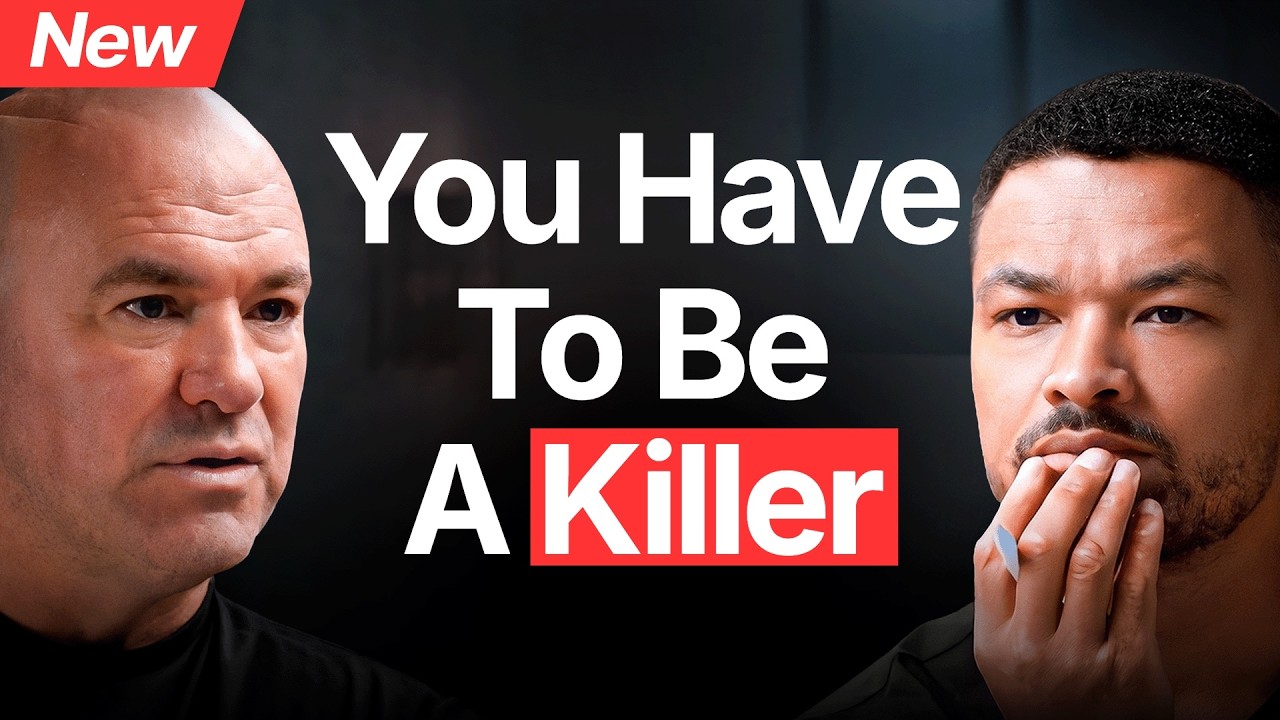
Dana White Eyes $50 Billion Empire as UFC Expands Into Boxing
The Diary Of A CEO
White contends building an enduring market leader requires daily in-person friction and an untrainable killer instinct, asserting that remote operations and risk aversion guarantee defeat against ruthless competitors.
Dana White argues that building a dominant business remotely from home is impossible, citing spontaneous in-person interactions as essential for driving breakthrough ideas. (12:35)
A radical 12-week protocol designed by human biologist Gary Brecka—incorporating fasting, cold plunges, and targeted diet changes—reversed White's severe sleep apnea and significantly improved his health markers. (36:55)
White outlines an ambitious seven-year vision backed by a major Paramount partnership to scale a unified combat sports empire spanning the UFC, Power Slap, and boxing. (82:06)
The operational foundation behind the UFC's growth rests on three strict pillars: matchmaking, live event production, and television broadcast quality. (16:04)
Detailed notes
## Background
Published on YouTube by The Diary Of A CEO on October 5, 2026, this episode features UFC CEO Dana White in conversation with Steven Bartlett. According to the page description, White reveals the psychological frameworks, savage business tactics, biohacking routines, and uncompromising mindset needed to overcome adversity, conquer industries, and build a multi-billion-dollar combat sports empire.
## TL;DR
Dana White chronicles his journey from walking away from a secure hotel job to turning a struggling $2 million fight promotion into a global sports juggernaut alongside Lorenzo and Frank Fertitta. Rejecting excuses and modern remote work, White argues that genuine entrepreneurial success demands an innate killer instinct, deep daily immersion in operational details, and an addiction to solving chaos. He details how a transformative 12-week health intervention with Gary Brecka reversed severe sleep apnea and elevated his performance, and outlines his uncompromising philosophy on family, loyalty, and brand integrity. Looking ahead, White describes expanding his conglomerate across UFC, Power Slap, and boxing through a multi-billion-dollar Paramount partnership, showing zero interest in retirement.
## Atmosphere & style
The dialogue carries a gritty, unapologetically intense energy punctuated by White's direct, profanity-laced storytelling and combative philosophy. Bartlett acts as an observant, structured sounding board, allowing White to express his hard-edged beliefs on loyalty, risk, and competition without dilution. Listening feels like being dropped into a high-stakes war room where sentimentality is cast aside, personal accountability is absolute, and business is treated as an unending full-contact sport.
## Bulletin
- [12:35](https://www.youtube.com/watch?v=Q-DFC0AnbY4&t=755s) Dana White argues that building a dominant business remotely from home is impossible, citing spontaneous in-person interactions as essential for driving breakthrough ideas.
- [36:55](https://www.youtube.com/watch?v=Q-DFC0AnbY4&t=2215s) A radical 12-week protocol designed by human biologist Gary Brecka—incorporating fasting, cold plunges, and targeted diet changes—reversed White's severe sleep apnea and significantly improved his health markers.
- [01:22:06](https://www.youtube.com/watch?v=Q-DFC0AnbY4&t=4926s) White outlines an ambitious seven-year vision backed by a major Paramount partnership to scale a unified combat sports empire spanning the UFC, Power Slap, and boxing.
- [16:04](https://www.youtube.com/watch?v=Q-DFC0AnbY4&t=964s) The operational foundation behind the UFC's growth rests on three strict pillars: matchmaking, live event production, and television broadcast quality.
## Key takeaways
- [02:10](https://www.youtube.com/watch?v=Q-DFC0AnbY4&t=130s) White rejects modern victimhood and psychoanalyzing childhood adversity, arguing that negative role models provide valuable blueprints of behaviors to avoid.
- [02:10](https://www.youtube.com/watch?v=Q-DFC0AnbY4&t=130s) Watching the destructive alcoholism of his father and uncles prompted White to quit drinking alcohol entirely at age 21.
- [06:00](https://www.youtube.com/watch?v=Q-DFC0AnbY4&t=360s) White walked away from a secure hotel position with benefits in his late teens because he refused to endure toxic management, committing fully to the combat sports industry without a safety net.
- [11:06](https://www.youtube.com/watch?v=Q-DFC0AnbY4&t=666s) True entrepreneurship demands 24/7 accountability with no real days off, making traditional employment preferable for those seeking work-life balance.
- [12:35](https://www.youtube.com/watch?v=Q-DFC0AnbY4&t=755s) Remote work is fundamentally incompatible with building an empire, as high-impact ideas require in-person collaboration and daily presence.
- [16:04](https://www.youtube.com/watch?v=Q-DFC0AnbY4&t=964s) Unlike traditional boxing promoters who operate like rolling liquidations, the UFC was built around brand consistency, premium live event experiences, and broadcast excellence.
- [18:58](https://www.youtube.com/watch?v=Q-DFC0AnbY4&t=1138s) White considers talent acquisition and maintaining an uncompromising, family-like culture where employees 'sink or survive together' his greatest strength.
- [28:48](https://www.youtube.com/watch?v=Q-DFC0AnbY4&t=1728s) At age 57, White insists on staying immersed in day-to-day operational details, maintaining that staying on top is vastly harder than getting to the top.
- [39:51](https://www.youtube.com/watch?v=Q-DFC0AnbY4&t=2391s) Killer instinct cannot be taught; individuals in athletics and enterprise either possess an intrinsic drive to finish and win or they do not.
- [47:05](https://www.youtube.com/watch?v=Q-DFC0AnbY4&t=2825s) Manifestation only functions when backed by relentless execution, comparing passive visualization without action to programming a GPS without driving.
- [01:04:26](https://www.youtube.com/watch?v=Q-DFC0AnbY4&t=3866s) White relies strictly on intuition rather than corporate focus groups for major ventures, evaluating risk through the lens that the worst-case scenario is simply returning to normal employment.
- [01:06:58](https://www.youtube.com/watch?v=Q-DFC0AnbY4&t=4018s) Attending a high school friend's wedding out of personal loyalty led directly to reconnecting with Lorenzo and Frank Fertitta and acquiring the UFC for $2 million.
- [01:18:02](https://www.youtube.com/watch?v=Q-DFC0AnbY4&t=4682s) White has no intention of retiring, choosing instead to continually expand his ventures alongside Endeavor leadership until he dies.
- [01:22:06](https://www.youtube.com/watch?v=Q-DFC0AnbY4&t=4926s) White views traditional boxing management as structurally broken, claiming his newly formed boxing enterprise is already outpacing initial projections.
## Detailed walkthrough
### [00:00](https://www.youtube.com/watch?v=Q-DFC0AnbY4&t=0s) Intro: The $50 Billion Empire, Uncompromising Belief, and Family Fractures
Dana White opens with an audacious assessment of what he has built with the Ultimate Fighting Championship (UFC). Originally purchased for just $2 million alongside Lorenzo and Frank Fertitta, White argues that if an NBA franchise like the Los Angeles Lakers is valued at $12.5 billion, then the UFC is realistically worth $50 billion. He makes it clear that his relentless daily mindset is centered solely on winning, asserting that even long after he is dead, it will be virtually impossible for anyone to duplicate or surpass what he created. Thriving in high-stakes environments, White admits that he is fundamentally "addicted to chaos," going so far as to say that if chaos does not naturally exist in his life, he creates it.
The conversation previews major career milestones, including his early refusal to allow female fighters into the octagon until Ronda Rousey confronted him in person. Demanding just 15 minutes of his time, Rousey arrived with an undeniable bravado that convinced him on the spot that she was the superstar to break the barrier. White also outlines his philosophy on risk and ambition, maintaining that if an individual determines who they are, sets a firm objective, and relentlessly works toward it, failure becomes impossible—though he cautions that most aspiring modern entrepreneurs have no genuine understanding of the grueling sacrifices required.
The dialogue turns deeply personal when Steven Bartlett brings up the unauthorized biography written and published by White’s own mother. White describes the betrayal as "one of the grossest, most disgusting things" an individual could ever endure from family, labeling it the definitive beginning of the end for their relationship. Following this intense preview, Bartlett delivers a brief appeal to the audience, noting that roughly 58% of viewers are not yet subscribed and encouraging them to support the channel's production quality before officially beginning the interview.
[02:10](https://www.youtube.com/watch?v=Q-DFC0AnbY4&t=130s) Rejecting the Victim Trap: Lessons from Negative Role Models
Bartlett kicks off the discussion by drawing a comparison between the atypical, turbulent origins of championship fighters—such as Khabib Nurmagomedov, Islam Makhachev, and Mike Tyson—and White’s own scrappy, combative ascent in business. While Bartlett asks what specific early context forged Dana into a fighter in his own right, White immediately expresses his discomfort with being psychoanalyzed or over-intellectualizing his childhood. He insists he never endured the extreme destitution or trauma that many of his athletes faced, but from an early age, he held an unshakable clarity about his identity and knew with absolute certainty that he wanted to dedicate his life to the fight game.
When addressing his parents' divorce at age eight, his father's struggle with alcoholism, and his mother's turbulent household, White forcefully rejects the contemporary "victim mentality." He dismisses the common complaint that people who grow up in broken environments fail because they lacked role models, arguing that negative examples provide just as much instructional value as positive ones. By observing the destructive habits of his father and uncles, White consciously mapped out the exact behaviors he needed to avoid.
This conscious rejection of self-destruction directly shaped his discipline around alcohol. Recognizing that heavy drinking had derailed the potential of extraordinarily talented family members around him, White made the calculated decision to completely quit drinking at age 21—the exact age when alcohol becomes legally permitted in the United States. He knew that drinking would jeopardize the monumental ambitions he envisioned for his future.
- **Perspective on role models:** Everyone in your upbringing acts as a guide; poor behaviors show you precisely which path not to take.
- **Sobriety decision:** White quit alcohol entirely at age 21 to safeguard his energy, focus, and drive from the destructive patterns seen in his family.
[04:30](https://www.youtube.com/watch?v=Q-DFC0AnbY4&t=270s) Growing Up Under an Absent Father and a Relentless Mother
Reflecting on his childhood alongside his sister, White explains that as they have grown older, they frequently look back on how isolated their upbringing felt. With both parents now deceased, the two siblings remain exceptionally close. His mother was an absolute "animal" when it came to work ethic, laboring as a registered nurse, constantly taking on grueling extra shifts, and going to school to advance her credentials while effectively raising the children as a single mother.
In sharp contrast, White's father was largely absent and heavily self-absorbed. White recounts a vivid, defining memory from when the film *Beverly Hills Cop* was breaking box-office records. His father showed up completely drunk to pick up Dana and his sister, creating a chaotic, embarrassing scene en route to the cinema. Arriving late to a completely sold-out theater with no vacant seats, his father barged inside and loudly bellowed to the crowd, "We're going to have to start moving some people," before throwing a $20 bill at young Dana and telling him to fetch food and popcorn for his sister. White reflects that his father was an intensely selfish individual who prioritized his own desires regardless of how his actions impacted those around him.
[06:00](https://www.youtube.com/watch?v=Q-DFC0AnbY4&t=360s) Breaking Generational Cycles and Leaving the Safe Path
When asked whether growing older helped him empathize with his parents' shortcomings, White explains that true perspective arrived only when he had his own children. Becoming a father instantly illuminated how unconditional and protective parental love is supposed to be, cementing his determination to break generational cycles. He credits his parents’ flaws with inadvertently shaping him into a far more attentive, dedicated father and leader.
That same internal standard drives his appetite for competition. White acknowledges that he carries a significant chip on his shoulder and loves winning above all else, but he emphasizes that he balances his relentless business ambition by holding himself strictly accountable to his duties at home and at work.
```mermaid
flowchart TD
accTitle: Dana White's Pivot from Hospitality to Fighting
accDescr: Diagram illustrating White walking away from a stable hotel job to pursue fighting full-time.
subgraph Corporate_Safety["Traditional Corporate Security"]
A["Hotel Industry Job"] --> B["Daily Cash Tips & Weekly Paycheck"]
A --> C["Full Dental, Medical & 401(k)"]
A --> D["Culture of Disrespect & Hierarchy"]
end
subgraph The_Break["The Turning Point"]
D -->|"Walked out in late teens"| E["Refusal to Work Under Others"]
end
subgraph The_Vision["Fight Business Commitment"]
E --> F["Zero Safety Net"]
F --> G["Commitment to the Fight Game"]
end
```
Bartlett asks whether young Dana had any clear vision of his future occupation, and White explains that clarity hit him in his late teens while working in the hotel industry. On paper, it was an enviable setup that many peers would kill for:
- Consistent daily cash tips and steady weekly paychecks
- Full retirement benefits, including a 401(k)
- Comprehensive health and dental insurance coverage
Despite the security, White found the hospitality hierarchy toxic and demeaningly disrespectful. Refusing to tolerate the way management spoke to subordinates, he abruptly walked out of the building one afternoon. Although he did not yet know what role he would occupy or at what level he would compete, he made a resolute vow that he was dedicating his life entirely to the fight business.
[07:58](https://www.youtube.com/watch?v=Q-DFC0AnbY4&t=478s) Challenging Authority and the Roots of Self-Reliance
White candidly admits to an innate, lifelong hostility toward authority and being told what to do. While he cannot pinpoint an exact origin for this defiance, his disdain for arbitrary power structures informed his management philosophy: because he hated feeling managed, he refuses to micromanage or belittle his own employees today.
Even as a young teenager around the age of 14, White harbored an unshakable inner confidence that he was destined for massive success, even if he could not yet articulate the mechanics of that success. That self-reliance was forged during long stretches spent alone with his sister while their mother worked shifts and attended classes. The siblings were entrusted with managing the house independently, shouldering adult chores such as mowing the lawn, skimming and balancing the pool, and trimming the property's landscaping. This responsibility ingrained in him a baseline work ethic and self-sufficiency long before he ever stepped into the business world.
[08:58](https://www.youtube.com/watch?v=Q-DFC0AnbY4&t=538s) What Dana White Is Trying to Teach His Sons
Dana White reflects on the lessons he took from his early jobs, remarking that the moment he started making money, he vowed never to return to the grueling, low-paying work he had to do in his youth. He applies that same principle to parenting his own children. When his youngest son, Aidan, flew home from college one weekend announcing he wanted to drop out to pursue an entrepreneurial business idea, White listened carefully to the pitch. He thought the concept was solid, but he refused to let Aidan quit school just to work on something that would not consume eight to ten hours of his day.
White's directive to his son was immediate and firm: Aidan had to go fill out job applications and work an ordinary job, telling him, "If I die tomorrow, that's what you're qualified to do." Aidan accepted the challenge and went to work at U-Haul. Similarly, his oldest son is pursuing a master's degree in Boston, where White himself once worked paving roads for EJ Paving Company. White wants his oldest son to spend days laboring at that paving company as well, with the deliberate aim of instilling an appreciation for what hard, grinding work actually entails.
```mermaid
flowchart TD
accTitle: Aidan White's Career Path Decision
accDescr: A decision diagram showing Dana White's guidance when his son proposed dropping out of college to start a business.
subgraph Proposal["Aidan's Pitch"]
A["Flies home from college"] --> B["Presents new business concept"]
end
subgraph Evaluation["Dana's Assessment"]
B --> C{"Viable idea?"}
C -->|"Yes, but lacks 8-10h workload"| D["Deny dropout request"]
end
subgraph Mandate["Grounding Experience"]
D --> E["Apply for entry-level work"]
E --> F["Work at U-Haul to earn qualifications"]
end
```
[10:12](https://www.youtube.com/watch?v=Q-DFC0AnbY4&t=612s) What Real Hard Work Actually Looks Like
White pushes back against people praising him for how hard he works, pointing out that staying up late and running around is nothing compared to true physical labor. He points to the construction and concrete workers near his Las Vegas facilities who spend entire summers laboring outdoors in blistering 115-degree heat, only to turn around in the winter and endure outdoor shifts when temperatures drop into the 30s.
According to White, doing brutal physical labor day in and day out—going home only to eat, sleep, and repeat the cycle the next morning—provides crucial clarity. In his view, you cannot figure out what you want to do with your life until you first figure out what you definitely do not want to do.
[11:06](https://www.youtube.com/watch?v=Q-DFC0AnbY4&t=666s) Why There Is No Such Thing as a Day Off in Business
Looking over one of his own quotes—that there are no days off, no birthdays, no Christmases, and no Thanksgivings when you run your own enterprise—White emphasizes that problems crop up every single day that demand personal intervention. For those who genuinely love what they do, solving those issues is enjoyable rather than draining, but it requires accepting constant disruption.
He strongly cautions against the romanticized modern idea of entrepreneurship, particularly among young people who view self-employment as a path toward flexible scheduling and more personal freedom. To anyone seeking control over their calendar, White advises getting a standard 9-to-5 job with guaranteed weekends and holidays off. Entering entrepreneurship to reclaim free time is fundamentally flawed, because the core requirement of being a good entrepreneur is continuously finding solutions to endless, unforeseen problems.
- **Morning Chaos Example:** White recounts a morning when he had a mandatory 9:00 AM board meeting. Both of his electric razors died while shaving, and once he got into his car, the dashboard sensor warned that his rear right tire was dangerously low, demanding an immediate stop. His reaction was simply to keep driving: "Yeah, no, we're not fucking stopping. We're going."
[12:35](https://www.youtube.com/watch?v=Q-DFC0AnbY4&t=755s) Why Working From Home Cannot Build an Empire
White takes direct aim at the modern corporate belief that a thriving business can be operated remotely. In his view, the idea that a younger generation can build a dominant company from home is a complete fallacy. White personally arrives at the office by 8:30 in the morning and routinely works until 7:00, 8:00, 9:00, or even 10:00 at night, maintaining the exact same pace today that he had decades ago.
He argues that the magic of building something extraordinary happens organically when talented people share the same physical room. Even when his day is booked up, UFC staff frequently pop into his office unannounced. Those impromptu face-to-face discussions generate fresh directions, solve unexpected crises, and spark the breakthrough ideas that make the organization thrive.
[13:16](https://www.youtube.com/watch?v=Q-DFC0AnbY4&t=796s) How Decades of Business Battles Reshaped Dana White
When asked whether decades of business battles have altered his temperament, White concedes that he is far more composed than he was in his early years. While he cautions that leaders must guard against growing soft or weak with age, he acknowledges that he no longer explodes over every issue. In his younger, high-strung days, his operational velocity was so demanding that he burned through roughly ten secretaries over a two-year stretch because people simply could not keep up with the workload.
White describes his current routine as the most demanding period of his entire career, as he is simultaneously running three distinct companies:
- Ultimate Fighting Championship (UFC)
- Power Slap
- Zuffa Boxing
Balancing these enterprises alongside numerous outside ventures keeps him on the road constantly. In a recent stretch, he and his core team spent only four days at home over an entire two-month period. Even when returning home, his foot stays on the gas, demanding extraordinary stamina and commitment from everyone around him.
[14:38](https://www.youtube.com/watch?v=Q-DFC0AnbY4&t=878s) The Poison of Entitlement: Nobody Owes You Anything
White illustrates his deep contempt for personal entitlement by recounting a childhood friendship from when he was around 12 to 14 years old. The friend's father was an affluent businessman who provided a luxury home, nice vehicles, and elite amenities, and had even set aside a $1 million trust fund for his son. When the father's business hit hard times, the father withdrew that million dollars to stay afloat. The friend bitterly complained to White that his father had "stolen" a million dollars from him.
Even as a teenager, White was stunned by that reaction, noting that the friend had never earned a single cent of the money and that the father's original intention had been an extraordinary gift, not an obligation. White points out that the boy grew up to live the exact hollow, unsuccessful life one would predict from someone with that mindset. White maintains that while connections and mentors might open a door or make a phone call on your behalf, nobody owes you a living—once that door opens, you have to perform and deliver on your own merit.
[16:04](https://www.youtube.com/watch?v=Q-DFC0AnbY4&t=964s) The Foundational Principles Behind the UFC's Multi-Billion-Dollar Scale
When asked if the majority of people have what it takes to be entrepreneurs, White responds with an unequivocal "No." He explains that most people find it difficult enough to manage their own lives, whereas entrepreneurs bear the profound responsibility of supporting dozens, hundreds, or thousands of employees whose families rely on the company's survival.
White recalls the early days of purchasing the UFC for a modest $2 million when almost no one believed in its future. Drawing a valuation parallel to major sports franchises, he points out that if the Los Angeles Lakers were valued at roughly $10 to $12.5 billion, the UFC is legitimately a $50 billion asset today. In the early era, recruiting top-tier corporate talent to Las Vegas was nearly impossible because production and sponsorship executives universally preferred New York City or Los Angeles. A major breakthrough was securing Craig Borsari, a rising production star who left a secure trajectory at Fox because he believed in the UFC vision, subsequently transforming their broadcasts into the best in the business.
When asked to identify the core pillars that allowed the UFC to become a dominant global enterprise after buying it out of near-obscurity, White highlights three critical operational elements:
1. **Matchmaking:** Creating compelling, authentic matchups where the best fight the best, rather than protecting records.
2. **Live Event Production:** Perfecting the high-energy, immersive arena atmosphere.
3. **Television Production:** Elevating the sport's broadcast into an elite global sports property.
White contrasts the UFC's steady long-term brand-building with the historic failures of professional boxing promoters. He explains that 25 years ago, critics told him he could never compete with boxing's entrenched history. However, boxing promoters treated the sport like a rolling liquidation sale—squeezing as much quick cash as possible from each individual fight and then leaving the landscape scorched. That mercenary approach alienated television networks and blue-chip corporate sponsors, leaving most promoters fighting for scraps on niche streaming platforms. In contrast, White built Zuffa and the UFC on sustained consumer and corporate trust, securing the only global television broadcast partnership on Paramount by proving the organization protects its brand integrity and delivers lasting value to networks, sponsors, and fans alike.
[18:58](https://www.youtube.com/watch?v=Q-DFC0AnbY4&t=1138s) The Live Event Formula and Hiring as a Superpower
Dana White emphasizes that the people attending UFC live events are his top priority because they carry a far greater financial and personal burden than home viewers. These attendees pay for expensive tickets, book flights, reserve hotel rooms, and buy dinners. His standard is that every single attendee must walk out of the venue thinking, "God damn, that was a good time. I'm glad we did this tonight and I would love to do this again." While outside observers and failed competitors often assume fight promotion is simple, White points out that a long list of exceptionally wealthy, intelligent individuals have tried to break into the business and failed. To him, there is a distinct formula—and he holds the blueprint.
```mermaid
flowchart TD
accTitle: The Live Event Experience Loop
accDescr: Charting the input costs of live UFC attendees against Dana White's standard of execution and competitive edge.
subgraph Standard ["Event Standard"]
C["Flawless In-Arena Experience"]
D["Fan Reaction: 'God damn, that was a good time'"]
end
subgraph Edge ["The Promoter Edge"]
E["The UFC Formula"]
F["Competitors Fail to Replicate"]
end
Inputs --> Standard
Standard --> Edge
```
Steven Bartlett observes that early in an entrepreneurial career, founders often believe raw effort and solo ideas are enough, only to realize later that success hinges on assembling talent and binding them with the right philosophy. White agrees completely, reflecting on the beginnings when the company had only two employees: himself and one other person. In those days, he wore every hat, but scaling required learning who fit the culture and who did not. Over twenty-five years, White considers identifying and curating top talent his ultimate superpower. When Zuffa was sold, they brought in outside personnel; White immediately identified those who did not match the company culture and fired them on the spot.
- **Candidate Requirements**: Top talent must possess exceptional skill, undeniable drive, a fierce work ethic, and total alignment with the overarching vision.
- **Production Chemistry**: The UFC production team now crafts promotional spots and vignettes that require virtually zero revisions or notes from White.
---
[21:44](https://www.youtube.com/watch?v=Q-DFC0AnbY4&t=1304s) Being the Hardcore Customer and the Production "Red Phone"
When asked to name his rarest skills, White explains that his core advantage is being an unapologetic fight fan at heart, even twenty-five years into running the promotion. Because he is the end consumer, he possesses an innate barometer for when a promotional package, matchmaking decision, or broadcast element lands correctly. He uses that perspective to push every department—from matchmaking to sponsorships—to execute against his internal standard.
His direct oversight of the broadcast is exemplified by the physical red phone sitting on his table at cageside, which runs a direct line into the production truck where director/producer Zach operates. Zach is granted creative freedom to experiment, but the feedback loop is instantaneous and blunt. If a broadcast visual misses the mark, White picks up the receiver to ask, "What was that?" When told it was an experiment, White responds, "Yeah, let's never fucking do that again. Okay, bye." There are no bruised egos; praise is handed out just as decisively when a segment succeeds. White points to key lieutenants who make the organization hum:
- **Lene (Head of PR)**: Trusted so deeply that White consults her before making major business moves, involving her across various facets of his life.
- **Craig Borsari (Head of Production)**: Oversees the sprawling, high-stakes live television broadcast machinery.
- **Head of Sponsorship**: Runs commercial integration with the same relentless execution.
---
[23:41](https://www.youtube.com/watch?v=Q-DFC0AnbY4&t=1421s) The Battleship Mentality and COVID-19 Leadership
White rejects corporate leaders who sneer at the concept of workplace family and treat staff purely as transactional line items. Addressing a quote from a CEO who called the "family" model nonsense, White questions who would ever want to "run through a fucking wall" for an executive with that mindset. He states unequivocally that he will never prioritize money over people. During the onset of the COVID-19 pandemic—the most frightening commercial climate in modern memory—other corporations immediately resorted to mass layoffs to balance balance sheets. White refused to cut staff who had dedicated their lives to building the company, sacrificing their children's milestones and sporting events along the way.
```mermaid
flowchart LR
accTitle: The Corporate Battleship
accDescr: Dana White's war mentality comparing business survival to a battleship crew standing together.
subgraph UFC ["The Battleship UFC"]
C["Dana White & Lieutenants"]
D["Unbroken Loyalty"]
end
subgraph Outcome ["The Shared Fate"]
E["All Go Down Together"]
F["Nobody Goes Down at All"]
end
Threat --> UFC
UFC --> Outcome
```
To White, waking up as a CEO means stepping onto a battlefield where competitors actively scheme to take what you have. He visualizes the UFC as a heavily armored battleship: the crew is locked in combat together, and they either all sink together or no one sinks. When global shutdowns loomed, White gathered his entire workforce in the headquarters' downstairs dining hall, offering anyone who felt unsafe the freedom to go home without penalty. Not a single employee walked out.
- **Pandemic Care**: White hosted weekly FaceTime check-ins with employees, telling them to call him directly if they needed basic essentials like groceries, toilet paper, or medical support.
- **Return to Work**: Within weeks, the workforce unified behind White's aggressive push to resume operations and safely hold live events.
- **Root of Culture**: Rejecting the notion that his fierce loyalty stems from childhood trauma, White states it came from his early career experiences working at companies where leadership treated staff as completely replaceable commodities.
---
[28:26](https://www.youtube.com/watch?v=Q-DFC0AnbY4&t=1706s) Staying in the Weeds at Age 57
Bartlett brings up that White, now 57 years old, has amassed immense wealth and sits at the absolute peak of his professional powers. In conventional corporate lore, an executive at this stage is expected to step out of day-to-day operations, delegate the minutiae, and enjoy a comfortable remove from the front lines. Yet White's active reliance on tools like the cageside red phone proves that he intentionally remains buried deep "in the weeds" of his operations.
[28:48](https://www.youtube.com/watch?v=Q-DFC0AnbY4&t=1728s) Staying on Top and Blocking Out the Distractions
Dana White rejects the premise that reaching success allows someone to relax or stay out of the day-to-day weeds. He underscores the old adage that "it's easier to get to the top than it is to stay on top." The moment an organization claims the number-one spot, it becomes the target: competitors begin scrutinizing every move, breaking down the blueprint, attempting to poach staff, and studying strengths and weaknesses just like fighters do against a reigning world champion. Rather than finding that pressure exhausting, White declares, "I love that shit."
```mermaid
flowchart TD
accTitle: The Trap of Scaling and Competitor Pressure
accDescr: Shows the division between core focus and dangerous distractions as an enterprise scales.
subgraph Core ["The Core Discipline"]
A["Focus on 3 Non-Negotiable Core Priorities"]
B["Keep Ego Out of Growth Decisions"]
end
subgraph Distractions ["The Distraction Trap"]
C["Media Pitches, Biopics, & Book Offers"]
D["Vanity Projects & Flattery"]
end
subgraph Competition ["The True Competitive Field"]
E["Ignore Minor Fight Promoters"]
F["Compete Head-to-Head with NFL, NBA, MLB, NHL"]
end
When asked how he keeps from being distracted by constant competition, White explains that huge opportunities and vanity proposals start pouring in once a company hits a certain scale—such as requests to produce biopics, books, and documentaries. To survive, White maintains absolute focus on three daily priorities that he steadfastly refuses to reveal, referring to them as a proprietary secret: "It's part of the formula." Letting ego run wild over ancillary opportunities has ruined massive corporations with century-long legacies, opening doors for competitors to eat their lunch.
- When asked to disclose even one of the three daily focal points, White flatly refuses, maintaining that guarding that operational core is vital to preventing self-inflicted mistakes.
- White emphasizes that the UFC does not compete with regional fight promoters, stating, "All these other guys that are out there, we are not the same."
- He defines the UFC's actual competitive landscape as the major sports leagues: the NFL, Major League Baseball, the NBA, and the NHL.
- Referencing the massive media landscape, White points to their multi-billion dollar deal with Paramount (reported at $7.7 to $8 billion), noting that the NFL acts like "animals" who immediately regrouped to wonder how to claim that revenue by expanding their games to other nights of the week.
- Sitting inside the UFC Apex with the UFC Performance Institute and corporate headquarters next door, White argues the promotion now possesses every resource and institutional scale that traditional legacy leagues enjoy.
---
[32:02](https://www.youtube.com/watch?v=Q-DFC0AnbY4&t=1922s) Why Great Leaders Never Truly "Make It"
White rejects the idea of crossing a finish line or celebrating long-term security. When outsiders congratulated him on the $7.7 billion Paramount deal as proof that he had finally "made it," White retorted that nobody ever truly makes it. A media conglomerate only writes an enormous check because they expect the partnership to tangibly grow their own enterprise; his responsibility over the next five-year window is to dramatically move the needle for them so that the subsequent contract targets $10 billion.
When challenged on whether living in the weeds for 25 years becomes exhausting, especially after reaching immense wealth, White dismisses the critique. At 57 years old, he sees no reason to step away, admitting that he is fundamentally wired to chase pressure: "I am addicted to chaos, and if there isn't any, I create it."
---
[33:15](https://www.youtube.com/watch?v=Q-DFC0AnbY4&t=1995s) Weaponizing the Haters vs. Silencing the Noise
White draws a sharp distinction between critics, hardcore fans, and sports journalists. He embraces "haters"—a modern rebranding of critics—because they can point out raw, legitimate flaws in operations that keep an organization razor-sharp. He actively reads what hardcore fans post, noting that seasoned executives can quickly distinguish between authentic, constructive frustration and empty hostility.
Conversely, White completely tunes out the mainstream media that covers mixed martial arts. He has blocked beat reporters from his personal feeds, arguing that despite covering MMA for 25 years, they remain profoundly ignorant of the sport's mechanics and future trajectory:
- White views traditional sports journalists as completely disconnected from innovation: "When you think about what we're doing, it's never been done before. So what I'm thinking and what's coming next, these guys could never know."
- Commenting on the "signal versus noise" distinction, White laments that modern technology has enabled anyone with a smartphone to posture as an expert on social media or podcasts.
- Regarding public complaints about match cards, White points out that fans often declare "this card sucks" before an event even starts. He maintains that events cannot be accurately judged until they finish, adding that whenever an event genuinely underperforms, he is the first person to publicly admit it.
---
[36:55](https://www.youtube.com/watch?v=Q-DFC0AnbY4&t=2215s) Health Transformation: Sleep Apnea and Gary Brecka
Steven Bartlett shifts the discussion toward physical energy and daily stamina, referencing how Dana White introduced him to human biologist and health specialist Gary Brecka. White explains that when he reached age 50, his lifestyle had caught up to him. He was relying on two primary physicians—one based in Las Vegas and the other in Los Angeles—who managed his symptoms by perpetually rotating prescription medications without resolving the underlying root causes.
His most acute symptom was severe sleep apnea, which caused him to wake up in the middle of the night choking and vomiting. After media personality Kerri Kasem repeatedly urged him to consult Gary Brecka, White initially resisted. The turning point arrived when his son celebrated his 21st birthday in Miami, prompting White to finally accept the meeting. Brecka promised that sticking to his targeted health protocol for 12 weeks would completely revolutionize his life, and within just six weeks, White experienced an extraordinary turnaround in his baseline vitality and sleep quality, despite the skepticism and protests of his traditional medical doctors.
[38:32](https://www.youtube.com/watch?v=Q-DFC0AnbY4&t=2312s) The Gary Brecka Health Transformation
Dana White describes how he crossed paths with human biologist Gary Brecka in Miami. Initially, the interaction was casual: Brecka noted that his clinic offered IV therapy, so Dana and his crew would go out drinking and then get IV infusions. During one of these sessions, Brecka offered to run comprehensive blood work, mentioning he had an actuarial model capable of predicting life expectancy based on biological markers. Dana became fixated on learning his result.
```mermaid
flowchart LR
accTitle: Gary Brecka Protocol Transformation
accDescr: Progression of Dana White's health intervention from life expectancy warning to results.
subgraph Diagnosis
A["Blood panel & analysis"] --> B["Given 10-year life expectancy"]
end
subgraph Intervention
B --> C["12-week strict protocol<br/>(Fasting, cold plunges, diet)"]
end
subgraph Results
C --> D["Day 42 (6 weeks):<br/>Clarity restored"]
D --> E["Sleep apnea cured &<br/>executive capacity unlocked"]
end
```
When Brecka analyzed the markers, he delivered a grim prognosis: White had approximately 10 years left to live. Brecka proposed a deal: "Give me 12 weeks. I'll change your life. It's going to be hard." Dana countered that once he commits mentally, difficulty is irrelevant. The turnaround happened even faster than predicted:
- Within six weeks, Dana felt better than he ever had in his adult life.
- Chronic leg issues and brain fog vanished completely.
- Severe, life-threatening sleep apnea was entirely eliminated.
Both Dana and his wife privately believed Brecka's 10-year estimate was actually generous—given his violent breathing patterns during sleep and deteriorating physical state, they suspected he had far less time left. Dana credits Brecka as an absolute game-changer, noting that while he would likely still be managing the UFC without the intervention, he could never sustain his current grueling executive pace across multiple new ventures without that biological reset.
---
[39:51](https://www.youtube.com/watch?v=Q-DFC0AnbY4&t=2391s) Killer Instinct, Savagery, and Ian Garry's Fifth Round
Transitioning to mindset, Dana reflects on the immutable nature of competitive drive: "You either have the killer instinct or you don't." To illustrate, he points to Ian Machado Garry's high-stakes bout against Shavkat Rakhmonov. White watched the fight unfold with growing frustration. Garry had fought four grueling, competitive rounds, taking damage to his face and right side while keeping the fight within striking distance against a world-class opponent. Heading into the final frame, Garry was the younger, taller, rangier fighter with five minutes remaining to pull off an upset.
Instead of hunting for the finish, Garry came out exchanging high-fives and hugs inside the Octagon. Dana was furious at the lack of urgency: "Show Islam [or your opponent] all the love you want when the fight's over... You have five minutes to shock the world and everything you ever fucking dreamed of and worked for can happen in this next five minutes, and you didn't do it." When asked if Garry lacks the killer instinct entirely, Dana concedes that Garry is a classy, decent person outside the cage, but argues that inside competition, showing courtesy instead of savagery is fatal.
White applies that exact same ethos to corporate leadership and partnerships. He refuses to run a traditional "logo slap" sponsorship model where a brand pays to sit on a canvas without support. He insists that every sponsor must win, walk away seeing immense ROI, and think, "Damn, thank God I spent my money on the UFC." Delivering on that promise demands total, round-the-clock savagery for employees, television networks, and business partners alike. While Dana leaves labels like "savage" for others to decide, he states unequivocally: "I absolutely positively have killer instinct. And every day that I show up here, I'm here to fucking win."
---
[42:20](https://www.youtube.com/watch?v=Q-DFC0AnbY4&t=2540s) Mid-Roll Commercial Break: Cometeer Coffee & Function Health
The episode transitions into sponsor messages delivered by host Steven Bartlett:
- **Cometeer Coffee**: Bartlett explains that even the former president of Nespresso was turned into an investor after a single sip. Bartlett recounts receiving a shipment at his London office; within 90 minutes, his internal Slack was flooded with inquiries. The coffee is brewed and flash-frozen at peak flavor into recyclable capsules, eliminating machines, pods, and plastic waste while allowing instant hot or iced coffee preparation.
- **Function Health**: Bartlett addresses entrepreneurs about the silent toll of executive stress. After running comprehensive panels through Function Health, Bartlett discovered deficient vitamin D levels and low omega-3 fatty acids, leading him to restructure his mornings around direct sunlight and outdoor walking to reset his circadian rhythms. The platform offers over 160 laboratory tests alongside advanced imaging access.
---
[44:36](https://www.youtube.com/watch?v=Q-DFC0AnbY4&t=2676s) Competing at the Elite Level and the Scumbag Ecosystem
Steven asks Dana if someone can learn to develop a killer instinct if they do not naturally possess it. Dana admits he has never seen a single person transition from passive to a true killer: you either carry the fire inside or you don't. Building an enterprise demands an innate willingness to put the collective mission above one's personal comfort.
When asked whether success requires a chip on your shoulder, Dana explains that high achievement naturally creates one because business quickly becomes "you versus the world":
- As soon as a company achieves public success, predatory legal operations emerge to extract capital.
- Underperforming business partners and former associates routinely externalize their failures, blaming the company rather than acknowledging their own shortcomings.
- Institutional litigation finance firms and specialized law networks actively bankroll lawsuits against high-profile companies as speculative investments.
Asked which business competitor strikes fear into him, Dana rejects the premise: "I want to compete with them all." He views the UFC as operating on equal footing with legacy organizations like the NFL and Major League Baseball, entities that have had century-long head starts. Among prominent figures he admires for their ruthless edge, Dana highlights Michael Jordan and activist investor Carl Icahn.
---
[47:05](https://www.youtube.com/watch?v=Q-DFC0AnbY4&t=2825s) The "Unicorn" Fighters: Rousey, McGregor, and Khabib
Reflecting on combat sports athletes who possessed unmatched magnetism and competitive ferocity, Dana points to Chuck Liddell, Khabib Nurmagomedov, Conor McGregor, and Ronda Rousey. He details the origin of women's MMA in the UFC, revealing that he originally held a strict ban against female divisions because television networks and corporate sponsors were squeamish enough about men fighting.
Rousey cornered White at an arena event, demanding 15 minutes of his time. Dana agreed to talk in his private room; within minutes of hearing her speak, his entire stance changed: "Holy shit, I think I'm going to do this. And she's the one to do it with." Rousey arrived with an immense chip on her shoulder, backed by uncompromising bravado. While modern critics often downplay her run, Dana calls her an outright "fucking unicorn."
Dana recalls a similar immediate realization with Conor McGregor. Right after signing him, White took McGregor out to dinner. Blown away by his raw presence, charisma, and unshakeable self-belief, Dana called his business partner Lorenzo Fertitta directly from the car immediately after: "Dude, I don't know if this guy can fight or not, but if he can even throw a punch, he's going to be a massive superstar."
[48:22](https://www.youtube.com/watch?v=Q-DFC0AnbY4&t=2902s) The Mechanics of Manifestation and the Gas Pedal
When evaluating talent in the fight industry, Dana White looks at two foundational traits. The primary baseline is undeniable physical ability: whether someone can actually fight and how good they truly are. The second factor, which he has witnessed in only a tiny handful of meetings across twenty-five years, is a supreme mentality of manifestation—fighters who sit across the table and outline exactly what they are going to do, how it will play out, and how the entire vision will unfold. White affirms that he is a firm believer in manifestation, arguing that when an individual decides who they are, defines their mission, and wakes up every single day working relentlessly toward that target, failure becomes impossible.
Steven Bartlett compares modern manifestation culture to sitting in a garage, programming the destination into a car's GPS, but never stepping on the gas pedal. White completely agrees with the analogy, lamenting people who curate vision boards yet refuse to apply real drive. In White's eyes, mapping the course is meaningless without forward momentum; execution combined with absolute clarity of identity is what makes an objective inevitable.
[49:38](https://www.youtube.com/watch?v=Q-DFC0AnbY4&t=2978s) Defining Success, Avoiding Regret, and the "Happy Speech"
White challenges standard definitions of failure and success, noting that financial wealth does not equal fulfillment. He points out that he knows numerous billionaires who are thoroughly miserable human beings because happiness is ultimately an active, daily choice to love what you do. He shares an anecdote about his oldest son calling him recently, feeling weighed down by major life crossroads and asking for guidance. When White began offering his typical advice about prioritizing happiness, his son cut him off: "Dad, don't give me your fucking happy speech... I need some fucking direction and help me figure this out." They worked through the decision, leaving his son in a better state of mind.
For White, the ultimate tragedy in life is reaching an end-of-life hospital bed plagued by the haunting question of "what would have happened if I tried." He lives with a strict philosophy of zero regrets:
- He claims that even under intense pressure, he cannot name a single regret from his personal or professional life.
- True success is measured by whether an individual genuinely looks forward to waking up every day and throwing themselves into their work.
- Living without regret requires taking direct swings at opportunities rather than letting fear keep ideas theoretical.
[51:00](https://www.youtube.com/watch?v=Q-DFC0AnbY4&t=3060s) "Fuck the Rearview Mirror": Refusing to Live in the Past
When Bartlett brings up the passing of White’s parents a couple of years earlier, White pushes back against dwelling on childhood and formative history. While acknowledging that everyone's upbringing is unique and leaves distinct marks, White emphasizes his total disdain for the past. He declares, "Fuck the rearview mirror, it doesn't matter. Whatever happened yesterday means nothing today." He refuses to indulge people who cite childhood grievances or parental mistreatment as an ongoing excuse, arguing that nearly everyone endures hardships and that lingering on them is useless self-pity.
This refusal to look backward extends to his professional triumphs as well. White never sits around reflecting on past accomplishments or celebrating what the UFC achieved years ago. To him, past actions merely served as the vehicle to reach the present; whatever happened even a few hours earlier is already dead and irrelevant. At 57 years old, his entire focus remains locked on tomorrow: who is targeting him next, how the business will expand, and how he can improve himself across every metric.
[53:16](https://www.youtube.com/watch?v=Q-DFC0AnbY4&t=3196s) Thick Skin, Cancel Culture, and an Unsentimental Family
White maintains that he has always lacked emotional vulnerability to outside noise, asserting that he never gets hurt by criticism and cannot remember the last time he cried. He questions the functional utility of tears, stating bluntly that crying accomplishes nothing for him. He credits his emotional armor directly to his upbringing, describing his parents, aunts, and uncles as an extraordinarily harsh, unsentimental crew who routinely roasted him. Having endured severe verbal battering from the very people who were supposed to love him, insults from strangers or external critics hold zero power over him.
That conditioning shapes his complete indifference to modern cancel culture and media hostility. He dismisses attacks from outlets like *The New York Times*—which heavily targeted him over staging UFC events during the COVID-19 pandemic—as entirely irrelevant. White only values the opinions of a small, chosen inner circle of family, friends, and colleagues; losing one of those meaningful relationships would affect him deeply, but anonymous online commentators or journalists provoke no reaction. As an example of his family's tough emotional climate, he recalls his Irish grandmother: whenever he told her, "I love you, Gram," she would offer no affectionate return, responding only with a detached, "Good to see you. See you later."
```mermaid
flowchart TD
accTitle: Dana White's Framework for External Criticism
accDescr: Diagram illustrating how White filters feedback between his inner circle and external critics like the media.
subgraph Inputs["External Signals"]
A["Family & Inner Circle"]
B["Media & Internet Critics<br>(e.g., New York Times)"]
end
subgraph Filter["Psychological Filter"]
C{"Does this person's<br>opinion matter?"}
end
subgraph Outcomes["Emotional Impact"]
D["High Emotional Value<br>(Care & Loyalty)"]
E["Zero Emotional Impact<br>('Fuck the Rearview Mirror')"]
end
A --> C
B --> C
C -->|Yes: Inner Circle| D
C -->|No: Outside Noise| E
```
[55:48](https://www.youtube.com/watch?v=Q-DFC0AnbY4&t=3348s) The Mother's Unauthorized Tell-All and the Fallout
Bartlett presents a physical copy of an unauthorized biography written by White's mother. White handles the book, remarking that he had never actually seen the physical copy before. As he flips through pages filled with childhood photos and his personal wedding pictures, he describes the situation as "batshit nuts." He draws a parallel to NBA star Kobe Bryant, who faced a similar family betrayal when his mother attempted to auction off memorabilia and personal items taken from his childhood bedroom.
Bartlett notes that the book contains scathing criticism of White, particularly on the final page. When asked where the relationship fractured, White traces the fallout back to a specific two-week trip to London alongside his business partner, Lorenzo Fertitta. Because this occurred in an era before mobile email access was ubiquitous while traveling, White was completely unreachable. Upon returning home, he opened his inbox to find an escalating series of demands from his mother:
- She demanded a substantial sum of money to purchase a bar, giving him two ultimatums: pay the full amount up front or enter a fixed installment plan.
- Interpreting his silence while abroad as deliberate defiance, her subsequent emails grew progressively vicious and hostile with each unreturned message.
[57:43](https://www.youtube.com/watch?v=Q-DFC0AnbY4&t=3463s) The Book, Parental Failure, and Estrangement
Dana White reflects on the ultimate rupture in his relationship with his mother, which started when she published a tell-all book about him. He notes that becoming successful attracts toxic dynamics, remarking that "sometimes family is the worst." While headlines and media criticism might hurt, they pale compared to the pain inflicted by relatives. White's core philosophy on family is blunt: "In my opinion, if you fail as a parent, it's the ultimate failure." Both he and his sister had severed contact with their parents entirely before they passed away; with his mother, the conflict centered around money, while his sister had her own separate issues with them.
When asked if he has forgiven his mother, White insists he does not go on shows to badmouth her, maintaining that he wouldn't change anything about his past. He credits his upbringing entirely with making him the man he is: "Do you think you are where you are today because of your parents? Absolutely, 100%." Even so, he acknowledges that what his mother did by releasing private family photos and writing false claims was "one of the grossest, most disgusting things." White has never read the book himself, only learning about its contents from his attorneys, and his primary frustration is the collateral damage inflicted on innocent third parties who never did anything to her.
- White's estrangement was total; neither he nor his sister spoke to their mother or father before their deaths.
- The mother's book included private photographs and claims White characterizes as untruthful, hurting uninvolved relatives.
- White refuses to dwell on resentment or act like a victim, accepting the betrayal as part of the price of extreme success.
---
[01:00:17](https://www.youtube.com/watch?v=Q-DFC0AnbY4&t=3617s) Psychoanalysis and Refusing to Look in the Rearview Mirror
Steven Bartlett brings up White's interview with Piers Morgan, highlighting how Morgan—and White's wife, Anne—try to analyze his psyche, suspecting that his harsh childhood must have secretly damaged him. Bartlett shares that his own fiancée does the exact same thing, constantly hunting for proof that he is secretly messed up due to his background. White laughs in agreement, noting that Morgan sounded just like his wife when he insisted it was impossible for Dana not to feel broken. White rejects the idea: "It's not impossible, and no, you're wrong." He expects listeners will label him a psycho for his emotional detachment, but he refuses to obsess over things that ultimately do not matter.
To White, "the rearview mirror means nothing." You only have to worry about the past catching up with you if you did something horrible back then that will come back to haunt you. White views his past simply as experience—some incredible, some terrible—that forged his character. Bartlett points out that discussing this resilience is valuable because ordinary people often trap themselves in the belief that early trauma precludes future success. White responds that he never views himself as a victim, pointing out that everyone who grew up in the 1970s and 1980s faced rough times. Reflecting on his mother's life, he and his sister can marvel at her strength: she was a single mom who worked tirelessly and drove cross-country from Boston to Las Vegas with two kids, a dog, and a car through Midwest tornadoes. Despite the estrangement, they fully respect that achievement. In contrast to his own childhood, White treasures the large, supportive Italian family of his wife, Anne, who rallied to look after their children while he built the UFC empire.
```mermaid
flowchart TD
accTitle: Dana White's View on Childhood Adversity
accDescr: Diagram illustrating how White processes traumatic upbringing into forward momentum rather than adopting a victim mentality.
subgraph Adversity["Adversity & Upbringing"]
A["Chaotic Childhood in 70s/80s"]
B["Single Mom Moves Boston to Vegas"]
C["Eventual Family Rupture & Book"]
end
subgraph Mindset["Reframing & Perspective"]
D{"Victimhood Trap"}
E["'The Rearview Mirror Means Nothing'"]
F["Grit & Self-Reliance Forged"]
end
subgraph Outcome["Life Execution"]
G["Focus Fully on the Future"]
H["Relentless Business Building"]
end
Adversity --> D
D -->|Rejection of Victimhood| E
D -->|Fuel for Resilience| F
E --> G
F --> H
```
---
[01:04:26](https://www.youtube.com/watch?v=Q-DFC0AnbY4&t=3866s) Trusting the Gut and Evaluating Worst-Case Scenarios
The conversation moves to the principle of "trust your gut, not the focus groups." White asserts that every major business decision he has ever made came down to instinct rather than market research. When he launched Power Slap, critics came out in droves, claiming he was torching the legacy he built with the UFC. White noticed it was the exact same hostility and skepticism that surrounded the early UFC days: "Anything new that people don't understand or don't get, they attack and go after." While Bartlett cautions that some people have flawed intuition, White remarks that in major business calls, his gut has not let him down.
When weighing whether to follow an entrepreneurial impulse, White evaluates the absolute worst-case scenario. If the venture fails, the consequence is simply having to get another job. He recalls the pivotal day he walked out of his bellman job at age 19. Even though bellmen made good money with great benefits, White looked at a 45-year-old colleague working the same shift for the same pay and realized his real nightmare was never testing his potential.
- Major innovations, from the early UFC to Power Slap, faced near-identical waves of public backlash and incomprehension before succeeding.
- The calculated worst-case scenario of failing at a bold business bet is simply returning to ordinary employment: "The worst-case scenario is you go back to work."
- White walked away from his steady bellman job at age 19 because he realized the true risk was waking up at 45 having never taken a swing while free of family obligations.
- Pursuing an endeavor purely for the monetary reward is doomed to fail; the drive must be rooted in something deeper than chasing a paycheck.
[01:06:58](https://www.youtube.com/watch?v=Q-DFC0AnbY4&t=4018s) The Illusion of Security and the Power of Timing
Dana White reflects on how letting immediate financial security dictate life choices traps people in mediocrity. At nineteen, working in a hotel lobby, he was surrounded by standard stability markers: a 401(k), dental insurance, medical coverage, and regular paychecks. If money had been his primary metric, he points out, he would still be standing in that lobby today. Walking away to enter the fight business was dismissed by everyone around him as completely stupid. At the time, no one could have predicted or even dreamed of where he would end up, what he would build, or the scale of what he would become a part of.
When Steven asks how much of his trajectory came down to pure luck, White reframes it as timing. He illustrates this through his relationship with a high school classmate named Adam Corgan. Corgan was wealthy, while White had no car. Every morning, Corgan would sacrifice forty-five minutes to an hour of sleep, wake up early, get dressed, drive over to pick White up, and ensure they both arrived at school on time. In his twenties, White maintained a strict blanket policy: he never attended anyone's wedding because traveling from Boston took up too much valuable time, and virtually everyone in their twenties was getting married. Yet when Corgan’s wedding invitation arrived, White felt he had to show up out of sheer loyalty for the rides to school years prior.
```mermaid
flowchart TD
accTitle: The Sequence of Timing Behind the UFC Acquisition
accDescr: Flowchart illustrating how Dana White's high school loyalty led directly to the UFC acquisition.
subgraph HS["High School Loyalty"]
A["Adam Corgan drives Dana to school daily"]
end
subgraph Reunion["The Wedding Exception"]
B["Dana breaks wedding policy to attend Corgan's wedding"]
C["Runs into Frank & Lorenzo Fertitta"]
end
subgraph Partnership["The Fight Business"]
D["Lorenzo joins Nevada Athletic Commission, trains at Dana's gym"]
E["Trio buys UFC for $2 million"]
end
A --> B
B --> C
C --> D
D --> E
```
At Corgan's wedding, White ran into Frank and Lorenzo Fertitta, childhood peers he had not seen in over a decade. Lorenzo approached him, mentioned he had just joined the Nevada Athletic Commission, and asked to train at White's boxing gym. Lorenzo showed up that following Monday, beginning a lifelong partnership that soon led to buying the UFC together for $2 million. A single decision driven by reciprocal loyalty altered the course of sports history. While White emphasizes that he is entirely unreligious—professing no belief in God, the devil, ghosts, or goblins—he insists he genuinely believes in karma because he has watched it play out time and again, for better and for worse.
- White quit drinking at age 21 and lived by strict personal disciplines, including avoiding time-draining social events like weddings.
- Lorenzo Fertitta reached out directly at the wedding to train at White's boxing gym after joining the Nevada Athletic Commission.
- The UFC purchase price arranged by the Fertitta brothers and White was $2 million.
---
[01:09:59](https://www.youtube.com/watch?v=Q-DFC0AnbY4&t=4199s) Fight Predictions and the Refusal to Play Along
Steven brings up an upcoming British boxing matchup between Anthony Joshua and Tyson Fury, calling it one of the most significant heavyweight clashes of the past decade. White acknowledges the magnitude of the bout between the two UK icons, noting that both came off unconvincing, sketchy tune-up fights where neither dominated. When pressed repeatedly to pick a winner, White shuts down the prompt with characteristic bluntness, refusing to speculate: "I don't pick." When Steven tries to guilt him into answering, White deadpans that Steven is getting nothing he actually wants out of the interview, jokingly declaring the entire conversation a waste of time.
---
[01:11:08](https://www.youtube.com/watch?v=Q-DFC0AnbY4&t=4268s) The Principle of Risk and the "Deathbed" Standard
Turning to a blank sheet of principles for the audience, White writes down a foundational rule: **Do not be afraid to take risk.** He emphasizes that nobody accomplishes what they genuinely want out of life without being willing to take substantial risks. While taking chances is considerably easier when you are young—prior to having a mortgage, a spouse, or children—he insists people should not let domestic responsibilities paralyze them later in life either.
To White, the ultimate worst-case scenario is not financial failure or having to return to a standard day job; it is lying on your deathbed paralyzed by regret, saying, "I wish I would have." He points to building his home in Las Vegas eight years ago as a practical example. Knowing it was the last home he would ever construct, he intentionally blew past his budget to ensure he would never wake up second-guessing his choices. For White, taking a shot and having it collapse merely returns you to work—a mild setback compared to a lifetime wondering what might have been.
- The biggest failure is defined not as financial ruin, but as reaching old age full of "I wish I would have" regrets.
- White intentionally overspent on building his Las Vegas house eight years ago to eliminate any future feeling of compromise.
---
[01:12:33](https://www.youtube.com/watch?v=Q-DFC0AnbY4&t=4353s) The Lesson of *Vision Quest*: Urgency and the Danger of Regret
White explains how the 1985 wrestling movie *Vision Quest* permanently shaped his worldview as a teenager. In the film, high school wrestler Louden Swain decides to drop multiple weight classes to take on an intimidating champion named Brian Shute. During an English class discussion about a poem depicting falling leaves, Swain recognizes that life is finite and that everyone eventually dies. Swain works nights as a room-service waiter alongside a cynical chef who routinely ridicules his ambition, urging him to drop the brutal weight cuts and just eat.
When Swain falls in love and temporarily loses his drive, he heads to the chef's apartment expecting to be talked into quitting completely. Instead, he finds the chef dressed up in a shirt and tie, intentionally taking a docking in pay to go watch Swain wrestle Shute. The chef explains that he had once sat alone in his room watching Pelé flip upside down on television, score a goal, and tear off his jersey to roar with the crowd. Seeing another human achieve greatness brought the chef to tears, realizing: "It's not the six minutes, it's what happens in that six minutes that matters."
White shares that hearing this story as a kid gave him goosebumps and permanently embedded an acute sense of urgency. When you are eighteen, thirty feels ancient, but time vanishes almost instantly. His final warning to anyone watching is to never become the person sitting alone in an apartment decades later, lamenting that they could have been bigger, done more, or tried harder. While some people are legitimately built for standard city jobs with 401(k) plans and predictable benefits, anyone harboring greater ambitions must embrace risk before their time runs out.
[01:16:01](https://www.youtube.com/watch?v=Q-DFC0AnbY4&t=4561s) Taking the Risk and the Addiction to Building
Dana White emphasizes that there is nothing inherently wrong with wanting a standard life—people who desire weekends and holidays off are essential to keeping society functioning. However, for those who claim they want to be entrepreneurs and build something monumental, fear of risk cannot be an option. That path demands an enormous toll. Steven Bartlett points out the irony that White owns a massive estate in Las Vegas yet only spent four days there over the past two months, observing that this relentless behavior is precisely what bought the house in the first place. White agrees completely, declaring that he wouldn't trade a single second of his lifestyle because he remains genuinely electrified to wake up every morning and head into the office.
He describes himself as becoming utterly obsessed whenever a new concept takes hold of him. He gathers his inner creative team—shouting out key talent at his office like Tucker and young creatives—lays out his unfiltered vision, and watches them run with it. Beyond his internal staff, he relies on Endeavor CEO Ari Emanuel, describing him as the ultimate all-time super agent who brokered the UFC and WWE transactions. Whenever White conceives an ambitious, high-stakes venture, he calls Emanuel directly:
> "I need $30 million. I want to do this." And Emanuel's answer is immediate: "I'll get you the money."
Having cultivated a powerhouse inner circle, White feels there are virtually no limits to what they can execute when they mobilize together.
---
[01:18:02](https://www.youtube.com/watch?v=Q-DFC0AnbY4&t=4682s) No Finish Line: Vacations, Work Ethic, and the Circle of "Killers"
When asked if there is a definitive destination or finish line he is working toward, White answers flatly: "No." His mindset is simply to push "bigger, bigger, bigger, bigger." When Bartlett presses on what happens after that, White replies, "Then I die. Who gives a shit?" The concept of walking away to sit idly in retirement makes zero sense to him. While he usually aims to take around four major vacations a year—often battling playfully with his wife, who would prefer longer, 15-day trips—he invariably gets restless. It typically takes him about two or three days to decompress and shake off the relentless stress of the business before he begins enjoying the time with his children. Yet by the end of every trip, he is already pacing, on the phone telling his team, "I'm coming home. Everybody get fucking ready."
```mermaid
flowchart TD
accTitle: Dana White's Operational Structure
accDescr: Diagram illustrating the two tiers of personnel within the UFC and Endeavor ecosystem.
subgraph Core ["Inner Circle: The 'Killers'"]
A["Dana White"]
B["Ari Emanuel<br/>(Capital & Dealmaking)"]
C["Hunter Campbell, Craig Borsari &<br/>Luanne Breckenridge (C-Suite Execution)"]
A <--> B
A <--> C
end
Bartlett notes that White’s philosophy is rooted in self-awareness rather than prescribing that everyone live like him, as most people would find his punishing pace miserable. White agrees wholeheartedly. While the UFC employs hundreds of steady nine-to-five staff, White demands that anyone in his direct orbit must be an uncompromising savage:
- **Core inner circle:** Executive vice president Luanne Breckenridge (whom White describes as an absolute animal), chief operations officer Craig Borsari, and chief business officer Hunter Campbell.
- **Strict operational standard:** White notes he doesn't need 650 killers across the entire company, but anyone standing within a mile of him personally has to be an absolute "killer" who matches his intensity.
- **The "bag" mentality:** White acknowledges many founders simply grind until they hit a massive payday ("the bag") and run off to relax, but he is wired fundamentally differently.
---
[01:20:51](https://www.youtube.com/watch?v=Q-DFC0AnbY4&t=4851s) The Motorcycle Ritual and the Final Ride Through Italy
White shares his long-standing passion for motorcycles and how aging shifted his perspective on work-life balance. In his younger days, he told himself that once he achieved success, he would gather his cousins and close friends to tour the United States on bikes. By the time he reached his 40s, he realized that waiting for a hypothetical future meant it might never happen. Since then, regardless of his schedule, he carves out an annual window to travel with his crew to an epic destination and ride.
He observes that as men age, they often soften up, begin doubting their physical ability to handle heavy machinery, and eventually hang up their helmets. If that physical decline ever happens to him, he already has an elaborate exit ritual planned for his personal collection of around thirty motorcycles:
- He plans to ship all thirty bikes inside a transport truck to the northernmost border of Italy.
- From there, he and his closest circle will ride the entire length of the country down to the Amalfi Coast.
- At the end of the journey, he intends to leave the keys in the ignitions, walk away, and leave every single motorcycle parked on the side of the road as the definitive final ride of his life.
---
[01:22:06](https://www.youtube.com/watch?v=Q-DFC0AnbY4&t=4926s) The Ultimate Seven-Year Goal and Conquering Boxing
Bartlett introduces the show's closing tradition, presenting a question left by the prior guest: *If you could only complete one more major goal, what would it be and why?* White explains that having already built the premier fight brand in existence with the UFC, his ultimate target is tied to his seven-year deal with Paramount. Over this seven-year window, he intends to scale a combat sports conglomerate—spanning the UFC, Power Slap, and a major disruption of professional boxing—into an empire so colossal that it can never be surpassed or replicated after he is dead.
When Bartlett points out the skepticism surrounding boxing—a 150-year-old, fragmented sport that critics insist cannot be streamlined the way MMA was—White welcomes the doubt. He views naysayers as pure fuel, comparing it to the early media ridicule aimed at Power Slap. At UFC headquarters, the single forbidden word is "no." White cites their historic UFC 306 event at the Sphere in Las Vegas: Tom Brady invited him to a U2 concert at the venue, and the moment White saw the technology, he decided the Sphere was the ultimate star of the show. He immediately ordered Craig Borsari to cancel his plans, bring the production team to the next concert, and build a combat event that skeptics said could not be done. He applies that identical defiance to boxing:
- Boxing was White's initial passion before mixed martial arts, and he has watched it decline due to fundamentally broken management.
- Because incumbents are running the sport so poorly, White asserts his boxing operation is already two years ahead of where he initially projected it would be.
- He tells Bartlett they must sit down again in five years to witness how completely he will have restructured the boxing landscape.
[01:25:09](https://www.youtube.com/watch?v=Q-DFC0AnbY4&t=5109s) Sizing Up Boxing Promoters: Hearn vs. Warren
Dana White explains his competitive philosophy when evaluating prospective rivals in the fight game, insisting that he never underestimates an opponent or lets his guard down. He takes every competitor seriously, treating any business rivalry as an outright physical fight. When Steven Bartlett asks if he is specifically referring to Matchroom Boxing promoter Eddie Hearn, Dana makes it clear that he means all of them across the boxing world. He bluntly characterizes Eddie Hearn as "weak," arguing that Eddie merely inherited a foundation built by his father, Barry Hearn. In Dana's view, Barry Hearn is the authentic, battle-tested operator behind the family business.
Dana draws a sharp contrast between Eddie Hearn and legendary British promoter Frank Warren. Dana highlights how Frank Warren stayed quiet throughout ongoing public disputes before delivering an interview that won Dana's total respect. While other figures engaged in endless media bluster, Warren cut through the noise with a straightforward, no-nonsense attitude: that everyone needs to stop talking nonsense and simply get down to fighting. Dana respects that gritty, old-school mentality, explicitly stating that he bears no personal animosity toward Eddie, but insists on distinguishing between generational inheritors and self-made veterans.
```mermaid
flowchart TD
accTitle: Dana White's Assessment of Boxing Promoters
accDescr: Diagram illustrating Dana White's contrast between old-school promoters and modern media-driven promoters.
subgraph OldSchool ["The Old-School Operators ('Real Guys')"]
BW["Barry Hearn<br/>• Founded Matchroom<br/>• Built the business from scratch"]
FW["Frank Warren<br/>• Queensberry Promotions<br/>• Silent operator, cuts through noise: 'Let's fight'"]
end
subgraph NextGen ["The Modern Media Persona"]
EH["Eddie Hearn<br/>• Over-responsive to media cycles<br/>• Accused of stalling major bouts (AJ vs. Fury)"]
end
BW -.->|"Passed business to"| EH
OldSchool -->|"Earns respect from"| DW["Dana White<br/>(Approaches business as pure warfare)"]
NextGen -->|"Viewed as 'weak' by"| DW
```
[01:26:30](https://www.youtube.com/watch?v=Q-DFC0AnbY4&t=5190s) Relentless Work Rates and Protecting Fighters
Steven Bartlett defends Eddie Hearn's work ethic, recalling an occasion in New York where he watched Hearn spend six or seven consecutive hours standing on a rooftop, tirelessly doing interviews with every single media outlet and blog. Dana counters that constantly chasing media attention is a strategic flaw rather than an asset, remarking that Eddie feels compelled to publicly react to every minor rumor and news item. Dana argues that this endless posturing has actively damaged the sport, asserting that "nobody's done more to try to hurt the AJ–Fury fight than Eddie Hearn."
Dana emphasizes that Anthony Joshua deserves substantial equity in Matchroom for what he has brought to the table, while reiterating his respect for the hardened elder statesmen of boxing like Barry Hearn and Frank Warren. Having navigated decades of combat sports politics himself, Dana claims he easily sees through media facades and knows who truly holds power behind closed doors.
- **Anthony Joshua & Matchroom:** Dana questions the fighter-promoter dynamic, openly hoping that Anthony Joshua owns a significant piece of Matchroom Boxing given his impact on their commercial reach.
- **Old-School Toughness:** Dana values combat sports promoters who embody genuine toughness over those who rely on curated public relations campaigns.
[01:27:24](https://www.youtube.com/watch?v=Q-DFC0AnbY4&t=5244s) The Fight Above the Fight and Looking Ahead
Steven Bartlett notes that having interviewed both men, what stands out most is their mutual relentlessness, pointing out that beneath boxing's public-facing bouts lies an entirely separate fight among the promoters running the industry. Wrapping up the conversation, Steven expresses his gratitude to Dana for his time and generosity, acknowledging that Dana has completely transformed what entrepreneurs believe is possible and elevated combat sports into an elite global enterprise.
Dana accepts the praise with a confident forward-looking prediction, telling the audience to "wait to see what we do in the next seven years." Steven enthusiastically agrees before concluding the episode and directing viewers to recommended content selected by the platform's algorithm.
## Notable quotes
> [32:02](https://www.youtube.com/watch?v=Q-DFC0AnbY4&t=1922s) I am addicted to chaos, and if there isn't any, I create it. — Dana White
> [11:06](https://www.youtube.com/watch?v=Q-DFC0AnbY4&t=666s) Yeah, no, we're not fucking stopping. We're going. — Dana White
> [28:48](https://www.youtube.com/watch?v=Q-DFC0AnbY4&t=1728s) it's easier to get to the top than it is to stay on top.
> [28:48](https://www.youtube.com/watch?v=Q-DFC0AnbY4&t=1728s) All these other guys that are out there, we are not the same. — Dana White
> [38:32](https://www.youtube.com/watch?v=Q-DFC0AnbY4&t=2312s) Give me 12 weeks. I'll change your life. It's going to be hard. — Gary Brecka
> [39:51](https://www.youtube.com/watch?v=Q-DFC0AnbY4&t=2391s) You either have the killer instinct or you don't. — Dana White
> [41:54](https://www.youtube.com/watch?v=Q-DFC0AnbY4&t=2514s) I absolutely positively have killer instinct. And every day that I show up here, I'm here to fucking win. — Dana White
> [51:00](https://www.youtube.com/watch?v=Q-DFC0AnbY4&t=3060s) Fuck the rearview mirror, it doesn't matter. Whatever happened yesterday means nothing today. — Dana White
> [57:43](https://www.youtube.com/watch?v=Q-DFC0AnbY4&t=3463s) In my opinion, if you fail as a parent, it's the ultimate failure. — Dana White
> [01:04:26](https://www.youtube.com/watch?v=Q-DFC0AnbY4&t=3866s) The worst-case scenario is you go back to work. — Dana White
> [01:12:33](https://www.youtube.com/watch?v=Q-DFC0AnbY4&t=4353s) It's not the six minutes, it's what happens in that six minutes that matters.
> [01:18:02](https://www.youtube.com/watch?v=Q-DFC0AnbY4&t=4682s) Then I die. Who gives a shit? — Dana White
> [01:26:30](https://www.youtube.com/watch?v=Q-DFC0AnbY4&t=5190s) nobody's done more to try to hurt the AJ–Fury fight than Eddie Hearn. — Dana White
> [01:27:24](https://www.youtube.com/watch?v=Q-DFC0AnbY4&t=5244s) wait to see what we do in the next seven years. — Dana White
## Mentioned
Adam Corgan, Aidan White, Anne White, Anthony Joshua, Ari Emanuel, Barry Hearn, Beverly Hills Cop, Carl Icahn, Chuck Liddell, Cometeer Coffee, Conor McGregor, Craig Borsari, Dana White, Eddie Hearn, EJ Paving Company, Endeavor, Fox, Frank Fertitta, Frank Warren, Function Health, Gary Brecka, Hunter Campbell, Ian Machado Garry, Islam Makhachev, Kerri Kasem, Khabib Nurmagomedov, Lene, Lorenzo Fertitta, Los Angeles Lakers, Luanne Breckenridge, Matchroom Boxing, Michael Jordan, Mike Tyson, MLB, NBA, Nevada Athletic Commission, NFL, NHL, Paramount, Piers Morgan, Power Slap, Ronda Rousey, Shavkat Rakhmonov, Steven Bartlett, The New York Times, The Sphere, Tom Brady, Tucker, Tyson Fury, U-Haul, U2, UFC, UFC Apex, UFC Performance Institute, Ultimate Fighting Championship (UFC), Vision Quest, WWE, Zach, Zuffa, Zuffa Boxing
## Video description
Are you letting the past or fear of failure hold you back from achieving ultimate business success? Dana White, the relentless CEO behind the UFC, reveals the exact psychological frameworks and savage business tactics required to dominate your industry and build an empire.
Dana White is the President of the Ultimate Fighting Championship (UFC) and the driving force who transformed a $2 million struggling fight promotion into a global sports juggernaut currently valued alongside the world's most elite sports leagues. Now expanding his empire into Power Slap and Zuffa Boxing, White has mastered the brutal mechanics of scaling businesses in highly competitive, chaotic environments.
*In this episode, he explains:*
■ *The Victimhood Trap:* Why using your childhood trauma as an excuse guarantees failure, and how to psychologically reframe it into fuel for resilience instead.
■ *The Loyalty Mandate:* How treating business like a literal war requires building a tight-knit team of absolute "killers".
■ *Biohacking as an Asset:* The radical 12 week protocol of cold plunging, fasting, and targeted supplementation reversed his debilitating sleep apnea and fundamentally rewired his baseline energy for peak performance.
■ *The Myth of "Making It":* Why true entrepreneurs must become addicted to solving daily chaos to stay ahead of competitors and reach the top of your industry.
■ *Weaponizing Your Gut:* The exact mindset shift required to take massive risks when everyone else claims your vision is entirely impossible.
00:00:00 Intro
00:02:10 What Made Dana White a Fighter
00:04:30 What His Childhood Really Looked Like
00:06:00 How His Relationship With His Dad Changed
00:07:58 Why Dana White Has Always Challenged Authority
00:10:11 What He’s Trying to Teach His Son
00:11:04 Why There’s No Such Thing as a Day Off
00:13:18 How Getting Kicked in the Face by Business Changed Him
00:14:39 Why Nobody Owes You Anything
00:15:59 Why Most People Aren’t Cut Out to Be Entrepreneurs
00:17:38 The Principles That Made the UFC Successful
00:19:48 Why Who You Hire Can Make or Break a Business
00:21:44 The Rare Skills Behind Dana White’s Success
00:27:34 Why He Built a Family Through Business
00:32:02 Why Great Leaders Stay in the Weeds
00:33:15 I Love the Haters
00:35:10 How Extreme Focus Fueled His Success
00:37:22 What Transformed His Energy and Health
00:39:47 Ads
00:39:48 Why You Either Have the Killer Instinct or You Don’t
00:41:54 Why You Have to Be a Savage in Business
00:44:36 Can You Learn the Killer Instinct?
00:45:14 Why a Chip on Your Shoulder Can Drive Success
00:46:20 Who Dana White Would Never Want to Compete Against
00:48:48 Do You Believe in Manifestation?
00:52:56 How He Learned to Leave the Past Behind
00:58:49 Has Dana White Forgiven His Mom?
01:04:26 Ads
01:04:27 Why You Should Trust Your Gut Over Focus Groups
01:06:51 Why Chasing a Paycheck Means You’ve Already Lost
01:07:47 How Much of Your Success Was Luck?
01:11:07 Why You Can’t Be Afraid to Take Risks
01:18:04 What Are You Still Chasing?
01:22:06 The One Last Goal He Has to Accomplish
01:24:33 Why Dana Believes He’ll Win at Boxing
*The Diary Of A CEO:*
◼ Join DOAC circle here - https://doaccircle.com/
◼ Buy The Diary Of A CEO book here - https://link.thediaryofaceo.com/BWjLTZK
◼ Shop The Diary Of A CEO collection: https://thediary.com/collections/shop
◼ Get email updates - https://link.thediaryofaceo.com/5IB1H6E
◼ Follow Steven - https://link.thediaryofaceo.com/AGU9QP4
*Sponsors:*
Cometeer - https://cometeer.com/DOAC use code DOAC for $20 off
Function Health - https://functionhealth.com/DOAC
随着UFC进军拳击领域,Dana White放眼500亿美元商业帝国
White坚称,打造经久不衰的行业领军企业需要每日面对面的碰撞磨合以及无法后天培养的杀手本能,并断言远程办公和规避风险势必会在残酷的竞争对手面前败下阵来。
Dana White讲述了他毅然离开稳定的酒店工作,与Lorenzo及Frank Fertitta携手将一家陷入困境、价值200万美元的格斗赛事推广公司打造成全球体育巨头的历程。White摒弃各种借口与现代远程办公模式,认为真正的创业成功需要与生俱来的杀手本能、每日深度投入运营细节,以及对解决混乱局面的执着。他详细介绍了人体生物学家Gary Brecka为其实施的为期12周的变革性健康干预,该方案治愈了他的严重睡眠呼吸暂停并提升了身体机能;同时,他还阐述了在家庭、忠诚度与品牌声誉上毫不妥协的理念。展望未来,White描述了通过与Paramount达成数十亿美元的合作,将他的商业集团扩展至UFC、Power Slap和拳击领域,且完全没有退休的打算。
Dana White认为,通过居家远程办公打造一家占据主导地位的企业是不可能的,他指出面对面的自发互动对于推动突破性创意的产生至关重要。 (12:35)
由人体生物学家Gary Brecka设计的一套激进的12周方案——包括断食、冷水浸泡和针对性的饮食改变——治愈了White严重的睡眠呼吸暂停,并显著改善了他的各项健康指标。 (36:55)
White概述了一项在Paramount重大合作支持下的雄心勃勃的七年构想,旨在扩大一个涵盖UFC、Power Slap和拳击的统一综合格斗体育帝国。 (82:06)
UFC增长背后的运营基石依托于三大严苛支柱:选手配对、现场赛事制作和电视转播质量。 (16:04)
Detailed notes — zh
## Background
该视频由 YouTube 频道《The Diary Of A CEO》(主持人 Steven Bartlett)于 2026 年 10 月 5 日发布。页面简介显示,本期节目邀请了 UFC 总裁白大拿(Dana White),深度剖析其打造价值数百亿美元格斗帝国的野蛮商业战术、拒绝受害者心态的心理框架,以及通过严苛身体改造重塑精力的经历。
## TL;DR
在长达近一个半小时的访谈中,白大拿回顾了自己从放弃安稳酒店工作、戒酒并投身格斗行业,最终将 200 万美元收购的 UFC 打造成足以比肩传统四大体育联盟的百亿商业巨擘的全过程。他毫不留情地抨击了当代流行的居家办公与受害者借口,直言真正的创业需要每天深陷泥潭、对混乱极度上瘾并具备冷酷的“杀手本能”。同时,他详述了母亲未经授权出书背叛的家庭裂痕、依靠 Gary Brecka 协议逆转健康的转折点,以及团队如战壕兄弟般生死与共的义气法则。最后,他立下未来七年内凭借 Zuffa Boxing 与 Power Slap 彻底颠覆拳击新秩序、打造无人能及之格斗帝国的宏大野心。
## Atmosphere & style
整场对话充满铁血硬核的荷尔蒙气息与极具侵略性的现实主义张力。主持人史蒂文多次试图以心理学框架探讨其童年创伤与脆弱感,均被白大拿以干脆利落、粗犷直接的“反思无用论”霸气化解,形成极具张力的交锋。镜头前白大拿言辞辛辣、毫不遮掩,散发着顶级掌门人特有的偏执、饥饿感与野兽般旺盛的战斗精力,带给听众一种如坐八角笼边缘般紧绷、亢奋且毫无退路的沉浸式冲击。
## Bulletin
- [00:00](https://www.youtube.com/watch?v=Q-DFC0AnbY4&t=0s) 白大拿指出 UFC 当年仅以 200 万美元被收购,如今若参照洛杉矶湖人队百亿美元级的交易估值,其实际市值足以比肩 500 亿美元。
- [11:06](https://www.youtube.com/watch?v=Q-DFC0AnbY4&t=666s) 针对居家办公潮流,白大拿直言依靠远程办公无法打造出伟大企业,真正的突破性创意源于团队同处一室的碰撞与高频现场协同。
- [38:32](https://www.youtube.com/watch?v=Q-DFC0AnbY4&t=2312s) 在遭遇健康专家 Gary Brecka 预测仅剩 10 年寿命的严苛预警后,白大拿执行为期 12 周的身体改造协议,仅用 6 周便彻底逆转了长期困扰的重度睡眠呼吸暂停症。
- [01:22:06](https://www.youtube.com/watch?v=Q-DFC0AnbY4&t=4926s) 白大拿将未来七年的核心目标定为重塑拳击产业(Zuffa Boxing)并构建后人无法超越的格斗帝国,坚称传统拳击操盘手运营陈旧,其布局已比原计划提前两年。
## Key takeaways
- [02:10](https://www.youtube.com/watch?v=Q-DFC0AnbY4&t=130s) 拒绝受害者心态与反思陷阱:身边所有人都是教材,负面榜样同样能指引正确道路;他在 21 岁毅然戒酒以防偏离宏伟目标。
- [11:04](https://www.youtube.com/watch?v=Q-DFC0AnbY4&t=664s) 打破对创业的自由幻觉:自己当老板意味着毫无节假日和喘息机会,每天睁开眼都充斥着突发危机与待解决的混乱。
- [14:38](https://www.youtube.com/watch?v=Q-DFC0AnbY4&t=878s) 牢记这世上没人欠你任何东西:哪怕获得人脉引荐与启动资源,最终能否交付商业结果依然全凭自身硬实力。
- [16:04](https://www.youtube.com/watch?v=Q-DFC0AnbY4&t=964s) UFC 起死回生的三大立身之本:坚持顶尖选手巅峰对决的公平匹配(Matchmaking)、顶级的现场赛事制作与高标准的电视转播制作。
- [21:44](https://www.youtube.com/watch?v=Q-DFC0AnbY4&t=1304s) 创始人自身必须是极致的核心消费者:正是凭借 25 年硬核格斗迷的纯粹直觉,白大拿才能在镜头制作与赛事策划上秒级判断内容优劣。
- [23:40](https://www.youtube.com/watch?v=Q-DFC0AnbY4&t=1420s) 战舰式领导力法则:将团队视作生死与共的战友,坚决反对在经济波动时牺牲员工换取账面利润的冷血雇佣思维。
- [28:48](https://www.youtube.com/watch?v=Q-DFC0AnbY4&t=1728s) 登顶之后的真实对手:格斗推广领域的同行动向已无关紧要,UFC 的真正竞争对手是抢夺数十亿转播预算的 NFL、NBA 等四大传统体育联盟。
- [32:02](https://www.youtube.com/watch?v=Q-DFC0AnbY4&t=1922s) 优秀的领导者必须扎根前线(In the weeds):商业世界不存在“大功告成”的终点,唯有对混乱保持上瘾才能持续捍卫护城河。
- [33:15](https://www.youtube.com/watch?v=Q-DFC0AnbY4&t=1995s) 精准区分媒体噪音与拳迷信号:彻底无视并屏蔽陈腐的体育媒体记者,从真实的黑粉批评与硬核观众反馈中提炼改良业务的线索。
- [39:51](https://www.youtube.com/watch?v=Q-DFC0AnbY4&t=2391s) 商界中的杀手本能(Killer Instinct)纯属天生:在决定命运的决胜时刻,温良恭俭让等同于软弱,企业领袖必须化身必须摧毁对手的野兽。
- [48:22](https://www.youtube.com/watch?v=Q-DFC0AnbY4&t=2902s) 真正的显化(Manifesting)必须与每日严苛执行深度绑定:仅靠愿景板空想等于车设好了 GPS 却拒绝踩油门,毫无行动便毫无意义。
- [51:00](https://www.youtube.com/watch?v=Q-DFC0AnbY4&t=3060s) 彻底摒弃“后视镜哲学”:昨天的挫折与创伤在今天毫无价值,过度沉溺于童年阴影只会为平庸制造借口,唯有向前推进才是解药。
- [01:04:26](https://www.youtube.com/watch?v=Q-DFC0AnbY4&t=3866s) 依赖本能直觉胜过死板的焦点小组:大众与旧体制往往会攻击他们不理解的新生事物,颠覆性的商业机遇往往隐藏在争议之中。
- [01:09:59](https://www.youtube.com/watch?v=Q-DFC0AnbY4&t=4199s) 敢于承担风险是拉开人生差距的关键:尝试后最差的结局不过是回到原点打工,人生真正的惨败是临终前悔恨自己未曾放手一搏。
- [01:22:06](https://www.youtube.com/watch?v=Q-DFC0AnbY4&t=4926s) 办公大楼内的唯一绝对禁词是“不可能”:从 Sphere 球体馆史诗级办赛到重构拳击秩序,外界的质疑恰恰是企业突破天花板的最高动力燃料。
## Detailed walkthrough
### [00:00](https://www.youtube.com/watch?v=Q-DFC0AnbY4&t=0s) 商业帝国的狂热者与无休止的混乱
白大拿(Dana White)开篇直言,自己已经一手缔造了有史以来最庞大的格斗帝国。当年他们仅以 200 万美元收购了 UFC,如果说洛杉矶湖人队能卖出 125 亿美元的天价,那么如今 UFC 的真实价值足可匹敌 500 亿美元。对他而言,来到公司的每一天唯一目标就是赢:“等我死去的那天,任何人都不可能超越我所建立的一切。”他坦承自己对“混乱”有着极度病态的上瘾,如果周遭风平浪静,他甚至会亲手制造混乱。主持人史蒂文·巴特利特(Steven Bartlett)评价他身上散发着顶级斗士、亿万富豪与世界级领袖共有的终极特质——极致的偏执与痴狂。早在年轻时,白大拿就认清了自我,发誓要将整个人生奉献给格斗事业。
当谈及那些划时代的标志性运动员时,白大拿列举了康纳·麦格雷戈(Conor McGregor)、哈比布·努尔马戈梅多夫(Khabib Nurmagomedov)以及隆达·罗西(Ronda Rousey)。他回忆道,自己最初坚决反对女性进入八角笼,直到罗西径直拦住他,要求给彼此 15 分钟的面谈机会。罗西带着近乎嚣张的霸气走进来,彻底颠覆了他的认知,让他当场意识到:“天哪,我一定要做这件事,而且她就是那个能成事的人。”谈及商业法则,白大拿坚信,一个人只要明确了自我认同、发展方向与终极目标并为之拼尽全力,失败便是不可能的;然而现代很多年轻创业者根本不懂背后的残酷代价。预告最后还触碰到了他母亲曾出版未经授权传记抨击他的家庭伤疤,白大拿冷酷地直言那是他人生中遇过最恶心、最丑陋的事情之一,也彻底终结了他们之间的母子关系。
### [02:10](https://www.youtube.com/watch?v=Q-DFC0AnbY4&t=130s) 拒绝受害者心态与 21 岁的戒酒抉择
史蒂文指出,像小鹰(Khabib)、伊斯兰姆(Islam Makhachev)或迈克·泰森(Mike Tyson)这样的顶级拳手往往拥有非同寻常的残酷童年,而白大拿在商界也是一位极具侵略性的斗士。面对主持人关于童年创伤如何塑造其格斗家性格的心理学探究,白大拿表现得十分抗拒。他表示自己一向厌恶别人对自己进行心理剖析,自己的童年虽然复杂,但绝不认同当下流行的“受害者心态”(victim mentality)。
白大拿严厉抨击了那些抱怨“成长过程中没有榜样”的人:“所有人身边都有榜样,只是你看待的角度不对。”在他眼中,身边每个人的存在都在示范生活的方式——既有正面典范,也有反面教材。看着酗酒的父亲和部分叔叔,他很早就清醒地告诫自己:“绝不能走他们的老路,我们要往完全相反的方向走。”在美国,法定饮酒年龄是 21 岁,而白大拿恰恰在年满 21 岁的那一年彻底戒酒。他清楚看到酒精如何彻底摧毁了身旁诸多极具天赋的家族成员,并坚信如果自己继续碰酒,这辈子绝无可能实现心中所渴望的宏伟蓝图。
### [04:30](https://www.youtube.com/watch?v=Q-DFC0AnbY4&t=270s) 缺席的父亲与坚韧如兽的单亲母亲
谈起家庭的过往记忆,白大拿提到父母在他 8 岁时便离异,父亲常年缺席,留下他和妹妹由母亲独自抚养。如今双亲均已离世,他和妹妹的感情愈发深厚。他形容母亲当年是一头不折不扣的“拼命猛兽”(an animal)——作为一名护士,她为了养家疯狂工作,只要不上班就在加班接轮班,甚至还要兼顾上学进修,几乎全凭一己之力拉扯大两兄妹。
与之形成鲜明对比的是父亲的极度自私与不可靠。白大拿回忆起童年时父亲带他们去看当年的现象级大片《比佛利山超级警探》(Beverly Hills Cop)的场景。父亲喝得酩酊大醉才赶来接他们,路上已是一团糟,到了影院发现全场爆满、座无虚席。醉醺醺的父亲竟直接冲进影厅大喊:“我们得让某些人挪位子腾座了!”随后扔下 20 美元现金,让白大拿去给妹妹买爆米花和饮料。白大拿直言:“在我看来,我父亲是一个极其自私的人,他只顾过自己想过的日子,其他人对他而言根本无关紧要。”直到自己也为人父母,白大拿才彻底领悟到关爱下一代的责任感:“我的父母用他们的反面行径,教会了我如何成为一个更好的父亲。”
### [06:21](https://www.youtube.com/watch?v=Q-DFC0AnbY4&t=381s) 摔碎金饭碗:逃离体制与反叛权威的开端
面对白大拿近乎病态的进取心与对胜利的贪婪渴望,史蒂文试图探寻他心中是否深埋着某种急需向世界证明自我的“心结”(chip on your shoulder)。白大拿坦承确实存在好胜心,但他更享受赢的感觉:“获胜在生命中是一件无比痛快的事。”他在追求极致事业的同时,也力求在家庭和孩子面前履行所有应尽的义务,不留任何借口。
白大拿自立门户的决定始于十几岁末期的一次决绝出走。当时他在波士顿的高档酒店行业工作,拥有一份无数人梦寐以求的稳定“金饭碗”:每天有现金小费、每周有固定薪资支票、享有 401(k) 退休福利以及全额牙科与医疗保险。然而,他极其厌恶为别人打工,更痛恨酒店管理层对待下属的傲慢与缺乏尊重。某一天,他毅然摔下工作扬长而去,立誓要投身格斗行业,哪怕当时的他根本不知道这意味着什么。这种与生俱来的反叛基因根深蒂固——他打小就对所谓的“权威”深恶痛绝,极其抗拒被别人指手画脚。母亲长年在外奔波,留下他和妹妹独守空房,承担割草、清理泳池、修剪灌木等无休止的家务杂活,也正是这种早熟与严苛的生活,让他很小便深信自己未来注定不会甘于平庸。
```mermaid
flowchart TD
accTitle: 白大拿早年成长与心态塑造路径
accDescr: 展示白大拿如何从破裂的家庭环境与负面榜样中吸取教训,确立自我并投身格斗产业的思维演变流程。
subgraph FamilyEnv["早年家庭环境"]
Father["缺席且自私的父亲<br/>(酒精成瘾、反面教材)"]
Mother["坚韧拼搏的母亲<br/>(护士、兼顾轮班与进修)"]
end
subgraph InternalReframing["心理反思与行为重塑"]
RejectVictim["拒绝受害者心态<br/>(将负面典型视作警示路径)"]
QuitAlcohol["21岁果断戒酒<br/>(清除通往成功的潜在障碍)"]
AntiAuthority["厌恶权威与被管控<br/>(反叛基因与独立意识)"]
end
subgraph LifeTurningPoint["人生转折与职业抉择"]
QuitHotelJob["果断放弃安稳的酒店工作<br/>(舍弃401k与医疗福利)"]
FightIndustry["进军格斗商业领域<br/>(确立一生为之奋斗的终极目标)"]
end
Father --> RejectVictim
Father --> QuitAlcohol
Mother --> AntiAuthority
RejectVictim --> QuitHotelJob
QuitAlcohol --> QuitHotelJob
AntiAuthority --> QuitHotelJob
QuitHotelJob --> FightIndustry
```
- **关键估值对比**:UFC 早期被收购时价格仅为 200 万美元;白大拿评估若洛杉矶湖人队估值达 125 亿美元,UFC 的市值保守估计已达 500 亿美元。
- **划时代巨星**:白大拿点名康纳·麦格雷戈、哈比布·努尔马戈梅多夫,并特别强调隆达·罗西凭借 15 分钟的面谈以其不可思议的强大气场说服了他,彻底打开了 UFC 女子综合格斗的大门。
- **生活习惯断舍离**:白大拿在美国法定饮酒年龄 21 岁时彻底戒酒,理由是看到酗酒对家庭成员的摧毁,认定酒精会阻碍他实现远大目标。
- **早年职业福利断舍离**:离开酒店业时,白大拿放弃了全套福利待遇,包括每日现金收入、周薪支票、401(k) 退休计划以及全额医疗和牙科保险。
### [08:58](https://www.youtube.com/watch?v=Q-DFC0AnbY4&t=538s) 真正的苦工与对儿子的教导
Dana White 谈及年轻时做苦工的经历,坚信那是不可或缺的一课,他也将这种教育方式贯彻在自己的孩子身上。他的小儿子 Aiden 念大学时,曾在一个周末特意飞回家,向父亲摊牌称自己不想继续念书了,而是有了个创业点子。Dana 听完商业方案后,坦承这个想法确实不错,但严词拒绝让他退学单干:“这个项目一天占不满你 8 到 10 个小时。如果我明天死了,你现在唯一有资格胜任的就只有打基层工。”于是,Aiden 听从父亲的要求老老实实去投简历,最终进入搬家租赁公司 U-Haul 干苦力活。
Dana 的大儿子目前正在波士顿攻读硕士学位。Dana 年轻在波士顿生活时,曾就职于 EJ Paving 铺路修路公司。他同样打算把大儿子送去铺路公司体验几天。当被问及究竟想教儿子什么时,Dana 强调这是为了让他们明白什么是“真正的苦工”:
- 外人常赞叹 Dana 天天连轴转、睡眠极少、工作极度拼命,但在他看来那根本不算吃苦。
- 拉斯维加斯夏天的气温高达 115 华氏度(约 46 摄氏度),建筑工人必须顶着烈日全天暴晒搬运水泥;到了冬天,气温骤降至 30 多华氏度(约 0 摄氏度),他们依旧要在严寒户外进行高强度体力劳动。
- 真正的苦工是每天耗尽体力,回家吃口饭倒头就睡,第二天醒来周而复始。Dana 直言:“人生中要找到自己想做什么,首先得搞清楚自己绝对不想做什么。”
---
### [11:06](https://www.youtube.com/watch?v=Q-DFC0AnbY4&t=666s) 创业没有休息日:在家办公是一场幻觉
Dana White 直击当代年轻人的创业幻想,指出“自己当老板就能自由掌控时间”纯属南辕北辙。在现实中,经营自己的企业根本不存在所谓的休息日,没有生日、没有圣诞节,也没有感恩节,每天睁开眼都有一堆破事等着处理。想要时间自由、享受周末和法定节假日,正确的出路是去找一份朝九晚五的稳定工作。
为了展现企业家的日常常态,Dana 分享了前几天早晨的狼狈遭遇:他上午 9 点要赶去参加董事会,起床后两把电动剃须刀全部没电;匆忙出门上了车,仪表盘传感器又警报“右后轮胎压过低,请立即停车”。他完全不管警报,硬是顶着破胎一路开到公司——因为生活每天都会毫无预兆地“朝你的脸上狠狠踹上一脚”,一踏进办公室,迎面而来的又是一整张待处理的问题清单。
面对当下推崇的居家办公潮流,Dana 嗤之以鼻,斩钉截铁地表示“这代人认为坐在家里就能建立起成功的企业,这根本不可能”。他至今依然每天早晨 8 点半准时到办公室,常常工作到晚上 7 点、8 点甚至 10 点。他强调,伟大的点子绝不可能隔着屏幕产生,而是团队同处一个屋檐下、下属推开办公室大门即兴头脑风暴时碰撞出来的。
---
### [13:16](https://www.youtube.com/watch?v=Q-DFC0AnbY4&t=796s) 岁月打磨的沉着与“狠人”团队要求
被商业世界的风浪狠狠摔打了几十年后,Dana 承认自己确实改变了。过去动辄暴怒失控的脾气收敛了许多,面对危机变得极为冷静。他观察到很多商界人士随着年龄增长会逐渐软弱、展现出温和的一面,但他极力抗拒让自己丧失锋芒。在早年高速扩张时期,他对节奏的要求近乎疯狂,曾在短短两年内换了 10 位跟不上步调的秘书。
目前是他人生中最忙碌的一年,他同时掌舵三家高强度运转的企业并统领着大量衍生业务:
```mermaid
flowchart TD
accTitle: Dana White 掌舵的三大商业版图
accDescr: 展示 Dana White 同时统领的三家核心体育娱乐公司
subgraph Core["Dana White 管理核心"]
UFC["UFC (终极格斗冠军赛)"]
PS["Power Slap (极限拍面颊联盟)"]
ZB["Zuffa Boxing (祖法拳击)"]
end
Team["高执行力核心团队"] -->|"全天候跟随推进"| Core
```
由于同时经营 UFC、Power Slap 以及 Zuffa Boxing,团队在过去两个月里四处奔波,总共只在家待了 4 天。Dana 即使落地回家也从不停歇,身边的团队成员必须具备超凡的抗压能力才能跟上他的严苛节奏。
---
### [14:38](https://www.youtube.com/watch?v=Q-DFC0AnbY4&t=878s) 没人欠你任何东西:彻底粉碎特权优越感
谈到成长经历,Dana 讲起自己 12 到 14 岁时的一个儿时玩伴。那个朋友家境优渥,住豪宅、开豪车,应有尽有。后来朋友的父亲生意陷入困境,被迫取走了原本存入儿子账户名下的一百万美元用于渡过难关。那位朋友竟忿忿不平地向 Dana 抱怨:“我父亲偷走了我的一百万美元!”
Dana 听后极为震惊,当面痛斥其荒唐:“你他妈是疯了吗?”在他看来,父亲能在风光时为孩子预留一百万本是极大的恩情,但这笔钱孩子从未付出过汗水,从不真正属于他。这种根深蒂固的“特权享乐与理所应当”心态(Entitlement)彻底毁了那个朋友,对方长大后毫无作为。Dana 借此告诫所有人:这世上没有任何人欠你任何东西;哪怕有人动用人脉资源帮你铺路、替你打了引荐电话,最终能否交付成果,全凭你自己的本事。
---
### [16:04](https://www.youtube.com/watch?v=Q-DFC0AnbY4&t=964s) 绝大多数人不适合创业:UFC 的破局核心
Dana 明确断言:绝大多数人根本不适合当创业者。普通人光是维持自己的生计、对自我负责就已经拼尽全力,而企业家肩上扛着成百上千个家庭的饭碗。25 年前,他和 Fertitta 兄弟仅以 200 万美元抄底收购了濒临破产的 UFC。如今若对比湖人队(LA Lakers)百亿级别估值的交易参考体系,UFC 的市值足以比肩 500 亿美元。
早期创业时,拉斯维加斯在影视制作和商务赞助人才眼中是一片荒漠,顶尖从业者宁可留在纽约或洛杉矶。现任 UFC 制作主管 Craig Borsari 当时是 Fox 电视台的明日之星,毅然放弃大好前途投奔拉斯维加斯,全因对他们愿景的深信不疑。
当主持人询问,当年所有人都在唾弃这项运动野蛮血腥、主流媒体全面封杀时,UFC 到底做对了什么才起死回生?Dana 总结了三大立身之本:
- **对阵匹配(Matchmaking):** 摒弃资本控场与虚假刷榜,永远让最顶尖的硬汉在巅峰期交手。
- **现场赛事制作(Live Event Production):** 打造具有绝对沉浸感与震撼力的现场视听体验。
- **电视转播制作(Television Production):** 制定行业天花板级别的转播镜头与节奏标准。
在商业生态层面,Dana 尖锐抨击了传统拳击行业的短视。过去 25 年里,拳击推广人把比赛当成“关门大甩卖”,每办一场就竭尽全力捞快钱跑路,逼得赞助商与各大电视台全面退场,如今只能蜷缩在各类流媒体平台苟延残喘。而 UFC 建立了与 Paramount 等主流传统媒体的全球独家转播合作,花 25 年时间重构了一个让观众、赞助商和电视转播网绝对信任的顶级赛事品牌。
### [18:58](https://www.youtube.com/watch?v=Q-DFC0AnbY4&t=1138s) 极致现场体验与商业运作的底层公式
Dana White 强调,对于像 UFC 这样的现场赛事,观众体验始终是最高优先级。到场观赛的人付出了极高的成本——他们不仅要买昂贵的门票,还要订机票、订酒店、自费餐饮,所花的钱远远超过电视机前的观众。正因如此,他每次办赛都抱着一个坚定的信念:必须让每一个离场的人由衷感叹“这钱花得太值了,今晚太爽了,下次我还来”。
```mermaid
flowchart TD
accTitle: UFC 现场体验与团队执行飞轮
accDescr: 展示从 Dana White 的铁杆拳迷视角到现场体验、团队执行与团队护城河的循环机制
subgraph Core ["核心驱动力"]
A["Dana White 骨子里的铁杆拳迷视角"] --> B["严苛标准与直觉把控"]
end
subgraph Execution ["现场与制作执行"]
B --> C["即时反馈机制<br/>(转播席直通红电话)"]
C --> D["极致现场体验<br/>(高溢价高投入高回报)"]
end
subgraph Culture ["团队与组织护城河"]
D --> E["组建精锐战友团队<br/>(绝不在难关中抛弃员工)"]
E --> F["高度忠诚与极强凝聚力"]
F --> B
end
```
针对外界常讨论的商业“成功公式”,Dana 直言,很多人以为他在故弄玄虚,但现实摆在眼前:无数智商极高、资金雄厚且在其他领域战功赫赫的商界精英曾杀入格斗赛事行业,最终全军覆没、铩羽而归。格斗赛事的运作确实存在一套门槛极高、极难复制的专属公式,而掌握这一秘诀的人寥寥无几。
- 现场观众承担了机票、酒店、餐饮与高昂门票,期望值与付出远非电视观众可比。
- 无数拥有顶级资本和成功经验的跨界大佬尝试涉足格斗赛事,但均以失败告终。
### [19:50](https://www.youtube.com/watch?v=Q-DFC0AnbY4&t=1190s) 组建核心团队与 Dana White 的选人直觉
Steven Bartlett 分享了自己创业认知的重要转变:起初以为拼命加班、自己有好点子就能成功,后来才领悟到,商业的本质在于聚集对的人并用共同的理念与文化将他们凝聚在一起。Dana 对此完全赞同,他坦言没有人能靠单打独斗做成一切。刚接手 UFC 时公司仅有包括他在内的两名员工,他必须亲自兼任所有岗位;但随着业务扩张,组建团队成为首要任务。
在过去25年里,Dana 认为自己最核心的“超能力”就是精准识人。在公司被收购并引入新人员的转折期,他能一眼看出哪些人不合适并迅速将其解雇。他心目中的顶尖人才必须具备三项特质:在专业领域有极高天赋、拥有充沛的工作干劲与拼劲、百分之百认同并融入宏大愿景。如今,他的制作团队在提交各类宣传片和先导短片时,Dana 已经几乎挑不出任何需要修改的地方,彼此的同频达到了极致。
- 创业初期公司只有两名员工,创始人必须身兼数职。
- 过去25年中 Dana 最重要的超能力:挑选正确的人并果断淘汰不合脚的成员。
- 优秀员工的核心画像:卓越的才华、极强的工作驱动力、对团队愿景的完全认同。
### [21:44](https://www.youtube.com/watch?v=Q-DFC0AnbY4&t=1304s) “我自己就是核心用户”与制作车上的红色电话
当被问及如果询问其最亲密的搭档,大家会认为 Dana 身上哪三项罕见技能构成了他的成功时,Dana 首先指出自己是“骨子里的格斗迷”。即便在这个行业摸爬滚打了25年,他至今依然保持着硬核拳迷的纯粹与狂热。Steven Bartlett 点出其核心优势:“你自己就是这个产品最核心的消费者(You are the customer)。”因为知道拳迷想要什么,一旦内容做对了,Dana 能凭直觉立刻确认。
在日常运作中,无论是制作、对阵匹配(Matchmaking)还是赞助招商,他每天都在把团队推向心中极致的标准。他分享了一个生动的细节:在 UFC 赛事现场,他的桌子上摆着一部直通转播车制作团队的“红色电话”,电话另一头是负责所有赛事现场呈现的制作人 Zach。Dana 赋予制作人充分尝试新创意的自由,但一旦效果不对,他会立刻抓起红电话直截了当发飙:“刚才那是什么玩意儿?”对方回答“我想试试看”,Dana 就会斩钉截铁地说:“行,那他妈以后再也别试了,挂了。”两人间没有任何隔阂或玻璃心;而如果呈现出了惊艳的镜头,他也同样会立刻致电送上最由衷的称赞。
- 核心护城河:创始人自身就是拥有25年狂热热情的极致目标消费者。
- 现场指挥机制:解说席配备直通制作车主管 Zach 的红色电话,沟通直白利落、毫不拖泥带水。
- 核心管理团队:公关负责人 Lenee(其生活与商业决策不可或缺的高智商幕僚)、制作主管 Craig Borsari 及赞助团队构成了如同精密仪器般运转的王牌班底。
### [23:40](https://www.youtube.com/watch?v=Q-DFC0AnbY4&t=1420s) 商业是战舰出征:绝不拿员工当生计筹码的义气
谈到团队管理时,Dana 痛斥了某些商界 CEO 鼓吹的“公司绝不是家庭,一切纯粹是商业交易”的冷血言论。他表示自己绝不为了追求账面利润而牺牲团队利益。面对艰难险阻,他的信条是“宁弃钱财,绝不抛弃弟兄”。
在疫情爆发、整个世界陷入停摆的至暗时刻,很多公司的做法是立刻开始大裁员。Dana 对此感到极其愤怒:那些员工为了帮公司打江山,错过了孩子的第一次迈步、错过了家人的重要赛事,放弃了无数陪伴家庭的时光,而在危机降临时,管理层怎能仅仅因为财务报表难看就对他们“扣动扳机”?Dana 强调,CEO 的唯一天职是在危机中找到维持运转和赚钱的办法,护住手下的所有人,而不是向自己人开枪。
| 领导力维度 | Dana White 的战壕法则 | 传统交易型 CEO 思维 |
|:--- |:--- |:--- |
| **对待员工的态度** | 视作并肩作战的战友与家人,不离不弃 | 纯粹的冷冰冰雇佣交易,随时可替代 |
| **面对危机时的决策** | 宁可损失公司利益,也绝不裁掉任何一人 | 遇到财务压力率先裁员保利润指标 |
| **团队凝聚力来源** | 无论顺境逆境始终坚守的双向绝对忠诚 | 仅靠薪酬合同维系,缺乏情感纽带 |
| **商业本质的理解** | 商业是一场生死战斗,战舰沉浮全员与共 | 商业是数字游戏,员工只是损益表成本 |
- 坚决抵制某些商业领袖“公司纯属交易”的论调,认为那是懦夫行为。
- CEO 的根本责任:在极限环境下找到商业生存之道,保护团队生计,而非让员工为危机买单。
### [25:17](https://www.youtube.com/watch?v=Q-DFC0AnbY4&t=1517s) 忠诚即一切:疫情爆发那天的全员大会
针对许多人质疑“公司不能自称家庭,因为你不会开除家人”的观点,Steven Bartlett 指出 Dana 的核心逻辑其实是“对那些长久忠诚于你的人,必须视如家人”。Dana 深表赞同,反问如果一个工作环境让人随时感觉因为财报不好就会被抽走地毯,那工作还有什么意义?他将商业竞争形容为一场真正的战争:从每天早晨双脚落地的那一刻起,无数人就在盯着你的位置,想把你的成果抢走、在背后暗算你;企业越成功,扑上来的敌人就越多。他把 UFC 视为一艘全副武装的战舰,全舰人员生死与共,“要么大家一起沉没,要么谁也别想把我们击沉”。
Dana 回忆了疫情封锁命令下达当天的震撼一幕:他把所有员工召集在楼下餐厅,开诚布公地告诉大家:“这到底是怎么回事我也搞不明白。但如果你们任何人感到不安全,或者家里有体弱的亲人需要照顾,你们现在就可以离开回家,我绝不责怪。”然而,全场没有一个人转身离开。随后几周里,Dana 每周通过 FaceTime 与所有员工一对一沟通,甚至亲自过问生活物资:“如果缺吃的、缺卫生纸,或者家里有人生病,第一个给我打电话,我们一起扛过去。”仅仅几周后,当 Dana 宣布必须重返前线工作时,全体员工无论男女,全员齐声响应:“我们跟你走,干就完了!”
- 创业心态:“每天脚踩到地板的那一刻起,你就是去打仗的”,必须拥有绝对可靠的生死战友。
- 疫情大会:Dana 允许所有人带薪回家照顾家人,但没有一名员工选择退缩。
- 危机中的承诺:Dana 在封锁期间每周通过 FaceTime 确认每位员工的食物、日用品及家庭健康状况。
### [27:34](https://www.youtube.com/watch?v=Q-DFC0AnbY4&t=1654s) 伤痕驱动还是身受其害:何为被尊重的价值?
对于 Dana 这种将团队打造成紧密家庭的执念,Steven Bartlett 提出了一种心理学假设:许多有类似行为模式的创始人,往往童年经历动荡且缺乏家庭温暖,因此在成年后通过商业组织构建了自己从未拥有过的“理想家庭”。
Dana 断然否认了这一心理投射。他直言,自己这种理念完全源于早年被其他公司苛待的真实打工经历。他曾在那些企业里全心全意付出时间与心血,但管理层却把普通员工视作路边杂草,动辄冷冷地丢出一句:“爱干干,不爱干后面还有十个人排队等着顶替你。”这种对人尊严与付出的极度蔑视,让 Dana 深刻体会到什么叫毫无价值感。因此,当他自己执掌大权时,他发誓绝不建立这样的组织,而是必须建立一种双向的尊重与极度深沉的战友义气。
对话随后转入另一个话题:Steven 指出,Dana 如今已 57 岁,身处财富、地位和权力的巅峰,按常理早就该退居幕后、充分授权并享受人生,但他却依然沉浸在第一线,甚至在赛事直播时还死死盯着转播车的一举一动,“始终深陷在泥潭与细枝末节之中(stay in the weeds)”。
- 理念归因:并非源于童年创伤投射,而是源于早年打工时目睹并遭受企业将员工视为耗材的冷酷对待。
- 57 岁依然战斗在业务第一线:即便功成名就,他依然拒绝退居幕后做甩手掌柜。
### [28:48](https://www.youtube.com/watch?v=Q-DFC0AnbY4&t=1728s) 守成之难:真正的竞争对手是四大体育联盟
白大拿(Dana White)直言,人们常说的“登顶容易守顶难”是不可撼动的真理。一旦站上顶峰,全世界所有人都会瞄准你,研究你的每一步商业蓝图,试图用你打造帝国的方法来击垮你,甚至挖走你的团队——这就像成为世界拳王一样,所有竞争对手都在解剖你的打法、寻找你的破绽。但白大拿对此不仅不惧怕,反而极其享受这种竞争厮杀的状态。
面对外界各种各样的诱惑与干扰,比如有人提议“我们要把这拍成电影”或“想根据你的人生拍部纪录片”,白大拿始终坚持极度的专注。他透露自己每天只聚焦于三件事,并且绝不会搞砸它们。尽管史蒂芬·巴特利特(Steven Bartlett)一再追问这究竟是哪三件事,甚至请求只透露其中一件,白大拿依然守口如瓶,坚称这是他不能外泄的“商业独门配方”(the formula)。他警告称,围绕 UFC 品牌会滋生出无数衍生事物,如果一个领导者任凭虚荣心膨胀、涉足那些乱七八糟的事,即便像那些百年巨头企业一样庞大,也可能因为几个关键失误而被人抢走饭碗。
```mermaid
flowchart TD
accTitle: UFC Competitor Realignment
accDescr: Diagram contrasting irrelevant niche fight promoters with UFC's actual competitors, the four major American sports leagues.
subgraph Irrelevant["已被甩在身后的竞争"]
Promoters["其他格斗推广商 / 小型赛事组织"]
end
subgraph MajorLeagues["真正的竞争对手(四大体育联盟)"]
NFL["NFL(美式橄榄球联盟)"]
MLB["MLB(美国职业棒球大联盟)"]
NBA["NBA(美国职业篮球联赛)"]
NHL["NHL(国家冰球联盟)"]
end
UFC["UFC 终极格斗冠军赛\n(顶级场馆、表现运动学院、总部)"]
Deal["77 亿至 80 亿美元转播巨额交易(派拉蒙等)"]
Promoters -.->|"无关紧要 / 不在同一维度"| UFC
UFC <-->|"争夺全球商业版图与转播预算"| MajorLeagues
UFC --> Deal
```
对于格斗行业的其他竞争者,白大拿表示根本不把他们放在眼里:“我们根本不在一个层面上,那些其他搞格斗比赛的推广人完全无关紧要。”他指出,如今 UFC 拥有自己的顶尖竞技场馆、表现运动学院(Performance Institute)和现代化总部,配置完全看齐甚至超越传统巨头。UFC 真正的竞争对手是 NFL、MLB、NHL 和 NBA。以 UFC 与派拉蒙(Paramount)达成的近 80 亿美元转播交易为例,白大拿形容 NFL 是一群嗜血的猛兽,当那笔巨额合同公布时,NFL 的掌权者们立刻关起门来开会,认为那是有可能被他们吃下的资金,甚至为此愿意将赛程扩展至周二、周三或周五。
### [32:02](https://www.youtube.com/watch?v=Q-DFC0AnbY4&t=1922s) “深入前线”与对混乱的极度上瘾
针对企业领导者是否必须始终“深入细节与基层”(in the weeds),白大拿给出了极其坚决的肯定回答。很多人在得知 UFC 签下数十亿美元的大单后会感叹“你终于成功了”,但白大拿认为在商业世界里“你永远没有所谓的大功告成(You never make it)”。派拉蒙之所以掏出数十亿美元,是因为看好 UFC 能带动其业务增长;而他未来五年的职责,就是证明 UFC 的实际价值远超这笔投资,从而在下一期合约中去争夺 100 亿美元。
面对连续 25 年坚守一线、如今已坐拥巨额财富是否会感到疲惫的提问,白大拿表示完全不会。尽管 57 岁在年轻人眼中或许不再年轻,但他坦言自己无法忍受无所事事的生活:
> “我是个对混乱上瘾的人(I am addicted to chaos)。如果没有混乱,我自己都会去制造混乱。这听起来可能很奇怪,但我确确实实是个混乱上瘾者。”
### [33:15](https://www.youtube.com/watch?v=Q-DFC0AnbY4&t=1995s) 区分杂音与信号:黑粉、媒体与核心拳迷
白大拿对待“黑粉”(haters)的态度异常开放。他直言“我太喜欢黑粉了,黑粉是最好的”,因为过去的所谓批评家、如今被称作黑粉的人,会明确指出他们认为你的业务哪里有问题、哪方面没有做好,这种声音能够时刻敲打你、让你保持最高竞技状态。
然而,他对待“黑粉”与对待“体育媒体”有着截然相反的标准:
- **体育跟跑媒体**:白大拿在社交网络上彻底屏蔽了所有报道格斗运动的媒体记者。他认为这些记者在这个行业混了 25 年却依然一无所知,说的每一句话都是错的,倾听他们纯粹是浪费生命,因为 UFC 所走的发展道路前所未见,媒体根本无法预判未来。
- **核心拳迷与普通大众**:白大拿极度重视真实拳迷与黑粉的真实反馈。在当今时代,任何人只要有一部智能手机就能自封为专家,很多建立自媒体账号或播客的人满嘴胡言,而他会穿透这些噪音(noise),提取出真正的核心拳迷信号(signal)。
当被问及排定比赛阵容的争议时,白大拿强调,经常有人在比赛开始前抱怨“这张对阵卡太烂了”,但一场比赛在打完之前谁也没有资格下定论,因为站上八角笼的都是顶尖选手,未经证明的新人同样能奉献惊天对决;而一旦比赛真的乏善可陈,他也绝对是第一个公开承认对阵糟糕的人。
### [36:55](https://www.youtube.com/watch?v=Q-DFC0AnbY4&t=2215s) 彻底逆转健康的 12 周协议:结识加里·布雷卡
史蒂芬提到自己与白大拿交流后邀请了健康专家加里·布雷卡(Gary Brecka)上节目并引起巨大反响,进而请教白大拿是如何管理身体状态、消除高低起伏以保持充沛精力的。白大拿坦言,50 岁之后加里·布雷卡彻底重塑了他的人生。
在此之前,白大拿在拉斯维加斯和洛杉矶拥有两名非常顶尖的私人医生,但这两位传统医学医生针对他的各种病症无计可施,只能不断更换药方、加大药量。当白大拿决定尝试加里·布雷卡的方案时,两位医生甚至专门通电话质问他:“白大拿,你到底在搞什么鬼?”白大拿则回复:“这家伙告诉我,给他 12 周时间,他就能改变我的人生,我们就先看 6 周能发生什么。”
结果仅仅过了 6 周,白大拿便感受到了前所未有的充沛精力。长期严重困扰他的顽疾之一是严重的睡眠呼吸暂停(sleep apnea),过去他几乎每天夜里都会因此憋醒并引发呕吐,传统医学多年来未能解决这一痛苦,而新的健康干预方案彻底终结了这一噩梦。这一机缘源于凯莉·卡塞姆(Carrie Kasem)的极力引荐,起初白大拿极度抗拒见面,直到他在迈阿密为 21 岁的儿子举办生日派对时,命运才迎来了转折。
### [38:32](https://www.youtube.com/watch?v=Q-DFC0AnbY4&t=2312s) Gary Brecka 的健康拯救与逆转宿命
谈到自己的身体蜕变,Dana White 回忆起与健康专家 Gary Brecka 的相遇。当时 Brecka 住在迈阿密,提议为他们提供静脉注射(IV)疗法。起初这只是大家在痛饮作乐后的解酒手段,但某天做静脉滴注时,Brecka 提出要给 Dana 做一次全面的血液检测。Brecka 拥有一套声称能够根据生理指标“预测预期寿命”的体系,这让 Dana 产生了极大的好奇与执念。
检测结果出来后,Brecka 严肃地告诉 Dana,他的身体状况只剩下大约 10 年寿命。Brecka 随即提出方案:“给我 12 周时间,我会改变你的整个人生,但这会非常艰难。”而向来意志如铁的 Dana 则回应道:“对我来说绝不会难,只要我下定决心,你让我做什么我就严格执行什么。”结果仅仅进行了 6 周,Dana 就感受到了前所未有的绝佳状态:头脑思维异常敏锐清晰,原本严重的腿部疼痛以及多种慢性毛病一扫而空,甚至常年折磨他、令他频繁窒息的重度睡眠呼吸暂停症(Sleep Apnea)也彻底痊愈。Dana 和妻子甚至私下认为,Brecka 当初预测的 10 年都算乐观了,按照他过去那种窒息般的睡眠质量和身体崩坏程度,剩下的寿命只会更短。他直言,Brecka 是彻底改变他命运的人;如果没有这次健康逆转,他虽然可能依然在硬撑着打理 UFC,但绝对无法维持如今的高强度运转去开辟各项全新事业。
- **寿命预警**:Gary Brecka 经血液检测判定 Dana White 仅剩 10 年寿命,Dana 本人及妻子甚至认为实际情况比这更糟。
- **逆转周期**:原本为期 12 周的严苛身体改造方案,在第 6 周就取得了爆发性改善,重度睡眠呼吸暂停症与腿部病痛完全消除。
---
### [39:51](https://www.youtube.com/watch?v=Q-DFC0AnbY4&t=2391s) “杀手本能”与绝境中的胜负心
谈及竞争心理,Dana White 再次重申了他的核心信条:“杀手本能(Killer Instinct)这东西,你要么天生具备,要么一辈子都没有。”他举了八角笼内的生动战例来剖析这一点:在面对当世最顶级选手的第五回合决胜时刻,挑战者在前四回合表现极为出色,尽管点数上处于劣势,但年轻、身形高大、臂展更长,并且已经把对手打得鼻青脸肿、半边身体伤痕累累。此时距离创造历史、实现终生梦想只剩下最后的 5 分钟,理应放手一搏、倾其所有去终结比赛。
然而,选手却在最后一回合开始前走上前去和对手拥抱致意、互相握手。这种过度的体面与尊重让 Dana 感到费解与抓狂:“等金腰带系在你腰上的时候,你爱怎么拥抱就怎么拥抱!比赛结束后你想给对手多少爱都行,但现在是第五回合!你只剩下 5 分钟去震惊世界、兑现你为之奋斗了一生的一切,你却把时间浪费在客气上。”在 Dana 看来,某些选手在生活中或许是无可挑剔的绅士,但在决定命运的角斗场上,温良恭俭让就是致命的软弱。
这种“绝不留情”的杀手本能同样被他无缝移植到了商业运营中。Dana 强调,对待赞助商,他绝不是那种随便收了钱就把品牌贴在赛场上(Logo Slap)听天由命的甩手掌柜;他追求的是双赢,必须竭尽全力让赞助商在赛事结束后感叹“谢天谢地我们把钱投给了 UFC”。为了员工、赞助商和转播网络,商业领袖必须化身“绝对的野兽(Savage)”,每天醒来都要带着必须摧毁对手、赢下每一寸战场的饥饿感。
---
### [44:36](https://www.youtube.com/watch?v=Q-DFC0AnbY4&t=2676s) 商业战争的残酷现实:满身怨气与诉讼陷阱
面对“杀手本能能否后天习得”的疑问,Dana 坦言自己从未见过有人能从原本唯唯诺诺蜕变成一个真正的商业杀手。他告诫所有想要自主创业的年轻人:商业世界是极其血腥的战场,如果你想为自己打拼,就必须具备冷酷果决的心态,同时又得时刻把团队和合作伙伴的利益置于个人私利之前。
关于成功的企业家是否往往“带着一股怨气/不服输的劲头(Chip on your shoulder)”,Dana 认为这几乎是必然的环境产物:
- **举目皆敌的常态**:当你每天醒来,面对的都是“你与整个世界的对抗”,越是走向成功,冲着你扑来的暗箭就越多。
- **职业诉讼秃鹫**:庞大的不良律师群体和专门从事诉讼投资(Litigation Finance)的公司无孔不入,时刻伺机对成功企业发起敲诈性质的诉讼。
- **推卸责任的失败者**:那些参与到业务中却未能成功的人,永远不会在自己身上找原因,只会把失败归咎于企业和领导者。
```mermaid
flowchart TD
accTitle: 成功企业所面临的外部敌意与商业生态
accDescr: 展现随着企业规模扩大,外部诉讼群体、失败者推卸责任与企业核心竞争力的互动关系。
subgraph External_Pressures["外部阻力与敌对环境"]
L["恶意诉讼律师与诉讼投资资本<br/>(寻找漏洞进行敲诈)"]
F["未能成功的合作者/前成员<br/>(将自身失败归咎于企业)"]
end
subgraph Leadership_Mindset["领袖意志与杀手本能"]
K["核心杀手本能<br/>(每天进场只为彻底赢下战斗)"]
S["全方位背负责任<br/>(优先考虑员工、转播商与赞助商利益)"]
end
External_Pressures -->|"持续施压与攻击"| Leadership_Mindset
Leadership_Mindset -->|"以绝对的强硬与战力化解"| External_Pressures
```
---
### [46:20](https://www.youtube.com/watch?v=Q-DFC0AnbY4&t=2780s) 独一无二的狂徒:从迈克尔·乔丹到隆达·罗西与麦格雷戈
当被问及在商业竞争中他最不愿与谁为敌时,Dana 霸气地表示,他渴望与所有人正面交锋;如今的 UFC 已经成长到足以与拥有百年以上历史的 NFL(国家美式橄榄球联盟)和 MLB(美国职业棒球大联盟)等传统体育巨头在同一竞技场角逐。谈到他所钦佩的狠角色,他提到了迈克尔·乔丹(Michael Jordan)和商业掠夺者卡尔·伊坎(Carl Icahn)这类具备极致统治欲望的人。
而在格斗选手中,能够跨入超凡层级的巨星同样散发着这种不屈的气质,如卡比布·努曼格莫多夫(Khabib Nurmagomedov)、查克·利德尔(Chuck Liddell),以及两位彻底颠覆 UFC 格局的现象级人物:
1. **隆达·罗西(Ronda Rousey)与女子 MMA 的诞生**:
Dana 最初曾公开断言 UFC 绝不会设立女子量级,因为当时向赞助商和电视网络推销男子比赛已经阻力重重。然而罗西在一次赛事后台拦住他,要求谈 15 分钟。走进房间仅仅聊了几分钟,Dana 就被她身上那股近乎狂妄的自信与满腔的怨气彻底征服,心里惊呼:“我的天,我决定做这件事了,而且她就是那个能成事的人。”Dana 评价如今那些跟风诋毁她的人毫无远见,直言罗西是一只不可复制的“商业独角兽”。
2. **康纳·麦格雷戈(Conor McGregor)的初次震撼**:
在 UFC 正式签约康纳·麦格雷戈后,Dana 与他共进晚餐。离开餐厅的那一刻,Dana 立刻给当时的商业合伙人 Lorenzo Fertitta 打去电话,语气激动地断言:“老兄,我甚至不知道这小子到底能不能打,但只要他稍微会挥动拳头,他就注定会成为一名轰动全球的超级巨星。”这种从骨子里散发出的个人磁场与杀手气场,正是定义顶尖巨星的不可替代之处。
### [48:22](https://www.youtube.com/watch?v=Q-DFC0AnbY4&t=2902s) 什么是显化:行动力与人生的真正度量
谈到综合格斗业务的核心考量时,白大拿(Dana White)直言,第一要素永远是“你到底能不能打?你有多厉害?”但排在第二位的关键特质,则是一种近乎狂妄的“显化”(manifesting)心态——坐在对面对你条分缕析地讲出自己将要达成什么成就、过程会如何发生、整盘棋要怎么下。在过去长达 25 年的职业生涯中,白大拿表示自己仅仅经历过屈指可数的几次这种级别的谈话。对于外界经常讨论的显化法则,他坚信显化绝对真实且威力巨大:当你下定决心明确自己是谁、想做什么、要实现什么目标,并且每天清晨醒来都为之全力以赴时,你根本不可能失败。
主持人斯蒂芬·巴特利特(Steven Bartlett)补充道,许多人对显化存在严重的认知偏差,以为只要坐着空想、制作梦想愿景板(vision board)就能心想事成,却从来不踩油门;这就像把车停在车库里设置好了 GPS 导航,却始终不把脚踩在油门踏板上。白大拿对此完全赞同,指出不付诸行动就永远到不了任何地方。他进一步反问到底什么才是“失败”与“成功”。在他看来,成功的终极指标唯有内心的快乐与对事业的热爱:你是否每天起床都热爱自己所做的事?他见过太多坐拥数十亿美元却过得极其痛苦、怨气冲天的人。白大拿认为快乐是一种主观选择;他最近与大儿子通电话时,儿子因面临重大人生抉择而感到迷茫,甚至直接打断白大拿:“爸,别跟我扯那些‘快乐’的大道理,我需要具体的方向指引!”白大拿给儿子的忠告是:千万不要成为那种躺在临终病床上哀叹“要是当年我试过一次会怎样”的人。他自己迄今为止没有任何遗憾,哪怕被人逼问,也找不出哪怕一件让他后悔的事。
```mermaid
flowchart TD
accTitle: 真正显化与被动空想的对比
accDescr: 对比了缺乏行动的伪显化与结合明确目标与每日执行的真显化所带来的截然不同的人生命运。
subgraph Passive["被动空想(无效显化)"]
P1["设定愿景板与目标 (GPS导航)"] --> P2["停留在车库,拒绝踩油门 (无执行)"]
P2 --> P3["临终遗憾:'要是当年试过该多好'"]
end
subgraph Active["真正的显化(执行哲学)"]
A1["明确自我定位与野心"] --> A2["每日无休止地全力践行"]
A2 --> A3["实现目标,毫无遗憾,享受热爱"]
end
```
### [51:00](https://www.youtube.com/watch?v=Q-DFC0AnbY4&t=3060s) 抛弃后视镜哲学:不让过去定义未来
尽管主持人的节目聚焦于商业领袖的成长轨迹与内心创伤,白大拿却对沉溺过去表现出极度的厌恶。他的父母几年前相继离世,但白大拿坚称每个人都有自己独特的成长背景,不存在千篇一律的模型。他直截了当地表示:“去他的后视镜,那根本无关紧要。昨天发生的一切在今天毫无意义。”他反感那些总拿童年阴影当借口的人,认为无论过去发生过什么,都绝对不能让它影响未来。
当被问及是否会驻足反思、回顾曾经取得的惊人成就时,白大拿的回答干脆利落:“去他的反思,我从不回头。”在他眼中,过去的一点一滴无论好坏,唯一的价值就是把人送到了“当下”这个节点;几小时前发生的事都已随风而去,真正重要的是“下一步是什么?如何扩张?如何变得更强?”即使已经 57 岁,他依然渴望明天的自己在各个维度上都全面超越今天的自己。他始终无法理解那些整天抱怨“你根本不懂我爸当年对我妈做了什么”的人,痛斥这种受害者心态毫无用处,生活里每个人都经历过烂事,必须闭上嘴停止自怨自艾,把目光投向明天。
### [52:54](https://www.youtube.com/watch?v=Q-DFC0AnbY4&t=3174s) 坚不可摧的钝感力:为何任何人都无法伤害我
这种无视昨天的铁血思维贯穿了白大拿的一生。在被问及是否因此彻底丧失了受伤害的能力时,白大拿毫不犹豫地回答自己“从来不会被任何事情伤害到”。他甚至记不清自己上一次哭泣是什么时候,反问道:“哭泣到底有什么用?哭能从任何维度解决问题吗?”他承认有些人可能需要通过哭泣释放,但眼泪对自己毫无效果;要想伤害他的感情几乎是不可能的任务。
白大拿将这种超乎常人的情感防御力归功于自己的父母和整个严酷的家族环境。他成长在一个作风极其剽悍硬核的家庭,亲戚和长辈们习惯于彼此无情打击、言语极为刻薄。白大拿幽默地提到自己的爱尔兰裔外祖母:当小时候的孩子跑过去说“奶奶我爱你”时,老太太甚至眼皮都不抬一下,冷冰冰地回一句“很高兴见到你,再见”,家里从不存在温情脉脉的甜言蜜语。正因从小听惯了至亲之人最难听的言辞,白大拿在面对外界的恶意与诋毁时早已建立起铜墙铁壁般的免疫系统。谈及现代社会的“取消文化”(cancel culture)以及各大媒体的抨击,他嗤之以鼻:
> “《纽约时报》不喜欢我?去他的《纽约时报》,我根本不在乎。《纽约时报》在疫情期间疯狂找我麻烦,但网络上三个无名小卒写了什么、哪个专栏作家放了什么屁,对我来说算个屁?我生命中只有一小撮真正在乎的人,他们的意见对我很重要,失去他们才会真正困扰我,除此以外谁也伤不到我。”
### [55:48](https://www.youtube.com/watch?v=Q-DFC0AnbY4&t=3348s) 母亲撰写的未授权传记与彻底决裂的导火索
访谈中,主持人拿出了白大拿母亲当年未经授权出版的一本关于他的传记,书里包含了大量白大拿童年时期的私密照片,甚至未经同意刊登了他的婚礼照片。白大拿表示自己此前从未亲眼见过这本实体书,翻看着书页忍不住感叹整件事“简直疯得不可理喻”(batshit nuts)。他将这与科比·布莱恩特(Kobe Bryant)当年不得不诉诸法律起诉亲生母亲偷偷拍卖自己卧室物品的事件相提并论,感叹在家庭中发生这种反目成仇的闹剧虽令人遗憾,但在现实中并不罕见。
当主持人提及该书后半部分充斥着对其为人与品行的严厉抨击、并询问两人决裂的真正转折点时,白大拿透露了一段尘封的往事:
- **伦敦之行与失联**:当时白大拿与商业伙伴洛伦佐·费尔蒂塔(Lorenzo Fertitta)前往伦敦出差长达两周。在那个移动设备尚未普及随时收发邮件的年代,白大拿在出差期间无法查阅收件箱。
- **索要资金的最后通牒**:等他两周后返回并打开电脑时,发现收件箱里塞满了母亲发来的一连串威胁性质的邮件。母亲声称自己想要投资买一家酒吧,并向白大拿开出条件,限期索要一笔巨额款项,强硬要求白大拿在“一次性全部结清”或“分期付款”之间做出选择。
- **态度急转直下**:由于白大拿人在伦敦未能及时回复,母亲认为自己被故意无视,随后的邮件言辞变得越来越恶毒、尖酸,充斥着漫骂与人身攻击,这段母子关系最终走向彻底破裂。
### [57:43](https://www.youtube.com/watch?v=Q-DFC0AnbY4&t=3463s) 家庭裂痕与母亲撰写爆料书的背叛
Dana White 谈及成名与巨额财富给家庭关系带来的剧烈撕裂。他坦言,有时家庭带来的伤害远胜外界的流言蜚语,报纸上的批评相比于某些至亲之人的所作所为根本不值一提。Dana 坚信,人一生中可以在很多事情上失败,但"为人父母若失败,那就是彻头彻尾的彻底失败"。他透露,母亲在离世前,自己和妹妹都早已与她断绝往来。妹妹与母亲之间有其自身的问题,而母亲与他之间的核心矛盾则是钱。
```mermaid
flowchart TD
accTitle: 成功带来的家庭裂痕与应对心态
accDescr: 展示成功对亲情关系造成的冲击以及Dana White拒绝以受害者自居的心态结构
subgraph S1["外部压力与家庭裂痕"]
A["商业巨大成功与财富积累"] --> B["母亲因金钱产生巨大矛盾"]
B --> C["未经授权撰写爆料书/泄露私人照片"]
B --> D["至亲离世前双方彻底断联"]
end
subgraph S2["心理防线与应对认知"]
E["拒绝受害者心态"] --> F["后视镜毫无意义: 专注于前进"]
G["客观看待父母局限"] --> H["承认单亲母亲抚养不易并给予尊重"]
end
C --> E
D --> G
```
对于母亲未经许可撰写关于他的爆料书一事,Dana 直言那是他所能想象的最恶心的事情之一。但他拒绝像受害者一样怨天尤人或整天哭诉。尽管他从未亲自读过那本书,但律师告知过他其中的内容:书中充斥着不实之词,伤害了许多无辜之人,并且未经允许曝光了大量私人照片。Dana 表示这虽然令人作呕,但当人取得巨大成功时,这种破事往往随之而来。
### [01:00:17](https://www.youtube.com/watch?v=Q-DFC0AnbY4&t=3617s) 拒绝受害者叙事与“后视镜思维”的无效性
主持人提到,自己的未婚妻和 Dana 的妻子 Anne 一样,由于知晓伴侣童年的艰难经历,总是倾向于过度进行心理分析,试图寻找他们“内心受损”的证据。Dana 笑着回忆起自己上 Piers Morgan 节目时的场景,当时 Piers 试图探究他的内心感受,他直接反驳对方“听起来像我老婆”。他深知外界总会认为他“毫无波澜的表现像个疯子”,但他根本不在意这些讨论,因为纠结过去毫无意义。
Dana 提出了著名的“后视镜理论”:在他眼中,车上的后视镜没有任何意义,人生绝不会因为过去而被追尾,除非你自己曾做过见不得光的恶事反噬自身。过去的经历无论是好是坏,都塑造了今天的自己,沉溺于童年创伤毫无价值。他强调自己出生于七八十年代,那是一个截然不同的时代,父母和祖父母那一辈也经历过属于他们的残酷艰辛。抛开后来的翻脸不谈,他和妹妹依然认可母亲当年的不易——作为一个单亲妈妈,她独自抚养两个孩子,开着一辆车载着两个孩子和一条狗,穿过遭遇龙卷风的中西部,一路从波士顿搬迁到拉斯维加斯。
- **父母角色的本质**:Dana 认为养育子女是人生最不能失败的责任,但即便父母失职,成年后也绝不该以此为借口自我设限。
- **妻子的家庭反差**:Dana 的妻子 Anne 拥有典型的传统意大利大家庭,亲属间关系紧密、互相扶持。在 Dana 白手起家打拼 UFC 的艰难岁月里,岳父母一家全方位协助照顾孩子,让他体验到了健康家庭结构的强大后盾。
### [01:04:26](https://www.youtube.com/watch?v=Q-DFC0AnbY4&t=3866s) 倾听直觉而非焦点小组,以及创业的“最坏打算”
谈及商业决策,Dana 强调自己向来依赖本能直觉(Gut feeling),坚决摒弃刻板的焦点小组(Focus groups)。他以创办 Power Slap 为例:当初 UFC 大获成功并高价出售后,外界一致质疑他是在摧毁自己的传奇声誉,所有当年针对 UFC 的诋毁原封不动地砸向了 Power Slap。Dana 指出,大众往往会攻击和排斥他们未能理解的新生事物,但这恰恰是直觉所捕捉到的颠覆性机遇所在。
当主持人提出直觉可能会出错、许多普通人的直觉并不灵光时,Dana 阐明了其核心的风控心智——评估真正的“最差情况”(Worst case scenario)。他在 19 岁辞去酒店行李员(Bellman)全职工作时就想得非常清楚:最坏的结果无非是闯荡失败,重新回去打工上班。当时酒店里有一位 45 岁的老员工,拿着和 19 岁的他相同的薪水、享受同样的福利与排班。Dana 意识到,如果尝试后失败,45 岁重回原点并不算什么末日;人生真正的惨败,是等到 45 岁回首往事时,在毫无家庭负担的青春时期竟然从未放手一搏。他进一步直言,如果创业仅仅是为了追求薪水支票,那么从一开始就已经输了。
### [01:06:58](https://www.youtube.com/watch?v=Q-DFC0AnbY4&t=4018s) 放弃安稳与时机造就的奇迹
白大拿(Dana White)回顾了自己 19 岁时的抉择。他坦言,如果当年完全依据金钱做决定,自己到现在可能还站在酒店大堂里当行李员。在那个年纪,酒店工作在常人眼中是极具吸引力的选项:不仅有 401(k) 退休计划、牙科和医疗保险,还有稳定的现金支票收入,满足了传统稳定工作的所有标准。但他毅然选择离开,公开宣称自己要投身格斗行业(fight business),当时身边的每个人都觉得他脑子坏了。白大拿感叹,哪怕在最狂野的梦境里,他也绝不可能预料到自己最终能达到如今的地位、参与并缔造如此庞大的商业帝国。
面对主持人关于“运气在其中扮演了多大角色”的提问,白大拿纠正道,与其称之为运气,不如说是“时机”(timing)——人生的每一步归根结底都关乎时机。他讲述了一段高中时期的往事:当时有个名叫亚当·科根(Adam Corgan)的富家子弟,而白大拿家境贫困,连一辆车都没有。亚当每天都特意提早 45 分钟到一个小时起床、洗漱收拾,开车大老远来接白大拿,确保两人都能准时到校。白大拿在 20 多岁时有一条雷打不动的原则:由于住在波士顿且需要乘飞机奔波,耗费大量时间与精力,他从不参加任何人的婚礼。然而,当亚当·科根结婚时,白大拿心里清楚,念及对方高中时期每天接送的情谊,自己绝不能缺席这场婚礼。
就在亚当的婚礼现场,白大拿偶遇了已经超过十年未见的弗兰克·费尔蒂塔(Frank Fertitta)和洛伦佐·费尔蒂塔(Lorenzo Fertitta)兄弟。洛伦佐当时走上前告诉他,自己刚刚加入内华达州体育运动委员会(Nevada Athletic Commission),并听说白大拿开了一家拳击馆带人训练,于是提出周一来馆里一起训练。正是从那个周一开始,白大拿与洛伦佐建立起紧密的合作纽带,直至后来联手以 200 万美元买下濒临破产的 UFC。主持人感叹这是典型的“滑动门时刻”(Sliding Doors moment),白大拿对此深表认同,并强调自己虽然不信宗教、神魔或鬼怪,但坚信因果报应(Karma),因为他在现实生活中无数次亲眼目睹过善恶因果的轮回。
```mermaid
flowchart TD
accTitle: Dana White UFC Partnership Origin
accDescr: 展现从高中情谊到偶遇费尔蒂塔兄弟并最终收购 UFC 的因果与时机演变路径
subgraph HighSchool ["高中时代与早期原则"]
A["亚当·科根每天提前早起接白大拿上学"]
B["白大拿20多岁时坚守原则:不参加任何婚礼"]
end
subgraph TurningPoint ["婚礼抉择与偶遇"]
C["出于对亚当当年恩情的忠诚,破例出席婚礼"]
D["在婚礼现场偶遇失联十余年的费尔蒂塔兄弟"]
end
subgraph ThePartnership ["联手进军商业体育"]
E["洛伦佐刚加入内华达体委,相约前往拳馆训练"]
F["三人联手以200万美元收购 UFC"]
end
A --> C
B -.->|"打破惯例"| C
C --> D
D --> E
E --> F
```
### [01:09:59](https://www.youtube.com/watch?v=Q-DFC0AnbY4&t=4199s) 拒绝预测拳赛与创业核心信条:敢于冒险
随后,主持人提及英国重量级拳击界即将上演的泰森·富里(Tyson Fury)对阵安东尼·约书亚(Anthony Joshua)的焦点大战。白大拿分析称,这两位英国历史上最知名、最具号召力的重量级拳手在此前的热身调整赛中表现都十分不稳(sketchy),没有任何一方展现出绝对的统治力。当主持人试图逼问白大拿究竟看好谁能胜出时,白大拿直截了当地拒绝表态,打趣称自己绝不会做出预测,并调侃道主持人在这场访谈中休想套出这类猛料。
为了给不同年龄段、渴望在生活中取得成功的听众提供指导,主持人递过写字板,请白大拿写下一条当下最重要的核心法则。白大拿写下了**“不要害怕承担风险”(Do not be afraid to take risk)**。他严肃地指出,一个人如果不敢冒险,就永远无法在生活中实现自己真正渴望的目标。尽管在年轻、未婚且没有孩子的阶段承担风险相对容易,但这并不意味着成家立业后就该退缩。白大拿认为,人生中最可怕的惨状从来不是失败,而是躺在临终的病床上绝望地哀叹“要是当时我敢去做就好了”。
- 白大拿以自己在拉斯维加斯建房为例:他认定那是自己人生中建的最后一栋房子,为了避免日后醒来后悔没能一步到位,他完全不计预算超支。如今居住了八年,他每天醒来都发自内心地热爱自己的住所,从未产生过一丝遗憾。
- 面对冒险的恐惧,白大拿反问道:“最糟糕的下场是什么?无非就是回到原来的地方重新打工,这根本算不上什么过不去的绝境。”
### [01:12:33](https://www.youtube.com/watch?v=Q-DFC0AnbY4&t=4353s) 电影《夺标27秒》的顿悟与时间紧迫感
白大拿分享了一部在童年时期深刻震撼并塑造他人生的摔跤电影——1985 年上映的《夺标27秒》(Vision Quest)。影片讲述了一名名叫劳登·斯温(Louden Swain)的高中摔跤手,因觉得自己庸碌无为、渴望在高中生涯留下印记,决定跨越多个体重级别降重,挑战全美顶尖摔跤手布赖恩·舒特(Brian Shute)。片中英语老师在课堂上讲解一首关于小女孩走过秋天公园、看到落叶枯萎从而顿悟自身终将死去的诗歌,给主人公带来了巨大的存在主义冲击。
在白大拿眼中,该片贡献了影史最伟大的场景之一:主角在酒店兼职做客房送餐员,后厨的主厨每天都在他严格降重时极尽冷嘲热讽,不断劝他放弃折腾、好好吃饭。当主角在决赛前夕因感情挫折心灰意冷,潜意识里想找这个一贯消极的主厨寻求放弃的借口时,却发现主厨无故旷工。主角匆忙赶到主厨家中敲门,愕然发现平日邋遢的主厨竟然穿戴整齐、打着领带准备出门。
面对主角“旷工会被扣一天工资”的疑问,主厨讲述了一段直击心灵的自白:他孤身一人坐在公寓里看电视,看到球王贝利(Pelé)在赛场上倒挂金钩破门、扯下球衣满场飞奔,引得全场数万观众彻底疯狂。主厨在冷清的房间里泪流满面,感叹自己与贝利同属人类这一物种,人生的价值不在于比赛那短短的六分钟本身,而在于你如何度过那至关重要的六分钟。白大拿讲到动情处,甚至坦言自己浑身都起了一层鸡皮疙瘩。这部电影让他彻底醒悟:生命极其有限,绝不要像个懦夫一样在老年时独自缩在阴暗的公寓里悔恨自己本可以成就不凡。虽然并非每个人都天生具备这种野心和冒险基因,许多人天生追求稳定的公务员饭碗与 401(k) 保障,但真正想成就大业的人,绝不能在安逸中虚掷光阴。
### [01:16:01](https://www.youtube.com/watch?v=Q-DFC0AnbY4&t=4561s) 创业的代价与无可替代的狂热
绝大多数人渴望周末休息、节假日休假,这完全无可厚非,世界需要各种各样的人共同运转。但白大拿(Dana White)直言,如果你认定自己是一个创业者,想要从零开始打造一番事业,就绝不能害怕承担风险,但这必然会让你付出沉重的个人代价。主持人史蒂文·巴特利特(Steven Bartlett)打趣道,白大拿在拉斯维加斯坐拥豪宅,但过去两个月里他仅仅在家里待了四天。白大拿毫不避讳地承认,正是这种近乎疯狂的工作状态才让他拥有了豪宅,而且他“连一秒钟都不想改变”。
他依然每天清晨醒来就热血沸腾,迫不及待地想冲进办公室。他透露自己最近对一个全新项目彻底着迷,整个人陷入了一种狂热状态。他在办公室召集了像塔克(Tucker)和马拉曼(Maramman)这样极具天赋与创造力的年轻核心成员,把所有人关进会议室抛出自己的构想。看着团队被创意点燃、各显神通将蓝图一步步搭建起来,白大拿感到极大的快感。
这种创造力之所以能无拘无束地落地,离不开强大的后盾支持。白大拿特别提到了奋进集团(Endeavor)首席执行官阿里·埃马纽埃尔(Ari Emanuel)——这位一手促成 UFC 与 WWE 合并的传奇超级经纪人。在白大拿的体系中,只要他冒出惊艳的创意并打电话给阿里说“我需要 3000 万美元来做这件事”,阿里的回答永远是干脆利落的“我给你搞定资金”。白大拿建立起了一支无坚不摧的顶尖军团,一旦灵感迸发,所有人便立刻协同行动将其变为现实。
```mermaid
flowchart LR
accTitle: 白大拿的项目落地流程
accDescr: 展示白大拿从狂热灵感构想到团队拆解执行,再到阿里·埃马纽埃尔提供数千万美元资金支持的闭环流。
subgraph 创意与构想
A["白大拿个人构思<br/>产生狂热灵感"] --> B["召集核心创意骨干<br/>(如 Tucker, Maramman)"]
end
subgraph 资源与执行
B --> C["团队细化愿景<br/>搭建落地架构"]
C --> D["对接 Ari Emanuel<br/>迅速调动千万级资本"]
D --> E["项目强力落地推向市场"]
end
```
### [01:18:02](https://www.youtube.com/watch?v=Q-DFC0AnbY4&t=4682s) 没有终点的征途与骨子里的自我认知
当主持人询问他的商业征程是否存在一个终点时,白大拿果断回答:“没有,只有更大、更大、再大。”在他看来,所谓的终点就是死亡,“然后我就死了,谁他妈在乎呢?”他完全无法想象自己赚够了钱就退休的日子——退休之后去干什么?他每年通常会休四次高规格的假期,虽然今年忙得不可开交,而且妻子总是希望假期能延长到 15 天,但白大拿在度假时往往只需要两三天来褪去商业运转的紧绷感、陪伴孩子,一旦假期接近尾声,他就已经迫不及待地在电话里对团队大吼:“我要回来了,所有人做好准备!”
主持人指出,白大拿之所以能如此享受这种高压状态,根源在于强大的自我认知。很多普通人如果过上他的生活会觉得痛苦万分,但白大拿却能从中汲取极致的兴奋感。他从不要求人人都复制他的生存模式,在 UFC 内部也是同样的用人哲学:
- 隔壁办公室的战略高管莱恩·布雷尼奇(Len Breinidge)被他评价为极具才华的“野兽”;
- 首席运营官劳伦斯·爱泼斯坦(Lawrence Epstein)、制作执行副总裁克雷格·博尔萨里(Craig Borsari)以及首席商务官亨特·坎贝尔(Hunter Campbell)全都是行业顶尖的“冷酷杀手”;
- 组织内同样需要大量朝九晚五安稳工作的普通员工,但只要是在白大拿核心圈一英里之内协同作战的高层,“必须全是一等一的杀手”。
谈到对个人激情的释放,酷爱重型机车的白大拿分享了一件往事。年轻时他总想着等老了再召集好友和表兄弟骑行穿越全美,直到四十多岁时猛然惊醒:“我还等什么?”自此他每年都会硬生生挤出时间组织长途摩旅。他观察到很多男人上了年纪后性情变软、觉得自己掌控不了机车就放弃了骑行。对此他放话,如果未来自己真的老到骑不动的那一天,他会把自己收藏的约 30 辆重型机车全部运到意大利最北部,一路沿着海岸线纵贯骑行到阿马尔菲海岸(Amalfi Coast),然后拔掉车钥匙把它们全部扔在路边,以此作为自己一生的终极谢幕之旅。
### [01:22:06](https://www.youtube.com/watch?v=Q-DFC0AnbY4&t=4926s) 终极目标:打造拳击新秩序与不可复制的格斗帝国
面对上一位播客嘉宾留下的盲盒提问——“如果你只能再完成一个重大目标,那会是什么?为什么?”白大拿给出了清晰的答案:他在派拉蒙(Paramount)的合同还剩七年,他的目标是在这七年内,将格斗运动帝国的规模推升到人类历史上绝对无法被复制的高度,让后来者在他死后也永远无法超越。
外界充斥着怀疑的声音,认为拳击是一项拥有 150 年历史的固化老旧产业,他在 UFC 的成功模式绝对无法复制到拳击领域,就像当初人们断言 Power Slap(狂暴掌击联盟)必定失败一样。然而,质疑声恰恰是白大拿最大的动力燃料:
- **UFC 总部的铁律**:整栋办公大楼里唯一严禁说出的词就是“不可能(No)”,任何被外界认为行不通的事情,团队不仅要做成,还要做到震撼全世界的级别;
- **巨型球体馆(The Sphere)的壮举**:汤姆·布雷迪(Tom Brady)随口邀请他去拉斯维加斯 Sphere 看 U2 演唱会,白大拿在现场被震撼后立刻给克雷格·博尔萨里打电话,要求所有人推掉下周末的全部行程飞来看演出,随即全力推进将 UFC 306 办进 Sphere 的史诗级制作;
- **跨界狂想的延续**:当美国前总统提议“我们应该在白宫打一场 UFC”时,白大拿的第一反应同样是毫不犹豫地支持并寻找可行路径。
谈及为何坚信自己能在拳击界大获全胜,白大拿直言拳击是他一生的“初恋”。他眼睁睁看着这项运动因为落后的运营体制而千疮百孔、逐步衰退,而他精准地知道病根在哪里、该如何彻底修复。他表示自己在拳击领域的布局已经比原计划提前了整整两年,因为目前掌控这项传统运动的操盘手们水平实在太差。他向主持人立下五年之约:“五年后我们再坐下来聊聊拳击,且看我们这五年里如何彻底颠覆它。”
### [01:25:09](https://www.youtube.com/watch?v=Q-DFC0AnbY4&t=5109s) 拳击推广人的暗流涌动:真刀真枪的老派硬汉与二代之争
当被问及进军拳击领域(Zuffa Boxing)时是否将 Eddie Hearn 视为竞争对手,Dana White 直言自己对待任何潜在对手都绝不轻敌,他把每一次商业竞争都看作一场不容懈怠的殊死搏斗。不过谈到具体的推广人时,White 毫不避讳地给出了辛辣的点评。他直言 Eddie Hearn 骨子里“偏软”(weak),真正建立 Matchroom 商业帝国的关键人物其实是他父亲 Barry Hearn。White 表示自己越深入拳击这门生意,就越看清谁才是真正掌控全局的“狠角色”。
与 Eddie Hearn 形成鲜明对比的是 Frank Warren。White 赞赏 Frank Warren 展现出的老派硬汉作风——在复杂的商业博弈中不扯皮、不乱放空炮,在媒体面前保持克制,一旦表态就只有一句极其干脆利落的态度:“别扯那些没用的废话了,真刀真枪开打吧。”这种雷厉风行、直奔主题的气质让 White 产生极大共鸣,认定 Warren 才是拳击界真正有分量的老炮儿。
- **对 Eddie Hearn 的评价**:White 强调自己并不讨厌 Eddie,但指出他整天把精力耗费在回应网络上的细枝末节上,甚至直言没有谁比 Eddie Hearn 更拖延阻碍 Anthony Joshua 与 Tyson Fury 的世纪大战;同时打趣希望 Joshua 在 Matchroom 拥有实际股权。
- **老派拳击人的硬核底色**:White 对 Barry Hearn 和 Frank Warren 这批老一辈从业者推崇备至,称他们是能看穿一切花招与浮夸的“真正硬汉”(real guys)。
- **主持人的观察**:Steven Bartlett 提到自己曾亲眼目睹 Eddie Hearn 在纽约天台上连续站了六七个小时挨个接受媒体博客采访,工作狂程度令人咋舌;他认为 Dana 与 Eddie 在商业推广上都具备某种“永不停歇的残酷进攻性”。
```mermaid
flowchart TD
accTitle: Dana White 对拳击推广人的评价对比
accDescr: 对比 Dana White 眼中老派拳击推广人与二代推广人的作风差异
subgraph OldSchool["老派硬汉代表 (Real Guys)"]
BW["Barry Hearn<br/>Matchroom 真正奠基人"]
FW["Frank Warren<br/>人狠话不多 / 专注干仗"]
end
subgraph NewGen["高调二代推广人"]
EH["Eddie Hearn<br/>高曝光 / 频繁回应媒体琐事 / 商业根基源自父亲"]
end
OldSchool -->|"商业底层底气"| DW["Dana White 尊重与认可的竞争对手风格"]
EH -.->|"缺乏老派硬核底色"| DW
```
### [01:27:23](https://www.youtube.com/watch?v=Q-DFC0AnbY4&t=5243s) 格斗之上的战争与未来的野心
Steven Bartlett 总结道,在拳击和综合格斗这项行当里,除了擂台内部拳手之间的拼杀,推广人与联盟掌门人在幕后、在媒体前展开的无形角力同样是一场精彩绝伦的“战争”,这种高维度的缠斗让格斗迷大呼过瘾。面对主持人的致谢以及对其打破行业天花板、不断重构商业可能性的赞誉,White 依然充满饥饿感与侵略性。他并没有沉溺于过去的荣耀,而是自信满满地向所有人宣告:“等等看我们接下来的七年里会干出什么惊天动地的大事吧。”
- **持续扩张的商业版图**:White 明确表示 UFC、Power Slap 以及拳击项目在未来七年内还将迎来极其激进的爆发式增长。
- **对创业者的启示**:真正的商业顶峰不在于守成,而在于持续把自己置于竞争的风暴中心,永不停歇地发起下一次进攻。
## Notable quotes
> [00:00](https://www.youtube.com/watch?v=Q-DFC0AnbY4&t=0s) 等我死去的那天,任何人都不可能超越我所建立的一切。 — Dana White
> [02:10](https://www.youtube.com/watch?v=Q-DFC0AnbY4&t=130s) 所有人身边都有榜样,只是你看待的角度不对。 — Dana White
> [08:58](https://www.youtube.com/watch?v=Q-DFC0AnbY4&t=538s) 人生中要找到自己想做什么,首先得搞清楚自己绝对不想做什么。 — Dana White
> [11:06](https://www.youtube.com/watch?v=Q-DFC0AnbY4&t=666s) 这代人认为坐在家里就能建立起成功的企业,这根本不可能。 — Dana White
> [25:17](https://www.youtube.com/watch?v=Q-DFC0AnbY4&t=1517s) 每天脚踩到地板的那一刻起,你就是去打仗的。 — Dana White
> [32:02](https://www.youtube.com/watch?v=Q-DFC0AnbY4&t=1922s) 我是个对混乱上瘾的人(I am addicted to chaos)。如果没有混乱,我自己都会去制造混乱。 — Dana White
> [39:51](https://www.youtube.com/watch?v=Q-DFC0AnbY4&t=2391s) 杀手本能(Killer Instinct)这东西,你要么天生具备,要么一辈子都没有。 — Dana White
> [51:00](https://www.youtube.com/watch?v=Q-DFC0AnbY4&t=3060s) 去他的后视镜,那根本无关紧要。昨天发生的一切在今天毫无意义。 — Dana White
> [57:43](https://www.youtube.com/watch?v=Q-DFC0AnbY4&t=3463s) 为人父母若失败,那就是彻头彻尾的彻底失败。 — Dana White
> [01:09:59](https://www.youtube.com/watch?v=Q-DFC0AnbY4&t=4199s) 不要害怕承担风险(Do not be afraid to take risk)。 — Dana White
> [01:22:06](https://www.youtube.com/watch?v=Q-DFC0AnbY4&t=4926s) 五年后我们再坐下来聊聊拳击,且看我们这五年里如何彻底颠覆它。 — Dana White
## Mentioned
Dana White, Steven Bartlett, UFC (终极格斗冠军赛), Power Slap, Zuffa Boxing, Conor McGregor, Khabib Nurmagomedov, Ronda Rousey, Mike Tyson, Islam Makhachev, Lorenzo Fertitta, Frank Fertitta, Craig Borsari, Gary Brecka, Carrie Kasem, Michael Jordan, Carl Icahn, Chuck Liddell, Kobe Bryant, Ari Emanuel, Endeavor, Lawrence Epstein, Hunter Campbell, Len Breinidge, Tom Brady, Sphere (Las Vegas), Eddie Hearn, Barry Hearn, Frank Warren, Anthony Joshua, Tyson Fury, Matchroom, Paramount, NFL, MLB, NBA, NHL, U-Haul, EJ Paving, Vision Quest
## Video description
Are you letting the past or fear of failure hold you back from achieving ultimate business success? Dana White, the relentless CEO behind the UFC, reveals the exact psychological frameworks and savage business tactics required to dominate your industry and build an empire.
Dana White is the President of the Ultimate Fighting Championship (UFC) and the driving force who transformed a $2 million struggling fight promotion into a global sports juggernaut currently valued alongside the world's most elite sports leagues. Now expanding his empire into Power Slap and Zuffa Boxing, White has mastered the brutal mechanics of scaling businesses in highly competitive, chaotic environments.
*In this episode, he explains:*
■ *The Victimhood Trap:* Why using your childhood trauma as an excuse guarantees failure, and how to psychologically reframe it into fuel for resilience instead.
■ *The Loyalty Mandate:* How treating business like a literal war requires building a tight-knit team of absolute "killers".
■ *Biohacking as an Asset:* The radical 12 week protocol of cold plunging, fasting, and targeted supplementation reversed his debilitating sleep apnea and fundamentally rewired his baseline energy for peak performance.
■ *The Myth of "Making It":* Why true entrepreneurs must become addicted to solving daily chaos to stay ahead of competitors and reach the top of your industry.
■ *Weaponizing Your Gut:* The exact mindset shift required to take massive risks when everyone else claims your vision is entirely impossible.
00:00:00 Intro
00:02:10 What Made Dana White a Fighter
00:04:30 What His Childhood Really Looked Like
00:06:00 How His Relationship With His Dad Changed
00:07:58 Why Dana White Has Always Challenged Authority
00:10:11 What He’s Trying to Teach His Son
00:11:04 Why There’s No Such Thing as a Day Off
00:13:18 How Getting Kicked in the Face by Business Changed Him
00:14:39 Why Nobody Owes You Anything
00:15:59 Why Most People Aren’t Cut Out to Be Entrepreneurs
00:17:38 The Principles That Made the UFC Successful
00:19:48 Why Who You Hire Can Make or Break a Business
00:21:44 The Rare Skills Behind Dana White’s Success
00:27:34 Why He Built a Family Through Business
00:32:02 Why Great Leaders Stay in the Weeds
00:33:15 I Love the Haters
00:35:10 How Extreme Focus Fueled His Success
00:37:22 What Transformed His Energy and Health
00:39:47 Ads
00:39:48 Why You Either Have the Killer Instinct or You Don’t
00:41:54 Why You Have to Be a Savage in Business
00:44:36 Can You Learn the Killer Instinct?
00:45:14 Why a Chip on Your Shoulder Can Drive Success
00:46:20 Who Dana White Would Never Want to Compete Against
00:48:48 Do You Believe in Manifestation?
00:52:56 How He Learned to Leave the Past Behind
00:58:49 Has Dana White Forgiven His Mom?
01:04:26 Ads
01:04:27 Why You Should Trust Your Gut Over Focus Groups
01:06:51 Why Chasing a Paycheck Means You’ve Already Lost
01:07:47 How Much of Your Success Was Luck?
01:11:07 Why You Can’t Be Afraid to Take Risks
01:18:04 What Are You Still Chasing?
01:22:06 The One Last Goal He Has to Accomplish
01:24:33 Why Dana Believes He’ll Win at Boxing
*Follow Dana White:*
YouTube - https://link.thediaryofaceo.com/Fgajy25
Instagram - https://link.thediaryofaceo.com/6pRqwZs
Facebook - https://link.thediaryofaceo.com/GmEyz0C
Twitter/X - https://link.thediaryofaceo.com/Ddv4Kda
UFC - https://link.thediaryofaceo.com/F71pA3
*The Diary Of A CEO:*
◼ Join DOAC circle here - https://doaccircle.com/
◼ Buy The Diary Of A CEO book here - https://link.thediaryofaceo.com/BWjLTZK
◼ Shop The Diary Of A CEO collection: https://thediary.com/collections/shop
◼ Get email updates - https://link.thediaryofaceo.com/5IB1H6E
◼ Follow Steven - https://link.thediaryofaceo.com/AGU9QP4
*Sponsors:*
Cometeer - https://cometeer.com/DOAC use code DOAC for $20 off
Function Health - https://functionhealth.com/DOAC
[Source](https://www.youtube.com/watch?v=Q-DFC0AnbY4)
Source quotes
[0:00] Dana White: 等我死去的那天,任何人都不可能超越我所建立的一切。
[2:10] Dana White: 所有人身边都有榜样,只是你看待的角度不对。
[8:58] Dana White: 人生中要找到自己想做什么,首先得搞清楚自己绝对不想做什么。
[11:06] Dana White: 这代人认为坐在家里就能建立起成功的企业,这根本不可能。
[25:17] Dana White: 每天脚踩到地板的那一刻起,你就是去打仗的。
[32:02] Dana White: 我是个对混乱上瘾的人(I am addicted to chaos)。如果没有混乱,我自己都会去制造混乱。
[39:51] Dana White: 杀手本能(Killer Instinct)这东西,你要么天生具备,要么一辈子都没有。
[51:00] Dana White: 去他的后视镜,那根本无关紧要。昨天发生的一切在今天毫无意义。
[57:43] Dana White: 为人父母若失败,那就是彻头彻尾的彻底失败。
[69:59] Dana White: 不要害怕承担风险(Do not be afraid to take risk)。
[82:06] Dana White: 五年后我们再坐下来聊聊拳击,且看我们这五年里如何彻底颠覆它。
Source quotes
[32:02] Dana White: I am addicted to chaos, and if there isn't any, I create it.
[11:06] Dana White: Yeah, no, we're not fucking stopping. We're going.
[28:48] it's easier to get to the top than it is to stay on top.
[28:48] Dana White: All these other guys that are out there, we are not the same.
[38:32] Gary Brecka: Give me 12 weeks. I'll change your life. It's going to be hard.
[39:51] Dana White: You either have the killer instinct or you don't.
[41:54] Dana White: I absolutely positively have killer instinct. And every day that I show up here, I'm here to fucking win.
[51:00] Dana White: Fuck the rearview mirror, it doesn't matter. Whatever happened yesterday means nothing today.
[57:43] Dana White: In my opinion, if you fail as a parent, it's the ultimate failure.
[64:26] Dana White: The worst-case scenario is you go back to work.
[72:33] It's not the six minutes, it's what happens in that six minutes that matters.
[78:02] Dana White: Then I die. Who gives a shit?
[86:30] Dana White: nobody's done more to try to hurt the AJ–Fury fight than Eddie Hearn.
[87:24] Dana White: wait to see what we do in the next seven years.
Original transcript
[0:00] I've already built the biggest fight
[0:01] brand to ever exist. The UFC was
[0:03] purchased for $2 million. And if the
[0:05] Lakers sold for 12.5 billion, then the
[0:08] UFC is worth 50 billion. And every day
[0:10] that I show up here, I'm here to win.
[0:12] When I'm dead, it's going to be
[0:13] impossible to beat what I built. And I
[0:15] am addicted to chaos. And if there isn't
[0:17] any, I create it. From UFC fighters to
[0:20] CEOs of multi-gazillion pound companies
[0:22] to world leaders, I see in you a man
[0:24] that is truly obsessed. Early on, I knew
[0:27] exactly who I was and I knew that I
[0:30] wanted to be involved in fighting.
[0:31] That's what I wanted to do for the rest
[0:32] of my life.
[0:36] >> Was there any athlete that you sort of
[0:38] put in a class of their own?
[0:39] >> Conor McGregor, Habib Mamedov, and Ronda
[0:41] Rousey, but I didn't want women in the
[0:43] UFC. But Ronda Rousey grabbed me said,
[0:45] "Can I get 15 minutes with you?" And she
[0:47] came in with the whole [ __ ] bravado
[0:49] and I'm like, "Holy [ __ ] I think I'm
[0:51] going to do this." And she's the one to
[0:52] do it with. If there were principles
[0:54] that you would most attribute to the
[0:56] success of the UFC, what would it be?
[0:58] >> When you decide who you are, what you
[1:01] want to do, what you're going to
[1:02] accomplish, and you work toward it. It
[1:04] is impossible for you to fail. Do not be
[1:06] afraid to take the risk. But some of
[1:07] these kids that think they want to be
[1:09] entrepreneurs, they don't know what it
[1:10] really takes. And there is a formula.
[1:12] And guess who has it? And we can talk
[1:14] about this.
[1:14] >> And then this is a book your mother
[1:16] published about you unauthorized as a
[1:17] biography. She's critical of you at
[1:19] certain points. I I don't go on shows to
[1:21] speak negatively about my mother, but I
[1:23] mean that's one of the grossest, most
[1:26] disgusting things. You couldn't even
[1:28] imagine possible until it happens to
[1:30] you. And sometimes family is the worst.
[1:34] And that was the beginning of the end
[1:35] with me and her. Have you forgiven her?
[1:39] >> Um,
[1:42] here is a strange fact. Most of the
[1:44] people watching this right now, about
[1:46] 58% of you aren't yet subscribed to this
[1:48] channel. Statistically, that is probably
[1:50] you. So, could I ask you a small favor?
[1:53] If this channel has ever given you any
[1:55] value at all, please could you do me a
[1:56] favor and hit the subscribe button? It
[1:58] costs nothing. It helps us more than you
[2:00] could know. And the bigger the channel
[2:01] gets, as you've seen, the more we can
[2:02] invest in the guests and the production.
[2:04] So, thank you so much, and I hope you
[2:06] enjoy this episode.
[2:11] Dana, you know more than anybody that to
[2:13] become a great fighter,
[2:16] often times you have an anomalous
[2:18] upbringing. And I have some of these
[2:19] fighters in front of me like Khabib and
[2:21] Islam and Mike Tyson. And when you look
[2:22] at their backgrounds and where they came
[2:24] from, they have atypical origins. And
[2:27] when I look at you, I consider you to be
[2:29] a great fighter in your own regard. So
[2:32] that's my question is what is that early
[2:34] context that's made you the fighter that
[2:36] you are?
[2:36] >> I don't know. Uh, you know, I I I always
[2:39] have trouble when we start talking about
[2:42] me and my upbringing and psychoanalyzing
[2:45] me. I I I don't know how to really
[2:46] answer those questions. Um,
[2:49] I don't know. It's not like I grew up
[2:51] like these guys grew up, but
[2:53] >> early on I knew exactly who I was and I
[2:57] knew that I wanted to be involved in
[2:59] fighting. That's what I wanted to do for
[3:01] the rest of my life.
[3:02] >> In terms of your mom and dad, I I I
[3:04] listened to you talk about your dad and
[3:07] his absence and his difficulty with
[3:10] alcohol. Divorced at 8 years old,
[3:12] >> left with your mother and that was also
[3:14] a turbulent relationship as you as you
[3:16] grew up. Is there anything from that
[3:18] early context that you look back on? I
[3:19] know you don't like being
[3:20] psychoanalyzed. I've heard you try I've
[3:21] heard you respond to like Pierce Morgan
[3:22] and others who who have talked about
[3:24] your childhood before, but is there
[3:25] anything from that early context that
[3:26] you think did shape you into this sort
[3:28] of like%.
[3:30] >> You know, I I always say that, you know,
[3:32] you see these people that play the
[3:34] victim, you know, the victim mentality.
[3:36] It's like, oh, I didn't have any role
[3:38] models when I was growing up. Yes, you
[3:39] did. You just didn't look at it the
[3:41] right way. when you grow up, everybody
[3:43] who's involved in your life, they're all
[3:45] role models in good and bad ways, right?
[3:47] I I used to look at, you know, some of
[3:50] my uncles and and and and my dad and
[3:52] some I was like, "Yeah, we don't we
[3:54] don't want to go in that direction.
[3:55] Let's let's go in this direction." And
[3:57] in America, you you can start drinking
[3:59] when you're 21.
[4:01] >> Mhm.
[4:01] >> I quit drinking when I was 21. I believe
[4:04] that that I wouldn't be able to
[4:05] accomplish all the things that I wanted
[4:07] to accomplish if I was drinking. And I
[4:09] saw a lot of, you know, family members
[4:11] and other people where drinking had had
[4:13] been detrimental
[4:15] to their life. And and uh, you know, I I
[4:19] think I had some pretty talented, you
[4:22] know, family members that could have
[4:25] lived a different life had they not
[4:26] drank.
[4:26] >> You and your sister?
[4:28] >> Yeah, it's me and my sister.
[4:30] >> If I was a fly on the wall during that
[4:31] period of your life, what would I have
[4:32] seen?
[4:33] >> I don't know. I I don't really remember.
[4:34] Me and my sister, you know, now that
[4:36] we're getting older, we talk about this
[4:37] stuff a lot. Me and my sister are super
[4:38] close. You know, both our parents are
[4:40] dead and it was just us. So, yeah, my
[4:44] mom was an animal. My mom worked her ass
[4:46] off and, you know, if she wasn't
[4:49] working, you know, and picking up extra
[4:50] shifts. She was a nurse. She was going
[4:52] to school. And she effectively raised
[4:55] you on her own.
[4:58] >> Definitely.
[4:59] >> Because your dad was he he was absent. I
[5:01] I remember he reciting a story of you
[5:03] him taking you to the cinema drunk.
[5:05] >> Yeah. Yeah. And just I mean what I got
[5:07] from that was I guess carelessness. The
[5:10] story of him taking you to the cinema,
[5:12] telling you asking you if you wanted
[5:14] something, throwing $20 your way,
[5:15] telling you to go get it for your
[5:16] sister. Yeah. The
[5:17] >> himim him embarrassing.
[5:18] >> It's one of those moments and you know
[5:20] you have these these things that you
[5:22] remember from your young life. And I
[5:24] have I have a few with my dad, but you
[5:26] know the the movie was Beverly Hills
[5:27] Cop. It had just come out and it was
[5:29] like the biggest movie in the world. And
[5:31] we got there late. He showed up drunk to
[5:33] pick us up and take us to the movies,
[5:35] you know. So getting there was was a
[5:37] whole, you know, scene on its own. And
[5:39] then we get there, the place is packed.
[5:41] There's no seats. He walks in and
[5:43] screams, "We're going to have to start
[5:44] moving some people, you know, and throws
[5:46] money at me to go get to go get food and
[5:48] popcorn or whatever." In my opinion, my
[5:51] dad was a very selfish guy. And uh, you
[5:54] know, he lived the life that he wanted
[5:56] to live and everybody else didn't
[5:59] matter. Did you ever understand him as
[6:02] you People always say that when they get
[6:04] older they understand their parents
[6:05] better.
[6:05] >> Well, what I understood was once I
[6:08] became a parent. I was like, "Holy [ __ ]
[6:11] this is the way you're supposed to feel
[6:12] about your kids and this is the way
[6:13] you're supposed to, you know." So, yeah,
[6:15] I I think that my parents made me a
[6:19] better parent.
[6:21] >> You've got a very atypical drive in you.
[6:22] There's a certain relentlessness that
[6:24] I've seen. I mean, I've seen it all. And
[6:25] one of the sort of defining traits when
[6:27] I think of Dana White is this sort of
[6:28] relentless insatiable ambition. So my
[6:32] line of questioning isn't really to
[6:33] psycho analyze. It's really just to
[6:34] understand like how that comes to be the
[6:36] case. One would guess that there's some
[6:38] kind of chip on your shoulder in to some
[6:40] degree.
[6:41] >> Yeah, it's true. But I try to I try to
[6:43] focus on
[6:45] I like to win. Winning is fun and
[6:48] everything in life. But uh you know I
[6:50] also make sure that the obligations that
[6:53] I have you know I I I pay attention to
[6:56] those too. Like listen nobody's perfect
[6:58] but I've tried to do the best I could to
[7:00] be
[7:01] >> the best at everything I could at work
[7:04] at home with the kids you know.
[7:06] >> And if id asked you when you were a
[7:08] young boy like some of these photos what
[7:09] you going to be when you grow up would
[7:10] you would you have had an answer for me?
[7:12] >> I didn't really know that until I was in
[7:14] my late teens. you know, literally
[7:18] walked out of a job that at the time and
[7:20] in the place a lot of people would kill
[7:22] for. Um, and had checked all the boxes
[7:24] and made cash every day, got a paycheck
[7:27] every week, 401k, full dental and
[7:31] medical and, you know, all the things
[7:32] that people are looking for. But I I
[7:35] didn't like working for other people. I
[7:37] I always felt like working in the hotel
[7:40] industry was incredibly disrespectful,
[7:42] the way that they would treat you and
[7:44] talk to you and and uh I never liked it.
[7:46] it was never for me. So, I walked out
[7:49] one day and I said, "I'm going to get
[7:51] into the fight business." At the time, I
[7:52] didn't know exactly what that meant or,
[7:55] you know, at what level, but that was my
[7:58] goal.
[7:58] >> Have you always had a problem with well,
[8:00] an issue with, dare I say, authority?
[8:02] >> You have?
[8:03] >> Yes. Very, very much so. Yeah. It was
[8:06] never for me.
[8:06] >> Where does that come from? Do you know?
[8:08] >> I don't know. I honestly don't know the
[8:10] answer to that. But I never liked it. I
[8:13] never liked working for other people. I
[8:15] never liked being told what to do and
[8:18] and I don't treat my employees like
[8:19] that.
[8:20] >> Did you think you were going to be
[8:21] successful in your life when you were I
[8:22] don't know 14?
[8:23] >> I did when I was younger. I I believe
[8:25] that I would be. Yeah.
[8:27] >> Based on
[8:27] >> I sort of had these you know these ideas
[8:29] in my head which at the you know at that
[8:32] time you don't know exactly
[8:34] what it means or at what extent but let
[8:36] me tell you what. So when we worked when
[8:39] when I lived with my mom me and my
[8:41] sister were just talking about this the
[8:42] other day. So my mom worked all the time
[8:44] or was at school and me and my sister
[8:46] were home alone all the time, but we had
[8:50] chores that we had to do. I mean, we
[8:51] were mow the lawn, you know, cleaning
[8:55] the pool and trimming the bushes and all
[8:56] that. And I was like, let me tell you
[8:58] what, the day I make a dollar, I'm never
[9:02] doing this [ __ ] ever again.
[9:03] >> So that's probably an important lesson
[9:05] she taught you.
[9:07] >> No doubt about it. And I I you know, I
[9:09] try to do this with my kids, too.
[9:12] My kids have been great and done
[9:13] everything the right way. And I've told
[9:14] this story before, but my son Aiden, my
[9:17] youngest son, flies home from college
[9:19] one weekend and says, "I I don't want to
[9:20] stay in school. I have an idea for this
[9:22] business that I want to do." And
[9:23] whatever. I said, he lays it all out for
[9:26] me. And I'm like, "This is a pretty good
[9:27] idea. I get it. I like it. But you're
[9:30] not going to quit school and just try to
[9:34] do this. This doesn't this won't chew up
[9:36] 8 to 10 hours of your day. M
[9:38] >> you're going to go out and you're going
[9:39] to get a job and you're going to put out
[9:41] you're going to go put in applications
[9:43] and you're going to try to get a job
[9:44] because if I die tomorrow,
[9:47] >> that's what you're qualified to do. And
[9:49] he did it and he went and he worked at
[9:51] U-Haul and you know, you got to have
[9:53] those kind of jobs. My son right now, my
[9:56] oldest is getting his master's degree in
[9:58] Boston right now. And when I lived in
[10:01] Boston, I used to work for EJ Paving
[10:03] Company. They pave roads. I actually
[10:05] want my son to go do some days at at
[10:09] this paving company.
[10:10] >> What is it you're trying to teach him?
[10:12] >> Well, what hard work really is. So,
[10:14] people like I run around, I don't sleep
[10:15] much, and everybody's like, "Oh, you
[10:17] work so hard. You work so hard." No, no,
[10:19] no. I'll show you what hard work is.
[10:21] Hard work is construction. Hard work is
[10:23] concrete. Right up the street here, I
[10:26] don't know how many days this summer
[10:27] were 115 degrees out. 115 degrees out.
[10:32] These construction guys are out there
[10:34] working in 115 degree week. Like hard
[10:37] work, real work. And then in the winter,
[10:39] people don't realize this in Vegas, but
[10:41] it gets down into the 30s. These guys
[10:43] will be outside working when it's 30°
[10:45] out. So, and hard physical labor every
[10:49] day, and then you go home, you you eat
[10:51] and you go to bed, you start get up the
[10:53] next day, and you go do it again. In
[10:54] your life, to figure out what you want
[10:57] to do, you have to figure out what it is
[10:59] you don't want to do. I have um a bunch
[11:02] of quotes here that you've said if you
[11:04] just wanted to look at the first one.
[11:06] >> There's no such thing as a day off when
[11:09] there's no such thing as a day off when
[11:12] you run your own business. You know,
[11:14] there's no birthdays, there's no
[11:15] Christmas, there's no Thanksgivings. Bad
[11:18] [ __ ] will happen every single day that
[11:20] you need to deal with. But when you like
[11:23] what you do, it's fun.
[11:26] >> A lot of people, especially young people
[11:27] these days, want to be entrepreneurs.
[11:30] You know, I'd really like to work for
[11:32] myself and own my own business because
[11:34] I'd love to plan my schedule. How much
[11:36] Oh, you're you're you're going the wrong
[11:38] way. What you need to do is find a
[11:41] 9-to-five job where you have weekends
[11:43] and holidays off and you know that's
[11:45] that's your move. If you're looking to
[11:47] start your own business because you want
[11:49] more time to yourself, you are picking
[11:51] the wrong thing to do. I promise you
[11:53] that. The key to becoming a good uh
[11:57] entrepreneur is you have to find
[11:59] solutions to problems every day. The
[12:02] universe was trying to [ __ ] with me the
[12:03] other day. I got out of bed. I had to be
[12:06] at a board meeting at 9:00, right? I go
[12:09] in, I got a shave. Both my razors died.
[12:12] I use electric razors. They both died.
[12:14] Get through that. I get in the car and
[12:16] I'm driving and and the sensor says,
[12:18] "Your back right tire is low. Stop the
[12:21] vehicle immediately." I said, 'Yeah, no,
[12:23] we're not [ __ ] stopping. We're going.
[12:25] That's just life, right? When you get up
[12:28] and it's life standing there to kick you
[12:29] in the face and and you got to get
[12:31] through all this [ __ ] Then you get to
[12:32] work and there's a laundry list of
[12:34] problems and things you got to deal
[12:35] with. And this younger generation that
[12:38] think you can work from home and build a
[12:41] successful business. It's impossible.
[12:44] You can't do it. I'm in the office from
[12:46] 8:30 in the morning and I don't leave
[12:48] the office till 7 8 9 10 sometimes.
[12:50] still to this day. There are times when
[12:52] I go to work and my schedule's planned
[12:54] out for the day. But people will pop in
[12:58] my office and we start talking about
[13:00] things and you know when when you have
[13:03] people a good group of people like I
[13:05] have at the UFC and we get in a room and
[13:08] you start talking things pop up that you
[13:10] would never expect and things happen and
[13:12] a lot of good ideas come from everybody
[13:14] being at work. Has being kicked in the
[13:16] face by business over the last couple of
[13:19] decades changed you?
[13:21] >> Definitely. I don't freak out the way
[13:23] that I used to. I've been through it all
[13:26] >> and I'm way more calm now. I see this
[13:29] with a lot of guys. You become uh I
[13:33] don't want to say you get weaker, but
[13:35] you do get weaker as you get older.
[13:37] There's there's a softer side to you
[13:39] than you had when you were in the early
[13:41] days of building your business. And I
[13:45] don't ever want to be that guy. You know
[13:47] what I mean? I try not to be that guy.
[13:50] But you do relax and chill out. And you
[13:52] don't. The things that you used to flip
[13:54] out about when you were younger, you
[13:56] don't when you're older. I mean, I went
[13:57] through a phase where I ripped through
[13:59] like 10 secretaries in two years. Like I
[14:02] need people around me that can keep up.
[14:05] You got to have people that can keep up
[14:06] and can handle handle the load of work.
[14:09] You know, it's probably the busiest year
[14:10] for me this year because I have Zufa
[14:12] Boxing, Power Slap, and the UFC that I'm
[14:15] I'm running these three companies. And
[14:17] then there's a ton of other things that
[14:19] that I do, too. So, we'll be on the
[14:21] road, you know, I think we just got off
[14:24] the last two months. We were home for
[14:25] like 4 days in the last two months. Then
[14:28] I get home and I don't stop. I just I go
[14:30] out and I do things and you know, these
[14:32] guys that are with me, they have to
[14:34] they're with me and it's tough.
[14:38] Nobody owes you anything.
[14:40] So, you know, we talked a little bit
[14:42] about my parents and whatever. I had
[14:43] this kid that I grew up with and you
[14:46] know this we we were 12, 13, 14 years
[14:49] old. And I remember his dad had done
[14:52] really well and you know, they had a
[14:55] beautiful house, they had cars, you
[14:56] know, he had all the [ __ ] that you you
[14:58] would want growing up. And I remember
[15:00] him telling me one time his dad ran into
[15:02] hard times and his dad had put a million
[15:05] dollars away for him in an account. And
[15:08] then his father ran into hard times and
[15:10] his father took the money. He's like,
[15:12] "My father stole a million dollars from
[15:14] me." And I remember thinking, "Are you
[15:17] out of your [ __ ] mind?
[15:20] The fact that your dad even thought of
[15:22] you that way, that he would put that
[15:24] money away from for you is incredible.
[15:26] But that was never your money. You
[15:28] didn't earn that money. that wasn't
[15:29] yours. I remember thinking that way when
[15:31] I was 12, 13, 14, right? I'm like, that
[15:35] is definitely the wrong type of
[15:36] mentality. Entitlement.
[15:39] Brutal. And that guy grew up exactly the
[15:43] way you would expect that guy to grow
[15:44] up. He's just, you know, nobody owes you
[15:47] anything. Nobody. listen to to to have
[15:51] to be set up in a position where
[15:53] somebody can make some phone calls for
[15:54] you and do some things, but then once
[15:56] they do that, you have to go in and
[15:58] deliver. There's going to be a ton of
[16:00] people listening that want to be
[16:01] entrepreneurs. Do you do you think most
[16:04] people are cut out for it?
[16:05] >> No. No.
[16:10] To be an entrepreneur
[16:12] is very a very unique thing. I mean, you
[16:14] have it's hard enough for a lot of
[16:16] people to get up every day and depend on
[16:18] themselves
[16:19] >> to take care of themselves.
[16:21] >> When when you're an entrepreneur, lots
[16:23] of people depend on you. Lots of people
[16:26] feed their families and and I take that
[16:28] that role very serious. I mean, when I
[16:31] got into this business, not a lot of
[16:33] people believed in it. That's why we
[16:35] bought the UFC for $2 million, right?
[16:37] Let's be honest here. The UFC was
[16:39] purchased for $2 million. And if the
[16:42] Lakers sold for 12 a.5 billion, then the
[16:46] UFC is worth 50 billion. Okay?
[16:49] So
[16:51] the people who did believe in this and
[16:52] and did, you know, when I was trying to
[16:55] hire production people, production
[16:58] people don't want to live in Las Vegas,
[17:00] Nevada, especially 25 years ago. They
[17:03] want New York or LA, right? Um I was
[17:07] trying to hire sponsorship people, New
[17:09] York and LA. they don't want to live
[17:11] here. And then I had a group of people
[17:13] Craig Borsari who is my uh you know my
[17:16] head of production who is an absolute
[17:18] rock star, the best in the business. He
[17:21] was a rising star at Fox. He left Fox
[17:24] and came here because he believed in the
[17:27] vision and and what was happening here.
[17:30] When you think back from on that journey
[17:31] of buying it for $2 million and then
[17:34] let's say it's worth $50 billion now if
[17:36] it was valued, you know, relevant to the
[17:39] Lakers. If there were principles, if
[17:41] there were like a couple of principles
[17:42] that you would most attribute to the
[17:45] success of the UFC when at the time
[17:48] nobody wanted to put on the fights
[17:49] anywhere. Everybody thought it was like
[17:51] too barbaric.
[17:52] >> Matchmaking.
[17:53] >> Matchmaking. Yeah.
[17:55] >> Is number one,
[17:57] the live event production.
[17:58] >> Okay.
[17:59] >> And the television production.
[18:01] >> And then on the business side that you
[18:03] think, you know, if we'd gotten that
[18:05] wrong, we definitely wouldn't be here.
[18:08] The big problem, if you look at how 25
[18:10] years ago when we bought this, you're
[18:12] never going to compete with boxing.
[18:14] Boxing is too established. It's been
[18:15] around too long. It's this and that.
[18:17] Boxing became a going out of business
[18:20] sale. Every time these guys would put on
[18:22] a fight, they try to grab as much money
[18:23] as they can and run. I am now involved
[18:26] in boxing. I have the only global
[18:30] television deal right on Paramount. All
[18:34] these other guys are on a streaming
[18:35] service called literally every promoter.
[18:37] What they've done is they've chased
[18:40] everybody out of the business.
[18:42] Television networks don't want to deal
[18:44] with it anymore. Sponsors don't want to
[18:46] be a part of it anymore. What we have
[18:49] done over the last 25 years is built a
[18:51] brand that not only the consumer trusts,
[18:55] >> but sponsors, television networks, the
[18:58] list goes on and on. So,
[19:02] I make sure that when people show up to
[19:04] my live event, which is super important.
[19:06] The people who pay to come to the live
[19:08] event spend way more money than the
[19:10] people on TV. And they got to buy
[19:14] flights and rooms and pay for their
[19:15] dinners. Every time we put on a live
[19:17] event, I want the people walking out of
[19:19] there going, "God damn, that was a good
[19:20] time. I'm I'm glad we did this tonight
[19:23] and I would love to do this again."
[19:24] >> And how do you make sure that's the
[19:26] case? I heard somebody saying one time,
[19:28] Dana acts like there's a formula to
[19:30] this. If you look if you went back, I
[19:32] don't know the actual number, but it's a
[19:34] it's a long list and a big number of
[19:36] guys with a lot of money who are really
[19:37] smart and have done good things in life
[19:39] that have tried to get into this
[19:40] business and couldn't do it. Couldn't
[19:43] make it work. There is a formula.
[19:46] >> And guess who has it?
[19:50] One of the things I've learned as I've
[19:51] gone through my business career that I
[19:52] didn't know at the start of my business
[19:53] career was how much of success is
[19:56] actually determined by the the people
[19:57] you're able to assemble. I think at the
[19:59] start of my career, you think if I work
[20:00] weekends and I work really hard and have
[20:02] good ideas myself, then I'll be
[20:04] successful. And somewhere along the way,
[20:06] I realized that it's really about like
[20:08] assembling people and binding them with
[20:09] the right like philosophy or culture,
[20:11] whatever they call it. And the question
[20:12] I have for you is, have you noticed the
[20:14] same? Have you have you noticed that one
[20:16] of the like obvious but seemingly
[20:18] unobvious things about business building
[20:20] is the quality of people you hire?
[20:23] >> There's no doubt about it. No one guy
[20:24] does everything. When we first bought
[20:26] the company, I was the everything guy.
[20:28] There was like two employees, me and
[20:30] somebody else. And you know, you wear
[20:33] all the hats when you start. Then you
[20:36] start going out and you start building a
[20:37] team. And there are people who fit and
[20:41] people who work and people who don't.
[20:43] And you have to be really good at
[20:44] figuring out who fits and who works and
[20:47] who doesn't. And over the last 25 years,
[20:52] if there's a superpower that I have, it
[20:55] has been picking the right people to
[20:57] surround myself with. And I knew when
[21:00] there wasn't. We had a we made a big
[21:02] decision when we sold on people that we
[21:04] brought in and I knew right away the
[21:07] people that didn't fit and I fired them.
[21:09] >> What are you looking for in great
[21:10] people? First of all, you have to have
[21:12] talented people. You have to have
[21:13] talented people that are not only really
[21:15] good at what they do, but are hard
[21:17] workers, too, and have the drive. But
[21:20] everybody has to be on board with the
[21:22] vision and and has to be, you know, on
[21:25] the same page.
[21:27] I am at a place right now with my
[21:29] production team when we do spots and we
[21:32] do vignettes and we do they'll bring
[21:34] them into me and there are very few
[21:36] changes.
[21:37] >> What is your talent there? Like if if I
[21:40] ask the people that work closest with
[21:41] you, and I know this is a little bit of
[21:42] a weird question to answer, what is
[21:44] Dana's three skills that are rare
[21:46] relative to other people?
[21:49] >> I am a fight fan to the core. 25 years
[21:52] later of doing this, I am still a
[21:54] hardcore fight fan. And
[21:58] when we put something together and we
[22:00] nail it, I I know we got it. And now
[22:03] what I do is I push my team whether it's
[22:06] production, matchmaking, sponsorship
[22:09] side, whatever it is. I push all these
[22:12] guys every day to get us to where I know
[22:16] I want to be.
[22:17] >> You are the customer.
[22:18] >> Yeah, I am the customer.
[22:20] >> Yeah. And you have been since I saw in
[22:21] your your sort of early um sort of
[22:23] mid20s, you you were captivated with
[22:26] boxing at the time, I believe.
[22:27] >> Yep. Every time when we go to an event,
[22:30] there's a red phone on the on the table
[22:32] where I sit and it goes directly to the
[22:35] to the truck and there's that our
[22:37] producer's name is Zack.
[22:38] >> The truck where the producers are.
[22:40] >> Yeah. Zach runs all the shows. He has
[22:44] the freedom to do what he wants and he
[22:46] tries. So I'll pick up the phone and go,
[22:48] "What was that?" And he's like, "I
[22:50] thought we tried that." I say, "Yeah,
[22:51] let's never [ __ ] do that again."
[22:53] Okay, bye. And there's no hurt feelings.
[22:55] there's no whatever or we'll do
[22:58] something. I'm like that was incredible.
[23:00] Yeah, congrats. That's incredible. And
[23:03] you know, once you get to that level
[23:05] with your team, there's a woman sitting
[23:07] out here. Her name is Len. She's the
[23:08] head of PR.
[23:10] >> I don't really make a move without
[23:12] talking to her anymore. I trust her so
[23:15] much and she's so smart and she's so
[23:17] talented that she's involved in a lot of
[23:20] different aspects of my life. Craig
[23:22] Borsari who I talked about who is the
[23:24] head of production, my head of
[23:26] sponsorship. Once you build this like
[23:29] rockstar team, it's all just like it
[23:33] becomes a welloiled machine where
[23:36] everything just starts to work the right
[23:38] way. Like when we were going through co
[23:41] these people that I'm talking about, you
[23:43] know, when you go through something like
[23:45] this, who the hell knows how long this
[23:47] is going to last? And as crazy as the
[23:49] world was during that time, here here's
[23:52] one thing that wasn't going to happen. I
[23:53] don't give a [ __ ] We were not going to
[23:57] lay off our employees. These people that
[24:00] have been here with me and and that I'm
[24:02] super close to saw this quote from I I
[24:05] don't know who the CEO was, but says,
[24:06] "Anybody that's trying to sell you that
[24:08] we're a family and is is full of [ __ ]
[24:11] This is transactional and it's the I
[24:14] don't know who wants to run through a
[24:15] [ __ ] wall for that guy." But he's
[24:18] full of [ __ ] Okay, my team. That is the
[24:21] way I feel about my team. And I do care.
[24:24] And I will never pick money over people
[24:28] ever.
[24:30] Scariest time in our lifetime was co.
[24:34] You're looking at the numbers and going,
[24:35] "Oh [ __ ] you know, we uh we got to let
[24:39] go of some people. We got to what?"
[24:42] During the scariest time in in human
[24:44] history. No. Your job as the CEO
[24:48] is to figure out how to keep your
[24:49] business running and to take care of all
[24:52] your people, right? Here's what you
[24:55] don't do. Oh, we're looking at hard
[24:56] times. Let's just start [ __ ] putting
[24:57] bullets in people who have missed their
[25:01] kids' first step, didn't go to a [ __ ]
[25:04] game, missed this and missed that to
[25:06] help build this company. It is your job
[25:09] as the CEO to take care of these people
[25:12] and figure out how to make money. That's
[25:14] the way that I look at it and that's
[25:16] what we did.
[25:17] >> The reason why people have a problem
[25:18] with this whole like uh you know my team
[25:19] are my family thing is because they
[25:20] always say well you don't fire your
[25:22] family and and what you're saying is
[25:24] actually those that have been loyal to
[25:26] you are the ones that you treat like
[25:29] family I'm hearing.
[25:30] >> Yeah. If you don't have loyalty
[25:34] >> what do you have? Right. If if you work
[25:36] in a place where you feel like the rug
[25:39] could be pulled out from under you at
[25:40] any minute for no reason other than the
[25:44] numbers don't look good. You think you
[25:46] want to be an entrepreneur and you think
[25:48] you want to be the CEO of a company.
[25:51] Every day when your foot hits the floor
[25:53] out of bed, you're going to war. There's
[25:57] people trying to take what you have.
[25:59] There's people trying to screw you over.
[26:02] You know, people are coming after you
[26:03] every day. And the more successful you
[26:05] become, the more people that are coming
[26:07] after you. And I look at the UFC and
[26:10] other businesses that I run as a
[26:12] battleship.
[26:14] And me and my team are going to war. And
[26:17] we either all go down together or we
[26:19] don't go down at all.
[26:21] >> I guess in that context, if you are at
[26:22] war, then you need, you know, your
[26:24] brothers in arms. You need
[26:25] >> you need soldiers.
[26:26] >> Yeah. You need soldiers.
[26:27] >> Yep. And I'll tell you this, so I know
[26:30] lots of different stories coming out of
[26:33] CO
[26:34] the day that everything started to shut
[26:36] down. I literally got all my employees
[26:38] in a room together downstairs at our
[26:41] dining room and I said, "Listen, I don't
[26:43] understand this. I don't know what's
[26:45] going on, but if any of you feel unsafe
[26:48] or feel that, you know, you have loved
[26:50] ones at home that could be unsafe from
[26:52] this whole thing, you can go home."
[26:56] Nobody walked out.
[26:58] Nobody walked out.
[27:00] I said, "We're going to figure this out.
[27:01] We're going to get through this
[27:02] together." And uh you know, every week I
[27:05] had weekly FaceTime calls with all my
[27:07] employees. And it sounds weird now, but
[27:09] I was like, "If you need anything, if
[27:12] you need groceries, toilet paper, uh you
[27:16] loved one of yours gets sick, make me
[27:18] the first call. We'll get through this
[27:20] together." And and then, you know, it
[27:22] was only a couple weeks and I said,
[27:25] "We're going. we're going to work. And
[27:28] everybody, men, women, they all said,
[27:32] "We're with you. Let's roll."
[27:34] >> Do you know what's interesting is the
[27:36] last time I heard a founder or CEO of a
[27:38] company say this to me, um, they also
[27:40] had a very turbulent childhood where
[27:42] they didn't have a family.
[27:44] >> And and he ended up admitting to me, he
[27:46] goes, "You know, I guess to some degree,
[27:48] as an adult, I've been able to build my
[27:50] own my own community family that I
[27:52] really never had." And so I I was just
[27:54] wondering as you were speaking there if
[27:56] there's
[27:57] if there's a link there at all
[27:59] >> well between how you treat
[28:00] >> No, here's the link for me. If if I had
[28:02] again psychoanalyzing me, I've worked
[28:04] for companies
[28:06] >> that you go in and you give your time
[28:08] and your energy to and they treat you
[28:10] like you don't even [ __ ] matter,
[28:12] right? It's like, well, if you don't
[28:14] like it, there's 10 other people right
[28:16] behind you that would love to have this
[28:17] job. Wow, that's how much you value me
[28:19] and what I do here.
[28:20] >> Yeah, it goes both ways, right? I I I've
[28:23] been in those positions before and I've
[28:26] red phone um reminds me of another quote
[28:28] that I read from you which is that you
[28:30] are always in the weeds and one would
[28:32] think you know Dana you're 57
[28:34] >> yeah 57
[28:34] >> 57 years old very very successful made a
[28:37] lot of money in your life peak of your
[28:38] powers one would assume that by this
[28:40] time you'd be a little bit out of the
[28:42] weeds and dare I say even I don't know
[28:45] delegating and enjoying yourself a
[28:47] little bit more I mean that's
[28:48] presumptive the word enjoying yourself
[28:49] but would be out of the weeds by No.
[28:52] >> You ever hear the saying, "It's easier
[28:53] to get to the top than it is to stay on
[28:55] top." True words were never spoken. When
[28:58] you're when you're at the top,
[29:00] everybody's gunning for you. And
[29:01] everybody's looking at your blueprint
[29:03] and saying, "How do I how do I use what
[29:06] he's done and how he's built this to
[29:08] beat him?
[29:09] >> How do I steal his people?"
[29:10] >> It's like being a world champion. So,
[29:11] you become a world champion and then
[29:13] everybody starts studying you and how
[29:15] you fight or how you play or how you do,
[29:18] trying to figure out how to beat you.
[29:20] And uh I love that [ __ ]
[29:23] >> How do you respond to that? Because it
[29:25] >> because it's easy to get distracted when
[29:26] there's that many people gunning for one
[29:28] guy
[29:28] >> and don't get distracted. You know what
[29:30] get distracted on? You get into a
[29:32] business like this, right? And and lots
[29:34] of goofy [ __ ] starts coming at you like,
[29:37] "Hey, we want to do a movie about this.
[29:39] Hey, we want to do a thing on your life.
[29:41] Hey, we want to
[29:43] There's three things that I focus on
[29:45] every day, and I'm not going to say it."
[29:47] But
[29:48] >> you're not going to say it.
[29:48] >> No. Why?
[29:49] >> There's three things that I focus on
[29:51] every day. And if I don't [ __ ] this up,
[29:55] >> you can't you can't mess it up.
[29:56] >> Why wouldn't you tell me?
[29:57] >> It's part of the formula.
[30:00] It's part of the formula.
[30:02] >> Three things you focus on every day.
[30:05] >> There's lots of ancillary things that
[30:07] come around the brand of the UFC, right?
[30:09] That if you start diving into all the,
[30:11] you know, and let your ego take over.
[30:14] you let your ego get into, you know, all
[30:16] this [ __ ] that you can't mess it up
[30:19] because I've seen other companies that
[30:22] are so big and massive and have been
[30:24] around for a hundred years and you make
[30:27] a couple of mistakes and then somebody
[30:30] else is is coming trying to eat your
[30:32] lunch, man. And and and uh nipping at
[30:34] your heels.
[30:35] >> Nobody's nipping at my heels.
[30:39] All these other guys that are out there,
[30:41] we are not the same. Okay, this thing
[30:44] has gotten to a level now. My
[30:46] competitors are the NFL, Major League
[30:50] Baseball,
[30:51] the NHL, and the NBA. We did an 8
[30:56] billion deal with Paramount. Right now,
[31:00] I don't know this for a fact, but I know
[31:03] this for a fact. The NFL are a bunch of
[31:05] animals, right?
[31:08] Soon as that deal was announced,
[31:11] all the powers that be at the NFL got in
[31:13] a room and said there was $8 billion out
[31:15] there that we didn't get. We'll do games
[31:17] on Tuesday, Wednesday, Thursday, Friday.
[31:20] You know what I mean?
[31:22] >> And if you look at me now, we're sitting
[31:24] in my arena.
[31:26] >> Next door, I have the performance
[31:27] institute and our headquarters. We have
[31:30] everything that the NFL and the Major
[31:32] League Base, all these guys have. We are
[31:35] part of the the four major sport uh
[31:38] organizations in the United States.
[31:40] >> Dana, can you give me one of these three
[31:41] things?
[31:44] >> Um, no,
[31:48] no, no, no, no. It's it's it's part of
[31:51] the formula, but you know, we have
[31:53] gotten to a level now where we are one
[31:55] of the top four major. All these other
[31:56] promoters and all these other guys
[31:57] putting on fights and all this [ __ ]
[32:00] they don't matter. But on this point of
[32:02] being in the weeds,
[32:04] >> is that important for, you know, people
[32:06] out there that are
[32:07] >> So here's what can happen, you know, and
[32:09] people say this to me all the time. We
[32:11] did the $7.7 billion deal with Paramount
[32:14] and they're like, "Wow, that's
[32:16] incredible." You know, you didn't
[32:17] [ __ ] make it. You never make it. You
[32:20] don't make Do you know why Paramount did
[32:22] a 7.7? Because they believe that we can
[32:25] impact their business. Now, my job over
[32:28] the next five years is to make sure we
[32:31] do that because guess what I want? I
[32:34] want 10 billion after we get out of this
[32:37] deal, right?
[32:38] >> And the way that you do that is you
[32:40] added value to their company and and you
[32:42] know,
[32:43] >> is it not tiring though constantly
[32:45] having to be in the weeds for 25 years
[32:48] and now you're rich and you've you made
[32:50] all this money? Like, is it not?
[32:51] >> I could understand for some people
[32:53] maybe, but not me. I mean, I'm I'm I'm
[32:56] 57, and I'm sure to a lot of young
[32:58] people that seems old, but 57 isn't that
[33:01] old. And and and what the hell would I
[33:03] be doing? I am addicted to chaos and and
[33:08] you know, and if there isn't any, I
[33:10] create it. It's it's a weird thing, but
[33:12] I'm definitely an addict. Yeah.
[33:14] >> There's a particular quote in this pile
[33:15] of quotes which I think is really
[33:16] relevant.
[33:19] >> Yeah.
[33:21] I love the haters. The haters are the
[33:23] best, man. There's nothing better than
[33:25] haters. Haters will lay out what they
[33:28] think is wrong with your business and
[33:30] how you're not, you know, doing this or
[33:32] doing that. And you know what this used
[33:35] to be called was, you know, the critics
[33:37] or the whatever. Now these days they're
[33:39] called the haters. And and I I love the
[33:41] haters.
[33:42] >> Do you listen to the haters?
[33:43] >> Yeah. Yeah. It's not like you don't
[33:45] listen to the haters, you know. It's not
[33:46] like you don't you know you know what
[33:50] you know what is real and you know
[33:52] what's just [ __ ] They're just, you
[33:54] know, but you have to have these guys.
[33:56] They they they they sort of keep you on
[33:58] your game.
[33:59] >> Now, most people would say I drown that.
[34:01] What I drown out is like the media that
[34:04] covers our sport. I don't look at them
[34:07] as haters. I look at the every [ __ ]
[34:10] thing they say is wrong. And when I look
[34:12] at what they say, it's like it's amazing
[34:15] that you could be involved in this
[34:16] business for 25 years and know nothing
[34:19] about it, you know? But I guess that's
[34:21] why, you know, we've never had any real
[34:24] competitors cuz when you think about
[34:26] what we're doing, it's never been done
[34:28] before. So what I'm thinking and what's
[34:32] coming next, these guys could never
[34:34] know. So all literally all the guys that
[34:36] cover our sport, I block them out of my
[34:38] feed. I don't want to hear. They're all
[34:41] wrong and everything they say is wrong
[34:42] and it's a it's a waste of my time to
[34:45] even listen to anything they say. But
[34:49] the hardcore fans, you know, uh, and the
[34:52] people who hate and the people who say
[34:55] we're great and all this, I like that
[34:57] information. I like hearing what they
[34:59] have to say. The two points you just
[35:01] made, this one and the point before um,
[35:03] brought to mind this point of focus. You
[35:04] talked about these three things. You
[35:06] talked about blocking out the haters.
[35:07] When you're at the top, there are so
[35:09] many things screaming for your energy.
[35:11] >> Sounds right.
[35:12] >> There's a Everybody's going, "Look over
[35:14] here, Dana. Give me five minutes of your
[35:15] thoughts and energy." Then you've got a
[35:17] journalist over here. Then you've got
[35:18] this fighter saint coming out making a
[35:19] comment over here. And so I wanted to
[35:21] understand what your relationship with
[35:23] like focus and how important this idea
[35:25] of focus has been to your success.
[35:27] >> Yeah. That's why you have to uh like I
[35:29] was saying you have to figure out
[35:33] what you pay attention to and what you
[35:35] don't pay attention to.
[35:36] >> Kevin Olir called this signal and noise.
[35:39] >> Yeah.
[35:39] >> You told me about great film.
[35:40] >> Yeah.
[35:40] >> The noise. You got to block out a lot of
[35:43] the noise. The problem is these days
[35:46] anybody with a [ __ ] phone, all right,
[35:48] can can consider themselves an expert
[35:50] and and I'm criticizing what they do,
[35:52] but it's it's just it's always wrong and
[35:54] it's always just such a waste of time. I
[35:57] want to hear what the fans think. I
[35:59] don't want to hear what these guys who
[36:00] are trying to start a podcast or a
[36:02] website or a [ __ ] Instagram account,
[36:05] you know, on the business think. I want
[36:07] to hear what the real fans think. And
[36:10] when when you have been doing this long
[36:12] enough,
[36:14] you can sort of go through and tell
[36:15] what's what and who's who, right? So
[36:17] when when I feel like somebody has made
[36:19] a really good point or an opinion on the
[36:21] show or the match, it's like when we put
[36:24] together a fight, and I've been saying
[36:26] this since day one, they're like, "This
[36:27] card sucks."
[36:30] You can't say the card sucks until it's
[36:33] over, right? Cuz these are obviously all
[36:36] really talented people that are on the
[36:37] card. Maybe some of them are, you know,
[36:39] are younger and haven't proven
[36:40] themselves yet, but
[36:43] you can't judge a card until the card's
[36:45] over. And believe me, if the card sucks,
[36:47] I'll be the first one to say that the
[36:49] card sucked. So, there's just lots of
[36:51] things that are that make sense and
[36:54] things that don't.
[36:55] >> What has made the the biggest difference
[36:56] to you in terms of your energy, your
[36:59] health, and making sure that you can
[37:00] show up really well every day? because
[37:02] I'm I you're the reason I heard about
[37:04] Gary Breer and then I brought him on the
[37:06] show and he did really really well on
[37:07] the show and then it was that watching
[37:09] you talk about some of the impact he had
[37:11] on your life. He's a health expert that
[37:14] transformed your life.
[37:15] >> But I I say all this to say that in my
[37:17] life I noticed this variance between my
[37:18] good days and my bad days in terms of
[37:21] energy level, my ability to articulate
[37:22] myself. And so I'm longing to like get
[37:25] to a high baseline.
[37:27] >> So I'm wondering for you like what has
[37:28] that been for you? Yeah, he completely
[37:30] changed my life. When I hit 50, Gary
[37:32] Brea changed everything. So, I have two
[37:34] doctors, one in Vegas, one in LA.
[37:36] They're both great doctors. So, when I
[37:38] started the whole Gary Brea thing, they
[37:40] they called me up together. They're
[37:42] like, "Dana, what are you doing? What
[37:44] are you doing with this shit?" And I
[37:46] said, "Listen, man." The guy said, "Give
[37:48] me 12 weeks and I'll change your life.
[37:50] We'll see what happens in in in six
[37:53] weeks." I was like, "Wow, I feel
[37:56] incredible." and all these things that
[37:59] they couldn't fix. They just kept
[38:01] switching up the pills and all this
[38:02] [ __ ] And one of them that was real bad
[38:04] was sleep apnnea. I was waking up almost
[38:08] every night and throwing up from from
[38:10] from sleep apnnea, right?
[38:13] >> And how how did you meet him? Someone
[38:16] referred him to you and
[38:17] >> Carrie Kasem Carrie Kasem was like, "I
[38:20] want you to meet this guy. I'm telling
[38:21] you, he'll do this and that." I didn't
[38:23] want to meet him. And then the the
[38:26] weirdest thing ever is that my son
[38:28] turned 21 and I had his 21st birthday
[38:31] down in Miami
[38:32] >> and Gary Brea lives in Miami and he
[38:35] says, "Well, we do IVs so we could do
[38:37] all the IVs for you guys down there and
[38:39] whatever." And I said, "All right,
[38:39] cool." So, we would go out and drink
[38:42] and, you know, then do the IVs. And then
[38:44] one day we're doing the IV. And he says,
[38:46] "Let me let me take your blood and let
[38:48] me uh let me do your blood work for
[38:49] you."
[38:50] >> Gary said, "No."
[38:50] >> Yeah. And Gary had this thing that he
[38:53] could predict,
[38:55] you know, when you would die. And then I
[38:58] became obsessed with that. I said,
[39:00] >> he gave you 12 years.
[39:01] >> 10.
[39:02] >> He gave you 10 years.
[39:02] >> So then, so then he he he said, "Uh,
[39:05] give me 12 weeks. I'll change your life.
[39:07] It's going to be hard." And I said, "It
[39:08] won't be hard." Once I set my mind to
[39:10] it, I'll I'll do exactly what you tell
[39:12] me to do. It took 6 weeks. 6 weeks in, I
[39:15] was like, I I never felt better. and
[39:18] clarity legs and all these other
[39:20] problems I have and then sleep apnnea
[39:23] gone. Me and my wife truly believe that
[39:26] he's wrong. I didn't have 10 years. We
[39:28] thought I had less because of the way
[39:30] that I would sleep and all the [ __ ] that
[39:31] was going on with me. And uh you know
[39:35] this guy is a is a life changer. I
[39:37] wouldn't be doing
[39:39] all the things. I mean I'd probably
[39:40] still be doing UFC, but I wouldn't be
[39:42] doing all this other stuff that I'm
[39:43] doing. I wouldn't be able to run at the
[39:44] level I run at right now without him.
[39:47] I hear another one of your quotes here.
[39:51] >> Yeah. It says, "You either have the
[39:54] killer instinct or you don't." And it's
[39:57] so true. So, this happened with Ian
[39:59] Garry.
[40:00] >> You know,
[40:01] >> I saw your interview.
[40:02] >> I felt like Ian Garry in that fifth
[40:04] round, you have this opportunity. You're
[40:06] fighting possibly the greatest fighter
[40:09] of all time. And you did a damn good
[40:11] [ __ ] job for four rounds. And you
[40:14] know, he was battered. His whole right
[40:17] side was busted up. His face was busted
[40:19] up, but he was beating you as far as
[40:21] rounds go. Now you're the younger,
[40:24] bigger, rangier fighter. You just fought
[40:27] four incredible rounds. Get out there
[40:30] and put it on. You go out and start
[40:32] shaking his hands and hugging him and do
[40:35] that when they're strapping the belt on
[40:36] you. Show Islam all the love you want
[40:39] when the fight's over. This is the fifth
[40:42] round. You have five minutes
[40:45] to shock the world and and you know
[40:48] everything you ever [ __ ] dreamed of
[40:49] and worked for can happen in this next
[40:51] five minutes and you didn't do it.
[40:54] >> Does that mean he doesn't have the
[40:55] killer instinct?
[40:56] >> I don't know. You know, he's a classy,
[40:59] really nice guy, but that's not the time
[41:01] or place to be it. You you have to go
[41:04] out and you have to you have five
[41:05] minutes left to you know, he didn't show
[41:08] it. If he does have it, he didn't show
[41:10] it. any any guy,
[41:14] company or person that wants to be a
[41:16] sponsor of ours.
[41:18] I'm not a logo slap guy. You just take
[41:21] your logo and slap it in and let's hope
[41:23] this works out. No, I want you to win.
[41:26] When you're with me and and your name is
[41:28] on our canvas, I want this to be a
[41:32] mutually beneficial deal for both of us.
[41:35] I want you to win. And I want you to go,
[41:37] "Damn, thank God I spent my money on the
[41:40] UFC."
[41:41] >> And you have to get up and you have to
[41:43] you have to kick ass every single day.
[41:46] Not just for you, not just for your
[41:49] employees, but for your sponsors, the
[41:50] network, and you know, you're never out
[41:52] of the weeds, I guess, is the answer.
[41:54] You have to be an absolute savage in
[41:56] business. I mean, that goes right along
[41:59] with what I was just saying. You You
[42:00] >> Are you a savage?
[42:02] >> I don't like to You know what I mean? I
[42:05] don't know. I would let other people
[42:07] judge whether I am a savage or not. But
[42:09] yes, I will tell you this. I absolutely
[42:12] positively have killer instinct. And
[42:14] every day that I show up here, I'm I'm
[42:17] here to [ __ ] win.
[42:20] You'd think the former president of
[42:21] Nespresso would be a pretty hard person
[42:23] to convert to a new coffee company. But
[42:26] just one sip of Cometier coffee made him
[42:30] invest.
[42:34] But let me tell you the reason why I
[42:35] became an investor. So, I had a big box
[42:37] of this arrive on my desk in the London
[42:38] office. And then I'd say within about an
[42:41] hour and a half, the Slack channel that
[42:43] we have starts blowing up with people
[42:45] asking, "What the hell is that thing
[42:47] that's been left in the kitchen?" It is
[42:49] unbelievable. So, instead of trying to
[42:51] make it yourself at home and balance the
[42:53] flavors, they flash freeze it at the
[42:55] perfect moment. So, all you have to do
[42:57] is pop it out of here into a cup, pour
[42:58] hot water on it, and it tastes like
[43:00] nothing you've tasted before. You can
[43:02] also make delicious iced coffee drinks
[43:04] as well. Just pour it in. No machine, no
[43:08] brewing with plastic and all that nasty
[43:10] stuff. And you can get $30 off your
[43:13] first order at cometier.com/stephven
[43:16] today. That's cometier.com/stephven.
[43:20] I want to speak to the business owners
[43:22] listening and watching right now. I know
[43:24] what it's like to be personally
[43:25] responsible for every decision. I
[43:26] founded my first company at 21 years old
[43:28] and honestly, the pressure can be
[43:31] immense. It's the kind of mental load
[43:33] that takes its toll below the surface. I
[43:35] recently did some tests through fast
[43:36] sponsor function which got me thinking
[43:38] about that invisible impact. I found
[43:40] that I had low levels of omega-3s. I had
[43:43] deficient levels of vitamin D probably
[43:46] because I sit inside this dark room all
[43:48] day. And that has totally changed how I
[43:50] construct my day going forward. I get up
[43:52] in the morning and the first thing I now
[43:53] do is I go for a walk outside in the
[43:55] sunshine. in part to help my vitamin D
[43:57] levels increase, but also because it
[43:59] helps to reset my circadian rhythm. With
[44:01] function, you can check your brain
[44:03] health, your aging, your stress, and so
[44:05] much more. They provide over 160 lab
[44:07] tests for what is equal to a dollar a
[44:10] day and member pricing on advanced
[44:12] imaging. Head to functionhealth.com/doac
[44:16] to join and use code DOAC25
[44:19] for a $25 credit. There's going to be
[44:22] some people listening that are at the
[44:23] start of their careers and that they'll
[44:25] be inspired by you. They'll want to win
[44:27] like you've won. They'll want to climb
[44:28] to the the sort of peak of the mountain
[44:30] in whatever pursuit they go after. And
[44:32] I'm kind the question I'm kind of
[44:33] wondering is like is there a way they
[44:35] can learn this savagery, this killer
[44:38] instinct? Do you have you ever seen
[44:40] someone go from not having it to having
[44:41] it, whether they were a fighter or
[44:43] someone else?
[44:43] >> H that's a good question. I don't know
[44:46] if I've ever experienced somebody who
[44:48] didn't have it and got it. I don't I
[44:51] don't think that I have. But here's what
[44:54] I do know. If you want to get into
[44:56] business for yourself, you have to have
[44:59] a certain mindset and you have to be a
[45:01] killer, man. You have to and you have to
[45:03] not just think about yourself. There's a
[45:06] lot of other people that you have to
[45:08] think of more times than less before
[45:13] you.
[45:13] >> Do you think you have to have a chip on
[45:14] your shoulder? Uh, I don't know if you
[45:17] have to have a chip on your shoulder,
[45:18] but you know, I most guys you see do,
[45:21] but it's because you get up every day
[45:23] and it's you versus the world. I mean,
[45:26] everybody's coming at you. And the more
[45:27] successful you get, I mean, if if you
[45:30] look this up, I mean, every business
[45:31] that's ever been successful, right?
[45:34] There's a army of scumbag lawyers out
[45:37] there that will find a way to figure out
[45:40] how to sue you because you know you did
[45:44] something wrong. Or the other thing that
[45:46] happens is people that are involved in
[45:48] your business that don't become
[45:50] successful. It's never their fault.
[45:53] >> It's somebody else's fault on why they
[45:54] weren't successful. And you know there
[45:56] there's always a there there are groups
[45:58] of lawyers like companies out there
[46:00] massive companies and smaller ones too
[46:03] that actually fund you can go in and you
[46:05] can invest in a lawsuit with them and
[46:08] and be a part of it. So every day when
[46:12] you get up there's just you know
[46:14] scumbags
[46:16] regular people good people that are all
[46:18] coming after you. question then. Which
[46:20] person would you of all the
[46:22] entrepreneurs and killers you've met,
[46:24] which one would you not like to compete
[46:26] with
[46:27] >> as it relates to business? H I don't
[46:30] think I I I want to compete with them
[46:31] all.
[46:32] >> But is there anyone?
[46:33] >> Listen, we're we're at a level now where
[46:35] I was saying to you the NFL and
[46:37] >> yeah,
[46:37] >> Major League Baseball, these guys are
[46:39] all, you know, first of all, they've
[46:40] been around for a hundred years or more
[46:43] or less or whatever it is. And I'm I'm
[46:45] at a level now where we're competing
[46:47] with the elite of the elite in sports.
[46:50] >> Who is the most badass entrepreneur
[46:52] you've ever met?
[46:54] >> Uh I don't know. That's a tough one.
[46:55] Like there's guys that there's guys that
[46:57] that that I like and respect like the
[47:00] the Michael Jordan's uh Carl Icon. I I
[47:03] like guys like that, you know.
[47:05] >> What about athletes that you've worked
[47:06] with? Was there any that you you sort of
[47:08] put in a class of their own in terms of
[47:10] >> Conor McGregor, Hhabib Ngamedov, Chuck
[47:12] Liddell when you know it was his time.
[47:14] Ronda Rousey, you know, people people
[47:16] that you know want to talk [ __ ] about
[47:18] Ronda Rousey. Now let me tell you what
[47:20] Ronda Rousey came to me. I didn't want
[47:23] women in the UFC, right? And and the
[47:25] reasoning is I was trying to sell men to
[47:29] networks and sponsors and they were like
[47:31] this is too whatever women. Ronda Rousey
[47:34] grabbed me at an event, said, "Hey, I'm
[47:36] Ronda Rousey. Can I get 15 minutes with
[47:39] you?" We went into my room at the at the
[47:41] arena and I don't know, minutes into the
[47:46] conversation, I'm like, "Holy [ __ ]
[47:49] I think I'm going to do this." And she's
[47:50] the one to do it with, you know, and she
[47:53] came in with the whole [ __ ] bravado.
[47:56] You want to talk about a chip on your
[47:57] shoulder? I mean, she had it. You know,
[47:59] so many people now want to hate on her.
[48:02] She is a [ __ ] unicorn.
[48:04] >> What do these people have? The Connors,
[48:06] the Kabibs, the Ronda. What is it?
[48:07] >> Conor McGregor. I went to dinner with
[48:09] him when we signed him. I left that
[48:12] dinner. I called Lorenzo Fertitta. And I
[48:14] said, "Dude,
[48:16] I don't know if this guy can fight or
[48:17] not, but if he can even throw a punch,
[48:20] he's going to be a massive superstar.
[48:22] He's he's incredible."
[48:24] >> What was it?
[48:25] >> Well, the number one factor in this
[48:28] business, can you fight?
[48:30] >> How good are you? Number two is that is
[48:33] this this mentality
[48:35] of manifesting and just sitting there
[48:38] and you're telling me what you're going
[48:40] to do and how it's going to happen and
[48:42] how it's all going to play out. And I've
[48:44] only had a handful of these meetings in
[48:46] 25 years. A handful.
[48:48] >> Do you believe in manifestation in that
[48:49] regard?
[48:50] >> Oh, manifesting is real and I'm a I'm a
[48:53] big believer in in manifesting. When you
[48:56] decide who you are, what you want to do,
[48:58] what you're going to accomplish and you
[49:00] get up every single day and you work
[49:02] toward it, it is impossible for you to
[49:05] fail.
[49:06] >> Some people just take one side of that
[49:07] bug and they'll say, "I'll just sit here
[49:08] and think about it. I'll make my vision
[49:10] board." But then they won't get out and
[49:11] press the pedal.
[49:12] >> Right.
[49:12] >> It's kind of like getting in a car in
[49:14] your garage and setting the satnav, but
[49:16] not, you know, putting your foot down.
[49:17] >> That's exactly right. Not stepping on
[49:19] the gas. You're right. Yeah, you go in
[49:20] there and you program your [ __ ] you
[49:22] know your GPS system and then you never
[49:24] step on the gas and you never [ __ ] go
[49:26] anywhere. But yeah, if you lay out your
[49:29] plan, you know who you are, you know
[49:30] what you want to do, it's impossible to
[49:32] fail. And then then what does failure
[49:35] mean?
[49:36] >> Mhm.
[49:37] >> What what what does failure mean? My
[49:39] thing about success in life is are you
[49:42] happy? Do you get up every day and love
[49:45] what you do? You know, I know a lot of
[49:47] billionaires that are miserable,
[49:49] miserable human beings.
[49:50] >> Why?
[49:51] >> I don't know why. It's just listen,
[49:52] being happy is a choice. Do you love
[49:54] what you do? Do you want to get up? Do
[49:56] you want to be happy every day? And and
[49:58] to me, that's the key to success. I
[50:00] actually I'll tell you a story of my
[50:01] son. My oldest son called me the other
[50:02] day and he's like,
[50:05] "Dad, I need some direction. You know,
[50:08] I'm thinking about this d and I always
[50:10] tell my kids, I want you guys to be
[50:12] happy." He goes, "Dad, don't give me
[50:14] your [ __ ] happy speech.
[50:17] He's beat. I need some [ __ ] direction
[50:19] and help me figure this out. So, I think
[50:22] we had a good conversation and uh he
[50:25] seemed happy when we got off the phone,
[50:26] but yeah.
[50:27] >> What did he want direction on?
[50:29] >> Yeah, just just life choices that he's
[50:31] he's looking down the barrel of right
[50:32] now.
[50:34] Don't be that guy that's laying in the
[50:36] hospital bed dying saying, "I wonder
[50:39] what would happen if I tried." Yeah. I
[50:42] don't want any regrets. I don't want to
[50:43] be, you know, I I I don't want any
[50:47] regrets.
[50:48] And I don't right now. I I I don't
[50:50] regret anything. If you if you pushed me
[50:53] hard and said, "Tell me one thing that
[50:55] you regret."
[50:57] I don't believe that I have any. I don't
[50:59] believe that I have any.
[51:00] >> I know you don't like it when I go here,
[51:02] but I wanted to wanted to ask you if you
[51:04] have any of that. Your parents have
[51:05] passed away a couple years ago.
[51:06] >> Well, that's the thing. when you when
[51:07] you talk about like you know this
[51:09] podcast diary to CEO I I don't think
[51:12] that
[51:13] >> that it's all you know cookie cutter and
[51:16] stamp everybody has their own things you
[51:19] grew up different than I grew up all you
[51:21] grew up different than we grew up and
[51:23] there are things that
[51:25] >> you know obviously had big impressions
[51:28] on you when you were young but I hate
[51:31] the past I don't I don't like the past
[51:33] and it's not just my childhood or
[51:35] anything like that [ __ ] the rearview
[51:37] mirror, it doesn't matter. Whatever
[51:40] happened yesterday means nothing today.
[51:42] And some of these kids, you can never
[51:44] let the past affect your future, right?
[51:48] So people say to me, "Hey, do you ever
[51:50] look back and go, wow, we did this and
[51:52] no, [ __ ] that. Cuz whatever we did back
[51:55] then got me to here."
[51:57] >> Right? We're here.
[52:00] >> What just happened a few hours ago
[52:01] doesn't mean [ __ ] anymore. It's gone.
[52:04] Right? What's next? what's next? What's
[52:07] next? I don't ever look back and let you
[52:10] know, you learn some things and you
[52:11] learn some lessons and you know, good
[52:13] and bad or whatever happens. But these
[52:15] people who sit around go, you don't
[52:17] understand my dad did to my mom and
[52:19] [ __ ] who gives a [ __ ] [ __ ]
[52:21] everybody went through that stuff. Shut
[52:23] up. That doesn't matter anymore. Don't
[52:26] let the past affect your future. So
[52:29] people will say, "Do you ever just sit
[52:30] around and reflect?" [ __ ] no, I don't
[52:32] reflect. I'm thinking about what's
[52:35] happening tomorrow and what's going to
[52:36] happen and you know who's going to come
[52:38] after me in the next [ __ ] few days
[52:40] and you know how do we build and how do
[52:43] we get bigger and how do we get better
[52:45] you know I'm 57 but I want to be better
[52:47] tomorrow than I was today in every way
[52:50] that you can possibly be better
[52:52] >> have you always been like that
[52:54] >> I think so I think I've always been that
[52:55] way yesterday never mattered to me you
[52:58] know you took whatever lessons you had
[53:00] from that good or bad right it's like
[53:02] it's Like these kids that grew up and
[53:04] said they didn't have any role models,
[53:06] you know? Oh, yes, you did.
[53:09] >> Does that mean you had tons of them?
[53:10] >> Does that mean that you can't You're not
[53:11] hurt by things?
[53:12] >> Never.
[53:13] >> You're never hurt by things.
[53:14] >> Never hurt by things.
[53:15] >> Really?
[53:15] >> Never hurt by things. Yeah. And people
[53:17] always, you know, people that are close
[53:19] to me would like, "When's the last time
[53:20] you cried?" [ __ ] I don't even know the
[53:22] last time I cried. What does crying do?
[53:24] What does How does crying [ __ ] help
[53:26] in any way, shape, or form? And you
[53:28] know, maybe for some people crying's
[53:30] great. Crying doesn't [ __ ] work for
[53:32] me. I'm not a crier. And it's pretty
[53:35] [ __ ] hard to hurt my feelings. And
[53:37] I'll give that to my mom and dad, my
[53:40] uncles and aunts. I mean, we had a
[53:42] [ __ ] tough crew. When people who were
[53:44] supposed to love you would say the
[53:46] things that these guys would say to you,
[53:47] you know what what is [ __ ] this guy
[53:49] over here. I think I give a [ __ ] what
[53:52] this guy thinks. It's like when we talk
[53:54] about getting cancelled. Who can really
[53:56] cancel you, right? Oh, the New York
[54:00] Times doesn't like that. I [ __ ] the New
[54:02] York Times. Give a [ __ ] about the New
[54:04] York Times. I have a group of people in
[54:06] my life that mean something to me,
[54:08] right? That I care about. Their
[54:11] opinions, you know, my relationships
[54:14] with them, whatever mean a lot to me.
[54:17] And if one of them went away, that that
[54:20] would bother me, right? other everybody
[54:23] else would I give a [ __ ] what you know
[54:27] three guys on the [ __ ] internet think
[54:28] or you know some guy who writes for
[54:30] something or the [ __ ] New York Times
[54:32] which you know through co New York Times
[54:34] was on my ass like crazy but this this
[54:38] is what I always think about.
[54:40] >> And are you saying that came from the
[54:41] fact that people that were supposed to
[54:43] say nice things and be super
[54:44] affectionate and cushy when you were
[54:46] younger they were saying horrible things
[54:48] so it kind of built a resilience in you?
[54:50] >> No [ __ ] doubt about it. No doubt
[54:52] about it. They built me for this for
[54:55] this life and this uh you know and I
[54:58] always say I wouldn't take back one
[55:00] thing from my childhood or want
[55:02] different parents or a different family
[55:03] or a different setup. It was incredible.
[55:06] >> What were they saying to you?
[55:08] >> Uh I don't listen I I I'm a ball buster.
[55:11] I like to bust balls and and whatever
[55:13] even with my friends and my crew and
[55:15] that's the way my family was. My family
[55:17] was a hard group. Like my grandmother w-
[55:20] which I love. Both my grandmothers on
[55:22] both sides were incredible. You know,
[55:24] there's nothing better in life when
[55:26] you're young than to have great
[55:27] grandparents. I mean, everybody watching
[55:30] this right now, everybody thinks of
[55:31] their grandparents and like, "Ah, yeah,
[55:32] your grandparents were the best and all
[55:34] that shit." Like my grandmother, my
[55:35] Irish grandmother on on my that
[55:38] >> you say, "Hey, I love you, Graham."
[55:40] [ __ ] nothing back. Good to see you.
[55:42] See you later. Really? Yeah. Yeah. There
[55:44] was none of that type of [ __ ] growing
[55:47] up. Yeah. Yeah. There you go.
[55:48] >> I when I heard about this, I thought,
[55:49] "Oh, shit." So, this is a book that your
[55:51] mother
[55:52] >> I've actually never seen the actual
[55:53] [ __ ] book.
[55:54] >> This is a book your mother published
[55:56] about you unauthorized as a biography.
[55:58] >> Yeah. And put a bunch of pictures in
[56:00] here of me when I was a kid and all this
[56:01] [ __ ] But I think, you know, this
[56:03] happens a lot. I mean, she put my
[56:05] [ __ ] wedding pictures in here and
[56:06] [ __ ]
[56:07] >> And she didn't ask you to publish this
[56:08] book.
[56:09] >> No. Put [ __ ] wedding pictures in here
[56:11] and all this [ __ ] [ __ ] I mean, I I
[56:14] you know, I saw some Kobe Bryant stuff
[56:15] where Kobe had to like sue his mom. She
[56:18] was selling his [ __ ] from his bedroom
[56:20] and and you know, it happens, man. It
[56:24] happens. It's unfortunate and it's I've
[56:26] actually never seen the book. It's the
[56:27] first time I've ever seen the book.
[56:28] >> I'm not going to read it out or
[56:30] anything, but um in the book, she's
[56:31] critical of you at certain points.
[56:33] Specifically, the last page, which I
[56:34] read, she
[56:35] >> she says critical things, and I was
[56:37] wondering where along the way did that
[56:40] happen?
[56:40] >> Well, I've never read it. And that's the
[56:42] first time I've ever seen it. And I was
[56:44] just flipping through like the pictures
[56:45] like, you know, it's it's
[56:48] bat [ __ ] nuts. Bat [ __ ] nuts.
[56:52] Where along the way did that happen that
[56:54] you fell out with her?
[56:55] >> I was on a trip one time. You know, this
[56:58] this was before uh um you know, I didn't
[57:01] have emails and all that [ __ ] on the
[57:03] road. And I was with Lorenzo Fertitta,
[57:07] my partner, and we were in London for
[57:08] like two weeks. And when I got back, I
[57:12] checked my emails and I have like a
[57:14] bunch of emails from her like
[57:15] threatening me. You're going to send me
[57:18] this much money by you have two options.
[57:21] You can give me this all up front or you
[57:23] can pay me payments over the next
[57:25] [ __ ] whatever. I'm I'm looking to buy
[57:28] a a bar or whatever it was. And then she
[57:32] wasn't getting responses because I was
[57:35] in London. And then the email started
[57:37] getting nastier and nastier and nastier
[57:40] by the end. And I was like,
[57:43] I [ __ ] just blew up. And that was the
[57:46] beginning of the end with me and her.
[57:50] Yeah. So these things happen when when
[57:52] you become successful. It's not just uh
[57:55] listen, sometimes family is the worst. M
[57:58] >> sometimes family's worse than you know
[58:01] like like when we talk about things that
[58:04] are being said in newspapers and things
[58:06] like that pale in comparison to what you
[58:10] can get from some family members. But I
[58:13] have a whole another group of family
[58:15] like cousins and you know me and my
[58:16] sister super I mean listen I I say this
[58:19] all the time. We all fail at certain
[58:22] things in life. In my opinion, if you
[58:26] fail as a parent, it's the ultimate
[58:28] failure.
[58:29] >> It's the It's the ultimate failure.
[58:32] My mom passed away without me or my
[58:35] sister talking to her. My sister had her
[58:38] own set of issues. You know, with me it
[58:42] was money. With my sister it was other
[58:44] things. So, we didn't we didn't talk to
[58:47] either one of my parents.
[58:49] >> Have you forgiven her?
[58:51] >> Um, yeah. Listen, I I didn't I I don't
[58:53] go on shows to speak negatively about my
[58:55] mother. You know, I was telling you
[58:57] earlier, I wouldn't change anything. And
[58:58] you know, people say, "Do you think you
[59:01] are where you are today because of your
[59:02] parents?" Absolutely, 100%. You know,
[59:04] good, bad, whatever, however you want to
[59:06] look at it. You know, my parents passed
[59:08] I don't want to tell bad stories about
[59:10] my parents, but I mean that's one of the
[59:13] one of the grossest, most disgusting
[59:15] things that you couldn't even imagine
[59:19] possible until it happens to you. And
[59:22] you know what are you going to do?
[59:24] You're going to [ __ ] cry about it and
[59:26] oh, you don't understand my [ __ ]
[59:28] Well,
[59:29] >> you got you got an opportunity.
[59:30] >> It happened and and it you know, it is
[59:32] what it is. The thing that that that's
[59:34] bad about that and what she did is a lot
[59:36] of other people
[59:38] I think she hurt in that book. She
[59:41] didn't hurt me, but other people that,
[59:44] you know,
[59:46] a lot of things that aren't true and a
[59:48] lot of people that didn't do anything to
[59:49] her in that book that, you know, and
[59:51] again, I've never read it, but I've had
[59:54] lawyers tell me about it, [ __ ] like
[59:56] that. And then the, you know, the the
[59:58] the personal private pictures that she
[60:00] just threw out there that, you know, she
[60:03] really didn't have the right to do. Um,
[60:06] you know, it just it just it's one of
[60:08] those things that
[60:10] when you become successful,
[60:12] this type of [ __ ] happens to you.
[60:17] You have a wonderful partner like I do.
[60:19] How would you on PS Morgan you talked
[60:22] about her psychoanalyzing you? My fiance
[60:25] does the same thing. I think my fiance
[60:26] deep down thinks I must be [ __ ] up and
[60:28] is is in constant search of evidence
[60:30] that I am [ __ ] up in part because she
[60:32] knows of my my childhood and my my
[60:33] relationship with my parents. So, she
[60:35] assumes that I must be [ __ ] up and
[60:36] it's everything is confirmation of it.
[60:39] >> Well, she'll get into this thing where
[60:41] she'll start telling me she's like
[60:42] she'll try to talk about my feelings.
[60:44] She's like, "How do you feel about
[60:45] this?" And and that's why when Pierce
[60:47] Morgan was I said, "You sound like my
[60:48] wife. You know, it's impossible for you
[60:52] not to be able." Yeah. I said, "It's not
[60:54] impossible and no, you're wrong." And
[60:57] then and then once you do an interview
[60:58] like that, and it'll happen in this
[61:00] interview, too, it's like then people
[61:02] start going, "Oh, this this guy's got to
[61:04] be a psycho not to fucking," you know,
[61:06] and maybe maybe that's true. Maybe
[61:08] you're right. I don't know.
[61:09] >> You didn't need different.
[61:10] >> But I don't like to talk about this kind
[61:12] of [ __ ] cuz it doesn't matter at the end
[61:14] of the day. It doesn't matter. Like I
[61:16] said, the rear view mirror means
[61:18] nothing, right? Let me tell you what's
[61:20] not going to you're not going to get
[61:21] rear ended in [ __ ] life unless you
[61:23] did some horrible things in your past
[61:25] that are going to come back and [ __ ]
[61:26] get you or whatever. The the the
[61:28] rearview mirror means nothing to me. I
[61:30] learned from it. I I had these
[61:33] experiences, some incredible, some not
[61:35] incredible, but they all built who I am
[61:40] today and and and that's all that
[61:42] matters. I think therefore it does
[61:44] matter because a lot of people think
[61:46] they go through life thinking that if
[61:47] this happened to me I can't possibly
[61:49] have a future be successful I can't
[61:51] possibly move forward and so hearing
[61:53] someone that went through in my view an
[61:56] objectively very tumultuous very
[61:58] difficult upbringing and has been able
[62:00] to separate themselves from it and and
[62:02] look forward I think means it does
[62:04] matter because it shows that it's
[62:05] possible
[62:06] >> well I don't ever want to sit down and
[62:08] and talk about things where I I'm like
[62:10] some victim I'm the furthest thing from
[62:12] a victim victim. And I think that
[62:14] especially if you grew up in the 70s and
[62:15] ' 80s, a lot of bad [ __ ] happened to you
[62:18] in a lot of different ways. It just it
[62:20] was a different time, a different place.
[62:21] And I think that
[62:23] my parents and my grandparents before
[62:26] them, they grew up in a different world
[62:28] and different times. And you know,
[62:30] things things weren't easy for them
[62:32] either. They went through some [ __ ] that
[62:34] got them, you know, to to to where they
[62:37] were. And I don't blame them. I don't
[62:41] have any ill feelings toward, you know,
[62:44] me and my sister will talk about my mom
[62:46] and we'll be like, "How the [ __ ] did she
[62:48] do it?" She was a single mom. My dad was
[62:51] what he was. Single mom, worked her ass
[62:54] off, you know, did all this stuff and
[62:56] and she did it. She ra she raised two
[62:58] kids, right? no matter all the bad
[63:01] things or whatever that happened, the
[63:03] the book and all that, she she raised
[63:05] two kids by herself and moved across
[63:08] country from Boston to Vegas, you know,
[63:11] with two kids and a dog and a car. We
[63:13] drove cross country, you know. I
[63:15] remember we were going through the
[63:16] Midwest and there were tornadoes coming
[63:17] and [ __ ] and like all the stuff that we
[63:19] did and we went through, she did it. She
[63:22] did it by herself and and my sister and
[63:24] I, even though we didn't talk to her for
[63:26] years, you know, at the end of her life,
[63:29] um, we credit her and respect what she
[63:32] did.
[63:34] >> Ann is a little bit right, isn't she?
[63:35] Cuz my partner is a little bit right. I
[63:37] don't tell her.
[63:38] >> Yeah. She's Italian.
[63:40] >> Your wife an
[63:41] >> Yeah. you know, they're all together all
[63:43] the time and, you know, but when when
[63:45] you have that that type of a family
[63:48] structure, which is the complete [ __ ]
[63:49] opposite of what mine was, it it's cool
[63:52] to see. So, I have sort of the the best
[63:54] of both worlds and her family's great,
[63:57] you know, anytime while I was building
[63:58] this business, her family was helping
[64:00] with the kids and they all worked
[64:01] together and they all did all this. So,
[64:04] you know, I I I've been lucky that I've
[64:05] been able to experience both.
[64:08] There should be a button just down below
[64:10] here. And if it says subscribed, you're
[64:12] already subscribed. If it says
[64:13] subscriber, that means you're not yet.
[64:15] And if you're not subscribed, please
[64:17] could you do us a favor and hit that
[64:18] button? It helps the show more than you
[64:19] know. And according to the algorithm,
[64:21] you're someone that watches our show,
[64:23] but you haven't yet hit that button.
[64:24] Thank you so much. Okay, we got two
[64:26] more. Here we go.
[64:30] Trust your gut, not the focus groups.
[64:32] Yeah. Everything that I've ever done has
[64:35] been off based off my gut and what I
[64:36] felt would I mean the power slap thing.
[64:39] I mean you want to talk about the
[64:40] critics I mean you know UFC huge sold
[64:43] all this money and and I remember seeing
[64:45] people he's going to he's going to
[64:47] destroy his legacy by by doing this and
[64:50] that and all the [ __ ] that they said
[64:51] about the UFC they then said about power
[64:54] slap. Anything new that people don't
[64:56] understand or uh or don't get they they
[64:59] attack and go after.
[65:00] >> But sometimes your gut is wrong. Yeah.
[65:02] Sometimes you you're sometimes you get
[65:04] things wrong. You think something will
[65:06] be
[65:06] >> Yeah. There's no doubt. Well, luckily,
[65:09] not not in business it hasn't yet. So,
[65:12] >> not the big things.
[65:13] >> Yeah.
[65:13] >> But I think that sometimes because I'm
[65:15] quite weary of the fact that we sit here
[65:16] and we give people advice to trust their
[65:19] gut. But like some people's gut is like
[65:21] not good.
[65:22] >> Yeah. But if your gut is wrong,
[65:25] here's what I always think. What's the
[65:26] worst case scenario?
[65:29] >> The worst case scenario is you go back
[65:30] to work. You learn something as well, I
[65:32] guess. Yeah.
[65:32] >> Right. If your gut is wrong or if you
[65:35] don't make it and you don't want to,
[65:37] your worst case scenario is you go back
[65:40] to work.
[65:41] >> It's not a bad worst case scenario.
[65:43] >> And speaking of work,
[65:44] >> right? I used to think the day that I
[65:46] walked out of that hotel, I was 19.
[65:50] If this whole thing doesn't work out,
[65:51] I'll have some great experiences, but
[65:55] if I have to go back and go back to
[65:58] work, I tried. I gave it a shot. I can't
[66:03] wake up when I'm 40. And that was the
[66:05] thing. When I was a Bellman, I was
[66:06] making great money, right? I was able to
[66:09] have a good life for myself. But then I
[66:11] saw these guys that worked with me. One
[66:13] of the guys was 45 years old.
[66:16] He made the same money I made. He had
[66:18] the same benefits that I had. He had the
[66:21] same schedule that I had. So, what's the
[66:23] worst case scenario?
[66:26] I'm 45 and I come back and I, you know,
[66:29] I do the same thing. It's not a bad
[66:32] worst case scenario. The worst case
[66:34] scenario is you never try. You don't try
[66:37] to do it. And then you wake up and
[66:39] you're 45 and you're like, "Fuck, man. I
[66:40] wonder if what when I had no kids, no no
[66:43] no no no nobody depended on me for
[66:45] anything and I never gave it a shot.
[66:48] If you're only in it for the paycheck,
[66:50] you've already lost.
[66:53] Yeah, it's absolutely true. Nothing I
[66:56] ever did was based on money because if I
[66:58] did base it on money, I'm still standing
[67:02] in the hotel lobby because that was the
[67:04] much better option at the time. 401k,
[67:08] right? all the you check all the boxes,
[67:10] dental, medical, cash, checks, all these
[67:13] [ __ ] things at 19. If the money was
[67:17] the deciding factor, I'm still standing
[67:19] in the lobby of the hotel.
[67:23] Now, when I left and said, "I want to be
[67:24] in the fight business," everybody told
[67:26] me it was [ __ ] stupid. Right? And
[67:29] when you say that, what does it mean?
[67:32] Does it mean where I am right now and
[67:34] what's going on right now? You could
[67:36] never predict that. You could never you
[67:38] couldn't even [ __ ] dream it up. The
[67:39] [ __ ] that I've done and the things that
[67:41] I've been a part of
[67:42] >> in your wildest dreams this wouldn't be
[67:44] it.
[67:44] >> Where does luck fit in this equation?
[67:46] >> A lot I think a lot. And I wouldn't call
[67:49] it luck. I'd call it timing.
[67:52] Everything in life is about timing. So
[67:55] there was this kid, his name's Adam
[67:58] Corgan. I went to high school with him
[68:00] and he was a rich kid in high school. I
[68:03] was not. And I didn't have a car. all
[68:07] that [ __ ] This guy would pick me up and
[68:09] drive me to school every day, right? And
[68:12] think about this and and this is the way
[68:14] I always think. For him to come get me,
[68:17] he had to wake up 45 minutes to an hour
[68:19] earlier, get ready, drive over, get me,
[68:22] and then we both had to be to school on
[68:24] time. And I had this blanket pol, like I
[68:27] told you, I quit drinking when I was 21.
[68:29] >> And I also had this blanket policy in my
[68:31] 20s. I didn't go to anybody's wedding.
[68:34] Everybody you ever knew was getting
[68:35] married when you were in your 20s
[68:37] heading toward your 30s, right? And it
[68:40] first of all, you have to fly somewhere.
[68:43] You know, I lived in Boston. You know,
[68:44] you had to fly somewhere. Takes a bunch
[68:47] of time out of you that to go to. So, I
[68:48] would No, I wouldn't go to anybody's
[68:50] wedding. So, then Adam Corgan is getting
[68:53] married. How am I not going to go to
[68:55] Adam Corgan's wedding with all the
[68:57] things that he did for me when we were
[68:58] in high school? I go to his wedding. And
[69:02] who do I run into at his wedding? Frank
[69:04] and Lorenzo Fertitta.
[69:07] >> Who you end up
[69:08] >> I hadn't seen in 10 years or more. So
[69:10] Lorenzo comes up to me at the wedding
[69:13] and says, "Hey, how you doing? I just
[69:15] got on the on the Nevada Athletic
[69:17] Commission and I heard you're you're you
[69:19] know, you got a boxing gym you train. I
[69:21] want to come in and train with you." He
[69:23] came in on Monday and me and Lorenzo
[69:26] have been together ever since. And Frank
[69:28] >> and you bought the UFC together for $2
[69:29] million sometime thereafter. Mhm.
[69:31] >> So, if you hadn't been loyal to your
[69:33] friend from school and gone to his
[69:34] wedding, then I mean, who knows?
[69:37] >> Yeah.
[69:37] >> Sliding doors moment.
[69:40] >> Everything in life is about timing.
[69:42] >> Do you believe in karma?
[69:43] >> I do. I don't believe in much. Like,
[69:46] I'm, you know, I'm not religious. I
[69:48] don't believe in God, the devil, ghosts,
[69:50] goblins. I don't believe in any of this
[69:52] [ __ ] But I believe in karma cuz I've
[69:54] seen it play out good and bad. I've seen
[69:57] karma.
[69:59] There is a there is a big fight coming
[70:01] up um big UK fight coming up between AJ
[70:04] Anthony Joshua and Tyson Fury. One of
[70:06] the biggest fights in boxing, you know,
[70:08] over the last at least the last decade
[70:09] for sure.
[70:09] >> Definitely in the heavyweight division.
[70:11] Yes.
[70:11] >> Yeah.
[70:12] >> Who do you think is going to win?
[70:14] >> They both had tune-up fights that were
[70:16] very very sketchy. So, we we'll see. You
[70:19] know, it's not like either one of them
[70:21] completely dominated in in their tune-up
[70:23] fights. So, it's an interesting fight to
[70:25] see. And obviously, you know, two of the
[70:27] biggest, most famous, most popular
[70:30] heavyweights to ever come out of the UK.
[70:32] So, if you had to pick, if I had to
[70:35] pick, I don't pick.
[70:37] >> You were about to pick.
[70:38] >> You didn't tell me the three things. You
[70:40] can tell me this.
[70:42] >> You're getting nothing from me that you
[70:44] actually want in this interview. What a
[70:45] waste of time.
[70:48] >> I guess so. There is this empty one. I
[70:50] wanted you just to write one more
[70:53] >> that's front of mind for you. And again,
[70:54] this is just a a principle for all my
[70:56] audience who are various ages that are
[70:58] thinking about how to be successful in
[70:59] their own whatever they're doing in
[71:01] their lives. Um, it can be anything.
[71:06] Okay. What did you write? Do not be
[71:08] afraid to take risk. Okay.
[71:12] You will never accomplish or achieve
[71:14] anything that you want out of life if
[71:16] you're not willing to take the risk.
[71:20] You know, and it's always easier to do
[71:24] it when you're younger, before you get
[71:26] married, before you have kids, but don't
[71:29] be afraid to do it then either. What is
[71:31] your worst case scenario? To me, the
[71:34] worst case scenario is always laying on
[71:37] your deathbed and going, I wish I would
[71:39] have
[71:40] >> when I built my house here in Las Vegas,
[71:42] right? I was like, this is the last
[71:44] [ __ ] house I'm going to build. And
[71:45] and you know what I don't want to do? I
[71:47] don't want to wake up some morning go,
[71:48] damn, I wish I would have. So, I went
[71:49] way over budget, you know, the whole
[71:51] deal. And I wake up every day in my
[71:53] [ __ ] house and I love it. And I've
[71:55] I've been there eight years and I've
[71:57] never said, "Damn, I should have."
[71:59] Never. You know what I mean? I'm just
[72:01] saying in everything that I do in my
[72:02] life, I don't want to wake up and wish
[72:05] that I had, you know, do not be afraid
[72:08] to take risk, you know? And if there's
[72:10] something out there that you feel like
[72:12] you want and you, you know, [ __ ] go
[72:15] go go get it. What's the worst thing
[72:17] that can happen? you end up back at
[72:19] work, right? That's the worst case
[72:23] scenario. And it's not a bad worst case
[72:26] scenario
[72:27] >> in a way. We kind of do live like we're
[72:28] going to live forever when you think
[72:30] about like cuz really, you know, neither
[72:32] of us know how long we have left.
[72:33] >> So, um there's a movie that really
[72:36] impacted my life when I was a kid. It
[72:37] was called Vision Quest. And it's a
[72:39] wrestling movie. You know, this kid's in
[72:41] high school and he feels like he never
[72:43] really accomplished something. He's, you
[72:45] know, he wanted to leave his mark in
[72:47] high school. So, he's going to drop a
[72:49] couple weight classes and try to beat
[72:50] the greatest wrestler in like the
[72:52] country or something. The chute was the
[72:54] guy's name. But he's in class and
[72:57] there's this, you know, it's like his
[72:58] poetry teacher, his English teacher,
[73:00] whatever it is, is telling a story about
[73:02] a poem and he says, "What does this mean
[73:04] to you?" And the kid, Loud and Swain is
[73:07] his name. Loud and Swain says, "You
[73:09] know, this little girl's walking through
[73:10] the park and all the leaves are dying
[73:12] and falling off the tree." And then she
[73:14] realizes that she's going to die
[73:16] someday, too. And then there's this this
[73:18] one of the greatest scenes in a movie of
[73:20] all time. So he works at a hotel in high
[73:23] school. He works at he's a room service
[73:25] waiter. The head chef that works with
[73:28] him every night is always like he's
[73:30] cutting weight and doing all this stuff.
[73:31] And every time he's around this guy,
[73:33] this guy's negative. Like what are you
[73:35] doing this for? Pick up the [ __ ]
[73:37] thing and eat it. Eat some food. Do this
[73:39] and that. And it's always like [ __ ]
[73:40] on him. So he gets to a place where he's
[73:43] getting ready to wrestle the shoot and
[73:47] he meets this girl, falls in love with
[73:49] her and all this [ __ ] and he's willing
[73:50] to blow it all and give it all up and
[73:53] she leaves because she sees that this is
[73:55] happening and she leaves him and he's
[73:56] all [ __ ] up. So where does he go? He
[73:59] goes to the chef who's always [ __ ]
[74:01] on him because he knows he'll talk him
[74:04] into quitting. [ __ ] it. You don't have
[74:06] to do this. You don't have to do that.
[74:08] He goes to work and the guy's not at
[74:10] work. He's supposed to be working. So he
[74:12] goes to his apartment, knocks on his
[74:14] door, and the guy's dressed up with a
[74:15] [ __ ] dress shirt and a tie. And he's
[74:17] like, "What are you doing? What's going
[74:18] on? You're not working." He's like,
[74:19] "Aren't you wrestling to shoot tonight?"
[74:22] And he's like, "Yeah, but you're going
[74:24] to they're going to dock you a day paid
[74:26] work." And this guy goes into basically
[74:29] I'm [ __ ] sitting in this apartment
[74:30] alone one night and I'm watching TV and
[74:34] there's a guy named Ple. Have you ever
[74:35] heard of him?
[74:36] >> And he says, "I watch this guy. He flips
[74:41] upside down and backwards and kicks the
[74:43] ball into a net and rips his shirt off
[74:45] and runs around the place and the
[74:48] [ __ ] crowd's going crazy and is
[74:49] rough. Look, I get goosebumps telling
[74:51] you the story. So he says, "A human
[74:54] being, a species that I'm actually a
[74:57] part of, you know, I'm sitting here
[74:59] alone in my apartment and I start
[75:00] crying." You know,
[75:03] it's not the six minutes, it's what
[75:06] happens in that six minutes that
[75:07] matters. But basically, this movie spoke
[75:09] to me like nothing had ever spoke to me
[75:12] before. And uh I got it. You know, we
[75:16] don't have time. There's not a lot of
[75:18] time. And it does seem like we're going
[75:19] to live forever, but we're not. And to
[75:22] these younger people, like 30 years old
[75:24] seems so [ __ ] old to me when I was
[75:26] 18.
[75:28] >> You're 30 like that. Don't waste your
[75:31] time. Don't be afraid to take a risk.
[75:34] Don't be the guy sitting home alone at
[75:37] whatever his age was at that point in
[75:39] your [ __ ] apartment thinking, "I
[75:41] could have done more than this. I could
[75:42] have been bigger than this. I could have
[75:44] been better than this." That is that's
[75:46] that's the [ __ ] worst thing that can
[75:48] happen to anybody. You don't want to be
[75:50] that guy. And listen, not everybody is
[75:54] built that way or for that. I told you
[75:55] some people listen, they want that city
[75:58] job, 401k, the benefits and all that
[76:01] [ __ ] They want weekends off and they
[76:03] want holidays off and there's nothing
[76:05] wrong with that. We we need all types of
[76:08] people in this world to live. But if you
[76:09] believe that you are an entrepreneur,
[76:12] you believe that you in something that
[76:14] you want to build, do not be afraid to
[76:17] take the risk. It's going to cost you
[76:20] though. It's funny. I was thinking about
[76:21] you talking about your big house in
[76:23] Vegas, but then also the fact that you
[76:24] were there for 4 days in the last 2
[76:25] months.
[76:26] >> Yeah.
[76:26] >> That's actually that behavior that got
[76:28] you the big house. And
[76:30] >> True. Yeah. And I wouldn't change a
[76:33] second of it. I love this [ __ ] I still
[76:35] get up every day and I'm fired up to get
[76:38] in here and get to the office. And I
[76:40] love like
[76:42] you don't want me to get into this
[76:43] [ __ ] It's too long or whatever, but
[76:44] you know, I'm working on something right
[76:45] now that I just became [ __ ] obsessed
[76:47] with. I became obsessed with it. And I
[76:50] got these guys Tucker at my office. I I
[76:53] I got this kid Maramman at my office and
[76:56] all these guys that are really talented,
[76:58] creative people. And I I I get them in a
[77:01] room with me and we start talking about
[77:02] it and I tell them what my vision is and
[77:04] then they get into it and then they
[77:06] start doing what they do and building
[77:08] the and then it's just like [ __ ] I
[77:10] just I love it man. The team that I have
[77:13] built you know when I get in a room with
[77:16] these guys and we start talking
[77:18] it's incredible what you what you can
[77:20] build and what you can do and what
[77:21] what's available and what what you can
[77:23] accomplish. And Ari Emanuel, Ari is this
[77:27] guy, you know, the ultimate all-time
[77:29] super agent. You know, he came in and
[77:31] did the deal for the UFC, got the WWE
[77:33] and many, many other things and people
[77:35] he's built in his lifetime. And he's the
[77:37] guy that when I come up with something
[77:39] creative and I call him and I'm like, I
[77:42] need $30 million.
[77:44] I want to do this.
[77:48] He's like, I'll get you the money.
[77:50] So, I've gotten to a point now where I
[77:52] have all these people that are part of
[77:54] my [ __ ] team. And when I come up with
[77:58] something, we all get together and then
[78:01] we make it [ __ ] happen.
[78:02] >> Is there a destination in your mind?
[78:04] >> No.
[78:04] >> There's no destination.
[78:06] >> Bigger, bigger, bigger, bigger, bigger,
[78:08] bigger, bigger.
[78:08] >> And then what?
[78:09] >> Right. Well, think about this. Then I
[78:10] die.
[78:12] Then I die.
[78:14] Who gives a [ __ ] Right? It's just I
[78:17] can't picture myself like, hey, I made a
[78:19] bunch of money. I'm going to [ __ ]
[78:20] retire and do what?
[78:23] And do what? You know, I I probably take
[78:26] four, not this year. I'm [ __ ] this
[78:27] year, but I'd take four great vacations
[78:30] a year, right? And and if my wife had
[78:33] her way, it'd be 15 days. But I, you
[78:36] know, we're we're her and I are battling
[78:38] over over a vacation this year. But I
[78:42] couldn't imagine by the time I'm done
[78:44] with my vacation, I can't wait to get
[78:46] back to work. I'm so excited to get back
[78:48] to work. And
[78:50] >> do we have vacations?
[78:51] >> Yeah. Yeah. It takes me a couple days,
[78:53] right? I mean, anybody who who who runs
[78:56] a big business and and understands this.
[78:58] You get there and and you're shaking off
[79:00] the [ __ ] that's going on, all this
[79:01] stuff, and then by like day three, I'm
[79:04] in. You know, I enjoy myself. I enjoy
[79:08] hanging out with my kids. And then by
[79:10] the end, I'm back on the phone going,
[79:13] "I'm coming home. Everybody get [ __ ]
[79:15] ready. I'm coming home."
[79:17] >> One of the things that is obvious
[79:18] speaking to you is that self-awareness
[79:20] really um is the advice that you've
[79:22] you've sort of given today because
[79:24] >> I imagine a lot of people wouldn't like
[79:26] your life. They would find it miserable.
[79:28] Whereas you find it so exciting. And I
[79:31] think that's true. It's a really
[79:32] important point of nuance when we have
[79:34] these conversations, which is you're not
[79:35] necessarily saying from what I hear that
[79:38] everybody should have your life. You're
[79:39] saying just like be aware of like who
[79:40] you are and this is who you are and
[79:43] you're just giving it everything to what
[79:44] who you are.
[79:44] >> Yep. And even when we hire at the UFC
[79:47] like the woman on the other side of this
[79:49] wall right here, Len Breenidge, animal
[79:52] and brilliant and and just [ __ ] I
[79:54] have so much respect for her. Then I got
[79:56] Craig Borsari. I I I I got Hunter
[79:59] Campbell. I I have all these guys that
[80:01] that that work for me and they are all
[80:04] killers, right? Then you go and there's
[80:06] people that come in and they work 9 to5
[80:09] and they it takes all types. I'm not
[80:12] looking for 650 [ __ ] killers,
[80:14] >> but the ones that work close to you.
[80:16] >> Yes. They need to be close.
[80:17] >> You can't be within a [ __ ] a mile of
[80:19] me if you're not a [ __ ] killer. Yes.
[80:22] >> But it takes all types. And and and I
[80:24] and like you said, I'm not saying my
[80:26] life is the life for everybody. It's the
[80:28] furthest thing from it. So that's why I
[80:30] say some of these kids that think they
[80:32] want to be entrepreneurs, they don't
[80:34] know what it really takes. And
[80:38] there's plenty of guys who have been
[80:40] entrepreneurs and made that, you know,
[80:43] the kids call it the bag. They made the
[80:45] bag and they [ __ ] run and they that's
[80:47] it. It's a wrap and they they go do
[80:49] other things that they they want to do.
[80:51] But the but this beautiful thing, so I'm
[80:53] a big motorcycle guy, right? And
[80:57] I remember I always used to say when I
[81:00] get to a certain point I'm going to get
[81:02] my buddies together and my cousins and
[81:04] we're just go on these incredible rides
[81:06] all around the United States. And then I
[81:09] started getting older. I'm like [ __ ]
[81:11] I'm in my 40s. When do I think I'm going
[81:14] to do this? So every year I don't give a
[81:17] [ __ ] I carve out and we go to a
[81:20] destination and we [ __ ] ride
[81:21] motorcycles. Now, everybody that I've
[81:23] known once they get to a certain age,
[81:26] when I say men start to get softer when
[81:28] they get old, they feel like they can't
[81:29] handle the bikes anymore, right? And and
[81:32] they stop riding.
[81:34] If and when I get to that point, I don't
[81:36] know if that will happen to me, but if
[81:38] it does, I own like 30 [ __ ]
[81:40] motorcycles. I'm going to ship them all
[81:42] to Italy. Like, if this is Italy, I'm
[81:45] going to ship them to the top of Italy.
[81:47] I'm going to have a truck have all my
[81:48] bikes in it and I'm going to ride them
[81:49] all the way down to the Amalfi Coast and
[81:52] then I'll just leave the keys in them
[81:54] and leave them on the side of the
[81:55] [ __ ] road in Italy. I'll leave them
[81:57] all there. That's going to be my last
[81:58] [ __ ] ride of my life.
[82:02] >> Send me a text when you do that and I'll
[82:03] be I'll be waiting down.
[82:06] >> Yeah.
[82:06] >> Dana, we have a closing tradition on
[82:07] this podcast where the last guest leaves
[82:08] a question for the next not knowing who
[82:09] they're leaving it for. The question
[82:10] left for you is, if you could only
[82:14] complete one more major goal, what would
[82:16] it be and why?
[82:19] >> I've already built
[82:22] the biggest
[82:24] fight brand to ever exist, you know. Um,
[82:27] now I'm getting into boxing. I got Power
[82:30] Slap.
[82:32] My goal over the next, it's a seven-year
[82:34] goal because I have seven years in my
[82:37] Paramount deal. Mhm.
[82:40] to build the biggest combat sports brand
[82:44] that is I already did, but to a level
[82:49] that that it just can't be replicated
[82:51] again. It's just like when I'm dead,
[82:53] it's going to be impossible to beat what
[82:56] I've built by the time my life is up.
[82:58] >> Speaking of haters, there's a lot of
[83:00] people saying that you can't do it in
[83:01] boxing. It's different. I've heard them
[83:02] all say, "This is 150 years old. You
[83:04] can't do what you did in UFC in boxing."
[83:07] >> How about power slam?
[83:08] >> Yeah. Right. I mean, you want to see
[83:10] something that people think doesn't work
[83:11] and isn't right and isn't possible. But
[83:14] again, that that's that's I love it.
[83:16] That's all the fuel that I love hearing
[83:18] that and people telling me what you
[83:20] can't do. And everybody who's watching
[83:22] this right now is going to deal with
[83:23] some level of people telling you what
[83:26] you can't do and what's impossible.
[83:28] Nothing is impossible. And literally
[83:33] at UFC headquarters, the only thing you
[83:36] can't say is no.
[83:38] I don't accept. No, don't tell me this
[83:41] can't happen. You know, on Craig Bor
[83:43] again, I dropped Tom Brady hit me up and
[83:47] says, "Hey, I'm in town. You want to go
[83:48] to YouTube?" I'm like, "You where's
[83:50] you?" The sphere there first. I went to
[83:52] the sphere and I saw it and I was like,
[83:54] "Holy [ __ ] the star of this show is a
[83:57] sphere."
[83:58] I called, "We're sorry." I said, "I
[84:00] don't know what you're doing next
[84:01] weekend, but cancel it. You and the crew
[84:02] are coming to the YouTube concert. Come.
[84:04] I want to do this." And we did it. The
[84:07] president leans over to me and says, "We
[84:09] should do a fight at the White House."
[84:11] >> Yes, sir. I agree. We should do a fight
[84:13] at the White House. And then now Craig
[84:14] Borsari came to me with his own idea
[84:17] that I think is [ __ ] brilliant, and
[84:18] I'm working on that one now. But we
[84:20] don't say no at the UFC, it just we we
[84:22] always whatever people think is
[84:24] impossible and can't be done. Not only
[84:26] will we do it, we'll do it at the level
[84:29] that just blows people's minds. Why will
[84:32] you win at boxing? First of all, boxing
[84:36] was my first love,
[84:37] >> and I knew the sport was broken. And as
[84:40] it started to decline, and I I just I
[84:42] know how to fix it, I I I know what to
[84:45] do.
[84:47] >> You and I got to get together again in
[84:49] like 5 years and talk about boxing
[84:51] again. And and watch what we do. Watch
[84:53] what we do over the next five years. I
[84:55] mean, I'm already two years ahead of
[84:57] where I thought I would be because this
[85:00] the the guys that are doing it right now
[85:01] are just so bad at doing it. And I
[85:05] should have known that going in. But,
[85:07] you know, I I I give everybody the
[85:09] benefit of the doubt. And I don't look
[85:11] at anybody and say, "Uh, oh yeah, let's
[85:15] not take this guy serious." I take
[85:16] everybody serious and and I love to
[85:19] compete. And if you say you want to
[85:21] compete with me, I look at competing as
[85:23] a fight. Are you talking about Eddie
[85:24] Hearn?
[85:25] >> Talk about all of them. Every one of
[85:27] them. Eddie Hearn is weak. I'm I'm Eddie
[85:29] Hearn his dad built that business. His
[85:31] dad's a real guy. Like his dad's as As I
[85:33] get deeper into this thing, his dad is
[85:36] the His dad is the guy. And I see it in
[85:38] Frank Warren. Frank Warren just came out
[85:40] recently. He he hasn't talked any [ __ ]
[85:42] He hasn't said anything, you know? He's
[85:45] He's been completely silent through this
[85:47] thing. He said, and I just saw an
[85:49] interview with him the other day. Frank
[85:51] Warren is like a Frank Warren's the real
[85:54] guy. Eddie's Eddie's not the guy.
[85:57] Eddie's dad is the guy. And I'm not
[85:59] saying this to [ __ ] on Eddie. I'm just
[86:00] being honest. And I And I don't dislike
[86:03] Eddie. I don't dislike him. Um but he's
[86:06] not the guy. His dad's the guy. And
[86:08] Frank Warren. Frank Warren. I just saw
[86:11] this interview with him and I was like
[86:12] [ __ ] love it.
[86:13] >> Why make He's just like, you know what?
[86:16] All this [ __ ] talking and all this
[86:17] [ __ ] [ __ ] Let's [ __ ] fight.
[86:20] Let's start. You know, he's like and I'm
[86:22] like, "Yeah, that's a guy." And a few
[86:25] other things that I've seen with Frank
[86:26] Warren. Frank Warren's like a [ __ ]
[86:28] real guy. Eddie Hun's work rate is
[86:31] impressive. I just remember seeing him
[86:32] one day in New York and I remember him
[86:34] standing there for like six, seven hours
[86:36] with the media just doing like every
[86:38] single blog and going, "What the [ __ ] is
[86:40] he doing?" He just did every on this
[86:42] rooftop in the in the
[86:43] >> He's responding to every little [ __ ]
[86:46] thing that's going on. And it's just
[86:47] like the the truth is
[86:50] nobody's done more to try to hurt the AJ
[86:54] Fury fight than Eddie Hearn. It's like
[86:57] he's he's I don't know. May I hope AJ
[87:00] owns a piece of Matt Room. Eddie Hearn's
[87:06] dad is Barry Hearn's a real [ __ ] guy.
[87:08] He's the guy. and uh Frank Warren, these
[87:11] old school [ __ ] hard dudes that, you
[87:14] know, when I when I see them talk, yeah,
[87:17] I get it. I I I see through all the
[87:20] [ __ ] and I know who's who and what's
[87:22] what. Having interviewed both of you,
[87:24] what I find exciting is you're both
[87:25] absolutely relentless. And um so there's
[87:29] it's funny cuz there's the fight
[87:30] business and then there's this other
[87:31] fight business going on above the fight
[87:32] business, which I think is quite
[87:34] interesting as a fight fan. Um Dana,
[87:36] thank you so much for being so generous
[87:37] with your time. I've been a fan of the
[87:39] obviously for the longest longest ever
[87:40] time and it's remarkable what you've
[87:43] done and so it's super inspiring for me
[87:45] as an entrepreneur but also yeah you
[87:47] expand the paradigm of what is possible.
[87:48] So thank you so much for taking the time
[87:49] and giving me this privilege.
[87:50] >> Wait to see what we do in the next seven
[87:52] years.
[87:52] >> I can't wait.
[87:53] >> Me too.
[87:54] >> YouTube have this new crazy algorithm
[87:55] where they know exactly what video you
[87:58] would like to watch next based on AI and
[88:00] all of your viewing behavior. And the
[88:02] algorithm says that this video is the
[88:05] perfect video for you. It's different
[88:06] for everybody looking right now. Check
[88:08] this video out and I bet you you might
[88:10] love it.