NFL Shields Revenue via Flag Football as Player Demographics Shift
Wendover Productions
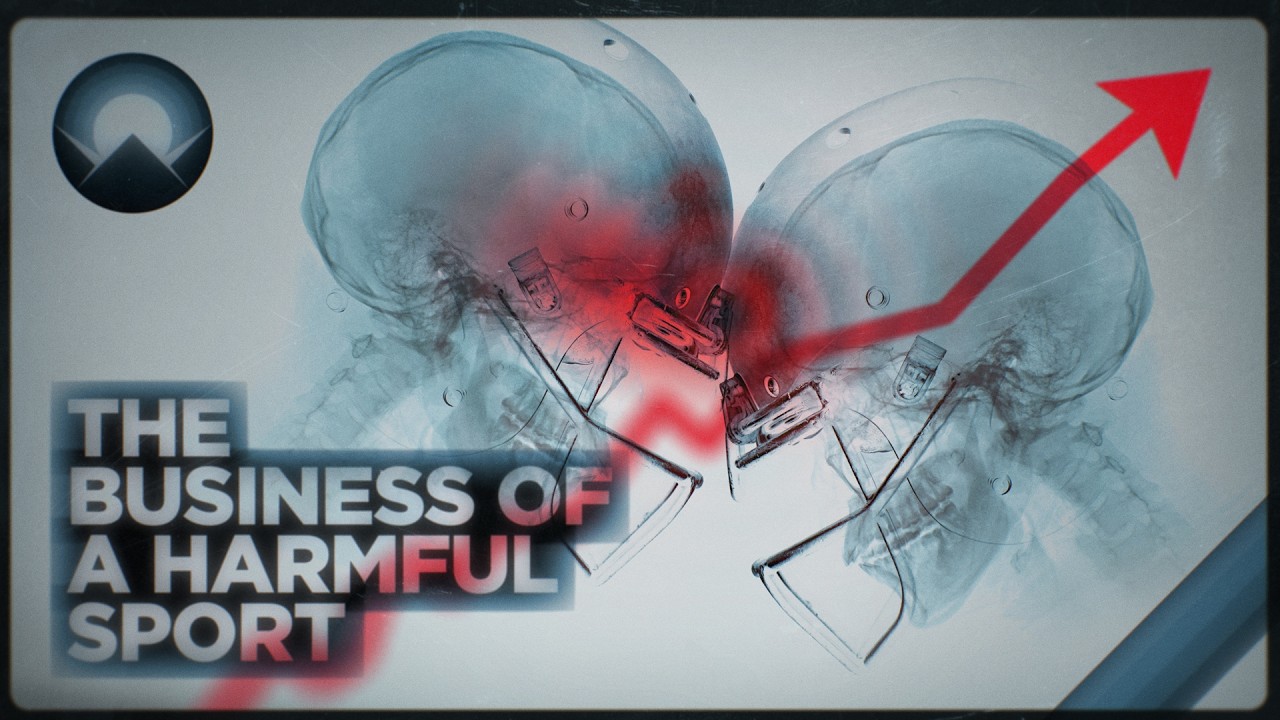
The NFL is successfully insulating its financial future from the CTE crisis by backing flag football and expanding globally, even as the traditional tackle sport increasingly relies on children from lower-income families who treat the game's severe brain trauma as an escape from generational poverty.
AI-assisted summary of The NFL's Concussion Crisis — original source. Check the original for full context.
Source published:
Detailed notes
## Background Published on November 20, 2025, by the YouTube channel Wendover Productions, this video analyzes the NFL's ongoing concussion crisis. The video description encourages viewers to sign up for the creator-owned streaming platform Nebula using a promotional link to access exclusive original series like "The Logistics of X."
## TL;DR The NFL faces a profound existential threat as mounting scientific evidence links the routine, structural head contact of American football to permanent brain damage and Chronic Traumatic Encephalopathy (CTE). First discovered in historic Steelers lineman Mike Webster by Dr. Bennet Omalu, this realization of cumulative trauma triggered a tobacco-style corporate denial campaign from the league and led to a sharp decline in youth football participation. To safeguard its long-term talent and consumer pipeline, the NFL has aggressively modernized the sport's rules—such as implementing the "dynamic kickoff"—while pivoting toward global expansion and heavily promoting flag football. Despite these safety innovations and skyrocketing financial revenues, the sport's shifting demographics threaten to turn football into a modern gladiatorial dilemma played primarily by the impoverished for the entertainment of the wealthy.
## Atmosphere & style The presentation is analytical, deeply investigative, and sobering, carrying the distinct, measured journalistic tone characteristic of a high-production documentary. It constructs an unsettling narrative arc that contrasts the glitz and unprecedented financial supremacy of professional sports with the agonizing, claustrophobic psychological torment experienced by fading icons like Mike Webster. Watching it evokes a sense of systemic unease, forcing the audience to look past the entertainment value of the gridiron and confront the uncomfortable, coercive socioeconomic realities built directly into the game's structural violence.
## Key takeaways - [00:00](https://www.youtube.com/watch?v=EBChGfYdkh0&t=0s) The NFL stands as the largest sports league in the world by revenue and viewership, making its public perception a long-term threat to the survival of the contact sport. - [02:00](https://www.youtube.com/watch?v=EBChGfYdkh0&t=120s) Concussion rates are a misleading metric for long-term cognitive decline because cumulative head trauma, rather than isolated concussions, correlates most directly with permanent brain damage. - [02:00](https://www.youtube.com/watch?v=EBChGfYdkh0&t=120s) A professional football player experiences between 1,000 and 1,500 head impacts per season, compared to an average of 287 for a collegiate hockey player. - [04:00](https://www.youtube.com/watch?v=EBChGfYdkh0&t=240s) Dr. Bennet Omalu discovered Chronic Traumatic Encephalopathy (CTE) post-mortem in the brain tissue of former Pittsburgh Steelers player Mike Webster in 2002. - [07:00](https://www.youtube.com/watch?v=EBChGfYdkh0&t=420s) The NFL initially adopted a defensive PR strategy mirroring the tobacco industry to deny and discredit early CTE research until Congress intervened with a House Judiciary Committee hearing. - [07:00](https://www.youtube.com/watch?v=EBChGfYdkh0&t=420s) The concussion crisis created an economic threat to the NFL's youth pipeline, as high school football participation plateaued in 2007 and entered a steep decline by 2011. - [10:00](https://www.youtube.com/watch?v=EBChGfYdkh0&t=600s) To counter domestic audience contraction, the NFL expanded its international regular-season portfolio to seven games across five global cities by 2025. - [10:00](https://www.youtube.com/watch?v=EBChGfYdkh0&t=600s) The NFL has aggressively backed flag football to secure its youth participation pipeline, successfully lobbying for its inclusion in the 2028 Summer Olympic Games in Los Angeles. - [14:00](https://www.youtube.com/watch?v=EBChGfYdkh0&t=840s) In 2024, the NFL introduced the 'dynamic kickoff' rule change, which led to a 43% reduction in kickoff concussions and a 17% drop in total concussions for the season. - [16:00](https://www.youtube.com/watch?v=EBChGfYdkh0&t=960s) A 2018 Boston University study found a 91.7% CTE prevalence rate in the brains of deceased NFL players, compared to zero evidence in 163 out of 164 general population brains. - [16:00](https://www.youtube.com/watch?v=EBChGfYdkh0&t=960s) Despite widespread health concerns, the NFL's financial resilience remains high, with league revenue doubling over the past decade and the 2025 Super Bowl setting viewership records. - [19:00](https://www.youtube.com/watch?v=EBChGfYdkh0&t=1140s) The demographics of youth tackle football have shifted toward poorer families, making the sport a coercive socioeconomic escape from poverty while wealthier audiences consume the entertainment. - [20:45](https://www.youtube.com/watch?v=EBChGfYdkh0&t=1245s) The creator-owned streaming platform Nebula offers ad-free content and original programming from roughly 250 independent creators, accessible via a discounted annual subscription link.
## Detailed walkthrough ### The Colossus of Sports and Its Looming Reckoning
The National Football League (NFL) can be derisively described as a massive corporate structure wherein young men sell the entertainment value derived from the destruction of their brains. While fans and detractors can debate that cynical framing endlessly, the league itself cares less about the absolute truth and far more about what the public believes. The sheer scale of the NFL is difficult to overstate; measured by revenue per team, revenue per game, or total outright revenue, it stands comfortably as the largest sports league in the world. Annually, its financial footprint rivals that of McDonald's, and a single franchise like the Dallas Cowboys is financially on par with Planet Fitness, the largest gym chain on Earth. In American broadcasting history, the only live event to ever draw more viewers than a Super Bowl was the Apollo 11 moon landing. On any given week, roughly one in 16 Americans tunes into *Sunday Night Football*, making it the most successful television program to ever exist.
Yet, this unparalleled supremacy is facing a severe reckoning. A growing segment of the population is becoming convinced by mounting scientific evidence that American football is fundamentally bad, routinely causing permanent brain damage that manifests as debilitating cognitive dysfunction later in life. The immediate financial risk to the NFL is not an overnight mass boycott by fans uncomfortable with how their dollars incentivize neural destruction—football has always been understood as a dangerous sport. Instead, the league is treating this shift in public perception as a profound, long-term threat to the survival of America's most popular contact sport.
* The NFL's annual revenue is comparable to the global revenue of McDonald's. * The Dallas Cowboys franchise is financially equivalent to Planet Fitness. * *Sunday Night Football* captures approximately 6.25% (1 in 16) of the American population weekly. * The Apollo 11 moon landing remains the only live American broadcast to surpass the Super Bowl in viewership.
Football vs. Hockey: Concussions vs. Cumulative Trauma
To understand the unique vulnerability of football, it is useful to contrast it with ice hockey, America's second most popular contact sport. While the National Hockey League (NHL) has acknowledged the dangers of brain injuries and implemented safety modifications, it appears far less anxious about its financial future than the NFL. On the surface, this discrepancy seems counterintuitive. Harvard research indicates that the NFL has a per-game, per-player concussion rate that is 3.8 times higher than the NHL's. However, because an NHL season features 4.8 times more games than an NFL season, a professional hockey player is actually more likely to sustain a concussion over the course of a full year.
The critical distinction lies in how brain damage occurs. A single, isolated concussion is typically a short-term issue involving temporary cognitive impairment—such as a high school athlete temporarily struggling to study for a test, becoming irritable with parents, or experiencing sensitivity to light and noise—with symptoms usually subsiding within a few weeks. While consecutive concussions increase the risk of permanent damage, significant lifelong impairment from sports-induced concussions alone remains relatively rare. Therefore, concussion rates are a highly misleading metric for predicting long-term cognitive disability.
The real danger is cumulative head trauma. While hockey players skate at blistering speeds exceeding 20 miles per hour (32 km/h) and deliver massive hits, these collisions are strictly regulated. Body checks are only legal against a player in possession of the puck and must come from the front or side; checking from behind carries severe penalties because it forces the head or spine to absorb the impact against the boards. Furthermore, rink boards are topped with flexible glass designed to absorb impact energy, and players frequently evade contact in open ice. Consequently, hits are relatively sparse, with one study showing college hockey players averaging 287 head impacts per season. In stark contrast, a football player experiences between 1,000 and 1,500 head impacts a season—and even more in certain positions. Because football plays fundamentally end with defensive tackles or offensive blocks that routinely involve head-on collisions, the sheer volume of trauma builds up a heavy, destructive sum. Academic consensus has firmly established that this accumulated trauma, rather than isolated concussions, correlates most directly with future cognitive decline. This reality presents an existential crisis for tackle football: if concussions were the sole problem, rule changes and rigid return-to-play protocols could mitigate the risk. But because the damage stems from the routine, structural contact of the game, "the most iconic feature of the sport, the contact, is inextricably linked to future cognitive dysfunction."
* The NFL's per-game, per-player concussion rate is 3.8 times higher than the NHL's. * The NHL schedule features 4.8 times more games per season than the NFL schedule. * Ice hockey players frequently skate at speeds exceeding 20 mph (32 km/h). * Men's collegiate hockey players average 287 head impacts per season. * American football players average between 1,000 and 1,500 head impacts per season.
Dr. Omalu and the Tragic Discovery of CTE
The domino effect that brought these dark realities to light began in September 2002 at the Allegheny County Medical Examiner's Office in Pittsburgh. Dr. Bennet Omalu, the forensic neuropathologist on call, was a Nigerian immigrant who had arrived in the United States less than a decade prior. Knowing next to nothing about American football, he was one of the few individuals in the building who failed to recognize the name on the corpse that had arrived overnight: Mike Webster.
In the 1970s, Webster was a legendary figure, anchoring the offensive line for the Pittsburgh Steelers during their historic four-time Super Bowl-winning era. Known as "Iron Mike," Webster was celebrated for his unbelievable durability, starting every play of his 17-year professional career by snapping the ball and charging head-first into massive defensive linemen. Yet, once his career ended, his legendary physical durability vanished. Cognitive dysfunction gradually took over, eroding his memory and decision-making skills. He suffered from severe mood swings and erratic, wild outbursts. As his mind deteriorated, he alienated himself from his family and retreated to living out of his pickup truck. Trapped in a permanent, agonizing state of neurological fight-or-flight, Webster would stay awake for days at a time. Out of sheer desperation to sleep, he began using a taser to shock himself, effectively knocking out his own nervous system to force a state of rest. Eventually, a local hospital allowed the fading icon to sleep in an unused room, where he died of cardiac arrest in September 2002 at the age of 50.
Dr. Omalu learned of Webster’s legendary status and tragic decline from his colleagues and the morning news. He found it impossible to believe that a highly disciplined, elite professional athlete could spontaneously devolve into homelessness, drug addiction, and petty crime without an underlying physical cause. Even though Webster's brain looked entirely normal during the initial autopsy, Omalu preserved a tissue sample and took it to the University of Pittsburgh's department of neurology. Under closer examination, the tissue revealed dense, abnormal accumulations of tau proteins. While these proteins are characteristic of Alzheimer's disease, Webster was far too young for such a diagnosis, and the distinct layout of the pathology pointed to an entirely different, unprecedented disease in football players: Chronic Traumatic Encephalopathy (CTE).
* Mike Webster played 17 seasons in the NFL and won four Super Bowls with the Pittsburgh Steelers. * Webster died in September 2002 at the age of 50 from cardiac arrest. * CTE is characterized by abnormal accumulations of tau proteins, but features a distinct pathology separate from Alzheimer's. * To date, CTE can only be definitively diagnosed post-mortem via specialized brain tissue autopsies performed within hours of death.
The NFL's Tobacco Tactics and the Youth Pipeline Crisis
Dr. Omalu and his research partners published their groundbreaking findings, but the revelation initially did little to sway the NFL. A few years later, however, another former Steelers offensive lineman, Terry Long, passed away. When his body arrived at the Allegheny County Medical Examiner's Office, Omalu examined the brain and discovered the exact same unmistakable markers of CTE. A terrifying pattern was emerging. Omalu went on the offensive, securing permission to analyze the brains of more deceased football players, discovering CTE at an alarming, undeniable rate.
Faced with an existential threat, the NFL responded by adopting the classic "big tobacco strategy." They chose denial, hiring their own hand-picked scientists to author counter-papers aimed at discrediting Omalu’s methodologies and conclusions. Behind closed doors, the league launched aggressive pressure campaigns against the academic journals that dared to publish genuine CTE research, attempting to sow doubt regarding the science. This corporate wall of denial eventually collapsed toward the end of the 2000s when Congress intervened. The House Judiciary Committee summoned NFL Commissioner Roger Goodell to testify, driving media scrutiny and public anxiety to a fever pitch. A vast portion of the American public now believed the truth: playing football causes degenerative brain disease.
Confronted with widespread public awareness, the NFL realized it could no longer suppress the crisis; it had to manage it. In the league's boardroom, the primary panic was not actually about player health—executives had long viewed bodily destruction as a built-in cost of doing business. Instead, they recognized a catastrophic threat to their talent and consumer pipeline. Youth football is the financial bedrock of the NFL. It is not only where future pros are discovered, but more crucially, the 999 out of 1,000 kids who never make it to the pros become the loyal, lifelong consumers who buy tickets, merchandise, and cable TV packages. High school sports data revealed that football participation plateaued in 2007 as parents grew hesitant to expose their children to head trauma, and by 2011, that plateau broke into a steep decline. Treating youth participation as a vital leading economic indicator, the NFL recognized that a slow, decades-long contraction of its domestic fan base had begun, threatening its absolute supremacy over American spectator sports.
* The NFL utilized a defensive public relations strategy mirroring the tobacco industry to deny and discredit early CTE research. * The escalating crisis resulted in NFL Commissioner Roger Goodell being summoned to testify before the House Judiciary Committee. * High school football participation in the U.S. plateaued in 2007 and entered an outright decline in 2011. * Statistically, 999 out of 1,000 youth football players do not make it to the professional level, yet they form the core consumer base for the league's products.
International Expansion and the Pivot to Flag Football
To counter the contraction of its domestic audience, the NFL pivoted to a dual strategy: acquiring new fans overseas and reimagining the game at home. The league had long experimented with international markets—running preseason games abroad and operating a developmental spring league in Europe during the 1990s and 2000s—but those ventures were eventually shuttered due to weak financial returns. They replaced those efforts with a single, annual regular-season game in London. This bold move of playing a meaningful regular-season game on an entirely different continent paid off, successfully seeding a growing UK market. As the domestic concussion crisis peaked, the league doubled down, expanding the London fixture to two games in 2013, and three games in 2014. They even helped fund the construction of the new Tottenham Hotspur Stadium to ensure it included a custom, retractable synthetic gridiron pitch. By 2025, the NFL's international portfolio expanded to seven regular-season games spanning São Paulo, Dublin, London, Berlin, and Madrid, anchoring a broader global strategy of international broadcast rights and merchandising.
Domestically, the league sought to stop the bleeding in youth participation by aggressively backing an alternative version of the sport: flag football. In this variant, physical contact is strictly limited or banned entirely; instead of tackling, defenders must pull a flag from the ball carrier's belt. Historically dismissed as a casual physical education class activity, flag football became the recipient of massive NFL resources designed to transform it into a legitimate, competitive substitute for tackle football. The league established "NFL Flag," a youth structure that has swelled to over 1,600 teams across the United States. Data now indicates that more American children play flag football than tackle football, driven by its low injury risk and minimal equipment costs. The sport has also opened up significant collegiate opportunities, particularly for women, who never had a mature tackle football infrastructure.
The NFL has successfully pushed flag football onto the world stage, announcing plans for its own professional men's and women's flag leagues and financing its inclusion in the World Games as a proof of concept. The league even refashioned its own Pro Bowl format into a series of skills competitions and flag football matches, throwing its massive public relations weight behind a bid for the Olympics. The efforts culminated in the International Olympic Committee approving flag football for the 2028 Summer Games in Los Angeles. While currently a one-off inclusion, the Olympic nod gives the sport immense legitimacy. However, a cultural hurdle remains: flag football is fundamentally a different game. While sharing a similar rulebook, tackle football is a game of positioning and brute force played by massive, bulky athletes, whereas flag football rewards pure speed and agility, favoring leaner athletes built more like soccer players.
* The NFL expanded its international regular season games from one in London to seven games across five global cities (São Paulo, Dublin, London, Berlin, and Madrid) by 2025. * The NFL helped fund Tottenham Hotspur Stadium to incorporate a specialized, retractable American football field. * The "NFL Flag" youth organization has expanded to include more than 1,600 teams across the United States. * The International Olympic Committee (IOC) officially approved flag football as a sport for the 2028 Summer Olympic Games in Los Angeles.
The Kickoff Conundrum and Rules Innovation
The transition from flag football to tackle football is far from seamless, as the skills required only partially transfer between the two formats. This raises a critical question for the sport's future: even if flag football gains traction, will it actually cultivate fans for traditional tackle football, or merely create a separate audience for flag football itself? Ultimately, the most guaranteed path to saving the sport relies on directly reducing the inherent injury risks. If the NFL can successfully innovate to dramatically slash the rates of concussions and Chronic Traumatic Encephalopathy (CTE), its existential troubles could disappear. Over the last decade, the league has continuously introduced nuanced rules regarding permitted contact, but the most radical shift occurred in 2024 with a total overhaul of the kickoff.
Previously, kickoffs were notorious for producing massive, high-speed collisions. Teams lined up on opposite ends of the field, and as the kicker launched the ball, players sprinted full-speed toward each other. Although kickoffs accounted for a mere 6% of all plays, they were responsible for a staggering 12% of all concussions. The NFL replaced this with the "dynamic kickoff." Under these new, more complex rules, the majority of players line up just 5 yards apart, severely limiting the speed they can accumulate before impact. The league's concussion data vindicated the change, showing a 43% reduction in concussions on kickoffs, which contributed to a 17% drop in overall concussions during the 2024 season. While the highly visible modification to an iconic play drew its fair share of detractors—including American President Donald Trump—fundamental problems require fundamental fixes.
- **Concussion Disproportionality:** Traditional kickoffs made up only 6% of plays but caused 12% of all concussions. - **Dynamic Kickoff Impact:** Players start only 5 yards apart, correlating to a 43% drop in kickoff concussions and a 17% reduction in total concussions during the 2024 season.
The Reality of CTE and the NFL's Financial Resilience
Public awareness and scientific understanding of CTE's severity continue to advance rapidly. It has been two decades since the first academic paper linked CTE to football, a decade since a Golden Globe-nominated Hollywood film dramatized the saga, and only months since a mass shooting in New York targeted NFL headquarters, perpetrated by a former player suffering from the disease. The data remains stark. A 2018 Boston University study analyzing 164 brains from the general population found zero evidence of CTE in 163 of them; the sole positive case belonged to a former college football player. In contrast, out of 376 brains of deceased NFL players studied by the university, 345 were diagnosed with CTE. While this represents a biased sample pool, a 91.7% prevalence rate is alarming. A growing number of states have debated banning tackle football for young children. Though such legislation has historically been stalled by intense pushback, the long-term trend line hints that states may eventually regulate youth tackle football as a dangerous activity akin to alcohol or tobacco.
Yet, despite widespread public awareness of these dangers, the NFL has successfully insulated its financial interests. After more than ten years of decline, youth football participation saw a trend reversal following the emergence from the pandemic era. Though numbers remain well below historic peaks, the bleeding has effectively stopped. Concurrently, league revenue continues to skyrocket, cleanly doubling over the past ten years. The 2025 Super Bowl set a monumental milestone as the most-watched in history, drawing in 128 million American viewers. The catastrophic financial reckoning once feared by league executives has not materialized.
- **BU General Brain Study (2018):** 164 general population brains examined; 163 had no CTE, while the single positive case was a college football player. - **BU NFL Brain Study:** 345 out of 376 examined NFL player brains diagnosed with CTE, yielding a 91.7% prevalence rate. - **Financial and Viewership Benchmarks:** League revenue doubled over the past decade, and the 2025 Super Bowl hit a record 128 million American viewers.
The Gladiator Dilemma and Modern Coercion
Beneath the surface-level financial triumphs lie subtle, troubling socioeconomic shifts. Since the public exposure of CTE, the demographic background of youth tackle football players has tilted heavily downward, increasingly becoming a sport played by children from poorer families. Conversely, the NFL's consumer base is growing wealthier as the league successfully caters to a richer demographic. When you combine an advanced understanding of devastating brain damage with a talent pool drawn from poverty and an audience drawing from wealth, "the comparisons between football players and Roman gladiators are becoming increasingly literal." For many young athletes, the sport is no longer just a passion; it represents their most realistic escape from generational poverty.
While no one is legally forced to play professional football, the lack of viable economic alternatives can be profoundly coercive. Elite athleticism always demands immense sacrifice—including physical pain, emotional toll, and social isolation—but football differs fundamentally because it inflicts near-inescapable damage to the human body's most critical, irreplaceable organ. The NFL offers some of the most life-changing wealth available in sports, but it demands equally life-changing physical consequences. The ultimate question for the NFL's future is how long television viewers will remain comfortable knowing that the entertainment on their couches dictates "how many young men get condemned to a life of psychological torment once they hang up the cleats."
Nebula, Wendover Projects, and Creator-Owned Media
Shifting focus to independent media recommendations, the creator introduces *Scav*, a brand-new docuseries produced by the Wendover team. After learning about the world's largest annual scavenger hunt hosted at the University of Chicago, the team hired film crews, flew to the city, spent a week capturing the chaotic event, and dedicated months to editing the footage. The first few episodes are currently streaming on Nebula, alongside an expanding portfolio of original programming. This includes *The Getaway*, a social deduction game show on wheels with a unique twist; *Abolish Everything*, a live-audience comedy debate show; and *The Logistics of X*, a classic Wendover-style series breaking down complex global logistical systems.
Nebula features a curated collection of roughly 250 independent creators who post their regular videos early, completely ad-free, and without sponsorships. Many of these creators produce their own high-budget originals, such as Bobby Broccoli's documentary on a massive 20th-century scientific controversy, and Real Life Lore's *Mad Kings* series detailing history's most influential dictators. Because Nebula is entirely creator-run and creator-owned, its paywalled model removes the algorithmic pressure to chase clicks over quality. Viewers can access a free trial, a lifetime subscription tier, or a 40% discount on an annual subscription by visiting the dedicated link.
- **Featured Nebula Originals:** *Scav* (University of Chicago scavenger hunt docuseries), *The Getaway*, *Abolish Everything*, and *The Logistics of X*. - **Creator Highlights:** Bobby Broccoli (20th-century scientific controversy documentary) and Real Life Lore (*Mad Kings* series). - **Platform Scale and Offers:** Nebula hosts around 250 curated creators. Promotion available via `nebula.tv/wendover` featuring a free trial, 40% off an annual plan, or a lifetime purchase option.
## Notable quotes > young men sell the entertainment value derived from the destruction of their brains.
> the league itself cares less about the absolute truth and far more about what the public believes.
> The only live event to ever draw more viewers than a Super Bowl was the Apollo 11 moon landing.
> the most iconic feature of the sport, the contact, is inextricably linked to future cognitive dysfunction.
> concussion rates are a highly misleading metric for predicting long-term cognitive disability.
> the sheer volume of trauma builds up a heavy, destructive sum.
> He found it impossible to believe that a highly disciplined, elite professional athlete could spontaneously devolve into homelessness, drug addiction, and petty crime without an underlying physical cause.
> Faced with an existential threat, the NFL responded by adopting the classic "big tobacco strategy."
> executives had long viewed bodily destruction as a built-in cost of doing business.
> Youth football is the financial bedrock of the NFL.
> fundamental problems require fundamental fixes.
> the comparisons between football players and Roman gladiators are becoming increasingly literal.
> how long television viewers will remain comfortable knowing that the entertainment on their couches dictates "how many young men get condemned to a life of psychological torment once they hang up the cleats."
## Mentioned The NFL's Concussion Crisis, YouTube, Wendover Productions, Nebula, The Logistics of X, Sam Denby, Tristan Purdy, Christine Benedetti, Alexander Williard, Sara Stoltman, Gabriel Ferreras, Austin Glass, Kate Ermolenkko, Manni Simon, Dony Bullen, Simon Buckmaster, National Football League, McDonald's, Dallas Cowboys, Planet Fitness, Apollo 11, Super Bowl, Sunday Night Football, National Hockey League, Harvard University, Dr. Bennet Omalu, Allegheny County Medical Examiner's Office, Mike Webster, Pittsburgh Steelers, University of Pittsburgh, Chronic Traumatic Encephalopathy, Alzheimer's disease, Terry Long, House Judiciary Committee, Roger Goodell, NFL Flag, World Games, Pro Bowl, International Olympic Committee, 2028 Summer Olympic Games, Donald Trump, Boston University, Scav, University of Chicago, The Getaway, Abolish Everything, Bobby Broccoli, Real Life Lore
[Source](https://www.youtube.com/watch?v=EBChGfYdkh0)