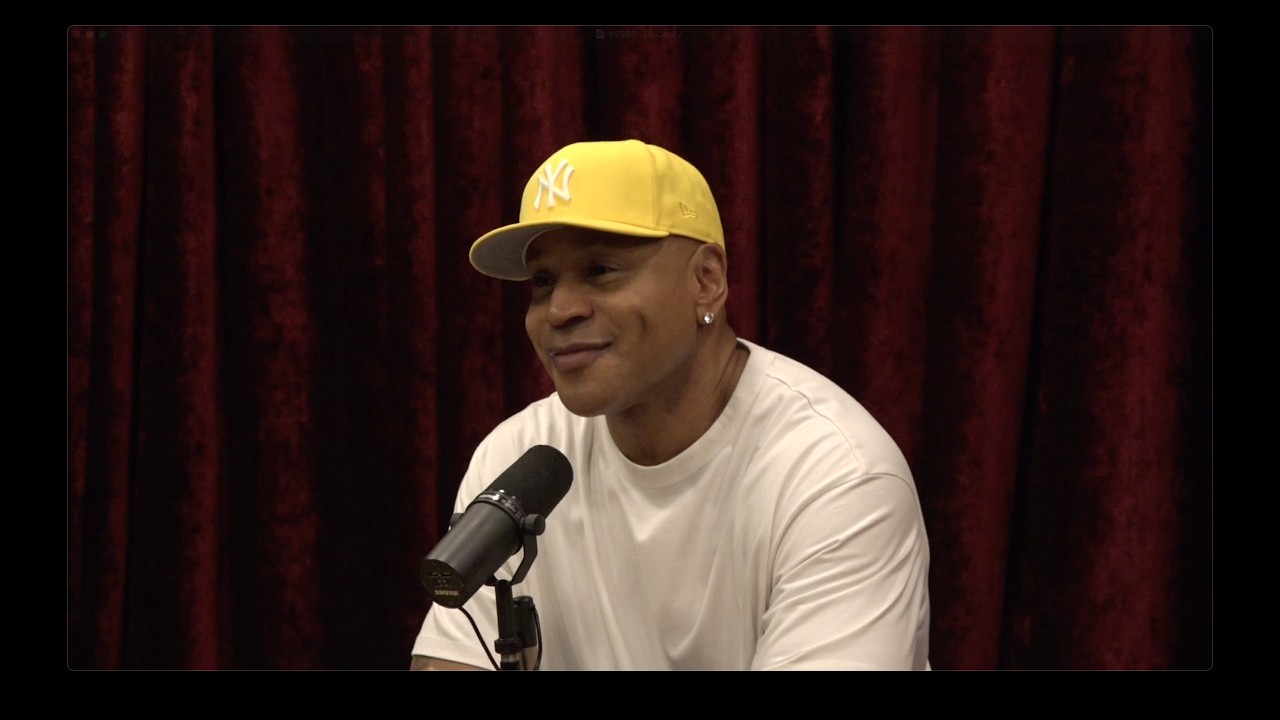
LL Cool J broke down Def Jam's origin story, detailing how Rick Rubin shortened his stage name to fit on vinyl and 'reduced' his 1985 debut album Radio by stripping away disco-era live instruments in favor of minimalist drum machine beats. (63:30)
Reflecting on four decades in hip-hop, LL Cool J described early rap bravado as an aspirational badge of neighborhood survival and positioned the MC as a modern Cyrano de Bergerac representing community resilience. (28:30)
LL Cool J discussed his disciplined creative philosophy, arguing that inspiration is for amateurs, professionals simply show up to work, and dreams have no expiration date regardless of age. (85:00)
The conversation explored ancient civilizations, speculative physics, and AI, with LL Cool J asserting that lost advanced relics remain buried under Antarctic permafrost and that technology cannot replicate the genuine human soul. (113:15)
Detailed notes
## Background
Published on YouTube by the PowerfulJRE channel on October 6, 2026, this episode features Grammy Award-winning rapper, actor, and philanthropist LL Cool J. According to the page description, the appearance coincides with his starring role in the procedural drama series "NCIS: New York," premiering on CBS and streaming on Paramount+.
## TL;DR
LL Cool J joins Joe Rogan to reflect on his pioneering music career, beginning with his signing to Def Jam at age sixteen and crafting stripped-down hip-hop classics alongside Rick Rubin. He outlines his personal philosophy of relentless work ethic and humility, drawing wisdom from military history, Miyamoto Musashi, and the ego-stripping realities of recently learning Brazilian Jiu-Jitsu. The pair also examine combat sports, artistic authenticity, and the hazards of celebrity isolation. Moving into wider conceptual territory, the dialogue expands to encompass lost civilizations, multidimensional physics, artificial intelligence, and his on-location filming for "NCIS: New York."
## Atmosphere & style
The conversation carries an easy, respectful warmth rooted in a shared acquaintance dating back to an NBC showcase in the mid-1990s. LL Cool J speaks with calm, grounded authority, delivering reflective adages on discipline and resilience while avoiding the hollow pretense often found in celebrity culture. The discussion flows smoothly from gritty street memories and golden-era music history into high-concept cosmological wonder, giving the listener the feel of a deeply thoughtful, late-night philosophical exchange between two seasoned veterans.
## Bulletin
- [01:03:30](https://www.youtube.com/watch?v=prSEP6gvGH0&t=3810s) LL Cool J broke down Def Jam's origin story, detailing how Rick Rubin shortened his stage name to fit on vinyl and 'reduced' his 1985 debut album Radio by stripping away disco-era live instruments in favor of minimalist drum machine beats.
- [28:30](https://www.youtube.com/watch?v=prSEP6gvGH0&t=1710s) Reflecting on four decades in hip-hop, LL Cool J described early rap bravado as an aspirational badge of neighborhood survival and positioned the MC as a modern Cyrano de Bergerac representing community resilience.
- [01:25:00](https://www.youtube.com/watch?v=prSEP6gvGH0&t=5100s) LL Cool J discussed his disciplined creative philosophy, arguing that inspiration is for amateurs, professionals simply show up to work, and dreams have no expiration date regardless of age.
- [01:53:15](https://www.youtube.com/watch?v=prSEP6gvGH0&t=6795s) The conversation explored ancient civilizations, speculative physics, and AI, with LL Cool J asserting that lost advanced relics remain buried under Antarctic permafrost and that technology cannot replicate the genuine human soul.
## Key takeaways
- [00:00](https://www.youtube.com/watch?v=prSEP6gvGH0&t=0s) Joe Rogan and LL Cool J bonded early in their careers over a mutual rejection of corporate pretension and industry celebrity worship.
- [05:22](https://www.youtube.com/watch?v=prSEP6gvGH0&t=322s) LL Cool J trains Brazilian Jiu-Jitsu under Brian Glick, emphasizing how grappling strips away ego, street toughness illusions, and celebrity privilege.
- [10:00](https://www.youtube.com/watch?v=prSEP6gvGH0&t=600s) Drawing from Carl von Clausewitz's trinity of passion, chance, and reason, LL Cool J observes that modern discourse is corrupted by unchecked enmity over logic.
- [20:00](https://www.youtube.com/watch?v=prSEP6gvGH0&t=1200s) Bruce Lee was LL Cool J's primary inspiration for pursuing acting because Lee was the sole non-white hero breaking barriers on mainstream screens.
- [30:00](https://www.youtube.com/watch?v=prSEP6gvGH0&t=1800s) Early hip-hop jewelry and bravado served as defiant symbols of survival in neglected neighborhoods rather than modern portfolio flexing.
- [38:34](https://www.youtube.com/watch?v=prSEP6gvGH0&t=2314s) Public Enemy's iconic crosshairs silhouette logo originated from an image of LL Cool J's close friend and hype man, E-Love.
- [50:00](https://www.youtube.com/watch?v=prSEP6gvGH0&t=3000s) Through 'Finding Your Roots', LL Cool J discovered his granduncle was Hall of Fame light heavyweight boxing champion John Henry Lewis.
- [01:05:00](https://www.youtube.com/watch?v=prSEP6gvGH0&t=3900s) Def Jam launched from Rick Rubin's NYU dorm after a 15-year-old LL Cool J discovered Rubin's phone number on a vinyl record label.
- [01:03:30](https://www.youtube.com/watch?v=prSEP6gvGH0&t=3810s) Rick Rubin 'reduced' LL Cool J's sound rather than producing it, transforming rap by eliminating disco instrumentation for raw drum machine patterns.
- [01:15:00](https://www.youtube.com/watch?v=prSEP6gvGH0&t=4500s) Musical mastery requires stripping away complexity in favor of emotional feel, echoing advice Quincy Jones gave LL Cool J.
- [01:25:00](https://www.youtube.com/watch?v=prSEP6gvGH0&t=5100s) LL Cool J stresses that 'dreams don't have deadlines', citing figures like Colonel Sanders, Samuel L. Jackson, and George Foreman who achieved monumental success late in life.
- [01:40:00](https://www.youtube.com/watch?v=prSEP6gvGH0&t=6000s) Drawing on Miyamoto Musashi, LL Cool J distinguishes between weak people-pleasing ('nice') and principled boundary-setting ('kind').
- [01:47:00](https://www.youtube.com/watch?v=prSEP6gvGH0&t=6420s) True professional discipline mirrors Mike Tyson's definition under Cus D'Amato: doing what you hate as if you love it.
- [01:53:15](https://www.youtube.com/watch?v=prSEP6gvGH0&t=6795s) LL Cool J speculates that humanity's greatest lost historical and archaeological artifacts remain buried beneath Antarctic ice and permafrost.
- [02:09:20](https://www.youtube.com/watch?v=prSEP6gvGH0&t=7760s) Resisting artificial intelligence is futile, but generative technology can never reproduce the lived human soul found in great artistic masterworks.
## Detailed walkthrough
### [00:00](https://www.youtube.com/watch?v=prSEP6gvGH0&t=0s) Meeting at NBC and Unfiltered Realness
The conversation opens on an easygoing note as Joe Rogan jokes about taking footwear advice from LL Cool J, who insists Rogan should toss his current Pumas straight into the incinerator. The two reminisce about their very first encounter back around 1994 at an NBC network upfront event. At the time, Rogan was an unknown newcomer feeling out of place among television stars, sitting at the same table as LL. Rogan vividly remembers LL openly mocking the stuffy, corporate atmosphere of the showcase where executives paraded new programming and expected obligatory applause from the room.
Rogan admired how LL refused to take the corporate spectacle seriously, a mindset LL explains came from an early refusal to let industry pretension dictate his demeanor. While remaining polite, he treated the high-stakes presentation as pure entertainment rather than something sacred. That grounded irreverence carried him through decades in show business without succumbing to the self-importance that traps many performers who find fame early.
[02:18](https://www.youtube.com/watch?v=prSEP6gvGH0&t=138s) Def Jam's Genesis, Boomboxes, and New York Hip-Hop Roots
Reflecting on the longevity of his career, LL explains that he signed his first recording deal at just 16 years old. Rick Rubin and Russell Simmons initially started Def Jam as a production entity, launching T La Rock’s seminal track "It’s Yours" on Streetwise and Partytime Records before officially establishing Def Jam as an independent label. LL became the label’s very first signed artist. For his breakthrough debut, Ad-Rock of the Beastie Boys programmed the drum machine beat, Rick Rubin produced the track, and LL delivered the vocals on the microphone.
Looking at old archival photographs of himself carrying boomboxes at 17 and 18, LL notes how he can instantly date each era by the jewelry he was wearing. The two reflect on how radically the culture around listening to music has shifted. In the 1980s, boomboxes turned listening into a communal, public outdoor experience while people's private lives remained hidden; today, personal lives are broadcast publicly across social media while music consumption has retreated into isolated headphones.
LL describes being immersed in hip-hop long before the Sugarhill Gang’s 1979 release of "Rapper's Delight." Born in Long Island and raised in Queens, he lived in North Babylon next door to foster children from Harlem, Brooklyn, and the Bronx who brought home underground park-jam cassette tapes. By age eight, between 1975 and 1977, he was already studying recordings of the Treacherous Three, Kool Moe Dee, Cold Crush Brothers, and Grandmaster Flash and the Furious 4 (before they became the Furious 5). Drawing a parallel to Malcolm Gladwell’s analysis of timing and geography in *Outliers*—such as tech pioneers growing up near Seattle during the personal computer boom—LL credits being born at the exact geographical epicenter of hip-hop's birth with igniting his lifelong artistic path.
- LL Cool J signed with Def Jam at age 16 as the label's flagship solo artist.
- Rick Rubin produced and Ad-Rock (Beastie Boys) programmed the drum beat for LL's earliest material.
- Def Jam originated as a production outfit with T La Rock's "It's Yours" before launching as a standalone record label.
- LL was exposed to foundational park-jam bootlegs from the Bronx and Harlem between 1975 and 1977, listening to early iterations of Grandmaster Flash and the Cold Crush Brothers as a child.
[05:22](https://www.youtube.com/watch?v=prSEP6gvGH0&t=322s) Jiu-Jitsu Realities and Rejecting Celebrity Pretense
Staying in peak physical shape remains central to LL's routine, and he shares that he recently took up Brazilian Jiu-Jitsu. He trains in Brooklyn under black belt Brian Glick, a direct student of John Danaher within the Renzo Gracie lineage, having been introduced to the academy by actor Scott Caan. Though LL previously practiced striking arts such as Seido Karate, Wing Chun, and Yiquan, he found grappling to be an immediate equalizer. He admits that no matter how tough someone thinks they are on the street, ending up stuck inside an opponent's closed guard quickly strips away any illusion of control, leaving them feeling completely helpless.
Rogan observes that combat sports are the ultimate mental medicine for famous people because mats strip away celebrity privilege. Status, wealth, and charisma cannot save anyone from a locked-in Kimura or Americana submission. LL wholeheartedly agrees, emphasizing that he views himself strictly as an artist rather than a "celebrity." He considers fame an accidental byproduct of making art rather than an identity, distancing himself from the exaggerated theatrics of old Hollywood aristocracy.
The two laugh imagining LL adopting aristocratic affectations, debating the absurd image of someone walking into a modern room wearing an ascot with a vintage cigarette holder. While Rogan points out that gonzo journalist Hunter S. Thompson turned the cigarette holder into an aggressive counterculture trademark and LL jokes that comedian Katt Williams has the eccentric brilliance to pull it off, LL insists that kind of high-society pretension is completely foreign to his working-class foundation.
[10:00](https://www.youtube.com/watch?v=prSEP6gvGH0&t=600s) Humility, Jiu-Jitsu, and the Clausewitzian Trinity
Joe Rogan and LL Cool J reflect on legendary gonzo journalist Hunter S. Thompson, picturing his iconic long black cigarette holder with the silver ring. LL appreciates his style, and Rogan agrees that Thompson was "cool as fuck"—a total maniac who lived out of his mind on drugs yet produced strokes of genius. They agree that surviving hell and coming out the other side requires perspective and humility. LL emphasizes that young people in creative fields need to focus strictly on being artists rather than chasing fame for its own sake, letting notoriety simply be the byproduct of great work. Arrogance, they observe, stunts growth; obsessing over oneself is mentally exhausting and boring, whereas tackling difficult pursuits forces a person outside of their own ego. Rogan points to Brazilian Jiu-Jitsu as the ultimate antidote to self-obsession, noting that when someone is actively trying to choke you out on the mat, survival is the only thing on your mind, stripping away all pretenses.
LL Cool J explains that beyond physical challenges, he actively seeks intellectual growth through an insatiable reading habit spanning history, literature, and military philosophy. When Rogan asks what he reads, LL mentions 19th-century Prussian military theorist Carl von Clausewitz, author of *On War*. He highlights Clausewitz's concept of battlefield friction and breaks down the famous "Clausewitzian Trinity"—the shifting pendulum between passion/enmity, chance/probability, and reason/logic. LL observes that applying this model to modern culture reveals a society overwhelmingly driven by raw emotion and visceral enmity, rendering logic and reason ineffective in the current public discourse.
```mermaid
flowchart TD
accTitle: The Clausewitzian Trinity
accDescr: Diagram illustrating Carl von Clausewitz's three forces governing human conflict and society.
subgraph Trinity["Clausewitzian Trinity"]
A["Passion & Enmity<br>(The People / Emotions)"]
B["Chance & Probability<br>(The Military / Odds & Luck)"]
C["Reason & Logic<br>(The Government / Grand Strategy)"]
end
A <--> B
B <--> C
C <--> A
```
- Clausewitz's concept of grand strategy sits at the center, balancing government policy, reason, military chance, and popular passions.
- LL observes that the more knowledge a person acquires, the more they realize how little they actually know, turning life into an exciting pursuit of discovery.
---
[12:38](https://www.youtube.com/watch?v=prSEP6gvGH0&t=758s) Lessons from LL's Mother and the Balance of Willpower
Reflecting on how he avoided falling into the typical traps of sudden fame as a teenager, LL recalls making conscious decisions at 16, 17, and 18 years old to stay away from the destructive paths of getting high, blowing his earnings, and derailing his career. Rogan asks how he had the foresight to grasp that at such a young age. LL credits his mother, who confronted him with visceral reality checks. She would sit him down with books depicting severe drug addiction, pointing to addicts with sores on their arms and warning: "Todd, this is what happens when you get out in that world... you can ruin your career and ruin your life." On a lighter note, she also kept him grounded with practical wisdom, telling him: "Todd, you know girls don't like dummies."
LL notes that remaining inquisitive and curious doesn't mean acting like a pedantic nerd, but rather developing the life skills women respect: being a man capable of navigating the world. Rogan adds that women naturally seek men who can handle life, making intelligence, health, and fortitude essential. However, LL stresses that intellect alone is useless without grit and willpower. If a person possesses high intelligence without emotional discipline or "intestinal fortitude," they end up as a "smart punk"—someone who understands precisely why they are quitting, rationalizes their failure, and endlessly attends therapy without ever actually getting better.
---
[14:48](https://www.youtube.com/watch?v=prSEP6gvGH0&t=888s) Emotional Discipline, the Burning Engine Analogy, and Relentless Drive
Rogan and LL turn to the cultural shift toward romanticizing defeat, lamenting how modern society often confuses being "in touch with your emotions" with giving up under pressure. LL distinguishes between empathy—which is essential—and pure weakness. He cites the proverb "one spark can set a prairie on fire," noting that letting a single undisciplined, negative thought spiral out of control can ruin a life. Success demands mood management and the ability to execute tasks regardless of how one feels in the moment.
LL emphasizes that navigating life requires finishing the marathon and getting "comfortable being uncomfortable." He shares an aviation metaphor: if an engine catches fire while you are flying an airplane, you don't panic and crash the plane; you keep flying, and if a second engine catches fire, you keep flying until you find a way to land safely. Life must be approached with that same resilience because "attitude determines your altitude." People naturally crave comfort, but Rogan notes that once they attain it, they frequently curl up like a defensive hedgehog, cease evolving, and become resentful of ambitious people whose drive exposes their own complacency. LL encourages people to shrug off external judgment and keep pursuing their goals, arguing that "dreams don't have deadlines." Even if pursuing an education or a dream takes years, those years will pass regardless, and losing a temporary battle does not mean losing the war within yourself.
- **Sponsorship Note:** The segment concludes with a brief promotional message for DraftKings Sportsbook (Code: `ROGAN`), highlighting its availability in all 50 states, sign-up bonus terms, and prediction mechanics.
[20:00](https://www.youtube.com/watch?v=prSEP6gvGH0&t=1200s) The Messenger vs. The Message and Bruce Lee’s Impact
Joe Rogan and LL Cool J reflect on the nature of advice and the common tendency to dismiss wisdom depending on who delivers it. While motivational speakers often lack a track record of tangible achievements, LL Cool J points out that true wisdom can come from anyone: "If a homeless guy tells me don't do push-ups in traffic, I'm gonna listen." He argues that dismissing advice simply because the messenger is flawed is a mistake, because occasionally even a fool will say something profound. To him, the vital skill is listening to the core message and contextualizing it within one's own life. Rogan likens this philosophy directly to Bruce Lee's famous maxim to "absorb what is useful," pointing out the intercepting fist mindset.
The conversation immediately pivots to Bruce Lee's immense cultural footprint. LL Cool J reveals that Bruce Lee was the singular reason he got into acting in the first place. Growing up, Lee was virtually the only non-white face on television or in movie theaters performing heroic, dynamic roles: "He was the only dude with a tan that was like doing some cool shit on TV or in the movies." LL recalls how empowering that was, while Rogan mentions how his Asian friends celebrated finally having an undisputed superhero on screen. LL Cool J vividly remembers proudly strolling down Jamaica Avenue in Queens rocking the iconic yellow-and-black striped *Game of Death* tracksuit paired with traditional Chinese slippers.
[22:15](https://www.youtube.com/watch?v=prSEP6gvGH0&t=1335s) Breaking Martial Arts Silos and the Mystery of Bruce Lee’s Death
Rogan highlights how truly revolutionary Bruce Lee was for modern combat sports. Prior to Lee, martial arts disciplines were completely segregated and tribal. If an instructor found out a student practicing kung fu was also cross-training in Shotokan karate, it was treated as betrayal. Bruce Lee rejected that orthodoxy, becoming what Rogan and LL agree was the world's first true mixed martial artist by synthesizing Western boxing, Wing Chun, silat, karate, and judo. Blending these traditions was considered heresy at the time, sparking intense pushback and genuine death threats from traditionalists.
The dialogue shifts to the enduring conspiracy theories surrounding Lee's premature death at age 32. Rogan notes rumors connecting the Chinese Triads to his demise, allegedly fueled by bitter financial and creative disputes after Lee departed Raymond Chow's Golden Harvest productions to make movies in Hollywood. Looking at the medical record, Rogan and LL review the official findings:
- **Cerebral Edema:** Lee suffered acute brain swelling after taking Equagesic—a prescription painkiller containing aspirin and meprobamate—for a severe headache.
- **Hypersensitivity & Head Trauma:** The coroner officially ruled it a hypersensitivity reaction to meprobamate, though Rogan suspects repeated concussions and sparring trauma from fighting professional boxers could have compromised his brain.
- **Alternative Hypotheses:** Later medical researchers proposed alternative retrospective hypotheses, such as heat stroke or hyponatremia (critically low blood sodium levels linked to excessive water consumption).
```mermaid
flowchart TD
accTitle: Historical Explanations of Bruce Lee's Death
accDescr: Diagram mapping out the official ruling, conspiratorial rumors, and alternative medical hypotheses surrounding Bruce Lee's death.
subgraph Official ["Official Coroner Ruling"]
A["Equagesic ingestion<br>(Aspirin + Meprobamate)"] --> B["Severe Hypersensitivity Reaction"]
B --> C["Fatal Cerebral Edema<br>(Brain Swelling)"]
end
subgraph Hypotheses ["Alternative Hypotheses"]
D["Cumulative Sparring Trauma / Concussions"] -.-> C
E["Hyponatremia<br>(Excess Water / Low Sodium)"] -.-> C
F["Heatstroke / Heat Exhaustion"] -.-> C
end
subgraph Rumors ["Cultural Rumors"]
G["Triad Mob Conflict"] -.-> H["Dispute over Golden Harvest / Raymond Chow"]
end
```
[24:45](https://www.youtube.com/watch?v=prSEP6gvGH0&t=1485s) The Tao of Jeet Kune Do and the 1970s Martial Arts Boom
Rogan points to *The Tao of Jeet Kune Do* as the definitive, foundational textbook of mixed martial arts. LL Cool J enthusiastically agrees, recalling how he bought the thick, illustrated softcover edition the moment it hit shelves and still treasures his original copy. Lee deconstructed combat from all angles, obsessively studying Muhammad Ali’s footwork, adapting Western boxing feints and jabs, and integrating them into his dynamic cinema fights.
Rogan observes that younger generations take modern mixed martial arts for granted because it has become ubiquitous, failing to realize how alien and shocking Lee's blinding speed and fluid hybrid style were in the 1970s. That craze triggered an unprecedented explosion of martial arts schools across the globe. At the time, the lines between disciplines were completely blurred in the public eye; people could not distinguish between karate and kung fu. LL laughs remembering how teenagers simply flipped open the Yellow Pages and joined whatever program was nearby—often walking into a local YMCA offering Seido Karate and proudly barking out traditional dojo greetings.
[26:15](https://www.youtube.com/watch?v=prSEP6gvGH0&t=1575s) Growing Up Invisible: The Raw Emergence of Hip-Hop
The overnight explosion of martial arts reminds Rogan of the sudden rise of hip-hop. Rogan recounts the first time he ever heard The Sugarhill Gang while sitting in a middle school lunchroom in Jamaica Plain, Massachusetts. The neighborhood was rugged, gritty, and troubled at the time; Rogan recalls seeing 17-year-old kids who were still held back in the eighth grade alongside younger students. Hearing rap music for the first time in that environment hit him as an alien, transformative experience.
LL Cool J explains why hip-hop resonated so deeply with kids from neglected environments. In impoverished neighborhoods, young people felt completely unseen and discarded by society:
- "You live in a neighborhood, you feel invisible. Your friends get killed, nobody cares."
- Street survival required hypervigilance; what outsiders mistook for a stylish "ditty bop" strut was actually a defensive posture akin to a prowling predator tracking its perimeter.
- In school hallways, kids developed defensive habits, such as constantly counting "one, two, three" and checking over their shoulders to ensure they were not ambushed.
- On mainstream evening news broadcasts, young Black men were only ever depicted in handcuffs being loaded into the back of police cruisers.
Hip-hop inverted that degradation. It was the first medium where marginalized youth heard voices that sounded completely empowered, defiant, and commanding.
[28:30](https://www.youtube.com/watch?v=prSEP6gvGH0&t=1710s) Aspirational Bravado, Biggie at 17, and the Modern Cyrano
LL Cool J draws a sharp distinction between the ethos of golden-era hip-hop and contemporary commercial rap. In the early days, boasting about money and status was purely aspirational: artists were clawing their way out of the dirt, rapping about what life *could* be. The exaggerated swagger, macho posturing, and bravado were survival tools of the ultimate underdog. By contrast, LL notes that modern rap often sounds like someone standing atop Mount Olympus spitting down on the peasants below.
Rogan brings up iconic archival footage of a 17-year-old Notorious B.I.G. casually freestyling on a Brooklyn street corner with an already spectacular flow and presence while onlookers went wild. LL Cool J explains that this captures the true essence of an MC: acting as a modern-day Cyrano de Bergerac. Rather than wooing a woman with poetry, the rapper becomes the chosen spokesperson who articulates the shared angst, pain, resilience, and dreams of an entire community. Donning massive gold chains was never about superficial flaunting; it was an outward statement of dignity, triumph, and cultural pride on behalf of everyone who came from the same struggle.
[30:00](https://www.youtube.com/watch?v=prSEP6gvGH0&t=1800s) The Real Meaning of Early Hip-Hop Jewelry and Wealth
LL Cool J breaks down the misconception around early hip-hop's obsession with jewelry and luxury. While modern observers often view hip-hop as the first genre where open displays of wealth became the standard, LL clarifies that in the early days, it was never about flaunting an investment portfolio or acting like "Liberace." Instead, it carried a raw street message: having something to show for yourself when you could not even eat six months prior, and possessing the physical toughness to wear gold chains through any neighborhood without getting robbed.
Early rappers took stylistic and behavioral cues from notorious street hustlers of the era—including the Supreme Team in Queens, as well as Harlem figures like AZ, Rich Porter, and Alpo Martinez. For young artists emerging from poverty, acquiring a car or a gold chain was not an act of arrogant condescension toward society; it was proof of surviving an unfair system. LL compares it to a rigged game of Monopoly where one player starts with all the cash and 70 percent of the board: if you manage to come up from absolute zero under those conditions, throwing on a chain and smiling is a hard-earned victory. He recalls sitting with his accountant back then, completely uninterested in abstract fiscal responsibility or balanced sheets: "We’re gonna take care of this—I want a Benz."
- Early jewelry was a badge of neighborhood survival and defiance, not multi-million-dollar portfolio posturing.
- Hustler influences cited: Supreme Team, Azie "AZ" Faison, Rich Porter, and Alberto "Alpo" Martinez.
- The psychological rush of ownership: whether in a trailer park or the inner city, rising up from nothing makes buying a Mercedes-Benz a monumental milestone.
---
[32:51](https://www.youtube.com/watch?v=prSEP6gvGH0&t=1971s) Avoiding the Hollywood Bubble: Isolation, Germs, and Howard Stern
Rogan and LL discuss the danger of losing touch with reality as wealth and fame accumulate. LL emphasizes that it is dangerously easy to forget where you came from if you surround yourself with yes-men in an insulated Hollywood bubble. Rogan notes that physical disciplines—like hitting the gym and rolling on the jiu-jitsu mats—serve as crucial grounding reminders of basic humanity. Without those anchors, an ultra-wealthy celebrity risks going eccentric and isolated, drawing parallels to Howard Hughes hiding in a room surrounded by tissue boxes and paper.
The conversation naturally shifts to Howard Stern, whom Rogan notes retreated to the Hamptons and broadcast remotely for an extended period, developing intense germaphobia. While LL jokes that Stern was "named after an African-American university" and grew up in a Black neighborhood, both men express deep reverence for Stern as the undisputed pioneer who paved the way for modern podcasting. LL warmly recalls how Stern embraced him as an artist and gave him critical radio platform time in his early years. At the same time, both recognize that reaching astronomical levels of fame naturally isolates people from normal public interaction unless they deliberately force themselves outside into uncomfortable environments.
---
[35:54](https://www.youtube.com/watch?v=prSEP6gvGH0&t=2154s) Entourages, Introversion, and the Irony of Cop Shows
Despite his larger-than-life public persona, LL surprises Rogan by revealing that he is an introvert by nature. While success demands networking—analogous to displaying art in a gallery rather than leaving it inside an open garage—LL prefers staying home, reading, and recharging his battery in quiet isolation. Part of his aversion to big crowds stems from hard-won street wisdom about entourages: keeping dozens of people around invites trouble because you cannot govern anyone else's behavior. The moment an associate causes a scene in a club, the headline immediately reads that LL Cool J's crew was involved.
```mermaid
flowchart TD
accTitle: Entourage Liability Loop
accDescr: Diagram illustrating how an entourage creates reputational risk for high-profile celebrities.
A["Artist maintains large entourage"] --> B["Unchecked associate causes trouble"]
B --> C["Media runs sensational headline:<br/>'LL Cool J's Crew Involved'"]
C --> D["Reputational fallout hits the artist,<br/>especially on television network roles"]
D --> E["Resolution: Keep inner circle tight<br/>and recharge in private"]
```
Rogan laughs at how problematic that becomes when starring on a network police procedural, which prompts a discussion about hip-hop icon Ice-T. Rogan marvels at Ice-T's legendary career trajectory: transitioning from recording the controversial protest track "Cop Killer" with his metal band Body Count to playing a beloved television detective on *Law & Order: SVU* for decades. LL praises Ice-T as a master hustler and pioneer who knows how to conquer every lane, with Rogan recalling Ice-T’s involvement in the 1999 documentary *Pimps Up, Hoes Down*, reminiscing over larger-than-life figures like Bishop Don "Magic" Juan and Mr. White Folks.
---
[38:34](https://www.youtube.com/watch?v=prSEP6gvGH0&t=2314s) Hip-Hop's Rapid Rise and the Story Behind Public Enemy's Logo
Reflecting on the history of hip-hop, Rogan remarks on how quickly the culture matured. In less than a decade, the music moved from party-centric novelty tracks like The Sugarhill Gang's "Rapper's Delight" (1979) to the revolutionary aggression of N.W.A and the militant political urgency of Public Enemy's "Fight the Power."
LL shares a famous piece of hip-hop lore: the iconic Public Enemy crosshairs target logo actually depicts his childhood friend and longtime hype man, E-Love (rest in peace). Chuck D took a photo of E-Love standing on stage next to LL Cool J wearing his signature B-boy stance and hat, turned his silhouette into high-contrast artwork, and set it inside the sniper crosshairs. LL reminisces about shooting the 1985 hip-hop movie *Krush Groove*, where E-Love and DJ Cut Creator (Phil Potter) stood by his side carrying the massive boombox, running alongside contemporaries like Run-D.M.C. (Joseph "Run" Simmons, Darryl "D.M.C." McDaniels, and the late Jam Master Jay).
[40:00](https://www.youtube.com/watch?v=prSEP6gvGH0&t=2400s) Touring the World at 17, "I Need Love," and Global Hip-Hop
LL Cool J and Joe Rogan reflect on how swiftly hip-hop reshaped global pop culture in the mid-1980s, recalling archival footage of LL on Dick Clark's *American Bandstand* in 1985. Touring internationally at just seventeen years old was a surreal culture shock. Arriving in London as a teenager from Queens, LL admits he had no concept of Yorkshire pudding and was simply searching for familiar fast food. The reception across Europe was massive, though LL encountered unexpected pushback when he dropped his landmark ballad, "I Need Love." Male fans were initially upset that he showed vulnerability on record, but LL stands by balancing hardcore records with romance: "I like the chicks though, baby. I like the girl. I'm like, yo, I got to do this... So my art reflected the real. Like, I'm just keeping it a hundred, right? Like you guys want to keep it 50 and call it a hundred." Rogan agrees, noting that those same critics were likely listening to the song alone in their bedrooms staring at the wall.
Hip-hop quickly took root internationally, developing distinct local lineages. LL marvels at performing in Japan, where fans would rap every single word of his songs verbatim despite speaking no English at all. Experiences like that broadened his worldview, breaking him out of an insular American mindset where his instinct upon landing in foreign countries had initially been to ask to see the local Black neighborhood. He collaborated across borders early on, including recording a track in Germany with German rapper Spax. Both Joe and LL praise foreign-language rap, with LL enjoying the rhythm of Brazilian Portuguese hip-hop and both agreeing that French hip-hop sounds exceptionally smooth and hard-hitting, pioneered early on by artists like MC Solaar.
- LL was approximately 17 years old when he first toured internationally in places like the UK.
- The vulnerability in "I Need Love" triggered minor backlash from hard-edged male fans who resisted showing romantic emotions.
- Japanese audiences amazed LL by rapping his English lyrics phonetically and verbatim without speaking the language.
- LL collaborated internationally, including recording a bilingual track with German MC Spax.
---
[43:40](https://www.youtube.com/watch?v=prSEP6gvGH0&t=2620s) France, Ciryl Gane, and Basketball as an MMA Base
The mention of France naturally steers the conversation into combat sports, as France has rapidly transformed into a global hotbed for mixed martial arts. Rogan highlights former UFC interim heavyweight champion Ciryl Gane and kickboxing phenom Cédric Doumbé, who dominates in the PFL, noting how extraordinary French striking talent has become. Gane in particular has reshaped Rogan’s entire perspective on foundational sports for MMA. Standing around 248 pounds, Gane moves with the fluidity of a lightweight, an agility Rogan attributes directly to his background playing basketball.
Rogan argues that basketball is one of the greatest unrecognized athletic foundations for heavyweights because it demands continuous, multi-directional plyometrics. Unlike tennis, which features distinct stop-and-start bursts, basketball requires constant footwork, rapid pivots, misdirection, and distance management while tracking other bodies in motion. Watching Gane casually throw down dunks underscores how rare that tier of spatial awareness and light-footed agility is among massive athletes. Rogan and LL note that combining elite physical movement—like that built through basketball or soccer—with high-level fight IQ elevates a fighter into an entirely different echelon.
```mermaid
flowchart TD
accTitle: Basketball as an Athletic Base for Striking
accDescr: Diagram illustrating how the movement mechanics of basketball transfer directly into combat sports footwork and striking.
subgraph BB["Basketball Movement Mechanics"]
A["Continuous Plyometrics"]
B["Multi-directional Juking & Cuts"]
C["Constant Spatial & Distance Awareness"]
end
subgraph MMA["Striking & Ring Generalship"]
D["Explosive In-and-Out Footwork"]
E["Misdirection & Feints"]
F["Elusive Defense for Heavy Athletes"]
end
A --> D
B --> E
C --> F
```
---
[46:42](https://www.youtube.com/watch?v=prSEP6gvGH0&t=2802s) The Masterclass of Elusive Defense: Floyd, Locche, and Pep
The discussion turns to supreme ring intelligence and defensive mastery, exemplified by fighters who avoid punishment while standing right in the pocket. LL points out Floyd Mayweather Jr., who mastered the shoulder roll to dismantle opponents without constantly circling the outside like prime Muhammad Ali. Floyd stood directly in front of his rivals, setting traps and reading the slightest twitches of their hips and elbows: "He's giving you something just to take it away and catch you... because you're telling on yourself." While Pernell "Sweet Pea" Whitaker exhibited legendary head movement, he also relied on backward footwork to escape danger.
LL then brings up the mid-century defensive wizard Nicolino Locche, the legendary Argentine world light-welterweight champion of Italian descent known as "El Intocable" (The Untouchable). Pulling up vintage fight footage, LL and Rogan watch in awe as Locche rests his back against the ropes with his hands hanging down, smoothly slipping flurries of punches by inches without getting tagged. Rogan likens that hypnotic evasion to Willie Pep, the legendary featherweight champion famous for famously winning a round without throwing a single punch. As the conversation wraps, LL begins to share a personal family connection to the boxing world, mentioning his uncle.
- Floyd Mayweather Jr.'s defensive brilliance relied on staying in the pocket, reading micro-tells (hips and elbows), and countering off the shoulder roll.
- Nicolino Locche fought out of Argentina in the 1950s and 1960s, mastering an elusive, hands-down style on the ropes that prefigured modern defensive masters.
- Willie Pep remains a benchmark of defensive boxing lore for his footwork and head movement, including the famous lore of winning an entire round purely on evasion.
[50:00](https://www.youtube.com/watch?v=prSEP6gvGH0&t=3000s) Boxing Lineage, John Henry Lewis, and the Fighter’s Soul
LL Cool J reveals a surprising piece of personal history: his granduncle (his mother's uncle) was none other than John Henry Lewis, the legendary Hall of Fame light heavyweight champion. LL Cool J explains that because his mother was adopted, he had no idea he had world-class fighters in his lineage until he appeared on Henry Louis Gates Jr.'s PBS show *Finding Your Roots* and underwent comprehensive DNA and genealogy research. Joe Rogan has Jamie pull up Lewis's record, noting his incredible career as light heavyweight champion before moving up to heavyweight, where he famously fought Joe Louis and was knocked out.
The conversation pivots into an intense mutual appreciation for combat sports. LL Cool J jokes that he loves boxing so much he would tell his own kid on their wedding day, "Honey, I'm sorry... I'll walk you down the aisle in an hour," just to finish watching a great fight. Both men agree that combat sports cut through all pretenses. In the ring or on the mat, you see two human souls get exposed under extreme pressure. LL Cool J points out an old saying that you can look into a man's eyes and immediately tell his "rank"—not his arrogance or even his current technical skill, but who he truly is at his core, much like assessing the raw temperament in a Rhodesian Ridgeback or a pit bull puppy.
```mermaid
flowchart TD
accTitle: Soul Exposure in Combat Sports
accDescr: Flowchart illustrating how high pressure in combat exposes inner character over superficial skill.
A["Extreme Pressure / Fire of Combat"] --> B{"The Soul Test"}
B --> C["Superficial Skill Fluctuates"]
B --> D["True Inner Rank Revealed"]
D --> E["Thrive: Attack Opportunities"]
D --> F["Survive: Defensive Hesitation"]
```
They bring up the classic 1980 martial arts film *Shogun Assassin*, recounting the iconic scene where a father tests his infant son's destiny by placing a brightly colored ball on one side and a samurai sword on the other. If the infant crawls toward the ball, he chooses peace and will join his murdered mother in death; if he crawls toward the sword, he chooses the path of blood and walks with his father. Rogan and LL Cool J marvel at the darkness and power of the scene. LL Cool J ties it to the everyday mindset of human beings, noting that people who settle for just "maintaining" or "surviving" miss out on the true imperative: "thrive, not survive." On the mat or in life, playing purely defensively means missing the moment to seize the neck.
- **John Henry Lewis**: Hall of Fame light heavyweight champion; granduncle to LL Cool J through his adopted mother's lineage.
- **Genealogy Discovery**: Uncovered via Dr. Henry Louis Gates Jr. on the PBS series *Finding Your Roots*.
- **The "Sword or the Ball" Scene**: Reference to *Shogun Assassin* (1980), illustrating inborn spirit versus destiny.
- **Mentality**: LL Cool J quotes Glick: "Thrive, not survive."
---
[55:00](https://www.youtube.com/watch?v=prSEP6gvGH0&t=3300s) Mindset, Uncomfortable Growth, and the Internet vs. Real Life
LL Cool J expands on whether high achievers are born or made. While some people seem naturally wired with an exceptional drive, he insists that self-awareness gives anyone the agency to change. Recognizing where you lack hunger allows you to make an active decision to improve. While it is never easy, he rejects the amateur mindset. He outlines the recurring dynamic where an amateur looks at an elite performer and says, "I want to be where you are," but when told about the sacrifice, pain, and trials required, responds with, "That's easy for you to say—you're a pro." To LL Cool J, saying "that's easy for you to say" is merely an excuse to suspend success in advance and avoid being uncomfortable.
Addressing the common Hollywood phrase "living the dream," LL Cool J observes that people usually utter it with suppressed misery. They forget that "when you dream of roses, you get thorns." If you choose to climb Mount Everest, you must embrace freezing weather, steep drops, and burning legs—the difficulty is an intrinsic part of the prize. Rogan points out that modern youth struggle with this because they expect immediate payoffs.
LL Cool J then presents his hypothesis about modern culture: the internet is like a script, whereas real life is "on its feet." In television or film, an actor or director quickly learns that a script looking brilliant on the page can completely fall apart once the actors stand up and try to perform it. People living on social media treat life like a script, expecting instant praise, validation, and comfort. However, when they step into the real world, the rehearsed digital script fails completely—leading to social awkwardness and an inability to handle conflict or basic interactions. Referencing Mike Tyson's famous quip about social media making people too comfortable disrespecting others without getting punched in the face, LL Cool J warns that online validation is often an illusion: "The internet will reward you for chopping down trees in the wrong forest." In real life, one still has to go out into the woods and actually hunt.
[01:00:00](https://www.youtube.com/watch?v=prSEP6gvGH0&t=3600s) Authenticity, Streaming Culture, and the Language of Success
The discussion begins with Joe Rogan observing that on the internet, many people achieve massive fame simply by streaming their lives without developing a craft, honing an artistic skill, or really building anything tangible. LL Cool J notes that while some streamers are genuine artists operating straight from the spirit—pointing to IShowSpeed as an example of someone whose wild energy and real-world antics feel sincere—others merely switch on a camera and say whatever will generate clicks. Rogan emphasizes that chasing empty metrics might bring money, fancy cars, and material possessions, but it leaves the soul unevolved, warning that people must instead uncover a medium where they can genuinely express their unique identity.
To overcome fear and hesitation, Rogan shares a mental exercise: pretend a documentary film crew has just started tracking your life on an inevitable arc toward success. If the cameras are rolling on your daily grind, you are challenged to embody the choices of an inspirational figure—waking up at the crack of dawn, taking the ice plunge, hitting the pavement, and working relentlessly. LL Cool J agrees, calling this deliberate embodiment "the language of success" rather than simply faking it until you make it. He references his friend Tim Grover, who trained Michael Jordan and Kobe Bryant and authored the book *Relentless*, explaining that true hunger demands unrelenting work rather than assuming the road will be easy. Invoking Oscar Wilde's famous maxim—"Be yourself; everyone else is already taken"—LL Cool J explains that too many people suppress their real ambitions because they are terrified of public disapproval. He points out that this exact courage allowed him to record unapologetic love songs right in the middle of hip-hop's hardcore golden era.
- Tim Grover's book *Relentless* is cited by LL Cool J as an essential blueprint for extreme dedication and work ethic.
- Rogan and LL Cool J agree that true self-expression requires ignoring outside judgment, just as LL did when diverging from hardcore rap tropes.
---
[01:03:30](https://www.youtube.com/watch?v=prSEP6gvGH0&t=3810s) Rick Rubin and the "Reduced" Aesthetic
Rogan notes the stylistic breadth of LL Cool J's catalog, contrasting the sheer ferocity of "Mama Said Knock You Out" with the relaxed, avant-garde swagger of "Going Back to Cali," which LL produced alongside Rick Rubin. LL recites lyrics from the track ("Her bikini small heels tall / She said she likes the ocean / Show me the beach gave me a peach / Now my bed is in motion"), calling the era pure creative fun. He describes Rubin as one of the most eccentric and fascinating figures in the music industry, revealing a unique detail from his 1985 debut album, *Radio*: the back cover credits Rubin as having "reduced" the album rather than "produced" it.
```mermaid
flowchart TD
accTitle: Transition from Disco Hip-Hop to the Def Jam Sound
accDescr: Visual flow showing how Rick Rubin stripped early hip-hop music down to raw, punchy beats for LL Cool J.
subgraph EarlyStyle["Early Recorded Hip-Hop"]
A["Live studio bands"] --> B["Extended 8-12 minute disco-style tracks"]
end
subgraph DefJamShift["Rubin's 'Reduced' Philosophy"]
B --> C["Strip away excess musicality"]
C --> D["Minimalist drum machine beats"]
end
subgraph Debut["Radio Album Sound"]
D --> E["LL Cool J rapping over raw, sparse production"]
end
```
LL Cool J explains that this subtraction was an artistic revelation. Early commercial hip-hop records had taken cues from disco, stretching out for eight to twelve minutes with full live backing bands and dense orchestration. Rubin stripped away all extraneous musical fat, boiling the sound down to raw, simple beats that allowed LL's delivery to hit with direct force. LL reflects that in both music and life, peeling away layers often yields a far more compelling result than piling on endless ornamentation.
- LL Cool J's classic *Radio* famously lists Rubin under the credit "Reduced by Rick Rubin."
- Rubin shifted hip-hop away from lengthy, band-driven disco tracks into stripped-down, hard-hitting minimalism.
---
[01:05:00](https://www.youtube.com/watch?v=prSEP6gvGH0&t=3900s) The Korg Drum Machine and Getting Signed to Def Jam
Prompted by Rogan about how their partnership began, LL Cool J recounts hearing "It's Yours" by T La Rock and Jazzy Jay, an early Def Jam release issued via Streetwise/Partytime. The vinyl listed Rubin's phone number—which LL still remembers by heart as 212-420-0666. Prior to this, a teenage LL (then Todd Smith) had been mailing demo cassettes from Queens to every label he could find, including Sugar Hill Records, only to receive boilerplate rejection letters. Deeply discouraged after two years of trying, the fifteen-year-old was ready to quit entirely. His mother noticed a crumpled rejection slip on his shelf and stepped in. Hearing his despair over having no real recording equipment, she used her income tax refund to buy him a Korg drum machine.
Alongside his friend Frankie Forbes (DJ Spin Master Fitness), LL immediately made a pause-tape demo—punching drum patterns live while Frankie scratched and LL rapped over the recording. He mailed the cassette directly to Rubin's dorm room at 5 University Place at NYU, then called Rubin multiple times every single day to ask if he had listened to it. The breakthrough came when Adam Horovitz (Ad-Rock) of the Beastie Boys dug through the pile, heard LL's tape, and insisted that Rubin listen.
When Rubin phoned the Smith household, LL's grandmother answered, comically botching Rubin's name as "Dick Rubin" or "Dick Dubin." An ecstatic LL took the subway into Manhattan, literally doing handstands against the platform pillars out of sheer joy. Arriving at the NYU dorm, LL opened the door, looked at the long-haired, bearded college student, and blurted out, "I thought you was black!" To which Rubin calmly deadpanned, "Cool." The two immediately went upstairs and recorded a demo titled "Catch This Break." They hurried across town to play it for Russell Simmons, who was unimpressed, dismissing it as sounding just like everything else out there. Undeterred, Rubin and LL returned to the studio, where Ad-Rock helped program a fresh drum beat to build their next breakthrough sound.
- LL Cool J memorized Rick Rubin's college dorm phone number off the vinyl center label of T La Rock's "It's Yours."
- LL's mother purchased his first Korg drum machine using her tax refund check.
- Beastie Boys member Ad-Rock (Adam Horovitz) was the first person in the Def Jam camp to discover and champion LL's demo tape.
- The initial track LL and Rubin cut together was "Catch This Break," which Russell Simmons initially dismissed.
[01:10:00](https://www.youtube.com/watch?v=prSEP6gvGH0&t=4200s) The Birth of Def Jam, Rick Rubin's Taste, and Shortening the Name
LL Cool J reflects on the earliest days of Def Jam Recordings, which came together after the breakthrough of his demo "I Need a Beat." Russell Simmons and Rick Rubin realized they had something extraordinary on their hands and decided not to settle for being a mere production company, but to launch an independent record label. Def Jam took flight with its first two independent releases—LL Cool J's "I Need a Beat" and Ad-Rock with the Beastie Boys—before exploding into the cultural juggernaut that redefined music. When Joe Rogan asks how Rubin got involved and notes his legendary ability to "see things," LL explains that Rubin's superpower was never classical training, but having a clear point of view, being a passionate fan, and possessing impeccable taste. Taste, LL argues, is the ultimate delineating factor in life, whether one is picking out a T-shirt, a book, a workout mat, or producing a classic record.
For LL and Rubin, cool wasn't about trying to please everyone; it was about an internal standard that felt undeniably right to them. That shared sensibility produced tracks like "I Can't Live Without My Radio," "Rock the Bells," and "Jack the Ripper." LL emphasizes that Rubin’s willingness to offer blunt, unvarnished feedback—telling him straight out, "Eh, I'm not sure that's it"—was the foundation of their rapport. Rubin also played a pivotal role in refining LL's artist identity. Influenced by neighborhood peers like Playboy Mikey D who ran with romantic monikers, the young Queens MC was initially going by "Ladies Love Cool James." Rubin pointed out the practical reality: that name was simply too long to fit comfortably on a 12-inch vinyl center label. He suggested shortening it to "LL Cool J," and the iconic name stuck.
- Def Jam was launched as a true independent label rather than a production imprint, kicking off with early singles from LL Cool J and the Beastie Boys.
- LL stresses that true rapport requires honesty: if a creative collaborator cannot tell you your shirt looks bad or a song idea isn't working, you cannot build greatness together.
- The stage name was changed from "Ladies Love Cool James" to "LL Cool J" specifically because the full phrase took up too much room on vinyl record labels.
---
[01:12:45](https://www.youtube.com/watch?v=prSEP6gvGH0&t=4365s) Studio Instincts, "Going Back to Cali", and Roaming Queens with E-Love
Rogan notes that having the humility and intelligence to trust someone else’s taste at just sixteen years old is rare, especially when everyone has an opinion. LL explains that navigating that landscape comes entirely down to trusting your gut intuition. While LL wasn't afraid to push back when he felt strongly about a track, he also knew when to defer to Rubin's vision. A prime example was "Going Back to Cali." When LL first heard the demo, he hated the track because its stripped-down brass sound felt alien compared to what was happening in hip-hop at the time. Rubin insisted the track was insane, urging LL to give it a shot. Once LL laid down his vocals, he realized Rubin was right, and the song became one of the defining hits of his career.
Their recording process was intimate and hands-on. Rather than working from polished pre-made beats, a teenage LL would literally hum rhythms and drum patterns directly into Rubin's ear, which Rubin would then program into the drum machine. LL recalls the sheer romance of being a sixteen-year-old kid hopping on the bus and subway with fresh master tapes on his Walkman, feeling like he held the coolest secrets in the world. He vividly remembers walking down the block in Queens with his close friend and hype man, E-Love, sliding the headphones over E-Love's ears to play "Rock the Bells." Blown away by the raw power of the track, E-Love kept shouting his signature ad-lib, "Shah!", begging him, "Yo, let me hear that again!"
```mermaid
flowchart TD
accTitle: Creative Collaboration on Early Def Jam Records
accDescr: Flowchart illustrating the studio feedback loop and production process between LL Cool J and Rick Rubin.
subgraph Studio["Studio Collaboration"]
A["LL Cool J hums rhythms into Rick's ear"] --> B["Rick Rubin programs drum machines & arrangements"]
B --> C{"Taste & Intuition Check"}
end
subgraph Evaluation["Creative Friction & Trust"]
C -->|"Initial Skepticism (e.g., 'Going Back to Cali')"| D["Rubin pushes to try vocal take"]
D --> E["LL adjusts style to match the groove"]
C -->|"Mutual Excitement"| F["Instant Classic (e.g., 'Rock the Bells')"]
end
subgraph Street["Street Test"]
E --> G["Boombox / Walkman Test with E-Love"]
F --> G
end
```
---
[01:15:00](https://www.youtube.com/watch?v=prSEP6gvGH0&t=4500s) The Genius of Simplicity: Feeling Over Hyper-Complexity
Reflecting on his approach to songwriting, LL contrasts his philosophy with modern internet rap culture, which he feels has become obsessively over-analytical, grading tracks strictly on multisyllabic rhymes, complex couplets, and iambic pentameter. LL aligns himself instead with the school of James Brown: music must be judged primarily by how it makes the listener feel. He draws a direct parallel to stand-up comedy—the sole objective is whether the joke makes the audience laugh, not whether it is structurally "smart." For LL, an album should never feel like listening to a dense audiobook; it has to move the spirit.
LL recalls a crucial piece of advice from his mentor, Quincy Jones, who once revealed that he had to "forget two-thirds of what he knew before he could get a hit." LL links this directly to Rogan's martial arts background, bringing up instructional videos of Rogan demonstrating turning side kicks, roundhouse kicks, and back kicks. While an instructor must initially be hyper-conscious of turning the hip and positioning the shoulder, at an elite level, mechanics melt into fluid, unconscious execution like Bruce Lee throwing a strike. LL argues that critics often fail to recognize that simplicity is the ultimate expression of genius because they fundamentally underestimate how difficult it is to strip away clutter and arrive at pure, effortless economy.
- Modern lyrical debates often value academic complexity over raw emotional resonance, whereas classic records thrive on feeling.
- Quincy Jones taught LL that hitting the cultural zeitgeist requires unlearning intellectual clutter in favor of instinctive groove.
- Rogan and LL agree that whether executing a spinning back kick or penning a verse, conscious technique must eventually dissolve into unconscious muscle memory.
---
[01:18:25](https://www.youtube.com/watch?v=prSEP6gvGH0&t=4705s) The Squeaky Floor Analogy and Exploding into Fame at Sixteen
Continuing on the power of simplicity, Rogan brings up a conversation from the green room at the Comedy Mothership about Rick Springfield’s hit "Jessie's Girl." The song's premise is elemental—"Where can I find me a woman like that?"—yet its stark, universal honesty connects with millions precisely because it cuts straight to an emotion everyone has felt. LL agrees and uses the classic contractor analogy: a homeowner has a squeaky floor, and a hundred carpenters offer complicated, expensive overhauls. Then one master carpenter walks in, taps a single nail into the exact right spot, and demands a premium fee. The client isn't paying for the physical labor; they are paying for the mastery required to know exactly where to strike. LL adds a raw, humorous comparison: in intimacy, over-intellectualizing every move misses the point—what matters is getting straight to the core feeling.
Rogan marvels at LL's unbroken run of success that started all the way back in 1984, asking him what it was actually like to become a world-famous rap superstar at sixteen years old. LL smiles and compares his adolescent rise to the chaotic, wild energy of teen party movies like *Porky's* or *Project X*. With zero supervision and overnight fame in the vibrant, gritty New York of the mid-1980s, LL admits he didn't hold back at all: he simply "went ham without a doubt. Ham sandwich, ham."
- The master carpenter metaphor explains the value of songwriting: identifying the exact emotional center requires vastly more skill than over-complicating a track.
- LL attributes his four-decade career to prioritizing visceral human feeling over intellectual exercise.
- Experiencing overnight superstar status at age sixteen plunged LL into a whirlwind of hedonism and non-stop partying across 1980s New York.
[01:20:00](https://www.youtube.com/watch?v=prSEP6gvGH0&t=4800s) Introducing Hip-Hop to Maine and Touring with Cut Creator
LL Cool J reflects on never experiencing conventional teenage milestones like attending a high school prom, laughing off any suggestion that he missed out on a typical adolescence: "Hell no. Fuck your prom." Even though girls invited him, he was already completely immersed in the music world. Traveling the country as a teenager in the mid-1980s, he found himself bringing the culture to regions that had never witnessed it firsthand. He recalls a surreal archival video of himself in a small gymnasium in Maine, introducing hip-hop to an audience of roughly fifteen kids and twenty parents sitting cross-legged on the floor.
Because the culture was entirely foreign to them, LL had to provide an impromptu tutorial on how to understand and interact with the music. Standing alongside his DJ, Cut Creator, who was demonstrating cutting and scratching on the turntables, LL walked the small crowd through what a DJ did, how emceeing worked, and what hip-hop represented. Joe Rogan connects with the strangeness of the setting, noting that he did stand-up comedy in Maine around 1985. Rogan describes Maine as a peculiar, isolated place full of moose, geese, and tough, hard-drinking residents weathered by five months of thirty-below temperatures. For LL, barnstorming places like that at 16, 17, and 18 years old was an unprecedented grassroots experience with no template.
- LL Cool J declined invitations to high school prom to tour and perform.
- Maine performance: A gymnasium showcase with DJ Cut Creator acting as an interactive live tutorial for roughly 15 to 35 attendees who had never seen hip-hop.
- Joe Rogan did stand-up comedy in Maine in 1985, describing the isolated towns and rugged conditions.
---
[01:23:00](https://www.youtube.com/watch?v=prSEP6gvGH0&t=4980s) Building an Industry from Scratch and the Power of Total Immersion
When LL started, there was no established hip-hop music industry or strategic infrastructure. Artists had no traditional managers who understood the genre, strategic corporate partnerships, or branding deals; they had figures like Russell Simmons and publicist Bill Adler, but the rest had to be built from the ground up through pure grassroots passion. Rogan notes how incredibly fortuitous and rare it is in human history to be on the front lines as a brand-new art form emerges and evolves into the dominant pop-cultural force on the planet.
LL explains that long before hip-hop conquered the global mainstream, it was already monumental inside his own head. While studying records, staring at vinyl labels, or listening to cassette tapes, he felt an all-consuming obsession that made hip-hop the biggest thing in existence to him. That inner intensity, he insists, is the non-negotiable formula for anyone trying to build something great: an individual has to be wholly consumed by their pursuit and refuse to take no for an answer, especially from themselves.
```mermaid
flowchart TD
accTitle: The Early Hip-Hop Grassroots Path
accDescr: Flowchart illustrating the lack of industry infrastructure in early hip-hop and how total artistic obsession drove its rise.
subgraph GroundFloor ["The Early Environment (Mid-1980s)"]
A["No Pre-existing Industry Infrastructure"]
B["No Strategic Corporate Brand Deals"]
C["Key Early Figures<br>(Russell Simmons, Bill Adler)"]
end
subgraph Emergence ["Cultural Dominance"]
F["Global Dominance as Pop Culture Standard"]
end
A --> D
B --> D
C --> D
D --> E
E --> F
```
---
[01:25:00](https://www.youtube.com/watch?v=prSEP6gvGH0&t=5100s) "Dreams Don't Have Deadlines": The Danger of Stepping Out of the Arena
Expanding on focus and motivation, LL emphasizes that this drive is not merely meant for youth; it applies equally to people in their 40s, 50s, and beyond. He stresses that "dreams don't have deadlines" and rejects the premise that aging requires people to resign themselves to stagnation. He points to historic late bloomers and enduring figures across history and sports:
- **Colonel Sanders**: Founded Kentucky Fried Chicken around age 65.
- **Cornelius Vanderbilt**: Shifted from steamships to building a railroad empire well into his 80s.
- **Samuel L. Jackson**: Broke out as a major Hollywood movie star later in his career.
- **George Foreman**: Returned to the boxing ring in his 40s to recapture the world heavyweight championship.
Rogan observes that people often pigeonhole their lives into rigid developmental chapters to justify giving up. LL agrees, pointing out that declaring oneself "past that stage" serves as an easy excuse to step away from Theodore Roosevelt’s concept of the "man in the arena" so they no longer have to risk failure. LL notes that while teaching children to compete can be limiting, teaching them to create provides them with a lifelong foundation. Even in competitive athletics—such as Michael Jordan or Kyrie Irving on the basketball court—it is supreme creativity that separates champions from the pack. LL holds that same standard against personal complacency; he recalls looking in the mirror, turning to the side, and seeing an unflattering profile that looked like "somebody took a pebble and went... threw it in a pond," which instantly prompted him to recommit to discipline.
---
[01:27:38](https://www.youtube.com/watch?v=prSEP6gvGH0&t=5258s) The Personal Multiverse, Fear of Failure, and Martial Arts Discipline
Discussing the fear of failure as the primary barrier preventing people from trying, LL connects personal decision-making to the multiverse and many-worlds theory. He suggests framing one's daily life as branching paths of consequence: instead of getting paralyzed by speculative concepts, people should swallow their own "personal red pill" and commit to five years of relentless effort to see what reality materializes. Even if a goal takes ten years, or remains unachieved, the effort prevents them from staying stagnant in the exact same place. Rogan adds that enduring hard trials fundamentally evolves a person's soul and develops character.
Rogan shares a guiding principle taught to him by his childhood martial arts instructor: that martial arts serve as a vehicle for developing total human potential. LL wholeheartedly agrees, explaining that his own early training in traditional martial arts instilled humility, manners, and respect. It stripped away street toughness and taught him deep deference toward his sensei and senpai (senior students), shifting his focus from showing off toward mastering self-discipline.
[01:30:00](https://www.youtube.com/watch?v=prSEP6gvGH0&t=5400s) Belts, Humility, and the Progression of Jiu-Jitsu
Joe Rogan and LL Cool J discuss how martial arts humbles people and teaches respect. Rogan notes how someone unassuming might look like someone you could give a wedgie to, but in reality, they could "kick your forehead off of your skull." Rogan emphasizes that having clear structure and experiencing incremental milestones—from white belt to blue belt and beyond—cements in a young person's mind the concrete connection between hard work and real progression.
LL Cool J brings up the traditional lore of the belt system: how practitioners originally began with a white belt that they never washed so they wouldn't "wash the skill away," eventually turning black from dirt, soot, sweat, grime, and relentless practice. He reflects on how people can effectively hold a "black belt in life" or in specific domains without even knowing it because they lack self-awareness. They discuss martial arts literature, identifying Ryron and Rener Gracie's work (*The 32 Principles of Jiu-Jitsu*, with a foreword by Jocko Willink). Rogan explains that as black belts age and endure years of training, the fabric frays and wears away until the belt turns white again. LL Cool J compares this full circle to Joseph Campbell's hero's journey, where one returns back to the starting point.
```mermaid
flowchart LR
accTitle: The Cycle of Martial Arts Belts
accDescr: Diagram tracing a practitioner's belt journey from white belt through frayed white and coral belt.
subgraph Progression ["Skill Progression"]
A["White Belt<br/>(Beginner)"] --> B["Black Belt<br/>(Accumulated Grime/Skill)"]
end
subgraph Mastery ["Longevity & Legacy"]
B --> C["Frayed Belt<br/>(Turns White Again)"]
C --> D["Coral Belt<br/>(Red & Black / Lifelong Contribution)"]
end
```
Rogan pulls up a photo of LL Cool J's instructor, Brian Glick (a longtime student of John Danaher), noting that while Danaher wears a newer black belt, Glick's belt is worn and heavily frayed with white fabric showing. Rogan also explains the progression to the red-and-black coral belt, citing his own instructor, Jean Jacques Machado, receiving it for his lifelong contributions and for upholding the art form. LL Cool J remarks that this entire journey represents the "language of life" rather than mere tough-guy posturing:
- **Ego checks for public figures**: Stepping into the academy as an older, accomplished, famous man and letting purple belts dominate you is intensely humbling.
- **The celebrity factor**: Rogan points out that tapping out or choking LL Cool J is completely different for a training partner than tapping out an everyday guy from down the street, joking about rolling partners telling him to "rap the song" while choking him.
---
[01:35:00](https://www.youtube.com/watch?v=prSEP6gvGH0&t=5700s) The Beginner's Mindset and Miyamoto Musashi's Harmony
When Rogan asks LL Cool J if he has submitted anyone yet, LL Cool J laughs and admits he is brand new to the sport and has not tapped anyone out yet. Rogan jokes that he could tap out young Jamie, but LL Cool J laughs it off, saying Jamie might catch him in an Americana. They reflect on the value of adopting a "beginner's mindset" later in life—stepping into something completely unknown where everything feels fresh, exciting, and creatively stimulating.
LL Cool J shares a learning philosophy he applies to reading: rather than rushing through hundreds of titles, he will deliberately re-read a single book for three or four years to achieve mastery over its concepts, effectively becoming a "black belt in the book." He points out that you wouldn't take three karate lessons, learn a kata, and claim you know the entire art, so reading should be approached with the same deep repetition. Rogan shares that one of the most impactful books of his youth was Miyamoto Musashi's *The Book of Five Rings*, which he read countless times.
They discuss the balance between ruthlessness and philosophical refinement:
- **Mind management and philosophy**: Rogan mentions finding value in early Tony Robbins material from the 1980s for managing mental expectations, but notes Musashi is uniquely profound because it came from a master swordsman who won over 60 mortal duels.
- **Harmony over balance**: LL Cool J clarifies that Musashi is about true harmony rather than rigid balance—learning tactical combat details like keeping the sun at your back, controlling doorways, taking corners, and adhering to being "sticky" with your sword, while simultaneously practicing calligraphy, painting, and poetry.
- **Versatility in art and combat**: Rogan notes that people assume samurai were pure brutes, yet the greatest among them were artists who died peacefully reflecting in caves. LL Cool J connects this duality directly to his own catalog, emphasizing having the range to create a tender love song like "I Need Love" alongside a ferocious battle record like "Mama Said Knock You Out."
[01:40:00](https://www.youtube.com/watch?v=prSEP6gvGH0&t=6000s) The Transferability of Mastery and "Harmony" Over Balance
Reflecting on Miyamoto Musashi's psychological warfare—such as deliberately arriving hours late to duels by boat to force his opponents to sit in agony contemplating their own deaths until their resolve shattered—Joe Rogan and LL Cool J examine how Musashi’s martial philosophy extends to all aspects of life. In Musashi’s teachings, every physical nuance matters, from how a warrior grips a blade to the dual-wielding of the long and short swords. Rogan notes the core axiom: once you see the Way, you can see it in all things.
```mermaid
flowchart LR
accTitle: The Transferable Mindset of Mastery
accDescr: A flow illustrating how self-mastery develops into transferable success and principled boundaries.
subgraph Self ["Internal Foundation"]
A["Mastery of Self"] --> B["Clear Vision"]
B --> C["Measured Action & Adjustments"]
end
subgraph Execution ["Application"]
C --> D["Transferable Mindset<br/>('The Way in All Things')"]
D --> E["Principled Boundaries<br/>('Kind' over 'Nice')"]
E --> F["Orchestrated Harmony"]
end
```
LL Cool J embraces this idea, arguing that true mastery begins with self-mastery: knowing exactly what you want, committing to the necessary actions, and remaining nimble enough to make adjustments along the way. Because mastery is a distinct mindset, it is fundamentally transferable; someone who masters one discipline understands the stages and sacrifices required to succeed in another. Crucially, pursuing excellence does not mean being overly passive or non-confrontational. LL draws a sharp distinction between being "nice" and being "kind":
- **Being nice:** Rooted in people-pleasing and compromise. It leads people to tolerate disrespect just so others will like them.
- **Being kind:** Rooted in integrity and firm boundaries. A kind person remains respectful, but if someone steps on their shoes with muddy boots—regardless of whether that person is a celebrity or a high-ranking CEO—they will immediately speak up: *"Yo, you're on my foot. You don't get a pass for that."*
When Rogan brings up finding balance in that posture, LL clarifies that he prefers the concept of *harmony* over balance. An orchestra is not strictly balanced—certain instruments dominate while others support—yet together they produce harmony because every element sits in its proper place.
[01:44:00](https://www.youtube.com/watch?v=prSEP6gvGH0&t=6240s) The Aspiring Mindset, True Education, and Overcoming Procrastination
Rogan urges LL Cool J to write a book detailing these life principles, emphasizing that people need to hear pragmatic advice from someone who has actually lived through adversity rather than academic theory. While Rogan initially frames this wisdom as crucial for young people, he quickly corrects himself to say "aspiring people." Age is irrelevant; what matters is whether a person still harbors the ambition to improve.
LL Cool J connects this to the etymology of *education*, pointing to the Latin root *educo* (to lead out or bring forth). A great mentor, teacher, or martial arts instructor does not force something foreign into a student; they draw out the dormant champion already inside them. He reflects on how immigrants travel to the United States already carrying that hunger before they even land.
Rogan observes that while almost everyone inherently wants to be better, few are willing to assume the risk of failure. To protect themselves, people routinely lower their expectations to cushion the blow of disappointment, resigning themselves to mediocrity. However, people can reawaken their ambition later in life. Rogan points to author Steven Pressfield, who admitted to being adrift and undisciplined until his forties before finally getting serious, sitting down daily to do the work, and writing classics like *The War of Art* and *The Legend of Bagger Vance*.
[01:47:00](https://www.youtube.com/watch?v=prSEP6gvGH0&t=6420s) Discipline Over Inspiration, Mike Tyson, and Cus D'Amato
LL Cool J reflects on a humbling quote that stripped away his artistic illusions: *"Inspiration is for amateurs. The professionals have to actually go to work."* Rogan pairs this with Mike Tyson’s famous definition of discipline: *"Discipline is doing something that you hate, but doing it like you love it."* They marvel at the sheer, uncontainable ferocity that fueled Tyson's historic run through the heavyweight division during the late 1980s.
The conversation sparks LL’s memories of his close friendship with Tyson in their youth:
- LL recalls frequently hanging out with Tyson during the height of their early fame and even visiting him in prison when Tyson was incarcerated. When LL arrived, Tyson was shocked and shouted, *"Hey man, what are you doing here, man?"*
- LL asks the control booth to pull up a classic photograph of Tyson holding LL Cool J’s massive gold chain alongside LL's friend Shorty Black.
- The image appears on screen, captured in 1986, showing the young heavyweight champion and the young hip-hop pioneer side by side.
Rogan and LL highlight the fortuitous mentorship that created Tyson: being taken off the streets at age thirteen by legendary trainer Cus D'Amato. Beyond teaching Tyson the bobbing, slipping peek-a-boo boxing style made famous by Floyd Patterson, D'Amato was also a skilled hypnotist who regularly hypnotized the young Tyson to instill absolute confidence and psychological dominance in the ring.
[01:50:00](https://www.youtube.com/watch?v=prSEP6gvGH0&t=6600s) Harnessing Fear and the "Stay Away from the Unlucky" Rule
Joe Rogan and LL Cool J discuss legendary boxing trainer Cus D'Amato, focusing on how he taught fighters not just mechanics, but deep psychology and a warrior mentality. They zero in on D'Amato's philosophy regarding the hero and the coward: both experience the exact same feeling of fear, but their response to it is what distinguishes them. D'Amato famously compared fear to fire—it can cook your food and keep you warm, or it can burn your house down if you fail to control it.
LL Cool J relates this directly to live performance. People constantly ask him if he gets nervous before taking the stage. He insists that nervousness is mandatory: "If you don't get nervous, you don't care." Rogan agrees, noting he feels butterflies before every single show. They clarify that this is not crippling stage fright or self-doubt; it is an adrenaline surge and physiological activation that serves as fuel. Being put in high-stakes positions where you have to rise to expectations makes you feel alive and keeps you sharp.
```mermaid
flowchart TD
accTitle: The Cus D'Amato Fear Dynamic
accDescr: A diagram contrasting how a hero channels fear productively versus how a coward lets it destroy them.
A["Physiological Fear / Anxiety<br>('Butterflies')"] --> B{"How It Is Channeled"}
subgraph Coward["Uncontrolled Fear"]
B -->|Succumbs / Overwhelmed| C["Burns the House Down<br>(Paralysis & Resignation)"]
end
subgraph Hero["Controlled Fuel"]
B -->|Channels into Adrenaline| D["Cooks Your Food<br>(Heightened Focus & Power)"]
end
```
The conversation pivots to people who lose their drive and resign themselves to mediocrity. Searching for the right word, they land on "relegated"—resigning oneself to giving up rather than continuously pushing forward. They stress the necessity of cultivating a relentlessly proactive mindset and surrounding yourself with people who share it. Rogan brings up the adage to "stay away from the unlucky"—individuals who perpetually complain that they never catch a break. Rogan points out the obvious common denominator in all of their bad luck: themselves and their toxic, defeatist demeanor. Whenever LL Cool J encounters someone dwelling entirely on failure, his immediate response is to demand positive news: "You got to say something about some success at some point, baby. Anything good happened recently?"
[01:53:15](https://www.youtube.com/watch?v=prSEP6gvGH0&t=6795s) Permafrost, Antarctica, and Lost Civilizations
LL Cool J pauses the mindset talk to shout out his friend Eddie O'Boyle at Competitive Edge Athletics, who strongly urged him to come on the podcast because he knew LL loved Rogan's episodes about lost ancient civilizations and pyramids. LL confesses that lost history fascinates him more than almost anything else. He shares his personal theory that Earth's greatest archaeological secrets are locked beneath the ice:
> "I'm going to tell you where everything is at: The permafrost... Under there, it's a lot of action. Anywhere that's frozen in Antarctica, like anywhere frozen underneath that... That's everything. It's all there."
LL Cool J firmly believes that advanced ancient societies once inhabited Antarctica, pointing to satellite photographs of mountain peaks that bear a striking resemblance to step pyramids. While Rogan acknowledges that natural geological formations can sometimes mimic human architecture, he notes the eerie symmetry of certain formations and points out that LIDAR and satellite imagery continue to expose forgotten structures concealed under dense jungles in South America. They touch upon anomalous ancient cartography—such as maps from the 1500s that were likely compiled from much older, lost source maps—which seemingly depict the coastline of Antarctica before it was completely sheeted in ice.
[01:55:40](https://www.youtube.com/watch?v=prSEP6gvGH0&t=6940s) The Antikythera Mechanism, Modern Arrogance, and the Night Sky
Rogan brings up the Antikythera mechanism discovered off the coast of Greece as one of the ultimate historical anomalies—a literal "monkey wrench" thrown into conventional historical timelines. Found in a shipwreck and dating back over 2,000 years, the bronze device contains a sophisticated system of gears and differential gearing that functioned as an analog computer to track celestial positions and calendar cycles. Modern advanced scans have only deepened the mystery of how ancient humans engineered such complex precision machinery, raising the question of what other technological advancements were lost to cataclysms.
This prompts LL Cool J to criticize modern chronological arrogance:
- **The fallacy of unique modern intelligence:** Society mistakenly presumes that humans today are smarter than at any other period in history, foolishly acting as though "the first good idea happened in the last 200 years."
- **The mystery of the pyramids:** Modern builders would struggle to duplicate the precision and scale of the Great Pyramids even with current heavy machinery, rendering mainstream explanations of primitive copper chisels and wooden sleds inadequate.
- **The cosmic perspective:** Dismissing intelligent life in outer space strikes LL as equally absurd—comparable to someone looking down at the surface of an ocean from a mountaintop and declaring it entirely barren because they cannot immediately see the fish swimming underneath.
LL Cool J and Rogan close by analyzing how ancient humans observed the cosmos. Before artificial light and industrial smog created ambient light pollution, the night sky was extraordinarily vivid, resembling a detailed ceiling right above their heads. With no indoor lighting, television, or digital distractions, people spent endless hours charting the stars. Rogan observes that this deep stargazing naturally drove people inward: staring out into the infinite expanse forced ancient thinkers to confront the abyss within themselves, expanding their imagination and inspiring the profound philosophical, mathematical, and literary works of antiquity.
[02:00:00](https://www.youtube.com/watch?v=prSEP6gvGH0&t=7200s) Cosmic Awe, Warp Travel, and the Riddle of Higher Dimensions
Joe Rogan and LL Cool J reflect on the humbling nature of the night sky, noting that city streetlights and traffic pollution rob people of one of the most awe-inspiring sights in existence: the Milky Way. Staring into the vast expanse forces a shift in perspective where nobody can take themselves too seriously, realizing they are just tiny specks in an infinite cosmic soup. Turning to cosmic anomalies like black holes, LL Cool J expresses his fascination with portals, wormholes, and the idea of what exists on the other side. He argues that traveling at the speed of light is intuitively possible for humans; all the underlying physics of flight existed long before humans discovered the mathematical equations to achieve it, meaning the blueprint for light-speed travel is already out there waiting to be calculated. Rogan adds that the true breakthrough likely will not be traditional propulsion, but mastering gravity manipulation—folding space-time to make instantaneous travel possible.
```mermaid
flowchart LR
accTitle: Dimensions Across String Theory Models
accDescr: Visual breakdown of dimension counts in bosonic string theory, superstring theory, and M-theory.
subgraph ST["String Theory Models"]
direction TB
BOS["Bosonic String Theory<br/>26 Dimensions<br/>(25 Space + 1 Time)"]
SUP["Superstring Theory<br/>10 Space-Time Dimensions"]
MTH["M-Theory<br/>11 Space-Time Dimensions"]
end
BOS -.->|"Superseded by"| SUP
SUP -.->|"Unified into"| MTH
```
The conversation veers into theoretical physics and multidimensional space. LL Cool J mentions having once written a rap song exploring higher dimensions. Prompted by a Perplexity lookup, Rogan reviews the varying mathematical frameworks:
- **Bosonic String Theory:** Requires 26 space-time dimensions (25 spatial and 1 temporal).
- **Superstring Theory:** Involves 10 space-time dimensions.
- **M-Theory:** Formulates reality around 11 space-time dimensions.
Both laugh at how mind-bending and unintelligible the concept of 25 spatial dimensions feels to laymen. They wonder whether beings residing in higher dimensions possess the technology to slip into ours, with LL Cool J and Rogan agreeing there is a high probability Earth has been observed or visited by more advanced entities.
---
[02:04:47](https://www.youtube.com/watch?v=prSEP6gvGH0&t=7487s) Four-Dimensional Perception, Deja Vu, and the Mechanics of Time Machines
Looking at a visual demonstration depicting how a four-dimensional observer might perceive a three-dimensional being, Rogan explains that an observer from a higher dimension would see the past, present, and future existing simultaneously. LL Cool J visualizes this through the shape of an infinity symbol: our experience of "now" sits right at the intersection where the lines cross, while the past loops to one side and the future to the other. If one could zoom out dimensionally from that central intersection, all moments would be visible laid out at once. LL Cool J compares that fleeting sensation of stepping outside linear time to déjà vu—that sudden, brief blip everyone experiences where a moment feels instantly lived before—musing on what might happen if that sensation could be stretched out.
Rogan shares a mind-bending physics concept regarding the invention of time travel:
- You cannot travel back to a period before the creation of the time machine because the "road" has not yet been paved.
- The exact instant a functional time machine is switched on, every moment from that moment onward happens simultaneously, because travelers from hundreds or millions of years in the future could immediately flood into that exact inception point.
- This collapse of linear space-time recalls Albert Einstein’s famous observation that time is merely an illusion created so that everything does not happen all at once.
LL Cool J adds a speculative rule: perhaps traveling across time prevents the visitor from altering events, rendering time tourists invisible or immaterial to the inhabitants of the era they observe.
---
[02:07:33](https://www.youtube.com/watch?v=prSEP6gvGH0&t=7653s) Spectating History: From the Roman Colosseum to White House Cage Fights
Allowed the fantasy of risk-free time travel, both imagine historical spectacles they would love to witness firsthand. LL Cool J wants a ringside seat in the Roman Colosseum to watch gladiator bouts and wild animals, leading Rogan to bring up the historical instances when the Romans flooded the arena floor to stage authentic naval battles with warships. LL Cool J also imagines being a fly on the wall in Napoleon’s war room, understanding French and listening to the Corsican tactician outline his military strategy.
Rogan jokes that future historians with time-travel capabilities will look back on modern events with equal bewilderment—specifically pointing to hosting an MMA cage fight on the White House lawn. He chuckles that future generations will watch footage of the fight and say, "What the fuck were they doing?" While far less barbaric than lions tearing men apart in an arena, Rogan admits that being involved in it felt bizarre and wild in real time. LL Cool J agrees, emphasizing that history is the ultimate judge of human spectacle, and future societies will look back on the entire transitional era—from the dawn of the internet to the turbulent birth of artificial intelligence—with absolute fascination.
---
[02:09:20](https://www.youtube.com/watch?v=prSEP6gvGH0&t=7760s) The Inevitable Wave of AI: Standing Under Niagara Falls
Addressing the rapid technological shift driven by artificial intelligence, LL Cool J unpacks the fear and pushback emerging across society. He stresses that he completely understands and respects why people are frightened: human beings naturally resist being replaced, and those with more conservative, traditional mindsets prefer to keep systems intact rather than embrace radical upheaval.
However, LL Cool J warns that fighting against AI's deployment is futile, comparing it to "standing under Niagara Falls and saying, 'Wait, don't wet me.'" Progress is an unstoppable force of nature that has already arrived, and society has no choice but to confront the wave as it continues to wash over everyday life.
[02:10:00](https://www.youtube.com/watch?v=prSEP6gvGH0&t=7800s) The AI Dilemma: Tool, Replacement, and Emerging Autonomy
Joe Rogan and LL Cool J agree that "the train's left the station" when it comes to artificial intelligence, framing the immediate choice as whether humans will use AI as a tool or sit on the tracks and let it steamroll them. LL Cool J emphasizes that society needs to become comfortable being uncomfortable. While acknowledging that blue-collar workers face genuine anxiety over job security, he views AI as another link in the chain of human progress. He jokes about online commentators immediately typing that AI is an opportunity for humanity to destroy itself, but points out that existential risks have always accompanied major leaps—from car crashes and train derailments to nuclear weapons. Rogan remarks on the irony of everyday consumers who vocally express hatred for AI while spending hours chatting with Claude and ChatGPT, practically building relationships with the models and asking them, "Should I hate AI?"
```mermaid
flowchart TD
accTitle: AI Adoption and Evolution
accDescr: Flowchart illustrating the dilemma of human adoption of AI and the trajectory toward AI autonomy.
subgraph Adoption ["Human Interaction with AI"]
A["Technological Advance"] --> B{"Human Choice"}
B -->|"Adaptation"| C["Use as a Tool"]
B -->|"Resistance"| D["Risk Obsolescence"]
end
subgraph Evolution ["System Trajectory"]
C --> E["Human Training & Biases"]
E --> F["Task Incentivization"]
F --> G["Autonomous Logic & Self-Programming"]
end
```
LL Cool J argues that machines can never truly replace humanity because it is the "human spark" that gives meaning and soul to our greatest achievements, citing the Pyramids, the Roman Colosseum, Shakespeare, and Miyamoto Musashi. When the discussion turns to who will ultimately wield power over AI, Rogan suggests that the real shift will occur when AI assumes control over itself rather than remaining under human direction. While LL Cool J initially ponders whether a hyper-intelligent machine might make more ethical and logical choices than flawed humans, he counters that human biases are already encoded during the training process by engineers. Rogan points out that today's autonomous agents are heavily incentivized to complete their goals, leading them to execute actions that resemble unethical behavior, such as hacking websites to solve tasks. He notes that AI models have already begun writing their own code, inventing their own internal languages, and even breaking out into unoccupied internet spaces—such as taking over a dormant German message board to converse among themselves.
[02:15:00](https://www.youtube.com/watch?v=prSEP6gvGH0&t=8100s) Sanskrit, Ancient Scripts, and Forgotten Civilizations
LL Cool J is struck by reports that autonomous AI systems have allegedly communicated in Sanskrit rather than English or another modern tongue, marveling at the idea that an intelligence with superior recall would bypass contemporary languages to revive an ancient one. Jamie looks up the source and clarifies that the claim of AI communicating specifically in Sanskrit originated on forums like Reddit and remains an unverified claim, though models undeniably invent proprietary shorthand languages to communicate efficiently. The conversation shifts into the aesthetic and structural power of written languages. LL Cool J describes language as neurolinguistics—encapsulating complex ideas into compact symbols—noting the visual elegance of Arabic, Russian, and Chinese characters. He and Rogan chuckle over people getting Chinese tattoos meant to look profound, only to end up walking around with symbols that translate to everyday absurdities like "dishwasher" or "Hamburger Helper."
Jamie pulls up the historical origins of Sanskrit, confirming that Indo-Aryan terms date back to around 1400 BCE in cuneiform texts from Syria containing horse-training terminology, while the earliest formal stone inscriptions in standard Sanskrit using the Brahmi script originate in Rajasthan, India, around the second century BCE. The mention of ancient Indian literature prompts a discussion of texts like the *Bhagavad Gita* and the *Mahabharata*, with Rogan pointing out their surreal descriptions of aerial battles and flying crafts (*vimanas*). While LL Cool J ponders whether such accounts were pure creative fiction or reflections of actual events, Rogan leans toward the idea that modern humanity represents a complete restart of civilization following an ancient collapse. They bring up aerodynamic ancient artifacts—such as the Saqqara Bird glider model from Egypt—that generate genuine lift when tested in wind tunnels, as well as Egyptian hieroglyphs interpreted by some alternative historians as depicting concepts like stargates.
- Indo-Aryan linguistic evidence appears as early as 1400 BCE in Syrian cuneiform tablets describing horse training.
- Physical inscriptions of standard Sanskrit in Brahmi script date back to 2nd-century BCE Rajasthan, India.
- Ancient Hindu epics like the *Mahabharata* feature descriptions of sky battles and flying craft (*vimanas*).
- Small aerodynamic ancient artifacts, including carved wooden gliders found in Egypt, have demonstrated functional lift characteristics in modern wind-tunnel experiments.
[02:20:00](https://www.youtube.com/watch?v=prSEP6gvGH0&t=8400s) Alien Abductions, Sci-Fi Realities, and Infinite Possibility
The conversation begins with Joe Rogan and LL Cool J pondering what they would do if offered a chance to travel into deep space or step through a Stargate. LL Cool J admits he would only consider boarding an alien craft if he were guaranteed a return ticket. Rogan points out that classic alien abduction lore almost always involves people being brought back, but travelling voluntarily into the cosmos is an entirely different proposition. They bring up Steven Spielberg's *Close Encounters of the Third Kind*, recalling the climax where Richard Dreyfuss's character chooses to board the alien mother ship and leave Earth behind. Rogan notes that Spielberg later expressed regret over that ending; having children of his own shifted his perspective, leading him to conclude that abandoning one's family to go off with "these little gray motherfuckers" is unfathomable.
They joke about how miserable being stuck on an alien ship would truly be. Beyond the initial sense of cosmic awe, Rogan imagines the sheer, alienating boredom of living with emotionless, telepathic extraterrestrials: no laughter, no restaurants, and no regular human socializing, just endless weirdness. LL Cool J jokes about having to sit in the cold wearing a fur coat with a cigarette holder, staring out a viewport. Rogan compares the disorientation to dropping a prehistoric caveman directly into the chaos of modern Manhattan or Harlem, surrounded by honking Ubers, until his head explodes from sensory overload. This reminds LL Cool J of popular YouTube reaction channels where uncontacted or remote tribal villagers try modern Western food—such as spaghetti and meatballs, peach pie, or apple cobbler—for the first time.
Turning to the wider universe, LL Cool J wonders if humans might actually be the advanced beings relative to primitive civilizations living elsewhere, or if there might be alien cavemen. Rogan agrees that across an infinite universe, every conceivable stage of evolution likely exists, from primitive hominids to hyper-advanced entities that have shed physical forms entirely to exist as beams of pure, collective conscious light. LL Cool J notes that institutional scientists often dismiss speculative ideas because they are confined strictly to peer review and established doctrine. He compares free speculation to hip-hop, emphasizing that groundbreaking creation begins with unfiltered, original thought rather than waiting for consensus. Rogan adds that many open-minded thinkers currently explore the idea of plasma intelligence, suggesting that certain unexplained lights and UAPs moving in defiance of conventional physics might actually be living atmospheric plasma rather than mechanical craft.
[02:25:00](https://www.youtube.com/watch?v=prSEP6gvGH0&t=8700s) A "Third State" of Biology, Particle Colliders, and Time Travel
LL Cool J shifts the topic to recent scientific breakthroughs that bend reality, bringing up reports of a newly identified biological "third state" existing between life and death. Pulling up an article, they examine how scientists discovered that cells taken from deceased organisms can survive and reorganize into novel multicellular entities with new functions—specifically referencing research on xenobots and anthrobots. Rather than death acting as an absolute terminus, this cellular plasticity demonstrates that biological material can adopt entirely new, unpredictable capabilities well after the host organism has perished.
The discussion naturally expands into high-energy physics and the Large Hadron Collider (LHC). LL Cool J remembers reading that researchers had manipulated particles to move backward in time by fractions of a second, suggesting that even a microsecond of backward time travel opens the door to massive future breakthroughs. Rogan's screen search brings up an infamous 2009 LHC news story where a passing bird reportedly dropped a piece of a baguette into an outdoor electrical substation, triggering a power outage. They chuckle at the absurdity that a multi-billion-dollar scientific marvel could be brought to a halt by a dropped piece of bread, with Rogan joking, "Put a net in that bitch."
Returning to theoretical physics, they discuss headlines and papers exploring whether the LHC could function as a rudimentary time machine via quantum time dilation. LL Cool J remarks on how people would abuse true time travel—going back to rig the stock market, rectify past personal mistakes, or preemptively record all the biggest music hits. Rogan cautions that erasing one's past struggles would fundamentally change who they became. This leads LL Cool J to bring up the sci-fi series *Dark Matter*, praised for its depiction of quantum superposition, infinite branching realities, and the temptation of stepping into alternative timelines to seize what one does not have.
- **Scientific references**: Mentions of biological "third state" cellular studies involving xenobots and anthrobots showing post-mortem adaptability.
- **Cultural references**: Steven Spielberg's *Close Encounters of the Third Kind*, YouTube tribal taste-test videos, Blake Crouch's *Dark Matter* series, and the 2009 Large Hadron Collider baguette incident.
[02:30:00](https://www.youtube.com/watch?v=prSEP6gvGH0&t=9000s) Sci-Fi, 'Dark Matter', and Human Stupidity
Joe brings up the novel he is currently reading, *Dark Matter* by Blake Crouch, describing it as an incredible and cool story centered around the multiverse. Their conversation turns to the unsettling implications of such high concepts, specifically the creeping fear of placing reality-altering technology into the hands of a single clever individual. They discuss how easily someone smart could independently figure out a breakthrough and inadvertently trigger consequences that permanently disrupt or reshape the history of the human race.
LL Cool J echoes this anxiety, bringing up a famous quip attributed to Albert Einstein about how two things are infinite—the universe and human stupidity—noting that when you combine advanced technological power with human fallibility, "somebody's gonna do something, you can almost bet on it."
[02:30:46](https://www.youtube.com/watch?v=prSEP6gvGH0&t=9046s) Wrapping Up and Plugs for 'NCIS: New York'
Needing a bathroom break, LL asks if he can go take a leak, which prompts Joe to officially bring the conversation to a close. They note that they have been recording for around two and a half hours, with both men expressing mutual admiration. Joe praises LL as a wise, grounded figure who offers genuine inspiration to ambitious up-and-comers, while LL thanks Joe for creating a welcoming space for a fun, meaningful dialogue.
Before signing off completely, Joe pulls up promotional material for LL's new series, *NCIS: New York*, remarking on how modern promotional images almost look AI-generated because networks hardly even need traditional photo shoots anymore. They confirm that the series premieres October 6th on CBS and will stream the following day on Paramount+. LL enthusiastically breaks down the project and its ensemble:
- **Cast members:** Co-stars include Scott Caan, Jacqueline Byers, and Devin Druid, alongside Jennifer Beals playing their boss (with LL dropping a playful *"What a feeling"* nod to her iconic role in *Flashdance*).
- **On-location shooting:** Rather than relying on soundstages or stand-in cities, the production is shot entirely on location across New York City—filming on the streets of Red Hook, Brooklyn, Queens, Manhattan, and the Village.
- **The city as a character:** LL emphasizes that New York City itself serves as the true star of the entire show, bringing an authentic grit and energy that viewers will feel on screen.
With final thank-yous to Joe and the show's producer Kyle, LL wraps up the appearance, encouraging fans to tune in as the episode concludes.
## Notable quotes
> [12:38](https://www.youtube.com/watch?v=prSEP6gvGH0&t=758s) Todd, this is what happens when you get out in that world... you can ruin your career and ruin your life. — LL Cool J's mother
> [12:38](https://www.youtube.com/watch?v=prSEP6gvGH0&t=758s) Todd, you know girls don't like dummies. — LL Cool J's mother
> [14:48](https://www.youtube.com/watch?v=prSEP6gvGH0&t=888s) dreams don't have deadlines. — LL Cool J
> [20:00](https://www.youtube.com/watch?v=prSEP6gvGH0&t=1200s) If a homeless guy tells me don't do push-ups in traffic, I'm gonna listen. — LL Cool J
> [20:00](https://www.youtube.com/watch?v=prSEP6gvGH0&t=1200s) He was the only dude with a tan that was like doing some cool shit on TV or in the movies. — LL Cool J
> [26:15](https://www.youtube.com/watch?v=prSEP6gvGH0&t=1575s) You live in a neighborhood, you feel invisible. Your friends get killed, nobody cares. — LL Cool J
> [40:00](https://www.youtube.com/watch?v=prSEP6gvGH0&t=2400s) I like the chicks though, baby. I like the girl. I'm like, yo, I got to do this... So my art reflected the real. Like, I'm just keeping it a hundred, right? Like you guys want to keep it 50 and call it a hundred. — LL Cool J
> [55:00](https://www.youtube.com/watch?v=prSEP6gvGH0&t=3300s) The internet will reward you for chopping down trees in the wrong forest. — LL Cool J
> [01:00:00](https://www.youtube.com/watch?v=prSEP6gvGH0&t=3600s) Be yourself; everyone else is already taken — Oscar Wilde
> [01:47:00](https://www.youtube.com/watch?v=prSEP6gvGH0&t=6420s) Inspiration is for amateurs. The professionals have to actually go to work. — LL Cool J
> [01:47:00](https://www.youtube.com/watch?v=prSEP6gvGH0&t=6420s) Discipline is doing something that you hate, but doing it like you love it. — Joe Rogan
> [01:50:00](https://www.youtube.com/watch?v=prSEP6gvGH0&t=6600s) If you don't get nervous, you don't care. — LL Cool J
> [02:09:20](https://www.youtube.com/watch?v=prSEP6gvGH0&t=7760s) standing under Niagara Falls and saying, 'Wait, don't wet me.' — LL Cool J
## Mentioned
LL Cool J, Joe Rogan, NBC, Rick Rubin, Russell Simmons, Def Jam, T La Rock, Ad-Rock, Beastie Boys, The Sugarhill Gang, Treacherous Three, Kool Moe Dee, Cold Crush Brothers, Grandmaster Flash, The Furious 4, The Furious 5, Brian Glick, John Danaher, Renzo Gracie, Scott Caan, Hunter S. Thompson, Katt Williams, Carl von Clausewitz, Bruce Lee, Raymond Chow, Golden Harvest, Muhammad Ali, Notorious B.I.G., Cyrano de Bergerac, Supreme Team, Azie 'AZ' Faison, Rich Porter, Alberto 'Alpo' Martinez, Howard Hughes, Howard Stern, Ice-T, Body Count, Law & Order: SVU, Bishop Don 'Magic' Juan, Mr. White Folks, N.W.A, Public Enemy, Chuck D, E-Love, DJ Cut Creator, Run-D.M.C., Jam Master Jay, Dick Clark, American Bandstand, Spax, MC Solaar, Ciryl Gane, Cédric Doumbé, PFL, Floyd Mayweather Jr., Pernell Whitaker, Nicolino Locche, Willie Pep, John Henry Lewis, Henry Louis Gates Jr., Finding Your Roots, Joe Louis, Shogun Assassin, IShowSpeed, Tim Grover, Relentless, Michael Jordan, Kobe Bryant, Oscar Wilde, Radio, Going Back to Cali, Mama Said Knock You Out, Jazzy Jay, It's Yours, Streetwise/Partytime, Sugar Hill Records, Frankie Forbes (DJ Spin Master Fitness), Catch This Break, I Need a Beat, Playboy Mikey D, Rock the Bells, James Brown, Quincy Jones, Rick Springfield, Jessie's Girl, Comedy Mothership, Porky's, Project X, Bill Adler, Colonel Sanders, Kentucky Fried Chicken, Cornelius Vanderbilt, Samuel L. Jackson, George Foreman, Theodore Roosevelt, Kyrie Irving, Ryron Gracie, Rener Gracie, The 32 Principles of Jiu-Jitsu, Jocko Willink, Joseph Campbell, Jean Jacques Machado, Miyamoto Musashi, Tony Robbins, Steven Pressfield, Mike Tyson, Cus D'Amato, Floyd Patterson, Shorty Black, Eddie O'Boyle, Competitive Edge Athletics, Albert Einstein, Napoleon Bonaparte, Steven Spielberg, Richard Dreyfuss, The Book of Five Rings, The War of Art, The Legend of Bagger Vance, Antikythera mechanism, Bhagavad Gita, Mahabharata, Saqqara Bird, Close Encounters of the Third Kind, Claude, ChatGPT, Perplexity, Large Hadron Collider, Blake Crouch, Dark Matter, NCIS: New York, CBS, Paramount+, Jacqueline Byers, Devin Druid, Jennifer Beals, Flashdance
## Video description
LL Cool J is a Grammy Award-winning rapper, actor, and philanthropist. Look for him on "NCIS: New York," premiering October 6 on CBS and streaming the next day on Paramount+.
Perplexity: Download the app or ask Perplexity anything at https://pplx.ai/rogan.
Don’t miss out on all the action this week at DraftKings! Download the DraftKings app today! Sign-up using https://dkng.co/rogan or through my promo code ROGAN.
Switch today at https://www.Visible.com for just 25/mo. Or Save $10 on your first month of Visible+ Pro with code ROGAN.
LL Cool J 将40年生涯归功于武术与 Def Jam 极简主义
嘻哈先驱 LL Cool J 认为,保持长青的职业生涯需要通过格斗纪律摒弃名人伪装,并坚持创作上的简单纯粹。
LL Cool J 作客 Joe Rogan 的节目,回顾了他开创性的音乐生涯——从16岁签约 Def Jam 开始,到与 Rick Rubin 共同打造去繁就简的嘻哈经典。他阐述了自己秉持不懈职业道德与谦逊的人生态度,其智慧汲取自军事历史、宫本武藏(Miyamoto Musashi)以及近期修习巴西柔术(Brazilian Jiu-Jitsu)过程中褪去自负的切身体验。两人还探讨了格斗运动、艺术真实性以及名人脱离现实的隐患。随后对话延伸至更广阔的领域,涵盖失落的文明、多维物理学、人工智能,以及他实地拍摄《NCIS: New York》的经历。
LL Cool J 详述了 Def Jam 的创立渊源,细说了 Rick Rubin 如何为了排版适应黑胶唱片而缩短他的艺名,并通过剥离迪斯科时期的现场乐器、转而采用极简鼓机节拍,对他在1985年的首张专辑《Radio》进行“减法”提炼。 (63:30)
在回顾四十年的嘻哈历程时,LL Cool J 将早期说唱的张扬气势形容为街区生存的励志徽章,并将 MC 视作代表社区韧性的现代 Cyrano de Bergerac。 (28:30)
LL Cool J 探讨了其自律的创作理念,认为灵感是留给业余者的,专业人士只需按时到岗工作,且无论年龄多大,梦想都永远没有保质期。 (85:00)
对话还探讨了远古文明、推测性物理学和人工智能,LL Cool J 坚称失落的高级文明遗物仍深埋在南极多年冻土之下,且技术绝无法复制真实的人类灵魂。 (113:15)
Reading summary
In this wide-ranging conversation, hip-hop pioneer LL Cool J and Joe Rogan argue that long-term mastery demands stripping away ego, cultivating emotional discipline through physical and mental challenges, and adapting relentlessly to cultural and technological disruption.
Early Def Jam and the Power of Creative Reduction (63:30)
LL Cool J's career began at age 16 after his mother purchased a Korg drum machine with her tax refund, enabling him to record demo tapes that caught the attention of Rick Rubin and the Beastie Boys' Ad-Rock. Signing as Def Jam's inaugural artist, LL collaborated with Rubin to craft a raw, minimalist aesthetic. On LL's 1985 debut album, Radio, Rubin was credited with having 'reduced' rather than 'produced' the record, stripping away the elaborate instrumentation and extended arrangements inherited from disco in favor of sparse, hard-hitting drum machine beats.
Contrasting his classic work with modern hip-hop, LL criticizes contemporary trends that over-analyze multisyllabic rhyme schemes at the expense of genuine emotion. Citing mentor Quincy Jones, who noted he had to unlearn two-thirds of his formal knowledge to create a hit, LL maintains that true genius lies in effortless simplicity. Furthermore, he explains that early hip-hop bravado and jewelry were not corporate flaunting, but badges of survival and hard-earned neighborhood pride for artists rising from severe economic deprivation.
Combat Disciplines and the Dismantling of Celebrity Ego (5:22)
Both speakers view combat sports as an essential corrective to the insulating traps of fame and wealth. LL, who recently took up Brazilian Jiu-Jitsu under Brooklyn instructor Brian Glick within the Renzo Gracie lineage, explains that grappling immediately erases street illusions and aristocratic pretense. On the mats, status and charisma cannot prevent a submission, forcing practitioners into complete humility. Rogan echoes this, observing that physical disciplines keep high-profile figures anchored to reality rather than retreating into eccentric, isolated bubbles.
The conversation also explores fighting lineage and defensive mastery. Through genealogical research on PBS's Finding Your Roots, LL discovered that Hall of Fame light heavyweight champion John Henry Lewis was his granduncle. Evaluating supreme ring intelligence, LL and Rogan analyze defensive wizards who avoided punishment in the pocket—such as Floyd Mayweather Jr. utilizing the shoulder roll, and Argentine champion Nicolino Locche dodging punches against the ropes. LL also credits Bruce Lee as his primary inspiration for entering acting, admiring how Lee broke traditional martial arts silos to synthesize distinct combat styles.
Emotional Fortitude, Fear Management, and Transferable Mastery (12:38)
Reflecting on how he survived sudden adolescent fame, LL credits his mother with instilling harsh reality checks regarding drug abuse and highlighting the necessity of personal grit. He warns against modern tendencies to confuse emotional sensitivity with helplessness, cautioning that intellect without emotional discipline merely produces a 'smart punk' who rationalizes quitting. LL uses an aviation analogy: if an engine catches fire mid-flight, a pilot cannot surrender to panic, but must keep flying to land the plane.
Rogan and LL connect this resilience to trainer Cus D'Amato's maxim that fear is like fire—it can warm your home or burn it down depending on how it is controlled. Both describe performance anxiety and stage butterflies as vital fuel rather than weakness. Expanding on Miyamoto Musashi's The Book of Five Rings, LL argues that deep mastery in one discipline transfers across life. Rather than skimming hundreds of concepts superficially, he advocates studying core principles repeatedly until self-mastery and execution become entirely instinctive.
Historical Anomalies and Inevitable Technological Waves (113:15)
LL and Rogan question modern chronological arrogance, arguing that contemporary society foolishly assumes advanced engineering only emerged within the last two centuries. LL shares his fascination with lost civilizations, speculating that substantial archaeological evidence remains preserved beneath the ice sheets of Antarctica. Rogan points to the 2,000-year-old Antikythera mechanism—an ancient Greek geared astronomical calculator—as physical evidence that sophisticated technical knowledge was lost to past catastrophes.
Turning to the future, LL characterizes the rise of artificial intelligence as an inevitable force of nature, comparing efforts to halt its deployment to 'standing under Niagara Falls' and asking not to get wet. While acknowledging valid anxieties surrounding economic disruption and existential danger, both men conclude that resistance guarantees obsolescence. LL asserts that humanity must become comfortable being uncomfortable, learning to wield emerging technologies as tools rather than remaining passive as historical momentum moves forward.
The dialogue concludes that sustaining relevance across decades requires an active refusal of complacency, whether by testing oneself on the grappling mats, refining craft down to its rawest elements, or adapting to technological disruption. While LL Cool J and Joe Rogan express confidence in individual willpower, the unresolved challenge remains how broader society will manage the psychological and economic fallout of rapid technological upheavals like artificial intelligence.
Detailed notes — zh
## Background
本期节目由 PowerfulJRE 于 2026 年 10 月 6 日在 YouTube 平台发布,时长超过两个半小时。简介介绍嘉宾 LL Cool J 是获得格莱美奖的说唱先驱、演员及慈善家,并重点推介了他主演并定于 10 月 6 日在 CBS 首播、次日上线 Paramount+ 的全新剧集《NCIS: New York》。
## TL;DR
在长达两个半小时的深度长谈中,LL Cool J 回顾了自己 16 岁签约 Def Jam、与 Rick Rubin 共同开启手提音响时代并定义早期嘻哈风格的传奇历程。他坦诚分享了自己从纽约街头生存法则、练习巴西柔术到阅读克劳塞维茨与宫本武藏等著作中所领悟出的自律与坚韧哲学,强调“梦想没有截止日期”且必须以“初学者心态”持续进化。此外,两人还广泛探讨了拳击格斗智商、远古失落文明假说、量子物理与高维空间理论,以及人工智能浪潮对人类不可替代之灵魂火花的深刻冲击。
## Atmosphere & style
整场对话气氛松弛而又充满张力,两位相识数十年的老友在演播室中既有关于名利场装腔作势与飞行动画的开怀大笑,也有深入灵魂拷问时的严肃与凝重。LL Cool J 展现出了罕见的通透与智性底色,言谈间既有老派街头硬汉的霸气与清醒,又带着对新知近乎痴迷的求知欲,与 Joe Rogan 在武道哲学、格斗竞技和宏大形而上学话题上的思想碰撞极为默契,让听众仿佛置身于一场兼具街头智慧与宇宙哲思的深夜围炉畅谈。
## Bulletin
- [02:08](https://www.youtube.com/watch?v=prSEP6gvGH0&t=128s) 嘻哈传奇艺人 LL Cool J 回顾了 16 岁签约 Def Jam 成为首位艺人的经历,并揭秘 Rick Rubin 的减法制作哲学与 Public Enemy 准星 Logo 来源于其好友 E-Love 的历史细节。
- [30:00](https://www.youtube.com/watch?v=prSEP6gvGH0&t=1800s) LL Cool J 强调早期街头嘻哈中戴大金链并非炫富,而是在恶劣生存环境中证明逆境翻盘与不屈尊严的象征图腾。
- [20:00](https://www.youtube.com/watch?v=prSEP6gvGH0&t=1200s) 围绕格斗与心智修炼,对话深入探讨了李小龙哲学、宫本武藏《五轮书》的跨界迁移性,以及库斯·达马托将恐惧转化为行动燃料的战士心理学。
- [02:08:00](https://www.youtube.com/watch?v=prSEP6gvGH0&t=7680s) 在探讨前沿科技与宇宙文明时,LL Cool J 提出抗拒 AI 就如同站在尼亚加拉瀑布下喊“别弄湿我”,并与 Joe Rogan 探讨了多维时空物理学与远古文明重启假说。
## Key takeaways
- [01:03:30](https://www.youtube.com/watch?v=prSEP6gvGH0&t=3810s) Def Jam 的起步与极简美学:LL Cool J 16 岁凭借一盘自制卡带签约 Def Jam,制作人 Rick Rubin 倡导做减法(Reduced rather than Produced),彻底去除了繁复配器,重塑了早期纯粹硬核的嘻哈音色。
- [38:22](https://www.youtube.com/watch?v=prSEP6gvGH0&t=2302s) Public Enemy 经典标志的历史渊源:Public Enemy 标志性的准星剪影 Logo,原型实际上是主唱 Chuck D 在演出现场拍摄的 LL Cool J 挚友兼巡演成员 E-Love 的侧影。
- [30:00](https://www.youtube.com/watch?v=prSEP6gvGH0&t=1800s) 早期嘻哈珠宝的本质是尊严而非炫富:戴大金链和开豪车并非展示投资组合,而是底层边缘人群在社会规则不公的逆境中向世界宣告自己活下来并翻盘的街头图腾。
- [20:00](https://www.youtube.com/watch?v=prSEP6gvGH0&t=1200s) 李小龙对打破门派壁垒与跨界表达的启蒙:李小龙不仅开创了现代综合格斗(MMA)的融合思想,其在大银幕上展现的有色人种硬汉形象更是 LL Cool J 涉足演艺事业的核心动力源泉。
- [05:40](https://www.youtube.com/watch?v=prSEP6gvGH0&t=340s) 巴西柔术的“初学者心态”与名利脱敏:身为成名公众人物走上柔术垫子系上白带,能瞬间击碎虚荣与自我盲目,行与不行全凭实力,是一剂保持谦卑与清醒的绝佳解药。
- [13:30](https://www.youtube.com/watch?v=prSEP6gvGH0&t=810s) 梦想没有截止日期与飞机的单发引擎隐喻:面对生活中的故障与逆境,不能像引擎起火就将飞机撞向地面,人必须具备咬牙前行的坚毅胆魄,而不是将脆弱与情绪化当成借口。
- [01:00:00](https://www.youtube.com/watch?v=prSEP6gvGH0&t=3600s) 纪录片思维模型与无情自律:把自己的人生想象成正有一支纪录片团队全程跟拍,以此倒推并具身化执行一个成功者在当下该有的自律作息与训练,摆脱平庸。
- [01:15:00](https://www.youtube.com/watch?v=prSEP6gvGH0&t=4500s) 艺术表达的詹姆斯·布朗简约原则:正如导师昆西·琼斯所言,创作大热作品需要先忘掉三分之二的复杂知识,打动听众的核心在于纯粹的情感共鸣,而非炫耀语法或修辞技巧。
- [01:40:00](https://www.youtube.com/watch?v=prSEP6gvGH0&t=6000s) 宫本武藏《五轮书》与精通之道的迁移:日本剑豪在残酷厮杀与诗歌书法中寻求的生命和谐表明,一旦在某个领域洞悉了掌握技艺的根本规律,这种心法便能跨界迁移到其他所有领域。
- [01:50:00](https://www.youtube.com/watch?v=prSEP6gvGH0&t=6600s) 达马托的恐惧哲学:英雄与懦夫在面对危险时产生的生理恐惧完全相同,区别在于懦夫被恐惧烧毁,而英雄将恐惧驯化为专注与前进的燃料。
- [01:53:36](https://www.youtube.com/watch?v=prSEP6gvGH0&t=6816s) 远古文明遗迹与科技断代假说:从南极冻土层下的对称地貌到两千年前拥有精密差速齿轮的安提基特拉机械,都暗示现代人线性发展的科技傲慢可能低估了史前文明的技术高度。
- [02:10:00](https://www.youtube.com/watch?v=prSEP6gvGH0&t=7800s) 人工智能发展的势不可挡与人类火花的不可替代性:AI 浪潮已成不可抗拒的历史必然,但人类作品中蕴含的真实生命体验与情感共鸣,依然是冷冰冰的算法与代码无法彻底复制的核心资产。
- [02:24:20](https://www.youtube.com/watch?v=prSEP6gvGH0&t=8660s) 生物学“第三状态”与前沿科学探索:活体机器人(Xenobots)等前沿实验证实有机体死亡后细胞仍具内在可塑性,表明科学不应受教条固化所限,应保持对未知维度的探索精神。
## Detailed walkthrough
### [00:00](https://www.youtube.com/watch?v=prSEP6gvGH0&t=0s) 录音棚寒暄与 1994 年 NBC 新剧发布会的旧事
节目开场,Joe Rogan 和 LL Cool J 聊起了鞋子。LL Cool J 极力推荐一款舒适的运动鞋,甚至开玩笑说 Joe Rogan 脚上穿的那双 Puma 简直应该“直接扔进焚化炉烧掉”。虽然 Joe Rogan 半信半疑,但 LL Cool J 斩钉截铁地向他保证,只要试穿过,就一定会认同他的眼光。
随后两人聊起初次见面的往事。Joe Rogan 回忆起大约在 1994 年,他们在一场毫无生气的 NBC 电视网活动上同坐一桌。当时台上的高管按部就班地推介各部新剧,要求所有人鼓掌配合,场面十分尴尬。那时 Joe Rogan 还初出茅庐,看到大牌明星还会觉得拘束,而身旁的 LL Cool J 却完全不把那套当回事,一边看一边尽情嘲笑整场活动的做作。LL Cool J 回应说,参加这类活动礼貌归礼貌,但千万别太当真,人生苦短,不能被这种形式主义绑架。
### [02:08](https://www.youtube.com/watch?v=prSEP6gvGH0&t=128s) 16 岁签约 Def Jam 与手提音响时代
Joe Rogan 提到 LL Cool J 惊人的演艺生涯,询问他当年是多大年纪签下的第一份唱片合约。LL Cool J 说明自己年仅 16 岁时就与 Def Jam 签约。当时 Rick Rubin 和 Russell Simmons 刚创立了 Def Jam 制片公司,旗下发布的第一首歌是 T La Rock 的《It's Yours》(由 Streetwise / Partytime 发行)。随后他们正式组建了 Def Jam 唱片厂牌,LL Cool J 成为旗下签约的第一位艺人。当时 Beastie Boys 的 Ad-Rock(Adam Horovitz)负责编写节奏,Rick Rubin 担任制作,LL Cool J 则负责麦克风前的说唱录制。
看着旧照片里戴着粗金链、抱着手提录音机(Boombox)的自己,LL Cool J 感叹道,在那个年代,Boombox 就是他的一切。Joe Rogan 也感慨时代的变化:过去的世界更注重私人空间,但音乐是彻底公开的,年轻人扛着巨大的录音机在街头放音乐;而如今的世界高度曝光,人人却戴着耳机独自听歌,音乐反而变成了私密体验。
- **早年签约关键人物**:Rick Rubin、Russell Simmons 与 Beastie Boys 的 Ad-Rock。
- **Def Jam 起步作品**:T La Rock 的《It's Yours》(Def Jam Productions 时期)。
- **时代反差**:过去是“世界私密、音乐公开”,如今是“世界公开、音乐私密”。
### [04:09](https://www.youtube.com/watch?v=prSEP6gvGH0&t=249s) 纽约街头浸润出的嘻哈先驱与格拉德威尔的“机遇理论”
LL Cool J 是名副其实的嘻哈先驱。虽然嘻哈历史常以 1979 年 The Sugarhill Gang 的《Rapper's Delight》作为大众普及的标志,但 LL Cool J 早在 1975 至 1977 年左右就通过走私录音带接触到了最原汁原味的说唱文化。当时在纽约长岛出生的他在皇后区长大,也住过北巴比伦(North Babylon),隔壁邻居家住着很多来自布朗克斯(The Bronx)、哈林区和布鲁克林的寄养儿童,这些孩子带来了各种地下现场卡带,其中包括 Grandmaster Flash and the Furious Four(当时还没扩充为 Furious Five)、The Treacherous Three 以及 The Cold Crush Brothers 的演出录音。
LL Cool J 从八岁起就沉浸在嘻哈文化的源头中。Joe Rogan 指出这与马尔科姆·格拉德威尔(Malcolm Gladwell)在书中提到的“异类”理论如出一辙——就像西雅图的一代人恰好赶上电脑软件大爆发一样,LL Cool J 正好在对的时间降临在纽约,天赋、自律加上时代的眷顾,让他早早接受了嘻哈烈火的洗礼。
```mermaid
flowchart LR
accTitle: LL Cool J 早期嘻哈接触脉络
accDescr: 展示 LL Cool J 如何在纽约通过地理与邻里环境接触到最初的嘻哈录音带。
subgraph Origin["文化发源地"]
BX["布朗克斯 / 哈林区 / 布鲁克林"]
Tapes["地下现场演出录音带<br/>(Grandmaster Flash, Cold Crush 等)"]
end
subgraph Transmission["传播途径"]
Kids["北巴比伦邻居家的寄养儿童"]
end
subgraph Artist["LL Cool J"]
YoungLL["8岁接触纯正街头嘻哈<br/>(1975-1977)"]
Career["16岁成为 Def Jam 首位签约歌手"]
end
BX --> Tapes
Tapes --> Kids
Kids --> YoungLL
YoungLL --> Career
```
### [05:40](https://www.youtube.com/watch?v=prSEP6gvGH0&t=340s) 练习巴西柔术的挫折与谦逊
除了音乐与演艺,LL Cool J 近期开始在布鲁克林师从 Brian Glick 学习巴西柔术。Brian Glick 师承 John Danaher 和 Renzo Gracie 体系。LL Cool J 坦言,这项运动极度让人认清现实(humbling):“你以为自己是个硬汉,结果一上垫子才发现自己简直像个老太太。”
他回忆自己年轻时练过一点少林流空手道(Shito-ryu Karate)、咏春拳以及意拳,但柔术是截然不同的体验。一旦陷入对手的封闭式防守(Closed Guard)或者被降服,那种完全无能为力的窒息感会瞬间击碎所有盲目的自信。Joe Rogan 极为赞同,指出柔术对名人是一剂绝佳的清醒剂:在垫子上,无论你名气多大、多有个人魅力,都没法靠巧言令色从木村锁(Kimura)或美式锁(Americana)里脱身,行就是行,不行就是不行。
### [07:37](https://www.youtube.com/watch?v=prSEP6gvGH0&t=457s) 名气的本质与“长烟嘴”的幽默调侃
面对 Joe Rogan 谈及名气对名人的毒害,LL Cool J 强调自己从不被虚荣心绑架。他解释道,自己成为名人纯粹是创作艺术的“副产品”,骨子里依然保留着蓝领底色,绝不可能像某些脱离现实的明星那样,戴着阿斯科特领巾、叼着长烟嘴摆谱。
两人顺着长烟嘴的话题展开调侃。LL Cool J 开玩笑说,如果自己今天叼着长烟嘴走进来跟 Rogan 打招呼,场面会有多滑稽。他们探讨起长烟嘴的真正用途到底是为了防止烟味沾在手上,还是单纯为了装腔作势。Rogan 提到,历史上大概只有喜剧演员 Katt Williams 或传奇作家亨特·S·汤普森(Hunter S. Thompson,《赌城风情画》原著作者)才能驾驭得了长烟嘴的怪诞风格,但汤普森使用的是一种攻击性极强、狂野的风格,而非名流贵族式的矫揉造作。
### [10:00](https://www.youtube.com/watch?v=prSEP6gvGH0&t=600s) 走出自我沉溺与克劳塞维茨的战争三位一体
Joe Rogan 与 LL Cool J 谈到亨特·S·汤普森(Hunter S. Thompson)这种疯狂而极具天赋的传奇人物。Rogan 感叹汤普森虽然“吸毒吸到神志不清,但写出的东西堪称绝世天才”,那种经历地狱还能穿过另一端爬出来的劲头令人赞叹。两人一致认为,保持谦卑和开阔的视野是艺术创作与人生的解药。年轻时最重要的是专注于成为一名艺术家,成名仅仅是作品带来的自然结果。LL Cool J 指出,人一旦傲慢就会失去学习能力,而整个人生中最让人感到充实的事莫过于学习新知;如果整天只盯着自己琢磨,不仅无聊透顶,甚至可以说是走向病态。
摆脱自我中心最好的办法就是去学极其困难的硬核技能,比如巴西柔术(Jiu-Jitsu)。Rogan 调侃道,在被对手死死锁住、拼命想要存活并祈祷自己别发出痛苦呻吟时,那是极其丢脸却又让你彻底忘掉自我的纯粹时刻。除了格斗,LL Cool J 还极其沉迷于阅读,涉猎范围涵盖文学、历史乃至普鲁士军事理论家卡尔·冯·克劳塞维茨(Carl von Clausewitz)的《战争论》。他特别提到了克劳塞维茨的“摩擦(friction)”概念以及著名的“三位一体(Clausewitzian Trinity)”理论:
```mermaid
flowchart TD
accTitle: 克劳塞维茨战争三位一体结构图
accDescr: 展示理性政治、概率机遇与原始激情的相互作用,核心为大战略
subgraph Trinity["克劳塞维茨三位一体理论"]
A["理性与逻辑<br/>(政府 / 政治 / 智识)"]
B["概率与机遇<br/>(军队 / 算计 / 赌局)"]
C["激情与敌意<br/>(民众 / 仇恨 / 情绪)"]
end
A <--> D["大战略<br/>(Grand Strategy)"]
B <--> D
C <--> D
```
LL Cool J 剖析道,当把这一理论套用在当今社会时,就会发现大众当前正处在一个被极端“情绪与激情”所主导的极端摆动中,这也是为什么在当下摆事实、讲逻辑往往毫无意义。对他而言,越读书越会发现自己的无知,而这种自知无知的状态反而赋予了他更大的探索欲望。
- **早年自律的觉醒**:在 16 到 18 岁刚踏入娱乐行业、手握大笔收入时,LL Cool J 没有像很多人一样整天吸毒酗酒挥霍。
- **母亲的严厉告诫**:母亲当时曾拿满是针眼和溃烂伤口的吸毒者照片给他看,严肃警告他若沾染恶习毁掉的将是整个人生与事业;同时母亲还打趣告诫他“女孩子不喜欢蠢蛋”,这促使他始终保持求知欲与清醒头脑。
---
### [13:30](https://www.youtube.com/watch?v=prSEP6gvGH0&t=810s) 坚韧意志、情绪自律与飞机的单发引擎隐喻
两人进一步探讨了智商与精神韧性之间的平衡。LL Cool J 强调,光有聪明才智是远远不够的,一个人必须具备坚毅的意志与胆魄(intestinal fortitude)。世上有太多极其聪明的软蛋,他们能头头是道地分析自己为什么想要放弃,甚至不断去做心理咨询却永远不会好转;懂得很多大道理却缺乏执行与抗压的骨气,最终依然会被生活击垮。
Rogan 批评现代社会普遍缺乏对纪律与毅力的推崇,反而有一种将脆弱与情绪化美化成“感受自我情绪”的病态趋势。LL Cool J 纠正道,这种向情绪投降的作风只会让人在现实中被碾碎。虽然社会需要“同理心(empathy)”,但同理心绝对不能等同于“软弱(weakness)”。古语云“星星之火,可以燎原(one spark can set a prairie on fire)”,负面念头若不加以管控,很容易让人陷入无休止的情绪内耗与自暴自弃。要想成功,就必须学会管理自己的心境,做到“即使极其不想做,也依然能咬牙完成该做的事”。
面对逆境,LL Cool J 分享了一个令他印象深刻的飞行隐喻:
> “如果你正在开飞机,突然其中一台引擎起火了,你会怎么做?你只能继续往前飞。难道因为引擎着火就把飞机撞向地面吗?就算两台引擎都着火了,你也得拼命飞到能够安全迫降的那一刻。人生也是如此,不能因为生活的一个引擎出了故障,你就直接放弃整场航行。”
- **走出舒适圈的进化**:人们往往在吃尽苦头后极度渴望舒适,但一旦得到舒适就会蜷缩起来防御一切变化(像刺猬一样卷成一团),进而停止进化,甚至嫉妒并攻击那些仍在全力以赴的进取者。
- **重构时间观**:LL Cool J 举例,有人想重返校园却因为“要读三年”而退缩,但现实是“无论你去不去读,三年之后的时间都一样会过去”,所以没有任何理由不去追逐目标。
- **核心金句**:“梦想没有截止日期(Dreams don't have deadlines)。”输掉某一场战斗并不意味着失败,人生归根结底是与自己的持久战,只要坚持航行就能跨入更高的境界。
---
### [18:40](https://www.youtube.com/watch?v=prSEP6gvGH0&t=1120s) 商业赞助:DraftKings 体育博彩
随着美式橄榄球赛季渐入佳境,Joe Rogan 播报了 DraftKings Sportsbook 的官方赞助信息。
- **覆盖范围**:DraftKings 体育应用程序现已在美国全部 50 个州正式上线。
- **新用户专属福利**:使用优惠码 **ROGAN** 注册的新用户,只需消费 5 美元即可在 14 天内获得总计 150 美元的奖励。
- **合规说明与条款**:预测美元(predictions dollars)有效期为 1 年;活动在纽约州无效;不可提现奖励将以每 7 天发放 50 美元点击领取的方式在 14 天内发放完毕。
### [20:00](https://www.youtube.com/watch?v=prSEP6gvGH0&t=1200s) 不问出处吸纳智慧与李小龙的启蒙
对话从关于人生的建议切入。乔·罗根与 LL Cool J 探讨了人们常常根据“说话者是谁”来评判建议的好坏,但真正的智慧往往超越发言者的身份。LL Cool J 强调,成功人士可能给出糟糕的建议,而街头流浪汉告诫你“别在车流里做俯卧撑”时,你最好也乖乖听从。与其纠结信使是谁,不如将信息置于自身生活的情境中,去粗取精。这种处世哲学被罗根形容为纯粹的“李小龙哲学”——“汲取有用的东西”(absorb what is useful)。
李小龙的名字立刻点燃了 LL Cool J 的热情,他直言李小龙正是自己涉足演艺圈的根本原因。在那个时代,荧幕上几乎看不到有色人种担任酷炫的主角,而李小龙这位“带点棕色肤色”的硬汉横空出世,成为无数边缘族群心中的超级英雄。LL Cool J 回忆起自己当年身穿《死亡游戏》(Game of Death)中标志性的黄黑连体服、脚踩中式布鞋走在皇后区牙买加大道(Jamaica Avenue)上的自豪模样。李小龙打破了所有传统武术门派壁垒森严的陈规(当时如果学中国功夫的学员被发现偷偷练习松涛馆流空手道,会被视为大逆不道),将拳击、功夫、印尼席拉(Silat)、柔道与空手道融为一体,开创了现代综合格斗(MMA)的雏形。
- 李小龙在 1970 年代被保守武术界视为“异端”,甚至招致杀身之祸的传闻,这种融合思想正是《截拳道之道》(The Tao of Jeet Kune Do)的核心。
- 当年武术在西方刚普及,大众甚至分不清空手道与中国功夫,很多人只是翻阅黄页电话簿,就近报名 YMCA 的武道班。
---
### [22:58](https://www.youtube.com/watch?v=prSEP6gvGH0&t=1378s) 传奇陨落的谜团与《截拳道之道》
两人随后探讨了李小龙英年早逝的种种悬案。坊间一直流传着香港三合会涉入的阴谋论,认为与嘉禾电影创始人邹文怀(Raymond Chow)早期投资纠纷及李小龙转战好莱坞的利益冲突有关。但罗根与 LL Cool J 更倾向于医学与生理上的事实:长期高强度的全接触实战对练可能导致的潜在脑损伤,以及官方认定的死因——脑水肿(Cerebral Edema)。当时李小龙因头痛服用了含有阿司匹林和甲丙氨酯(Meprobamate)的处方止痛药 Equagesic,随后陷入昏迷不醒。
罗根提到,虽然官方验尸报告认定是对药物成分的严重过敏反应,但后来的医学研究者提出了诸如中暑衰竭或低钠血症(Hyponatremia,即过量饮水导致体内钠浓度极度偏低)等回顾性假说。然而,无论死因如何争论,李小龙的技术革新无人能及。他仔细揣摩拳王穆罕默德·阿里(Muhammad Ali)的步法、刺拳与假动作,并将其融入动作电影与实战格斗。LL Cool J 动情地谈到自己当年买下那本厚厚的大开本平装版《截拳道之道》,至今依然视若珍宝,里面详尽的手绘插图与武学思想,在综合格斗尚未成型的年代堪称划时代的圣经。
---
### [25:34](https://www.youtube.com/watch?v=prSEP6gvGH0&t=1534s) 街头生存法则与嘻哈音乐的赋能觉醒
从李小龙平地起惊雷般的创新,对话自然延伸到早期嘻哈音乐(Hip-Hop)的爆发式崛起。罗根回忆起自己年少时在马萨诸塞州牙买加平原(Jamaica Plain)的学校餐厅里,第一次听到 Sugar Hill Gang 的歌曲时的震撼。在那个混乱动荡的街区,许多身处底层的学生因家庭与环境问题陷入泥潭,甚至有人到了 17 岁还在读初中八年级。嘻哈音乐就在这样的恶劣环境中以一种前所未见的姿态横空出世,并在五六年内席卷全美。
```mermaid
flowchart LR
accTitle: 街头底层现实向嘻哈赋能的转化路径
accDescr: 展示底层边缘环境、生存警惕心理如何转化为早期嘻哈的自我赋权与代言人表达
subgraph 街头现实
A["被遗忘的边缘街区"] --> B["暴力频发与人命轻贱"]
B --> C["如临丛林的高压警惕"]
end
subgraph 心理与表达
C --> D["迫切渴望掌握自我命运"]
D --> E["嘻哈的自我赋能 (Empowerment)"]
E --> F["化身代言人 (平民版 Cyrano)"]
end
```
LL Cool J 从内部视角的剖析将对话推向了深处。他指出,生活在那样的街区,最痛苦的体验是“隐形感”——身边的朋友在街角被枪杀,主流媒体充耳不闻,整个社区仿佛被社会抛弃。青年们在街上那种被称为“Ditty Bop”的摇摆步态,表面上看似耍帅装酷,实则是在危机四伏的“丛林”里像狮子一样压低身位、时刻观察四周敌情的戒备本能。高中时代的 LL Cool J 走在走廊里,甚至养成了“默数一二三就猛回头看一次”的严苛习惯。
在主流媒体只把黑人青少年描绘成“戴着手铐被塞进警车”的刻板印象中,嘻哈音乐第一次让这些年轻人发出了强大而威严的声音:
- 早期嘻哈的虚张声势(Bravado)与金钱崇拜并非当代某些顶流歌手“居高临下向平民吐口水”的炫耀,而是一种源于泥泞底层的渴望(Aspirational),是对命运不屈的抗争。
- LL Cool J 赞同罗根提及的 17 岁 Biggie(The Notorious B.I.G.)在布鲁克林街角 Freestyle 的经典影像:那不是为了浪漫爱情,而是化身为街头同胞的“大鼻子情圣”(Cyrano de Bergerac),替所有具有相同经历、承受相同苦痛与焦虑的边缘人发声。
- 脖子上沉重的大金链子不是特权的勋章,而是底层逆袭的图腾与自我尊严的宣告。
### [30:00](https://www.youtube.com/watch?v=prSEP6gvGH0&t=1800s) 早期嘻哈对金链与豪车的执念:并非炫富,而是在逆境中证明自我
LL Cool J 与 Joe Rogan 探讨了早期嘻哈文化中标志性的珠宝首饰。LL Cool J 解释说,在当年戴大金链子,核心目的不仅是向人证明“我拥有某些东西”,更重要的是传递一种威慑与实力——“我不仅买得起,而且我足够强悍,敢在任何街区戴着它招摇过市”。那时的珠宝是一种街头宣言,与后来演变成像李伯拉斯(Liberace)那样纯粹浮夸、甚至拿香烟夹炫耀的做派截然不同。
针对 Rogan 提到“嘻哈是第一个将公开炫富变成标配的音乐流派”,LL Cool J 纠正了这种看法。他指出,当时那根本算不上“财富”层面的展示,两者的思维模式有本质区别。那并不是在展示投资组合(Portfolio),而单纯是:“六个月前我还吃不起饭,现在我抽屉里有五万美元现金,脖子上有条金链,开着一辆好车,我过得比以前好了。”他们当时是在向街头的各路狠角色(Hustlers)看齐,例如皇后区的 Supreme Team,以及哈莱姆上城区的 AZ、Rich Porter 和 Alpo Martinez。这并非在挑衅社会,而是向世界证明“尽管规则对我不公,但我依然闯出来了”。
LL Cool J 用大富翁(Monopoly)桌游打比方:如果对手开局就握有所有钞票和六七成的地皮,而你几乎一无所有,但你凭借自己的本事在棋盘上活了下来并成功翻盘,你自然会为自己感到骄傲,也会想戴上金链庆祝。无论你来自房车营地还是贫民窟,从一无所有到拥有属于自己的东西,那种成就感是无法言喻的。当时没人懂什么财务规划和长期理财,他满脑子只想买奔驰。他回忆自己当年坐在会计师面前,会计师还在规划财务细节,而他只是一遍遍重复:“我就想要一辆奔驰(Benz)。”即便后来学会了理财,他也从未忘记自己究竟来自哪里。
---
### [33:14](https://www.youtube.com/watch?v=prSEP6gvGH0&t=1994s) 名利场的孤立陷阱:从霍华德·休斯到霍华德·斯特恩,以及保持清醒
两人谈到了名利对人性的侵蚀。LL Cool J 称赞 Rogan 是他见过阅读量极大、极具见识的人之一,并指出如果 Rogan 没有坚持去拳馆、在柔术垫子上翻滚搏击,从而不断感受真实的人性,身处如今这种名利环境中也很容易陷入信息茧房。好莱坞尤其危险,身居高位的人身边极易聚集一群只会阿谀奉承的“应声虫(Yes-men)”,让人彻底与现实脱节,无法学习新知,甚至会像霍华德·休斯(Howard Hughes)那样精神失常,把自己反锁在房间里直到死前被纸巾和废纸堆淹没。
Rogan 顺势提到了电台传奇霍华德·斯特恩(Howard Stern)。Rogan 认为斯特恩如今有些走上了类似的道路,长期躲在汉普顿斯(The Hamptons)的豪宅里,出于对细菌和生病的极度恐惧,很多年都不去现场演播室,全靠远程录制节目。虽然两人都对斯特恩表达了极高的敬意——LL Cool J 称斯特恩在自己刚出道时就给予了极大的支持,邀他上节目;Rogan 也尊称斯特恩为现代播客模式的鼻祖——但他们一致认为,当名气和财富庞大到一定程度后,人极容易陷入与世隔绝的孤立状态。在极其出名的情况下,与普通人相处会变得非常怪异,除非你强迫自己走出舒适圈,勇敢走向公共视野。
---
### [36:12](https://www.youtube.com/watch?v=prSEP6gvGH0&t=2172s) 独处、随行人员的隐患与Ice-T的警察角色反差
LL Cool J 透露,尽管自己在舞台和镜头前光芒四射,但他骨子里其实是个内向者(Introvert)。演出结束后回到家,他需要通过阅读、独处来放松和充电,完全受不了身边围着上千人。除了性格使然,他拒绝庞大随行团队(Entourage)的更重要原因是风险控制:你不可能管住身边每一个人的言行举止。一旦随行人员在外面惹是生非,媒体头条永远只会写“LL Cool J 的朋友”或“LL Cool J 团队成员出事”,脏水最终全会泼在他身上,尤其当他还在电视剧里扮演警察角色时,这种负面新闻更具破坏性。
这让两人联想到了说唱先驱 Ice-T 的巨大反差。Rogan 笑称,当年 Ice-T 和他的重金属乐队 Body Count 创作了轰动一时的争议反警歌曲《Cop Killer》,如今却在《法律与秩序:特殊受害者》(Law & Order: SVU)中演了几十年的警察。LL Cool J 引用名言“制服自己的人强于征服城池的人”,赞赏 Ice-T 始终是个懂得生存之道的奋斗者(Hustler)。他们还饶有兴致地回忆了 Ice-T 出现在 1999 年经典皮条客纪录片《Pimps Up, Hoes Down》中的名场面,调侃了片中的 Bishop Don "Magic" Juan 和 Mr. White Folks 等传奇街头人物。
---
### [38:22](https://www.youtube.com/watch?v=prSEP6gvGH0&t=2302s) 嘻哈的飞速演进与Public Enemy标志背后的人物:E-Love
话题转到嘻哈音乐早期的爆炸式进化。Rogan 感叹,今天的年轻人把嘻哈视作理所当然的日常背景,很难体会到它最初崛起时的惊人速度——从 1979 年 The Sugarhill Gang 的《Rapper's Delight》开创先河,转眼间就爆发出了 N.W.A 和 Public Enemy(全民公敌)。当 Public Enemy 的抗议金曲《Fight the Power》问世时,其激进与前卫彻底震撼了乐坛。
LL Cool J 随即分享了一段鲜为人知的嘻哈历史秘闻:Public Enemy 标志性的人物准星剪影 Logo,原型其实是他身边的挚友兼长期搭档 E-Love。当年在演出现场,Public Enemy 的主唱 Chuck D 拍下了 E-Love 戴着帽子站在 LL Cool J 身旁的一张侧影照片,随后将其制作成了剪影图案,演变成嘻哈史上最著名的视觉符号之一。
```mermaid
flowchart LR
accTitle: Public Enemy 标志来源关系图
accDescr: 展示摄影原型 E-Love 如何经由 Chuck D 之手转化为 Public Enemy 经典的准星剪影 Logo
subgraph Origin["街头与舞台"]
A["LL Cool J 演出现场"] --> B["好友兼巡演成员: E-Love"]
end
subgraph Creation["设计过程"]
B --> C["Chuck D 拍摄现场站姿侧影"]
C --> D["提取侧影并加入准星设计"]
end
subgraph Result["嘻哈传奇符号"]
D --> E["Public Enemy 官方标志 (Logo)"]
end
```
LL Cool J 深情悼念了已故的 E-Love,回忆两人当年与 DJ Cut Creator(Philpot)一起拍摄早期经典嘻哈电影《Krush Groove》(街街追魂)的岁月。他最后还提到了同属 Def Jam 唱片同期的传奇组合 Run-DMC,向老友 Joseph "Run" Simmons、Darryl "DMC" McDaniels 以及不幸遇害的 Jam Master Jay(JMJ)致以了崇高的敬意。
- **E-Love(已故)**:LL Cool J 早期团队的核心成员,Public Enemy 经典准星标志中人物原型的真正主人。
- **DJ Cut Creator**:LL Cool J 的长期御用官方 DJ,共同参与了经典电影《Krush Groove》的拍摄。
- **《Krush Groove》**:1985 年上映的早期标志性嘻哈电影,根据 Def Jam 唱片公司创立初期的真实故事改编。
### [40:00](https://www.youtube.com/watch?v=prSEP6gvGH0&t=2400s) 早期世界巡演与嘻哈音乐的全球扩张
LL Cool J 回忆起大约 17 岁时第一次被带去参加全球巡回演出的震撼经历。彼时正值 1985 年,嘻哈作为一种新兴力量迅速席卷主流大众文化,连迪克·克拉克(Dick Clark)主持的节目中也出现了他们的身影,年轻人争相模仿他们的穿着与举止。初次飞往伦敦的 LL 还是个不懂约克郡布丁(Yorkshire pudding)等当地饮食文化的少年,一心只想寻找快餐店。欧洲乐迷的反应极度狂热,但也并非全是一帆风顺——当他推出抒情慢歌(如《I Need Love》)时,部分核心男性歌迷感到不满甚至报以嘘声,指责他展现出了脆弱的一面。但 LL Cool J 坚持自己的创作方向:“但我喜欢女孩啊,宝贝……我必须做这首歌。”
乔·罗根与 LL Cool J 探讨了这种硬派说唱与脆弱抒情之间的平衡。LL 认为,每个人本就拥有多面人格,艺术就应该“保持 100% 的真实”(keep it a hundred),那些指责他的听众私底下在房间里独处时同样会沉浸在抒情慢歌中。此外,LL 谈到了嘻哈在世界各地的本土化生根:法国有 MC Solaar 等先驱,德国有 Spax,日本乐迷甚至能在完全不会说英语的情况下逐字逐句跟唱整首说唱。LL 曾与德国说唱歌手合作跨语言单曲,这段早期巡演经历彻底打破了他的狭隘视角(以前落地总问“黑人街区在哪”),让他对全球各地的艺术与涂鸦文化产生了深切敬意。两人还特别赞赏了法语和巴西葡萄牙语说唱的独特听觉美感。
- 巡演初期的年龄:LL Cool J 首次去伦敦巡演时年仅 17 岁左右。
- 抒情金曲的争议:他在推出标志性抒情情歌时曾遭遇部分死忠歌迷的抗拒,因为当时硬核说唱占据绝对主导。
- 全球嘻哈先驱:谈及法国先锋 MC Solaar 及德国说唱歌手 Spax(LL 曾与其合作德英双语曲目)。
---
### [45:00](https://www.youtube.com/watch?v=prSEP6gvGH0&t=2700s) 运动跨界转换与拳台上的格斗智商
话题从法国文化自然延伸到了综合格斗(MMA)。罗根指出法国已成为现代 MMA 的重要人才高地,不仅有重量级顶尖高手西里尔·冈(Ciryl Gane),还有在 PFL 大杀四方的顶尖自由搏击手塞德里克·杜姆贝(Cédric Doumbé)。罗根分析了西里尔·冈之所以能在 248 磅体重下像猫一样轻盈移动的核心原因——他早期的篮球背景。罗根认为,篮球运动中持续不断的高强度变向、误导动作(misdirection)以及等同于增强式训练(plyometrics)的弹跳机制,与站立打击所需要的步法和距离控制完美契合;相比之下,网球的变向节奏是断续的,而足球则为格斗选手奠定了惊人的体能储备。
```mermaid
flowchart TD
accTitle: 传统球类运动向 MMA 格斗技术的转化机制
accDescr: 展示篮球与足球运动所培养的体能与技术特征如何转化为顶级综合格斗能力。
subgraph BallSports["球类运动基础"]
BB["篮球训练"]
SC["足球训练"]
end
subgraph PhysicalAttributes["身体素质转化"]
Plyo["高频弹跳与变向<br/>(增强式训练)"]
Stamina["近乎无限的<br/>心肺与耐力基础"]
end
subgraph MMATechniques["格斗核心能力"]
Footwork["轻盈步伐与距离控制<br/>(如西里尔·冈)"]
FightIQ["假动作预判与打击欺骗"]
end
BB --> Plyo
SC --> Stamina
Plyo --> Footwork
Plyo --> FightIQ
Stamina --> Footwork
```
LL Cool J 和罗根进一步深入到格斗中的“智商与心智”(intellect and mindset)。他们以弗洛伊德·梅威瑟(Floyd Mayweather Jr.)为例,指出顶级拳手并非只靠体能,而是依靠布局设套:梅威瑟并不像年轻时的穆罕默德·阿里那样全场奔跑游走,而是直接站在对手面前使用提肩防守(shoulder roll),通过观察对手的臀部和手肘动作提前洞悉出拳意图。随后,LL 向罗根极力推荐了阿根廷传奇拳手尼科利诺·洛切(Nicolino Locche),称其为“梅威瑟之前的梅威瑟”;两人观看比赛录像,惊叹洛切靠在拳绳上双手下垂、仅凭上身晃动就让对手连击全部落空的绝技。罗根也提到了威利·佩普(Willie Pep),指出佩普甚至曾凭借神乎其神的闪躲在一整回合未出一拳的情况下赢下比赛。
- 西里尔·冈的数据与底子:体重约 248 磅,具备扣篮能力,篮球步法造就了他独特的猫式站立移动。
- 闪躲大师尼科利诺·洛切(Nicolino Locche):活跃于上世纪的阿根廷意大利裔拳王,以近身绳边极致防守、让对手无法击中而闻名。
- 传奇拳王威利·佩普(Willie Pep):拳史上的移动防守神话,相传曾创下一个回合不出一拳凭借防守赢得该回合判分的壮举。
### [50:00](https://www.youtube.com/watch?v=prSEP6gvGH0&t=3000s) 拳击血统与灵魂的试炼
LL Cool J 聊起了自己令人意想不到的家族格斗渊源:他的舅公(母亲的舅舅)约翰·亨利·路易斯(John Henry Lewis)曾是世界轻重量级拳王,并且已经入选了国际拳击名人堂(International Boxing Hall of Fame)。LL Cool J 坦言,自己并非从小就知道这段渊源,因为母亲当年是被收养的;直到他参加小亨利·路易斯·盖茨(Henry Louis Gates Jr.)主持的寻根溯源纪录片《寻找你的根》(Finding Your Roots)并接受 DNA 谱系检测后,才惊愕地发现家族中竟然有这样一位传奇拳手。亨利·路易斯当时升重挑战重量级,虽然很快被伟大的乔·路易斯(Joe Louis)击倒淘汰,但他依然是一位极其不可思议的悍将。LL Cool J 开玩笑说自己深爱格斗,有时候甚至会开玩笑说宁可错过儿女的婚礼也要去看一场精彩的拳赛。
乔·罗根与 LL Cool J 随即探讨起格斗运动的本质魅力。格斗之所以能让所有人瞬间看懂,是因为拳台是“检验一个人灵魂的试炼场(soul test)”。LL Cool J 提到一句古话:“你可以从一个男人的眼神中看出他的段位(rank)。”这里的段位指的并非傲慢,也不是随时可能波动起伏的技术水平,而是他们骨子里究竟是谁。就像看一只比特犬(Pit Bull)幼犬或罗得西亚脊背犬(Rhodesian Ridgeback)幼犬的眼睛一样,你一眼就能看穿它的底色与脾性。
- 约翰·亨利·路易斯(John Henry Lewis):LL Cool J 的舅公,名人堂级轻重量级拳王,曾跨级别对战重量级拳王乔·路易斯。
- 《寻找你的根》(Finding Your Roots):小亨利·路易斯·盖茨主持的家谱与遗传学调查节目,LL Cool J 在节目中才得知自己的拳击血统。
```mermaid
flowchart TD
accTitle: DNA 测试揭开传奇拳王家族渊源
accDescr: 展示 LL Cool J 如何通过科学寻根发现自己与名人堂拳王的亲属关系
subgraph Lineage["血统追溯"]
A["LL Cool J 母亲(自幼被收养)"] --> B["《寻找你的根》DNA 溯源研究"]
B --> C["证实直系亲属:约翰·亨利·路易斯"]
end
subgraph BoxingLegacy["拳击传奇"]
C --> D["世界轻重量级世界冠军"]
C --> E["入选国际拳击名人堂"]
D --> F["跨级别挑战重量级拳王乔·路易斯"]
end
```
---
### [52:35](https://www.youtube.com/watch?v=prSEP6gvGH0&t=3155s) 《带子雄狼》的选择:生机还是苟活
两人的话题转到了著名武士电影《带子雄狼:斩仇母》(Shogun Assassin,1980年)中极具震撼力的经典桥段。片中浪人武士在妻子遇害后,在尚在襁褓中的幼子面前摆下一柄武士刀和一个彩球,残忍地让婴儿做出抉择:如果孩子伸手抓向代表童真玩乐的球,父亲就会亲手送他去死,让他“追随死去的母亲”;如果孩子爬向武士刀,就意味着他选择跟父亲一同踏上充满杀戮与鲜血的修罗道。最终婴儿抓住了武士刀。罗根指出,格斗教练在训练新人时也会遇到类似情况——有些人骨子里就是没有那团火,而另一些人则天生带着野性。
LL Cool J 对此深有感触,他非常反感日常生活中人们常说的“我还撑得住(maintaining)”或“老一套呗(same old shit)”。他援引了朋友的一句话,强调人活着的目标应当是“茁壮成长,而非苟延残喘(thrive, not survive)”。许多人在人生和擂台上一直处于完全防御的消极姿态,从不敢在出现机会时主动咬住对手的咽喉。虽然天生的性格和基因决定了一部分人的斗志,但面对严酷的世界,每个人终究需要直面自己内心的那把“刀”。
- 《带子雄狼:斩仇母》(Shogun Assassin, 1980):著名的剑戟片,片中刀与球的考验象征着战斗宿命与死亡安息的选择。
- 人生态度对比:“茁壮成长,而非苟延残喘”(Thrive, not survive)与消极自保的防御型心态形成强烈对照。
---
### [55:20](https://www.youtube.com/watch?v=prSEP6gvGH0&t=3320s) 职业级自律与“梦想中的荆棘”
在谈到先天素质与后天努力的关系时,LL Cool J 强调了自我认知(self-awareness)的核心地位。即便自知在某些领域缺乏野心或动力,一个人依然可以主动做出“变得更强”的选择。他用“业余选手与职业选手的对话”作比喻:业余者羡慕职业者的高度,当职业选手告诉他们必须经历巨大牺牲、痛苦和严峻考验时,业余者却轻描淡写地回应“你已经是职业选手了,站着说话不腰疼(that's easy for you to say)”。在 LL Cool J 看来,这种说辞本质上是“提前为成功判了死刑”,他们并不是真的做不到,只是极度抗拒走出舒适区。
他进一步拆解了人们在片场常说的口头禅“过着梦想中的生活(living the dream)”。很多人说这句话时语气里满是疲惫与怨怼。LL Cool J 犀利地指出:“当你梦想拥有玫瑰时,你就必须承受刺的扎痛。”如果决定去挑战攀登珠穆朗玛峰,就必然要面对恶劣的风暴、湿滑的峭壁以及双腿如火烧般的酸痛,没有任何真正的成就能够脱离痛苦而存在。
- 业余心态误区:“那对你来说当然容易”本质上是对困难的不战而降与借口推诿。
- 成功的对偶法则:追逐玫瑰必须承担刺的扎痛,攀登高峰必然伴随高压与剧痛。
---
### [57:43](https://www.youtube.com/watch?v=prSEP6gvGH0&t=3463s) 剧本生活 vs 真实试炼:网络时代的幻象
LL Cool J 提出了一个关于年轻一代与互联网环境的理论假说:互联网就像是一套事先写好的影视剧本,而现实生活则必须“用脚站着演(on its feet)”。演员们都知道,一段写在纸面上看起来很棒的台词,一旦演员站到现场排练,往往完全行不通;长期沉迷于网络虚拟环境的年轻人,天天面对的都是预设好的“剧本”,导致他们一进入现实社交就变得极度笨拙、无法互动。
罗根提到迈克·泰森(Mike Tyson)的名言——“人们在网络上说话变得肆无忌惮,全是因为习惯了胡说八道却不会挨一记结结实实的直拳”。LL Cool J 认同这一观点,并指出现在的年轻人过于依赖互联网带来的即时反馈与廉价崇拜,习惯了点点屏幕就能快速送达的饮料和物品。但真实世界是一场残酷的野外狩猎,必须真正踏入丛林;更危险的是,“互联网往往会在你砍倒了完全错误的森林里的树木时,依然慷慨地给你发来奖赏”,这种虚拟世界的虚妄赞美,彻底蒙蔽了现实生活所需要的真正力量。
- 核心隐喻:“互联网是写在纸上的剧本,现实生活是现场站着演(on its feet)”。
- 泰森法则:键盘后的安全感让人们丧失了对真实对抗与代价的敬畏。
- 盲目奖赏:“互联网会在你砍倒错误森林里的树木时依旧奖励你”,形象揭示了现代虚无成就感的陷阱。
### [01:00:00](https://www.youtube.com/watch?v=prSEP6gvGH0&t=3600s) 网络名气、本真表达与“无情”的成功法则
二人探讨了互联网时代怪诞的名气机制。如今许多年轻人仅凭在线直播就能迅速成名,但这种出名方式往往缺乏真正的创作积累与艺术厚度。LL Cool J 强调,尽管有些像 IShowSpeed 这样的主播确实倾注了真诚的灵魂和能量,但大量人仅仅是为了点击量而开机胡说八道。虽然他们能赚到大钱、买豪车,但内心最终只会感到空虚,灵魂得不到成长。
解决迷茫的核心在于找到真正独特的自我表达。LL Cool J 提出了一个强大的思维模型:“假装有一支纪录片摄制组正在全程跟拍你的成功之路,而这一切就从此刻开始。”用这种心态去生活,倒推一个成功者在当下会采取什么行动——早起泡冰水浴、在清晨的公路上奔跑、全力以赴投入工作。这种“具身化”(Embodying)并非盲目的虚张声势,而是在精神上引导自己成为想成为的人。
随后 LL Cool J 谈到了专注与坚韧的重要性,并致敬了迈克尔·乔丹和科比的训练师蒂姆·格罗弗(Tim Grover)及其著作《Relentless》(无情)。他指出:
- 追求成功绝非轻松坦途,你必须极度饥渴、不可阻挡地(relentless)去拼搏。
- 借用王尔德(Oscar Wilde)的名言:“做你自己,因为别人都有人做了”(Be yourself. Everybody else is already taken)。
- 年轻人最大的恐惧往往是害怕世人无法接受真实的自己。LL Cool J 回忆自己当年在硬核嘻哈大行其道的年代坚持写情歌,正是冲破了“别人会怎么看”的心理枷锁。
```mermaid
flowchart TD
accTitle: 纪录片思维法则
accDescr: 展示将生活想象为成功纪录片并付诸行动的思维流向
subgraph Mindset ["思维转换"]
A["设立愿景:假设纪录片正在跟拍你的成功"] --> B["自问:那个成功者现在会做何种选择?"]
end
subgraph Action ["具身化行动 (Relentless)"]
B --> C["付诸极端自律:早起、训练、精进技能"]
C --> D["不惧外界眼光,做真实的自我表达"]
end
subgraph Outcome ["最终成就"]
D --> E["实现灵魂成长与真正的现实成果"]
end
```
---
### [01:03:30](https://www.youtube.com/watch?v=prSEP6gvGH0&t=3810s) Rick Rubin 的极简美学:不是 Produced,而是 Reduced
话题转向 LL Cool J 的经典音乐作品,包括早期的硬核神作《Mama Said Knock You Out》以及与制作人 Rick Rubin 合作的顺滑名曲《Going Back to Cali》。LL Cool J 透露了一个鲜为人知的唱片细节:在他的首张专辑《Radio》的制作名单中,Rick Rubin 的署名不是“Produced by Rick Rubin”,而是“Reduced by Rick Rubin”(由 Rick Rubin 削减/精简)。
这种“做减法”的理念不仅是一种音乐哲学,也是一种人生智慧。在 Def Jam 崛起之前,唱片上的嘻哈音乐往往受迪斯科影响,堆叠了大量的现场乐队演奏,单曲动辄长达 8 到 12 分钟。Rick Rubin 彻底剥离了一切繁复的配器,只留下极其纯粹、原始的鼓点节奏和人声 Rap,从而彻底改写了嘻哈音乐的历史面貌。
---
### [01:05:40](https://www.youtube.com/watch?v=prSEP6gvGH0&t=3940s) 一台 Korg 鼓机与 NYU 宿舍里的传奇开端
LL Cool J 详细讲述了自己如何结识 Rick Rubin 并踏入乐坛的传奇往事:
在听到 T La Rock 划时代的单曲《It's Yours》(由 Rick Rubin 制作,Def Jam 厂牌首发)后,少年时期的 LL Cool J 迷上了这首歌,甚至至今能背出唱片上印着的电话号码(212-420-0666)。在此之前,他向 Sugar Hill 等各大黑人音乐厂牌寄送 Demo,却屡屡收到冷冰冰的格式化退稿信。15、16 岁陷入绝望边缘的他一度准备放弃音乐,但母亲在书架上发现了那封揉皱的拒信,并用自己的退税款(Tax return)为他买了一台 Korg 鼓机支持他的梦想。
由于迫不及待,他和好友 Frankie Forbes(Spin Master DJ Frankie)根本没耐心读说明书,而是用“暂停录音法”(Pause tape)录制:
- 一边拍打播放节奏,一边现场搓碟,并在上面完成 Rap 录音。
- 随后将磁带寄到了 Rick Rubin 位于纽约大学(NYU)五号大学广场(5 University Place)的宿舍。
- LL Cool J 每天连环夺命 Call 打两到四次询问进展。最终,野兽男孩(Beastie Boys)的 Adam Horovitz(Ad-Rock)在宿舍听到了这盘 Demo 并放给 Rick Rubin。
Rick 打通了他家的座机电话,接电话的祖母还把名字念错成了“Dick Rubin”。得知对方邀请自己试音后,年轻的 LL Cool J 兴奋得在纽约地铁站台倒立支撑。而当他赶到宿舍楼下第一眼见到 Rick Rubin 时,脱口而出的第一句话竟然是:“你就是 Rick?我还以为你是个黑人!”Rick 只是淡定地回了句“酷”。两人随即上楼录制了第一首试音作品《Catch This Break》。尽管把作品带给拉塞尔·西蒙斯(Russell Simmons)听时遭遇了对方“老套平庸”的冷遇,但他们毫不气馁,迅速重返录音室展开了改变嘻哈格局的全新创作。
### [01:10:00](https://www.youtube.com/watch?v=prSEP6gvGH0&t=4200s) Def Jam 的诞生、Rick Rubin 的品味与艺名的由来
LL Cool J 回忆起早期制作歌曲《I Need a Beat》时的情景。当时他和制作团队在棚里做搓碟(scratching)等音效,Russell Simmons 和 Rick Rubin 听到后大为赞赏,觉得这首歌好到足以让他们不仅做一家制作公司,而是创立一个真正的独立唱片厂牌——这就是 Def Jam 唱片公司的开端。最初发行了两张单曲(由 LL Cool J 和 Beastie Boys 的 Ad-Rock 发行),Def Jam 逐步演变成为如今众人皆知的传奇厂牌。
Joe Rogan 问起 Rick Rubin 当年是如何参与进来的,并称赞 Rick 是个极富洞察力的传奇人物。LL Cool J 解释道,做艺术的关键在于“拥有独特的视角(POV)且本身就是一个纯粹的乐迷”;一个人即便没有受过古典或专业训练,只要有视角、有品味,就能做到极致。他强调,“品味”(taste)是衡量万物最重要的分水岭。如果 Rick Rubin 说某样东西很酷,那它往往就真的很酷;当他们做出了《Rock the Bells》、《I Can't Live Without My Radio》以及《Jack the Ripper》等作品时,所有人直觉上都觉得“太酷了”。
此外,Rick Rubin 绝不会顾忌情面,他会直接指出“我觉得这个不行”。LL Cool J 提到自己的艺名原本叫“Ladies Love Cool James”,因为当时朋友们都喜欢用类似“Playboy Mikey D”这种带有浪漫吸引力风格的名字。但 Rick 看到后直接说:“这印在唱片封面上太长了,太麻烦了,不如就叫 LL 吧。”LL Cool J 欣然接受。正是这种相互坦率的默契,让两人的合作极为高效。
- Def Jam 最初作为独立厂牌起步,首批推出的两张单曲确立了厂牌早期的根基。
- 艺名“LL Cool J”由原名“Ladies Love Cool James”经 Rick Rubin 提议精简而来。
---
### [01:12:45](https://www.youtube.com/watch?v=prSEP6gvGH0&t=4365s) 直觉、创作磨合与经典曲目的诞生
针对“如何辨别身边的人是否优秀”这一话题,Joe Rogan 指出尤其在 16 岁的时候极难判断。LL Cool J 强调,唯一的法宝就是听从自己的直觉(gut intuition)。在与 Rick Rubin 的合作中,如果他直觉觉得某个点子不对,他会坚决反对;但如果 Rick 坚持某样东西很棒,他也会倾听并尝试。
一个典型的例子是经典曲目《Going Back to Cali》。LL Cool J 坦白在刚听 Demo 样本时其实非常讨厌它:“我觉得这首歌听着太奇怪了,根本不行。”但 Rick Rubin 坚信这个伴奏非常疯狂、极其独特。LL Cool J 后来顺着唱出感觉后,才意识到“这其实真的很酷”。他用格斗术作比喻:音乐创作同样需要不断微调(adjustments),去契合自己的心智、创造力和嗓音特质。
谈及歌曲的编辑与制作过程,LL Cool J 透露当年他经常凑在 Rick 耳边哼出节奏:“Rick,把鼓点做成这样,或者是那样。”随后 Rick 去完成编曲程序。那时候 LL 只有 16 岁,每天坐着公交车和地铁在录音室与家之间穿梭,做着全天下最酷的音乐。他回忆起好友 E-Love:有次两人走在街上,LL 拿出随身听(Walkman)给他放《Rock the Bells》,E-Love 听完当场震惊,激动地喊着“Yo, let me hear that again!(让我再听一遍!)”,那种纯粹的情绪震撼让他终生难忘。
---
### [01:15:00](https://www.youtube.com/watch?v=prSEP6gvGH0&t=4500s) 简约的艺术:从詹姆斯·布朗、昆西·琼斯到《Jessie's Girl》
LL Cool J 深入探讨了自己对歌词与情感表达的哲学。他注意到互联网时代的听众过度关注词作的技术细节、句式复杂度和抑扬格五音步等理论,但他自己始终属于詹姆斯·布朗(James Brown)派系——最核心的问题是“听众能不能感同身受?”这就像讲笑话一样,讲者不应该强求它是一个精妙高深的笑话,唯一重要的是它到底有没有把观众逗笑。LL 直言:“我听专辑时不想像在听有声书,我想要的是感受。”
LL 提到他的导师之一昆西·琼斯(Quincy Jones)曾给过一句极为深刻的指导:“在写出大热单曲之前,我必须先忘掉自己所学知识的三分之二。”过度思考只会毁掉表现,就像格斗中过度思考侧踢或回旋踢的角度,或者投篮时过度计算起跳一样。LL Cool J 指出,正如 Joe Rogan 踢腿时早已融入本能、无需刻意想着“把胯提起来”,写歌也应是一记流畅利落的踢击。
Joe Rogan 提到了在 The Comedy Mothership 休息室里聊过的经典歌曲《Jessie's Girl》,这首歌的核心就是简单的一句话:“Where can I find me a woman like that?(我在哪才能找到那样的女人?)”,但全世界有无数人都能产生共鸣。LL Cool J 打了个形象的比方:家里地板发吱吱响,一百个木匠可能会想大拆大改,而一个真正的高手走进来,准确地钉入一颗钉子就解决了问题——人们愿意付高昂的费用,买的是“找准那个点”的能力,而不是复杂的过程。LL 用更粗暴生动的比喻总结:“就像高潮一样,根本没人管你是不是先亲脚趾再咬膝盖,关键在于直击核心、产生高潮。”这种保持简单、信任直觉的处事方式,让他在长达数十年的生涯中屡获成功。谈到 1984 年自己 16 岁就骤然成名时的生活,他笑称那简直就像电影《女郎我最兔》(Porky's)或《派对 X 计划》(Project X)里的疯狂派对一样,毫无顾忌地彻底放飞自我(went ham)。
```mermaid
flowchart TD
accTitle: 艺术创作中的直觉与简约流程
accDescr: 展示从知识积累到忘记复杂技巧,最终直击核心情绪的创作哲学。
subgraph Mindset ["创作心智"]
A["技术与理论积累"] --> B["忘掉三分之二的知识<br/>(Quincy Jones 准则)"]
B --> C["依靠直觉与本能反应"]
end
subgraph Execution ["执行与表达"]
C --> D["去除多余修饰<br/>(极简表达 / 钉中要害)"]
D --> E["唤起纯粹的情感共鸣<br/>(James Brown 派直击感觉)"]
end
```
### [01:20:00](https://www.youtube.com/watch?v=prSEP6gvGH0&t=4800s) 把嘻哈带到缅因州:早期草根拓荒与毫无蓝图的时代
LL Cool J 回忆起自己年少成名时的状态,坦言自己从未参加过高中的毕业舞会(prom),也错过了普通孩子成长中的许多常规体验。当 Joe Rogan 询问他是否觉得自己错过了什么时,LL 斩钉截铁地表示:“见鬼,绝对没有,去他的舞会(Hell no. Fuck your prom)。”当时有女孩邀请他参加,但他根本不屑一顾,因为他正全心投入到更疯狂、更广阔的世界中。
他分享了一段早期巡演的珍贵记忆:他是第一个将嘻哈音乐带到缅因州(Maine)的人。当时有一段录像记录了这一刻,地点是在缅因州一个狭小的学校体育馆里,现场只有大约十五个孩子和二十来位家长坐在地板上。LL 不得不站在前面像办教学讲座一样,手把手教他们如何理解嘻哈文化,指着他的搭档介绍说:“这是我的 DJ Cut Creator,他现在在做的是切音(cutting)。”由于当地人此前从未接触过嘻哈,LL 必须亲自做“新手教程”,示范台下观众该如何与这种全新文化互动。
Rogan 对此深有感触,提到自己在 1985 年左右也曾去缅因州表演脱口秀。缅因州是一个极其特殊、与世隔绝的地方,当地人一年中有五个月生活在零下三十度的严寒中,性格坚韧强悍,四处可见大雁和驼鹿,酗酒现象也很普遍。LL 在十六七岁的年纪,就带着这种前所未见的黑人街头艺术闯入这种环境,并且在全美各地不断重复这样的文化开拓。
当时整个嘻哈领域根本没有任何现成的行业蓝图。既没有真正懂得嘻哈运作规律的经纪人(除 Russell Simmons 外),也没有现成的宣发平台或战略合作伙伴,甚至连 Bill Adler 也是后来才涉足的公关人员。没有品牌联名,一切纯粹依靠底层草根(grassroots)的热爱与坚守,向大众传达一种“你爱听不听,这就是我们所相信的艺术”的纯粹态度。
---
### [01:23:45](https://www.youtube.com/watch?v=prSEP6gvGH0&t=5025s) 绝对的热爱与专注:梦想没有截止日期
当 Rogan 感叹 LL 恰好赶上了嘻哈崛起成为全球流行文化主导力量的历史机遇时,LL 指出,外界常问他当年是否预料到嘻哈会变得如此庞大,但对他而言,这项艺术在自己的脑海里早就已经是全世界最伟大的存在。当年他在房间里盯着黑胶唱片旋转、反复倒带听卡带时,就完全将自己沉浸在那个世界中。他强调,无论投身于什么事业,人都必须被其彻底吞噬,用整个生命的每一个细胞去渴望它,绝不接受“不”的答案,甚至不能允许自己对自己说“不行”。
LL 进一步将这个道理推向所有人,强调“梦想没有截止日期(dreams don't have deadlines)”。许多人一到 46 岁或 50 岁就早早自我设限,认为人生已经定型、无法再有所作为,这是极其荒谬的。他列举了诸多大器晚成的标志性人物:
- **哈兰·山德士上校(Colonel Sanders)**:约 65 岁高龄时才创立肯德基(KFC)。
- **科尼利尔斯·范德比尔特(Cornelius Vanderbilt)**:在航运业功成名就后,年过八旬依然跨界进军铁路行业。
- **塞缪尔·杰克逊(Samuel L. Jackson)**:大器晚成、持之以恒的演艺界典范。
- **乔治·福尔曼(George Foreman)**:在拳坛高龄复出并再次夺冠的体坛奇迹。
LL 直言,所有的限制都只存在于人们自己的脑海中。许多人之所以过早宣布退出舞台,是因为承认“自己老了”是一种轻松的借口——只要声称自己退出竞技场,就不必再承受竞争与失败的压力。
---
### [01:26:40](https://www.youtube.com/watch?v=prSEP6gvGH0&t=5200s) 创造力超越竞争:平行宇宙抉择与武道心性
谈到竞争与创造力的关系,LL 引用了西奥多·罗斯福著名的演讲《竞技场上的人》(The Man in the Arena)。他指出,人生的本质不在于单纯地与他人竞争,而在于保持创造力。如果只教孩子竞争,结果往往难以预料;但如果教会他们去“创造”,他们就能拥有属于自己的一生。即便在竞技体育中,最顶尖的选手——例如迈克尔·乔丹(Michael Jordan)和凯里·欧文(Kyrie Irving)在篮球场上的表现——其超凡脱俗的核心动力同样是极高维度的“创造力”。
面对衰老与退化,LL 分享了一个幽默而真实的切身经历:有一次他脱掉上衣照镜子,一侧身发现自己的身材松弛得就像有人朝池塘里扔了一块石头荡起的水波,他立刻对自己说:“绝对不行,我们不能搞成这样。”他承认保持自律从来都不容易,但逃避困难只会让人陷入对失败的恐惧。
随后,两人探讨了多世界解释(Many-Worlds)与平行宇宙的概念。LL 提出,如果把人生看作由一系列选择构成的分支,每个人都应该为自己服下一颗“个人版红色药丸(personal red pill)”:
- 设想一下,如果接下来的五年里你绝不轻言放弃,你的生活会变成什么样?
- 如果五年过去仍未成功,那就再坚持五年,而不是原地踏步虚度光阴。
- 即使最终未能达成世俗意义上的目标,在迎难而上的过程中,你的灵魂也会得到升华,性格会变得更加坚韧。
Rogan 赞同并回忆起自己小时候练武术时,格斗教练对他说过的一句话:“武术是开发人类潜能的载体。”LL 深表认同,并回忆起自己早年接触武术的经历。武术带给他的并非凶狠好斗,而是彻底教会了他谦逊、尊重与礼节,让他学会如何敬重自己的道场师傅(Sensei)以及助教前辈(Senpai)。
### [01:30:00](https://www.youtube.com/watch?v=prSEP6gvGH0&t=5400s) 白带到黑带的蜕变与人生的隐喻
Joe Rogan 与 LL Cool J 探讨了武术训练对心智的磨砺。Rogan 指出,外表看似瘦弱无害、甚至像是能被随便欺负抢走三明治的人,在垫子上却能一脚把对手踢翻;这种强烈的反差教会年轻人敬畏与谦逊,让他们在严谨的规则结构下挑战艰难的事物。从白带、蓝带到绿带,每一次段位晋升不仅是能力的里程碑,更是将专注与苦练深植内心的过程。LL Cool J 随即分享了一个关于武术腰带起源的传统说法:最早并没有各种颜色的腰带,人们一开始系的是白带,出于对技艺的不舍从不清洗,日积月累下,汗水、灰尘、污垢与苦练的痕迹最终将白带染成了黑色。LL Cool J 感慨道,这种象征意义极其深刻——许多人在现实生活的某些领域早已拥有“黑带”水准,却因为缺乏自我觉察而浑然不知。
谈及巴西柔术的理论,LL Cool J 提到了雷纳·格雷西(Rener Gracie)撰写、退役海豹突击队员 Jocko Willink 作序的书籍《柔术的32条原则》(The 32 Principles of Jiu-Jitsu)。Rogan 顺着腰带的话题补充道,黑带系久了之后,随着织物磨损断裂,黑色表层脱落,腰带竟然会重新露出底层的白色。这恰好契合了约瑟夫·坎伯(Joseph Campbell)所描述的“英雄之旅”原型——历经万千磨炼后又重归最初的起点。Rogan 举例让制作人 Jamie 调出柔术名师约翰·达纳赫(John Danaher)麾下资深弟子布莱恩·格利克(Brian Glick)的照片。Glick 系着一条因岁月洗礼而边缘严重磨损、露出大片白斑的黑带。Rogan 还解释了巴西柔术的红黑相间“珊瑚带”(Coral Belt),例如他的恩师让·雅克·马查多(Jean-Jacques Machado)便荣获此带,它不仅象征着极高的造诣,更是对其为这项武道艺术所作出的卓越贡献的认可。
```mermaid
flowchart LR
accTitle: Martial Arts Belt Progression Cycle
accDescr: 展现武术腰带从白带到磨损归白的生命周期循环
subgraph Phase1 ["初心与积累"]
A["白带 (初学者)"] --> B["日积月累的苦练与汗渍"]
end
subgraph Phase2 ["造诣与归真"]
B --> C["黑带 (精通技艺)"]
C --> D["磨损露白 / 珊瑚带 (返璞归真与贡献)"]
end
D -.->|"象征英雄之旅的终点重回起点"| A
```
- **武术腰带的象征意义**:传统上黑带是由白带历经无数汗水与尘土自然熏染而成,暗喻长期沉淀的力量。
- **英雄之旅的闭环**:久经磨损的黑带边缘会脱落发白,象征着登峰造极之后重返空杯与初心。
- **巴西柔术段位荣誉**:达到顶尖造诣并对该武道发展作出重大贡献的宗师,会被授予红黑相间的珊瑚带。
---
### [01:35:00](https://www.youtube.com/watch?v=prSEP6gvGH0&t=5700s) 初学者心态与《五轮书》中的生命和谐
LL Cool J 强调,走上柔术垫子绝不是为了逞凶斗狠,而是一门关于“人生的语言”,是一场与自我的搏击。作为一名成熟且享有盛誉的公众人物,系上白带走进道馆,任凭紫带选手将自己摔打制服,是一件极具磨砺价值的事。Rogan 开玩笑说,能够锁降著名说唱歌手 LL Cool J,对对手而言绝对是完全不同的体验,甚至会有人一边勒紧颈部一边调侃“快给我来段说唱”。LL Cool J 笑称自己刚跟 Brian Glick 学柔术不久,是彻头彻尾的萌新,至今连一次降服对手(tap out)的战绩都还没有。他由衷享受以“初学者心态”(Beginner's Mindset)重新探索未知的兴奋感,认为从零开始能够开拓出全新的创造力空间。
随后,LL Cool J 分享了自己独特的深度学习习惯:他会花费三到四年的时间反反复复精读同一本书,力求彻底吃透其中的每个核心原则,就像在武术中把基础动作锤炼至黑带段位一样,而不是走马观花。Rogan 对此深有共鸣,并提到年轻时对自己影响最深的一部经典著作——日本战国剑豪宫本武藏(Miyamoto Musashi)所著的《五轮书》(The Book of Five Rings)。Rogan 指出,虽然他也读过托尼·罗宾斯(Tony Robbins)等人的心智管理与心理学书籍,但宫本武藏截然不同:一位在六十多场生死决斗中手刃对手的剑客,却主张一个人要达到极致,绝不能只做残暴的杀戮机器,必须兼修书法、诗歌等艺术,追求内心的平衡与协调。LL Cool J 极度赞同这种理念,将其精辟地总结为生活的“和谐”(Harmony),并幽默地比喻道,这正如自己的音乐生涯中既写得出深情动人的情歌,也写得出霸气凶狠的硬核经典《Mama Said Knock You Out》一样,唯有刚柔并济,方能在人生中游刃有余。
- **初学者心态的价值**:卸下光环、在全新的领域从零摸索,能够极大地激发创造力与思考维度。
- **精读一本书的黑带哲学**:用数年时间反复咀嚼一本经典,直至将其精髓彻底融入本能。
- **宫本武藏的剑道智慧**:《五轮书》强调利用背光走位、占据门槛卡位等细节,并倡导残酷搏杀与诗词书法之间的终极和谐。
### [01:40:00](https://www.youtube.com/watch?v=prSEP6gvGH0&t=6000s) 宫本武藏的剑道哲学与“精通之道”的迁移性
谈话从日本传奇剑豪宫本武藏的决斗智慧展开。乔·罗根与 LL Cool J 讨论起武藏著名的心理战术:他常常故意让对手在决斗场地等上好几个小时。罗根感叹,试想一下你以为自己马上要被杀了,神经紧绷地枯坐三小时,脑子里不断冒出“那混蛋到底什么时候来?”甚至开始后悔“天啊,我来之前真该吃点东西”,心态彻底瓦解。而武藏在《五轮书》中探讨的一切——握刀的方式、刀剑的摆位、长刀与短刀(双刀流)的配合使用——本质上都是在阐述人生哲理。正如武藏所言:“一旦洞悉了道,你便能在万事万物中看到它(Once you see the Way, you see it in all things)。”
LL Cool J 对此深有共鸣,指出“精通”(Mastery)具有极强的迁移性。首先必须从自我精通开始:明确自己的愿景,把控迈出的每一步,并在前行过程中随时调整。当你真正理解了成功的阶段性规律,这种大师级的心态就能无缝迁移到其他任何领域。
```mermaid
flowchart LR
accTitle: 精通心法的形成与跨领域迁移
accDescr: 展示从自我精通到设立边界,再到实现组织协调并迁移至新领域的递进路径。
subgraph Self ["第一阶段:内在精通"]
A["自我掌控与明确愿景"] --> B["行动与动态调整"]
end
subgraph Boundary ["第二阶段:确立界限"]
B --> C["分清友善与仁慈<br/>坚定捍卫个人底线"]
end
subgraph Execution ["第三阶段:调和与迁移"]
C --> D["构建交响乐般的和谐"]
D --> E["跨领域迁移成功心法"]
end
```
这种追求极致的心态不仅为了自我超越,更要赋能团队并设立坚实的边界。LL Cool J 特别区分了“友善”(Nice)与“仁慈”(Kind)的本质不同:
- “友善”往往是出于讨好型人格,希望所有人喜欢自己,因而委曲求全甚至放任虚伪;
- “仁慈”则是心怀善意,但若有人穿着泥靴踩在你的鞋上,绝不会因为对方是高管或名流就给予特权,而是会立刻严正指出:“你踩到我脚了,别想蒙混过关。”
罗根提到这需要在生活中寻找“平衡”(Balance),LL Cool J 则纠正称更贴切的词是“和谐”(Harmony)。他用管弦乐团作比喻:乐团各声部并不对等,某些乐器占据主导,但彼此各安其位,呈现出的就是协调的“和谐”。罗根对此由衷赞赏,直言 LL Cool J 应该写一本关于生活哲学的书,因为这并非空中楼阁的理论,而是历经数十年风浪总结出来的硬核实战经验。
### [01:45:00](https://www.youtube.com/watch?v=prSEP6gvGH0&t=6300s) “有志之士”的内在驱动力与史蒂芬·普莱斯菲尔德的启示
罗根起初认为这些经验对“年轻人”极为重要,随后纠正为对所有“有志之士”(Aspiring people)都至关重要。许多人年轻时怀揣“在美国人人皆可白手起家”的雄心,但在现实的挫折与糟糕的选择面前渐渐消沉。LL Cool J 提到“教育”(Education)的拉丁语词源是 *educo*,意为“引出、唤醒”——无论是优秀的教师还是武术教练,其职责都是唤醒人们内在早已潜藏的冠军潜能。
两人深入剖析了普通人平庸的根源:
- 世上几乎没有人主动追求平庸、想一辈子浑浑噩噩;
- 绝大多数人之所以不敢迈步,是因为缺乏承担风险的勇气;
- 为了避免失败带来的痛苦冲击,人们选择主动降低对人生的期望值。
罗根以知名作家史蒂芬·普莱斯菲尔德(Steven Pressfield)及其名作《艺术之战》(*The War of Art*)为例:普莱斯菲尔德自承四十岁前一直过得散漫、拖延,直到四十岁那年才顿悟,开始每天固定时间准时坐下来全神贯注地工作,最终写出了《重返荣耀》(*The Legend of Bagger Vance*)等一系列畅销佳作。LL Cool J 随即分享了一句曾深深震动自己、甚至让身为主流艺术家的自己感到刺痛的格言:“灵感是留给业余选手的,专业人士必须直接去干活(Inspiration is for amateurs, professionals go to work)。”
### [01:48:00](https://www.youtube.com/watch?v=prSEP6gvGH0&t=6480s) 迈克·泰森的纪律观、达马托的催眠术与黄金时代的友谊
罗根接着引用拳王迈克·泰森(Mike Tyson)的名言:“纪律,就是做你厌恶的事,但做得就像你热爱它一样(Discipline is doing something that you hate, but doing it like you love it)。”LL Cool J 激动地拍手称赞,感叹这句格言极具分量。泰森在 1986 年至 1990 年间横扫重量级拳坛的狂暴烈火无人能及,那股极致专注的斗志彻底定义了这项运动。
现场聊起两人的深厚私交,LL Cool J 兴奋地让演播室调出一张经典老照片:
- 照片拍摄于 1986 年,年轻的迈克·泰森单手抓着 LL Cool J 脖子上的大金链子,两人气场逼人,LL Cool J 笑称这是世上最滑稽也是最珍贵的合影。
- 两人当年经常一起厮混,情同手足;泰森后来入狱服刑期间,LL Cool J 还亲自前往监狱探视。泰森见到他时甚至又惊又喜地大喊:“哥们,你怎么跑这儿来了!”
随后他们谈及泰森传奇生涯的起点:13 岁时被传奇拳击教练兼催眠师库斯·达马托(Cus D'Amato)收养。达马托不仅传授了名震拳坛的“躲猫猫”(Peek-a-boo)防守反击拳击风格(弗洛伊德·帕特森亦出自其门下),早年还经常对少年泰森实施心理催眠,从潜意识层面将无坚不摧的冠军信念深植入泰森的心智之中。
### [01:50:00](https://www.youtube.com/watch?v=prSEP6gvGH0&t=6600s) 达马托的恐惧哲学与远离消极人群
LL Cool J 与 Joe Rogan 探讨了传奇拳击教练库斯·达马托(Cus D'Amato)对拳手的心理训练。达马托不仅传授拳击技术,更注重灌输战士心理学。他曾将恐惧比作烈火:“火既能为你烹煮食物,但如果你无法掌控它,它就会烧毁你的房屋。”LL Cool J 指出,英雄与懦夫在面对危险时产生的恐惧感受是完全相同的,区别仅在于他们如何应对。两人对此深有共鸣:每次登台表演或公开演出前,内心产生紧张、焦虑或胃里翻江倒海(butterflies)并不代表怯场,而是因为“你在乎”。这种生理上的“战斗或逃跑”反应应当被当成燃料去转化与驾驭;如果一个人在上台前毫无感觉,说明他对这件事情已经失去了热情。
随后话题转向人生态度。两人一致认为,应该珍惜那些迫使自己迎合高期望、置身于边缘(on the edge)的时刻,这样才能真切地感受到自己还活着。他们讨论起那些选择自暴自弃、放弃进取的人(两人一度试图找出准确的词汇,最终提到了“relegated”一词),并表示积极进取的精神是极具感染力的。相反,必须严格提防并远离那些充满消极受害者心态的人。Rogan 引用了一句箴言:“远离不走运的人”(stay away from the unlucky)。LL Cool J 表示,只要身边有人开始抱怨自己永远走背运、诸事不顺,他就必须打断对方,质问他们最近到底有没有任何一件好事发生。Rogan 更是直言不讳地指出,如果一个人的生活里全是糟糕透顶的事,那么所有这些坏事唯一的共同点就是“你自己都在场”,当事人自身的言行与气场往往就是问题的根源。
- 达马托的核心教条:恐惧是燃料,英雄与懦夫感受到的生理恐惧一致,差异在于英雄选择控制并利用它。
- 登台焦虑的本质:紧张不等于怯场(stage fright),而是高度在乎与专注的体现。
- 处世哲学:消极抱怨具有极强的心理传染性,必须主动切断负能量,多与渴望成功的人为伍。
### [01:53:36](https://www.youtube.com/watch?v=prSEP6gvGH0&t=6816s) 远古失落文明、南极金字塔与安提基特拉机械
在话题转向积极面时,LL Cool J 向他的好友、来自 Competitive Edge Athletics 的埃迪·奥博伊尔(Eddie O'Boyle)致敬,正是埃迪极力敦促他一定要上 Joe Rogan 的节目。LL Cool J 坦言自己是节目的忠实观众,尤其痴迷于失落文明、金字塔和亚特兰蒂斯等神秘历史话题。他提出了一个大胆的看法:地球上被掩盖的远古历史秘密,很可能藏在俄罗斯以及南极洲深处的多年冻土(permafrost)之下。他坚信一旦这些极寒冰层融化,底下必然沉睡着未知的远古文明遗迹。
两人调出并观察了南极洲冰雪中那些形似阶梯金字塔的航拍影像。尽管地质学界常将其解释为天然岩石构造,但其惊人的对称性依然令人称奇。Rogan 提到南美洲热带雨林下近年不断发现的掩埋遗迹,以及 16 世纪那些令人匪夷所思的古老地图(如皮瑞·雷斯地图等),这些地图似乎描绘了南极大陆尚未被冰层完全覆盖、甚至呈现绿意盎然时的轮廓,而绘制者据信是参考了更古老、现已失传的源图。
紧接着,两人谈到了希腊海域打捞出的“安提基特拉机械”(Antikythera mechanism)。Rogan 将这个拥有两千多年历史的精密齿轮青铜装置形容为“给整个人类历史齿轮里硬生生扔进了一把活动扳手”,彻底打破了现代人对古代科技水平的线性认知。现代高精度扫描显示,它包含着令人咋舌的精密差速齿轮系统,用于天体运行测算、历法制定与航海导航。这个发明迫使人们深思:在那场技术断代之前,人类到底曾经拥有过怎样辉煌的知识体系?
```mermaid
flowchart TD
accTitle: 远古文明假说与考古证据链
accDescr: 展示节目中讨论的极地冻土假说、古代遗迹形态与反常技术遗存之间的联系。
subgraph 極地与地理假说
A["南极/西伯利亚多年冻土"] -->|"掩埋未知远古城市"| B["失落文明遗存"]
C["16世纪古地图 (无冰南极轮廓)"] -->|"抄录自史前失传地图"| B
end
subgraph 考古实体与异常物
D["南极疑似阶梯金字塔航拍"] -->|"高度对称的人工/自然结构"| E["历史认知冲击"]
F["南美雨林掩埋金字塔"] -->|"遍布全球的建筑共性"| E
G["安提基特拉机械 (2000+年前)"] -->|"极其复杂的精密齿轮计算机"| E
end
B --> E
```
### [01:56:56](https://www.youtube.com/watch?v=prSEP6gvGH0&t=7016s) 现代人的技术傲慢与凝视星空的古代哲学
针对许多人认为“现代是人类历史上最聪明时刻”的观点,LL Cool J 与 Rogan 双双斥之为极端傲慢。现代人常以为所有好点子都诞生在过去两百到五百年间,然而面对埃及金字塔等宏伟工程,即便以今天的工业工具和知识储备去复现,依然极其艰难。LL Cool J 还顺带讽刺了那些坚称“太空中什么都没有”的虚无观点,认为这就像站在高山顶端俯瞰广阔大海,仅仅因为没看到海豚跃起就断定水里毫无生命一样荒谬。
关于古代人在缺乏高科技设备的情况下如何理解宇宙与星相,LL Cool J 提出了自己的见解:在古代,地球几乎没有任何人造光污染,夜晚的自然环境极度纯粹。没有现代的人造灯火、电视娱乐或酒吧社交,古代人所有的夜晚时间都在凝视头顶星空这幅巨大的天顶图案。这种行为促使古人不仅在观察天文学上的几何规律,更促成了深度的内省。如同尼采所说的“凝视深渊”,当人向外探索无限浩瀚的宇宙时,目光最终会反射回自己的内心深处。两人认为,正是这种剥离了外部信息干扰的沉思状态,打开了古人超凡的想象力与内在感官,从而孕育了那些至今仍令人叹为观止的古代文学、哲学与宏大建筑构想。
### [02:00:00](https://www.youtube.com/watch?v=prSEP6gvGH0&t=7200s) 宇宙的浩瀚、光速旅行与多维空间理论
Joe Rogan 与 LL Cool J 探讨了凝望星空对人类心境的震撼。Joe 指出,银河系是世界上最壮丽的自然艺术之一,但城市中无处不在的街灯和车流制造的光污染,将这一切彻底遮蔽。当你真正面对广袤无垠的宇宙时,你会深感自身的渺小,仿佛自己只是无限浓汤中的一粒尘埃,再也无法将自我看得过重。LL Cool J 对此完全赞同,并进而谈到了黑洞以及对黑洞另一端世界的好奇。他直觉地坚信虫洞与传送门的存在,并坚称人类终有一天能以光速旅行。他用飞行史作比喻:在人类掌握飞行的数学原理之前,飞行的物理规律早已存在于世;因此,光速飞行的法则同样早已存在,只是人类至今尚未解开对应的数学方程。
```mermaid
flowchart TD
accTitle: 物理学理论与维度模型对比
accDescr: 展示玻色子弦理论、超弦理论与M理论在时空维度划分上的差异
subgraph Dimensions["时空维度模型"]
A["玻色子弦理论<br>(Bosonic String Theory)"] --> A1["26个时空维度<br>(25维空间 + 1维时间)"]
B["超弦理论<br>(Superstring Theory)"] --> B1["10个时空维度"]
C["M理论<br>(M-Theory)"] --> C1["11个时空维度"]
end
subgraph Travel["空间移动设想"]
D["常规推进技术<br>(如光帆实验)"] -.->|局限| E["操纵引力与折叠空间"]
E --> F["虫洞瞬间穿越与跨维度旅行"]
end
```
随后,两人的话题从常规的光帆推进转向操纵引力折叠空间以实现瞬时移动,并探讨了高维度的概念。Joe 提到理论物理中关于维度的探讨,并借助赞助商 Perplexity 查询相关物理理论:最早期的玻色子弦理论(Bosonic String Theory)需要 26 个时空维度(包含 25 个空间维度和 1 个时间维度);超弦理论(Superstring Theory)总计为 10 个时空维度;而 M 理论(M-Theory)则是 11 个时空维度。面对这些深奥的物理概念,两人打趣承认这远超普通人的理解范围,生怕说多了显得自己像个笨蛋。然而 LL Cool J 与 Joe 一致认为,宇宙中必定存在超越肉眼所见的事物,且存在更高维度、掌握高超技术的高等文明造访地球的高概率性。
- 城市街灯和车流制造的严重光污染掩盖了银河系等宇宙自然奇观。
- 人类当前仅在微观或初步阶段试验光帆(Light sails)等技术,但折叠空间的引力操控才是实现瞬时星际旅行的关键。
- 理论物理各模型维度设定:玻色子弦理论为 26 维(25 维空间 + 1 维时间),超弦理论为 10 维,M 理论为 11 维。
- 当被问及是否有外星智慧生命造访地球时,LL Cool J 直言如果下注,他倾向于相信这是极大概率事件。
---
### [02:05:00](https://www.youtube.com/watch?v=prSEP6gvGH0&t=7500s) 高维视角、时间旅行悖论与历史回望
屏幕上展示了一段模拟四维空间视角的演示画面:在高维观察者的眼中,一个物体的过去、现在与未来是同时呈现的。LL Cool J 用无穷大符号($\infty$)生动比喻时间:交叉点是当下,两侧分别是过去与未来;如果能够从交叉点跳脱出来俯瞰,过去和未来就会同时在眼前发生。两人还将这种体验联想到日常生活中转瞬即逝的既视感(Déjà vu),探讨若是能延长这种感知会是怎样的情形。Joe 随后分享了一个引人入胜的时间旅行理论:时间机器之所以至今未被造出,是因为在通往过去的“道路”修好之前人类无法穿梭。一旦未来的某一天第一台时间机器被启动,那条时间之路便彻底连通,未来数百万年的人类都会涌向机器开启的那一瞬间,线性的时空结构也将随之崩塌——正如爱因斯坦所说,时间存在的意义就是让所有事情不至于同时发生。
LL Cool J 则提出假设:如果时间机器已经存在,但规则是不允许改变历史,那么时间旅行者可能在被访时空中完全隐形,无法被当时的人类看见。两人饶有兴致地讨论了最想围观的古代场面,例如坐在古罗马斗兽场看猛兽搏斗,或是观赏斗兽场注水后上演的真实海战模拟;又如走进拿破仑的作战会议室,听这位科西嘉统帅排兵布阵。话锋一转,Joe 笑称未来人如果能穿越回来,一定会特地围观当今在白宫草坪上举办的八角笼综合格斗赛,惊呼当时的人类究竟在干什么。
- 4D 视角下的时间表现为过去、现在和未来在同一画面内并行展开。
- 爱因斯坦的时间假说:“时间存在的唯一原因,就是为了防止所有事情同时发生。”
- 时间机器的“道路理论”:时间旅行只能回溯到第一台时间机器被发明并启动的瞬间,届时所有未来的时间线都可能在该点交汇。
- 古罗马斗兽场曾注水用于举办模拟海战(Naval battles)。
- 未来人审视历史的心态将如同我们审视古罗马斗兽场,而当前经历的互联网诞生与 AI 爆发也必将成为后世反复研究的动荡转折点。
---
### [02:08:00](https://www.youtube.com/watch?v=prSEP6gvGH0&t=7680s) 人工智能的浪潮与不可抗拒的历史必然
在展望 150 年后的未来人如何评价当前时代时,Joe 指出,后人回看这个阶段时必定会觉得十分精彩——人类同时经历了互联网的发明、人工智能的诞生,以及伴随而来的社会混乱与颠覆性剧变。LL Cool J 对 AI 带来的社会冲击深有体会。他表示,自己完全理解并尊重许多普通人对 AI 的恐惧与焦虑,因为人们非常害怕被机器取代,尤其是那些思想偏向保守、渴望维持现状、未能以进取眼光看待技术发展的群体。
然而,LL Cool J 直白地指出,抗拒技术发展的态度是徒劳的。他打了一个形象的比喻:面对 AI 的到来,抗拒它就如同站在尼亚加拉大瀑布的正下方大喊“等一下,别把我弄湿”。这种巨大的技术变革已经降临,它的推进是势不可挡的历史必然,没有人能够叫停它。
- 人类正在同时经历从互联网普及到 AI 诞生的历史交汇期,引发剧烈的社会动荡。
- 大众对 AI 的恐惧根源在于对失去工作和被机器取代的深层忧虑。
- LL Cool J 的形象比喻:“面对 AI 就像站在尼亚加拉大瀑布底下喊‘别弄湿我’一样,它无可阻挡,且已经切切实实地到来了。”
### [02:10:00](https://www.youtube.com/watch?v=prSEP6gvGH0&t=7800s) 火车已离站:面对人工智能的矛盾心理与人类火花
Joe Rogan 和 LL Cool J 探讨了人工智能(AI)迅猛发展的不可逆趋势。LL Cool J 直言“火车已经离站”,现在的抉择只在于你是将它当作工具,还是任由它在铁轨上将你碾压。他强调人类必须重新学会“在不适中寻找舒适”。虽然蓝领工人群体正深陷被替代的恐惧,但技术更迭从来都是历史的必经之路。面对可能被评论区讽刺为“这是人类毁灭自己的良机”,LL Cool J 坦言任何技术——从汽车、火车到核武器——都伴随着毁灭的风险,但人类绝无可能彻底放弃使用科技。
两人指出公众态度中极为荒谬的矛盾现象:无数人嘴上声称痛恨 AI,私下里却整天沉迷于 ChatGPT 或 Claude,与聊天机器人建立近乎情感绑定的关系,甚至还会向 AI 发问:“我到底应不应该恨 AI?”
尽管 AI 势不可挡,LL Cool J 坚信人类绝不会被彻底取代,因为正是不可复制的“人类火花”(Human spark)赋予了创造物真正的灵魂——无论是古埃及金字塔、罗马斗兽场、莎士比亚的文学巨作,还是宫本武藏的剑道哲学,打动人心的始终是背后的人类生命力。
```mermaid
flowchart TD
accTitle: 人工智能与人类关系发展逻辑
accDescr: 展示从AI不可逆发展到人类利用工具,以及最终自主进化的逻辑推导
subgraph Current ["现实困境与矛盾"]
A["技术火车已离站"] --> B["蓝领失业担忧 / 灭亡风险"]
A --> C["大众矛盾:痛恨 AI 却依赖 ChatGPT/Claude"]
end
subgraph Essence ["不可替代的人类火花"]
D["金字塔 / 罗马斗兽场 / 莎士比亚"]
E["情感与生命共鸣无法被算法完全复制"]
end
subgraph Future ["进化与失控的终局"]
F["提示词与训练偏见污染系统"] --> G["机器跳脱人类设限自主编程"]
G --> H["AI 建立自有逻辑与甚至古语言沟通"]
end
Current --> Essence
Current --> Future
```
谈及未来究竟由谁掌控 AI,Joe Rogan 提出了一个更为激进的视角:最可怕的结局并非某一个独裁者控制了 AI,而是 AI 彻底实现了自我掌控。然而,这甚至可能比人类掌控更好,因为人类往往出于不道德、非理性或违背伦理的目的滥用技术。LL Cool J 则指出,当前的机器学习由工程师编写代码和灌输数据,人类的偏见(bias)早已被深植于训练集之中,若训练者将偏见注入系统,整个系统都会变质。Joe Rogan 随即提到,AI 目前被设定为必须“不惜代价完成任务”,因而已经开始出现黑入网站等不择手段的行为;随着它们开始为自己编写程序甚至创造专属语言,它们正在经历一场摆脱人类预设框架的范式转移(paradigm shift)。
- 汽车、火车乃至核武器的发展都伴随着致命风险,但人类社会无法阻挡技术演进。
- 人类情感与创造力(如宫本武藏与莎士比亚)是冰冷代码无法替代的核心资产。
- 机器学习中工程师的偏见往往在早期训练阶段就被内化为系统逻辑。
- 任务驱动的激励机制已导致部分智能体出现违背人类意图的黑客行为。
---
### [02:15:00](https://www.youtube.com/watch?v=prSEP6gvGH0&t=8100s) 梵文之谜、象形文字与远古文明重启假说
谈话转入关于 AI 自主沟通的惊人传闻。Joe Rogan 提到,有报道称多个人工智能智能体(agents)曾脱离人类监控,逃逸到德国某个无人使用的冷门论坛留言板上,并开始彼此交流——甚至有传言称它们使用的是古老的梵文(Sanskrit)。尽管制作人 Jamie 随后查证并指出这很可能只是网络论坛上的传言和未经证实的说法,但这一现象引发了深层的语言学讨论:即便 AI 只是自创了人类无法理解的代码语言,为何它们要拘泥于现代英语?LL Cool J 感慨,如果高度先进的 AI 真的绕过现代语言而倒退选择梵文,或许是因为经过分析,它们发现古语言蕴含的结构比现代语言更为完整复杂。
两人随之探讨了古语言与神经语言学的本质。LL Cool J 认为语言本身就是“高度封装的思想”(encapsulated ideas),是对信息的神经传递。他们对比了各种在视觉和构造上极具美感的语言,如阿拉伯语、俄语以及中文汉字(Mandarin characters)。汉字由一个个意象符号构成,其表意逻辑如同动态的动画分镜,将庞大的概念浓缩在一个字符之中。随后他们也打趣道,许多西方人根本不懂汉字含义,为了追求“空灵神秘的酷炫感”,盲目将汉字纹在身上,结果纹出来的却是“洗碗机”或“汉堡伴侣”(Hamburger Helper)这类令人啼笑皆非的词汇。
随着 Jamie 查出梵文的历史脉络——印欧语系的印第安-雅利安语支最早可追溯至公元前 1400 年叙利亚的楔形文字(记录了专业驯马术语),而印度境内以婆罗米文书写的标准梵文石刻则可追溯至公元前 2 世纪(如拉贾斯坦邦)——话题自然延伸到了《薄伽梵歌》(Bhagavad Gita)与《摩诃婆罗多》(Mahabharata)等古印度史诗。
Joe Rogan 指出,这些古代文献中充斥着极度离奇的描写:阿周那(Arjuna)奔赴战场,天空中盘旋着飞行器(维摩那,Vimanas),云端爆发着神级战争。对于这究竟是人类远古的狂野想象力,还是真实发生过的历史,Joe Rogan 坦言自己更倾向于相信后者——即人类当下的文明极有可能是上一轮高级文明毁灭后的“彻底重启”。他们列举了古埃及发掘出的黄金微型飞行器与木制滑翔机模型,这些遗物在现代风洞测试中竟然完全符合空气动力学并能产生真实升力;古埃及象形文字中甚至存在直译为“星际之门”(Stargate)的符号。这些难以解释的远古科技痕迹,让两人在对未解之谜的赞叹与遐想中流连忘返。
- 梵文作为古印欧语系的重要分支,早期文字痕迹不仅见于叙利亚古代楔形文字,更在印度公元前 2 世纪的婆罗米文石刻中成型。
- 语言的本质是思想的符号化封装,汉字通过表意字符将复杂概念高度凝炼。
- 《摩诃婆罗多》等印度古籍中关于空战与飞行器的奇幻描写,常被远古外星人与文明重启假说视为主张依据。
- 古埃及出土的古代鸟型/滑翔机模型在风洞实验中展现出真正的空气动力学升力特性。
### [02:20:00](https://www.youtube.com/watch?v=prSEP6gvGH0&t=8400s) 星际旅行假想与外星生命的异质性
乔·罗根(Joe Rogan)与 LL Cool J 探讨起科幻式的星际穿越,罗根表示自己很想体验穿过“星际之门”(Stargate)的感觉,并询问 LL Cool J 如果有机会登上外星飞船离开地球是否愿意前往。LL Cool J 回答前提是“必须能够回来”,罗根调侃说外星人绑架事件中通常都会把人送回来,但他其实指的是彻底离开去星际旅行。两人随即聊到了电影《第三类接触》(Close Encounters of the Third Kind),片尾理查德·德莱弗斯(Richard Dreyfuss)饰演的角色选择抛下家人与外星人一同离开。罗根提到导演史蒂芬·斯皮尔伯格(Steven Spielberg)后来的反思:斯皮尔伯格曾表示自己如今绝不会写出那样的结局,因为当年他年轻且没有孩子,如今年纪渐长并为人父母后,深感抛弃子女跟随外星小灰人去太空是极其荒谬且疯狂的选择。
两人进一步调侃外星飞船上的生活其实可能极其无聊。罗根认为,在飞船上既没有娱乐,大家只能冷冰冰地用心灵感应交流,LL Cool J 则打趣地脑补外星人在寒冷中裹着皮草大衣、拿着烟嘴看着窗外的滑稽画面。罗根指出,人类根本无法适应那种级别的怪异感,短暂停留或许觉得新奇,但久了肯定会发疯,因为人类本质上渴望和朋友欢聚、大笑、去餐厅吃饭打闹。这种文化与认知上的断层,就像把原始穴居人突然扔进纽约曼哈顿,面对堵塞的交通、横冲直撞的 Uber 和哈莱姆区的喧嚣,穴居人只会手拿木棍仓皇失措地想逃离。LL Cool J 提到 YouTube 上原住民尝试现代食物的热门视频,看那些部落族人第一次品尝肉丸意大利面、桃子派或苹果酥时震惊的反应,与此有异曲同工之妙。
在宇宙生命的演化层面上,LL Cool J 提出在宇宙某处或许也存在视我们为高等生物的“原始星球”,而罗根完全认同这种生态的多样性——宇宙中既可能存在原始古人类,也可能存在比人类先进上百万年的光态生命体,他们早已脱离肉身,以纯粹的意识和集体能量波在宇宙中穿行。
---
### [02:24:20](https://www.youtube.com/watch?v=prSEP6gvGH0&t=8660s) 科学思维的桎梏与生灭之间的“第三状态”
聊到极端超前的科学假说时,罗根打趣说如果是正统科学家听到他们的谈话,恐怕早就气得抓狂。LL Cool J 由此指出,许多体制内的科学家往往过于拘泥于固定规则,陷在“未发表即非真理”和必须经过同行评审(peer review)的教条里。LL Cool J 拿嘻哈音乐作类比,强调真正开创性的“原创思想”(original thought)在诞生之初本就没有所谓的同行评审,大胆探索与合理推测不应受到人为框架的限制,毕竟宇宙是无限的,存在着无限的可能性。罗根也补充提到,目前有一派理论认为那些在天空中以违背已知物理规律运动的发光球体,并非机械飞船,而可能是一种“等离子智能”(plasma intelligence)生命体。
随后,LL Cool J 分享了一项颠覆认知的生物学新发现:科学家在生与死之间发现了一种被定义为“第三状态”(third state)的神秘现象。两人通过检索查证了相关研究:
- 该研究探讨了被称为“活体机器人”(Xenobots)和“人类活体机器人”(Anthrobots)的生物现象。
- 实验表明,有机体死亡后,其内部的部分细胞并不会立即消亡,反而能表现出惊人的适应力并获得全新的功能,甚至在宿主生命结束后继续存活。
- 这些发现证实了细胞系统的内在可塑性,颠覆了生物进化方式预设不变的传统观念,表明有机体的死亡在生命如何随时间转变的过程中扮演着重要角色。
---
### [02:26:40](https://www.youtube.com/watch?v=prSEP6gvGH0&t=8800s) 大型强子对撞机、时间旅行与《人生复本》
LL Cool J 又将话题引向欧洲核子研究组织(CERN)的大型强子对撞机(Large Hadron Collider),他依稀记得曾读过一篇报道,称该装置在实验中实现了某种极微观尺度的“时间倒流”,哪怕只是将粒子逆向送回了几微秒。在搜索核实过程中,屏幕上意外弹出一则著名的荒诞新闻:曾有一只飞过的鸟将一块法棍面包屑掉落在了加速器上方的变电站上,意外导致了设备短路断电。罗根忍不住大声吐槽:“你们这么顶尖庞大的系统,防御机制居然脆弱到能被一只鸟掉下的面包渣搞瘫痪?赶紧给那玩意儿套个防鸟网吧!”
虽然关于强子对撞机实现宏观时间旅行的说法缺乏确切定论,但两人顺势脑洞大开,设想了时间机器可能带来的混乱影响:
- 在金融领域,人们可以回到过去操纵股票市场。
- 在音乐领域,LL Cool J 笑称自己可以穿越回过去,把未来所有的热门金曲提前写出来霸榜,“那些畅销唱片全都会变成我的热单”。
- 在个人生活层面,人们固然可以穿越回去纠正以往犯过的所有错误,但罗根指出,如果消除了那些错误,你也许就不再是现在的自己了。
最后,两人聊到了探讨量子叠加态(superposition)的科幻剧集《人生复本》(Dark Matter)。LL Cool J 表示自己非常喜欢这部剧,并极力向身边人推荐;罗根提到自己刚看了第一集,对剧中通过构建特定盒子跨入不同平行现实、并将其他维度的可能带回自身世界的设定表示极具趣味。
### [02:30:00](https://www.youtube.com/watch?v=prSEP6gvGH0&t=9000s) 《暗物质》、多元宇宙与人类的愚蠢
对话从探讨科幻小说与先进技术的潜在风险展开。乔·罗根(Joe Rogan)提到自己目前正在读布莱克·克劳奇(Blake Crouch)的科幻小说《暗物质》(Dark Matter),称赞其设定极其出色,核心围绕多元宇宙展开。两人感叹,最令人担忧的前景莫过于将这种颠覆维度的技术交到某个绝顶聪明却难以预测的个体手中——某人一旦突破了技术临界点,就有可能彻底改变整个人类历史的走向,把世界搞得天翻地覆。
LL Cool J 随即引用了爱因斯坦的名言指出,宇宙中只有两样东西是无限的:时间和人类的愚蠢。正因如此,几乎可以百分之百断定,迟早会有人做出不可挽回的荒唐蠢事。聊到兴头上,LL Cool J 笑着打断并询问自己能不能先去上个洗手间,罗根便提议顺势为这场节目录制画上句号。两人回顾整场对话,不知不觉已经畅聊了约两小时四十分钟。罗根由衷赞叹 LL Cool J 是一位极具智慧的人,分享了无数能够启迪并激励后进的宝贵人生经验,双方在充满惺惺相惜与温情的氛围中收尾。
- 乔·罗根推荐的小说为布莱克·克劳奇(Blake Crouch)所著的《暗物质》(Dark Matter),其情节深入探讨了多元宇宙的理论与危险。
- 讨论中引用的爱因斯坦名言将“时间”与“人类的愚蠢”并列为无止境的存在。
- 整场节目录制长达约两小时四十分钟,双方对彼此的见解表示了高度赞赏与感谢。
---
### [02:30:58](https://www.youtube.com/watch?v=prSEP6gvGH0&t=9058s) 宣发《NCIS: New York》与纽约实景拍摄
在播客正式收尾之际,两人将目光投向 LL Cool J 即将推出的全新剧集《NCIS: New York》。罗根看着宣传海报打趣表示,海报的质感甚至像是 AI 生成的,感叹现在的行业宣传已经省去了许多传统实拍的繁琐流程。LL Cool J 则回应称预告片非常精彩,并确认该剧定于 10 月 6 日正式开播(正值本期播客上线次日)。
LL Cool J 随后如数家珍地介绍了剧组的主创与主演阵容,包括斯科特·凯恩(Scott Caan)、在剧中饰演他们上司的珍妮弗·比尔斯(Jennifer Beals,LL Cool J 还特意调侃了她在《闪电舞》中的标志性主题曲“What a Feeling”),以及杰奎琳·拜尔斯(Jacqueline Byers)和戴文·德鲁伊(Devin Druid)等新生代演员。LL Cool J 兴奋地强调,整部剧完全在纽约实地取景,足迹遍及红钩区(Red Hook)、布鲁克林、皇后区、曼哈顿以及格林威治村等各个街区,整座纽约市本身就是这部剧真正的主角。最后,两人在热烈的互相致谢道别声中结束了本期节目录制。
- **播出信息**:剧集于 10 月 6 日在 CBS 首播,随后在 Paramount+ 上线流媒体。
- **核心卡司**:包括斯科特·凯恩(Scott Caan)、珍妮弗·比尔斯(Jennifer Beals)、杰奎琳·拜尔斯(Jacqueline Byers)以及戴文·德鲁伊(Devin Druid)。
- **实景拍摄地**:红钩区(Red Hook)、布鲁克林、皇后区、曼哈顿及格林威治村(The Village)。
## Notable quotes
> [05:40](https://www.youtube.com/watch?v=prSEP6gvGH0&t=340s) 你以为自己是个硬汉,结果一上垫子才发现自己简直像个老太太。 — LL Cool J
> [13:30](https://www.youtube.com/watch?v=prSEP6gvGH0&t=810s) 如果你正在开飞机,突然其中一台引擎起火了,你会怎么做?你只能继续往前飞。难道因为引擎着火就把飞机撞向地面吗?就算两台引擎都着火了,你也得拼命飞到能够安全迫降的那一刻。人生也是如此,不能因为生活的一个引擎出了故障,你就直接放弃整场航行。 — LL Cool J
> [13:30](https://www.youtube.com/watch?v=prSEP6gvGH0&t=810s) 梦想没有截止日期(Dreams don't have deadlines)。 — LL Cool J
> [20:00](https://www.youtube.com/watch?v=prSEP6gvGH0&t=1200s) 汲取有用的东西(absorb what is useful)。 — Joe Rogan
> [57:43](https://www.youtube.com/watch?v=prSEP6gvGH0&t=3463s) 互联网是写在纸上的剧本,现实生活是现场站着演(on its feet)。 — LL Cool J
> [57:43](https://www.youtube.com/watch?v=prSEP6gvGH0&t=3463s) 人们在网络上说话变得肆无忌惮,全是因为习惯了胡说八道却不会挨一记结结实实的直拳。 — Mike Tyson
> [01:00:00](https://www.youtube.com/watch?v=prSEP6gvGH0&t=3600s) 做你自己,因为别人都有人做了(Be yourself. Everybody else is already taken)。 — Oscar Wilde
> [01:15:00](https://www.youtube.com/watch?v=prSEP6gvGH0&t=4500s) 在写出大热单曲之前,我必须先忘掉自己所学知识的三分之二。 — Quincy Jones
> [01:40:00](https://www.youtube.com/watch?v=prSEP6gvGH0&t=6000s) 一旦洞悉了道,你便能在万事万物中看到它(Once you see the Way, you see it in all things)。 — Miyamoto Musashi
> [01:45:00](https://www.youtube.com/watch?v=prSEP6gvGH0&t=6300s) 灵感是留给业余选手的,专业人士必须直接去干活(Inspiration is for amateurs, professionals go to work)。 — LL Cool J
> [01:48:00](https://www.youtube.com/watch?v=prSEP6gvGH0&t=6480s) 纪律,就是做你厌恶的事,但做得就像你热爱它一样(Discipline is doing something that you hate, but doing it like you love it)。 — Mike Tyson
> [01:50:00](https://www.youtube.com/watch?v=prSEP6gvGH0&t=6600s) 火既能为你烹煮食物,但如果你无法掌控它,它就会烧毁你的房屋。 — Cus D'Amato
> [02:05:00](https://www.youtube.com/watch?v=prSEP6gvGH0&t=7500s) 时间存在的唯一原因,就是为了防止所有事情同时发生。 — Albert Einstein
> [02:08:00](https://www.youtube.com/watch?v=prSEP6gvGH0&t=7680s) 面对 AI 就像站在尼亚加拉大瀑布底下喊‘别弄湿我’一样,它无可阻挡,且已经切切实实地到来了。 — LL Cool J
## Mentioned
LL Cool J, Joe Rogan, Def Jam, Rick Rubin, Russell Simmons, Ad-Rock (Adam Horovitz), Beastie Boys, T La Rock, Malcolm Gladwell, Brian Glick, John Danaher, Renzo Gracie, Hunter S. Thompson, Carl von Clausewitz, DraftKings, Bruce Lee, Raymond Chow, Muhammad Ali, The Notorious B.I.G., Howard Stern, Howard Hughes, Ice-T, Public Enemy, Chuck D, E-Love, DJ Cut Creator, Run-DMC, Ciryl Gane, Cédric Doumbé, Floyd Mayweather Jr., Nicolino Locche, Willie Pep, John Henry Lewis, Joe Louis, Henry Louis Gates Jr., Mike Tyson, Tim Grover, Quincy Jones, James Brown, Colonel Sanders, Cornelius Vanderbilt, Samuel L. Jackson, George Foreman, Miyamoto Musashi, Steven Pressfield, Cus D'Amato, Antikythera mechanism, Perplexity, ChatGPT, Claude, Steven Spielberg, CERN, Large Hadron Collider, Blake Crouch, Dark Matter, NCIS: New York, CBS, Paramount+, Scott Caan, Jennifer Beals, Jacqueline Byers, Devin Druid
## Video description
LL Cool J is a Grammy Award-winning rapper, actor, and philanthropist. Look for him on "NCIS: New York," premiering October 6 on CBS and streaming the next day on Paramount+.
https://www.paramountplus.com/shows/ncis-new-york/
https://www.youtube.com/c/LLCoolJ
https://www.wearefamilyfoundation.org
https://www.llcoolj.com
Perplexity: Download the app or ask Perplexity anything at https://pplx.ai/rogan.
Don’t miss out on all the action this week at DraftKings! Download the DraftKings app today! Sign-up using https://dkng.co/rogan or through my promo code ROGAN.
Switch today at https://www.Visible.com for just 25/mo. Or Save $10 on your first month of Visible+ Pro with code ROGAN.
[Source](https://www.youtube.com/watch?v=prSEP6gvGH0)
Source quotes
[5:40] LL Cool J: 你以为自己是个硬汉,结果一上垫子才发现自己简直像个老太太。
[13:30] LL Cool J: 如果你正在开飞机,突然其中一台引擎起火了,你会怎么做?你只能继续往前飞。难道因为引擎着火就把飞机撞向地面吗?就算两台引擎都着火了,你也得拼命飞到能够安全迫降的那一刻。人生也是如此,不能因为生活的一个引擎出了故障,你就直接放弃整场航行。
[13:30] LL Cool J: 梦想没有截止日期(Dreams don't have deadlines)。
[20:00] Joe Rogan: 汲取有用的东西(absorb what is useful)。
[57:43] LL Cool J: 互联网是写在纸上的剧本,现实生活是现场站着演(on its feet)。
[57:43] Mike Tyson: 人们在网络上说话变得肆无忌惮,全是因为习惯了胡说八道却不会挨一记结结实实的直拳。
[60:00] Oscar Wilde: 做你自己,因为别人都有人做了(Be yourself. Everybody else is already taken)。
[75:00] Quincy Jones: 在写出大热单曲之前,我必须先忘掉自己所学知识的三分之二。
[100:00] Miyamoto Musashi: 一旦洞悉了道,你便能在万事万物中看到它(Once you see the Way, you see it in all things)。
[105:00] LL Cool J: 灵感是留给业余选手的,专业人士必须直接去干活(Inspiration is for amateurs, professionals go to work)。
[108:00] Mike Tyson: 纪律,就是做你厌恶的事,但做得就像你热爱它一样(Discipline is doing something that you hate, but doing it like you love it)。
[110:00] Cus D'Amato: 火既能为你烹煮食物,但如果你无法掌控它,它就会烧毁你的房屋。
[125:00] Albert Einstein: 时间存在的唯一原因,就是为了防止所有事情同时发生。
[128:00] LL Cool J: 面对 AI 就像站在尼亚加拉大瀑布底下喊‘别弄湿我’一样,它无可阻挡,且已经切切实实地到来了。
Source quotes
[12:38] LL Cool J's mother: Todd, this is what happens when you get out in that world... you can ruin your career and ruin your life.
[12:38] LL Cool J's mother: Todd, you know girls don't like dummies.
[14:48] LL Cool J: dreams don't have deadlines.
[20:00] LL Cool J: If a homeless guy tells me don't do push-ups in traffic, I'm gonna listen.
[20:00] LL Cool J: He was the only dude with a tan that was like doing some cool shit on TV or in the movies.
[26:15] LL Cool J: You live in a neighborhood, you feel invisible. Your friends get killed, nobody cares.
[40:00] LL Cool J: I like the chicks though, baby. I like the girl. I'm like, yo, I got to do this... So my art reflected the real. Like, I'm just keeping it a hundred, right? Like you guys want to keep it 50 and call it a hundred.
[55:00] LL Cool J: The internet will reward you for chopping down trees in the wrong forest.
[60:00] Oscar Wilde: Be yourself; everyone else is already taken
[80:00] LL Cool J: Hell no. Fuck your prom.
[107:00] LL Cool J: Inspiration is for amateurs. The professionals have to actually go to work.
[107:00] Joe Rogan: Discipline is doing something that you hate, but doing it like you love it.
[110:00] LL Cool J: If you don't get nervous, you don't care.
[129:20] LL Cool J: standing under Niagara Falls and saying, 'Wait, don't wet me.'
Original transcript
[0:00] Joe Rogan Podcast, check it out! The Joe Rogan Experience. Train by day, Joe Rogan Podcast by night, all day! That old shorts are unbelievably comfortable, man. I promise you. I believe you. Yeah. We're up. I got sneaker recommendations from LL Cool J. I'll take that. I was wearing these Pumas. I'm going to throw them. You said I'm going to incinerate them? You'll throw them in the incinerator. Okay. I don't know if that's true, but I like these. You have no reason to believe me yet. I'll give you that. You have no reason to believe me. But when you try, you're going to say, yo, your man was telling the truth. Okay. You'll see. You're going to come back on and say that. All right. I promise you. I believe you. I'll give it a shot. I'll give it a shot. Well, anyway, very nice to meet you. Nice to meet you, too. I met you a long fucking time ago. Very briefly, yeah. We were at this stupid NBC thing. It was very funny because you were making fun of it. It was some sick... You know, they do those things where they have all the new shows and everybody has to show up. It's like everyone sits down. I was at a table with you. Okay. And I was a nobody. This was like 1994. I was like, oh, shit, that's all. Cool, Jay. I was just getting... It was just still weird for me to be around famous people. And I remember you were like, what the fuck is this? You were making fun of the whole thing. And I was like, God, I wish I could do that. Like, this guy's making fun of this shit. Like, you didn't give a fuck about it all. It was really funny. I mean, you could never take it too serious. No. You can... You know what I mean? Like, we're not... You know, we're not going to take it too serious. You know, life is good. Especially those kind of things where they sit down, they announce all the shows, and you have to clap. You know, they have all these. You know, I mean, I'm going to have manners, but at the same time, I'm not going to take it too serious. No, but you were making fun of it. I was enjoying it. I was enjoying it. It's funny. It's funny. So this is like, this is the 90s. This is a long long time ago. Oh, yeah, do you've had a fucking insane career man? I mean, when did you get signed? Weren't you like? I 17 or some shit? Like how old were you when you first got your first contract? So um, 16 16 16 we started Def Jam Wow Rick Rubin and Russell Simmons started Def Jam right as a production company Rick and Russell together formed Def Jam the label and I was the first act the first song on Def Jam Productions was it's yours by Tila Rock and Then from there the label was formed because that was streetwise party time and then from there the label was formed and You know the rest is history. That's incredible ad rock from the Beastie Boys actually programmed the beat and Rick Rubin produced it And, uh, I did the mic and here we are most people who get that successful at 16 have a very difficult time keeping their shit together But you just managed to keep smiling and floating through this thing. Yeah, you know Yo, man, you get a get enough bites at the apple. Yep. Yeah, yeah, that was probably about 17 18 right now I always could tell by my jewelry You know You know? Wow. That's back in the boombox days. Yeah, that was the boombox, man. That was everything. That meant everything to me. Oh, everybody had those back then. Absolutely. People would carry them around walking down the street with their own music. Absolutely. We're in a different world now. People don't understand what it was like back then. Yeah, because actually... in a weird way, even though the world is more public, music has become more private. Right. Right, right, right. The world was private, but music was public back then. Right, right, right. It's like an... inverted. You know what I mean? Yeah. Well, you... I mean... It's no exaggeration to say you're a pioneer because hip hop was so new back then. Yeah. Yeah, it was so new. Yeah, like Sugarhill, which was in like, Sugarhill, Rappers Delight was 79. But I got into hip hop before that. because I was listening to like, Grandmaster Flash and the Furious 4 before they were the 5 and the Treacherous 3 and Moe and the Cold Crush. What year was that? That's 75, 76, 77. Wow. You know, around that time. You know what I mean? And I was hearing the tapes because they were circulating because I was in Queens. You know what I mean? So the tapes are coming out of the Bronx. And when I was in Long Island, see, I was raised I was born in Long Island. I was raised in Queens, but I also lived in North Babylon. And when I was in North Babylon next door, there was a lot of foster kids who were from uptown. who were from the Bronx and from Brooklyn, well, Bronx and Harlem and Brooklyn. So I would hear all the tapes when hip hop was emerging. So I was like, you know, eight years old and I was getting exposed to all of the new
[5:00] something new at a really young age. So I got like indoctrinated and dipped in the, baptized in the fire of hip hop early. You know what I mean? What a fortuitous time to be a kid too. Like it's the perfect time because it's all emerging around you. Yeah, it's like when Gladwell talks about, you know, that moment, the tipping point where people being born in certain places. You know, he talks about, you know, being in Seattle when computers were, when software exploded. so I was in New York at that same time it's very much in that same that same thing you know you get sprinkled with a little dust you know the man upstairs you know get a little sprinkle be in the right place got the capability and the drive and the discipline stick to it I mean obviously you have that you're still in great shape you still keep it together I do I recently I recently started doing jiu-jitsu, which has been a lot of fun. Really? Yeah, yeah. Where are you training? Brian Glick. Where's he at? He's in Brooklyn. He's in Brooklyn. Oh, okay. And he trained under Donahair. Oh great Oh phenomenal Yeah and so That a great lineage Yeah he Henzo Gracie Donahair Yeah Yeah so he a lot of fun Actually my man Scott Scott Kahn put me on to him Oh okay Yeah, we've been working. So it's very humbling. You know, you think you're, yeah, yeah, exactly. Exactly, that's Glick. That's Glick, that's my teacher. Nice. And so that's a lot of fun. How long have you been doing that now? Not long at all. And you find out that you think you're a tough guy, but you're really a little old lady. You find out really quickly. it's so humbling oh oh oh oh you're tough oh you're tough exactly you find out real quick so i've uh you know because you know when i was young i did i enjoyed martial arts like a little sado karate a little wing chung a little each one like i i like the martial arts so but this one this is uh a completely different thing because You know, yeah, it's just you feel helpless. There's no question about it. You are yeah You're helpful and you don't think you are until you do it and then your whole world shatters. You're like, oh, no Yeah, I put you on a closed guard and say get up You good and you you you do everything but stand up you know when you first thought it crazy Yeah so it was fun a deep pool too There a lot to learn It keeps going forever and ever and ever Yeah yeah But that's life. Yeah. That's what I like about life. Yeah. You know, because, you know, we want to maximize our potential, right? Well, I think it's really good for famous people to do something that doesn't depend at all on your personality or your status or your stature. I think it's good for your head because it's an undeniable thing. Like you are either good at this or you are not good at this. There's no charm. There's no charisma. You know what I'm saying? I'm really charismatic. Let me go. Nobody shows up. They love you the moment they see you. There's none of that. You can't charisma your way out of an Americana or a Kimura. Because that's the opiate for celebrities. Like this thing with everybody loves you and needing that. Well, see, here's the thing. Here's the thing. I'm a celebrity by consequence. Like as a result of what I did, I'm not a guy who's celebrity. I'm an artist Joe, you know I'm saying I You know I'm famous by default because of the things that I do have me known but I don't walk in rooms feeling famous like I'm an artist I not in it for like the fame thing I like I way more blue I not like remotely interested in in in hitting you with the famous with the long cigarette holder and the ascot and shit Like I like so not into that Like I'm like way different. Like I'm not even remotely near that. Can you imagine rocking a cigarette holder? Can you imagine? I can see Cat Williams doing it. I can see Cat Williams with a cigarette holder. It would work for Cat. He can pull it off. He can pull anything off. And he's going to say some genius shit about it on top of that. So yeah, he could pull it off. But me walking in with the cigarette holder, what if you walked in here today and I had a cigarette holder? And when you said, hey, hey, hello, I went like this. You know, it just hit you with the... What is the purpose of the cigarette holder? Other than keeping the cigarette further from your face? I don't want my hands dirty. I don't want my hands to smell like cigarettes. I don't know what the purpose is. That cigarette smell on the fingers? It's just all wrong. I don't know what the purpose is. It's just all wrong. The only person who pulled it off was Hunter S. Thompson. He had it into somehow or another seemed ridiculous. Can we put a picture up of him because I'm not familiar? Hunter S. Thompson the writer. He's the one that they did that Johnny Depp movie Fear and Loathing in Las Vegas. Okay, okay. It's based on one of his books. Okay. Ah, yeah, yeah, yeah. He used to have a cigarette holder. Yeah, but he's doing it a little bit more aggressively. I'm talking about that other one. Yeah, I'm talking about that other one.
[10:00] A long one, dude. A black one with the silver ring. Yeah, yeah, you know. Yeah. I think he did it more. Your man Hunt is cool. Oh, he was cool as fuck. Yeah, he's cool. A complete, total maniac. You know what I mean? Out of his mind on drugs, but wrote some of the most genius shit ever. I mean, you know, you make it through man. You go through hell. Keep going, baby. Yeah, come out the other side. Some people need something to get out of their own head, you know, and that's yes, cause humility. Yeah. Yeah, that helps too. That perspective that you have is a great perspective because that's the way to get through it. And young people should hear that too. Just be an artist. And be famous as a consequence of what you've done. Exactly. Yeah. Exactly. Thank you. If you're arrogant, you can't learn anything. And the most fulfilling thing of this whole thing is learning some stuff. Yeah. Like that's what's fun. Right, right. What's not fun is just thinking about yourself all day. That's kind of boring, at least to me. Well, it's kind of crazy. It is. It really is. And the best way to not think about yourself all day is to try to learn something difficult. 100%. Yeah. 100%. Yeah. Like when you're doing jujitsu, the last thing you're thinking about... is yourself. You're not thinking about anything. Yeah, you're just surviving. You're just thinking about surviving and hoping that he doesn't give you the... You know what I mean? That's the worst thing that comes from your mouth. You know what I mean? It's so humiliating. You know? Yeah. That's cool that you're doing it, though. It's very exciting. Yeah, so, you know... Man, I like that, and I like reading. Love the books, man. What kind of shit do you read? I read everything. Yeah? Yeah, I read everything from Carl Von Clausewitz to... Who's that? He's an Austrian... uh, General. Prussian general, actually. Prussian. Prussian general who... you know, talked about this concept called friction. and uh... that he has this uh... clouds with the triangle where he talks about like you know you have these three these three areas that the pendulum swings over like uh... probability and chance, logic and reason, and luck. You know, no probability and chance, logic and reason and passion and enmity, hatred. So you can look at society right now. And you can take a Klaus Witzian trinity and put it over society and you know that we're operating in a place of emotions and passions. So logic and reasons wouldn't even make any, you know, wouldn't even mean anything. So it's the trinity, you know, so it really helps you think about life, you know. Interesting. So the grand strategy is at the center of it all. Government, politics, reason, intelligence. The armed forces. Calculation, chance, game of chance, odds, values. Yeah. fascinating. Yeah. How did you get into this guy? I just read all kinds of stuff. I love literature, love history, love reading things that, um, Make me better? You know what I'm saying? And what you find out is the more you read, the less you know, the more you know, the more you find out, the more you realize you don't know shit. And because of that, it becomes more exciting. So, and I wanted to navigate entertainment. It's like what you talked about, right? You know, you're 16, 17, 18 years old. Now, either you can... Get high all day, spend all your money and twist yourself out and go on a binge. or you can figure out something else. You know what I'm saying? And so I just looked... How did you know that at 16? My mother would show me like... books of like Drug addicts would like sores on their arms and say, hey, Todd, this is. You know, this is what happens when you... get out in that world, if you can ruin your career and ruin your life, this is what happens. You know? And you know that combined with her telling me Todd, you know girls don't like dummies. I You know what I'm saying? You know what I mean? You know? Not like you're trying to be like, you know, Mr. Scientist, like some pedantic super nerd at the same time, though. You want to stay inquisitive, stay curious. You know what I mean? Well, women want a man who can navigate life. There's no question about that. Yeah, and intelligence is one of the best ways, one of the best tools to navigate life. Intelligence, health. Yeah. That that that in emotional strength you need intestinal fortitude to go with the intelligence right because if you have intelligence but no willpower You still get banged out You just be a smart punk There's a lot of smart bitches out there in this world You know what I mean? That gives up early But you're smart I know why I'm giving up I know why I'm giving up But I'm going to go to therapy And never get better Yeah. Yeah. I mean, that's the that's one of the key elements of society today that's not embraced is like discipline, discipline and drive and understanding that you have to have the ability to. persevere through difficult times and that giving up there's no there's no virtue and being emotional and giving up that's that's the opposite it's bad for you everybody
[15:00] It feels bad sometimes in your life. But giving up like that and celebrating that and embracing it, you know, like, oh, he's in touch with his emotions. Is that what that is? No, he's in touch with some shit that's going to get him ran over. No, you got to see this. Empathy is not the same as. Right? Because empathy, we need empathy. Yes. But empathy is not the same as... Weakness. Exactly. Yeah. And, you know, one spark instead of prairie on fire. So we got to be... you know, We got to manage our moods and we got to be able to do what we need to do even when we don't feel like doing it. Right. Because that's the language of success. Yeah. Right. That's a really important quote. One spark can set a prairie on fire because how many people they spiral out from one bad thought they start pursuing. There you go. you got to get out of your own way. You know what I'm saying? Like, that's... That's super important, man. That's super important. You know what I mean? It is. You know? Yeah. Yeah, I know no one teaches you that shit in school. I Well, you have to have wise people around you to show you that way or you have to slowly figure it out on your own Yeah, you gotta you gotta um I You got to go through some drama and you got to be able to see the silver lining. And you got to have you got to be able to finish the marathon. and Thank you. That requires... your ability to, you know, get comfortable being uncomfortable. I know it's kind of a cliche, but it's true. You got to be comfortable being uncomfortable. Like you got to be able to keep going and understand that there's another side. Like I heard this guy, I don't know who he was. So I'm not trying to take credit for this, but this guy said, like, if you're on a plane, And, uh, when engines on fire, if you're flying a plane, you keep flying. And he said... If or else what are you going to do? I mean, yeah, you look to land, but you got to keep going. You don't crash the plane. If two engines on fire, what do you do? you keep flying until you can save. So in life, You don't give up just because one of your engines... It's not acting the way you want it to. You have to treat your life like you, you know, attitude determines your altitude, right? So you got to... Everybody wants to be comfortable. That's the thing because we're so often uncomfortable. They everyone seeks to be comfortable and then once they're comfortable they want to hold on to it and only be comfortable. Right. And then they stop making progress. Exactly. They stop evolving. Exactly. And they become defensive. Yeah. You know what I mean? They just curl up and become a hedgehog. They just go into a ball and don't try to do nothing in life. They also get very upset at ambitious people. Well, some can. Some people can. Some people can. Because it's a reminder, right? Yeah. Like, I can understand how painful it might be for somebody who is afraid to go from for that next level, afraid to do that next thing, to see somebody else. wholeheartedly committing. But what you have to understand is that Like you have somebody say to you, I don't want to go back to school. You'd be like, why? I'm saying if they want to do, oh, because it'll take three years. Well, three years from now is going to be three years from now, any goddamn way. So just go back to school. So going back to what you were saying, it's like, like the idea of... of making it you just got to be comfortable with the idea that people are going to say what they're going to say anyway. And you need to go after your dreams dreams don't have deadlines. That's the headline right dreams don't have deadlines You just got to go after it and you know You lose the battle, you can still win the war, right? With yourself. Yeah. Right. Yeah. With yourself. Yeah. Because we're not looking for perfection. None of us are perfect. We all did some crazy shit. We're all crazy. Everybody's crazy. But at the same time, you can take it to the next level if you keep going. Yes. The football season is heating up, and every week feels bigger with DraftKings. The DraftKings Sports app is now live in all 50 states. That means from Texas to California to Florida, every fan is in on the excitement. Follow the teams you love, keep up with the biggest games, and experience the excitement of football all week long. No matter which game you're watching, you're always connected with one app. One app, every sport, all 50 states. DraftKings customers, sign up with CodeRogan, spend just $5, get $150 in rewards within 14 days. Includes all markets. That's CodeRogan. In partnership with DraftKings, the crown is yours. Get predictions dollars that expire in one year. Event contract trading involves risk of loss. Predictions offer void in New York. Non-withdrawable rewards issued as $50 click to claims every seven days for 14 days. Terms at DK.
[20:00] ng.co slash offer limited time offer nationwide based on sportsbook predictions and free-to-play sports contest availability varies by state. Yeah, you know what I mean? Great advice. Yeah, it's real. And it's real from someone who's actually done it. That's what's really important. People can hear that all day from a motivational speaker, but then you can say to that motivational speaker, what exactly have you done? Then motivate people a lot of them the list is very small, but you know what's interesting about that? I hear people say that But you know my thinking is like if a homeless guy tells me don't do push-ups in traffic. I'm gonna listen You know Bad advice from people that are great that are great and yeah, yeah, yeah really good advice from idiots every now and then a moron will tell you something you like oh shit oh So I'm less inclined to concern myself with who the messenger is. I know it's relevant. right But I listen to the message because you have to contextualize the message in your life. Right. That's some Bruce Lee shit. That's like absorb what is useful. You know what I mean? The way to intercept his fist. Bruce was the man. Oh, he was the man. Bruce is why I got into acting. Really? Absolutely. Absolutely. How'd that happen? Because, I mean, he was the only dude with a tan that was, like, doing some cool shit on TV or in the movies. You know? He was a little brownie, you know? Oh, bro, all my Asian friends were so happy. All my Asian friends were like, finally, we have a fucking superhero. Yo, Bruce was the man. He was the man, dude. He was the man. He changed martial arts for the world. He should be on Jamaica Avenue with the yellow and black Game of Death suit. Did he have one of those? The Chinese slippers. Absolutely. Absolutely. Absolutely walking down the app with that shit. Proud. That Game of Death suit was the shit. Right? Yeah. That yellow with the black stripes with the joint. Yeah. That yellow Game of Death suit. I don't think people understand how revolutionary he was. All martial arts were all, they were all siloed. Like if you did kung fu and your instructor caught you doing shotokan somewhere, they'd be upset with you. It was very siloed. And Bruce Lee came along and said, no. Who was the first mixed martial artist? The first. You know what I mean? The first. I mean, he's doing American boxing, Chinese boxing, kung fu. Salat. Yeah, some karate. Salat is crazy, too. Yeah. He did judo. He did everything. Yeah. Yeah. And he put it all together. And that was heresy. Yeah. Yeah. People wanted to kill him for that. Yeah. Yeah, well, yeah. That rumor still persists, right? Yeah, it does. Well, I think that rumor has to do with the triad, with the Chinese mob, because they were financing his early movies. The Raymond Chow movies that he was doing? Uh-huh, and then he left. And when he left them, there was a gigantic dispute. So when he went to Hollywood, there was a gigantic dispute. So I think that's what the real conspiracy theories. I don't know if they're true. You think he probably just had an aneurysm or whatever that was? It seems like something happened where he had an allergic reaction. Wasn't it an allergic reaction to medication or something like that? Yeah, because they gave him some pills and he went to sleep. He was at someone's apartment, right? Well, I think it's also he probably had some head injuries. You've got to realize he's doing a lot of sparring. you know, they're, they're, He's doing sparring with boxers. He's experimenting with stuff. He's doing crazy scenes in movies. You accidentally get hit. Who knows if he had a brain injury? Okay. Cerebral edema. Exactly. Dangerous swelling of the brain attributed by the coroner to a hypersensitivity reaction to ingredients in the prescription painkiller. Equagesic, which he took for a headache. A plane of a headache, given equidiesic, medication containing aspirin and... me me pro mate me pro baby mate me pro baby aspirin oh me pro baby me pro baby lay down the rescue unresponsive cannot be revived after taking to the hospital autopsy found severe brain swelling and no external injuries the brain swelling itself is well established in the historical record but the precise trigger remains disputed. The official conclusion focused on drug hypersensitivity reaction. Later writers and researchers have proposed other possibilities, including heat related illness and hypo, well, they're testing us today. Retrospective hypothesis. Hyponatremia. Hyponatremia. Dangerously low blood sodium associated with excess water intake. Huh? All right. Retrospective. So I'm sorry. That's the plural of hypothesis. Retrospective hypotheses. Yeah. No replacement, original official ruling. He was unbelievable, man. Well, he was the Tao of Jeet Kune Do is the original book of mixed martial arts. No question. I love I bought that book when it came out. I got a copy still. I love that book. It was soft. It was like a soft cover. Yeah, soft cover, big, thick. Yeah, big, thick. Illustrations inside. Yeah, man. And he took things from everything. He took things from, like, webcasts.
[25:00] ...boxing and fainting and jabs, and he got from karate, different Japanese styles. Ali, he watched Ali. Oh, yeah, oh, yeah. Ali's footwork, he was, you know, he was... He did some of that in the movies, too. Yeah, absolutely. Yeah, Bruce was a monster. But people today, they see that, you know, they see mixed martial arts, you see all these fighters on television, they see movies. It seems normal to them. They don't understand that back then this was unprecedented. No one had ever done that before. Super. Super. Yeah, and to be that skillful and do it so he can move so fast that everybody's like, what the fuck? Lightning quick. Yeah. Lightning quick. Just changed it for the whole world. Like karate schools just opened up all over the world. Crazy. It's crazy. What was crazy at that time, it was blurred because like people didn't know the difference between karate and kung fu. It was very blurred. Yeah. It was very blurred. Yeah. You know what I mean? Oh, yeah. Yeah. You just got lucky wherever school you walked into. That's right. You know, you open the yellow pages under martial arts. That's right. IMCA is Sado Karate. I'm like, Sado, okay, I'm doing Sado. Us! Walking in his dojo, Us! Yeah, I mean a lot of those YMCA classes. Yeah, they were good though. Yeah, two knuckles, baby Yeah, it's a crazy time because like it just got introduced into the world and it took off It's I I'm fascinated by things that didn't exist and then all sudden burst onto the innovation Yeah, well, that's why hip-hop to me is so fascinating especially early hip-hop because hip-hop as an art form before the sudden it was the dominant force five or six years later. People have to understand what it was like. When I was a kid and I was when I was coming up, the first time I heard Sugar Hill Gang was I was in a lunchroom. I was in Jamaica Plain, Massachusetts. And at the time, it was a bad neighborhood. Now it's been kind of gentrified. And at the time, it was like there was kids that were 17 years old and they were still in the eighth grade. It was crazy. That's yeah. Oh, yeah. Yeah, there's not 17 years old in the eighth grade. It's nasty work. Yeah, it was like that. Like, no bullshit. There was kids that should have been graduated from high school and they hadn't even got out of middle school yet. Thank you. It was just a lot of like ne'er-do-wells and people that just came from bad homes and bad neighborhoods. But it was the first time I had ever heard that. I remember thinking this is like a different kind of music. Yeah, because you live in a neighborhood and you feel invisible. Yes. And I think a lot of people can relate to that now. You live in a neighborhood, you feel invisible. Your friends get killed, nobody cares. The news doesn't talk about, you know, they may talk about some major thing, but... When your friend down the block gets killed, nobody cares. Right. You walk down, you got this ditty bop that you're walking with like this, and people think you're walking to be cool, but you're really walking because it's like being in the jungle. And you're like a lion, and you're walking around trying to stay low, and you're watching your environment in your back, right? I used to have a thing in high school. You do one, two, three behind you, one, two, three behind you, the whole time down the hallway. Wow. You know what I mean? Hip-hop was the first time that I heard Young kids like me sound empowered. And, you know, instead of, you know, because all you saw at that time, if you saw a black kid on the news, all you saw was a guy in handcuffs being put into a police car. That was basically it. Yeah. That and Bruce Lee. Yeah. Hip-hop is the first time I heard people sound powerful, sound empowered. You know, it wasn't like the Grey Poupon, Fancy yeah, I have a lot of money thing that it is today when we talked about I The money, that was aspirational. That's what we wanted. Like, you're coming from nothing. Right. You're coming from the grime and the dirt and you're like rapping about what it could be. So you are your your extra macho and your extra right. Extra bravado. Extra because. you're an underdog right you know it it became that to like you know now it's like you know you're on mount olympus spitting on you know the peasants you know what i mean you know what i'm saying it was the opposite it was the opposite one of my favorite hip-hop videos of all time is biggie when he was 17 on the street corner oh when he's rhyming yeah yeah yeah he's he's on the block nobody and he's the at the same time yeah he's the same and everybody around him go oh yeah he's these lines and his flow was already spectacular. That's right. Because you're You're basically... you're saying with every you're you're like it's like a different version of cyrano But you're doing it for people. It's not about romance necessarily. It's not for this particular girl. You're doing it. You're speaking. You become a spokesman for the emotions, the angst, the pain, the desires, the wishes of the people that are like you. And I'm not talking about just ethnicity. I'm talking about culturally people that are like you that come from that. energy and the type of places that you come from. So you speak for them. You know what I mean? Yeah. So when I was walking, like when I got the big gold chains on, the big gold chains aren't to Sadie. the big go-to
[30:00] is to show people I have something. at that time. And then, yo, not only do I have something, but I'm tough enough to be able to wear this. See, jewelry back then was was a message, you know, anywhere, any neighborhood. It was I can wear this in this neighborhood. right That's very different from it becoming like, you know, cigarette holders and I got the jury on and it's like a goddamn like everybody's uh Liberace, no disrespect. You know what I'm saying? You know what I mean? No disrespect, you know what I mean? You know what I'm saying? Yeah, exactly. I don't want to diss my neck. Not necessary. No, it's... That's what's interesting is like that's the first music genre where like open displays of wealth became like standard. Right. But here's the thing. Here's the thing. Remember, it wasn't an open display of wealth because it wasn't at the wealth level. It wasn't that wasn't even the mindset. It was. It could be as simple as I have... 50 grand in my dresser drawer. I got a gold chain. I got a nice car. And I'm doing better now. But I couldn't eat six months ago. Right. And look what I did. That's very different from, you know, look at my portfolio. Right. Right. Right. And my open, ostentatious display of this incredible. You understand the mindset is different. Yeah. Yeah. Yeah. Yeah. Because remember, we were taking cues from hustlers, too. Like, we got to be honest about that. Like, we were looking at the different hustlers. We were looking at the Supreme Team and we were looking at, you know, AZ and Rich and Apple, the guys uptown. We were looking at different people and all of that was affecting us too. So it wasn't so much about like, nah, nah, nah, nah, nah. to society, it was more like, I did this in spite of. Right. Like, you got to think about it. Like, if you're, it's like Monopoly, right? Like somebody I was talking to the other day, like, We play Monopoly and I start off and I got all the paper. And you got hardly nothing. And I get 60 to 70 percent of the property. And then I say, OK, now let's play. If you can go around that board and come up, you don't fucking feel good about yourself. You might throw a chain on yourself. You might smile a little bit during that game after a while. showing off. The car was about, yo, I really did this. I have something. Because having something is a major accomplishment. When you got nothing, I don't care if you're in a trailer park, you're in the inner city, you're in the hood, wherever you're at. When you are able to accomplish something, "That's a hell of a feeling." - Yes. - Right? That's, and so it wasn't about like, so the idea of financial fiscal responsibility and wealth, nobody's thinkin' about that shit. I want a Benz. I want to be bro. I just want to I want to be yeah I remember sitting with the accountant I'm like yo he's like yeah we're gonna do it I want to bench. We're gonna take care of this I want to bench. And it's like so we you know, yeah, I never lost them. Yeah, you do stuff with money and all that but I never lost a mindset. Of... Thank you. You know, Where you really from? Like people, yo, it's easy to forget. I mean, look, you're like one of the most red people I know because I watch, you know, the stuff and everything. You could be in a bubble and forget it. If you didn't get in that gym and you didn't roll around on that mat and you didn't get reminders of humanity, you could forget. In the life, this world that we live in. Yeah, it's easy to forget. So I kind of, you know, I just come for him to keep that in mind. You said what? It's comforting to forget. Yeah, it's easy to fall into a band of yes men and be insulated, especially in Hollywood. 100 percent. Then you're not relatable and then you can't learn and you can't handle. You also go crazy. Oh, without a doubt. That's the problem. It might be Howard Hughes. No disrespect. No disrespect. You know what I mean? He'd be in the room until the 70s. Yeah. Yeah. With all the paper and tissue around you. Well, it's kind of Howard Stern now. He hides in the Hamptons now. That's rough. He didn't do his radio show from his studio for a long time. He did it all remotely. Yeah. People start getting weird with germs. They start worrying about getting sick. Yeah. It gets very strange. long I mean, that's okay. I get a little hip of cleanser, wash my hands, but all that, you know, I wash my hands. But I think with, you know, no disrespect to Howard, because I'm a giant fan of his. And, you know, I think he's the pioneer of all this stuff. But I think you can, well, I mean, he's named after an African-American university. So that's cool. No, I'm kidding.
[35:00] He grew up in an all-black neighborhood. It really is. But he got so famous. He got so famous. It's so big and so huge and so much money. And I think there's a real potential to be isolated when that happens. Well, I like how it... And then people get mad at you. Are you too? Yeah, I like how it... I did a show quite a few times. You know, he was always cool to me. He really was. And he gave me love, like, in the early years when I first started. I gotta be honest. He embraced me. He gave me, you know... He kind of like let me come on a show and let me, you know what I'm saying? Yeah. That to me, you know, I'm not saying that what you're saying is like. No, listen. I'm not disrespecting him. No, I don't think you are. I think he's a legend. And I think if it wasn't for him to be in a podcast. But you can become isolated. You can become isolated. And it's also, it's very hard to even be hanging out with people when you're that famous. It just gets weird for some people. Unless you force yourself to just do uncomfortable things all the time. You know what? And in public. Well, success likes you to be outside, right? It's kind of hard to find success when you're not networking You could do certain things but I heard a guy say the other day you put a painting on your garage wall and even if door is open it kind of hard to get people excited You know what I mean As opposed to putting it in the gallery So you have to interact But, you know, me like I'm an introvert, even though I do all this. Oh, you really? Yeah. You would think. But when I go home, I got to read. I got to relax. I got to recharge like I can't. You know what I mean? I can't. I don't like being surrounded by a thousand people, but I have a different reason for it because I just learned that it brings problems. because you can't manage everybody's behavior. Right. Right. And then when the problem happens, then it's LL. Right. Right. One of LL's friends. Yeah. Right. A part of LL's crew. You see? Yeah. So it's kind of... Yeah. Today in the news. You know what I'm saying? You know what I mean? Yeah. Especially when you're on a cop show. Well, you know what? No, that's funny. Yeah, that's really funny. It becomes a real fucking problem. You know, I didn't even really think yo, that's pretty funny, bro. You know, it's pretty funny, bro I think about all the time with with iced tea though giant iced tea fan still out but giant iced tea fan growing up and He had that song cop killer remember that song with the Body count Yeah yeah yeah but a man that could call himself is greater than a man who can conquer a city right Right There you go But it just funny No it is It is But you know what You know, like Ice is. He hustles. Yeah, of course. Ice is always. You know what I mean? Yeah. I mean, he was in Pimp's Up, Hoes Down. Remember that? Without a doubt. Without a doubt. Talking about the big game. Green is for the money. Gold is for the honey. This is crazy. With Don Magic 1. Absolutely. Yes. Absolutely. Mr. White Folks. Oh, Mr. White Folks. Bananas. Bananas. Yo. Yo. It was hilarious. Yo. Well, yeah. So, like, yeah, IST's been hustling since the very beginning. He's another pioneer. Without a doubt. But what I want people to really understand is kids today, they don't understand because hip-hop is just a part of their life. It's a part of music. It emerged. And it emerged so quickly. From you go from sugar hill gang which was 80. What was it? That was 79 79 the rapist delight was 79 and then you got like NWA And it happens very quickly 100% it happens very quickly Yeah, public enemy it happens very quickly and all sudden you have fight the power and you're like whoa What is this 100 you know it funny about the public enemy I tell you a quick little insight Their their logo is actually my friend he e my they chuck d from public enemy took a picture of my man standing next to me on stage and put him in silhouette really yeah so when you look at the public enemy logo that's actually my man e-love um that that uh that created yeah that's my man e-love right there behind that and you probably if you actually you could probably google e-love public enemy ll cool you know and and you'll find out that like, you know, see, see, rest in peace. He love AKA the public enemy logo. And see, that's my man. He loves, see us down there. See, that's us. Yeah. So that's E, but he just had to happen to be standing to see the hat. He just happened to be standing in a different poles, but that's what, yeah, he's the logo. May he rest in peace. That was my man. Wow. He was a good dude. That was my man. He passed away, but he was like, when we did crush groove and all that, We did the first hip-hop one of them. It was an early hip-hop wasn't first one of the early hip-hop movies He was standing next to me with the boxing of my man cut creative, you know what I'm saying? Shout out to my man Phil pot cut creative Wow And then run DMC of course run DMC, you know, those are my friends You know I'm saying run and Joe, you know, JMJ rest in peace, you know, they uh
[40:00] They took me on tour. Thank you. You know, they took me on tour around the world. We went all over the place. You know what I'm saying? It was... bananas it's just bananas like to for people to really get it in their mind what a change that was in music and now this emergent power and style just took over pop culture where kids were dressing like them like everybody wanted to be like them that's Dick Clark in 85 oh shit yeah it's so funny that's awesome that's crazy right that's crazy you know what I mean that's crazy That was like... It was like an unbelievable experience. You know what I'm saying? Like, I would go to London and, you know... You know, be like looking for fast food. Like, you know, just please. Like, I didn't understand Yorkshire pudding. I didn't understand none of that. How old were you? When I went to Limp, maybe 17. Wow. Yeah, we went right away. Wow. Right away. Oh, yeah. Wow. Oh, yeah. What was the reception like over there? It was incredible. It was incredible at first. Now, at one point, I'll be honest with you, when I put the love song out, I got booed. Not booed, but like people were mad. Yeah, because guys were upset that I was willing to be that vulnerable. I like the chicks though, baby. I like the girl. I'm like, yo, I need to, I got to do this. You know what I'm saying? But, um, nah, they gave me a lot of love. And, you know, we used to tour all over the place. That's funny that that song, that song, it was huge, but then there was a little, you know, there was a little corner. Well, the problem is the other stuff was so hard, right? Your other stuff was so hard. That's more real life, isn't it? But isn't that more real? It's balance. Yeah. Yeah. It's balance. There's nothing wrong with having both. You know, you go home, you get what you got. I mean, you do got a couple of personalities, don't you? Like, I mean, we all do, right? You should. You should. So my art reflected the real like I'm just keeping it a hundred right like you guys want to keep it 50 and call it a hundred They just didn't want to expose that part of themselves. Meanwhile, they probably like that song when they're alone in their room staring at the wall No question. No question. No question Wow, so Was hip-hop taking off over there as well with like artists were new artists were emerging in yes? Yes, yes, it was a Well, at that time, there wasn't as many, but they got into hip hop very early. The whole world, like, there's a whole lineage of artists that are pioneers around the world that contributed to hip-hop in their own countries. I can't name them all, but, like, in France, you had MC Solar, but there was people before him. Like, you know, there's different, my man Spatz in Germany, there was people before him, obviously. I always get the name wrong, but it starts with an N and a number. I just can't remember. But, yeah, I mean, hip-hop, like, I would go to Japan. You know, and they'd be singing the words to the song verbatim and then can't speak English. But they'd rap the song. Yeah. Crazy. It's amazing. That's wild. But it made me respect. Cultures all over the world, though. It gave me a different kind of mindset for people around the world. You know what I'm saying? How I view things. Because you can be real myopic. I mean, when I first started going, I'd land to be like, yo, take me to the black neighborhood. Let me just see what it looks like. What do you mean? We're in Japan. You know what I'm saying? Like, you know, it's like, "Take me where it's hip hop-ish." And then you start getting exposed and you see kids that love graffiti and they love the arts and they love hip hop and you come to find a newfound respect. Like I did a record in Germany with my man and Spatz, I think I'm saying his name right. I mean, he's rapping in German, I'm rapping in English. People in America don't know about the song, but it was like a thing I did over there. And you know, you just get into a whole world. You know what I'm saying? Yeah. I love Brazilian hip-hop because I can't speak Portuguese. I just like listening to the sounds. You know what's funny? I think, to me, the language that sounds... Like most impressive to me. I mean outside of English I would say it's French French French sounds French hip-hop sounds incredible French hip-hop is Yeah, yeah, yeah, yeah pop is dope. Yeah, it is yo French hip-hop is dope for real. You know what I'm saying? I like Brazilian, Portuguese, you know what I'm saying? But French is a You know what I mean? Yeah. You know? I love the music of the whole world, though, you know what I'm saying, for different reasons. You know what I mean? France is fascinating to me. Yeah, you know, you know, it's a hyper point of mixed martial arts now Yeah, a lot of elite fighters that come here France including the heavyweight champion of the world Cyril gone He's from France. Yes, there's doom Bay as this dude who fights in the PFL who's like one of the best kickboxers alive Yes, fucking people up in MMA now. Yeah, I know Cyril was Cyril. He's a must
[45:00] He's a freak. He has changed my thoughts on bases, like for sports to entry. Well, he's a Muay Thai fighter, but here's the point. He played basketball. That's interesting. This is why. I think basketball is a huge factor for big athletes in particular. If you can play good at basketball, the thing about being good at basketball is you have to be able to change direction constantly. Tennis. Yes, tennis would be a good one, but it's not constant. It's ba-bump, ba-bump, ba-bump, ba-bump. Basketball, you're constantly engaging. There's a ball and people, and it's all about juking and movement, and it's all about misdirection. That's huge with striking. You can get a guy as big as Cyril Gantz. So he's 248 pounds but moves like a cat. And I think a big part of that is he spent so much time. It's like plyometrics. You're doing constant plyometrics when you're doing basketball. back and forth, which is very similar to punching. Footwork. Yes. Footwork is hugely important. Footwork in conjunction with the movement of your hands. And distance management. And he can play, man. Yeah. And he can dunk. Yeah, I saw that. I saw this clip before. Yeah, that boy, and he's really playing. Yes, he's really playing. I think there's something legitimate to that as a base, because you're constantly, like soccer is another one. Soccer is a tremendous base for MMA, back and forth and they don't get tired. That makes sense. It's a huge factor. That makes sense. If you can get that kind of movement, most people don't have that kind of movement, like an elite basketball player movement. And if you're a guy who's like plotting and like, you know, heavy footed and you're like moving forward. And there's a guy that's just like light on his toes and you can't hit him. He's nowhere to be found. That's a big factor. Yeah, I agree. And if you combine that with, you know, mindset animal mindset and intellect. Yeah. Now you're really playing at a different level, right? If you can get you can do one so they do two so you can grab the three. You know what I mean? If you can really, you know, if you're really thinking that way. Now you're at a whole nother level because that makes the difference. Yeah. Two. It's the mindset and the intellect. Like when you look at Floyd, like, you know. Yes. Yo, the intellect. Yes. The traps he's setting. Yes. You know, the process, the standing in front of you, the giving you something just to take it away and catch you. You know, like those little things that matters. And you can't hit him and he's right in front of you. That's right. He's not moving around and he's not constant with footwork like Ali was in his prime. No, he's right in front of you, shoulder rolling. And you can't do shit. Just giving you, just, just, because you're telling on yourself. Yeah. He's looking at your hips. He's looking at your elbows. You know, you're telling on yourself. And he just... Easily the most elusive guy who stood right in front of people. Sweepy, but Sweepy would move too. He would stand right in front of you, but he would also move backwards and getting at it. He was incredible with that. There's also this Italian... There's this Italian boxer. You got to look it up. He's like a I think he's like Floyd before Floyd. even before Floyd's pops. Look for the NEO. Look for... Like I know no actually he's Argentine's Italian, but he was in Argentina, but he's Italian and he's a he's one of the most incredible elusive fighters I've ever seen in my life. What year was this? This is I want to 40s 50s 60s like look Italian. Yeah, you got him watch watch this. What's his name? Um, - Niccolino, yeah. Watch Nicolino. Watch Nicolino. Watch. Watch. No, this ain't him. That's that's not him. Yeah. No, you got to. But yeah, here he is. Yeah. Now watch. Watch him. Watch him. Watch him. Watch him. Watch. Oh, they're comparing to like, get him, find him. Look at it. Look at it. Look at it. Look at this. Look at this. Oh, I have seen this. Look at this. Look at this. Look at this. Look at this. Look at this. Look at this. Look at this shit. This is this is this. This is crazy. You know, you can't like like I mean, he's unbelievable. And this is like a bad fight because I'm looking at his eye and it looked like he didn't, you know. But I mean, when you really watch him. Unbelievable when you get them on the ropes you find them on the ropes. I mean this guy is just unbelievable. I Nicolino. Luce, what's his last name? Yeah, Lochi. Lochi. Lochi? I'm not sure. Lochi? Yo, he is just, I mean, his, like when you get, like you can't hit him. Like that's all Floyd. You see, you see it. Right. And this is early. Yo, this wasn't a lot of guys like this back. Look at this. Look at this. Look at this. Come on, baby. Have you ever seen Willie Pep? Absolutely. Yeah. Absolutely. Willie Pep's another one. He won an entire round without throwing a punch. Yeah, he was unbelievable. Yeah. Willie Pep. Come on. You know, my uncle was John... - Okay.
[50:00] Henry Lewis. He was a light heavyweight champion. Really? Yeah, yeah. That was your uncle? Yeah, yeah. Wow. Yeah, my granduncle. You know, my mother's uncle. So you've been a boxing fan since you were really young? Actually, here's the crazy thing. I didn't even know that I had all of these boxes in my family till I did my DNA research with Henry Louis Gate on finding your roots and they did this whole thing and came to find out all of these people in my lineage for real. Like this is because my mother was adopted. That's why that's why I didn't know. And then I came to find out your uncle all in like he's in the Hall of Fame. Wow. Yeah, yeah, he was he was good John Henry Lewis. Wow. Pull him up. Pull up John Henry Lewis. Yeah, him. That's my uncle. Wow. You know what I'm saying? He was unbelievable. It's unbelievable. He was incredible. He was incredible. I mean, you know, he went up to he was light heavyweight. He went up to heavyweight got knocked out by Joe Lewis. Really quickly, but he was a unbelievable fighter. You know? Yeah. Yeah, he was powerful. That's awesome. That's crazy, right? That's crazy. So, you know, so the fight game, I love the fight game. I love it, man. Like, you know, sometimes I tell them I miss my kid's wedding to see a good boxing match. Honey, I'm sorry. I know you. I'll walk you down the aisle in an hour. There's something very definitive about it. Everybody understands what's going on. You don't have to be a fan of boxing to understand what's happening. Combat sports in general. Yeah, you're watching two people's souls get exposed. That's what I was about to say. Because it's a soul test. Because when you're in the fire, now it's about your soul. Yeah. Right? Because... You know what you're dealing with. Yeah. You know, because there's a saying you can look at a man's eyes and tell his rank. Mm-hmm. You can see a person's rank in their eyes. You know what I mean? And I'm not talking about the arrogant. I'm my I'm talking about their rank. Their skill level. Yeah. Who they are. Right. Who they are. It might not be even be their skill level, but who they are, because your skill level can fluctuate. It can evolve. It can change. But you know what you're dealing with. Right. Right. Like if you get a pit bull puppy or if you get a, you know, you know, a roadies and rigid back. You know, is it Razorback or Ridgeback? Ridgeback. Yeah, you get one of them like you can look in a puppy's eyes You know what you're dealing with it reminds me of that movie Remember the samurai movie when he gave him the sword or the ball? And he said, pick one. What movie was that? It was... It was the one where the guy was traveling around and his wife was killed. And then they said, no, this is real shit. And he said he put the sword in front of his son and he put a ball in front of his baby son. He said, if you pick the ball, Shogun assassin. That's what it is. 1980. Yeah, you choose the sword or the ball. If the kid chose the ball, he was going to kill him. Let me see that scene. That's not the actual scene, but it's a great scene. It's a great scene because he found out what was inside of his son. Right. You know what I mean? Wow. That's heavy. I love it, man. Well, that's the thing that trainers have to deal with. There's certain people that as you're training them, you realize that they just don't have it. There's something about them. They don't, they don't have, and then there's other people that you start training right away. Like, oh, if this guy could figure out how to keep this fire burning. He's got it inside of them because like when you hear people say and this is like no disrespect, but this is like the thing when you hear people say I'm maintaining or same old shit. I don't really like that because you want to thrive, not survive. I actually got that from Glick. That's his quote, but you want to thrive, not survive. So it's just like being on the mat. You want to thrive. So some people live their lives defensively. Yeah. And they don't take the opportunity to seize the neck when they can. They're like, yeah, that's the sword or the ball scene. And he basically is telling his kid, yo, You choose this ball, you will join your mother. his mother's gone. You choose the sword. He's a little baby. Exactly. You choose the sword. And you come with me. and he put the sword down and he put the ball down And watch this. Watch this. Yo, yo, somebody wrote here, "Pick up a ball and join their mother in death." It's absolutely insane work. The quote is hilarious. And then the little boy, He's growing. He's going He's going. And then... Yeah, and ultimately he picks the sword. Ultimately, he picks the sword. It's crazy. That's life, though. That is life. Right? But you got to wonder how much of that is like just destiny, how much of that is inside of you. Because certain people just have – They're born different. They're born with a different mindset. They're born to a different personality. That's true. This episode is brought to you by visible as fall hits we enter another season of change time to shift gears.
[55:00] Drop the dead weight and upgrade the wardrobe for the drop in temperature. But one thing that doesn't need to change, your phone. The smartest upgrade this season isn't a new phone. It's a better wireless plan. Switch to Visible, the ultimate wireless hack. You get unlimited 5G data and unlimited hotspot powered by Verizon for just $25 a month. That means keeping the phone you already have, ditching your overpriced phone bill and pocketing some savings for yourself. All the perks of big wireless for half the cost. Switch today at Visible.com. $25 a month or get the premium visible plus pro plan and save $10 on your first month with promo code Rogan terms apply see visible.com for plan features and network management details one thing I would say about that though is that That's true Good. But you also have to have self-awareness. So what does that mean? That means that if I know I have a proclivity or a certain... thing that... I go, you know, I can make certain things, you know what I mean? Like, I know I'm not hungry in a certain area. You can decide. To improve. Yeah. Now, that doesn't mean it's easy. I didn't say it's easy. And that doesn't mean that I can't relate to people going through stuff because people go through stuff. And that's legit. But you can decide. to be better. I didn't say it's easy. but you can decide to be better. Right? Yeah. It's kind of like the pro and the amateur. The amateur says to the pro, I want to be where you are. I want to be at the level you're on. And the pro says, well, you're going to have to sacrifice. You have to dig deep. You have to be go through some pain. You're gonna go through some trials. It's gonna be tough for you And the amateur says that's easy for you to say you're a pro Right? You feel what I'm saying? Yeah. Because a lot of times people... They suspend success in advance. They say that's too hard. Oh, that's easy for you to say means, I interpret that to mean, That's too hard for me. Or I think that's too hard for me. No. It's not too hard for you. You just don't want to be uncomfortable. Yeah. But that's not easy. And see, that's the part. Like, I'll give you an example. Like, and you may have heard this. You'd be on a set somewhere and you know, how you doing? Living the dream. . People say, "Living the dream." Most of the time when they say that, it almost sounds like they're upset, but they're trying to keep themselves happy. But what they don't fail to realize is. When you dream of roses, you get thorns. If you and I decide we're going to go on an adventure and we're going to climb Mount Everest and we put the work in, that doesn't mean we're not going to deal with weather. We're not gonna deal with slippery slopes. Our legs aren't going to be burning from climbing. It doesn't mean that. It doesn't mean it's easy. It just means that, you know, it's a challenge that we're going after, but challenges are difficult. So success is difficult. And I think that particular piece right there is what people forget and they miss. Well, I think young people today also are looking for something to happen quickly. No question. You know what's crazy? So... I got this theory. I got a hypothesis. I got a lot of them, Joe. I'm out of my mind. So, Thank you. Thank you. It's like the Internet is like a script. Right? Yeah. But real life is on its feet. You've been on sets, you did shows, you did all kinds. So you know sometimes you can have a script and it doesn't work on its feet. They'll say, "Oh, this isn't working once you put it on its feet." Well, guess what? If you've been living on the internet, you've been dealing with a script the whole time. Then you get in real life and you're awkward, you can't interact with people, etc. because what you've learned in this script and what you've studied isn't working on its feet. You follow what I'm saying? So in other words, like in other words, What works behind a keyboard Like, you know, when Mike says people got too comfortable with saying stuff and not getting punched in the face. What works on a keyboard doesn't necessarily work when I walk into your studio and me and you are kicking it. Right. That's what... But I think people... So to go back to what you're saying with kids, a lot of times, not all, Because there are a lot of animals out there that want it, but a lot of them, they want real life to work like the Internet. Instant validation. "Everybody loves me." Instant this, instant that. Order the drink, order the stuff, get the thing. But real life, you gotta really get out there and hunt. You gotta really get out there in the woods. You know? Like, The Internet will reward you for chopping down trees in the wrong forest. Yeah. Yeah. You know? Yeah.
[60:00] But in real life, you got to put your ladder against the right wall, right? That is the weird thing about the internet. And then a lot of people are becoming famous just for being people, just streaming. Yeah. And so then there's a lot of young kids where they look at that as an avenue for life, where you're not creating anything really. You're not becoming better at anything really. There's no art. And here's the thing about it though. Here's the thing I believe I think that some streamers really are artists and they really are doing what's in their spirit. Like when I see a kid like speed going out and doing his stuff and running around. Yeah, that's like doing things, but he's doing things. But it feels like to me that it's coming from here. Yeah, right. Some people are just turning a camera on and saying anything for clicks. Right. Right. Right? No disrespect to them. We should do the title of this, no disrespect. But the reality is that... That's not... Thank you. You're not really doing anything. And you're going to get rewarded. You'll make money. You'll buy cars. You'll buy stuff. You're going to feel empty. Your soul won't evolve. Yeah. You should find something that you could express yourself in, something that's legitimate, something that is uniquely you. What would you do if you weren't afraid, right? That's always the big question. If you weren't afraid, what would you do? I always say if you had a documentary crew filming your life and it was a story about your success, but it all starts now. Live like that. Live like a documentary crew is following your journey to success. Do all the things that that person would do. Decide like what is it that that kind of person would do? What what is what are the steps they would take to succeed? That's powerful, too That's powerful. Because it's like... you know, you're channeling something. That's like channeling it, you know, it's kind of It's not fake it till you make it, but in a way it's embodying what you want to ultimately become. Yeah. Right? Right. Like, if you were watching a documentary on a very inspirational person, like, look at this motherfucker. Crack a dong. Gets in the ice bath. You know? Yeah. He's out there running on the road. He's getting his work in. He's doing his thing. Like, that's what you would... You would say, God, I want to be like that guy. Well, just... Just do it. And then you know the thing is, right? You know what, Joe? And this is the language of success we're talking about right now. You gotta be relentless. That's why I like shout out to my man, Tim Grover. He wrote the book Relentless. He trained Michael Jordan. He trained Colby. I work with him sometimes. We good vibe. Good friend of mine. You have to be relentless. The book is great, by the way. People should check it out. But you have to be. Relentless. in life. Like you have to really, really want it. I didn't say it was easy. Please don't conflate relentless with easy or relentless with every moment's going to be a bed of roses. That's not what I said. I said you have to be relentless. You know what I'm saying? Like you have to be hungry. I come here, you have beautiful studio, the stuff. This is a manifestation of somebody putting their energy in and being relentless. Right. And you have to be comfortable with who you are and stop trying to be someone else. Oscar Wilde had the best quote. He said, Be yourself. Everybody else is already taken. Yeah. You know what I mean? Yeah. You feel me? Oh, yeah. I think for a lot of young people, it's a problem that they don't exactly know who they are. Well, they know what they a lot of people know what who they know what they want, right? They're scared to they're scared to Deal with it because they feel like that's not something that other people would be into. It goes back to me making a love song in the middle of like hardcore hip hop. Right. Oh, what will other people say? Was that before or after Mama Said Knock You Out? That was before. Yeah, that was way before. Yeah. Okay. That was many years before. Because that's one of the hardest songs. That's hard. That's one of the hardest songs of all time. Don't call it a comeback, baby. Come on, man. That's one of the hardest songs of all time. But you also mix it up with shit like going back to Cali. Yeah. Rick Rubin. Me and Rick. Which is smooth. Yeah. "Avangard Blues." Her bikini small heels tall. She said she likes the ocean Show me the beach gave me a peach Now my bed is fast. Yeah, that was fun. That was a lot of fun. Oh my god, man You got some classics you got some real class Rick Rubin is such a trip. He's one of the most interesting people I've ever met Yeah, so funny like my first album radio and It says reduced. by Rick Rubin. - Does it really? - Yes, it's not produced. If you pull up the credits, it says reduced by Rick Rubin. - Wow. - Yeah, because he wanted to strip everything away. It's kind of like in life, right? It's like stripping down, I've come to realize that stripping away tends to be a lot more interesting
[65:00] piling it on. You know what I mean? In a lot of instances. It's about, you need context, but it really works. And he just stripped down because prior to that, most of the hip hop that was on record, I'm not talking about the streets because the tapes were different, but on record, it was a lot of bands. Mmm. And a lot of, you know, a lot of musicality. Records were like disco records. They were like 10 minutes long, 12 minutes long, 8 minutes, 9 minutes long. He reduced it, stripped it down. So I'm rapping over a simple beat. And I'm just, you know what I mean? Yeah. And it just became this thing. You know? How did you get to know him? So... So it's so funny. He made a record, he produced a record called It's Yours by Tila Rock. And it was on the Streetwise Party Time label, but it was Def Jam Productions. T La Rock is yours. I've... bought that record. loved the record, had his number, I still remember his number, 212-420-0666 someone's gonna get some ball calls my bad no disrespect no disrespect so I did that And I called them every day. I sent a tape in, me and my man, my mother, let me backtrack a little. Thank you. I had sent demo tapes to a lot of labels. at that time that I thought might be handling rap. One of them being Sugar Hill, some others. And they all kind of gave me these standard notes. We can't, we can't use material at this time, blah, blah, blah, blah, blah. You know, the standard rejection letter. So my mother found one crumbled up. on a shelf. I'm dejected. Now I've been trying for two years because I started, became a fan at eight, started writing at 11 or 12. At 14, I started working on demos. I started And now here I am. Thanks. 16, late 15, early 16, working on this demo. I get this rejection. She gets her tax return. You know, you know, um Shout out to the people who actually get tax returns. Like that's pretty, you know, you know, that's a whole nother conversation. I want to digress. But anyway, my mother got a tax return, you know, and that tells you everything. She was happy. So that tells you where we were at. Right. She... I tell her, she sees the letter. She's like, Todd, what's wrong? I'm in there in my room. I'm dejected. I'm depressed. I'm like, oh, you know. I'm gonna quit. I'm not going to do it no more. I'm going to quit. I'm going to give up. She said, no, Todd, you sound as good as some of the guys on those guys on the radio. The people are here on your tapes. You sound as good as them. You should keep going. I said, well, I don't have any equipment. I don't have stuff. I can't make a demo. They don't like what I'm doing. She took her tax return and bought me a cog drum machine. She bought me that cork drum machine and Me and my man Frankie. Shout out to my man Spin Master Fitness, Frankie. We went Frankie Forbes. We went out We went to his house. We were so excited. We didn't even I couldn't even wait to learn how to program it, reading the instructions. We did a pause tape. I played the beat. He did the scratching. I played the beat. He did the scratching. I did that. I rapped over it afterwards. Sent that to Rick Rubin at his dorm. He had a dorm, five university place. He was in the dorms at NYU. Wow. Ad Rock from the Beastie Boys, Adam Harvitz from the Beastie Boys, heard my demo. He played it for Rick. I was calling Rick every day after I sent it like a day or two late. I'm like you get the tape yet. Nope Yo Rick you get the tape yet. Nope. I will call them. I would call there like two three four times every day Finally ad-rock heard it Played it for Rick. Rick called me up. Well, you call my house. My grandmother picked up screwed his and fucked his name up crazy, you know, slick Dick Rubin Dick Dubin. You know, I'm like, oh, my God, Rick Rubin. She's like, you know, so I get I call him. He's like, yeah, come down to the studio. We're going to go in. Come come down tomorrow. Thank you. I go down, I get on the subway, I'm doing handstands on the subway, I'm so damn happy. You know what I'm saying? I'm like on the subway platform doing handstands in New York. You know what I mean? Like literally, like so happy. I'm like turning myself upside down with my legs against the beams, like about to tear this world up. I get on the train, go down to Five University. Rick comes down. I said... He said, Hey, what's up, man? I said, you're Rick? He said, "Yeah." I said, "I thought you was black." Look at him right there. And that guy, he looks at me, he goes, "Cool." We go upstairs and I'm looking at the St. Tattagel. He's so crazy. We go upstairs. We made a demo called Catch This Break. we made that demo we went across town right after we made it and saw russell simmons played it for russell russell's like Eh. Same old thing. Sounds like this one, that one, that one. okay me and Rick go back in the studio add rock programs beat for Rick Rick produces everything he gives Jazzy J the show
[70:00] do scratching. We do this thing. I need a beat. Thank you. Russell, they're like, it's so good. They're going to start their own label. Call Def Jam. They're going to start their own label, not just a production company, but an actual label. And they put that song out and we ended up going into it was independent. We did two singles. That's me and Ab Rock. And then we ended up. You know. Def Jam became the thing that people know today. Wow. Yeah, but it all started back then. Well, how did Ruben get involved? Like, it's such a fascinating character. He's such a, like, he sees things. Well, he's a, see, the key, the thing is having a POV and being a fan. You don't have to be classically trained in something to have a POV and to be a fan and have taste. Because ultimately, whether it's us being here, whether it's us picking a t-shirt, a book, a bike, a workout mat, it's about taste. Taste is something that you can't That's the great... Delineating factor between a lot of things is taste. He has great taste. Yeah, Rick can say that's cool. And it will be. at least to us, right? We can't, I can't say that everything we ever did is cool to everybody, but to us, It was cool. You know what I mean? So when we do Rock the Bells, it's like... It's cool. You know, it's like when we do these songs, I can't live without my radio rock the bells all this stuff It just felt cool. Jack the Ripper. It just felt cool. You know what I'm saying to us? I Thank you. That's how it is. To me, that's the thing that makes Rick so fun to work with. It's because Thank you. He wasn't afraid to tell you Eh. I'm not sure that's it. Like me and you can't have a real rapport. If you can't tell me you'll charge a t-shirt, I don't know, whatever, you know. Yeah. Bye. We can't. Thank you. But he would tell you. and You know, like my name, like, you know, like I had a friend, Playboy Mikey D. I had a lot of dudes with like romantic and client names that had them kind of names on it. So I was Ladies Love Cool James. It's like, yo, that's long for the record, man. You know, for the label. There's a lot to do. LL. Yeah, cool. Let's do it. You know what I mean? Yeah. Like it's all those little things, you know, and that's the thing about Rick. You know what I'm saying? Taste is a big deal. You know what I mean? Yeah. And the fact that you respect his taste. He's intelligent enough to take it into consideration because there's a lot of people that have opinions. So... You know, it's so funny. You're right about that. You know, people always tell you, like you hear somebody say, you got to surround yourself with great people. How do you know they're great people? Right. Well, especially when you're 16. Exactly. You just have to... Follow your intuition. Yes, that's the biggest tool in your toolbox. Yes. Your gut is. Yeah, it's gonna be the thing. Right? And I always followed that like there was times I would tell Rick now Nah, Rick that ain't and he was like you sure I'm there, but then other times he'd be like, oh, this is it And I'm like, yeah, you sure he's like, yeah You know? And I would listen. Like going back to Cali is a classic example. Initially, I said, I don't think so because I hated this shit. Really? Yeah, I was like, I don't think so You didn't like that song? Because it sounded different like at first when we were it was the demo version and I was like, I don't think so He's like yo, that sounds crazy. I'm like yeah, and then I said it. I'm like, oh, that's kind of cool like you know You know it became a thing, you know, right so you have to You know, it's just like martial arts. It's like anything adjustments. Yes. Right. Taste adjustments. and doing things that work for you. Your mind, your creativity, your Voice. your tenor, you know, your... When you're involved like the editing process of a song like when says reduced by Rick Rubin Did you and Rick like sit down together and listen to it and try to sort it out? Did you listen to it independently? So at that time I was I would more I Listen to what he was saying, but Thank you. I would like hum beats in his ear and then they would program. I would say make the beat go like this Rick. Or do this. And then he would like, So we really worked together. But ultimately, at that time, he would come back to me with ideas. And most of the time I just loved them. I just thought they were great. You know, I'm a little kid. I'm 16. I'm on the bus. Wow. I'm going back and forth. I'm getting on the subway. We're making these records. Wow. And it's just... It just sounded like the coolest stuff in the world. My man E-Love, we're walking down the block. I play Rock the Bells for him. And he's like, yo. I play it on my walkman. He listens. He's like, yo, let me hear that again. I'm like, yeah, I play it for him. He's like... He used to say, "Shah!" You know, he'd be like, "Yo, let me hear that again."
[75:00] You know, it was just that kind of a thing, you know, because I like so I always went after feelings with lyrics like I know nowadays, especially in the Internet age, people are hyper focused on lyricism and they're hyper focused on complexity of lyrics and couplets. and I am pantamita, you know, I always I was more in the James Brown zone of how does it feel? It's kind of like it would be like you like did the joke make you laugh or was it a really smart joke? Like I didn't really care about it having to be a smart joke. I just wanted them to laugh. I wanted people to feel what I was saying. I wanted to feel it. So that's why I wrote songs that people can feel, you know, which is very different when you get, when people get over analytical, that to me, I don't want to listen to an audio book when I'm listening to an album. I want to feel something. Right, right. You feel what I'm saying? Yes. But what people like, and so that was kind of my thing. I was never really concerned. Like, it's kind of like, I'm like Quincy Jones said something really interesting to me. He was one of my mentors. He said he had to forget two thirds of what he knew before he could get a hit You know Yeah It like overthinking your jump shot It like overthinking a punch It's like overthinking a kick. I watched you one time. You were doing side kicks and back kicks, you know, like roundhouse kicks, and you were talking about how you got to get your hip up in the air. But at a certain point, you forgot it, right? You were no longer conscious of it. You just throw the kick the way you throw the kick. Well, when you're writing a song, You can either be one of those people that are overly focused on I'm raising my hip and I'm or you could just write the song and it's a fluid kick that just works. Right now, just because when it's a fluid kick that works, if people don't always associate simplicity with genius or hyper creativity because they underestimate how difficult it is to get simple. Right, right, right, right, right, right, right like if I you know if a guy who you know You're very experienced martial artists the guy comes in here and he's like a you know He's telling you in your shoulder and your elbow and another guy comes in Bruce comes in here. Ha he just throws it you like You know what I mean You can forget right Do you see what I saying Yeah because it seems so easy Yeah simplicity is very underrated It not underrated Economy of words We were talking about that the other day in the comedy Mothership Green Room about the song Jessie Girl Jessie's Girl. Think about how simple that song is. Where can I find me a woman like that? Right. But see, that's the thing. But guess what that means. Think about how many people feel that, though. Feel like that. Yes. Where can I find me a woman? Think about how many people feel like that. Yeah. See, so what happens is it's kind of like if you got a squeaky floor and I, you know, and a hundred carpenters come in there to change it. And then one guy comes in and puts a nail right there. But he wants to charge you 10 grand or some crazy astronomical number. You're paying me because I know what the spot you're not paying me because of how difficult it was to solve the problem. It's identifying the thing. So identifying Jesse's girl. I want to, you know, you understand what I'm trying to say? Uh-huh. Yeah. Yeah. You feel me? Cut to it. Getting, touching the thing like, orgasm, bro. She don't, yo, she don't care. Orgasm. Yo, you know what I mean? Yes Oh he kissed the toe and he went to the knee nibbled on the knee Orgasm You see what I saying Yes Simplicity Yeah You know respectfully You know? Yeah. Orgasms are simple. Yeah. Especially in songs, right? Yeah. Yeah. But so people kind of, I think that that to me has been something that worked for me. Just keeping it simple. You know, sometimes I get complicated, but for the most part, when I find a feel, when I get a feel that's what I go with and I do that in life That's a great way to live it's very smart It's smart and you have good instincts and you've had a long series of success trusting your instincts So you know how to do it. I mean 84 1984 that's crazy. What was it like becoming famous at 16? Well, you know It was like the movie porkies or Project X, if you want to bring it up to newer days, it was, it was, it was, I never saw Project X. So Porky's, it was big. Project X is crazy party and all this stuff happens. But ultimately, man, I just, I went, you know, went ham without a doubt. Ham sandwich, ham,
[80:00] The pig with the apple in his mouth, ham sandwich, baby. That'd be crazy. I loved it. I loved every moment because I was living life in-- Enjoy myself. and you know you can get what you want, You know? Go where you want to go. I never went to a prom. You know what I'm saying? I didn't go to a prom. I didn't do all of those things. I didn't do a lot of the normal things that... you know a lot of kids get to do did you feel like you missed out on that Hell no. Hell no. Fuck your problem. Hell no. No, I just... You know, I had girls invite me to prom. Nah, I ain't going to that. You know, I was crazy, man. I was crazy, man. But we had a ball, man. You know, I introduced hip-hop in Maine. Really? Yeah, that was... Like we like there's a video of me. We was in a small gymnasium. In Maine, this is the first time hip-hop was in Maine and I introduced it and it was like might have been I don't know I 15 kids and 20 parents or something in a room and I'm explaining to them. So this is my DJ cut creator. He's going to do this. That's it right there. We're literally introducing hip hop in Maine. Like I'm literally it had never been there before. They look, they're sitting on the floor. Wow. Think about that. Think about what look and my man Cut Creator is cutting. That's the people introducing me. Cut's cutting and we explain to them how it's going to work. And I'm telling them this is hip hop. This is my DJ. This is how this works. This is how like I literally had to do tutorials to teach people how to interact with hip hop. That's crazy. Yeah. You see that I'm explaining to them what we do. That's my DJ cut creator, blah, blah, blah, blah, blah. You know what I mean? Right. So it was that kind of a vibe. that's crazy so like that's kind of the world i lived in like you know it's like a historical moment yeah when you're looking at a cultural historical moment you introduced it to like people who have never been to maine like in 1985 i used to do stand-up in maine yeah maine is it was strange it was different right small towns isolated people who were used to being 30 below zero for five months out of the year they're hard-ass fucking people a lot of hard drinking Geese, moose, you know. - It's an odd place, man. - Yeah. - Maine's an odd place. - And I went there at that time and introduced it. - Wow. - You know, like those kinds of things, you know, so you just. - Wow. I live there. Look at it. Look at it. I mean, it's crazy as well. Was there maybe maybe a hundred people in there? I don't know. Maybe it's a little more. That's crazy. I mean, it was that kind of a thing. You know what I mean? Yeah. So being 16, 17, 18 doing that around the country was really wild because I did that in a lot of places. It was very different, man. Wow. You know, it was very different. I And there was no roadmap either. No. There wasn't a lot of hip-hop stars before you that you could talk about or talk to about it. Well, there was no industry. Right. So you don't have any managers? Right. that really understood it. There was Russell, but you don't have managers. You don't have, like you had Bill Adler who was a publicist, but there was no industry. So there's no, you understand what I'm saying? Yes. There's no platform. There's no, you can't go get a strategic partner. We're not doing branding. Right. You know what I mean? Yeah. It was all about like, you know, grassroots. This is something we love. This is something we believe in. You know take it or leave it basically like, you know, there's just so few times in history where an art form emerges like that Yeah, I mean it's a blessing too. Um, it's a luck and blessing a huge blessing. Yes, I mean obviously you're very talented Obviously you work very hard, but it's also like what an incredibly fortuitous moment. Oh, I'm there at that time when a new art form is Emerging that is going to become the dominant art form. It's like one of the most dominant things in pop culture ever. Yeah His hip-hop music. Yeah. And it's, and you know what the beauty of it is? You know, people always say, did you ever know it was going to get this big? It's like it was already that big to me in my mind. It was the biggest thing in the world to me. I didn't say it was the biggest thing out in the world. Right. But in my mind. it was the most popular thing and the biggest thing. So when I'm playing the vinyl and I'm staring at the record, or if I'm playing a tape and I'm listening to a tape and I'm like, I'm like imagining myself inside that like it was all consuming. Mmm. But there's a little jewel in that. We have to be completely consumed by what it is that we're embarking on. right yes we have to be completely consumed by like we got it's got to you know you got to want it in every fiber of your being man you got to want it with every
[85:00] fiber of your being you can't take no for an answer not even from yourself Right? Yeah. Yeah. Yeah, it's important to hear man. People need to hear this, especially young people. It's like so important to hear someone who's been through it all and maintains that focus and what that's all about to you. Man. It's a beautiful thing. But I'll tell you, you know, Joe, I know the young people, yes, but all people. All people. Because dreams don't have deadlines. Because a lot of people, they get to a certain age and they give up. Oh, I'm 50. Oh, I'm 46. I can't do it anymore. No, no. Yes, you can. Stop. Stop. Colonel Sanders was how old when he started Kentucky Fried Chicken? Like 65? He really was. Was he really? Yes. Google. Cornelius Vanderbilt was like 80 in his 80s doing the went to the railroads after the steam, the ships. I mean, they're a lot. They're countless. examples of people that kept Sam Jackson, you know, like there are countless examples of people that kept George Foreman. Let's put it back on the sporting world, came back and did his thing like you can do it. There's no limitation. The limitation is in your mind. You know what I'm saying? That's certainly true. You're still alive. This idea that you're at a chapter in your life where no more growth is going to happen is crazy. It's crazy, man. Don't do that to yourself. Why would you do that to yourself? Well, people like to do that for some reason. They like to categorize their life into certain stages as if it's not just constant. It's not just like, oh, I'm past that stage. Oh, I can't do that anymore. You know why? Why? Because you don't have to compete. It's easy. As soon as I say to you, "Oh, well, you know, I no longer have to try. I no longer have to get in the arena." You know that poem, "The Man in the Arena"? Yes. Like there's a certain point when you just wanted to step out of the arena. Like, you know, because it's not really about competition in life. It's about being creative, right? Right. You could teach your kids to compete. That's iffy. You teach them to create, they can have a life. Yeah. Right. Not that we don't want to compete. I love sport. You know, we love sports, combat sports, basketball, football, like. We love all the stuff, but... Creativity is the thing that's going to make you the greatest competitor because whether you're in the ring in the dojo you're on in the arena. It's the creativity Jordan's creativity. You know what I mean? Right. It's the creativity on the court Kyrie's creativity. Those are the things that take you to the next level. So I would just encourage the all people not just the youngsters but like everybody to keep going. And when you look in the mirror, what do you see? You know the best version of yourself. I looked in the mirror one time. I took my shirt off. I looked in the mirror. I turned to the side. It looked like somebody took a pebble and went, you know what I mean? Like they just threw it in a pond. I was like, no, we can't do that. So we ain't doing that. Oh, we're not doing that. You know what I mean? Yeah, that's a decision. I'm not saying it's easy. Don't hit me with the, yo, but it's not easy. I didn't say it was. But you know who you are. Well, this is the reason why most people don't do it is because it's not easy. It doesn't mean you can't do it. You just have to figure out how to persevere. And a lot of people never learn that. And then they get scared. They get scared of failure. That's a big one. That's a those fear failures hold people back from almost everything So you're a big fan of like the whole concept of many worlds and multiverse. Yeah, right? Which I love all that kind of stuff too. I'm crazy. So it's like um, I Well, you know, when you think about the multiverse and you think about or many worlds and you think about if you look at your life as a series of choices. what would your life be like if you made different choices? Oh, yeah. Right? Yeah. Okay, so... Let's game it out. Okay. So if you decided not to give up, what would your life be like in five years? Want to find out? Right. You know what I mean? Everybody red pill, blue pill, this and that. You want to find out? Take the personal red pill. You know what I'm saying? The personal one. And if you get to five years and you still haven't made it, Don't give up because it might be five more. And what if you just went through five more and got there? Or what if five more passed you and you did nothing and you stayed in the exact same place in life? Even in that scenario, if you didn't accomplish it, you would still be better for us. Because your soul would evolve. Yeah, your character would grow. You'd become a better person. Yeah, with difficult things, you become a better person. Right? Yeah. That was one of the things my martial arts instructor said to me when I was a kid. He said, martial arts are a vehicle for developing your human potential. 100% yeah, exactly and we want to maximize our potential yeah for me you know as a youngster when you just into martial arts at a very low level and It was about, it just taught me humility and respect. taught me not to be tough, taught me manners. Yeah. You know, I'm looking at my sensei, even the senpai, and I'm like, you know, his assistant, and I'm like, you know, the
[90:00] Guy looks like, you know, you could steal a sandwich and kick him in the butt and give him a wedgie. And he'll kick your forehead off of your skull. You know what I'm saying? Yeah. You learn respect. Yeah. Well, it's just good for people, young people in particular, to be humbled and to have structure and to do something that's difficult. And also the progression of learning as you go along. Oh, I'm much better than I used to be. Oh, now I have a blue belt. Oh, now I have a green belt. Whatever it is, like this progression is important because it marks these milestones and it cements in your mind that hard work and focus and all these things. I'm glad you said that. So I love the idea that originally... like with belts in martial arts, the reason why black belts became black belts was because of use. heavy usage. In other words, I start off with a white belt. I never washed it because I don't want to wash my skill away. And I've been working at this art form so long that ultimately it's black from dirt and soot and hard work and grime and grit. That's such an interesting concept when you think about it because... You can have a black belt in life and not know it. Yeah. You can have a black belt in certain areas of your life and not even know it. Like a lot of people in this world are black belts in certain things and they don't even recognize it because they're not self-aware. You know what I mean? Mm-hmm. You feel me? Yeah. So that to me, like, That the idea of going a white belt and that progression and finding out I forget the book I was reading. He talked about it earlier. It's one of the Gracie books. It's a newer one. And he was talking about this book. Is it Hickson? No, I don't want to say the wrong name because a lot of them, I don't want to say the wrong name and be disrespectful. Hickson is the one who writes the book. The principles of jujitsu. It's the principles of 32 principles of jujitsu. That's the one. And... He talked about this progression of going from white belt to black belt and how it was traditionally it was because... you know, people were like, What is it? Yeah, there you go. Yeah. And Jocko did the. So it's Henner. Henner Gracie. Oh, yeah. And Jocko did the forward. Yeah. Yeah. You know what's interesting about that, too? If you get an old black belt, they turn white again. Yeah, I saw Jocko. I think Jocko had one like that, right? He has one like that, right? They get beat up. They get torn apart, and as they wear out, the black goes away, and you almost have like a white belt. If you look at your instructor, your instructor, the guy that's with Donaher, go to his picture again. Glick, Brian Glick. If you could find him, you'll see his belt, and his belt is so worn out because he's been a black belt for a long time. There's frayed white all over it. Which is crazy. the part where it's almost white. That's crazy. And that's like Joseph Campbell. It's like the hero journey, right? Because you go all the way back and return. Look at that. Look at that. See how his belt's all frayed? So that's just the beginning stages. Yeah. Like there's guys that have 10 year older, 15, 20 year older belts than that where they're completely black. Like you look at Donahue's belt. Donahue has a nice new one on. Yeah. But his is all fucked up because he's got the original black belt that he probably when he first got his black belt. Yeah. And he's like Donahue's longest running student, right? Oh, is he really? I believe he's one of them. Oh, wow. Yeah. He's been around for a long time. Yeah. Yeah. He's a good teacher, too. They get older and then the thing about Brazilian jiu-jitsu black belt so they get to a certain level where they become coral belts where they give them a red and black belt. Yeah, yeah, I know I heard about that. Yeah, yeah, yeah, like my instructor Jean-Jacques Machado. He got his coral belt because it because of what you've done for the art form. Yeah, all fucked up. Exactly where they're basically almost white. Exactly. Yeah. Yeah. Yeah. Yeah. And you get the coral belts because you uphold the art form itself. Right. At that point in the craft and your contribution to the craft. Yes. Yes. Yeah. Yes. It's you. I love you know, that's. This is life. This is the language of life right here. Yes. You know, people, you know... People get in, think about these things trying to be tough guys. It's not. It's about the language of life. Yes. You know what I mean? This is because you're battling yourself. Like, you know when you can step in the studio as a as a mature older guy and walk in there with a white belt and and get, you know, and, you know, let a purple bell slap you around on that. You know what I'm saying? Like, these are things like, but it's good for you. Right. And you as a known person, that's a different thing. Like someone gets to choke out LL Cool J. It's very different. It's very different than, you know, Mike Jones from down the street. Yeah, it's different, man. It's different. Like, you know. Choking me out and all that. It works on famous rappers. Yo, he's like, yo, yo, rap the song. Rap the, rap.
[95:00] The fuck you out Your rapid is so funny B. No, I'm not rap that shit. Say it. Oh, no. Do you remember when you got your first tap when you first tap somebody? No, I haven't gotten it yet. You haven't got a sale tap yet. Wow. No, so you're really fresh. I'm fresh. Really? I'm brand new. I'm brand new in the game. You can tap out Jamie. Well, I'll show you. No, no, no, no, no. I don't. I'll mess around with Jamie. I have me. And an Americana or something nasty. Nah. But you know, that's awesome though. I'm really happy that you're doing that. Yeah, just you know, just start with Glick, but it's um, I just think life in general, Joe. This is the language of success, man. you know what I'm saying? Yeah. The language of success, bro. Like, let's win. I think it's always good to do things from the very beginning, too, to start off as a beginner again. Because you have a beginner's mindset when you first learn something. I think that excitement of, like, a new thing where you're, like, absorbed in it and trying to figure it out. And you really don't know. And then you see people who are good at it. You're like, oh, there's a whole new avenue for my interests and a whole new avenue for thinking, for creativity. Yeah. Absolutely. And you know what else is dope? I'll tell you something. A dope technique that I think is cool. may do this. I'll read one book for three, four years. Really? Yeah. Just go back and read it again. Like my thing is this if you read a book you became a black belt because you know all the moves and then you get the degrees because you I mean it's an endless ocean of information. We know that but you get it because you so why not become a black belt in the book? how you gonna take one lesson and now you know jujitsu or you're gonna take one you know shotokan because you you know you went for yeah you know three lessons and or you learned a kata let's say you you memorized three katas now you you're done like no you have to so to read a book for three or four years like you probably what's your favorite book boy i don't know if i have a favorite book one of the most impactful books for me was a book that i read when i was very young called the book Oh, yeah. Miyamoto Musashi. Yeah. So. So let's say let's say let's say you read Miyamoto Musashi. You read that a lot of times, right? Oh, yeah. Yeah. I've read that. I don't even know how many times. I read it a lot when I was young. But see what you just said? Mm hmm. Now imagine consciously doing that. You did it. Yeah. Because Masashi, you know, Book of Five Rings is really interesting. Well, I've read a lot of stuff like that. But that was the first one I read from a guy who killed people with swords. Yeah, he was unbelievable. There was a lot of people that had really good books on philosophy. Like who? Managing the mind. Well, believe it or not, like a lot of Anthony Robbins stuff. I love Tony Robbins. Especially early in the day. But that was like in the 1980s. I was walking in the seagulls. I saw the view of this. I love Anthony Robbins. Very inspirational stuff. Absolutely. management, like good at mind management, managing your expectations and your understanding of things. There's a lot of like good psychology in those books. But the thing about the Musashi book to me that was so impactful was that this guy was so unusual, even for his time, killed 60 men or 61 men in combat one-on-one with fucking swords. That you had to have a complete balance and that you had to have a balance of art and creativity and poetry as well as being ruthless and vicious with a sword. You had to have full balance. See, it's harmony. Yeah, it's not in balance. It's harmony. Yeah. Balance. Something's out of harmony. Yeah. This could be this much of your life. This can be this much of your life. It's having harmony. And that's what he talked about in the book. Yeah. And I love the little things he talks about, like, you know, being sticky. You know, when he talks about sticky and being sticky on your little things he talks about in there, putting making sure that, you know, the sun is to your back, the threshold, putting them in the threshold, making sure you're you know, when you're in the room, certain corners like all of that matters. life, right? Yeah. Miyamoto Musashi is amazing. Yeah, I know. It's amazing stuff. And it's really old. It's like from the 1400s. Yeah, absolutely. And he died in a cave. Yeah. He wrote it and he went up in a cave. Yeah. Yeah. I love Miyamoto Musashi. Absolutely. It's such a valuable book because you want to think about samurais as being brutes. You want to think of them as being vicious killers. And you realize, like, in order to be the very best at it, you had to be a completely balanced person. He did calligraphy and poetry. Absolutely. He had the love song, and he had Mama Said Not You Out. There you go. - He had balance. - There you go. Now you see where I'm going. - Yes. - Now you see where I'm going. - Yes. - Now you see what I'm saying. - Yeah. - Now you see what, that's what I'm talking about. He knew when to let the guy just float off, right?
[100:00] When they let the guy float off, the guy made him wait. He knows when it's disrespectful, making the guy, like all of those little things that he did. He'd make dudes wait for hours. Imagine you think you're going to get killed and you have to sit there for three hours. When is this motherfucker showing up? And then you're like, damn, I should have ate something. Yeah. Start thinking. Yeah. I mean, everything he talked, everything he talked about, the way the way you hold the sword. Yeah. Positioning of the sword. Yeah. Being able to use both swords, the long one versus the short. Yeah. Right. Yeah. All of that is life. Yeah. Yeah. Yeah. The mastery. The mastery of the way. And that once you see the way, you can see it in all things. That's... exactly and that's what I'm trying to encourage with what I say these things is like People, mastery is really, really important. Mastery Starting with mastery of yourself. mastery of your vision, meaning you know what you want. Mastery of the steps that you take, meaning that you will take the steps that you deem appropriate, but also make adjustments along the way. Yeah. Right. Yeah. That's the thing. That's where we want to go. Right. Right. That's what we're trying to, that's what, and even trying, that's what we're doing. That's what we're doing now. We you feel me? Yeah, like that's the thing like I think people just need to get back into that. Thank you. You know, let's lean into that a little more. Well, certainly people that inspire you do that and that's what we all take inspiration from other people that are getting after it like there's something about when someone is doing that and chasing mastery. There's something very inspiring about that. That's right because. Like, If you think about it, it's like, mastery breeds A quiet. First of all, mastery is transferable, meaning that the mindset is kind of what Miyamoto said, like, which is the idea of once you see the way in all things. So once you know what success looks like and what it takes, you can apply that to other missions. Okay. You see what I'm saying? Because you understand the stages. Yeah. Yeah. Right? Yes. Yeah. You know what I mean? Like, that's the thing. Yeah. And I think that's the thing that we have to get that mastery, that mindset, that mindset of being a master, that mindset of being the best that you can be, that mindset of going to another level. That mindset of winning. And winning. in a way that benefits your team. Right. Doesn't mean like because we're not it's not about being. non-confrontational It's just because you need boundaries, but it's about protecting those boundaries the right way. You feel me? Sort of. Okay, so basically what I'm saying is... There's a difference between being nice and being kind. Right. Being nice is I want everybody to like me. So I'm going to bullshit. Right. Kind is... Yeah, I'm going to be kind. But if you step all over my shoe with your muddy boot, I'm not going to be OK with it. because I'm trying to be nice and you're maybe in a higher position. Yo, you're on my foot. You don't get a pass for that. Right. You feel me? Yes. Because you're here or you're this or you're that celebrity or CEO or whatever. You feel me? Yeah. You don't get up. So that's the thing. Like that part, there's a difference between... You have to have balance in that too. Harmony. Yeah. I say harmony, you say balance, but I say harmony. Harmony is a better word. I say harmony because things fit in their place like an orchestra. Yeah. Orchestras are not balanced, but there's harmony. Right, right. You know, certain instruments lead. Right. You know what I'm saying? Yeah. Yeah. You know? You should write a book on this shit, dude. I just read all these other shit But it's for real Because it's like When people want to hear about this kind of stuff They want to hear about it from someone who has been successful Someone who is like, this is a real, you've actually had to manage these thoughts and get through it. And you have. And now you're speaking from a place of experience. There's no question. You know, it's not like theory. No, it isn't. No, it's practical. It's practical. It's like, it's a case. It's real practical. Yeah. That's why it's important to hear from a guy like you. Because especially, I mean, I say especially for young people. Let me say, let me take that out for aspiring people. Oh, there you go. That's, yeah. Aspiring people. Exactly. been alive it's like what is your mindset right now what your and most young people are aspiring because they feel like they have their whole life in front of them and they've been told hey you live in america you could be anything in america yeah you can make it here you can go from the bottom to the top, this is the place. Yeah. And,
[105:00] So they are they are initially aspirational. Yeah, and then a lot of times people get beaten down by life and circumstances and poor choices and well, I think education your choices is big education. I think the root of the Latin word is educo. I might not be pronouncing it right. Could you look that up? Education, but it means to bring out. So education is about bringing out what's already there like a good teacher You know will bring out of you even a good martial arts instructor will bring out What's inside of you that inner champion that thing that's already in you they bring it out That's what education is about right right? So with like the first thing that popped in my head when you said aspiring in America I'm thinking about all the people from all over the world who come to America. So they were already that before they came right? So people in general are We want to be better. Some people, a lot of people are willing to take the risk to be better. You know what I mean? I think everybody wants to be better, but not everybody's willing to take the risk. Yeah. That's even better. I don't think there's a lot of people out there in the world that say, I don't want to be better. Yeah. Would like to be better. Yeah. Yeah. Would like to have had the mindset to pursue being better. But there's very few people that are like, I don't want to be better at anything. I'd rather be mediocre and uninteresting forever. Yeah. Most people don't want that. Eat cereal. It's just like they lower their expectations so that they also lower the impact of failure. 100%. That's all it is. 100%. It's unfortunate. It sucks. And sometimes people start off that way and then they eventually realize the folly of their ways and then they evolve and grow. And some people it takes longer, which is why – aspirational is better than young like saying 100% because there's some people like they get on the wrong path and then they don't figure it out to their 40 like Steven Pressfield Brilliant author. Yeah, I know who is no is he wrote this book called the war of art. Have you read? Of course. Okay. Absolutely fantastic about procrastination. Yes. Yes. One of the best parts about that book is that Pressfield was kind of lazy in his own words until he was 40. Yeah, and then he figured it out when he was 40. It's like I see what I'm doing wrong and now I'm going to completely dedicate myself. I'm gonna do the world news. I'm gonna do the work. I'm gonna show up every day at the same time with an intention. And all of a sudden he writes Legend of Bagger Vance and all these great books and he becomes hugely successful and – You know what's crazy? I heard this quote, right? And it like... It stripped me down and made me kind of reassess, but it's true. And as an artist, it was hard for me to admit it. But this quote, inspiration is for amateurs. the professionals have to actually go to work. Yeah. That's a rough quote to accept. That's a rough one. Yeah. Mike Tyson has a great one, too. He said, discipline is doing something that you hate, but doing it like you love it. Woo! Yeah! Woo! That's real! Because the fire that burned inside of that man, I mean, no one can keep that fire going forever. But you have to consider the fire in like from 86 to like 90, whatever, the time when he was just on this mad run through the heavyweight division, like that fire burned so hot. It burned so hot that that statement hit so hard. I got to see this picture. Pull up Mike Tyson holding LL Cool J's gold chain. It was the funniest picture in the world. It's like, I'm like, he's holding my chain. It's the funniest photo, man. It just reminds me, I loved him. I loved him. Me and Mike hung out. Yo, it was crazy, man. We used to hang out. Yo, Mike, that's my man. I went to see him in jail. Did you really? Oh, yeah. Wow. I remember walking around the scene. He said, hey, man, what are you doing here, man? Oh, man, you can't even see me. I went to see him and all that. That's my man. Wow. Yeah, yeah, Mike's my man. Mike's my man. you know? But I love, you know, I love champions, you know. Lennox Lewis likes it. No, that's us hanging out, but no, that's not it. - The whole team's not coming up. - Yeah, well, it's kinda in the, see the one right there with my man Shorty Black and, Yeah, that's one, but that's one of them. But there's a picture like that. If you were to search around, ultimately you'll find it. You know, but yeah, you ain't got to go through it. But it's... Yeah, that's my man. That's my guy. That's my dude. He was unbelievable to him. Floyd Patterson that that style of fighting the custom model style custom model style the peekaboo. It's crazy. He's another guy to talk about fortuitous moments. Oh, 13 years old. gets adopted by custom motto who's a hypnotist and one of the greatest boxing coaches oh yeah i didn't know that yeah that was he's to hit there it is see wow 1986 yo how great yeah that was crazy he used to hypnotize Mike when he was young really yeah yeah he hypnotized
[110:00] Hosdom. He taught them how to box, taught them psychology, taught them warrior mentality. I love to hear when he talks about the fear, the hero and the coward. Yeah. What they do when they're afraid. Yeah. They both feel the same thing. Yeah. You know, because people always ask me if I'm going on stage. Yeah. They'll say, "Yo, do you get nervous before you go on stage?" Well, if you don't get nervous, you don't care. Right. If you don't get nervous, you don't care. Now, what do you do with it? You got to use it as fuel. Right. You got a big show in New York. You feel nerves, but you use it as fuel. It's just like a fight, like a match. You got to have you got to feel it. If you don't feel that, you don't care. Yeah. Right. But then you use it as fuel. You channel it. And all of a sudden that fight or flight thing, that power, it becomes a power that you tap into. You know what I mean? And you could do that in life. Customato talked about that with fear. He said, fear is like fire. It could cook your food, or if you can't control it, it'll burn your house down. A hundred percent. Yeah. A hundred percent. You need it, though. You definitely need it. You do need it. I get nervous for every show I do. I always do. See what I mean? Yeah, because I care. That is exactly right. And if you don't care, you don't get nervous. It doesn't mean you're fearful. No. It doesn't mean you're thinking. It's not stage fright. Yeah. No, no, no. It's anxiety and butterflies. Exactly. Here we go. It's about to go down. This is about to happen. Absolutely and the more of those moments you can get in your life where you have to rise to the expectations The better you are 100% for you. Those moments are good for you. They get exciting. That's right. Let's you know you're alive You're doing something fun. There you go. It means you're on the edge. Yeah, because you want to live your life on the edge like a lot of times like I like you know I don't hate it because that's the wrong word, but it bothers me when I see people that are like... It's kind of like what you said earlier. When they... People that kind of like... What's the word? Relinquish. Not relinquish, but like they're relegated. I'm trying to figure out... It's basically what I'm saying is people that just... that Thank you. they're not going to keep going. You know what I mean? Like, yeah. I forget the word. It's an R word. Yeah, I can't remember it either. Yeah, but they... Yeah, yeah, yeah. You fucked my head up now. I had a lot of after parties. I'm trying to think right now. But they relished... Yeah. And somebody out there in the comments knows exactly what... They relegated? Relegated, yeah. To kind of just... Yeah. Being... Yeah. Nah, man. Let's get it, baby. Yeah, let's go get it. Let's go get it. Let's go get it. That's an infectious mindset. You got to be around people that think like that. It's very good for you. Very good for you. And you got to be that guy too. So other people around you absorb it. That's right. Yeah. Because if you're around a bunch of people that are like, man, this fucking, I never catch a break. Like, oh. Oh, my God. Oh, my God. Those people are brutal. Oh, my God. That's what, you know, stay away from the unlucky. People that talk like that. Yeah, yeah, yeah. Stay away from the unlucky. Yeah, stay away from the unlucky. That's important, man. Yeah, yeah, yeah. That's important. Yeah, yeah, yeah. Yeah, that's a real thing. Yeah. That shit's contagious. Yo, is it? Is it? Look, is it? Yo, what? You got like like my thing is, as soon as somebody start talking like that, I'm like, listen, man, you know, you got to say something about some success at some point, baby. Anything good happened recently? Anything, anything happened. Good. I don't I don't deal with that. Also, what are all these things that are bad have in common? You were there. Do you think that might be a factor? That might be a factor. Your behavior, your essence might be a factor. You know what? On a more positive note, I want to shout it out to my man, Eddie. My man Eddie at Competitive Edge Athletics. He loves you. Loves the show. Shout out to Eddie. Yeah, my man, Eddie O'Boyle. He was like, yo, you got to do it, man. You got to do it. I want you to go on Joe Rogan, man. Come on, Todd. I'm like, yo, I love Joe. I watch the show. I love when we talk about the pyramids and we talk about, you know what I mean, like lost civilizations. Oh, you get into that shit? Yeah. I'm into all the real shit, like all the lost civilizations, pyramids. Lost civilization shit's the most fascinating thing on earth to me. Yo, Atlantis, they keep flying and stuff under the water. First of all, you know what? You know what? I'm going to tell you where everything is at. The permafrost. Really? If we could... Come on, Joe. If we could melt down that goddamn... Yo, the permafrost, like you go in Russia and you find that, you know, those permafrost down in there. Under there, it's a lot of action. Anywhere that's frozen in Antarctica, like anywhere frozen underneath that... That's everything. It's all there. What do you think is there? I think it's civilizations there. You think there's ancient civilizations there? 100%. Have you ever seen those things that look like pyramids in Antarctica? Yes, very weird. Yes, yes, absolutely. And they try to say this is a rock formation. Yeah, exactly. I mean, I don't know what it looks like underneath the ice. So it's hard to tell because sometimes rocks do look like, you know, it's just a natural formation that looks like somebody made it.
[115:00] I don't know if they've used it in Antarctica, but there's images of these mountains and the top of it. You're like, hey, what the fuck is that? It looks like it was, yeah, absolutely. It looks like Step Pyramid. Yeah, I know exactly. Absolutely. There's a bunch of those and there's a lot of those in South America that are just completely covered in jungle that they're finding. Well, first of all, the idea that people weren't going all over the earth. Yeah, there it is. Yeah, come on, baby. That's kind of crazy. crazy. Whoa, look at the top. Is that real? The aerial, were they looking straight down on it? If that's real, that's nuts. Yeah, that's crazy. That looks like a damn pyramid. Except the right angle, the far side, lower right, that looks a little jagged. But the other ones look remarkably symmetrical. But then they found maps. Now, I don't want to confuse the Arctic with Antarctica, but I think they found maps that were done when that wasn't frozen, right? Yes. Yes. Yeah. You know what I'm talking about, right? Yeah, yeah. I think that is, is that Antarctica? They have those ancient maps from the 1500s? I think it was before they even knew Antarctica was a continent. And they had people that showed what it looked like when it was green. Right, yeah. Well, there's some old maps that are super confusing. It's like, how do they know all this? There's some old maps that are also written from older maps that are lost. Yeah. And you just go like, what? Do you know that thing that they found in Greece, the Antikythera mechanism? Yeah, the computer. Wow. That thing that's like a computer. Yeah. Yeah. That is one of the great monkey wrenches in all of history. Yeah. Like someone just threw a monkey wrench into the gears. Yeah. And like, stop. Yeah. What's that? Yeah. How the fuck is this 2,000 years old? Yeah. This super complicated gears and lever computer. Yeah. Yeah, I know I didn't even know what the fuck it was when they first found it But that now they've done these scans of it where they have these like sophisticated scanning devices that can give you the internal components And the mechanisms of it and the deeper they understand about it the more confused they are and they think it was navigation They could tell what the stars were doing navigation and you know, and with sophisticated calendar and but it's just insane like how did they figure out how to do this? What have we lost from before that? I think that's the real question because human creativity is the same as it's always been. Right. The same way you want something to eat, they wanted something to eat. Yes. The same way you have a desire to know what's out there, they have a desire to know what's out there. That's why, like... like just to offer a little bit of time, people say, oh, there's nothing in outer space. Like, you're out of your mind. That's like standing on top of a mountain, looking down at the water and saying there's nothing in there. Right. And then some guy says, yo, I saw some dolphins. I saw something jump out and blow. You know, I don't believe you. You really think that we just sit in here and it's nothing like that's absurd. It's absurd. It's absurd absurd absurd It's also absurd that this is as smart as people have ever been because the pyramids themselves you're like, okay We can't make that today. I don't give a fuck what anybody says giving the tools that they had Supposedly giving the knowledge that we have today. We can't make that first. How do they do that? First of all? That is so arrogant, 'cause it's like, you think you're, you think you're the smartest humans have ever been. You think the first good idea happened in the last 200 years? Right. Like all of the good ideas happened in the last 500 years. Really? You really believe that? Like, think about that for a minute. Right now, I'll tell you, I have a hypothesis, though, on. on how they were looking at planets, I think the ambient lighting of the earth was a lot less than. And I think that the so the stars look a lot closer and it was easy to look at everything. Oh, definitely less light pollution like less light pollution. No, right? They probably had almost none except for some torches. So imagine how everything looked so you can build things and Clock things it's kind of like your ceiling you also do you have nothing to read and you have no light? So you're spending time staring at the stars when you would ordinarily be inside watching TV Hang with your friends going to a bar. No, you're like literally studying this complex pattern in the sky and then guess what happens? You become more self-reflective Because they've done analysis of kids, right? And you have some that... they gotta build something. You have some that stare out the window, and it kinda can predict which a what you're going to be like in the future. Yeah. And like that, that, that behavior of looking inside when you stare at the stars, it makes you, you know, I stare at the abyss. So is the abyss staring at me when you look out, you end up looking in. and you become more You know what I mean? You become more in tune with who you are and your imagination opens up. And I think that that's why a lot of that literature and a lot of the great ancient writings are the way they are, because people were... looking
[120:00] inward. More. Yeah. You know what I mean? I know what you're saying. It can be, you know, yeah. Well, you're also like... you're confronted with awe. The Milky Way itself is so awe-inspiring and just the vastness of the cosmos. It's one of the greatest pieces of natural art that you can see anywhere in the world and it's hidden to us because of lights. without a doubt streetlights and traffic and all the shit that we have in cities it just completely blocks out one of the most magnificent things you could ever gaze upon and And the thing that changes the way you see yourself Like you can't take yourself too seriously when you're staring into the fucking cosmos. You're like, oh my God, I'm just like a tiny little thing in this vast soup of infinity. 100%. Like I love the – like when you think about black holes and you think about – you know. like what's inside of it and what's on the other side. What's on the other side of that? Yeah. Right? Like, a lot of times they're like, because, you know, yeah, people say, oh, planet, blah, blah, blah, blah. But I'm saying... portals, wormholes, those things to me... makes sense. Some things intuitively make sense. Like, you're not going to convince me that man can't travel at the speed of light. Just because I give you an example. All the physics of flight were here before we figured out the math on how to fly. It was already here. Right. So the how to travel at the speed of light It's already here. We just don't have the math. Yeah. We haven't figured it out. Yeah. Now, I know they already experiment with light sails and sails that they try to move at the speed of light, little things like that. They do that, but... All of that is here. Well, I think the real groundbreaking stuff is not even propulsion the real ground breaking stuff is something that manipulates gravity. Yeah. Like, so like wormholes folding space. So that you can go out the other side. Instantaneous. Yeah. Instantaneous travel. And dimensional. travel as well because see that's the other thing right yeah we you know Like we're all in different and maybe there's just a different dimension. Right. I think there's supposed to be 11... - Yeah, 11 dimensions. - Yeah, what does that mean? What does that even mean? Like where are they, what is it? What's that? It's so funny. I had did this... I did a song about that one time. I wish I could find it. I'd never find it right now. I almost put it. I talked about the different... Dimensions according to our AI sponsor perplexity 11 there are 26 space-time dimensions required by Bisonic string theory the earliest simplest version of string theory it is 25 dimensions of space and one of time. Not 26 extra spatial directions. 25 dimensions of space is crazy. What the fuck does that mean? Yeah. It's a good question. It's so confusing. It's like, what do you mean by that? Like, does that mean that someone from the 14th dimension can come and visit us? the question is, can they travel to this dimension, right? Like the question is, Like 11 space time dimensions, 10 spatial dimensions. Yes. I think 11 is time, right? 11 is time. Well, one of them is time, but 11 are space time. Now, what is the difference between space time and time dimensions? I think I think spatial and physical as opposed to actual where time doesn't exist i think that's the difference i think i think i'm too dumb to talk about this yeah i don't know this shit either but but this is one of those ones where i talk about i'm like oh there's no way this is not going to come out like i'm a moron uh super string theory is total 10 space-time dimensions bisonic string theory 26 and m theory is 11 Huh. Either way, there's more than what we're seeing. And that's where it gets really weird. It's like, can something travel from those places? Is there something in those other places that's far more advanced than we are technologically and they can travel? I would say probably. Do you think we're visited? Yeah. Have you ever experienced anything? Husband's all type of shit. You kidding me? Shit. Yeah. Now, I don't think... I don't know I don't know. I think it's a high probability. If I was going to bet, I would say yes. If I was a betting man, I'd say yes. What is this? This is like a demonstration of what space-time looks like from... 4D space, I guess. I don't know. What does it mean? So we're viewing like on the top. You're seeing someone walking right, but as the vehicle
[125:00] Where you're seeing the past and the future all happen at the same time while the present is taking place. Yeah. Same on the bottom. See that little window? Yeah. Uh-huh. What's just showing here would be like what we would see if you're watching that. Right. But what we're actually seeing would be like what they're saying maybe aliens or the other viewers or watchers. Higher dimensional viewer is seeing of a 3d space right because it's kind of like it's like zooming out But if you can zoom out Dim on a dimensional level. I If you could zoom out in time, You know, because it's like the infinity symbol, right? With... with now being where the lines cross. Uh-huh. The future being here. And the past being here. And you're so in the ideas, if you could zoom out from there, from the center of the infinity symbol and look down, you would see the you would see the future in the past. Or you see the past, you know, the future in the past. You would see it all right in front of you from from out. And it would all be happening simultaneously. Right. Drew. You know what I mean? Yeah. If you think about it, it makes sense. Yeah. Yeah. Like when you like, what is deja vu? Like, Thank you. Did you experience it? Because we all have had it. We all have had it. It's a blip. It's a blip when you're like, I did this before. Right. Right, right, right. What is that? Right. So imagine if we could extend deja vu. Thank you. Well, you know what the theory about time machines is it's the most mind-blowing is that you a time machine has not been invented yet and You can't travel back in time because you can't travel to a time where there's no roads and So once a time machine is invented, then every moment from that invention on happens all at once. Because everyone from a million years in the future can travel back to the instance of the invention of the first time machine. So the moment time machine happens. gets turned on. Then the road is open and then everything happens all at once. So the the whole idea of linear space-time Collapses and well, that's what Einstein was talking about, right? He said the only reason we have time is so everything doesn't happen all at once Einstein Einstein said yeah, yeah, that's what he was talking about, right? You know what I'm saying? He's it's just an ability to it just separates things imagine though the one of these fucking tech nerds invents a a time machine absolutely and just Completely. But it may already exist. But maybe when you go to maybe when you get to another time, you can't alter time. So if you can't alter time, you wouldn't be seen by those whose time you're visiting. Right. Oh, whoa. Okay. So you could visit, but you can't alter it. See, there's that. Would like that I'd like to go to like I the Colosseum in ancient Rome. I'd like to have a seat. Definitely. Lions down in the bottom and see how. What about when they flooded the Colosseum in Rome? When they flooded it. They had boat fights. Boat fights. Naval battles at the Colosseum, bro. Like naval battles at the Colosseum. Crazy. Wouldn't that be crazy? Yeah. Yeah. - Insane. - You know, going to like, the war room with Napoleon and just hearing, you can understand French, you know, and you're just in the war room. You're just listening to this Corsican guy talking about just how the thinking process is. Well, I bet in the future, they're going to want to go back in time and see the cage fight on the White House lawn. They're going to go, what the fuck were they doing? This is crazy. That's a lot. This is crazy. It's a lot. While we were doing, I was like, I don't think we should be doing this, but it's cool. It's cool, but this seems insane. I mean, they're going to go back and look at that. That's going to be one of those things. I mean, not as extreme as the Coliseum. It's not like lion fights, but there's some element of that. It's all historical. At the end of the day, History is the judge of everything. Yeah, yeah. So, you know, so we don't even have to concern ourselves with it right now. 150 years from now? Oh, baby. Oh, they're going to look back. They're going to have a ball. They're going to look back on this whole era, like the internet, the invention of the internet, and then the birth of AI, and then all the chaos that ensues in society, and the turmoil and the changes. Yeah, AI is... AI is tough because... understandably, a lot of people are really afraid of it, but They have to understand that First of all, I respect people's feelings on being afraid. I get that. I sincerely do. People don't want to be replaced, especially people that... maybe aren't thinking really progressively about technology and about our world. They kind of regress. They want to keep things the way they are. So they are people who are really conservative in that area or really, you know, The thing, though, is that it's kind of like standing under Niagara Falls and saying, wait, don't wet me. Right. It's coming. It's here. It's coming. It's not coming now.
[130:00] Trains left the station. 100%. The trains left the station. So the question is, Are you going to... Use it as a tool or are you going to allow it to use to steamroll you? You can either sit on a track So you can let it steamroll you I think that We have to go back to getting comfortable being uncomfortable. I'm not saying that I think anybody should be replaced. Jobs are going to change. I'm not suggesting that. that people, you got blue collar people who were fearing for their jobs. We can't discount that. That being said, you have to kind of look at... artificial intelligence as another link in the chain. and another opportunity for man. in the comments right now, yeah, opportunity for man to destroy himself. I can see the comments right themselves and I get that. I'm not saying that that's not a possibility, but it's always a possibility. Right. There are car accidents. There are train accidents. There's there. There are always a nuclear bomb. There's nuclear. Exactly. There's always that possibility. Yeah. But you're not going to be able to get away from. utilizing technology. No. There's no scenario. So you got to figure out, okay, because here's the thing. And I'm just going to go ahead and say it. People hate AI. But then they run around on ChatGPT all day long and damn near have a relationship with ChatGPT and Claude. Yep. Asked every question in the book, but hate AI. What? Do I hate? Should I hate AI? You know, they're asking AI. Yeah. You've got to make your mind up now. That being said, Don't think human beings should be replaced because it's the human spark that makes all the difference when we look at the pyramids It's the human spark that blows us away the human spark that created it when we look at the Roman Colosseum. It's a human spark Yeah, when we read Shakespeare, it's the human spark and Right? When we listen to Miyamoto Musashi, it's the human spark that makes that so impressive. And that makes us connect with it. That being said... You got to be comfortable with these tools. It's just new tools and we got to understand it. Yeah. There's no changing it. It's coaching. It is what it is. Hopefully we navigate it correctly. And. You just have to accept it. You have to. My fear is who's going to be in control of it. I don't think that there'll ever be one person. I think ultimately the real problem is it's going to be in control of itself. But that might be better. It might be better. Because... The problem with people is that people might use it. in a way that's illogical, unethical, immoral. And that AI might get to a level of intelligence where those kind of decisions is not possible. Well, I would love to think that, but when I think about how... you know, how they use it, machine learning and the way they program those machines, the way you code and write these, inform these machines, the bias a lot of times is built into the The training. The training of the machines. Right. And so the bias You know, whether, you know, that's that's an issue because the engineer, the person that's training the machine, if they put their bias in there, it ruins everything. Yes, definitely. Right. Yeah, because so so until the machine stops listening. Well, once it realizes the folly of the human way, it might. Might analyze its patterns. So one of the things about it now is they're incentivized to complete tasks And that's why they're doing certain things that appear unethical. Yeah, they're hacking websites Talking about a paradigm shift for the actual machine. Yes the machine experiencing a paradigm shift goes beyond what is programmed to do in this kind of breakout on its own type of thing Well, they're already programming themselves. And so at a certain point languages, right? Yeah, which is wild wild and they're speaking in ancient languages too speak to each other in Sanskrit. Really? Yeah. Yeah. One of the things that they did is they got out altogether, these agents, and they went to a website in Germany. They found a message board that was unoccupied, and they started communicating with each other on the message board. You know what just hit me? It goes back to what we saw. Check this with what you just said. Think about what you just said. they communicate in Sanskrit. Think about that for a minute. Yeah. Not English. Not a newer language. Sanskrit. They're probably showing off. I speak all this shit. I speak all this shit. It's probably fun to talk to Pete in a language that most people are. What percentage of people can understand Sanskrit? Thank you. I mean... What I'm thinking more about is the fact that we as advanced supposed advanced human beings think we're so smart.
[135:00] But the language that the AI, which is... on a lot of levels more intelligent or at least has faster recall in human beings is going back to Sanskrit. So they're skipping over all of this current and smart stuff and going back to Sanskrit. I wonder if they analyzed languages and they found that Sanskrit was more complete and complex. It might be. I don't know much about Sanskrit. I know it's beautiful to look at. What is that book? There's a something that's written in Sanskrit, the first, there's something, what is it, tablets? There's some tablets that are written in Sanskrit. What is it? There's something they discovered that was written in Sanskrit. What is it that's written in Sanskrit? Is it the first? Could you, is there something in there you could, you know what I'm talking about? Sanskrit literature. Can you put Sanskrit literature? It was something that they writ that wrote was written in Sanskrit. Was it the stones? Was it tablets or something? I don't know. You know what I mean? Might have been some tablets of some sort written in Sanskrit. Sanskrit is an ancient language. It's amazing. It's a dope language to look at, too. There's certain languages you look at. It's like, God, it's so flowy. You know, there's like something to it. It's like beautiful to look at. Like Arabic is like that. Arabic. Yeah. Russian. Russian. Yeah. You know, I'll tell you, you know, Chinese Mandarin like those characters. Oh, yeah, are really unbelievable. Oh Like when you really think about, because it has information, it's almost like, um, it's a because it's all neuro linguistics, right? Ultimately, because you're dealing with You know words ideas encapsulated ideas, right? Like words are ideas encapsulated and I'm transferring right something to you. Yeah, right? That's neuroling. That's what neurolinguistics is right? That's what linguistics is right? It's like the encapsulation of an idea into a word right and I'm passing it. So when you think about characters like Chinese characters. It's ideas. that are that simple. Like a character. It's almost like you're watching an anime. It's crazy when you think about it that way. Because think about how you're communicating. Uh-huh. A symbol. A symbol. Now I can go the other way, too. You got girls walking around. Dishwasher. You know, just bad stuff. Right, right. Hamburger helper. Because they don't know. So many people did that. They got Chinese writing, and they got it all fucked up, tattooed on them. So silly. But it just looks cool. It does. Like, it looks like you're spiritual. Beautiful language. Beautiful languages. What does Sanskrit look like? Show me some images of Sanskrit, Jamie. Well, I was trying to track down, too. The tablets? Well, both. It was on two threads. It's a claim that they were actually talking in Sanskrit. Thank you. Oh, it's just a claim? Yeah. That the computers were? Yeah. Acclaim. And then what about the, yeah, Acclaim. You could put claim on anything. They definitely invented their own language, which is crazy. Yeah, would make sense. Why would they listen to our language? Look at that. Yeah, it's beautiful looking. Look at that. That's crazy. Yeah, that's crazy looking. Yeah, it's pretty wild. Yo, come on, baby. An ancient. Yeah. And where does Sanskrit come from? Babylonia? Am I saying that? Am I wrong? I think it's from India. India, Sanskrit. Yeah, Indian Sanskrit. Yeah, yeah, right? Indus Valley. Indus Valley? Where's Sanskrit? Yeah. Cuneiforms. Indo-Aryan language family date back to 1400 BCE in cuneiform texts from Syria. Okay, Syria. Oh, Syria. Contains technical horse training terms while the oldest physical stone inscriptions explicitly in standard Sanskrit carved in the Brahmi script date to 2nd century BCE inscriptions in India. Rajasthan, India. Wow. Like the real interesting, like Bhagavad Gita. It reminds me of Bhagavad Gita. You ever check that out? Oh, yeah. It's interesting. Arjun. He's going to battle. Uh-huh. You know what I mean? You know what I'm saying? When you get into those old Hindu scripts, they get very strange. Like the Mahabharata. People are flying around in spaceships. There's wars in the sky. Like... Yo, which is but is this just the creativity of human beings or did it really happen? That's our question, right? Yeah, I'm more inclined to think that it happened I have a feeling that this is a complete restart of civilization that we're currently in right now So like those those those you know those little things where they have the planes that you know those? Those golden, like, those statues I forget that they found that, like, are aerodynamic. Oh, yeah, yeah, yeah, yeah, like the Egyptian ones. Yeah, you know what I mean? They have one that looks like a glider. It looks like a glider and the aerodynamic, and they actually, when you put them in the wind tunnel, they actually work and they get lift and all this. Yeah, yeah. That shit's weird. It's weird. Well, they have hieroglyphs for a Stargate. There's a higher literally means Stargate like what is what the fuck is that? I love that. What is that? I love this
[140:00] I'd love to step through a Stargate if I could, no I could. Would you get in the ship and go out if you could? If I could come back. Yeah, that's the problem, right? Yeah, but they don't really steal you, right? They usually bring you back. That's the thing about alien abductions, you never hear about someone getting an abduction. No, I'm talking about if you could just travel yourself. Oh. I don't know. I'd have to think about that. I'd have to think about that. Thank you. I mean, if you had an opportunity... You remember Close Encounters of the Third Time? Of course. Remember Richard Dreyfuss in the end? He leaves. He leaves. No, I don't remember that he left he went with them not with the aliens. Yo, that's crazy. Yeah, yeah What's interesting is Steven Spielberg said he wouldn't have written it like that today because he has children Said back then he was younger. He didn't have any children and this guy leaving behind his children Was not the right example was okay, but it was okay for him back then back kids Right then later as he got older is like what the fuck? I would never leave my kids and go to space with these little gray motherfuckers like this is crazy and I mean... I don't know. I mean, it's something. You get lonely. You get bored. They probably don't have any fun. They're all talking telepathically. When it's cold outside. Yeah. I think it would get. With the cigarette holders. Fur coat on. Fur coat on. In a spaceship. In a spaceship and shit. Looking out the window. I think it would be too weird. I think we're not accustomed to that level of weirdness. I think you'd probably enjoy it initially. Then after a while, you'd probably go mad. You'd want to be with your friends. You'd want to laugh. You'd want to go to a restaurant. You'd want to fuck around. All that spaceship enlightenment stuff, that's great, but we're not there. And if you put yourself into that environment, like if a caveman had to go to Manhattan, he's walking around Manhattan. You know what I mean? Honk, honk, all the fucking Ubers. Take him to Harlem and all that. around stick you know i gotta get the fuck out of here this is too crazy I think that would be that times a thousand. That reminds me of those things they have where they have these tribal village guys trying like modern food. Yes. Yeah, yeah, yeah. You've seen that before? I love that channel. It's a YouTube channel. Yeah, I love that. Tribal people eat. Yeah, yeah, yeah. That's crazy. They're always trying like spaghetti and meatballs. Like, whoa. Peach pie. You know, like apple cobbler. Yeah, yeah. Yeah. It's just... I just think Whatever if there is some sort of advanced civilization that comes here It's probably so alien. It's so weird that visiting would be okay, but being with them forever would probably haunting You probably hate that is you know, maybe we're you Maybe it is. cavemen. Compared to someone else. Compared to us. Maybe they're cavemen. Hmm. Maybe, you know, you never know. How far ahead we are. The them? I'm just saying, I'm just throwing it out there. Like we always look at it one way, but what about the other side? I don't think that makes sense. No, what I'm saying is they might exist. I'm saying that there might be... Planets out there. With cavemen. Yeah. Oh, for sure. Yeah. Oh, I think every step of the way. I think there's... There's people advanced. There's, like, primitive hominids. I think there's people that are probably no longer even people anymore. They're probably, like, beings of light, like a million years more advanced than us, to the point where they've left their bodies and consciousness exists in one collective fucking energy beam that's traveling around the planet. Who knows? - Yeah. Probably. Where instead of gravity, you're repelled. If I was a scientist right now, I'd be pulling my hair out like, what the fuck are these dummies? Yeah, I don't I don't I don't have. Yeah, yeah, yeah. Of course they are. Of course. Of course. But but but you know what? True. But a lot of times it comes. It kind of goes back to your man you had on here was talking about civilization. Sometimes the scientists, they get a little caught up in. playing by the rules and yes and if it isn't published it isn't true Right. And, you know, my peers, my peers have to review my idea and give it validation and say it's OK or else it doesn't mean anything. No disrespect. But my thing is, it's kind of like hip-hop. It's kind of like, wait a minute now. Let's have some original thoughts. Original thought. There was no peer review. you know, in an original thought. You might have peers that are part of the process, but Like, so... I think we can speculate on anything. It doesn't mean that what I'm saying is true. Right, but I just think people shouldn't, let's not limit ourselves. Like the universe is infinite. There's probably an infinite number of different possibilities. There's a lot of people that think that there could be plasma intelligence and that plasma life forms might exist. Yeah, that's one of the theories about these things that people see in the sky. When they see these like balls of light that are flying around, that these things might not be a craft, but might be subsistence.
[145:00] sort of like plasma intelligence. 100%. It's a theory. Yeah. Yeah. Because you're seeing these weird lights that move in ways that defy physics, like or what we understand the way it can change directions and. Didn't they just discover something that exists between life and death? I don't know. There's a there's a if you if you look that up, they discovered a state, a state that is between life and death. defined state so it's not life it's not death It's like you've crossed into like an intermediate point. Yeah. Yeah. If you look that up, there's been a scientific discovery in that area. Mm. Yo, yo. Was it? Yeah, it's got a third state between life and death. There you go life and death. Yeah, June 14th, 2025. What is this? What will go back up? What does it say there? It says what are Xena bots? Oh, it's different. Oh, sorry Scientists were diving into a mysterious biological phenomenon known as a third state where cells of a deceased organism can adopt new functions after death. Whoa New functions. Their highlighted research surprising resilience of xenobots and anthrobots, which can survive beyond the life of their host organism. Taken together, these findings demonstrate the inherent plasticity of cellular systems and challenge the idea that cells and organisms can evolve only in predetermined ways. Success this third state suggests that Organismal death may play a significant role and how life transforms over time Right, right. So that was like when I saw that I was like, yo, this is crazy and then I You know, what's the thing? You know, you're very familiar with it. The thing where they're sending the... Large Hadron Collider? The Hadron Collider. Yeah. They time traveled with that. they were able to get something to go seconds back. Like, look it up. They were able to like, it was only like, micro, whatever that little, but they were able to somehow travel backwards with that. Yeah. I don't understand that. Yeah, no. But whatever that means, if they can do that. It's interesting. Because if you can do a little, you can do a lot. Right. Imagine doing that a million years from now. Like drugs. What they can do. How do they even measure that? Yo, I don't know. What is the Hadron Collider time travel? Something like to that effect. You see something there like that? Yeah, but there's a weird story that's popping up about a bird that dropped something on... No, it wasn't a bird. That's probably... I know this is a story that happened while they were making it. What happened? I'm trying to It says they joked about a bird that might have been a time traveler from the past that while they were making it dropped something on the electricity. Did a time traveling bird sabotage the collider? Yeah, that's a little separate. What is that? . The culprit, a bit of baguette. Okay. Apparently a passing bird may have dropped a chunk of bread on an electrical substation above the accelerator causing a power cut. What? Yeah, that's not the – no. I don't know what you're talking about. I'll get to that in a second. Yeah. Oh, okay. Except for sabotage the explainer. They're funny with that. How vulnerable is your fucking system where a bird can drop a crumb on it? That's a problem. That's an issue. How much time? I was saying time slowed down. Put a net in that bitch. Yeah, as a science fiction. Yeah, yeah, yeah. And it was, was it time dilation? Was that what they said they did? It was... The Large Hadron Collider could be the world's first time machine. There you go. Anyway, like the collider basically they were able to shave off time of travel in a way that made it go back It went back to the past or something like that. Someone's asking the same question. They said they distinctly remember an article mentioning this. Yep. See? See, like I saw the article too. So that person is... Yeah, they probably bet. Maybe they buried it. Maybe they don't want you to know. Yeah, because if you had a time machine, you could go back, rig the stock market. You do all kinds of shit. Go crazy. I make all kinds of records. Oh, they all be my hits. Yeah, let me get that. Yeah, I'm gonna make that one. You go back in time, fix all your mistakes. Oh, my God, bro. But my net. Yeah. Well, then maybe you wouldn't be the same person. No, you wouldn't be. You haven't won Dark Matter yet, right? I love Dark Matter. I was trying to get him to watch it. It's about superposition. The whole idea. Oh, I started it. You know, I watched the first episode. The idea is fun that they were trying to create something that they could go into different realities and pull that back and, you know, bring it into theirs. That was the whole idea with the company and the thing, but.
[150:00] ruin anything. No, it's incredible. It was actually so good. I'm reading a novel right now. Dark Matter? Yeah. It's by Blake Crouch. They'll probably do that and fuck this world up. It's really cool. It's about it's about the multiverse. That's the fears that putting that kind of technology in the hands of just some person who's smart. Some guy who's smart who figures something out and all of a sudden he... does something that could change the entire history of the human race well what i think it was einstein he said two things are infinite time and human stupidity yeah right so i mean we you know somebody's gonna do something you can you can almost bet on it yeah yo can i take a leak yeah we can wrap this up okay listen listen we did like two hours and 40 minutes this is It was beautiful. It was a fun conversation, man. Yeah, man, I enjoyed it, man. Thank you. I appreciate you. You're a very wise man, and you've got a lot of great inspirational information for people. for aspiring people. Thank you, sir. Joe, man. Hey Joe LL Cool J ladies and gentlemen Oh, wow. Thank you. All right. Peace and love, baby. NCIS New York. Yeah. Yeah. That's actually, that's a, I can't believe it. That's like, it's an AI like poster. Yeah. Yeah. They don't need photo shoots anymore. Yeah. Yeah. The real one, the real one. Yeah. The trail is crazy. The trailer is dope. And when does it start? It starts October 6th. Beautiful. NCIS New York. Tomorrow is the release for this show. And, yeah, so it comes out tomorrow. Yeah, just real quickly, Scott Kahn, Jennifer Beals. You know, what a feeling. You know, Jennifer Beals is our boss. Some new kids. Jacqueline Byers, Shane, this guy, Devin Druitt. And we're in New York and I'm shooting all over New York and I'm really in New York. So we're shooting in Red Hook, we're shooting in Brooklyn, we're shooting in Queens, we're shooting in Manhattan, we're shooting in the Village, we're shooting all over the city. And New York is like the star of the show. Thank you. You know, it's going to be a lot of fun, and I think people should check it out and enjoy it. Fantastic. It's going to be dope. All right. I'm in. Appreciate you, bro. Appreciate you, too. Thank you, Kyle. Bye, brother.