OpenAI Launches Decisions API to Slash Model Latency Below 100ms
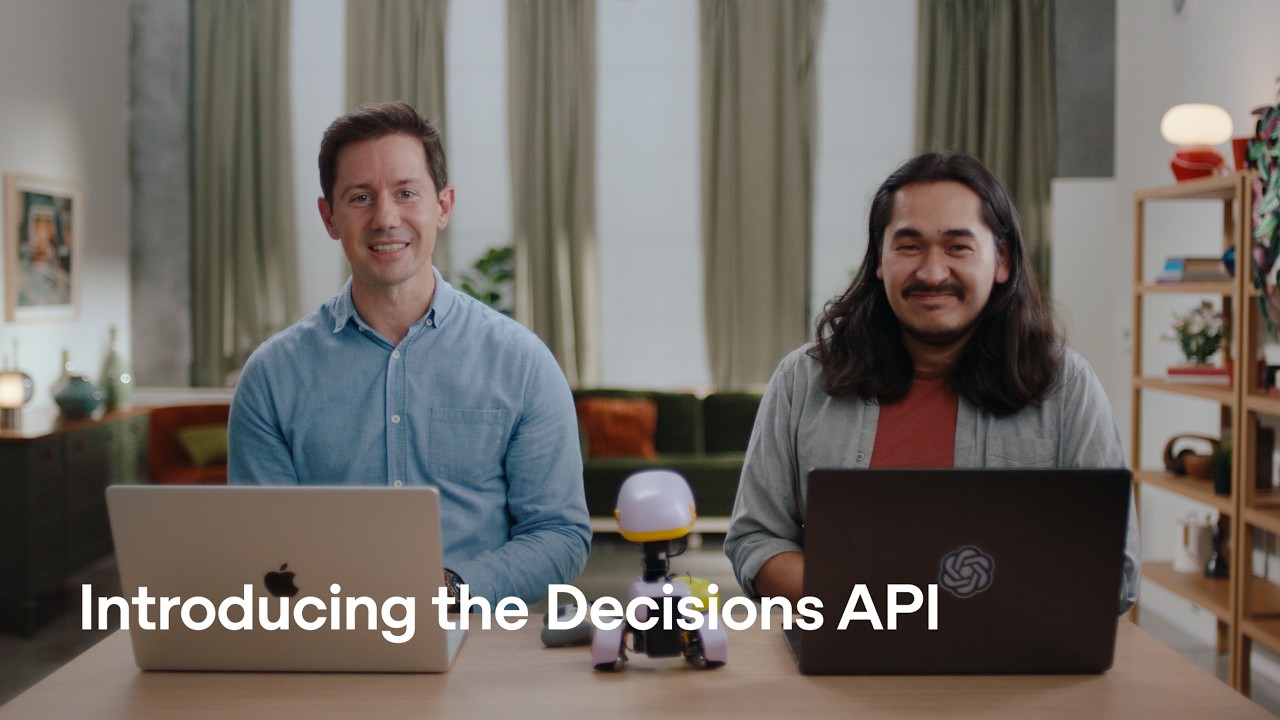
Introducing the Decisions API — OpenAI

OpenAI

Restricting outputs to discrete choices allows GPT-6 Luna to achieve sub-100-millisecond latency, enabling real-time robotics and application controls without the lag of broad reasoning models.

AI-assisted summary of Introducing the Decisions API — original source. Check the original for full context.

Source published:

Key ideas

  • OpenAI launched the Decisions API powered by GPT-6 Luna, offering under 100 ms server-side latency by constraining model outputs to a developer-defined question and choice set. (0:00)
  • By narrowing output scopes down to discrete options, the API achieves nearly 10x faster execution than broader alternatives while retaining image reasoning, multilingual text support, and safety guardrails. (0:00)
  • The API supports multi-modal use cases ranging from sub-100 ms text routing and 2D driving game steering to running parallel expression engines alongside GPT-Live-1 voice streams. (1:17)
  • In a robotics demo with Hugging Face's Microduck prototype 'Lavender', the Decisions API processed real-time camera frames to direct physical head tracking across concrete, conceptual, and subjective queries. (3:05)

Detailed notes

## Background Published by OpenAI on YouTube on October 6, 2026, this announcement video introduces the Decisions API. The official description explains that the API offers a fast way to turn text and image inputs into programmatic actions by restricting choices, powered by GPT-6 Luna alongside GPT-Live-1 and a Microduck robot.

## TL;DR Hosts Romain and Charlie showcase the new Decisions API, a low-latency model powered by GPT-6 Luna designed to quickly pick from a constrained set of answers. They demonstrate text routing with sub-100 millisecond latency for sales leads, visual lane-steering in a fast-paced 2D driving game, and dynamic facial expression selection in live voice conversations. Finally, they highlight physical robotics by using the API with 'Lavender,' a Microduck robot that interprets camera frames to track objects ranging from concrete items to abstract and subjective prompts.

## Atmosphere & style The presentation is crisp, upbeat, and distinctly developer-focused, framed around live real-time demonstrations rather than theoretical slides. Romain and Charlie share an enthusiastic, collaborative chemistry, trading off demos that transition smoothly from software routing to gaming and physical robotics. The pacing feels energetic and responsive, culminating in a charming and playful robotics test where Lavender chirps in affirmation.

## Bulletin - [00:00](https://www.youtube.com/watch?v=FB6oCmrIj-Y&t=0s) OpenAI launched the Decisions API powered by GPT-6 Luna, offering under 100 ms server-side latency by constraining model outputs to a developer-defined question and choice set. - [00:00](https://www.youtube.com/watch?v=FB6oCmrIj-Y&t=0s) By narrowing output scopes down to discrete options, the API achieves nearly 10x faster execution than broader alternatives while retaining image reasoning, multilingual text support, and safety guardrails. - [01:17](https://www.youtube.com/watch?v=FB6oCmrIj-Y&t=77s) The API supports multi-modal use cases ranging from sub-100 ms text routing and 2D driving game steering to running parallel expression engines alongside GPT-Live-1 voice streams. - [03:05](https://www.youtube.com/watch?v=FB6oCmrIj-Y&t=185s) In a robotics demo with Hugging Face's Microduck prototype 'Lavender', the Decisions API processed real-time camera frames to direct physical head tracking across concrete, conceptual, and subjective queries.

## Key takeaways - [00:00](https://www.youtube.com/watch?v=FB6oCmrIj-Y&t=0s) The Decisions API addresses the need for applications to execute intelligent decisions in a fraction of a second. - [00:00](https://www.youtube.com/watch?v=FB6oCmrIj-Y&t=0s) Under the hood, the API is powered by GPT-6 Luna, using constrained output sets to achieve under 100 ms server-side latency. - [00:00](https://www.youtube.com/watch?v=FB6oCmrIj-Y&t=0s) Developers define an input (text or image), a specific question, and a fixed set of answers to drive downstream application logic. - [00:00](https://www.youtube.com/watch?v=FB6oCmrIj-Y&t=0s) Restricting outputs allows the model to run almost 10x faster than full models without sacrificing image understanding, multilingual support, or safety guardrails. - [00:42](https://www.youtube.com/watch?v=FB6oCmrIj-Y&t=42s) Text use cases include form-field extraction, support ticket categorization, and real-time inbound sales lead routing. - [01:17](https://www.youtube.com/watch?v=FB6oCmrIj-Y&t=77s) Visual reasoning enables fast digital actions, demonstrated through real-time obstacle avoidance and lane steering in a fast-paced 2D driving game. - [01:17](https://www.youtube.com/watch?v=FB6oCmrIj-Y&t=77s) The API is suitable for lightweight computer-use tasks, though complex multi-step browser workflows are better served by Astra capabilities. - [02:05](https://www.youtube.com/watch?v=FB6oCmrIj-Y&t=125s) When paired with GPT-Live-1 audio streams, the Decisions API can independently select real-time facial expressions from a visual library to match conversational context. - [03:05](https://www.youtube.com/watch?v=FB6oCmrIj-Y&t=185s) The API can power physical robotics control loops, demonstrated on Hugging Face's upcoming programmable Microduck robot named Lavender. - [03:05](https://www.youtube.com/watch?v=FB6oCmrIj-Y&t=185s) The vision loop successfully resolved concrete commands, such as tracking an apple across incoming camera frames. - [03:05](https://www.youtube.com/watch?v=FB6oCmrIj-Y&t=185s) Lavender demonstrated conceptual reasoning by identifying an apple when asked to track 'the fruit'. - [03:05](https://www.youtube.com/watch?v=FB6oCmrIj-Y&t=185s) The system resolved subjective prompts without stalling, prioritizing a video game controller when asked what was more fun to play with.

## Detailed walkthrough ### [00:00](https://www.youtube.com/watch?v=FB6oCmrIj-Y&t=0s) Introducing the Decisions API and Text Classification

Romain opens by addressing a common challenge in software development: applications often need to make smart decisions "really, really fast," whether that means routing an incoming request, classifying visual content, or guiding an agent's next action. To solve this, OpenAI is introducing the Decisions API. Powered under the hood by GPT-6 Luna, the API provides responses in a fraction of a second, creating a near-instant interaction loop. The core mechanism is kept intentionally straightforward: developers provide an input (text or image), define a question alongside a constrained set of possible answers, and then execute downstream logic based on the returned choice. By scoping the model down to a limited set of choices, it operates nearly 10 times faster than broader alternatives while retaining critical capabilities such as robust image understanding, multilingual support, and built-in safety protections.

```mermaid flowchart LR accTitle: Decisions API Input-Output Workflow accDescr: A diagram illustrating how the Decisions API processes text or image inputs to make rapid choices. subgraph Inputs["Developer Setup"] In["Text or Image Input"] Q["Target Question"] Opts["Fixed Set of Choices"] end subgraph Processing["Low-Latency Engine"] Engine["Decisions API<br>(GPT-6 Luna)"] end subgraph Action["App Execution"] Out["Selected Choice"] Logic["Trigger App Action"] end In --> Engine Q --> Engine Opts --> Engine Engine --> Out Out --> Logic ```

Charlie demonstrates this workflow using unstructured text. While basic applications might use the API simply to extract form fields from raw paragraphs, Charlie highlights more dynamic use cases such as categorizing incoming support tickets or sorting loose inbound sales requests to route them to the appropriate team. During the live demo, freeform user inputs are classified into sales lead categories with zero perceptible delay. Romain emphasizes that the video is playing in real time—the API achieved a server-side response latency of under 100 milliseconds.

- **Engine:** Powered by GPT-6 Luna. - **Performance:** Almost 10x faster execution due to a constrained output set; under 100 ms server-side latency. - **Capabilities preserved:** Multilingual text support, image reasoning, and safety guardrails. - **Example text use cases:** Extracting form fields from paragraphs, support ticket triage, and inbound sales lead routing.

---

[01:17](https://www.youtube.com/watch?v=FB6oCmrIj-Y&t=77s) Visual Decisions and Fast-Paced Gameplay

Romain moves to what he finds even more compelling: driving fast physical or digital actions from image inputs via visual understanding. To illustrate the latency benefits, Charlie presents a 2D driving game where the Decisions API receives continuous frames showing the road and oncoming obstacles. For each incoming visual frame, the API decides whether the car should remain in its lane or maneuver left or right. Even when Charlie ramps up the game speed, the model reliably steers the vehicle into the safe lane in a fraction of the time a full reasoning model would require.

Romain points out that this quick turn-around makes the Decisions API well-suited for lightweight computer-use tasks, such as capturing screen frames and dispatching immediate keyboard or mouse actions. At the same time, he clarifies the boundaries of the API: developers pursuing deeply complex, multi-step browser manipulation or desktop workflows will still want to rely on more advanced tooling like Astra capabilities.

---

[02:05](https://www.youtube.com/watch?v=FB6oCmrIj-Y&t=125s) Reactive Expressions in Voice Conversations

Charlie explores combining the Decisions API with speech, showing how it enhances live conversations by adding real-time visual responsiveness. In his setup, GPT-Live-1 manages the speech-to-speech audio stream, while the Decisions API runs in parallel to choose visual facial expressions for an animated character based on what the user says.

Charlie tests the animated avatar with casual banter: - Charlie: *"Hey, how's it going?"* - Avatar: *"Pretty good. I'm hanging in there, keeping it calm and cozy. How are you doing?"* - Charlie: *"It has been a crazy week."* - Avatar: *"Oh, wow. That sounds exhausting. Want to talk about what's been going on?"* - Charlie: *"Oh, no. It's been crazy in a good way. We're launching the Decisions API today and a ton of people are so excited to have it."* - Avatar: *"That's so exciting. I know a lot of developers have been looking forward to building with it."*

Throughout the exchange, the Decisions API continuously picks context-appropriate expressions from a discrete visual library, ensuring the character's emotional reactions unfold alongside the spoken dialogue.

---

[03:05](https://www.youtube.com/watch?v=FB6oCmrIj-Y&t=185s) Robotics Control: Guiding "Lavender" the Microduck

Romain turns to physical robotics, showing off a prototype unit of the upcoming Microduck programmable robot provided by Hugging Face. The unit, named "Lavender," combines GPT-Live-1 for spoken interaction with the Decisions API to control head movements based on real-time visual frames captured by its onboard camera. At regular intervals, the Decisions API processes frames and selects directional steering commands to track the target object.

```mermaid flowchart TD accTitle: Lavender Robot Vision-to-Action Loop accDescr: Diagram tracking how the Microduck robot captures visual frames and directs its head using the Decisions API. Cam["Robot Camera Frames"] --> API["Decisions API<br>(Visual Reasoning)"] Prompt["Voice Prompt / Query"] --> API API --> HeadCmd["Head Movement Command<br>(Left / Center / Right)"] HeadCmd --> Motor["Microduck Head Tracking"] ```

Romain demonstrates the tracking ability through three escalating tests: 1. **Concrete command:** Romain commands, *"Lavender, follow the apple."* The robot evaluates its visual feed, identifies the apple, and tracks it smoothly. 2. **Abstract/conceptual command:** Charlie tests the model's semantic reasoning by asking, *"Lavender, can you follow the fruit?"* Lavender successfully resolves the concept back to the physical apple. 3. **Subjective judgment:** Charlie introduces a second object—a video game controller—and asks, *"Lavender, what's more fun to play with?"* Rather than stalling on ambiguity, the Decisions API selects the gamepad. Even when Charlie physically swaps the positions of the fruit and the gamepad or moves the controller to the left, Lavender's head tracks the controller.

Wrapping up, Romain and Charlie reiterate that these demos showcase the Decisions API across text, vision, keyboard, and voice modalities. They express excitement for how developers will utilize this low-latency decision loop in their own applications. In a closing moment, Romain asks, *"Lavender, are you excited about the Decisions API?"*, and the robot replies with an enthusiastic chirp.

## Notable quotes > [00:00](https://www.youtube.com/watch?v=FB6oCmrIj-Y&t=0s) really, really fast — Romain

> [02:05](https://www.youtube.com/watch?v=FB6oCmrIj-Y&t=125s) Hey, how's it going? — Charlie

> [02:05](https://www.youtube.com/watch?v=FB6oCmrIj-Y&t=125s) Pretty good. I'm hanging in there, keeping it calm and cozy. How are you doing? — Avatar

> [02:05](https://www.youtube.com/watch?v=FB6oCmrIj-Y&t=125s) It has been a crazy week. — Charlie

> [02:05](https://www.youtube.com/watch?v=FB6oCmrIj-Y&t=125s) Oh, wow. That sounds exhausting. Want to talk about what's been going on? — Avatar

> [02:05](https://www.youtube.com/watch?v=FB6oCmrIj-Y&t=125s) Oh, no. It's been crazy in a good way. We're launching the Decisions API today and a ton of people are so excited to have it. — Charlie

> [02:05](https://www.youtube.com/watch?v=FB6oCmrIj-Y&t=125s) That's so exciting. I know a lot of developers have been looking forward to building with it. — Avatar

> [03:05](https://www.youtube.com/watch?v=FB6oCmrIj-Y&t=185s) Lavender, follow the apple. — Romain

> [03:05](https://www.youtube.com/watch?v=FB6oCmrIj-Y&t=185s) Lavender, can you follow the fruit? — Charlie

> [03:05](https://www.youtube.com/watch?v=FB6oCmrIj-Y&t=185s) Lavender, what's more fun to play with? — Charlie

> [03:05](https://www.youtube.com/watch?v=FB6oCmrIj-Y&t=185s) Lavender, are you excited about the Decisions API? — Romain

## Mentioned OpenAI, Decisions API, GPT-6 Luna, GPT-Live-1, Astra, Microduck, Hugging Face, Lavender, Romain, Charlie

## Video description Introducing the Decisions API: a fast way to turn text and images into actions in your app. Give the model an input, define a question and the possible answers, and use its choice to decide what happens next.

Powered by GPT-6 Luna, the Decisions API focuses on a small set of choices to make interactions feel responsive. See how it works alongside GPT-Live-1 and a Microduck to bring voice, visual understanding, and quick decisions together.

Chapters: 00:00 Introducing the Decisions API 00:42 Classifying text and routing sales leads 01:17 Making decisions from images 02:05 Adding expression to voice conversations 03:05 Guiding Lavender the robot 05:05 What will you build?

[Source](https://www.youtube.com/watch?v=FB6oCmrIj-Y)

中文简报

OpenAI推出Decisions API,将模型延迟降至100毫秒以下 通过将输出限制在离散选项内,GPT-6 Luna实现了低于100毫秒的延迟,从而支持实时机器人与应用程序控制,避免了广泛推理模型的滞后问题。 主持人Romain和Charlie展示了全新的Decisions API,这是一款由GPT-6 Luna驱动的低延迟模型,旨在从有限的选项集合中快速做出选择。他们演示了延迟低于100毫秒的销售线索文本路由、快节奏2D驾驶游戏中的视觉车道转向,以及实时语音对话中动态面部表情的选择。最后,他们通过将该API应用于Microduck机器人“Lavender”,重点展示了实体机器人领域的应用——该机器人可通过解读摄像头画面,对从具体物品到抽象及主观提示的各类目标进行追踪。 OpenAI推出了由GPT-6 Luna驱动的Decisions API,通过将模型输出限制在开发者定义的问题和选项集合内,实现了低于100毫秒的服务器端延迟。 (0:00) 通过将输出范围缩小至离散选项,该API的执行速度比更广泛的替代方案快了近10倍,同时仍保留了图像推理、多语言文本支持和安全防护栏。 (0:00) 该API支持多种多模态用例,涵盖低于100毫秒的文本路由、2D驾驶游戏转向,以及与GPT-Live-1语音流并行运行表情引擎。 (1:17) 在与Hugging Face的Microduck原型机器人“Lavender”进行的机器人演示中,Decisions API处理实时摄像头画面,以引导实体头部追踪应对具体、概念性和主观的查询。 (3:05)

Reading summary

OpenAI has introduced the Decisions API, an engine powered by GPT-6 Luna designed to execute rapid classification and decision-making from text and image inputs over a constrained set of options. According to presenters Romain and Charlie, scoping outputs to a discrete choice set allows server-side latencies below 100 milliseconds while preserving image reasoning, multilingual capabilities, and safety protections. Constrained Output Design for Sub-100ms Classification (0:00) The Decisions API addresses the need for near-instant operational logic in software applications. Developers supply a text or image input, define a target question, and provide a fixed set of allowable choices, which the underlying GPT-6 Luna engine evaluates before returning an answer to trigger downstream app actions. Romain stated that restricting the model to a defined choice set allows it to run nearly ten times faster than broader alternatives, reaching server-side latencies under 100 milliseconds without losing multilingual support or built-in safety guardrails. In a live demonstration, Charlie applied the system to unstructured text, categorizing freeform inbound sales leads in real time with zero perceptible delay. Beyond sales routing, the presenters highlighted uses such as sorting customer support tickets and extracting specific form fields from raw text paragraphs. Visual Frame Processing and Computer-Use Boundaries (1:17) The API also processes image streams to guide fast digital and physical responses. To demonstrate this latency, Charlie showcased a 2D driving game where incoming visual frames of the road and oncoming obstacles were evaluated to determine whether a vehicle should remain in lane or steer left or right. Even at increased gameplay speeds, the model steered the car into safe lanes in a fraction of the time required by standard reasoning models. Romain noted that this speed makes the Decisions API well-suited for lightweight computer-use tasks, such as reading screen frames and dispatching keyboard or mouse commands. However, he established clear boundaries for the technology, pointing out that deeply complex, multi-step browser interactions and comprehensive desktop automation will still require more advanced tooling, such as Astra capabilities. Synchronous Expression Selection in Voice Applications (2:05) The engine can operate in parallel with generative audio models to provide real-time visual responsiveness during live conversations. In Charlie's demonstration, OpenAI's GPT-Live-1 model handled the speech-to-speech audio stream, while the Decisions API simultaneously analyzed the spoken dialogue to select context-appropriate facial expressions for an animated avatar from a discrete visual library. Throughout conversational banter about the API launch, the Decisions API continuously selected emotional cues to reflect the tone of the exchange. This parallel architecture demonstrates how discrete selection logic can complement continuous generative streams without introducing conversational delay. Physical Robotic Tracking and Semantic Resolution (3:05) In physical robotics, the API was tested on 'Lavender,' a prototype Microduck programmable robot provided by Hugging Face. The robot combined GPT-Live-1 for speech with the Decisions API to drive head tracking movements using frames from its onboard camera, continuously selecting directional commands—such as left, center, or right—to track target objects. The demonstration tested three tiers of instruction: a direct command to track an apple, an abstract command to 'follow the fruit' (which the model resolved back to the physical apple), and a subjective query asking which object was 'more fun to play with' when a gamepad was introduced alongside the fruit. The Decisions API chose the controller and maintained head tracking on it even as the items were manually swapped across the frame. Romain and Charlie demonstrated that the Decisions API brings sub-100-millisecond decision loops across text, vision, keyboard, and audio modalities. However, they also outlined its operational limits: the system is designed for discrete, low-latency selections, leaving multi-step desktop automation and deep reasoning tasks to dedicated platforms like Astra.

Detailed notes — zh

## Background 该视频由 OpenAI 于 2026 年 10 月 8 日发布在 YouTube 官方频道上。根据官方简介,视频介绍了全新的 Decisions API,该接口由 GPT-6 Luna 驱动,旨在将文本和图像输入快速转化为应用动作,并通过结合 GPT-Live-1 与 Microduck 机器人的协同演示,展现语音、视觉理解与敏捷决策的融合体验。 ## TL;DR 视频全面介绍了 OpenAI 基于 GPT-6 Luna 打造的全新 Decisions API,其通过聚焦预设选项将推理速度提升近 10 倍,并实现了百毫秒以内的极速响应。主讲人 Charlie 与 Romain 现场展示了非结构化销售线索的瞬时分类路由,以及在高速赛车游戏中逐帧感知画面并灵动避障的多模态视觉控制能力。随后,演示进一步拓展至多模态协同:该 API 不仅能配合 GPT-Live-1 为 3D 虚拟角色实时驱动契合对话情境的面部情绪,还能指导 Hugging Face 实体机器人 Lavender 理解抽象语义并敏捷追踪目标物体。这一系列演示展现了 Decisions API 在消除大模型等待迟滞、构建下一代实时动作交互回路上的广阔潜力。 ## Atmosphere & style 整个演示节奏紧凑利落、极具极客魅力,Charlie 与 Romain 之间的互动轻松随和且充满默契,让前沿技术特性的讲解显得格外亲切生动。内容编排遵循了从纯文本分类、赛车视觉闭环到虚拟人表情联动,最后再到实体机器人具身交互的层层递进结构,叙事流畅且充满惊喜。尤其是测试小机器人 Lavender 偏好手柄并以清脆鸟鸣欢快收尾的环节,为硬核的技术发布注入了温暖而幽默的人文底色,使人真切感受到人机实时交互摆脱迟滞后的灵动与活力。 ## Bulletin - [00:00](https://www.youtube.com/watch?v=FB6oCmrIj-Y&t=0s) OpenAI 正式发布基于 GPT-6 Luna 驱动的全新 Decisions API,通过限定在离散候选选项集内做出快速决断,将端到端决策速度提升近 10 倍,同时完整保留视觉理解、多语言和安全能力。 - [00:42](https://www.youtube.com/watch?v=FB6oCmrIj-Y&t=42s) 在文本分类与销售线索(Sales Leads)路由演示中,Decisions API 服务端响应延迟压缩至 100 毫秒以内,可实现免预热的实时流转。 - [01:17](https://www.youtube.com/watch?v=FB6oCmrIj-Y&t=77s) Decisions API 可将连续图像帧转换为低延迟离散控制指令,在赛车避障游戏中实现亚秒级响应,为轻量 Computer Use 截屏动作回路提供了全新方案。 - [02:05](https://www.youtube.com/watch?v=FB6oCmrIj-Y&t=125s) 通过与 GPT-Live 组合,Decisions API 分别赋能 3D 虚拟人实时面部表情切换与实体机器人 Microduck(Lavender)的语义视觉追踪,打通多模态低延迟动作交互。 ## Key takeaways - [00:00](https://www.youtube.com/watch?v=FB6oCmrIj-Y&t=0s) Decisions API 的核心交互机制为接收文本或图像输入、预设特定问题及有限选项集,由模型直接输出离散确定性答案以触发下游逻辑。 - [00:00](https://www.youtube.com/watch?v=FB6oCmrIj-Y&t=0s) 该 API 由底层 GPT-6 Luna 强力驱动,通过收窄推理焦点至极少数明确选项,在获得近 10 倍速度飞跃的同时保留了核心多模态能力与安全性。 - [00:42](https://www.youtube.com/watch?v=FB6oCmrIj-Y&t=42s) 在销售线索自动分发等非结构化文本场景中,Decisions API 服务端响应时间低于 100 毫秒,且所有演示均在未加速的真实环境下完成。 - [01:17](https://www.youtube.com/watch?v=FB6oCmrIj-Y&t=77s) 在赛车避障 Demo 中,Decisions API 实时读取图像帧并秒级决策保持车道或左右变道,即便在高车速下依然保持精准操控。 - [01:17](https://www.youtube.com/watch?v=FB6oCmrIj-Y&t=77s) 相比耗时漫长的传统推理模型,Decisions API 耗时仅为其极小一部分,能够大幅缩减多模态 Agent 在轻量截屏-按键回路中的动作延迟。 - [01:17](https://www.youtube.com/watch?v=FB6oCmrIj-Y&t=77s) 对于更复杂的深度浏览器与操作系统交互任务,轻量级 Decisions API 需与 Astra 的高阶规划能力互补配合。 - [02:05](https://www.youtube.com/watch?v=FB6oCmrIj-Y&t=125s) 与语音模型 GPT-Live-1 协同工作时,Decisions API 能在后台依据对话语境实时挑选情绪神态,让 3D 虚拟形象的面部表情与语音无缝贴合。 - [03:05](https://www.youtube.com/watch?v=FB6oCmrIj-Y&t=185s) Hugging Face 提供的 Microduck 实体机器人(Lavender)搭载 GPT-Live 与 Decisions API,通过摄像头画面驱动机载舵机进行头部追踪。 - [03:05](https://www.youtube.com/watch?v=FB6oCmrIj-Y&t=185s) Lavender 能将抽象词汇(如‘水果’)与视觉实体(苹果)正确映射,证明 Decisions API 具备高层次语义理解而非死板的关键词匹配。 - [03:05](https://www.youtube.com/watch?v=FB6oCmrIj-Y&t=185s) 在面对主观偏好提问(‘哪一个更好玩’)时,Lavender 能准确区分游戏手柄与苹果,并在对调位置或动态平移后稳定保持注视锁定。 - [05:05](https://www.youtube.com/watch?v=FB6oCmrIj-Y&t=305s) Decisions API 跨越文本路由、游戏视觉操控、虚拟人表情渲染与实体机器人追踪,旨在彻底消除大模型在人机交互中的等待迟滞。 ## Detailed walkthrough ### [00:00](https://www.youtube.com/watch?v=FB6oCmrIj-Y&t=0s) Decisions API 概述与极速决策特性 在现代应用程序中,系统往往需要在眨眼之间做出极其敏捷且聪明的决策——无论是将用户请求分流路由、对一张图片快速归类,还是由 AI Agent 决定下一步该执行什么动作。OpenAI 正式推出了全新的 Decisions API。这款 API 旨在让模型能够在极短的时间(仅需几分之一秒)内给出响应,使人机之间的每一次互动都能呈现出近乎瞬时的流畅感。 Decisions API 底层由 GPT-6 Luna 模型强力驱动,其核心交互逻辑设计得非常简明纯粹:开发者只需输入一段文本或一张图像,定义好当前面临的问题以及一组预设的可选答案,应用程序便可直接拿模型给出的确定性选项去触发后续逻辑。通过将模型的注意力聚焦在极少数明确的选项上,不仅实现了近 10 倍的速度飞跃,而且完全保留了强大的核心能力,包括深度的图像理解、广泛的语言支持以及完善的安全防护机制。 ```mermaid flowchart LR accTitle: Decisions API 工作流 accDescr: 展示输入文本或图像经过 GPT-6 Luna 快速选择后输出动作的完整链路 subgraph Input["输入端"] A["文本 / 图像输入"] B["预设问题与固定选项"] end subgraph Processing["模型处理"] C["GPT-6 Luna 极速决策引擎"] end subgraph Output["应用端动作"] D["业务路由 / 状态流转"] E["虚拟表情 / 硬件控制"] end A --> C B --> C C -->|"亚秒级/百毫秒内决策"| D C -->|"直接执行下游指令"| E ``` - **核心驱动底座**:基于 GPT-6 Luna 模型构建。 - **运行机制**:输入(文本/图像) + 问题与有限选项集 $\to$ 结构化选择输出。 - **性能优势**:相较常规大模型推理速度提升近 10 倍,同时保持多模态视觉理解能力、多语言支持与安全防护。 --- ### [00:42](https://www.youtube.com/watch?v=FB6oCmrIj-Y&t=42s) 文本分类与销售线索快速分流 在具体应用场景层面,Charlie 演示了 Decisions API 如何应对非结构化文本的现实挑战。在日常业务中,开发者最基础的诉求或许只是从长篇大论的用户留言中抽取表单字段;但借助 Decisions API,这一过程可以大幅向前迈进一步——直接将这些凌乱的原始输入分类,并实时分发给对应的支持团队或销售部门。 Charlie 现场演示了将用户五花八门的随意留言快速打标并划入不同销售线索(Sales Leads)的过程。整个分类流转过程犹如行云流水,Romain 在一旁忍不住赞叹这一表现,并特别向观众强调:"顺便说明一下,这段演示完全没有经过加速处理。"从服务端返回的数据来看,Decisions API 在该环节的响应时间压到了 100 毫秒以内(less than 100 milliseconds),其低延迟表现令人印象深刻。 - **应用场景**:工单派发、线索分流、长文本表单字段自动归类。 - **端到端延迟**:服务端响应时间低于 100 毫秒,实现实时零等待交互。 --- ### [01:17](https://www.youtube.com/watch?v=FB6oCmrIj-Y&t=77s) 图像视觉理解与毫秒级动作响应 除了纯文本处理,Decisions API 最令人兴奋的特性在于能够基于视觉图像做快速决策并转化为即时动作。Charlie 现场展示了一个极速赛车避障游戏 Demo:Decisions API 实时读取道路画面与障碍物图像帧,几乎没有任何停顿地在"保持车道"、"向左变道"或"向右变道"之间做出精准决断。 为了进一步测试极限性能,Charlie 在游戏中大幅调高了车速。即使画面节奏骤然变快,Decisions API 依然能够以惊人的敏捷度操控车辆完美穿梭于正确车道之间。这种即时响应耗费的时间,仅仅是传统推理大模型(Reasoning Model)所需时间的极小一部分。这种架构非常适合搭配基础的计算机操作(Computer Use)场景,例如通过截取屏幕画面快速回传点击或按键指令。当然,如果面对极其复杂的深度计算机或浏览器操控任务,系统依然需要配合 Astra 的高级能力来完成长链路推理规划。 - **多模态低延迟避障**:在赛车游戏中逐帧分析道路环境并决策变道方向,高车速下依然保持稳定操控。 - **对比优势**:响应速度仅为传统推理模型耗时的零头,解决了多模态 Agent 动作回路过慢的痛点。 - **协同架构**:适用于轻量截屏-动作回路;重度浏览器和操作系统复杂任务则可与 Astra 互补配合。 --- ### [02:05](https://www.youtube.com/watch?v=FB6oCmrIj-Y&t=125s) 结合 GPT-Live-1:为语音交互注入即时情绪表现 Decisions API 同样能与语音模态无缝组合,让实时多模态交互变得更加灵动、自然。Charlie 演示了一个将 GPT-Live-1 与 3D 虚拟动画角色绑定的项目:由 GPT-Live-1 全权负责自然的语音生成与倾听,而 Decisions API 则在后台根据二人对话的情境与语意,毫秒级选取虚拟形象应当展现的面部表情。 在演示现场,Charlie 与该虚拟角色展开了一段生动的对话: - Charlie 率先打招呼:"嘿,最近怎么样?"("Hey, how's it going?") - 虚拟角色微笑着回应:"挺不错的,正在这儿安稳度日,享受舒适与平静呢。你过得怎么样?" - Charlie 叹了口气说道:"这周过得简直太疯狂了。" - 听到这里,虚拟角色瞬间流露出关切与同情的疲惫神态,语气也变得温柔起来:"天哪,听起来可真累人。想聊聊都发生什么了吗?" - Charlie 笑着纠正道:"噢不,其实是充满喜悦的那种忙碌!我们今天正式推出了 Decisions API,大家拿到它都超级兴奋!" - 角色立刻切换为满脸神采飞扬的开朗表情:"那太让人激动了!我知道很多开发者一直都特别期待能用它来构建应用。" 在这个过程中,Decisions API 在预设的表情池中持续做出精准挑选,这些细微的面部神态波动与语音输出浑然一体,让虚拟形象跳脱了机械的朗读感,拥有了真正宛如真人的情绪互动质感。 --- ### [03:05](https://www.youtube.com/watch?v=FB6oCmrIj-Y&t=185s) 实体机器人 Lavender(Microduck)的视觉追踪与语义决策 在具身智能与机器人领域,Romain 带来了一项更具实体感的技术整合演示。Hugging Face 团队非常友好地为他们提供了一台即将推出的可编程机器人 Microduck 预览工程机,其名字叫作"Lavender"(薰衣草)。Romain 为 Lavender 配备了 GPT-Live 提供语音智能,同时接入 Decisions API,通过机载摄像头捕捉的实时画面来引导机器人头部向左或向右转动,实现精准的目标锁定与注视。 ```mermaid flowchart TD accTitle: 机器人 Lavender 视觉追踪决策链路 accDescr: 展示摄像头画面配合用户自然语言输入,经由 Decisions API 进行语义判定并驱动舵机转动的过程 subgraph Sensing["传感器感知"] Cam["摄像头实时画面 (每隔数帧)"] Mic["麦克风语音指令 (GPT-Live 语义)"] end subgraph Cognition["Decisions API 决策中枢"] Decision["语义理解与目标识别\n(确定'苹果'/'水果'/'更好玩'的具体目标)"] end subgraph Actuation["执行机构"] Motor["舵机云台旋转指令 (向左 / 向右转向)"] end Cam --> Decision Mic --> Decision Decision --> Motor ``` 在基础演示中,Romain 发出指令:"Lavender,看着苹果。"("Lavender, follow the apple.")Lavender 摄像头每采集数帧画面,Decisions API 便快速分析画面元素,不仅准确识别出苹果的位置,还驱动机器人小脑袋敏捷地转动并牢牢盯住苹果。 随后 Charlie 提出了一个更具概念抽象性的要求:"Lavender,你能看着水果吗?"("Lavender, can you follow the fruit?")即使指令变得模糊抽象,Lavender 依然毫不犹豫地转向并对准了苹果,这印证了 Decisions API 并非简单的关键词匹配,而是深刻理解了抽象概念背后的视觉映射。 接着,难度进一步升级。Romain 在桌面上苹果的身旁放进了一个游戏手柄,并提出极具主观偏好的问题:"Lavender,哪一个更好玩?"("Lavender, what's more fun to play with?") - Lavender 几乎没有半点犹豫,立刻将头扭向了游戏手柄。Charlie 笑着调侃道:"意料之中,毕竟手柄肯定比苹果好玩多了!" - 为了排除位置偶然性,Romain 故意将手柄与苹果的位置对调,并夸奖它:"干得漂亮,Lavender。" - 调换位置后,Lavender 依然坚定不移地转动头部重新锁定手柄;随着 Romain 把手柄往左边挪动,Lavender 也全程同步扭头追踪,完全将一旁的苹果抛诸脑后。这生动展现了极低决策延迟给实体机器人动作控制带来的灵动度。 --- ### [05:05](https://www.youtube.com/watch?v=FB6oCmrIj-Y&t=305s) 全新交互范式与开发者展望 通过覆盖文本分类、赛车视觉控制、虚拟人实时表情渲染,以及实体机器人智能追踪的几套连贯 Demo,Decisions API 证明了其跨越纯文本与视觉多模态、支持键盘操作或低延迟语音对话的广泛适应性。 Romain 与 Charlie 总结道,Decisions API 将为全球开发者开启一种与 AI 进行即时交互的全新范式,极大地消除此前大模型交互中的等待迟滞。在视频尾声,Romain 微笑着用轻松幽默的口吻问身旁的实体小机器人:"Lavender,你对 Decisions API 感到兴奋吗?"("Lavender, are you excited about the Decisions API?")Lavender 随即发出了一阵欢快的叽叽喳喳叫声(chirps),在温馨生动的氛围中结束了本次发布。 ## Notable quotes > [00:42](https://www.youtube.com/watch?v=FB6oCmrIj-Y&t=42s) 顺便说明一下,这段演示完全没有经过加速处理。 — Romain > [02:05](https://www.youtube.com/watch?v=FB6oCmrIj-Y&t=125s) Hey, how's it going? — Charlie > [02:05](https://www.youtube.com/watch?v=FB6oCmrIj-Y&t=125s) 挺不错的,正在这儿安稳度日,享受舒适与平静呢。你过得怎么样? — 虚拟角色 > [02:05](https://www.youtube.com/watch?v=FB6oCmrIj-Y&t=125s) 这周过得简直太疯狂了。 — Charlie > [02:05](https://www.youtube.com/watch?v=FB6oCmrIj-Y&t=125s) 天哪,听起来可真累人。想聊聊都发生什么了吗? — 虚拟角色 > [02:05](https://www.youtube.com/watch?v=FB6oCmrIj-Y&t=125s) 噢不,其实是充满喜悦的那种忙碌!我们今天正式推出了 Decisions API,大家拿到它都超级兴奋! — Charlie > [02:05](https://www.youtube.com/watch?v=FB6oCmrIj-Y&t=125s) 那太让人激动了!我知道很多开发者一直都特别期待能用它来构建应用。 — 虚拟角色 > [03:05](https://www.youtube.com/watch?v=FB6oCmrIj-Y&t=185s) Lavender, follow the apple. — Romain > [03:05](https://www.youtube.com/watch?v=FB6oCmrIj-Y&t=185s) Lavender, can you follow the fruit? — Charlie > [03:05](https://www.youtube.com/watch?v=FB6oCmrIj-Y&t=185s) Lavender, what's more fun to play with? — Romain > [03:05](https://www.youtube.com/watch?v=FB6oCmrIj-Y&t=185s) 意料之中,毕竟手柄肯定比苹果好玩多了! — Charlie > [03:05](https://www.youtube.com/watch?v=FB6oCmrIj-Y&t=185s) 干得漂亮,Lavender。 — Romain > [05:05](https://www.youtube.com/watch?v=FB6oCmrIj-Y&t=305s) Lavender, are you excited about the Decisions API? — Romain ## Mentioned OpenAI, Decisions API, GPT-6 Luna, GPT-Live-1, Microduck, Charlie, Romain, Astra, Hugging Face, Lavender ## Video description Introducing the Decisions API: a fast way to turn text and images into actions in your app. Give the model an input, define a question and the possible answers, and use its choice to decide what happens next. Powered by GPT-6 Luna, the Decisions API focuses on a small set of choices to make interactions feel responsive. See how it works alongside GPT-Live-1 and a Microduck to bring voice, visual understanding, and quick decisions together. Chapters: 00:00 Introducing the Decisions API 00:42 Classifying text and routing sales leads 01:17 Making decisions from images 02:05 Adding expression to voice conversations 03:05 Guiding Lavender the robot 05:05 What will you build? [Source](https://www.youtube.com/watch?v=FB6oCmrIj-Y)

Source quotes

[0:42] Romain: 顺便说明一下,这段演示完全没有经过加速处理。 [2:05] Charlie: Hey, how's it going? [2:05] 虚拟角色: 挺不错的,正在这儿安稳度日,享受舒适与平静呢。你过得怎么样? [2:05] Charlie: 这周过得简直太疯狂了。 [2:05] 虚拟角色: 天哪,听起来可真累人。想聊聊都发生什么了吗? [2:05] Charlie: 噢不,其实是充满喜悦的那种忙碌!我们今天正式推出了 Decisions API,大家拿到它都超级兴奋! [2:05] 虚拟角色: 那太让人激动了!我知道很多开发者一直都特别期待能用它来构建应用。 [3:05] Romain: Lavender, follow the apple. [3:05] Charlie: Lavender, can you follow the fruit? [3:05] Romain: Lavender, what's more fun to play with? [3:05] Charlie: 意料之中,毕竟手柄肯定比苹果好玩多了! [3:05] Romain: 干得漂亮,Lavender。 [5:05] Romain: Lavender, are you excited about the Decisions API?

Source quotes

[0:00] Romain: really, really fast [2:05] Charlie: Hey, how's it going? [2:05] Avatar: Pretty good. I'm hanging in there, keeping it calm and cozy. How are you doing? [2:05] Charlie: It has been a crazy week. [2:05] Avatar: Oh, wow. That sounds exhausting. Want to talk about what's been going on? [2:05] Charlie: Oh, no. It's been crazy in a good way. We're launching the Decisions API today and a ton of people are so excited to have it. [2:05] Avatar: That's so exciting. I know a lot of developers have been looking forward to building with it. [3:05] Romain: Lavender, follow the apple. [3:05] Charlie: Lavender, can you follow the fruit? [3:05] Charlie: Lavender, what's more fun to play with? [3:05] Romain: Lavender, are you excited about the Decisions API?

Original transcript

[0:00] Sometimes your app needs to make [0:01] a smart decision really, really fast. [0:04] Routing a request, classifying [0:06] an image, or deciding what [0:07] an agent should do next. [0:09] Today, we're introducing [0:10] the Decisions API. [0:12] It lets the model respond [0:13] in a fraction of a second, [0:14] so interacting with it feels [0:16] pretty much instant. [0:17] The Decisions API runs on GPT-6 Luna. [0:20] It's very simple. [0:21] You give it a text or an image, [0:23] you define the question [0:24] and the possible answers, and you [0:26] use the result in your app. [0:27] By focusing the model on just [0:29] a few choices, we can make it [0:31] nearly 10 times faster while keeping [0:33] capabilities like image understanding, [0:36] broad language support, [0:37] and safety protection. [0:38] But let's see that in action [0:39] with Charlie, starting with text input. [0:42] Thanks, Romain. [0:43] We're already finding a wide [0:44] variety of applications that can [0:45] benefit from the Decisions API. [0:47] Let's say you want to work [0:48] with some unstructured text. [0:50] A simple thing you could do would [0:51] be to automatically extract [0:53] form fields from a long paragraph, [0:55] but we can expand on that. [0:56] We can take those inputs and use [0:58] them to route support tickets or inbound [1:01] sales requests to the right teams. [1:02] Here, we can see multiple examples [1:04] of loose user input being quickly [1:06] classified into sales leads. [1:08] That's awesome. [1:09] And this is not sped [1:10] up, by the way. [1:11] On the server side, [1:12] the Decisions API here responded [1:14] in less than 100 milliseconds. [1:16] Very impressive. Now, what I find even more exciting [1:19] about the Decisions API is how [1:20] you can also use image inputs [1:22] to take a fast action based [1:24] on visual understanding. [1:26] So check out this simple example here. [1:28] I have a quick game [1:30] and the Decisions API is taking [1:32] frames of the road and obstacles, [1:34] quickly choosing if the car should stay [1:37] in its lane or go left or right. [1:39] Now, if we turn up [1:40] the speed right there, [1:42] the Decisions API is still able [1:43] to steer the car to the correct lane [1:45] at the fraction of the time [1:47] a reasoning model would take. [1:49] That's so cool. So you can really imagine pairing [1:52] this API with some basic computer use [1:54] tasks, taking screenshots [1:56] and quickly sending actions back. [1:58] Of course, you'll still want [2:00] Astra capabilities if you have [2:02] a very sophisticated computer [2:03] use or browser use scenario. [2:04] But Charlie, you've also been using [2:06] Decisions API together [2:08] with voice as a modality. [2:09] How does that pair together? [2:10] Yeah, I found that using [2:12] the Decisions API can make live [2:14] interactions feel even more responsive. [2:16] Here I've paired GPT-Live-1 [2:18] with an animated character. [2:20] GPT-Live-1 handles the voice while [2:22] the Decisions API is choosing [2:23] which expression the character [2:25] should use as I talk. [2:26] Let's try it out. [2:28] Hey, how's it going? [2:30] Pretty good. [2:31] I'm hanging in there, keeping [2:32] it calm and cozy. [2:33] How are you doing? [2:34] It has been a crazy week. [2:37] Oh, wow. [2:38] That sounds exhausting. [2:39] Want to talk about what's been going on? [2:42] Oh, no. It's been crazy in a good way. [2:43] We're launching the Decisions API [2:45] today and a ton of people are [2:47] so excited to have it. [2:49] That's so exciting. [2:50] I know a lot of developers have been [2:52] looking forward to building with it. [2:55] Absolutely. [2:56] The app is choosing from [2:58] a set of expressions we've given it [2:59] and those little reactions can become [3:01] part of the conversation alongside [3:03] what the assistant is actually saying. [3:05] But, Romain, you've been building [3:07] an interactive experience that touches [3:08] on robotics, right? [3:09] I have indeed. [3:11] As you can see, our friends at [3:12] Hugging Face kindly lended us [3:14] a preview unit of the upcoming [3:16] programmable robot Microduck. [3:17] And this one's name is Lavender. [3:19] So, I also integrated GPT-Live [3:21] to give it voice intelligence [3:22] as well as the Decisions API [3:24] to help the robot choose where [3:26] to look based on its camera. [3:29] So, for this demo, [3:30] the choices are simple. [3:30] It's about moving the robot's head [3:32] in either direction to look [3:34] at the right object by sending [3:36] the command to the robot. [3:38] Lavender, follow the apple. [3:45] Now, what you're noticing [3:46] here is that every few [3:48] frames from the camera is being [3:51] analyzed by the Decisions API, [3:53] which in turn can take the decision [3:55] as to where the robot should look. [3:57] And it's the Decisions API [3:59] that's deciding what's the apple. [4:01] Absolutely. [4:02] In fact, if you want to try [4:03] with a different request that's a bit [4:04] more ambiguous, feel free. [4:06] Sure. [4:11] Lavender, can you follow the fruit? [4:19] Exactly. [4:20] Amazing. [4:21] You will now follow what [4:22] is behind the concept. [4:24] It's pretty cool, right? [4:25] Now, what if we bring a second [4:26] object into the picture with a question [4:29] that's even more ambiguous. [4:30] Lavender, what's more fun to play with? [4:39] There you go. [4:40] Now, Lavender will follow the gamepad. [4:42] Because naturally, your gamepad [4:43] is more fun to play with. [4:44] What if I flip them? [4:47] Good job, Lavender. [4:48] And really, Lavender is definitely [4:50] more interested about my gamepad [4:52] than about my apple, for sure. [4:54] Right? [4:55] If I go to the left a little [4:56] bit, it will follow. [4:58] And we'll just keep on [5:00] tracking the gamepad instead. [5:03] Incredible. [5:04] Pretty cool, right? [5:04] These were just a few quick [5:06] demos of the Decisions API [5:08] across text and vision inputs, [5:10] driven either by keyboard [5:11] or voice interactions like this one. [5:13] We think the Decisions API will unlock [5:15] a brand new way to interact with AI, [5:17] and we can't wait to see what [5:19] you all will build with it. [5:21] Happy building. [5:26] Lavender, [5:27] are you excited about the Decisions API? [5:30] [Lavender chirps]