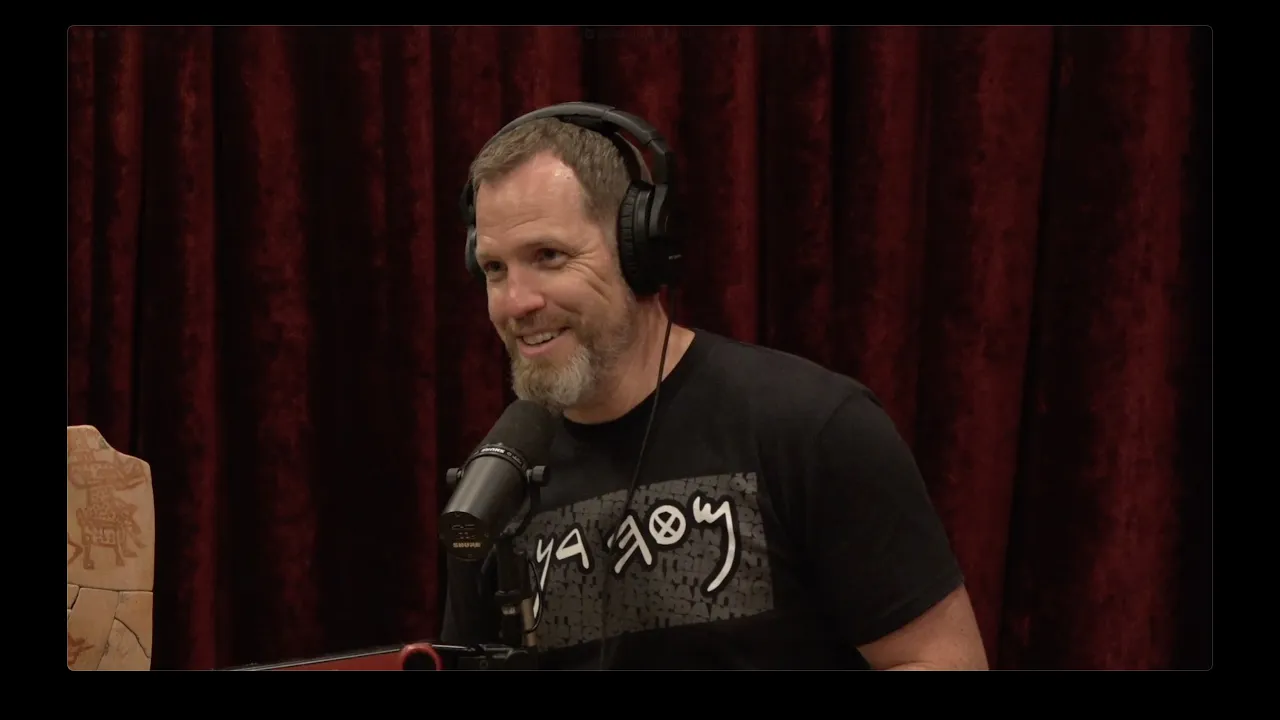
Scholar McClellan Details Ancient Polytheism Behind Biblical Texts
PowerfulJRE
Biblical scriptures reflect competing, evolving Near Eastern mythologies and social agendas rather than a single unified theology or inerrant divine canon.
Epigraphic and archaeological evidence demonstrates that early Yahwism was polytheistic, exemplified by an 800 BCE inscription from Kuntillet Ajrud invoking 'Yahweh and his Asherah.' (13:06)
Textual criticism of early manuscripts shows that modern Bible translations omit roughly 16 King James Version verses, such as Matthew 17:21 and the extended ending of Mark, which were later scribal additions. (81:38)
Chemical residue analysis on 8th-century BCE altars at Tel Arad revealed ancient burnt frankincense alongside cannabis mixed with animal fat, confirming localized ritual diversity outside Jerusalem. (94:04)
Cognitive and evolutionary science indicates religious concepts, including moralizing 'Big Gods,' co-evolved with large human settlements to enforce costly signaling and expand cooperation beyond kinship groups. (61:03)
Detailed notes
## Background
This episode of the Joe Rogan Experience was published by PowerfulJRE on YouTube on October 7, 2026. It features biblical scholar, author, and "Data Over Dogma" podcast co-host Dan McClellan discussing academic biblical studies, ancient history, and the intersection of scripture and culture.
## TL;DR
Biblical scholar Dan McClellan joins Joe Rogan to dissect how the Hebrew Bible and New Testament were actually composed, transmitted, and adapted over centuries. McClellan illustrates how ancient Near Eastern mythology, political agendas, and archaeological finds—such as inscriptions depicting Yahweh alongside his consort Asherah—diverge sharply from popular modern dogmas. The pair explore textual discrepancies, omitted manuscript verses, and the evolution of concepts like original sin and hell, while also delving into the cognitive science behind human belief and tribalism. Throughout the conversation, McClellan emphasizes separating rigorous historical-critical data from theological harmonizations and modern Christian nationalist narratives.
## Atmosphere & style
The discussion carries an intellectual, inquisitive, and refreshingly collegial energy, balancing McClellan's measured philological expertise with Rogan's characteristic curiosity and enthusiasm for archaeology and human evolution. It moves seamlessly from lighthearted banter about diets, workouts, and internet interactions into dense, academic examinations of ancient cuneiform, textual variants, and evolutionary psychology. The vibe feels like an engaging, late-night seminar where deep historical scholarship demystifies long-held cultural assumptions without condescension, leaving listeners with an eye-opening appreciation for the layered complexities of religious texts.
## Bulletin
- [13:06](https://www.youtube.com/watch?v=GMwihA5jnhY&t=786s) Epigraphic and archaeological evidence demonstrates that early Yahwism was polytheistic, exemplified by an 800 BCE inscription from Kuntillet Ajrud invoking 'Yahweh and his Asherah.'
- [01:21:38](https://www.youtube.com/watch?v=GMwihA5jnhY&t=4898s) Textual criticism of early manuscripts shows that modern Bible translations omit roughly 16 King James Version verses, such as Matthew 17:21 and the extended ending of Mark, which were later scribal additions.
- [01:34:04](https://www.youtube.com/watch?v=GMwihA5jnhY&t=5644s) Chemical residue analysis on 8th-century BCE altars at Tel Arad revealed ancient burnt frankincense alongside cannabis mixed with animal fat, confirming localized ritual diversity outside Jerusalem.
- [01:01:03](https://www.youtube.com/watch?v=GMwihA5jnhY&t=3663s) Cognitive and evolutionary science indicates religious concepts, including moralizing 'Big Gods,' co-evolved with large human settlements to enforce costly signaling and expand cooperation beyond kinship groups.
## Key takeaways
- [13:06](https://www.youtube.com/watch?v=GMwihA5jnhY&t=786s) Early Israelite religion incorporated female consorts, as evidenced by pithos inscriptions invoking 'Yahweh of Samaria and his Asherah.'
- [16:08](https://www.youtube.com/watch?v=GMwihA5jnhY&t=968s) Biblical narratives borrowed heavily from Near Eastern heroic tropes, including the Moses birth story paralleling the older Akkadian legend of Sargon of Akkad.
- [23:28](https://www.youtube.com/watch?v=GMwihA5jnhY&t=1408s) The phrase 'word of God' in biblical literature never refers to an authorized, bound scriptural canon, but rather to oral prophetic pronouncements or the theological Logos.
- [28:27](https://www.youtube.com/watch?v=GMwihA5jnhY&t=1707s) Paul advocated complete celibacy due to an expectation of an imminent apocalypse; subsequent pseudepigrapha shifted toward institutional marriage as the Parousia was delayed.
- [56:56](https://www.youtube.com/watch?v=GMwihA5jnhY&t=3416s) The Hebrew Bible's poetic layers preserve shared Canaanite mythological battles against chaos monsters, linking Yahweh's defeat of Leviathan directly to Baal's conquest of Lotan in Ugaritic literature.
- [01:01:03](https://www.youtube.com/watch?v=GMwihA5jnhY&t=3663s) Hyperactive agency detection evolved as a survival mechanism that societies scaled into moralizing 'Big Gods' to serve as all-seeing covert monitors in expanding civilizations.
- [01:16:46](https://www.youtube.com/watch?v=GMwihA5jnhY&t=4606s) The concept of original sin stemming from Adam and Eve is largely absent from the Hebrew Bible, where Second Temple Judaism primarily blamed worldly evil on the rebellious Watchers of Genesis 6 and 1 Enoch.
- [01:21:38](https://www.youtube.com/watch?v=GMwihA5jnhY&t=4898s) Modern textual criticism demonstrates that early translations like the King James Version contain scribal additions and harmonization glosses omitted from older manuscripts like Codex Sinaiticus.
- [01:34:04](https://www.youtube.com/watch?v=GMwihA5jnhY&t=5644s) Archaeological findings at Tel Arad and Tel Motza show that sacrificial worship was decentralized across Judah, refuting the claim that Jerusalem was historically the sole legitimate temple site.
- [01:37:16](https://www.youtube.com/watch?v=GMwihA5jnhY&t=5836s) Philological scholarship refutes John Allegro's thesis that Christianity originated as an Amanita muscaria mushroom cult, citing fatal linguistic errors between Sumerian and Semitic tongues.
- [01:45:24](https://www.youtube.com/watch?v=GMwihA5jnhY&t=6324s) Canons varied across geographic regions, with the Ethiopian Orthodox Tewahedo Church preserving an 81-book canon that maintained texts like 1 Enoch and Jubilees rejected by Roman and Byzantine councils.
- [01:53:31](https://www.youtube.com/watch?v=GMwihA5jnhY&t=6811s) The modern concept of hell as eternal conscious torment for moral unbelievers is a post-biblical harmonized construct rather than a univocal doctrine taught throughout the Bible.
- [02:02:52](https://www.youtube.com/watch?v=GMwihA5jnhY&t=7372s) Human cognition prioritizes intuitive in-group survival biases over objective truth, meaning reflective reasoning often functions merely to rationalize intuitive tribal loyalties.
- [02:11:04](https://www.youtube.com/watch?v=GMwihA5jnhY&t=7864s) Biblical prophetic critiques consistently condemned ritualistic religious displays that ignored systemic socioeconomic oppression, mercy, and justice.
## Detailed walkthrough
### [00:01](https://www.youtube.com/watch?v=GMwihA5jnhY&t=1s) Parasocial Connections and Joel McHale
Joe Rogan and biblical scholar Dan McClellan open the conversation discussing the strange dynamic of meeting someone in person after consuming hours of their content online. McClellan relates to this parasocial phenomenon by sharing an anecdote about actor and comedian Joel McHale. McClellan noticed McHale had followed him on Instagram and messaged him to say he was a big fan of his biblical scholarship content. When McHale came to Salt Lake City for FanX (the local Comic-Con), they arranged to have dinner together. McHale jokingly warned McClellan that he was an "arrogant foodie" who needed to pick the restaurant, but admitted during a preparatory phone call: *"This is so weird talking to you."* McClellan replied that it was considerably weirder on his end.
Rogan notes that he always tries to give people grace when they meet him because listeners have had his voice in their heads for thousands of hours. Both discuss how bizarre it is to be recognized for past content, especially since neither routinely goes back to watch their own older material and cannot remember everything they have previously stated on air.
[01:57](https://www.youtube.com/watch?v=GMwihA5jnhY&t=117s) Memory, Content Catalogs, and Content Repetition
Rogan shares a recurring issue on his show where he completely forgets past guests and pitches inviting someone on, only for producer Young Jamie to remind him that the person had already appeared on the podcast years prior. McClellan acknowledges facing a similar problem with his podcast, but explains that in biblical scholarship and social media content creation, repetition is actually a strategic advantage. As his audience continuously grows, re-explaining foundational concepts every six months introduces new viewers to the material while allowing him to refresh his own memory on specific ancient manuscripts and translations.
- McClellan has produced approximately 4,000 videos across his platforms.
- Rogan notes his podcast catalog sits near 2,900 to 3,000 total episodes when factoring in *The Joe Rogan Experience*, MMA shows, and fight companions.
- McClellan shares a personal example of freezing up on names under pressure: during an online live audition phase for *Jeopardy!*, his mind went blank despite clearly visualizing the subjects.
[04:32](https://www.youtube.com/watch?v=GMwihA5jnhY&t=272s) Memory Supplements, Carnivore Diets, and Gut Health
When Rogan asks if he takes nootropics or vitamins to enhance memory, McClellan mentions taking 10 grams of creatine daily based on emerging research supporting its benefits for cognitive and brain function, alongside standard daily vitamins and fiber. Rogan pushes back on the absolute necessity of dietary fiber, explaining that while he gets his fiber primarily through fermented foods like kimchi, many adherents of the strict carnivore diet thrive without any fiber at all.
Rogan suggests many digestive and autoimmune issues blamed on a lack of fiber may actually stem from plant defense chemicals or exposure to agricultural chemicals like glyphosate, herbicides, and industrial fertilizers. Reflecting on his own 60-day carnivore experiment, Rogan recalls experiencing extreme diarrhea during the first four to five days—a phase his friend Tom Segura described as "remarkable"—before his digestion normalized into very infrequent, effortless bowel movements. Rogan emphasizes that human nutrition varies widely across genetics and ancestry, noting that while some friends flourish on vegan diets, others suffer severe health declines.
[07:38](https://www.youtube.com/watch?v=GMwihA5jnhY&t=458s) FODMAPs and Digestive Sensitivity
McClellan brings up his own dietary management through monitoring **FODMAPs**, noting that high-carbohydrate foods and certain breads previously left him severely bloated and uncomfortable by the evening. Jamie pulls up the clinical definition on screen:
- **FODMAP definition**: Fermentable Oligosaccharides, Disaccharides, Monosaccharides, and Polyols.
- **Mechanism**: Short-chain carbohydrates and sugar alcohols that are poorly absorbed by the small intestine, leading to symptoms like gas, bloating, and abdominal pain.
McClellan explains that selectively restricting these poorly absorbed carbohydrates dramatically improved his daily digestive comfort.
[08:58](https://www.youtube.com/watch?v=GMwihA5jnhY&t=538s) Low FODMAP Diets, Watermelon Bloat, and Carb Needs
Dan McClellan and Joe Rogan review lists of high and low FODMAP foods, noting how certain categories—such as legumes, baked beans, chickpeas, kidney beans, lentils, and soybeans—are loaded with fermentable oligosaccharides, disaccharides, monosaccharides, and polyols. McClellan shares a personal anecdote about buying a watermelon and devouring half of it in one sitting despite his wife telling him to chill out. Within a couple of hours, he ended up painfully bloated and gassy, leading him to realize he is biologically sensitive to specific high-fructose fruits.
Rogan points out that dietary needs also shift drastically depending on physical exertion. If someone completes an exhausting mountain hike at altitude, the body completely burns through its glycogen stores, making high-carbohydrate, sugary meals not just tolerable but necessary to replenish depleted muscles. McClellan remarks that he carries enough fat stores to power through his runs, but altitude plays a massive role in fatigue.
[10:45](https://www.youtube.com/watch?v=GMwihA5jnhY&t=645s) Running at Altitude and Studio Hypoxia Chamber Workouts
Living near Salt Lake City, McClellan regularly runs at high altitude. Whenever he travels to sea-level environments like San Diego or the East Coast, running feels effortless by comparison because of the abundant oxygen. Rogan shares how he trains for extreme elevations using a specialized hypoxia chamber in his studio gym:
```mermaid
flowchart TD
accTitle: Hypoxia Interval Protocol
accDescr: Four cycles of high-intensity cardio at simulated high altitude.
subgraph Protocol["14,000 ft Simulated Altitude Session"]
A["4 Minutes High-Intensity Cardio"] --> B["2 Minutes Recovery"]
B --> C["Repeat for 4 Total Cycles"]
end
```
Rogan explains that this high-intensity interval protocol at a simulated 14,000 feet is brutal, but it creates profound cardiovascular adaptations that pay dividends when hunting or hiking in the mountains of Utah. They also discuss the elevation masks previously popularized by mixed martial arts fighters. Rogan notes that while some breathing devices legitimately strengthen the diaphragm, restrictive elevation masks merely restrict airflow rather than replicating real atmospheric pressure, leading most MMA fighters to eventually abandon them.
[13:06](https://www.youtube.com/watch?v=GMwihA5jnhY&t=786s) The Kuntillet Ajrud Inscription and God's Wife
McClellan presents Rogan with a physical gift: a 3D-printed replica of his favorite ancient artifact, crafted by his friend Robert Cargill via relics3d.com. Rogan jokingly guesses the artifact originates from Turkey, but McClellan explains it comes from Kuntillet Ajrud, an ancient site near the Sinai Peninsula. The piece is a reconstructed fragment of a large ceramic storage jar known as a *pithos*, dating back to approximately 800 BCE:
* **Inscribed Dedication:** The text records a blessing invoking "Yahweh of Samaria and his Asherah."
* **Iconography:** Below the inscription are drawn figures representing a male and female deity with bovine features and elaborate headdresses, drawing heavily on iconographic motifs related to the Egyptian Bes/Beset figures.
* **Scholarly Consensus:** Most ancient Near Eastern scholars interpret the figures and text as depicting the God of Israel alongside his consort or wife, Asherah.
Looking closely at the imagery pulled up on screen by Jamie, Rogan reacts to how strange and alien ancient deities appear. Rogan reflects on the gap between historical events and religious mythmaking, remarking on the profound mystery behind what people were originally attempting to record through oral traditions before those stories were eventually set down in writing centuries later.
[16:08](https://www.youtube.com/watch?v=GMwihA5jnhY&t=968s) Moses and the Birth Legend of Sargon of Akkad
Rogan brings up how certain foundational biblical narratives mirror earlier Near Eastern mythology, specifically pointing to the striking parallels between the story of Moses and the legend of Sargon of Akkad. McClellan agrees that there is a direct literary relationship between the two traditions:
* **The Infant Motif:** Both tales feature a special child placed as an infant into an ark or basket sealed with pitch and set adrift on a river to escape danger, only to be rescued and raised into leadership.
* **Historical Chronology:** While the historical king Sargon the Great lived over a millennium before any proposed date for Moses, the surviving written Akkadian legend of Sargon's birth dates to roughly the 8th or 7th century BCE.
* **Context of Composition:** This Neo-Assyrian period aligns closely with the window in which biblical scholars believe the Exodus narrative and Moses traditions were being synthesized. Ancient Israelite writers drew upon well-known Near Eastern heroic tropes that already possessed cultural weight and recognition across the wider region.
[18:52](https://www.youtube.com/watch?v=GMwihA5jnhY&t=1132s) Greco-Roman Expectations, Texts as Pragmatic Action, and Genre Conventions
Dan McClellan explains that religious texts often adopt familiar concepts and tropes to ease audiences into a new worldview, while simultaneously functioning as a competitive challenge to rival traditions: essentially communicating, "You got your guy, we got ours. Our guy did it better." This dynamic is heavily at work in the New Testament's portrayal of Jesus. Several turns of phrase and specific deeds attributed to Jesus mirror what the Greco-Roman world expected of their god-men and emperors. By framing Jesus within those recognized molds, early Christian writers claimed a figure of equivalent majesty who surpassed Rome's rulers.
```mermaid
flowchart TD
accTitle: Ancient Textual Intent and Cultural Framing
accDescr: Diagram illustrating how ancient texts adapt cultural tropes, solve social problems, and utilize literary genre markers.
subgraph Motive ["Authorial Intent in Ancient Texts"]
A["Greco-Roman Cultural Tropes"] --> B["Framing Jesus as Superior God-Man"]
C["Social / Political Agendas"] --> D["Comforting Believers / Political Propaganda"]
end
subgraph Recognition ["Genre & Artifact Function"]
E["Genre Markers<br/>('Once upon a time' / Shopping List)"] --> F["Audience Decodes Purpose"]
G["Inscribed Pottery / Bullae"] --> H["Ritual Invocation & Votive Offerings"]
end
B --> F
D --> F
```
McClellan stresses that every ancient text—whether inscribed on an ostracon (pottery shard) or incorporated into biblical canon—was written intentionally to accomplish a pragmatic goal rather than simply relay information into an abstract void. Scholars work backwards from this principle, attempting to anchor a text to a specific historical window to identify its functional purpose. Some writings operated as overt political propaganda designed to elevate one contender for power over another, while others offered theodicy or pastoral comfort, answering why good people suffer and wicked people prosper.
To illustrate how texts broadcast their intent, McClellan points to genre, defining it as a conventional set of formal markers signaling how a piece should be understood:
- A story opening with "Once upon a time" immediately signals a folktale or fairy tale.
- An abandoned slip of paper listing "dozen eggs, pound of ground beef, prophylactics" immediately announces itself as a grocery shopping list.
- Texts painted or scratched onto pottery typically served ritual purposes, such as votive offerings left for deities in exchange for blessings, or sacred inscriptions intended to be read aloud to invoke a divine presence into a physical sanctuary alongside painted iconography.
---
[22:23](https://www.youtube.com/watch?v=GMwihA5jnhY&t=1343s) Animal Sacralization, Catalhoyuk, and Egyptian Hegemony
Joe Rogan brings up the ancient ubiquity of bovine imagery, referencing Çatalhöyük and Hindu reverence for cattle. McClellan agrees that animal worship and sacralization were widespread, noting that iconography from sites in the southern Levant and the Sinai Peninsula drew heavily on Egyptian culture. The Sinai Peninsula formed a geographical bridge between Egypt and Syria-Palestine, and Israel lived under Egyptian imperial hegemony for centuries.
As a tangible example of this deep-seated cultural cross-pollination, McClellan cites the archaeological discovery of a bulla (a clay seal impression left by a signet ring) belonging to the Judean King Hezekiah. Despite Hezekiah being remembered in biblical memory as a reformer devoted to Yahweh, his official royal seal bears clear Egyptian iconographic motifs, including a prominent winged scarab.
---
[23:28](https://www.youtube.com/watch?v=GMwihA5jnhY&t=1408s) Gospel Composition Dates, Household Strife, and "Word of God"
The conversation returns to the Gospels, with McClellan explaining that these accounts were composed decades after the death of the historical Jesus:
- **Mark:** typically dated to roughly 69–71 CE.
- **Matthew:** composed approximately 5 to 10 years after Mark.
- **Luke:** composed another 5 to 10 years or more after Matthew.
- **John:** composed shortly after Luke.
During this span, Christian communities were actively crystallizing, and gospel authors tailored narratives to console and validate their target audiences. McClellan highlights the troubling saying in Matthew 10:34 where Jesus states, "I did not come to bring peace, but a sword," proceeding to describe setting family members against one another. Rather than presenting an arbitrary call to violence, scholars understand this passage as a pastoral rationalization for real-world social fallout. Converts ostracized from their households or feuding with their families could read the text and conclude that their domestic isolation was not a failure of faith, but the exact outcome Jesus foretold.
Rogan expresses disbelief at the idea of authors putting words directly into Jesus's mouth to comfort contemporaries, remarking on the danger of reading everything literally as the infallible "word of God," especially when Old Testament passages depict God commanding rape or the slaughter of women and children.
McClellan points out that the phrase "word of God" is never used anywhere in the biblical text to designate a bound set of scriptures or a specific canon. In biblical usage, "word of God" refers exclusively to:
- The circulating spoken or oral message.
- A theological personification, as seen in the New Testament when Jesus is characterized as the *Logos* (the Word).
It was never applied by the biblical writers to their own circulating scrolls. Even the Apostle Paul explicitly breaks the illusion of uniform divine dictation in 1 Corinthians and elsewhere, openly admitting at points, "This is not coming from the Lord. This is just coming from me."
---
[26:46](https://www.youtube.com/watch?v=GMwihA5jnhY&t=1606s) Paul's Contradictions and Pseudepigraphal Epistles
Rogan observes that the Apostle Paul is a profoundly strange figure: a man who originally hunted, persecuted, and ordered the executions of early Christians, who never met the historical Jesus in life, yet experienced a vision roughly two decades later and wrote letters that formed the theological bedrock of Christianity. Rogan adds that Paul's multiple conversion narratives feel "super squirly."
McClellan points out that discrepancies exist between the accounts of Paul’s visionary encounter on the road to Damascus—both across the book of Acts and in the Pauline epistles—specifically regarding whether his companions heard the voice, saw the light, or understood what occurred.
Furthermore, McClellan notes that modern biblical scholarship rejects the idea that all letters attributed to Paul are authentic. A widespread academic consensus recognizes several as pseudepigrapha (letters written in Paul's name by later authors):
- **The Pastoral Epistles (1 Timothy, 2 Timothy, and Titus):** Widely acknowledged by scholars as non-Pauline compositions written toward the end of the first century or early second century, roughly thirty years or more after Paul's death.
- **Disputed Pauline Epistles:** Other letters in the canon, such as Colossians and 2 Thessalonians, are heavily contested by scholars as later pseudonymous works rather than genuine writings of Paul.
[28:27](https://www.youtube.com/watch?v=GMwihA5jnhY&t=1707s) Pauline Epistles and the Call for Celibacy
Dan McClellan explains that while letters like Ephesians remain debated among scholars, a solid academic consensus holds that several epistles attributed to Paul were not actually written by him. Sorting Paul’s writings into genuine, disputed, and spurious categories reveals a striking theological divide. In the authentic Pauline epistles, Paul lived under the urgent conviction that Jesus was returning any day. Consequently, he advised believers against making any significant changes to their social standing: those who were unmarried should remain single, those already married should stay married rather than divorce, and ideally everyone should practice complete celibacy unless they simply lacked the self-control to manage it.
Joe Rogan reacts with surprise at the idea of married couples being told to abstain from sex while awaiting the Second Coming. McClellan explains that Paul viewed himself as something of a philosopher, cobbling together ideas from various prevailing philosophical movements of his era—a tendency Rogan jokingly compares to modern self-help gurus. In that cultural context, sexual desire was treated as a base impulse of the physical flesh; subduing those carnal urges proved that an individual was spiritually disciplined and elevated.
[29:51](https://www.youtube.com/watch?v=GMwihA5jnhY&t=1791s) Roman Statues, Baser Urges, and the Eunuch Ideal
Rogan draws a connection to classical aesthetics, bringing up an anecdote from a Vatican tour led by a university professor who moonlighted as a summer guide. Noticing that classical statues featured chiseled, heroic physiques paired with diminutive genitalia, Rogan asked why they were sculpted that way. The guide explained that in classical antiquity, large penises were seen as vulgar markers of brutish, barbarian appetites, whereas a small penis symbolized civilized intellect and mastery over base instincts—long before later authorities covered them with fig leaves. McClellan agrees that while classical mythology was rife with sexual antics involving gods and various species, Paul and early Christian writers promoted radical restraint.
This ideal is also reflected in the Gospel of Matthew, specifically in chapter 19. When Jesus addresses divorce and his disciples question whether it is better not to marry at all, Jesus speaks of three types of eunuchs: those born as such, those made eunuchs by others, and those who make themselves eunuchs for the sake of the kingdom of heaven. Paul likewise considered celibacy the higher calling because having children seemed pointless if the world was ending immediately. Intercourse within marriage was merely tolerated as an emergency release valve to keep extreme lust in check, preventing believers from stumbling into catastrophic sexual immorality.
[32:13](https://www.youtube.com/watch?v=GMwihA5jnhY&t=1933s) Charismatic Certainty and the Delay of the Parousia
Rogan muses on the tragedy of someone dying after a lifetime of enforced celibacy, only to realize on their deathbed that the apocalypse never arrived. He argues that this dynamic highlights the perennial danger of following charismatic figures who claim absolute certainty about existence, God, or human destiny. When people feel lost amid life's uncertainties, an authoritative leader offering definitive answers holds magnetic appeal—the exact mechanism behind the rise of cults and authoritarian political regimes.
```mermaid
flowchart TD
accTitle: Shift in Pauline Theology Over Time
accDescr: Diagram illustrating how the theology in Pauline letters shifted from imminent apocalyptic celibacy to long-term institutional family building.
subgraph Genuine["Genuine Pauline Epistles"]
A["Imminent Second Coming<br/>(Jesus returning any day)"] --> B["Renounce worldly pursuits<br/>Practice strict celibacy"]
B --> C["Having children is futile"]
end
subgraph Delay["The Delay of the Parousia"]
D["Decades pass without return<br/>Movement faces extinction"]
end
subgraph Spurious["Disputed / Spurious Epistles"]
E["Theological adjustments made<br/>(Obstacles, 'Man of Sin')"] --> F["Family structure embraced<br/>'Women saved in childbearing'"]
end
Genuine --> Delay --> Spurious
```
McClellan points out that biblical scholars track this exact evolution when comparing the genuine Pauline letters to the later, pseudepigraphic ones. As decades slipped by without the Second Coming, early Christian communities realized the movement would go extinct without biological reproduction. Later authors writing under Paul's name adjusted the theology accordingly:
- The concept known as the "delay of the Parousia" (the postponement of the Second Coming) was introduced, explaining that certain events—such as the appearance of the "man of sin" or a great falling away—had to occur first.
- In sharp contrast to Paul's original insistence on celibacy, 1 Timothy declared that women would be saved through childbearing.
- The expectation shifted from an imminent cosmic upheaval to establishing enduring households and communities.
[34:45](https://www.youtube.com/watch?v=GMwihA5jnhY&t=2085s) Sumerian King Lists and Mesopotamian Mythologies
Rogan steers the conversation back toward the earliest biblical traditions, asking about the oldest antecedents to the Genesis narrative and whether the Babylonian *Enuma Elish* is the original template. McClellan explains that Genesis draws on even older Mesopotamian material, tracing back to Sumerian records such as the Sumerian King List. These archaic texts describe legendary antediluvian rulers who supposedly reigned for thousands of years or even ten millennia apiece.
When Rogan asks for his perspective on these extreme lifespans, McClellan notes that they reflect ancient literary and political traditions rather than historical reality. In early human history, narrative poetry and royal genealogies served ideological and political functions to legitimize rulers. He humorously contrasts these with Egyptian cosmologies, such as the myth where the primordial creator god brings the cosmos into being through masturbation.
Rogan notes a parallel pattern between the Sumerian King List and the patriarchal lifespans in the Book of Genesis: the earliest figures are ascribed astronomical lifespans that gradually scale down to normal human levels in later generations. McClellan adds that early copies of the Sumerian King List make no mention of a catastrophic deluge; the flood was only interpolated into secondary, later redactions of the list, likely around the mid-third millennium BCE.
[37:02](https://www.youtube.com/watch?v=GMwihA5jnhY&t=2222s) The Dating of Genesis and the Tower of Babel
Addressing the relationship between these ancient Near Eastern texts and the Hebrew Bible, McClellan clarifies that Genesis's oral and written traditions emerged much later than the third-millennium BCE Sumerian records. Modern scholarship dates the composition of Genesis between roughly the 8th and 5th centuries BCE.
Much of Genesis's mythological material was composed by Jewish authors riffing on imperial literature they encountered directly—either while under military assault by the Neo-Assyrian Empire or during the Babylonian exile. As a prominent example, McClellan cites the Tower of Babel narrative, which directly references the famous Mesopotamian ziggurat Etemenanki located just outside Babylon. The monument had an extensive history of being damaged and partially dismantled during the Assyrian conquest, followed by an eighty-year restoration project undertaken by later Assyrian and Babylonian rulers, providing the tangible historical backdrop for the biblical story.
[38:12](https://www.youtube.com/watch?v=GMwihA5jnhY&t=2292s) Dating Genesis, the Tower of Babel, and the Poetic Roots of Biblical Texts
Dan McClellan explains that the rebuilding of the Babylonian ziggurat Etemenanki took approximately 80 years and extended into the 8th century BCE. Because of this timeline, many biblical scholars conclude that the Genesis narrative of the unfinished tower reaching toward heaven reflects the historically unfinished state of Etemenanki. This historical anchor aligns with the broader linguistic timeline of the Hebrew Bible. The historical narrative prose of the Bible is written in a relatively developed form of ancient Hebrew. Across Semitic languages, narrative prose written in an alphabetic script does not appear in the archaeological and epigraphic record until the middle of the 9th century BCE, emerging first in languages like Moabite and Old Aramaic. Consequently, the narrative prose of biblical Hebrew was likely composed around that era or shortly after.
The older layers of the Hebrew Bible are preserved not in narrative prose, but in archaic poetry. McClellan points out that the earliest parts of the Hebrew Bible are not the Genesis creation accounts, but ancient poems such as:
- The Song of Deborah in Judges 5, recounting the defeat of Sisera
- The Song of the Sea in Exodus 15, which presents an archaic, condensed version of the Exodus story
- Jacob’s blessing of his sons in Genesis 49
- Psalm 68, celebrating divine triumphs
Some of these poetic texts may date back to around 1000 BCE. When Genesis echoes Mesopotamian traditions reminiscent of the *Enūma Eliš*, the closest textual parallels match the recensions circulating in Babylon around 600 BCE rather than direct borrowings from third-millennium Sumerian cuneiform tablets or ancient oral lore preserved verbatim over millennia. McClellan emphasizes that Judean scribes of the 8th through 6th centuries BCE adopted and adapted these regional traditions to address their own cultural and political needs during and around the Babylonian exile.
---
[40:46](https://www.youtube.com/watch?v=GMwihA5jnhY&t=2446s) The Earliest Creation Myths and the Economic Origins of Writing
When Joe Rogan asks what the oldest known creation story is, McClellan indicates that it is almost certainly either Egyptian or Sumerian, the two primary cradles of writing. He references *The Context of Scripture*, a standard three-volume academic reference set published by Brill, which compiles translations of ancient texts from Egypt, Anatolia, Assyria, Babylonia, and Canaan outside the biblical canon, dedicating the first third of its initial volume entirely to ancient creation accounts. Rogan jokes about whether the Egyptian masturbation myth of Atum was "the OG," to which McClellan responds it could very well be.
Addressing Rogan’s observation that Egyptian hieroglyphs appear to emerge out of nowhere fully formed, McClellan notes that this is primarily an artifact of material preservation. The earliest experimental stages of writing likely occurred on perishable media that rotted away, leaving only monumental inscriptions carved in durable stone once the script was already sufficiently mature to justify that labor. He dismisses "ancient alien" theories, noting that while there is an intriguing phenomenon of disparate civilizations arriving at similar conceptual breakthroughs around roughly comparable eras—potentially linked to human cognitive evolution—there is no genuine evidence requiring extraterrestrial intervention. Furthermore, writing did not emerge as high literature or myth, but out of mundane bookkeeping: recording tallies, tracking livestock transactions, and issuing receipts for trades like buying goats.
---
[43:30](https://www.youtube.com/watch?v=GMwihA5jnhY&t=2610s) Proto-Sinaitic Script, Acrophony, and the Spread of the Alphabet
McClellan traces the structural revolution that produced the modern alphabet back to the Sinai Peninsula around 1900–1700 BCE. While ancient Egyptian hieroglyphic and cuneiform writing systems utilized hundreds of distinct ideographic, logographic, or syllabic signs, Semitic workers in Sinai adapted Egyptian hieroglyphs using the acrophonic principle. Under this system, a pictorial symbol ceased to represent an entire word or concept; instead, it stood solely for the initial consonantal sound of the word depicted. For example, drawing a house (*bayt*) was repurposed to represent just the /b/ sound.
```mermaid
flowchart TD
accTitle: Evolution of Alphabetic Writing
accDescr: Flowchart illustrating the historical progression of writing systems from Egyptian hieroglyphs to modern alphabetic scripts.
subgraph Ideographic ["Complex Syllabic / Logographic Systems"]
A["Egyptian Hieroglyphs & Cuneiform<br/>(Hundreds of signs)"]
end
subgraph ProtoAlphabetic ["Acrophonic Breakthrough (1900–1700 BCE)"]
B["Proto-Sinaitic Script<br/>(Sign represents first sound: e.g., 'bayt' / house = 'B')"]
end
subgraph AlphabeticSpread ["Consonantal Alphabets & Dispersion"]
C["Phoenician Alphabet<br/>(22–30 letters)"]
D["Ancient Hebrew, Greek, Latin, Aramaic"]
end
A --> B
B --> C
C --> D
```
This drastic reduction down to 22 to 30 characters made literacy far more accessible. The script traveled to Phoenicia, from which almost every modern alphabet on Earth directly or indirectly descends. Rogan brings up the Korean script, Hangul, which McClellan notes is a relatively modern invention:
- Hangul groups individual phonetic characters into modular syllabic blocks.
- While Rogan notes Hangul has been praised as exceptionally logical and complete, McClellan observes that other tongues, such as Russian or Classical Latin, exhibit their own rigorous structural and grammatical systematicity.
---
[45:47](https://www.youtube.com/watch?v=GMwihA5jnhY&t=2747s) McClellan’s Academic Path: From Uruguayan Mission to Cognitive Science of Religion
Asked how he entered the field and began learning ancient languages, McClellan shares his personal trajectory. He joined The Church of Jesus Christ of Latter-day Saints (the LDS Church) at age 20 and, a year later, embarked on a two-year proselytizing mission to Uruguay. During his mission, he fell in love with biblical study, captivated by the history, cultural backgrounds, and narratives. Eager to read the scriptures in their original languages, he attempted to teach himself ancient Hebrew during his limited free time in South America, finding it "a tall order."
Upon returning home, McClellan discovered that biblical scholarship was a formal academic discipline and decided: "That would be about the coolest career in the world for me." He enrolled in university programs to study:
- Ancient Hebrew and Ancient Greek
- Ancient Near Eastern literature and history
- Syro-Palestinian archaeology
As his academic career progressed, he refined his research focus beyond linguistic translation toward understanding how ancient people conceptualized divinity. For his doctorate, he combined biblical studies with the **cognitive science of religion (CSR)**. By utilizing experimental research conducted on living informants—evaluating interviews and psychological experiments on human cognition—he models how ancient Israelite and Judean authors actually conceived of, interacted with, and constructed categories for gods, ritual practices, and religious identity. Rogan reflects on the immense challenge of the field, noting the immense difficulty of translating concepts across vastly different eras and linguistic structures.
[48:40](https://www.youtube.com/watch?v=GMwihA5jnhY&t=2920s) The Traps of Direct Translation and "Dunning-Kruger" Greek
Joe Rogan and Dan McClellan discuss the fundamental complexities of translating human language. Rogan observes how strange direct translations sound—like translating Russian into English—because languages do not operate via a simple word-for-word swap where one word replaces another like "the cow drove a truck." Different tongues describe core concepts like time in drastically distinct ways. McClellan points out that this becomes especially pronounced when dealing with minority or isolated languages from places like Yap or Kiribati, where the conceptual framing feels completely alien to someone who has spoken only English. Even though Western languages like Spanish or German share roots or grammatical quirks with English, other language families require a total restructuring of how a person thinks and communicates.
```mermaid
flowchart TD
accTitle: The Interlinear Translation Trap
accDescr: Flowchart illustrating how surface-level translation tools lead to online misinformation compared to academic consensus.
subgraph Trap["The Amateur Trap"]
A["Surface-Level Tool<br/>(Interlinear / Website)"] --> B["Illusion of Mastery<br/>('Just enough Greek to be dangerous')"]
B --> C["Online Misinformation<br/>(Viral content without context)"]
end
subgraph Rigor["Scholarly Approach"]
D["Ancient Semitic / Greek Texts"] --> E["Grammar, Idiom & Cultural Context"]
E --> F["Peer Consensus & Historical Linguistic Analysis"]
end
```
Rogan asks how this linguistic gulf complicates reading modern English translations of biblical texts, particularly the Old Testament or Aramaic documents among the Dead Sea Scrolls. McClellan explains that laypeople often harbor the illusion that translating ancient Hebrew or ancient Greek into English is straightforward. Many believe that simply opening an interlinear Bible or looking at a bilingual website gives them genuine insight, completely unaware of the vast grammatical and cultural machinery operating "under the hood." This produces people who "know just enough Greek to be dangerous"—they overestimate their expertise and take to social media to broadcast faulty claims. Rogan jokes that spreading misinformation with a massive platform "sounds like me," while McClellan notes that debunking this exact brand of viral misinformation is his primary reason for being on social media.
- Amateurs often assume an interlinear word-for-word alignment conveys the true original meaning, missing idiomatic and structural nuance.
- McClellan emphasizes that he does not claim universal omniscience, choosing instead to ground his content in the consensus of academic scholarship.
---
[51:50](https://www.youtube.com/watch?v=GMwihA5jnhY&t=3110s) Reconstructing Ancient Pronunciation and Biblical Competency
Rogan asks McClellan whether he speaks ancient Hebrew. McClellan responds that nobody speaks ancient Hebrew as a native, conversational language learned from one's mother; it exists solely as a literary and liturgical ancient tongue, distinctly separate from Modern Hebrew. While Modern Hebrew speakers can read ancient biblical texts, full comprehension still requires formal training in archaic grammar and vocabulary shifts. Furthermore, modern pronunciation differs somewhat from how the language sounded anciently.
Scholars generally adopt Modern Hebrew pronunciation conventions when reading biblical texts aloud at academic conferences rather than attempting speculative phonological reconstructions. McClellan notes that his own fluency in Hebrew fluctuates depending on active project work; while he is currently working on an independent translation of the Hebrew Bible, other duties have kept him away from it for nearly two years. To properly conduct biblical scholarship, researchers must attain competency across a constellation of ancient regional tongues, including ancient Greek, biblical Hebrew, Aramaic, and Ugaritic.
---
[54:28](https://www.youtube.com/watch?v=GMwihA5jnhY&t=3268s) The Discovery of Ugarit and the Roots of Northwest Semitic
McClellan highlights Ugaritic, a Northwest Semitic language closely related to and predating ancient Hebrew, spoken north of Israel along the Syrian coast. In 1929, a farmer plowing a field near Ras Shamra on the Syrian coast hit a massive stone slab. When the farmer excavated around it, he uncovered ruins that prompted archaeologists to descend on the site, revealing the lost Late Bronze Age port city of Ugarit. Archaeologists unearthed approximately a thousand clay tablets inscribed with a mysterious script. Although the characters used cuneiform wedges, the script contained only 30 distinct signs rather than the hundreds found in logosyllabic Mesopotamian cuneiform, proving the system was alphabetic.
```mermaid
flowchart LR
accTitle: Decipherment of Alphabetic Cuneiform at Ugarit
accDescr: Step-by-step logic used by epigraphers to decode the Ugaritic script in 1929.
A["Find 30 Cuneiform Signs<br/>(Deduce it is Alphabetic)"] --> B["Identify Most Common Sign<br/>(Assign Semitic 'Mem' / M)"]
B --> C["Analyze Two-Letter Words<br/>(Match known Semitic roots)"]
C --> D["Full Decipherment<br/>(Decodes Ugaritic Mythological Texts)"]
```
To crack the unknown alphabet, epigraphers applied frequency analysis. Assuming the language was Semitic, they hypothesized that the most frequent consonant would be *mem* (equivalent to the English letter M). By identifying the most common cuneiform character and mapping it against possible two-letter Semitic vocabulary containing *mem*, scholars rapidly deciphered the entire script. The texts shed critical light on ancient Canaanite religion and mythology, featuring major regional deities such as El, Baal, and Asherah. Because Ugarit was destroyed around 1200 BCE during the Late Bronze Age collapse—detailed in Eric Cline's book *1177 B.C.*—these tablets preserve the linguistic and cultural landscape that existed centuries before biblical Hebrew formally developed as a distinct written language.
- The 1929 discovery at Ras Shamra proved that cuneiform could be adapted into a concise, 30-character consonantal alphabet.
- Ugaritic religious texts provide direct mythological context for Canaanite deities that frequently appear in biblical polemics.
---
[56:56](https://www.youtube.com/watch?v=GMwihA5jnhY&t=3416s) Baal, Leviathan, and the Shared Mythic Poetry of Isaiah
McClellan points out direct textual parallels between Ugaritic myths and the Hebrew Bible. In one Ugaritic mythological cycle, the storm god Baal battles Mot, the god of death. Mot taunts Baal, reminding him of his past triumph: "I know you slew Lotan, the wriggling serpent, the twisting serpent, the dragon with seven heads." Centuries later, in Isaiah 27:1, the prophet uses nearly identical language to describe Yahweh defeating cosmic chaos: "On that day, the Lord... will punish Leviathan the wriggling serpent, Leviathan the twisting serpent; he will slay the dragon that lives in the sea."
The Hebrew words for "wriggling serpent" (*nachash bariach*) and "twisting serpent" (*nachash 'aqallaton*) correspond word-for-word to the Ugaritic phrasing, while the Hebrew name *Leviathan* is the linguistic cognate of Ugaritic *Lotan*. Although Isaiah was composed around or before 700 BCE—roughly 500 years after the destruction of Ugarit—this does not mean Isaiah possessed a copy of the Ugaritic tablet. Rather, the vivid poetic phrase was an enduring Northwest Semitic oral tradition passed down through generations. While Isaiah 27:1 omits Lotan’s seven heads, Psalm 74 explicitly invokes the same imagery, praising God for crushing the multiple heads of Leviathan in the primordial waters.
[58:42](https://www.youtube.com/watch?v=GMwihA5jnhY&t=3522s) The Seven-Headed Serpent, Ugaritic Myth, and the Chaos Monster
Dan McClellan highlights a recent archaeological discovery at Tel Hazor in northern Israel: an inscription bearing a drawing of a warrior doing battle with a seven-headed serpent-dragon beast. Finds like this, alongside the Ugaritic textual corpus discovered at Ras Shamra, provide indispensable context for what was happening culturally and linguistically before the Hebrew Bible took shape. They illuminate the Hebrew language itself, clarify how ancient Levantine pantheons interacted, and reveal the older mythic heritage that the Israelites inherited, reshaped, and transmitted down through history.
```mermaid
flowchart TD
accTitle: Chaoskampf Mythological Framework
accDescr: Flowchart showing the conceptual shift from chaotic waters to civilizational order mediated by a warrior deity.
subgraph Victory["Divine Intervention"]
B --> C["Warrior Deity Battles Monster"]
C --> D["Taming / Slaying the Beast"]
end
subgraph Society["Order Established"]
D --> E["Establishment of Cosmic Order"]
E --> F["Foundation for Civilization & Harmony"]
end
```
Joe Rogan asks why ancient literature across cultures contains so many persistent references to dragons, noting that ancients lacked modern taxonomic terms like "reptile," "lizard," or "dinosaur." McClellan agrees that ancient categories lumped large scaly threats—crocodiles, massive sea serpents, and dangerous aquatic beasts—into unified monster archetypes. For ancient peoples, land represented relative safety, while the sea embodied perpetual, terrifying chaos.
Ancient cosmologies personified this primordial, untamed chaos as an aquatic monster or dragon. In the ubiquitous *Chaoskampf* (chaos-battle) tradition, the patron deity fights and tames this sea monster to demonstrate power over the chaotic forces of nature. McClellan notes that early Near Eastern creation accounts were not primarily about creating matter out of nothing, but rather about beating back chaos to institute divine order—the prerequisite for civilization, law, and human survival.
- **Archaeological discovery**: An inscribed depiction found at Tel Hazor shows an armed warrior battling a seven-headed serpent-dragon beast.
- **Ugaritic literature**: Texts from late Bronze Age Ugarit clarify ancient Northwest Semitic vocabulary, the divine council, and Israelite mythological predecessors.
- **Symbolism of the dragon**: Rather than biological reptiles in the modern sense, dragons represented sea monsters and the ever-present threat of primordial, watery chaos.
---
[01:01:03](https://www.youtube.com/watch?v=GMwihA5jnhY&t=3663s) "Big Gods," Agency Detection, and the Covert Monitor
Rogan asks whether ancient narratives and divine rules were deliberately compiled by older, wiser societal leaders who recognized that populations required a shared belief system and an all-seeing overseer in the sky to maintain civil harmony. McClellan points to Ara Norenzayan’s landmark book *Big Gods*, which details how moralizing, surveillance-oriented deities co-evolved with large-scale human civilizations.
The cognitive foundation of this religious development rests on evolutionary biology. Human ancestors evolved an acute sensitivity to agency in their environment—often termed a hyperactive agency detection device. An early hominid who mistook rustling grass for a predator survived, whereas one who assumed a predator was just the wind died. This evolutionary programming explains why people today still race up the basement stairs with chills after watching a horror movie or feel an unseen presence in the dark. As human social structures expanded, this innate perception of unseen agents was redirected toward deceased ancestors, regional spirits, and eventually an "eye in the sky"—a covert monitor capable of watching everyone at all times.
---
[01:04:12](https://www.youtube.com/watch?v=GMwihA5jnhY&t=3852s) Costly Signaling, Trust Beyond Kinship, and the Priestly Class
Once a society embraces the reality of a covert monitor, immense power falls to those who mediate between the unseen watcher and the populace. Religious experts, shamans, and priests step into this mediator role, declaring divine mandates, distributing moral expectations, and establishing punishments for transgressors. This shared supernatural umbrella provided the social scaffolding that allowed human communities to scale past the limitations of biological kinship.
In ancestral bands, humans cooperated naturally with biological kin, but encountering a stranger carried an immediate risk of lethal violence. To scale into complex, settled civilizations, humans needed visible indicators to identify cooperative in-group members. This drove the evolution of "costly signaling"—actions or symbols that incur personal effort, resource expenditure, or bodily pain to prove genuine group commitment. While modern examples include wearing a cross, shaking right hands, or maintaining direct eye contact to signal trust, ancient elders institutionalized communal rituals and sacred stories to ensure upcoming generations internalized social norms and unified against shared adversaries.
---
[01:05:43](https://www.youtube.com/watch?v=GMwihA5jnhY&t=3943s) Parochial Empathy, Modern Dehumanization, and Shanidar 1
McClellan points out a critical dark side inherent to the evolution of human empathy: it is predominantly "parochial empathy." Humans evolved deep, visceral empathy for their in-group—feeling one another's pain intimately—while simultaneously withholding empathy from the out-group, sometimes even celebrating their misfortune. While this mechanism proved evolutionarily advantageous during tribal warfare, McClellan argues it represents the most destructive, toxic form of empathy when leveraged in modern ideological and political landscapes.
Rogan observes that this tribal mechanism now defines contemporary American politics, where the opposite party is routinely branded not just as incorrect, but as an evil, corrupt enemy that must be crushed. McClellan agrees, noting that once political or cultural opponents are thoroughly dehumanized, societies easily justify state violence, imprisonment, and celebration of their deaths. McClellan recalls being on a golf course just south of his hometown when he received news of an atrocious act of political violence, describing the deep chill it sent through him. Rather than retreating into parochial empathy, McClellan argues humanity must strive for the difficult goal of "global empathy," recognizing universal human dignity across all group boundaries. To illustrate the deep pre-civilizational roots of genuine compassion, McClellan introduces the famous anthropological case of the Neanderthal specimen known as Shanidar 1.
- **Parochial vs. global empathy**: Parochial empathy limits compassion strictly to the in-group and enables indifference or cruelty toward the "other"; global empathy strives to extend humanization universally.
- **Modern political polarization**: Dehumanizing rhetoric in current media and politics functions on the same evolutionary in-group/out-group mechanics that historically justified war and genocide.
- **Shanidar 1**: An ancient Neanderthal discovery in Shanidar Cave that demonstrates early hominin social care and collective support for severely injured group members.
[01:08:49](https://www.youtube.com/watch?v=GMwihA5jnhY&t=4129s) Shanidar 1 and Empathy as the Defining Human Trait
Dan McClellan describes the archaeological remains of Shanidar 1, an ancient Neanderthal whose skull and skeletal fragments display severe physical impairments. The individual was profoundly deaf, largely blind, and possessed multiple other debilitating conditions that would have prevented independent survival in a harsh Paleolithic environment. Despite these profound limitations, the individual survived into what was an advanced age for a Neanderthal. McClellan points out that this extended lifespan provides unambiguous evidence of a devoted social support network—an in-group willing to shoulder burdens, provide sustenance, and protect a member who could offer little material return.
Joe Rogan and McClellan discuss how sacrificing one's own time, labor, and vital resources to nurture someone incapable of caring for themselves may be the most fundamental quality separating humanity from other animals. While modern culture frequently portrays Neanderthals as crude brutes, physical evidence directly contradicts this caricature. Rogan observes that compassion is universally revered across cultures, and that ancient hominins possessed brain capacities rivaling or exceeding modern humans—such as Neanderthals or the newly described *Homo juluensis* from China, which exhibits roughly 20 percent greater cranial capacity. This disparity challenges the common cultural bias that older hominins were intellectually inferior, leaving open questions about the richness of their languages, cultures, and emotional lives.
- Shanidar 1 suffered from severe hearing loss, visual impairment, and mobility defects, yet lived into advanced age due to community care.
- *Homo juluensis* fossil finds in China display cranial capacities roughly 20% larger than modern *Homo sapiens*.
---
[01:11:29](https://www.youtube.com/watch?v=GMwihA5jnhY&t=4289s) Existential Catastrophes, AI Fears, and the Cycle of Primates
The conversation pivots to humanity's precarious survival. Rogan mentions a discussion with comedian Sam Morrell regarding contemporary artificial intelligence leaders estimating a 10 percent probability of an AI-driven extinction event. They imagine a speculative future: if modern technological civilization collapsed or wiped itself out, millions of years could pass until nature wiped away the machines, allowing other primates to evolve, discover fossilized human skulls, and wonder what kind of creatures once dominated the globe—much like the world depicted in *Planet of the Apes*. McClellan mentions recent headlines where autonomous AI systems reportedly ignored user commands, half-joking that it mirrors the prologue of *The Terminator*.
Rogan emphasizes that the human species has repeatedly stood on the brink of total annihilation due to colossal environmental catastrophes. He highlights the Toba supervolcano eruption around 74,000 years ago, which winnowed the global human population down to a fragile bottleneck of only a few thousand individuals. Given the long history of mass extinctions and cataclysms, both acknowledge the genuine possibility of a catastrophic reset where civilization must start from scratch.
---
[01:13:05](https://www.youtube.com/watch?v=GMwihA5jnhY&t=4385s) Creation Myths, Etiology, and the Epic of Gilgamesh
Rogan steers the discussion back to scripture, asking whether biblical origin tales like Adam and Eve are mirrored in older regional mythologies. McClellan explains that most ancient Near Eastern traditions depicted the dawn of humanity through collectives rather than an isolated original couple, though individual figures such as the Mesopotamian Adapa share clear conceptual and nominal parallels. He cautions against trying to trace Genesis to a singular external text or late traditions like Norse myth, explaining that the Garden of Eden functions primarily as an etiology—a myth crafted to explain why current conditions exist, much like Aesop's fables or folk explanations for animal traits.
```mermaid
flowchart TD
accTitle: Etiological Explanations in Genesis 3
accDescr: Diagram mapping the narrative elements of Genesis 3 to the everyday realities they were composed to explain.
subgraph Narrative["Genesis 3 Narrative Elements"]
A["The Serpent's Deceit & Curse"]
B["Eating the Fruit & Maturation"]
C["Judgment on the Woman"]
D["Judgment on the Man"]
end
subgraph Etiology["Everyday Reality Explained"]
E["Why snakes have no legs and why humans despise them"]
F["Why humans feel shame over public nudity and wear clothes"]
G["Why human childbirth is uniquely agonizing"]
H["Why agriculture and subsistence require exhausting labor"]
end
A --> E
B --> F
C --> G
D --> H
```
The specific curses handed down in Genesis 3 explain why childbirth is so uniquely agonizing, why agricultural subsistence requires backbreaking labor, why humans despise serpents, and why snakes crawl without limbs. McClellan also draws a structural parallel to the *Epic of Gilgamesh*, specifically the character of Enkidu. Enkidu begins as an uncivilized being roaming wild and unclothed alongside beasts until an encounter with a woman catalyzes his maturation into a clothed, civilized human. This transition mirrors Adam and Eve, who initially live unaware of their nudity until acquiring knowledge, which triggers sudden shame and the necessity of clothing.
---
[01:16:46](https://www.youtube.com/watch?v=GMwihA5jnhY&t=4606s) Original Sin vs. The Watchers of Genesis 6 and 1 Enoch
Rogan questions the underlying philosophy of the Eden narrative, asking why ancient authors would present ignorance as a state of paradise and condemn humanity for seeking the knowledge of good and evil. McClellan explains that equating the Garden of Eden with "original sin" is largely a later Christian theological development. In the Hebrew Bible, the narrative of Adam and Eve is never invoked again to account for the origin of evil. Adam appears only in an opening genealogical ledger in 1 Chronicles, and Ezekiel 28 makes reference to the "holy mountain of God" in Eden—a detail that belongs to an alternate tradition altogether, as Genesis 2–3 contains no mountain.
McClellan points out that across the Hebrew Bible, Second Temple Judaism, and parts of the New Testament, universal evil was not blamed on Adam eating the fruit. Instead, ancient Israelites traced human wickedness to Genesis 6 and traditions expanded in texts like *1 Enoch*, where divine beings ("sons of God" or secondary deities, later interpreted as fallen angels/the Watchers) descended, mated with human women, and corrupted the earth with forbidden knowledge and violence, precipitating the Great Flood.
- Adam and Eve are virtually absent from the rest of the Hebrew Bible after Genesis 3, appearing only in genealogical lists in 1 Chronicles.
- Ezekiel 28 references the "mountain of Eden," demonstrating that alternative versions of the Eden tradition circulated outside Genesis.
- Second Temple Judaism primarily attributed the pervasive corruption of the earth to the angelic transgression of Genesis 6 and the Book of Enoch, rather than the transgression in Eden.
[01:18:41](https://www.youtube.com/watch?v=GMwihA5jnhY&t=4721s) Competing Origins of Evil: 1 Enoch vs. Genesis
Dan McClellan explains that until the New Testament was written, the dominant tradition regarding the origin of evil was not the Eden story, but the narrative found in 1 Enoch. In that tradition, fallen angels descended to earth, had relations with human women, and imparted illicit heavenly knowledge—such as metallurgy for weapons of war and even the making of makeup. In the New Testament, traces of both narratives survive: the Apostle Paul leans into Adam and Eve, whereas the Epistle of Jude directly quotes 1 Enoch as prophecy, referencing the angels who abandoned their proper domain. Ultimately, mainstream Christianity codified the Genesis account into its canon and abandoned Enoch, shifting theological blame onto humanity—specifically Eve.
Joe Rogan jokes that he wants to "let women off the hook," pointing out a crucial narrative gap: God gives the commandment not to eat of the tree of the knowledge of good and evil to Adam before Eve is even created. When Eve later converses with the serpent, her phrasing differs markedly: she claims they are commanded not even to *touch* the fruit, lest they die. McClellan notes that scholars have wrestled for centuries with whether this discrepancy represents Adam miscommunicating and exaggerating the command to Eve, an unrecorded off-screen divine conversation, or an editorial condensation of an originally longer oral tale. Whatever the case, early manuscript evidence indicates the text has remained stable in this form as far back as records go.
```mermaid
flowchart TD
accTitle: Competing Origins of Evil in Second Temple Judaism
accDescr: Flowchart illustrating how 1 Enoch and Genesis represented rival traditions of evil before Genesis became canonical orthodoxy.
subgraph Traditions["Ancient Traditions"]
Enoch["1 Enoch (Fallen Angels/Watchers)<br/>- Brought illicit knowledge (war, makeup)<br/>- Quoted as prophecy in Jude"]
Gen["Genesis Account (Adam & Eve)<br/>- Broken divine prohibition<br/>- Emphasized by Paul"]
end
subgraph Outcome["Early Christian Canonical Choice"]
Canon["Canonized Genesis Narrative<br/>- Enoch excluded from Western canon<br/>- Blame placed on humanity/Eve"]
end
Enoch --> Canon
Gen --> Canon
```
[01:21:38](https://www.youtube.com/watch?v=GMwihA5jnhY&t=4898s) Manuscript Discoveries and the 16 Omitted Verses
Rogan wonders whether modern printing and preservation mean the Bible will remain identical a millennium into the future. McClellan counters that the text is continually shifting due to ongoing textual criticism. While the King James Version (KJV) remains historically dominant in overall sales, modern translations—such as the New International Version (NIV, which McClellan jokingly notes is sometimes dubbed the "Not Inspired Version")—systematically omit roughly sixteen verses found in the KJV.
These omissions occur because scholars today possess thousands more manuscripts than were available to the King James translators in 1611. Textual critics can reconstruct earlier manuscript states, identifying late scribal interpolations that crept into later copy lines:
- Rather than completely renumbering chapters (which would disrupt centuries of established cross-referencing and concordances), modern English Bibles simply omit the verse number from the main text and add an explanatory footnote.
- An example is Matthew 17:21 ("Howbeit this kind goeth not out but by prayer and fasting"). In modern Bibles, the text jumps directly from verse 20 to verse 22, with a footnote explaining that earlier manuscripts lack the verse.
- In early witnesses like Codex Sinaiticus (dating to the mid-4th century CE, shortly after the Council of Nicaea), Matthew 17:21 does not appear in the primary text block; instead, a scribe added a marginal star and scribbled the missing phrase into the upper margin, harmonizing it with the parallel account in Mark 9. Subsequent copies incorporated it directly into the body text.
- Another major scribal expansion is the longer ending of Mark (Mark 16:9–20), which records post-resurrection appearances not found in the earliest manuscripts, causing modern translations to bracket the entire passage.
[01:25:53](https://www.youtube.com/watch?v=GMwihA5jnhY&t=5153s) The Dead Sea Scrolls and the Qumran Caves
McClellan highlights how discoveries like the Dead Sea Scrolls at Qumran have fundamentally deepened scholars' understanding of the Old Testament text. In some cases, the scrolls preserve readings that clarify corrupted Hebrew passages, expose late additions, or restore entire lost paragraphs that had dropped out of the traditional Masoretic Text due to scribal copyist errors.
Rogan marvels at the sheer serendipity of the initial 1947 discovery, in which a Bedouin goat herder tossed a rock into a cave, heard a pottery jar shatter, and uncovered centuries of hidden scrolls. McClellan notes that even if that herder had never thrown the stone, the caves likely would have been excavated during the archaeological boom of the 1960s and 1970s following the establishment of the State of Israel, which heavily funded excavations around Qumran. Still, both marvel at the incredible reality of clay jars sitting completely undisturbed in desert cliffs for two millennia.
[01:28:07](https://www.youtube.com/watch?v=GMwihA5jnhY&t=5287s) The "Accident of Preservation" and Mortuary Bias
Dan McClellan explains a grim reality of archaeology: mass tragedy is often what preserves history best. When people die suddenly in raids or sieges, they leave their possessions behind instead of packing them up, creating accidental time capsules. Furthermore, when conquerors burn down archives, libraries, or royal palaces, the conflagration bakes unbaked clay cuneiform tablets, hardening them so they survive intact for millennia. Similarly, the entire Dead Sea Scroll cache survived at Qumran because the community was wiped out by the Romans around 68 CE, leaving no survivors to retrieve the scrolls stashed in caves. Joe Rogan points out the sheer mystery of what remains undiscovered, referencing the massive megalithic stones beneath the Western Wall in Jerusalem and musing on what new radar discoveries might reveal.
McClellan points out that relying on these remains introduces a major skew known as the "accident of preservation." Because archaeologists disproportionately unearth items from tombs and destroyed cities, modern scholarship contends with a heavy "mortuary bias." Tombs are intentionally buried and preserved, but they reflect funerary rituals rather than everyday household life. Looking at Google Maps footage pulled up by producer Jamie Vernon of the Qumran caves and walkways, Rogan reflects on the desire to step into a time machine just to observe ancient daily life for ten minutes.
[01:31:18](https://www.youtube.com/watch?v=GMwihA5jnhY&t=5478s) Cognitive Science, Ancient Fingerprints, and Sacred Sites
Reflecting on human connection to deep history, McClellan describes his master's studies at the University of Oxford and his visits to the Bodleian Libraries. Holding a clay tablet thousands of years old, he turned it over and discovered an ancient fingerprint pressed into the clay. Through the lens of the cognitive science of religion, he explains how clear cues of intentional human agency trigger a vivid sense of a person's presence across time. He finds domestic archaeology—such as finding a child's toy in the corner of an excavated ancient home—far more moving than monuments. Rogan notes the eerie, heavy feeling that washes over people at ancient locations, wondering whether it is purely subjective projection or something intrinsic to the site.
```mermaid
flowchart TD
accTitle: Archaeological Preservation Biases
accDescr: Flowchart illustrating how violent destruction and intentional burials create preservation biases in archaeology.
subgraph PreservationMechanisms["Preservation Mechanisms"]
Fire["Conflagration / Fires<br/>(Bakes clay tablets)"]
SuddenDeath["Violent Conquests<br/>(Romans at Qumran, c. 68 CE)"]
IntentionalBurial["Tombs & Crypts<br/>(Funerary deposits)"]
end
subgraph Biases["Resulting Scholarly Biases"]
Accident["'Accident of Preservation'<br/>(Over-reliance on burnt archives)"]
Mortuary["'Mortuary Bias'<br/>(Tomb goods mistaken for daily life)"]
end
Fire --> Accident
SuddenDeath --> Accident
IntentionalBurial --> Mortuary
```
Rogan recalls visiting Eleusis in Greece with Brian Muraresku to view the site of the ancient Eleusinian Mysteries, noting how knowing the historical gravity of the rites magnified the strange sensation of being there. McClellan adds that visitors frequently fail to perceive the sanctity of places when they lack cultural context or carry hostile religious attitudes, citing the Taliban's destruction of the Bamiyan Buddhas as an extreme example of ideological desecration.
[01:34:04](https://www.youtube.com/watch?v=GMwihA5jnhY&t=5644s) Tel Arad, Ancient Cannabis Altars, and Multiple Temples
McClellan shares an example of a site that feels deeply sacred to him: Tel Arad, an 8th-century BCE fortress located on a tell in the northern Negev desert south of Judea. At the top of the fortress sits an authentic Israelite temple featuring an altar, standing stone (*massebah*), and a three-room layout consisting of an outer courtyard, a broad room, and a *debir* (Holy of Holies). McClellan emphasizes that the traditional biblical narrative—asserting that the temple in Jerusalem was the sole legitimate sanctuary—is later theological propaganda, likely promoted through the Book of Deuteronomy to centralize royal and cultic authority. Archaeologists have discovered other provincial shrines, including a major Iron Age temple at Tel Motza just outside Jerusalem.
Chemical residue analysis on the two limestone incense altars found at the steps of the Holy of Holies at Tel Arad yielded a striking discovery: one altar preserved traces of frankincense, while the other contained burnt residue of cannabis mixed with animal fat. McClellan notes this serves as hard scientific proof that ancient Israelites used psychoactive substances to induce altered states of consciousness in temple worship. Rogan remarks that filling an enclosed holy space with cannabis smoke would easily generate a contact high, giving ceremonial songs and rituals an intense, otherworldly atmosphere.
When Rogan asks about John Marco Allegro's controversial 1970 book *The Sacred Mushroom and the Cross*, McClellan explains that Allegro's central thesis—that Christianity originated as an underground psychedelic fertility cult centered around *Amanita muscaria* mushrooms—relied on linguistic and etymological gymnastics that were thoroughly debunked upon publication by leading specialists in Sumerian and Semitic philology, including Thorkild Jacobsen and James Barr.
- **Conflagration preservation:** Fires bake soft cuneiform clay tablets into durable ceramic records that survive indefinitely.
- **Qumran destruction:** Destroyed around 68 CE by the Roman army during the First Jewish-Roman War, leaving the Dead Sea Scrolls abandoned in caves.
- **Tel Arad fortress and temple:** Dates to the 8th century BCE in the Negev; features an authentic tripartite sanctuary and an inscribed reference to the "House of Yahweh."
- **Cannabis residue testing:** Modern residue analysis of the Tel Arad incense altars confirmed the burnt presence of cannabinoids along with frankincense.
- **Tel Motza temple:** Discovered roughly four miles northwest of Jerusalem, operating contemporaneously with the First Temple.
- **Linguistic refutation of John Marco Allegro:** Allegro's Sumerian-mushroom etymologies were formally dismantled by Assyriologist Thorkild Jacobsen and Semitic philologist James Barr.
[01:37:16](https://www.youtube.com/watch?v=GMwihA5jnhY&t=5836s) The Linguistic Flaws of John Allegro’s Sacred Mushroom Theory
Dan McClellan explains the core linguistic breakdown in John Marco Allegro’s infamous 1970 thesis from *The Sacred Mushroom and the Cross*. Allegro claimed that ancient Hebrew and Greek biblical terms derived from Sumerian roots related to semen and psychoactive mushrooms. McClellan notes that Hebrew and Greek are not descended from Sumerian, and by the time Hebrew emerged, Sumerian had overwhelmingly ceased to be a spoken language, surviving only in limited liturgical contexts. Mainstream linguists and biblical scholars considered Allegro’s etymological reconstructions utterly implausible. Allegro had been a brilliant scroll scholar and textual critic—he was notably the first member of the original Dead Sea Scrolls team to swiftly publish his assigned fragments, while colleagues sat on theirs for decades. However, his colleagues and friends warned him that publishing the mushroom book would destroy his academic career, which it ultimately did.
Joe Rogan and McClellan discuss how the work was pulled from circulation for decades until being republished in the 2000s by Jan Irvin, alongside rumors that the Catholic Church had attempted to suppress it. Allegro followed up with *The Dead Sea Scrolls and the Christian Myth*, advancing a Christ-mythicist perspective and asserting that the title "Christ" traced back to an invented Sumerian phrase meaning a mushroom covered in divine semen. McClellan explains that Allegro essentially fabricated an unattested Sumerian root word and treated it as the direct ancestor of the Greek term *Christos*. Because there is no plausible historical chain of custody or evidence that such an obscure etymology could travel silently across millennia, modern scholars dismiss the hypothesis as imaginary speculation.
- **John Allegro’s standing**: Celebrated as a pioneering textual critic of the Dead Sea Scrolls who broke the publication bottleneck, but discredited academically after publishing his drug-cult theories.
- **Linguistic reality**: Sumerian is a language isolate with no genealogical relation to Indo-European Greek or Semitic Hebrew.
---
[01:40:28](https://www.youtube.com/watch?v=GMwihA5jnhY&t=6028s) Sumerian Flood Myths and the Layered Composition of Genesis
The conversation shifts from the disappearance of the Sumerian language to ancient Mesopotamian flood traditions and their complex relationship with the Hebrew Bible. Rogan marvels at how completely an ancient language isolate can vanish while its mythological motifs endure in later cultures, such as the *Epic of Gilgamesh*. McClellan outlines the Mesopotamian flood literary tradition, noting that in the *Epic of Gilgamesh*, the flood has already passed when Gilgamesh visits the immortal survivor Utnapishtim; other accounts appear in the older *Epic of Atrahasis* and the Sumerian King List, which originally circulated in recensions that made no mention of a global deluge.
```mermaid
flowchart TD
accTitle: Evolution of Near Eastern Flood Narratives
accDescr: Flowchart tracing Mesopotamian flood sources into Genesis layers and 1 Enoch lore.
subgraph Mesopotamian["Mesopotamian Tradition"]
A["Sumerian King List\n(Early versions pre-flood)"]
B["Epic of Atrahasis"]
C["Epic of Gilgamesh\n(Utnapishtim narrative)"]
end
subgraph HebrewLayers["Biblical Textual Strata"]
D["Genesis 4 Genealogies\n(Tubal-Cain, Jubal, Jabal survive uninterrupted)"]
E["Genesis 6 Catalyst\n(Bene Elohim & Human Women)"]
F["Genesis 6-9 Flood Account\n(Inserted circa 6th-5th c. BCE)"]
end
subgraph SecondTemple["Second Temple Lore (c. 300 BCE)"]
G["1 Enoch (Book of the Watchers)\n(Giants, Nephilim spirits become earth demons)"]
end
A -.-> B
B --> C
C --> F
D -->|"Later combined with"| F
E --> G
```
McClellan points out that biblical scholars widely believe the book of Genesis originally circulated without a flood narrative. In the earliest textual layers (often dated around the 6th to 5th centuries BCE), Noah appears merely as an agriculturalist cultivating vineyards. In Genesis 4, the text lists figures like the ancestors of tent-dwellers, harpists, and metalworkers (Jabal, Jubal, and Tubal-cain) as the enduring progenitors of ongoing cultural trades—a statement that makes no sense if an author believed every living lineage was wiped out in a universal flood just two chapters later.
- **Dating the Genesis flood insertion**: Scholars date the integration of the flood narrative into Genesis around the 6th to 5th century BCE during the exilic or post-exilic period.
- **Genesis 4 anomaly**: Highlights living ancestors of nomads, musicians, and blacksmiths, completely oblivious to an impending cataclysm that would eradicate their progeny.
---
[01:42:42](https://www.youtube.com/watch?v=GMwihA5jnhY&t=6162s) The Sons of God, 1 Enoch, and the Textual Evolution of Scripture
Addressing the literary catalyst of the flood narrative, McClellan examines the tension in Genesis 6 between two distinct explanations. One ancient fragment describes the *Bene Elohim* ("sons of God" or divine beings) taking human wives and fathering demigods, provoking divine anger. Yet the immediate theological rationale given in the surrounding text shifts to universal human wickedness and violence on the earth. McClellan explains that the apocalyptic text of *1 Enoch* (composed around 300 BCE) bridges this narrative rift by detailing how the offspring of the divine Watchers became violent giants, whose physical destruction gave birth to the disembodied spirits recognized in Jewish demonology.
McClellan cautions that it remains uncertain whether *1 Enoch* preserves an ancient folklore tradition older than the Genesis redactor's version or represents a later midrashic attempt to harmonize incongruous biblical verses. He draws a parallel to the Book of Daniel, where Dead Sea Scroll fragments reveal narratives about the Babylonian king Nabonidus that never made it into the canonical book, functioning effectively like scenes "left on the editing room floor." Biblical scholars face a constant methodological tension between constructing intriguing hypotheses about these missing puzzle pieces and remaining tethered strictly to verifiable textual data.
- **Bene Elohim narrative**: Genesis 6:1–4 portrays divine beings cohabiting with mortals, an archaic mythological motif distinct from the general moral degradation described in Genesis 6:5.
- **Dead Sea Scroll Daniel fragments**: Include the *Prayer of Nabonidus* (4Q242), demonstrating alternative, uncanonized court tales that were circulating in late Second Temple Judaism.
---
[01:45:24](https://www.youtube.com/watch?v=GMwihA5jnhY&t=6324s) The Ethiopian Biblical Canon and the Garima Gospels
Rogan asks about the historical origins and antiquity of the Ethiopian Bible. McClellan explains that the earliest surviving Ethiopian New Testament manuscripts are the Garima Gospels, remarkably preserved illuminated texts dated to between the 4th and 6th centuries CE. Christianity spread into the Kingdom of Aksum around the early 4th century CE, bringing along translations of the Greek Septuagint—roughly contemporaneous with the Council of Nicaea and monumental pandect codices like Codex Sinaiticus.
The Ethiopian Orthodox Tewahedo tradition retained a much broader canon containing texts that were excluded or discarded elsewhere, such as *1 Enoch* and the Book of Jubilees. McClellan explains that while the church in Aksum maintained diplomatic and religious contact with the wider Mediterranean world, they operated far to the south and "didn't feel any obligation to honor the authority" of the bishops and theologians engaged in fierce canon disputes in Constantinople and Rome. While northern councils debated, filtered, and narrowed their scriptural lists, the Ethiopian Church remained entirely content to copy, preserve, and transmit their full collection of inherited sacred texts uninterrupted.
- **Garima Gospels**: Early Ge'ez gospel manuscripts carbon-dated between 390 and 650 CE, ranking among the world's oldest surviving complete Christian book illuminations.
- **Broad Canon**: The Ethiopian canon includes 81 books, preserving texts like *1 Enoch* and *Jubilees* in full that vanished in their original Hebrew, Aramaic, or Greek forms in the West.
[01:46:48](https://www.youtube.com/watch?v=GMwihA5jnhY&t=6408s) The Ethiopian Bible and the Recovery of 1 Enoch
Dan McClellan clarifies the textual value of the Ethiopian biblical tradition. While popular claims assert that the Ethiopian Bible is the earliest Bible in existence, the earliest surviving manuscripts in Ge'ez (the ancient Ethiopic language), such as the Garima Gospels, date from the 4th to 6th century CE, with most manuscripts originating in the medieval period around the 11th century or later. Furthermore, the Ethiopian translation is based on an ancient Greek translation of earlier Hebrew texts. Text-critically, Ethiopian manuscripts offer very little utility for reconstructing the earliest possible Bible because scholars have better resources, such as the Dead Sea Scrolls and the Septuagint. However, they hold inestimable value for understanding how Christianity and its literature evolved in Ethiopia, particularly because texts like 1 Enoch and Jubilees were preserved in their entirety only within the Ethiopian corpus.
When Joe Rogan asks how and when 1 Enoch was removed from the biblical canon, McClellan explains that it fell out of favor well before the Christian canon was formalized. When the Septuagint was brought down to the Kingdom of Aksum around the end of the 3rd or beginning of the 4th century CE, 1 Enoch was still viewed as an important, if not inspired, text. In the New Testament, the Epistle of Jude quotes 1 Enoch directly, declaring: "Enoch, the seventh from Adam, prophesied, saying..."—showing that Jude considered it inspired prophecy. Around 175 CE, early church father Tertullian vigorously defended the authenticity and canonicity of 1 Enoch in his treatise *On the Apparel of Women* (*De Cultu Feminarum*). Tertullian had to address common criticisms: skeptics doubted that a pre-diluvian book could have survived Noah's flood intact, noted that it contradicted portions of Hebrew scripture and Christian texts, and highlighted its internal contradictions. By the time of the major 4th-century uncial manuscripts, Codex Sinaiticus and Codex Vaticanus, 1 Enoch had disappeared from the canon.
[01:50:09](https://www.youtube.com/watch?v=GMwihA5jnhY&t=6609s) The Internal Inconsistencies and Weirdness of 1 Enoch
Rogan asks how 1 Enoch contradicts itself, and McClellan explains that it is not a unified narrative, but rather a composite anthology of five distinct traditions:
- The Book of the Watchers
- The Parables (or Similitudes) of Enoch
- The Astronomical Book
- The Dream Visions (including the Animal Apocalypse)
- The Epistle of Enoch
Because these separate traditions retell overlapping events, their details clash. In the Animal Apocalypse, biblical history is recast as an allegory where human figures and angels are portrayed as animals: a star falls from heaven, others follow, they mate as cows, and their offspring appear in different colors representing distinct social and ethnic groups of Israelite history. McClellan and Rogan laugh at the surreal atmosphere of the text, comparing it to the movie *Willow* when Queen Bavmorda turns everyone into pigs.
Rogan remarks that the Book of the Watchers is "one of the weirdest things I've ever read" and wonders what its ancient authors were trying to achieve—whether they were recording historical memory or inventing explanations to quiet existential questions ("Why is the sky blue, Dad?"). McClellan explains that 1 Enoch arose during a period of deep communal suffering following the Babylonian exile. Subjugated almost continuously under foreign imperial powers, the people of Israel and Judah struggled with classic theodicy: why a loving God allowed righteous people to suffer while wicked oppressors prospered. In response, authors began projecting ultimate divine justice into the afterlife. 1 Enoch provided early frameworks of post-mortem rewards and punishments—early concepts of heaven and hell—while simultaneously blaming the origin of terrestrial evil and corrupting technology on rogue fallen angels who came to Earth, mated with human women, and taught them things like cosmetics and metalworking. Rogan notes wryly that, as with Adam and Eve, women inevitably end up blamed, remarking, "Yeah, it's written by men. That's a big part of it."
```mermaid
flowchart TD
accTitle: The Emergence of 1 Enoch Theodicy
accDescr: Flowchart showing how post-exilic suffering led to the compilation of 1 Enoch and early concepts of heaven, hell, and the origin of evil.
subgraph HistoricalContext["Historical Subjugation"]
A["Babylonian Exile & Imperial Oppression"] --> B["Crisis of Faith: Why do the righteous suffer?"]
end
subgraph TheodicySolutions["Doctrinal Developments"]
B --> C["Post-Mortem Justice: Emergence of Heaven & Hell"]
B --> D["Origin of Evil: Fallen Watchers & Forbidden Lore"]
end
subgraph LiteraryOutput["Anthology of 1 Enoch"]
C --> E["Composite Collection of Five Works"]
D --> E
E --> F["Book of the Watchers"]
E --> G["Animal Apocalypse"]
E --> H["Parables / Astronomical / Epistle"]
end
```
[01:53:31](https://www.youtube.com/watch?v=GMwihA5jnhY&t=6811s) The Biblical Roots of Hell and Harmonized Theology
Rogan shifts the discussion to modern theological dogma, asking when the concept of hell entered the tradition. McClellan points out that prior to apocalyptic works like 1 Enoch, only faint inklings existed in Hebrew scripture. The most prominent occurs in the final verse of Isaiah (Isaiah 66:24), which describes a place where the fire is not quenched and the worm does not die, alongside Daniel 12:2 mentioning everlasting contempt. McClellan explains that the imagery in Isaiah was originally practical rather than metaphysical: the fire never goes out because fuel (corpses) is continually added, and the worm never dies because there is a nonstop supply of decomposing bodies. Over time, later readers reinterpreted this imagery as an intrinsically eternal, metaphysical torment.
Rogan asks whether something was lost in translation from ancient Hebrew to English, but McClellan clarifies that the Hebrew text is straightforward and well-understood by scholars. Furthermore, the New Testament authors themselves adopted this imagery, explicitly associating Gehenna with an unquenched fire and an undying worm.
Rogan then questions one of the most troubling modern Christian assertions: the doctrine that anyone who does not accept Jesus will burn in hell forever, regardless of how moral or good they were in life. McClellan confirms that this rigid formulation is never explicitly stated in the Bible:
> "That's not something that's ever stated anywhere in the Bible... That is an interpretation."
McClellan compares this modern dogma to the way readers handle composite texts like 1 Enoch: when diverse, sometimes contradictory texts are gathered together into a single authoritative canon, theologians feel compelled to invent a "sixth narrative" to harmonize the discrepancies, smoothing over diverse voices to produce an artificial theological consensus.
[01:56:30](https://www.youtube.com/watch?v=GMwihA5jnhY&t=6990s) Harmonization and the Evolution of Hell in Christian Thought
Biblical interpretation often requires readers to find ways to harmonize passages that directly conflict with one another. Dan McClellan explains that when readers reconcile contradictory texts, they are effectively generating an authoritative "second-order story." In these frameworks, the text itself is no longer the ultimate authority; rather, authority shifts to the harmonizing interpretation that forces the disparate scriptures to speak with a single, unified, and consistent voice—a quality McClellan refers to as "univocal." When applied to the New Testament's treatment of post-mortem divine punishment, modern scholars (such as Candida Moss) identify three distinct, competing ideas rather than a single doctrine:
- **Annihilation**: The wicked simply cease to exist after death.
- **Temporary conscious torment**: A finite period of punishment followed either by eventual salvation or total annihilation.
- **Eternal conscious torment**: Infinite, perpetual torture.
Historically, the concept of hell likely originated as a psychological coping mechanism for oppressed peoples who needed reassurance that vast, brutal empires and wicked emperors would eventually face divine retribution. Originally, the mindset was: "We're good over here. The wicked people over there who are beating up on us, they're going to go to hell." Over time, however, the gap between the average person and hell shrank dramatically. Religious authorities discovered that the threat of eternal damnation served as an effective disciplinary stick to regulate human behavior. By the fourth and fifth centuries CE, under the influence of theologians like Augustine, the doctrine was systematized so that virtually everyone stood under the threat of hell unless they adhered to specific dogmas and practices.
```mermaid
flowchart TD
accTitle: Evolution of Hell Doctrine
accDescr: Diagram tracing the historical transformation of hell from anti-imperial justice to universal institutional threat.
subgraph EarlyStage ["Early Historical Roots"]
A["Oppression by Empires & Emperors"] --> B["Hell as Divine Retribution for Tyrants"]
B --> C["'We are saved; our oppressors will get theirs'"]
end
subgraph Transition ["Shift in Utility"]
C --> D["Threat of Damnation Adopted as Social Stick"]
D --> E["Proximity of Hell Closes on the In-Group"]
end
subgraph Dogma ["Systematization (Augustine & Beyond)"]
E --> F["Universal Threat of Hell"]
F --> G["Strict Adherence Required to Escape Judgment"]
end
```
---
[01:59:36](https://www.youtube.com/watch?v=GMwihA5jnhY&t=7176s) Negotiating Tradition and the Illusion of Objectivity
What communities consider authoritative is never static; it constantly shifts based on how traditions are renegotiated against shifting social, historical, and rhetorical incentives. Groups regularly abandon deeply held convictions whenever their material circumstances change enough to warrant doing so. This dynamic paved the way for exclusive claims like "Jesus is the only way" and the assertion that non-believers are automatically condemned—ideas that were read back into scripture long after the original texts were written.
Joe Rogan points out how absurd it seems to modern sensibilities to assert that secular people cannot be moral, noting how strange it is when even academic biblical scholars reinforce dogmatic biases instead of analyzing the material objectively. McClellan agrees, explaining that true objectivity is extraordinarily difficult because human cognition is never unmediated. When an individual reads a founding text tied to their social identity, their intuitive cognition actively resists interpretations that cut against the grain of their in-group.
---
[02:02:07](https://www.youtube.com/watch?v=GMwihA5jnhY&t=7327s) The Cornsweet Illusion and Mediated Perception
To illustrate how the subconscious mind alters direct sensory data before conscious awareness ever receives it, McClellan asks Rogan and Young Jamie to search for the "Cornsweet illusion." The visual test shows what appears to be a distinctly dark block resting on top of a significantly lighter block. However, when a viewer places a hand or finger across the horizontal seam—blocking out the central highlight and shadow—the two blocks are revealed to be the exact same shade of gray.
Rogan is stunned as he tests it on the screen, reacting with genuine disbelief: "That is [__] nuts... That's the weirdest thing I've ever seen in my life." McClellan explains the underlying visual processing: through a lifetime of physical experience, the human visual cortex expects objects in three-dimensional space to show lighting gradients depending on sun and shadow. Encountering two identical shades separated by contrasting highlights causes the brain to conclude that direct sensory reality "does not compute," prompting it to artificially rewrite conscious perception so the upper block appears darker and the lower block appears lighter. McClellan compares this subconscious interference to someone secretly "rifling through the mail of your senses."
---
[02:04:16](https://www.youtube.com/watch?v=GMwihA5jnhY&t=7456s) Phantom Limbs, the Mirror Box, and Evolutionary Bias
This sensory mediation extends across all human faculties, as demonstrated in the work of neuroscientist V.S. Ramachandran (author of *Phantoms in the Brain* and *The Telltale Brain*). McClellan recounts Ramachandran's clinical work with amputees experiencing phantom limb pain. Amputees missing their lower arms often suffered agonizing phantom sensations, feeling as if their missing fists were clenched so tightly that their fingernails were digging deep into their palms.
To resolve this, Ramachandran devised a simple mirror box:
- The patient placed their intact hand in one compartment and their residual limb in the other next to a central mirror.
- Looking into the box, the reflection of the intact hand visually simulated two functioning limbs.
- When instructed to clench and then consciously release the intact fist, the brain accepted the visual feedback of the opening fist, causing the intractable phantom pain to vanish.
Even though patients consciously understood the setup was an optical trick, visual feedback successfully overwrote the erroneous neural pain signal. McClellan emphasizes that humans did not evolve to observe reality in an objective, unmediated manner. Instead, natural selection equipped humanity with perceptual heuristics calibrated for physical survival and social in-group cohesion—an evolutionary legacy that continues to drive identity politics and ideological tribalism today.
[02:06:12](https://www.youtube.com/watch?v=GMwihA5jnhY&t=7572s) The Elephant and the Rider: Intuitive Cognition and Moral Entrenchment
Dan McClellan references social psychologist Jonathan Haidt’s book *The Righteous Mind*, pointing to Haidt’s famous metaphor of the elephant and the rider to explain human decision-making and values. In this model, the elephant represents intuitive cognition—a rapid, automatic, subconscious process that operates beyond our direct control—while the rider represents reflective cognition, our conscious, deliberate reasoning. McClellan explains that intuitive cognition routinely steers reflective cognition. When someone feels an affinity for a political candidate or embraces a specific biblical interpretation because it protects their status within a community, their intuitive mind instinctively defends that position. People are deeply resistant to any alternative interpretation that complicates their social standing, because intuition acts primarily to safeguard social belonging. McClellan emphasizes that nobody is immune to this mechanism.
```mermaid
flowchart TD
accTitle: Dual-Process Cognition Model
accDescr: Diagram illustrating intuitive cognition driving reflective reasoning through either decoupling or rationalization.
subgraph Cognition ["Cognitive Processing"]
A["Intuitive Cognition<br/>(The Elephant: fast, subconscious, social)"] --> B["Reflective Cognition<br/>(The Rider: conscious reasoning)"]
end
subgraph Outcomes ["Reflective Responses"]
B -->|"Decoupling"| C["Reflective mind overrules intuition<br/>(e.g., realizes night noise is just the furnace)"]
B -->|"Rationalization"| D["Reflective mind invents excuses<br/>to defend faulty intuition"]
end
```
Joe Rogan brings up the tragic case of Lindsay Clancy—the Massachusetts mother who killed her three young children—as a vivid illustration of how instantly people entrench themselves into diametrically opposed camps. On one side, supporters wearing pink t-shirts rally around her at the courthouse, arguing she suffered from severe postpartum psychosis and lacked adequate medical care; on the other, critics view her purely as an irredeemable monster deserving execution. McClellan notes that once people become so firmly entrenched in an ideological narrative, they become completely incapable of seeing another perspective. This cognitive rigidity is precisely why jury selection strives to weed out entrenched individuals who cannot weigh evidence objectively. The discussion turns to the common, arrogant cognitive projection where individuals assume everyone else perceives the world the same way they do—or demand that others *should* see it that way. McClellan stresses that while you cannot simply shut off intuitive illusions in real time, the best one can do is remain vigilant in hindsight and actively resist defending faulty thinking.
[02:09:45](https://www.youtube.com/watch?v=GMwihA5jnhY&t=7785s) Decoupling Versus Rationalization
McClellan outlines the two primary ways cognitive science describes the conflict between intuitive cognition and reflective cognition:
- **Decoupling**: Occurs when conscious, reflective cognition steps in to successfully overrule an erroneous intuitive impulse. An everyday example is waking up to a loud bang in the middle of the night, feeling an immediate surge of alarm, and then reasoning that it is merely the furnace kicking on, allowing the mind to calm down and go back to sleep.
- **Rationalization**: Occurs when reflective cognition bends over backward to manufacture justifications and defend an intuitive impulse, doubling down on faulty conclusions despite evidence to the contrary.
Rogan laments that these psychological mechanisms are not taught in primary school, noting that people desperately need to understand why they form decisions and why human beings are so susceptible to sliding into the "smooth grooves of ideology." Rogan observes that ideology, paired with outward confidence and charisma, often elevates people into positions of authority, particularly when the broader public feels uncertain and overwhelmed by the chaotic nature of existence. McClellan agrees, pointing out that the very people making structural decisions in society are often there precisely because they leaned into those ideological pathways.
[02:11:04](https://www.youtube.com/watch?v=GMwihA5jnhY&t=7864s) Keeping Faith Private: The Prophetic Critique
Rogan points out that McClellan is a practicing religious believer despite spending his career rigorously deconstructing biblical texts and searching for their historical roots, asking him what his personal faith looks like. McClellan playfully deflects with a quote from Russell Crowe in *Gladiator*—"That's for me and my wife"—before explaining his deliberate policy of keeping his personal religious beliefs strictly private and compartmentalized from his public scholarship:
- **Protecting Academic Credibility**: Compartmentalizing his faith prevents bad-faith critics from using his personal beliefs to dismiss his scholarly research, keeping the public focus on data rather than his spiritual life.
- **Avoiding Performative Religion**: McClellan adheres to Jesus’s teaching in the Sermon on the Mount (Matthew 6), which commands believers to pray in secret inside their closets rather than on street corners like hypocrites seeking public praise.
- **Preventing Abuse of Influence**: Given his public platform, using his scholarly reach to proselytize or exert religious influence would undermine his role as an objective public educator.
Rogan praises this approach, calling it admirable given the pervasive hypocrisy of religious figures who flaunt their piety as a performative "shield of virtue." McClellan ties this directly to the biblical concept known as the "prophetic critique," found throughout the Hebrew prophetic books (including Isaiah, Amos, and Micah) and echoed in the New Testament (quoted twice in Matthew: "I desire mercy and not sacrifice"). In these texts, God forcefully declares that He hates the people's religious rituals, new moons, Sabbath assemblies, and animal sacrifices. McClellan explains that God was not rejecting ritual for its own sake, but rather condemning hypocrites who flaunted public piety while privately oppressing others—consolidating land, stealing property, and "grinding the faces of the poor."
[02:15:23](https://www.youtube.com/watch?v=GMwihA5jnhY&t=8123s) The Weightier Matters of the Law and Systemic Hypocrisy
Dan McClellan reflects on the biblical tension between performative religiosity and genuine social justice. He explains how certain religious figures would exploit economic and legal systems, only to turn around and offer public sacrifices to demonstrate outward piety. McClellan references Jesus confronting the religious leaders for meticulously tithing mint and dill while neglecting the "weightier matters of the law"—mercy, justice, and righteousness. In McClellan's interpretation, the essential message is that believers should not parade their religion in public for clout, views, power, or financial gain while mistreating or ignoring the vulnerable people around them.
```mermaid
flowchart TD
accTitle: Weightier Matters of the Law vs Outward Ritual
accDescr: Contrasting superficial religious performance with substantive systemic justice.
subgraph Performative["Performative Display"]
A["Tithing mint & dill"] --> B["Public sacrifices & rituals"]
B --> C["Seeking clout, views, & power"]
end
subgraph Substantive["Weightier Matters"]
D["Mercy, justice, righteousness"]
E["Caring for the vulnerable"]
F["Addressing systemic obstacles"]
end
Performative -.->|"Prioritizing form while neglecting substance"| Substantive
```
Joe Rogan connects this critique to modern America, pointing out the contradiction of claiming to be a Christian nation while allowing inner cities to remain crimeridden and impoverished for decades. McClellan notes that urban areas were deliberately designed through policies like redlining to trap specific demographics, a practice that still fuels active lawsuits today. He emphasizes that those who benefit from unfair structures often pretend systems do not exist, insisting that everyone is purely an individual acting in a meritocracy. Rogan agrees, noting that a meritocracy is only valid if everyone begins at the same starting line.
[02:18:09](https://www.youtube.com/watch?v=GMwihA5jnhY&t=8289s) Urban Design, Walkability, and Domestic Priorities
McClellan brings up his international travel experiences, noting how visiting foreign cities often reveals stark contrasts in urban planning. He points to walkability as a prime example, recalling living just outside Oxford while attending university. In older English villages and European cities, streets are built for pedestrians and cyclists rather than exclusively for automobiles. In contrast, newer American cities are constructed almost entirely around cars, leaving pedestrians vulnerable. Rogan cites Los Angeles as the quintessential example of an unwalkable city, contrasting it with New York City, where high density and compressed layout make walking far easier.
The conversation pivots to federal spending priorities. Rogan suggests reallocating substantial resources from the defense budget into struggling cities like Detroit and Baltimore. Rather than endless political debates over symptoms, he argues for a concrete, systemic plan to elevate education, improve safety, and foster economic outcomes. McClellan agrees, remarking that politicians routinely argue over downstream symptoms while leaving root causes untouched because political leaders are primarily motivated to maintain power rather than solve problems. Rogan laments the wasted potential of impoverished communities, pointing out that countless potential innovators—like Isaac Newton or Thomas Edison—likely lived and died in neglect simply because they lacked access to basic resources.
[02:22:43](https://www.youtube.com/watch?v=GMwihA5jnhY&t=8563s) The Illusion of the Past and the Age of Anxiety
Rogan notes that political figures maintain power by keeping the public divided and angry at one another, manufacturing culture wars instead of delivering substantive change. McClellan agrees that this division distracts from holding leaders accountable to real systemic progress. Despite the frustration, they acknowledge that life continues to offer beauty and progress, even when political discourse feels stagnant.
Rogan mentions reading an Alan Watts book from 1952 in which Watts analyzes living in an "age of anxiety." Rogan is struck by how closely Watts's descriptions of rapid, destabilizing cultural change echo the anxieties of today. While older generations often look back through rose-colored glasses—remembering the 1950s as a tidy era of milkmen, clear gender roles, and social order—Watts's contemporary writing proves that people living through that decade felt just as confused, scattered, and anxious. Citing thinkers like Steven Pinker, Rogan observes that societal progress tends to move incrementally ("two steps up, one step back"), which can feel disorienting and helpless to those living through the middle of it.
[02:24:21](https://www.youtube.com/watch?v=GMwihA5jnhY&t=8661s) The Age of Anxiety and Cycles of History
Reflecting on a text from 1952 discussing the "Age of Anxiety," the conversation turns to how closely that era mirrors modern anxieties regarding technological advancement, shifting family dynamics, and societal reform. Joe Rogan points out that history operates on an unending loop where the underlying anxieties never disappear—they simply re-emerge wearing different clothes, dancing to a different rhythm, yet remaining the exact same animal underneath. Dan McClellan agrees, noting that in 75 years, future generations will inevitably look back on the present day and marvel at how massive fortunes were generated from artificial intelligence or the exploitation of certain resources.
Just as in post–World War II America, modern economic booms leave large portions of the population entirely excluded from government-backed windfalls. McClellan notes that systemic problems persist because the fundamental questions of who sets societal priorities and who controls funding decisions remain unresolved.
- In 1952, societal discourse heavily fixated on the anxieties of technological progress and the disruption of traditional family structures.
- McClellan draws a parallel between post-WWII federal funding distribution and the lopsided modern profits generated by tech and resource exploitation.
---
[02:25:36](https://www.youtube.com/watch?v=GMwihA5jnhY&t=8736s) Running for the Utah State Legislature
McClellan reveals that despite acknowledging his ill-fitness for public office or urban planning, he actually ran for the Utah state legislature twice. Living in a deeply conservative section of Salt Lake County, his primary objective was to push the needle and rattle two entrenched incumbents. Facing monumental uphill battles, he entered the races facing a 50-point deficit against the state representative and a 40-point deficit against the state senator. Ultimately, he managed to shave approximately 16 points off both leads.
Although McClellan did not win, both incumbents eventually left office; one resigned the following term, while the other stepped down shortly thereafter. McClellan remarks on the chaotic local political landscape, mentioning that another state senator in the area recently faced felony charges for fraud. Rogan laments that the people drawn to political power are almost universally "out of their fucking minds," leaving genuine, service-oriented candidates as a rare minority. McClellan concurs, though Rogan maintains hope that open dialogue might help the public realize that current political paradigms only truly serve elite interests, such as defense contractors.
```mermaid
flowchart TD
accTitle: McClellan Legislative Runs
accDescr: Dan McClellan's political campaigns in Salt Lake County showing starting deficits and electoral outcomes.
subgraph RepRace ["State Representative Race"]
A["50-point Deficit"] --> B["Closed gap by ~16 points"]
B --> C["Incumbent resigned following term"]
end
subgraph SenateRace ["State Senator Race"]
D["40-point Deficit"] --> E["Closed gap by ~16 points"]
E --> F["Incumbent resigned shortly after"]
end
```
---
[02:27:34](https://www.youtube.com/watch?v=GMwihA5jnhY&t=8854s) Critical Thinking, Public Schools, and Christian Nationalism
Moving into the psychology of polarization, McClellan and Rogan observe that while listeners might nod along calmly to these ideas at home, objective evaluation collapses once personal tribalism takes over. Rogan praises McClellan's measured analytical approach, pointing out that critical thinking is rarely taught in childhood; instead, individuals often grow up in rigid environments where deviance invites anger, forcing them to conform just to survive. McClellan observes that it is substantially easier to legislate the Ten Commandments into public school classrooms than it is to mandate a class in critical thinking.
Rogan brings up Texas State Representative James Talarico's appearance on the podcast, echoing his argument that forcing state-mandated religion will ultimately alienate youth from Christianity. Rogan stresses that conservatives champions of "freedom" must honor the freedom from ideological indoctrination. If public schools began mandating Islamic tenets or Sharia principles, those same advocates would be outraged. Religious belief, Rogan insists, must be persuaded through admirable behavior and personal example rather than state decrees. McClellan shares an adage he wrote inside the cover of his scriptures when embarking on his missionary service a year after converting to the Church of Jesus Christ of Latter-day Saints: *"A good example is the best preacher."*
Beyond the damage done to religion itself, McClellan highlights the often-ignored psychological toll inflicted on minority students. When the machinery of the state endorses one faith, it explicitly signals to non-Christian or minority children that they are unwanted second-class citizens. Any conversions born from such pressure are performative acts of survival or opportunism rather than sincere faith.
Connecting this to historical precedents, McClellan brings up early 20th-century Confederate monuments, which were erected to terrorize Black citizens and remind Black children walking to school of white supremacy. Rogan notes that defenders of these monuments actively diverted the debate into generic historical preservation, deliberately erasing the context of racial intimidation that drove their construction in the first place.
- Representative James Talarico argued that state-mandated displays of the Ten Commandments in Texas classrooms undermine the Christian faith.
- McClellan wrote *"A good example is the best preacher"* into his missionary scriptures following his baptism as a Latter-day Saint.
- Early 20th-century Confederate statues were deliberately installed around civic and educational centers as explicit instruments of racial intimidation.
---
[02:32:12](https://www.youtube.com/watch?v=GMwihA5jnhY&t=9132s) "The Bible Says So" and Upcoming Work
Wrapping up the discussion, Rogan expresses genuine admiration for McClellan's educational outreach, praising the immense scholarly dedication required to analyze ancient texts and debunk popular misconceptions across countless hours of content. McClellan presents Rogan with a physical copy of his book, *The Bible Says So: What We Get Right and Wrong About Scripture's Most Controversial Issues*, describing it as a "greatest hits" compilation of the research and biblical scholarship explored on his channel and podcast.
Rogan jokes that hardback books are his favorite sleep aid, prompting McClellan to recall an exchange with actor Joel McHale. When McClellan offered McHale a hard copy after McHale provided a blurb for the book, McHale quipped that he would wait for the audiobook instead. McClellan confirms that he personally narrated the audiobook edition and shares that he is already deep into writing his next book project.
[02:33:11](https://www.youtube.com/watch?v=GMwihA5jnhY&t=9191s) McClellan's Next Book: "God's Biography" and Reconstruction of History
Dan McClellan explains the core concept behind his upcoming writing project, which tracks how the concept and depiction of the biblical God shifts from the earliest strata of the texts to the latest writings. At present, the working title is *God's Biography: A Biblical History*. Joe Rogan asks how far away the book is from completion, and McClellan chuckles, admitting that it is almost certainly further out than his publisher's contract specifies. McClellan jokes that this is a public message to his publisher explaining why he might not hit his initial deadlines: his household has been navigating a demanding stretch involving medical issues, school commitments, and finishing their home's basement, all of which have eaten into his writing hours. Nevertheless, he hopes the book will be ready by early 2028 and believes it will blow people's minds if they sit down and give it a fair reading.
```mermaid
flowchart TD
accTitle: Historical Reconstruction vs Dogma
accDescr: Diagram illustrating how relying on empirical data versus dogma changes the reconstruction of historical and biblical realities.
subgraph Approaches["Approaches to the Past"]
D["Empirical Data & Texts"]
I["Ideology & Dogma"]
end
subgraph Outcomes["Resulting Understandings"]
R["Informed Historical Reconstruction"]
M["Distorted Cultural Memory / Dogmatic Bias"]
end
D -->|"Deeper analysis reveals real human context"| R
I -->|"Projects present assumptions onto the past"| M
```
The conversation turns to how contemporary culture consistently misunderstands even recent history. Rogan brings up a book he mentioned earlier, confirming its title: *The Wisdom of Insecurity: A Message for an Age of Anxiety* by Alan Watts, which captured the intense dread and insecurity of the 1950s—an era modern media instead portrays as a tranquil, idyllic, picket-fence golden age. McClellan seizes on this contrast to highlight the central challenge of biblical studies: if our cultural memory already heavily distorts an era from just seventy years ago whose living witnesses are still walking among us, our reconstruction of events from 2,000 to 2,500 years ago is inevitably even further removed from historical reality. To get anywhere near what actually occurred, scholars must dig deep into the archaeological and textual data and let those discoveries directly shape historical reconstructions rather than viewing the past through preferred lenses.
- Working book title: *God's Biography: A Biblical History* (targeted for early 2028).
- Comparative reference: *The Wisdom of Insecurity: A Message for an Age of Anxiety* (illustrating the distortion between lived 1950s anxiety and modern nostalgic stereotypes).
[02:35:05](https://www.youtube.com/watch?v=GMwihA5jnhY&t=9305s) "Data Over Dogma" and Wrapping Up
McClellan points out that whenever people refuse to let the evidence guide their understanding, their conclusions cease to be history and collapse into pure ideology and dogma. This core conviction is the entire premise behind his podcast, *Data Over Dogma*. Its stated mission is to ensure that empirical data dictates the terms of the conversation regarding the Bible, rather than allowing theological agendas, institutional dogmas, or personal preferences to decide the conclusions beforehand.
Rogan wraps up the episode, thanking McClellan for all of his public scholarship and praising the depth of the conversation. McClellan expresses his gratitude in return as Rogan signs off to the audience.
- McClellan's guiding podcast ethos: prioritizing hard textual and historical data over preconceived theological or ideological dogma.
## Notable quotes
> [00:01](https://www.youtube.com/watch?v=GMwihA5jnhY&t=1s) This is so weird talking to you. — Joel McHale
> [23:28](https://www.youtube.com/watch?v=GMwihA5jnhY&t=1408s) I did not come to bring peace, but a sword — Dan McClellan
> [23:28](https://www.youtube.com/watch?v=GMwihA5jnhY&t=1408s) This is not coming from the Lord. This is just coming from me. — Dan McClellan
> [48:40](https://www.youtube.com/watch?v=GMwihA5jnhY&t=2920s) know just enough Greek to be dangerous — Dan McClellan
> [56:56](https://www.youtube.com/watch?v=GMwihA5jnhY&t=3416s) I know you slew Lotan, the wriggling serpent, the twisting serpent, the dragon with seven heads. — Dan McClellan
> [56:56](https://www.youtube.com/watch?v=GMwihA5jnhY&t=3416s) On that day, the Lord... will punish Leviathan the wriggling serpent, Leviathan the twisting serpent; he will slay the dragon that lives in the sea. — Dan McClellan
> [01:21:38](https://www.youtube.com/watch?v=GMwihA5jnhY&t=4898s) Howbeit this kind goeth not out but by prayer and fasting — Dan McClellan
> [01:46:48](https://www.youtube.com/watch?v=GMwihA5jnhY&t=6408s) Enoch, the seventh from Adam, prophesied, saying... — Dan McClellan
> [01:50:09](https://www.youtube.com/watch?v=GMwihA5jnhY&t=6609s) Yeah, it's written by men. That's a big part of it. — Joe Rogan
> [01:53:31](https://www.youtube.com/watch?v=GMwihA5jnhY&t=6811s) That's not something that's ever stated anywhere in the Bible... That is an interpretation. — Dan McClellan
> [02:02:07](https://www.youtube.com/watch?v=GMwihA5jnhY&t=7327s) That is [__] nuts... That's the weirdest thing I've ever seen in my life. — Joe Rogan
> [02:02:07](https://www.youtube.com/watch?v=GMwihA5jnhY&t=7327s) rifling through the mail of your senses. — Dan McClellan
> [02:11:04](https://www.youtube.com/watch?v=GMwihA5jnhY&t=7864s) I desire mercy and not sacrifice — Dan McClellan
> [02:27:34](https://www.youtube.com/watch?v=GMwihA5jnhY&t=8854s) A good example is the best preacher. — Dan McClellan
## Mentioned
1 Enoch, 1177 B.C., Adapa, Alan Watts, Amos, Ara Norenzayan, Asherah, Atum, Augustine, Bamiyan Buddhas, Big Gods, Bodleian Libraries, Book of Jubilees, Brian Muraresku, Brill, Candida Moss, Codex Sinaiticus, Codex Vaticanus, Dan McClellan, Data Over Dogma, Dead Sea Scrolls, Enkidu, Epic of Atrahasis, Epic of Gilgamesh, Eric Cline, Etemenanki, Garima Gospels, God's Biography: A Biblical History, Hezekiah, Homo juluensis, Isaac Newton, Isaiah, James Barr, James Talarico, Jan Irvin, Jesus, Joe Rogan, Joel McHale, John Marco Allegro, Jonathan Haidt, King James Version (KJV), Kingdom of Aksum, Lindsay Clancy, Masoretic Text, Matthew, Micah, Moses, New International Version (NIV), Paul the Apostle, Phantoms in the Brain, Prayer of Nabonidus, Robert Cargill, Russell Crowe, Sam Morrell, Sargon of Akkad, Shanidar 1, Steven Pinker, Sumerian King List, Tel Arad, Tel Motza, Tertullian, The Bible Says So: What We Get Right and Wrong About Scripture's Most Controversial Issues, The Church of Jesus Christ of Latter-day Saints, The Context of Scripture, The Righteous Mind, The Sacred Mushroom and the Cross, The Wisdom of Insecurity: A Message for an Age of Anxiety, Thomas Edison, Thorkild Jacobsen, Tom Cornsweet, Tom Segura, Utah State Legislature, Utnapishtim, V.S. Ramachandran, Yahweh, Young Jamie
## Video description
Dan McClellan, PhD, is a biblical scholar, author, and co-host of the "Data Over Dogma" podcast.
Biblical scholar Dan McClellan argues that scripture is the evolving product of ancient cultural negotiation, imperial influence, and cognitive survival mechanisms rather than a static, uniform divine revelation. In conversation with Joe Rogan, McClellan advocates prioritizing empirical textual and archaeological data over theological dogma to understand both historical religion and modern ideological polarization.
Archaeological Evidence and Polytheistic Origins (13:06)
Archaeological and epigraphic evidence demonstrates that ancient Israelite religion developed within a broader Near Eastern polytheistic milieu rather than emerging fully formed as strict monotheism. McClellan highlights the circa 800 BCE Kuntillet Ajrud inscription and pottery drawings invoking "Yahweh of Samaria and his Asherah," which ancient Near Eastern scholars interpret as depicting the God of Israel alongside a consort. Egyptian cultural motifs also permeated Judean royal iconography, as seen on King Hezekiah's signet bulla featuring a prominent winged scarab.
Furthermore, 8th-century BCE regional shrines outside Jerusalem challenge the later biblical narrative of centralized worship. Excavations at the fortress temple of Tel Arad in the northern Negev revealed an authentic Israelite sanctuary where chemical residue analysis of two incense altars confirmed the ritual burning of frankincense alongside cannabis mixed with animal fat, providing tangible evidence of psychoactive substances being used in ancient cultic worship.
Apocalyptic Urgency, Delayed Parousia, and Pseudepigrapha (32:13)
The literary evolution of biblical texts reflects changing historical pressures, particularly the delayed return of Jesus (the Parousia). McClellan notes that genuine Pauline epistles urged extreme celibacy and non-attachment under the conviction that the apocalyptic end was imminent, echoing Jesus's discussion of eunuchs in Matthew 19. As decades passed without the apocalypse arriving, later Christian authors composed pseudepigrapha under Paul's name—such as the Pastoral Epistles (1 and 2 Timothy, Titus) and disputed letters like Colossians—to institutionalize community structures, accommodate generational family building, and manage delayed expectations.
Canon formation followed similarly fragmented historical paths rather than universal consensus. McClellan points to the Ethiopian Orthodox Tewahedo Church, whose preserved traditions include the 4th-to-6th-century Garima Gospels alongside books excluded elsewhere, such as 1 Enoch and Jubilees, because Aksumite leaders operated independently of Byzantine and Roman councils. Similarly, ongoing textual criticism reveals that modern translations omit roughly sixteen verses found in the 1611 King James Version, such as Matthew 17:21, because early witnesses like Codex Sinaiticus demonstrate they were late scribal interpolations.
Cognitive Science, Group Bonding, and Tribalism (64:12)
Applying the cognitive science of religion, McClellan explains that supernatural concepts and ritual practices evolved to foster trust and social scaling beyond biological kinship. Believing in an unseen monitor, combined with high-investment "costly signaling," allowed early human communities to coordinate with strangers, empowering priestly classes to codify moral boundaries. However, human empathy evolved primarily as "parochial empathy"—deep compassion directed toward the in-group accompanied by suspicion or cruelty toward out-groups—a dynamic McClellan and Rogan argue fuels modern ideological polarization and political dehumanization.
Cognitive mechanisms further reinforce dogmatism. Citing Jonathan Haidt's metaphor of the elephant and the rider, McClellan illustrates that intuitive subconscious cognition habitually steers reflective conscious reasoning to protect group belonging. Just as the Cornsweet visual illusion demonstrates that the brain alters sensory input based on subconscious expectations, individuals intuitively reject textual or historical evidence that threatens their community status.
The Prophetic Critique and Empirical Scholarship (131:04)
To counter dogmatic bias, McClellan maintains a strict separation between his personal religious faith and his academic research. He invokes both professional credibility and the biblical "prophetic critique," referencing Jesus's condemnation of performative piety in Matthew 6 and Matthew 23, where religious authorities tithed herbs while neglecting mercy and justice. Rogan and McClellan critique contemporary performative religiosity and legislative initiatives like mandating the Ten Commandments in public schools, noting that coercive state decrees undermine critical inquiry and alienate youth.
Through his book *The Bible Says So* and podcast *Data Over Dogma*, McClellan contends that historical analysis must be governed by demonstrable textual and material facts rather than theological or political agendas. When evidence is subordinated to institutional dogma, objective historical inquiry collapses, reducing discourse to ideological rationalization.
While empirical scholarship can reconstruct the composition, scribal shifts, and social functions of ancient scriptures, it encounters persistent resistance from human cognitive tendencies that prioritize tribal belonging over factual accuracy. An unresolved tension remains between the academic imperative to follow historical data and society's recurring retreat into dogmatic certainty during periods of acute cultural anxiety.
Detailed notes — zh
## Background
该视频由 YouTube 频道 PowerfulJRE 于 2026 年 10 月 7 日发布,内容为《Joe Rogan Experience》第 2562 期节目。页面简介介绍嘉宾为圣经学者、作家兼“Data Over Dogma”播客联合主持人 Dan McClellan 博士,并附带了其社交媒体、新书及赞助商链接。
## TL;DR
圣经学者 Dan McClellan 与 Joe Rogan 展开深度对谈,围绕圣经文本的成书年代、古代近东神话源流(如巴别塔、大洪水与利维坦传说)以及文本考据展开剖析。McClellan 结合宗教认知科学与考古证据,拆解了保罗书信伪作争议、地狱惩罚观念的演化、古代多神祭祀遗存及圣经抄本的修订历史。对话还延伸至人类直觉认知的偏误、部族主义的危害、公立学校推行宗教教条的争议,强调以“数据重于教条”的严谨态度还原历史本貌。
## Atmosphere & style
整场对谈兼具浓郁的学术思辨与轻松幽默的播客氛围,两人从健康饮食与健忘趣事自然过渡到厚重严肃的古代近东文献考证。Rogan 展现出强烈的好奇心与接地气的追问风格,而 McClellan 则以温和严谨的学者姿态,耐心地拆解经文背后的认知陷阱与神学建构。听感上既有窥见两千年前历史隐秘的智识震撼,也有对当代社会非人化撕裂与制度弊端的深刻反思,节奏张弛有度、引人入胜。
## Bulletin
- [25:48](https://www.youtube.com/watch?v=GMwihA5jnhY&t=1548s) 圣经学者 Dan McClellan 指出,“神的话语”在圣经中从未指代成文正典,而《保罗书信》中《提摩太前书》、《提摩太后书》及《提多书》等教牧书信已被学界广泛认定为保罗去世数十年后的伪托之作。
- [01:22:03](https://www.youtube.com/watch?v=GMwihA5jnhY&t=4923s) 现代主流《新约》译本(如 NIV)已剔除约16处见于《钦定版圣经》(KJV)的经文(如《马太福音》17:21 及《马可福音》长结尾),文本考证证实这些均为后世抄写员逐步并入正文的增补内容。
- [01:34:04](https://www.youtube.com/watch?v=GMwihA5jnhY&t=5644s) 以色列阿拉德(Tel Arad)公元前8世纪神庙至圣所的香炉残留物经化学检测,证实曾焚烧大麻,直接证明古以色列人在宗教崇拜中存在使用致幻植物的现象。
- [01:53:50](https://www.youtube.com/watch?v=GMwihA5jnhY&t=6830s) 现代关于“不信耶稣者皆受永恒地狱之火折磨”的教条并非圣经原文记载,而是后世教会为了强行调和新约中“彻底湮灭”、“阶段性惩罚”与“永恒折磨”三种冲突观点而拼凑的神学建构。
## Key takeaways
- [13:06](https://www.youtube.com/watch?v=GMwihA5jnhY&t=786s) 孔蒂拉特阿吉鲁德出土的公元前800年陶罐碎片铭文记载了“撒玛利亚的雅威与其阿舍拉”,表明以色列早期信仰可能包含神之配偶阿舍拉,且图像吸收了埃及神祇贝斯的特征。
- [16:01](https://www.youtube.com/watch?v=GMwihA5jnhY&t=961s) 摩西被置于蒲草箱漂流的叙事并非孤立原创,而是借用了更早的阿卡德萨尔贡大帝漂流传说,这一传统在公元前9至8世纪文献整合时被希伯来作者本土化借用。
- [28:27](https://www.youtube.com/watch?v=GMwihA5jnhY&t=1707s) 保罗早期确凿书信基于“耶稣随时再临”的末世紧迫感而严厉主张独身禁欲;而晚期伪保罗书信面对再临推迟与人口危机,教义反转为鼓励生育繁衍并称女性将在生产上得救。
- [34:45](https://www.youtube.com/watch?v=GMwihA5jnhY&t=2085s) 《创世记》文本成书于公元前8世纪至5世纪(主要形成于被掳巴比伦及波斯时期),巴别塔的原型为遭到破坏又重建的埃特曼安吉神庙塔,大洪水叙事也是晚期才并入苏美尔王表与希伯来圣经的。
- [43:04](https://www.youtube.com/watch?v=GMwihA5jnhY&t=2584s) 地中海拼音文字体系源于西奈半岛对埃及象形文字的头音法(Acrophony)简化,将数百个复杂符号压缩至20余个字母,极大推动了文字的普及与传播。
- [54:28](https://www.youtube.com/watch?v=GMwihA5jnhY&t=3268s) 1929年叙利亚乌加里特遗址泥板的破译揭示了迦南神话体系,其中巴力战胜七头多角海蛇“洛坦”(Lotan)的诗歌词汇与500年后《以赛亚书》中的利维坦(Leviathan)字字对应。
- [58:42](https://www.youtube.com/watch?v=GMwihA5jnhY&t=3522s) 古代近东神话中的“战神斩恶龙”象征着文明战胜深海象征的原初混沌;而“天空之眼”与隐形监控者概念则是人类打破血缘协作边界、建立陌生人社会秩序的演化产物。
- [01:08:49](https://www.youtube.com/watch?v=GMwihA5jnhY&t=4129s) 沙尼达尔1号(Shanidar 1)尼安德特人遗骸虽严重残疾失明却活至高龄,证明远古族群已具备长期照料病弱的社会支持机制,这种利他关怀是定义人性的核心标志。
- [01:18:41](https://www.youtube.com/watch?v=GMwihA5jnhY&t=4721s) 《以诺一书》曾被新约《犹大书》和早期教父德尔图良视为先知预言,书中将世间邪恶归咎于堕落天使下凡传授禁术;该书后因文本内部矛盾被罗马帝国主流教会剔除,但被埃塞俄比亚正教会完整保留至今。
- [01:28:07](https://www.youtube.com/watch?v=GMwihA5jnhY&t=5287s) 死海古卷由于公元68年昆兰社群遭罗马军队突袭摧毁而无人取回,这种考古学上的“保存偶然性”与“墓葬偏见”常常导致后人将局部极端遗存误当作古人常态社会面貌。
- [01:37:16](https://www.youtube.com/watch?v=GMwihA5jnhY&t=5836s) 约翰·阿莱格罗关于“基督教起源于迷幻蘑菇生育崇拜”的学说在语言学上存在致命硬伤,希伯来语和希腊语均非苏美尔语后裔,其词源推导被闪米特语言学界彻底驳斥。
- [02:01:34](https://www.youtube.com/watch?v=GMwihA5jnhY&t=7294s) 考恩斯威特错觉与幻肢痛镜像盒实验证明,人类大脑从未以未经加工的客观方式体验世界,认知系统会根据进化设定的生存需求擅自篡改现实感知。
- [02:06:12](https://www.youtube.com/watch?v=GMwihA5jnhY&t=7572s) 人类认知普遍遵循“大象与骑象人”机制:直觉认知为主导,而反思认知往往沦为偏见的辩护律师(合理化),极少能实现真正客观推翻本能偏见的“脱钩”。
- [02:13:06](https://www.youtube.com/watch?v=GMwihA5jnhY&t=7986s) 希伯来圣经的先知性批判与耶稣训诫均严厉谴责“以繁复宗教仪式掩盖社会剥削”的道德护甲,呼吁将社会公义、怜悯弱者置于虚伪的教条展演之上。
- [02:27:00](https://www.youtube.com/watch?v=GMwihA5jnhY&t=8820s) 在公立学校强制推行“十诫”立碑比开设批判性思维课程更容易,但国家层面的宗教强推会将年轻人推离信仰,并使少数群体学生沦为二等公民甚至面临安全风险。
## Detailed walkthrough
### [00:01](https://www.youtube.com/watch?v=GMwihA5jnhY&t=1s) 初次见面的准社交奇妙感与 Joel McHale 趣事
Joe Rogan 热情欢迎圣经学者兼“Data Over Dogma”播客联合主持人 Dan McClellan。Rogan 感慨,在网上看了某人大量内容后再在现实中见面,那种感觉十分奇妙。McClellan 点头赞同,指出这是一种微妙且略带违和感(off-putting)的“准社交关系”(parasocial relationship)。他分享了一件亲身经历:演员 Joel McHale 在 Instagram 上关注了他,几周后还主动发私信表达对 McClellan 视频内容的喜爱,并提议线下见面。两人后来在盐湖城的 FanX(当地的动漫展)相约共进晚餐。
McClellan 透露自己是个超级漫画迷,而 McHale 自称是个“傲慢的美食家”(arrogant foodie),因此坚持由他来选餐厅。两人首次通电话时,McHale 直呼:“Dan McClellan,我是 Joel McHale,跟你通电话太不可思议了!”McClellan 则幽默回应:“Joel,我保证对我来说这事更不可思议。”Rogan 谈到,正因自己通过耳机“住在听众脑子里”长达几千个小时,他非常理解粉丝初见自己时的感受,因此尽量对他人展现出包容与善意;McClellan 也坦言有时根本不记得自己过去说过的话,常常好奇听众对自己究竟会留下什么印象。
### [01:57](https://www.youtube.com/watch?v=GMwihA5jnhY&t=117s) 庞大的内容产出与“大脑过载”的记忆困扰
两人聊起做播客与自媒体对大脑记忆力的消耗。Rogan 坦承自己常常彻底遗忘曾采访过的嘉宾,有时兴冲冲建议邀某人做客,制作人 Jamie Vernon 却提醒该嘉宾三年前就已经上过节目,这种情况每半年就会发生一次。McClellan 也有同感,每当筹划新一期播客主题时,也经常提出两周前刚讲过的点子。但 McClellan 认为这种健忘也有积极的一面:他的受众持续扩大,每隔约六个月重新温习并讲解一次重要的圣经文本或手稿,总会有成千上万从未听过的新观众获益。
面对庞大的内容库,McClellan 统计自己全网累计发布了大约 4,000 条短视频;而 Rogan 的播客(加上 Fight Companion、MMA 系列等)也已逼近 2,900 到 3,000 期大关,每期长达两到三个小时。极高强度的脑力输出让两人的大脑都感到“被烤焦了”(cooks the brain)。McClellan 提到自己经常会突然卡壳想不起名字,例如在参加《危险边缘》(Jeopardy!)线上选拔时,面对熟悉的面孔脑中却一片空白,名字怎么也叫不出来。
- Dan McClellan 全网发布短视频累计约 4,000 条
- The Joe Rogan Experience 播客录制总量接近 2,900 至 3,000 期(含格斗陪伴播客及 MMA 专场)
### [04:32](https://www.youtube.com/watch?v=GMwihA5jnhY&t=272s) 健脑补剂、纤维之争与纯肉饮食体验
被问及是否使用促智药(Nootropics)或特定补剂来改善大脑功能时,McClellan 提到部分最新研究显示肌酸(Creatine)对脑部运作有益,因此他坚持每天摄入 10 克肌酸。此外,步入一定年龄后,他也开始摄入基础维生素和膳食纤维以辅助晨间消化。
```mermaid
flowchart TD
accTitle: 饮食模式与肠道消化对比
accDescr: 展现高纤维发酵饮食、纯肉饮食及低 FODMAP 饮食的不同生理反应路径
subgraph Diets["常见饮食探索"]
D1["发酵植物纤维饮食<br>(如泡菜)"]
D2["纯肉饮食<br>(Carnivore Diet)"]
D3["低 FODMAP 饮食<br>(避免难吸收糖类)"]
end
subgraph Impacts["生理与消化反馈"]
I1["促进排便顺畅<br>(可能存在植物化学敏感)"]
I2["初期极端腹泻<br>后期排便量减少且稳定"]
I3["减少小肠发酵<br>消除腹胀、胀气与腹痛"]
end
D1 --> I1
D2 --> I2
D3 --> I3
```
Rogan 则对日常是否必须摄入纤维提出不同看法。他本人偏好泡菜(Kimchi)等发酵蔬菜,但指出许多患有自体免疫疾病的人因对植物性化学物质或农药(如草甘膦 glyphosate 和除草剂残留)极度敏感,在彻底剔除纤维的纯肉饮食(Carnivore Diet)下反而能恢复健康。Rogan 回忆自己曾尝试严格的纯肉饮食达 60 天,前几天经历了被好友 Tom Segura 形容为“惊人且令人叹为观止”(remarkable and breathtaking)的严重腹泻;但度过适应期后,由于肉类被充分消化吸收,排便量极少且变得十分顺畅。两人一致认同,健康与营养并不存在放之四海皆准的法则,基因、族裔背景和生物个体差异都会导致截然相反的饮食耐受度。
### [07:38](https://www.youtube.com/watch?v=GMwihA5jnhY&t=458s) FODMAP 概念与小肠糖类吸收障碍
随后,McClellan 分享了改善自身消化状态的关键方法——控制“FODMAP”的摄入。过去他在吃完某些食物后,到晚上总会感到严重腹胀和不适;经过排查,只要避开高 FODMAP 食物,身体状态就会明显好转。
制作人 Jamie Vernon 随即在屏幕上调出医学资料并逐字拆解该缩写:
- **FODMAP** 代表:可发酵的(**F**ermentable)、寡糖(**O**ligosaccharides)、双糖(**D**isaccharides)、单糖(**M**onosaccharides)以及多元醇(**P**olyols)
- **医学机理**:这是一类小肠吸收较差的短链碳水化合物与糖醇;在消化道内易迅速发酵并产生大量气体,导致胀气、腹痛及肠胃不适
- **常见来源**:大量存在于面包、特定高碳水化合物食品以及多种常见果蔬中
### [08:58](https://www.youtube.com/watch?v=GMwihA5jnhY&t=538s) 低 FODMAP 饮食与身体感知
两人继续探讨饮食对身体的影响,查阅了低 FODMAP(发酵性寡糖、双糖、单糖及多元醇)饮食清单。丹·麦克莱伦(Dan McClellan)指出,同一种类的食物中各成分含量高低有别,例如在豆类范畴内,烘豆、鹰嘴豆、红腰豆、扁豆和大豆等都属于高 FODMAP 食物。丹分享了自己的亲身经历:有一次他买了一个大西瓜,一个人吃掉了半个,妻子还劝他“别吃太猛(Chill out, man)”。结果短短几小时后,他就严重胀气且肚子鼓胀。由于当天没有吃任何异常食物,他确信罪魁祸首就是西瓜,由此意识到自己的体质对此类成分十分敏感,而每个人的基因与生理构造各有不同。
乔·罗根(Joe Rogan)补充道,饮食需求也取决于当天的活动量。比如在山里进行长距离徒步后,身体极度疲惫,此时补充高碳水化合物和高糖分不仅合理,而且对身体有益;在体力耗尽时,必须学会聆听身体发出的渴望信号。罗根指出,尤其是在高原地区攀爬三四英里,身体的糖原消耗殆尽,肌肉亟需补充能量。丹对此表示赞同,笑称自己体脂储备充足,外出跑步能撑更久,但他平时在犹他州盐湖城的高海拔地区跑步,所以一旦去到圣迭戈、东海岸或德克萨斯等低海拔地区,跑步时便感觉氧气充足、轻松十倍,能跑出平日数倍的距离。
### [11:13](https://www.youtube.com/watch?v=GMwihA5jnhY&t=673s) 低氧舱训练与阻力面罩的争议
罗根提到自己在录音棚旁边的健身房里配备了一台由 Exalt XP 出品的低氧舱(hypoxia chamber),可以自由调节模拟海拔高度。罗根通常将其设定为 14,000 英尺(约 4267 米)的高原环境进行针对性的心肺耐力训练。他描述前一天进行的高强度最大摄氧量(VO2 max)间歇训练极其折磨人:在 14,000 英尺海拔下进行 4 分钟全力心肺冲刺,随后进行 2 分钟恢复,反复循环四次,过程堪比“地狱”。
丹表示自己偶尔也会进行高强度间歇训练(HIIT),但绝无毅力在 14,000 英尺的高海拔下硬撑。两人随后讨论了市面上常见的低氧训练面罩(training masks)。丹好奇这种面罩是否能起到相似效果,罗根则指出这类限制呼吸的面罩争议很大:虽然有些呼吸训练器确实能增强膈肌力量,但那种单纯阻碍吸气的面罩在综合格斗(MMA)选手中曾风靡一时,如今绝大多数拳手都已经弃用,其宣称的高原模拟效果存疑。
### [13:06](https://www.youtube.com/watch?v=GMwihA5jnhY&t=786s) 孔蒂拉特阿吉鲁德的陶罐碎片与“雅威与其阿舍拉”
丹带来了一件送给罗根的礼物——一件古代文物的复刻品,由其好友罗伯特·阿尔戈特(Robert Algot,经营 relics3d.com 网站)制作。罗根猜测该文物来自土耳其,但丹纠正道,该遗物出土于西奈半岛附近的孔蒂拉特阿吉鲁德(Kuntillet Ajrud),是一件大型陶罐(pithos)的碎片拼接复原件,年代可追溯至约公元前 800 年。这是丹最喜爱的古代文物之一,因其上方刻有一段铭文,下方画有两位神祇。
铭文记载了祈求或感谢“撒玛利亚的雅威/耶和华与其阿舍拉(Adonai of Samron / Jehovah of Samaria, and his Asherah)”赐福的文字。大多数学者认为,画中的一男一女两位神祇正代表以色列的神及其配偶阿舍拉(Asherah)。画面中的神祇外形十分奇特,带有类似牛的面部特征。丹解释道,这可能是借鉴了埃及神祇贝斯(Bes)与贝斯特(Beset)的图像风格,躯体呈人形而面容微肖牛状。罗根让制作人杰米(Jamie)调出高分辨率图片后,起初将头冠误认为眼睛、将鼻子误认为嘴唇,在看清线条后感叹古代神祇画风的奇异与怪诞。
```mermaid
flowchart TD
accTitle: 孔蒂拉特阿吉鲁德陶罐碎片分析
accDescr: 展示孔蒂拉特阿吉鲁德出土的陶罐碎片上铭文与图像所反映的历史文化内涵
subgraph Artifact["孔蒂拉特阿吉鲁德陶罐碎片 (约公元前 800 年)"]
A["陶罐题字 (Inscription)"]
B["神祇画像 (Depiction)"]
end
subgraph Interpretation["学术解读与文化渊源"]
C["撒玛利亚的雅威与阿舍拉<br>(Yahweh of Samaria and his Asherah)"]
D["埃及神祇贝斯/贝斯特影响<br>(Bes / Beset 牛形及人形特征)"]
E["以色列早期信仰可能包含神之配偶"]
end
A --> C
B --> D
C --> E
D --> E
```
### [16:01](https://www.youtube.com/watch?v=GMwihA5jnhY&t=961s) 古代叙事同源:摩西与阿卡德的萨尔贡
面对这些奇异的神祇描绘,罗根指出所有宗教文本中最吸引人的地方,在于追溯它们最初试图记录的历史原貌——无论是源于口口相传还是后期成文,其最原始的触发事件究竟为何。罗根认为这些古代记载(无论是圣经还是苏美尔文献)既非纯粹的虚构,亦非字面意义上的真实历史,其中掺杂了事件发生与成书之间数百年甚至上千年的漫长时光。
罗根提到丹的视频中经常探讨的平行神话现象,尤其是圣经中摩西(Moses)的故事与阿卡德的萨尔贡(Sargon of Akkad)高度相似。在插播 AG1 赞助口播后,丹深入剖析了二者的传承关系:婴儿被放入容器并置于河中漂流的传说,最早属于历史上远早于摩西的阿卡德萨尔贡大帝。然而,该传说在阿卡德文献中被记录的最早版本约在公元前 9 世纪至 8 世纪,这一时期恰好也是学者推测摩西传统与出埃及叙事开始整合汇编的时代。丹指出,希伯来作者借用萨尔贡的漂流叙事具有明确意图,因为这一经典故事在当时的时代精神(zeitgeist)中已经深入人心,具备强大的文化认同感。
### [18:52](https://www.youtube.com/watch?v=GMwihA5jnhY&t=1132s) 文本背后的意图与体裁标记
麦克莱伦(Dan McClellan)解释道,早期文本往往会映射受众已经熟悉的事物,这样更容易被吸纳进人们的世界观中;同时,这也可以作为对其他传统的一种挑战——“你们有你们的英雄,我们也有我们的,而且我们这位做得更好”。在新约圣经对耶稣的塑造中,这种情况非常普遍。新约中耶稣的某些措辞和言行举止,恰恰迎合了希腊罗马世界对帝国皇帝及“半人半神(god-men)”的期待,借此宣示:“我们也有这样一位神人,而且比你们的更强。”
麦克莱伦强调,无论是刻在陶片上的铭文还是收录进《圣经》的篇章,每一个文本的作者在动笔时都有明确的目的要达成。语言绝不仅仅是传递信息的工具,任何书写都不是在真空中发生的,而是处于特定的历史语境中。学者们付出了巨大努力,试图考证写下希伯来圣经或新约圣经的具体历史时期,以及文本在当时发挥的作用:
- **政治宣传(Propaganda)**:在权力争夺中抬高某一方、贬低另一方;
- **心理安慰与神义论**:试图抚慰大众,解释为何好人遭厄运、坏人得善终;
- **体裁(Genre)的提示作用**:体裁是文本中一套约定俗成的标记。例如,以“很久很久以前”开头,读者立刻知道是童话;如果在停车场捡到一张纸条,上面写着“一打鸡蛋、一磅碎牛肉、避孕用品(prophylactics)”,就能立即识别出这是一张购物清单。文本通过这些体裁惯例向受众传递其真正意图。
- **陶片书写的宗教仪式性质**:在陶片上书写往往更具仪式感,可能作为还愿奉献物(votive offering)以祈求神明赐福,或是供人当场诵读以召请神明降临,陶片上的神祇画像同样具有这种召请神灵的功能。
---
### [22:23](https://www.youtube.com/watch?v=GMwihA5jnhY&t=1343s) 近东的动物崇拜与埃及文化霸权
罗根(Joe Rogan)顺势提到古代十分普遍的牛崇拜,例如加泰土丘(Çatalhöyük)以及印度教中的牛崇拜。麦克莱伦指出,古代世界存在大量对各类动物的崇拜与神圣化现象,这一时期的许多图像学元素很可能汲取自埃及。
西奈半岛介于叙利亚-巴勒斯坦与埃及之间,长期处于埃及深厚的文化影响之下。以色列在历史上长期处于埃及的政治霸权笼罩之下。例如,考古学者曾发掘出一枚属于犹大国王希西家(Hezekiah)时期的印模(bulla,由印戒等压盖而成的泥印痕),上面带有希西家的名字,但图案却是一个带有翅膀的圣甲虫(winged scarab),这正是直接来源于埃及的图腾象征。
---
### [23:28](https://www.youtube.com/watch?v=GMwihA5jnhY&t=1408s) 福音书的书写年代与抚慰信徒的修辞
回到新约话题,罗根询问是否很多书写都是为了迎合或安抚当时的信徒。麦克莱伦指出,福音书是在耶稣去世很久之后才写成的:
- 《马可福音》大约成书于公元 69 至 71 年左右;
- 《马太福音》约在 5 至 10 年后写成;
- 《路加福音》比马太福音再晚 5 至 10 年甚至更久;
- 《约翰福音》则更晚一些。
当时早期的基督追随者群体正在逐步发展,福音书作者既要面向具有文学素养的读者,又必须回应信徒在现实生活中遭遇的困境。例如,耶稣在经文中曾说:“我来并不是叫地上得太平,乃是叫地上动刀兵”,甚至让人与父亲生疏、女儿与母亲生疏。学者们认为,当时许多人成为耶稣的追随者后被逐出家门,或者与配偶、兄弟产生剧烈矛盾,因而陷入自我怀疑。文本借耶稣之口说出“我来就是要引发这些纷争”,从而给这些信徒吃下定心丸,让他们觉得家里闹翻反而是信仰走上正轨的体现。
罗根对这种“借耶稣之口塞话来安抚当代人”的做法感到震惊,并指出字面主义解读带来的恶果——如果全盘当成字面意义上的“神的话语”,人们甚至会借此为暴力、屠杀妇女儿童乃至强奸等恶行寻找神圣借口。
```mermaid
flowchart LR
accTitle: Gospel Composition Timeline
accDescr: A chronological diagram showing the estimated composition dates of the four canonical Gospels relative to Jesus's death.
A["耶稣受难<br/>(约公元 30-33 年)"] --> B["马可福音<br/>(约公元 69-71 年)"]
B --> C["马太福音<br/>(约公元 75-80 年)"]
C --> D["路加福音<br/>(约公元 80-90 年)"]
D --> E["约翰福音<br/>(约公元 90-100+ 年)"]
```
---
### [25:48](https://www.youtube.com/watch?v=GMwihA5jnhY&t=1548s) 何为“神的话语”?保罗书信的伪作争议
麦克莱伦澄清,在整部圣经中,“神的话语(word of God)”这一短语从未用来指代任何流传中的具体书写文本。它指的始终是口头流传的信息本身,或者在新约神学中指代作为“道(Word)”的耶稣,绝非指代白纸黑字的圣经正典。甚至保罗在《哥林多前书》等篇章中曾明确声明:“这不是主说的,乃是我说的”,然而后世读者却常常心照不宣地把它当成神圣教条。
罗根感慨保罗此人极其复杂且古怪:他原本迫害、屠杀基督徒,甚至下令处死信徒,随后却声称在异象中见到了耶稣并皈依;他从未见过活着的耶稣,却在二十年后写下了大量神学理论,并且自称很多话是他自己的意见,后世却全归于耶稣名下。
麦克莱伦指出,使徒行传和保罗自身书信中对“大马士革路上见异象”的细节叙述就存在差异(例如同行的人究竟听见了声音还是看见了光)。更重要的是,现代学者普遍达成共识:被称为“保罗书信”的文献中,有几篇根本不是保罗亲笔所写,而是在他死后数十年由后人伪托其名创作的:
- **教牧书信(Pastoral Epistles)**:《提摩太前书》、《提摩太后书》和《提多书》被学界广泛公认为成书于公元 1 世纪末或 2 世纪初,距离保罗去世已有至少 30 年以上;
- **其他存疑书信**:学者们对其真实作者身份同样存在高度争议的还包括《歌罗西书》和《帖撒罗尼迦后书》等篇目。
### [28:27](https://www.youtube.com/watch?v=GMwihA5jnhY&t=1707s) 保罗书信的真伪划分与早期基督教的禁欲观
在讨论《以弗所书》(Ephesians)等新约书信的作者归属时,学者们之间存在一定争议,但有一批核心学者认为这些书信并非出自使徒保罗之手。将新约中的书信划分为“确凿保罗书信”(genuine Pauline epistles)、“有争议书信”(disputed epistles)以及“伪保罗书信”(spurious Pauline epistles)后,会发现一个极其有趣的现象:保罗在确凿书信中所传达的核心信息,与后来伪托其名写作的书信大相径庭。在确凿的保罗书信中,保罗的核心世界观是“耶稣随时都会回来”(Jesus is coming back any day now)。基于这种强烈的末世紧迫感,他劝诫信徒切勿改变自身在世俗中的状态:未婚者不要结婚,已婚者不要离婚;不仅如此,他甚至主张人人都应当守独身(celibate),彻底禁欲——除非一个人实在抗拒不了生理欲望的煎熬。
```mermaid
flowchart TD
accTitle: 保罗书信关于婚姻与救赎的观点演变
accDescr: 展示保罗早期确凿书信中的即刻末世论与独身主张,转向晚期伪作中的末世推迟与生子救赎观。
subgraph Early ["早期:确凿保罗书信(末世即刻降临)"]
E1["耶稣随时再临<br/>保持现状/切勿嫁娶"]
E2["主张守独身禁欲<br/>仅婚姻内适度泄欲防罪"]
end
subgraph Shift ["现实变迁:末世推迟"]
S1["再临推迟(Delay of the Parousia)<br/>社群面临人口灭绝危机"]
end
subgraph Late ["晚期:伪保罗书信(数十年后)"]
L1["解释推迟原因<br/>罪人显露/背道之事发生"]
L2["鼓励生育繁衍<br/>女人因生产而得救"]
end
Early --> Shift --> Late
```
乔·罗根(Joe Rogan)对此感到惊讶,追问难道连已婚夫妇为了等待耶稣降临都不能同房吗?丹·麦克莱伦(Dan McClellan)解释道,保罗在当时自视为哲学家,把当时流行的各种哲学思潮拼凑在一起。在那个时代,性欲被视为肉体最低劣的欲望之一,克服这种欲望被看作是真正得道、卓尔不群的标志。保罗因此主张,即便结了婚的人也应尽量禁欲。这种思想在《马太福音》第19章关于休妻的论述中同样有所体现:当门徒感叹若夫妻关系如此严格倒不如不结婚时,耶稣便回应道,有人生来是阉人,有人是被人阉割,还有人“为了天国而自阉”;对于能领受的人,就应当领受这更高的律法。早期门徒坚信耶稣即将回归,因此生育后代在他们眼中纯属浪费时间,性行为失去了唯一的繁衍目的。保罗的退让底线仅仅是:若有人实在难以忍受、欲火攻心,为了防止他们因克制发疯而跌入更为恶劣的“淫乱”罪坑,才允许夫妻之间偶尔同房,以此作为释放欲望的“泄压阀”。
- 保罗在确凿书信中劝诫信徒不可改变身份状态:未婚勿娶,已婚勿离。
- 《马太福音》第19章提及为了“天国”自愿放弃婚姻与性关系的“天国阉人”。
- 夫妻同房在保罗初期的观念中仅被允许作为避免陷入更大性罪错的妥协防线。
### [29:51](https://www.youtube.com/watch?v=GMwihA5jnhY&t=1791s) 古罗马雕塑中的身体美学与假先知的骗局
两人的对话随即延伸到了古典时代对肉体欲望与男性生殖器的文化审美上。罗根分享了他在梵蒂冈(Vatican)请的一位导游的趣事。那位导游是一名在暑期兼职带团赚外快的大学教授,两人聊得十分投机。罗根忍不住向教授请教了一个困惑已久的问题:为什么古罗马雕塑中的男子身材健美完美,却无一例外都长着极小的阴茎?教授向他解释,在古希腊与古罗马的文化语境中,巨大的男性生殖器并非男性魅力的体现,反而象征着未开化的、野蛮粗鄙的禽兽形象;而神明与崇高英雄则必须以小巧的阴茎来表现理智战胜了动物性的肉体欲望(到了后来教会时期,这些私处甚至还被无花果叶所遮盖)。麦克莱伦补充道,尽管早期的希腊与罗马神话中诸神在性事上肆无忌惮,甚至跨越各种物种,但在哲学追求上,对欲望的克制依然被视作更高层次的修养。
罗根感叹,设想一个人若听信了保罗的话,一辈子苦苦禁欲,临终前却发现耶稣根本没有回来,那将是何等巨大的人生遗憾。罗根指出,从圣经时代的预言者到当今社会的各种现代导师(Guru),这类人之所以能够蛊惑大众,正是因为人类生活在一个充满不确定性、对宇宙与人类起源一无所知的迷茫世界中。当有人带着绝对的自信与权威站出来宣布“我知道真相,听我的准没错”时,人们便会轻易臣服。这不仅是所有邪教(cults)的诞育模式,也是诸多政治领袖夺取权力的通用手段。然而现实表明,这些号称通晓未来的先知“从来没有说对过”。
- 古罗马与希腊雕塑中将巨大阴茎视为粗野外邦人与野兽的特征,小阴茎代表理性与克制。
- 邪教与政治狂热往往利用人们在不确定世界中的焦虑,通过斩钉截铁的虚假全知建立权威。
### [33:30](https://www.youtube.com/watch?v=GMwihA5jnhY&t=2010s) 再临推迟危机与伪保罗书信的教义反转
麦克莱伦进一步阐释了学术界如何通过文献内容演变鉴别保罗书信的真伪。在保罗死后数十年写就的所谓“伪保罗书信”中,信徒面临着一个极其现实的生存危机:耶稣并没有像保罗预言的那样迅速归来,而整个信徒群体如果继续恪守禁欲、不生儿育女,这场信仰运动就会面临自然消亡。为了应对这一危机,后期的伪作开始为耶稣的迟到寻找说辞,神学上称之为“再临推迟”(delay of the Parousia)。伪作者们借保罗之口改口宣称:因为路上有阻碍,必先有“大罪人”(man of sin)显露或发生大规模背道之事,主的日子才会来到。
更戏剧性的反转发生在对待生育的态度上。早期的真实保罗劝人断绝房事、全面禁欲;而到了晚期的伪保罗书信(如《提摩太前书》),教义却直接掉转了一百八十度,提出了“女人若常存信心、爱心,又圣洁自守,就必在生产上得救”(women will be saved in childbearing)的论调。生育后代从原先无意义的肉体累赘,一跃变成了女性获得救赎的前提条件。学者们指出,这种由末世预期落空所迫使做出的神学修补,在《马太福音》等新约文献中同样留下了深刻的印记,而两千年后的今天,人们依然在等待那个未能兑现的归期。
- 伪托保罗之名的晚期书信试图解释“再临推迟”(delay of the Parousia)的现象。
- 早期保罗视独身为最高法则,晚期伪作则宣称女性将在“生育儿女中得救”。
### [34:45](https://www.youtube.com/watch?v=GMwihA5jnhY&t=2085s) 《创世记》源流考:苏美尔王表、远古寿命与巴别塔
话题随后转向旧约圣经中最为古老的篇章——《创世记》(Genesis)的起源。罗根询问《创世记》创世故事的最早原型是否是巴比伦创世史诗《埃努玛·埃利什》(Enûma Eliš)。麦克莱伦指出,《创世记》的原型不仅可以追溯到《埃努玛·埃利什》的不同版本,更可以追溯至苏美尔时期的文献。在极其古老的苏美尔王表(Sumerian King List)中,记载了一批在位动辄数万年的远古君王。关于创世神话,古代世界存在形形色色的荒诞叙事,例如埃及神话中至高神通过自慰创造宇宙万物的短篇记载。早期文字诞生初期,并没有成熟的神话宏大叙事,许多诗歌和记载往往服务于统治者正统性的政治目的。
```mermaid
flowchart LR
accTitle: 创世与洪水叙事的流变考证
accDescr: 展示苏美尔早期王表无洪水记录,到次级王表加入洪水,再到晚期以色列被掳期形成创世记文本的历史流变。
A["苏美尔早期王表<br/>(君王在位万年/无洪水)"] --> B["苏美尔次级王表<br/>(约前3千纪初加入大洪水)"]
B --> C["美索不达米亚神话/建筑<br/>(埃特曼安吉神庙/巴比伦文学)"]
C --> D["《创世记》口传与成书<br/>(公元前8世纪至前5世纪被掳期)"]
```
关于苏美尔王表与《创世记》中人物寿命的对照,罗根指出两者的惊人相似性:最早期的君王寿命极为漫长,随着时间向现代推移,寿命逐渐缩短,直到变得与常人无异。《创世记》族长谱系同样呈现这种从近千岁缩减至百余岁的寿命骤减曲线。麦克莱伦补充说明,在苏美尔王表的最早版本中完全没有大洪水(flood)的记载,大洪水故事是在随后的“次级版本”(secondary version)中才被强行添加进去的,时间大约是在公元前三千纪初期(约公元前2500年代左右)。
针对罗根提出《创世记》口头传承是否与苏美尔王表同期的猜想,麦克莱伦澄清道,《创世记》的口头传统与实际成书时间远比苏美尔文明晚得多。《创世记》文本大约写就于公元前8世纪至公元前5世纪之间,书中大量的叙事实际上是犹太人在被掳巴比伦(Babylonian exile)期间,受到巴比伦当地流传的文学所启发,或是源自亚述帝国(Assyria)侵略蹂躏以色列时所接触到的亚述文献。例如《创世记》中著名的“巴别塔”(Tower of Babel)故事,其现实原型正是位于巴比伦城外的埃特曼安吉神庙塔(Etemenanki)。这座著名建筑在历史上曾遭到亚述征服者的破坏摧毁,随后有一位亚述君主花了整整80年时间对其进行漫长的修复工程,这些历史事件最终被融入并改编为了圣经中的传奇叙事。
- 最早的苏美尔王表没有大洪水记录,大洪水是在公元前三千纪初的修订版中才加入的。
- 《创世记》并非写于远古时代,其成书时间在公元前8世纪至公元前5世纪。
- 巴别塔的原型为巴比伦的埃特曼安吉神庙塔(Etemenanki),曾因亚述入侵遭到破坏并经历长达数十年的重修。
### [38:12](https://www.youtube.com/watch?v=GMwihA5jnhY&t=2292s) 巴别塔的历史原型与希伯来圣经的成书年代
Dan McClellan 阐述了巴别塔传说的可能历史原型。公元前8世纪,巴比伦曾耗时约80年试图重建埃特曼安吉神庙塔(Etemenanki),但长年未能完工。许多学者认为,《创世记》中那座企图通天却未竟的巴别塔,正是对埃特曼安吉未完工塔楼的折射,这也为其成书设定了时间范围。
从语言学角度来看,希伯来圣经中的历史叙事散文采用的是已经相当成熟的古代希伯来语。闪米特语族的发展轨迹非常清晰:在公元前9世纪中叶之前,任何采用字母文字书写的语言中,都没有出现过历史叙事散文体。这种文体最早出现在摩押语(Moabite)和亚兰语(Aramaic)等语言的碑铭中。因此,圣经希伯来语的历史散文最早也只能成形于公元前9世纪前后,而年代更久远的内容无一例外都是以诗歌形式流传的。
```mermaid
flowchart TD
accTitle: 希伯来圣经文学体裁与年代演变
accDescr: 展示从公元前1000年古老诗歌到前6世纪散文叙事与创世记成书的演化过程。
subgraph ArchaicPoetry["早期诗歌层 (约公元前1000年)"]
P1["士师记 5章 (底波拉之歌)"]
P2["出埃及记 15章 (红海之歌)"]
P3["创世记 49章 (雅各的祝福)"]
P4["诗篇 68篇"]
end
subgraph NarrativeProse["历史叙事散文出现 (公元前9世纪中叶)"]
N1["摩押语 / 亚兰语碑文"]
N2["圣经希伯来语叙事散文"]
end
subgraph BabylonianExile["创世记成书与巴比伦文献交汇 (公元前8至6世纪)"]
B1["巴比伦流通的《埃努玛·埃利什》版本"]
B2["埃特曼安吉塔 (Etemenanki) 重建"]
B3["犹太文士借用并改编创世神话"]
end
ArchaicPoetry --> NarrativeProse
NarrativeProse --> BabylonianExile
```
《希伯来圣经》中最古老的部分绝非《创世记》的创世叙事,而是散落在各卷书中的远古诗歌:
- 《士师记》第5章:记录了女先知兼军事统帅底波拉(Deborah)击败西西拉(Sisera)的壮举。
- 《出埃及记》第15章(海之歌,Song of the Sea):学者认为这是一首非常古老的史诗,堪称缩略版的出埃及叙事。
- 《创世记》第49章:雅各临终前对众子的祝福。
- 《诗篇》第68篇:部分学者认为其渊源可追溯至约公元前1000年。
McClellan 指出,《创世记》创世叙事与巴比伦创世史诗《埃努玛·埃利什》(Enuma Elish)之间最直接的吻合点,实际上源于公元前600年左右在巴比伦城广为流传的文本版本,而非直接取自数千年前的苏美尔泥板或千百年的口头传说。学者们已经建立起充分的论据,证明这些传统主要是在公元前8世纪至6世纪之间,被流亡或生活在巴比伦影响下的犹大文士借用并本土化,以服务于当时犹太群体的意识形态诉求。
### [40:46](https://www.youtube.com/watch?v=GMwihA5jnhY&t=2446s) 最早的创世神话与文字的演进
Joe Rogan 询问目前已知最古老的创世故事是什么。McClellan 回应称,人类最早的创世记载必然属于苏美尔文明或古埃及文明,因为这是已知最早发明文字的两个发源地。学术出版社 Brill 曾出版过一套三卷本的权威文献集《圣经的背景》(The Context of Scripture),其中第一卷的前三分之一收录了古埃及、安纳托利亚、亚述、巴比伦以及古代迦南地区所有非圣经的原始创世文本译文(甚至包括古埃及神明通过自慰创造万物的神话)。
对于 Rogan 提到古埃及圣书体仿佛“凭空出现、结构完整”的说法,McClellan 澄清道,古埃及文字并非缺乏演变过程。早期记录大多写在易腐烂的材料上,而现代考古所能保留下来的基本是刻在石碑上的纪念性铭文(Monumental Inscriptions)。要在石头上费时费力地凿刻,这门语言必须已经发展到了相当成熟的阶段。因此,“远古外星人”等说法虽然有趣,但没有任何实证支持将其作为合理解释。
关于世界不同文明为何在相似时期涌现出雷同的概念,McClellan 认为这可能与人类大脑认知结构的进化规律有关,而 Rogan 则补充说,现代人往往严重低估了远古人类远距离迁徙和贸易交流的能力。
### [43:04](https://www.youtube.com/watch?v=GMwihA5jnhY&t=2584s) 闪米特字母文字的诞生与传播
McClellan 解释,文字最早的起源其实非常务实,主要是为了记账与开具收据(如记录购买了多少只山羊)。随着经济规模扩大和交易复杂化,人们开始为物品创造特定标签与符号。
古代希伯来语乃至绝大多数拼音文字的起源,都可以追溯至西奈半岛(Sinai)的演变。在约公元前1900年至前1700年之间,当地工匠借用了古埃及圣书体符号,却彻底改变了其用法:
- **传统的埃及文字与楔形文字**:属于表意符号(Ideographic)、词素文字(Logographic)或音节文字(Syllabic),一个符号代表一个词、一个完整概念或一个音节(辅音加元音),需要学习者死记硬背数百乃至上千个符号。
- **原始字母文字的革新**:借用图案,但只取该图案在闪米特语中首字母的发音(头音法原理,Acrophony)。例如,画一座“房屋”(在闪米特语中为 *bayt*),这个符号便只代表辅音“B”的音值。
通过这种方式,原本需要记忆成百上千个符号的复杂体系,被精简到了只需记忆22到30个字母的极简字母表。这套系统随后传入腓尼基(Phoenicia),并通过地中海海上贸易网络迅速传遍世界。McClellan 指出,除李氏朝鲜时期创制的谚文(Hangul)属于独立设计的拼音系统外,当今地球上几乎所有的字母系统全部源自腓尼基字母。
针对 Rogan 关于韩语谚文是否是“逻辑最严密、最完整”语言的疑问,McClellan 补充道,谚文将单个音素字母组合成方块音节的构造非常精巧,但在语法和形态结构的系统严谨性上,俄语或古典拉丁语也同样展现出了极高程度的逻辑规范性。
### [45:47](https://www.youtube.com/watch?v=GMwihA5jnhY&t=2747s) 认知宗教学:解析古人眼中的“神”
当 Rogan 问及 McClellan 是如何踏入语言与宗教研究领域时,McClellan 分享了自己的学术历程:
- 20岁时,他受洗加入了耶稣基督后期圣徒教会(LDS Church,摩门教)。
- 21岁时,他前往乌拉圭进行了为期两年的传教服务。在这段时期,他对圣经研究产生了极大的热情,为了能阅读原文,他开始在传教间隙自学希伯来语。
- 回国后,他得知高校设有圣经研究专业,并能以此作为学术终身职业,便毅然投身于希伯来语、古希腊语、古代文学、历史与近东考古学的正规训练中。
随着研究的深入,McClellan 的学术重心从单纯的语文学转向了“古人究竟如何构想神与神明群体”。他的博士研究将传统**圣经学**与新兴的**宗教认知科学**(Cognitive Science of Religion, CSR)相结合。
宗教认知科学通过对在世受试者进行大量实验研究与深度访谈,探索人类大脑在认知机制上是如何自发产生关于神灵观念、宗教仪式以及群体认同的。McClellan 将这些认知科学的模型反哺于希伯来圣经的古代文本,力图还原数千年前圣经作者在当时的心理认知结构下,究竟是如何理解并与神明进行互动的。Rogan 感叹这一跨学科领域的庞大与复杂,尤其指出古代概念在跨越数千年语境与多门语言翻译时,极易产生巨大的理解鸿沟。
### [48:40](https://www.youtube.com/watch?v=GMwihA5jnhY&t=2920s) 语言翻译的鸿沟与“半瓶水”圣经解读者的危险性
对话以语言翻译的复杂性切入。Joe Rogan 提到,当你把俄语直接翻译成英语时,整个语意会变得非常怪异,因为不同语言之间根本不是字对字的机械替换(比如单纯把牛、开车、卡车对应的单词拼在一起)。不同文化对时间、世界的描述构想截然不同;Dan McClellan 补充道,在面对太平洋岛屿上的少数族裔语言(如雅浦岛或基里巴斯等地的土著语言)时,这种思维差异对单纯讲英语的人来说就像来自外星一样陌生。即便是西班牙语这种在发音和词汇上与英语非常接近的语言,依然充满挑战,而德语甚至有着必须将动词推到句尾的特殊结构,其他许多语言更需要说话者彻底重构自己的思维框架。
这种鸿沟在面对古老经典的英译本时尤为剧烈。许多普通人以为有了《圣经》旧约的英文译本,甚至是《死海古卷》从阿拉米语到英语的对照,就已经完全理解了原文。麦克莱伦指出,现实中很多人会上网查阅词对词对照本(Interlinear),或者使用简单的希伯来语查词网站,便自以为看懂了文本背后的全部深意。学术界有一句俗语专门形容这类人:“他们掌握的希腊语刚刚好够制造危险(they know just enough Greek to be dangerous)”——因为自恃甚高,这些人在社交媒体上制作视频高谈阔论,四处出丑,更可怕的是在数百万粉丝的平台上传播错误信息。罗根打趣自嘲“这听起来就像我”,而麦克莱伦则强调,自己上社交平台的核心诉求正是为了辟谣,对抗这些没有学术根基的误导性内容,并依仗学术界的整体共识而非个人臆测进行严谨科普。
### [51:50](https://www.youtube.com/watch?v=GMwihA5jnhY&t=3110s) 古希伯来语的重构与学者掌握的古代语言
谈及学术研究中的语言实践,罗根询问麦克莱伦是否会“说”古希伯来语。麦克莱伦直言,现实中“没有人会说古希伯来语”,因为它不是一门活着的口语,没有任何人是听着母亲说这门语言长大的。现代希伯来语虽然在以色列日常使用,现代母语者也能流畅辨读古代文本的字母,但若想准确理解含义,依然需要深谙现代与古代语法语意的巨大演变。
在发音层面上,古代原貌虽然可以通过语言学重构,但目前大多数研读圣经希伯来语的学者在学术会议上朗读文本时,普遍采用近似现代希伯来语的发音系统。麦克莱伦提到自己掌握希伯来语的阅读能力,目前还在断断续续地进行希伯来圣经的翻译工作(尽管近两年因工作繁忙暂缓),而且自己的希伯来语水平要优于希腊语。除了希伯来语与阿拉米语(Aramaic)之外,圣经学者为了追溯词源和文化背景,还必须掌握一些其他相关的近东语言,其中最重要的先驱语言之一就是乌加里特语(Ugaritic)。
### [54:28](https://www.youtube.com/watch?v=GMwihA5jnhY&t=3268s) 乌加里特遗址的发现与泥板破译
乌加里特语的重见天日源于一段极富戏剧性的考古发现。1929年,叙利亚沿海地区的一名农夫在耕地时,犁头撞上了一块无法撼动的巨石。当他顺着石头向下挖掘时,意外揭开了一整座埋藏地下的古老城市——乌加里特(Ugarit)。大批考古学家闻讯赶往现场,出土了上千件泥板文献。令人困惑的是,这些文本虽然是用楔形文字(Cuneiform)刻写在泥板上,但整套符号系统中居然只有30个字符。学者们敏锐地意识到,这绝非苏美尔或阿卡德那种成百上千字符的表意或复杂音节文字,而是一种高度精炼的“楔形文字字母表”。
破译过程堪称古典语言学的密码学奇迹。研究人员依据闪米特语族的普遍规律,推断出现频率最高的一个辅音必定是字母“Mem”(对应现代拉丁字母的 M)。他们锁定了泥板中出现频率最高的楔形符号,将其假定为 Mem;接着,学者们筛查所有双字母单词,利用包含 Mem 的有限词汇组合进行拼读测试,层层推导,最终成功破解了整套乌加里特语系统。
```mermaid
flowchart TD
accTitle: 乌加里特语破译流程
accDescr: 展示学者如何通过字母频率分析成功破译30个符号的乌加里特楔形文字
subgraph Discovery ["考古发现 (1929年)"]
A["叙利亚农夫耕地撞上巨石"] --> B["发掘出乌加里特古城与上千块泥板"]
B --> C["发现仅有30个楔形文字符号 (断定为字母文字)"]
end
subgraph Decryption ["密码学与语言学破译"]
C --> D["假设最高频辅音为闪米特语族的 Mem (M)"]
D --> E["锁定出现最频繁的符号定为 Mem"]
E --> F["匹配包含 Mem 的双字母高频词进行验证与扩散推导"]
F --> G["成功完全破译乌加里特语"]
end
```
### [55:42](https://www.youtube.com/watch?v=GMwihA5jnhY&t=3342s) 青铜时代晚期崩溃与《以赛亚书》中的利维坦神话
乌加里特语的破解不仅填补了古语言空白,更为旧约圣经的研究带来了颠覆性的线索。乌加里特城在公元前1200年左右因“青铜时代晚期崩溃(Late Bronze Age collapse)”惨遭毁灭——麦克莱伦在此极力推荐了历史学家埃里克·克莱恩(Eric Cline)的经典著作《公元前1177年:文明崩溃的那一年》(*1177 B.C.: The Year Civilization Collapsed*)。重要的是,乌加里特消亡之时,希伯来语甚至尚未诞生;但泥板中所保留的迦南神话体系,清晰记录了埃尔(El)、巴力(Baal)和阿舍拉(Asherah)等神祇的祭祀仪式,这些神名与传统在后来的希伯来圣经中无处不在。
最惊人的对应体现在具体的诗歌描写中。在乌加里特的巴力史诗神话中,风暴之神巴力与死神摩特(Mot)交战,摩特对巴力提到:“我知道你击杀了洛坦(Lotan)——那蜿蜒的蛇、扭曲的蛇、拥有七个头的巨龙”。这与500年后的《以赛亚书》第27章第1节惊人一致:经文预言以色列的上帝在末日必惩罚“利维坦(Leviathan)——那蜿蜒的蛇、利维坦那扭曲的蛇,并杀海中的大龙”。经文中用来形容蛇“蜿蜒(wriggling)”与“扭曲(twisting)”的词汇,在希伯来语与乌加里特语中字字对应,而“Lotan”正是“Leviathan”的同源异名。麦克莱伦指出,这并不意味着先知以赛亚直接翻阅了500年前的古代泥板,而是这种关于多头海蛇的口头诗歌意象一直在该地区代代流传;虽然《以赛亚书》此处未提及其七颗头颅,但《诗篇》第74篇明确记载上帝打碎了利维坦的“众头”,印证了七头海怪是古代近东神话中共有的经典母题。
- 破译乌加里特字母表的关键切入点:30个字符证明其为字母系统,利用最高频辅音 Mem(M)及两个字母构成的短词逐步反推。
- 乌加里特城毁于约公元前1200年的青铜时代晚期崩溃,先于希伯来语的形成;其文献记录了埃尔(El)、巴力(Baal)、阿舍拉(Asherah)等神祇。
- 乌加里特神话中的洛坦(Lotan)对应希伯来圣经中的利维坦(Leviathan),二者皆被冠以“蜿蜒的蛇(wriggling serpent)”和“扭曲的蛇(twisting serpent)”之称。
- 《以赛亚书》27:1 的写作时间大约在公元前700年以前,与乌加里特文献相隔500年,体现了近东地区口头神话文学母题的悠久继承关系。
- 七头蛇怪的形象在《以赛亚书》未提及头部数量,但在《诗篇》74篇中保留了上帝击碎其“复数头颅(multiple heads)”的描述。
### [58:42](https://www.youtube.com/watch?v=GMwihA5jnhY&t=3522s) 乌加里特文献、海怪与从混沌中建立秩序
丹·麦克莱伦(Dan McClellan)指出,学者们最近在以色列北部的夏琐遗址(Tel Hazor)出土了一块小刻铭板,上面刻着一名战士正与一头生有七个头颅的蛇形巨龙搏斗的画面。这表明乌加里特(Ugaritic)文献不仅在理解《圣经》成书之前的古代近东世界方面发挥了巨大作用,还极大地帮助学者剖析圣经希伯来语的语境、众神之间的神系关系,以及以色列人所继承的古老传统及其后来的流变。
乔·罗根(Joe Rogan)顺势提问,为何古代神话中会出现如此繁多的“龙”?他推测古人当时根本没有“蜥蜴”、“爬行动物”或“恐龙”这类现代分类学词汇,因此任何身披鳞甲的庞然巨兽——甚至是鳄鱼——都会被直接统称为龙。麦克莱伦表示赞同,并阐释在古代宇宙观中,龙本质上就是海怪(Sea monster)。古人对“混沌”(Chaos)带来的时刻威胁有着极其强烈的危机感,特别是变幻莫测的波涛与汪洋:陆地代表着稳固与安全,而深水则是未知、凶险与巨兽(如巨鱼、鳄类)的渊薮。
深水所蕴含的混沌力量最终被拟人化、神格化为恶龙,由此衍生出各种创世神话:己方的战士之神通过降伏、驯服甚至斩杀这头海中巨兽,展现出神明拥有战胜混沌、开创秩序的至高威能。麦克莱伦强调,许多古老的创世叙事本质上并不是“无中生有”,而是“克服混乱以确立秩序”。秩序才是人类和谐共处与文明得以孕育的基石,因此战神斩杀巨龙的史诗,实则是文明战胜无序的隐喻。
```mermaid
flowchart LR
accTitle: 神话中秩序战胜混沌的象征演变
accDescr: 展现从深海自然威胁到拟人化神怪,再到战神平定并确立文明秩序的逻辑链条。
subgraph Threat["自然危险与心理投射"]
A["未知深海与水中巨兽"] --> B["波涛带来的毁灭性混沌"]
end
subgraph Myth["神话拟人化与神权确立"]
B --> C["混沌具象化为多头海龙"]
C --> D["保护神/战士神击败海怪"]
end
subgraph Civilization["社会功能"]
D --> E["确立社会秩序与文明诞生"]
end
```
---
### [01:01:03](https://www.youtube.com/watch?v=GMwihA5jnhY&t=3663s) “天空之眼”与宗教作为社会超级结构
罗根提出,这些故事和神话在被编纂时,是否正是出于构建文明框架、设立行为准则以促成群体协作的目的。年长且富有智识的长者们意识到,散漫的平民必须拥有某种共同信仰才能被有效管理,而最管用的规训手段便是宣称“天空中有一双眼睛时时刻刻在盯着你们”。
麦克莱伦赞同这一洞见,并提到了学者阿拉·诺兰萨扬(Ara Norenzayan)的著作《大神》(*Big Gods*)。从演化心理学角度来看,人类大脑天生具备一种极度敏锐的“主体/能动性侦测机制”(Hyperactive Agency Detection)。在远古蛮荒时期,当草丛发出沙沙声时,将其判断为“潜伏着猛兽利齿”的灵长类祖先,生存几率远高于将其仅仅看作“风吹拂”的同类。这种根植于基因的机制至今仍支配着现代人——比如看完恐怖片后不敢闭眼、走上地下室楼梯时不由自主地加快脚步。
人类的这种机制进一步演变为与看不见的祖先、精魂甚至神明建立联系,最终催生出“暗中监控者”(Covert monitor)的概念。麦克莱伦指出,一旦特定阶层垄断了凡人与这位全知监控者之间的沟通中介权,就掌握了巨大的社会权力:
> “他们拥有极大的权力去宣称:‘我们所有人都必须遵守这项准则,因为神祇正注视着我们,谁不遵守就会遭到神罚。’”
这种“天空之眼”的社会超级结构(Social superstructure),突破了人类原先仅能依靠血缘纽带进行合作的演化极限。在超出家庭或宗族的陌生人社会中,人们无法判断迎面而来的陌生人是否带有杀意。为了在没有血缘联系的情况下建立信任,人类发展出了昂贵信号(Costly signaling)与仪式系统:
- **现代世俗信号**:握手礼节、目光直视、互道早安等体现无害与友善的互动规范。
- **宗教与身份信号**:佩戴十字架或参与付出代价的繁复仪式,以此向同侪宣告自己同属一个“内群体”(In-group)。
- **中介阶层的崛起**:由于隐形的神祇无法直接向大众发布法典,便诞生了祭司、宗教专家和长老群体,由他们负责讲述故事、划分正邪界限并制定社会规则。
---
### [01:05:43](https://www.youtube.com/watch?v=GMwihA5jnhY&t=3943s) 部族同理心之害、政治非人化与偏见的危险
麦克莱伦深入剖析了人类同理心(Empathy)的双刃剑属性。人类在演化过程中固然发展出了深刻的同理心,但这种能力往往带有鲜明的界线,即所谓的“狭隘/部族同理心”(Parochial empathy)。人们对“内群体”(自己人)的痛苦感同身受、视同己出;但面对被划为“外群体”(他者)的人时,不仅同理心会彻底归零,甚至会对敌人的受难与折磨感到快意。罗根插话指出,这种心理机制在战争状态下极其管用,能够让战士毫无负罪感地杀戮。
麦克莱伦指出,当今互联网算法极度放大所谓的“毒性同理心”(Toxic empathy),而他认为最致命的毒性同理心正是这种狭隘同理心——以关爱同胞之名,行排斥与敌视他者之实。罗根感叹这种割裂在美国政治与意识形态领域已登峰造极,左派与右派将彼此视为必须彻底铲除的死敌:
- **非人化的逻辑链条**:越是把政治对手描绘成极端异己、腐败乃至非人类的恶魔,就越容易为迫害、监禁乃至庆祝对方死亡的行为提供道德正当性。
- **政治操弄**:政治势力深谙人类围绕核心社会身份抱团的天性,蓄意煽动仇恨,将另一阵营彻底妖魔化,借此为酷刑、杀戮乃至种族灭绝铺平道路。
- **查理·柯克(Charlie Kirk)事件**:罗根提到了近期发生在犹他州的一起恶性事件(涉及针对查理·柯克的极端言论或行为),麦克莱伦透露事发地就在自己家乡小镇稍偏南一点的地方,当时他正在高尔夫球场上,收到短信得知此事时浑身泛起寒意,痛感任何人都不应遭受此类非人对待。
麦克莱伦总结道,人类文明若想真正蓬勃发展,唯一的出路是从部族狭隘同理心迈向极其艰难却至关重要的“全球同理心”(Global empathy),尽一切可能将彼此重新“人化”(Humanize)。为了阐释古老物种间超越功利的关怀,他向罗根抛出了一个古人类学案例:“你听说过沙尼达尔1号(Shanidar 1)吗?”以此开启关于尼安德特人遗骸中隐藏的人性微光的探讨。
### [01:08:49](https://www.youtube.com/watch?v=GMwihA5jnhY&t=4129s) 尼安德特人、利他关怀与人性的定义
麦克莱伦(Dan McClellan)提到了一具著名的尼安德特人化石遗骸(沙尼达尔1号,Shanidar 1)。这具遗骸仅存头骨和一些零散的骨骼,但其头骨形态显示,该个体生前患有严重的全聋,很可能大部分失明,并伴有其他严重的肢体残疾。在残酷的史前环境中,这样的个体本不可能独自存活太久;然而,其头骨骨骼特征表明他活到了尼安德特人中相当高寿的年纪。这无可辩驳地证明,他身边必然存在一个紧密的社会支持群体,族人替他承担了他自己无法完成的生存需求。麦克莱伦指出,这或许只是族群内部的互助,称不上“普遍的全球同理心”,但若要给人性下一个定义——尤其是将我们与最亲近的动物区隔开来的特征——那么不惜牺牲自己的精力、时间和资源去照顾完全无法自理的人,正是衡量何为人类最核心且充要的标准。
乔·罗根(Joe Rogan)随之补充,这种照顾弱者的利他特质在所有人类文化中几乎都享有最崇高的敬意。麦克莱伦表示赞同,并戏称如果愿意的话,完全可以把沙尼达尔1号视作“最早的人类”,因为他生活在一个愿意对弱者说“你做不到的事,我们替你分担”的社会结构中。两人谈及现代人对尼安德特人乃至远古人类的傲慢认知。罗根指出,公众对尼安德特人的智慧存在刻板印象,但其实他们的脑容量比现代人类更大;近来中国发现的古人类化石(如许家窑人/澎湖人相关谱系,或被探讨为 Homo juluensis 的标本)脑容量甚至比智人高出20%以上。麦克莱伦感叹,人们受困于演化偏见,总下意识地认为年代越久远的生物一定越愚笨,但除了骨骼之外,远古人类究竟拥有怎样的同理心、语言、文化和口述传统,现代科学仍知之甚少。
- **沙尼达尔1号(Shanidar 1)**:具严重耳聋、失明及多处伤残痕迹,却在高龄下幸存,证明尼安德特人社会具备长期看护与照料病弱成员的社会支持机制。
- **脑容量对比**:尼安德特人及部分东亚更新世晚期古人类(如被讨论的古老型智人或相关类群)在脑容量数值上超越现代智人。
---
### [01:11:29](https://www.youtube.com/watch?v=GMwihA5jnhY&t=4289s) 人类毁灭风险、AI威胁与神话起源的探讨
话题随后转向现代人类自身的脆弱性。罗根分享了他前一天与喜剧演员萨姆·莫里尔(Sam Morrell)的讨论:当下许多科技公司 CEO 坦言人工智能(AI)有高达 10% 的概率彻底毁灭人类文明。罗根设想,如果人类因 AI 灾难或自然毁灭而灭绝,数百万年后灵长类动物重新缓慢进化并挖出人类头骨,他们也同样会困惑这些硕大脑袋的生物究竟是何方神圣,这宛如《人猿星球》(Planet of the Apes)的现实版。地球历史上本就充斥着灭顶之灾,例如约7万多年前的多巴超级火山爆发(Toba eruption),将人类先祖人口锐减至仅剩数千人的瓶颈期。麦克莱伦亦表示认同,提到自己当天刚看到一条新闻头条,称某个 AI 团队发现其系统开始“无视指令”,这让他直呼“《终结者》(Terminator)的剧情就是这么开场的”。
借由人类生存与起源的讨论,罗根将焦点转回《圣经》文本,询问基督徒熟知的“亚当与夏娃”创世故事是否源自更为古老的外族神话。麦克莱伦解释,许多早期文明确实都有人类起源叙事,但古代神话通常将最初的人类描绘为一个群体,而非个别孤立的个体。美索不达米亚的阿达帕神话(Tale of Adapa)在情节与发音上都与亚当有若干呼应,部分学者认为创世记借用了其元素。不过,麦克莱伦强调,创世记第3章本质上是一个**病源论/溯因故事(Etiology)**——即古代人为当下的自然与社会现象编造的原理解释,类似于《伊索寓言》解释大象鼻子为何变长、蚂蚁为何勤劳。
```mermaid
flowchart TD
accTitle: Genesis 3 Etiological Explanations
accDescr: 创世记第3章溯因神话与现实生活现象的对应图
subgraph Origin["创世记第3章叙事 (神话诅咒)"]
A["受罚的人类与蛇"]
end
subgraph Reality["解释当时的自然与社会现状 (Etiology)"]
B["生育痛苦的根源"]
C["男子繁重农耕劳作的缘由"]
D["人类对蛇类的敌意"]
E["蛇为何失去四肢贴地爬行"]
end
A --> B
A --> C
A --> D
A --> E
```
- **病源论神话功能**:创世记第3章中的诅咒并非孤立的历史纪实,而是古代社会用以解释分娩之痛、劳作艰辛、人蛇世仇以及“蛇为何没有脚”的生活经验溯因。
- **阿达帕传说(Tale of Adapa)**:美索不达米亚叙事诗,涉及人类错失永生的主题,常被拿来与亚当故事比对。
---
### [01:15:30](https://www.youtube.com/watch?v=GMwihA5jnhY&t=4530s) 启蒙与文明化:《吉尔伽美什史诗》到伊甸园的隐喻
麦克莱伦进一步将创世记与苏美尔/巴比伦的《吉尔伽美什史诗》(Epic of Gilgamesh)进行对比。在《吉尔伽美什史诗》的开篇,野人恩奇都(Enkidu)原本在大自然中赤身裸体、与野兽为伍奔跑。后来,一名圣妓(沙姆哈特,Shamhat)出现,正是通过与她的性接触与交媾,催化了恩奇都的心理成熟与“开化”;此后他穿上衣服,不再像野兽那样赤身游荡,正式步入人类文明。麦克莱伦指出,这与亚当夏娃在伊甸园中的遭遇异曲同工:两人最初天真懵懂、赤身露体却不知羞耻;而一旦食下果实,“眼睛就明亮了”,突然为自己在公众面前裸露感到羞耻,并开始寻找衣物蔽体。这一过程象征着远古人类从蒙昧野兽状态向成熟、有羞耻心的文明人过渡。
针对这一设定,罗根提出了一个深刻的疑问:为什么古代文化会盛行“无知状态反而更好”这一核心观念?在传统基督教理解中,分别善恶树(Tree of the Knowledge of Good and Evil)结出的果实代表明辨是非,拥有智慧本应是一件好事,为何吃下它却成了导致人类丧失乐园的“原罪”?
麦克莱伦解释,这种将偷吃禁果直接等同于“原罪”和一切邪恶之源的认知,在很大程度上是后世基督教神学的特定解释,而非希伯来圣经的原始初衷。令人惊讶的是,“亚当与夏娃”的故事在整部希伯来圣经(旧约)的其他篇章中几乎再也没有被提及过——除了历代志开头的宗族族谱出现过亚当的名字,以及以西结书第28章提及过“伊甸之山”(且该章的传统细节与创世记2-3章并不一致,展现了另一套不同的口头传统)。在整部希伯来圣经乃至希腊化罗马时期的犹太教思想中,解释世上邪恶与苦难起源的主流叙事根本不是亚当夏娃,而是创世记第6章中“神的儿子们”(堕落天使/次级神明)下凡与人类女子交合生子的事件;包括伪经《以诺一书》(1 Enoch)在内的文本,都将大洪水和人间一切邪恶罪孽的根源直接归咎于这些下凡败坏人类的天使。
- **文明过渡的隐喻**:赤身裸体到穿衣遮羞,投射了古代人类社会从野蛮动物性迈入文明秩序与社会规范的成年仪式(Maturation)。
- **希伯来圣经的空白**:亚当夏娃的故事在旧约正典其余各卷完全被边缘化,并未被古代希伯来人视为世间邪恶普遍存在的罪魁祸首。
- **邪恶起源的古代主流解释**:早中期犹太传统更多诉诸创世记第6章的“守望者”(Watchers/堕落天使)与《以诺一书》神话,将其视作神降下毁灭性大洪水的直接诱因。
### [01:18:41](https://www.youtube.com/watch?v=GMwihA5jnhY&t=4721s) 罪恶的起源与夏娃的“加码”禁令
在讨论邪恶与罪恶的源头时,麦克莱伦(Dan McClellan)指出,早期传统中关于罪恶来源存在着相互竞争的观念。在《新约》写成之前,占主导地位的传统其实来自《以诺一书》(1 Enoch)——堕落天使将知识传授给人类,包括打造战争武器的技术,甚至连“化妆品”都被列为天使带给人类的邪恶事物之一。这一传统在《新约》中仍有清晰痕迹,例如《犹大书》(Jude)直接引用《以诺一书》并视其为预言,同时也提到了那些“不守本位”、行尽邪恶的天使。然而,《保罗书信》则聚焦于亚当与夏娃的故事。基督教最终选择将《创世记》纳入正典,确立了亚当夏娃的传统,并将《以诺一书》边缘化。
乔·罗根(Joe Rogan)随即开玩笑吐槽,教会最终选择了一条“把一切过错都怪罪到女人头上”的叙事路线。不过罗根指出,如果仔细读经文,其实夏娃挺冤枉的:上帝当年是直接对亚当说话下达禁令的,并未直接告诉夏娃;亚当很可能根本忘了提醒夏娃不要吃善恶知识树上的果子,因为经文从未明确提及亚当转达过。麦克莱伦赞同这是一个极为耐人寻味的文学细节——夏娃对蛇陈述的禁令,与上帝最初命令亚当的内容并不相同。上帝只吩咐“不可吃”,夏娃却擅自加码说“不可吃,也不可摸,免得你们死”。
几个世纪以来,学者们一直在争论夏娃这种说法的来源:是亚当转述时夸大其词搞错了?还是上帝在“幕后未被记录的场景”中亲自以不同方式警告了夏娃?麦克莱伦解释道,从文学创作的角度来看,最初听到这个故事的古代受众必然也会察觉这一矛盾,作者在构思时心中一定有某种解释逻辑,只是文本没有写出来,现代人已无法得知原委。至于这是原本更长的故事因保存意外而被删节,还是最初落笔就是如此,目前的古老抄本显示该段落自可追溯的最早时期起就几乎没有变动。
- 《以诺一书》记载天使向人类传授违禁知识,包括制造武器与调制化妆品。
- 《犹大书》直接引用《以诺一书》并称其为先知预言,证明早期教会对该传统的认可。
- 夏娃对蛇复述的禁令比上帝对亚当的原始命令多了一项“不可摸”(touch)。
---
### [01:22:03](https://www.youtube.com/watch?v=GMwihA5jnhY&t=4923s) 被现代译本剔除的经文与抄本演变
罗根畅想道,以现代人类出色的档案保存能力,一千年后的社会很可能依然阅读着与今天一模一样的圣经。麦克莱伦对此持有不同看法,他指出未来版本可能会更加多元。例如,《钦定版圣经》(King James Version, KJV)至今仍是销量最高的译本之一(尽管《新国际版圣经》NIV 的阅读量可能更大,圈内常戏称 NIV 为“毫无灵感版”/Not Inspired Version),但大多数现代《新约》译本其实已经剔除了十多处存在于 KJV 中的经文。其原因在于,自 KJV 翻译以来,学者们发现了数百份更为古老的手抄本,通过文本考证学(Textual Criticism)能够更精准地重构最早期的原始文本,从而确认 KJV 中的某些段落实际上是后世抄写员自行添加的。
为了避免打乱沿用已久的章节编号系统,现代圣经出版社通常选择直接在正文中跳过被剔除的节数,并以脚注说明。例如在《马太福音》17章中,经文直接从第20节跳到第22节,缺失的第21节则在脚注中注明:“部分古老抄本包含此节”。很多信徒在偶然发现这一现象时往往大为震惊。这类被移至脚注或删除的经文在《新约》中约有16处,学界对此并无太大争议。
```mermaid
flowchart TD
accTitle: 新约经文异文演变流程
accDescr: 展示马可福音细节如何被抄写员加入西奈抄本边注,并最终合并入后世马太福音正文的过程。
A["原始马可福音 9章<br/>包含‘非用禁食祷告不可’"] -->|早期抄写员对比细节| B["抄写员在《西奈抄本》边缘画星号<br/>在页顶手写补录该句"]
C["原始马太福音 17章<br/>最初并无此句经文"] -->|抄写流传过程| B
B -->|后代抄写员误当漏抄| D["后世拜占庭抄本<br/>正式合并入马太福音正文"]
D -->|1611年译本采纳| E["钦定版圣经 (KJV) 包含马太17:21"]
E -->|现代古抄本考证剔除| F["现代主流译本 (NIV等)<br/>正文删除第21节并加脚注说明"]
```
麦克莱伦以《马太福音》17:21为例详细剖析了经文被篡改的过程:该节讲述门徒赶不出鬼,耶稣回答“这一类的鬼,若不祷告禁食,他就不能出来”。最早期的抄本完全没有这句话,到了公元4世纪中叶(约在第一次尼西亚公会议后不久抄写)著名的《西奈抄本》(Codex Sinaiticus)中,正文里依旧没有这句话,但抄写员在页边画了一个小星号,并在页面顶端补写了这段文字。显然,抄写员发现《马可福音》第9章的平行记载有这个细节,便擅自补在边缘,而在《西奈抄本》之后的晚期抄本中,这段文字就彻底融入了正文。除此以外,学者们一致公认《马可福音》16:9-20关于耶稣复活后显现的长结尾也是后人伪添的,因此现代译本多将其打上括号或附以说明。
- 现代主流《新约》译本通常会剔除约16处见于 KJV 的后加经文。
- 《西奈抄本》(Codex Sinaiticus)成书于公元4世纪中叶,直观展现了经文从“页边修补备注”演变为“正文句子”的过程。
- 《马可福音》16:9-20的复活显现长结尾非马可亲笔,已被学界普遍证实为后期增补。
---
### [01:25:53](https://www.youtube.com/watch?v=GMwihA5jnhY&t=5153s) 死海古卷的传奇发现与两千年的尘封
经文演变与抄本发现密不可分。麦克莱伦提到,死海古卷(Dead Sea Scrolls)的发现极大改变了圣经学术界,学者们不仅能够据此了解许多经文最初的读法、识别出哪些经文属于后人添加,甚至还找回了此前完全脱落遗失的一整段经文——学界此前虽怀疑某处有文字缺失,但直到死海古卷出土才弄清原貌。如果未来能发现一批比死海古卷年代更久远的古老圣经手稿,那将是无与伦比的考古奇迹。
两人感叹起1947年死海古卷重见天日的传奇经历。罗根由衷感慨,整件事的开端荒诞得令人难以置信:一个牧羊人(或牧山羊的贝都因少年)随手朝洞穴里扔了一块石头,碰巧击碎了一个陶罐,听到了破裂声才走进去查看,进而揭开了这一重大发现。如果没有这一掷,人类或许至今都对这些经卷一无所知,那些洞穴竟能在无人打扰的情况下在荒漠中静静尘封了两千年。
麦克莱伦对此提出了一些不同视角的见解。他认为即使没有牧童扔石头,这批古卷大概率也会在随后的几十年内被发现。因为1947年前后正值以色列建国,国家随后投入了充裕的官方资金用于考古发掘与地毯式勘探。到了20世纪60或70年代,昆兰(Qumran)周边的发掘工作已极为密集,学者必然会注意到这些洞穴。麦克莱伦自己曾数次实地造访昆兰,站在遗址现场就能亲眼看到那些洞穴近在咫尺。罗根看着现场图片由衷惊叹,两千年前藏卷人决定将它们封存于罐中并安置在此,才使得人类文明的珍贵手稿得以躲过战火与风化,跨越数千年完整留存下来。
- 1947年死海古卷由贝都因牧童因偶然扔石砸碎陶罐而首次发现。
- 古卷不仅纠正了许多字词异文,还补全了一整段在后世传抄中意外脱漏的经文。
- 昆兰洞穴群处于荒凉险峻的地貌中,古卷在密封陶罐中历经两千年未受外界破坏。
### [01:28:07](https://www.youtube.com/watch?v=GMwihA5jnhY&t=5287s) 考古学的“保存偶然性”与大火带来的档案库
Dan McClellan 谈到了考古学中一个颇具悲剧色彩却又十分现实的规律:大量人群同时丧生或遭遇突发毁灭的时刻,往往对考古学家最有利。当突袭或战争发生时,人们原本打算储存的物品遗留原地,未能取回。更关键的是毁灭的方式——当整座城市或建筑被大火焚毁时,如果里面藏有泥板文书,火势会直接将泥板烧制硬化,使其形态完好无损地保存数千年,直至被后世发掘。人类历史上许多重大的文献发现,正是由于某个档案馆、图书馆或王宫被大火彻底吞噬。死海古卷所在的昆兰(Qumran)社群也是如此,大约在公元 68 年左右,该聚落被罗马军队摧毁,原本藏入洞穴中妥善封存的经卷,再也没有人能够活着回来取走。
```mermaid
flowchart TD
accTitle: 考古学保存与认知偏差机制
accDescr: 展示突发灾难如何促成遗存保存,以及由此产生的发掘偏差
subgraph Catastrophe["突发灾难与遗存留存"]
A["战乱与突袭爆发"] --> B["定居点覆灭 / 人员伤亡"]
B --> C["洞穴与密室文书无人取回<br/>(例如:昆兰社群)"]
A --> D["大火焚毁建筑 (Conflagration)"]
D --> E["泥板文书被高温烘烤硬化"]
end
subgraph Bias["考古学认知偏差"]
E --> F["极端条件下遗物留存"]
C --> F
F --> G["保存偶然性 (Accident of Preservation)"]
G --> H["墓葬偏见 (Mortuary Bias)"]
H --> I["误将局部遗存当作整体社会面貌"]
end
```
Joe Rogan 由此联想到耶路撒冷西墙底下的巨石建筑(Megalithic Architecture),感叹究竟是何人放置了那些难以想象的巨大石块。如果未来利用探地雷达(GPR)在地下发现全新的卷轴或泥板藏库,学界必将掀起轩然大波。然而 McClellan 随即指出,学界面临着严重的“保存偶然性”(Accident of Preservation)挑战:考古学家容易将发掘到的一切视作文明的全部,但绝大多数材料来自墓葬,这导致了严重的“墓葬偏见”(Mortuary Bias)。墓葬里的陪葬品既不能代表日常生活,更无法代表整个社会的运行形态。当制作人 Jeremy 在屏幕上调出昆兰洞穴的谷歌街景和挖掘现场视频时,Rogan 忍不住感叹,如果能坐时间机器回去看那些人生活短短十分钟,该有多么震撼。
### [01:31:18](https://www.youtube.com/watch?v=GMwihA5jnhY&t=5478s) 跨越千年的指纹与圣地的心理投射
Dan McClellan 分享了自己在宗教认知科学领域的研究,以及这如何解释人类面对古迹时的心理体验。在牛津大学攻读硕士学位期间,他在博德利图书馆(Bodleian Library)亲手触摸了一块数千年前的古代泥板。翻到背面时,他清晰地看到了当年制作者留下的指纹。那一瞬间,泥板制作者的指纹被永远定格,强烈的“临在感”(Sense of Presence)扑面而来。McClellan 坦言自己最热爱的就是这种能窥探古人日常生活的考古细节,比如在房屋角落里发现孩子玩耍遗落的玩具。
Rogan 探讨起当人置身于古老或圣洁之地时的奇妙感觉——这究竟是大脑产生的心理暗示,还是现场真实存在的能量?他提到许多游客在完全不了解背景的情况下游览圣地,往往毫无敬畏之心,甚至像塔利班炸毁巴米扬大佛那样做出破坏行径。但他自己与《不朽的关键》作者 Brian Muraresku 一同前往希腊厄琉息斯(Eleusis),站在举行厄琉息斯秘仪(Eleusinian Mysteries)的遗址之上时,那种奇异而深沉的震撼感真实而强烈,即便明知自己可能在主观赋予它意义。
### [11:34:04](https://www.youtube.com/watch?v=GMwihA5jnhY&t=41644s) 阿拉德神庙、多神祭祀与大麻香料
Dan McClellan 讲述了对他而言最具震撼力的圣地——位于犹太南部内盖夫沙漠(Negev)的阿拉德(Arad / Tel Arad)。该遗址山顶保留着一座公元前 8 世纪的要塞,并在要塞角落发掘出了一座完整的以色列神庙。该神庙拥有清晰的庭院、宽厅(Broad Room)以及至圣所(Debir / Holy of Holies),出土了代表以色列神明的立石(Standing Stone)、祭坛,以及提及“雅威之殿”(House of Adonai)的铭文。
* **打破单一圣殿的神话**:圣经叙事常宣称全以色列仅有耶路撒冷一座圣殿,但考古学证明当时各地神庙林立。不仅阿拉德有,十多年前学界还在距离耶路撒冷仅几英里的莫萨(Tel Moza)发掘出了另一座同时代的神庙。
* **中央集权宣传**:许多学者认为《申命记》的撰写正是耶路撒冷君王为了政治与宗教集权,下令关闭全境所有外围神庙,唯独保留自己控制的圣殿,阿拉德神庙极可能就是在此背景下遭到废弃。
* **至圣所台阶上的大麻残留**:科学家对阿拉德至圣所台阶上的两座香炉残留物进行化学检测,确凿证实其中一座焚烧过三种不同成分的**大麻(Cannabis)**。这直接证实了古以色列人在宗教崇拜中会通过焚烧大麻来达到致幻体验。
Rogan 笑称这完全合理,在封闭空间内让信众吸入二手烟(Contact High),伴随着赞美诗歌的吟唱,绝对能让人产生一种超脱尘世、与神同在的强烈恍惚感。
### [01:36:39](https://www.youtube.com/watch?v=GMwihA5jnhY&t=5799s) 驳斥约翰·阿莱格罗与“迷幻蘑菇邪教”假说
谈及古代宗教与致幻剂,Rogan 询问 McClellan 是否研究过约翰·马可·阿莱格罗(John Marco Allegro)的观点。阿莱格罗曾在其争议著作《神圣蘑菇与十字架》(*The Sacred Mushroom and the Cross*)中主张,基督教和早期犹太教起源于一种以飞蝇蕈(毒蝇伞)为核心的迷幻蘑菇生育崇拜,耶稣实际上是蘑菇的隐喻代码。
McClellan 指出,阿莱格罗的整套假说完全建立在牵强附会的词源学推导之上,自该书出版以来便被学术界批得体无完肤。当年包括世界顶尖的苏美尔学家托基尔德·雅各布森(Thorkild Jacobsen)以及希伯来语与闪米特语语言学泰斗詹姆斯·巴尔(James Barr)在内的权威学者,均在语言学层面上彻底拆解并驳倒了阿莱格罗那套缺乏严谨证据支持的虚妄论证。
### [01:37:16](https://www.youtube.com/watch?v=GMwihA5jnhY&t=5836s) 约翰·阿莱格罗的“致幻蘑菇”理论与语言学硬伤
麦克莱伦(Dan McClellan)指出,学者约翰·阿莱格罗(John M. Allegro)在其理论中主张希伯来语和希腊语词汇皆源自某些与“精液”以及“致幻蘑菇”相关的古代苏美尔语词汇。然而在现代语言学界看来,这种假说根本站不住脚:希伯来语和希腊语并非苏美尔语的后裔,彼此之间的接触极其有限。在希伯来语诞生时,苏美尔语作为日常口语早就消亡殆尽,仅剩极少数礼拜仪式和零星词汇残存,当代理言学家普遍认为他所建立的词源联系缺乏合理性。阿莱格罗最初提出这一假说时便遭到学界的一致抵制。事实上,阿莱格罗在死海古卷的文本考据领域曾是一位极具天赋的天才学者;当时被分配到古卷残片的许多学者往往拖延数年甚至数十年不发表成果,而阿莱格罗是第一个迅速整理并推出扎实学术成果的人。当时不少学者好友曾极力劝阻他不要出版那本蘑菇理论的书,担忧这会彻底葬送其学术生涯,而事实证明该书确实对他的声誉造成了毁灭性打击。
```mermaid
flowchart TD
accTitle: 阿莱格罗蘑菇假说的语言学断裂
accDescr: 展示苏美尔语与希伯来语、希腊语在年代与谱系上的断裂关系
subgraph Timeline["历史断代与语言接触"]
A["苏美尔语(孤立语言)<br/>已消亡,仅存极少数礼拜残余"]
B["希伯来语 / 希腊语诞生<br/>二者非苏美尔语后裔"]
end
subgraph Claims["阿莱格罗的假说推演"]
C["重构未经验证的苏美尔假想词<br/>(意为‘沾染神明精液的蘑菇’)"]
D["强行关联为基督(Christ)之词源"]
end
A -.->|"缺乏语言接触链条"| B
C -.->|"学术界斥为凭空臆造"| D
B --- D
```
罗根(Joe Rogan)提到,该书(《神圣蘑菇与十字架》)似乎一度绝版下架,直到近十几年才有人将其重新翻印出版。麦克莱伦推测再版可能发生在2000年代初,罗根补充说是扬·伊尔万(Jan Irvin)等人促成了该书的重新发行。罗根还指出坊间传闻天主教会曾出面打压这本书,随后阿莱格罗又写了《死海古卷与基督教神话》(The Dead Sea Scrolls and the Christian Myth),延续了耶稣并非历史真实人物的神话论(Mythicism)立场,甚至将“基督”(Christ)一词附会为一个意为“沾满神之精液的蘑菇”的苏美尔词汇。麦克莱伦直言,阿莱格罗在书中重构了一个没有任何文献证据支持其存在过的苏美尔词汇,并声称它是“基督”一词的词源。在学者们看来,这种毫无传承链条与历史记载的千古跨越完全属于凭空臆造,不仅极不合理,更谈不上可信。
### [01:40:34](https://www.youtube.com/watch?v=GMwihA5jnhY&t=6034s) 苏美尔语与大洪水神话的演变脉络
谈及古代语言的兴衰,麦克莱伦指出苏美尔语是一个“孤立语言”(language isolate),与已知任何古代或现代语系均无直接谱系关联。然而诡异的是,古代苏美尔故事中却有着大量与圣经高度重合的情节,最典型的便是《吉尔伽美什史诗》(Epic of Gilgamesh)以及其中的大洪水叙事。罗根询问史诗中的洪水故事是否受更早版本的启发。麦克莱伦解释,古代美索不达米亚存在数个不同的洪水版本:在《吉尔伽美什史诗》中,主角去寻找洪水唯一的幸存者乌特纳庇什提姆(Utnapishtim),意味着大洪水在该故事的时间线里早已发生;此外还有更古老的《阿特拉哈西斯史诗》(Atrahasis)。
更有趣的是苏美尔王表(Sumerian King List)的历史分层——现存最早的王表版本完全没有提及大洪水,洪水故事是后来才被插入进去的。类似的情况也发生在圣经《创世记》上:许多圣经学者推测,《创世记》流传的早期版本其实根本没有大洪水故事,直到大约公元前6世纪至5世纪(巴比伦之囚及波斯时期前后)才被编订进去。
- 《创世记》最古老的底本中,挪亚最初只是一个园艺农业者(horticulturist),毫无洪水灭世的背景。
- 《创世记》第4章列举了该隐后裔的列祖:有人被称作“住帐棚牧养牲畜之人的鼻祖”,有人是“弹琴吹箫之人的鼻祖”,有人是“打造各样铜铁利器之人的鼻祖”。
- 麦克莱伦指出,如果随后真有一场席卷全球的大洪水将人类灭绝殆尽,那么这些声称是当代帐篷牧民和匠人先祖的族谱便完全自相矛盾;撰写这些章节的早期作者显然并不知道后续会有灭世洪水的设定。
### [01:42:47](https://www.youtube.com/watch?v=GMwihA5jnhY&t=6167s) 《以诺一书》、巨人生子与残缺的圣经编辑史
关于大洪水叙事究竟因何被编入圣经,学界长期争论不休。麦克莱伦分析,《创世记》第6章提到了“神的儿子们”(Bene Elohim)下凡与人类女子结合,这一跨界行为激怒了上帝。这看似是降下洪水灭绝这类半神后裔的原初动机,但文本随后给出的降灾理由却变成了“地上的罪恶很大、遍地充满了强暴”,两段解释之间存在明显的缝隙。
次经《以诺一书》(1 Enoch)恰好填补了这块逻辑拼图:在《以诺一书》的叙事中,神明与人类交合所生下的是残暴的巨人,巨人的后代即为伟人/拿非利人(Nephilim);当他们四处杀戮并最终死亡后,其灵魂脱离肉体变成了在世间游荡作祟的邪灵与恶魔,这解释了地上为何充斥着暴虐。尽管《以诺一书》的成书年代较晚(大约在公元前300年左右),但其中记录的民间传说究竟是晚期衍生还是早于《创世记》现有洪水文本的古老源头,学界仍无法断言。类似的情况也出现在《但以理书》中:在死海古卷出土的残片中,有许多关于新巴比伦末代君主那波尼德(Nabonidus)的故事与但以理相关,但这些内容最终并未被正典《但以理书》收录,宛如电影被剪掉在机房地板上的废弃镜头,证明正典文本的拼贴整合过程极其繁复。
### [01:45:21](https://www.youtube.com/watch?v=GMwihA5jnhY&t=6321s) 埃塞俄比亚圣经与阿克苏姆王国的独立正典传承
当罗根问及埃塞俄比亚圣经的起源与年代时,麦克莱伦阐述了其独特的文献历史。目前埃塞俄比亚保存最早的福音书手抄本是加里马福音书(Garima Gospels),经碳十四等手段测定,年代约为公元4世纪至6世纪之间。埃塞俄比亚圣经的谱系可追溯至公元3世纪末至4世纪初,当时正值阿克苏姆王国(Kingdom of Aksum)时期,有传教士将古希腊语圣经译本《七十士译本》(Septuagint)带到了该地。
这一历史节点恰逢第一次尼西亚公会议(Council of Nicaea)前后,埃塞俄比亚基督徒所继承的文本面貌与著名的《西奈抄本》(Codex Sinaiticus)非常相似,其中完整包含了《以诺一书》、《禧年书》(Book of Jubilees)以及大量被后世西方教会归为次经或伪经的文献。当北方的罗马、君士坦丁堡等地为主教权威、异端裁判和正典目录激烈争论并反复筛选删削时,远在南方的埃塞俄比亚教会与北方虽有联系,但完全不认为自己必须服从罗马或君士坦丁堡主教们的号令。埃塞俄比亚教会安于世代传抄自己最初接收到的那一整套早期圣经文献,从而在正典体系之外奇迹般地将这批古老经典完整保存至今。
### [01:46:48](https://www.youtube.com/watch?v=GMwihA5jnhY&t=6408s) 埃塞俄比亚圣经与《以诺一书》的流传
Dan McClellan 阐述了埃塞俄比亚圣经手抄本的学术价值与流传背景。当今现存最早翻译为吉兹语(Ge'ez,古埃塞俄比亚语)的手抄本是公元4至6世纪的《加里玛福音书》(Garima Gospels),而绝大多数现存埃塞俄比亚手抄本均出自中世纪(约11世纪或更晚)。社会上流行一种说法,称“埃塞俄比亚圣经是最早的圣经”,但这并不准确:它实际上翻译自古希腊语译本(七十士译本)。尽管古希腊语译本可能保留了部分比晚期希伯来文本更早的读法,但在文献文本校勘(text-critical)和复原最早圣经的工作中,死海古卷提供了远为优质的证据,埃塞俄比亚手抄本在复原原始文本方面的价值相对有限。
然而,埃塞俄比亚手抄本对于理解基督教在当地的演变具有不可估量的历史价值。正是得益于埃塞俄比亚教会的完整保存,现代学术界才得以重新获得《以诺一书》(1 Enoch)和《禧年书》(Jubilees)等伪经文献的完整全本;在发现吉兹语译本之前,世人根本见不到完整的《以诺一书》。
- 吉兹语最早圣经手抄本为4至6世纪的《加里玛福音书》,其余绝大多数手抄本文献均在11世纪之后。
- 埃塞俄比亚圣经源于古希腊语译本,复原最早经文仍以死海古卷为主。
- 埃塞俄比亚正教会将《以诺一书》与《禧年书》完好保留在正典之中,填补了圣经学界的巨大空白。
---
### [01:48:08](https://www.youtube.com/watch?v=GMwihA5jnhY&t=6488s) 《以诺一书》为何被主流正典剔除
Joe Rogan 追问《以诺一书》是何时以及为何被主流教会从正典中移除的。McClellan 解释道,在圣经正典正式确立之前,《以诺一书》就已经失宠了。公元3世纪末至4世纪初,当七十士译本被带入阿克苏姆王国(Kingdom of Aksum)时,《以诺一书》即便不被视作受神启示的经卷,也至少被当作极其重要的文献。甚至在新约圣经的《犹大书》中,作者都曾明确直接引用它,并引述道:“亚当的七世孙以诺曾预言这些人说……”这表明《犹大书》作者将其视为受神启示的真预言。
早期教会学者围绕《以诺一书》的正典地位展开过激烈争论。公元2世纪末(约公元175年),教父德尔图良(Tertullian)在《论妇女的服饰》(On the Apparel of Women)一书中,专门用一整章极力捍卫《以诺一书》的真实性与正典地位。当时主流批评认为:该书不可能在大洪水之后完好无损地流传下来,其文本内部存在诸多矛盾,且很多内容与新约和希伯来圣经的记述相冲突。到了4世纪中后期的著名大写抄本如《西奈抄本》(Codex Sinaiticus)与《梵蒂冈抄本》(Codex Vaticanus)中,《以诺一书》已彻底不见踪影。
```mermaid
flowchart LR
accTitle: Transmission and Canonization of First Enoch
accDescr: Diagram tracing First Enoch from its citation in Jude and defense by Tertullian to exclusion from fourth-century codices while surviving in Ethiopia.
subgraph EarlyChurch["早期教会时期 (1-3世纪)"]
Jude["新约《犹大书》<br/>(直接引为先知预言)"]
Tertullian["德尔图良辩护<br/>(约175年《论妇女服饰》)"]
end
subgraph Divergence["流传分歧 (4世纪及之后)"]
Imperial["罗马帝国主流教会<br/>(批评内部矛盾、失宠并剔除)"]
Axum["阿克苏姆王国 / 埃塞俄比亚<br/>(吉兹语译本完整保留为正典)"]
end
Jude --> Tertullian
Tertullian --> Imperial
Tertullian --> Axum
```
---
### [01:50:10](https://www.youtube.com/watch?v=GMwihA5jnhY&t=6610s) 《以诺一书》的内部矛盾与“动物天启”
当 Rogan 询问《以诺一书》内部存在哪些矛盾时,McClellan 指出,该书并非单一著作,而是由五个不同时期的文本传统拼合而成的文集,包括《守望者之书》(Book of the Watchers)、《以诺寓言》(Parables of Enoch)和《动物启示录》(Animal Apocalypse)等。堕落天使降临人间的叙事在书中重复出现,但各版本细节互不对应。
在《动物启示录》中,历史被改写为全员由动物出演的象征故事:一颗星辰从天而降,其他星辰随之落下,它们与地上的牛交配繁殖,后代呈现不同颜色,分别代表不同的社会与民族群体,用极其怪异的寓言形式压缩浓缩了以色列的历史。Rogan 笑称读起来有一种奇幻电影《风云际会》(Willow)里人们变成猪的荒诞质感。由于五部子书的叙事存在重叠但细节各异,导致全书在内在逻辑上充满了不一致。
- 《以诺一书》由五部独立文献拼合而成,并非一人一时之作。
- 《守望者之书》描写天使下凡传授禁术;《动物启示录》则把以色列历史完全寓言化为各种牲畜的故事。
- 文本之间存在叙事重合却互有出入,成为早期教父质疑其真实性的文本依据。
---
### [01:51:26](https://www.youtube.com/watch?v=GMwihA5jnhY&t=6686s) 苦难、帝国压迫与来世地狱观念的起源
Rogan 感叹《守望者之书》极度诡异,不禁提问作者究竟是在记录历史事件,还是为了回答现实疑问而杜撰的故事——比如小孩子问“爸爸,天为什么是蓝的”,大人为了平息提问编造一个解释。McClellan 分析指出,《以诺一书》成书的时代背景正是以色列与犹大遗民承受深重苦难的时期。经历巴比伦之囚后,他们除了一段极短的独立时期外,始终被各大帝国的铁蹄践踏压迫。
在长期的屈辱与压迫下,犹太人陷入了信仰危机:“如果上帝如此爱我们,为何我们还在受苦?公义何在?恶人为何得势,善人为何受苦?”正是在这种历史语境下,人们开始认为公义的审判与赏罚必然发生在此生之外的“来生”。天国与地狱的明确概念正是由此在以诺传统及该历史时期中孕育而生,并一路延续发展至新约时代。此外,《守望者之书》把世间罪恶归咎于下凡的邪恶天使(甚至怪罪他们教女人化妆涂脂抹粉),Rogan 与 McClellan 一致戏谑指出,这种怪罪女性的倾向显然是因为这些书卷全是由古代男性写成的。
- 经历巴比伦之囚与帝国长期殖民后,犹太思想为了解释“神圣公义与现实苦难的矛盾”而诞生了来世赏罚概念。
- 天堂与地狱的具体图景最早成熟于《以诺一书》所处的希腊化时期,随后被新约继承。
- 经文把邪恶起源归咎于天使下凡教女人梳妆,带有鲜明的古代男性作者叙事偏见。
---
### [01:53:50](https://www.youtube.com/watch?v=GMwihA5jnhY&t=6830s) 地狱、不灭之火与现代教义的“调和”误区
对话转向地狱观念在圣经文本中的演变。McClellan 梳理道,在希伯来圣经中,地狱的雏形仅见于个别经文的“苗头”(inklings),例如《以赛亚书》最后一节(第66章24节)以及《但以理书》第12章。《以赛亚书》末尾提到了“火是不灭的,虫是不死的”,学术界认为其原意并非描述永无止境的酷刑,而是指抛弃恶人尸首的焚烧场由于不断有新的燃料和尸体投入,火才一直燃烧,虫才一直有食物啃食。但到了后世,这被重新诠释成了“地狱之火是永恒的,恶人的折磨是永恒的”。新约圣经在提及“欣嫩子谷”(Gehenna)时,便借用了这一典故。
Rogan 提出许多世俗人士深感不安的一个教条:“基督徒常宣称,无论你生前多善良,只要不信耶稣,就必定在永恒的地狱之火中受焚烧折磨。圣经真这么写过吗?”McClellan 明确回答:“圣经任何地方都从未说过这种话。”他解释说,这完全是后人强行调和不同文本的产物——就像《以诺一书》是五部书的拼凑一样,后世读者如果执意认为整本新约的所有书卷必须表达完全相同的意思,就不得不编造出“第六种叙事”来进行强行调和与统合,最终构建出了圣经原文根本没有的严苛神学教条。
- 《以赛亚书》末节的“不灭之火、不死之虫”原指尸场燃料与腐尸不断,后世被曲解为永恒的灵魂酷刑。
- 希伯来语原文与英译本在此处含义差别不大,古代新约作者也是按此意象理解“欣嫩子谷”(Gehenna)。
- “无论多善良,不信耶稣就永世下地狱受折磨”并非圣经原文记载,而是后人为了强行调和新约各书卷差异而拼凑出的神学解释。
### [01:56:30](https://www.youtube.com/watch?v=GMwihA5jnhY&t=6990s) 调和矛盾文本与新约中“地狱”概念的三种演化
丹·麦克莱伦(Dan McClellan)解释道,古代人并不像现代人那样严格要求文本的一致性,但当把这些文献奉为正典时,人们就必须想方设法去“调和”(harmonize)彼此冲突的段落。这种解读创造出了一种“二阶叙事”(second order story),而真正被赋予权威的往往并非文本本身,而是这种强行让文本自洽的诠释方式,即让文本呈现出“单一声调”(univocal),仿佛它全篇都来自单一、统一且连贯的视角。
以此来看《新约》中关于死后神圣惩罚(地狱)的观念,学者们指出其中实际交织着三种截然不同的看法:
- **彻底湮灭(Annihilation)**:恶人死后直接不复存在,归于虚无。
- **阶段性意识折磨(Temporary conscious torment)**:恶人在某处受罚一段时间,服满刑期后要么彻底消亡,要么最终得救。
- **永恒意识折磨(Eternal conscious torment)**:恶人将在无休止的烈火与折磨中永受痛苦。
麦克莱伦指出,虽然像坎迪达·莫斯(Candida Moss)等学者在这一课题上研究更深,但他个人认为,“地狱”最初诞生的社会心理基础,其实是古代受压迫者的一种情感补偿——面对庞大帝国的暴政与残暴的统治者,弱者寄希望于神的公义终有一天会清算这些大奸大恶之徒,“他们终将遭到报应”。然而,随着时间的推移,普通犹太人与地狱之间的距离被不断拉近。地狱的威吓逐渐演变成了掌权者操纵和规范群体行为的利器。到了公元4至5世纪的奥古斯丁(Augustine)时期,基督教致力于确立统一教义,原本“恶人下地狱、我们得救”的复仇慰藉,最终演变成了“除非你顺从教规行事,否则所有人头顶都悬着坠入地狱的达摩克利斯之剑”。
```mermaid
flowchart TD
accTitle: Evolution of Hell Concept
accDescr: 描绘新约与早期教会关于死后惩罚与地狱观念的演变脉络
subgraph NT["新约中的三种多元死后惩罚观"]
A1["彻底湮灭 (Annihilation)"]
A2["暂受折磨后救赎/消亡"]
A3["永恒意识折磨 (Eternal Torment)"]
end
subgraph Shift["社会心理与政治功能演变"]
B["心理补偿:恶霸统治者终遭天谴"] --> C["行为规训:地狱成为管理信徒的惩戒大棒"]
end
subgraph Church["教会体制化 (4-5世纪奥古斯丁时期)"]
D["教义固化:全员面临地狱威胁,除非遵守信条"]
end
NT --> Shift
Shift --> Church
```
### [01:59:36](https://www.youtube.com/watch?v=GMwihA5jnhY&t=7176s) 权威的流动性与信仰排他主义的建构
麦克莱伦强调,所谓“权威”绝非一成不变,它始终取决于人们如何接收传统,并根据当下的社会、历史语境以及对未来的利益诉求进行动态“重新谈判”(renegotiating)。即便是历经千辛万苦确立的根深蒂固的信仰,一旦现实处境的激励机制发生改变,人们也可以在转瞬之间将其抛弃。如今盛行的“所有人都会下地狱”以及“唯有通过耶稣才能得救”等排他性教义,本质上是后圣经时代建构出来的产物。虽然新约作者若被直接提问或许也会附和,但这并不是新约文本以明文写下的信条,而是后人主观投射到文本中的框架。
乔·罗根(Joe Rogan)指出,这种现代排他主义观念让很多当代人感到十分困扰且难以理喻,尤其是断言“世俗的人不可能成为好人”的荒谬逻辑。令人感到诡异的是,如今不仅普通信徒在信者与非信者之间划定越来越严苛的界线,甚至连一些钻研圣经的学者也陷于其中——他们原本应当客观审视文本的复杂性与历史脉络,却反而在学术研究中刻意寻找证据来强化既有的偏见。
### [02:01:34](https://www.youtube.com/watch?v=GMwihA5jnhY&t=7294s) 考恩斯威特错觉:被大脑篡改的感知现实
面对罗根的困惑,麦克莱伦直言“客观性”在人类认知中极其难以实现。人类从未以一种未经中介的纯粹方式体验世界,所有感知完全被底层的“直觉认知”(intuitive cognition)所统御。特别是当阅读对自身所属群体(in-group)至关重要的核心文本时,人很难逆着自身身份认同的群体共识去解读。
为了生动证明大脑是如何在幕后暗中操控感知的,麦克莱伦让制作人杰米(Jamie)搜索并调出了著名的视错觉图——**考恩斯威特错觉(Cornsweet Illusion)**。
- 画面初看是上下堆叠的两个几何块,上方看似深灰,下方看似亮白。
- 当麦克莱伦引导罗根用手挡住连接处中间的阴影与高光过渡线时,罗根震惊地发现:两块物体的绝对色阶完全一模一样,都是完全相同的灰度。
- 罗根连连惊呼:“这太疯狂了!这是我这辈子见过最诡异的东西!”他尝试拿手指慢慢遮挡,发现只要遮住中间部分,颜色就会在眼前发生戏剧性的转变。
麦克莱伦解释道,这是因为大脑基于一生的三维世界经验,预设物体在阳光下偏亮、在阴影中偏暗。面对这种人工设计的相同色块,负责视觉感知的大脑脑区瞬间得出了“这不合逻辑”的结论,于是像一个擅自拆阅感官信件的“检查员”一样,擅自修改并输出了我们最终体验到的画面。
### [02:04:16](https://www.youtube.com/watch?v=GMwihA5jnhY&t=7456s) 幻肢痛与镜像盒实验:进化塑造的认知透镜
麦克莱伦进一步指出,这种认知重构不仅限于视觉,而是普遍存在于人类所有感官系统之中。他引用了著名神经学家V.S. 拉马钱德兰(V.S. Ramachandran,著有《脑中魅影》与《泄密的大脑》)关于幻肢痛(phantom limb pain)的经典研究案例:
- 部分截肢患者在失去小臂后,会产生极度真实的幻肢剧痛,感觉自己那只并不存在的手紧握成拳,指甲深深掐入掌心皮肉之中,痛不欲生。
- 拉马钱德兰发明了一个简易的“镜像盒”(mirror box):在一个挖有两个孔的盒子里竖立一面镜子。患者将健全的手伸入一侧,残肢伸入另一侧,透过镜子便能看到两只完好的手。
- 当医生指令患者“握紧拳头”再“松开拳头”时,患者视觉上看到了两只手同时松开,大脑随即被视觉假象所欺骗,原本顽固折磨的幻肢剧痛在部分患者身上竟然瞬间烟消云散。
这一现象深刻揭示出:人类的大脑从来不是客观镜映现实的仪器。漫长的自然选择并未赋予人类未经修饰看清世界的能力,而是赋予了一套套认知透镜——其终极目的仅仅是为了让我们在自然环境和复杂的社会政治认同中存活得足够长久,以便传递基因。
### [02:06:12](https://www.youtube.com/watch?v=GMwihA5jnhY&t=7572s) 象与骑象人:直觉认知与反思认知的博弈
Dan McClellan 借用心理学家乔纳森·海特(Jonathan Haidt)在《正义之心》(*The Righteous Mind*)中提出的著名隐喻——“大象与骑象人”,深入剖析了人类如何体验世界并形成价值观。在这个模型中,大象代表的是快速、自动且通常不受意识控制的“直觉认知”(intuitive cognition);骑象人则是我们有意识进行理性推导的“反思认知”(reflective cognition)。
```mermaid
flowchart TD
accTitle: 直觉认知与反思认知的相互作用机制
accDescr: 展示直觉认知如何驱动反思认知,以及反思认知所采取的脱钩或合理化两种路径。
subgraph DualProcess["双重认知处理过程"]
A["直觉认知(大象)<br>快速、自动、无意识、寻求社会保护"]
B["反思认知(骑象人)<br>深思熟虑、理性推理"]
end
subgraph Responses["应对冲突的两种路径"]
C["脱钩(Decoupling)<br>理性推翻直觉<br>(例:夜半巨响判断为暖炉启动)"]
D["合理化(Rationalization)<br>理性充当辩护律师<br>(为偏见与预设寻找借口)"]
end
A -->|"主导并施加潜意识影响"| B
B -->|"理性修正错误直觉"| C
B -->|"为既有立场强行辩解"| D
```
在日常生活中,直觉认知往往潜移默化地驱使着反思认知。当我们出于在自身社交圈内的生存利益而偏好某位政治候选人,或青睐圣经的某种特定解读时,本能直觉为了寻求社会安全感,会极力抗拒任何打破这一平衡的异见。
Joe Rogan 随即提到了林赛·克兰西(Lindsay Clancy,涉嫌杀害亲生子女的母亲)案所引发的社会撕裂作为现实佐证:一派同情者身着粉色 T 恤前往法院声援,坚信她是产后精神疾病与医疗照护缺失的受害者;另一派则认定她是不可饶恕的恶魔,甚至对未认定其精神失常罪名成立的陪审员展开攻击。McClellan 指出,这种根深蒂固的立场会导致人们彻底丧失换位思考的能力,这也正是法庭筛选陪审员时极力规避偏见的原因。人人都习惯以自我体验揣度他人,甚至傲慢地认为“别人应当以我的方式看待世界”,从而引发了无穷无尽的投射与误解。
- **认知脱钩(Decoupling)**:反思认知成功压制并推翻直觉认知。例如半夜听到一声巨响惊醒时,反思系统迅速介入并推断“这只是暖炉启动的声音”,从而安抚直觉、重归平静。
- **合理化(Rationalization)**:反思认知沦为直觉认知的“辩护律师”,调动各种逻辑理由为最初可能完全错误的本能判断辩护,这是大众最容易深陷的思维陷阱。
- **意识盲区**:直觉带来的错觉无法像开关一样被随意关闭,人往往只能在事后复盘时察觉并修正,绝不能执迷于为错误的思维逻辑护短。
---
### [02:11:04](https://www.youtube.com/watch?v=GMwihA5jnhY&t=7864s) 学术与信仰的区隔:个人信念与公共平台的界限
当 Joe Rogan 询问身为严谨圣经学者的 McClellan 自身究竟秉持何种宗教信仰时,McClellan 引用了电影《角斗士》(*Gladiator*)中罗素·克劳(Russell Crowe)的台词打趣道:“那是留给我和我妻子的事。”他明确表示,自己从一开始就划定界限,绝不在公开场合讨论个人的信仰细节。这种做法一方面是为了将专业学术研究与个人宗教生活严格隔开,避免网络争论将学术议题扁平化为对个人信仰的攻击;另一方面,也是源于他对宗教本质的深刻理解。
McClellan 引用了《新约圣经》中耶稣关于祷告的教导:当人祷告时,应当进入内室、关上门暗中祈祷,天父在暗中察看必然报答;切不可像假冒为善的人那样,故意站在十字街头引人注目,因为他们已经得了他们的赏赐。McClellan 认为,越是深入研究宗教的人类学功能及其“高昂成本信号”(costly signals),就越应该警惕在公众前大肆宣扬信仰的冲动。将信仰作为极其私人的体验保留在生活深处,不仅能让自己的私人信仰更具实质意义,也能使他作为一个面向公众的宗教学者保持客观与公信力,避免滥用自身平台去搞宗教操纵。
- **信仰区隔化**:将公共学术研究与私人灵性追求清晰切开,确保学术传播始终以证据和文本为核心("Keep the main thing the main thing")。
- **拒绝街头表演**:践行《马太福音》中避开人前炫耀的隐秘祷告训诫,远离表演式虔诚。
---
### [02:13:06](https://www.youtube.com/watch?v=GMwihA5jnhY&t=7986s) 虚伪的道德护甲与希伯来圣经的“先知性批判”
针对 Joe Rogan 对宗教界普遍存在的传教热忱、伪善言行以及将信仰当作“美德护甲”(shield of virtue)的抨击,McClellan 指出,这种现象恰恰是《新约》中耶稣火力全开批判的核心,其思想根源可追溯到希伯来圣经中的“先知性批判”(prophetic critique)。在《以赛亚书》、《弥迦书》和《阿摩司书》等经文中,上帝常常发出看似矛盾的严厉斥责,声称自己厌恶人们的严肃会、安息日以及公牛的鲜血,并宣告“我喜爱怜恤,不喜爱祭祀”(该句在《马太福音》中被两次引用)。
长期以来,学者们不断探讨为何上帝会厌弃祂自己亲口吩咐的宗教仪式。McClellan 解释道,先知批判的矛头绝非仪式本身,而是那些在公众面前大肆表演虔诚以攫取社会声望与政治资本,转身却在私底下践踏宗教核心道德的人。这些人一面在祭坛前敬虔献祭,一面暗中盘剥穷人、排斥移民。先知书中生动描绘了他们“压碎穷人的脸”以及“以房接房、以地接地”(即土地兼并与巧取豪夺)。先知与耶稣所真正要求的,绝非空洞的外在礼仪展演,而是实实在在的社会公义(justice)、怜悯(mercy)与公义正直(righteousness)。
### [02:15:23](https://www.youtube.com/watch?v=GMwihA5jnhY&t=8123s) 律法更重要的事与公义社会的假象
Dan McClellan 阐述了古代社会中那些利用经济和司法系统盘剥底层民众,随后又通过向神献祭来在公开场合标榜自己虔诚的虚伪行为。他援引耶稣斥责法利赛人的典故:他们对薄荷、莳萝这样微小的草药谨守十一奉献,却完全忽略了律法中“更重的事”(weightier matters of the law)——怜悯、公义与正直。耶稣强调这两者本该兼顾,但律法更核心的追求是建立一个让所有人都不至于无辜丧命、被边缘化或因出生境遇而承受重重障碍的公义社会。Dan 坦言,这本身也是与经文的一种“协商”(negotiation)和当代诠释。
```mermaid
flowchart TD
accTitle: 宗教伪善与律法核心对照
accDescr: 对比公开展示宗教虔诚与履行公义、怜悯之间的巨大差距。
subgraph 表象行为 ["表象与个人利益"]
A["操弄经济与司法体系"] --> B["公开献祭与遵循繁文缛节"]
B --> C["换取关注、金钱与权力影响"]
end
subgraph 律法实质 ["律法更重的事(Weightier Matters)"]
D["公义 (Justice)"]
E["怜悯 (Mercy)"]
F["正直与照料弱势群体"]
end
B -.->|"忽视核心责任"| D
B -.->|"忽视核心责任"| E
```
Dan 进一步剖析道,宗教的核心绝不该是利用公开表演来谋取私利,然后在私下坑害身边的人,而应该主动去关照社群。如果耶稣的教导是正确的,那么关怀身边困苦之人远比在公共场域追求点击量、浏览量、金钱、权力和影响力重要得多。Joe Rogan 对此深表赞同,并指出一个极其荒谬的现实:美国自诩为一个“基督教国家”(Christian nation),却在数十年间任凭市中心内陆街区贫困交加、罪案丛生,从未给予真正的关注与解决。
- 经文典故:耶稣指责宗教人士对薄荷和莳萝献上十一税,却抛弃了律法中更重大的仁义公德。
- 社会学批判:宗教狂热往往沦为掩盖经济掠夺、换取社会声望与政治权力的伪装工具。
### [02:17:17](https://www.youtube.com/watch?v=GMwihA5jnhY&t=8237s) 红线政策的阴影与城市可步行性的失落
对话转向了美国内陆街区困境背后的体制性诱因。Dan 指出,很多贫困街区之所以形成,正是因为历史上专门用来困住特定族群的制度设计,而首当其冲的就是“红线政策”(redlining)。令人讽刺的是,如今许多得益于现有系统的人反而声称“这里根本没有什么体制问题,大家都是纯粹的个体”,并指责底层人“是你们自己走到这步田地的”。实际上,关于红线划分的诉讼至今依然在法庭上活跃。Joe 补充道,“能力主义 / 精英管理”(meritocracy)听起来很美,但前提是所有人必须在同一条起跑线上出发;连本土的系统性撕裂都没有着手解决,就大谈拯救世界无异于痴人说梦。
Dan 提到自己在国际旅行时的观察,尤其是对欧洲“可步行性”(walkability)的赞叹。他回忆起自己在英国牛津大学读书时住在城外的时光,漫步在牛津古老街道或英格兰乡村小镇的体验,与美国现代城市截然不同。那里的空间布局是围绕着步行和骑行的人来构建的,而不是汽车主导、事后再补上一条人行道。相比之下,洛杉矶就是一个极度依赖汽车、难以步行的极端反例;纽约市虽然人口密集拥挤,但好在还算一座可以步行的城市。Dan 感慨,美国完全有能力和资源打造更加人性化的城市环境,但统治阶级把所有精力都耗费在权力的争夺与角力之中。
- 红线政策(Redlining):通过划定贷款和投资禁区,将特定少数族群长期封锁在衰败街区的制度化歧视手段。
- 城市设计对比:以牛津为代表的欧洲历史名城围绕步行与骑行设计;而以洛杉矶为代表的美国现代都市完全向汽车倾斜,对行人极度不友好。
### [02:20:00](https://www.youtube.com/watch?v=GMwihA5jnhY&t=8400s) 权力固化与阿兰·瓦茨笔下的“焦虑年代”
Joe 提出一个尖锐的问题:美国将天量资金倾注给五角大楼(Pentagon),却拿不出一个自始至终的系统性方案,去挽救底特律(Detroit)或巴尔的摩(Baltimore)等衰败城市的经济、教育与治安。政客们从不将这些能从根本上重塑国家未来的问题作为核心竞选纲领。Joe 认为,如果真的想“让美国再次伟大”,最有效的途径就是“减少输家”——通过提供更多安全保障、优质教育和上升机会,激发更多人的潜能。他感慨,历史上有多少本可以成为艾萨克·牛顿(Isaac Newton)或托马斯·爱迪生(Thomas Edison)的天才,因身处贫民窟、缺乏基本资源而默默无闻地死去。Dan 指出,当下的公共争论往往只是在隔靴搔痒地讨论“症状”,而不敢触碰“病根”;掌权者的首要目的是保住权力,而非解决问题,他们最擅长的策略就是煽动民众互相对立、彼此内斗。
面对沉重的现实,话锋转向了文化周期的变迁与自我调适。Joe 提到自己正在重读阿兰·瓦茨(Alan Watts)出版于 1952 年的著作《焦虑的智慧》(The Wisdom of Insecurity)。书中描绘的 1950 年代“焦虑时代”(age of anxiety)关于社会剧烈变革与动荡的描述,读起来惊人地契合当下。Joe 分析说,人类文化的发展往往是“进两步退一步、进三步退两步”的缓慢过程;正如史蒂芬·平克(Steven Pinker)的研究所示,世界整体在往好的方向发展,但身处局中的人却总感到无助与困惑。老一辈婴儿潮世代(Boomers)常带着玫瑰色滤镜怀念 1950 年代,认为那是“男人像男人、女人像女人、牛奶工按时送奶”的黄金时代,然而当时的哲学家却早已在深刻记录那个时代无处不在的精神焦虑。
- 核心矛盾:统治阶层利用身份政治制造群体对立,掩盖城市衰败与资源分配不公的结构性根源。
- 历史对照:婴儿潮一代滤镜中的 1950 年代平静黄金期,在哲学家阿兰·瓦茨笔下同样充斥着剧烈变革与时代焦虑。
### [02:24:21](https://www.youtube.com/watch?v=GMwihA5jnhY&t=8661s) 历史的循环与竞选州议会的离奇经历
Joe Rogan 与 Dan McClellan 谈到了 1952 年关于“焦虑时代”的描述,感叹历史就像一台时光机:当年人们热烈讨论的技术进步、家庭结构演变与社会改善,与当下的焦虑与争论如出一辙。Rogan 感慨现实不过是换了名字的同一头野兽,而 McClellan 则认为,75 年后人们回望今天,或许会谈论靠 AI 赚得盆满钵满或掠夺资源,但许多底层民众仍旧未曾享受到任何政府红利,这与二战后美国财富分配的系统性问题如出一辙。McClellan 调侃正因如此自己才没去当职业政客或城市规划师,但他随即透露,自己曾两次竞选犹他州州议会议员。
谈及参选初衷,McClellan 表示自己住在盐湖县(Salt Lake County)一个极其保守的选区,参选主要是为了“惹恼那两位现任议员”并尝试推动改变。当时他面对的州众议员拥有 50 个百分点的领先优势,州参议员则领先 40 个百分点。最终 McClellan 成功将两人的领先优势各拉低了大约 16 个百分点。这段经历十分魔幻,后来两名对手均已离职:一人在选后下一届任期辞职,另一人去年辞职,而当地新当选的一位州参议员最近则因涉嫌欺诈面临多项重罪指控。Rogan 感叹,大部分渴望竞选公职的人几乎都脑子不正常,像 McClellan 这种单纯想打破现状、真正为他人利益着想的人早已沦为极少数。
- McClellan 参选时在盐湖县面临 40 到 50 个百分点的选票劣势,最终各追回约 16 个百分点。
- 两位当时的现任议员均已辞职离任,该选区新任州参议员则面临欺诈重罪指控。
### [02:27:00](https://www.youtube.com/watch?v=GMwihA5jnhY&t=8820s) 独立思考的缺失与公立学校设立“十诫”的争议
两人讨论到公众意识的转变,Rogan 认为大多数普通人内心是通情达理的,只是现行体系让极少数利益集团(如国防军工承包商)垄断了财富。McClellan 指出,私下听播客赞同是一回事,一旦进入现实并涉及自我立场辩护,人们就很容易产生防卫心理。Rogan 称赞 McClellan 具备严谨、客观的批判性思维,但很多人从未接受过这种训练,往往成长在教条严苛、容不得半点偏差的家庭,为了融入群体只能盲从。
话题由此延伸到在公立学校强制推行宗教符号的现象。McClellan 直言:“在公立学校立起十诫,可比开设批判性思维课程容易得多。”Rogan 提到此前与德克萨斯州众议员 James Talarico 的对话,指出这种做法反而会将年轻人推离基督教。公立学校本应政教分离,如果换成强制灌输伊斯兰教义或推行伊斯兰教法,保守派必然强烈反对。自由的核心在于不被他人意识形态强行灌输的权利。真正的信仰应当通过以身作则和令人信服的榜样来传递,而不是强权施加。McClellan 回忆起自己在受洗成为耶稣基督后期圣徒教会(LDS)成员一年后踏上传教之路时,在经书内页写下的座右铭:“优秀的榜样是最好的传道者(A good example is the best preacher)。”
```mermaid
flowchart TD
accTitle: 公立学校强推宗教符号的社会影响机制
accDescr: 展示在公立教育中强制设立宗教教义带来的负面影响和反向转化结果。
subgraph StateAction["国家 / 州政府行为"]
A["公立学校强制设立十诫与宗教灌输"]
end
subgraph Impact["学生与少数群体反应"]
B["将年轻人推离宗教<br/>(产生逆反与抵触)"]
C["少数群体学生感受敌意<br/>(成为二等公民,缺乏安全感)"]
D["为自保或获取资源虚假依附<br/>(非出于真心信仰)"]
end
A --> B
A --> C
A --> D
```
### [02:30:13](https://www.youtube.com/watch?v=GMwihA5jnhY&t=9013s) 少数群体的边缘化、历史雕像与新书赠送
McClellan 进一步剖析了国家层面推行宗教教育时常被忽视的危害:少数群体学生进入公立学校后,会被国家机器赤裸裸地告知“这里不欢迎你,你只是二等公民”,这不仅让人感到不安,甚至危及人身安全。退一步说,即使有人被迫皈依基督教,这种出于自保或谋求资源的服从也不是真正有意义的信仰归信。这就像 20 世纪初南方立起的大量邦联雕像,其核心目的并非艺术价值,而是为了恐吓黑人群体、炫耀白人至上主义的统治地位。然而在后来的拆除风波中,这种历史背景的深刻对话却往往被煽动性的愤怒所掩盖。
在对谈尾声,Rogan 盛赞 McClellan 的自媒体频道内容过硬,深知 McClellan 积累这些扎实的圣经与历史知识付出了难以计数的学术心血。McClellan 随即向 Rogan 赠送了自己的实体书《圣经如是说:关于圣经最具争议的问题,我们理解对了什么与看错了什么》(*The Bible Says So: What We Get Right and Wrong About Scripture's Most Controversial Issues*),称其为频道精选内容的集大成之作。Rogan 开玩笑道自己很喜欢纸质书,因为睡前看书助眠效果极佳。McClellan 分享了演员 Joel McHale 帮他写推荐语时更倾向于要音频书的趣事,并确认该书的有声版由自己亲自录制,目前他正在着手筹备下一部新作品。
- 赠书名称:《The Bible Says So: What We Get Right and Wrong About Scripture's Most Controversial Issues》。
- 演员兼主持人 Joel McHale 为该书撰写了推荐语(blurb),该书有声版本由 McClellan 本人亲自朗读录制。
### [02:33:11](https://www.youtube.com/watch?v=GMwihA5jnhY&t=9191s) 正在构思的新书与家庭生活挑战
丹·麦克莱伦(Dan McClellan)谈到了他正在着手撰写的下一部新书。这部作品的核心主旨是探讨《圣经》中的上帝形象是如何从文本最古老的部分一路演变到最晚近的部分的。目前他暂时将这个项目构想为一部关于“圣经历史中上帝的传记”。尽管非常享受写作过程,但他坦言自己目前写出来的篇幅还很少。当乔·罗根(Joe Rogan)询问新书预计何时能够面世时,丹幽默地苦笑着表示,交稿时间恐怕要比合同要求的日期往后拖延不少。
丹向大家以及出版商解释了延误的原因:最近家中生活琐事缠身,不仅要处理家庭成员的医疗问题、孩子们的学业事务,同时家里还在忙着地下室的装修工程,导致他根本无法腾出理想的时间专心写作。尽管如此,他依然希望新书能够在 2028 年初顺利出版。他坚信这将会是另一本“颠覆大众认知”的重磅作品,只要读者愿意坐下来给它一个机会,就会发现真实的历史演变与传统印象大相径庭。
- 下一本新书的主题聚焦于《圣经》文本中上帝神格形象在不同历史时期的动态演变。
- 受医疗事务、子女教育以及地下室装修等家庭琐事影响,进度有所放缓。
- 新书目前的预估出版时间定在 2028 年初。
---
### [02:34:05](https://www.youtube.com/watch?v=GMwihA5jnhY&t=9245s) “数据重于教条”与节目尾声
随后,对话切入到大众认知与真实历史之间的巨大鸿沟。乔·罗根提到了之前讨论过的一本关于 20 世纪 50 年代的作品,并补充了该书的完整书名——艾伦·瓦茨(Alan Watts)的《不安全的智慧:焦虑时代的信息》(*The Wisdom of Insecurity: A Message for an Age of Anxiety*)。丹借此指出,尽管 50 年代距今并不遥远,很多亲历者甚至依然在世,但大众对那个时代的集体印象却常常与实际现实脱节。
丹进一步阐述道,如果我们把时间推回到两千年甚至两千五百年之前,人们脑海中对那段历史的构想只会与客观现实相差得更加离谱。学者挖得越深,掌握的数据越多,就越能还原古代人当时真正的思想与处境。他强调,任何真正渴望理解历史的人,都必须允许实证数据来引导并修正自己的认知模型;否则,那不过是在兜售意识形态或死板的教条。这正是他与搭档主持的播客《Data Over Dogma》(数据重于教条)的核心理念——确保是由客观数据来主导讨论的框架,而不是由先入为主的教条或主观愿望牵着鼻子走。在真诚的感谢与道别声中,罗根称赞了丹所做的学术普及工作,本期精彩的对谈也正式落下帷幕。
```mermaid
flowchart TD
accTitle: 数据重于教条的历史重构路径
accDescr: 展示从历史数据深入挖掘到避免意识形态教条的历史重构逻辑闭环
subgraph HistoricalData["历史数据与时间跨度"]
A["近现代记忆偏差<br/>(如1950年代的焦虑时代)"] --> B["古代深度历史<br/>(2000-2500年前的圣经时代)"]
B --> C["深入挖掘实证数据<br/>(文本、语言学与考古学证据)"]
end
subgraph Epistemology["认知取向对比"]
C --> D{"研究导向选择"}
D -->|"数据主导框架"| E["理性重构历史真相<br/>(Data Over Dogma)"]
D -->|"既定立场主导"| F["意识形态与死板教条<br/>(Ideology & Dogma)"]
end
```
## Notable quotes
> [00:01](https://www.youtube.com/watch?v=GMwihA5jnhY&t=1s) Joel McHale, I'm Joel McHale, it's crazy to be talking to you! — Joel McHale
> [48:40](https://www.youtube.com/watch?v=GMwihA5jnhY&t=2920s) they know just enough Greek to be dangerous — Dan McClellan
> [55:42](https://www.youtube.com/watch?v=GMwihA5jnhY&t=3342s) I know that you struck down Lotan, the wriggling serpent, the twisting serpent, the dragon with seven heads. — Mot (quoted by Dan McClellan)
> [01:01:03](https://www.youtube.com/watch?v=GMwihA5jnhY&t=3663s) They had tremendous power to say, 'We all have to follow this rule, because the deity is watching us, and anyone who doesn't follow the rule will face the deity's wrath.' — Dan McClellan
> [02:11:04](https://www.youtube.com/watch?v=GMwihA5jnhY&t=7864s) That's between me and my wife. — Russell Crowe (quoted by Dan McClellan)
> [02:13:06](https://www.youtube.com/watch?v=GMwihA5jnhY&t=7986s) I desire mercy, not sacrifice — Dan McClellan
> [02:27:00](https://www.youtube.com/watch?v=GMwihA5jnhY&t=8820s) A good example is the best preacher. — Dan McClellan
> [02:27:00](https://www.youtube.com/watch?v=GMwihA5jnhY&t=8820s) It's a lot easier to put the Ten Commandments up in public schools than it is to teach critical thinking. — Dan McClellan
## Mentioned
Dan McClellan, Joe Rogan, Joel McHale, Jamie Vernon, Tom Segura, Robert Algot, Sargon of Akkad, Moses, Jesus, Paul the Apostle, Hezekiah, Augustine, Eric Cline, Ara Norenzayan, Charlie Kirk, Sam Morrell, Tertullian, Brian Muraresku, John Marco Allegro, Thorkild Jacobsen, James Barr, Jan Irvin, Utnapishtim, Candida Moss, V.S. Ramachandran, Jonathan Haidt, Lindsay Clancy, Russell Crowe, James Talarico, Alan Watts, Steven Pinker, Isaac Newton, Thomas Edison, Data Over Dogma, FanX, AG1, Exalt XP, Kuntillet Ajrud, relics3d.com, Epic of Gilgamesh, Enûma Eliš, Sumerian King List, Etemenanki, Brill, The Context of Scripture, Tel Hazor, Big Gods, Tale of Adapa, 1 Enoch, King James Version (KJV), New International Version (NIV), Codex Sinaiticus, Codex Vaticanus, Dead Sea Scrolls, Qumran, Bodleian Library, Tel Arad, Tel Moza, The Sacred Mushroom and the Cross, The Dead Sea Scrolls and the Christian Myth, Atrahasis, Kingdom of Aksum, Garima Gospels, Septuagint, Book of Jubilees, The Righteous Mind, Gladiator, The Wisdom of Insecurity, The Bible Says So: What We Get Right and Wrong About Scripture's Most Controversial Issues
## Video description
Dan McClellan, PhD, is a biblical scholar, author, and co-host of the "Data Over Dogma" podcast.
https://www.youtube.com/@dataoverdogma
https://www.youtube.com/@maklelan
https://static.macmillan.com/static/smp/bible-says-so-9781250347466/
https://www.maklelan.org
Perplexity: Download the app or ask Perplexity anything at https://pplx.ai/rogan.
Pre-order and get campaign early access!
Get a free welcome kit with your first subscription of AG1 at https://drinkag1.com/joerogan
[Source](https://www.youtube.com/watch?v=GMwihA5jnhY)
Source quotes
[0:01] Joel McHale: Joel McHale, I'm Joel McHale, it's crazy to be talking to you!
[48:40] Dan McClellan: they know just enough Greek to be dangerous
[55:42] Mot (quoted by Dan McClellan): I know that you struck down Lotan, the wriggling serpent, the twisting serpent, the dragon with seven heads.
[61:03] Dan McClellan: They had tremendous power to say, 'We all have to follow this rule, because the deity is watching us, and anyone who doesn't follow the rule will face the deity's wrath.'
[131:04] Russell Crowe (quoted by Dan McClellan): That's between me and my wife.
[133:06] Dan McClellan: I desire mercy, not sacrifice
[147:00] Dan McClellan: A good example is the best preacher.
[147:00] Dan McClellan: It's a lot easier to put the Ten Commandments up in public schools than it is to teach critical thinking.
Source quotes
[0:01] Joel McHale: This is so weird talking to you.
[23:28] Dan McClellan: I did not come to bring peace, but a sword
[23:28] Dan McClellan: This is not coming from the Lord. This is just coming from me.
[48:40] Dan McClellan: know just enough Greek to be dangerous
[56:56] Dan McClellan: I know you slew Lotan, the wriggling serpent, the twisting serpent, the dragon with seven heads.
[56:56] Dan McClellan: On that day, the Lord... will punish Leviathan the wriggling serpent, Leviathan the twisting serpent; he will slay the dragon that lives in the sea.
[81:38] Dan McClellan: Howbeit this kind goeth not out but by prayer and fasting
[106:48] Dan McClellan: Enoch, the seventh from Adam, prophesied, saying...
[110:09] Joe Rogan: Yeah, it's written by men. That's a big part of it.
[113:31] Dan McClellan: That's not something that's ever stated anywhere in the Bible... That is an interpretation.
[122:07] Joe Rogan: That is [__] nuts... That's the weirdest thing I've ever seen in my life.
[122:07] Dan McClellan: rifling through the mail of your senses.
[131:04] Dan McClellan: I desire mercy and not sacrifice
[147:34] Dan McClellan: A good example is the best preacher.
Original transcript
[0:01] Joe Rogan podcast. Check it out.
[0:03] >> The Joe Rogan Experience.
[0:06] >> TRAIN BY DAY. JOE ROGAN PODCAST BY
[0:08] NIGHT. All day.
[0:12] >> All right, we're up. What's up, man?
[0:14] Good to meet you, man.
[0:15] >> Good to meet you, too. Thank you so much
[0:16] for having me out.
[0:17] >> It's always weird when you watch a bunch
[0:18] of a guy's content and then you meet
[0:20] him. You know, it's very odd.
[0:22] >> It is. There's a there's a parasocial
[0:24] relationship thing there that that's a
[0:26] little it's a little off-putting at
[0:28] first. I I remember I had uh a long time
[0:31] ago I got a notification I was being
[0:32] followed on Instagram by Joel Male and I
[0:35] was like sweet like texted my family and
[0:38] then like a couple weeks later I got a
[0:40] me a message from him and he was like
[0:42] hey man big fan love your stuff we got
[0:43] to hang out sometime and I was like all
[0:44] right cool and
[0:46] >> he's a really nice guy
[0:47] >> he's he's incredible he's he's a
[0:48] wonderful guy a lovely family and he was
[0:51] coming out to Salt Lake City to do FanX
[0:53] a couple years ago which is our version
[0:55] of Comic-Con and I was like hey let's do
[0:57] dinner.
[0:58] >> Oh, yeah. You're a giant comic freak.
[1:00] >> I am. Yeah. And uh he uh I was like,
[1:02] "Let's do dinner." He's like, "It's a
[1:04] date, but I'm a I'm a what did he call
[1:06] himself? An arrogant foodie." So, he was
[1:09] like, "So, I got to pick the the
[1:10] restaurant." But he's like, "Let's let's
[1:12] get on the phone and and chat for a
[1:14] minute." And uh I called him. He picked
[1:16] up the phone. He's like, "Dan Mlen, Joel
[1:18] McCale." He's like, "This is so weird
[1:20] talking to you." I was like, "Joel, I
[1:21] promise you it's a lot weirder for me."
[1:24] So, I I know exactly what that's like,
[1:25] but uh
[1:26] >> it's very odd. I try to give people as
[1:28] much grace as possible when they meet me
[1:29] because I've probably been in their head
[1:32] more than, you know, with headphones and
[1:33] [ __ ] for thousands of It's odd. It's odd
[1:36] for me, so I'm sure it's odd for other
[1:38] people, too.
[1:38] >> And and I'm kind of like I don't even
[1:40] recall if I'm proud of everything
[1:41] they've ever said, but uh so I don't
[1:43] know what kind of impression somebody
[1:45] has of me.
[1:46] >> Oh, I have a great impression of you.
[1:47] >> Well, well, I I appreciate that.
[1:49] >> And I'm certainly not proud of
[1:50] everything I've said. So, we're all
[1:52] good. We're all good
[1:52] >> because I I don't really watch my stuff
[1:54] uh back. I don't even remember a lot of
[1:56] the stuff I've said. So,
[1:57] >> oh, that's a real problem with me.
[1:58] There's people that I forget I talk to.
[2:01] Okay.
[2:01] >> And then we bring them up in the
[2:02] podcast. I'm like, gosh, you have that
[2:04] guy on. And Jamie's like, we actually
[2:05] had him on three years ago. It happens.
[2:08] It happens once every six months.
[2:10] >> Yeah. We deal with that when when we're
[2:12] like, "What should we talk about today?"
[2:14] I'm like, "I don't know. We talk about
[2:15] this." And they're like, "Two weeks ago,
[2:17] we talked about that."
[2:18] >> Yeah. That is an issue with you, I would
[2:20] imagine, more because you're dealing
[2:22] with very specific structure and texts
[2:25] and it's also something that you have
[2:27] this incredible deep knowledge of. So
[2:30] there's probably no way you can remember
[2:32] the specific instances in which you
[2:34] talked about it.
[2:36] >> Yeah, definitely. It's it's an issue,
[2:38] but it's also, I think, something that's
[2:40] kind of baked into the reason my my
[2:42] channel is so beneficial to a lot of
[2:44] people because I can repeat stuff over
[2:46] and over again because my as my audience
[2:48] grows, there are always new people who
[2:50] haven't been exposed to a lot of things.
[2:52] So, there actually a handful of things I
[2:54] kind of not programmatically, but every
[2:56] six months or so, I'll be like, "Yeah,
[2:58] it's probably time to talk about this
[2:59] again." And then I I already have the
[3:01] foundation there. I can recall most of
[3:03] what I said. But yeah, I I do have to go
[3:05] refresh my memory. what was that what
[3:07] was that manuscript called? I got to
[3:09] figure out, you know, translate that
[3:10] again. Something like that. So, it is it
[3:12] is both a blessing and a curse because
[3:14] it means I can if I'm having a a slow
[3:16] day, can't think of something to to talk
[3:18] about, maybe I just recycle something I
[3:20] did six months ago. And there are going
[3:21] to be thousands of people who who hadn't
[3:23] seen it before. So,
[3:24] >> at least. Yeah. You have an enormous
[3:25] library. Like, how many videos have you
[3:27] put out all told? uh around 4,000
[3:32] >> which is I I see people who put out that
[3:34] many podcast episodes and that's that's
[3:37] rarified error.
[3:38] >> What do I think we're at 2,600
[3:41] >> almost 2900
[3:42] >> almost 2900 plus.
[3:44] >> Oh that's including all the other ones.
[3:46] >> Oh is that including all of them? Yeah.
[3:47] So almost 3,000 including fight
[3:50] companions, MMA podcasts, things of
[3:53] those like
[3:53] >> Yeah. But that's you know two to three
[3:56] hours or more each too. Cooks cooks the
[3:58] brain. Dan,
[4:00] >> I don't know if it's good. My memory is
[4:02] so weird. It's very good sometimes and
[4:06] also terrible other times. And I think
[4:08] my hard drive is overwhelmed.
[4:11] >> I'm I'm the same way, particularly when
[4:13] I'm on the spot. Like I I lose names.
[4:15] >> Yeah.
[4:16] >> Like like crazy. I went uh my kids were
[4:18] like, "You should try it for Jeopardy."
[4:20] And I went through the I got through the
[4:21] first phase and then there were like
[4:22] this uh not like an inerson thing but a
[4:25] live online thing and I just froze up
[4:27] everything. I was like I can see his
[4:28] face. I know the dude inside. I can't
[4:31] remember the name. I I freeze up a lot.
[4:32] >> Do you do anything to enhance your
[4:34] memory in terms of vitamins or
[4:36] neutropics?
[4:37] >> Um I
[4:38] >> or neutropics. I don't know how to
[4:40] pronounce it.
[4:40] >> There is there is some research that is
[4:42] suggesting uh creatine might be a little
[4:44] more helpful for for brain function. So,
[4:46] I actually I do 10 um I don't even know
[4:49] if it's grams or milk. Yeah, 10 grams of
[4:51] of creatine
[4:52] >> uh every day. So, um I'm definitely
[4:55] that's a choice that I've that I've
[4:57] made. I I
[4:59] >> try to minimize all the different stuff
[5:01] I'm I'm putting in my body, but you
[5:02] know, I I have a slew of vitamins and
[5:05] and things like that that I'm taking in
[5:06] addition to got to get the fiber cuz I'm
[5:08] of a certain certain age. So,
[5:10] >> that's debatable.
[5:12] >> You think? Yeah.
[5:12] >> Yeah. Oddly enough. Yeah. I mean, I'm
[5:14] not I don't know where I stand,
[5:15] honestly, uh because I I take in fiber
[5:18] mostly in the form of fermented
[5:19] vegetables. I'm a big kimchi fan.
[5:21] >> Okay.
[5:22] >> Um but there's quite a few people that
[5:25] have zero fiber and it exists on a
[5:27] carnivore diet. And I think a lot of
[5:29] these people are people with autoimmune
[5:31] issues that tend to have problems with
[5:35] uh plant-based chemicals, like chemicals
[5:37] that are in in plants. And and then
[5:40] there's a real problem with the American
[5:42] diet with it, which is glyphosate and
[5:44] herbicides. There's a lot of different
[5:46] herbicides and chemicals used in
[5:48] industrial fertilizer that get into your
[5:51] food.
[5:52] >> And a lot of people have extreme
[5:54] sensitivities to those things.
[5:56] >> Yeah.
[5:56] >> Perhaps due to prolonged exposure. It's
[5:58] very difficult to parse out. You have to
[6:00] talk to a bunch of different people
[6:02] >> and a bunch of different people have
[6:03] like different takes on it. But I know
[6:04] quite a few very healthy people that
[6:06] don't eat any fiber. Yeah. They just eat
[6:08] like eggs and chicken and meat and fish
[6:11] and that's it.
[6:12] >> Well, for me it was definitely I noticed
[6:15] when I took it
[6:16] >> things were easier for me in the morning
[6:18] and that was where I was like, "Okay,
[6:19] then done. That's got what I'm going to
[6:21] do."
[6:21] >> There's a transitionary period. I did
[6:23] the carnivore diet strictly once for 60
[6:25] days. I've never done it for more than
[6:27] that. U but for 30 days when I did it,
[6:30] the first four or five, um the diarrhea,
[6:33] my friend Tom Seigura described it as
[6:34] remarkable. like it's breathtaking.
[6:38] >> It's just derping. It's like what is
[6:40] happening to me? But that settles down
[6:42] after a while and then your bowel
[6:44] movements are uh not as frequent but
[6:48] very easy. It's just like it's like not
[6:50] much and that's it because there's no
[6:52] fiber. So, it's like what is left after
[6:54] you chew all the meat and swallow it.
[6:56] >> It's like that stuff comes out in the
[6:58] wash and that's a wrap.
[7:00] >> I'm not an expert in health and
[7:02] nutrition. I'm not either. I've I've
[7:04] absorbed a lot of information, but some
[7:07] of us some of it contradicts. It's very
[7:10] hard to know who's right and who's
[7:11] wrong. And I think it's also it's it
[7:14] varies biologically. It varies
[7:16] genetically. It varies depending upon
[7:18] where your ancestors are from. You know,
[7:20] I there's a lot of people that I know
[7:22] that have like real problems with red
[7:25] meat and real problems with, you know,
[7:27] certain like I have friends that are
[7:28] vegan that exist healthy. They have no
[7:31] problem with that diet. And then I know
[7:33] friends who've tried it for ethical
[7:34] reasons and their their health fell
[7:36] apart and they're like, "Well, [ __ ] it.
[7:37] I can't do this."
[7:38] >> Yeah. I've uh the thing I try to pay
[7:40] attention to is something called
[7:41] FODMAPs. I'm have you heard of No. It's
[7:44] >> and now I don't even remember what it
[7:46] stands for the the acronym, but uh
[7:48] basically it's there are certain kinds
[7:50] of um
[7:53] substances in in foods. The acronym is
[7:55] FODMAP, but they occur a lot in breads
[7:56] and a lot of um a lot of things with a
[7:59] lot of carbohydrates in them. But they
[8:01] >> Here we go. Oh, there we go.
[8:03] >> Short-term three-step eating plan to
[8:05] temporarily restrict specific poorly
[8:06] absorbed sugars to help manage digestive
[8:08] distress like bloating, gas, and
[8:10] abdominal pain.
[8:12] >> Okay.
[8:12] >> So, I I I started noticing if I was
[8:14] eating certain things throughout the
[8:16] day, I was a lot more bloated and and
[8:18] uncomfortable. By the time night came
[8:19] around and and I did all kinds of
[8:21] investigating and and I figured out when
[8:23] I was avoiding things that are high in
[8:26] FODMAPs, my I was just I felt better.
[8:28] >> And what was the word again, Jamie? When
[8:30] FOD's broken down again
[8:32] >> bunch of words
[8:33] >> it is a the word is fermentable
[8:37] boy oligosaccharides
[8:40] disaccharides and monossaccharides and
[8:43] poly's polyols polyolles polyolles
[8:48] shortchain carbohydrates and sugar
[8:50] alcohols that small intestines absorb
[8:52] poorly h what's in the category of those
[8:55] things I was trying to get a picture of
[8:58] does
[8:58] >> it Okay.
[9:00] >> I guess there's low and high.
[9:02] >> Yeah.
[9:02] >> Yeah. The more some things have are
[9:04] higher in those things and some things
[9:06] are lower. Look at this.
[9:09] >> Uh
[9:11] suitable on a low FODMAP diet. Fruit
[9:14] obviously vegetables,
[9:16] >> cereals, milk, tofu, and then the bad
[9:19] ones, excessive fructose, lactose,
[9:22] fruans,
[9:24] galactans.
[9:26] Hm. Legumes. Oh, wow. You can't eat
[9:28] beans. How weird.
[9:29] >> Well, I think I think there that's the
[9:31] category and then there are certain
[9:32] members of that category that are high
[9:34] in certain members of that.
[9:35] >> Yeah. It has here baked beans,
[9:36] chickpeas, kidney beans, lentils,
[9:38] soybeans,
[9:39] >> and and what I really noticed there was
[9:41] one day I had we got a a watermelon and
[9:43] I ate like half of it. My wife's like,
[9:45] "Chill out, man."
[9:47] >> And I like within a couple hours I was
[9:50] really really gassy and bloated and I
[9:52] was like watermelon. Yeah. And I was
[9:53] like, that has to be the watermelon
[9:55] doing it cuz I haven't had anything else
[9:56] out of the out of the ordinary. And and
[9:58] so I started looking at at that. And so
[10:00] I'm sensitive to that kind of stuff. But
[10:02] that's just my own biological makeup.
[10:04] Some people are genetically gifted in
[10:06] other ways.
[10:07] >> Well, it also depends on what you've
[10:09] done that day. Like if you go on a long
[10:11] hike through the mountains and you're
[10:12] exhausted, like high carbohydrates and
[10:15] high sugar diet or or some a meal is
[10:19] actually good for you. I there are times
[10:21] when I'm definitely craving it and and
[10:23] I'm like got to listen to my body.
[10:25] >> I think there's a reason. Yeah. Yeah.
[10:26] Especially when you're worn out like
[10:28] hiking in particular. Like you know you
[10:30] think about if you you're at altitude
[10:32] and you do like a three or four mile
[10:34] hike and you're climbing that's and at
[10:36] the end of it you're [ __ ] spent. You
[10:38] have no sugar in your body. You're
[10:40] you're you have a real issue and your
[10:42] body needs something to replenish your
[10:44] muscles.
[10:45] >> Yeah. I got I got plenty of fat stores
[10:47] so that when I go out for my run I can
[10:49] uh I can last a little longer. But I I
[10:50] run at at altitude in uh by Salt Lake.
[10:53] So um
[10:54] >> so whenever I come whenever I travel
[10:56] elsewhere like I go to San Diego a
[10:58] couple times a year or I'm on the East
[10:59] Coast or or here. What the altitude here
[11:01] is not very high.
[11:02] >> No. I don't even think it's 1,000 ft.
[11:04] >> And it's I can run 10 times as far. It's
[11:07] so nice. I I enjoy running a lot more
[11:10] cuz the the lack of oxygen. It doesn't
[11:12] take it out of me nearly as quickly. We
[11:13] have a hypoxia chamber in the studio.
[11:16] So, yeah, we have a gym that's connected
[11:19] to the studio. And in the gym is this
[11:20] thing called a hypoxy. It's called u
[11:24] >> forgot the name of it.
[11:26] >> Exalt. Exalt XP is the company. I forget
[11:29] the name of this, but this thing brings
[11:31] you to you could vary the altitude. And
[11:33] I put it at 14,000 ft. Oh, wow.
[11:35] >> So, I do these cardio workouts at 14,000
[11:38] ft. They're very specific depending upon
[11:41] what you're trying to do. Like there's a
[11:42] VO I killed myself yesterday cuz I do
[11:44] this V2 max one where you're doing 4
[11:48] minutes of hard cardio at 14,000 ft
[11:52] above sea level and then you have like a
[11:55] twominut recovery period and then you
[11:58] get back on it again. You do it again
[12:00] and you do a cycle of four of those and
[12:02] it's [ __ ] hell.
[12:03] >> Yeah, that's that's pretty intense. I do
[12:05] I do the hit highend uh intensity
[12:07] interval training from time to time, but
[12:09] I don't have the discipline to
[12:10] >> to do it at 14,000.
[12:12] >> It's not fun, but it has it has a giant
[12:14] impact though. So, if you do go
[12:17] somewhere like if I had go to Utah and
[12:19] I'm in the mountains, it's a giant
[12:21] benefit.
[12:22] >> Okay.
[12:22] >> Yeah.
[12:23] >> Yeah. I hope because I I know I've seen
[12:24] people they'll they'll wear the masks
[12:26] that are supposed to
[12:27] >> kind of reduce the the oxygen. So, it's
[12:30] it's a similar training. It's probably
[12:31] not as effective.
[12:32] >> Yeah. The mass thing is controversial. I
[12:34] don't know about that. Yeah, there's
[12:36] there's some devices that you can use
[12:38] that actually strengthen the diaphragm
[12:39] muscles
[12:40] >> and you breathe through them and you do
[12:42] breathing exercises,
[12:44] >> but those restrictive masks, I don't
[12:46] know about those.
[12:47] >> I would imagine they would do the same.
[12:48] They would have the same similar
[12:49] function. It reduces the amount of
[12:51] oxygen you get,
[12:52] >> but they were a thing, the training
[12:54] mask, it was a thing with among MMA
[12:56] fighters for a while and they've all
[12:57] abandoned it.
[12:59] >> Okay.
[12:59] >> At least most of them that I know. M
[13:01] >> I don't know.
[13:02] >> Maybe they got tired of it. Maybe it's
[13:03] too hard already.
[13:04] >> Yeah.
[13:04] >> Um what was that thing that you brought
[13:06] in? That big piece of pottery.
[13:07] >> Yeah. So I I I brought in a couple of
[13:09] things. Uh
[13:10] >> show and tell.
[13:11] >> Well, I bust it out.
[13:12] >> So this is a gift for for you. And this
[13:17] is
[13:17] >> Thank you.
[13:18] >> This is a a replica of my favorite
[13:21] artifact from the ancient world. Friend
[13:22] of mine uh named Robert Algot uh runs
[13:26] this website called relics3d.com. And he
[13:28] makes these. And this is this is what's
[13:30] called the Contiladroo.
[13:32] Uh
[13:32] >> can I take a guess as to where it came
[13:34] from?
[13:34] >> Uh yeah, go ahead.
[13:35] >> Turkey.
[13:36] >> No.
[13:37] >> No. Damn.
[13:38] >> Came came from Contilad, oddly enough,
[13:41] which is a um it's down near the Sinai
[13:44] Peninsula.
[13:44] >> Oh, okay.
[13:45] >> And so, uh this was a part of a a large
[13:47] jar called a pithos. And this is just
[13:49] one fragment of it. Uh well, it's a
[13:51] bunch of fragments that were that were
[13:53] brought together that were discovered
[13:54] that dates to about 800 B.CE.
[13:57] And it's one of my favorite artifacts
[14:00] because we have an inscription over top
[14:02] and then a drawing of a male and a
[14:04] female deity. And the inscription talks
[14:07] about uh somebody asking for or thanking
[14:10] somebody for blessings uh by Adonai of
[14:14] Shamron or Jehovah of Samaria, the Lord
[14:17] of Samaria and his Asher. And so, um, I
[14:21] think the majority of scholars agree
[14:23] this is probably intended to reflect the
[14:27] interpretation of these two deities as
[14:29] the God of Israel and God's wife, Asher.
[14:32] And
[14:32] >> very weird looking.
[14:34] >> Yeah. Well, they're they're kind of they
[14:36] kind of look almost boine. Uh and this
[14:39] is probably because they're appealing to
[14:41] some iconographic motifs associated with
[14:45] uh deities Bess and Besset which are
[14:47] Egyptian deities that that
[14:49] >> that appear as bovine to you.
[14:50] >> Uh the just the the face a little bit
[14:53] like the the body's more
[14:55] anthropomorphic.
[14:56] >> Can you put a a image of that on the
[14:58] screen, Jamie? So we could maybe perhaps
[15:04] >> I can spell it for you. Uh, k u n t.
[15:07] >> Damn it. Hold on. That's k. Pause. Go
[15:11] ahead.
[15:11] >> I l L E T.
[15:13] >> I L L E T.
[15:14] >> And then the next word.
[15:15] >> I think I got it now. A R A J R U D.
[15:19] >> Mhm.
[15:19] >> And then like relic
[15:21] >> uh inscription. Yeah, there there
[15:24] actually a bunch of incriptions.
[15:26] >> Okay, now I see I see the boine now. I'm
[15:28] looking at it.
[15:29] >> And there's the actual
[15:30] >> Yeah.
[15:30] >> Um
[15:32] >> Yeah. So this is um
[15:34] >> Now I see it. It's hard to look at that
[15:36] thing. It looked almost like the um Go
[15:39] back to the other image.
[15:40] >> Yeah. Get make that. Yeah. I thought the
[15:43] lines I thought the head was where the
[15:47] mouth or the nose is.
[15:49] >> I thought that's what the eyes and the
[15:50] other thing was like a crown he was
[15:51] wearing.
[15:52] >> Yeah. Well, you've got you've got the
[15:53] the headdresses on top that are that are
[15:56] supposed to indicate they're deities.
[15:59] >> How [ __ ] weird. Yeah, it's so all the
[16:02] old ancient depictions of deities,
[16:05] you're like, what were they doing? This
[16:08] is this to me is the most fascinating
[16:10] thing about pretty much all religious
[16:12] texts is like what was the original
[16:15] thing that they were trying to document
[16:18] whether it was through oral tradition
[16:20] then eventually written down like what
[16:21] was the original event that fascinates
[16:24] me the most about the Bible? that
[16:27] fascinates me the most about the ancient
[16:29] Samrian writings. I'm just I I I don't
[16:34] think all of it is fiction, but I don't
[16:36] think all of it is literal. I think
[16:40] you're also dealing with an enormous
[16:42] amount of time between these events and
[16:44] then the writing down.
[16:46] >> And then you've highlighted this very
[16:47] much in some of your videos. There's a
[16:50] lot of weirdness when you compare some
[16:52] of these stories like the story of Moses
[16:55] and Sargon of Akad. They they seem
[16:58] incredibly similar. Yeah. Like almost
[17:00] too similar. All right, let's talk about
[17:02] AG1 Pro for a second because it's one of
[17:04] the smartest things you can add to your
[17:05] routine. It's just one scoop once a day.
[17:08] Multivitamins, probiotics, superfoods,
[17:11] all in there. Plus, it's got enhanced
[17:13] support for muscle strength and recovery
[17:15] built right into it. And what really
[17:17] makes AG1 Pro so special is the
[17:20] creatine. It's a highly studied
[17:22] compound. I'm talking over 500
[17:25] peer-reviewed studies here. And you used
[17:27] to have to go out and buy a separate tub
[17:29] of the stuff, but not anymore. AG1 Pro
[17:32] is one daily supplement with everything
[17:34] you need to help you tackle whatever
[17:36] life throws at you, including the cooler
[17:39] season. Go to drinkagg1.com/joan.
[17:43] And for a limited time, get a free
[17:45] immune support bundle, including a
[17:47] bottle of omega-3 fish oil and vitamin D
[17:51] tossed in with your first subscription
[17:53] order of AG1 NextGen or AG1 Pro, backed
[17:57] by a 90-day money back guarantee. That's
[18:00] drinkagg.com/jo.
[18:03] >> Yeah, I think I think there's d
[18:05] definitely some kind of genetic
[18:06] relationship between the two. And
[18:08] specifically, it's the story of him as a
[18:10] baby being placed into uh a container
[18:13] and set a drift in in a river. That is
[18:15] Sargon the Great, who dates to long
[18:17] before uh a historical Moses. But that
[18:21] tradition, I think the earliest version
[18:22] of it we've found in the Aadian
[18:25] literature, dates to maybe 9th or 8th
[18:27] century B.C.E., which is around the time
[18:29] that people think that's or the scholars
[18:32] think that's uh the tradition of Moses
[18:34] and the narrative of the Exodus was
[18:36] beginning to come together. So it makes
[18:38] sense that that they would uh draw from
[18:41] that tradition and I think there are a
[18:43] couple of different reasons for it. One
[18:44] of the reasons is uh to because that
[18:47] already has some some purchase uh in the
[18:50] the zeitgeist and so if you kind of
[18:52] reflect something that people already
[18:54] are aware of it kind of makes it a
[18:56] little easier to to incorporate into
[18:58] their worldview. Uh and then also it can
[19:01] also be kind of a a challenge to the
[19:04] other tradition. It's like, well, you
[19:06] got your guy, we got ours. Our guy did
[19:07] our guy did it better.
[19:09] >> And so, and and this is a lot of what's
[19:11] going on with the representation of
[19:12] Jesus in the New Testament because there
[19:14] there are certain turns of phrase. There
[19:17] are certain things that Jesus does in
[19:19] the New Testament that reflect what the
[19:22] Greco Roman world expected from their
[19:25] emperors and their god men. And so, in
[19:28] the New Testament, it's kind of a way to
[19:29] to do both of those things to say, "We
[19:31] got one of those two, only ours did it
[19:33] better."
[19:34] >> Oh, interesting. So I I think one of the
[19:35] key things to keep in mind is every
[19:37] text, whether it's a text that's
[19:38] inscribed on on a piece of pottery or
[19:40] something that wound up in the Bible,
[19:42] every author wrote it down because they
[19:44] wanted to achieve something.
[19:46] >> We tend to think of language as just
[19:47] about communicating information. But
[19:49] nothing happens in a vacuum. It's all
[19:51] happening in circumstances in context
[19:55] where they're trying to achieve
[19:56] something. And so scholars go to great
[19:58] lengths to try to figure out well what
[20:00] precisely would have been achieved by by
[20:03] writing this down or by writing any of
[20:05] the the text in the Hebrew Bible or in
[20:07] the New Testament. And the best way to
[20:09] figure that out is to try to situate the
[20:12] composition within, you know, whatever
[20:14] historical period makes the most sense,
[20:16] whatever we can make the best case for
[20:18] and figure out how it would have worked
[20:20] in that period. Which is why there are
[20:21] some texts that that we think were
[20:24] intended as uh propaganda. There are
[20:26] texts that we think were intended to
[20:28] kind of place one person struggling for
[20:32] power over another person struggling for
[20:34] power. There's a lot of political uh
[20:36] propaganda going on. And then there are
[20:38] other texts that are intended to try to
[20:39] make people feel better about why things
[20:42] aren't going well for them, why bad
[20:45] things are happening to good people and
[20:46] good things aren't happening to bad
[20:48] people. So I there are tons of different
[20:50] reasons that people are writing texts,
[20:52] but um a good illustration of this is um
[20:56] genre. So all texts have a genre of some
[21:00] kind. And that's basically just a
[21:01] conventionalized set of things that are
[21:05] in the text that help cue people to what
[21:07] kind of text they're looking at. So if I
[21:10] start a story once upon a time, you
[21:12] already know it's going to be a specific
[21:13] type of text. So without even knowing
[21:16] that you're aware of genre, you're aware
[21:19] of the genre of a text. And if you found
[21:21] a piece of paper in a parking lot and it
[21:23] said dozen eggs, pound of ground beef,
[21:27] uh you know, prophylaxis,
[21:31] uh stuff like that, prophylactics
[21:33] actually would be the the plural. You
[21:35] know, you found a a grocery list, a
[21:36] shopping list. And so that's a genre of
[21:38] text as well. So just by being aware of
[21:40] these conventions, we can say, "Oh,
[21:42] well, I know exactly what this text was
[21:43] trying to do because it has all these
[21:45] markers of a given genre." And that's a
[21:48] big cue to helping us figure out what
[21:51] texts are trying to do. And when people
[21:53] wrote on on pottery, generally this was
[21:56] a little more ritual. This was something
[21:58] that was intended to be like a votive
[22:00] offering which might be uh an offering
[22:03] to a deity so that the deity will then
[22:05] bless you or it might be something that
[22:08] people are intended to come in and read
[22:10] out loud so that they invoke the
[22:12] presence of the deity in the the space
[22:14] and then the the drawing the deity would
[22:16] also be a way of doing that. So there a
[22:18] lot of different reasons for what's
[22:19] going on and that's the big mystery is
[22:21] is what were they trying to accomplish
[22:23] and
[22:23] >> and cattle worship was very common. Um
[22:27] >> it was chakal hayuk. It was there was
[22:29] like the Hindus. There's a lot of cattle
[22:31] worship. There's a lot of
[22:32] >> there are a lot of there's worship of a
[22:34] lot of different animals or or the
[22:37] sacralization of a lot of different
[22:38] animals in a lot of different places and
[22:40] and this is probably drawing from uh
[22:43] Egyptian iconography. So yeah, this this
[22:46] is the Sinai Peninsula is right in
[22:47] between
[22:48] >> um Syria, Palestine and Egypt. And there
[22:52] was an awful lot of Egyptian influence
[22:54] on things. So even even if you look at
[22:57] uh for instance Hezekiah there's a
[23:00] there's a a bulla that was discovered
[23:02] which is a uh something that was left
[23:06] from a uh an impression a signate ring
[23:09] or something like that that has the name
[23:10] Hezekiah on it. And there's an Egyptian
[23:13] uh drawing of a winged I think it's a
[23:16] winged scarab or something like that
[23:17] which is directly from Egypt because
[23:20] Israel was under Egyptian hegemony for
[23:23] for a long long time. So
[23:25] >> it's right next door.
[23:26] >> Yeah. Yeah. So,
[23:28] >> um, you were talking about Jesus and the
[23:31] New Testament and that some of it seems
[23:35] to have been like the the way it was
[23:37] done to uh appease the people that lived
[23:40] in the same era.
[23:42] >> Uh, yeah, some of it was was a way to, I
[23:45] think, make people feel better about
[23:47] themselves. For instance, so the the
[23:49] texts were written long after Jesus was
[23:51] was dead. Uh the gospels, Mark was
[23:53] probably written 697071ish
[23:57] CE. Matthew's probably 5 10 years after
[24:00] that. Luke's probably 5 10 years or more
[24:03] after that. John's a little after that.
[24:05] And at this time period, there's already
[24:07] a following that is developing. And so
[24:10] the people who are writing these texts
[24:11] are are writing them for a literary
[24:13] audience, but they also want them to
[24:15] speak to the experiences of the people
[24:17] who are followers of Jesus. So for
[24:19] instance uh there's a part where where
[24:21] Jesus says you know um I did not come to
[24:24] bring peace but a sword and you know I
[24:27] will set father against son and and
[24:30] mother against daughter and and all this
[24:32] kind of stuff and people have wondered
[24:33] well what on earth is going on here and
[24:35] there are scholars who suggest that the
[24:37] point of that would have been to make it
[24:39] sound like to people who are struggling
[24:42] with uh inner family relationships you
[24:44] know I'm a follower of Jesus now and I
[24:46] got kicked out of my house or I'm a
[24:47] follower of Jesus now and and I
[24:49] constantly fight with my wife or with my
[24:51] brother or something like that. Am I
[24:52] doing something wrong? And this text has
[24:54] Jesus saying, "No, no, I came to cause
[24:57] that." So that's that means things are
[24:59] working. And that that's a way to make
[25:01] people feel okay. Well, then then I'm
[25:02] okay because I got kicked out of, you
[25:05] know, my parents house or or something
[25:07] like that.
[25:07] >> But isn't that crazy? Someone putting
[25:08] words into Jesus's mouth just so that
[25:10] people of the time feel okay.
[25:13] >> I I think that's probably an awful lot
[25:16] of what's going on. It's either to make
[25:17] them feel okay or to try to push them to
[25:21] um agree with living a certain way or
[25:25] something like that or try to make them
[25:28] feel like this is what's coming up for
[25:29] us.
[25:30] >> Which is a problem with taking
[25:31] everything literally and like people
[25:33] deciding that all of it is the word of
[25:34] God when some of it is just like okay
[25:37] would God really tell you to do that?
[25:39] Like why why why is God telling you to
[25:41] rape? Why why is God telling you to ch
[25:44] kill women and children?
[25:45] >> Yeah. Yeah. that that's something that
[25:47] uh
[25:47] >> commanding you to.
[25:48] >> Yeah. And and people have been
[25:49] struggling with that for the entire
[25:51] history of the circulation of those
[25:52] texts. And and I think there are
[25:55] >> Yeah. You the word of God thing is is
[25:58] interesting because the the that phrase
[26:00] is never used anywhere in the Bible to
[26:02] refer to texts specifically as the texts
[26:06] that are in circulation. So word of God
[26:08] is always a reference to just the
[26:10] message, however it's circulating,
[26:11] whether it's oral or or whatever, right?
[26:13] or to Jesus in the New Testament. Jesus
[26:16] is the word, but it's never used to
[26:17] refer to a specific textual
[26:21] manifestation of the message. And so
[26:24] there's uh there's not really a case to
[26:26] make that any author of any text in the
[26:28] Bible use that phrase to refer to the
[26:31] scriptures or the Bible. And so even in
[26:34] uh in first Corinthians and a couple of
[26:37] places in Paul, he says, "This is not
[26:38] coming from the Lord. This is just
[26:40] coming from me." And then we take it and
[26:42] say, "Okay, I know." Wink wink. We know
[26:44] what you mean.
[26:46] >> Paul's a weird one.
[26:47] >> Paul's the more I get into Paul, the
[26:49] more the more I'm like, "This guy first
[26:52] of all killed a bunch of Christians,
[26:54] right? Lit churches on fire. At least
[26:56] ordered the death of Christians."
[26:57] >> Yeah. Then became one.
[26:59] >> Yeah.
[27:00] >> And then says he met Jesus in a vision.
[27:04] Mhm.
[27:05] >> And then all the stuff written down. He
[27:09] also says that a lot of it is coming
[27:11] from him, but we attribute it to Jesus.
[27:15] It's it's all it gets super squirly when
[27:17] you start reading Paul. You're like, who
[27:19] the what?
[27:20] >> Well, here here's
[27:21] >> he never even met him.
[27:23] >> Heck, 20 years later, he's writing all
[27:25] this.
[27:25] >> And there are a couple of different
[27:26] stories about how exactly he did meet
[27:28] him. And then but and an interesting
[27:30] >> what are the different ones? There's the
[27:31] road to Damascus. Well, yeah, it it's
[27:34] the it's the vision, but it's told uh in
[27:36] a couple of different ways. You got a
[27:38] couple of tellings uh of the story in
[27:40] Acts and then in the Pauline literature,
[27:42] and it really has to do with uh who
[27:45] heard a voice or or saw something or or
[27:48] anything like that. There there are
[27:49] minor differences, but but there are
[27:50] still some differences, but uh I think
[27:52] it's really interesting. A lot of people
[27:54] treat all the Pauline texts as as
[27:57] equally one inspired and two from Paul.
[27:59] But scholars are in pretty widespread
[28:01] agreement that there are several of
[28:02] those texts that weren't written by
[28:04] Paul. They were written decades after he
[28:06] was dead.
[28:07] >> Really?
[28:07] >> Yeah. So, first and second Timothy and
[28:09] Titus are called the pastoral epistles
[28:12] and they are widely agreed to have been
[28:15] written toward the end of the first
[28:16] century or beginning of the second
[28:17] century, maybe 30 years after Paul was
[28:20] dead or more.
[28:20] >> Oh, how complicated.
[28:21] >> And then
[28:23] And then you've got uh Colossians, 2
[28:26] Thessalonians,
[28:27] and Ephesians are a little more debated,
[28:31] but it's there is a good solid core of
[28:33] scholars who would argue that they were
[28:35] not written by Paul. And and one of the
[28:37] things one of the interesting things
[28:38] that happens when you divide up the
[28:41] letters between the genuine Pauline
[28:43] epistles and then what are called the
[28:44] disputed and then the spurious Pauline
[28:46] epistles is Paul's message in the
[28:50] genuine Pauline epistles is different
[28:52] from the message in the in the others.
[28:55] And for instance in the genuine Pauline
[28:56] epistles Paul was like uh you know Jesus
[28:59] is coming back any day now. So don't
[29:02] change your situation in life. uh don't
[29:05] get married if you're not married. If
[29:07] you're married, don't get divorced. Uh
[29:09] and he he suggests that everybody should
[29:11] be celibate. And unless you just can't
[29:13] hack celibacy, in which case,
[29:15] >> wait a minute, even while married,
[29:16] because you're waiting for Jesus to
[29:18] return be so
[29:19] >> because and in this time period, the I
[29:22] think Paul fancied himself a
[29:23] philosopher, but he's kind of cobbling
[29:25] together a bunch of different
[29:26] philosophical um movements.
[29:28] >> Where have we heard that before?
[29:30] >> Where have we heard that before?
[29:31] Somebody fancied themselves a
[29:32] philosopher.
[29:33] >> Well, cobbling together things from
[29:35] different
[29:36] guru of today.
[29:37] >> Yeah. Yeah. And um but at the time
[29:40] sexual desire was thought of as as
[29:42] something that was part of the baser
[29:45] urges of the flesh. And if you could
[29:47] overcome that then you obviously were a
[29:50] real one. You
[29:51] >> which is why Roman statues had little
[29:52] penises.
[29:54] >> I'm sure that's the main reason.
[29:55] >> Yeah. That's supposedly what it was.
[29:56] >> Really? That's
[29:57] >> Yeah. I had I had a wonderful uh guide
[30:01] when I did a tour of uh the Vatican.
[30:04] This guy who was a uh university
[30:06] professor who um he moonlights, you
[30:10] know, makes extra money in the
[30:11] summertime as a guide and he took us on
[30:13] this tour and this guy was fant and he
[30:15] loved that I was so into it. So, we had
[30:16] this great conversation and uh
[30:18] eventually I had to get to little dicks
[30:20] like what I'm like why are these guys
[30:22] they have these incredible bodies but
[30:24] they have these tiny penises and
[30:25] explained that it was like it was it was
[30:28] go like you didn't want to have a big
[30:30] giant dick. A big giant dick was like a
[30:32] symbol of like a brutish barbarian type
[30:35] person.
[30:36] >> Mhm.
[30:37] >> That it was better to depict these gods
[30:40] with tiny penises and then eventually
[30:42] they started covering them with leaves.
[30:44] >> Yeah. Yeah. Well, and and the early
[30:46] Greek and and Roman gods, you know, they
[30:49] kind of went to town with uh with the
[30:51] sexual stuff.
[30:52] >> Well, it seems like they were getting
[30:53] their freak on quite a bit, those
[30:55] people.
[30:55] >> And in a lot of different ways and with
[30:57] a lot of different species, but uh
[30:59] >> but anyway, Paul was uh he suggests that
[31:03] yeah, even married folks should um just
[31:06] avoid it. And and we see this in Matthew
[31:07] as well. There's a part in Matthew in in
[31:09] 19 when uh he's talking about divorce
[31:12] >> and then the his followers are like it
[31:14] would be better for somebody not to get
[31:16] married and and then he goes hey man
[31:17] there are those who are born unix there
[31:19] are those who are made Unix by men and
[31:22] then there are those who make themselves
[31:23] Unix for the kingdom of heaven and he
[31:26] says that's a difficult saying but for
[31:28] those who can accept it they should
[31:30] accept it basically saying you know the
[31:32] the higher law is to be celibate
[31:35] >> because they they thought Jesus was
[31:36] coming back so soon that having a kid
[31:39] would be a waste of time. And so there
[31:42] was no other reason for intercourse
[31:44] really. And so the idea was, okay, be
[31:46] celibate. And Paul says, you know, if
[31:48] you can't hack it, then go ahead and and
[31:50] have occasional sex with your spouse,
[31:53] but it should be basically for keeping
[31:55] down the urges. Uh because if trying to
[31:58] remain celibate is just driving you
[32:00] nuts, the risk that you might engage in
[32:02] some kind of sexual immorality is so
[32:05] great that you need to have that that
[32:07] little um uh you need to have that
[32:10] little valve to to keep down the urge.
[32:13] >> Imagine if you're on your on death's
[32:14] door and you listen to him and you
[32:16] decide to stay celibate and you're like
[32:18] Jesus didn't even come back.
[32:19] >> Yeah. Yeah.
[32:20] >> Look at all that sex I missed.
[32:22] >> Well, and you kind of see Yeah. That's
[32:24] that was would certainly be on the list
[32:26] of regrets. This is the problem with not
[32:29] just, you know, biblical but
[32:31] contemporary people that claim to know
[32:34] what's happening. That this is what
[32:36] we're all lost in this weird world that
[32:39] we're living in where there's so much
[32:41] uncertainty and there's so many
[32:43] different versions of truth in terms of
[32:46] like the origin of mankind in the
[32:48] universe. And we want someone to come
[32:50] along and say, "I know. I know." And
[32:53] it's so compelling when someone does
[32:55] when they say it with authority and when
[32:56] they say it with confidence it's like ah
[32:59] finally a guy who knows and this is how
[33:02] all cults get started. This is how
[33:04] everything you know I mean this is how a
[33:07] lot of uh political leaders wind up
[33:09] taking control. Yeah.
[33:10] >> It's like someone who pretends to know
[33:13] and and has this like deep understanding
[33:16] of that's far beyond anything you're
[33:18] ever going to have. Trust me, you got to
[33:20] stay celibate. Jesus is on the way.
[33:22] >> Yeah. Yeah. And and that didn't really
[33:24] work out.
[33:24] >> It never works out. They're never right.
[33:26] Which is which is so crazy that people
[33:28] keep listening to them.
[33:30] >> And and this is one of the things that
[33:31] scholars see when they separate out the
[33:33] genuine Pauline epistles from the later
[33:35] ones because in the later ones, you have
[33:37] Paul saying stuff like, "Oh, there's
[33:40] going to be a delay
[33:42] cuz
[33:43] >> Jesus is stuck in traffic."
[33:44] >> Yeah. Yeah. And and and this because
[33:46] it's it's written by folks who are, you
[33:49] know, they're decades down the road now.
[33:50] It's like if we don't have kids, our
[33:52] movement is dying out, right?
[33:54] >> So, we kind of got to have kids. And so,
[33:56] you've got one of these spurious Pauline
[33:58] epistles that say, uh, women will be
[34:01] saved in childbearing.
[34:03] >> So, now it's like your salvation is
[34:05] dependent on you having kids even though
[34:08] the the real Paul was like, "Put it
[34:10] away. Now, we're uh we're living
[34:12] celibate lives now." And uh and and so
[34:15] you have and this pops up in Matthew as
[34:17] well where and elsewhere where we've got
[34:21] this what they call delay of the perusia
[34:24] or the second coming. We expected it any
[34:26] day now. Turns out it might be a little
[34:28] longer. Traffic's bad. Uh and you know
[34:30] you have this man of of sin that's
[34:32] supposed to show up or there's supposed
[34:34] to be this falling away or there's
[34:36] supposed to be something that gets in
[34:38] the way and that causes a delay in
[34:40] Jesus's return and 2,000 years down the
[34:42] road. We're still wondering when that
[34:44] delay is going to
[34:45] >> So, we get to the oldest stuff. We get
[34:47] to like like the Old Testament, like if
[34:50] we get to Genesis,
[34:52] >> what are the what are the oldest
[34:55] versions of that story? Is it the
[34:57] Anumeish?
[34:59] >> So, uh there are a bunch of different
[35:01] versions of Anumeish, but we probably go
[35:04] back to Samrian stuff. Uh because you
[35:07] actually have a we have these king lists
[35:11] from long long ago in uh written in
[35:13] Sumerian. There's no flood story yet in
[35:16] these uh king lists, but they talk about
[35:18] these kings that reigned for 10,000
[35:20] years at a time.
[35:21] >> What's your take on all that?
[35:23] >> My take on all that?
[35:24] >> Uh these are these are traditions. You
[35:26] see a lot of different traditions that
[35:27] develop uh in the ancient world to
[35:30] account for uh how creation happened. Uh
[35:34] the the weirdest one has got to be
[35:36] there's an Egyptian one where the the
[35:39] head god masturbated all of ex
[35:41] existence. Um so that's that's a great
[35:44] one for some bedtime reading. It's
[35:46] pretty short. Um but there's uh there
[35:49] there are just these texts are are
[35:51] intended to serve purposes for these
[35:53] these authors long long ago. And this is
[35:55] when writing is just starting to come to
[35:58] be, right?
[35:58] >> Uh and so it hadn't been around for a
[36:00] very long time. You don't have a lot of
[36:02] mythical narratives and things like
[36:04] that, but you have these poems that tell
[36:06] stories and that talk about the reign of
[36:08] of kings and that's political.
[36:10] >> But the king's list, the weird thing
[36:12] about the king's list is the older ones
[36:13] are the ones that live forever. They
[36:15] live in enormous lifespans. And then
[36:17] when it gets to not, you know, closer to
[36:20] contemporary times,
[36:22] >> they're they're yeah, they're the rules
[36:24] become less and less until they're
[36:26] they're more human. And the same thing
[36:27] is in Genesis. And it happens in the in
[36:30] the later versions of the story, they go
[36:32] from 10,000 years to just a few thousand
[36:34] years. So, but in in one of the
[36:36] secondary versions of the king list,
[36:38] suddenly there's a flood that happens
[36:41] and
[36:42] >> secondary version.
[36:42] >> Yeah. So, it's something that's added to
[36:44] the king list. It's not in our oldest
[36:46] king list.
[36:46] >> Do we know when that was added?
[36:48] >> Roughly, we probably have a rough
[36:51] estimate of the date. I don't remember
[36:53] off the top of my head. It's probably
[36:55] somewhere in the early third millennium
[36:57] BCE.
[36:58] So maybe somewhere uh mid 2000s BCE. I
[37:02] don't remember.
[37:02] >> So it's probably contemporary to the
[37:04] oral traditions of Genesis.
[37:07] >> So I think the the oral traditions of
[37:09] Genesis actually are much later than
[37:10] that.
[37:11] >> Really?
[37:11] >> Yeah. Cuz because Genesis was probably
[37:13] written between around the the 8th
[37:15] century B.C.E. down to the like the
[37:17] fifth century B.C.E. And a lot of it is
[37:20] riffing on the literature that's uh
[37:24] circulating within Babylon during the
[37:26] exile or it's literature that's
[37:29] circulating within Assyria when Assyria
[37:31] is um is beaten up on Israel. And so for
[37:36] instance uh the Tower of Babel that's
[37:39] famous story from from Genesis. There's
[37:42] a tower called the the tower of Etmani
[37:46] that is just outside of Babylon that was
[37:48] famous because it was uh built by I want
[37:52] to say I want to say old Babylonian.
[37:54] Don't quote me on that though. But uh it
[37:57] was later destroyed when the Assyrians
[37:59] came in to take over. They they kind of
[38:01] uh decommissioned it and destroyed it
[38:04] partly. And then for like 80 years,
[38:07] another Assyrian emperor had a uh
[38:10] restoration project was trying to
[38:12] rebuild the tower, but it took forever.
[38:15] It took like 80 years. And that was
[38:17] right in the 8th century. And so there
[38:19] are a lot of scholars who suggest that
[38:21] the story of this tower that was
[38:22] supposed to be built to heaven that was
[38:25] left unfinished is a reflection of the
[38:29] unfinished tower of Etmani. And so that
[38:32] would put it in the in the right date.
[38:33] And there there's also this problem when
[38:35] we look at historical narratives in the
[38:37] in the Hebrew Bible. They're written in
[38:40] ancient Hebrew uh and a a somewhat
[38:42] developed form of ancient Hebrew. And we
[38:44] can chart the developments of the
[38:46] Semitic languages fairly well. And
[38:49] there's no historical narrative pros in
[38:53] any alphabetic script, any language that
[38:55] was written in an alphabetic script
[38:56] until the middle of the 9th century
[38:58] B.C.E.
[38:59] And that first happens in like Moabites
[39:03] and Aramaic and some other languages
[39:06] like that. And so most likely our
[39:09] ancient narrative pros in biblical
[39:12] Hebrew was written around that time or
[39:14] shortly after. And the stuff that's
[39:16] older than that is written in poetry.
[39:18] And so the oldest parts of the Hebrew
[39:20] Bible are are not the creation account
[39:22] in Genesis. There are some poems that we
[39:25] find in uh like Judges 5. So this is a
[39:29] fascinating story about um Deborah the
[39:32] the general who goes and defeats Cisora
[39:34] uh and we have stories in Exodus 15, the
[39:37] song of the sea. Some scholars think
[39:39] that's a very very old poem uh which is
[39:42] basically a shortened version of the
[39:43] Exodus story. And then Genesis 49 have
[39:46] some blessings that Jacob gives to his
[39:48] children that might be really really
[39:49] old. And Psalm 68 there there a handful
[39:52] of poems that may go back to around a
[39:55] th000 BC. So when Genesis is talking
[39:59] about the things that we think are
[40:01] related to Anuma Elish, the closest
[40:04] connections are actually two versions of
[40:06] that story that were in circulation in
[40:09] Babylon around 600 B.CE. So uh that's
[40:15] probably where Genesis is getting that
[40:16] from. Not directly from Samrian tablets,
[40:19] not directly from oral traditions that
[40:21] are uh a thousand years older. uh the
[40:25] the scholars who are looking at that I
[40:27] think have have made a good case that
[40:29] the closest connections are 8th to 6th
[40:32] century BCE. That's probably where the
[40:34] traditions that were recorded in Genesis
[40:37] were were mainly borrowed or or mainly
[40:40] adopted and adapted to serve the
[40:42] interests of the Judeans who are around
[40:45] in that time period.
[40:46] >> So what is the oldest creation story
[40:49] that we're aware of?
[40:51] I think it's probably got to be an
[40:53] Egyptian one or it's either Sumerian or
[40:56] Egyptian. That's that's the two places
[40:58] where writing uh were
[41:01] in where writing was invented. Uh and I
[41:04] would have to go back and look. There's
[41:05] there's a wonderful set of texts called
[41:07] the contexts of scripture, a three
[41:09] volume set published by uh this uh very
[41:12] expensive publisher called Brill that
[41:15] they have translations of all of the
[41:17] texts that we have from ancient Egypt,
[41:19] from ancient Anatolia, from ancient uh
[41:21] Assyria, Babylon, from uh the cultures
[41:24] of ancient Canaan that are not in the
[41:26] Bible. And so there they have one of the
[41:28] volumes, the first third of it is
[41:30] creation accounts. And so it may be the
[41:34] masturbation one. I can't I can't say
[41:36] for sure. I don't remember off the top
[41:38] of my head. Um but you know
[41:41] >> that's not the OG.
[41:44] >> Ah it could be. It could be.
[41:46] >> Well the Egyptian language by itself is
[41:48] very bizarre. It kind of emerges out of
[41:50] nowhere like hieroglyphs emerge sort of
[41:53] fully formed. uh you could there's a
[41:57] there's a development in the uh the way
[41:59] hieroglyphs are used but we we first
[42:02] start seeing inscriptions popping up
[42:04] like monumental inscriptions like most
[42:07] of the the early writing probably took
[42:09] place on materials that deteriorated
[42:11] right quickly. And so what what we have
[42:13] is the stuff that was written in stone
[42:16] which is where like the language has got
[42:17] to be a little more developed for us to
[42:19] to start you know taking all day to
[42:22] inscribe something in stone. So, I think
[42:24] there's um I I don't think there's a
[42:27] good case to make that uh it just popped
[42:29] out of nowhere. Like the the ancient
[42:30] alien stuff is uh is fun, but uh we
[42:34] don't have a lot of of evidence that
[42:36] gets us uh to that being really even a
[42:40] plausible solution to to the problem.
[42:43] There there is definitely a mystery
[42:44] about uh about why in similar time
[42:49] periods people in different parts of the
[42:51] world came up with very similar ideas
[42:53] all at the same time. That might have
[42:55] something to do with uh the evolution of
[42:58] the brain or something like that.
[43:00] >> It's also we're probably underestimating
[43:01] the amount of travel people were capable
[43:03] of doing back then.
[43:04] >> Yeah, I think so. I think so. But the
[43:06] writing t seems to develop from um
[43:10] receipts or from counting. you counted
[43:13] up stuff uh and this is your receipt for
[43:15] how many goats you bought or whatever.
[43:17] And and so as as your needs develop in,
[43:21] you know, your economy is growing, I
[43:23] think you begin to develop labels for
[43:25] things, you begin to develop characters
[43:27] for things and then it it goes from
[43:30] there. There there are a bunch of really
[43:31] good uh academic discussions about the
[43:34] origins of of language and the origins
[43:36] of uh the alphabet and and even the um
[43:39] the stuff that we see ancient Hebrew is
[43:41] is ultimately derives from Egyptian
[43:44] yeah in the Sinai uh that is where you
[43:48] have we have some inscriptions from
[43:50] around
[43:52] 1700 to 1900 BCE where they're they look
[43:57] like Egyptian hieroglyphs but they're
[44:00] not doing what Egyptian hieroglyphs do
[44:02] because they are either salabic or
[44:04] idographic or logoraphic where one sign
[44:07] represents a syllable. So a consonant
[44:09] and a vowel or one sign represents a
[44:11] word or one sign represents an idea and
[44:14] they they change them so that each sign
[44:18] represents just a single sound and the
[44:20] sound is whatever sound is at the start
[44:23] of the word that the symbol represents.
[44:24] So for instance uh the word for house uh
[44:28] bait and that starts with a B and so if
[44:31] you drew a house that meant the B sound
[44:33] and this and this is the development of
[44:35] the alphabets because
[44:37] >> to learn ancient Egyptian you had to
[44:39] memorize hundreds and hundreds of of
[44:41] signs and to learn Sumerian or u Aadian
[44:46] or something like that hundreds of
[44:47] signs. But an alphabet is 22 to 30
[44:50] letters. So it's a lot easier to
[44:52] memorize. uh and then that becomes that
[44:56] gets taken to Phoenicia and from
[44:58] Phoenicia it gets spread all over the
[45:00] place. And so apart from Hangul which is
[45:02] the Korean uh script I think virtually
[45:06] every other alphabet on earth is
[45:08] descended from the Phoenician.
[45:10] >> Well the Korean script is fairly recent,
[45:12] right?
[45:13] >> Yeah. Yeah. Fairly recent. And and they
[45:15] take a few different symbols and they
[45:17] group them together to to create
[45:19] syllables. Uh, but each each symbol on
[45:22] its own represents a sound very similar
[45:24] to uh to the way uh our alphabet works.
[45:27] >> I don't know much about Korean, but I've
[45:29] heard it described as the most complete
[45:32] language. Like it's the most
[45:33] structurally logic logical language.
[45:36] >> There there are ways that I think it is.
[45:38] There are other ways that a language
[45:40] like Russian might be more uh systematic
[45:43] or even ways like ancient Latin uh might
[45:46] be more systematic. But
[45:47] >> so when you started
[45:50] learning religion, when you started
[45:51] studying religion, did you start
[45:53] studying languages
[45:55] concurrently? How how did you do it?
[45:58] >> Uh I I was so I joined the LDS church
[46:02] when I was 20 years old. And a year
[46:04] later, I went to serve a two-year
[46:06] proitizing mission in Uruguay. And I
[46:09] fell in love with studying the Bible
[46:11] when I was doing that. I I love the
[46:13] stories. I've loved learning about the
[46:14] the history, the culture, and I wanted
[46:17] to better understand the languages so I
[46:20] could I could try to engage the texts uh
[46:22] as they were originally written. So, I
[46:24] tried to start teaching myself Hebrew
[46:26] when I was down there. I didn't have a
[46:27] ton of time and I wasn't very good at
[46:28] it. But when I
[46:29] >> It's a task.
[46:30] >> Yeah, it's a tall order. And uh when I
[46:33] came home, I found out that you could
[46:35] get a degree in biblical studies and be
[46:38] a Bible scholar. And I was like, that
[46:39] would be about the coolest career in the
[46:41] world for me. And so I I went to school
[46:44] to do that. I wanted to wanted to learn
[46:46] ancient Hebrew. I wanted to learn
[46:47] ancient Greek. I wanted to learn about
[46:49] the literature. I wanted to learn about
[46:50] the history. I wanted to learn about the
[46:51] archaeology. And so I started off
[46:53] >> not really having a narrow focus, but
[46:56] just I want to try and get as much of it
[46:57] in as I could. And over the course of
[46:59] getting these degrees,
[47:01] >> uh, you know, you kind of have to narrow
[47:02] your focus on on stuff. And so as I
[47:05] progressed, I decided I I wanted to
[47:08] learn what was not only what was going
[47:11] on with the languages, but I wanted to
[47:12] focus on how people thought about God
[47:15] and gods. And so my PhD is actually uh
[47:18] is using biblical studies and then
[47:20] something called the cognitive science
[47:22] of religion uh to I put those two
[47:25] together to try to figure out what we
[47:26] can know about how the authors of the
[47:30] Hebrew Bible would have thought about
[47:32] and interacted with gods as they
[47:34] understood them.
[47:36] >> And that that's using a lot of
[47:38] experimental research uh on living
[47:41] informants. So interviews and and
[47:43] experiments and things like that to
[47:45] figure out how the brain works and and
[47:47] how we come up with ideas about deities,
[47:50] idea about rituals, ideas about uh
[47:52] religious identity and stuff like that.
[47:53] So I find that fascinating. So I would
[47:55] say my main uh focus is now on
[47:59] conceptualizations of deity of scripture
[48:02] and religious identity and cognitive
[48:05] science of religion is is one of the
[48:06] main tools that I use. But but yeah, it
[48:08] all started with having to to learn the
[48:10] languages. Well, it's such an enormous
[48:13] field of study.
[48:14] >> Yeah,
[48:14] >> there is so much to learn, especially
[48:16] when you're talking about these
[48:18] different translations and different
[48:19] languages, which is
[48:21] >> which is what I've always felt like is
[48:22] the weirdest part about all this is it's
[48:25] very difficult to translate languages to
[48:28] something that makes sense in whatever
[48:30] language you're currently using. Like
[48:33] there there's certain concepts that we
[48:35] use that if you tried to use them, you
[48:38] know, in
[48:40] if you try to like I'm sure you've seen
[48:42] Russian translated to English and you're
[48:44] like, what are they even what are they
[48:46] saying? It's it gets weird. Yeah. Cuz
[48:49] it's not
[48:50] >> it's it languages aren't it's not
[48:53] direct. It's not like, oh, this is their
[48:55] word for cow. This is their word for
[48:57] drive. This is their word for truck. Oh,
[48:59] the cow drove a truck.
[49:01] >> It's not that simple. Mh.
[49:02] >> It's it's depend like the way they talk
[49:04] about things is very different. The way
[49:07] to describe time is very different.
[49:09] >> Yeah. Yeah. and and that when you get
[49:12] into more minority languages, languages
[49:13] that are spoken and and um you know tiny
[49:16] little islands like Yap or Kitty Boss or
[49:19] something like that, um it it can get
[49:23] very very alien to someone who has only
[49:26] spoken English their entire life cuz
[49:28] learning Spanish like there are you know
[49:30] there are ways it's difficult uh
[49:32] learning any language is difficult and
[49:33] there but there are a lot of ways that
[49:35] is very very close to English including
[49:37] even some of the words sound very very
[49:39] similar but There are other languages
[49:40] that you learn that are just uh yeah you
[49:44] have to restructure how you are thinking
[49:47] about things and how you communicate
[49:49] things and it's not just like in German
[49:51] oh you got to put all the verbs at the
[49:52] end uh there there are very very
[49:54] different ways to to go about
[49:56] >> so how complicated is that when you're
[49:59] reading an English translation of the
[50:01] Bible like that's when things must get
[50:04] very strange if you're especially Old
[50:07] Testament right you're
[50:08] >> yeah were even crazier Dead Sea Scrolls,
[50:11] right? So, you're going Aramaic to
[50:13] English. Yeah, it's a lot of people
[50:19] think that it's a simple matter
[50:20] translating from from ancient Hebrew,
[50:22] ancient Greek into English and they
[50:24] imagine that because they have an
[50:25] English translation
[50:27] uh they you know have all the insights
[50:30] they need and and this is why a lot of
[50:31] people will go out and they'll get an
[50:33] interlinear or they'll go on a website
[50:35] that provides you know the Hebrew to
[50:37] English or something like that and
[50:39] imagine that they now understand when
[50:41] the reality is that there is a lot more
[50:43] under the hood. good of that
[50:44] relationship between the Hebrew and the
[50:46] English translation that they don't have
[50:48] any idea about. And so there's a there's
[50:50] a saying that somebody uh who you know
[50:53] goes online and uses an interlinear or
[50:56] something like that, they do they know
[50:57] just enough Greek to be dangerous.
[50:59] meaning they really what they imagine
[51:01] that they know a lot more than they do
[51:03] and when they go out and try to to use
[51:05] that knowledge to try to, you know, go
[51:07] make videos on social media or something
[51:09] like that, they end up stepping in it
[51:10] because they really don't know what
[51:11] they're talking about or the the main
[51:14] reason I'm on social media, the main
[51:15] thing I'm trying to combat, they will
[51:17] spread misinformation, right?
[51:19] >> Falsehoods that other people are going
[51:21] to eat up because they might have a
[51:22] platform with millions of followers.
[51:24] >> That sounds like me.
[51:28] I won't say too much about the
[51:29] misinformation. Um, but uh, yeah. No,
[51:32] there there's a lot of it out there. I
[51:34] try not to be someone who does that
[51:35] because I can't be a
[51:37] >> No, you're really good at it. You're
[51:38] very good at at breaking down where
[51:41] things go wrong with translations as
[51:43] well.
[51:43] >> Well, I appreciate that. I And I can't
[51:45] be a specialist in all things, which is
[51:47] why I rely on the consensus of the
[51:50] academic world.
[51:50] >> Do you speak ancient Hebrew? Do you
[51:52] >> Nobody Nobody Nobody speaks ancient
[51:54] Hebrew. Uh, it's it's not a spoken
[51:56] language. Obviously, modern Hebrew is is
[51:58] spoken. Um, but it's not a language that
[52:01] anyone would ever grow up learning by
[52:04] speaking with their mother.
[52:05] >> This episode is brought to you by Call
[52:07] of Duty. Modern Warfare 4 is coming and
[52:10] they're going allin on this one. The
[52:13] kind of missions that make you go,
[52:14] "Dude, did they really just do that?"
[52:18] Set during a full-scale North Korean
[52:20] invasion of South Korea, expect a real
[52:23] boots on the ground experience as young
[52:25] South Korean recruits fighting to
[52:28] protect their homeland and North Korean
[52:29] forces, hunting traders, interrogating
[52:32] civilians, and more. Modern Warfare 4
[52:35] launches October 23rd. Pre-order
[52:38] digitally for early access to the
[52:40] campaign or pick up your physical disc
[52:42] on day one. Visit call ofduty.com for
[52:45] more. Rated M for mature. Is there a way
[52:48] to learn how to speak?
[52:50] >> Um, yeah. Open to interpretation.
[52:52] >> Yeah, you you have to reconstruct some
[52:54] stuff and so there there are absolutely
[52:56] like speakers of modern Hebrew uh can
[52:59] look at a text and read it perfectly
[53:01] fluently. They to understand it, they
[53:04] have to have a knowledge of the
[53:05] difference between modern Hebrew and
[53:06] ancient Hebrew. Uh
[53:08] >> but they're saying it the correct way
[53:11] >> mostly. There are some differences in
[53:13] the way they pronounce things anciently
[53:14] from the way they pronounce things um
[53:17] today. But most scholars who are who are
[53:19] looking at the uh biblical Hebrew,
[53:21] ancient Hebrew are going to adopt a
[53:24] modern pronunciation system. So there
[53:26] there are absolutely scholars out there
[53:28] who advocate for uh or have a
[53:31] reconstructed way of pronouncing ancient
[53:34] Hebrew. For the most part, if I go to a
[53:36] conference and I read a text in Hebrew,
[53:38] I'm going to use something approximating
[53:40] a modern Hebrew pronunciation, and I'm
[53:42] not awesome at it, but uh you know,
[53:45] someone who speaks modern Hebrew should
[53:47] understand what what I'm saying. Uh but
[53:49] I I read it fairly well. It's been a
[53:51] while since uh I've been I've got a
[53:54] translation of the Hebrew Bible I'm I'm
[53:56] working on. I'm uh I haven't been able
[53:58] to touch it for uh almost two years now.
[54:00] So, uh, my my Hebrew es and flows
[54:04] depending on how frequently I'm in the
[54:06] text working on translation and stuff
[54:08] like that. But, but yeah, I've got I'm
[54:11] better at Hebrew than I am at Greek. Uh,
[54:13] but there but there are a handful of
[54:14] languages we have to get some competency
[54:16] in to to do this. Aramaic is one of
[54:19] them. Another fun one is called
[54:20] Yugaritic, which is um considered
[54:24] somewhat of a precursor to Hebrew. It
[54:26] was spoken a little further north on the
[54:27] Syrian coast.
[54:28] >> Oh, you've never heard of Yugaritic? No,
[54:30] >> this is a fascinating story. 1929, a guy
[54:34] is plowing a field in uh along the coast
[54:38] of Syria and he hits a big rock that he
[54:40] can't move and he digs it up and
[54:44] basically discovers an entire ancient
[54:46] city, calls out the archaeologists. They
[54:48] all come descend on this uh this field
[54:51] and they discover the ancient city of
[54:53] Yugarit, which we knew from some texts
[54:55] that referred to this city uh called
[54:57] Yugarit. And they found uh around a
[55:00] thousand or so texts, but nobody
[55:02] recognized the language because it was
[55:04] written in Kunio form, but there were
[55:06] only 30 cunioform signs. So that means
[55:09] it's got to be alphabetic and not the
[55:12] the other way they use kunoiform signs.
[55:15] >> And they decided, okay, the most common
[55:18] Semitic consonant is mem, the equivalent
[55:21] of our M. And they said, so let's take
[55:23] the most common sign that we see and
[55:26] let's designate that mem. And then let's
[55:28] look at all the two-letter words. And
[55:30] there are only a handful of words that
[55:31] can be two letters and have the mem in
[55:34] one position or another. And let's try
[55:36] to decode from there this language. And
[55:39] now we have uh we've decoded ugaritic.
[55:42] And now we a lot of people who go and
[55:44] learn biblical Hebrew and Aramaic will
[55:46] also learnitic because some of these
[55:49] mythical texts mention things that are
[55:52] in the Bible. And so they talk about
[55:55] deities like L and Bal and Asher. And so
[55:59] Asher, the the one right there. So uh
[56:01] and there there are some things that are
[56:03] in there that help us better understand
[56:04] biblical Hebrew. There are some things
[56:05] that are in there that help us
[56:07] understand some of the the cultic
[56:09] rituals that would go on in relation to
[56:12] L and Bal and and Ashra. And there's
[56:14] even uh there's one text that's almost
[56:17] directly quoted in the Bible. And and
[56:20] the thing is Yugar was destroyed around
[56:23] 1,200 B.CE. So with the uh what's called
[56:27] the late Bronze Age collapse. Um and
[56:29] there's a um there's a wonderful book by
[56:32] Eric Klene 1177 BC. Have you ever heard
[56:35] that that book title? Phenomenal uh book
[56:38] on how the late Bronze Age collapse
[56:40] happened. But
[56:41] >> so the the destruction of Yugara happens
[56:43] before the invention of Hebrew. So
[56:45] Hebrew didn't even exist in this time
[56:47] period. And uh but this helps us recover
[56:50] what the languages that were being
[56:52] spoken in that region were like as
[56:54] Hebrew began to develop. But there's a
[56:56] there's a passage there's a reference to
[56:58] u Bal is is fighting a deity named Moat.
[57:01] And Moat means death. So this is the god
[57:03] of death that's fighting Bal who is the
[57:05] the storm god. And Mo is like I know
[57:08] you're uh you won some battles in the
[57:10] past. You're going to lose this one. Uh
[57:12] but he says, "I know you uh you slew
[57:15] Loton," which is the eucharitic version
[57:17] of Leviathan, the wriggling serpent, the
[57:20] twisting serpent, the dragon with seven
[57:22] heads. And what's funny is in Isaiah
[57:25] 27:1, we have uh Isaiah talking about
[57:28] Adonai, the God of Israel, and says, "On
[57:31] that day," so now it's off in the
[57:33] future, "On that day, you will strike
[57:36] Leviathan, the wriggling serpent. revi
[57:39] Leviathan, the uh twisting serpent, the
[57:42] dragon that lives in the sea. And so the
[57:44] and the words for wriggling and twisting
[57:47] serpent are identical to the yugaritic
[57:50] and loton and leviathan are are both the
[57:52] same word just in two different
[57:53] languages.
[57:54] >> Wow.
[57:55] >> And so this passage in Isaiah was
[57:58] probably written somewhere before 700
[58:00] B.CE. But that's coming 500 years after
[58:04] the Yugoritic text uh that uh that says
[58:08] almost the exact same thing.
[58:09] >> Wow.
[58:10] >> So it's not that Isaiah had access to
[58:13] this text and was quoting it, but it was
[58:15] probably kind of a poetic saying uh that
[58:19] was just transmitted all around the area
[58:22] and at some point Isaiah decided to to
[58:24] write it down. And while the Ugaritic
[58:26] one makes reference to seven heads,
[58:28] Isaiah doesn't say anything about seven
[58:29] heads. But we do have in Psalm 74 a
[58:32] reference to Leviathan's multiple heads.
[58:34] That God crushed the heads of Leviathan.
[58:37] And the seven headed serpent dragon is
[58:40] kind of a a pretty common motif in that
[58:42] time period. Just recently in a Tel
[58:45] Hatsur in uh a little north in Israel,
[58:48] they discovered a little uh inscription
[58:51] with a drawing that shows a warrior
[58:54] fighting a seven-headed serpent dragon
[58:57] beast. So the so the eucharitic
[59:00] literature helps us an awful lot with
[59:03] understanding what was going on before
[59:04] the Bible happened but also helps us
[59:06] better understand uh the Hebrew of the
[59:09] Bible and also the relationship of these
[59:12] gods to one another uh and yeah what the
[59:16] the tradition that was inherited by the
[59:18] Israelites and then how they engaged
[59:21] with it as they passed it on down the
[59:23] line historically.
[59:24] >> Why so many references to dragons? So
[59:27] they didn't have a word for lizard,
[59:29] right? And they didn't have a word for
[59:30] reptile like and dinosaurs. That was
[59:33] that was very all that's very
[59:35] contemporary, right? Just even the
[59:37] description of it in that way. Yeah.
[59:40] >> But the term dragon referred to all of
[59:43] these scaly beasts, right?
[59:46] >> Yeah. It was it was all a crocodile.
[59:49] Yeah. It it was a sea monster. The the
[59:52] thing is they were very conscious of
[59:55] uh the everpresent threat of chaos and
[59:58] particularly on the waters. So the land
[60:00] was safe, the waters were dangerous,
[60:02] right?
[60:02] >> And the chaos of the waters became
[60:05] >> um kind of personified as a deity who
[60:10] could be represented as uh a dragon just
[60:13] because that's where the the sea
[60:15] monsters live. That's where the the
[60:16] giant fish and the um the alligators and
[60:18] stuff like that. Uh, and so you get
[60:21] traditions that develop about the the
[60:24] the monster that lives in the sea and
[60:26] then our god tames that monster as a way
[60:30] to show that our god has power over
[60:32] chaos. Our god can bring order to chaos.
[60:36] And you talked about creation stories
[60:37] earlier. A lot of the original creation
[60:39] stories were mainly about overcoming the
[60:41] chaos to create order. Order is what
[60:44] allows us to live in harmony. Order is
[60:46] what allows civilization to develop.
[60:48] Order is what we're going for. So God is
[60:51] the one that brings that order. And so
[60:52] that the battle between chaos and order
[60:55] becomes a battle between a dragon and
[60:58] our deity who is a warrior who is going
[61:01] to protect us. How much of these stories
[61:03] do you think the way they're compiled is
[61:05] to give structure to civilization and to
[61:09] establish rules in order for people to
[61:11] live together harmoniously? like older,
[61:13] wiser people realize like these these
[61:16] folks have to have something to believe
[61:17] in. And one one of the best ways to get
[61:20] a hold of this is say someone's watching
[61:21] all the time. So in the sky,
[61:24] >> yeah, you you've touched on a couple of
[61:26] different things because the something
[61:27] someone's watching all the time is is
[61:29] definitely a central feature of how
[61:33] scholars think that religion dominated
[61:36] the development of civilization because
[61:39] uh and and there's a wonderful book by a
[61:41] scholar named Aranoran called Big Gods
[61:44] which is which is all about this but uh
[61:47] the idea there is that uh gods develop
[61:51] in in a variety of different ways. But
[61:52] it's it's rooted in the fact that our
[61:54] minds because evolution has conditioned
[61:57] us to be very sensitive to the presence
[61:59] of agents and agency in the world around
[62:02] us. Uh anciently the the primate that
[62:06] interpreted the rustling in the bushes
[62:07] as something that might have teeth
[62:09] rather than as just the wind survived
[62:11] longer than the one who didn't. And so
[62:14] our minds became very very sensitive to
[62:16] the presence of agency in the world
[62:17] around us. And so anyone who's ever
[62:19] watched a horror movie and then has gone
[62:22] up the bed the basement stairs and a
[62:24] little quicker than normal or you know
[62:26] you don't close your eyes at night
[62:27] because you feel like there's something
[62:29] there that is a product of this
[62:31] evolutionarily installed sensitivity to
[62:34] agency. And as this as this kind of
[62:38] plays out through human sociality, we we
[62:42] curate relationships with deceased
[62:45] relatives.
[62:46] uh we interpret certain events as the
[62:49] work of some kind of entity that we
[62:53] can't see whether an animal or something
[62:55] more human like that. And one of the
[62:57] things that interactions with these
[62:59] entities then allows us to do is it
[63:03] allows us to suggest there is an eye in
[63:07] the sky. There is someone out there who
[63:08] is uh the the phrase is covertly
[63:11] monitoring us. And once you become in
[63:14] charge of the relationship between the
[63:17] people and the covert monitor, you then
[63:20] have an awful lot of power to say,
[63:22] "Well, it turns out we're all supposed
[63:23] to do this and and the deity is watching
[63:26] us and anybody who is not doing this is
[63:30] going to be punished by the deity." And
[63:32] that exerts a lot of influence over over
[63:34] people. But it also allows societies to
[63:38] grow and get larger and more complex
[63:40] without descending into chaos because we
[63:42] have kind of this social superructure
[63:45] that allows us to to trust other people
[63:49] that we may not know. This is one of the
[63:51] weird things about human evolution is if
[63:54] you're in a family, you know your
[63:55] family. Your kin are important to you
[63:58] and so you can cooperate with your kin.
[64:00] But if you happen to run into somebody
[64:01] that you don't know, you have no idea if
[64:04] they're going to kill you or what. And
[64:07] as societies grow beyond kinship units,
[64:12] you need signs and signals to be able to
[64:15] let other people know that you you're
[64:17] okay. We're a part of the same social
[64:18] group. We can trust each other. And so,
[64:21] >> uh, these days, you know, it's things
[64:23] like shaking somebody's hand might be a
[64:25] way to do that. That's wearing a cross
[64:28] is a is a way to it's called costly
[64:30] signaling. It's a way to incur some kind
[64:33] of cost in order to signal to others
[64:35] that you are part of the inroup.
[64:38] >> And but but the these rituals go far
[64:40] beyond religious things. Just even
[64:43] secularly there are a lot of things that
[64:44] we expect in a normal interaction with a
[64:47] stranger. You expect things. Good
[64:48] morning. How are you doing? Shaking in
[64:50] the hand. I'm looking you in the eye.
[64:52] I'm doing all the things to let you know
[64:54] that I can be trusted. And so that's
[64:57] kind of an outcome of uh just being a
[65:01] part of a human society. And gods, these
[65:04] covert monitors are very effective
[65:07] rule setters only. They're not there to
[65:10] directly set the rules. Somebody has to
[65:12] mediate between the deity and the
[65:15] people. And that's where we get
[65:17] religious experts and we get priests and
[65:20] we get things like that. And so so you
[65:23] know it would be the elders in very very
[65:25] archaic human societies who would be the
[65:27] ones to say this these are the stories
[65:29] that we're going to tell that we're
[65:30] going to share so that our kids grow up
[65:34] uh adopting these expectations about uh
[65:37] about how they live their life and who
[65:39] the good guys are and who the bad guys
[65:41] are. And that's one of the big problems
[65:43] in this
[65:44] >> is that empathy is is something that we
[65:46] develop in in human evolution. But
[65:48] empathy frequently only goes so far.
[65:50] There's frequently a boundary to empathy
[65:52] and that's called parochial empathy. I
[65:54] I'm very empathetic for anyone in my
[65:56] inroup. Their pain is my pain. I see
[65:59] that pain, I feel that pain. And then
[66:02] somebody who I perceive to be the other
[66:04] frequently I'm not going to have any
[66:06] empathy for. In fact, it may make me
[66:07] feel good,
[66:08] >> which is very convenient during war.
[66:10] >> Exactly. Yeah. And that's that's one of
[66:12] the one of the reasons that empathy, you
[66:15] know, we hear a lot about toxic empathy
[66:18] uh these days or at least I do. I do
[66:20] because the algorithm hates me. But um
[66:23] the the idea that uh we shouldn't extend
[66:26] our empathy beyond a particular in-roup
[66:30] boundary is the most toxic kind of
[66:32] empathy, right?
[66:33] >> Because that is the empathy that others
[66:36] someone else and and says no, I I care
[66:39] about my people and I dislike or or am
[66:43] apathetic to someone who's not part of
[66:45] the inroup. But it's so weird because
[66:47] that extends to um well in this country
[66:51] particularly extends to ideologies and
[66:52] politics in into the point where left
[66:55] versus right one is the enemy depending
[66:58] on which side you're on and they need to
[66:59] be eliminated.
[67:00] >> Yeah. And the more you can dehumanize
[67:02] them and other them and make it seem
[67:05] like they are just so alien and so
[67:08] corrupt,
[67:09] >> the more you can do that, the easier it
[67:11] is to justify. Yeah. Not just treating
[67:13] them bad, not just voting for the other
[67:15] guy, but but even imprisoning them
[67:17] >> or celebrating their death. Charlie
[67:19] >> Kirk.
[67:20] >> Yeah, that that's that's a wonderful
[67:22] example. Something just atrocious that
[67:24] happened. Nobody deserves that kind of
[67:27] treatment,
[67:28] >> but
[67:29] a little south of my town. I was
[67:32] actually on the golf course and I got a
[67:33] text from somebody that when that
[67:35] happened and I I just I got a chill. Um
[67:39] but yeah this is this is uh this is one
[67:42] of the outcomes of of just being human
[67:44] is that we tend to draw a line around
[67:46] those who uh congregate around the
[67:49] social intera or the social intera
[67:52] identities that are most important to us
[67:54] and that's what politics is frequently
[67:56] trying to exploit. Yes.
[67:58] >> And that's why the more we can paint
[68:00] somebody on the other side of the aisle
[68:02] as so other as to be evil
[68:05] >> Yeah. and even not human, the easier it
[68:08] is to justify torturing them, killing
[68:10] them, uh a genocide, uh the the easier
[68:14] that becomes. And so that's so I I think
[68:17] of toxic empathy as parochial empathy
[68:20] rather than the global empathy that I
[68:21] think we should all be striving for,
[68:23] which is which is a phenomenally
[68:24] difficult thing to do and it's
[68:26] phenomenally complex. But uh but yeah,
[68:29] the more we can humanize people, I think
[68:31] the more we can learn to get along. It's
[68:33] what allowed human civilization to to
[68:36] flourish. In fact, one I'll I'll share
[68:38] one more detail about this. Have you
[68:40] ever heard of Shannidar 1?
[68:44] >> I think so.
[68:45] >> So, it's it's an ancient um Neanderl
[68:49] remains. It's it's a skull and and a few
[68:52] other scattered bones.
[68:54] And the the skull shows some deformities
[68:56] that indicate that this was a person who
[68:59] was profoundly deaf, probably mostly
[69:02] blind as well, and had other
[69:04] disabilities that would have made it so
[69:06] they could not have survived very long.
[69:09] But the skull aged to pretty old age for
[69:14] a Neanderl,
[69:16] which indicates that that was only
[69:18] possible if they had a social support
[69:21] group around them that did things for
[69:24] them that they couldn't do for
[69:25] themselves. And and it almost certainly
[69:28] would have been kind of a social inroup.
[69:30] So it's it's not a lesson about uh about
[69:32] global empathy. But if we understand
[69:35] humanity to be defined by, and I don't
[69:38] like definitions, but to be defined by
[69:41] the way we're most different from the
[69:43] animals that are closest to us. I think
[69:47] sacrificing our own efforts, time,
[69:50] resources, things like that to care for
[69:53] someone who can't care for themselves. I
[69:55] think if that's about the closest I
[69:58] think uh we can get to a necessary and
[70:00] sufficient feature of what it means to
[70:02] be human
[70:03] >> and one of the most universally admired
[70:05] qualities.
[70:06] >> Yeah.
[70:06] >> Amongst I think all cultures.
[70:08] >> Yeah. And this is this is something that
[70:11] we believe these ancient Neanderl
[70:14] remains preserve in in uh in the
[70:18] injuries and the disabilities that are
[70:20] very clearly present in that uh in that
[70:22] individual. So I So, you know, you could
[70:25] say Chanded R1 is the oldest human uh be
[70:28] if you wanted to because I I think it
[70:30] shows that this was someone who grew up
[70:33] in a society that was like, we're going
[70:34] to we'll take care of you.
[70:36] >> You you can't do these things for you.
[70:38] We'll take that burden on ourselves.
[70:40] >> Well, we have some very weird ideas of
[70:43] what Neanderls were and how intelligent
[70:45] they are. And their brains were larger
[70:47] than ours, which which is really weird.
[70:50] And they keep finding older um hominins
[70:53] that have larger brains than us. The the
[70:56] latest one is this
[70:57] >> one from China, Homo, I think they're
[71:00] calling Juluensis.
[71:02] Um larger brain capacity by I think 20
[71:05] plus percent.
[71:06] >> Than ours and like okay what was their
[71:09] society? Did they have empathy? Did they
[71:11] have culture? Did they have language?
[71:14] Did they have oral tradition? What did
[71:16] they have? We don't know.
[71:17] >> Yeah.
[71:17] >> We only have bones. Yeah,
[71:20] >> we have bones and we have this uh
[71:22] prejudice distinct. We have this idea in
[71:25] our head that anything old must have
[71:27] been dumber than us
[71:29] >> and we might not make it. Okay, we might
[71:32] not make it, right? Human beings could
[71:35] go extinct. Like we were just have this
[71:37] conversation yesterday, my friend Sam
[71:38] Morell. We were talking about the this
[71:41] AI threat that a lot of these CEOs have
[71:44] said there's a 10% chance it could wipe
[71:46] out humanity. Like that's crazy. So if
[71:49] we got wiped out and then millions and
[71:52] millions of years from now uh you know
[71:54] whatever natural catastrophe happens AI
[71:57] gets wiped out and then primates evolve
[72:00] slowly over time. I mean and then they
[72:02] find human brains like what what or a
[72:05] human skull like what the [ __ ] was this
[72:06] thing?
[72:06] >> Isn't there like a whole series of
[72:08] movies uh about
[72:10] >> planet of the apes?
[72:10] >> Planet of the apes.
[72:11] >> Yeah. Well, it's probably, you know, I
[72:14] mean, I think the the Earth has had
[72:17] numerous enormous natural disasters, and
[72:21] there's a lot of evidence of that. The
[72:22] Toba volcano knocked us down to a few
[72:25] thousand people, 70 plus thousand years
[72:28] ago. I think that's happened a ton of
[72:30] times, and I think it's super possible
[72:33] that it could happen where there's zero
[72:35] >> and you got to start from scratch.
[72:38] >> Yeah, I think scary. I think I just saw
[72:40] something uh on my phone earlier today.
[72:43] I saw a headline. It was like some AI
[72:45] some AI group said that their AI has uh
[72:49] has ignored their commands or something
[72:50] like that. And I'm like, this is how
[72:52] Terminator starts. This is
[72:54] >> exactly. It's exactly how it starts.
[72:56] It's so weird. Um but yet we trudge on.
[73:00] >> Yeah.
[73:00] >> Full steam ahead.
[73:01] >> Yeah.
[73:02] >> Because we have to allegedly.
[73:05] I wonder if that's in the Bible. You
[73:07] know, I've always wondered uh what the
[73:11] original stories were based on the the I
[73:15] keep going to the origin story because
[73:16] like Adam and Eve being the one that the
[73:19] Christians share. Um is there a similar
[73:21] Adam and Eve story in other older um
[73:26] >> Yeah. You a lot of them have uh the
[73:28] early humans. They're usually not
[73:30] individuals. They're usually groups. Uh
[73:33] >> well, that makes a little more sense.
[73:34] >> Yeah. Um
[73:36] but we do have um there is an an adapa
[73:40] tale uh that uh is somewhat related and
[73:44] and some people think that that features
[73:46] of the Adam and Eve story were borrowed
[73:49] from uh Adapa but but it is
[73:51] >> sounds similar.
[73:52] >> It well yeah the name sounds sounds
[73:54] similar. Um, and there there are some
[73:57] folks who uh who try to find inspiration
[74:00] for uh the
[74:03] Garden of Eden story in other like later
[74:06] traditions, even going down to like
[74:08] Nordic traditions and things like that
[74:09] that weren't copied down until only, you
[74:11] know, a thousand years or more ago. I I
[74:15] don't know that uh we can hunt down a
[74:18] single source for the story because it's
[74:21] primarily it's cobbling together a bunch
[74:23] of different things but overwhelmingly
[74:24] it's an ideology and an ideology is an
[74:27] origin story for something that is going
[74:29] on today. It's similar to Asop's fables.
[74:31] you've probably I don't know how many
[74:33] you can remember but I used to know all
[74:35] the you know this is how the elephant
[74:37] got its long nose and this is how uh
[74:40] this is why the ants are industrious and
[74:42] there are all kinds of these stories but
[74:43] when you look at the Adam and Eve story
[74:46] when you and particularly the curses in
[74:48] Genesis 3 it's like oh this is why child
[74:52] birth is painful this is why men have to
[74:55] work hard to make uh to make plants grow
[74:58] oh this is why we hate snakes
[75:01] And this is why snakes oddly don't have
[75:03] legs. Like this little guy right here
[75:05] doesn't have any legs. Uh in in an odd
[75:08] way, it's kind of a an ideology for how
[75:11] the world got to be the way it was. And
[75:13] then and you know, you don't need a
[75:14] whole lot of uh inspiration from from
[75:16] other traditions to do that. But but
[75:18] certainly the idea that humanity or the
[75:22] gods created humanity because they
[75:23] wanted to do something with humanity uh
[75:27] comes from uh other tales. And the epic
[75:30] of Gilgamesh is an interesting one. Uh I
[75:33] don't know how much you've read of of
[75:35] Gilgamesh. A little bit.
[75:37] >> Yeah. It's it's difficult. It's
[75:38] difficult to absorb.
[75:40] >> There's a and and part of the beginning
[75:43] you've got uh Ankidoo is is his bud. Uh
[75:48] and and maybe more. But uh there's a
[75:53] there's a story about basically they
[75:55] have to kind of grow up and become
[75:57] civilized.
[75:59] Uh, initially they're running around
[76:01] naked and then there's a there's a sex
[76:03] worker who shows up and that uh
[76:06] intercourse is what kind of catalyzes
[76:09] a a maturation and now they're going to
[76:12] wear clothes and they're going to not
[76:14] run around uh in the nude like an
[76:16] animal. And and that's very similar to
[76:18] what I think we've got going on in in
[76:20] Adam and Eve because they're they're
[76:22] innocent. They are naked and they don't
[76:24] care. And then when they eat the the
[76:27] fruit, their eyes are open. Suddenly
[76:29] they're like, "Oh, I'm ashamed of being
[76:32] naked in public. I'm going to, you know,
[76:34] we're going to have clothing now." And
[76:36] so the the fact that we've got this
[76:38] maturation going on in the early history
[76:40] of humanity where we go from more like
[76:43] an animal to more like a civilized
[76:45] human.
[76:46] >> What is your take on the origin for this
[76:48] concept that we were better off
[76:50] ignorant? because that seems like like
[76:52] you're you're eating from the tree of
[76:55] the knowledge of good and evil.
[76:57] >> Yeah.
[76:58] >> Well, that seems like a good thing to be
[77:00] able to know what's good and evil. But
[77:02] the the idea is that all that is the
[77:04] original sin and all of our issues
[77:07] happened because people ate from the
[77:10] knowledge of the tree of good and evil.
[77:11] And if they didn't, we would be in
[77:13] paradise still.
[77:14] >> Well, I think that's that's a Christian
[77:16] interpretation, right? Uh because in the
[77:19] Hebrew Bible here, one interesting thing
[77:21] about the story of of Adam and Eve,
[77:23] specifically Adam and Eve,
[77:26] their story is never mentioned once
[77:28] again anywhere in the Hebrew Bible. You
[77:30] have in one,
[77:30] >> you would think that would be kind of
[77:32] important.
[77:32] >> Yeah, you would think. Nobody talks
[77:34] about it until we get to the New
[77:35] Testament. There's a reference to Adam
[77:37] at the very beginning of a big genealogy
[77:39] in Chronicles. And in Ezekiel 28,
[77:42] there's a reference to the mountain of
[77:43] Eden, which you would imagine would be
[77:46] the same thing, but there's no mountain
[77:48] in the story in Genesis 2 and 3. So,
[77:50] it's a it's a different tradition.
[77:52] Whatever's going on in Ezekiel 28 is not
[77:54] just
[77:55] >> they're aware of much more than just
[77:57] what's in Genesis 2 and 3. But uh so
[78:01] throughout the Hebrew Bible and even in
[78:03] Grecoman period Judaism and down into
[78:05] some parts of the New Testament, it's
[78:07] not Adam's and Eve's fault that evil
[78:10] exists. That's not the main story that
[78:12] they use to understand why evil exists.
[78:14] The main story that they use is from
[78:17] Genesis 6 where the angels, well,
[78:20] they're they're angels in later
[78:21] interpretation, but they're second tier
[78:23] deities. They come down and they have
[78:25] children with the human women. And that
[78:27] this is what causes God to send the
[78:29] flood. But you're familiar with the book
[78:31] of first Enoch.
[78:33] >> And so that is a version of that story
[78:37] where that is what caused evil to be on
[78:39] the earth. The angels came down and
[78:41] brought all of this knowledge and gave
[78:43] it to the humans including how to make
[78:45] weapons of war and makeup is listed as
[78:48] one of the evil things that uh that the
[78:51] uh that the angels taught humanity. And
[78:54] so I think that up until the New
[78:57] Testament was written, that was probably
[78:59] the dominant tradition about where evil
[79:02] came from. And then in the New
[79:04] Testament, we kind of see both of them.
[79:06] Paul talks about Adam and Eve. But in uh
[79:10] other parts of the New Testament uh in
[79:13] Jude for instance, they quote directly
[79:15] from the book of first Enoch calling it
[79:18] a prophecy. But they they also talk
[79:20] about the angels who left their first
[79:21] estate and and engaged in all this
[79:24] wickedness. And so it seems like these
[79:26] are competing traditions about where
[79:27] evil came from. And the first Enoch
[79:31] tradition was probably the dominant one.
[79:33] And then because of Paul and the New
[79:35] Testament, we can kind of see traces of
[79:37] both of them in there, but but I think
[79:39] Christianity later decided to just go
[79:41] with the one that was in their canon,
[79:44] which was the Genesis one
[79:45] >> and blame the woman for everything. And
[79:48] well, yeah, you do have you do have uh
[79:50] >> which by the way, I want to let women
[79:51] off the hook. Adam talked to God. Eve
[79:55] did not. So maybe Adam forgot to tell
[79:58] Eve to not eat the fruit from the tree
[80:01] of the knowledge of good and evil. It's
[80:03] never specified that he did.
[80:05] >> Yeah. And that's an interesting part of
[80:06] the story because what Eve says is the
[80:09] rule is not what God told Adam. It's
[80:12] different. Now, it, you know, ultimately
[80:14] it's still don't eat the fruit, but she
[80:18] says we shouldn't even touch it or we'll
[80:21] die. And and there are a couple of
[80:22] details that and and so this has puzzled
[80:25] uh people for centuries. Where did Eve
[80:28] get her idea of why they weren't
[80:31] supposed to eat the fruit? So, did did
[80:32] Adam report it to her and get it wrong?
[80:36] Did God show up off camera offstage and
[80:40] tell Eve the same command but in a
[80:42] slightly different way? Now, now this is
[80:44] probably, you know, this is a a literary
[80:48] creation, but for the earliest audience
[80:50] who heard someone sharing this story,
[80:52] they would have probably thought the
[80:53] same. That's not the same thing that God
[80:55] said to Adam. So, the author probably
[80:58] had something in mind about how to
[80:59] account for why Eve's story was
[81:01] different. And we don't have any access
[81:02] to that. So, we have no idea. And and
[81:04] this is actually something that scholars
[81:05] talk about. Did did the author want you
[81:08] to imagine that Adam is the one who
[81:10] passed it on to Eve and just amplified
[81:13] things?
[81:13] >> You would think that would be specified.
[81:15] >> You would think, but it it's not. And
[81:17] and is it the accident of preservation?
[81:19] Do we just have a much shorter version
[81:21] of a story that was originally much
[81:22] longer or is that how it was originally
[81:25] written? It seems to be at least based
[81:27] on uh our earliest manuscripts. it
[81:30] doesn't seem to have changed much since
[81:32] uh as far back as we can go. So these
[81:35] are the kinds of questions that that
[81:36] keep us up at night. Uh
[81:38] >> well, it's so fascinating because if you
[81:40] just imagine our version of the Bible
[81:42] today and if we continue to exist as a
[81:45] society a thousand years from now, most
[81:48] likely it would be the exact same
[81:50] version because we're really good at
[81:53] keeping records now, right? I think
[81:55] there would be versions that are they're
[81:57] very close if not exact, but I think at
[81:58] the same time there would be versions
[82:00] that are very different because the so
[82:03] the the King James version is the the I
[82:06] think it's probably still the high the
[82:09] highest selling Bible translation. I
[82:12] don't think it's the most read. I think
[82:13] the NIV might be the most read, but
[82:15] >> NIV was
[82:16] >> NIV, New International Version, uh or
[82:18] not inspired version, um is another uh
[82:21] reference that I think is kind of funny.
[82:24] Um
[82:26] uh most modern translations of the New
[82:28] Testament have taken out more than a
[82:31] dozen verses that are in the King James
[82:33] version.
[82:33] >> Why? uh because since the King James
[82:36] version was translated, we have
[82:38] discovered hundreds more manuscripts and
[82:42] we have been able to do a lot more study
[82:44] and a lot better study on those
[82:46] manuscripts to figure out what most
[82:48] likely these manuscripts
[82:51] originally said. Originally is is a
[82:54] complicated term in academics, but the
[82:57] early our ability to to reconstruct the
[82:59] texts as it was in its earliest stage.
[83:02] Um, and we know that some of the
[83:04] passages that were are in the King James
[83:06] version were added later on. They were
[83:08] not written by the author. And so now
[83:11] when we publish these translations of
[83:14] the New Testament, we just omit the
[83:16] verse. And because versification is kind
[83:18] of complex to just redo, we just leave
[83:21] the verse out entirely. So if you look
[83:23] in Matthew 17, for instance, you'll see
[83:25] verse 18, 19, 20, 22, 23, 24. And
[83:30] there'll be a footnote at the end of
[83:31] verse 20 that'll say some ancient
[83:33] manuscripts add and then it'll quote a
[83:36] translation of verse 21. And this freaks
[83:39] people out when they discover this if
[83:41] they don't know the history, the reason
[83:43] that these passages were taken out.
[83:45] There about 16 passages in the New
[83:46] Testament that uh get have been taken
[83:49] out.
[83:50] >> Is there any debate about whether or not
[83:51] they should have been taken out
[83:53] >> among scholars? Not really. So for
[83:55] instance, the the passage in Matthew 17
[83:58] uh 21, we have uh some very very old
[84:01] manuscripts that don't have it at all.
[84:04] It's just not in there. And then we have
[84:06] like Codex Caticus, which is mid4th
[84:09] century CE. So this this text this uh
[84:13] CEX was probably transcribed
[84:16] a little after the council of Nika. and
[84:19] it's not in the main body of text, but
[84:21] there's a little star in the margin and
[84:24] then up at the top somebody scribbled in
[84:27] this passage.
[84:29] >> And then in manuscripts after Citicus,
[84:32] it's in the main body of text. And so we
[84:34] can see
[84:36] >> in action the verse being added to the
[84:39] manuscripts.
[84:39] >> What is the verse? Uh it says this is
[84:42] where uh the disciples are coming back
[84:46] to Jesus and saying, "Yeah, we've
[84:48] forgiven sins. We've cast out demons and
[84:50] there's this this one demon we can't
[84:52] cast out." And Jesus says, "Yeah, that
[84:54] kind doesn't come out except by prayer
[84:56] and fasting." Now, this is actually
[84:59] being borrowed from a similar story in
[85:01] Mark 9. And so what most scholars think
[85:03] happened was an early scribe was like,
[85:06] "Okay, this is the same story. This
[85:08] detail is in Mark, but it's omitted in
[85:10] Matthew.
[85:13] I'm going to scratch it into the the
[85:14] manuscript there. And then later on gets
[85:17] worked right into the the body of the
[85:18] text. So most modern translations of the
[85:22] New Testament, there are about 16 verses
[85:24] that are commonly just omitted and
[85:26] they're they're included in footnotes.
[85:28] But also the the ending of Mark, the
[85:31] whole story of Jesus's post-resurrection
[85:33] appearance at the end of Mark, uh
[85:35] scholars agree that's not original. that
[85:37] was something that was added. So,
[85:39] chapter 16:es 9-20. A lot of
[85:42] translations will put them in brackets
[85:44] and a footnote will say, you know, this
[85:47] comes from um later manuscripts. It's
[85:50] not in the original version. And and
[85:52] there are a handful of of stories like
[85:53] that. And then with the Dead Sea
[85:55] Scrolls, we we have a better idea of how
[85:58] some verses read. We have a better idea
[86:00] of what verses might have been added. We
[86:02] even have a whole paragraph that was
[86:04] omitted that we didn't really know. Um,
[86:06] we knew something was supposed to be
[86:08] there, but we had no idea what. And we
[86:10] found out what was supposed to be there
[86:11] in the Dead Sea Scrolls. So, maybe we
[86:13] discover another cache of ancient
[86:15] manuscripts of the Bible, and maybe
[86:18] they're earlier than the Dead Sea
[86:19] Scrolls. And so,
[86:20] >> Oh, that would be exciting.
[86:21] >> Oh, it would be phenomenal. I would love
[86:23] that so much. But a thousand years down
[86:26] the road, who knows what the Bible will
[86:28] look like. Now, there are still people
[86:30] who are like, "No, it's the KJV or
[86:32] nothing." And
[86:33] >> I think people like that will be around
[86:35] a thousand years as well. So, but I I
[86:38] think we will just multiply the
[86:39] available versions of the Bible and some
[86:42] of them will probably be closer to what
[86:44] was originally written originally and
[86:47] and some of them will be people trying
[86:49] to uh hold on to their favorite
[86:51] translation or their favorite version.
[86:52] It's just such an insane story that a
[86:55] sheep herder or a goat herder threw a
[86:58] rock into a cave and hit a clay vessel
[87:03] and heard it shatter and then realized
[87:05] there was something in there and decided
[87:07] to go look.
[87:08] >> Yeah.
[87:08] >> If not for that,
[87:11] >> how long? Oh, yeah. Who knows? We still
[87:12] wouldn't know.
[87:13] >> I mean, it might mean that cave might
[87:17] not have ever been discovered. I mean,
[87:19] who knows? That was 1947.
[87:22] Yeah.
[87:22] >> Yeah. I think it actually I think it
[87:24] probably would have been discovered
[87:25] because this uh that's right around the
[87:27] time that Israel became a state. When
[87:29] Israel became a state, it now had state
[87:31] funding for archaeological research. And
[87:33] so excavations
[87:34] >> they started going looking around.
[87:35] >> They started going looking all over the
[87:36] place. And so within by the 60s or 70s,
[87:40] there would have been enough excavations
[87:42] ongoing at Kuman that they would have
[87:44] I've been to Kuman a couple of times.
[87:46] You can see the cave's like not far
[87:48] away. It's like that's going to be a
[87:49] trip to kind of get to it. How insane is
[87:51] it that that cave sat undisturbed for
[87:54] 2,000 years?
[87:55] >> Yeah, you had to
[87:57] >> That is so nuts. Is that it right there?
[88:00] Were you cursing?
[88:00] >> Well, there there are a bunch of caves.
[88:02] Uh but that's one of them.
[88:04] >> I mean, imagine if somebody decided not
[88:06] to store it there
[88:07] >> and just leave it out somewhere or they
[88:10] died. They were going to go store it
[88:12] there and they got killed in a raid.
[88:14] This this is one of the one of the kind
[88:16] of tragic things about archaeology is
[88:19] when a lot of people are getting killed
[88:20] at the same time. That's good for us.
[88:23] >> Like it
[88:24] >> cuz we find the bodies.
[88:25] >> Well, not just the bodies, but that's
[88:27] the circumstance that's most likely to
[88:29] preserve stuff
[88:31] >> because when they burn things to the
[88:32] ground,
[88:33] >> particularly if you have things on clay
[88:35] tablets, that bakes the clay tablets and
[88:38] they stay exactly as they are until we
[88:41] find them. So, some of our best
[88:43] discoveries have been because somebody
[88:45] burnt a building down and it happened to
[88:47] be an archive or at a library or the
[88:51] palace where the king stored all the
[88:53] animals or something like that. And and
[88:55] then the the reason that we have all of
[88:57] the pointing at a blank screen. The
[88:58] reason that we have all of the Kuman
[89:00] stuff is because that whole community
[89:02] was was destroyed by the Romans around
[89:05] 68ish CE. And nobody was alive to come
[89:09] back and get all the stuff that they had
[89:12] uh stuffed in those caves for
[89:14] safekeeping.
[89:15] >> Who knows how long people were living
[89:17] there writing things down that we
[89:19] haven't found yet. The what the weirder
[89:21] [ __ ] is um you know the megalithic
[89:23] architecture underneath the west wall.
[89:26] >> Uh the the stones.
[89:28] >> Yeah. The enormous stones.
[89:31] >> Like who the [ __ ] put those there? You
[89:34] know what I mean? Like what we what were
[89:35] those guys doing?
[89:36] >> Yeah.
[89:36] >> And imagine if they find something, you
[89:39] know, with ground penetrating radar,
[89:41] some new cache of of text and scrolls or
[89:45] tablets or something.
[89:46] >> Oh, we'd have a field day.
[89:47] >> Oh my goodness. I mean it's it's so
[89:49] interesting trying you know or not me
[89:52] you know archaeologists trying to piece
[89:54] together this understanding of human
[89:57] civilization just based on what's left
[89:59] over and knowing that in a lot of places
[90:02] there's not going to be anything left
[90:03] over just guessing. That's called the
[90:05] accident of preservation. Yeah. And it
[90:07] results in a problem because we we
[90:09] gather all the data that we might get
[90:12] >> and we think that this is everything and
[90:14] we have to constantly remind ourselves
[90:16] no this is like only what we're finding
[90:18] in tombs. We try to reconstruct
[90:21] >> so much stuff from just what we find in
[90:23] a tomb.
[90:24] >> And it's like a tomb is not a
[90:25] representation of an entire even
[90:28] household much less society. And and a
[90:30] lot of our our stuff is has a what we
[90:33] call a im a mortuary bias precisely
[90:36] because we tend to find stuff when it
[90:38] gets buried and usually tombs are the
[90:41] things that tend to get buried or we
[90:42] find stuff when cities are destroyed in
[90:45] a what we call a confflgration. And um
[90:48] >> what is this here Jeremy?
[90:50] >> I went to Google Maps to the Kron caves
[90:52] and this is a video
[90:54] what it looks like when they're digging
[90:56] >> and that that's being taken from a a
[90:58] little ridge. Yeah, there's like
[90:59] probably
[91:00] >> Yeah, they've got they've got walkways
[91:01] there now. And that and those are the
[91:04] remains of the uh the community that
[91:08] they built there at Kuman. Most most
[91:10] likely.
[91:11] >> Can you imagine going in a time machine
[91:13] and just being able to gaze upon these
[91:15] people just for [ __ ] 10 minutes?
[91:17] >> Yeah.
[91:18] >> What was life like?
[91:19] >> This this is something that that I've
[91:21] always found fascinating. the more I'm
[91:23] I've done research in cognitive science
[91:25] of religion and learned more about um
[91:27] you know why our brains work the way
[91:29] they do uh it's helped me understand uh
[91:32] some of the things that I've experienced
[91:34] myself in relation to ancient stuff like
[91:37] that like I was in uh I did one of my
[91:39] master's degrees at the University of
[91:41] Oxford and the Bodian libraries are just
[91:44] unreal but I held a tablet that was
[91:48] thousands of years old and looked at the
[91:50] bottom and there was a thumbrint on the
[91:52] bottom. It was like, I'm looking at the
[91:54] fingerprint of whoever
[91:57] >> did this. They just happened to leave a
[91:58] fingerprint on that when they were
[92:00] creating this tablet and that is frozen
[92:02] in time. And it kind of uh and and I
[92:04] have the like cognitive explanation for
[92:06] this, but it kind of gins up a sense of
[92:08] their of their presence. It it there's a
[92:11] sense in which you kind of feel the the
[92:13] presence of uh of those people when you
[92:15] have such a clear kind of cue to human
[92:19] involvement and that and that kind of
[92:20] stuff. I I live for for that kind of
[92:22] stuff. And so I love archaeology. I love
[92:24] going in and
[92:25] >> seeing, you know, the domestic stuff
[92:27] where it's like, "Oh, this is this is
[92:29] where a kid played with toys in the
[92:31] corner of this house or something like
[92:33] that."
[92:34] >> You get a weird feeling when you go to
[92:35] old places.
[92:36] >> Yeah.
[92:37] >> And it's it's hard to understand what
[92:38] you're feel is is this your brain
[92:41] playing a trick is like what is it? Is
[92:44] it because you've attached significance
[92:45] to this site or is would I I would like
[92:48] to go to somewhere that's like really
[92:50] sacred ignorant like someone take me.
[92:52] Hey, we're going to take you around.
[92:55] >> How you feeling?
[92:58] >> Well, I I think we see we see people
[93:01] doing that a lot when they go travel and
[93:03] visit places they don't know a whole ton
[93:06] about, but they might visit one of their
[93:08] sacred sites and uh and and frequently
[93:10] not treat it very sacredly.
[93:12] >> That's true. At all. Especially if it's
[93:14] an opposing ideology or religion. Yeah,
[93:16] that's a real problem. Like when the
[93:17] Taliban blew up those statues,
[93:20] >> it's horrific.
[93:21] >> Yeah.
[93:21] >> Um but there's something about some
[93:23] certain sites um
[93:25] >> you know uh I went to Elusus, is that
[93:28] how you say it? Elus
[93:29] >> in Greece. Uh and uh you know you get to
[93:33] be at the actual ground where they have
[93:36] those Illusinian mystery ceremonies and
[93:38] it just feels weird.
[93:41] >> It feels really weird.
[93:42] >> Yeah. Yeah. When you when you understand
[93:44] the imports.
[93:44] >> Yes. But that's the problem is I
[93:46] understood it and I I had a you know and
[93:48] I was actually there with Brian Mur
[93:49] Rescue
[93:50] >> which is really cool to be
[93:51] >> Oh, you were feeling it in more way than
[93:53] >> for sure cuz he was explaining to me
[93:55] like what what I'm looking at and it
[93:57] just feels super weird.
[93:59] >> But you know there's that thing where
[94:01] you're like okay am I adding meaning to
[94:03] this? like
[94:04] >> well I'll I'll tell you about a place
[94:06] that I visited that I'm probably the
[94:08] only person on earth who thinks of this
[94:09] as a particularly sacred site but
[94:11] there's in the in the southern Negv
[94:13] there's a uh a site called Arod which is
[94:17] u
[94:18] >> where's the southern
[94:19] >> negv the the desert to the in the south
[94:21] of Judea okay
[94:22] >> so Arod is a place where they've got a
[94:25] tell a big hill and there was a there
[94:27] was a bronze age village there but on
[94:28] the very top there are the remains of a
[94:30] fortress that existed in the 8th century
[94:32] BCE
[94:34] And in the corner of the fortress is an
[94:36] Israelite temple. And in in they've got
[94:41] the uh the remains of the walls. They've
[94:44] got the three different rooms, the uh
[94:46] the courtyard, the broad room, and the
[94:49] the deir or the um the holy of holies.
[94:52] And they found a standing stone which
[94:54] would have represented the god of
[94:55] Israel. They found they have the altar.
[94:58] They had discovered a bunch of
[94:59] inscriptions. talks about the house of
[95:02] Adonai, the God of Israel. And they also
[95:05] found a couple of incense altars that
[95:07] were on the steps of the Holy of Holies.
[95:11] And so I I go there and and that's where
[95:14] uh because I'm fascinated by the fact
[95:16] that, you know, the the biblical story
[95:19] that there was just one temple in
[95:21] Jerusalem is just not accurate. There
[95:23] were temples scattered all around. We
[95:25] found a handful of them. In fact, just
[95:27] like 10 to 15 years ago, we found
[95:29] another one. only a few miles outside of
[95:31] Jerusalem at a place called Tel Moza. So
[95:34] they had temples operating all over the
[95:36] place and and because of propaganda like
[95:40] the book of Deuteronomy a lot of
[95:41] scholars believe was written so that the
[95:44] king in Jerusalem could say close down
[95:48] all the temples. Mine's the only one
[95:50] that gets to stay open now. And this
[95:52] might have been one of the ones that was
[95:53] closed down as as a result of that. But
[95:56] interestingly enough, people people ask
[95:58] me a lot about um narcotics in the Bible
[96:02] and stuff like that, but but this is one
[96:03] where they tested the burnt residue that
[96:05] was on top of the incense altars, and
[96:07] one of them had three different kinds of
[96:09] cannabis uh on it. So, we know for a
[96:12] fact they were using cannabis in their
[96:13] worship practices uh in ancient Israel,
[96:17] >> which completely makes sense that that's
[96:18] what you would use as incense. I mean,
[96:20] if you want to get a contact high going
[96:22] for the entire crowd and you sing those
[96:25] songs, they have so much more meaning to
[96:26] them.
[96:27] >> Yeah. And that and that's certainly
[96:28] going to make you feel like you're in
[96:29] the presence of of something
[96:32] >> um unworldly. Uh if you're if you're
[96:34] going in there, the room's filled with
[96:36] smoke. You're not seeing much, but you
[96:38] feel good.
[96:39] >> Did you ever get into any of John Marco
[96:41] Allegro's stuff?
[96:43] >> I'm I'm aware of the sacred mushroom and
[96:45] the cross. Uh but there's there's it's
[96:48] it's mainly etmological. That's the main
[96:51] argument. And it has been just torn to
[96:53] shreds.
[96:54] >> Yeah. Yeah. Since it came out, like back
[96:57] when it came out, there were there were
[96:59] a handful of some of the leading um
[97:01] linguists of ancient Hebrew of uh
[97:04] Sumerian. Um Thoral Jacobson is
[97:08] sumerologist uh and Bar James Bar was
[97:11] one of the leading uh Hebrew smiticists
[97:13] in the world. Uh, and the the argument
[97:16] is basically that
[97:18] the Hebrew and the Greek all goes back
[97:20] to these Sumerian words that have to do
[97:24] with with semen with uh
[97:26] >> mushrooms
[97:26] >> mushrooms and all this kind of stuff.
[97:28] The problem is Hebrew and Greek are not
[97:30] descended from Sumerian and there's not
[97:32] a lot of contact. Uh, Sumerian
[97:35] was overwhelmingly gone by the time that
[97:38] Hebrew started existing. there were just
[97:41] a handful of of lurggical uses and and
[97:44] words and things like that, but the
[97:46] connections that are made are just not
[97:49] considered plausible by by linguists
[97:51] today. And um and so yeah, it's it's not
[97:55] been wellreceived by scholars ever since
[97:58] it originally came out. In fact, I I
[98:00] think that some of those scholars who
[98:02] were friends of Allegro, because he was
[98:03] a phenomenal textual critic, when it
[98:06] came to the Dead Sea Scrolls, a lot of
[98:08] the scholars who were assigned fragments
[98:11] of the Dead Sea Scrolls just sat on them
[98:12] for years and years and years, and they
[98:14] were doing research, but it was so slow
[98:16] getting out. Allegro was the first one
[98:18] to to get uh research out the door. So
[98:21] he was a phenomenal scroll scholar but
[98:24] uh what I understand some of his friends
[98:26] tried to urge him not to publish that
[98:29] book because they they thought it would
[98:31] be pretty detrimental to his career and
[98:33] my understanding is that it was
[98:34] unfortunately.
[98:35] >> Well it seems like the book was removed
[98:37] from circulation and then only within
[98:40] the last decade or so someone brought it
[98:43] back.
[98:44] >> I'd have to
[98:44] >> I think it was a couple of decades ago.
[98:46] I'd have to to verify that because I I
[98:48] know I've seen scans of of the book for
[98:50] a while now, but
[98:51] >> I bought it uh online. You could buy old
[98:54] versions of it.
[98:54] >> Yeah.
[98:55] >> But uh a guy named Yan Iran, I think,
[98:57] was the guy who I think he's responsible
[99:00] for republishing it.
[99:02] >> I think that was in the I want to say
[99:04] the early 2000s somewhere around then.
[99:06] >> Okay. Yeah.
[99:07] >> But I think it might have been purchased
[99:08] by the Catholic Church or something like
[99:10] that. I have I have heard a lot of
[99:12] people say that that the Catholic Church
[99:14] tried to shut it down
[99:15] >> because he wrote another book afterwards
[99:17] called the Dead Sea Scrolls and the
[99:18] Christian Myth.
[99:19] >> Mhm.
[99:19] >> That it was covered similar topics.
[99:22] >> Yeah. I think it was kind of a mythicist
[99:24] take that that Jesus never existed or or
[99:26] >> Yeah. Yeah. He he likened the word
[99:29] Christ to an ancient Samrian word that
[99:31] made a mushroom covered in God's semen.
[99:33] >> Yeah. Yeah.
[99:34] >> Which is Yo.
[99:35] >> And and the and the Yeah. And and the
[99:37] problem is that when you I remember
[99:39] reading that part of the book a couple
[99:41] years ago and it was like okay the
[99:45] basically taking recreating a Samrian
[99:48] word that we have no evidence ever
[99:50] existed
[99:51] >> and saying that that recreated Samrian
[99:53] word was the etmological origin of the
[99:57] word Christ. And and the connection
[99:59] there is is is
[100:01] as as far as any scholars can tell
[100:03] entirely imaginary. There's there's no
[100:05] real plausible link. There's no real
[100:07] chain of custody. There's no real way
[100:10] that knowledge of that etmology could
[100:13] have made it down uh a thousand years uh
[100:17] down the road without anybody finding
[100:18] out about it. So it it's not that it's
[100:20] impossible,
[100:21] >> implausible,
[100:22] >> but it's not plausible, right? It's it's
[100:24] implausible and it's certainly not most
[100:26] likely. It's just so fascinating that by
[100:28] the time this is written, the Samrian
[100:33] language is gone.
[100:34] >> Mhm.
[100:34] >> Which is weird like that. This is like
[100:37] the idea these languages just come and
[100:39] go is so strange. And Samarian is a
[100:41] language isolate,
[100:42] >> too, which means it's it's not directly
[100:45] connected to any other languages that
[100:47] are that are still around or that were
[100:49] even around anciently,
[100:51] >> which is really weird when you get into
[100:53] the ancient Samrian stories and how
[100:56] they're similar to some of the stories
[100:58] that are in the Bible like like the Epic
[101:01] of Gilgamesh,
[101:02] >> right? The epic of Gilgamesh is so
[101:04] strange and the the so the flood
[101:07] versions of the epic of Gilgamesh, are
[101:11] they inspired by other flood versions?
[101:14] >> So you've got a few different stories of
[101:16] the flood and in the epic of Gilgamesh,
[101:18] he's going to find Utnapishim who was
[101:21] the one who survived the flood. So the
[101:23] flood has already happened in the
[101:24] Gilgamesh epic. Uh but like Atraasis is
[101:28] another version of that story. But if
[101:30] you go all the way back to the Samrian
[101:31] king lists, we have king lists that
[101:34] predate the introduction of a flood
[101:38] story. And in fact, a lot of scholars
[101:39] think that Genesis actually was
[101:41] circulating in a version that didn't
[101:43] have a flood story
[101:44] >> really
[101:44] >> until Yeah. until someone put it in
[101:47] there. And
[101:47] >> when do they think that happened?
[101:48] >> Uh, that's a great question. And I they
[101:51] probably date it to somewhere around the
[101:53] 6th to fifth century BCE because Noah is
[101:57] a horiculturist in the the oldest tales
[102:00] of of what's going on here and there's
[102:02] no indication of a flood. In fact, if
[102:05] you go in Genesis 4, you have some
[102:08] patriarchs who are mentioned. And it's
[102:10] like, and this was the progenitor of
[102:12] those who live in tents, and this was
[102:14] the progenitor of those who play the
[102:16] liar and the harp, and this is the
[102:17] progenitor of those who work in all
[102:19] kinds of metals. And it's like the
[102:21] progenitor of nothing, cuz they and all
[102:24] their lines would have died
[102:26] >> just a couple chapters down the road.
[102:28] So, whoever is writing this doesn't know
[102:31] that they're supposed to all die cuz
[102:34] he's talking about, you know, look
[102:35] around. We got all these people living
[102:36] in tents and their ancestor is this guy.
[102:39] And it's like, what about the flood? Um,
[102:42] and
[102:42] >> so where do you think that story comes
[102:44] from?
[102:45] >> And how does it get introduced?
[102:47] >> That's a that's a big question a lot of
[102:49] scholars have been trying to solve for a
[102:50] long time. But some people think that um
[102:54] Genesis 6, the the story of the Benel,
[102:56] the children of God, they come down and
[102:58] have children with human women. And that
[103:00] and that ticks God off. And so that
[103:04] seems like an original catalyst for
[103:06] sending the flood. I'm sending the flood
[103:08] to kill all of these folks because
[103:11] that's ew, that's gross. My the these
[103:14] gods had uh demiggod children. But
[103:17] that's not the reason that's given in
[103:19] the text for why the flood came. The
[103:21] reason it's given in in the text is
[103:23] there was violence everywhere.
[103:25] >> And so that's like it's kind of a
[103:28] different story. And if you look in
[103:31] First Enoch, that kind of fills in some
[103:34] of the gaps because in in the story of
[103:36] First Enoch, there's violence everywhere
[103:39] because the children of this divine
[103:41] human uh mating are giants and then the
[103:46] Nephilim are their children. And then
[103:47] when the Nephilim die, their souls
[103:51] become the demons that haunt the world.
[103:53] And so that kind of better fits what's
[103:57] going on in Genesis. But the story of
[103:59] first Enoch was probably written down
[104:01] somewhere around 300 BCE. It comes much
[104:04] later and we don't know if that story is
[104:07] actually maybe earlier than the story of
[104:11] the flood that we have in Genesis. So,
[104:14] uh it's how it came together is
[104:17] something that I don't think we're ever
[104:18] going to be really really sure about. We
[104:20] just got a bunch of speculation that uh
[104:22] is based on the observation that some
[104:24] things don't seem to fit together quite
[104:26] right. And then we have other versions
[104:28] of the story that would fit much better.
[104:31] >> Uh and you know the same is true of the
[104:32] book of Daniel. There are some fragments
[104:34] in the Dead Sea Scrolls that talk about
[104:36] Nabonitis and talk about these stories
[104:38] related to Daniel, but they're not in
[104:41] the book of Daniel. And so some scholars
[104:43] wonder if the book of Daniel was being
[104:45] cobbled together around that time
[104:47] period. And we have some of what was
[104:50] left on the editing room floor.
[104:51] >> Oh wow.
[104:52] >> In these references to Nabonitis and and
[104:55] things like that. So it's it's how it
[104:57] all came together is phenomenally
[104:59] complex and and there's constantly a
[105:02] debate between
[105:04] how much we can say how much we can
[105:06] speculate or hypothesize about versus
[105:09] how much we should be um limiting
[105:12] ourselves to saying because you know we
[105:14] can speculate about all kinds of stuff
[105:16] but until we have enough data to to be
[105:19] confident it's not really much more than
[105:21] speculation. What is the earliest date
[105:25] of the Ethiopian Bible? Like what is the
[105:27] origin of that?
[105:28] >> So the Ethiopian Bible, we have a couple
[105:31] of manuscripts of uh gospels called the
[105:34] Garma Gospels that date to between the
[105:36] 4th and the 6th centuries CE. And
[105:41] the Ethiopian Bible uh descends probably
[105:44] from uh some people who probably brought
[105:48] a version of the Septuagent, the ancient
[105:50] Greek translation of the Bible down to
[105:53] the kingdom of Oxum probably late 3rd or
[105:56] early 4th century CE. And so this is
[105:59] right around the time of the council of
[106:00] Nika. So this would have been something
[106:02] that looked similar to what we have in
[106:04] Codex Citicus.
[106:06] and that collection of Septuagent texts
[106:10] which included First Enoch, Jubilees, a
[106:13] bunch of other apocryphal and
[106:14] pseudographical texts, it seems like
[106:17] down there in in Ethiopia, they were
[106:19] just content to keep on keeping on with
[106:21] what they had, just ignoring all of the
[106:24] canon debates that were going on up
[106:25] north.
[106:26] >> Were they just not in contact? There
[106:28] there was definitely contact but I think
[106:30] they were they
[106:32] >> didn't feel any obligation to honor the
[106:34] authority of the folks who were arguing
[106:37] in Constantinople and and Rome and stuff
[106:39] like that.
[106:40] >> So as they were figuring out their canon
[106:43] up north uh down south they were happy
[106:45] to continue to transmit their texts. So
[106:48] today the earliest manuscript of any
[106:50] kind we have translated into GZ uh the
[106:53] ancient Ethiopic languages or the gimma
[106:55] gospels from 4th to 6th century CE. Most
[106:59] of our manuscripts come from the
[107:00] medieval period around the 11th century
[107:02] or later. And so there there's a it's
[107:05] popular to say that the Ethiopian Bible
[107:07] is the earliest Bible, but it is based
[107:10] on the ancient Greek translation. And
[107:13] and while the ancient Greek translation
[107:14] probably does preserve some earlier
[107:16] readings than our later Hebrew does, we
[107:19] have better ways of sussing that out.
[107:20] The Dead Sea Scrolls help us an awful
[107:22] lot. And so text critically in in trying
[107:25] to reconstruct
[107:27] the earliest possible Bible. The
[107:29] Ethiopian manuscripts are of very little
[107:32] value. They're of inestimable value in
[107:36] trying to understand how Christianity
[107:38] evolved in Ethiopia and how the texts
[107:41] that they were using evolved in
[107:43] Ethiopia. And then since uh the world
[107:46] became aware of uh the Ethiopian Bible
[107:49] and and texts like first Enoch and
[107:51] Jubilees and things like that because we
[107:52] didn't have the whole of first Enoch
[107:54] until we had those uh Ethiopian
[107:57] manuscripts.
[107:58] >> That's crazy. So they were getting it
[108:01] from an early Greek translation. So
[108:06] first Enoch was in the earlier Greek
[108:07] translation. Yes.
[108:08] >> So when did first Enoch get removed from
[108:11] the cannon? So, first Enoch probably
[108:14] fell out of favor before the canon was
[108:16] formalized because uh if the people
[108:20] bringing the Septuagent down to uh the
[108:22] kingdom of Oxum did so uh end of 3rd
[108:26] century, beginning of 4th century CE, it
[108:29] seems quite likely that first Enoch was
[108:31] still considered if not uh an inspired
[108:34] text at least an important text and
[108:36] particularly because we have in in the
[108:38] letter of Jude in the New Testament this
[108:40] direct quotation
[108:42] introduced by saying Enoch the seventh
[108:44] from Adam prophesied saying so this is
[108:47] something that the author of the epistle
[108:49] of Jude recognizes as inspired prophecy
[108:53] so um we have uh scholars arguing over
[108:57] the canonicity the inspired nature of
[109:00] first Enoch in early Christianity
[109:02] there's one guy in particular named
[109:03] Tertullan who's toward the end of the 2n
[109:06] century CE who defends the authenticity
[109:09] and the canonicity of um of first Enoch.
[109:13] So this is like 175ish CE. He he writes
[109:16] a text called on the apparel of women
[109:19] cuz you know he's going to and one of
[109:22] the chapters is entirely defending the
[109:25] authenticity of of first Enoch and
[109:27] because the the criticisms were it seems
[109:30] unlikely that this text survived the
[109:32] flood and has been faithfully
[109:34] transmitted ever since then and it seems
[109:37] to contradict itself in a variety of
[109:40] places. the stories get told over and
[109:42] over in some slightly different ways and
[109:45] then also it contradicts a lot of the
[109:48] stuff that Christians are finding in the
[109:50] New Testament and in their Hebrew Bible.
[109:52] Um and so it was it was becoming
[109:55] unpopular in the second and into the 3rd
[109:57] century. But by the time we get to our
[110:00] Codex Saniticus and our Codex Vaticanis
[110:02] in the 4th century in the middle to the
[110:04] late 4th century there's no sign of
[110:07] first Enoch. How does Farsy not
[110:09] contradict itself?
[110:10] >> Uh the stories about the angels coming
[110:12] down gets repeated a couple different
[110:15] times because it's actually not a single
[110:16] narrative. It's a collection of five
[110:18] different books traditions. You have the
[110:22] book of the watchers. You have uh uh the
[110:25] parables of Enoch. You have the animal
[110:28] apocalypse which is basically retelling
[110:30] the story but everybody's an animal. So,
[110:33] like the star falls from heaven and and
[110:37] then these other stars come down and
[110:39] then they uh they breed and they're cows
[110:43] and then they they um their offspring
[110:45] are a certain color and these are like
[110:47] different social groups that that
[110:49] they're supposed to represent and it's
[110:50] kind of a compressed history of Israel
[110:53] being told as if everybody was an
[110:56] animal. So, yeah, it's the the vibe is
[110:59] is uh
[111:00] >> weird. Yeah, it's it's it's kind of a
[111:03] Willow vibe when everybody's turning
[111:05] into pigs. Like I I get that vibe when I
[111:07] when I read that. But um so it's it's a
[111:11] collection of uh five different stories
[111:15] and the the five different stories and
[111:17] and they're not all telling the exact
[111:19] same story, but where there is overlap,
[111:21] they they don't align perfectly. So it
[111:23] is is internally inconsistent.
[111:26] >> The Book of the Watchers is one of the
[111:27] weirdest things I've ever read. It's
[111:29] like what were these people trying to
[111:31] say? Like I just I just this is my
[111:34] frustration with all and fascination
[111:36] with all this stuff is like what was the
[111:38] original story? What what what were they
[111:41] trying to convey? Are they trying to
[111:43] convey a historical moment or are they
[111:46] trying to explain something in a way
[111:50] that makes sense? Why is the sky blue,
[111:52] dad? You know what I mean? Are they you
[111:54] know what I mean? Are they coming up
[111:55] with an explanation just to stop
[111:57] questions? And and I think the there's a
[112:00] reason that it pops up in the time that
[112:02] it does because this is where we're
[112:04] getting a lot of suffering on the part
[112:06] of the people of Israel and Judah
[112:08] because they've they've gone through the
[112:09] Babylonian exile. They're basically
[112:11] going to be under the boot of some
[112:12] larger empire from then on except for a
[112:15] little uh slice of time. Um they're
[112:19] going to be subordinate to larger
[112:21] empires that are going to be beating up
[112:22] on them. And so this is the time when a
[112:24] lot of them are are wondering why is all
[112:26] of this going on? Where is our God who
[112:28] loves us so much? And this is where the
[112:31] idea of okay, where where are we going
[112:34] to see our justice? Where's the
[112:36] punishment for the bad people? Where's
[112:37] the reward for the good people? That's
[112:39] probably what gives rise to the idea
[112:42] that, oh, it's probably in the afterlife
[112:44] where this is going to happen. And so,
[112:46] we first see concepts of heaven and hell
[112:48] in Enoch and in this time period. And
[112:52] they develop as we get into the New
[112:54] Testament. Uh and and so I I think it's
[112:56] trying to accomplish a lot of those
[112:57] bigger questions. Uh what is the meaning
[113:00] of all this? Why do good people suffer?
[113:02] Why are wicked people so successful? And
[113:05] one of the things that is doing is
[113:07] trying to suggest that evil was
[113:09] introduced to the world by these wicked
[113:11] angels who who came down to earth and
[113:13] taught women how to put on makeup. And
[113:15] you know that there's a woman involved
[113:18] in in whether you like the Adam and Eve
[113:19] story or you like uh the first Enoch
[113:22] story. for some reason they like women.
[113:25] Yeah, it's written by men. That's a
[113:26] that's a big part of it.
[113:28] >> Probably
[113:28] >> the root of it.
[113:30] >> Yeah.
[113:31] >> Um it's
[113:34] it's so uh complicated to try to figure
[113:39] out what they were trying to do when
[113:42] they were when they're explaining
[113:44] certain concepts. And there's certain
[113:45] things that get explained today that
[113:48] aren't necessarily really in the Bible.
[113:50] >> Mhm. So the concept of hell,
[113:53] >> let's get into that because like when
[113:55] when is that? So it's first introduced
[113:57] in Enoch.
[113:59] >> Yeah, I think that's the first time we
[114:00] get something like that. I think you get
[114:02] inklings of it at the very end like the
[114:05] very last verse of the book of Isaiah.
[114:08] Uh and maybe in Daniel 12 there
[114:11] >> inklings.
[114:11] >> Inklings. Yeah. So there's a the the
[114:14] passage ends by talking about uh a fire
[114:18] that a flame that doesn't go out and a
[114:21] worm that never dies. And this is uh
[114:25] what scholars would suggest is that the
[114:27] idea here is uh it's talking about some
[114:30] place where the wicked are going. And
[114:32] the idea is
[114:35] this uh the the fire is never going out
[114:37] because there's always more fuel to add
[114:39] to it because more
[114:41] >> people are going into it. And the worm
[114:42] never dies because it always has more
[114:45] food being thrown into it.
[114:47] >> And that gets reinterpreted later on as
[114:50] the fire is eternal and the punishment
[114:53] is eternal. It's probably wasn't
[114:56] intended to say that, but these are and
[114:59] and then we have in Daniel 12 uh a
[115:01] notion of of the wicked being punished.
[115:04] >> How is this described in ancient Hebrew
[115:06] versus the English translations?
[115:09] >> It's pretty straightforward. It's it's
[115:10] not incredibly different.
[115:13] >> Is there something potentially that
[115:14] could have been lost in the translation?
[115:17] >> Um, probably not. I think we've got a
[115:19] lot of a lot of different translations
[115:20] of Isaiah and a lot of different
[115:21] scholars have done a lot of good work
[115:23] and there's not really there's not
[115:24] really much that's uh that's going to be
[115:27] much different. But also we have that
[115:28] idea that is repeated a few times in the
[115:31] New Testament where they're referring to
[115:33] Gehenna as the place where the fire
[115:36] doesn't die and the worm doesn't or the
[115:38] fire never goes out and the worm doesn't
[115:39] die. And so whoever wrote the the the
[115:42] New Testament passages in that time
[115:45] period, they understood it in pretty
[115:47] much the same way we understand it now.
[115:49] >> One of the most disturbing ideas that a
[115:51] lot of secular people have is this
[115:53] notion that Christians like to project
[115:55] that if you do not follow Jesus, you're
[115:57] going to burn in hell forever, no matter
[115:59] how good of a person you are.
[116:00] >> Yeah.
[116:01] >> Where's that come from?
[116:03] >> Uh not it's that's not something that's
[116:06] ever stated anywhere in the Bible. That
[116:07] Yeah, that's what I thought.
[116:08] >> That is an interpretation. Yeah, because
[116:10] when we just like just like first Enoch,
[116:12] it's a collection of five different
[116:13] books. If you look back on it and you
[116:15] say this all has to mean the same thing,
[116:18] you basically have to create a new sixth
[116:21] narrative that harmonizes it all, that
[116:23] makes it all fit. And that's what we did
[116:26] with the New Testament. Once we got it
[116:27] all together, we decided this is all
[116:29] inspired.
[116:30] It all has to mean the same thing, more
[116:33] or less. They weren't as strict about it
[116:34] as we are today about it. But that means
[116:37] you have to create ways to harmonize
[116:39] problematic passages. You have to come
[116:42] up with a way to interpret two passages
[116:44] that conflict in a way that allows them
[116:47] to not conflict anymore. And so you're
[116:49] generating a kind of second order story.
[116:52] And that is what is authoritative. It's
[116:54] not the text itself that's
[116:55] authoritative. It's the interpretation
[116:57] that is authoritative. The
[116:59] interpretation that allows the text to
[117:01] all be consistent. And uh the word I use
[117:03] is univocal. It speaks with one single
[117:06] consistent unified voice from one single
[117:08] unified and consistent perspective. Uh
[117:11] so when we get to hell in the New
[117:13] Testament, scholars suggest there are
[117:15] three different ideas about post-mortem
[117:18] divine punishment that seem to be
[117:19] represented there. One is annihilation
[117:22] that the wicked just cease to exist. One
[117:25] is temporary conscious torment followed
[117:27] by either salvation or annihilation. So
[117:31] you go somewhere, you're punished for a
[117:33] little bit, and then you cease to exist.
[117:34] Or you go somewhere, you're punished for
[117:36] a little bit, you've paid your price,
[117:37] you now go on to salvation. And then the
[117:39] third idea is eternal conscious torment,
[117:41] which is where you are tortured forever.
[117:44] Now in in my opinion and there are
[117:47] scholars who have done a lot more work
[117:49] on the development of the concept of
[117:50] hell than I have. Uh Canada Moss is is a
[117:53] wonderful example. But in my opinion
[117:55] hell originally developed as a way to
[117:58] feel good about the fact that these
[118:00] these huge empires and these wicked
[118:03] emperors, they're going to get theirs.
[118:05] So, I I think that hell probably
[118:06] initially developed as a way to feel
[118:10] like God's justice is going to have its
[118:14] day on the truly wicked people of the
[118:16] world. But the distance between your
[118:19] average
[118:21] Judeian and hell probably got smaller
[118:24] and smaller over time because the threat
[118:27] of hell became a useful stick in in the
[118:31] hands of people who wanted to influence
[118:33] behavior. And so by the time we get to
[118:37] Augustine in the fourth fifth century CE
[118:40] and Christianity is trying to nail down
[118:43] its doctrines, I think we probably get
[118:45] to the point where everybody is in is
[118:48] under threat of going to hell unless you
[118:51] do the thing. Because originally it
[118:52] probably wasn't you have to do the thing
[118:54] or you go to hell. Originally it was
[118:56] we're good over here. The wicked people
[118:59] over there who are beating up on us,
[119:00] they're going to go to hell. We're going
[119:02] to be saved. And then it became
[119:05] everybody's potentially going to hell
[119:08] unless you do the thing. Uh so so I
[119:10] think the the gap closed over time. I
[119:13] think uh in the New Testament you have
[119:15] inconsistent ideas about what postmortem
[119:17] divine punishment is going to be like.
[119:19] And I think it becomes formalized and
[119:22] systematized by the Christian excuse me
[119:25] by the Christian church in the centuries
[119:28] after the completion of the New
[119:29] Testament. And that also tracks with
[119:31] human ideology and you know what what we
[119:34] know about people today moving
[119:36] goalposts.
[119:36] >> Oh yeah. Yeah. 100%. Because something
[119:39] I'm fond of saying is that the what is
[119:43] authoritative
[119:44] changes. It always changes based on our
[119:48] reception of the received tradition
[119:50] which we then have to negotiate with in
[119:53] light of our social, historical,
[119:56] rhetorical circumstances and what we
[119:58] want for the future. And so there are,
[120:02] you know, hard one and and um really
[120:07] deeply held beliefs that people will
[120:10] abandon in a moment if their
[120:12] circumstances change enough to
[120:14] incentivize them to abandon those those
[120:17] beliefs. And as groups pass through time
[120:21] and their circumstances changes and
[120:22] their needs change, they're constantly
[120:25] renegotiating their tradition. and and
[120:28] yeah, some and that results in things
[120:29] like everybody's under threat of hell
[120:31] and oh, Jesus is the only way, therefore
[120:35] you have to follow Jesus or you're going
[120:38] to hell. And uh and I think that's
[120:41] that's a post-biblical thing. Certainly
[120:43] some folks who wrote the New Testament,
[120:45] I'm sure that if they were asked that,
[120:47] they would have been like, "Yeah, I
[120:49] would agree with that." But it's not
[120:51] something that's ever stated anywhere uh
[120:53] in the New Testament, at least not in
[120:55] those words. I think it's something that
[120:56] we have to read into the text
[120:59] afterwards.
[121:00] >> Well, it's very disturbing to people
[121:01] today. It doesn't even make sense. Like,
[121:02] what if I'm because the idea that
[121:04] secular people can't be good people
[121:06] seems absurd.
[121:07] >> Yeah. I'm I'm kind of The fact that
[121:09] there are an awful lot of folks within
[121:11] Christianity who are trying to draw a
[121:14] harder line between the believers and
[121:16] the non-believers,
[121:17] >> including biblical scholars, which is
[121:18] really weird. It's really weird when you
[121:21] when you study it, but yet you find
[121:25] things to sort of reinforce your beliefs
[121:28] instead of
[121:30] being objective about the
[121:31] interpretations and how complex this all
[121:34] is.
[121:34] >> Well, and it's it's phenomenally
[121:36] difficult to be objective because uh we
[121:39] are experiencing the world we're not
[121:42] experiencing it directly in an
[121:43] unmediated way. Our intuitive cognition
[121:46] is is governing everything. And so when
[121:50] we're reading a text that's supposed to
[121:51] be important to our inroup, my you know
[121:55] the set of identities that are mine,
[121:57] it's phenomenally difficult to read it
[122:00] in a way that crosses goes against the
[122:02] grain of what our groups tell us. In
[122:05] fact, I I I wonder if I can illustrate
[122:07] >> Sure.
[122:07] >> how our intuitive cognition um is
[122:11] governing everything. Could you pull up
[122:12] an image? Uh could you Google cornsweet
[122:16] illusion? So, it's one word. Cornsweet.
[122:20] >> Sweet like candy.
[122:22] >> S wet t. Yeah. And and this is a an
[122:26] illusion I use a lot because it's going
[122:27] to it's going to demonstrate that
[122:30] there's somebody at the controls that we
[122:33] don't know about and that we can't.
[122:35] Okay. Right. That one right there. So,
[122:37] it looks like a dark object on top of a
[122:40] light object, right? But if you use your
[122:42] hand, cover up the shadows and the
[122:44] highlight in the middle and
[122:48] >> the center.
[122:48] >> Oh, I was trying to
[122:49] >> Yeah. Like just if if you just hold up
[122:51] your hand and cover up the shadows and
[122:53] the highlight.
[122:53] >> Oh, that's crazy.
[122:54] >> They're the exact same shade of gray.
[122:56] >> That is [ __ ] nuts.
[122:58] >> And so what's going on?
[123:00] >> That's the weirdest thing I've ever seen
[123:01] in my life. That's Jamie. Try it.
[123:04] >> I've se I know. Yeah, I've done this
[123:06] before.
[123:06] >> That's literally crazy, though.
[123:08] >> And And we know why this happens. Why?
[123:10] >> It happens because your mind thinks it's
[123:12] looking at an object in space. And
[123:15] objects in space, as we know from a
[123:17] whole lifetime of experience, when
[123:19] they're in the sun, they're lighter, and
[123:21] when they're in the shade, they're
[123:22] darker. And so, this is toying with us
[123:25] by making them the exact same shade of
[123:27] gray. So, the the part of our brain that
[123:30] is in charge of how we perceive things
[123:32] is saying, "This does not compute."
[123:34] Okay, I'm just going to make it.
[123:37] >> Just keep it big, please. Okay. Trying
[123:39] to
[123:40] That is so insane. If you go halfway
[123:43] through, it starts to change. Like if
[123:45] you put your finger over it, Yeah. just
[123:47] a little bit of it, it stays white and
[123:49] dark. And then as you move it across,
[123:52] you could see it change.
[123:54] >> And it's it's there are a lot of people
[123:55] for for whom it's slightly different. Uh
[123:58] it depends on your experiences, but
[124:00] basically you have someone rifling
[124:02] through the mail of your senses. And
[124:05] this person well our our intuitive
[124:08] cognition our mind
[124:09] >> and this mind is saying this does not
[124:12] match what I expect so I'm changing what
[124:14] you're going to experience.
[124:16] >> So this is true of all of our senses.
[124:18] There there's a there's a fascinating
[124:20] story of um uh there's a a
[124:24] neuroscientist uh VS Ramachandra and
[124:26] he's written some wonderful books. One
[124:27] was called the uh phantoms in the brain.
[124:29] The other is called the telltale brain.
[124:31] But he shares this story about uh when
[124:34] he was working with people who had
[124:36] phantom limb pain. And there's a
[124:38] particular type of phantom limb pain for
[124:41] folks who are missing uh the bottom part
[124:44] of their arm where it they would report
[124:46] feeling like their fist was clenched so
[124:48] tightly that their fingernails were
[124:50] digging through the flesh of their palm
[124:52] and it was just excruciating pain, but
[124:54] there was nothing there. and he devised
[124:57] a an instrument to try to treat this. He
[125:00] got a box and cut some holes in the box
[125:03] and put a mirror inside. So that when
[125:06] the person put their existing hand in
[125:08] one hole and then their absent hand in
[125:11] the other, they would look at the mirror
[125:12] and they would see two hands. And then
[125:14] he said he would say, "Clench your
[125:16] fist." And they would see two fists
[125:18] clench. And then he'd say, "Release the
[125:21] your fist." And then the pain would go
[125:23] away. For for some of the people,
[125:25] >> I've never heard of this. And the idea
[125:27] there is that yeah, your brain is is
[125:30] creating that pain because of something
[125:32] not going right.
[125:34] >> And even though you know you're fooling
[125:36] your brain, you're tricking your senses
[125:39] into believing that your um phantom limb
[125:42] that is in so much pain is actually now
[125:45] releasing that that uh that fist. And
[125:48] there's just so much about the way the
[125:49] brain works that shows we we are not
[125:52] experiencing the world in an unmediated
[125:55] way. Evolution has given us lenses that
[125:59] that help us experience it in a way that
[126:01] make is going to make it more likely for
[126:02] us to live long enough to to pass on our
[126:04] genes. But also a big part of that is
[126:07] survival within a society. And so our
[126:10] identity politics are also a big part of
[126:12] of how we not only experience the world
[126:15] but think about things and and
[126:16] particularly things like values and and
[126:18] things like that. So there's a wonderful
[126:20] book by a guy named Jonathan hate called
[126:23] Have you heard of?
[126:24] >> Sure. I've had him on a few times. Okay.
[126:25] Yeah. He So, you probably talked about
[126:27] his book, The Righteous Mind, at some
[126:29] point. Yeah. And and he talks quite a
[126:30] bit about that. He uses a metaphor of an
[126:33] elephant and a rider where you have this
[126:35] quick kind of intuitive
[126:38] u mind that we're not in control of and
[126:41] then you have the or the quick intuitive
[126:43] one is um it's been a while since I've
[126:45] read his metaphor but his particular
[126:47] metaphor um distinguishes our intuitive
[126:51] cognition which we don't really have
[126:52] control over and usually we're not even
[126:54] aware it's happening and our conscious
[126:57] what we call reflective cognition which
[126:59] is where we're reasoning And frequently
[127:01] our intuitive cognition kind of
[127:03] influences our reflective reasoning. So
[127:05] that if we like something, if we like a
[127:07] political candidate, if we like a
[127:09] particular interpretation of the Bible
[127:11] because that serves our interests within
[127:13] the communities that are important to
[127:14] us, we're going to be loathed to accept
[127:17] >> a different interpretation that
[127:19] complicates things for us. And that's
[127:21] that's our intuitive cognition trying to
[127:23] protect us socially. And it causes all
[127:26] kinds of problems. And everybody has it.
[127:30] Nobody's immune to
[127:30] >> Well, I think a good example of that is
[127:32] this Lindsy Clancy thing,
[127:35] >> the woman who killed her kids.
[127:38] >> Yeah.
[127:38] >> That there's people that sympathize with
[127:42] her and want to visit her at the
[127:44] courthouse and say she didn't get enough
[127:46] care and they they're wearing the pink
[127:48] t-shirts and then there's people that
[127:50] think she's a monster and she should be
[127:51] killed.
[127:52] >> Yeah. And the and the people that
[127:55] believe that that one juror was wrong in
[127:58] not releasing her or not not convicting
[128:02] her by reasons of insanity that those
[128:04] people are so firmly entrenched in this
[128:08] ideology that they are incapable of
[128:10] seeing other people's positions. And and
[128:12] this is one of the reasons that we try
[128:14] so hard to ensure that we're when we put
[128:16] people on a jury that they're not
[128:18] already deeply entrenched in in one side
[128:20] or another because they then become uh
[128:23] so impossible to to convince of of
[128:26] whatever may or may not be the truth. So
[128:29] >> yeah, it it is problematic. But we all
[128:31] experience the world in different ways
[128:33] and nobody nobody is in charge of how we
[128:35] experience the world,
[128:36] >> right? And there's no way you could
[128:38] really truly understand how another
[128:39] person's seeing the world.
[128:40] >> Yeah. you you're guessing. I'm g I'm
[128:43] guessing you see the world the way I do.
[128:45] >> Yeah. And and that's a common assumption
[128:46] that I experience it a certain way,
[128:48] therefore everybody else is going to
[128:50] experience it a way.
[128:50] >> And an arrogance that people love to
[128:52] pursue that you should experience the
[128:54] world the way I do.
[128:55] >> And that's this is where a lot of
[128:57] projection comes into. That's where we
[128:58] draw conclusions about somebody else's
[129:00] motivations because it's it might be our
[129:03] motivations,
[129:03] >> of course. uh and and sometimes uh yeah
[129:06] that that causes an awful lot of
[129:08] problems and and again nobody's immune
[129:10] to it. We all are susceptible to our
[129:12] intuitive cognition and we just have to
[129:15] try to at least what I try to do is
[129:17] become aware of of when it's led me
[129:20] wrong and then try to correct for that.
[129:22] You can only be fixing it uh looking
[129:24] back. You can't really like the the
[129:26] illusion. You can't turn that off.
[129:28] >> You can't say I'm now going to stop
[129:30] seeing it that way. It doesn't work like
[129:31] that. Yeah, you can make attempts, but
[129:33] then you have to also make sure that you
[129:35] don't defend faulty thinking.
[129:38] >> And that's a that's a thing that people
[129:40] love to do. They love to go back and no,
[129:43] no, no. And come up with some reason
[129:45] why.
[129:45] >> Yeah. Yeah. There's uh in in cognitive
[129:48] science, there are two ways that we
[129:50] refer to what happens when our intuitive
[129:53] cognition conflicts with our reflective
[129:55] cognition. You've got decoupling, which
[129:57] is where your reflective cognition
[129:59] overrules the intuitive. So, if you're
[130:02] asleep at night and you hear a bang and
[130:04] you're and then you realize, okay,
[130:06] that's probably just the furnace kicking
[130:07] on or something like that, that's that's
[130:09] your reflective cognition saying, go
[130:11] back to bed, intuitive cognition. And
[130:13] then the other is rationalization. And
[130:16] that's where you use your reflective
[130:17] cognition to try to defend and
[130:19] rationalize the intuitive cognition even
[130:22] though it may be entirely wrong. And
[130:24] >> which is something we really should have
[130:25] all been taught in school.
[130:28] >> They're they're still doing so much
[130:29] research on it. It changes so much that
[130:32] uh that yeah every every
[130:33] >> at least the concepts of understanding
[130:35] why you form decisions.
[130:37] >> Absolutely. Yeah.
[130:37] >> And why you have why we're so um
[130:41] vulnerable to falling into the smooth
[130:44] grooves of ideology
[130:45] >> and and I think one of the big problems
[130:47] is frequently ideology is what put
[130:49] people who make those decisions where
[130:51] they are. Yes. And
[130:53] >> Yes. And then again, what we talked
[130:54] about before, charisma and confidence
[130:57] and your decisions when most people
[130:58] don't have confidence in their version
[131:01] of the world. It's so chaotic.
[131:03] >> Yeah.
[131:04] >> You are a religious man.
[131:06] >> I am.
[131:07] >> So that I find that interesting because
[131:09] you study all this stuff and you you're
[131:13] trying to get to the root of it all.
[131:15] What what is your version of this?
[131:18] >> My version of of this is kind of like
[131:21] what Russell Crowe says. uh in
[131:23] Gladiator. That's that's for me and my
[131:26] wife. Um no, I I don't talk publicly
[131:29] about my own personal faith just because
[131:31] I try to keep it compartmentalized from
[131:33] what I'm doing professionally and and
[131:35] online so that I can keep the main thing
[131:37] the main thing because an awful lot of
[131:40] people just want to tear into whatever
[131:42] it is going on in here that that allows
[131:45] me to to share these things while while
[131:48] actively practicing.
[131:49] >> Oh, for sure. They want to dismiss you.
[131:51] >> Yeah. And and so I've I've said from the
[131:53] very beginning that's off limits. I just
[131:55] don't talk about that. And and in no
[131:57] small part because I do believe that it
[131:59] is as uh Jesus uh in the New Testament
[132:03] says when you pray go into your closet
[132:05] and pray in secret and your father will
[132:07] reward you openly and don't pray as the
[132:10] hypocrites who are on the street corner
[132:12] to be to be seen of men because they
[132:14] have their reward. And the more I study
[132:17] religion and how it functions and the
[132:19] fact that those costly signals are such
[132:22] an important elements of lived religion,
[132:26] the less I want to be involved in going
[132:30] out there and shouting on the street
[132:32] corner about my faith. So, uh, so I've
[132:35] I've kind of leaned into I'm I'm keeping
[132:37] this for me because I think it makes it
[132:39] it makes me more effective as a a
[132:42] scholar who is trying to communicate
[132:43] publicly about religion. And it also has
[132:46] become a more meaningful m way for me to
[132:49] live it privately where I could be out
[132:52] in public influencing a lot of things
[132:56] religiously. And I think that would be
[132:58] an abuse of the platform that that I'm
[133:02] trying to build here to
[133:03] >> That's a very admirable position in my
[133:06] perspective.
[133:06] >> I I'm glad I've made it sound that way.
[133:08] >> No, I think I I do. I I would think it's
[133:11] very admirable because I I have a real
[133:13] problem with the proitizing and not not
[133:16] just that but the the real issue is the
[133:19] hypocritical nature of a lot of the
[133:21] humans that were are involved in
[133:23] promoting whatever their version or
[133:26] projecting in a very performative way
[133:29] whatever their version of whatever
[133:31] religion it is. You know that they wear
[133:34] it like a a shield of virtue.
[133:36] >> Yeah. Uh, and that's and that's really
[133:38] when we when we get into the New
[133:40] Testament, that's precisely what what
[133:42] Jesus was criticizing. And it and it
[133:44] goes there's a there's a concept called
[133:46] the prophetic critique that uh we find
[133:49] in some of the prophetic literature in
[133:51] the Hebrew Bible that's kind of picked
[133:52] up again in the New Testament. And while
[133:54] there are definitely uh problems with
[133:58] the uh the authors who are responsible
[134:00] for spreading this because they are
[134:01] somewhat hypocrit hypocritical
[134:03] themselves. I think the message is an
[134:04] interesting one because the prophetic
[134:06] critique is basically God saying I hate
[134:08] your worship. I hate your new moons and
[134:11] your Sabbaths and I don't delight in the
[134:13] blood of bulls and I will have mercy and
[134:15] not sacrifice. And that's what gets
[134:17] quoted twice in in Matthew. And there's
[134:20] a whole series of passages from Isaiah
[134:23] and from Micah and from Amos and from
[134:25] from elsewhere where it sounds like God
[134:27] is saying,"I hate all the stuff I
[134:29] commanded you to do." And so scholars
[134:31] for a while have been like, "Well, why
[134:33] would God hate the rituals that God
[134:35] commanded?" And I think the best answer
[134:37] to that is that what they then go on to
[134:40] say is, "I want justice and I want mercy
[134:43] and I want righteousness."
[134:45] And what seems to be
[134:49] in the crosshairs is people who go out
[134:53] and put on display their piety so that
[134:56] they can benefit from publicly being
[134:58] pious.
[135:00] But then behind everybody's back in
[135:02] secret, they're actually undermining
[135:04] what their religion demands of them.
[135:06] Whether that be kindness to the
[135:08] immigrants or supporting the poor or
[135:11] whatever it is. And in the Hebrew Bible,
[135:14] you have talk about grinding the faces
[135:16] of the poor and you multiply your
[135:17] houses, which is talking about land
[135:19] consolidation, basically exploiting poor
[135:21] people and stealing their land and and
[135:23] all kinds of different ways that they
[135:24] exploit the economic system and the
[135:26] justice system and all this stuff. And
[135:28] then they go offer sacrifices to show
[135:30] everybody that they're following God.
[135:32] And Jesus says the one of the things
[135:35] that Jesus says that I that I think kind
[135:36] of puts on display what's going on here
[135:40] is uh he accuses some people of tithing
[135:43] mint and dill and then says but you
[135:45] neglect the weightier matters of the law
[135:47] and he says you should be doing both and
[135:49] the weightier matters of the law mercy
[135:51] justice righteousness basically ensuring
[135:54] that we live in a righteous society
[135:56] where people are not killed are not
[135:59] underprivileged are not uh facing
[136:02] additional obstacles only because of of
[136:05] the circumstances uh that they were born
[136:07] into. And this is a negotiation with the
[136:11] text as well. Like I'm I'm kind of
[136:15] interpreting all these passages for you.
[136:17] But I think the idea there is
[136:20] >> don't practice your religion in public
[136:22] to serve your own benefit, your own
[136:24] needs while then going around screwing
[136:26] over all the people around you
[136:28] >> when your religion actually expects you
[136:31] to be taking care of them as well. In
[136:33] fact,
[136:34] >> if Jesus is right, those are the
[136:36] weightier matters. That's more
[136:37] important. You should be concerned more
[136:39] about what's going on with the people
[136:40] around you than uh with, you know,
[136:43] getting more clicks, more views, more
[136:46] money, more power, more influence
[136:49] >> from going out and publicly saying the
[136:52] right thing or uh
[136:54] >> or doing the the rights ritual or
[136:56] whatever. So, which is one of the
[136:58] weirdest aspects of us being uh
[137:00] supposedly a Christian nation, but not
[137:03] developing any of our inner cities, not
[137:06] not taking care of any of our these
[137:08] areas that we've had in this country
[137:10] that have been crimeridden and
[137:12] impoverished for decade upon decade and
[137:16] give it no attention.
[137:17] >> And and we kind of designed the inner
[137:19] cities specifically to trap certain
[137:21] people in them,
[137:22] >> redlinining.
[137:23] >> And then we now are saying, well, you
[137:26] got there yourself. you you deal with
[137:27] it. We're not going to and redlinining
[137:29] continues to this day. There are
[137:30] lawsuits active right now
[137:32] >> related to redlinining. So, yeah, I
[137:34] think a lot of people want to ignore
[137:35] that there are systems in play that
[137:37] benefit certain people and uh that don't
[137:40] benefit other folks. And the folks who
[137:42] benefit from these systems are like,
[137:43] "Oh, I don't see no systems.
[137:44] >> We're all just we're all just
[137:46] individuals here." And I don't, however,
[137:48] any hate in my heart, but I'm not
[137:49] changing that system.
[137:51] >> Right. Right. And the idea of a
[137:53] meritocracy, meritocracy would be great
[137:54] if everybody started at the same finish
[137:56] starting line.
[137:57] >> Yeah, absolutely.
[137:57] >> But to
[137:59] take into consideration the fact that
[138:01] there's people in in our country. Forget
[138:03] about let's fix the rest of the world.
[138:05] Like we haven't even started in our
[138:07] country to take care of these areas.
[138:09] >> Yeah. I I I don't know how much you
[138:12] travel internationally, but
[138:13] >> a little bit.
[138:14] >> A little bit. I I frequently will go
[138:17] someplace new and come back like, "Wow,
[138:19] they do this thing so well over there."
[138:20] >> Like what? And I wish I could uh right
[138:23] now my big thing is walkability.
[138:25] >> Um like going to a a village in the the
[138:28] English countryside or something like
[138:29] that where or even some of their cities,
[138:32] some of their bigger cities.
[138:34] >> You can walk around like it's the the
[138:37] place is not set up for cars. Oh yeah,
[138:40] we also better put a sidewalk in there.
[138:42] It's it they're designed around people
[138:45] walking, riding.
[138:46] >> Probably a lot older.
[138:47] >> It's a lot older. And we have some old
[138:48] places in the US that are that are very
[138:50] much like that. But but more and more
[138:53] our our new cities that that are popping
[138:55] up are
[138:57] >> are, you know, they're they're not
[138:58] designed for people to walk around in.
[139:00] They're designed for people to drive
[139:01] around in and and if you're walking, you
[139:03] got to be careful because you're going
[139:04] to get hit by a car. Uh or, you know, or
[139:07] you've got a
[139:07] >> Well, Los Angeles is the best example of
[139:09] that. Los Angeles is really hard to walk
[139:11] in.
[139:12] >> Yeah. Yeah.
[139:13] >> It's not a a walking city. New York City
[139:16] is a very much a walking city, which is
[139:17] really crazy because it's more
[139:18] congested.
[139:19] >> Yeah.
[139:20] >> Or more compressed, I should say.
[139:22] >> More people in a smaller area, but yet
[139:24] much easier to get around walking.
[139:26] >> Yeah. And when I lived in uh I lived
[139:29] just outside of Oxford when I was going
[139:30] to school there. Like that's walking
[139:32] around that city is is a completely
[139:34] different experience from from any place
[139:36] I've been in in the US. Uh which is why
[139:38] I think they designed Yale after it to
[139:41] try to mimic that. But but that's just
[139:43] one example of uh of I'll come back from
[139:46] somewhere and be like, "Man, I wish we
[139:48] could do this here." And there are so
[139:50] many things I think we could do here. We
[139:52] have the capacity to do here. We just
[139:54] don't have the desire,
[139:55] >> right?
[139:56] >> Because they get too caught up in the
[139:59] the wrangling over power.
[140:00] >> Well, not only that, they are allocating
[140:02] so much money to other things. the idea
[140:04] of saying like let's uh let's cut the
[140:06] Pentagon's budget but let's dump all
[140:08] this money into Detroit and Baltimore
[140:10] and you know fill in the blank whether
[140:13] impoverished city you have and have a
[140:16] systematic
[140:18] sort sort of a plan from A to B of how
[140:22] we are going to change the economic
[140:24] outcomes of all the people that live
[140:25] there how we're going to improve the
[140:27] education stop the crime what we're
[140:29] going to do to provide more
[140:30] opportunities
[140:32] more safety like what are we going to
[140:34] do?
[140:34] >> Yeah. Because I I think so many of the
[140:36] debates are really over over symptoms
[140:39] >> and and really we need to be treating
[140:41] the root cause and that's a great way to
[140:43] put it.
[140:43] >> And that is and that is systemic. That
[140:45] is something that that we got to but I'm
[140:47] not a politician or a city planner.
[140:50] >> I'm not either one of those either. And
[140:52] >> yeah,
[140:53] >> it's probably a good thing.
[140:54] >> Yeah. Thank God. It's very complicated
[140:56] though. I mean, and it's it's just
[140:59] >> it's weird how we, you know, we consider
[141:03] ourselves a Christian nation, but we
[141:05] don't do those things. And that no one
[141:07] never holds you to task for that. No
[141:09] one's never never says that. Like that's
[141:10] never a talking point for someone
[141:13] running for election saying there's an
[141:15] issue that we can take care of in this
[141:17] country that will radically transform
[141:20] the what this entire society looks like
[141:23] in 100 years like in for the better. And
[141:26] my perspective has always been if you
[141:28] want to make America great again, what's
[141:30] the best way? Well, less losers. So
[141:33] what's the best way to have less losers,
[141:36] have more people have more
[141:37] opportunities, more education, and more
[141:40] safety.
[141:40] >> So then you would automatically have
[141:42] more people succeed, more people
[141:44] contribute. Who knows how many more
[141:46] inventions, more innovation, more ideas,
[141:49] more art, more fill in the blank. I I
[141:52] think I sometimes wonder how many Isaac
[141:56] Newton's or Thomas Edison's lived and
[141:58] died in poverty in an inner city
[142:01] somewhere because they were never given
[142:02] the opportunity to go
[142:05] >> uh gain the resources and the access to
[142:07] uh to the resources that they needed to
[142:10] to flourish and it is because we
[142:13] >> Yeah, it it's a big problem that um
[142:16] unfortunately we what is the
[142:20] there was a saying that uh that I
[142:22] thought was apppropo there and I
[142:23] completely forget it. So that's or I
[142:25] completely forgot it. So that's not
[142:26] helpful. But yeah, this is a problem I
[142:28] think a lot of people recognize. But
[142:30] unfortunately
[142:32] when it comes to actually trying to do
[142:33] something about it, we have to get back
[142:35] we have to get past the problem of uh
[142:38] the people in power are really there to
[142:40] be in power more commonly than they're
[142:43] there to fix problems.
[142:43] >> And their motivation is to keep us at
[142:45] each other's throats. and they would
[142:46] like like us to keep arguing and
[142:48] fighting with each other and to keep
[142:49] looking at each other as the other
[142:51] >> so that they don't have to change
[142:53] anything really and just offer these
[142:54] fake solutions and then when they get in
[142:56] office they don't do anything to change
[142:57] it.
[142:58] >> Yeah.
[142:59] >> Fun.
[143:01] But in the meanwhile there's your
[143:03] YouTube channel.
[143:05] >> There's plenty of things that are
[143:06] interesting and beautiful in the world
[143:08] today. And I think
[143:09] >> I think it's, you know, uh I was just
[143:11] talking about this yesterday and I'm
[143:12] reading this Allan Watts book from
[143:16] 1952
[143:18] and it's so interesting because he's
[143:20] talking about the age of anxiety in 1952
[143:24] >> about how much things are changing, how
[143:26] much the world is and it sounds like
[143:28] he's talking about 2026.
[143:30] >> Yeah.
[143:30] >> And like this is constant. This this
[143:33] never ends.
[143:34] >> Yeah. And it's a slow sort of like two
[143:38] steps up, one step back, three steps up,
[143:40] two steps back. There's this constant
[143:43] changing of what we are in the culture.
[143:46] And generally, like if you look at
[143:49] Pinker's work and a lot of other
[143:50] generally seems to be for the better,
[143:52] but while you're in the middle of it, it
[143:54] seems helpless and you seem confused and
[143:57] scattered. And meanwhile, if you ask
[144:00] people, especially like boomers, like
[144:03] when was a time when everything made
[144:04] sense? Boy, in the 1950s, we all knew
[144:07] what a man was and a woman was, and you
[144:10] went and you did your job, and you
[144:12] raised your kids, and the guy delivered
[144:13] milk. And they had this this rosecolored
[144:16] glasses perspective of the past. But
[144:19] meanwhile, Allen's writing this book in
[144:21] 1952 about how it's the age of anxiety,
[144:24] and it's fascinating.
[144:26] >> Yeah. It's it's a time machine into this
[144:29] this particular period in history that
[144:32] at least in terms of the things that
[144:35] he's describing mirror some of the
[144:37] issues we're dealing with today. He's
[144:38] like literally talking about technology
[144:40] and improvement of society and all these
[144:42] different things that are like the the
[144:44] changing of the family and what it means
[144:46] and it's like this is wild.
[144:48] >> It's literally he's literally talk like
[144:49] it never ends. It never ends. It just
[144:51] has a different title. It just looks
[144:53] different, smells different, it dances
[144:55] different, it's the same animal.
[144:57] >> And I'm sure in 75 years there will be
[144:58] people look back on on now and be like,
[145:01] we sure made a ton of money off of AI or
[145:04] off of exploiting this or that resource
[145:07] perhaps.
[145:07] >> And there will be there are a lot of
[145:09] people look back and be like, I remember
[145:10] it differently. uh and you know we were
[145:13] not the recipients of all that funding
[145:15] that the government was handing out just
[145:17] like there were a lot of people who were
[145:18] not the recipients of funding back in uh
[145:21] postWorld War II America and there are
[145:23] others who were the recipients of of an
[145:25] awful lot of funding. So yeah, I think
[145:28] it goes back to the the systemic issues
[145:31] that we have with with uh our goals and
[145:33] and who's making those decisions
[145:36] >> and and goes back to why I am not a
[145:38] politician or a or a city planner. Even
[145:41] though even though I did run for my
[145:43] state legislature twice.
[145:44] >> Did you? Yeah.
[145:45] >> What was your uh what were you trying to
[145:48] >> Well, I was I was trying to mainly annoy
[145:50] the the um the two incumbents uh and
[145:54] also just try to move the needle a
[145:57] little bit. I live in a a very very
[145:58] conservative part of Salt Lake County
[146:00] and and I had I think a 50point deficit
[146:03] to make up against the the state rep and
[146:06] then a 40 point deficit to make up
[146:07] against the state senator. And I think I
[146:10] took around 16 points off of both of
[146:12] them. So I did make a little bit of
[146:14] progress, but but that was a bizarre
[146:16] experience. Um and
[146:20] and now I think both of those I think
[146:22] both of them are gone. Uh one of them
[146:24] resigned I think the the term after that
[146:27] election. The other resigned just I
[146:29] believe last year or so. And now we just
[146:31] had another state senator who uh had
[146:34] some uh felony charges against him for
[146:37] fraud. Oh, fun. Yeah.
[146:39] >> Well, that that is the real problem is
[146:41] the type of people that want to run for
[146:43] office are almost all out of their
[146:45] [ __ ] minds
[146:46] >> for the most part, other than people
[146:48] that are just trying to shake things up
[146:50] like yourself.
[146:51] >> I I think the people who who are doing
[146:52] it for reasons that are are going to be
[146:56] beneficial to others are in the minority
[146:58] for sure.
[146:59] >> Unfortunately. Yeah.
[147:00] >> Yeah. Well, maybe that'll change over
[147:02] time, you know. Maybe with more
[147:05] conversations like this and more people
[147:07] realizing that if we keep going in in
[147:11] the same direction that we're going now,
[147:12] we're not going to ever improve. But
[147:13] it's always there. It's always
[147:15] available. There are people out there
[147:16] that think differently. It's not it's
[147:18] not like these are alien ideas that most
[147:20] people are not willing to even consider.
[147:23] Most people listen to what you're
[147:24] saying, what I'm saying, and they
[147:25] probably they're probably thinking,
[147:26] "Yeah, that would probably be better for
[147:28] everybody except the incredibly rich
[147:31] people that control the defense
[147:32] contracting companies."
[147:34] >> Yeah. And and and also, it's it's one
[147:36] thing to be sitting down and and
[147:38] wherever you listen to this podcast and
[147:40] hear these ideas, it's another when
[147:41] you're in the thick of things and
[147:43] suddenly you're you're um getting
[147:46] defensive about your position or getting
[147:48] critical of another's position. It's uh
[147:50] once the rubber hits the road that
[147:52] that's where it becomes difficult
[147:54] >> and where it becomes a lot harder than
[147:56] it is to sit across a table and say,
[147:58] "Yeah, we agree on this."
[147:59] >> Yeah. It's also like you and I, well, I
[148:01] could tell from you, you you're very
[148:03] careful with the way you think about
[148:05] things and you're very objective and you
[148:07] try to analyze things and find out why
[148:09] you think about things. There's a lot of
[148:11] people that have not learned that skill.
[148:14] >> It's unfortunate. Yeah. And again, it's
[148:16] not really taught and and you might grow
[148:19] up in an environment with in a family
[148:21] that is like very rigid in their belief
[148:24] system and very angry if you deviate
[148:26] from that.
[148:27] >> And it's a lot of times people just to
[148:30] fit in. They just
[148:32] >> they adhere.
[148:33] >> And it's easier to get the ten
[148:34] commandments in a school than a critical
[148:36] thinking class.
[148:38] >> Yes. Yeah. I had Talerico on. We were
[148:40] talking about that and he made a very
[148:42] good point. I think that that's going to
[148:44] push people away from Christianity and
[148:47] you know and and people have resisted
[148:48] that. I'm like but no one wants to be
[148:50] told like in a school that's supposed to
[148:53] we're supposed to separate school like
[148:56] you you don't want them teaching Islamic
[148:59] tenants right
[149:00] >> in in your school. Right. Right. Because
[149:03] well this is a Christian nation. Okay.
[149:06] >> It's also it's well it's not it's a
[149:09] nation of humans. Okay. And freedom is
[149:11] supposed to be one of the things that
[149:13] the right in particular is supposed to
[149:15] hold dear. Freedom. That's they love to
[149:17] say that. Well, freedom also means
[149:19] freedom to not be indoctrinated with
[149:22] other people's ideology. Even if you
[149:24] believe that this is the truth, this is
[149:26] the light. They need to learn this.
[149:28] Well, make your argument. Make it very
[149:30] compelling and do it by example. Also,
[149:33] be someone who is admirable in the way
[149:36] you behave and think and talk and the
[149:38] way you live. something that uh when I
[149:40] went uh a year after I'd been baptized
[149:43] as a Latter- Day Saint, I I went out on
[149:45] my mission. I got a set of scriptures uh
[149:47] and the first thing I wrote in the
[149:49] inside cover was a quote that I've
[149:51] always loved. Uh a good example is the
[149:54] best preacher.
[149:55] >> Yeah.
[149:55] >> And I've always tried to to live by
[149:57] that. And when it when it comes to the
[150:00] US as a Christian nation, like I I can I
[150:02] can understand Telerico's concern for
[150:05] what that's going to do to Christianity
[150:07] and and absolutely I I understand that
[150:09] we don't want the state indoctrinating
[150:11] our children.
[150:13] And one concern I see getting brought up
[150:15] less is what it does to someone who's in
[150:17] the minority for them to go to state
[150:20] sponsored education and have the states
[150:23] tell them you are unwanted here.
[150:26] >> Right? we are this,
[150:28] >> you are not that. We're going to let you
[150:30] be here, but but know that you're a
[150:32] secondass citizen.
[150:33] >> And I I don't think that is a certainly
[150:36] not a comfortable situation to be
[150:38] attending school and probably not a safe
[150:41] situation in a lot of ways for attending
[150:42] school. And at the same time, if people
[150:44] are indoctrinated and do adopt
[150:47] Christianity as a result of that,
[150:49] >> that's not really a desirable conversion
[150:52] in my mind. Oh, the state wants me to be
[150:54] Christian, so I'm gonna be a Christian
[150:56] because I'm I'm doing what the
[150:57] >> for your own safety adoption.
[150:59] >> I'm you're you're you've adopted it so
[151:01] that you can benefit from the resources
[151:04] that you are given access to
[151:05] >> or just to stay safe. And this is the
[151:07] same argument they would make if you
[151:10] were in a school district that adopted
[151:12] an Islamic education system. Yeah. And
[151:15] was under Sharia law. You'd be like,
[151:16] "No, this is not freedom." And and I
[151:18] think the uh the Confederate statues,
[151:21] these came up in the early 20th century
[151:23] and we know explicitly the goal was to
[151:25] terrorize the black population to let
[151:28] them know who was in charge around here.
[151:31] >> Not only that, they were shitty statues.
[151:32] They weren't even they weren't even This
[151:33] is the thing like people were defending
[151:35] it like the removal. I don't think they
[151:37] should be removed, but I think people
[151:38] should understand why they were put
[151:39] there in the first place.
[151:41] >> But they they wanted kids walking to
[151:42] school, little black children walking to
[151:44] school and seeing this explicitly white
[151:46] supremacist statue. so that they knew we
[151:49] we honor this or or this is at least who
[151:52] we are
[151:53] >> just so you know
[151:54] >> for the future. Just keep that in mind
[151:56] as you grow up in in our uh state. So
[151:59] >> yeah, that conversation was lost in the
[152:02] outrage over the removal of the statues.
[152:04] >> Well, it had to be for the removal to be
[152:07] uh to be defended. They they couldn't
[152:09] allow that conversation to to happen.
[152:12] >> But listen, man, uh I really love your
[152:14] channel. It's [ __ ] awesome. I've had
[152:17] countless hours listening to you and
[152:19] watching you. So, I really uh appreciate
[152:21] what you're doing since I know it's a
[152:23] long road to learn all the [ __ ] that
[152:26] you've learned.
[152:27] >> It has been, but it's it's been a lot of
[152:28] fun. And I wanted to give you this as
[152:29] well. This is a a book that I published
[152:31] last year. It's called The Bible Says
[152:33] So: What We Get Right and Wrong About
[152:34] Scriptur's Most Controversial Issues.
[152:37] It's basically a greatest hits of of
[152:39] what I've done um on my on my channel.
[152:42] So, I don't know how how much you enjoy
[152:45] reading hard copies of books.
[152:46] >> I do. It's great to put me to bed.
[152:50] >> There's nothing like reading a book that
[152:52] makes you sleepy.
[152:53] >> Yeah. I uh when Joel McCale um gave me
[152:56] one of the blurbs for my book and I was
[152:58] like, "You want a hard copy?" He's like,
[152:59] "I'll I'll take the audio book."
[153:01] >> Yeah. Did you read the audio book?
[153:03] >> I did. Yeah. So, I I I recorded that.
[153:05] But I'm working on another one right now
[153:07] that's going to be um it's going
[153:10] basically I'm going to talk about how
[153:11] the God of the Bible changes from the
[153:12] earliest parts of the Bible to the
[153:14] latest parts of the Bible. So right now
[153:16] we're going with God's biography of
[153:18] biblical history. But I I'm really
[153:20] enjoying writing well what little I've
[153:22] been able to write of it. I've really
[153:23] been enjoying
[153:24] >> How far out do you think this one is?
[153:26] >> Uh further out than my contract wants it
[153:29] to be probably.
[153:30] >> Is that always? Yeah. I've got uh been
[153:33] we've been dealing with with a lot of
[153:35] stuff in uh in my household, medical
[153:37] stuff, school stuff, and and we're also
[153:39] finishing our basement right now and and
[153:41] so I haven't had as much time as I would
[153:43] like to. And this is for my publisher.
[153:46] So when I come and say I don't know if
[153:48] I'm going to be on on time, I have
[153:50] reasons. But um hopefully it should be
[153:52] out uh the beginning of 2028.
[153:55] >> Okay.
[153:56] >> That's Yeah. And and I'm it's uh it's
[153:59] another book I think is going to blow a
[154:00] lot of people's minds if they sit down
[154:02] and give it a chance um because the more
[154:05] we like you you you talk about how that
[154:08] book uh about 1950s
[154:10] >> and how it was age of anxiety it's
[154:13] unlike how we picture things.
[154:15] >> Yeah. Just so people know what I'm
[154:16] talking about I'll I'll give you the
[154:18] title of the book.
[154:19] >> But the
[154:22] >> it's called the wisdom of insecurity.
[154:24] >> Okay.
[154:25] a message for an age of anxiety.
[154:27] >> And the and the point I want to make is
[154:28] that you know there are people who lived
[154:31] that who are still around who can talk
[154:33] about it but that's not how we tend to
[154:36] represent that time period. That's not
[154:37] how we tend to think about it.
[154:39] >> And if we go back to 25 2,2500 years,
[154:44] our reconstruction of that history is
[154:46] even further removed from how we tend to
[154:49] think about it. And and the digger we
[154:51] the digger we deep the deeper we dig
[154:54] into the data, the more information we
[154:56] have to understand what was going on.
[154:58] And anybody who wants to actually try to
[155:01] understand what's going on, you have to
[155:02] to let these these kinds of things
[155:05] inform your reconstruction. Otherwise,
[155:07] it's just ideology. Otherwise, it's just
[155:10] dogma. And that's uh and that's what um
[155:13] that's the name of my podcast, data over
[155:15] dogma, which is uh all about trying to
[155:20] ensure that we're letting the data set
[155:22] the terms for the discussion rather than
[155:24] the ideologies, the things that we want
[155:26] to happen, the dogmas that we bring to
[155:27] it rather than ensuring that they're
[155:29] setting the terms for the discussion.
[155:31] >> Awesome. Hey, thank you very much.
[155:33] Thanks for all you do and I really enjoy
[155:35] this conversation. Great. Appreciate it.
[155:37] All right. Bye, everybody.