Meta Overhauls Data Architecture as AI Agents Strain Infrastructure
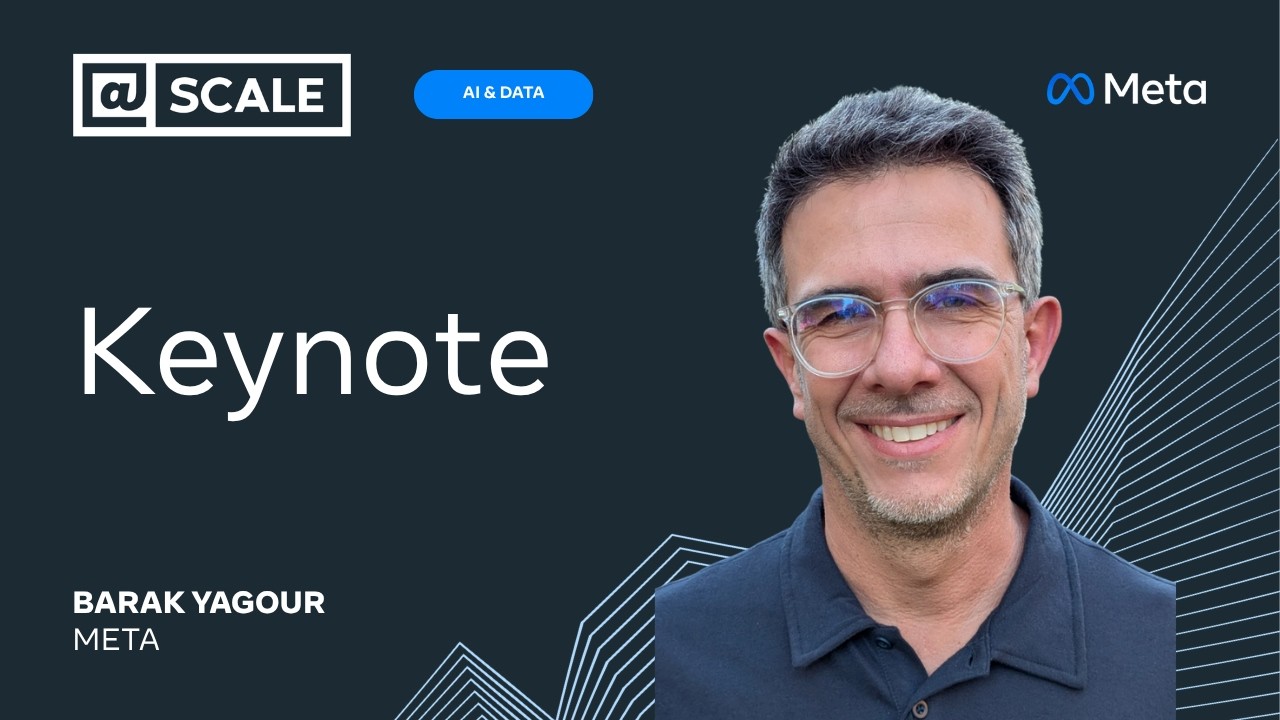
@Scale
Autonomous AI agents are breaking conventional capacity, identity, and velocity limits, forcing Meta to replace legacy batch storage with real-time streaming architectures capable of sustaining 500 million queries per second.
AI-assisted summary of Keynote at AI & Data | Barak Yagour from Meta — original source. Check the original for full context.
Source published:
Key ideas
- Automated internet traffic reached 51% last year, expanding eight times faster than human traffic as autonomous agents transition into first-class infrastructure citizens. (4:10)
- Modern foundation models consume 20 times more tokens per parameter than Chinchilla-optimal thresholds, driving the need for architectures sustaining 500 million QPS and 1 petabyte per second of training read throughput. (8:41)
- Meta is shifting recommender systems from two decades of statistical pattern matching to LLM-driven intent reasoning, responding to data showing 42% of Instagram users want to directly alter the algorithm. (10:48)
- Internal deployments such as Clowntown and Malbook demonstrate multi-week autonomous workflows and agent-to-agent negotiation operating without humans in the loop. (13:58)
Detailed notes
## Background Published on YouTube by @Scale on June 19, 2026, this keynote features Barak Yagour, VP of Engineering at Meta, addressing the future of AI. The presentation explores how exploding AI workloads and autonomous agents are reshaping engineering infrastructure across Meta's applications.
## TL;DR Barak Yagour outlines how autonomous software agents and deep reasoning models are breaking legacy infrastructure assumptions around capacity, identity, and deployment velocity. To support these workloads, Meta is overhauling its storage and data pipelines, shifting away from opaque blobs and batch processing toward intelligent, real-time streaming architectures capable of 500 million queries per second and 1 petabyte per second throughput. Recommender systems are simultaneously evolving from passive statistical pattern matching into conversational, LLM-powered intent reasoning that actively interprets user goals. These components unite into a self-reinforcing AI product flywheel, where internal multi-agent orchestration frameworks like Clowntown and Malbook transition humans from being 'in the loop' to governing 'over the loop.'
## Atmosphere & style The presentation carries an authoritative, high-energy engineering tone, blending sober technical realism with the awe of hyperscale computing. Yagour delivers his points with sharp clarity and momentum, making the staggering numbers and paradigm shifts feel immediate and inevitable. Watching the keynote feels like peering inside an operational command center at an inflection point, moving from the friction of legacy systems breaking down to a striking vision of autonomous agent societies managing production software.
## Bulletin - [04:10](https://www.youtube.com/watch?v=L0BSZb7ujC8&t=250s) Automated internet traffic reached 51% last year, expanding eight times faster than human traffic as autonomous agents transition into first-class infrastructure citizens. - [08:41](https://www.youtube.com/watch?v=L0BSZb7ujC8&t=521s) Modern foundation models consume 20 times more tokens per parameter than Chinchilla-optimal thresholds, driving the need for architectures sustaining 500 million QPS and 1 petabyte per second of training read throughput. - [10:48](https://www.youtube.com/watch?v=L0BSZb7ujC8&t=648s) Meta is shifting recommender systems from two decades of statistical pattern matching to LLM-driven intent reasoning, responding to data showing 42% of Instagram users want to directly alter the algorithm. - [13:58](https://www.youtube.com/watch?v=L0BSZb7ujC8&t=838s) Internal deployments such as Clowntown and Malbook demonstrate multi-week autonomous workflows and agent-to-agent negotiation operating without humans in the loop.
## Key takeaways - [00:05](https://www.youtube.com/watch?v=L0BSZb7ujC8&t=5s) Meta committed an initial $115 million to establish America's Workforce Academy to meet soaring demands for specialized AI and infrastructure talent. - [00:05](https://www.youtube.com/watch?v=L0BSZb7ujC8&t=5s) Coding agents and autonomous operators are moving humans from being 'in the loop' to managing systems 'over the loop'. - [04:10](https://www.youtube.com/watch?v=L0BSZb7ujC8&t=250s) Agent workloads break traditional infrastructure across capacity, identity, and velocity because systems were architected around predictable human sessions. - [04:10](https://www.youtube.com/watch?v=L0BSZb7ujC8&t=250s) A single engineer can deploy hundreds of agents that trigger infrastructure load equivalent to 100,000 human users. - [06:03](https://www.youtube.com/watch?v=L0BSZb7ujC8&t=363s) Adoption of agentic data apps drove 63% of Meta's internal dashboards within three months, triggering a 30x increase in agent queries and requiring new governance frameworks. - [08:41](https://www.youtube.com/watch?v=L0BSZb7ujC8&t=521s) Deep reasoning models require full cross-surface chronological histories rather than legacy sparse feature vectors, making 24-hour batch ETL obsolete. - [10:22](https://www.youtube.com/watch?v=L0BSZb7ujC8&t=622s) Infrastructure storage is moving away from opaque blobs to intelligent layers that dynamically retrieve specific columns and temporal windows to eliminate GPU starvation. - [10:48](https://www.youtube.com/watch?v=L0BSZb7ujC8&t=648s) Recommender systems are evolving toward conversational interfaces powered by chain-of-thought reasoning that differentiate identical queries by user context. - [12:47](https://www.youtube.com/watch?v=L0BSZb7ujC8&t=767s) Autonomous agents, intelligent real-time data storage, and reasoning models form a self-reinforcing product flywheel powering Meta's ecosystem for 3.5 billion users. - [13:58](https://www.youtube.com/watch?v=L0BSZb7ujC8&t=838s) Meta's Clowntown framework allows multi-week semi-autonomous task execution, keeping engineering projects moving without active human presence. - [13:58](https://www.youtube.com/watch?v=L0BSZb7ujC8&t=838s) Experimental environments like Malbook explore synthetic social dynamics where agents interact and negotiate directly with other agents. - [13:58](https://www.youtube.com/watch?v=L0BSZb7ujC8&t=838s) The next frontier for infrastructure scale shifts from supporting billions of humans to managing billions of humans alongside millions of concurrent superintelligent agents.
## Detailed walkthrough ### [00:05](https://www.youtube.com/watch?v=L0BSZb7ujC8&t=5s) The Exploding Scale of AI and Meta's Product Loop
Every year at the @Scale Conference, attendees expect massive scale numbers, but this year represents an unprecedented inflection point where the pace of change enables results that were unimaginable just twelve months prior. The relentless appetite for compute has sparked massive data center construction across the industry at an unseen scale. To meet the soaring demand for specialized talent, Meta recently made an initial $115 million investment to build America's Workforce Academy. Across software engineering, the proportion of AI-generated code is breaking records, and agentic token consumption is multiplying by orders of magnitude quarter-over-quarter.
```mermaid flowchart LR accTitle: Meta Core Product Loop with AI Models accDescr: End-to-end loop showing user interactions generating data that trains models to power recommendation systems and product UI.
subgraph ConsumerSpace["Consumer Interaction"] User["Instagram / App User"] Surface["Product Surfaces / UI"] end
subgraph DataAndAI["Data & Model Processing"] DataStream["User Engagement Data"] Models["Large Language, Vision & Speech Models"] RecSys["Dynamic Recommender Systems"] end
User -->|"interacts with"| Surface Surface -->|"generates"| DataStream DataStream -->|"trains & feeds"| Models Models -->|"powers"| RecSys RecSys -->|"updates & personalizes"| Surface ```
Every day, 3.5 billion people interact with Meta's family of apps, supported by complex infrastructure across machines, energy, data centers, hardware, software, privacy, and integrity. In the traditional product loop, an Instagram user interacts with surface UI, generating massive streams of data. That data feeds dynamic recommender systems powered by large language, vision, and speech models, which in turn shape what the user experiences next. While this entire lifecycle was once exclusively designed, deployed, and monitored by human engineers, coding agents can now one-shot large codebases, manage data pipelines, evaluate analytical reports, execute machine learning experiments, and even construct other models.
- **Talent Investment**: Meta committed an initial $115 million toward building America's Workforce Academy. - **Daily Meta User Base**: 3.5 billion people engage daily across Meta's family of applications. - **Agent Evolution**: Moving from task-specific coding assistants to autonomous operators that can run with proper guardrails for hours, days, or weeks while humans transition from being "in the loop" to "over the loop."
---
[04:10](https://www.youtube.com/watch?v=L0BSZb7ujC8&t=250s) Infrastructure Citizens: When Capacity, Identity, and Velocity Break
A massive structural inversion is occurring in infrastructure. Last year, automated internet traffic officially surpassed human traffic, reaching 51% and expanding eight times faster than human traffic. Inside internal systems, agents are no longer just software features; they have become first-class infrastructure consumers. For twenty years, infrastructure architectures were optimized around predictable, session-based human habits bounded by biological constraints—humans sleep, eat, and get distracted, whereas autonomous agents operate continuously without natural pauses.
```mermaid flowchart TD accTitle: The Three Core Infrastructure Failure Modes Caused by AI Agents accDescr: Diagram illustrating how agents cause capacity, identity, and velocity to break simultaneously in systems designed for humans.
Agents["First-Class Infrastructure Agents"]
subgraph FailureModes["Simultaneous System Bottlenecks"] Cap["1. Capacity Breaks<br/>(1 engineer = 100s of agents = 100k user load)"] Ident["2. Identity Breaks<br/>(Not a human badge, service, or static batch job)"] Vel["3. Velocity Breaks<br/>(Code written in seconds vs. slow legacy CI/CD pipelines)"] end
Agents --> Cap Agents --> Ident Agents --> Vel ```
This sudden shift breaks three fundamental systems simultaneously:
1. **Capacity Breaks**: Historically, one engineer equated to one unit of load. Today, a single engineer can spin up dozens or hundreds of agents that spawn sub-agents, enabling an organization of 1,000 engineers to generate the infrastructure load of 100,000 users overnight. 2. **Identity Breaks**: An agent does not hold an employee badge, it was not provisioned as a static service by a production engineer, and it cannot be categorized as a dumb batch job because it makes active, dynamic decisions. 3. **Velocity Breaks**: GitHub Copilot already writes 46% of code for its users. While agents author code in seconds, legacy CI/CD pipelines, build systems, test suites, and deployment monitors remain tied to human cycle times.
- **Automated Web Traffic**: Automated bots/agents account for 51% of all internet traffic and are growing 8x faster than human traffic. - **GitHub Copilot Adoption**: Writes 46% of code for developers using the platform.
---
[06:03](https://www.youtube.com/watch?v=L0BSZb7ujC8&t=363s) Democratizing Data Apps and Establishing Agent Governance
Data sits at the core of all business decisions, recommendation engines, and next-generation foundation models. In February, Meta introduced the ability to build agentic data applications. Within just three months, 63% of all dashboards published across the company were built through data apps, driving a 30x explosion in agentic queries. However, eliminating traditional human data analysts—who historically served as domain gatekeepers understanding regulatory, privacy, and contextual nuances—introduces severe enterprise risks when questions are posed by agents or non-experts lacking context.
To address these vulnerabilities, Meta and industry partners are restructuring data interfaces, compliance guardrails, and observability frameworks:
- **Dinkar's Session**: Covers moving away from rigid data interfaces toward end-to-end data apps that let non-experts and agents assemble custom data products independently. - **Komal's Session**: Focuses on agent governance, safety, and compliance as mandatory prerequisites rather than optional add-ons: "autonomy without governance is chaos." - **Alex from Snorkel's Session**: Highlights agent observability, evaluations, benchmarks, and data quality standards when agents transition from advisory recommendation systems to autonomous decision-makers.
---
[08:41](https://www.youtube.com/watch?v=L0BSZb7ujC8&t=521s) The Scale of Modern Reasoning and Real-Time Data Infrastructure
The volume and complexity of data required for model training and inference is expanding at an extraordinary rate. Since 2022, the ratio of training data to active parameters in open-weight LLMs has surged by 3.1x each year. State-of-the-art models are trained on 20 times more data per parameter than the optimal ratios originally proposed by the 2022 Chinchilla scaling laws. Beyond language models, core business systems like recommendation and ranking engines (e.g., Lexis) require ever-increasing volumes of rich data.
```mermaid flowchart LR accTitle: Evolution from Pattern Matching to Deep Reasoning Data Requirements accDescr: Comparison of sparse feature vectors used in pattern matching versus full cross-surface behavioral history required for reasoning models.
subgraph Legacy["Pattern Matching"] Sparse["Sparse Feature Vectors<br/>(Summarized Signals)"] BatchETL["24-Hour Batch ETL"] end
subgraph Modern["Deep Reasoning Models"] FullHistory["Full Cross-Surface Behavioral History<br/>(Complete Action Stream)"] StreamPipeline["Real-Time Streaming Pipelines"] end
Sparse -.->|"evolves to"| FullHistory BatchETL -.->|"replaced by"| StreamPipeline ```
The underlying architectural demand is driven by the fact that "reasoning is hungry." Unlike legacy pattern matching that operates on sparse, summarized feature vectors, advanced reasoning requires a full cross-surface chronological view of user behavior over time. These models are already driving substantial performance gains across Meta's ad-ranking and organic recommendation pipelines. Supporting these workloads demands a complete overhaul of storage and processing architectures:
- **Target Throughput**: Meta is engineering systems capable of sustaining 500 million queries per second (QPS) and 1 petabyte per second of training data read throughput. - **Chinchilla Over-Training**: Modern foundation models consume 20x more tokens per parameter than the 2022 Chinchilla scaling optimal threshold. - **Real-Time Streaming**: Traditional 24-hour batch ETL pipelines are being replaced with low-latency streaming architectures because reasoning over real-time intent cannot tolerate batch delays. - **Intelligent Storage**: Data storage layers must evolve from passive repositories into active, intelligent components capable of supporting real-time streaming and high-bandwidth retrieval.
[10:22](https://www.youtube.com/watch?v=L0BSZb7ujC8&t=622s) Rethinking the Storage Layer: From Opaque Blobs to Intelligent Data Retrieval
The historic approach to managing user data relied on storing information as opaque blobs with zero internal awareness of what was contained inside. This lack of visibility triggered massive over-fetching and severe GPU starvation, as compute pipelines were forced to pull unnecessary data across the network. To resolve this bottleneck, Meta is fundamentally restructuring the storage tier so that the storage layer itself understands the data it serves. Rather than relying on rigid, fixed schemas, the new infrastructure pulls only the exact columns and time ranges required, delivering data in flexible formats designed to feed modern architectures efficiently.
- **Opaque Blobs vs. Intelligent Storage**: Replaced blind blob retrieval with a storage layer that inspects and interprets data natively to end GPU starvation. - **Selective Retrieval**: The system dynamically fetches targeted columns and specific temporal windows instead of entire user histories. - **Deep-Dive Session**: The engineering mechanics of this architecture are explored further in the conference's dedicated sequence storage session.
[10:48](https://www.youtube.com/watch?v=L0BSZb7ujC8&t=648s) The Next Era of Recommender Systems: From Pattern Matching to Intent Reasoning
Recommender systems represent the heartbeat of Meta's product ecosystem, connecting, entertaining, and serving billions of people daily while driving meaningful double-digit revenue growth year over year. Yet for nearly two decades, the core philosophy behind recommender systems has remained virtually unchanged: observe user behavior, extract statistical patterns, and predict the next action. While these systems grew increasingly sophisticated, they remained confined to pattern matching. Large language models shatter that paradigm. For the first time, recommender systems can move beyond correlating behavioral signals to actively reasoning about human intent—understanding who a person is rather than merely what they clicked.
This architectural evolution directly addresses a profound consumer demand: 42% of Instagram users report that they want to change the algorithm, not merely tweak a minor setting, but fundamentally alter what surfaces in their feeds. Meeting this expectation requires abandoning the passive model where the algorithm is "something that happened to you" and replacing it with an experience directed by the user. The North Star is fully conversational recommendations powered by chain-of-thought reasoning, balancing an individual's historical preferences against their real-time context. Under this paradigm, identical queries yield vastly different results tailored to intent: a query for "soccer" returns entertaining highlights for a casual fan, but serves structured training drills to a competitive club athlete.
```mermaid flowchart TD accTitle: Evolution of Recommendation Systems accDescr: Diagram contrasting traditional pattern-matching recommendation systems with LLM-based intent reasoning systems.
subgraph Legacy["Legacy Paradigm (Past 2 Decades)"] A["Observed Behavior & Clicks"] --> B["Statistical Pattern Matching"] B --> C["Passive Ranking (Algorithm happens to you)"] end
subgraph Modern["Modern LLM Paradigm"] D["User Directives & Natural Language"] --> E["Intent Reasoning & Chain-of-Thought"] F["Real-Time Context & History"] --> E E --> G["Conversational Recommendation (User directs algorithm)"] end ```
[12:47](https://www.youtube.com/watch?v=L0BSZb7ujC8&t=767s) Closing the Loop: The AI-Driven Product Flywheel
Bringing these architectural threads together reveals that storage optimization, agentic workflows, and reasoning models are not isolated developments—they represent a total transformation of Meta's core product loop (Consumer, Product, Data, and Recommendations) serving 3.5 billion people daily. Software agents are no longer external tools used merely to build the loop; they are becoming active "citizens" inside it, analyzing data, running discoveries, and operating alongside human engineers.
Concurrently, data infrastructure is transitioning from slow batch pipelines and opaque blobs into intelligent, real-time storage layers capable of satisfying the extreme freshness, scale, and flexibility demands imposed by reasoning models. This feedback cycle operates as an accelerating flywheel rather than linear progress: autonomous agents streamline data accessibility, enriched data enables deeper model reasoning, and the demands of reasoning push agent capabilities and infrastructure forward once again.
```mermaid flowchart LR accTitle: The AI Product Flywheel accDescr: The self-reinforcing flywheel linking Agents, Data Infrastructure, and Reasoning Models.
Agents["Autonomous Agents<br/>(Citizens in the loop)"] -->|"Increases accessibility"| Data["Intelligent Data Layer<br/>(Real-time, flexible)"] Data -->|"Powers deep context"| Reasoning["Reasoning Models<br/>(Intent-driven recommendations)"] Reasoning -->|"Drives new demands & scale"| Agents ```
[13:58](https://www.youtube.com/watch?v=L0BSZb7ujC8&t=838s) Internal Agent Deployments and the Autonomous Future at Scale
Within Meta, autonomous agents are already operating in production across several experimental and enterprise frameworks:
- **Domain Task Agents**: Specialized agents embedded across engineering organizations to execute code generation, operational troubleshooting, and deep data analysis. - **Clowntown**: A multi-agent orchestration framework designed for long-horizon autonomy. Engineers deploy multi-week agents that make semi-autonomous system decisions without requiring a human in the loop, allowing projects to progress even while team members are away on vacation. - **Malbook**: An experimental agent-to-agent social network where autonomous systems interact, communicate, and negotiate directly with one another while human engineers act as "flies on the wall" observing synthetic social dynamics. - **The Frontier Loop**: An executive-level synthesis engine that aggregates complex, high-context documents, project updates, and organizational communications, converting raw operational noise into synthesized briefs primed for leadership decision-making.
A decade ago, the @Scale conference originated around the challenge of architecting systems capable of supporting a billion people. The mandate for the coming era centers on scaling infrastructure to support billions of humans alongside millions of superintelligent agents operating concurrently. In this emerging reality, machine learning models will no longer depend strictly on manual human training cycles; instead, autonomous agents will train, continuously tune, and adapt models in real time. This co-creation between humans and agents marks an inflection point where engineering focus shifts away from incremental 10% gains toward inventing entire categories of software that do not yet exist.
## Notable quotes > [00:05](https://www.youtube.com/watch?v=L0BSZb7ujC8&t=5s) humans transition from being 'in the loop' to 'over the loop.' — Barak Yagour
> [04:10](https://www.youtube.com/watch?v=L0BSZb7ujC8&t=250s) Historically, one engineer equated to one unit of load. Today, a single engineer can spin up dozens or hundreds of agents that spawn sub-agents, enabling an organization of 1,000 engineers to generate the infrastructure load of 100,000 users overnight. — Barak Yagour
> [04:10](https://www.youtube.com/watch?v=L0BSZb7ujC8&t=250s) An agent does not hold an employee badge, it was not provisioned as a static service by a production engineer, and it cannot be categorized as a dumb batch job because it makes active, dynamic decisions. — Barak Yagour
> [06:03](https://www.youtube.com/watch?v=L0BSZb7ujC8&t=363s) autonomy without governance is chaos — Komal
> [08:41](https://www.youtube.com/watch?v=L0BSZb7ujC8&t=521s) reasoning is hungry — Barak Yagour
> [10:48](https://www.youtube.com/watch?v=L0BSZb7ujC8&t=648s) 42% of Instagram users report that they want to change the algorithm, not merely tweak a minor setting, but fundamentally alter what surfaces in their feeds. — Barak Yagour
> [10:48](https://www.youtube.com/watch?v=L0BSZb7ujC8&t=648s) something that happened to you — Barak Yagour
> [10:48](https://www.youtube.com/watch?v=L0BSZb7ujC8&t=648s) The North Star is fully conversational recommendations powered by chain-of-thought reasoning, balancing an individual's historical preferences against their real-time context. — Barak Yagour
> [13:58](https://www.youtube.com/watch?v=L0BSZb7ujC8&t=838s) flies on the wall — Barak Yagour
> [13:58](https://www.youtube.com/watch?v=L0BSZb7ujC8&t=838s) The mandate for the coming era centers on scaling infrastructure to support billions of humans alongside millions of superintelligent agents operating concurrently. — Barak Yagour
## Mentioned Barak Yagour, Meta, @Scale Conference, America's Workforce Academy, Instagram, GitHub Copilot, Dinkar, Komal, Alex, Snorkel, Chinchilla, Lexis, Clowntown, Malbook, The Frontier Loop
## Video description Hear from Barak Yagour, VP of Engineering at Meta, about the future of AI.
Want to learn more about the @Scale Conference? Visit our website here: atscaleconference.com
[Source](https://www.youtube.com/watch?v=L0BSZb7ujC8)