US Pacific Air Hub Faces Okinawan Backlash Amid China Strike Risk
Okinawa vs the US Military: The Decades-Long Feud — Wendover Productions

Wendover Productions

The strategically vital Kadena Air Base traps local Okinawans in the crosshairs of a potential Chinese first strike while subjecting the island to ongoing legal, environmental, and economic exploitation.

AI-assisted summary of Okinawa vs the US Military: The Decades-Long Feud — original source. Check the original for full context.

Source published:

Detailed notes

## Background Published on YouTube on January 16, 2026, by Wendover Productions, this video explores the deep-seated tensions between the local population of Okinawa and the massive US military presence on the island. The description promotes an annual subscription to the creator-owned streaming platform Nebula at a 50% discount and links to Wendover's original series, The Logistics of X.

## TL;DR The video examines the intense geopolitical and cultural friction on Okinawa, a tiny Japanese island that simultaneously serves as a bustling tourist destination and the massive, suburbanized 'keystone' of American air power in the Pacific. Rooted in the bloody legacy of World War II and formalized by Cold War-era treaties, a staggering 20% of the island's landmass is occupied by US military bases, which enjoy extreme legal insulation under the 1960 Status of Forces Agreement (SOFA). This arrangement has fueled decades of local outrage over unprosecuted sexual violence, severe environmental dumping, and physical safety hazards like aircraft crashes. As China's stance toward Taiwan grows more aggressive, Okinawa finds itself trapped in the crosshairs of global superpowers, shifting from a secure forward staging ground into a high-priority potential target for a first strike.

## Atmosphere & style The narrative style is analytical yet deeply poignant, striking a somber and urgent tone that contrasts the vibrant, laid-back local Okinawan culture with the fenced-in, manufactured Americana of the military bases. The host guides the viewer through an unsettling emotional arc, moving from the casual energy of tourists and high school football games into the dark realities of jurisdictional inequality and toxic chemical spills. It feels like a high-stakes investigative documentary, heavy with historical irony, leaving the audience with a troubling sense of vulnerability as a distinct indigenous population bears the environmental and existential costs of decisions made by distant global powers.

## Key takeaways - [00:00](https://www.youtube.com/watch?v=624QcAMbLxI&t=0s) Okinawa operates as a claustrophobic juxtaposition where 1.5 million permanent residents and 700,000 monthly tourists share a tiny island with sprawling, self-contained US military installations. - [02:14](https://www.youtube.com/watch?v=624QcAMbLxI&t=134s) Kadena Air Base represents the largest American military footprint in the Pacific, simulating a massive Midwestern suburb complete with its own schools, housing, and golf courses. - [03:04](https://www.youtube.com/watch?v=624QcAMbLxI&t=184s) The massive military presence was established during the brutal Battle of Okinawa in 1945 and permanently locked in place by post-war Cold War strategy and Japanese pacifist treaties. - [04:48](https://www.youtube.com/watch?v=624QcAMbLxI&t=288s) Okinawans possess a distinct indigenous culture and history separate from mainland Japan, and they suffered the highest civilian casualty rate of the Pacific war with 150,000 dead. - [08:09](https://www.youtube.com/watch?v=624QcAMbLxI&t=489s) The 1960 Status of Forces Agreement (SOFA) creates profound jurisdictional friction, heavily insulating US military personnel from the Japanese legal system and lowering their prosecution rate to just 13%. - [10:50](https://www.youtube.com/watch?v=624QcAMbLxI&t=650s) Densely populated civilian neighborhoods face constant physical danger from adjacent bases, highlighted by a 2004 helicopter crash into a local university campus and falling aircraft components. - [10:50](https://www.youtube.com/watch?v=624QcAMbLxI&t=650s) The island suffers severe, hidden environmental degradation from toxic chemical burials, raw sewage leaks, and fuel spills that contaminate local drinking water, shielded from local inspection by SOFA rules. - [10:50](https://www.youtube.com/watch?v=624QcAMbLxI&t=650s) Military land consumption occupies 20% of the island, creating massive economic inefficiencies compared to returned sites like Makinato, which saw a 32-fold explosion in economic value after commercial redevelopment. - [14:48](https://www.youtube.com/watch?v=624QcAMbLxI&t=888s) Okinawa remains strategically vital to the US 'island chain strategy' as the closest military facility to Taiwan, meaning grand military strategy consistently overrides local protests. - [16:10](https://www.youtube.com/watch?v=624QcAMbLxI&t=970s) A November 2025 readiness exercise at Kadena practicing rapid runway repairs signals an ominous shift, implicitly admitting the base is now a primary target for a potential enemy first strike.

## Detailed walkthrough ### [00:00](https://www.youtube.com/watch?v=624QcAMbLxI&t=0s) Two Worlds Colliding on a Tiny Island

On Friday, October 24th, 2025, Okinawa is buzzing with activity. It is a popular month for tourists, who wander the vibrant shops and restaurants of Kokusai Street before ambling south into the covered, energetic Makkeshi Public Market. Despite the subtropical heat reaching 90° Fahrenheit (32°C), waves of visitors—mostly hailing from mainland Japan—head to the island's beautiful beaches or explore the comparatively cooler climates of its national parks and nature forests. Others hop onto ferries to explore the natural beauty of neighboring islands. The tourists disperse according to their desires: foodies ramble through the cities while free divers head for the coral-lined coasts. However, on an island spanning only 463 square miles (1,200 square kilometers)—roughly three-quarters the size of Oahu, Hawaii—there is only so far they can go. With 700,000 monthly visitors joining a permanent population of 1.5 million (which is 50% larger than Oahu's), space is always at a premium.

Simultaneously, an entirely different kind of Friday tradition is unfolding on the exact same island. For the Americans living here, fall Fridays mean high school football. The Kubasaki High School (KBHS) Dragons are preparing to host the Humphrey High School Blackhawks for a game that will crown a regional champion. To a casual observer, the scene feels entirely ordinary: American players playing American football, surrounded by American parents and fans cheering in the stands. The school campus directly neighbors a Qdoba, Popeyes, and Burger King on one side, and suburban neighborhoods on the other. But zooming out reveals a striking juxtaposition. This quintessential slice of Middle America sits on the very same tiny, beach-fringed tourist island.

This is Okinawa, Japan—a place that takes a mere two hours to drive across from tip to tail, yet hosts two completely different worlds at once. It serves as the absolute core of the American Air Force's presence in the Pacific. All the cultural trapping of exported Americana runs headlong into a proud, distinct local culture and a densely populated society with "little wiggle room, divergent goals, an imbalance in power, a complicated history, and an uncertain future." For decades, these worlds and ways of life have continually collided.

* **Okinawa Land Mass:** 463 square miles / 1,200 square kilometers (3/4 the area of Oahu). * **Population Metrics:** 1.5 million permanent residents with roughly 700,000 tourists arriving per month. * **Climate on October 24, 2025:** Reaching 90°F / 32°C.

[02:14](https://www.youtube.com/watch?v=624QcAMbLxI&t=134s) Kadena Air Base: The Largest Footprint in the Pacific

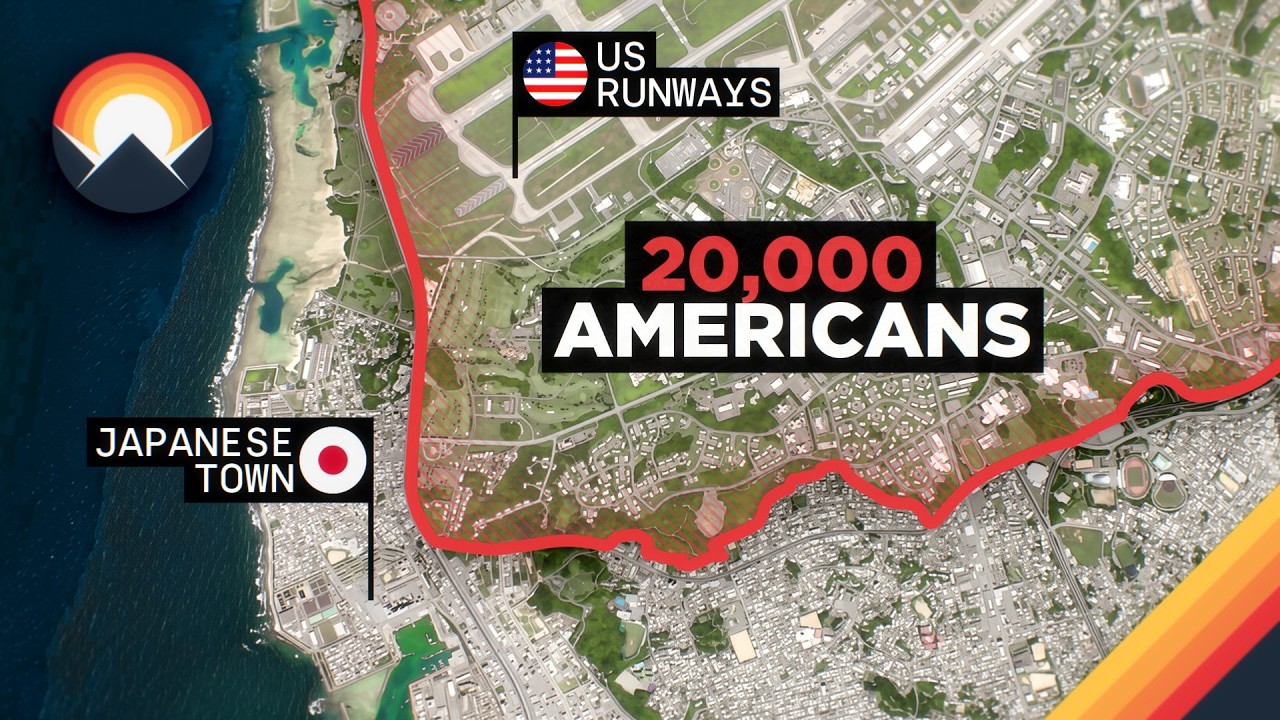
The epicenter of this hotly contested military presence is best summarized by the home of Kubasaki High School’s rival, Kadena High School. Enrolling 717 students, it holds the title of the largest American high school in Japan. "Largest is a theme here." By personnel, Kadena is the largest American air base in the Pacific, housing around 20,000 people. It is operated by the 18th Wing, a massive unit capable of everything from direct combat to resupplying and air-sea rescues. The wing commands a highly diverse assortment of roughly 80 aircraft and helicopters. Furthermore, the base's wing support group—which manages everything from accommodations, logistics, and budgeting to recreation and base mayoral duties—is the largest in the entire United States Air Force.

Hemmed in tightly by urban Okinawa on both sides, the physical footprint of the base simulates a massive American suburb. It boasts its own golf course, countless parks, sports fields, and extensive housing developments that, when viewed from above, look like they could belong to any suburban town in the American Midwest.

* **Kadena High School Enrollment:** 717 students. * **Base Personnel:** Approximately 20,000 military and civilian members. * **18th Wing Arsenal:** Around 80 pieces of aerial equipment (planes and helicopters).

[03:04](https://www.youtube.com/watch?v=624QcAMbLxI&t=184s) The Historical Roots of Occupation

The story of how Kadena became such a massive bastion is directly linked to the event that gave Okinawa its global name recognition: the Battle of Okinawa. Widely recognized as the longest and bloodiest battle of the Pacific theater, it served as the final major clash before the Japanese surrender. Overtaking these islands, located so close to the Japanese mainland, took months of brutal fighting. Making landfall in April 1945, United States troops immediately seized what was then a Japanese airstrip at Kadena. Securing this central foothold allowed US forces to base their subsequent assaults from the area, utilizing the commandeered airfield. By the time Okinawa fell and Japan surrendered, the US had already firmly established its operations on the island.

As World War II concluded, it transitioned directly into the American occupation of Japan. Simultaneously, the geopolitical landscape fractured into the Cold War. With an increasingly aggressive North Korea looking to forcefully unify the Korean Peninsula and the rise of the Chinese Communist Party, keeping a permanent military foothold in Okinawa became a logical strategic choice for the United States.

From a legal and geopolitical standpoint, this arrangement also suited mainland Japan due to post-war treaties. Under Article 9 of the 1947 Constitution of Japan, the nation surrendered its right to make war or maintain a standing army. To secure its national defense, Japan relied entirely on the US, granting America permission to maintain a military presence within its borders. Crucially, under Article 3 of the San Francisco Peace Treaty, Okinawa was separated from mainland administration, leaving it to be run solely by the United States. Dictated by terms of peace from the rest of the world, Japan had little reason to object to the expansion of American bases on Okinawa; the territory was no longer legally theirs to manage, and the installations actively protected Japanese interests. For the allied global powers, dotting this strategically advantageous island with as many bases as it could bear made perfect sense. For the local people living on the island, however, they simply did not have a say.

[04:48](https://www.youtube.com/watch?v=624QcAMbLxI&t=288s) The Okinawan Identity and the Cost of War

Beyond the draw of warm weather and sandy beaches, Okinawa’s primary appeal to modern tourists is how vastly it differs from mainland Japan. Though recognized as Japanese citizens today—and formally incorporated into Japan from 1879 until World War II—Okinawans are a proudly distinct ethnicity celebrating a unique history and heritage native to the Ryukyu Islands. While the central Japanese government does not officially recognize them as a distinct minority group, the United Nations has explicitly recommended that Okinawans be considered an indigenous group to safeguard their local culture and endangered dialects. Centuries of intermingling have created similarities to mainland Japan, but because the island’s largest city is geographically much closer to Shanghai, Fuzhou, and Taipei than it is to Tokyo, the culture retains a heavy Chinese influence. This is reflected in their distinct cuisine and a notoriously laid-back way of life.

Historically, these regional differences have been exploited by larger warring nations. While estimates vary, 150,000 is the commonly cited number of Okinawan civilians and local conscripts who lost their lives during the Battle of Okinawa. This staggering figure means local residents suffered the highest casualty rate of the conflict. Stuck helplessly in the middle of a brutal war, civilians faced atrocities committed by both Japanese and American soldiers.

Once the island transitioned fully under American military command, local Okinawan interests continued to be largely ignored. The island was forced to adopt the US dollar, and cars were made to drive on the right side of the road. As regional conflicts in Korea and Vietnam escalated, requiring massive surges in military resources, American bases aggressively expanded across the island's most desirable flatlands. This physical displacement forced the growing native Okinawan population to construct increasingly dense, congested urban centers. Frustrated by this ever-expanding military occupation and a local economy that lagged far behind the post-war boom of mainland Japan, Okinawans pushed heavily for a reversion to Japanese rule. They finally achieved this in 1972. However, because Japan remained a pacifist nation reliant on the US for defense, the central government saw little reason to challenge the size or quantity of the bases. Consequently, the status quo has remained virtually unchanged.

* **Geographic Proximity:** Okinawa's largest city is closer to Taipei, Shanghai, and Fuzhou than to Tokyo. * **Okinawan Casualties (WWII):** Approximately 150,000 civilians and conscripts killed. * **Year of Reversion:** 1972, when Okinawa was returned to Japanese administration.

[06:38](https://www.youtube.com/watch?v=624QcAMbLxI&t=398s) Inside the Simulated America

Though Cold War-era bases have rightsized slightly over the decades and small parcels of land have been returned here and there, the military footprint remains staggering. Within the base boundaries, roughly 30,000 active-duty military personnel from all service branches work, live, and train. They are accompanied by an additional 50,000 American civilians who make full-time operations possible. This population includes military families, schoolteachers, and diverse support staff, with incomes ranging from a grocery store clerk earning $40,000 a year to an elementary school principal making $110,000.

Within the secured fences of installations like Kadena Air Base, Camp Foster, or Marine Corps Air Station Futenma, the environment represents far more than a collection of novelty fast-food joints or football stadiums. "Rather, these simply are the US." Featuring comprehensive Pre-K through 12th-grade school systems, robust after-school activities, recreation centers, and base exchanges that function as full-scale shopping malls, these bases do not merely remind residents of America—they simulate it completely. Children born on these bases—including high-profile celebrities like Robert Griffin III and Zach Bryan—are not granted dual or Japanese citizenship; they are born strictly as American citizens. However, while heavily fenced, these bases are highly permeable in one direction: American service members regularly pour out onto the wider island. Due to severe housing crunches on base, many service members are required to live off-base, while those who do live inside are actively encouraged to explore the island during their off-duty hours. This structural overlap is where the majority of local friction originates.

* **US Population in Okinawa:** ~30,000 active-duty service members and ~50,000 American dependents/support staff. * **Salary Examples:** $40,000/year for base grocery workers; $110,000/year for elementary school principals.

[08:09](https://www.youtube.com/watch?v=624QcAMbLxI&t=489s) Jurisdictional Friction and the Status of Forces Agreement

When Okinawa surfaces in recent global news, it is frequently driven by viral incidents of friction, such as a high-profile video depicting an American military policeman brutally body-slamming an individual who ultimately turned out to be an American veteran over whom the officer had no legal jurisdiction. The root cause of where and why these incidents occur is informed by an uneasy cultural overlap and a strict set of rules established in 1960. This specific altercation transpired on Gate 2 Street, an area where Kadena Air Base directly gives way to a section of Okinawa City packed with bars and nightclubs heavily frequented by base personnel. The individual was approached by American military police in the early morning hours and ordered to show identification.

The fact that American military police patrol off-base in a foreign country frequently raises the eyebrows and concerns of local Okinawans. However, it is explicitly permitted under the bilateral Status of Forces Agreement (SOFA) between Japan and the United States. This agreement dictates that American MPs can patrol off-base under specific, mutually agreed-upon circumstances, though their legal jurisdiction is strictly limited to US service members.

The underlying reason the police were out demanding IDs in the first place was to enforce an active ban prohibiting off-base service members from drinking between the hours of 1:00 a.m. and 5:00 a.m. This restrictive curfew was implemented in direct response to a string of domestic violence and assault cases committed by US service members against local Okinawan women. Attempting to curb late-night drinking is a repetitive strategy on the island, as crime and sexual assault perpetrated by US personnel remain persistent issues. Severe, high-profile cases of sexual violence and murder followed by massive public protests have repeatedly rocked the island across the 1990s, 2010s, and 2020s.

Adding significant fuel to these periodic public flare-ups is a widespread, deeply entrenched local belief that only a tiny fraction of sexual violence is ever fairly reported, investigated, or tried by the Japanese and military legal systems. The local population possesses a compelling argument. Under the 1960 SOFA agreement, US forces are uniquely insulated from local law. For any crimes committed directly on base premises or while on official duty, the United States military retains primary jurisdiction. In these circumstances, the official paper trail can easily vanish. Through Freedom of Information Act (FOIA) requests, a journalist discovered that out of seven separate sexual assault investigations handled on the island between 2017 and 2019, absolutely none were disclosed to the public.

For offenses and arrests that occur off-base and off-duty, cases are technically pursued through the Japanese legal system. However, if a service member manages to flee back onto the base, the US retains the legal right to consent to or withhold extradition. Furthermore, even if a suspect is apprehended off-base by local authorities, they cannot be taken into custody for pre-trial questioning before formal prosecution charges are filed. Together, these unique legal protections make it extraordinarily difficult for Japanese authorities to build a case and successfully prosecute. As a result, Japan frequently declines to pursue charges. Between 2001 and 2018, the formal prosecution rate for criminal offenses committed by US military personnel stood at a meager 13%, compared to a 44% national prosecution rate for Japanese citizens. Because of a deal struck six decades ago, Okinawans feel entirely abandoned by the justice system, leaving them uniquely vulnerable.

* **Off-Base Drinking Ban Hours:** 1:00 a.m. to 5:00 a.m. * **Prosecution Disparity (2001–2018):** 13% prosecution rate for US military personnel vs. 44% nationwide for the general public.

[10:50](https://www.youtube.com/watch?v=624QcAMbLxI&t=650s) Physical Hazards, Environmental Damage, and Land Inefficiency

While one major local grievance is structural in a legal sense, another is deeply physical. A simple overhead view makes it glaringly obvious that Okinawa's major military installations sit directly adjacent to densely populated, high-density urban areas. Consequently, any accident occurring on base threatens to instantly impact civilian neighborhoods. This danger manifested clearly in 2004, when a Marine Corps helicopter based out of Futenma crashed directly into the campus of an adjacent neighboring university. Although miraculously no one died, Okinawans have consistently protested the locations and relentless operational busyness of the bases over fears that the next accident will result in a mass-casualty tragedy.

Locals fear their luck will inevitably run out, pointing to a string of alarming safety failures: * In 2016 alone, there were eight separate military aircraft crashes in and around the island. * The 2012 deployment of the accident-prone and highly maligned MV-22 Osprey stoked massive local pushback. * Occasional loose helicopter components have physically fallen from the sky, landing directly onto elementary school and daycare properties.

Beyond these sudden dramatic accidents, the island suffers from chronic, dangerous pollution leaking silently from the military facilities. Once again, the 1960 Status of Forces Agreement severely hinders accountability, making it nearly impossible to obtain an accurate baseline of environmental contamination because Japanese environmental officials are legally barred from inspecting the bases. Japanese authorities are permitted entry to inspect only when a confirmed spill has breached a specific, verified volume. Otherwise, the bases are left entirely to their own internal devices.

Despite this opacity, a 2016 FOIA request shed significant light on extensive historical dumping on the island since the 1990s. In 2011, a major diesel spill occurred, followed by a severe raw sewage leak from Kadena in 2013; both hazardous materials made their way directly into the Hija River, which local municipalities and the base itself rely on for clean drinking water. Furthermore, polychlorinated biphenyls (PCBs)—toxic chemicals banned in the US in 1979—were improperly buried near the base in the 1970s. This came to light only after a military whistleblower prompted a formal testing program that discovered widespread soil and water contamination across the installation. In the 2010s, further revelations emerged regarding systematic chemical dumping in ravines surrounding the base during the 1960s, triggering severe anxiety for nearby residents and local schools. While official military statements assured the public that cleanups were fully successful and posed no future health risks, 107 pages of official test results within the released FOIA materials were completely redacted. This environmental toll is compounded by severe air and noise pollution, as toxic jet fuel fumes and the deafening howl of F-35 fighter jets are woven into everyday civilian life.

Beyond environmental hazards, the sheer scale of land consumption causes intense economic frustration. A staggering one-fifth (20%) of the entire island's landmass is occupied by the US military. While land owners receive financial compensation from the government, the rent paid is incredibly meager when contrasted against the massive economic potential of this highly favorable flat land.

The profound financial benefit of reclaiming this land is demonstrated by two distinct historical precedents:

| Reclaimed Site | Former US Military Use | Modern Redeveloped Use | Economic Impact | |:--- |:--- |:--- |:--- | | **Awase Meadows** | Golf Course (1950s onwards; featured a popular, affordable clubhouse restaurant) | Massive shopping mall (surpassing 10 million customers), high-rise residential housing, and a major hospital. | Directly serves local community needs and significantly stimulates the regional economy. | | **Makinato Housing Project** | Dispersed military housing complex in Naha (returned to Okinawa in 1987) | Bustling commercial center featuring housing developments, museums, public parks, and retail shops. | A 2015 Okinawan government study found the land generated **$33 million** as US housing, but exploded to **$1 billion** as a commercial district—a **32-fold increase**. |

American-style suburban land design is inherently inefficient anywhere, but on a tiny island managing an enormous population density, installations like Kadena—with its massive golf course and sprawling residential neighborhoods like Marec Park, Washington Heights, Stilwell Park, and Sterling Heights—represent the absolute height of land inefficiency. If the military paid rent that accurately reflected the real commercial value of this flat land, the cost would be absurdly high.

Despite these compounding local grievances, there is little indication that the situation is bound to change anytime soon. While the exact strategic lines of potential conflict in the Far Pacific have evolved, the overarching US military strategy remains remarkably identical to its 1950s framework. This relies heavily on the classic "island chain strategy," wherein the United States utilizes Okinawa as a critical forward base to contain Asian communist powers.

[14:48](https://www.youtube.com/watch?v=624QcAMbLxI&t=888s) The Keystone of the Pacific and the Shadow of China

Okinawa occupies a critical and increasingly tense position within the first island chain, sitting right on its northern edge and in close proximity to the Chinese mainland. This strategic geography dictates American power projection through localized Pacific island bases, with Kadena Air Base serving as the nearest U.S. facility to Taiwan. As China adopts an increasingly aggressive stance toward Taiwan, Kadena's geopolitical role has intensified; it is no longer viewed simply as a hub to project American might, but potentially as the first line of response. This has earned the base its reputation as the "keystone of the Pacific." Consequently, local frustrations regarding relentless flyovers, noise, and environmental pollution take a back seat to grand strategy. Any reduction in the size or stature of the base will not be triggered by local protests, but rather by U.S. military strategists reacting to China's maneuvers, leaving Okinawans to face the grim reality of history repeating itself as they bear the consequences of decisions made by a faraway power.

From a broader geopolitical standpoint, Japan's interests as a sovereign nation heavily align with those of the United States, particularly regarding regional security concerns. Even though Okinawa is a Japanese prefecture populated by Japanese nationals—giving Tokyo a direct say in land allocation—national security considerations ultimately outweigh the plight of the local islanders. While Japanese authorities hear and may even sympathize with Okinawan complaints, having a dense cluster of bases positioned far from the main Japanese home islands, yet highly optimal for countering the region's biggest threats, is too valuable to compromise. In fact, rather than scaling back, Japan has actually begun positioning its own missiles on other Okinawan islands as its independent domestic military capabilities steadily expand.

* **Geographic Positioning:** Okinawa sits on the northern edge of the first island chain, split between two island clusters close to mainland China. * **Proximity to Flashpoints:** Kadena Air Base is the closest American military installation to Taiwan. * **Japanese Military Expansion:** Tokyo is actively deploying its own missile defense systems to outlying Okinawan islands.

[16:10](https://www.youtube.com/watch?v=624QcAMbLxI&t=970s) The Reality of Exercise BH261 and the Threat of First Strike

Recent military activities on the island signal an ominous shift in how a future conflict might unfold. In November of 2025, the 18th Air Wing at Kadena undertook a rigorous readiness exercise designated as "BH261". The core objective of this drill was to practice and accelerate the air wing's ability to make rapid runway repairs on the fly. While official military press releases framed the operation as a resounding success, the perspective from the ground in Okinawa was deeply unsettling. Local residents recognize that practicing to repair bombed-out runways is an implicit admission of a terrifying new reality: Kadena is no longer just a secure forward operating base for launching American aircraft, but is now "potentially also a first target."

This shift places the local population in a vulnerable position. For decades, the island's residents have mobilized and called out for a fundamental change in their militarized status, yet the changes currently materializing are "not necessarily for the better." Instead of experiencing a drawdown of forces, Okinawa remains trapped at the mercy of the exact same large global powers that devastated it during World War II, while simultaneously slipping directly into the crosshairs of a third.

[17:04](https://www.youtube.com/watch?v=624QcAMbLxI&t=1024s) Creator Subscriptions and the Growth of Nebula

Shifting gears to a much lighter topic, the narrator transitions into a promotional segment by noting that while things on Okinawa are changing for the worse, what is "only getting better as time goes on" is the current season of the travel game show *Jetlag: The Game*. Viewers can currently catch up on season 16 of the show on YouTube, but the narrator points out there is a superior way to watch. By signing up for the streaming platform Nebula—the official sponsor of the video—fans can stay a full week ahead of the YouTube release schedule and completely skip advertisements. Nebula is highlighted as a platform founded directly "by creators for creators," which has been instrumental in helping high-effort projects like *Jetlag* get off the ground and secure funding.

The narrator emphasizes that Nebula’s library is getting deeper every day, pointing to other high-production projects available on the platform, such as creator Joe Scott’s original series *Oldest and Newest Places on Earth*. This show takes Scott out of his traditional studio setting and sends him into the wide world to explore unique geological formations, blending educational content with authentic travel elements. Whether viewers are looking for early access to standard channel libraries, platform-exclusive Nebula Originals, heavy documentaries, or full-length films, the platform provides a space where creators can push creative boundaries, take risks, and utilize larger production budgets. To incentivize the audience, a special promotional rate is offered to join the community.

* **Platform Sponsorship:** Nebula is a creator-owned streaming service hosting exclusive content, ad-free viewing, and early access. * **Featured Content:** *Jetlag: The Game* (Season 16) and Joe Scott's travel-geology hybrid show *Oldest and Newest Places on Earth*. * **Promotional Pricing Offer:** An annual subscription is available at a 50% discount, bringing the total price to $30 for 12 months, which breaks down to just "$2.50 a month".

## Notable quotes > [00:00](https://www.youtube.com/watch?v=624QcAMbLxI&t=0s) little wiggle room, divergent goals, an imbalance in power, a complicated history, and an uncertain future.

> [02:14](https://www.youtube.com/watch?v=624QcAMbLxI&t=134s) Largest is a theme here.

> [06:38](https://www.youtube.com/watch?v=624QcAMbLxI&t=398s) Rather, these simply are the US.

> [16:10](https://www.youtube.com/watch?v=624QcAMbLxI&t=970s) potentially also a first target.

> [16:10](https://www.youtube.com/watch?v=624QcAMbLxI&t=970s) not necessarily for the better.

> [17:04](https://www.youtube.com/watch?v=624QcAMbLxI&t=1024s) only getting better as time goes on

> [17:04](https://www.youtube.com/watch?v=624QcAMbLxI&t=1024s) by creators for creators,

> [17:04](https://www.youtube.com/watch?v=624QcAMbLxI&t=1024s) $2.50 a month

## Mentioned Wendover Productions, Sam Denby, Tristan Purdy, Alexander Williard, Sara Stoltman, Gabriel Ferreras, Austin Glass, Kate Ermolenkko, Manni Simon, Dony Bullen, Simon Buckmaster, Okinawa, Kadena Air Base, Kubasaki High School, Humphrey High School, Kadena High School, 18th Wing, Camp Foster, Marine Corps Air Station Futenma, Robert Griffin III, Zach Bryan, Status of Forces Agreement, San Francisco Peace Treaty, United Nations, Awase Meadows, Makinato Housing Project, Nebula, Jetlag: The Game, Joe Scott, Oldest and Newest Places on Earth

[Source](https://www.youtube.com/watch?v=624QcAMbLxI)

中文简报

面对中国打击风险 美军太平洋航空枢纽遭遇冲绳民意反弹 具有关键战略地位的Kadena空军基地让冲绳当地民众沦为中国潜在先发制人打击的目标,同时也让该岛持续承受法律、环境与经济层面的侵害。 该视频审视了日本冲绳岛上激烈的地缘政治与文化冲突。冲绳是一座狭小的岛屿,既是热闹的旅游胜地,又是美国在太平洋地区空中力量庞大且郊区化的“基石”。源于二战的血腥遗存并通过冷战时期条约予以固定,全岛多达20%的土地被美军基地占据,而这些基地在1960年《驻日美军地位协定》(SOFA)下享有极高的法律豁免与保护。这种机制安排引发了当地数十年来对未受起诉的性暴力、严重的环境废弃物倾倒以及军机坠毁等安全隐患的强烈愤怒。随着中国对台湾的立场日益强硬,冲绳发现自身深陷全球超级大国的交火对峙之中,正从一个安全的前沿集结地转变为潜在先发制人打击的高优先级目标。 冲绳呈现出一种令人压抑的并存状态:150万常住居民和每月70万名游客,与设施自成一体且不断蔓延的美军基地共同挤在这一狭小的岛屿上。 (0:00) Kadena空军基地是美军在太平洋地区最大的军事据点,宛如一个庞大的美国中西部郊区,配有独立的学校、住宅和高尔夫球场。 (2:14) 这一庞大的军事存在始于1945年惨烈的冲绳战役,并在战后冷战战略及日本和平条约的推行下被永久固定下来。 (3:04) 冲绳人拥有不同于日本本土的独特本土文化与历史,且在太平洋战争中承受了最高的平民伤亡率,死亡人数达15万人。 (4:48) 1960年签订的《驻日美军地位协定》(SOFA)造成了严重的管辖权冲突,使美军人员很大程度上免受日本司法系统追责,其起诉率仅为13%。 (8:09)

Reading summary

Wendover Productions argues that Okinawa remains deeply conflicted as a densely populated tourist destination that doubles as the core of American military power in the Pacific. While geopolitical tensions with China and alliance commitments reinforce the strategic necessity of the bases for Tokyo and Washington, local Okinawans continue to bear outsized safety, economic, and legal burdens. Exported Americana on a Crowded Island (0:00) Covering just 463 square miles, Okinawa hosts 1.5 million permanent residents and absorbs roughly 700,000 monthly tourists while simultaneously operating as the linchpin of the US Air Force's regional presence. Within installations like Kadena Air Base—the largest American air base in the Pacific with roughly 20,000 personnel—the US military simulates an American suburb, complete with housing tracts, schools, and shopping facilities. Overall, the island houses roughly 30,000 active-duty service members and 50,000 civilian dependents and staff. Because base housing is limited, American service members regularly live off-base or spend off-duty hours in the local community. This sharp juxtaposition places an exported slice of Middle America alongside a distinct Ryukyuan culture and creates intense spatial pressure on an island where land is scarce. Postwar Treaties and Jurisdictional Immunity (3:04) The US military footprint originated with the 1945 Battle of Okinawa, which killed an estimated 150,000 local civilians and conscripts. Under the 1947 Japanese Constitution, Japan renounced its right to maintain a military, and the subsequent San Francisco Peace Treaty placed Okinawa under separate American administration until 1972. Even after reversion to Japan, the bases remained intact to uphold Japan's national security umbrella without local consent. Tensions frequently flare over the 1960 Status of Forces Agreement (SOFA), which limits Japanese jurisdiction over US service members. Off-duty offenses that occur on-base remain under primary US control, and suspects off-base cannot be subjected to pre-trial questioning before formal charges are filed. Between 2001 and 2018, the prosecution rate for criminal offenses by US military personnel was 13%, compared to a 44% rate for Japanese nationals, fostering deep local distrust after recurring instances of domestic violence and sexual assault. Physical Hazards and Economic Opportunity Costs (10:50) Safety hazards and environmental degradation pose persistent risks to neighboring civilian zones. Bases sit immediately adjacent to dense urban centers, demonstrated by a 2004 helicopter crash into an adjoining university and eight military aircraft crashes in and around the island in 2016. Furthermore, FOIA records revealed historical environmental dumping, including PCBs buried in the 1970s, a 2011 diesel spill, and a 2013 sewage leak into the Hija River, while SOFA rules largely bar Japanese authorities from conducting environmental base inspections. Military installations occupy 20% of Okinawa's landmass, tying up prime flat land that locals argue could generate far higher returns. For example, the former Makinato Housing Project generated $33 million while used for US housing, but redevelopment into a commercial district exploded its value 32-fold to $1 billion. Low government rents paid to local landowners fail to offset these massive opportunity costs. The Taiwan Strait and First-Strike Vulnerability (14:48) Despite local protests, Washington and Tokyo view Kadena Air Base as irreplaceable due to its position along the first island chain as the closest American installation to Taiwan. Tokyo's strategic priorities align with the United States to counter Chinese influence, leading Japan to install its own missile units on outlying Okinawan islands rather than reduce the military footprint. Recent training drills highlight an escalating threat: in November 2025, Kadena's 18th Air Wing conducted Exercise BH261 to practice rapid runway repair under attack. Local residents view such drills as confirmation that Okinawa is no longer merely a rear staging ground for projecting American force, but likely a primary target in any potential conflict over Taiwan. Okinawa remains trapped between decisions made by distant powers in Tokyo and Washington and growing regional risks from Beijing. Although residents demand legal reforms, land restitution, and safety guarantees, escalating Pacific tensions make any substantial military drawdown unlikely.

精炼阅读摘要

Wendover Productions指出,尽管冲绳在美日地缘战略中被定位为遏制区域对手与护卫太平洋安全的“基石”,但高度集中的美军基地长期占据该岛核心平原与资源,在法律管辖、安全事故与生态污染上给当地带来沉重负担,使原住民与本地居民在宏观地缘博弈中持续被边缘化。 土地过度占用与美式郊区化的空间挤压 (2:14) 冲绳岛陆地面积仅463平方英里(约1200平方公里),约为夏威夷欧胡岛的四分之三,却承载着150万常住人口及每月约70万的入境游客,土地资源极其匮乏。然而,美军基地占据了全岛约20%的土地。以太平洋地区规模最大的美军空军基地嘉手纳(Kadena Air Base)为例,该基地由第18联队运作,部署约80架战机与直升机,容纳近2万名军民人员。全岛总计驻扎约3万名美军现役官兵及5万名美籍家属和文职人员。基地内部宛如美国中西部郊区,建有高尔夫球场、中小学体系、大型购物中心及独栋住宅区,与周边高密度的冲绳本土社区形成尖锐反差。 节目强调,这种美式郊区化布局在狭小海岛上极度缺乏土地利用效率,美军支付的租金远低于该类平原土地的真实商业潜力。历史土地收回案例证实了其经济价值差距:那霸市牧港住宅区(Makinato Housing Project)于1987年归还后被改造为商业中心,冲绳县政府2015年研究表明,该地块年产值从美军住宅时期的3300万美元暴增至商业区的10亿美元,激增32倍;泡濑草甸(Awase Meadows)原美军高尔夫球场归还后亦被改建为服务逾千万客流的大型商场、医院及高层公寓,显著拉动了地方经济。 战后条约架构与琉球历史创伤 (4:48) 冲绳在历史上拥有独特的琉球群岛原住民文化,其主要城市在地理上距离台北、福州和上海远比东京更近,饮食与习俗受中国影响深远。尽管联合国明确建议将冲绳人列为原住民以保护其本土文化与濒危方言,但日本政府至今未在法律层面认定其少数族群地位。在1945年被称为太平洋战区最血腥的冲绳战役中,约15万名冲绳平民及当地应征人员丧生,承受了全战役最高比例的人员伤亡。 战后条约架构进一步锁定了冲绳的被动处境。依据1947年《日本国宪法》第九条,日本放弃交战权与常备军,将防务完全托付美军;依据《旧金山和约》第三条,冲绳脱离本土管辖并由美军单独实施军事统治。为应对朝鲜与越南战争,美军强占冲绳最优良的平原地带扩建基地,迫使本地人口向狭窄市区密集聚居。尽管冲绳民众经长期抗争后于1972年重归日本施政,但因日本中央政府高度依赖美军安全保障,基地规模并未实质削减,驻军格局延续至今。 地位协定特权与司法追责的长期失衡 (8:09) 美军人员与当地社会的日常摩擦深受1960年《美日地位协定》(SOFA)的法律不对等影响。协定允许美军宪兵在特定条件下于基地外巡逻。美军虽针对反复发生的美军针对当地女性实施家庭暴力和性侵害案件设立了凌晨1:00至5:00的基地外禁酒宵禁,但恶性治安事件仍屡屡发生,引发多次大规模抗议。 冲绳民众普遍指责司法体系对涉案美军人员存在系统性偏袒。根据协定条款,美军在基地范围内或执行公务期间所犯罪行享有第一审判管辖权,其内部调查极度缺乏透明度;调查记者通过《信息自由法》(FOIA)获取的档案显示,2017至2019年间美军处理的7起性侵调查均未向公众披露。对于非公务时间的基地外犯罪,若嫌疑人逃回基地,美军有权扣留或决定引渡;日本警方在正式起诉前也无法对嫌疑人实施羁押审讯。数据显示,2001年至2018年间涉嫌刑事犯罪的美军人员在日实际起诉率仅为13%,远低于日本全国44%的公民起诉率,令冲绳居民深感在司法层面缺乏基本保障。 密闭基地的安全事故与未公开污染 (10:50) 由于美军基地紧邻高密度居民区,军事行动给周边社区带来了持续的物理威胁。2004年,一架海军陆战队直升机坠毁于冲绳国际大学校园;2016年冲绳周边区域共发生8起美军军机坠毁事故;2012年部署的MV-22鱼鹰运输机因事故多发遭广泛抵制;甚至多次出现直升机零部件直接掉落至小学或日托中心屋顶的严重险情。此外,F-35战斗机的剧烈噪音和燃油废气已成为周边居民不可规避的日常公害。 基地内部污染亦因地位协定限制而长期缺乏外部透明监管,日本环境官员除非经确认泄漏量达到特定标准,否则无权入内检查。2016年FOIA解密文件显示,2011年嘉手纳基地曾发生重大柴油泄漏,2013年更发生原污水泄漏,均直接排入基地与地方共用的饮用水源比谢川(Hija River)。此外,1970年代基地周边曾不当掩埋美国已禁用的多氯联苯(PCBs),1960年代亦存在沟壑系统性倾倒化学品的记录;尽管军方声称清理达标且无健康风险,但在公开的FOIA材料中,涉及水土测试结果的107页记录被全数涂黑屏蔽。 地缘前沿定位与首波打击目标的战备隐患 (14:48) 在美军第一岛链防御体系中,冲绳处于核心前沿,嘉手纳空军基地更是美军距离台湾最近的军事枢纽,被称为“太平洋的拱顶石”。随着台海局势与大国竞争升级,东京政府将国家安全置于冲绳地方诉求之上,不仅未缩减基地,反而在冲绳外围离岛加紧部署日本自卫队的导弹防御系统。 2025年11月,嘉手纳基地第18联队进行了代号为“BH261”的战备演习,重点演练对受损跑道的紧急快速修复能力。虽然美军官方将演习宣传为重大成功,但冲绳社会对此感到深切不安。本地居民意识到,演练抢修遭轰炸跑道实质上承认了嘉手纳在潜在冲突中已不再是单纯的安全出击前哨,而是随时可能沦为“第一波打击目标”。冲绳民众数十年来呼吁去军事化的努力不仅未见成效,反而在大国对抗前沿被推向更危险的火力中心。 Wendover Productions总结认为,冲绳基地的长期僵局根植于宏观地缘防务需求与微观地方生存利益的深刻对立。在《美日地位协定》与美日安全同盟的刚性约束下,冲绳居民承担了巨大的土地损耗、司法不公、环境破坏与前沿战备风险;只要大国在西太平洋的对抗态势未见缓和,基地削减便难以提上日程,冲绳社会亦将继续在大国博弈的阴影下寻求生存自主。

Detailed notes — zh

## Background 该视频由知名知识科普频道 Wendover Productions 于 2026 年 1 月 16 日发布在 YouTube 平台。视频简介主要提供了创作者流媒体平台 Nebula 的半价年费订阅推广、衍生节目《The Logistics of X》的观看入口,并列出了脚本撰写、剪辑、动画与声音制作等幕后团队名单与社媒联络方式。 ## TL;DR 视频深入揭示了冲绳本岛在度假天堂光环之下,与占据其核心资源的美军基地之间长达数十年的结构性矛盾。历史根源上,二战冲绳战役的惨重代价与战后《旧金山和约》确立的美治框架,使冲绳承载了不成比例的驻军负担;而在现实生活中,美军享有的司法豁免特权、频发的恶性犯罪、军机坠毁威胁以及持久的化学公害污染,令当地民众不堪重负。此外,美式低效的土地占用极大阻碍了冲绳本土的经济发展潜能,产出差距甚至高达数十倍。如今随着台海与西太平洋局势升温,冲绳再度被绑架在“第一岛链”前沿,面临从美军进攻跳板沦为首轮导弹打击靶心的致命深渊。 ## Atmosphere & style 全片采用 Wendover 标志性的严谨论述与精细图表呈现,开篇以明媚的热带海岛度假景象与原汁原味的美式橄榄球赛形成强烈反差,迅速拉开现实荒谬感的序幕。随着对司法黑箱、环境剧毒文件及历史条约的层层解构,叙事风格从冷静客观的社会观察逐步走向沉重而冷峻的地缘悲剧剖析。解密文件与战备演习的揭露更给整部作品蒙上了一层紧迫而窒息的阴云,传达出冲绳身处大国博弈十字路口却无法掌控自身命运的深刻无力感。 ## Bulletin - [00:00](https://www.youtube.com/watch?v=624QcAMbLxI&t=0s) 冲绳主岛面积仅占夏威夷瓦胡岛的四分之三,却在承载150万常住人口及每月70万游客的同时,划出整整20%的黄金土地供驻日美军专属使用。 - [02:14](https://www.youtube.com/watch?v=624QcAMbLxI&t=134s) 嘉手纳空军基地驻扎约20,000人并配备80架军机,是美军在太平洋最大的空军基地,内部完整复制了美式郊区城镇及中小学教育系统。 - [09:00](https://www.youtube.com/watch?v=624QcAMbLxI&t=540s) 受《驻日美军地位协定》(SOFA)管辖权屏障影响,2001至2018年间美军人员在冲绳刑事犯罪起诉率仅13%,远低于日本全国44%的平均水平。 - [13:01](https://www.youtube.com/watch?v=624QcAMbLxI&t=781s) 冲绳县官方研究显示,美军交还的牧港住宅区在改造为民用商贸中心后,年经济效益从3300万美元暴增至10亿美元,产出提升超30倍。 - [14:31](https://www.youtube.com/watch?v=624QcAMbLxI&t=871s) 在台海局势升温及第一岛链战略下,冲绳从过去的进攻跳板演变为战时首轮打击目标,2025年嘉手纳基地开展的跑道紧急抢修演习加深了当地被推上火线的恐慌。 ## Key takeaways - [00:00](https://www.youtube.com/watch?v=624QcAMbLxI&t=0s) 冲绳空间极其逼仄,繁华的本土度假旅游业与高墙内的美军飞地社区在同一狭小岛屿上形成鲜明而紧张的平行世界。 - [02:14](https://www.youtube.com/watch?v=624QcAMbLxI&t=134s) 嘉手纳空军基地规模冠绝太平洋战区,其前身为1945年冲绳战役美军抢占的日军跑道,并由此奠定了现代基地的庞大骨架。 - [02:14](https://www.youtube.com/watch?v=624QcAMbLxI&t=134s) 冷战爆发后,《旧金山和约》将冲绳从日本本土剥离由美国单独军政托管,使其成为东京与华盛顿地缘博弈中毫无发言权的牺牲品。 - [04:48](https://www.youtube.com/watch?v=624QcAMbLxI&t=288s) 冲绳拥有深厚独特的琉球文化认同,但在二战冲绳战役中承受了逾15万平民及被征召者丧生的浩劫,且战后长期被强占平原良田。 - [04:48](https://www.youtube.com/watch?v=624QcAMbLxI&t=288s) 1972年冲绳施政权返还日本后,受限于日本和平宪法的防务依赖,庞大的美军基地群网络未发生实质性收缩。 - [06:38](https://www.youtube.com/watch?v=624QcAMbLxI&t=398s) 基地内部生活着约3万名现役官兵及5万名家属文职,完备的纯美式生活系统因基地住房紧张而单向渗透至冲绳本土社区,引发持续社会摩擦。 - [08:08](https://www.youtube.com/watch?v=624QcAMbLxI&t=488s) 美军宪兵依据《美日地位协定》(SOFA)在基地外商业街公然巡逻与执法,引发冲绳居民对主权受损和人身安全的强烈愤慨。 - [09:00](https://www.youtube.com/watch?v=624QcAMbLxI&t=540s) 《美日地位协定》赋予美军优先管辖权与引渡否决权,导致针对当地居民的性侵与暴力犯罪极难得到公开公正起诉,起诉率不足日本本土的三分之一。 - [10:50](https://www.youtube.com/watch?v=624QcAMbLxI&t=650s) 基地跑道与密集居民区犬牙交错,从2004年直升机坠毁大学校园到频繁的坠机隐患与零件掉落,平民社区时刻笼罩在航空事故阴影下。 - [10:50](https://www.youtube.com/watch?v=624QcAMbLxI&t=650s) 美军基地排斥外部环保核查,解密档案曝光其长期存在柴油泄漏、污水外排比谢川及非法掩埋PCBs等剧毒化学品的严重公害记录。 - [13:01](https://www.youtube.com/watch?v=624QcAMbLxI&t=781s) 低密度的美式郊区化土地利用方式严重挤占海岛优质平原资源,泡濑高尔夫球场与牧港住宅区交还后的巨额经济爆发印证了基地的经济枷锁效应。 - [14:31](https://www.youtube.com/watch?v=624QcAMbLxI&t=871s) 作为第一岛链北段核心要冲,冲绳被美军视作遏制对手的“太平洋基石”,东京与华盛顿的安全捆绑使当地呼吁基地撤离的诉求被彻底边缘化。 - [14:31](https://www.youtube.com/watch?v=624QcAMbLxI&t=871s) 嘉手纳基地加紧演练遭袭后的跑道极限抢修科目,暴露出在潜在亚太战端中,冲绳正从进攻前哨沦为首先承受导弹暴雨打击的十字准星靶标。 ## Detailed walkthrough ### [00:00](https://www.youtube.com/watch?v=624QcAMbLxI&t=0s) 同一岛屿上的两重平行世界:旅游胜地与美式橄榄球之夜 2025年10月24日星期五,冲绳正处于一年中最热闹的时节。作为炙手可热的度假海岛,成群结队的游客穿梭在繁华的那霸国际通商业街,品尝特色美食,或者转入充满市井烟火气的牧志公设市场。尽管已是金秋,气温依然高达32摄氏度(90华氏度)。来自日本本土的大批游客涌向碧海白沙的海滩,或钻入岛上遍布的自然与国家公园,在亚热带森林的清凉树荫下漫步;还有人选择搭乘轮渡前往周边的离岛探寻原生美景。无论是寻觅珍馐的美食客,还是探访珊瑚礁的自由潜水者,人潮漫布在海岛各处。然而,冲绳主岛面积仅有463平方英里(约1200平方公里),只相当于夏威夷瓦胡岛(Oahu)面积的四分之三,从南到北驱车只需两个小时。在如此逼仄的空间里,面对每月高达70万的游客涌入量,以及比瓦胡岛还要高出50%的150万常住人口,整座海岛无时无刻不在高速运转。 就在这同一个周五下午,另一幕纯正的美式文化正在岛上映演。在美军基地内的库巴萨基高中(Kubasaki High School),看台上挤满了热情的美国学生、家长与球迷,KBHS飞龙队正严阵以待,准备迎战远道而来的驻韩美军汉弗莱斯高中(Humphreys High School)黑鹰队,争夺区域冠军的荣耀。校门一侧排列着Qdoba、Popeyes和汉堡王等美式快餐连锁,另一侧则是典型的美国中产郊区住宅区。这种纯正的高中秋季美式橄榄球赛在美国本土稀松平常,但若将镜头拉远,就会发现这片浓郁的“美式飞地”竟然与挤满游客的日本冲绳海滩嵌在同一个狭小的岛屿上。冲绳构成了美国空军在太平洋地区的核心支柱,而这种强势注入的美式生活,正直接撞向当地深厚独特的本土文化、稠密而逼仄的人口空间、截然不同的利益诉求,以及极度不对称的权力结构。几十年来,两种截然不同的文明与生活方式在这片狭小土地上不断摩擦与碰撞。 - 冲绳主岛面积约463平方英里(1200平方公里),南北纵跨仅需2小时车程。 - 常住人口达150万,每月平均接待约70万名游客。 - 基地内部设施完备,包含库巴萨基高中(Kubasaki High School)、各类全美连锁快餐及标准化美式社区。 ### [02:14](https://www.youtube.com/watch?v=624QcAMbLxI&t=134s) 太平洋最大美军基地:嘉手纳基地的庞大体量与二战根源 要理解这片岛屿上高度紧张的地缘对峙,最典型的缩影莫过于库巴萨基高中的宿敌所在地——嘉手纳高中(Kadena High School)。这所学校拥有717名在校生,是全日本规模最大的美国高中。在冲绳,“规模最大”是一个随处可见的标签。就人员编制而言,容纳约20,000名人员的嘉手纳空军基地是美国在整个太平洋地区最大的空军基地;负责基地运作的第18联队具备作战、补给与搜救等多重机能,配备了大约80架飞机与直升机,机队配置在整个空军首屈一指;而承担基地食宿、物流、预算、文娱以及“市政管理”职能的第18联队支援大队,更是全美空军体系中规模最大的后勤保障组织。基地内部甚至拥有独立的高尔夫球场、不计其数的球场与公园,以及连绵的郊区独立洋房,俯瞰下去就像是从美国中西部直接平移复制过去的城镇,然而其高墙之外却被紧邻的冲绳本土密集的城市建筑团团包围。 嘉手纳基地之所以拥有如此庞大的规模,直接归因于冲绳被卷入现代历史的残酷起点。冲绳战役被公认为太平洋战争中最为血腥、持续时间最长的一役,同时也是日本投降前的最后一场大规模正面对决。1945年4月美军登陆之初,首要目标就是占领日军修建的嘉手纳简易跑道。美军以此为跳板在冲绳中部站稳脚跟,随后的各项攻势均以此处为核心枢纽展开。在冲绳陷落、日本最终宣布无条件投降之时,美军早已在岛上建立了牢固的军事运作基地。随着二战结束、美军对日单独占领,以及冷战阵营对抗的迅速成型——北面对峙着谋求半岛统一的朝鲜,西面迎接着崛起的中国,冲绳由于得天独厚的地缘区位,迅速被美军视为不可替代的前沿阵地。 ```mermaid flowchart TD accTitle: 冲绳美军基地的历史演进图 accDescr: 展示从1945年冲绳战役美军占领嘉手纳跑道,到冷战形成、法律条约确立美国排他性统治及基地的长期留存过程。 subgraph Phase1["1945年:战争与占领"] A["1945年4月:美军登陆冲绳"] --> B["夺取日军嘉手纳跑道作为据点"] B --> C["冲绳战役结束与日本无条件投降"] end subgraph Phase2["战后初期:法理与地缘定型"] C --> D["冷战爆发:朝鲜半岛与东亚地缘剧变"] D --> E["《日本国宪法》第九条:日本放弃战争权与军队"] E --> F["《旧金山和约》第三条:冲绳由美国单独施政"] end subgraph Phase3["基地常态化"] F --> G["美军大肆占用平原良田扩建基地"] G --> H["1972年冲绳施政权交还日本,但庞大基地群全面保留"] end ``` 这种布局不仅符合美国的利益,在当时日本本土政府看来也顺理成章。根据战后《日本国宪法》第九条规定,日本永久放弃发动战争的权利,也不得保有海陆空及其他战争力量;为了获取防务保护,日本选择依附于美军庇护,允许美军在本土驻扎。更为关键的是,根据《旧金山和约》第三条,冲绳从日本本土的行政管辖中被彻底剥离,由美国单独实施排他性的军政统治。在由外部战胜国主导和平条约的框架下,东京方面没有任何动力去反对美军在冲绳扩建基地,因为这片土地在当时甚至在法理上已不再归属于日本,而且基地还能替日本本土分担防御压力。对盟国大国而言,把这座战略要冲点缀满密密麻麻的军事基地是绝对理性的算计,但对于岛上世代生活的本地住民来说,他们从始至终毫无发言权。 - 嘉手纳空军基地常驻人员约20,000人,拥有各类军机约80架,下辖全美空军规模最大的支援大队。 - 1945年4月美军登陆占领日军跑道,奠定现代嘉手纳基地的雏形。 - 《旧金山和约》第三条正式确立美军对冲绳的单独军事托管,架空了冲绳当地居民的自主自决权。 ### [04:48](https://www.youtube.com/watch?v=624QcAMbLxI&t=288s) 被夹在历史缝隙中的琉球:从战后美治到1972年“复归”本土 除了温暖的热带气候与沙滩,冲绳吸引大量游客的另一重要内核在于其与日本本土截然不同的独特异质感。尽管冲绳在1879年吞并后成为日本的一部分,并在二战后历经波折重回日本版图,但冲绳人依然保持着强烈的自我认同。他们有着自成一派的琉球群岛历史和文化传统,尽管日本政府官方并未将其归类为少数民族,但联合国多次建议日本将其认定为原住民群体,以切实保护当地濒危的方言与民俗。冲绳最大的城市距离上海、杭州以及台北的距离,远远近于东京,这使得其自琉球国时代起就深受中华文化的影响,不论是饮食结构还是从容闲适的生活节奏都自成一体。然而,这种夹在大国博弈缝隙中的独特性,在近代却数次沦为大国政治野心的代价。 在1945年血腥的冲绳战役中,普遍估计有超过15万名冲绳平民或被强征入伍者丧生,当地居民成了整场战役中伤亡最为惨重的群体。身处地狱般的火线之间,当地百姓既承受着美军的地毯式炮火轰炸,也遭受过日军逼迫自杀和残害平民的暴行。战争结束后,冲绳完全置于美军军政管制之下,冲绳人的自身诉求依然遭到漠视。岛上强制流通美元,车辆改为靠右行驶,更严重的是,随着朝鲜战争与越南战争的爆发,美军不断征用并推平全岛最平坦、最肥沃的平原土地用来建造机库和营房。这迫使原本就快速增长的冲绳本土居民不得不被挤压到残余的狭窄丘陵和平原边缘,建起密度极高的高楼与社区。因不满美军土地霸占与远远落后于日本本土的经济发展水平,冲绳爆发了长期的抗议运动,竭力要求回归日本。1972年,冲绳终于迎来了“施政权返还”,但由于日本宪法的和平主义条款依然限制自身军力发展,东京方面根本没有意愿去挑战岛上美军基地的规模和驻扎现状。冷战结束后,虽然部分零散地块偶有归还,但美军基地的基本盘依然盘踞在冲绳中南部的核心版图上。 - 冲绳战役中平民与被征召冲绳人死亡人数估计达15万人,是伤亡最为惨烈的群体。 - 美军托管时期,冲绳强制使用美元并实行车辆靠右通行。 - 1972年冲绳主权正式移交回日本,但既有的美军基地网络与土地占用格局未发生实质性松动。 ### [06:38](https://www.youtube.com/watch?v=624QcAMbLxI&t=398s) 铁丝网内的“完全美国化”与单向渗透的社会冲突 如今在冲绳军事管理区的高墙电网之内,驻扎着来自海陆空及海军陆战队各军种的约30,000名现役军人。而为了维持这支庞大部队的运转,基地内还生活着另外50,000名美国公民——他们是军人家属、随军教师以及各类文职支持人员。在基地内,一名普通的超市理货员年薪可达40,000美元,而基地小学的校长年薪则高达110,000美元。在嘉手纳基地、福斯特营(Camp Foster)或普天间海军陆战队航空基地(MCAS Futenma)高墙内,绝不仅仅只有几家美式快餐店或一座高中橄榄球场那么简单,这里本质上就是一座座货真价实的“美国本土城市”。这里配备了从学前班到12年级(Pre-K through 12th grade)的完整教育系统、课外活动基地、大型购物百货、独栋单门独院住宅区以及整齐划一的近郊绿化带,它们不仅仅是在“让人联想到美国”,而是在远隔重洋的东亚海岛上“直接模拟了美国”。那些出生在这些基地医院内的孩子(例如知名NFL四分卫小罗伯特·格里芬或乡村歌手扎克·布赖恩),出生时甚至没有任何双重国籍或日本国籍的可能,他们从啼哭的那一刻起就是纯粹的美国公民。 然而,这些封闭的基地边界在现实中呈现出残酷的“单向渗透性”。冲绳本地普通居民绝无可能随意步入基地高墙之内,但基地内部的数万名美国人却因为基地内部住房紧张,被大量安排移居到基地外部的冲绳本土居民区;而在基地内居住的官兵和雇员,在轮休时也被鼓励前往岛上游玩消费。高墙无法阻隔这种不平等的单向流动,两种价值观与生活习惯的激烈撞击,正是冲绳绝大多数社会动荡、治安冲突与抗议活动的根源所在。 - 基地内部常驻人员:约30,000名各军种现役军人,以及50,000名随军家属与联邦支持人员。 - 配备健全的Pre-K至12年级K-12完整公立教育体系及PX基地商业服务中心。 - 基地内部住房紧张迫使大量美军官兵在外租房,导致美军与冲绳本地居民在社区空间上产生不可避免的日常交织。 ### [08:08](https://www.youtube.com/watch?v=624QcAMbLxI&t=488s) 门二街的暴力执法风波:美日地位协定下的管辖权阴影 美军人员与当地社会的摩擦如果被推上国际新闻头条,往往伴随着极具冲击力的恶性事件。最近在互联网上广泛传播的一段视频,记录了一名美军宪兵(Military Police, MP)在街头粗暴地将一名男子狠狠摔倒在地的场景。讽刺的是,这名被暴力执法的受害者事后被证实是一名早已退役的美国退伍老兵,当值美军宪兵对其根本没有任何法定管辖权限。这起荒谬冲突的发生地,位于嘉手纳空军基地2号门外的“门二街”(Gate 2 Street)。这段街区恰好是基地大门向冲绳市延伸出的繁华商业区,挤满了由基地官兵长期光顾的酒吧、俱乐部与夜生活场所。在清晨时分,美国宪兵在基地外的异国商业街拦停该男子并强行要求其出示身份证件,最终引发了惨烈的肢体暴力。 美军武装宪兵在外国领土的主干道上公然巡逻与盘查,对于任何一名冲绳当地居民而言,都足以引发对主权沦丧与人身安全的强烈愤慨与不安。然而,这种常态化的基地外武装执法,依据的正是日美两国于1960年签署并执行至今的《美日地位协定》(Status of Forces Agreement, SOFA)。该协定明确授权美军宪兵在特定约定的条件下,可以跨出铁丝网在基地外围区域执行巡逻与秩序维护。正是这份赋予美军诸多特权的古老协定,使得异域军权的阴影在数十年后依然笼罩在冲绳繁华街头的上空,将历史遗留的结构性不公持续投射在每一次充满火药味的街头摩擦之中。 ### [09:00](https://www.youtube.com/watch?v=624QcAMbLxI&t=540s) 法律特权与管辖漏洞:不平等的《驻日美军地位协定》 军警在深夜街头盘查美军身份的直接原因,是一项明确的军纪禁令:基地外的现役军人在凌晨 1:00 至 5:00 期间被全面禁止饮酒。出台这一禁令与巡逻机制,是为了应对当时美军士兵对当地女性实施的一系列恶劣家庭暴力事件。然而,限制深夜饮酒在冲绳绝非新鲜手段,美军人员涉及的暴力犯罪和性侵行为更是一场绵延数十年的痼疾。从 1990 年代、2010 年代再到 2020 年代,恶性性侵与谋杀案件屡见不鲜,一次又一次引爆全岛数万人规模的抗议浪潮。更让冲绳民众怒火中烧的,是当地普遍存在的一种清醒认知:在日美两国现有的司法和军事体系下,只有极少部分针对当地民众的性暴力案件能够得到公正的公开调查与起诉审判。 冲绳人的愤怒有着无可辩驳的制度根源。根据 1960 年签署的《驻日美军地位协定》(SOFA),驻日美军享有极高规格的特殊保护屏障。只要犯罪行为发生在军事基地内部,或者嫌疑人是在“执行公务”期间作案,美国军方就拥有排他性的优先司法管辖权。在这些案件中,司法记录与卷宗往往被层层掩盖——一位记者通过美国《信息自由法案》(FOIA)调取档案后发现,在 2017 年至 2019 年间美军在冲绳展开的七起独立性侵调查中,美方竟没有向外界公开任何一起案件的详细结果。 即便犯罪发生在基地之外且属于非执勤时间,按照程序应移交日本司法体系审理,美军依然手握巨大的特权筹码。如果涉案士兵在案发后逃回基地内部,美方有权自主决定是否同意将其引渡给日方;即使士兵在基地外被日本警方当场抓获,在正式被检察机关起诉之前,日方也无权将其羁押审问。这种重重限制极大增加了日本司法部门调查取证和定罪起诉的难度,导致许多案件最终只能不了了之。数据显示,在 2001 年至 2018 年间,驻日美军人员在冲绳刑事犯罪的起诉率仅为 13%,而日本本土的全国刑事平均起诉率高达 44%。面对六十多年前白纸黑字定下的不平等条约,冲绳人深感自己在法律面前沦为“二等公民”,被剥夺了应有的正义保障。 ```mermaid flowchart TD accTitle: 驻日美军地位协定司法管辖权示意图 accDescr: 展示美军犯罪在基地内外以及执行公务与否情况下的不同管辖路径与阻碍 subgraph 基地内或执行公务 A["美军人员涉嫌犯罪"] --> B{"案发地点与状态"} B -->|"基地内 / 执行公务"| C["美军拥有优先管辖权"] C --> D["内部调查与军事法庭审理"] D --> E["信息极度封闭<br/>卷宗不予公开"] end subgraph 基地外且非公务 B -->|"基地外 / 休息时间"| F["理论上归日本司法管辖"] F --> G{"嫌疑人是否返回基地?"} G -->|"逃回基地"| H["引渡受阻:美方掌握移交否决权"] G -->|"基地外被捕"| I["起诉前禁止日方羁押审问"] H --> J["取证困难,导致放弃起诉"] I --> J J --> K["2001-2018年美军起诉率仅 13%<br/>远低于日本全国 44% 水平"] end ``` - **宵禁限酒时段**:基地外现役美军人员在凌晨 1:00 至 5:00 期间被严格禁酒。 - **调查黑箱**:记者依 FOIA 申请获知,2017 至 2019 年间美军内部进行的 7 起驻冲绳性侵调查无一向社会公开。 - **起诉率鸿沟**:2001 至 2018 年,美军人员刑事犯罪起诉率仅 13%,与日本全国平均起诉率(44%)差距悬殊。 --- ### [10:50](https://www.youtube.com/watch?v=624QcAMbLxI&t=650s) 迫在眉睫的危机:坠机噩梦与环境毒害 如果说司法制度的不公是一重无形的制度枷锁,那么军事设施对日常生活的物理挤压则是随时可能致命的现实威胁。只要从空中俯瞰冲绳本岛,就能看到极其刺目的一幕:美军最核心的大型军事基地与人口稠密的民用居民区完全犬牙交错、紧挨着彼此。密集的民房和学校包围着跑道,导致基地的任何事故都会立刻外溢成平民社区的浩劫。最典型的灾难发生在 2004 年,一架隶属于普天间空军基地的美军大型直升机失控,直接坠毁在紧邻的冲绳国际大学校园内。尽管那场事故奇迹般地未造成平民丧生,但自此之后,冲绳民众对基地选址和惊人起降密度的抗议从未停息,所有人心里都悬着一把剑,恐惧下一次事故就将成为吞噬无数生命的惨剧。 这种恐惧绝非空穴来风。仅在 2016 年一年之内,冲绳岛及其周边海域就发生了多达 8 起美军机坠毁或迫降事故;2012 年,饱受安全争议、故障频发的 MV-22 鱼鹰倾转旋翼机(Osprey)强行进驻冲绳,更是让全岛人心惶惶。美军军机零件在空中解体、掉落砸穿当地小学和托儿所屋顶的事件屡见不鲜。在冲绳家长看来,孩子们能够平安度过一天仅仅是运气好,这种“幸运”不知何时就会耗尽。 与此同时,更为隐秘却同样致命的公害污染正在这些基地深处不断向外渗漏。同样是因为《驻日美军地位协定》设立的屏障,日本环境监测人员根本无法得知美军基地内部的实际污染状况,因为日方被明确禁止进入美军基地进行常规环境核查。唯有在军方确认发生泄漏且泄漏物达到特定严重规模时,日本官员才被允许进入现场,其余时候基地完全属于不受外部环保法律约束的独立王国。 2016 年曝光的一批《信息自由法案》(FOIA)解密文件,终于撕开了冰山一角,揭露了自 1990 年代以来美军基地内惊人的污染记录: - **燃油与污水污染**:2011 年嘉手纳空军基地发生柴油泄漏;2013 年基地的污水大量外排至比谢川(Hija River),而这条河流是周边城镇和基地本身日常饮用水的重要水源地。 - **多氯联苯(PCBs)隐患**:美国本土早在 1979 年就已明令禁止使用的剧毒化学品 PCBs,早在 70 年代就被随意倾倒在基地土壤中;直到内部吹哨人举报后军方才展开检测,结果证实基地内土壤已被大范围毒化。 - **危险化学品掩埋**:2010 年代再度爆出丑闻,证实美军曾于 1960 年代在基地周围的溪谷深处非法掩埋了大量工业与军事化学品,直接威胁到邻近居民以及周边多所学校师生的健康安全。 - **报告涂黑抹消**:尽管美军官方通报宣称清理工作十分顺利、居民“无需担心”,但解密文件中整整 107 页的毒性检测数据全部被军方涂黑遮蔽。 - **日常声光公害**:除了水源被毒化、土壤被污染,漫天弥漫的航空煤油废气味道与 F-35 战斗机撕裂空气的尖锐引擎轰鸣,早已成为冲绳居民被迫忍受的日常生活底色。 --- ### [13:01](https://www.youtube.com/watch?v=624QcAMbLxI&t=781s) 土地的枷锁:美式低效用地与数十倍的经济落差 即便抛开美军的违法犯罪与污染事故不谈,单凭基地占据该岛土地的惊人规模,就已经成为冲绳人心中挥之不去的巨大挫败感来源。冲绳本岛整整五分之一(20%)的黄金土地被划归美军专属掌控。虽然日本中央政府会向冲绳业主支付租金作为土地占用补偿,但若算一算这批平坦、优质土地如果交由地方开发所能创造的经济潜能,那点微薄的租金简直不值一提。 一个具有强烈说服力的对比案例是位于冲绳市中部的原泡濑高尔夫球场(Awase Meadows Golf Course)。从 1950 年代开始,这片开阔平整的土地就被美军圈占用于高尔夫休闲。在驻日美军的描述中,这里景色宜人、人气极旺,俱乐部会所里还提供着“既美味又便宜”的招牌餐饮。然而,在当地民众坚持抗争并最终迫使美军交还土地后,冲绳人彻底改写了这片土地的命运:原本供少数军官挥杆打球的高尔夫球场,被改建成了拥有超过千万人次客流的巨型综合购物中心(永旺梦乐城冲绳来客梦)、高层现代化住宅小区以及区域性中心医院,全方位满足了当地居民的生活需求,成为拉动冲绳经济的强劲引擎。 另一个经典案例位于首府那霸附近的牧港住宅区(Makiminato Housing Area)。这片原先用于安置美军军眷的独栋低密度住宅区于 1987 年正式交还给冲绳。如今,这片土地已经华丽蜕变为极度繁华的现代商贸中心,高楼住宅、文化博物馆、公共绿地与商业步行街鳞次栉比。冲绳县政府在 2015 年专门开展的一项经济效益对比研究给出了震撼的数据: - 当该区域作为美军军眷住宅区使用时,其创造的年经济效益仅为 **3300 万美元**; - 改造为民用商业核心区后,其年经济效益飙升至约 **10 亿美元**; - 经济产出实现惊人的 **32 倍暴增**。 典型的“美式郊区化土地利用方式”本身就以低密度、低效率著称,而将其强行移植到冲绳这样一个地域狭窄、人口密集的海岛上,更是将资源浪费推向了极致。以嘉手纳空军基地为例,其内部不仅坐拥完整的高尔夫球场,还散布着马雷克公园(Marek Park)、华盛顿高地(Washington Heights)、斯蒂尔威尔公园(Stillwell Park)以及斯特林高地(Sterling Heights)等极其空旷松散的郊区化社区。如果按照真实的商业与发展价值来核算租金,维持这些美军特权社区的成本将高到令人咋舌。 --- ### [14:31](https://www.youtube.com/watch?v=624QcAMbLxI&t=871s) 第一岛链的靶心:从进攻跳板到第一轮打击目标 尽管冲绳民众对基地返还的呼声一浪高过一浪,但在现实中,想要改变这种现状的希望却极其渺茫。冷战至今,尽管西太平洋潜在军事冲突的具体轮廓不断推演变化,但美国的战略框架却惊人地停留在 20 世纪 50 年代的“岛链战略”(Island Chain Strategy)构想之中——即通过链条状部署在西太平洋关键岛屿上的军事基地网络,从海上封锁并遏制亚洲共产主义大国。 在地理格局上,冲绳地处第一岛链的北段核心要冲,距离中国大陆与台湾海峡近在咫尺。随着近年来台海局势持续升温,冲绳的地缘战略地位不降反升,被美军进一步摆在了棋局的绝对中央。作为美军在该区域距离台湾最近的大型综合空军基地,嘉手纳不仅是美军在西太平洋投射军事实力的最前沿支点,更是潜在冲突爆发时第一支直接卷入战局的力量。嘉手纳因此被美军冠以“太平洋基石”(Keystone of the Pacific)的称号。这意味着,无论冲绳当地民众对日常军机低空掠过、噪音轰鸣和环境污染有多么愤怒,只要美国军事战略家根据中国军队的动态判定这里仍具不可替代的威慑价值,基地就绝无缩编或撤离的可能。历史正在残忍地重演,冲绳人的命运依然完全受制于数千英里外超级大国强权政客的博弈算计。 从国家行政层面看,冲绳作为日本的一个县,其土地分配主权理论上属于日本中央政府。然而,东京在宏观地缘政治与防务安全上的战略考量,几乎与华盛顿完全捆绑一致。对日本防卫省而言,将大量极易引发争议、占地庞大的军事设施安置在远离日本本土四岛、却又极度靠近潜在冲突前线的地方,在国家战略算盘上反而是“最优解”。东京或许能听到冲绳同胞的哭诉与抗议,甚至在口头上表达同情,但一旦摆上“国家安全”的天平,冲绳全岛的生计与福祉便被立刻牺牲。甚至,伴随日本自身军事松绑与防务力量扩张,自卫队非但没有减缓冲绳本岛的军事压力,反而在先岛群岛等冲绳其他离岛上加码部署岸基反舰与防空导弹系统。 更为严峻的危险正在逼近。2025 年 11 月,嘉手纳空军基地的美国空军第 18 联队开展了一场代号为“BH 26-1”(Beverly High 26-1)的大规模战备演习。演习的核心科目是在遭受打击后,以极限速度现场抢修被炸毁的机场跑道。在军方对外的通稿中,这项演练被盛赞为一次圆满成功的战备测试。 但对于冲绳本地居民来说,这场演习传递出的信号令人脊背发凉。加紧演练快速修补跑道,等于军方在内部心照不宣地承认了一点:嘉手纳已经不再仅仅是美军向前发起打击的进攻跳板,一旦亚太战端开启,它必将成为对手首轮导弹暴雨倾泻的“第一号靶标”。在二战末期那场血流成河的冲绳战役中,冲绳沦为日美两军疯狂厮杀的焦土;而八十年后的今天,冲绳不仅依然被当年交战的两强绑架在战车之上,更被赫然推到了第三个新兴超级大国的导弹十字准星正中。这片岛屿呼唤和平与变革已经长达数十年,这里的局势确实在急剧变化,但滑向的却是一个更加危险的深渊。 --- ### [17:04](https://www.youtube.com/watch?v=624QcAMbLxI&t=1024s) 赞助支持与拓展阅读 在讲述完冲绳压抑沉重的地缘政治现实后,影片话题转向了由赞助商提供的内容推荐。本期视频由创作者共建流媒体平台 Nebula 赞助播出。片中提到,王牌旅行竞技节目《Jet Lag: The Game》第 16 季正在热播,观众除了可以在 YouTube 频道免费观看常规更新,还能够通过 Nebula 平台跳过广告并提前整整一周抢先解锁最新剧集。此外,Nebula 平台持续扩充优质深度内容,例如科普频道创作者 Joe Scott 推出的实地探索纪录片《地球上最古老与最新的地点》(Oldest and Newest Places on Earth),该节目带领观众走出摄影棚,实地勘探全球最具奇观特色的地质风貌。 ### [17:43](https://www.youtube.com/watch?v=624QcAMbLxI&t=1063s) 创作者驱动的流媒体平台 Nebula 与专属订阅福利 Nebula 平台的内容不仅具备丰富的知识性与教育意义,还巧妙融合了精彩的旅行探索元素。平台汇集了多元化的内容生态:既有像《Jet Lag》这样提前在平台抢先首播的热门企划,也有高规格制作的 Nebula 原创深度纪录片、自制剧集以及独家上映的完整长片电影;同时,包括 Wendover Productions 在内的众多频道都在此提供无广告插播与提前抢先观看的完整视频库。对于 Wendover、Joe Scott 以及平台汇聚的“数十乃至上百位相互支持的创作者”("dozens upon dozens upon dozens of other creators")的忠实粉丝来说,Nebula 上总能找到契合口味的内容。 从整体上看,Nebula 的运作机制让创作者能够真正突破以往的创作边界,大胆承担更高的制作预算与创意风险,制作出常规平台上难以实现的高品质深度作品。目前正是加入体验的最佳时机,平台推出了年度订阅 50% 的半价优惠:整年只需 30 美元,平摊到 12 个月相当于每月仅需 2.50 美元。面对这一力度,主讲人直呼这确实是“一笔不可思议的超值优惠”("That's a crazy deal"),并呼吁感兴趣的观众通过视频简介中的专属链接前往获取。 - **独家高质内容**:涵盖重磅制作的 Nebula 原创纪录片、独播长篇影片以及《Jet Lag》等项目的提前抢先体验。 - **纯净观看环境**:提供包括 Wendover 等知名创作者在内的全频道无广告内容库。 - **限时年度特惠**:年费享半价优惠,总价 30 美元(平均每月仅 2.50 美元),可通过简介链接订阅。 ## Notable quotes > [00:00](https://www.youtube.com/watch?v=624QcAMbLxI&t=0s) 冲绳主岛面积仅有463平方英里(约1200平方公里),只相当于夏威夷瓦胡岛(Oahu)面积的四分之三,从南到北驱车只需两个小时。 > [02:14](https://www.youtube.com/watch?v=624QcAMbLxI&t=134s) 就人员编制而言,容纳约20,000名人员的嘉手纳空军基地是美国在整个太平洋地区最大的空军基地 > [02:14](https://www.youtube.com/watch?v=624QcAMbLxI&t=134s) 根据《旧金山和约》第三条,冲绳从日本本土的行政管辖中被彻底剥离,由美国单独实施排他性的军政统治。 > [04:48](https://www.youtube.com/watch?v=624QcAMbLxI&t=288s) 在1945年血腥的冲绳战役中,普遍估计有超过15万名冲绳平民或被强征入伍者丧生,当地居民成了整场战役中伤亡最为惨重的群体。 > [06:38](https://www.youtube.com/watch?v=624QcAMbLxI&t=398s) 它们不仅仅是在“让人联想到美国”,而是在远隔重洋的东亚海岛上“直接模拟了美国”。 > [06:38](https://www.youtube.com/watch?v=624QcAMbLxI&t=398s) 冲绳本地普通居民绝无可能随意步入基地高墙之内,但基地内部的数万名美国人却因为基地内部住房紧张,被大量安排移居到基地外部的冲绳本土居民区 > [09:00](https://www.youtube.com/watch?v=624QcAMbLxI&t=540s) 在 2001 年至 2018 年间,驻日美军人员在冲绳刑事犯罪的起诉率仅为 13%,而日本本土的全国刑事平均起诉率高达 44%。 > [10:50](https://www.youtube.com/watch?v=624QcAMbLxI&t=650s) 在冲绳家长看来,孩子们能够平安度过一天仅仅是运气好,这种“幸运”不知何时就会耗尽。 > [13:01](https://www.youtube.com/watch?v=624QcAMbLxI&t=781s) 当该区域作为美军军眷住宅区使用时,其创造的年经济效益仅为 3300 万美元;改造为民用商业核心区后,其年经济效益飙升至约 10 亿美元;经济产出实现惊人的 32 倍暴增。 > [14:31](https://www.youtube.com/watch?v=624QcAMbLxI&t=871s) 嘉手纳不仅是美军在西太平洋投射军事实力的最前沿支点,更是潜在冲突爆发时第一支直接卷入战局的力量。嘉手纳因此被美军冠以“太平洋基石”(Keystone of the Pacific)的称号。 > [14:31](https://www.youtube.com/watch?v=624QcAMbLxI&t=871s) 加紧演练快速修补跑道,等于军方在内部心照不宣地承认了一点:嘉手纳已经不再仅仅是美军向前发起打击的进攻跳板,一旦亚太战端开启,它必将成为对手首轮导弹暴雨倾泻的“第一号靶标”。 > [17:43](https://www.youtube.com/watch?v=624QcAMbLxI&t=1063s) dozens upon dozens upon dozens of other creators > [17:43](https://www.youtube.com/watch?v=624QcAMbLxI&t=1063s) That's a crazy deal ## Mentioned Wendover Productions, Nebula, 嘉手纳空军基地 (Kadena Air Base), 普天间海军陆战队航空基地 (MCAS Futenma), 福斯特营 (Camp Foster), 美国空军第18联队 (18th Wing), 库巴萨基高中 (Kubasaki High School), 汉弗莱斯高中 (Humphreys High School), 嘉手纳高中 (Kadena High School), 美日地位协定 (SOFA), 旧金山和约, 日本国宪法第九条, 美国信息自由法案 (FOIA), MV-22 鱼鹰 (Osprey), F-35 战斗机, 永旺梦乐城冲绳来客梦, 泡濑高尔夫球场 (Awase Meadows Golf Course), 牧港住宅区 (Makiminato Housing Area), 门二街 (Gate 2 Street), 国际通, 牧志公设市场, 比谢川 (Hija River), 冲绳国际大学, 小罗伯特·格里芬 (Robert Griffin III), 扎克·布赖恩 (Zach Bryan), Joe Scott, Jet Lag: The Game, Qdoba, Popeyes, 汉堡王 (Burger King) ## Video description Get Nebula using my link for 50% off an annual subscription: https://go.nebula.tv/wendover Watch the Logistics of X: https://nebula.tv/thelogisticsofx Youtube: http://www.YouTube.com/WendoverProductions Instagram: http://Instagram.com/sam.from.wendover Twitter: http://www.Twitter.com/WendoverPro Sponsorship Enquiries: wendover@standard.tv Other emails: sam@wendover.productions Reddit: http://Reddit.com/r/WendoverProductions Writing by Tristan Purdy and Sam Denby Editing by Alexander Williard Animation by Sara Stoltman, Gabriel Ferreras, Austin Glass, and Kate Ermolenkko Sound by Manni Simon and Dony Bullen Thumbnail by Simon Buckmaster [Source](https://www.youtube.com/watch?v=624QcAMbLxI)

Source quotes

[0:00] 冲绳主岛面积仅有463平方英里(约1200平方公里),只相当于夏威夷瓦胡岛(Oahu)面积的四分之三,从南到北驱车只需两个小时。 [2:14] 就人员编制而言,容纳约20,000名人员的嘉手纳空军基地是美国在整个太平洋地区最大的空军基地 [2:14] 根据《旧金山和约》第三条,冲绳从日本本土的行政管辖中被彻底剥离,由美国单独实施排他性的军政统治。 [4:48] 在1945年血腥的冲绳战役中,普遍估计有超过15万名冲绳平民或被强征入伍者丧生,当地居民成了整场战役中伤亡最为惨重的群体。 [6:38] 它们不仅仅是在“让人联想到美国”,而是在远隔重洋的东亚海岛上“直接模拟了美国”。 [6:38] 冲绳本地普通居民绝无可能随意步入基地高墙之内,但基地内部的数万名美国人却因为基地内部住房紧张,被大量安排移居到基地外部的冲绳本土居民区 [9:00] 在 2001 年至 2018 年间,驻日美军人员在冲绳刑事犯罪的起诉率仅为 13%,而日本本土的全国刑事平均起诉率高达 44%。 [10:50] 在冲绳家长看来,孩子们能够平安度过一天仅仅是运气好,这种“幸运”不知何时就会耗尽。 [13:01] 当该区域作为美军军眷住宅区使用时,其创造的年经济效益仅为 3300 万美元;改造为民用商业核心区后,其年经济效益飙升至约 10 亿美元;经济产出实现惊人的 32 倍暴增。 [14:31] 嘉手纳不仅是美军在西太平洋投射军事实力的最前沿支点,更是潜在冲突爆发时第一支直接卷入战局的力量。嘉手纳因此被美军冠以“太平洋基石”(Keystone of the Pacific)的称号。 [14:31] 加紧演练快速修补跑道,等于军方在内部心照不宣地承认了一点:嘉手纳已经不再仅仅是美军向前发起打击的进攻跳板,一旦亚太战端开启,它必将成为对手首轮导弹暴雨倾泻的“第一号靶标”。 [17:43] dozens upon dozens upon dozens of other creators [17:43] That's a crazy deal

Source quotes

[0:00] little wiggle room, divergent goals, an imbalance in power, a complicated history, and an uncertain future. [2:14] Largest is a theme here. [6:38] Rather, these simply are the US. [16:10] potentially also a first target. [16:10] not necessarily for the better. [17:04] only getting better as time goes on [17:04] by creators for creators, [17:04] $2.50 a month

Original transcript

[0:00] It's Friday, October 24th, 2025, and [0:03] this place is buzzing. A popular month [0:06] to visit what's become a popular place [0:08] to visit. Waves of tourists wander the [0:10] shops and restaurants of Kokusai Street. [0:12] Splitting south, many then amble into [0:14] the covered, ever vibrant Makkeshi [0:16] Public Market. It's hot, reaching 90° [0:19] Fahrenheit or 32° C. So many visitors, [0:22] most hailing from mainland Japan, have [0:24] taken to the island's beautiful beaches [0:26] or the many national and nature parks [0:28] littering the island, exploring the [0:29] comparatively cooler climate of the [0:31] subtropical forest. And they've taken to [0:33] other islands entirely, hopping on [0:35] fairies to explore the natural beauty of [0:37] the nearby neighbors. Depending on their [0:39] interests, the tourists [music] spread. [0:41] The foodie rambles the city. The free [0:43] diver heads for the coral lined coast. [0:45] But on an island of only 463 square [0:47] miles or 1,200 km or an island 3/4 the [0:51] area of Hawaii's Aahu, there's only so [0:53] far the tourists can [music] disperse. [0:55] With some 700,000 visitors arriving a [0:57] month and a permanent population of 1.5 [0:59] million, 50% larger than Aahu's, this [1:02] place is always buzzing. Of course, [1:05] Friday, October 24th, 2025 is a bit of a [1:08] holiday in itself in the United States. [1:10] Fridays in fall mean high school [1:12] football, and this school is no [1:13] different. as the KBHS Dragons are set [1:16] to host the Humphrey High School [1:17] Blackhawks for a game that will crown a [1:19] regional champion. Now, Americans [1:21] playing American football with American [1:23] parents and fans in the stands on a [1:24] school campus that neighbors a Kdoba, [1:26] Popeyes, and Burger King on one side and [1:28] the suburbs on the other is not novel, [1:30] but zoom out. This place, it turns out, [1:33] is also that place, the tiny tourist [1:36] island with the beaches. And both places [1:39] are in Japan. This is Okinawa, an island [1:42] that takes only 2 hours to drive across [1:44] from tip to tail and an island that [1:46] hosts two entirely different worlds at [1:48] once. This is the core of the American [1:51] Air Force's presence in the Pacific. And [1:52] all the America that comes with it runs [1:54] headlong into a proud distinct culture [1:57] and a densely populated people with [2:00] little wiggle room, divergent goals, an [2:02] imbalance in power, a complicated [2:04] history, and an uncertain future. For [2:06] decades, there's been a lot of this and [2:08] this and this. As worlds and ways of [2:11] life keep colliding. How things got so [2:14] hotly contested on this little island is [2:16] best summarized by the home of Kubasaki [2:18] High School's rival, Kadina High School. [2:21] With 717 kids enrolled, it's the largest [2:24] American high school in Japan. Largest [2:26] is a theme here. By personnel, at around [2:29] 20,000, Kadina is the largest American [2:31] air base in the Pacific. The 18th wing, [2:34] which runs the base and is capable of [2:35] everything from fighting to resupplying [2:37] and rescuing, has the largest assortment [2:39] of planes and helicopters at around [2:41] [music] 80 pieces of equipment. The wing [2:43] support group, which handles everything [2:44] from accommodations and logistics to [2:46] budgeting, recreation, and mayoral [2:48] duties of the base, is the largest in [2:50] all the Air Force. And the base itself, [2:52] hemmed in by urban Okinawa on both [2:54] sides, boasts a golf course, countless [2:56] parks and sports fields, and a host of [2:59] suburban housing developments that from [3:00] above look like they could be from [3:02] anywhere in Middle America. How this [3:04] base ended up as the largest is directly [3:06] linked to the event that gave Okinawa [3:08] such widespread name recognition. Often [3:11] recognized as the bloodiest battle in [3:12] the Pacific, the Battle of Okinawa was [3:15] also the longest. What would prove to be [3:17] the last major battle before Japanese [3:19] surrender, overtaking these islands so [3:21] comparatively close to the Japanese [3:22] mainland took months. Making landfall in [3:25] April of 1945, US troops immediately [3:27] took the then Japanese Kadina [3:29] airirstrip. With a foothold in the [3:30] center of the island, US troops based [3:32] their assaults from the area, including [3:34] the commandeered air base. Thus, by the [3:36] time Okinawa fell, then Japan soon [3:38] surrendered. The US had already set up [3:40] operations on the island. As World War [3:42] II gave way to American occupation of [3:44] Japan, and as the battle lines of the [3:45] Cold War began taking shape with an [3:47] increasingly aggressive North Korea [3:48] looking to unify its peninsula and a [3:50] rising Chinese Communist Party, Okinawa [3:53] seemed a logical position to maintain a [3:54] US foothold. From an American [3:56] perspective, it made sense from a [3:58] Japanese perspective, too. Because of [4:00] Article [music] 9 of this document, the [4:02] 1945 Constitution of Japan, the country [4:04] could not make war nor maintain an army. [4:07] Because of this treaty, for someone to [4:09] provide defense, Japan would rely on the [4:11] US, allowing the US to maintain a [4:13] presence within [music] Japan. And [4:15] because of Article 3 in this treaty, [4:17] Okinawa, should the US want to take it [4:19] on, would no longer be administered by [4:21] Japan, but would rather be run solely by [4:24] the United States. By the terms of peace [4:26] largely dictated to it from the rest of [4:28] the world, Japan had no reason to push [4:30] back on the US expanding its presence on [4:32] Okinawa. it was no longer theirs and the [4:34] bases on the island would serve to [4:35] protect their interests. For the now [4:38] allied major world powers, it made sense [4:40] to dot the strategically advantageous [4:42] island with as many bases and military [4:44] installations as it could bear. For [4:46] those on the island, well, they didn't [4:48] have much say. Beyond the beaches and [4:50] warm weather, Okinawa's draw for [4:52] tourists is its differences from the [4:54] mainland. While Japanese today and part [4:56] of Japan from 1879 to World War II, [4:58] Okanowens are proudly Okinawan, a [5:01] distinct ethnicity that celebrates a [5:03] history and heritage unique to the Ryuku [5:05] Islands. While Japan doesn't recognize [5:07] the population as a minority, the UN has [5:10] recommended considering Okanowans as an [5:12] indigenous group in order to begin [5:13] protecting the local dialect and [5:15] culture. In many ways, and after many [5:17] centuries of intermingling, there are [5:19] plenty of similarities to the rest of [5:20] Japan. But given the island's largest [5:22] city is far closer to Shanghai and Hjo [5:25] and Taipei than to Tokyo, there's plenty [5:27] of Chinese influence, too. Different [5:30] food and a more laid-back way of life [5:32] has served to bring tourists in [5:34] recently, but such differences have also [5:36] had a way of being leveraged in the [5:37] pursuits of bigger nations. The [5:39] estimates vary, but 150,000 is the [5:42] common number cited when discussing how [5:44] many Okinawans, either civilian or [5:46] conscripted by Japan, died in the Battle [5:48] of Okinawa, making them the leading [5:50] group in casualties. Stuck in the [5:52] middle, both Japanese and American [5:54] soldiers at points committed atrocities [5:55] towards the [music] local population. [5:57] Once under American command, there [5:59] really wasn't much consideration as to [6:00] Okanawan interests either. The island [6:03] adopted the US dollar. Cars drove on the [6:05] right side of the road. And as Korea [6:07] then Vietnam required more and more [6:08] attention and military resources, the US [6:11] bases expanded across much of the [6:12] island's most desirable flatlands, [6:14] pushing a growing Okinawan population to [6:17] build denser and denser cities. [6:19] Frustrated by the expanding presence and [6:21] comparatively slow economy to that of [6:22] Japan's, Okinawa pushed for a return to [6:25] Japanese rule. And in 1972, they got it. [6:28] But still a pacifist country by its [6:30] constitution and still reliant on the US [6:32] for defense, there was little reason for [6:34] Japan to question the size and quantity [6:36] of the bases. And since [music] then, [6:38] the status quo hasn't really changed. [6:40] Bases that boomed during the Cold War [6:42] have rights sized a bit, and some land [6:44] has been returned here and there, but [6:46] the map still looks like this. Within [6:49] these lines, some [music] 30,000 active [6:51] military members from all branches work, [6:54] train, and live. Accompanying them are [6:56] another 50,000 Americans that make [6:58] living there full-time possible. The [7:00] family members, the school teachers, and [7:02] the support staff working for $40,000 a [7:04] year at the grocery store or $110,000 as [7:07] a principal at the elementary school. [7:08] And within the fences of the likes of [7:10] Kadina Air Base or Camp Foster or Air [7:13] Station Futenma, there's far more than [7:15] just the novelty fast food place or high [7:17] school football stadium to remind one of [7:19] the connection [music] back to the US. [7:20] Rather, these simply are the US. With [7:23] fully developed pre-K through 12th grade [7:25] educations, after school activity [7:26] programs, recreation centers, exchanges [7:29] that effectively serve as shopping [7:30] malls, suburban developments, and single [7:32] family homes, these bases don't remind [7:34] of America, they simulate it. [music] [7:36] And for those born on these bases, [7:38] including celebrities like Robert [7:40] Griffin III or Zack Brian, they're not [7:42] born with a dual citizenship or Japanese [7:44] citizenship. They're born an American [7:46] citizen. But while fenced in, these [7:49] bases are permeable, at least in one [7:51] direction. While Okanowans aren't [7:53] welcomed into these bases, the Americans [7:55] stationed here pour out onto the larger [7:57] island. With housing at a crunch, [7:59] service members are asked to live off [8:01] base while those living on it are pushed [8:03] to explore the island when they're off [8:04] work. And this is where most problems [8:07] originate. [8:09] If you've heard Okinawa mentioned in the [8:10] news lately, it's probably because of [8:12] this video of a military policeman [8:14] brutally bodys slamming someone who [8:16] ultimately turns out to be an American [8:18] veteran over whom he had no legal [8:20] jurisdiction. Where this happened and [8:22] why is informed by [music] the uneasy [8:24] overlap of two cultures and a set of [8:26] rules agreed upon in 1960. The incident [8:29] was on Gate 2 street where Kadina Air [8:32] Base gives way to a section of Okinawa [8:33] City littered with bars and clubs [8:35] frequented by those working at the base. [8:37] The individual was approached on this [8:39] street in the early morning hours and [8:40] was demanded to show identification by [8:42] American military police. Now, the fact [8:44] that MPs are patrolling off base to [8:46] begin with may raise an eyebrow and [8:48] perhaps the concern of a local Okonawan, [8:50] but it's allowed because of the status [8:52] of forces agreement between Japan and [8:54] the US, which in this case provides that [8:56] MPs may patrol off base in special [8:58] agreed upon circumstances with [9:00] jurisdiction only over US service [9:02] members. And why the cops were out [9:04] asking for identification was because [9:06] off-base service members are banned from [9:08] drinking from 1:00 a.m. to 5:00 a.m. [9:10] This ban and subsequent patrol was in [9:12] response to a set of domestic violence [9:14] cases committed by service members on [9:16] local women. The effort to curb late [9:18] night drinking is not a new strategy on [9:20] the island, and crime and sexual assault [9:21] by US service members is not a new [9:24] problem. High-profile sexual violence [9:26] and murder cases followed by massive [9:28] protests have rocked the island in the [9:30] 1990s, the 2010s, [music] and the 2020s. [9:33] Adding fuel to these massive flare-ups [9:35] is the locally held belief that only a [9:36] small portion of sexual violence is [9:38] fairly reported and subsequently tried [9:40] by the Japanese and military legal [9:42] systems on the island. They make a [9:44] compelling point. Because of the same [9:46] 1960s status of forces agreement between [9:48] the two countries, US forces on the [9:50] island are uniquely protected. For [9:52] crimes committed on base or on duty, the [9:54] US has primary jurisdiction. And in [9:56] these incidents, the paper trail can get [9:58] light. Through FOIA requests, one [10:01] reporter found that in pursuit of seven [10:03] separate sexual assault investigations [10:04] on the island from 2017 to 2019, none [10:07] were made public. As for arrests that [10:10] happen off base and off duty, while [10:12] these are pursued and tried through [10:13] Japan's legal system, the US still has [10:15] the right to consent to or withhold [10:17] extradition if the service member made [10:19] it back onto base. Even if apprehended [10:21] off base, the service member can't be [10:23] taken into custody for questioning [10:24] before prosecution. Together, these [10:26] protections make it far harder to build [10:28] a case and prosecute, so Japan doesn't. [10:31] From 2001 to 2018, the prosecution rate [10:34] for criminal offenses committed by US [10:35] military personnel was 13% compared to [10:38] the 44% national rate. Because of a deal [10:41] struck between Japan and the US 6 [10:43] decades ago, Okinowans feel like they're [10:45] losing out on fair treatment in the [10:46] justice system, leaving them uniquely [10:48] vulnerable. [10:50] If one major complaint is structural in [10:52] a legal sense, another is structural in [10:54] the physical. A simple overhead shot [10:56] makes it glaringly obvious that the [10:57] island's most important installations [10:59] sit right next to densely populated [11:02] urban areas. Thus, accidents occurring [11:04] at one are likely to impact the other. [11:07] That much was the case when a helicopter [11:08] based at Futenma crashed into the next [11:11] door neighbor university in 2004. While [11:13] no one died, Okinowans have protested [11:15] base [music] locations and their sheer [11:17] busyness over fear that the next [11:19] accident will be the big one. With eight [11:21] [music] crashes in and around the island [11:22] in 2016 alone, with the arrival of the [11:25] accidentprone and much maligned MV22 [11:27] Osprey in 2012, with the occasional [11:29] helicopter part falling and landing on [11:31] elementary school and daycare [11:32] properties, locals think it's only a [11:34] matter of time before luck runs out and [11:36] one of these many accidents [music] [11:37] turns into a tragedy. Then there's the [11:40] less dramatic but dangerous all the same [11:42] pollution leaking from these military [11:43] installations. Again, because of the [11:45] 1960s status of forces agreement, it's [11:48] really difficult to get an exact picture [11:49] as to just how much pollution is [11:51] emanating from these bases and training [11:53] facilities because Japan's not allowed [11:55] to check. Only when a confirmed spill [11:57] reaches a confirmed volume can Japanese [11:59] officials go in and inspect. But [12:01] otherwise, these bases are left to their [12:03] own devices. But a foyer request from [12:05] 2016 has shed some light onto what [12:07] exactly has been spilled on the island [12:09] since the 1990s. And it's a lot. Diesel [12:12] in 2011, then sewer in 2013 from Kadina, [12:15] made its way to the Hija River, which [12:16] towns in the base itself used for [12:18] drinking water. PCBs, chemicals banned [12:20] in the US in 1979, were improperly [12:23] disposed of somewhere around here in the [12:24] 70s and after being mentioned by a [12:26] whistleblower sparked a testing program [12:28] that found contamination across the [12:30] base. Finally, a revelation over [12:32] chemical dumping in the ravines around [12:33] the base in the 1960s came to light in [12:35] the 2010s, causing major concern for the [12:37] residents nearby along with those [12:39] sending students to [music] these [12:40] schools. While the official statements [12:42] told residents that cleanup went well [12:43] and that there's little to worry about [12:44] going forward, 107 pages of test results [12:47] were redacted within the foyer [12:49] materials. In addition to what's been [12:50] dumped in the water and buried in the [12:52] ground, there's also the air and noise [12:54] pollution that rocks the island, too, as [12:56] jet fuel fumes and the howl of F-35s are [12:58] just part of everyday life here. But [13:01] beyond what the US does at these bases, [13:03] just the simple fact that they exist at [13:05] such a scale is a cause for major [13:07] frustration to Okinawans. 1/5if of the [13:10] entire island is taken up by the US [13:11] military. And while the island is [13:13] compensated for the land, the rent is [13:15] fairly meager when one considers the [13:17] economic potential for all this [13:18] favorable flat land. Take this swath of [13:21] land here. Since the 50s, this was the [13:23] Aasi Meadows Golf Course. According to [13:25] the Americans who played it over the [13:27] years, it was busy, beautiful, and had [13:29] an amazing and affordable restaurant in [13:30] the clubhouse. But returned back to the [13:32] island, the space serves a lot more. [13:34] There's a massive mall that's hit 10 [13:36] million customers. There's high-rise [13:38] housing. There's a hospital. All things [13:40] that serve local needs and spur the [13:41] local economy. This isn't an isolated [13:44] example either. In Naha, there used to [13:46] be this, the everdispersed Makiato [13:48] housing project. In 1987, it was [13:50] returned back to Okinawa and now it's a [13:52] bustling commercial center with housing, [13:54] museums, parks, and shops. A study taken [13:57] on by the Okinawan government in 2015 [13:59] calculated that the economic impact of [14:01] the area as US housing produced $33 [14:03] million and after the commercial [14:05] district had been established produced [14:06] about a billion a [music] 32fold [14:10] increase. Americanstyle land use [14:12] anywhere is rather inefficient. But on [14:14] such a small island with such a massive [14:16] population, places like Kadina with its [14:18] golf course and its sprawling Merec [14:20] Park, Washington Heights, Stillwell [14:21] Park, and Sterling Heights neighborhoods [14:23] represent the height of inefficiency. [14:25] And rent for such land, should it [14:27] accurately reflect the land's value, [14:29] would prove absurdly high. But there's [14:32] little reason to think much is bound to [14:34] change here anytime soon. While the [14:35] exact contours of conflict and potential [14:37] conflict in the Far Pacific have [14:39] changed, the US strategy remains [14:41] remarkably similar to what it looked [14:42] like in the 1950s with the establishment [14:44] of the island chain strategy where the [14:46] US would contain Asian communist powers [14:48] through strategically located Pacific [14:49] island bases. Split between two island [14:52] clusters, Okinawa sits right on the [14:54] northern edge of the first island chain [14:55] and extremely close to the Chinese [14:57] mainland. Making the island feel [14:59] increasingly central is China's [15:00] increasingly aggressive stance [music] [15:02] towards Taiwan. With Kadina the nearest [15:04] American base to the island, Kadina's [15:06] role is not just to project American [15:08] might in the region, but potentially be [15:10] the first to provide it. Often referred [15:12] to as the keystone of the Pacific, no [15:14] matter the local frustrations over [15:16] flyovers and pollution, the only reason [15:18] for Katina to shrink in size or stature [15:20] would be one dictated by US military [15:22] strategists in the context of China's [15:24] maneuvering. Again, leaving history to [15:26] repeat itself and leaving Okinawans to [15:28] deal with repercussions of [15:29] decision-making by a farway power. Of [15:32] course, as a Japanese prefecture [15:34] populated by Japanese nationals, Japan [15:36] has a say in Okinawa's land allocation. [15:39] But from a larger geopolitical [15:40] standpoint, their interests align with [15:42] those of the US's, as do their security [15:44] concerns. From a defense perspective, a [15:47] bunch of bases far away from the [15:48] mainland, but near the region's biggest [15:50] threats and potential conflict zones, is [15:52] pretty optimal. Japan hears Okonaman [15:54] complaints and may even sympathize, but [15:56] national security concerns outweigh the [15:58] plight of the island. [music] In fact, [16:00] rather than questioning bases on the [16:02] main island of Okinawa, Japan has begun [16:04] positioning its own missiles on other [16:06] Okinawan islands as their own military [16:08] capabilities slowly grow. Recently, [16:11] military activity on the island has [16:12] signified that things [music] may look [16:14] different in the near future. In [16:16] November of 2025, the 18th Airwing at [16:18] Kadina undertook readiness exercise [16:20] [music] BH261. [16:22] The goal of the exercise was to test and [16:24] through the practice speed up their [16:26] ability to make runway repairs on the [16:28] fly. In press releases, it was framed as [16:30] a successful exercise. From an Okonaman [16:33] perspective, though, such an exercise is [16:35] unsettling at best. Preparing to repair [16:38] runways is an implicit recognition that [16:40] Kadina is no longer just the forward [16:42] operating base for the US Air Force in [16:44] the region, it's potentially also a [16:46] first target. Not only does Okinawa [16:49] remain at the mercy of the same large [16:51] powers that fought over it in World War [16:52] II, it's increasingly within the [16:54] crosshairs of a [music] third. For [16:56] decades, the island has called for a [16:58] change. Things are in fact changing [17:00] here, but not necessarily for the [17:02] better. [17:04] What is only getting better as time goes [17:06] on, though, if I may say so myself, is [17:08] this season of Jetlag the game. Right [17:10] now, you can get caught up on season 16 [17:12] on the YouTube channel. But if you want [17:14] to get ahead, there's another way to [17:15] watch. Stay a week ahead and skip the [17:17] ads by heading over to Nebula, the [17:19] sponsor of today's video. Nebula is a [17:22] streaming platform founded by creators [17:24] for creators that has helped awesome [17:25] projects like Jetlag get off the ground. [17:27] And every day Nebula's library gets a [17:30] little bit deeper. Another exciting [17:31] project that appears on Nebula is Joe [17:33] Scott's oldest and newest places on [17:35] Earth. This takes Joe Scott out of the [17:38] studio and into the big wide world to [17:39] explore some of the most unique [17:41] geological places this planet has to [17:43] offer, making it not just educational, [17:45] but also blending elements of travel in [17:47] too. Whether it's projects like Jetlag [17:49] that release early on the platform, or [17:50] Nebula originals, production heavy [17:52] documentaries, shows, and even [17:53] full-length films that exist only on the [17:55] platform, or simply the library from [17:57] channels like this one with early [17:59] releases and no ads, if you're a fan of [18:01] our content or Joe Scots, or the dozens [18:03] upon dozens upon dozens of other [18:05] creators supporting and supported by [18:07] Nebula, there's something on this [18:09] platform for you. Across the board, this [18:11] platform has allowed us to all really [18:13] push our boundaries and take on projects [18:15] with bigger production budgets and more [18:17] creative risk. So, I'm confident there [18:18] is something in there for you. And now [18:20] is a great time to try it. Right now, [18:22] you can get an annual subscription for [18:24] 50% off. And 30 bucks spread across 12 [18:27] months is just 250 a month. That's a [18:29] crazy deal. So, get to it by following [18:32] the link in the description of this [18:33] video.