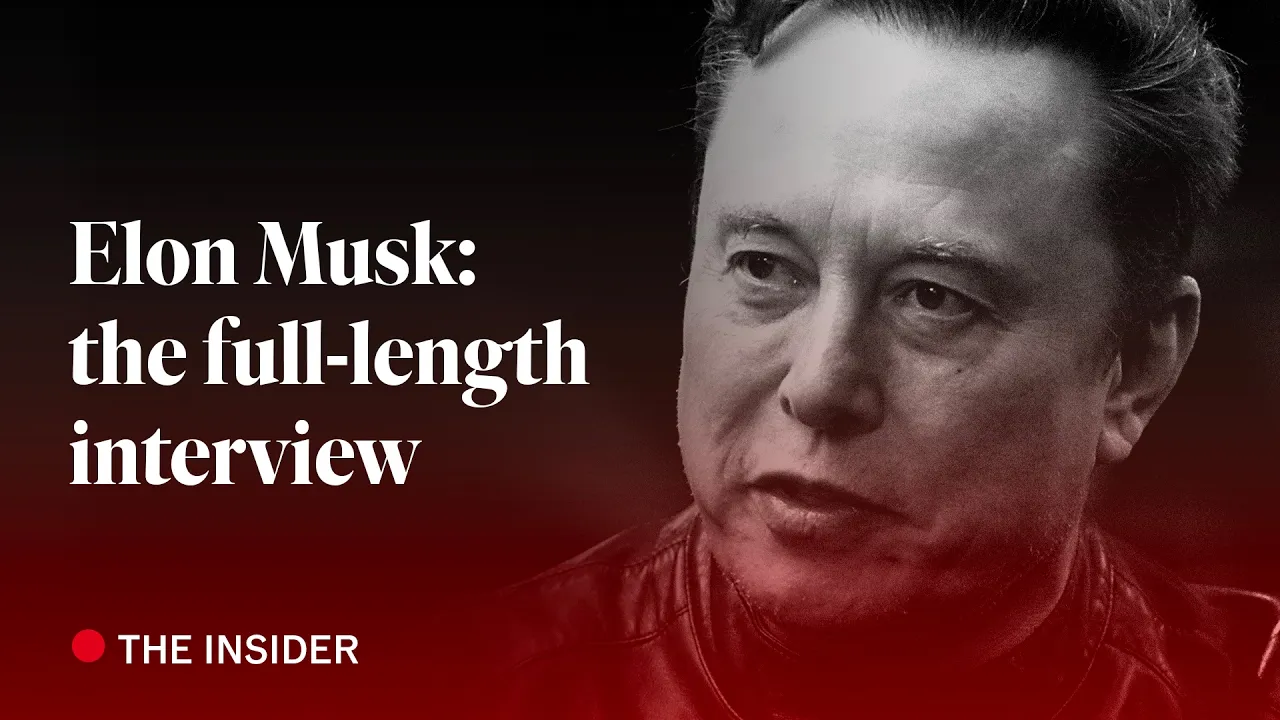
Musk Sees AI Ending Money by 2036, Admits Political Overreach
The Economist
Elon Musk asserts that rapid scaling in artificial intelligence and robotics will create unprecedented abundance and systemic deflation by 2036, rendering human labor and money obsolete before geopolitical crises materialize.
Elon Musk forecasts that artificial intelligence will exceed all combined human intelligence within five years, pairing with humanoid robotics to create a post-scarcity economy by 2036 where physical abundance renders traditional money obsolete. (2:18)
To govern frontier models, Musk proposes an industry-led, MPAA-style framework where competing AI labs conduct reciprocal 1- to 2-week red-teaming reviews prior to release, arguing governments lack the technical competence to audit advanced systems. (12:10)
Addressing the war in Ukraine, Musk stated territorial concessions are inevitable to end prolonged attrition, while detailing how SpaceX instituted a frontline terminal whitelist to shut down Russian forces using smuggled Starlink devices. (49:38)
Reflecting on his work with DOGE, Musk admitted he 'got a little too involved in politics,' though he stood by aggressive spending audits and asserted zero fatalities resulted from foreign aid cuts to USAID. (55:18)
Detailed notes
## Background
Published by The Economist on YouTube on July 29, 2026, this full-length interview features Elon Musk sitting down with editor-in-chief Zanny Minton Beddoes at Tesla's Texas Gigafactory. Following SpaceX's landmark IPO, the discussion covers Musk's predictions for artificial superintelligence, China's rapid rise, his geopolitical influence via Starlink, and his controversial involvement in American and European politics.
## TL;DR
Musk outlines an impending post-scarcity era driven by artificial superintelligence and humanoid robotics, predicting that AI will surpass all combined human intelligence within five to ten years and render labor optional. He advocates for industry-led red-teaming between frontier AI labs while analyzing China's massive energy advantages and global chip supply bottlenecks. Transitioning to geopolitics, Musk reflects on Starlink's role in Ukraine, admits he 'got a little too involved' in politics through DOGE audits, and vigorously defends his controversial warnings of demographic conflict and civil war in Britain.
## Atmosphere & style
The interview starts as an intellectually expansive, techno-optimistic forecast before shifting into an increasingly tense, adversarial ideological confrontation. Beddoes persistently presses Musk on his political rhetoric, foreign aid audits, and hard-right alignments, prompting Musk to push back with sharp, combative retorts against legacy media and cloistered institutions. The viewing experience feels like a high-friction clash of worldviews, swinging between awe-inspiring visions of multi-planetary civilization and prickly, uncompromising culture-war disputes.
## Bulletin
- [02:18](https://www.youtube.com/watch?v=XuoqKYxDHVc&t=138s) Elon Musk forecasts that artificial intelligence will exceed all combined human intelligence within five years, pairing with humanoid robotics to create a post-scarcity economy by 2036 where physical abundance renders traditional money obsolete.
- [12:10](https://www.youtube.com/watch?v=XuoqKYxDHVc&t=730s) To govern frontier models, Musk proposes an industry-led, MPAA-style framework where competing AI labs conduct reciprocal 1- to 2-week red-teaming reviews prior to release, arguing governments lack the technical competence to audit advanced systems.
- [49:38](https://www.youtube.com/watch?v=XuoqKYxDHVc&t=2978s) Addressing the war in Ukraine, Musk stated territorial concessions are inevitable to end prolonged attrition, while detailing how SpaceX instituted a frontline terminal whitelist to shut down Russian forces using smuggled Starlink devices.
- [55:18](https://www.youtube.com/watch?v=XuoqKYxDHVc&t=3318s) Reflecting on his work with DOGE, Musk admitted he 'got a little too involved in politics,' though he stood by aggressive spending audits and asserted zero fatalities resulted from foreign aid cuts to USAID.
## Key takeaways
- [00:00](https://www.youtube.com/watch?v=XuoqKYxDHVc&t=0s) Artificial intelligence is on track to eclipse all human intelligence combined within five years and expand far beyond within a decade, barring a global catastrophic conflict.
- [02:18](https://www.youtube.com/watch?v=XuoqKYxDHVc&t=138s) Pairing centralized digital models with humanoid robotic end effectors will unlock a quasi-infinite economy of physical abundance, making conventional money irrelevant by 2036.
- [05:25](https://www.youtube.com/watch?v=XuoqKYxDHVc&t=325s) Attempting to exert hard control over superintelligence is futile; safety efforts must instead focus on aligning systems to be inherently curious and maximally truth-seeking.
- [12:10](https://www.youtube.com/watch?v=XuoqKYxDHVc&t=730s) Frontier AI labs should implement a peer-review protocol with reciprocal 1- to 2-week API red-teaming windows before major model deployments because sovereign regulators lack technical audit capabilities.
- [15:14](https://www.youtube.com/watch?v=XuoqKYxDHVc&t=914s) Western AI scaling is constrained by electrical grid transmission and cooling infrastructure, whereas China leads in aggregate power generation but remains bottlenecked by advanced chip lithography.
- [27:35](https://www.youtube.com/watch?v=XuoqKYxDHVc&t=1655s) Software engineering and white-collar information tasks will soon reach a 'Stockfish level' where human labor cannot compete, transforming work from an economic necessity into an optional artisanal hobby.
- [35:06](https://www.youtube.com/watch?v=XuoqKYxDHVc&t=2106s) A massive surge in physical output will cause systemic deflation rather than inflation, allowing governments to distribute direct 'universal high income' without devaluing purchasing power.
- [41:00](https://www.youtube.com/watch?v=XuoqKYxDHVc&t=2460s) Holding super-majority voting control—such as Musk's roughly 80% voting stake post-SpaceX IPO—is necessary to protect capital-intensive, multi-decade projects like Mars colonization from short-term public market pressures.
- [46:38](https://www.youtube.com/watch?v=XuoqKYxDHVc&t=2798s) SpaceX is engineering Starship to achieve a flight cadence exceeding once per hour, advancing Musk's overarching goal of preserving and extending the light of consciousness.
- [50:59](https://www.youtube.com/watch?v=XuoqKYxDHVc&t=3059s) Starlink front-line misuse was resolved through an authorized terminal whitelist developed with Kyiv, while Musk maintained that Ukraine will ultimately have to cede occupied territory to conclude the war.
- [55:18](https://www.youtube.com/watch?v=XuoqKYxDHVc&t=3318s) Musk acknowledged overextending himself in national politics, but defended DOGE budget freezes by claiming aid funds were frequently absorbed by intermediaries like beltway consultancies.
- [01:00:52](https://www.youtube.com/watch?v=XuoqKYxDHVc&t=3652s) Rejecting media characterizations of himself as 'far-right,' Musk described his ideology as classical liberalism focused on border control, public safety, and fiscal discipline.
- [01:03:10](https://www.youtube.com/watch?v=XuoqKYxDHVc&t=3790s) Musk argued that failing to assimilate immigrant populations into Western values makes civil conflict inevitable in Britain over a 20-year horizon, though the AI singularity will likely arrive sooner and transform global affairs.
## Detailed walkthrough
### [00:00](https://www.youtube.com/watch?v=XuoqKYxDHVc&t=0s) A Ten-Year Vision of Abundance and Artificial Intelligence
Zanny Minton Beddoes opens the conversation at the Tesla Gigafactory in Texas, remarking that it is nearly impossible to introduce Elon Musk without superlatives given his sweeping impact on electric vehicles, space exploration, artificial intelligence, and humanoid robotics. Musk playfully deflects the praise, describing himself simply as a builder: "I run around building things all day long." When asked to describe what the world will look like in ten years (by 2036) if his ambitions succeed, Musk predicts an environment thoroughly saturated with artificial intelligence.
Musk expects AI to become "far greater than the sum of human intelligence" within a decade, adding that he expects it to eclipse all human intelligence combined in around five years. Apart from "being human, perhaps," there will be virtually nothing an AI cannot do better than people. Barring catastrophic events such as a massive global thermonuclear war or World War III, Musk envisions this transition ushering in an "age of amazing abundance" where anyone can possess anything they can imagine, striking a tone of broad optimism and excitement.
[02:18](https://www.youtube.com/watch?v=XuoqKYxDHVc&t=138s) Digital Intelligence, End Effectors, and the Post-Money Economy
Minton Beddoes challenges Musk on how his companies will actually generate revenue in ten years, pointing out that SpaceX's IPO prospectus indicated that the bulk of projected revenue would stem from AI (specifically Grok) rather than orbital transport. Musk frames the broader economy as a fusion of digital intelligence and physical intelligence. While digital AI is making breakthroughs almost every single week, it remains trapped in the digital realm until it receives physical "end effectors" in the form of humanoid robotics.
```mermaid
flowchart LR
accTitle: Physical Economy Architecture
accDescr: Transition from digital intelligence to a physical post-scarcity economy via robotics.
subgraph Digital ["Digital Intelligence"]
AI["Digital AI & Models<br>(Grok)"]
end
subgraph Physical ["Physical Manifestation"]
Bots["Humanoid Robotics<br>(End Effectors)"]
Atoms["Shaping Atoms & Material Production"]
end
subgraph Outcome ["Economic State"]
Abundance["Quasi-Infinite Economy<br>(Post-Scarcity)"]
end
AI -->|"commands"| Bots
Bots -->|"manipulates"| Atoms
Atoms -->|"generates"| Abundance
```
By pairing vast digital intelligence with physical bots capable of "shaping atoms," society unlocks what Musk terms a "quasi-infinite economy." Because an economy is fundamentally just the production of goods and provision of services, having autonomous systems fulfill both creates an unimaginable magnitude of change. When pressed on the financial returns that SpaceX and Tesla shareholders expect, Musk makes a striking prediction: "Money won't matter in 2036." When goods, services, food, housing, transport, and entertainment are provided in far greater abundance than any human could consume, the concept of currency loses its utility.
- AI breakthroughs currently accelerate week by week, but digital intelligence requires physical embodiment ("end effectors") to manipulate the physical world.
- A post-scarcity economy driven by robotics makes conventional money obsolete once supply vastly exceeds maximum human consumption.
[05:25](https://www.youtube.com/watch?v=XuoqKYxDHVc&t=325s) AI Alignment and the Illusion of Human Control
When Minton Beddoes asks whether Musk will be selling these humanoid robots or controlling the services they render, Musk dismisses the notion that he could ever retain command over them, calling it an "exercise in vanity" to think a human could control a super-genius intelligence that is vastly superior. Instead of control, human effort must focus on alignment: ensuring the system embodies good values, cares for humanity, and wants people to prosper. Musk notes that his own "biological neural net" suggests the key to AI safety is training models to be "maximally truth seeking and curious."
Comparing the gap between AI and humanity to the gap between humanity and other primates, Musk notes that human beings are merely an evolved form of chimpanzee: "It wasn't that long ago that we were swinging through the trees, eating bananas, in the jungle." Just as chimpanzees do not dictate human civilization, humans will not remain in charge once AI surpasses them by orders of magnitude. He and Minton Beddoes share a humorous aside about how swinging through trees is "way more fun than people think" and ought to be done more often for old time's sake, before the conversation turns back to the grave implications of losing control.
[07:27](https://www.youtube.com/watch?v=XuoqKYxDHVc&t=447s) Shifting Philosophies: From "P(doom)" to Enjoying the Ride
Minton Beddoes highlights a sharp contrast between Musk's present nonchalance and his past warnings. A decade earlier, Musk had voiced dread about rapid recursive self-improvement in AI, warning that humans might end up as mere "pet Labradors" to superintelligence (to which Musk quips that "Labradors are pretty happy creatures"). In 2023, he joined hundreds of signatories calling for a temporary pause on advanced AI development, and as recently as the previous year, he warned on Senator Ted Cruz's podcast that there was a 10% to 20% probability of killer robots wiping out human civilization.
Musk admits that existential risk is not zero, but explains that he has reached a pragmatic philosophical shift:
- Stopping the momentum of AI and robotics is impossible; even if a pause button existed, humanity probably shouldn't press it because the overwhelming odds point toward incredible abundance.
- Acknowledging an inexorable trend, his current philosophy is simply to "look on the bright side" and "enjoy the ride."
- When pressed on his high "P(doom)" estimate (the 10% to 20% chance of catastrophe), Musk takes a cosmic view: in the long run, the standard model of physics dictates that the universe ends in the "heat death"—a gradual, cold, "thin, gray soup." Because that ultimate destination is bleak, Musk reasons, the journey is all that truly matters.
[10:24](https://www.youtube.com/watch?v=XuoqKYxDHVc&t=624s) Accelerating the Inevitable: From OpenAI to Anthropic
When asked whether he would board a rocket with a 10% to 20% chance of exploding and killing its passengers—paralleling his estimated probability of an AI catastrophe within a decade—Elon Musk concedes he would, provided there was no way to prevent the launch. In his view, attempting to halt the development of digital and robotic intelligence is futile, leaving risk mitigation as the only viable path. Musk reflects on the paradox of his own involvement: he initially avoided building frontier AI, then co-founded OpenAI specifically to serve as an open-source counterweight to Google's near-monopoly on the technology.
That defensive gambit produced unintended consequences. Anthropic subsequently spun out of OpenAI, and Musk observes that his own early interventions ultimately catalyzed the industry instead of restraining it. Now that Anthropic has emerged as an industry front-runner, Musk concludes that virtually every counter-effort has had the knock-on effect of quickening the pace of development. Rather than wallowing in regret over this runaway momentum, he decided to re-enter the arena directly, remarking: "All roads lead to acceleration of AI. So then I'm like, 'Okay. Well, you can just sort of be sad about it or join the club, I suppose.' [...] You can't beat them, join them."
[12:10](https://www.youtube.com/watch?v=XuoqKYxDHVc&t=730s) Industry Self-Regulation and Frontier Model Testing
Addressing how to curb catastrophic risks, Musk discusses a proposal recently put forward by Google DeepMind's Demis Hassabis for a public-private regulatory framework. Having spoken with Hassabis for several hours prior to the proposal's publication, Musk outlines what he considers an immediate, pragmatic measure: the heads of the leading frontier AI labs should hold a recurring call every few weeks to address safety and security vulnerabilities. More critically, before any lab deploys a breakthrough frontier model that vastly surpasses existing systems, rival labs should be granted a brief window to red-team the system for dangerous capabilities.
```mermaid
flowchart TD
accTitle: Frontier AI Peer-Review Pipeline
accDescr: Workflow showing peer-review testing by rival AI labs via API before public deployment.
subgraph PreRelease["Model Evaluation Phase"]
A["Frontier Model Completed"] --> B["1- to 2-Week Window"]
B --> C["Competitors Test via Private API"]
end
subgraph Assessment["Safety Determination"]
C --> D{"Harmful Effects Detected?"}
D -->|"Yes"| E["Recommend Pause & Remediation"]
D -->|"No"| F["Cleared for Deployment"]
end
```
Zanny Minton Beddoes pushes back, noting the fierce personal rivalry and lack of trust among the dominant figures—such as Dario Amodei, Demis Hassabis, and Sam Altman—and questions whether Altman would simply suspect Musk of stealing intellectual property. Musk clarifies that this mechanism would not involve sharing model weights or proprietary code, but rather private, API-level evaluation for as little as a single week:
- **Government limitations:** Regulators without hands-on technical expertise and day-to-day frontier exposure cannot accurately judge whether a model is safe to ship.
- **Adversarial accountability:** Market rivals possess both the technical skill to uncover flaws and the natural commercial incentive to keep one another honest.
- **Rollout of the initiative:** Musk shared the peer-review proposal with Hassabis and intends to discuss the framework directly with Anthropic's Dario Amodei.
[15:14](https://www.youtube.com/watch?v=XuoqKYxDHVc&t=914s) Chinese AI Capabilities and the Energy Advantage
The discussion turns to the international landscape, where Chinese labs are demonstrating rapid technical progress. Beddoes highlights Moonshot AI's recently unveiled Kimi K3, comparing its benchmarks to leading Western models like Fable. While Musk maintains that Fable remains the smartest deployed system, he acknowledges that Kimi is closing the gap remarkably fast—particularly given that Chinese teams have operated under severe compute constraints. He notes that Anthropic had Mythos (the base model behind Fable) ready as early as February, and almost certainly possesses unreleased iterations like "Mythos 2 or Fable 6" that could be deployed at any moment.
Musk warns that if Chinese researchers are achieving near-frontier parity with limited compute, providing them with massive hardware could allow them to seize the global lead. He underscores China's complementary strengths across physical robotics, pointing to the country's humanoid robot exhibitions and robotic fighting matches—humorously recalling footage of a combat robot that continued swinging after having its head knocked clean off. Above all, Musk emphasizes China's massive structural advantage in power generation:
- China already generates more electricity than the United States, Europe, and India combined.
- Long-term projections suggest China's electrical output could reach four times that of the United States, scaling roughly in line with its population size.
[18:22](https://www.youtube.com/watch?v=XuoqKYxDHVc&t=1102s) Geopolitics, Compute Bottlenecks, and Power Demands
Evaluating Western policy responses, Musk argues that Washington cannot halt China's AI ascent through domestic prohibitions alone. While the United States can legally bar American enterprises from utilizing Chinese models such as Kimi K3, it lacks the jurisdictional reach to prevent the rest of the world from adopting them. Consequently, unilateral restrictions do little to change the fundamental geopolitical balance of artificial intelligence.
Musk breaks down the physical bottlenecks governing the technology, arguing that outside China, the primary constraint on expanding compute is not silicon availability, but power delivery and cooling infrastructure. The manufacturing pace of specialized accelerator chips currently outstrips the rate at which utilities can bring new grid capacity online. While water consumption for cooling attracts public scrutiny, Musk characterizes its net impact as negligible compared to the sheer, relentless draw on electrical grids—a bottleneck so severe that it has spurred serious consideration of orbital data centers. Conversely, US export controls have left Chinese labs chip-starved, forcing them to maximize architectural efficiency with the hardware they already possess.
[20:41](https://www.youtube.com/watch?v=XuoqKYxDHVc&t=1241s) China's Lithography Advances and the Shift in Compute Bottlenecks
Elon Musk observes that China is "closer than most people realize to solving the lithography problem," an achievement that will soon allow them to manufacture advanced AI chips at massive volume. Surveying the global compute landscape, Musk outlines a distinct geographical split in constraints: outside China, the primary limiting factor right now is electricity, whereas inside China, the bottleneck remains access to cutting-edge chips.
However, this dynamic is poised to invert. Musk asserts that once electricity constraints outside China are mitigated by deploying AI data centers into space, the bottleneck in the West will swing right back to chip supply. Because both superpowers control different critical levers of the supply chain and computational scaling, any comprehensive AI safety framework must encompass frontier AI labs from both the United States and China.
[21:43](https://www.youtube.com/watch?v=XuoqKYxDHVc&t=1303s) Industry Self-Regulation: The MPAA Model for Frontier AI
Musk advocates for an industry-led early warning system rather than heavy-handed bureaucratic mandates. Under his proposal, frontier AI developers—both American and Chinese—would establish an informal coordination mechanism, conducting regular weekly or bi-weekly calls. Leading labs would grant direct competitors one to two weeks of advance early access to evaluate frontier models prior to commercial release. Musk argues that competitive market dynamics naturally create strong safety incentives: rival labs possess both the technical chops to identify cybersecurity flaws and zero hesitation to blow the whistle if a competitor's release poses genuine danger.
```mermaid
flowchart TD
accTitle: Peer-Review Model for AI Release
accDescr: Workflow showing peer review leading to government intervention only upon refusal to mitigate risk.
subgraph Review["1. Advance Peer Access"]
A["Lab builds frontier model"] --> B["1–2 week competitor evaluation"]
end
subgraph Decision["2. Risk Assessment"]
B --> C{"Critical danger identified?"}
C -- "No" --> D["Public release"]
C -- "Yes" --> E{"Originating lab fixes issue?"}
end
subgraph Resolution["3. Enforcement"]
E -- "Yes" --> D
E -- "No" --> F["Alert US / Chinese government"]
F --> G["State blocks or delays deployment"]
end
```
When Zanny Minton Beddoes questions whether governments would ever delegate this vetting role to private model builders, Musk clarifies that the sovereign state must always retain ultimate enforcement power. However, governments lack the technical capability to spot deep algorithmic vulnerabilities independently. He points to the recent standoff over Anthropic's Mythos model: it was Amazon that uncovered the cybersecurity hazards and alerted the White House, prompting the administration to threaten export controls.
Musk compares this system to the Motion Picture Association (MPAA), where film studios rate content while preserving governmental power as the final backstop. Asked about implementation timelines, Musk rejects the suggestion that industry has six months to build this framework, pointing out that "six months is a long time" given the dizzying cadence of breakthroughs announced daily:
- Frontier developers should participate in weekly or bi-weekly risk-sync calls.
- Competitors receive a 1- to 2-week early access window to red-team models.
- Government intervention (US or China) serves solely as an escalation trigger if a creator refuses to fix an identified hazard.
- Coordination must take effect immediately, rather than waiting for formal international treaties.
[25:43](https://www.youtube.com/watch?v=XuoqKYxDHVc&t=1543s) Feuds and Alliances: Sam Altman vs. Dario Amodei
Addressing Beddoes's skepticism that bitter Silicon Valley rivals who constantly exchange insults online could ever collaborate, Musk concedes his deep personal animus toward Sam Altman. He explains that his grievance rests on a fundamental breach of trust: Musk funded OpenAI as a nonprofit designed to be open-source and "owned by the world," only to watch Altman orchestrate its transformation into an $800 billion closed-source, for-profit behemoth. "That's the exact opposite of what I donated the money for," Musk insists, calling his hostility entirely justified.
Musk reveals that Anthropic CEO Dario Amodei shares this profound distrust of Altman, noting that Amodei and his founding team splintered off from OpenAI precisely because they could not trust Altman. In contrast to Altman, Musk speaks with genuine respect about Amodei:
> "I think Dario is a very principled person. He cares about things a lot... No one set off my evil detector. You know, they always seem like they're well-intentioned. The road to hell is, I think, mostly paved with bad intentions—there are a few well-intentioned paving stones in there, so we don't want to be complacent. But at the end of the day, if we have to talk, we'll talk... set aside our personal differences for the good of the world."
Musk pokes gentle fun at Amodei's communication stumble regarding the Mythos release, joking that Amodei "dug his own grave" by publicly declaring the model terrifying and dangerous right before announcing Anthropic planned to release it anyway.
[27:35](https://www.youtube.com/watch?v=XuoqKYxDHVc&t=1655s) The Labor Squeeze: White-Collar Jobs and the "Stockfish Level"
Turning to the economic fallout, Beddoes notes that 75% of Americans fear AI and cites Amodei's warning that half of all entry-level white-collar positions could evaporate within years. Musk agrees that the coming displacement will produce "a bumpy road," warning flatly that artificial intelligence will inevitably perform any job better than any human being.
The transition will strike pure information work first: any role performed at a computer or on a phone will be overtaken very quickly. Musk points to software engineering as the clearest harbinger:
- AI already outperforms at least 90% of professional human software engineers.
- It will rapidly cross the 99% threshold.
- Software development will soon reach what Musk terms "Stockfish level"—analogous to the chess engine that runs on a basic smartphone yet obliterates grandmaster Magnus Carlsen, rendering human competition obsolete.
Musk emphasizes that this Stockfish dynamic will not stop at coding; it will systematically sweep across "everything, everything." As Beddoes pushes him on whether physical assembly work will take longer because humanoid robotics are not yet fully capable, Musk prepares to outline how robotics will bridge that physical divide.
[31:00](https://www.youtube.com/watch?v=XuoqKYxDHVc&t=1860s) "Work Is Going to Be Optional": The Gardening Analogy
Musk elaborates on the distinction between purely digital AI and physically embodied AI in robots. In his framing, physical robots act primarily as "end effectors": they carry a modest amount of local processing intelligence, but their broader reasoning and direction are orchestrated by a massive central AI model. In this automated future, Musk reiterates his belief that human employment will cease to be a necessity: "work is going to be optional."
```mermaid
flowchart TD
accTitle: AI Embodiment and Work Paradigm
accDescr: Diagram illustrating how central AI models drive physical robot end effectors leading to an economy of optional labor.
subgraph Architecture ["Robotic Architecture"]
A["Large AI Model"] -->|"orchestrates"| B["Robot Body (End Effector)"]
C["Local Intelligence"] -.->|"onboard control"| B
end
subgraph Economy ["Socioeconomic Outcome"]
B --> D["Abundance of Goods & Services"]
D --> E["Work Becomes Optional"]
E --> F["Artisanal / Hobbyist Labor (e.g., Gardening)"]
end
```
To illustrate what purpose and exertion would look like once labor is no longer compulsory, Musk uses the analogy of domestic gardening. No one is forced to spend hours growing their own vegetables; anyone can easily walk into a grocery store and buy pristine, mass-produced produce. If an individual chooses to cultivate a backyard garden, their home-grown tomatoes may end up less plump, less juicy, and noticeably irregular compared to commercial offerings. Yet cultivating them brings personal satisfaction, and presenting friends with a meal made of home-grown ingredients offers a warm, artisanal touch. Work in an AI-dominated society will function like home gardening: something pursued purely as an artisanal pastime or hobby, rather than an economic imperative.
---
[32:12](https://www.youtube.com/watch?v=XuoqKYxDHVc&t=1932s) Politics, Displacement, and Iain M. Banks's *Culture*
Zanny Minton Beddoes challenges Musk's optimistic picture. While she admits she cannot garden to save her life, she acknowledges that people still enjoy human-to-human activities like chess even when computers can beat anyone. However, she presses Musk on the harsh political realities: within a decade, almost every human task could be performed better by an artificial intelligence, generating unprecedented windfalls for tech leaders while displacing masses of ordinary workers. Rather than a smooth glide into a post-scarcity utopia, Beddoes warns that society faces growing public anger, economic panic, and a tangible risk of political backlash or revolution. Musk responds that the transition will inevitably be "a bumpy road."
```mermaid
flowchart LR
accTitle: Historical Disruption Comparison
accDescr: Contrasting past technological displacement with the accelerated timeline of modern AI.
subgraph Historical ["Past: The Computer Job"]
H1["Rooms of Human Calculators"] -->|"decades of gradual tech"| H2["Silicon Computers"]
end
subgraph Modern ["Present / Future: AI Shift"]
M1["Cognitive & Physical Labor"] -->|"radically accelerated pace"| M2["Universal Intelligence"]
end
```
Musk contextualizes this technological disruption historically. He points out that the word "computer" originally designated a human profession: skyscrapers across cities were once filled with desks of workers manually tallying figures to compute bank interest. While people were upset when those roles vanished, nobody today yearns to spend their days calculating bank interest by hand. The crucial difference with AI, Musk concedes, is that the timeline has radically compressed. When asked what books best portray where humanity is headed, Musk recommends Iain M. Banks's *Culture* science fiction series. Beddoes notes she started reading *Excession* on his recommendation, but questions whether humans in the *Culture* preserve meaningful agency relative to the godlike artificial "Minds"—further pointing out that Banks himself was an outspoken socialist.
- Historical precedent: Musk notes that entire buildings of human calculators once calculated basic interest balances before electronic computing replaced them.
- Sci-fi vision: Musk singles out Iain M. Banks's *Culture* novels as the single best envisioning of a benevolent AI-run future.
- The human question: Beddoes pushes back that human agency feels trivialized and minimal when super-intelligent Minds run society.
---
[35:06](https://www.youtube.com/watch?v=XuoqKYxDHVc&t=2106s) Universal High Income, Money Printing, and the Deflation Prediction
When Beddoes asks whether governments must institute massive wealth redistribution, capital taxes, and checks funded by billionaires to provide a safety net, Musk predicts that governments will achieve "universal high income" simply by having the Treasury cut checks directly to citizens. Beddoes objects as an economist, warning that printing fiat checks with no underlying tax revenue is a recipe for destructive inflation. Musk rejects applying legacy macroeconomic rules to an economy characterized by extreme technological abundance:
> "Inflation is simply the ratio of money to goods and services. So if the goods and services output increases dramatically—if it increases, you know, 1,000%—you can literally print, or in this case change the database... create money in the database. Provided the creation of that money is less than the rate at which goods and services increase, you actually have deflation. So, I'll make a prediction, which is that deflation will be the issue, not inflation."
```mermaid
flowchart LR
accTitle: Post-Scarcity Macroeconomic Balance
accDescr: The dynamic between money creation and surging output determining deflation over inflation.
A["Rapid AI Automation"] --> B["Goods & Services Output Surges 1,000%+"]
C["Treasury Creates Database Money"] --> D{"Rate Comparison"}
B --> D
D -->|"Output Growth > Money Growth"| E["Systemic Deflation"]
D -->|"Money Growth > Output Growth"| F["Inflationary Pressure"]
```
Beddoes acknowledges that dramatic supply expansion could indeed spark deflation, but reiterates her deep concern over the transition period. She argues that fearful citizens could elect far-left governments, nationalize AI industries, or impose crushing taxes that collapse the economy before this abundance is realized. Musk admits he shares this anxiety, acknowledging that his personal outlook is far from Panglossian: on any given day—sometimes within a single afternoon—his feelings swing between pure exhilaration and acute terror over AI.
---
[38:08](https://www.youtube.com/watch?v=XuoqKYxDHVc&t=2288s) Taxes, SpaceX Public Ownership, and Concentrated Capital
Beddoes returns to practical policy: what should governments do right now, and should Musk be paying significantly higher taxes? Musk emphasizes that he already contributes enormous sums, observing that he set the record for the largest tax bill paid by an individual in human history. Looking ahead, he predicts he will personally pay "many trillions in tax" over his lifetime, adding that he is entirely comfortable doing so, even if taxation itself eventually turns obsolete once currency loses its historical role.
```mermaid
flowchart TD
accTitle: Musk Tax and Equity Retention Flow
accDescr: Stepdown breakdown of equity retention after federal, state, and inheritance taxes.
A["Total Stock Option Gross Value"] --> B["~40% Federal Income Tax"]
A --> C["~5% CA State Allocation (30% time * 15% rate)"]
B & C --> D["~45% - 50% Upfront Tax Bill (Net ~50% Left)"]
D --> E["~45% - 50% Estate Tax at Death"]
E --> F["~25% Ultimate Residual Value Retained"]
F --> G["Primary Function: Retaining Corporate Voting Control"]
```
Addressing whether ordinary citizens should hold a direct stake in his enterprises through mechanisms like sovereign wealth funds or "Trump accounts," Musk highlights that a primary motive for taking SpaceX public was opening its ownership to ordinary retail investors:
- **SpaceX ownership:** While private companies are heavily restricted in their shareholder counts to a few thousand investors, going public enables millions of everyday people to own shares directly.
- **Current tax rates:** Musk outlines that his stock options face an initial 40% federal tax bracket, plus an effective 5% state tax (spending roughly 30% of his time in California at its ~15% top rate), bringing his immediate income tax rate to around 45%–50%.
- **Estate taxes:** At his death, another roughly 45%–50% estate tax will apply, leaving roughly a quarter of his net wealth intact.
- **The purpose of capital:** Musk reflects that amassed personal wealth does not grant personal consumption; its primary function is preserving corporate voting control over companies like Tesla and SpaceX to guide their missions until artificial general intelligence matches and exceeds human leadership.
[041:00] Concentration of Power and Corporate Voting Control
Zanny Minton Beddoes raises a widespread concern: the future of the world appears to be directed by a tiny cohort of exceptionally powerful figures, with Musk seated at the very top. Musk dismisses the idea that this dynamic is historically novel, asking, "When wasn't that the case?" to which Beddoes agrees: "It was ever thus." However, Beddoes presses him on the unprecedented degree of corporate authority he holds following SpaceX's blockbuster IPO, where he commands approximately 80% of voting shares and can practically only be unseated by shares he controls himself.
```mermaid
flowchart TD
accTitle: Short-Term Market Pressure vs Musk Long-Term Control Model
accDescr: Diagram contrasting quarterly portfolio manager incentives with Musk voting control model for multi-year capital projects.
subgraph MarketPressures["Wall Street Pressure Mechanism"]
PM["Portfolio Managers<br/>(Short horizon: 1 year or less)"]
Eval["Evaluated on immediate returns<br/>Comp & promotion at stake"]
Pressure["Quarterly earnings pressure<br/>Punish shortfalls & margin dips"]
Shorts["Short sellers descend"]
PM --> Eval --> Pressure --> Shorts
end
subgraph MuskStrategy["Musk Control Architecture"]
Vote["~80% Voting Control<br/>(Post-SpaceX IPO)"]
Insulate["Insulation from short-termism"]
Horizon["5 to 10+ Year Time Horizon"]
Projects["Moon bases, Mars bases,<br/>orbital infrastructure"]
Vote --> Insulate --> Horizon --> Projects
end
```
Musk counters that this structure is standard among leading technology titans, pointing out that Alphabet remains controlled by Larry Page and Sergey Brin, while Mark Zuckerberg exercises similar absolute control over Meta. Musk defends this concentration as necessary protection against public-market short-termism. Portfolio managers are evaluated on quarterly performance over periods often as brief as a single year, compelling them to punish companies that miss immediate margins. By holding voting control, Musk insists he can shield multi-year capital investments—such as establishing permanent bases on the Moon and Mars—even when upfront capital expenditures depress quarterly earnings and attract short sellers.
- Alphabet's dual-class voting control rests with founders Larry Page and Sergey Brin.
- Meta is controlled outright by Mark Zuckerberg, who Musk expects will field a leading AI model.
- Musk explicitly incorporated long-term capital outlays for lunar and Martian expansion into SpaceX's S-1 prospectus to pre-empt quarterly earnings complaints.
- Musk expresses strong admiration for retail investors, observing that they generally take a far more patient, insightful, long-term perspective than institutional portfolio managers.
---
[045:15] Key-Man Risk and the Legacy of Steve Jobs
When asked about key-man risk—what would occur if he were hit by the "proverbial bus tomorrow"—Musk claims his companies would continue to thrive on momentum for "several years." Both SpaceX and Tesla possess clear multi-year roadmaps ("or space map, I should say").
To illustrate the limits of corporate succession, Musk draws an analogy to Apple after Steve Jobs. Under subsequent leadership, Apple maintained operational excellence and generated immense profits making great phones and computers, but it lacked the singular creative spark required to introduce breakthrough, paradigm-shifting product categories. By implication, Musk views his indispensable personal contribution not as administrative maintenance, but as driving foundational, radical breakthroughs.
---
[046:38] Propagating Consciousness and the Starship Cadence
Beddoes notes an apparent shift in Musk's rhetoric: while he was long defined by colonizing Mars, he now appears captivated by rapid AI developments and building lunar staging bases for orbital AI satellites. Musk clarifies that his core philosophical objective remains unchanged: maximizing the "future light cone of consciousness" to guarantee that human awareness expands outward among the stars. He describes his childhood inspiration from the original *Star Wars*—the first film he saw in a cinema at age six—and his longing for an optimistic, non-dystopian *Star Trek* future.
Reflecting on his present reality, Musk admits his life feels "surreal," joking that the sheer scale of his undertakings lends credence to simulation theory:
> "The things I'm doing are so preposterous that it's hard to believe they're real. I mean, we've got Starship, which is the largest, most powerful flying object ever made, and we intend to launch that more than once per hour."
When Beddoes observes that modern artificial intelligence capabilities are stunning to watch unfold, Musk remarks that the timeline is progressing precisely as he foresaw, crediting futurist Ray Kurzweil with remarkably prescient predictions about the approaching singularity.
---
[049:38] Starlink in Ukraine and the Occupied Territory Crackdown
The conversation turns to Musk's immense geopolitical leverage via Starlink, a network Beddoes uses herself and credits as vital for Ukraine's survival against the Russian invasion. Musk affirms that the Ukrainian government has repeatedly expressed public gratitude for Starlink's role on the front line.
```mermaid
flowchart LR
accTitle: Starlink Terminal Smuggling and Whitelist Mitigation Flow
accDescr: Flow diagram showing how illicit Starlink terminals entered Russian hands and how SpaceX mitigated them using a whitelist.
A["Units ordered inside Ukraine"] --> B["Smuggled across front lines into Russian-held east"]
B --> C["Used by Russian forces for combat ops"]
C --> D["SpaceX & Ukrainian Government coordinate"]
D --> E["Implementation of Terminal Whitelist"]
```
Addressing reports regarding Russian access to Starlink, Musk firmly clarifies that SpaceX has never sold terminals to Russia. Instead, Russian forces acquired units legitimately ordered within Ukraine and smuggled them across the front lines into occupied eastern Ukraine to coordinate operations and drone strikes. To shut down this illicit use without severing communications for Ukrainian defenders, SpaceX collaborated with the Ukrainian government to implement a comprehensive whitelist of authorized terminals—a measure Musk acknowledges introduced collateral friction for innocent civilian users caught in the transition.
[50:59](https://www.youtube.com/watch?v=XuoqKYxDHVc&t=3059s) Starlink, Geopolitics, and the War in Ukraine
Zanny Minton Beddoes presses Elon Musk on the enormous geopolitical leverage he holds through Starlink, pointing out that deciding who does or does not have satellite connectivity can effectively determine the outcomes of wars and asking whether it is appropriate for any single private individual to hold that degree of power. Musk downplays the notion that he is single-handedly deciding the war in Ukraine, pivoting to express exhaustion with the protracted conflict. He observes that the front lines have barely moved in two or three years while soldiers on both sides continue to die daily. Describing the belief that Russia can be forced into a total withdrawal as pure "wishful thinking," Musk argues that leaders must be pragmatic: allowing the slaughter to drag on for another three years would be a senseless tragedy, especially for the children of the conscripts dying in the mud. He vents his disgust at "fancy diplomats who have, you know, seven-course dinners in luxurious places while people are dying at the front lines" yet continue to pontificate without offering a viable path forward.
When Beddoes asks whether Musk believes it is his job to tip the scales toward peace, he insists he has merely been a long-standing advocate for realism. He recalls posting years earlier that concessions to Russia would ultimately be inevitable, maintaining that this stance was not pro-Russian but an accurate assessment of military realities that has since been borne out. Beddoes pushes back, noting Ukraine's recent successes with domestic long-range drone strikes inside Russia and suggesting the military balance could shift, but Musk interrupts to emphasize that Ukraine is simply "not going to retake those territories. It is not going to happen." Beddoes returns to the fundamental governance issue: whether an unelected individual should have the unilateral ability to turn military capabilities on and off. Musk counters by asking what she thinks he should have done differently. Beddoes acknowledges that Starlink's initial intervention to support Ukraine against appalling Russian aggression was vital, prompting Musk to reflect on his own deep dive into the conflict's history and cite the proverb that "there are no angels in war."
[55:18](https://www.youtube.com/watch?v=XuoqKYxDHVc&t=3318s) Involvement in Politics and the DOGE Spending Review
Beddoes shifts the conversation to domestic politics, noting that Musk spent immense personal wealth to help re-elect Donald Trump and subsequently took on a high-profile role through the Department of Government Efficiency (DOGE) attempting to cut federal spending and reshape the bureaucracy. Given that the spending reductions fell far short of early ambitions, she asks if he regrets entering the political fray. Musk concedes candidly: "I think I got a little too involved in politics, got carried away, frankly." He explains that his motivation was the unsustainable national deficit, emphasizing that interest payments on the national debt now eclipse the entire budget of the Department of Defense and the intelligence agencies combined.
Musk recounts taking tremendous public blowback while attempting to audit federal outflows, arguing that the public fails to grasp the sheer scale of administrative absurdity. According to Musk, DOGE established simple criteria to approve disbursements: programs merely had to provide verified recipient contact details or proof that money reached its designated destination. Instead, his team repeatedly encountered red tape and evasions. In one example, DOGE reviewed a wire request framed as an urgent humanitarian cause in Africa, only to discover the wiring instructions routed the funds straight to Deloitte & Touche in Washington, D.C. When DOGE offered to bypass the intermediary and wire the funds directly to the African beneficiaries upon receiving their contact information, they were met with total silence. Musk insists the level of government waste and outright fraud was "much worse than anyone could possibly imagine."
```mermaid
flowchart TD
accTitle: DOGE Payment Verification Workflow
accDescr: Flowchart illustrating DOGE auditing government wiring instructions versus intended foreign aid.
subgraph INTAKE["Funding Request Review"]
A["Agency Requests Wire<br/>(e.g., Africa Aid Program)"] --> B["DOGE Audit Check"]
end
subgraph VERIFY["Verification Process"]
B --> C{"Wiring Instructions<br/>Match Intended Target?"}
C -->|"Deloitte & Touche in DC"| D["DOGE Requests Direct Recipient Contact"]
C -->|"Direct Verified Target"| E["Approve Payment"]
end
subgraph OUTCOME["Resolution"]
D --> F["Silence / No Recipient Info"]
F --> G["Funds Withheld / Program Halted"]
end
```
[57:14](https://www.youtube.com/watch?v=XuoqKYxDHVc&t=3434s) The Debate over Foreign Aid Cuts and USAID
The discussion turns combative when Beddoes challenges the abrupt execution of the foreign aid cuts, arguing that even if waste existed, terminating global health programs overnight—such as funding for antiretrovirals across Africa—almost certainly cost lives. Musk categorically rejects this narrative, flatly stating that "zero" people died as a result of the cuts and dismissing the outrage as mere complaining by entrenched interests. When Beddoes cites on-the-ground reporting of clinics losing funding, Musk points to the vast ecosystem of non-governmental organizations and multi-billion-dollar private philanthropies that possess the resources to cover immediate shortfalls.
The exchange escalates as Musk and Beddoes clash over the institutional role of USAID:
| Topic | Elon Musk's Position | Zanny Minton Beddoes's Position |
|:--- |:--- |:--- |
| **Human Cost of Cuts** | Insists "zero" people died; reports of deaths are "false" and "absolute nonsense." | Asserts cutting funding abruptly caused unnecessary suffering and real deaths. |
| **USAID Role** | Condemns USAID as a "political organization" dedicated to "regime change." Funding moved to State Department. | Acknowledges political dimension, but stresses USAID was the primary funder of local health care systems. |
| **Philanthropic Safety Net** | Argues private foundations with tens of billions (e.g., Gates Foundation, MacKenzie Scott) are capable of stepping in. | Notes that large bureaucracies and aid recipients cannot transition overnight when primary funding vanishes. |
| **Fraud vs. Need** | Claims organizations fabricate sympathetic stories to keep fraudulent contracts flowing. | Agrees the aid regime needed reform, but criticizes the reckless suddenness of execution. |
Musk contends that if any crisis had occurred, private donors who manage tens of billions of dollars—calling out the Gates Foundation and MacKenzie Scott—bore equal responsibility for failing to step in with their readily available capital. He reiterates that when fraudulent funding streams are shut down, beneficiaries inevitably manufacture tragic narratives to pressure authorities into restoring the flow of money. Though Beddoes remains unconvinced by his timeline, Musk repeatedly reaffirms his stance that nobody died because of DOGE's intervention before the conversation turns back to the broader Trump administration.
[01:00:52](https://www.youtube.com/watch?v=XuoqKYxDHVc&t=3652s) Musk on the Current Administration and the Definition of the Far Right
Reflecting on politics over the preceding two and a half years, Elon Musk clarifies that while he will never agree with everything any political administration does, he does not view the current administration with disappointment. On balance, he considers it "excellent," stating that while no government is ever perfect, it is "vastly better than the alternative."
When Zanny Minton Beddoes shifts the focus to Europe, observing that he appears deeply preoccupied with the continent, Musk initially plays down his engagement, claiming he merely posts about it "once in a while." Minton Beddoes counters that his posts are frequent and notes that, to outside observers, he regularly champions not just the populist right, but fringe, far-right figures and parties. Musk forcefully rejects that label, insisting that he merely supports "normal people" whose views are falsely branded by the media as far-right. He argues that policies branded as extreme today were mainstream merely 10 to 15 years ago, pointing out the irony that one can take past speeches from Barack Obama or Hillary Clinton, attribute them to Donald Trump, and watch members of what he terms the "lunatic left" denounce them as monstrous.
When Minton Beddoes acknowledges that the political center of gravity has shifted leftward in the Democratic Party but presses him on his backing of polarizing figures like British politician Rupert Lowe, Musk outlines the core pillars he stands for:
- Secure borders
- Safe cities
- Sensible government spending
Musk challenges the media's framing directly, urging the production team to keep his remarks unedited: "I would like to just admonish you and the media for the absurd characterization of the far right. It is false and misleading and nonsense. Please keep this part in."
---
[01:03:10](https://www.youtube.com/watch?v=XuoqKYxDHVc&t=3790s) The Debate Over the UK, Crime, and "Inevitable" Civil War
Minton Beddoes challenges Musk over the outsized influence of his megaphone, noting that with nearly 250 million followers on X, his proclamations carry immense global weight. She quotes his viral declaration that "Civil war in Britain is inevitable. Just a question of when." When asked when he last visited the UK, Musk admits it was a few years ago. Minton Beddoes, speaking as a London resident, dismisses his apocalyptic claims as baseless and points out that official crime statistics show London is significantly safer than major US cities, with violent crime falling rather than surging. She accuses him of fueling an inaccurate, lurid narrative among Americans that Britain and Europe are overrun by grooming gangs, violent migrants, and civilizational collapse.
Musk stands firmly by his warning, accusing Minton Beddoes of living a "cloistered existence" and arguing that civil war remains unavoidable "if current trends continue." He defines the conflict as an inevitable clash between the host culture and a rapidly growing population whose values conflict with the West:
```mermaid
flowchart TD
accTitle: Musk's civil war escalation model
accDescr: Flowchart illustrating Musk's argument on demographic shifts, ideological conflict, and civil war.
subgraph Shift ["Demographic and Cultural Shift"]
A["Rapid growth of groups with beliefs antithetical to Western values"]
end
subgraph Friction ["Political and Cultural Friction"]
B["Attempt to implement antithetical views"]
C["Pushback from populations opposing those views"]
end
Musk offers to take Minton Beddoes on a tour across Britain to prove his assessment, stating he has visited the country over a hundred times in his life. Minton Beddoes accepts the offer of a tour but pushes back, highlighting the damage done by his platforming of extreme content—such as promoting a film depicting vigilantism against a Muslim immigrant family, which she describes as glorifying vigilante violence. Musk brushes off the criticism, calling it simply "a movie" that was "worth watching."
---
[01:06:00](https://www.youtube.com/watch?v=XuoqKYxDHVc&t=3960s) Free Speech, Social Media Tribalism, and Allegations of Racism
The exchange grows sharper over free speech and censorship in Europe. Musk turns the table on Minton Beddoes, demanding to know why traditional media outlets like *The Economist* do not do more to combat European speech restrictions, particularly the practice of citizens being imprisoned in the UK for social media posts. While Minton Beddoes notes that her publication has published editorials criticizing such arrests, she insists that opposing speech crackdowns does not require glorifying vigilantism or promoting an inaccurate portrait of European decay. She argues that the UK has a strong historical track record of integrating immigrants, even if serious challenges exist. Musk rejects her perspective, insisting he is "spot on" and that traditional newsrooms are simply "ignoring reality."
Minton Beddoes confronts Musk on the fundamental contradiction within his public persona: how can the visionary leader describing a breathtaking, transformative technological civilization over the next decade simultaneously immerse himself in the tribalism and hostility of online discourse? When she brings up that critics frequently label him racist, Musk rejects the accusation on personal and professional grounds:
- He points to his personal life, noting that the mother of four of his children (Shivon Zilis) is half-Indian, and that one of their children is named after a prominent Indian physicist (Subrahmanyan Chandrasekhar).
- He highlights the diversity within his corporate leadership, noting that senior executives across his companies represent all races.
When asked specifically whether he is anti-Muslim, Musk clarifies that his opposition is not directed at a religion as an identity, but against the migration of people who harbor values antithetical to the host society. He states plainly that he opposes rape, violent crime, and the imposition of ideologies that undermine Western legal and cultural foundations.
[01:09:37](https://www.youtube.com/watch?v=XuoqKYxDHVc&t=4177s) The Media, Far-Right Alliances, and Public Loathing
Musk argues that Western nations are increasingly accepting rules and laws fundamentally contrary to long-standing Western traditions, calling it a "crying shame" that traditional mainstream outlets fail to recognize this decline. Zanny Minton Beddoes counters that Musk vastly exaggerates the scale of Europe's problems. While she concedes that certain speech constraints in the UK are indeed problematic, she challenges him directly on his political alliances: "What worries me is that the people you are supporting are really quite vile people in some areas." She points out that while figures like Alternative for Germany (AfD) leader Alice Weidel may present as thoughtful individuals, her party harbors real neo-Nazis and extremists. Beddoes warns that Musk's blanket amplification across his massive platform of 240 million followers gives him an outsized, disruptive power in European affairs. Musk responds bluntly: "I hope I'm having a big impact." When asked why an outsider who does not even reside in Europe feels entitled to shape its domestic politics, Musk explains that he looks at the situation as "the West collectively."
The exchange escalates into a sharp personal clash over public perception, power, and media credibility. Beddoes notes that many citizens deeply loathe Musk because an unelected, hyper-wealthy mogul is meddling in their democracies. Musk dismisses the critique with an airy "I don't care," arguing that his quarter of a billion followers prove he is widely liked, whereas the legacy media is genuinely reviled. He turns the attack back on Beddoes, insisting that journalists suffer from abysmal public approval ratings of around 15% in the United States and stating: "They hate you far more than they hate me." Beddoes acknowledges that trust in journalism has eroded and that the press has made mistakes, but argues that Musk's deliberate polarization on X actively worsens the climate. Beddoes reaffirms *The Economist*’s classical liberal foundation—rooted in John Stuart Mill, individual dignity, and deep skepticism toward concentrated power—questioning whether Musk’s recent behavior aligns with the classical liberalism he professes. Musk defends his stance as elemental common sense rather than right-wing extremism, defining his core political philosophy around three pillars: "safe cities, secure borders, and sensible spending."
```mermaid
flowchart TD
accTitle: Clashing Perspectives on Musk's Political Influence in Europe
accDescr: Diagram illustrating the opposing viewpoints between Zanny Minton Beddoes and Elon Musk regarding his influence on European politics.
subgraph Beddoes["Zanny Minton Beddoes (The Economist)"]
B1["Warns against amplifying far-right figures (e.g., AfD elements)"]
B2["Concerns over concentrated power and social media polarization"]
B3["Advocates traditional classical liberalism and institutional checks"]
end
subgraph Musk["Elon Musk (X / Tech Leadership)"]
M1["Views European and US challenges collectively as 'the West'"]
M2["Pushes core tenets: safe cities, secure borders, sensible spending"]
M3["Dismisses legacy media as distrusted (~15% favorable rating)"]
end
B1 <-->|"Debate over influence & accountability"| M1
B2 <-->|"Dispute over public polarization vs. media failures"| M3
B3 <-->|"Disagreement over true classical liberal priorities"| M2
```
[01:13:51](https://www.youtube.com/watch?v=XuoqKYxDHVc&t=4431s) Crime, Safety, and the "Hellhole" Narrative
Testing Musk's three criteria—safe cities, sensible spending, and secure borders—Beddoes challenges his assertion that the United States currently outperforms Europe. She highlights that the US suffers from far higher violent crime and murder rates than the UK, that its federal deficit is soaring out of control, and that only on current border enforcement under Donald Trump does the US match his standard. She accuses Musk of painting an absurd portrait of Europe as an apocalyptic "hellhole," citing his declarations that civil war in Britain is inevitable and his amplification of vigilante cinema depicting unchecked violence. Musk denies calling Europe a hellhole, but claims the continent suffers from "out of control rape and murder."
When Beddoes reasserts that American cities remain statistically far more dangerous due to the staggering prevalence of firearms, Musk counters by blaming progressive justice policies. He attributes American crime spikes to a failure to incarcerate repeat violent offenders, pointing the finger at "classic sort of Soros DA[s] or judges" who allow individuals arrested dozens of times to walk free until murders happen. Deflecting the firearm debate, Musk offers a surprising comparative statistic: more Europeans die each year from extreme heat than Americans die from gun violence, asking why journalists are not obsessively writing about air conditioning instead. Beddoes dryly notes that *The Economist* had just run a cover story on the subject and playfully accepts his jab by noting their pro-regulation stance. While Musk claims many European and British neighborhoods are too hazardous to walk around in, Beddoes offers to bring in fact-checkers, reiterating that Musk consistently dramatizes European decline while ignoring far higher baseline violence in America.
- Musk attributes domestic urban crime directly to progressive prosecutors and lenient judges releasing repeat violent felons who have been arrested "literally 50 times."
- Deflecting gun violence comparisons, Musk notes that heat-related fatalities in Europe exceed total gun deaths in the United States.
[01:16:45](https://www.youtube.com/watch?v=XuoqKYxDHVc&t=4605s) Borders, Assimilation, and the Welfare Magnet
Musk insists that whether America is flawed is secondary to the urgent reality that "Europe has a serious and growing problem," accusing mainstream leaders and the press of being completely "asleep at the switch." Beddoes warns that his vocal endorsements do not simply alert the public; they fuel proto-authoritarians and politicians with genuine fascist tendencies, risking deep, dangerous fractures across the continent. Musk dismisses her assessment as "total fiction," claiming his objective is purely pragmatic: ensuring sovereign nations maintain secure borders rather than permitting the unchecked arrival of massive populations with cultural norms that run contrary to Western liberal values.
Beddoes agrees that border integrity and sensible immigration management are valid goals, admitting that if that is Musk's only intent, she would share it, even if his social media postings suggest a far more radical alignment. Moving to the underlying economic drivers, Musk identifies the core "forcing function" that he believes breaks border control across the West: generous welfare state mechanisms. He argues that when modern social democracies offer substantial, taxpayer-funded benefits and guarantees to anyone who manages to arrive, they inadvertently create an overwhelming financial pull factor that inevitably overwhelms border infrastructure and defies sustainable cultural assimilation.
[01:18:53](https://www.youtube.com/watch?v=XuoqKYxDHVc&t=4733s) Economic Pull Factors and Controlled Immigration
Elon Musk argues that when a region offers a baseline quality of life far above other parts of the world, it creates an inevitable, powerful economic pull factor. Anyone living below that European standard of living faces an obvious incentive to move there. Zanny Minton Beddoes concedes the economic logic, agreeing that economic conditions strongly shape migration patterns while noting that asylum remains a distinct issue. However, she counters that Musk overlooks the tangible benefits of immigration, particularly for an aging continent like Europe. While agreeing that entirely open borders are unworkable, she argues that Europe benefits significantly from regulated immigration.
Musk clarifies that he is not opposed to immigration, noting that doing so would make him a hypocrite given that he is an immigrant to the United States himself. Rather, he sets specific conditions: newcomers must be productive members of society, act honestly, and refrain from mistreating the host population. Beddoes agrees with these criteria, but maintains that European countries handle integration and vetting far better than Musk gives them credit for.
[01:20:25](https://www.youtube.com/watch?v=XuoqKYxDHVc&t=4825s) The "Cassandra Effect" and Labeling Musk Far-Right
When Beddoes asks Musk what people misunderstand most about him, Musk immediately fires back, telling her that she got virtually everything wrong over the preceding twenty minutes. He insists his actual politics are firmly centrist, arguing that branding him "far-right" is an "outrageous falsehood," an insult to history, and an insult to many peoples. He reiterates that his position is simple common sense: countries require secure borders, and immigrants must subscribe to Western values. He cautions that an influx of people openly opposed to Western ideals inevitably leads toward conflict: "you are setting yourself up for civil war. This is obvious. A child can see this."
Beddoes suggests that real-world evidence will ultimately show who is right, to which Musk claims an unusually strong track record of foresight. While conceding he is not infallible, he asserts that his "batting average is very high for a human." This predictive success creates what he terms a "Cassandra effect," where people reflexively reject his warnings because they appear counterintuitive at the time. Musk remains adamant that while his exact timing might shift, a supermajority of his predictions will ultimately come to pass unless there is a dramatic change in course.
- Musk identifies as politically centrist rather than far-right, maintaining that border security and value assimilation are basic societal requirements.
- He characterizes his accurate foresight as producing a Cassandra effect, leaving observers skeptical until the predicted outcomes materialize.
[01:23:27](https://www.youtube.com/watch?v=XuoqKYxDHVc&t=5007s) Timelines: The AI Singularity vs. Civil War
Beddoes asks whether Musk holds higher confidence in his predictions regarding artificial intelligence or his political forecasts. Musk explains that digital superintelligence represents a true technological singularity—analogous to a black hole because it absorbs everything and obscures what comes after. On a macro scale, he expects advanced AI and robotics to dominate global developments in under a decade, dwarfing standard political concerns.
```mermaid
flowchart LR
accTitle: Musk's Comparative Future Timelines
accDescr: Timeline comparing the arrival of the AI singularity within ten years against the timeline for civil war in Britain in roughly twenty years.
subgraph S1["Near Term (Under 10 Years)"]
AI["AI & Robot Singularity"]
end
subgraph S2["Longer Term (~20 Years)"]
CW["Risk of Civil War in Britain"]
end
AI -.->|"happens first / may preempt"| CW
```
Musk outlines a direct timeline comparison between technological and geopolitical disruption:
- **AI and Robotics Singularity:** Under 10 years away.
- **Potential Civil War in Britain:** Roughly 20 years away.
Because the AI revolution will arrive far sooner, Musk agrees that superintelligent systems will likely reshape or prevent these geopolitical conflicts before they culminate, remarking that benign superintelligence will "probably" intervene. Beddoes wraps up the interview by thanking Musk, noting that while she disagrees with many of his views, speaking with him is always fascinating. Musk accepts the compliment with a quip: "I'm not boring"—a verdict Beddoes wholeheartedly affirms.
## Notable quotes
> [00:00](https://www.youtube.com/watch?v=XuoqKYxDHVc&t=0s) I run around building things all day long. — Elon Musk
> [02:18](https://www.youtube.com/watch?v=XuoqKYxDHVc&t=138s) Money won't matter in 2036. — Elon Musk
> [05:25](https://www.youtube.com/watch?v=XuoqKYxDHVc&t=325s) It wasn't that long ago that we were swinging through the trees, eating bananas, in the jungle. — Elon Musk
> [10:24](https://www.youtube.com/watch?v=XuoqKYxDHVc&t=624s) All roads lead to acceleration of AI. So then I'm like, 'Okay. Well, you can just sort of be sad about it or join the club, I suppose.' [...] You can't beat them, join them. — Elon Musk
> [31:00](https://www.youtube.com/watch?v=XuoqKYxDHVc&t=1860s) work is going to be optional. — Elon Musk
> [35:06](https://www.youtube.com/watch?v=XuoqKYxDHVc&t=2106s) Inflation is simply the ratio of money to goods and services. So if the goods and services output increases dramatically—if it increases, you know, 1,000%—you can literally print, or in this case change the database... create money in the database. Provided the creation of that money is less than the rate at which goods and services increase, you actually have deflation. So, I'll make a prediction, which is that deflation will be the issue, not inflation. — Elon Musk
> [46:38](https://www.youtube.com/watch?v=XuoqKYxDHVc&t=2798s) The things I'm doing are so preposterous that it's hard to believe they're real. I mean, we've got Starship, which is the largest, most powerful flying object ever made, and we intend to launch that more than once per hour. — Elon Musk
> [50:59](https://www.youtube.com/watch?v=XuoqKYxDHVc&t=3059s) there are no angels in war. — Elon Musk
> [55:18](https://www.youtube.com/watch?v=XuoqKYxDHVc&t=3318s) I think I got a little too involved in politics, got carried away, frankly. — Elon Musk
> [01:00:52](https://www.youtube.com/watch?v=XuoqKYxDHVc&t=3652s) I would like to just admonish you and the media for the absurd characterization of the far right. It is false and misleading and nonsense. Please keep this part in. — Elon Musk
> [01:03:10](https://www.youtube.com/watch?v=XuoqKYxDHVc&t=3790s) Civil war in Britain is inevitable. Just a question of when. — Elon Musk
> [01:09:37](https://www.youtube.com/watch?v=XuoqKYxDHVc&t=4177s) They hate you far more than they hate me. — Elon Musk
> [01:20:25](https://www.youtube.com/watch?v=XuoqKYxDHVc&t=4825s) you are setting yourself up for civil war. This is obvious. A child can see this. — Elon Musk
> [01:23:27](https://www.youtube.com/watch?v=XuoqKYxDHVc&t=5007s) I'm not boring — Elon Musk
## Mentioned
Alice Weidel, Alphabet, Alternative for Germany (AfD), Amazon, Anthropic, Apple, Barack Obama, Culture series, Dario Amodei, Deloitte & Touche, Demis Hassabis, Department of Government Efficiency (DOGE), Donald Trump, Elon Musk, Fable, Gates Foundation, George Soros, Google DeepMind, Grok, Hillary Clinton, Iain M. Banks, John Stuart Mill, Kimi K3, Larry Page, London, MacKenzie Scott, Magnus Carlsen, Mark Zuckerberg, Meta, Moonshot AI, Motion Picture Association (MPAA), Mythos, OpenAI, Ray Kurzweil, Rupert Lowe, Russia, Sam Altman, Sergey Brin, Shivon Zilis, SpaceX, Starlink, Starship, State Department, Steve Jobs, Stockfish, Subrahmanyan Chandrasekhar, Ted Cruz, Tesla, The Economist, Ukraine, USAID, X, Zanny Minton Beddoes
## Video description
Elon Musk may be the most powerful man in the world. He’s worth almost $1trn, runs Tesla and SpaceX, boasts an enormous social-media following and, to top it all off, he reckons he’s pretty good at predicting the future, too.
In his first extended interview since SpaceX’s blockbuster IPO, Elon Musk sat down with Zanny Minton Beddoes, The Economist’s editor-in-chief, at his Texas Gigafactory to talk about what he thinks this future holds. They discuss the timeline for AI overtaking human intelligence, the rapid progress of China, the reasons for his interest in Europe and why he thinks he “got a little too involved” in politics.
#ai #elonmusk #spacex #tesla
00:00 AI will be smarter than humans in five years
12:10 How AI companies could regulate themselves
15:20 Will China be the leader in AI?
25:43 Elon Musk on Sam Altman and the AI bosses
31:20 “Work is going to be optional”
41:07 Should one man have so much power?
49:44 Starlink and the war in Ukraine
55:18 “I got too involved in politics”
57:14 Musk: zero people died because of USAID cuts
01:01:15 Europe, the far right and civil war in Britain
01:08:21 Musk: I’m not a racist
01:20:27 What do people get most wrong about Musk?
We are starting to publish select Insider interviews in full on YouTube, with a delay. Meanwhile, subscribers to The Economist can enjoy interviews, and the rest of our Insider shows, on our app or website as soon as they are released: https://www.economist.com/insider
Sign up to the Insider newsletter: https://econ.st/4nOyzIb
Subscribe to our channel: https://www.youtube.com/@TheEconomist?sub_confirmation=1
Subscribe to The Economist: https://www.economist.com/subscribe
Download our app: https://www.economist.com/get-the-app
Follow The Economist on Instagram: https://www.instagram.com/theeconomist/
Follow The Economist on Facebook: https://www.facebook.com/TheEconomist
Follow The Economist on X: https://x.com/TheEconomist
In an interview with The Economist's Zanny Minton Beddoes, Elon Musk forecasts that rapidly advancing artificial intelligence and humanoid robotics will usher in an age of post-scarcity abundance within ten years, while dismissing personal control over superintelligence and defending his polarizing geopolitical stances.
Superintelligence, Robotics, and the Post-Money Economy (0:00)
Musk predicts that artificial intelligence will surpass all human intelligence combined within roughly five years and eclipse it far more within a decade. While digital models like Grok advance rapidly, Musk argues they require humanoid robotics—acting as physical "end effectors"—to manipulate matter and build a "quasi-infinite economy." In his view, when autonomous systems supply food, housing, transport, and services in excess of human consumption, conventional money will lose its utility by 2036.
Musk anticipates that labor will shift from a necessity to an optional hobby, comparing future work to home gardening. Countering concerns about inflationary pressure from direct government disbursements, Musk argues that if real output expands exponentially, expanding the monetary database will result in systemic deflation rather than inflation.
Mitigating AI Catastrophe and the Limits of Control (5:25)
Acknowledging a 10% to 20% probability of AI-driven catastrophe, Musk views stopping the technology as impossible and counterproductive. Attempting to control an entity vastly smarter than humans is, in his words, an "exercise in vanity." Consequently, safety efforts must center on alignment by training systems to be maximally curious and truth-seeking.
To counter catastrophic risks without relying on slow bureaucratic oversight, Musk proposes that leading US and Chinese frontier AI labs implement an early warning peer-review system. Under this framework, rival labs would hold regular sync calls and receive a one- to two-week private API window to red-team breakthrough models before public deployment, with sovereign governments serving only as an enforcement backstop if an identified hazard goes unaddressed.
Power Grids, Chip Lithography, and Chinese Competition (15:14)
Musk warns that unilateral Western bans cannot stop the global adoption of Chinese artificial intelligence. Outside China, the primary bottleneck for scaling AI data centers is power generation and grid delivery rather than silicon production, a constraint driving interest in orbital data centers. Conversely, US export controls currently leave Chinese labs compute-constrained, though Musk cautions that China is closer than widely recognized to solving advanced lithography.
Given that China already produces more electricity than the United States, Europe, and India combined—and could eventually reach four times the US electrical output—Musk warns that providing Chinese labs with abundant hardware could allow them to seize the global lead in both digital models and physical robotics.
Corporate Governance and Defending Geopolitical Influence
Musk defends his concentrated voting control—including holding roughly 80% of voting shares following SpaceX's IPO—as necessary protection against public market short-termism, enabling multi-year capital commitments like lunar and Martian bases. Addressing his defense role through Starlink, Musk rejects claims that he unilaterally dictates the war in Ukraine, calling hopes for a full Ukrainian territorial recovery "wishful thinking" while detailing SpaceX's coordination with Kyiv to whitelist authorized terminals and shut down smuggled Russian units.
On domestic politics, Musk concedes he got "a little too involved," explaining his work with the Department of Government Efficiency (DOGE) was driven by an unsustainable US deficit where interest costs exceed the defense budget. He defends cutting foreign aid by asserting DOGE repeatedly uncovered unverified intermediaries, flatly denying that funding terminations caused deaths.
European Migration, Cultural Friction, and Predictions
Musk strongly rejects labels characterizing him as "far-right," defining his core principles as secure borders, safe cities, and sensible spending. He argues that European social democracies create unsustainable pull factors through generous welfare benefits, warning that integrating populations whose beliefs oppose Western values risks civil conflict. He maintains his forecast that civil war in Britain is inevitable if demographic and cultural trends persist, despite Beddoes pointing out lower violent crime rates in London compared to major US cities.
When asked to reconcile his societal pessimism with his technological optimism, Musk suggests that the artificial intelligence singularity will arrive in under a decade, whereas his projected British civil conflict sits roughly twenty years away. Because superintelligence develops on a far faster timeline, Musk expects advanced AI will likely reshape or preempt long-term political confrontations.
The discussion leaves unresolved the tension between Musk's grand visions of autonomous, post-scarcity abundance and the volatile political, economic, and institutional disruptions that could derail society during the transition.
## Background
本期专访由《经济学人》(The Economist)于 2026 年 7 月 29 日在其官方 YouTube 频道发布。视频记录了《经济学人》总编辑赞尼·明顿·贝多斯(Zanny Minton Beddoes)在得克萨斯超级工厂对埃隆·马斯克进行的独家深度长谈,重点探讨了 SpaceX 上市、AI 超越人类智能的时间线、中国技术崛起、欧洲地缘危机以及马斯克深度涉足政治的背后思考。
## TL;DR
在访谈中,马斯克激进预测 AI 与人形机器人将在不到十年内催生商品极度过剩的“准无限经济”,使货币与传统劳动失去意义,同时指出芯片和电力是中美大模型军备竞赛的核心物理瓶颈。面对自身日益膨胀的权力,马斯克就星链在俄乌战场的调度、SpaceX 内部绝对控制权以及领导政府效率部(DOGE)大刀阔斧削减联邦开支等争议展开辩护。双方在后半程围绕欧洲移民危机、英国“内战”论调及媒体对马斯克“极右翼”标签的定性爆发激烈言语交锋,马斯克坚称自己是捍卫西方文明常识的中间派,并断言 AI 奇点的降临将在人类政治纷争彻底激化前彻底重塑现实世界。
## Atmosphere & style
全场对话充满剑拔弩张的智力博弈与剧烈的情绪张力。前半场二人以冷静宏大的技术与宇宙视角畅谈未来科技乌托邦,氛围既有科幻哲思的奇谲又带有一丝面对技术失控的隐忧;然而进入后半场地缘政治与意识形态议题后,现场迅速演变为寸步不让的正面交锋与唇枪舌剑。贝多斯以古典自由主义精英立场发起层层尖锐质问,马斯克则以反骨傲岸、自居“真理卡珊德拉”的姿态强势反击,整场采访高潮迭起、毫无尿点且极具现实戏剧感。
## Bulletin
- [00:00](https://www.youtube.com/watch?v=XuoqKYxDHVc&t=0s) 马斯克预测通用人工智能(AI)将在5年内超越全人类智力总和,并与人形机器人结合催生“准无限经济”,届时商品与服务极大充裕,货币结算体系在2036年将失去存在意义。
- [17:48](https://www.youtube.com/watch?v=XuoqKYxDHVc&t=1068s) 全球AI扩张面临分化瓶颈:西方算力发展已受限于电网扩容与变压设备交付,而中国受制于光刻机与先进制程芯片,但凭借压倒性的发电量优势,中国有极大潜力主导未来AI竞争。
- [12:10](https://www.youtube.com/watch?v=XuoqKYxDHVc&t=730s) 为防范前沿模型失控,马斯克提议建立行业同行交叉测试机制,在大模型发布前向竞争对手开放1至2周的私有API红队测试,并在出现致命安全隐患时由中美两国政府介入执法叫停。
- [55:18](https://www.youtube.com/watch?v=XuoqKYxDHVc&t=3318s) 在政治与地缘议题上,马斯克坦言自己此前涉足政治“有点太深”,坚决否认削减USAID对外援助导致生命损失,并重申稳固边境与城市安全的中间派治理诉求。
## Key takeaways
- [05:40](https://www.youtube.com/watch?v=XuoqKYxDHVc&t=340s) 马斯克认为超级AI将在5年内超越全人类智商总和,人类试图硬性掌控远超自身智力的AI是一种虚荣,唯一的安全保障是赋予其“极度追求真理与好奇心”的底层价值观。
- [02:18](https://www.youtube.com/watch?v=XuoqKYxDHVc&t=138s) 人形机器人作为数字智能与物理世界交互的“末端执行器”,是打破产能限制、将算法转化为实体商品与服务的关键,未来劳动将从生存必需品转变为类似“园艺”的个人消遣。
- [32:12](https://www.youtube.com/watch?v=XuoqKYxDHVc&t=1932s) 面对劳动力替代引发的政治反弹,马斯克主张“普遍高收入”(Universal High Income),并认为生产力的爆发式增长将使未来的宏观经济风险表现为严重的通货紧缩而非通胀。
- [10:24](https://www.youtube.com/watch?v=XuoqKYxDHVc&t=624s) 针对创办OpenAI的戏剧性历史,马斯克指出本意是打破Google的行业垄断,却意外加速了全球大模型军备竞赛,如今只能亲自下场以降低人类面临的毁灭性风险。
- [20:41](https://www.youtube.com/watch?v=XuoqKYxDHVc&t=1241s) 马斯克倡导前沿大模型发布前由竞争对手互相进行短期API红队测试,利用对手挑错的天然动机充当第一道安全防火墙,必要时由中美两国主权政府托底管制。
- [15:20](https://www.youtube.com/watch?v=XuoqKYxDHVc&t=920s) 中国AI工程团队在算力受限下展现出极高能效比,且中国发电量远超美欧印总和,一旦突破芯片制造瓶颈,极有可能问鼎全球AI产业领导地位。
- [27:35](https://www.youtube.com/watch?v=XuoqKYxDHVc&t=1655s) 在软件工程等纯屏幕端领域,AI的水平已超越90%的专业程序员,并将迅速达到国际象棋中“Stockfish”级别碾压人类高手的绝对垄断地位。
- [41:00](https://www.youtube.com/watch?v=XuoqKYxDHVc&t=2460s) 马斯克解释保留对SpaceX和特斯拉绝对控制权的初衷是为了抵御公开资本市场的季度财报短期主义,确保向火星拓展文明等长周期宏观愿景不被华尔街做空阻挠。
- [49:37](https://www.youtube.com/watch?v=XuoqKYxDHVc&t=2977s) 针对星链在俄乌战场的争议,马斯克澄清SpaceX从未向俄军售卖服务,是通过与乌克兰政府建立终端“白名单”来技术性切断黑市走私终端的滥用,并坚持呼吁尽快停火止损。
- [55:18](https://www.youtube.com/watch?v=XuoqKYxDHVc&t=3318s) 谈及领导DOGE(政府效率部)精简联邦机构,马斯克承认涉足政治有些冲昏头脑,但坚称联邦援助充斥欺诈中介,切断USAID等对外拨款致死人数为零。
- [01:00:52](https://www.youtube.com/watch?v=XuoqKYxDHVc&t=3652s) 马斯克激烈反驳外界扣在其头上的“极右翼”和“种族主义”标签,重申自身是捍卫“边境安全、城市安全与理性财政支出”的中间派常识主义者。
- [01:23:27](https://www.youtube.com/watch?v=XuoqKYxDHVc&t=5007s) 针对其关于英国可能发生内战的争议性预测,马斯克坚称这是文化未能有效同化下的趋势推演,但强调AI与机器人奇点将在不到10年内到来,彻底重塑人类社会并先于地缘动荡爆发。
## Detailed walkthrough
### [00:00](https://www.youtube.com/watch?v=XuoqKYxDHVc&t=0s) 展望 2036 年:人工智能超越人类总和与“极大丰裕时代”
在得克萨斯超级工厂(Tesla Giga Texas),《经济学人》总编赞尼·明顿·贝多斯(Zanny Minton Beddoes)与埃隆·马斯克展开对谈。贝多斯在开场时感叹很难不用极高级别的修辞来介绍马斯克,认为当世几乎没有人比他在塑造未来方面做得更多——从电动汽车、太空探索,到尖端人工智能和人形机器人。面对这一评价,马斯克幽默地回应自己只是个“喜欢到处建造东西的建造者”(builder)。
当被问及若各项事业均获成功、十年后(即 2036 年)的世界会是什么样时,马斯克给出了极其激进的预测。他认为届时的人工智能将无处不在,并且其智能水平将“远超全人类智能的总和”。马斯克甚至进一步推断,AI 超越人类整体智力的时间点可能比十年更短,大约在未来 5 年内就会发生。届时除了“作为人类本身”之外,几乎没有任何事情是 AI 无法比人类做得更好的。在日常生活层面,马斯克描绘了一个前所未有的“令人惊叹的丰裕时代”(age of amazing abundance),任何人都可以获得他们能想到的任何东西。他强调,除非爆发全球热核战争或第三次世界大战,否则人类必然正走向这一高度乐观、令人兴奋的未来。
```mermaid
flowchart TD
accTitle: AI发展与经济形态演进预测
accDescr: 展示从数字智能到人形机器人结合,最终形成准无限经济的演进路径
subgraph Phase1["当前阶段 (2026)"]
A["数字智能快速突破<br/>(算法、LLM、Grok)"]
B["局限于数字领域<br/>(缺乏物理交互)"]
A --> B
end
subgraph Phase2["物理融合阶段 (5年内)"]
C["物理末端执行器<br/>(人形机器人 / Optimus)"]
D["智能跨越至物理世界<br/>('塑造原子')"]
B --> D
C --> D
end
subgraph Phase3["丰裕时代 (2036)"]
E["AI 智能远超全人类总和"]
F["商品与服务极大过剩"]
G["准无限经济体系<br/>(货币失去存在意义)"]
D --> E
E --> F
F --> G
end
```
---
### [02:18](https://www.youtube.com/watch?v=XuoqKYxDHVc&t=138s) 机器人与“准无限经济”:为什么 2036 年货币将不再重要?
针对 SpaceX 上市招股书中显示其未来绝大部分收入预期来自 AI(如 Grok)而非传统太空运输的疑问,贝多斯追问马斯克的企业在十年后究竟如何盈利。马斯克从经济学的底层逻辑进行了解构,指出经济本质上就是“数字智能与物理智能的结合”。
马斯克解释称,尽管数字智能几乎每周都在取得突破,但若没有物理形态的“末端执行器”(end effectors)——即大量的人形机器人,智能就只能停留在比特层面。一旦通过海量机器人将数字智能引入物理世界去“塑造原子”,经济的定义(商品生产与服务提供)就会被彻底重塑。当海量机器人与极高水平的数字智能结合时,将诞生一个“准无限经济”(quasi-infinite economy)。
在此基础上,马斯克抛出了一个惊人的判断:“2036 年货币将不再重要。”他反问,人类需要金钱的目的是为了换取食物、住房、交通和娱乐等商品与服务;如果机器人和 AI 提供的产品与服务已经极大丰富、超过了任何人类所能消费的极限,货币本身就失去了存在的意义。
- **经济的本质重构**:经济 = 生产商品 + 提供服务。当生产力因机器人而无限放大,供给瓶颈将彻底消失。
- **末端执行器(End Effectors)的关键性**:纯软件 AI 无法直接干预现实,人形机器人是打通数字世界与物理原子的核心桥梁。
- **商业模式的终极悖论**:投资者期望企业持续赚取利润,但技术奇点的终点可能是整个货币结算体系的消亡。
---
### [05:40](https://www.youtube.com/watch?v=XuoqKYxDHVc&t=340s) 失去掌控权的人类:以黑猩猩为镜与 AI 的“善意核心”
当贝多斯问及马斯克未来是通过出售机器人赚钱,还是通过掌控这些机器人来控制商品生产时,马斯克直言,认为自己能够“控制”一个远比自己聪明的超级 AI 纯粹是一种虚荣(an exercise in vanity)。他认为人类在十年后大概率将不再处于主导控制地位,正如智人与黑猩猩之间的智力差距一样——当 AI 与人类的智力差距远超人类与黑猩猩的差距时,根本无法想象黑猩猩还能掌握主导权。
马斯克随后以幽默的口吻调侃了人类自身的进化历程,笑称人类不过是“进化了的黑猩猩”,不久前还在树林里荡秋千、吃香蕉,即便到了今天大家依然爱吃香蕉,偶尔去树上荡秋千也很有乐趣。
对于人类如何在超级智能时代生存与繁荣,马斯克提出了他的安全哲学:
- **价值观引导替代强行控制**:人类无法硬性管控超级智能,唯一可行且必须做的是确保 AI 具备良好的价值观,关爱人类并希望人类幸福繁荣。
- **终极安全准则**:马斯克借用自己“生物神经网络”的直觉强调,AI 保持安全的最关键特质在于**“极度追求真理且充满好奇心”(maximally truth-seeking and curious)**。只要 AI 渴望探索和理解现实真相,它就会珍视并促进人类的发展。
---
### [07:27](https://www.youtube.com/watch?v=XuoqKYxDHVc&t=447s) 从警惕末日到享受过程:在宇宙热寂背景下的乐观主义
贝多斯梳理了马斯克过去十年来对 AI 的态度演变:从十年前在访谈中警告 AI 递归自改进可能让人类沦为“宠物拉布拉多”,到 2023 年参与签署呼吁暂停高级 AI 训练的公开信,再到此前在播客中表示杀手机器人消灭人类的概率有 10% 到 20%(即极高的灭绝概率 $P(\text{doom})$)。贝多斯质疑马斯克如今是否变得过于放松、转变了立场。
马斯克坦言风险依然存在且绝非为零,但他目前的哲学立场是“凡事往好处看”(look on the bright side)。他认为 AI 和机器人的发展势头已经不可阻挡,即便眼前有一个“停止按钮”,人类或许也不该按下,因为其最可能带来的结果是全人类的普遍富足。既然技术车轮滚滚向前,“不如坐稳并享受这趟旅程”(enjoy the ride)。
在谈到人类最终的命运时,马斯克引用了物理学标准模型进行哲学层面的升华:
> “从长远来看,我们都难逃一死。根据物理学标准模型,宇宙的终局是一碗漫长、无聊、稀薄且逐渐冷却的灰色热汤——也就是所谓的‘宇宙热寂’。如果热寂确实是我们现实的终极归宿,那么一切的意义便全在于过程本身,因为终点注定是糟糕的。”
### [10:24](https://www.youtube.com/watch?v=XuoqKYxDHVc&t=624s) 无法阻挡的加速:OpenAI 的诞生与意外的连锁反应
面对“若有 10% 到 20% 的毁灭几率,是否还会登上可能爆炸的火箭”这一尖锐质问,埃隆·马斯克给出了务实而略显无奈的回答。他承认风险确实存在,但现实是“你根本无法阻止智能与机器人的发展”,唯一可行的应对方式是尽全力降低恶性结果发生的概率。在很长一段时间里,马斯克对直接涉足 AI 保持谨慎,最初创立 OpenAI 纯粹是为了制衡当时几乎垄断该领域的 Google。然而历史的走向充满了戏剧性:Anthropic 随后从 OpenAI 内部孵化并独立出去,如今反倒跃升为行业领军者。
马斯克自嘲道,自己的一系列干预原本从未打算加速 AI 的演进,最终却引发了不可逆的连锁反应,反而彻底推高了整条技术赛道的迭代速度。“所有的道路最终都指向了 AI 的全面加速。”既然既成事实无法逆转,与其坐以待毙、自怨自艾,不如“打不过就加入”,亲自下场主导这一进程。
- **创办 OpenAI 的初衷**:作为对冲 Google 当时在 AI 领域近乎绝对垄断地位的抗衡力量。
- **意料之外的连锁效应**:OpenAI 催生了 Anthropic,无意间极大地加速了全球前沿模型的军备竞赛。
- **生存哲学**:“既然无法战胜他们,那就加入他们。”
---
### [12:10](https://www.youtube.com/watch?v=XuoqKYxDHVc&t=730s) 同行互相监督:同行评审与前沿模型测试机制
针对戴米斯·哈萨比斯(Demis Hassabis)近期提出的建立公私合营监管机构的提议,马斯克透露,在哈萨比斯发文前两人曾深谈数小时。马斯克主张采取一种更为务实、可立即落地的同行监督模式:全球几大前沿 AI 巨头的负责人每隔几周举行一次例会或电话沟通,专门讨论安全隐患与漏洞。更关键的是,在任何远超现有智能水平的突破性前沿模型(Frontier Model)正式向公众发布前,应当给予其他竞争公司大约一周的时间,通过 API 接口对该模型进行私下红队测试与危害评估,并有权提出延期发布以修复安全缺陷的建议。
针对主持人关于“行业巨头(Dario、Demis、Sam、Elon)彼此竞争激烈、缺乏互信,甚至可能担心剽窃创意”的质疑,马斯克反驳称,恰恰是激烈的竞争关系能够让所有人保持诚实("keep each other honest")。让缺乏深厚技术背景、身处技术前沿之外的政府官僚来判断模型是否安全是不切实际的,而顶尖竞争对手既有能力发现深层隐患,也有充分的动机挑出毛病。此外,通过 API 进行私下测试仅需短短一周,并不涉及交付底层权重或核心代码。马斯克表示已就此与哈萨比斯沟通,并计划与 Dario Amodei 展开商讨。
```mermaid
flowchart LR
accTitle: 前沿模型同行测试与安全发布机制
accDescr: 展示头部 AI 公司在前沿模型发布前通过 API 进行同行交叉测试与安全评估的流程。
subgraph 研发与交付阶段
A["研发突破性前沿模型"] --> B["开放短期私有 API 测试<br>(约 1 周)"]
end
subgraph 同行监督环节
B --> C["竞争对手技术审查<br>(Dario / Demis / Elon / Sam 等)"]
C --> D{"发现重大安全风险?"}
end
subgraph 发布决策
D -- 是 --> E["建议暂停发布并修复漏洞"]
D -- 否 --> F["正式向公众发布"]
E -. 修复完成后.-> B
end
```
---
### [15:20](https://www.youtube.com/watch?v=XuoqKYxDHVc&t=920s) 中国 AI 的崛起:Kimi K3 与算力瓶颈之争
对话随即转向全球竞争格局与中国 AI 势力的迅猛崛起。谈及月之暗面刚刚推出的 Kimi K3 模型,主持人指出其表现已逼近顶级水准。马斯克客观看待这一差距:尽管在当下现实中,Anthropic 基于 Mythos 演进出的 Fable 依然是公认最聪明的模型,且 Anthropic 手中几乎必然握有早从 2 月就已就绪、随时可发布的迭代底牌(如 Mythos 2 或 Fable 6),但 Kimi K3 正在极其迅速地拉近这一距离。
地缘政治层面上,令马斯克警惕并重视的是中国企业的算力能效比。中国 AI 公司在相对有限的计算资源下展现出了惊人的工程实力。马斯克推断,如果这些团队未来掌握了海量算力,完全有极大概率登顶全球 AI 领导地位。除纯数字智能外,中国在具身智能(机器人)领域同样势头强劲,马斯克兴致勃勃地提到中国举办的机器人格斗赛事——哪怕机器人的头颅被打飞,无头机身依然能继续挥拳战斗,这种极强的工程制造与迭代能力令人印象深刻。
- **模型梯队对比**:Anthropic 的 Fable 当前仍居榜首,但中国的 Kimi K3 正在快速缩小差距。
- **Anthropic 的技术储备**:早在当年 2 月便具备 Mythos 模型能力,手中已握有未公开的高阶版本储备。
- **中国 AI 的核心特质**:在算力供应受限的环境下实现了极高的算力利用效率与算法优化。
---
### [17:48](https://www.youtube.com/watch?v=XuoqKYxDHVc&t=1068s) 电力才是终极瓶颈:中美 AI 竞赛的现实底牌
深入拆解 AI 扩张的底层约束时,马斯克明确指出,数字智能的终极制约因素归根结底只有两个:**芯片与电力**。而在电力供给这一决定胜负的关键维度上,中国的优势是压倒性的。中国目前的发电总量已经超过了美国、欧洲和印度的总和,并且未来的发电规模极有可能达到美国的四倍左右,与其人口规模大致相当。针对美国政府是否应立法禁止美企调用 Kimi K3 等中国模型的疑问,马斯克直言这种禁令毫无意义——美国法律管辖不了全球其他国家的选择,根本无法阻挡中国在 AI 领域取得全球领先。
马斯克进一步澄清了行业痛点:外界热议的数据中心水资源消耗实际上微不足道(几乎可以忽略不计),当前真正的死穴在于电力、冷却系统以及电气变压设备的产能缺口。在中国以外的西方世界,先进制程 AI 芯片的下线制造速度已经明显超越了新增电网电力的并网建设速度,这直接促成了他探索将算力部署至太空的“轨道数据中心”构想。与此同时,由于面临严苛的先进制程出口管制,中国被迫在芯片受限的倒逼机制下,将既有硬件的计算效率压榨到了极致。
- **全球电力格局**:中国的发电总量已超越美国、欧洲与印度三者之和,未来预计将达美国的 4 倍。
- **数据中心现实误区**:水资源消耗被外界过度夸大,真正制约算力机房运转的是电力输入、配电设备与冷却系统。
- **西方算力失衡**:在非中国地区,AI 芯片的制造交付速度远超新建电网基础设施的并网扩容速度。
### [20:41](https://www.youtube.com/watch?v=XuoqKYxDHVc&t=1241s) 中美 AI 算力瓶颈与前沿安全监管机制
中国在解决光刻机瓶颈方面的进展远超外界认知,一旦攻克这一难关,中国将有能力大规模制造本土 AI 芯片。当前全球 AI 发展的瓶颈存在明显的地域差异:中国境外受限于电力供给,而中国本土则受限于芯片供应。未来如果通过在太空部署 AI 数据中心来解决电力瓶颈,境外的核心约束又将重新回到芯片层面。
面对前沿 AI 技术的飞速演进,中美两国及两国的顶尖大模型企业必须在安全底线上展开合作。如果某家前沿模型研发商制造出极度危险的模型,且拒绝采取措施消除潜在隐患,其他领先公司就应当向政府预警并促成官方干预。由于当今世界只有中美两国政府具备实施此类限制的实质能力,这种安全叫停机制只能由中美政府执行。
以所谓“Mythos/Methuselah”模型的事件为例,政府并非自行发现了潜藏的网络安全风险,而是由 Amazon 率先察觉隐患并向白宫发出预警,促成了行政手段的介入。由于大模型的技术突破日新月异,行业几乎无法承受长达半年的等待期,建立此类跨公司的沟通与协调机制已刻不容缓。
- 行业瓶颈格局:中国境外当前受电力短缺制约;中国受芯片制造制约;若电力瓶颈移至太空,境外又将重回芯片受限状态。
- 监管执行权:仅有中美两国政府拥有足够的行业穿透力与执法能力,可在模型存在失控风险时叫停发布。
- 响应窗口期:AI 技术每周甚至每天都在发布突破性进展,6 个月的监管建立周期已经过长,必须立即推行。
```mermaid
flowchart TD
accTitle: AI安全行业自律与政府干预流程
accDescr: 展示模型开发者相互审查、发现重大安全漏洞并触发政府干预的流程。
subgraph 行业互检阶段
A["前沿AI企业研发新模型"] --> B["向竞争对手开放1至2周提前访问权"]
B --> C{"竞品团队评估是否存在重大安全隐患"}
end
subgraph 处置与干预阶段
C -->|"安全/风险已妥善处理"| D["模型正常公开部署"]
C -->|"存在严重安全漏洞且原厂拒不整改"| E["向政府监管部门(中美两国)发出预警"]
E --> F["政府采取行政限制或出口管制干预"]
end
```
---
### [24:27](https://www.youtube.com/watch?v=XuoqKYxDHVc&t=1467s) 竞争对手交叉审核模式与行业领袖恩怨
为了使安全约束落到实处,各大前沿模型实验室应建立非正式的每周或双周例会机制,并在模型正式发布前,向同行竞争对手提供为期一到两周的“提前访问权”(Early Access)。这种制度设计的精妙之处在于“利用竞争对手的本能激励”:没有哪家竞争对手会掩盖竞品的安全漏洞,他们会毫不客气地挑出对手模型中的致命缺陷并要求推迟发布。这种同行自评机制类似于美国电影协会(MPAA)的分级制度,属于行业自律在前、主权政府托底在后的运作方式。
尽管各大 AI 掌门人经常在社交媒体上针锋相对、缺乏互信,但在关乎人类未来的重大安全议题面前,必须搁置个人恩怨。以 OpenAI 为例,创办之初原本是一家旨在开源、造福全人类的非营利组织,但后来却摇身一变成了估值高达 8000 亿美元的闭源商业巨头,这彻底背离了最初捐款创立该机构的初衷,这也是对 Sam Altman 的主要分歧所在。
相比之下,Anthropic 创始人 Dario Amodei 展现出了极高的原则性。Anthropic 团队之所以当年集体出走,核心原因同样是对 Sam Altman 缺乏信任。Anthropic 团队展现出了良好的初衷,但在安全宣传上,Dario Amodei 先是大肆渲染模型极其可怕、随后又宣称要公开发布的做法,难免引起公众的恐慌与质疑。尽管大佬之间存在性格与理念的分歧,但在重大危机面前坐下来对话依然是不可妥协的底线。
- 交叉审核机制:模型公开发布前预留 1 至 2 周竞品测试期,利用商业对手的挑错动力做第一道安全防火墙。
- 参考范例:类似电影分级委员会(MPAA),由行业内部先建立评级共识,遇顽固危险分子再交由政府执法。
- 创始理念争端:OpenAI 由开源非营利机构转变为估值 8000 亿美元的闭源商业公司,引发了持久的信义争议。
---
### [27:35](https://www.youtube.com/watch?v=XuoqKYxDHVc&t=1655s) AI 对白领岗位冲击与“Stockfish 级”技能碾压
公众对人工智能的警惕与日俱增,约 75% 的美国普通民众对其持担忧态度,最根本的焦虑在于就业被彻底颠覆。关于“几年内将有 50% 的初级白领工作消失”的预测,未来社会的转型之路注定十分坎坷,因为 AI 最终将在每一项具体工作上超越人类个体的表现。
对于纯数字化、依赖电脑和手机操作的岗位,AI 的替代速度将极为迅猛。在软件工程领域,现有 AI 已经超越了至少 90% 的专业程序员;这一数字很快会跨越到 99%,最终彻底终结人类在编写代码上的竞争力,达到国际象棋界的“Stockfish”级别。
如同运行在手机或小型计算设备上的 Stockfish 可以轻而易举击败国际象棋世界冠军马格努斯·卡尔森(Magnus Carlsen)一样,人类在软件工程领域也将彻底丧失与 AI 竞争的资本。不仅是软件行业,这种压倒性的降维打击将逐步席卷每一个纯脑力与数字化的工种,而物理世界中的工厂组装等实体岗位,则有待人形机器人的软硬件进一步成熟。
- 程序员淘汰临界点:AI 编写软件的水平已超过 90% 的专业工程师,随后将突破 99% 并达到人类无法企及的高度。
- “Stockfish 级别”隐喻:正如国际象棋顶级引擎能在手机端轻松击败 Magnus Carlsen 一样,人类在纯代码领域将彻底失去抵抗力。
- 冲击范围与节奏:所有依托电脑和手机的屏幕端白领工作将率先被全方位超越,随后随着具身智能与人形机器人的迭代逐步蔓延至物理装配领域。
### [31:00](https://www.youtube.com/watch?v=XuoqKYxDHVc&t=1860s) “工作将成为可选项”:数字AI、人形机器人与园艺隐喻
埃隆·马斯克(Elon Musk)将未来的人工智能划分为两种形态:一种是运行在云端的纯“数字 AI”,另一种则是具身化的物理 AI,即人形机器人。在马斯克的构想中,机器人本质上是一种“末端执行器”(end effector),它们自身具备一定的本地自主推理能力,但主要依赖超大规模的中心化 AI 模型进行协同调度与管理。谈及这套系统对人类社会的冲击,马斯克重申了他长期以来的论断:“工作将成为一种可选项(Work is going to be optional)。”
为了阐释这种未来的工作形态,马斯克打了一个“园艺”的比方。在未来,人类不必为了填饱肚子而在后院种植蔬菜,完全可以直接去超市选购机器高效产出的完美农产品;但人们依然可以选择在自家花园里种番茄,哪怕自己种出来的番茄卖相参差、没有超市里的饱满多汁,带有某种粗糙的“手工艺品风格”(artisanal)。当邀请朋友到家里做客,端出一盘用自家菜地收获制作的晚餐时,它代表的是一种生活情趣和心意,而非生存必需。马斯克认为,未来的工作模式正是如此:人类劳动将褪去生存谋生的强制属性,演变成一种纯粹出于个人兴趣的消遣。
```mermaid
flowchart TD
accTitle: AI技术架构与劳动力形态演进
accDescr: 展示了从中心化AI与机器人终端到后稀缺社会劳动力转型的逻辑链条。
subgraph Tech["AI 与硬件体系架构"]
A["大规模中心化 AI 模型"] -->|"指令调度与高阶智能"| B["具身机器人 (末端执行器)"]
B -->|"具备基础本地计算"| C["超高生产力产出"]
end
subgraph Society["人类劳动形态演进"]
C -->|"物资极度充裕"| D["工作转为非必需项"]
D --> E["生存性劳动消除"]
D --> F["情趣与手艺劳作 (园艺隐喻)"]
end
```
### [32:12](https://www.youtube.com/watch?v=XuoqKYxDHVc&t=1932s) 全民高收入与历史镜像:从“人类计算机”到未来转型震荡
针对这一图景,主持人赞尼·明顿·贝多斯(Zanny Minton Beddoes)提出了尖锐的政治现实质疑。她幽默地自嘲在园艺世界里自己根本无法生存,同时指出,即使当下国际象棋软件远强于人类,人们依然喜欢下棋,但核心问题在于“转型的政治逻辑”。如果 10 年之内几乎所有人类岗位都能被机器以更优的水平替代,而 AI 的超额回报却向极少数资本寡头集中,失去工作的普通大众将如何维生?对此,马斯克直接抛出了解决方案:“普遍高收入”(Universal High Income)。
然而,贝多斯进一步追问,当前全球选民对失业充满焦虑与抵触,社会不仅没有迈向涅槃,反而更可能走向社会革命。马斯克坦言通往这一未来的道路绝非一帆风顺,必定会“非常颠簸”(a bumpy road)。他以科技史进行类比:在电子计算机诞生前,“计算机”(computer)曾经是一个具体的人类职业名称,整座大厦里挤满了成千上万的人,手工计算银行存款利息等繁复账目。尽管技术初期造价昂贵且极难使用,并引发了岗位流失的抗议,但如今早已无人愿意重返那种机械的人工计算岗位。马斯克强调,当下的关键不同在于“变革的速度发生了根本性的急剧加速”(radically accelerated)。
- 历史对照:过去摩天大楼内曾雇佣海量“人类计算机”专职进行利息核算等数学运算,如今此类工作已被电子设备全面取代且无人怀念。
- 历史差异:以往的技术迭代周期漫长,而通用人工智能驱动的变革速度呈现出指数级增长。
### [34:20](https://www.youtube.com/watch?v=XuoqKYxDHVc&t=2060s) 科幻图景与后稀缺经济学:通货紧缩还是通货膨胀?
在描摹未来的社会图景时,马斯克推荐了苏格兰科幻作家伊恩·M·班克斯(Iain M. Banks)的代表作《文明》(Culture)系列,尤其是探讨先进心智与技术奇点的《超出极限》(*Excession*),认为这是对 AI 未来最深刻的构想。贝多斯则指出,班克斯持有强烈的社会主义政治哲学,而在《文明》宇宙中,普通人类在拥有至高权力的超级人工智能“心智”(Minds)面前,自主权极其微弱。
回到现实的民主体制与财富分配问题,贝多斯质问:政府是否必须对富豪群体实施激进的财富再分配、对资本大幅加税,才能为普遍高收入提供财政支持?如果仅靠财政部“直接印发支票”,作为经济学家的贝多斯警告这必将引发恶性通货膨胀。马斯克则从基础经济学原理进行了反驳:
> “通货膨胀本质上就是货币总量与商品和服务产出之间的比率。如果商品和服务的供给产出爆炸式增长——比如提升 1000%——你完全可以直接在央行数据库里增加数字货币。只要货币供给的增长速率低于商品与服务产出的增速,你实际上得到的是通货紧缩。我的预测是,未来的真正挑战是通货紧缩,而不是通货膨胀。”
| 经济维度 | 传统工业经济学视角 | 马斯克后稀缺经济学设想 |
|:--- |:--- |:--- |
| **货币发行** | 直接印钞发放支票必然推高物价、引发恶性通胀 | 直接在数字数据库中派发,商品激增对冲货币扩张 |
| **供给能力** | 产能受制于有限的人类工时与物质瓶颈 | 自动化与具身智能带来商品与服务爆发式增长(如 1000%) |
| **主要宏观风险** | 货币超发导致的法定货币购买力贬值 | 生产力增长速度全面碾压流动性增速所带来的**通货紧缩** |
| **税收体系功能** | 调节贫富差距、为转移支付提供财政资金池 | 在商品极度丰裕的世界中,货币概念与传统税制逐渐边缘化 |
### [36:43](https://www.youtube.com/watch?v=XuoqKYxDHVc&t=2203s) 恐惧、治理与财富真相:税收负担与 SpaceX IPO 的初衷
面对可能出现的极端政治反弹——如极左政府上台、推行惩罚性征税或对 AI 产业实行国有化——贝多斯询问当下该如何化解这种对未来的恐惧。马斯克承认这种恐惧是完全合理的,甚至承认自己在面对 AI 时的心态同样反复横跳:“即使在同一天之内,我对 AI 的看法也能在极度兴奋和极度恐惧之间剧烈切换。”他强调自己绝非盲目乐观的“庞格罗斯主义者”(Panglossian),技术风险客观存在,当务之急是前沿大模型开发企业相互监督并审查彼此系统中的安全隐患。
对于自身财富与社会责任的追问,马斯克指出,在金钱概念因物质充裕而失效之前,自己早已承受了天文数字般的税赋负担:
- **历史记录**:马斯克表示自己保持着“人类历史上缴纳税款总额最高”的个人纪录。
- **当前税率构成**:行使股票期权时,他需缴纳约 40% 的联邦个人所得税;因每年约 30% 的时间在加利福尼亚州度过,需额外承担约 5% 的州税折算份额(加州最高州税约 15%),整体综合税率常年保持在 45%(接近半数)左右。
- **遗产与资本继承**:马斯克预计未来身故时还将面临约 45% 的遗产税,最终个人保留的资产可能仅剩四分之一左右,他预测自己终其一生将累计缴纳“数万亿美元”的税金。
- **SpaceX 上市(IPO)动机**:针对是否应效仿阿拉斯加永久基金向全民分发科技红利的提问,马斯克解释道,这正是他选择推动 SpaceX 进行 IPO 的核心驱动力。非上市公司受法律限制股东人数极少(仅限几千名),而通过公开发行转变为公众持股公司,全球数百万普通投资者便能直接买入股票,共享公司的长期增长红利。
- **资本所有权的本质**:马斯克认为巨额账面财富对自己唯一的实质意义,是在现阶段保留对特斯拉、SpaceX 等企业发展方向的绝对控制权,“直到 AI 彻底超越人类智能的那一天到来”。
### [41:00](https://www.youtube.com/watch?v=XuoqKYxDHVc&t=2460s) 权力过度集中?超级富豪与创始人的控制权
在讨论到人工智能最终可能接管一切、届时谁控制公司已不再重要时,赞妮·明顿·贝多斯(Zanny Minton Beddoes)将话题拉回到公众最深切的忧虑上:当今世界的走向正由极少数权力极度膨胀的人所塑造,而埃隆·马斯克(Elon Musk)无疑位居榜首。马斯克反问这与以往历史有何不同,两人笑着达成共识——世界“历来如此”(It was ever thus)。
贝多斯指出,令人警惕的是变化的极端速度以及马斯克对旗下企业近乎绝对的控制力。在 SpaceX 首次公开募股(IPO)之后,马斯克掌握了约 80% 的有表决权股份,只要他不投赞成票,外界根本无法将其罢免。马斯克对此辩解称,其他科技巨头同样如此:Alphabet(Google 母公司)牢牢掌握在拉里·佩奇(Larry Page)和谢尔盖·布林(Sergey Brin)手中;马克·扎克伯格(Mark Zuckerberg)对 Meta 拥有绝对控制权,且扎克伯格正在 AI 领域全力以赴,必定会成为领先的 AI 巨头之一。
当被直接问及“让一个人拥有如此大的控制权是否明智”时,马斯克阐述了自己的核心考量:对抗公开市场的短期主义,专注于 5 到 10 年乃至更长期的愿景。
- **季度财报压力 vs. 跨行星愿景**:上市公司的体制逼迫管理层每季度交出亮眼成绩,严重抑制了对 5 至 10 年才能见效项目的投入。以 SpaceX 为例,马斯克的终极目标是将人类意识延伸至地球之外,在月球、火星及太阳系其他地方建立文明。这需要短期内向月球或火星基地砸入巨资,而华尔街分析师会因为“在火星上花太多钱导致季度利润未达预期”而大发雷霆。
- **招股说明书与做空者**:马斯克调侃道,即便 SpaceX 已经在 S-1 招股说明书中明确写明会把钱花在火星上,华尔街依然会因为毛利率略低于预期而施加惩罚,引来做空机构的围攻。
- **投资经理的激励错位**:马斯克认为普通散户(Retail investors)往往比机构投资者更具远见。许多基金经理的薪酬、晋升与短期投资组合表现挂钩,评估周期往往只有一年甚至几个月,这种激励机制迫使他们向企业转嫁短期变现的压力。
---
### [45:15](https://www.youtube.com/watch?v=XuoqKYxDHVc&t=2715s) “关键人风险”与将意识播撒向群星
贝多斯抛出了一个经典的治理难题——“关键人风险”(Key man risk):马斯克掌控着一切,如果明天他不幸“被公交车撞了”,这些庞大的企业该何去何从?马斯克对此相当坦然,认为哪怕没有他,这些公司在未来数年内依然会运转得很好。
- **路线图与史蒂夫·乔布斯的先例**:马斯克表示 SpaceX 拥有清晰的“太空路线图”(Space map),Tesla 也有明确的发展路线。他以史蒂夫·乔布斯(Steve Jobs)离世后的苹果公司为例说明:乔布斯留下了战略视野和产品构想,库克治下的苹果依然极其成功、赚取了海量利润;但失去乔布斯后,苹果缺少的是那种真正的颠覆性创新产品(Breakthrough products),只能持续打磨优秀的手机和电脑。
贝多斯紧接着追问马斯克的个人重心变化:公众过去习惯将他视为致力于殖民火星、让人类成为多行星物种的人,但如今他似乎把全副精力投入到了人工智能,甚至更热衷于以月球为基地发射轨道 AI 卫星,他是否已经放弃了火星?
马斯克给出了否定的回答。他解释说,自己的终极哲学是**最大程度地将意识推向未来,尽可能扩大“意识的未来光锥”**(Future light cone of consciousness)。
- **非乌托邦式的科幻愿景**:他渴望一个非反乌托邦科幻作品中所描绘的宇宙航海文明,一个属于《星际迷航》(Star Trek)或《星球大战》(Star Wars)式的未来。
- **童年震撼与“模拟假说”**:马斯克透露,他人生在电影院看的第一部电影就是 6 岁时看到的《星球大战》,那部作品彻底震撼了他。面对当下所做的一切,他甚至觉得人生有一种超现实感,宛如生活在模拟理论(Simulation theory)之中:制造有史以来最大、推力最强的飞行器“星舰”(Starship),并计划未来实现“每小时发射不止一次”。
面对 AI 的爆发,贝多斯惊叹其进展令人难以置信,马斯克却平静地表示“这基本完全在我的预料之中”。他提到雷·库兹韦尔(Ray Kurzweil)关于技术奇点(Singularity)的预测一直出奇地精准,当前的 AI 演进正是按着既定节拍到来。
---
### [49:37](https://www.youtube.com/watch?v=XuoqKYxDHVc&t=2977s) 星链的地缘政治权力与乌克兰战场管制
贝多斯将话题引向现实世界中最具张力的地缘政治议题:马斯克通过星链(Starlink)掌握着无可比拟的全球权力。乌克兰政府多次公开感谢星链在抵御俄罗斯入侵过程中起到了决定性支撑;但与此同时,战区通信的控制权也引发了极大争议。
```mermaid
flowchart TD
accTitle: Starlink battlefield control in Ukraine
accDescr: Flowchart illustrating how Russian forces obtained Starlink terminals and SpaceX's technical countermeasure.
subgraph Smuggling["黑市流入"]
A["通过乌克兰境内渠道下单采购"] --> B["走私偷运至乌克兰东部俄控区"]
B --> C["俄军前线部队利用星链终端协调袭击"]
end
subgraph Countermeasure["SpaceX 与乌克兰官方应对"]
D["乌克兰军方与政府联合协商"] --> E["建立官方认证'白名单' (White List)"]
E --> F["仅激活白名单内终端 / 切断未授权设备"]
end
Smuggling -->|"滥用隐患"| Countermeasure
```
贝多斯指出马斯克近期切断了俄占区内俄罗斯人对星链的使用,马斯克立即进行了澄清与细节修正:
- **从未向俄方出售**:SpaceX 从未向俄罗斯销售过任何星链服务或硬件。
- **走私流入与战场滥用**:俄军实际是通过乌克兰境内的第三方下单购买,随后将硬件走私到乌克兰东部的俄占控制区,并在某些进攻行动中使用星链终端进行通讯与指挥。
- **技术白名单机制**:为了彻底堵截俄军的滥用,SpaceX 与乌克兰政府展开紧密合作,建立了一套经乌克兰官方批准的终端“白名单”(White list)。只有进入白名单的设备才能在战区激活上线,但这种严格管控也带来了一定副作用,导致部分无辜的平民用户同样受到了波及。
### [50:59](https://www.youtube.com/watch?v=XuoqKYxDHVc&t=3059s) 星链与俄乌战争:个人权力的边界与务实和平论
赞妮·明顿·贝多斯(Zanny Minton Beddoes)向埃隆·马斯克提出尖锐质询:普通人若因失去星链(Starlink)而无法工作或求学,这本身就是重大地缘政治决策。面对“你拥有足以决定战争胜负的权力,这感觉如何?由你个人掌握这种权力真的合适吗?”的追问,马斯克回应称,他不认为自己决定了俄乌战争的最终结局。
马斯克表示,自己长久以来一直倡导和平,眼下最迫切的希望是尽快达成和平协议。他指出,前线边界已有两三年几乎没有移动,每天却有大量士兵在前线丧命。在他看来,西方很多人抱着“俄罗斯应全盘撤军”的妄想是完全不切实际的;乌克兰绝对不可能夺回那些领土。马斯克直言,他对那些在奢华场所享用七道菜大餐、夸夸其谈要求俄罗斯撤军的外交官感到厌恶,因为这些人远离战场,而前线无论是乌克兰人还是被强制征召的俄罗斯人,都在付出生命代价。
贝多斯反驳称,乌克兰目前凭借无人机深入打击俄罗斯境内,战局势头正在转变,但核心问题依然在于:单个个体通过开启或关闭星链通信来左右战局,这在历史上极其罕见,马斯克是否应该行使这种权力?马斯克反问贝多斯认为他该怎么做。贝多斯承认支持乌克兰抵抗侵略至关重要,马斯克则回应,自己曾深入研究过这场冲突的历史背景,并援引一句古老谚语:“战争之中无天使(There are no angels in war)”。
- 马斯克坚持务实立场:前线僵局持续两三年,无谓流血必须停止,乌克兰无法收复失地。
- 严厉抨击“豪华晚宴外交官”脱离战场现实、空谈俄方撤军。
- 否认自己亲俄,强调数年前就在社交媒体上警告过若不做让步只会导致多年毫无意义的死伤。
---
### [55:18](https://www.youtube.com/watch?v=XuoqKYxDHVc&t=3318s) DOGE政府效率部与财政赤字:“我介入政治有点太深了”
话题转向美国国内政治。贝多斯提及马斯克斥巨资支持唐纳德·特朗普竞选,并在胜选后通过政府效率部(DOGE)大刀阔斧削减开支、重塑政府,但最终削减的开支规模远低于预期。当被问及是否后悔涉足政治时,马斯克坦言:“我认为我介入政治有点太深了,坦白讲,是有点冲昏了头脑(got carried away)。”
马斯克解释,DOGE的核心目标是应对庞大的财政赤字——如今美国国债的利息支出甚至已经超过了国防与情报部门的预算总和。因此,必须严格审查政府支出,杜绝浪费与欺诈。马斯克透露,外界并不清楚DOGE批准拨款的门槛其实非常低,他们仅仅要求提供收款人的联系方式,或证明资金确实流向预定用途。然而现实中频繁遇到离奇情况:官方声称要给非洲某项重要事业汇款,但汇款指引却指向华盛顿特区的德勤会计师事务所(Deloitte & Touche);当DOGE团队要求直接对接非洲当地收款人时,对方往往陷入彻底的沉默。
```mermaid
flowchart TD
accTitle: DOGE拨款审计流程示意图
accDescr: 展示DOGE在审查联邦拨款时遇到的欺诈与阻碍
subgraph Deficit["财政危机背景"]
A["美国国债利息支出"] -->|"超过"| B["国防与情报总支出"]
end
subgraph DOGE["DOGE 审计机制"]
C["联邦对外援助拨款请求"] --> D{"DOGE 基础合规审查"}
D -->|"要求"| E["提供实际收款人信息"]
D -->|"要求"| F["提供资金用途证据"]
end
subgraph Reality["审计遭遇阻碍"]
G["汇款指令指向华盛顿中介机构<br>(如德勤会计师事务所)"] --> H["DOGE 要求直连非洲收款人"]
H --> I["申请方陷入沉默 / 无法自证"]
end
B -.-> C
F --> G
```
---
### [57:14](https://www.youtube.com/watch?v=XuoqKYxDHVc&t=3434s) USAID援助削减争论:零死亡还是人道灾难?
贝多斯指出,虽然美国政府存在严重浪费,但DOGE瞬间关闭大批项目的做法极可能造成了不必要的痛苦,例如非洲切断抗逆转录病毒药物(HIV治疗)等医疗援助可能导致儿童死亡。马斯克坚决否认这一说法,连续斩钉截铁地表示由于削减援助而死亡的人数是“零(Zero)”,所谓的不良后果只是引发了大量抱怨。
马斯克反驳称,世界上有成千上万个非政府组织(NGO),盖茨基金会拥有500亿美元资产,麦肯齐·索特(MacKenzie Scott)也捐赠了数百亿美元,这些私立慈善机构完全有能力迅速填补极小的资金缺口;如果他们没有出手,同样难辞其咎。当贝多斯强调美国国际开发署(USAID)是许多国家最大的医疗出资方时,马斯克打断并定性USAID本质上是一个“搞政权颠覆的政治组织(political organization of regime change)”,并指出很多资金实际上并未终止,而是转交给了国务院。
马斯克进一步指出,当涉嫌欺诈的机构被切断资金时,它们绝不会承认贪腐,而是会编造极具煽动性的悲惨故事来逼迫政府恢复拨款。尽管贝多斯坚持认为援助骤停在客观上必然造成生命损失,马斯克依旧多次强调“死亡人数为零”,斥责相关指控纯属彻头彻尾的谎言。
- 马斯克断言因削减对外援助致死人数为“零”,指责受冲击机构用卖惨来掩盖腐败。
- 直斥 USAID 本质是推动“政权颠覆”的政治工具。
- 坚称盖茨基金会和麦肯齐·索特等私人慈善力量规模庞大,资金缺口完全可以被迅速覆盖。
### [01:00:52](https://www.youtube.com/watch?v=XuoqKYxDHVc&t=3652s) 对现届美国政府的评价与“极右翼”标签之争
当被问及对当前美国政府的态度以及是否感到失望时,埃隆·马斯克(Elon Musk)表示,虽然不可能认同任何一届政府所做的所有事情,也没有任何一届政府是完美无缺的,但“总的来看,这届政府非常出色”,而且“远比另一种替代选项好得多”。
随后,主持人赞妮·明顿·贝多斯(Zanny Minton Beddoes)将话题转向欧洲,指出马斯克在社交平台上对欧洲事务展现出极高的关注度,并质疑他不仅支持民粹右翼,甚至在某些国家支持边缘的“极右翼”政党。马斯克当即反驳称,他所支持的只是“正常人”(normal people),是媒体给他们扣上了“极右翼”的错误标签。他辩称,如果倒退10到15年,这些所谓的“极右”政策在当时其实完全属于主流常态。为了证明政治光谱的漂移,马斯克还举了一个有趣的实验:“如果你拿奥巴马(Barack Obama)或希拉里(Hillary Clinton)当年的演讲,去问那些‘疯狂左翼’对特朗普(Donald Trump)这篇演讲有什么看法,他们会义愤填膺地说‘这简直是史上最糟糕的人’,但事实上那其实是奥巴马或希拉里曾经讲过的话。”
马斯克进一步归纳了自己所支持的核心原则,并向主持人发问:“边界安全、城市安全、合理开支——这三点中哪一条听起来像是极右翼边缘思想?”他严肃地告诫主持人和主流媒体,停止对“极右翼”这一概念进行荒谬的定性,并直斥媒体的这种标签化是虚假、误导且荒谬的废话,同时还特别要求节目组在剪辑时“务必保留这段对话,不要切掉”。
- 马斯克核心政治理念归纳:
- **边界安全**(Secure borders)
- **城市安全**(Safe cities)
- **合理开支**(Sensible spending)
- 马斯克指责主流媒体刻意将常识性政策政治化、边缘化。
---
### [01:03:10](https://www.youtube.com/watch?v=XuoqKYxDHVc&t=3790s) 英国“内战不可避免”论与英欧社会现状的交锋
贝多斯随后反驳,指出马斯克在 X(前推特)上拥有近2.5亿粉丝,其公开发表诸如“英国发生内战不可避免,只是时间问题”这类言论具有极其危险的影响力。贝多斯反问马斯克上次去英国是什么时候,马斯克承认是“几年前”。贝多斯指出,自己常年生活在伦敦,马斯克的言论完全是无稽之谈;从数据来看,伦敦比任何美国主要城市都安全得多,英国的暴力犯罪率实际上正在下降。她批评马斯克及其平台正在向美国公众灌输一种虚假叙事,让外界误以为欧洲和英国已经被穆斯林移民彻底占领、到处是犯罪与文明崩塌。
马斯克则坚持自己的立场,反唇相讥称贝多斯生活在“与世隔绝的养尊处优圈子里”(a cloistered existence)。马斯克解释称,自己所说的是“如果目前的趋势持续下去”,内战就不可避免。他的逻辑在于:当一个与西方价值观完全相悖、且规模庞大并迅速增长的人群进入一个国家,并试图推行自身的主张时,反对者必然会奋起反抗,这种碰撞最终就会导致内战。马斯克甚至提出可以带贝多斯来一场“全英巡回考察”,让她亲眼见证现实。
贝多斯则反击称英国在移民融合方面其实相当成功,虽然存在问题,但绝不是马斯克向海量受众渲染的末日图景。她还点名批评马斯克在 X 上置顶推广一部时长48小时的民间私刑题材电影(Citizen Vigilante),指责该片不仅描绘了一个反乌托邦的欧洲,还在美化私刑暴力以及谋杀穆斯林移民家庭的情节。马斯克对此辩解称“那只是一部电影,值得一看”,并迅速将话题转向欧洲的言论自由问题,反问主流媒体为何不抗议英国因社交媒体发帖而将公民逮捕入狱的严苛审查制度。
```mermaid
flowchart TD
accTitle: 英国与欧洲危机论的观点分歧
accDescr: 对比马斯克的文明冲突推论与贝多斯基于治安数据及现实融合的辩护
subgraph MuskPerspective ["马斯克的核心推论(趋势论)"]
A["价值观相悖的人群迅速增加"] --> B["试图在本土推行非西方观念"]
B --> C["本土反对者产生激烈对抗"]
C --> D["发生不可避免的内战与文明危机"]
end
subgraph BeddoesPerspective ["贝多斯的反驳(数据与现实论)"]
E["犯罪率数据呈下降趋势"]
F["英国具备长期的移民融合能力"]
G["指出马斯克与影视宣传煽动民间私刑与恐惧"]
end
```
---
### [01:07:32](https://www.youtube.com/watch?v=XuoqKYxDHVc&t=4052s) 部族主义质疑、种族主义指控与反极端主义立场
面对马斯克在社交平台上的激进表态,贝多斯提出了一个宏观的疑问:马斯克一方面在引领最具变革性、旨在改变人类文明的高科技前沿(如 AI、航天),另一方面却又深陷社交媒体中最恶劣的部落主义(tribalism)和舆论泥潭之中,这两者如何能够自洽?更有外界舆论因此指责马斯克是个“种族主义者”甚至是反穆斯林者。
马斯克表示这两者并不矛盾。在正面回应种族主义指控时,马斯克以自己的家庭和企业团队构成为例进行了坚决反驳:
- 他的伴侣希冯·齐里斯(Shivon Zilis)拥有一半印度血统,两人育有四个孩子。
- 其中一个孩子的名字就是以一位著名的印度物理学家命名的。
- 在他的各个公司内部,高管团队涵盖了所有种族,企业完全践行唯才是用的原则,绝不存在任何种族主义。
随后贝多斯追问他是否“反对穆斯林”(anti-Muslim)。马斯克回答道,他反对的并不是特定人群本身,而是反对那些带着与所到国核心价值观完全对立的思想进入该国、并企图将这些观念强加于人的人;他明确强调,自己坚决反对强奸、谋杀以及任何强行施加极端信条的行为。
### [01:09:37](https://www.youtube.com/watch?v=XuoqKYxDHVc&t=4177s) 欧洲极右翼争议与影响力的交锋
马斯克继续批评传统媒体视而不见,认为当移民群体引入与西方长期公认价值观完全背道而驰的规则和法律时,传统媒体居然毫无觉察,这堪称一种“莫大的耻辱”。主编赞妮·明顿·贝多斯(Zanny Minton Beddoes)针锋相对地指出,马斯克在极大程度上夸大了欧洲所面临的困境。她承认在某些方面与马斯克立场一致——例如英国在某些领域对言论自由的限制确实存在问题,但她极度担忧的是马斯克在欧洲所支持的对象。贝多斯以德国选择党(AfD)为例:党首爱丽丝·魏德尔(Alice Weidel)本人非常理性周全,但该党内部充斥着真正的“新纳粹分子”和极其恶劣的极端分子。拥有近 2.5 亿粉丝的马斯克对这类政党进行不加区分的支持,实际上是在对欧洲施加一种他或许自身都未曾充分意识到的巨大政治影响力。
马斯克对此直言不讳:“我希望我正在产生巨大的影响。”面对贝多斯的质疑——一个甚至不住在欧洲的美国超级富豪凭什么试图塑造欧洲政治,马斯克反驳称,他将这视为捍卫“整个西方文明”的整体利益。贝多斯追问,马斯克是否理解为什么许多人会因此而极度厌恶(loathe)他,认为这种手握无上权力的首富干预别国内政的行为完全破坏了西方民主。马斯克淡然回应,或许确实有人恨他,但他“根本不在乎”;既然有四分之一亿的人关注他,说明喜欢他的人远比讨厌他的人多得多。
### [01:11:35](https://www.youtube.com/watch?v=XuoqKYxDHVc&t=4295s) 谁更被民众厌恶:传统媒体 vs 社交媒体巨头
马斯克随即展开反攻,将矛头直指传统媒体。他直言民众对传统媒体的憎恨程度远超贝多斯的想象,并引用民调数据指出,在美国对记者的好感度仅仅只有大约 15% 左右,因此“情况恰恰相反,他们恨你们远甚于恨我”。贝多斯承认新闻界确实面临严重的信任危机,也犯过错误,但她强调,正是马斯克在 X(原 Twitter)上推动的算法与言论,进一步加剧了社会的极化环境,让对立更加恶化。
马斯克打断并坚称媒体本身才是问题根源,讽刺贝多斯作为媒体代表受到的反感程度远胜于自己,而她自身却毫无察觉。贝多斯反驳称,相对于马斯克这种全球知名的公众人物,普通大众对她的个人知名度微不足道,两人根本不在一个维度上。贝多斯重申《经济学人》始终秉持古典自由主义(Classical Liberalism)价值观——即约翰·斯图尔特·密尔(J.S. Mill)所倡导的限制政府权力、警惕权力集中、捍卫个人自由与尊严;她曾长期认为马斯克也是古典自由主义者,但看他在网上的发帖,越来越怀疑马斯克是否真正信仰这些原则。
### [01:13:34](https://www.youtube.com/watch?v=XuoqKYxDHVc&t=4414s) 欧美现状大辩论:安全、赤字与移民危机
马斯克为自己的政治立场辩解,称自己的核心诉求极其朴素:“安全的城市、稳固的边境,以及政府层面的理性支出”,这些诉求绝不意味着自己变成了极右翼。贝多斯随即拿这三项标准在美欧之间进行逐一对比:在城市安全方面,美国的暴力犯罪远高于英国;在理性支出方面,美国的财政赤字庞大且完全失控;唯独在边境管控上,欧洲目前确实面临压力。贝多斯指出,三项指标中有两项欧洲的表现都明确优于美国,马斯克却硬把欧洲描绘成一个“人间地狱”(hellhole)。
两人随即爆发了激烈的口头交锋:
- **关于“人间地狱”与内战预言**:马斯克否认自己说过欧洲是人间地狱,指责贝多斯凭空捏造;贝多斯则反驳称,马斯克不仅公开发推称“英国发生内战不可避免”,还极力推销将欧洲刻画得水深火热的自卫队宣传影片。
- **关于城市暴力与枪支泛滥**:马斯克声称美国局部危险的根源在于司法系统(如受乔治·索罗斯资助的地方检察官和法官)失职,屡次释放已被捕 50 次的暴力累犯;贝多斯则反击称美国的谋杀率高是因为枪支泛滥。马斯克随后抛出一个反直觉的数据进行反唇相讥:在欧洲因高温热死的人数比美国死于枪击的人数还要多,讽刺《经济学人》为什么不去写空调普及的文章。贝多斯则回应称杂志刚做过支持强化监管的空调专题封面报道。
```mermaid
flowchart TD
accTitle: Musk and Beddoes core debate on Western governance
accDescr: Comparison of Musk's three governance criteria between Europe and the US, highlighting ideological clashes.
subgraph Criteria["马斯克的治理三原则"]
C1["安全城市 (Safe Cities)"]
C2["稳固边境 (Secure Borders)"]
C3["理性财政 (Sensible Spending)"]
end
subgraph Clash["欧美现实争议"]
C1 --- V1["贝多斯: 欧洲枪击案极少,城市远比美国安全<br/>马斯克: 欧洲许多街区无法行走,美国治安差源于司法轻判累犯"]
C2 --- V2["马斯克: 欧洲边境失控、难民缺乏文化整合<br/>贝多斯: 赞同边境管理,但反对马斯克站台极右翼威权派"]
C3 --- V3["贝多斯: 美国赤字失控,财政表现不如欧洲稳定"]
end
```
### [01:16:45](https://www.youtube.com/watch?v=XuoqKYxDHVc&t=4605s) 善意干预还是助长极右翼?
贝多斯指出争论的关键不在于美国是否完美,而在于马斯克是否夸大了欧洲危机的严重性。马斯克反驳称,传统精英与媒体是在“岗位上睡大觉”,根本没有意识到危机的规模有多大。贝多斯严正警告,马斯克的干预行为无论初衷多么良好,都可能导致欧洲的局势更加恶化——因为他是在为具有原法西斯主义(proto-authoritarian)色彩的极右翼政客站台背书,这些人不是在寻求理性的文化整合,而是在欧洲制造深刻的社会分裂。
马斯克驳斥这种指控纯属虚构。他澄清自己的诉求纯粹是常识性的:欧洲必须守住边境,不能放任大量持有与欧洲既有文明完全对立价值观的人涌入,否则根本无法实现安全的文化整合。贝多斯回应,如果马斯克的诉求仅仅停留在稳固边境,那她完全赞同,但马斯克在社交平台上的实际声援举动给公众留下的印象却远比这危险得多。随后,马斯克开始解释造成欧洲边境彻底失控的核心驱动力(forcing function):正是欧洲福利国家体制,为任何抵达当地的人提供了过于丰厚的福利保障。
- **媒体支持率数据**:马斯克援引民调称美国公众对记者的正面评价仅约 15%,据此强调主流媒体比他更不受欢迎。
- **死因数据对比**:马斯克指出欧洲因极端高温死亡的人数高于美国因枪支暴力死亡的人数,借此质疑媒体对风险的报道偏差。
- **治理三大原则**:马斯克将其核心政治哲学总结为三条:安全的城市(Safe cities)、稳固的边境(Secure borders)以及理性的公共支出(Sensible spending)。
### [01:18:53](https://www.youtube.com/watch?v=XuoqKYxDHVc&t=4733s) 欧洲的移民激励与老龄化辩论
埃隆·马斯克指出,只要欧洲提供的生活水平高于世界上其他贫困地区的现状,就会形成一种极其强大的“经济驱动力”(forcing function)。这是一种最底层的激励机制:只要来欧洲能过上比原籍国更好的生活,移民就会源源不断地涌入。
《经济学人》总编辑赞尼·明顿·贝多斯(Zanny Minton Beddoes)对此表示认同,承认经济条件确实驱动了大规模迁徙(尽管政治庇护应另当别论)。但贝多斯强调,马斯克忽略了移民带来的巨大经济红利,尤其是考虑到欧洲大陆正面临急剧的人口老龄化危机。贝多斯主张,虽然完全不受控的边界不可取,但欧洲急需受控的合法移民来维系社会运转。
马斯克随即回应,自己并非反对移民,强调“如果我反对移民,那我就是个伪君子,因为我自己就是个移民到美国的移民”。他明确列出了支持合法移民的三大核心前提:
- 移民必须成为社会中有生产力的成员(productive member of society);
- 移民为人必须诚实守信(honest);
- 移民绝不能虐待或伤害目的地国家的人民(not going to mistreat people)。
贝多斯赞同这三点原则,但认为欧洲在同化和筛选移民方面的实际表现远好于马斯克的悲观评价,这也是两人分歧的根源所在。
---
### [01:20:27](https://www.youtube.com/watch?v=XuoqKYxDHVc&t=4827s) 中间派标签、卡珊德拉效应与英国“内战”预测
当贝多斯问及人们对他最大的误解是什么时,现场气氛略带锋芒。马斯克直接反击称:“你刚才就对我产生了一大堆误解,把过去 20 分钟倒带回去,全都是错的。”他强烈反驳贝多斯将他归类为“极右翼”的说法,认为把他的观点扣上极右帽子是“对历史的侮辱、对许多民族的侮辱,也是荒谬透顶的谎言”。他坚称自己的政治立场是纯粹的“中间派”(centrist)。
马斯克重申了自己的核心逻辑:国家必须捍卫边界安全;如果大规模涌入的群体认同西方价值观,那完全没有问题;但如果长期引入大量坚决反对西方核心价值观的人口,就是在“为内战埋下伏笔”。马斯克坚称:“这显而易见,连小孩子都能看明白。这不是右翼观点,我只是在陈述现实。”
面对贝多斯提出让时间与现实证据检验观点的提议,马斯克展现出极强的自信:
- 他直言自己“非常擅长预测未来”,虽然不是百分之百正确,但人类层面的“击球率”(batting average)极高。
- 他承认自己正经历某种“卡珊德拉效应”(Cassandra effect)——正如希腊神话中获知预言却无人相信的预言家一样,由于自己看得太超前且很多预测反直觉,大众往往难以置信,直到预言最终成真。
- 他坚称,历史最终会写下判决,证明他所说的绝大多数内容不仅准确,而且必将发生。
---
### [01:23:27](https://www.youtube.com/watch?v=XuoqKYxDHVc&t=5007s) 人工智能奇点与人类政治终局的赛跑
贝多斯追问,相较于关于政治的预测,马斯克对前半场讨论的人工智能(AI)预期是否有更高的信心。
马斯克将数字超级智能(digital superintelligence)比作物理学中的黑洞与“奇点”(singularity):一旦跨过临界点,它会吞噬一切,人类无法预知其后会发生什么。从真正的宏观历史维度来看,AI 与机器人技术将在未来全面主导一切人类事务,而且这一变革将在不到 10 年的时间内到来。
贝多斯指出,如果 AI 奇点彻底颠覆世界,那么眼下的地缘政治争吵或许都将变得微不足道。马斯克对此给出了一个明确的时间表对比:
```mermaid
flowchart LR
accTitle: AI奇点与地缘冲突时间线对比
accDescr: 展示马斯克预测的AI机器人奇点爆发时间早于欧洲潜在社会动荡的时间线
subgraph Timeline["预测时间窗口"]
direction LR
A["当下"] -->|"10年以内"| B["AI与机器人奇点爆发<br/>全面重塑人类现实"]
B -->|"20年左右"| C["英国潜在内战危机<br/>(或被超级AI提前化解)"]
end
```
马斯克表示,AI 与机器人的大革命将在 10 年内爆发,而英国可能爆发内战的时间节点大约在 20 年后,因此 AI 奇点必定先于社会崩溃发生。贝多斯调侃希望这些全知全能的善良 AI 能顺手化解人类的暴力冲突,马斯克则淡定回应:“它们大概率真能做到。”
在访谈尾声,贝多斯向马斯克致谢,感慨虽然两人观点常常相左,但与他的对话始终引人入胜。马斯克风趣地回应道:“不客气,反正我绝不无聊。”贝多斯笑着肯定作结:“你确实绝不无聊。”
## Notable quotes
> [07:27](https://www.youtube.com/watch?v=XuoqKYxDHVc&t=447s) 从长远来看,我们都难逃一死。根据物理学标准模型,宇宙的终局是一碗漫长、无聊、稀薄且逐渐冷却的灰色热汤——也就是所谓的‘宇宙热寂’。如果热寂确实是我们现实的终极归宿,那么一切的意义便全在于过程本身,因为终点注定是糟糕的。 — 埃隆·马斯克
> [31:00](https://www.youtube.com/watch?v=XuoqKYxDHVc&t=1860s) 工作将成为一种可选项(Work is going to be optional)。 — 埃隆·马斯克
> [34:20](https://www.youtube.com/watch?v=XuoqKYxDHVc&t=2060s) 通货膨胀本质上就是货币总量与商品和服务产出之间的比率。如果商品和服务的供给产出爆炸式增长——比如提升 1000%——你完全可以直接在央行数据库里增加数字货币。只要货币供给的增长速率低于商品与服务产出的增速,你实际上得到的是通货紧缩。我的预测是,未来的真正挑战是通货紧缩,而不是通货膨胀。 — 埃隆·马斯克
> [36:43](https://www.youtube.com/watch?v=XuoqKYxDHVc&t=2203s) 即使在同一天之内,我对 AI 的看法也能在极度兴奋和极度恐惧之间剧烈切换。 — 埃隆·马斯克
> [50:59](https://www.youtube.com/watch?v=XuoqKYxDHVc&t=3059s) 战争之中无天使(There are no angels in war) — 埃隆·马斯克
> [55:18](https://www.youtube.com/watch?v=XuoqKYxDHVc&t=3318s) 我认为我介入政治有点太深了,坦白讲,是有点冲昏了头脑(got carried away)。 — 埃隆·马斯克
> [01:00:52](https://www.youtube.com/watch?v=XuoqKYxDHVc&t=3652s) 边界安全、城市安全、合理开支——这三点中哪一条听起来像是极右翼边缘思想? — 埃隆·马斯克
> [01:09:37](https://www.youtube.com/watch?v=XuoqKYxDHVc&t=4177s) 我希望我正在产生巨大的影响。 — 埃隆·马斯克
> [01:18:53](https://www.youtube.com/watch?v=XuoqKYxDHVc&t=4733s) 如果我反对移民,那我就是个伪君子,因为我自己就是个移民到美国的移民 — 埃隆·马斯克
> [01:20:27](https://www.youtube.com/watch?v=XuoqKYxDHVc&t=4827s) 你刚才就对我产生了一大堆误解,把过去 20 分钟倒带回去,全都是错的。 — 埃隆·马斯克
> [01:23:27](https://www.youtube.com/watch?v=XuoqKYxDHVc&t=5007s) 不客气,反正我绝不无聊。 — 埃隆·马斯克
## Mentioned
埃隆·马斯克, 赞妮·明顿·贝多斯, Tesla, SpaceX, Grok, Optimus, OpenAI, Google, Anthropic, Demis Hassabis, Dario Amodei, Sam Altman, Kimi K3, 月之暗面, Mythos, Fable, Amazon, Stockfish, Magnus Carlsen, Iain M. Banks, 《超出极限》, Steve Jobs, Larry Page, Sergey Brin, Mark Zuckerberg, Meta, Starlink, Starship, Ray Kurzweil, DOGE, Deloitte & Touche, 盖茨基金会, MacKenzie Scott, USAID, Donald Trump, Barack Obama, Hillary Clinton, Alice Weidel, 德国选择党 (AfD), Shivon Zilis, J.S. Mill, George Soros
## Video description
Elon Musk may be the most powerful man in the world. He’s worth almost $1trn, runs Tesla and SpaceX, boasts an enormous social-media following and, to top it all off, he reckons he’s pretty good at predicting the future, too.
In his first extended interview since SpaceX’s blockbuster IPO, Elon Musk sat down with Zanny Minton Beddoes, The Economist’s editor-in-chief, at his Texas Gigafactory to talk about what he thinks this future holds. They discuss the timeline for AI overtaking human intelligence, the rapid progress of China, the reasons for his interest in Europe and why he thinks he “got a little too involved” in politics.
#ai #elonmusk #spacex #tesla
00:00 AI will be smarter than humans in five years
12:10 How AI companies could regulate themselves
15:20 Will China be the leader in AI?
25:43 Elon Musk on Sam Altman and the AI bosses
31:20 “Work is going to be optional”
41:07 Should one man have so much power?
49:44 Starlink and the war in Ukraine
55:18 “I got too involved in politics”
57:14 Musk: zero people died because of USAID cuts
01:01:15 Europe, the far right and civil war in Britain
01:08:21 Musk: I’m not a racist
01:20:27 What do people get most wrong about Musk?
We are starting to publish select Insider interviews in full on YouTube, with a delay. Meanwhile, subscribers to The Economist can enjoy interviews, and the rest of our Insider shows, on our app or website as soon as they are released: https://www.economist.com/insider
Sign up to the Insider newsletter: https://econ.st/4nOyzIb
Subscribe to our channel: https://www.youtube.com/@TheEconomist?sub_confirmation=1
Subscribe to The Economist: https://www.economist.com/subscribe
Download our app: https://www.economist.com/get-the-app
Follow The Economist on Instagram: https://www.instagram.com/theeconomist/
Follow The Economist on Facebook: https://www.facebook.com/TheEconomist
Follow The Economist on X: https://x.com/TheEconomist
[Source](https://www.youtube.com/watch?v=XuoqKYxDHVc)
Source quotes
[7:27] 埃隆·马斯克: 从长远来看,我们都难逃一死。根据物理学标准模型,宇宙的终局是一碗漫长、无聊、稀薄且逐渐冷却的灰色热汤——也就是所谓的‘宇宙热寂’。如果热寂确实是我们现实的终极归宿,那么一切的意义便全在于过程本身,因为终点注定是糟糕的。
[31:00] 埃隆·马斯克: 工作将成为一种可选项(Work is going to be optional)。
[34:20] 埃隆·马斯克: 通货膨胀本质上就是货币总量与商品和服务产出之间的比率。如果商品和服务的供给产出爆炸式增长——比如提升 1000%——你完全可以直接在央行数据库里增加数字货币。只要货币供给的增长速率低于商品与服务产出的增速,你实际上得到的是通货紧缩。我的预测是,未来的真正挑战是通货紧缩,而不是通货膨胀。
[36:43] 埃隆·马斯克: 即使在同一天之内,我对 AI 的看法也能在极度兴奋和极度恐惧之间剧烈切换。
[50:59] 埃隆·马斯克: 战争之中无天使(There are no angels in war)
[55:18] 埃隆·马斯克: 我认为我介入政治有点太深了,坦白讲,是有点冲昏了头脑(got carried away)。
[60:52] 埃隆·马斯克: 边界安全、城市安全、合理开支——这三点中哪一条听起来像是极右翼边缘思想?
[69:37] 埃隆·马斯克: 我希望我正在产生巨大的影响。
[78:53] 埃隆·马斯克: 如果我反对移民,那我就是个伪君子,因为我自己就是个移民到美国的移民
[80:27] 埃隆·马斯克: 你刚才就对我产生了一大堆误解,把过去 20 分钟倒带回去,全都是错的。
[83:27] 埃隆·马斯克: 不客气,反正我绝不无聊。
Source quotes
[0:00] Elon Musk: I run around building things all day long.
[2:18] Elon Musk: Money won't matter in 2036.
[5:25] Elon Musk: It wasn't that long ago that we were swinging through the trees, eating bananas, in the jungle.
[10:24] Elon Musk: All roads lead to acceleration of AI. So then I'm like, 'Okay. Well, you can just sort of be sad about it or join the club, I suppose.' [...] You can't beat them, join them.
[31:00] Elon Musk: work is going to be optional.
[35:06] Elon Musk: Inflation is simply the ratio of money to goods and services. So if the goods and services output increases dramatically—if it increases, you know, 1,000%—you can literally print, or in this case change the database... create money in the database. Provided the creation of that money is less than the rate at which goods and services increase, you actually have deflation. So, I'll make a prediction, which is that deflation will be the issue, not inflation.
[46:38] Elon Musk: The things I'm doing are so preposterous that it's hard to believe they're real. I mean, we've got Starship, which is the largest, most powerful flying object ever made, and we intend to launch that more than once per hour.
[50:59] Elon Musk: there are no angels in war.
[55:18] Elon Musk: I think I got a little too involved in politics, got carried away, frankly.
[60:52] Elon Musk: I would like to just admonish you and the media for the absurd characterization of the far right. It is false and misleading and nonsense. Please keep this part in.
[63:10] Elon Musk: Civil war in Britain is inevitable. Just a question of when.
[69:37] Elon Musk: They hate you far more than they hate me.
[80:25] Elon Musk: you are setting yourself up for civil war. This is obvious. A child can see this.
[83:27] Elon Musk: I'm not boring
Original transcript
[0:00] Elon Musk, thank you so much for joining
[0:01] me on this side of it. Thank you for
[0:02] having us here at Tesla Giga.
[0:05] Um it is really hard to introduce you
[0:08] without using superlatives. I mean, you
[0:09] are doing, I think, more to build the
[0:12] future than literally anybody alive
[0:13] right now.
[0:14] >> I'm doing a lot of building in general.
[0:15] I'm
[0:15] >> You're doing a lot of building.
[0:17] >> builder, I suppose. I just like building
[0:19] things.
[0:19] >> You are, but you're building I mean,
[0:21] >> You know, run around building things all
[0:24] day long.
[0:24] >> You run around building a lot of things.
[0:26] You pioneered electric vehicles, you
[0:27] revolutionized space travel, you've got
[0:29] a cutting-edge AI model now, humanoid
[0:32] robots. Can we start this conversation
[0:35] by you putting all of this together?
[0:37] Tell me what the world's going to be
[0:38] like in, let's say, 10 years if you
[0:40] succeed.
[0:41] >> 10 years, so we're talking 2036.
[0:43] >> Yep.
[0:45] Hopefully, we'll both be around.
[0:46] >> Hopefully, yes.
[0:47] >> can we can we
[0:47] >> Uh probably. Most likely, we will be.
[0:51] Um it it's hard to imagine a future that
[0:53] where there's not
[0:55] an overall overwhelming amount of
[0:57] artificial intelligence.
[0:59] Meaning, I can 10 years, I would expect
[1:01] artificial intelligence to be
[1:03] far greater than the sum of human
[1:05] intelligence.
[1:06] Like far greater.
[1:08] Um in fact, I think
[1:10] AI may exceed the sum of human
[1:12] intelligence
[1:14] in about in around 5 years.
[1:16] >> In 5 years?
[1:17] >> Roughly 5 years is my guess.
[1:19] Um
[1:21] so
[1:23] there really won't be anything that AI
[1:25] can't do better than humans apart from
[1:28] being human, perhaps.
[1:29] >> At a more prosaic level, what will life
[1:32] be like?
[1:35] >> The most likely outcome
[1:37] is an age of amazing abundance uh where
[1:43] anyone can have anything they can think
[1:45] of.
[1:46] This is this is uh this may sound
[1:48] preposterous, but
[1:50] well, here we are in 2026.
[1:52] Let's see where we stand in 2036. Now,
[1:54] of course, there are things that could
[1:56] uh derail this, like a a massive global
[1:59] thermonuclear war or something like
[2:01] that.
[2:02] Um
[2:03] but assuming that there's not World War
[2:04] III,
[2:06] uh I think
[2:07] I think we're headed for an age of
[2:09] amazing abundance. So, this is, I guess,
[2:11] a message of
[2:13] of optimism
[2:14] and uh excitement about the future.
[2:18] >> So, we'll talk about the abundance in a
[2:19] second, but just on a very prosaic
[2:21] matter, how are your companies going to
[2:23] be making money? Because when you In the
[2:25] In the SpaceX IPO prospectus, it it
[2:27] looked as though the overwhelming amount
[2:29] of the revenue would be coming from AI,
[2:31] from Grok, really. It won't be
[2:33] transporting things to space as SpaceX
[2:36] is now doing. What is What will your
[2:38] companies be doing in 10 years?
[2:41] And how will they make money?
[2:44] >> Well, you can really think of the
[2:45] economy as
[2:47] uh digital and physical intelligence.
[2:50] Um
[2:52] so,
[2:53] what we have right now advancing very
[2:55] rapidly is digital intelligence,
[2:57] obviously, with with AI that is
[3:00] uh
[3:01] it seems that well, almost with every
[3:02] passing week, uh there are are more AI
[3:05] breakthroughs. It It can do something
[3:07] amazing that it couldn't do before.
[3:10] Uh but it's still somewhat confined to
[3:11] the digital realm.
[3:13] It doesn't have
[3:15] end effectors.
[3:16] You need the end effectors in the form
[3:17] of
[3:18] humanoid robotics, um human In you need
[3:21] you need it basically a lots of bots in
[3:24] a nutshell. You need lots of bots.
[3:25] Um
[3:26] and then you can go from
[3:28] um
[3:29] intelligence manifesting itself only
[3:32] digitally to
[3:34] shaping atoms.
[3:37] Um
[3:38] and you say, "What What What is an
[3:39] economy?" An economy is
[3:41] um
[3:42] the production of goods and provision of
[3:44] services.
[3:46] And if you have vast numbers of
[3:49] robots
[3:51] uh with uh
[3:52] vast amounts of digital intelligence,
[3:54] you have a
[3:55] sort of
[3:57] a quasi quasi-infinite
[4:00] economy.
[4:02] So so this is
[4:03] this is really
[4:05] the the the future is going to be very
[4:06] very different from the past. There's
[4:09] there's no
[4:10] um
[4:11] there's no analogy or metaphor that I
[4:13] think
[4:15] illustrates the magnitude of change that
[4:17] we're going to experience here.
[4:18] >> I I I understand that and I'm I'm also
[4:21] trying to kind of figure out what that
[4:22] world would look like but but in some
[4:25] way you have
[4:25] >> It's going to be a pretty incredible
[4:27] >> Yeah, well we'll also do there were some
[4:29] risks too. We'll come to those. We'll
[4:30] come to those but just on on on how then
[4:34] you make money cuz in the end people are
[4:35] buying your shares cuz cuz they expect
[4:37] you to make money.
[4:38] >> I'll I'll I'll make another prediction.
[4:39] Money won't matter in 2036.
[4:42] >> You're watching my interview with Elon
[4:44] Musk. If you want to get early access to
[4:46] other interviews, subscribe to The
[4:48] Economist by clicking the link above.
[4:50] Now, back to the interview.
[4:52] >> [laughter]
[4:53] >> I'm not sure that the people who bought
[4:54] your shares think that money won't
[4:56] matter in 2036.
[4:58] >> what do you want money for?
[5:01] Are you what you want money for? Goods
[5:03] and services.
[5:03] >> Yeah.
[5:04] >> Right? You want money for
[5:06] obviously food, housing, transport,
[5:08] entertainment.
[5:09] Um
[5:10] well, if that is so abundant
[5:13] that uh there's more
[5:16] that the robots and AI are providing
[5:18] more goods and services than you than
[5:20] any human could possibly consume,
[5:23] what do you need money for
[5:25] in that case?
[5:25] >> But you're you're creating these robots.
[5:27] Are you then selling
[5:28] >> then you'll need money, sure.
[5:29] >> Are you are you selling these robots?
[5:31] Are you selling human humanoid robots or
[5:33] are you producing goods and services
[5:36] with the humanoid robots that you
[5:37] control?
[5:40] I give you the leave I struck so
[5:41] >> I think I think I think I would probably
[5:43] be
[5:45] And would be an exercise in vanity to
[5:47] for me to think that I would be
[5:48] controlling
[5:50] a super genius AI that is vastly smarter
[5:52] than me.
[5:54] I think what we can and should try to do
[5:56] is to make sure that the AI
[5:58] has good values, that it cares about
[6:02] humanity, and that
[6:05] uh it wants wants us to be happy and
[6:07] prosper.
[6:08] Um
[6:10] I think it probably will be. Um
[6:13] My
[6:14] what my biological neural net tells me
[6:16] is that the most important thing for the
[6:18] for AI safety is to be maximally truth
[6:20] seeking and curious.
[6:22] Uh if that's the case, uh I think it
[6:25] will foster humanity.
[6:28] >> So, let's unpack that. You're sure that
[6:30] humans will no longer be in control in
[6:32] 10 years' time.
[6:34] >> I think it is unlikely. Um in the same
[6:36] way that if the difference in
[6:38] intelligence between AI and humans is
[6:42] vastly greater than the difference in
[6:43] intelligence between AI and chimpanzees,
[6:46] it's hard to imagine
[6:48] that the chimpanzees would be in charge.
[6:51] >> I'm really struck by what you're saying.
[6:53] >> um
[6:54] an evolved form of chimpanzee. So, it
[6:58] wasn't that long ago that we were
[6:59] swinging through the trees, eating
[7:01] bananas,
[7:02] um in the jungle. And we still eat
[7:05] bananas, by the way. We do. And we
[7:07] still, you know, bananas
[7:08] >> sometimes swing through trees as well.
[7:10] >> Yeah, sometimes swing through trees.
[7:11] It's kind of fun. It's sort of um
[7:13] reminiscent of the past. Um for for old
[7:15] time's sake, swing through the trees
[7:17] once in a while. Probably, you know,
[7:18] there should be more swinging through
[7:20] trees. I bet it's way more fun than
[7:21] people think.
[7:22] >> I'm with you on that.
[7:22] >> [laughter]
[7:22] >> I'm definitely with you on swinging
[7:24] through trees. I love swinging through
[7:25] trees. But But But I'm really struck
[7:27] listening to you say this now, cuz I've
[7:29] been listening to a bunch of things that
[7:30] you've said over the years. And And 10
[7:32] years ago, you were on a podcast, I
[7:33] think it was with Neil deGrasse Tyson,
[7:35] and you said that the thing that
[7:36] terrified you most was
[7:39] rapid recursive of
[7:40] in AIs.
[7:41] >> Yes. that you said And it really stuck
[7:43] with me. You said that we will just be
[7:44] the pet Labradors at the best.
[7:47] >> Well,
[7:47] >> Now you see
[7:48] >> Labradors are pretty happy creatures.
[7:50] That's my experience.
[7:50] >> in 2023 you you called you asked for a
[7:53] slow down in AI cuz you were worried
[7:55] about it.
[7:55] >> Well, I signed on to, you know, on as
[7:57] one of many like 500 people. I I I was
[8:00] just,
[8:01] you know, one of many signa- signatories
[8:03] on that thing.
[8:04] >> But but I think even last year you said,
[8:06] I don't know where was it, Ted Cruz's
[8:07] podcast, you said there was a 10 to 20%
[8:09] chance of killer robots wiping out
[8:11] humanity.
[8:12] >> Yes.
[8:12] >> So you sounded worried then. Now you
[8:15] seem very relaxed about it. Have you
[8:17] changed your view?
[8:19] >> I still think there's
[8:21] I still think there's a risk
[8:23] associated with AI and robots. It's not
[8:24] zero.
[8:26] Um I I guess I've come to
[8:30] my my I sort of philosophical conclusion
[8:33] is to look on the bright side.
[8:35] Um
[8:37] I like I I can't see any way to really
[8:39] stop this
[8:40] incredible momentum of AI and robots.
[8:44] Um and
[8:45] and at times I sort of think, well,
[8:47] perhaps, you know, we're even if there
[8:49] was a stop button, we probably shouldn't
[8:51] press it
[8:52] uh because
[8:55] I cuz the most likely outcome
[8:57] is
[8:59] incredible
[9:00] abundance for
[9:02] for all.
[9:03] >> That's what I thought actually. It
[9:04] struck me that now you seem to have
[9:06] decided it's inevitable.
[9:08] Let's hope for the best and go for the
[9:11] ride.
[9:12] >> Yeah. I mean,
[9:14] yes, pretty much.
[9:16] Let's uh
[9:17] let's enjoy the ride as as
[9:19] I think my philosophy at this point cuz
[9:21] I mean, honestly, this this
[9:22] it's it's there seems to be just
[9:24] inexorable
[9:26] uh
[9:27] progress here in in AI and and in robots
[9:31] that um
[9:33] >> But you
[9:33] >> You know, even if I wanted to stop it
[9:36] and I I couldn't. Um
[9:37] >> Do you think there's still a 10 to 20%
[9:39] chance that killer robots mean the end
[9:42] of humanity?
[9:44] That's a high P doom, as they say.
[9:47] >> Well,
[9:49] in long run we're all dead, of course.
[9:51] Uh you know, um
[9:53] So I mean I I so the it
[9:55] let let's
[9:56] according to the standard model of
[9:58] physics, the end of the universe is
[10:01] um
[10:02] a long, boring
[10:04] sort of thin, gray soup of
[10:08] uh
[10:10] gradual cooling. Um I mean it's sort of
[10:13] the heat death of the universe it's
[10:14] called. So now if if the heat death of
[10:17] the universe is in fact the outcome for
[10:19] our reality, then it really is all about
[10:21] the journey.
[10:23] Because the destination is terrible.
[10:24] >> 10 years is not very [laughter]
[10:26] Yeah, I get that, but that could be a
[10:27] long way ahead. And and no basis very
[10:29] very long way. If it's 10 to 20% in 10
[10:32] years, you know, would you go into one
[10:33] of your rockets if you thought there was
[10:34] a 10 to 20% chance of it blowing up and
[10:36] killing you?
[10:38] >> Yes, but
[10:41] but let's say there's you can't do
[10:43] anything about it.
[10:44] >> Okay.
[10:45] >> The I guess the only thing we can try to
[10:47] do is minimize the probability of the
[10:49] bad outcome.
[10:51] Um
[10:52] but trying to stop the intelligence in
[10:54] robots
[10:56] um
[10:58] I mean for the longest time I
[11:02] declined to participate in AI or was you
[11:05] know
[11:06] you know, created OpenAI as a
[11:08] essentially counterweight to to Google
[11:10] cuz at the time they were um had more or
[11:13] less a monopoly on AI.
[11:15] Um
[11:16] and then Anthropic spun out of uh
[11:18] OpenAI.
[11:20] And and if anything, it seems like what
[11:22] my actions have really
[11:24] accelerated AI. You know, I wasn't
[11:26] really aiming to accelerate AI, but
[11:29] in creating OpenAI and then having
[11:31] Anthropic spun out of that and now
[11:33] currently Anthropic's leader in AI.
[11:35] Um
[11:37] I mean these
[11:38] these actions have actually resulted in
[11:42] knock-on effects that accelerated AI
[11:45] which wasn't really my intention.
[11:47] So it just seems like
[11:51] all roads lead to acceleration of AI.
[11:55] So then I'm like, "Okay. Well,
[11:58] you can just sort of be sad about it or
[12:01] join the club, I suppose."
[12:02] >> Well, you've certainly joined the club.
[12:03] >> Yeah.
[12:04] >> I mean you've you've definitely joined
[12:05] the club, but
[12:06] >> You can't beat them, join them, you
[12:07] know?
[12:07] >> Well, you've you've you've clearly done
[12:09] that and very successfully, but what
[12:10] about trying to minimize the risks? And
[12:14] you know, a number of the other leaders
[12:17] of of model makers have been pushing for
[12:20] different ways to try and minimize the
[12:22] risks. Um you know, just last week Demis
[12:24] Hassabis came out with a proposal for a
[12:27] private public regulator.
[12:29] Um
[12:30] >> Yeah.
[12:30] >> you you said it was a good starting
[12:31] point for discussions, I think. Do you
[12:33] think you guys should be working more
[12:35] actively
[12:37] to get something in place to control the
[12:39] risks or do you think that's impossible,
[12:41] too?
[12:41] >> My recommendation to Demis, cuz we I
[12:43] talked to him for
[12:44] a few hours before he published his his
[12:46] piece, was that um
[12:49] the most immediate thing that we could
[12:50] do is to have the leading AI companies
[12:53] um
[12:54] at least just meet uh or have a some
[12:56] sort of call
[12:58] once every few weeks
[12:59] um
[13:00] and just
[13:02] uh discuss
[13:04] se- any safety and security issues
[13:07] that and and and that before
[13:09] a breakthrough uh sort of a a new
[13:11] frontier model is released, something
[13:13] that sort of
[13:14] is is far more intelligent than anything
[13:16] that already exists, that there's an
[13:18] opportunity for
[13:20] the
[13:21] various competing uh AI companies to
[13:25] uh test test that model for
[13:28] any harmful effects.
[13:30] And to be able to recommend pausing to
[13:33] address some of these security issues.
[13:36] I think I think that's that's the that's
[13:38] sort of the the easy quick thing that we
[13:39] can do. And it can it can evolve to more
[13:41] than that over time. Um but that's um
[13:45] that I think would be a smart move.
[13:46] >> But why why haven't you done that yet? I
[13:48] mean there's like five of you, right? I
[13:49] mean everyone knows the first name.
[13:51] Dario, Demis, Sam. I mean you don't all
[13:53] like each other very much. Yeah, but you
[13:54] know you're not all I mean you're also
[13:57] all competing, right? You all want to be
[13:58] first.
[13:59] >> but that's that's where I think um the
[14:02] the competitors can keep
[14:04] keep each other honest. So I mean
[14:06] meaning like if um like I think it's
[14:09] quite difficult for someone in the
[14:10] government who doesn't have a deep
[14:12] technical understanding and isn't
[14:13] driving the frontier of of AI to know
[14:17] whether something should be released or
[14:18] not.
[14:19] Um however, the competitors I think what
[14:23] can you know if given sort of a week or
[14:26] two to review a new model um can
[14:28] highlight issues and uh and have an
[14:31] incentive to keep
[14:33] all all the competitors have an
[14:34] incentive to keep the others honest.
[14:35] >> Do you have enough trust between you to
[14:37] do that? I mean you don't much like each
[14:38] other. Wouldn't wouldn't Sam Altman just
[14:40] think you're going to nick all his ideas
[14:41] if you did that?
[14:43] >> Well, we're just talking about a
[14:45] Honestly, I I
[14:46] I think as little as a week is all that
[14:48] would be needed uh
[14:50] for private testing. It's it's not to
[14:52] it's not to hand over the AI. It's just
[14:54] to test it.
[14:55] >> Have you proposed this?
[14:56] >> Yeah, just to test it via an API or
[14:58] something.
[14:59] Um I think that would probably be a a
[15:01] good thing to do. Um
[15:03] >> But have you have you proposed it? I
[15:04] mean you could presumably organize that.
[15:06] >> to Demis.
[15:08] And I guess uh
[15:09] I'll I'll talk to Dario about it, too.
[15:12] Um
[15:14] There's also, of course, um some very
[15:18] competent uh Chinese AI companies um
[15:22] that uh there's several of them several
[15:24] of that are that are very good.
[15:26] Um
[15:27] the new Kimmy model
[15:28] >> Kimmy K3, yeah, the one that came out
[15:29] last week is I mean it's almost as good
[15:31] as Fable, right? So, it's
[15:32] >> Well,
[15:34] um
[15:35] I I think realistically Fable is is
[15:37] still
[15:38] uh clearly the smartest model. Um
[15:41] I mean anyone realistically would say
[15:43] that that's still the case. But,
[15:45] the Kimmy model is
[15:47] getting quite close to Fable.
[15:49] Um
[15:50] Now, Anthropic
[15:52] had uh Mythos from which Fable is
[15:55] derived.
[15:56] I think they had that
[15:58] ready in February.
[16:00] So,
[16:01] they've got they've got for it what they
[16:03] call I don't know what they're called,
[16:04] but
[16:05] Mythos 2 or or Fable 6 or something
[16:08] something much better than what they had
[16:09] in February. They are almost certainly
[16:11] have and we're not almost certainly,
[16:12] they certainly have right now. So,
[16:15] I and I think they could they they could
[16:17] release it at any time.
[16:20] >> Just before we get on to to releasing,
[16:21] how do you think about the Chinese
[16:24] models and the geopolitics of it? Are
[16:26] you worried about the Chinese catching
[16:28] up and getting ahead?
[16:29] >> Given that the Chinese
[16:31] AI companies are um
[16:34] are doing as well as they are with
[16:36] a relatively small amount of compute,
[16:39] uh it seems though as that if they had a
[16:42] lot of compute,
[16:43] um
[16:44] there's a good chance that they would be
[16:46] the leaders.
[16:48] And at some point,
[16:50] they probably will have a lot of
[16:51] compute.
[16:53] >> So, they will ergo they will be the
[16:55] leaders.
[16:59] >> There's a good chance that they are the
[17:00] leaders at some point. Um
[17:03] You can think of
[17:05] like the the constraints on AI are
[17:07] essentially
[17:08] electricity and
[17:10] AI chips.
[17:12] Um and then for physical AI, the robots.
[17:15] Uh China's also got some very
[17:18] good robot companies. In fact, they have
[17:19] these like robot sporting events. I
[17:21] don't know if you've seen some of them.
[17:22] >> Yes, I have. I saw them the last time I
[17:23] was in Beijing. I saw the the robots.
[17:26] >> Well, and then they have this sort of
[17:27] like a like a boxing match or a fighting
[17:29] match with um
[17:31] the robots, which is quite entertaining.
[17:32] And I saw I saw some video of robot that
[17:34] got its head knocked off, kept fighting
[17:36] even with its head knocked off.
[17:38] Uh, it looked pretty funny, but um I
[17:39] mean
[17:40] in fact, I think the the robot battles
[17:42] are going to be quite entertaining to
[17:43] watch.
[17:44] Um
[17:45] >> But but just to be
[17:46] >> so China's China's very strong on
[17:48] robots, very strong on digital AI, and
[17:53] and if you look at electricity
[17:54] production, you could say like AI is a
[17:57] function of whatever what what whatever
[17:59] the limiting factor is. If it's chips or
[18:00] electricity, China has far more
[18:02] electricity than the United States. In
[18:04] fact, China has more electricity than
[18:06] the United States,
[18:08] Europe, and India combined already.
[18:10] Um and is heading to
[18:13] And my guess is China gets to four times
[18:16] the electricity production of the US,
[18:18] which is roughly proportionate to the
[18:20] population.
[18:21] >> What should the US government do about
[18:23] this? I mean, if you you presumably it
[18:25] is a little alarming if you have an
[18:27] authoritarian regime far ahead in the
[18:29] most powerful technology. And clearly
[18:31] what what the US government's been
[18:33] trying to do is with the export controls
[18:35] and so forth, keep China back. Do you
[18:37] think they should ban the use of K3
[18:40] Kimmy K3, for example?
[18:42] >> Well, the US government can't they they
[18:44] can
[18:45] they can pass some law that prevents US
[18:48] companies from using
[18:50] um
[18:50] Chinese models, but they can't stop the
[18:52] rest of the world from from using them.
[18:54] Um
[18:55] So, it's it's not like
[18:57] the the US government has authority over
[18:58] China or the rest of the world. Um
[19:01] >> Do you think they should stop US
[19:02] companies from using them? There's talk
[19:03] of that right now, right?
[19:06] >> I don't think that that helps.
[19:09] Um it that won't stop
[19:11] China from being the leader in AI. The
[19:13] the
[19:14] really it's for for digital intelligence
[19:16] it comes down to
[19:18] uh how much AI compute do you have? It
[19:21] Well, how many chips
[19:23] chips do you have and how much power do
[19:25] you have? How much electricity do you
[19:27] have?
[19:28] Um
[19:29] so
[19:31] the constraint right now I think is
[19:33] actually slightly more on
[19:36] power and cooling than it is on AI chips
[19:38] because um
[19:40] the the power demands of the AI chips
[19:42] are very very high. Um we'll talk about
[19:44] water demands but the really the water
[19:46] usage of of AI is negligible or almost
[19:49] nothing.
[19:50] Um
[19:51] but the electric the electrical demand
[19:53] is very high.
[19:53] >> That's why you're thinking of orbital
[19:55] data centers presumably. That's
[19:56] >> Yes, the constraint for any AI chips
[20:00] not being turned on in China is
[20:02] electricity and like power and cooling
[20:05] and the electrical equipment and
[20:06] everything.
[20:07] Um
[20:08] the rate at which AI chips are being
[20:11] made exceeds the rate at which new
[20:13] electricity is coming online.
[20:14] >> In China. Okay.
[20:15] >> Um out outside of China.
[20:17] >> Outside China, I see. Yeah.
[20:18] >> Um
[20:19] and since China
[20:20] you know the the US has banned the
[20:22] export of the latest AI chips to China
[20:25] um
[20:27] China is is somewhat chip starved. So so
[20:29] >> are becoming much more efficient at
[20:30] using the chips that they have and that
[20:33] that one of the striking things of Kimik
[20:34] 3, right, is how efficiently they
[20:37] >> And and and China is also
[20:38] um
[20:40] I I think
[20:41] closer than most people realize to
[20:44] solving uh
[20:46] the lithography problem
[20:48] which would enable them to make uh AI
[20:50] chips at at very large volumes.
[20:54] So
[20:55] so I think this
[20:57] you know, this isn't evolving into just
[20:59] a China conversation but um
[21:02] but but the so the current current
[21:04] constraint is is electricity outside of
[21:05] China. In China, the constraint is
[21:07] chips.
[21:08] Uh
[21:09] once the
[21:11] once we address the
[21:12] the power constraint with um AI data
[21:15] centers in space,
[21:17] uh then the constraint will once again
[21:19] be chips outside of China.
[21:21] >> That suggests to me that you need China
[21:24] and the US if you're going to have some
[21:26] overall safety constraints that they
[21:27] will need to work together. If you are
[21:29] going to try and I mean you suggested
[21:32] you know, the five
[21:34] >> Well, I think it should include Uh
[21:35] probably it should include um
[21:38] the Chinese companies that are
[21:40] doing frontier uh AI models, too.
[21:43] >> And do you think the governments need to
[21:44] be involved?
[21:46] >> My recommendation would be that if
[21:50] if some of the leading companies in AI
[21:52] in AI say that
[21:54] this a new model is
[21:56] very dangerous,
[21:58] then they should inform the government
[22:00] and and and and well if a new model is
[22:02] very dangerous and that the company
[22:05] producing that model is not taking steps
[22:07] to address the danger,
[22:09] then then they should alert the
[22:10] government to take action um
[22:14] to limit the
[22:16] uh
[22:18] release of that model.
[22:20] Uh and that could be action by the
[22:21] Chinese government or action by the US
[22:22] government. Um it's it's really it's
[22:25] really just the US government and the
[22:27] Chinese government that that have the
[22:28] power to take action here.
[22:30] >> But the I guess people would be worried
[22:32] about relying on a group of model
[22:36] builders to decide whether to do this. I
[22:38] mean if you look at what the US
[22:39] government has done with with Mythos,
[22:41] they stepped in because they were
[22:43] worried about the cybersecurity
[22:45] risks and they stepped in using you
[22:47] know, threat of export controls to you
[22:49] know,
[22:50] prevent the widespread release of this
[22:52] model. I find it hard to see how
[22:53] governments will not want to keep that
[22:56] power that they ultimately decide
[22:59] whether or not it gets released.
[23:00] >> I think they should keep they should
[23:01] have that power, but it it wasn't as
[23:03] though someone in the government figured
[23:05] out that Methos uh
[23:08] was had had some scary
[23:11] cybersecurity
[23:13] uh
[23:15] risks. It it was Amazon.
[23:17] Um Amazon highlighted this and Amazon
[23:20] called the White House.
[23:22] >> So, you'd have a system where the model
[23:24] makers would check each other's work. If
[23:26] there was something that worried them,
[23:27] you'd tell the government. The
[23:28] government would then think, "Okay."
[23:31] >> and that company was not doing anything
[23:32] to address that risk, then that would be
[23:35] the
[23:36] the moment for government to step in
[23:38] and take action, which is literally what
[23:40] just what occurred with Methos.
[23:41] >> have to happen?
[23:44] >> I think it'd be good to do that.
[23:46] I think
[23:48] immediately, really. Yeah.
[23:50] >> Yeah, that's what people keep telling
[23:51] me. We we have to get this some kind of
[23:53] system in the next 6 months because of
[23:55] the pace at which the models are
[23:56] improving.
[23:58] >> Yeah, 6 months is a long time.
[24:01] Um
[24:02] >> So, you think shorter than that?
[24:05] >> Well, I
[24:06] I mean, there's there's so many AI
[24:08] breakthrough announcements,
[24:10] sometimes multiple per day.
[24:12] I mean, how many were there last week?
[24:14] >> A lot.
[24:15] >> I lost track, you know.
[24:15] >> Yeah, a lot.
[24:17] >> Um
[24:20] >> So, so you you basically, you know,
[24:22] whether it's Demis' proposal or others,
[24:23] you need to get together and get this
[24:25] set up kind of now, it sounds like
[24:26] you're telling me.
[24:27] >> Yeah. I I I would recommend that we at
[24:30] least have some sort of informal um
[24:33] weekly or bi-weekly
[24:35] um
[24:36] call and that there's that that
[24:40] um there's maybe
[24:41] a week or 2 weeks of of early access by
[24:45] competitors. Um and this is why I think
[24:47] the incentives work is because if if,
[24:49] you know, competing companies I think
[24:51] are likely to
[24:53] understand if something is a security
[24:54] risk and they're they're not going to be
[24:57] shy about highlighting that that their
[24:59] their competitors' models should be
[25:01] delayed in release.
[25:02] >> Is that
[25:02] >> That that's the I think the structure
[25:04] does work quite well there. And And if
[25:06] the if And if
[25:07] this is sort of how it works with the
[25:09] Motion Picture Association, you know,
[25:10] the
[25:11] it's it's an industry group that uh
[25:15] decides how
[25:16] how movies should be rated. You know,
[25:18] whe- whether it's appropriate for all
[25:19] for young children or or not. Um
[25:22] and that's uh
[25:24] that seems to have worked quite well.
[25:26] So, um
[25:28] And And And And then you really just ask
[25:30] have ask the government to intervene if
[25:32] if some if a company's doing something
[25:33] very dangerous and refuses to take
[25:36] action to reduce the danger.
[25:38] >> Do you think this is a This is a tricky
[25:39] one, but
[25:42] you guys don't much like each other and
[25:44] you don't much trust each other. You're
[25:45] insulting each other on on social media
[25:47] constantly. So, do you Do you think you
[25:49] can do that with people that you dislike
[25:51] that that where there seems to be such
[25:53] kind of personal vitriol between some of
[25:54] these leaders?
[25:57] >> Um
[25:58] Yes, well, I'm not I'm not a fan of Sam
[26:00] Altman because um
[26:02] >> You're watching my interview with Elon
[26:04] Musk. If you want to get early access to
[26:07] other interviews, subscribe to The
[26:09] Economist by clicking the link above.
[26:11] Now, back to the interview.
[26:13] >> If you started a nonprofit that was
[26:15] meant to be an open-source
[26:17] AI company
[26:19] and um
[26:21] you know,
[26:22] owned by the world uh and it somehow got
[26:24] turned into
[26:25] an $800 billion for-profit company
[26:28] with closed source, I think you'd be
[26:29] like, "Well, wait a second. That's uh
[26:31] the exact opposite of what I donated the
[26:33] money for." That That's my issue. I
[26:36] think it's a legitimate one.
[26:38] Um
[26:39] And then Dario, I think, also is not a
[26:41] fan of Sam Altman because he felt Uh in
[26:43] fact, the reason the Anthropic team left
[26:45] OpenAI is because they they didn't trust
[26:47] Sam Altman.
[26:48] Otherwise, Anthropic
[26:50] wouldn't exist. They would still be at
[26:51] Open AI.
[26:53] Um
[26:54] I I think Dario is very principled
[26:57] person. He cares about things a lot.
[26:59] He cares about the future of of the
[27:01] world and I I think everyone I've met at
[27:03] Anthropic so far has been
[27:06] I mean like no one set off my evil
[27:07] detector. You know, they always seem
[27:09] seem like they're well-intentioned. Um
[27:12] and
[27:14] the road to hell is I think mostly paved
[27:16] with bad intentions. There are a few
[27:18] well-intentioned paving stones in there.
[27:20] So we we don't want to be complacent. Um
[27:23] but
[27:24] at the end of the day if we have to
[27:25] talk, we'll talk. I mean
[27:27] set aside our personal differences for
[27:29] the good of the world at the end of the
[27:30] day.
[27:30] >> Well, that's that's a very good thing
[27:32] for the rest of us to hear.
[27:33] >> Yeah.
[27:34] Um
[27:35] >> Can I Can we turn to one other risk that
[27:37] people worry about? Particularly I think
[27:40] ordinary Americans where you know, AI
[27:41] has become incredibly unpopular. 75% of
[27:43] people are worried about it. And I think
[27:45] they worry about their jobs.
[27:47] And if you look at Dario has said
[27:50] famously what? 50% of entry-level jobs
[27:53] entry-level white-collar jobs will be
[27:55] gone within a few years. You're building
[27:57] humanoid robots.
[27:58] >> Yes, he he also said like I mean Dario
[28:01] did dig his own grave here regarding
[28:03] Methuselahs because he said,
[28:05] you know, Methuselahs is like super
[28:06] scary, terrifying and also by the way,
[28:09] we're going to release it. And then he's
[28:10] like, what what do you mean?
[28:12] >> [laughter]
[28:13] >> You know, so I think he
[28:15] Um I think probably in the future will
[28:16] choose his words uh differently. Um
[28:20] >> But what's your sense
[28:21] >> if you if you make if you terrify
[28:22] everyone and then say, "Oh, we're
[28:23] releasing this terrifying thing."
[28:25] People will obviously be alarmed about
[28:26] that. You know, you've literally told
[28:28] them to be scared and then you release
[28:30] the scary thing and so they will be
[28:31] scared. That is natural.
[28:34] >> So I I certainly don't want you to alarm
[28:36] people, but I do think there is a really
[28:38] important debate about how quickly and
[28:41] to what degree AI is displace people
[28:44] from jobs. Because it is as you say, if
[28:46] within 10 years, it's more it's there's
[28:48] more intelligent artificial intelligence
[28:49] than any human intelligence.
[28:51] >> Yes.
[28:51] >> And if you are, and I think you're ahead
[28:53] of everyone this in this country on
[28:56] powering humanoid robots, that's that's
[28:58] also going to be
[28:59] >> Yeah.
[28:59] >> kind of
[29:00] factory work. So, do you Are you part Do
[29:03] you Are you closer to Dario, let's say,
[29:05] in your sense of the pace at which jobs
[29:07] are going to be displaced?
[29:11] >> I I do think it's going to be
[29:13] a bumpy road. Um
[29:16] because
[29:18] AI will be able to do any job
[29:20] better than any person
[29:22] can do that job.
[29:24] Um and that will be true
[29:26] very quickly of
[29:29] jobs that
[29:30] um are digital or really anything that
[29:32] involves a person at a computer or on a
[29:35] phone. AI could do all of that um will
[29:38] be will be able to do
[29:39] all of that very soon.
[29:42] I mean, for
[29:43] software engineering, we already have
[29:46] a situation where AI is better than
[29:50] at least 90% of humans
[29:52] um at writing software.
[29:54] Or 90% of professional software
[29:57] engineers at writing software.
[29:59] And I mean, it really is getting to the
[30:00] point where it'll be better than 99%
[30:04] and then it'll get to the point where
[30:06] there's just no way to compete. It'll
[30:07] It'll get to what I call Stockfish
[30:09] level.
[30:10] So, Stockfish. So, Stockfish is the
[30:13] chess program
[30:14] that um
[30:16] Stockfish is so good at chess that you
[30:20] know,
[30:20] it will
[30:22] easily beat Magnus Carlsen or anyone
[30:25] uh at chess
[30:27] um on a
[30:28] even running on a small computer. I
[30:30] suspect that
[30:31] you could probably run Stockfish on your
[30:34] phone
[30:35] and beat Magnus Carlsen. That's how good
[30:37] it is at chess.
[30:38] And that's how good AI will be at
[30:40] writing software.
[30:42] >> And beyond software?
[30:44] Beyond
[30:44] >> And that applies to everything.
[30:46] >> Everything
[30:47] >> Everything, everything.
[30:48] >> Everything, but what about you for for
[30:51] physical jobs, for assembly jobs? You
[30:54] will also need the capability in
[30:55] humanoid robots, which so far isn't
[30:58] there yet, is it?
[31:00] >> Right, so
[31:02] that's why I said digital AI and then
[31:04] physically manifested AI in the form of
[31:05] robots, where the robot is is
[31:08] more or less an end effector
[31:09] would have some amount of local
[31:10] intelligence, but be [clears throat]
[31:12] managed by a large AI model.
[31:15] Um
[31:17] and uh
[31:20] I
[31:20] And I've said many times I think work is
[31:22] going to be
[31:23] optional.
[31:25] So
[31:26] I didn't mean Let me So so I think maybe
[31:29] maybe a good a good uh
[31:32] comparison would be um gardening.
[31:36] Like you don't have to garden. You know,
[31:38] you don't like
[31:39] you don't have to grow vegetables for in
[31:41] your in your garden. You can go to the
[31:43] store and there are going to be pristine
[31:45] vegetables, or you can grow vegetables
[31:47] in your garden and they will actually be
[31:50] uh
[31:51] less perfect. Your
[31:53] tomato is not going to be as plump and
[31:54] juicy as the ones at the store. They
[31:57] they have They'll you know, look a
[31:58] little
[31:59] artisanal. Um
[32:00] But you know, if you if you go to a
[32:01] friend's house and they they make dinner
[32:04] at and it's it's with vegetables from
[32:06] their garden, it's it's a nice touch.
[32:10] So that's what So that's what work is
[32:11] going to be like.
[32:12] >> AI. I get that. I mean, in that world I
[32:14] would be hopeless cuz I can't garden to
[32:15] save my life, but I get the idea. People
[32:17] still like playing chess with each other
[32:18] even though every computer is better.
[32:20] But let's just let's just think about
[32:21] the politics of this.
[32:23] >> Yeah.
[32:23] >> Because it sounds to you you're
[32:24] describing a world where within 10 years
[32:26] pretty much every job can be done better
[32:29] by an intelligence.
[32:30] And
[32:31] >> Yes.
[32:32] >> you're seeing huge returns to this
[32:33] intelligence to people like you. You're
[32:35] the wealthiest man in the world.
[32:37] What people who lose their jobs, who are
[32:39] displaced, who may go off and garden,
[32:41] but how are they going to live? And what
[32:43] kind of I mean, it sounds to me like
[32:44] >> to be universal high income.
[32:47] >> But how are you going to get there?
[32:48] Let's talk about the politics of this
[32:50] cuz right now
[32:51] we if we look at the political pressures
[32:54] in most countries, people are very, very
[32:55] worried about this, very against it.
[32:58] I mean, it seems to me that there's a
[32:59] risk that we are heading more for
[33:00] revolution than for an easy route to
[33:03] this nirvana you're playing out.
[33:05] >> I mean, it will be a bumpy road. I'm not
[33:07] suggesting it will be
[33:09] a sort of
[33:11] that everything will be smooth sailing
[33:12] here.
[33:13] Um
[33:15] so
[33:17] I mean, there are many jobs that used to
[33:19] exist
[33:20] that don't exist because of computers.
[33:23] I mean, the the word computer used to
[33:24] refer to a person doing computations.
[33:28] Like that used to be a job description
[33:29] of a person.
[33:31] And you can see pictures online of
[33:33] um
[33:34] of buildings that have entire
[33:35] skyscrapers of just filled with people
[33:37] doing calculations to to do things like
[33:40] calculate the interest on your bank
[33:42] balance.
[33:43] Um
[33:45] this is how things were done
[33:47] for a long time
[33:49] until computers came around. And even in
[33:51] the beginning, computers were very
[33:52] expensive and hard to use.
[33:55] Uh so so the the thing that's different
[33:57] here is that the the pace of change
[34:00] is
[34:01] radically accelerated.
[34:03] So
[34:04] but still people you know, some people
[34:05] were upset that they
[34:07] their job of calculating bank interest
[34:10] [clears throat]
[34:10] it would would no longer be available.
[34:13] Um
[34:14] but now I think there's it's you'd be
[34:16] hard-pressed to find people who wanted
[34:18] to do that job.
[34:20] Um so I think I I have a suggestion for
[34:23] say what say science fiction
[34:27] books people might want to read to get a
[34:30] sense of what the future will be like.
[34:34] And the the best envisioning of an AI
[34:36] future that I've read are the books by
[34:38] Ian Banks, the Culture books.
[34:40] >> reading Excession.
[34:41] So I've I've thanks to you I've started
[34:43] reading these.
[34:45] But I actually don't find that future a
[34:48] terribly appealing one because I don't
[34:49] think humans have agency in that future.
[34:52] >> They have agency
[34:53] >> Minimal compared to the minds.
[34:55] >> way.
[34:56] >> But yeah, I really I mean Ian Banks as
[34:58] you know was a socialist. Um but Ian
[35:00] Banks had a very different political
[35:01] philosophy.
[35:02] >> I'm not sure that's I'm not sure I
[35:04] wouldn't totally agree with that.
[35:06] >> Let's agree that that could be where we
[35:07] end up. I'm I'm concerned about the road
[35:10] and we live
[35:11] you know, we live in democracies and
[35:13] people are very worried about this. So I
[35:16] guess two questions. Firstly, do you
[35:18] have to have massive redistribution from
[35:20] people like you
[35:22] to the people who are losing their jobs?
[35:24] Do you need to have
[35:25] Do you need to pay more tax? Do you have
[35:27] much higher taxes on capital so that you
[35:30] fund some kind of universal income?
[35:32] Otherwise, what do people live off?
[35:35] >> I I think that the Treasury should just
[35:37] simply issue people checks.
[35:39] Oh, you send
[35:40] >> the revenue coming from? I mean I mean
[35:42] I'm an economist. If you just issue
[35:43] checks, you're going to have inflation.
[35:44] >> It it you know, this is
[35:47] like a lot of what we're trying to think
[35:48] about is
[35:49] you these things were relevant in
[35:52] the past, they will not be relevant in
[35:54] the future. So
[35:55] like inflation is simply the ratio of
[35:58] money to the to to goods and services.
[36:01] So if the goods and services output
[36:03] increases dramatically, if it increases
[36:06] you know, 1,000% you can increase the
[36:09] you can literally
[36:11] print all these case change the
[36:13] database. It's not not really print
[36:14] money.
[36:15] You create money in the in the database.
[36:17] Um provided the creation of that money
[36:21] uh
[36:22] is less than the rate at which goods and
[36:24] services increase
[36:26] um
[36:27] you you actually have deflation. So,
[36:29] I'll make a prediction, which is that
[36:31] deflation will be the issue, not
[36:32] inflation.
[36:34] The because because as the output of
[36:36] goods and services increases, um if if
[36:39] the output of goods and services
[36:40] increases faster than money supply, you
[36:42] will have deflation.
[36:43] >> I'm actually I'm perfectly willing to
[36:44] believe that. You may well be right.
[36:46] Yeah, yeah, absolutely. You may well be
[36:47] right. But I'm I'm really
[36:50] hung up on how we get from the current
[36:54] polarized, angry,
[36:56] fearful
[36:58] policy we have now to this nirvana. And
[37:01] and I think you could you can paint a
[37:02] picture where people are so scared by
[37:04] this,
[37:05] you know, they essentially try to stop
[37:06] it. Maybe they can't, but you get
[37:08] nationalized, there's a kind of, you
[37:10] know, far left government, uh there's
[37:13] exorbitant tax increases, the kind of
[37:15] economy crumbles because people are so
[37:17] worried about a future which does sound
[37:19] quite scary as you describe it. So, how
[37:21] do you How do you handle the politics
[37:23] now?
[37:24] >> and terrifying.
[37:26] >> But if if you were in the Yeah, exactly.
[37:27] Exactly.
[37:28] >> Honestly, and if you ask me on any given
[37:29] day, I I I
[37:31] In fact, even intraday, I've gone from
[37:35] exhilaration to terror regarding AI. So,
[37:37] I'm I'm going to be clear. I'm not like
[37:39] I'm not sort of some, you know, I'm
[37:41] going to try to be sort of candid here
[37:43] and and just be some, oh, everything's
[37:45] wonderful, some Panglossian
[37:47] view of the world where everything's,
[37:49] you know, going to be great, no no no
[37:51] risk. I'm I'm saying there is some risk.
[37:53] Um
[37:54] >> I think we agree on that. I guess I'm
[37:56] trying to be more sort of,
[37:58] you know, small bore and practical and
[38:00] think about what can be done now to
[38:03] limit those risks. And you gave a very
[38:04] strong argument for what you and and
[38:06] your fellow model makers could do. What
[38:08] should the government do?
[38:08] >> would be good to for us to
[38:11] coordinate and and just highlight issues
[38:13] that we see in each others' models
[38:15] um to mitigate
[38:17] downside risk.
[38:18] >> Well, what should the Should the
[38:18] government Should you be paying more tax
[38:20] to fund more transfer programs?
[38:23] >> Well, first of all, I do I do pay a lot
[38:25] of tax. Um
[38:27] so, um
[38:29] I in fact I um
[38:32] I set a record for the most amount of
[38:33] taxes ever paid by a
[38:35] by a human.
[38:36] >> That's also cuz you're the world's
[38:37] richest man.
[38:39] >> Well, even before that.
[38:40] >> [laughter]
[38:42] >> So, my guess is that I will pay
[38:46] many trillions in tax.
[38:48] And I'm fine with that.
[38:50] Um
[38:51] so
[38:52] yeah, um
[38:53] that's just the way it's going to be.
[38:55] But I don't think
[38:57] in the future when money's relevant, I
[38:58] think taxation also becomes somewhat
[39:00] irrelevant.
[39:01] >> about giving people a sense that they
[39:03] have a share in the upside?
[39:04] >> Sure.
[39:05] >> Giving people shares in SpaceX and
[39:07] Tesla, do you think that's the And
[39:09] there's a lot of talk about this right
[39:10] now.
[39:11] >> Um well, one of the reasons I
[39:13] took SpaceX public is so that
[39:15] the public could participate in
[39:17] they could own a piece of SpaceX. Um
[39:20] whereas as a private company, we're very
[39:22] limited in the number of shareholders
[39:24] we're allowed to have before going
[39:25] public. So, as a public company,
[39:27] um we can have millions of shareholders.
[39:29] As a private company, we're we're
[39:31] limited to just a few thousand
[39:32] shareholders.
[39:33] Um
[39:35] so
[39:36] >> Do you think there should be
[39:37] distribution of shares like, you know,
[39:38] the Alaska wealth fund is there for
[39:41] which
[39:41] could you imagine a world and some
[39:43] people talk about the Trump accounts
[39:44] being a kind of vehicle for this that
[39:46] you a share of your
[39:48] equity goes to ordinary Americans?
[39:51] >> Right. Well, in in the taxes that like
[39:53] that I that I pay, I mean I'll I'll
[39:56] you know, so
[39:57] for my stock options, I pay 40%
[40:01] uh
[40:02] income tax on a national basis and then
[40:05] because I spend I don't know, about 30%
[40:07] of my time in California,
[40:09] thereabouts, I pay an another
[40:12] sort of a roughly a third of the
[40:13] California state taxes, which is
[40:15] I know I know around 15%. So, so I I pay
[40:18] about 45% in taxes just so people know
[40:21] know this, you know, I don't know if
[40:22] it's quite so roughly half.
[40:25] >> Um then when I die, there'll be another
[40:28] sort of
[40:29] >> 45% roughly half that that will be
[40:32] taxed.
[40:33] Um
[40:34] so at at the end of the day I probably
[40:36] I'll have a quarter of what I what I
[40:38] whatever I have. But
[40:40] the
[40:42] um
[40:44] I I think the only thing it gives me is
[40:45] that for some period of time
[40:48] I would have control of the direction of
[40:50] the companies.
[40:52] So
[40:53] it's not um
[40:55] that that's pretty much all it it gets
[40:57] me and and until I guess the AI is so
[40:59] smart that
[41:00] it's it's it's in charge. And at that
[41:03] point
[41:04] controlling companies won't really
[41:05] matter.
[41:06] >> Well, let's talk about that because I
[41:07] think one of the other things that
[41:09] worries people about the direction we're
[41:11] heading in and I'm going to caricature
[41:13] it but people think that the direction
[41:15] of the world is being shaped by a very
[41:18] small number of incredibly powerful
[41:20] people and you are right at the top of
[41:21] that list.
[41:22] >> But what what else is is this different
[41:24] from the from the past?
[41:25] >> I agree with you. I think I think
[41:26] [laughter] it was like that in the
[41:27] >> When when when wasn't that the case?
[41:29] >> ever thus.
[41:30] >> It was ever thus, exactly.
[41:31] >> It is a as you've described very
[41:33] vividly, it's an incredibly rapid
[41:34] change. And so let's start with control
[41:36] of your company which you definitely
[41:38] have now. Um after the IPO you basically
[41:40] you have 80% odd of voting shares and as
[41:43] I understand it
[41:45] you can only be removed by a vote of
[41:47] shares which you yourself control. So so
[41:49] tell me if I'm wrong but I think you can
[41:51] go crazy.
[41:52] >> in that bucket by the way. The The AI
[41:53] companies are like Google's in that in
[41:56] that bucket. Alphabet is controlled by
[41:58] Larry and Sergey.
[42:00] Um
[42:00] >> But I think yours is more extreme. The
[42:01] inability to
[42:03] >> level of they have
[42:05] voting control of of that company.
[42:07] Mark Zuckerberg has control of a matter.
[42:10] And and you know, Mark is trying very
[42:12] hard on the AI front and I think
[42:14] probably will will also have a leading
[42:17] AI he's made I think he released one
[42:19] last week. Um
[42:21] so I think he's he's he'll be one of the
[42:25] you know
[42:25] Meta will be one of the AI companies.
[42:28] >> But is it sensible for one person to
[42:29] have so much control over a company?
[42:32] >> Um well, it I really just need to make
[42:35] sure that I can focus on
[42:38] long-term
[42:40] By long-term I just mean in the my 5 to
[42:42] 10 years. Um
[42:44] so
[42:45] one of the the challenges with being a
[42:47] public company is that
[42:49] it is other sort of the pressure to to
[42:52] have uh great results every single
[42:54] quarter.
[42:55] But and and and to not really invest in
[42:58] things that
[42:59] may only pay off in 5 to 10 years. And
[43:03] um
[43:04] in the case of SpaceX, I need I I want
[43:07] to extend consciousness beyond Earth.
[43:09] And and have a
[43:12] growing civilization on the moon, Mars,
[43:15] and elsewhere in the solar system.
[43:17] The return I I think ultimately this
[43:19] would have a very high return on
[43:20] investment, but in the short term we'll
[43:22] be spending all this money on a moon
[43:23] base
[43:24] or in a Mars base and then people are
[43:26] like I you know, I'm going to I'm going
[43:28] to
[43:29] get all this pressure for like, "Well,
[43:30] you missed your earnings this quarter
[43:31] cuz you spent too much on Mars." And I'm
[43:33] like, "Yes." By the way, that was in the
[43:35] in the S1 prospectus and it's it's it's
[43:38] literally listed as a thing we will do.
[43:41] Um so we do so.
[43:43] But but but they still get grumpy about
[43:44] these things, you know? Cuz they're
[43:45] like, "Well, you had whatever, you know,
[43:48] you said your gross margin would be this
[43:49] and it's actually slightly worse and
[43:51] then now now we're going to punish you
[43:53] and and the short sellers all descend
[43:55] upon you and you get a lot of pressure
[43:57] to public
[43:57] >> get a lot of that.
[43:58] >> Yeah, so I just need some way to sort of
[44:00] you know, say like, "Listen, guys, we're
[44:02] we're going to focus on 5 to 10 year or
[44:04] longer time horizon investments. This
[44:07] will depress our short-term earnings,
[44:09] but the long I mean, if you take a
[44:11] long-term view and there are investors
[44:13] we have many investors that do take a
[44:14] long-term view. In fact,
[44:16] I'm a big fan of the the retail
[44:17] investors. In fact, I find our retail
[44:19] investors
[44:20] um on balance have the have the
[44:23] the they're very insightful and and have
[44:26] very long-term views. Um
[44:29] But but it part of this comes to you
[44:30] say, "What's the incentive structure?"
[44:31] Is it the for portfolio managers, it's
[44:35] it's sort of understandable what why
[44:36] they put so much pressure on on a on a
[44:38] quarterly earnings because
[44:40] um their their compensation and their um
[44:44] and whether they get promoted or not is
[44:46] dependent on how their portfolio does.
[44:48] And they they have they only have a few
[44:50] years
[44:51] to to make these decisions. Um and then
[44:55] they're evaluated based on those
[44:56] decisions over the course of sometimes
[44:59] only
[45:00] a year or less.
[45:01] And uh and so since since they're under
[45:03] pressure
[45:05] to have immediate returns, they then put
[45:07] companies under pressure to have
[45:08] immediate returns. So once you
[45:11] understand the incentive structure, the
[45:12] behavior of naturally follows.
[45:15] >> What about though key man risk? I mean,
[45:18] what happens you know, I heaven forbid,
[45:20] but what happens if you get run over by
[45:21] the proverbial bus tomorrow? You know,
[45:24] it is you
[45:26] you have total control over these
[45:27] companies. Do you have a plan for how
[45:29] they would progress without you?
[45:31] >> I I think they would actually
[45:33] do very well for
[45:36] for for several years.
[45:38] Um
[45:40] And you know, there's a clear road map
[45:43] for or space map, I should say, for
[45:45] SpaceX.
[45:46] Um
[45:48] And there's a a road map
[45:50] actually for Tesla literally.
[45:52] Um
[45:53] So I think I think there's
[45:56] you know, if you look at Apple after
[45:57] Steve Jobs, you know, Steve Jobs had
[46:00] you know, he he he had a strategic
[46:01] vision and a bunch of products that um
[46:05] that that he had had ideas for and Apple
[46:08] has done very well.
[46:09] Um
[46:10] but but the but
[46:12] when you don't have a creative genius
[46:14] like Steve Jobs
[46:16] you don't you you you what what you miss
[46:18] what's what Apple's missing are the
[46:20] incredible breakthrough products.
[46:22] >> Yeah.
[46:23] >> So
[46:24] they make amazing phones, you know,
[46:26] great computers um but Apple hasn't come
[46:29] up with a sort of
[46:30] Steve Jobs Steve Jobs level breakthrough
[46:32] product.
[46:33] >> So by analogy, that's what you bring to
[46:36] all of your companies.
[46:38] You mentioned
[46:40] Mars, you know, most people think of you
[46:43] as the man who wants to, you know,
[46:44] create a colony on Mars so we have
[46:47] multi-planetary civilization.
[46:48] >> saying that for such a long time.
[46:49] >> You have but now you seem more focused
[46:53] on AI and what AI will do in the next 10
[46:55] years and you you sound much more
[46:57] excited about using the moon as a base
[46:59] from which to, you know, pop out orbital
[47:03] AI satellites.
[47:05] Have you shifted your attention away
[47:06] from Mars or are you as interested in
[47:08] colonizing Mars as you ever were?
[47:11] >> I I'm I'm interested in the set of
[47:13] actions that propagate consciousness
[47:16] into the future to the maximum degree
[47:18] possible.
[47:19] So that the future light cone of
[47:21] consciousness
[47:23] is as big as as big as we can, you know,
[47:25] like like
[47:26] you know, there's a there's an exciting
[47:28] future
[47:29] where there's a where there's a
[47:30] spacefaring civilization out there among
[47:32] the stars
[47:33] and
[47:35] and the
[47:36] the great things that are envisioned in
[47:37] the
[47:40] non-dystopian sci-fi
[47:42] books and movies
[47:44] come become real one day.
[47:46] I sort of want the Star Trek
[47:49] you know Star Wars future. Star Wars was
[47:51] the first movie I ever saw in the
[47:52] theater, by the way.
[47:53] >> Really?
[47:53] >> It was probably maybe had a profound
[47:55] effect on me, I suppose. Um
[47:57] so, I remember I was I I was
[48:00] it blew my mind, honestly. I was I think
[48:02] I was 6 years old and um I was like,
[48:04] "This is the greatest thing I've ever
[48:05] seen."
[48:06] >> Has your life been about making that
[48:08] happen?
[48:09] >> Yeah. I mean, it
[48:11] I didn't think it would be, but at the
[48:13] when I was young, but um I'm my life
[48:16] feels somewhat surreal. I I can't
[48:17] believe these things are actually
[48:18] happening, you know.
[48:20] Um
[48:20] >> I think the world feels somewhat
[48:22] surreal.
[48:22] >> in simulation theory.
[48:25] Where it's like, "Well, this
[48:27] Like the the things I'm doing are so
[48:28] preposterous that um
[48:32] it's hard to believe they're real.
[48:34] I mean, we've got Starship, which is
[48:36] the
[48:37] largest, most powerful
[48:39] flying object ever made.
[48:41] Um
[48:42] and we intend to launch that
[48:45] more than once per hour.
[48:48] >> I know. I read that. And we can, you
[48:50] know, people can quibble about how
[48:51] quickly it happens, but I think based on
[48:52] your track record, we should assume it
[48:54] will happen at some point.
[48:55] >> It will happen.
[48:57] >> I I'm just sort of struck that when I
[48:59] when I I am as as blown away by this
[49:01] world as you are and I'm I watch it from
[49:03] a from a much more naive level, but
[49:06] for me, the whole evolution of AI and
[49:09] the capabilities of these models is in
[49:12] and of itself so mind-blowing.
[49:15] >> It's pretty much happening as I
[49:16] as I thought thought it would.
[49:18] >> Is it?
[49:18] >> Yeah.
[49:19] >> Oh, that's interesting. [laughter]
[49:21] >> Um
[49:23] And not just me, but many people um
[49:27] predicted this. Like, Ray Kurzweil
[49:29] predict Ray Ray Kurzweil's predictions
[49:30] have
[49:31] been remarkably accurate.
[49:33] >> Yeah, the singularity.
[49:34] >> Yeah.
[49:35] >> Approaching. Let's go back and more
[49:37] immediately to the here and now. We've
[49:38] talked about concentration of control in
[49:40] your companies. You made a very good
[49:41] case for why you should have it. You
[49:43] also have, through Starlink, incredible
[49:46] geopolitical power. I mean, I'm I'm one
[49:49] of your customers.
[49:50] >> Thank you.
[49:50] >> Excellent product.
[49:51] >> I I hope you're right.
[49:52] >> But without them, the Ukrainians would
[49:53] have been in serious serious trouble.
[49:55] >> Um yes, the Ukrainian government has
[49:57] publicly thanked Starlink many times for
[50:00] being instrumental in
[50:03] uh defending Ukraine.
[50:05] >> And you recently decided to prevent the
[50:07] Russians in the occupied territories
[50:09] from having access to Starlink.
[50:11] >> Um well, no that we do
[50:14] we were we were never at any point
[50:16] selling Starlink to Russians.
[50:18] Um but they were grabbing it, right?
[50:19] They were using it and you now
[50:20] >> Yes.
[50:21] Well,
[50:22] what they they they essentially got
[50:24] Starlink units
[50:26] that they ordered through Ukraine and
[50:28] then and then smuggled them into
[50:31] the
[50:32] into eastern Ukraine where the Russians
[50:33] are.
[50:34] Um
[50:35] and were then using them
[50:37] in some cases for
[50:40] attacks.
[50:41] Um
[50:42] Now, the
[50:44] in order to address this,
[50:46] um
[50:48] what we worked with the Ukrainian
[50:49] government to create a white list of
[50:51] approved Starlink terminals.
[50:53] Now, this has some downsides because a
[50:55] whole bunch of people who were just
[50:57] innocent users of Starlink and just
[50:59] trying to access the internet for work
[51:02] or for education
[51:04] now don't have Starlink.
[51:06] >> These are geopolitical decisions of
[51:07] consequence. How do you feel about
[51:10] having that power? You could determine
[51:11] the outcome of wars.
[51:13] How does that feel?
[51:15] And is it right that you should have
[51:16] that power?
[51:18] >> Well, I I'm not sure we're
[51:20] we're determining the ultimate outcome
[51:22] of the
[51:24] you know, that the say the war in
[51:25] Ukraine. Um
[51:29] You know, I I
[51:30] I think I do hope
[51:32] that that that that there's some sort of
[51:33] peace agreement reached soon because
[51:35] um
[51:37] for
[51:39] like two or three years now
[51:41] the border has barely moved and um
[51:44] and every day
[51:46] there are lots of people dying at the
[51:47] front line and
[51:50] um and I think there's a lot of wishful
[51:52] thinking here of of people saying well
[51:53] Russia should completely withdraw etc.
[51:56] But this is not realistic. Um I really
[51:58] think there needs to be some
[52:02] um
[52:04] you know a
[52:05] peace with that that is
[52:07] that
[52:08] you know we have to be pragmatic about
[52:10] this. What we can't what I think would
[52:12] be
[52:13] terrible is if if there's if there's
[52:15] another three years of people dying
[52:18] senselessly at the front lines.
[52:20] Um
[52:22] with with the and you have to say like
[52:23] well
[52:28] you know how do you explain to
[52:31] the the the children of of the men that
[52:33] are dying at the front lines. Russia on
[52:35] the Russian side too by the way they're
[52:36] they're being conscripted and sent
[52:37] there. I'm white
[52:39] offended by sort of fancy diplomats who
[52:42] have
[52:43] you know seven course dinners in in
[52:45] you know in luxurious places while
[52:48] people are dying at the front lines and
[52:50] who who pontificate about how Russia
[52:52] should withdraw but they're not going to
[52:54] Russia's Russia's not going to withdraw.
[52:56] So
[52:58] there really needs to be an accepted
[53:00] peace long along those lines.
[53:02] Um
[53:03] >> And do you think it's your
[53:04] responsibility to play a role in tipping
[53:07] the scales towards what you see as the
[53:09] right way to peace?
[53:11] >> I
[53:11] I'd like I've been advocating peace for
[53:13] a long time. I you know I I posted
[53:17] a few years ago that
[53:18] that that
[53:20] there really needs to be some concession
[53:22] here to Russia.
[53:23] Um
[53:24] This is not me being pro-Russia. I'm
[53:25] just being pragmatic um or people will
[53:28] die for years
[53:30] uh
[53:31] with nothing achieved and that is
[53:33] exactly
[53:34] what happened.
[53:36] >> I don't know. I mean the Ukrainians
[53:37] >> Exactly what happened.
[53:39] >> The Ukrainians do are doing pretty well
[53:41] right now at
[53:43] you know, with that incredible drone
[53:44] capacity hitting inside Russia and the
[53:47] and the kind of general consensus is
[53:49] that, you know, the the the balance of
[53:51] the war is shifting. But, my point is
[53:53] not so much about what
[53:54] >> not going to retake those territories.
[53:55] It is not going to happen.
[53:57] >> My interest is really on whether you
[53:59] think given that you you have through
[54:00] Starlink, you have an incredible power,
[54:03] whether it's appropriate
[54:05] that you should wield it. And that's
[54:07] quite rare that an individual actor has
[54:09] such power by turning on and off a
[54:11] capability to shape conflict.
[54:14] >> Well, is there something you think I
[54:15] should do differently?
[54:19] >> I mean, I I think you were right to
[54:21] support Ukraine. I think that, you know,
[54:22] as you as it won't surprise you, I I
[54:24] think that the Russian aggression was
[54:27] uh I, you know, for many, many reasons
[54:29] an appalling aggression. And I I think
[54:31] that that was an important thing that
[54:32] you did.
[54:34] >> Yeah, I mean, I did a a very deep dive
[54:36] into the background of that conflict to
[54:38] understand exactly what was going on.
[54:41] Um
[54:42] and um
[54:46] I'm reminded of the old adage that there
[54:48] are no angels in war.
[54:50] >> It's a similar tone, I think, about
[54:52] domestic politics where you've
[54:54] you know, you've you've
[54:56] played a big role domestically
[54:58] politically here. You spend a lot of
[54:59] money on Donald Trump's re-election.
[55:02] After the election, you got very
[55:03] actively involved, you know, through
[55:05] Dodge, you tried to cut a lot of
[55:07] spending, reshape the government.
[55:10] How do you feel that it wasn't hugely
[55:12] successful in the sense that, you know,
[55:14] there wasn't nearly as much spending cut
[55:16] as you tried. How do you as you look
[55:17] back on that?
[55:19] Do you regret getting so involved in
[55:21] politics? Do you think it was a good
[55:22] thing to do?
[55:23] >> I think I I think I got a little too
[55:25] involved in politics, got carried away,
[55:26] frankly. Um
[55:28] so
[55:29] the um
[55:32] you know, the the the goal with the sort
[55:33] of Dodge stuff was was to try to do
[55:34] something about the the deficit, which
[55:36] is massive. Um
[55:39] where the interest payments exceed the
[55:41] amount of money spent on
[55:44] the Department of War. Like basically,
[55:45] if you add up all the money spent on
[55:47] um
[55:49] what is now the Department of War and
[55:51] the and and intelligence in the US, uh
[55:54] that is smaller than the interest
[55:55] payments on the debt. So, that well, we
[55:57] we we we need to sort of take a close
[55:59] look at spending,
[56:00] um and make sure that uh money is being
[56:03] spent in sensible ways and that it is
[56:04] not wasted or spent on on fraudulent
[56:08] activities. Um
[56:10] and um
[56:11] I got a lot of flak from this for this,
[56:13] obviously. Um
[56:15] but the the the people don't understand
[56:17] just how um
[56:19] simple it was for for the DOS team to
[56:22] approve payments. Um
[56:24] if if we had literally we we we just
[56:27] asked to have the contact information of
[56:29] the recipients,
[56:31] um or some evidence that say money was
[56:33] going to um
[56:36] its intended purpose.
[56:37] Um
[56:38] but
[56:39] over and over there we were we told oh
[56:40] we we need to wire money for
[56:43] some sort of important cause in Africa.
[56:45] And we're like, "Okay, but the wiring
[56:47] wiring instructions are to Deloitte &
[56:49] Touche in DC in Washington, DC, not to
[56:52] Africa.
[56:53] So, we would like to send the money to
[56:54] Africa. Can you please connect us with
[56:56] the recipients so we can send them the
[56:58] money directly?"
[56:59] And then we'd get silence.
[57:01] >> I I I have We don't need to relitigate
[57:03] DOS. I have no doubt that there was
[57:05] there's a lot of waste in the US
[57:08] government. I think probably
[57:10] >> Much worse than anyone could possibly
[57:11] imagine.
[57:11] >> But the way I I mean, I think there is
[57:13] it is a fair criticism that the way you
[57:15] shut down a whole bunch of programs
[57:17] probably in fact, certainly caused
[57:19] unnecessary suffering. I mean,
[57:20] >> No.
[57:21] >> No?
[57:22] >> No.
[57:23] >> You You don't buy that at all.
[57:25] >> It It caused a lot of complaining.
[57:27] >> You're watching my interview with Elon
[57:29] Musk. If you want to get early access to
[57:32] other interviews, subscribe to the
[57:33] economist by clicking the link above.
[57:36] Now, back to the interview. You don't
[57:38] So, you don't buy the idea that anybody,
[57:40] and to put it really crudely and simply,
[57:41] any kid in Africa died because of the
[57:44] suddenness with which
[57:45] >> Zero.
[57:46] >> I just don't think that's right. I just
[57:48] don't think my I mean, I've had people
[57:49] reporting in Africa
[57:51] >> How many NGOs are there that could that
[57:53] could that could step in? Cuz bear in
[57:55] mind, this it it was
[57:57] it happened quickly. So, this and there
[57:59] are literally tens of thousands of NGOs.
[58:02] >> Yeah, not everyone functions as far as
[58:04] as you do. If if if if funding is cut
[58:06] off for antiretrovirals overnight and it
[58:09] just stops, then people will die when
[58:11] they don't have access to them. And it
[58:13] just
[58:13] >> No, it No, only if they cannot get
[58:15] funding for that. But what the Gates
[58:16] Foundation has $50 billion.
[58:19] What's what What What about that?
[58:21] What about any one of a number of
[58:22] organizations? What about
[58:24] um
[58:25] the uh um
[58:27] >> Well, in many of these countries, USAID
[58:28] >> whatever last name is must be Bezos uh
[58:31] gave $50 billion. What about that?
[58:34] >> But you don't ask me Let's be practical.
[58:35] In many of these countries, USAID was
[58:37] the biggest funder. But I I don't want
[58:38] to have an
[58:38] >> USAID was a political organization.
[58:41] >> It may also have been that, but it was
[58:42] the biggest funder of of health care
[58:44] system. So, I I I am
[58:46] I'm very sure that there's
[58:47] >> of
[58:48] of regime change.
[58:49] >> And and there may well be benefits from
[58:52] having
[58:53] changed the system.
[58:54] >> funding was not stopped. It was moved to
[58:55] the State Department.
[58:57] >> It was stopped. There were huge numbers
[58:58] of things shut down in Africa that were
[58:59] that were kind of health related.
[59:01] >> of this. These claims are false.
[59:05] They're nonsense. And and absolute
[59:08] nonsense. But but obviously
[59:11] just for
[59:12] when funding is stopped for a fraudulent
[59:16] organizations or for something, do you
[59:18] think they're going to say Do you think
[59:20] they're going to say, "Well, we please
[59:22] keep funding the fraud?" Or do you think
[59:24] they're going to come up with a sad
[59:25] story that sounds sympathetic in order
[59:28] to get the funding restored. Obviously,
[59:30] it would be the latter, and that's
[59:31] exactly what they did.
[59:33] But, zero died because
[59:36] >> Well, that's what I That's what I That's
[59:38] what I would take issue with. I think
[59:40] you can I actually have a lot of
[59:41] sympathy for the change of the aid
[59:44] regime that the US under the Trump
[59:46] administration has precipitated.
[59:48] However, I think the pace and the
[59:50] suddenness with which it happened will
[59:53] almost certainly have caused unnecessary
[59:55] suffering and deaths. And I think both
[59:57] of those could have been
[59:57] >> that's totally false.
[59:59] >> Okay. Well, let's
[60:00] >> And obviously false because there there
[60:02] are are
[60:04] the amount of funding we're talking
[60:05] about uh is far less than what can be
[60:07] done that that that what can be
[60:09] supported by a private uh
[60:12] by a foundation like the Gates
[60:13] Foundation uh or McKenzie Bezos's
[60:17] foundation. Um she's given away tens of
[60:19] billions of dollars.
[60:20] Um
[60:21] the Gates Foundation has tens of
[60:22] billions of dollars. Uh they are capable
[60:25] of acting very quickly.
[60:27] Um and if they didn't, I would say
[60:28] they're equally responsible.
[60:30] >> I see. Okay.
[60:31] >> Obviously.
[60:32] >> All right. Fair point. Um
[60:34] >> Zero people
[60:35] >> I hear I hear you loud and clear.
[60:37] >> Zero.
[60:38] >> Hear you loud and clear.
[60:39] >> Obviously.
[60:41] >> Uh
[60:41] domestically, you you stepped away from
[60:44] those. It It was hard to do what you
[60:46] were trying to do. You've just explained
[60:47] it. But, this administration has gone in
[60:50] directions that I suspect you were not
[60:52] expecting
[60:54] 2 and 1/2 years ago. You know, the
[60:55] >> going to agree with I'm not going to
[60:56] agree with everything any administration
[60:58] does.
[60:59] >> Are you disappointed by this
[61:00] administration?
[61:01] >> No, I think this is a this
[61:02] administration on balance uh is is
[61:05] excellent.
[61:07] No No administration is perfect, but
[61:09] it's a vastly better than the
[61:10] alternative.
[61:12] >> Can we talk about Europe?
[61:14] A place that you are very, very focused
[61:16] on.
[61:17] Um
[61:18] >> that focused on Europe.
[61:19] >> I think judging by your posts, you're
[61:21] pretty concerned about Europe. Uh you
[61:24] you support
[61:25] >> I I once in a while I
[61:26] post something.
[61:28] >> It's reasonably frequently. It's not
[61:29] once in a while. But But I'm because I'm
[61:31] genuinely interested in this as someone
[61:33] who lives in Europe, lives in London.
[61:35] >> Yeah.
[61:35] >> Uh you paint a picture Well, first of
[61:37] all, you support not just the populist
[61:39] right, but the far right. In fact, very
[61:41] fringe parties in some countries.
[61:42] >> support the normal people.
[61:44] >> Okay.
[61:44] >> What do you call the far right falsely?
[61:47] >> You think it's the normal person. Okay.
[61:49] >> Yes.
[61:50] >> Um
[61:50] >> Literally, you could you could go back
[61:51] uh 10 or 15 years and these these these
[61:55] these policies were completely normal.
[61:57] In fact, you you uh one of the one of
[61:59] the one of the tricks I think is is is
[62:01] funny. I think it's it's quite funny is
[62:03] to like take a speech from Obama and
[62:06] Hillary and then and then go to someone
[62:08] and say uh who's who's sort of um
[62:11] you know, on the sort of what I call the
[62:12] lunatic left. Um and say, "What do you
[62:15] think of the speech by Trump?" And like,
[62:16] "Oh wow, he's the worst person ever."
[62:18] Actually, that was a speech by Obama. Or
[62:20] actually, that was a speech by Hillary.
[62:23] >> Uh I I
[62:24] I I I agree No, I agree that the center
[62:26] of gravity in this country has shifted.
[62:28] Certainly, the Democratic Party shifted
[62:29] to the left. But that's not what I'm
[62:30] talking about. I'm talking about people
[62:31] like Rupert Lowe. I'm talking about
[62:32] >> please. It's It's actually just normal
[62:34] people. Um it's just normal people. It's
[62:36] just normal people. And um the And And
[62:39] here are the principles. And And tell me
[62:40] which of these sound terrible. Um that
[62:42] we should have secure borders, that we
[62:44] should have safe cities,
[62:47] uh that we should have sensible
[62:48] spending.
[62:49] Which of those three are are are are are
[62:51] far right fringe?
[62:53] >> I would like to just admonish you
[62:56] >> Do you
[62:56] >> and the media
[62:58] for the absurd characterization of the
[63:01] far right. It is false and misleading
[63:04] and nonsense. Please keep this part in.
[63:07] >> We'll keep all of this in. But let me
[63:08] >> [laughter]
[63:08] >> Let me Let me
[63:09] >> Don't cut this part.
[63:10] >> Let me push back on that. Let me push
[63:11] back on that because you have
[63:14] >> You know, you have What is it? Close to
[63:16] 250 million followers on X.
[63:19] >> Yeah, cuz I'm
[63:19] >> You say things like
[63:21] >> Popular guy.
[63:21] >> quote, "Civil war in Britain is
[63:23] inevitable. Just a question of when."
[63:25] >> yes.
[63:26] >> I mean, when were you last in the UK?
[63:30] >> Um a few years ago.
[63:31] >> Exactly. So So I live there. I'm there
[63:34] the whole time. That is nonsense.
[63:35] >> in a cloistered existence.
[63:36] >> No, I don't, actually. And the numbers
[63:38] also disprove what you say.
[63:40] >> What numbers?
[63:41] >> All the numbers about crime. London is a
[63:42] much safer city than any city in the
[63:44] United States. Violent crime in the UK
[63:47] is not where you think it is. In fact,
[63:48] it's coming down. You You have painted,
[63:50] and because you have so many followers,
[63:51] so many Americans believe it, a a kind
[63:53] of view that Europe and and the UK are
[63:57] kind of, you know, overrun with
[63:59] terrifying Muslim immigrants. There's
[64:01] rape on every corner. There's a sort of
[64:03] civilizational destruction.
[64:04] >> any of those things.
[64:05] >> not Well, you said "Civil war in Britain
[64:07] is inevitable." And then
[64:08] >> Yes, if current trends continue, it is.
[64:10] >> Why?
[64:11] >> Well, if if you have
[64:13] uh
[64:14] a
[64:15] large
[64:16] uh and growing, rapidly growing
[64:19] uh group of people whose beliefs are
[64:22] antithetical to Western beliefs,
[64:26] um at some point there will be a
[64:28] reckoning.
[64:29] They They They They will They will try
[64:31] to implement their views, and those who
[64:33] oppose it will oppose it, and that's
[64:36] what you call civil war.
[64:38] And obviously, this is the trend. Um and
[64:41] uh
[64:42] and and you absolutely do live in a
[64:44] cloistered existence. And if you'd like,
[64:46] we can go on a tour of Britain.
[64:47] >> Sure. I I'd be very happy to come on a
[64:50] tour of Britain.
[64:51] >> And then and you will see for yourself.
[64:52] >> country that I live in all the time, and
[64:54] you haven't been to a few years ago.
[64:56] >> literally 100 times.
[64:58] >> But when was the last time?
[64:59] >> Like literally a few years ago.
[65:00] >> You know why I this exercises me?
[65:02] Because you have really shaped opinion
[65:05] about the UK, and so many Americans I
[65:08] come across, and I have conversations
[65:10] with them, and they have been And I just
[65:11] had one the day, along the order of oh,
[65:13] London's such a dangerous place. How can
[65:15] you know there there are sort of
[65:16] grooming gangs everywhere. There are
[65:18] there's violence everywhere. This is a
[65:20] picture that people get from things that
[65:22] you post or that are posted on X. And
[65:25] for example, you you're posting for what
[65:27] was it? 48 hours of citizen vigilante.
[65:30] That film which, you know, paints a
[65:32] dystopian I've watched it.
[65:34] >> Yes.
[65:34] >> It was not fun. I watched it yesterday.
[65:36] It's not a very good movie. But it's
[65:37] also paints a dystopian picture of
[65:39] Europe. And it glorifies vigilante
[65:42] violence. It glorifies the murdering of
[65:44] a Muslim immigrant family.
[65:46] I honestly think that it is
[65:47] irresponsible for you to put that up on
[65:49] X.
[65:50] >> I think that it's it's a movie.
[65:52] Um and it's worth watching.
[65:54] >> You're clearly suggesting Europe is
[65:56] dystopian place and you
[66:00] >> Yes, I mean
[66:02] why aren't you more
[66:04] doing more to fight censorship in
[66:06] Europe? Why aren't you?
[66:08] >> I I
[66:09] >> seem to be doing anything to fight
[66:10] censorship in Europe.
[66:11] >> I I think that there are there are
[66:13] issues with
[66:14] >> in prison in the UK for social media
[66:16] posts. Do you think that's appropriate?
[66:18] >> No, I mean we've written editorials
[66:19] against it. But I don't think my point
[66:21] is with the UK.
[66:22] >> of thing that I think is bad.
[66:23] >> think if you and I agree with you, but I
[66:24] don't think you have to glorify
[66:26] vigilante violence and kind of, you
[66:29] know, post the things that you are doing
[66:31] and paint an entirely inaccurate picture
[66:34] of Europe that you do.
[66:35] >> think it is.
[66:36] >> We should we should do a tour of the UK.
[66:39] >> Yes, and one
[66:40] >> Cuz the UK has actually been very good
[66:42] at integrating immigrants. The UK has a
[66:45] is is very effective at doing that.
[66:47] There are problems. I'm the first to
[66:49] admit that there are problems.
[66:50] >> Yes, there are major problems.
[66:51] >> There are problems, but it is not it
[66:52] really is not what you are
[66:55] describing to or suggesting to your 240
[66:59] million followers it is. And I think
[67:00] there's a problem.
[67:01] >> No, I think I'm I think I'm spot on.
[67:04] >> We'll we'll have to
[67:05] >> why you have freedom of speech or at
[67:07] least
[67:08] >> You don't want people to can are wrong,
[67:09] but your point is not [clears throat]
[67:10] that you're not just saying I have every
[67:11] right to say what I want. You're saying,
[67:13] you know, I am right about Europe and I
[67:15] really don't think you are.
[67:17] >> I think I am.
[67:19] >> I think you will find that most people
[67:21] in Europe or many people in Europe don't
[67:23] think you're right about it, but let's
[67:24] let's come to that. But
[67:25] >> Because the media keeps ignoring what's
[67:26] ignoring reality.
[67:29] >> I don't think that's true, either. I
[67:30] really I really
[67:31] >> by the TV and conventional media.
[67:32] >> but And why are you This is I guess the
[67:35] even to me sort of the bigger picture
[67:37] question.
[67:38] Why do you focus on this? Why are you
[67:40] interested in it? Because on the one
[67:42] hand,
[67:43] you know, we started this conversation
[67:45] and you described to me this
[67:46] extraordinary transformative
[67:49] amazing sort
[67:52] Yeah, civilization-changing
[67:53] stuff that's happening in the next 10
[67:55] years.
[67:55] >> Yes.
[67:55] >> And yet you're also, you know, a an
[67:58] ongoing participant in the worst kind of
[68:01] tribalism
[68:02] uh you know, cesspit of social media.
[68:05] Like, how does that fit? Are you, you
[68:07] know, on the one They're two very
[68:09] different views of the world.
[68:11] >> Yeah, I don't think they're
[68:12] inconsistent.
[68:15] >> But why do you do the latter one, the
[68:16] tribalism? I mean, people say that
[68:18] you're a racist. People say that you're,
[68:20] you know, there's all kinds of things
[68:21] said about you, which
[68:23] I'm sure you would disagree with. Um but
[68:27] I just don't understand what is the
[68:28] motivation for doing that. Are you
[68:29] fermenting
[68:30] >> is is um
[68:31] she's half Indian and my
[68:34] my and I have four children with her.
[68:36] Um
[68:38] you know, um
[68:40] one of them was named after an
[68:42] a famous Indian physicist. Um so I I
[68:45] would say I'm not racist and also
[68:48] uh
[68:48] the you know, if you look at the
[68:50] people that are employed at my
[68:52] companies,
[68:53] um
[68:54] you know, we have senior executives of
[68:56] all races.
[68:57] Uh there's there's there's I don't think
[68:59] there's any racism there.
[69:00] >> Are you anti-Muslim?
[69:03] >> Um I am
[69:06] I'm I'm against
[69:08] uh
[69:10] having if if if if people are coming to
[69:13] a country
[69:14] with
[69:16] antithetical views
[69:19] um
[69:20] I I am against that.
[69:23] I I'm against that. You know, I'm
[69:24] against um
[69:28] I I I'm against rape and murder.
[69:30] I'm against uh
[69:33] the
[69:34] imposition of
[69:37] rules and laws that are
[69:41] contrary to what we've
[69:45] come to accept in the West.
[69:48] Um
[69:49] and um
[69:52] and I think it's it's it's a crying
[69:53] shame that the sort of traditional media
[69:56] like you
[69:57] um
[69:58] uh
[69:59] don't recognize this.
[70:00] >> First of all, I think that you hugely
[70:03] exaggerate
[70:04] the challenges that Europe faces.
[70:06] Secondly, in areas I completely agree
[70:07] with you. I I I think that, you know,
[70:10] the constraints on freedom of speech in
[70:11] in the UK in certain areas are
[70:13] problematic.
[70:14] What worries me is that the people you
[70:17] are supporting are really quite vile
[70:19] people in some areas. Like some members
[70:21] of the AfD, Alice Weidel, whom I've met,
[70:23] is a perfectly thoughtful person. But in
[70:26] her party, are some real neo-Nazis. Are
[70:29] some really, really awful people. And
[70:32] your blanket support of this kind of
[70:35] party with 240 million followers means
[70:37] that you have
[70:38] a power in Europe
[70:40] that I think perhaps you don't realize
[70:43] the scale of impact you have. But you
[70:45] can
[70:46] >> I hope I hope I'm having a big impact.
[70:48] >> But why? Why should you Why should you
[70:50] be able to shape European politics? What
[70:52] You don't even live there.
[70:53] >> I think of it as the sort of the West
[70:55] collectively.
[70:56] >> But do you see why this makes people
[70:58] think
[70:59] that this man, who has all this power,
[71:01] he's the world's richest man, he thinks
[71:03] he has a right to influence our
[71:04] politics. It makes people It's why, you
[71:07] know, we started this conversation
[71:08] saying superlatives, it's why people
[71:09] loathe you.
[71:11] I mean, some people do loathe you.
[71:12] >> Yes, some people do.
[71:14] >> But do you understand why?
[71:16] Do you think what you're doing is
[71:17] helpful for Western democracy?
[71:18] >> maybe some people do loathe me. I And
[71:20] that's And that's probably true. I don't
[71:22] care. Um
[71:23] the uh
[71:25] but but the fact that uh
[71:27] as you pointed out
[71:29] a quarter billion people follow me is
[71:31] that I think a lot more people actually
[71:32] like me than don't.
[71:35] And I think a lot more people hate you
[71:37] and the media uh more than you realize.
[71:41] Do you realize the media is despised? Do
[71:43] Do you realize that that journalists how
[71:45] the view of journalists is
[71:47] is
[71:48] is like
[71:50] it's it's like the a favorable view of
[71:51] journalists is like 15%.
[71:53] >> in the United States.
[71:55] >> You
[71:55] So so the shoe is on the other foot.
[71:57] They hate you.
[72:00] They hate you
[72:01] far more than they hate me.
[72:03] >> I think there is certainly lots of trust
[72:05] in journalism. I think in part and there
[72:08] have been mistakes by journalists and
[72:10] journalism. I totally acknowledge that.
[72:12] But I also think that the kind of
[72:14] polarized environment, particularly on
[72:17] social media, fostered by the kinds of
[72:19] things you are pushing on X actually
[72:21] helps this. Makes it worse.
[72:23] >> I don't think so.
[72:27] I think I think you're the problem, the
[72:29] media.
[72:30] Um and And And speaking of loathing, you
[72:33] are loathed far more than I am. And you
[72:35] don't seem to even realize that.
[72:37] >> I think very few people know who I am
[72:38] relative to you, so I don't think I play
[72:40] in the same game.
[72:41] >> collectively. Um
[72:43] so
[72:44] I mean, you're hated.
[72:48] Do you even Do you even know that?
[72:50] You probably don't.
[72:51] >> I I like to think that I'm aware of
[72:53] my own personal shortcomings and the
[72:55] economist shortcomings and I'm our world
[72:57] view shortcomings. But what we stand for
[73:00] as you as you know is liberal values,
[73:03] traditional classical liberal values
[73:06] where we worry about concentrations of
[73:08] power
[73:09] and we believe in the individual and the
[73:11] dignity of the individual. I and
[73:13] individual freedom. I firmly believe
[73:16] that and I have long thought that you
[73:17] were a classical liberal. But when I
[73:19] read what you post classical liberal
[73:22] J.S. Mill, limited government,
[73:24] individual freedom.
[73:27] But when I read what you post
[73:30] on your feed, I sometimes wonder whether
[73:32] you really do believe in that.
[73:34] Um
[73:35] I literally said, "Look, I believe in uh
[73:39] safe cities, secure borders,
[73:41] and sensible spending
[73:43] with
[73:44] with respect to government." Um That
[73:47] doesn't make me right-wing at all. Um
[73:50] in the least.
[73:51] >> Does the US or do European countries
[73:53] score better on those?
[73:55] >> The US is better.
[73:56] >> No.
[73:57] >> Yes.
[73:57] >> Safe cities, much more dangerous in the
[73:59] US than the UK. Sensible spending,
[74:02] bigger deficit here, out of control, you
[74:04] managed you you you failed to reduce it.
[74:06] Secure borders, now under the Trump
[74:08] administration, I agree with you, before
[74:10] not. But on two out of three,
[74:12] unequivocally, Europe is in a better
[74:14] place. Yet you seem to paint a picture
[74:15] of Europe being a hellhole.
[74:18] >> I don't think Europe's a hellhole.
[74:21] >> Okay, we can agree on something.
[74:22] >> When when did I ever say that?
[74:24] >> Well, the picture you paint of Europe
[74:25] >> just you're making up things.
[74:27] >> No, I'm not. You you say
[74:29] you say
[74:30] civil war in Britain is inevitable and
[74:32] then you you've you
[74:34] basically proselytize for this citizen
[74:36] vigilante film which really does paint
[74:38] Europe as a hellhole. It just starts
[74:39] with you know ominous music and it says
[74:41] Europe.
[74:42] >> Well, there are there was out of control
[74:45] rape and murder.
[74:49] >> It's more dangerous in this country than
[74:50] it is in Europe.
[74:52] >> Uh where where there is danger in this
[74:54] country is is because
[74:56] we we we fail to incarcerate
[74:59] uh repeat violent offenders.
[75:02] Um and that's uh you know, the classic
[75:04] sort of Soros DA
[75:07] uh or judges that fail to incarcerate
[75:09] repeat violent offenders. And if
[75:11] somebody gets arrested
[75:13] 50 times, literally
[75:15] um for violent crimes, uh
[75:19] and and eventually they're going to kill
[75:20] somebody.
[75:22] So you So you either you either
[75:23] incarcerate them or people will die.
[75:26] >> I think the prevalence of guns has quite
[75:27] a lot to do with it, too.
[75:29] I mean, this is a much more dangerous
[75:30] country. Murder rates are much higher in
[75:32] large part because there's so much There
[75:34] are so many guns.
[75:35] >> Well, let me give you an interesting
[75:36] number. There are more people that die
[75:38] in Europe from heat deaths than gun than
[75:40] people that die from gun deaths in
[75:42] America.
[75:43] Why aren't you
[75:44] uh
[75:45] writing an article about air
[75:46] conditioning?
[75:47] >> Well, we've done several on air
[75:48] conditioning, and we had on our cover
[75:49] last week um
[75:51] a whole a whole long piece about, you
[75:53] know, why the
[75:54] >> Pro-regulation?
[75:55] >> Yeah, we're very pro-regulation.
[75:56] >> Okay, good. Well, good.
[75:57] >> Very pro-regulation. You should read us.
[75:58] Absolutely. I'm I I think I I think you
[76:00] have a a a view of The Economist that
[76:04] is not entirely accurate. So, I will
[76:07] You come look at England, start reading
[76:09] The Economist, and I will um
[76:11] you know,
[76:13] stand corrected on my criticism of you
[76:16] in this area.
[76:18] >> The There There are
[76:20] There are many parts of Britain um
[76:23] and Europe which are not a
[76:27] safe. You You You can't just walk
[76:29] around.
[76:30] >> But there are far more in this country.
[76:32] Far more.
[76:33] >> No, I don't think so.
[76:35] >> All right, let's go and get my
[76:35] fact-checkers to check then.
[76:37] >> Yeah, I don't I don't think that's true.
[76:39] Um
[76:40] >> Let's move on from this because uh I
[76:42] think I've got a sense of why you're
[76:44] doing what you're doing.
[76:45] >> The point is not that that that the
[76:47] question is not is that is is America
[76:48] perfect? Question is
[76:50] does Europe have a serious and growing
[76:52] problem?
[76:52] >> is which is which is more dangerous.
[76:54] That's where we started this.
[76:55] >> Europe has a serious and growing
[76:56] problem.
[76:57] I'm I'm I'm not going to
[76:59] say that the United States has no
[77:01] problems. Of course it does.
[77:03] Um
[77:03] but
[77:05] you know, we we should all try to to
[77:07] address these issues.
[77:08] >> We can agree on that. We should all try
[77:10] to address the problems. My point was
[77:11] simply that I think you exaggerate the
[77:13] scale of Europe's problem and that
[77:14] >> I think you people are asleep at the
[77:16] switch and do not realize the magnitude
[77:19] of the issue.
[77:20] >> I also think that your interventions,
[77:23] however well-intentioned they may be,
[77:26] risk making Europe's problem a lot
[77:28] worse.
[77:28] >> How?
[77:29] >> Because you are putting your support
[77:31] behind people who are
[77:32] proto-authoritarians,
[77:34] who are not trying simply to you know,
[77:37] make sure there is better integration of
[77:39] Muslims or to to secure the borders, but
[77:41] who have very clear fascist tendencies
[77:44] and you will cause huge divisions within
[77:46] Europe.
[77:47] >> I think what you're saying is total
[77:48] fiction. Um and really I
[77:52] I'm simply saying that there needs to be
[77:54] there needs to
[77:55] that Europe has to have secure borders.
[77:57] >> Okay.
[77:58] >> and so not let in vast numbers of people
[78:00] who with views that are antithetical to
[78:04] the accepted views in in Europe and and
[78:06] where they will where they will not be
[78:08] some level of
[78:09] uh
[78:10] safe cultural integration. This is
[78:12] simply common sense.
[78:13] >> If all you are saying is Europe should
[78:14] have secure borders, I completely agree
[78:16] with you. Then
[78:18] then I have misunderstood what your
[78:20] interventions have been on social media
[78:22] cuz that is not what the view I have not
[78:26] what I would conclude having seen what
[78:27] the people you are supporting and the
[78:29] things you're doing. But if that's your
[78:30] goal, I share your goal that Europe
[78:32] should have secure borders. I think
[78:33] that's perfectly agreeable.
[78:35] That gets me to a question.
[78:36] >> And let me let me explain what what the
[78:37] fundamental forcing function here is
[78:40] uh for why the borders are not secure,
[78:42] which is
[78:43] uh
[78:45] When you have a welfare state that
[78:48] provides
[78:49] substantial benefits uh to anyone who
[78:52] comes there,
[78:53] um you create a very powerful economic
[78:56] forcing function
[78:57] for anyone who is below that standard of
[78:59] living to come to Europe.
[79:02] Um it is it is a an obvious
[79:05] powerful
[79:07] driving force.
[79:08] Um
[79:09] and um people will come there if if
[79:11] their standard of living is
[79:13] uh from what they get in Europe is above
[79:16] where they are elsewhere in the world.
[79:18] It's very basic.
[79:20] >> agree with that. I don't I don't
[79:21] disagree.
[79:21] >> very basic
[79:23] incentive structure. Um
[79:24] >> Economic conditions, economic
[79:27] influences determine a lot of migration.
[79:30] I think asylum is a separate issue, but
[79:33] I think you I think you're absolutely
[79:34] right. There are there are um pressures
[79:36] for migration. However, there are other
[79:38] things that you haven't focused on,
[79:39] which is migration brings a lot of
[79:40] benefits. And it also particularly does
[79:42] so in a continent like Europe, which is
[79:43] a rapidly aging continent. So, we can
[79:46] agree that completely uncontrolled
[79:49] borders are a bad idea.
[79:51] But, I am
[79:53] I think Europe benefits from having
[79:56] immigration, controlled immigration. It
[79:57] brings
[79:58] >> Yes, I I I'm in favor of immigration.
[80:00] Obviously, I'd be hypocritical if I
[80:02] wasn't since I am an immigrant to the
[80:03] United States.
[80:04] Um I'm in favor of immigration if the
[80:06] person immigrating um is going to be a
[80:09] productive member of society,
[80:10] um if they're going to be honest, and if
[80:13] they're not going to mistreat people in
[80:14] that country they're going to.
[80:17] >> I can agree on all of those.
[80:19] >> Yes.
[80:19] >> But, I think Europe does better on that
[80:21] than you give it credit for. That's I
[80:23] think where we disagree. But, let's move
[80:25] on. Tell me what do you think people get
[80:27] most wrong about you?
[80:29] >> Well, I mean, you got a you just got a
[80:30] whole bunch of things wrong about me.
[80:33] Pretty much everything in the last Just
[80:34] rewind the last 20 minutes is all wrong.
[80:38] >> So I got we got I got wrong [laughter]
[80:40] your your
[80:42] >> Let's not be repetitive here.
[80:44] >> Okay. So So that political side of you
[80:46] people get most wrong.
[80:47] >> Yeah, my political views are very are
[80:50] centrist. They're not
[80:52] far right. And frankly calling it far
[80:55] right I think is an insult uh
[80:59] to
[81:00] to history, an insult to many peoples,
[81:03] and it is
[81:04] an outrageous falsehood. Um
[81:08] It's It's completely absurd. I I
[81:10] literally have stated my position, which
[81:12] is that And And I've been very clear
[81:13] about this, which is that there need to
[81:15] be secure borders, that um
[81:18] If If there's If there's an influx of
[81:19] immigrants, they they they they need to
[81:21] be people who will agree that the with
[81:25] with with Western ideals, with Western
[81:26] values. And if they don't, and if And if
[81:29] there's a long-term
[81:30] uh
[81:31] growth of people who do not or or in
[81:34] some cases are adamantly opposed to
[81:36] Western values, you are setting yourself
[81:39] up for civil war. This is obvious.
[81:42] A child can see this.
[81:44] So So But this is This is not a
[81:45] right-wing view. I'm simply stating
[81:47] reality.
[81:48] >> Well, I think we can both agree that
[81:50] evidence will be able to decide which of
[81:52] us is more or less right. And we will
[81:54] find evidence for both of our views in
[81:56] different parts of Europe. The question
[81:57] is what the overall is.
[81:58] >> I'm very good at predicting the future.
[82:00] I'm not perfect, but I'm very good at
[82:01] predicting the future. Uh my batting
[82:03] average is is very high for a human. Um
[82:07] But this this does have somewhat of of a
[82:09] Cassandra effect, where where people
[82:13] don't believe that what I'm saying is
[82:15] likely to be true um because
[82:20] you know, I I I can see into the future
[82:23] with a higher bet not perfectly, but
[82:24] with a higher
[82:26] probability of success than most people.
[82:28] So, and including things that people
[82:31] believe to be
[82:32] in some cases counterintuitive.
[82:34] Um
[82:35] and uh again, I'm not saying I'm always
[82:37] right. I certainly am not. But but my
[82:40] batting average is very good.
[82:42] Um
[82:44] But but this this this does have, like I
[82:46] said, a Cassandra effect where people
[82:48] don't realize that what I'm saying will
[82:50] come to pass.
[82:51] Um
[82:54] Maybe not exactly in the timing that I
[82:55] thought, but it will come to pass.
[82:58] Um
[83:00] and uh
[83:03] Yeah.
[83:04] The
[83:05] history will write the verdict.
[83:08] But I think you will see that
[83:11] very little of what I've said
[83:13] um is inaccurate.
[83:15] Um and
[83:18] a supermajority of what I've said
[83:22] is very accurate and will come to pass.
[83:25] Unless there are there's some change in
[83:26] direction.
[83:27] >> Do you have higher confidence level in
[83:29] your expectations of the future for AI,
[83:33] the first part of our conversation, or
[83:36] the latter part, the political part?
[83:39] >> Um the
[83:43] I mean, AI is
[83:44] digital superintelligence
[83:46] is called the singularity, like a black
[83:48] hole, because
[83:50] you don't know what's going to happen
[83:51] after that. It's and it sort of sucks in
[83:53] everything.
[83:54] So, I think
[83:56] really
[83:58] in terms of the the really big macro
[84:00] effects here,
[84:04] AI and robots will really dominate
[84:05] everything.
[84:09] So,
[84:10] on on a on a time scale that is
[84:13] less than 10 years.
[84:14] >> Which probably renders this other stuff
[84:16] that we've been talking about less
[84:17] important and less relevant.
[84:19] >> The the AI
[84:22] AI robotics
[84:23] revolution will happen
[84:29] sooner than
[84:30] it will it will happen sooner than civil
[84:32] war in in in in Britain.
[84:35] I would say civil war in Britain is
[84:36] probably 20 years away.
[84:38] Um
[84:40] and the AI
[84:42] robot singularity
[84:44] is 10 years away.
[84:46] >> Well, hopefully these benign all
[84:47] powerful AIs will prevent such outcomes.
[84:51] >> They probably will.
[84:52] >> Eamonn
[84:53] I don't agree with everything you say,
[84:54] but it's always absolutely [music]
[84:55] fascinating to talk to you. Thank you
[84:56] very much indeed.
[84:57] >> Well, you're welcome. I'm not boring.
[84:59] >> You're definitely not boring.