Royal Caribbean and Rivals Order 50 Ships to Lock in Caribbean Growth
The Cruise Industry's Arms Race — Wendover Productions

Wendover Productions

The cruise industry is outpacing traditional land resorts by exploiting high-capacity ships and private islands to isolate consumer spending and mitigate volatile fuel costs.

AI-assisted summary of The Cruise Industry's Arms Race — original source. Check the original for full context.

Source published:

Detailed notes

## Background Published on February 10, 2026, on YouTube by the channel Wendover Productions, this video analyzes the competitive dynamics of the cruise industry. The page description promotes a 30-day free trial and a 20% annual discount for the online learning platform Brilliant, while providing official social media links and production credits for the episode.

## TL;DR Following the financial distress of the 2008 Great Recession, major cruise lines transformed their business models by shifting the vacation focus from external destinations to massive, amenity-dense vessels. Facing volatile fuel costs and a historical stigma of being unappealing to younger demographics, companies like Royal Caribbean, Carnival, and Norwegian consolidated their routes into highly efficient Caribbean itineraries and acquired private islands to keep consumer spending within their corporate ecosystems. The contemporary market has expanded further through an influx of ultra-luxury land-based hospitality brands like Ritz-Carlton and Four Seasons entering maritime yachting, alongside experiential expansions from Disney. Ultimately, the industry relies on the inherent mobility and structural flexibility of its fleet to navigate economic, geopolitical, and demographic shifts, maintaining a relentless pace with 50 new ship builds scheduled through 2030.

## Atmosphere & style The production carries a highly analytical, intellectually curious, and corporate-strategic tone typical of deep-dive investigative essays. It frames the evolution of the cruise industry not merely as a history of travel, but as a calculated, high-stakes 'arms race' driven by intense economic pressures like fuel shocks and recessions. The narrative arc transitions from the desperate financial vulnerability of 2008 to a sense of corporate calculation and triumphant resilience, leaving the viewer with an appreciation for the complex engineering and nimble logistical architecture required to operate these floating cities.

## Key takeaways - [00:00](https://www.youtube.com/watch?v=7NBa5o--y3k&t=0s) The 2008 Great Recession caused severe financial distress for the cruise industry, cutting stock prices dramatically and forcing lines to use aggressive, last-minute discounting strategies to maintain occupancy rates. - [01:41](https://www.youtube.com/watch?v=7NBa5o--y3k&t=101s) Despite immediate economic challenges, major cruise lines maintained long-term optimism rooted in two decades of consistent growth driven by offering high-value, low-hassle vacations. - [03:03](https://www.youtube.com/watch?v=7NBa5o--y3k&t=183s) To break the persistent consumer stigma that cruises were unsophisticated and boring for younger generations, the industry gambled on massive ship expansions to turn the vessels themselves into the primary vacation destinations. - [04:16](https://www.youtube.com/watch?v=7NBa5o--y3k&t=256s) The launch of mega-ships like Royal Caribbean's Oasis of the Seas shifted the industry's business model to prioritize onboarding amenities over geographical destinations. - [05:50](https://www.youtube.com/watch?v=7NBa5o--y3k&t=350s) Volatile fuel costs, which accounted for roughly 10% of total operating expenses, forced lines to cut destinations and alter experiences to minimize physical propulsion requirements. - [07:26](https://www.youtube.com/watch?v=7NBa5o--y3k&t=446s) Between 2009 and 2019, global passenger volume nearly doubled as Carnival, Norwegian, and Royal Caribbean successfully expanded their fleets by hyper-focusing on distinct brand niches. - [08:36](https://www.youtube.com/watch?v=7NBa5o--y3k&t=516s) Cruise networks heavily consolidated into year-round Caribbean routes originating from nearby US ports, driven by the physical structural limitations of oversized ships and a desire to reduce fuel usage. - [08:36](https://www.youtube.com/watch?v=7NBa5o--y3k&t=516s) Major cruise operators maximized revenue retention by redirecting passengers to company-owned private islands rather than independent local economies. - [10:48](https://www.youtube.com/watch?v=7NBa5o--y3k&t=648s) The modern frontier of cruise innovation has shifted toward ultra-luxury, smaller-capacity vessels as land-based hotel brands like Ritz-Carlton launch commercial superyachts to capture high-end travelers. - [12:43](https://www.youtube.com/watch?v=7NBa5o--y3k&t=763s) Established hospitality and entertainment brands leverage consumer loyalty by integrating maritime operations into their broader corporate land ecosystems, as demonstrated by Disney, Four Seasons, Orient Express, and Aman. - [14:21](https://www.youtube.com/watch?v=7NBa5o--y3k&t=861s) A key historical lesson from the Great Recession taught operators that slowing down future ship orders during an economic downturn leaves them uncompetitive when demand abruptly rebounds. - [15:15](https://www.youtube.com/watch?v=7NBa5o--y3k&t=915s) The inherent mobility of cruise ships gives operators unmatched structural flexibility to mitigate rising fuel costs, shifting consumer demographics, or regional political instability compared to fixed land-based resorts. - [15:15](https://www.youtube.com/watch?v=7NBa5o--y3k&t=915s) The cruise industry's competitive expansion remains relentless, with a pipeline of 50 new ship builds scheduled to launch globally between 2026 and 2030.

## Detailed walkthrough ### [00:00](https://www.youtube.com/watch?v=7NBa5o--y3k&t=0s) Cruising Through the Great Recession

The mood surrounding the cruise industry in 2008 could be summarized by a single, declarative piece of advice: "Go buy the trip and short the stock." A year into the Great Recession, this logic was sound. While the economic downturn meant vacations were seeing massive, unprecedented discounts, it simultaneously signaled a terrible time to invest in businesses reliant on discretionary consumer spending. Investors lacked confidence in travel companies that required 90% to 100% occupancy rates just to keep the lights on. Stock prices tumbled dramatically; Carnival Cruise Lines saw its stock cut roughly in half to $16 a share, while Royal Caribbean plummeted from the mid-$30s down to a measly $7 a share, with both poised to drop even lower.

To survive this challenging sales environment, cruise companies had to get creative. They aggressively slashed room rates, offered $200 onboard credits, and threw in two-for-one airfare packages. Norwegian Cruise Lines even went so far as to offer full refunds to passengers who booked a trip but lost their jobs prior to embarkation. While these desperate maneuvers kept occupancy rates high enough to keep the companies upright, industry critics worried about the difficult precedents last-minute discounting would set for the future. Observers wondered how these companies would ever manage to fill the massive new boats scheduled for delivery over the next few years.

* **Carnival Cruise Lines Stock (2007 vs. 2008):** Dropped to $16, roughly half its previous value. * **Royal Caribbean Stock (2007 vs. 2008):** Dropped from the mid-$30s down to $7 a share. * **Norwegian Cruise Lines Policy:** Offered full refunds for pre-embarkation job loss.

---

[01:41](https://www.youtube.com/watch?v=7NBa5o--y3k&t=101s) Optimism and the Historical Trajectory of Growth

Despite the immediate financial bleeding, the big three cruise lines viewed the recession not as an existential crisis, but as a temporary speed bump preceding a revolution. While Carnival, Royal Caribbean, and Norwegian all openly acknowledged the pain in their annual reports and financial statements, they remained confident. They were already betting their futures on next-generation fleets: Royal Caribbean had a brand-new class of ships on the horizon, Carnival had promising boats on order, and Norwegian had recently overhauled its entire fleet to match a new cruising style.

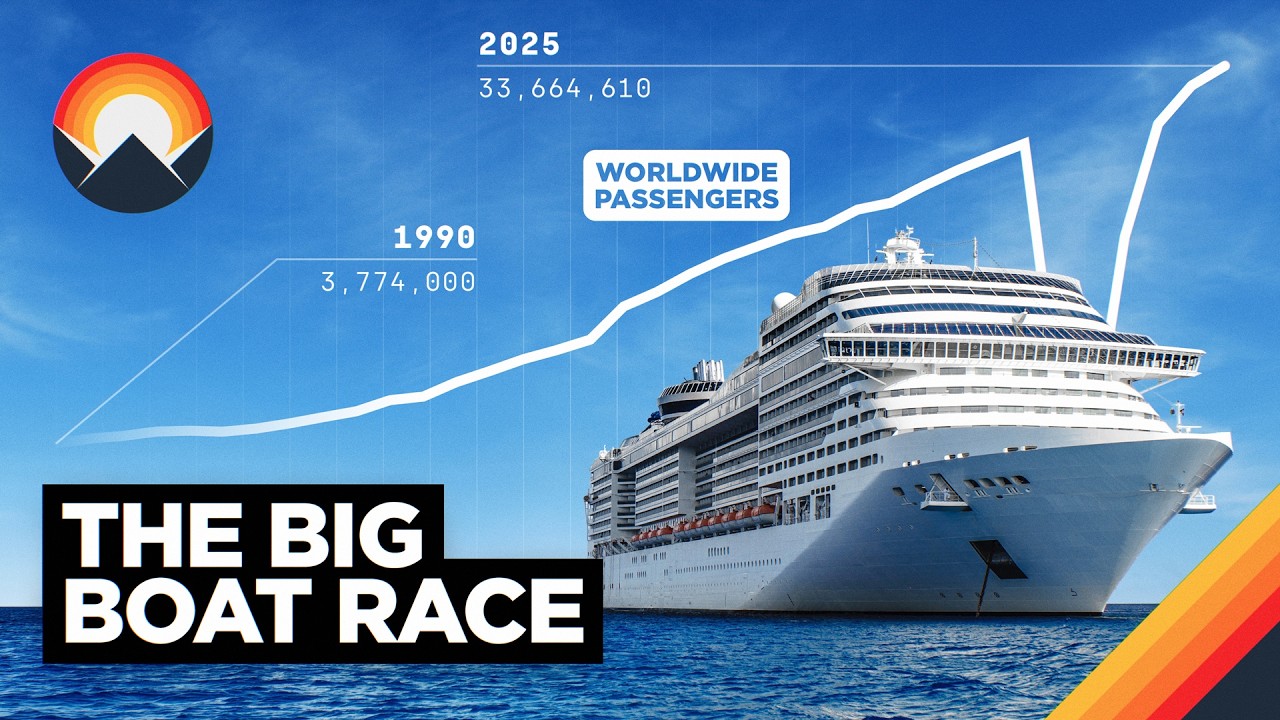
This corporate confidence was backed by two decades of red-hot industry growth. Since 1990, total passenger volume had tripled, experiencing a massive surge through the 2000s. According to a 2009 Cruise Line International Association slide deck, even when global obstacles arose, the industry's growth graph consistently went "up and to the right." Over twenty years, the sector had successfully zeroed in on its principal competitive advantage: providing the cheapest, most hassle-free vacation option for the mainstream American consumer.

* **Passenger Growth:** Total global cruise passengers tripled between 1990 and 2009. * **Target Demographic:** Primarily built around a majority American customer base seeking convenience.

---

[03:03](https://www.youtube.com/watch?v=7NBa5o--y3k&t=183s) The Convenience Cap and the "Nearly Dead" Stigma

For the average traveler, a cruise eliminated the exhaustive logistics of traditional vacations. Instead of researching hotels, booking flights, arranging ground transportation, and hunting for dinner spots every night, a customer could simply hand a credit card to a travel agent for a single flat fee. Travelers could even leave the country without needing to renew a passport. Survey data from 2008 underscored that while multiple destination stops mattered, the sheer value and ease of a cruise were far more critical to cruise vacationers than to those taking land-based trips.

However, this reliance on hyper-convenience came with a branding ceiling. Cruises had developed a nagging reputation for lacking sophistication, famously mocked as being strictly for "the newly wed and nearly dead." To younger crowds and kids, the traditional cruise model was seen as out-and-out boring. To shatter this stigma and make cruising "cool," Royal Caribbean gambled heavily on an unprecedented fleet expansion, culminating in the 2009 launch of the Oasis of the Seas—the largest passenger ship ever built.

* **Value Proposition:** All-inclusive packaging covering airfare, meals, vetted destinations, and pre-configured excursions. * **The Cruise Stigma:** Widely perceived as uncool, unsophisticated, and boring for younger generations.

---

[04:16](https://www.youtube.com/watch?v=7NBa5o--y3k&t=256s) The Oasis of the Seas and Destination-ification

The Oasis of the Seas completely flipped the trajectory of cruising by focusing less on where the ship was going and more on what was inside it. Royal Caribbean divided the massive vessel into seven distinct "neighborhoods" to ensure every member of a three-generation family had a dedicated space. The ship featured a Youth Zone with crayon classes for toddlers and teen-only events, an Entertainment Place for nightlife, a pool and sports zone boasting basketball courts and zip lines, the Vitality at Sea Spa with 29 treatment rooms, and a massive physical streetscape simulation comprising Central Park, the Boardwalk, and the Royal Promenade.

This design shift marked a pivotal business strategy where the boat itself became the destination. Royal Caribbean’s own press releases from the era illustrated this pivot perfectly; the official announcement detailing the ship's journey from Finland to Florida focused entirely on its endless internal amenities, failing to mention a single geographical destination where the boat was actually bound to sail. Even when itineraries were published, details about actual ports of call were buried beneath paragraphs highlighting onboard features.

* **Ship Zones:** Seven neighborhoods including Youth Zone, Entertainment Place, Pool and Sports Zone, Vitality at Sea Spa, Central Park, the Boardwalk, and the Royal Promenade. * **Spa Amenities:** 29 dedicated treatment and relaxation rooms.

---

[05:50](https://www.youtube.com/watch?v=7NBa5o--y3k&t=350s) The Burning Price of Fuel and Itinerary Cuts

Shifting the consumer's focus to the ship also helped the industry solve a massive operational vulnerability: the volatile cost of fuel. In 2008, Royal Caribbean quietly altered its Northeast itinerary on the Explorer of the Seas, completely cutting scheduled stops in Charlottetown, Sydney, and Quebec City. Though the cruise still lasted 9 days and substituted domestic stops, it watered down the Eastern Canadian experience. This decision wasn't driven by a lack of passenger interest or community pushback, but by a desperate need to avoid burning fuel, which is measured in the cruise industry by the metric ton.

Fuel costs accounted for roughly 10% of Royal Caribbean's total operating expenses, nearly matching their entire corporate payroll. Because 60% of all fuel consumed on a cruise goes strictly toward physical propulsion, the doubling of crude oil prices in 2008 hit the industry hard. Short-term fixes like slowing down ships, cutting ports, or tacking on unpopular fuel surcharges frequently frustrated customers who had invested in the destinations themselves, with some complaining it "basically ruin[ed] an entire trip." The long-term solution was to alter the core cruise experience entirely, guaranteeing a spectacular onboard environment rather than relying on the stops the boat made.

* **Fuel Operating Expense:** Accounted for approximately 10% of total operating expenses, nearly matching payroll costs. * **Propulsion Efficiency:** 60% of all fuel used on a cruise is dedicated solely to physical propulsion. * **Crude Oil Shock:** The cost of crude oil more than doubled over the course of a single year in 2008.

---

[07:26](https://www.youtube.com/watch?v=7NBa5o--y3k&t=446s) The Big Boat Bonanza and Brand Niche Triangulation

The decade spanning 2009 to 2019 triggered a massive "big boat bonanza." Rather than sinking the industry under overcapacity, the expanded fleets pushed cruising into an entirely new economic strata, with global passenger numbers climbing from 18 million in 2009 to nearly 30 million by 2019. During this boom, Norwegian and Carnival added two new ship classes and seven new boats each, while Royal Caribbean doubled down on its massive Oasis-class offerings. The big three justified this aggressive expansion by hyper-focusing on their respective brand niches to target distinct audiences.

Carnival marketed itself as the affordable, unpretentious, and "fun" family option, launching itineraries out of easily accessible, drivable domestic ports. Norwegian leaned into its "freestyle" concept, offering a sleek, refined environment tailored to young professionals, couples, and adults who wanted to dine and recreate entirely on their own schedules. Meanwhile, Royal Caribbean positioned its brand as heavily "amped," stuffing its ships with groundbreaking, industry-first engineering marvels that cost a bit more but guaranteed multi-generational appeal.

* **Global Passenger Growth:** Surged from 18 million in 2009 to nearly 30 million by 2019. * **Carnival Niche:** Affordable, unpretentious, family-focused "fun" via drivable ports. * **Norwegian Niche:** Sleek, schedule-free "freestyle" dining and recreation for adults and young professionals. * **Royal Caribbean Niche:** High-energy, "amped" ships packed with expensive engineering firsts.

---

[08:36](https://www.youtube.com/watch?v=7NBa5o--y3k&t=516s) Geographic Flattening and the Caribbean Domination

As cruise ships grew larger, geography flattened out, with over a third of all global guests choosing the Caribbean. Royal Caribbean's historic itineraries from the early 2000s once featured vast diversity, boasting numerous West Coast routes and varied East Coast departure points. By 2019, and narrowing even further by 2024, the map was utterly dominated by Caribbean routes originating from US ports situated close to the islands. This consolidation was partly due to physical constraints; seasonal markets like Alaska, Canada, and Europe are only viable in the summer, whereas the Caribbean offers year-round revenue. Furthermore, gargantuan Oasis-class ships are physically too large to clear obstacles like Baltimore's Chesapeake Bay Bridge safely.

Consolidating routes into the Caribbean also yielded massive financial benefits for the cruise lines. Shorter travel distances drastically lowered mileage, and stretching these shorter routes across a 7-day itinerary allowed ships to sail at slower, more fuel-efficient speeds. Additionally, major players like Royal Caribbean, Carnival, and Norwegian purchased their own private islands. Instead of passengers spending their money within local port-of-call communities, that capital was kept entirely within the cruise line's extended corporate ecosystem. This shift also served as a convenient public relations tool, allowing companies to frame their reduced sailing speeds and limited routing as a win for environmental impact assessments.

* **Caribbean Market Share:** Accounted for over one-third of all global cruise guests by 2019. * **Structural Limitations:** Oasis-class ships are physically blocked from certain ports due to clearance limits under structures like the Chesapeake Bay Bridge. * **Corporate Ecosystems:** Cruise lines maximized revenue by routing passengers to company-owned private islands rather than independent local economies.

---

[10:48](https://www.youtube.com/watch?v=7NBa5o--y3k&t=648s) Extreme Experiences and Ultra-Luxury Land Defectors

Having survived the COVID-19 pandemic—yet another event that critics predicted would destroy the industry—cruises emerged even more mainstream, capturing PTO-crunched millennials with shorter, highly optimized itineraries. However, the modern frontier of cruise innovation is no longer defined by sheer size, but by extreme, highly branded experiences. Operating under the philosophy that they are competing with land-based resorts rather than each other, cruise lines are facing a counter-attack from luxury land-based hotel brands. Chief among them is the Ritz-Carlton, though you won't catch them referring to their growing fleet of $300 million commercial superyachts as "cruise ships."

In an industry where a ship carrying 1,000 passengers is considered a boutique operation, Ritz-Carlton’s debut vessel, the Evrima, holds a mere 298 guests. The vessel cruises commercially on slow Mediterranean routes in the summer and Caribbean paths in the winter, targeting an ultra-luxury niche that blends cruise logistics with a private superyacht atmosphere. Ritz-Carlton safely backed this venture because it directly translated its core land competencies to the ocean. The ship features extensive exposed wood grain to mimic land properties, coordinates menus designed by the head chef of the Ritz-Carlton in Wolfsburg, and applies its strict customer service standards—such as training staff to eye-contact guests at 10 feet and greet them at 5 feet.

* **Evrima Capacity:** Accommodates only 298 guests, starkly contrasting mainstream commercial vessels. * **Vessel Investment:** Built as a purpose-designed ultra-luxury project costing $300 million. * **Staff Empowerment Policy:** Shipboard employees are empowered to spend up to $2,000 to resolve a guest's issue instantly without needing managerial approval. * **New-to-Cruise Onboarding:** In its first year of service, half of the Evrima's passengers had never taken a cruise before.

---

[12:43](https://www.youtube.com/watch?v=7NBa5o--y3k&t=763s) The Hospitality Wave and Disney's Corporate Integration

Ritz-Carlton's foray into luxury yachting has paved the way for other iconic land brands. The hospitality sector is preparing for a wave of new premium watercraft, with Four Seasons and Orient Express launching their respective vessels in 2026, followed by Aman in 2027. This strategy of leveraging established brand trust and consumer loyalty is not exclusive to ultra-luxury yachts; Disney has long used a similar playbook to capture its own dedicated niche.

Initially a small player in the cruise market during the early 2000s, Disney aggressively pivoted toward experiential cruising. Rather than treating its cruise line as an outsourced or isolated silo, Disney integrates Disney Cruises directly within "Disney Experiences"—the exact same corporate division that operates its world-famous theme parks. This alignment allows the cruise line to be designed, led, and informed by operational strategies honed on land since the 1950s. Maintained by heavily themed ships, character meet-and-greets, and exceptional accommodation of family needs (like managing food allergies or instantly replacing a child's dropped ice cream), Disney drives massive repeat business. While they sprinkle unique itineraries throughout their schedule, the focus remains squarely on the onboard experience and stops at private properties like Castaway Cay or Lookout Key, securing Disney a 2.2% share of the global cruise market.

* **Competitor Launch Timelines:** Four Seasons and Orient Express entries are slated for 2026; Aman is scheduled for 2027. * **Disney Corporate Alignment:** Integrated directly within the Disney Experiences division alongside land parks and hotels. * **Disney Market Share:** Captured up to a 2.2% share of the global cruise market through its brand-loyal, experiential model.

[14:21](https://www.youtube.com/watch?v=7NBa5o--y3k&t=861s) The Cruise Industry's Relentless Pace and Lessons from the Past

The cruise industry is witnessing aggressive expansion, with Disney leading a massive wave of expansion by introducing a new boat in 2025, with subsequent ships slated for delivery in 2026 and 2027. All of these vessels belong to their largest line, the Wish class. These represent major investments, but they are fully justified by Disney's unwavering confidence that it can seamlessly deliver the same magical experience at sea that it traditionally provides on land. However, while Disney Cruises is growing at a rapid clip, it is not actually setting the pace in an industry that refuses to slow down; rather, the entertainment giant is simply keeping up with the rest of the pack.

This relentless drive to build stems from hard-learned historical lessons. In a revealing conversation with Royal Caribbean leadership reflecting on their strategy during the Great Recession, company executives expressed one profound regret: they had slowed down future ship orders for the following decade to quietly hedge against an economic slowdown. When cruising bounced back remarkably fast, their newly delivered boats were leading the way, but the company found itself momentarily left behind due to the prior hesitation. This was a critical lesson that Royal Caribbean and the rest of the maritime industry carried directly into the COVID-19 pandemic. They recognized that while the industry would obviously slow down temporarily, it would not stay down forever, and they made sure they would be fully ready the moment global travel returned.

- **Disney's Wish Class Expansion:** New ships entering service in 2025, 2026, and 2027. - **The Great Recession Regret:** Royal Caribbean leadership regretted hedging for a slowdown and pausing ship orders, which left them temporarily behind when demand spiked. - **Pandemic Strategy:** The industry applied the lessons of the Great Recession to COVID-19, maintaining forward momentum to be ready for the return of travel.

[15:15](https://www.youtube.com/watch?v=7NBa5o--y3k&t=915s) The Nimble Architecture of Floating Vacations

Perhaps counterintuitively, the big boat bonanza of the last two decades actually reflects an industry that is increasingly aware of its own advantageous flexibility. Backed by foundational cost and convenience advantages, cruising simply outcompetes the rest of the traditional vacation sector due to its sheer nimbleness. While a land-based hotel can certainly undergo renovations, a cruise line can completely reinvent its ship from the ground up.

More importantly, a ship moves. The inherent mobility of a cruise ship grants operators unparalleled operational freedom. "If fuel prices are up, a ship can move less. If a destination grows dull or too expensive or politically unstable, an itinerary can simply change." Furthermore, if consumer preferences shift toward shorter routing so a younger clientele can save some precious PTO, the cruise industry can easily accommodate them. While a lingering reputation of a lack of sophistication persists—accompanied by an ongoing sense that cruises can be boring, weird, or even sketchy—the industry doesn't just persist; it actively thrives. The race for more and bigger boats shows no signs of stopping, with 50 separate new builds set to hit the water from 2026 to 2030.

- **Future Fleet Pipeline:** 50 separate new builds scheduled to launch between 2026 and 2030. - **Capacity Dynamics:** Some upcoming ships are large enough to house 5,000 to 6,000 guests, and about half of the new builds feature occupancies of 1,000-plus guests. - **Inherent Flexibility:** Cruise lines can adapt to rising fuel costs, changing consumer demographics, and geopolitical instability simply by altering routes.

[16:24](https://www.youtube.com/watch?v=7NBa5o--y3k&t=984s) Cultivating Curiosity with Brilliant

For viewers who love learning and gathering a better understanding of how complex systems work—which the speaker suspects is true for anyone who has made it to this point in the video—the episode sponsor, Brilliant, is highly recommended. Brilliant is an online learning platform built around the philosophy of "learning by doing," helping users grasp complex concepts across physics, coding, math, and data analysis. For instance, if someone wanted to better understand exactly how massive corporations like cruise lines make critical decisions regarding routing or pricing, Brilliant's data analysis pathway serves as an awesome place to start.

There is absolutely no knowledge barrier to entry on the platform, which is intentionally designed to meet users wherever they are, accommodating learners from 10 years old to 100 years old. Once inside, the platform feels far more like a fun and rewarding experience than a daily hassle because the modules are fast-paced, appropriately challenging, and even competitive. It is an ideal way to give your mind a bit of a jolt in the middle of a busy day. Rather than taking a few minutes to mindlessly scroll through social media, users can hop on Brilliant to invest that little bit of time into feeding their curiosity, leaving them feeling all the better for it. The product features a smooth interface and a well-thought-out, dynamic design that scratches the itch to be generally more knowledgeable or to hone problem-solving skills. To encourage viewers to check it out, Brilliant is offering a 30-day free trial.

- **Sponsor Platform:** Brilliant, an interactive learning platform specializing in STEM and data analysis. - **Target Audience:** Open to all ages from 10 to 100 years old, with no prior knowledge barriers. - **Promotional Offer:** A 30-day free trial accessible by visiting the dedicated link: `brilliant.org/wendover`.

## Notable quotes > [00:00](https://www.youtube.com/watch?v=7NBa5o--y3k&t=0s) Go buy the trip and short the stock.

> [01:41](https://www.youtube.com/watch?v=7NBa5o--y3k&t=101s) up and to the right

> [03:03](https://www.youtube.com/watch?v=7NBa5o--y3k&t=183s) the newly wed and nearly dead

> [05:50](https://www.youtube.com/watch?v=7NBa5o--y3k&t=350s) basically ruin[ed] an entire trip.

> [07:26](https://www.youtube.com/watch?v=7NBa5o--y3k&t=446s) big boat bonanza

> [07:26](https://www.youtube.com/watch?v=7NBa5o--y3k&t=446s) freestyle

> [07:26](https://www.youtube.com/watch?v=7NBa5o--y3k&t=446s) amped

> [15:15](https://www.youtube.com/watch?v=7NBa5o--y3k&t=915s) If fuel prices are up, a ship can move less. If a destination grows dull or too expensive or politically unstable, an itinerary can simply change.

> [16:24](https://www.youtube.com/watch?v=7NBa5o--y3k&t=984s) learning by doing

## Mentioned Carnival Cruise Lines, Royal Caribbean, Norwegian Cruise Lines, Cruise Line International Association, Oasis of the Seas, Explorer of the Seas, Charlottetown, Sydney, Quebec City, Eastern Canadian, Alaska, Canada, Europe, Caribbean, Baltimore, Chesapeake Bay Bridge, Ritz-Carlton, Evrima, Mediterranean, Wolfsburg, Four Seasons, Orient Express, Aman, Disney, Disney Cruises, Disney Experiences, Castaway Cay, Lookout Key, Wish class, Brilliant, Tristan Purdy, Sam Denby, Alexander Williard, Sara Stoltman, Gabriel Ferreras, Austin Glass, Kate Ermolenkko, Manni Simon, Dony Bullen, Simon Buckmaster

[Source](https://www.youtube.com/watch?v=7NBa5o--y3k)

中文简报

皇家加勒比及竞争对手订购50艘邮轮以锁定加勒比市场增长 邮轮业正通过利用大容量船只与私人岛屿将消费留在内部并缓解燃料成本波动,从而超越传统陆上度假村。 在经历2008年大衰退带来的财务困境后,各大邮轮公司改变了商业模式,将度假重心从外部目的地转移到设施密集的大型船只上。面对波动的燃料成本以及长期以来对年轻客群缺乏吸引力的刻板印象,Royal Caribbean、Carnival和Norwegian等公司将航线整合为高效的加勒比航程,并收购私人岛屿以将消费者支出保留在其商业生态系统内。当前市场随着Ritz-Carlton和Four Seasons等陆上超奢酒店品牌进军海上游艇领域,以及Disney在体验方面的拓展而进一步扩大。最终,该行业依托船队固有的机动性与结构灵活性来应对经济、地缘政治和人口结构的变化,并保持迅猛势头,计划在2030年前新建50艘邮轮。 2008年的大衰退给邮轮业造成了严重的财务困境,导致股价急剧下跌,并迫使各邮轮公司采取激进的临期打折策略以维持入住率。 (0:00) 尽管面临眼前的经济挑战,各大邮轮公司仍保持长期乐观态度,这源于此前通过提供高性价比、省心无忧的度假体验所实现的二十年持续增长。 (1:41) 为了打破消费者长期以来认为邮轮缺乏品味且对年轻一代枯燥乏味的固有印象,该行业押注于巨型化船体扩张,将船只本身打造为主要的度假目的地。 (3:03) Royal Caribbean的Oasis of the Seas等巨型邮轮的推出,促使行业商业模式转向将船上配套设施置于地理目的地之上。 (4:16) 波动的燃料成本约占总运营支出的10%,迫使各航线缩减目的地并调整行程体验,以最大限度减少实际航行推进需求。 (5:50)

Reading summary

Wendover Productions argues that the cruise industry escaped economic vulnerability and demographic stagnation by turning ships themselves into the primary destination. This strategic evolution lowered exposure to volatile fuel costs, segmented the mass market, and gave floating resorts an operational edge over fixed land-based hospitality. Turning Ships Into Self-Contained Destinations (4:16) Cruising historically relied on cheap, all-inclusive convenience that eliminated travel planning for mainstream American vacationers, but the sector struggled with a persistent reputation of being uncool and catering only to 'the newly wed and nearly dead.' To break out of this niche, Royal Caribbean launched the Oasis of the Seas in 2009, marking an operational shift toward 'destination-ification.' By dividing the ship into seven distinct zones—including dedicated youth areas, entertainment districts, and simulated streetscapes like Central Park—the company targeted multi-generational families on a single vessel. Company marketing quickly de-emphasized geographical ports of call, centering promotions and press releases on internal onboard amenities rather than where the ship was sailing. Fuel Constraints and Caribbean Route Consolidation (5:50) Focusing customer attention inside the vessel allowed operators to manage severe fuel exposures. Fuel represented roughly 10% of Royal Caribbean's operating expenses—nearly rivaling corporate payroll—with 60% of all fuel burned dedicated strictly to propulsion. When crude oil prices doubled in 2008, the company trimmed itinerary distances and cut Canadian port stops to preserve margins. To structurally lower fuel consumption, operators consolidated their networks into the Caribbean, which absorbed more than one-third of all global cruise passengers by 2019. Shorter routes permitted slower, more fuel-efficient sailing over standard seven-day trips. Operators also purchased private islands, keeping excursion spending entirely within corporate balance sheets while publicly framing slower speeds as environmental initiatives. Fleet Expansion and Brand Market Segmentation (7:26) Between 2009 and 2019, global cruise volume climbed from 18 million to nearly 30 million passengers. Rather than creating overcapacity, major operators absorbed new tonnage by triangulating distinct brand identities. Carnival targeted budget-conscious families via easily accessible, drivable domestic ports; Norwegian offered unregimented 'freestyle' dining and recreation for young professionals; and Royal Caribbean focused on capital-heavy engineering spectacles to attract multi-generational groups. Land-Brand Convergence and Floating Asset Mobility (10:48) Cruises increasingly compete against land-based resorts, prompting traditional luxury hospitality brands to enter maritime travel. Ritz-Carlton launched its $300 million, 298-guest yacht Evrima—attracting an inaugural passenger base where half had never cruised before—with Four Seasons, Orient Express, and Aman following with vessels planned between 2026 and 2027. Similarly, Disney integrated Disney Cruises directly into its Disney Experiences division, matching theme park standards to secure a 2.2% global cruise market share. This capital race is supported by the unique mobility of floating assets. When fuel spikes, geopolitics disrupts a port, or travelers demand shorter itineraries, operators can simply reposition their vessels. Remembering that pausing vessel orders during the Great Recession left them flat-footed during the rebound, cruise lines maintained momentum through the COVID-19 pandemic, resulting in 50 new builds scheduled between 2026 and 2030. The modern cruise industry relies on the inherent flexibility of mobile infrastructure to insulate itself against fuel volatility, regional instability, and changing consumer tastes. While lingering stigmas around sophistication persist, the aggressive pipeline of 50 new ships through 2030 indicates operators remain confident that floating, self-contained destinations can consistently outcompete traditional land-based vacations.

精炼阅读摘要

Wendover Productions指出,现代邮轮业已摆脱大衰退时期的生存危机,通过将巨型船舶本身打造为全封闭的度假目的地、向低油耗的加勒比航线集中,以及实施精细的品牌客群细分,构建起超越陆地传统度假产业的商业护城河。 造船革命:从交通工具到度假目的地 (4:16) 2008年金融危机重创了依赖非必需消费的旅游市场,嘉年华(Carnival)股价腰斩至16美元,皇家加勒比(Royal Caribbean)则暴跌至7美元。行业长期依赖包揽机酒餐饮的全包式超值体验来招揽美国大众,但也被外界讥讽为专供“新婚燕尔与垂暮老人”的枯燥选择。为突破这一品牌形象瓶颈,皇家加勒比在2009年力推当时全球最大的客轮“海洋绿洲号”(Oasis of the Seas)。该船划分出中央公园、百老汇大道、配有29间理疗室的水疗中心等七大主题街区,旨在满足三代同堂家庭的内部娱乐需求。 这一设计标志着行业商业模式的根本转型:邮轮本身取代了沿途港口成为真正的目的地。根据皇家加勒比当年的宣传材料,官方推介几乎对航程停靠的具体地理港口只字不提,甚至将具体口岸信息深埋在大量船上设施介绍之后。将游客注意力完全锁定在船内空间,不仅重塑了邮轮度假对年轻一代的吸引力,也降低了运营对外部旅游目的地的依赖度。 成本约束驱动加勒比海航线集中化 (5:50) 邮轮运营高度脆弱于波动的燃料开支。燃油费用约占皇家加勒比总运营支出的10%,规模几乎追平整个公司的员工薪酬,且船只消耗燃油的60%仅用于机械推进。2008年原油价格翻倍迫使船企通过慢速航行、征收燃油附加费或缩减航程来压缩以公吨计量的燃料消耗,皇家加勒比当年甚至悄然删除了探索者号在加拿大东部的多个经停港。为了从根本上避免频繁削减航线引发的旅客投诉,企业将航程体验的核心全面收缩至船体内部,并系统性地重组了全球航线版图。 到2019年,加勒比海航线已承载全球超过三分之一的邮轮游客。这一地理集中趋势一方面源于超级巨轮的物理限制——例如绿洲级邮轮无法安全穿过巴尔的摩切萨皮克湾大桥等关键水上构造;另一方面则在于显著的商业收益。加勒比海拥有四季皆宜的气候条件,且短距离航线允许巨轮低速缓行以提升燃油经济性。此外,各大航运集团纷纷购置自有私人生态岛屿,成功将以往流向地方港口社区的岸上消费全额截留至自身的商业生态系统内部。 三大巨头细分定位与激进造船周期 (7:26) 在2009年至2019年的繁荣期内,全球邮轮旅客数量从1800万人跃升至近3000万人。三大巨头并未因运力激增而陷入恶性恶战,而是各自锚定明确的细分市场:嘉年华主打亲民、无拘无束且依托本土近距港口的家庭“欢乐”游;挪威邮轮推崇取消繁复用餐时间表的“自由闲逸(freestyle)”概念,精准对接白领与年轻伴侣;皇家加勒比则专注打造造价昂贵、充满高科技娱乐工程的高能旗舰,巩固多代家庭客群。 这一轮激进的造船竞赛深刻汲取了大衰退时期的历史教训。皇家加勒比高层曾反思,当年出于防范经济减速而推迟新船订单的保守决策,直接导致公司在随后的行业报复性复苏中错失市场先机。因此,面对COVID-19疫情对行业的沉重打击,主流邮轮公司选择维持扩张节奏,确保在需求反弹时具备充足运力。公开规划显示,2026年至2030年间全球预计将有50艘全新大型邮轮交付,其中部分巨舰载客量达到5000至6000人。 陆地奢华品牌跨界与沉浸式体验创新 (10:48) 随着行业发展,邮轮创新的前沿正从比拼物理体量转向极致的体验与品牌延展,行业甚至迎来了陆地顶级奢华酒店的跨界挑战。丽思卡尔顿(Ritz-Carlton)斥资3亿美元打造了仅容纳298名客人的商用超级游艇Evrima,将陆地高端服务标准完整平移至海上——不仅船员被授予单次最高2000美元的无须审批客诉解决权,菜单也由集团米其林主厨设计。该业务运营首年便成功吸引了50%此前从未涉足邮轮旅行的高净值客群。随后,四季酒店、东方快车计划于2026年下水奢华游艇,安缦也已定档2027年。 这种依托陆地品牌信任度的路径在家庭消费领域同样成效显著。迪士尼(Disney)将其邮轮业务深度整合至负责陆上主题乐园的“迪士尼体验”业务部门,通过高度主题化的船舶、经典角色互动与私人生态岛屿(如Castaway Cay),斩获了全球邮轮市场约2.2%的份额。为了巩固庞大的复购客群,迪士尼在2025至2027年间将持续接收其体量最大的Wish级系列巨轮,使沉浸式IP体验与标准化家庭服务成为其在远洋市场中最坚固的竞争支点。 Wendover Productions总结强调,邮轮相比陆地度假物业的最大优势在于“浮动资产”所具有的战略机动性:面对燃料价格暴涨可缩减航速,面对地缘政治震荡或港口成本变动可即刻调整航线,面对年轻群体年假不足的痛点可随时缩短行程周期。尽管外界长期存在对邮轮度假缺乏文化格调或模式僵化的刻板印象,但凭借强大的成本管控弹性、闭环收益架构以及高灵活度的资产形态,这场跨越公海的造船军备竞赛至今仍无放缓迹象。

Detailed notes — zh

## Background 本内容由知名科普频道 Wendover Productions 于 2026 年 2 月 10 日发布在 YouTube 平台上。视频简介主要提供了赞助商 Brilliant 的 30 天免费试用及年度订阅折扣链接,并列出了包括作者 Sam Denby、Tristan Purdy 在内的完整制作与动画团队名单。 ## TL;DR 视频深入剖析了现代邮轮业从 2008 年金融危机中的濒死挣扎到开启全球“大船军备竞赛”的商业演进史。面对高企的燃油成本和大众对传统邮轮“土气老迈”的刻板印象,以皇家加勒比为代表的巨头通过打造“海洋绿洲号”等超级巨轮,确立了“邮轮本身即目的地”的战略,并将航线高度集中于加勒比海短途及自营私有岛屿。与此同时,丽思卡尔顿等奢华酒店品牌与迪士尼也凭借强大的陆地服务经验跨界入局超豪华游艇与家庭主题航运。邮轮凭借其可移动、航线极易动态调整的底层商业敏捷度,在未来数年仍将迎来数十艘巨轮下水,造船竞赛持续全速推进。 ## Atmosphere & style 全片延续了 Wendover Productions 标志性的冷静、严谨且极具洞察力的商业纪录片叙事风格。旁白语调平稳从容且逻辑缜密,将枯燥的宏观经济危机、燃油消耗数据与微观的甲板滑索、私有岛屿运营无缝串联。叙事的情绪弧线从大衰退时期的恐慌与抛售,顺畅过渡到巨头们在惊涛骇浪中豪赌“海上巨兽”的魄力与野心,让观众在直观感受巨轮工业奇迹的同时,沉浸式体验现代商业帝国运筹帷幄的底层博弈。 ## Bulletin - [08:37](https://www.youtube.com/watch?v=7NBa5o--y3k&t=517s) 全球邮轮业在经历2008年衰退危机后通过“船即目的地”策略成功翻盘,全球年旅客规模从2009年的1800万人次激增至2019年的近3000万人次。 - [08:37](https://www.youtube.com/watch?v=7NBa5o--y3k&t=517s) 巨型邮轮为降低燃油成本并实现消费闭环,大幅向加勒比海短途航线倾斜,并通过自建私有岛屿将岸上观光收入全盘收归己有。 - [10:48](https://www.youtube.com/watch?v=7NBa5o--y3k&t=648s) 陆上奢华酒店(如丽思卡尔顿、四季、安缦)与主题公园巨头(迪士尼)正将陆地服务与品牌忠诚度搬上公海,开辟精品超级游艇和沉浸式家庭赛道。 - [14:44](https://www.youtube.com/watch?v=7NBa5o--y3k&t=884s) 邮轮军备竞赛仍在持续升温,2026至2030年间全球预计将有50艘全新邮轮下水,半数以上载客量突破千人以上。 ## Key takeaways - [00:00](https://www.youtube.com/watch?v=7NBa5o--y3k&t=0s) 2008年经济大萧条重创邮轮业股价与客座率,迫使各大公司采取直降船费、赠送船上消费金及失业全额退款等激进促销自救。 - [01:41](https://www.youtube.com/watch?v=7NBa5o--y3k&t=101s) 邮轮业二十年来的扩张曾得益于一价全包、操作无痛的高性价比,但也固化了“仅适合新婚或垂暮老人”的陈旧刻板印象。 - [04:16](https://www.youtube.com/watch?v=7NBa5o--y3k&t=256s) 2009年下水的皇家加勒比“海洋绿洲号”开创了社区化分区设计,标志着行业战略从“航向何处”转向“邮轮本身即终极目的地”。 - [04:16](https://www.youtube.com/watch?v=7NBa5o--y3k&t=256s) 推进动力占据邮轮燃油消耗的60%,弱化目的地、将旅客注意力留在船内的策略有效对冲了油价暴涨带来的利润侵蚀。 - [07:26](https://www.youtube.com/watch?v=7NBa5o--y3k&t=446s) 2009至2019年间三大巨头启动造船狂欢并分化定位:嘉年华主打极致亲民欢乐,挪威邮轮聚焦自由自在,皇家加勒比专攻感官刺激。 - [08:37](https://www.youtube.com/watch?v=7NBa5o--y3k&t=517s) 加勒比海因可全年运营且地理航程短,成为超过三分之一全球游客的首选目的地,配合降速巡航大幅压缩了燃油开支。 - [08:37](https://www.youtube.com/watch?v=7NBa5o--y3k&t=517s) 邮轮巨头在加勒比海广泛布局专属私有岛屿,彻底阻断了外部港口分流消费,实现了岸上度假收益的全链路闭环。 - [10:48](https://www.youtube.com/watch?v=7NBa5o--y3k&t=648s) 丽思卡尔顿推出造价3亿美元、仅载客298人的超级游艇Evrima,将陆地奢华服务标准全面移植至海上,开拓非传统邮轮客群。 - [10:48](https://www.youtube.com/watch?v=7NBa5o--y3k&t=648s) 四季、东方快车及安缦等陆上顶级奢华品牌加速在2026至2027年入局超豪华游艇市场,加剧高端航海假期的争夺。 - [12:55](https://www.youtube.com/watch?v=7NBa5o--y3k&t=775s) 迪士尼邮轮直接归属于主题公园业务板块,通过复刻乐园级的IP演艺、贴心服务及私有岛屿体验,占领了2.2%的细分市场。 - [14:44](https://www.youtube.com/watch?v=7NBa5o--y3k&t=884s) 邮轮资产相比传统陆地度假具备高度敏捷性,可根据油价波动、地缘政局及游客假期长短快速调整航速、航线与天数。 - [14:44](https://www.youtube.com/watch?v=7NBa5o--y3k&t=884s) 全行业深刻吸取了2008年削减新船订单导致后期运力被动的教训,2026至2030年间预计迎来50艘新船下水的高峰潮。 ## Detailed walkthrough ### [00:00](https://www.youtube.com/watch?v=7NBa5o--y3k&t=0s) 2008年经济大衰退下的邮轮业危机 如果用一句话概括2008年围绕邮轮业的普遍氛围,那就是:“去买船票,顺便做空股票”(Go buy the trip and short the stock)。在大衰退发生一年后,这样的建议毫不含糊且完全合乎逻辑:如果说有什么时候能买到超级骨折价的度假产品,那就是现在;如果说有什么时候最适合做空依赖非必需消费的公司,也正是现在。事实上,这个做空建议甚至来得有些迟。作为行业龙头的嘉年华邮轮(Carnival Cruise Lines),其股价已经跌至16美元,仅为一年前的一半左右;而皇家加勒比(Royal Caribbean)在2007年还在35美元左右交易,此时却已断崖式跳水至每股可怜的7美元。 对于严重依赖90%至100%极高上座率才能维持日常运转的旅游企业来说,投资者在面对这场世纪经济危机时毫无信心,股价随时可能进一步探底。各大邮轮公司为了自救可谓绞尽脑汁。面对行业出版物委婉称之为“极具挑战性的销售环境”,它们大打折扣以求自保:大幅削减舱位价格、赠送200美元的船上消费金,甚至推出“买一送一”的配套机票。行业“三巨头”中的挪威邮轮(Norwegian Cruise Line)更是顺应时局推出一项前所未有的保障政策:凡是订了船票但只要能证明在登船前失业的乘客,均可获得全额退款。 这些激进的市场运作虽然勉强稳住了客座率,让公司不至于倒闭,但市场的疑虑远未消除。极端的打折促销和最后一刻的甩卖很可能会在经济复苏后留下难以扭转的恶劣先例;邮轮与休闲旅游业的反弹速度也往往慢于其他行业。最令人担忧的核心问题在于:在经历过去二十年辉煌增长后,各大公司此前雄心勃勃订购的全新巨型邮轮即将在未来一两年内陆续交付,面对连普通客源都捉襟见肘的现状,它们到底该去哪里找人把这些庞然大物塞满? - 嘉年华邮轮股价从前期高点跌至16美元(腰斩)。 - 皇家加勒比股价从2007年中期的35美元附近暴跌至7美元。 - 应对衰退策略:直降船费、送200美元船上签账额(onboard credit)、二人同行一人免单机票、针对被裁员客户的无条件全额退款。 --- ### [01:41](https://www.youtube.com/watch?v=7NBa5o--y3k&t=101s) 巨头反击:从传统廉价度假到“绿洲级”的破局思维 然而,邮轮行业“三巨头”对当下的危机却有着完全不同的看法。他们自然没有预料到危机的到来,各家也坦承全球衰退确实猛烈撼动了他们的巨轮——嘉年华年报的第一行就直接点明了危机,皇家加勒比年报的第一段通篇都是这一主题,而挪威邮轮公布的亏损也全归咎于此。但他们并不认为邮轮业遭遇了生存绝境,也不认为过去的发展是盲目扩张、超越了自身能力。恰恰相反,他们看到了地平线上的行业革命:皇家加勒比压注在其全新的划时代船级上,嘉年华手握极具潜力的新订单,挪威邮轮则刚对其船队进行了全面改造以匹配其全新的邮轮风格。在他们看来,只要熬过经济低谷,他们亲手缔造的邮轮未来将无比光明。 这份底气源于过去二十年产业积累的成功经验。自1990年以来,全球邮轮旅客总量翻了整整三倍,并在2000年代迎来爆发式增长。正如国际邮轮协会(CLIA)2009年的报告图表所示,哪怕遭遇外部波折,总体趋势图始终保持向右上方稳健攀升。这一势头揭示了邮轮业对自身核心优势的精准把握:对于以美国人为主的客群来说,邮轮曾是性价比最高、最无痛省心的度假方式。相比于传统的自由行需要反复查攻略、订酒店、订机票、安排地面交通、每晚找餐馆,邮轮游只需给旅行社打个电话、刷卡支付一笔全包式固定费用,甚至不需要重新办理护照,就能直接走出国门。打包机票、含三餐、路线经过筛选、岸上观光行程规划妥当,既满足了精打细算的预算型游客,也治愈了厌倦繁琐规划的度假者。 但这套依靠“轻松与省心”的模式很快触碰到了天花板。这种低门槛建立起来的公众刻板印象是:邮轮只是适合“刚结婚的新人和快入土的老人”(the newly wed and nearly dead)。在大众眼中,邮轮缺乏品位、土气落后,尤其对孩子们来说更是无聊透顶。为了打破这种天花板,皇家加勒比在衰退期做出了一场豪赌——他们确信自己找到了让邮轮“重新变酷”的秘诀。 ```mermaid flowchart TD accTitle: 邮轮业度假模式的演进 accDescr: 展示从传统繁琐陆地度假到传统邮轮全包度假,再到将邮轮打造为旅游目的地的思维跃迁 subgraph Phase1["传统陆上自由行"] A["自行规划研究目的地"] --> B["预订酒店与航班"] B --> C["安排地面交通与日常餐饮"] end subgraph Phase2["传统全包式邮轮"] D["一站式固定费用全包"] --> E["打包机票/三餐/陆地接送"] E --> F["无需复杂签注/省心度假"] end subgraph Phase3["目的地化全新邮轮"] G["引入海洋绿洲号概念"] --> H["船体功能划分为各大主题社区"] H --> I["邮轮本身成为旅行终极目的地"] end Phase1 -->|"痛点:规划繁琐"| Phase2 Phase2 -->|"痛点:老龄化、无趣、受限于航线"| Phase3 ``` - 1990年至2000年代:全球邮轮游客人数翻了三倍,形成长达二十年的大牛市。 - 传统客群核心偏好:极高性价比、一价全包、多站点打卡、操作毫无门槛。 - 传统痛点:被贴上“新婚燕尔或垂暮老人”专属标签,被视作毫无格调、缺乏年轻与家庭吸引力。 --- ### [04:16](https://www.youtube.com/watch?v=7NBa5o--y3k&t=256s) “海洋绿洲号”登场与“船即目的地”策略转型 皇家加勒比交出的答卷是2009年正式下水的“海洋绿洲号”(Oasis of the Seas)。在下水之时,它是人类历史上最大的客轮。但比其庞大体量更重要的是其颠覆性的内部规划。全船被划分为七个各具特色的“社区”(Neighborhoods): - **青年区(Youth Zone)**:安排了从幼儿的涂色课堂到专为大龄青少年设计的专属活动; - **娱乐区(Entertainment Place)**:汇集现场音乐与深夜夜总会; - **泳池与运动区(Pool and Sports Zone)**:配备篮球场乃至横跨甲板的滑索; - **海上活力水疗中心(Vitality at Sea Spa)**:拥有29间理疗室及完备的放松体验设施; - **中央公园(Central Park)、百老汇大道(Boardwalk)与皇家大道(Royal Promenade)**:共同模拟并还原了繁华的陆地街景。 这项设计的革命性在于,它真正做到了“让祖孙三代都能在同一艘船上找到属于自己的天地”,彻底告别了过去那种只能在甲板上晒太阳、吃吃喝喝、翻翻书的枯燥模式。这一转变重塑了邮轮产业的轨迹。皇家加勒比当时发布的两份新闻稿极具讽刺意味地证明了这种战略转型:第一篇介绍该船从芬兰船厂启航前往佛罗里达,通篇在大篇幅赞美各种惊人的船内设施与预订方式,却只字未提这艘船未来到底要开往哪里;第二篇宣布首航年份的巡航停靠站,但开篇第一段依旧在狂推内部娱乐设施,最后才仿佛顺带想起一样补充了这艘船的具体停泊港口。邮轮公司心照不宣地承认了一个现实:航行去哪儿已经不再重要,“邮轮本身正在成为旅行的目的地”(The boat itself was becoming the destination)。 把邮轮打造成目的地的策略,同时也巧妙化解了困扰该行业的燃油危机。以2008年为例,皇家加勒比曾悄然调整了“海洋探险者号”(Explorer of the Seas)的美东航线,取消了夏洛特敦(Charlottetown)、悉尼(Sydney)和魁北克城(Quebec City)的停靠。航行依然维持9天,依靠增设美国本土经停点来弥补,但这使得加拿大东海岸风情大打折扣。这一削减并非源于乘客不感兴趣,也不是当地港口拒绝接待,纯粹是因为皇家加勒比“不想烧那么多昂贵的燃油”。在邮轮业中,燃油是用公吨(metric tons)来计算的,燃油支出约占皇家加勒比总运营成本的10%,几乎逼平了全体员工的薪酬支出。虽然公司会通过金融对冲锁定油价,但2008年原油价格在一年内暴涨逾一倍,极大地冲击了利润底线。 对于邮轮而言,60%的燃油消耗用于推进动力。短期应对燃油危机的手段只有减少停靠港、缩短航行距离、降低航速,或者强行加收燃油附加费。但这些举措极易激怒那些专程为了特定目的地买单的游客。正如当时的乘客所抱怨的那样,行程一改,整个假期的期待彻底毁了。于是,巨头们的长期解决方案就是“转嫁焦点”:把精力集中在自己能够掌控的东西上——也就是船只本身及其能提供的极致体验,弱化航线停靠港的地位。 - 燃料在邮轮总运营成本中占比约10%,接近全体船员的人力成本。 - 邮轮总燃油消耗中,高达60%直接用于船体的物理推进(Propulsion)。 - 2008年原油价格一年内翻倍,直接倒逼航线缩水减速与战略重构。 --- ### [07:26](https://www.youtube.com/watch?v=7NBa5o--y3k&t=446s) 2009-2019大船军备竞赛与三大巨头定位分化 在接下来的十年中,运营策略的变革直接推动了造船设计的飞跃。以皇家加勒比下水“海洋绿洲号”为发端,整个行业步入了一场前所未有的“巨轮狂欢”(big boat bonanza)。皇家加勒比的船队实现了跨越式扩容:不仅开辟了全新的船级,还将绿洲级邮轮的数量直接翻倍,陆续增加了多艘同级别超级姊妹舰。从2009年到2019年的黄金十年间,挪威邮轮和嘉年华也毫不示弱,各自开辟了两个全新船级,并且各自添置了7艘全新巨轮。 这轮疯狂造船竞赛的底气,在于各大品牌逐步找准并深耕各自的差异化利基市场(niche): | 邮轮品牌 | 核心品牌定位与价值主张 | 目标受众与运营策略 | |:--- |:--- |:--- | | **嘉年华邮轮 (Carnival)** | 强调极致的“欢乐”(Fun),主打亲民、不做作且性价比极高 | 以家庭为绝对核心,大量布局可自驾直达的便利港口,降低家庭出行门槛 | | **挪威邮轮 (Norwegian)** | 聚焦“自由自在”(Freestyle)概念,无固定用餐时间与繁文缛节 | 风格相对摩登、优雅、精致,吸引年轻白领、成年人及情侣客群 | | **皇家加勒比 (Royal Caribbean)** | 追求极致的“感官刺激”(Amped),致力于将各种突破天际的“首创设施”塞进船体 | 覆盖全年龄段家庭成员,虽票价相对更高,但以天花板级的船上娱乐建立护城河 | 在这十年间,这三大巨头凭借各自越来越庞大的旗舰巨轮,将自身独特的品牌调性与价值主张发挥到了极致,也彻底改写了全球邮轮市场的竞争格局。 ### [08:37](https://www.youtube.com/watch?v=7NBa5o--y3k&t=517s) 加勒比海化与短途航线的经济学:邮轮变成终极目的地 邮轮业并没有像某些人当初担忧的那样陷入停滞,反而一跃进入了全新的规模层级。全球邮轮旅客数量从 2009 年的 1800 万人次,一路飙升至 2019 年的近 3000 万人次。然而与此同时,乘客目的地的多样性却被严重“压扁”了——超过三分之一的游客将加勒比海作为首选目的地。以皇家加勒比(Royal Caribbean)为例,曾经其年度航线版图非常多元:不仅西海岸选择丰富,东海岸出发港口林立,航线更是五花八门。但到了 2019 年,加勒比海航线占据了绝对核心,且绝大多数航次都集中在距离加勒比海越来越近的美国本土港口。到了 2024 年,这种趋势进一步加剧:不仅加勒比海的比重再次攀升,还出现了一个新变化——平均航程变得越来越短。 这种航线布局的变化部分源于硬性的物理限制。例如,阿拉斯加、加拿大或欧洲的邮轮航行通常仅在夏季可行,而加勒比海却能全年无休地运营;同时,搭载旅客人数最多的绿洲级(Oasis class)巨轮受限于体量,根本无法停靠像巴尔的摩(Baltimore)这样的港口,因为它们庞大的身躯无法安全穿过切萨皮克湾大桥(Chesapeake Bay Bridge)的净空。但更深层的原因在于,随着巨轮本身蜕变为假期的核心吸引力,目的地多元化在旅客决策中所占的比重越来越低。 这种战略转变反过来极大地利好了邮轮公司的利润底线。首先是燃油成本的大幅节省:从美国南部港口直达加勒比海的航程,比加州往返墨西哥等路线短得多;如果将这一短途航程拉长至 7 天,巨轮就能以更低的航速巡航,从而大幅降低油耗。其次,皇家加勒比、嘉年华(Carnival)和诺唯真(Norwegian Cruise Line)等巨头纷纷在加勒比海群岛中购置了自营的私有度假岛屿。旅客不再在途经港口的当地社区消费,而是将每一分钱都花在邮轮公司精心打造的延伸体验中。此外,由于航线缓慢且范围高度受限,邮轮公司还能在饱受争议的环保议题上打“形象牌”,声称自家的航线设计和燃油效率比以往任何时候都更加绿色环保。面对因带薪休假(PTO)紧张而偏好短途航线的千禧一代,巨型邮轮已彻底走向主流。 ```mermaid flowchart TD accTitle: 航线缩短与集中化对邮轮公司的经济驱动模型 accDescr: 描述邮轮航线集中于加勒比海短途及私有岛屿后为船司带来的三大复合优势。 subgraph Operation["航线与物理特征"] A["全年运营的加勒比海短途航线"] B["自建巨型船体 (如绿洲级)"] end subgraph Advantages["商业与运营利好"] C["航程短且航速慢<br/>大幅节省燃油消耗"] D["停靠自营私有岛屿<br/>旅客消费全额闭环"] E["公关与营销赋能<br/>宣传能效与环保指标"] end A --> C A --> D B --> A C --> E ``` - 2009 年至 2019 年间,全球邮轮旅客从 1800 万增长至近 3000 万,其中超三分之一的目的地为加勒比海。 - 绿洲级巨轮由于桥下净空高度限制,无法驶入巴尔的摩等历史港口。 - 嘉年华、皇家加勒比与诺唯真均在加勒比海拥有专属私有岛屿,将原本流入沿途港口的岸上观光收入全盘收归己有。 --- ### [10:48](https://www.youtube.com/watch?v=7NBa5o--y3k&t=648s) 陆地奢华品牌的降维打击:丽思卡尔顿与超豪华超级游艇 整个邮轮业普遍存在一个共识:没有任何一家邮轮公司在将其他邮轮同行视为真正的竞争对手,他们真正的假想敌是“陆地度假”。如今,陆上高端奢华酒店品牌吹响了反击的号角。丽思卡尔顿(The Ritz-Carlton)进军航海领域时,绝口不提自家的商业超级游艇舰队是“邮轮”。在传统邮轮业将搭载 1,000 名乘客的船只就归类为“小型”或“精品精品船”的背景下,丽思卡尔顿推出的首艘客船“Evrima”仅容纳 298 名客人。 Evrima 在夏季走地中海慢速航线,冬季转战加勒比海,主打 7 天行程。这艘造价达 3 亿美元的定制船只将超级游艇的私密性与邮轮的服务相结合,填补了超奢华航海假期的空白。丽思卡尔顿敢于下此赌注,是因为这与其核心能力完全契合。无论是在阿斯彭(Aspen)滑雪胜地还是纽约曼哈顿,丽思卡尔顿的酒店都具备高度一致的优雅木质调装潢、能精准记住客人姓名的资深员工,以及长期留任的主厨团队。这些让高净值人群死心塌地的要素被丝滑复刻到了海上:Evrima 内部大量采用外露木纹装饰;餐饮体验由德国沃尔夫斯堡(Wolfsburg)丽思卡尔顿的顶尖主厨一手操刀。在服务标准上,船员严格执行陆地规范——在相隔 10 英尺时与客人目光接触并微笑,在 5 英尺时主动问候,甚至每位员工均被赋予无需向上级报批即可直接动用最高 2,000 美元为客人解决纠纷的自主权。在 Evrima 运营的第一年,登船的客人中竟有整整一半此前从未坐过邮轮。 - 丽思卡尔顿 Evrima 号造价 3 亿美元,载客量仅为 298 人,定位为介于邮轮与超级游艇之间的超豪华体验。 - 船上延续了丽思卡尔顿的陆地黄金服务法则:10 英尺微笑眼神接触、5 英尺言语问候,并赋予船员单次最高 2,000 美元的无审批客诉解决额度。 - 其他顶级陆上奢华品牌正加速入局:四季酒店(Four Seasons)和东方快车(Orient Express)的首艘游艇计划于 2026 年交付下水,安缦(Aman)则定于 2027 年正式启航。 --- ### [12:55](https://www.youtube.com/watch?v=7NBa5o--y3k&t=775s) 迪士尼经验的漂移:把陆地魔法搬上公海 将忠诚度和品牌信任度变现的打法并非超级游艇的专利,迪士尼(Disney)也在自己的细分赛道中采用了完全相同的逻辑。从 2000 年代初的行业小玩家起步,迪士尼在 2000 年代末敏锐捕捉到体验型航海模式的机遇。2010 年代初迅速投放新船,到 2010 年代中期持续追加订单,迪士尼管理层笃信邮轮业务绝非跨界冒险,而是品牌与服务在水上的天然延伸。这一点在组织架构上体现得淋漓尽致:迪士尼邮轮(Disney Cruise Line)没有被外包或边缘化,而是直接划归至“迪士尼体验”(Disney Experiences)业务部——该部门正是管理迪士尼全球主题公园与度假区的核心班底。 这意味着迪士尼邮轮自设计之初,就全盘继承了自 1950 年代以来运营乐园和酒店所淬炼的最佳实践与战术。船舱的主题化风格对儿童具有致命吸引力;穿戴卡通制服的演职人员会贴心照顾孩子的食物过敏、迅速补上一支掉在地上的冰淇淋,从而彻底俘获父母的心;从水上游乐设施到高规格舞台剧,其娱乐活动做到了全年龄段通吃。在航线上,迪士尼虽然穿插了独特的航点,但主体仍是搭配了自营私有岛屿“漂流岛”(Castaway Cay)或“观景岛”(Lookout Cay)的加勒比航程。凭借这一模式,迪士尼拿下了约 2.2% 的市场份额,其体量最大的“愿望级”(Wish class)将在 2025 年、2026 年和 2027 年连续迎来多艘新船交付。 - 组织归属:迪士尼邮轮隶属于负责主题公园业务的“迪士尼体验”(Disney Experiences)部门,直接沿用乐园级运营与服务标准。 - 核心船队扩张:迪士尼当前坐拥 2.2% 的市场份额,旗下体量庞大的愿望级新船正以每年一艘的节奏在 2025、2026 及 2027 年陆续下水。 --- ### [14:44](https://www.youtube.com/watch?v=7NBa5o--y3k&t=884s) 终极灵活性:邮轮工业的造船军备竞赛 尽管迪士尼等新势力发展迅猛,但在不减速的邮轮业整体大盘前,它们也仅仅是跟上了节奏。皇家加勒比的高管在回顾 2008 年大萧条时曾表示,公司当时唯一后悔的决策,就是为了对冲经济下行而在随后十年悄悄放缓了新船订单的下达速度;结果当邮轮需求以惊人速度触底反弹时,他们交付的新船虽处于领跑地位,但整体运力却短暂陷入了被动。这一血的教训让全行业在面对 COVID-19 疫情冲击时变得无比坚决——危机必然会减缓行业步伐,但绝不会永远停滞,必须为需求重启做好万全准备。 过去二十年的“大船狂欢”表面看似激进,实则反映了邮轮业对自身独特商业敏捷度(nimbleness)的绝对自信。与陆地度假产业相比,邮轮具备无可比拟的底层灵活性:一家传统酒店只能搞装修改造,但邮轮公司却能将一艘船从底层彻底重新发明;更为关键的是,船是会移动的资产。 - 燃油价格暴涨?邮轮可以立刻调低航速、减少航行距离; - 某个停靠目的地变得乏味无趣、收费高昂或政局不稳?航线只需要轻轻画一笔即可重新规划; - 年轻客群想节省带薪假?邮轮公司能迅速推出周末 3 至 4 天的短途航线来满足需求。 尽管市场上对于邮轮仍残存着诸如“不够高端、沉闷无聊、古怪或体验存疑”的刻板印象,但庞大的造船军备竞赛毫无降温迹象。从 2026 年到 2030 年,全球将有 50 艘全新的邮轮下水,其中一部分体量高达可搭载 5,000 至 6,000 名旅客,约半数以上的新船载客量都在 1,000 人以上。建造更多、更大船只的超级竞赛,仍在全速向前推进。 --- ### [16:24](https://www.youtube.com/watch?v=7NBa5o--y3k&t=984s) 赞助商插播:Brilliant 的数据分析与思维训练 如果观众对大规模商业体运作、邮轮航线网络优化以及动态定价背后的底层决策机制感兴趣,那么本期赞助商 Brilliant 正是绝佳的学习平台。Brilliant 摒弃了死记硬背的模式,主打“在实践中学习”(learning by doing),帮助用户轻松拆解物理、编程、数学及数据分析等复杂领域的知识。其数据分析学习路径(Data Analysis Pathway)正是探究巨头企业商业逻辑的理想起点。 平台内容的设计抹平了年龄与门槛障碍,无论是 10 岁的少年还是 100 岁的老人都能找到适应自身节奏的学习切入点。其交互模块快节奏且充满成就感,甚至带有一点竞技趣味,能够在繁忙的工作生活间隙为大脑带来及时的思维激活。相较于在碎片时间漫无目的地刷短视频,花几分钟在 Brilliant 的流畅界面上探索逻辑谜题与前沿概念,能为求知欲带来更为持久的充实感。 ### [17:26](https://www.youtube.com/watch?v=7NBa5o--y3k&t=1046s) 赞助商致谢:通过 Brilliant 拓展知识与提升解题能力 无论观众是希望拓展更广泛的综合知识储备,还是切实磨砺并提高自身解决实际问题的能力("hone your problem-solving"),现在都是深入探索的最佳时机。在线学习平台 Brilliant 为此提供了为期整整 30 天的免费试用福利("30-day free trial")。 感兴趣的观众只需点击视频简介中的专属链接 `brilliant.org/wendover`,即可在整整一个月内无限制地访问该平台上的全部内容。解说者对平台的品质表现得十分自信,并打趣道相信大家在体验之后,肯定会愿意继续留下来学习更长时间("confident you'll stick around longer")。 - **专属试用福利**:通过专属通道 `brilliant.org/wendover` 可获取 30 天全平台完整访问权限,体验涵盖科学、数学与计算机等多领域的互动课程。 - **技能与思维训练**:强调以动手交互与问题导向的方式培养分析思维与解题本领。 ## Notable quotes > [00:00](https://www.youtube.com/watch?v=7NBa5o--y3k&t=0s) Go buy the trip and short the stock > [01:41](https://www.youtube.com/watch?v=7NBa5o--y3k&t=101s) the newly wed and nearly dead > [04:16](https://www.youtube.com/watch?v=7NBa5o--y3k&t=256s) The boat itself was becoming the destination > [07:26](https://www.youtube.com/watch?v=7NBa5o--y3k&t=446s) big boat bonanza > [16:24](https://www.youtube.com/watch?v=7NBa5o--y3k&t=984s) learning by doing > [17:26](https://www.youtube.com/watch?v=7NBa5o--y3k&t=1046s) hone your problem-solving > [17:26](https://www.youtube.com/watch?v=7NBa5o--y3k&t=1046s) 30-day free trial > [17:26](https://www.youtube.com/watch?v=7NBa5o--y3k&t=1046s) confident you'll stick around longer ## Mentioned 嘉年华邮轮 (Carnival Cruise Lines), 皇家加勒比 (Royal Caribbean), 挪威邮轮 (Norwegian Cruise Line), 国际邮轮协会 (CLIA), 海洋绿洲号 (Oasis of the Seas), 海洋探险者号 (Explorer of the Seas), 丽思卡尔顿 (The Ritz-Carlton), Evrima, 四季酒店 (Four Seasons), 东方快车 (Orient Express), 安缦 (Aman), 迪士尼邮轮 (Disney Cruise Line), 迪士尼体验 (Disney Experiences), 愿望级 (Wish class), Brilliant, 切萨皮克湾大桥 (Chesapeake Bay Bridge), 漂流岛 (Castaway Cay), 观景岛 (Lookout Cay) ## Video description To learn for free on Brilliant for a full 30 days, go to http://Brilliant.org/Wendover Brilliant’s also given our viewers 20% off an annual Premium subscription, which gives you unlimited daily access to everything on Brilliant. Youtube: http://www.YouTube.com/WendoverProductions Instagram: http://Instagram.com/sam.from.wendover Twitter: http://www.Twitter.com/WendoverPro Sponsorship Enquiries: wendover@standard.tv Other emails: sam@wendover.productions Reddit: http://Reddit.com/r/WendoverProductions Writing by Tristan Purdy and Sam Denby Editing by Alexander Williard Animation by Sara Stoltman, Gabriel Ferreras, Austin Glass, and Kate Ermolenkko Sound by Manni Simon and Dony Bullen Thumbnail by Simon Buckmaster [Source](https://www.youtube.com/watch?v=7NBa5o--y3k)

Source quotes

[0:00] Go buy the trip and short the stock [1:41] the newly wed and nearly dead [4:16] The boat itself was becoming the destination [7:26] big boat bonanza [16:24] learning by doing [17:26] hone your problem-solving [17:26] 30-day free trial [17:26] confident you'll stick around longer

Source quotes

[0:00] Go buy the trip and short the stock. [1:41] up and to the right [3:03] the newly wed and nearly dead [5:50] basically ruin[ed] an entire trip. [7:26] big boat bonanza [7:26] freestyle [7:26] amped [15:15] If fuel prices are up, a ship can move less. If a destination grows dull or too expensive or politically unstable, an itinerary can simply change. [16:24] learning by doing

Original transcript

[0:00] If one headline could summarize the mood [0:02] surrounding the cruise industry in 2008, [0:04] [music] it's this: Go buy the trip and [0:07] short the stock. The advice was [0:09] declarative. A year into the Great [0:10] Recession, it made sense. If ever there [0:13] was going to be a screaming deal on a [0:14] vacation, it'd be now. And if ever there [0:16] was a time to bet against companies [0:18] built around discretionary spending, [0:20] it'd be now. If anything, the advice was [0:22] a little late. Carnival Cruise [music] [0:24] Lines, the biggest in the industry, was [0:27] already trading at $16, roughly half of [0:30] where it was a year prior. While Royal [0:31] Caribbean, trading in the mid-30s in [0:33] 2007, had fallen to a measly $7 a share. [0:37] But both could and would drop lower as [0:40] travel businesses reliant on 90 to 100% [0:42] occupancy rates to keep the lights on [0:44] just didn't engender much investor [0:46] confidence in the century's [music] [0:47] biggest economic downturn. For their [0:49] part, though, the cruise companies got [0:51] creative. Addressing what industry [0:53] publications euphemistically called a [0:55] challenging sales environment, they [0:56] slashed room rates, they offered $200 [0:58] onboard credits, [music] and they [1:00] included two for one airfare to get [1:02] there. A sign of the times, Norwegian [1:04] Cruise Lines, the third of the [1:05] industry's big three, offered full [1:07] refunds to those who booked a trip but [1:09] could prove they had lost their job [1:10] before embarkation. Wobbling, the [1:13] aggressive maneuvering kept occupancy [1:14] rates high enough to keep the companies [1:16] upright. But doubts remained. Extreme [1:19] discounting and last-minute deals could [1:21] create difficult precedents should the [1:22] economy bounce back. Cruising and [1:24] leisure travel could take longer than [1:26] other industries to bounce back, too. [1:28] And then the big one. How would these [1:30] companies, emboldened by their past two [1:32] decades of success and growth but now [1:34] struggling to find customers of any [1:36] sort, fill the massive boats about to be [1:38] delivered and activated in the next [1:40] couple years? [music] [1:41] The industry's big three saw the moment [1:43] a bit differently. Certainly, recession [1:45] wasn't something they expected, and each [1:47] readily admitted that the global [1:48] downturn hard rocked their respective [1:50] boats. It was in the first line in [1:52] Carnival's annual report. It was the [1:54] theme of the first paragraph of Royal [1:56] Caribbean's. and it was responsible for [1:58] the reported losses at Norwegian. [2:01] But, while each recognized things were [2:02] rocky for the moment, they didn't share [2:04] the belief that the industry had run [2:06] headlong into an existential problem, or [2:08] that [music] they had outkicked their [2:09] own coverage. Rather, they saw [2:11] revolution on the horizon. [2:14] Royal Caribbean pointed to its brand new [2:16] class of ships that they were betting [2:17] their future on. Carnival had its own [2:19] promising new boats on order, and [2:20] Norwegian had just revamped its fleet to [2:22] reflect an overhaul in its cruising [2:24] style. If they could get through the [2:26] downturn, they figured that the future [2:27] of cruising, which [music] they [2:29] themselves were introducing, was bright. [2:32] They had reason to project confidence. [2:33] [music] [2:34] Until this point, the past two decades [2:36] for the maturing industry had been red [2:38] hot. Since 1990, total passengers had [2:41] tripled, really hitting its stride in [2:42] the 2000s. And as the Cruise Line [2:44] International Association's 2009 slide [2:47] deck acknowledged, even when obstacles [2:49] arose, the graph still went up and to [2:52] the right. What this graph, with its [2:54] [music] upward trajectory and [2:55] recognition of passenger resilience [2:57] showed, was that the industry in the [2:58] last two decades had zeroed in on its [3:01] principal advantages. [3:02] >> [music] [3:03] >> For a majority American customer base, [3:05] cruising was the cheapest, most [3:06] hassle-free means of taking a vacation. [3:09] Compared to researching a place, finding [3:11] a hotel, booking airfare, then ground [3:13] transportation, figuring out dinner [3:14] every night, one could [music] just call [3:16] a travel agent, put down a credit card [3:18] for a single flat fee, and go on a trip, [3:20] even leave the country, without having [3:22] to do as much as renew a passport. A [3:25] cruise, with package airfare, meals [3:27] accounted for, destinations vetted, and [3:29] excursions already configured, offered [3:31] both the budget-focused and travel-weary [3:33] a way to get out to good weather, or to [3:35] see a corner of the world in a more [3:37] comfortable way. Customers said as much. [3:39] As these 2008 figures showed, multiple [3:41] stops were important, but so too was the [3:43] value, and especially the ease of it [3:45] all, which surveyed as far more [3:47] important to cruise vacationers than [3:48] non-cruise vacationers. The problem was, [3:51] this strategy [music] had a cap. [3:53] Leaning into easy and convenient, [3:55] cruises had established a reputation. [3:57] They were for the newly wed and nearly [3:59] dead. They lacked sophistication. They [4:02] weren't cool, [music] and especially for [4:03] kids, they were just out and out boring. [4:06] But with their mid-recession era fleet [4:07] expansion, Royal Caribbean was confident [4:09] that it may have just bucked the trend, [4:11] that it may have come across a concept [4:13] to making cruising [music] cool. Their [4:16] answer was this boat. When it launched [4:19] in 2009, Oasis of the Seas was the [4:21] largest passenger ship ever. But what's [4:24] more important than sheer size was what [4:26] it fit [music] inside. The ship was [4:28] split into seven distinct zones that [4:29] Royal Caribbean called neighborhoods. [4:31] The youth zone programmed crayon classes [4:33] for little ones to teen-only events for [4:35] older kids. Entertainment Place hosted [4:37] music and housed nightclubs. The pool [4:39] and sports zone hosted everything from [4:41] basketball courts to zip lines. The [4:42] Vitality at Sea Spa provided 29 [4:44] treatment rooms and relaxation options. [4:46] While Central Park, the Boardwalk, and [4:48] the Royal Promenade collectively pulled [4:50] together a simulation of a streetscape. [4:52] The ship, by design, had something for [4:54] everyone, or more accurately, some [4:56] things for everyone. Rather than just [4:58] drinking and eating and reading a book [5:00] under the sun, every member of a [5:02] three-generation family had a place on [5:04] the boat that drew them in. The concept [5:06] changed the trajectory of cruising. Two [5:09] press releases from Royal Caribbean best [5:11] encapsulate the industry's pivot. First, [5:13] the announcement that the boat was on [5:14] its way from Finland to Florida. [music] [5:16] The release gets to the boat's many [5:17] features early and then never leaves the [5:19] subject. While it mentions how one can [5:21] book a trip on the boat, there's never [5:23] any mention as to where the boat is [5:25] actually bound to sail. As for the [5:27] announcement as to where the new pride [5:29] of the Royal Caribbean was to visit in [5:30] its first year of operation, well, that [5:32] too is opened with a paragraph on [5:33] amenities before getting to the part [5:35] that's been overlooked, that the boat [5:37] actually goes places. Of course, the [5:39] principal culprit in this destination [5:41] overlooking had been Royal Caribbean [5:42] themselves. A tacit recognition that the [5:45] business strategy was changing. The boat [5:47] itself was becoming the destination. [5:50] The destination-ification of the boat [5:52] addressed another major challenge [5:54] servicing the industry. In 2008, Royal [5:56] Caribbean quietly altered this Northeast [5:59] itinerary serviced by the Explorer of [6:00] the Seas. It would cut stops [music] in [6:02] Charlottetown, Sydney, and Quebec City. [6:05] The trip would still last 9 days, it [6:07] make up for the cuts with new domestic [6:09] stops, but it wouldn't quite offer the [6:11] same Eastern Canadian experience. It [6:14] wasn't due to a lack of interest. It [6:15] certainly wasn't due to the communities [6:17] not wanting the business or the [6:18] travelers not wanting to stop. It was [6:20] down to Royal Caribbean not wanting to [6:22] burn the fuel. In this industry, fuel is [6:25] measured not in gallons or liters, but [6:27] in metric tons. And in recent years, [6:30] fuel cost has accounted for about 10% [6:31] [music] [6:32] of total operating expenses at Royal [6:34] Caribbean, nearly matching the cost of [6:35] payroll. Even though some companies will [6:37] use hedging strategies to lock in future [6:39] fuel at a given rate, the industry is [6:41] uniquely vulnerable to fuel price [6:43] variability, and it was no different in [6:44] 2008 when the cost of crude more than [6:47] doubled in the course of a year. The [6:49] short-term fix, given that 60% of all [6:51] fuel used on a cruise goes towards [6:52] physical propulsion, was to cut stops, [6:55] shorten routings, and slow the boats, or [6:57] just add fuel surcharges. Neither goes [6:59] over particularly well with the [7:00] clientele. As a customer at the time [7:02] pointed out, [music] for those that are [7:03] invested in the destination itself, such [7:06] changes in itineraries basically ruin an [7:08] entire trip. But the long-term solution [7:10] to better adjust for things they [7:12] couldn't control was to focus on what [7:14] they could. For Royal Caribbean and the [7:15] rest, it was to alter the emphasis on [7:17] the cruise experience. Make the trip [7:19] about what they could guarantee, the [7:21] boat and the experience it provides, [7:23] rather than the stops the boat makes or [7:25] doesn't. [7:26] In the decade that followed, the [7:28] innovation of strategy compelled [7:29] innovation in design. Spearheaded by [7:31] Royal Caribbean and the launch of the [7:33] Oasis of the Seas, the industry entered [7:35] a big boat bonanza. [music] [7:38] Royal Caribbean's fleet boomed from this [7:40] to this, adding an entirely new class of [7:43] ships while doubling its offering in the [7:44] Oasis class with two new additions. From [7:47] '09 to '19, both Norwegian and Carnival [7:50] added two new classes of their own and [7:52] seven new boats each. Justifying the [7:54] expansion of each was the increased [7:56] investment into each brand's developing [7:58] niche. Carnival was, as they put it, [8:00] fun. They were the easiest as a family, [8:02] running itineraries out of accessible [8:04] and drivable ports. They were affordable [8:06] and unpretentious. Norwegian, with an [8:08] emphasis on its freestyle concept, [8:10] essentially dining, recreating, doing [8:12] anything really on your own schedule, [8:14] was sleek and comparatively refined, [8:16] welcoming to young professionals, [8:18] adults, couples. While Royal Caribbean, [8:20] as they put it, was increasingly amped, [8:23] stuffing their ships with as many [8:24] groundbreaking firsts as they could [8:26] possibly imagine. There was something [8:28] for everyone in the family, but it cost [8:29] a bit more. All maintained their brand [8:31] messaging and values through their ever [8:33] bigger boats. [8:36] Bigger boats didn't sink the industry [8:37] like some had feared, they broke the [8:39] industry into a new [music] strata. 18 [8:42] million global passengers in 2009 [8:44] reached nearly 30 million by 2019. [8:46] >> [music] [8:46] >> And more than ever, the diversity of the [8:48] destination of these guests had [8:50] flattened out, with over a third [8:51] choosing the Caribbean. For Royal [8:53] Caribbean, annual itineraries used to [8:55] look like this. A lot of West Coast [8:57] options, a lot of East [music] Coast [8:58] ports of departure, a lot of variety. By [9:01] 2019, it looked like this. A lot of [9:03] Caribbean with a lot of the Caribbean [9:05] cruises being serviced from US ports [9:07] near and near to [music] the Caribbean. [9:10] By 2024, it looked like this. Even more [9:12] Caribbean and a new wrinkle, shorter [9:14] average trips. Some of this is explained [9:17] by simple physical limitations. Cruising [9:19] in Alaska or Canada or Europe is only [9:22] feasible during the summer, while the [9:23] Caribbean is year-round. Or the fact [9:25] that Oasis class boats carrying the most [9:27] customers just can't access ports like [9:29] Baltimore's because they're too big to [9:31] clear under the Chesapeake Bay Bridge [9:32] safely. It's also recognition that [9:35] diversity of destination is also just [9:36] less central to the considerations of [9:38] the traveler as the boats themselves [9:40] have become a more central attraction. [9:42] And this, in turn, helps the company. [9:44] First, the fuel savings. [music] Simply, [9:46] the distance is fractional for Caribbean [9:48] routing than a California to Mexico [9:50] routing, which not only saves mileage, [9:52] but if it's a cruise drawn out across 7 [9:54] days, the boat can go slower. [9:56] Then there's the fact that Royal [9:57] Caribbean has its own private resource [9:59] within the islands, [music] as does [10:00] Carnival, as does Norwegian. Now, rather [10:03] than passengers spending money in port [10:04] of call communities, that money's being [10:06] spent in their extended experience. [10:09] Beyond the company islands and the [10:10] comparative fuel savings, there's also [10:12] the image work. Because its itineraries [10:14] are plotting and pretty limited, it can [10:16] present fuel savings as a win in the [10:18] ever contentious environmental impact [10:19] assessment of these boats, that they're [10:21] being more fuel efficient than ever. By [10:24] rightly maneuvering to adjust for [10:25] consumer taste, big cruise has a won, [10:28] and they've kept winning. Through a [10:30] global pandemic that, again, certainly [10:32] seemed like the end of the industry, the [10:33] boats have only gotten bigger, and [10:35] cruising, now offering shorter and [10:37] shorter routings for PTO-crunched [10:39] millennials, has only gotten more [10:41] mainstream. But the industry is [10:42] innovating again. This time, not through [10:44] extreme size, but increasingly extreme [10:46] experiences. [10:48] There's a prevailing thought shared [10:49] across the industry that no cruise [10:51] company is competing with or even [10:53] thinking about the other cruise [10:55] companies. They're competing with a [10:56] land-based travel. So now, land-based [11:00] travel is fighting back. You won't find [11:02] Ritz-Carlton referring to its growing [11:04] fleet of commercial superyachts as [11:05] cruise ships. [11:06] >> [music] [11:06] >> In an industry where 1,000 guests [11:08] qualifies a ship as small or boutique, [11:11] the Ritz's first passenger ship, the [11:12] Evrima, holds only 298 guests. Perhaps [11:16] not a cruise ship, the Evrima does [11:18] commercially cruise, booking out [music] [11:20] 7-day itineraries on plotting [11:21] Mediterranean routes in the summer and [11:23] Caribbean routes in the winter. And the [11:25] offering is meant to fill a niche within [11:26] the industry. It was positioned to fill [11:28] the ultra-luxury cruising void with a [11:30] purpose-built boat that blended elements [11:32] of cruises and super yachts. Providing [11:34] the requisite confidence to invest [11:36] [music] in a $300 million project like [11:37] this was the fact that cruising is [11:39] pretty in line with the company's core [11:41] competencies. The Ritz relies on loyalty [11:43] in the luxury hotel sector. Whether in [11:45] Aspen or New York, all their properties [11:47] have a similar warm yet refined look and [11:49] feel. They have staff trained to [11:51] remember names and to go [music] the [11:52] extra mile to help a guest. They have [11:54] restaurants run by empowered and [11:56] long-serving chefs. All these are things [11:58] that keep customers coming back even [11:59] strong customers to visit far-flung [12:01] vacation destinations because they have [12:03] so much faith in the hotel. All these [12:05] aspects are easily transferable over to [12:07] a super yacht. The boat, with its ample [12:09] exposed wood grain, looks like a Ritz [12:11] while the dining experience was designed [12:13] by the head chef at the Ritz-Carlton in [12:15] Wolfsburg. As for customer service, it's [12:17] the same as the hotels, too. Staff smile [12:20] and make eye contact with passing guests [12:22] [music] at 10 ft and greet them at 5 [12:24] just like they're trained to do on land. [12:26] They're also empowered to spend up to [12:27] $2,000 to resolve an issue that a guest [12:29] runs into without management [12:31] green-lighting it. On water, the Ritz [12:33] believed it could provide what it does [12:34] on land and its customers trusted it as [12:36] much. In the first year of service, the [12:38] Evrima welcomed guests that half the [12:40] time had never ever taken a cruise [12:42] before. [12:43] >> [music] [12:43] >> While the Ritz-Carlton may have been the [12:44] first, the rest are coming. The first of [12:46] the Four Seasons and Orient Expresses [12:48] respective forays into the space are set [12:50] to hit the water in 2026, while Aman's [12:52] will hit the water in 2027. [12:55] Leaning into loyalty and brand trust is [12:57] not a strategy reserved just for the [12:59] ultra luxury yacht. Disney has taken a [13:01] similar approach with their own niche. A [13:03] relatively small player in the industry [13:04] beginning in the early 2000s, Disney, [13:07] too, saw opportunity in pivoting to a [13:08] more exciting and experiential cruising [13:10] model toward the end of the decade. With [13:12] new ships on the water in the early [13:14] 2010s and new ships on order by [13:16] mid-decade, the company invested in the [13:18] sector with confidence because [13:19] leadership saw it as an intuitive [13:21] extension of the brand and its services [13:23] rather than an expansion into a a space. [13:26] It's reflected in corporate structure. [13:28] Rather than a component that's [13:29] outsourced or siloed, Disney Cruises [13:31] exists within Disney Experiences, the [13:34] same division that runs the famed parks. [13:36] All this means that the cruise line is [13:38] designed by, led by, informed by [13:40] strategy and best practices honed from [13:42] running parks and hotels since the [13:44] 1950s. Similar to Ritz-Carlton, they [13:47] stay busy and bring back repeat [13:49] customers because they employ what works [13:51] on land. The thematic style of the boats [13:54] works for kids, costume staff members [13:56] charm parents by accommodating food [13:58] allergies and replacing a dropped ice [14:00] cream. The entertainment, from shows to [14:02] rides, broadly works for just about [14:04] everyone, regardless of generation. [14:06] While the company intersperses some [14:08] pretty unique itineraries within its [14:09] heavy dosing of Caribbean routings that [14:11] usually pass through Disney's Castaway [14:13] or Lookout Keys, it's most often the [14:15] on-boat experience that guests talk [14:17] about. Up to a 2.2% market share, [14:21] Disney's introduced a new boat in 2025, [14:23] expecting another in 2026, and another [14:26] in 2027, all of which from their largest [14:29] line, the Wish class. All major [14:31] investments, but investments justified [14:33] by a confidence that it can deliver at [14:35] sea what it does on land. Disney Cruises [14:38] is growing fast, but in an industry [14:41] that's not seeming to slow, it's not [14:43] setting the pace, it's just keeping up [14:44] with the rest. In a conversation with [14:46] Royal Caribbean leadership reflecting on [14:48] strategy during the Great Recession, [14:50] company leadership expressed one regret, [14:53] that they slowed future ship orders for [14:55] the following decade to quietly hedge [14:57] for some slowdown. When cruising bounced [14:59] back remarkably fast, when their new [15:01] boats are ready delivered were leading [15:03] the way, they were momentarily behind [15:05] again. It was a lesson that they and the [15:07] rest carried into COVID. The industry [15:10] would obviously slow, but not forever, [15:12] and they'd be ready when travel [15:14] returned. [15:15] Perhaps counterintuitively, what the big [15:17] boat bonanza of the last two decades [15:18] reflects is an industry increasingly [15:21] aware of its own advantageous [15:23] flexibility. With foundational cost and [15:25] convenience advantage, cruising simply [15:27] outcompetes the rest of the vacation [15:29] sector in its nimbleness. A hotel can [15:31] renovate, certainly, but a cruise can [15:33] reinvent its ship from the ground up. [15:36] And more importantly, a ship moves. If [15:39] fuel prices are up, a ship can move [15:41] less. If a destination grows dull or too [15:44] expensive or politically unstable, an [15:46] itinerary can simply change. If consumer [15:49] preference asks for shorter routing so a [15:51] younger clientele can save some PTO, the [15:53] cruise industry can accommodate. While [15:55] the reputation of a lack of [15:57] sophistication may linger, a sense that [15:59] cruises can be boring or weird or [16:01] sketchy still exists, the industry [16:03] doesn't just persist, it thrives. 50 [16:07] separate new builds are set to hit the [16:08] water from 2026 to 2030. Some big enough [16:11] for 5 to 6,000 guests, and about half [16:14] with 1,000 plus guest occupancies. The [16:17] race for more and bigger boats just [16:20] won't stop. [16:24] If learning and gathering a better [16:25] understanding of how things work is your [16:27] thing, I suspect it is if you made it to [16:29] this point in the video, then this video [16:31] sponsor, Brilliant, is for you. [16:33] Brilliant is an online learning platform [16:35] that helps you grasp complex concepts in [16:37] physics, coding, math, or data analysis [16:40] through learning [music] by doing. If [16:42] for instance, you'd want to better [16:43] understand how companies of such scale [16:45] as cruise lines make decisions on [16:47] routing or pricing, Brilliant's data [16:49] analysis pathway would be an awesome [16:51] place to start. [music] And there's no [16:52] knowledge barrier to entry. The service [16:54] works for everyone from 10 years old to [16:56] 100 years old and is designed to meet [16:58] you where you are. Once you're in, it's [17:00] a service that feels more fun and [17:02] rewarding than a hassle because the [17:03] modules are fast-paced, appropriately [17:05] challenging, and even competitive. [17:07] Something to give your mind a bit of a [17:09] jolt in the midst of a busy day. And [17:11] consider the alternative. Rather than [17:13] taking a few minutes to mindlessly [17:14] scroll, you can hop on Brilliant and [17:16] invest that little bit of time in [17:18] feeding your curiosity and feel all the [17:20] better for it. It's a smooth interface, [17:23] it's a well-thought-out and dynamic [17:24] product, and it will scratch an itch to [17:26] be generally more knowledgeable or hone [17:28] your problem-solving. If you're at all [17:29] curious, now is the time to check it out [17:32] as Brilliant is offering a 30-day free [17:34] trial. Go give it a shot by following [17:36] the link in the description, [17:37] brilliant.org/wendover, where you can [17:39] access it all for an entire month, [17:41] though I'm confident you'll stick around [17:43] longer.