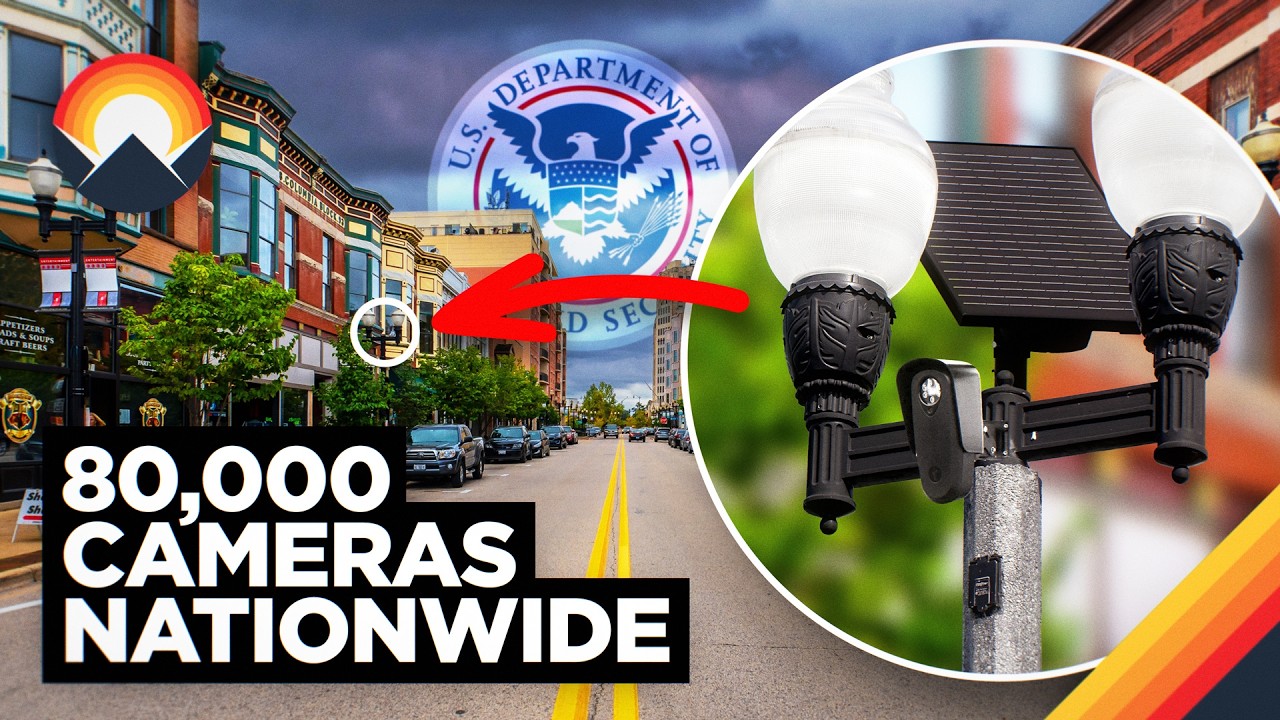
ICE Uses Vendor Loopholes, Mobile Apps to Expand U.S. Surveillance Web
Wendover Productions
The federal immigration agency is leveraging private tech contracts and faulty biometric tools to bypass local sanctuary laws, laying the groundwork for a broader domestic surveillance state that targets both immigrants and political protestors.
## Background
Published on YouTube on March 24, 2026, by the channel Wendover Productions, this video breaks down how the Immigration and Customs Enforcement agency utilizes digital surveillance. The video description provides an exclusive NordVPN promotional link with four extra months, sponsorship and production contact emails, and credits Sam Denby for writing and Alexander Williard for editing.
## TL;DR
The video reveals how Immigration and Customs Enforcement (ICE) circumvents legal and state restrictions to access a nationwide data-sharing network built by private surveillance startups like Flock Safety. Additionally, ICE deploys custom-built biometric facial recognition apps like Mobile Fortify in the field—populating its databases through airport exit checks—and utilizes cell site simulators known as stingrays to track phones without warrants. Driven by a newly approved $75 billion budget, these highly automated, error-prone digital tools are increasingly used as a pretext for unlawful detentions and to build databases monitoring political protesters.
## Atmosphere & style
The presentation carries the characteristically analytical, investigative, and deeply clinical tone typical of a high-production journalistic documentary. It blends an overarching sense of systemic dread with sharp, objective alarm as it systematically peels back the layers of a hidden, corporate-backed governmental apparatus. Watching it feels like a sobering dive into algorithmic overreach, shifting from localized municipal loopholes to a sweeping critique of a creeping American surveillance state that increasingly normalizes the erosion of constitutional privacy.
## Key takeaways
- [00:00](https://www.youtube.com/watch?v=aRUhgrqnpGY&t=0s) ICE accesses AI-enabled license plate reader data in non-cooperative municipalities by leveraging private networks operated by venture-backed startups like Flock Safety.
- [01:41](https://www.youtube.com/watch?v=aRUhgrqnpGY&t=101s) Automated data-sharing agreements allow outside law enforcement agencies cooperating with ICE to easily query and access localized surveillance data repositories.
- [01:41](https://www.youtube.com/watch?v=aRUhgrqnpGY&t=101s) The lack of standardized justification requirements for data searches leaves local authorities entirely unaware of how outside agencies utilize their surveillance networks.
- [03:29](https://www.youtube.com/watch?v=aRUhgrqnpGY&t=209s) Flock Safety data has been repeatedly abused by rogue law enforcement officers for unauthorized personal surveillance and tracking.
- [05:00](https://www.youtube.com/watch?v=aRUhgrqnpGY&t=300s) Even when municipal access is restricted, ICE can bypass local restrictions by tapping into unregulated private commercial networks operated by retail corporations.
- [06:29](https://www.youtube.com/watch?v=aRUhgrqnpGY&t=389s) ICE and Border Patrol use a proprietary mobile facial recognition app called Mobile Fortify to instantly extract biographical and legal data from biometric databases.
- [06:29](https://www.youtube.com/watch?v=aRUhgrqnpGY&t=389s) The biometric data powering field recognition tools is siphoned heavily from expanded, long-term exit checks conducted on non-citizens at U.S. international airports.
- [09:18](https://www.youtube.com/watch?v=aRUhgrqnpGY&t=558s) Mobile Fortify displays high technical inaccuracy in real-world field environments, leading to misidentifications that are still used as immediate pretexts for arrest.
- [09:18](https://www.youtube.com/watch?v=aRUhgrqnpGY&t=558s) Federal agents utilize field facial recognition app data to build long-term 'databases of dissent' by tracking and identifying political protesters.
- [13:59](https://www.youtube.com/watch?v=aRUhgrqnpGY&t=839s) ICE deploys highly invasive cell site simulators known as stingrays to intercept IMSI numbers from mobile devices within a targeted area.
- [14:51](https://www.youtube.com/watch?v=aRUhgrqnpGY&t=891s) Despite internal policies requiring targeted judicial warrants, official oversight confirms ICE routinely uses stingrays for warrantless mass surveillance.
- [15:46](https://www.youtube.com/watch?v=aRUhgrqnpGY&t=946s) A recently approved $75 billion funding surge from Congress will nearly triple ICE's annual budget, accelerating the automation and expansion of its digital surveillance suite.
- [16:29](https://www.youtube.com/watch?v=aRUhgrqnpGY&t=989s) ICE tolerates flawed data and high system error rates because the technology serves its operational goal of providing a convenient pretext for unlawful, post-detention investigations.
- [17:14](https://www.youtube.com/watch?v=aRUhgrqnpGY&t=1034s) The rapid expansion of ICE's methods threatens the Fourth Amendment by normalizing a government-wide mass surveillance state that logs the locations and associations of all citizens.
## Detailed walkthrough
### [00:00](https://www.youtube.com/watch?v=aRUhgrqnpGY&t=0s) Backdoor Surveillance in Glenwood Springs
The federal Immigration and Customs Enforcement agency (ICE) has found a convoluted way to access data from AI-enabled license plate reading surveillance cameras. This is occurring even in municipalities like Glenwood Springs, Colorado, which are deeply unsupportive of ICE's mission. Glenwood Springs voted two to one for Kamala Harris in the 2024 election and features a large immigrant population where roughly one-third of households are Spanish-speaking. Furthermore, Colorado voters supported a statewide blue majority law explicitly prohibiting local police from cooperating or sharing data with federal immigration authorities.
The loophole exists because while the local police department operates the camera, they do not own it. The system is owned by Flock Safety, a fast-growing, venture capital-backed startup. Glenwood Springs pays an annual fee of $37,500 to access the data. The software suite allows local police to look back in time to see exactly when and where a vehicle passed through town, or add a plate to a "hot list" to trigger an arrest alert. Internal logs reveal the department uses these cameras nearly every day to investigate everything from assault and stalking to sex offenses. Glenwood PD reports the system has been instrumental in notable successes, including arresting a California gang member in a stolen vehicle, a wanted felon suspected of elder abuse, and an Oregon pedophile who lured a child to the town.
* **Glenwood Springs Demographics:** Two to one vote for Kamala Harris in 2024; one-third of residents speak Spanish at home.
* **Annual System Cost:** $37,500 paid to Flock Safety.
* **Geographic Advantage:** Interstate 70 passes directly through Glenwood Springs, channeling thousands of long- and short-distance commuters through the cameras daily.
---
[01:41](https://www.youtube.com/watch?v=aRUhgrqnpGY&t=101s) Data Sharing Agreements and Political Dissent
Because Interstate 70 serves as a major escape route for fleeing suspects, law enforcement agencies nationwide desire access to Glenwood's camera network. Glenwood Springs opted into automated data-sharing agreements, allowing outside departments to search their repository at the press of a button in exchange for reciprocal access. However, this network is exactly "how ICE got in." In January 2025 alone, outside police departments queried Glenwood's data 516,892 times. A portion of these external agencies openly cooperate with ICE. Internal logs explicitly acknowledge that Homeland Security Investigations (HSI), the investigative arm of ICE, has conducted searches using Glenwood's data.
The surveillance network also shows potential for tracking political dissent. Following the nationwide "No Kings Day" protest against the Trump administration, October logs revealed multiple searches justified simply with the logged reasoning: "protest." While crimes can occur during peaceful demonstrations, logging a protest itself as the justification demonstrates a willingness to use Flock data in illegitimate ways. This risk is amplified because there is no standardized threshold requiring officers to justify their searches. Thousands of times per month, outside agencies log ambiguous search reasons like "investigation," "TBD," "test," or simply the number "0," leaving Colorado authorities entirely in the dark.
* **External Access Count:** 516,892 data accesses by outside departments in January 2025 alone.
* **Ambiguous Log Entry Examples:** "investigation", "TBD", "test", "0".
---
[03:29](https://www.youtube.com/watch?v=aRUhgrqnpGY&t=209s) Rogue Actors and Contractual Loopholes
Ample precedent exists regarding rogue law enforcement officers using Flock data for nefarious personal reasons. Because tracking is so spotty, rogue actors easily fly under the radar, and those who are caught typically face internal disciplinary action rather than legal prosecution.
* A Kansas police chief used Flock data to stalk his ex-girlfriend 228 times.
* A North Charleston, South Carolina officer used the system to stalk his wife.
* An officer in Miami tracked his girlfriend, and an officer in Menasha, Wisconsin stalked his ex-girlfriend.
When Glenwood Springs residents discovered ICE's backdoor access, they pressured the city council. The police department initially responded by cutting off system access to all law enforcement agencies outside of Colorado. However, the *Aspen Daily News* reported that two police departments within Colorado illegally bypassed state law to share data with the federal agency anyway. In response, Glenwood shut off outside access entirely. Despite this, the city attorney noted that their contract with Flock meant they "can't completely control what Flock does with data from Glenwood's system." This concern is validated by Denver, located three hours away, which terminated its Flock contract after discovering the city's data was shared with federal immigration authorities against their knowledge as part of a secret pilot program.
---
[05:00](https://www.youtube.com/watch?v=aRUhgrqnpGY&t=300s) Private Backdoors and National Concerns
Even if a city completely walls off its police cameras, ICE can still exploit private commercial networks. At the entrance of the local Lowe's Home Improvement parking lot in Glenwood Springs, private Flock Safety cameras log every single car entering the lot. Unlike public law enforcement, Lowe's does not publish its logs or disclose who has access to its database. Thousands of these corporate-operated cameras exist nationwide. Because these private entities do not answer to public constituents, they effectively "act as a backdoor for ICE to surveil the movements of Americans even in non-cooperative states and municipalities." Recent polling reveals a majority of Americans distrust ICE, making this commercial data pipeline a growing concern. Because most U.S. police departments do not face the public pressure Glenwood did, they continue to share data freely. Any database is only as secure as its weakest link, giving ICE open access to a nationwide surveillance web simply by finding one friendly local department.
---
[06:29](https://www.youtube.com/watch?v=aRUhgrqnpGY&t=389s) Mobile Fortify and Airport Biometrics
ICE does not always rely on roundabout methods; many tools are custom-built for the agency. In videos documenting tense or violent immigration arrests, agents are increasingly seen holding smartphones directly up to people's faces. They are using a proprietary facial recognition app called "Mobile Fortify" (and a closely related Border Patrol variant). In New York, an agent was documented using the app to identify an individual waiting for an immigration hearing at a federal courthouse. A successful scan instantly pulls up the target's name, date of birth, nationality, immigration status, and any prior deportation orders, establishing immediate probable cause for an arrest.
To populate this database, ICE siphons biometric data from Customs and Border Protection (CBP). CBP has drastically expanded biometric gathering at U.S. airports. Previously, the U.S. lacked formal exit immigration controls, relying instead on flight manifests provided by airlines. Today, biometric gates scan travelers' faces and cross-reference them against passport photos. By late 2025, DHS announced these exit checks would become universal at all international airports. While photos of U.S. citizens are reportedly deleted within 12 hours, non-citizens' photos are retained for up to 75 years, flowing directly into the Mobile Fortify ecosystem alongside data from ICE's case management system and the FBI's National Crime Information Center.
> "ICE does not provide the opportunity for individuals to decline or consent to the collection and use of biometric data/photograph collection." — *Internal ICE Document*
---
[09:18](https://www.youtube.com/watch?v=aRUhgrqnpGY&t=558s) Faulty Field Logic and Databases of Dissent
In practice, Mobile Fortify is plagued by technical inaccuracies. During an October 2025 ICE raid in the agricultural town of Woodburn, Oregon, a legal deposition revealed the app's severe field limitations. An officer scanned a detained woman's face and admitted, "it came up to a very like a similar person. I wasn't sure if it was her or not." The system suggested the name "Maria." When the woman did not respond, the officer scanned her again, and the app generated an entirely different identity match.
When asked in court to state his legal probable cause for the arrest, the officer testified that he believed she was undocumented because she spoke Spanish to interact with others and because she "became a possible match on my facial recognition system." Though courts have ruled that language alone cannot establish probable cause, this officer relied entirely on an app he knew had misidentified the woman twice. In real-world environments—characterized by poor lighting, shaky phone cameras, and moving subjects—facial recognition routinely struggles.
Beyond identification, Mobile Fortify is being used as a tool to monitor political protesters. In cities like Minneapolis, federal agents have been seen holding up phones to scan anti-ICE protesters. Because these crowds are overwhelmingly white and English-speaking, agents have no reason to suspect irregular immigration status. Instead, they are exploiting a policy mismatch: while airport data is highly regulated, field photos captured on Mobile Fortify are retained for up to 15 years, even if the person is a confirmed U.S. citizen.
The app generates an "encounter log" tying a person's photo and identity to a specific time and location. In Minnesota, a woman serving as a legal observer walked behind DHS vehicles to document their actions. An officer blocked her path, addressed her by her full name despite her never giving it, warned her they had facial recognition technology, and threatened her with arrest. Three days later, the TSA revoked her 14-year-old PreCheck status. Furthermore, when an agent scans someone, Mobile Fortify allows them to see if other agents have previously logged that individual at other protests, effectively turning the platform into a "database of dissent" used to target specific activists.
---
[13:59](https://www.youtube.com/watch?v=aRUhgrqnpGY&t=839s) Cell Phone Surveillance Via Stingrays
As the surveillance tools get more sophisticated, their operational details become more guarded. ICE is known to possess "stingrays"—highly sophisticated cell phone surveillance systems typically built into vehicles costing half a million dollars.
Stingrays operate by spoofing legitimate cellular towers. Because mobile phones are hardwired to constantly seek out and connect to the strongest available local signal, any phone in the vicinity of a stingray will automatically drop its carrier connection and connect to the fake police signal instead.
Once a connection is established, the stingray intercepts the phone's International Mobile Subscriber Identity (IMSI) number, a unique numerical identifier tied directly to the user's cellular carrier account. Armed with this IMSI number, ICE can issue a subpoena, court order, or search warrant to the carrier to unmask the target's true identity. Because stingrays are incredibly invasive and capture data from all surrounding innocent bystanders, internal ICE policies dictate that they may only be deployed for targeted investigations backed by a judicial warrant.
[14:51](https://www.youtube.com/watch?v=aRUhgrqnpGY&t=891s) Warrantless Stingrays and Mass Protest Surveillance
While cell site simulators, commonly known as stingrays, can be legitimately useful for determining whether a targeted individual is at home or at work, Immigration and Customs Enforcement (ICE) has a long history of ignoring its own policies and using them without a warrant. This practice is so pervasive that it prompted an entire Inspector General report dedicated to the issue. Furthermore, circumstantial evidence suggests that ICE has flagrantly broken policy by deploying stingrays in non-targeted mass surveillance operations, capturing the IMSI numbers of anyone who happens to be in a target area.
A stark example of this occurred during an anti-ICE protest on July 4, 2025, in Seattle, Washington. An analysis of cellular signals at the demonstration revealed anomalies consistent with the use of an IMSI catcher. This indicates that the agency may have been using these devices to harvest a comprehensive log of all mobile devices—and therefore every individual—present at the protest.
- **Targeted vs. Mass Surveillance:** Stingrays are designed to locate specific individuals, but ICE has used them broadly to sweep up data on entire crowds.
- **Seattle Protest:** Cellular signal anomalies detected on July 4, 2025, pointed directly to IMSI catcher deployment by the agency.
- **Official Oversight:** The misuse of this technology is documented in an official Inspector General report.
---
[15:46](https://www.youtube.com/watch?v=aRUhgrqnpGY&t=946s) The Automated Deportation Pipeline and ICE's Ballooning Budget
License plate readers, mobile fortify systems, and stingrays represent merely the tip of the iceberg. ICE currently commands a massive software suite of digital surveillance tools that increasingly automate their investigative operations. This automation allows more field personnel to remain on the streets, actively rounding up more individuals for deportation. Because ICE rarely volunteers information regarding its surveillance capabilities, the public is left in the dark, relying on leaks, court documents, mandatory disclosures, and direct observation to piece together what tools are being used.
The scope of this surveillance is poised to expand drastically. Congress recently approved an additional $75 billion in funding for ICE, nearly tripling the agency's annual budget over the next few years. This massive financial influx ensures that the depth and breadth of its monitoring systems will accelerate rapidly, posing an escalating threat to immigrant rights.
- **Automation:** Digital surveillance suites automate investigations, shifting personnel from desks to active street roundups.
- **Information Control:** Public knowledge of ICE's tech relies strictly on leaks, court disclosures, and observation.
- **Budget Surge:** Congress approved $75 billion in additional funding, nearly tripling ICE's annual operating budget.
---
[16:29](https://www.youtube.com/watch?v=aRUhgrqnpGY&t=989s) Pretextual Arrests and the Erosion of Constitutional Rights
Many of the digital tools deployed by ICE suffer from massive error rates and are fundamentally ineffective. However, the agency has little motivation to improve them because, for their specific objectives, the tools work perfectly fine. They serve as a convenient pretext for unlawful arrests, allowing agents to detain individuals who lack legal status without legitimate probable cause. Because establishing true probable cause is difficult, the agency finds it much easier to simply ignore constitutional rights, detain people first, and investigate their residency status later.
This operational model persists because no one currently in power is in the business of challenging ICE's lawfulness. Furthermore, many Americans actively choose to ignore the constitutional and human rights violations of immigrants, provided it hastens the administration's progress toward "their goal of a more homogeneous America."
- **Pretextual Detentions:** High error rates are tolerated because flawed data is still used as a pretext to bypass standard probable cause requirements.
- **The Process:** ICE frequently detains individuals first and investigates their legal residency status afterward.
- **Political and Social Backing:** A lack of congressional or executive pushback, combined with a public desire for a homogeneous society, insulates the agency from accountability.
---
[17:14](https://www.youtube.com/watch?v=aRUhgrqnpGY&t=1034s) The Creep of the American Surveillance State
Even for citizens who support ICE's ultimate goals, the agency's methods should remain a serious source of concern. ICE has played a pivotal role in a massive, government-wide creep of mass surveillance that has accelerated across multiple presidential administrations. Historically, the United States public has been uniquely wary of domestic government surveillance—polling consistently shows Americans care far more about this issue than the average European, traditionally preferring a compromise in security to ensure increased privacy.
ICE is directly challenging the Fourth Amendment's protections against unreasonable search and seizure by effectively searching everyone without a warrant in the hopes of finding useful information. While some might justify these "fast and loose methods" because they make the removal of immigrants more efficient, the long-term consequence is the normalization of an America where those in power know where you are, who you know, and what you are doing at any given time. This power is already being abused against immigrants and protestors, but it can easily be directed toward anyone in the future.
> "America is becoming a surveillance state, and too many aren't concerned because the victims so far are primarily those they've been told are the enemy."
---
[18:49](https://www.youtube.com/watch?v=aRUhgrqnpGY&t=1129s) Mitigating Surveillance and the Practical Utilities of a VPN
While many forms of digital surveillance are completely unavoidable, there are ways to protect your data. For instance, internet service providers (ISPs) routinely track and store browsing history, which can be handed over to the US government via a proper subpoena or warrant. Utilizing a service like NordVPN addresses this by establishing an encrypted tunnel between the user and a secure server. Unlike traditional ISPs, NordVPN enforces a strict no-logs policy, meaning they retain no usage data to hand over to authorities even if legally compelled—a claim independently audited and verified by both PwC and Deloitte.
Beyond dodging government surveillance, a VPN offers several day-to-day practical applications. It allows users to bypass government firewalls and circumvent geo-blocking on streaming websites by virtually redirecting traffic through servers in various countries. Additionally, features like Threat Protection Pro enhance general internet security by automatically blocking dangerous ads, pop-ups, and malicious websites, drastically reducing the risk of malware.
- **Audited Security:** NordVPN’s zero-logs policy has been verified through independent reviews by PwC and Deloitte.
- **Censorship and Geo-blocking:** Traffic can be virtually routed to access an open internet or unlock region-restricted streaming content.
- **Threat Protection Pro:** Built-in security tools actively block malicious ads and reduce malware risks.
- **Viewer Offer:** NordVPN is offering an exclusive deal for Wendover viewers that includes 4 extra months at [nordvpn.com/wendover](https://nordvpn.com/wendover), backed by a risk-free 30-day money-back guarantee.
## Notable quotes
> [06:29](https://www.youtube.com/watch?v=aRUhgrqnpGY&t=389s) ICE does not provide the opportunity for individuals to decline or consent to the collection and use of biometric data/photograph collection. — Internal ICE Document
> [09:18](https://www.youtube.com/watch?v=aRUhgrqnpGY&t=558s) it came up to a very like a similar person. I wasn't sure if it was her or not. — ICE Officer
> [09:18](https://www.youtube.com/watch?v=aRUhgrqnpGY&t=558s) became a possible match on my facial recognition system. — ICE Officer
> [17:14](https://www.youtube.com/watch?v=aRUhgrqnpGY&t=1034s) America is becoming a surveillance state, and too many aren't concerned because the victims so far are primarily those they've been told are the enemy.
## Mentioned
Immigration and Customs Enforcement, ICE, Wendover Productions, NordVPN, Sam Denby, Alexander Williard, Sara Stoltman, Gabriel Ferreras, Austin Glass, Kate Ermolenkko, Manni Simon, Dony Bullen, Simon Buckmaster, Flock Safety, Kamala Harris, Glenwood Springs Police Department, Interstate 70, Homeland Security Investigations, HSI, Trump administration, Aspen Daily News, Lowe's Home Improvement, Mobile Fortify, Border Patrol, Customs and Border Protection, CBP, Department of Homeland Security, DHS, FBI, National Crime Information Center, TSA, PreCheck, PwC, Deloitte, Threat Protection Pro
Wendover Productions reports that Immigration and Customs Enforcement (ICE) has constructed an expansive surveillance apparatus by exploiting commercial data-sharing loopholes, biometric databases, and warrantless cellular tracking. The program argues that despite high error rates, these automated systems provide pretexts for detentions while eroding constitutional protections against unreasonable search and seizure.
Commercial Loopholes and License Plate Networks (0:00)
ICE routinely bypasses state and municipal sanctuary policies by tapping into automated license plate recognition networks operated by private contractors like Flock Safety. In Glenwood Springs, Colorado—a municipality that pays $37,500 annually to use Flock's cameras and is bound by state laws barring cooperation with federal immigration authorities—outside police departments accessed local camera data 516,892 times in January 2025 alone. Internal logs confirmed Homeland Security Investigations conducted queries through these reciprocal networks. External agencies frequently logged uninformative justifications such as 'investigation', 'test', '0', or 'protest', preventing local oversight.
Municipalities face contractual limitations in restricting data dissemination. Glenwood Springs' city attorney acknowledged an inability to fully dictate Flock's data practices, a dilemma highlighted when Denver previously terminated its contract after learning its data was funneled into a secret federal immigration pilot. Furthermore, ICE can circumvent municipal barriers entirely by accessing Flock cameras deployed by private commercial entities, such as retail parking lots, which operate without public disclosure requirements.
Biometric Data Siphoning and Flawed Facial Recognition (6:29)
ICE agents increasingly utilize 'Mobile Fortify,' a proprietary mobile facial recognition application populated with biometric records drawn from Customs and Border Protection (CBP) and the FBI. Under expanding CBP airport programs, non-citizen biometric photos are retained for up to 75 years without an option to decline or consent, feeding directly into ICE's enforcement platforms. In the field, agents use the app to instantly surface identity, nationality, and deportation histories.
Legal depositions reveal that the software frequently falters under field conditions. During an October 2025 enforcement action in Woodburn, Oregon, an agent detained a woman after Mobile Fortify generated two conflicting identity matches, with the officer testifying that the inconclusive scan and the subject's Spanish language formed his probable cause. Additionally, federal agents have deployed Mobile Fortify to scan English-speaking demonstrators at anti-ICE rallies in Minneapolis. Field encounter photos are retained for up to 15 years regardless of citizenship status, enabling the agency to build cross-referenced records tracking political activists.
Warrantless Cellular Interception and Protest Monitoring (13:59)
ICE deploys vehicle-mounted cell-site simulators, commonly known as stingrays, which spoof legitimate cell towers to force nearby mobile phones to connect to fake signals. This allows agents to intercept International Mobile Subscriber Identity (IMSI) numbers and unmask user identities via carrier subpoenas. Although internal policies mandate judicial warrants due to the indiscriminate collection of bystander data, a Department of Homeland Security Inspector General report documented systemic warrantless deployments by the agency.
Circumstantial evidence indicates ICE has utilized stingrays for non-targeted mass monitoring rather than localized suspect tracking. During a July 4, 2025 demonstration in Seattle, Washington, cellular signal anomalies pointed to the deployment of an IMSI catcher, suggesting the agency harvested mobile device identities across the assembled crowd without individualized suspicion.
Automated Enforcement, Pretextual Detentions, and Constitutional Erosion (15:46)
Congress recently approved an additional $75 billion in funding for ICE, nearly tripling its annual operating budget and accelerating the deployment of automated digital investigative suites. Wendover argues that ICE tolerates inaccurate and defective surveillance tools because they still function effectively as pretexts for unlawful detentions. Rather than establishing legitimate probable cause beforehand, agents use flawed technological flags to detain individuals first and investigate their residency status subsequently.
This operational model persists due to a lack of institutional pushback from the executive and legislative branches, alongside public tolerance of immigrant rights violations. Wendover contends that by normalizing universal, warrantless data collection across commercial, biometric, and cellular domains, ICE is advancing a domestic surveillance infrastructure that threatens broader Fourth Amendment protections and can readily be turned against the wider public.
Wendover concludes that ICE's growing surveillance ecosystem represents an accelerating drift toward a domestic surveillance state. While justified by proponents as an efficient mechanism for deportations, the unchecked combination of commercial data brokering, error-prone biometric matching, and warrantless cellular interception establishes operational precedents that undermine constitutional safeguards for all Americans.
[6:29] Internal ICE Document: ICE does not provide the opportunity for individuals to decline or consent to the collection and use of biometric data/photograph collection.
[9:18] ICE Officer: it came up to a very like a similar person. I wasn't sure if it was her or not.
[9:18] ICE Officer: became a possible match on my facial recognition system.
[17:14] America is becoming a surveillance state, and too many aren't concerned because the victims so far are primarily those they've been told are the enemy.
Original transcript
[0:00] This is an AI-enabled license plate
[0:03] reading surveillance camera, and in a
[0:05] convoluted way, the US's federal
[0:07] Immigration and Customs Enforcement
[0:08] Agency, more commonly known as ICE, has
[0:11] been able to access its data. This
[0:13] despite that the town whose police
[0:14] department operates this camera,
[0:16] Glenwood Springs, is about as far from
[0:18] supportive of ICE as any. Glenwood voted
[0:21] two to one for Kamala Harris in the 2024
[0:23] election and is home to a large
[0:24] immigrant population with about a third
[0:27] of residents speaking Spanish within
[0:28] their household. It's also in Colorado,
[0:30] whose majority blue voter base supported
[0:32] the passage of a statewide law
[0:34] explicitly prohibiting local police
[0:35] departments from sharing data or
[0:37] cooperating with federal immigration
[0:38] authorities. But while this camera is
[0:41] operated by the local police department
[0:42] and primarily used by the local police
[0:44] department, it's not actually owned by
[0:46] them. It's owned by a fast-growing
[0:48] venture capital-backed startup called
[0:50] Flock Safety. The town then pays an
[0:52] annual fee of 37 and 1/2 thousand
[0:54] dollars to be able to access its data,
[0:56] [music] and that data is apparently
[0:58] useful. Through the included software
[1:00] suite, they're able to go back in time
[1:02] and check where, when, and if a
[1:03] particular vehicle passed through their
[1:05] streets or add a license plate to a hot
[1:07] list to get an alert when it appears,
[1:09] allowing for the occupants' arrest.
[1:11] Internal logs show the department uses
[1:13] the cameras just about daily to
[1:14] investigate anything from assault to
[1:16] stalking to sex offenses. And Glenwood
[1:19] PD purports these searches have been
[1:20] instrumental in a number of successful
[1:22] cases like arresting a gang member from
[1:24] California in a stolen vehicle, a wanted
[1:26] felon suspected of elder abuse, or a
[1:28] pedophile who lured a child to the town
[1:30] from Oregon.
[1:31] What makes Glenwood's cameras more
[1:33] useful than most is the fact that
[1:34] Interstate 70 passes through the town,
[1:36] meaning [music] thousands of cars on
[1:38] journeys both long and short drive
[1:39] through their view each day.
[1:41] >> [music]
[1:41] >> That's why police departments from
[1:42] around the country want access to their
[1:44] data. There's every chance a local
[1:46] suspect from just about anywhere fled
[1:48] via Interstate 70 in an attempt to get
[1:50] far away fast. So Glenwood opted in to
[1:53] data sharing agreements with police
[1:55] departments around the country.
[1:56] Basically, for the press of a couple
[1:58] buttons, other police departments could
[1:59] now search Glenwood's data, and Glenwood
[2:01] could do the same with theirs. But,
[2:03] that's how ICE got in.
[2:06] In January 2025 alone, internal usage
[2:08] logs indicate that outside police
[2:10] departments accessed Glenwood's data
[2:12] 516,892
[2:15] times. A subset of these outside police
[2:17] departments do actively and openly
[2:19] cooperate with ICE, which explains logs
[2:22] like these. Explicit acknowledgement
[2:24] that HSI, ICE's investigative arm, is
[2:27] conducting a search using Glenwood's
[2:29] data.
[2:30] There's even indication that Glenwood's
[2:31] data might have been used to track
[2:33] political dissent. In their October
[2:35] logs, there are a number of searches in
[2:37] the days following the No Kings Day
[2:38] protest, a nationwide demonstration
[2:40] against the actions of the Trump
[2:41] administration, logged with the
[2:43] reasoning protest. Legitimate crimes do
[2:45] happen even at overwhelmingly peaceful
[2:47] protests, but the reasoning logged by
[2:49] police departments was not one, meaning
[2:51] this at the least demonstrates their
[2:53] potential to use Flock data in
[2:55] illegitimate ways. That's especially
[2:58] true since there's really no standard as
[3:00] to how much police departments, or even
[3:02] individual officers, must share to
[3:04] justify why they're using Flock data.
[3:06] There are thousands upon thousands of
[3:08] instances each month where Glenwood's
[3:10] Police Department has no idea what other
[3:12] agencies are doing with their data since
[3:14] those agencies log the reason for their
[3:16] search as something ambiguous like
[3:18] investigation, TBD, test, or the number
[3:21] zero. These agencies could be doing
[3:23] whatever with Glenwood's data, and the
[3:25] Colorado would have no idea.
[3:29] And whatever certainly has happened.
[3:31] There's plenty of precedent of nefarious
[3:33] use by individual rogue actors within
[3:35] law enforcement agencies. A police chief
[3:38] in Kansas was caught using Flock data to
[3:40] stalk his ex-girlfriend 228 times. A
[3:43] North Charleston, South Carolina officer
[3:45] did the same with his wife. One in Miami
[3:47] did so with his girlfriend. [music]
[3:48] One in Menasha, Wisconsin did with his
[3:50] ex. The cases go on and on, and it's
[3:52] hardly surprising given so many of those
[3:54] caught don't even face legal action and
[3:56] are simply disciplined internally. And
[3:59] of course, [music] these are only the
[4:00] cases that are caught, and given the
[4:02] spotty tracking of Flock usage, there's
[4:04] certainly ample ability to fly under the
[4:06] radar.
[4:07] Now, eventually local residents in
[4:09] Glenwood Springs got wind of ICE's
[4:10] access to their local data and put
[4:12] pressure on the city council. Their
[4:14] police departments then closed off
[4:15] access to the system for agencies
[4:17] outside Colorado, meaning in theory, ICE
[4:19] should no longer have had access given
[4:21] the state law prohibiting cooperation
[4:23] with ICE, but still then, according to
[4:25] reporting in the Aspen Daily News, logs
[4:27] show that two police departments within
[4:29] Colorado illegally shared data with the
[4:31] federal agency. In response, Glenwood
[4:34] shut off outside access to the system
[4:36] entirely, but still then, the city's
[4:38] attorney stated that the terms of their
[4:40] contract with Flock meant they quote,
[4:42] "Can't completely control what Flock
[4:43] does with data from Glenwood's system."
[4:46] And there's precedent supporting the
[4:47] idea that the data's still not secure.
[4:50] Three hours down the road, Denver
[4:51] terminated their contract with Flock
[4:53] after it came out that the city's data
[4:54] was shared with federal immigration
[4:56] authorities against their wishes or
[4:58] knowledge as part of a pilot program.
[5:00] And in Glenwood, even if the police
[5:02] department's cameras are successfully
[5:04] walled off from the outside world, that
[5:06] doesn't mean that ICE can't get access
[5:08] to Flock safety data from the town.
[5:11] This is the local Lowe's Home
[5:12] Improvement store, and here, at the
[5:14] entrance to its parking lot, are even
[5:17] more Flock safety cameras. These cameras
[5:20] are operated and used by the store
[5:22] itself. Unlike the local police
[5:23] department, Lowe's doesn't publish its
[5:25] logs, it doesn't say who's got access to
[5:28] its data, it's collecting a database of
[5:30] every single car that enters its lot,
[5:32] and the public has absolutely no idea
[5:34] what it's doing with that data. It's
[5:36] just one of thousands of Flock safety
[5:39] cameras around the country not operated
[5:41] by public agencies that must answer to
[5:43] their constituents, but by private
[5:45] companies, meaning they could act as a
[5:47] backdoor for ICE to surveil the
[5:48] movements of Americans even in
[5:50] non-cooperative states [music] and
[5:51] municipalities.
[5:53] Now, in recent polling, a majority of
[5:55] Americans have indicated distrust in
[5:57] ICE. So, even if Flock Safety is not a
[6:00] system the agency [music] created, their
[6:01] access to local surveillance data is a
[6:03] growing cause of concern. Plenty,
[6:05] perhaps most police departments have not
[6:07] received the pressure that Glenwood's
[6:09] has and are still sharing data with
[6:11] essentially any agency that asks. Any
[6:13] database is only as secure as its
[6:15] weakest link, and there are some very
[6:17] weak links with this one,
[6:19] >> [music]
[6:19] >> meaning ICE now has fairly open access
[6:21] to an effectively nationwide network of
[6:23] license plate surveillance cameras. All
[6:25] they need to do is find one friendly
[6:27] local police department. But, of course,
[6:30] many of ICE's surveillance tools don't
[6:32] require roundabout access. Many were
[6:34] designed specifically for the agency's
[6:36] use. In any of the endless videos
[6:38] documenting tense, sometimes violent ICE
[6:40] arrests or confrontations, there's an
[6:42] increasingly common sight: agents
[6:45] holding a phone up to a person's face.
[6:47] This has a very specific purpose, and
[6:50] this photo reveals it. This isn't the
[6:53] iPhone's camera app. It's a proprietary
[6:55] one developed specifically for use by
[6:57] federal immigration agents called Mobile
[6:59] Fortify. Here it can be seen in action.
[7:02] This agent is attempting to use a Border
[7:04] Patrol variant of it to identify this
[7:06] individual waiting for an immigration
[7:07] hearing at a federal courthouse [music]
[7:08] in New York. If the agent scan is
[7:10] successful, he'll see the individual's
[7:12] name, date of birth, nationality,
[7:14] immigration status, and whether a judge
[7:16] has already ruled that they should be
[7:17] deported, potentially giving [music] the
[7:19] agent probable cause for an arrest. Of
[7:21] course, like any facial recognition
[7:23] software, this app is only as good as
[7:25] its imagery database. For that, ICE
[7:28] siphons data primarily from Customs and
[7:30] Border Protection, another agency under
[7:32] the DHS umbrella that deals with
[7:34] processing people at legal ports [music]
[7:35] of entry. Over recent years, CBP has
[7:38] dramatically ramped up their use of
[7:40] biometrics, giving them a massive, yet
[7:43] still growing database of identity data
[7:45] on Americans [music]
[7:46] and non-Americans alike. You see,
[7:48] previously, unlike many countries, the
[7:50] US had no formal [music] exit
[7:52] immigration controls. Rather, airlines
[7:55] shared data with authorities, which gave
[7:56] them a mostly accurate picture of who
[7:58] left the US and when. Today, though, an
[8:01] increasing number of US airports are
[8:03] equipped with a biometric gates that
[8:04] scan people's faces and match them
[8:06] against their passport photos when
[8:08] boarding a plane. This is both more
[8:10] accurate and new imagery of an
[8:12] individual. Towards the end of 2025, DHS
[8:15] announced that these exit immigration
[8:17] checks would become universal, meaning
[8:19] biometric gates are in the process of
[8:20] being installed at any airport with
[8:22] international flights, dramatically
[8:24] increasing the amount of data the agency
[8:25] will collect. While photos from these
[8:27] gates of US citizens are said to be
[8:29] deleted within 12 hours, non-citizens'
[8:32] photos are kept for up to 75 years and
[8:35] put into a file that can be accessed by
[8:37] ICE's Mobile Fortify app. This applies
[8:39] to much of the imagery that identifies
[8:41] those with legal status in the [music]
[8:42] US, while Mobile Fortify also has access
[8:45] to ICE's case management system and the
[8:47] FBI's [music] National Crime Information
[8:48] Center to provide imagery of individuals
[8:50] more likely to generate probable cause
[8:52] for arrest.
[8:54] ICE agents use Mobile Fortify a lot, and
[8:57] this internal document indicates why.
[8:59] Quote, ICE does not provide the
[9:01] opportunity for individuals to decline
[9:03] or consent to the collection and use of
[9:05] biometric data/photograph collection.
[9:08] Basically, agents are allowed to use the
[9:10] app on anyone, anywhere, [music] at any
[9:12] time, for any reason. This is a source
[9:15] of problems, since, to put it bluntly,
[9:18] the app isn't very good. In October
[9:21] 2025, ICE agents conducted a major
[9:23] operation in the immigrant-heavy
[9:25] agricultural town of Woodburn, Oregon.
[9:27] >> [music]
[9:28] >> A deposition from a lawsuit related to
[9:29] alleged unlawful actions by ICE during
[9:31] this raid gives a glimpse into how
[9:33] Mobile Fortify actually functions in the
[9:35] field. An officer scanned the face of
[9:37] one of the detained individuals and,
[9:39] quote, "It came up to a very like a
[9:41] similar person. I wasn't sure if it was
[9:43] her or not." The match was for a person
[9:45] named Maria, so he called out Maria and
[9:48] given no response, verbal or otherwise,
[9:50] he scanned her face again. Then the app
[9:53] matched with an entirely different
[9:55] person. In the deposition, the officer
[9:58] was then asked what his probable cause
[10:00] was for arresting this woman, the
[10:02] constitutionally mandated threshold
[10:04] American law enforcement must pass to
[10:06] lawfully arrest an individual. The
[10:08] officer responds, quote, "I believe she
[10:10] was in the country illegally because
[10:11] one, the primary language she used that
[10:13] I heard her use was Spanish, and then to
[10:15] interact with everyone else was Spanish.
[10:17] She became a possible match on my facial
[10:19] recognition system."
[10:21] Courts have repeatedly ruled that the
[10:22] language an individual speaks alone
[10:24] cannot be used as probable cause,
[10:27] meaning the court legal probable cause
[10:29] the officer might have been using to
[10:31] justify the arrest was the Mobile
[10:33] Fortify app. And of course, the officer
[10:36] himself admitted that the app
[10:38] misidentified the woman at least once,
[10:40] potentially twice, meaning he was solely
[10:42] relying on knowingly faulty information
[10:45] as the basis of his probable cause. This
[10:47] case is still ongoing and it's not
[10:49] publicly known what happened to the
[10:50] misidentified woman, but what is known
[10:53] is that across the country, ICE agents
[10:55] are using this faulty app as the basis
[10:58] of their probable cause. While facial
[11:00] recognition might be highly accurate in
[11:02] a controlled environment, the settings
[11:04] in which agents are using Mobile Fortify
[11:06] are far from that. Lighting is
[11:08] inconsistent, the camera is unstable,
[11:10] individuals are moving their head to
[11:12] evade scans. It's the exact situation
[11:15] where facial recognition struggles.
[11:18] But beyond the problem of the app
[11:19] functioning as a false premise to
[11:21] justify unlawful detentions, the app is
[11:24] also being used in a manner entirely
[11:25] different than intended. Increasingly,
[11:28] federal agents have been seen holding
[11:29] their phones up, capturing imagery of
[11:31] protesters in a manner consistent with
[11:33] the use of Mobile Fortify. In settings
[11:35] like Minneapolis, anti-ICE protesters
[11:37] were overwhelmingly white,
[11:39] English-speaking individuals, meaning
[11:40] the agents would not likely suspect them
[11:42] of irregular immigration status.
[11:44] Clearly, people vulnerable to legal
[11:46] deportation by ICE are unlikely to go
[11:48] out into such a setting. So, why would
[11:50] agents be using Mobile Fortify against
[11:52] these protesters? Well, while there's no
[11:54] way to know for sure, this internal
[11:56] document hints at a theory.
[11:58] Unlike the airport biometric data, this
[12:00] says that imagery from Mobile Fortify is
[12:02] retained for up to 15 years, even if the
[12:05] pictured individual is a US citizen.
[12:08] What we do know with certainty is that
[12:10] when an agent uses Mobile Fortify, a
[12:12] so-called encounter log is created by
[12:14] the app where an individual's photo and
[12:16] name is tied to the time, location, and
[12:18] circumstance of its capture. So, that's
[12:20] to say, if an individual's image is
[12:22] captured at a protest, ICE now has an
[12:24] electronic record for the next 15 years
[12:27] that that individual was there. And
[12:29] there's anecdotal evidence of what the
[12:30] federal government does with this
[12:31] information. This court filing related
[12:34] to the agency's actions in Minnesota
[12:35] includes an allegation by a woman acting
[12:37] as a so-called legal observer, following
[12:40] DHS vehicles and documenting their
[12:41] actions. She alleges that the agent,
[12:43] quote, "stopped in the road, making it
[12:45] impossible for her to proceed." The
[12:47] officer then addressed the woman by
[12:49] name, despite not having volunteered her
[12:51] name, threatened her with arrest if she
[12:53] continued, and warned her that they had
[12:55] facial recognition technology.
[12:57] Three days later, she got an email
[12:58] saying that the TSA had revoked her
[13:00] precheck status, the widespread program
[13:03] that allows for expedited airport
[13:04] screening for so-called trusted
[13:06] travelers. Having been a member of the
[13:07] program for 14 years, one can reasonably
[13:10] assume that the two events were
[13:11] connected. While this appears to be an
[13:13] isolated incident for now, what it
[13:15] demonstrates is that on the street
[13:17] facial recognition data is flowing
[13:19] elsewhere within DHS. And even if
[13:21] there's no widespread systematic effort
[13:23] of retribution against anti-ICE
[13:25] protesters yet, given what we know about
[13:27] how MobileFortify works, there's a
[13:29] reason to believe that this is already
[13:31] happening on a small scale out in the
[13:33] field. It's believed that when an
[13:35] individual is identified using
[13:37] MobileFortify, agents can see if another
[13:39] already used the app on that individual.
[13:42] That means they can see the indicators
[13:44] that someone was previously at an
[13:45] anti-ICE protest, meaning it acts as a
[13:48] database of dissent. Unlawful and
[13:50] arbitrary detention of protesters by
[13:52] federal agents is well reported and
[13:54] widespread, and the app could act as a
[13:56] decision-making tool of who agents want
[13:59] to target. Now, with each additional
[14:01] surveillance tool ICE is known to
[14:02] possess, the details get fuzzier. For
[14:05] example, we know they have these,
[14:08] stingrays. These are typically included
[14:10] as part of a half-million-dollar
[14:11] vehicle-based cell phone surveillance
[14:13] system, and they work by effectively
[14:15] spoofing a real cell signal. Cell phones
[14:17] are designed to constantly switch to the
[14:19] strongest signal, typically from the
[14:20] closest tower, meaning any cell phone
[14:23] near a stingray device will connect.
[14:25] Next, the device is able to capture this
[14:27] connected cell phone's IMSI number, a
[14:29] unique numerical combination that
[14:30] corresponds to the user's carrier
[14:32] account. Through a subpoena, court
[14:34] order, or warrant, ICE is then able to
[14:36] gain access to carrier records and draw
[14:38] a link between an IMSI number and a
[14:40] user's identity. Considering how
[14:42] powerful stingrays are as a surveillance
[14:44] tool, ICE's policies only allow targeted
[14:47] use with a warrant. Essentially, [music]
[14:49] it must have a directed purpose towards
[14:51] finding a specific device or individual.
[14:54] Of course, this can be legitimately
[14:56] useful for determining whether a
[14:58] targeted individual is at home or at
[15:00] work, for example. There is, however, a
[15:02] long, long history of ICE ignoring its
[15:06] own policies and using stingrays without
[15:08] a warrant. It's so pervasive, in fact,
[15:11] that there's a whole Inspector General
[15:13] report about the issue. But, there's
[15:15] also some circumstantial evidence of the
[15:17] agency even more flagrantly breaking
[15:19] policy and using stingrays [music] in
[15:21] non-targeted mass surveillance
[15:23] operations, capturing and collecting the
[15:25] IMSI numbers of anyone [music] in a
[15:28] target area. Analysis of cellular
[15:30] signals at a July 4th, 2025 anti-ICE
[15:33] protest in Seattle, Washington, found
[15:35] anomalies consistent with IMSI catcher
[15:37] use, meaning the agency might have been
[15:39] using devices to gather a log of all the
[15:41] devices and therefore individuals
[15:43] present at that demonstration. License
[15:46] plate readers, mobile fortify, and
[15:48] stingrays [music] really are only the
[15:49] tip of the iceberg. ICE also has access
[15:52] to a massive software suite of digital
[15:54] surveillance tools that are increasingly
[15:55] automating their investigative work,
[15:57] allowing for more personnel to stay out
[15:59] in the streets rounding up more
[16:01] individuals for deportation. There's
[16:03] also all the tools we don't know about.
[16:05] ICE rarely volunteers information about
[16:07] their surveillance systems, so what we
[16:09] know comes from leaks, court documents,
[16:11] mandatory disclosures, and observation.
[16:14] With $75 billion in additional funding
[16:16] recently approved by Congress, nearly
[16:18] tripling ICE's annual budget over the
[16:20] next few years, the depth and breadth of
[16:22] the agency's systems are sure to expand
[16:24] increasingly fast. This is, of course, a
[16:27] threat to immigrant rights. Many of
[16:29] these tools just aren't that effective.
[16:31] They have massive error rates, but ICE
[16:33] has little motivation to improve these
[16:35] ineffective tools since for their
[16:37] purposes, they're effective. They can be
[16:39] used as a pretext for unlawful arrests
[16:42] of those lacking legal status without
[16:44] legitimate probable cause. It is
[16:46] difficult for the agency to gain
[16:48] legitimate probable cause on
[16:49] individuals, so it's simply easier for
[16:52] them to ignore people's constitutional
[16:54] rights, detain them, then investigate
[16:56] their residency status. With no one in
[16:58] power in the business of challenging
[17:00] ICE's lawfulness these days, this just
[17:02] works. And many Americans have chosen to
[17:04] not concern themselves with the
[17:06] constitutional and human rights of
[17:07] immigrants so long as doing so hastens
[17:09] the administration's progress towards
[17:11] their goal of a more homogeneous
[17:12] America. For those people, however, the
[17:15] means towards ICE's ends should still be
[17:18] a source of concern. The agency has
[17:20] played a meaningful role in a massive
[17:22] creep in mass surveillance of the
[17:24] American people. One that has happened
[17:26] government wide across administrations,
[17:28] but one that ICE has helped hasten.
[17:31] Traditionally, the US public has been
[17:33] uniquely wary of domestic government
[17:35] surveillance. Polling indicates that
[17:37] Americans are far more concerned by this
[17:39] than the average European, for example,
[17:41] and are generally content with a certain
[17:43] compromise in security in exchange for
[17:45] increased privacy. One of the most
[17:47] important parts of the Constitution is
[17:48] the protections against unreasonable
[17:50] search and seizure. ICE is challenging
[17:53] this by effectively searching everyone
[17:55] without warrants in hopes of finding
[17:57] useful info. Many might consider the
[18:00] surface level of their use worthwhile,
[18:02] but there's ample overwhelming evidence
[18:04] that the agency ignores or changes
[18:06] policy when convenient, hides their
[18:07] methods from the public, and generally
[18:09] can't be trusted to do surveillance the
[18:11] so-called right way.
[18:13] >> [music]
[18:13] >> At times these fast and loose methods
[18:15] make the agency more efficient at
[18:16] removing immigrants, meaning some might
[18:18] justify them, but at other times it
[18:20] normalizes an America where people in
[18:22] power have the ability to know where you
[18:24] are, who you know, what you look like,
[18:27] and what you're doing at any given time.
[18:30] This power is already being abused, but
[18:32] the same abuse that's currently being
[18:33] targeted at immigrants and protesters
[18:36] can later be directed towards simply
[18:38] anyone. America is becoming a
[18:40] surveillance state, and too many aren't
[18:42] concerned because the victims so far are
[18:44] primarily those they've been told are
[18:47] the enemy.
[18:49] Many of these forms of digital
[18:50] surveillance are effectively
[18:52] unavoidable, but not all. For example,
[18:55] your internet service provider likely
[18:57] keeps some amount of data on your
[18:58] browsing history, and in the US, [music]
[19:00] this could be handed over to the
[19:02] government if they have a proper
[19:03] subpoena or warrant. While this is not
[19:05] too much of a concern for most, it's
[19:07] just one of almost endless examples of
[19:09] where our sponsor NordVPN would be
[19:12] useful. Turning their VPN on creates an
[19:14] encrypted tunnel between yourself and
[19:16] their VPN server, [music] and unlike
[19:18] many internet service providers, Nord
[19:20] VPN doesn't keep any usage data that
[19:22] they could hand over to a government
[19:24] even if they were compelled to. They've
[19:26] even been independently reviewed by PwC
[19:28] and Deloitte to assure that this is
[19:29] really true. But beyond evading
[19:31] government surveillance, Nord VPN has
[19:33] plenty other practical applications,
[19:35] too. [music] For example, it can also
[19:37] get around government firewalls. If
[19:39] you're traveling or living in a place
[19:40] where certain sites are blocked, Nord
[19:42] VPN allows you to virtually redirect
[19:44] your traffic through one of their
[19:45] servers in any number of countries,
[19:47] allowing you to browse a more open
[19:49] version of the internet. The same works
[19:51] for geo-blocking on websites. If your
[19:53] streaming service isn't allowing you to
[19:54] watch something based on where you're
[19:56] browsing from, Nord VPN can fix that
[19:58] with just a few clicks. It's also great
[20:00] for day-to-day internet security. Their
[20:02] threat protection pro system
[20:04] automatically blocks dangerous ads,
[20:05] pop-ups, or websites, reducing the risk
[20:08] of getting malware. The uses go on, but
[20:10] the point is that, in my opinion,
[20:11] [music] a VPN is a crucial tool for any
[20:14] internet user today. I find myself using
[20:16] Nord VPN for something on pretty much a
[20:18] daily basis. If you'd like to sign up,
[20:20] they're offering an exclusive deal for
[20:21] Wendover viewers, including 4 months
[20:23] extra when you go to
[20:24] nordvpn.com/wendover
[20:26] or click the link in the description.
[20:28] And it's worth giving them a shot since
[20:30] it's risk-free with their 30-day
[20:32] money-back guarantee.