WTO's Okonjo-Iweala Warns Tariff Escalation Risks 1930s-Style Collapse
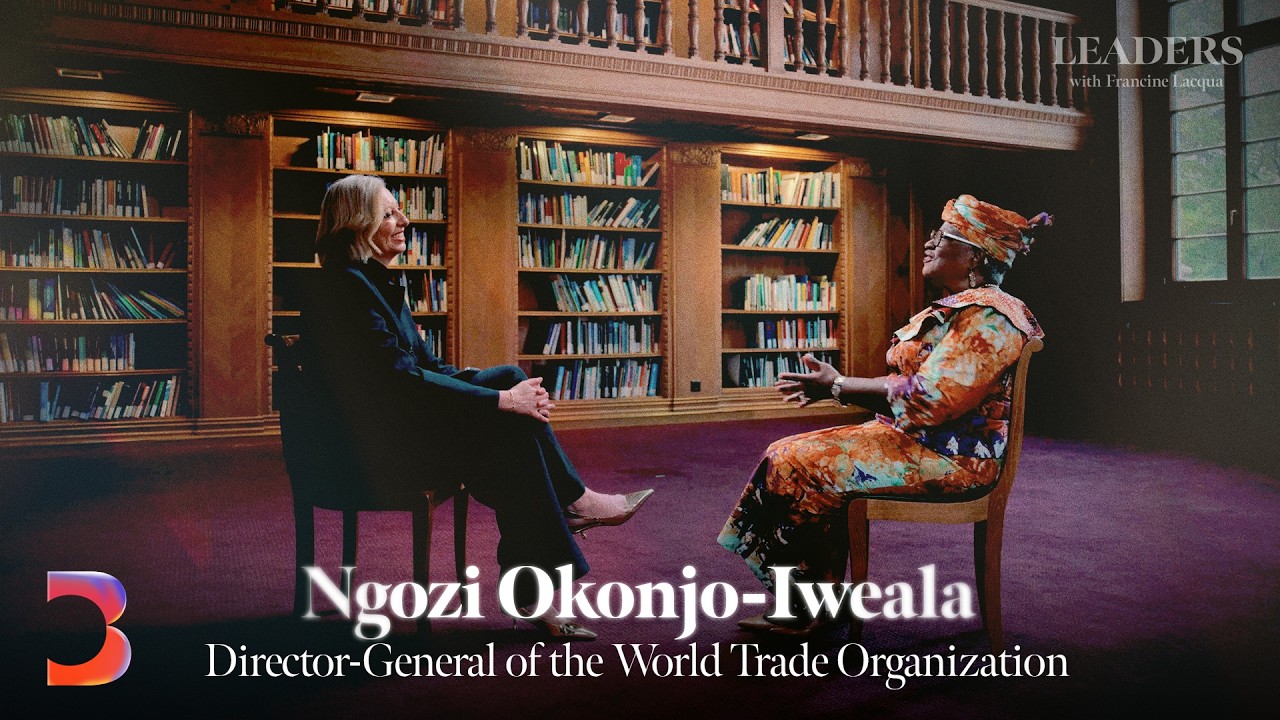
Bloomberg Originals
Tit-for-tat protectionism threatens to reproduce the catastrophic trade collapse of the 1930s, making supply chain diversification to emerging markets essential to absorb geopolitical shocks without unraveling global commerce.
AI-assisted summary of Trade Wars, Fighting Corruption and Rethinking Globalization | Leaders with Francine Lacqua — original source. Check the original for full context.
Source published:
Key ideas
- Despite severe geopolitical tensions and tariff disputes, nearly 75% of global trade continues to flow under standard World Trade Organization rules, demonstrating underlying structural resilience. (2:44)
- The WTO subsidy rulebook dates back to the 1990s, leaving the organization ill-equipped to address modern industrial strategies such as China's projected $142 billion semiconductor investment. (6:07)
- Digitally delivered trade has reached $4 trillion out of $33 trillion in total global trade, growing at roughly 6% annually while sparking fierce debate over electronic transmission tariffs. (20:09)
- Intra-African commerce accounts for just 15% of formal trade, constrained by non-tariff barriers, visa requirements, and fragmented logistics that the AfCFTA seeks to resolve across 54 nations. (17:45)
Detailed notes
## Background Published by Bloomberg Originals on YouTube on October 11, 2026, this episode of Leaders with Francine Lacqua features World Trade Organization Director-General Ngozi Okonjo-Iweala. According to the description, the program examines Okonjo-Iweala's anti-corruption work in Nigeria that led to her mother's kidnapping, the severe strains placed on global commerce by US trade actions and geopolitical friction, and the case for re-imagining globalization.
## TL;DR In a wide-ranging discussion at WTO headquarters, Director-General Ngozi Okonjo-Iweala assesses the worst fragmentation facing the multilateral trading system in nearly eighty years, warning against retaliatory protectionism reminiscent of the 1930s. She reflects on the personal cost of public service, recounting how exposing $2.4 billion in fuel subsidy fraud during her tenure as Nigeria's finance minister led to the abduction of her 82-year-old mother. Okonjo-Iweala also addresses regional hurdles within Africa, including rigid border regimes and logistics barriers under the AfCFTA framework. Looking ahead, she champions 're-globalization' to decentralize global supply chains across emerging economies while highlighting governance battles over the $4 trillion cross-border digital trade sector.
## Atmosphere & style The interview blends rigorous institutional diplomacy with deeply vulnerable personal recollection, shifting from analytical trade critiques to a harrowing account of criminal blackmail. Lacqua's pointed questioning provides an effective foil to Okonjo-Iweala's calm, pragmatic resolve, creating an intimate, high-stakes atmosphere inside the WTO's Geneva offices. The emotional center peaks when Okonjo-Iweala admits to still shaking when discussing her mother's kidnapping, revealing the visceral grit and inner composure that underpin her leadership on the world stage.
## Bulletin - [02:44](https://www.youtube.com/watch?v=bPSeumz6sgI&t=164s) Despite severe geopolitical tensions and tariff disputes, nearly 75% of global trade continues to flow under standard World Trade Organization rules, demonstrating underlying structural resilience. - [06:07](https://www.youtube.com/watch?v=bPSeumz6sgI&t=367s) The WTO subsidy rulebook dates back to the 1990s, leaving the organization ill-equipped to address modern industrial strategies such as China's projected $142 billion semiconductor investment. - [20:09](https://www.youtube.com/watch?v=bPSeumz6sgI&t=1209s) Digitally delivered trade has reached $4 trillion out of $33 trillion in total global trade, growing at roughly 6% annually while sparking fierce debate over electronic transmission tariffs. - [17:45](https://www.youtube.com/watch?v=bPSeumz6sgI&t=1065s) Intra-African commerce accounts for just 15% of formal trade, constrained by non-tariff barriers, visa requirements, and fragmented logistics that the AfCFTA seeks to resolve across 54 nations.
## Key takeaways - [00:11](https://www.youtube.com/watch?v=bPSeumz6sgI&t=11s) The global trading system relies on an established architecture of rules to ensure safety, quality standards, and predictable competition for consumers worldwide. - [02:44](https://www.youtube.com/watch?v=bPSeumz6sgI&t=164s) Current fragmentation across trade, AI, war, and climate represents the most severe disruption to the multilateral trading system in nearly 80 years. - [02:44](https://www.youtube.com/watch?v=bPSeumz6sgI&t=164s) Today's protectionist rhetoric mirrors the 1930s, when escalating tariff wars fractured the world into defensive blocs and caused global trade volumes to collapse by two-thirds. - [06:07](https://www.youtube.com/watch?v=bPSeumz6sgI&t=367s) A subsidy race between wealthy nations risks sidelining developing economies that lack the fiscal headroom to match massive state-backed industrial policies. - [06:07](https://www.youtube.com/watch?v=bPSeumz6sgI&t=367s) Framing global trade tensions purely as a US-China dispute ignores the widespread reform demands and grievances of emerging markets and poorer nations. - [06:07](https://www.youtube.com/watch?v=bPSeumz6sgI&t=367s) China's ongoing retention of developing-nation status remains a major flashpoint, with advanced economies arguing its economic scale makes the classification outdated. - [09:32](https://www.youtube.com/watch?v=bPSeumz6sgI&t=572s) The collapse of the Doha Round accelerated a shift toward bilateral and regional deals, sidelining consensus-based WTO negotiations. - [09:32](https://www.youtube.com/watch?v=bPSeumz6sgI&t=572s) WTO leadership advised calm and analytical patience in response to aggressive unilateral US tariff announcements rather than engaging in panic or retaliatory escalations. - [12:44](https://www.youtube.com/watch?v=bPSeumz6sgI&t=764s) Confronting systemic corruption in developing economies carries severe personal risks, exemplified by the kidnapping of Okonjo-Iweala's mother following a $2.4 billion fuel subsidy audit. - [17:45](https://www.youtube.com/watch?v=bPSeumz6sgI&t=1065s) Africa accounts for only 3% of global exports and 15% of intra-continental trade due to severe logistical bottlenecks, redundant visa rules, and protectionist tariffs. - [17:45](https://www.youtube.com/watch?v=bPSeumz6sgI&t=1065s) The African Continental Free Trade Area (AfCFTA) seeks to integrate 54 nations into a single market, but bureaucratic resistance to regional travel documents illustrates persistent hurdles. - [20:09](https://www.youtube.com/watch?v=bPSeumz6sgI&t=1209s) The WTO's 're-globalization' initiative advocates de-concentrating manufacturing to diverse developing economies in Africa, Asia, and Latin America to build supply chain resilience. - [20:09](https://www.youtube.com/watch?v=bPSeumz6sgI&t=1209s) Cross-border digital services represent the fastest-growing trade segment, but tensions over ending the moratorium on electronic customs duties threaten to fragment the global internet. - [20:09](https://www.youtube.com/watch?v=bPSeumz6sgI&t=1209s) Because the WTO is a member-driven body, substantive reforms to dispute resolution and rules require proactive leadership and consensus from member states rather than the Secretariat alone.
## Detailed walkthrough ### [00:11](https://www.youtube.com/watch?v=bPSeumz6sgI&t=11s) Art and the Invisible Architecture of Global Trade
Dr. Ngozi Okonjo-Iweala begins by welcoming Francine Lacqua into her personal office at the World Trade Organization headquarters, pointing out what she describes as the single most controversial piece of art in the entire institution. The painting previously hung in a public space, but many female staff members objected to it and wanted it taken down. Rather than hiding it away, Okonjo-Iweala intervened and had it moved directly into her personal office because, as she puts it, "it's speaking to me." She explains that critics misunderstood the piece: the artist was depicting the world as it used to be to show that such an order was fundamentally unacceptable, making it a vital reminder rather than something to censor.
Turning to the wider public understanding of commerce, Okonjo-Iweala reflects on how ordinary consumers take trade completely for granted. People in wealthy nations walk into supermarkets or retail stores, pick up a t-shirt or grocery item, and never stop to consider the complex web that brought it to the shelf, nor do they question how they can trust that the product meets rigorous safety and quality standards. That trust exists only because an established system of rules governs international exchange, ensuring that an exporter faces fair, rule-based competition rather than arbitrary barriers. Okonjo-Iweala insists that the WTO is far too vital to the world to be allowed to become "slowed down, paralyzed and moribund" or unfit for purpose.
```mermaid flowchart TD accTitle: Evolution of Global Trade Framework accDescr: Diagram tracing the post-war transition from GATT in 1947 to the WTO in 1995 and its modern principles. subgraph History ["Historical Evolution"] A["Post-WWII Interconnection"] --> B["1947: GATT Signed"] B --> C["1995: WTO Established"] end subgraph Principles ["WTO Operating Principles"] C --> D["166 Member States"] D --> E["Equal Representation & Equal Voice"] E --> F["Rule of Law, Not 'Law of the Jungle'"] end ```
- The post-World War economic realization led to the signing of the General Agreement on Tariffs and Trade (GATT) in 1947. - In 1995, GATT evolved into the World Trade Organization, which currently comprises 166 member nations. - The core tenet of the WTO is equal representation regardless of economic size, designed explicitly so global trade is not governed by the "law of the jungle where big animals eat smaller ones."
---
[02:44](https://www.youtube.com/watch?v=bPSeumz6sgI&t=164s) A Strained Global System and Echoes of the 1930s
Global commerce currently totals roughly $32 trillion a year, but it faces an unprecedented convergence of shocks from war, artificial intelligence, climate disruptions, and geopolitical tensions. Okonjo-Iweala highlights that this is the most severe fragmentation and disruption the global trading system has witnessed in nearly eighty years. Across the membership, countries are voicing deep dissatisfaction, feeling that legacy trade rules no longer deliver the mutual benefits they once guaranteed. This frustration has prompted several powers to pursue unilateral actions and substitute multilateral accords with bilateral deals, while others lodge endless formal complaints.
When Lacqua questions whether nations like the United States have simply forgotten how much they gained from free trade, Okonjo-Iweala notes that it is human nature, as well as the nature of nation-states, to focus intensely on current pain while discounting past benefits. Today’s tensions bear an alarming resemblance to the 1930s, when countries reacted to economic distress by erecting protectionist walls. A century ago, US tariff hikes sparked retaliatory measures that fractured the world into defensive trade blocs, causing global trade volumes to plunge by nearly two-thirds between 1929 and 1934.
| Era | Characteristics of Trade Strain | Economic Impact | |:--- |:--- |:--- | | **1929–1934** | Rising tariffs, retaliatory protectionism, national-security trade blocs | Global trade collapsed by approximately two-thirds | | **Present Day** | Complex global value chains, interconnected finance, cross-border digital trade | Disruption threatens deeper damage due to heightened mutual dependence |
Despite mounting fears of a total breakdown of order, Okonjo-Iweala cautions against fatalism. Nearly three-quarters of all international commerce still flows under standard WTO terms, proving that the foundation remains functional and respected. The primary challenge lies in reforming the remaining 25% where rules are either skirted or missing entirely.
---
[06:07](https://www.youtube.com/watch?v=bPSeumz6sgI&t=367s) Subsidies, China, and Outdated Rules
The most contentious battleground in modern trade centers on government subsidies—ranging from direct grants and cheap state loans to targeted tax breaks. When governments subsidize domestic firms, those companies can slash prices on global markets not because of superior productivity, but because they are bankrolled by state coffers. While Western nations are currently spending heavily to match China's decades of state-backed industrial strategy—such as China’s projected $142 billion investment in domestic semiconductor fabrication—this subsidy race creates severe imbalances. Wealthy economies possess the fiscal headroom to pour billions into industrial policy, whereas poorer developing countries simply cannot compete.
Okonjo-Iweala stresses that the current rulebook on subsidies dates back to the 1990s, long before modern high-tech subsidies emerged and before China and dozens of developing economies had even entered the WTO. When Lacqua asks if fixing global trade is simply a matter of getting Washington and Beijing on the same page, Okonjo-Iweala pushes back strongly. Framing trade friction exclusively as a US-China contest ignores the real grievances felt by emerging markets and poorer nations, nearly all of whom are demanding structural reforms.
- China joined the WTO in 2001, agreeing to cut tariffs, open domestic sectors to foreign investment, and adhere to strict transparency benchmarks. - By entering as a "developing country," China secured special and differential treatment advantages, catalyzing its rise to become the "world's factory." - The US and other developed states now argue China is too economically advanced to retain developing-nation privileges; meanwhile, China has relinquished certain transition periods but preserves its developing-country classification. - Emerging economies like India and Brazil remain cautious about revising developing-country criteria, as their own domestic industries still rely on those provisions.
---
[09:32](https://www.youtube.com/watch?v=bPSeumz6sgI&t=572s) Institutional Gridlock, the Doha Collapse, and Trump's Tariffs
The WTO's institutional credibility has suffered from its struggle to conclude major multilateral treaties. The most glaring setback remains the Doha Development Round, an ambitious global negotiation that collapsed amid intractable stalemates over agricultural subsidies and market access. In the wake of Doha's failure, major powers increasingly bypassed Geneva to negotiate regional and bilateral deals where larger economies could leverage their raw market size. This dynamic has fed persistent criticisms: WTO consensus-based decision-making is painfully slow, poorer countries lack the expensive legal machinery required to fight disputes, the dispute settlement body itself is hamstrung, and existing agreements cannot keep pace with digital and environmental shifts.
The fragility of the system peaked when the United States announced an aggressive turn toward reciprocal tariffs, proclaiming that April 2, 2025, would mark the rebirth of domestic industry. Asked what she did the moment that announcement broke, Okonjo-Iweala recounts that she did not scramble to make frantic phone calls because the WTO leadership saw the wave coming well in advance. Recalling an exchange on CNN with anchor Richard Quest, she urged world leaders: "Richard, we should all chill. Can we chill? Let's wait and see what actually is done." Her strategy was to avoid reactive panic, allow the complex legal implementation to unfold, and examine the concrete economic consequences before issuing hasty verdicts. Shortly thereafter, the tariff landscape was jolted again when the US Supreme Court struck down tariffs levied under the International Emergency Economic Powers Act (IEEPA), dismantling policies that accounted for roughly 60% to 75% of the administration's active tariff architecture.
[11:55](https://www.youtube.com/watch?v=bPSeumz6sgI&t=715s) Resilience Over Retaliation
Reflecting on recent trade turbulence, Ngozi Okonjo-Iweala emphasizes the catastrophic risks of cyclical protectionism. A tit-for-tat dynamic will inevitably spark severe fragmentation across the global economy, with poorer nations suffering the most damage. She cautions that the international community must pause and take a breath before adopting punitive measures that undermine economic growth. When asked what she learned from the events of 2025, she highlights two key takeaways: immense gratitude that WTO members refrained from broad retaliatory escalations that could have triggered an economic tailspin, and genuine awe at the structural resilience of world trade, which continues to operate under global rules for the most part.
[12:44](https://www.youtube.com/watch?v=bPSeumz6sgI&t=764s) The Personal Cost of Fighting Corruption
Before taking the helm at the World Trade Organization, Okonjo-Iweala spent decades in public service, including senior positions at the World Bank and two non-consecutive terms as Nigeria's Minister of Finance. Confronting graft was the central battle of her career. In developing nations where budgets are constrained, every diverted dollar strips funding directly away from schools, clinics, agriculture, and job creation.
```mermaid flowchart TD accTitle: The Nigerian Fuel Subsidy Audit and Retaliation accDescr: Flowchart illustrating the discovery of fuel subsidy fraud in Nigeria leading to the kidnapping of Ngozi Okonjo-Iweala's mother.
subgraph Audit ["Subsidy Verification"] A["Skyrocketing fuel import subsidy claims"] --> B["Presidential approval for forensic audit"] B --> C["Uncovering of $2.4B in fraudulent claims"] C --> D["Refusal to disburse unverified payments"] end
subgraph Backlash ["Criminal Retaliation"] D --> E["Death threats directed at Finance Minister"] E --> F["8-man gang abducts 82-year-old mother"] F --> G["Demands: Resign and leave Nigeria"] end ```
That fight nearly cost her family everything. While auditing Nigeria’s fuel subsidy scheme—where the state reimbursed importers to sell refined gasoline at subsidized rates—her ministry discovered that subsidy invoices were skyrocketing out of control. With the president’s authorization, her team audited the accounts and exposed approximately $2.4 billion in outright fraud. When she refused to release the funds to unverified marketers, severe threats followed, culminating in the kidnapping of her elderly mother by an eight-man gang led by a 22-year-old named Marvelous.
The captors demanded that Okonjo-Iweala step down from the cabinet and flee the country within days. Over an agonizing five-day ordeal, she felt completely paralyzed by fear, torn by the terrible guilt that her anti-corruption campaign could result in her mother’s death. Ready to quit to save her parent's life, it was ultimately her father who intervened with resolve: "We don't give in to blackmail. We don't." He insisted she attend the televised cabinet meeting and refuse to bow to criminal pressure. Held captive deep in the forest, her mother managed to escape on foot. Though her mother survived and reached age 96, the trauma remains raw decades later; mentioning the kidnapping still causes her to shake, and Okonjo-Iweala acknowledges that a sense of guilt lingers with her to this day. Over time, surviving such trials forged an inner calm and an instinct to immediately pivot toward practical solutions and opportunities rather than succumbing to panic.
- $2.4 billion in fraudulent fuel subsidy claims uncovered by her forensic audit. - Five days of captivity endured by her mother in a forest before she escaped. - Mother reached 96 years of age, though the emotional scars of the kidnapping endure.
[17:45](https://www.youtube.com/watch?v=bPSeumz6sgI&t=1065s) Africa’s Internal Barriers and the Passport Test
Africa's internal commerce mirrors the worst eras of global protectionism: high tariff and non-tariff walls between neighbors, reliance on raw commodity exports, and costly imports of processed goods. The continent represents merely 3% of global exports, and internal commerce between African nations sits at a meager 15% of formal trade. Basic logistics are severely strained; traveling between Senegal and the Democratic Republic of the Congo frequently requires a routing through European hubs rather than a direct trans-continental flight. Furthermore, arbitrary bureaucratic restrictions choke entrepreneurship, forcing prominent investors to obtain up to 35 separate visas to travel across the continent. Multiple fragmented currencies, excessive red tape, and an acute lack of affordable credit continue to smother regional integration, even as the African Continental Free Trade Area (AfCFTA)—launched in 2021—attempts to unite 54 nations into a single market.
To illustrate the stubbornness of these administrative hurdles, Okonjo-Iweala recounts a personal standoff involving the African Union passport, which was designed to eliminate intra-African visa requirements. Arriving at an African airport, border immigration agents refused to recognize the AU document and denied her entry. Despite carrying her Nigerian passport—which held a valid visa that would have granted immediate clearance—she refused to take the easy way out on principle. She spent the entire night on a bench in the airport terminal, refusing to back down until senior authorities arrived the next morning and officially approved her entry with the African Union passport.
- 3% of total global exports originate from the African continent. - 15% of formal African trade occurs intra-continentally between neighbors. - 35 separate visas required on an African investor's passport to conduct business across the region. - 54 countries grouped under the African Continental Free Trade Area (AfCFTA).
[20:09](https://www.youtube.com/watch?v=bPSeumz6sgI&t=1209s) Re-Globalization and the Digital Trade Frontier
Addressing criticisms that her defense of multilateralism is overly idealistic, Okonjo-Iweala argues that basic cooperation must endure. Rather than retreating into isolationism or doubling down on concentrated supply hubs, the WTO is championing "re-globalization." This approach seeks to decentralize and de-concentrate supply chains away from single dominant manufacturing hubs, distributing production to developing nations across Africa, Asia, and Latin America that possess genuine comparative advantages. While establishing fresh supply chains takes years of sustained investment, diversification is essential to insulate the international economy against geopolitical shocks.
At the same time, the composition of global trade is shifting rapidly. Out of an estimated $33 trillion in total global trade, digitally delivered trade—encompassing streamed music, movies, cloud education, and remote health services—has emerged as the fastest-growing sector. Expanding at roughly 6% annually, it has surpassed $4 trillion.
```mermaid flowchart LR accTitle: Digital Moratorium Debate accDescr: The clash at the WTO Ministerial Conference over extending the electronic transmission customs duties moratorium.
A["Cross-Border Digital Trade ($4T Total)"] --> B{"Moratorium Extension Debate"} B -->|"Maintain Free Flow"| C["Open, Borderless Internet\n(US, EU)"] B -->|"Impose Customs & Taxes"| D["Tariffs & Regulatory Control\n(India, Brazil, Global South)"] ```
Yet digital commerce has also become the focal point of the WTO's existential crisis. During the recent WTO Ministerial Conference, bitter divisions emerged over the long-standing moratorium on customs duties on electronic transmissions. The broad definition covers nearly all cross-border digital transactions. While the United States and European Union pushed to preserve tariff-free digital flows, nations such as India and Brazil raised objections, pointing to lost customs revenues and the desire to regulate foreign tech giants. The friction raises serious questions about whether the global internet is destined to become the next theater of trade wars.
Multilateralism is navigating an undeniably brutal chapter. Okonjo-Iweala acknowledges she would be "lying through my teeth" if she claimed otherwise, reminding critics that the post-World War II institutions were founded precisely because systemic global crises cannot be resolved unilaterally by individual nations. Responding to complaints that institutional reforms move too slowly, she points out that the WTO is fundamentally member-driven: if countries are frustrated by the slow pace of change, the responsibility rests on the members themselves to step forward and accelerate the process, with the Secretariat standing by to guide them.
- $33 trillion total volume of global trade. - $4 trillion market size for digitally delivered services (education, entertainment, health). - ~6% annual growth rate for cross-border digital commerce.
## Notable quotes > [00:11](https://www.youtube.com/watch?v=bPSeumz6sgI&t=11s) it's speaking to me. — Ngozi Okonjo-Iweala
> [00:11](https://www.youtube.com/watch?v=bPSeumz6sgI&t=11s) slowed down, paralyzed and moribund — Ngozi Okonjo-Iweala
> [00:11](https://www.youtube.com/watch?v=bPSeumz6sgI&t=11s) law of the jungle where big animals eat smaller ones. — Ngozi Okonjo-Iweala
> [06:07](https://www.youtube.com/watch?v=bPSeumz6sgI&t=367s) world's factory
> [09:32](https://www.youtube.com/watch?v=bPSeumz6sgI&t=572s) Richard, we should all chill. Can we chill? Let's wait and see what actually is done. — Ngozi Okonjo-Iweala
> [12:44](https://www.youtube.com/watch?v=bPSeumz6sgI&t=764s) We don't give in to blackmail. We don't. — Father of Ngozi Okonjo-Iweala
> [20:09](https://www.youtube.com/watch?v=bPSeumz6sgI&t=1209s) lying through my teeth — Ngozi Okonjo-Iweala
## Mentioned Dr. Ngozi Okonjo-Iweala, Francine Lacqua, World Trade Organization (WTO), General Agreement on Tariffs and Trade (GATT), United States, China, India, Brazil, Doha Development Round, Richard Quest, CNN, US Supreme Court, International Emergency Economic Powers Act (IEEPA), World Bank, Nigeria, Marvelous, Senegal, Democratic Republic of the Congo, African Union (AU), African Continental Free Trade Area (AfCFTA), European Union
## Video description Ngozi Okonjo-Iweala spent her early career fighting corruption, at great personal cost. Today, she leads the World Trade Organization at a time of unprecedented disruption. On this episode of Leaders, she speaks with Francine Lacqua about her work in Nigeria and how it led to her mother's abduction, how the US trade war and geopolitics are putting tremendous strain on global trade and why it’s time to re-imagine globalization.
What drives the world’s most influential minds? In Leaders with Francine Lacqua, Bloomberg’s award-winning anchor sits down with the decision-makers shaping our future to explore the personal stories behind their public personas. Discover what inspires them, how they navigate power and the lessons they offer on defining success. Insightful, cinematic and elegantly crafted, Leaders goes beyond the headlines to reveal the human side of leadership.
Watch more: https://www.youtube.com/playlist?list=PLqq4LnWs3olXnyY_CJUC2M1NtT_VdXw8i
#Trade #Globalization #Geopolitics
-------- Like this video? Subscribe: http://www.youtube.com/Bloomberg?sub_confirmation=1
Get unlimited access to Bloomberg.com for just $1.99 your first month: https://www.bloomberg.com/subscriptions?in_source=YoutubeOriginals Bloomberg Originals offers bold takes for curious minds on today’s biggest topics. Hosted by experts covering stories you haven’t seen and viewpoints you haven’t heard, you’ll discover cinematic, data-led shows that investigate the intersection of business and culture. Exploring every angle of climate change, technology, finance, sports and beyond, Bloomberg Originals is business as you’ve never seen it.
Subscribe for business news, but not as you've known it: exclusive interviews, fascinating profiles, data-driven analysis, and the latest in tech innovation from around the world.
Visit our partner channel Bloomberg News for global news and insight in an instant.
[Source](https://www.youtube.com/watch?v=bPSeumz6sgI)