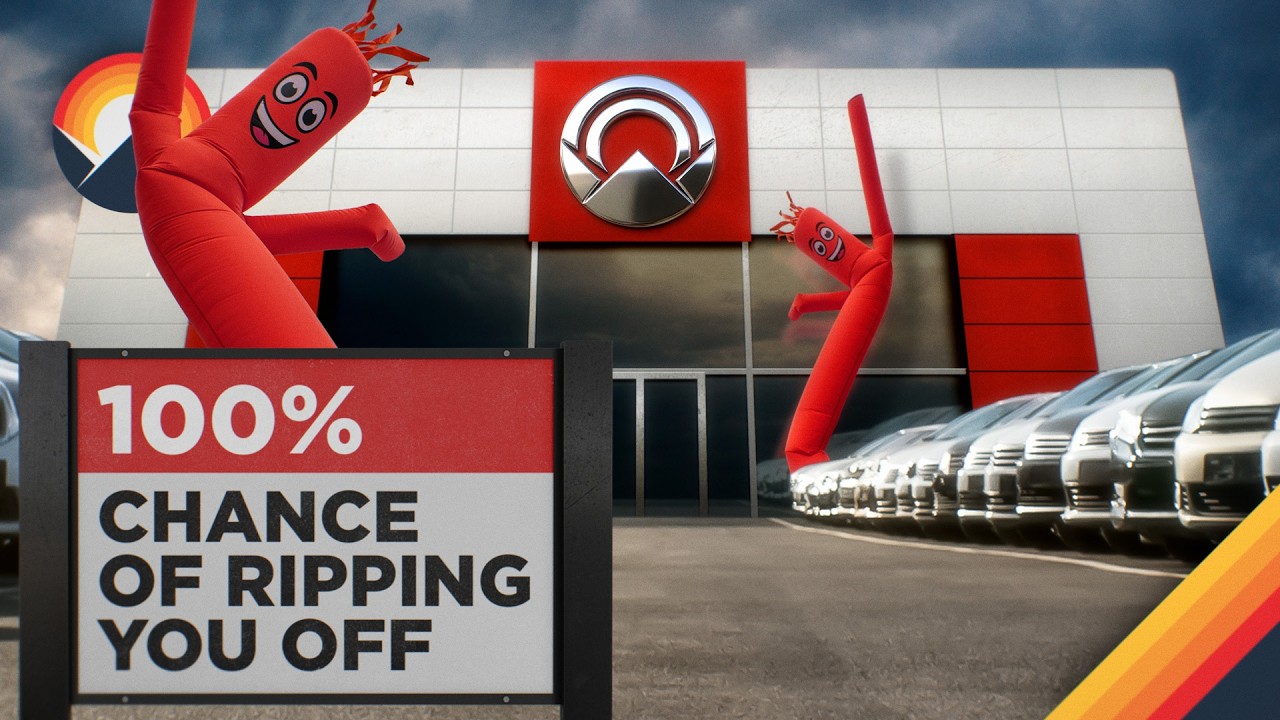
Sonic Automotive Sues Colorado as EV Startups Break Franchise Monopolies
Wendover Productions
State protectionist laws allow dealership middlemen to impose an average 25% markup on American car buyers by legally banning direct-to-consumer manufacturer competition.
## Background
This video was published on YouTube by the channel Wendover Productions on May 5, 2026. The video description includes links to subscribe to Nebula for 50% off an annual subscription, watch the Nebula original series Day Pass, and follow the creator across various social media platforms.
## TL;DR
The American car buying experience is broken due to protectionist state franchise laws that legally prevent manufacturers from selling vehicles directly to consumers. Originally created to help early automakers build a retail presence, these dealership networks have consolidated into powerful Fortune 500 corporations with a massive political lobby. Today, they leverage their monopoly to squeeze buyers through inflated front-end margins and hidden back-end financing fees. While EV pioneers like Tesla have fought state-by-state legal battles to pioneer a direct-to-consumer model, legacy dealer networks continue to aggressively sue and lobby to maintain their anti-competitive grip on the US auto market.
## Atmosphere & style
The video maintains a deeply informative, analytical, and consumer-focused tone that blends investigative journalism with structural critique. It begins with an empathetic, relatable hypothetical scenario of a modern buyer that quickly transitions into a frustrating revelation of how the system is engineered against them. The delivery feels sharp, witty, and grounded, evoking a sense of systematic disillusionment as it exposes the stark contrast between American free-market ideals and the reality of a legally protected middleman monopoly.
## Key takeaways
- [00:00](https://www.youtube.com/watch?v=GREaEG_0Xcw&t=0s) The franchised dealership system is unique to North America, whereas other global markets like China, Japan, the UK, and Germany legally permit direct manufacturer-to-consumer automotive sales.
- [00:00](https://www.youtube.com/watch?v=GREaEG_0Xcw&t=0s) Protectionist state laws across all 50 US states legally prohibit new vehicles from being sold directly to consumers by the car manufacturers.
- [03:08](https://www.youtube.com/watch?v=GREaEG_0Xcw&t=188s) Corporate consolidation has drastically expanded the dealership industry, creating massive Fortune 500 dealer networks that hold maximum consumer leverage and outnumber domestic car manufacturers.
- [03:08](https://www.youtube.com/watch?v=GREaEG_0Xcw&t=188s) The franchise system originally began as a logistical partnership, but shifted after the 1950s when dealers used their immense local economic and political influence to lobby states for protectionist laws.
- [06:34](https://www.youtube.com/watch?v=GREaEG_0Xcw&t=394s) Dealerships rely heavily on vehicle resale, financing, and upselling to maximize front-end gross margins, which typically range from 3% to 10% above the actual manufacturer invoice cost.
- [06:34](https://www.youtube.com/watch?v=GREaEG_0Xcw&t=394s) The highly aggressive Finance and Insurance (F&I) department serves as a primary financial trap, using inflated interest rates and marked-up add-ons to extract substantial back-end profits.
- [10:26](https://www.youtube.com/watch?v=GREaEG_0Xcw&t=626s) Tesla initiated a major legal war against traditional franchise laws by establishing over 320 corporate-owned showrooms, utilizing legal loopholes like operating on sovereign Native American reservations to bypass state bans.
- [10:26](https://www.youtube.com/watch?v=GREaEG_0Xcw&t=626s) Legacy dealership networks continue to fiercely resist the direct-to-consumer EV model, highlighted by Sonic Automotive's 2026 lawsuit against Colorado over Scout Motors' direct-sales license.
- Widespread consumer distrust plagues the industry, with over 70% of surveyed buyers distrusting dealership pricing honesty and over 80% suspecting hidden fees.
- The Federal Trade Commission (FTC) officially supports transitioning toward direct-to-consumer sales models to foster healthier and more transparent market competition.
## Detailed walkthrough
### [00:00](https://www.youtube.com/watch?v=GREaEG_0Xcw&t=0s) The Modern Car Buying Trap and the Middleman Economy
For a hypothetical resident of Steamboat Springs, Colorado, a decade of steady career advancement, careful saving, and months of research have finally culminated in the exciting decision to buy their first new car. They want something upscale, mountain-capable, and spacious enough to carry friends to hiking trailheads or accommodate a growing family. They settle on an Audi Q3. However, actually purchasing the vehicle brings them face-to-face with an "overly complicated, often misleading, always expensive" reality: navigating a dealership.
The first hurdle is purely geographical. Colorado only has seven authorized Audi dealerships, and the entire western half of the state—populated by wealthy mountain towns and anchored by a population center of over 150,000 people—is served by just one: Audi Glenwood Springs. After securing a two-hour ride down to the dealership, brushing up on negotiation tactics, and establishing a target price, the buyer feels prepared. What they fail to realize, however, is that they are entering a de facto long-term customer relationship. For the next ten years, their service visits, holiday cards, and upgrade offers will be tethered to this single business.
Crucially, the buyer does not even know who actually owns the dealership. While Audi Glenwood Springs mirrors the upscale minimalism of the luxury automaker in its architecture and website, it is entirely illegal for Audi to own it. Due to protectionist state laws across all 50 US states, new cars cannot be sold directly by manufacturers. Instead, this location is owned and operated by Sonic Automotive—a multi-billion-dollar, North Carolina-based Fortune 500 company that also controls the local Land Rover and Volkswagen dealerships. This franchised middleman system is unique to North America; in China, buyers purchase directly from manufacturer websites like BYD, while car companies in Japan, the UK, Germany, and the EU are legally permitted to sell directly to consumers, allowing buyers to custom-order exact colors and specs rather than being limited to whatever happens to be sitting on a local lot.
- Colorado contains only seven Audi dealerships, with the entire western side of the state serviced exclusively by Audi Glenwood Springs.
- Sonic Automotive is a Fortune 500 car dealership operator headquartered in North Carolina that manufactures zero vehicles.
- Direct-to-consumer automotive sales are completely legal in major global markets like China, Japan, the UK, and Germany.
[03:08](https://www.youtube.com/watch?v=GREaEG_0Xcw&t=188s) The Historical Power Shift: From Bullying Manufacturers to Political Pillars
The franchise dealership model originally grew out of a genuine logistical necessity at the dawn of the automotive age. Early on, mass-producing cars was only half the battle; manufacturers like Ford Motor Company had to convince a skeptical public that automobiles were a necessity. To keep factory lines humming, Ford turned to local, entrepreneurial businessmen who understood the unique needs of their respective towns, leaving the manufacturer free to focus strictly on production. This partnership successfully turned the automobile into an American staple and built Detroit's "Big Three" into global industrial titans.
However, once the Big Three established a firm oligopoly, they began to ruthlessly bully these local mom-and-pop operations. In the 1920s, Ford forced dealers to display Henry Ford's anti-Semitic propaganda newspaper, *The Dearborn Independent*, in their lobbies regardless of the owner's personal beliefs. During economic downturns, manufacturers artificially kept factory production high by "flooding dealerships with cars they couldn't hope to sell." If a independent dealer stepped out of line, the manufacturer would freeze their inventory, open a factory-owned competitor down the street, or license a bitter rival across town.
By the middle of the 20th century, dealerships utilized their immense local footprint to fight back through the state legislature. Fueled by the post-war consumer boom, the rise of the interstate highway system, and the birth of drive-in culture, automobile sales skyrocketed in the 1950s. Dealership owners became high-profile local celebrities and pillars of their communities, sponsoring high school golf tournaments and football games. More importantly, they generated critical sales tax revenue for local and state governments. Leveraging this immense political sway, dealers successfully lobbied all 50 states to pass strict franchise laws legally banning manufacturers from competing with established showrooms. Today, the landscape has flipped entirely; consolidation has allowed corporate dealership groups to outgrow the manufacturers themselves, creating an environment with minimal competition and maximum consumer leverage for the middleman.
- In the 1920s, Ford mandated that dealerships stock *The Dearborn Independent*, Henry Ford's anti-Semitic propaganda publication.
- By the mid-20th century, all 50 US states enacted legal bans preventing car manufacturers from operating direct factory showrooms that competed with existing franchises.
- Corporate consolidation has expanded the dealership industry to the point where there are now more massive, Fortune 500 car dealership companies than actual domestic car manufacturing corporations.
[06:34](https://www.youtube.com/watch?v=GREaEG_0Xcw&t=394s) Squeezing the Customer: Front-End Gross vs. Back-End Profits
When a buyer steps onto a dealership lot, they enter an environment explicitly engineered to extract maximum cash from their wallet. Because cars are highly complex, the average customer operates at a severe knowledge disadvantage. Furthermore, while the manufacturer simply wants a clean sale near the Manufacturer's Suggested Retail Price (MSRP), the dealership relies on vehicle resale, upselling, and financing to turn a profit.
The financial bleeding begins before negotiations even start. The hypothetical Steamboat Springs buyer targets a sticker price of $48,170 for their Audi Q3. However, that figure is already $4,400 higher than the reported invoice cost—the price the manufacturer actually charged the dealership. This sticker price includes non-negotiable destination fees for shipping and handling, meaning the consumer pays to transport a car they never got to custom-configure. When the buyer successfully negotiates away a $500 "dealer handling fee" in exchange for paying MSRP, they feel victorious. The salesperson is equally satisfied; they have secure a healthy "front-end gross" profit, which typically ranges from 3% to 10% in good economic times.
The real financial trap, however, springs shut when the buyer is handed off to the Finance and Insurance (F&I) manager. Intentionally positioned to look like a benign administrative clerk wrapping up loose paperwork, the F&I manager is actually the highest-trained, most aggressive salesperson on the floor. Job listings for Sonic Automotive F&I managers reveal compensation packages ranging from $100,000 to $500,000 annually. Their sole mandate is to "sell, to upsell, to add on, to squeeze every last dollar out of a deal that's on the finish line." They accomplish this by inflating interest rates and aggressively pitching heavily marked-up add-ons like extended warranties, gap insurance, winterization, and specialized tire or glass insurance. In 2025, Sonic Automotive reported record F&I earnings, averaging over $2,500 in pure back-end gross profit per vehicle sold. Ultimately, a car that cost the dealer $44,000 leaves the lot at a staggering $56,000 before taxes—representing a brutal 25% dealer markup.
- The Audi Q3 sticker price of $48,170 sits more than $4,400 above the dealer's actual invoice cost.
- Dealerships aim for a 3% to 10% profit margin on the "front-end gross" phase of a vehicle sale.
- F&I managers at major dealer groups can earn between $100,000 and $500,000 per year primarily through commission on back-end product sales.
- In 2025, Sonic Automotive achieved record back-end profits, netting an average of over $2,500 per unit sold in F&I fees alone.
[10:26](https://www.youtube.com/watch?v=GREaEG_0Xcw&t=626s) Tesla's Direct-to-Consumer War and the Future of Franchise Laws
While dealerships do provide authentic utility to manufacturers by managing inventory and offering localized test drives and education to buyers, their legal protections have shielded them from healthy market competition. Challenging this entrenched system is incredibly difficult; the National Automotive Dealers Association (NADA) is a formidable political lobby with deep pockets, and state governments are fiercely protective of local dealership jobs and sales tax revenues. Frustrated manufacturers have occasionally tried to push back—such as in 2021 when Ford CEO Jim Farley threatened to restrict vehicle allocations to dealers engaging in excessive price gouging—but it was Tesla that launched a full-scale war against the system.
During the 2010s, Tesla bypassed the franchise system entirely, building a network of over 320 corporate-owned showrooms, service centers, and mall pop-ups staffed exclusively by factory employees. Tesla viewed traditional dealerships as a fundamental roadblock to their business model because electric vehicles require extensive consumer education and lack the lucrative, recurring maintenance needs that traditional dealers rely on for long-term profit. To scale, Tesla had to fight state-by-state legal battles, using the clever legal loophole that because they had never established independent franchise locations to begin with, they weren't technically competing against their own dealer networks.
The legislative battles played out across the country with highly fragmented results. While California offered minimal resistance, Colorado law historically restricted manufacturers to operating just a single corporate-owned storefront, forcing one lone location to handle a decade's worth of statewide Tesla volume. In Texas, Tesla was legally barred from conducting sales within state lines; showrooms could only educate consumers, who then had to navigate complex out-of-state purchasing workarounds. In Connecticut and New Mexico, Tesla skirted strict bans by partnering with sovereign Native American reservations to open retail locations.
The rise of competing EV start-ups like Rivian and Scout Motors has pushed these antiquated laws to a breaking point. Under heavy regulatory pressure, Colorado recently amended its laws to allow EV-only manufacturers to open an unlimited number of direct-to-consumer locations, expanding Tesla's presence to six dealerships. However, legacy dealer networks are fiercely resisting. In 2026, Sonic Automotive sued the state of Colorado for granting a direct-sales license to Volkswagen-backed Scout Motors, arguing that Scout's plan to offer plug-in hybrids with gas-powered range extenders violates the state's strict EV-only exemption, and that its corporate ties to Volkswagen directly competes with existing franchise networks. This ongoing litigation proves that the traditional dealer lobby will stop at nothing to defend its middleman monopoly, leaving American consumers stuck in a broken retail environment where "the choice is pared down to a gut feel on which option is going to rip you off the least."
- Tesla operates over 320 entirely corporate-owned showrooms and service centers across the United States.
- For a decade, Colorado state law restricted non-franchised manufacturers to a single retail location, which single-handedly processed all in-state Tesla transactions.
- Tesla utilized sovereign Native American reservations as legal loopholes to bypass direct-sales bans in states like New Mexico and Connecticut.
- Sonic Automotive filed a lawsuit against the state of Colorado in 2026 to revoke the direct-to-consumer sales license issued to Scout Motors in 2025.
The Consumer Backlash and the Push for Direct Sales
The current third-party dealership model has fostered an environment of intense protectionism that actively harms both the consumer and the manufacturer. This protectionist ecosystem promotes "maximally squeezing the consumer," positioning a hostile dealership experience as the only viable path to purchasing a vehicle. This reality directly contradicts traditional American economic ideals, which typically champion freedom of choice, robust competition, and pro-consumer market practices. The dissatisfaction is massive and measurable, pushing regulatory bodies like the Federal Trade Commission (FTC) to explicitly state their stance on the matter and openly side with the adoption of direct-to-consumer sales models.
For the time being, third-party dealerships remain the entrenched status quo—an administrative hurdle that consumers begrudgingly accept and hope to deal with only once every few years. However, a major reckoning over outdated state protections is becoming increasingly probable. As electric vehicles (EVs) grow in popularity, they bring widespread awareness of alternative sales and servicing frameworks. Legacy manufacturers risk losing out entirely to a "cheaper, more transparent, and more approachable alternative" if they cannot bypass these legislative barriers.
* **Consumer Distrust:** Poll data reveals that more than 70% of respondents do not trust dealership pricing honesty, and more than 80% suspect hidden fees and lack faith in dealership transparency across the board.
* **Regulatory Stance:** The FTC officially supports the transition toward direct-to-consumer automotive sales to foster healthier market competition.
An Alternative to Car Culture and the Nebula Value Proposition
While automotive sales models dominate the conversation in a "car-brained culture like that of the US," a far more efficient, affordable, and interesting alternative already exists: public transportation. For proof that car-free environments are completely viable, viewers need look no further than *Day Pass*, a Nebula original series hosted by Jason from *Not Just Bikes*. The show features a public transit superfan and super critic exploring the world's most unique and robust transit networks, blending travel and infrastructure to provide a fun counter-narrative to modern automotive obsession.
This thematic connection highlights the core value proposition of Nebula, the video's sponsor. The streaming platform offers independent creators a space to pursue ambitious, large-scope projects with significantly less risk aversion than traditional platforms allow. For an extremely reasonable rate, subscribers gain access to ad-free, early-release, and entirely unique content, including experimental projects, travel documentaries, and comedic ventures from prominent internet creators.
* **Featured Nebula Creators & Shows:**
* *Day Pass* by Jason of *Not Just Bikes*.
* *Jet Lag: The Game*.
* *Abolish Everything* (Wendover's first foray into comedy).
* *England* (Tom Scott's return to video making).
* *Arctic to Africa* (An Express travel series).
* **Subscription Promotion:** Through the end of the month, viewers can sign up for an annual Nebula subscription for 50% off—reducing the standard $60 price to $30. This breaks down to just $2.50 a month, which is "less than a bus fare or a coffee." The deal can be accessed at `nebula.tv/wendover` or via the link in the video description.
> [03:08](https://www.youtube.com/watch?v=GREaEG_0Xcw&t=188s) flooding dealerships with cars they couldn't hope to sell.
> [06:34](https://www.youtube.com/watch?v=GREaEG_0Xcw&t=394s) sell, to upsell, to add on, to squeeze every last dollar out of a deal that's on the finish line.
> [10:26](https://www.youtube.com/watch?v=GREaEG_0Xcw&t=626s) the choice is pared down to a gut feel on which option is going to rip you off the least.
> maximally squeezing the consumer
> cheaper, more transparent, and more approachable alternative
> car-brained culture like that of the US
> less than a bus fare or a coffee.
## Mentioned
Audi Q3, Audi Glenwood Springs, Sonic Automotive, BYD, Ford Motor Company, The Dearborn Independent, Henry Ford, National Automotive Dealers Association, Jim Farley, Tesla, Rivian, Scout Motors, Volkswagen, Federal Trade Commission, Day Pass, Jason, Not Just Bikes, Nebula, Jet Lag: The Game, Abolish Everything, Tom Scott, England, Arctic to Africa
Wendover Productions argues that US franchise laws have transformed car dealerships from early distribution partners into legally protected, multi-billion-dollar middlemen that inflate consumer costs and suppress competition. Shielded from direct manufacturer sales by state statutes, consolidated dealer networks extract outsized profits through two-tier pricing strategies while litigating aggressively against direct-to-consumer alternatives.
The Shift to a Protected Middleman Monopoly (3:08)
The franchise dealership model emerged at the dawn of the automotive age to solve logistical challenges, allowing manufacturers like Ford to focus on mass production while local entrepreneurs developed regional customer bases. However, as the Detroit 'Big Three' formed an oligopoly, manufacturers routinely coerced independent dealers—forcing them in the 1920s to stock Henry Ford's anti-Semitic publication, The Dearborn Independent, and offloading excess inventory during downturns.
In the post-war era, dealerships converted their local economic importance and substantial contributions to state sales tax revenues into decisive political influence. Dealers successfully lobbied all 50 states to enact franchise laws barring automakers from competing directly through factory-owned showrooms. Subsequent industry consolidation flipped the power dynamic entirely: massive publicly traded dealership groups, such as Fortune 500 operator Sonic Automotive, now often possess greater scale and regional market dominance than domestic vehicle manufacturers.
Two-Tier Profit Extraction: Front-End and F&I (6:34)
Because dealerships operate with distinct financial incentives from manufacturers, their retail model is structured to capture profits in two phases: front-end vehicle margins and back-end financing products. Front-end pricing begins with sticker prices structured thousands above invoice cost—such as an Audi Q3 priced at $48,170 against an invoice of approximately $44,000—aiming for dealer gross margins between 3% and 10% alongside non-negotiable destination fees.
The larger financial extraction occurs when buyers meet Finance and Insurance (F&I) managers. Though presented as clerical administrators, F&I managers are high-earning sales specialists—commanding compensation between $100,000 and $500,000 annually—incentivized to inflate loan interest rates and aggressively upsell add-ons like extended warranties, gap insurance, and cosmetic protections. In 2025, Sonic Automotive achieved record F&I earnings averaging over $2,500 in pure back-end gross profit per vehicle sold, frequently driving a $44,000 wholesale vehicle up to $56,000 before taxes.
Direct-to-Consumer Battles and Dealer Litigation (10:26)
Direct-to-consumer sales remain standard in major global markets like China, Japan, Germany, and the UK, but American franchise protectionism has forced non-traditional manufacturers into extensive legal conflicts. Tesla challenged this paradigm by opening more than 320 corporate-owned showrooms, relying on the legal argument that it lacked preexisting independent franchises to compete against. To bypass state-level bans, Tesla utilized regulatory loopholes, such as partnering with sovereign Native American reservations in Connecticut and New Mexico and operating through a single restricted location in Colorado for ten years.
As states like Colorado broadened exemptions for electric vehicle manufacturers, legacy dealership networks pushed back. In 2026, Sonic Automotive sued the state of Colorado for issuing a direct-sales license to Volkswagen-backed Scout Motors, arguing that Scout's planned plug-in hybrid models breach the state's EV-only exemption and unfairly bypass existing franchise networks.
Consumer Distrust and Federal Regulatory Scrutiny
Decades of aggressive retail practices and legal shielding have produced deep public dissatisfaction. Survey data cited in the program indicates that over 70% of consumers do not trust dealership pricing honesty, while more than 80% anticipate hidden fees and doubt overall transaction transparency.
This broad consumer backlash has drawn institutional support from regulators. The Federal Trade Commission (FTC) has officially backed direct-to-consumer automotive sales models to enhance transparency and spur market competition, though powerful lobbying organizations like the National Automobile Dealers Association (NADA) continue working to preserve state-level statutory protections.
While direct-to-consumer models demonstrate a transparent alternative to the traditional dealership experience, the legacy franchise framework remains entrenched through deep state tax dependencies and organized lobbying. Whether the growth of electric vehicle startups and regulatory pressure from the FTC can dismantle these state protections remains an open legal contest.
[0:00] overly complicated, often misleading, always expensive
[3:08] flooding dealerships with cars they couldn't hope to sell.
[6:34] sell, to upsell, to add on, to squeeze every last dollar out of a deal that's on the finish line.
[10:26] the choice is pared down to a gut feel on which option is going to rip you off the least.
maximally squeezing the consumer
cheaper, more transparent, and more approachable alternative
car-brained culture like that of the US
less than a bus fare or a coffee.
Original transcript
[0:00] For one hypothetical Steamboat Springs,
[0:02] Colorado resident, today is a very
[0:04] exciting day. After a decade of steady
[0:06] career advancement and saving, after
[0:08] years of driving a used car acquired
[0:10] after college, and after months of
[0:12] research, this northern Coloradan is set
[0:14] to buy their first new car. A car that's
[0:18] upscale, capable in the mountains, and
[0:20] has the capacity to carry friends to a
[0:22] hiking trailhead or possibly haul a
[0:24] budding family in the coming years.
[0:26] They've settled on an Audi Q3. But now
[0:29] comes the hard part, or more
[0:31] specifically, the overly complicated,
[0:33] often misleading, always expensive part:
[0:35] actually buying the car from a
[0:37] dealership. First, there's the matter of
[0:39] finding an authorized dealership.
[0:41] Colorado as a state only has seven Audi
[0:43] dealerships, and the western side,
[0:45] dotted with wealthy mountain towns and
[0:47] anchored by population center of over
[0:48] 150,000,
[0:50] is served by just one: Audi Glenwood
[0:52] Springs. It's the closest option, and it
[0:55] happens to have a couple of Q3s on the
[0:56] lot, according to its website, so our
[0:58] buyer opts for here. They've secured a
[1:00] ride down to the dealership more than
[1:02] two hours away. They've read up on how
[1:03] to navigate their interactions with the
[1:05] sales team and financing manager, and
[1:07] they've drawn up the number they're
[1:08] willing to pay. But there's also what
[1:09] they haven't considered. There's the
[1:11] fact that not only are they opting to
[1:13] likely buy from this dealership, but
[1:15] that they're also entering into a de
[1:17] facto long-term customer relationship
[1:19] with them. That they're likely to get
[1:21] their car serviced here for the next 10
[1:23] years. That the salesperson is likely to
[1:25] send them a holiday card and ask about
[1:27] future upgrades or more purchases for
[1:29] the family. The buyer's car business for
[1:31] the life of the car is likely going to
[1:33] be tethered to this dealership, and our
[1:35] buyer doesn't actually even know who
[1:38] owns [music] the dealership. Audi
[1:39] Glenwood Springs, for its part, really
[1:41] looks like it'd be owned by Audi, as its
[1:44] interior, exterior, even its website,
[1:46] all communicate the same upscale
[1:48] minimalism of the car company. But this
[1:50] dealership isn't owned by Audi, because
[1:52] in Colorado, and in the other 49 US
[1:54] states, that much is illegal. Rather,
[1:58] this dealership is owned and operated by
[1:59] Sonic Automotive, the same company that
[2:01] owns the Land Rover and Volkswagen
[2:03] dealerships in town. Sonic isn't local,
[2:06] though. It's a growing car dealership
[2:08] operator headquartered in North Carolina
[2:10] that has become a Fortune 500 company
[2:12] without ever actually manufacturing a
[2:14] single vehicle. This much would be news
[2:17] to our buyer. Because of some antiquated
[2:19] laws, nearly every new car purchase in
[2:21] the US is made through a franchised
[2:23] middleman like Sonic Automotive. In a
[2:26] country where car ownership is so
[2:27] universal, this puts every car buyer in
[2:30] a seriously compromised position without
[2:32] them really knowing it. Globally, this
[2:34] is fairly unique. While car sales in
[2:36] North America go almost exclusively
[2:38] through dealerships, in China, if a
[2:40] buyer wants to buy a BYD, they just go
[2:42] to BYD's website. In Japan, while
[2:45] dealerships do exist, car companies are
[2:47] allowed to sell directly to consumers.
[2:49] In the UK, in Germany, and much of the
[2:51] EU, you can work with car manufacturers
[2:53] to get the exact color, trim, and
[2:55] specifications you're looking for,
[2:57] rather than having your choice limited
[2:58] to what's left on the lot of a franchise
[3:00] seller. In the rest of the world, you
[3:02] have the choice of going through a
[3:03] dealership or the manufacturer. In the
[3:06] US, you don't.
[3:08] Now, at one point, from the perspective
[3:10] of car buyers and small business owners,
[3:12] there was some good logic for
[3:14] dealerships to be protected under state
[3:16] law. At the beginning of the automotive
[3:18] age, figuring out how to mass-produce
[3:20] automobiles while at the same time
[3:21] selling the public on their necessity
[3:23] was a major hurdle. Factory production,
[3:26] no matter how efficient, doesn't matter
[3:28] if people wouldn't buy the cars. Ford
[3:30] Motors turned to the franchise
[3:32] dealership model to keep sales humming.
[3:34] This allowed the company to stay focused
[3:35] on its core competency, manufacturing,
[3:38] while allowing entrepreneurial local
[3:39] business people who knew the wants and
[3:41] needs of their towns best [music] to
[3:43] keep the product turning over. Through
[3:45] the early 1900s, this model worked.
[3:47] Americans adopted the automobile as a
[3:49] necessity, small local dealerships
[3:51] nationwide thrived, and Detroit's Big
[3:53] Three became the center of the
[3:55] automotive manufacturing world. But as
[3:58] the Big Three crystallized an effective
[4:00] oligopoly over domestic car
[4:01] manufacturing, they began to leverage
[4:03] their largess against the local
[4:05] mom-and-pop dealerships. If you were to
[4:07] walk into a Ford dealership in the
[4:08] 1920s, for example, you'd find a copy of
[4:11] Henry Ford's anti-Semitic propaganda,
[4:13] The Dearborn Independent, somewhere in
[4:15] the lobby, not because the dealership's
[4:16] owner was an anti-Semite, but because
[4:19] Ford mandated it. In times of financial
[4:21] difficulty, Ford would keep factory
[4:23] production high and flood dealerships
[4:25] with cars they couldn't hope to sell.
[4:27] And should a dealership get sideways
[4:29] with the manufacturer, the car company
[4:30] would either freeze them out, open up a
[4:32] direct competitor, or license a rival to
[4:34] begin selling their vehicles across
[4:36] town. Manufacturers, with little in the
[4:38] way of competition, bullied the
[4:40] dealerships. But by mid-century,
[4:42] dealerships and their friends in elected
[4:44] positions had conceived of a way to get
[4:46] back. Laws that mandated and protected
[4:49] [music] their existence. Even today, car
[4:52] dealerships tend to be heavily ingrained
[4:54] in their communities. In Glenwood
[4:56] Springs, for example, the Ford
[4:57] dealership sponsors high school golf
[4:59] tournaments [music] and the Toyota
[5:00] dealership sponsors the football games.
[5:02] At mid-century, this influence and
[5:04] visibility of the local dealership was
[5:06] at an absolute peak. The interstate
[5:09] system, the drive-thru and drive-in, the
[5:11] post-war [music] consumer boom, all made
[5:13] for record auto production and sales in
[5:15] the 1950s, and at the center of it was
[5:17] the town's local car dealerships.
[5:20] Dealerships were pillars of the
[5:21] community, their owners were local
[5:23] celebrities, and the sales tax they
[5:25] brought in was critical for state and
[5:27] local governments. They had sway, and as
[5:30] the Big Three manufacturers toyed with
[5:31] them, they responded by using their
[5:33] local importance to lobby for some
[5:35] protections. Soon, all 50 states had
[5:38] some form of legal bans on manufacturers
[5:40] selling their own [music] cars in states
[5:42] with already established franchise
[5:43] dealerships. Now, Ford couldn't simply
[5:45] open up their own showroom down the
[5:47] block to put a company that sold Fords
[5:48] for decades out of business.
[5:50] >> [music]
[5:50] >> In each state, the exact rules vary.
[5:52] Certain states have added further
[5:53] protections. In Colorado, for years this
[5:55] law was pretty cut and dry. No
[5:57] manufacturer shall own, operate, or
[5:59] control any motor vehicle dealer or used
[6:02] motor vehicle dealer in Colorado. And
[6:04] while these mid-century laws remain, the
[6:06] car landscape [music] has flipped on its
[6:08] head. The arrival of foreign-made cars
[6:10] has undercut the Big Three's oligopoly,
[6:13] while consolidation is eating up the
[6:14] dealerships. Along with Sonic, all of
[6:17] these car dealerships are Fortune 500
[6:19] companies, too, meaning there are more
[6:21] massive [music] car dealership companies
[6:23] than car manufacturing companies. Aided
[6:26] by legal protections from a bygone era
[6:28] and dealing with less and less
[6:29] competition just means more leverage for
[6:31] the middleman dealership, and they use
[6:33] it.
[6:34] While our buyer is prepared, once
[6:36] they've stepped on the lot of Audi
[6:37] Glenwood Springs, they're now navigating
[6:39] a pretty hostile environment from the
[6:41] perspective of the customer's wallet.
[6:43] First, it's confusing. Cars are
[6:45] inherently complicated, so our buyer is
[6:47] at a knowledge disadvantage. Next, our
[6:49] buyer [music] has to navigate a host of
[6:51] separate motives. Because while the
[6:53] manufacturer just wants the sale near
[6:54] MSRP, the dealership's in the business
[6:56] of resale, and for that to be
[6:58] profitable, they need to do some
[7:00] upselling, upgrading, or favorable
[7:02] financing.
[7:03] But even before these conversations
[7:05] begin with the salesperson, our buyer is
[7:07] already losing just on baseline MSRP.
[7:10] They've decided going in that they want
[7:12] to get this Q3 at sticker price. Well,
[7:15] at $48,170,
[7:17] that's already more than $4,400
[7:20] more than the reported invoice cost, or
[7:22] what the manufacturer sold it to the
[7:24] dealership for. This number includes a
[7:26] destination fee that the seller isn't
[7:28] likely to haggle over. So, while you
[7:29] can't custom order this car from the
[7:31] manufacturer to ensure you have the
[7:33] exact color or trim you want, you are
[7:35] still paying for the shipping and
[7:36] handling of a car you didn't really get
[7:38] to choose. Our buyer is happy with
[7:40] white, though, and willing to stomach
[7:42] MSRP. Now there's the dealer handling
[7:44] fees for another $500 which in a
[7:47] business is usually just understood as
[7:48] payment for all the paperwork that the
[7:50] customer is expected to adjust accept as
[7:52] part of purchase. But at least according
[7:54] to Mountain States Toyota, a dealership
[7:56] also owned by Sonic but one that proudly
[7:58] weighs all dealer fees, these are
[8:00] nothing more than additional profit
[8:02] generators for the dealership. After a
[8:04] positive test drive, our buyer has
[8:06] agreed with the salesperson that they're
[8:07] willing to pay sticker price so long as
[8:09] the dealership fee is waived. They feel
[8:11] pretty good about themselves, but so too
[8:13] does the dealership. To this point of
[8:15] the transaction, the dealership has come
[8:17] out positive on what they call the front
[8:19] end gross, turning a profit over what
[8:21] they paid for the car from the
[8:22] manufacturer. When sales are good, a
[8:24] dealership hopes to turn 3 to 10% profit
[8:27] on front end gross, but in bad times
[8:29] they're okay with selling in the red
[8:31] here. And that's because of the back end
[8:33] earnings. Now our buyer is pretty
[8:35] content with themself as they move from
[8:37] the desk of the salesperson to the desk
[8:39] of the finance and insurance manager.
[8:41] This person, given their title, seems
[8:43] like a paperwork person and that much is
[8:45] intentional, but they are absolutely
[8:48] another salesperson. Here's a job
[8:50] listing for an F&I manager for Sonic
[8:52] Automotive at Audi Central Houston. It
[8:54] requires a lot of experience, it
[8:56] provides good benefits, and it's a job
[8:58] that comes with training and even
[9:00] program schools. It's a job that nets
[9:02] from 100 to 500,000 dollars and it's the
[9:05] core of the dealership's business
[9:07] because it's a major profit source. As
[9:10] the listing describes, the job is to
[9:13] sell, to upsell, to add on, to squeeze
[9:16] every last dollar out of a deal that's
[9:18] on the finish line. They'll do this
[9:20] through financing, working the buyer to
[9:21] as high of an interest rate as they can
[9:23] stomach, they'll push the add-ons like
[9:25] extended warranties, gap insurance,
[9:27] winterization, paint, wheel, and glass
[9:29] insurance. All are services that could
[9:31] be helpful, but all are also massively
[9:34] overpriced within this office. With the
[9:36] buyer disarmed, with our most
[9:37] experienced, highest compensated
[9:39] salesperson on the job, it's through
[9:41] back-end gross where car dealerships
[9:43] make their real money. In 2025, Sonic
[9:46] Automotive announced that their F&I
[9:48] earnings hit record numbers, netting
[9:50] gross profits of over $2,500
[9:53] per unit sold. That's an incredible
[9:55] amount of profit generated by a part of
[9:57] the car buying interaction that's
[9:59] supposed to feel like just tying up
[10:01] loose ends and getting you out the door.
[10:03] Our buyer is now finally door, but with
[10:06] a car that cost $44,000 from Audi to the
[10:09] dealership, but closer to $56,000 before
[10:12] taxes for our buyer. A 25% markup. And
[10:17] should they choose to service the
[10:18] vehicle through the dealership for the
[10:19] next 10 years, they'll come to expect a
[10:21] similar strategy on upselling services
[10:23] every single time they bring in the
[10:25] vehicle.
[10:26] Now, it'd be wrong to identify
[10:28] dealerships as strictly a shady,
[10:30] parasitic institution. They provide a
[10:32] real and valuable service to
[10:34] manufacturers in pushing their vehicles.
[10:36] They provide a service to buyers through
[10:37] location convenience and actually
[10:39] getting people in these cars and
[10:40] educating them on the vehicle. Their
[10:42] lack of competition and strong legal
[10:43] protections have given them far too much
[10:46] leeway, though. It's hard to attack this
[10:48] imbalance of power head-on as the
[10:49] National Automotive Dealers Association
[10:52] is a well-established lobby with deep
[10:54] pockets and states themselves benefit
[10:56] from the jobs and sales taxes that come
[10:58] with dealerships. Consumers are
[10:59] unmotivated to rally opposition to this
[11:01] system because it's not one they deal
[11:03] with on the day-to-day. So, it's largely
[11:05] up to the manufacturers to try to check
[11:07] this power. In 2021, a frustrated Ford
[11:10] CEO, Jim Farley, threatened to cut
[11:13] vehicle allocation to certain
[11:14] dealerships because the company had
[11:15] grown so frustrated over dealership
[11:18] markups. [music] But then, there's what
[11:20] Tesla did. Today, Tesla has more than
[11:22] 320 showrooms, service centers, and mall
[11:25] pop-ups spread across the US, all of
[11:28] which staffed by Tesla employees and
[11:30] owned by Tesla. This makes the company
[11:33] far and away the largest automotive
[11:35] manufacturer in the states to run a
[11:37] direct-to-consumer sales model. But,
[11:39] they've had to fight tooth and nail to
[11:40] establish this network, and still, in
[11:43] many US [music] states, it's illegal to
[11:45] buy a Tesla from Tesla within state
[11:47] borders. Perhaps as bold as the concept
[11:50] of fully automated driving was Tesla's
[11:52] push to sell its cars directly to
[11:53] consumers in the 2010s. Because the
[11:56] product was so unique in the automotive
[11:57] space, because the company is tasked
[11:59] with more education about their product,
[12:01] and because EVs just don't fit the
[12:02] standard car dealership model very
[12:04] cleanly, given how different they are
[12:05] from any other product and how
[12:06] dissimilar their maintenance
[12:07] requirements can be, Tesla has always
[12:09] viewed dealerships as a hurdle to their
[12:11] success. So, they challenged franchise
[12:14] dealership laws at the state level.
[12:16] In many [music] states, Tesla could
[12:17] argue that it was not actually competing
[12:19] against any franchise locations because
[12:21] Tesla had never actually established
[12:23] Tesla franchises [music] at any point to
[12:25] begin with. In the 2010s, Tesla faced
[12:28] little opposition as it spread across
[12:29] California, but in other states, the
[12:31] battle took longer. In Colorado, for
[12:33] instance, the law broadly banned
[12:35] manufacturers from selling cars, but if
[12:37] the manufacturer had no franchises
[12:39] already running, then it could run
[12:40] direct-to-consumer sales so long as it
[12:42] only ran one location. That meant this
[12:46] single spot held down all [music] the
[12:47] state's Tesla sales for a decade. In
[12:50] Texas, Tesla could open showrooms, but
[12:52] not actually make sales within the
[12:54] state. [music] So, someone could come
[12:55] into the showroom, learn all about the
[12:57] EV, then figure out an out-of-state
[13:00] purchase option. In Connecticut, Tesla
[13:02] could lease, but not sell. In New
[13:04] Mexico, Tesla couldn't sell, but in both
[13:06] states, Tesla found loopholes by working
[13:08] with Native American reservations. After
[13:11] nearly two decades of fighting in court
[13:13] and lobbying battles going both
[13:14] directions, the map looked like this.
[13:17] Tesla can sell direct-to-consumer in all
[13:19] these states, but not in these. But, the
[13:22] growing popularity of EVs and the
[13:24] arrival of companies like Rivian and
[13:25] soon Scout are pushing the boundaries of
[13:27] these franchise laws even further.
[13:30] Colorado now has six separate Tesla
[13:32] dealerships because under increasing
[13:34] pressure from the anticipated arrival of
[13:35] Rivian, the state revised adding this
[13:38] clause that so long as the company is
[13:40] producing EVs and not competing with any
[13:42] of its own franchise dealerships, is
[13:44] clear to sell direct to consumer from as
[13:47] many locations as it pleases.
[13:49] But dealerships aren't going quietly
[13:51] into the night. Even in Colorado, where
[13:54] franchise laws are seemingly getting
[13:55] undercut one way or another every few
[13:58] years, Sonic Automotive in 2026 sued the
[14:01] state after its issuance of a dealership
[14:02] license over to Scout Motors in 2025.
[14:06] Sonic is arguing that Scout doesn't plan
[14:08] to produce strictly EVs, but also
[14:10] plug-in hybrids as their vehicles have
[14:12] the option for a small [music]
[14:13] gas-powered generator to extend range in
[14:16] a pinch. The company also argues that
[14:18] Scout's backing by Volkswagen means the
[14:19] company is in fact competing with an
[14:22] already established dealership network
[14:23] within the state. While it remains to be
[14:25] seen where this court case goes, it
[14:27] makes it abundantly clear that franchise
[14:29] dealers aim to continue to fight. An
[14:32] inertia is perhaps the industry's best
[14:34] line of defense though. While these laws
[14:36] were designed to protect small business
[14:38] and create competition, the competition,
[14:40] from the perspective of the consumer, is
[14:42] the worst sort of competition, where the
[14:44] choice is pared down to a gut feel on
[14:46] which option is going to rip you off the
[14:48] least or which you have the most
[14:50] bargaining leverage over. It's bad for
[14:52] both the consumer and the manufacturer
[14:54] when poll data shows that more than 70%
[14:56] of respondents don't trust dealers to be
[14:58] honest about pricing [music] and more
[14:59] than 80% suspect hidden fees and don't
[15:02] trust the transparency of dealerships
[15:04] across the board. Protectionism has
[15:06] created an environment that promotes
[15:07] maximally [music] squeezing the consumer
[15:09] and presents as the least bad option.
[15:12] This is so backwards to the economic
[15:14] ideals of the US and its freedom of
[15:16] choice, pro-competition, pro-consumer
[15:18] stances [music]
[15:19] that the Federal Trade Commission has
[15:21] gone so far as to state its stance on
[15:23] the matter [music] and side with the
[15:25] adoption of direct-to-consumer sales.
[15:27] For now, the third-party dealership is
[15:30] the status quo. It's something that a
[15:31] consumer begrudgingly accepts as
[15:33] something they hope to deal with once
[15:35] every few years. But as EVs continue to
[15:37] grow in popularity and as awareness of
[15:39] their alternative model of sales and
[15:41] servicing spread, a reckoning over
[15:43] outdated state protections of
[15:45] third-party dealerships becomes more and
[15:47] more probable as the legacy
[15:48] manufacturers begin to lose out to a
[15:50] cheaper, more transparent,
[15:52] >> [music]
[15:52] >> and more approachable alternative.
[15:56] Of course, it's easy to forget this much
[15:58] in a car-brained culture like that of
[15:59] the US, but there is another alternative
[16:01] that's often far more efficient, far
[16:03] cheaper, and far more interesting. And
[16:06] that's public transportation. And look
[16:07] no further than Jason from Not Just
[16:09] Bikes' Nebula series Day Pass for proof
[16:11] that places where you don't need to own
[16:13] a car actually exists. Exploring some of
[16:15] the most unique and robust transit
[16:16] systems the world has to offer [music]
[16:18] through the experiences of a public
[16:20] transit superfan and super critic, and
[16:22] Jason shows an alternative to automotive
[16:24] obsession while also just providing a
[16:26] really fun watch blending travel and
[16:28] infrastructure. Of course, I'm bringing
[16:29] up this Nebula original less to make a
[16:31] larger point in this video and more to
[16:32] bring attention to this video's sponsor,
[16:34] Nebula. But the thematic connection of
[16:36] this video and Day Pass really expresses
[16:38] the value proposition of Nebula. Quite
[16:40] simply, if you like the content that we
[16:42] make on this channel or if you like Jet
[16:44] Lag: The Game, it's more than likely
[16:46] you're going to really enjoy this
[16:48] limited series. Nebula, [music] through
[16:50] originals like this one, offers creators
[16:51] like us a chance to make things with
[16:53] bigger scopes, bigger budgets, more
[16:55] ambitious ideas with less risk aversion
[16:57] than we do without [music] it. The
[16:59] proposition to you is that for what we
[17:01] believe to be an extremely reasonable
[17:02] rate, we provide you with early ad-free
[17:04] content or entirely unique content
[17:06] that's the [music] best, most creative
[17:08] stuff we can put together. That means
[17:09] access to stuff like Wendover's first
[17:11] foray into the comedy world with Abolish
[17:13] Everything. It means early access to Tom
[17:15] Scott's return to video making with his
[17:16] awesome series England, and means access
[17:18] to Express's travel series Arctic
[17:20] to Africa.
[17:21] >> [music]
[17:21] >> And it means access to more and more as
[17:23] the continued support from fans only
[17:24] helps us keep creating a deeper and
[17:26] deeper catalog. If you haven't given
[17:28] Nebula a shot yet, I really recommend
[17:30] you do. It helps us a ton and we're
[17:32] really confident in the product. Right
[17:33] now, through the end of the month, you
[17:35] can get a Nebula annual subscription,
[17:37] normally $60, for 50% off. That's just
[17:40] $30, which means that's just $2.50 a
[17:43] month, which means that's less than a
[17:44] bus fare or a coffee. Give Nebula a shot
[17:47] and go get this deal by going to
[17:48] nebula.tv/wendover
[17:50] or by following the link in the
[17:51] description below.