Ackman Deploys $5 Billion Into Six New Stocks After Netflix Re-Entry
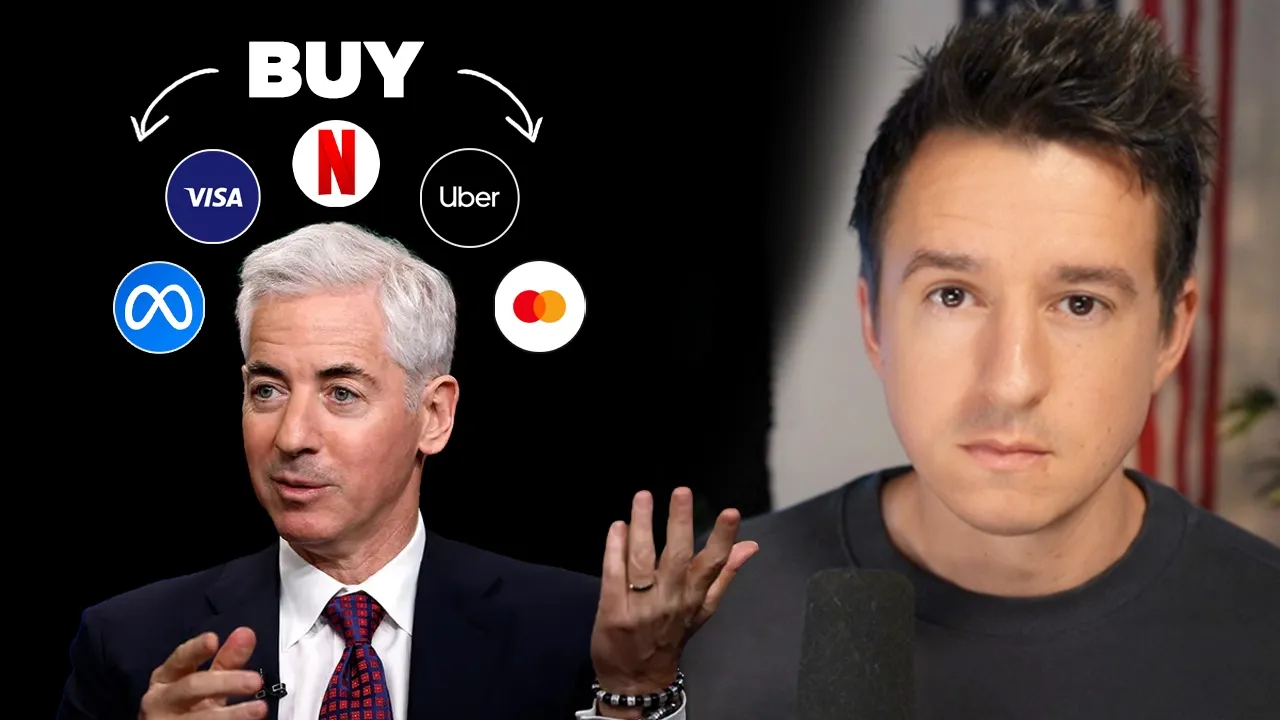
Bill Ackman Just Bought 6 New Stocks — Joseph Carlson After Hours

Joseph Carlson After Hours

Bill Ackman deployed $5 billion of capital into six new holdings and re-entered Netflix because market-wide fixation on hardware has left software and network compounders heavily undervalued.

AI-assisted summary of Bill Ackman Just Bought 6 New Stocks — original source. Check the original for full context.

Source published:

Key ideas

  • Bill Ackman's Pershing Square initiated positions in six companies—Netflix, Mastercard, Visa, S&P Global, Intercontinental Exchange (ICE), and Alcon—deploying $5 billion into businesses left behind by the market's hardware rally. (0:00)
  • Ackman reversed his 2022 exit from Netflix, buying shares back at roughly $74 following a 40% drawdown driven by engagement concerns and Warner Bros. Discovery acquisition rumors. (7:43)
  • Pershing Square capitalized on artificial intelligence disruption panics to acquire S&P Global at its lowest five-year valuation (19x P/E) and payment giants Visa and Mastercard, arguing stablecoins and AI agents will expand existing payment rails. (13:01)
  • Extreme market concentration saw two hardware sectors drive nearly 85% of S&P 500 gains year-to-date, while more than 90% of index constituents contributed under 2% of total returns. (22:08)

Detailed notes

## Background Published on YouTube by Joseph Carlson After Hours on August 13, 2026, this video examines Bill Ackman's latest portfolio additions detailed in Pershing Square's Q2 report. The description promotes Carlson's investment analysis platform Qualtrim alongside his growth and dividend portfolios, accompanied by standard disclaimers highlighting his philosophy of buying long-term compounding businesses as an amateur investor.

## TL;DR Joseph Carlson analyzes Bill Ackman’s recent deployment of $5 billion into six high-conviction holdings, focusing on shared positions such as Netflix, Mastercard, and S&P Global, alongside new stakes in Visa, Intercontinental Exchange, and Alcon. Carlson revisits Ackman's painful 2022 exit from Netflix at a $400 million loss, contrasting it with his own contrarian accumulation and praising Ackman's mental flexibility in buying back shares following a 40% pullback. The episode details how Pershing Square's theses dismantle prevailing bear narratives around artificial intelligence disruption, autonomous vehicles threatening Uber, and streaming saturation. Overall, Carlson highlights how Ackman capitalized on extreme market concentration in semiconductor hardware to acquire neglected, cash-generative compounders at attractive valuations.

## Atmosphere & style The presentation carries a calm, methodical, and analytical tone that blends rigorous fundamental equity research with reflective investor psychology. Carlson speaks with the quiet assurance of a disciplined buy-and-hold investor, balancing subtle vindication over his contrarian Netflix accumulation with genuine respect for Ackman's humility and flexibility. Listening feels like attending a focused after-hours seminar, cutting through short-term media panics and market fads to evaluate business moats and valuation metrics with clear-headed rationality.

## Bulletin - [00:00](https://www.youtube.com/watch?v=v00MJumOVRk&t=0s) Bill Ackman's Pershing Square initiated positions in six companies—Netflix, Mastercard, Visa, S&P Global, Intercontinental Exchange (ICE), and Alcon—deploying $5 billion into businesses left behind by the market's hardware rally. - [07:43](https://www.youtube.com/watch?v=v00MJumOVRk&t=463s) Ackman reversed his 2022 exit from Netflix, buying shares back at roughly $74 following a 40% drawdown driven by engagement concerns and Warner Bros. Discovery acquisition rumors. - [13:01](https://www.youtube.com/watch?v=v00MJumOVRk&t=781s) Pershing Square capitalized on artificial intelligence disruption panics to acquire S&P Global at its lowest five-year valuation (19x P/E) and payment giants Visa and Mastercard, arguing stablecoins and AI agents will expand existing payment rails. - [22:08](https://www.youtube.com/watch?v=v00MJumOVRk&t=1328s) Extreme market concentration saw two hardware sectors drive nearly 85% of S&P 500 gains year-to-date, while more than 90% of index constituents contributed under 2% of total returns.

## Key takeaways - [07:43](https://www.youtube.com/watch?v=v00MJumOVRk&t=463s) Ackman re-entered Netflix at approximately $74 per share following a 40% pullback, reversing his rapid 2022 exit where he realized an estimated $400 million loss. - [08:58](https://www.youtube.com/watch?v=v00MJumOVRk&t=538s) The prevailing bear thesis on Netflix overemphasizes raw watch time, overlooking that subscriber mix shifts to emerging markets mathematically depress average viewing hours while engagement quality and retention remain robust. - [08:58](https://www.youtube.com/watch?v=v00MJumOVRk&t=538s) Ackman argues that short-form video platforms harvest user attention primarily from linear television and low-tier streamers rather than indispensable utility streaming services like Netflix. - [13:01](https://www.youtube.com/watch?v=v00MJumOVRk&t=781s) Anthropic's Claude Cowork release triggered a 25% selloff in S&P Global down to 19x earnings, presenting a buying opportunity since Desktop Capital IQ contributes under 7% of total company revenue. - [13:01](https://www.youtube.com/watch?v=v00MJumOVRk&t=781s) S&P Global's long-term earnings growth remains secured by its proprietary datasets and its irreplaceable, high-margin credit rating and benchmark franchises. - [16:35](https://www.youtube.com/watch?v=v00MJumOVRk&t=995s) Visa and Mastercard are structured as an infrastructure duopoly where stablecoins serve as complementary rails for cross-border B2B transactions rather than direct consumer substitutes. - [16:35](https://www.youtube.com/watch?v=v00MJumOVRk&t=995s) Autonomous agentic AI is expected to accelerate digital transaction frequency, defaulting to consumers' existing credit and debit cards and increasing the overall fee pool. - [17:53](https://www.youtube.com/watch?v=v00MJumOVRk&t=1073s) Intercontinental Exchange was added as a predictable compounder whose futures and options exchanges drive low-to-mid-teens cash flow growth despite unfounded market selloffs. - [17:53](https://www.youtube.com/watch?v=v00MJumOVRk&t=1073s) Alcon offers a durable razor-and-blade business model anchored by an installed base of over 30,000 surgical capital equipment units generating high-margin recurring consumable sales. - [19:26](https://www.youtube.com/watch?v=v00MJumOVRk&t=1166s) Investor panic over autonomous vehicle disruption compressed Uber's valuation to 19x earnings despite 35% earnings growth, ignoring the logistical superiority of hybrid driver-and-AV networks. - [20:51](https://www.youtube.com/watch?v=v00MJumOVRk&t=1251s) Meta remains a top conviction holding with immediate AI monetization in core advertising and downside-protected compute infrastructure that can be leased to third parties if internal demand wanes. - [22:08](https://www.youtube.com/watch?v=v00MJumOVRk&t=1328s) Pershing Square avoided hardware momentum trades entirely, deploying $5 billion in liquidity into software, exchange, payments, and healthcare franchises during a historic lack of market breadth.

## Detailed walkthrough ### [00:00](https://www.youtube.com/watch?v=v00MJumOVRk&t=0s) Bill Ackman's Buying Spree and Portfolio Overlap

Breaking news just hit that Bill Ackman is officially a Netflix shareholder once again. After a brief three-month stint owning the stock back in 2022, the Pershing Square founder decided to buy back in. That reversal raises an obvious question: what changed for Ackman after previously dumping the company and calling it "too unpredictable"? Netflix is not an isolated move, either. Ackman went on an aggressive buying spree, adding six new holdings to his fund.

Intriguingly, three of those six new additions are already cornerstone positions in Carlson's personal portfolio: Netflix, Mastercard, and S&P Global. Ackman detailed his rationale in Pershing Square's comprehensive Q2 report, an in-depth document laying out his investment strategy, individual holding performance, current valuations, and implied five-year earnings-per-share (EPS) growth rates. Comparing Ackman's internal estimates against broader Wall Street consensus reveals stark differences in which companies he believes will outgrow the market's current expectations.

Addressing the substantial overlap between his holdings and Ackman's, Carlson clarifies that he is not simply riding Ackman's coattails. For the vast majority of these names, Carlson initiated his positions long before Ackman disclosed them: - **Prior Positions:** Carlson owned Meta, Alphabet (Google), Microsoft, Amazon, Mastercard, and S&P Global before Ackman bought them, and he held Netflix through both of Ackman's purchase windows. - **Followed Trades:** The only names where Carlson actively followed Ackman's lead were Chipotle (which became a very successful investment) and a newly opened position in Uber.

---

[02:12](https://www.youtube.com/watch?v=v00MJumOVRk&t=132s) The 2022 Netflix Crash: Ackman's $400 Million Exit

The history behind Ackman’s trades in Netflix offers a stark study in investor psychology during a crisis. While Carlson holds a $102,000 stake in Netflix that sits $30,000 in the green, Ackman's first go-around was notoriously painful. In late 2021 or early 2022, Ackman initiated a massive position after Netflix suffered a single-day plunge of roughly 25% driven by management's warnings about slowing subscriber additions. Ackman viewed that drop as an overreaction and expected a swift recovery. Instead, the stock traded flat for three months before an operational bomb dropped.

```mermaid flowchart TD accTitle: Ackman vs Carlson Netflix Investment Timeline accDescr: A comparison of Bill Ackman's rapid exit during the 2022 Netflix crash versus Joseph Carlson's accumulation and the subsequent market cycle.

subgraph Crash["2022 Crash (75% Peak-to-Trough)"] A["Late 2021 / Early 2022: Stock drops 25% on sub slowdown"] --> B["Ackman buys initial dip"] B --> C["Q1 2022: Netflix guides 2M sub loss, churn spikes"] C --> D["Ackman exits after 3 months at $400M loss: 'too unpredictable'"] C --> E["Carlson buys heavily down to ~$30 price-adjusted"] end

subgraph Expansion["2023–2024 Recovery & Concession"] E --> F["Operational pivots succeed: $7 ad tier & password crackdown"] F --> G["Legacy competitors cut budgets; Netflix rallies ~600% to ~$135"] end

subgraph Correction["Recent Pullback & Re-entry"] G --> H["Stock falls ~40% on WBD merger rumors & engagement fears"] H --> I["Ackman re-buys Netflix at ~$74/share"] end ```

In the subsequent earnings report, Netflix management stunned Wall Street by warning that the service would outright lose 2 million subscribers. Churn accelerated, subscriber growth vanished, and the prevailing narrative flipped overnight. Wall Street immediately branded Netflix a saturated, no-growth has-been devoid of pricing power and destined to be crushed by legacy media competitors. Sentiment plummeted to extreme lows: YouTubers churned out dramatic "Rise and Fall of Netflix" video essays with explosions and downward arrows, and investors openly mocked anyone holding shares.

From peak to trough, the stock collapsed roughly 75%. Just two days after the disastrous subscriber release, Ackman threw in the towel and dumped his entire stake at an estimated $400 million loss. Explaining his abrupt exit to CNBC, Ackman said the asset had simply become too unpredictable for Pershing Square's concentrated strategy, summing up his philosophy: "I'm 100% ready to admit when I'm wrong and 100% ready to admit when I'm wrong quickly."

---

[04:45](https://www.youtube.com/watch?v=v00MJumOVRk&t=285s) Carlson’s Contrarian Thesis: Why Netflix Was Never Broken

Ackman sold almost precisely at the absolute bottom. Carlson took the opposite stance, leaning into an aggressively bullish perspective that ran entirely counter to the market consensus. Convinced that Netflix was an indispensable global media powerhouse whose growth runway remained intact, Carlson bought hand over fist as the stock cratered. On December 1, 2022, when Netflix was trading at a split-adjusted price of just $30 per share, Carlson published an extensive thesis outlining why Wall Street had misread the entire business.

During a catastrophic 75% drawdown, every corporate action is viewed through a lens of desperation rather than strategic foresight: - **Ad-Supported Tier:** Criticized as an admission of defeat, Netflix's new $7-per-month tier opened up an entirely new pool of price-sensitive subscribers and ad revenue. - **Paid Sharing:** Monetizing password sharing was framed as hostile to users, but it represented a calculated recapture of unmonetized viewers. - **Gaming and Cost Cutting:** Expanding into mobile gaming and enacting disciplined budget cuts were derided as panic moves, yet they stabilized cash generation.

Carlson strongly disagreed with both the market and Ackman's assessment that Netflix was erratic, arguing instead that it was "one of the most predictable companies in the market." While media rivals spent tens of billions of dollars chasing streaming market share, Netflix was already the sole player operating at sufficient scale to generate positive free cash flow. Furthermore, its creative engine continued to deliver viral, high-engagement hits such as *Glass Onion: A Knives Out Mystery*, *Dahmer – Monster: The Jeffrey Dahmer Story*, and *Wednesday*.

---

[07:43](https://www.youtube.com/watch?v=v00MJumOVRk&t=463s) Streaming Wars Won, New Fears, and Ackman’s Re-entry

Carlson's contrarian bet paid off handsomely over the subsequent years. Competitors like Disney and Paramount burned through tens of billions of dollars before capitulating, slashing their streaming production budgets and effectively ceding victory to Netflix. As the undisputed victor of the streaming wars, Netflix's stock surged approximately 600% from its cyclical lows, topping out at all-time highs of around $135 per share.

Recently, however, the stock pulled back nearly 40% from those peaks, opening up a fresh entry point: - **Acquisition Rumors:** Sentiment weakened after Netflix explored a potential deal for Warner Bros. Discovery, which many investors interpreted as an alarming sign that organic engagement was slipping and management needed inorganic content acquisition to paper over the crack. - **Engagement Concerns:** The narrative that user engagement is peaking rekindled broader growth anxieties. - **Ackman's Re-entry:** This ~40% drawdown pushed the valuation back down to levels attractive enough for Bill Ackman to reverse course once again, establishing a brand-new position at approximately $74 per share.

[08:58](https://www.youtube.com/watch?v=v00MJumOVRk&t=538s) Bill Ackman's Return to Netflix and the Engagement Narrative

Bill Ackman has re-entered his position in Netflix during a major dip, reversing his previous exit from the stock. While critics in the "peanut gallery" might mock Ackman for selling Netflix after a brief holding period in the past, buying back in demonstrates admirable "mental flexibility" and discipline rather than stubbornness. Being willing to revisit an investment that was previously a loser and turn it into a winner requires a sound process, particularly given that the underlying fundamentals at Netflix have materially improved.

```mermaid flowchart TD accTitle: Netflix Bear Thesis vs Ackman Counter-Arguments accDescr: Visual breakdown of why investors are mistaken about Netflix watch time and short-form video competition.

subgraph Bear["Investor Bear Narrative"] B1["Watch time per user is dropping"] B2["Short-form video eating share"] end

subgraph Counter["Ackman & Carlson Rebuttal"] C1["Engagement Quality!= Raw Watch Time"] C2["Geographic Mix Shift creates lower-average usage"] C3["Short-form steals from Linear TV, not Utility Streaming"] end

B1 --> C1 B1 --> C2 B2 --> C3 ```

Ackman directly addresses the prevailing bear thesis surrounding Netflix: the supposed engagement issue that has driven the stock down 37% over the past year. In his letter, Ackman points out that investors have become fixated strictly on total watch time without factoring in either the *quality* of that watch time or the impact of *geographic mix shifts*:

- **Engagement vs. Raw Watch Time:** High-friction or passive social scrolling (like Instagram Reels or YouTube Shorts on a lunch break or in the bathroom) is fundamentally lower value than focused time spent viewing a premium series or movie. High-impact content, such as live programming, represents a tiny fraction of total watch time but is vastly more instrumental in driving user sign-ups and long-term retention. - **Geographic Mix Shifts:** The most television-heavy markets—the United States, Canada, and Western Europe—are largely saturated. Rapid subscriber expansion is now occurring in international emerging markets where baseline TV consumption is culturally much lower. While this pulls down average watch time per subscriber across the total base, it is a mathematical artifact of global expansion rather than an intrinsic business defect. - **Short-Form Video Disruption:** Ackman emphasizes that time spent on short-form video is predominantly harvested from linear television and low-tier streaming platforms rather than "utility-like services such as Netflix." Despite rapid growth in short-form video over the past two years, Netflix’s subscriber counts and top-line revenue have continued to scale without discernible damage. - **Capital Returns and Compounding:** Backed by an aggressive share repurchase program, Ackman models Netflix earnings to compound at nearly 20% annually, concluding that the current market valuation offers an attractive discount for a dominant enterprise.

---

[13:01](https://www.youtube.com/watch?v=v00MJumOVRk&t=781s) S&P Global and the Claude AI Overreaction

Ackman has established a new position in S&P Global—a company already held across two personal accounts ($104,000 position up 18% / $13,000, alongside an $18,000 position in the Story Fund up $2,000). Pershing Square took advantage of a steep selloff driven by panic over artificial intelligence disintermediation. In February, market sentiment spiraled when Anthropic launched Claude Cowork, an AI plugin capable of conducting automated financial research and dashboard analytics. Social media quickly convinced itself that financial data providers like S&P Global and Moody's were rendered obsolete.

Ackman noted that S&P Global tumbled over 25% from peak to trough, dragging its valuation from 25 times down to 19 times earnings per share—its cheapest multiple in five years. Even today, the business trades around an undemanding 21 times multiple. The market's panic severely miscalculates the actual structure of S&P Global's operations:

- **Capital IQ Exposure:** The desktop interface Capital IQ—the primary target supposedly threatened by Claude—accounts for less than 7% of total corporate revenues and an even smaller share of net profits. - **Proprietary Data Moat:** Over 40% of Market Intelligence division revenue comes from proprietary, curated datasets deeply embedded inside institutional workflows. - **Hypothetical Worst Case:** Even if Claude were to wipe out the entire contested Market Intelligence business segment down to zero, S&P Global’s forward P/E ratio would only adjust to 26. - **Core Drivers:** Long-term earnings compounding will be propelled primarily by the high-margin, irreplaceable ratings and benchmark franchise businesses, allowing S&P Global to comfortably achieve its multi-year, high single-digit top-line targets.

---

[16:35](https://www.youtube.com/watch?v=v00MJumOVRk&t=995s) Visa and MasterCard: Riding Stablecoins and Agentic Commerce

Ackman also revealed new stakes in payment giants Visa and MasterCard. MasterCard represents one of the largest holdings in the personal portfolio, valued at roughly $188,000 with an 89% money-weighted return (approximately $40,000 in unrealized gains), having been aggressively added to earlier in the year. Pershing Square bought both networks simultaneously, treating them as a duopolistic bet on global commerce rails.

Rather than viewing emerging payment technologies as existential threats, Ackman argues that both stablecoins and agentic artificial intelligence are net positives:

- **Stablecoin Complementarity:** Stablecoins are primarily gaining adoption in areas where traditional card rails have never been the incumbent—such as high-friction cross-border B2B payments, costly remittance corridors, and dollar-denominated savings within high-inflation countries. As a result, stablecoins will grow alongside card rails rather than cannibalizing existing payment volume. - **Agentic Commerce Acceleration:** Autonomous AI software agents executing purchases on behalf of users will eliminate transaction friction, foster higher purchasing frequency, and drive digital volumes higher. These agents will default to utilizing consumers' pre-existing card payment preferences rather than replacing them, expanding the total transaction fee pool.

[17:53](https://www.youtube.com/watch?v=v00MJumOVRk&t=1073s) New Holdings: Intercontinental Exchange (ICE) and Alcon

While Joseph Carlson holds several of the same stocks Ackman recently purchased—such as Netflix, Mastercard, and S&P Global—Pershing Square also initiated positions in two businesses Carlson does not own. The first of these is Intercontinental Exchange (ICE). Although an exchange operator represents a relatively novel business model for Ackman’s portfolio, Carlson notes that its core dynamics closely mirror those of S&P Global. The majority of ICE's exchange revenue stems from its high-margin futures and options platforms. Ackman views ICE as a classic compounder, arguing that favorable macroeconomic conditions and secular tailwinds will drive low-to-mid-teens growth. In his summary, Ackman characterizes ICE as a "classic, simple, predictable, free cash flow generative business that is sold off on concerns that we view as unwarranted."

```mermaid flowchart TD accTitle: Pershing Square New Holdings Summary accDescr: Breakdown of the business drivers for ICE and Alcon in Pershing Square's portfolio. subgraph ICE["Intercontinental Exchange (ICE)"] ICE_Rev["Futures & Options Exchanges"] --> ICE_Growth["Low-to-Mid-Teens Growth"] ICE_Growth --> ICE_Thesis["Predictable FCF Sold Off on Unwarranted Fears"] end

subgraph ALC["Alcon (ALC)"] ALC_Base["30,000+ Surgical Unit Install Base"] --> ALC_Cash["High-Margin Recurring Consumables"] ALC_Cash --> ALC_Thesis["Mid-Teens EPS Growth + Multiple Expansion"] end ```

The second addition outside Carlson’s portfolio is Alcon, a healthcare business Carlson had not previously researched closely. Alcon operates as the global leader in ophthalmology, commanding a dominant footprint in surgical vision alongside strong franchises in contact lenses and vision care. The business benefits from significant brand equity, extensive commercial scale, and an impressive installed base of capital equipment. Ackman’s thesis hinges on this installed equipment, which serves as a durable moat and generates high-margin, recurring consumable sales:

- **Installed Base Moat:** Alcon maintains a core installed base of over 30,000 surgical capital equipment units worldwide. - **Razor-and-Blade Economics:** This vast equipment footprint guarantees a consistent stream of recurring consumable product demand. - **Return Projections:** Pershing Square projects mid-teens earnings growth combined with valuation multiple expansion as the market re-rates the company to reflect its true business quality.

---

[19:26](https://www.youtube.com/watch?v=v00MJumOVRk&t=1166s) Portfolio Updates: Uber and Autonomous Vehicle Fears

Beyond the half-dozen new stock purchases, Ackman offered detailed updates on his existing portfolio positions, starting with Uber. The market has persistently penalized Uber stock due to widespread investor anxieties over autonomous vehicle (AV) disruption, compounded by recent signs of an "increasingly fraught relationship" with autonomous partner Waymo. Ackman, however, dismisses the notion that AVs will render Uber obsolete. He points out that Uber is rapidly expanding strategic partnerships across the autonomous driving landscape, with additional commercial AV launches scheduled across several new metropolitan markets later in the year.

Carlson fully shares Ackman's confidence, having purchased Uber stock after studying Ackman's initial thesis. Both investors emphasize that ride-sharing is fundamentally driven by network density and liquidity of demand, assets Uber already commands at scale. A hybrid logistics network combining human drivers and autonomous fleets will routinely outperform a pure autonomous fleet because it easily handles dynamic demand spikes, weather constraints, and fringe pickup zones. Even in geographic markets where Waymo has scaled up operations, Uber's ride volume has continued to expand uninterrupted.

- **Fundamental Growth:** Uber's earnings are pacing to grow by roughly 35% year-over-year. - **Depressed Multiple:** Despite strong execution, the stock trades at approximately 19 times earnings, approaching its lowest historical valuation multiple. - **Market Disconnect:** Ackman argues that public valuation has grown completely decoupled from Uber's actual operating performance.

---

[20:51](https://www.youtube.com/watch?v=v00MJumOVRk&t=1251s) Portfolio Updates: Meta and Downside-Protected AI Upside

Ackman also reaffirmed his high conviction in Meta Platforms, designating it as one of the single most compelling investments in the market today. Carlson likewise maintains an overweight position in Meta—one he entered before Ackman made his ownership public—even though his position is currently down around 14%. Ackman argues that Meta represents one of the most transparent and direct commercial beneficiaries of generative artificial intelligence, capturing measurable return on investment faster than almost anyone else in big tech:

> "We view Meta as one of the clearest beneficiaries of AI, which is driving higher engagement through better content recommendation, greater ad monetization through improved targeting, and meaningful product innovation in consumer and business agents. Though still early days, these benefits are already visible in greater revenue acceleration in Meta's core advertising business."

Crucially, Ackman highlights an underappreciated safety net embedded within Meta's massive capital expenditure cycle: compute downside protection. If internal product teams fail to exhaust the company's vast AI computing infrastructure, Meta can simply turn around and lease that spare server capacity to external enterprises at high margins within an infrastructure market starved for computing power. Carlson reinforces the valuation case, noting that buying Meta whenever its forward price-to-earnings ratio compresses into the teens (10x to 20x) has historically yielded phenomenal long-term compounding.

---

[22:08](https://www.youtube.com/watch?v=v00MJumOVRk&t=1328s) The Market Breadth Anomaly: Deploying $5 Billion into Neglected Winners

Carlson closes by highlighting an eye-opening analysis from Ackman’s investor letter regarding the extreme concentration of the broader market. Despite aggressive enterprise cloud and AI spending, Pershing Square holds zero exposure to semiconductor or hardware plays like Nvidia, Micron, or SanDisk. Ackman considers the extreme market outperformance of hardware "picks and shovels" to be a transient phenomenon. To illustrate just how distorted the market has become, Ackman presented a statistical breakdown of year-to-date S&P 500 performance:

| S&P 500 Segment | % of Index Companies | % of Index Market Cap | Contribution to YTD Gains | |:--- |:--- |:--- |:--- | | **Semiconductors & Tech Hardware** (2 of 24 sectors) | ~8% | ~22% | **Nearly 85%** | | **All Remaining Sectors** (22 of 24 sectors) | ~92% | ~78% | **Less than 15%** |

The most startling takeaway is that more than 90% of the individual equities in the S&P 500 index have combined to generate less than 2% of the index's total year-to-date return. Rather than lamenting this historic lack of breadth, Ackman treated it as an extraordinary capital deployment environment. Pershing Square took advantage of the market's narrow fixation on hardware to deploy $5 billion in available cash directly into world-class software, network, exchange, and healthcare franchises that were unjustly abandoned by momentum investors.

## Notable quotes > [00:00](https://www.youtube.com/watch?v=v00MJumOVRk&t=0s) too unpredictable — Bill Ackman

> [02:12](https://www.youtube.com/watch?v=v00MJumOVRk&t=132s) I'm 100% ready to admit when I'm wrong and 100% ready to admit when I'm wrong quickly. — Bill Ackman

> [04:45](https://www.youtube.com/watch?v=v00MJumOVRk&t=285s) one of the most predictable companies in the market. — Joseph Carlson

> [08:58](https://www.youtube.com/watch?v=v00MJumOVRk&t=538s) utility-like services such as Netflix — Bill Ackman

> [17:53](https://www.youtube.com/watch?v=v00MJumOVRk&t=1073s) classic, simple, predictable, free cash flow generative business that is sold off on concerns that we view as unwarranted. — Bill Ackman

> [19:26](https://www.youtube.com/watch?v=v00MJumOVRk&t=1166s) increasingly fraught relationship — Joseph Carlson

> [20:51](https://www.youtube.com/watch?v=v00MJumOVRk&t=1251s) We view Meta as one of the clearest beneficiaries of AI, which is driving higher engagement through better content recommendation, greater ad monetization through improved targeting, and meaningful product innovation in consumer and business agents. Though still early days, these benefits are already visible in greater revenue acceleration in Meta's core advertising business. — Bill Ackman

## Mentioned Bill Ackman, Joseph Carlson, Pershing Square, Netflix, Mastercard, S&P Global, Meta, Alphabet, Microsoft, Amazon, Chipotle, Uber, Disney, Paramount, Warner Bros. Discovery, Glass Onion: A Knives Out Mystery, Dahmer – Monster: The Jeffrey Dahmer Story, Wednesday, Instagram Reels, YouTube Shorts, Anthropic, Claude Cowork, Moody's, Capital IQ, Visa, Intercontinental Exchange (ICE), Alcon, Waymo, Nvidia, Micron, SanDisk, S&P 500, CNBC

## Video description Join Qualtrim, the stock analysis platform I built and use, and join over 13,000 other paying members: https://www.qualtrim.com/

-Disclaimer Some of the links below are affiliate links, I can earn money from them at no cost to you.

This content is not a solicitation, is not endorsed by M1, and was not reviewed by M1; the opinions expressed are solely those of the authors and do not reflect M1's views. Information presented is accurate as of the video posting date; for the most up-to-date information, please refer to m1.com. Before making any investment decisions, consult your personal investment, legal, and tax advisors, as this content is for informational purposes only and not intended as investment recommendations.

▀▀▀▀▀▀▀▀▀▀▀▀▀▀▀▀▀▀▀▀▀▀▀▀▀▀ Join Here: https://www.qualtrim.com/

📚 My favorite Investing Books: https://amzn.to/3KwyIhG 📷 All the tech I use to record videos: https://www.amazon.com/shop/josephcarlson/list/2L5YMP4DFYA8O?ref_=cm_sw_r_cp_ud_aipsflist_aipsfjosephcarlson_FAKKKMYKF486ZR6H2DSQ

🚀 Growth Portfolio: https://click.linksynergy.com/deeplink?id=5mNcifgFllM&mid=50362&murl=https://dashboard.m1.com/share?token=39d17ae6-4a4a-3fc4-bb15-d86abe3fbb67 💵 Dividend Portfolio: https://click.linksynergy.com/deeplink?id=5mNcifgFllM&mid=50362&murl=https://dashboard.m1.com/share?token=3b283352-1bff-31d9-8576-f5770c2bfdfd

SOCIAL MEDIA ▀▀▀▀▀▀▀▀▀▀▀▀▀▀▀▀▀▀▀▀▀▀▀▀▀▀ 🎥 More free content: https://www.youtube.com/channel/UCbta0n8i6Rljh0obO7HzG9A 🐦 I post random thoughts on Twitter too: https://twitter.com/joecarlsonshow

DISCLAIMER ▀▀▀▀▀▀▀▀▀▀▀▀▀▀▀▀▀▀▀▀▀▀▀▀▀▀ I am not a professional investor and have never claimed to be. I'm an amateur investor sharing my experience of what I've learned, where I have had success, and where I've had failures. I share my thoughts on investing and performance with transparency. My approach and goal to investing is to buy high-quality long-term investments in world-class businesses that I call "compounders". I view my investments as businesses, not as stocks. Before creating content on YouTube full time I worked as a senior-level programmer for 8 years. Over the years as a programmer, I compounded my knowledge of development. I take the same iterative learning approach to my study of investing. I study investing as a craft in the continual pursuit of being better. I will make mistakes in investment decisions from time to time. Results are not guaranteed. Please do not blindly follow me into any investments, and make sure your portfolio and investments are built around your specific income, risk tolerance, personality, timeline, and overall circumstances.

[Source](https://www.youtube.com/watch?v=v00MJumOVRk)

中文简报

阿克曼重新买入Netflix后斥资50亿美元建仓六只新股 Bill Ackman将50亿美元资金配置于六只新持仓并重返Netflix,原因是全市场对硬件的狂热关注导致软件和网络复利型企业被严重低估。 Joseph Carlson分析了Bill Ackman近期将50亿美元资金配置于六只高确信度持仓的举措,重点关注了两人的共同持仓,如Netflix、Mastercard和S&P Global,以及对Visa、Intercontinental Exchange和Alcon的新建仓位。Carlson回顾了Ackman在2022年蒙受4亿美元损失痛苦清仓Netflix的经历,并将其与自己逆势增持的做法进行对比,称赞Ackman在股价回撤40%后重新买入所展现出的思维灵活性。本期内容详细探讨了Pershing Square的投资逻辑如何打破当前市场围绕人工智能颠覆效应、自动驾驶对Uber构成威胁以及流媒体饱和等悲观论调。总体而言,Carlson强调了Ackman如何利用市场对半导体硬件的极端集中度,以具吸引力的估值买入被忽视且具备现金流生成能力的复利型企业。 Bill Ackman旗下的Pershing Square建仓了六家公司——Netflix、Mastercard、Visa、S&P Global、Intercontinental Exchange (ICE) 和Alcon,向被市场硬件涨势抛下的企业中投入了50亿美元。 (0:00) Ackman推翻了2022年清仓Netflix的决定,在用户参与度担忧及Warner Bros. Discovery收购传闻导致该股回撤40%后,以约74美元的价格重新买入。 (7:43) Pershing Square利用人工智能颠覆恐慌,以五年最低估值(19倍市盈率)买入S&P Global,并建仓支付巨头Visa和Mastercard,认为稳定币和AI智能体将拓展既有的支付通道。 (13:01) 极端的市场集中度表现为今年迄今两个硬件板块推动了标普500指数近85%的涨幅,而超过90%的指数成份股对总回报的贡献不足2%。 (22:08)

Reading summary

Pershing Square founder Bill Ackman deployed approximately $5 billion into six new equity positions and reaffirmed existing holdings, capitalizing on a sharp divergence in market breadth. Host Joseph Carlson outlines Ackman's rationale across several shared holdings, emphasizing that market panics over artificial intelligence and slowing engagement have created attractive entry points for durable compounders. The Netflix Reversal and Engagement Quality (8:58) Ackman re-established a stake in Netflix at roughly $74 per share after exiting during the 2022 crash at an estimated $400 million loss. Following a 75% peak-to-trough collapse in 2022, Carlson accumulated shares near a split-adjusted $30 before the stock surged 600% to around $135. A recent 40% drawdown—triggered by Warner Bros. Discovery acquisition rumors and fears of peaking user attention—prompted Ackman's return. Both investors counter the narrative that declining watch time signals platform decay. Ackman argues that aggregate watch time is skewed lower by rapid subscriber additions in emerging markets with culturally lower television consumption. Furthermore, high-impact programming and live events drive sign-ups and retention despite representing a small fraction of raw viewing hours, while short-form video primarily cannibalizes linear television rather than utility streaming platforms. Pershing Square projects Netflix earnings to compound at nearly 20% annually. Insulating Financial Networks from AI Disruption (13:01) Pershing Square initiated a position in S&P Global after market panic regarding Anthropic’s Claude Cowork AI tool pushed the stock down over 25% to 19 times earnings—its cheapest multiple in five years. Ackman points out that the Capital IQ desktop interface, the direct target of generative research tools, represents less than 7% of total revenue and an even smaller share of net profit. Over 40% of Market Intelligence revenue relies on embedded proprietary data, while the core ratings and benchmark business remains structurally protected. Ackman similarly bought into the global payments duopoly of Visa and Mastercard. Rather than threatening card networks, Ackman argues stablecoins are primarily expanding into high-friction B2B cross-border payments and remittance corridors where cards were never incumbents. Concurrently, agentic AI software agents will increase digital purchase frequency while defaulting to consumers' established card payment profiles. Recurring Revenue Moats in ICE and Alcon (17:53) Pershing Square added two businesses outside Carlson's personal portfolio: Intercontinental Exchange (ICE) and eye-care specialist Alcon. Ackman describes ICE as a classic, predictable compounder whose futures and options exchanges drive high cash generation and low-to-mid-teens growth despite recent market skepticism. In Alcon, Ackman targets a global ophthalmology leader operating a razor-and-blade business model. Supported by an installed base exceeding 30,000 surgical capital equipment units worldwide, the company generates consistent, high-margin revenue from recurring consumable products and vision care. Pershing Square anticipates mid-teens earnings-per-share growth combined with valuation multiple expansion. Market Breadth Distortions, Uber, and Meta (19:26) Alongside new acquisitions, Ackman reiterated conviction in Uber and Meta Platforms. Despite investor apprehension over autonomous vehicle (AV) disruption and Waymo competition, Uber trades near a historical low of 19 times earnings while pacing 35% annual earnings growth. Both Ackman and Carlson argue that hybrid human-and-autonomous fleets will rely on Uber’s liquid demand network and scale. In Meta, Ackman identifies immediate AI monetization in core advertising alongside a capital-expenditure backstop: if internal teams do not fully utilize the company's computing clusters, Meta can lease excess server capacity to external enterprises. Pershing Square's aggressive deployment directly exploits historic market concentration. According to Ackman's letter, semiconductor and hardware stocks accounted for nearly 85% of year-to-date S&P 500 returns, while more than 90% of index equities accounted for less than 2% of gains. Pershing Square bypassed hardware momentum to allocate $5 billion into cash-generative franchises trading at compressed multiples. Ackman's recent portfolio moves reflect a contrarian strategy of absorbing assets during sentiment panics regarding AI disruption and slowing growth. However, this thesis relies on the expectation that emerging shifts in autonomous technology, agentic commerce, and stablecoins will complement legacy platform networks rather than displace them.

Source quotes

[0:00] Bill Ackman: too unpredictable [2:12] Bill Ackman: I'm 100% ready to admit when I'm wrong and 100% ready to admit when I'm wrong quickly. [4:45] Joseph Carlson: one of the most predictable companies in the market. [8:58] Bill Ackman: utility-like services such as Netflix [17:53] Bill Ackman: classic, simple, predictable, free cash flow generative business that is sold off on concerns that we view as unwarranted. [19:26] Joseph Carlson: increasingly fraught relationship [20:51] Bill Ackman: We view Meta as one of the clearest beneficiaries of AI, which is driving higher engagement through better content recommendation, greater ad monetization through improved targeting, and meaningful product innovation in consumer and business agents. Though still early days, these benefits are already visible in greater revenue acceleration in Meta's core advertising business.

Original transcript

[0:00] Welcome back everyone. We just had [0:01] breaking news that Bill Ackman is once [0:03] again a Netflix shareholder. That's [0:06] right. After his brief stint of owning [0:07] it for about 3 months in 2022, he [0:11] finally decided to buy back in. So what [0:13] changed? Why is Bill Ackman now buying [0:15] Netflix when he used to own the company [0:17] and he at one point called it too [0:19] unpredictable? It seems like he's [0:21] changed his mind on Netflix as well as a [0:23] number of other companies. In fact, he [0:25] didn't just buy Netflix as a new [0:26] position, he bought six new holdings. [0:29] That's a lot of buying. Bill Ackman has [0:31] been on a buying spree. But the [0:32] interesting part about this is I already [0:34] own three of these six new companies. [0:37] Three of them were Netflix, MasterCard, [0:40] and S&P Global. These are all big [0:42] positions in my portfolio. So obviously [0:44] I have a lot of thoughts about his [0:46] analysis on these companies. And with [0:48] his analysis on them, he released an [0:49] entire in-depth update. This is the [0:51] Pershing Square Q2 report. It's very [0:55] in-depth. He goes through his entire [0:57] strategy, what he's trying to [0:58] accomplish. He goes through every [1:00] holding and the performance of it. He [1:01] also goes through the valuation and the [1:04] implied growth rates, how much he thinks [1:06] all of these companies will grow in [1:07] their earnings per share over the next 5 [1:10] years. So I compared all of his [1:12] estimates against the market consensus [1:14] to see which companies he believes will [1:16] grow the most today compared to what [1:18] investors think. So this is going to be [1:20] a very full episode. We have a lot to [1:21] get into. Let's go ahead and get [1:22] started. Now the first thing I want to [1:24] address is many of the holdings that I [1:25] have now are in overlap with Bill [1:27] Ackman's portfolio. But I just want to [1:29] point out that in my defense, the [1:31] majority of them I have bought before [1:33] Bill Ackman. I've already been in a lot [1:35] of these companies. I bought Meta before [1:37] it was revealed that Bill Ackman bought [1:38] Meta. I had Google before he bought [1:40] Google. I had Microsoft before he had [1:42] Microsoft in his portfolio. I had Amazon [1:44] before he bought Amazon. I had Netflix [1:47] twice before he bought Netflix. And the [1:49] same goes for now MasterCard and S&P [1:50] Global. Now there are some companies [1:52] that I followed Bill Ackman into. One of [1:54] them was Chipotle, which was a [1:55] successful investment. And the other one [1:57] is Uber, which is a new position that I [1:59] really like. But the reason I point this [2:01] out is because between the two of us [2:02] there is a big overlap in holdings, but [2:05] I'm not just copying his trades. The [2:06] majority of these companies I've [2:08] actually owned prior to Bill Ackman [2:10] buying into them. Now, out of the new [2:12] companies that he just bought, the one [2:13] that I first want to outline is Netflix. [2:16] I find this particularly interesting [2:18] because [2:19] Bill Ackman had previously owned [2:20] Netflix, and I've owned the company long [2:23] ago. I owned it before Bill Ackman both [2:25] times. So, he's owned it twice now. This [2:28] is his second time. I've owned it just [2:30] once the entire time through. My [2:32] position is a $102,000 position, $30,000 [2:35] in the green. If we look through [2:37] Netflix's stock price history, I'll give [2:38] a short outline of Bill Ackman's [2:40] dealings with this company a couple [2:41] years ago. In early 2022 or late 2021, [2:45] he bought the company after it suffered [2:47] a major fall. So, right there, Netflix [2:49] dropped like 25% in a single day because [2:52] things were slowing down. We had a major [2:55] slowdown in subscribers, and management [2:57] would they warned about it. They said [2:58] it's a problem. We have a slowdown in [3:00] subscribers. With Bill Ackman having [3:03] looked at the company and studied it, he [3:05] thought that this might be just a minor [3:06] dip, and he can buy the company today, [3:08] and it will sail back up in the future. [3:11] Well, what he didn't know is that is [3:13] that Netflix would stay flat for the [3:15] next 3 months, and then things would get [3:17] much, much worse. Netflix management [3:20] said that not only are they not going to [3:22] grow subscribers, but they're going to [3:24] lose 2 million subscribers. [3:26] So, millions of customers being lost. [3:29] Their churn has picked up. They're no [3:30] longer a growth company, and literally [3:32] everything flipped on top of its head. [3:34] Netflix now was being viewed by Wall [3:36] Street as a has-been, a company that was [3:39] totally saturated. It couldn't grow at [3:40] all. It had no pricing power, and it had [3:43] competitors crowding it out. The news [3:45] was so insanely bad. I've never seen [3:47] anything like it. YouTubers were making [3:49] videos of of rise and fall of Netflix [3:51] with big arrows and explosions showing [3:53] it just crumbling. People are almost [3:56] rejoicing in the fact that this big [3:57] company came tumbling down. From the [3:59] peak to the bottom, Netflix dropped by [4:01] about 75% and again sentiment could have [4:04] not been worse. Everybody was mocking [4:06] anybody that owned the company. [4:08] It was a terrible time to be a Netflix [4:11] shareholder. And Bill Ackman, after two [4:14] days after that report and the stock [4:16] dropping, he decided to move on. He [4:18] called CNBC and he said that the stock [4:20] has become too unpredictable and he [4:22] wanted to move to a more predictable [4:23] company. [4:24] >> As he told me, [4:25] the reason why he exited his position [4:27] after only 3 months at a $400 million [4:29] loss was, quote, "I'm 100% ready to [4:32] admit when I'm wrong and 100% ready to [4:34] admit when I'm wrong quickly." [4:36] So, that sort of gives you an idea of [4:38] where his thinking was. [4:41] >> So, he sold out of Netflix roughly at [4:43] the bottom. Now, this isn't to criticize [4:45] Bill Ackman. We all have to make [4:47] judgment calls. He had a different [4:49] analysis on this company than I did at [4:50] the time. And I would say that my [4:52] analysis of Netflix at the time was [4:55] uniquely bullish on the company. I I [4:57] realize it was a bit of an outlier at [4:58] the time. I had studied Netflix so much. [5:00] I felt so confident in it. Maybe to some [5:03] naivety. Maybe I was being [5:05] overconfident, but I just I could not [5:08] fathom that Netflix was done growing. It [5:10] was just such a global company. They had [5:12] so much content. They They, in my [5:14] opinion, they owned the world and I [5:15] thought that the market got it wrong. [5:17] So, while this is going on, I continued [5:19] to add to my stake in Netflix. I bought [5:22] more and more of the company. I [5:23] continued to buy it and I talked about [5:26] it incessantly. In fact, I even [5:27] published and I I wrote things in-depth [5:30] about Netflix. This was December 1st, [5:33] 2022. The stock price at the time of [5:35] writing that was $30. So, I wrote this [5:38] December 1st, 2022, Netflix is trading [5:40] at a price-adjusted $30 per share. [5:43] And I go through and I highlight a lot [5:45] of different things that are going on [5:46] with Netflix at the time. [5:47] Netflix reported subscriber losses for [5:49] two consecutive quarters. Netflix [5:52] subscriber loss resulted in destroying [5:53] investors confidence causing the stock [5:55] to drop by over 70%. Netflix had changed [5:58] their mind on having no ads and has [6:00] introduced a new $7 month ad tier. [6:02] Netflix has decided to monetize password [6:04] sharing accounts. Netflix admitted they [6:06] faced real competition in streaming. [6:08] Netflix made a pivot into gaming. [6:10] Netflix has done layoffs and budget [6:12] cuts. So when you're looking at the [6:13] situation here, this is illustrative of [6:16] what goes on during a time period where [6:18] a stock is in crisis, where it's just [6:20] dropped 75%. [6:22] Everything is interpreted negatively. [6:24] All of these actions that Netflix took [6:26] looked desperate on the surface. Oh, [6:28] they changed their mind and they're [6:29] adding ads. They're going into video [6:31] games. They're they're monetizing [6:33] password crackdowns. All of these looked [6:35] like desperation when in reality they [6:37] were well-calculated moves by [6:39] management. I continued on saying the [6:41] damage to Netflix's story over the past [6:44] year is real. Investors confidence has [6:47] been shaken. Even Bill Ackman purchased [6:50] into Netflix to buy the dip and quickly [6:52] sold out 3 months later when Netflix had [6:54] another disappointing quarter. He's now [6:56] stated that the stock is {quote} too [6:58] unpredictable for his concentrated [7:00] portfolio. This is where I continue to [7:02] strongly disagree with the market and [7:04] with Bill Ackman. I don't think things [7:06] are so bad for Netflix. I don't think [7:07] the company is unpredictable. In fact, I [7:10] think Netflix is one of the most [7:11] predictable companies in the market. I [7:13] go on talking about how Netflix is [7:15] making breakout shows. You had the Glass [7:17] Onion. You had Dahmer. We had Wednesday. [7:20] We had all these shows that they're [7:20] making that are actually quite good. [7:23] When I consider the facts surrounding [7:24] Netflix, I don't see a distressed or [7:26] struggling company. I see a company that [7:28] is still dominant and thriving. Netflix [7:30] is the only streaming company at scale [7:32] generating positive free cash flow with [7:34] their streaming business. Netflix is [7:36] still profitable and growing despite all [7:38] their competitors spending tens of [7:39] billions of dollars on streaming to [7:41] chase Netflix. Now since then, over the [7:43] following years, Netflix's stock price [7:45] quickly sailed upwards, going up around [7:48] 600% from the lows. And while many other [7:50] streamers like Paramount and Disney were [7:52] throwing tens of billions of dollars at [7:54] streaming, most of them gave up the [7:56] fight. They pulled back on their budgets [7:58] and conceded the battle to Netflix. And [8:00] with Netflix soundly winning that [8:02] streaming war, fighting that battle, and [8:04] completely dominating, the stock went up [8:06] to around $135 [8:09] per share. Huge highs for Netflix, [8:11] all-time highs. But then, as you can [8:13] see, over the past 1 year, Netflix is [8:16] down substantially. The stock has [8:18] actually continued to go downward this [8:20] year, almost around 40%. So, it's given [8:23] up a lot of the gains from its all-time [8:25] highs. And why is that happening? Well, [8:27] the reason that's happening is because [8:28] there's now a new fear baked into [8:30] Netflix's stock price. They first tried [8:32] to buy Warner Brothers Discovery, which [8:34] a lot of investors didn't like. They [8:36] They thought it signaled that Netflix is [8:38] weak. Netflix looked at it as a content [8:40] acquisition, but many investors thought [8:42] it it means that engagement's going down [8:44] and they need to do acquisitions. This [8:46] narrative of an engagement problem has [8:48] dropped the stock enough to become once [8:50] again attractive to Bill Ackman, and [8:52] he's recently entered a new position at [8:55] around $74 per share, so right around [8:58] where it trades today. He's now [9:00] reinvested back into the company. So, [9:02] that's Bill Ackman's history with [9:03] Netflix. And while it's easy to take [9:05] shots from the peanut gallery and say, [9:07] "Look, Bill Ackman sold the company [9:09] after just a short time last time." [9:11] That's true, but he also bought back in. [9:13] He bought back in during a big dip. And [9:15] that shows a level of mental [9:16] flexibility. When you're able to have a [9:19] company that you're a loser on, but you [9:20] also now want to turn it back into a [9:22] winner, you're buying back in later, and [9:24] you're maintaining discipline. So, I [9:25] actually view it as a strength that he [9:26] was able to change his mind on Netflix, [9:28] and once again re-enter the position. [9:30] And things have materially changed for [9:32] the better for Netflix. But there's [9:34] still that one problem, which is the [9:35] engagement issue. This is what he talks [9:38] about with Netflix. He says with respect [9:40] to engagement, investors have been [9:42] intently focused on the watch time [9:44] metric without appropriately considering [9:47] the quality of that watch time or the [9:49] impact of geographic mix shifts. So he [9:51] outlines two reasons that investors are [9:53] being confused about Netflix's [9:55] engagement problem. One of them is that [9:57] engagement is not equal to watch time, [9:59] the other is geographic mix shifts as he [10:01] calls it. Now I want to play just a [10:03] short clip of a video that I did two [10:05] days ago on Netflix. Here it is. The [10:07] reason the stock is down 37% over the [10:10] past year can largely be attributed to [10:13] this entire narrative that there is an [10:14] engagement issue with Netflix. That [10:17] their watch time and their engagement [10:18] per subscriber is going down. [10:21] But the way that Netflix measures this [10:22] is that engagement is different than [10:25] just watch time. Watch time is [10:27] important, but watch time from a social [10:30] media app where you're scrolling YouTube [10:32] shorts or Instagram reels is different [10:34] than watch time watching a movie. One of [10:36] them can be more impactful to the [10:38] enjoyment of someone. When you watch a [10:40] really good TV series that you're really [10:41] into, that's a higher quality of [10:43] engagement and enjoyment than simply [10:45] scrolling Instagram reels while you're [10:47] on the toilet or enjoying lunch. So [10:49] right there I outlined the exact same [10:51] thing earlier this week. That engagement [10:53] is not equal to watch time. And this is [10:55] exactly what Bill Ackman points out. He [10:58] says live programming for example [10:59] represents a small fraction of watch [11:01] time yet is instrumental in driving sign [11:04] ups and retention. But we also have the [11:05] other thing that he points out here, [11:07] which is what he calls quote geographic [11:09] mix shifts. This is another issue that [11:11] investors are getting wrong. And of [11:13] course I also commented on the [11:14] geographic mix shifts in this video [11:16] earlier this week. The areas in the [11:18] world where people watch the most TV are [11:21] already largely saturated. That is the [11:23] United States, Canada, and Europe. In [11:25] other areas that they're growing fast [11:27] into, those people don't watch as much [11:29] TV. They don't spend as much time on it. [11:32] So even though they're growing in the [11:33] number of subscribers, the amount of [11:35] watch time per subscriber is lower for [11:37] those new areas. But, that's not a [11:39] concern intrinsically about the company. [11:41] So, of course I agree 100% with Ackman [11:43] here. I've been arguing the same thing [11:45] for months now, that Netflix doesn't [11:47] have an engagement problem, and part of [11:49] what's going on is being skewed by the [11:51] geographic mix shift. Now, he continues [11:53] on addressing another bear case for [11:55] Netflix, and that is short-form video. [11:57] He says, "In our view, time reallocated [12:00] towards short-form video is far more [12:01] likely to come from share donors like [12:03] linear TV and lower quality streaming [12:05] services than from utility-like services [12:08] such as Netflix. To that end, the ramp [12:11] up in short-form video consumption has [12:13] been most acute over the past 2 years, [12:16] yet has no discernible impact on the [12:18] company's results. We've had short-form [12:20] video for a while. It's been growing [12:22] rapidly, and so has Netflix. Netflix is [12:24] continuing to grow rapidly. Look at the [12:26] Look at the revenue. Look at the [12:27] subscribers. Whatever short-form video's [12:29] doing, it's not really damaging Netflix. [12:32] We don't see any of that in the numbers [12:33] itself. So, I think that's another good [12:35] point to highlight. Combined with a [12:37] robust buyback program, we estimate [12:39] earnings should compound at close to 20% [12:41] annually. We believe the company's [12:43] current valuation represents a [12:45] substantial discount for a business with [12:47] such a strong growth profile and [12:49] dominant market position." So, that's [12:51] his case with Netflix, and obviously I [12:52] agree with it. I've made a many of these [12:54] same points for months now, and I am [12:56] glad that Bill Ackman once again has [12:58] Netflix in the portfolio. Hopefully, he [12:59] has a better experience with it this [13:01] time. Now, next up we get to S&P Global. [13:03] This is another new position to the [13:05] Ackman portfolio. Now, of course after [13:07] show that this is also one that I've had [13:09] in my portfolio for some time. I've [13:11] owned S&P Global for a while. It's [13:13] currently a $104,000 position. I'm up [13:16] around 18% $13,000 on it. I own this one [13:19] in two places. I have another small [13:21] position, $18,000 in the story fund with [13:24] another $2,000 in gains. He says, "Our [13:26] opportunity to invest in S&P Global [13:28] arose mid concerns of AI [13:30] disintermediation of the company's data [13:32] offerings and workflow and analytic [13:34] tools, including Capital IQ. Now, I [13:37] remember this vividly. [13:39] It It was like it was yesterday. What [13:41] happened was on Twitter, on X, [13:44] Claude released a financial analysis [13:47] plugin. So, they said, "Oh, you can plug [13:49] it into financial dashboards. It can run [13:51] through and do analysis on companies and [13:53] you can do all of this stuff that a lot [13:55] of it seems very similar to what S&P [13:56] Global does." [13:58] And investors went crazy with it. Lots [14:00] of likes, lots of retweets, spread [14:02] everywhere. Every investor is looking at [14:04] it going, "Oh, no. Claude has jumped [14:06] from coding and now they're into [14:07] finances. S&P Global and Moody's, those [14:10] companies are no more." And the stocks [14:12] dropped that day, and they continued to [14:14] drop. And Bill Ackman watched this [14:16] happen. He said, "In February of this [14:18] year, the stock declined more than 25% [14:20] from peak to trough following [14:21] Anthropic's launch of Claude Co-work." [14:24] That's the name of the plugin. [14:26] Now, as a result, the stock's valuation [14:28] declined from 25 times to 19 times [14:31] earnings per share, the lowest valuation [14:33] in the previous 5 years, and a bargain [14:36] level for a company that is often cited [14:38] as one of the world's highest quality [14:39] businesses. It is incredible that S&P [14:41] Global today, which is considered again [14:43] one of the best companies in the world, [14:45] is trading at 21 times multiple. And an [14:47] interesting thing about this that I'll [14:49] just highlight now is even if Claude was [14:51] to hypothetically completely disrupt [14:54] market intelligence, the thing that it [14:56] actually competes with, if it made that [14:58] business line of S&P Global go to zero, [15:01] so it totally eradicated that entire [15:03] business line, [15:05] S&P Global's forward P/E ratio would be [15:07] 26. [15:08] That's what we're talking about here. [15:10] The concerns of Claude are real, but [15:12] they are heavily overstated to a [15:13] dramatic degree. Capital IQ, that's [15:16] their desktop application, [15:18] which has drawn a disproportionate [15:20] amount of investors' attention this [15:21] year, represents less than 7% of the [15:24] total revenue and an even smaller [15:26] percentage of the total profit. On the [15:28] other hand, over 40% of market [15:31] intelligence revenue is driven via the [15:33] sale of proprietary and curated data [15:35] that are typically deeply embedded in [15:36] customer workflows. The actual part [15:38] that's subject to being disrupted by [15:40] Claude is a tiny fragment of the market [15:43] intel business. He says, "We believe [15:45] investors have become myopically focused [15:47] on the potential threats to a single [15:49] digital portion of the company within [15:51] market intelligence and have lost sight [15:53] of the fact of future earnings growth. [15:56] They'll be almost exclusively determined [15:58] by the company's benchmark business." [16:00] "These high-growth franchises should [16:02] enable the company to meet its [16:04] multi-year target and high single-digit [16:06] revenue growth." So, in Bill Ackman's [16:08] mind, investors are focusing on all the [16:10] wrong things, and I believe they are as [16:11] well. Investors get easily scared. We [16:14] see it again and again in all different [16:15] great companies. They jump out of them [16:18] as soon as Claude or Anthropic release [16:19] this one feature without even knowing [16:21] how it's going to affect the company. [16:23] And they've done the same with S&P [16:24] Global. When you listen to the calls and [16:26] you listen to what's going on with the [16:27] company, they are business as usual. [16:30] They're in fact growing in many areas [16:31] faster than anticipated. So, this is [16:33] another buy that I obviously like by [16:35] Bill Ackman. Now, the next company that [16:36] Bill Ackman bought that I already own is [16:39] MasterCard. And this is an exciting one. [16:41] It's literally one of my biggest [16:43] positions. I own $188,000 [16:46] worth. It's now up 89% money-weighted [16:48] returns. That's $40,000 in gains. And I [16:51] really increased my position in [16:53] MasterCard this year. He bought both [16:55] Visa and MasterCard as a collective buy. [16:58] He says, "Earlier this year, we [16:59] initiated positions in Visa and [17:00] MasterCard, two businesses we have long [17:02] admired, which provide a dominant global [17:05] network for consumers and commercial [17:07] payments. We believe stablecoins [17:09] represent an opportunity for card [17:11] networks rather than a threat. They are [17:13] in fact most relevant where cards are [17:14] not the incumbent. Cross-border [17:16] business-to-business payments, high-cost [17:18] remittance corridors, and dollar savings [17:20] in countries with volatile currencies. [17:23] Adoption in these areas should grow in [17:24] parallel with, not at the expense of, [17:27] card volumes. So, he's not only not [17:28] worried about stablecoin, but he [17:30] believes that's a bullish part of the [17:31] story here. He also says that in terms [17:33] of agentic technology, that agentic [17:36] commerce is more likely to expand the [17:38] payment ecosystem than erode the [17:39] network's moat, as agents remove [17:41] friction, enable more frequent [17:43] purchases, and accelerate digitally [17:44] commerce. Agents should adopt, not [17:47] replace, consumers' existing payment [17:49] preferences. So again, I believe this is [17:51] a timely buy during a dip, and another [17:53] fantastic addition to the Pershing [17:55] Square portfolio, and I continue to hold [17:57] my position in Mastercard. I'm I'm every [17:59] bit as bullish on it. So, with Ackman [18:01] adding Netflix, Mastercard, and S&P [18:03] Global, our portfolios are looking more [18:04] similar. But then he also added [18:06] companies that I don't own. So, there's [18:08] some additions here we'll go over. One [18:09] of them is the Intercontinental [18:11] Exchange. Most of ICE's exchange revenue [18:13] comes from its future and options [18:15] exchanges. These seem like a new type of [18:17] business for the Ackman portfolio, but [18:19] it does remind me of S&P Global. He says [18:21] that we believe the favorable macro [18:23] backdrop and powerful secular tailwinds [18:25] should enable ICE to achieve a [18:26] low-to-mean low-to-mid-teens growth. And [18:29] then in summary, the business is a [18:31] classic, simple, predictable, free cash [18:33] flow generative business that is sold [18:35] off on concerns that we view as [18:36] unwarranted. The other company that he [18:38] bought that's not currently in my [18:39] portfolio is called Alcon, and this is [18:41] one that I wasn't familiar with. Alcon [18:43] is the world's leading ophthalmology [18:45] company with a dominant in surgical [18:47] vision, strong positions in vision care [18:49] and contact lenses. So, this is a [18:51] medical ophthalmology company that is a [18:53] strong franchise, benefits from a [18:55] massive global install base, strong [18:57] brand affinity, unrivaled commercial [18:59] capabilities. The core of Alcon's [19:01] business is the dominant surgical vision [19:03] franchise supported by over 30,000 unit [19:06] capital equipment install base. This [19:08] install base anchors a highly attractive [19:10] stream of high-margin recurring [19:12] consumable revenue. We anticipate Alcon [19:14] generating meaningful compounded returns [19:16] from the current levels as it grows its [19:18] earnings in the mid-teens and its [19:19] valuation multiple expands to a level [19:21] more reflective of the underlying [19:23] business quality. So, there you have the [19:25] six new companies to the Ackman [19:26] portfolio. Now, outside of those six new [19:28] holdings, Ackman also gave small updates [19:30] on his existing positions and what his [19:32] ongoing thoughts are. For example, with [19:34] Uber, he notes that the stock continues [19:36] to trade down because of AVs, but he [19:38] doesn't share the same AV risk as the [19:41] market. Broad investor concern regarding [19:43] the potential long-term impact of AVs [19:45] continues to negatively weigh on Uber [19:47] stock. Punctuated this quarter by the [19:50] evidence of an increasingly fraught [19:51] relationship with its partner, Waymo. [19:54] But, offsetting these concerns, the [19:56] company continues to make significant [19:57] progress with its many other strategic [19:59] partners. With AV launches planned in [20:02] multiple new cities later this year. [20:04] Against this backdrop, Uber continues to [20:06] demonstrate very strong operating [20:08] financial performance with earnings on [20:10] pace to grow approximately 35% this [20:13] year. Valuation is increasingly [20:15] disconnected from the fundamentals and [20:17] now trades at just 19 times earnings [20:19] near its lowest valuation ever. Uber [20:21] already has the critical demand that you [20:23] need to have a successful ride-sharing [20:25] business. And a hybrid model where you [20:28] have humans and AVs will always be [20:30] superior to a purely AV model. Uber has [20:33] many things working for it. And while I [20:36] believe that Waymo will be successful in [20:37] its own right, that has not detracted [20:40] from Uber success. The company continues [20:42] to grow even in the markets that Waymo [20:44] is successful. I do own Uber. This is [20:46] one of the positions that I bought after [20:47] Ackman was in it. I agree with him on [20:49] the thesis. I think this company will do [20:51] really well. Meta is another company [20:52] that he talked about in this report. I [20:54] also have a large holding in Meta. It's [20:56] currently in the red by around 14% and [20:58] Meta is a position that I did buy into [21:00] before it was disclosed that Ackman [21:02] owned the stock. He continues to view [21:04] Meta as one of the best stocks in the [21:07] market today to own. He says, quote, we [21:09] view Meta as one of the clearest [21:11] beneficiaries of AI, which is driving [21:13] higher engagement through better content [21:15] recommendation, greater ad monetization [21:17] through improved targeting, and [21:19] meaningful product innovation in [21:21] consumer and business agents. Though [21:23] still early days, these benefits are [21:25] already visible in greater revenue [21:27] acceleration in Meta's core advertising [21:29] business. Meta's compute investment also [21:31] affords itself downside protection as [21:34] capacity not consumed internally can be [21:36] profitably monetized in a highly supply [21:39] constrained compute market. Anytime that [21:41] Meta has gotten down to the teens PE [21:43] ratio, it's just been a great deal. Like [21:46] look throughout history and look at [21:47] anytime it was in a 10 to 20 forward PE [21:50] ratio, and those are times that you [21:52] wanted to own the stock. And that's [21:53] exactly where Meta is today. So overall, [21:55] I like these updates. I think that he's [21:57] right on Meta and Uber. I like his new [21:59] buy into Netflix. I like the thesis into [22:02] Mastercard and Visa, as well as S&P [22:04] Global. Great additions to the [22:06] portfolio. Overall, it's very strong. [22:08] And then finally, I think it's worth [22:10] highlighting one part of his letter here [22:12] that I thought was particularly [22:13] interesting. We know that Bill Ackman [22:15] has invested in all of these companies, [22:16] the hyperscalers, the capex spenders, [22:19] these digital network companies, but he [22:20] doesn't own any Micron or Nvidia, he [22:23] doesn't own any Sandisk, he's not in [22:26] these AI companies. And he believes the [22:28] outperformance of this subset of [22:29] companies is likely temporary. He says, [22:32] while the S&P 500 index has increased by [22:35] approximately 10% through the first 6 [22:37] months of the year, nearly the entirety [22:39] of gains has come from two sectors that [22:41] provide the picks and shovels for AI [22:43] infrastructure. Just two of the S&P [22:46] 500's 24 sectors, semiconductors and [22:49] tech hardware and equipment, which [22:51] comprise just 8% of the companies and [22:53] 22% of the market capitalization of the [22:55] index, have contributed nearly 85% of [22:58] the S&P 500's year-to-date gains. As a [23:01] result, more than 90% of the companies [23:04] in the S&P 500 have collectively [23:06] contributed less than 2% of the overall [23:09] return. That is a staggering statistic. [23:12] 90% of companies contributing less than [23:15] 2% of the total return. We are fortunate [23:17] that in the current market backdrop, it [23:19] has created highly attractive [23:21] environments for Pershing Square as it's [23:23] allowed us to opportunistically deploy [23:25] $5 billion worth of cash. So, he's used [23:28] this as more of an opportunity than a [23:29] problem. He's using these companies that [23:31] are all being left behind as chances to [23:33] buy in now. Now, that's going to be it [23:35] for this episode. Hope you enjoyed. See [23:36] you in the next one.