Carlson Drops Amazon From Top Picks, Backs Meta and Uber
Joseph Carlson After Hours
Long-term market outperformance stems from behavioral discipline to acquire entrenched compounders during headline-driven panics rather than chasing informational edges or short-term momentum.
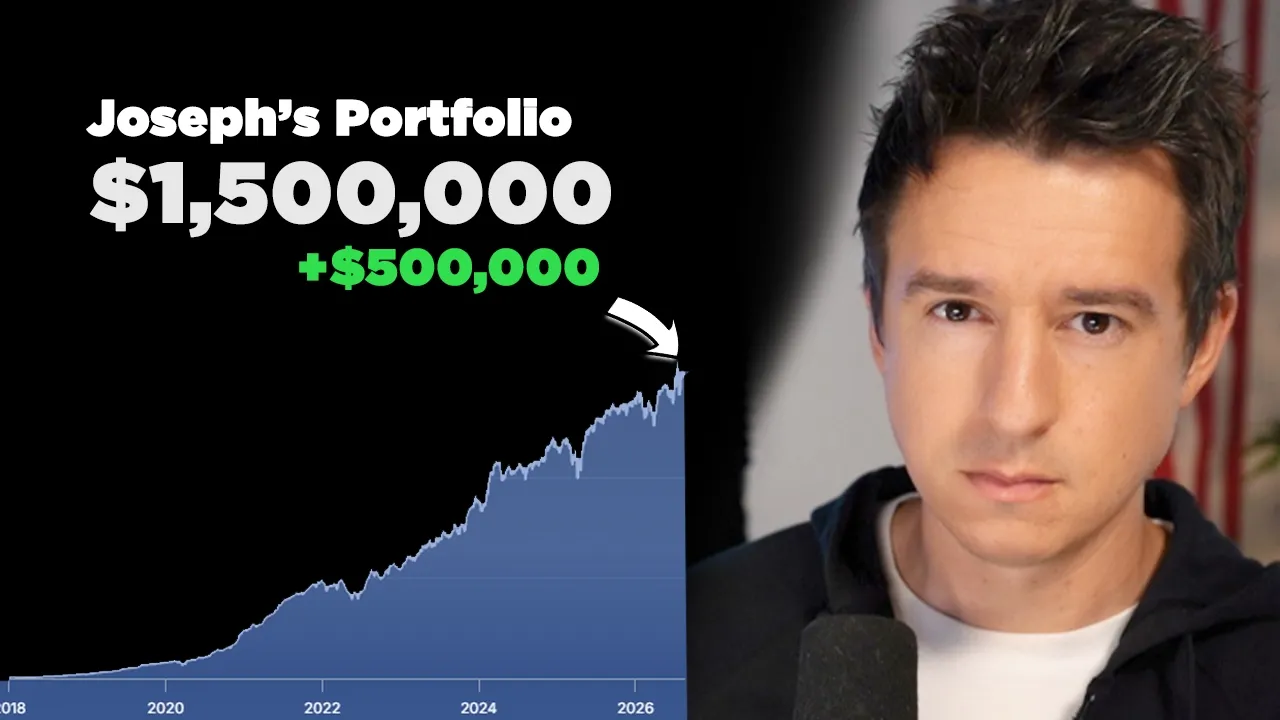
Joseph Carlson's investment portfolio crossed approximately $1.47 million, with more than $500,000 generated entirely from cumulative capital gains across a concentrated roster of roughly 14 holdings. (0:00)
Carlson officially retired Amazon from his top picks list following a 16% year-to-date gain, designating Meta, Uber, and S&P Global as his three highest-conviction ideas for the remainder of 2026. (17:59)
Meta remains Carlson's number one conviction pick despite an unrealized $38,000 year-to-date drawdown, as sensationalized headlines surrounding a $1.4 trillion youth addiction lawsuit overshadow robust underlying free cash flow. (19:15)
Duolingo accidentally revealed preliminary August Daily Active User growth of approximately 27% during an investor presentation, forcing an immediate public disclosure that sparked a 5% share price rally. (27:30)
Detailed notes
## Background
This video was published on YouTube by Joseph Carlson After Hours on August 20, 2026. According to the page description, Carlson breaks down how to gain an edge in investing, reviews his investment journey, unveils his updated top stock picks (Meta, Uber, and S&P Global), covers a Duolingo DAU leak, highlights an Amazon drone delivery fail, and announces a new addition to the Carlson family.
## TL;DR
Joseph Carlson reflects on scaling his public investment portfolio to approximately $1.47 million, sharing how long-term behavioral discipline, concentrated quality compounders, and low portfolio turnover drove over $500,000 in gains. He explains the transition from early cash savings to organic compounding and introduces a custom Chrome extension built to unify and transparently track his accounts on the path toward $5 million. After taking Amazon off his top recommendations following a strong run, he outlines his three high-conviction picks for the rest of 2026: Meta, Uber, and S&P Global. The episode closes with lighter coverage of Duolingo's accidental user growth disclosure, a comical drone delivery mishap, and personal reflections on the joy and financial realities of fatherhood following the birth of his fourth child.
## Atmosphere & style
The broadcast feels grounded, conversational, and transparent, blending disciplined financial analysis with unscripted personal honesty. Carlson speaks with the calm, measured cadence of an experienced long-term practitioner who refuses to get swept up in short-term market hysteria or victory laps. The tone shifts seamlessly from analytical discussions about competitive moats and valuation metrics to genuine, warm vulnerability as he shares the arrival of his newborn son and counters online cynicism about family life.
## Bulletin
- [00:00](https://www.youtube.com/watch?v=kuViYpyPllo&t=0s) Joseph Carlson's investment portfolio crossed approximately $1.47 million, with more than $500,000 generated entirely from cumulative capital gains across a concentrated roster of roughly 14 holdings.
- [17:59](https://www.youtube.com/watch?v=kuViYpyPllo&t=1079s) Carlson officially retired Amazon from his top picks list following a 16% year-to-date gain, designating Meta, Uber, and S&P Global as his three highest-conviction ideas for the remainder of 2026.
- [19:15](https://www.youtube.com/watch?v=kuViYpyPllo&t=1155s) Meta remains Carlson's number one conviction pick despite an unrealized $38,000 year-to-date drawdown, as sensationalized headlines surrounding a $1.4 trillion youth addiction lawsuit overshadow robust underlying free cash flow.
- [27:30](https://www.youtube.com/watch?v=kuViYpyPllo&t=1650s) Duolingo accidentally revealed preliminary August Daily Active User growth of approximately 27% during an investor presentation, forcing an immediate public disclosure that sparked a 5% share price rally.
## Key takeaways
- [00:00](https://www.youtube.com/watch?v=kuViYpyPllo&t=0s) The Carlson portfolio reached approximately $1.47 million with over $500,000 in capital gains, reflecting a multi-year strategy focused on long-term compounders over rapid trading.
- [01:11](https://www.youtube.com/watch?v=kuViYpyPllo&t=71s) Radical transparency—publicly disclosing every weekly trade, gain, and loss since early 2019 without interruption—anchors Carlson's public investing philosophy.
- [04:13](https://www.youtube.com/watch?v=kuViYpyPllo&t=253s) Portfolio growth operates in two distinct phases: early stages ($0 to $100k+) depend almost entirely on savings rates and deposits, whereas mature stages ($200k+) are overwhelmingly dictated by compounding returns and capital allocation.
- [06:58](https://www.youtube.com/watch?v=kuViYpyPllo&t=418s) In efficient mega-cap markets, an informational edge does not exist; an investor's edge lies entirely in behavioral discipline, emotional stability, and qualitative business judgment.
- [09:11](https://www.youtube.com/watch?v=kuViYpyPllo&t=551s) Assessing true business durability requires identifying impenetrable economic moats, deep pricing power, and organic volume growth before examining top-line revenue metrics.
- [10:00](https://www.youtube.com/watch?v=kuViYpyPllo&t=600s) High portfolio concentration (around 14 holdings) can be achieved safely by dispersing capital across non-correlated sectors, such as payment rails, credit ratings duopolies, semiconductor lithography, and digital advertising.
- [11:12](https://www.youtube.com/watch?v=kuViYpyPllo&t=672s) Maintaining multi-year holding periods averaging over five years sharply cuts capital gains tax drag and frictional trading costs, allowing business intrinsic value to compound uninterrupted.
- [13:50](https://www.youtube.com/watch?v=kuViYpyPllo&t=830s) Speculating on short-term catalysts resembles glorified gambling; superior risk-adjusted returns depend on selecting businesses that hold an estimated 90% or higher probability of compounding over the long run.
- [15:02](https://www.youtube.com/watch?v=kuViYpyPllo&t=902s) Carlson developed a custom Chrome extension to unify live tracking of his Passive Income Portfolio and $450,000 Story Fund without corrupting historical brokerage return data.
- [17:59](https://www.youtube.com/watch?v=kuViYpyPllo&t=1079s) Amazon was removed from the top picks roster because its 16% year-to-date rally fully realized its asymmetric risk-reward profile relative to more heavily discounted compounders.
- [19:15](https://www.youtube.com/watch?v=kuViYpyPllo&t=1155s) Meta's negative sentiment regarding adolescent social media lawsuits mirrors historical Big Tobacco rhetoric, but its actual business fundamentals and cash flow generation remain uncompromised.
- [23:50](https://www.youtube.com/watch?v=kuViYpyPllo&t=1430s) Uber represents an asymmetric growth opportunity trading at 24x trailing P/E, 17x projected 2027 earnings, and a 6.3% free cash flow yield, with the threat of autonomous vehicles overblown by the market.
- [25:50](https://www.youtube.com/watch?v=kuViYpyPllo&t=1550s) S&P Global offers an attractive entry point at a 22 forward P/E and 4.5% free cash flow yield, led by an asset-light credit ratings division expanding operating profit at a 14% rate.
- [27:30](https://www.youtube.com/watch?v=kuViYpyPllo&t=1650s) Duolingo's inadvertent leak of a 27% August DAU growth rate triggered a mandatory SEC-compliant release and sent the stock climbing 5% to $146 per share.
- [30:52](https://www.youtube.com/watch?v=kuViYpyPllo&t=1852s) Welcoming his fourth child, Carlson argues against delaying family planning for financial perfection, noting that biological windows are narrow while wealth can be accumulated throughout an entire lifetime.
## Detailed walkthrough
### [00:00](https://www.youtube.com/watch?v=kuViYpyPllo&t=0s) Crossing $1.47 Million and Episode Overview
Joseph Carlson opens the show by announcing that his investment portfolio currently sits at approximately $1.47 million, with more than $500,000 of that balance consisting entirely of investment gains. Rather than keeping his process secret, the objective of the episode is to pull back the curtain on how he reached over half a million dollars in returns, the key strategies that allow an investment portfolio to scale to seven figures, and the practical mindsets required to replicate that journey. Carlson also lays out the agenda for the rest of the broadcast, noting that he will reveal his updated top three stock picks for the remainder of 2026. While he entered the year highlighting Amazon and Meta, he is making adjustments to expand that list to three companies.
Additionally, Carlson previews upcoming segments covering Duolingo's accidental leak of its August Daily Active User (DAU) projections, a "Fail of the Week" featuring a viral clip of an Amazon delivery drone dropping a package directly into a customer's swimming pool, and a personal milestone: welcoming a newborn to the Carlson household, officially making him a father of four.
- **Current Portfolio Value:** ~$1.47 million
- **Total Capital Gains:** $500,000+
- **Original 2026 Top Picks:** Amazon and Meta (now being adjusted to three companies)
- **Family Update:** Birth of a fourth child into the Carlson family
---
[01:11](https://www.youtube.com/watch?v=kuViYpyPllo&t=71s) The Origin of the Channel and the Power of Radical Transparency
Reflecting on how he reached this financial milestone, Carlson traces his public investing journey back to early 2019 when he launched his YouTube channel. His founding philosophy was simple yet directly opposed to the standard playbook of financial media: "show you what I'm doing with my finances, with my investments, and I wouldn't tell you what to do with yours." While Wall Street commentators and mainstream talking heads frequently give prescriptive advice while keeping their own actual holdings concealed, Carlson decided to provide complete transparency into every single buy, sell, and rationale.
Though his channel debuted in 2019 showcasing a concentrated portfolio of core holdings, his investing experience started around 2016. Because of his personal obsession with breaking down businesses and performing fundamental equity research, YouTube was never an act or an artificial persona, but rather an open window into his daily routine. In the channel's early days, Carlson gained substantial traction by concentrating heavily on Apple, laying out an early thesis that the company was transitioning from a commoditized hardware manufacturer into a high-margin software and services powerhouse. That correct call helped propel the channel to 100,000 subscribers in its first year. Since then, the main channel has surpassed 500,000 subscribers, while the *Joseph Carlson After Hours* channel has climbed past 250,000 subscribers. Throughout this six-year span, Carlson has publicly revealed his portfolio, gains, and setbacks every single week without missing a beat.
- **Investing Start Date:** ~2016 (portfolio tracking began ~3 years prior to YouTube)
- **Channel Launch Date:** Early 2019
- **Subscriber Milestones:** 100,000 subscribers in year one; 500,000+ on the main channel; 250,000+ on *After Hours*
- **Track Record:** Over six consecutive years of weekly portfolio and trade disclosures without skipping a single week
- **Early Core Thesis:** Apple's multi-year pivot from hardware provider to recurring software ecosystem
---
[04:13](https://www.youtube.com/watch?v=kuViYpyPllo&t=253s) The Two Phases of Wealth Building: Deposits vs. Compounding
Looking ahead toward his next milestone of scaling the portfolio from roughly $1.5 million to $5.0 million, Carlson stresses that the fundamental drivers of portfolio growth shift dramatically over time. For newer investors or those who have no interest in analyzing individual balance sheets, he strongly recommends taking the broad-market route using large-cap growth ETFs such as SPY (S&P 500) or SCHG (Schwab U.S. Large-Cap Growth ETF). He considers a hybrid allocation—combining a broad index or growth fund core with select individual companies—to be the sweet spot for the majority of everyday investors because holding individual stocks forces you into the mindset of an active business owner evaluating a 10-year horizon.
Carlson emphasizes that the mechanics of growing wealth fall into two distinct phases. In the early stages, the engine of your portfolio is almost entirely savings rate, strict budgeting, earning promotions, and establishing the discipline of aggressive, recurring cash deposits. However, once a portfolio crosses the $100,000 and $200,000 thresholds, the balance of power shifts toward capital appreciation. At his current portfolio size of nearly $1.5 million, a routine single-day market fluctuation can move the portfolio by $30,000. Under those circumstances, a monthly deposit of $20,000 barely moves the needle compared to asset performance, making sound capital allocation and compounding gains the dominant determinants of future net worth.
```mermaid
flowchart TD
accTitle: Two Phases of Portfolio Growth
accDescr: Visual flowchart comparing the early accumulation phase driven by deposits to the late compound growth phase driven by investment returns.
subgraph Phase1["Early Stage ($0 – $100k+)"]
A["Aggressive Budgeting & Income"] --> B["Frequent, Recurring Deposits"]
B --> C["Core Portfolio Foundation"]
end
- **Top ETF Recommendations for Hands-Off Investors:** SPY (S&P 500 ETF Trust) and SCHG (Schwab U.S. Large-Cap Growth ETF)
- **Early Stage Lever:** Budgeting discipline, income increases, and habitual monthly cash injections
- **Late Stage Lever:** Compounding returns, asset selection, and behavioral management
- **Portfolio Scale Example:** Daily volatility swings of ~$30,000 surpass substantial one-off cash deposits ($20,000)
---
[06:58](https://www.youtube.com/watch?v=kuViYpyPllo&t=418s) Defining the Investor's Edge in Efficient Markets
As an investor shifts into managing larger sums, achieving superior performance requires establishing an identifiable "edge" over the market. Carlson acknowledges the common counterargument: when investing in mega-cap, extensively analyzed corporations like Google, Mastercard, Amazon, Meta, ASML, Netflix, Microsoft, Costco, or Texas Roadhouse, every market participant is looking at the exact same public data and regulatory filings.
Carlson argues that having an informational edge in today's public markets is impossible; instead, the true edge lies entirely in "behavior and judgment." Two market participants can receive the exact same earnings release or regulatory headline, yet an emotional, short-sighted investor will panic or misinterpret the data, whereas a disciplined, long-term investor with sound business judgment will accurately appraise the company's prospects. Revisiting an analytical framework he authored in August 2023 titled "What Is My Edge?", Carlson explains that his initial priority when evaluating any business is not headline growth rates, but whether the firm commands durable, long-term competitive advantages. If a business lacks an impenetrable moat, massive barriers to entry, dominant market share, and deeply entrenched branding that keeps it firmly at the top of the economic food chain, its rapid revenue growth will prove fleeting as rivals inevitably erode its margins.
- **Source of Edge:** Behavioral control, emotional regulation, and qualitative business judgment (rather than asymmetric information)
- **Core Evaluated Companies:** Alphabet (Google), Meta Platforms, Amazon, Mastercard, ASML, Netflix, Microsoft, Costco, Texas Roadhouse
- **Foundational Rule (August 2023 Framework):** Never assess top-line growth rates before establishing durable competitive moats and high barriers to entry
[09:11](https://www.youtube.com/watch?v=kuViYpyPllo&t=551s) Defining Business Durability and Low-Risk Compounders
Evaluating whether a business is truly durable requires asking hard, structural questions about how it operates and grows. Investors must ask: does the company require a small army of PhDs and massive research and development budgets just to generate growth? Does it expand purely through continuous acquisitions? Is it burdened by heavy debt and financial leverage? And most critically, will it survive an aggressive, prolonged economic downturn?
Carlson defines low-risk businesses as market leaders with dominant positions, steep barriers to entry, deeply entrenched brand recognition, and robust distribution systems. Rather than betting on high-stakes, speculative science experiments or companies leaning on aggressive leverage, he searches for enterprises with cash-rich balance sheets and predictable organic revenue growth driven by volume and pricing power. These tend to be well-capitalized, large companies that become economically more entrenched and powerful over time thanks to powerful network effects.
[10:00](https://www.youtube.com/watch?v=kuViYpyPllo&t=600s) Concentration in Holdings Without Concentrating Risk
While Carlson advocates for a concentrated portfolio to increase the statistical odds of outperforming the broader market, he stresses that concentration should never mean consolidating risk factors. Owning eight to fifteen regional banks, streaming platforms, or casual dining restaurant chains exposes an investor to identical industry-wide vulnerabilities. Instead, his approach holds a small number of total positions—roughly 14 companies—while deliberately spreading them across uncorrelated sectors and business models.
```mermaid
flowchart TD
accTitle: Carlson's Portfolio Risk Diversification
accDescr: Mapping individual portfolio holdings across diversified business sectors and risk factors.
subgraph TechAndMedia["Digital & Tech Platforms"]
A["Alphabet & Meta<br/>(Differentiated Ad Models)"]
B["Netflix<br/>(Streaming Entertainment)"]
end
subgraph FinanceAndMoats["Financial Infrastructure & Moats"]
C["Mastercard<br/>(Payment Processing)"]
D["S&P Global & Moody's<br/>(Credit Ratings Duopoly)"]
end
By ensuring each company operates in a distinct economic vertical, the portfolio remains resilient against single-sector headwinds:
- **Advertising Platforms:** Alphabet and Meta operate across distinct ad channels, search intents, and social formats.
- **Payment & Financial Rail Monopolies:** Mastercard commands electronic payment rails, while S&P Global and Moody's operate as a duopoly in credit ratings.
- **Hardware & Manufacturing Moats:** ASML holds a virtual monopoly over extreme ultraviolet (EUV) lithography for advanced semiconductor production.
- **Consumer, Media & Mobility Networks:** Netflix leads subscription streaming entertainment, a consumer learning app provides language education, and Uber alongside DoorDash dominate ride-hailing and local delivery logistics.
[11:12](https://www.youtube.com/watch?v=kuViYpyPllo&t=672s) Multi-Year Holding Periods and the Realities of Turnover
Long holding periods are essential for compounding, yet holding through market noise is psychologically demanding because the market constantly gives investors reasons to panic sell. Carlson maintains an average holding period of over five years. While he has exited select positions over time—specifically selling out of Salesforce, Intuit, and Equifax—his greatest portfolio returns have come from holding world-class compounders uninterrupted for five to six or more years.
Multi-year anchors like Costco, Texas Roadhouse, Microsoft, and Alphabet have formed the core engine of his compounding. Even if portfolio adjustments happen occasionally and positions are trimmed or exited earlier than originally planned, the overarching mandate is minimal turnover. Low turnover directly slashes capital gains tax drag, keeps frictional trading costs negligible, and allows the intrinsic value of businesses to compound uninterrupted.
[12:07](https://www.youtube.com/watch?v=kuViYpyPllo&t=727s) Behavioral Discipline as an Investor's Ultimate Edge
Superior analytical models matter little if an investor cannot manage their own emotions. Carlson strives to remain strictly patient, unemotional, and disciplined, avoiding the common behavioral trap of swinging between complacency and panic. Celebrating a great month or smiling at portfolio milestones is natural, but it should never morph into intellectual arrogance or assuming that one can do no wrong.
Conversely, Carlson refuses to be reactionary during periods of peak market distress. Across historical panic cycles—including the COVID-19 crash, escalating international tariff threats, Middle Eastern geopolitical flare-ups, and sudden oil price shocks—he avoided publishing panicked warnings or selling off equities. Instead, he maintained every position and aggressively deployed capital into the drawdown:
> "I don't get excited when my stocks go up. I don't become sad when stocks go down. I don't become complacent or arrogant when my portfolio is doing well... When there's the next panic and everybody's concerned, you'll see me coming out with videos trying to be a little bit more level-headed."
[13:50](https://www.youtube.com/watch?v=kuViYpyPllo&t=830s) Investing in Predictability vs. Short-Term Speculation
Carlson draws a sharp dividing line between investing and speculation. Speculation occurs when an investor enters a position without a reliable thesis on the underlying business's operational outcome. When someone trades around short-term analyst rating revisions, impending macro catalysts, or leveraged instruments, the behavior resembles "glorified gambling" and almost universally yields subpar long-term returns. If an investor insists on speculating, it should be quarantined to an insignificant fraction of total capital.
Long-term market outperformance relies on identifying situations with predictable economic outcomes. While absolute guarantees never exist, Carlson selects businesses where each position carries an estimated 90% or higher probability of compounding successfully over the long run. Aggregating roughly 14 high-conviction holdings under that high-probability threshold constructs a resilient portfolio profile capable of producing superior risk-adjusted returns regardless of short-term macroeconomic volatility.
[15:02](https://www.youtube.com/watch?v=kuViYpyPllo&t=902s) Unifying the Portfolio: A Custom Tool to Track the Path to $5 Million
Carlson addresses the logistics of showcasing his portfolio transparently across his channel. His holdings have historically been split between two distinct M1 Finance accounts:
- **The Passive Income Portfolio:** The primary dividend and large-cap foundation of his holdings.
- **The Story Fund:** A secondary portfolio holding roughly $450,000 in assets with approximately $150,000 in cumulative unrealized gains.
Merging the two accounts natively on M1 Finance proved technically impractical. After consulting with the brokerage, he determined that a formal backend merger would erase years of historical performance data, tracking of realized gains, and cumulative dividend payout histories. To solve this visual fragmentation without corrupting the underlying data, Carlson developed a custom Google Chrome extension.
```mermaid
flowchart LR
accTitle: Portfolio Unified Visualization Workflow
accDescr: Process of pulling data from two M1 Finance accounts and unifying them visually using a Chrome extension.
subgraph M1Accounts["M1 Finance Accounts"]
A["Passive Income Portfolio"]
B["Story Fund ($450k)"]
end
subgraph Extension["Custom Visual Layer"]
C["Custom Chrome Extension<br/>(Reads Live Brokerage Data)"]
end
subgraph Output["Viewer Interface"]
D["Unified Portfolio View<br/>(Ranked by Weight & Performance)"]
E["Per-Episode Baseline Tracker<br/>(Dollar PnL Since Last Video)"]
end
A --> C
B --> C
C --> D
C --> E
```
The extension interfaces directly with the live brokerage interface, aggregating both balances into an exact, mathematically unified dashboard. It displays every holding ordered from largest to smallest position size, exact portfolio weightings, and current dollar gains or losses updating in real time.
Additionally, Carlson integrated a baseline tracking feature that anchors portfolio equity as of a specific date (such as August 20th). This allows viewers to observe the exact dollar-for-dollar gains or losses occurring between individual video uploads. The goal is complete continuity and transparency as he documents every trade, position adjustment, and research thesis on his journey to expand the portfolio from $1.5 million toward $5 million.
[17:59](https://www.youtube.com/watch?v=kuViYpyPllo&t=1079s) The Compounding Strategy and Removing Amazon as a Top Pick
Joseph explains that his portfolio growth strategy centers on identifying world-class businesses—which he terms "very high-quality compounding machines"—and acquiring them when market panic creates an attractive disconnect between price and reality. He points to his purchase of Alphabet (Google) during the early ChatGPT panic as a prime example. At the time, widespread investor anxiety over potential antitrust breakups of Chrome and fears that ChatGPT would decimate search market share pushed Alphabet's valuation down to bargain levels. By tracking real data showing those fears were unwarranted, he poured substantial capital into the stock and secured outsized returns in a short window.
Entering 2026, his two top conviction picks were Amazon and Meta. However, he is officially retiring Amazon from his top picks list for the remainder of the year. The decision is not driven by skepticism, but rather because the thesis has already materialized: Amazon has appreciated 16% year-to-date, outperforming the broader market. Having delivered a successful gain, it no longer offers the same asymmetric risk-reward ratio compared to other beaten-down opportunities.
```mermaid
flowchart LR
accTitle: Carlson's Contrarian Compounding Strategy
accDescr: Flowchart illustrating how market panic creates discounts in high-quality compounders leading to outsized returns.
A["World-Class Compounder"] --> B["Market Overreaction / Panic"]
B --> C["Attractive Valuation Discount"]
C --> D["Data Contradicts Narrative"]
D --> E["Aggressive Capital Deployment"]
E --> F["Outsized Risk-Adjusted Returns"]
```
---
[19:15](https://www.youtube.com/watch?v=kuViYpyPllo&t=1155s) Top Pick 1: Meta and the $1.4 Trillion Lawsuit Scare
Meta remains Carlson's number one pick for 2026, even though the position has caused immediate pain in his portfolio. He is down nearly $38,000 on Meta year-to-date, marking it as a severe detractor on paper. Yet he rejects the notion that the holding is a broken thesis, stressing that unrealized drawdowns only matter when there is underlying business deterioration—something he does not see at Meta. Instead, the stock has been battered by extreme negative media sentiment surrounding a massive multi-state lawsuit. Major news outlets like CNBC and Fox News have broadcast alarming graphics featuring massive studio screens blaring "$1.4 Trillion: Meta on Trial," framing the lawsuit as an existential threat exceeding the entire market capitalization of the firm.
The media narrative draws comparisons between Meta and Big Tobacco, accusing the company of deliberately designing harmful, highly addictive digital products. Prosecutors focus on features like "infinite scroll" and "autoplay" video, alongside internal research suggesting adolescent users experienced improved emotional outcomes after stepping away from the platforms. Carlson argues that these allegations collapse under scrutiny:
* **Ubiquitous Design Patterns:** Infinite scroll was widely used across websites and mobile apps long before Facebook popularized it, and video autoplay functions identically to traditional over-the-air and cable television, which has broadcast continuously for over 50 years.
* **Cherry-Picked Internal Studies:** While prosecutors spotlight a single internal survey indicating teenage anxiety dropped after quitting the app, Meta conducted numerous internal and anecdotal studies showing users experienced enhanced social circles and greater happiness. Neither set of studies constitutes conclusive, peer-reviewed clinical research.
* **The Sentiment Edge:** Public sentiment on Meta is scraping historic lows while its underlying business fundamentals and free-cash-flow generation remain exceptional. Carlson argues that whenever public expectations are priced for catastrophe, even moderately reasonable outcomes trigger a powerful upward re-rating.
---
[23:50](https://www.youtube.com/watch?v=kuViYpyPllo&t=1430s) Top Pick 2: Uber Technologies
Uber has ascended into Carlson's second-highest conviction slot for 2026, primarily due to its combination of rapid fundamental growth and a compressed valuation. The stock trades at approximately 24 times trailing earnings, 17 times projected 2027 earnings, and boasts a 6.3% free cash flow yield (around 5% when factoring out stock-based compensation and adjusting for insurance float dynamics). Operationally, key metrics continue charting an upward trajectory: gross bookings are expanding, free cash flow is compounding quarter after quarter, and the Uber One subscription membership is solidifying recurring demand.
The primary cloud depressing Uber's valuation is the perceived terminal threat posed by autonomous vehicles (AVs), particularly Alphabet's Waymo. Carlson contends that the market drastically overstates this threat. Rather than being displaced, Uber is positioned as the primary aggregate network for consumer demand, integrating autonomous fleets directly into its dispatch engine. Furthermore, Uber is actively expanding its delivery logistics into emerging technologies, such as partnering with Zipline for commercial drone deliveries with goals to scale up to one million autonomous deliveries per day.
* **Valuation Multiples:** 24x trailing P/E; roughly 17x 2027 forward earnings.
* **Cash Flow Yield:** 6.3% top-line free cash flow yield; ~5% post-stock-based compensation.
* **Portfolio Allocation:** Positioned as an initial $25,000 allocation that was bought on a dip and is now edging into the green.
* **Peer Comparison:** Split-funded alongside DoorDash, which surged 28% after purchase and was therefore removed from consideration as a fresh top pick.
---
[25:50](https://www.youtube.com/watch?v=kuViYpyPllo&t=1550s) Top Pick 3: S&P Global
Carlson designates S&P Global as his third top pick for the remainder of 2026. Held as the fifth-largest position in his portfolio with roughly $126,000 invested, the holding sits in positive territory with an unrealized gain of approximately $18,500 (up about 20%). Despite this positive performance, Carlson believes the market consistently undervalues the quality, pricing power, and operational efficiency of the business.
S&P Global currently trades around a 22 forward P/E ratio—a historically discounted multiple for the asset—paired with an attractive 4.5% free cash flow yield. Carlson emphasizes that S&P Global operates with unmatched capital efficiency: the company requires virtually no heavy capital expenditures, incurs low marketing expenses, and maintains negligible stock-based compensation dilution. While some Wall Street analysts express hesitation over modest mid-single-digit (5% to 6%) annual growth in its Market Intelligence division, Carlson clarifies that Market Intelligence is not the operational engine of the business; the premier high-margin credit ratings division remains the primary profit engine and continues to demonstrate robust growth.
[26:57](https://www.youtube.com/watch?v=kuViYpyPllo&t=1617s) High-Conviction Core Positions: S&P Global, Meta, and Uber
Wrapping up the analysis on S&P Global, the ratings division continues to grow rapidly at a 14% clip. This segment generates the company's highest operating margins and largest share of operating profits. While the market intelligence segment is a solid add-on, investors place far too much weight on it relative to its overall importance. With the ratings franchise positioned to do exceptionally well, the stock is poised to make a full recovery over the coming year.
Across the broader portfolio, capital has been consistently deployed into three primary compounders: Uber, Meta, and S&P Global. Each business possesses world-class fundamentals, and as their market valuations inevitably catch up to their underlying earnings power, their anticipated rebounds will meaningfully elevate the total returns of the entire portfolio.
[27:30](https://www.youtube.com/watch?v=kuViYpyPllo&t=1650s) Duolingo's Accidental DAU Disclosure
Turning to company news, Duolingo committed a corporate "oopsies" by accidentally revealing internal August daily active user (DAU) growth metrics during an investor presentation. Under securities regulations, selectively revealing non-public key performance indicators (KPIs) to an exclusive group borders on insider trading. To rectify the error and comply with legal requirements, management had to immediately disclose the unreleased information to the entire market.
```mermaid
flowchart TD
accTitle: Duolingo Accidental Data Disclosure Flow
accDescr: Sequence of events following Duolingo's unintended reveal of internal August DAU metrics to investors.
subgraph Incident["Unintended Leak"]
A["Accidentally Displays Internal DAU Growth"] --> B["Small Group of Investors Receives Metric"]
end
subgraph Compliance["Regulatory Response"]
B --> C["Legal Obligation to Prevent Selective Disclosure"]
C --> D["Immediate Public Filing with Heavy Disclaimers"]
end
subgraph Market["Outcome"]
D --> E["Stock Rallies 5% to $146/Share"]
end
```
The resulting disclosure came wrapped in heavy caveats. Management noted that the unvalidated, preliminary internal data pointed to an estimated August DAU growth rate of 27%—with similar rates displayed for earlier days in the month—but cautioned that the figures had not completed official validation and should not be taken as an indicator for overall Q3 performance. Despite the warning labels, the market celebrated the figure:
- Duolingo stock jumped 5% on the day of the release, climbing to $146 per share.
- In the Carlson portfolio, Duolingo represents a $35,000 position sitting roughly $11,500 in the red.
- While the position is gradually clawing its way back toward break-even, it remains one of the largest unrealized losses in the portfolio.
[29:14](https://www.youtube.com/watch?v=kuViYpyPllo&t=1754s) Fail of the Week: Amazon Drone Delivers to a Hot Tub
This episode's "Fail of the Week" spotlights an Amazon drone delivery video captured by a homeowner in Texas. The customer was initially thrilled to test out drone fulfillment, but her enthusiasm turned to frustration when the drone descended over a backyard that was "like 90% pool and hot tub" and dropped the parcel directly into the heated water.
The incident showcases what is quintessential "first world problem" territory: complaining about futuristic, airborne package delivery because one's massive personal hot tub happened to catch the box. Furthermore, as many online commenters noted, the Amazon delivery app requires the recipient to drop a precise digital pin specifying the exact landing zone. By pinpointing the hot tub or patio edge herself, the mishap was almost certainly self-inflicted. Despite the splash landing, the hardware itself looked remarkably capable, and drone fulfillment remains an exciting development on the horizon.
[30:52](https://www.youtube.com/watch?v=kuViYpyPllo&t=1852s) Welcoming a New Carlson Family Member and the Truth About Parenting
On a personal note, the Carlson household welcomed its fourth family member, a newborn son born just the day before. While family photos are rarely shared online for privacy reasons, a picture was posted to push back against a pervasive, negative societal narrative that pressures young people out of having children by portraying parenthood as unaffordable, unreachable, and something that requires complete financial perfection beforehand.
Parenting offers an entirely unique human experience that online discourse often distorts. The bond with a child represents an unmatched, unconditional love completely distinct from romantic relationships. While spousal relationships are inherently reciprocal partnerships built on mutual effort and expectations, love for a child expects nothing in return: "I love my children more than anything and I don't expect them to do anything to ever pay me back ever. I would love them and serve them for the rest of their lives." Far from being a burden or a nuisance, children are remarkably fun companions—whether going to movie theaters, playing Xbox, staying up late watching scary stories on YouTube, playing soccer, camping, or fishing.
Addressing the objection that having kids is only feasible for wealthy content creators, the financial reality of raising a family is far more grounded than modern media suggests:
- When his first child was born, Carlson was 25 years old and earning roughly $35,000 to $40,000 per year.
- With very little discretionary income, the family relied on homemade meals and budget-conscious travel, easily finding low-cost entertainment that kept life fulfilling.
- While having money today relieves logistical stress, people have their entire adult lives to pursue pay raises, career advancement, and wealth accumulation, but only a very narrow biological window to build a family.
- Choosing a full household rich with childhood development, life experiences, and family memories ultimately matters far more than obsessing over an arbitrary net worth milestone.
## Notable quotes
> [01:11](https://www.youtube.com/watch?v=kuViYpyPllo&t=71s) show you what I'm doing with my finances, with my investments, and I wouldn't tell you what to do with yours. — Joseph Carlson
> [06:58](https://www.youtube.com/watch?v=kuViYpyPllo&t=418s) behavior and judgment — Joseph Carlson
> [12:07](https://www.youtube.com/watch?v=kuViYpyPllo&t=727s) I don't get excited when my stocks go up. I don't become sad when stocks go down. I don't become complacent or arrogant when my portfolio is doing well... When there's the next panic and everybody's concerned, you'll see me coming out with videos trying to be a little bit more level-headed. — Joseph Carlson
> [13:50](https://www.youtube.com/watch?v=kuViYpyPllo&t=830s) glorified gambling — Joseph Carlson
> [17:59](https://www.youtube.com/watch?v=kuViYpyPllo&t=1079s) very high-quality compounding machines — Joseph Carlson
> [19:15](https://www.youtube.com/watch?v=kuViYpyPllo&t=1155s) $1.4 Trillion: Meta on Trial — Joseph Carlson
> [27:30](https://www.youtube.com/watch?v=kuViYpyPllo&t=1650s) oopsies — Joseph Carlson
> [29:14](https://www.youtube.com/watch?v=kuViYpyPllo&t=1754s) like 90% pool and hot tub — Joseph Carlson
> [30:52](https://www.youtube.com/watch?v=kuViYpyPllo&t=1852s) I love my children more than anything and I don't expect them to do anything to ever pay me back ever. I would love them and serve them for the rest of their lives. — Joseph Carlson
## Mentioned
Amazon, Meta Platforms, Duolingo, Joseph Carlson, Apple, SPY, SCHG, Google, Alphabet, Mastercard, ASML, Netflix, Microsoft, Costco, Texas Roadhouse, S&P Global, Moody's, Uber Technologies, DoorDash, Salesforce, Intuit, Equifax, M1 Finance, Chrome, ChatGPT, CNBC, Fox News, Waymo, Zipline, Uber One
## Video description
Join Qualtrim, the stock analysis platform I built and use, and join over 13,000 other paying members: https://www.qualtrim.com/
00:00 How To Have An Edge In Investing
15:02 Sharing My Investment Journey
19:15 Top Pick 1: Meta
23:50 Top Pick 2: Uber
25:50 Top Pick 3: S&P Global
27:30 Duolingo DAU Update
29:20 Fail Of The Week: Amazon Drone Delivery
30:45 New Carlson Family Member
-Disclaimer
Some of the links below are affiliate links, I can earn money from them at no cost to you.
This content is not a solicitation, is not endorsed by M1, and was not reviewed by M1; the opinions expressed are solely those of the authors and do not reflect M1's views. Information presented is accurate as of the video posting date; for the most up-to-date information, please refer to m1.com. Before making any investment decisions, consult your personal investment, legal, and tax advisors, as this content is for informational purposes only and not intended as investment recommendations.
📚 My favorite Investing Books: https://amzn.to/3KwyIhG
📷 All the tech I use to record videos: https://www.amazon.com/shop/josephcarlson/list/2L5YMP4DFYA8O?ref_=cm_sw_r_cp_ud_aipsflist_aipsfjosephcarlson_FAKKKMYKF486ZR6H2DSQ
SOCIAL MEDIA
▀▀▀▀▀▀▀▀▀▀▀▀▀▀▀▀▀▀▀▀▀▀▀▀▀▀
🎥 More free content: https://www.youtube.com/channel/UCbta0n8i6Rljh0obO7HzG9A
🐦 I post random thoughts on Twitter too: https://twitter.com/joecarlsonshow
DISCLAIMER
▀▀▀▀▀▀▀▀▀▀▀▀▀▀▀▀▀▀▀▀▀▀▀▀▀▀
I am not a professional investor and have never claimed to be. I'm an amateur investor sharing my experience of what I've learned, where I have had success, and where I've had failures. I share my thoughts on investing and performance with transparency. My approach and goal to investing is to buy high-quality long-term investments in world-class businesses that I call "compounders". I view my investments as businesses, not as stocks. Before creating content on YouTube full time I worked as a senior-level programmer for 8 years. Over the years as a programmer, I compounded my knowledge of development. I take the same iterative learning approach to my study of investing. I study investing as a craft in the continual pursuit of being better. I will make mistakes in investment decisions from time to time. Results are not guaranteed. Please do not blindly follow me into any investments, and make sure your portfolio and investments are built around your specific income, risk tolerance, personality, timeline, and overall circumstances.
Carlson将Amazon移出首选股名单,力挺Meta和Uber
长期跑赢市场的表现源于行为自律,即在头条新闻引发的恐慌中买入根基稳固的复合增长型企业,而非追逐信息优势或短期动能。
Joseph Carlson回顾了将其公开投资组合规模扩大至约147万美元的历程,分享了长期的行为自律、重仓优质复合增长股以及低投资组合换手率如何带来了超过50万美元的收益。他解释了从早期现金储蓄到内生性复利增长的转变,并介绍了一款专为在迈向500万美元目标途中统一且透明追踪其账户而构建的定制Chrome扩展程序。在经历一波强劲涨势后将Amazon从顶级推荐名单中移除后,他概述了2026年剩余时间里他最坚信的三只股票:Meta、Uber和S&P Global。本期节目最后以较轻松的内容收尾,涵盖了Duolingo意外披露用户增长数据、一起滑稽的无人机送货意外,以及在他第四个孩子出生后对为人父的喜悦与财务现实的个人感悟。
Joseph Carlson的投资组合规模突破约147万美元,其中逾50万美元完全来自约14只集中持股所产生的累计资本利得。 (0:00)
在Amazon年内上涨16%后,Carlson正式将其从首选股名单中移出,并将Meta、Uber和S&P Global列为他在2026年剩余时间里最有信心的三个投资标的。 (17:59)
尽管Meta年内出现3.8万美元的未实现回撤,但它仍是Carlson最有信心的首选,因为围绕1.4万亿美元青少年成瘾诉讼的耸人听闻的头条报道掩盖了其强劲的底层自由现金流。 (19:15)
Duolingo在一次投资者演示中意外泄露了8月份日活跃用户约27%的初步增长数据,迫使其立即进行公开披露,并推动股价上涨5%。 (27:30)
Reading summary
Joseph Carlson outlines how his investment portfolio reached roughly $1.47 million, attributing long-term wealth accumulation to disciplined behavioral temperament and concentrated stakes in durable businesses rather than informational advantages.
The Two Phases of Wealth Accumulation (4:13)
Carlson divides portfolio scaling into two distinct phases. In the early stages—typically up to the first $100,000 to $200,000—portfolio expansion depends primarily on budgeting, rising earned income, and aggressive, recurring cash deposits. For hands-off investors, he points to broad large-cap growth index funds like SPY or SCHG as effective foundational vehicles.
Behavior and Moats as the Real Investor Edge (6:58)
Because regulatory filings and financial metrics for mega-cap firms are universally visible, Carlson argues that an informational edge does not exist in public markets. Instead, an investor's true advantage lies in behavioral control and qualitative judgment. He focuses on businesses protected by steep barriers to entry, pricing power, and organic growth, while filtering out firms burdened by heavy debt, speculative research costs, or reliance on acquisitions.
Updated Top Conviction Picks for 2026 (17:59)
Carlson removed Amazon from his top picks after a 16% year-to-date gain reduced its asymmetric upside, choosing instead to focus on three compounders trading at what he views as unjustified discounts. Meta remains his top pick despite being down nearly $38,000 year-to-date, with Carlson arguing that market alarm over a $1.4 trillion multi-state addiction lawsuit conflates common web mechanics with genuine liabilities while ignoring solid cash flows.
His second pick, Uber, trades at roughly 24 times trailing earnings and a 6.3% free cash flow yield; Carlson contends autonomous vehicle integration will expand rather than displace Uber's dispatch network. His third pick, S&P Global, is his fifth-largest holding at around $126,000. Trading around 22 times forward earnings with a 4.5% free cash flow yield, Carlson highlights that its capital-light credit ratings division continues to expand at 14% despite slower growth in market intelligence.
Portfolio Tracking and Selective Company Developments (15:02)
To maintain public transparency across two distinct M1 Finance accounts totaling nearly $1.5 million without resetting historical performance data, Carlson built a custom Chrome extension to display real-time unified weights and per-episode baselines. Elsewhere in his holdings, Duolingo accidentally disclosed unvalidated internal projections of 27% August daily active user growth, prompting an immediate regulatory disclosure that lifted the stock 5% to $146, though it remains Carlson's largest unrealized loss at roughly $11,500 in the red.
Carlson aims to scale his portfolio from $1.5 million to $5.0 million by relying on uninterrupted compounding, noting that daily market swings of $30,000 now outpace cash contributions, though whether out-of-favor picks like Meta and Uber will re-rate upward remains dependent on future market sentiment and legal outcomes.
Source quotes
[1:11] Joseph Carlson: show you what I'm doing with my finances, with my investments, and I wouldn't tell you what to do with yours.
[6:58] Joseph Carlson: behavior and judgment
[12:07] Joseph Carlson: I don't get excited when my stocks go up. I don't become sad when stocks go down. I don't become complacent or arrogant when my portfolio is doing well... When there's the next panic and everybody's concerned, you'll see me coming out with videos trying to be a little bit more level-headed.
[13:50] Joseph Carlson: glorified gambling
[17:59] Joseph Carlson: very high-quality compounding machines
[19:15] Joseph Carlson: $1.4 Trillion: Meta on Trial
[27:30] Joseph Carlson: oopsies
[29:14] Joseph Carlson: like 90% pool and hot tub
[30:52] Joseph Carlson: I love my children more than anything and I don't expect them to do anything to ever pay me back ever. I would love them and serve them for the rest of their lives.
Original transcript
[0:00] Welcome everyone. Today on the Joseph
[0:01] Carlson show, I have a portfolio of
[0:03] around $1.47
[0:05] million. And of that, over $500,000 of
[0:09] it are gains. Now, how did this happen?
[0:12] How did I get to this point where we
[0:13] have over half a million dollars in
[0:15] gains? Well, I plan on sharing the
[0:17] story, going over the biggest things to
[0:19] growing a portfolio, what I believe are
[0:21] the best lessons in doing so, and how
[0:23] you can get yourself in a future where
[0:25] you also have a million-doll portfolio.
[0:28] So, we'll be going over all of that in
[0:29] today's episode. Plus, we're going to be
[0:31] looking at three companies that are my
[0:33] top picks for the remainder of 2026. At
[0:36] the beginning of the year, it was Amazon
[0:37] and Meta, and I'll be updating that.
[0:39] We're making an adjustment. Now, we have
[0:41] three top picks. We also had news that
[0:43] Dualingo had a little whoopsies. They
[0:45] showed their August DAU projections. So,
[0:48] I'll be going over that. And then,
[0:49] finally, in the fail of the week, we
[0:51] have a video here of Amazon delivering a
[0:53] package straight into someone's backyard
[0:55] pool. I'll be reacting to this entire
[0:57] video later. And then finally, I have
[0:59] another announcement to add. We had
[1:00] another member join the Carlson family
[1:03] in just the past day. So, we now have
[1:05] four kids. And I'll be sharing just a
[1:07] couple of thoughts on raising children
[1:09] in today's crazy world. Now, let's go
[1:11] ahead and get started. Now, we start
[1:12] things off by looking at how I got to
[1:14] the point of getting $500,000 plus in
[1:17] gains on a $1.4 million portfolio. We're
[1:20] going to be going over the whole story
[1:21] of how this happened and my advice for
[1:24] anybody that's building their portfolio
[1:25] today. So, we have a lot to go over, but
[1:28] I first want to just back up and give
[1:30] you an idea of the story of how this all
[1:32] started. Back in 2019, I started a
[1:35] YouTube channel. The premise of the
[1:36] YouTube channel was very simple. It was
[1:39] the idea that I would show you what I'm
[1:41] doing with my finances, with my
[1:42] investments, and I wouldn't tell you
[1:44] what to do with yours. That is the exact
[1:46] opposite of most of financial media.
[1:49] Most of financial media tells you and
[1:51] pitches you on what to do with your
[1:53] finances while not showing you what
[1:55] they're doing with theirs. And I wanted
[1:57] just the opposite. I wanted to be
[1:58] transparent. I wanted to be very
[2:00] forthcoming with everything that I'm
[2:02] buying, everything that I'm selling and
[2:04] my thoughts and logic behind my
[2:06] decisions so that viewers could analyze
[2:09] them and either agree or disagree with
[2:11] my thoughts and they could also see my
[2:13] actions of what I'm buying and what I'm
[2:15] selling very transparently. So, that was
[2:17] the premise of the channel. I started
[2:19] off in early 2019. I uploaded a video
[2:22] that showed my concentrated portfolio
[2:24] with many OG companies of stocks that I
[2:27] was very excited about. Now, I didn't
[2:29] start investing when I started YouTube.
[2:32] I started investing a couple years
[2:33] beforehand. About 2016, I really started
[2:37] a portfolio. So, I've been buying these
[2:39] companies and doing research and
[2:40] analysis on stocks for years prior to
[2:42] ever starting YouTube. I loved it. I
[2:45] love researching companies. I love
[2:47] breaking them down and doing analysis. I
[2:49] am obsessed with it. So, YouTube was no
[2:52] act. I wasn't putting on some different
[2:54] persona when I started YouTube. All
[2:56] YouTube was was a window into what I'm
[2:58] already doing. And that's how the show
[3:01] began. I started tracking my portfolio,
[3:04] tracking my trades, showing everything
[3:06] and the reasons that I think certain
[3:07] companies will evolve in certain ways.
[3:10] At [snorts] the beginning, I focused
[3:12] heavily on Apple. Back in 2019, I made a
[3:15] strong case in many videos about how
[3:17] Apple's transforming from a hardware
[3:19] seller to a software seller. And that
[3:21] transition happened. Apple did really
[3:23] well and more and more people started
[3:25] viewing the channel. I I started getting
[3:27] more and more followers and it grew
[3:29] rapidly over just the the first year. We
[3:31] gained 100,000 subscribers. Uh and the
[3:33] main channel has now reached over half a
[3:35] million subscribers. The after [snorts]
[3:36] hours channel, which you're watching
[3:38] today, is a little bit of a different
[3:39] format, but it's the same stuff. And
[3:41] this one's now at a quarter million
[3:43] subscribers as well and continues to
[3:45] grow. So that's basically been the heart
[3:46] of my channel, showing my journey of
[3:49] building investments, my thoughts and
[3:50] analysis over time. And with that, I've
[3:52] had some market commentary and news
[3:55] commentary as well. But I've continued
[3:57] to show my portfolio every single week
[3:59] for now over 6 years. Not a week has
[4:02] gone by without me displaying my
[4:04] portfolio and the gains or losses or the
[4:07] progress or the declines in it. I've
[4:09] done that up until now for many years
[4:11] and I plan to in the future. I'm going
[4:13] to be showing you how I grow this
[4:15] portfolio from 1.4 million or 1 1.5 up
[4:19] to 5 million by having attractive
[4:21] returns with different companies by
[4:23] having compounding all of these hundreds
[4:25] of thousands of dollars in gains. This
[4:27] is what is growing this portfolio
[4:29] primarily. It's not primarily deposits
[4:31] at this point. But as my portfolio is
[4:33] well on its way, it's snowballing. It's
[4:35] compounding. I think it's important to
[4:37] just do a refresher of how you start out
[4:40] and how you get to the point where you
[4:42] have this type of compounding. There's a
[4:44] couple different options to go. One of
[4:45] them that I think is worth mentioning is
[4:47] ETFs. If you want a simple way to grow
[4:49] wealth, start buying ETFs. And I
[4:52] specifically like growth ETFs. I think
[4:54] they're the best. If I was to never have
[4:57] a portfolio like this, if I was to never
[4:59] do individual investing, my next thing
[5:01] that I'd be buying is SPY or SCHG. These
[5:06] are great large cap growth ETFs that
[5:08] you'll have very good performance and
[5:10] you've had very good performance over
[5:12] long periods of time. So there's ways to
[5:14] do this without ever even even bringing
[5:17] in individual stocks. If that's not your
[5:18] thing and you don't like analysis, you
[5:20] don't like looking at individual stocks,
[5:21] there's ways to do it without doing
[5:23] that. [snorts] But I love analysis. I
[5:25] love investing in individual stocks. And
[5:27] I think that most investors, even if you
[5:30] have a big ETF holding, you can also
[5:32] have some individual stocks because it
[5:34] gets you really in the mindset of a
[5:36] business owner. It gets you thinking
[5:38] about which companies will really do
[5:40] well over the next 10 years and you have
[5:42] huge opportunities to outperform. In any
[5:45] case, you can have an all ETF portfolio
[5:47] or you can have an all individual stock
[5:49] portfolio or you can do a hybrid
[5:51] approach, which I think is the best for
[5:52] most people. And when you're looking at
[5:54] building your portfolio, there's a few
[5:56] things that really help out, especially
[5:58] early on. First of all, at the very
[6:00] early stages, the most important thing
[6:01] is simply budgeting and depositing money
[6:03] on a frequent basis. You have to get
[6:05] that down. Continually deposit money as
[6:08] much as you can. Make budgeting a
[6:10] priority. Try to get raises at your job,
[6:12] which you can put the additional cash
[6:13] flow into your portfolio. Exercise that
[6:16] mental muscle of constantly building
[6:18] your portfolio. Now, as it gets past the
[6:20] point of $100,000 and then $200,000, it
[6:24] becomes increasingly important to have
[6:26] attractive gains. You can no longer just
[6:28] rely on deposits. Once you get to the
[6:30] point where you have millions of dollars
[6:31] in a portfolio, deposits aren't going to
[6:34] lift it. Like, I I I can throw $20,000
[6:36] in this and it moves up $20,000. That's
[6:38] just not enough. In a single day, this
[6:41] portfolio will trade around $30,000. So
[6:44] it becomes far more important to have
[6:45] attractive gains the bigger and bigger
[6:48] your portfolio is. But at the early
[6:50] stages, get deposits down, get that ball
[6:52] rolling. Once you get a little bit of
[6:55] the ball rolling, you get the portfolio
[6:57] bigger, that's where I think you get
[6:58] into a different category. And this is
[7:00] where having an edge matters. The reason
[7:02] that I've been able to make attractive
[7:04] returns on the huge majority of
[7:05] companies that I invest in is
[7:07] specifically because I work in areas
[7:09] that I have an edge. meaning I have an
[7:11] advantage over the average investor.
[7:14] With Google, I have an advantage over
[7:16] the average investor. The same thing
[7:18] with Mastercard, the same thing with
[7:19] Amazon, the same thing I believe with
[7:21] Meta. That's not proven here, but I
[7:23] think it will be proven over time. And
[7:25] with ASML, with Netflix, with Microsoft,
[7:29] with Costco, with Texas Roadhouse, and
[7:30] so on. Now, you may say, Joseph, these
[7:33] are very big, publicly known companies
[7:35] where everybody has the same
[7:36] information. So, how do you have an edge
[7:39] over everyone else? And while it's true
[7:42] I have the same information, generally
[7:44] speaking, as anyone else, the edge does
[7:47] not come from just being presented the
[7:49] same information. The edge comes from
[7:51] behavior and judgment. Two investors can
[7:54] look at the same information and one
[7:57] that's emotional and doesn't have good
[7:59] judgment can interpret it in a much
[8:01] worse way than someone that is
[8:02] unemotional, disciplined, and has good
[8:05] investing analysis and judgment. That is
[8:07] where the edge comes in. So people that
[8:10] say you can't possibly have an edge in
[8:12] Google because everybody knows
[8:14] everything about Google, that's not
[8:16] accurate. My edge in Google is my
[8:19] behavior, analysis, and judgment and
[8:21] interpretation of the data. And this is
[8:23] where we get into something that I wrote
[8:25] a couple years ago. I want to go over
[8:27] this. This is what is my edge? I wrote
[8:30] this in August of 2023, but it has
[8:32] really good lessons which I believe are
[8:34] still applicable today. My primary focus
[8:36] when I'm doing analysis on any company
[8:38] is assessing the long-term durable
[8:41] competitive advantages of the business.
[8:43] A business needs to have this before
[8:45] even considering the growth rates.
[8:48] Growth rates don't matter if the company
[8:50] can't maintain any type of advantage.
[8:53] Otherwise, you have a company that's
[8:54] doing well for only a short period of
[8:56] time. Does the business have high
[8:58] barriers to entry? Does it have the
[9:00] majority market share? Is its products
[9:03] and brand name deeply entrenched? Does
[9:05] it sit on top of the food chain? How
[9:07] difficult would it be for someone else
[9:09] to take market share? Does the business
[9:11] require a lot of PhDs with high R&D
[9:13] budgets to grow? Does this business grow
[9:16] only by acquisitions? Does the business
[9:18] have a lot of leverage? Will this
[9:20] business survive a bad recession? These
[9:22] are the type of questions you ask when
[9:24] you're looking at durability. Low-risk
[9:26] businesses are ones that have dominant
[9:28] market positions, high barriers to
[9:30] entry, deeply entrenched brand names and
[9:32] distribution, cashrich balance sheets,
[9:34] organic revenue growth through volume
[9:36] pricing, and no reliance on high risk
[9:39] R&D.
[9:41] So basically, I'm looking for companies
[9:43] that are incredibly strong, ones that
[9:45] have good solid reason to continue being
[9:48] stronger in the future. A lot of these
[9:50] are well- capitalized large companies.
[9:53] So there's a a basket of companies that
[9:55] are very strong and they get
[9:56] economically more powerful through their
[9:58] huge network effects. The other thing is
[10:00] simply having a concentrated portfolio
[10:02] does allow you a higher chance of
[10:03] outperforming. Now concentration doesn't
[10:06] mean every risk factor has to be
[10:08] concentrated. So, I'm not buying 8 to 15
[10:11] banks that all have the same exact risk
[10:13] factors. I'm not buying 8 to 15
[10:15] streaming services or 8 to 15
[10:18] restaurants. I'm buying companies in all
[10:20] different categories. So, even though my
[10:22] portfolio is concentrated, it has all
[10:24] different risk factors. So, when you
[10:26] look at my companies, you'll notice
[10:28] this. They're very they're very
[10:30] diversified in their risk factors. We
[10:32] have Google and Meta, which are in
[10:34] advertising, but they're actually
[10:36] different parts of advertising. We have
[10:38] Mastercard, payment processing. We have
[10:40] S&P Global and Moody's which are in
[10:42] credit rating. We have ASML which is in
[10:45] lithography and semi-production. We have
[10:48] Netflix, a streaming service. We have uh
[10:50] corporate software company. We have
[10:52] Costco, a restaurant. We have a consumer
[10:56] learning app. And then we have Door Dash
[10:58] and Uber, which is mobility and
[10:59] delivery. Uh a diversified network of
[11:02] these. There are some similar risk
[11:04] factors, but overall this is a very
[11:06] diversified portfolio if you look at
[11:08] risk factors alone. It's concentrated
[11:10] though in the number of holdings which
[11:12] allows it to outperform. The other thing
[11:13] that I point out is simply holding
[11:15] periods. Holding a company for a long
[11:17] period of time is difficult because
[11:18] there's so many opportunities to scare
[11:20] you out of every company. My average
[11:22] holding period is is typically over five
[11:24] years. So even though there's a list of
[11:26] companies that I've sold, I've sold uh
[11:28] Salesforce and into it and Equifax.
[11:31] That's three companies that I've sold.
[11:32] While there's companies that I've held
[11:34] for five plus, six plus years easily.
[11:37] Ones like Texas Roadhouse and Costco,
[11:39] uh, Microsoft, Google, all of these have
[11:42] been multi- multi-year holdings, and
[11:45] that's where I really get the most
[11:46] gains. So, even though I don't follow
[11:48] this perfectly, there's going to be time
[11:49] periods where I sell holdings earlier
[11:51] than I wish I'd have to, overall, my
[11:54] goal is to have these companies that
[11:55] compound, and they do so for long
[11:57] periods of time, and I want to have low
[11:59] turnover. that lowers my tax burden. It
[12:02] leads to better results. And my
[12:04] analysis, for the most part, is aimed at
[12:06] having very long-term positions. If you
[12:08] remain patient, unemotional, and
[12:10] disciplined, you'll have much better
[12:12] results. I try to be patient,
[12:15] unemotional, and disciplined in my
[12:16] approach in investing. Hopefully, you
[12:17] see that through my content, but that's
[12:19] the goal. This means I don't get excited
[12:22] when my stocks go up. I don't become sad
[12:24] when stocks go down. I don't become
[12:26] complacent or arrogant when my portfolio
[12:28] is doing well. Now, does that mean that
[12:31] you can ever be happy when your
[12:32] portfolio is doing well? No, that's not
[12:34] what I'm talking about. So, I'll smile.
[12:36] I'll I'll be happy. I'll uh celebrate if
[12:38] my portfolio is having a great month.
[12:40] But that does not mean that I all of a
[12:42] sudden think that every stock is great,
[12:45] that I become super complacent and that
[12:48] I become arrogant and believe I can do
[12:49] no wrong with my picks. And to the
[12:51] contrary, you'll notice that when stocks
[12:53] go down, when there's tariff wars, when
[12:56] there's an Iran conflict, when there's
[12:58] COVID, I've always been on the side of
[13:00] being far less reactive. I don't come
[13:02] out with videos saying you should panic
[13:03] and sell everything. I didn't do that
[13:05] during CO. I held every single position.
[13:07] I continued to buy in dramatically
[13:09] during the dip. I did it with the tariff
[13:11] pressure when everybody was scared about
[13:13] that. Uh the same thing with the Iran
[13:15] conflicts and oil prices. and I'll do it
[13:17] again in the next one because remaining
[13:19] unemotional, remaining disciplined
[13:22] typically leads to much better results
[13:24] and it has throughout my investing
[13:26] history. A lot of these stocks and the
[13:28] way that they've performed as a result
[13:29] of being able to buy them during those
[13:31] time periods of peak panic. So that's a
[13:34] a thing to exercise as an investor. You
[13:36] can have an edge in your behavior. Just
[13:38] don't follow the crowd and become so
[13:40] gloomy when everyone else is gloomy. And
[13:42] you'll see me do that on this channel.
[13:44] When there's the next panic and
[13:46] everybody's concerned, you'll see me
[13:47] coming out with videos trying to be a
[13:49] little bit more level-headed.
[13:50] Speculation is when you invest in
[13:52] something and you have really no clue
[13:54] how it's going to turn out. You might
[13:56] have a couple thoughts on it, but it's
[13:58] not predictable. The whole situation
[13:59] isn't predictable. The more short-term
[14:01] you move, the more speculative your
[14:03] behavior will come. When you're focused
[14:05] primarily on just short-term catalysts,
[14:07] upgrades, and downgrades, and leverage
[14:10] tools to trade stocks, that in a lot of
[14:13] cases is glorified gambling. Most
[14:15] investors use these tactics, and they
[14:17] have subpar returns. If you are
[14:18] speculating, you should be doing so with
[14:20] a very small portion of your portfolio.
[14:22] You'll have superior long-term success
[14:24] by looking at situations that have very
[14:26] predictable outcomes. Now, there is no
[14:28] guarantees. So, I invest in more than
[14:30] one company, but I do so with the
[14:32] thought that each company has a 90% plus
[14:35] chance of being a successful investment.
[14:37] When you do that with a basket of 14
[14:38] companies, all of them having a 90%
[14:41] chance of success, you have an overall
[14:43] very attractive return. So, those are
[14:44] some real things that you can do in your
[14:46] investing, whether or not you're
[14:47] investing in ETFs or individual
[14:49] companies or a mix, that will help out
[14:51] your returns. Getting better control
[14:53] over your behavior, decision-making, and
[14:55] analysis will ultimately lead to a much
[14:57] better outcome. Now, in terms of my show
[15:00] going forward and what I plan on doing
[15:02] to try to improve transparency and to
[15:05] show you the journey along the way, I
[15:06] also have made a couple small changes.
[15:08] One of them is that when I'm showing my
[15:10] portfolio, usually you'll see this
[15:11] screen. This is the M1 Finance uh
[15:14] brokerage, and I really like it. I'm
[15:16] still using it. Nothing's really
[15:17] changing here. But I show you this
[15:19] screen. I show you the gains of this
[15:20] portfolio, and this is the passive
[15:22] income portfolio. But to show this, I
[15:24] think it's it's a little bit hard to
[15:25] see. I have to zoom way in. I have to
[15:27] scroll down these companies and the
[15:29] biggest problem with showing this view
[15:30] is I have to combine it with another
[15:32] portfolio that I have. That was the
[15:34] passive income portfolio. And then I
[15:35] have another portfolio called the story
[15:37] fund. The story fund is smaller. It's
[15:39] only $450,000, $150,000 in gains, but I
[15:43] have a list of companies here. Some of
[15:45] them are different and some of them are
[15:47] the same. Now, I've talked with M1
[15:49] Finance about combining these two
[15:50] portfolios to have one unified view. and
[15:53] we looked at the technicalities and it's
[15:55] really far more difficult than it looks.
[15:57] If we combined them, I'd lose a
[15:58] tremendous amount of historical data
[16:01] including a lot of gains, a lot of
[16:03] realized gains, dividends paid, all that
[16:05] type of stuff would be really messy
[16:07] combining these two portfolios. So
[16:09] rather than do that, I decided to keep
[16:11] them separate. So all the data still
[16:13] exists, it's all calculated correctly.
[16:15] And then I simply made a Chrome
[16:16] extension, a Chrome extension that
[16:19] combines it all together visually. This
[16:21] is that Chrome extension. So, it's
[16:22] actually in the M1 Finance dashboard. It
[16:24] looks at both portfolios and visually
[16:26] combines them together into a single
[16:29] portfolio. And that's what you see here.
[16:30] This is the total combined portfolio.
[16:33] So, when you look at this, this is my
[16:34] exact overall portfolio that's
[16:36] mathematically perfect. And all the data
[16:38] comes exactly from the brokerage. In
[16:40] fact, you'll see as I'm looking at this
[16:42] that some of these numbers will just be
[16:44] updating. That's because it's literally
[16:45] plugged in to the exact numbers that the
[16:48] brokerage is providing. But this gives
[16:49] you an easier way to see my overall
[16:51] portfolio, all my positions in order
[16:53] from biggest to smallest, as well as my
[16:56] gains or losses on each position, the
[16:58] total size, and the waiting of each
[17:00] position. So hopefully this makes it
[17:02] easier to follow week by week and video
[17:04] by video what I'm doing. Another thing I
[17:06] added was the ability to track the gain
[17:08] or loss since the last video. So for
[17:11] example, we have a video today. I can go
[17:14] baseline and set a baseline. And now
[17:16] this will track exactly what happens to
[17:18] my portfolio since August 20th. You can
[17:22] see it just went up $73 in just the past
[17:24] couple seconds. And you it'll trade
[17:26] around. It will go into the red. It will
[17:27] go into the green. But this will save
[17:29] the baseline. And then the next time we
[17:31] do an update and I show you my
[17:32] portfolio, I can show you since the last
[17:34] episode how much it's gone up or down.
[17:37] The goal here is to increase continuity.
[17:38] So you can actually see the progress in
[17:40] dollar amount every single video as we
[17:43] go along this journey. So, you're going
[17:44] to see the continuity. You're going to
[17:46] see the growth of the portfolio. You'll
[17:47] see every single trade that I do, the
[17:49] changes that I make, my analysis on
[17:51] these stocks as well. And if you want to
[17:53] make sure to follow this journey of me
[17:55] growing this from 1.5 million up to 5
[17:58] million, just make sure you subscribe to
[17:59] the channel. I'll show the whole thing
[18:01] here as transparent as possible. Now,
[18:03] regarding how I plan on growing this, a
[18:05] lot of my strategy relies on buying
[18:07] incredibly good companies. I call them
[18:09] very highquality compounding machines
[18:11] and buying them specifically when
[18:13] opportunity presents when other
[18:15] investors are concerned about them with
[18:17] concerns that I believe are
[18:18] misunderstood or just invalid. One of
[18:21] the examples of this was buying the
[18:22] Google dip during the Chat GPT scare.
[18:25] Google was at an incredibly attractive
[18:27] valuation just a couple years ago
[18:29] because people were concerned about
[18:30] Chrome being sold off and Chat GPT
[18:33] eating away at their market share. The
[18:35] data proved that that wasn't happening
[18:36] and the stock was at a discount and
[18:38] that's when I piled in a lot of money.
[18:40] That's why I have a very attractive
[18:41] return in a short amount of time. And
[18:43] this is a strategy that I like to
[18:44] repeat. Now, my top two picks entering
[18:47] into 2026 was Amazon and Meta. Those are
[18:51] the two. And I'm removing Amazon from a
[18:53] top pick in 2026. The reason why is
[18:56] because when I look at Amazon today,
[18:58] it's already been successful. It's in
[19:00] the green by 16% this year. it's
[19:03] outperformed the market. So, I'm no
[19:05] longer calling Amazon a top pick because
[19:07] it's already done so well. It's already
[19:08] been a successful holding and I believe
[19:10] that there's other ones that will do
[19:11] well the remainder of this year. The
[19:13] other top pick was Meta and I still have
[19:16] Meta as a top pick in 2026, but this one
[19:19] has not gone my way. I am down a
[19:21] staggering 37 almost $38,000 in Meta and
[19:25] I've only owned the stock in 2026. So,
[19:29] this has been a terrible holding, a
[19:30] terrible position, a a total devastating
[19:32] loss, right? I don't think so. It hasn't
[19:35] gone my way so far. It's definitely
[19:37] detracted from my returns this year, but
[19:39] I don't view this as a big problem
[19:42] because the problem comes in when
[19:43] there's fundamental deterioration with
[19:45] the company and I don't see that with
[19:46] Meta. Let's go ahead and take a look at
[19:48] why Meta stock is down so much. This is
[19:50] from Fortune. They say Meta faces a $1.4
[19:53] 4 trillion market threat that could mean
[19:56] turning in the keys and walking away.
[19:58] Meta is facing a $1.4 trillion lawsuit.
[20:02] Here's the type of videos being blasted
[20:04] out to the public. This is what a lot of
[20:06] investors are seeing on CNBC or Fox
[20:08] News. Let's go ahead and just play a
[20:09] clip of this.
[20:10] >> That could set a precedent for thousands
[20:12] of other cases like it. A group of
[20:15] states is suing the company for $1.4
[20:18] trillion. Those plaintiffs claim it
[20:22] designed its
[20:23] >> they have like a 100 foot wide TV and on
[20:27] the TV it literally says $1.4 trillion.
[20:29] Meta on trial. This is what's going on.
[20:33] It's it's it's the worst situation. Meta
[20:35] would have to pay $1.4 trillion. That's
[20:37] more than the market cap of the company.
[20:40] And this is the type of thing people are
[20:42] seeing. Now, what do you think happens
[20:43] to investor sentiment when this type of
[20:45] thing is being blasted across the
[20:47] television to millions of people?
[20:49] Obviously, people are going to be
[20:51] concerned about this stock. This is as
[20:53] bad as it gets. They're comparing Meta
[20:55] to big tobacco, to cigarettes.
[20:57] Cigarettes directly cause lung cancer
[20:59] and hearing loss. And they're comparing
[21:01] Meta to cigarettes. Meta is being sued
[21:03] primarily for making their services too
[21:05] addictive. And what the prosecutors site
[21:08] primarily for saying that Meta had made
[21:10] the service too addictive is infinite
[21:12] scroll, where you go to the bottom of a
[21:14] page and it just continues to load
[21:15] indefinitely forever. Now, infinite
[21:18] scroll is not something that Meta
[21:19] invented. It existed years prior to
[21:21] Meta. It was widely used online. Meta
[21:24] just implemented it as a standard in
[21:25] their app like everyone else. Every app
[21:27] in the world does infinite scroll.
[21:29] Almost every website does it as well.
[21:31] This is a widely used common feature
[21:33] throughout all of society before Meta
[21:36] even really existed and Facebook caught
[21:38] market share. The other feature that's
[21:40] most widely cited for being
[21:41] intentionally destructive and addictive
[21:43] is autoplaying videos, which is the same
[21:46] way that cable television and
[21:48] over-the-air TV has functioned for
[21:49] literally 50 years. You turn on a
[21:51] television, it continues playing until
[21:53] you turn it off. Autoplay is not some
[21:56] devious invention by Meta either. Now,
[21:58] Meta is also being accused of concealing
[22:01] how bad their product was for people.
[22:04] The prosecutors are arguing that Meta
[22:06] did an internal study, an internal
[22:08] experiment where they found that people
[22:10] that quit Meta, especially teenagers,
[22:12] had better emotional outcomes and less
[22:14] anxiety. That was one experiment that
[22:16] they found. Meta said that they didn't
[22:19] have evidence that using Facebook caused
[22:21] emotional anxiety. And prosecutors point
[22:23] to that one study to say yes, they did.
[22:25] They had that experiment. This study was
[22:27] not some long-term peer-reviewed study.
[22:29] Meta also has a number of studies
[22:31] showing that their product makes people
[22:32] happier. Many of them self-report that
[22:34] they have better social experiences,
[22:36] better social circles, that they enjoy
[22:38] their time using Meta products. They
[22:40] found a number of these studies saying
[22:42] uh people like it more. And the
[22:43] prosecutors, of course, never mentioned
[22:45] those studies. They only mentioned the
[22:46] one that made them look bad. So, a lot
[22:48] of people looking at the news are seeing
[22:50] a very cherrypicked view without Meta
[22:52] there to defend themselves in all these
[22:54] cases. But Meta does have a good
[22:56] defense. The features that they
[22:58] implemented are widely implemented
[22:59] across different companies. The things
[23:01] are being accused of concealing are not
[23:04] conclusive evidence of anything. And
[23:06] even the studies that they cite where
[23:08] they had good outcomes for people, they
[23:10] also don't believe are conclusive
[23:11] evidence as well. They're just anecdotal
[23:13] studies that they run all the time. So I
[23:16] believe when you look at the case of
[23:17] Meta, it's actually much stronger than
[23:19] what a lot of people think. Meta has
[23:22] very valid defenses for a lot of things
[23:24] that they're arguing and you'll see that
[23:25] in court. Nobody wants to mention it and
[23:28] I'm the big bad guy for mentioning a big
[23:30] company's defense, but they do have a
[23:32] very solid defense. The reason that I
[23:34] have Meta as a number one stock pick is
[23:36] because I have a sense for when
[23:38] sentiment is incredibly low on a
[23:39] company, when the stock price is
[23:41] depressed and the fundamentals are good.
[23:43] In Meta, all of these things arrive. And
[23:45] if the outcome is anywhere better than
[23:47] investors are pricing in or expecting,
[23:49] then this stock will do well. Now, my
[23:51] second top pick for 2026 is Uber. This
[23:54] has moved firmly into my second place
[23:56] pick, and I want to go over a couple
[23:57] reasons why. First is simple valuation.
[23:59] Uber trades at a 24 PE, 17 times PE of
[24:03] 2027's earnings, and it trades at a 6.3%
[24:06] free cash flow yield, 5% [snorts] after
[24:08] you factor in stockbased comp. And there
[24:10] is some insurance float that factors in
[24:12] as well, but it's still at a very high
[24:14] healthy free cash flow yield. And while
[24:16] it's at that nice healthy yield, Uber is
[24:18] also growing very quick. Look at these
[24:20] fundamentals. Everything is up and to
[24:21] the right. The gross bookings, the Uber
[24:23] one members, which is becoming an
[24:25] increasingly important membership for
[24:27] the company. You have the free cash
[24:29] flows, huge amounts of cash flows every
[24:31] single quarter now. And there's a lot of
[24:33] exciting things happening for this
[24:34] company. The biggest risk to it and the
[24:36] reason that sentiment is low is because
[24:38] of Whimo and other AVs that pose a
[24:40] threat to Uber's core business. I
[24:42] believe [snorts] the threat is
[24:43] overstated. I think that will be proven
[24:45] over time. And Uber continues to grow in
[24:48] very interesting ways. For example, Uber
[24:49] just did a video showing the new
[24:51] partnership with Zipline, which is drone
[24:53] delivery.
[24:54] >> More people are using it. All of
[24:55] e-commerce is kind of moving there. We
[24:58] think that 10 to 15 minute delivery
[25:00] time.
[25:00] >> Uber's planning on getting to the point
[25:02] where they're doing a million drone
[25:03] deliveries per day. So, they have big
[25:05] ambitions with drone delivery. And this
[25:07] is another expansion of this business.
[25:09] Uber is a company that has a very strong
[25:11] bare case, but the network is massive.
[25:13] The team on it is very forward-looking.
[25:15] They're moving fast to consolidate and
[25:17] aggregate all the demand that comes
[25:19] along with ride sharing. And there's
[25:21] also big updates on Uber with AVs. They
[25:24] continue to implement them in their
[25:25] fleet. And I believe lots of AV partners
[25:27] will aggregate in Uber's network. So
[25:29] I've moved Uber as my second top pick
[25:31] for 2026. Now I have Uber towards the
[25:34] bottom of the portfolio. It was a split
[25:36] buy between Uber and Door Dash. Door
[25:38] Dash has raced up 28% since buying it.
[25:40] So I'm not putting that as a top pick.
[25:41] It's it's already gone up quite a bit.
[25:43] We have Uber now working its way into
[25:44] the green. I bought this one on a good
[25:46] dip, but I do have it as a $25,000
[25:48] position, and my trading on this will be
[25:51] pretty simple. My third top pick for the
[25:53] remainder of 2026 is S&P Global. This is
[25:56] also one in the portfolio. I have it
[25:58] right here. It's position number five
[26:00] currently, $126,000 invested, and it's
[26:03] only up $18,500. So, we're in the green
[26:06] by 20% give or take. But, this has not
[26:09] been some incredible performer. I don't
[26:11] believe the S&P Global is getting the
[26:13] credit it deserves. When I look at this
[26:14] company, first of all, again, the
[26:16] valuation of it is very undemanding.
[26:18] We're looking at a company here trading
[26:19] at a 22 Ford PE ratio. That's a low
[26:22] historically for S&P Global and a 4 and
[26:24] a.5% free cash flow yield for a company
[26:26] that is incredibly efficient. They have
[26:28] almost no stock-based compensation, no
[26:30] capital expenditures, there's not much
[26:32] marketing expense. Overall, this is a
[26:35] very efficient company at an attractive
[26:37] valuation. Investors are concerned about
[26:39] the market intelligence business. We
[26:41] look at market intelligence. It's this
[26:43] big revenue line here, but it continues
[26:45] to grow in the mid single digits, five,
[26:47] six% year-over-year. It's not a super
[26:50] fast growing portion of the business,
[26:51] but it's also not the most important
[26:53] portion. The ratings is the most
[26:55] important portion, and that's growing
[26:57] quickly at 14%. This is also what makes
[27:00] up the highest margins, the biggest
[27:02] operating profits of the business. The
[27:04] market intelligence is just not as
[27:06] important. It's a nice add-on, but
[27:08] investors are putting too much weight
[27:09] into that revenue stream. The ratings
[27:12] business will continue to do
[27:13] exceptionally well, and I believe this
[27:15] stock will make a full recovery this
[27:17] year. So, in my portfolio, I've been
[27:18] building those three positions. I've
[27:20] been buying Uber. I've been buying Meta.
[27:22] I've been buying S&P Global. These are
[27:24] companies that I think are fantastic.
[27:26] And when they eventually recover, which
[27:28] I expect they will, it'll bump up the
[27:30] total gain of this portfolio much
[27:31] higher. Now, moving on, we get to some
[27:33] news. The first story is that Dualingo
[27:35] apparently made an oopsies. They showed
[27:38] their August DAU growth, which is their
[27:40] daily active user growth year-over-year,
[27:42] and they accidentally revealed this
[27:44] number during some type of presentation.
[27:47] So, basically, in situations like this
[27:49] where Dualingo accidentally shows
[27:50] investor related insider information
[27:53] like their growth or a KPI growth,
[27:55] especially as one as important as DAU
[27:57] growth, what they need to do is make
[27:59] sure it's not just one party that knows
[28:01] it. They need to make sure everyone
[28:02] knows it. So once they accidentally
[28:04] showed this to this small group of
[28:06] investors, they made sure immediately to
[28:08] tell everyone else because if you only
[28:11] have one group of investors knowing this
[28:12] information, of course, it's a bit like
[28:14] insider trading. So they don't want to
[28:16] have that happen. They are forced
[28:17] legally to disclose it to the entire
[28:19] world. Now, Duelingo disclosed the
[28:22] number, but they also did so with a lot
[28:24] of caveats and a lot of disclaimers.
[28:26] They say that it is unvalidated. It is
[28:29] preliminary internal data showing
[28:31] investors the indicated and estimated
[28:34] DAU growth of 27%. Similar estimated
[28:37] growth rates were displayed for prior
[28:38] days in August. But these figures have
[28:40] not completed review or validation. The
[28:43] company cautioned that this should not
[28:44] be indicative of their Q3 results. So
[28:47] they're saying don't believe that this
[28:48] is going to be like the growth rate for
[28:50] next quarter. That's not what this is
[28:51] saying. Now this did cause the stock to
[28:53] jump a little bit. Duelingo was up 5% on
[28:56] the day. So it's now up to $146 per
[28:59] share. When I look at my position in
[29:00] Dolingo, it's now a $35,000 position
[29:03] with 11,500 in the red. So, it's working
[29:07] its way back. Overall, it's it's moving
[29:09] more close to the green, but this is
[29:11] still one of the big losers in the
[29:13] portfolio. Now, moving on, we get to
[29:14] today's fail of the week. In this case,
[29:16] it is Amazon drone delivery. We have a
[29:19] video here. Now, this is a video taken
[29:20] by a lady in Texas that was excited to
[29:22] have Amazon drone delivery, but she
[29:25] became disappointed in where Amazon
[29:26] chose to drop off the product.
[29:41] >> Okay,
[29:44] it dropped it right in her hot tub. the
[29:47] hot tub portion of her pool there. So,
[29:49] her backyard's like, it looks like it's
[29:51] 90% uh pool and hot tub. It's just 90%
[29:54] water. There's some cement around the
[29:55] area, but this drone comes in, which is
[29:57] actually a big drone. These things are
[30:00] cool. Like, this is a real drone
[30:01] dropping off a product there, and it
[30:03] drops it right off in the middle of the
[30:05] hot tub. Now, a couple thoughts about
[30:07] this. First of all, this is like the
[30:09] most first world problem in the world.
[30:11] Yeah, this drone that that delivered a
[30:13] package to me, which is is like the
[30:14] future, right? We're living in the
[30:16] future. It delivered a package. It
[30:18] accidentally dropped it off in my hot
[30:19] tub because I have a massive hot tub and
[30:21] pool. My life is so difficult. I'm going
[30:23] to complain about this. There's some
[30:25] people, it doesn't matter how good their
[30:27] life is. They're always going to find
[30:28] reasons to complain. Another thing, as
[30:31] many people here pointed out, Amazon
[30:34] literally has an app that gives you the
[30:35] precise location that you can select of
[30:38] where the drone will drop it off. So,
[30:40] this lady selected her hot tub or her
[30:43] patio to have it dropped off and then
[30:45] was upset that the drone went and
[30:46] dropped it off there. So, this is also
[30:48] likely self-inflicted. I personally
[30:50] can't wait until we get the option of
[30:51] drone delivery. Now, finally, I wanted
[30:53] to mention one other thing. We had a big
[30:55] change in the Carlson household. We
[30:57] welcomed the fourth member, new family
[30:59] member, which was born in just the past
[31:01] day. So, he's still very new. It's his
[31:03] first day here. Now, the reason that I
[31:05] posted about this, I actually shared one
[31:07] photo, which I don't share a lot of
[31:08] photos of my family, my wife, or my kids
[31:10] for obvious reasons, but I wanted to
[31:12] share one uh this one I I thought was a
[31:15] good one to share because because I
[31:16] think there's some important things
[31:18] going on. One of them is that there's a
[31:20] big urge, it seems like, in society to
[31:22] pressure people into not having kids,
[31:24] making it feel unattainable,
[31:26] unreachable, like you need to be
[31:28] perfectly financially stable and have
[31:30] everything perfect before you can even
[31:31] think about having a kid. So, I'm not
[31:33] going to lecture anyone on what to do
[31:34] with your family. You all get to decide.
[31:36] But I think it's important to share a
[31:37] different perspective than the one
[31:38] that's shared online continually by the
[31:40] news. Um, first of all, having kids is
[31:43] awesome. It is the coolest thing I think
[31:44] you can do on planet Earth. They are the
[31:46] funnest things, the best things. Uh, it
[31:49] brings out the best in people. If you
[31:52] have children, you'll have a love for
[31:53] them. If you're a normal parent, you
[31:55] will feel a love so immense that it is
[31:58] completely unmatched. I believe it's the
[31:59] most pure love that you can feel as a
[32:01] human. I would argue even more than your
[32:04] love for your spouse because your love
[32:06] for your spouse could be pretty big.
[32:08] That could be very big. But even so,
[32:10] when you love your spouse, you're also
[32:12] expecting things in return, right?
[32:14] You're both in a relationship. You're
[32:15] both working hard. You have a reasonable
[32:17] expectation that your spouse is going to
[32:18] work hard and that you're going to get
[32:20] kind of this symbiotic relationship.
[32:22] With a kid, it's different. With a
[32:24] child, it's completely different. You
[32:26] feel an immense love for them
[32:28] unconditionally with no expectation of
[32:31] getting anything back in the
[32:32] relationship. None. I love my children
[32:34] more than anything and I don't expect
[32:36] them to do anything to ever pay me back
[32:38] ever. I would love them and serve them
[32:40] for the rest of their lives. And that is
[32:43] different than I believe anything else.
[32:44] The second thing that I'll mention is
[32:46] kids are actually really fun. They're
[32:48] actually awesome. More people should
[32:50] talk positively about them. My boy now
[32:52] is 11 years old and I watch movies with
[32:54] him. I go out to the movies frequently
[32:56] with him. We play Xbox together. We stay
[32:58] up late at night watching YouTube videos
[33:00] of scor scary scary stories and horror
[33:02] stories, right? He he loves that stuff.
[33:05] We play soccer together. We go camping
[33:06] together. Uh we go fishing together. Uh
[33:09] we do a lot together. It's fun. I look
[33:11] forward to spending time with him. And
[33:13] that perspective isn't shared. A lot of
[33:15] times they're they're looked at like a
[33:16] nuisance, which is not true. Unless
[33:18] you're a deeply selfish person. Kids are
[33:21] actually a lot of fun. if you can put
[33:23] down the phone and spending time with
[33:25] them, they're fun. Um, and so that's
[33:27] another thing that I think is is lost
[33:29] with a lot of the the conversations I
[33:31] see online. And then finally, one last
[33:33] thing, a lot of people look at this and
[33:34] they'll go, "Joseph, of course, it's
[33:36] easy to have kids when you have millions
[33:38] of dollars and you're a YouTuber and you
[33:40] make a lot of money." That is true. I'm
[33:41] in a very strong and fortunate position
[33:43] financially today. And that does
[33:45] alleviate some of the burdens of having
[33:47] kids, but it doesn't alleviate the most
[33:49] important ones. And it's really not as
[33:51] important, I believe, as people make it
[33:52] out to be. I did not have hardly any
[33:55] money when we had our first kid. When we
[33:58] had my first kid, I was 25 years old. I
[34:00] was making $40,000 a year, I believe,
[34:03] right around there. 35 $40,000 per year.
[34:06] We had like no money and it worked out
[34:08] anyways. You make it work. We made
[34:10] homemade meals. We we still traveled. We
[34:13] still did things. We just didn't have a
[34:15] lot of discretionary money to spend. And
[34:17] that's fine because a lot of
[34:18] entertainment can be had for very cheap.
[34:20] Uh, and this is something that also gets
[34:22] missed. You only have a short window to
[34:25] really build a family and have kids, but
[34:26] you have your entire life to make money.
[34:28] There's always more time and to work and
[34:30] to to get job increases and pay and to
[34:33] build things that make money. But having
[34:34] children is a bit more limited. Having
[34:36] money is great. Making more money
[34:38] relieves a level of stress, for sure.
[34:40] But I think there's way too much
[34:41] emphasis on being super financially
[34:43] stable before ever thinking about having
[34:44] a kid. That's not the journey I took.
[34:47] It's not the one that I think is best.
[34:48] And uh from my perspective, having a
[34:50] full family full of kids and experiences
[34:52] and life and development is way better
[34:54] than having a bunch of money. So that's
[34:56] my thoughts overall. That's going to be
[34:58] it for this episode. Hope you enjoyed.
[34:59] See you in the next one.