Burry Triples Down on Lululemon as Valuation Drops to 12 Times Profit
Joseph Carlson After Hours
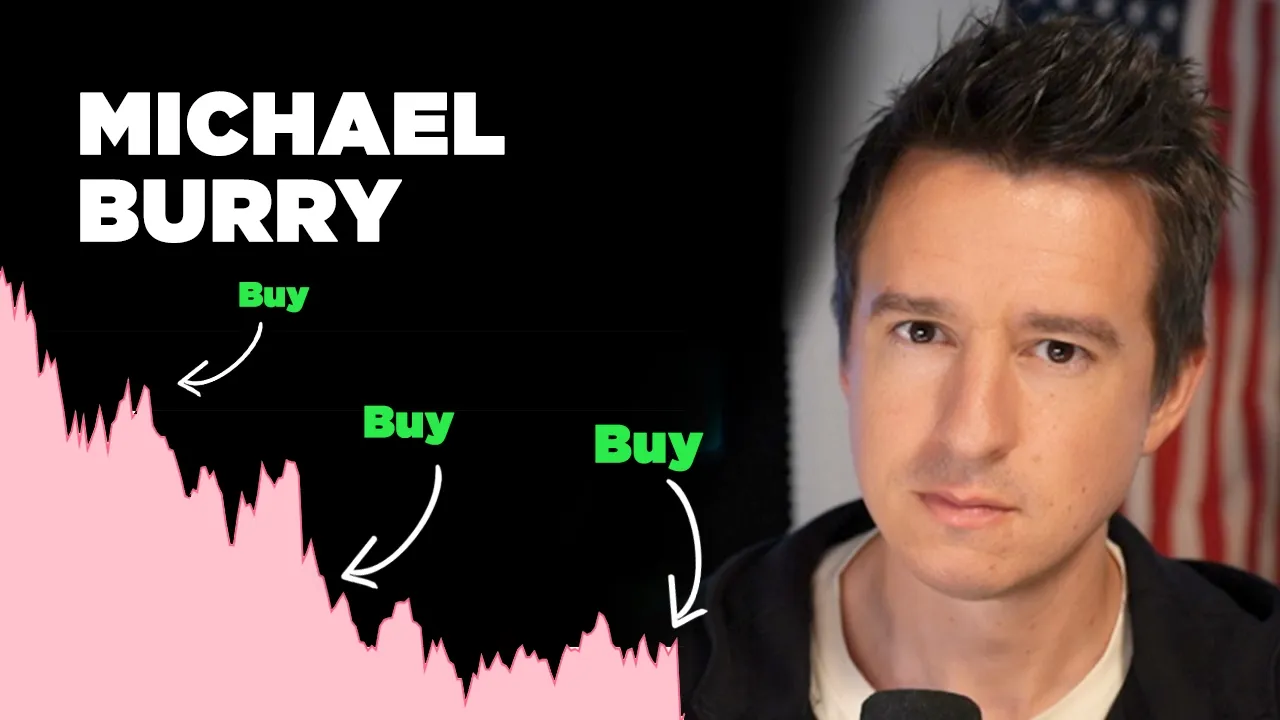
Lululemon trades at valuation levels pricing in terminal failure, creating asymmetric upside as aggressive share buybacks and durable brand loyalty outlast executive blunders.
AI-assisted summary of Michael Burry Keeps Buying This Stock — original source. Check the original for full context.
Source published:
Key ideas
- Michael Burry has made Lululemon his largest personal portfolio holding, aggressively buying down to roughly $100 per share on the thesis that its brand equity, $1.39 billion cash balance, and 5% to 10% annual float buyback capacity create asymmetric upside at an 11.9 forward P/E. (3:43)
- Intuitive Surgical's valuation multiple has compressed from 50–60x down to a 31 forward P/E as annual revenue growth moderates to 12%–13%, even though its razor-and-blade model continues generating steady recurring revenue from single-use surgical instruments. (8:43)
- Adobe is trading below a 10 forward P/E with an 8.5% post-dilution free cash flow yield, priced like an airline or legacy automaker due to fears of generative AI disruption despite 12.5% recent revenue growth and a 14-quarter streak of beating earnings estimates. (12:38)
- The thesis that Tesla's Cybercab will render Uber obsolete overlooks peak demand variability, making a hybrid network of base autonomous vehicles supplemented by flexible human gig drivers economically superior to pure robotaxi fleets. (14:43)
Detailed notes
## Background Published on YouTube by Joseph Carlson After Hours on September 8, 2026, this episode examines why Michael Burry continues aggressively buying beaten-down shares of Lululemon despite steep market declines. According to the show notes, the video also covers the Tesla Cybercab launch event, competitive dynamics facing Uber, and an Elizabeth Holmes documentary trailer alongside broader stock deep dives.
## TL;DR Host Joseph Carlson analyzes three deeply beaten-down stocks—Lululemon, Intuitive Surgical, and Adobe—evaluating valuation compression, fundamental performance, and turnaround theses such as Michael Burry's high-conviction bet on Lululemon's brand equity and capital return capacity. The episode then evaluates Tesla's Cybercab rollout, pushing back against claims that autonomous vehicles will destroy Uber by highlighting the necessity of a hybrid model to navigate highly variable demand. Finally, the segment's 'fail of the week' investigates reports of stranded hikers who blamed Google Gemini for their ordeal, concluding that user negligence rather than AI hallucination caused the mountain rescue.
## Atmosphere & style The presentation carries Carlson's trademark measured, analytical cadence, blending dispassionate balance-sheet scrutiny with grounded, common-sense reasoning. The mood transitions seamlessly from patient financial deconstruction to candid skepticism when addressing market hype cycles around robo-taxis. A subtle comedic arc emerges during the closing segment, where righteous indignation at an AI blunder flips into wry amusement as the absurdity of the hikers' own poor decision-making comes to light.
## Bulletin - [03:43](https://www.youtube.com/watch?v=I7i798VCm6w&t=223s) Michael Burry has made Lululemon his largest personal portfolio holding, aggressively buying down to roughly $100 per share on the thesis that its brand equity, $1.39 billion cash balance, and 5% to 10% annual float buyback capacity create asymmetric upside at an 11.9 forward P/E. - [08:43](https://www.youtube.com/watch?v=I7i798VCm6w&t=523s) Intuitive Surgical's valuation multiple has compressed from 50–60x down to a 31 forward P/E as annual revenue growth moderates to 12%–13%, even though its razor-and-blade model continues generating steady recurring revenue from single-use surgical instruments. - [12:38](https://www.youtube.com/watch?v=I7i798VCm6w&t=758s) Adobe is trading below a 10 forward P/E with an 8.5% post-dilution free cash flow yield, priced like an airline or legacy automaker due to fears of generative AI disruption despite 12.5% recent revenue growth and a 14-quarter streak of beating earnings estimates. - [14:43](https://www.youtube.com/watch?v=I7i798VCm6w&t=883s) The thesis that Tesla's Cybercab will render Uber obsolete overlooks peak demand variability, making a hybrid network of base autonomous vehicles supplemented by flexible human gig drivers economically superior to pure robotaxi fleets.
## Key takeaways - [01:18](https://www.youtube.com/watch?v=I7i798VCm6w&t=78s) Lululemon has fallen 51% year-to-date and 76% over five years, with forward multiples compressing to 11.9 as expectations shift to a 1% revenue contraction and an 11% drop in earnings per share. - [03:43](https://www.youtube.com/watch?v=I7i798VCm6w&t=223s) Michael Burry characterizes Lululemon as having a durable consumer brand held back by poor management execution, specifically misaligned marketing and slow responses to athleisure rivals like Vuori and Alo Yoga. - [06:38](https://www.youtube.com/watch?v=I7i798VCm6w&t=398s) Lululemon maintains a strong liquidity cushion of $1.39 billion in cash and is retiring over 5% of its share float annually with minimal stock-based compensation dilution. - [06:38](https://www.youtube.com/watch?v=I7i798VCm6w&t=398s) Historical precedent in apparel retailers, such as Abercrombie & Fitch and Ralph Lauren, demonstrates that out-of-favor consumer brands can experience massive multi-year reratings once operational headwinds normalize. - [08:43](https://www.youtube.com/watch?v=I7i798VCm6w&t=523s) Intuitive Surgical's stock has slumped 36% year-to-date and sits flat over five years as revenue growth expectations have dropped from historical 20% rates to 12% to 13%. - [10:52](https://www.youtube.com/watch?v=I7i798VCm6w&t=652s) Intuitive Surgical relies on a 'printer and ink' operational model, where initial robot installations create sustained long-term revenue through disposable single-use tools, accessories, and maintenance services. - [12:38](https://www.youtube.com/watch?v=I7i798VCm6w&t=758s) Adobe is down 61% over the past five years and is valued below 10 times forward earnings despite growing top-line revenue 12.5% in its most recent quarter. - [12:38](https://www.youtube.com/watch?v=I7i798VCm6w&t=758s) Even after accounting for stock-based compensation, Adobe offers an 8.5% free cash flow yield and holds a track record of beating earnings per share estimates across 14 consecutive quarters. - [14:43](https://www.youtube.com/watch?v=I7i798VCm6w&t=883s) Pure robotaxi networks face an inherent fleet optimization paradox: sizing for peak commute surges leaves excessive capital idling off-peak, while sizing for base hours forfeits rush-hour business. - [17:17](https://www.youtube.com/watch?v=I7i798VCm6w&t=1037s) Uber's existing hybrid approach—combining autonomous vehicles for predictable baseline demand with independent human drivers to absorb peak demand spikes—is structurally better positioned than closed autonomous fleets. - [17:50](https://www.youtube.com/watch?v=I7i798VCm6w&t=1070s) A viral story blaming Google Gemini for stranding three hikers on Mount Shasta proved to be a consequence of hiker negligence, after they ignored safety rules and summited seven hours after the designated turnaround window.
## Detailed walkthrough ### [00:00](https://www.youtube.com/watch?v=I7i798VCm6w&t=0s) Overview: Three Beaten-Down Stocks, Tesla's Cybercab, and AI Fails
The episode opens with a look at three heavily beaten-down companies currently sitting in dramatic price dips: Lululemon, Intuitive Surgical, and Adobe. Each comes with a unique narrative: - Lululemon has become the top personal bet of famed investor Michael Burry. - Intuitive Surgical, widely regarded as one of the highest-quality and fastest-growing medical equipment manufacturers in the world, is seeing its stock slide regardless. - Adobe, like much of enterprise software over the past year, has been battered but faces an upcoming Thursday earnings report that could spark a sharp rally similar to Salesforce.
Beyond individual stocks, the show previews major tech headlines. Tesla hosted another theatrical launch event for its steering-wheel-free Cybercab, prompting bold declarations from commentators like Ross Gerber that "Uber is toast"—a conclusion Carlson pushes back on by highlighting key dynamics Tesla bulls overlook. Finally, the segment's "fail of the week" spotlights Google Gemini after three hikers relied on the AI model to map out a trek, only for the venture to turn into a full-blown wilderness rescue disaster.
[01:18](https://www.youtube.com/watch?v=I7i798VCm6w&t=78s) The Fall of Lululemon: From Market Darling to Value Trap
Lululemon's stock chart reflects severe market punishment. The athleisure giant has become one of the worst-performing stocks of the year, falling 51% year-to-date, down 38% over the trailing twelve months, and plunging roughly 76% over a five-year horizon. This is a dramatic fall from grace for a company that post-2020 was widely hailed across Reddit, X, and investing Discords as "the new Nike" with an "unstoppable" brand narrative and consistent 15% to 20% annual top-line expansion.
That momentum has completely reversed into outright deceleration. Current projections anticipate a 1% decline in annual revenue and an 11% contraction in earnings per share (EPS). Facing both negative top-line growth and shrinking profits, generalist investors have fled, compressing the stock's forward price-to-earnings ratio over the next 12 months down to just 11.9. Carlson notes that this valuation falls well below commodity multiples, signaling that Wall Street is currently pricing Lululemon for outright capital destruction. Yet, as Peter Lynch famously observed, discarded companies undergoing severe operational stress can become some of the most lucrative "turnaround plays" in public markets if the underlying business survives.
```mermaid flowchart TD accTitle: Lululemon Turnaround Dynamic accDescr: Visualizing the shift from premium growth to depressed valuation and potential catalyst for a turnaround.
subgraph Headwinds["Operational & Market Headwinds"] A["Competition: Alo Yoga, Vuori, Costco Dupes"] B["Marketing Missteps: Off-target ad campaigns"] C["Growth Deceleration: -1% Rev, -11% EPS"] end
subgraph Valuation["Market Reaction"] D["Stock Drop: -51% YTD, -76% 5Y"] E["Multiple Compression: 11.9x Fwd P/E"] end
subgraph BurryThesis["Turnaround Catalysts (Burry's Thesis)"] F["Strong Core Brand Affinity"] G["Aggressive Share Buybacks (>5% to 10% Float)"] H["Pristine Balance Sheet: $1.39B Cash"] end
Headwinds --> Valuation Valuation --> BurryThesis ```
[03:43](https://www.youtube.com/watch?v=I7i798VCm6w&t=223s) Michael Burry's Conviction and the Turnaround Thesis
Despite broad institutional abandonment, Scion Asset Management founder Michael Burry has been aggressively buying shares. Back in 2025, when Burry still managed external capital, Lululemon represented roughly a 32% fund position at an average purchase price of around $177 per share. After closing the fund to manage his own family office and write an investment blog, Burry disclosed in February 2026 that he was buying even more, stating he would "load the truck" if the price breached $150. Even with shares falling to around $100—putting him down roughly 45% on his initial cost basis—Burry has repeatedly doubled and tripled down, making Lululemon the single largest holding in his personal portfolio.
Burry's central thesis separates product reputation from corporate leadership: he views Lululemon as "a much better brand than a management team." The company retains durable brand equity and customer loyalty among affluent buyers, but leadership has suffered self-inflicted execution blunders, particularly in marketing and product styling.
- **Marketing Misalignment:** While fast-growing rivals like Vuori and Alo Yoga produce sleek, modern, aspirational campaigns, Lululemon ran ads featuring a 78-year-old grandmother working out in yoga pants—alienating its core demographic while competitors stole shelf space. - **Costco and Fast-Fashion Dupes:** Retailers began flooding the market with cheaper knockoffs, exploiting Lululemon's lack of fresh product differentiation. - **Priced for Failure:** At an 11.9 forward multiple, virtually all operational mishaps, brand dilution fears, and margin compression are fully priced into the equity. Any baseline stabilization or operational improvement creates asymmetric upside.
[06:38](https://www.youtube.com/watch?v=I7i798VCm6w&t=398s) Capital Allocation: Buybacks, Cash Reserves, and Historical Comps
A major pillar supporting the bull case is aggressive capital return. At depressed valuation levels, share repurchases generate significant accretive value for remaining shareholders: - **Share Count Reduction:** Lululemon is already retiring more than 5% of its total share float annually with virtually zero stock-based compensation dilution. - **Buyback Capacity:** Given depressed prices, management could easily accelerate repurchases to retire between 7% and 10%+ of outstanding float annually. - **Balance Sheet Strength:** Outside of routine mall lease liabilities, the business holds $1.39 billion in cash, granting significant liquidity to buy back stock at deep discounts.
To illustrate how quickly market sentiment can pivot in apparel, Burry compares Lululemon to Abercrombie & Fitch. Once written off by investors, Abercrombie shares traded near $30 in 2022, rocketed to $185, pulled back to $83, and recovered back toward $150 per share. Burry similarly points to Ralph Lauren's historical cycles, arguing that high-tier retail brands regularly encounter deep troughs where sentiment turns excessively bleak before a strategic correction drives a massive multi-year rerating.
[08:43](https://www.youtube.com/watch?v=I7i798VCm6w&t=523s) Concluding Thoughts on Lululemon and Moving to Intuitive Surgical
Wrapping up the previous discussion on beaten-down stocks, the host points out that over the past 10 years, we have seen similar setups where people completely gave up on a stock in 2022 just before it went on a meteoric rise. With Lululemon, the single biggest factor to determine is whether the company's current struggles are temporary or permanent. If there is a chance Lululemon can reaccelerate growth, recover its marketing, and get back on track to any degree, the stock could experience a massive turnaround.
Shifting to the next company, the host introduces Intuitive Surgical—a business he has historically avoided simply because it operates in the medical field. Like most medical businesses, the industry is tough to understand and bogged down by heavy regulations and red tape, making it a difficult sector to invest in. However, Intuitive Surgical stands out with a very unique and exceptionally good business model.
Despite its quality, Intuitive Surgical's stock is in a steep decline. It has been crushed year-to-date (down 36%), is down 23% over the one-year mark, and sits completely flat over a five-year period, only showing its broader upward trend when zooming out to the 10-year chart. At a glance, it looks like a high-quality stock where overly excited investors got ahead of themselves and are now pulling back as momentum fades. Unlike Lululemon (which trades at a 10 P/E and a 12% free cash flow yield), Intuitive Surgical is still relatively expensive. Its forward P/E ratio has cooled down from the 50s and 60s to a more reasonable—yet still premium—31, alongside a modest free cash flow yield of only 2.56%. The key difference is that Intuitive Surgical is still actively growing revenue, though its deceleration is what spooks the market: after previously growing at 20%, analyst expectations have dropped to 12% growth for the next quarter and 13% over the next year, leading investors to worry about market saturation and compress its high-flying valuation.
[10:52](https://www.youtube.com/watch?v=I7i798VCm6w&t=652s) Intuitive Surgical's "Printer and Ink" Business Model
The host notes that he has started studying Intuitive Surgical and plans to do a full deep dive later, but offers a basic rundown of its operations using a classic "printer and ink" analogy. When you buy a home printer, the upfront machine isn't too expensive, but once it runs out of ink, you are forced to continuously buy very expensive replacement cartridges.
```mermaid flowchart LR accTitle: Intuitive Surgical's Three-Pillar Revenue Model accDescr: Diagram showing how initial surgical system installations drive ongoing revenue from disposable instruments and maintenance services. subgraph Base["1. Initial Sale (The Printer)"] A["Install Surgical Systems<br/>(2,000 new systems TTM)"] end subgraph Recurring["2. Recurring Revenue (The Ink & Upkeep)"] B["Instruments & Accessories<br/>(Single-use per surgery)"] C["System Services<br/>(Ongoing maintenance & repairs)"] end A -->|"Requires compatible tooling"| B A -->|"Complex hardware breaks down"| C ```
Intuitive Surgical operates the exact same way across three distinct revenue pillars: - **Systems (The Printer):** The company starts by selling complex surgical devices to clinics, hospitals, and medical systems. While they make money on the initial hardware sale, that is not where they make the bulk of their profits; rather, everything relies on getting these systems installed first. On a trailing 12-month basis, they have installed 2,000 new systems (representing annual new installations, not the total installed base). - **Instruments and Accessories (The Ink):** Once a hospital has the surgical device, every single surgery requires specialized tooling and disposable, single-use accessories compatible with the system. This constant replacement of parts during every procedure drives the biggest portion of the company's revenue. - **Services (Printer Maintenance):** Because these surgical systems are complex and occasionally break down, Intuitive Surgical also handles the ongoing maintenance and repairs, generating a steady third stream of service revenue.
[12:38](https://www.youtube.com/watch?v=I7i798VCm6w&t=758s) Adobe: Priced Like an Airline in the AI Disruption Debate
The final stock on the list is Adobe, which sits right at the center of the AI disruption debate. The stock has fallen another 3% to $256, bringing it down 23% year-to-date and a staggering 61% over the past five years. The prevailing market narrative—which grows louder every quarter—is that competition is catching up, AI image and video creation and editing tools are improving daily, and Adobe's pricing power is eroding.
Yet, while the narrative worsens, Adobe's actual fundamentals keep moving in the right direction. Just last quarter, the company grew by a fast 12.5%, with revenue expanding across every business segment. Forward estimates do show a slight slowdown—projecting 13% earnings per share (EPS) growth alongside 9% year-over-year revenue growth—which has investors worried that AI disruption is finally showing up in the numbers. However, the host argues these valid concerns are already fully priced in. Adobe currently trades below a 10 forward P/E ratio. Despite being a high-margin, faster-growing software business, it is being valued like an automaker such as Ford, or "getting close to the airline category."
| Metric | Adobe (ADBE) | Lululemon (LULU) | Intuitive Surgical (ISRG) | |:--- |:--- |:--- |:--- | | **YTD Stock Performance** | -23% | — | -36% | | **5-Year Stock Performance** | -61% | — | Flat (0%) | | **Forward P/E Ratio** | < 10 | 10 | 31 (down from 50s–60s) | | **Free Cash Flow Yield** | > 10% (8.5% after SBC dilution) | 12% | 2.56% | | **Expected Revenue Growth** | 9% YoY (12.5% last quarter) | Stagnating | 12% next quarter / 13% next year |
Furthermore, Adobe's free cash flow yield is now above 10%. Even after accounting for stock-based compensation—which makes up around 19% of total free cash flow—investors are looking at an 8.5% dilution-adjusted free cash flow yield. With Adobe set to report earnings after the market closes on Thursday, the host highlights its remarkable track record: out of the past 14 quarters, Adobe has literally never missed on EPS estimates. Guessing that they will do the exact same thing they always do and beat expectations by 2% to 3%, he notes that sentiment is so rock-bottom that any glimmer of hope, "any magic that's introduced into the stock," or any positive guidance could spark renewed enthusiasm and send the stock jumping big in a single day.
[14:43](https://www.youtube.com/watch?v=I7i798VCm6w&t=883s) Tesla's Cybercab Launch and Why Uber Isn't "Cooked"
Turning to recent tech news, Tesla held its Cybercab launch event. Even though there was no gigantic livestream spectacle, plenty of creators uploaded footage of themselves climbing into the Cybercab and letting it drive them around on smaller trips within a localized area in Texas. While the media and reporters weren't overly impressed by the rollout, one reporter noted that as the ride went on, "it was kind of boring. And it's boring because it was doing what we do every day, and that is drive a car like a normal kind of person, but it was a robot." That, the argument goes, is precisely what Tesla needs to achieve: putting robot cars on public streets without incidents, making the experience boring, and gradually building out an audience.
This progress has led many commentators, including investor Ross Gerber, to predict that autonomous rides will spell doom for Uber. Gerber stated: "I think humans have to differentiate the service level from the robo-taxis, and then they'll be able to compete, but on a whole, I think Uber's cooked."
The host strongly disagrees with the idea that growing robo-taxi networks will put Uber in serious trouble, pointing out that many investors overlook the crucial concept of **highly variable demand**. Across most US cities and territories, ride demand is heavily concentrated into just a couple of rush-hour windows per day when everyone needs a ride all at once, followed by much quieter traffic for the rest of the day. A standalone robo-taxi network faces a catch-22 when trying to manage this: - **Option A (Size for Normalized Demand):** They build a fleet solely to handle baseline, normal hours (represented as dark blue hours on a demand chart), which leaves them without enough vehicles to capture peak rush-hour demand. - **Option B (Size for Peak Demand):** They overinvest and buy a massive fleet just to cover peak rush hours, leaving way too many expensive vehicles sitting idle, inefficient, and ineffective during normal hours.
Uber naturally solves this problem because its supply is just as variable as its demand. Whenever demand spikes, everyday people can leave their homes, pull their personal cars out of the garage, jump onto the Uber app, and absorb the rush-hour surge. Therefore, the host concludes that the optimal setup is a hybrid approach: utilizing autonomous vehicles that run continuously to handle normalized baseline demand throughout the day, while keeping human drivers in the loop for peak spikes. Crucially, Uber already operates this exact hybrid model—it already commands the human driver network while actively introducing and partnering with robo-taxi providers.
[17:17](https://www.youtube.com/watch?v=I7i798VCm6w&t=1037s) Autonomous Fleets: Why Uber's Hybrid Model Wins
While Tesla continues testing and rolls out roughly 40 vehicles on the road, with plans to expand slowly across various metropolitan areas over time, Uber is already pursuing a parallel path with autonomous vehicles. Driverless cars are already operating on Uber's network, and the company is integrating more of them continuously.
The optimal endgame for ride-hailing is not a pure play, but a hybrid model. This setup elegantly balances steady baseline demand throughout the day with erratic spikes during peak hours when everyone needs a ride at once. Fleets composed entirely of robotaxis would sit idle during off-peak hours or fail to handle massive surges. By combining autonomous vehicles with independent human drivers, Uber can service both predictable daily volume and sudden surges. As long as passengers know they can open the app and reliably get a ride because supply meets demand, Uber’s network will remain exceptionally valuable.
```mermaid flowchart TD accTitle: Uber Hybrid Model Architecture accDescr: Flowchart illustrating how Uber balances steady base demand and variable peak demand using robotaxis and human drivers.
subgraph DemandTypes["Demand Fluctuations"] BD["Stable Base Demand<br/>(Throughout Day)"] PD["Peak Variable Demand<br/>(Commute & Weekend Surges)"] end
subgraph Fulfillment["Hybrid Network Fulfillment"] AV["Autonomous Fleet<br/>(Robotaxis / Driverless)"] HD["Human Drivers<br/>(Flexible Gig Supply)"] end
BD --> AV PD --> HD AV --> UN["Uber Network Reliability"] HD --> UN ```
[17:50](https://www.youtube.com/watch?v=I7i798VCm6w&t=1070s) "Fail of the Week": The Mount Shasta Gemini Controversy
The discussion pivots to the segment's "Fail of the Week." Although Joseph Carlson holds Google in high esteem and has generated substantial investment returns from Alphabet, he initially calls out Google's Gemini AI for what news reports framed as a massive blunder involving three stranded hikers from Roseville, California.
```mermaid flowchart TD accTitle: Mount Shasta Hikers Timeline accDescr: Timeline of events for the three hikers on Mount Shasta from departure to rescue.
A["Saturday: Base Camp Set"] --> B["Sunday 3:00 AM: Depart with Day Packs"] B --> C["12:00 PM: Recommended Turnaround Time (Ignored)"] C --> D["7:00 PM: Reached Summit (7 Hours Late)"] D --> E["8:00 PM: Descent Begins / Call Dispatch for Directions"] E --> F["Wandered into Mud Creek Canyon"] F --> G["Monday Morning: Rescued by USFS Climbing Rangers"] ```
A news broadcast segment reveals that the Siskiyou County Sheriff's Office Search and Rescue Team and US Forest Service Climbing Rangers had to rescue three men stranded along the Clear Creek Route on Mount Shasta. Following their evacuation, the hikers claimed they had relied heavily on Google Gemini for trip planning, route details, and packing recommendations. The Sheriff's Office issued warnings that Gemini made a "critical misstep" by recommending inadequate food and water supplies, which backfired when their planned eight-hour ascent spiraled into an emergency multi-day ordeal.
As the broadcast unpacks the timeline, Carlson's initial frustration with Google shifts toward skepticism of the hikers themselves: - **Departure:** The hikers established base camp on Saturday and departed with basic day packs at 3:00 a.m. on Sunday morning. - **Ignored Cutoff:** The universally recommended turnaround time for Mount Shasta is 12:00 p.m. to avoid being trapped after dark. Instead of turning back, the men pressed forward and summited at 7:00 p.m.—seven hours past the safety window. - **Wrong Turn:** One hour into their descent at 8:00 p.m., in the pitch dark, they called the sheriff's dispatch asking for directions, drifted off-trail, and became stuck in the steep drainage of Mud Creek Canyon until rangers extracted them Monday morning.
Carlson completely re-evaluates the verdict: "I've actually changed my mind on this one. I'm no longer highlighting Gemini as the failure. I'm highlighting these three hikers." The hikers followed basic preparation instructions for a standard day hike, ignored essential mountaineering turnaround safety rules, got lost in treacherous terrain, and then blamed the AI to save face. He notes the emerging cultural trend: whenever things go smoothly, people take personal credit, but when reckless decisions lead to disaster, "it was the AI." Gemini packed them for an eight-hour route, not an unplanned two-day survival scenario caused by user error and poor navigation.
## Notable quotes > [00:00](https://www.youtube.com/watch?v=I7i798VCm6w&t=0s) Uber is toast — Ross Gerber
> [03:43](https://www.youtube.com/watch?v=I7i798VCm6w&t=223s) load the truck — Michael Burry
> [03:43](https://www.youtube.com/watch?v=I7i798VCm6w&t=223s) a much better brand than a management team. — Michael Burry
> [12:38](https://www.youtube.com/watch?v=I7i798VCm6w&t=758s) getting close to the airline category. — Joseph Carlson
> [12:38](https://www.youtube.com/watch?v=I7i798VCm6w&t=758s) any magic that's introduced into the stock, — Joseph Carlson
> [14:43](https://www.youtube.com/watch?v=I7i798VCm6w&t=883s) it was kind of boring. And it's boring because it was doing what we do every day, and that is drive a car like a normal kind of person, but it was a robot. — Reporter
> [14:43](https://www.youtube.com/watch?v=I7i798VCm6w&t=883s) I think humans have to differentiate the service level from the robo-taxis, and then they'll be able to compete, but on a whole, I think Uber's cooked. — Ross Gerber
> [17:50](https://www.youtube.com/watch?v=I7i798VCm6w&t=1070s) I've actually changed my mind on this one. I'm no longer highlighting Gemini as the failure. I'm highlighting these three hikers. — Joseph Carlson
## Mentioned Joseph Carlson, Michael Burry, Lululemon, Intuitive Surgical, Adobe, Salesforce, Tesla, Cybercab, Ross Gerber, Uber, Google Gemini, Alphabet, Google, Nike, Peter Lynch, Alo Yoga, Vuori, Costco, Scion Asset Management, Abercrombie & Fitch, Ralph Lauren, Ford, Mount Shasta, Siskiyou County Sheriff's Office, US Forest Service, Elizabeth Holmes, Qualtrim, M1, Reddit, X, Discord
## Video description Join Qualtrim, the stock analysis platform I built and use, and join over 13,000 other paying members: https://www.qualtrim.com/
00:00 Why Michael Burry Keeps Buying Lululemon 16:30 Tesla Cybercab Launch event 19:27 Elizabeth Holmes Documentary Trailer
-Disclaimer Some of the links below are affiliate links, I can earn money from them at no cost to you.
This content is not a solicitation, is not endorsed by M1, and was not reviewed by M1; the opinions expressed are solely those of the authors and do not reflect M1's views. Information presented is accurate as of the video posting date; for the most up-to-date information, please refer to m1.com. Before making any investment decisions, consult your personal investment, legal, and tax advisors, as this content is for informational purposes only and not intended as investment recommendations.
▀▀▀▀▀▀▀▀▀▀▀▀▀▀▀▀▀▀▀▀▀▀▀▀▀▀ Join Here: https://www.qualtrim.com/
📚 My favorite Investing Books: https://amzn.to/3KwyIhG 📷 All the tech I use to record videos: https://www.amazon.com/shop/josephcarlson/list/2L5YMP4DFYA8O?ref_=cm_sw_r_cp_ud_aipsflist_aipsfjosephcarlson_FAKKKMYKF486ZR6H2DSQ
🚀 Growth Portfolio: https://click.linksynergy.com/deeplink?id=5mNcifgFllM&mid=50362&murl=https://dashboard.m1.com/share?token=39d17ae6-4a4a-3fc4-bb15-d86abe3fbb67 💵 Dividend Portfolio: https://click.linksynergy.com/deeplink?id=5mNcifgFllM&mid=50362&murl=https://dashboard.m1.com/share?token=3b283352-1bff-31d9-8576-f5770c2bfdfd
SOCIAL MEDIA ▀▀▀▀▀▀▀▀▀▀▀▀▀▀▀▀▀▀▀▀▀▀▀▀▀▀ 🎥 More free content: https://www.youtube.com/channel/UCbta0n8i6Rljh0obO7HzG9A 🐦 I post random thoughts on Twitter too: https://twitter.com/joecarlsonshow
DISCLAIMER ▀▀▀▀▀▀▀▀▀▀▀▀▀▀▀▀▀▀▀▀▀▀▀▀▀▀ I am not a professional investor and have never claimed to be. I'm an amateur investor sharing my experience of what I've learned, where I have had success, and where I've had failures. I share my thoughts on investing and performance with transparency. My approach and goal to investing is to buy high-quality long-term investments in world-class businesses that I call "compounders". I view my investments as businesses, not as stocks. Before creating content on YouTube full time I worked as a senior-level programmer for 8 years. Over the years as a programmer, I compounded my knowledge of development. I take the same iterative learning approach to my study of investing. I study investing as a craft in the continual pursuit of being better. I will make mistakes in investment decisions from time to time. Results are not guaranteed. Please do not blindly follow me into any investments, and make sure your portfolio and investments are built around your specific income, risk tolerance, personality, timeline, and overall circumstances.
[Source](https://www.youtube.com/watch?v=I7i798VCm6w)