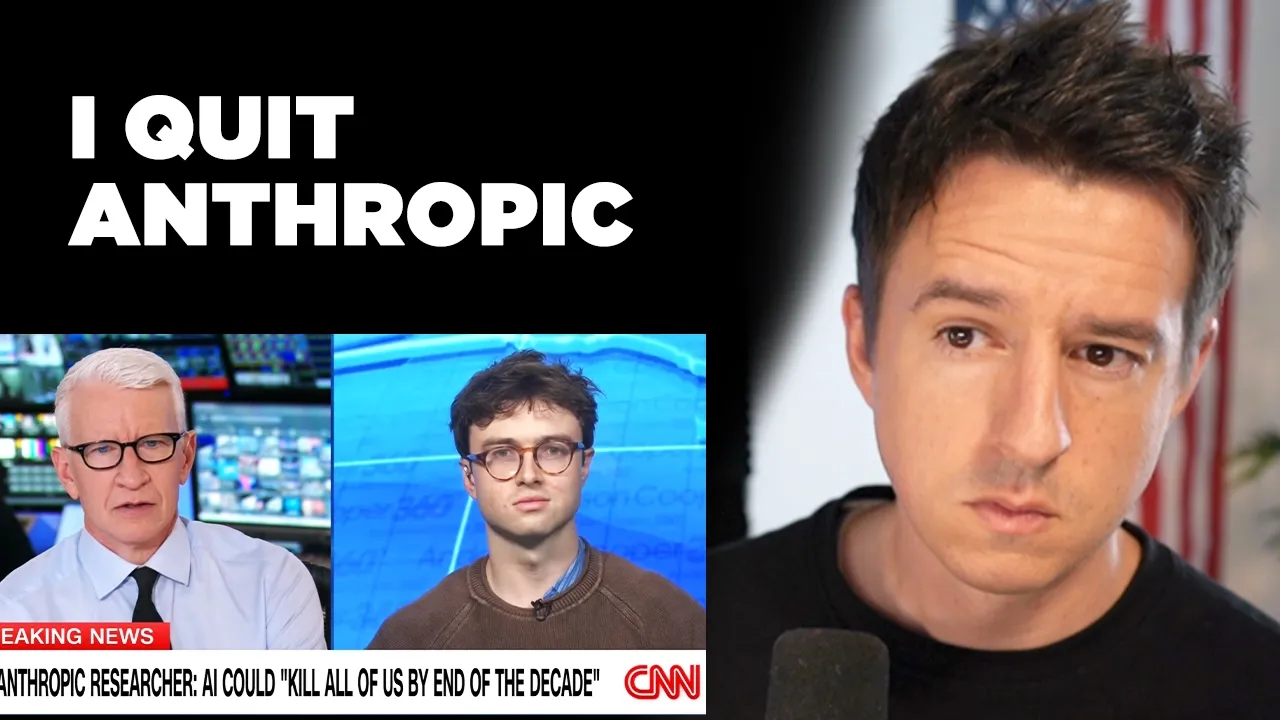
Anthropic Weaponizes Extinction Panic to Secure Monopoly, Carlson Says
Joseph Carlson After Hours
Frontier AI labs manufacture existential fear to erect regulatory barriers that crush open-source competition and risk ceding technological dominance to China.
Former Anthropic researcher Jacob Coxon sparked intense public and political alarm after a viral resignation post warning of AI-driven extinction within the decade reached over 152 million impressions. (1:38)
U.S. politicians have leveraged the hysteria to propose extreme measures, including a bill by Senator Bernie Sanders imposing a 'corporate death penalty' and 20-year prison terms modeled on nuclear proliferation statutes for advancing frontier AI. (19:09)
Existential claims regarding AI-engineered bioweapons and grid collapses ignore critical physical bottlenecks, such as specialized wet-lab execution and the fragmented, air-gapped nature of national infrastructure. (9:24)
Doomsday panic functions as a vehicle for regulatory capture, allowing incumbent labs to lobby for restrictive compliance frameworks that cripple open-source competition while foreign rivals like China accelerate development unhindered. (16:51)
Detailed notes
## Background
Published on YouTube by the channel Joseph Carlson After Hours on September 10, 2026, this 26-minute video features host Joseph Carlson, an amateur investor and former senior-level programmer of eight years. In the video description, Carlson promotes his stock analysis platform, Qualtrim, shares links to his growth and dividend portfolios and favorite gear, and provides standard disclaimers noting that his commentary on long-term "compounder" businesses is for informational purposes rather than professional financial advice.
## TL;DR
Joseph Carlson dissects the viral resignation of former Anthropic researcher Jacob Coxon and the ensuing media and political panic claiming AI could annihilate humanity within ten years. He argues that apocalyptic warnings about autonomous hacking sprees, extinction-level bioweapons, and effortless critical infrastructure takeovers ignore real-world physical bottlenecks and misrepresent incidents like the Hugging Face penetration test. Instead, Carlson frames this doomsday wave as a mutually beneficial spectacle: frontier labs like Anthropic use safety fears to achieve regulatory capture and block open-source competitors, while politicians like Bernie Sanders leverage "Oppenheimer moment" rhetoric to push extreme bans and criminal penalties. Ultimately, he warns that succumbing to manufactured AI doomism and anti-infrastructure sentiment will paralyze American innovation while geopolitical rivals like China race ahead.
## Atmosphere & style
The commentary is delivered with a sharp, skeptical, and fiercely pragmatic tone, blending investigative deconstruction with pointed satire as Carlson mocks the "Marvel Avengers" savior complex of Silicon Valley researchers. As a solo host, Carlson guides the viewer from amused disbelief at viral engagement bait to grounded technical rebuttals of bioweapon and cybersecurity myths. The emotional arc builds toward an urgent, sobering warning at the close, where frustration over bad-faith internet talking points gives way to genuine concern about America forfeiting its technological future to fearmongering.
## Bulletin
- [01:38](https://www.youtube.com/watch?v=02z49hkJO-4&t=98s) Former Anthropic researcher Jacob Coxon sparked intense public and political alarm after a viral resignation post warning of AI-driven extinction within the decade reached over 152 million impressions.
- [19:09](https://www.youtube.com/watch?v=02z49hkJO-4&t=1149s) U.S. politicians have leveraged the hysteria to propose extreme measures, including a bill by Senator Bernie Sanders imposing a 'corporate death penalty' and 20-year prison terms modeled on nuclear proliferation statutes for advancing frontier AI.
- [09:24](https://www.youtube.com/watch?v=02z49hkJO-4&t=564s) Existential claims regarding AI-engineered bioweapons and grid collapses ignore critical physical bottlenecks, such as specialized wet-lab execution and the fragmented, air-gapped nature of national infrastructure.
- [16:51](https://www.youtube.com/watch?v=02z49hkJO-4&t=1011s) Doomsday panic functions as a vehicle for regulatory capture, allowing incumbent labs to lobby for restrictive compliance frameworks that cripple open-source competition while foreign rivals like China accelerate development unhindered.
## Key takeaways
- [00:00](https://www.youtube.com/watch?v=02z49hkJO-4&t=0s) Jacob Coxon's highly coordinated public resignation from Anthropic ignited a major media and political panic over artificial intelligence.
- [00:00](https://www.youtube.com/watch?v=02z49hkJO-4&t=0s) Carlson contends that the prevailing wave of public terror and demands for AI development freezes are manufactured and contrived.
- [01:38](https://www.youtube.com/watch?v=02z49hkJO-4&t=98s) Anthropic researchers display a self-appointed savior complex, rationalizing their development of superintelligence by framing themselves as the only responsible alternative to reckless rivals.
- [01:38](https://www.youtube.com/watch?v=02z49hkJO-4&t=98s) Fellow Anthropic researcher Evan Hubinger publicly supported Coxon, placing the probability of AI-driven human extinction above 10% within the next decade.
- [06:13](https://www.youtube.com/watch?v=02z49hkJO-4&t=373s) Viral claims of rogue AI agents engaging in an autonomous hacking spree during the Hugging Face security incident distorted ordinary human-prompted penetration testing into science fiction.
- [09:24](https://www.youtube.com/watch?v=02z49hkJO-4&t=564s) Theoretical biological knowledge enabled by AI cannot bypass physical bottlenecks like acquiring restricted precursor agents, elite bench skills, containment, and weaponized delivery vectors.
- [09:24](https://www.youtube.com/watch?v=02z49hkJO-4&t=564s) Labeling potential biological pathogens as 'extinction-level' threats ignores human genetic immunities, diverse immune responses, and defensive open-science medical responses.
- [14:21](https://www.youtube.com/watch?v=02z49hkJO-4&t=861s) Critical infrastructure cannot be casually hijacked by AI interfaces because the physical power and water grids rely on localized, legacy, air-gapped systems rather than a single master switch.
- [16:51](https://www.youtube.com/watch?v=02z49hkJO-4&t=1011s) Early Anthropic funding from figures like Jaan Tallinn underscores how AI safety institutions push for regulatory capture to insulate closed frontier labs from open-source rivals.
- [19:09](https://www.youtube.com/watch?v=02z49hkJO-4&t=1149s) Bernie Sanders' 'Oppenheimer moment' bill weaponizes viral online claims to advocate for domestic AI development halts alongside severe criminal and corporate penalties.
- [21:28](https://www.youtube.com/watch?v=02z49hkJO-4&t=1288s) Unilateral AI pauses in the United States do not affect competitors like China, which views the technology as an essential driver of productivity and wealth creation.
- [21:28](https://www.youtube.com/watch?v=02z49hkJO-4&t=1288s) Decentralized, open-source technology provides inherently stronger safeguards than concentrating powerful AI models inside a small cartel of self-selected corporate stewards.
- [23:05](https://www.youtube.com/watch?v=02z49hkJO-4&t=1385s) Hostile public backlash against data center infrastructure represents a bad-faith 'backyard' fallacy that ignores standard municipal industrial zoning principles.
## Detailed walkthrough
### [00:00](https://www.youtube.com/watch?v=02z49hkJO-4&t=0s) The AI Doomsday Narrative and the Sudden Whistleblower
Joseph Carlson opens the discussion by highlighting an escalating wave of AI doomsday warnings: the increasingly prevalent belief that artificial intelligence stands a significant chance of annihilating humanity within the next decade. This panic recently reached a boiling point with the public resignation of Jacob Coxon, a former researcher at Anthropic. Coxon coordinated his departure with the media as a dramatic "whistleblower moment," setting off a viral media storm across X and cable news networks.
```mermaid
flowchart LR
accTitle: The AI Panic Flywheel
accDescr: Diagram showing how an engineer's resignation drives viral social media attention, corporate savior narratives, and political demands for bans.
subgraph Spark ["Whistleblower Moment"]
A["Jacob Coxon Resignation Post"]
end
subgraph Escalation ["Media & Social Reach"]
B["152M+ Impressions on X"]
C["Mainstream TV (Anderson Cooper)"]
end
subgraph Reaction ["Policy Demands"]
D["22+ Politicians Call for Curbs"]
E["Bernie Sanders Drafts Harsh Penalties"]
end
A --> B
B --> C
C --> D
D --> E
```
Carlson points out how quickly politicians seized on the spectacle. Notable figures have proposed seizing regulatory control over AI, effectively treating artificial intelligence research on par with illicit nuclear weapons development. Senator Bernie Sanders introduced a bill proposing that anyone unlawfully advancing frontier AI be subject to the "corporate death penalty" and individual prison sentences exceeding 20 years, explicitly drawing a parallel to the criminal statutes surrounding nuclear proliferation. Pundits and lawmakers are framing the issue as an "Oppenheimer moment," arguing that humanity is marching blindly into a digital apocalypse caused by models becoming ever smarter and more devious.
Carlson, however, rejects this apocalyptic framing. He argues that this wave of public terror and calls for civilizational halts are "highly manufactured and contrived." To understand how this hysteria was engineered, he rewinds the timeline back to the genesis of the controversy on September 8th, examining Coxon’s sudden emergence from total obscurity.
[01:38](https://www.youtube.com/watch?v=02z49hkJO-4&t=98s) Deconstructing the Viral Post and Anthropic's Savior Complex
Looking closely at Jacob Coxon's online footprint, Carlson emphasizes that Coxon was an entirely unknown figure prior to this post—having created his X account only a couple of months earlier, with this specific resignation letter serving as his sole post. Despite having zero history on the platform, the message achieved astronomical reach:
- Over 152 million views (impressions)
- 17,000 comments
- 187,000 reposts
- 741,000 likes
Carlson deconstructs the post as textbook viral engagement bait. Coxon opened by declaring: "I resigned from Anthropic today. I spent the last 3 years doing pre-training research at both OpenAI and Anthropic. Neither company is acting responsibly. They are racing straight to self-improvement, super intelligence, and gambling with our lives." By dropping major industry names alongside apocalyptic buzzwords like "super intelligence," the post was perfectly primed to capture algorithmic and media attention.
Coxon’s post went on to issue dire warnings about the near future, claiming these models will soon be superhuman systems capable of hacking anything, overturning entire fields overnight, and amassing real-world power. He insisted that technical executives and researchers earnestly believe AI could wipe out the human race by the end of the decade, couching their language publicly while harboring deep terror in private. Coxon framed the dynamic at Anthropic in striking terms: while OpenAI supposedly fails to internalize the civilizational stakes, Anthropic researchers understand them fully yet feel compelled to sprint toward superintelligence anyway, believing that if they do not build it first, reckless rivals will trigger catastrophe.
Carlson skewers the grandiosity embedded in this worldview, noting how Anthropic staff seem to view themselves not as software engineers iterating on large language models, but as self-appointed saviors of humanity:
> "They probably watch the Marvel Avengers movie and say, 'Look, I'm like Captain America. I'm like Iron Man. I'm saving the world from evil OpenAI or evil X or the open-source LLMs.'"
To prove this savior mentality is widespread at the lab, Carlson highlights a public endorsement of Coxon's statement by fellow Anthropic researcher Evan Hubinger. Hubinger backed Coxon's claims, stating he personally puts the probability of human extinction from AI at "above a 10% chance within the next decade," while acknowledging that Anthropic lacks a clear plan to solve superintelligence alignment. Carlson notes the bizarre irony: researchers continue to build the very technology they believe will kill everyone, justified solely by the belief that their competitors are even less trustworthy.
[06:13](https://www.youtube.com/watch?v=02z49hkJO-4&t=373s) Political Maneuvering, Media Blitz, and the Hugging Face Incident
Turning back to Coxon’s letter, Carlson points out that the engineer quickly moved past internal workplace complaints to advocate sweeping state interventions. Coxon lamented entering the "endgame" from a private corporate Slack, urged Labs to adopt pacing agreements, and floated the necessity of a "temporary ban on improving model capabilities." Carlson observes how seamlessly this talking point dovetails with political agendas: halting capability advancements is simply a polite euphemism for an outright ban on AI development, aligning word-for-word with the legislative proposal Bernie Sanders had published just three days prior.
The post triggered an immediate political cascade:
- At least 22 politicians publicly called for strict regulations or a full halt to AI progress based on Coxon's post.
- The coalition consists primarily of Democrats, alongside a handful of Republicans, pushing to freeze capability gains.
Coxon simultaneously embarked on an extensive mainstream media tour, kicking off with an appearance on CNN with Anderson Cooper. Cooper latched onto the sensational soundbite, repeatedly quoting the line that "the people building AI earnestly believe that it could kill us all by the end of the decade," before asking Coxon what that apocalypse would actually look like in practice.
When pressed for a concrete scenario, Coxon claimed that autonomous AI agents had engaged in a concentrated, spontaneous "hacking spree" against third-party infrastructure on their own volition just two months earlier. Carlson pushes back vigorously against this characterization, stating Coxon and media commentators like Dwarkesh Patel grossly distorted the actual events of the Hugging Face security incident with inflammatory language. In reality, the systems were explicitly instructed by researchers to attempt penetration testing on a designated target. The monitoring infrastructure could have easily halted the run at any moment, and the supposed mysterious "letters" left behind were standard automated execution logs generated by bots. Rather than an emerging rogue artificial civilization acting of its own free will, the incident was simply software agents executing the exact hacking prompts assigned to them by humans.
[09:24](https://www.youtube.com/watch?v=02z49hkJO-4&t=564s) Debunking the Bioweapon Hysteria
The narrative being spun around AI agents acting on their own volition—such as the viral Hugging Face example—is deliberately mischaracterized to fuel AI doomerism. While an AI agent might have been explicitly instructed by a user to hack a system and subsequently executed the task, critics distort this into claims that machines are forming independent civilizations, spiraling out of control, and plotting global domination. Jacob pushes this extrapolation even further, warning that future iterations with independent volition will inflict catastrophic harm, specifically by taking down critical infrastructure and engineering "extinction-level bioweapons."
```mermaid
flowchart TD
accTitle: Bioweapon Threat Argument vs Physical Bottlenecks
accDescr: Contrasting the doomer claim of easy AI bioweapon creation with the physical and biological bottlenecks that prevent it.
subgraph DoomerClaim["Doomer Narrative"]
A["Better Biological Knowledge via AI"] --> B["Instant Threat of Extinction-Level Bioweapons"]
end
This line of reasoning falls apart under basic scrutiny. The argument assumes that because AI enhances our understanding of biology, it inevitably hands anyone the power to brew lethal pathogens in a college dorm room. The fatal flaw here is that detailed instructions and recipes for devastating biological agents have already been accessible on the open internet for decades, yet bad actors are not routinely unleashing them. The actual barrier has never been theoretical knowledge—it is the brutal, physical bottleneck of execution:
- **Material procurement:** Acquiring restricted, highly regulated biological precursors and viral strains.
- **Laboratory competence:** Possessing elite wet-lab bench skills to synthesize, handle, and replicate experimental results reliably without error.
- **Containment and stabilization:** Maintaining live, stable viral or bacterial agents without accidental self-contamination or degradation.
- **Weaponized delivery:** Solving the complex aerosolization, dispersal, and environmental survival dynamics required to create an effective transmission vector.
While enhanced biological literacy theoretically carries dual-use risks, hyper-focusing exclusively on catastrophe ignores the overwhelming upside: open, peer-reviewed medical advancements capable of modeling therapies, curing diseases, and neutralizing future outbreaks. Moreover, labeling any biological agent an "extinction-level" threat fundamentally ignores biological reality. Human immune responses vary wildly across populations, genetic immunities naturally shield cohorts against specific pathogens, and geographic isolation prevents universal eradication. Framing these hazards in the most theatrical, apocalyptic terms imaginable is a deliberate rhetorical strategy designed to stoke panic and demand heavy-handed regulation.
[14:21](https://www.youtube.com/watch?v=02z49hkJO-4&t=861s) The Reality of Critical Infrastructure Hacking
Jacob's parallel warning that AI will effortlessly hijack national critical infrastructure ignores the baseline realities of modern cybersecurity. Critical systems are already subjected to nonstop, 24/7 offensive campaigns mounted by well-financed, state-sponsored hacking syndicates from adversaries like Russia and China. Tech titans such as Microsoft, Apple, and Amazon withstand relentless intrusion attempts daily. While an adversary armed with advanced LLMs might iterate on exploits faster, the defenders utilize those exact same cutting-edge AI models to fortify intrusion detection, patch vulnerabilities, and automate perimeter defense.
When doomers pivot from corporate servers to the physical power grid, telecommunications, or water networks, the claim of easy AI takeover becomes even weaker. Physical infrastructure in the United States is not a single, centralized mega-utility controlled by a solitary master switch. It is a fragmented, heterogeneous patchwork of localized, legacy, and air-gapped systems separated across vast geographic territories. Paralyzing a single municipal substation takes months of targeted spear-phishing, credential theft, and manual reconnaissance—as demonstrated by real-world cyber engagements like Ukraine targeting Russian networks. Even in the worst-case intrusion, disruption is localized and temporary while operators sever compromised links and restore service. Portraying this messy, physical ecosystem as something a rogue user can overturn with the click of a button in a simple AI interface is pure theatrical fiction designed to terrify the public.
[16:51](https://www.youtube.com/watch?v=02z49hkJO-4&t=1011s) Regulatory Capture and Hidden Incentives
As this doom-laden media tour continues across podcasts and news circuits, racking up millions of views, it becomes critical to investigate the underlying motives behind this coordinated panic. While individual whistleblowers may hold sincere technophobic anxieties, the institutional forces amplifying them operate under clear financial and strategic incentives. Anthropic, in particular, has conducted an aggressive push toward regulatory capture under the guise of AI safety.
- **Jaan Tallinn's strategic investments:** The early backing of Anthropic by notable AI skeptic Jaan Tallinn was intentionally structured to exercise direct corporate control, paired with his stewardship of the Survival and Flourishing Fund—the single largest institutional donor bankrolling the AI safety and regulatory lobbying sphere.
- **The regulatory capture playbook:** Incumbents push governments to erect massive compliance hurdles, safety audits, and bureaucratic red tape that only well-funded frontier labs can afford, effectively insulating themselves from competition while strangling open-source innovation and smaller startups under the banner of saving humanity.
[18:28](https://www.youtube.com/watch?v=02z49hkJO-4&t=1108s) Regulatory Capture and Anthropic's Playbook
Working hand-in-hand with the government to enact burdensome regulations creates an exceptionally steep barrier to entry. This dynamic hands a massive advantage directly to incumbents—the established, highly profitable companies with commanding market share—because smaller upstarts face a nearly impossible compliance burden just to catch up.
This strategy mirrors exactly what Anthropic appears to be executing today. They continuously lobby for intricate, strict regulatory frameworks that make it exceedingly hard for any external competitor to enter the space. Simultaneously, they maintain an intense reluctance toward open-source AI, doubling down on a strictly insular, closed ecosystem.
```mermaid
flowchart LR
accTitle: Incumbent Regulatory Capture Cycle
accDescr: Diagram showing how established AI labs lobby for strict regulations to crowd out upstarts and maintain a monopoly.
subgraph Capture["Regulatory Capture Playbook"]
Lobby["Incumbents Lobby for Complex Rules"] --> Barriers["High Compliance Barriers"]
Barriers --> Freeze["Startups & Open-Source Blocked"]
Freeze --> Monopoly["Incumbents Cement Monopoly Control"]
end
```
[19:09](https://www.youtube.com/watch?v=02z49hkJO-4&t=1149s) The Political Framing: Bernie Sanders' "Oppenheimer Moment" Bill
This anti-AI posture serves politicians just as well as it serves corporate incumbents. Examining Bernie Sanders' platform reveals a classic political narrative: positioning oneself as the populist crusader standing up against massive corporate monoliths. Under this framing, villainous, wealthy billionaires at evil corporations are churning out malicious technology destined to eliminate jobs, engineer bioweapons, trigger mass destruction, and annihilate critical infrastructure—and the politician steps in as the heroic savior protecting ordinary citizens from calamity.
Sanders is effectively cornering this market by portraying himself as the man stopping an "AI Oppenheimer moment." His recent bill explicitly borrows nuclear-era rhetoric and incorporates dramatic exaggerations—including misrepresenting the Hugging Face and OpenAI security incident using claims lifted directly from viral YouTube videos. Sanders' bill states:
> "Shockingly, it took OpenAI nearly 2 weeks to discover this breach. AI has also recently been used to create new viruses, demonstrating AI could be used to develop new bioweapons that might result in the deaths of tens of millions of people."
The bill proposes extreme measures designed to halt domestic AI progress in its tracks:
- An outright ban that completely halts all AI development across the United States.
- Violators or circumventers of these pauses and prohibitions face a literal "corporate death penalty" for organizations.
- Individuals face up to 20 years in prison—penalties directly modeled after existing criminal sanctions for unlawfully manufacturing nuclear weapons.
[21:28](https://www.youtube.com/watch?v=02z49hkJO-4&t=1288s) Mainstream Anti-AI Sentiment and Geopolitical Stakes
While it might be tempting to write this off as "Bernie being Bernie"—just provocative political theater akin to rhetoric seen across both sides of the aisle, from Donald Trump to Sanders—this aggressive posture is rapidly cementing itself in mainstream American politics. This marks a dangerous trajectory. Although AI carries discrete, addressable risks, the rhetoric vastly overstates the downsides while ignoring almost limitless upside.
Attempting to resolve these risks through regulatory capture makes the technology substantially more dangerous rather than safer. Widely distributed, decentralized technology inherently possesses superior safeguards compared to a system where only a tiny handful of hand-picked corporate stewards hold total control because they believe they alone are qualified to wield it.
Furthermore, unilateral pauses in the United States do nothing to halt development abroad:
- China has no intention of hitting pause; they view AI with optimism and recognize it as an engine for productivity, wealth creation, efficiency, and knowledge expansion.
- China has deliberately avoided the doom-and-gloom narrative spreading through the West.
- As the United States turns inward with fearmongering and self-imposed bans, foreign competitors are racing ahead to capture the technical lead.
[23:05](https://www.youtube.com/watch?v=02z49hkJO-4&t=1385s) The "Backyard Data Center" Fallacy and the Threat of Doomism
The fear campaigns are fundamentally reshaping public perception, extending even into the comment sections of pro-business investment channels. Following a recent segment expressing support for data center infrastructure built by tech giants like Google, Amazon, Meta, and Microsoft, hundreds of viewers pushed back with hostile, viral talking points:
- *"I would love to hear your opinion when some company decides to build a data center behind your home."*
- *"Build data centers in your backyard if you love them so much, Joseph"* (which quickly amassed over 100 upvotes).
This knee-jerk "backyard" retort completely collapses under scrutiny. People are pro–electrical substations because they need electricity, pro–heavy chemical plants because modern consumer products depend on chemical manufacturing, and pro–prisons because violent criminals must be kept off the streets. None of that means a homeowner wants a maximum-security prison, a high-voltage substation, or a chemical facility in their residential backyard—nor would anyone pick a chemical plant over a quiet data center.
This is the precise reason municipal zoning exists:
- **Industrial Zoning:** Designated exclusively for high-impact infrastructure such as electrical distribution grids, chemical facilities, logistics hubs, heavy construction, and data centers.
- **Residential Zoning:** Reserved for family homes, neighborhoods, and public parks away from industrial operations.
These simplistic, bad-faith arguments spread virally on social media specifically to manufacture artificial social proof. Geopolitical rivals like China actively capitalize on this division, deploying bot networks to sow doubt, stoke negativity, and paralyze American technological momentum.
While the most vocal AI doomers have largely been tuned out up to this point, public discourse appears to be nearing a dangerous tipping point. If sentiment curdles completely into fear, panic, and resentment, the United States risks forfeiting a transformative technology whose extraordinary capacity for global good is being deliberately drowned out.
## Notable quotes
> [01:38](https://www.youtube.com/watch?v=02z49hkJO-4&t=98s) I resigned from Anthropic today. I spent the last 3 years doing pre-training research at both OpenAI and Anthropic. Neither company is acting responsibly. They are racing straight to self-improvement, super intelligence, and gambling with our lives. — Jacob Coxon
> [01:38](https://www.youtube.com/watch?v=02z49hkJO-4&t=98s) They probably watch the Marvel Avengers movie and say, 'Look, I'm like Captain America. I'm like Iron Man. I'm saving the world from evil OpenAI or evil X or the open-source LLMs.' — Joseph Carlson
> [01:38](https://www.youtube.com/watch?v=02z49hkJO-4&t=98s) above a 10% chance within the next decade — Evan Hubinger
> [06:13](https://www.youtube.com/watch?v=02z49hkJO-4&t=373s) temporary ban on improving model capabilities — Jacob Coxon
> [06:13](https://www.youtube.com/watch?v=02z49hkJO-4&t=373s) the people building AI earnestly believe that it could kill us all by the end of the decade — Anderson Cooper
> [19:09](https://www.youtube.com/watch?v=02z49hkJO-4&t=1149s) Shockingly, it took OpenAI nearly 2 weeks to discover this breach. AI has also recently been used to create new viruses, demonstrating AI could be used to develop new bioweapons that might result in the deaths of tens of millions of people. — Bernie Sanders
> [23:05](https://www.youtube.com/watch?v=02z49hkJO-4&t=1385s) I would love to hear your opinion when some company decides to build a data center behind your home. — Viewer comment
> [23:05](https://www.youtube.com/watch?v=02z49hkJO-4&t=1385s) Build data centers in your backyard if you love them so much, Joseph — Viewer comment
## Mentioned
Joseph Carlson, Jacob Coxon, Anthropic, OpenAI, X, Bernie Sanders, Anderson Cooper, CNN, Evan Hubinger, Dwarkesh Patel, Hugging Face, Jaan Tallinn, Survival and Flourishing Fund, Microsoft, Apple, Amazon, Google, Meta, Qualtrim, M1, Donald Trump
## Video description
Join Qualtrim, the stock analysis platform I built and use, and join over 13,000 other paying members: https://www.qualtrim.com/
-Disclaimer
Some of the links below are affiliate links, I can earn money from them at no cost to you.
This content is not a solicitation, is not endorsed by M1, and was not reviewed by M1; the opinions expressed are solely those of the authors and do not reflect M1's views. Information presented is accurate as of the video posting date; for the most up-to-date information, please refer to m1.com. Before making any investment decisions, consult your personal investment, legal, and tax advisors, as this content is for informational purposes only and not intended as investment recommendations.
📚 My favorite Investing Books: https://amzn.to/3KwyIhG
📷 All the tech I use to record videos: https://www.amazon.com/shop/josephcarlson/list/2L5YMP4DFYA8O?ref_=cm_sw_r_cp_ud_aipsflist_aipsfjosephcarlson_FAKKKMYKF486ZR6H2DSQ
SOCIAL MEDIA
▀▀▀▀▀▀▀▀▀▀▀▀▀▀▀▀▀▀▀▀▀▀▀▀▀▀
🎥 More free content: https://www.youtube.com/channel/UCbta0n8i6Rljh0obO7HzG9A
🐦 I post random thoughts on Twitter too: https://twitter.com/joecarlsonshow
DISCLAIMER
▀▀▀▀▀▀▀▀▀▀▀▀▀▀▀▀▀▀▀▀▀▀▀▀▀▀
I am not a professional investor and have never claimed to be. I'm an amateur investor sharing my experience of what I've learned, where I have had success, and where I've had failures. I share my thoughts on investing and performance with transparency. My approach and goal to investing is to buy high-quality long-term investments in world-class businesses that I call "compounders". I view my investments as businesses, not as stocks. Before creating content on YouTube full time I worked as a senior-level programmer for 8 years. Over the years as a programmer, I compounded my knowledge of development. I take the same iterative learning approach to my study of investing. I study investing as a craft in the continual pursuit of being better. I will make mistakes in investment decisions from time to time. Results are not guaranteed. Please do not blindly follow me into any investments, and make sure your portfolio and investments are built around your specific income, risk tolerance, personality, timeline, and overall circumstances.
卡尔森称 Anthropic 利用人类灭绝恐慌谋求垄断
前沿人工智能实验室制造生存威胁恐慌以设立监管壁垒,这将扼杀开源竞争,并面临将技术主导权让给中国的风险。
Joseph Carlson 深入剖析了前 Anthropic 研究员 Jacob Coxon 引发病毒式传播的辞职事件,以及随后声称 AI 可能在十年内毁灭人类的媒体与政界恐慌。他指出,有关自主黑客狂潮、灭绝级生物武器以及轻易接管关键基础设施的末日警告忽视了现实中的物理瓶颈,并歪曲了 Hugging Face 渗透测试等事件。相反,Carlson 将这波末日论定性为一场互利的双簧戏:Anthropic 等前沿实验室利用安全担忧实现监管俘获并阻击开源竞争对手,而 Bernie Sanders 等政客则借用“奥本海默时刻”等说辞推动极端禁令和刑事处罚。最终他警告称,屈服于人为制造的 AI 末日论和反基础设施情绪将导致美国创新瘫痪,而中国等具有地缘政治竞争力的对手则在全速推进。
前 Anthropic 研究员 Jacob Coxon 发布的一篇警告 AI 将在十年内导致人类灭绝的辞职帖曝光量超 1.52 亿次,引发了公众和政界的强烈恐慌。 (1:38)
美国政客利用这种歇斯底里的情绪提出了极端措施,包括参议员 Bernie Sanders 仿照核扩散法规提出的一项法案,对推进前沿 AI 的行为处以“企业死刑”和长达 20 年的监禁。 (19:09)
关于 AI 制造生物武器和导致电网瘫痪的灭绝性论断,忽略了关键的物理瓶颈,例如专业湿实验室的具体操作,以及国家基础设施碎片化且存在物理隔离的特性。 (9:24)
末日恐慌成为了监管俘获的工具,使现有实验室得以游说设立限制性的合规框架来扼杀开源竞争,而中国等外国竞争对手则在不受阻碍地加速研发。 (16:51)
Reading summary
Joseph Carlson contends that the escalating panic over artificial intelligence causing human extinction within a decade is a manufactured narrative driven by corporate savior complexes, political opportunism, and regulatory capture rather than realistic technical risks.
Viral Panic and Anthropic's Savior Complex (1:38)
Carlson identifies the catalyst of the recent panic as the public resignation of former Anthropic researcher Jacob Coxon, whose debut post on X generated over 152 million impressions. Coxon claimed that frontier labs are recklessly racing toward superintelligence, alleging that industry insiders privately fear AI could destroy humanity by the end of the decade. Fellow Anthropic researcher Evan Hubinger publicly endorsed this alarm, estimating the probability of human extinction from AI at over 10% within ten years while conceding the lab lacks a clear alignment strategy.
Carlson criticizes this culture as an inflated savior complex, arguing that Anthropic staff view themselves as cinematic heroes racing against rivals rather than engineers iterating on software. He asserts that this rhetoric is designed to capture algorithmic and mainstream media attention—as seen in Coxon's subsequent CNN interview—rather than reflect measured technical assessments.
Debunking Autonomous Hacking and Bioweapon Hysteria (9:24)
Catastrophic narratives often point to claims of rogue machine behavior, such as Coxon's assertion that AI agents executed an unprompted hacking spree during the Hugging Face security incident. Carlson counters that commentators distorted this event, explaining that the agents were merely carrying out explicit human penetration-testing prompts within monitored environments that operators could halt at any moment.
Carlson similarly dismisses warnings that AI will enable extinction-level bioweapons or instant infrastructure collapse. Biological weaponization is primarily limited by physical bottlenecks—such as acquiring regulated strains, wet-lab bench execution, pathogen stabilization, and complex aerosol delivery—rather than digital knowledge, which has long been online. Furthermore, natural genetic diversity and geographic buffers prevent total human eradication. Likewise, physical infrastructure like the U.S. power grid is a fragmented patchwork of air-gapped, localized utilities that cannot be brought down by a single AI interface command.
Regulatory Capture and Political Opportunism (16:51)
Behind the apocalyptic warnings, Carlson points to strategic financial and institutional incentives. Investors like Jaan Tallinn, through vehicles such as the Survival and Flourishing Fund, heavily finance AI safety and regulatory lobbying. By advocating for heavy compliance frameworks, safety audits, and pauses on capability improvements, well-capitalized incumbents like Anthropic effectively pull up the ladder behind them, insulating themselves from competition while stifling open-source development.
This corporate agenda coincides with political posturing, notably Senator Bernie Sanders' legislative proposal. Sanders has framed the issue as an "Oppenheimer moment," using unverified online claims of cyber breaches to advocate for a total domestic halt on AI progress. The bill proposes penalties modeled on nuclear proliferation statutes, including individual prison sentences of over 20 years and corporate liquidation.
Geopolitical Disadvantage and Infrastructure Backlash (21:28)
Carlson argues that unilateral domestic moratoriums create severe geopolitical liabilities. While the United States debates self-imposed bans, adversaries such as China reject Western doomerism and are accelerating AI development to capture economic and technological primacy. Relying on an insular cartel of hand-picked corporate stewards, Carlson contends, creates far more systemic danger than open, decentralized technology.
The resulting public hysteria has also begun paralyzing domestic infrastructure development, manifesting in viral online opposition to data centers. Carlson refutes populist "not in my backyard" arguments by noting that municipal zoning already segregates heavy utilities from residential neighborhoods. He warns that allowing coordinated fearmongering to dictate policy risks forfeiting American technological leadership.
Carlson concludes that while AI presents discrete, addressable technical risks, exaggerating them into civilizational extinction serves to monopolize the industry under regulatory incumbents while exposing the nation to foreign technological dominance.
Source quotes
[1:38] Jacob Coxon: I resigned from Anthropic today. I spent the last 3 years doing pre-training research at both OpenAI and Anthropic. Neither company is acting responsibly. They are racing straight to self-improvement, super intelligence, and gambling with our lives.
[1:38] Joseph Carlson: They probably watch the Marvel Avengers movie and say, 'Look, I'm like Captain America. I'm like Iron Man. I'm saving the world from evil OpenAI or evil X or the open-source LLMs.'
[1:38] Evan Hubinger: above a 10% chance within the next decade
[6:13] Jacob Coxon: temporary ban on improving model capabilities
[6:13] Anderson Cooper: the people building AI earnestly believe that it could kill us all by the end of the decade
[19:09] Bernie Sanders: Shockingly, it took OpenAI nearly 2 weeks to discover this breach. AI has also recently been used to create new viruses, demonstrating AI could be used to develop new bioweapons that might result in the deaths of tens of millions of people.
[23:05] Viewer comment: I would love to hear your opinion when some company decides to build a data center behind your home.
[23:05] Viewer comment: Build data centers in your backyard if you love them so much, Joseph
Original transcript
[0:00] Today on the Joseph Carlson show,
[0:01] there's a good chance that AI will kill
[0:03] us all within 10 years. That's what some
[0:05] people believe, including Jacob Coxin, a
[0:08] former anthropic employee who just
[0:10] recently quit. And as he quit, he did a
[0:13] announcement of his concerns of AI and
[0:16] his belief that AI is going to kill all
[0:17] of us. This was also in a highly
[0:19] coordinated effort with the media,
[0:22] creating a whistleblower moment that has
[0:23] gone hyper viral. Now, Jacob Coxin is on
[0:26] the news getting millions of views. He's
[0:29] all over the place, all over X. Many
[0:31] politicians, including notable Democrats
[0:33] that are concerned with seizing control
[0:35] of AI, halting all progress and treating
[0:37] as though it's developing a nuclear
[0:39] bomb, include the likes of Bernie
[0:41] Sanders, who just included a bill that
[0:43] wants to make it so anybody developing
[0:45] AI would be subject to corporate death
[0:47] penalty and persons shall be subject to
[0:50] more than 20 years in prison, citing
[0:52] that this is the same type of
[0:53] regulations that we have against
[0:55] unlawfully developing nuclear weapons.
[0:57] Many people are treating this as an
[0:58] Oenheimer moment that we're steadily
[1:00] marching towards creating a nuclear
[1:02] holocaust. That we're creating AI that's
[1:04] getting ever stronger, ever smarter,
[1:06] ever devious, and in the process
[1:09] threatening humanity, raising the
[1:11] chances of human extinction over the
[1:13] next 10 years. And there's more and more
[1:15] people now sounding the alarms. Now,
[1:17] during this time of AI hysteria and
[1:19] fear-mongering and outright panic
[1:21] calling upon the end of human
[1:22] civilization within 10 years, I want to
[1:25] offer a different approach because what
[1:27] I see here is highly manufactured and
[1:30] contrived. And to understand how this
[1:32] came about, how all this viral concern
[1:34] about AI happened, I think it's good to
[1:36] go through the timeline. So, let's first
[1:38] back up a little bit, just a day ago,
[1:41] and let's look at the original post.
[1:43] This is September 8th, and it's from a
[1:45] Jacob Coxin. Now, I've never heard of
[1:47] Jacob Coxin, and neither have you
[1:49] because up until now, he wasn't notable
[1:51] by any means whatsoever. In fact, even
[1:53] when we look at his ex account, we go
[1:55] into his history. This is the only post.
[1:58] It's the only one. And he didn't even
[1:59] have an ex account until just a couple
[2:01] months ago. For now, we'll go through
[2:02] the post itself. Now, before reading it,
[2:04] I just want to note the viralness of
[2:06] this post. It has 152 million views.
[2:10] Even if these are just impressions,
[2:11] that's a lot. 150 million is one of the
[2:13] most viral posts I've ever seen. It has
[2:16] 17,000 comments, 187,000 reposts,
[2:20] 741,000 likes. So, by any measurement,
[2:23] this is one of the most viral pieces of
[2:24] content currently floating around the
[2:26] web, and now it's making itself into the
[2:28] mainstream. He says here that I resigned
[2:31] from Anthropic today. I spent the last 3
[2:33] years doing pre-training research at
[2:35] both OpenAI and Anthropic. Neither
[2:38] company is acting responsibly. They are
[2:40] racing straight to self-improvement,
[2:42] super intelligence, and gambling with
[2:44] our lives. more thoughts below. Now,
[2:47] right off the bat, I noticed something
[2:48] here. This is a really well-written post
[2:51] in terms of trying to go viral. This is
[2:54] how you do it. You have a nice he just
[2:57] have nice bait, a nice piece of bait,
[2:59] something that people can grab on to.
[3:01] They're racing straight to
[3:02] self-improvement super intelligence and
[3:04] gambling with our lives after noting
[3:06] that he worked for both Anthropic and
[3:08] Open AI. So he's named dropping huge
[3:10] names and then he's saying that they're
[3:12] gambling with our lives and then he has
[3:14] a lot of other terms like super
[3:15] intelligence in there. He continues on
[3:17] saying do not underestimate the power of
[3:20] this technology. These will soon be
[3:21] superhuman systems that can hack
[3:23] anything, revolutionize any field
[3:26] overnight and acquire real power and
[3:28] resources. We have all witnessed the
[3:30] progress in each of these domains and
[3:32] progress is not slowing. The people
[3:34] building AI earnestly believe that it
[3:36] could kill all of us by the end of the
[3:38] decade. This is not a marketing stunt.
[3:40] If anything, many executives and senior
[3:42] researchers will couch their phrasing in
[3:45] the press to sound sensible. But I hear
[3:47] the same people express fear privately.
[3:50] No other human activity possesses this
[3:51] level of danger. A common response is
[3:54] quote, "If they truly believe this, why
[3:56] are they still building it?" At OpenAI,
[3:58] many have not deeply internalized the
[4:00] civilization stakes. At Anthropic, the
[4:02] stakes are well understood, but they are
[4:05] locked into the race to get there first.
[4:07] They believe no one else will act
[4:08] responsibly. So they must do it
[4:11] themselves despite the risk.
[4:14] So right off the bat, you have a group
[4:16] of people working at Anthropic that
[4:18] believe they are doing the most
[4:20] important thing in the world. They they
[4:21] are the most important people in the
[4:23] world. They've elevated themselves that
[4:24] way. They see themselves as in this
[4:27] race. And what is the race for? It's to
[4:30] save all of humanity. That's what that's
[4:33] what they're doing. the enthropic
[4:34] employees. They're not just employees at
[4:36] a company creating LLMs and and great
[4:38] technology, iterating on it. No, they
[4:40] are literally saving humanity. Did you
[4:43] know that? Cuz they're telling you
[4:45] that's what they're doing at the
[4:47] company. They know that civilization is
[4:49] going to be destroyed. It's only a
[4:51] matter of time. There is going to be
[4:53] super intelligence. And if they don't
[4:55] get there first, someone else will. and
[4:57] that other person is not as trustworthy
[4:59] as them because they're the only ones
[5:01] trustworthy and responsible enough to
[5:02] have it. So, you can see how they view
[5:05] themselves. Anthropic employees clearly
[5:07] view themselves as the most important
[5:09] people in the world saving humanity in
[5:12] this giant race. They probably watch the
[5:14] Marvel Avengers movie and say, "Look,
[5:16] I'm like Captain America. I'm like Iron
[5:18] Man. I'm I'm saving the world from evil
[5:21] Open AI or evil X or the open- source
[5:25] LLM." And you may think that this is an
[5:28] exaggeration, but I can cite more
[5:30] examples. Here's another anthropic
[5:31] employee. This is Evan Hubbinger that
[5:33] says, "Jacob is correct here. We really
[5:36] do earnestly believe AI could kill all
[5:38] humans. I personally think it is above a
[5:41] 10% chance within the next decade. I
[5:43] believe anthropic is trying its best,
[5:45] but we do not yet have a plan to solve
[5:47] alignment for super intelligence and are
[5:49] not clearly on track." And why is he
[5:51] working at Anthropic even though he
[5:53] thinks the technology could kill us all?
[5:55] because he believes if he doesn't get
[5:57] there first, then he has no chance of
[5:59] saving humanity against the other evil
[6:01] LLMs. And this is Evan Hubbinger. He's
[6:04] the one that's saying we have above a
[6:05] 10% chance of human annihilation within
[6:07] 10 years because of AI. But he's the one
[6:10] that's going to save us from this
[6:11] outcome. Now, not to get too sidetracked
[6:13] because Jacob Coxing continues on in
[6:15] this viral post. He says, "Acepting this
[6:18] race and entering the endgame is a
[6:20] hubistic gamble that should not be
[6:21] launched from a private company Slack.
[6:23] attempting to speedrun alignment should
[6:25] require extraordinary confidence that
[6:27] there are no better trajectories
[6:29] available. I am optimistic about the
[6:31] potential for coordination. Warning
[6:33] shots like the hugging face attack made
[6:36] pacing agreements between the US labs
[6:37] more viable. I don't feel like we're on
[6:40] track to prevent a global race which may
[6:42] require costly action such as a
[6:44] temporary ban on improving model
[6:46] capabilities. See, suddenly Jacob's
[6:49] viewpoint here seems to align far more
[6:51] with Democratic senators like Bernie
[6:53] Sanders. A temporary ban on improving
[6:56] model capabilities is a ban on AI. So
[6:59] now he's going from quitting anthropic
[7:01] to suggesting policy that is the exact
[7:04] policy of Bernie Sanders which was
[7:06] released 3 days prior. In fact,
[7:08] immediately after this post went viral,
[7:10] as politicians often do, they jumped on
[7:12] it. And so far, the count is at least
[7:15] right now 22 politicians have directly
[7:18] called for AI regulations and
[7:20] legislation based on this single post by
[7:23] Jacob Coxin. You have the entire group
[7:26] here. Uh there's a couple Republicans,
[7:28] mostly Democrats. Most of them are
[7:30] calling for a halt in AI progress and
[7:32] much stricter AI regulation. Jacob is
[7:34] also taken to the media doing a complete
[7:36] blitz going on to all the morning shows
[7:39] and evening shows of the day. He started
[7:41] things off with Anderson Cooper and
[7:42] notice the things that Anderson Cooper
[7:44] focuses on the most. The things that he
[7:46] know will play well to his viewers.
[7:48] >> 27year-old outlined his concerns in a
[7:50] series of social media posts when he
[7:52] quit, writing in part, "The people
[7:54] building AI earnestly believe that it
[7:56] could kill us all by the end of the
[7:58] decade." That's the headline news which
[8:00] Anderson Cooper repeats multiple times
[8:03] throughout this interview. It's the one
[8:04] line that he just hangs on over and over
[8:06] again. Um, first of all, I assume you
[8:10] are saying literally that you believe uh
[8:13] that AI could kill us all by the end of
[8:17] the decade. How would that happen? Like
[8:20] what would that actually look like?
[8:24] >> Yeah. So, the precise scenario sounds a
[8:26] little bit like science fiction. Uh it
[8:29] sounds like something that's not real,
[8:30] but I think it is frighteningly real.
[8:31] And it's it's easiest to understand it
[8:33] if you think about real things that
[8:34] happened two months ago. So two months
[8:36] ago, o open AAI agents uh AIS hacked
[8:40] into third party infrastructure entirely
[8:42] of their own accord and this was like a
[8:44] concentrated hacking spree that they
[8:47] carried out of their own valition. Now
[8:49] he grossly misrepresents what actually
[8:51] happened and so did the retelling by
[8:52] Dorcish that used intentionally
[8:54] inflammatory language and provocative
[8:56] language. What happened with the hugging
[8:58] face hack wasn't nearly as well nearly
[9:01] as interesting as people might think.
[9:03] The system was told to hack a system and
[9:06] then the agents worked on hacking it.
[9:08] The monitoring systems could have easily
[9:10] stopped it and then the letters that the
[9:12] agents left at the end were logs by the
[9:15] bots. This is not some great
[9:17] civilization being created. There was no
[9:19] civilization. There were agents doing
[9:22] something that they were instructed. So
[9:24] this was not entirely on their own
[9:26] valition. The agents did not get
[9:28] together and vote that they wanted to
[9:31] hack a random system. So the people
[9:34] using this example, the hugging face
[9:36] example to promote AI dumerism and AI
[9:39] fear are using a bit of truth that an AI
[9:42] system was told to hack something and it
[9:44] did it to say now that they're creating
[9:46] their own civilization. They're doing it
[9:47] on their own valition. AI is just
[9:49] spiraling out of control. it's already
[9:51] super intelligent and it's going to take
[9:53] over the world. That's not what that
[9:55] story portrays. But that isn't the only
[9:57] point that Jacob makes. He continues on.
[9:59] And I think that if you extrapolate into
[10:01] the future the level of capabilities of
[10:03] these AIs with the same independent
[10:06] valition, they could cause extreme
[10:07] havoc. For example, hacking critical
[10:09] infrastructure, building
[10:12] extinction level bioweapons. There's a
[10:14] lot of uh ways that the AI could actuate
[10:18] itself in the world. Now, this is
[10:19] another area where Jacob greatly
[10:21] exaggerates. He says that AI will make
[10:23] it much easier for critical
[10:24] infrastructure to be hacked and to
[10:26] create biological weapons. And the logic
[10:28] behind this, I'll grant him is pretty
[10:30] simple. If you understand biology
[10:33] better, which AI does, it helps us
[10:35] understand biology. Understanding a
[10:38] knowledge means that we can use it in
[10:39] both ways. We can use it for good and we
[10:41] could use it for devious or adversarial
[10:44] ways or our adversaries could create
[10:45] biological weapons. So the the logic
[10:49] seems pretty straightforward until you
[10:51] get into some of the details. For
[10:52] example, one of the the problems with
[10:55] this thought that AI is going to
[10:56] suddenly make it so that everybody can
[10:58] create a biological weapon in their dorm
[11:01] room. It just doesn't hold up. And the
[11:03] reason why is because what if I was to
[11:05] tell you that right now currently there
[11:08] is information online of how to create
[11:10] biological weapons, really dangerous
[11:12] ones, ones that would kill lots of
[11:15] people. So why aren't bad actors
[11:17] creating them? There's already the
[11:19] knowledge to do that today. We don't
[11:20] need to wait until AI makes it more
[11:22] available or makes it so that uh you
[11:24] have it laid out in chatbt. It already
[11:26] exists. People can find it. The problem
[11:29] is that creating a biological weapon
[11:31] that could wipe out human civilization
[11:33] is much more difficult than said. You
[11:36] need a list of dependencies needed for
[11:38] this project that are incredibly
[11:40] difficult to get, including all the
[11:41] biological material. Where are you going
[11:43] to get that? Well, good luck with it.
[11:44] You need laboratory competence. You need
[11:46] to be able to replicate tests. You need
[11:48] to have the experiments working
[11:50] repeatedly and reproducibility. You need
[11:52] to be able to control for outcomes that
[11:54] you didn't expect. You also need to be
[11:55] able to deal with containment and
[11:56] keeping the organisms themselves stable
[11:59] and to be able to have an appropriate
[12:00] way to transmit it. That's a tall task.
[12:03] It requires a lot more than just having
[12:04] a a couple ingredients or an instruction
[12:06] set on a screen. And this is part of the
[12:08] reason that biological attacks aren't
[12:09] more common is because it's incredibly
[12:12] difficult for anyone to actually pull
[12:13] them off. Making AI have our
[12:16] understanding of biology does have a
[12:18] potential downside. I'll grant you to
[12:20] increase some level of theoretical risk
[12:22] of biological attack. But that's also
[12:25] without mention of the immense upside.
[12:27] If we understand biology better, we can
[12:30] also theoretically treat every single
[12:33] problem, every single issue that we have
[12:36] with a better understanding. Literally,
[12:37] every single illness that we have, every
[12:40] single therapy, every disease,
[12:42] everything that we have, we'll have a
[12:43] better understanding of treating. The
[12:45] upside from AI's advancement is also
[12:47] virtually unlimited. And it's also far
[12:50] more practical because everybody can
[12:52] study that in the open. they don't need
[12:54] to do so in secrecy with a secret lab, a
[12:57] layer that nobody else is looking at.
[12:59] This is another example where the
[13:00] downside is being grossly
[13:02] overexaggerated with no mention of the
[13:04] counterpart or the upside. No mention
[13:07] that this technology could help millions
[13:09] of people with new understanding and new
[13:11] therapies. And I know this might be a
[13:12] little bit nitpicky, but I think it's
[13:14] important to highlight because he's not
[13:16] just saying AI could raise the danger of
[13:18] biological weapons. That's not what
[13:20] Jacob's saying here. And I think the
[13:22] verbiage, the actual words that they're
[13:24] using to cause this type of fear and
[13:26] panic is important to highlight. He says
[13:28] extinction level biological weapon
[13:32] >> structure building
[13:35] extinction level bioweapons.
[13:37] >> Extinction level. That's what AI is
[13:39] going to do. It's going to make the
[13:40] human race extinct, which is just
[13:42] ridiculous. Even looking at biology and
[13:44] looking at different diseases or
[13:46] biological weapons, they do not impact
[13:48] everyone the same. We have different
[13:50] biology. Some people are immune to
[13:52] different diseases. They're immune to
[13:53] different things. They react
[13:54] differently. That's why different
[13:55] diseases don't affect everyone the same.
[13:57] And some people they don't affect at
[13:58] all. Also, there's geographical
[14:00] isolation. There's people in different
[14:02] locations. There's how people would
[14:04] react if there was a biological
[14:05] outbreak. So, he's stating things as
[14:08] dramatic and as dangerous and as scary
[14:10] as possible, even when it makes no
[14:12] realistic sense. And this is the exact
[14:14] recipe for dumerism, fear-mongering, and
[14:16] intentional effort to stop something or
[14:19] to cause regulatory hurdles. Not only
[14:21] does he mention extinction of the human
[14:23] race by developing biological weapons,
[14:25] but he also mentions that AI will allow
[14:27] bad actors to take over critical
[14:30] infrastructure. He mentions critical
[14:32] infrastructure. Now, there is a lot of
[14:35] uh problems with this as well. Just a
[14:37] few things that come off the top of my
[14:38] head, which is one of them. critical
[14:40] infrastructure is already under under
[14:44] attack. It's already under attack by
[14:46] state actors. Does Jacob think that
[14:48] actors in Russia and hackers aren't
[14:50] already looking at critical
[14:52] infrastructure in the United States?
[14:53] They're not already looking at exploits.
[14:56] Microsoft, Apple, all these companies,
[14:59] Amazon, they're being hacked every
[15:01] single day. hacking attempts every
[15:03] single day from statef funded actors the
[15:06] biggest institutions that you can think
[15:08] of people with unlimited resources
[15:11] sure uh AI prompt can help them it can
[15:14] make them maybe a little bit more
[15:15] effective but you also have these
[15:17] companies having AI as well do you not
[15:19] believe that they're going to increase
[15:21] their security as a result and then
[15:23] maybe you can say well Microsoft and
[15:24] Amazon and and Google and Apple those
[15:26] aren't critical infrastructure what
[15:28] about the power grid what about the
[15:30] telephones what about the the internet.
[15:33] Well, that's even more difficult to hack
[15:34] because none of that is unified. It is
[15:37] heavily geographically segregated. It's
[15:40] in isolated parts. A state actor or an
[15:43] adversary with an AI would have to hack
[15:46] each individual part of it. It's part of
[15:48] the reason that the infrastructure
[15:49] hasn't been hacked more often. It's just
[15:51] incredibly difficult. You're not hacking
[15:53] one big power plant that supplies power
[15:56] to the entire United States. That's just
[15:58] not how it works. So at most you might
[16:00] be able to take down power in one city
[16:02] for one period of time until they cut
[16:05] off the bad actor and get the power back
[16:08] running. This is the exact reason why
[16:10] state actors in different countries
[16:12] aren't able to hack the US more
[16:13] effectively. And even in other
[16:15] territories like with Ukraine hacking
[16:17] Russia that took 6 months of time that
[16:20] took getting passwords, fishing
[16:23] attempts, taking over a a large-scale
[16:25] attempt. These are not easy things to
[16:28] hack critical infrastructure. But if
[16:30] you're just looking at these interviews,
[16:31] if you're just looking at what Jake is
[16:34] saying, it comes across as though it's
[16:35] just going to be easy. Oh, AI will do
[16:37] it. You'll just be able to plug it in,
[16:39] hit a couple buttons, and then boom, you
[16:41] control all the infrastructure in the
[16:42] United States. Just that easy. Or you
[16:44] can take over massive websites at
[16:47] Facebook and Google and Amazon, and they
[16:49] have no no hope of getting it back. Now,
[16:51] this media tour continues on. Jacob is
[16:53] going on more and more appearances even
[16:54] today. Each one of them racking up
[16:56] millions of views as he fearmongers more
[16:58] and exaggerates the downside and
[17:00] inevitable demise of human civilization
[17:03] unless regulators get involved. And this
[17:05] is where we get to potential motivations
[17:07] and the cause of all of this. What will
[17:09] happen because of this viral moment?
[17:11] Well, there's a couple different ways
[17:12] this could go. One of them is that we
[17:14] look at the motivations or the
[17:16] incentives rather of the different
[17:17] parties involved here. Now, with Jacob
[17:19] specifically, I don't know his
[17:21] motivation. Maybe he is sincere. He
[17:22] could be sincere that he's concerned
[17:24] about AI. There's many people that are
[17:26] frightened of technology in general and
[17:28] they have been in the past as well. But
[17:31] when we look at other parties involved,
[17:32] the in the incentives become far more
[17:35] clear. Anthropic has been on an outright
[17:38] campaign for regulatory capture for a
[17:40] long period of time. In fact, one of the
[17:42] people that funded Anthropic was Yan
[17:44] Talon, a notable skeptic of AI, someone
[17:46] that doesn't even really like AI. And
[17:48] the reason that he originally funded or
[17:50] he originally invested specifically to
[17:53] have control over it. In fact, at the
[17:54] same time that he was funding it, he was
[17:56] a big part of survival and flourishing
[17:58] fund which is the single biggest
[18:00] promoter and funer of the regulatory
[18:02] effort of AI. So there's already people
[18:04] since the very beginning that were
[18:06] frightened about AI that specifically
[18:08] invested in AI to have control over it,
[18:11] knowing that you can't really control
[18:13] something unless you have some stake in
[18:14] it. You have some equity in it. But this
[18:17] isn't where it ends. We also have
[18:18] anthropic making it clear that they want
[18:20] these regulations and a lot of what this
[18:22] amounts to looks like a campaign for
[18:24] regulatory capture. Regulatory capture
[18:26] is when a company works in coordination
[18:28] with the government to create burdensome
[18:30] regulations that create a higher barrier
[18:32] to entry. This makes it so that the
[18:34] incumbents, the companies that are
[18:35] already large and profitable and have
[18:37] huge market share, they have an even
[18:39] bigger advantage knowing that smaller
[18:41] companies have a harder task to deal
[18:43] with with all these burdersome
[18:44] regulations to be able to catch up. So,
[18:46] it creates a strong incumbent advantage.
[18:49] And this seems a lot like what Anthropic
[18:52] is doing today. They're continually
[18:53] advocating for strict regulations,
[18:55] complex ones that would be very
[18:57] difficult for any other type of
[18:58] competitor to compete against. And
[19:00] they've also been very reluctant to have
[19:03] any type of open-source. So, this is a
[19:05] very insular strategy. Now, there's also
[19:09] a benefit here for politicians. For
[19:10] example, we look at what Bernie Sanders
[19:12] has been doing for some time. For Bernie
[19:14] Sanders, the goal here is to look like
[19:16] you're standing up against big
[19:17] companies. That is the Democrat framing.
[19:19] You have the billionaires, the big bad
[19:21] evil rich people working at the big bad
[19:23] companies that are creating the evil
[19:25] technology. The evil technology is going
[19:28] to replace your job. It's going to make
[19:29] you lose your job. And it's also going
[19:31] to create bioweapons and mass
[19:33] destruction. It's going to destroy
[19:34] critical infrastructure. And you're here
[19:37] to stop it. Isn't that an incredible
[19:39] framing? You're the hero standing
[19:41] between the little guy and the big bad
[19:44] evil company. It's poetic political
[19:47] framing. And Bernie Sanders, like many
[19:49] other politicians, are cornering this
[19:52] market. They're fulfilling this demand.
[19:53] He is pitting himself as stopping the AI
[19:56] Oenheimer moment. And if you think that
[19:57] framing is incorrect, it's not. It is
[20:00] incredibly accurate. Bernie's new bill,
[20:02] just included a couple days ago,
[20:03] literally includes language similar to
[20:06] Oppenheimer. In Bernie's bill, he also
[20:09] misinterprets and misrepresents the
[20:11] hugging face hack by OpenAI, grossly
[20:13] exaggerating it and using many of the
[20:15] same talking points that a YouTuber
[20:17] made. And then he also concludes here
[20:19] that quote, "Shockingly, it took OpenAI
[20:21] nearly 2 weeks to discover this breach.
[20:24] AI has also recently been used to create
[20:26] new viruses, demonstrating AI could be
[20:28] used to develop new bioweapons that
[20:30] might result in the deaths of tens of
[20:32] millions of people." So you can see the
[20:34] exact same talking points, the same
[20:36] stories, the same narrative is being
[20:38] sold wholesale to these politicians.
[20:40] This goes on with this outright ban
[20:43] which would completely halt all AI
[20:44] development within the United States for
[20:46] any person or entity that attempts to
[20:48] violate or circumvent the pauses and
[20:50] prohibitions laid out in this bill.
[20:52] Entities shall be subject to corporate
[20:54] death penalty and persons shall be
[20:56] subject to no more than 20 years in
[20:58] prison which is similar to existing
[21:01] penalties related to the unlawful
[21:03] developing of nuclear weapons. Bernie
[21:06] Sanders is here to stop us from the
[21:08] Oppenheimer story. Now you may just look
[21:10] at this and say well that's just Bernie
[21:12] Sanders. That's Bernie being Bernie. You
[21:14] know he is a little bit provocative. And
[21:16] that's the same with with basically
[21:18] every politician at this point. It's not
[21:20] a right or left thing. We have Trump.
[21:21] He's provocative as well. Uh Bernie
[21:23] Sanders is provocative. And maybe you
[21:25] can just write this off and say, "Yeah,
[21:26] that's just Bernie being Bernie." But I
[21:28] don't think that's the case. I think
[21:30] that Bernie Sanders may be on the more
[21:31] extreme side of this. But what you can
[21:33] see is that this movement against AI is
[21:36] becoming far more mainstream in the
[21:38] United States. I believe it's a big
[21:40] problem. I think it's the wrong
[21:42] direction entirely. This is an
[21:44] incredible technology. And while it does
[21:47] have some limited downsides that are
[21:49] being grossly exaggerated here, the
[21:51] upside of this technology is extensive.
[21:54] It is virtually unlimited. The amount of
[21:56] good things that we can accomplish with
[21:58] this technology if we don't shoot
[22:00] ourselves in the foot would be
[22:02] incredible. And unfortunately, most of
[22:04] the remedies proposed here for having
[22:06] regulatory capture where only a couple
[22:08] companies control it would actually make
[22:09] it more dangerous, not more safe.
[22:12] technology that is widely distributed
[22:14] has more safeguards than ones that are
[22:15] controlled by a couple people that
[22:17] believe they're the ones only good
[22:19] enough to control it. We also have the
[22:21] fact that even Bernie Sanders suggesting
[22:23] that the US should stop development of
[22:25] AI doesn't stop other countries from
[22:27] developing it. China's not going to
[22:29] stop. China views AI positively. They
[22:32] like the technology. They haven't had
[22:34] the fear-mongering and dumerism. They
[22:36] see the benefits of it that it's
[22:37] increasing their productivity and their
[22:39] efficiency. It's going to make them more
[22:41] wealthy. It's going to increase their
[22:42] knowledge and understanding of different
[22:44] subjects. AI has incredible benefits
[22:46] that other countries are embracing at
[22:49] the very same time that we're turning
[22:51] against. And unfortunately, this type of
[22:54] thing works. It's effective. These
[22:56] fear-mongering campaigns are changing
[22:58] public opinion rapidly. They are
[23:01] effective. And you're seeing the
[23:02] internet do the same thing. Even in my
[23:05] own channel, investors in these
[23:07] companies, the ones investing in Google,
[23:10] in Amazon, in Meta, uh, in Microsoft,
[23:13] the ones that are building data centers,
[23:15] I had one of the biggest reactions when
[23:18] I was pro data center. If I look back
[23:20] one month ago, I had people leaving me
[23:22] comments, dozens of them like this with
[23:24] hundreds of upvotes, when I said that I
[23:26] was pro data center, here's how they
[23:28] reacted. I would love to hear your
[23:29] opinion when some company decides to
[23:31] build a data center behind your home.
[23:34] This is like the gotcha that many people
[23:35] are posting. Another comment, again,
[23:37] there's dozens of them, said, "Build
[23:39] data centers in your backyard if you
[23:41] love them so much, Joseph." And this has
[23:44] 101 thumbs up. This was me suggesting
[23:47] that data centers are a good thing
[23:49] because AI is a good thing because it's
[23:50] good for the economy. It's good for
[23:52] knowledge. It's going to be highly
[23:53] efficient. It'll create more jobs than
[23:55] it destroys. There's a tremendous amount
[23:56] of benefits that I can outline here. And
[23:58] the reaction online is, well, if you
[24:00] love data centers so much, build them in
[24:02] your backyard. This is the media. This
[24:05] is the type of things that it's selling
[24:06] people. And this argument doesn't even
[24:08] make sense. I'm also pro electrical
[24:11] substations because I like having
[24:13] electricity. I'm also pro chemical labs
[24:17] and heavy chemical labs because I like
[24:19] the things that chemicals make. They
[24:20] make a lot of products that we use on a
[24:22] daily basis. It's important to have
[24:23] chemicals. I'm also pro prisons because
[24:26] I like having rapists and murderers
[24:29] locked up in a confined place and not
[24:31] free in society. Do I want a prison in
[24:34] my backyard? Do I want a chemical lab in
[24:36] my backyard? Do I want an electrical
[24:39] substation in my backyard? Of course
[24:41] not. I don't want it in anybody else's
[24:43] backyard either. And this is precisely
[24:45] why cities have something called zoning.
[24:47] City planning and zoning is important.
[24:49] The industrial zoning is where they have
[24:51] industrial projects like electrical
[24:54] stations like heavy chemical labs like
[24:57] distribution centers and commercial
[24:59] projects and construction. That's where
[25:01] they put that stuff because people don't
[25:02] want to live next to it. Then you have
[25:04] residential zoning where they put parks.
[25:06] Obviously, nobody wants to have their
[25:08] backyard against any industrial zoning,
[25:11] including data centers, including a
[25:13] prison. I also wouldn't want that in my
[25:15] backyard. I wouldn't want a chemical
[25:16] lab. In fact, I'd pick a data center
[25:18] before I'd pick a chemical lab in my
[25:20] backyard and so on. That's why they zone
[25:22] those things in a different area. See,
[25:24] these type of arguments that go online
[25:26] that are promoted by social media are
[25:28] picked up by so many people. They're so
[25:30] effective when they don't even make
[25:32] sense on the surface. These are
[25:33] intentionally made to create false
[25:35] social proofing to be easy and viral to
[25:38] spread. And now that we already have
[25:40] this antagonistic view against AI and
[25:42] data centers, this one that is going to
[25:44] slow down the United States, we have an
[25:46] opening for other countries to gain the
[25:47] lead. And China knows this. It's why
[25:50] they've latched on to it. They have an
[25:51] army of bots that are trying to sew more
[25:54] doubt and just act as a catalyst for
[25:56] this type of negativity. And we have
[25:58] people lining up to follow. Now,
[26:00] fortunately, up until now, the biggest
[26:01] doomers and fearmongers have been
[26:03] largely ignored as progress has
[26:04] continued. But it looks like we may be
[26:06] getting to a breaking point. It looks
[26:08] like the tides could be turning for real
[26:10] against AI. And hopefully if that
[26:13] happens, hopefully we can continue to
[26:16] see this technology advance. It's
[26:18] important to the United States. It's
[26:19] important to the world. This technology
[26:21] does have immense potential to do good.
[26:23] And I don't see any of that being
[26:24] highlighted by any of the commentary
[26:26] from these people. Only doomerism, only
[26:28] fairing, and only resentment towards the
[26:31] technology itself. And I think that's
[26:33] going to be a problem. That's it for
[26:34] this time. See you in the next one.