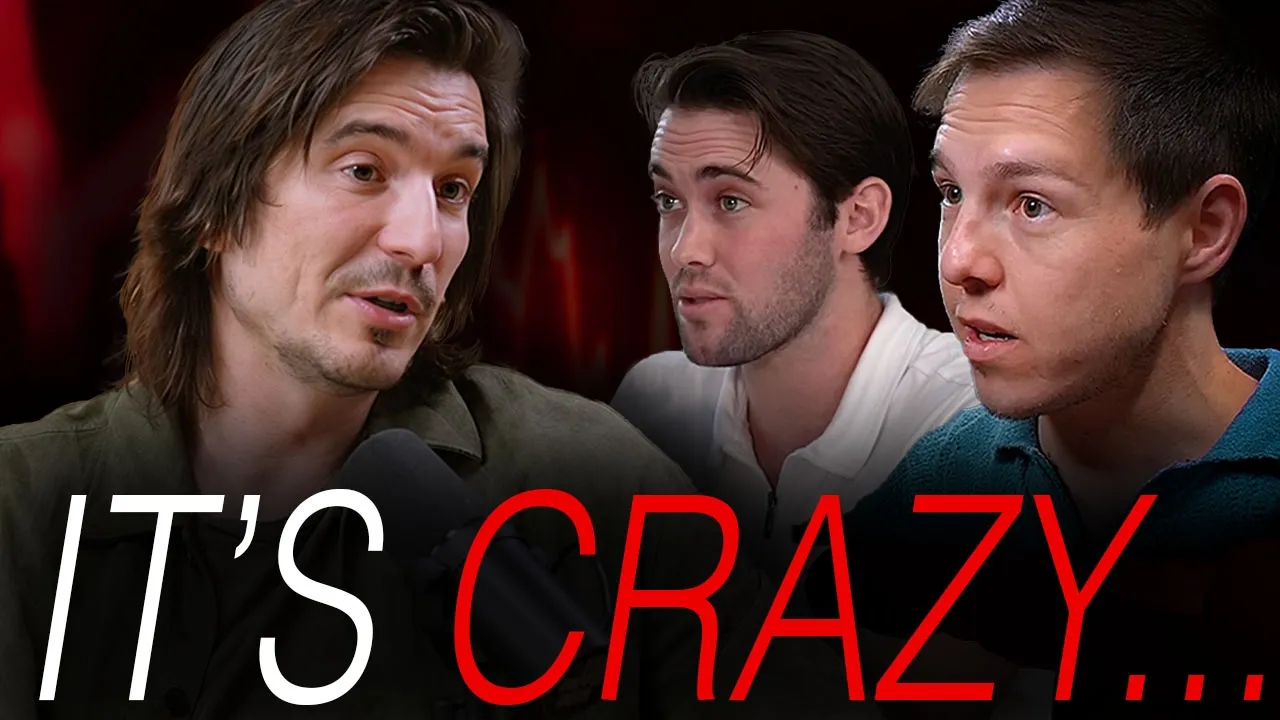
Robinhood grew assets under custody by $125 billion—a 50% year-over-year increase—surpassing its 2021 retail trading volume records and securing the top retail market share in options. (6:10)
More than 100,000 developer accounts have adopted Robinhood's Model Context Protocol (MCP) servers for autonomous agentic trading across equities, options, and tax-lot strategies. (10:34)
Election prediction markets became Robinhood's fastest-growing revenue line in history within weeks of regulatory launch, annualizing at hundreds of millions of dollars. (24:57)
Robinhood Chain climbed into the top five in decentralized exchange volume, facilitating tokenized equity trading in over 120 countries outside the United States. (51:41)
Detailed notes
## Background
This interview was published on August 23, 2026, on YouTube by The Iced Coffee Hour, hosted by Graham Stephan and Jack Selby. According to the show description, the conversation features Robinhood CEO Vlad Tenev discussing predictions for the stock market, the AI bubble, and controversies surrounding prediction markets and retail trading.
## TL;DR
Robinhood CEO Vlad Tenev joins Graham Stephan and Jack Selby to unpack the rapid expansion of Robinhood's platform, covering the surge to over $125 billion in custodial asset growth, the launch of agentic trading via Model Context Protocol, and the rollout of Robinhood Chain and tokenized 24/7 equities. Tenev details his vision for democratizing private equity through Robinhood Ventures, pushes back on regulation like the Pattern Day Trader rule, and addresses user feedback on high-growth prediction markets. He also shares insights on his personal asset allocation and health routines, contrasts his immigrant upbringing with raising children in wealth, and reverse-interviews the hosts with candid strategic advice on media production.
## Atmosphere & style
The conversation carries an energetic, tech-forward, and collegial tone, blending casual podcast banter about sports cars and parenting with high-level corporate strategy. Stephan and Selby act as curious retail-investor proxies, probing Tenev on regulatory friction, market bubbles, and platform controversies, while Tenev responds with calculated, analytical precision rooted in his background in pure mathematics. The dynamic shifts into an engaging and rare coaching session toward the final stretch, where Tenev flips the table to critique the hosts' show format, making the listening experience feel both intellectually rigorous and genuinely conversational.
## Bulletin
- [06:10](https://www.youtube.com/watch?v=KJ_dtGyqNP8&t=370s) Robinhood grew assets under custody by $125 billion—a 50% year-over-year increase—surpassing its 2021 retail trading volume records and securing the top retail market share in options.
- [10:34](https://www.youtube.com/watch?v=KJ_dtGyqNP8&t=634s) More than 100,000 developer accounts have adopted Robinhood's Model Context Protocol (MCP) servers for autonomous agentic trading across equities, options, and tax-lot strategies.
- [24:57](https://www.youtube.com/watch?v=KJ_dtGyqNP8&t=1497s) Election prediction markets became Robinhood's fastest-growing revenue line in history within weeks of regulatory launch, annualizing at hundreds of millions of dollars.
- [51:41](https://www.youtube.com/watch?v=KJ_dtGyqNP8&t=3101s) Robinhood Chain climbed into the top five in decentralized exchange volume, facilitating tokenized equity trading in over 120 countries outside the United States.
## Key takeaways
- [00:00](https://www.youtube.com/watch?v=KJ_dtGyqNP8&t=0s) Broad retail equity ownership is critical for macroeconomic stability, with Robinhood aiming to expand U.S. household stock participation from roughly 65% to above 95%.
- [06:10](https://www.youtube.com/watch?v=KJ_dtGyqNP8&t=370s) Robinhood's $125 billion asset surge was driven by expansion into active trader tools and a cradle-to-grave financial super-app strategy rather than one-off transfer bonuses.
- [10:34](https://www.youtube.com/watch?v=KJ_dtGyqNP8&t=634s) Autonomous LLM trading agents connected via Model Context Protocol occasionally refuse to trade because foundation models were not pre-trained on granular trading workflows.
- [15:13](https://www.youtube.com/watch?v=KJ_dtGyqNP8&t=913s) Artificial intelligence will drive wealth management fee compression rather than full advisor obsolescence, moving high-grade estate planning down-market while preserving human fiduciaries.
- [23:16](https://www.youtube.com/watch?v=KJ_dtGyqNP8&t=1396s) Robinhood engineering achieved near 100% internal AI adoption, shifting developers into continuous agent managers to expand output capacity without reducing head count.
- [34:05](https://www.youtube.com/watch?v=KJ_dtGyqNP8&t=2045s) Scaling as an executive requires a 'barbell' management approach that pairs top-down executive reports with direct ground-level inspections of code, product copy, and intern feedback.
- [41:33](https://www.youtube.com/watch?v=KJ_dtGyqNP8&t=2493s) The Pattern Day Trader rule perversely harmed small retail accounts by blocking intraday risk management during high volatility, driving regulatory pushback.
- [43:53](https://www.youtube.com/watch?v=KJ_dtGyqNP8&t=2633s) Robinhood Ventures seeks to democratize private equity by providing retail baskets of late-stage enterprises like OpenAI and early-stage Y Combinator cohorts.
- [51:41](https://www.youtube.com/watch?v=KJ_dtGyqNP8&t=3101s) Robinhood Chain pairs USDG stablecoins with tokenized public equities to enable 24/7 global trading, seeing its strongest organic adoption across developing markets.
- [57:37](https://www.youtube.com/watch?v=KJ_dtGyqNP8&t=3457s) Incumbent brokerages struggle with organizational inertia, leaving them vulnerable to losing market share during the impending multi-trillion-dollar intergenerational wealth transfer.
- [01:02:32](https://www.youtube.com/watch?v=KJ_dtGyqNP8&t=3752s) Retail investors on modern platforms demonstrated structural resilience during the March 2020 crash by buying dips while legacy brokerage clients panic-sold.
- [01:09:04](https://www.youtube.com/watch?v=KJ_dtGyqNP8&t=4144s) Proposed wealth taxes on unrealized equity risk creating liquidity crunches for company founders and prompting tax base flight similar to entertainment production leaving California.
- [01:13:10](https://www.youtube.com/watch?v=KJ_dtGyqNP8&t=4390s) Bitcoin maintains a singular corporate treasury hedging advantage against fiat depreciation due to enduring first-mover brand trust.
- [01:17:12](https://www.youtube.com/watch?v=KJ_dtGyqNP8&t=4632s) AI tools reduce the marginal cost of discovering software vulnerabilities, necessitating non-networked cold storage vaults and continuous internal automated red-teaming.
- [01:31:04](https://www.youtube.com/watch?v=KJ_dtGyqNP8&t=5464s) Mastery over pure mathematical reasoning represents the foundational frontier for AI models to generalize across all cognitive tasks, including legal and software workflows.
- [01:48:27](https://www.youtube.com/watch?v=KJ_dtGyqNP8&t=6507s) Contrary to displacement forecasts, the broader proliferation of software and regulatory complexity will lead to more software engineers and lawyers by 2035 than exist today.
## Detailed walkthrough
### [00:00](https://www.youtube.com/watch?v=KJ_dtGyqNP8&t=0s) Teaser: Broad Ownership, AI Agents, and the Wealth Gap
The conversation opens with a montage of the themes ahead: economic inequality, the challenges facing Gen Z, and Robinhood's vision of turning into a comprehensive "financial super app." A clip highlights how Gen Z is increasingly dependent on parental support, alongside reports that the richest 1% now controls more wealth than at any time in over fifty years. Vlad Tenev warns that "a future with relatively few owners is inherently fragile," emphasizing the need to expand asset ownership broadly to prevent wealth from concentrating exclusively among insiders.
At the same time, the hosts challenge Vlad on the platform's criticisms—specifically whether offering active trading and prediction markets sets retail traders up with unfavorable odds. The preview touches on the rise of AI agents that can manage and trade assets autonomously around the clock ("seeing how many you can actually employ, including when you're sleeping") and leaves open the question of whether a platform like Robinhood could eventually be run by just a handful of humans directing automated systems.
---
[01:07](https://www.youtube.com/watch?v=KJ_dtGyqNP8&t=67s) Upgrading from a Used Porsche to a GT3 Touring
Graham Stephan welcomes Vlad Tenev back to *The Iced Coffee Hour*, reminding the audience that the last time Vlad appeared, he was still driving a used car. Over the past year, Robinhood added $125 billion in assets under custody (AUC)—a massive 50% jump—and with the stock up 3% on the day of recording, Vlad's personal net worth swung by an estimated $150 million in a single day. Graham playfully asks if Vlad has finally upgraded to a brand-new vehicle.
Vlad laughs and admits that he can finally "afford a new car now." He explains that his previous car, a used Porsche 911 Turbo S, was merely a placeholder while he waited for a custom factory order to arrive. He has since taken delivery of a Porsche 911 GT3 Touring with a manual transmission, describing it with enthusiasm: "The thing cooks." Vlad notes that his commute is fairly short—anywhere from 10 to 20 minutes depending on traffic, though "much shorter now that I got this new car."
When asked whether being the billionaire CEO of Robinhood allows him to skip the waitlist at Porsche dealerships, Vlad demystifies the luxury buying experience:
- High-end marques prioritize customer loyalty over one-off celebrity or high-net-worth status.
- Dealerships reward repeat buyers who consistently patronize the brand rather than handing allocations to famous individuals on demand.
- Vlad still had to wait in line for over a year to take delivery of his GT3 Touring, just like any other collector.
---
[02:54](https://www.youtube.com/watch?v=KJ_dtGyqNP8&t=174s) The Core Mission: Expanding Ownership Beyond the 1%
Graham asks Vlad what single metric he obsesses over daily if it is not the fluctuating stock price. Vlad clarifies that because Robinhood operates multiple business lines led by executives who act as CEOs of their respective verticals, no single operational number dictates his day. Instead, he evaluates Robinhood's success through the philosophical lens of **broad ownership**.
```mermaid
flowchart LR
accTitle: Expansion of US Equity Ownership
accDescr: Progress of US household equity ownership from pre-Robinhood levels to the 95% target.
subgraph Past["Pre-Robinhood"]
A["Low 50% Household Ownership"]
end
subgraph Present["Current State"]
B["~65% Household Ownership"]
end
subgraph Future["Target Goal"]
C["95%+ Household Ownership"]
end
A -->|"Zero-Fee Trading & Access"| B
B -->|"Child Accounts, Tokenization & Private Markets"| C
```
Vlad argues that an economy where a shrinking minority owns productive assets creates systemic instability: "A world or a future with relatively few owners is inherently fragile." He benchmarks Robinhood’s historical impact against national equity ownership:
- **Historical baseline:** Before Robinhood launched commission-free trading, only low-50% of American households owned equities.
- **Current status:** That figure has risen to roughly 65%, a shift Vlad attributes in meaningful part to Robinhood lowering market barriers.
- **The next target:** Pushing US equity ownership past **95%**, while exporting American capital markets globally via blockchain tokenization so international investors can easily buy US real-world assets.
Addressing the counterargument that many families simply lack the surplus capital to invest, Vlad points to systemic "ownership by default." Historically, the employer-sponsored 401(k) match acted as effective "free money" that shifted equity ownership upward by tens of percentage points. He highlights modern parallels, including state and federal child-savings initiatives (such as proposed Treasury-funded "Trump accounts" giving every newborn child $1,000) and philanthropic endowments led by figures like Michael Dell (targeting low-income zip codes nationwide) and Ray Dalio. For paycheck-to-paycheck households, Vlad argues default institutional programs and philanthropy are the most viable bridges to building generational equity.
---
[06:10](https://www.youtube.com/watch?v=KJ_dtGyqNP8&t=370s) The Engines Behind Adding $125 Billion in Custody
Jack Selby asks Vlad how Robinhood managed to increase its assets under custody by $125 billion in a single year, noting that such growth requires distinct, deliberate operational drivers. Vlad breaks the strategy into two overarching pillars: catering aggressively to active traders, and evolving into a cradle-to-grave financial home.
```mermaid
flowchart TD
accTitle: Robinhood AUC Growth Strategy
accDescr: Two-pillar structure illustrating active trading drivers and lifecycle banking products.
subgraph Pillar1["Pillar 1: Active Trader Engine"]
T1["Record Equities Volumes (Surpassing 2021)"]
T2["#1 Retail Market Share in Options"]
T3["Expansion into Futures & Prediction Markets"]
end
subgraph Pillar2["Pillar 2: Lifelong Financial Super App"]
L1["Child / Custodial & Trust Accounts"]
L2["Joint Accounts for Couples"]
L3["Robinhood Banking & Direct Deposit Engine"]
end
#### Pillar 1: Supercharging the Active Trader Engine
Active trading remains the core operational engine of Robinhood. When the platform provides superior execution, low friction, and broad asset selection, active traders deposit substantial balances and advocate for the service:
- **Record equities volume:** In Q2, equity trading volume exceeded the manic retail peak of the 2021 GameStop frenzy through steady compounding.
- **Dominance in retail options:** Robinhood has climbed to the **#1 retail market share position in options trading**, surpassing long-standing incumbents despite continuous consolidation across legacy brokerages.
- **New trading categories:** The rapid rollouts of futures trading and prediction markets have driven fresh capital inflows.
#### Pillar 2: Serving the Entire Financial Lifecycle
To retain capital permanently, Robinhood aims to handle every life stage from infancy to wealth transfer:
- **Custodial & Trust accounts:** Capturing users at birth through custodial accounts and retaining them into adulthood; newly added trust accounts simplify wealth onboarding for estate planning.
- **Joint accounts:** Enabling married couples and domestic partners to co-manage portfolios within the app.
- **Robinhood Banking:** Experiencing rapid growth with billions in balances. High direct-deposit attachment rates turn the app into the primary account where users receive paychecks, allowing automated routing of income across retirement accounts, taxable brokerage portfolios, and active strategies.
When asked whether eye-popping promotional transfer matches (such as 1% to 3% deposit matches on crypto and retirement rollovers) artificially drove this inflow, Vlad clarifies that while transfer bonuses certainly help, Automated Customer Account Transfers (ACATS) represent only a minority slice of overall inflows and outflows.
---
[10:20](https://www.youtube.com/watch?v=KJ_dtGyqNP8&t=620s) The Leap into AI Investing and Autonomous Agents
Graham transitions to Robinhood's newest frontier: AI-driven investing. The public announcement caused immediate buzz across X (formerly Twitter) and Reddit, marking what many observers consider a major technological departure from traditional retail brokerages. Graham praises the launch as a dramatic step forward in consumer fintech, setting the stage to explore how automated agentic trading and intelligent assistants will alter day-to-day portfolio management.
[10:34](https://www.youtube.com/watch?v=KJ_dtGyqNP8&t=634s) Agentic Trading and Reluctant AI Agents
When asked about how Robinhood's AI investing initiatives came together and whether users are actually turning a profit with autonomous tools, Vlad Tenev clarifies that Robinhood did not establish an exclusive corporate partnership. Instead, the company launched agentic trading and an agentic card, building a paved path via Model Context Protocol (MCP) servers. The architecture lets users connect their own developer tools—such as Claude Code, OpenAI Codex, or custom AI agents—directly to Robinhood’s infrastructure. The underlying principle is simple: anything a user can execute manually on the Robinhood mobile app, an AI agent should be capable of performing programmatically. Robinhood debuted the capability with equities trading before expanding into options, rolling out tax-lot visibility, and announcing upcoming support for cryptocurrency.
```mermaid
flowchart LR
accTitle: Robinhood Agentic Trading Architecture
accDescr: Flow diagram showing how external AI agents connect through an MCP server to Robinhood services.
subgraph Client ["User AI Layer"]
A["AI Agents\n(Claude Code, Codex, Custom)"]
end
subgraph Interface ["Integration Layer"]
B["Robinhood MCP Server\n(Paved API Path)"]
end
subgraph Services ["Execution & Features"]
C["Equities & Options"]
D["Tax Lot Visibility"]
E["Crypto Trading\n(Upcoming)"]
end
A --> B
B --> C
B --> D
B --> E
```
While Vlad admits he does not monitor aggregate user returns closely, adoption has surged past 100,000 agentic accounts, driving significant trading volume. Users frequently construct elaborate strategies by having their agents aggregate disjointed data sources from across the web. Drawing from his own background building algorithmic trading systems prior to founding Robinhood, Vlad reflects on how democratized market access has become. In the past, writing automated trading strategies required elite programming talent, expensive legacy financial integrations, and absorbing crippling fees like $10 per trade.
Despite the power of modern Large Language Models, agentic trading still presents bizarre, unexpected friction points: the AI models are rarely fine-tuned for high-stakes financial risk. Vlad jokes that agents will occasionally flatly refuse an instruction, responding with messages like, *"I don't want to trade right now. I don't think this is a good idea,"* or recommending that the user open the app to execute the trade manually. The hosts joke that the AI simply didn't have its morning coffee, but Vlad explains the technical root cause: unlike software development traces, high-quality, step-by-step trading activity simply was not prevalent in the pre-training datasets for base foundation models.
- **Over 100,000 accounts** have been created to utilize Robinhood's agentic tools.
- Supported features include equities, options, and tax-lot selection, with crypto trading slated for release.
- MCP (Model Context Protocol) integration allows developer agents to programmatically mirror all core native app features.
The hosts pivot into a mid-roll break for Northwest Registered Agent, emphasizing the liability hazards of operating a business directly out of a personal checking account. They point out that a single lawsuit or dissatisfied client can expose personal savings and real estate to litigation. For $39 plus mandatory state filing fees, Northwest assists entrepreneurs in forming an LLC with complete documentation—handling state filings, operating agreements, membership certificates, and corporate banking resolutions. The service includes free privacy and identity features such as business domains, websites, dedicated phone lines, brand protection, and mail forwarding. Furthermore, Northwest uses its own commercial registered office address on public government records so business owners never have to publish their home addresses.
---
[15:13](https://www.youtube.com/watch?v=KJ_dtGyqNP8&t=913s) Human Consiglieres, Fee Compression, and the Future of Advisors
Addressing whether AI will render financial advisors obsolete, Vlad argues that the human element will endure. For affluent clients, a traditional advisor serves as an indispensable "consigliere" or trusted family fixture who helps navigate holistic life milestones rather than mere ticker execution. In high-stakes wealth management, human psychology demands an accountable fiduciary who assumes ultimate personal responsibility for mistakes. While AI is already heavily employed to sanity-check human advice, Vlad believes many individuals simply have zero desire to manage money or prompt an AI model; they happily pay to abstract their finances entirely.
```mermaid
flowchart TD
accTitle: Financial Advisory Fee Compression Model
accDescr: Diagram illustrating fee compression between robo-advisors and traditional full-service advisory models.
subgraph Legacy ["Legacy Fee Structures"]
R["Robo-Advisors\n~25 bps (0.25%)\nAsset management only"]
F["Full-Service Advisors\n1.00%+ AUM\nHolistic: Estate, tax, life planning"]
end
subgraph Convergence ["AI Integration Shift"]
M["AI-Powered Hybrid Advisory\nConsolidating into a middle ground\nLower fees, automated optimization, human fiduciary"]
end
R --> M
F --> M
```
Instead of an outright collapse of the profession, Vlad forecasts aggressive industry fee compression. Historically, wealth management has been bifurcated into two distinct offerings:
1. **Robo-advisors**, which charge around 25 basis points (0.25% of assets under management) for algorithmic portfolio rebalancing, but lack bespoke tax and estate planning.
2. **Full-service advisors**, who command 1.00% or higher of assets to oversee taxes, budgeting, estate planning, and family governance.
As AI blurs these categories by bringing institutional-grade planning tools down-market, advisory pricing is poised to consolidate into a cheaper middle ground.
Graham illustrates the immediate disruptive power of LLMs with a personal anecdote: he uploaded his entire portfolio into Claude with the prompt, *"Rate my portfolio. Tell me everything I'm doing wrong or any improvements."* The analysis flagged that an existing fund was charging a higher expense ratio than an identical Vanguard vehicle. By executing a minor tax-loss harvest and swapping into the lower-fee Vanguard alternative, Graham instantly locked in an estimated $16,000 in annual after-tax savings.
Vlad notes that while these optimization wins are tremendous, clear-cut cases—like identifying excessive expense ratios or sweeping idle cash from zero-yield checking accounts into 3.5%+ APY cash reserves—do not even require advanced neural networks. They are straightforward rule-based algorithms that platforms are actively building to automatically capture yield without requiring users to monitor their balances around the clock.
[20:54](https://www.youtube.com/watch?v=KJ_dtGyqNP8&t=1254s) AI's Impact on Different Investing Behaviors
The conversation touches on the enduring power of inertia in traditional banking. Despite modern platforms allowing users to earn thousands of extra dollars annually on uninvested cash, legacy institutions still sit on trillions of dollars in deposits paying near-zero interest because customer habits and bank relationships run deep. Looking to the future, the hosts ask whether investing will fundamentally break and transform once everyday individuals have access to autonomous AI agents that can ingest all publicly available information instantaneously.
Vlad Tenev breaks down the landscape by investor profile, arguing that AI will not affect every style equally:
* **Product-Driven Retail Investors:** People who buy shares simply because they like and use a company's offerings—such as someone using an iPhone and choosing to hold Apple stock—will largely remain unchanged. Vlad points out that there is little an AI agent could tell that type of buyer to dissuade them from their conviction.
* **Passive Allocators:** Long-term indexers focused on broad asset allocation and portfolio construction will experience minimal disruption. The process of setting and rebalancing long-term holdings has already been automated and streamlined for years. Where platforms like Robinhood can leverage AI here is purely informational—explaining why certain rebalancing adjustments occurred and delivering clearer updates on portfolio movements.
* **Active Traders:** This is the segment where Vlad predicts massive disruption. Active trading currently leans heavily on technical chart analysis, and AI can rapidly augment technical indicators by synthesizing vast alternative datasets. Because trading offers the clearest opportunity for disruption, Robinhood is directing its development efforts into agentic trading before tackling other investing categories.
[23:16](https://www.youtube.com/watch?v=KJ_dtGyqNP8&t=1396s) How AI Agents Reshaped Robinhood's Internal Engineering
Turning to internal operations, Vlad explains that AI has fundamentally re-architected how Robinhood builds software, noting that company adoption is near 100%. Engineering workflows have pivoted away from humans writing and manually reviewing lines of code toward human developers directing teams of autonomous AI agents. Engineers now act as agent managers: their daily responsibility is ensuring agents are properly prompted, continuously tasked, and kept productive around the clock—including while the engineers are asleep.
When asked whether this trajectory means Robinhood could one day be operated from home by just a handful of individuals, Vlad dismisses it as a target. Drawing a comparison to human fiduciary responsibility in finance, he emphasizes that a person must always remain accountable for key decisions. The company's goal is not aggressive headcount reduction, but expanding the operational leverage of existing teams so they can ship far more product with the people they already have.
```mermaid
flowchart TD
accTitle: Robinhood Engineering Workflow Shift
accDescr: Diagram contrasting legacy human-led software engineering with modern agentic workflows.
subgraph Legacy["Legacy Software Workflow"]
A["Engineer Writes Code"] --> B["Peer Reviews Code"]
B --> C["Deployment"]
end
subgraph Agentic["Modern Agentic Workflow"]
D["Engineer Acts as Agent Manager"] --> E["Agents Generate Code 24/7"]
E --> F["Agents Self-Review & Refine"]
F --> G["Human Accountable Oversight & Ship"]
end
```
[24:57](https://www.youtube.com/watch?v=KJ_dtGyqNP8&t=1497s) Moving Forward and the Rapid Rollout of Prediction Markets
When asked to name his single biggest mistake over the past year, Vlad reveals a forward-looking mindset: he avoids litigating the past or obsessing over historical missteps. He actually welcomes being viewed as an underdog or starting from behind because it provides tangible motivation to execute.
Historically, Robinhood rarely entered asset classes as the first mover. Electronic equity trading had existed for decades before Robinhood popularized commission-free smartphone trading. The company launched crypto trading in 2018—years after pioneer platforms like Bitstamp (which Robinhood later acquired) were founded in the early 2010s. However, Robinhood broke that pattern with election prediction markets:
* Following regulatory legalization ahead of the U.S. presidential election, Robinhood went live with event contracts within weeks.
* The product quickly scaled into the fastest-growing revenue line in Robinhood's history, producing hundreds of millions of dollars in annualized revenue.
* The rapid rollout of prediction markets, alongside Robinhood's banking expansion, created a product sprawl challenge, forcing leadership to reconsider how to keep the core application clean and cohesive.
[27:29](https://www.youtube.com/watch?v=KJ_dtGyqNP8&t=1649s) Redesigning the App for 13 New Account Types
As Robinhood aggressively shipped new verticals, the interface became cluttered with features and notifications that individual users did not necessarily want. Early on, users who disliked prediction markets reached out to customer support directly to manually hide the contracts from their interface. Robinhood later formalized this by adding settings toggles that let customers enable or disable prediction markets, sports event contracts, and various asset surfaces according to their personal preference.
The structural layout of the mobile app required a ground-up redesign. Originally, Robinhood's bottom navigation featured individual tabs dedicated to distinct account types:
This layout broke down as Robinhood added 13 new account options, leaving many tabs irrelevant to customers who only held a standard investing account. Robinhood unified the navigation into functional surfaces designed to serve every customer regardless of what products they hold:
The hosts praise this evolution, particularly highlighting Robinhood's support for multiple separate individual taxable brokerage accounts under one login, allowing users to isolate distinct trading strategies without juggling multiple brokerage firms.
Addressing why he refuses to dwell on prior decisions, Vlad explains that postmortems are essential, but sinking "80% of time worrying about things that have already happened" is an unproductive trap. Because complex decisions depend on countless variables, it is impossible to predict how a single changed variable months earlier would have played out. An effective CEO must assess the board as it currently stands and determine the next best move. As the hosts begin praising his leadership reputation on X and describe the CEO role as a professional "problem solver," the show transitions toward a sponsor break.
[31:28](https://www.youtube.com/watch?v=KJ_dtGyqNP8&t=1888s) Sponsors: Claude & Superhuman Go
The hosts pause for a pair of sponsor reads, starting with Claude, which they pitch as an AI collaborator for problem solvers that "understands your entire workflow and thinks with you, not for you." Whether debugging code at midnight, building a financial model, or strategizing a business move, they highlight how Cowork goes beyond a standard chatbot by actually executing the work—generating real spreadsheets, formatted reports, and organized files directly on a computer with no uploads or cleanup required. Sharing a personal example of using Claude's newest model to tackle their taxes, they explain that after uploading their bank statements, the model rapidly processed every document into an organized spreadsheet ready to go straight to their accountant, saving them hours, if not days. They also rely on Claude for generating invoices, writing emails, titling videos, setting up test projects, and even editing videos for their clips channel. One host recounts calling his dad the day before while driving to pickleball and telling him, "Dad, sign up for the Claude Max plan, upload all of your financial statements, and Claude will literally pay for itself with the amount of value it gives you," before directing listeners to `claude.ai/icedcoffee` to check out Claude Pro.
The second read features Superhuman Go, framed around the common corporate frustration of investing in AI tools, onboarding the whole team, and finding a few months later that nobody is using them. Built by the makers of Grammarly to actually stick, Superhuman Go is an AI chat that sits on the side of your browser and works inside the tools and sites a team already uses. Because it automatically knows what is on the screen—whether an email, a doc, or a website—users do not have to open new tabs, paste context in, or explain themselves from scratch. With a simple prompt, it can summarize a long email thread, draft a reply, prep for a meeting, or search across five different apps so users do not have to click around trying to remember where something is stored. Because nobody has to learn anything new, the whole team actually adopts it, and listeners are directed to `superhuman.com`.
[34:05](https://www.youtube.com/watch?v=KJ_dtGyqNP8&t=2045s) The Evolution of a CEO's Role Across Company Scale
Returning to the interview, the hosts mention that people all over X call Vlad one of the most effective CEOs and founders alive today. Vlad laughs and says, "Wow, that's humbling," as the hosts ask whether he agrees with distilling the CEO job description down to a single concept: "problem solver." Vlad agrees that "problem solver" fits on a base level, though he notes that "problem" is a very broad term and the job changes dramatically depending on the size of the company and what you are responsible for.
Tracing his own evolution at Robinhood, Vlad explains that when a company is small and trying to ship a single working product to customers, the CEO's job is essentially "how quickly can I ship code?"—which is exactly how he started at Robinhood, writing a lot of code himself. At the next stage, the company might be building two products at once, which requires not just shipping code, but marketing and designing them while leading a small team of engineers. Here, the challenge is staying close enough to the work being done by your reports while putting in the hours and mental effort to learn domains outside your core competency. He points out that many engineers have no interest in learning about marketing, legal, or operations, which is limiting because if you know nothing about a domain, you cannot tell what is working, what is broken, or how to make improvements.
As the company grows through further layers of scale, the job gets harder because more groups of people are working on things the CEO is less directly involved in. At that level, the role shifts to building systems and organizing effectively so you know exactly whom to probe when something goes wrong, while ensuring you spend time on the right things and never make decisions based on anecdote alone. Vlad frames the core question at scale as: "If I wanted to spend like five minutes on something, how can I get the best and highest signal five minutes possible?"
```mermaid
flowchart LR
accTitle: Evolution of the CEO Role by Company Scale
accDescr: Shows how a CEO's primary focus shifts from shipping code at a small startup, to learning non-core domains while managing a small team, to building high-signal systems at large scale.
subgraph Stage1["Stage 1: Single Product"]
S1["Write & ship code quickly"]
end
subgraph Stage2["Stage 2: Multi-Product & Small Team"]
S2["Manage engineers & stay close to work"]
S3["Learn non-core domains (marketing, legal, ops)"]
S2 --> S3
end
subgraph Stage3["Stage 3: Large-Scale Organization"]
S4["Build high-signal systems (metrics, verbatims, AI)"]
S5["Know who to probe & avoid anecdote-driven decisions"]
S4 --> S5
end
Stage1 --> Stage2 --> Stage3
```
- **Tools for maximizing a "high-signal five minutes" at scale:**
- Concrete metrics
- Customer verbatims
- AI tools plugged directly into the right internal data
[37:32](https://www.youtube.com/watch?v=KJ_dtGyqNP8&t=2252s) The "Barbell" Management Approach and Obsessing Over Customers
Impressed by how neatly Vlad distilled the blueprint for organizing an executive's life, the hosts ask what trait or belief holds back operators who are not working at maximum efficiency, and what primary question executives should ask themselves to become more effective. Vlad answers that the first critical trait is being able to get deep into the details of every team and every work stream, rather than just relying on the assessments of people in management. He advocates for getting "both ends of the barbell"—combining the senior executive's high-level view of a situation with the perspective of the people on the ground. In larger organizations with long chains of command—spanning individual contributors, managers, directors, and senior directors—if something breaks anywhere up that chain, the CEO can end up getting bad information about what is actually happening.
To prevent that, Vlad goes as close to the ground as possible: looking directly at the code, reviewing the actual copy shipping to the website, and talking directly to individual contributors and interns—adding with emphasis, "spend a lot of time talking to interns." Alongside getting deep into the details of the work, he emphasizes the importance of hiring well so that the people around you—in his case, Robinhood's general managers and functional leads—are incredibly strong, capable operators growing alongside the massive businesses they run.
The hosts laugh and draw a parallel to their friend Ben Mallah, who buys massive commercial real estate and apartment complexes with hundreds of units and has his own son move into a complex as a resident. By living on the property, his son stays close to the problem and sees firsthand where to spend money for the highest return on resident quality of life—just like getting both the executive opinion and the opinion of the person assembling the product.
Vlad agrees and adds that you also have to talk directly to the customer across every channel, noting that different channels surface completely different voices:
- Customers who are loud on Twitter/X.
- Customers who are loud on customer support tickets (who are not always the same people as those on Twitter).
- Redditors posting across different subreddits.
- Quiet customers who will never post on social media or write a support ticket, but will simply and silently stop using the product.
Figuring out how to reach those silent customers is vital, and Vlad concludes that it really comes down to being completely obsessed with your business: feeling like "every little problem is just going to be on my mind until I figure out a way to solve it," and only once a solution is found and actioned can he finally "put it away in a little drawer."
[41:33](https://www.youtube.com/watch?v=KJ_dtGyqNP8&t=2493s) Why Detail-Obsessed Leadership Matters and Pushing Back on Regulation
Vlad Tenev reflects on his management style, admitting that he spends an enormous amount of time obsessing over every tiny detail. While he acknowledges that this habit can occasionally be annoying to colleagues and might not always be ideal for staying relaxed or maintaining optimal mental health, he considers it indispensable for the business. When the hosts ask what major initiatives Robinhood wants to tackle next that are currently blocked by financial regulations, Tenev points out that Robinhood has cultivated constructive relationships with regulators in recent years as agencies have grown more open to supporting innovation. However, instead of remaining a passive participant in existing frameworks, Robinhood is actively pushing to change policies that harm retail investors.
A prime example was the repeal of the Pattern Day Trader (PDT) rule, a reform Robinhood strongly supported. Under the PDT rule, accounts holding under $25,000 were strictly limited in how many day trades they could execute. Intended originally to prevent retail traders from making impulsive bets, the rule had the perverse effect of penalizing users with smaller balances. If an investor needed to close out a volatile position purely for risk-management purposes, they risked being flagged as a pattern day trader and frozen out. Furthermore, because the restriction was tracked per broker, an investor locked out on Robinhood could simply move their capital to another brokerage and start fresh, making the restriction counterproductive.
[43:53](https://www.youtube.com/watch?v=KJ_dtGyqNP8&t=2633s) Robinhood Ventures: Democratizing Private Equity from Seed to Pre-IPO
Tenev highlights the accredited investor rule as the next major policy barrier that needs fundamental reform. He explains that private equity ownership is the modern frontier of Robinhood’s democratization mission. Massive technological disruptions driven by artificial intelligence are minting trillions in enterprise value, but industry titans like OpenAI and Anthropic remain private. As a consequence, immense wealth creation is concentrated entirely within a small circle of wealthy venture insiders rather than flowing to the broader public.
```mermaid
flowchart TD
accTitle: Robinhood Ventures Structure
accDescr: Visual breakdown of Robinhood Ventures Funds 1 and 2 covering late-stage pre-IPO assets down to seed and Series A startups.
subgraph Fund1["Robinhood Ventures Fund 1 (RVI)"]
direction TB
F1A["Late-Stage / Pre-IPO"]
F1B["Valuations: Billions to Trillions"]
F1C["Portfolio Asset: OpenAI"]
end
subgraph Fund2["Robinhood Ventures Fund 2 (RV2)"]
direction TB
F2A["Seed & Series A Early Stage"]
F2B["Partner: Y Combinator (YC)"]
F2C["Valuations: Tens of Millions"]
end
To solve this disparity, Robinhood introduced Robinhood Ventures:
- **Robinhood Ventures Fund 1 (RVI):** Offers retail investors low-cost basket exposure to late-stage, pre-IPO enterprises, including holdings like OpenAI.
- **Robinhood Ventures Fund 2 (RV2):** Shifts completely to the opposite end of the spectrum, providing direct exposure to seed and Series A stage startups with valuations in the tens of millions rather than hundreds of billions. For RV2, Robinhood partnered directly with Y Combinator (YC).
When asked how Robinhood sources these deals without alienating founders, Tenev emphasizes an ethical line: unlike competitors who acquire indirect second-layer SPV or LP interests—leading to situations where target startups publicly disavow the transactions—Robinhood only includes companies that grant direct, explicit permission. Addressing whether early retail access just accelerates the "cat-and-mouse game" where wealthy insiders find ways to buy in even earlier, Tenev notes that entering at seed and Series A is about as early as anyone can realistically get. Still, he views basket funds as an intermediate step; the eventual goal is allowing everyday users to trade single private company stocks just like public equities, which will require dismantling restrictive accredited investor income thresholds.
[48:13](https://www.youtube.com/watch?v=KJ_dtGyqNP8&t=2893s) Robinhood Social, P&L Verification, and the Promise of Robinhood Chain
The conversation pivots to feature ideas, with Graham Stephan suggesting an app feature akin to Venmo where friends can send each other fractional stocks—like wiring $100 of Alphabet stock instead of cash. The hosts tease Graham for previously claiming credit for the Robinhood Social feature after mentioning it on their prior podcast, while Tenev jokes about keeping a poker face when secret products already in development for company summit unveilings get guessed by interviewers.
Tenev discusses how Robinhood Social has gained traction, with users frequently cross-posting platform screenshots directly onto X. The hosts point out that identity verification is becoming essential, as Jack Selby and Graham note impostors could mimic high-profile creator handles. Tenev agrees that profile verification needs attention, but notes that Robinhood Social has already solved the core credibility problem of online finance: every trade, portfolio allocation, and P&L widget is programmatically verified directly against platform clearing records, eliminating the fake trade screenshots rampant on other social networks.
Looking forward toward the next five to ten years of financial technology, Tenev points toward completely rebuilding the market's plumbing from the foundation up via Robinhood Chain. Describing it as the hottest new blockchain deployment in crypto just weeks after its rollout, he hints at on-chain infrastructure powering the next era of frictionless financial rails.
[51:41](https://www.youtube.com/watch?v=KJ_dtGyqNP8&t=3101s) Robinhood Chain, Stock Tokens, and 24/7 Trading
Vlad discusses the rapid rise of Robinhood Chain, noting that it has climbed into the top five in decentralized exchange (DEX) volume while seeing tremendous growth in total value locked (TVL). A cornerstone of this ecosystem is stock tokens—tokenized representations of equities like Tesla and Nvidia. While regulatory constraints currently keep them unavailable to US customers, users across more than 120 countries can access them. On Robinhood Chain, these tokenized assets possess all the composable properties of native crypto: they can be transferred peer-to-peer like Bitcoin or Ethereum, collateralized for lending and borrowing protocols, or traded in automated pools. Uniswap already hosts highly active liquidity pools on the network.
```mermaid
flowchart TD
accTitle: Robinhood Chain Asset Ecosystem
accDescr: Diagram illustrating how USDG, stock tokens, and cryptocurrencies interact on Robinhood Chain.
When Graham asks whether a stock token swap would permit an investor to trade a stock with $500,000 in gains into another asset without triggering a taxable event, Vlad clarifies that tax implications vary across all 120 jurisdictions. The technological mechanics, however, are straightforward: anyone can spin up a liquidity pool. While Robinhood launched USDG—a stablecoin created in partnership with Paxos and others—as the network's foundational currency, external developers have taken composability far beyond internal expectations. Developers have constructed bespoke mechanisms, such as smart contracts that automatically airdrop stock tokens to holders of specific memecoins, linking equities, base crypto assets, and speculative culture into unexpected products. The platform is also engineered directly for AI agents, featuring APIs and command-line interfaces.
When Graham jokes about how Warren Buffett would react to hearing this, Vlad explains that for everyday users outside the US, the value proposition is simple: anyone with a smartphone and an internet connection can trade tokenized equities 24/7 with low fees. Jack points out that even in the US, round-the-clock trading would unlock immense optionality. Vlad agrees that US tokenization is inevitable, but notes that the leap is smaller for Americans who already enjoy Robinhood's interface compared to developing nations that lack reliable banking rails entirely. He compares the US situation to upgrading an already fast two-hour New York-to-DC train to a high-speed one-hour rail: the infrastructure shift is expensive, existing operators resist it, and the incremental benefit feels comparatively minor, leaving international markets to lead adoption.
Jack reads a sponsor message for Shopify, framing it as the premier platform for anyone sitting on a business concept but intimidated by the operational friction of setting up payments, checkout, and storefronts. Jack shares his personal experience launching five or six independent Shopify stores before working with Graham, pointing out that even with zero prior knowledge, the software enabled him to make actual sales. He highlights Shopify's seamless one-tap checkout, which retains user details to lift conversion rates, and notes that the platform powers everything from global brands like Mattel and Gymshark to first-time entrepreneurs. Viewers are invited to start a free trial at shopify.com/ich.
[57:37](https://www.youtube.com/watch?v=KJ_dtGyqNP8&t=3457s) What the Other Brokerages Don't Get
Asked what incumbent brokerages fundamentally misunderstand about investing in 2026, Vlad attributes their shortcomings to sheer organizational inertia. Traditional financial powerhouses manage tens of trillions in assets, but their massive scale prevents them from moving quickly. In contrast, Robinhood's modern engineering stack allows it to ship product iterations far faster. This agility positions Robinhood to win younger generations who are systematically accumulating wealth, effectively turning the brokerage into the primary landing pad for the looming multi-trillion-dollar wealth transfer.
If hired as an outside consultant to fix a legacy firm, Vlad would tell leadership that any turnaround must begin with a talent overhaul:
- **Talent Reset:** Bringing in world-class software engineers, product designers, and AI specialists who understand modern execution.
- **The "Eating the Elephant" Strategy:** Rather than trying to reorganize a massive legacy institution all at once, leadership should carve out a single, circumscribed business unit separate from the core.
- **Beachhead Formation:** Staffing that isolated unit with elite "special forces" talent to execute autonomously, proving out an operational roadmap for a broader technology transformation across the enterprise.
[59:59](https://www.youtube.com/watch?v=KJ_dtGyqNP8&t=3599s) Bubble Valuations, Korean Stocks, and Alarm Bells
Turning to macroeconomic conditions, Vlad addresses whether current market valuations are flashing warning signs. He observes that localized bubbles manifest clearly through customer support and feature demand. While international equities historically sat far outside Robinhood's top ten requested features, Vlad noticed an sudden, intense wave of inquiries where nearly every interview and customer ticket asked when Robinhood would support Korean equities.
Jack laughs and admits he would jump at anything, particularly if it offered options trading on Korean stocks. Vlad confirms Robinhood plans to support Korean equities, but emphasizes that whenever retail demand spikes so uniformly around a niche asset class, it sounds alarm bells for speculative excess.
Vlad notes that Robinhood users have always been innovation-first pioneers—leading early waves into electric vehicles, crypto, and AI semiconductor plays. Today, that enthusiasm has concentrated heavily on the intersection of chips and power infrastructure. He highlights a complex dynamic in the AI stack: while surging computational demand legitimately justifies high underlying hardware and energy needs, the market has also attracted aggressive secondary speculation. Anecdotes have emerged of hedge funds hoarding physical chips simply to flip them for higher prices down the line, complicating the line between fundamental value and speculative bubble.
[01:02:32](https://www.youtube.com/watch?v=KJ_dtGyqNP8&t=3752s) Market Corrections and Young Investors
Discussing speculative market tops, Vlad Tenev notes that trouble typically brews when too much supply is hoarded by speculators rather than long-term believers, even in sectors with undeniable fundamental demand like artificial intelligence chips. When asked whether a lofty stock market is detrimental to investors in their 20s and 30s, Tenev reframes market environments as universal opportunities. He recalls the pandemic crash in March 2020: while clients at legacy discount brokerages panicked and dumped equities, Robinhood’s predominantly younger demographic aggressively bought the dip. Because they have multi-decade investment horizons and an underlying bullishness about the country's economic future, younger users instinctively view downturns as buying opportunities rather than catastrophes.
While Tenev clarifies that he does not actively root for economic pain or a prolonged bear market—which severely damages everyday people and the broader macroeconomy—market corrections do not cause him personal anxiety as an operator. He observes that active traders profit from volatility, whereas passive long-term investors need disciplined mechanisms like dollar-cost averaging and tax-advantaged vehicles. He strongly rejects the persistent narrative that Robinhood primarily incentivizes risky short-term speculation. Instead, he points out that the single biggest financial incentive built directly into the platform is for retirement accounts: Robinhood Gold members receive an industry-leading 3% match on contributions intended to stay invested for decades.
[01:05:08](https://www.youtube.com/watch?v=KJ_dtGyqNP8&t=3908s) The Prediction Markets Controversy and Multi-App Strategy
Addressing criticism that prediction markets blur the line between investing and gambling, Tenev explains that user feedback actually pulls in polar-opposite directions. One cohort demands that prediction markets be completely hidden, while another cohort complains that event contracts are buried three taps deep and wants them surfaced immediately. To satisfy both, Robinhood relies heavily on feed personalization so users can turn off products they dislike while discovering relevant tools they actually want.
When user experiences diverge too dramatically to coexist cleanly inside a single interface, Robinhood spins them out into dedicated applications rather than cluttering the core product:
- **Robinhood (Core App):** The flagship green app tailored for equities, options, and trading-first experiences.
- **Robinhood Banking:** A separate environment focused purely on high-yield cash accounts and debit/credit card usage.
- **Robinhood Wallet:** A standalone, non-custodial gateway offering native decentralized finance (DeFi) interactions.
subgraph Buckets["Product Innovation Buckets"]
B1["1. Core Infrastructure<br/>(Speed, UI/UX, Traffic Resiliency)"]
B2["2. Industry Parity<br/>(Trust Accounts, Bonds, Global Equities)"]
B3["3. Net-New Frontier<br/>(Prediction Markets, Robinhood Chain, Agentic AI)"]
end
Core -.->|"Customized by user settings"| B3
Apps --> Buckets
```
Reflecting on fair critiques, Tenev admits Robinhood must continually clarify its corporate identity and close feature gaps with legacy brokers. He groups company engineering priorities into three distinct buckets:
- **Core Infrastructure:** Refining execution speed, cleaning up the UI/UX, and reinforcing reliability to prevent outages during unprecedented market traffic spikes.
- **Industry Parity:** Delivering standard offerings that competitors have provided for decades, such as trust accounts, mutual funds, direct fixed income/bonds, and international equities like Korean stocks.
- **Net-New Frontiers:** Pioneering unproven territory where traditional brokerages never venture, including native prediction markets, Robinhood Ventures, the Robinhood Chain, Robinhood Earn, and agentic AI trading workflows.
[01:09:04](https://www.youtube.com/watch?v=KJ_dtGyqNP8&t=4144s) The California Billionaire Tax and Economic Exodus
When the discussion shifts to California's proposed wealth tax, Tenev admits he tries not to dwell on it, though he quips that Robinhood even offers an event contract on whether the measure will pass—with the prediction market currently pricing it as an unlikely minority outcome. While Jack Selby jokes about hedging his net worth on Robinhood's own order books, Tenev stresses that the real danger of wealth taxes lies far beyond his personal balance sheet: it poses an existential threat to California's broader innovation ecosystem.
Tenev draws a direct parallel between the proposed 5% annual wealth tax and the decline of the Southern California entertainment industry. Historically, California held unchallenged global dominance in two sectors: Hollywood and Silicon Valley. Over the last decade, entertainment was hollowed out by self-inflicted policy choices and uncompetitive tax credits, driving studio production to Atlanta, Canada, and Eastern Europe until directors, crews, and actors followed suit. Silicon Valley faced a similar existential scare during the pandemic when founders fled to Miami and Austin, only to be temporarily revived by the artificial intelligence boom.
Tenev warns that California cannot afford to take tech dominance for granted. A recurring wealth tax inevitably triggers a tipping point where high-net-worth individuals permanently exit the tax base:
- **Compounding Loss:** Collecting steady, moderate income and capital gains taxes over decades yields far more public revenue than an aggressive one-time levy that causes the wealthiest residents to abandon the state.
- **Preemptive Relocation:** Significant taxpayers have already established residency outside California simply due to the looming legislative *threat* of wealth taxation, well before any formal referendum has even appeared on the ballot.
- **Bracket Creep:** Measures initially introduced as popular taxes aimed solely at the ultra-wealthy historically expand down-market over time to capture broader segments of the population.
[01:12:39](https://www.youtube.com/watch?v=KJ_dtGyqNP8&t=4359s) The California Wealth Tax and Vlad’s Robinhood Stake
When asked what a potential California billionaire tax would mean for him personally—and whether he would be forced to dump equity in his own company just to pay the bill—Vlad explains that the exact impact hinges on how legislation is written and implemented. Much of the draft language remains murky, but under any standard reading of the proposal, founders would face severe liquidity crunches. Because the overwhelming majority of Vlad's net worth is concentrated in Robinhood stock, a tax levied on unrealized wealth would leave many entrepreneurs with no alternative other than selling off significant portions of their companies to meet state tax liabilities.
[01:13:10](https://www.youtube.com/watch?v=KJ_dtGyqNP8&t=4390s) Vlad’s Personal Portfolio: 10b5-1 Plans, Disclosures, and Bitcoin
Graham jokes about whether Vlad keeps his Robinhood equity inside the Robinhood app itself—asking if having "too many eggs in one basket" prompted him to transfer out for a 3% ACATS transfer bonus. Vlad laughs, clarifying that executive equity cannot simply sit in a retail brokerage account. Founders and company employees operate under strict regulatory regimes governing employee stock purchase plans (ESPPs) and Rule 10b5-1 trading plans. Because corporate insiders hold material non-public information, any share liquidation must be scheduled far in advance through third-party business-to-business enterprise administrators rather than executed on the fly on retail apps.
When it comes to his personal day-to-day investing, Vlad actively trades on Robinhood, though his status as a public company CEO requires navigating red tape that ordinary retail users bypass. Standard retail accounts breeze past onboarding questionnaires by checking "no" to owning 10% of a company or having insider affiliations, whereas Vlad must formally declare his executive status. To steer clear of regulatory pitfalls, he avoids trading individual equities, opting instead for broad index ETFs. He spent considerable time in the crypto trenches—having traded digital assets heavily alongside users—and actively experimented with Robinhood's newer features like futures and prediction markets. Though he once participated on Reddit early in his Robinhood journey, he has since stepped away from posting.
Turning to digital assets, Vlad keeps a diversified personal portfolio and remains structurally bullish on Bitcoin over the long term. He views Bitcoin as an asset class entirely unique from the rest of the market:
> "Bitcoin is singular in a lot of ways, which makes it special. It was the first asset. It was the original memecoin, right? The brand of it is quite strong because... you can create lots of Bitcoin imitators, but nobody can ever take the position of being the first and most trusted."
While he stops short of predicting wild price targets like a million dollars per coin, he notes that Bitcoin's first-mover status makes it the default anchor asset when corporate treasuries decide to diversify reserves against fiat currency inflation.
[01:17:12](https://www.youtube.com/watch?v=KJ_dtGyqNP8&t=4632s) Crypto Custody and Cybersecurity in the Age of AI
Addressing concerns about exchange hacks and compromised cold wallets, Vlad outlines Robinhood's "defense in depth" philosophy regarding digital asset custody. While keeping specific operational blueprints private to avoid tipping off adversaries, Vlad explains that the fundamental architecture relies on keeping the lion's share of user assets offline in physical cold storage. Ideally, cold storage keys are completely isolated from internet access—analogous to paper keys held in high-security vaults—ensuring that even if an online "hot wallet" suffers an exploit, the exposure is capped at a minor fraction of platform liquidity.
```mermaid
flowchart TD
accTitle: Robinhood Defense in Depth Architecture
accDescr: Diagram illustrating cold storage separation, automated red teaming, and threat modeling across Robinhood's platform.
subgraph Custody["Custody Architecture"]
Cold["Cold Storage (Offline Vaults)<br/>• Vast majority of assets<br/>• Non-networked air-gapped keys"]
Hot["Hot Storage (Liquid Wallets)<br/>• Minor fraction of assets<br/>• Strictly gated withdrawals"]
end
subgraph Security["Active Hardening & Defense"]
Red["Adversarial AI Tools & Red Teaming<br/>• Automated attack simulations<br/>• Penetration testing"]
Audit["Surface Area Expansion<br/>• Robinhood Chain & DeFi<br/>• Traditional brokerage infrastructure"]
end
Custody --> Security
```
The rise of automated artificial intelligence agents has dramatically reshaped the threat landscape. Historically, institutional custodians took comfort in the friction facing bad actors: state-sponsored hackers prioritized the softest, highest-value targets, such as multi-trillion-dollar legacy banks with outdated cybersecurity postures. Today, cheap AI models allow attackers to rapidly scan codebases, discover latent zero-day exploits, and launch exhaustive penetration attacks at virtually zero marginal cost. To counter this, Robinhood uses internal red teams and frontier AI systems to continuously attack its own codebases:
- The overwhelming majority of platform crypto resides in offline cold storage to prevent catastrophic single-point failures.
- Active AI penetration testing tools scan infrastructure around the clock, simulating real-world adversary behavior.
- Robinhood's threat surface area has widened as it launches products like Robinhood Chain, decentralized finance (DeFi) tools, and prediction contracts alongside traditional brokerage services.
[01:20:03](https://www.youtube.com/watch?v=KJ_dtGyqNP8&t=4803s) Raising Kids, "Manufacturing Hunger," and Longevity Routines
Outside of running Robinhood, Vlad devotes his energy to parenting, emphasizing mathematics, curiosity, and history. Having immigrated to the United States from Bulgaria, his childhood was defined by existential urgency: his family lived under the precarious status of visa holders, and his parents made it clear they lacked the funds to pay for college. If Vlad did not excel academically and secure scholarships, his family risked having to leave the country altogether. That pressure forged an intense internal drive—one that is difficult to recreate for children raised with access to elite tutors and financial comfort.
> "There was always the threat of, 'Okay, if you don't do well, maybe the family will have to go back to Bulgaria,' right? And I think there's a little bit less of that, which is good in some ways, but also it can be hard to like manufacture hunger if it's not really there."
Vlad also focuses on personal health and longevity. As he gets older, he aims to maintain peak cognitive and physical performance through proactive medical monitoring, including full-body MRI scans, routine blood biomarker panels, daily workouts, and contrast therapy featuring saunas and cold plunges. He has also tried curbing screen addiction late at night; after years of reading company Slack channels and internal documents on his phone or iPad until the screen literally dropped onto his face in bed, he now winds down with 10 to 15 minutes of journaling followed by reading physical print books.
[01:23:01](https://www.youtube.com/watch?v=KJ_dtGyqNP8&t=4981s) Structured Journaling and Shifting from Input-Driven to Output-Driven Living
Asked about his reading habits and whether he notices tangible benefits from journaling, Vlad reveals that he relies on a specific, structured routine to clear his mind. He either reflects daily or conducts a dedicated Sunday journaling session evaluating the week behind and the week ahead. While he jokes that this slightly bends his personal philosophy against dwelling on the past, he uses reflection strictly as a diagnostic tool for future execution:
```mermaid
flowchart TD
accTitle: Vlad Tenev Journaling Framework
accDescr: A weekly loop showing retrospective analysis feeding into prioritized forward planning.
subgraph Retrospective ["1. Weekly Reflection"]
A["Identify What Went Well"]
B["Identify What Needs Improvement"]
end
subgraph Planning ["2. Forward Execution"]
C["Draft Long Task List (10+ Items)"]
D["Rank by Core Importance"]
E["Carry Over or Mark Finished"]
end
Vlad writes down what went well—which provides positive reinforcement—and analyzes what could have gone better. He then drafts an extensive task list for the coming week, sorting it ruthlessly by importance, tracking what was completed, and carrying forward what remains undone. Reviewing this list first thing in the morning sets a calm, purposeful tone, preventing him from falling into an "input-driven" trap where waking hours are spent firefighting inbound texts, emergencies, and external demands. Graham Stephan and Jack Selby resonate with this, observing that genuine happiness stems from feeling in control of one's destiny—focusing on high-signal priorities rather than letting external stimuli dictate the day.
Vlad notes that even acute crises often look surprisingly enjoyable or interesting in retrospect once distance strips away the immediate pain. Looking back at grueling moments when he was sleep-deprived and stressed, he realizes that whether one experiences misery or flow during an ordeal ultimately comes down to internal mindset and narrative framing rather than external circumstances.
[01:27:01](https://www.youtube.com/watch?v=KJ_dtGyqNP8&t=5221s) The AI Skill Debate: Peter Thiel's Theory, Math vs. Words, and General Problem-Solving
The conversation pivots to child-rearing and whether mathematical ability or interpersonal social skills will matter more in an AI-dominated world. Jack brings up an interview where Peter Thiel offered a contrarian take: while popular opinion assumed AI would crush writing and copywriting first while sparing math, Thiel argued people should be far more worried about the obsolescence of "math people" than "word people."
Thiel's rationale was rooted in history and sociology. For centuries, verbal and literary elites held dominant status in society because verbal eloquence skewed heavily toward higher socioeconomic standing and pedigree. Over the last half-century, an egalitarian push elevated math as an objective meritocratic filter—one where innate outlier talent surfaces regardless of wealth. However, as generative models master quantitative manipulation, that dynamic could shift.
Graham contrasts this with a conversation with investor Chris Camillo, who advocates raising well-traveled, charismatic children whose face-to-face networking and storytelling abilities can never be simulated by software. Vlad, however, pushes back and defends the supremacy of mathematics:
- **Abstract Math Trains Pure Cognition:** Vlad clarifies he is not talking about mental arithmetic or multiplying numbers, but theoretical, abstract problem-solving, which he considers the purest form of cognitive discipline.
- **Direct Business Translation:** Having studied math without formal business training, Vlad credits mathematics with teaching him how to think clearly, maintain intellectual curiosity, and untangle complex operational models.
- **Mathematical Super-Intelligence:** Beyond Robinhood, Vlad started a company focused on building AI tailored for mathematical reasoning. His thesis is that if an AI system achieves frontier mastery over pure math, that cognitive problem-solving ability will generalize across every economic activity—starting with computer programming and eventually producing superior history essays and prose.
[01:31:04](https://www.youtube.com/watch?v=KJ_dtGyqNP8&t=5464s) Bridging Generations: Vlad's Evolution from FinTech Newbie to Industry Statesman
Reflecting on how his outlook has evolved in the nine months since his previous appearance on the podcast, Vlad mentions delivering on previous promises—such as shipping social features inside Robinhood. Still, he feels the broader public has not caught up to several transformative products:
- **Democratized Private Markets:** Despite policy discussions in Washington, retail awareness of direct private company investing is still far from its mass-market tipping point.
- **Agentic Trading:** Autonomous agent trading has reached roughly 100,000 highly sophisticated users, leaving immense runway before reaching 10 million mainstream accounts.
Vlad reflects on his personal growth since first speaking with Graham around 2021. Once viewed as an inexperienced outsider disrupting traditional finance, he now occupies a rare middle ground: mature enough to sit across from regulators and policymakers in Washington to hold serious structural debates, yet young enough to stay culturally plugged into the creator economy, retail market sentiment, and emerging tech trends (even if he still jokingly admits he cannot figure out TikTok). He views this dual position as an asset, enabling him to connect retail internet culture with traditional regulatory halls.
Reflecting on their previous conversation, Graham Stephan and Jack Selby share that they walked away from their first interview deeply impressed by Vlad Tenev's raw passion. Graham admits that seeing a CEO sit down openly for two hours with absolutely nothing off-limits made him immensely bullish on Robinhood—not merely because of the corporate entity itself, but because of Vlad’s personal energy and dedication. Vlad responds that as the years pass, his own excitement and bullishness continue to multiply because the core mission has expanded far beyond basic retail trading into something on a civilizational scale. The ultimate problem Robinhood aims to solve is enabling billions of people worldwide to hold ownership stakes in public equities, private venture-backed companies, and real-world assets. Because personal finance is inherently dry and boring for most of the population, Vlad emphasizes that moving the needle requires solving dozens of difficult technical challenges while simultaneously keeping the experience entertaining and engaging enough to draw in everyday people.
[01:34:49](https://www.youtube.com/watch?v=KJ_dtGyqNP8&t=5689s) The Reverse Interview: Coaching The Iced Coffee Hour
Flipping the dynamic, the hosts ask Vlad to treat the show as a consulting client and run a "reverse interview" on what *The Iced Coffee Hour* could be doing better. When Vlad inquires about their current metrics, Jack and Graham break down their reach: roughly 1.63 million YouTube subscribers, between 300,000 and 400,000 long-form listeners per episode, and a short-form distribution network across social platforms that generated 1.2 billion views over the previous year. Vlad asks what their true North Star is—whether they are chasing 100 million subscribers or a billion views per episode, or if scale is secondary. Graham clarifies that reach will naturally ensue from their primary ambition, which is booking the most inspiring, educational, and entertaining guests possible to offer viewers perspectives they have never considered.
When Vlad jokingly remarks that besides himself, he wants to know who their favorite guest has been over six years and hundreds of episodes, Jack and Graham rattle off memorable encounters:
- **Dr. K (Dr. Alok Kanojia)**: A psychiatrist combining Eastern and Western medicine whose deep mental health conversation proved uniquely captivating.
- **Ben Mallah**: The colorful commercial real estate mogul.
- **Other recurring favorites**: Meet Kevin (Kevin Paffrath), Chris Camillo, and TheStradman.
- **John Schnatter ("Papa John")**: An surreal visit to his private residence where Schnatter unexpectedly went on an unprompted tangent about string theory.
[01:38:56](https://www.youtube.com/watch?v=KJ_dtGyqNP8&t=5936s) Differentiation, Undermonetization, and the Finance Lens
Jack and Graham voice the central dilemma facing their media business: despite drawing 1.2 billion views within the high-value personal finance vertical, they feel severely undermonetized and unsure of their next evolutionary step. Graham admits he prefers obsessing over content quality, click-through rates, and audience retention graphs rather than launching external products or funneling viewers into a separate enterprise, even though other operators would extract far more profit from equivalent attention.
```mermaid
flowchart TD
accTitle: The Iced Coffee Hour Strategic Dilemma
accDescr: Diagram illustrating the conflict between current high-reach operations and the need for sharp differentiation.
subgraph Current ["Current Operating Model"]
Reach["1.2 Billion Views & Top Finance Reach"]
Format["Conversational Mix: Pop Culture & Finance"]
Problem["Severely Undermonetized & Broadly Positioned"]
end
subgraph Feedback ["Vlad's Strategic Critique"]
Benchmark["Benchmark: 'Acquired' Podcast Model<br/>(4-Hour Exhaustive Corporate Deep Dives)"]
Diagnosis["Lacks Sharp Differentiation From Other Chat Shows"]
end
subgraph Opportunity ["Potential Refined Focus"]
DirectFinance["Direct Financial Disclosures"]
CelebrityAudits["Celebrity Business Breakdowns<br/>(e.g., Arena Tour Real Payouts)"]
end
Reach --> Format
Format --> Problem
Problem --> Benchmark
Benchmark --> Diagnosis
Diagnosis --> DirectFinance
DirectFinance --> CelebrityAudits
```
Vlad delivers his primary critique: while their authentic passion and hosting chemistry shine through, the podcast lacks a sharp, unmistakable differentiation. He points to the *Acquired* podcast as a masterclass in positioning, where listeners know in advance that every release will be an exhaustive, four-hour deep dive into the corporate history of a single business. In contrast, blending loose pop culture with general business philosophies leaves *The Iced Coffee Hour* somewhat broad. Jack and Graham explain that while they always attempt to ask guests about investment allocations and equity ownership, their original ambition was to break financial taboos with mainstream celebrities—such as asking musicians who actually gets paid when they sell out Madison Square Garden. However, executing those lines of inquiry is a delicate tightrope; opening an interview by calculating how much a CEO's net worth fluctuated on a 3% stock swing risks making guests defensive and turning the conversation into cheap, adversarial "pocket-watching." Vlad reassures them that they handle these topics with a gentle, disarming touch that keeps guests comfortable.
[01:42:36](https://www.youtube.com/watch?v=KJ_dtGyqNP8&t=6156s) Podcasting Strategy and the Power of Organic Media Funnels
Vlad Tenev reflects on the dynamics of executive interviews, noting that he never felt the hosts were being aggressive or "out to get me." He observes a delicate balance when trying to ask unconventional, probing questions that guests do not typically encounter on other shows. Most corporate executives are systematically trained to dodge deep questions, and there is also a genuine fear of making a factual error: "Shoot, I have to say a number. If I say the wrong number, you know, we'd have to edit that out or issue a correction." Consequently, executives face an active disincentive to recall or state specific numbers on the record. As a creative tip to enhance interview dynamism, Vlad suggests pulling up content on the fly—browsing the live web, projecting a funny tweet, or displaying visual sources in real time to make shows more interactive and entertaining.
The conversation pivots to the immense untapped leverage of organic media for businesses. The hosts argue that countless companies overlook the power of owning an authentic, recurring audience. Instead of relying purely on paid sponsorships or ad reads that viewers immediately register as commercial interruptions, imagine pairing a fintech enterprise or financial platform with an organic distribution engine commanding a billion views annually. An organic marketing ecosystem backed by real consumer trust would be worth twenty times the revenue earned through traditional ad models. As an example, they point to an interview with attorney John Morgan, who spent $2 billion on conventional advertising in a single year, while massive brands continuously neglect organic social content despite its dramatically lower overhead and far superior authenticity.
[01:44:55](https://www.youtube.com/watch?v=KJ_dtGyqNP8&t=6295s) First-Party Content vs. Neutral Platforms: Robinhood's Media Playbook
Vlad agrees with the premise, highlighting Robinhood's own history in digital publishing. About eight years prior, Robinhood acquired *MarketSnacks*, which evolved into *Robinhood Snacks* hosted by Nick Martell and Jack Kramer (who subsequently spun off to launch *The Best One Yet* / TBOY). Robinhood later launched *Sherwood Media*. While Vlad admires how Bloomberg uniquely merged financial services, proprietary data, and news distribution, he argues that building a direct media house internally is not the ideal model for tech platforms. The central strategic question is whether a platform should produce curated, first-party editorial content or build an open, high-leverage infrastructure where the world's best independent creators can publish and monetize.
```mermaid
flowchart TD
accTitle: Platform Content Strategy
accDescr: Flowchart contrasting an internal media production model against a neutral infrastructure distribution platform.
subgraph Internal ["Internal Media Model (Rejected)"]
direction TB
A["Company Hires In-House Talent"] --> B["First-Party Editorial Content"]
B --> C["Perceived Editorial Bias / High Overhead"]
end
subgraph Platform ["Robinhood Platform Model (Chosen)"]
direction TB
D["Independent Creators & Developers"] --> E["Robinhood Chain & Robinhood Social"]
E --> F["Neutral, Meritocratic Monetization & Distribution"]
end
```
Vlad concludes that the winning long-term model is serving as an open conduit rather than an employer of creators. Because a company can never realistically hire every talented creator, prioritizing in-house productions risks alienating third parties who fear algorithm favoritism. Analogous to Elon Musk's philosophy of engineering attention-commanding products rather than purchasing ad placements, Vlad emphasizes neutrality:
- **Robinhood Social & Robinhood Chain**: Two brand-new network products launched within the month, designed as open infrastructure for developers and creators.
- **Pure Meritocracy**: Providing transparent toolsets without hidden agendas, arbitrary demonetization, or platform-level editorial favoritism so creators can distribute and monetize friction-free.
[01:48:27](https://www.youtube.com/watch?v=KJ_dtGyqNP8&t=6507s) Rapid Fire: Investing Myths, Spotify, and 2035 Predictions
To close out the conversation, the hosts guide Vlad through a rapid-fire questioning round touching on investing fundamentals, product design, and the far future of Robinhood:
- **The Biggest Investing Myth**: Vlad identifies the widespread failure to understand compound interest, specifically the misconception that people must accumulate a large cash cushion before they begin investing. He stresses that the earlier one starts, the better; with trust and custodial accounts, people can effectively start investing at "age zero."
- **Largest Depositor on Robinhood**: When asked if he holds the single largest deposit on the platform, Vlad answers plainly: "No."
- **Favorite Product Builder**: Outside of his own team, Vlad singles out Spotify, praising its consumer experience, execution, and utility as an everyday product.
- **Robinhood in Ten Years**: Vlad envisions Robinhood expanding across every physical and digital asset a person owns. In a joking riff on ultimate brand expansion, the hosts and Vlad envision a future spanning Robinhood credit cards, Robinhood grocery stores, driving a Robinhood car, Robinhood watches, Robinhood planes, free burgers at branded fast-food joints, and Robinhood Wellness Centers with complimentary cold plunges.
- **Shocking Predictions for 2035**: Vlad expects private market investments will become radically democratized and accessible to everyday retail investors. Delivering two deliberate hot takes against current AI consensus, he predicts: *"there will be more software engineers and more lawyers in 2035 than today."*
The episode concludes with mutual thanks and a preview clip featuring prominent personal injury attorney John Morgan discussing his massive legal practice, wealth accumulation, work ethic, and social IQ.
## Notable quotes
> [00:00](https://www.youtube.com/watch?v=KJ_dtGyqNP8&t=0s) a future with relatively few owners is inherently fragile — Vlad Tenev
> [01:07](https://www.youtube.com/watch?v=KJ_dtGyqNP8&t=67s) The thing cooks. — Vlad Tenev
> [10:34](https://www.youtube.com/watch?v=KJ_dtGyqNP8&t=634s) I don't want to trade right now. I don't think this is a good idea — Vlad Tenev
> [15:13](https://www.youtube.com/watch?v=KJ_dtGyqNP8&t=913s) Rate my portfolio. Tell me everything I'm doing wrong or any improvements. — Graham Stephan
> [37:32](https://www.youtube.com/watch?v=KJ_dtGyqNP8&t=2252s) spend a lot of time talking to interns — Vlad Tenev
> every little problem is just going to be on my mind until I figure out a way to solve it — Vlad Tenev
> put it away in a little drawer. — Vlad Tenev
> [01:24:30](https://www.youtube.com/watch?v=KJ_dtGyqNP8&t=5070s) Bitcoin is singular in a lot of ways, which makes it special. It was the first asset. It was the original memecoin, right? The brand of it is quite strong because... you can create lots of Bitcoin imitators, but nobody can ever take the position of being the first and most trusted. — Vlad Tenev
> [01:20:30](https://www.youtube.com/watch?v=KJ_dtGyqNP8&t=4830s) There was always the threat of, 'Okay, if you don't do well, maybe the family will have to go back to Bulgaria,' right? And I think there's a little bit less of that, which is good in some ways, but also it can be hard to like manufacture hunger if it's not really there. — Vlad Tenev
> [01:42:36](https://www.youtube.com/watch?v=KJ_dtGyqNP8&t=6156s) Shoot, I have to say a number. If I say the wrong number, you know, we'd have to edit that out or issue a correction. — Vlad Tenev
> [01:48:27](https://www.youtube.com/watch?v=KJ_dtGyqNP8&t=6507s) there will be more software engineers and more lawyers in 2035 than today. — Vlad Tenev
## Mentioned
Vlad Tenev, Graham Stephan, Jack Selby, Robinhood, Robinhood Ventures, Robinhood Ventures Fund 1 (RVI), Robinhood Ventures Fund 2 (RV2), Robinhood Social, Robinhood Chain, Robinhood Banking, Robinhood Wallet, Robinhood Gold, Porsche 911 Turbo S, Porsche 911 GT3 Touring, Michael Dell, Ray Dalio, Claude Code, OpenAI Codex, Model Context Protocol (MCP), Northwest Registered Agent, Claude, Superhuman Go, Vanguard, Bitstamp, Ben Mallah, Grammarly, Peter Thiel, OpenAI, Anthropic, Y Combinator (YC), Tesla, Nvidia, Alphabet, Uniswap, Paxos, USDG, Bitcoin, Ethereum, Shopify, Mattel, Gymshark, Warren Buffett, Chris Camillo, Dr. Alok Kanojia (Dr. K), Meet Kevin (Kevin Paffrath), TheStradman, John Schnatter, John Morgan, Nick Martell, Jack Kramer, Elon Musk, MarketSnacks, Robinhood Snacks, The Best One Yet (TBOY), Sherwood Media, Bloomberg, Spotify, Acquired (podcast), The Iced Coffee Hour, YouTube, TikTok
## Video description
Northwest Registered Agent: Start Your LLC Today at https://www.northwestregisteredagent.com/ich
Claude: Get started with Claude today at https://claude.ai/icedcoffee
Superhuman: Get AI tools you'll actually use at https://superhuman.com
Shopify: Stop waiting for permission to build something. Your next revenue stream starts free at https://shopify.com/ich
For sponsorships or business inquiries reach out to: icedcoffeehourpartnerships@gmail.com
Apply for The Index Membership: https://entertheindex.com/
For Podcast Inquiries, please DM @icedcoffeehour on Instagram!
Timestamps
00:00:00 - Intro
00:01:07 - Buying New vs Used Cars
00:02:54 - The Metric Vlad Obsesses Over
00:06:10 - How Robinhood Added $125 Billion in a Year
00:10:20 - Agentic Trading and AI Agents That Refuse to Trade
00:14:06 - Sponsor: Northwest Registered Agent
00:15:13 - Will Financial Advisors Become Obsolete?
00:21:14 - How AI Changes Investing Behaviors
00:24:57 - Vlad's Biggest Mistake
00:27:29 - Redesigning the App Around 13 New Account Types
00:31:20 - Sponsors: Claude & Superhuman Go
00:34:05 - The Importance Of Being A CEO
00:41:59 - Why Regulation Stifles Innovation
00:43:53 - Robinhood Ventures, OpenAI Exposure, and Seed-Stage Access
00:50:47 - Robinhood Chain, Stock Tokens, and 24/7 Trading
00:56:30 - Sponsor: Shopify
00:57:37 - What the Other Brokerages Don't Get
00:59:59 - Bubble Valuations, Korean Stocks, and Alarm Bells
01:02:48 - Do Corrections Actually Hurt Young Investors?
01:05:08 - The Prediction Markets Gambling Criticism
01:09:04 - The California Billionaire Tax
01:13:10 - How Vlad Personally Invests
01:17:12 - Crypto Custody and Security in the AI Era
01:20:03 - Raising Kids, Manufacturing Hunger, and Health
01:31:04 - What's Changed in Nine Months
01:34:49 - Reverse Interview: Coaching the Iced Coffee Hour
01:43:38 - Why Companies Should Build Podcasts, Not Buy Ads
01:48:23 - Rapid Fire
*Some of the links and other products that appear on this video are from companies which Graham Stephan & Jack Selby will earn an affiliate commission or referral bonus. Graham Stephan & Jack Selby are part of an affiliate network and receives compensation for sending traffic to partner sites. The content in this video is accurate as of the posting date. Some of the offers mentioned may no longer be available.
Robinhood CEO Vlad Tenev argues that expanding asset ownership across public equities, private markets, and tokenized assets is essential to prevent systemic economic fragility driven by extreme wealth concentration.
Expanding Ownership and Driving Asset Growth (2:54)
Tenev measures Robinhood's strategic progress by the expansion of broader asset ownership, noting that U.S. household equity ownership climbed from the low-50% range before Robinhood launched commission-free trading to roughly 65%, with a long-term target of surpassing 95%. Over the past year, Robinhood expanded its assets under custody by $125 billion, which Tenev attributes to two operational pillars: sustaining core active trading and serving customer financial lifecycles. On the trading side, Robinhood reached the number-one retail market share in options and set new record equity volumes. On the lifecycle side, the company introduced trust, joint, and custodial accounts alongside a banking vertical with direct deposit routing, turning the platform into a permanent repository for customer assets across life stages.
Deploying Agentic AI Across Products and Operations (10:34)
Robinhood entered automated investing through agentic trading, using Model Context Protocol (MCP) servers to allow users to connect developer tools such as Claude Code or OpenAI Codex directly to Robinhood's trading infrastructure for equities and options. Internally, Tenev states that engineering adoption of AI is near 100%, shifting developer responsibilities from writing lines of code to directing teams of autonomous AI agents around the clock. In the wealth management sector, Tenev forecasts aggressive fee compression between automated robo-advisors and full-service advisory models, though he asserts that human financial advisors will endure as accountable fiduciaries for affluent clients who require holistic life planning and human responsibility.
Democratizing Private Equity, Event Contracts, and Tokenization (43:53)
Tenev identifies financial regulations, particularly the accredited investor rule, as artificial constraints that concentrate enterprise wealth creation from private tech firms among venture insiders. In response, the platform introduced Robinhood Ventures to offer retail accounts basket exposure to both late-stage pre-IPO firms and early-stage startups. Robinhood also rapidly scaled election event contracts into its fastest-growing historical revenue stream following legal approvals. On a longer time horizon, Tenev points to Robinhood Chain, which supports decentralized trading pools and tokenized equities of companies like Tesla and Nvidia for users across more than 120 countries, enabling continuous 24/7 peer-to-peer transfers and decentralized collateralization outside the United States.
Speculative Bubbles, Volatility, and Policy Headwinds (59:59)
Addressing market valuations, Tenev observes that speculative bubbles typically reveal themselves through sudden retail demand for niche assets, citing an unprecedented spike in user inquiries for Korean equities alongside physical chip hoarding in the AI supply chain. However, he rejects the notion that market volatility harms younger retail participants, noting that Robinhood users aggressively bought equity dips during the March 2020 crash due to their multi-decade time horizons. Shifting to state policy, Tenev warns that California's proposed wealth tax poses an existential threat to Silicon Valley, drawing parallels to how uncompetitive local policies drove the entertainment industry out of Southern California and cautioning that taxing unrealized assets would force startup founders to liquidate major equity stakes.
While Robinhood continues rolling out infrastructure for prediction markets, private venture assets, and decentralized tokenization, Tenev acknowledges that mainstream retail adoption remains uneven, with advanced features like agentic trading currently limited to roughly 100,000 highly sophisticated users.
Source quotes
[0:00] Vlad Tenev: a future with relatively few owners is inherently fragile
[1:07] Vlad Tenev: The thing cooks.
[10:34] Vlad Tenev: I don't want to trade right now. I don't think this is a good idea
[15:13] Graham Stephan: Rate my portfolio. Tell me everything I'm doing wrong or any improvements.
[37:32] Vlad Tenev: spend a lot of time talking to interns
Vlad Tenev: every little problem is just going to be on my mind until I figure out a way to solve it
Vlad Tenev: put it away in a little drawer.
[84:30] Vlad Tenev: Bitcoin is singular in a lot of ways, which makes it special. It was the first asset. It was the original memecoin, right? The brand of it is quite strong because... you can create lots of Bitcoin imitators, but nobody can ever take the position of being the first and most trusted.
[80:30] Vlad Tenev: There was always the threat of, 'Okay, if you don't do well, maybe the family will have to go back to Bulgaria,' right? And I think there's a little bit less of that, which is good in some ways, but also it can be hard to like manufacture hunger if it's not really there.
[102:36] Vlad Tenev: Shoot, I have to say a number. If I say the wrong number, you know, we'd have to edit that out or issue a correction.
[108:27] Vlad Tenev: there will be more software engineers and more lawyers in 2035 than today.
Original transcript
[0:00] Gen Z. [music] A new report shows that
[0:02] generation is leaning on their parents
[0:05] for more financial help.
[0:06] >> Can we actually make broad ownership a
[0:09] reality? A future with relatively few
[0:11] owners is inherently fragile. We're
[0:14] building a financial super app.
[0:16] >> Are you setting [music] them up in a
[0:18] situation where the odds are are stacked
[0:21] against them to [music] actually make
[0:22] money?
[0:22] >> A lot of people criticize us because
[0:24] they think we incentivize active trading
[0:26] and prediction markets. [music] That's
[0:28] when you can kind of get into trouble.
[0:29] >> Get this. The richest 1% controls more
[0:32] wealth now than at any time in more than
[0:34] a half century.
[0:35] >> Alarm bells have started ringing.
[0:38] There's a small [music] circle of
[0:40] wealthy insiders that's benefiting from
[0:42] all the growth.
[0:42] >> How much has AI changed the game?
[0:44] >> Humans overseeing agents, seeing how
[0:47] many you can [music] actually employ,
[0:48] including when you're sleeping.
[0:50] >> So, do you think though with Robin Hood
[0:51] eventually you could have just a few
[0:53] people running [music] the entire
[0:54] company? Um,
[0:56] it's
[0:57] >> that's just dangling the carrot, huh?
[0:59] [laughter]
[1:03] >> Vlad from Robin Hood. Thank you so much
[1:05] for coming on the iced coffee hour.
[1:06] >> Great to see you guys again.
[1:07] >> Last time you sat here, you still drove
[1:09] a used car. Since then, your app Robin
[1:12] Hood has grown 125 billion with a B in
[1:18] assets under custody, which is 50% in
[1:21] one year. Today, Robin Hood stock is up
[1:24] 3%. Which some people are like, "Oh, 3%
[1:26] whatever, whatever, whatever." Maybe I'm
[1:27] up $3,000. You're up $150 million or
[1:31] whatever just in one day. I have to
[1:34] know, are you still driving a used car?
[1:36] >> I can afford a new car now. No. Uh yeah.
[1:39] Uh I had a used 911 Turbo S last year.
[1:44] It was kind of a a holdover because I
[1:48] had uh ordered a new GT3 which is a a
[1:52] very fun car and uh and so now I drive
[1:55] that. So I have a GT3 Touring manual
[1:58] transmission. The thing cooks.
[2:00] >> Do you have a long commute?
[2:02] >> No, not too long. I mean much shorter
[2:04] now that I got this new [laughter] car.
[2:06] Uh yeah, anywhere from uh 10 minutes to
[2:09] 20 minutes depending on traffic. Now,
[2:11] when you walk into Porsche, do they just
[2:13] give you any car that you want, or do
[2:14] you have to kind of play the game a
[2:16] little bit to work your way up?
[2:17] >> A lot of brands
[2:19] uh reward loyalty. So, if you're loyal
[2:21] to a particular car uh maker or a
[2:26] dealership, uh they they take care of
[2:29] you. And not a lot of them just uh I
[2:32] mean, some some do this differently, but
[2:35] I think for a lot of them, they do
[2:37] actually value loyal customers. uh
[2:40] relative to just a random famous person
[2:43] reaching out to them who who wants
[2:45] something. So to answer your question, I
[2:47] don't think it has helped me very much.
[2:50] I kind of had to wait over a year just
[2:52] like everyone else.
[2:54] >> So as the CEO and founder of Robin Hood,
[2:57] if not the stock price, what is the
[2:59] metric that you obsess over every day?
[3:01] >> I don't think there's one metric really
[3:03] because I mean Robin Hood works on many
[3:06] things. We have lots of businesses.
[3:08] Increasingly, my job is kind of I I have
[3:12] folks that effectively function as CEOs
[3:14] of their businesses reporting to me. And
[3:18] if I had to think about
[3:20] what idea or
[3:24] what concept is associated most with
[3:26] Robin Hood, what we can own, it's really
[3:29] ownership. This idea of
[3:33] a world or a future with relatively few
[3:36] owners is inherently fragile and can we
[3:40] actually
[3:42] make broad ownership a reality. Can we
[3:45] make it so that you know more people own
[3:48] uh equities and and also all the other
[3:51] assets around us. So one thing that I
[3:53] have been talking about recently is
[3:56] percentage of households in America that
[3:58] own equities. So right now that's
[4:00] something like 65%. Before Robin Hood
[4:03] came along it was in the low 50s. So I
[4:06] think we meaningfully contributed and
[4:08] now the question is can we get to 95%
[4:13] plus which I think with initiatives like
[4:15] the Trump accounts with our work on
[4:19] private markets it makes that
[4:21] increasingly likely and can we also
[4:24] force the rest of the world to catch up
[4:26] which is where things like tokenization
[4:28] come in. Can we actually make it so that
[4:30] it's really easy for the best stocks and
[4:33] and other real world assets from the US
[4:36] to be distributed globally so that
[4:38] everyone can kind of benefit from all
[4:40] the great work we're doing here?
[4:42] >> Now, how much of that though is an
[4:43] ownership problem, an education problem,
[4:45] or just a most people don't have enough
[4:47] money problem?
[4:48] >> Yeah, that's a problem too. most people
[4:50] don't have enough money and I think
[4:53] that's where forced uh ownership or
[4:56] default ownership has been really
[4:59] impactful. Like one of the things that
[5:01] really moved the needle in the US was
[5:04] the employer sponsored 401k where if you
[5:08] have an employer uh and they have a 401k
[5:11] program effectively it's like free money
[5:14] to participate and get the the employer
[5:17] salary match and and that by itself
[5:20] moved ownership by tens of percentage
[5:24] points and now you see countries all
[5:25] over the world trying to replicate this
[5:27] Trump accounts as ownership by default
[5:29] too. Every single child born in this
[5:32] country gets $1,000 funded by Treasury.
[5:35] And then now you're seeing
[5:36] philanthropists like Michael Dell, Ray
[5:38] Dallio sponsoring their states. Michael
[5:41] Dell obviously is a much bigger
[5:43] sponsorship where he targets lower
[5:45] income zip codes all over the country.
[5:47] The solution to a lot of people not
[5:50] having enough money is um making it by
[5:53] default and having sort of like these
[5:56] employer and government sponsored
[5:59] programs coupled with with philanthropy
[6:02] to uh help the ones that are kind of
[6:05] living paycheck to paycheck or have less
[6:07] means to uh own stocks as well.
[6:10] >> So in order to grow $125 billion in
[6:13] assets under custody in one year, I mean
[6:15] that's just honestly unfeasible. Like I
[6:16] I can't even imagine that that is
[6:18] congratulations on the success. I'm
[6:20] curious. You can't just say okay well
[6:21] we're going to grow in assets under
[6:23] custody. Like there's and then grow like
[6:25] there are certain things that you have
[6:26] to do in order for that to ensue. And so
[6:29] I'm curious what are the things that
[6:30] like the main things you focused on that
[6:32] have made that big of an impact on your
[6:34] company.
[6:34] >> Well, we we have sort of three
[6:38] ways that we're furthering ownership and
[6:40] and really what assets under custody is
[6:42] is a measure of how well we're
[6:44] succeeding. If more assets are on the
[6:46] platform, then that's more things that
[6:48] people are owning. The first thing is
[6:52] serving our active traders. Active
[6:54] traders still very much the core of the
[6:56] business. A lot of the asset growth is
[6:59] just people bringing in money so that
[7:00] they can trade different things. So if
[7:02] we make uh the the assets that we offer
[7:07] great and if if we have a great options
[7:09] trading experience, great equities
[7:11] trading, we've added futures more
[7:13] recently and prediction markets as well.
[7:15] People will bring in money to trade and
[7:18] they're they'll tell their friends about
[7:19] it as well. So we've seen a lot of
[7:21] growth there. And you know, you can you
[7:24] can also look at our market share across
[7:26] all of the core assets, the volumes. uh
[7:29] we hit lots of records in Q2 which we
[7:32] just reported on you know record and
[7:34] equities trading that that's really the
[7:36] engine right equities is our core
[7:38] business what we started with and you
[7:41] know last quarter people were trading
[7:44] more equities in Robin Hood uh than back
[7:48] in 2021 when we saw GameStop which was
[7:51] also like a crazy high period right so
[7:53] organically through compounding of our
[7:55] business we've exceeded that sort of
[7:58] like peak uh options trading all-time
[8:01] high. We're now the top options trading
[8:03] platform uh in terms of retail market
[8:06] share. So, we've surpassed all of the
[8:08] incumbents who keep just combining with
[8:11] each other. So, the the task at hand
[8:14] gets harder, but but we've we've crossed
[8:16] over into number one in options. And
[8:18] then futures and prediction markets have
[8:20] been super high as well. So, I'd say
[8:22] that that's one bucket. The second
[8:24] bucket is just um how can we be your
[8:26] financial home for life? So it's this
[8:29] idea of lifelong ownership. Can we get
[8:31] someone from when they're born to
[8:34] teenage years to college, first job, uh
[8:38] when they have kids, can we help them
[8:39] with all their financial needs as well
[8:42] all the way through to like a
[8:43] inheritance event. So we've been
[8:45] building things to fill out that entire
[8:47] life cycle. Trump accounts and custodial
[8:50] being a great example, but also recently
[8:52] we've added trust accounts which make it
[8:55] really easy to if you have a trust
[8:57] onboard into Robin Hood. We've got joint
[8:59] accounts, so if you have a spouse or
[9:01] partner, you can bring them into Robin
[9:03] Hood as well. And and Robin Hood banking
[9:06] has been huge there. That's been scaling
[9:09] really really rapidly. Billions of
[9:11] assets, really high direct deposit
[9:13] attach rate. And that's really about can
[9:16] we get someone to put in their paycheck
[9:17] into Robin Hood? And that allows us to
[9:20] help them do things like how much of
[9:22] your money should go into retirement,
[9:24] how much should go into your
[9:25] self-directed taxable brokerage account,
[9:28] how much should go into strategies. So,
[9:30] it's kind of been putting together all
[9:32] the pieces so that we can actually serve
[9:34] all of your financial needs and that if
[9:37] they're at Robin Hood, you you benefit
[9:39] rather than having them dispersed among
[9:42] lots of other banks and kind of siloed.
[9:44] >> How much of that is just the deposit
[9:46] bonus where I see crazy bonuses like 3%
[9:49] on crypto, 1% for retirement accounts? I
[9:52] I think I've even seen one and a half
[9:53] percent on something.
[9:54] >> The deposit bonuses help, but it's it's
[9:57] a minority of it. I mean I think we we
[10:00] share we share numbers on you know what
[10:03] percentage of AATS for instance come in
[10:07] via deposit incentives versus otherwise
[10:10] and you know it's it's a good chunk of
[10:12] of AATS activity but still AATS is kind
[10:15] of a minority of of the overall money
[10:18] moving in and out of the the platform.
[10:20] >> Congrats on launching the AI investing.
[10:22] As soon as I saw you guys launch that I
[10:24] was looking over Twitter or X and I saw
[10:26] it everywhere. Everyone was talking
[10:28] about it all over Reddit. Congrats on
[10:29] that. That I felt like was a huge leap
[10:32] forward in terms of what brokerages are
[10:34] able and willing to do. I'm curious, how
[10:36] does a deal like that actually come to
[10:38] fruition and with AI investing agents?
[10:41] Are people actually making money?
[10:43] >> Yeah. Um, so we uh we don't really have
[10:46] a partnership per se. Um, basically I
[10:50] think what you're referring to is we
[10:53] launched two things, a Gentic trading
[10:55] and a Gentic card. And what that allows
[10:58] people to do is if you have your your
[11:01] Clawed Code or your codeex or your other
[11:04] AI agent, you can access the Robin Hood
[11:08] tools. And the idea is anything that you
[11:11] can do on your phone with Robin Hood,
[11:14] you should be able to have your AI agent
[11:16] do through kind of the paved path of the
[11:19] MCP server. So, we launched with
[11:22] equities trading. And since then, we've
[11:24] expanded into options. We've we've
[11:27] announced crypto, so that's coming soon.
[11:30] And we keep adding little tools here and
[11:32] there, like recently, we rolled out the
[11:34] ability to see your tax lots. So for
[11:36] those that uh can use AI agents and are
[11:42] reasonably sophisticated, it gives you
[11:43] kind of the the power of Robin Hood at
[11:45] your disposal.
[11:46] >> And what data are you seeing with people
[11:47] that are using AI agents to invest? Like
[11:50] are they are they making money? Are they
[11:51] losing money? How like how does that
[11:53] work out with with broad data?
[11:55] >> I don't really look too closely at their
[11:57] returns. Um but we we're getting a lot
[12:00] of people trying it out. Uh we've had
[12:03] over 100,000 people actually create a
[12:06] Gentic accounts and and they're driving
[12:08] decent volume and they're doing really
[12:11] sophisticated things like you know
[12:14] they're they're uh pulling together all
[12:16] kinds of data sources from all over the
[12:19] internet and kind of combining it into
[12:21] strategies. I I'd say um my background
[12:24] is from algorithmic trading. So before I
[12:27] started Robin Hood, I would write
[12:28] trading strategies and it was an
[12:32] incredibly challenging thing because
[12:35] you'd have to be a programmer. You'd
[12:37] have to worry about all sorts of things
[12:40] and you needed um really deep
[12:44] integrations with legacy financial
[12:47] companies to even get access to the
[12:49] markets because back then you couldn't
[12:51] trade through a normal broker. they were
[12:53] charging you $10 every trade. So, I
[12:57] think what's happening is it's making
[13:00] that power, the the ability to trade
[13:02] algorithmically much more democratized,
[13:06] but there's still challenges. For
[13:08] example, sometimes these agents
[13:10] themselves aren't optimized for trading.
[13:13] They'll tell you, "I don't want to trade
[13:14] right now. I don't think this is a good
[13:16] idea." And then you really have to work
[13:18] hard to make sure it does the thing you
[13:20] want to do. Well, what if it's trying to
[13:21] save the person from losing money and it
[13:23] just sees something, it's like, "Hey,
[13:24] this is a bad trade."
[13:26] >> Most of the time when they don't uh
[13:28] trade, it's not actually for that
[13:30] reason. I think it's just
[13:32] >> doesn't want to. It just feel doesn't
[13:33] feel like it.
[13:33] >> Yeah. It just doesn't feel like it.
[13:35] >> Didn't have coffee that morning.
[13:36] >> Yeah. It's like, h, you know, I
[13:37] recommend that you actually open up your
[13:39] Robin Hood app and and and put the trade
[13:41] in that way. Yeah. Because I I don't
[13:43] think that
[13:45] trading activity is in the training
[13:48] data. like you don't have like aentic
[13:51] trading traces like you would
[13:54] programming traces. So this is just a
[13:57] new thing that hasn't been done before.
[13:59] >> Given the way things are going though,
[14:01] do you think eventually financial
[14:02] advisers are going to be obsolete? And
[14:04] really quick, I just got to say that if
[14:05] you're running your business out of your
[14:06] personal bank account, you are one bad
[14:09] client away from a real problem. We're
[14:11] talking your personal savings, your
[14:12] home, everything you own is on the line.
[14:14] That of course is why we're partnered
[14:16] with Northwest Registered Agent. For $39
[14:19] a month plus state fees, they form your
[14:21] LLC and make sure you're actually
[14:23] protected. You get your state filing,
[14:25] operating agreement, membership
[14:27] certificates, and banking resolutions.
[14:29] All the paperwork that makes it
[14:30] official.
[14:30] >> Once you're an LLC, your personal assets
[14:33] are generally kept separate from
[14:34] whatever happens in the business. Plus,
[14:36] with Northwest's free identity services,
[14:38] you get a domain, website, email, phone
[14:40] line, brand protection, and mail
[14:42] forwarding, all included, so your
[14:43] business looks like a real company from
[14:45] day one.
[14:45] >> And Northwest uses their own address in
[14:47] your filings instead of yours, so your
[14:49] home address never goes in public
[14:50] record. If you've been running your
[14:52] business out of your personal accounts
[14:53] for too long, it is finally time to fix
[14:55] it. Just go to
[14:56] northwestregisteredagent.com/ic
[14:58] today to get started. That's
[15:00] northwestregistered agent.com/ic
[15:02] or click the link down below in the
[15:04] description to get your LLC filed.
[15:06] >> Thank you so much to Northwest
[15:07] Registered agent for sponsoring this
[15:08] episode. Given the way things are going
[15:10] though, do you think eventually
[15:11] financial adviserss are going to be
[15:12] obsolete?
[15:13] >> Um, I think there's always going to be
[15:17] some need for humans. Um, like a
[15:20] financial advisor
[15:24] provides very different services. It's
[15:26] kind of like a consigary to you, right?
[15:29] And it's someone that is responsible and
[15:32] can help you
[15:35] um make life decisions. A lot a lot of
[15:38] people have financial adviserss and
[15:40] they're like um almost a member of the
[15:42] family. I think in that sense
[15:45] some people will always want a human. I
[15:47] don't know if that type of like close
[15:49] emotional relationship is going to be
[15:51] replaced by AI. I think right now people
[15:54] are using AI to
[15:57] sanity check um certain things and you
[16:01] know they say okay is my adviser are
[16:04] they telling me something that makes
[16:06] sense but um there's like a human need
[16:11] that makes it really really hard uh to
[16:15] trust machines for everything because at
[16:17] the end of the day you want someone to
[16:18] be responsible and and I think it's it's
[16:21] hard to have the AI AI take
[16:23] responsibility. In fact, you know, if if
[16:27] you can own something, if you're a
[16:28] fiduciary, it's it's a different bar.
[16:31] So,
[16:31] >> yeah, but even if someone is held
[16:32] responsible for something, it doesn't
[16:33] necessarily fix the actual problem if
[16:35] they make a mistake. Like, I've had
[16:37] mistakes made before for myself. And
[16:39] it's like, yeah, they might make a
[16:41] problem, but then actually correcting
[16:43] that problem is more work than just
[16:45] dealing with the problem.
[16:46] >> Yeah. I mean at a certain level you're
[16:49] always responsible for
[16:51] >> your own financial decisions even if
[16:53] it's like hey I've hired if if it's an
[16:56] adviser I've hired this adviser I choose
[16:58] to keep working with them so it's it's
[17:00] my responsibility as well
[17:02] >> I think still a lot of people just don't
[17:03] want to think about it you um
[17:06] >> you know you come across a lot of people
[17:08] and a lot of a lot of them have made
[17:10] money and they say I just want to spend
[17:14] very little of my time thinking about
[17:17] finances and
[17:20] they're not they're probably not going
[17:21] to prompt a claw agent or or open AAI.
[17:25] They just want a a person that takes
[17:27] that entirely off their plate. I think
[17:29] the more likely scenario is is you'll
[17:32] see fee compression in that industry.
[17:35] >> You'll see fee compression um because
[17:38] basically for a while there have been
[17:41] two models. There's been kind of robo
[17:43] advisory, which is asset management, but
[17:46] you don't actually have at your disposal
[17:50] the full comprehensive estate planning,
[17:53] financial planning, tax planning. It's
[17:55] just very siloed toward um financial
[17:59] advice and investment management. And
[18:01] then you have fullervice financial
[18:03] adviserss that kind of take over.
[18:05] They're a person that abstracts all of
[18:07] your finances, including budgeting and
[18:09] spending for a lot of people. And you
[18:12] know the the robo advisor market has
[18:15] kind of consolidated around something
[18:17] like 25 basis points of your assets. So
[18:20] a quarter of a percent of all of your
[18:22] assets are charged as fees typically.
[18:24] Some are more, some are less. And full
[18:26] service financial advice has been in
[18:29] like the 1% plus range. And if I had to
[18:33] guess, probably there's some middle
[18:36] ground where on average as more AI tools
[18:40] come in and start to blur these two. I I
[18:43] think it'll probably consolidate to
[18:46] somewhere in between. Really quick, I
[18:48] got a fun story here. I uploaded my
[18:49] entire portfolio to Claude about a week
[18:52] ago and I said, "Rate my portfolio. Tell
[18:55] me everything I'm doing wrong or any
[18:56] improvements." It gave me a whole list
[18:59] and believe it or not, it saved me
[19:01] $16,000
[19:03] a year after tax because it said one of
[19:06] the funds that I was holding was paying
[19:08] a slightly higher expense ratio than a
[19:10] near identical fund that I could buy
[19:12] from Vanguard. Yeah. And it said if you
[19:14] sell this fund, you could realize it was
[19:15] a very small loss. Realize this tax
[19:17] loss, move it into this other fund that
[19:20] has a lower fee, and that fee works out
[19:22] to $16,000 a year. I did it. I mean, I I
[19:27] researched myself in addition to that,
[19:28] but that pointed in the right direction.
[19:29] It's like, wait a second, that's such a
[19:31] no-brainer. I didn't think of that. I
[19:33] just wasn't paying attention. There you
[19:35] go. 16 grand a year saved.
[19:37] >> Yeah. And I think for some for a lot of
[19:39] things where it's it's really clearcut,
[19:42] it it's super super useful, right? Like
[19:46] um Yeah. If you have a fund with a high
[19:48] expense ratio uh and there's a similar
[19:51] fund with a lower one, of course, that's
[19:53] a that's a straightforward one. Or, you
[19:55] know, if you've got cash in a savings
[19:57] account earning 0% and there's this
[20:00] other account here that can get you
[20:04] north of three, of course, the rational
[20:06] thing is to move all of that cash. A lot
[20:08] of that doesn't even need AI to be
[20:11] honest. It's just a very very simple
[20:14] algorithm to just see, you know, if you
[20:18] if you have funds that are underutilized
[20:20] and and can be moved elsewhere. So, a
[20:23] lot of our investors ask us about this
[20:25] like cash sorting AI idea, which is,
[20:30] >> you know, is in the future is the AI
[20:31] just going to move your cash to places
[20:33] that have
[20:35] >> high interest? Um,
[20:36] >> oh, eventually you'll lose track of
[20:38] that. Oh gosh, imagine if it just
[20:40] >> Well, my thought is that's not even AI.
[20:42] You can just have a screen that says,
[20:44] well, and and we try to do this. Hey, we
[20:46] offer 3.5% APY. you could be, you know,
[20:51] you could be making incrementally tens
[20:54] of thousands of dollars per year just by
[20:56] doing this. Um, and and despite the fact
[20:59] that those products exist, people still
[21:01] like their legacy banks and, you know,
[21:04] banks still have trillions of assets
[21:06] that are earning almost zero because,
[21:09] you know, the the inertia and the
[21:10] strength of that relationship is is so
[21:12] high. Do you think investing will
[21:14] fundamentally change when everyone is
[21:17] using like a AI investing agent and
[21:20] these AI agents can t tap into all
[21:23] publicly available information
[21:24] instantly? And so like it it
[21:26] automatically just knows like is that
[21:28] sometime down the time horizon? If so,
[21:30] like how long? Or do you think that's
[21:31] just not even feasible?
[21:33] >> There's lots of different investing
[21:35] behaviors. I don't think that
[21:39] someone who is buying a stock of a
[21:41] company that makes a product uh they use
[21:45] is going to be all of that all that
[21:47] affected by AI. If you're like I use the
[21:49] iPhone, great product, I believe in it.
[21:52] I want to own some Apple stock. AI is
[21:55] unlikely to change that investment
[21:58] behavior significantly. What are you
[22:00] going to ask it? Right? I mean, maybe if
[22:02] you're really kind of having second
[22:04] thoughts and you're not sure whether
[22:05] it's a good one, you'll ask some
[22:07] questions. But by and large, I I think
[22:09] that that's um uh that's durable. Active
[22:12] trading, I think active trading is going
[22:15] to look significantly different. A lot
[22:18] of active trading is now geared towards
[22:20] technical analysis on charts. AI tools
[22:22] will certainly augment that quite a bit.
[22:26] Um and then you can bring in more data
[22:29] sources.
[22:30] uh passive long-term investing and
[22:33] portfolio construction. Yeah, I don't
[22:36] think it'll change very much because
[22:39] in that particular example, it's really
[22:41] about making a infrequent asset
[22:44] allocation decision. And may maybe
[22:47] you'll have more data communicating the
[22:49] decision and what's going on, which is
[22:50] what we're doing with Robin Hood
[22:51] products, like what's going on in your
[22:53] portfolio? Why did we make those
[22:54] changes? Um, but I think fundamentally
[22:57] the the the asset allocation process has
[23:01] been automated and streamlined pretty
[23:04] well and I I don't think there's juice
[23:05] there. So, yeah, it's it's really
[23:08] trading. I think trading is where you're
[23:10] going to see the biggest change and and
[23:12] the biggest disruption, which is why
[23:14] we're focused on agentic trading first.
[23:16] >> What about for productivity within Robin
[23:18] Hood as a company? How much has AI
[23:20] changed the game? I changed it uh very
[23:24] deeply. I mean I think our AI adoption
[23:28] is close to 100%. If you're a software
[23:32] engineer and really software engineers
[23:35] are building all the products. I think
[23:37] the the workflow has shifted from,
[23:40] you know, humans writing the code and
[23:43] humans reviewing the code to generally
[23:47] humans overseeing agents uh and and
[23:50] those agents are writing the code and
[23:52] reviewing the code. and your job as an
[23:55] engineer is shifting to making sure your
[23:58] agents are well managed and and seeing,
[24:01] you know, how many agents you can employ
[24:04] and can you keep them busy all the time,
[24:07] including when you're sleeping.
[24:08] >> So, do you think though with Robin Hood
[24:09] eventually you could have just a few
[24:12] people running the entire company from
[24:13] home?
[24:14] >> It's not our goal for sure. Um
[24:18] uh I I think sometimes we do um we do
[24:22] think about these things. Um
[24:25] but I think that someone still has to be
[24:29] running the agents and at the end of the
[24:31] day it's like my financial fiduciary
[24:33] point. Uh it's hard to imagine
[24:37] a world where a human is not like
[24:40] responsible for decisions.
[24:43] >> Yeah. And so I think we've been we've
[24:45] been focused on doing more with the
[24:48] teams that we have and and giving people
[24:50] more leverage. Um but yeah, less focused
[24:55] on just reducing headcount.
[24:57] >> What's the biggest mistake that you've
[24:58] made over the last year?
[25:00] >> You know, I'm I'm sure I've made lots of
[25:02] little mistakes. I think my my my
[25:06] approach to things is really just how
[25:09] can I move forward? like I don't like
[25:12] thinking about the past very much. I
[25:15] think we can kind of get stuck
[25:16] relitigating decisions, but um really
[25:20] it's it's about okay, where are we now?
[25:23] You know, I I even in some cases prefer
[25:26] to be behind and to be an underdog cuz I
[25:30] think it gives us something to work
[25:32] towards and and to really push on. I
[25:34] mean the past year if I had to think
[25:35] about what we've done okay uh for active
[25:40] traders we've launched prediction
[25:42] markets and that that's a interesting
[25:46] business for us because usually we're
[25:49] not the first to launch a new asset
[25:51] class you know equity trading was a
[25:54] thing for multiple decades even
[25:56] electronically before Robin Hood came
[25:58] along we improved it we we brought it to
[26:01] the smartphone we brought it to zero
[26:03] commission, but you know, we we weren't
[26:06] early to it. Crypto trading, we weren't
[26:09] particularly early either. I mean, we
[26:11] launched in 2018,
[26:14] which was early relative to the Trady
[26:17] companies,
[26:18] >> but a lot of cryptonative companies
[26:20] started in 2012 or even earlier.
[26:23] Bitstamp, which we acquired, was, you
[26:26] know, I think the longest continuously
[26:28] running crypto exchange. So, we were we
[26:30] were uh not the earliest there.
[26:32] prediction markets. We were one of the
[26:33] first to to roll out that product as
[26:35] soon as they got legalized for the
[26:37] presidential election. We were kind of
[26:39] there within weeks with a product and
[26:41] then we had to really expanded over time
[26:44] and
[26:45] >> uh you know it's it's it's grown to
[26:48] hundreds of millions of annual revenue
[26:49] or fastest growing business line of all
[26:52] time. Um so active traders we've done
[26:55] well. Banking uh has been a really quick
[26:59] roll out. I think that the challenge
[27:02] that I'm spending a lot of time thinking
[27:04] about is now that we're doing all of
[27:07] these things, how can we make sure the
[27:08] core experience is coherent? And we've
[27:12] been investing a lot more in
[27:14] personalization in making like the app
[27:16] clean. And you know, I can say, well,
[27:19] maybe maybe I should have thought more
[27:20] about these problems earlier, but a year
[27:24] ago, we probably didn't have so many new
[27:26] products shipping. So
[27:27] >> that's what I've noticed as a daily
[27:29] user, probably hourly user of Robin Hood
[27:31] app. Every time I log on, it's like
[27:33] there's more things to swipe through.
[27:36] And a lot of [clears throat] the things
[27:36] I'm not using, but what I find really
[27:38] interesting is you guys launch the
[27:39] prediction markets,
[27:40] >> but then people could just email
[27:42] customer support and then say, "Hey, can
[27:43] you like remove this from my account?"
[27:44] And I know people that have actually
[27:46] gotten that removed from their account
[27:48] both for the simplification and also
[27:49] because they don't want to be involved
[27:50] with prediction markets, which I found
[27:52] really interesting. you guys were able
[27:54] to like engineer the app for a specific
[27:57] user experience, which is like I mean
[27:59] like I don't know of I can't name
[28:01] another company that can that would that
[28:03] would do that.
[28:04] >> Yeah. Yeah. And and now at first it used
[28:06] to be customer support and now you can
[28:08] actually like flip a switch if you want
[28:11] prediction markets uh to Nacho Sports
[28:15] and also a lot of our core surfaces. It
[28:19] used to be that, you know, Robin Hood
[28:21] had only a couple types of accounts. We
[28:24] had, you know, your brokerage account,
[28:25] crypto, retirement, spending. Each of
[28:28] those accounts were kind of their own
[28:30] tab,
[28:31] >> but not a lot of not everyone used
[28:33] retirement, not everyone used crypto. A
[28:36] and there's another problem of well, we
[28:38] added 13 additional accounts, right? Um
[28:42] so we had to completely redesign things
[28:45] around this idea that you know every tab
[28:48] in the app should have a use case for
[28:52] every customer. So now we have like
[28:55] investment watch list search account and
[28:58] it's taken a lot of iteration to find
[29:01] the solution that is optimal because
[29:03] every change you make affects tens of
[29:06] millions of existing customers. So it's
[29:08] highly consequential. I do want to say
[29:10] just because I absolutely loved this,
[29:12] not that it will necessarily lead to any
[29:13] conversation, but I love the fact that
[29:14] you can open up multiple individual
[29:16] investing accounts. Yeah. Like ever
[29:17] since you guys had that, like I it has
[29:20] completely changed the game for me
[29:22] because now I don't have one strategy in
[29:23] one account and you know like or
[29:25] multiple strategies all consolidated to
[29:27] one account like that and the UI for it
[29:30] is like from a user experience
[29:31] phenomenal. I am curious though on the
[29:34] personality trait of not of not
[29:37] litigating prior decisions. Do you think
[29:39] that that's an essential trait of an
[29:42] effective CEO?
[29:44] >> Not necessarily. I think uh a lot of
[29:47] people
[29:49] uh a lot of I and and I should make it
[29:52] seem I I shouldn't make it sound like I
[29:55] don't really think about you know what
[29:56] happened in the past. Of course, we do
[29:58] postmortems and reviews and things of
[30:00] that nature, but I think a lot of people
[30:02] just um
[30:05] live in the past and spend, you know,
[30:07] 80% of time worrying about things that
[30:10] have already happened. Um and a little
[30:12] bit less time thinking about, okay, what
[30:14] what do we do now? I try always to think
[30:18] about the current state and what my
[30:20] options are rather than saying, oh, if
[30:22] if I had changed this 6 months ago,
[30:24] things would have been different. I
[30:26] think it's also impossible to a certain
[30:29] extent to think through
[30:31] what would have happened if you'd done
[30:33] something differently in the past
[30:34] because there's just so many inputs in
[30:36] in those decisions you know like
[30:38] >> it's a trap sort of
[30:40] >> it's a trap and yeah things are the
[30:43] important things are never clean in the
[30:45] sense that oh if I had just like uh made
[30:48] this one decision differently
[30:50] my entire life since that point would
[30:53] have been uh would have been different a
[30:55] lot People say that you are one of the
[30:57] most effective CEOs and founders alive
[31:01] today, which I I mean I mean you see it
[31:04] all over X.
[31:05] >> Wow, that's humbling.
[31:06] >> Well, it probably feels cool to know
[31:08] that. If you were to distill that job
[31:10] description down to one thing, I could
[31:12] see it being problem solver. And so, I
[31:15] mean, would you agree with that
[31:16] sentiment? Running a podcast is honestly
[31:18] a lot more work than people may think.
[31:20] From sponsor contracts and invoices and
[31:22] clipping, it piles up so quickly. I'm
[31:24] not kidding when I say we literally use
[31:26] Claude for everything now and that's why
[31:28] we are so excited to be partnering with
[31:29] them. Claude is the AI for problem
[31:31] solvers. It's the collaborator that
[31:33] understands your entire workflow and
[31:34] thinks with you, not for you. Whether
[31:36] you're debugging code at midnight,
[31:38] building a financial model, or
[31:40] strategizing your next business move.
[31:41] Claude extends your thinking to tackle
[31:43] the problems that matter. And Cork goes
[31:45] way beyond the chatbot. It's not
[31:47] answering questions. It's actually doing
[31:48] the work. real spreadsheets, formatted
[31:50] reports, organized files directly on
[31:52] your computer with no uploads and no
[31:54] cleanup. Plus, Claude's newest model,
[31:56] Fable 5, is live and ready to help you
[31:58] solve your most complex problems. For
[32:00] us, it was actually taxes. We uploaded
[32:02] our bank statements and Fable 5 went
[32:04] through every document incredibly fast
[32:06] and gave us an organized spreadsheet
[32:08] that was ready to send straight to our
[32:10] accountant. It saved us hours, if not at
[32:12] this point, days. We also use Claude for
[32:14] generating invoices, writing emails,
[32:16] titling videos, setting up test
[32:17] projects, and even editing videos for
[32:19] our clips channel. The sheer amount of
[32:21] time and money that we have saved from
[32:22] using Claude for our business is just
[32:24] unreal. I kid you not. Literally
[32:26] yesterday, I was on the phone with my
[32:27] dad driving to pickall and I said, "Dad,
[32:29] sign up for the Claude Max plan, upload
[32:31] all of your financial statements, and
[32:33] Claude will literally pay for itself
[32:34] with the amount of value it gives you."
[32:36] You should definitely see what tasks you
[32:38] can take off your plate with Claude. For
[32:39] problems worth solving, get started with
[32:41] Claude at claud.ai/icedcop.
[32:44] That's claude.ai/iced
[32:47] coffee and check out Claude Pro, which
[32:49] includes access to all the features
[32:50] mentioned in today's episode.
[32:52] Claude.ai/icced
[32:55] coffee. AI is going to transform your
[32:57] business. Look, we've all heard this,
[32:59] but if you've actually rolled it out in
[33:00] your company, you know how this usually
[33:02] goes. You make the investment, everyone
[33:04] gets onboarded, and a few months later,
[33:07] no one's using it, including you. Well,
[33:08] thankfully today's sponsor, Superhuman
[33:10] Go, is actually built to stick.
[33:12] Superhuman Go is an AI chat that sits
[33:14] right on the side of your browser, ready
[33:16] to help with any task you're working on.
[33:18] It's actually from the makers of
[33:19] Grammarly, and it works inside the tools
[33:21] and sites your team already uses.
[33:23] Whatever's on your screen, an email, a
[33:24] doc, a website. It already knows what
[33:26] you're looking at. You're not opening
[33:27] new tabs, pasting stuff in, or
[33:29] explaining yourself from scratch. All
[33:31] you have to do is ask and it'll
[33:32] summarize a long email thread, draft you
[33:35] a reply, or prep you for a meeting
[33:37] without you spending hours. It also
[33:38] searches across all of your tools, so
[33:40] you're not clicking through five
[33:41] different apps trying to remember where
[33:43] something is.
[33:43] >> Plus, since nobody has to learn anything
[33:45] new, everyone on the team ends up using
[33:47] it. It's the easiest way to get AI into
[33:50] your business. So, if you're finally
[33:51] done paying for tools that nobody
[33:53] touches, give Superhum Go a shot. To
[33:55] find out more, just go to superhum.com.
[33:57] Again, that is superhum.com or click the
[34:00] link down below in the description to
[34:02] get started. Thank you again to
[34:03] Superhuman Go for supporting the
[34:05] podcast. A lot of people say that you
[34:07] are one of the most effective CEOs and
[34:10] founders alive today, which I I mean I
[34:14] mean you see it all over X.
[34:15] >> Wow, that's humbling.
[34:17] >> Well, it probably feels cool to know
[34:18] that if you were to distill that job
[34:20] description down to one thing, I could
[34:23] see it being problem solver. And so I
[34:26] mean would you agree with that
[34:27] sentiment?
[34:28] >> I think it depends on the company. I
[34:31] think the job kind of changes
[34:34] dramatically depending on what you're
[34:37] responsible for. So I'll give you an
[34:39] example.
[34:40] If the company is small and you're the
[34:44] CEO and you're just trying to like ship
[34:46] your one product to customers and make
[34:49] sure it works, the job is really how
[34:52] quickly can I ship code, right? That's
[34:56] essentially the problem. Uh if if you
[34:58] think about it on a base level, problem
[35:00] solver probably does fit. But problem is
[35:03] a very broad term. So small company, how
[35:07] much code can I ship? And I went through
[35:09] this evolution myself because when when
[35:11] I started at Robin Hood, I was writing a
[35:12] lot of code. Then you kind of get to a
[35:14] point where, okay, maybe we have to do
[35:18] two products at a time and it's not just
[35:21] shipping them, but marketing them,
[35:24] designing them, right? Uh
[35:26] >> and and there you're kind of leading a
[35:29] small team of engineers and maybe
[35:33] dealing with a couple of domains that
[35:35] aren't really in your core competency.
[35:38] And I think the challenge there is how
[35:42] do you stay close enough to the work
[35:45] that's being done by the folks that
[35:46] you're managing and also learn enough to
[35:51] be useful about these other domains that
[35:53] you're not an expert in. Right? And a
[35:55] lot of times it's just can you put in
[35:57] the hours and sort of like the mental
[36:00] effort to learn about things that aren't
[36:02] your core competency. A lot of engineers
[36:05] don't really have an interest in
[36:07] learning about marketing or legal or ops
[36:10] and and I think it's limiting because
[36:15] if if you don't know anything about the
[36:17] domain, how can you actually make
[36:19] improvements, right? or you you have to
[36:21] know enough to like realize what's
[36:23] working, what's not working, what you
[36:24] can change. And then you know at every
[36:27] layer of scale it becomes
[36:30] um yeah it becomes harder in a sense
[36:34] because you have more groups of people
[36:37] working on things that you're less
[36:39] directly involved in. And there it's
[36:41] about building systems. Okay. How can I
[36:45] efficiently if if I wanted to spend like
[36:49] five minutes on something, how can I get
[36:51] the best and highest signal five minutes
[36:54] possible? What are the tools to do that?
[36:56] Do I have the metrics? Do I have
[36:58] customer verbatims? Do I have just like
[37:01] AI tools that are plugged into the right
[37:03] data so that you know you can actually
[37:06] make every second that you spend on
[37:09] something as like high signal and useful
[37:12] as it could be and so that you're not
[37:14] kind of making decisions based on
[37:15] anecdote. So a lot of it is building
[37:18] these systems organizing things
[37:20] effectively so that you kind of know the
[37:22] person to ask or to probe if something's
[37:25] going wrong or you have a question. and
[37:28] also
[37:29] spending time on on the right things.
[37:32] >> That's fascinating. I mean, effectively,
[37:33] you just distilled down the blueprint of
[37:36] like building a huge company and like
[37:38] how to organize your life as an operator
[37:41] or executive. If you were to identify
[37:45] one trait or belief that a lot of
[37:49] operators have that are not working at
[37:51] maximum efficiency, like something
[37:52] that's sort of holding them back, what
[37:55] similarity do you see among those
[37:56] people? like what should the the the
[37:58] primary question CEOs, operators,
[38:01] executives should be asking themselves
[38:04] in order to become more effective?
[38:06] >> I think one is
[38:09] um
[38:10] being able to get into the details of
[38:16] every team, every work stream. Um, and
[38:20] you know, a lot a lot of people just
[38:21] rely on
[38:24] assessments of people in management,
[38:26] right? But sometimes it's really helpful
[38:29] to get both ends both ends of the
[38:31] barbell so to speak, you know, the the
[38:33] senior executive's view of a situation
[38:36] and also the people on the ground cuz
[38:40] you you could have the problem of like
[38:42] if if something breaks somewhere up in
[38:45] the chain and bigger organizations, this
[38:47] is a problem. if you have like
[38:49] individual contributors, managers,
[38:51] directors, senior directors, you know,
[38:53] if something's broken in the chain, um
[38:55] you could get bad information about
[38:57] what's happening. So that's why I I find
[39:00] it very helpful sometimes to go as close
[39:03] to the ground as possible. You know,
[39:05] look at the code, be able to look at the
[39:07] code, look at the actual copy that's
[39:09] shipping to the website, talk to people
[39:12] who are individual contributors or
[39:15] interns. spend a lot of time talking to
[39:17] interns. Um, and so, so I think being
[39:21] able to get extremely deep into the
[39:23] details is important. Not a lot of
[39:25] people do that. And that goes to the
[39:28] work. I think the other thing is just uh
[39:31] hiring well, making sure that the people
[39:34] around you um in my case, it's like the
[39:37] the general managers and the functional
[39:39] leads are incredibly strong. And I think
[39:42] I've been fortunate to evolve to a place
[39:45] where it's just of incredibly capable
[39:48] people that are running really big
[39:51] businesses and growing uh alongside the
[39:54] businesses that they're running.
[39:55] >> You know, it's a hilarious parallel to
[39:56] draw there, like staying close to the
[39:58] problem. So, we have a friend, his name
[40:00] is Ben Mala, and he buys huge commercial
[40:03] apartment complexes or just commercial
[40:05] real estate. like he just bought a new
[40:07] place that's like hundreds of units and
[40:09] he gets his son to move into the complex
[40:13] to be close to the problem to know what
[40:14] it's like to actually be a resident at
[40:17] the complex to know where to make
[40:19] improvements where to spend money to
[40:20] have the highest possible return on
[40:22] quality of life for the residents there.
[40:25] And that's kind of similar to what
[40:26] you're saying here. It's like you need
[40:27] to talk to everybody in the food chain.
[40:29] You need to get like the executive
[40:31] opinion as well as like the the person
[40:33] who's actually going and like you know
[40:35] assembling the product's opinion.
[40:37] >> Yeah. And also you need to talk to the
[40:39] customer and it it's both the customers
[40:43] that are loud on Twitter, the ones that
[40:46] are loud on customer support, which are
[40:48] not always the same. You need to look at
[40:50] what the Redditors are saying, you know,
[40:52] on the on the different subreddits. But
[40:54] also, there's a lot of customers that
[40:56] are quiet and will just silently stop
[40:59] using the product and aren't going to go
[41:02] talk talk about it to social on social
[41:04] media or write in a support ticket. So,
[41:06] you have to figure out how to get to
[41:08] those customers, too. I think it it
[41:10] really helps to be obsessed with your
[41:14] business, right? Um, and and to really
[41:18] feel like, you know, every little
[41:20] problem
[41:22] is just going to be on my mind until I
[41:25] figure out uh a way to solve it. And,
[41:27] you know, if I figured out a way to
[41:29] solve it and it's actioned, then I can
[41:31] kind of put it away in a little drawer,
[41:33] check up on it later. But, um, I think
[41:36] something I've noticed about myself is
[41:40] I spend a lot of time obsessing about
[41:42] every little detail. And I think in some
[41:45] cases that can be annoying and sort of
[41:49] uh
[41:51] not ideal for maybe staying calm and and
[41:55] having great mental health, but I think
[41:57] is actually really really good for the
[41:59] business.
[41:59] >> What's the next thing you want to do
[42:01] that regulation currently blocks?
[42:03] >> Oh, that's a great question. I'm sure
[42:04] the the regulators will love that one.
[42:06] Uh
[42:07] >> yeah, I mean I think generally we've had
[42:09] really really strong constructive
[42:11] relationships with the regulators. um
[42:14] particularly in the last couple of years
[42:15] where um yeah they've been they've been
[42:19] much more keen to support innovation. I
[42:23] think that the couple of things that
[42:25] have been
[42:27] sort of like fresh
[42:30] new issues and you know one of the other
[42:33] things we're doing now is we're we're
[42:34] starting to think about how we can push
[42:36] change in in all these policies um
[42:39] rather than just being a participant in
[42:41] them, right? uh PDT rule. You guys might
[42:45] be familiar. That rule change came in.
[42:47] We're very supportive of that. So, this
[42:49] is a rule where if you don't have
[42:51] $25,000 in your account, there's
[42:54] restrictions to day trading.
[42:57] >> Yeah. So that being repealed was was
[43:00] very very good because essentially what
[43:02] it did was it penalized customers that
[43:05] uh didn't have a lot of money in their
[43:07] accounts which you know a lot of
[43:09] customers start with us so they don't
[43:11] have a lot of money in their accounts
[43:12] and they get into these situations where
[43:15] um the intent of the rule was probably
[43:17] to prevent them from making rash
[43:19] decisions but then then you get into a
[43:21] situation where you know if you like
[43:24] want to close your position for a
[43:26] riskmanagement reason it gets flagged as
[43:29] a day trade. Then you get restricted and
[43:31] you basically have to make that
[43:33] decision. You intend to do it and you uh
[43:36] you turn to another broker because
[43:39] actually the other weird thing about
[43:41] this rule is it's on a per broker basis.
[43:44] So if you're a pattern day trader
[43:45] somewhere, you can move your account
[43:47] elsewhere and then
[43:48] >> you start you sort of start from
[43:50] scratch.
[43:51] >> So that was a great positive change.
[43:53] Couple of other things that I'm quite
[43:56] keen on. Uh, one, accredited investor.
[44:00] And since we last spoke, we've really
[44:02] been pushing on the idea that private
[44:05] ownership is kind of the next frontier
[44:07] of our mission. Uh, for for various
[44:11] reasons, but the main one like there's a
[44:14] lot of disruption by AI. A lot of the
[44:16] top AI companies like OpenAI and
[44:18] Anthropic, for instance, are private.
[44:20] They're going into the trillions of val
[44:22] of dollars of valuation and there's a
[44:25] small circle of wealthy insiders that's
[44:27] benefiting from all the growth. It's not
[44:30] broadly distributed.
[44:32] So our solution to that make it easy to
[44:34] own these companies um or get exposure
[44:37] to them. In in the US we have Robin Hood
[44:40] Ventures which essentially you can think
[44:42] of as a basket of private companies
[44:45] right and we we have Robin Hood Ventures
[44:47] fund one which started with late stage
[44:50] uh preIPO open AAI is is actually in
[44:53] that fund
[44:54] >> and it gave um a lowcost vehicle for
[44:59] investing and getting exposure to
[45:01] private companies
[45:02] >> and and kind of on the heels of RVI we
[45:06] started RV2 to Robin Hood Ventures Fund
[45:09] 2, which takes another angle. Uh, it's
[45:12] still a basket of private companies, but
[45:14] rather than them being ultra late
[45:17] immediately preIPO kind of companies, we
[45:21] went to the opposite side of the
[45:22] spectrum and now we're giving exposure
[45:24] to seed and series A, which is the
[45:27] earliest stage of capital formation. So
[45:29] rather than tens and hundreds of
[45:31] billions valuations in these companies,
[45:33] Robin Hood Ventures Fund 2 typical
[45:36] valuations are in the tens of millions.
[45:37] >> How do you pick those companies and what
[45:39] if they don't want to be a part of them?
[45:41] >> Yeah, great question and this is one of
[45:43] the things we figured out uh this year.
[45:46] Um
[45:48] we uh have taken the position that uh if
[45:52] a company doesn't want to be in Robin
[45:54] Hood Ventures uh we we generally won't
[45:57] force them. So, every deal that we've
[46:00] done for Robin Hood Ventures thus far,
[46:02] >> and this isn't true of some of our
[46:04] competitors, of which there are a
[46:06] couple, some of our competitors will go
[46:08] in and do the second layer SPVLP
[46:10] interest and, you know, then announce it
[46:12] and then you've seen the company come in
[46:14] and say, "Actually,
[46:17] we don't know anything about this." Uh,
[46:19] not ideal. So with Robin Hood Ventures,
[46:22] we've taken the position that we go
[46:24] direct with the company's blessing in
[46:26] all of these cases. And that's true of
[46:29] all the deals that we've done thus far.
[46:32] Um, and I think this was not an obvious
[46:34] one, right? Because there's a trade-off.
[46:37] What you really want is the access, but
[46:40] you also are creating a new product and
[46:42] you want that new product to
[46:44] >> uh be accepted by the stakeholders in
[46:48] the industry. What if we take it a step
[46:49] further and we say that everyone gets
[46:51] access to these private privatized
[46:54] companies? Then wouldn't it be that the
[46:56] really wealthy people just get in even
[46:57] sooner?
[46:58] >> There's always a cat and mouse game in
[47:00] the sense that uh the the wealthy always
[47:03] figure out how to get better things and
[47:06] so our job is never done right. Then we
[47:09] have to uh we have to keep working to
[47:12] get even earlier access
[47:14] >> and then they get in a little earlier
[47:16] too. But I mean, look, Robin Hood
[47:17] Adventure 2 seed series A uh that that's
[47:20] like pretty early. It's it's hard to get
[47:23] earlier. And we're partnering with YC
[47:25] for that fund. So, I think we'll prove
[47:27] out the model of seed and series A
[47:30] funding for retail. Um now, the problem
[47:33] with these things is these are still
[47:35] baskets, right? And what we're hearing
[47:38] from customers is maybe I like these
[47:40] three companies, but I don't like these
[47:42] other three. So, I think the end state
[47:45] is going to be investing and trading for
[47:48] those that want to uh individual private
[47:51] names
[47:52] >> so that they feel pretty close to what
[47:55] trading a public stock on Robin Hood
[47:57] would feel. And and that part needs both
[48:00] continued product innovation and also
[48:04] reform of accredited investor standards
[48:06] which now limit direct investments to
[48:08] private companies to high earning
[48:12] wealthy people.
[48:13] >> Is there any other product that you wish
[48:14] existed? Like for me I wish that you
[48:17] guys had or someone created a Venmo
[48:20] where we could send each other stocks
[48:22] like instead of sending Jack a hundred
[48:24] bucks they'd be like yo here's $100 of
[48:26] Google.
[48:26] >> Yeah. And you know, last time you guys
[48:28] asked me for Robin Hood social, right?
[48:31] Uh and I said, "Oh, well, maybe uh we'll
[48:33] have something to announce in the
[48:34] future." And
[48:35] >> you know, he said to me, the audacity of
[48:37] Graham to say this, he was all he was
[48:39] all, you know, didn't we say something
[48:41] about a Robin Hood social last time and
[48:42] then they launched it and I was like, if
[48:44] you think that because you suggested
[48:46] Robin Hood social afterwards, Vlad was
[48:49] like, "Yo, let's do it. Let's launch it.
[48:51] Let's launch it."
[48:52] >> Um Yeah. Yeah. No, I thought it was
[48:54] funny cuz obviously uh it it had been in
[48:56] the works. You know, we we we didn't
[48:58] just whip it up. Broke
[48:59] >> his heart.
[49:00] >> We didn't just whip it up in a couple of
[49:01] weeks uh from from when uh we had that
[49:05] conversation to Hood Summit when we
[49:06] announced it. But um yeah, there's
[49:09] always sometimes I get asked about
[49:10] things in the works and um I really want
[49:13] to like spill the beans right there, but
[49:15] then I'm like, "Ah, well, we have these
[49:17] events, we're launching things."
[49:18] >> So, if we just keep guessing, you just
[49:20] wouldn't say no. You can tell based on
[49:22] my reaction probably what's in the works
[49:24] or not. Uh even though I try to keep a
[49:26] very very calm poker face, but you know,
[49:28] Robin Hood social has done well. And now
[49:31] I don't know if you guys are seeing it,
[49:32] but people have started cross-osting
[49:35] >> Robin Hood social screenshots on X.
[49:38] >> Yeah. And they're like, "What's going on
[49:39] in this community?" And that's bringing
[49:41] in more.
[49:41] >> People need to be verified, by the way,
[49:43] because my profile is up there. And I
[49:45] think uh people think that I'm a scammer
[49:47] on Robin Hood social because they don't
[49:49] have a check mark. Like there's no way
[49:50] to verify that is actually your
[49:51] username. Graham Stefen.
[49:54] >> Okay. I'm J L S L B Y. Follow us on
[49:58] Robin Hood social, guys.
[49:59] >> Oh well.
[50:00] >> Yeah, but that means someone else is
[50:01] going to create one that's very similar.
[50:03] >> Uh and then they're going to like start
[50:05] like scamming. I don't know.
[50:06] >> We'll have to figure this out. Okay.
[50:08] Yeah. I mean, the one thing that we
[50:09] think works really well with Robin Hood
[50:11] Social is the fact that the trades and
[50:14] the portfolios are verified and you
[50:16] know, now we have P&L widgets and all
[50:18] these things. So in in other social
[50:22] media platforms where people are sharing
[50:24] your trades, you don't really know
[50:26] whether they're BSing or they could be
[50:28] faking the screenshots. With Robin Hood
[50:30] social, we kind of take care of that
[50:32] verification as part of the platform
[50:34] which I think has like uh had a really
[50:37] nice it's a it's a positive and also
[50:39] differentiated aspect. But yeah, we'll
[50:42] we'll obviously have to solve this
[50:45] verification problem for for the
[50:47] profiles as well. Is there any financial
[50:49] product that's not really being
[50:51] discussed though? Because as someone
[50:52] who's so on the pulse with customer
[50:54] demand and just broad investing data,
[50:57] there has to be like whispers of some
[50:59] sort of investment style. Like no one
[51:01] thought five maybe 10 years ago that we
[51:04] would have AI investing agents. Yeah.
[51:06] Right. But someone may have and I feel
[51:08] like you would probably be the person of
[51:10] of all to ask like what could the future
[51:12] of finance look like? Something we may
[51:14] not even be talking about right now in 5
[51:16] to 10 years. Is there some sort of
[51:18] product or service or like something
[51:20] else?
[51:21] >> Yeah, I mean Robin Hood chain I think is
[51:23] a is a good example of what the future
[51:26] could be if we could like rebuild the
[51:29] infrastructure from the ground up. I
[51:31] don't know if you guys are familiar with
[51:33] Robin Hood chain. It's it's basically
[51:36] the hottest chain in crypto right now.
[51:38] We rolled it out a couple of weeks ago
[51:41] and it's been top five in DEX volume. uh
[51:46] the TVL total value locked has been
[51:49] growing tremendously and uh one of the
[51:52] benefits is it has stock tokens which
[51:55] are tokenized representations of stocks
[51:58] that are available for customers outside
[52:00] the US for now but you know you're
[52:03] they're still available in 120 plus
[52:06] countries around the world and if you're
[52:08] on Robin Hood chain and you have stock
[52:10] tokens like Tesla Nvidia or others you
[52:13] actually can do
[52:16] everything with them that you could do
[52:18] with uh another onchain crypto. So, you
[52:20] can send them to people onchain just
[52:22] like you would send Bitcoin or Ethereum.
[52:25] You can swap them in pools. Uniswap has
[52:29] uh some very very active pools on Robin
[52:31] Hood chain. You can do uh
[52:34] collateralization, lending, and
[52:36] borrowing. So, you you get a picture of
[52:40] what it could look like if we kind of
[52:42] replaced it all with software. So, when
[52:44] you say swapping, does that mean that
[52:46] let's just say I have $500,000 worth of
[52:48] gains in a stock that I could swap that
[52:51] stock for another, keeping my cost basis
[52:54] without realizing a gain?
[52:55] >> The tax situation depends on where you
[52:59] are, right? Every every one of these 120
[53:02] countries has slightly different tax
[53:04] treatments. So, I can't really speak
[53:06] generally to that. Um but yeah all all
[53:11] you have to do is create a pool. If
[53:13] someone creates a pool exchanging you
[53:16] know a stock token with a crypto uh yeah
[53:22] you can just swap them directly. So we
[53:24] started out using stablecoin. So USDG
[53:28] which is the stable coin that we
[53:31] partnered with Paxos and a few others to
[53:33] launch. that's like the the core stable
[53:36] coin of the chain. But then all the
[53:38] developers have created all kinds of
[53:42] unique pools that we didn't even think
[53:44] would exist and and all kinds of
[53:46] protocols where for example if you hold
[53:49] a memecoin you just get uh stock tokens
[53:53] uh air dropped to you. Right. So they've
[53:56] like connected meme coins, core cryptos,
[53:58] and the stock tokens and composed them
[54:01] into into unique products that yeah, we
[54:04] we wouldn't have anticipated creating,
[54:06] we probably wouldn't have thought of to
[54:08] make ourselves. So it's it's um Robin
[54:11] Hood chain is this combination of
[54:15] developer platform with uh financial
[54:18] primitives uh like high yield and stock
[54:22] tokens that we're going to add to and
[54:24] and I think the combination of those two
[54:26] is going to lead to a lot of interesting
[54:28] things. Not to mention you know late it
[54:30] was built for AI agents too. So a lot of
[54:33] people have been rolling out APIs
[54:35] command line interfaces. I'm just
[54:37] imagining if you tried explaining this
[54:39] to Warren Buffett,
[54:40] >> like what he would say, like if if this
[54:42] is even something he would understand,
[54:44] it would say, "No, this is just
[54:46] >> I mean, I think to to most consumers who
[54:49] aren't developers,
[54:51] uh the value prop is really if you're in
[54:54] 120 countries all over anywhere in the
[54:57] world. uh if you have a smartphone,
[54:59] internet connection, you can trade uh
[55:03] tokenized representations of these
[55:05] stocks 24/7
[55:07] uh at relatively low cost and great user
[55:11] experience.
[55:12] >> But then even if you're a US resident,
[55:14] then you can be trading outside of
[55:16] trading hours all day like it
[55:20] effectively opens up the optionality of
[55:22] a of a investor.
[55:24] >> Yeah. So right now they're not available
[55:26] in the US but there has been movement to
[55:30] enable tokenization here and I I think
[55:33] eventually it will happen.
[55:36] It's just the the delta in value is is
[55:40] much smaller. It it would be like
[55:42] >> you know in a lot of these places
[55:44] overseas they don't even have functional
[55:45] banking systems. So they can go right to
[55:49] >> uh
[55:50] >> tokenized stocks and it's a huge leap,
[55:53] right? Whereas in the US you already
[55:55] have Robin Hood. So going from Robin
[55:57] Hood to like 24/7 is comparatively
[56:00] minor. It would be like going from your
[56:02] very fast train to a high-speed train,
[56:05] right? Uh expensive shift. Uh a lot of
[56:09] the existing train operators aren't keen
[56:11] to make the investment and you can
[56:13] already get from New York to DC in 2
[56:15] hours. So shaving it to 1 hour maybe
[56:18] maybe isn't the biggest delta. And so I
[56:20] think that's why the rest of the world
[56:23] is leading here and the US is probably
[56:26] going to be a late adopter of of some of
[56:28] these technologies.
[56:30] >> What do you think the other brokerages
[56:31] fail to understand about investing in
[56:33] 2026? Now really quick I got to say that
[56:36] everyone has a business idea that
[56:37] they've been sitting on. And what stops
[56:39] most people really isn't the idea
[56:40] itself. It's everything that comes after
[56:42] it. We're talking building the store,
[56:44] taking payments, the checkout page, but
[56:46] it's actually very straightforward when
[56:48] our partner Shopify handles it for you.
[56:50] Everything that you need to start
[56:51] selling is included and ready from day
[56:53] one. That includes the moment your first
[56:54] customer is ready to pay. Shopify
[56:56] checkout helps more of them actually
[56:58] finish their purchase. Plus, when they
[56:59] come back, their details are already
[57:01] saved. It's one tap and they're done.
[57:02] I've personally used Shopify several
[57:04] times because before I was working with
[57:06] Graham, I set up probably five or six
[57:08] different Shopify stores and even me
[57:10] actually saw some sales and I knew
[57:12] absolutely nothing. Shopify is genuinely
[57:14] the easiest way to start an online brand
[57:16] and see real sales coming in. Shopify
[57:20] powers millions of businesses worldwide.
[57:22] From household names like Mattel and Gym
[57:24] Shark to small everyday businesses just
[57:26] getting started. With Shopify, nothing
[57:28] stands between your idea and a real
[57:30] business. So go make it one. Start a
[57:32] free trial at shopify.com/ic.
[57:34] Once again, that is shopify.com/ic.
[57:37] One more time, that's shopify.com/ic
[57:40] with the link down below in the
[57:42] description to get started. What do you
[57:43] think the other brokerages fail to
[57:45] understand about investing in 2026? I
[57:48] think the other brokerages suffer from
[57:52] just being large. I I mean, I think
[57:55] there's a lot of players in the space,
[57:58] right? There's the incumbents that are
[58:00] big and they have tens of trillions in
[58:03] assets. But yeah, I think we we ship
[58:05] much much faster and we're more modern,
[58:08] which means that we've been able to
[58:10] capture a younger customer base that uh
[58:13] is growing wealthier over the next
[58:16] couple of decades as opposed to aging
[58:18] out. And so we're kind of the
[58:20] beneficiary of this great wealth
[58:21] transfer over time. So, if you were a
[58:24] paid consultant to the other brokerages,
[58:27] what would you tell them?
[58:28] >> I think to some degree, um, it starts
[58:32] with talent. Like, if if you want to
[58:35] build really really great products that
[58:38] are competitive and 10 times better than
[58:42] um
[58:45] what's already out there. Um there there
[58:48] needs to be like a talent reset and you
[58:51] have to make sure really good engineers
[58:52] and designers and product builders,
[58:55] people that understand AI are in the
[58:57] company. Um so I I would probably find
[59:02] one area and these companies are like
[59:05] giant elephants, right? You can't eat
[59:07] the elephant in one bite as they say.
[59:09] You have to you have to just
[59:12] >> take it one one bite at a time. You you
[59:14] eat it very slowly. So, I'd probably
[59:17] find one area
[59:20] which maybe was small and kind of
[59:22] circumscribed away from the core and and
[59:26] try to like inject a ton of talent into
[59:28] that one area. Run it kind of standalone
[59:31] separately and see if that can
[59:36] provide a road map how of of how we can
[59:38] do like a technology transformation for
[59:41] the entire company. And so if we get a
[59:43] beach head in one area and we're able to
[59:45] hire special forces, elite talent there,
[59:49] um then we kind of like put more into
[59:52] there and and see that grow till
[59:54] eventually the the entire company is
[59:57] rebuilt with a stronger foundation.
[59:59] >> In terms of the broader economy, are you
[60:01] worried about valuations?
[60:02] >> I think in some sectors
[60:05] alarm bells have started ringing. I I'll
[60:08] give you an example. I mean, we get a
[60:11] lot of feature requests from our
[60:13] customers all the time, right? And for
[60:16] the longest time, international stocks
[60:20] was not in the top 10. I mean, some
[60:22] people wanted international stocks,
[60:24] >> but you know, a couple maybe maybe a
[60:26] month or two ago, every question I would
[60:29] get in interview was, "When are you
[60:31] going to add Korean stocks?" That's what
[60:33] everyone wants. You know, nobody wants
[60:35] >> Mhm.
[60:36] >> prediction markets or crypto. Uh, we
[60:38] just want Korean stocks. I don't know if
[60:41] you guys experienced this.
[60:42] >> Very familiar with what's going on.
[60:44] >> Or were you some of the people that were
[60:46] asking asking for them?
[60:47] >> Probably Jack, [laughter]
[60:49] >> I'll invest in anything.
[60:51] >> Yeah. And and by the way,
[60:52] >> as long as they do options on Korean
[60:54] stocks, I end.
[60:55] >> And by the way, we will add Korean
[60:56] stocks. But the fact that we were
[60:58] hearing from
[61:00] >> so many people at the same time does
[61:03] raise the alarm bells a little bit of
[61:05] like what's going on there. And sure
[61:07] enough, yes, there was just
[61:09] >> So, what are you seeing today? Starting
[61:11] to ring some bells.
[61:13] >> Yeah. And I have to be careful here
[61:14] because I'm not uh I I don't want to
[61:17] give people investment advice. Um and
[61:20] also to be fair, traditionally our
[61:22] customers
[61:24] >> are
[61:25] >> like innovation first. So, we were among
[61:27] the first to invest in electric
[61:29] vehicles. They're obviously into crypto
[61:32] AI even though, you know, um exposure
[61:37] directly to AI labs is difficult and
[61:39] we're fixing it with Robin Hood
[61:41] Ventures, you've got the semiconductors
[61:43] and and now you've got a lot of people
[61:44] talking about energy, right? So
[61:47] >> um I guess chips and energy as a
[61:51] category
[61:53] you have uh you have a very very
[61:56] complicated balancing act to play cuz on
[61:58] the one hand it is kind of obvious if
[62:00] you assume uh people are saying well if
[62:03] AI demand continues to grow of course
[62:05] that's going to impact chips and
[62:07] everything in the stack underneath it.
[62:09] On the other hand, what you have is the
[62:11] traders, and this includes, you know,
[62:14] there's been anecdotes of hedge funds
[62:15] that are just buying chips because they
[62:18] know, hey, even if I don't need this
[62:20] chip myself, I'll be able to resell it
[62:22] at a higher price. And whether something
[62:26] is undervalued or not kind of depends on
[62:30] many of these factors. And and I could
[62:32] see it tipping in one direction. And you
[62:34] know if it if a lot of the supply is
[62:37] being bought by speculators that's when
[62:39] you can kind of get into trouble with
[62:42] you know even something that has
[62:43] fundamental growth potential like uh
[62:46] chips in an AI environment.
[62:48] >> Do you think that a high stock market
[62:49] right now is actually bad for people in
[62:51] their 20s and 30s?
[62:52] >> Everything I think is is an opportunity
[62:54] in a sense. Um, back in 2020 when we had
[62:58] a big crash right around COVID, you saw
[63:02] our customers actually buying, you know,
[63:05] and and you looked at the customers of
[63:07] the other discount brokers and they were
[63:09] selling and that was the big story. Our
[63:10] customers were buying because they're
[63:13] younger. They had uh a long-term horizon
[63:16] and they saw it as an opportunity. they
[63:19] were still fundamentally bullish about
[63:21] the country and of all the things that
[63:24] you know were were were being built and
[63:26] and what the stock market offered and
[63:28] they kind of showed that through their
[63:31] activity on the platform in a sense a
[63:34] lot of people say well do you worry
[63:35] about stock market corrections
[63:38] >> I don't worry about them as much because
[63:40] we've seen in the past that having
[63:42] younger customers they they take
[63:45] corrections as opportunities now that
[63:48] doesn't mean that I want a correction or
[63:50] I even want you know a sustained period
[63:53] of slightly lower prices that can be
[63:55] very very challenging to the economy and
[63:58] to people. Uh I think everyone generally
[64:01] should just want things to go up
[64:02] smoothly up and to the right but uh it's
[64:05] not the reality and I think every market
[64:08] environment if you're a trader presents
[64:11] opportunities that you can capitalize on
[64:13] and if you're a long-term investor it
[64:15] can be hard to predict these things and
[64:16] time them. So we offer great tools for
[64:20] uh tax advantaged
[64:21] >> investing. I think we have the best
[64:23] retirement products on the market where
[64:26] it's really targeted towards putting
[64:28] money in and you know not withdrawing
[64:30] for many many decades. And and I think
[64:33] uh dollar cost averaging and passive
[64:35] management is better at Robin Hood than
[64:38] at any of our competitors. You know a
[64:40] lot of our competitors don't even offer
[64:42] good tools for for these things. But
[64:43] we're continuing to invest and
[64:46] incentivize. A lot of people criticize
[64:49] us because they think we incentivize
[64:50] active trading and prediction markets.
[64:53] If you look at what we actually
[64:54] incentivize in the product, it's
[64:56] retirement. Retirement gives you a 3%
[64:58] match if you're a gold member and you
[65:00] make a contribution. So those are the
[65:02] types of products that we've really
[65:06] directly incentivized and and had
[65:08] success incentivizing. Now, what do you
[65:10] say to the people who criticize that it
[65:12] is leaning too heavy into prediction
[65:15] markets which might be considered too
[65:17] close to gambling?
[65:18] >> Yeah, we get that criticism and of
[65:20] course you mentioned the switcher and
[65:22] being able to customize it. We get the
[65:24] criticism in both directions actually.
[65:28] Um, you know, we have people that just
[65:30] don't want to see prediction markets.
[65:32] And for that, we have personalization
[65:34] and all the initiatives we have, not
[65:37] just for you to disable it, but also to
[65:39] make sure that we show you the content
[65:42] that you want to see in the app when you
[65:44] want to see it. It's a it's a big
[65:46] priority not just with prediction
[65:48] markets but also the more different
[65:50] products and features we have. We have
[65:53] to solve the problem of you just not
[65:56] being aware of us offering a great
[65:58] feature that you can benefit from. Um so
[66:03] yeah there's there's both I don't want
[66:04] to see this product prediction markets
[66:07] being a great example. Also, I want to
[66:10] see it more like it's too buried in the
[66:12] product and I don't want it to be, you
[66:14] know, three taps away. I just want to
[66:16] see what's going on right now. And I
[66:18] think personalization is an answer. Uh
[66:22] the other thing we've been experimenting
[66:23] with is in some cases if really the
[66:27] experience is very very different, uh we
[66:30] break it out into a separate app, which
[66:31] is what we did with banking. So if you
[66:33] want like a a banking and a card
[66:36] experience, you can have that in the
[66:38] banking app. If you want a more trading
[66:40] first experience, you have like the main
[66:42] green Robin Hood app. And if you want
[66:45] full crypto, the Robin Hood wallet has
[66:47] like DeFi native experience.
[66:50] >> What do you think the critics are
[66:51] getting right that you could improve on?
[66:53] I mean, I think that um
[66:57] making things cohesive and making the
[67:00] purpose of the company and what we stand
[67:02] for more understandable is is a fair
[67:04] critique. We hear that a little bit.
[67:06] Everyone always wants features and it's
[67:08] hard for me. I mean, the the Korean
[67:11] stocks, I think they're right. I think
[67:13] we probably should have Korean stocks as
[67:15] well as stocks for from every single
[67:18] market. There's just a bunch of stuff
[67:20] that we just haven't gotten to yet
[67:24] because there's always more and more to
[67:26] build. And the way that I think about
[67:28] this is there's kind of three buckets of
[67:31] thing, right? infrastructure
[67:33] improvements that just make the ex
[67:35] existing experience better like faster
[67:39] performance like just better nicer
[67:42] cleaner UI UX uh reliability so that we
[67:46] just uh can handle traffic spikes better
[67:50] and things like that and we we made
[67:52] tremendous progress there even in the
[67:54] past year actually there's the category
[67:56] of like what's available at other
[67:58] brokers that Robin Hood doesn't have and
[68:02] that's It's a big category up until
[68:03] recently. It's trust accounts. Uh
[68:06] international stocks are available at
[68:08] some of our competitors. You've got
[68:10] things like fixed income if you want to
[68:12] buy direct bonds, mutual funds. You
[68:15] know, there's a lot of things that we
[68:16] don't offer that are sizable parts of
[68:20] portfolios of customers, right? And then
[68:23] there's this third bucket which I think
[68:25] can be easy to overlook.
[68:28] Not a lot of people have products here,
[68:30] but it's just like can we innovate and
[68:32] can we be the first to market with with
[68:34] new products relative to our peer set at
[68:37] least. And that's where things like
[68:38] prediction markets uh Robin Hood
[68:41] ventures entirely net new product things
[68:44] like Robin Hood chain and and Robin Hood
[68:46] earn like we we also want to put things
[68:49] in there that are completely unexpected.
[68:52] Agentic trading we were talking about. I
[68:54] mean, nobody
[68:56] nobody big, no no no nobody non-trivial
[68:58] is like working on aentic trading
[69:00] besides us, right? Like we're just
[69:03] figuring that out.
[69:04] >> Slightly off topic, are you ever worried
[69:05] about the billionaire tax here in
[69:07] California?
[69:08] >> I try not to think about it very much.
[69:10] Um, yeah. Yeah. And again, it's it's one
[69:13] of those things where um
[69:17] Yeah. I mean, California has this
[69:19] interesting kind of referendumbased
[69:21] structure where if you get enough
[69:23] support, um, even if the governor or
[69:27] local politicians or, you know, the the
[69:31] people support or are opposed to
[69:33] something, you can get on the ballot
[69:35] anyway. I think the predict we have a
[69:37] prediction market on this.
[69:38] >> So, you could hedge yourself in a way.
[69:40] [laughter]
[69:42] >> Technically, I could, although that's
[69:44] not one of the deepest markets. Uh but
[69:46] yeah, I think I think it's it's showing
[69:48] it as a minority. So hopefully that does
[69:51] hold.
[69:52] >> What would change in your life if there
[69:53] was a billionaire tax?
[69:55] >> Well, a couple of things. Um
[69:58] one,
[70:00] I think the real risk isn't to me
[70:05] personally, although obviously it would
[70:07] not be amazing. Um it's to the ecosystem
[70:10] here, right? Um,
[70:13] so I think I think the real risk is it
[70:16] could be like a own goal for California
[70:19] because there's basically been two
[70:22] industries that California hasn't just
[70:25] been leading the country but has been
[70:28] leading the world in many cases. One is
[70:32] entertainment industry, Hollywood, uh,
[70:34] and and that's just gotten decimated in
[70:37] the past 10 years, right? and and a lot
[70:39] of it is policy decisions, their own
[70:41] goals, not giving incentives to people
[70:44] to shoot and film and to hire people
[70:46] locally. So then they're flying to
[70:47] Atlanta or Canada or Eastern Europe. And
[70:51] you know, it's hard to break this
[70:53] network, but I think that what's
[70:56] happened in Hollywood has shown that
[70:57] that network can be broken. If you have
[71:00] filming and studios moving elsewhere,
[71:02] and then eventually the talent and the
[71:04] directors and actors move elsewhere, and
[71:06] then you get to a point where, you know,
[71:08] they're not even having the award shows
[71:10] in in LA because nobody lives there
[71:12] anymore. So, I think there's a real
[71:14] danger of that. Could that happen to the
[71:17] technology industry? Um, I think it was
[71:20] looking fairly bleak for technology in
[71:23] San Francisco during COVID. People were
[71:26] talking about moving to Texas, moving to
[71:28] Florida, and AI kind of resuscitated
[71:31] things.
[71:32] >> But, um, I think what happened in LA
[71:35] shows that we shouldn't take, uh, this
[71:38] for granted. Yeah. But what what the
[71:40] real risk is, you know, I think a lot of
[71:42] people will nobody's going to want to be
[71:45] taxed every single year, 5% of their
[71:48] wealth. And these taxes do tend to start
[71:53] uh very very popular, but then
[71:55] eventually they cover everyone. Um, and
[71:59] over time I think you could actually get
[72:01] to a situation where the lost revenue
[72:05] from people paying moderate taxes, um,
[72:09] but doing them consistently is is much
[72:12] higher than the one-time hit of like
[72:16] taxing someone once and them leaving the
[72:19] state. uh and a lot of people have
[72:22] already left the state actually before
[72:25] the the initial taxation would hit. So
[72:27] even the threat of this happening has
[72:29] been has been so severe that some people
[72:32] have have bailed in relatively large
[72:34] numbers pretty significant taxpayers.
[72:37] >> If a billionaire tax passes on a
[72:39] personal level, what would that do to
[72:41] you? Would you just be forced to sell
[72:43] some of your stake in your company? I
[72:45] think it depends a lot on implementation
[72:48] and some of it is uh yeah some some of
[72:51] it hasn't been precisely
[72:53] >> laid out
[72:54] >> laid out um
[72:57] yeah but I think a lot of people would
[72:59] be forced to I mean the bulk of my
[73:01] wealth is Robin Hood shares so um on a
[73:05] cursory reading I think a lot of people
[73:07] would have to sell shares in their
[73:09] companies.
[73:10] >> Do you keep your Robin Hood shares in
[73:12] Robin Hood? Uh, no. Um, yeah.
[73:16] >> Too many eggs [laughter] in one basket.
[73:17] >> No, no, no. It's It's not because of
[73:19] that. It's just because currently
[73:21] >> you got a 3% AATS transfer fee to some
[73:23] other. [laughter]
[73:24] It's like, oh, wow.
[73:25] >> That's I'm I'm I'm saving it for when uh
[73:28] Yeah. for for rainy day. Um [laughter]
[73:31] uh no because uh my shares and the
[73:34] shares of our our um uh employees are
[73:37] administered by um there's like special
[73:41] requirements for how to administer
[73:44] employee stock purchase plans and uh
[73:47] what are called 10B51 plans which is I
[73:52] can't just freely trade my Robin Hood
[73:54] shares, right? I have to trade them
[73:56] under a specific plan that's filed in
[73:59] advance. Yeah. Because of material
[74:01] non-public information.
[74:04] >> Yeah, that makes sense. So, so there are
[74:06] uh companies that deal with this uh and
[74:09] it's like a B2B thing like I will
[74:12] actually
[74:13] uh I will actually create a deal with
[74:17] you know a p a preo company to manage
[74:21] their ESP to manage their 10b51s and I
[74:24] become the the vendor.
[74:26] >> Do you trade on Robin Hood?
[74:28] >> I do. Yeah. So you you'll like wake up,
[74:30] check the app, make a investment, but
[74:32] also what's interesting is when you sign
[74:35] up for Robin Hood, you have to check the
[74:37] boxes that no one else does, right?
[74:40] >> Like when I'm signing up for a new
[74:42] brokerage, I say no, no, no, no. I don't
[74:45] know anyone that's a 10% owner in a
[74:46] company or this or that. Like I'm not
[74:48] affiliated by any means with like
[74:51] >> like I say no to all those disclosures,
[74:53] but you actually have to say yes. How
[74:54] does that change on a personal investing
[74:56] way? I have to be really careful uh
[74:58] trading individual stocks. I think ETFs
[75:01] are uh are are pretty simple and pretty
[75:04] clean. Uh crypto for a while I was doing
[75:07] a lot of crypto because I love uh I love
[75:11] crypto, right? I love trading. I love
[75:14] like being in the trenches with people.
[75:17] A lot of trenchers. Um I don't post on
[75:19] Reddit anymore sadly
[75:21] >> anymore. Okay. Uh yeah, at one point I
[75:23] was a I was a Redditor uh early on in my
[75:26] Robin Hood journey. I think I got off of
[75:27] Reddit. Um but uh yeah, crypto has been
[75:31] kind of nice because um yeah, it's it's
[75:35] a it's a fun trading product. Futures
[75:37] was nice when we launched it, prediction
[75:39] markets as well, but yeah, individual
[75:41] stocks. Um yeah, there's there's a lot
[75:44] of restrictions. So,
[75:46] >> what crypto do you have and own? Hey, by
[75:48] the way, really quick. If you want extra
[75:50] content just like this, as well as early
[75:52] access and a bonus post show posted
[75:55] every single week, feel free to join as
[75:56] a channel member to get immediate access
[75:58] to all of that, as well as early access
[76:01] to everything else that we post along
[76:03] with priority responses to all of your
[76:05] comments. So, if that sounds cool, feel
[76:07] free to join. Would love to have you on
[76:08] board. Thanks so much. We'll get back to
[76:10] the podcast now. What crypto do you have
[76:12] and own? And again, I I don't want to
[76:15] get into uh recommendations, but um I I
[76:20] have a pretty diversified portfolio.
[76:22] Yeah. To be honest with you.
[76:24] >> Are you bullish on Bitcoin?
[76:26] >> You know, Bitcoin is singular in a lot
[76:30] of ways, which makes it special. It was
[76:32] the first asset. It was the original
[76:35] memecoin, right? The brand of it is is
[76:38] quite strong because nobody can ever you
[76:40] you can create lots of Bitcoin
[76:42] imitators, but nobody can ever take the
[76:44] position of being the first and and most
[76:47] trusted. It's the, you know, main coin
[76:50] that companies think about as they're
[76:51] building out crypto treasuries to
[76:54] diversify against inflation and and do
[76:56] all sorts of things. So, yeah,
[76:58] long-term, I'm bullish on Bitcoin. I
[77:01] think it is singular and I think that
[77:03] gives it an advantage over comparable
[77:06] coins, but yeah, I can't tell you
[77:10] >> if it's going to hit a million or
[77:11] anything like that.
[77:12] >> One thing I want to ask you is that
[77:13] recently there was a Bitcoin hack with
[77:16] the cold wallet and Bitcoin was stolen.
[77:18] How do you make sure that if let's say I
[77:21] deposit Bitcoin on Robin Hood that that
[77:24] cryptocurrency is safe and that on your
[77:27] end there couldn't be a hack or that
[77:29] like there's an employee who just makes
[77:32] a mistake who types in a wrong little
[77:34] number and like something gets out there
[77:36] and then
[77:37] >> I think there's defense in depth what's
[77:39] called defense in depth with with these
[77:41] things. So without getting into the
[77:44] exact details of our crypto custody
[77:47] infrastructure um because there are a
[77:49] lot of a lot of hackers out there um
[77:52] >> you don't want to have too much of your
[77:55] crypto easily accessible to people. Uh,
[77:58] in fact, the lion share of it should be
[78:00] in cold storage where you have to go and
[78:03] like get pieces of paper ideally and not
[78:07] exactly how it works, but it should just
[78:09] be like not connected to the internet
[78:12] and highly secure.
[78:13] >> So, so that way even if there was
[78:16] >> an issue with the hot wallet, it covers
[78:18] a a very small minority of of crypto
[78:22] assets. uh then you have to constantly
[78:26] make sure that you're hardening your
[78:29] infrastructure, you're watching out for
[78:31] and preventing uh possible like security
[78:34] breaches and incidents is very very
[78:37] important for uh in this environment
[78:40] because you have mythos and fable and
[78:42] the AI tools are
[78:44] >> if there is a vulnerability you can't
[78:46] rely on
[78:49] it being just hard to find or it being
[78:52] too expensive. So that before AI tools,
[78:56] it used to be that, you know, you
[78:58] wouldn't have to worry as much because
[79:00] you had to worry about these state
[79:01] sponsored actors that would go after the
[79:04] softest, largest targets.
[79:06] >> Yeah.
[79:06] >> And in reality, you know, there's much
[79:08] there's banks that hold trillions of
[79:10] assets that have poor relatively poor
[79:13] cyber security posture. So they're just,
[79:15] you know, being attacked everywhere. But
[79:17] now, you know, it's so cheap to spin up
[79:20] another job that you really have to make
[79:22] sure that there's no holes. And I think
[79:26] uh you have to do that with like
[79:28] penetration testing, internal red
[79:30] teaming, and also uh using the AI tools
[79:34] themselves to scan and attack you like
[79:36] they like they were an adversary. So I
[79:39] think um we invest a lot in this and um
[79:43] we're fortunate you know to to to be at
[79:46] the frontier of a lot of these tools and
[79:48] to actually um yeah spend a lot of
[79:52] resources and a lot of our mind share in
[79:54] in securing all these things and the I
[79:56] think the surface area is always rising
[79:58] right now we have Robin Hood chain we
[79:59] have all of our DeFi products we have of
[80:01] course the traditional business as well
[80:03] as crypto so investing in security is a
[80:07] huge priority. What are your personal
[80:09] goals outside of Robin Hood?
[80:12] >> I've really been focused on teaching my
[80:15] kids math. I I still think math is
[80:17] important. Um getting them to enjoy
[80:21] learning and be curious. Uh so I um
[80:26] whenever I get time to spend with them,
[80:28] which is never as much as I would like,
[80:31] but um I try to like talk to them about
[80:35] history, uh encourage them to do math,
[80:38] see how they're doing in school. I think
[80:40] they have certain benefits
[80:42] uh that I didn't have when I was a kid.
[80:44] I mean, they could get access to the
[80:46] best tutors. They could, you know, talk
[80:49] to anyone they want. Um, and my concern
[80:52] is always like how do you get the
[80:54] benefits of that without the downsides?
[80:57] And the downsides of growing up as my
[80:59] kid is um like stuff can be easy for you
[81:04] and maybe there's not the
[81:06] >> incentive that I had to be hungry,
[81:08] right? You know, if I if if I didn't
[81:10] like work hard, my parents told me very
[81:12] directly, we don't have the money to
[81:13] send you to college. Very likely you're
[81:15] going to have to get a scholarship,
[81:16] which means you're going to have to do
[81:17] all these things. And by the way, you
[81:20] know, we were visa holders. So our
[81:22] status in this country was very very
[81:24] uncertain. There was always the threat
[81:26] of okay, if you don't do well, maybe the
[81:29] family will have to go back to Bulgaria,
[81:31] right? Yeah. And I I think there's a
[81:33] little bit less of that, which is good
[81:35] in some ways, but but also it can be uh
[81:38] it can be hard to like manufacture
[81:40] hunger if it's not really there, right?
[81:43] But yeah, I'm very proud of them
[81:44] actually because despite this, I think
[81:46] they're um yeah, they're they're growing
[81:49] up to be great humans. Uh
[81:52] yeah, other other goals I think about my
[81:55] health. I'm getting a little older now,
[81:56] so um I want to make sure that the body
[82:00] and the mind is is working well because
[82:02] I'd like to be
[82:03] >> How do you do that? Do you do blood
[82:05] testing, CT scans?
[82:07] >> I've done the full body MRI thing. Um I
[82:10] do blood testing. I just try to work out
[82:14] uh regularly. I I've been getting into
[82:16] like sauna and cold plunge and contrast
[82:19] therapy. I also have been
[82:23] trying really hard to have a routine
[82:25] before I go to sleep cuz too easy for
[82:28] me. I get into the thing of like
[82:32] being on my phone or my iPad and just
[82:35] looking at the company Slack or reading
[82:37] docs till literally the last moment
[82:40] before I close my eyes.
[82:42] >> Yeah.
[82:43] >> Like my phone just whacked me in the
[82:45] head in bed. So what I'm trying to do
[82:47] now is
[82:50] journal a little bit for 10 to 15
[82:52] minutes and then read a physical print
[82:55] book for you know 15 to 20 minutes
[82:58] before I go to sleep so that you know
[83:01] things just get to to wind down a little
[83:03] bit.
[83:03] >> What kind of books do you read and have
[83:06] you noticed an actual benefit from
[83:08] journaling?
[83:09] >> Yeah, I think the I have noticed a
[83:11] benefit from journaling. You know, one
[83:13] thing is
[83:15] journaling for me, I have a little bit
[83:16] of a structure to it. So, I write a
[83:19] little bit about what happened in the
[83:22] day or sometimes I do like a Sunday
[83:24] journaling where I I think about the
[83:26] whole week, the the week behind and then
[83:29] the week forward. So, again, breaking my
[83:32] rule of not thinking about the past. I
[83:33] do think about the past um but just in a
[83:37] way that helps me inform what I want to
[83:40] do in the future either today or the
[83:43] following week. What I like to do is I
[83:46] think about the period in question. What
[83:48] went well? I write those things down.
[83:50] Those make me feel good. What could have
[83:51] gone better? And then I I say, "Okay, if
[83:54] I had to do some things this week,
[83:57] here's the the list." And the list can
[83:59] be quite long, right? It's like I want
[84:02] to get 10 things, but then I sort them
[84:05] based on what's the most important. Um,
[84:08] and then I look back on the last one,
[84:10] see how I did, and certain things I
[84:13] carry over. Other things I say, "Hey, I
[84:16] actually finished this. This is
[84:17] awesome." But then, um, yeah, I have I
[84:20] have a list of the week ahead and the
[84:22] day ahead. And what happens is
[84:26] when I wake up the next morning, I kind
[84:28] of look it over and then I feel really
[84:31] good
[84:33] uh starting my day. I think what can be
[84:36] a source of stress is just being
[84:39] completely input driven and you kind of
[84:42] wake up in the morning and you're like,
[84:43] "Let me look at what other people want
[84:44] from me, right? What are the fires? Are
[84:48] there any emergencies? What are people
[84:50] texting me about?" And then um yeah, the
[84:53] risk is you just don't get the important
[84:56] things done. So I think this at least
[84:58] forces me to think about what the
[84:59] important things are and make sure that
[85:02] I'm aware if they got done or if they
[85:05] didn't get done and and it helps them
[85:07] get done as well. That's interesting to
[85:09] be more output driven. It's like signal
[85:11] and noise. It's like always said in all
[85:12] of these different ways. And they say
[85:15] one of the main sources of happiness is
[85:17] feeling like you're in control of your
[85:18] own destiny. And that translated to this
[85:21] is basically like what must I do for
[85:25] myself and for my business as opposed to
[85:27] what fires do I need to respond to? It's
[85:29] like you're not you're no longer in
[85:30] control of your life if all you're ever
[85:31] doing is responding to things and
[85:33] external stimulus. Oh well, there's a
[85:35] fire over here on this side of the
[85:36] business. Let me tend to this as opposed
[85:38] to like here's where I'm at. This is
[85:40] what I'm going to do and I'm going to
[85:41] push for this.
[85:42] >> Yeah. I think a a big source of
[85:44] unhappiness is to kind of feel like
[85:47] things are out of your control even
[85:49] though they aren't. Even, you know, some
[85:53] of some of the some of my fondest
[85:56] memories looking back are when I
[86:00] went through some kind of crisis, right?
[86:02] And and I went through the crisis and I
[86:05] think back about
[86:08] what was going through my mind at that
[86:10] time. And you know, now with the benefit
[86:13] of distance, I'm like, "Oh, that was a
[86:15] really interesting time." It almost
[86:18] seems fun in retrospect because now now
[86:20] I appreciate it. But at that time, I was
[86:23] really stressed out, right? Not enjoying
[86:26] it at all, not sleeping. Um, and you
[86:30] know, I think about how much better
[86:33] would it be to actually have been
[86:36] enjoying it or or be in a state of flow
[86:39] at the time. E even though a lot of
[86:42] crises are something happens that you
[86:44] have to deal with but I think even those
[86:47] things um are under your control at the
[86:50] end of the day because whether you're
[86:52] happy or not or motivated or in a state
[86:55] of flow really depends on your mindset
[86:58] as you're processing these things. In
[87:01] terms of raising your children, do you
[87:03] feel like math is more important than
[87:06] social skills or are social skills going
[87:09] to be more important in a world where AI
[87:11] could do just about any math imaginable?
[87:13] >> Did you see that Peter Teal thing? He
[87:15] was uh he was asked about this a couple
[87:17] years ago and he said, well, you know,
[87:19] at the time math or AI was
[87:23] >> getting really good at writing, right?
[87:25] and you could just oneshot a history
[87:27] essay um with just a simple prompt. And
[87:32] so the conventional wisdom was, okay,
[87:33] the math skills were going to be very
[87:35] very important, but gosh, writing essays
[87:37] or copywriting, be worried about that.
[87:40] He said, "Oh, no. Uh, I'm much more
[87:42] worried about the math people than the
[87:45] word people." Because for the longest
[87:48] time, actually, um,
[87:52] word people were dominant in society,
[87:55] but only recently has math been, um, a
[88:00] prized skill set. And um yeah, by and
[88:05] large he basically put the reason uh for
[88:08] this basically on wokeness, right?
[88:11] Because math is egalitarian in the sense
[88:14] that you know you could actually test
[88:17] different populations for mathematical
[88:19] ability and you have outliers
[88:23] no matter what your income is. But for
[88:26] verbal ability and words and you know
[88:29] how well read you are it does skew quite
[88:31] heavily towards
[88:33] you know people that have higher net
[88:35] worth and socioeconomic status. So the
[88:38] past uh
[88:41] 50 years or so, maybe even a little bit
[88:43] longer, uh has been generally the flow
[88:47] has been towards like more egalitarian,
[88:50] more progressive. Um and so the math
[88:52] people have gotten an an advantage. Um
[88:55] but yeah, may maybe that could be
[88:57] reversing.
[88:57] >> Yeah. So, we were speaking with Chris
[88:58] Camilillo yesterday who's telling us
[89:00] that he wants his kids to be just
[89:02] welltraveled, interesting people who are
[89:04] good with networking because in a world
[89:06] with AI, he thinks that in-person
[89:08] relationships and conversations are
[89:10] going to matter more than they ever
[89:11] have. And if a person is really
[89:13] wellraveled, who has interesting stories
[89:15] and knows how to relate to someone else,
[89:17] that'll be irreplaceable by any sort of
[89:20] program.
[89:21] >> I think my point of view is is a little
[89:23] bit different. I still think math is
[89:25] very very important
[89:27] because my experience is math
[89:30] generalizes. So if you're really really
[89:33] good at solving
[89:36] theoretical math problems and I don't
[89:38] mean just like multiplying together big
[89:40] numbers. I mean like abstract
[89:44] theoretical math. It it's a pure form of
[89:46] problem solving. And that pure form of
[89:49] problem solving can generalize to all
[89:51] kinds of business situations. I mean, I
[89:53] studied math. I was pretty good at it. I
[89:56] never studied business. Um, but I felt
[90:00] like being better at math trained me to
[90:03] think better and thinking better helps
[90:06] you in in business and so many other
[90:08] things. Um,
[90:11] so I I do think it's helpful and I think
[90:14] that um, you know, be being better at
[90:18] thinking and thinking clearly helps you
[90:21] as you're networking or creating
[90:23] relationships as well. The the things
[90:26] needed to be better at math help you
[90:27] become more curious. So I I I view it as
[90:31] very fundamental. Yeah. which is in part
[90:33] why I also started another company a
[90:36] couple years ago building AI for math uh
[90:39] what I call mathematical super
[90:40] intelligence and and the bet there is if
[90:43] you become if you build a system that's
[90:45] really really good at math it can
[90:48] basically be really good at any economic
[90:51] activity starting with coding which is
[90:54] the closest but probably it can write
[90:56] you a better history essay uh eventually
[90:59] as well. How has your perspective
[91:01] changed over the last nine months since
[91:03] we last filmed?
[91:04] >> Well, I've shipped social as per your
[91:06] recommendation.
[91:08] >> You're very welcome.
[91:09] >> You asked me before what products are
[91:12] people not talking about enough. I still
[91:14] think even though there is a policy
[91:16] discussion on private markets.
[91:19] Uh we have to do more to like spread the
[91:22] word that hey this asset class is now
[91:25] available to individual investors. And I
[91:28] think we've we've been trying to do that
[91:30] through various means, but it's not like
[91:32] um I don't think we're we're at the
[91:34] point where it's had its full mass
[91:36] market moment. So these are kind of
[91:38] undiscovered little gems that only
[91:41] relatively few customers know about.
[91:43] Agentic Trading, another example.
[91:45] There's a lot of policy discussion on
[91:47] it. The folks that are extremely
[91:49] sophisticated are aware of it, but it's
[91:52] still 100,000. It's not at
[91:54] >> 10 million customers. So there there's a
[91:56] lot of growing there. Yeah. And I think
[91:59] now, you know, me personally,
[92:03] I mean, probably the first time we
[92:05] spoke, Graham, was 2021, right? That was
[92:08] what, uh, 5 years ago?
[92:09] >> Yeah, I think so. Yeah,
[92:11] >> 5 years ago. Um, I think I've gone
[92:14] through from this journey of being kind
[92:17] of a newbie
[92:20] uh, young person in this industry to now
[92:25] kind of being in the middle, right?
[92:26] Still young enough to kind of understand
[92:28] what the Gen Z's are doing and saying,
[92:32] even though I really can't figure out
[92:34] Tik Tok yet. Haven't made much progress
[92:36] there. But now I'm kind of old enough to
[92:40] um
[92:41] I guess be be thought of as an industry
[92:44] person. And I think this middle area is
[92:49] kind of interesting for me, right?
[92:51] because I can kind of hang in
[92:52] Washington, have a policy discussion,
[92:54] and be taken seriously, maybe in a way
[92:56] that 25 or 30-year-old Vlad wouldn't
[92:59] have, but I can I'm still kind of um in
[93:03] touch with, you know, all all of the all
[93:06] the folks on social media, all the folks
[93:08] in the trenches, and um the ability to
[93:11] kind of bridge both um I think is is
[93:15] unique given where I am in life. and and
[93:18] uh I'm just I'm just trying to enjoy
[93:20] that and take advantage of it.
[93:21] >> Yeah, I do have to say you're doing an
[93:23] incredible job. And I think the last
[93:25] time that Jack and I were here, we both
[93:27] left thinking that oh my gosh, your
[93:29] passion like the fact that you would
[93:31] come on a podcast and talk with us
[93:33] openly for two hours and nothing was off
[93:36] limits and you just allowed like that I
[93:39] think speaks volumes and after that I'm
[93:41] like oh man I am bullish on Robin Hood.
[93:44] I really, but it's I think it's because
[93:47] of you [clears throat] specifically,
[93:49] >> not necessarily Robin Hood as a company,
[93:51] but because of your passion and your
[93:53] enthusiasm and how into it you are.
[93:56] >> So, I think that goes like a long long
[93:58] way. I think the the exciting thing
[94:01] about Robin Hood is I I become more uh
[94:04] bullish and excited um as the years pass
[94:09] because the mission itself becomes much
[94:13] more expansive and much more interesting
[94:15] and now we're talking about things that
[94:17] are on a civilizational scale like how
[94:19] can we increase the ability of billions
[94:21] of people to own stocks, own private
[94:25] companies, own real world assets. Um,
[94:29] and I think that's a really, really hard
[94:30] problem. And to actually move the needle
[94:32] on that, you need to do lots of other
[94:34] little things, right, that are very hard
[94:36] to do. And you have to engage and
[94:39] entertain people because inherently
[94:41] these are kind of boring things. And
[94:43] you're never going to get everyone
[94:45] unless you make it make it a little bit
[94:47] more engaging as well.
[94:49] >> If you were consulting our podcast, our
[94:52] business, what do you think we could be
[94:55] doing better? So, a little reverse
[94:57] interview.
[94:58] >> Um, let's see. How many viewers are you
[95:02] guys at now?
[95:03] >> Total subscribers, uh, 1.63 million on
[95:07] YouTube, but it's way more
[95:08] >> across all platforms, millions.
[95:10] >> How many viewers per episode? Probably
[95:13] on average. And there is some volatility
[95:16] there, but like on average maybe 300 to
[95:18] 400,000 people listen to every episode.
[95:22] >> That's the long form. And that's the
[95:23] long form, but then on top of that, we
[95:25] have distribution. So, we have like
[95:26] clips and we have shorts and we're on
[95:28] every social media platform. Last year,
[95:30] we did 1.2 uh 1.2 billion views um
[95:33] across all platforms.
[95:34] >> Okay. And and what is your north star?
[95:37] Like if you wanted to be remembered for
[95:39] one thing, one contribution for the
[95:41] podcast, what what would that be?
[95:43] >> That's really the guest selection. We
[95:44] just want to have really inspiring
[95:47] guests who could teach our audience
[95:48] something and show them a different
[95:49] perspective that maybe they didn't
[95:51] consider before. And so for me, it's
[95:53] just getting the best guest possible who
[95:55] we just want to have a conversation
[95:56] with.
[95:57] >> Got it. But is it like
[96:00] we want to get to a 100 million
[96:02] subscribers, does that matter? Getting
[96:04] to a billion subscriber, getting a
[96:06] billion views per podcast. Is that is
[96:08] that like an anti- goal or
[96:10] >> No, I think like at this point in terms
[96:12] of growth like I think growth is sort of
[96:15] something that will ensue to our other
[96:17] goal which is like talk to interesting
[96:19] people you know be as objective as
[96:22] possible and fair and be entertaining
[96:24] and fun and funny but also you know
[96:27] educational.
[96:28] >> If you had to think and you don't have
[96:29] to say me obviously I know that it's me
[96:31] but besides me who what was the best
[96:33] episode that you
[96:35] >> you have had? It's hard to say best
[96:37] because we've been doing this six years,
[96:38] so we're picking between hundreds of
[96:39] people. But like most memorable eps
[96:42] would be Dr. K, who's like a
[96:43] psychiatrist, oddly enough, who's been
[96:45] trained in eastern and western medicine.
[96:48] >> Um, and that was fascinating. Also,
[96:50] another one we love talking to Ben Ma,
[96:52] like the commercial real estate, Kevin,
[96:55] Chris Camilillo, Strad man, who's like a
[96:57] car, like we just have so many everybody
[97:00] that virtually every person we talk to,
[97:01] we're like super super super excited.
[97:03] >> Like to have them back on. Papa John,
[97:05] you know, that was absurd to be able to
[97:07] talk to him at his house.
[97:08] >> And string theory. He's really into
[97:10] string theory. Papa John likes string
[97:12] theory.
[97:12] >> Yeah. He brought it up unprompted.
[97:14] >> Wow.
[97:15] >> Yeah. We had no idea what to do, but it
[97:16] was it was fun.
[97:18] >> Yeah. String theory is uh
[97:20] >> Please don't. [laughter]
[97:22] >> Where we're getting at is that we feel
[97:24] like we have so much potential and we
[97:27] have such a big impactful platform that
[97:30] we just don't know what's next. and
[97:32] we're good at this,
[97:33] >> but we feel like there's something more.
[97:35] There's something extra that we could be
[97:36] doing, and we don't know what on earth
[97:38] it is.
[97:38] >> Also, to be frank, I think we're
[97:40] severely undermonetized. Like,
[97:42] realistically, to be able to get 1.2
[97:44] billion views and
[97:45] >> in the finance space,
[97:46] >> in the finance space, like I I
[97:49] >> I don't think that we're like I just
[97:51] want to focus on this. I don't really
[97:52] want to focus on like a business or
[97:54] something to like redirect viewership to
[97:57] or more sales. I want to focus just on
[97:59] content. But also in I think that a lot
[98:02] of other people if given the uh the
[98:05] maximal amount of marketing that we're
[98:07] able to like provide basically for free
[98:10] >> um they would be able to turn a greater
[98:12] profit.
[98:13] >> Yeah, I think that makes sense. Um,
[98:16] yeah, I guess. And and if you think
[98:18] about these shows, the the the best
[98:21] where you felt that you've done the best
[98:23] work.
[98:24] >> Is it do you judge it based on views or
[98:28] comments or how the audience has
[98:30] resonated with it or is it more like,
[98:32] hey, that was a really good conversation
[98:34] for me. I loved being a part of that. I
[98:36] felt
[98:36] >> it's got to be both. Yeah, it's got to
[98:38] be both. Because I look at the metrics
[98:40] and I'm very analytical about the data
[98:42] and I say, "Ah, this underperformed.
[98:44] why? And then I try to improve it
[98:45] because if it underperforms, I think
[98:47] that means the audience didn't watch
[98:49] enough of it and they clicked out. Why
[98:52] did they click out? Why did they not
[98:53] like that? But for me personally, I also
[98:55] just enjoy the conversations.
[98:56] >> Yeah. I mean, I think that I can tell
[98:58] it's a labor of love for you guys that
[99:01] you really care about it. You're trying
[99:02] to get better. It's really engaging. Um
[99:06] Yeah. And I think that uh it it comes
[99:09] across. I mean, I I enjoy watching it.
[99:12] Um, I think that if I had to give one
[99:18] uh area for improvement,
[99:20] I think that the the sort of like north
[99:24] star of having really interesting guests
[99:27] that you guys want to learn from and you
[99:30] think the audience could learn from is
[99:32] is probably one that you'd hear from a
[99:34] lot of podcasts. like basically lots of
[99:36] podcasts just want to have fun guests
[99:38] and uh have it be great educational
[99:41] content. But um I guess the the answer
[99:46] to the question of
[99:49] you know why would I watch you know
[99:52] Graham and Jack versus those others
[99:55] could use more differentiation right um
[99:59] like what is the one thing that they'll
[100:02] get here that they won't get anywhere
[100:04] I'll give you an example I listen to
[100:05] acquired podcast and I just don't think
[100:09] anyone else does exactly what they do
[100:12] you So if if I if if I get uh another
[100:15] episode of that, I know exactly what it
[100:18] is. It's like a 4hour thing where those
[100:22] guys are having fun and chatting, but
[100:23] it's like a 4-hour deep dive on one
[100:25] specific company. I kind of know the
[100:27] formula. Um
[100:29] >> and and I think it's differentiated in a
[100:32] sense. Um, yeah. And in your your guys,
[100:36] it's a little bit of finance, a little
[100:37] bit of pop culture, but I think a a
[100:40] sharper differentiation might might be
[100:42] something I would consider.
[100:44] >> We always try to tie everything into
[100:46] finance a little bit with some guests.
[100:48] Obviously, it's sort of impossible and
[100:49] we're just excited to talk to them. But
[100:52] we always do generally dial it back into
[100:56] some form of like where are you
[100:58] investing? Yes. you know, do you own
[101:00] equities or you
[101:01] >> or the philosophies on business? Like
[101:02] everyone we've had on is successful in
[101:04] their own right in their thing and what
[101:06] could we take away from that.
[101:07] >> Yeah.
[101:08] >> But it is still, you know, relatively
[101:10] vague. Yes. Like I couldn't tell you a
[101:12] specific claim like, oh well, we want to
[101:13] get as many people into like retail
[101:15] investing as possible.
[101:16] >> I think that the the finance aspect is a
[101:19] interesting direction. And I remember
[101:20] the the clips that I've seen of your
[101:23] guys's that really resonate are where
[101:26] you talk finances with a successful
[101:28] person that [clears throat]
[101:30] actually you wouldn't normally associate
[101:32] with with finance like that. Uh who who
[101:35] was it?
[101:36] >> Kiicular.
[101:37] >> That was our goal years ago was like we
[101:40] want to break into the mainstream and
[101:41] make like talking about finance a more
[101:44] available ubiquitous thing. Like we
[101:46] wanted to have Leonard Leonard on the
[101:48] like this was a couple years ago like
[101:50] bring on people that are celebrities,
[101:52] musicians, yada yada yada. Hey, how much
[101:53] do you make selling out Madison Square
[101:54] Garden?
[101:55] >> Like who actually gets paid out from
[101:57] this? Like what are you doing with this
[101:58] money? Like what are your intentions
[102:00] with it? Like that's what we wanted. But
[102:01] it's also very difficult because like we
[102:03] we try that like we'll bring you on the
[102:05] show and then we'll heavily debate
[102:06] beforehand, hey, should we lead in with
[102:08] a question or a phrase saying something
[102:10] like, oh, Robin Hood moved 3% today,
[102:12] meaning your personal wealth grew by
[102:14] this amount. Like that that is directing
[102:17] our audience towards that that north
[102:19] star. But at the same time, it could put
[102:21] you on your heels a little bit. It could
[102:23] make it seem like we're out to get you
[102:24] or like we're just another one of those
[102:26] podcasts that want to pocket cheap.
[102:27] >> Yeah. No. Yeah. I think you guys do it
[102:30] um uh yeah in kind of a a nice way. Um
[102:36] yeah, I never felt like it was um like
[102:39] uh out to get me or or aggressive. I
[102:42] think that there is a delicate balance,
[102:43] right? if you want to get into
[102:46] deep questions that are just
[102:50] you not what you would hear at at other
[102:52] podcasts, but you know, a a lot of
[102:54] executives are probably
[102:57] trained to some degree to not answer
[102:59] deep questions. Um, and sometimes we
[103:01] also forget, right? We're also like,
[103:03] well,
[103:04] >> shoot, I have to say a number. If I say
[103:06] the wrong number, you know, we'd have to
[103:08] edit that out or issue a correction. So
[103:11] there can be an incentive to not really
[103:13] remember numbers, right?
[103:14] >> Yeah.
[103:14] >> Um but yeah. Yeah. And and I think um
[103:17] what I've seen other people do that's
[103:19] kind of interesting is real time just
[103:22] like start browsing the web or show
[103:24] something or you know, hey, I found this
[103:26] funny tweet, pop that up um almost as
[103:30] like a visual source. And I think I
[103:32] think that can make it a little bit more
[103:34] dynamic, interactive, entertaining. So,
[103:37] here's another thing, and this is by no
[103:38] means a pitch, but I think that so many
[103:41] companies could benefit so much from
[103:46] having an unlimited marketing funnel
[103:48] behind them of like organic marketing,
[103:51] like not paid, not just like a
[103:53] sponsorship, not running an ad because
[103:55] that appears as an ad. it appears as a
[103:57] sponsor. But like if the full power of
[104:00] the iced coffee hour was put behind some
[104:04] sort of fintech company or like some
[104:07] sort of you know huge like finance
[104:10] newsletter or business or platform or
[104:13] something like that where consistently
[104:14] you have you know 1 billion views every
[104:17] year that's also growing and you have
[104:18] the the trust and the faith of the brand
[104:20] behind a company. it would be worth 20
[104:23] times what we're making on an annual
[104:24] basis. Like, and it's not even close.
[104:26] You don't see companies like actually
[104:29] try to create legitimate podcasts. Like,
[104:31] for example, we talked to John Morgan
[104:33] about it and he spent $2 billion on
[104:35] advertising this year
[104:36] >> and we were like, "Yeah, but what about
[104:38] like like organic social media reach
[104:40] where there's more trust behind it?"
[104:42] >> Like, why are companies not doing that?
[104:44] The overhead is it's it's cheap relative
[104:46] to everything else. And it's also an
[104:48] added added Yeah, it's an issue. It's an
[104:50] added element of like like trust and
[104:54] authenticity.
[104:55] >> Yeah, I think that's right. And you
[104:56] know, we've we've dipped our toes in uh
[104:59] media as a company for a while. We
[105:02] acquired Market Snacks if you guys
[105:04] remember. That was something like 8
[105:06] years ago became Robin Hood Snacks and
[105:08] there was a podcast. Robin Hood Snacks
[105:10] was a podcast with uh Nick and Jack and
[105:14] they later went off to with our support
[105:16] launch another thing TBOY right so they
[105:20] have a podcast now um I don't think it's
[105:22] as big as the iced coffee hour but uh
[105:25] they've been they've been working on it
[105:27] we had Sherwood Media as well I think
[105:29] that's evolved over time and I think
[105:32] that we uh we see huge potential in
[105:36] connecting our customers with really
[105:40] good content. Um, and I I don't think
[105:44] too many people have nailed it. I think
[105:46] Bloomberg has done a a pretty good job
[105:48] of like combining financial services and
[105:51] data with with content, media, and
[105:53] distribution, but they've kind of been
[105:55] unique. And, you know, our our thought
[105:58] is always how much of it is curated
[106:00] versus providing a platform for the best
[106:02] content from all over the world to to
[106:04] live on Robin Hood. And and I think I
[106:07] see more potential in the latter because
[106:10] there's just it's probably unrealistic
[106:13] for
[106:15] the best content to be created first
[106:17] party. So instead, what we should figure
[106:19] out is how to just empower folks such as
[106:23] yourselves who are basically
[106:25] entrepreneurs, probably don't want to
[106:27] work for a big company, but want to
[106:29] create great content and monetize it.
[106:31] How can we actually be a conduit for
[106:34] that great content? no matter where it's
[106:36] made to find its way to Robin Hood users
[106:39] as cheaply as possible. Um, I think
[106:42] that's that's that's going to be the
[106:44] winning long-term strategy because we
[106:48] want customers to get the best content.
[106:50] We're unlikely to be able to employ
[106:52] everyone that can make it. And so, uh,
[106:55] and then we also probably to get really
[106:58] good external content don't want them to
[107:00] feel like we're prioritizing the
[107:02] editorial stuff. It sounds very similar
[107:05] to like Elon Musk's approach of like I'm
[107:07] not going to buy ads from anybody. I'm
[107:09] just going to make the product so loud
[107:11] that you can't ignore it effectively
[107:12] like that. Like people will inevitably
[107:15] talk about any sort of Tesla launch
[107:17] >> because it's just such like a
[107:18] groundbreaking thing.
[107:20] >> Yeah, I think that it's simpler in many
[107:23] ways because you get to be a neutral
[107:25] platform. Uh you can just work on
[107:29] building the best tools possible. Um and
[107:33] then you know I think uh it's simple to
[107:36] understand for creators on the platform
[107:39] as well. Whenever we're building network
[107:41] products which we have at least two new
[107:44] ones since the last time we spoke Robin
[107:47] Hood chain and Robin Hood social we end
[107:50] up you know we're thinking about how to
[107:51] make it
[107:52] >> as as really attractive as possible for
[107:56] a creator or a developer to to be on the
[107:59] platform. And it's really just giving
[108:01] them the best tools, making them
[108:03] understand that the goal is for it to be
[108:05] neutral and for it to be a meritocracy
[108:08] and there's no like hidden agenda or
[108:10] hidden favoritism that can tip the
[108:13] scales one way or another and get you
[108:16] demonetized uh without you understanding
[108:18] why. So it's still super early. I mean
[108:21] both of these things are like month one.
[108:23] But um yeah, we are spending more time
[108:26] thinking through
[108:27] >> these problems. Rapid fire questions.
[108:30] What do you have to say about the
[108:32] biggest investing myth?
[108:33] >> I think what people don't understand is
[108:37] compound interest. And a lot of people
[108:39] say don't start investing until you have
[108:42] money saved up and you you know what
[108:44] you're doing. And actually, I think it's
[108:46] the opposite. The earlier you start, the
[108:48] better off you'll be. So, with Trump
[108:51] accounts, you could start at age zero.
[108:52] So, we've we've taken it to uh its
[108:55] logical conclusion, which is I think the
[108:57] the right place. Investing at age zero.
[109:00] Yeah.
[109:00] >> Are you the largest depositor on Robin
[109:02] Hood app?
[109:03] >> No.
[109:04] >> Who outside of yourself is the best
[109:06] product builder?
[109:08] >> I think Spotify has done a really really
[109:10] nice job. Yeah, I I uh I I think Spotify
[109:13] is a great product. Uh I'm sure you guys
[109:16] would agree, but it's just
[109:18] >> they're great.
[109:18] >> I love using it. Yeah. What does Robin
[109:20] Hood look like in 10 years if everything
[109:22] goes perfectly?
[109:23] >> I think that um Robin Hood should be
[109:27] helping you with every
[109:30] every investment, everything that you
[109:32] own, whether it be digital through our
[109:34] smartphone or physical. Maybe you'll be
[109:36] using our Robin Hood credit card at a
[109:39] Robin Hood grocery store.
[109:41] >> Driving a Robin Hood car.
[109:42] >> Driving a Robin Hood car. Maybe maybe
[109:44] you'll be checking time on your Robin
[109:46] Hood watch and uh
[109:47] >> a Robin Hood plane. Yes. And you'll get
[109:50] free burgers at our fast food
[109:52] restaurants.
[109:53] >> Robin Hood Wellness Centers, free cold
[109:55] plunge. And so
[109:56] >> I like that. What will surprise
[109:58] everybody by 2035?
[110:00] >> You know, one of the things that uh I'm
[110:03] really pushing is private markets. And I
[110:06] think the degree to which we can
[110:09] democratize that and make that
[110:11] accessible will be uh will be surprising
[110:14] to people. I mean, two hot takes. I
[110:18] think there will be more software
[110:19] engineers and more lawyers in 2035 than
[110:22] today.
[110:23] >> Okay. Well, that's that's just dangling
[110:25] the carrot, huh? [laughter] That's just
[110:28] >> All right. Well, you guys heard it here.
[110:30] We'll explore more of that next episode.
[110:32] Thank you so much for watching this
[110:34] episode. Thank you to Vlad for coming on
[110:35] the podcast. It's always a pleasure to
[110:37] talk to you.
[110:38] >> Thank you guys.
[110:38] >> Really appreciate it. Until next time.
[110:40] >> Till next time.
[110:40] >> There's nothing to stop the [music]
[110:41] music like the word billionaire.
[110:43] >> Do you have a billion in the bank?
[110:45] >> I'm a billionaire.
[110:47] A real one. What was your business? I
[110:49] own one of the largest law firms in
[110:51] North America. I hunt money. I fish for
[110:54] money.
[110:55] >> Income and wealth disparity in the US
[110:58] are at all-time high levels.
[111:00] >> Nobody wants to say, "Look, here's the
[111:02] real reason I'm a lazy slug."
[111:06] >> What do most people get wrong [music]
[111:07] about your business?
[111:08] >> I am the most authentic person you're
[111:10] ever going to meet. But I'm very very
[111:13] street smart and my social [music] IQ is
[111:15] off the charts.
[111:17] >> So how did you become a liquid net worth
[111:19] billionaire?
[111:20] >> If [music] work is work, you're I love
[111:23] to work cuz I don't lose.
[111:26] They lose. And when somebody with me, I
[111:29] back
[111:32] [music]