McDonald's automates upselling to mask profit-margin drop on burgers
Wendover Productions
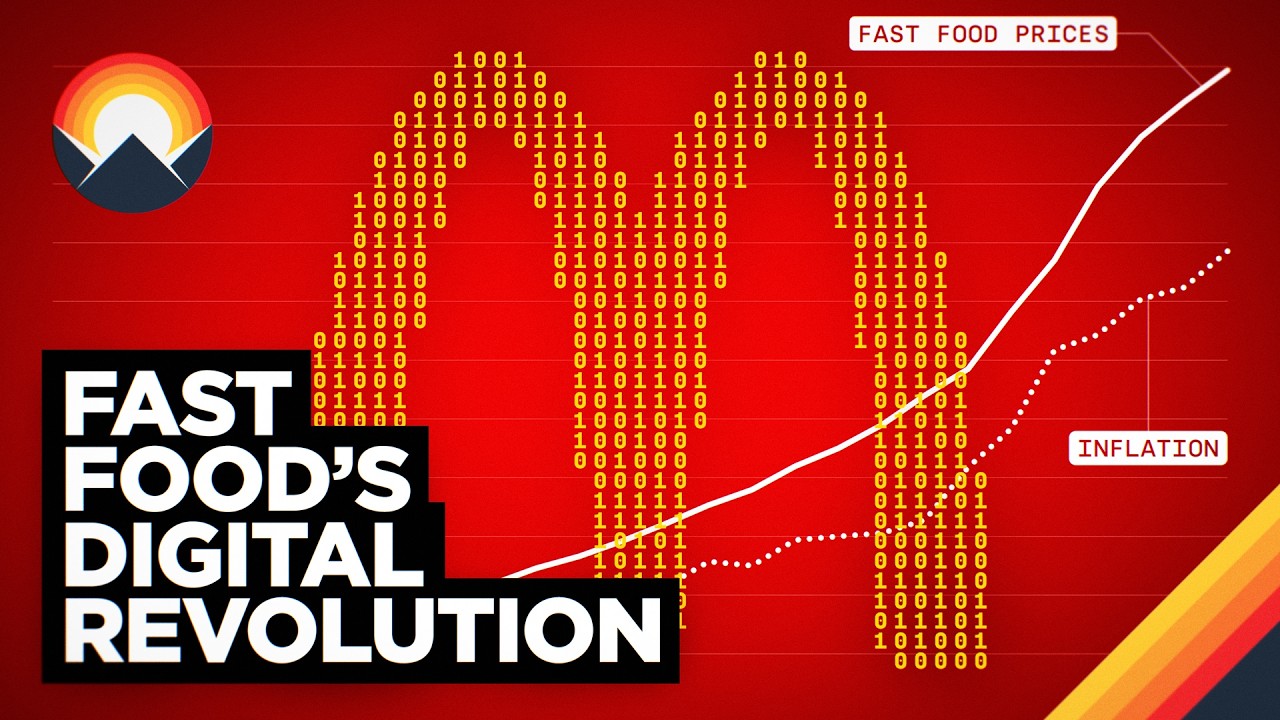
Fast-food chains are raising prices not just due to inflation, but because they are pivoting into tech operations that use hyper-personalized algorithms to steer consumers toward high-margin items.
AI-assisted summary of Why Fast Food Got So Expensive — original source. Check the original for full context.
Source published:
Detailed notes
## Background Published on YouTube on June 1, 2026, by Wendover Productions, this video explores the economic forces behind the rising cost of fast food. The video description encourages viewers to use Ground News to spot media bias and compare news coverage, offering a 40% subscription discount via a dedicated channel link.
## TL;DR The video analyzes the dramatic price hikes in the fast-food industry, moving past basic inflation narratives to reveal a deliberate shift toward data-driven tech operations. While traditional outliers like In-N-Out maintain profitability through high volume, vertical integration, and fresh quality, corporate giants like McDonald's utilize mobile apps, digital kiosks, and curated menus to optimize high-margin sales. Ultimately, the industry is transitioning into a tech-forward ecosystem designed to extract the maximum price consumers are willing to tolerate, paving the way for potential dynamic pricing models.
## Atmosphere & style The presentation is analytical, deeply informative, and intellectually grounded, feeling like an investigative mini-documentary that cuts through public outrage with macroeconomic clarity. The narrative voice balances a serious, objective breakdown of corporate strategies with a touch of modern critical insight, transforming a relatable daily frustration into a fascinating study of behavioral data. It leaves the viewer feeling enlightened yet slightly cautious about the invisible psychological and digital frameworks shaping everyday consumer choices.
## Key takeaways - [00:00](https://www.youtube.com/watch?v=hIOW2HKgzPk&t=0s) An $18 Big Mac meal price documented at a Connecticut rest stop went viral in 2023, sparking intense national debates regarding fast-food pricing. - [00:53](https://www.youtube.com/watch?v=hIOW2HKgzPk&t=53s) Over the past decade, price increases for 'food away from home' at limited-service establishments have consistently outpaced general inflation and grocery costs. - [01:40](https://www.youtube.com/watch?v=hIOW2HKgzPk&t=100s) While fast-food chains blame external macroeconomic pressures like labor, meat, and packaging costs, their rising prices are also driven by deliberate business strategies. - [02:55](https://www.youtube.com/watch?v=hIOW2HKgzPk&t=175s) In-N-Out maintains a traditional, highly consistent, and vertically integrated business model that focuses heavily on food quality and high labor investments. - [05:07](https://www.youtube.com/watch?v=hIOW2HKgzPk&t=307s) McDonald's operates a vastly larger, heavily franchised footprint where maximizing regional food consistency is structurally secondary to technical data optimization. - [06:42](https://www.youtube.com/watch?v=hIOW2HKgzPk&t=402s) A massive, data-driven operational transformation initiated by McDonald's in the 2010s was successfully catalyzed by the rollout of all-day breakfast. - [08:14](https://www.youtube.com/watch?v=hIOW2HKgzPk&t=494s) Fast-food giants have transitioned into tech operations, utilizing mobile apps and digital kiosks to master consumer convenience and automate psychological upselling. - [09:11](https://www.youtube.com/watch?v=hIOW2HKgzPk&t=551s) Main menu burgers frequently function as low-margin loss leaders, requiring chains to use digital platforms to aggressively push high-profit sides and drinks. - [10:44](https://www.youtube.com/watch?v=hIOW2HKgzPk&t=644s) Digital menu curation allows chains to obscure individual product prices, dynamically update menus based on weather, and collect invaluable individual consumer purchasing data. - [13:11](https://www.youtube.com/watch?v=hIOW2HKgzPk&t=791s) To combat a cratering 'perceived value' among low-income diners, McDonald's launched aggressive promotional meal deals to find the exact threshold of consumer tolerance. - [14:40](https://www.youtube.com/watch?v=hIOW2HKgzPk&t=880s) High-margin, proprietary beverage lines like iced 'Refreshers' are priced just low enough to undercut coffee shop competitors while capitalizing on single-stop convenience. - [15:25](https://www.youtube.com/watch?v=hIOW2HKgzPk&t=925s) Wendy's faced major public backlash over mid-day menu price changes, signaling consumer sensitivity to the operational industry push toward dynamic pricing. - [16:45](https://www.youtube.com/watch?v=hIOW2HKgzPk&t=1005s) Ground News helps users analyze modern media bias, factuality, and ownership by aggregating thousands of global sources reporting on major news events. - [18:14](https://www.youtube.com/watch?v=hIOW2HKgzPk&t=1094s) A 'blind spot feed' and subscriber-funded model allow Ground News to expose buried stories and partisan framing, earning an endorsement from the Nobel Peace Center.
## Detailed walkthrough ### [00:00](https://www.youtube.com/watch?v=hIOW2HKgzPk&t=0s) The Virality of the $18 Big Mac
The online backlash against fast food pricing began with a single photograph taken in 2023 at a highway rest stop off Route 95 in Darien, Connecticut. Nestled between a Subway, Dunkin' Donuts, and Sbarro, a McDonald's location was charging an astonishing $18 for a standard Big Mac meal. Rather than reaching for their wallet, a stunned traveler pulled out their phone to document the absurdity, posting the image to Twitter alongside a simple question. The response was immediate and overwhelming; the post went completely viral, sparking massive across-the-board social media debates and making national news headlines. The situation grew so large that McDonald's corporate felt compelled to intervene, releasing an official statement paired with a customized graphic explicitly designed to "bust some myths" about the company's recent pricing trajectory.
The story achieved immense staying power because it served as the perfect, relatable anecdote for a broader phenomenon affecting all Americans: the realization that historically cheap, convenient dining options simply weren't cheap anymore. Research into economic trends validated this collective frustration. Over the past decade, overall food prices have consistently trended higher than the baseline Consumer Price Index (CPI). To make matters worse, the cost of "food away from home" has grown even faster than general grocery prices, and within that specific category, price growth at limited-service, fast-food, and fast-casual establishments has aggressively outpaced sit-down restaurants. Fast food was no longer just reflecting inflation; it was "leading the charge."
[01:40](https://www.youtube.com/watch?v=hIOW2HKgzPk&t=100s) The Industry's Incomplete Defense vs. Real Strategy
In the wake of public outrage over $18 meals, industry insiders and major fast-food chains quickly rolled out a series of defense narratives. They pointed to macroeconomic factors entirely out of their control, such as skyrocketing post-COVID labor costs, California's legislative bill hiking fast-food minimum wage to $20 an hour, and surging retail prices for ground beef. Additionally, operational supplies like paper wrapping, cups, and packaging had shot upward due to a messy cocktail of trade wars, tariffs, and stimulus-driven economic shifts. The corporate consensus was clear: chains were being physically forced to raise prices and hand those costs directly off to the consumer.
However, this widely accepted explanation remains fundamentally incomplete because it treats pricing purely as a reaction to external constraints rather than what it actually is: a deliberate business strategy. Fast food is not just getting pricier because of external pressures; it is changing because the core mechanics of the industry are being actively transformed on the fly. A clear illustration of this strategic divide can be found by comparing two burger joints situated on opposite sides of Interstate 5 in Burbank, California. One represents the ultra-modern, hyper-optimized cutting edge of fast-food evolution, while the other functions as an intentional industry outlier that flatly refuses to abandon its traditional roots.
[02:55](https://www.youtube.com/watch?v=hIOW2HKgzPk&t=175s) A Tale of Two Burgers: In-N-Out vs. McDonald's
The storefronts in Burbank offer a very similar product for nearly identical prices: an In-N-Out Double-Double costs $6.10, while a McDonald's Big Mac sits at $6.49. Yet, despite selling conceptually analogous items, the similarities between the two businesses end there. Their operations and corporate strategies are so radically divergent that In-N-Out genuinely wants you to buy their Double-Double, whereas McDonald's actively hopes you do not. Stripping away personal preferences, the Double-Double is an objectively higher-quality product made entirely from fresh, never-frozen ingredients. In-N-Out processes all its own meat at just two dedicated regional facilities located within a single day's drive of its stores, and they have contracted their buns to the exact same bakery company since the 1950s to guarantee strict freshness and quality consistency.
This commitment to consistency extends directly to the front-of-house customer experience. Every single In-N-Out location features an almost identical physical layout, and staff members are rigorously trained to deliver highly standardized food alongside a genuinely cheery, welcoming attitude. Consequently, whether looking at comparative Google reviews for the Burbank locations or national customer satisfaction rankings, In-N-Out routinely beats McDonald's. It has to, because maintaining that flawless reputation is foundational to its business model, despite carrying an incredibly heavy labor burden.
- **Staffing Levels:** A McDonald's location can easily run a slow shift using only 5 to 10 employees. In contrast, an In-N-Out location requires a baseline of 10 to 15 workers, a figure that regularly balloons to 25 employees during peak lunch and dinner rushes. - **Wages:** In-N-Out staff are paid higher-than-average industry wages; the Burbank location starts employees at $22 an hour, packaged with robust benefits and clear paths for rapid internal promotion. - **Vertical Integration:** To maintain profitability on $5 and $6 burgers while supporting massive labor costs, In-N-Out saves money by owning its real estate outright rather than renting, operating its own meat processing facilities and delivery trucks, and sourcing supplies—from pink lemonade to paper goods—from long-term corporate partners.
[05:07](https://www.youtube.com/watch?v=hIOW2HKgzPk&t=307s) Volume, Footprints, and the Big Data Pivot
Because In-N-Out offers superior food quality, loyal customers will gladly brave a grueling 20-minute drive-thru line or wait inside the store without the modern convenience of ordering ahead through a mobile app. This intense product loyalty translates into staggering financial metrics: an average In-N-Out location generates roughly $6 million in annual revenue, whereas a standard McDonald's pulls in about $4 million. Remarkably, In-N-Out generates 33% more business while operating 15% less time, staying open for an average of 14.5 hours a day compared to McDonald's' 17 hours. Family-owned, clean, and simple, In-N-Out operates exactly like a classic 1950s fast-food joint, which is precisely why it remains an industry outlier with a relatively tiny footprint. In its home state of California, there are only 289 In-N-Out locations compared to more than 1,200 McDonald's; in Burbank alone, McDonald's outnumbers In-N-Out four to one.
With 14,000 locations across the United States—only 5% of which are owned and operated directly by the public corporation—McDonald's simply cannot maximize regional food quality or consistency like In-N-Out can, nor are they financially incentivized to do so. Instead, McDonald's initiated a massive, data-driven transformation in the 2010s to combat stagnating sales and ward off encroaching fast-casual competitors. Under the leadership of CEO Steve Easterbrook, who envisioned McDonald's as a "modern, progressive burger company," the chain prioritized tech-driven operations, cleaner chicken, and fresher beef. The catalyst for this shift was the rollout of all-day breakfast. Though corporate leadership initially feared the move would complicate kitchen workflows and cannibalize lunch sales, they relied on data modeling alongside tech firm Applied Predictive Technologies and the NPD Group to execute regional trials. The receipt data proved that all-day breakfast successfully brought back lapsed customers and lifted overall check sizes, as midday diners frequently added a standalone Egg McMuffin or hash brown to their standard lunch orders.
[08:14](https://www.youtube.com/watch?v=hIOW2HKgzPk&t=494s) Turning Real Estate into Big Tech
While regional price differences between McDonald's locations in Aztec, New Mexico, Newcastle, Colorado, and Burbank, California reflect localized, uncontrollable variables like independent franchisee choices and regional labor rates, the real secret to modern fast-food optimization lies in the medium used to order: touch-screen kiosks and mobile phones. Historically, industry insiders loved to point out that McDonald's is secretly a real estate company because it owns the land underneath its franchises and relies heavily on rent collection. While that remains fundamentally true, over the past decade, McDonald's and its primary competitors have quietly transitioned into full-fledged tech operations, leveraging digital platforms to master consumer convenience.
In 2019, McDonald's made its largest corporate acquisition in 20 years by purchasing an artificial intelligence company called Dynamic Yield. This tech acquisition allowed the company to completely upend and personalize the ordering experience using real-time user data and historical trends. To understand why this matters, one must look at the profitability of a core item like the Big Mac:
> "Now, really, no matter its price, a Big Mac is either a loss leader or only derives a tiny turn of profit for a McDonald's location."
In the past, McDonald's relied on physical menu boards, colorful posters, and cashiers asking customers if they wanted to upgrade to a meal to drive profitable add-on sales. Because fountain drinks and french fries carry exponentially higher profit margins than burgers, getting a customer to buy the bundle is a massive win, while selling a standalone sandwich is often a financial wash. Today, digital kiosks, mobile applications, and smart drive-thru boards have automated and optimized this psychological upselling via highly sophisticated, hyper-personalized sales algorithms.
[10:44](https://www.youtube.com/watch?v=hIOW2HKgzPk&t=644s) The Era of Curated Menus and Consumer Data
The days of the sweeping, static drive-thru menu board listing every single option are officially over. Today, digital menus are heavily curated to show consumers exactly what corporate wants them to see. For example, at certain locations in New Mexico, the prominent drive-thru screens display only complex Extra Value Meals; if a customer wants to order a standalone Big Mac without the fries and drink, they are forced to actively ask the employee for it, and they must ask aloud if they want to know the individual price before paying. This minimalist curation keeps drive-thru lines moving quickly during peak rush hours while passively nudging consumer habits toward high-margin items. The digital boards even adapt automatically to external environmental factors—such as prominently pushing high-profit ice cream and cold beverages on intensely hot summer days.
- **The Kiosk Data Trap:** Customers seeking the full, uncurated menu are pushed toward in-store kiosks or the mobile app, both of which aggressively ask for personal data. Kiosks repeatedly prompt users to log into their corporate accounts, forcing them to navigate past premium, high-margin items like "Refreshers" or novelty luxury items like the "Archburger" just to find a basic sandwich. - **App Incentivization:** The mobile app keeps users permanently logged in by dangling loyalty points, birthday rewards, and standard promotions like a free medium fry to get diners through the door. - **The Value of Consumer Behavior Data:** This digital ecosystem grants McDonald's precise visibility into individual purchasing thresholds. If the system logs that a customer regularly purchases a Big Mac at $6.10 but entirely stops ordering or abandons the brand when the price ticks up to $6.49, corporate gains invaluable data to dynamically adjust national pricing strategies.
[13:11](https://www.youtube.com/watch?v=hIOW2HKgzPk&t=791s) The Perceived Value Illusion
While changing physical food ingredients across a massive global supply chain is an incredibly slow and difficult task, screens and big data allow McDonald's to instantly fine-tune pricing structures to extract the maximum amount a consumer is willing to tolerate. Following the viral outrage over the $18 Connecticut meal, investors expressed serious concern during a corporate earnings call that McDonald's was losing its low-income customer base as its "perceived value" cratered. Corporate responded with an aggressive value push, launching a temporary $5 meal deal in mid-2024, followed by a broader "McValue" menu the following year. While these value initiatives successfully reversed falling sales trends across breakfast and lunch categories, a traveler visiting the Darien, Connecticut rest stop would still find a standard Big Mac meal priced at nearly $18.
This disparity exists because McDonald's understands that the word "perceived" does the heavy lifting in value metrics. McDonald's is no longer competing in the business of cheap or high-quality food; it is firmly in the business of selling hyper-convenient food at a "stomachable price." Every piece of technology—from the app to reorganized drive-thru workflows—is designed to drive ticket times down because the modern consumer demands multi-product convenience at a breakneck pace. To capitalize on this, McDonald's constantly monitors data and alters value configurations to locate the exact threshold of consumer tolerance. Their recent, aggressive push into a proprietary line of iced "Refreshers" priced between $3.69 and $4.69 serves as a prime example. While these drinks are incredibly cheap to manufacture and yield massive profit margins, they are priced just low enough to undercut premium beverage competitors like Starbucks, Dutch Bros, and Sonic, effectively convincing consumers they are getting a good deal while capitalizing on the convenience of a single-stop food and beverage purchase.
[15:25](https://www.youtube.com/watch?v=hIOW2HKgzPk&t=925s) The Tech Pivot and the Threat of Dynamic Pricing
The digital transition stretching across the fast-food landscape goes far beyond the Golden Arches. Yum Brands' Taco Bell has strategically split its mobile app menu into "bifurcated" options, pushing extreme value items alongside high-dollar bundle deals. From Jimmy John's to Panera Bread, nearly every fast-casual player relies heavily on mobile apps and digital loyalty programs. However, this optimization push occasionally triggers severe backlash. Wendy’s found itself in "hot water" after launching a digital menu system capable of altering product prices mid-day. The public immediate labeled it "surge pricing," sparking an industry-wide outcry and an accusation no restaurant wants to face: practicing dynamic pricing.
While fast-food executives actively distance themselves from the "dynamic pricing" label due to the deep consumer distrust it engenders, the underlying data processing infrastructure is already fully operational. Big chains might not alter their menus hour-by-hour just yet, but they routinely shift product prices and value menu layouts every few months. Given how heavily the fast-food sector has leaned into optimization and efficiency over the last decade, hourly and customer-specific pricing structures are the logical next step. Customers have already "come to stomach rising costs," suggesting that if dynamic pricing is introduced slowly and quietly enough, they may eventually embrace it too.
* Taco Bell utilizes a bifurcated menu strategy focusing on extreme value items and high-dollar bundles via their app. * Wendy's faced major public backlash after introducing digital menus capable of mid-day price changes. * Fast-food chains routinely adjust their overall pricing and value menu structures every few months.
---
[16:45](https://www.youtube.com/watch?v=hIOW2HKgzPk&t=1005s) Sponsoring Media Literacy: Navigating News Framings with Ground News
Modern media ecosystems excel at amplifying stories but fail at helping people genuinely understand them, often fragmenting major news events into thousands of reaction-driven headlines. The speaker notes that during the production of this very video, news broke that the head of the Food and Drug Administration (FDA) had resigned. To cut through the noise and understand how the story was being actively framed rather than just reading the event itself, the speaker turned to the video's sponsor, Ground News. Ground News serves as a central hub gathering reports from over 50,000 global sources, allowing users to analyze an outlet's bias, factuality, and ownership structure.
When analyzing the FDA resignation on the platform, the speaker observed over 350 sources covering the event, revealing a stark partisan divide in real-time headline framing. A right-leaning source framed the departing FDA chief, Marty Makary, as being at odds with the current administration. Conversely, a left-leaning outlet framed Makary explicitly as "Trump's FDA chief" before pivoting to how the new appointment aligns with the president. This distinct framing signals to the consumer that they must investigate further before mindlessly echoing either side's narrative.
* Ground News aggregates stories from more than 50,000 sources worldwide. * The FDA resignation story drew coverage from over 350 individual news sources. * Marty Makary's resignation was heavily politicized, with left- and right-leaning outlets framing his relationship to the president in opposing ways.
---
[18:14](https://www.youtube.com/watch?v=hIOW2HKgzPk&t=1094s) Checking Biases and Clean News Diets
Beyond tracking mainstream headlines, Ground News features a "blind spot feed" that surfaces stories disproportionately covered by only one side of the political spectrum—exposing buried news that consumers might otherwise miss entirely. The speaker admits that even as someone whose job is to deep-dive into complex topics like fast-food prices, it is incredibly difficult to find the time and energy to dissect every single news event. Ground News provides a vital shortcut by mapping out the exact talking points of each side, highlighting where consensus exists and where the disconnects lie.
Ultimately, the platform serves as an essential tool for self-reflection, helping users check their own biases and avoid falling for the "overly simplistic or unfair characterizations" dominating modern media. The platform's positive impact on media literacy has even earned it an endorsement from the Nobel Peace Center. Because Ground News is entirely subscriber-funded, it remains free from corporate influence over what users see. Viewers are offered a 40% discount on the unlimited access Vantage subscription by using the partner link `ground.news/wendover`.
* The "blind spot feed" highlights news stories that are being ignored or buried by one side of the political spectrum. * Ground News has been officially endorsed by the Nobel Peace Center for its contributions to media literacy. * The platform is entirely subscriber-funded to prevent corporate influence from dictating news curation. * Viewers can access a 40% discount on the Vantage subscription tier via the dedicated channel link.
## Notable quotes > [00:00](https://www.youtube.com/watch?v=hIOW2HKgzPk&t=0s) bust some myths
> [00:00](https://www.youtube.com/watch?v=hIOW2HKgzPk&t=0s) food away from home
> [00:00](https://www.youtube.com/watch?v=hIOW2HKgzPk&t=0s) leading the charge
> [05:07](https://www.youtube.com/watch?v=hIOW2HKgzPk&t=307s) modern, progressive burger company — Steve Easterbrook
> [08:14](https://www.youtube.com/watch?v=hIOW2HKgzPk&t=494s) Now, really, no matter its price, a Big Mac is either a loss leader or only derives a tiny turn of profit for a McDonald's location.
> [13:11](https://www.youtube.com/watch?v=hIOW2HKgzPk&t=791s) perceived value
> [13:11](https://www.youtube.com/watch?v=hIOW2HKgzPk&t=791s) McValue
> [13:11](https://www.youtube.com/watch?v=hIOW2HKgzPk&t=791s) stomachable price
> [15:25](https://www.youtube.com/watch?v=hIOW2HKgzPk&t=925s) bifurcated
> [15:25](https://www.youtube.com/watch?v=hIOW2HKgzPk&t=925s) hot water
> [15:25](https://www.youtube.com/watch?v=hIOW2HKgzPk&t=925s) surge pricing
> [15:25](https://www.youtube.com/watch?v=hIOW2HKgzPk&t=925s) dynamic pricing
> [15:25](https://www.youtube.com/watch?v=hIOW2HKgzPk&t=925s) customers have already "come to stomach rising costs,"
> [16:45](https://www.youtube.com/watch?v=hIOW2HKgzPk&t=1005s) Trump's FDA chief
> [18:14](https://www.youtube.com/watch?v=hIOW2HKgzPk&t=1094s) overly simplistic or unfair characterizations
## Mentioned Big Mac, Subway, Dunkin' Donuts, Sbarro, McDonald's, Twitter, Consumer Price Index, In-N-Out, Double-Double, Google, Steve Easterbrook, Applied Predictive Technologies, The NPD Group, Egg McMuffin, Dynamic Yield, Refreshers, Archburger, Starbucks, Dutch Bros, Sonic, Yum Brands, Taco Bell, Jimmy John's, Panera Bread, Wendy's, Food and Drug Administration, FDA, Ground News, Marty Makary, Donald Trump, Nobel Peace Center, Vantage
[Source](https://www.youtube.com/watch?v=hIOW2HKgzPk)