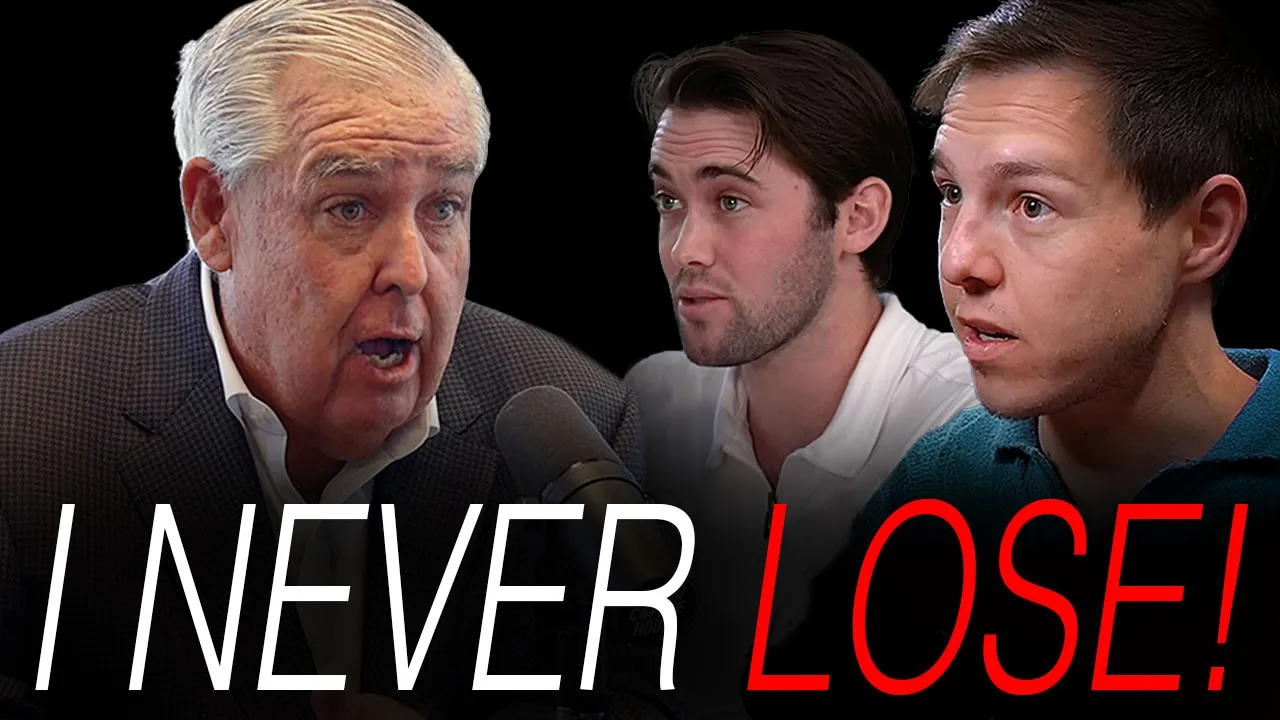
John Morgan Pours $600M into Law Ads, Warns Wealth Gap Invites Revolt
The Iced Coffee Hour
Morgan argues that ultra-wealthy Americans risk violent populist uprisings unless policymakers end corporate tax loopholes and protect the middle class that functions as their buffer.
Morgan & Morgan achieved over $2 billion in revenue in the previous year, supported by an annual marketing budget of roughly $600 million and over 1,200 attorneys nationwide. (0:00)
John Morgan defines a genuine billionaire as having $1 billion in liquid cash or brokerage assets, dismissing traditional celebrity net worth valuations derived from high EBITDA multiples. (38:34)
Morgan advocates for a financial independence benchmark of $30 million in liquid assets plus a paid-off primary home, which can generate $100,000 monthly tax-free through municipal bonds. (88:30)
Warning against extreme wealth disparity, Morgan argues the middle-class 'moat' protecting wealthy elites is thinning, creating risks of violent social unrest and revolution. (74:48)
Detailed notes
## Background
Published on YouTube by The Iced Coffee Hour (hosted by Graham Stephan and Jack Selby) on August 27, 2026, this nearly two-hour interview features billionaire trial lawyer John Morgan, founder of Morgan & Morgan. The video description outlines a wide-ranging conversation covering the economics of personal injury law, his $600 million annual marketing budget, wealth accumulation, crypto skepticism, income inequality, and personal parenting and marriage advice.
## TL;DR
John Morgan breaks down the mechanics of building America's largest personal injury law firm—generating over $2 billion in annual revenue—and explains why he spends $600 million a year on marketing while taking only 6% to 7% of incoming case leads. He distinguishes between paper net worth and having a literal billion dollars in liquid assets, detailing how he compounded his fortune through extreme patience, commercial real estate, entertainment attractions like WonderWorks, and a billboard exit rather than high-risk schemes like cryptocurrency. Throughout the conversation, Morgan critiques corporate tort reform myths (such as the McDonald's hot coffee case) and warns that widening income inequality and tax loopholes threaten to drain the middle-class 'moat' protecting the wealthy. Finally, he shares his personal formula for financial independence—$30 million in tax-free municipal bonds plus a paid-off house—alongside his strict approaches to remote employee monitoring and parenting.
## Atmosphere & style
The conversation carries a blunt, unfiltered, and bombastic energy, driven by John Morgan's folksy yet ruthless Southern storytelling style. Hosts Graham Stephan and Jack Selby act as curious, engaged sounding boards, prompting Morgan with financial and philosophical questions and letting him hold court with colorful analogies—ranging from 'hunting money' and 'Kentucky dog poop' to castles and moats. The mood shifts seamlessly between hard-nosed business brass tacks, humorous guerrilla marketing confessions, and sober warnings about societal unrest and greed, making it feel like an unvarnished mentorship session with a street-smart tycoon who has zero interest in corporate political correctness.
## Bulletin
- [00:00](https://www.youtube.com/watch?v=QcmFzUrhhrc&t=0s) Morgan & Morgan achieved over $2 billion in revenue in the previous year, supported by an annual marketing budget of roughly $600 million and over 1,200 attorneys nationwide.
- [38:34](https://www.youtube.com/watch?v=QcmFzUrhhrc&t=2314s) John Morgan defines a genuine billionaire as having $1 billion in liquid cash or brokerage assets, dismissing traditional celebrity net worth valuations derived from high EBITDA multiples.
- [01:28:30](https://www.youtube.com/watch?v=QcmFzUrhhrc&t=5310s) Morgan advocates for a financial independence benchmark of $30 million in liquid assets plus a paid-off primary home, which can generate $100,000 monthly tax-free through municipal bonds.
- [01:14:48](https://www.youtube.com/watch?v=QcmFzUrhhrc&t=4488s) Warning against extreme wealth disparity, Morgan argues the middle-class 'moat' protecting wealthy elites is thinning, creating risks of violent social unrest and revolution.
## Key takeaways
- [01:27](https://www.youtube.com/watch?v=QcmFzUrhhrc&t=87s) Personal injury contingency law relies on strict case filtering, with Morgan & Morgan accepting only 6% to 7% of incoming leads while avoiding frivolous suits that insurers happily bill hourly to fight.
- [04:33](https://www.youtube.com/watch?v=QcmFzUrhhrc&t=273s) Aggressive, unconventional marketing strategies, such as acquiring injury.com for $4 million and deliberately vandalizing firm billboards, drive roughly 3 million client leads annually.
- [16:40](https://www.youtube.com/watch?v=QcmFzUrhhrc&t=1000s) Mass tort settlements often appear larger than their net returns because litigation spanning decades carries massive overhead, shared fees, and court-mandated fee caps.
- [21:56](https://www.youtube.com/watch?v=QcmFzUrhhrc&t=1316s) Asset protection strategies like joint tenancy by the entirety and umbrella policies are highly effective, whereas transferring assets after learning of an impending lawsuit constitutes fraudulent conveyance.
- [35:15](https://www.youtube.com/watch?v=QcmFzUrhhrc&t=2115s) The 1992 McDonald's hot coffee lawsuit was weaponized by corporate interests to advance statutory tort reform despite hundreds of documented prior burn injuries.
- [45:35](https://www.youtube.com/watch?v=QcmFzUrhhrc&t=2735s) Extreme patience separates centi-millionaires from standard multi-millionaires; promising fixed double-digit returns is an immediate indicator of fraud or extreme risk.
- [48:52](https://www.youtube.com/watch?v=QcmFzUrhhrc&t=2932s) Cryptocurrency mirrors Dutch tulip mania driven by herd psychology, contrasting with proven business fundamentals that should be played strictly by the mathematical book.
- [59:51](https://www.youtube.com/watch?v=QcmFzUrhhrc&t=3591s) Innate drive and circumstantial luck play massive roles in worldly success, undermining the notion that pure physical labor alone creates extraordinary financial outcomes.
- [01:07:38](https://www.youtube.com/watch?v=QcmFzUrhhrc&t=4058s) Failing ventures can be salvaged by pivoting, as demonstrated by relocating an underperforming D.C. crime museum to Tennessee to generate $6 million to $7 million annually.
- [01:10:09](https://www.youtube.com/watch?v=QcmFzUrhhrc&t=4209s) The 'Send Delete' management structure pairs high-level visionaries with reliable operators to ensure seamless execution and clear accountability across large organizations.
- [01:14:48](https://www.youtube.com/watch?v=QcmFzUrhhrc&t=4488s) Malicious envy fueled by conspicuous consumption and tax loopholes threatens democratic stability, requiring strong social safety nets and living wages.
- [01:50:53](https://www.youtube.com/watch?v=QcmFzUrhhrc&t=6653s) Corporate tort reform does not reduce consumer insurance premiums; instead, carriers retain savings as corporate profits or dividend payouts.
- [01:53:11](https://www.youtube.com/watch?v=QcmFzUrhhrc&t=6791s) Foundational parenting must be established prior to age five, backed by strict discipline and isolating children from destructive peer influences.
## Detailed walkthrough
### [00:00](https://www.youtube.com/watch?v=QcmFzUrhhrc&t=0s) Hunting Money, Not Deer
Graham Stephan and Jack Selby kick off the conversation with attorney John Morgan by acknowledging his status as a confirmed, liquid billionaire running one of the largest law firms in North America. Reflecting on his aggressive drive, Graham references Morgan's well-known motto: he does not hunt deer—he hunts money. Morgan doubles down on the metaphor, noting that just as dedicated deer hunters or fishermen never stop heading into the woods or out onto the water, he remains fully addicted to the hunt and has no intention of stopping.
When Graham highlights that Morgan & Morgan generated over $2 billion in revenue in the previous year alone, he asks what people misunderstand most about running a mega-firm in the legal space. Morgan responds that the general public fundamentally misjudges both the economics and the morality of personal injury litigation.
---
[01:27](https://www.youtube.com/watch?v=QcmFzUrhhrc&t=87s) What Everyone Gets Wrong About Personal Injury Lawyers
The dominant misconception pushed by corporate interests is that personal injury attorneys are "ambulance chasers" running around filing frivolous lawsuits in search of "jackpot justice." Morgan explains that the math behind personal injury makes filing meritless cases suicidal: his firm operates on contingency, meaning they only get paid if they win. They accept a mere 6% to 7% of the incoming inquiries they receive. Going to court against insurance conglomerates requires massive capital reserves because corporate opponents have virtually bottomless pockets. Wasting hundreds of thousands of dollars on bogus claims would bankrupt even large operations.
Morgan points out the hypocrisy of the insurance lobby's rhetoric around tort reform. In reality, insurance defense attorneys secretly adore frivolous claims because defense lawyers bill by the hour. When an insurance defense lawyer is handed a meritless lawsuit, they churn billable hours with delight because they know the carrier will never have to pay out a settlement. If a case is truly frivolous, an insurer refuses to settle for a single dime, forcing the dispute before a jury of peers—the exact same civic institution entrusted with life-or-death criminal verdicts.
To Morgan, personal injury practice is not a legal racket; it is inherently "righteous." When an innocent client suffers a catastrophic event through no fault of their own, their health, livelihood, companionship, or enjoyment of life is stripped away. While a lawyer cannot reattach an amputated limb, they can wield the civil justice system to force the responsible parties to compensate the victim for everything that was taken.
---
[04:33](https://www.youtube.com/watch?v=QcmFzUrhhrc&t=273s) Spending $600M a Year and The Art of Attention
Turning to marketing, Graham brings up Morgan's reputation for having spent over a billion dollars on advertising. Morgan quickly corrects him: the career total is far higher, and his annual marketing budget for the current year alone is around $600 million—adjusted upward from an initial $500 million projection as the firm continues expanding into major new metropolitan markets. As part of that push, he recently shelled out $4 million to acquire the premium domain name `injury.com`. His reasoning was simple psychological dominance: he wanted a digital asset so definitive that competitors would feel a literal chill run up their spines whenever they drove past a billboard bearing the address.
```mermaid
flowchart TD
accTitle: Morgan and Morgan Branding Decision Tree
accDescr: Chart illustrating why John Morgan selected For The People over other domain names based on consumer literacy.
subgraph Evaluation ["Domain & Slogan Evaluation"]
A["Marketing Objective:<br/>Unforgettable Name"]
B["'Justice For All'"]
C["'PersonalInjury.com'"]
D["'For The People'<br/>& 'Injury.com'"]
end
subgraph Strategy ["Winning Strategy"]
G["Dead-simple words:<br/>'For' (kindergarten level)"]
H["The Purple Cow Effect:<br/>Instant recall in a sea of brown cows"]
end
A --> B
A --> C
A --> D
B -.->|"Rejected due to spelling"| E
C -.->|"Too long & prone to typos"| F
D --> G
G --> H
```
Morgan breaks down his advertising philosophy by targeting human attention spans, which he compares to those of gnats. Decades ago, before BlackBerries even existed, he had to settle on a universal firm slogan and URL. His final shortlist came down to "Justice for All" versus "For the People." He deliberately rejected "Justice for All" because the average American reads at a sixth- or seventh-grade level, and many prospective clients struggle to spell words like "justice" or "personal." In contrast, words like "for" and "the" are learned in kindergarten.
To stand out in an oversaturated market, Morgan adheres to the "Purple Cow" principle:
- If someone is shown a single brown cow among a herd of 1,000 brown cows and asked to identify it six months later, they will likely fail.
- If one cow in that herd is vivid purple, they will easily spot it even 60 years later.
- Insurance giants like Geico, Progressive, and State Farm capture massive market share by relying heavily on humor and memorable characters (leading Morgan to hire his marketing director directly from Geico).
- Personal injury advertising cannot rely on boring talking heads reciting dry legal disclaimers; it must be educational, provocative, or funny enough to make viewers hit rewind.
---
[08:46](https://www.youtube.com/watch?v=QcmFzUrhhrc&t=526s) Viral Guerilla Marketing and Iconic Ads
To engineer "purple cows," Morgan frequently pushes creative boundaries. He sparked widespread public outrage with his "Size Matters: America's Largest Injury Law Firm" billboards. When moralizing critics complained that the double entendre was vulgar, Morgan turned the accusation back on them, retorting that anyone reading filth into the size of a firm simply had a dirty mind.
In another calculated stunt, Morgan orchestrated the "vandalism" of his own billboards across college towns. He dispatched crews to deface his own face, spray-painting blacked-out teeth, fake mustaches, and drawing over "For the People" to read "For the Money." The campaign generated massive organic attention:
- Drivers pulled over on busy thoroughfares like Alafaya Trail near UCF to snap photos.
- Images went viral across social media feeds without the firm paying an extra cent for distribution.
- Local TV news stations covered the "defaced" billboards on the evening news, asking Morgan for comment while unwittingly granting him free broadcast airtime.
Morgan reveals that his best ideas originate from gut instinct rather than focus groups. His next campaign, inspired by Art Linkletter's classic segments and *Kids Say the Darndest Things*, involves filming toddlers in high chairs at an Orlando studio and asking them unscripted questions about Morgan & Morgan to chop into humorous, human-scale spots. When asked what he considers the greatest advertisement of all time, Morgan points to Coca-Cola's legendary 1971 hilltop commercial ("I'd Like to Buy the World a Coke"), praising the way the AMC drama *Mad Men* concluded Don Draper's arc with the creation of that very cultural milestone.
[11:17](https://www.youtube.com/watch?v=QcmFzUrhhrc&t=677s) Super Bowl Ads, Marketing Strategy, and NASCAR Sponsorships
Reflecting on iconic advertising—drawing a comparison to the finale of *Mad Men*, where the lead character meditates on a cliff in Hawaii and conceives the legendary "I'd like to teach the world to sing" Coca-Cola commercial—the conversation turns to John Morgan’s colossal marketing footprint. When asked why Morgan & Morgan does not buy a national Super Bowl commercial, Morgan reveals that while he is pitched constantly, he wrestles with the platform's return on investment. Beyond costing "millions and millions," national Super Bowl spots carry major strategic risks: if the game turns into a blowout, viewership plummets before the second half, and airtime placement in the broadcast is make-or-break.
Instead of shelling out for a full national broadcast, Morgan has opted for targeted regional slots in designated market areas (DMAs). He argues that many brands buy Super Bowl ads purely out of corporate vanity, resulting in uninspired, forgettable commercials. In contrast, the ads that truly succeed—such as the emotionally resonant Budweiser Clydesdales campaigns—give viewers "cold chills" and demand rewinds.
When discussing the most he has ever spent on a marketing campaign, Morgan points to his ventures in sports sponsorships and celebrity talent. He spent millions partnering with NASCAR, sponsoring race cars, and producing commercials featuring figures like NASCAR driver Kyle Busch and golfer John Daly alongside his son. Because Morgan owns the car branding and broadcast rights for the races, the investment was substantial, though certain campaigns had to be shelved after tragic turns of events.
* **Super Bowl Strategy:** Regional DMA buys rather than national buys, avoiding blowout-audience drops and vanity-driven ad spend.
* **Celebrity Talent & NASCAR:** Spent millions acquiring car sponsorship rights and filming ads with athletes like Kyle Busch and John Daly.
* **Lead Volume:** The firm receives roughly 3 million leads annually—a figure comparable to approximately 1% of the total United States population.
---
[13:42](https://www.youtube.com/watch?v=QcmFzUrhhrc&t=822s) Suing Friends, "Diplomatic Immunity," and Career-Defining Verdicts
With Morgan & Morgan handling hundreds of thousands of inquiries, Graham asks whether Morgan has ever had to sue a friend. Morgan candidly points out the distinction between true friends and mere acquaintances: "Everybody's your friend when you're going to sue them." In awkward situations involving acquaintances, Morgan typically calls the person directly to offer a choice: Morgan can take the case and handle it fairly, or let an outside, potentially ruthless attorney take it who might turn the suit into something bordering on extortion. Given the choice, acquaintances frequently prefer Morgan to handle it because they know he won't be vindictive.
For genuine, close friends, Morgan grants what he calls "diplomatic immunity," insisting he does not need the money badly enough to litigate against real relationships. However, that generosity has backfired. Morgan recounts an instance involving a high school basketball teammate who became a doctor and faced a severe medical malpractice suit. Morgan gave his old buddy the option to have him step aside. The doctor asked him not to take it; the case ultimately settled for $4 million with another lawyer, meaning Morgan forfeited a $1.6 million contingency fee. "Funny thing about that," Morgan notes wryly, "I never saw him again for the rest of my life. So, I've been thinking about that 1.4!"
Turning to the largest verdicts and settlements of his career, Morgan outlines an astonishing record of massive mass torts, class actions, and trials:
* **Google:** Won a $500 million verdict against Google in San Francisco.
* **Black Farmers Litigation:** Achieved a historic $1.2 billion settlement.
* **Maui Wildfires:** Serving as one of the lead attorneys for the fire victims in Hawaii (where he spends his winters), reaching a $4.7 billion settlement.
* **Major Mass Torts:** Played key roles in the BP Deepwater Horizon oil spill litigation and serves on the National Prescription Opiate Multidistrict Litigation (MDL).
Jack and Graham highlight the logistical realities of running their podcast and media company. After moving into their Las Vegas warehouse studio, having the team work together in person proved game-changing. However, constant travel requires remote access to their main editing computers back home. They partner with AnyDesk, a secure remote desktop platform that allows users to access desktop files, mirror displays, and copy-paste files of any size from a laptop, tablet, or phone with built-in encryption and two-factor authentication.
---
[16:40](https://www.youtube.com/watch?v=QcmFzUrhhrc&t=1000s) The Real Economics of $100M Verdicts and 1,200 Lawyers
When pressed on how much an attorney actually pockets from a headline-grabbing lawsuit, Morgan debunks the popular myth that personal injury lawyers simply pocket a flat 33% to 40% of every billion-dollar headline. In massive mass torts, litigation frequently drags on for a decade or more. When a multi-million-dollar legal fee is divided over ten years of operational expenses, expert witnesses, and staffing, the annualized return is far lower than it appears. Furthermore, single-event fee models do not apply to multi-billion-dollar MDLs; for example, on the $1.2 billion Black Farmers settlement, total legal fees were $90 million, nowhere near a third.
Morgan also underscores that giant jury verdicts often face steep appellate reductions, state statutory caps, or defendants who simply lack sufficient liability insurance to ever pay the full amount. Jack and Graham bring up a friend in Los Angeles who secured a $50 million settlement for a drive-thru patron burned by hot tea. Morgan responds that he recently handled a hot coffee case resulting in a $5 million verdict—momentarily misspeaking and saying "five billion" before correcting himself with a laugh, joking that the slip of the tongue was probably just lettuce on his tooth sliding down.
Across his career, Morgan's firm had generated approximately $35 billion in aggregate verdicts and settlements by the start of the year. Keeping an operation of that magnitude running requires enormous overhead to support over 1,200 attorneys nationwide. Morgan explains that he structures firm compensation so that attorney bonuses are directly tied to individual trial and settlement production: "What I want to do is pay them a load of money. I want my lawyers' bonuses to be astronomical."
---
[19:16](https://www.youtube.com/watch?v=QcmFzUrhhrc&t=1156s) "Loser Pays," Frivolous Lawsuits, and Florida's Proposal for Settlement
The conversation turns to civil litigation reform when Graham asks why the American legal system does not universally enforce an English-style "loser pays" rule, where the defeated party covers the winner's legal expenses. Graham shares his frustration with California's legal environment, where frivolous lawsuits are frequently weaponized as shakedowns—plaintiffs demand a $20,000 settlement under the threat that defending the case in court would cost the defendant $50,000.
Morgan pushes back on the assumption that plaintiffs' attorneys fear fee-shifting, declaring: "The first person who runs for 'loser pays' is me, because I don't lose. They lose... because I get to pick the case." He explains that many jurisdictions already have sophisticated fee-shifting mechanisms. In Florida, the system utilizes a statutory vehicle known as a **Proposal for Settlement (PFS)** or demand for judgment, which establishes a strict 25% threshold penalty for parties who reject reasonable settlement offers. Morgan utilizes a PFS in roughly 95% to 96% of his firm's cases to guarantee that insurance companies pay his legal fees when they lose at trial.
```mermaid
flowchart TD
accTitle: Florida Proposal for Settlement Fee Shifting Rule
accDescr: Flowchart illustrating how a 25 percent variance in trial verdict triggers legal fee shifting under Florida's Proposal for Settlement rule.
subgraph DefenseProposal["Defendant Offers Settlement (e.g., $10,000)"]
D1["Plaintiff Rejects Offer"] --> D2{"Jury Verdict Amount"}
D2 -->|"Verdict is >= 25% LESS than offer (< $7,500)"| D3["LOSER PAYS:<br/>Plaintiff must pay Defendant's legal fees"]
D2 -->|"Verdict is within 25% range"| D4["Standard Rule:<br/>Each party pays own legal fees"]
end
subgraph PlaintiffProposal["Plaintiff Demands Settlement"]
P1["Defendant Rejects Demand"] --> P2{"Jury Verdict Amount"}
P2 -->|"Verdict is >= 25% GREATER than demand"| P3["FEE SHIFTING:<br/>Defendant must pay Plaintiff's legal fees"]
P2 -->|"Verdict is within 25% range"| P4["Standard Rule:<br/>Each party pays own legal fees"]
end
```
When Jack notes that prevailing defendants often face an uphill battle collecting attorney fees from unprincipled opponents who hide assets, Morgan points out that the law provides remedies through "fraudulent conveyance" actions. He jokingly offers to take the case and hunt down the hidden funds himself, setting up a deeper debate on timing, asset protection, and pre-litigation transfers.
[21:56](https://www.youtube.com/watch?v=QcmFzUrhhrc&t=1316s) Fraudulent Conveyance and Getting Sued as a Business Owner
The discussion opens on the mechanics of debtor defense and asset transfers. Moving money around once an individual has knowledge that a lawsuit is looming constitutes fraudulent conveyance, allowing the court to set those transfers aside. If the assets were already moved well before any claim arose, however, it does not qualify as fraudulent conveyance. Graham notes that in his experience in the real estate space, landlords frequently settle out-of-pocket repeatedly rather than filing insurance claims, even in jurisdictions where they might prevail.
John Morgan counters by emphasizing that he sits on both sides of the courtroom. Outside his law firm, he owns extensive commercial real estate holdings—attractions, hotels, shopping centers, billboard operations, and banks—which means he gets sued constantly. When plaintiffs' attorneys approach him about potential accidents at his venues, Morgan’s typical response is: "Sue me because if I fucked up, I want to pay. If I'm negligent, I want to pay. That's why I have insurance." If he made an error, he is willing to satisfy the claim through coverage, and if not, he takes it to trial and defends it. When Graham points out that landlords face skyrocketing California premiums and policies that carve out habitability coverage (prompting $20,000 nuisance settlements to dodge $60,000 legal defense costs), Morgan remains skeptical of panic-driven payouts, pointing out that he owns commercial bar properties directly across the street and does not face those unresolved exposures.
```mermaid
flowchart TD
accTitle: Pre-Suit Planning vs Post-Notice Transfer Flowchart
accDescr: Visualizing the legal difference between timely asset planning and fraudulent conveyance after notice of a lawsuit.
subgraph LegalTiming["Asset Protection Timing"]
A["Asset Transfer Before Legal Knowledge"] --> B["Legitimate Estate & Asset Shielding"]
C["Lawsuit Threat Arises / Knowledge Acquired"] --> D["Asset Transfer After Notice"]
D --> E["Fraudulent Conveyance: Courts Set It Aside"]
end
```
[24:41](https://www.youtube.com/watch?v=QcmFzUrhhrc&t=1481s) Structuring Assets, Estates, and Umbrella Insurance
When Graham asks how Morgan would protect his own assets if he were on the defense side, Morgan clarifies the distinction between legal specialties: he is a courtroom trial lawyer, not an estates and trusts specialist. To safeguard his own fortune, he retained Palm Beach trusts attorney Andy Comiter to engineer sophisticated protective tiers long before any liability arose.
Morgan details the foundational baseline of asset shielding:
- **Joint Tenants by the Entirety**: In eligible jurisdictions, titling property jointly between husband and wife prevents individual creditors of one spouse from attaching marital assets. Because Morgan and his wife co-own the firm together, they required an even deeper layer of trust documentation.
- **The Limits of Irrevocable Trusts**: Morgan cautions that placing wealth into an irrevocable trust means fundamentally giving up personal ownership. "It's just your money's gone... it's very good, but it's not yours anymore." While he can exert indirect governance, high-end trust structuring intentionally makes it harder to unilaterally liquidate capital on a whim.
- **Why Umbrella Insurance is the Only Value Play**: For general consumers, Morgan identifies excess umbrella coverage as the single most critical and economical purchase. The first primary layers of liability coverage are the priciest, whereas umbrella policies are cheap because claims very rarely pierce through the baseline policy limits to reach them.
- **Term vs. Whole Life/Annuities**: Morgan reveals an eye-opening figure he looked up while bored in bed: roughly 1% of term life insurance policies ever pay out because policyholders outlive the term. He strongly advises buying cheap term coverage when young and healthy, labeling whole life and annuities as lucrative rackets engineered primarily to enrich the agents selling them.
[27:18](https://www.youtube.com/watch?v=QcmFzUrhhrc&t=1638s) Hunting Hidden Assets and Tort Reform Realities
Responding to whether people can shield themselves by remaining invisible, Morgan laughs: "Well, I'll find your assets... That's what I do for a living." He illustrates his asset-hunting methodology with two dramatic enforcement stories:
1. **The $6 Million Doctor Judgment**: After winning a judgment against a group of doctors who believed their funds were hidden, Morgan personally trailed the doctor’s wife—who served as the medical practice’s office manager—and watched her execute a bank drop. Once the location was confirmed, he served the judgment on the bank and garnished $6 million directly out of the account. Morgan then informed the stunned doctor that his own insurer had breached its duty, directed him to Tampa bad-faith attorney Dale Swope, and testified on the doctor's behalf. The doctor won his $6 million back from the carrier and subsequently became an investor in Morgan's commercial business ventures.
2. **The $22 Million Commercial Debtor**: In another high-stakes commercial verdict totaling $22 million, Morgan hauled the recalcitrant defendant into bankruptcy proceedings. When the individual refused the judge's direct order to surrender his laptop, the judge remanded him into custody. En route to the holding cell, the defendant finally panicked, shouting, "I will give you the laptop! I will give you the laptop!" Once the machine was surrendered, Morgan extracted the necessary financial trails and recovered the entire $22 million.
The segment concludes with Graham asking if Morgan supports any tort reform measures to curb litigation excesses. Morgan dismisses the entire concept as a corporate sleight-of-hand. Citing instances such as State Farm returning $5 billion to stakeholders, he stresses that never in American history has a statutory tort reform bill mandated a dollar-for-dollar reduction or rollback of consumer insurance premiums. In his view, voting for tort reform simply strips citizens of remedies while padding the balance sheets of carrier executives.
[32:12](https://www.youtube.com/watch?v=QcmFzUrhhrc&t=1932s) Sponsor Interlude: DeleteMe and Even Realities
Graham and Jack pivot briefly into commercial partnerships, introducing DeleteMe—a service designed to combat identity theft and remove personal records from data brokers. They share the story of Jack's roommate, Kevin, who had his identity stolen, noting that Wirecutter named DeleteMe its top pick for data removal. Next, they showcase Even Realities' Even G2 smart glasses, framed as an AI-powered conversational co-pilot that displays live talking points, deal context, and real-time translations in the wearer's line of sight without obscuring eye contact. Weighed at just 36 grams, the glasses process audio locally for post-meeting transcripts and action items before purging the recording, avoiding privacy concerns by omitting external cameras.
[35:15](https://www.youtube.com/watch?v=QcmFzUrhhrc&t=2115s) Money, Silence, and the Real McDonald's Hot Coffee Story
Returning to the legal world, Graham asks John Morgan how often wealthy individuals use their money to bully others into settling, quieting down, or backing away out of sheer fear. Graham points to YouTube creators who use deep pockets to drag rivals into predatory litigation just to milk their adversaries dry. Morgan pushes back, asserting that money is ultimately checked by two greater forces: truth and the American jury system. Jurors, he argues, are remarkably adept at cutting through corporate noise and figuring out reality.
Morgan illustrates how legal myths distort public perception by breaking down the infamous 1992 McDonald's hot coffee case (*Liebeck v. McDonald's Restaurants*). Pop culture framed the lawsuit as the ultimate poster child for frivolous litigation and tort reform—parroting the line that a woman spilled hot coffee and was randomly handed $5 million. Morgan explains the suppressed reality: McDonald's had deliberately calibrated its coffee machines to keep the liquid at scalding temperatures around 140 degrees (and well above) so it would remain hot during long commutes to the office, despite hundreds of prior documented burn complaints. Ultimately, after judicial reductions and settlement, the plaintiff received under a million dollars. Morgan compares the modern news cycle to kindergarten games of telephone, where distortions rapidly morph into full-blown conspiracy theories:
> "You heard the story about the McDonald's hot coffee and they got $5 million and they just brought it in and it's just terrible. We need to reform. Well, guess what the true story is?... It had happened hundreds of times... But hot coffee was like the poster child for tort reform cuz people heard a snippet of a lie and then spread the lie."
Graham tries to defend his viewpoint by noting he personally knows creators on both sides of these predatory lawsuits. Morgan counters that individuals who feel wronged always craft self-serving narratives: a spouse who is difficult never thinks they are the difficult one; they blame their partner. Finding the objective truth requires placing both parties at a table, cross-examining their accounts, and looking strictly at verifiable facts.
[38:34](https://www.youtube.com/watch?v=QcmFzUrhhrc&t=2314s) "A Billionaire Has a Billion in the Bank"
Graham shifts to Morgan's personal wealth, noting that *Forbes* estimates his net worth at $1.5 billion, and asks how financial journalists arrive at such valuations. Morgan responds candidly that he has no idea how they scrape their numbers together—likely guessing his ownership percentage of Morgan & Morgan and extrapolating his distributions. Morgan dismisses paper net worth calculations entirely:
> "I don't consider anybody a billionaire that don't have a real billion in the bank."
When Jack and Graham point out that very few people on earth possess a liquid billion in cash or near-cash—perhaps only 10 to 20 individuals—Morgan agrees. Jack mentions "Papa John" John Schnatter, who previously stated on the podcast that he walked away from selling his stake with $1.2 billion and deposited $1 billion into dividend-yielding stocks paying 5%. Morgan remains deeply skeptical:
- **Verification:** Morgan challenges Schnatter to show a signed, verified financial statement, noting that his own balance sheet lists every brokerage account, bank, and dollar.
- **Inflated Multiples:** He takes aim at celebrity paper billionaires like Kanye West and Rihanna. Analysts take a business generating $30 million to $40 million a year, slap a speculative 25x or 40x multiple on it, and label the founder a billionaire.
- **Fragile Fortunes:** When a deal collapses—such as Kanye losing his corporate footwear partnership—the paper wealth vanishes overnight.
Morgan explains that media platforms love the term because "there's nothing that stops the music like the word billionaire—it gets clicks." When Graham asks if Morgan himself has a billion liquid in the bank, Morgan answers directly: "I'm a billionaire. A real one." He points out that his audited statements go straight to banks who know whether he is telling the truth.
```mermaid
flowchart TD
accTitle: Paper Wealth vs. Real Liquidity
accDescr: Diagram contrasting paper valuation methods with Morgan's standard for a liquid billionaire.
subgraph PaperValuation["Paper Billionaire Model"]
EBITDA["Annual Earnings ($30M-$40M)"] --> MULT["Aggressive Multiple (25x - 40x)"]
MULT --> PAPER["Estimated $1B+ Net Worth"]
PAPER -.->|"Risk: Partnership loss or market shift"| ZERO["Wealth Collapses"]
end
subgraph LiquidStandard["Morgan's Definition of a Billionaire"]
ASSETS["Verified Holdings"] --> DIV["Diversified Exits & Portfolios"]
DIV --> CASH["Actual $1B Liquid / Brokerage Balance"]
end
```
Graham asks where his liquid billions originated outside the legal firm. Morgan runs through his history of massive entrepreneurial exits and cash-flowing businesses:
- An attractions business generating $33 million per year in EBITDA.
- Massive real estate investments and development gains accumulated over decades.
- An advertising agency he built and sold.
- A private billboard company sold directly to Lamar Advertising at a 13x multiple.
[42:20](https://www.youtube.com/watch?v=QcmFzUrhhrc&t=2540s) Only Putting Basis on Financial Statements and Becoming a Liquid Billionaire
When asked how much money he holds in real estate, John Morgan explains a foundational rule of his personal accounting: the only figure he ever puts on a financial statement is his cost basis. He rejects the tendency of investors to fluff their paper net worth by claiming an asset bought for $1 million is now worth $3 million simply because they believe someone might pay that. To Morgan, appreciation is meaningless paper wealth until the property is sold, the proceeds clear, and the cash sits inside his brokerage account.
```mermaid
flowchart LR
accTitle: John Morgan Asset and Capital Strategy
accDescr: Flow diagram showing capital flow from the A-side active investing pool to the untouchable B-side capital preservation engine.
subgraph ASide["A-Side: Active Growth"]
direction TB
Income["Law Firm Profits & Attractions"]
OPM["Partner Capital & PPMs"]
Income --> Invest["Opportunistic Investments"]
OPM --> Invest
end
subgraph BSide["B-Side: Permanent Capital"]
direction TB
Vault["Brokerage Vault (Never Touched)"]
Yield["T-Bills & Municipal Bonds<br>(3% - 4% Tax-Free-ish)"]
Vault --> Yield
end
Invest -->|"Harvested Profits"| Vault
```
Morgan points to Patagonia founder Yvon Chouinard as a personal hero, recalling Chouinard's refusal to accept the billionaire label when publications stamped it on him: *"I'm not a billionaire. I don't have a billion in the bank."* Morgan adheres to the same standard. When asked when he personally crossed the threshold into becoming a liquid billionaire, Morgan reveals it happened only recently, noting that along the way he has been distributing serious wealth to his four children.
When asked where the bulk of his net worth originated—whether from equities, active business, or real estate—Morgan emphasizes that it was driven primarily by his law firm alongside carefully picked external ventures. Drawing a comparison to Berkshire Hathaway, he notes that Warren Buffett’s vast empire rests on the success of just 11 or 12 stellar stock picks rather than hundreds of home runs. Morgan attributes his hit rate to having an intuitive pulse on consumer appetite, coupled with an intense aversion to both risk and debt. When launching new ventures such as attractions, he raises capital from partners or issues private placement memorandums (PPMs), relying on other people's money (OPM) rather than placing his own neck on the line:
- **The A-Side:** The active working capital pool Morgan deploys into businesses, ventures, and developments.
- **The B-Side:** The permanent capital bunker. Once money transfers to the B-side, it is never touched again under any circumstances.
- **B-Side Yield:** Invested in Treasury bills, municipal bonds, and safe yields generating 3% to 4% (largely tax-free). At $100 million, it generates $4 million annually; at $200 million, $8 million; and at $1 billion, $40 million in pure, risk-free cash flow.
---
[45:35](https://www.youtube.com/watch?v=QcmFzUrhhrc&t=2735s) Greed, The Tortoise Mindset, and the Kentucky "Dog Poop" Test
Reflecting on the psychological traits separating multi-millionaires from centi-millionaires, Morgan identifies extreme patience as the single defining virtue. He shares that he did not earn his first million dollars until he was 41 years old because every single dollar he generated was poured directly back into growing his operations. While peers flushed capital down the drain on non-performing luxury assets like speedboats, Ferraris, and racehorses, Morgan operated strictly like the tortoise in Aesop’s fable.
Morgan warns that the deadliest trap in finance is greed: *"Greed is not good. Greed is dangerous."* He argues that identifying bad deals is simple—if an offering sounds too good to be true, it invariably is. Whenever a promoter promises an 11% fixed return, investors should run the other way. If an investor could simply guarantee a compounding 8% return across their entire life, that is all anyone would ever need. When pressed on the largest financial loss he ever suffered from greed, Morgan clarifies that he did not lose a devastating sum of cash; rather, he squandered precious time associating with the wrong people who dragged him into pointless ventures.
To teach investors how to spot red flags, Morgan shares an earthy Kentucky woods analogy:
> "You ever been walking in the woods and felt your foot slip like that?... You're like, 'Was that dog shit?' And then you keep walking to your car and you're like, 'No, that's probably pine needles. That's probably grass. That's probably wet leaves.' 'Cause we don't want it to be dog shit. We don't want there to be dog shit on our shoes. And then you walk to the car... and then you shut the door. Y'all know that smell I'm thinking about right now. All three of y'all know that smell I'm thinking about right now. And here's the lesson for everybody out there in Podcastville: If it smells like dog shit, there's dog shit. In life and in love. And we can sense it, but the reason we don't is greed."
---
[48:52](https://www.youtube.com/watch?v=QcmFzUrhhrc&t=2932s) Crypto as Tulip Mania and Herd Mentality
Applying his instincts to modern markets, Morgan expresses profound skepticism toward cryptocurrency. When Graham Stephan admits to holding 8% of his net worth in Bitcoin, Morgan remains entirely unconvinced. He quips that once figures like Lamar Odom are pitching tokens, and the typical crypto promoter is wearing oversized gold medallions surrounded by dubious company, it is time to get out: *"To me, crypto's dog shit."* While acknowledging that figures like Donald Trump make fortunes capitalizing on the crypto wave by taking transaction fees coming and going, Morgan refuses to invest in instruments he cannot fundamentally understand.
Morgan equates the modern cryptocurrency frenzy to the Dutch tulip bulb mania of the 1600s, where prices soared to absurd levels simply because people bought into the collective frenzy without underlying utility. He views the asset class through the lens of pure herd mentality, recalling childhood memories from his uncle's farm in Kentucky:
- A lone bull would abruptly start bolting up a pasture hill for no discernible reason.
- Several neighboring cows would spot the bull and match its pace.
- Within moments, hundreds of head of cattle were stampeding up the hill in a manic rush.
- Upon reaching the peak, the entire herd stopped, looked around blankly, and wondered what on earth they had been running toward in the first place.
---
[51:04](https://www.youtube.com/watch?v=QcmFzUrhhrc&t=3064s) Playing Blackjack by the Book in Life and Business
Morgan connects business strategy to the themes of his book, *Life Is Luck: Lessons from a White Ribbon Paper Boy*. Speaking directly to Graham’s Las Vegas background, Morgan frames the entirety of existence as a casino floor packed with choices. Some games are designed for suckers—such as Keno, which Morgan views as the casino equivalent of crypto: an entertaining lottery game with terrible odds that should never involve meaningful sums of capital.
If one insists on gambling, Morgan argues, they should sit at the blackjack table and play strictly by the book. He quizzes Graham on basic strategy to test his Vegas roots:
- **Two Aces:** Split them every time.
- **Player has 15, Dealer shows 10:** Take a hit.
- **Player has 15, Dealer shows 5:** Stand.
Morgan stresses that business and real estate operate under identical, non-negotiable mathematical rules: securing prime location, avoiding undercapitalization, and controlling leverage. Disaster strikes when entrepreneurs start drinking, get blinded by ego or greed, abandon the handbook, and wander over to the Keno lounge hoping for an unearned shortcut. Graham observes that this philosophy requires a holistic pre-purchase inspection on potential partners—evaluating how they treat small details, manage their time, and maintain their personal lives before ever committing capital.
[53:05](https://www.youtube.com/watch?v=QcmFzUrhhrc&t=3185s) Crypto Hype, Tulip Mania, and the Bernie Madoff Cautionary Tale
John Morgan explains that in business and finance, seeing even a single red flag beneath the surface is a warning that much more is rotten underneath: "You look under the hood, you see one little thing wrong, you can assume that there's more." When he looks at the cryptocurrency industry, he is immediately repelled by the promoters. While clarifying that he is not criticizing casual investors holding a Bitcoin ETF, he draws the line at the hyper-aggressive sellers preaching the asset. For Morgan, the breaking point was witnessing former NBA player Lamar Odom walking out of a crypto convention, which prompted him to immediately decide, "I'm out."
He equates the crypto phenomenon directly to historical speculative manias like Dutch tulip bulbs and notorious financial frauds. To illustrate how easily intelligent people are seduced by greed, Morgan recounts the story of a close friend named Seth. For years, Seth pestered Morgan to invest in an exclusive New York investment fund his aunt had accessed, which consistently yielded an unbroken 12% return year after year. Morgan repeatedly passed, warning his friend that consistent double-digit gains regardless of market conditions were simply "too good to be true."
When the 2008 financial crisis devastated global markets, Morgan checked in on Seth, who smugly reported that his aunt's manager had still returned 11% by pulling out of the market and trading puts and calls. Morgan recalls gasping in disbelief. When Graham Stephan and Jack Selby interject about their own option trading strategies, Morgan jokingly chides them, remarking that "young people are reckless" and have to get burned enough times before getting "old and fat like me." Shortly after the crash, Morgan received an ominous email from Seth asking him to call right away. On the phone, a distraught Seth revealed the fund manager's identity: Bernie Madoff. Seth had kept his entire liquid net worth—$12 million—in the fund and lost every penny overnight.
- **The Golden Rule of Scams:** "If it's too good to be true, it's too good to be true."
- **The Warning Signs:** Guaranteed returns in volatile down markets are an immediate indicator of fabrication or extreme hidden risk.
Jack and Graham take a brief break to introduce their sponsor, AG1, noting that as the final weeks of summer wind down and work schedules become significantly more demanding, personal health and nutrition often begin to slip. AG1 is framed as a foundational daily health drink containing multivitamins, prebiotics, probiotics, and antioxidant-rich superfoods, requiring only a single scoop mixed into eight ounces of water to support gut health, daily energy, and immune defense.
Graham highlights that the NextGen formula contains over 75 ingredients clinically demonstrated to fill common nutrient gaps and improve key nutrient markers within three months. Jack adds that he personally struggles to eat enough vegetables, making the drink an easy, good-tasting daily habit to maintain baseline nutritional intake. Listeners are offered a 20% discount on their first subscription order of AG1 NextGen or AG1 Pro by visiting drinkag1.com/ich.
---
[56:52](https://www.youtube.com/watch?v=QcmFzUrhhrc&t=3412s) Judging Character, the Lottery Trap, and Thoroughbred Racehorses
Returning to the conversation, Morgan discusses how to vet business partners and associates in everyday life. He cites Niccolò Machiavelli's *The Prince*, observing that the most accurate way to evaluate any leader or associate is by examining the circle of people they intentionally surround themselves with. For Morgan, character, morality, and basic decency are paramount: "A liar is a liar. A cheat is a cheat. They cheat and lie in different forms and fashion." The primary reason people ignore obvious character flaws in others is blind greed and the desperate fear of missing out.
Morgan connects this psychological blind spot to the lottery in his book *Life Is Luck*. The average American lottery player spends over $400 annually chasing astronomical odds, even though roughly 40% of Americans do not have $400 in liquid savings to cover an emergency. Millions of people run after an illusion hoping to "take this job and shove it," pursuing an outcome that is statistically near impossible.
```mermaid
flowchart TD
accTitle: The Anatomy of Speculative Traps
accDescr: Flowchart contrasting rational risk assessment with greed-driven traps like lotteries and Ponzi schemes.
subgraph Drivers["Psychological Drivers"]
G["Raw Greed"] --> FOMO["Fear of Missing Out"]
FOMO --> Blind["Ignoring Character Red Flags"]
end
subgraph Traps["The Speculative Traps"]
Blind --> Lot["Lottery Tickets ($400/yr vs No Savings)"]
Blind --> Ponzi["Madoff-Style Funds ('Too Good to Be True')"]
Blind --> Hype["Crypto Promotions & Celebrity Endorsements"]
end
subgraph Reality["The Hard Reality"]
Lot --> Loss["Statistical Impossibility / Capital Loss"]
Ponzi --> Loss
Hype --> Loss
end
```
By contrast, Morgan acknowledges his own high-risk passion: owning thoroughbred racehorses. He treats horse racing purely as entertainment rather than an investment, fully writing off the money the moment he signs the check because the industry as a whole is mathematically guaranteed to lose money. He has enjoyed occasional windfalls—such as his stakes-winning filly Ultima D (sired by Scat Daddy), who is bred annually to Triple Crown winner American Pharoah to produce foals valued around $1 million, split with his Irish partners at Coolmore—but he remains clear-eyed that horse racing is simply high-stakes gambling.
- **Machiavellian Principle:** You evaluate a person's future conduct by the integrity and reputation of their inner circle.
- **The Lottery Statistic:** The average lottery player spends ~$400+ per year, while approximately 40% of the public lacks $400 in cash reserves.
- **Horse Racing Rule:** Treat money spent on racehorses as immediately gone, and view any breeding success as pure luck.
---
[58:55](https://www.youtube.com/watch?v=QcmFzUrhhrc&t=3535s) Best Outside Investments: Tourist Attractions and Land Condemnation
When asked about the single best investment he has ever made outside of his law firm, Morgan points to his proprietary entertainment attractions. Rather than buying passive equities, he invented and developed WonderWorks, the popular indoor amusement parks housed inside upside-down buildings. Because he created the concept and controlled the operational architecture from the ground up, the attractions generated enormous financial returns.
Beyond the entertainment business, Morgan highlights a major windfall in commercial real estate resulting from government eminent domain. He had acquired a parcel of land holding small mobile home parks years earlier. Eventually, the local municipality exercised condemnation to seize the land in order to construct a public school. Morgan emphasizes that government condemnation is exceptionally profitable because property owners can defer or avoid capital gains taxes through section 1033 tax-deferred exchanges when property is involuntarily converted. The transaction yielded him a massive 15x to 20x return on his initial cost basis. Nevertheless, Morgan reiterates that his greatest and most reliable financial vehicle has always been betting directly on his own enterprises.
---
[59:51](https://www.youtube.com/watch?v=QcmFzUrhhrc&t=3591s) "Life Is Luck": The Entrepreneurial Seed and the Myth of Hard Work
Reflecting on why he titled his book *Life Is Luck: Lessons from a Paperboy*, Morgan addresses the debate between nature and nurture in entrepreneurial drive. In his youth, running a paper route was the quintessential adolescent hustle. At age ten or eleven, he had to secure a small loan at Second National Bank cosigned by his grandmother, purchase his paper route, deliver newspapers daily through snow, sleet, rain, and scorching heat, resolve customer complaints, and collect subscription money door-to-door.
Morgan argues that true entrepreneurial drive is largely genetic—an innate, unteachable trait as unyielding as Shaquille O'Neal's physical gifts:
> "I think some of us are born with an entrepreneurial seed that's as powerful as Shaquille O'Neal being 7 foot 1 and built like a Mack truck. There's no way I could be Shaquille O'Neal because I'm just, you know, physically [incapable]."
He details the overwhelming role of sheer circumstance in shaping human destiny:
- **Existence itself:** The mathematical probability of any individual being born is trillions to one.
- **Geographic and social lottery:** Being born in the United States, being born white, or being born into peaceful circumstances are foundational advantages outside an individual's control.
- **Physical traits:** Being conventionally attractive or tall correlates heavily with becoming a corporate CEO or US president, advantages that cannot be earned through grit.
Morgan directly dismantles the common trope that financial success is strictly a product of hard work. Using a vivid wildlife analogy, he notes that on any given day in the jungle, both a sloth and a lion are born. The sloth is biologically incapable of sustained labor, waking only to eat and defecate before sleeping again, whereas a lion is born an apex predator whose mere entrance commands immediate fear and deference. Morgan observes that in modern society, the hardest-working individuals—such as laborers manually digging trenches in freezing earth with a shovel or cleaning skyscraper windows with a squeegee—consistently make the least money, disproving the idea that sheer effort alone guarantees wealth.
[01:03:15](https://www.youtube.com/watch?v=QcmFzUrhhrc&t=3795s) Luck, Starting Over, and the Myth of the Self-Made Man
John Morgan pushes back hard against the notion that ultra-successful people achieved everything purely on their own merit. Pointing out the everyday reality of immigrant laborers from places like Guatemala doing grueling, dangerous work for meager pay simply because they have no other options, Morgan emphasizes that life is dictated by countless left turns, right turns, and U-turns. He admits candidly that if he were forced to start over from scratch today, he likely would not end up where he is; a different sequence of events would have unfolded. In the same vein, he argues that if Bill Gates were born today, he would not be the Bill Gates known to history—someone else would have occupied that exact niche at that exact moment.
When asked what advice he has for individuals in America who feel they were dealt a bad hand and lack the resources to build wealth, Morgan rejects the excuse that someone has "no resources." Drawing from his book, *Life Is Luck*, he explains that people can deliberately engineer their fortune by actively hunting for opportunities. He argues that luck will never find someone sitting at home eating peanut butter and jelly sandwiches. Referencing the business philosophy of networking and the book *Never Eat Alone*, he stresses that success demands physically putting oneself out into the world—attending lunches, hustling, giving speeches, and networking continuously.
[01:05:01](https://www.youtube.com/watch?v=QcmFzUrhhrc&t=3901s) Leveraging OPM and Becoming a "Vision Maker"
To solve the perennial problem of having great ideas without capital, Morgan points to OPM: Other People’s Money. When he launched his very first real estate development, Heritage Square in Kissimmee, Florida, he had virtually no money to his name. Instead of giving up, he locked up the property deal, drafted a private placement memorandum (PPM), and pitched friends for capital in modest $10,000 increments. Because Heritage Square succeeded, those early backers eagerly funded his subsequent ventures, including the original WonderWorks attraction, which required millions upon millions of dollars that Morgan did not personally have.
```mermaid
flowchart LR
accTitle: The Entrepreneurial Idea Funnel
accDescr: Progression from having an idea to overcoming resistance and executing it.
A["Visionary<br/>(Has the Idea)"] --> B{"Vision Blockers<br/>(Internal Fear & External Envy)"}
B -->|Overcome Obstacles| C["Vision Maker<br/>(Executes via OPM & Action)"]
```
Expanding on themes from his book *You Can't Teach Vision*, Morgan differentiates between mere "visionaries" and true "vision makers." Anyone can be a visionary with a clever thought, but very few execute. He illustrates this with an anecdote from his own family life: years ago after Sunday church, his family would eat at Denny's, where his children's round crayons constantly rolled off the table onto the floor. Crawling around picking them up, Morgan remarked to his wife that someone needed to invent a crayon that wouldn't roll. Six months later, Denny's introduced triangular crayons. When Morgan complained to his wife that someone had stolen his idea, she bluntly responded: "You should have done it." Between the visionary and the vision maker stands a massive barrier of "vision blockers"—often unsupportive family and envious friends who would rather see a stranger win the lottery than someone they know succeed. Above all, Morgan identifies personal fear of failure as the single greatest vision blocker.
[01:07:38](https://www.youtube.com/watch?v=QcmFzUrhhrc&t=4058s) Turning Failure into Alcatraz East
Morgan argues that failure should never be feared because it serves as the ultimate education on what to do and what to avoid next time. He shares the story of opening the National Museum of Crime and Punishment in Washington, D.C. While the attraction was meticulously designed and spectacular, Morgan realized too late that setting up a paid ticketed museum in D.C. was a strategic blunder, as it had to compete against the world-class, taxpayer-funded Smithsonian museums that are completely free to the public. The museum merely limped along, covering rent and trickling in pennies without generating meaningful profits.
Rather than accepting defeat, Morgan salvaged the entire venture by relocating the exhibits to Pigeon Forge, Tennessee, nestled in the Great Smoky Mountains, which draws roughly 13 million tourists annually. Instead of leasing a generic office-style storefront, he constructed a building modeled after an 1800s prison and rebranded it as Alcatraz East. The museum features iconic true-crime artifacts, including:
- JonBenét Ramsey's bicycle
- The Alex Murdaugh golf cart
- Ted Bundy's 1968 Volkswagen Beetle
- John Dillinger's getaway sedan
- Bonnie and Clyde’s "death car" from the 1967 movie
- O.J. Simpson's white 1993 Ford Bronco
By simply fixing the location and packaging, Alcatraz East transformed from a break-even D.C. struggle into a cash cow that Morgan says generates roughly $6 million to $7 million a year. "When I get beat, I get back up," Morgan reflects. "Most people don't, because when people get beat, they become defeated forever."
[01:10:09](https://www.youtube.com/watch?v=QcmFzUrhhrc&t=4209s) The "Send Delete" Rule and Ruthless Delegation
When questioned about how he oversees an sprawling business empire spanning law offices, WonderWorks attractions, hotels, banks, and Alcatraz East without burning out, Morgan confirms that all high-level concepts originate exclusively with him. When asked who serves on his advisory council, he deadpans: "Me." Instead of relying on a committee, he voraciously devours books and adopts frameworks from entrepreneurs like Dan Martell, author of *Buy Back Your Time*.
```mermaid
flowchart TD
accTitle: The Send Delete Management Model
accDescr: How John Morgan filters reliable talent and delegates operations.
A["Morgan's Core Vision"] --> B["Identify 'Send Delete' Operator"]
B --> C["Assign Single, Clear Responsibility"]
C --> D["Ruthless Delegation & Time Buy-Back"]
D --> E["Execution & Accountability"]
```
To manage operations across multiple industries, Morgan searches for a rare breed of employee he designates as "Send Delete"—an operator so dependable that when Morgan forwards them an email or task, he can immediately delete it from his inbox knowing it will be handled flawlessly. He stresses that accountability must rest on a single individual: "If everybody is accountable, no one's accountable. So when there's a fuck-up, we know who fucked up." Once a "Send Delete" operator proves themselves, Morgan delegates ruthlessly to buy back his own time. For example, rather than trying to understand the technical details of artificial intelligence himself, Morgan simply hired a top executive from Amazon at a massive salary to run AI strategy for his firm.
[01:12:23](https://www.youtube.com/watch?v=QcmFzUrhhrc&t=4343s) "I Hunt Money": Focus and Elimination of Distractions
Morgan attributes much of his business output to an aggressive elimination of conventional leisure pursuits. He does not golf, fish, or hunt, dismissing them as complete wastes of time and energy:
- **Deer hunting:** He has zero desire to shoot an animal, joking that he can already "taste the fur."
- **Fishing:** He mocks the ethics of catch-and-release fishing, noting that ripping a hook through a fish’s mouth or tearing its eye out only to throw it back into the water is neither humane nor appealing.
- **Golf:** He notes that if someone as legendary as Tiger Woods still hits golf balls into the water, he has no interest in dedicating thousands of hours trying to master such a frustrating sport.
Instead, Morgan explains, "I hunt money. I fish for money." The immense blocks of time other executives dedicate to the golf course or hunting cabins are poured directly into tracking deals. Outside of wealth generation, Morgan reads constantly, spends time at the beach, and stays active—noting that when he was Jack and Graham's age, he played competitive tennis and ran three-on-three basketball leagues three days a week.
[01:13:21](https://www.youtube.com/watch?v=QcmFzUrhhrc&t=4401s) Aging, Vanishing Muscle Memory, and Wildlife
John Morgan jokes about getting older and realizing what you can no longer do physically, pointing out that when he sees guys his own age trying to play basketball, he just thinks, "Stop, stop, stop, stop. It's embarrassing." He recounts going across the street the other night to visit one of his grandsons, who was shooting free throws. Thinking back to when he used to sink free throws with ease, John stepped up to take a shot and failed to even hit the net. After jokingly researching "muscle memory," he decided to heave the ball toward the basket a second time, only to miss the rim entirely.
While he used to play a lot of basketball and tennis in his younger days, his current fitness regimen consists of exercising four to five days a week for an hour, sticking strictly to walking, the recumbent bike, or the elliptical. When it comes to outdoor pursuits like hunting or fishing, John admits he simply does not get the appeal and feels no sense of missing out. He laughs at the idea of sitting in a tree stand waiting for game, noting that he has herds of deer lounging in his own yard. Just that morning, he saw about twenty deer lying on his lawn as he drove away, rolled down his window, and called out, "Have a good day, guys. You're at the right place."
[01:14:48](https://www.youtube.com/watch?v=QcmFzUrhhrc&t=4488s) Income Inequality, Benign vs. Malicious Envy, and The Castle and the Moat
The conversation turns to John's view that income inequality represents one of the single biggest threats facing the United States. He argues bluntly that the system has become rigged, leaving the poor poorer while the rich get richer. John openly admits that he benefits from the rules as written—recalling that when Donald Trump was elected president and passed favorable tax cuts, John bought a Gulfstream G500 because the tax deductions made it virtually free. He points to loopholes like carried interest for private equity and hedge fund managers as proof of an unlevel playing field. However, John warns that extreme inequality inevitably triggers a backlash, giving rise to democratic socialist and progressive movements.
John distinguishes between two psychological reactions to wealth disparity:
- **Benign envy:** Looking at someone else's success and channeling that feeling into personal drive and ambition to work harder.
- **Malicious envy:** Consuming resentment where individuals feel the game is fundamentally unfair ("They got all the money, I got none"), which political leaders seize upon to rally people around grievances of oppression.
In John's view, malicious envy has historically paved the road to socialism, communism, and authoritarian regimes like those of Fidel Castro and Hugo Chávez. When the ruling class ignores this rising fury—evoking Marie Antoinette's infamous "Let them eat cake" before the French Revolution—it ultimately ends in violent revolt.
```mermaid
flowchart TD
accTitle: The Castle and the Moat Analogy
accDescr: A diagram illustrating John Morgan's metaphor where the ultra-wealthy drain the middle-class moat, allowing barbarians to storm the castle.
subgraph Society ["The Castle and the Moat Metaphor"]
Castle["The Castle<br/>(Top 0.1% Wealth)"]
Moat["The Moat<br/>(Middle Class / Buffer)"]
Barbarians["Barbarians at the Gate<br/>(Impoverished Masses)"]
end
Castle -->|"Draws water for pools & baths<br/>(Concentrating wealth)"| Moat
Moat -.->|"Water recedes & sea life dies<br/>(Middle class shrinks)"| MoatDry["Dry Moat"]
Barbarians -->|"Walks straight across barrier"| Castle
MoatDry --> Barbarians
```
John outlines a concept for an upcoming book titled *The Castle and the Moat*. In this metaphor, the ultra-wealthy top 0.1% inhabit an opulent castle surrounded by a wide, deep moat teeming with sharks, piranhas, and electric eels. The moat represents a robust middle class protecting the castle from the impoverished masses ("the barbarians at the gate"). But as the inhabitants of the castle greedily siphon all the moat's water inside for their own private pools and baths, the moat dries up, its protective wildlife dies, and the discontented crowds can simply march across. John cites the January 6 Capitol riot as an manifestation of this simmering MAGA fury, observing that many law enforcement officers empathized with the crowd because working-class guards are just as angry at the elite establishment they are assigned to protect.
[01:18:33](https://www.youtube.com/watch?v=QcmFzUrhhrc&t=4713s) Balancing the Budget, Minimum Wage, and Failing Businesses
When asked for solutions, John stresses that while he does not oppose paying higher taxes, tax hikes must be tied directly to fiscal responsibility and a balanced federal budget, praising Bill Clinton's administration for balancing the budget during the 1990s. Without disciplined governance, he warns that skyrocketing national debt will eventually turn the United States into Greece. Beyond macro spending, John advocates for baseline worker protections. He put his own money behind a Florida constitutional amendment that successfully passed to raise the state's minimum wage from $8 to $15 an hour, arguing that nobody can realistically survive on $8 an hour. When asked what the minimum wage should be nationally, John notes that living costs differ drastically—a dollar in Columbus, Georgia stretches far enough to buy a mansion, whereas the same sum barely covers rent in New York City or Los Angeles.
Addressing whether businesses unable to pay higher wages deserve to survive, John argues that unviable businesses naturally fail anyway. Citing data from his book *Life Is Luck* (which had hit #1 in Amazon self-help rankings), he reviews the brutal mortality rate of small businesses:
- **25%** fail within their first year.
- **43%** fail within five years.
- **65%** fail within ten years.
Many entrepreneurs chasing dreams like opening juice bars or restaurants would end up significantly better off financially simply working as employees for someone else rather than pouring capital into ventures with steep odds.
[01:21:12](https://www.youtube.com/watch?v=QcmFzUrhhrc&t=4872s) Global Outsourcing, Kevin O'Leary's View, and AI
Jack and Graham press John on whether mandatory wage hikes incentivize companies to offshore jobs. John acknowledges without hesitation that he actively outsources labor across his own operations, employing around 1,100 call center representatives in El Salvador, the Philippines, and Belize. In El Salvador, through initiatives like *abogados.com*, his firm employs bilingual law degree holders who earn far more taking intake calls than they would practicing law locally. He describes this as a win-win: he gains access to an educated, Spanish-speaking workforce at lower costs while boosting firm efficiency.
Jack brings up Kevin O'Leary's appearance on the podcast, where O'Leary argued that the minimum wage should be $0 so that open-market forces dictate compensation. John firmly rejects that libertarian model, insisting society has a moral duty to care for the vulnerable and prevent the kind of extreme destitution that ignites revolution: "At the end of the day, if you let the moat go to dirt, there will be an uprising." Looking ahead, John anticipates artificial intelligence will wipe out millions of routine jobs, eventually requiring people to be paid just to exist. Preparing his own business for the shift, John recently hired an expensive executive from Amazon to spearhead artificial intelligence initiatives, deploying the technology first across his overseas call centers.
[01:24:06](https://www.youtube.com/watch?v=QcmFzUrhhrc&t=5046s) What Billionaires Owe, the Rolex Story, and the Trap of Envy
When asked whether billionaires owe something financially to those struggling at the bottom, John Morgan explains that while he doesn't wear his religion on his sleeve, he fundamentally believes his wealth belongs to God. In his eyes, his success came down to immense luck and good fortune: if he had to repeat his life journey, a single different turn would have derailed everything. Because of that perspective, he keeps his personal tastes relatively modest. Aside from owning a private jet and several homes, he avoids ultra-opulent estates and prefers simple country cooking—cube steaks with smothered onions, fried potatoes, and cabbage. He points out that once you subtract status symbols like mega-yachts and luxury watches, the day-to-day lifestyle between having $100 million and $1 billion is virtually indistinguishable.
Morgan makes a point to show that his own wrist is bare. Both hosts are wearing luxury timepieces—one admitted to buying his Rolex out of spite toward Graham, while Graham’s Rolex Datejust was an inscribed gift from a fan marking two million subscribers. Morgan humorously points out that he uses an iPhone to tell the time. However, he shares a deeply sentimental story about his late brother Tim, who was paralyzed and managed Morgan's call centers. One afternoon on Park Avenue in Winter Park, after having a few drinks, Morgan walked into a jewelry store and bought a Rolex Tim had always dreamed of. When Morgan handed it to him over drinks, Tim burst into tears, which made John cry as well. When John asked him what made the watch so meaningful, Tim replied, "It's like having a Rolls-Royce on your wrist."
Despite that touching moment, Morgan cautions that material flexing is often an empty attempt to impress others, declaring that "comparison is the thief of joy." He recalls an attorney named Mick O'Brien who used to work in his building. Mick projected an aura of effortless, high-flying wealth—driving exotic cars and dating glamorous women—which drove Morgan crazy with envy while he was carting four children around in a Toyota Previa minivan wondering, "What am I doing wrong?" Eventually, Mick’s life imploded: the building was seized with IRS tape, the Ferrari turned out to be rented, and Morgan ended up representing Mick in a Social Security disability case at the end of his life. That unearned envy consumed enormous mental bandwidth, which is why Morgan urges listeners to put blinders on, just like racehorses, and remember that all that glitters is rarely gold.
[01:28:30](https://www.youtube.com/watch?v=QcmFzUrhhrc&t=5310s) Wealth Redistribution, Human Nature, and the $30 Million Number
When the discussion shifts to whether resetting the economy by giving every individual the exact same sum would simply result in the money returning to business-minded individuals, Morgan argues that human nature drives the disparity, not just the system. He bluntly asserts that most adults are effectively children in terms of financial and intellectual maturity, noting that the average reading level in the United States hovers around the sixth or seventh grade. He recounts a hypothetical conversation he once had with his wife: if they could sacrifice all their wealth to ensure every single person on Earth received a three-bedroom house with a white picket fence, a backyard grill, and a stocked refrigerator, would she do it? She hesitated, asking if the houses would have air conditioning; when told yes, she agreed, but when asked if she would still do it without AC, she immediately said no. Morgan concludes that while such universal equity sounds appealing, true utopia simply cannot exist.
```mermaid
flowchart TD
accTitle: The $30 Million Financial Independence Blueprint
accDescr: John Morgan's sequential process for total financial security and lifestyle freedom.
subgraph DebtClearance["Phase 1: Elimination of Debt"]
A["Pay off all high-interest consumer debt<br>(Credit cards, auto loans)"]
B["Pay off primary residence mortgage in full"]
A --> B
end
subgraph CapitalAllocation["Phase 2: Capital Deployment"]
C["Accumulate $30,000,000 liquid capital"]
D["Invest in high-grade tax-free municipal bonds<br>(4% annual yield)"]
B --> C
C --> D
end
subgraph CashFlowOutcome["Phase 3: The Golden Outcome"]
E["$1,200,000 per year tax-free<br>($100,000 per month net cash flow)"]
D --> E
end
```
Addressing the exact amount of money required to live without any financial stress, Morgan identifies $30 million—coupled with a fully paid-off house—as the golden threshold:
- **Eliminate High-Interest Consumer Debt First:** Pay off credit cards and auto loans before prioritizing major savings or stock market bets.
- **Pay Off the Mortgage:** Morgan aligns with Dave Ramsey on eliminating residential debt, having paid off his home mortgage in 1988 using fees from his first major personal injury case (*David Vega v. Key Capital Leasing*) and never taking out a mortgage since.
- **4% Yield on $30 Million:** Placing $30 million into tax-free municipal bonds yields roughly $1.2 million per year, which translates to $100,000 every month in clear, spendable cash.
- **Resilience of Municipal Bonds:** Historically, essential services like water, sewer, and power hold up under economic stress; less than 1% of municipal bonds defaulted during the Great Depression because citizens always prioritize keeping their utilities operational.
[01:32:14](https://www.youtube.com/watch?v=QcmFzUrhhrc&t=5534s) Market Strategy, Dollar-Cost Averaging, and Jubilee's "Malicious Envy"
Acknowledging that broad equities outperform bond yields over decades, Morgan stresses that an investor's strategy must reflect discipline and age. He cites Burton Malkiel's *A Random Walk Down Wall Street* and Nassim Nicholas Taleb's *The Black Swan* as essential foundational reading. He adheres strictly to disciplined dollar-cost averaging, allocating steady sums every month regardless of macroeconomic noise. For younger investors with long time horizons, holding roughly 70% of a portfolio in equities is ideal, while older individuals around age 70 should rotate into capital preservation—holding roughly 70% in Treasuries and tax-exempt bonds with only 30% in equities to shield against devastating market downturns before retirement. When crashes hit, young investors should welcome the drop and buy aggressively; Morgan notes that his own adult children hope for market corrections to buy assets at deep discounts.
The conversation turns to Morgan's appearance on Jubilee's *1 vs. 20* debate format, where he faced off against twenty critics challenging wealth and capitalism. When asked what he took away from that viral showdown, Morgan remarks that it revealed how intensely "malicious envy" and jealousy have risen in modern society, noting that many vocal critics harbor resentment toward financial success rather than putting in the relentless effort required to build it themselves.
[01:34:28](https://www.youtube.com/watch?v=QcmFzUrhhrc&t=5668s) The Jubilee 20 vs 1: Backlash and Billionaire Philanthropy
Graham and Jack bring up John Morgan’s appearance on Jubilee’s viral *20 vs 1* video, where Morgan sat across from twenty people firing sharp, skeptical questions at him. Graham points out the combative atmosphere and highlights the video’s climax: an attendee challenged John directly, asking why he would not personally hand money to every person in the room given that they had taken time off work to film. John gave the man $100 on the spot, wrapping the shoot on what felt like a generous note. However, in the post-interview debriefs, the mood flipped. Participants called billionaires "parasites" by nature, while others complained that giving a single individual $100 while leaving the rest empty-handed was unfair.
John explains that when giving away wealth, criticism is completely unavoidable. He lists major philanthropic initiatives his firm is actively funding:
- Constructing a new wing for women and children at the Coalition for the Homeless.
- Building a Boys & Girls Club in Tallahassee.
- Funding a food bank in Appalachia.
- The Morgan & Morgan Hunger Relief Center at Second Harvest Food Bank in Orlando.
Morgan emphasizes that the ultra-wealthy carry a profound moral obligation to give back, rooted in his belief that his success is largely the product of pure luck—analogous to catching a break as a young paperboy. He recalls the advice of his mentor, real estate developer Bill Demetree: the money does not belong to him, "it belongs to God." Morgan notes that regardless of the scale of philanthropy, detractors will always attack the giver. When Oprah Winfrey contributed heavily following the wildfires in Hawaii, or when Jeff Bezos donated roughly $25 million to food banks, the public responded that it was an insignificant drop in the bucket. Because people will criticize no matter what, Morgan insists you must simply "put the blinders on" and do what you can.
When asked if any participants followed up to ask for career advice or job opportunities, John notes that none did directly on set. However, one woman bypassed normal channels and left an unsettling voicemail directly on his office phone, citing the Jubilee shoot and claiming she wanted to connect, which Morgan dismissed as eccentric behavior. Graham mentions Patrick Bet-David's Jubilee appearance, where Bet-David dealt with an unemployed participant lamenting the tough job market by offering him a position on the spot. The candidate immediately disqualified himself by rejecting standard workplace demands—balking at relocation, fixed hours, and specific expectations.
[01:37:44](https://www.youtube.com/watch?v=QcmFzUrhhrc&t=5864s) Remote Work, Surveillance, and People Who Refuse to Work
Morgan connects Bet-David's story to business hiring philosophies, recalling how late Zappos founder Tony Hsieh famously offered new hires $2,000 to quit after their first day. Dan Martell—who spoke at Morgan's firm convention—adopted a similar strategy. Morgan considers this filter genius: if someone lacks the conviction to stay, investing time and resources into training them is a waste. He argues that modern society has fostered an epidemic of people who simply refuse to put in real effort.
To illustrate, Morgan shares his firm's experience with remote work mandates after the pandemic:
- Employees adamantly fought against returning to in-office work, so leadership offered a compromise: employees could work from home, but the firm would install monitoring software on their machines.
- Morgan bluntly told them: "We're going to put a camera on your computer. We're going to put a camera up your ass." The software monitored activity through pixelated views, tracked keystrokes, and generated rigorous productivity scores.
- Within the first week of introducing the tracking policy, 23 employees immediately quit.
Morgan argues the mass resignation revealed the truth: those individuals did not actually care about remote flexibility; they simply did not want to do the work. Graham challenges him, asking how he reconciles the claim that struggling individuals "lack capacity" with the claim that they are just lazy, pointing out that inability and voluntary refusal are contradictory diagnoses. Morgan responds that regardless of the underlying reason, business survival requires objective metrics. Workers must punch in, swipe a timecard, and meet strict productivity thresholds, or find employment elsewhere.
```mermaid
flowchart TD
accTitle: Morgan's Remote Work Accountability Filter
accDescr: Flowchart illustrating how Morgan and Morgan handled employees demanding remote work post-pandemic.
subgraph Accountability["Monitoring Implemented"]
B --> C["Install Tracking Software & Pixelated Camera"]
C --> D["Track Keystrokes & Productivity Scores"]
end
subgraph Outcomes["Workforce Filter"]
D --> E["23 Unproductive Staff Quit in Week 1"]
D --> F["High Performers Remain & Keep Remote Status"]
end
```
[01:40:38](https://www.youtube.com/watch?v=QcmFzUrhhrc&t=6038s) "Capitalism with a Capital C," Malicious Envy, and Fake Wealth
Declaring himself an uncompromising capitalist "with a capital C," Morgan asserts that the American free-market framework built the greatest civilization in human history. Yet, he warns that the system is unraveling from within due to extreme wealth disparity and "malicious envy." He references historical precedents like Marie Antoinette and the French Revolution, cautioning that society cannot endure a reality where the rich perpetually extract wealth while the middle and lower classes erode. Morgan places significant blame on self-serving politicians who protect special-interest loopholes—such as the carried interest tax break and corporate jet deductions—while refusing to balance the federal budget.
Graham counters that average citizens rarely fixate on carried interest; rather, public fury is triggered by the flaunting of extreme wealth, like Jeff Bezos cruising on a massive superyacht. Morgan agrees, pointing to David Geffen lounging on his yacht drinking champagne during global COVID lockdowns. He revisits the critical distinction between benign envy (which inspires self-improvement) and malicious envy (which breeds destructive resentment):
- Seeing young podcasters wearing Rolexes ignites bitter fury in observers struggling to get by, proving that "comparison is the thief of joy."
- Morgan relates this resentment to his lifelong disdain for hereditary monarchies, slamming the concept of royalty receiving taxpayer funds simply by birthright: "Why the fuck is Prince Harry getting money just because he was born? He's a piece of shit, the wife's worse." He questions why a modern democracy tolerates figures like King Charles when eliminating the monarchy would only save countries money.
Graham notes that the internet concentrates wealth at unprecedented global scales, making high-earning outliers easy political scapegoats. Morgan adds that social media exacerbates class resentment by manufacturing illusions of fake wealth. He recounts a telling personal anecdote: a business owner called his office desperate to find a bankruptcy attorney to liquidate his failing company; just one week later, Morgan saw the same man posting on social media from Las Vegas, riding in a stretch limousine and popping bottles of champagne. Morgan recommends the book *Richistan* by Robert Frank, which explores how extreme wealth enclaves distort reality across America.
[01:44:01](https://www.youtube.com/watch?v=QcmFzUrhhrc&t=6241s) "Richistan," Malicious Envy, and the Excuse of Laziness
John Morgan breaks down the social hierarchy of wealthy neighborhoods, describing the internal divisions of "Richistan": Upper Richistan (those with real, lasting wealth), Middle Richistan, and Lower Richistan. Because they all share the same zip code, attend the same private schools, and mingle in identical social circles, the residents of Lower Richistan run up massive credit card debts at places like Neiman Marcus to purchase luxury watches, dresses, and designer purses just to keep up appearances. Morgan explains that this constant comparison festers into malicious envy. People desperately seek external scapegoats because nobody wants to look in the mirror and admit personal responsibility or concede: "I'm a lazy slug."
Instead of admitting a lack of work ethic, people rationalize their shortcomings by claiming the entire system is rigged—believing the rich merely protect one another while the poor are trapped. When Graham Stephan jokingly pushes back that he sometimes claims to be lazy, John ribs him about not shaving that morning before Jack Selby points out Graham did trim his neck. Returning to his core point, Morgan stresses that taking personal accountability through relentless work is the only legitimate way out. He recalls working at Disney as a young man, leaping at the chance to work Christmas Day because it paid triple time. To John, family can easily open presents on December 26th, but you can never recoup the opportunity of triple-time wages. Graham completely relates, noting he would gladly celebrate holidays a day late for double or triple pay, and mentions working after school at an aquarium wholesaler just to earn free fish and coral because he loved it so much he wanted to skip school.
[01:46:46](https://www.youtube.com/watch?v=QcmFzUrhhrc&t=6406s) Loving the Work and Turning Purpose into Momentum
Morgan argues that the single greatest secret to high achievement is aligning your career with genuine enjoyment: "If work is work, you're fucked." He emphasizes that he loves both working and earning money, and the two fuel each other. True high performers do not feel like they are grinding away; they look forward to each day. Reflecting on his own driving purpose, Morgan explains that after his brother was paralyzed, his life became a quest for accountability and revenge against a callous system. That drive gave him total clarity. While other employees cheered on Friday afternoons and raced to their cars, John felt a sense of depression because the weekend halted his progress. In an era without the internet, when he was working out of his home with just a tape recorder, he genuinely dreaded the weekend and wished it were already Monday morning so he could get back to work.
[01:48:09](https://www.youtube.com/watch?v=QcmFzUrhhrc&t=6489s) The Bill Clinton Rule: Networking "One at a Time"
When asked who the most famous contact in his phone is who would answer immediately, Morgan names former President Bill Clinton. Addressing how he cultivates and maintains such high-level relationships, John explains that his warmth is natural rather than calculated—he attributes it to his Irish heritage, his love for people, and his innate drive to connect. He shares a piece of advice Clinton directly gave him on interpersonal dynamics:
```mermaid
flowchart LR
accTitle: Bill Clinton Networking Strategy
accDescr: Flowchart illustrating Bill Clinton's mindset for treating every individual as a deciding voter.
A["Encounter Anyone"] --> B["Assume Election Day is Tomorrow"]
B --> C["Treat Them as a Deciding Voter"]
C --> D["Give 100% Focused Attention"]
```
Clinton described treating every single human being as though an election were taking place the very next day, they were heading to the ballot box, and his name was on the line—even during years when he was not running. Morgan adopted this exact "one at a time" philosophy.
While John admits he lacks academic brilliance and struggled with standardized testing—crediting his wife with providing their children's book smarts—he emphasizes that his social IQ and street smarts are off the charts. He claims to have "X-ray vision" for smelling out phoniness and knows his exact limitations:
- Academic testing and theoretical smarts are his weakness.
- Street smarts, high emotional intelligence, and interpersonal reading are his superpowers.
- He defines true intelligence as knowing what you are bad at and hiring people who excel at those gaps, warning that the most dangerous person in business is someone who falsely believes they know everything.
[01:50:53](https://www.youtube.com/watch?v=QcmFzUrhhrc&t=6653s) Reading Graham and Jack, and the Insurance System Reality
Jack asks John to turn his "X-ray vision" on them and evaluate their blind spots. Morgan candidly observes that both Graham and Jack lean conservative, operate like classic business owners, and carry misinformed, third-party talking points favoring tort reform because they instinctively view plaintiffs' attorneys with skepticism. On the positive side, Morgan commends them for being tenacious and refusing to accept rejection, noting: "No means yes. No's got to mean yes."
The conversation pivots to insurance premiums, where Morgan challenges the narrative that personal injury litigation drives up consumer costs. He points out that Florida passed major tort reform measures, and almost immediately afterward, State Farm returned a $5 billion dividend payout to its policyholders and stakeholders rather than lowering rates for everyday consumers. Morgan points out that in all his decades of practice, tort reform has never once led to an insurance rate rollback; rates inevitably rise regardless. He explains the insurance industry's business model: when carriers lose money on bad commercial real estate, depreciating office towers, or falling hedge fund investments, they simply hike policy premiums and blame trial attorneys like John Morgan.
[01:53:11](https://www.youtube.com/watch?v=QcmFzUrhhrc&t=6791s) Rules for Raising Kids and Protecting the Family
Turning to his personal life, Jack asks Morgan how he has maintained a strong, enduring marriage and a close bond with his children. John shares three straightforward parenting rules:
1. **Protect them from bad influences:** "Your child is one friend away from total disaster." Recalling his instinct that "if you smell dogs, there's dogs," John reveals he intervened to cut two specific friends out of his children's lives growing up. Both individuals later confirmed his worst instincts by heading down destructive paths.
2. **Enforce real consequences:** Parents cannot bluff; they must establish firm boundaries and follow through with genuine discipline.
3. **Invest substantial time:** Meaningful relationships require physical presence and dedicating massive amounts of uninterrupted time to being with your kids.
[01:53:52](https://www.youtube.com/watch?v=QcmFzUrhhrc&t=6832s) Raising Kids: The Five-Year Window and Real Consequences
Looking back at the different tranches of his life, John Morgan says he essentially lived on sports fields, at the beach, and in batting cages, with his kids constantly riding in the car alongside him. You only get one window with your children, and from the time they are born until they reach 13, 14, or 15—right before they get their own cars—is "the best tranche you're ever going to see." He believes that parents must invest heavy time from birth to age five because "after five, the cake is baked." Beyond that point, your job is simply to love them, stay steady, and enforce real consequences.
To illustrate what steady consequences look like, John shares a story he told the day before on *The Breakfast Club* podcast (when his son Dan was with him after an appearance on *Morning Joe*). Dan, who is now 37—around Graham and Jack's age—once came home for Christmas break during college, and John suspected he had been smoking marijuana. After a back-and-forth where Dan repeatedly denied it, John told him they were going to find out right then using a pee kit kept in the bathroom by the pool room. John laid out a clear ultimatum: "If you fail, you lose your car for the semester. If you want to admit it, you lose your car for a month." After a tense pause where Dan just stood staring at his father, Dan reached into his pocket, threw John the keys, and that was that.
John notes the irony that he personally uses marijuana every single day now—joking to laughter from the hosts that "I float to bed. I mean, I'm flying on a pink dragon when I go to bed"—but insists that when kids are young, weed can fry their minds and make them slow like stereotypical stoners. Refusing to let that happen, he drug-tested his sons relentlessly. Because all children are different, he didn't have to test Mike and Kate, whereas he had to constantly test Dan and Matt (who is a star now, but was a surfer growing up, and "surfers smoke dope").
Enforcement applied to respect as well. One day before a baseball All-Star game, John was walking upstairs and overheard Matt—who didn't know his father was there—screaming "Shut up! Shut up!" at his mother because she was running late. John walked in, slapped him down on the floor, and told him the day was over and to take off his All-Star uniform: "You're not going to tell your mother to shut up." John then called the coach, Joe Strada, to say Matt wouldn't be at the game. When the coach protested that Matt was their shortstop and John couldn't do that to the team, John shot back, "I don't give a shit about the All-Star game. I give a shit about this kid. If you win today, we'll be there tomorrow." The team won that day, and John and Matt went the next day.
[01:56:51](https://www.youtube.com/watch?v=QcmFzUrhhrc&t=7011s) Marriage Advice: Staying with the "Crazy" You Know
When asked how he maintains a solid relationship with his wife, John admits that marriages are tough and fundamentally "an unnatural situation," especially with two strong personalities—noting that his wife is both very smart and very strong-willed. He recalls an interview where someone asked his wife if the two of them had ever thought about divorce, and she deadpanned, "Yes, just never at the same time."
Having watched countless people get married and divorced over the years, John decided early on that they would inevitably hit rough patches, and he would simply push past them. Drawing laughs from the room, he sums up his philosophy: "I'm just going to stay married to the crazy I know, than marry the crazy I don't know, cuz all these bitches are crazy, and I'm crazy. It's, guys, we're all crazy. I stay with the crazy I know and love." Graham and Jack thank him warmly for his generosity with his time, noting they will link his book and information in the description before rushing to wrap up the episode.
[01:58:02](https://www.youtube.com/watch?v=QcmFzUrhhrc&t=7082s) Teaser for Next Episode
The video closes with a fast-paced preview clip of an upcoming guest discussing the high-end car market, YouTube wealth, and personal struggles:
- **Exotic car flipping:** The guest reveals paying $2.7 million for a car before selling it for an undisclosed amount, and vows to drive his Koenigsegg more than anyone ever has.
- **Shady car auctions:** With more money in the car market than ever before, the guest confirms that some of it is fake and that anyone in the industry knows "fishy stuff" happens at auctions.
- **Content creation and personal lows:** He reflects on turning a $600 video camera into $10 million, getting hit with an audit where he felt like he owed a billion dollars, and having to "turn it on for the camera" while going through a dark, difficult place—before fielding questions on whether marriage and "Strad kids" are on the horizon.
## Notable quotes
> [13:42](https://www.youtube.com/watch?v=QcmFzUrhhrc&t=822s) Everybody's your friend when you're going to sue them. — John Morgan
> [19:16](https://www.youtube.com/watch?v=QcmFzUrhhrc&t=1156s) The first person who runs for 'loser pays' is me, because I don't lose. They lose... because I get to pick the case. — John Morgan
> [21:56](https://www.youtube.com/watch?v=QcmFzUrhhrc&t=1316s) Sue me because if I fucked up, I want to pay. If I'm negligent, I want to pay. That's why I have insurance. — John Morgan
> [38:34](https://www.youtube.com/watch?v=QcmFzUrhhrc&t=2314s) I don't consider anybody a billionaire that don't have a real billion in the bank. — John Morgan
> [45:35](https://www.youtube.com/watch?v=QcmFzUrhhrc&t=2735s) Greed is not good. Greed is dangerous. — John Morgan
> [48:52](https://www.youtube.com/watch?v=QcmFzUrhhrc&t=2932s) To me, crypto's dog shit. — John Morgan
> [56:52](https://www.youtube.com/watch?v=QcmFzUrhhrc&t=3412s) A liar is a liar. A cheat is a cheat. They cheat and lie in different forms and fashion. — John Morgan
> [01:07:38](https://www.youtube.com/watch?v=QcmFzUrhhrc&t=4058s) When I get beat, I get back up. Most people don't, because when people get beat, they become defeated forever. — John Morgan
> [01:12:23](https://www.youtube.com/watch?v=QcmFzUrhhrc&t=4343s) I hunt money. I fish for money. — John Morgan
> [01:21:12](https://www.youtube.com/watch?v=QcmFzUrhhrc&t=4872s) At the end of the day, if you let the moat go to dirt, there will be an uprising. — John Morgan
> [01:46:46](https://www.youtube.com/watch?v=QcmFzUrhhrc&t=6406s) If work is work, you're fucked. — John Morgan
> [01:53:11](https://www.youtube.com/watch?v=QcmFzUrhhrc&t=6791s) Your child is one friend away from total disaster. — John Morgan
> [01:53:52](https://www.youtube.com/watch?v=QcmFzUrhhrc&t=6832s) after five, the cake is baked. — John Morgan
## Mentioned
AG1, Alcatraz East, Amazon, American Pharoah, Andy Comiter, AnyDesk, Bill Clinton, Bill Gates, Burton Malkiel, Coolmore, Dan Martell, Dan Morgan, David Geffen, DeleteMe, Donald Trump, Even Realities, Geico, Google, Graham Stephan, Jack Selby, Jeff Bezos, John Daly, John Morgan, Jubilee, Kevin O'Leary, King Charles, Kyle Busch, Lamar Advertising, Lamar Odom, McDonald's, Morgan & Morgan, NASCAR, Nassim Nicholas Taleb, Oprah Winfrey, Prince Harry, Progressive, Shaquille O'Neal, State Farm, Stella Liebeck, The Prince, Tony Hsieh, WonderWorks, Yvon Chouinard
## Video description
AnyDesk: Get Remote Access Set Up Today at https://anydesk.com/ich
DeleteMe: Get 20% off your DeleteMe plan when you go to https://joindeleteme.com/ich and use promo code ICH at checkout.
Even Realities: Go to https://evenrealities.bio/icedcoffee and use code ICEDCOFFEE for 10% off Even R1 and/or Even Clip when you add them to your Even G2 order
AG1: For a limited time, save 20% on your first subscription order of AG1 Next Gen or AG1 Pro at https://drinkag1.com/ich
Follow John Morgan: http://www.forthepeople.com/
Instagram Morgan and Morgan: https://www.instagram.com/forthepeople/?hl=en
For sponsorships or business inquiries reach out to: icedcoffeehourpartnerships@gmail.com
Apply for The Index Membership: https://entertheindex.com/
For Podcast Inquiries, please DM @icedcoffeehour on Instagram!
00:00:00 - Intro
00:01:27 - What everyone gets wrong about lawyers
00:04:33 - Spending $600M Per Year
00:10:45 - Buying The Super Bowl Commercial
00:13:42 - Suing friends and his biggest verdicts
00:15:44 - Sponsor: AnyDesk
00:16:40 - How Much A Lawyer Keeps From A $100M Verdict
00:22:16 - Landlords, habitability suits, and getting sued
00:27:18 - How he hunts money
00:32:23 - Sponsor: DeleteMe
00:33:38 - Sponsor: Even Realities
00:35:15 - Money, silence, and the real McDonald's hot coffee story
00:38:34 - "A billionaire has a billion in the bank"
00:45:35 - Spotting Red Flags & Greed
00:48:52 - Why Crypto is Tulip Bulbs
00:51:04 - How Life Is A Game Of Chance
00:55:35 - Sponsor: AG1
00:56:45 - Who you surround yourself with, lotteries, and racehorses
01:03:48 - Advice for people dealt a bad hand, and OPM
01:07:38 - The Biggest Failures To Avoid
01:14:48 - Income inequality, malicious envy, and the castle and the moat
01:24:11 - What billionaires owe everyone else
01:30:09 - The magic number: $30M and a paid-off house
01:34:10 - The Jubilee 20 vs 1, and people who don't want to work
01:39:38 - Capitalism, fake wealth, and "Richistan"
01:45:48 - Work isn't work if you love it
01:49:45 - What he reads in Graham and Jack
01:53:11 - Raising kids and marriage advice
01:57:52 - Teaser To Next Episode
*Some of the links and other products that appear on this video are from companies which Graham Stephan & Jack Selby will earn an affiliate commission or referral bonus. Graham Stephan & Jack Selby are part of an affiliate network and receives compensation for sending traffic to partner sites. The content in this video is accurate as of the posting date. Some of the offers mentioned may no longer be available.
John Morgan年砸6亿美元律所广告,警告贫富差距恐引发布乱
Morgan指出,除非政策制定者堵塞企业税收漏洞并保护充当缓冲带的中产阶级,否则美国超级富豪将面临民粹主义暴力暴动的风险。
John Morgan详细剖析了建立全美最大人身伤害律师事务所的运作机制——该律所年营收超过20亿美元,并解释了为何他每年投入6亿美元用于营销,却仅接纳6%至7%的接洽案源。他区分了账面净资产与拥有实打实的10亿美元流动资产,详述了自己如何通过极致的耐心、商业地产、WonderWorks等娱乐景点以及退出广告牌业务来实现财富增值,而非依靠加密货币等高风险投机。在谈话中,Morgan批评了企业针对侵权改革的宣传神话(例如麦当劳热咖啡案),并警告称不断扩大的收入不平等和税收漏洞正威胁并削弱保护富人的中产阶级“护城河”。最后,他分享了自己实现财务独立的公式——3000万美元免税市政债券加上一套已还清贷款的住房,同时谈到了自己对远程员工监控和子女教育的严格举措。
Morgan & Morgan上一年度营收突破20亿美元,依托于全美1200多名律师以及约6亿美元的年度营销预算支持。 (0:00)
John Morgan将真正的亿万富翁定义为拥有10亿美元流动现金或经纪账户资产,不认同基于高EBITDA乘数估算出的传统名人净资产。 (38:34)
Morgan主张财务独立的基准为3000万美元流动资产加上一套已还清房贷的主宅,通过市政债券每月可产生10万美元免税收入。 (88:30)
在就极端贫富差距提出警告时,Morgan指出保护富裕精英的中产阶级“护城河”正在变薄,从而带来了暴力社会动荡与革命的风险。 (74:48)
Reading summary
Billionaire trial attorney John Morgan argues that sustainable wealth requires relentless operational execution, conservative liquidity management, and direct accountability, rejecting speculative paper valuations and corporate narratives surrounding civil litigation.
Litigation Economics and the Tort Reform Narrative (1:27)
Morgan disputes the corporate portrayal of personal injury attorneys as predatory litigators driving up consumer insurance rates. Operating on contingency fees, his firm accepts only 6% to 7% of incoming inquiries, as financing cases against corporate defense teams with deep pockets makes frivolous claims financially ruinous. Furthermore, defense firms bill hourly, meaning insurance lawyers profit from meritless disputes while carriers refuse nuisance settlements to force jury trials. In practice, headline verdicts rarely translate into straightforward 40% contingency cuts: multi-billion-dollar mass torts can drag on for a decade, incurring heavy overhead, expert witness fees, and statutory or appellate reductions, such as a $90 million aggregate fee on the $1.2 billion Black Farmers settlement.
Morgan also rejects the argument that litigation costs inflate consumer premiums, pointing out that after Florida passed major tort reform, State Farm issued a $5 billion dividend to stakeholders rather than cutting policyholder rates. He contends that insurance carriers routinely raise premiums to offset their own investment losses in commercial real estate and hedge funds while blaming trial lawyers. To protect clients and secure fees, Morgan relies heavily on statutory fee-shifting tools, such as Florida's Proposal for Settlement, which penalizes defendants with legal fees if they reject reasonable offers and lose by more than 25% at trial.
Aggressive Marketing Scale and Ruthless Delegation (4:33)
Morgan & Morgan supports its nationwide caseload through an annual marketing budget of approximately $600 million, targeting simple, high-retention consumer branding. Morgan highlights acquiring the domain injury.com for $4 million and deliberately focusing on low-reading-level messaging like 'For The People' to prevent consumer drop-off. He avoids national Super Bowl commercials due to poor risk-adjusted returns and blowout risks, opting instead for regional airtime, sports sponsorships, and billboard visibility.
To operate across dozens of markets, commercial properties, and entertainment ventures like WonderWorks and the Alcatraz East crime museum, Morgan relies on strict managerial filters. He utilizes a 'Send Delete' staffing model, delegating critical operations solely to autonomous executives whose execution requires no follow-up. Across firm operations, Morgan optimizes efficiency by employing roughly 1,100 call intake staff abroad—such as bilingual law graduates in El Salvador—while implementing rigorous activity-monitoring software for remote staff, which prompted 23 non-compliant employees to resign within a week of rollout.
Liquid Capital Preservation Versus Paper Wealth (38:34)
Morgan dismisses published billionaire net worth rankings, arguing that an individual is only a billionaire if they hold $1 billion in liquid cash or near-cash. He criticizes paper multiples applied to celebrity enterprises, noting that speculative valuations collapse whenever distribution partnerships dissolve. On his personal balance sheet, Morgan records real estate and physical assets strictly at their cost basis, refusing to mark up unrealized property appreciation until assets are sold and the proceeds clear into brokerage accounts.
His capital allocation framework divides wealth into active growth ventures and an untouched preservation vault. Profits from active enterprises—alongside private placement capital raised from outside investors—are funneled into secure, liquid holdings like Treasury bills and tax-exempt municipal bonds yielding 3% to 4%. Morgan maintains a deep skepticism toward speculative assets such as cryptocurrency, which he likens to 17th-century Dutch tulip bulb mania driven by herd mentality, and cautions that promises of unbroken double-digit returns invariably mirror fraudulent structures like the Bernie Madoff scheme.
Accountability, Wage Floors, and Malicious Envy (78:33)
While describing himself as an ardent capitalist, Morgan cautions that unchecked income disparity and political loopholes—such as carried interest exemptions—fuel destructive social resentment. He distinguishes between benign envy that motivates achievement and 'malicious envy,' which leads individuals in debt to blame a rigged system rather than examining personal habits. To build durable wealth, Morgan advocates a phased approach: clearing high-interest debt, paying off residential mortgages, dollar-cost averaging into index funds, and maintaining a capital preservation buffer.
Simultaneously, Morgan rejects libertarian arguments for eliminating minimum wage laws, having personally funded Florida’s constitutional amendment raising the baseline wage to $15 an hour. He contends that unviable small businesses naturally fail under normal market mortality rates, and that a baseline wage floor is essential to prevent extreme destitution and civil unrest, particularly as artificial intelligence begins displacing routine service and intake labor.
Morgan grounds his financial philosophy in disciplined execution, liquidity, and personal drive, yet acknowledges that circumstance and timing fundamentally dictate commercial outcomes. The broader challenge remains whether free-market systems can maintain stability as artificial intelligence disrupts routine employment and wealth gaps widen.
Source quotes
[13:42] John Morgan: Everybody's your friend when you're going to sue them.
[19:16] John Morgan: The first person who runs for 'loser pays' is me, because I don't lose. They lose... because I get to pick the case.
[21:56] John Morgan: Sue me because if I fucked up, I want to pay. If I'm negligent, I want to pay. That's why I have insurance.
[38:34] John Morgan: I don't consider anybody a billionaire that don't have a real billion in the bank.
[45:35] John Morgan: Greed is not good. Greed is dangerous.
[48:52] John Morgan: To me, crypto's dog shit.
[56:52] John Morgan: A liar is a liar. A cheat is a cheat. They cheat and lie in different forms and fashion.
[67:38] John Morgan: When I get beat, I get back up. Most people don't, because when people get beat, they become defeated forever.
[72:23] John Morgan: I hunt money. I fish for money.
[81:12] John Morgan: At the end of the day, if you let the moat go to dirt, there will be an uprising.
[106:46] John Morgan: If work is work, you're fucked.
[113:11] John Morgan: Your child is one friend away from total disaster.
[113:52] John Morgan: after five, the cake is baked.
Original transcript
[0:00] There's nothing that stops [music] some
[0:01] music like the word billionaire.
[0:03] >> Do you have a billion in the bank?
[0:04] >> I'm a billionaire.
[0:07] A real one. What was your business? I
[0:09] own one of the largest law firms in
[0:11] North America. I hunt money. I fish for
[0:14] money. Income and wealth disparity in
[0:17] the US are at all-time high levels.
[0:20] >> Nobody wants to say, "Look, here's the
[0:21] real reason I'm a lazy slug."
[0:25] >> What do most people get wrong about
[0:27] [music] your business? I am the most
[0:29] authentic person you're ever going to
[0:30] meet, but I'm very, very street smart
[0:34] and my social IQ is [music] off the
[0:35] charts.
[0:36] >> So, how did you become a liquid net
[0:39] worth billionaire? [music]
[0:40] >> If work is work, you're
[0:42] love to work cuz I don't lose.
[0:46] They lose.
[0:47] >> Sir, come here. I'm sorry.
[0:49] >> And when somebody with me, I back.
[0:55] John Morgan, thank you so much for
[0:56] coming on the Iced Coffee Hour.
[0:58] >> Well, it's good to be here. Uh, and
[1:00] welcome to the Big O.
[1:02] >> Thank you.
[1:02] >> Thanks so much. You say you don't hunt
[1:05] deer, you hunt money. And now you're a
[1:08] confirmed billionaire. I'm curious, are
[1:10] you still hunting money?
[1:11] >> People who hunt deer are still hunting
[1:13] deer, and people who fish are still
[1:15] fishing. So, I'm still hunting and
[1:17] fishing. Yes. So, what's remarkable is
[1:20] that your [clears throat] firm did over
[1:21] $2 billion in revenue last year. What do
[1:25] most people get wrong about your
[1:27] business?
[1:27] >> What people get wrong about my business
[1:29] is that,
[1:31] you know, we're we're chasing frivolous
[1:35] cases.
[1:37] We probably take about 7 to 6% of the
[1:41] calls that come to us. We don't have the
[1:44] money to chase frivolous and cases
[1:48] because [clears throat] the people we're
[1:49] going up against have unlimited money.
[1:53] So when people say, you know, jackpot
[1:56] justice and frivolous lawsuits and
[1:59] ambulance chasers, they say it because
[2:03] they're trying to have what's called
[2:04] tort reform and to scare the public. I
[2:07] don't have the money or the time to
[2:09] chase frivolous lawsuits. So I think
[2:11] that's the number one thing. What I do
[2:14] for a living is righteous. What I do for
[2:18] a living is somebody has something taken
[2:22] from them due to no fault of their own.
[2:26] Their health, their income,
[2:30] their enjoyment of life, consortium, you
[2:33] name it. It's been taken from them due
[2:36] to no fault of their own. And my job is
[2:40] a great job because what I get to do is
[2:43] go back and get back as much as I can
[2:47] that has been taken from them. I think
[2:49] the people who get something wrong about
[2:50] my job and go, if something is taken
[2:53] from you, you want it back. Now, if you
[2:56] get your leg cut off, I can't put your
[2:58] leg back on. But we can get justice and
[3:01] compensation for that. So, not only is
[3:04] what I do good, it's righteous and
[3:07] right. How common are frivolous
[3:10] lawsuits?
[3:11] >> Well, I don't think they're they're
[3:12] common because the insurance industry,
[3:16] these are smart people. And when they
[3:18] get a frivolous lawsuit and it goes to
[3:20] an insurance defense lawyer, they love
[3:23] frivolous lawsuits. You know why?
[3:26] Because they get to bill bill. And they
[3:29] bill like crazy on frivolous lawsuits.
[3:31] Why? Because they know they're going to
[3:32] win.
[3:34] If if somebody
[3:36] sues somebody with a frivolous lawsuit
[3:38] and the defense lawyer gets it, they're
[3:40] like, "No, we're paying nothing. We're
[3:42] paying nothing." Because who gets to pay
[3:45] the money? The insurance company. So
[3:48] why? The question is why? I'm starting
[3:51] to think about a new ad. You may give me
[3:52] a good new ad idea.
[3:54] >> I'll take my 10%. [laughter]
[3:56] >> Three. Three. But uh when we say
[3:59] frivolous lawsuits, for there to be
[4:01] frivolous, not lawsuits, frivolous
[4:03] cases, the insurance industry has to go,
[4:06] we're going to give you money for this
[4:08] frivolous lawsuit
[4:12] for nothing.
[4:13] >> You think they're going to do that? No.
[4:14] And if they don't do that, then they go
[4:17] to a jury of our peers,
[4:20] the same juries who get to put people
[4:25] in the electric share. We have the we
[4:28] have the best civil and criminal justice
[4:29] system in the world. So that's what
[4:31] people get wrong.
[4:33] >> You've spent over a billion dollars on
[4:35] advertising. What do you understand
[4:37] about human attention that most people
[4:39] don't?
[4:40] >> It's been more way more than a billion.
[4:42] I'll spend 600 million this year.
[4:45] >> 600 I I heard 500 million this year.
[4:48] >> We've we've adjusted as we've gone
[4:50] because we've we've moved into some new
[4:51] cities and I got a new domain called
[4:54] injury.com. How much did you pay for
[4:56] that domain?
[4:57] >> Injury.com. I think I paid4 million.
[4:59] >> $4 million to ind. Yeah, that's actually
[5:02] not that.
[5:03] >> Believe it or not, here's what I said.
[5:04] When I bought injury.com, here's what I
[5:06] said. I want to buy what whenever I do
[5:09] an ad or do something in my space. I
[5:11] want to do something that my competitors
[5:14] literally
[5:16] up their back when they hear or see. So,
[5:20] if if I was a competitor and I saw a
[5:22] billboard that said injury.com,
[5:27] I would shut up my back because that's
[5:29] that's that I mean, if you could have a
[5:32] name, what would you want for my
[5:34] business? I would run injury.com
[5:37] personalinjury.com
[5:39] car accident
[5:40] >> not personal because let me tell you
[5:42] when I did my domains I I got down this
[5:45] I was doing this before anybody was
[5:47] think I mean nobody even had
[5:48] blackberries when I was doing my URL
[5:52] I got down to two names that I was going
[5:53] to make. I wanted to be my branding
[5:55] statement and my URL my mission
[5:57] statement. The two choices I had was
[6:02] for the people and the other one was
[6:05] justice for all.
[6:08] Now, let me tell you why I didn't do
[6:09] justice for all. The average reading age
[6:13] in America is about sixth or seventh
[6:15] grade. A lot of these don't know how to
[6:17] spell justice. So, what I don't like
[6:20] about personal,
[6:22] how do you spell it?
[6:24] >> How do you spell it, Graham?
[6:26] >> Go ahead.
[6:28] Jay, wait. No, no, I got I got this
[6:31] >> pneumonia. [laughter] Uh, it's it's like
[6:34] so I would I don't like per I mean there
[6:36] is a personal injury.com, but you got to
[6:39] think how they think
[6:42] and how they spell and how they read and
[6:46] they don't read or spell well. For
[6:49] that's like kindergarten. The like
[6:52] that's like the second word you learn.
[6:54] And people that's the hard one. How much
[6:56] have you spent in total on advertising,
[6:58] do you think?
[6:59] >> Oh, I'd say billions and billions.
[7:02] Multiple billions. Multiple billions.
[7:03] >> So, what do you understand about
[7:04] attention that most people don't?
[7:06] >> I understand that the the tension that
[7:08] people have is like a gnat
[7:10] and not it's not a long attention. And
[7:15] here's what I want to do with my ads. If
[7:18] I took you out in the field and there
[7:19] was a thousand brown cows and I pointed
[7:22] to one and I told you, "Look at that
[7:24] cow.
[7:27] because we're going to come back here in
[7:29] six months and I want I want you to pick
[7:31] this cow out of the herd. You'd look at
[7:35] the cow, okay? He's got a little little
[7:37] scratch on the eye. You made a little
[7:39] sock on one leg and you'd be looking at
[7:41] the cow. I go, "All right, get in the
[7:43] car. We're going to come back." And then
[7:45] we come back in six months and I tell
[7:47] you, go find the cow. You might, you
[7:49] might not. Now, we went out to that same
[7:52] field and there was a thousand cows, but
[7:55] only one was purple. And I pointed to
[7:58] the purple cow. We can come back in 60
[8:02] years and you're going to pick the
[8:04] purple cow. I want to be the purple cow.
[8:07] And so, how do you become a purple cow?
[8:09] Look at all these insurance companies
[8:10] ads. Look at Progressive. Look at Geico.
[8:13] Look at State Farm. It there's humor. A
[8:15] lot of humor. My director of marketing
[8:18] was with Geico before he came with me.
[8:20] But then there's other ways. You got to
[8:22] be educational.
[8:24] You can't just be this big head going,
[8:27] "If you've been injured, call me." You
[8:29] know, boom, boom, boom. No, you have to
[8:34] have people watching. My goal with my
[8:37] commercials is it that they're so good
[8:39] that the public rewinds them to go,
[8:42] "Wait a minute, wait, wait a minute.
[8:44] What did that say?" or the billboards.
[8:46] Like I did a billboard once was highly
[8:48] controversial. Size matters. America's
[8:51] largest injury firm. Well, a lot of
[8:53] people gave me a lot of for that. That's
[8:56] offensive.
[8:58] Why? Well, you we know what you're
[9:01] doing. Really? What am I doing? The you
[9:06] think I'm doing you get your head out of
[9:09] the filth. You're a filthy person to be
[9:12] thinking like that. I'm saying size
[9:14] matters. The size of my firm matters. So
[9:17] when you say size, one thing I did
[9:19] before years ago, I took all my
[9:21] billboards and I defaced them myself.
[9:24] But I made it look like it somebody
[9:26] crawled up, you know, put for the money
[9:29] and blocked my teeth out,
[9:32] >> glasses, all this. In college towns, I
[9:34] had
[9:35] >> this thing went viral because guess
[9:37] what's happening? And everybody's like
[9:38] taking pictures of the billboards and
[9:41] sending them out to their friends and
[9:44] post them on media. The news people were
[9:46] calling. Your boards have been defaced
[9:49] on Alfa. What?
[9:52] Can we come by and do a story on it? I
[9:55] need to figure this out. They're doing
[9:57] stories on my defaced ads. cars are
[10:01] stopped and they're outside the thing
[10:02] taking pictures of my defaced ads which
[10:05] was really you know negative about me
[10:09] made up by me for me that's a purple cow
[10:13] >> so you came up with this idea yourself
[10:15] do you run these ideas by anybody else
[10:17] or you just decide on your own that's
[10:20] great
[10:20] >> have you ever seen Bill Cosby Art Link
[10:23] kids say the darnest things
[10:25] >> they're up in high chairs so we're going
[10:26] to film this Sunday here in Orlando a
[10:28] bunch of kids and we're just going be
[10:30] asking kids about Morgan and Morgan
[10:32] sitting on the chair. Kids say the
[10:34] darnest things.
[10:37] They were going to film them all. Then
[10:39] we're going to chop it up and then we're
[10:41] going to run this ad called Kids Say the
[10:43] Darnest Things. Yeah, I came up with
[10:45] that.
[10:45] >> Who do you look to as inspiration for
[10:49] advertising marketing? What do you think
[10:50] is the most effective advertisement of
[10:53] all time?
[10:53] >> Coke. It's the real thing. I'd like to
[10:56] hurt the world to him in perfect
[10:59] harmony.
[11:02] And I love the ending of Mad Man. Did
[11:04] you see Mad Man?
[11:04] >> No. Madman was a show and Don Draper was
[11:07] this big executive who was the king of
[11:11] king of Madison Avenue and then he kind
[11:14] of you know after he everybody in town
[11:17] and had a great time he decides to drop
[11:19] out of life and he's sitting there at
[11:22] the end the last the last episode he's
[11:24] gone to find himself and he's in Hawaii
[11:27] and he's sitting up there
[11:31] he's meditating and all of a sudden I'd
[11:34] like to teach the world to sing in
[11:38] perfect harmon. And he's sitting there
[11:40] and it was the coke and the the the
[11:43] inference was he's coming up with the
[11:45] coke ad. You got to watch it.
[11:48] >> It's fantastic. It gave me cold chills.
[11:50] >> So, your marketing, I have to say, is
[11:52] fantastic.
[11:53] >> Why don't you sponsor the Super Bowl?
[11:55] >> Well, I might. Um,
[11:59] it's so expensive.
[12:00] >> How much does it cost to sponsor the
[12:02] Super Bowl? Well, different things. I
[12:04] mean, you it can be millions and
[12:06] millions.
[12:06] >> Did you get a price ever?
[12:09] >> I've run Super Bowl ads, not national
[12:12] ads, but in regional
[12:14] >> in DMAs. Yeah. Yeah. I've gotten Listen,
[12:17] they they're pitching me all the time
[12:18] stuff. But the Super Bowls one day,
[12:21] here's what I don't like about the Super
[12:23] Bowl. If it's a blowout, are they going
[12:26] to watch the second half?
[12:29] where they gonna place you in the, you
[12:31] know, I mean, if you're in the beginning
[12:32] or if you're the end, it's all about
[12:34] placement.
[12:35] >> So, I I wrestle with it. There's there's
[12:37] certain people that advertise just for
[12:40] their own ego
[12:42] and then you look at the ads and we're
[12:43] so disappointed in some Super Bowl ads,
[12:46] but then there's then there then there's
[12:48] the Budweiser ads and you're like,
[12:50] >> I want to I want to rewind that. Yeah.
[12:52] >> And that gives you cold chills. Those
[12:54] Clydesales.
[12:56] >> What's the most you've ever spent on an
[12:58] ad? I had some ads with Kyle Bush and we
[13:03] we haven't been able to really run them
[13:04] because he passed away, you know, he
[13:06] died. We have an ad with John Daly and
[13:08] his son and uh because then you got
[13:11] talent. You're paying I've sponsored the
[13:13] car. So part of my Kyle Bush deal was I
[13:16] sponsored the the car.
[13:18] >> Mhm. So, I got the car, I got the rights
[13:20] to all that, and I was I was in the
[13:23] races, and then I So, I spent millions
[13:26] on on, you know, with NASCAR.
[13:29] >> Now, one thing I found really incredible
[13:31] is that I've heard you received about 3
[13:35] million leads, which is equivalent last
[13:38] year to 1% of the entire United States.
[13:42] Have you ever had to sue a friend?
[13:44] >> Yes.
[13:45] >> How do you deal with that? Here's here's
[13:48] what I do. If it's if it's a Well, first
[13:52] of all, there's friends and
[13:53] acquaintances. Everybody's your friend
[13:55] when you're going to sue them, right?
[13:58] But a lot of times what I'll do is I'll
[14:00] call them. I'll say, "Listen,
[14:02] I got this case.
[14:05] I can do it or you can I can have
[14:07] somebody else do it. You tell me what
[14:09] you want me to do."
[14:11] And a lot of times they say, "I'd rather
[14:13] have you do it." Because sometimes
[14:14] people just want to be vicious to be
[14:15] vicious and you know almost turns into
[14:18] extortion not a lawsuit.
[14:21] >> But if it's somebody that's a good
[14:22] friend that I've given you know I give
[14:25] them diplomatic immunity. I don't I
[14:27] don't need the money that bad to sue
[14:28] friends. You know, I had a case one time
[14:31] where
[14:33] malpractice case and I called him up, a
[14:36] doctor, and and you know, me and him
[14:38] used to play basketball together in high
[14:40] school and I said, "Listen, this is
[14:43] going to happen, but do you want me to
[14:44] do it?" He goes, "I don't want you to do
[14:46] it."
[14:47] And they settled the case against him
[14:49] for $4 million.
[14:51] >> So, I [clears throat] lost, you know,
[14:52] $1.6 million for my friendship. Funny
[14:56] thing about that,
[14:58] I never saw them again for the rest of
[15:00] my life. So, I've been thinking about
[15:03] that 1.4. [laughter]
[15:06] >> What's the most you've ever won in a
[15:07] lawsuit?
[15:08] >> Well, we hit Google for 500 million last
[15:11] year in San Francisco.
[15:13] I settled black farmers was 1.2 billion.
[15:17] A lot of 100 million. These are
[15:18] verdicts.
[15:19] >> And I've been in big mass tors, the BP
[15:21] oil spill. I rep I live in Hawaii in the
[15:24] wintertime. Uh I was one of the lawyers
[15:26] that represented the the fire victims.
[15:28] We settled that one last year for 4.7
[15:32] billion. I'm on the opioid
[15:36] MDL.
[15:36] >> Yeah.
[15:38] >> So, but it's, you know, it it it's from,
[15:42] you know, a little to a lot.
[15:44] >> So, what's the most you've ever
[15:45] personally made from a lawsuit? As many
[15:47] of you know, we moved into this
[15:49] warehouse and it has been absolutely
[15:51] game-changing. Having the team work
[15:52] together in person has been an absolute
[15:54] blast. That said, we are constantly on
[15:56] the road for the podcast and there are
[15:57] plenty of times that there is a file I
[15:59] need on a computer back in Vegas, which
[16:01] is exactly why we're excited to be
[16:03] partnering with Anyesk. Anyes gives you
[16:05] remote access to your desktop computer
[16:07] from anywhere in the world. Your office
[16:09] computer shows up right on the laptop in
[16:10] front of you and you use it. You click
[16:12] around just like you would if you were
[16:14] sitting at your desk back home. All you
[16:15] have to do is install any desk on both
[16:17] computers, connect them one time, and
[16:19] you're ready to go. And moving a file
[16:20] over is an easy copy paste at any size.
[16:23] It works from a laptop, a tablet, or
[16:25] your phone, so you're not stuck waiting
[16:27] until you find a real computer. Plus,
[16:29] Anyes encrypts connections and has two
[16:31] factor authentication so your company's
[16:33] information stays secure. Your work
[16:34] shouldn't have to wait until you're back
[16:35] at your desk. Get remote access set up
[16:37] today at any.com/ic.
[16:40] Once again, that is neidesk.com
[16:43] or just click the link down below in the
[16:45] description. So, what's the most you've
[16:46] ever personally made from a lawsuit?
[16:49] >> The where you make the biggest money in
[16:50] these big mass tors, but it's misleading
[16:54] because it could take 10 years and then
[16:57] you divide 10
[16:59] >> into that number to annualize it and you
[17:03] go, was that worth it? I mean, yeah.
[17:06] Yeah. You know, it's kind of but the
[17:09] fees are nowhere near what the public
[17:12] thinks. I mean, if I look, you know,
[17:15] $100 million case, you know, I had a a
[17:18] case in Miami, 100 million bucks, fees
[17:20] 40 million.
[17:22] Black farmers was 90 million on the 1.2
[17:26] billion. So, when you see when you hear
[17:28] 1.2 billion, it doesn't mean I got a
[17:30] third. It because there's all sorts of
[17:33] >> because fees go to many different
[17:35] things. fees are they go to the
[17:37] partners.
[17:38] >> Well, fees go and fees are different.
[17:40] Fees are not just a third. I mean,
[17:42] that's on a single you single event
[17:43] cases are a third. And what you got to
[17:46] remember when you hear these verdicts in
[17:48] some of these states, they knock the
[17:49] verdicts down. They set the verdicts
[17:50] aside. They don't have insurance.
[17:53] There's not many people have 100 million
[17:56] to pay 100 million. What's the most
[17:59] surprisingly large settlement you've
[18:01] ever gotten? We or verdict. We have a
[18:03] friend that settled something. He's a
[18:05] personal injury attorney in the Valley
[18:06] of Los Angeles. He settled $50 million
[18:09] for someone who spilled hot tea on their
[18:11] groin going through the drive-thru.
[18:13] >> I just had a big hot coffee case. We got
[18:16] a verdict for like five billion.
[18:18] >> Five billion.
[18:19] >> Million.
[18:19] >> Oh, I heard [laughter] billion. I was
[18:21] like, wow.
[18:23] >> It was probably that lettuce on my tooth
[18:25] sliding down. [laughter]
[18:27] uh the fees and that I've had over the
[18:30] years is right at at the beginning of
[18:33] this year was 35 billion for everything.
[18:36] But remember, I got 1,200
[18:38] [clears throat]
[18:39] lawyers, you know, so it's it's a big
[18:42] number, but I got a lot of people, you
[18:44] know, cranking out those ca those cases.
[18:48] >> What is your annual overhead on the
[18:51] business? Like what do you spend to keep
[18:53] this whole business alive? It all
[18:55] depends because the lawyers got bonuses
[18:57] tied to their production. So, and by the
[19:00] way, what I want to do is pay them a
[19:03] load of money. I want my lawyer's
[19:06] bonuses to be astronomical,
[19:10] but it it's a it's a it's a you know,
[19:12] it's a it's it's a huge number.
[19:14] >> Now, when it comes to lawsuits, I'm
[19:16] curious,
[19:17] why don't the loser in the case why
[19:20] don't they pay for the other person's
[19:22] legal fees? Like if I sue Jack and
[19:28] he wins,
[19:30] why?
[19:30] >> It's called loser pays.
[19:32] >> Loser pays. Why not?
[19:33] >> I want it.
[19:34] >> You want it? Why isn't Why isn't it like
[19:36] that?
[19:37] >> Because I win.
[19:39] They don't want They don't want it
[19:41] against me. If they have Listen, the
[19:43] first person will run for once loser
[19:45] pays is me because I don't lose.
[19:50] They lose
[19:50] >> here. Here's
[19:51] >> because I get to pick the case. I get to
[19:53] take I get to pick what I want.
[19:56] >> Here's where I'm coming from is that in
[19:58] California, which is where we used to
[20:00] live really until 2020, I've seen so
[20:02] many frivolous lawsuits. And how they
[20:05] always start is they say, "I'm going to
[20:08] claim this and it's going to cost you
[20:10] $50,000 to fight this and you're
[20:12] correct, but you're going to spend
[20:13] $50,000 to fight me or you give me
[20:15] $20,000,
[20:17] I'll go away." And that seems like a
[20:20] very common tactic. Well, but see,
[20:21] you're misinformed. There's all sorts of
[20:23] things like there's a thing called a a
[20:25] demand for judgment. If they put a
[20:27] demand in, if they say, "Okay, we're
[20:29] going to pay you $10,000."
[20:33] And the verdict comes in 25% less than
[20:35] that, 7574999,
[20:39] it's loser pays in Florida.
[20:42] And vice versa, if I put in and I get
[20:46] 25% more, they got to pay my fees, too.
[20:50] So there are devices and motions and
[20:53] pleadings
[20:55] that you can have loser pays and I get
[20:57] it all the time. I do it I do propose
[21:00] it's called a proposal for settlement.
[21:02] Now they're different in different
[21:03] states. PFS I do I do a PFS
[21:07] on 95 96% of my cases and they have to
[21:12] pay my fees when they lose.
[21:15] >> But some of this also assumes that
[21:17] they're easy to track down. We have a
[21:18] personal friend
[21:19] >> who got sued.
[21:21] >> Okay.
[21:21] >> Uh spent $400,000 fighting it,
[21:25] >> won the lawsuit. He was in the clear
[21:27] completely and now he has to sue back
[21:31] which to get his legal fees that cost
[21:34] >> but that's going to cost more money and
[21:36] the guy who he's suing cleverly hid and
[21:39] moved assets around. So that actually
[21:41] collecting from this guy is going to be
[21:43] >> well there's something there's also
[21:45] something called fraudulent conveyance.
[21:48] And you know, you tell your friend to
[21:49] hire me and I'll go get his money.
[21:51] >> But that's assuming the fraudulent
[21:52] conveyance was done during the lawsuit
[21:55] and not years before.
[21:56] >> No. As soon as they have knowledge of
[21:58] the lawsuit, so they know it's coming
[22:01] and they start moving money around.
[22:03] That's fraudulent conveyance.
[22:04] >> But let's say it was already moved.
[22:06] >> Well, that's then it's not.
[22:08] [sighs and gasps]
[22:09] But every story
[22:11] has a story that's not necessarily true.
[22:16] like you thought there's no loser pays,
[22:19] but there is. In many states,
[22:22] >> I have just personally seen so many
[22:25] people I know go through this and just
[22:27] settle, settle, settle, and they pay out
[22:29] of pocket because they don't want to
[22:30] file a claim with their insurance.
[22:33] I see I see this happen probably a few
[22:36] times a year and I'm in the real estate
[22:38] industry. I see landlords dealing with
[22:40] this.
[22:41] >> Listen, I'm in slip and falls. I'm in
[22:43] the I own attractions. I own hotels. I
[22:46] own shopping centers. I own billboard
[22:48] companies. I started banks and I'm sued
[22:51] too.
[22:53] And when somebody with me, I back. But
[22:56] part of this I feel like is your name is
[22:59] they see you as the owner. Like no
[23:01] offense, I would never want to sue you.
[23:05] >> I would just knowing that it's like this
[23:07] is you. You are your deterrent. You are
[23:09] your best insurance. Listen, a lot of
[23:11] people call me say, "Hey, we have a case
[23:13] against you at at uh one of your
[23:15] museums." You know, I I don't I say,
[23:17] "Sue me
[23:20] because if I up, I want to pay. If I'm
[23:23] negligent, I want to pay. That's why I
[23:26] have insurance."
[23:28] So I They'll say, "Well, are you going
[23:30] to be mad at me?" Oh, no. Go for it.
[23:34] [snorts]
[23:36] And we pay sometimes and sometimes it
[23:38] goes to court and we win. Like speaking
[23:40] of insurance, here's a good example is
[23:41] that in my rental properties, insurance
[23:45] has more than tripled and they have
[23:47] gotten rid of habitability lawsuits in
[23:50] their coverage, which means if a tenant
[23:52] purely claims, "My unit's not habitable.
[23:55] My insurance is not going to cover that.
[23:57] Defending that is going to be $60,000."
[23:59] Or a lot of people that I know just say,
[24:02] "Here's $20,000. Go away." And they get
[24:05] out of the business entirely.
[24:07] Well,
[24:08] >> is that a California?
[24:09] >> Yeah, I'm in California. I'm in
[24:11] California.
[24:13] >> No, it's not. I mean, I think you're
[24:14] getting false information because I own
[24:18] all that. All those buildings across the
[24:20] street, those are mine. Those are all
[24:21] mine. You know what they are? Bars.
[24:23] They're all mine. Bars.
[24:25] >> And I don't have that problem. If you
[24:27] were to sue yourself,
[24:29] how would you defend yourself? Would you
[24:32] how would you be able to move around
[24:33] your assets and money to best protect
[24:35] yourself? If people are watching this
[24:37] right now and they want to protect
[24:38] themselves, what do you recommend they
[24:39] do?
[24:41] >> Hire a lawyer like I did.
[24:43] >> But how could you prevent it? We're
[24:45] talking about what we see LLC's,
[24:48] irrevocable trusts, insurance policies,
[24:51] umbrella policies.
[24:52] >> I'm not really sure. I My lawyer is down
[24:55] in Palm Beach named Andy Comet. What I
[24:58] would tell them to do is call Andy Comet
[25:00] and protect your assets now so that you
[25:02] don't have fraudulent conveyance later.
[25:04] The second way in most jurisdictions
[25:07] is
[25:09] put everything in husband and wife's
[25:11] name, joint tenants by the entirety
[25:13] because you can't like if I do
[25:15] something, they can't get my joint
[25:18] assets. But I did another layer cuz my
[25:21] wife and I own the firm together. So I
[25:23] had to go get Andy Comet to get my
[25:25] documents put together that are way more
[25:27] sophisticated than me. I'm a I'm a trial
[25:29] lawyer, not a
[25:30] >> estates lawyer, estates and trust. I'd
[25:33] go get an estates and trust lawyer. I'd
[25:35] ask about the joint tenants by the
[25:36] entirety. And then I'd say, "What's the
[25:38] other layers I can do to to protect to
[25:40] protect my assets?" And you better
[25:42] protect them before you're trying to
[25:44] hide them. Because when you're starting
[25:45] to try to hide them, like we talked
[25:47] about earlier, it's called fraudulent
[25:48] conveyance. They can set it aside.
[25:50] >> What's the best insurance someone should
[25:52] get?
[25:53] >> The best insurance somebody should get,
[25:55] and it's the cheapest, is umbrella. Just
[25:58] buy a load of umbrella because the
[26:02] umbrella very rarely. You want to hear a
[26:05] statistic that I just Googled this the
[26:06] other night laying in bed. This show you
[26:07] how bored I am. [laughter]
[26:10] What percent of life insurance policies
[26:12] do you think are paid?
[26:14] >> Probably more than 50%.
[26:15] >> 1% ever pay.
[26:17] >> How do they do that?
[26:19] >> People live.
[26:21] >> Oh, I'm saying at a certain point my
[26:24] insurance the term insurance starts to
[26:26] burn out. also term insurance.
[26:28] >> That's all you want is term. You don't
[26:29] ever want to if you if you if you start
[26:31] buying whole life or annuities or
[26:36] any kind you're getting
[26:39] where the insurance agents make the most
[26:41] money whole life annuities. It's a it's
[26:45] a racket. All you need is term
[26:47] insurance. The younger you are, you
[26:49] don't have a pre-existing condition.
[26:52] When you go in, hey, I had a lesion
[26:54] here. Oh, you got to get it done early
[26:57] early. And it's cheap. And then when you
[26:58] do it for your liability insurance, you
[27:01] buy load of umbrella cuz the more you
[27:04] buy of umbrella, the cheaper it is. It's
[27:06] the cheapest insurance. Those first
[27:08] layers are the most expensive. There's
[27:11] not many claims paid above the umbrella
[27:14] policy,
[27:15] >> above the prem above the main policy.
[27:18] You very rarely get into the umbrella.
[27:20] >> What's the best way not to be a target?
[27:22] Like we've heard from people that if
[27:25] you're not searchable and if they can't
[27:27] find your assets, it makes it less
[27:29] likely that a lawyer's going to see this
[27:31] and want to take your case.
[27:32] >> Well, I'll find your assets.
[27:34] >> How do you find assets?
[27:36] >> That's what I do for a living. I sued
[27:39] some doctors one time. They thought they
[27:41] hid their assets. I took 6 million out
[27:43] of their bank account. The funny thing
[27:45] is he comes to me. And he's like, you
[27:47] know, and I said, look, your insurance
[27:50] company you goes, how? I told him how.
[27:54] He goes, what should I do? I said,
[27:55] there's a lawyer over in Tampa named
[27:57] Dale Swope. He's a bad faith lawyer. You
[27:59] need to go hire Dale Swopee and sue your
[28:00] insurance company for bad faith, and
[28:02] I'll testify for you. He went hired Dale
[28:05] Swopee. Dale Swopee made the bad faith
[28:07] case. He got six million. He got his six
[28:10] million back, and guess what happened?
[28:12] This guy now invests with me in my
[28:14] deals. the doctor that I took the 6
[28:16] million from cuz I got his 6 million
[28:17] back,
[28:18] >> but he got by his insurance company.
[28:20] >> How could he have remained invisible to
[28:23] you?
[28:23] >> Well, some kind some people could, you
[28:26] know, I took I mean, I basically was
[28:27] like hunting and pecking.
[28:28] >> Like, where did he go wrong? How could
[28:30] you find it when he thought you
[28:32] couldn't? I just kept hit hitting banks
[28:34] and all of a sudden I hit one bank and
[28:35] there it was
[28:36] >> in his name or was it in an LLC that he
[28:39] >> I watched his wife drop off a deposit in
[28:43] the bank and then I left it.
[28:45] >> This is another level.
[28:48] >> Well, it was 6 million bucks. [laughter]
[28:51] The wife was the office manager. I saw
[28:53] her make a deposit. I go, there's a
[28:55] bank.
[28:57] Then I had the judgment
[29:00] and I served on the bank. I already got
[29:02] the verdict. I already got the judgment.
[29:03] I got the judgment.
[29:06] >> He thinks I don't have the judgment.
[29:08] >> Wasn't that his fault though for not
[29:10] disclosing? Because you're supposed to
[29:11] do a disclosure of assets. So, wouldn't
[29:13] he disclose?
[29:14] >> There's no He doesn't have to do that.
[29:16] >> Okay.
[29:17] >> I mean, we hadn't got to the point of
[29:19] inate of execution. Then that's a
[29:21] different hold. You get the verdict and
[29:22] then you start deposing in execution.
[29:25] Then they start moving around. Then
[29:27] >> got it. I had a guy one time that we hit
[29:30] for $22 million
[29:33] in a commercial case and uh
[29:38] I drug his ass to bankruptcy court and
[29:41] he wouldn't turn over his laptop to the
[29:43] judge and the judge put him in jail
[29:46] and as he was being taken off to jail
[29:48] he's like I will give you the Indian guy
[29:51] I will give you the laptop I will give
[29:53] you the laptop
[29:56] and the judge like, "Well, then you you
[29:58] better get them the laptop and then you
[29:59] get out of jail." And I got the laptop
[30:01] and I got the 22 million.
[30:03] >> Wow. What do you think about irrevocable
[30:06] trusts in terms of asset protection?
[30:09] >> Well, the word is irrevocable cuz now is
[30:12] you're locked and loaded and the person
[30:14] you've given it to turns out to be an or
[30:17] addict. Irrevocable trusts are usually
[30:19] for your children.
[30:20] >> And what do you think about them for
[30:21] asset protection?
[30:23] >> It's just your money's gone. You just
[30:24] know it's gone. It's Yeah, it's very
[30:26] good, but it's not yours anymore. If
[30:28] it's irrevocable,
[30:29] >> correct?
[30:30] >> Yeah. Then it's just not yours.
[30:32] >> Doesn't mean you can't draw on it,
[30:33] though.
[30:33] >> No, it all depends. But again, this is
[30:37] getting above my pay level because
[30:40] when I did mine, I hired a lawyer in
[30:42] Palm Beach, Andy Comet,
[30:45] who represents the richest people in
[30:47] Palm Beach.
[30:48] >> And how does he set up your estate? Is
[30:51] it through land trust? It's hard to
[30:53] explain except it's really it's there
[30:56] but I I can get to my money but it's
[30:58] harder for me to get to my money. It's
[31:00] not like I can just sell something do
[31:01] it. I I I control it but I don't control
[31:04] it but I control it. It's just another
[31:08] layer. Look, I'm also got I'm also
[31:10] married with joint tennis by the
[31:11] entirety.
[31:12] >> Is that true throughout the entire
[31:14] United States?
[31:14] >> It all depends state by state.
[31:16] >> Okay.
[31:17] >> Everything's different. I mean I I mean
[31:20] California is different, Florida's
[31:22] different. Everything's different. It's
[31:23] like divorce,
[31:25] >> you know, in California. Florida is, you
[31:27] know, bad. You're getting divorced in
[31:29] California and Florida is bad news.
[31:31] You're getting getting divorced in
[31:33] Montana. That's good news.
[31:37] Is there any tort reform that you would
[31:40] support or policy change that you would
[31:42] support that would make being a personal
[31:45] injury attorney less profitable but
[31:47] would make the overall
[31:49] >> Let me tell you something. Tort reforms
[31:53] State Farm doled out $5 billion to their
[31:56] stakeholders.
[31:58] There's never been tort reform ever in
[32:01] the history of America that they say
[32:04] we're gonna have tort reform and we're
[32:05] going to have mandatory roll back of
[32:07] rates. Never once. When you vote for to
[32:11] reform, you're just making them richer.
[32:12] They're you.
[32:15] Find one time where there's been tort
[32:17] reform tied to a mandatory roll back of
[32:20] rates. When that happens, I'm in. How
[32:23] common is it that someone with money can
[32:26] bully someone else into either settling
[32:30] or quieting them down or just scaring
[32:33] them? Now, we all know someone who's had
[32:35] an account hacked, information stolen,
[32:36] or been harassed online. My roommate
[32:39] Kevin is one of those people. His
[32:41] identity was stolen.
[32:42] >> Hi, I'm Kevin and I got my identity
[32:44] stolen.
[32:44] >> And you may think that this will not
[32:45] happen to me. Well, that is exactly what
[32:48] Kevin thought. The truth is your
[32:49] personal information is out there way
[32:51] more than you think. And that's why we
[32:53] use and partner with Delete Me.
[32:55] >> Delete Me removes your information from
[32:56] hundreds of data broker websites so
[32:58] you're not tracking it all down
[32:59] yourself.
[33:00] >> They send you regular personalized
[33:01] privacy reports showing what they found,
[33:04] where they found it, and what they
[33:05] removed.
[33:06] >> It's not a onetime service either.
[33:07] Delete Me is always working for you,
[33:09] constantly monitoring and removing the
[33:11] personal information you don't want on
[33:12] the internet. It's really no surprise
[33:14] that the New York Times wire cutter
[33:15] named Delete Me as their top pick for
[33:17] data removal services. Stay smart out
[33:19] there. Take control of your data and
[33:21] keep your private life private by
[33:22] signing up for Delete Me now at a
[33:24] special discount for our listeners. Get
[33:26] 20% off your DeleteMe plan when you go
[33:28] to joindeme.com/ic
[33:30] and use promo code ic. The only way to
[33:34] get 20% off is to go to
[33:35] joindeleteme.com/ic
[33:38] and enter the code at checkout. That's
[33:41] jointdeme.com/ic
[33:44] code ic. Now, anyone who's ever pitched
[33:47] anything knows the feeling. You're mids
[33:49] sentence. You need one specific number
[33:51] and the second you glance down at your
[33:53] phone, you've lost the room. That's why
[33:55] we partnered with Even Realities, the
[33:57] smart glasses company that makes Even
[33:59] G2. For those unaware, Even G2 is a pair
[34:01] of display smart glasses designed for
[34:04] everyday wear with helpful AI features
[34:06] built in. They look and feel just like
[34:08] regular glasses. Think of it as a
[34:10] real-time co-pilot for conversations
[34:12] that matter. It keeps deal context, live
[34:14] prompts, and real-time translation right
[34:16] in your view so you can stay present,
[34:17] prepared, and effective from the first
[34:19] call to the close. Before a meeting, you
[34:21] load in your talking points in whatever
[34:22] context you need. Then it all sits right
[34:24] in your line of sight as you're talking.
[34:26] When the hard question comes, the answer
[34:28] cue is already in front of you, so
[34:29] there's no stalling or no reaching for
[34:31] your phone. Afterwards, you get the full
[34:32] transcript, a summary, and your action
[34:34] items, so you're not out there
[34:36] rebuilding the whole conversation from
[34:38] memory that night. I'm actually reading
[34:39] the script off of my glasses right now.
[34:41] I'm looking straight at you and there's
[34:43] nothing in my hands. And the videos
[34:44] playing are actually how it looks and
[34:46] works in real life. Plus, there's no
[34:48] camera on them, so no one in the room is
[34:50] ever being filmed. The audio only gets
[34:52] processed to build your transcript, then
[34:54] it's deleted, so nothing's recorded.
[34:56] They also weigh just 36 g, which is the
[34:59] same weight as a regular pair of
[35:00] glasses. So, if your work runs on
[35:02] important conversations, head to
[35:03] evenrealities.io/icced bio/icced coffee
[35:06] and use code iced coffee for 10% off
[35:08] even R1 and or even clip when you add
[35:10] them to your Even G2 order. Again,
[35:12] that's even realities.io/iccop.
[35:15] You can scan the QR code on the screen
[35:17] or just click the link down below in the
[35:19] description and use the code iced
[35:21] coffee. How common is it that someone
[35:23] with money can bully someone else into
[35:27] either settling or quieting them down or
[35:31] just scaring them?
[35:32] >> I don't see it. I mean, I just don't see
[35:36] it. You know, the thing about money is
[35:39] there's something more powerful than
[35:41] money. The truth and our jury system.
[35:45] Jurors can figure it out. But it costs
[35:48] money to get to that point. Like we see
[35:49] what's common on YouTube is that you
[35:51] have some creators who want to silence
[35:53] other people and they do it through
[35:56] lawsuits. And some of them I would say
[35:59] valid. And I think they're in the
[36:01] they're right. And some of them are also
[36:03] not. And it's someone with a lot of
[36:04] money who I don't like what they say.
[36:06] I'm going to sue them for this. It's I'm
[36:08] just going to keep milking it.
[36:10] >> What you got to remember is these
[36:11] stories you hear take on a life of their
[36:14] own and a lie of their own. You hear
[36:16] stories that just aren't true. You heard
[36:18] the story about the McDonald's hot
[36:20] coffee and they got $5 million and they
[36:24] just brought it in and it's just
[36:26] terrible. We need to reform. Well, guess
[36:28] what the true story is? The true story
[36:31] is before they got that verdict of $5
[36:34] million, it had happened hundreds of
[36:36] times. And how did it happen? They
[36:40] heated the coffee up at 140 degrees. Why
[36:43] do they heat it up at 140 degrees? So it
[36:46] stay warm by the time you get back to
[36:47] the office. And it kept happening and
[36:49] happening and happening and happening.
[36:52] And by the time the case was finally
[36:54] resolved through everything, the person
[36:57] got like less than a million dollars.
[36:59] >> Mhm. But the whole story was a lie. But
[37:02] hot coffee was like the poster child for
[37:08] Torah reform cuz people heard a snippet
[37:11] of a lie and then spread the lie.
[37:14] Remember how you'd whisper in
[37:15] kindergarten and then whisper whisper
[37:17] whisper whisper whisper and go around
[37:18] and when you get back to this final guy,
[37:20] what he says is not even close to what
[37:22] he started with. That's what happens.
[37:27] And guess what? We live in a conspiracy
[37:30] theory world. You know, Hillary
[37:33] Clinton's got, you know, underground.
[37:36] >> Not only she eats babies.
[37:37] >> She eats babies.
[37:38] >> Obama's a lizard person
[37:40] >> or a lesbian.
[37:41] >> Michelle's a man.
[37:42] >> Michelle's a man. I mean, all of it.
[37:45] That's that's the world we live in. And
[37:48] that that's bad for my business because
[37:51] that those distortions.
[37:54] >> In fairness, I just want to defend
[37:55] myself on this one. I know a lot of
[37:57] these people personally. And so it's
[37:58] like me talking to Jack and sometimes I
[38:01] know the other person involved as well.
[38:03] I know them both personally and I could
[38:05] see
[38:05] >> Well, in fairness, I would like to sit
[38:07] at the table and ask the questions and
[38:10] get the real facts cuz people that are
[38:12] that feel like they've been over tend to
[38:14] tell their story a lot differently.
[38:17] Like if your wife is a
[38:22] she doesn't think she's a she thinks
[38:24] you're a
[38:28] That's what I tell him all the time.
[38:29] [laughter]
[38:31] >> But but you're her.
[38:33] >> True.
[38:34] >> Now, going back to the topic of your
[38:36] business and success, Forbes estimates
[38:38] your net worth to be $1.5 billion. How
[38:41] do they estimate something like that?
[38:44] How do they know?
[38:45] >> I don't know.
[38:46] >> You don't know how they try to source
[38:48] that?
[38:49] >> I think they try to source. They go what
[38:50] how much of the firm does he how much of
[38:52] the firm does he own?
[38:54] What what would he be taking out of what
[38:56] would how much of the firm does he own?
[38:58] And by the way, net worth all I don't
[39:01] consider anybody a billionaire that
[39:03] don't have a real billion in the bank.
[39:04] Guess how many people have a real
[39:06] billion liquid.
[39:07] >> I how many?
[39:08] >> Well, we had Yeah, I don't know how
[39:10] many.
[39:10] >> Maybe 20.
[39:12] >> Papa John was one of them.
[39:13] >> He don't have No,
[39:15] he said he put a billion. He sold for
[39:18] 1.2 and he said he put a billion in
[39:20] dividends.
[39:21] >> Dividend stocks earning 5%.
[39:24] That's what he told us. I think it's on
[39:26] it's on the record. It's on video.
[39:27] >> Then tell him to show you his financial
[39:30] statement where he signed it. My
[39:32] financial statement's got every dollar,
[39:35] every brokerage account. Look, Kanye
[39:38] West was a billionaire. That wasn't a
[39:41] billionaire.
[39:43] They're like, "Hey, we're going to
[39:44] extrapulate. He's making 40 million a
[39:46] year and that means it's a 25x and 25
[39:50] time 40 is 1 billion. You're a
[39:52] billionaire.
[39:55] It's this. [laughter]
[39:57] They're just each other off.
[40:00] A billion for me is when a billion's in
[40:02] the bank.
[40:03] >> Do you have a billion in the bank?
[40:05] >> I'm a billionaire.
[40:06] >> It's a powerful statement.
[40:08] >> A real one.
[40:09] >> One of 10.
[40:10] >> 20.
[40:11] >> 20 give or take.
[40:14] Cuz most people have their their net
[40:16] worth in their businesses.
[40:22] They had the, you know, and they say,
[40:23] "Okay, we're making 30, you know, uh,
[40:27] what's the girl? Rihanna is a
[40:28] billionaire. She ain't no billionaire."
[40:31] >> You know, she's got this some kind of
[40:33] makeup company that's making 30 or 40
[40:35] million. They're giving her like a 40x
[40:40] and it may the company may not be
[40:42] around. Kanye had all this money cuz he
[40:45] had the the Reebok deal or the whatever
[40:48] deal until he the bed and then he was
[40:50] worth nothing, you know, then now he's
[40:51] done. So billionaires,
[40:55] look, there's nothing that stops the
[40:57] music like the word billionaire.
[41:01] It's It gets clicks.
[41:03] It's why you're here.
[41:06] >> It gets clicks.
[41:08] >> This is I mean, I really appreciate the
[41:10] transparency. This is fascinating. This
[41:12] This is like we're pulling the curtain
[41:14] back at the Wizard of Oz. And not to
[41:16] pull back. Listen, I am the most
[41:18] authentic person you're ever going to
[41:20] meet. Cuz when you start bull, you're
[41:23] just bull yourself.
[41:26] And guess what?
[41:28] If my banks hear that, they're going to
[41:30] know if I'm bull or not. So when you say
[41:33] a billionaire, you mean you pop open
[41:35] your brokerage account or you pop open
[41:37] your your business savings account and
[41:40] it just however many I don't even know
[41:42] how many.
[41:42] >> I'm sure through foundations and trusts
[41:45] and
[41:45] >> I'm just [clears throat] saying, you
[41:46] know, but I'm saying most people don't
[41:48] have it. They have it in real estate.
[41:50] >> So, how did you become a liquid net
[41:53] worth billionaire? Where did the money
[41:54] come from?
[41:55] >> I have an attraction business that does
[41:58] 33 million a year in IBDA. [sighs] I've
[42:01] made a fortune in real estate. I had a
[42:04] billboard company that I sold. I had uh
[42:07] an advertising agency that I sold.
[42:09] >> What are you selling all these companies
[42:11] for? Like, I'm curious how much these
[42:13] >> I sold my billboard company to Lamar for
[42:15] 13x.
[42:17] And then your real estate portfolio. How
[42:20] did you make the money there? How how
[42:21] much money do you have in real estate?
[42:23] >> Only thing I ever put on my financial
[42:25] statement is my basis. A lot of people
[42:28] themselves, they go, "Hey, I bought this
[42:30] house for a million dollars, but it's
[42:32] really worth three million." Why?
[42:34] >> Because you could sell it. I would say
[42:35] the same as a
[42:37] maybe something is worth what somebody
[42:39] will pay.
[42:40] >> Correct. So for on my financial
[42:42] statements, the only thing I put on my
[42:45] financial statements is my basis.
[42:47] >> And you don't account for appreciation.
[42:48] >> No, cuz I'm not going to myself off
[42:51] either.
[42:52] >> At what age?
[42:53] >> When I sell it, when I sell it
[42:57] and it goes liquid,
[43:00] then it goes into my brokerage account
[43:01] and that's real money then. And until
[43:03] that goes in my brokerage account, it's
[43:05] not real money to me. The guy that you
[43:08] know a hero of mine is a guy that
[43:09] started Patagonia.
[43:11] >> Oh yes, Ivon Shannard.
[43:14] >> That's the guy you ought to go
[43:15] interview. I would love to love him. I
[43:18] saw him speak one time.
[43:19] >> He's the one He's the one I heard. I'm
[43:20] not a billionaire.
[43:22] >> They made him a billionaire. He said,
[43:23] "I'm not a billionaire. I don't have a
[43:25] billion in the bank."
[43:26] >> It's so funny. Even Jake Paul said the
[43:28] same thing that he wouldn't consider
[43:29] himself a billionaire until he has a
[43:31] billion liquid.
[43:31] >> Yeah. When did you become a liquid net
[43:34] worth billionaire?
[43:35] >> Recently.
[43:36] >> It was recently. Yeah.
[43:37] >> Andid
[43:38] >> and the main things that contribute.
[43:40] >> Well, don't forget I'm also I've got
[43:42] children. I'm I'm I'm making my money,
[43:44] but I got four children that I'm
[43:46] >> fanning out serious money to.
[43:50] >> And where do you think most of your net
[43:52] worth crossing that billion dollar mark
[43:55] came from? Was it appreciation of stock?
[43:57] Was it the active income from your law
[43:59] firm? Was it the real estate
[44:01] >> law firm? You also have a lot of
[44:03] profitable businesses besides the law
[44:05] firm. What do you attribute these ideas
[44:07] to and why do so many of them seem to
[44:10] hit?
[44:11] >> Well, some don't. I mean, I've had some
[44:13] I've had a few losers. Look, Warren
[44:16] Buffett is only his his whole net worth
[44:19] and success is basically 11 or 12
[44:21] stocks. It's not what you would think.
[44:24] It's not this bunch. It's like this. Uh
[44:27] I feel like I have a pulse on what
[44:29] people want and what people like.
[44:32] I'm also
[44:36] risk adverse and debt adverse. Like when
[44:38] I when I do my businesses, if I don't
[44:40] have the money, I'll go get partners or
[44:42] I'll do a private placement memorandum.
[44:44] And when I started building the
[44:45] attractions, I I raise the money. OPM
[44:49] people in real estate are much more
[44:51] risky than me because it can just take
[44:54] you down.
[44:56] And what I do is I call it I got the A
[44:58] side and the B side. The A side is my
[45:01] cash that I that I use to invest. the
[45:03] Bside. Once money goes over to the
[45:06] Bside, it's never ever touched for the
[45:08] rest of my life. All it does is throw
[45:11] off, you know, 4% tax-freeish.
[45:17] So, if I got a 100 million, I make four.
[45:19] If I got 200 million, I make eight. If I
[45:21] got a billion, I make 40.
[45:23] >> And what are you making that with? Does
[45:25] that
[45:25] >> taxree bonds, T bills, and and uh C and
[45:29] interest rates?
[45:31] >> Wow.
[45:31] >> Between 3 and 4%. Some of it's taxfree,
[45:34] some of it's not.
[45:35] >> What are the differences that you've
[45:36] seen between the type of people that
[45:38] make millions, tens of millions, and
[45:40] hundreds of millions? Is there a
[45:41] personality trait? Is there a mindset
[45:44] that they have differently?
[45:46] >> Look, everything is different, but I
[45:47] would say that the people who really get
[45:49] filthy rich are patient.
[45:52] I didn't make a million dollars till I
[45:54] was 41
[45:56] because I was pouring everything back
[45:59] >> into my businesses.
[46:02] Some people pour it into boats and
[46:04] Ferraris and horse and I'm like
[46:09] that's [clears throat] a non-performing
[46:10] asset as far as I'm concerned. So the
[46:14] mistake they make is they want to get
[46:16] rich quick.
[46:19] The biggest mistake they make is greed.
[46:23] Greed is not good.
[46:25] Greed is dangerous. And by the way, and
[46:28] I have been greedy and made mistakes,
[46:31] and it goes like this. How do you know
[46:34] if you're being greedy?
[46:37] If it's too good to be true, it's too
[46:39] good to be true. If you see somebody
[46:42] offering, hey, we're going to pay you
[46:44] 11% interest, run.
[46:46] It's a lie. Eight. If I if I could take
[46:50] everything I have
[46:52] and have only invested in an instrument
[46:54] that gave me 8% compounded, that's all I
[46:57] would want. It's all I would need. But
[47:00] don't you think that you go from a place
[47:04] when you have less money of like trying
[47:06] to gain appreciation, rapid growth to
[47:09] the point of asset protection and
[47:11] capital preservation like there is a
[47:13] kind of tipping point.
[47:14] >> Well, the book the books I the book I
[47:16] like is the tortoise in the hair. I'm
[47:18] the tortoise. And so what's the most
[47:21] amount of money you've lost due to
[47:22] greed?
[47:24] >> It really wasn't lost money. It was I
[47:26] lost I wasted my time.
[47:28] >> I went with some people who kind of me I
[47:31] mean to put down what I lost. I lost so
[47:34] much time around with them.
[47:37] >> Were there red flags or something that
[47:39] you should have identified?
[47:40] >> Always.
[47:41] >> What are the red flags?
[47:42] >> Here's a red flag. Let me explain it to
[47:44] you in Kentucky terms. You ever been
[47:46] walking in the woods and felt your foot
[47:49] slip like that? Loose around. Yeah.
[47:52] >> No. You're like, "Was that dog
[47:55] and then you keep walking
[47:57] and then you keep walking to your car
[47:59] and you're like, as you're walking to
[48:00] the car, you're like, no, that's
[48:03] probably pine needles. That's probably
[48:04] grass. That's probably wet leaves." Cuz
[48:06] we don't want it to be dog.
[48:08] We don't want there to be dog on
[48:10] our on our shoes.
[48:12] And then you walk to the car. Now,
[48:14] you've been you've been thinking about
[48:16] dogs the whole time, but by the time you
[48:17] get to the car, you're convinced
[48:19] yourself it was leaves or pine needles.
[48:21] And then you get in the car,
[48:23] and then you shut the door.
[48:27] Y'all know that smell I'm thinking about
[48:28] right now. All three of y'all know that
[48:31] smell I'm thinking about right now. And
[48:33] here's the lesson for everybody out
[48:35] there in Podcastville.
[48:38] If it smells like dogs, there's dog in
[48:42] life and in love
[48:46] and we can sense it. But the reason we
[48:48] don't is greed.
[48:52] We're so crypto. And I don't know if
[48:54] y'all are crypto people.
[48:55] >> No.
[48:56] >> A little. I like Bitcoin. I mean 8% of
[48:59] his net worth in Bitcoin. I have maybe
[49:01] 1%.
[49:01] >> And listen, when Lamar Odum is selling
[49:03] Bitcoin, I'm out.
[49:06] Everybody that sells Bitcoin, you know,
[49:08] got gold chains on, medallions, and a
[49:10] Russian hooker. I'm not And maybe
[49:13] they're gonna make money. I don't know.
[49:16] But I But to me, crypto's dog for me.
[49:20] >> Now, some people Donald Trump is make
[49:22] making billions. He makes it even when
[49:24] people lose because he gets he gets he's
[49:26] the he gets it coming and going. He I
[49:28] mean, he's smart.
[49:31] So I look at Bitcoin and why do we do
[49:34] Bitcoin? The same reason they bought the
[49:37] tulip bulbs. You know the tulip bulb
[49:38] story.
[49:39] >> Okay. So it's everybody out there
[49:41] listening, Google tulip bulbs in the
[49:43] 1600s. Everybody's buying tulip bulbs.
[49:46] Tulip bulbs. Tulip bulbs. Tulip bulbs.
[49:48] Tulip bulbs. The tulip bulbs were crazy
[49:50] high. What I look at the lessons from
[49:53] tulip bulbs is this. To me, tulip bulbs
[49:55] are crypto today. to me. Why were people
[49:58] buying tulip bulbs? I still can't figure
[50:01] it out.
[50:03] You ask somebody
[50:05] who's investing in crypto, how do you
[50:07] make money with it? What's the deal? How
[50:09] do you make if I can't figure it out,
[50:14] then I just don't do it to me. If I
[50:17] can't if it can't be explained to me,
[50:19] and listen, I've invested I' I've
[50:20] investigated crypto because I'm greedy.
[50:23] But what happens is it's called herd
[50:25] mentality. When I grew up on Kentucky, I
[50:28] go down to my uncle's farm and I'd look
[50:30] up on this field
[50:33] and all of a sudden I'd see a bull start
[50:37] running up the hill
[50:40] and then I'd see some other cows start
[50:42] to run up the hill. And then before I
[50:44] know they're st they're all stampeding
[50:46] up the hill,
[50:48] hundreds of them. And they get to the
[50:49] top of the hill and they're all looking
[50:52] at each other and I was a little boy and
[50:54] I was like, you know, you know what
[50:55] they're saying? What the are we running
[50:57] to?
[50:59] To me that's crypto. To me that's tulip
[51:01] bulbs. We're just following the bull.
[51:04] >> But in terms of red flags of people,
[51:07] what do you look out for specifically?
[51:09] when you first meet
[51:10] >> tortoise share tortoise shell glasses
[51:12] that invest in crypto [laughter]
[51:14] >> the 8% 8% in a Bitcoin ETF
[51:19] >> well look it's gambling
[51:22] it's gambling you live in Vegas it's
[51:24] gambling not but the book I wrote called
[51:27] life is luck lessons from the paper boy
[51:29] here's what life is life is a Since
[51:32] you're from Vegas I want to speak your
[51:34] language please
[51:35] >> life is a casino Ino
[51:39] and you walk in and there's all sorts of
[51:40] games to play and there's some lottery
[51:42] games over there as well. Now there are
[51:45] games to play and there's games you
[51:47] shouldn't play. You should not play
[51:49] Kino.
[51:50] >> It's fun though.
[51:51] >> It's fun,
[51:52] >> but never with a measurable amount of
[51:54] money.
[51:54] >> Yeah, it's an entertainment.
[51:55] >> To me, Kino's crypto.
[51:58] If you're going to play a game, you
[51:59] probably should play blackjack. And then
[52:01] when you play those games,
[52:04] there's rules for those games. There's
[52:06] the book.
[52:08] >> I'll give you a test to see if you're
[52:10] really from Vegas. You get two aces.
[52:13] What do you do?
[52:14] >> Split.
[52:16] >> You got 15 and they got 10. What do you
[52:19] do?
[52:19] >> Hit.
[52:20] >> You got 15 and they got five.
[52:23] >> Stay.
[52:24] >> Those same rules in the casino are the
[52:26] rules in life and business. location,
[52:31] location, location. Under capitalized,
[52:36] all the rules are there. But sometimes
[52:39] when you start drinking and when you get
[52:40] blinded by greed,
[52:43] you say, you know what,
[52:46] I'm going over to the keynote table. So,
[52:48] you're saying that you need to look at
[52:51] this person's life pretty holistically
[52:53] and see how they're spending their time.
[52:55] if they if there's anything, you kind of
[52:57] like investigate the entire car, like a
[52:59] pre-purchase inspection. You look at the
[53:01] car and if like one little thing is
[53:02] wrong, you're like, "Okay, well, maybe
[53:03] this person that maintained their car
[53:05] perfectly actually you, you know, they
[53:07] didn't." You look under the hood, you
[53:08] see one little thing wrong, you can
[53:10] assume that there's more.
[53:11] >> When I look at the people in the crypto
[53:13] industry, when I just look at who they
[53:15] are, what they're wearing, what they're
[53:16] not you, not you, not you.
[53:18] >> He's not He's not in He just owns a
[53:21] Bitcoin ETF.
[53:21] >> No, I'm not looking at you. No, I'm
[53:23] talking I'm talking about the sellers.
[53:24] I'm talking about the guys who are out
[53:26] there,
[53:26] >> you know, preaching it, selling it.
[53:29] Lamar ODM,
[53:30] >> I saw a conference Lamar ODM walking out
[53:32] of a crypto convention. I'm like, I'm
[53:34] out.
[53:35] >> But why do we do it? Bec the same reason
[53:38] they bought the tulip bulbs.
[53:41] The same reason Bernie made off. I had a
[53:43] guy I had a friend of mine one time. He
[53:45] kept saying, "Hey, you need my aunt got
[53:47] in this deal with this guy in New York
[53:49] and he's returning 12% interest." I go,
[53:53] he goes, "Year in and year out." I go,
[53:54] "That's what?" Yeah, it's hard to get
[53:57] in, but my wife, my my aunt got in, so I
[54:00] got in with my aunt and blah blah blah
[54:02] blah blah. And he kept always waving
[54:03] this thing is, "You ought to put some
[54:05] money in with us." I said, "It's too
[54:07] good to be true." 12%. And I'm just
[54:10] telling you, 2008 comes, everything
[54:13] crashes. I said, "Seth, how did you do
[54:16] this year?" Well, 11%.
[54:21] How the is that possible? He goes he
[54:24] pulled out of the market and did some
[54:27] puts and some calls and we got 11%.
[54:31] [sighs and gasps]
[54:31] Are you in Are you in maid off?
[54:33] >> No. No. I I like selling options. I like
[54:35] sell.
[54:35] >> He tells me all the time buy puts and
[54:38] sell these.
[54:38] >> I never say buy puts. I say sell
[54:40] options.
[54:40] >> Okay. But listen, you young people are
[54:43] reckless.
[54:45] You have to learn. You got to get burned
[54:48] enough to, you know, get old and fat
[54:50] like me and you won't be doing that. But
[54:53] so Seth called. So that's so that's the
[54:55] deal. Seth had everything in it. $12
[54:57] million.
[54:59] >> 12. That's all he had. I get an email
[55:01] from him on the subject. I said, "So
[55:05] call me." I call him up. What's wrong?
[55:09] He goes, "You're not gonna believe it."
[55:10] I go, "What?"
[55:12] He goes, "You remember my aunts fund
[55:14] that I was telling you about?" I said,
[55:15] "Yeah, the 12% I knew the number." He
[55:19] goes, "Yeah." He goes, "It was Bernie
[55:21] Maidoff." I repeat, if it's too good to
[55:24] be true, it's too good to be true.
[55:27] >> How does that apply to people, not on
[55:30] crypto, but just in general in terms of
[55:33] who you do business with and who you
[55:35] want to partner with and who you want to
[55:36] keep in your life? As I'm sure you've
[55:38] seen, we're down to the last few weeks
[55:40] of summer, which means your schedule is
[55:41] about to get a lot busier whether you're
[55:43] ready or not. And naturally, your health
[55:45] could start to slip, which is why we
[55:47] partnered with AG1. AG1 is a daily
[55:49] health drink with a multivitamin, pre
[55:51] and probiotic, superfoods with
[55:52] antioxidants. Just one scoop, 8 ounces
[55:55] of water. It helps maintain energy and
[55:57] support immune health.
[55:58] >> The NextGen formula delivers 75 plus
[56:00] ingredients. Clinically shown to support
[56:02] gut health, fill common nutrient gaps,
[56:04] and improve key nutrient levels within 3
[56:06] months.
[56:07] >> So, no matter where your morning starts,
[56:08] you're getting highquality nutritional
[56:10] support every single day. So AG1 sent us
[56:12] over a care package a while ago and I've
[56:14] been trying it out and it actually
[56:15] tastes like really really good. And I'll
[56:17] be the first to admit I am not very good
[56:19] at getting my vegetables in. So having
[56:21] one of these every single morning has
[56:23] been a huge unlock and definitely has
[56:25] improved my daily nutritional intake.
[56:27] For a limited time, save 20% on your
[56:29] first subscription order of AG1 NextG or
[56:32] AG1 Pro when you go to drinkagg.com/ic.
[56:36] One more time, that is drinkagg.com/ic
[56:40] to lock back in before things get too
[56:42] busy. How does that apply to people, not
[56:45] on crypto, but just in general in terms
[56:48] of who you do business with and who you
[56:50] want to partner with and who you want to
[56:51] keep in your life?
[56:52] >> You can tell the most about a person by
[56:54] the people they surround themselves
[56:56] with. That's Mchavelli, the prince, the
[56:58] book. I look at people and I look at who
[57:01] they surround themselves with. Character
[57:04] matters. morals matter. Decency matters.
[57:09] You know, a liar is a liar. A cheat is a
[57:11] cheat. They cheat and lie in different
[57:14] forms and fashion. So, you can size them
[57:16] all up from from all of that. Just their
[57:19] lifestyle. And we know and nontors,
[57:24] but
[57:27] what overtakes us is our greed. And we
[57:31] just want that money. And we don't want
[57:33] to miss out.
[57:35] We just don't want to miss out. Look, in
[57:37] my book, Life is Luck. The average
[57:40] person that plays a lottery plays it
[57:41] like 400 play spends like $400 something
[57:45] dollars a year.
[57:47] >> 40% of Americans don't have $400 in the
[57:51] bank today,
[57:53] >> but they're all out there trying to take
[57:57] this job and shove it.
[58:00] and they're all chasing something that's
[58:02] just not going to happen.
[58:05] It's just statistically not going to
[58:08] happen. Now, I'm in a business that that
[58:11] I know is going to lose money and I own
[58:14] raceh horses and I know that I am
[58:17] probably not going to make money in my
[58:19] lifetime with raceh horses, but I enjoy
[58:22] it. But I also know that when I write
[58:24] that check, that money's gone.
[58:28] Now, I've had some luck because I had a
[58:29] great horse named Ultima D was her
[58:32] father was Scat Daddy and she lives with
[58:35] American Pharaoh and once a year me and
[58:37] Pharaoh match up and then we get a cult
[58:40] or a Philly and that horse is worth a
[58:42] million bucks and I split the money with
[58:44] the, you know, my friends from Ireland
[58:46] that own a Pharaoh and justify. But by
[58:49] and large, you know, horse racing is
[58:54] gambling.
[58:55] So, what's the best investment you've
[58:58] ever made outside of investing in your
[59:00] own business? Well,
[59:01] >> the the attractions have been gigantic.
[59:03] >> So, that was the best investment you've
[59:05] made.
[59:05] >> That was But that was me. I built them.
[59:07] I I invented it. The whole the upside
[59:09] down houses and all that. Yeah. I
[59:11] invented that. I've had some good
[59:13] things. I had, you know, I had some land
[59:15] that got condemned for a school.
[59:18] Condemnation is great because you don't
[59:20] pay taxes
[59:21] >> when your land's taken from you. and I
[59:24] had some land over here and uh they
[59:27] wanted to build it build a school on my
[59:30] land. They took my land. So I was so
[59:32] happy that they did take my land.
[59:35] >> So what did you pay for? What did they
[59:36] buy it for?
[59:37] >> I forget exactly but I didn't I mean I
[59:40] mean it was like a you know 15 20x cuz I
[59:43] bought it a long time ago and you know
[59:45] >> had a trailer little trailer parks on it
[59:47] and uh but look I made my money in on
[59:51] me. Now, how much of this can you teach
[59:53] somebody in terms of entrepreneurship,
[59:56] drive, motivation versus is just genetic
[59:59] that you were born with this desire to
[60:02] build something, to be good in business,
[60:05] to forge your own path?
[60:06] >> Well, the reason I call my book Life is
[60:08] Luck lessons from a paper boy is
[60:12] because, you know, you all are too young
[60:14] to have been paper boys, but I guarantee
[60:16] you you and you when you were 11 or 12,
[60:19] you were hustling something. I don't
[60:21] know what it is. I can just tell by
[60:23] looking at you and talking to you. For
[60:25] my generation, it was the paper route.
[60:28] You're 11 years old. You're 12 years
[60:30] old. You're 10 years old. I had to buy
[60:32] my route. I had to go down to the Second
[60:34] National Bank election and get a loan
[60:36] with my grandmother's son. And then I
[60:37] had to buy my route and I had to get up
[60:40] in the snow and the sle and the rain and
[60:42] the heat every day. And when somebody
[60:45] did get a paper or missed the paper, I
[60:47] had to go back and give it to them. Then
[60:48] I had to collect the money. I think a
[60:51] lot that's why I call the book life is
[60:53] luck. I think some of us are born with
[60:56] an entrepreneurial seed
[60:59] that's as powerful as Shaquille O'Neal
[61:01] being 7 foot one and and built like a
[61:04] Mac truck.
[61:06] There's no way I could be Shaquille
[61:08] O'Neal because I'm just, you know,
[61:10] [laughter] physically. But
[61:11] >> hey, me too, man.
[61:12] >> Well, that me and you be we we're the
[61:14] point guards. But
[61:17] that just happens in life. And by the
[61:19] way, the reason I call the book Life is
[61:21] Luck, there's so many things that are
[61:23] out of our control.
[61:25] Just being born is trillions and
[61:27] trillions and trillions to one. The
[61:31] country you're born in, we have no we
[61:33] have no control over that. What What's
[61:36] the country you want to be born in? The
[61:39] United States of America. We were born
[61:41] here. For a lot of us, being born white
[61:45] was and we had no control over that. And
[61:48] as you keep going, good-looking people,
[61:50] this is going to do very good because
[61:52] goodlook good-looking this do good too.
[61:55] Goodlooking people are usually the CEOs
[61:57] of companies. If you're tall, you have a
[62:00] better chance of being president. You're
[62:01] short. Me and you are not going to be
[62:03] president. He could be president.
[62:05] Height. It's out of our control. There's
[62:07] so many things out of our control that
[62:10] come back to us. And then you go, well,
[62:12] you got to work hard. If you work hard,
[62:13] that's true. But some people are not
[62:16] built to work. You wait, of course they
[62:18] are. No. In the jungle today, a lion
[62:21] will be born and a sloth will be born.
[62:24] The sloth is incapable physically of
[62:27] working. He he wakes up like this. I
[62:29] mean, he only thing he can do is eat and
[62:31] go down once a day and go back up, go to
[62:34] sleep. The light is born and he's a king
[62:37] that day. If that door opened over right
[62:39] now and a six-month lion walked in his
[62:41] room, me and you be jumping up on the
[62:43] table scaredless. If a sloth walked in,
[62:46] we just kick get the out of here. And
[62:48] everybody thinks it's all hard work.
[62:49] This, oh, I'm I'm successful. It's hard
[62:51] work. Let me tell you this about hard
[62:53] work. The hardest working people in
[62:55] America are the ones who make the least.
[62:58] The least. You ever dug a hole with a
[63:01] shovel? You ever tried that as a kid?
[63:03] Yeah.
[63:04] >> Could you do it?
[63:06] >> Not more than a foot or two. Yeah. And
[63:08] lay some frost on that ground.
[63:10] >> Sometimes I see these people on with
[63:12] squeegee on this up there
[63:15] >> suctions.
[63:15] >> Yeah.
[63:17] >> And I'm, you know, you're looking at
[63:18] them, you're like, well, he's from
[63:19] Guatemala illegally cuz nobody's getting
[63:23] up there and he ain't getting paid worth
[63:25] of to do it. He has to do it.
[63:29] So the people who want to pat themselves
[63:31] on the back for being successful,
[63:33] there's a lot of left turns, a lot of
[63:35] right turns, a lot of U-turns, and it
[63:37] can go good and go bad. I know this, if
[63:39] I got started again, had to do all over
[63:41] again, I don't get to be who I am.
[63:43] Something would happen. If Bill Gates
[63:44] was born today, he's not Bill Gates.
[63:46] Somebody else would have been Bill
[63:48] Gates.
[63:48] >> What do you recommend to the people who
[63:49] feel like they've got dealt a bad hand?
[63:52] They're here in America. They want to be
[63:54] successful. They want to make a lot of
[63:55] money. They just say, "I don't have the
[63:57] resources."
[63:58] >> What I would say to them is this. You
[64:00] always have the resources.
[64:03] You always have there. If if there's a
[64:05] will, there's a way. And in the book I
[64:08] wrote, Life is Luck. I lay out a road
[64:12] map to finding luck.
[64:16] finding luck, improving luck, return on
[64:19] luck, turning bad luck into good luck,
[64:23] making failure your friend. There's all
[64:26] sorts of ways to do it, and that's what
[64:28] the book's about. But the main way you
[64:31] do it is you are constantly, constantly
[64:34] looking for opportunities.
[64:37] It's never going to happen sitting at
[64:38] your house eating peanut butter and
[64:39] jelly. I got a chapter called Never Eat
[64:42] Alone. There's a book called Never Eat
[64:44] Alone, which was very good for me. If
[64:46] you're sitting in your office not going
[64:48] out and hustling, it's not gonna happen.
[64:50] If you're not out giving a speech, it's
[64:52] not gonna happen. If you're not out
[64:53] networking, it's not going to happen.
[64:55] And so, in the book, I lay out all sorts
[64:57] of things. Now, when people say, "I
[64:58] don't have the money."
[65:01] When I built Wonderworks, the first time
[65:03] I built Wonderworks, I did not have the
[65:05] money. My first real estate development
[65:07] was called Heritage Square down at CMI.
[65:09] I did not have the money. But there's
[65:12] something called OPM,
[65:16] other people's money. And what you do is
[65:19] you find a deal, you lock the deal up,
[65:23] you get a private placement memorandum,
[65:26] and you go out and you pitch your idea
[65:29] to your friends who have money. That
[65:31] first deal I did, I was raising $10,000
[65:34] increments. And guess what? Heritage
[65:37] Square was a success. And now I got
[65:38] these investors who will follow me. than
[65:41] I did when I built Wonderworks.
[65:42] Wonderworks was millions and millions
[65:44] and millions of dollars. I didn't have
[65:45] millions and millions of dollars,
[65:48] but I would tell the people listening,
[65:50] OPM, I wrote another book one time
[65:53] called You Can't Teach Vision. There are
[65:56] visionaries that we all know about.
[65:58] Steve Jobs is a visionary. Bill Gates is
[66:01] a visionary. You know, there's
[66:03] visionaries everywhere. That's a wrong
[66:05] that's a wrong term
[66:07] because visionaries just have an idea.
[66:11] There's a big difference between a
[66:12] visionary and a vision maker.
[66:17] Big difference. Once upon a time after
[66:20] church, we'd go to Denny's and get
[66:22] crayons for the kids and the crayons
[66:24] would roll onto the floor. I'd be down
[66:27] there picking up crayons. And
[66:30] I told my wife one time, I said, "You
[66:32] know what I need to do? I need to
[66:36] invent a crayon that doesn't roll. About
[66:39] six months later, we come in, there's a
[66:40] crayon made out of a triangle.
[66:43] >> I held up my wife. I go, "Look, this is
[66:45] my idea. This is mying idea."
[66:48] >> From what she say?
[66:50] >> You should have done it. [laughter]
[66:54] >> But I was a visionary, but I wasn't a
[66:56] vision maker. And by the way, there's a
[66:58] big delta between visionaries and vision
[67:01] makers, and they're called vision
[67:02] blockers.
[67:05] You know, I'm going to go patent these
[67:06] crayons with our money. No, you're not.
[67:10] Or your friends. Guess who doesn't want
[67:11] you to be successful? Most of your
[67:14] friends.
[67:15] Most of your family would rather have a
[67:17] total stranger win the lottery than you
[67:21] because people are eating up with
[67:22] jealousy and envy. So you got these what
[67:25] I tell these people
[67:26] >> first of all if there's a will there's a
[67:28] way and there's the vision is not the
[67:30] the the deal the vision is just the
[67:33] beginning and you got to jump over these
[67:34] vision blockers to get to be the vision
[67:37] maker
[67:38] and you know who the number one vision
[67:41] blocker is
[67:43] you fear
[67:46] fear of failure I would tell them listen
[67:50] failure is not a problem because when
[67:53] you fail fail. You learn so much.
[67:57] You now know the next time what you're
[67:59] not going to do and you know what you're
[68:02] going to do. And I've had failures. I
[68:04] opened up an attraction in DC once
[68:06] called the National Museum of Crime and
[68:08] Punishment. It was just unbelievable. It
[68:10] was fantastic. But it was a bad
[68:11] location. It turned out I shouldn't ever
[68:13] gone to DC because was free. And I
[68:16] built this magnificent, magnificent
[68:19] attraction called the National Museum of
[68:21] Crime and Punishment. I didn't lose
[68:22] money, but I didn't make money. I'm just
[68:24] paying the rent. Get a little bit, you
[68:25] know, I'm dribbles.
[68:28] So, I closed it. Like, you know, it's
[68:29] not worth it. But, you know what I did?
[68:31] I took that failure. I said, "This was
[68:34] good." I took all the stuff, all the
[68:36] content from my attraction in DC, and I
[68:38] went over to Pigeon Forge, Smoky
[68:40] Mountains, 13 million visuals a year. I
[68:43] found a location. Instead of having no
[68:45] building or an office building, I built
[68:47] the thing that looks like a prison,
[68:49] 1,800 prison. Instead of calling it the
[68:52] National Museum of Crime and Punishment,
[68:53] I called it Alcatraz East.
[68:56] >> When you finish up at Alcatraz East, the
[68:58] last three, four things, you see John
[69:00] Benet's bicycle, you see the Murdoch
[69:02] golf cart, you see Ted Bundy's VW, you
[69:06] see John Dillinger's sedan, Bonnie and
[69:09] Clyde's death car from the movie, and
[69:11] OJ's Bronco. And this attraction is
[69:13] unbelievable. I'm printing money at
[69:17] Alcatraz East. Everything's the same.
[69:20] the Broncos there, everything. I just
[69:22] moved it.
[69:23] >> Location, location, location. If I had
[69:26] let failure beat me,
[69:31] but that thing makes about six, seven
[69:33] million bucks a year
[69:36] and all I did is just move the stuff to
[69:38] a different location.
[69:41] >> Most people don't because because when
[69:43] people get beat, they become defeated
[69:46] forever.
[69:48] When I get beat, I get back up.
[69:51] That's what I tell people. What
[69:53] impresses me is the volume of successful
[69:57] entrepreneurial
[70:00] things that you're doing from the upside
[70:02] down houses, the different hotels,
[70:05] >> the banks,
[70:07] >> you know, Alcatraz East. I'm curious,
[70:09] you don't have enough time yourself to
[70:12] be doing all of this. like how much of
[70:13] this is your vision and your plan and
[70:16] your decision-m versus you just hiring
[70:18] out phenomenal operators and like what
[70:21] what does that mean to be an executive
[70:23] and to find and manage talent like
[70:25] >> well first of all it's all me that all
[70:27] the ideas are mine
[70:29] every wonders is me Alcatraz is me the
[70:33] bank
[70:34] >> do you have a counsel that you run these
[70:35] ideas by
[70:36] >> me
[70:38] who do you look to for advice do you
[70:40] ever go to someone else I I read books
[70:43] like crazy. I'm I devour books and and I
[70:46] had a seminar in Vegas and I brought Dan
[70:48] Martell Martell.
[70:49] >> Dan Martell.
[70:49] >> Yeah, we've had him on the podcast.
[70:51] >> He's a genius.
[70:51] >> Yeah.
[70:52] >> And and I write about that. I write
[70:54] about him a book. Look, you only have so
[70:56] much time in a day. What I try to do is
[70:58] I try to find people around me that I
[71:01] call sin delete. It's a person I know if
[71:04] I send something to it's done. I can
[71:07] delete it. I call them send delete. Then
[71:10] when I find a send delete person, then I
[71:13] give them a task because remember this,
[71:17] everybody's got to have a specific task
[71:19] and responsibility. If everybody is
[71:21] accountable, no one's accountable.
[71:24] So when there's a up,
[71:27] we know who up.
[71:29] You find the send elite person,
[71:33] they emerge out of nowhere. You don't
[71:35] you can't tell when you first who's
[71:37] going to be send elite and who's not.
[71:39] And then once you get that send elite
[71:41] person,
[71:43] then you
[71:45] delegate ruthlessly
[71:49] to execute your vision.
[71:52] You buy back your time. You pay these
[71:54] people. I just hired a guy from Amazon
[71:56] for my AI because I got to figure this
[71:58] AI. I don't know what the AI is, you you
[72:00] know, I mean, I failed, you know, basic
[72:03] math, but I'll pay this guy load of
[72:06] money from Amazon
[72:10] to figure out AI for me. And you you
[72:12] just have to do that.
[72:15] So, I get the vision and then I got the
[72:17] team around me and then I have them
[72:19] execute and I delegate ruthlessly. Now
[72:23] all these ideas, remember this. I don't
[72:25] fish.
[72:27] I don't hunt. And I don't golf.
[72:31] To me, that's all off. I hunt money.
[72:37] I fish for money. That's how the time
[72:39] you take golf and hunting and and and
[72:43] and first of all, I don't want to shoot
[72:44] a deer cuz I could taste the fur. I
[72:47] don't want to fish and, you know, catch
[72:50] and release. They'll rip the fish's face
[72:52] off or eye out and throw him back. Oh,
[72:54] look how good I am. You're, you know,
[72:55] you're swimming around with no eye for
[72:56] the rest of your life. I don't want to
[72:57] do that. In golf, when Tiger Woods is
[73:00] hitting the ball in the water, I'm just
[73:01] not interested in trying to perfect
[73:03] that.
[73:04] >> There's nothing you're interested in
[73:05] outside of
[73:07] hunting money.
[73:08] >> Oh, a lot. I love to read. I love the
[73:11] beach. I like tennis when I was young.
[73:12] When I was your guys age, there we go.
[73:14] So, you play tennis?
[73:15] >> Yeah, I played tennis when I was your
[73:16] guys age. I played a load of basketball.
[73:18] Played basketball three days a week. I
[73:20] played in threeman leagues.
[73:21] >> You get to be in my age, you can't play,
[73:24] you know, you can't be. When I see guys
[73:26] my age playing basketball, I'm like,
[73:27] "Stop, stop, stop, stop. It's
[73:29] embarrassing."
[73:31] >> I went across the street to one of my
[73:32] grandsons the other night and he was
[73:34] shooting free throws and I went I
[73:36] because I could used to really hit some
[73:38] free throws. I go to shoot a free throw.
[73:40] I didn't hit the net.
[73:41] >> Well, maybe with a little practice.
[73:43] >> Well, but you ever heard of muscle
[73:44] memory? I I started researching muscle
[73:47] memory and then I tried to do it again.
[73:49] I really heaved it and I didn't even hit
[73:51] the rim.
[73:52] >> But in in you know when I was your guys'
[73:55] age, I played a lot of basketball and I
[73:57] played a lot of tennis
[74:00] and uh so yeah I I have those those
[74:03] interest and uh I probably exercise four
[74:06] or five days a week an hour mostly
[74:09] walking or recumbent bike or the
[74:13] elliptical. But to me, hunting and
[74:16] fishing, I just don't get it. So, I
[74:19] don't feel like I'm losing anything
[74:21] there.
[74:23] Nothing. Putting me in a treeand
[74:28] waiting for I got I got so many deer in
[74:30] my at my house. I could lay in my pool
[74:32] with a like 20 beer deer this morning.
[74:36] When I left my house this morning, there
[74:38] was these deers laying in my front yard.
[74:40] I rolled the window. I said, "Have a
[74:42] good day, guys. says you're at the right
[74:43] place,
[74:45] Hank. No. Yeah, I don't want to eat
[74:47] them.
[74:48] >> Speaking of money, uh you previously
[74:50] mentioned that you believed that income
[74:51] inequality was one of the biggest
[74:53] problems of America. And I'm curious
[74:55] from your perspective, why is that?
[74:58] >> Because the rich are getting richer and
[75:01] the poor are getting poor and the
[75:02] system's rigged
[75:05] now. And listen, I'm taking advantage of
[75:08] the rigged system. When Trump got
[75:09] elected president, I bought a new G a G
[75:11] G500.
[75:13] Why? It's almost free.
[75:17] I mean I mean when you do the math, I'm
[75:20] like it's crazy. These hedge fund guys
[75:24] have carried interest. All the it's all
[75:25] stacked that way. But here's what
[75:27] happens.
[75:28] >> When the poor get poor or and the rich
[75:31] get richer, there becomes an uprising.
[75:36] And you're seeing it now. It's called
[75:37] the democratic socialist progressives.
[75:41] There's two types of envy.
[75:43] There's benign envy,
[75:47] which is you take that envy and you
[75:49] channel it to motivate you. You know, I
[75:53] want to I want to be I want I want you
[75:55] take that as a motivation. And then
[75:57] there's what's called malicious envy
[76:00] where you're just so mad
[76:02] it's just not fair. It's just not fair.
[76:07] They got all the money, I got none. And
[76:09] then they
[76:11] political leaders, they take that
[76:14] malicious envy and they turn it into
[76:17] socialism.
[76:19] They harness that malicious envy. We're
[76:22] be, you know, the word, the new word
[76:24] now, oppressed. We're oppressed. We're
[76:26] oppressed. They almost turn into a a
[76:29] political movement. We're oppressed.
[76:33] And that malicious envy turns in
[76:37] to socialism which turns into communism,
[76:40] authoritarianism,
[76:43] Castro,
[76:45] Hugo Chavez, it all started as malicious
[76:48] envy. And all throughout time, if the
[76:51] rich people in this country don't
[76:52] understand, at the end of the day,
[76:55] that malicious envy turns into a
[76:57] movement and they just take it. Marie
[77:00] Antuinette said, "Let them eat cake.
[77:02] They cut her throat. I'm tempted to
[77:06] write one more book called The Castle
[77:07] and the Moat. It goes like this. There's
[77:09] this castle where the 0.1% live and they
[77:13] got everything. Then there's this moat
[77:17] deep and wide. And in that moat there's
[77:19] electrical eels and piranhas and sharks.
[77:23] It's deep and it's wide. And that's the
[77:25] middle class.
[77:26] >> And then outside the moat there's the
[77:28] barbarians at the gate. They want in.
[77:30] They want, you know, they want to come
[77:31] get it. But the people in the castle
[77:35] keep drawing the water in for
[77:37] themselves. They got pools inside.
[77:39] They're drinking. They're taking a lot
[77:42] of baths and the and the middle and the
[77:44] water starts to go down
[77:50] and the eels die and the sharks die and
[77:53] the piranhas die and then there's not
[77:56] even water and the barbarians just walk
[77:58] across. And by the way, that's what MAGA
[78:03] is. They're mad. On January 6, they went
[78:06] to the They went to the castle. They
[78:09] went to the castle because they're
[78:11] pissed.
[78:13] Mag is pissed. And guess who let them in
[78:16] the castle? The a lot of the cops
[78:19] because they're pissed off at who
[78:20] they're guard garden for. If we're not
[78:23] careful, if we let this moat sink
[78:27] and the middle class go away.
[78:31] We've only been around for 250 years.
[78:33] >> So what's the solution? Because a lot of
[78:35] people would say the solution is we have
[78:37] to tax more. I don't mind taxing more
[78:43] as long as it's tied to like I talked
[78:45] about Tor reform as long as it's tied to
[78:48] what Bill Clinton did. He's my boy.
[78:51] You know that we got to have a balanced
[78:52] budget.
[78:54] This this is not sustainable. The de the
[78:57] national debt is not sustainable. At
[78:59] some point we're going to be Greece.
[79:02] I would say tax more but
[79:06] tied like I said about Tor reform tied
[79:08] to rate decrease. I would also say tie
[79:12] it to a balanced budget.
[79:15] I'm I'm happy to pay more taxes
[79:18] if we can balance the budget, you know.
[79:21] And look, I put my money where my mouth
[79:22] is. In Florida, I ran a constitutional
[79:24] amendment to raise the minimum wage from
[79:26] $8 to $15 an hour. And guess what? It
[79:29] passed.
[79:30] >> Mhm. People can't live on $8 an hour.
[79:34] >> What do you think? If you could control
[79:35] the minimum wage, what would you make
[79:37] the minimum wage? If you could just snap
[79:39] your fingers and that's what it is.
[79:40] >> Well, if I could snap my fingers, it's
[79:42] different different strokes for
[79:43] different folks. If you're living in New
[79:45] York City, there's one. If you're living
[79:46] in Columbus, Georgia, there's another.
[79:48] You can live in a you can live like a
[79:50] chic in Columbus, Georgia. You can have
[79:54] a mansion in Columbus, Georgia. The same
[79:56] money that wouldn't buy you New York
[79:58] City. So that's the kind of the problems
[80:01] that is that you know living in LA and
[80:03] living in Mississippi.
[80:05] >> Now if a business can't afford to stay
[80:06] in business
[80:08] by paying an increased wage, should they
[80:11] deserve to exist?
[80:12] >> No. Listen, here's a stat from the
[80:16] soontobe I'm number one in Amazon today.
[80:19] >> Congratulations
[80:19] >> for um self-help books. Uh life is luck.
[80:24] 25% of all businesses fail in the first
[80:28] year.
[80:30] 43%
[80:31] fail
[80:33] within five years and 65% fail within
[80:37] 10. And that doesn't even account for
[80:40] they'd have been much better off just
[80:42] working for somebody
[80:46] than going on this, you know,
[80:49] having this juice bar. When I see juice
[80:51] bars, like what the I mean, how many
[80:54] juices you got to sell? So the first
[80:56] thing is and but we all want the we all
[80:58] have we all dream the dream. We want to
[81:00] own the business. And if you're going to
[81:01] open up a restaurant, you're most likely
[81:03] going to fail.
[81:05] >> And what if the minimum wage increases
[81:07] and then some businesses just say, "All
[81:08] right, fine. We're going to hire
[81:10] overseas. We're going to pay less over
[81:11] that."
[81:12] >> I do. I got Listen, I got 11 my Carl
[81:14] centers I got, 1100 people in my call
[81:17] centers. El Salvador,
[81:21] where abagadas.com
[81:23] goes to the Philippines,
[81:28] Bise, I'm doing it. And by the way, in
[81:33] El Salvador, I got lawyers working in
[81:35] the call center. They're making more
[81:37] money as with a law degree working in my
[81:40] call center in El Salvador.
[81:42] >> So, why not then pay people here the $15
[81:45] an hour? Hey, by the way, really quick.
[81:47] If you want extra content just like
[81:49] this, as well as early access and a
[81:51] bonus post show posted every single
[81:53] week, feel free to join as a channel
[81:55] member to get immediate access to all of
[81:57] that, as well as early access to
[81:59] everything else that we post along with
[82:01] priority responses to all of your
[82:02] comments. So, if that sounds cool, feel
[82:05] free to join. Would love to have you on
[82:06] board. Thanks so much. We'll get back to
[82:08] the podcast now. So, why not then pay
[82:11] people here the $15 an hour?
[82:14] >> Oh, I do.
[82:15] The reason I do use El Salvador mainly
[82:19] primarily is because it's it's just an
[82:21] incredible pool of Spanish-sp speakaking
[82:25] people
[82:27] with college degrees.
[82:28] >> It's also less expensive.
[82:30] >> Yes,
[82:32] it's it's it's win-win. It's not only
[82:34] less expensive, it's more effective. If
[82:37] I can pay less for more, I want it.
[82:39] >> So, it's interesting. We asked uh Kevin
[82:41] Olirri about a year ago what the minimum
[82:43] wage should be and he said zero. And he
[82:46] said zero because the market should
[82:47] determine what they're willing to pay
[82:49] for a task and if someone doesn't want
[82:51] to take the task that's fine. If no one
[82:53] wants to take it the person has to pay
[82:55] more to entice people. What do you say
[82:57] to that sort of philosophy? I believe
[83:00] that we have a moral responsibility
[83:04] to do the most for the most with the
[83:06] least. There's a lot of sloths out there
[83:09] and there's a lot of sloths with
[83:11] children and at the end of the day there
[83:16] will be an uprising because there there
[83:18] has never not been one.
[83:21] At the end of the day if you let the
[83:23] moat go to to dirt there will be an
[83:28] uprising. It is in our best interest.
[83:34] And look, in the world that I look at in
[83:37] the future, I'm not probably gonna be a
[83:38] part of. There's going to be a with AI,
[83:42] there's gonna be people get paid to do
[83:44] nothing because there not going to be
[83:46] jobs. I think
[83:48] >> I tend to believe that AI is going to
[83:49] balance the curve quite a bit. That
[83:51] >> I think it'll be it won't be as bad as
[83:53] we it won't be as bad as we think,
[83:55] >> but it's it's going to eliminate jobs.
[83:57] Look, I just hired a guy for a lot of
[83:59] money from Amazon because I got to
[84:01] figure out AI. And guess where I'm using
[84:02] the AI first? the call centers. What do
[84:06] billionaires financially owe to the
[84:09] people that are struggling financially?
[84:11] Look, I'm not a guy that wears my
[84:13] religion on my sleeve, but I don't
[84:15] believe I believe that my money belongs
[84:17] to God.
[84:20] I believe that what's happened to me has
[84:22] been so I have been so lucky and so
[84:25] fortunate that I believe that my money
[84:28] belongs to God. I believe if I did it
[84:29] again, I would never be where I am. I
[84:32] believe that one different turn would
[84:33] have changed everything. And I truly
[84:36] believe that. And I know this.
[84:39] I don't live a big lifestyle
[84:42] other than the jet, you know, and I have
[84:44] houses, but they're not, you know, like
[84:46] that one you showed me. And the food I
[84:48] eat, I like, you know, I like like, you
[84:50] know, cube steaks with smothered onions
[84:52] and fried potatoes and cabbage,
[84:56] you know, just country food.
[84:59] You don't need a lot.
[85:02] You know what's the difference between a
[85:03] hundred million and a billion as far as
[85:05] lifestyle if you get rid of boats and
[85:09] you know Rolexes? See I I got nothing.
[85:14] >> The wealthiest person in the room. This
[85:16] is going to get clipped.
[85:17] >> Oh gosh.
[85:18] >> Yeah.
[85:18] >> I got a You know why I don't need it?
[85:20] You know why I don't need it?
[85:22] >> I got an iPhone. [laughter]
[85:25] >> This way.
[85:26] >> Now, can you actually put your watch on
[85:28] it? What kind of watch is it? What is
[85:30] it? What is it?
[85:30] >> Mine was a it was a gift of a Rolex
[85:33] Datejust.
[85:34] >> Listen, my brother Tim when he was alive
[85:36] one time, you know, he's always wanted a
[85:38] Rolex and and I don't want one for
[85:41] myself, but he always he was the one
[85:43] that was paralyzed and he he ran my call
[85:45] centers for me before he passed. And one
[85:47] day I down on Park Avenue over here in
[85:49] Winter Park and I start drinking and I
[85:52] get drunk and uh I go down the jewelry
[85:55] store and I bought Tim a Rolex
[85:58] and I forget what it was, what I paid
[86:00] for it years ago. And I call him up. I
[86:03] say, "Hey, come down here to Park
[86:04] Avenue. Let's have a drink." He comes in
[86:06] and I handed him the Rolex and he
[86:08] started crying,
[86:10] which made me start crying because he
[86:12] was so happy. And he's sitting there
[86:14] with a Rolex on his wrist. I go I go,
[86:17] "Look, just between me and you,
[86:20] what what is it about what is it about
[86:22] the Rolex? What is it for you?" He goes,
[86:24] "I'll never forget these words." He
[86:26] goes, "It's like having a
[86:29] It's like having a Rolls-Royce on your
[86:32] wrist."
[86:38] I'm like, "But I I got an iPhone."
[86:41] [laughter]
[86:42] >> I actually I don't disagree. as the
[86:44] person wearing a nice watch. But the
[86:47] only reason I bought this watch was
[86:48] actually to spite Graham. So that was
[86:50] >> and mine was a gift. Mine on the back
[86:52] says 2 million subscribers. It was a
[86:54] gift from a subscriber. A lot of people
[86:57] a lot of people a lot of people wear
[86:59] them to pull ass and you know get women
[87:04] get men. But here's the problem with all
[87:06] of it.
[87:09] Comparison is the thief of joy.
[87:12] We look and we want. There used to be a
[87:15] guy in this building. His name, he's
[87:18] dead now, his name was Mick O'Brien. And
[87:20] this guy lived a high life and he had
[87:22] this unbelievable car and he had this
[87:25] unbelievable girl and it was just I mean
[87:27] it was and it was just and I was over
[87:29] there going, "What am I doing wrong?
[87:31] What am I doing wrong?" I'd see Mick.
[87:34] I'm like, "What am I doing wrong?" I'm
[87:35] pulling up in a previa van with four
[87:38] children. And then all of a sudden one
[87:40] day Mick just collapsed. The building he
[87:43] had there was IRS tape around it.
[87:46] >> The Ferrari was rented. The was
[87:49] rented.
[87:51] And at the end of Mick's life, I
[87:52] represented him in a social security
[87:54] case. But that guy took so much of my
[87:59] mind, so much of my space
[88:03] with envy
[88:05] going, what am I doing wrong? Why is he
[88:08] making so much money? He wasn't, but he
[88:12] was in my head. That's why they put
[88:14] blinkers on horses, blinders on horses,
[88:17] >> so they can't see. If you can put if if
[88:20] your listeners can do anything, put
[88:23] blinders on because all that glitters is
[88:26] not gold. It's usually not gold at all.
[88:30] Now, one thing I was really curious
[88:31] about that we were talking on the way
[88:32] here in terms of income inequality, if
[88:36] we balanced the money, everyone had the
[88:39] exact same amount over enough time,
[88:42] would we see the same distribution of
[88:45] wealth in that the people who are good
[88:47] with business will grow their money? The
[88:50] average person is going to end up
[88:51] spending it, not investing it. And is
[88:53] that a problem of the person or the
[88:56] system?
[88:57] >> The person. Because listen, at the end
[88:59] of the day, adults are really children.
[89:02] Like I told you in the beginning, the
[89:04] reading level in America is seventh
[89:06] grade. You see a guy walking down the
[89:08] street, you think he's smart, he's a
[89:10] seventh grader or six or worse. Just
[89:13] because they're older doesn't mean
[89:14] they're smarter. So, we're dealing with
[89:17] grown-ups that are really children. I I
[89:19] asked my wife one time, I said, "Let me
[89:21] ask you a question. If we could give up
[89:23] all our money and everybody in the
[89:25] world, all eight and a half billion
[89:26] people
[89:28] could have a house, three-bedroom house,
[89:31] wide picket fence,
[89:34] grill on the back,
[89:36] full refrigerator, and and we have it
[89:38] forever.
[89:40] I said, "Would you do that?"
[89:44] And she said, "Let me ask you a
[89:46] question." So what [sighs]
[89:48] would the would the houses be airond
[89:50] conditioned?
[89:52] I go, "Okay, yes." Then she goes, "Yes."
[89:55] I said, 'What if the houses are not
[89:57] airond conditioned? She said, "No."
[89:59] [laughter]
[89:59] She needed AC. And I would, too.
[90:04] That's called utopia, but utopia doesn't
[90:07] exist.
[90:09] You mentioned that a 100red million is
[90:10] the same as a billion. I'm curious
[90:12] before 100 million are there any actual
[90:16] lines you could draw from zero million
[90:19] to 100 million and where like life takes
[90:22] >> I think the number that makes you
[90:26] golden is 30
[90:29] >> why 30 million
[90:30] >> 30 time 4 is 1.2 taxree if you can't
[90:33] live on 1.2 taxree I can live like a
[90:36] chic on 1.2 two. I don't have can't have
[90:38] all the houses, but if you give me a
[90:40] house
[90:42] and 1.2 house paid off and $1.2 million
[90:47] a year, I can live like a chic.
[90:49] >> So, it's 30 million.
[90:51] >> I won't have Rolex, huh?
[90:52] >> 30 million plus a paid off house.
[90:54] >> 30 million and a paid off house. The
[90:56] first thing I tell everybody listening,
[90:58] consumer debt you pay off before you put
[91:01] anything in the bank, before you any
[91:03] consumer debt, car debt, anything with
[91:05] crazy interest rates, credit cards, you
[91:07] pay that off.
[91:08] >> You and Dave Ramsey.
[91:09] >> Oh, I'm Dave Ramsey on all the way. And
[91:11] and then and then and then this this is
[91:14] people will argue with this. Then I pay
[91:15] off the house. I haven't had a mortgage
[91:17] since 1988. I had a case that I settled,
[91:21] Dave David Vega versus Key Capital
[91:23] Leasing. It was my first big case. I
[91:26] took the money and I bought a house. And
[91:27] that's the last time I've ever had a
[91:28] mortgage. The number one payment every
[91:32] month in every household in America is a
[91:35] mortgage payment. You pay off the house,
[91:38] you get 30 million, you put it in
[91:40] taxfree bonds. And why taxfree bonds?
[91:42] Even in the Great Depression, less than
[91:44] 1% of the taxfree bonds defaulted.
[91:48] People will pay to flush the toilet.
[91:52] water, sewer, you know, electricity,
[91:55] taxfree bonds, and nothing's nothing's
[91:58] foolproof,
[91:58] >> right?
[91:59] >> But I believe that the magic number is
[92:02] house paid off, no consumer debt, 30
[92:05] million tax-free bonds, 1.2 million.
[92:09] You're making $100,000
[92:12] a month tax-free.
[92:14] >> Now, what do you say to the people
[92:15] though that say that investing in the
[92:16] stock market long term is going to yield
[92:18] more than the 4%?
[92:20] >> They're right. They're right. They're
[92:23] right historically. But look,
[92:27] I would say two things to them. I'd say
[92:30] there's two books that are Bibles to me.
[92:32] One is A Random Walk Down Wall Street
[92:35] and the other is Black Swan. And what
[92:37] I'd say about A Random Walk Down Wall
[92:39] Street. As long as you're disciplined,
[92:41] and I'm very disciplined. Every month I
[92:44] put 500 in this deal, 500 in this deal,
[92:48] 500 in this deal. dollar cost averaging
[92:51] is very important
[92:52] >> and as you get older you you reduce your
[92:55] stock. So like if if you're 70, you
[92:58] know, you maybe have 70% in tax freeze
[93:01] and treasuries and 30 in stock and then
[93:04] but as you're younger
[93:07] >> and you start taking the weight off. So
[93:09] when you're how old are you?
[93:10] >> 36.
[93:11] >> 36. So you would have, you know, 70% in
[93:15] the stock market cuz you got time. And
[93:17] if you're dollar cost averaging,
[93:20] >> and I've been in this when it's
[93:22] crashing, I'm happy.
[93:25] >> Sometimes when it starts to crash, I
[93:27] start putting more in.
[93:30] And when it starts crashing even
[93:32] further, I put even more in cuz I got
[93:36] time.
[93:37] >> Warren Buffett will tell you that time
[93:38] takes care of everything. And even if it
[93:41] crashes, you know, loses half, that's
[93:43] okay. That's good if you're young. It's
[93:46] not good if you're 70 because you only
[93:48] had the win to pick it up. And as long
[93:50] as you're dollar cost averaging, you're
[93:51] going to be okay.
[93:54] >> And so that's that's what I would say.
[93:56] You know, my children are, you know,
[93:58] your age and they're in the stock
[94:00] market. They're slowing it down a little
[94:01] bit because it's too frothy right now,
[94:03] you know, but but but what we're praying
[94:05] for is the stock market to crash.
[94:07] >> That's what I'm hoping for, too.
[94:09] >> Yeah.
[94:10] Now, my introduction to you, by the way,
[94:12] was in the Jubilee video. Okay. Where
[94:14] you debated 20 people, okay?
[94:15] >> What did you learn from that experience?
[94:18] >> That malicious envy is on the rise.
[94:21] >> What was most surprising to you about
[94:23] talking with those people?
[94:24] >> There's there's jealousy and envy and
[94:26] they don't want to, you know, go out and
[94:28] get it done themselves. They're just
[94:29] kind of pissed off. Were you surprised
[94:32] by the video once you had completed it,
[94:34] you went home, then you saw it posted,
[94:36] all of the people's
[94:37] >> recounting of their thoughts on the
[94:40] conversation. To those that don't
[94:42] understand, there was a 20v1.
[94:45] >> So, it's you as a billionaire, and then
[94:47] 20 people asking you questions. And it
[94:49] got a little bit combative at times.
[94:51] >> And then the video ended with one guy
[94:53] saying, "Well, what's stopping you from
[94:55] directly helping every single one of us
[94:57] here? We took time off of our job to
[94:58] come here to film this." You say you
[95:00] help people. Well, here's a direct
[95:02] opportunity to help us and you gave them
[95:03] $100. And that seemed like it was the
[95:06] end of the video and it was a happy
[95:08] ending. That part ends and then it goes
[95:10] to everyone recounting their experience
[95:12] on set talking with you. And most of
[95:14] them said, "Yeah, you know, he seems
[95:16] like an okay one, but generally
[95:17] speaking, billionaires are parasites or
[95:19] it's like parasitic in nature." Or the
[95:21] other person said, "Yeah, he gave me
[95:22] $100, but not all these other people. He
[95:24] didn't give them $100." I'm curious like
[95:26] your your experience onset and then
[95:28] watching that afterwards.
[95:30] >> Look, I've given money away. I give a
[95:32] lot of money away every year. Like right
[95:33] right this minute, we're building at the
[95:36] Coalition for the Homeless, we're
[95:37] building a wing for uh women and
[95:40] children. I'm building a Boys and Girls
[95:41] Club in Tallahassee. I just built a food
[95:44] bank in Appalachia. The food bank here
[95:47] in Orlando is called the Morgan Morgan
[95:48] Hunger Relief Center at at Second
[95:51] Harvest. rich people have a moral
[95:54] obligation
[95:56] because I believe that most of what's
[95:58] happened has been lucky and and maybe
[96:01] just like being the paper boy was lucky
[96:03] and I do believe what Bill Dmitri told
[96:05] me that the money does not belong to me
[96:08] it belongs to God and so you know
[96:11] they're always going to be well it's not
[96:13] you know when I had his money I wouldn't
[96:15] give you know you give money away and
[96:16] they're like you know Oprah ca in Hawaii
[96:18] Oprah gave a load of money away like I
[96:20] have you
[96:22] Oprah, you know, Jeff Bezos gave the
[96:24] food back like 25 million. They're like,
[96:27] "That wasn't enough for a guy." I mean,
[96:29] no matter what you do, you're But you
[96:32] can't you can't you can't you got to put
[96:34] the blinders on. You got to do what you
[96:36] can do.
[96:37] >> Yeah. Did any of those people ask for a
[96:39] job afterwards or come up and talk to
[96:41] you and try to get advice from you?
[96:43] >> No, but one one kind of called me later.
[96:45] I thought she was wanting to, but
[96:48] I kind of got this phone call. My
[96:51] >> What'd she say?
[96:52] >> You know, you know, I really enjoyed
[96:54] meeting you.
[96:57] You Why'd you give her your phone
[96:58] number?
[96:59] >> She left me a voice message on my phone.
[97:02] I didn't give her my phone number.
[97:03] >> Oh, she just called the office.
[97:04] >> Yeah, she went to my voicemail. I didn't
[97:06] talk to her. So, I met you at Jubilee
[97:08] and D.
[97:11] I'm like, then you're thinking, this is
[97:12] cra This is a crazy person, too. What's
[97:15] really interesting, I really like the
[97:16] Jubilee with Patrick Bet David and with
[97:19] PBD, he made a really great argument and
[97:22] someone said, "Well, why didn't you hire
[97:23] me?" And so he offered this person a job
[97:26] and they disqualified themselves. Oh, I
[97:29] want these benefits and I want
[97:30] >> Well, he said, "Would you would you
[97:31] consider moving out? Would you consider
[97:33] showing up at this time and leaving at
[97:34] this time? Would you do this? Would you
[97:35] do that?" Because they were lamenting
[97:37] about not having a job and marketplace
[97:39] is very difficult. And then he said,
[97:40] "This is what you would need to do if
[97:41] you wanted to work for me." They said,
[97:43] "No." He's like, "Okay,
[97:44] >> I'll tell you two stories that kind of
[97:47] go handinand glove with that." You ever
[97:48] heard of that shoe company, Zapos or
[97:51] >> Zapos? Zapus. I forget the I think the
[97:53] guy he's dead now, right?
[97:54] >> Tony Shay.
[97:55] >> But Tony Shay used to do this. He'd give
[97:57] people a job. He'd offer him $2,000 to
[97:59] quit the first day.
[98:01] >> Dan Martell did the exact same thing.
[98:03] >> He stole it from that guy then.
[98:04] >> Yeah.
[98:05] >> I had Dan at my convention. And and and
[98:08] so I looked at that. I'm like, that's
[98:10] smart. Cuz you know,
[98:14] why train those people if they don't
[98:17] want the job? Look, we're living in a
[98:19] world where there's a lot of people that
[98:21] just don't want to work. Here's a real
[98:24] interesting story.
[98:27] Getting people to come back to the
[98:28] office was just like, I mean, nobody
[98:31] wanted to come back to the office. So, I
[98:33] said, you know what? So, these people
[98:34] that didn't want to come back to the
[98:35] office, here's what we're going to do.
[98:39] You can work from home.
[98:42] But guess what?
[98:44] We're going to put a camera on your
[98:46] computer.
[98:48] We're going to put a camera up your ass.
[98:53] We won't look at you. It'll be a pixel.
[98:56] The first week,
[98:59] 23 people quit. Oh my gosh. It's not
[99:02] that they don't want to work from home.
[99:03] They don't want to work.
[99:06] And the people who want to work from
[99:07] home now are like, "Well, here's how it
[99:09] works.
[99:11] If you qualify, we're going to have a
[99:13] camera on you. We're going to be
[99:14] monitoring you closer than we would."
[99:16] And we've got we we measure key strokes.
[99:18] We we have this productivity score
[99:20] that's incredible.
[99:22] >> And look, what's going on is a lot of
[99:26] people just don't want to work. And
[99:30] they're pissed off,
[99:32] but they really need to be pissed off at
[99:34] themselves. How do you justify that?
[99:38] When you also say something like most
[99:40] people that are not successful or
[99:42] financially comfortable just lack the
[99:43] capacity. If you say someone lacks the
[99:45] capacity, it sort of implies that they
[99:48] don't have the ability to become
[99:51] financially comfortable. But then if you
[99:52] say, oh, they have the ability, but they
[99:55] just choose not to because they're lazy
[99:56] or they just don't want to work. Then
[99:58] like what is the actual you can't come
[100:01] up with a solution if you have two
[100:02] different symptoms. Look, there's I
[100:05] mean, there's no there's no perfect
[100:08] solution for all this, but I do believe
[100:10] you have to say, look, you're going to
[100:13] you're going to punch in, you're going
[100:14] to swipe a time clock, and we are going
[100:17] to make sure and measure your
[100:19] productivity.
[100:21] And if you don't want to do that, go
[100:23] somewhere else. I mean at the end of the
[100:25] day
[100:27] I am a very strong with a capital C
[100:30] capitalist very strong
[100:34] capital C.
[100:35] >> What does capitalism mean to you?
[100:38] >> And what capitalism means to me is
[100:40] because the way we've set up our country
[100:43] we became the greatest country in
[100:44] civiliz in the history of civilization.
[100:47] That's what capitalism means to me.
[100:49] There's no civilization
[100:51] that's ever measured up like we have.
[100:56] And so to me, the proof is in the
[100:58] pudding. I'm seeing this civilization
[101:00] crumble with malicious envy and the rich
[101:04] getting richer and the poor getting
[101:06] poorer. So it's like it's we've seen
[101:08] this movie. We've seen Marie Antuinette.
[101:11] >> Who's to blame though? Because if the
[101:12] rich are draining the middle class,
[101:14] >> well the politicians are you cannot be
[101:16] given the rich should not have these tax
[101:19] breaks that like carried interest.
[101:22] >> I don't think I I
[101:24] >> carried interest is such a small amount
[101:26] of
[101:26] >> it's just one thing look jets deduction
[101:29] for jets all of it not having a balanced
[101:34] budget.
[101:34] >> I don't think that's what the the poor
[101:35] people care about though. I think for me
[101:37] it's the display of wealth when they
[101:39] look at Jeff Bezos with a yacht. Like
[101:41] whether or not he got the deduction with
[101:42] the yacht, I think he with the amount of
[101:44] money he has, he would buy the yacht. I
[101:46] mean,
[101:46] >> oh yeah. Listen listen. During the
[101:48] during co people were pissed off at
[101:50] David Geff and he's out there on his
[101:51] yacht and they're all drinking
[101:52] champagne. It's it's there's two types
[101:55] of envy. Remember I told you there's
[101:56] benign envy, but the big one is
[101:58] malicious envy. And when they see you
[102:00] two boys walking in with their Rolexes,
[102:02] they're pissed because they don't have
[102:04] it. It just it's comparison is the thief
[102:07] of joy. It's just why I don't know
[102:15] why it rains. I kind of know but
[102:19] not really
[102:20] cloud. But it's envy. It's jealousy. It
[102:25] it's there's an emotion. What about me?
[102:28] And look, I remember when I was yall's
[102:31] age, you know who who I really got
[102:34] pissed off about? Monarchies. God, I
[102:37] hated kings and queens. Still do. Why
[102:40] the
[102:42] is Prince Harry getting money just
[102:44] because he was born? He's a piece of the
[102:46] wife's worse.
[102:50] Monarchies.
[102:52] Why does a monarchy Why does a democracy
[102:54] need a monarchy? I mean, what if if they
[102:57] got rid of King Charles and what what
[103:00] would happen? What happens to the
[103:02] country? Nothing. They get more money.
[103:04] To me, it just seems like the internet
[103:06] has really just led to a concentration
[103:07] of wealth because you could leverage in
[103:10] such ways globally that you never could
[103:12] before. So, you get extremes, but then
[103:14] it also seems like politically it's easy
[103:17] to weaponize the outliers to get votes.
[103:21] And now they've weaponized that. But
[103:23] it's even worse than that because what
[103:25] social media has done is there's people
[103:26] pretending to be rich that aren't rich.
[103:28] One time I had a guy call me looking for
[103:30] a bankruptcy lawyer.
[103:34] >> The next week I see him on social media
[103:36] in Las Vegas in a limo with with
[103:38] champagne.
[103:41] He'd called me the week before to to BK
[103:44] his business.
[103:46] It's it's the pretending
[103:49] of wealth. There's a book that I tell a
[103:52] lot of people about, not many people
[103:54] have read read. It's called richest
[103:55] stand. You got these neighborhoods in
[103:58] America and the author calls it richest
[104:01] stand. You got upper richest stand which
[104:03] is the people with the real money. You
[104:05] got middle richest
[104:07] and then you got lower richest, but
[104:09] they're all living in the same zip code
[104:11] and they're all going to the same school
[104:13] and they're all trying to keep the the
[104:15] lower richest stand is trying to pretend
[104:16] that they're upper richest stand
[104:19] >> and there's this competition and what
[104:21] happens then you know credit cards they
[104:23] go to Neman's they go to you know and
[104:25] it's it's you it's the envy it's looking
[104:28] you know I want I want the watch I want
[104:31] the dress I want the designer press.
[104:35] It's envy and the envy turns malicious
[104:39] because nobody wants to say it's my
[104:43] fault. They want to find a reason for it
[104:46] not to be their fault.
[104:49] Because nobody wants to say, "Look,
[104:50] here's the real reason. I'm a lazy
[104:53] slug." Have you ever heard anybody say
[104:55] that?
[104:58] >> Not that I could think of.
[104:59] >> Well, I claim that I'm lazy sometimes. I
[105:01] think.
[105:01] >> Well, you didn't shave today. But that's
[105:03] that's kind of that's a look.
[105:05] >> I actually did. I shaved my neck.
[105:07] >> That's a look. That's a look. That's a
[105:09] look. I tell my kids,
[105:10] >> I trimmed it.
[105:11] >> Yeah, he look he's sh Did you trim
[105:13] yours? No. He's a But yeah, it's Nobody
[105:16] is ever going to They're going to
[105:18] Everybody's going to have an excuse.
[105:21] They're never going to say, "Look,
[105:22] here's the real truth. I just didn't
[105:24] work.
[105:27] I'm lazy." Now they're going to say the
[105:30] the system is rigged.
[105:33] The system is rigged
[105:36] and the rich are getting richer and the
[105:37] rich are taking care of each other and
[105:39] the poor are getting poor and poor old
[105:41] me. I'm I'm I'm in the I'm in the poor
[105:43] section.
[105:45] Nobody wants to take personal
[105:46] responsibility.
[105:48] The best way out is of course work. Work
[105:52] work.
[105:54] When I worked at Disney,
[105:57] you know, it work Christmas day, you got
[105:59] triple time.
[106:02] And I could I' I'd work as long as they
[106:04] wanted to me on Christmas day cuz I can
[106:07] open up presents later, but I can't get
[106:10] triple time ever.
[106:11] >> That's what I always thought. I would
[106:14] think that I would just celebrate
[106:15] Christmas the day after, the day before.
[106:16] >> For triple time.
[106:17] >> Absolutely. Even for double time.
[106:20] >> Well, Thanksgiving Day to celebrate it
[106:22] the day before. Yeah, of course. But but
[106:24] but but
[106:26] there's some there. Listen, there's also
[106:28] there's that that thing you're the paper
[106:31] boy. What did you do to make money when
[106:32] you were 11? Anything?
[106:34] >> Yeah. I worked at a it was a fish marine
[106:37] aquarium wholesaler and I love I was
[106:39] really big into aquariums and so I
[106:41] worked there after school for free fish
[106:43] and coral and I loved it. I wanted to
[106:45] skip school just to work.
[106:46] >> Here's what I tell my kids. If work is
[106:49] work, you're
[106:51] I love to work.
[106:54] I love to work and I love money.
[106:58] And the two go hand in hand. If work is
[107:00] work, you're the people who are the most
[107:02] successful. You know why you're
[107:04] successful? I love it. Even this to me,
[107:06] it never feels like work. Somehow we we
[107:09] make money by doing this.
[107:10] >> You must be making a lot that you're you
[107:12] got a lot of viewers. But
[107:15] work, if work is work, you're
[107:18] That's why you're skipping in here.
[107:22] And that's what people need to do. They
[107:24] got to find out what they love.
[107:27] Not you don't go to make money. You go
[107:28] to do what you love. If you do what you
[107:31] love, then work is not work. That's
[107:34] that's another secret thing.
[107:35] >> For me, you know, when my brother got
[107:38] hurt, there's a lot of things that
[107:39] happen in our life. And then I wanted to
[107:41] go get revenge for my brother. So, I
[107:44] have I've had purpose from the very
[107:46] beginning.
[107:47] And it's never I've never you know I I
[107:50] hate it when Fridays would come
[107:53] because back then we didn't have
[107:54] internet we didn't have nothing you know
[107:56] I just like you know with a you know
[107:57] tape recorder at home when Fridays would
[108:00] come I would be depressed everybody else
[108:03] is skipping to the parking lot I'm like
[108:05] I wish it was Monday
[108:07] because I have so much to do. Yeah.
[108:09] >> Who is the most famous person in your
[108:11] phone that if you were to call them they
[108:13] would pick up?
[108:15] >> Bill Clinton.
[108:16] And how how is that like to have such a
[108:20] powerful network? One thing I I noticed
[108:22] in doing my research of you is that you
[108:24] remain very warm to people in every and
[108:28] probably because they want to remain
[108:29] warm to you as well, which it does. I I
[108:32] don't know if that turns out to their
[108:33] benefit, but it seems like you remain
[108:36] very warm to everybody. And I'm curious
[108:38] like how have you strategized this? Was
[108:41] this by plan? No, I think what happened
[108:44] for me is I'm Irish and I love people.
[108:46] So being warm is like it's who I am. I
[108:50] love people. I I I I'm a connector.
[108:53] >> I wonder how the average viewer can use
[108:55] this what you've done to their own
[108:58] benefit. Like how you built a good they
[109:01] learn from what you
[109:02] >> Bill Clinton told me something one time
[109:04] that I think they can learn because I
[109:05] learned from him. I said, "What's your
[109:08] secret, President Clinton?"
[109:11] He said, 'Here's what I do. Everybody
[109:13] that I meet, I treat them like this.
[109:16] There's an election tomorrow
[109:20] and they're voting
[109:23] and I'm on the ballot
[109:26] and I treat everybody just like that,
[109:29] even when I'm not running. And he said,
[109:31] I call it one at a time. And that's what
[109:33] I do. Everybody I meet,
[109:37] I'm running off for office. They're
[109:39] voting and the election's tomorrow. One
[109:42] at a time. It's not mine. It's Bill
[109:44] Clinton's.
[109:45] >> And has this served you very well? A lot
[109:47] of people say your network.
[109:50] >> That's my talent. I'm not I'm not smart.
[109:53] I'm not smart academically smart.
[109:56] >> I don't believe that.
[109:57] >> It's true. But I'm very very smart
[109:59] smart. I'm very street smart. I have
[110:03] X-ray vision. I can smell bull
[110:06] and so look I'm not good at standardized
[110:10] test.
[110:13] Thank god my wife is so that kind of she
[110:16] balanced us out with the kids smart but
[110:18] I'm very very street smart and I'm very
[110:21] my social IQ is off the charts.
[110:23] >> So I believe those when you said you're
[110:25] not very smart I thought for a
[110:26] >> second there's different smart here's
[110:28] here's how smart I am. I'm smart enough
[110:32] to know what I'm not smart at and smart
[110:35] enough to go find people who are smart
[110:38] at what I'm not smart at. The most
[110:41] dangerous person is the person who
[110:43] thinks they're smart but aren't smart. I
[110:46] know what I'm not smart at. I know that.
[110:50] But I know what I'm very smart at. So,
[110:53] if you have X-ray vision for people, I
[110:56] would love to know what you think Graham
[110:57] and I can improve on. what you read from
[111:00] us.
[111:00] >> Well, you're you you you're tort
[111:02] reformers
[111:04] and you're misinformed about your
[111:06] information. You're getting third party
[111:07] stuff. You're you're business people.
[111:09] So, plaintist lawyers are not your
[111:11] favorite people. Uh you think that the
[111:15] system could be rigged against you
[111:17] because of, you know, greedy. Uh but the
[111:21] thing you're good at is you're
[111:24] relentless. You're tenacious.
[111:28] No means yes.
[111:31] No's got to mean yes. If no means no,
[111:33] you're
[111:35] and I don't think you two take no for an
[111:37] answer. And you're both smart
[111:41] and but you tend to be conservative. I
[111:44] think
[111:44] >> I agree with that. I don't know if I
[111:46] would agree that I'm a tort reformer per
[111:48] se.
[111:49] >> Well, I'm not I'm not I don't know. I'm
[111:50] just It's like trying to guess your
[111:52] weight,
[111:52] >> right? This is this is just what I've
[111:54] heard and we know people closely that
[111:56] are in the industry on both ends and we
[111:58] may have dealt with some stuff.
[112:00] >> But you but you're hearing lies or not
[112:03] lies but just it's not true.
[112:07] >> Look, they say there's an insurance
[112:08] crisis. We need to reform. They got it
[112:10] in Florida and then the next
[112:13] the next day State Farm issued $5
[112:15] billion to their pol to their
[112:18] stakeholders. It's all a lie. Insurance
[112:20] companies are liars. I do agree with you
[112:22] that even if we were to change this, I
[112:24] don't think the insurance companies
[112:26] would ever say, "Oh, wow. We just saved
[112:28] all this money. Let's lower policies." I
[112:30] don't think that's ever going to happen.
[112:32] >> That's why I told you the beginning of
[112:33] this broadcast, what what tort reform
[112:36] tie it to is I've been in this business
[112:38] for a long time. I've never had one tort
[112:40] reform where the rates got rolled back.
[112:42] They were promised to be rolled back.
[112:43] >> I would agree with you.
[112:44] >> Just the opposite happened. It went up.
[112:46] It's never stayed flat. It's always gone
[112:48] up. And the insurance companies have a
[112:50] great business model. If they lose
[112:53] money, they raise rates.
[112:54] >> I have one more question.
[112:56] >> And by the way, they don't just lose
[112:57] money paying claims. They lose money
[112:58] buying real estate and buildings and and
[113:01] you know, hedge funds and all sorts of
[113:03] they but when they lose money, they just
[113:05] raise rates and they say it's John
[113:07] Morgan that's causing this.
[113:08] >> Yeah.
[113:08] >> And the malicious envy.
[113:11] >> It seems like you have a great
[113:12] relationship with your kids and your
[113:14] wife.
[113:14] >> Yes.
[113:15] >> What do you attribute that to? And
[113:16] what's the best relationship advice that
[113:18] you could give for someone who's
[113:19] married?
[113:20] >> Uh, the best thing I say is about
[113:23] children is your child is one friend
[113:25] away from total disaster.
[113:27] Remember I told you if you smell dogs,
[113:29] there's dogs. I've had to remove two
[113:31] children from my children's life along
[113:33] the way. It was the best thing I ever
[113:34] did cuz both those kids turned out to be
[113:36] exactly who I thought they were.
[113:39] >> The second thing is
[113:41] you have to have rules and real
[113:42] consequences. You can't just pick, you
[113:45] got to, you know, really do it.
[113:48] And then the best thing is you just got
[113:50] to spend a lot of time with them. I
[113:52] mean, I lived in I lived on sports
[113:54] fields. I lived at the beach. I lived,
[113:55] you know, in batting cages. I I you
[113:58] know, they were in the car with me
[113:59] constantly.
[114:01] And there's only this one window that
[114:03] you get. And when you get to my age and
[114:06] you look back at the tunches in your
[114:08] life, the tunch that was the best was
[114:11] when you your children, the time with
[114:13] your children till they get to be about
[114:16] 15 in car,
[114:18] but from the time they're born till
[114:19] they're 13, 14, 15, that is the best
[114:22] trunch you're ever going to see. And the
[114:24] kids are the kids are baked by the time
[114:26] they're five. After five, the cake is
[114:29] baked.
[114:31] >> You got to spend a lot of time from the
[114:33] beginning to five.
[114:35] And then you just have to love them.
[114:39] But you have to have consequences and
[114:41] you have to be steady. I mean one time
[114:43] Dan I told this I was on a podcast
[114:45] yesterday the breakfast club and the guy
[114:47] said what you I said well look because
[114:48] Dan was with me after I did Morning Joe
[114:51] and he said well what give me an
[114:53] example. I said well look you know one
[114:55] Christmas Dan came home. Dan's 37. He's
[114:58] y'all's age. Dan came home and had
[115:00] Christmas break. And I said, "Dan, I
[115:02] think you've been smoking marijuana over
[115:03] Christmas." He goes, "No, I haven't." I
[115:06] said, "I think you have." "Well, I
[115:07] haven't." I said, "Well, well, I think
[115:08] you have." He goes, "Well, I haven't." I
[115:09] said, "Well, we're going to find out."
[115:10] Cuz I got a Pete kit back in the
[115:12] bathroom by the pool room. Go pee in the
[115:14] cup. Okay. I said, "And let me let me
[115:17] tell you this. If you fail, you lose
[115:19] your car for the semester. If you want
[115:21] to admit it, you lose your car for a
[115:23] month." There was this moment where he's
[115:25] just standing there looking at me.
[115:28] He probably reaches in his pocket. and
[115:29] he throws me the keys and that was that.
[115:32] I drug tested the out of them cuz
[115:36] you know I use marijuana every day. I
[115:39] mean if I don't have I mean I float to
[115:41] bed. I mean I I'm I'm flying on a pink
[115:44] pink dragon when I go to bed. [laughter]
[115:46] But but when they're young that that can
[115:50] fry their minds. You know what stoners
[115:52] are like? They're just real slow. And I
[115:55] wasn't going to let that happen to them.
[115:56] And you know, I had one boy, Matt,
[115:58] who's, you know, a star now, but he was
[116:00] a surfer and surfers smoke dope. And I
[116:02] just drug tested the out of him. Mike
[116:05] and Kate, I didn't have to. Dan and
[116:07] Matt, I did. All children are not the
[116:10] same.
[116:10] >> But you have to have consequences. One
[116:13] time Matt was playing the All-Star game
[116:14] and I was coming upstairs and he was
[116:16] talking to his mother because his mother
[116:18] was late and I heard him scream, "Shut
[116:19] up.
[116:21] Shut up." He didn't know I was there. I
[116:23] walked in. I just slapped him down on
[116:24] the floor. I said, "The gate day is
[116:26] over. Go take your all-star uniform.
[116:29] It's over.
[116:31] It's over.
[116:34] You're not going to tell your mother to
[116:35] shut up." And I called Joe Strada, the
[116:38] coach. I said, "Joe, Matt's not going to
[116:39] be there for the All-Star." John, you
[116:41] can't do this to the team. He's a short
[116:42] stop. I said, "I don't give a about the
[116:44] All-Star game. I give a about this kid.
[116:47] If you win today, we'll be there
[116:48] tomorrow. They won today, we went the
[116:50] next day."
[116:51] >> And what about you and your wife? How do
[116:52] you keep a solid relationship with your
[116:54] wife? Well, look, marriages are tough.
[116:56] One time we were interviewed and the
[116:58] interviewer said to my wife, "Have you
[116:59] two ever thought about divorce?" And she
[117:01] said, "Yes, just never at the same
[117:03] time." Look, marriage is an unnatural
[117:06] situation because you got two people
[117:09] that have, and my wife's very smart and
[117:11] very strong willed, but uh
[117:15] here's what you need to understand. I've
[117:18] seen, listen, I've seen so many people
[117:20] get married and get divorced and all
[117:22] this. I just decided, you know what?
[117:25] I'll have rough patches, but I'll get
[117:27] past those rough patches because
[117:31] I'm just going to stay married to the
[117:33] crazy I know, then marry the crazy I
[117:36] don't know, cuz all these are
[117:38] crazy [laughter]
[117:40] and I'm crazy.
[117:43] It's guys, we're all crazy. I stay with
[117:46] the crazy I know and love.
[117:49] >> Thank you. This is so much pleasure.
[117:52] Really appreciate it. We'll link to your
[117:53] book, all your information down below in
[117:55] the description. Really appreciate your
[117:57] time and giving us extra time on top of
[117:58] it.
[117:59] >> Thank you everyone for watching. We're
[118:00] in a rush. We got to go. Until next
[118:01] time.
[118:02] >> 2.7 million is what I paid for the car.
[118:04] >> And what did you sell it for?
[118:06] >> I sold it for
[118:09] >> No. And I WILL DRIVE THIS CAR MORE THAN
[118:11] ANYONE'S EVER DRIVEN A CODE.
[118:15] >> What's the craziest thing you've seen in
[118:16] the car market? Where to begin?
[118:21] THERE'S MORE MONEY IN the market than
[118:23] ever before.
[118:24] >> You believe that maybe some of it's
[118:26] fake.
[118:26] >> I [music] know it is. Anyone who's in
[118:28] the business know that there's some
[118:29] fishy stuff that happens at those
[118:30] auctions? I had a plan. I had an idea. I
[118:33] turned a $600 video camera into
[118:34] >> [music]
[118:34] >> $10 million. What triggered the audit? I
[118:37] owed like a billion dollars. Holy crap.
[118:40] I was in a dark place. It was tough.
[118:42] Then I just have to turn it on for
[118:43] [music] the camera.
[118:44] >> Is marriage on the horizon soon? When
[118:48] are Strad kids [music] gonna happen?
[118:56] [music]