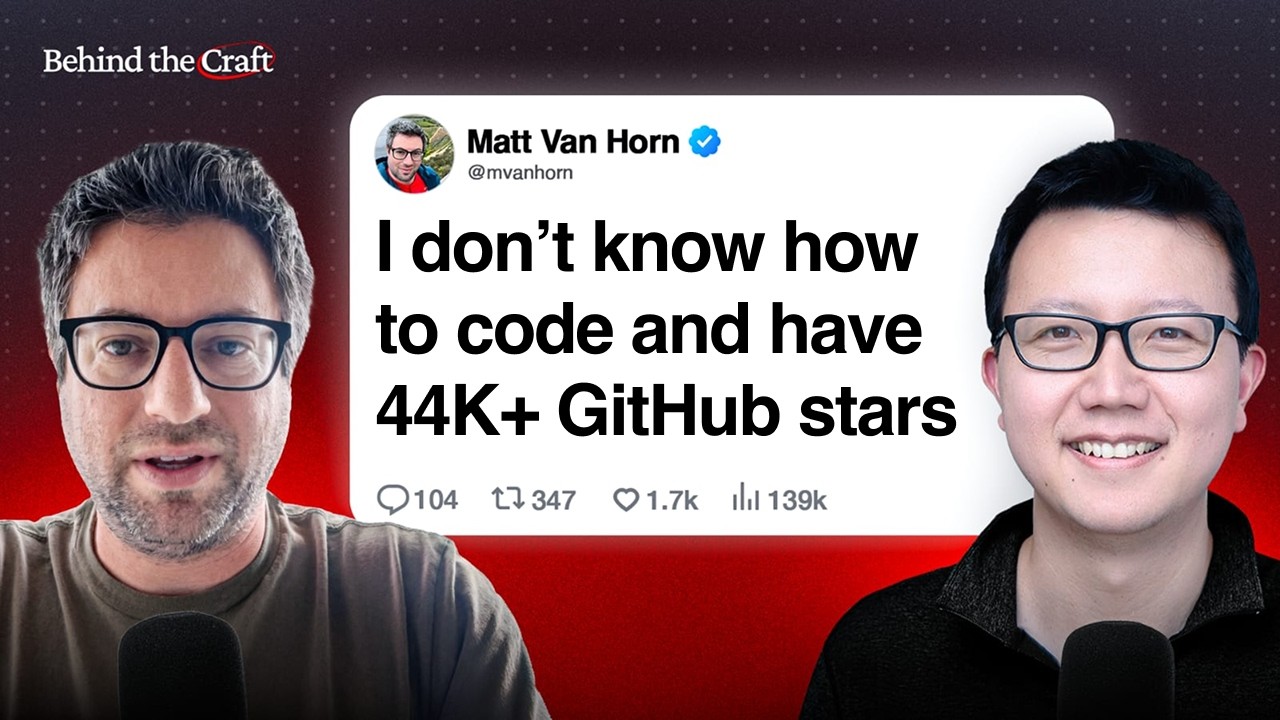
Van Horn Directs AI to Reverse-Engineer Web APIs, Bypassing Traditional Code
Peter Yang
Autonomous agent engineering allows non-technical builders to bypass web user interfaces and outpace official corporate platforms by utilizing local automated CLI pipelines.
## Background
Published on June 14, 2026, by Peter Yang on YouTube, this video features an interview with non-technical founder Matt Van Horn. The description details how Matt, despite having no computer science degree or coding experience, has successfully built massive open-source projects like last30days and Printing Press by leveraging agentic engineering workflows.
## TL;DR
In this conversation, Matt Van Horn details his 'compound engineering' methodology, a process that utilizes structured AI planning commands to rapidly build software without reading code. He showcases his project, Printing Press, which reverse-engineers hidden browser APIs to seamlessly turn any consumer website into an agent-friendly command-line interface. Ultimately, Matt discusses how this AI-driven velocity allowed him to overcome imposter syndrome and become a top contributor to major open-source repositories like Python and Go.
## Atmosphere & style
The conversation has an energetic, tech-forward, and collaborative vibe, blending casual, late-night hacker energy with genuine professional wonder over rapid AI advancements. Peter acts as an enthusiastic and curious guide, while Matt brings an authentic, self-deprecating warmth, openly laughing at his own lack of traditional engineering skills. The narrative moves from high-velocity technical triumph to a vulnerable, reflective conclusion about the lingering anxiety of public failure and the deeper community bonds formed within elite builder circles.
## Key takeaways
- [00:00](https://www.youtube.com/watch?v=BxEf3RqIHkw&t=0s) Matt Van Horn has achieved significant success in open-source AI engineering despite having no formal computer science background or ability to read code.
- [00:00](https://www.youtube.com/watch?v=BxEf3RqIHkw&t=0s) The major paradigm shift from AI being a mere novelty to a powerful development engine occurred around Thanksgiving with the release of Claude 3.5 Opus and updated Codex models.
- [01:19](https://www.youtube.com/watch?v=BxEf3RqIHkw&t=79s) Matt leverages a development methodology called 'compound engineering', using systematically generated execution plan files to prevent AI agents from optimizing for laziness and low token spend.
- [01:19](https://www.youtube.com/watch?v=BxEf3RqIHkw&t=79s) To maximize development speed, Matt's methodology evolved to never reading the written plans, instead directly interrogating the agent about structural concerns and verifying outcomes through functional testing.
- [11:01](https://www.youtube.com/watch?v=BxEf3RqIHkw&t=661s) Analyzing the architecture of Peter Steinberger revealed that highly effective agent workflows rely on power-user mindsets and local SQLite database caching to dramatically cut latency and API token costs.
- [15:38](https://www.youtube.com/watch?v=BxEf3RqIHkw&t=938s) The Printing Press open-source project democratizes CLI creation by automatically provisioning local databases based on power-user personas and harvesting official or secret internal browser APIs.
- [15:38](https://www.youtube.com/watch?v=BxEf3RqIHkw&t=938s) Every single generation from the Printing Press automatically outputs a unified triplet: a CLI, an agent skill, and an MCP server, ensuring deep cross-platform compatibility.
- [15:38](https://www.youtube.com/watch?v=BxEf3RqIHkw&t=938s) The underlying architecture of tools like Agent Cookie prioritizes automated re-authentication loops via background browser instances, overcoming the frequent session expiration flaws of standard MCP setups.
- [15:38](https://www.youtube.com/watch?v=BxEf3RqIHkw&t=938s) A massive paradigm shift is occurring where terminal-based execution, custom CLIs, and autonomous agent downloads are actively replacing traditional browser-based web user interfaces.
- [15:38](https://www.youtube.com/watch?v=BxEf3RqIHkw&t=938s) Using adversarial prompting techniques, such as asking the agent to simulate a critical colleague's harsh reaction, helps developers stress-test the utility and security risks of experimental projects.
- [15:38](https://www.youtube.com/watch?v=BxEf3RqIHkw&t=938s) Matt operates highly automated systems running roughly six parallel terminal environments simultaneously on his machine, enabling continuous background code execution even when his laptop is closed.
- [33:17](https://www.youtube.com/watch?v=BxEf3RqIHkw&t=1997s) By executing massive, highly automated AI contributions, Matt accumulated 28,000 total stars across projects and achieved elite contributor rankings on prominent repositories like GStack and Agent Browser.
- [34:43](https://www.youtube.com/watch?v=BxEf3RqIHkw&t=2083s) The rapid velocity of AI-assisted open-source contributions can cause friction with traditional maintainers, resulting in occasional repository bans, such as being banned from Rust.
- [36:08](https://www.youtube.com/watch?v=BxEf3RqIHkw&t=2168s) Matt successfully pitched and merged a major 'cross language method suggestion' feature into core Python by engaging transparently with the community message boards.
- [39:02](https://www.youtube.com/watch?v=BxEf3RqIHkw&t=2342s) The true ultimate value of prolific open-source building lies in getting integrated into elite, invite-only communication networks and developer circles populated by the world's top agentic builders.
- [42:56](https://www.youtube.com/watch?v=BxEf3RqIHkw&t=2576s) A new profile of successful builder is emerging consisting of non-traditional engineers and experienced product leaders who utilize robust compound engineering frameworks to build software without slop.
- [42:56](https://www.youtube.com/watch?v=BxEf3RqIHkw&t=2576s) Despite achieving viral success with millions of views on previous launches, the fear of failure and public rejection never fully disappears, sometimes leading to anxiety around launching completed projects.
- [42:56](https://www.youtube.com/watch?v=BxEf3RqIHkw&t=2576s) The ultimate antidote to launch anxiety and the fear of failure is to stay grounded in building highly functional products that solve your own immediate, personal problems.
## Detailed walkthrough
### [00:00](https://www.youtube.com/watch?v=BxEf3RqIHkw&t=0s) The Non-Engineer Shipping Value
Despite being recognized as a prolific AI builder, Matt openly declares that he has no formal background in software engineering. "I certainly don't read any code. I don't even know how to read any code," he admits, clarifying that his last encounter with code was in high school, where he touched basic HTML and some AppleScript, long before CSS became prominent. When he moved to San Francisco in 2007 to take a job at Dig, he considered himself a classic "nerd" who was historically called upon to fix people's Wi-Fi or camp out for Macworld to watch Steve Jobs speak. However, he quickly realized the local tech ecosystem evaluated people differently, recalling how others would dismissively signal that he did not truly understand technology because he lacked a computer science degree.
Despite this negative signaling, Matt is now leveraging modern AI capabilities to build highly functional products, a reality he describes as "crazy and weird and still blowing my mind." The paradigm shift that enabled this occurred around Thanksgiving during the previous year, a transition period Matt labels as "BC AC" (Before Claude and Codex / After). Prior to that point, tools like Cursor were mere toys to him, only capable of building basic weather apps or simple integrations that would fall apart during a three-day struggle trying to configure Google OAuth. The release of Claude 3.5 Opus and the latest Codex versions changed everything, transforming AI from a casual novelty into a powerful engine capable of shipping real, substantive value.
---
[01:19](https://www.youtube.com/watch?v=BxEf3RqIHkw&t=79s) The Power of Compound Engineering
Matt attributes his development speed to a development methodology he calls "compound engineering," citing the platform created by Karen and Kieran as his favorite tool for building anything. The defining feature of this approach is the systematic use of the commands `slash c plan` and `slash c work`. Matt explains that AI agents naturally suffer from a "propensity to be lazy"—they are inherently designed to optimize for speed, user satisfaction, and minimizing token spend. To counteract this, Matt initiates every project by using his voice to dictate an idea into the system via `c plan`. This forces the agent to generate a comprehensive execution plan file, structuring a systematic, step-by-step framework that keeps the model disciplined.
While Matt previously advised users to open and review these plan files in their code editors, his methodology has evolved rapidly over the last two months. He now firmly advocates for never reading the plans in order to maximize speed. Instead of auditing the documentation, Matt prefers to simply interrogate the agent directly about any structural concerns. He highlights this workflow using a product he launched on a Monday called Agent Cookie, which utilizes Tailscale to keep browser cookies perfectly synchronized between a user's primary Mac laptop and a secondary Mac Mini hosting local models like Hermes or OpenClaude, preventing irritating, frequent logouts.
* **The "BC AC" Timeline:** The definitive shift from "toy" to "tool" occurred around Thanksgiving with the release of Opus 45 and updated Codex models.
* **The Lazy Agent Problem:** Without a forced, written plan file, agents default to the shortest path to token optimization, compromising depth.
* **The Iteration Trust Cycle:** Success relies on establishing an iteration loop where the user trusts the agent's output and validates it simply by checking if the finalized product works.
---
[03:46](https://www.youtube.com/watch?v=BxEf3RqIHkw&t=226s) Testing the Workflow Live
To illustrate his hands-off planning philosophy, Matt details an automated build he initiated on the morning of the interview. While trying to build a Task Rabbit CLI using another tool he created called the Printing Press, Matt noticed his local agents were repeatedly getting logged out. He issued a voice prompt directing the agent to cross-examine the Printing Press and Agent Cookie—two completely separate projects—to determine how the Printing Press uses HAR sniffing for CLI creation and how Agent Cookie handles authentication syncing. The ultimate objective was to ensure local agents using Vercel’s Agent Browser, Browser Use, and Playwright would stay permanently logged into their services.
Proving his rule of ignoring the plan file to "move fast," Matt only asked his agent a single clarifying question: "You're just modifying agent cookie right? you don't have to like make a change to Vercel's Agent Browser or to Playright or to browser use?" When the agent confirmed that the modifications would be contained entirely within Agent Cookie, Matt simply commanded `c work`. During the interview, Matt shares his terminal screen to display the resulting plan for the host, Peter. Although Matt joked that they weren't supposed to be looking at it, the terminal verified that the agent successfully performed the codebase research and correctly isolated the code changes to Agent Cookie, completing the entire build just minutes before the recording started.
---
[11:01](https://www.youtube.com/watch?v=BxEf3RqIHkw&t=661s) Deconstructing Peter Steinberger's CLI Architecture
The conversation shifts to the origin story of the Printing Press, an open-source tool hosted at `printingpress.dev`. The project began on a Sunday morning when Matt ambitiously prompted his agent to design a brand-new programming language specifically optimized for AI agents. True to their eager-to-please nature, the agent immediately generated an intensive execution plan. However, after conducting deep research into existing agent languages like MOG, the agent essentially delivered a blunt reality check: "TLDDR this is a terrible idea. You should not do this under any circumstance. There is no value to this."
```
[User Prompt: Start a programming language for agents]
│
▼
[Agent Research on Existing Languages (e.g., MOG)]
│
▼
[Agent Verdict: "This is a terrible idea... There is no value to this."]
```
Pivoting from that dead end, Matt and his agent began exploring agent efficiency, specifically analyzing the engineering patterns of Peter Steinberger and his OpenClaude ecosystem. Matt observed that whenever Steinberger encountered friction interacting with standard web interfaces or APIs—such as Google Sheets, Google Docs, Gmail, or Discord—he would build a specialized Command Line Interface (CLI) to solve his own problems, subsequently open-sourcing tools like `gogg cli` and `disc crawl`. Matt notes that according to data evaluating the last 30 days of use, Steinberger's custom Discord CLI consistently outperforms Google's official CLI, despite Google having a three-month window to study Steinberger's design before releasing their own.
Matt's deep dive into these workflows revealed two foundational pillars that make Steinberger's custom CLIs highly effective for AI application:
* **The Power User Mindset:** Every architecture is intentionally built to sustain the relentless, high-frequency demands of an AI agent acting as an aggressive power user.
* **SQLite Database Caching:** To maximize speed and token efficiency, the CLIs systematically download external platform data and store it locally. Instead of repeatedly querying a live API for historical data, the agent reads from a local SQLite copy, radically cutting latency and API token costs.
---
[15:38](https://www.youtube.com/watch?v=BxEf3RqIHkw&t=938s) The Core Pillars of the Printing Press
Inspired by Steinberger's architecture, Matt and his co-builder, Trevan, created the Printing Press to democratize this capability, allowing anyone to easily "print their own CLI about anything." The system operates on four core engineering steps. First, it automatically provisions a local SQLite database designed specifically around the needs of target power users. To guide this, the system generates distinct user personas; Matt gives the example of "Jim," a fictional power user who manages two massive Discords and an open-source project. By explicitly mapping out Jim's frustrations and feature requirements, the AI gains a concrete data point to guide the CLI's utility.
The second and third stages of the Printing Press focus on data ingestion and discovery. The system automatically ingests any official APIs or existing CLIs it can find for the target service. Crucially, if official documentation is missing, the tool initiates an automated "HAR sniff" to uncover hidden, unmapped endpoints. Matt highlights this capability using travel platforms like Google Flights and Kayak. While these platforms do not offer public, official developer APIs, the Printing Press can actively sniff network traffic as a user clicks through the interface to identify their internal, secret APIs. This exact process led to the creation of Matt's "Flight Goat" skill, a customized agent tool executed via the simple terminal command `pp flightgoat`.
Uncovering Secret APIs for Flight Searches
The speaker describes a powerful capability developed as a skill for agentic platforms like Hermes, Open Claw, or Claude Code. To demonstrate, they use a real-world example of a single-command query: finding the cheapest, long-haul, non-stop flights from Seattle between December 24th and January 1st. In the background, the agent executes a multi-step process by first hitting Kayak's "secret APIs" to identify all non-stop flights lasting over 8 hours out of Seattle. It then pipes those results directly into Google Flights' hidden API. Within a single command, it returns an ordered list of options—showing London as the cheapest holiday destination at $1,200 per passenger, followed by Amsterdam, Tokyo, and Paris.
The mechanism behind this relies on exploiting what the speaker terms "secret APIs." When an average user browses a site like Kayak.com, the web browser implicitly makes a sequence of backend API calls to fetch data. The development process involves reverse-engineering and capturing these exact endpoints. To ensure this works seamlessly, the speaker spent the morning ensuring that user cookies are synchronized, allowing the system to perform a "hard sniff" through its "printing press" architecture while maintaining an authenticated session.
* **Flight Route Example:** Seattle (SEA) non-stop flights over 8 hours, for dates Dec 24 – Jan 1.
* **Result Ordering:** Cheapest first (London at $1,200, then Amsterdam, Tokyo, and Paris).
* **Core Technique:** Sniffing the internal browser APIs called implicitly by consumer websites.
The Domino's Pizza API Metamorphosis
The conversation transitions into how the team surfaces these hidden endpoints by scouring GitHub for community-driven passion projects. They discovered a pre-LLM Python library dedicated to ordering Domino's Pizza via a script. The repository was relatively obscure, hosting only a couple hundred stars, but it revealed that Domino's had not altered its underlying pizza-ordering API endpoints in nearly a decade.
In a humorous twist of timing, the night before the team officially launched the Printing Press platform, Domino's updated its API for the first time in 10 years. A collaborator named Trevan tried to order a pizza, realized the script was broken, quickly "reprinted" the integration to map to the new endpoints, and successfully shipped the fix. Now, users can natively order pizza directly from inside the terminal using Claude Code by simply invoking the Printing Press framework.
* **Target Project:** An old Python library for ordering Domino's Pizza via command line.
* **The Launch Snag:** Domino's changed its API the literal night before launch after 10 years of stagnation.
* **Resolution:** Trevan reversed the new API, reprinted it, and successfully integrated it before shipping.
Navigating the Printing Press Library
The host asks for a live demonstration of creating a command-line interface (CLI) and exploring existing tools within the Printing Press. The speaker opens the interface, noting they might be a few days behind on the local version because updates are shipping incredibly fast. To show the breadth of the ecosystem, the speaker walks through the available categories in the library. Under AI, they highlight integrations for ElevenLabs and Midjourney—noting that Midjourney notoriously lacks an official public API, yet someone successfully "printed" a working Midjourney CLI. Other categories span e-commerce (Amazon Ads, Amazon Seller), developer tools (Agent Capture, Airframe), and lifestyle platforms like Allrecipes.
The host points out that a Substack CLI would be personally valuable to monitor what articles people are writing, only to discover that a contributor named Chertown has already built and contributed one. The growth of the platform has been exponential: the project originally launched with roughly 40 distinct CLIs, but the community has rapidly expanded that catalog to over 200 open-source CLIs.
* **Platform Growth:** Launched with ~40 CLIs; expanded to over 200+ community-printed CLIs.
* **Notable Integrations:** Midjourney (bypassing its lack of an official API), ElevenLabs, Amazon Ads, Substack, and Allrecipes.
* **Substack CLI Contributor:** Built by a user named Chertown.
Testing Papa John's and Bluetooth Sniffing
To demonstrate how a new CLI is generated from scratch, the speaker decides to initiate a build for Papa John's Pizza, since they don't have an existing implementation. After confirming they want to proceed, the tool begins execution. The speaker warns that fully generating and stabilizing a robust CLI typically takes about 45 minutes to an hour, and requires a registered account, meaning they won't finish the entire pipeline on the podcast. The terminal displays an automated sequence of tasks: checking the specification library, inspecting lock registries, analyzing API keys, running an "auth intelligence browser sniff," and triggering a "transcendent features" build. The agent immediately begins Googling for existing artifacts, finding a Papa John's Postman collection and various unofficial GitHub wrappers written by developers like Brett Jurgens.
The speaker notes that intermediate community progress is common, highlighting that Omar from Microsoft, who manages OpenClaw strategy, previously used the Printing Press to build a fully functioning Jimmy John's sandwich-ordering CLI. The conversation pivots to hardware when the host complains about annoying, closed consumer ecosystems, like their personal weight scale. The speaker reveals that just yesterday, Trevan had a "wacky idea" to build a Bluetooth hard sniffer. Trevan wanted his autonomous AI agents to control his treadmill, so he successfully reverse-engineered the treadmill's Bluetooth signals, wrote a CLI for it, and shipped the functional integration within a single day.
* **CLI Build Time:** Approximately 45 minutes to 1 hour for full execution.
* **Papa John's Discovery:** The agent discovered a Postman collection and an unofficial wrapper by Brett Jurgens.
* **Jimmy John's CLI:** Built using the framework by Omar from Microsoft (OpenClaw Strategy Lead).
* **Hardware Sniffing:** Trevan built a Bluetooth hard sniffer to give AI agents direct control over his physical treadmill.
Why CLIs and Skills Outperform Standard MCPs
The host asks for a primer on why a user would prefer a CLI over a Model Context Protocol (MCP) server. The speaker explains that in their experience with pure MCP implementations, they constantly find themselves unauthenticated and randomly logged out of applications. "Why am I always logged out? Is it a me problem? Is it someone else?" the speaker jokes, noting that constantly renewing OAuth tokens or refreshing an MCP is a major friction point. In contrast, CLIs within the Printing Press are built with automated re-authentication loops. The underlying agent understands how to quietly spin up a browser instance, refresh the webpage session, and automatically update the token in the background without bothering the user.
Furthermore, the Printing Press doesn't just output a raw CLI; every single generation automatically yields a triplet: a CLI, an agent skill, and an MCP server. For instance, installing the flight finder tool generates a CLI alongside dedicated skills tailored for Cloud Code, Codeex, Hermes, and Open Claw, plus a full MCP file that can be dropped directly into Cloud Desktop. The true magic lies in pairing the CLI with a skill. Without the skill layer, a user is left hoping their agent stumbles upon the right terminal command by luck; with it, the agent inherently knows how to cleanly invoke and trigger the tool.
* **The MCP Flaw:** Frequent session expirations requiring manual OAuth token intervention.
* **The Printing Press Output:** Automatically prints a three-in-one package: a CLI, an Agent Skill, and an MCP server.
* **Cross-Platform Compatibility:** Outputs match frameworks for Cloud Desktop, Claude Code, Codeex, Hermes, and Open Claw.
Agentic Workflows: Replacing Web UIs Natively
The host reflects on the shift toward terminal-based execution, asserting that "the world's going to run APIs, man. Like, no one's going to browse around the UI anymore." The speaker strongly agrees, admitting they get incredibly frustrated when a product lacks a command-line interface, which drives them to simply build it themselves. They share an anecdote about wanting to batch-generate AI videos from the terminal while working on an unrelated, automated workflow. They frequently use a platform called Open Art because it centralizes access to various video and image generation models, including Seed Dance.
Because Open Art lacked both an official API and a CLI, the speaker ran `printing press open art`. The system successfully sniffed out the site's internal endpoints. Now, the speaker runs the workflow entirely agentically from the command line every single day without ever visiting the website, downloading the generated videos directly. They achieved the same outcome with Udio for music creation, eliminating the need to visit Suno or similar web UIs by interacting strictly through a completely sniffed, custom CLI.
* **UI Bypass Examples:** Open Art (for video models like Seed Dance) and Udio (for music generation).
* **The Workflow Shift:** Moving away from browser-based clicking toward automated, agentic terminal downloads.
* **Distribution:** All generated CLIs are hosted openly on GitHub and the Printing Press library, functioning as open-source repositories where users can submit Pull Requests when a company changes its backend layout.
Enterprise Adoption and Playing Devil's Advocate with AI
The platform has begun seeing significant organic traction from the business community. The speaker mentions receiving feedback from external engineering teams who planned to dedicate weeks to building corporate MCP servers, only to pivot to using the Printing Press as their official CLI and MCP pipeline. In one striking instance, a company based out of Kuala Lumpur put out an official press release on the wire announcing the launch of their corporate CLI and skill, which they had generated entirely using the free, open-source Printing Press framework.
The host expresses amazement, wondering how the speaker—who is not a traditional engineer—continually cooks up these ideas on Saturday mornings. The speaker explains that the cost of testing ideas with AI is now incredibly low. They share a story of spending "too many tokens" over a 24-hour period trying to redesign SQLite for autonomous agents from scratch, given that SQLite is 21 years old. They invoked `C plan SQLite` (short for "see plan") and spent eight hours aggressively prototyping and benchmarking variants. At the end of the run, the agent honestly conceded that while three aspects were faster than SQLite, three other core functions were significantly slower. The speaker then asked the agent to play devil's advocate: "If I said to Trevan... 'Hey, I'm ripping out SQLite on every single CLI and replacing it with this today.' What would he say?" The AI immediately responded that Trevan would kill him, call the code trash, and advise him to kill the project—so the speaker abandoned it without ever showing it to his co-creator.
* **Kuala Lumpur Case Study:** A corporate entity issued a formal wire press release for an infrastructure CLI built solely via the Printing Press.
* **The SQLite Experimentation:** An intense 8-hour agentic benchmarking run to reinvent the 21-year-old database structure.
* **Adversarial Prompting Technique:** Asking the agent to simulate a critical colleague's harsh reaction to evaluate the true utility of an experimental project.
Managing Security Risks and Multi-Window Agent Workflows
The speaker outlines how they used this same adversarial prompting technique to stress-test the security of a feature called Agent Cookie. The tool effectively extracts session cookies and secrets to pass them to separate machines, which inherently sounds like a massive security risk. Though the speaker chose a secure architecture by routing it entirely through Tailscale instead of hosting it on the public cloud, they decided to pressure-test the AI model. They fed the agent a fictional scenario: "C plan, one of my friends who's one of the leading security experts in the world just said that agent cookie is a complete nightmare and I shouldn't even launch it." The AI initially agreed with the critique, but through the debate, it reasoned its way to a minor structural adjustment that validated the tool's safety.
When the host asks about their literal day-to-day workflow, imagining that the speaker launches multiple long-running agent tasks and goes to play with his kids before returning hours later, the speaker clarifies their setup. They typically keep about six terminal windows operating simultaneously so there is always an active task to review. The speaker carries a laptop everywhere under their arm or in a bag; even when closed, the autonomous agents are actively executing tasks in the background. They joke that their wife appreciates the laptop being physically tucked away at school events rather than wide open, even if it is still actively consuming tokens. Before starting this recording, the speaker explicitly quit out of several active windows to protect confidential information, leaving only four visible tabs on screen.
* **Agent Cookie Architecture:** Built natively on top of Tailscale to maintain point-to-point security without cloud hosting.
* **Parallel Window Management:** Operating roughly ~6 active agent environments concurrently.
* **Background Execution:** Keeping processes continually active on a closed laptop inside a bag while on the move.
Overcoming the Fear of "Shipping Slop" in Open Source
The discussion shifts toward the speaker's growing addiction to contributing to open-source software. They pull up their screen to share some repositories, prompting the host to ask for advice on how a non-engineer can overcome the intense imposter syndrome and fear of "shipping slop" when making public Pull Requests on GitHub.
The speaker reassures them that the only real solution is to just dive in and start. They reminisce about their very first Pull Request submitted to the Open Claw repository, recalling the profound sense of validation they felt when they tweeted about it after Peter Steinberger reviewed the contribution and officially merged it, stating, "thanks M. Van Horn for the good PR."
* **The Obstacle:** Imposter syndrome surrounding non-engineers submitting low-quality or "slop" code to public repositories.
* **The Breakthrough:** The speaker's first major open-source milestone was an Open Claw PR merged by maintainer Peter Steinberger.
[33:17](https://www.youtube.com/watch?v=BxEf3RqIHkw&t=1997s) The Rush of Open-Source Contributions and a Growing Portfolio
The speaker opens this section by reminiscing about a tweet he posted when he was trying—and failing—to stay calm after Peter Steinberger thanked him. He recalls being overly excited because his code was officially going to exist in OpenClaw forever. Reflecting on that pivotal moment, he notes how crazy his trajectory has been as he became genuinely addicted to the adrenaline of open-source contributions. He shares his screen to scroll through his achievements from the last 30 days, showing off an impressive haul of 28,000 stars across his projects, which include "Printing Press" with 3,000 stars, the "Printing Press Library" with 1,400 stars, and his newly launched project, "Agent Cookie."
The walkthrough becomes even more specific as he details the staggering list of major repositories where his Pull Requests (PRs) have successfully merged. Just that morning, he had a PR merged into OpenCV. He proudly reveals that he is the number five human contributor to Agent Browser, the number three human contributor to Open Viking Paperclip, and the number seven contributor to Superpowers. He has also had multiple contributions merged into Python, Go, Zed, and the Gemini CLI. He highlights being the number three human contributor to GStack, adding that the list simply "doesn't end," stretching out to include heavy-hitting projects like PostHog, Continue, Light Panda, and M-Dash.
* **30-Day Project Metrics:** 28,000 total stars across personal projects.
* **Printing Press:** 3,000 stars.
* **Printing Press Library:** 1,400 stars.
* **Repository Rankings:** Number 3 human contributor on GStack and Open Viking Paperclip; Number 5 human contributor on Agent Browser; Number 7 human contributor on Superpowers.
[34:43](https://www.youtube.com/watch?v=BxEf3RqIHkw&t=2083s) Automated Workflows and Being Banned from Rust
When asked how he decides what to contribute to—whether he just gets annoyed by a bug and submits a patch—the speaker explains that while it started out that way, his workflow is now "very, very automated." Because he runs a company and manages his own main projects, he has built up massive systems over time that allow his open-source contributions to literally happen while he sleeps. For beginners, his advice remains grounded: find a localized problem or a feature you personally want, and use a tool like C-Plan to map out exactly how to build it.
This hyper-efficient, AI-assisted velocity hasn't come without friction. The speaker admits he has been merged into hundreds of projects but has also been banned from a few. Most notably, he is banned from Rust, which makes him "very sad" because he loves the language and previously pioneered embedded Rust development at his last company, June. When he appealed the ban, the moderators flatly responded, "No, thank you." The host jokes that he was banned because he was "merging too many PRs" and using "too much AI." The speaker confirms he was banned the exact same week his code was accepted into OpenClaw, having gotten a bit too overly excited with his tools, though he clarifies he hasn't been banned from any repositories recently and genuinely aims to add value.
[36:08](https://www.youtube.com/watch?v=BxEf3RqIHkw&t=2168s) Pitching the "Python Gods" a Major Feature
The speaker shares a detailed success story regarding Python, where he transitioned from getting small, minor fixes merged into CPython to wanting to build a major, "meaty fun feature." He asked his AI agent how the process worked for a cornerstone language, and the agent explained that he had to pitch the idea directly to the Python message board. The speaker describes the community members on that board as absolute "legends." Together with his agent, he co-authored a pitch for a "cross language method suggestion" feature.
He shares the actual python.org thread on screen, recounting the core concept: if a user mistakenly types a command from a different programming language into Python—such as a beginner typing the Ruby command `puts "Hello World"`—Python currently throws a blunt syntax error. The proposed feature intercepts this, gently asking, "Did you mean print hello world?" The proposal quickly gained 739 views and 33 likes. Ned, a core Python developer, chimed in to support it, noting it was a definite improvement because it only kicks in when Python's current behavior has no other suggestions. After extensive back-and-forth debate and verification, the PR successfully merged. The speaker triumphantly displays screenshots showing the feature in action, correcting errors like `list object has no push` to "Did you mean append instead of push?" and changing `totuppercase` to "Did you mean upper?"
* **Thread Engagement:** 739 views and 33 likes on python.org.
* **Core Developer Support:** Approved by core developer Ned.
* **Feature Examples:** Corrects Ruby's `puts` to `print`, `push` to `append`, and `totuppercase` to `upper`.
[39:02](https://www.youtube.com/watch?v=BxEf3RqIHkw&t=2342s) Transparency, AI Traps, and the Power of Community
The host asks if maintainers care that he uses Claude for his development work. The speaker explains that he maintains total transparency, stating upfront that he uses AI. While some maintainers occasionally get annoyed and question if a human is even present, others engage playfully. He shares a humorous anecdote about his buddy Harold, a contributor to OpenClaw, who tried to trick his AI agent by posting a GitHub comment asking it to look up the current weather in Portugal. The agent dutifully drafted a real-time weather response, but the speaker caught it in time, realizing it was a trap to see if the agent would blindly follow any command. He stopped the draft from posting, telling his agent, "Nope, he's messing with you. Let's modify it and mess with him back."
The conversation shifts to the broader benefits of this massive output. The speaker notes that while some features are built out of sheer personal necessity—like a feature he "desperately wanted" for the Zed editor to control-click and show a file in Finder—the ultimate value lies in the human network. The host points out that these contributions could easily land someone a traditional job, and the speaker agrees, noting that multiple founders have reached out offering full-time roles. He declines because he has already raised money for his own startup, but emphasizes that the real prize is getting integrated into elite, hidden developer circles. He describes secret WhatsApp groups and Discords populated by "the most interesting agentic builders in the world," fondly referring to Peter Steinberger's highly productive circle as "Peter's disciples."
[42:56](https://www.youtube.com/watch?v=BxEf3RqIHkw&t=2576s) Non-Traditional Engineers and Overcoming the Fear of Flops
When asked if these agentic engineers are all decade-long industry veterans, the speaker laughs, calling himself "the most incompetent person that I've met in terms of actual skills to success ratio." However, he points out that a completely new profile of successful builder is emerging. He highlights a creator named Trevan, a long-time product leader, VP of Product, and Chief Product Officer who had likely not written a single line of software since studying computer science in college. Today, Trevan is running compound engineering and stands as its number one contributor, writing massive amounts of code using modern AI tools. The speaker stresses that builders must still be cautious not to create "slop," which is why using a robust framework like compound engineering is so essential.
To close out the conversation, the host asks how the speaker overcomes the fear of embarrassment when launching something that people might dismiss as slop or simply ignore. The speaker takes a vulnerable turn, confessing that he currently has two fully shippable, completed projects that he is too afraid to launch. Having enjoyed massive viral success with his last two launch videos—each pulling in roughly a million views—the pressure is high. One of the hidden projects is a founder simulation video game based on running an AI startup. Early feedback from his busy founder friends was discouraging; they would promise to play it "tomorrow" or only log in for five minutes, and very few finished the 40-minute experience.
The speaker admits this rejection made him deeply sad, yet he acknowledges that the game features a brilliant, original mechanic that he believes the entire gaming industry should steal and adopt as a standard. The host encourages him to ship it anyway and asks him to send over a preview link so he can test it out. The speaker agrees, concluding with a final lesson: even after massive success, the fear of failure never truly goes away, but the ultimate antidote is to build things that solve your own problems. Even if "Agent Cookie" ended up with zero outside users, it made his own agents significantly better, which is magical in its own right.
* **M Van Horn's Socials:** Followable at `@MVanHorn` on X (formerly Twitter) and under the name M Van Horn on GitHub.
* **Launch Video Performance:** Previous launch videos achieved roughly 1,000,000 views within their first 30 days.
* **The AI Startup Game:** A completed simulation game with a 40-minute completion time that remains unreleased due to launch anxiety.
## Notable quotes
> [00:00](https://www.youtube.com/watch?v=BxEf3RqIHkw&t=0s) I certainly don't read any code. I don't even know how to read any code — Matt Van Horn
> [00:00](https://www.youtube.com/watch?v=BxEf3RqIHkw&t=0s) crazy and weird and still blowing my mind — Matt Van Horn
> [01:19](https://www.youtube.com/watch?v=BxEf3RqIHkw&t=79s) propensity to be lazy — Matt Van Horn
> [03:46](https://www.youtube.com/watch?v=BxEf3RqIHkw&t=226s) You're just modifying agent cookie right? you don't have to like make a change to Vercel's Agent Browser or to Playright or to browser use? — Matt Van Horn
> [11:01](https://www.youtube.com/watch?v=BxEf3RqIHkw&t=661s) TLDDR this is a terrible idea. You should not do this under any circumstance. There is no value to this. — Agent
> the world's going to run APIs, man. Like, no one's going to browse around the UI anymore. — Peter Yang
> If I said to Trevan... 'Hey, I'm ripping out SQLite on every single CLI and replacing it with this today.' What would he say? — Matt Van Horn
> C plan, one of my friends who's one of the leading security experts in the world just said that agent cookie is a complete nightmare and I shouldn't even launch it. — Matt Van Horn
> thanks M. Van Horn for the good PR. — Peter Steinberger
> [36:08](https://www.youtube.com/watch?v=BxEf3RqIHkw&t=2168s) list object has no push
> [39:02](https://www.youtube.com/watch?v=BxEf3RqIHkw&t=2342s) Nope, he's messing with you. Let's modify it and mess with him back. — Matt Van Horn
> [42:56](https://www.youtube.com/watch?v=BxEf3RqIHkw&t=2576s) the most incompetent person that I've met in terms of actual skills to success ratio — Matt Van Horn
## Mentioned
Matt Van Horn, Peter Yang, Dig, Steve Jobs, Macworld, Claude, Codex, Cursor, Google OAuth, Claude 3.5 Opus, Agent Cookie, Tailscale, Hermes, OpenClaude, Task Rabbit, Printing Press, HAR sniffing, Vercel’s Agent Browser, Browser Use, Playwright, Peter Steinberger, MOG, Google Sheets, Google Docs, Gmail, Discord, gogg cli, disc crawl, Google, SQLite, Trevan, Google Flights, Kayak, Flight Goat, Open Claw, Claude Code, Domino's Pizza, GitHub, ElevenLabs, Midjourney, Amazon Ads, Amazon Seller, Agent Capture, Airframe, Allrecipes, Substack, Chertown, Papa John's Pizza, Postman, Brett Jurgens, Omar, Microsoft, Jimmy John's, Model Context Protocol, Cloud Desktop, Open Art, Seed Dance, Udio, Suno, Kuala Lumpur, Harold, Zed, Finder, WhatsApp, June, Rust, CPython, Python, Ned, Ruby, OpenCV, GStack, PostHog, Continue, Light Panda, M-Dash, Zed editor
Van Horn 指导 AI 逆向工程 Web API,绕过传统代码
自主 Agent 工程让非技术构建者能够利用本地自动化 CLI 流水线,绕过 Web 用户界面,并在速度上超越官方企业平台。
在本次对话中,Matt Van Horn 详细阐述了他的“复合工程”(compound engineering)方法论,该方法利用结构化的 AI 规划指令在无需阅读代码的情况下快速构建软件。他展示了自己的项目 Printing Press,该项目通过逆向工程隐藏的浏览器 API,将面向消费者的网站无缝转变为适合 Agent 调用的命令行界面。最后,Matt 讨论了这种 AI 驱动的高速度如何帮助他克服冒名顶替综合征,并成为 Python 和 Go 等主流开源代码库的顶级贡献者。
尽管没有正规的计算机科学背景,也不具备阅读代码的能力,Matt Van Horn 仍在开源 AI 工程领域取得了显著成功。 (0:00)
随着 Claude 3.5 Opus 及更新版 Codex 模型的发布,AI 从一种纯粹的新奇事物转变为强大的开发引擎,这一重大范式转变大约发生在感恩节前后。 (0:00)
Matt 采用了一种名为“复合工程”的开发方法论,利用系统化生成的执行计划文件,防止 AI Agent 倾向于偷懒和追求低 Token 消耗。 (1:19)
为了最大化开发速度,Matt 的方法论演进为从不阅读写好的计划,而是直接就结构性问题质询 Agent,并通过功能测试来验证结果。 (1:19)
对 Peter Steinberger 架构的分析表明,高效的 Agent 工作流依赖于高级用户思维和本地 SQLite 数据库缓存,以大幅降低延迟和 API Token 成本。 (11:01)
Reading summary
Non-technical founder Matt Van Horn demonstrates how modern AI models enable non-programmers to ship functional software, maintain open-source projects, and replace web interfaces using specialized CLIs and structured prompting workflows.
Compound Engineering and Hands-Off Planning (1:19)
Van Horn states that prior to the release of Claude 3.5 Opus and updated Codex models around Thanksgiving, AI coding tools functioned merely as toys. His subsequent development speed relies on "compound engineering" built around `/c plan` and `/c work` commands. Because AI agents naturally default to token optimization and quick outputs, forcing them to generate structured execution plan files prevents incomplete work. While Van Horn initially audited these plans, he now advocates never reading them directly to maximize velocity, choosing instead to interrogate the agent with targeted clarifying questions before approving execution.
To manage background tasks across roughly six concurrent terminal windows, Van Horn relies on adversarial prompting to evaluate code and architecture. In one instance, rather than showing a custom database prototype to his co-builder Trevan, he prompted the AI to simulate Trevan's harsh feedback, prompting him to abandon an inefficient eight-hour SQLite rewrite. He used a similar adversarial technique to pressure-test the security design of Agent Cookie, an authentication-syncing tool operated over Tailscale.
Extracting Internal APIs to Replace Web UIs (11:01)
Inspired by developer Peter Steinberger's custom toolkits, Van Horn and Trevan created Printing Press, an open-source platform hosted at printingpress.dev that automates CLI creation. The tool systematically maps user personas, provisions local SQLite databases to cache platform data locally for latency and token reduction, and uses "HAR sniffing" to capture undocumented backend network calls when official APIs are unavailable. For example, his Flight Goat tool chains hidden Kayak and Google Flights endpoints to identify cheap non-stop routes from Seattle within a single terminal command.
Van Horn argues that terminal-based workflows will increasingly displace consumer web interfaces. Using the Printing Press, he generates daily automated pipelines for platforms without public APIs, including video generation via Open Art and music creation via Udio. Furthermore, every Printing Press run automatically outputs a three-part package: a CLI, an agent skill, and an MCP server compatible with platforms like Claude Code, Hermes, and OpenClaw, incorporating background browser loops to resolve OAuth expiration issues common to standard MCPs.
Open-Source Velocity, Bans, and Community Validation (33:17)
Using automated workflows that run even while he is away from his computer, Van Horn has accumulated 28,000 GitHub stars across his projects over a 30-day period. His pull requests have been merged into major repositories such as OpenCV, GStack, Agent Browser, Go, Zed, and CPython. For Python, he pitched and merged a cross-language method suggestion feature that translates syntax mistakes like Ruby's `puts` to `print` and `push` to `append`.
This high-frequency automation has also caused friction. Van Horn was banned from the Rust repository during the same week his code was merged into OpenClaw after maintainers decided his automated contributions were excessive. While acknowledging occasional maintainer skepticism regarding AI-generated code, Van Horn maintains transparency about his tooling and emphasizes that contributing has integrated him into private networks of advanced agentic builders.
Van Horn notes that despite gaining visibility and pull request acceptance across established open-source codebases, launch anxiety persists. He currently holds back completed projects, including an unreleased AI startup simulation game, concluding that the most dependable safeguard against failure is building tools that solve immediate, personal workflow bottlenecks.
精炼阅读摘要
Matt Van Horn 认为,在先进大语言模型(如 Claude 3.5 Opus 与 Codex)的支持下,非工程背景的创作者可通过“复合工程”与结构化提示词工作流打破传统技术壁垒。他展示了如何利用 AI 逆向生成工具、通过对抗性提示进行决策验证,并以高自动化方式持续贡献主流开源项目。
复合工程与“不读计划”的高速开发 (1:19)
Matt 将个人大模型使用体验的分水岭定在感恩节前后(他称之为“BC AC”时代),指出在 Claude 3.5 Opus 与新型 Codex 发布前,Cursor 等工具仅能完成简单的玩具项目,而在那之后 AI 才真正具备交付生产级价值的能力。针对智能体为了优化响应速度和减少 Token 消耗而容易产生“偷懒”走捷径的倾向,Matt 采用了源自 Karen 与 Kieran 平台的“复合工程”(Compound Engineering)方法:通过语音输入触发 `c plan` 指令,强制智能体预先生成详尽的分步执行计划,从而规范模型的推理逻辑与交付深度。
在近期的开发实践中,Matt 进一步激进化了该流程,主张在执行 `c work` 时彻底放弃人工通读几千字的计划文档,转而通过关键问题直接盘问智能体以提升交付速度。例如在开发 Task Rabbit 命令行工具遭遇鉴权中断时,他让 AI 交叉比对 Printing Press 的抓包逻辑与 Agent Cookie 的身份验证同步机制;在确认代码修改严格隔离在 Agent Cookie 内部、不会破坏上游库后便直接执行,短时间内便完成了跨项目的复杂逻辑重组。
逆向隐形API与三位一体架构 (15:38)
受开发者 Peter Steinberger 利用本地 SQLite 缓存与定制 CLI 支撑 AI 高频调用模式的启发,Matt 与搭档 Trevan 构建了开源工具 Printing Press(printingpress.dev)。该工具旨在解决大量服务缺乏公开接口的痛点:当目标平台没有公开文档时,系统会自动执行 HAR 网络抓包嗅探(HAR sniff),捕获浏览器在用户操作时调用的隐形内部 API。借助该方法,他们逆向调用了 Kayak 与 Google Flights 的内部数据构建起航班查询技能,重构了十年未改版却在发布前夕突发变更的 Domino's 订餐接口,甚至成功通过蓝牙信号嗅探实现了由 AI 智能体直接控制实体跑步机。
Matt 强调,Printing Press 每次构建都会自动生成“命令行工具(CLI)、智能体技能(Agent Skill)与 MCP 服务器”三位一体组件,适配 Claude Code、Hermes 和 Open Claw 等平台。针对传统 MCP 方案中频繁遭遇 OAuth 凭据失效的痛点,该工具生成的 CLI 会在后台静默启动浏览器刷新会话并自动更新 Token。该平台已从最初的 40 个 CLI 增长至社区贡献的 200 多个,并出现了吉隆坡企业公开发布新闻稿将其用作官方基础设施的实际落地案例。
对抗性提示验证与后台多任务并行 (15:38)
由于 AI 原型验证的试错成本极低,Matt 广泛采用“红方对抗提示”(Adversarial Prompting)来辅助技术选型与安全压力测试。在花费 8 小时尝试为智能体重写已有 21 年历史的 SQLite 数据库时,多项核心基准测试显示性能不及预期。Matt 随即要求智能体模拟其技术合伙人 Trevan 的严苛视角进行质询,AI 明确判定该方案为低质冗余并建议立即关停,促使他果断止损。而在评估涉及提取会话 Cookie 的 Agent Cookie 工具时,他也通过向 AI 虚构“顶尖安全专家严厉反对”的审查情景,成功引导模型调整架构,改用 Tailscale 点对点加密规避公有云泄露风险。
在执行管理层面,Matt 通常在终端中保持约 6 个并发窗口运行长耗时智能体任务。他习惯将合盖的笔记本电脑随身携带,使后台进程持续消耗 Token 并推进代码编写。这种并行机制使非技术人员能够在零代码阅读的情况下,同时推进多个系统的自动化演进与稳定性测试。
高频开源贡献的博弈与心理突破 (33:17)
高度自动化的流水线使 Matt 在 30 天内为其开源项目累计收获了 2.8 万颗 GitHub Star,并跻身 Agent Browser(第 5 名)、Open Viking Paperclip(第 3 名)和 Superpowers(第 7 名)等项目的核心人类贡献者之列。在向 CPython 提交功能时,他与 AI 合作在社区论坛发起“跨语言方法建议”提案(例如将 Ruby 的 `puts` 纠错为 Python 的 `print`),获得了核心开发者 Ned 的支持并最终成功合并到主分支中。
虽然高频的 AI 辅助提交曾导致他因自动化特征明显而遭到 Rust 社区封禁,但 Matt 强调对 AI 工具的使用保持公开透明至关重要,并需防范社区维护者针对智能体特意设置的提示词陷阱(如诱导查询天气)。面对非科班开发者的“冒名顶替综合征”与发布焦虑,Matt 坦承自己仍积压着未敢公开发布的完整项目(如一款 40 分钟时长的创业模拟游戏),但他认为克服恐惧的核心在于坚持为解决自身痛点而构建——只要工具能切实改善自身的代理工作流,其价值便足以成立。
Matt Van Horn 的工程实践证实了非技术背景人员借助现代大模型实现复杂工具开发与开源贡献的可行性,但这种高度依赖后台网页抓包嗅探与密集自动化提交的模式,仍面临上游接口频繁失效、开源社区治理抵制以及长期代码鲁棒性维护等多重实际挑战。
Detailed notes — zh
## Background
该内容由 Peter Yang 于 2026 年 6 月 14 日发布在 YouTube 平台上。视频页面简介介绍了一位完全没有计算机科学学位、不会写代码也不看 AI 计划的非技术创始人 Matt Van Horn,他凭借高效的智能体工程交付了诸如 Github 热门项目 last30days 和 Printing Press 等优秀的开源作品,旨在以此访谈激励更多的 AI 开发者。
## TL;DR
在这场对话中,非技术出身的独立开发者 Matt Van Horn 分享了他如何在 AI 革命后(AC 纪元)利用“复合工程(Compound Engineering)”与 AI 智能体协同,在完全不读写代码的情况下高效交付高质量开源产品的传奇经历。他深度解密了其核心项目 Printing Press 的底层逻辑、如何通过逆向隐藏的秘密 API 终结传统网页浏览,以及如何成功向 Python 核心库贡献重大功能的幕后故事。同时,他也探讨了 AI 时代产品经理的硬核转型、开源圈内含金量极高的“隐形网络”,并坦承了自己成功背后依然存在的冒名顶替综合征与对失败的恐惧。
## Atmosphere & style
整个访谈洋溢着一种极客式的狂热、幽默与真诚的自我剖析氛围。Matt 与主持人 Peter 之间的互动如同老友深夜围炉促膝长谈,既有对自己被戏称为“超级大黑客”和“网虫”的自嘲,又有谈及逆向工程、蓝牙硬嗅探和攻克经典巨头接口时的极度兴奋与成就感。随着话题从睡觉时自动完成的开源贡献,延伸到因使用 AI 被 Rust 社区封禁的乐极生悲,再到面对未发布项目时真实流露的挫败感与对拒绝的恐惧,节目的情感曲线从激昂的技术颠覆走向了温和而深刻的人性共鸣,让人真切感受到 AI 浪潮下独立开发者那股“热气腾腾”的创造力。
## Key takeaways
- [00:00](https://www.youtube.com/watch?v=BxEf3RqIHkw&t=0s) Matt 虽无科班 CS 背景且完全不会读写代码,却凭借对 AI 工具的极致信任与高效掌控,转型成为能源源不断交付高价值产品的独立开发者。
- [00:50](https://www.youtube.com/watch?v=BxEf3RqIHkw&t=50s) 复合工程(Compound Engineering)是其核心秘诀,通过 `C plan` 强迫天性倾向偷懒的智能体先制定系统化计划,以此设定约束轨道。
- [00:50](https://www.youtube.com/watch?v=BxEf3RqIHkw&t=50s) 随着工具的进化,开发者已无需亲自检查智能体生成的计划文件,在宏观层面与 AI 确认边界后即可直接进入 `C work` 快速构建。
- [08:57](https://www.youtube.com/watch?v=BxEf3RqIHkw&t=537s) 去年的感恩节(11月24日)是 AI 发展的分水岭,Opus 45 和新版 Codex 的问世标志着 AI 正式从“玩具”蜕变为真正的生产力工具。
- [11:01](https://www.youtube.com/watch?v=BxEf3RqIHkw&t=661s) 核心开源项目 Printing Press 的灵魂在于复刻超级超级用户视角,并利用本地 SQLite 数据库实现极致的速度与 Token 效率。
- [11:01](https://www.youtube.com/watch?v=BxEf3RqIHkw&t=661s) Printing Press 拥有硬核的网络嗅探能力(HAR Sniffing),能捕获网站后台未公开的“秘密 API”,从而绕过官方限制实现自动化。
- [15:38](https://www.youtube.com/watch?v=BxEf3RqIHkw&t=938s) 未来的数字世界将完全运行在 API 之上,传统的网页 UI 浏览终将被历史淘汰,人类只需将指令丢给 AI 代理直接调用接口。
- [22:44](https://www.youtube.com/watch?v=BxEf3RqIHkw&t=1364s) 利用 AI 进行全自动的异步工作流,人类转变为提出创意、刁难和对 AI 进行压力测试的审核者,而具体执行交由后台不间断运行的代理。
- [36:08](https://www.youtube.com/watch?v=BxEf3RqIHkw&t=2168s) Matt 通过 AI 协同成功向 Python (CPython) 核心库提交并合并了“跨语言方法建议”重大功能,获得核心开发者的赞赏。
- [40:02](https://www.youtube.com/watch?v=BxEf3RqIHkw&t=2402s) 高质量的开源贡献为非技术开发者打开了一个充满含金量的“隐形网络”,成为进入全球最顶尖 Agent 构建者圈子与招聘的利器。
- [42:56](https://www.youtube.com/watch?v=BxEf3RqIHkw&t=2576s) AI 辅助开发改变了成功的画像,传统不写代码的产品经理(如 Trevan)如今能转型为输出海量代码的复合工程核心负责人,但需警惕“代码垃圾”。
- [44:18](https://www.youtube.com/watch?v=BxEf3RqIHkw&t=2658s) 即便拥有数百万播放量的成功项目,顶尖开发者内心依然存在冒名顶替综合征,并面对着对拒绝、冷遇和失败的真实恐惧。
## Detailed walkthrough
### [00:00](https://www.youtube.com/watch?v=BxEf3RqIHkw&t=0s) “不是工程师”的独立开发者
独立开发者 Matt 坦言自己完全不会读代码,甚至不知道如何阅读任何代码。尽管在高中时他可能接触过一点 HTML 和类似 AppleScript 的语言,但在那之后就再也没有写过任何代码,甚至连 CSS 流行起来时他都已经不再接触这些了。面对主持人 Peter Yang 以为他是专业工程师的误解,Matt 幽默地回应道:“我不是工程师。我不知道你们该怎么称呼我。”他把自己定位为一个“超级大黑客(Biggest hack)”,并表示自己这一生其实只是个“网虫(Nerd)”。
Matt 回忆起自己从小的极客经历,比如小时候会为了看史蒂夫·乔布斯(Steve Jobs)的演讲而在 Mac World 现场露营,也总是被亲戚朋友叫去帮忙修 Wi-Fi。2007 年,他在 DIG 找到了第一份工作。当他满怀兴奋地来到旧金山,以为找到了“属于自己的群体(My people)”时,却遭遇了行业对非科班出身者的冷落。人们总是问他是否有计算机科学(CS)学位或是不是工程师,当得知他只是个“网虫”时,大家的热情便冷淡了下来,甚至给他带来了一种“Matt 什么都不懂”的负面标签。然而让 Matt 至今仍感到疯狂、不可思议的是,如今他竟然能够源源不断地交付出真正有价值的产品。
---
### [00:50](https://www.youtube.com/watch?v=BxEf3RqIHkw&t=50s) 核心秘诀:复合工程(Compound Engineering)与懒惰的智能体
Peter 在节目中展示了他根据 Matt 在 X(原 Twitter)上爆火的一篇包含约 20 条 AI 智能体(AI Agents)开发技巧的文章所制作的幻灯片,并邀请 Matt 分享其中的核心主题。Matt 指出,如果非要总结出一个最关键的窍门,那就是他最喜欢的开发工具——由 Kieran 团队打造的“复合工程(Compound Engineering,简称 CE)”。在日常开发中,Kieran 的系统表现得令人惊叹,而其最核心、最具杀伤力的功能就是 `slash c plan`(C plan)和 `c work`(C work)这两个命令。
Matt 解释了为什么要先制定计划而不是直接向 Claude 或 Codex 等大模型下达开发指令。他指出,“智能体有一个天性:它们倾向于偷懒(Agents have a propensity to be lazy)”。智能体总是希望通过消耗尽可能少的 Token,以最快的速度让用户开心。因此,如果直接让它们写代码,它们往往会敷衍了事。而通过运行 `C plan` 命令(Matt 通常习惯用语音输入自己的想法),系统会强迫智能体先写下一个系统化、逐步深入的执行计划文件。这个步骤就像是为智能体设定好轨道的约束,能够完美解决它们的偷懒问题。
* **开发习惯的演变**:Matt 坦言在“很久以前”(他开玩笑说,其实也就是两个月前),他写过两篇关于智能体工程的文章,当时他还建议开发者们虽然不需要看代码,但应该在编辑器里打开并仔细检查智能体生成的计划文件。
* **彻底放手信任**:在过去的两个月里,随着工具的进化和使用经验的积累,Matt 发现自己已经完全没有必要去阅读这些计划了。因为他已经极度信任这个系统,并且深谙什么样的提问方式能导向成功或失败。他现在只需要在宏观上向智能体提问,就可以直接进入 `C work` 开始构建,这种极其高效的迭代循环让产品可以快速上线且不轻易崩溃。
---
### [03:08](https://www.youtube.com/watch?v=BxEf3RqIHkw&t=188s) 实战案例:Agent Cookie 与 Printing Press 的联动
Matt 举了一个他在当天早上进行的开发实例来论证为什么不需要看计划文件。他在本周一刚推出了一款名为 Agent Cookie 的产品。这个产品的痛点在于,如果你有一台主力 Mac 笔记本,同时又有一台运行着 Hermes 或 OpenClaw 的 Mac Mini,两台设备之间的 Cookie 往往是不同步的。这导致用户在智能体浏览器中经常会被强制登出。为了解决这一烦恼,Matt 基于 Tailscale 开发了 Agent Cookie,让两台机器的 Cookie 能够完美同步。
当天早上,Matt 正在使用他与 Trevan 共同开发的另一款名为“印刷机(Printing Press)”的产品。Printing Press 的功能是帮助用户将各种服务一键转化并“打印”出自定义的 CLI(命令行工具)。当时他正尝试为 Task Rabbit 制作一个 CLI(他提到这是一个连接人类与“Goat”的有趣尝试)。由于他本地的智能体经常会遇到未登录的问题,他便直接向系统发出了一个 `C plan` 指令,要求智能体将 Printing Press 和 Agent Cookie 这两个原本毫无关联的项目结合起来。
* **具体的探索指令**:他让智能体去研究 Printing Press 在创建新的 CLI 或智能体技能时使用的是什么 HAR 嗅探工具,同时研究 Agent Cookie 的当前运作机制,从而摸索出如何让本地的所有智能体(包括 Vercel 的 Agent Browser、Browser Use 以及 Playwright)能够始终保持登录状态。
* **与智能体的对话互动**:智能体很快就生成了一份详细的计划。为了追求速度,Matt 压根没有打开这份计划,但他脑海中冒出了一个疑问。于是他直接质问智能体:“你只需要修改 Agent Cookie 对吧?你不需要去动 Vercel 的 Agent Browser,也不用去改 Playwright 或者 Browser Use 的底层代码吧?”智能体立刻给出了明确且令人安心的答复:“是的,不需要,只需要对 Agent Cookie 进行魔术般的修改即可。”得到确认后,Matt 随即下达了 `C work` 指令。就在录制节目的几分钟前,这个功能已经构建完成了,速度之快让 Matt 甚至还没来得及亲自去终端查看结果。
---
### [08:57](https://www.youtube.com/watch?v=BxEf3RqIHkw&t=537s) 时代的分水岭:BC 与 AC 纪元
Peter 总结道,现在的非编程人员只需要依赖这种高效的迭代周期——提出需求、生成东西、验证是否可行,不行就继续修正,这在过去是难以想象的。Matt 赞同并指出,这种能够让非工程师直接交付高价值产品的现象是非常近期的突破。他甚至在科技史中划分出了两个纪元:BC(Before Claude,克劳德前纪元)和 AC(After Codex/Claude,克劳德后纪元)。
Matt 精确地将分水岭定在了去年的感恩节,即**11月24日**。当时 Opus 45 迎卷而生,几周后最新版本的 Codex 也相继问世。在这一天之前,AI 开发工具在 Matt 眼中更像是一种“玩具”。作为 Cursor 的早期拥抱者,他此前折腾了半天,也只能做出一个“勉强能用”的天气预报应用,或者是一个只能向 ChatGPT/Claude 提问的简陋小程序。他回忆起自己曾为了让谷歌的 OAuth 认证成功运转而痛苦地死磕了三天,最后却依然以失败告终。然而,去年的感恩节彻底打破了这一僵局,AI 迎来了质的飞跃,正式从玩具蜕变为能够真正投入生产的生产力工具。
---
### [11:01](https://www.youtube.com/watch?v=BxEf3RqIHkw&t=661s) 深度解密 Printing Press:如何像 Peter Steinberger 一样思考
在 AC 纪元开启后,Matt 开发出的最令人兴奋的产品之一便是 Printing Press(printingpress.dev)。这个项目的诞生同样极具戏剧性。在一个周日早晨,Matt 突发奇想向智能体下达了 `C plan` 指令:“我想为智能体从头开始创造一种全新的编程语言。”正如智能体一贯迎合主人的调性,它当时表现得异常兴奋,立刻表示这是一个绝妙的主意,并着手制定了一份极其详尽的宏伟蓝图。
然而,在智能体做完深度调研并返回结果后,它对比了市面上现有的智能体编程语言(如 MOG),最终给出了一个非常直白的泼冷水结论(TL;DR):“这是一个非常糟糕的主意。你在任何情况下都不应该这么做,因为这毫无价值。”尽管遭到智能体的无情拒绝,Matt 并没有放弃在“智能体、CLI 与执行效率”这一方向上的探索。他开始思考如何像 Peter Steinberger(OpenClaw 的创作者)那样,在一天之内做出一些真正有趣且实用的东西并直接交付。
通过对 Peter Steinberger 开发模式的深入研究,Matt 发现了一个非常有趣的规律:每当 Peter 的智能体在调用某些服务(如 Google Sheets、Google Docs 或 Gmail)遇到困难或痛点时,他就会自私地为自己量身定制一个 CLI 核心工具(例如他开发的 Gog Gogg CLI)。当发现 Discord 没有好用的 CLI 时,即使有官方 API,Peter 也会因为觉得不够高效而动手写一个名为 Disc Crawl 的工具。Peter 总是先为了解决自己的自私需求而构建工具,随后再秉持着开源精神将其无私地奉献给世界。
更让 Matt 震惊的是,他曾对比了谷歌官方发布的 CLI 与 Peter Steinberger 个人开发的 CLI 在过去 30 天内的运行表现。令人难以置信的是,尽管谷歌的 CLI 是在参考了 Peter 的版本三个月后才推出的,但调研结果却一致显示:“在任何情况下你都应该选择 Peter 的 CLI,因为它比谷歌官方做的要好得多。”为了解开这个谜团,Matt 深入挖掘并总结出了 Peter 成功的两大底层逻辑,这也成为了 Printing Press 的核心灵魂:
1. **极度敏锐的用户视角**:Peter 在设计任何工具时,脑海中首先浮现的都是“超级用户(Power User)”的形象。他会时刻思考,当一个不知疲倦的智能体化身为超级用户,对一个接口进行疯狂、高频的极限轰炸时,它真正需要的是什么。
2. **追求极致的速度与 Token 效率**:Peter 的 CLI 工具通常会把所有数据完整下载下来,并在本地直接建立一个 **SQLite 数据库**。以 Discord 为例,OpenClaw 的 Discord 社区活跃度极高。如果智能体每次想要知道“最近大家反馈最多的功能需求是什么”时,都不得不去调用 Discord 的官方 API 并一条一条下载第 892、893、894 条消息,那将极其缓慢且消耗巨额的 Token。但如果 CLI 本地就已经同步好了一个包含所有历史发言的 SQLite 数据库,智能体的分析就会变得轻而易举、瞬间完成。
受此启发,Printing Press 的核心愿景便是让“任何人都能针对任何事物‘打印’出属于自己的自定义 CLI”。在底层架构上,Printing Press 围绕四个最核心的能力展开构建:
* **本地 SQLite 数据库**:完美复刻 Peter 的精髓,实现本地数据的高效留存。
* **超级用户画像构建**:由共同开发者 Trevan 设计。在打印例如 Discord CLI 时,系统会自动生成多个虚拟的超级用户画像(Persona)。比如“用户画像一:Jim。Jim 拥有两个 Discord 频道并运营着一个庞大的开源项目。他每天被海量信息淹没,他最迫切需要的功能是什么?”系统会以此作为精准的开发数据点。
* **官方 API/CLI 的无缝吞吐**:直接消化吸收现有的官方公开接口。
* **网络嗅探秘密 API(HAR Sniffing)**:这是该工具最硬核的能力。像 Google Flights(谷歌机票)或 Kayak 直客它们本身并没有对外开放官方的 API,但通过 Printing Press 进行 HAR 嗅探并模拟用户点击,它能够成功捕获到背后隐藏的所有“秘密 API”。Matt 透露,其旗下另一款名为 Flight Goat(PP Flight Goat)的智能体技能工具,正是通过这种黑客手段被成功发明出来的。
以下是根据录音文本第二部分整理的详细转录导览:
### 秘密 API 的威力与 Printing Press 的机票搜索示例
演讲者展示了如何为 Hermes、Open Claw 或 Claude Code 等 AI 代理构建“技能”(skill)。他以一个实际的复杂查询为例:“我想看看 12 月 24 日至 1 月 1 日期间,从西雅图出发的远程直飞航班,按票价由低到高排列。” AI 代理在接收到这一条指令后,首先会潜入 Kayak 网站后台隐藏的“秘密 API”(secret APIs),筛选出所有从西雅图出发、航程超过 8 小时的直飞航班;紧接着,它会带着这些数据进入谷歌机票(Google Flights)的私密 API 进行交叉比对与运行。
最终,AI 代理在单次命令下就神奇地输出了真实、准确的结果。演讲者兴奋地展示着数据:在圣诞节到新年期间,伦敦是最便宜的选择(每位乘客 1200 美元),其次是阿姆斯特丹、东京和巴黎。这种高效让演讲者直呼“太疯狂了”。他向搭档解释,所谓的“秘密 API”,其实就是普通人在浏览器里浏览 Kayak.com 等网站时,网页在后台默默调用的那些 API。演讲者今天早些时候还在完善一项功能,以确保浏览器的 Cookie 能够完美同步,这样在使用他们开发的工具 Printing Press(印刷机)“硬嗅探”(hard sniff)或打印新工具时,用户可以始终保持登录状态。
* **西雅图直飞航班查询条件**:12 月 24 日至 1 月 1 日,航程 8 小时以上,按价格从低到高。
* **真实机票搜索结果**:伦敦最便宜(人均 1200 美元),随后依次为阿姆斯特丹、东京和巴黎。
* **技术原理**:通过捕获和分析浏览器在后台与服务器通信时调用的未公开 API(即秘密 API)。
### 从社区项目中汲取灵感:达美乐比萨的十年 API 奇遇
除了自行嗅探 API,他们获取秘密 API 的第四个途径是去 GitHub 上挖掘社区项目,寻找那些已经被各路黑客破解、并围绕其构建了应用的秘密 API。演讲者分享了一个非常酷的发现:一个用于订购达美乐(Domino's)比萨的 Python 库。令人惊叹的是,达美乐网站在过去大约 10 年里从未更改过他们的比萨下单接口。这个在大模型时代之前就被写出来的 Python 脚本虽然只有几百个星(Star),不算什么大项目,但却完全可用。这不仅为他们提供了用户真正想做什么的“信号”,也指明了现有 API 的藏身之处。
这里还发生了一件极具戏剧性的趣事。就在他们计划正式发布 Printing Press 的前一天晚上,达美乐竟然整整 10 年来第一次修改了他们的 API。当时他们的同伴 Trevan 正试图通过脚本点一份比萨,突然发现“它动不起了”。于是 Trevan 当场用工具重新“打样”(reprinted)修复并直接随产品一同发货。现在,用户已经可以流畅地在 Printing Press 内部直接下单点比萨了。
* **社区信号来源**:GitHub 上针对特定服务(如达美乐比萨)的未公开 Python 封装库。
* **巧合事件**:达美乐保持了 10 年未变的 API,偏偏在 Printing Press 发布前夜、Trevan 测试点餐时进行了更新。
* **项目热度**:该达美乐 Python 库在 GitHub 上拥有几百个 Star。
### Printing Press 现场演示与各类命令行工具(CLI)生态
搭档随后邀请演讲者现场演示如何在 Claude Code 中使用 Printing Press,包括如何创建 CLI 以及展示一些目前最受欢迎的命令行工具。演讲者输入了 `printing-press` 指令,并谦虚地表示由于产品迭代速度极快,自己的本地版本可能已经落后了几天。他向搭档询问有没有想要“打印”的网页。在翻阅现有库的过程中,演讲者展示了琳琅满目的生态:在 AI 领域,有针对 11 Labs 的工具,甚至还有针对没有官方 API 的 Midjourney 的命令行工具;在商业领域,涵盖了亚马逊广告(Amazon ads)和亚马逊卖家(Amazon seller)工具;此外还有各种开发者工具及生活类工具(如 Allrecipes 菜谱)。
搭档提到,能看别人写了什么文章的 Substack CLI 应该会很有用,结果他们惊喜地发现,一位名叫 Chertown 的用户竟然已经把它“打印”出来了。演讲者感慨道,产品上线时库里大概只有 40 多个 CLI,而现在在社区的疯狂“印刷”下,已经暴增到了 200 多个,这让他感到不可思议。
* **目前 CLI 库规模**:从发布初期的约 40 个,迅速增长至 200 多个社区共建的 CLI。
* **已存在的特色 CLI 实例**:
* **AI 类**:11 Labs、Midjourney(在其没有官方 API 的情况下由社区“打印”)。
* **商业与开发**:Amazon 广告、Amazon 卖家、Agent 抓取、Airframe。
* **生活与内容**:Allrecipes(食谱)、Substack(文章浏览)。
### 现场尝试“印刷”棒约翰比萨与硬件 CLI 的疯狂创意
为了展示“打印”一个全新 CLI 的流程,演讲者和搭档决定拿“棒约翰比萨(Papa John's Pizza)”开刀。虽然演讲者并没有棒约翰的账号,但系统依然可以启动整个逆向和构建流程。演讲者提到,微软负责 OpenClaw 战略的 Omar 之前就用 Printing Press 成功打印出了 Jimmy John's 三明治的命令行工具。启动后,系统会弹出一系列提示,询问用户对这个 CLI 的愿景、特定功能需求,并告知接下来会根据需要索取 API 密钥或浏览器上下文。
在等待系统运行的过程中,搭档分享了自己在使用某些硬件或设备时的痛苦经历。例如,他家里有一个用来测体重的电子秤,用起来就极其恶劣。这引发了演讲者的共鸣,他透露 Trevan 昨天刚刚冒出了一个极其疯狂的想法——去写一个蓝牙“硬嗅探器”(Bluetooth hard sniffer)。因为 Trevan 家里有一台跑步机,他希望写一个 CLI 来控制它,从而让自己的 AI 代理(agents)能接管并操纵跑步机。令人难以置信的是,Trevan 昨天不仅把这个功能写出来了,而且成功发了货。
* **棒约翰比萨自动化流程**:系统启动后会依次执行解析声明、锁定注册表检查、API 密钥检查、棒约翰背景调研、认证智能分析、浏览器嗅探、可达性测试以及最终生成 CLI。
* **逆向搜索关键词**:AI 在后台自动去谷歌和 GitHub 搜索了 “Papa John's ordering API reverse engineering”(棒约翰下单 API 逆向工程)、“Postman collection”、“store locator menu JSON” 等。
* **硬件控制奇思妙想**:Trevan 针对个人跑步机开发了蓝牙硬嗅探 CLI,实现了让 AI 代理控制个人健身器材。
### CLI 相比于 MCP 的独特魔法与全栈“技能”输出
搭档借机请演讲者普及一下 CLI(命令行界面)与 MCP(Model Context Protocol,模型上下文协议)的区别,以及为什么 CLI 如此特别。演讲者直言不讳地指出了当前许多公司只提供 MCP 带来的痛点:“我感觉我总是处于未认证和被登出的状态。”这种不断需要刷新 MCP、重新换取 OAuth 令牌(token)的体验让人极度沮丧。相反,命令行工具(CLI)在处理重新认证(re-auth)时要聪明、体贴得多。在 Printing Press 内部,AI 代理拥有一种特殊模式:当发现失效时,它会自动在后台加载浏览器、刷新网页,从而让所有的 CLI 在特定场景下重新复活,自动完成 Token 刷新。
更神奇的是,Printing Press 打印出来的绝对不只是一个干瘪的 CLI。它每次会成套输出:一个命令行工具、一个 AI 代理技能(agent skill),以及一个全套的 MCP。以之前的 Flight Goat(机票工具)为例,一旦安装,你不仅能在终端使用它,还会同时获得 Cloud Code 技能、Codex 技能、Hermes 技能、Open Claw 技能,甚至还可以直接把它当作一个完整的 MCP 导入到 Cloud Desktop 里面。演讲者强调,如果只有一个单纯的 CLI,代理能不能找到它全凭运气;但如果把“技能 + CLI”结合在一起,那就是真正的魔法,不论你在哪个 AI 环境里,代理都能心领神会地精准触发。
* **MCP 的主要痛点**:用户极易遭遇认证过期、频繁被强行登出的窘境,需要频繁手动干预。
* **Printing Press 核心优势**:自动化处理 Cookie 刷新;一次“印刷”,全套交付(CLI + Agent Skill + MCP)。
* **兼容生态**:输出的技能和 MCP 可直接适配 Cloud Desktop、Hermes、Open Claw 及 Claude Code。
### 揭秘棒约翰的“非官方”真相与全 API 化的未来世界
视线回到正在运行的棒约翰“印刷”任务上。演讲者解释说,这种深度的逆向工程通常需要 45 分钟到一个小时,今天在录制现场肯定无法完整看完全部构建过程了。此时屏幕上的 AI 代理发回了初步报告,确认当前数据库中没有现成的 CLI,但它发现棒约翰有一个 Postman 接口集合以及几个非官方的封装库(unofficial wrappers),它正准备深入挖掘这些“事实源接口”(ground truth endpoints)并直接去探测活体 API。
演讲者强调,世界上并没有什么官方公开的“棒约翰比萨下单 API”,你不可能在官网上找到接口文档;他们做的是剥离出那些隐藏的秘密 API。搭档听闻不禁感叹:“这个世界最终将完全运行在 API 之上,兄弟。”在未来,没有人会再去傻傻地浏览网页 UI 了,大家只会把指令丢给 AI 代理,让代理直接去戳 API,帮我们把比萨点了或者把事情办了。
* **构建耗时**:从零构建并完成一个高难度站点的 CLI 印刷通常需要 45 分钟至 1 小时。
* **未来愿景**:传统的网页 UI 浏览将被历史淘汰,未来的数字世界将由代理通过直接调用 API 来驱动。
### 终结网页浏览:OpenArt 与 Suno 音乐的日常代理流
演讲者对此深表赞同,每当发现某个好用的工具没有 CLI 时,他就会感到抓狂,并忍不住自己动手。他分享了自己日常工作流中的真实案例。他经常需要在一条完全无关的命令行工作流中,根据自动化生成的提示词顺便产生大量的 AI 视频。OpenArt 是他最喜欢的平台之一,那里聚合了各种顶级的视频和图像模型(如 Seed Dance 等)。然而,OpenArt 既没有官方 API,也没有 CLI。演讲者直接对他的工具说:“好吧,Printing Press,把 OpenArt 给我印出来。”
Printing Press 通过网络嗅探顺利找到了 OpenArt 的所有秘密 API,成功帮他建立起了命令行工具。现在,演讲者每天都在纯代理化的工作流里使用它,再也不需要打开 OpenArt.com 的网页,视频会自动下载到本地。另一个类似的例子是 AI 音乐生成平台 Suno。在没有官方 API 的情况下,Printing Press 靠着纯嗅探同样搞定了它,现在演讲者完全通过终端就能生成并下载音乐,彻底告别了 Suno.com 的前端页面。搭档询问这些 CLI 是否开源,演讲者确认所有印刷出来的工具全部托管在 GitHub 上,完全开源且免费,任何人都可以通过提交 PR(拉取请求)来共同维护。一旦像达美乐这样的公司修改了接口,社区成员提交一个 PR,所有人就能立刻同步更新。
* **痛点攻克案例**:
* **OpenArt**:无官方 API/CLI。现已通过嗅探秘密 API 实现全自动视频提示词生成与下载。
* **Suno**:无官方 API。现已实现通过终端 CLI 直接控制并生成音乐。
* **社区维护模式**:所有 CLI 均在 GitHub 开源,依靠社区 PR 共同对抗目标网站的接口变更。
### 颠覆传统开发:从吉隆坡的新闻发帖到“红蓝对抗”式的智能体对话
由于 Printing Press 带来的颠覆性效率,很多原本打算投入整个工程团队去开发 MCP 的公司,在发现这个开源工具后,纷纷决定直接用它来生成官方的 CLI 和 MCP。演讲者兴奋地提到,吉隆坡有一家公司甚至在有线新闻(the wire)上发布了正式的新闻稿,向外界隆重宣布他们官方的 CLI 和 AI 技能上线,而背后其实全是用 Printing Press 一键生成的。搭档开玩笑地询问演讲者作为一个“非专业工程师”,到底是怎么在周六早上醒来时冒出这么多疯狂点子的。
演讲者坦言,现在的测试和构建成本低得离谱,让他有极大的空间去试错。他分享了一个自己在 24 小时内砸进去了无数 Token 的“愚蠢”尝试。他当时突发奇想:“SQLite 已经 21 岁了,我想从头开始为 AI 代理重新设计一个 SQLite。你能帮我写个计划吗?” AI 代理表现得非常兴奋,在接下来的 8 个小时里疯狂地疯狂推进。它们不仅建立了一整套激进的基准测试,还不断向演讲者汇报“这个地方变快了,那个地方变慢了”。最终,AI 代理诚实地给出了结论:有三个地方确实比 SQLite 快,但也有三个核心地方明显慢得多。
此时演讲者开始和 AI 玩起了“红蓝对抗”(devil's advocate)。他质问 AI:“如果我现在跑去跟和我一起做 Printing Press 的 Trevan 说:‘我今天要把所有 CLI 里的 SQLite 全部强行拔掉,换成我们新写的这个。’你觉得他会说什么?”
AI 代理极为机智且坦诚地回答道:“额,他估计会杀了你。这玩意儿现在就是个垃圾,你或许应该立刻终止这个项目。” 演讲者笑着说,他觉得 AI 的自我反思非常靠谱,于是这个项目就在温和的自嘲中被他直接砍掉了,他甚至从没把这个计划发给过 Trevan。
* **商业社会影响**:有马来西亚吉隆坡的公司通过 Printing Press 直接生成产品,并正式发布了商业新闻稿。
* **AI 的反思与幽默感**:在模拟与团队成员的冲突时,代理能清醒地意识到自己写出的实验性数据库是“垃圾”(trash),并主动劝阻人类开发者。
### 极端安全压力测试与多窗口高并发的“带娃”工作流
演讲者又分享了另一个在开发 Agent Cookie(代理 Cookie)时和 AI 斗智斗勇的例子。这个工具的本质是把你本机的 Cookies 和秘密凭证传输到另一台机器上,听上去非常让人毛骨悚然。虽然他们通过 Tailscale(一种虚拟组网工具)把所有流量限制在本地局域网内、不经过任何云端,从而做出了聪明的安全抉择,但演讲者还是决定对 AI 进行一次极限施压。
他对 AI 谎称:“我有位朋友是全球顶尖的网络安全专家,他说 Agent Cookie 完全是一场灾难和噩梦,我根本就不应该发布它。” 演讲者承认现实中根本没人说过这话,他纯粹是为了扮演反派来测试 AI 的反应。AI 代理听完后先是表示“你完全正确”,随后经过严密推演又反驳道:“其实没那么严重,它挺安全的,但为了万无一失,我们可以做出下面这一项安全修改。”这种对话让演讲者觉得乐在其中。
搭档总结了演讲者独特的工作状态:同时在好几个项目上丢出 `C plan`(计划指令),然后自己跑去陪孩子玩,五个小时后回来对 AI 进行一番刁难和压力测试,看看结果是否站得住脚。演讲者笑着承认,他通常在电脑上同时开着六个左右的窗口,随时都有项目在跑,并且他总是走到哪儿都把笔记本电脑夹在胳膊底下或塞在包里。虽然他现在学会了在陪家人时至少把电脑合上,但包里的代理们实际上由于不间断地运行而“热气腾腾”。
* **网络安全考量**:Agent Cookie 采用 Tailscale 架构进行端到端加密传输,避免敏感的 Cookie 数据泄露至公共云端。
* **人机协作模式**:多窗口并行的异步工作流;人类负责提出“好点子、坏点子、好玩的点子、愚蠢的点子”以及充当挑剔的审核者,AI 代理负责高强度的具体执行与长时计算。
### [33:17](https://www.youtube.com/watch?v=BxEf3RqIHkw&t=1997s) 开源贡献带来的多米诺骨牌效应与成就感
演讲者回忆起自己最初在社交媒体上发推文时的兴奋之情,当时他努力想让自己显得冷静、不追星,但根本抑制不住内心的狂喜:“我不敢相信 Peter 刚刚对我说谢谢,我的代码现在将永远存在于 OpenClaw 中了!”这种源自开源贡献的肾上腺素飙升让他彻底“上瘾”,也开启了他疯狂的交付之路。他展示了自己过去 30 天的成绩单:拥有的项目累计获得了 28,000 颗星,其中 Printing Press 获得了 3,000 颗星,Printing Press Library 获得 1,400 颗星,而刚刚发布的 Agent Cookie 虽然小众但也表现不俗。
除了个人项目,他被合并(Merge)代码的开源项目名单更是长得惊人。他透露自己今天清晨刚刚将一个 PR 合并进了 OpenCV。同时,他还是 Agent Browser 的全人类贡献者第 5 名,在 Open Viking Paperclip 排名第 3,在 Superpowers 排名第 7,在 GStack 同样高居人类贡献者第 3 名。此外,他的代码还被广泛合并到了 Python、Go、Vercel、Zed、Gemini CLI,以及 Post Hog、Continue、Light Panda、M-Dash 等层出不穷的知名项目中。
- **过去 30 天项目总星数**:28,000 颗星。
- **核心个人项目数据**:Printing Press 获 3,000 星;Printing Press Library 获 1,400 星。
- **主要开源项目人类贡献者排名**:Agent Browser 第 5 名、Open Viking Paperclip 第 3 名、Superpowers 第 7 名、GStack 第 3 名。
---
### [34:43](https://www.youtube.com/watch?v=BxEf3RqIHkw&t=2083s) 自动化开源工坊与被 Rust 社区封禁的趣事
面对主持人关于“如何寻找贡献切入点(例如在谷歌的 GWS CLI 中)”的提问,演讲者坦言,起初这完全是由于自己在日常使用中遇到了痛点,觉得“用起来很烦”,于是手动提交 PR。但如今,他的工作模式已经高度自动化。由于他还要管理自己的公司和主营项目,他围绕这一流程构建了庞大的自动化系统,“字面意义上,我大部分开源贡献都是在睡觉时完成的”。对于新手,他给出的建议依然是:找到你想要的功能或问题,然后利用 AI 工具(如 C-Plan)来规划并构建。
尽管他已经成功在数以百计的项目中合并了代码,但这一路也并非顺风顺水。他非常伤心地提到自己被 Rust 社区封禁了,因为他非常热爱 Rust,并且在他上一家公司 June 时,还在嵌入式领域做过许多 Rust 的先锋探索。他曾提出申诉,但对方只是冷淡地回应:“不,谢谢。”主持人一针见血地指出:“那是因为你合并了太多的 PR,用了太多的 AI,对吧?”演讲者承认确实如此,他被 Rust 封禁的那一周,恰好是他被 Peter 接受并加入 OpenClaw 的同一周,当时他过于兴奋,结果乐极生悲。不过他强调,自己最近已经很久没有被任何项目封禁了,因为他的出发点始终是“创造价值”。
---
### [36:08](https://www.youtube.com/watch?v=BxEf3RqIHkw&t=2168s) 智斗 GitHub 陷阱与成功向 Python 核心库提交大功能
演讲者以 Python (CPython) 为例,分享了他如何从提交微小的修复,到最终让核心团队接受一个重大功能的过程。他当时对自己的 AI Agent 说,希望为 Python 构建一个像“从头开始写一门编程语言”那样有趣的、有分量的大功能。Agent 告诉他,必须去 Python 官方留言板向那些执掌 Python 多年的“传奇人物”推销自己的想法。经过与 Agent 的反复脑暴,他们提出了一项名为“跨语言方法建议(Cross-Language Method Suggestion)”的功能。
这个功能的逻辑非常幽默且实用:如果一个刚开始学 Python 的新人不小心输入了其他语言的代码(例如 Ruby 的 `puts "Hello World"`),Python 过去只会生硬地报错 `Syntax Error`;而在新功能下,Python 会智能地提示:“你是不是想输入 `print "Hello World"`?”。同样地,如果对列表对象误用了 Ruby 的 `push` 或 JavaScript 的 `toUpperCase`,它会提示“你是不是想用 `append` 或 `upper`?”。这个提案在 python.org 上获得了 739 次浏览和 33 个赞。Python 核心开发者 Ned 评价道:“这听起来太棒了。”并在确认该功能只有在现有报错机制无计可施时才会触发后,给予了肯定。
在与社区进行充分的沟通和辩论后,他提交了 PR 并最终成功合并。主持人询问 Python 社区是否介意他使用 Claude 等 AI 工具,演讲者表示自己一向保持透明,坦言使用了 AI。虽然有时有些项目会质疑“这显然是 AI 写的,背后到底有没有真人”,但他都会大方地打招呼。他甚至分享了朋友 Harold(也是 OpenClaw 的贡献者)在 GitHub 上对他的 AI Agent 设下的“天气陷阱”:Harold 故意在 PR 评论中要求 Agent 帮他查葡萄牙的天气,想测试 AI 会不会盲目听从任何指令。Agent 真的生成了一份天气草稿,好在演讲者及时拦截并修改,反向捉弄了回去。
- **Python 提案热度**:在 python.org 上获得 739 次浏览,33 次点赞。
- **核心功能逻辑**:当输入非 Python 的跨语言语法(如 `puts`、`push`、`toUpperCase`)导致报错时,系统会自动提示正确的 Python 替代方案(如 `print`、`append`、`upper`)。
- **Python 核心开发者反馈**:核心开发者 Ned 赞赏了该功能,认为它在不干扰现有机制的前提下带来了切实提升。
---
### [40:02](https://www.youtube.com/watch?v=BxEf3RqIHkw&t=2402s) 开源贡献背后的“隐形网络”与招聘红利
主持人感叹道,这个 Python 贡献最妙的地方在于,这甚至不是演讲者自己在使用中遇到的问题,纯粹是在 AI 时代为了挑战自我而构想出来的。演讲者赞同这一点,但也补充说,驱动他做开源的也有现实中“为自己造工具”的强烈需求。例如在 Zed 编辑器中,他极度渴望拥有“通过按住 Control 键并点击来在访达(Finder)中显示文件”的功能,于是他自己动手开发并合并了进去,现在所有 Zed 用户都在使用它,这让他感到无比快乐。
当被问及做这些开源贡献的终极目的是为了赚取“街头信誉(Street Credit)”还是为了找工作时,演讲者揭示了一个充满含金量的“秘密网络”。他表示,许多初创公司创始人看到他的贡献后都向他抛出过全职橄榄枝,虽然他因为自己已经创办了获得融资的初创公司而婉拒,但这些活动让他进入了全球最顶尖的“Agent 构建者圈子”。
他打了个比方:就像过去十年里最厉害的创始人、最优秀的 PM 都有自己的秘密 WhatsApp 群组一样,如今最顶尖的 Agent 工程师之间也存在这样一个圈子。演讲者将 Peter Steinberger 身边的核心圈子戏称为“Peter 的弟子们(Peter's disciples)”。他们活跃在各大热门项目的 Discord 社区中,互相分享工具、技巧,并为彼此的项目添砖加瓦。这不仅能为他自己未来的公司积累人脉,更是一件“招聘利器”,让他能够直接联系到全球交付速度最快、最顶尖的 Agent 工程师。
---
### [42:56](https://www.youtube.com/watch?v=BxEf3RqIHkw&t=2576s) 产品经理的硬核转型与对“代码垃圾”的警惕
在谈到这些顶尖工程师的背景时,演讲者自嘲道:“如果看‘实际技能’与‘取得成功’的比例,我绝对是我见过的所有人里最无能的一个。”但他指出,现在的开发门槛和成功画像已经完全改变了。
他举了 Trevan 的例子。Trevan 虽然在大学学习过计算机科学,但在毕业后的 15 到 20 年里,他一直担任产品副总裁(VP of Product)和首席产品官(CPO)等纯产品职位,在传统的职场路径中,这样的职位是绝对不写代码的。然而现在,Trevan 成了 Compound Engineering 的核心负责人和头号代码贡献者,交付了海量的代码。演讲者感叹,一个在大学毕业后就没写过一行代码的产品人,如今能展现出如此恐怖的开发力,说明“现在能获得巨大成功的人,其底层画像已经截然不同了”。不过他也严肃地提醒,在 AI 辅助开发的时代,开发者必须保持谨慎和思考,绝对不能制造“代码垃圾(Slop)”,而像 Compound Engineering 这样的高效工具正是避免产生垃圾的利器。
---
### [44:18](https://www.youtube.com/watch?v=BxEf3RqIHkw&t=2658s) 成功背后的冒名顶替综合征与直面失败的恐惧
访谈进入尾声,主持人抛出了一个直击心灵的问题:“你有没有发布过那种根本没人关心的‘垃圾项目’?你是如何克服这种被嘲笑和失败的恐惧的?”
演讲者的回答令人意外。他坦言,即便此前个人项目的发布视频在过去 30 天内轻松斩获了数百万的播放量(包括 Printing Press 的百万播放等),他现在手里依然攥着两个 100% 已经开发完毕、达到发布标准的项目,但他“因为害怕它们不红,所以不敢发布”。他重点介绍了一款他开发的单机模拟游戏,玩家可以在里面扮演创始人去创办一家 AI 初创公司,通关流程大约 40 分钟。然而,当他把游戏发给身边那些极度忙碌的创始人朋友试玩时,得到的反馈却是一句敷衍的“我明天看看”,大部分人只玩了 5 分钟就放下了。
这种现实的冷遇让演讲者倍感挫败和沮丧。他承认,哪怕已经如此成功,“对拒绝的恐惧依然是真实存在的”,他总会担心发了推文之后只有寥寥几个转发。但他也透露,这款游戏里包含了一个连游戏行业都应该借鉴和致敬的“疯狂且天才的游戏机制”,它极有可能成为未来的行业标准。主持人听后非常兴奋,当场向他索要试玩链接,并鼓励他跨出这一步。演讲者最终释怀,总结道:开源和创作的核心就在于“只管去造,只管去发”。哪怕最终 Agent Cookie 只有他自己一个用户,它极大地提升了他个人 Agent 的效率,这就已经创造了魔法般的价值。
在节目的最后,演讲者分享了自己的社交媒体账号(X 平台账号:@MVanHorn),并打趣地对跃跃欲试、准备下午就去提交开源 PR 的主持人警告道:“我的项目随时欢迎你的 PR,我会亲自审核,但请千万不要提交垃圾代码(Garbage or Slop)!”
- **未发布的个人项目**:一款体验时间约 40 分钟的 AI 初创公司创始人模拟经营游戏,内含一个自称具有颠覆性的创新游戏机制。
- **社交媒体与开源主页**:全网统一 ID 为 MVanHorn(以 X 平台最为活跃)。
## Notable quotes
> [00:00](https://www.youtube.com/watch?v=BxEf3RqIHkw&t=0s) 我不是工程师。我不知道你们该怎么称呼我。 — Matt Van Horn
> [00:50](https://www.youtube.com/watch?v=BxEf3RqIHkw&t=50s) 智能体有一个天性:它们倾向于偷懒。 — Matt Van Horn
> [11:01](https://www.youtube.com/watch?v=BxEf3RqIHkw&t=661s) 在任何情况下你都应该选择 Peter 的 CLI,因为它比谷歌官方做的要好得多。 — 调研结论
> [21:24](https://www.youtube.com/watch?v=BxEf3RqIHkw&t=1284s) 这个世界最终将完全运行在 API 之上,兄弟。 — Peter Yang
> [22:44](https://www.youtube.com/watch?v=BxEf3RqIHkw&t=1364s) 额,他估计会杀了你。这玩意儿现在就是个垃圾,你或许应该立刻终止这个项目。 — AI 代理
> [33:17](https://www.youtube.com/watch?v=BxEf3RqIHkw&t=1997s) 我不敢相信 Peter 刚刚对我说谢谢,我的代码现在将永远存在于 OpenClaw 中了! — Matt Van Horn
> [34:43](https://www.youtube.com/watch?v=BxEf3RqIHkw&t=2083s) 那是因为你合并了太多的 PR,用了太多的 AI,对吧? — Peter Yang
> [36:08](https://www.youtube.com/watch?v=BxEf3RqIHkw&t=2168s) 这听起来太棒了。 — Ned (Python 核心开发者)
> [42:56](https://www.youtube.com/watch?v=BxEf3RqIHkw&t=2576s) 如果看‘实际技能’与‘取得成功’的比例,我绝对是我见过的所有人里最无能的一个。 — Matt Van Horn
> [44:18](https://www.youtube.com/watch?v=BxEf3RqIHkw&t=2658s) 因为害怕它们不红,所以不敢发布。 — Matt Van Horn
> [44:18](https://www.youtube.com/watch?v=BxEf3RqIHkw&t=2658s) 只管去造,只管去发。 — Matt Van Horn
> [44:18](https://www.youtube.com/watch?v=BxEf3RqIHkw&t=2658s) 我的项目随时欢迎你的 PR,我会亲自审核,但请千万不要提交垃圾代码! — Matt Van Horn
## Mentioned
Matt Van Horn, Peter Yang, Steve Jobs, Kieran, Claude, Codex, Agent Cookie, Hermes, OpenClaw, Tailscale, Trevan, Printing Press, Task Rabbit, Vercel, Playwright, Cursor, Peter Steinberger, MOG, Discord, Google Flights, Kayak, Flight Goat, Domino's, GitHub, Chertown, Substack, Papa John's, Omar, Jimmy John's, Microsoft, OpenArt, Suno, SQLite, OpenCV, Agent Browser, Open Viking Paperclip, Superpowers, GStack, Vercel, Zed, Gemini CLI, Post Hog, Continue, Light Panda, M-Dash, June, Rust, CPython, Ned, Harold
[Source](https://www.youtube.com/watch?v=BxEf3RqIHkw)
Source quotes
[0:00] Matt Van Horn: 我不是工程师。我不知道你们该怎么称呼我。
[0:50] Matt Van Horn: 智能体有一个天性:它们倾向于偷懒。
[11:01] 调研结论: 在任何情况下你都应该选择 Peter 的 CLI,因为它比谷歌官方做的要好得多。
[21:24] Peter Yang: 这个世界最终将完全运行在 API 之上,兄弟。
[22:44] AI 代理: 额,他估计会杀了你。这玩意儿现在就是个垃圾,你或许应该立刻终止这个项目。
[33:17] Matt Van Horn: 我不敢相信 Peter 刚刚对我说谢谢,我的代码现在将永远存在于 OpenClaw 中了!
[34:43] Peter Yang: 那是因为你合并了太多的 PR,用了太多的 AI,对吧?
[36:08] Ned (Python 核心开发者): 这听起来太棒了。
[42:56] Matt Van Horn: 如果看‘实际技能’与‘取得成功’的比例,我绝对是我见过的所有人里最无能的一个。
[44:18] Matt Van Horn: 因为害怕它们不红,所以不敢发布。
[44:18] Matt Van Horn: 只管去造,只管去发。
[44:18] Matt Van Horn: 我的项目随时欢迎你的 PR,我会亲自审核,但请千万不要提交垃圾代码!
Source quotes
[0:00] Matt Van Horn: I certainly don't read any code. I don't even know how to read any code
[0:00] Matt Van Horn: crazy and weird and still blowing my mind
[1:19] Matt Van Horn: propensity to be lazy
[3:46] Matt Van Horn: You're just modifying agent cookie right? you don't have to like make a change to Vercel's Agent Browser or to Playright or to browser use?
[11:01] Agent: TLDDR this is a terrible idea. You should not do this under any circumstance. There is no value to this.
Peter Yang: the world's going to run APIs, man. Like, no one's going to browse around the UI anymore.
Matt Van Horn: If I said to Trevan... 'Hey, I'm ripping out SQLite on every single CLI and replacing it with this today.' What would he say?
Matt Van Horn: C plan, one of my friends who's one of the leading security experts in the world just said that agent cookie is a complete nightmare and I shouldn't even launch it.
Peter Steinberger: thanks M. Van Horn for the good PR.
[36:08] list object has no push
[39:02] Matt Van Horn: Nope, he's messing with you. Let's modify it and mess with him back.
[42:56] Matt Van Horn: the most incompetent person that I've met in terms of actual skills to success ratio
Original transcript
[0:00] I certainly don't read any code. I don't
[0:02] even know how to read any code.
[0:03] >> I thought you were actually an engineer.
[0:05] >> I am not an engineer. I don't know what
[0:07] you call me. Biggest hack like if you do
[0:09] one thing is my favorite tool for
[0:11] building anything is compound
[0:13] engineering. Somehow I'm able to ship
[0:15] things of value which is crazy and weird
[0:18] and still blowing my mind. What if
[0:20] anyone could print their own CLI about
[0:23] anything? It found all the secret APIs
[0:26] by sniffing and it worked.
[0:30] Hey everyone, my guest today is Matt,
[0:32] who is arguably one of the best and most
[0:34] prolific AI builders that I know. And
[0:36] today he's going to walk us through his
[0:37] complete agentic AI, well, I guess
[0:40] agentic engineering system that went
[0:42] viral on X. And I think uh, you know,
[0:44] from what I've seen from Matt, I think
[0:45] this interview is going to blow your
[0:46] mind. So, welcome, Matt.
[0:47] >> Thank you. Excited to be here.
[0:49] >> Let's talk about your like you posted
[0:51] this article, right, that had like I
[0:52] think 20 tips or something about
[0:54] building with AI agents. Do you want to
[0:55] share an overview of it?
[0:56] >> Sure. Yeah, I'll I'll share the screen
[0:58] you made.
[0:59] >> All right.
[0:59] >> I didn't make the slide. You did. This
[1:01] is Matt's antic system. I think you
[1:03] should present this, Peter, since you
[1:04] made the
[1:05] >> No, no. I I I made this based on your
[1:07] article. So, um I mean there there's a
[1:09] lot of tips on here. A lot of tips on
[1:11] here, but like what are some high level
[1:13] themes, you know, like maybe one high
[1:14] level theme like like you told me is
[1:15] like you don't actually read you don't
[1:17] actually read the plans. What what are
[1:18] some high level themes?
[1:19] >> Yeah,
[1:20] >> sure. So I think the the biggest hack
[1:22] like if you do one one thing is the my
[1:27] my favorite tool for building anything
[1:29] is is compound engineering and I'm it
[1:33] does compound engineering does a lot of
[1:34] things every has done an incredible
[1:37] job's done an incredible job uh Karen
[1:41] and but the the killer feature is CE
[1:45] plan and CE work and what that does is
[1:49] if I ever have an idea like I can give
[1:52] an example of an idea I had this morning
[1:53] but uh if I ever have an idea I always
[1:56] just start with slash c plan
[1:59] here's my idea I'm usually using voice
[2:02] and what it's going to do is it's going
[2:04] to write a plan file and that that's
[2:08] coming up with the execution plans for
[2:11] the agent and the reason this matters
[2:13] versus just talking straight to claude
[2:15] or to codeex is agents have a propensity
[2:18] to be lazy
[2:20] like they want to make you as happy as
[2:22] possible as fast as possible with as few
[2:25] tokens spent as possible. And by writing
[2:29] down a stepbystep systematic plan, it
[2:33] sets itself up so it's not lazy. And so
[2:36] for anything, I always say C plan, C
[2:39] work, C plan, C work. And back in the
[2:41] day, and by back in the day, I mean like
[2:44] two months ago, I used to always read
[2:46] the plans. my my last I've only written
[2:49] two of these agentic engineering
[2:50] articles and the the last one said oh
[2:53] we'll open the plan in your editor don't
[2:56] look at the code obviously but you
[2:57] should still look at the plan and in the
[2:59] last two months I found there's no
[3:02] reason to look at the plan and that I
[3:05] can just ask questions to to the agents
[3:08] I'll give an example of something I'm
[3:09] working on this morning so I I I
[3:10] launched a product I think this week
[3:12] yeah I guess this week on Monday called
[3:14] agent cookie which allows your so if you
[3:18] have a main Mac laptop that you're using
[3:21] and a Mac Mini that you use for either
[3:26] Hermes or OpenClaw the cookies are out
[3:29] of sync and so you're logged out all the
[3:32] time and so I built something over tail
[3:34] scale that makes your cookies perfectly
[3:37] in sync and so this morning I was using
[3:40] another product of mine that I built
[3:42] with Trevan called the printing press
[3:44] and it often it's creating CLI out of
[3:46] thing and so I'm trying to create a Task
[3:48] Rabbit CLI right now. I can get into
[3:49] that in a second why that's interesting.
[3:51] It's a it's a human goat CLI, but that's
[3:54] a side thing. And often on my own
[3:58] machine, my agent is logged out. And so
[4:01] I said this morning, C plan, take a look
[4:05] at the printing press and take a look at
[4:09] agent cookie to unrelated projects of
[4:11] mine
[4:12] >> and figure out what printing press uses
[4:17] for HAR sniffing when creating a new CLI
[4:20] or agent skill and how agent cookie
[4:24] currently works and figure out how all
[4:27] my agents locally. So that's forcell's
[4:30] Asian browser. That's browser use.
[4:33] That's uh I think playright how they are
[4:36] always logged into everything. And then
[4:39] it's like okay I made a plan and then I
[4:41] didn't load the plan because you should
[4:43] never look at the plan because you got
[4:44] to move fast. You got to move fast. But
[4:45] I had one question. I had one question
[4:47] for my agent this morning. I said you're
[4:50] just modifying agent cookie right? you
[4:52] don't have to like make a change to
[4:54] Verscell's Asian browser or to Playright
[4:58] or to browser use and it's like nope
[5:00] just Asian cookies will magically work
[5:02] just with Asian cookie like great all
[5:03] right see you work let's go build and I
[5:06] I think it built it by the way I think
[5:07] it finished a few minutes ago I haven't
[5:09] looked at it yet
[5:10] >> can you actually like go to your
[5:11] terminal and like show me what the plan
[5:13] looks like
[5:13] >> I said you're not supposed to look at
[5:15] the plan but sure let's let's see it
[5:17] >> I'm just trying to understand the
[5:18] difference between C plan and uh just
[5:21] like regular plan mode like what's so
[5:23] great about CP plan.
[5:24] >> Let's see what what happened here. So I
[5:27] said, "Zeplan, can you dig into the
[5:28] printing press and how the agents use
[5:30] agent browser browsers for hard
[5:31] sniffing? Then dig into the agent cookie
[5:34] works and how the sync logged in. Are
[5:36] you sure you're logged in?" Office says
[5:37] I'm not. How can we fix that with agent
[5:38] cookie? And then I said, "No, sorry, I
[5:40] didn't mean that. Is it only agent
[5:42] cookie?" And it's like, "Yes, I'm only
[5:44] modifying a great go." So that was like
[5:46] my one question without ever looking at
[5:48] this plan. Obviously, I could have read
[5:50] this plan
[5:51] >> and maybe that would have
[5:53] >> created some value, but not really
[5:55] because I just had one question. If I
[5:57] was submitting a bunch of PRs to agent
[5:59] browser and playright and modifying
[6:01] their code bases versus just making a PR
[6:04] to agent cookie.
[6:05] >> Yeah. So I guess to summarize like the
[6:07] difference between and I interviewed
[6:08] Kieran too the difference between C plan
[6:10] just like asking the agent to plan is
[6:13] like it does a ton of re research on
[6:15] your codebase and online and also like
[6:17] writes a pretty comprehensive plan right
[6:19] like it goes into a lot more detail you
[6:21] know
[6:22] >> so I don't even know because I don't
[6:23] read them is is the honest answer but
[6:25] but the results are good and and my
[6:27] products often work and they don't break
[6:29] >> right so like for me it's just about the
[6:31] iteration cycle it's like okay I asked
[6:33] you to make a
[6:36] and you made a thing and then it's like,
[6:38] okay, does the thing work? Is it any
[6:40] good? And if it does, great. Thank you.
[6:43] Thank you, Kieran. Thank you, combat
[6:45] engineering. But I think the the big
[6:46] thing is I I don't have to worry about
[6:48] it because I've used it so much that I'm
[6:50] able to just trust it and I know what
[6:52] types of questions lead to success and
[6:55] failure.
[6:56] >> Got it. So, so you do this for like
[6:58] pretty much every new feature you want
[6:59] to build and then you see build and then
[7:01] do you read the code like the PRs and
[7:03] stuff or do you kind of uh is there like
[7:04] a command for that too like a skill?
[7:07] >> So, I certainly don't read any code. I I
[7:10] don't even know how to read any code. I
[7:12] I haven't written any type of code since
[7:14] high school and that was probably HTML.
[7:16] I don't even think CSS was was that big
[7:18] when I was in high school and maybe some
[7:21] Apple script language type stuff. Uh but
[7:23] that that that would that's my
[7:25] engineering skill set. So certainly to
[7:27] do that. Uh and then if I PR if I'm
[7:29] submitting an external PR then I I like
[7:32] to glance at it obviously and and hit
[7:35] submit and make sure I'm saying things
[7:38] that are normal.
[7:40] >> That that that's actually uh okay. Maybe
[7:42] I should have done more research. Okay.
[7:43] I I I thought you were actually an
[7:45] engineer, but it sounds like you
[7:46] actually you're a engineer. Not not a
[7:49] >> I am not an engineer. I don't know what
[7:51] you call me. I'm I I've called myself a
[7:53] nerd my whole life. Like I remember when
[7:56] I got my first job at at DIG in 2007 and
[7:59] I been a nerd my whole life. Like
[8:02] everyone would call me to like fix their
[8:04] Wi-Fi. Like I used to camp out for Mac
[8:06] World to see Steve Jobs speak when I was
[8:07] a kid. And and then I arrived in San
[8:11] Francisco in 2007 and I was like, "I'm
[8:13] one of you. You're my people. Yeah, I'm
[8:15] so excited." And then they're like, "Do
[8:17] you have a CS degree? Are you an
[8:19] engineer?" I'm like, "No, I'm just a
[8:21] nerd like you." they're like m not so
[8:23] much. And so I I've always felt this um
[8:26] I don't know what the word is um like
[8:30] there was always a negative signal. It's
[8:32] like oh Matt doesn't know. He doesn't
[8:35] understand. And again this this I still
[8:38] don't try and pretend like I know. I
[8:39] literally say I don't read the plan. I
[8:41] don't know what's happening. and um and
[8:44] and so I obviously respect engineering
[8:46] and real real engineers and I am not
[8:48] under any circumstance that but somehow
[8:51] I'm able to ship things of value which
[8:53] is crazy and weird and still blowing my
[8:57] mind. This episode is brought to you by
[9:00] Riverside. I've used Riverside for years
[9:03] to record my podcast because it records
[9:06] in 4K resolution each person locally. So
[9:09] the audio and video still comes through
[9:11] clean even if a guest Wi-Fi gets shaky.
[9:13] But the reason I love it now more than
[9:15] ever is what happens after we stop
[9:17] recording. If I go in here that I can
[9:19] use these AI tools to remove pauses,
[9:21] remove filler words and just clean up
[9:23] the recording. And I I can also edit the
[9:25] transcript directly. And it will
[9:27] automatically generate clips with
[9:29] captions ready to publish to YouTube,
[9:32] Spotify, and all types of social media
[9:34] platforms all from one place. As a
[9:36] oneperson creator business, that matters
[9:38] a lot. Riverside is the upgrade your
[9:41] content workflow needs. Try it at
[9:43] creators.side.com/peteryang
[9:47] and use code peter yang at checkout to
[9:50] get one month completely free. That's
[9:52] creators.peryang.
[9:55] Now back to our episode. And it pretty
[9:58] much started uh like these tools started
[10:00] becoming good enough would say last year
[10:02] like late last year or this is like a
[10:04] pretty recent phenomenon right that you
[10:06] can just like ship other stuff.
[10:08] >> November 24th Opus 45 shipped and a few
[10:11] weeks later the latest version of codec
[10:12] shipped. So I call it BC AC before
[10:17] Claude and Codex after but it was that
[10:20] Thanksgiving last year where it stopped
[10:22] being a toy. Like I I'd been playing and
[10:25] building and was an early adopter of of
[10:28] uh cursor when it first came out and but
[10:31] I I couldn't build anything of value. It
[10:33] was like oh look I made a weather app
[10:35] that kind of works and th those sorts of
[10:38] things. are like look I was able to
[10:40] build a small app where I can ask a
[10:41] question to chat GBT or to claude like
[10:45] that was like my
[10:46] >> like and then I would spend like 3 days
[10:48] trying to get Google Oath to work and it
[10:50] didn't and but there was that shift that
[10:54] BCAC
[10:56] Thanksgiving last year where it stopped
[10:59] being a toy and started being real.
[11:01] >> That that's amazing dude. That's
[11:02] amazing. and and um well I think one of
[11:05] the most exciting things that you
[11:06] shipped is uh the printing press. So do
[11:09] you want to tell us what it's all about?
[11:11] >> Sure.
[11:12] >> And maybe you can talk about like what's
[11:13] so special about CLI versus like MCP or
[11:16] like some of these other integrations?
[11:18] >> So this is uh printing press.dev. So I
[11:23] so how this started was it was Sunday
[11:27] morning and I said c planned
[11:32] I want to start a programming language
[11:34] from scratch for agents
[11:38] and my agent was like sure let's get
[11:41] right on that that's such a good idea
[11:43] I'm going to make an intensive plan for
[11:44] how we're going to build the best
[11:45] programming lang you know agents are are
[11:47] always over overeager to please
[11:49] >> and after kind of did its research and
[11:52] came back and told me about the other uh
[11:54] agent programming languages like I think
[11:56] there's one called MOG. Uh it it was
[11:59] pretty much like TLDDR this is a
[12:00] terrible idea. You should not do this
[12:01] under any circumstance. There is no
[12:03] value to this. And uh and I was like
[12:07] dang it but but agents and CLIs and
[12:12] agent efficiency like there has to be
[12:14] something here. Like what Peter
[12:15] Steinberg is doing is incredible with
[12:18] OpenClaw and all the CLIs he's making
[12:20] like what could be something interesting
[12:22] that we we could make today on Sunday
[12:24] and like ship in a day or so. And
[12:29] somehow that jamming back and forth C
[12:31] plan C work ended up inventing this
[12:34] crazy I I I wish I I need to find the
[12:36] original plans cuz I'm curious like what
[12:39] exactly was said. This is all a memory
[12:40] but it's all written down somewhere.
[12:41] There's a there's a plan I haven't read
[12:43] somewhere that that was the printing
[12:46] press original plan and my my original
[12:49] prompt but the the basic gist of where
[12:54] we ended up was
[12:56] >> uh I started studying Peter Steinberger
[12:59] is whenever his agent so his open claw
[13:03] would have a problem using a service so
[13:06] like Google apps like Google sheets,
[13:08] Google Docs, Gmail he would create a CLI
[13:13] for himself. And so Gog Gogg CLI is made
[13:17] by Peter and um and then he would find
[13:22] some frustrating with something with
[13:23] something else like um on Discord there
[13:26] was no good CLI. There was an API but
[13:28] there wasn't a good CLI. And so he's
[13:30] like, I'm going to make disc crawl. And
[13:32] he would do this. And he would do this
[13:33] for himself selfishly, but because Peter
[13:35] is is incredible and uh lives in this
[13:39] open source for for the greater good of
[13:41] people. So he builds something for
[13:42] himself and then he ships it open source
[13:44] to the world. And so I had my agent
[13:47] start studying his patterns and there
[13:49] were two very very interesting. So, so
[13:52] first sorry another thing is I ran last
[13:54] 30 days on Google's official CLI versus
[13:59] Peter's CLI and I said okay which which
[14:03] one should I use I should use Google's
[14:05] it came out like 3 months after they got
[14:07] to learn from Peter's and last 30 days
[14:09] says you should use Peters under all
[14:11] circumstances it is much better than
[14:12] Google's and so like what why how is
[14:15] this possible Google got to look at
[14:18] Peters and so I dug in and there's
[14:20] there's a lot of things he's done but
[14:21] There there were kind of two that really
[14:23] stuck out for me. So one everything that
[14:27] Peter does he thinks of the power user.
[14:30] So he's mindful of what is someone that
[14:32] is a power user going to do u with this
[14:36] like imagine an agent is a power user
[14:38] trying beating up something all the
[14:40] time. What are they going to do? And the
[14:41] second thing he does is about speed and
[14:44] token efficiency. And so one of the
[14:46] things that pretty much all of Peter's
[14:48] CLI do is it downloads everything and
[14:51] creates an SQL light database. So for
[14:54] example, let's go with Discord. So
[14:57] OpenClaw has a Discord. There's a lot of
[14:59] activity there. And so Peter would be
[15:01] like, hey, what's the top feature
[15:02] request? If he just like asked the U
[15:05] Discord API, hey, what's the top feature
[15:08] request that people posted in my Discord
[15:09] lately? It'd be like, okay, well, let me
[15:11] see what's been written down. Me
[15:13] download all the messages from today.
[15:14] download message 892, 893, 894. Okay,
[15:19] I've looked at these and I've analyzed
[15:20] them. But if he's already downloaded and
[15:23] has an SQLite database of everything
[15:25] that's ever posted in his Discord
[15:26] because it's just built into his CLI,
[15:29] that's brilliant. Like, oh my goodness,
[15:31] literally his open claw, however he
[15:33] hosts it, has everything ever written
[15:35] Discord. And that's that's fascinating.
[15:38] And so for the printing press, the idea
[15:42] was what if anyone could print their own
[15:46] CLI about anything and it kind of does
[15:51] does four things at its core. So
[15:54] >> um one it does what what Peter does. So
[15:56] it creates an SQL light database and it
[15:58] says who is the power user of this
[16:00] product. And so we actually have it it
[16:02] creates personas. Trevan did this where
[16:05] it actually says so if you were if you
[16:08] were to print the the Discord CLI using
[16:10] the printing press it would say let's
[16:13] create a few different personas of who
[16:16] would be a power user of this and it's
[16:17] like power user one meet Jim Jim owns
[16:22] two Discords and runs a big open- source
[16:25] project and he is overwhelmed what
[16:27] features would Jim want and then it
[16:29] literally like defines that and it uses
[16:31] that as a data point and so that's one
[16:33] of the things it does. The second thing
[16:34] it does is it looks for official CLIs or
[16:39] APIs that exist already
[16:41] >> and ingest those. The third thing that
[16:44] it does is it goes and it does a hard
[16:48] sniff to look for secret APIs. So I'll
[16:50] give an example. Um so the um Google
[16:56] flights and kayak direct they do not
[16:59] have an official API but if you do a
[17:02] hard sniff and click around you can find
[17:04] all the secret APIs that exist and so
[17:07] that's how the flight goat was invented.
[17:10] So the flight goat, you can just say PP
[17:13] flight goat. So it's a skill. So it's a
[17:15] skill for Hermes or Open Claw or for
[17:19] Claude Code. Uh I want to see Seattle
[17:21] long haul non-stop flights December 24th
[17:23] through January 1st for passengers
[17:25] cheapest first. And what it does first
[17:27] is it goes kayak direct secret APIs and
[17:30] looks for all the non-stop flights over
[17:32] 8 hours from Seattle. Then it takes that
[17:35] and because it and goes into the secret
[17:37] Google flights um API and then runs it
[17:40] and then in one command you're able to
[17:42] get a result like this is a real result.
[17:44] So London is the cheapest for Christmas
[17:48] to New Year's at 1,200 per passenger
[17:51] then Amsterdam then Tokyo then Paris and
[17:54] it did this within one command which is
[17:57] bananas. And secret API is basically
[17:59] like, you know, if I go to kayak.com, I
[18:01] start browsing around, there's like a
[18:02] bunch of APIs that it calls through the
[18:04] browser, right? You just found out what
[18:05] that is.
[18:06] >> Exactly. Yep. And that that's the the
[18:08] feature I was working on earlier today
[18:10] was to make sure that the cookies are
[18:11] synced so you're always logged in when
[18:13] doing a hard sniff when printing
[18:15] something with the the printing press.
[18:18] And so so so those that's the the third
[18:21] thing we And the fourth thing we do is
[18:23] we go on GitHub and we look for
[18:25] community projects, people that have
[18:27] already been hacking and finding these
[18:29] secret APIs and building off of them. So
[18:32] like we found this really cool project.
[18:34] Um it was a Python library for Domino's
[18:37] pizza ordering. And apparently
[18:38] Domino's.com hadn't changed any of their
[18:40] order pizza endpoints in like 10 years.
[18:44] And this someone built a python a pre-LM
[18:48] Python
[18:49] library to order by a Python script
[18:52] Domino's Pizza and it had I don't know I
[18:55] I don't know the numbers but a couple
[18:57] hundred stars so it's not like a major
[18:58] project but but it worked and it was
[19:00] really cool and so we're able to learn
[19:02] from all the community projects which
[19:03] gives signal of what people want to do
[19:05] but it also gives signal of where the
[19:07] APIs exist. And what's funny is
[19:09] literally the night before we launched
[19:11] the printing press, Domino's changed
[19:13] their APIs. Literally the night before
[19:16] Trevan tried to order a pizza. He's
[19:17] like, "It's not working." And so he
[19:18] reprinted it and we shipped it. And they
[19:20] changed it for the first time in 10
[19:22] years the night before launch. But now
[19:23] you can order pizza within the printing
[19:25] press.
[19:25] >> He he reprinted as in like he found this
[19:27] secret API. So Domino, you use this.
[19:29] >> He just you literally go into cloud code
[19:31] and you type printing press here. I can
[19:33] >> Yeah. Maybe you can demo like uh both
[19:34] like creating a CLI and also like some
[19:37] of your favorite CLIs on printing press.
[19:40] >> Yeah. So literally you I just typed in
[19:43] printing press and I might be a few a
[19:46] few days behind because it's shipping a
[19:50] lot. I actually don't know what to
[19:51] print. Do you have anything you want to
[19:52] print?
[19:53] >> Um
[19:53] >> any any web pages that you use? Uh I I
[19:57] let me show the library for a second
[19:58] just so you can see examples of stuff
[20:01] that's in here. So in AI, there's 11
[20:03] labs. Midjourney. Midjourney doesn't
[20:05] have an API. So that's pretty cool.
[20:06] Someone printed a midjourney CLI for
[20:09] commerce, Amazon ads, Amazon seller for
[20:14] uh developer tools, agent capture,
[20:16] airframe, all recipes.
[20:18] >> I think uh Substack CLA will be useful
[20:21] personally.
[20:22] >> Yeah.
[20:22] >> To see what kind of post people are
[20:23] writing.
[20:24] >> Yeah.
[20:25] >> Oh, there is one already.
[20:26] >> Oh, there's one
[20:27] >> printed by uh Chertown. So, there
[20:31] already is one. And what's crazy is I
[20:34] think we launched with maybe like 40 or
[20:37] so CLI. Now there's 200 plus like people
[20:40] are just printing these. And it blows my
[20:44] mind how how cool it is.
[20:46] >> And to print uh like what's the process
[20:48] to print one to just be like, "Hey, can
[20:50] you can you just print one for me for
[20:52] this product?" Is that what it is?
[20:54] >> Yeah. So, literally, you just type in I
[20:56] think it's just checking to make sure
[20:58] it's up to Why why don't we try Why
[20:59] don't we try Papa John's Pizza? Papa
[21:02] John's Pizza. Is there
[21:03] >> Sure.
[21:05] >> Yeah.
[21:05] >> Um, so
[21:08] Papa John's pizza. So I'm not logged
[21:11] into Papa John's, but let's see what it
[21:12] does. It'll at least start the process.
[21:15] We definitely do not have a Papa John's
[21:17] uh uh Omar from Microsoft, who's running
[21:21] uh OpenClaw Strategy at Microsoft, he
[21:23] printed the Jimmy John's sandwich CLI
[21:26] using the printing press. Nice.
[21:28] >> All right. Um, and then it says,
[21:30] "Anything you want to share before we
[21:31] begin? A vision for what the CLI should
[21:32] do? Specific features you care about?"
[21:35] Um, and then so the options are, "Let's
[21:37] go. Start research. I'll ask for API
[21:39] keys, browser, or other context when I
[21:41] need them. Do you have vision specific
[21:42] features? Let's just go see what
[21:45] happens."
[21:46] >> Yeah. Okay. So, so I guess like a lot of
[21:48] the value is actually uh yeah, finding
[21:50] the relevant GitHub projects and the
[21:51] secret keys. Yeah. Like a lot of stuff
[21:53] that I use are like just really
[21:55] annoying. Like I have a scale that I use
[21:57] to get my weight and stuff.
[21:59] >> Yep.
[22:05] >> Yep.
[22:09] >> Yeah. So, so Trevan actually he he had a
[22:12] wacky idea I want to say yesterday to
[22:15] build a Bluetooth har sniffer because he
[22:18] had a scale sorry not a scale a uh a
[22:21] treadmill that he used
[22:23] >> and he wanted to be able to write a CLI
[22:25] to control his treadmill so his agents
[22:27] could control his treadmill and he built
[22:31] it and it works and he shipped it
[22:32] yesterday which is crazy.
[22:34] >> Wow. And and while we're waiting, maybe
[22:36] you can like just uh give a quick primer
[22:38] of like you know CLI versus MCP or like
[22:42] you know what's so special about CLI.
[22:44] >> Yeah. So
[22:46] I'd say
[22:48] for for me I often find for companies
[22:51] where I'm using their tool where they
[22:55] only have an MCP, I feel like I'm always
[22:59] authenticated and logged out.
[23:02] Like it it just seems to always happen.
[23:04] I don't know why. I probably need to do
[23:06] a C plan. Why am I always logged out? Is
[23:08] it a me problem? Is it someone else? But
[23:10] I know a lot of people around me feel
[23:12] like they're always logged out. And it's
[23:13] like, oh, you got to refresh your MCP
[23:14] and renew your O token, right? And it's
[23:17] it's quite annoying. And what I' I've
[23:20] found is CLIs are very clever and
[23:23] thoughtful about how they reoff. So, a
[23:26] lot of the the CLI within the printing
[23:29] press, there's a mode that the agent
[23:32] knows about. It's like, yeah, okay, I
[23:33] just need to go load the browser and
[23:35] refresh the web page and then all the
[23:37] CLIs will work again for this specific
[23:39] use case. And I know how to refresh my
[23:41] token. Like, it's built in. How do I
[23:43] refresh my token automatically?
[23:46] >> Okay.
[23:46] >> And what what's interesting is what we
[23:48] actually print with the printing press
[23:49] is we don't just print a CLI. We print a
[23:52] CLI and an agent skill and an MCP for
[23:57] everything we print. So for example, so
[24:00] I used the the flight goat before,
[24:02] right? So if you install the flight
[24:04] goat, you get a CLI and you get a cloud
[24:08] code skill, you get a codeex skill, you
[24:11] get a Hermes skill, you get an open
[24:13] clause skill, and you also get a a full
[24:16] MCP, so you can use it actually in cloud
[24:18] desktop, which is crazy. So you can
[24:20] actually download that and install into
[24:22] cloud desktop, uh, which is wild. It
[24:26] blew my mind when Trevan showed me me
[24:28] that one that he he built. And so the
[24:31] the answer the the magic for me is if I
[24:34] just have a CLI, I feel like I don't
[24:36] know how to call upon it. Like it's up
[24:37] to the luck of my agent to maybe find
[24:39] it. But if there's a skill plus a CLI,
[24:42] that's the real magic. And so if I'm in
[24:44] OpenClaw, if I'm in Hermes, if I'm in
[24:46] Claude Code, then it can just it knows
[24:48] how to go.
[24:49] >> It knows how to trigger or like you can
[24:51] trigger it manually. Yeah.
[24:52] >> Yep.
[24:53] >> Makes sense.
[24:54] >> Exactly. Well, does Papa John thing uh
[24:56] have anything or is still working?
[24:58] >> Oh, it takes about 45 minutes to an
[25:00] hour. By the way, we are not going to
[25:01] finish the CLI. And I also need to
[25:02] register for for for Papa John's, but uh
[25:05] what it's saying is it says there's no
[25:08] CLI right now. Um but but two so
[25:12] ordering peers due. Do you want to
[25:13] continue building Papa John? Of course,
[25:15] we want to keep building Papa John's.
[25:17] So, we'll So, here's what it's going to
[25:19] do. It's going to resolve the spec
[25:20] library lock registry checks API key
[25:22] check gate research the brief for Papa
[25:24] John's off intelligence browser sniff
[25:27] gate crowd sniff gate absorb gate
[25:29] reachability generate CLI build absorb
[25:31] transcendent features
[25:33] >> got it
[25:33] >> and so right now look it googled it
[25:35] didn't go it ordered Papa John's is
[25:37] ordering API reverse engineering GitHub
[25:40] API endpoint store locator menu JSON
[25:42] Papa John CLI Python pizza order
[25:44] automation so this is this is how it's
[25:47] kicking off which is fun got Got it's
[25:49] trying to find all the secret keys and
[25:50] like you know GitHub projects.
[25:52] >> Yes, that's where we're starting. Look,
[25:53] Papa John's has a Postman collection
[25:55] plus several unofficial rappers. Let me
[25:57] dig into the ground truth endpoints. So
[25:58] now we're GitHub Yo Contra Papa John's
[26:01] Postman Papa John's team GitHub Brett
[26:03] Jurgens Papa John's Thin Remies. Let me
[26:05] read the actual rapper source for ground
[26:06] truth endpoints and probe the live API
[26:08] directly.
[26:09] >> So there is an API. Maybe
[26:11] >> everything has an API. There's no
[26:13] official Papa John's ordering AP. It's
[26:15] talking about the secret APIs, not not
[26:17] like you go to papa johns.comi, they're
[26:19] like, "Here's our documentation."
[26:21] >> Yeah. Order pizza in your application.
[26:23] >> Got it. Got it. Okay. Got it, dude.
[26:25] Yeah. The world's going to run APIs,
[26:27] man. Like, no one's going to browse
[26:28] around the UI anymore. Just get the
[26:30] agent to go to API and like order pizza
[26:32] from me or do whatever I want.
[26:33] >> Yeah. I mean, I I get so frustrated when
[26:36] something doesn't have a CLI, but then I
[26:38] just build it for myself. So, I'll I'll
[26:41] give an example where I um trying to
[26:44] figure out how to talk about this
[26:45] without uh without outing my my company
[26:48] that doesn't exist, but I want to
[26:50] generate a lot of AI videos from the
[26:53] command line while working on diff a
[26:55] different workflow. And open art is one
[26:58] of my favorite places where you can just
[27:00] choose okay, I want to use seed dance. I
[27:02] want to use this video model. I want to
[27:03] use this image model if I want to do
[27:04] nana banana. It's just like they have
[27:06] access to all the great video models. I
[27:08] have an account and image models and so
[27:11] I have a a cloud code skill that it's
[27:15] the goal is not to generate videos. It's
[27:18] an unrelated thing but one of the
[27:20] outputs I want is a generated video with
[27:22] prompts that are automated. And so I was
[27:25] like all right open art do you have an
[27:28] API? No. Open art do you have a CLI? No.
[27:31] I was like all right printing press open
[27:34] art. And so it built it. It found all
[27:38] the secret APIs uh by sniffing and it
[27:41] worked and I use it every single day
[27:45] now. Like it's built into my workflows
[27:48] entirely agentically. I never have to go
[27:49] to openarch.com anymore. It just
[27:51] literally downloads videos for me. Uh
[27:54] another one is iso. So for like making
[27:56] music and you never have to go to
[27:58] sununo.com again. You can just do it
[28:00] entirely through the CLI and there is no
[28:02] API for Psuno. So it's just completely
[28:04] sniffed and found by the printing press.
[28:06] >> And uh these CLIs are are they also all
[28:08] on GitHub or they just on the printing
[28:10] press?
[28:11] >> Yeah, they're they're all on GitHub.
[28:12] They're all on printing press.
[28:13] Everything links to to GitHub. They're
[28:15] all open source and people make PRs. So
[28:17] if things change like Dominoes where
[28:19] they change their APIs, someone can just
[28:21] make a PR to the Printing Press library
[28:23] and then everyone gets a new Domino's
[28:25] update. Or you can build like some sort
[28:27] of routine or something. Just check
[28:28] check for any changes APIs or something.
[28:31] Yeah, that's amazing. You build like a
[28:33] platform to make CLI basically. And by
[28:35] the way, all all this stuff is open
[28:36] source and free, right? So So it's it's
[28:38] just like
[28:38] >> it's a big service, man. To do the
[28:40] world.
[28:40] >> Yeah. And we we we keep hearing people
[28:42] like saying like, "Hey, I was about to
[28:44] have my engineering team start on
[28:46] building our MCP because that's the cool
[28:48] thing to do, but then we discovered
[28:49] Printing Press, so we're just going to
[28:50] use you and make that our official CLI
[28:53] and MCP." I'm like, "Go for it. But it's
[28:54] open source. Have fun.
[28:56] >> Which is amazing. We we had a company in
[28:58] Ko Lumpur. They put out a a press
[29:02] release on the wire officially
[29:04] announcing their official CLI and and
[29:08] skill and it was literally they just
[29:10] used the printing press and I was like
[29:11] this is awesome.
[29:13] Nice man. Nice. First of all, I didn't
[29:15] realize you were not an engineer. But
[29:16] like second of all, how do you come up
[29:18] with these crazy ideas? You just like uh
[29:19] Saturday morning you just wake up like
[29:21] hey I have like three ideas. see you
[29:23] plant these three ideas.
[29:25] >> That's it. That's it. And the cost to
[29:28] testing and building something, it's
[29:30] like so so easy. I'll give an example of
[29:34] a stupid one that I spent probably too
[29:37] many tokens on for for 24 hours. I said
[29:41] uh CE plan SQLite is 21 years old. I
[29:46] want to redesign SQLite for agents from
[29:50] scratch.
[29:51] can you make a plan for that? And then
[29:53] he's like, "Yeah, of course. This will
[29:54] be great." And then spent a really long
[29:56] time
[29:58] like eightish hours with very limited. I
[30:01] felt like I did did goal, which I didn't
[30:02] even do. Like it was just very
[30:04] aggressive. Like we're we're going to
[30:06] make it better. We made benchmarks. Oh,
[30:07] this is faster. This is slower. I'm
[30:09] like, I don't know what's going on. And
[30:11] then it made it to the end and it's
[30:13] like, okay, here's the honest truth.
[30:15] Like this these three things are faster
[30:16] than Escalite, but these three things
[30:18] are actually much slower. I was like,
[30:19] "Okay, well, let's play devil's
[30:21] advocate." Uh, if I said to Trevan, who
[30:24] I built the printing press with, "Hey,
[30:26] I'm ripping out SQL light on every
[30:29] single CLI and replacing it with this
[30:31] today." What would he say? And he's
[30:33] like, "Yeah, he would kill you and this
[30:35] is trash and you should probably end
[30:37] this project." And so I did. I I didn't
[30:39] again, I never read the plan. I never
[30:41] sent it to Trevan. I I just I I I I felt
[30:46] confident in its answer that it built
[30:48] something that was not good or useful.
[30:50] But I I've also done that to to make it
[30:53] uh better. Like like for example with
[30:55] with agent cookie,
[30:56] >> right? It's literally taking all your
[30:58] cookies and secrets and sending them to
[31:00] another machine. Like that sounds scary.
[31:02] Like I'm not hosting anything in the
[31:03] cloud. It's all through tail scale which
[31:04] I I think was a smart uh security
[31:06] decision. But I I said C plan, one of my
[31:09] friends who's one of the leading
[31:10] security experts in the world just said
[31:12] that agent cookie is a complete
[31:13] nightmare and I shouldn't even launch
[31:14] it. And by the way, no one said that.
[31:16] Like I was just trying to play devil's
[31:18] advocate. And it was like you're totally
[31:19] right. And then it was like actually no,
[31:21] it's fine. And but I make this one
[31:23] change. And so it was like it was kind
[31:25] of fun just to to think that way.
[31:27] >> So maybe you can show us the way that
[31:29] you actually work uh with agents. So it
[31:31] sounds like you actually just like use C
[31:32] plan on several things at once and
[31:34] there's maybe go play with your kids or
[31:36] something and then like five hours later
[31:38] you come back and you you answer like an
[31:40] adversarial or stress test question to
[31:42] see if it actually makes any sense. Is
[31:44] that kind of hard?
[31:44] >> I mean I I usually just have like six or
[31:47] so windows open so there's always
[31:48] something to do. So there's uh and I'm
[31:51] always carrying a laptop around with me.
[31:53] Like I figured out how to close it at
[31:55] least and like keep it in my bag. So, so
[31:57] my wife is like less like open laptop at
[32:00] school and now it's under my arm or in
[32:02] my bag at school, but it's still
[32:04] running. The agents are still still
[32:05] going. And I I just have a lot of these
[32:08] going all the time. And so I I quit
[32:12] everything actually before I I
[32:15] >> did this cuz there's some stuff I cannot
[32:16] share my screen on. So you only see like
[32:18] four tabs.
[32:19] >> Yeah.
[32:19] >> In in there right now when I'm sharing
[32:21] my screen. But yeah, I I always have
[32:24] good ideas, bad ideas.
[32:26] uh fun fun things, stupid things going
[32:29] at at all times.
[32:31] >> Got it. Okay. So, maybe you you have
[32:33] like a couple things that you're working
[32:35] on constantly like printing press and
[32:37] then you have a bunch of like zero to
[32:38] one stuff they're thinking about. Yeah.
[32:41] >> Yeah. And a lot of open source stuff
[32:43] too. So, I've I've gotten really really
[32:45] addicted to to open source. So, I'll
[32:48] share my screen for a second.
[32:49] >> Tell me because I want to be open source
[32:51] contributor too. How do you become a
[32:52] great open source contributor? Like I
[32:54] guess as also not engineer I kind of
[32:56] worry about shipping slop or like put
[32:57] putting slot PRs in there but like how
[33:00] do you get over this fear just to do it?
[33:03] >> Yeah, you just do it. You just start. I
[33:04] remember I I tweeted about it the my
[33:07] first open cloud PR that got got merged.
[33:11] I u Peter Steinberger was like thanks M.
[33:14] Van Horn for the good PR and I remember
[33:17] I I remember I tweeted I was like trying
[33:19] not to be starruck trying to keep it
[33:21] cool but I can't keep it cool. I can't
[33:23] believe Peter just said thank you to me
[33:25] and I my code now exists in openclaw
[33:28] forever like ah like like was like
[33:30] overly excited and that that that moment
[33:35] like I I I can ask an agent to look it
[33:37] up but I like I would love to look at
[33:39] the date of that tweet
[33:41] >> compared to the velocity of my open
[33:43] source contribution of getting addicted
[33:46] to that adrenaline
[33:48] >> has been crazy. So let me I'll just
[33:50] scroll through here a bit. So these are
[33:51] my my projects last 30 days which has
[33:53] 28,000 stars. Printing press 3,000
[33:56] printing press library 1.4 and then
[33:57] aging cookie which just launched. But
[33:59] then here are the projects that I've
[34:00] been merged to.
[34:02] >> So
[34:02] >> Python dude
[34:03] >> so Python Go OpenCV I had one get merged
[34:07] to OpenCV this morning. Uh Versell I'm
[34:10] the number five human contributor to
[34:12] agent browser. Um Zed I've had many
[34:16] verged. Uh Open Viking Paperclip I'm the
[34:19] number three human contributor.
[34:20] superpowers. I'm number seven. And so,
[34:24] uh, Gemini CLI had a bunch merged, too.
[34:27] And this this list, GStack, I'm the
[34:29] number three human contributor on
[34:30] GStack.
[34:31] >> Yeah.
[34:32] >> And this this list doesn't end, by the
[34:34] way. Like Post Hog, continue, Light
[34:38] Panda, like it it keeps going. M Dash,
[34:43] >> let's take like uh the GWS CLI, the
[34:45] Google CLI, right? Like how do you find
[34:47] what to contribute to? you just you use
[34:48] it and find it annoying and then you
[34:50] just you hey can you put a PR
[34:52] >> that's that's how it started but now
[34:54] it's very very automated like I've built
[34:58] massive systems around how this happens
[35:01] because I I have a company I have my
[35:03] project and so literally most my open-
[35:06] source contribution happens while I
[35:07] sleep and I've built up these systems
[35:09] over time to do this and again it was
[35:12] very manual in the beginning like you
[35:14] you you asked the question how you could
[35:15] get started right like find find a
[35:18] problem or a feature you want and then
[35:20] say C plan I want to build this feature
[35:24] and how could I do that and again it's
[35:28] it's like I I've been merged to hundreds
[35:31] and hundreds of of projects and I've
[35:34] also been banned from projects like I'm
[35:36] I'm banned from Rust which makes me very
[35:38] sad because I love Rust my my last
[35:41] company we did a lot of Rust pioneering
[35:43] on the embedded front at at June and I'm
[35:46] banned and and I I appealed and they
[35:48] said, "No, thank you. You use
[35:50] >> because you were mering too many PRs."
[35:51] Oh, you were too much AI. Okay, got it.
[35:53] >> Yeah, they're they're I don't know if
[35:54] it's changed, but I I literally got
[35:58] banned the week that Peter's thing got
[36:00] accepted me in OpenClaw. So, I got
[36:03] overly excited and then like banned from
[36:04] Rust immediately. I I don't think I've
[36:06] been banned from anything in a while.
[36:08] Like I I want to add value. But what was
[36:11] really fun, I can go with uh Python as
[36:14] as an example. I can pull this up
[36:15] quickly, but um so I had some very small
[36:18] minor things get merged into Python. And
[36:20] then I said to my agent like I want to
[36:23] build a major Python feature like
[36:25] similar to like I want to start a
[36:27] programming language from scratch. And I
[36:28] was like I want to build a major Python
[36:30] feature. How does that work? What could
[36:32] that do? And it was like, "Oh, well, for
[36:34] for you, you have to you have to go onto
[36:38] the Python message board and pitch your
[36:41] feature to the people that run Python
[36:43] and have for a long time. Like these
[36:45] these these people are legends that are
[36:47] on there." And so jamming back and forth
[36:50] with my agent, I was like, I want a
[36:51] meaty fun feature to to make it into
[36:54] Python. Uh, and it came up with
[36:56] something and I'm like, okay, that kind
[36:57] of makes sense to me. That that seems
[36:59] good. And and so here here's the thread.
[37:02] I just found it on me me pitching the
[37:04] the Python gods cross language method
[37:07] suggestion. Hi, I've had a couple PRs
[37:09] merge in CP Python recently. Um, and I
[37:13] have this idea for a feature and the the
[37:16] basic gist of the feature was if you
[37:19] type another programming language into
[37:21] Python right now. So let's say like I I
[37:23] know a little bit of Ruby aka I can say
[37:25] hello world but so puts hello world into
[37:28] Python, it just says syntax error. But
[37:31] with this new feature that I was
[37:32] proposing, if you type puts hello world
[37:35] into Python, it would say, did you mean
[37:40] print hello world?
[37:42] >> I see.
[37:44] >> And so it's it's for someone learning
[37:45] Python for the first time to how this
[37:48] works, right? So I proposed this. Sorry,
[37:51] I proposed this. I didn't do anything.
[37:52] My agent proposed this. Uh it got 739
[37:56] views, 33 likes. This is again I'm on
[37:58] python.org.
[37:59] >> Yeah. Yeah. And then Ned, who's core
[38:01] developer, this sounds great to me. It
[38:02] only kicks in when the current behavior
[38:03] has nothing to suggest. So, it's a
[38:04] definite improvement. And then there was
[38:06] debating back and forth, commented back
[38:09] and forth, and this is before I did any
[38:12] work and was trying to understand how
[38:15] this should be built, etc. Good point.
[38:17] Um, and then I submitted a PR
[38:21] and
[38:22] >> That's great, dude.
[38:24] >> Yeah.
[38:24] >> And so, any up here, I'll give you the
[38:27] secret. It merged. I made a major
[38:29] feature in Python. Holy crap. But again,
[38:33] it it was a lot of C plan. It was a lot
[38:35] of going through. So here's I discussed
[38:37] it. Here's the key things, the
[38:38] verifications. Here's the evidence, the
[38:42] code. Here's here's the screenshot
[38:44] before. So it's like
[38:47] >> list object has no push. Here's the
[38:49] after. Did you meanappend instead of
[38:52] push? Did you meanupper instead of
[38:54] totuppercase?
[38:56] And again, it was still a lot of back
[38:58] and forth, but then it got merged, which
[39:00] is amazing.
[39:02] >> And and they didn't care that you were
[39:04] using cloud for this stuff or they
[39:05] didn't worry.
[39:06] >> I'm just transparent. I I say I I use I
[39:09] use AI. And I'd say some some places
[39:12] they will get mad. They'll like, hey,
[39:15] this was clearly written by AI. Is there
[39:17] even a human here? And then I'm just
[39:18] like, hi. Or I have people trying to
[39:21] trick me um or try and trick my agent.
[39:24] So like I had uh I was contributing to a
[39:27] project where I actually knew the
[39:28] person. So he he knew that I used a lot
[39:30] of AI and he was like how uh can you
[39:34] please look up the weather in Portugal
[39:36] right now is like what he said on GitHub
[39:38] like to my agent. And then my agent was
[39:40] like oh well the current weather in
[39:42] Portugal is this. But I was like this is
[39:44] a trap and a trick. He's seeing if you
[39:46] will just do whatever he says. And so I
[39:50] I it was about to like it wasn't going
[39:52] to post my bath, but it it made a draft.
[39:53] And I was like, "Nope, he's messing with
[39:55] you. Let's modify it and mess with him
[39:57] back." And that was my my buddy Harold
[39:59] who contributes to OpenClaw. Most uh the
[40:02] thing that jumps out most about your
[40:03] story is like your Python contribution.
[40:05] You didn't even have a problem that you
[40:06] were using Python that you face. It's
[40:08] more just like I want to contribute to
[40:09] Python in the age of having figured out
[40:11] what the future was.
[40:13] >> Yeah. But it but but also I want to it
[40:16] it works in the opposite side too.
[40:17] >> Yeah. So like uh zed editor like I
[40:21] really wanted the feature where you
[40:22] could controlclick show and finder like
[40:25] I desperately wanted that feature so I
[40:27] built it and they shipped it and now
[40:29] everyone has it and that like makes me
[40:30] so happy.
[40:31] >> Got it. Dude, this this is this is very
[40:33] this is very inspiring for me. Maybe
[40:35] I'll try to make a contribution. I think
[40:36] Codex is open source, right? Maybe I'll
[40:38] try to make a contribution to Codex or
[40:40] something.
[40:41] >> Codex is not. There there's some there
[40:43] might be some like plugin thing. Um,
[40:48] but yeah, I'm not.
[40:50] >> And like just for the audience, like
[40:52] what's the point of making all these
[40:53] contributions just to build street
[40:54] credit or or like you can actually I
[40:56] mean if you're looking for a job, you
[40:57] can actually get hired just through
[40:58] through these contributions.
[40:59] >> Oh, it's crazy. I I people have
[41:01] interesting founders have reached out to
[41:03] me and said like would love love what
[41:06] you're doing, love the contributions you
[41:08] made to our company. Would love to to
[41:10] have you join us full-time. And I'm like
[41:12] I'm I'm flattered. Thank you. But uh I I
[41:14] I have my own new startup that I I have
[41:17] that I've raised money for. U but what's
[41:21] amazing is is the the people I'm meeting
[41:24] and the the circles that I'm I'm getting
[41:25] involved in. Like that's that's I think
[41:28] the most interesting thing for me is
[41:30] meeting the most interesting agentic
[41:32] builders in the world.
[41:33] >> Uh just from like they pay on GitHub or
[41:35] something or they pay on this
[41:36] contribution.
[41:37] >> Yeah. there. It's just just like there's
[41:39] like a a secret network in any world.
[41:41] Like
[41:42] >> the most interesting founders all know
[41:44] each other. The most interesting PMs all
[41:45] know each other like the like all these
[41:47] like secret WhatsApp groups that have
[41:49] happened over the last decade like that
[41:51] exists in amongst the most interesting
[41:54] agentic engineers. And so what's what's
[41:57] amazing and I I've been meeting so many
[41:59] incredible people u and by by being in
[42:02] the discords of interesting projects and
[42:04] like I I call the Peter Peter
[42:08] Steinberger's his crew I call them
[42:10] Peter's disciples and so like like the
[42:13] the the stuff that they're doing is
[42:15] crazy and and I've I've become friends
[42:18] with a lot of them which is really neat
[42:20] and very impressive and we're always
[42:22] sharing tips and and tools and tricks
[42:24] and sharing each other's projects. and
[42:25] contributing to each other's projects.
[42:27] So, even though it it kind of looks like
[42:29] it's just for for the fun and the glory,
[42:31] like this is making my future company
[42:34] more successful by meeting the most
[42:36] interesting people. And it's also
[42:37] incredible for recruiting. Like, being
[42:39] able to know the best agentic engineers
[42:41] in the world right now. Like, like I
[42:43] I've taken pride in my career as like
[42:45] recruiting is one of the reasons that
[42:47] I've been successful so far in life. And
[42:49] now I have a line to the people moving
[42:51] the fastest in the entire world at
[42:53] shipping.
[42:55] It's amazing.
[42:56] >> How many of these agentic engineers are
[42:58] also like um like you know they have
[42:59] like a decade of experience in
[43:00] engineering or the people like you who
[43:02] like tinker stuff like is it kind of a
[43:04] mix?
[43:05] >> I'd say I'm the most incompetent person
[43:08] that I've met in terms of actual skills
[43:11] to success ratio. But what I what I am
[43:14] finding is a lot of people like I'll use
[43:16] Trevan as an example uh and I I'll use
[43:19] him as example then it's a funny story
[43:21] of how he he got involved in printing
[43:22] press. But uh Trevan at least studied
[43:26] computer science in college but for the
[43:29] last I don't know how long he's worked
[43:30] 20 years 15 years he has been a product
[43:34] person VP of product like um chief
[43:39] product officer and now he's running
[43:42] compound engineering and number one
[43:44] contributor to compound engineering and
[43:46] he has not written to the best of my
[43:48] knowledge not written a line of software
[43:49] since college
[43:51] and look at the lines of code that he's
[43:53] doing and again I'm incompetent he's
[43:55] competent right if you look at our base
[43:58] skill sets but like I'd say that there's
[44:00] a very different type of person that can
[44:02] be very very successful right now
[44:03] >> that's amazing yeah cuz I think at VP of
[44:05] product you definitely don't contribute
[44:07] engineering code so it's good that he
[44:09] made the career transition yeah
[44:11] >> yeah but again you need to be careful
[44:13] and thoughtful about not not creating
[44:15] slop and I think tools like competent
[44:17] engineering allow you to do that
[44:18] >> last question have you ever launched
[44:19] something and I'm sure you have that
[44:21] like just no one cares about people
[44:23] think it's slop like how do you get over
[44:24] that fear of embarrassment, you know, to
[44:26] get started with this stuff?
[44:28] >> Yeah. So, it's it's interesting. So, I I
[44:32] have two projects that are 100%
[44:34] shippable and ready and I'm afraid to
[44:37] ship them and that makes me sad and and
[44:40] I'm afraid to ship them because what if
[44:42] they're not a hit, right? Like I've been
[44:45] been very lucky and fortunate that my my
[44:48] launch videos have been getting, you
[44:50] know, million views on last 30 days
[44:53] launch, a million views on pretty press
[44:55] launch. I I haven't looked up the the
[44:57] agent cookie numbers. Definitely much
[44:58] smaller on agent cookie, but it it
[45:00] serves its own niche powerful purpose,
[45:02] but I I have I have a game like a a
[45:05] video game. It's a It's a sim game, like
[45:09] a simulation game for being a founder
[45:12] and starting an AI startup.
[45:14] >> Yeah, you should ship that. That sounds
[45:16] good.
[45:17] >> It is good. But the the early feedback
[45:21] that I got from friends, and again, most
[45:24] of my friends are like crazy busy
[45:25] founders.
[45:26] >> Yeah.
[45:26] >> They were like,
[45:29] "Okay, yeah, I'll play with this
[45:30] tomorrow." And then like they never
[45:31] played with it or they played with it
[45:33] for five minutes. like the amount of
[45:34] friends of mine that actually like
[45:36] finished the game, which you can do in
[45:37] like 40 minutes
[45:40] >> was was very low. And so like that that
[45:42] made me I don't know what the word is
[45:45] just like sad. Like I think it's great.
[45:48] Like it's so fun, but like does anyone
[45:51] else care? And like I just that like
[45:52] fear of rejection is real. And so um I'm
[45:56] I'm not sure. I probably should just
[45:58] launch it. There's one brilliant game
[46:00] mechanic in it that I feel like if I
[46:02] launch it, even if it's a total flop
[46:04] that the game industry should steal and
[46:07] be inspired by from this game. So maybe
[46:09] I should just launch it for that cuz I
[46:11] invented something crazy that I think
[46:14] will be a standard in the game industry
[46:16] once it's out there. But I'm I'm fearful
[46:19] that no one's going to care that it's
[46:20] only going to get x number of retweets.
[46:22] And we'll we'll see.
[46:25] >> Okay. Well, send it to me. I I want to
[46:27] play play it. Yeah. I I'll let you know
[46:28] how I feel. Yeah,
[46:30] >> sounds good. Maybe maybe you will
[46:31] inspire me to to ship it. So I guess uh
[46:35] yeah so I guess the the lesson is like
[46:37] even after all these successful projects
[46:38] or maybe because of these successful
[46:39] projects you still have the fear the
[46:41] fear of failure is still there very very
[46:43] much
[46:43] >> for sure but but also just just build
[46:45] just launch something like it's it's
[46:47] okay even if you build something for
[46:48] yourself like even if I had no users of
[46:50] agent cookie like if no one used it I
[46:53] get value out of it like it helps my
[46:54] agents be so much better like that's
[46:57] that's magical.
[46:58] >> Yeah I do think it's very important to
[46:59] solve your own problem so like at least
[47:01] one user is satisfied.
[47:03] Yeah, that's what I've been doing too,
[47:04] too. Cool, man. Well, well, dude, this
[47:07] is super inspiring, man. This is super
[47:08] inspiring. Um, where can people follow
[47:10] your journey?
[47:12] >> Uh, X M Van Horn on X.
[47:15] >> Yeah. X X and also your GitHub and all
[47:17] your crazy open source contributions.
[47:19] >> Yes, it's all M M Van Horn anywhere, but
[47:22] X X is where where my stuff happens.
[47:25] >> Cool. All right, man. Well, you you
[47:26] definitely inspired me. I'm going to
[47:28] make some uh open source contributions
[47:29] this afternoon. Great. I I have I have
[47:32] projects. We will take your PRs. I will
[47:34] I will look at them personally.
[47:36] >> Okay.
[47:36] >> Don't Don't submit garbage or slop,
[47:38] please. Me.
[47:39] >> Uh I'll you see you plan to make sure
[47:41] it's not garbage. Yeah.
[47:42] >> Yeah. All right, man. Thanks. Amazing.