## Background
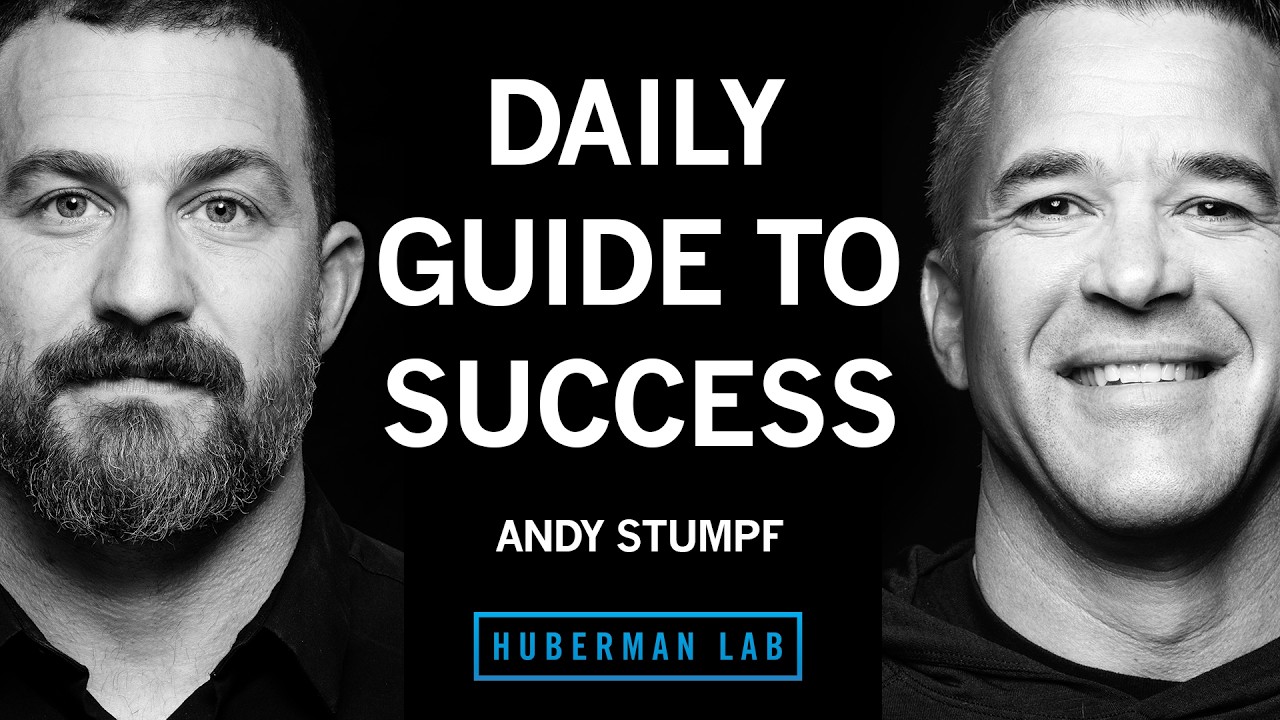
This episode was published on YouTube by Andrew Huberman on June 15, 2026, featuring retired Navy SEAL and author Andy Stumpf. It explores the mental frameworks, daily habits, and tools from Stumpf's career that can help individuals build resilience, maintain micro-discipline, and manage psychological and physical challenges.
## TL;DR
The conversation focuses on practical strategies for developing discipline, such as using the Circle of Influence vs. Concern exercise to manage mental overload and consistently choosing the slightly harder path to build neural tenacity. Andy Stumpf shares his experiences with extreme sports like wingsuit BASE jumping, describing the profound flow states they induce alongside the high stakes of miscalculating risk. The dialogue also addresses deeply personal hardships, including the emotional toll of a contentious divorce, a severe medical emergency, and the tragic reality of high-performance suicidality within the special operations community. Ultimately, they emphasize that true success involves mindful energy allocation, structural personal order, and maintaining genuine human connection over material wealth.
## Atmosphere & style
The dialogue strikes a grounded, authentic balance between elite high-performance and raw human vulnerability, moving far away from typical online guru personas. It blends high-energy technical discussions of military standards and extreme flight mechanics with solemn, deeply quiet reflections on isolation, trauma, and personal suffering. The dynamic between Huberman and Stumpf is one of mutual respect and intellectual curiosity, making the listener feel like they are sitting in on an intense, honest, and unpolished late-night conversation between close peers.
## Key takeaways
- [00:00](https://www.youtube.com/watch?v=baecUt1GaPk&t=0s) True discipline and the 'juice of life' come from mastering the execution of micro-tasks and small, everyday actions that people naturally resist or want to avoid.
- [04:06](https://www.youtube.com/watch?v=baecUt1GaPk&t=246s) The 'Circle of Influence vs. Circle of Concern' exercise is a powerful mental tool to clear a racing brain by separating what you can control (yourself) from external static (social media, global events).
- [20:11](https://www.youtube.com/watch?v=baecUt1GaPk&t=1211s) Social media functions as a highly addictive 'low resolution' trap, capturing the brain's attention enough to remain engaging while leaving the user fully conscious of their compulsive behavior.
- [31:48](https://www.youtube.com/watch?v=baecUt1GaPk&t=1908s) Engaging in intentional physical discomfort, such as ice baths, cold plunges, or extreme saunas, serves as a vital protocol to test and build mental resilience against everyday stress.
- [46:18](https://www.youtube.com/watch?v=baecUt1GaPk&t=2778s) Extreme flow state sports like wingsuit BASE jumping provide a profound mental reset by entirely eliminating everyday anxieties, narrowing the mind strictly to immediate moment-to-moment survival.
- [59:42](https://www.youtube.com/watch?v=baecUt1GaPk&t=3582s) The Dunning-Kruger effect poses a lethal risk in extreme environments, where novices frequently confuse merely surviving a hazardous situation with actual mastery or skill.
- [01:05:43](https://www.youtube.com/watch?v=baecUt1GaPk&t=3943s) Public perceptions of elite special operators as flawless superhumans are false; they are normal individuals who must struggle with deep personal crises, isolation, and identity loss.
- [01:23:15](https://www.youtube.com/watch?v=baecUt1GaPk&t=4995s) The post-flow state naturally lowers a person's stress threshold and baseline anxiety, reducing the impulse to seek out high-risk or destructive behaviors in daily life.
- [01:28:04](https://www.youtube.com/watch?v=baecUt1GaPk&t=5284s) Under high levels of stress, the brain's capacity to form novel, connected cognitive insights collapses, even though baseline memory recall may remain intact.
- [01:31:01](https://www.youtube.com/watch?v=baecUt1GaPk&t=5461s) Practicing micro-disciplines and avoiding everyday lazy shortcuts prevents cumulative chaos, operating on the principle that 'it always takes longer to do it wrong.'
- [01:43:48](https://www.youtube.com/watch?v=baecUt1GaPk&t=6228s) The anterior mid-cingulate cortex grows in volume when executing tasks an individual actively dislikes or resists, serving as the core structural feature behind 'superagers' and the will to live.
- [01:55:50](https://www.youtube.com/watch?v=baecUt1GaPk&t=6950s) Verbalizing physical suffering, mental grief, or psychological struggles directly accelerates receiving help and reduces unnecessary, prolonged trauma.
- [02:01:09](https://www.youtube.com/watch?v=baecUt1GaPk&t=7269s) The elite military community faces an alarmingly disproportionate suicide rate caused by severe isolation, rigorous standards, and a reluctance among top performers to show vulnerability.
- [02:40:14](https://www.youtube.com/watch?v=baecUt1GaPk&t=9614s) Transitioning completely out of financial survival mode is a long-term process that removes intense cognitive burdens, enabling healthier, desire-driven decision making.
- [02:45:35](https://www.youtube.com/watch?v=baecUt1GaPk&t=9935s) True success requires balancing ambition against personal happiness, as compounding wealth cannot buy genuine human connection and often leaves individuals isolated.
## Detailed walkthrough
### The Juice of the Harder Choice
Andrew Huberman opens the episode with a quote about the profound impact of consistently choosing the slightly more difficult path. It is often the small, unseen things that make the biggest difference in the world. While everyone intrinsically knows the difference between the hard and easy choice, the natural human tendency—even for high achievers—is to look externally and question what to do. In reality, people already know what they need to do; the real challenge is executing the microscopic tasks they want to do less, more often than the things they want to do more. Over time, mastering this discipline is where "the juice" of life comes from.
Huberman formally introduces his guest, Andy Stumpf, a retired Navy SEAL and former member of the Red Bull High Performance Team. As a wingsuiter, Stumpf literally flew in what are commonly called "squirrel suits" and set two world records in the sport. However, Huberman notes that today's conversation is not primarily driven by Stumpf's military or aviation careers. Instead, it was sparked by Huberman reading Stumpf's recent book, *Drown Proof*. While the market is flooded with books by former Navy SEALs, Huberman emphasizes that this one is special because the tools and lessons shared are uniquely practical and critical for everyone.
Previewing actionable Tools and Personal Trials
Huberman highlights a specific tool from *Drown Proof* that he has integrated into his own weekly routine. This exercise allows individuals to cleanly separate "issues of concern" from "issues of impact." By filtering out the background drama and distractions that can numb a person out and waste their life, the tool helps practitioners reclaim agency over things they can actually affect. Beyond this exercise, the episode promises actionable strategies for choosing the harder road in pivotal moments, as well as an intimate look into the most difficult chapters of Stumpf's life. Surprisingly, these struggles did not occur in combat or while wingsuiting, but within his personal life, which he discusses with immense candor.
The introduction concludes with a serious and emotional preview of their discussion surrounding suicide and mental health. Huberman notes that the frequency of suicide is rising significantly across all communities. While acknowledging that the conversation raises far more questions than it provides definitive answers, he stresses the critical, timely nature of the topic and welcomes listener input. Before diving into the interview, Huberman delivers a standard disclaimer clarifying that the podcast is entirely separate from his teaching and research roles at Stanford School of Medicine, operating instead as a zero-cost consumer resource funded by sponsors. He also announces that his first book, *Protocols: An Operating Manual for the Human Body*, is launching on September 15th after decades of research.
The Circle of Influence vs. Circle of Concern
As the interview begins, Stumpf jokingly admits that hearing a scientist like Huberman say he read his book makes him a bit nervous. Huberman reiterates his praise, explaining that a specific practice in *Drown Proof* immediately remapped his own unhealthy tendencies and gave him a renewed sense of agency—even helping him show up on time for the first time in his life. Stumpf names the exercise "influence versus concern" and immediately clarifies that he takes no ownership over creating it. He emphasizes throughout his book that these are not his unique ideas, but rather wisdom passed down to him that he wants to share forward.
Stumpf visualizes the concept by comparing a person's "sphere of concern" to the massive size of a conference table, while their "sphere of influence" is merely the size of a pin drop on that same table. The exercise itself is dead simple:
* Take a standard piece of paper and draw a straight line down the middle.
* Label one side **Concern** and the other side **Influence**.
* Write down everything currently occupying your waking hours.
Stumpf shares an intimate glimpse into his own psychology, noting that while he tries to avoid setting alarms unless necessary, he occasionally wakes up with his brain doing a full "revolution." If he catches himself staring at the ceiling with "sticky thoughts" in the morning, he gets out of bed and maps them out. He does this every one to six months, and inevitably, the thoughts keeping him awake belong entirely on the left-hand side of the paper under "Concern"—things like social media and global events that he cannot control. On the right-hand side, he notes that he has never found more than one true item to write down: **himself**.
Reclaiming Agency and Tuning Out the Algorithm
Expanding on the right side of the paper, Stumpf explains that while you can branch "yourself" out into sub-categories like your thoughts, internal dialogue, daily planning, and time management, it all loops back to personal execution. The ultimate realization of the exercise is profound: "I have no control over what happens to me in my life but I have absolute and complete and total control over how I respond to it." Recognizing this does not make him perfect at dropping his worries, but it flags unhealthy attachments and forces him to realize that being scared or concerned has zero impact on an outcome. Only the actions on the right side of the paper yield real-world efficiency. Huberman mentions that he modifies the exercise slightly by listing explicit things he can do with his time on the right side, which Stumpf validates as a perfect application of the tool.
The conversation naturally shifts to how modern life makes this boundary harder to maintain. Huberman notes how easily people get pulled into news rabbit holes. While it is easy to blame digital algorithms, Huberman and Stumpf agree that the ultimate obligation rests on the individual. Stumpf points out that while the algorithm is real and designed to strip away personal power, interacting with it remains entirely optional. He learned this concept years ago during his time in the Navy SEAL teams, but he still utilizes it about once a month today, frequently using long airplane flights as a productive window to do the exercise rather than tuning out.
- Stumpf humorously confesses that one of his favorite alternative airplane pastimes is watching YouTube videos of "sovereign citizens" getting arrested.
- He and Huberman share a laugh debating whether these individuals are genuinely trying to test the law or are just filming encounters to promote their lifestyle, with Stumpf noting that the internet is full of "amazing things" that should be met with a heavy dose of scrutiny.
The Smartphone Experiment and Screen Time Traps
Huberman reflects on their similar ages—Stumpf being in his late 40s and Huberman at 50—and notes how social media has drastically expanded the "Concern" column for everyone. In the past, milestones like 10, 20, or 30-year high school reunions were distinct, optional events where people chose to check in on who was thriving, married, or still alive. Today, platforms keep people permanently anchored to every person they grew up with or worked with years ago. Huberman muses that this constant awareness of the past cluttering the mind makes the line-drawing exercise harder than ever.
To illustrate just how sticky these platforms are, Stumpf brings up an endurance athlete and former teammate, Chad Wright, whom he affectionately calls "the Forest Gump of the SEAL teams" due to his long red beard and extreme athletic feats. When Wright appeared on Stumpf's podcast in November, they pulled out their phones to check their daily screen time and discovered a shocking average of four and a half hours. Horrified, they challenged each other to drop their daily smartphone usage to under an hour for the month of January.
Stumpf details the fascinating mechanics and psychological effects of their digital detox:
* **The Rules:** Total phone usage had to be under 60 minutes, though traditional voice calls were excluded from the metric.
* **The Results:** Wright's lowest average was around 90 minutes, while Stumpf managed to compress his phone time down to just 30 minutes during the final week of January.
* **The Loophole:** Stumpf didn't stop using social media entirely; he simply forced himself to access platforms like Instagram exclusively on his laptop.
* **The Friction Effect:** Because Instagram's desktop interface is clunky and lacks intuitive thumb-scrolling features, the platform lost its addictive "stickiness." Stumpf would post his content and immediately close the laptop out of pure boredom.
Stumpf notes that his mental health in January was better than it had been in a long time, proving that these platforms are explicitly engineered to monopolize the left-hand side of a person's mental ledger. Huberman jokingly chimes in with his scientific recommendation to optimize sleep disruption by viewing bright screen light in a dark room right before bed and avoiding morning sunlight. Stumpf admits that despite the profound benefits of the experiment, human nature pulled them both back; by March, both he and Wright had fully returned to their old habits of thumb-scrolling. This realization boggles Huberman's mind, setting up a deeper look at how even elite individuals forged in high-stress, low-sleep SEAL selection can still fall victim to the basic psychological traps of modern technology.
[14:43](https://www.youtube.com/watch?v=baecUt1GaPk&t=883s) The Platform Trap: Reverting to Social Media Addiction
The speakers dive headfirst into the mechanics of social media habits, discussing the frustrating reality of how easily people relapse into compulsive screen time. Even after realizing their excessive phone use, making a conscious agreement to hold each other accountable, and successfully limiting their usage, individuals often find themselves sliding right back into the exact same behavior within 60 days. This rapid regression says everything one needs to know about the insidious design of these platforms. It gets right to the heart of the constant struggle between human discipline and the powerful influence of digital algorithms.
When questioned about whether users are oblivious—like being in a state of drunkenness where they don't realize they shouldn't be doing it until they sober up—the guest admits to being acutely aware of the passing time. He describes a internal battle so intense that he frequently talks to himself out loud, asking, "Why are you doing this? This doesn't feel good." Despite this vivid awareness, he can still find himself trapped scrolling for 45 minutes to an hour. The host notes that 15 minutes is his own threshold before feeling a literal need to "take a shower" from the experience, though he admits the temptation remains highly enticing. The guest emphasizes that the behavior rarely brings joy, and escaping the platform's inherent negativity bias is nearly impossible. The human brain is naturally wired to spot outliers, meaning that among 99 positive interactions, a user will inevitably fixate on the one negative comment that says, "You kind of suck."
[17:02](https://www.youtube.com/watch?v=baecUt1GaPk&t=1022s) Mid-Show Sponsor Break: Our Place & Wealthfront
The host transitions to a sponsorship break, first highlighting kitchenware company Our Place. He explains that traditional non-stick pans often contain toxic PFAS, or "forever chemicals" like Teflon, which have been linked to health issues including hormone disruption, gut microbiome issues, and fertility problems. He expresses his personal appreciation for the Titanium Always Pan Pro, noting its zero-chemical pure titanium composition that allows him to seamlessly cook eggs, burgers, and steaks every morning without degradation or sticking.
The second sponsor introduced is Wealthfront, a financial management platform designed to help users navigate volatile markets. The host shares that he has personally trusted the platform for nearly a decade. He highlights specific features, such as the cash account's ability to earn a steady base yield from program banks, alongside a special limited-time promotional offer providing a three-month APY boost for listeners.
- **Our Place PFAS Statistics:** Toxic compounds are still found in 80% of traditional non-stick pans, utensils, and kitchen appliances.
- **Our Place Guarantee:** Features a 100-day risk-free trial, free shipping, and free returns.
- **Wealthfront Base Rate:** Offers a 3.3% annual percentage yield (APY) as of January 30th, 2026.
- **Wealthfront Audience Promotion:** An exclusive 75% APY boost over the base rate for three months, allowing up to a 4.05% variable APY on up to $150,000 in deposits.
[20:11](https://www.youtube.com/watch?v=baecUt1GaPk&t=1211s) The "Low Resolution" Theory of the Ultimate Addiction
Returning from the break, the host introduces a novel theory regarding online content consumption, sparked by recent time spent with a major online content provider. He argues that social media operates differently than substance abuse. When people sober up from alcohol, opioids, or amphetamines, they experience a clear moment of clarity and regret over wasted time and mistakes. Social media, however, represents the "perfect addiction" because it operates at what he terms a "low resolution."
This low-resolution nature means the activity is engaging enough to hook the brain's circuits, yet mild enough that it never completely occupies the user's mind. It allows people to run two cognitive tracks simultaneously. Unlike standard addictions where users crave a total escape from time or reality—such as gamblers seeking a total "zone"—social media users remain fully conscious that they shouldn't be scrolling while they are doing it. Because it isn't completely absorbing, it doesn't cause life to totally fall apart in an immediate, dramatic fashion; a person can still manage to sort of watch their kids, sort of participate on a Zoom call, or sort of hold a conversation. The host warns that this split-screen existence strains brain circuits that were never designed to multitask in this manner over prolonged periods.
[22:38](https://www.youtube.com/watch?v=baecUt1GaPk&t=1358s) Generative Loss and the Rebellion of the Youth
When asked where this unchecked digital drift leads, the host expresses deep concern for the younger generation, fearing that "otherwise incredible accomplishments" in careers, art, music, and families will simply never be made. He confesses that he fears this subtle cognitive drain far more than he fears AI taking away jobs, stating he is confident the long-term societal damage is "way, way worse" than the devastating opioid crisis.
The guest offers a more optimistic counter-narrative using his three children—aged nearly 18, 21, and 23—as real-world data points. His 21-year-old middle son, a mechanical engineering student doing quantum computing laboratory research, manages the problem by strictly downloading social media apps once a week for an hour of memes, and then immediately deleting them. Meanwhile, his oldest son's peer group has shifted toward a culture of "mocking people" who spend too much time on their phones. While his teenage daughter remains "surgically connected" to her device, the guest finds that unplugging the home router reveals her ability to see the light, leading him to believe the upcoming generation is developing a wary, protective eye against big tech platforms.
The host compares this generational shift to past anti-smoking campaigns. Historically, showing teens graphic images of diseased lungs failed to curb smoking because it felt like a lecture. What ultimately worked was exposing how "old white dudes" were cackling in boardrooms over the money they were making off kids. Once youth realize they are being actively manipulated by a massive corporate industry, their natural spirit of rebellion causes them to push back.
- **The Guest's Middle Son:** A junior mechanical engineering student who successfully built a robotic hand—jokingly testing it first by programming it to flip a middle finger—who strictly limits his social media app usage to one hour per week.
- **The Alcohol Shift:** The guest notes all three of his children are significantly pulling back on alcohol consumption compared to his own generation.
- **The Optimization Trend:** The youth culture is shifting heavily toward health; the guest's son actively requested tips on "sleep optimization" and peptides rather than party advice.
[27:38](https://www.youtube.com/watch?v=baecUt1GaPk&t=1658s) The Social Lubricant Dilemma and Camera Phone Culture
The host reflects on the massive response to his previous podcast episode regarding the dangers of alcohol, which highlighted it as a class one carcinogen associated with risks like increased breast cancer. He asks a candid, unexpected question: by replacing drinking culture with sleep optimization and extreme self-control, is the younger generation missing out on important, messy, formative life experiences?
The guest validates this question, acknowledging that alcohol served as an essential "social lubricant" that helped him overcome being antisocial in large crowds during his youth. While drinking certainly led to poor decisions, those exact consequences fundamentally shaped the person he became. However, both speakers agree that modern social dynamics are further complicated by the omnipresence of camera phones. Today's youth face intense social inhibition because any unpolished moment—even something as simple as bad dancing—can be instantly filmed, uploaded, and subjected to widespread social shame. This constant digital surveillance pressures young people to only present themselves in an impressive, high-amplitude form, altering the natural landscape of youthful experimentation.
[29:48](https://www.youtube.com/watch?v=baecUt1GaPk&t=1788s) Cannabis vs. Alcohol: Risk Profiles and Social Context
The speakers explore the comparative risks of cannabis and alcohol, clarifying that they are not anti-cannabis but view the risk-benefit profiles differently. While acknowledging that high performers can use cannabis without issues, they emphasize specific dangers, particularly for young males with a predisposition to psychosis or bipolar disorder. For this demographic, smoking high-potency or even low-potency weed can lead to a permanent psychotic episode. Conversely, while alcohol carries severe immediate risks—such as driving off a cliff or doing something stupid—the long-term psychological risks of a few safe, uneventful drinks are distinct, as "you're not going to make yourself psychotic."
The conversation turns reflective as one speaker shares personal feelings about past experiences with alcohol. While expressing deep regrets about certain actions when younger, they also admit their life would be completely different without those experiences, saying, "I would never want to give those experiences back." This creates a paradox, as they feel uncomfortable suggesting that someone *must* drink to have those meaningful human moments. They note that growing into a more confident person over time eventually reduces the need for alcohol as a social lubricant.
[31:48](https://www.youtube.com/watch?v=baecUt1GaPk&t=1908s) Pushing Margins and the Utility of Ice Baths
The discussion shifts to exploring the outer margins of human capacity through physical discomfort. Using sleep deprivation as an analogy, a speaker argues that while being well-rested is ideal, there is utility in experiencing how terrible it feels to be "completely crushed" by poor sleep, a breakup, or stress, yet still forcing oneself to complete a midterm, a run, or a hard conversation. They view this as an intentional test of mental resilience, describing it as "the ice bath of mental experiences."
This prompts a conversation about actual ice baths and temperature preferences. One speaker recounts a humorous exchange on Joe Rogan's podcast, where mentioning a preference for the "low 50s" left Rogan looking "shocked and dismayed," like an older brother questioning if they should even continue the podcast. To redeem themselves, they pointed out their high heat tolerance, regularly utilizing a sauna at 220°F. They now use a cold plunge in the low 40s. They advocate for cold exposure as a safe, reliable way to trigger an adrenaline spike, allowing individuals to navigate high-arousal states and explore their consciousness, supplemented by a long wave of dopamine and adrenaline lasting hours.
- **Cold Plunge Protocol Timing:** To avoid reducing strength and hypertrophy gains via vasoconstriction, avoid cold plunges immediately after resistance training. Do it before, on off days, or at least six hours afterward.
- **Jocko Willink's "Factory Reset" Protocol:** A high-intensity heat and cold routine consisting of three rounds. It utilizes a sauna packed and cranked up between 210°F and 220°F for 20 minutes per round, followed by a cold plunge. The psychological challenge relies on not knowing the exact temperatures or duration beforehand.
[36:07](https://www.youtube.com/watch?v=baecUt1GaPk&t=2167s) The Mechanics and Realities of Wingsuit Flying
The topic transitions to wingsuit flying—often colloquially called "squirrel suits" due to branding by a major manufacturer named Squirrel. The speaker explains that a wingsuit essentially turns the human body into a nylon wing using advanced, ram-air inflated fabrics designed to minimize drag. The suit features an upper layer, an under layer, and ribbed fabric with portholes in between. When exiting a skydiving aircraft moving at 80 to 120 miles per hour, these ram-air inlets fill instantly, pressurizing the suit and allowing the pilot to translate horizontal lift into power, sometimes even ascending briefly above the aircraft.
The mechanics change drastically in terminal BASE jumping, which involves jumping from fixed objects categorized by the acronym: Buildings, Antennas, Spans (bridges), or Earth (cliffs). Because BASE jumping begins with a zero-airspeed exit, the pilot experiences no airflow for the first zero to four seconds. If the jumper fails to maintain proper body positioning during this critical window—such as head-low "scorpioning" or pitching improperly near terrain—the suit will not fly, which is how many fatalities occur.
- **Experience Requirement:** Wingsuiting requires significant baseline skydiving experience; the speaker completed 3,000 standard jumps before trying a wingsuit for the first time.
- **Alternative Training Environments:** Commercial wind tunnels (available in locations like Oceanside, Los Angeles, San Diego, and Virginia Beach) simulate the sensation of falling without planes or parachutes, offering a precise visual reference to hone aerodynamic body alignment.
[40:19](https://www.youtube.com/watch?v=baecUt1GaPk&t=2419s) Skydiving Dynamics and Equipment Safety
The speaker breaks down the operational structure of skydiving, noting that a basic individual jump involves exiting an aircraft, maintaining a belly-to-earth orientation, and deploying the canopy on time. Standard civilian skydiving rigs utilize two parachutes: a main parachute and a reserve. While experienced jumpers can pack their own main parachute in about five minutes, the reserve parachute must be inspected and packed strictly by an FAA rigger.
The sport accommodates diverse aerial disciplines, from vertical flying (feet down or head down) to massive formation jumps. The speaker describes world records involving hundreds of people linking up in mid-air from eight separate aircraft, creating intricate "snowflake configurations" visible from the ground before tracking away at breakoff altitude. The volume of jumps can vary wildly depending on the setting, ranging from a standard day to highly accelerated events.
- **Reserve Parachute Maintenance:** The reserve parachute requires periodic inspection and repacking by an FAA rigger; the regulatory interval shifted from every 90 days to every 6 months.
- **Automatic Activation Devices (AADs):** Internal computers (such as Cypres or Vigil) that continuously monitor fall rate and barometric pressure. They automatically fire the reserve parachute if a jumper is unconscious or fails to track their altimeter, saving hundreds of lives.
- **Jump Volume:** A typical day of skydiving in San Diego yielded six to eight jumps, but during dedicated events called "boogies," the speaker completed up to 30 jumps in a single day.
- **Standard Altitude:** A first non-tandem jump typically takes place at an average altitude of 13,000 feet Above Ground Level (AGL). In mountainous regions like Colorado, planes may fly at 16,000 to 18,000 feet to secure 12,000 feet of true clearance over the terrain.
[44:18](https://www.youtube.com/watch?v=baecUt1GaPk&t=2658s) Graduating through Wingsuits and the Transition to BASE Jumping
The journey through wingsuiting requires a methodical, stepwise progression. Jumpers begin with smaller wingsuits that offer higher maneuverability, gradually moving up to larger and more complex suits. Skipping steps can lead to severe consequences. In larger suits, if a jumper ends up on their back, they can enter a flat spin; while recovery is possible, it must happen quickly. The centrifugal force from these spins is so intense that jumpers often land with fully blown, blood-red eyes.
This progression changes drastically when moving from skydiving to the BASE jumping world. While skydiving relies on two parachutes, BASE jumping utilizes only one, packed meticulously by the jumper themselves in a manner similar to a reserve parachute. Because BASE jumps occur very close to the ground, a secondary reserve parachute is useless—it takes a couple hundred feet just for a reserve canopy to deploy.
* In the United States, there is only one location where BASE jumping is legal 24/7, 365 days a year: the Perrine Bridge in Twin Falls, Idaho.
* Legality varies heavily by city; jumping off buildings in places like Las Vegas and New York can result in a felony charge, a "capital F" that is rarely worth testing gravity for.
* Red Bull projects often manage to temporarily bypass illegality through sheer financial backing, as writing a large check can briefly make forbidden jumps legal.
* For about a year, Dubai set up a fully legal skyscraper BASE jumping operation from one of its highest floors.
---
[46:18](https://www.youtube.com/watch?v=baecUt1GaPk&t=2778s) Blending Wingsuits with the Earth and the Pursuit of the Flow State
The acronym BASE stands for Buildings, Antennas, Spans (bridges), and Earth (cliffs). After learning on the Perrine Bridge, the speaker's first "Earth" jump was at Monte Brento in Italy—a location described as "basically heaven," where a jumper deploys their canopy, lands, walks across the street, and immediately enjoys an Italian espresso. After staying there for two and a half weeks, they transitioned to Lauterbrunnen, Switzerland. Combining wingsuiting with BASE jumping introduces a highly precarious four-second window immediately after pushing off a cliff. During these initial seconds, the wingsuit feels sloppy and unrigid; it provides no real aerodynamic control until it fully "powers up" with air and allows the pilot to pull away from the rock face.
The personal motivation behind pursuing such a dangerous activity has nothing to do with romanticizing risk. For the speaker, who picked up the sport three years after leaving the Navy, it was entirely about achieving a profound mental reset.
> "At about 1 minute out on a helicopter, for me, and I can only speak for me, your entire... circle of concern goes away, completely gone."
This headspace is incredibly powerful, clearing out the mundane or stressful "static of everyday life" like a broken washing machine, unpaid bills, or missed family holidays. Once on a military objective or stepping off a cliff, the mind narrows down strictly to the next three seconds of existence. This deep flow state is immensely impactful, providing a lingering sense of dialed focus and peace that lasts for months, making them a better businessperson, and a more patient father and husband.
---
[49:47](https://www.youtube.com/watch?v=baecUt1GaPk&t=2987s) The Currency of Fear and the Reality of Risk
While a novice skydiver might experience a similar hyper-focus, after thousands of jumps, the narrow window opens back up because the jumper has seen it all—cutaways, malfunctions, and reserve deployments. BASE jumping resets that timeline entirely. The speaker vividly recalls their first bridge jump where the instructor had them climb over the rail to look down at 486 feet, telling them to test the wind by spitting. If the spit drifted past a certain point, they were good to go. On that first jump, the instructor even held the pilot chute to rip it open manually, ensuring it deployed cleanly.
Eventually, the calculation changed. Due to the deaths of multiple friends and finding alternative activities to clear the mind, the risk crossed a threshold where it was no longer worth the reward. Maintaining competency and currency is vital in wingsuit BASE jumping, and after moving to Montana, access to drop zones plummeted.
* **Skydiving Longevity:** Having skydiver since 1999, the speaker notes one could take five years off and still safely jump out of an airplane, but that is impossible with wingsuit BASE jumping.
* **The Physical Toll of Terror:** Standing at the edge requires making a little "teepee" out of the suit's tail wing, putting toes to the brink, and rocking past the point of no return. The heart rate spikes so loudly it creates a physical "thrush" in the ears.
* **The Switzerland Experience:** Flying in Switzerland offers the choice to fly aggressively just six feet off the ground, "playing tag with your shadow" and carving through trees, or flattening the suit out to glide for two and a half minutes.
---
[54:14](https://www.youtube.com/watch?v=baecUt1GaPk&t=3254s) The Human Missile and the Dunning-Kruger Effect
When a wingsuit pilot "bends those suits over" and violently dives toward the terrain, they can reach speeds of about 120 miles per hour face-first, effectively becoming a "human missile." When flying flat and slow, the suit feels akin to resting on an air mattress. However, when pitched over into a dive, the power meter maxes out, creating an intense, electric physical sensation.
> "It feels like you are licking the largest 9-volt battery you've ever licked in your life."
To avoid impacting flat terrain, pilots must remain hyper-aware of this sensation and use the suit's performance to flatten out and disconnect from the topography.
The conversation shifts to a debate on whether this thrill-seeking behavior represents an evolution or devolution of personality, comparing it to kids who hold lit firecrackers until the last possible second. The speaker rejects the comparison, noting that holding an M80 is danger for the sake of danger, which doesn't yield the deep sense of ease and peace found when lying on one's back in a Swiss meadow after a successful jump.
From a scientific standpoint, high-risk communities face severe desensitization to consequence, leading to high fatality rates. The host raises the question of whether fatalities plot higher among veterans who push deeper into the abyss, or among novices. The speaker points directly to the Dunning-Kruger effect as the most dangerous element. In the modern content age, beginners frequently ask online forums how to fast-track into wingsuit BASE jumping, ignoring the standard recommendation of completing 200 regular skydives over a year or two before ever putting on a suit. Without a slow progression, novices remain ignorant to life-saving environmental variables, such as whether thermals are ascending or descending, or how a western-facing slope affects the crucial updraft needed on exit.
[59:42](https://www.youtube.com/watch?v=baecUt1GaPk&t=3582s) Nailed It vs. Got Away With It
The discussion centers around a psychological trap that exists in extreme sports and everyday life: confusing survival with skill. The speaker describes the dangerous illusion of completing a hazardous jump for the first time, surviving it, and mistakenly thinking, "nailed it." In reality, variables like shifting thermals or sudden shade could mean they simply "got away with it." This delusion perfectly illustrates the ascending line of the Dunning-Kruger effect, a concept that kills people in high-stakes environments. The phrase "Did you nail it or did you get away with it?" is highlighted as a vital quote that should be stamped into everyone’s brain to spare them from immense future pain.
Reflecting on his own experiences, the speaker admits he got away with it far more than he actually nailed it. He explains that in high-risk disciplines, "you don't know what you don't know" until you witness someone else get bitten by the exact same mistake, or you find yourself on a jump where only one or two out of three people make it out alive despite everyone having the same plan. The speaker brings up his late friend Alex, a frequent jumping partner over the years. He recalls several close calls where Alex made poor decisions. He notes that aviation training teaches that once you know better, you can do better, but there is a dangerous phase where a person genuinely thinks their incorrect actions are right. The speaker expresses a poignant, retroactive wish that he could go back and honestly slap Alex around to force him to pay attention, directly linking Alex's ultimate death to that middle area of the Dunning-Kruger curve where an individual falsely believes they have everything dialed in.
When asked point-blank if he would ever allow his own children to wingsuit fly, the speaker initially questions whether he even has the right to stop them. He states that while he would do everything in his power to prepare them—meaning he would "scare the absolute dog [ __ ] out of them" with the brutal reality, the time investment, and the massive sacrifices required to perform at that level—he ultimately would not stand between them and their desires if they still chose to pursue it.
---
[01:03:01](https://www.youtube.com/watch?v=baecUt1GaPk&t=3781s) The Soul-Crushing Reality of Divorce
The conversation shifts toward the speaker's willingness to be vulnerable in his book, particularly regarding the painful collapse of his first marriage. He describes a nearly two-year, highly contentious divorce process as the "hardest thing I've ever done in my life." While people assume that being a Navy SEAL is the pinnacle of hardship, the speaker clarifies that military challenges are often truncated by short overseas deployments. Though physiologically and psychologically demanding, the military never forced him to question his core identity or whether he was a good enough person to continue existing. The lowest points of his divorce, however, forced exactly those agonizing existential questions. He intentionally avoids detailing specific grievances in the book because he possesses a large public platform while his ex-wife does not, choosing instead to handle the matter with fairness and privacy. He humorously notes that if people hear bad things about him, they are welcome to believe them, joking that he is "certainly not everybody's cup of tea."
Navigating that emotional wreckage required every single mental tool he writes about in his book, including managing his circle of influence versus his circle of concern, breaking time down into the shortest possible chunks, and strictly controlling his internal monologue. He sums up the entire experience as completely soul-crushing, giving it a humorous yet dark rating of "10 out of 10. Do not recommend," which the interviewer compares to a zero-star TripAdvisor review.
- The speaker initiated the end of the marriage.
- The divorce process lasted nearly 2 years and was highly contentious.
- The speaker chose to omit specific details of the split to protect his ex-wife's privacy due to his larger public platform.
---
[01:05:43](https://www.youtube.com/watch?v=baecUt1GaPk&t=3943s) Demystifying the "Captain America" Myth
The interviewer commends the speaker for humanizing himself rather than painting the flawless, untouchable picture often associated with "team guys" or special forces operators. The speaker reveals that including these raw struggles was his plan from the very beginning. He emphasizes that it is a massive mistake for the public to think that special operators are not normal people. Referencing a conversation he had with Chris Williamson, he notes that there is no "Captain America shield and cape and cowl" in real life. Operators do incredibly extreme things, but afterward, they strip off their gear, clean up, eat food, and sit around talking about normal, day-to-day issues. He shares a striking example of a teammate who received a notification that his house had burned down right before heading out on an objective; the operator had to compartmentalize the disaster during the mission, only to immediately face the reality of it upon returning.
The speaker explains that his decision to show his scars was heavily reinforced by the overwhelming volume of emails he received during the Friday Q&A sessions of his podcast. Instead of decreasing the influx, these episodes multiplied the messages by orders of magnitude, revealing a deep, dangerous cultural theme: a profound sense of isolation. People would look at his life from the outside, see his physical achievements, and lament that they felt entirely alone in their struggles. By sharing his own ongoing seasons of suffering, the speaker aims to remind people that they are not unique or alone in their pain, rejecting the fake persona of online gurus selling monthly 12-step programs.
---
[01:10:24](https://www.youtube.com/watch?v=baecUt1GaPk&t=4224s) An 18-Month Separation from His Son
The emotional peak of the conversation emerges when the speaker details the collateral damage of the divorce on his children, specifically his relationship with his oldest son. Following the separation, the speaker completely lost contact with his son for 18 months. During this agonizing period, the speaker tried everything to reach out: making phone calls, sending text messages, and writing physical letters to his ex-wife's house. In a desperate attempt to connect, he would even pull up next to his son's car in a parking lot before the boy went to work, only to watch his son burn out of the parking lot without giving him so much as a glance. The speaker contrasts this helplessly painful experience with the rigors of military training, stating that no event in the SEAL teams ever made him doubt his worth as a man the way this estrangement did.
Through sheer persistence and staying the course, their relationship has since recovered and is now closer than it ever was, with his son frequently calling him to ask for advice. The speaker urges all parents to instantly drop whatever they are doing if their children solicit their time, calling it an awesome privilege. The interviewer notes how deeply moving the book's accounts of both the divorce and the passing of the speaker's mother are, admitting that reading about the speaker's final moments with his mother was so impactful that it prompted him to pause and call his own mother.
---
[01:12:17](https://www.youtube.com/watch?v=baecUt1GaPk&t=4337s) Sponsor Break: Function Health
The podcast cuts to a promotional segment for its sponsor, Function, a health service providing over 160 advanced lab tests, alongside new access to MRI and CT scans. The host explains how the service tracks essential biomarkers related to heart health, hormones, immune function, and nutrient levels, delivering personalized optimization strategies from top doctors. Sharing a personal anecdote, the host describes how a recent Function lab test revealed his blood lipids were slightly out of range. Based on the platform's recommendations, he began supplementing with nattokinase to naturally lower his LDL cholesterol, a strategy he later confirmed was successful through a follow-up test. The host contrasts this modern, affordable approach—which costs 365 dollars a year, or roughly a dollar a day—with his past experiences spending thousands of dollars annually on time-consuming, lower-quality laboratory testing.
- **Sponsor Name:** Function Health
- **Services Offered:** Over 160 advanced lab tests tracking biomarkers for heart, hormone, nutrient, and autoimmune health, plus CT and MRI scans.
- **Host's Supplement Example:** Used nattokinase to successfully reduce elevated LDL cholesterol levels.
- **Pricing:** 365 dollars per year (1 dollar per day).
- **Discount Code:** Code "huberman" gives a 50 dollar credit at [functionhealth.com/huberman](https://functionhealth.com/huberman).
[01:14:15](https://www.youtube.com/watch?v=baecUt1GaPk&t=4455s) Navigating Family Dynamics and the Empathy of Age
The speaker reflects deeply on the complexities of divorce and the agonizing position of being caught in the middle as a child. Drawing from his own life, he shares how he naturally felt protective of his mother while still harboring a deep love for his father. Now, as a parent of three kids, he frequently discusses these dynamics with his current wife, whom he credits as the primary reason he was able to pull himself out of that dark emotional headspace. He recalls how she gently grounds him during moments of frustration by reminding him, "listen, that's always going to be their mom." This simple piece of wisdom acts as an immediate recentering mechanism, helping him understand the situation even when it remains incredibly difficult to handle.
The conversation expands into how different family dyads operate under their own unique parameters. The speaker touches upon the distinct natures of father-son and mother-son dynamics, joking that because he has a sister, he technically has a "control experiment" for how daughters handle things—though he adds with a laugh that she probably wouldn't appreciate being referred to in scientific terms. When asked if he realized his own parents' marriage was failing before they actually split, he answers with a definitive yes. However, through intentional and hard emotional work, he has managed to reach a place of profound gratitude and closeness with both parents, even having his father guest on his podcast. Looking back, he realizes how difficult it is for a young person to feel grateful when they are wrapped up in their own misery, but today he consciously tries to put himself in both his mother's and father's shoes to understand what they were experiencing in their careers and personal lives at that time.
- The speaker dedicated his book to his wife and children to honor their role in his healing process.
- He notes that it is slightly easier to empathize with his father's historical frame of mind due to their shared gender, but notes he stayed home with his mother while his father lived elsewhere during the split.
- He emphasizes a profound shift from focusing on his own childhood pain to realizing, "oh my god, that must have been so hard for them."
[01:16:43](https://www.youtube.com/watch?v=baecUt1GaPk&t=4603s) Breaking the Gospel of Parenthood and Academic Realities
When asked exactly how old he was when he finally realized his parents were just ordinary human beings doing the best they could, the speaker jokingly replies, "yesterday?" He goes on to discuss the universal childhood illusion that parents speak absolute gospel truth and must possess the answers to every mystery in the universe simply because they seem older than anyone else alive. In reality, everyone eventually discovers that parents are just "making [__] up on the fly" with whatever limited data they have, often failing not out of a lack of effort, but simply because they are flawed human beings.
The speaker notes that he actually came to this conclusion at a very young age, albeit through a flawed, black-and-white lens: he decided his parents simply didn't know what they were talking about. This premature disillusionment forced him to look elsewhere for guidance, leading him to find incredible mentors, as well as a few wrong answers along the way. He maps this exact evolutionary realization onto academia, describing how a graduate student eventually realizes their PhD adviser doesn't know everything, which prompts them to get a postdoc adviser, only to realize *they* don't know everything either. Finally, they start their own lab and inherit the staggering realization of how difficult the job truly is when their own graduate students start questioning their competence.
- The speaker's very first graduate student is now a happily married professor with two kids and a highly successful lab of her own, and she completely agrees with this evolutionary timeline.
- Despite the drawbacks of early disillusionment, the speaker notes a "real benefit" to realizing early that parents aren't omniscient, as it forces independent exploration.
- The host expresses deep gratitude to the speaker for including these vulnerable, humble reflections on family and parenthood in his book, stating that it offers immense hope and humility regarding how hard it is to simply be a person.
[01:19:22](https://www.youtube.com/watch?v=baecUt1GaPk&t=4762s) The Post-Flow State and the Myth of the Adrenaline Junkie
The dialogue shifts from the emotional landscape of family to the physical and psychological aftermath of extreme high-stakes environments, such as wingsuit flying and military operations. The host points out the fascinating contrast between the speaker's emotional vulnerability and his willingness to jump off mountains in a squirrel suit. He asks the speaker to detail his psychological state in the six months following these intense experiences, questioning whether it mirrors the high-octane adrenaline rushes seen after a gunfight or attending a military funeral.
The speaker flatly rejects the label of "adrenaline junkie," explaining that he actually despises the hyper-adrenalized physical sensations commonly associated with fear, such as tasting copper in the mouth, a skyrocketing heart rate, or hair standing on end. Instead, he describes his experience on the edge as being "scared shitless," and notes that the aftermath is the exact opposite of walking around amped up. Instead, he experiences a deep sense of being settled, anchored, and clear-headed. He compares it to turning down the static dial on a stereo; the mundane bullshit of daily life gradually turns the static back up, necessitating another trip or high-stakes endeavor to dial it back down.
- The speaker explains that real-life gunfights are unlike the movies because they happen too fast for a sustained adrenaline rush; decisions are split-second and rote, such as turning a corner and facing a binary threat.
- True adrenaline dumps usually catch up to people *after* the event, often causing them to "melt a little bit" on the far side of the performance bell curve where their capabilities temporarily degrade.
- Military post-operation routines typically involve a highly settling, structured sequence: taking off gear, hanging it up, removing the uniform, showering, eating, and gathering communally with the team.
[01:23:15](https://www.youtube.com/watch?v=baecUt1GaPk&t=4995s) Sleeping Clean and Lowering the Stress Threshold
When asked how he sleeps the night after a highly successful wingsuit jump where everyone survived and learned from their mistakes, the speaker responds enthusiastically: "oh, so good." He notes that the sheer repetition of these high-stakes activities leaves participants completely wiped out, leading to incredibly deep sleep. This prompts a brief sidebar about the military's historical, unhealthy reliance on Ambien to force sleep or induce amnesia, with the speaker noting that some SEALs would casually leave a bowl of loose Ambien out or prep extra pills by their bedside for when they inevitably woke up in the middle of the night.
Returning to the long-tail effects of extreme experiences, the speaker notes that for about three months after a major jump, his headspace remains remarkably "clean" and his cognitive processing is highly optimized. While a simple psychological theory suggests that these extreme acts merely raise a person's stress threshold so that trivial daily annoyances no longer trigger adrenaline, the host argues that true flow states operate differently. If a person's stress threshold is artificially forced too high, they often engage in meaningless, unhealthy behaviors because nothing feels stimulating enough. The speaker agrees, proposing instead that these deep flow experiences actually *lower* the stress threshold by stripping away "BS stress" and eliminating the desire to invest energy into high-risk, nonsensical behaviors.
- The clean, hyper-focused headspace typically peaks for the first three months before starting to noticeably change or fade around the three-month mark.
- Veterans transitioning out of the military frequently fall into an "abyss" trying to replicate this elusive headspace, but the speaker issues a "spoiler alert" that it cannot be perfectly replicated.
- Rather than prescribing dangerous activities like BASE jumping, the speaker notes that this same life-changing presence can be accessed safely through art, yoga, meditation, ice baths, saunas, or the "artificial violence" of Jiu-Jitsu.
- The host introduces a parallel book recommendation titled *The Secret Pulse of Time*, which explores human time perception and how different absorbing endeavors allow people to access this mysterious, unnamed "post-flow" benefit.
[01:28:04](https://www.youtube.com/watch?v=baecUt1GaPk&t=5284s) Calibration of Time Perception and Connected Insights
The conversation centers on how certain high-intensity or mindful experiences can recalibrate a person’s perception of time, effectively clearing out mental "static" and shifting their psychological framework. By adjusting this internal "frame rate," individuals can return to everyday tasks with a heightened state of high-fidelity focus, allowing them to sink into moments, think more clearly, and process complex arguments or conversations from entirely new perspectives.
The discussion pivots to a recent scientific paper regarding the cognitive impacts of stress. The study demonstrated that while stressed individuals can still access prior memories, they struggle to form insightful connections between them. For instance, participants were trained to link pairs of objects—such as an apple to a yerba mate, and a yerba mate to a wingsuit—and then later deduce the conceptual link between the wingsuit and the apple. As stress levels rose, their capacity to generate these connected insights collapsed. This insight serves as a potential explanation for why lowering one's stress threshold is so vital: it frees the brain's software to make novel, meaningful connections in everyday life rather than letting anxiety reduce interactions into mere annoyances.
- A recent study used object-pairing experiments (e.g., apple to yerba mate, yerba mate to wingsuit) to evaluate cognitive linking under pressure.
- Increased stress directly impairs the brain's ability to form novel, connected insights between separate pieces of information.
- Lowering stress thresholds improves everyday navigation and helps individuals manage major life challenges.
---
[01:31:01](https://www.youtube.com/watch?v=baecUt1GaPk&t=5461s) The Toilet Paper Pyramid and Everyday Shortcuts
The hosts playfully transition into an "inside joke" from Andy's book regarding bathroom etiquette, a topic that prompted numerous readers to email photos of their children's bathrooms accompanied by messages of solidarity. Andy introduces a foundational mantra: "It always takes longer to do it wrong." He uses his children's bathroom habits as a hilarious case study, joking that if an Ebola outbreak were to hit the United States, it would likely originate there. Instead of discarding empty toilet paper rolls, his kids stack new rolls directly on top of the old ones, eventually building an unstable pyramid against the wall that inevitably collapses behind the toilet, leading to desperate screams for assistance.
This domestic anecdote serves as a broader metaphor for the micro-shortcuts people take daily. Andy compares the toilet paper dilemma to handling laundry. While it seems easier to leave clean clothes in a disorganized pile, finding a specific shirt later—especially when dealing with a wardrobe primarily consisting of black, blue, and occasional red garments—takes vastly more time because items are inside out or have socks tangled in the sleeves. He notes that just before leaving for the recording, he discovered three rolls in his daughter's bathroom—two empty and one sitting vertically—causing him to simply close the door and walk away. Ultimately, avoiding these small shortcuts and practicing discipline upfront saves time and prevents cumulative chaos.
- Andy jokingly references the risk of an Ebola outbreak starting in his kids' messy bathroom.
- The children build balancing pyramids out of empty and full toilet paper rolls instead of replacing them on the holder.
- Disorganized laundry piles of mostly black and blue clothing cause significant time loss due to inside-out shirts and static-clung socks.
- The fundamental principle highlighted is that taking lazy shortcuts always costs more time in the long run.
---
[01:34:39](https://www.youtube.com/watch?v=baecUt1GaPk&t=5679s) Micro-Discipline, Admiral McRaven, and Tidy Lives
The discussion expands to the cultural impact of Admiral William H. McRaven’s famous speech about the discipline of making one's bed every morning. While parents rejoiced that a military authority figure was reinforcing household chores, the true lesson of the bed-making analogy is about cultivating a compounding series of small acts of discipline. The speakers note that choosing the slightly harder path early in the morning sets a positive trajectory for the entire day. It provides a clean, controlled environment to return to at night, which stands in stark contrast to starting a workday facing a chaotic, disorganized desk where crucial tools cannot be found.
They observe that ultra-successful individuals generally keep tidy personal and professional lives, maintaining order through sheer "will" rather than simple reflex. The appearance of massive macro-discipline is actually just the accumulation of tiny, hidden habits that nobody else sees.
- Admiral McRaven’s speech emphasized starting the day with a small, symbolic act of discipline.
- Choosing the "slightly harder choice" consistently over the easier one builds actionable momentum.
- High achievers are rarely disorganized; structural order is maintained through conscious will rather than natural reflex.
- A cluttered workspace directly hinders productivity and traction at the start of a task.
---
[01:37:11](https://www.youtube.com/watch?v=baecUt1GaPk&t=5831s) Social Pressure, Cultural Drift, and Military Training Standards
The hosts address a modern social paradox: there is often subtle social pressure to avoid doing the harder thing, and critics frequently dismiss basic discipline as "neurotic." One host shares a core memory from the mid-1990s involving his father, a first-generation immigrant from South America. While walking past moviegoers dressed in baggy sweatpants and flip-flops, his father remarked, "See that? That's the beginning of the end." He explained that when a society's social pressure erodes to the point where people go to public movie theaters in their pajamas, it signals a broader breakdown in how people show up for society. This cultural drift allows people to give themselves a license for mediocrity, often contenting themselves by watching daytime trash TV like *Jerry Springer* to feel better about their own messy lives.
Andy counters the "neurotic" critique by challenging critics to examine where they are in their own life journeys, suggesting that an allergic reaction to discipline often stems from personal frustration. He references a foundational military maxim: "How you do anything is how you do everything." To illustrate this, he describes the intense, seemingly arbitrary standards of military training, such as a two-mile swim where instructors use a jeweler's loupe to inspect the tiny twisting sections of a candidate's CO2 cartridge and K-BAR knife. In that environment, a single grain of sand can mean failure, proving that mastering the smallest, seemingly irrelevant details dictates how a soldier will perform when life is on the line.
- The host's father, a South American immigrant, viewed wearing pajamas to a movie theater in the 1990s as a sign of societal decay.
- *Jerry Springer* daytime television is cited as an example of people consuming others' chaos to normalize their own lack of discipline.
- The training mantra "How you do anything is how you do everything" connects small habits to overall life trajectories.
- Special operations training tasks candidates with keeping items like K-BAR knives and CO2 cartridges perfectly free of sand during grueling two-mile swims.
[01:41:58](https://www.youtube.com/watch?v=baecUt1GaPk&t=6118s) The Discipline of Procedure and the Value of Hard Days
Even when dealing with minor details like a fleck of rust or a specific texture on a CO2 cartridge, strict adherence to established safety procedures is paramount because "the procedure is what's going to save your life." The most successful people do not achieve their status by operating in chaos. While anomalies or "white elephants" exist where people find success through chaotic means, this approach does not scale and cannot be reliably replicated. Committing to foundational tasks becomes exceptionally difficult when a person is exhausted and facing severe time constraints, yet these are the exact moments when discipline matters the most.
Pushing through tasks on days when motivation is entirely absent provides a critical psychological victory. Shifting one's perspective to see small, tedious chores as foundational rather than optional extras builds lasting mental resilience. Over a lifetime, stacking up these small victories where you execute despite not wanting to allows an individual to completely outpace and "blow people away with what you can accomplish."
* The mental victory of executing a task when you do not want to heavily outweighs the physical aspect.
* Success born out of chaos does not scale and is not a reliable blueprint for replication.
---
[01:43:48](https://www.youtube.com/watch?v=baecUt1GaPk&t=6228s) The Neuroscience of Tenacity and Superagers
Neuroscientific research strongly supports the generalizability of leaning into friction. The anterior mid-cingulate cortex is a specific brain area that grows in volume and increases its neural connections when individuals successfully navigate difficult challenges, such as adhering to a strict diet or adding three 30-minute cardio sessions to an existing exercise routine. However, a critical caveat dictates that this neuroplastic growth only occurs if the individual actively dislikes the activity. If someone genuinely enjoys an ice bath or loves the final two reps of a workout, the activity fails to stimulate or enlarge the anterior mid-cingulate cortex because it lacks the necessary element of psychological resistance.
Growth of the anterior mid-cingulate cortex serves as the defining structural feature of "superagers"—individuals who maintain high cognitive and physical abilities relative to their peers well into their 80s and 90s. This brain structure is heavily linked to a person's underlying "will to live" and overall tenacity when confronting life's challenges. The neurological benefit can be triggered by everyday choices, such as choosing to put dishes directly into the dishwasher immediately after a meal rather than letting them pile up in the sink overnight.
* **Anterior Mid-Cingulate Cortex:** A brain region that hypertrophies when executing tasks you do not want to do in the moment.
* **Superagers:** People entering their 80s and 90s who successfully preserve their cognitive and physical capabilities.
* **The Dislike Variable:** Brain growth in this area is entirely dependent on experiencing friction and performing actions you genuinely dislike.
---
[01:47:00](https://www.youtube.com/watch?v=baecUt1GaPk&t=6420s) The Anti-Mastery Appeal of Jiu-Jitsu
A compelling aspect of jiu-jitsu is the absolute impossibility of mastering it completely. Even black belts who have been training for nearly as long as some practitioners have been alive experience cyclical seasons and phases in their practice. Just as they believe they have fully understood a technique, they encounter something entirely new that forces them to realize "they haven't even begun to understand."
This perpetual learning cycle requires practitioners to continually rebuild their knowledge base from scratch. Paradoxically, the more experience these high-level martial artists accumulate, the less they believe they have everything figured out. Constantly engaging with activities that are fundamentally impossible to master is a critical mechanism for staying mentally sharp and youthful.
---
[01:48:00](https://www.youtube.com/watch?v=baecUt1GaPk&t=6480s) Red Light Therapy Sponsor Break
Exposure to specific wavelengths of light exerts an incredible, scientifically documented impact on human biology, cellular function, and overall organ health. Beyond standard sunlight, targeted applications of red light, near-infrared, and infrared light work in tandem to trigger optimal cellular adaptations. These documented biological benefits span multiple areas of physical recovery and systemic health:
* Accelerated muscle recovery times
* Improved skin health, wound healing, and acne reduction
* Decreased systemic pain and localized inflammation
* Enhanced mitochondrial function and targeted improvements in vision
While the commercial market features a broad variety of red light products, premier clinical-grade devices set themselves apart by utilizing specific, clinically proven wavelengths. A standard protocol involves utilizing a whole-body panel three to four times a week for 10 to 20 minutes per session, supplemented by a portable handheld light device for consistency while traveling.
---
[01:49:22](https://www.youtube.com/watch?v=baecUt1GaPk&t=6562s) Radical Pain and the Intestinal Blockage Story
Vocalizing internal or external pain does not inherently worsen the physical sensation; instead, being honest about suffering typically reveals a supportive network of people willing to help relieve it. An illustrative example of misjudging severe pain occurred during a podcast recording session south of Salt Lake City, where an initial internal shift in the stomach was casually dismissed as a minor gas bubble. Despite an escalating inability to stand up straight, a subsequent 90-minute jiu-jitsu open mat rolling session was executed, followed by an awkward attempt to slouch in a chair to conceal the visible distress from a spouse.
During a subsequent car trip intended to span from Salt Lake City back home to Kalispell, Montana, the physical pain escalated to a point of total physical inversion in the passenger seat—hanging upside down with the head in the footwell in a desperate attempt to dislodge the assumed gas bubble. Despite a stubborn insistence to bypass local medical care and simply drive through Salt Lake, a spouse intervened by searching for the nearest hospital and driving directly to the emergency room. The eventual medical diagnosis revealed a severe intestinal blockage caused by a loop of scar tissue on the inside wall of the stomach that had tightly cinched a piece of the intestines, requiring emergency surgery the following day.
* **The Diagnosis:** An internal loop of scar tissue had captured and strangulated a section of the intestine.
* **The "Red Juice of Death":** A diagnostic fluid administered over six hours to constrict the intestines, inducing the single most painful, sweat-inducing experience of the speaker's life.
---
[01:54:07](https://www.youtube.com/watch?v=baecUt1GaPk&t=6847s) Genetic Opiate Abnormalities and Hospital Realities
A distinct genetic blood abnormality shared between the speaker and his sister completely alters the processing of opiate medications, rendering standard emergency room countermeasures completely ineffective. This metabolic reality was first discovered in a Baghdad emergency room after sustaining a gunshot wound, where repeated requests for morphine resulted in a doctor explaining that the dosage had reached a lethal threshold capable of stopping the heart without mitigating the pain. During the subsequent intestinal blockage crisis, maximum allowable doses of Dilaudid barely managed to register against the intense physical trauma, which induced a profuse "athletic sweat" through clothing and left the patient writhing on the emergency room floor.
The extreme intensity of the pain triggered a desire to completely bypass standard hospital administrative protocols, imaging requirements, and paperwork, with the patient demanding that doctors immediately put him under anesthesia and "cut this out of my body right now." Despite the agony, a stoic resistance to impacting others led to a strict command to not contact his nurse sister to avoid ruining her family vacation in another country. However, the spouse overridden the instruction, stepped outside the hospital room, and called the sister anyway to better navigate the medical terminology and advocate for effective pain management with the hospital staff.
[01:55:50](https://www.youtube.com/watch?v=baecUt1GaPk&t=6950s) The ICU, Ketamine, and the Power of Verbalizing Pain
The speaker recalls being in the Intensive Care Unit (ICU) where medical staff administered ketamine. The drug successfully managed the pain but pushed him right to the edge of a "K-hole," an intense state of dissociation that he found deeply unsettling. In the dead quiet of the room, he could hear and feel the microscopic hairs inside his ears moving around. The sensation was so overwhelming that he asked his wife, "Can you hear it? It's so loud in here." She replied that the room was completely and utterly silent. Spooked by being right at the lip of that state, he explicitly instructed the doctor to give him no more ketamine, regardless of what it took, before they proceeded with his surgery.
Reflecting on the experience, the speaker notes a profound realization: "the more open and honest I was, the better it got." Suppressing his agony provided absolutely no benefit, even though the pain remained intensely real whether he spoke up or not. He highlights the absurdity of staying quiet when surrounded by people who are actively willing to help, joking that from a physical perspective, the only consequence of his silence was that he ended up "suffering for a few more hours because I'm an idiot." His co-speaker completely agrees with the importance of sharing real pain and adds a lighthearted note, saying, "God bless your wife for not listening to you around this particular issue," prompting a laugh and an admission that she knows exactly when to step in and take the wheel.
- **Ketamine Sensation:** The speaker experienced auditory distortions from ketamine, describing the movement of internal ear hairs as incredibly loud in a dead-silent ICU room.
- **Honesty in Suffering:** Verbalizing physical pain, grief, or struggle directly accelerated receiving effective help and reduced unnecessary suffering.
[01:57:18](https://www.youtube.com/watch?v=baecUt1GaPk&t=7038s) Breed Traits, Human Distrust, and Ideological Axis Points
The conversation shifts to a lighter topic as the host recalls a pre-show chat about dogs. Having owned a bulldog mastiff, the host points out that certain breeds naturally hide their pain. His own dog ran out two of his ACLs—humorously noting that dogs "don't have knees"—and acted as his own worst enemy because he would never quit. The host jokingly suggests there is a bit of that stubborn bulldog mentality in the speaker. Turning to the speaker's own dog, a dachshund, they discuss how the "wiener dog" breed is highly intelligent, mischievous, and intensely loyal, operating on a strict framework where "you are either one of their people or you're one of their enemies."
The host playfully asks if this "phenotype" applies to the speaker's own personality, which the speaker denies. However, the speaker admits to being inherently distrustful of human beings as a species, a perspective forged by his deployment experiences. He clarifies that he does not instantly judge every individual he meets, but he remains deeply aware of a subsection of humanity that operates on a completely opposite moral or psychological wavelength. Acknowledging that every belief system has an opposing "axis out there that feels that way," the speaker notes that humans are capable of "some gnarly stuff." Despite this heavy worldview, he still consciously chooses to enjoy his life without walking around snap-judging everyone. He returns to the subject of his dachshund, noting that even an "enemy" can become the dog's friend with enough treats and time.
- **Bulldog Mastiff Traits:** Known for extreme stubbornness and high pain tolerance, to the point of masking severe physical injuries like torn ACLs.
- **Dachshund Traits:** Characterized as highly independent, intelligent, food-driven, and intensely tribal with their loyalty.
- **The Speaker's Worldview:** Rooted in military deployments, leading to a baseline philosophical distrust of humanity's capacity for harm, balanced by an effort not to make snap judgments in daily life.
[01:59:34](https://www.youtube.com/watch?v=baecUt1GaPk&t=7174s) Dog Intelligence and the Spinning Plate of Time Perception
The speakers contrast the mentalities of their respective dogs, noting how wildly brain structures differ within the same species. While the host's bulldogs are incredibly food-driven, stubborn, and "not that smart"—joking that they do basic addition and sleeping rather than advanced math on life experiences—the speaker's dachshund is smart enough to solve puzzles. The speaker shares a recent surprise where an outdoor fetch ball, which he assumed could not fit through the doggy door, mysteriously appeared inside the house, proving the dog's problem-solving skills. They note that dachshunds were historically bred to be independent and loud so their handlers could track them through underground tunnels, though the speaker jokes he tells people they were bred to fight lions in packs of 75.
The host eventually steers the conversation back to a major topic they left behind, describing it as an "important plate spinning that I want to return to." This is the concept of time perception—both how it is used to navigate everyday life more effectively, and how it functions when navigating the "really hard stuff."
- **Bulldog Motivation:** Highly responsive to food but generally low-complexity problem solvers; fiercely loyal in life-or-death scenarios but otherwise unmotivated.
- **Dachshund History:** Bred for independent tunnel hunting; their loud, distinct bark allowed handlers to map their location from above ground.
[02:01:09](https://www.youtube.com/watch?v=baecUt1GaPk&t=7269s) The Weight of Suicide, Dave's Standard, and the Trajectory of Isolation
The dialogue takes a sobering, blunt turn toward the high fatality and suicide rates within elite military communities and society at large. The host shares that before recording, they learned of the unclear death of a massive luminary in the skateboarding world, alongside the recent suicide of one of his own colleagues. This reality prompts a discussion on the psychological "tunnel" where individuals believe a agonizing temporary feeling will last forever, defying adaptive evolutionary biology and religious doctrines. The speaker reveals a devastating statistic: the Green Beret community has lost more individuals to suicide than to combat operations since 2001, and guesses the Navy SEAL community's numbers are dangerously close to eclipsing combat deaths as well.
The speaker opens up about a man named Dave from his book, who epitomized the ultimate standard of a "team guy." Dave held himself to an incredibly unforgiving benchmark—far higher than the standard he expected of others. If a peer met his bar, they would get "two thumbs up," but if they fell short, Dave had a "tongue like a whip" and would brutally outline exactly where they were deficient as a human being. The speaker reflects on the heartbreaking "delta" between how Dave viewed himself in his journals and how highly the community actually regarded him. Struggling with a severe alcohol addiction—a central nervous system depressant that compounded his downward spiral—and living in isolation in Florida, Dave reached a dark place where he could no longer live with the reality that he couldn't maintain his own impossible standards. Tragically, Dave ended his life with a gun in his mouth.
- **Combat vs. Suicide Statistics:** Since 2001, the Green Beret community has suffered more casualties from suicide than from active combat operations.
- **The Tragedy of Dave:** A gold-standard military operator who struggled with severe alcohol addiction, isolation, and an overwhelming psychological gap between his self-perception and his reputation.
- **The Impact of Journals:** Dave left behind journals detailing an internal monologue so full of struggle that the speaker cannot read them without crying.
[02:10:11](https://www.youtube.com/watch?v=baecUt1GaPk&t=7811s) The Futility of Absolutionism and the Reality of Support Networks
The aftermath of a suicide brings a universal, crushing grief defined by the question of what more could have been done. The speaker observes that at every funeral he has attended, no one ever walks away feeling like they completely "nailed it" as a support system; instead, everyone wrestles with the hypothetical "could have, would have, should have" scenarios. Through deep conversations with friends in the special operations community, the speaker has concluded that an "absolutionist approach" aimed at driving the suicide rate to absolute zero is impossible because it is a fundamental affliction tied to the human condition. Instead, he advocates for a realistic "reductionist approach" to mitigate the crisis as much as possible.
The speaker highlights that massive resources and millions of dollars are continually poured into specialized veteran programs to combat this epidemic. He explicitly mentions initiatives like Ambio, treatments located south of the border, and the dedicated work being done by individuals like Marcus and Amber to provide interfaces, portals, and emergency networks for veterans. The speaker notes that he is personally active in some of these communication groups, where the community moves with immense speed to get people connected and intervene the very second there is even an inkling that a fellow veteran is in trouble.
- **Absolutionist vs. Reductionist:** Driving veteran suicide to absolute zero is viewed as structurally impossible; the community focus must remain on harm reduction and rapid intervention.
- **Veteran Care Programs:** Significant funding and specialized organizations, such as Ambio and initiatives led by figures like Marcus and Amber, operate as vital lifelines and rapid-response networks for struggling operators.
[02:11:27](https://www.youtube.com/watch?v=baecUt1GaPk&t=7887s) The Complexity and Loneliness of High-Performance Suicidality
The conversation takes a somber, heavy turn as the speakers confront the painful reality of suicide, particularly within elite circles. One speaker shares a raw, recent memory of sitting in stunned silence with a mutual friend, DJ, after learning that one of DJ's former guys—a newly minted team leader who had recently transitioned out of active duty—had taken his own life. Reflecting on this tragedy, the speakers grapple with the profound lack of answers. They propose that if we borrow ground truths from mental health and neuroscience, it becomes clear that suicidality is fundamentally a "brain issue" rather than a singular condition, much like a fever can be a symptom of many different underlying illnesses. They suggest that while some people might "come out of the box immune to it," intense psychological or physiological stress can open a dark door that originally started off closed.
The speakers notice a chilling pattern: the real-life suicides that leap to mind almost exclusively involve individuals who were ultra-high performers, deeply revered and highly regarded in their fields. This highlights a perilous irony of leadership and extreme achievement. At the top, the pressure to maintain a flawless, unshakeable image escalates exponentially, compounding a deep sense of isolation. The general public rarely concerns themselves with the "plight" of winners, assuming they have everything handled. Consequently, these leaders feel an immense pressure never to let their images be shattered, trapping them in intense loneliness. A major hurdle in solving this crisis is the complete lack of data on preventative success; there are no statistics on the individuals who veered toward the edge but were successfully pulled back by someone reaching out.
- **The Fever Analogy:** Suicidality should be viewed as a complex symptom with multiple root causes, rather than a single, uniform diagnosis.
- **The "Winner's" Burden:** The need to uphold a perfect reputation prevents elite performers from expressing vulnerability, dramatically increasing their psychological isolation.
- **Data Gap:** A major challenge in suicide prevention is the lack of empirical data regarding what interventions successfully keep people away from the edge.
[02:14:11](https://www.youtube.com/watch?v=baecUt1GaPk&t=8051s) The "Man Behind the Curtain": Dave's Hidden Struggle
The speakers express that they worry far less about the individuals who can verbalize their pain, focusing instead on the quiet ones who suffer in silence. This prompts a deeper look into the military career of a high-performer named Dave. Although Dave originally missed the screening for a development group due to a personality conflict with an instructor—a common hurdle if you land on the wrong radar—he went on to join a lesser-known Joint Special Operations Command (JSOC) unit. There, he operated independently in adversarial countries at an incredibly elite level for a decade, eventually being contracted back to teach the selection course. Yet, behind this image of ultimate performance was a man intensely struggling to keep up appearances.
Unbeknownst to those around him, Dave was unraveling. While instructing out in Las Vegas, he had multiple incidents where he went out, "got shitfaced," and was arrested. Because these operatives work with such extreme independence, his community didn't even realize he was in legal trouble until his security clearance came up for renewal and the incidents popped on his record. To the outside world, Dave was the gold standard—the guy others approached to ask, "How do I match your career exactly?" But behind the curtain, he was enduring immense suffering. The speaker notes with visible gravity that you could actually watch his writing degrade toward the end, revealing the gnarly reality of his internal decline.
- **Dave's Operational Background:** Spent 10 years crushing it in an elite, low-profile JSOC command, operating solo in hostile environments.
- **The Las Vegas Incidents:** Coping through severe alcohol abuse, Dave was arrested multiple times without his command's knowledge due to the isolated nature of his work.
- **Visible Degradation:** The sheer scale of his suffering eventually manifested in the very "shape and texture of the words" in his writing toward the end of his life.
[02:16:16](https://www.youtube.com/watch?v=baecUt1GaPk&t=8176s) Pre-Military Trauma and the Layering Effect
The dialogue shifts to the efficacy and limitations of medical interventions like medically supervised Ibogaine treatments. One speaker highlights their public support for veteran solutions and the research being conducted at Stanford. They describe the bittersweet experience of attending veteran events: on one hand, hearing beautiful stories from spouses who feel their partners were completely rescued from PTSD and addiction; on the other hand, sharing the grief of families who are frustrated that these treatments were not available in time, or who discovered that their loved ones were completely refractory to them. The speakers emphasize that the suicide rate is statistically much higher in special operations, but they have recently begun uncovering a deeper variable: the trauma these men carried *before* they ever put on a uniform.
The speakers challenge the common assumption that military trauma is the sole culprit. While the trauma of combat is unique, a staggering number of recruits arrive at the military with a "full seabag of trauma" from a jacked-up childhood or experiences with bullying. Joining an elite unit is an attractive outlet because it offers a perfect mechanism to "dispatch bullies" and protect the defenseless. However, that childhood baggage inevitably meets them at the tail end of their journey. When they retire, the uniform goes into the closet, their tight-knit social circle vanishes, and they are left isolated with unhealthy coping mechanisms like alcohol. The speaker estimates from anecdotal conversations that well over 50% of these high performers brought immense baggage into the service with them, creating a dangerous layering effect.
- **Ibogaine Treatment:** Highly effective for many veterans dealing with PTSD and addiction at Stanford, though some individuals remain tragically refractory to it.
- **The "Seabag" of Trauma:** An estimated 50%+ of special operations veterans in these circles entered the military with pre-existing childhood or personal trauma.
- **The Post-Service Trap:** Retirement strips veterans of their identity and purpose while simultaneously introducing social isolation, allowing old baggage to catch up with them.
[02:19:57](https://www.youtube.com/watch?v=baecUt1GaPk&t=8397s) Checking In, Hidden Shadows, and Human Limitations
Reflecting on their time in the service, the speakers voice a profound regret that they lacked the maturity when they were younger to simply sit down with their peers and ask, "Dude, like are you okay? What was your background like coming up?" In the high-intensity environment of the teams, background checks were brief and dismissed with a quick, "Where you from? Cool. Shut up... It's time to go do gangster shit." It was only years later that they discovered the dark realities their friends had escaped. This underscores the vital necessity of simple human connection and checking in on people. One speaker shares a personal anecdote about a morning text group where a friend shares a Bible passage or a wish for the day by 8:00 a.m. If he is late, the group jokes that he must be dead, but the speaker admits that this small, daily routine acts as a critical anchor—not just for the sender, but for everyone involved.
Stepping into deeper, more metaphysical territory, a speaker acknowledges that despite being a scientist who believes in biology, they have come to believe that "evil forces can hijack people's minds." They explain a metaphor taught to them by an intensely smart mentor: the mind is like a lighthouse spinning its illumination, but if there is a spot of dirt on the glass, it casts a sharp "shard of a shadow." It is within that hidden shadow—the place of unacknowledged shame and trauma—where negative forces enter and take hold. True trauma healing requires looking directly into that shadow and owning it, which completely changes a person's vulnerability. Ultimately, the speakers agree that humanity has a "hardwired failure to understand ourselves" and that after thousands of years of technological advancement, we are still not above our own human flaws. They conclude that the answers to our deepest psychological crises cannot simply be found by looking inward at ourselves or the technologies we create.
- **The Morning Anchor:** A simple, daily text check-in serves as a vital psychological buffer for a tight-knit group of friends.
- **The Lighthouse Metaphor:** Mental vulnerability occurs in the "shadows" cast by unexamined shame and dirt on our personal lighthouses; bringing light to these areas is the core of trauma healing.
- **Hardwired Limitations:** Despite controlling advanced technology, human beings possess an inherent, evolutionary inability to fully decode and fix their own internal nature by looking to themselves.
[02:26:13](https://www.youtube.com/watch?v=baecUt1GaPk&t=8773s) Beyond Science: The Human Elements of Preventing Suicide
The conversation delves into the limits of science and psychology when dealing with extreme human crises, such as suicide. The speaker clarifies that while they firmly believe gene therapies will cure many diseases and that artificial intelligence will offer great benefits despite its inherent issues, science alone is insufficient for understanding why someone would choose to take their own life. The implementation of solutions must come from humans, and a strictly scientific or psychological framework cannot fully grasp the root of the problem. They express a preference for a "malleable willingness to accept other options" over a rigid, dogmatic approach.
To illustrate this, a personal anecdote is shared about a person in their community who was in a deeply challenging place. Someone stepped in and explicitly told this individual, "Your goggles are foggy, so you can't trust anything you think or see about yourself for the next six months. You only can trust these three people." The speaker relates this to a neuroscience experiment involving prism glasses or DUI glasses, where a person reaches for a mug but misses because their optics are distorted. Accepting that one's thinking is temporarily broken and cannot be trusted provides a vital cognitive buffer. This strategy resonates because of the innate human desire to resist being controlled. If high-achieving individuals, like Navy SEALs, are told that their destructive thoughts are an external force trying to control them, it can trigger the anterior midcingulate cortex to resist those forces rather than turning inward or lashing out.
[02:28:57](https://www.youtube.com/watch?v=baecUt1GaPk&t=8937s) Reaching the 50th Birthday and the Reality of Aging
The dialogue shifts toward everyday life and the milestones of aging. Reflecting on reaching the age of 50, the speaker admits they never truly expected to hit this milestone. They recall that several of their heroes and mentors died at exactly that age, including musician Joe Strummer and their own graduate adviser, alongside numerous military friends who passed away early. Consequently, reaching 50 feels like an incredible stroke of luck, sparking excitement for the future while remaining mindful of life's fragility.
The speaker shares a humorous perspective on this decade, borrowing a description from physical therapist Kelly Starret regarding "the fifth floor." Starret noted that when you are in your 40s and in good shape with your life together, you are simply doing well relative to your peers. However, the moment you hit 50, you suddenly feel like you are doing spectacularly. The catch, as Starret joked, is that you are now comparing yourself to people who are "really slacking," so you have to triple down on your efforts and "don't come off the gas pedal." The co-host acknowledges that many listeners look for specific, prescriptive programs to achieve this longevity, even though both hosts generally dislike superficial lifestyle "hacks."
[02:30:06](https://www.youtube.com/watch?v=baecUt1GaPk&t=9006s) Micro-Disciplines and the Power of the Slightly Harder Choice
To establish a daily framework without relying on gimmicks, the speaker outlines the importance of early morning discipline. While the classic advice of making one's bed is popular, they note it fails for practical reasons—such as a spouse still sleeping in it. Instead, they recommend starting the day with any disciplined act, such as drinking a 16-ounce glass of plain, unflavored water before touching coffee. This hydration habit yields noticeable improvements in sleep metrics, particularly when paired with mouth-taping at night, sparking a playful, non-serious competition with their spouse over who gets the best sleep score.
The core philosophy presented is to consistently choose the option that is slightly more difficult. It is the invisible, unglamorous micro-choices that compound to transform a life. Examples include prepping ingredients for a healthy omelette the night before instead of grabbing convenience food, or putting a coffee cup straight into the dishwasher rather than leaving it in the sink to deal with later. While a single instance of putting a dish away does not alter a person's life, repeating that minor victory a hundred times a day completely reshapes their trajectory over weeks, months, and years. This friction is a direct, non-surgical way to build up the anterior midcingulate cortex without needing a titanium plate in the skull.
* **Morning Discipline Alternative:** Drink 16 oz of unflavored water before having coffee.
* **Daily Physical Goal:** Achieve sweat or near-sweat once a day, prioritizing it earlier in the day to prevent pushing it off.
* **Sauna/Ice Bath Joke:** A playful suggestion to combine an ice bath and sauna at a mild 90°F or a sauna at 105°F.
[02:35:23](https://www.youtube.com/watch?v=baecUt1GaPk&t=9323s) Embracing the Uncertainty of What Comes Next
The host transitions to a final discussion regarding the guest's current endeavors and future outlook. The speaker outlines their eclectic professional life, which currently includes owning a Black Rifle Coffee shop in Kalispell, Montana, hosting a podcast, traveling the world, and writing a book. They emphasize that they do not coach jiu-jitsu but train alongside their wife. They offer a piece of humorous marital advice gained from experience: during a consensual jiu-jitsu exchange, they submitted their wife exactly once, realizing too late through direct eye contact the long-term domestic consequences of finishing the submission. Since then, they advise others to simply drill or let their partner win.
Looking back at their transition out of the Navy SEAL teams, the speaker notes that if they had been given legal pads to write down every possible future career, not a single item on their current resume would have been on that list. Their path involved working for a strength company, piloting jets for charter operations, professional skydiving, base jumping, public speaking, and finally coffee shop ownership—losing all sense of a structured life plan along the way. Remarkably, their greatest source of excitement today is having absolutely no idea what they want to do next, having developed the maturity to stop "white knuckling" life. They view money primarily as a tool that grants them the leverage to say "no" to things, prioritizing subtraction over addition as they age.
* **Business Litmus Test:** Only accept opportunities if it is something already naturally done in daily life and would be enjoyed regardless of the paycheck.
* **Post-Military Economic Transition:** Initially transitioned smoothly to a strength and conditioning company, but quit 16 months later with zero backup plan.
* **The Craigslist Phase:** After quitting, resorted to selling household items out of the garage on Craigslist, which they describe as an excellent way to meet "really weird people" away from your house.
[02:40:14](https://www.youtube.com/watch?v=baecUt1GaPk&t=9614s) Escaping Survival Mode and the Myth of Overnight Success
The speakers open with a reflection on the intense mental burden of financial insecurity. For years, the speaker lived with the constant anxiety of wondering if there would be enough money to pay basic bills and cover the mortgage, feeling entirely dependent on someone else reaching out with an opportunity. Over a decade of hard work, they developed what they initially call a toolkit or skill set, but ultimately define as a mentality—the deep-rooted realization that you can handle whatever challenges arise by building slowly on your established foundation. Transitioning out of this survival mode completely shifts how one evaluates opportunities. Instead of accepting tasks out of sheer obligation and a feeling of "I have to," they can finally assess options based on genuine desire, which makes a profound "sleep score difference."
The conversation shifts to how long this transformation truly takes, with the speaker emphasizing that it requires well over a decade. They dismiss the cultural obsession with the "overnight 10-year success." While outliers exist who experience rapid, vertical step-function growth, both speakers agree that such trajectories are rare and rarely sustainable. Attempting to replicate that sudden rise by copying the exact same actions is usually a losing strategy, prompting them to transition into a discussion about the actual price of success.
[02:41:48](https://www.youtube.com/watch?v=baecUt1GaPk&t=9708s) The Hidden Price of Success and the Internet Knowledge Gap
The conversation turns toward acknowledging the sacrifices required to achieve high-level goals. While the host jokes that they do not want to scare anyone out of pursuing short-term or long-term dreams, the speaker humorously counters, "I would. That's what I'm here for." The host shares their own bias for planning in five-year increments but notes that the price of success involves a massive accumulation of missed moments, failures, and skipped experiences that add up significantly over time. When asked whether people should define their personal boundaries before pursuing a major goal or simply learn through experience, the speaker notes that until you have some skin in the game, "it's hard to gauge where your line is because for a while you just don't know what you don't know."
The speaker contrasts this experiential learning with the modern world, where the internet allows the younger generation to bridge massive knowledge gaps. As an example, the speaker shares an anecdote about their middle son, who started two businesses while in high school using YouTube to learn how to set up LLCs, obtain business licenses, and secure insurance. The speaker admits they only provided marketing help by coming up with the corporate names: a window cleaning company called "Peeping Tom's Windows" and a Christmas light installation business named "Epstein's Lights" because "they're not going to hang themselves."
- The speaker's middle son successfully launched two independent small businesses during his high school years.
- Every logistical step—including LLC formation, licensing, and insurance—was researched and executed independently via YouTube tutorials.
[02:43:58](https://www.youtube.com/watch?v=baecUt1GaPk&t=9838s) Information Access: From Charlie Sheen to Military Reality
The speaker reflects on how vastly different things were when they were growing up, a time when people had to figure things out by "smacking your head against the wall" unless they luckily crossed paths with a professional in their desired field. When the speaker wanted to become a Navy SEAL in high school, they did not actually know any real-life operators. Their only reference point was Charlie Sheen in the movie *Navy SEALs*, a Hollywood depiction that likely inspired thousands to enlist, only for them to discover that almost everything in it was entirely fictional. The speaker jokes that the only relatively accurate part of the movie is the opening scene where Sheen's character wakes up hungover in the ocean, warning listeners not to take the rest of the film seriously.
This lack of information stands in stark contrast to the modern training landscape. During their time as an instructor, the speaker noticed that websites had surfaced detailing every single day of training with high accuracy. While other instructors were angry about the leaks, the speaker realized it could be used to their advantage. Armed with the knowledge of what the students knew, an instructor could "play the time game in reverse" by constantly reminding them exactly how much grueling training they still had left to endure.
[02:45:35](https://www.youtube.com/watch?v=baecUt1GaPk&t=9935s) Reassessing the Top 1%: Wealth, Stress, and True Fulfillment
As they age, the speaker's perspective on ambition has evolved. They confess that they would now prefer to see people fall a little bit short of a massive lifetime goal and remain happy, fulfilled, and enriched, rather than see them sacrifice every holiday, family memory, and social experience just to finish with nothing but their achievement. They note that both they and the host know highly public figures who possess immense fame and money but are deeply unhappy. The host agrees, calling the advice to try hard but leave some of yourself behind a "shitty fortune cookie" sentiment, yet acknowledging that if the top 1% pulled back the veil on what their lonely Christmas or Friday nights actually look like, it would shock people into entirely rethinking their goals.
The conversation naturally moves toward the psychology of wealth, referencing author Morgan Housel and his book *The Art of Spending Money*. The host notes that traditional data suggests happiness caps off at a certain income level (previously cited around $70,000 a year, though adjusted upwards due to inflation), but they partially disagree with the blanket statement that money cannot buy happiness. While money absolutely cannot buy genuine human connection—and often damages it by making wealthy individuals cynical of people's motives—it undeniably acts as an incredible buffer against specific types of operational stress by allowing people to outsource menial tasks and reclaim their time.
- Morgan Housel is highlighted as an insightful author on the psychology of money, specifically noting his book *The Art of Spending Money*.
- The host explicitly notes that while money buffers daily logistical stressors, it leaves individuals entirely helpless against deeper existential tragedies, such as a billionaire funding optic nerve research to save their child from a blinding disease.
[02:51:23](https://www.youtube.com/watch?v=baecUt1GaPk&t=10283s) Closing Remarks and Huberman Lab Podcast Outro
The host expresses deep gratitude to the speaker, Andy Stumpf, praising his book *Drownproof* for its practical utility and powerful real-life examples that offer immense value to men, women, and children alike. The host shares that they recently recommended the book while speaking in New York to a group raising money for a laboratory, using it to explain how the top 10 professionals in any field differentiate themselves through energy allocation. The two share a brief, lighthearted exchange about their mutual love for Montana, with the host declaring it their favorite state and reminiscing about hiking in Glacier National Park, warning listeners to "wear your bearbell" and hang their food because the grizzly bears there will actually hunt you.
The episode concludes with standard podcast out-of-introductory framing. The host encourages the audience to support the zero-cost show by subscribing to the YouTube channel, leaving five-star reviews and comments on Spotify and Apple, and checking out the episode sponsors. They remind listeners that they read the comments on YouTube for guest and topic suggestions and direct everyone to follow the @HubermanLab handle across Instagram, X, Threads, Facebook, and LinkedIn for distinct, science-related tools and educational content.
[02:54:22](https://www.youtube.com/watch?v=baecUt1GaPk&t=10462s) The Neural Network Newsletter and Closing Remarks
Andrew Huberman wraps up the episode by inviting listeners to subscribe to his monthly "Neural Network newsletter." He highlights that this resource is completely zero-cost and provides immense value, featuring concise podcast summaries as well as what he refers to as "protocols." These protocols are packaged into actionable one- to three-page PDFs designed to help people optimize various aspects of their health and daily lives. He notes that the guides cover a wide range of essential topics, including sleep optimization, dopamine regulation, and deliberate cold exposure. Furthermore, the newsletter provides a foundational fitness protocol that breaks down both cardiovascular training and resistance training.
To sign up, Huberman instructs his audience to visit hubermanlab.com, navigate to the menu tab located in the top right corner, scroll down to the newsletter section, and simply enter their email address. He explicitly emphasizes a strict privacy policy to reassure listeners, stating, "we do not share your email with anybody." Closing the show on a warm and appreciative note, he expresses his gratitude to the audience for tuning into his deep-dive discussion with guest Andy Stumpf. He concludes his sign-off with his trademark final acknowledgment, saying, "thank you for your interest in science."
* The Neural Network newsletter is a zero-cost monthly publication.
* Protocols are delivered as 1-3 page actionable PDFs.
* Covered optimization topics include sleep, dopamine, deliberate cold exposure, and foundational fitness (cardiovascular and resistance training).
* Sign-up requires navigating to the top right menu tab on hubermanlab.com.
* Email addresses are never shared with third parties.
## Notable quotes
> [10:14](https://www.youtube.com/watch?v=baecUt1GaPk&t=614s) I have no control over what happens to me in my life but I have absolute and complete and total control over how I respond to it. — Andy Stumpf
> [14:43](https://www.youtube.com/watch?v=baecUt1GaPk&t=883s) Why are you doing this? This doesn't feel good. — Andy Stumpf
> [46:18](https://www.youtube.com/watch?v=baecUt1GaPk&t=2778s) At about 1 minute out on a helicopter, for me, and I can only speak for me, your entire... circle of concern goes away, completely gone. — Andy Stumpf
> [59:42](https://www.youtube.com/watch?v=baecUt1GaPk&t=3582s) Did you nail it or did you get away with it? — Andy Stumpf
> [01:03:01](https://www.youtube.com/watch?v=baecUt1GaPk&t=3781s) 10 out of 10. Do not recommend — Andy Stumpf
> [01:31:01](https://www.youtube.com/watch?v=baecUt1GaPk&t=5461s) It always takes longer to do it wrong. — Andy Stumpf
> [01:37:11](https://www.youtube.com/watch?v=baecUt1GaPk&t=5831s) See that? That's the beginning of the end. — The host's father
> [01:37:11](https://www.youtube.com/watch?v=baecUt1GaPk&t=5831s) How you do anything is how you do everything. — Andy Stumpf
> [01:55:50](https://www.youtube.com/watch?v=baecUt1GaPk&t=6950s) the more open and honest I was, the better it got. — Andy Stumpf
> [01:55:50](https://www.youtube.com/watch?v=baecUt1GaPk&t=6950s) God bless your wife for not listening to you around this particular issue — Andrew Huberman
> [02:41:48](https://www.youtube.com/watch?v=baecUt1GaPk&t=9708s) it's hard to gauge where your line is because for a while you just don't know what you don't know. — Andy Stumpf
> [02:54:22](https://www.youtube.com/watch?v=baecUt1GaPk&t=10462s) thank you for your interest in science. — Andrew Huberman
## Mentioned
Andrew Huberman, Andy Stumpf, Red Bull High Performance Team, Drown Proof, Protocols: An Operating Manual for the Human Body, Stanford School of Medicine, Chad Wright, Instagram, Our Place, Teflon, Titanium Always Pan Pro, Wealthfront, Wealthfront Brokerage LLC, FINRA, SIPC, Joe Rogan, Jocko Willink, Squirrel, FAA, Cypres, Vigil, Perrine Bridge, Monte Brento, Lauterbrunnen, Alex, Chris Williamson, Function Health, nattokinase, The Secret Pulse of Time, Admiral William H. McRaven, Jerry Springer, Salt Lake City, Kalispell, Montana, Baghdad, Dilaudid, Ketamine, Ambio, Marcus, Amber, DJ, Stanford, Ibogaine, Joe Strummer, Kelly Starret, Black Rifle Coffee, YouTube, Peeping Tom's Windows, Epstein's Lights, Charlie Sheen, Navy SEALs, Morgan Housel, The Art of Spending Money, Glacier National Park, Spotify, Apple, X, Threads, Facebook, LinkedIn, Neural Network newsletter, hubermanlab.com
In conversation with Andrew Huberman, retired Navy SEAL Andy Stumpf argues that sustained agency and resilience stem from deliberate micro-disciplines, managing internal focus over uncontrollable external variables, and confronting emotional vulnerability rather than relying on stoic myths.
Reclaiming Agency Through Focus Allocation (20:11)
Stumpf details a framework from his book, *Drown Proof*, that directs individuals to divide a page into issues of concern versus issues of personal impact. While concerns can range from global news to digital drama, personal control is strictly limited to one's thoughts, daily scheduling, and responses. Stumpf notes that recognizing fear or concern produces zero real-world efficiency; only actions focused on controllable behaviors exert impact. Huberman applies this by listing explicit daily time allocations on the impact side to prevent modern information feeds from stripping away agency.
The challenge of maintaining this boundary is compounded by modern smartphones and digital algorithms. Huberman describes social media as a "low-resolution addiction" that avoids total disruption while operating as a chronic split-screen distraction. After discovering a baseline daily phone usage of 4.5 hours with endurance athlete Chad Wright, Stumpf engaged in a digital detox targeting under an hour a day. While Huberman worries that unchecked digital distraction will cause generational loss in creative and professional achievement, Stumpf observes emerging counter-behaviors among youth, such as strict weekly usage limits or peer cultures that mock excessive screen time.
The Psychology of Friction and Neuroplastic Growth (103:48)
Disciplined execution is framed around repeatedly choosing the slightly harder option across routine tasks. Huberman notes neuroscientific findings on the anterior mid-cingulate cortex, a brain region that hypertrophies when an individual engages in tasks they actively dislike or meet with psychological resistance. This physical growth does not occur if the behavior is enjoyable. The structure is heavily linked to tenacity and is a recognized characteristic of cognitive "superagers."
Stumpf explains that establishing reliable execution begins with unglamorous domestic standards, such as drinking 16 ounces of plain water before coffee or putting items directly into the dishwasher. Adopting the maxim "how you do anything is how you do everything," Stumpf points out that taking shortcuts—like stacking empty toilet paper rolls instead of replacing them—always wastes more time eventually. While motivation fluctuates, forcing through resistance during low-energy states establishes scalable habits that prevent chaos from dictating personal and professional performance.
Extreme Risk, Delusion, and Safety Margins (59:42)
Drawing from his background in skydiving, BASE jumping, and wingsuit piloting, Stumpf outlines the operational hazards of confusing survival with competency. Jumpers can fall victim to the ascending slope of the Dunning-Kruger effect, mistakenly concluding "nailed it" after a dangerous run when shifting atmospheric variables simply meant they "got away with it." In high-consequence environments, this false confidence frequently precedes fatal errors.
Stumpf rejects the characterization of extreme sports practitioners as "adrenaline junkies," clarifying that he despises the physical symptoms of severe fear, such as copper tastes and racing heart rates. Instead, navigating high-stakes environments quieted internal cognitive static, leaving a durable, clear-headed calm. However, after losing numerous peers and facing shifting personal circumstances, Stumpf chose to exit wingsuit BASE jumping, acknowledging that currency in the sport requires an unforgiving physical margin where risk ultimately surpassed reward.
Dismantling Stoic Myths and Addressing Isolation (65:43)
Stumpf actively rejects the "Captain America" myth surrounding special operations forces, emphasizing that elite operators are ordinary individuals who must compartmentalize extreme professional obligations while managing domestic struggles. Reflecting on his own vulnerabilities, he describes an agonizing 18-month estrangement from his oldest son following a divorce as an experience far more destructive to his sense of self-worth than any military trial, resolved only through sustained patience and communication.
This vulnerability extends to physical and medical crises. Stumpf recalls concealing intense abdominal pain from an intestinal blockage until an emergency intervention by his wife led to urgent surgery. In the ICU, an administration of ketamine led to disturbing sensory distortions and near-dissociation, prompting him to stop the medication and recognize that vocalizing suffering immediately improved his circumstances. Both speakers agree that suppressing suffering or cultivating an illusion of invulnerability fuels dangerous isolation, particularly among high achievers who feel compelled to hide weakness.
The Complexity of Mental Health and High-Performance Suicide (130:11)
Addressing the crisis of suicide among veterans and elite achievers, Stumpf and Huberman challenge the notion that combat exposure is the solitary trigger. Many individuals arrive in elite military units already carrying significant pre-service trauma from unstable upbringings. While high-tempo operations provide purpose and community to channel these burdens, retirement abruptly removes this protective structure, leaving original unresolved wounds exposed alongside operational strain.
Stumpf argues that eliminating suicide entirely is an impossible "absolutionist" ideal, advocating instead for a pragmatic reductionist approach that deploys specialized intervention networks, medical clinics, and persistent peer check-ins. Because high performers frequently feel intense pressure to maintain an untouchable facade, Huberman and Stumpf emphasize the critical need to actively pierce through superficial social interactions, ask deep questions, and create unconditional support anchors.
The conversation concludes that sustained achievement relies on daily adherence to minor frictions, vigilant separation of concern from control, and honest peer communication. While medical interventions and emergency networks provide crucial lifelines for veterans, Stumpf and Huberman observe that completely eradicating suicide remains an intractable challenge of the human condition, requiring pragmatic reduction rather than absolute guarantees.
[10:14] Andy Stumpf: I have no control over what happens to me in my life but I have absolute and complete and total control over how I respond to it.
[14:43] Andy Stumpf: Why are you doing this? This doesn't feel good.
[46:18] Andy Stumpf: At about 1 minute out on a helicopter, for me, and I can only speak for me, your entire... circle of concern goes away, completely gone.
[59:42] Andy Stumpf: Did you nail it or did you get away with it?
[63:01] Andy Stumpf: 10 out of 10. Do not recommend
[91:01] Andy Stumpf: It always takes longer to do it wrong.
[97:11] The host's father: See that? That's the beginning of the end.
[97:11] Andy Stumpf: How you do anything is how you do everything.
[115:50] Andy Stumpf: the more open and honest I was, the better it got.
[115:50] Andrew Huberman: God bless your wife for not listening to you around this particular issue
[161:48] Andy Stumpf: it's hard to gauge where your line is because for a while you just don't know what you don't know.
[174:22] Andrew Huberman: thank you for your interest in science.
Original transcript
[0:00] Pick the choice as often as possible
[0:02] that is slightly more difficult. To me,
[0:04] it's the small stuff that nobody sees
[0:06] that makes the biggest difference in the
[0:08] world. Everybody knows the harder choice
[0:11] versus the easier choice. Everybody
[0:15] to include myself will look externally
[0:18] and say what do I need to do? I know
[0:21] what I need to do and so do they. They
[0:24] need to do the thing then even if it's
[0:26] microscopic that they want to do less
[0:29] more often than they do the thing that
[0:30] they want to do more. That over time is
[0:33] the juice. Welcome to the Huberman Lab
[0:35] podcast where we discuss [music] science
[0:37] and science-based tools for everyday
[0:39] life.
[0:43] I'm Andrew Huberman and I'm a professor
[0:45] of neurobiology and opthalmology at
[0:48] Stanford School of Medicine. My guest
[0:50] today is Andy Stumpf, a retired Navy
[0:52] Seal and subsequently a member of the
[0:54] Red Bull High Performance Team where he
[0:56] was a wing suitor, where they literally
[0:58] get into what some people call squirrel
[0:59] suits and fly. He set two world records
[1:02] wing suiting. But today's discussion is
[1:04] not really prompted by his career in the
[1:06] military, nor his wing suiting, although
[1:08] it does impact the discussion. Today's
[1:10] discussion was prompted by my reading of
[1:12] Andy's recent book called Drown Proof.
[1:14] Now, there are a lot of books out there
[1:15] by former Navy Seals, but upon reading
[1:17] it, I realized that this was a special
[1:19] book and that Andy's experience and the
[1:21] lessons he shares and most importantly,
[1:22] the tools he shares are both unique and
[1:25] indeed important for everyone to hear.
[1:27] For instance, he describes a tool in
[1:29] there that I now use every single week,
[1:31] which has allowed me and many other
[1:33] people, and I'm certain you to separate
[1:35] out issues of concern versus issues of
[1:38] impact. meaning to allow you to actually
[1:40] be able to impact perhaps not control
[1:43] but certainly have an impact on certain
[1:45] things while ignoring the issues in life
[1:47] that distract you that pull you into
[1:49] drama and that can numb you out and that
[1:52] essentially waste your life. Today
[1:54] you'll learn what that exercise is and
[1:55] how to implement it in your life. You'll
[1:58] also learn a lot of other simple tools
[1:59] about how to take the slightly harder
[2:01] road in certain moments versus the
[2:03] easier road. You'll also learn from Andy
[2:06] about the most difficult things that he
[2:08] encountered in life and how he navigated
[2:10] them. And no, those weren't in the
[2:12] military nor wings suiting. It actually
[2:14] comes from his personal life which he
[2:15] shares very candidly. And finally, we
[2:18] have a very serious and in many ways
[2:20] somewhat emotional discussion about
[2:22] suicide and mental health more
[2:24] generally. I do hope that that
[2:25] discussion will benefit all of you. I'm
[2:28] certainly we are certainly I should say
[2:30] very open to your input. That discussion
[2:32] of course raises more questions than it
[2:34] provides answers. But I think we can all
[2:36] agree that this is an extremely
[2:37] important and timely topic. The
[2:39] frequency of suicide is increasing
[2:41] significantly in all communities. So for
[2:44] reasons related to the range and the
[2:46] nature of the specific topics that we
[2:48] discuss today, you're in for a very
[2:50] special episode. Thank you, Andy Stumpf.
[2:53] Before we begin, I'd like to emphasize
[2:55] that this podcast is separate from my
[2:56] teaching and research roles at Stanford.
[2:58] It is however part of my desire and
[3:00] effort to bring zero cost to consumer
[3:02] information about science and science
[3:03] related tools to the general public. In
[3:06] keeping with that theme, today's episode
[3:07] does include sponsors. All right, my
[3:10] book is finally ready for release.
[3:12] Protocols, an operating manual for the
[3:14] human body is coming out in 3 months.
[3:16] It's my first book and I've been working
[3:18] on it for many years now and it's really
[3:21] a reflection of decades of research and
[3:23] experience that came even prior to
[3:24] starting the book. My goal for this book
[3:26] is that it serves as an easytouse manual
[3:29] for dealing with any number of different
[3:30] pain points or performance goals that
[3:32] you might have in terms of mental
[3:34] health, physical health, and
[3:35] performance. It covers the science and
[3:37] most effective protocols for sleep,
[3:38] nutrition, exercise, focused learning,
[3:41] and neuroplasticity, stress management,
[3:43] and much more. I'm super excited to
[3:45] share it with all of you. The launch
[3:47] date is September 15th. You can learn
[3:49] more about it or pre-order by going to
[3:51] protocolsbook.com.
[3:52] It's also available on Amazon.com. And
[3:55] I'm super excited that Protocols is
[3:58] finally ready for release. And as
[4:00] always, thank you for your interest in
[4:02] science. And now for my discussion with
[4:04] Andy Stumpf. Andy Stumpf, welcome.
[4:07] >> Thank you for having me.
[4:09] >> I read your book, Drown Proof Reese,
[4:12] >> which makes me nervous, by the way.
[4:13] Telling you that before we started.
[4:14] >> Listen, I've read [laughter]
[4:16] a lot of books, including a lot of the
[4:18] quote unquote seal books. It's awesome.
[4:20] I'll mention a few of the reasons why
[4:22] it's awesome, but I'll let people read
[4:23] it for themselves. But just to really
[4:26] get right to it, one of the practices
[4:29] that you describe in the book is
[4:31] something that I decided to do right
[4:33] away, and I've been doing every week
[4:34] since I listened to it. Now, granted, I
[4:36] just listened to the book a few weeks
[4:37] ago, so that means twice, but I found it
[4:39] to be tremendously useful, not just
[4:41] during the exercise, but in the days
[4:43] that follow. And it's really uh remapped
[4:46] a lot of uh what I would call my
[4:48] unhealthy tendencies and given me much
[4:52] more sense of agency and my days are are
[4:55] just going so much better. In fact, I
[4:56] was on time today for the first time in
[4:57] my life.
[4:58] >> Influence versus concern.
[4:59] >> Yes. So, could you describe this uh
[5:01] simple exercise because I I'll tell you
[5:04] having having done it, it is immensely
[5:06] powerful. I only wish I had learned
[5:07] about it like in junior high school.
[5:11] >> Story of my life. Yeah. Uh so first off,
[5:14] not my creation. This is something I
[5:16] don't remember and I think I said this
[5:18] multiple times in the book because I
[5:19] want to be very clear that of basically
[5:22] taking ownership over nothing in that
[5:24] book because they're not my unique
[5:25] ideas. They were things that were taught
[5:26] to me that I'm trying to pass forward.
[5:29] So, I don't remember exactly where I
[5:30] first saw this, but the way it was first
[5:33] uh positioned to me was your circle or
[5:37] sphere of influence, which is very
[5:41] small, and your sphere of concern, which
[5:43] for most people, to include myself, is
[5:45] very large. So, if it was the size of
[5:47] this table, that would be your concern.
[5:50] The influence would be the size of a pin
[5:51] drop on the table. And the exercise is
[5:53] actually really simple. Take a standard
[5:55] piece of paper, draw a line down the
[5:56] middle, concern on one side, influence
[5:59] on the other, and you just take the time
[6:00] to write down the things that are
[6:02] occupying your waking hours. I don't
[6:04] know if you're anything like me, I try
[6:07] not to set an alarm unless I have
[6:08] something really pressing that day, but
[6:10] if I do wake up and my brain does a
[6:12] revolution, I have to get out of bed
[6:13] because otherwise I'm staring at the
[6:14] ceiling in the bedroom. And
[6:18] if I have really sticky things in the
[6:20] morning, I'll I'll usually do this about
[6:22] once a month or once every six months
[6:24] now. But almost every time that thought
[6:27] will be on the left hand side of the
[6:28] column. It's just a concern. Why is it
[6:30] preventing me from going back to sleep?
[6:32] Why can't I let go of it? And it's
[6:34] social media, the world that we all live
[6:36] in. It's things you can't control. It's
[6:38] just all the stuff that you spend your
[6:41] energy and effort focusing on. And then
[6:43] you go to the other side of that paper
[6:45] and I'm still yet to find more than one
[6:48] thing that you can write down. And
[6:50] that's the direct influence that you
[6:52] have. And all you really can write on
[6:53] that is yourself. Now you can you can
[6:55] tunch that out and say your thought
[6:56] process, the way you speak to yourself,
[6:58] the way you plan your day, the way you
[7:00] manage your time. But all that goes back
[7:02] into things you can actually directly
[7:04] control which leads you to the
[7:07] realization or leads me to the
[7:09] realization that I have no control over
[7:12] what happens to me in my life but I have
[7:13] absolute and complete and total control
[7:15] over how I respond to it. And I think
[7:17] that speaks to the agency piece and it
[7:20] helps me especially when I have those
[7:21] sticky thoughts. It helps me at least
[7:24] take a step back. I'm not going to say
[7:25] I'm perfect and I can put down a lot of
[7:27] the things that I'm concerned with, but
[7:29] it will identify for me a healthy or an
[7:31] unhealthy attachment to those things and
[7:33] it does help me cross back over to okay,
[7:35] I understand that this is scary or
[7:39] concerning, but being scared or
[7:41] concerned about it doesn't impact
[7:42] outcome. Everything on the right hand
[7:44] side of the paper does. So that's what
[7:46] it does for me. Man, you want to talk
[7:48] about developing some more efficiencies?
[7:50] It's a great tool. It's startling how
[7:52] much is going to be on the left and how
[7:54] little is going to be on the right.
[7:56] >> Yeah, it's been a game changer for me
[7:58] because and maybe I misinterpreted the
[8:00] exercise a little bit because on the uh
[8:02] right hand side of the uh the page, I've
[8:05] been listing out the things that I can
[8:07] control and the things that I can do
[8:09] with my time.
[8:10] >> That still goes back to you're
[8:11] controlling the management of your time.
[8:12] That's totally fine.
[8:14] >> And with all these tools, I don't think
[8:16] there is a wrong answer if it has the
[8:17] impact that you're looking for. Again,
[8:19] you could titrate all that back up to
[8:20] you controlling yourself and what you do
[8:23] with your time. I think it's perfect.
[8:24] >> Yeah. Again, just an awesome exercise. I
[8:27] really encourage everyone to do it for
[8:29] me once a week has been very helpful and
[8:31] it just pops to mind anytime I'm
[8:34] thinking like I saw something in the
[8:35] news yesterday and and you start going
[8:37] down these rabbit holes and you're like,
[8:38] wait, what am I doing? Like, what am I
[8:40] doing? And and we can blame the
[8:41] algorithms, we can blame the world, but
[8:43] ultimately Yeah. You know, it's, you
[8:45] know, once you realize that you're being
[8:47] manipulated, I think the obligation is
[8:49] to not follow that that path.
[8:50] >> The algorithm is real. I don't know what
[8:52] it means. I've listened to people argue
[8:53] about it at nauseium, but I have the
[8:55] choice as to whether or not I interface
[8:57] with the algorithm. And that's where the
[8:59] power
[8:59] >> that's what I think the algorithm is
[9:01] trying to do is figure out a way to take
[9:02] that power away from you
[9:04] >> and put it back into their hands. But
[9:06] it's optional.
[9:07] >> You learned this some years ago.
[9:09] >> Yes.
[9:10] >> In the teams.
[9:11] >> Yes.
[9:11] >> But you still do it now about once a
[9:13] month.
[9:13] >> Mhm.
[9:13] >> Mhm. [clears throat] you carry around
[9:15] with you.
[9:15] >> If you're anything like me, I spend a
[9:16] lot of time on airplanes. It's a really
[9:18] good time to occupy yourself with
[9:20] something that is for me at least
[9:21] productive as opposed to just tuning out
[9:23] and watching YouTube videos of sovereign
[9:25] citizens get arrested, which is one of
[9:26] my favorite pastimes. I highly recommend
[9:29] people get into it.
[9:29] >> These are the people that um that say
[9:31] you can't arrest me. I'm a sovereign
[9:33] citiz.
[9:40] Are they out there testing the law or
[9:42] are they hoping that they'll get, you
[9:44] know, flagged and and that there'll be a
[9:46] video so they can promote the sovereign
[9:48] citizen thing or they are they just
[9:50] really into being sovereign citizens and
[9:52] living their lives?
[9:53] >> I think some of them fall into the first
[9:54] category and I think some of them
[9:56] actually just legitimately believe.
[9:58] >> Okay.
[9:59] >> And they uh there's amazing things on
[10:01] the internet.
[10:02] >> You shouldn't believe all of them,
[10:04] >> right? [laughter]
[10:06] >> Maybe even most of them.
[10:07] >> That's a fair point actually. the vast
[10:09] majority of things you should take I
[10:11] think with a large dose of scrutiny on
[10:13] the internet.
[10:14] >> We're about the same age. So late 40s
[10:16] for you, 50 for me. I was thinking about
[10:18] this in light of this concern versus
[10:20] influence exercise, which is, you know,
[10:23] that they created these like 10 and 20
[10:25] and 30 year high school reunion things.
[10:27] I think for the reason that you have the
[10:30] choice to go back and learn about what
[10:32] people are doing and who's still
[10:35] married, who's still alive, who's
[10:37] thriving, or what whatever, whatever the
[10:39] reason is, we have these things called
[10:40] reunions. But with social media, there's
[10:43] this opportunity to be constantly aware
[10:45] of everybody you grew up with, them of
[10:47] you, uh people you knew 5 years ago in a
[10:49] job that you no longer think about. So I
[10:52] I feel like that left column now has
[10:54] grown tremendously regardless of
[10:56] somebody's age. The opportunity to be
[10:58] aware of so many more things not just
[11:01] distant in other countries and other
[11:03] other issues entirely but like our past
[11:06] lives are very much like anchored to us
[11:08] now unless we really literally draw that
[11:11] line and and sever from all that stuff.
[11:13] Because like as much as I wish the best
[11:15] for all my classmates and all these
[11:17] people in graduate school and whether
[11:18] like it it really a lot of it should not
[11:21] occupy one's mind. Do you ever wonder
[11:24] whether social media itself is making it
[11:26] harder to do this exercise?
[11:27] >> I think it could be. Do you know who
[11:29] Chad Wright is?
[11:30] >> Yes, I know of him and we've
[11:31] corresponded a little bit.
[11:33] >> He is hilarious.
[11:35] >> You want We should probably describe it.
[11:37] >> He does the same type of stuff that
[11:38] Gogggins does. He's an endurance
[11:40] athlete.
[11:41] >> Long red beard. I call him the Forest
[11:43] Gump of the Seal teams to his face so
[11:44] I'm comfortable saying it. He's amazing.
[11:46] I've had him on the show a couple times.
[11:48] Uh knew him when we were in the teams
[11:49] together and he came on the show on my
[11:52] show in November and I don't know
[11:54] [clears throat] how we started talking
[11:55] about it but it was this conversation
[11:56] around screen time. It's like all right
[11:58] bud [clears throat] let's pull the
[11:59] phones out. Let's see what we got. It's
[12:02] not awesome. I think it was 4 and 1/2
[12:03] hours. So, we decided that in January of
[12:07] this year, we're going to try to drive
[12:08] our screen time per day to under an hour
[12:10] for total phone usage. I think phone
[12:13] calls we were able to strip out of that.
[12:14] [gasps]
[12:15] I think the closest he got was about 90
[12:17] minutes. And then the last week of
[12:18] January for me, I got mine down to 30
[12:20] minutes. Now, for clarity, I was still
[12:22] doing a lot of the stuff that I was
[12:24] doing on my phone, but I forced it over
[12:26] to my laptop, which was a really
[12:28] interesting experience because it's way
[12:29] less sticky on that platform. So,
[12:32] Instagram on your laptop sucks. [snorts]
[12:35] It's not intuitive. The things that you
[12:37] would normally just do with your thumb,
[12:38] they don't exist. So, you end up closing
[12:40] your laptop up. So, I'd get on there,
[12:41] post what I wanted to, and then just
[12:43] leave. My mental health was better in
[12:45] January than it had been in a long time.
[12:48] So, I 100% think that social media is
[12:52] not only designed to suck up as much as
[12:56] that left-hand portion of your list as
[12:58] possible, but again, it's it's optional.
[13:02] I mean, you create content, you have a
[13:05] massive platform. I create content. We
[13:07] can easily tell ourselves we have to
[13:09] exist on these platforms, which to a
[13:11] degree we do. The question I ask myself
[13:13] is, is the platform working for me or am
[13:16] I working for it? And that's the healthy
[13:18] relationship. And I think actually that
[13:19] goes right back to that exercise. Am I
[13:21] targeting what I do with my time and
[13:23] being efficient with it and then moving
[13:24] on? Or am I just getting stuck into this
[13:27] thumb scroll of death, which is right
[13:29] before bed? I've heard you say it's the
[13:30] best time to have electronic device
[13:31] light.
[13:32] >> Yeah. [laughter] Real bright in a dark
[13:34] room
[13:34] >> right before bed. Right.
[13:35] >> If you really want to maximize, make
[13:37] sure you do it first thing in the
[13:38] morning, too. And don't get outside and
[13:40] look at the sun, you know. But it's so
[13:42] sticky. I'm telling you, when I hopped
[13:44] over to my laptop,
[13:46] >> at first I couldn't even figure out how
[13:47] to post a picture
[13:49] >> and it's so clunky and so not intuitive
[13:52] that you don't want to play with it.
[13:54] >> Are you still there now?
[13:55] >> Oh, no. I went right back to using my
[13:56] thumb.
[13:57] >> What's Chad doing now with his uh social
[13:59] media? Is he still
[14:00] >> He's probably doubled it. He said the
[14:02] same thing, too, by the way. Man, this
[14:04] is amazing. We should do this more often
[14:06] and just right back to being on your
[14:08] thumb again by probably March. So what's
[14:10] mindboggling about this is and you'll
[14:12] tell me no we're just ordinary people
[14:13] who were trained to do extraordinary
[14:15] things but you know seal seal selection
[14:17] you know pairs down you know for every
[14:19] hundred guys you know maybe 15 get
[14:21] through maybe 10 you know consistently
[14:24] right discipline is certainly a piece of
[14:25] that resilience mental toughness you
[14:27] know whatever language you want to throw
[14:29] at it you have that Chad has that you
[14:31] guys were weaned in that you were forged
[14:33] in that then you do high-risisk high
[14:35] consequence work right and on minimal
[14:38] sleep etc etc And here are two guys
[14:40] challenging each other to spend less
[14:43] time on social media. Accomplish it by
[14:46] virtue of competition. Okay, cool. And
[14:48] then you say revert. What does that say?
[14:50] Not about seals. [laughter] What does
[14:52] that say about the platforms? Cuz I
[14:54] mean, think about the rest of the world.
[14:55] >> It says everything you need to know
[14:57] about the platform. The fact that you
[14:58] could, like you just said, you can
[15:00] recognize all of those things. You can
[15:02] both text each other back and forth and
[15:04] you're limited phone usage for the day.
[15:06] Man, this is awesome. and 60 days later,
[15:08] you're back to the same behavior that
[15:10] led you to the November or December
[15:12] conversation.
[15:13] >> That's all you need to know about the
[15:14] platforms.
[15:15] >> Okay, I I have to drill into this. This
[15:17] is not where I thought we would
[15:18] [laughter] we would go first, but but it
[15:19] gets right to the heart of discipline
[15:21] and self-control versus influence and
[15:22] time and and time is everything. When
[15:25] you are on a social media platform and
[15:26] you're scrolling away, are you aware of
[15:28] the time that's drifting away from you?
[15:30] >> Yes.
[15:31] >> Are you thinking why am I doing this but
[15:34] I feel compelled to do it or are you
[15:36] oblivious? Is it like being drunk where
[15:38] you don't you you're not thinking about
[15:39] the the the fact that you shouldn't be
[15:41] doing it until you sober up.
[15:43] >> I'm aware. I am aware that it's not
[15:44] healthy and I will actually sometimes I
[15:47] don't know if you're like this. I talk
[15:48] to myself out loud. Somebody from the
[15:50] outside would probably think I'm a
[15:51] psychopath, but uh I will I will say to
[15:54] myself, why why are you doing this? This
[15:55] doesn't feel good. And just
[15:58] >> for hours.
[15:59] >> An hour. An hour. 45 minutes.
[16:01] >> I can't go that far. I I would I would
[16:03] feel as if I needed to take a shower if
[16:05] I went that far. But if I have 15
[16:07] minutes,
[16:08] >> man, it's it's enticing.
[16:11] >> And I don't know what it is about it. I
[16:13] don't feel joyful after doing it. I try
[16:16] not to compare myself to other people.
[16:17] Good luck being on the internet and
[16:19] doing that. I try not to get caught in
[16:21] the uh the negativity aspect of it
[16:23] because I can I recognize the negativity
[16:25] bias in myself where you'll get 99 like
[16:29] this is amazing and one guy is like you
[16:30] kind of suck and you're just like you
[16:31] mother [laughter and clears throat]
[16:33] that's the only comment you pay
[16:34] attention to.
[16:34] >> It's the brain is is uh wired for to
[16:38] identify those outliers.
[16:39] >> So I refuse to be mean on social media.
[16:40] I won't make negative comments. Um well
[16:43] don't get me wrong you can insult people
[16:44] by not being mean. just have to work
[16:46] your way around it and takes a little
[16:48] bit longer. But, uh, I know it's not
[16:50] healthy. I know I could do
[16:53] anything other than that time and be
[16:55] more productive and maybe move my life
[16:57] just a little bit in the direction I
[16:58] want to, but I don't. I'd like to take a
[17:02] quick break to acknowledge our sponsor,
[17:04] Our Place. Our Place makes my favorite
[17:06] pots, pans, and other cookware.
[17:08] Surprisingly, toxic compounds such as
[17:10] PASES or forever chemicals are still
[17:13] found in 80% of non-stick pans as well
[17:16] as utensils, appliances, and countless
[17:18] other kitchen products. As I've
[17:20] discussed before on this podcast, these
[17:22] PASES or forever chemicals like Teflon
[17:24] have been linked to major health issues
[17:26] such as hormone disruption, gut
[17:28] microbiome disruption, fertility issues,
[17:30] and many other health problems. So, it's
[17:32] very important to avoid them. This is
[17:34] why I'm a huge fan of our place. Our
[17:37] Place products are made with the highest
[17:38] quality materials and are all PAS and
[17:40] toxin-free. I particularly love their
[17:43] Titanium Always Pan Pro. It's the first
[17:45] non-stick pan made with zero chemicals
[17:47] and zero coating. Instead, it uses pure
[17:50] titanium. This means it has no harmful
[17:52] forever chemicals and does not degrade
[17:54] or lose its non-stick effect over time.
[17:57] It's also beautiful to look at. I cook
[17:59] eggs in my Titanium Always Pan Pro
[18:01] almost every morning. The design allows
[18:03] for the eggs to cook perfectly without
[18:05] sticking to the pan. I also cook burgers
[18:07] and steaks in it and it always puts a
[18:09] really nice sear on the meat. But again,
[18:10] nothing sticks to it, so it's really
[18:12] easy to clean and it's even dishwasher
[18:14] safe. I love it and I use it constantly.
[18:16] So, if you're looking for non-toxic,
[18:18] long-lasting pots and pans, go to
[18:20] fromourplace.com/huberman
[18:23] and use the code hubman. With a 100-day
[18:25] risk-free trial, free shipping, and free
[18:27] returns, you can try ourplace with zero
[18:29] risk, and you can see why more than 1
[18:31] million people have made the switch to
[18:33] ourplace kitchen wear. Today's episode
[18:35] is also brought to us by Wealthfront. In
[18:38] today's financial landscape of constant
[18:39] market shifts and chaotic news, it's
[18:41] easy to feel uncertain about how to save
[18:43] and invest your money. Wealthfront is
[18:45] the solution that helps you take control
[18:47] of your money while managing risk. For
[18:49] nearly a decade, I've trusted
[18:50] Wealthfront to navigate this volatility.
[18:52] With the Wealthfront cash account, I can
[18:55] earn 3.3% annual percentage yield or APY
[18:58] on my cash from program banks. and I
[19:00] know my money is growing until I'm ready
[19:02] to spend it or invest it. One of the
[19:04] features I love about Wealthfront is
[19:06] that I have access to instant no fee
[19:08] withdrawals to eligible accounts 24/7.
[19:12] That means I can move my money where I
[19:13] need it without waiting. And when I'm
[19:15] ready to transition from saving to
[19:17] investing, Wealthfront lets me
[19:18] seamlessly transfer my funds into one of
[19:20] their expert-built portfolios. For a
[19:22] limited time, Wealthfront is offering
[19:24] the Huberman Lab audience an exclusive
[19:27] 75% APY boost over the base rate for
[19:29] three months, meaning you can get up to
[19:31] 4.05% variable APY on up to $150,000 in
[19:36] deposits. Over 1 million people already
[19:38] trust Wealthfront to save more, earn
[19:40] more, and build long-term wealth with
[19:42] confidence. If you'd like to try
[19:44] Wealthfront, you can go to
[19:45] wealthfront.com/huberman
[19:48] to receive the boost offer and start
[19:49] earning 4.05% 05% variable APY today.
[19:53] That's wealthfront.com/huberman
[19:56] to get started. This is a paid
[19:57] testimonial of Wealthfront. Client
[19:59] experiences will vary. Wealthfront
[20:01] brokerage is not a bank. The base APY is
[20:04] as of January 30th, 2026 and subject to
[20:07] change. For more information, please see
[20:10] the episode description. I've got a
[20:11] theory that I'm just going to share.
[20:13] Please,
[20:13] >> that I've been thinking about a lot
[20:14] lately, having just spent some time
[20:16] with, let's just say, one of the major
[20:20] providers of online content. It's not a
[20:22] social media platform. So, I have this
[20:25] theory that unlike being drunk or doing
[20:29] drugs of any kind, opioids or or or
[20:32] amphetamines or something where people
[20:34] exit the state of of intoxication and
[20:36] and they realize like, oh my god, like
[20:37] that was a huge waste of my time, my
[20:39] life. I made these mistakes. etc. Being
[20:42] on social media is different because
[20:45] there's this awareness that we're on
[20:47] there and we probably could or should be
[20:49] doing something else often. And I have
[20:52] this theory that it's the perfect
[20:54] addiction
[20:56] because
[20:57] it's what I would call low resolution
[20:59] enough that it doesn't occupy all of
[21:02] your mind. Like when people are really
[21:03] intoxicated, they're not thinking about
[21:04] the fact that they shouldn't be
[21:05] intoxicated. That's the state they're
[21:06] trying to achieve. This is a state that
[21:08] people come out of and report. There are
[21:10] data on this. They go, "Yeah, it didn't
[21:12] feel good being on there for the last 45
[21:13] minutes or 30 minutes or I feel like I
[21:15] wasted a lot of time." So, they're aware
[21:17] of that even while they're doing it.
[21:19] Very unusual for addictions, right? Most
[21:21] addictions fall into the category of
[21:23] trying to erase the sense of time, lose
[21:25] themselves in the activity, forget the
[21:27] trauma if you think it's trauma related,
[21:28] just forget everything else and just be
[21:30] in this moment. Gamblers will say this,
[21:32] right? It's that zone they they crave so
[21:34] much. This is different. Doesn't feel
[21:36] really good. you're aware that you're
[21:38] not supposed to be doing it quite like
[21:39] that or that much. So, I actually think
[21:41] it's it's the quote unquote ultimate
[21:44] addiction because it's low resolution
[21:46] enough that your brain circuits can get
[21:48] attached to it and keep doing it while
[21:50] you're monitoring yourself and yet you
[21:54] can run these two tracks at the same
[21:55] time so you're not getting absorbed and
[21:57] coming out of it going, "Oh my god, I
[21:59] didn't study for my final exam. Oh my
[22:01] goodness, I didn't pick up the kids from
[22:02] school." It's just low resolution enough
[22:05] that you can still kind of tend to the
[22:07] the kids, kind of be in a conversation,
[22:09] sort of be on the Zoom, sort of like and
[22:13] doesn't totally fall apart. Exactly. And
[22:16] so in some ways, because it's not so
[22:18] extreme, I think that's actually one of
[22:21] the problems. The other problem is, of
[22:22] course, our brains can, but are not
[22:24] really designed to be split into these,
[22:26] you know, two different activities for
[22:27] for terribly long. It's not just an
[22:29] inability to multitask. I actually think
[22:31] that low resolution thing is you can
[22:33] kind of do it while you're doing other
[22:34] things. So I'm just this is something
[22:36] that I actually want some laboratories
[22:37] to look at.
[22:38] >> Where does that lead if left unchecked?
[22:40] >> Well, for you and for me, the
[22:42] consequences are different and probably
[22:45] less immediate because we've already
[22:47] built our careers. There's the social
[22:49] detriment, you know, relationships to
[22:51] family and stuff that undoubtedly suffer
[22:53] somewhat, right? But they're doing it
[22:54] too, right? So there's that. I do worry
[22:57] now I really sound like I'm in my 50s
[22:59] like about the younger generation
[23:00] because I don't know whether I would
[23:03] have been able to escape this tunnel.
[23:05] >> Yeah.
[23:06] >> Had these devices been around. So I
[23:08] think that otherwise incredible
[23:10] accomplishments and human beings and
[23:12] careers and families and everything in
[23:14] between art and music is literally not
[23:18] going to be made. I fear this much more
[23:20] than I fear AI to be honest. I much much
[23:23] more.
[23:24] >> Yeah. in terms of taking away jobs and
[23:26] taking away careers. I think that
[23:28] because it's it's I'll tell you this, I
[23:30] am confident that it is way way worse
[23:34] than the than the quote unquote opioid
[23:35] crisis which was already terrible.
[23:38] >> I think we're going to be okay. So, I
[23:39] have three data points which happen to
[23:41] be my children. So, almost 18, almost
[23:44] 21, almost 23.
[23:46] >> My middle son has got it dialed.
[23:49] >> He's going to college in Bosezeman. I
[23:50] think he's getting ready to start his
[23:51] junior year in mechanical engineering.
[23:52] He's doing an internship at a quantum
[23:55] computing laboratory. I don't know what
[23:57] that means. He tries to tell me. I'm
[23:59] like, he just talked to my wife. It's
[24:02] super cool stuff.
[24:02] >> He made a robotic hand. Of course, the
[24:04] first way he tested it was a middle
[24:06] finger, which I deeply, deeply
[24:07] appreciate.
[24:08] >> He is your son
[24:09] >> 100%. He exists on social media. Mhm.
[24:12] >> He downloads the app once per week,
[24:15] spends an hour on it, erases it because
[24:20] it's the pendulum going the other
[24:21] direction for him.
[24:22] >> Mhm.
[24:23] >> My oldest keeps it on his phone, but
[24:26] uses it very sporadically and it's
[24:28] almost at least so the middle one's
[24:30] going to be 21. The other one's going to
[24:31] be 23. My oldest now is almost at the
[24:34] point and I think his peer group is
[24:35] almost at the point a little bit of
[24:37] mocking people who spend, you know what
[24:39] I It's almost now it's almost almost on
[24:42] the other side like oh you're one of
[24:43] those even though they were raised with
[24:45] electronic devices in their hand. My
[24:47] daughter on the other hand surgically
[24:49] connected to her hand and is constantly
[24:53] consuming. So, I think she will get
[24:55] there as well, too, because when I can
[24:57] kind of pull her out of that digital
[24:59] world or we go places that have less
[25:01] than optimal cell coverage intentionally
[25:04] and somehow the Wi-Fi doesn't show up
[25:06] because dad unplugs the router like,
[25:07] "Oh, there's no Wi-Fi at the house. That
[25:09] sucks." She can see the light, but my
[25:11] other two, as they've gotten a little
[25:12] bit older, they have they have seen it
[25:14] and found it on their own. And I I think
[25:16] we're gonna be okay because I think that
[25:19] generation now is really
[25:22] viewing these platforms with a little
[25:23] bit more of a wary eye.
[25:25] >> And I don't know why, but my middle son
[25:27] was the first one. He just was like,
[25:29] "Nope, this is what I do. I'm on there
[25:31] for an hour. It's 100% for memes for
[25:33] him." And then he just deletes the
[25:35] thing.
[25:35] >> Great. No, I'm I'm I'm very reassured by
[25:38] by what you just said.
[25:39] >> That's a data point of three, though.
[25:40] So, well, it's interesting because the
[25:43] data on, for instance, um, smoking in
[25:45] teens, like when we were growing up, a
[25:47] lot of people smoked. Young people
[25:48] smoked. You know,
[25:49] >> that'd be your first act of rebellion.
[25:51] >> There were all these campaigns to try
[25:52] and get young people to quit smoking.
[25:54] And they did not work. It's going to
[25:55] give you lung cancers.
[25:56] >> This is your lungs after smoke. None of
[25:58] that worked. What worked was the ad
[26:01] campaign that had these old white dudes
[26:04] cackling and talking about all the money
[26:06] they were going to make on these young
[26:08] kids smoking. So, the rebellion of
[26:10] youth, if you leverage it against the
[26:11] big industry platforms, no one likes to
[26:14] be manipulated, but when kids realize
[26:16] and teens realize that they're being
[26:18] manipulated, they'll push back in a way
[26:21] that can be really good for them, which
[26:23] is a little bit of what what we're
[26:24] hearing here. So, so you know,
[26:25] >> as a parent, I can tell you they push
[26:27] back in ways super hard, maybe almost
[26:30] pendalum the other way. I tell you what
[26:32] they're also pushing back on in my all
[26:34] three of their generation, alcohol
[26:36] consumption.
[26:38] Damn. Don't get me wrong, they there's a
[26:42] time and place for everything. We go to
[26:44] a yearly jiu-jitsu retreat in Costa
[26:46] Rica. The drinking age is 18. One of my
[26:50] sons is in college. Like I said, it's an
[26:52] interesting watching those two. That
[26:54] might be the only singular time they
[26:56] drink in an entire year. That was the
[26:59] opposite of me growing up and the the
[27:01] culture of the first community I went
[27:03] into. It is wild to see the push in the
[27:07] other direction. And now I talk peptides
[27:10] or my middle son. I told him I was
[27:13] coming here. He's just like, "Oh, oh,
[27:14] ask him what I need to be doing for
[27:15] sleep optimization." Like, "Oh
[27:16] [laughter] my god."
[27:17] >> Happy to send it to him. That's his
[27:19] generation.
[27:19] >> Mhm.
[27:20] >> I was not I think I started looking at
[27:22] sleep optimization about last Thursday.
[27:25] >> You know, it just wasn't the thing that
[27:26] we were looking at. So, I actually, as
[27:29] much as my children, I truly believe
[27:31] children are just designed to sharpen
[27:32] their teeth on the parents bones, I also
[27:34] have a lot of faith on the next wave
[27:37] coming through.
[27:38] >> This is not a question I ever thought I
[27:39] would ask on this podcast as somebody
[27:41] who did an episode on alcohol that got
[27:43] some reach and got people rethinking
[27:45] whether or not they wanted to drink. And
[27:47] I should just quickly say the major
[27:49] response to that was one of three
[27:51] different um types. One was, I don't
[27:54] like drinking and now I can justify not
[27:56] drinking. There were a lot of people who
[27:57] felt that they had to drink and now they
[27:58] had justification not to. Other people
[28:00] who said, "Wow, I didn't realize that,
[28:03] you know, it can increase breast cancer
[28:04] risk. You know, we have cancers in our
[28:06] family and that's a real thing." So, you
[28:07] know, class one carcinogen, etc. And
[28:09] then the third category, like, you know,
[28:10] I wish you hadn't told me this
[28:12] information. I really enjoyed drinking
[28:13] and now my friends don't want to drink
[28:14] with me. Fair and I don't tell people
[28:15] what to do and I, you know, etc. But
[28:19] I have to ask, do you think that your
[28:21] kids and their generation are possibly
[28:24] missing out by virtue of, you know, not
[28:28] drinking at all?
[28:29] >> That's a fantastic question. I mean, it
[28:31] is a social lubricant
[28:33] >> for a degree. I was probably and still
[28:36] am antisocial in large crowds. Is there
[28:39] an aspect of that where it legitimately
[28:41] helped me not necessarily feel more
[28:43] comfortable, but maybe get out of my own
[28:44] way when I was younger? Yes. Did it lead
[28:48] to some bad decisions along the way?
[28:51] Yes. Did bad decisions and those
[28:54] consequences shape the human being that
[28:56] I would become along the way? Yes.
[29:01] I don't know where it it where it lands.
[29:03] I do think that there is a chance that
[29:06] yes, they are missing out on maybe not
[29:09] formative life experiences, but
[29:12] important life experiences. Well, I
[29:14] think the the camera phones are a big
[29:16] concern with drinking now because people
[29:18] are so worried about becoming uh less
[29:21] inhibited and maybe not even saying or
[29:23] doing the wrong thing, but even things
[29:25] as trivial as like look, not everyone is
[29:26] an awesome dancer. They can get filmed,
[29:28] they can get posted, they can get
[29:29] teased, there's social shame. The other
[29:32] problem is that many many people are
[29:34] awesome at certain things and those are
[29:36] the things that tend to be high
[29:37] amplitude also and so people feel like
[29:39] they you know if they're going to be
[29:40] seen online they have to be in some in
[29:43] impressive form. So I don't really know.
[29:46] I I do worry about the cannabis thing
[29:48] because I'm not anti-cannabis, but I do
[29:50] think given a couple drinks a week
[29:53] versus smoking weed in terms of like the
[29:56] the overall risk benefit, alcohol seems
[29:59] less risky to me. But the the can
[30:01] >> Yeah, I think so. I mean, look, there
[30:03] are high high performers and people who
[30:05] can use cannabis and that like not a
[30:07] problem.
[30:08] >> Young males in particular who have a
[30:10] predisposition to psychosis or bipolar
[30:13] disorder. Yeah. Some of them smoke high
[30:15] potency weed or even low potency weed
[30:17] and they never come back from the
[30:19] psychotic episode. I know a lot of
[30:22] examples of that and that's in the data
[30:24] now. So alcohol, yeah, you can drive off
[30:27] a cliff, you can run somebody over, you
[30:29] can say or do something really really
[30:30] stupid. But assuming those things don't
[30:32] happen, the the immediate risks and
[30:35] long-term consequences of like having
[30:38] having a couple beers or a couple drinks
[30:40] or maybe even a few more,
[30:43] >> you get home safe, you don't say or do
[30:44] anything stupid, like you're not going
[30:46] to make yourself psychotic.
[30:47] >> I'm kind of in the same boat that you
[30:48] are. I'm not here to tell people how to
[30:49] live their life. I do think that they
[30:51] should pay attention to the risk versus
[30:52] reward. you know, live your life how you
[30:54] want. Your choices are going to have
[30:56] potential consequences, and some of
[30:57] those can be pretty big. There's some
[30:59] things I deeply regret about my
[31:01] expressions of being a human being when
[31:03] I was drinking when I was younger. And
[31:05] there are some things that I feel like
[31:08] my life would be completely different
[31:10] without that I would never want to give
[31:11] those experiences back.
[31:13] >> I don't know how you table that though.
[31:16] >> This is a fascinating cover.
[31:18] >> Didn't know we were going to go here.
[31:19] >> Yeah. It's I mean I at my own life I
[31:22] wouldn't give up those experiences
[31:26] >> but I also don't feel comfortable saying
[31:28] you have to drink to have them.
[31:31] >> Mhm.
[31:31] >> I don't know what the difference looks
[31:32] like though. Maybe later on as you grow
[31:35] into your I mean I'm a more confident
[31:36] person now absent alcohol than I was a
[31:39] more confident person younger absent
[31:41] alcohol. So maybe time will help you get
[31:43] to those places where you could take
[31:44] those actions where you needed that
[31:46] social lubricant. But maybe not. I don't
[31:48] know man. Well, it's like sleep is super
[31:50] important and I think it's great for
[31:51] everyone, especially young people, to
[31:53] understand just how great they can feel
[31:55] and mentally and physically perform when
[31:57] they're well rested. I think it's also
[31:59] an important not just right of passage,
[32:01] but experience to know just how terrible
[32:03] you can feel after a night of no sleep
[32:05] and still go take a midterm exam or go
[32:08] for the run you were supposed to go for.
[32:09] because it's quote unquote the best
[32:11] thing for you, but just because how do
[32:13] you explore the outer margins of your
[32:15] capacity unless you know how feeling
[32:19] really great feels and how let's just
[32:22] say not lousy but how po like minimally
[32:25] good you can feel and still complete
[32:27] something while you're completely
[32:28] crushed like I mean after a breakup
[32:31] after two or three nights of poor sleep
[32:33] in a very stressful time not having
[32:35] eaten perfectly like it's good to
[32:37] understand what a workout or what going
[32:38] to class and forcing yourself to stay
[32:40] awake or having a hard conversation with
[32:42] your significant other feels like when
[32:43] it's like the the last thing your body
[32:46] wants you to do. I think there's utility
[32:48] there. You know, it's kind of like the
[32:49] ice bath of of mental experiences,
[32:51] right?
[32:52] >> Are you a fan of the ice bath?
[32:53] >> I am. And
[32:55] >> what temperature?
[32:56] >> Cold. I So on Rogan, I said, you know,
[32:59] low 50s. And he he like he was shocked
[33:02] and dismayed. He looked he seemed it was
[33:04] like an older brother or guy you respect
[33:07] looking at you like oh man should we
[33:09] even continue this podcast. I was like
[33:11] you and I quickly went to yeah but I go
[33:13] into the sauna at 220 degrees Fahrenheit
[33:15] you know which I do. I'm very heat
[33:16] tolerant not as cold tolerant. I like to
[33:18] do cold shower cold plunge or whatever
[33:21] like you know low 40s now.
[33:23] >> All right. To me, there is nothing as
[33:25] reliable and provided you don't like
[33:27] jump into an ice hole or something
[33:29] stupid like that or do you know
[33:30] hyperventilation breathing and then jump
[33:32] into cold water which has killed people.
[33:34] Provided you don't do that. I I don't
[33:36] know of anything that is both safe and
[33:37] reliably can give you that adrenaline
[33:39] spike
[33:40] >> in a way that you can start to learn to
[33:42] work with what it's like to be in a
[33:44] highly adrenalized state. I think
[33:46] there's just value in having your but
[33:48] body flooded with adrenaline somewhat
[33:51] against your will but you're controlling
[33:53] some of it and learning. I think it's a
[33:55] great space to explore, okay, do I
[33:58] distract myself? Do I lean into it? Like
[34:00] you can you can explore a lot of your
[34:02] own consciousness in these high arousal
[34:04] states. And I do think there's
[34:06] carryover. And yes, there's a nice long
[34:07] wave of dopamine that lasts many hours.
[34:09] That's known. There's a nice long wave
[34:11] of adrenaline.
[34:12] >> But yeah, I think it's a great training
[34:15] tool if you don't want to do it
[34:16] immediately after resistance training
[34:18] because it can uh it can reduce some of
[34:20] the the the quote unquote gains you
[34:21] would get because it it vasa constricts.
[34:24] You want blood flow. You want to peruse
[34:25] the muscles in order to, you know, get
[34:27] get the strength and hypertrophy uh
[34:29] benefits from the training. But provided
[34:31] you do it before or on off days or 6
[34:34] hours after you resistance train, I
[34:36] think it's a really valuable tool.
[34:38] >> What protocol would you use? I like to
[34:40] have my cold plunge at about 80. What
[34:42] would you do like 10 in, five out a
[34:44] couple times?
[34:44] >> 80° F.
[34:45] >> It's great. I can bump it to 85 if you
[34:48] think that that's a little too low. You
[34:50] know, team guys have this advantage that
[34:51] they did all that so they can be like,
[34:53] "I did it. I don't want to do it."
[34:54] Right? That's kind of like I went
[34:55] through that.
[34:56] >> That's an advantage.
[34:56] >> You know, it's like the people who are
[34:57] sleepd deprived in medical school.
[34:59] They're like, "Yeah, I don't do that
[35:00] anymore." I get it. Like you guys
[35:01] suffered enough. When I went down to
[35:03] Jacos, he he specifically had me um do a
[35:06] heat cold protocol because I like to do
[35:08] three rounds of each. You know, heat
[35:10] somewhere about, you know, 210 215,
[35:12] maybe as high as 220, which is hot, but
[35:14] I'm pretty heat tolerant.
[35:15] >> For how long?
[35:15] >> That would be 20 minutes. and then go
[35:17] into the you don't want to start right
[35:19] off with that right and then go into the
[35:20] cold. And so they packed the sauna, they
[35:24] cranked that thing up and they kept
[35:26] resetting the clock and literally he'll
[35:29] tell you I was down on the floor where
[35:30] it's you know not cool but it's still
[35:32] colder heat rises obviously and his
[35:34] daughters they were laughing his family
[35:37] and then so everyone in there young and
[35:38] old male and female was just laughing at
[35:40] me. So, he has what he calls the factory
[35:42] reset protocol, which is where you don't
[35:44] know how hot or how long you're going to
[35:46] be in there, and you don't know how cold
[35:47] or how long you're going to be in there.
[35:48] And we'll talk about this a little bit
[35:50] about time, but I don't know if you
[35:52] don't like the cold, you don't have to
[35:53] do it, but I do think most people can
[35:55] really benefit from it.
[35:56] >> I'm saying I'll develop a protocol for
[35:59] 80. The sauna will be at 97. Easy
[36:04] transition back and forth. Who knows?
[36:07] >> All right. um taken from the guy who
[36:10] jumps out of uh or off of mountains in a
[36:12] in a squirrel suit. Let's talk about the
[36:13] squirrel suit.
[36:14] >> Sure.
[36:14] >> And why in the world anyone who values
[36:16] their life seriously though would do
[36:19] this? And is there an off-ramp? Is there
[36:22] a parachute? And uh when you learn how
[36:24] to do this,
[36:25] >> how hard is it to learn? And what's the
[36:27] juice there?
[36:28] >> Okay, a lot of questions there. Okay,
[36:29] it's funny. A lot of people call them
[36:31] squirrel suits. It's just a wing suit.
[36:33] Squirrel is actually a manufacturer of
[36:35] one of the suits. fantastic branding.
[36:37] They happen to be the suit that I
[36:39] jumped. So, essentially, it is
[36:42] a human body turning into a nylon wing.
[36:45] That's really all it is. It's nylon.
[36:46] It's some neopre around the wrist. So,
[36:48] you have a little bit of flexibility in
[36:49] the wrist. They're really actually
[36:51] advancing the leading edge technology
[36:53] with the fabrics. Just I mean, it's
[36:55] crazy to look I don't know the name of
[36:57] the program, but you're looking at all
[36:58] of these images from the side of wind
[37:01] angles and how the suits they're looking
[37:03] to reduce drag. Um, and it's more than
[37:06] just the rigidity of your body. So, at
[37:08] least the suits that I jumped are modern
[37:10] suits. They are ram air inflated. So,
[37:13] there is an outer layer on both sides,
[37:16] an upper layer, let's say, for the your
[37:17] back, and an under layer for your belly.
[37:19] In between, it's much like a canopy.
[37:21] There's ribbed fabric with port holes.
[37:24] And on the front and back of the wing,
[37:27] as you give it air speed, either exiting
[37:30] an airplane that's already in flight,
[37:31] it's most skydiving airplanes are
[37:33] probably doing 80 to 120 miles an hour
[37:36] or in the base jumping world, and this
[37:38] is where it can get spicy, is you have
[37:40] no air flow for about the first 4
[37:42] seconds because
[37:42] >> base jumping, for those that don't know,
[37:43] is
[37:44] >> fixed, call it a fixed object. Building
[37:45] antenna span or earth is what the
[37:47] acronym stands for.
[37:49] >> You're probably not going to do it off
[37:50] of buildings because it's it you need
[37:51] time to get the suit actually flying.
[37:54] But it's a different experience because
[37:56] if you jump out of an airplane, those
[37:57] ram air inlets fill up. Your suit is
[37:59] it's pressurized. You can feel it and
[38:01] you can already fly your suit. You can
[38:03] flip over. You can actually I've gotten
[38:04] above aircraft many time. You can
[38:06] basically translate that horizontal lift
[38:08] into power and go above them shortly.
[38:10] You're going to come back down. Um
[38:12] otherwise you'll stall the suit and it
[38:13] starts waffling down. But in the base
[38:16] jumping world, it's a zero airspeed
[38:17] exit. So for the first about 0 to 4
[38:20] seconds, you don't have any air filling
[38:23] up the ram air inlets. So if you don't
[38:25] go off in the right body position or if
[38:27] you go head low and are scorpioning or
[38:29] head high and then you pitch through
[38:31] that and there is terrain below you,
[38:34] that's how a lot of people die. But the
[38:36] suit itself is is basically that. It's
[38:38] uh there's wings. There's a large wing
[38:39] between your leg, a wing underneath your
[38:41] arm on both the left and right hand
[38:43] side. And they come in a variety of
[38:44] sizes. So learning it is
[38:47] >> [gasps]
[38:48] >> It's simple, not easy. First off,
[38:51] skydive before you throw a wings suit on
[38:53] in the skydiving world. I think I had
[38:54] 3,000 jumps before I put a wing suit on
[38:56] the first time.
[38:57] >> Is it important that people do different
[38:59] types of skydiving? By the way, I'm not
[39:00] versed in skydiving. So, what's the most
[39:03] basic type of I I assume a tandem jump,
[39:06] then you start doing individual jumps?
[39:07] >> Some people go like I went right to the
[39:09] first time I did a skydive, I had an
[39:11] instructor holding on to me from for
[39:12] both sides until my parachute deployed.
[39:14] It's a very structured program that most
[39:17] modern drop zones will have. A lot of
[39:19] people will do a tandem first, which I
[39:21] recommend. If you're un if you've never
[39:23] done it and you're uncertain about
[39:24] whether or not you would like it, I I
[39:25] think there's two really good options.
[39:27] One is a tandem, but if even that idea
[39:30] makes you a little bit uncertain,
[39:32] there's now enough wind tunnels around,
[39:34] commercial wind tunnels. There's down
[39:35] there's Oceanside wind tunnel. There's
[39:37] one in LA. There's one in San Diego.
[39:39] They're all over the place. I was just
[39:40] in Virginia Beach. There's one in
[39:42] Virginia Beach. So, it simulates the
[39:45] sensation of falling through the air in
[39:47] an environment where you don't have to
[39:48] wear a parachute. You don't have to ride
[39:49] an airplane. You literally hop in there.
[39:50] They can hold on to you and it feels
[39:52] like skydiving.
[39:54] >> Sounds like fun.
[39:55] >> It's leveled up what people can do in
[39:57] the air cuz it's this contained
[39:59] environment where you can see if you're
[40:00] moving a millimeter. The number of jumps
[40:02] I have had where you get out, you jump
[40:04] out into the air where your only
[40:05] reference is another person that's
[40:07] moving around and you get you were
[40:09] sliding all over the place. [ __ ] you.
[40:10] You were sliding all over the place.
[40:11] Neither of you know cuz your reference
[40:13] is the earth just flying around and then
[40:15] you get into win tunnel and you're both
[40:16] up against the glass. You're like we
[40:17] both suck. So makes it a little bit more
[40:19] difficult. The most basic type of
[40:22] skydiving would be just exiting the
[40:24] plane in flighting with your belly to
[40:26] the oriented towards the ground and
[40:27] deploying your parachute on time.
[40:29] Skydiving is two parachutes, main
[40:30] parachute and reserve. Reserve is packed
[40:32] by an FAA rigger and I believe it's for
[40:35] one period of time it was 90 days in
[40:37] between pack jobs. I think it's 6 months
[40:39] in between pack jobs down but full. They
[40:41] open it up, the reserve, they open the
[40:43] parachute up, they inspect it, they make
[40:45] sure that the canopy is good, the lines
[40:46] are good, um the automatic activation
[40:49] devices, which are computers sensing uh
[40:52] fall rate, barometric pressure with a
[40:54] firing criteria, which will fire your
[40:56] reserve for you if you do nothing, which
[40:58] has hundreds of documented saves, by the
[41:00] way,
[41:01] >> um for an unconscious jumper, whatever
[41:03] it may be, or somebody, as crazy as it
[41:05] is to say, somebody falling through the
[41:08] air, forgetting to look at their
[41:10] altimeter. because they're having so
[41:11] much fun.
[41:13] It happens. So, cypresses or vigils or
[41:17] just AADs, automatic activation devices
[41:20] have saved hundreds of lives. So, that
[41:22] reserve parachute is packed by a rigger.
[41:24] Most civilian jumpers will pack their
[41:26] own main parachute. It takes 5 minutes
[41:28] for an experienced jumper, maybe 20
[41:30] minutes for somebody who is learning.
[41:32] And you can go do
[41:34] I think the most jumps I've ever done in
[41:36] a day was probably 30. That was at a at
[41:38] a an event called a boogie where it's
[41:40] just as fast as you can go and you're
[41:42] just jumping jumping jumping. An average
[41:43] day for me when I lived in San Diego
[41:45] would be six to eight jumps. I'd like to
[41:47] take a quick break and acknowledge our
[41:49] sponsor AG1. AG1 is a vitamin mineral
[41:52] probiotic drink that also includes
[41:54] prebiotics and adaptogens. I discovered
[41:57] AG1 way back in 2012, long before I ever
[42:00] had a podcast, and I've been taking it
[42:02] every day since. The reason I started
[42:04] taking AG1 and the reason I still take
[42:06] it every day is because AG1 is, to my
[42:08] knowledge, the highest quality and most
[42:10] comprehensive of the foundational
[42:12] nutritional supplements on the market.
[42:13] AG1 is designed to support things like
[42:15] gut health, immune health, and overall
[42:17] energy. And it does so by helping to
[42:19] fill any gaps that you might have in
[42:21] your daily nutrition. I get asked pretty
[42:23] much all the time, if I could only take
[42:25] one supplement, what should that
[42:26] supplement be? And my answer is always
[42:28] AG1. It has just been so helpful for
[42:31] supporting all aspects of physical
[42:33] health, mental health, and performance.
[42:35] If you would like to try AG1, you can go
[42:37] to drink AG1.com/huberman
[42:40] to get a special offer. For a limited
[42:42] time, AG1 is giving away a free bottle
[42:44] of their new Omega-3 co-enzyme Q10
[42:46] product. Omega-3 and co-enzyme Q10 are
[42:49] known to support cardiovascular health,
[42:51] cellular health, and energy, generally,
[42:53] brain health, and much more. I
[42:55] personally take them both every day.
[42:57] Again, go to drinkaga1.com/huberman
[43:00] to get a free bottle of the new Omega-3
[43:02] co-enzyme Q10 with your first AG1
[43:04] subscription. For somebody's first
[43:07] non-tandem jump, how high is the plane
[43:09] off the ground?
[43:10] >> 13,000 is about average. 13 AGL. So, if
[43:14] you're learning in Colorado or another
[43:17] Rocky Mountain state, you might only get
[43:20] 12 AGL because you might be up to 16 to
[43:23] 18,000 ft. Mhm.
[43:24] >> But there's [clears throat] flying with
[43:25] your belly oriented to the earth.
[43:27] There's people who like to do it
[43:28] vertically, either feet down or head
[43:30] down. People who fly on their back.
[43:32] There are formation jumps where they'll
[43:34] get a bunch of people together. I think
[43:36] the world record is hundreds of people
[43:38] linked up in freef fall. You can watch
[43:40] it from the ground. It's crazy to see.
[43:42] They'll have eight aircraft and you just
[43:45] see these just people bombing out of the
[43:47] back
[43:47] >> and they'll make these snowflake
[43:49] configurations and people just sitting
[43:50] there on the ground watching either
[43:51] naked eye or with uh
[43:53] >> with binoculars. And then at breakoff
[43:54] altitude, everybody's tracking away and
[43:56] then all these canopies open up and then
[43:58] on landing it gets a little bit wild. So
[44:00] it can get as much as you want. And then
[44:02] um wing suiting is just a part of that.
[44:04] But you can jump a a smaller wing suit.
[44:07] So if the suits I ended up jumping had a
[44:10] lot of fabric because I wanted to have a
[44:12] nice glide ratio and I wanted to be able
[44:14] to extend the amount of time in the air.
[44:17] You can get suits with a smaller wing
[44:18] which give you more maneuverability and
[44:20] you learn in those and then get a little
[44:22] bit bigger, a little bit bigger and
[44:24] bigger, bigger. So, as safely as
[44:26] possible, graduating your way towards
[44:28] those larger suits that can have more
[44:31] consequence. Uh you can end up on your
[44:33] back in the wing suits and flat spins.
[44:35] And I've seen people they you can get
[44:37] out of it. You need to get out of it
[44:38] quickly, but we're talking fully blown
[44:40] uh red eyes when they get to the ground
[44:42] from centrifugal force. and pretty
[44:45] quick, too. That's the skydiving world.
[44:48] Two parachutes. The base jumping world
[44:50] is you're now down to one parachute that
[44:53] is packed very similar to a reserve, but
[44:55] it's packed now by the jumper who is
[44:57] doing the base jumping. And the reason
[44:59] for that is you are generally very close
[45:01] to the ground at an altitude where a
[45:03] reserve isn't going to save you because
[45:04] it does take a couple hundred feet for a
[45:06] reserve to open up. And um in the US
[45:10] there's one place to legally do it 24/7
[45:13] 365. It's the Pine Bridge up in Twin
[45:16] Falls, which is where I learned it's,
[45:18] you know, the legality aspect is if
[45:21] people pursue to go that they want to go
[45:23] that way, um, do your research because
[45:25] there's some cities that had some
[45:26] problems with it. So, they made it a
[45:28] felony, which will change your life if
[45:30] you want to test gravity off of a
[45:31] building. I don't know if the capital F
[45:33] is necessarily worth it. Vegas and New
[45:35] York are two good examples of that. Um,
[45:38] most people start off with that bridge.
[45:40] Uh, and then an antenna is, of course,
[45:42] exactly that. radio antennas and there
[45:44] are other countries in the world where
[45:45] that is legal to do and a lot of times
[45:47] people will travel [gasps]
[45:49] uh buildings you can get permission uh
[45:51] depending um I know one of your guys
[45:53] worked with Red Bull not for Red Bull he
[45:55] clarified for us shockingly enough if
[45:58] you write a large check things that were
[45:59] once illegal
[46:01] >> can become legal for short periods of
[46:03] time so they will get permission to go
[46:05] off of buildings
[46:06] >> or you can go to Dubai where for I think
[46:08] it was a year they had this huge just it
[46:11] was fully just set up for legal base
[46:12] jumping off one of the top floors of one
[46:14] of those skyscrapers, which is
[46:15] unbelievable. And then Earth, which is
[46:18] obviously that and cliffs. Um, my first
[46:22] uh base jump off of a uh actually was
[46:26] from the bridge. I have I should I have
[46:28] done an antenna buildings not many
[46:32] building not many buildings but my first
[46:34] jump uh off the earth was Monte Brento
[46:36] in Italy which you jump open your canopy
[46:41] land walk across the street and there's
[46:43] an Italian espresso just waiting for you
[46:45] perfect it's basically heaven and then
[46:47] we stayed there for two and a half weeks
[46:48] and went into Lauder Brunin in
[46:50] Switzerland
[46:51] but I had been skydiving and flying a
[46:55] wings suit then I had to learn how base
[46:57] jump and then at some point you have to
[46:59] combine those two. So one day you have
[47:01] to go from never having pushed off of a
[47:04] cliff in a wings suit and having time
[47:07] flying it in the air to kind of bridging
[47:09] that gap where now you have this first 4
[47:11] seconds that you have to deal with where
[47:13] the the suit feels really sloppy. It
[47:15] doesn't feel rigid and you can't really
[47:17] do anything until it powers up and you
[47:20] can pull away. So that's kind of the
[47:22] activities. The why I can't answer for
[47:25] anybody other than myself, but the why
[47:28] for me actually had nothing to do with
[47:30] the activity itself. And it is
[47:32] dangerous. There are some people who try
[47:34] to romanticize the danger of that. And
[47:37] if people want to part participate in
[47:39] things because they're dangerous and
[47:41] that's how they want to define
[47:42] themselves. I leave that to you. Um
[47:44] just, you know, be aware of the
[47:45] potential consequences you might get
[47:47] yourself into. For me, I got into that
[47:50] about three years after I got out of the
[47:51] Navy, and I didn't realize what it was I
[47:54] enjoyed so much, but it was the mental
[47:56] reset associated with that. Um, at about
[48:01] 1 minute out on a helicopter, for me,
[48:03] and I can only speak for me, your
[48:05] entire, you know, we talking about time,
[48:08] your entire circle of
[48:12] concern goes away, completely gone. And
[48:16] there are very few times in my life
[48:18] where I've ever been able to get into
[48:20] that headsp space. But it might be the
[48:23] most powerful headsp space I've ever
[48:24] been able to arrive into. And my ability
[48:26] to find my way there lasted for months
[48:29] afterwards
[48:30] >> because overseas,
[48:32] yeah, they ask you to do some some
[48:34] bizarre stuff, but you also likely at
[48:37] some point in in your career
[48:38] [clears throat] will have a family,
[48:40] maybe your first house, whatever it is,
[48:41] and like [ __ ] the washing machine
[48:43] just broke. And you're dealing with real
[48:45] life stuff. Did I Did I write enough
[48:46] checks before I left the before the
[48:48] digital age? Did I write enough checks
[48:49] before I left to make sure that the rent
[48:51] was already paid? Now, these are the
[48:53] things you're thinking about just normal
[48:54] everyday life, an argument with your
[48:55] spouse, your kids, the holidays you may
[48:57] have missed, all that stuff. You get on
[48:59] a helicopter and you start heading
[49:00] towards an objective and all that stuff
[49:03] starts to go away. And in about for me
[49:05] about the one minute and in until it e
[49:08] lands or you're stepping off it becomes
[49:10] this focus on the next 3 seconds of your
[49:14] life is the only thing I was capable of
[49:17] thinking about and that is such a
[49:19] beautiful place. God you want to talk
[49:21] about the ability
[49:24] to perform
[49:26] and not feel like you're necessarily
[49:28] you're not trying to force it. you're
[49:30] just there's books been written about
[49:32] the flow state for lack of a better
[49:33] term. Incredibly impactful and I didn't
[49:36] realize how much I needed that and I
[49:39] didn't realize how much that job was
[49:41] providing for me until it was gone. And
[49:44] then the static of everyday life just is
[49:47] overwhelming. Skydiving,
[49:50] I guess you could get that or maybe I
[49:51] got that when I first started, but after
[49:53] a few thousand jumps,
[49:55] about everything that's going going to
[49:57] go wrong, you're going to have your
[49:58] first cutaway. you're going to have a
[49:59] mount, you know, I mean, you're going to
[50:00] deal with your gear, your reserve is
[50:02] going to open. And so that that really
[50:05] narrowed focus, it actually starts
[50:06] opening back up.
[50:09] The base jumping world, I remember the
[50:11] first time I was the guy who taught me,
[50:13] he's like, "All right, you just climb
[50:14] over the edge of the rail here and
[50:15] you're looking at 486 ft. You test the
[50:18] wind by spitting and if you can if it
[50:20] drifts past a certain point, you're good
[50:22] to go. [laughter] So you can track your
[50:25] spit to where you are going to deck if
[50:27] you don't pull your parachute. Now on
[50:29] the first one, he's holding on to the
[50:30] pilot shoot so it rips it off for you so
[50:32] you don't have to worry about it.
[50:33] [snorts] But you want to talk about that
[50:35] right back into that space. Holy cow.
[50:38] That's what base jumping was for me. I
[50:41] had some of the the deepest
[50:43] conversations with my friends on the
[50:45] 4-hour hikes that would lead to a
[50:46] 90-second jump. and two weeks of those
[50:50] 90-cond jumps, I could get myself into
[50:52] such a more dialed headsp space for 6
[50:55] months and be better at business,
[50:58] better, you know, a more patient father,
[51:00] a more patient husband. That's that to
[51:02] me is why
[51:05] >> and at some point
[51:07] it probably due to the death of my
[51:09] friends and I had found other activities
[51:11] that had started to provide that it
[51:13] crossed the metric for me where the risk
[51:16] was no longer worth worth the reward. I
[51:19] I have been skydiving since 1999. I
[51:21] could take 5 years off and go jump out
[51:23] of an airplane and I'd be fine. But I
[51:25] can't do that in the base jumping world.
[51:26] The currency and competency piece is so
[51:29] important. And then when I moved to
[51:30] Montana, my access to the drop zones and
[51:33] the ability to maintain currency and
[51:34] competency in that wings suit really
[51:36] decreased.
[51:38] So it got to a place where it just it
[51:41] wasn't worth the risk. Skydiving is
[51:42] still a bunch of fun, but I found other
[51:45] activities that I could kind of lose
[51:46] myself in. Maybe not to the same I don't
[51:49] think to the same degree. I I
[51:52] it's hard to describe zipping up in that
[51:54] suit with a maximal heart rate to the
[51:58] point where you're looking over your
[51:58] buddies like, "Hey, can are you hearing
[52:01] my heart too?" Cuz it's pretty loud.
[52:03] It's about the you know what I mean like
[52:04] that thrush in your ears. That's
[52:06] informative uh [laughter] to hear that
[52:07] your heart was maxed out because I
[52:10] wondered if you you know if adrenaline
[52:11] was low, if it was higher, you know,
[52:13] something had had happened
[52:14] systematically over the years in the
[52:16] teams where your adrenaline was set too
[52:18] low, you need to crank it above a
[52:19] certain threshold. Sounds like you were
[52:21] right where any rational person would
[52:23] be, which was terrifying
[52:25] >> because at some point you grab your
[52:26] little tail wing and you make a little
[52:28] nice little teepee with it and you get
[52:29] your toes to the edge and you check all
[52:32] your stuff and then you are just looking
[52:34] out into the abyss and you have to make
[52:38] yourself rock forward past a point of no
[52:41] return that if you change your mind,
[52:44] whoopsies, that doesn't work anymore.
[52:46] And then you need to have maximal human
[52:48] performance for about the next 4 seconds
[52:49] of your life
[52:50] >> if you want your life to continue.
[52:53] So if you're not scared in that
[52:55] environment, I would recommend you stop
[52:57] that activity immediately because you're
[52:58] not paying attention. It was terrifying
[53:02] and that's probably why I liked it so
[53:04] much. It was awesome. Don't get me
[53:06] wrong.
[53:07] >> Ripping down a mountain in Switzerland 6
[53:08] feet off the ground almost playing tag
[53:10] with your shadow and then turning around
[53:12] and like carving through trees. Amazing.
[53:14] So, you're actually pretty low to the
[53:16] ground, just going very very fast over
[53:18] steep ground.
[53:19] >> Yes, if you want to be. Not everybody
[53:20] chooses to fly that way. And you can you
[53:22] can have on the exact same jump. I can
[53:25] think of one very spe uh specifically.
[53:27] It's at the far end of the valley in
[53:29] Switzerland. It's a 4-hour hike up. And
[53:30] it's I mean, you're getting water in
[53:32] your in your, you know, canteen or
[53:35] algaene out of like these glacially just
[53:36] spouting out of the rocks and there's
[53:38] sheep and stuff and, you know, it's like
[53:40] a postcard. You walk for 4 hours. You
[53:43] can have a really aggressive jump on
[53:45] that and fly for 60 seconds or you could
[53:47] flatten your suit out and just glide and
[53:49] glide for two and a half minutes. Same
[53:50] jump, different choices. Not that, you
[53:52] know, necessarily flying farther out.
[53:54] You still need to pack your parachute
[53:56] correctly and all those things, but your
[53:57] likelihood of impacting a tree at 100
[53:58] miles an hour with your face is a lot
[54:01] better than flying six feet off the
[54:03] ground around corners that hopefully
[54:05] you've done some test jumps on and
[54:07] gotten lower and lower and lower and
[54:08] lower instead of just flash pointing
[54:10] that thing and hoping for the best as
[54:12] you come around the corner, which people
[54:13] do.
[54:14] >> How fast are you moving once you're
[54:15] above the ground?
[54:17] >> If you really bend those suits over, I'd
[54:18] say you could get them to about 120
[54:22] face first. You're a human missile. It's
[54:26] awesome. [laughter]
[54:28] >> I can, you know, we can the those of us
[54:30] like myself listening to this can only
[54:33] wonder, right?
[54:34] >> You can [clears throat] feel it in the
[54:35] suit. So, again, the Ram Air inlets
[54:37] >> when you're a little bit flatter flying
[54:39] slow, you just it feels like you're on
[54:41] an air mattress is really what flying
[54:42] them feels like.
[54:43] >> As you bend the suit over and you're
[54:45] just violently diving at the ground, you
[54:49] can feel the suit. It's almost like it's
[54:51] it just your power meter is just all the
[54:54] way up. And so if you get in trouble,
[54:55] you can flatten that out. And that's how
[54:57] that's your safety. You can disconnect
[54:58] from the terrain, which is how
[55:00] unfortunately some people die. They're
[55:02] not paying attention to that sensation
[55:03] and they're slowly getting flatter and
[55:04] flatter and flatter and flatter. Then
[55:07] they encounter flat terrain and they
[55:08] don't have enough performance in the
[55:09] suit to clear it and they impact. But
[55:12] that when you're pitched over like that
[55:14] and that thing is just and you it feels
[55:19] like you are licking the largest 9bolt
[55:22] battery you've ever licked in your life.
[55:24] [laughter]
[55:25] >> Would your uh would your parents say
[55:27] that this this is a window into the
[55:29] young Andy Stump or or is this a
[55:32] departure or an an evolution? Devolution
[55:35] evolution.
[55:37] >> I don't know if they would have called
[55:38] that one. I don't think
[55:41] I I don't know if I would have called
[55:43] that activity if I would have said this
[55:44] one was going to be interesting to me.
[55:46] >> Let me ask you this. When you were a
[55:48] kid, I'm not recommending anyone do
[55:49] this, but when you were a kid and your
[55:51] and your guy [snorts] friends uh someone
[55:53] found one of the larger firecrackers
[55:55] available, were you the kid that would
[55:57] hold it after it was lit until the last
[56:00] second and then throw it? Cuz I knew
[56:01] that kid, but it wasn't me.
[56:03] >> Does he still have both hands?
[56:04] >> Uh yes. But the he was a great
[56:06] skateboarder by the way between pro
[56:07] skateboarder right out of high school.
[56:09] >> Um moved on to other things eventually.
[56:11] I think those things were correlated
[56:12] right. I he big railings like he had a
[56:14] very very good relationship with
[56:16] confronting fear. There was another kid
[56:18] in our crew who would have been around
[56:20] the corner the moment the thing came
[56:21] out. Okay. I was neither of those kids.
[56:23] Yeah. Right.
[56:24] >> And then there's a distribution in the
[56:26] middle.
[56:26] >> Yeah.
[56:27] >> Where were you?
[56:28] >> My answer is not going to make sense to
[56:29] you because holding it that long sounds
[56:32] dangerous. [laughter]
[56:34] It is dangerous, but wings suit.
[56:36] >> I know. That's what I'm saying. It's not
[56:37] going to make sense. That sounds
[56:38] dangerous,
[56:39] >> but just for the sake of danger, which
[56:41] somebody could 100% say about base
[56:43] jumping as well,
[56:44] >> but I don't know if holding on to say an
[56:46] M80 and wondering, you know, how long
[56:49] you can provides for you that mental I
[56:53] mean, I'm talking about your canopy
[56:55] opens, you land, you're laying in a
[56:57] [ __ ] meadow in Switzerland on your
[56:59] back like at a sense of ease and peace.
[57:05] >> I don't think you're getting that from
[57:06] an M80. Yeah, the reason I ask is that,
[57:09] you know, there are a lot of questions
[57:10] that the scientist in me wants to know
[57:12] about, you know, resetting of adrenaline
[57:14] set points and, you know, and because
[57:15] people can become desensitized to to um
[57:18] high-risisk, high consequence type
[57:20] situations.
[57:21] >> You see that in the wing suiting
[57:22] community, I would say specifically the
[57:23] wings suit based jumping community,
[57:25] >> the fatality rate is high.
[57:27] >> I would never tell anybody that it is a
[57:29] safe activity, but I think you can do it
[57:31] as safely as possible. There's still
[57:33] immense residual risk, so you have to
[57:35] ask yourself, what is it worth? If we
[57:37] were to plot out um number of wings suit
[57:40] jumps
[57:41] >> and
[57:43] plot fatality time of fatality relative
[57:46] to first jump, right? So, so that the
[57:48] question like the area under the curve.
[57:50] So, are you getting to address what you
[57:52] just said,
[57:53] >> are you getting more deaths the longer
[57:55] people have been doing it independent of
[57:56] the number of jumps, right? You can't
[57:58] really do that experiment. It's it's not
[57:59] a perfect experiment. The the question
[58:01] is, are people getting more dangerous to
[58:03] themselves because they need they're
[58:06] pushing further and further into the
[58:10] abyss, getting closer to the edge, uh,
[58:12] taking risks, or is the novice more
[58:14] dangerous because they're a novice?
[58:16] >> I think the Dunning Krueger effect is
[58:17] always
[58:19] >> the most dangerous aspect of it. I think
[58:21] it would probably track, you certainly
[58:23] see people, especially in the
[58:27] content age, I've seen people reach out,
[58:30] not to me, but to forums, hey, I just
[58:32] want to get into wings suit base jumping
[58:34] as fast as possible. And everybody on
[58:36] there is like, whoa,
[58:38] >> no, you need to go I mean, most people
[58:40] will recommend skydiving 200 jumps to
[58:42] even before you put a wings suit on,
[58:43] which for most people who aren't doing
[58:45] it professionally, that's going to take
[58:46] a year or two. It's a slow progression.
[58:49] But that person reaching out saying that
[58:50] doesn't have time for that. So you're
[58:53] definitely going to get some people
[58:54] early on. The guys who are around the
[58:57] longest, the ones that I know who are
[58:59] kind of the titans in the sport. It's
[59:01] not that I don't worry about them. I
[59:03] worry less. I think it's maybe more. I
[59:05] honestly I think it's that Dunning
[59:06] Krueger curve where it's going to get
[59:08] people. Especially when let's say you do
[59:11] this amazing job, right? you ripping
[59:12] around a corner and things you learn
[59:15] later on like, hey, is it ascending or
[59:18] descending thermals right now? Where's
[59:20] the wind coming from? What type of day
[59:22] is this? Is the slope I'm just jumped
[59:24] off. Maybe it was a
[59:28] westernfacing slope that I jumped
[59:30] towards and I felt this amazing upbrush
[59:32] of air, which is what you want to feel
[59:34] on an exit point. Same thing as why
[59:35] airplanes take off into the wind. It
[59:36] helps with performance. Well, as I am
[59:40] cruising down this mountain, am I
[59:42] thinking about the fact that
[59:43] threequarters of it is covered in the
[59:45] shade and maybe the thermals have
[59:46] swished along the way and you're going
[59:48] to start feeling this pressure of almost
[59:50] a hand on your back? You, you know, you
[59:52] do it the first time you do that jump
[59:55] and you survive. The dangerous thing to
[59:58] say is nailed it. But did you nail it or
[60:02] did you get away with it?
[60:04] >> And that's what kills people. And that's
[60:06] that perfect Dunning Krueger ascending
[60:08] line.
[60:09] >> And there's a a quote that should be
[60:10] stamped into everyone's brain, young and
[60:12] old. Did Did you nail it or did you get
[60:14] away with it? Because it translates to a
[60:17] lot of areas of life that could spare
[60:19] people a lot of pain and some important
[60:21] insights.
[60:22] >> I got away with it more than I nailed
[60:25] it.
[60:25] >> I'm I am
[60:26] >> Are you just being humble?
[60:27] >> No.
[60:28] >> Okay. No, you don't know what you don't
[60:30] know until
[60:32] you see somebody else get bit by the
[60:35] same thing or you're on a jump with
[60:37] somebody and only one of the three makes
[60:38] it out or two of the three makes it out
[60:40] and they all had the same idea and plan
[60:43] >> and you describe some of that in your
[60:44] book. I don't want to give that story
[60:45] away but
[60:46] >> with Alex specifically. I wasn't there
[60:48] for Alex's jump but I had jumped with
[60:50] Alex enough for years.
[60:53] The the one thing I wish I could do
[60:54] looking back with him is I was there
[60:56] with him for some close calls that he
[60:59] had. A few were bad decisions that he I
[61:04] would like to think corrected for
[61:05] because there there is a phase in
[61:06] anything that you're doing that my uh
[61:09] instructor taught me how to fly
[61:11] helicopters. He's like, "Listen, once
[61:13] you know better, you can do better. But
[61:15] there's a phase where you don't know any
[61:17] better. And so you think what you're
[61:19] doing is correct until either somebody
[61:20] points it out or you watch something so
[61:23] horrific happen and you pay attention to
[61:25] an investigation afterwards or a debrief
[61:27] afterwards and you can learn from that.
[61:30] But with uh with Alex, I I wish I could
[61:33] go back and just honestly slap him
[61:35] around a little bit because that's what
[61:36] it would take for him to pay attention.
[61:38] He would be appreciative of it, I think,
[61:39] if he understood what it would save. But
[61:43] I I would associate his death directly
[61:46] also with that Dunn and Krueger curve.
[61:48] And he had been doing it for years. That
[61:50] doesn't mean you're out of that. It's
[61:52] that middle area where you think you
[61:53] have everything dialed. I think he had
[61:55] gotten away with it more than he had
[61:57] nailed it. And I and I had to. Would you
[61:59] let your kids squirrel suit? Do I have
[62:03] the right to stop them?
[62:05] >> Yes.
[62:07] >> No.
[62:10] knowing the risk. I mean, I would do
[62:12] everything I could to prepare them as
[62:14] much as possible and and by that I mean
[62:16] scare the absolute dog [ __ ] out of them
[62:18] with the reality and confront them with
[62:21] the actual reality of it. Show them how
[62:23] long it would actually take,
[62:26] what they would need to do, what they
[62:28] would need to sacrifice in order to be
[62:30] able to get at that level. But then if
[62:33] they
[62:35] wanted to make that choice,
[62:39] I don't feel like I have the right to
[62:41] stand in between them and that desire.
[62:45] >> Appreciate the honest answer. I'm sure
[62:47] I'm sure they do, too. I don't know if
[62:48] your wife appreciates that particular
[62:50] answer, but we'll ask her. I don't get
[62:51] involved in marital disputes. That's a
[62:53] That's a
[62:54] >> We don't have any. Our relationship is
[62:55] perfect. [laughter]
[62:57] >> Excellent. Excellent answer. Wait,
[62:58] you've been married before. No, that was
[63:00] that was a joke.
[63:01] >> That is correct. I tell you what, I
[63:02] learned some stuff. I learned some
[63:04] stuff.
[63:04] >> You talk very openly in in the book. I
[63:07] mean, to the extent you don't reveal
[63:09] specifics, but about the the challenges
[63:11] of of uh of that the ending of that
[63:14] first marriage,
[63:15] >> hardest thing I've ever done in my life.
[63:16] People think that being a seal is hard,
[63:18] and it is. Um, but a lot of that is
[63:21] truncated with, hey, we're going to go
[63:23] overseas for this short period of time
[63:25] and time away, and it can be
[63:26] physiologically and psychologically
[63:28] challenging. But once you're in that
[63:30] community, I didn't encounter anything.
[63:34] The military never asked me to do
[63:36] anything that that got me to a place
[63:38] where I was judging or asking myself
[63:42] what type of person I was or if I was a
[63:45] good enough person to be able to
[63:48] continue going forward with anybody
[63:50] other than just myself. Like those
[63:52] questions I wasn't asking myself in the
[63:53] military at the lowest points of a
[63:56] nearly 2-year divorce process. That was
[63:58] very contentious. And quite frankly, the
[64:00] reason I I don't go into details is I
[64:02] have built a larger or a platform and my
[64:04] ex-wife doesn't have one. And that's the
[64:05] fairest way to be about it.
[64:06] >> I totally respect that.
[64:08] >> If people want to go talk with her,
[64:09] trust me, I know the story you're going
[64:10] to get. Enjoy it. Believe what you want
[64:12] to believe. I always tell people if you
[64:13] hear bad stuff about me, please believe
[64:15] it.
[64:16] >> That's what you tell them.
[64:17] >> Yeah. I mean, why not? It it I am
[64:21] certainly not everybody's cup of tea.
[64:23] There's no way to please everybody ever.
[64:26] Amen to that.
[64:27] >> So if somebody is out there who wants to
[64:31] run me through the mud, cool. Just
[64:33] believe every word that you are told if
[64:36] you want to. But if you want to get the
[64:37] real spit, come hang out with me for a
[64:39] bit and maybe compare and contrast those
[64:41] two things. But if you don't want to do
[64:42] that, cool.
[64:43] >> Yeah,
[64:43] >> that's on you. It took every tool that I
[64:45] wrote about in that book to get through
[64:47] that circle of influence, circle of
[64:48] concern, all the things that I was
[64:50] worried about. What can I do today?
[64:51] Breaking time down into the shortest
[64:53] chunks humanly possible. controlling how
[64:55] I talk to myself. It was absolutely
[64:58] soulc crushing
[65:00] and
[65:02] 10 out of 10. Do not recommend.
[65:05] >> Yeah, zero stars on Trip Adviser.
[65:07] >> Yeah, that portion of the book um
[65:09] stopped me, I have to say. And and I uh
[65:12] there were other parts of the book that
[65:13] that paused me where I was like, whoa, I
[65:16] didn't expect this coming. And you know,
[65:17] I take notes on what I listen to. I also
[65:19] read the hard copy. I should have
[65:20] mentioned that earlier. I like to do
[65:22] both. It's really helpful for me. Uh I
[65:24] think maybe other people would benefit
[65:25] from that as well. But that segment
[65:27] where you said this is the hardest thing
[65:29] I'd ever been through and it was as you
[65:31] put it again soul crushing. And what I
[65:34] gathered was and I certainly can say
[65:37] I've experienced this before in a
[65:38] different context that when
[65:40] >> other people's narratives start to the
[65:43] boundaries between other people's
[65:44] narratives and and your narratives and
[65:46] then
[65:47] >> and in your case kids were being
[65:48] affected which is um which is huge as a
[65:51] child of a divorced parents. I think
[65:53] it's also probably got to be somewhat
[65:55] different. you I mean you talk very
[65:57] kindly of your own parents your story of
[65:59] of of your relationship to your mom and
[66:01] her passing which we can also get to
[66:03] that also stopped me also got me to call
[66:05] my mom um [laughter] so she'll thank you
[66:08] right I call my mom you know well you
[66:11] know time and you know and you never
[66:13] know how much you have left
[66:14] >> you never know how much time you have
[66:15] left but
[66:16] >> what inspired you to talk about that in
[66:19] particular I know you're not one of
[66:21] these guys and you know I don't want to
[66:23] say team guys in particular But you're
[66:25] not one of these guys who wants to paint
[66:26] a perfect picture of himself. Yeah.
[66:28] >> But talking about how a contentious
[66:30] divorce
[66:32] >> came close to, you know, brought you
[66:34] really close to your edge, maybe to your
[66:35] edge, but fortunately not over it.
[66:37] >> It's an interesting choice and one that
[66:39] I appreciate and I know readers will
[66:40] appreciate. It humanized the whole
[66:43] thing. But what at what point did you
[66:45] decide that you wanted that in the book?
[66:47] >> I mean, probably from the beginning. I
[66:49] think one of the biggest mistakes people
[66:50] would make is if they would look at a
[66:52] job like the one I used to have and
[66:54] think that the people who do it are not
[66:57] normal people. I was talking with uh
[66:59] Chris Williamson about this and it's a
[67:02] mistake that people make. There's no
[67:04] Captain America shield and cape and cowl
[67:07] that you actually wear. The things they
[67:09] ask you to do are sometimes pretty
[67:12] nutty. But
[67:15] after that, you go take your gear off,
[67:19] clean yourself up, get some food,
[67:23] get together with the guys, and you just
[67:24] talk about normal dayto-day [ __ ] If you
[67:28] were having an argument with your wife
[67:30] before you went out on an operation,
[67:32] you're coming back to that. If your
[67:35] house would had burned down, which I
[67:38] wish I could say I didn't know
[67:39] somebody's house burned down, but I did.
[67:41] They got that notification shortly
[67:43] before we went out on objective.
[67:45] Hopefully didn't allow that to invade
[67:46] their mental thought process during, but
[67:48] when they came back, that's what they're
[67:50] dealing with. Then you come back from
[67:51] deployment and you're presented with all
[67:54] of those things. It's just it is such a
[67:57] mistake to think that there are people
[67:58] out there who have everything figured
[68:02] out or that are impervious to the things
[68:04] that are damaging to you as the person.
[68:08] I started doing Q&A sessions on Friday
[68:11] for my show because I kept getting just
[68:13] this volume and wave of emails [snorts]
[68:16] and at first I wasn't really trying to,
[68:18] you know, tunch them into buckets and I
[68:19] thought if I started doing the Friday
[68:21] episodes it would decrease but instead
[68:22] it m multiplied them by orders of
[68:24] magnitude and I realized there really
[68:26] were some deep themes. You know, one of
[68:29] them is I I just don't know how to get
[68:31] started on my goals. But another one is
[68:34] and this is the most dangerous one. I
[68:36] feel like I'm alone. I feel like I'm the
[68:39] only person dealing with this.
[68:43] How can you give me some advice? I look
[68:45] at your life from the outside and it
[68:46] seems like you just have, you know, you
[68:48] were able to do all these hard physical
[68:50] things. What would you do if you were
[68:52] me? I'm like, dude, I am you. So, you
[68:56] have to put that in there. How can you
[68:57] not? I mean, at the end of the day, I
[68:59] don't know what I want to do with my
[69:00] life, but I want to try to help people.
[69:03] I don't think you can do that if you're
[69:05] trying to sell [ __ ] But I do think
[69:08] you can help if you can talk about your
[69:10] own personal experiences and your own
[69:12] mistakes and the thing the the things
[69:13] that you have suffered with not always
[69:16] past tense because my life is certainly
[69:18] not perfect and I go through seasons of
[69:19] my life now as does everybody. Why not
[69:21] be honest about that? Why try to portray
[69:23] this,
[69:25] you know, follow my 12step program for
[69:28] 1999 every month and you're going to
[69:29] have it all figured out? Those are some
[69:31] of the most unhappy people that I know,
[69:32] by the way. and often times not nearly
[69:34] as successful as they are presenting
[69:35] themselves.
[69:36] >> Definitely.
[69:37] >> I would rather just be like, "Listen,
[69:40] you think your life is bad? Why don't
[69:42] you put a seatelt on your chair? I got a
[69:43] little story for you." And then people
[69:44] hit, they're like, "What? You mean you
[69:46] guys deal with that stuff, too?" It's
[69:48] like, "Yes, that's the whole point.
[69:50] You're not alone. You're not unique in
[69:52] this." So, I think from the very
[69:54] beginning of deciding to write it, I I
[69:55] didn't know necessarily that I would
[69:57] that I would use that particular
[69:59] example,
[70:01] but if it's the most difficult thing
[70:03] I've done in my life, I'm obligated to
[70:05] put that in there and talk about it as
[70:08] openly as possible while maintaining the
[70:10] privacy of the other person involved.
[70:11] Yeah, I was impressed how you m
[70:14] maintained respect for your kids, for
[70:15] your ex-wife, your your current
[70:17] relationship, you know, and um and at
[70:19] the same time acknowledged that, you
[70:21] know, the the exchange was anything but
[70:23] cordial.
[70:24] >> It was anything but cordial. And you
[70:25] know, I've talked about this before, but
[70:27] and I don't know if it made it in the
[70:28] book, but I lost contact with my oldest
[70:31] son for 18 months. I was the one who
[70:33] initiated the end of the relationship,
[70:35] and he was the oldest at the time. And I
[70:38] don't know if it was a matter of him
[70:39] being in a a certain phase of his own
[70:41] life. And dude, you know the deal. Being
[70:43] a a young man is not the easiest path,
[70:47] nor is being a young woman by any
[70:49] stretch. But it's really interesting how
[70:51] adults forget how difficult it was in
[70:53] those years to just get through the day
[70:55] when you think that everything is you
[70:57] don't even know who you are. You're
[70:58] trying to figure it all out. But for 18
[71:00] months, I I tried calling him. I tried
[71:05] texting him. I tried writing him letters
[71:08] to his mom's house. I would pull up next
[71:10] to him at a parking lot that he would go
[71:12] to before he went to work and he would
[71:15] burn [clears throat] out out of the
[71:16] parking lot without even acknowledging
[71:18] that I was there. And you think SEEL
[71:21] training is hard? Imagine something that
[71:23] you don't have the vocabulary to
[71:25] describe how much you love and thinking
[71:29] every day, I don't know if I'm going to
[71:31] get this back. What else can I do?
[71:35] And now thankfully by staying the course
[71:38] I think I have a closer relationship. I
[71:39] mean and not everybody has that that
[71:42] outcome but our relationship is probably
[71:46] closer than it has ever been. and he'll
[71:48] call and ask for my advice or just want
[71:50] to bounce stuff off of me, which I think
[71:52] as a parent, like if your kids are
[71:54] soliciting your time to ask questions,
[71:57] whatever it is you're doing, stop doing
[71:59] that and take the time because it's
[72:02] pretty awesome and it means that they
[72:05] care about what you say. But I thought
[72:07] that was gone, man. You want to talk
[72:08] about soularching? There's nothing I did
[72:10] in the SEAL teams that made me wonder
[72:12] whether or not I was a good enough man
[72:13] to still exist. But that experience did.
[72:17] I'd like to take a quick break and
[72:18] acknowledge our sponsor, Function.
[72:20] Function provides over 160 advanced lab
[72:23] tests to give you a clear snapshot of
[72:25] your bodily health. This snapshot gives
[72:27] you insights into your heart health,
[72:29] your hormone health, autoimmune
[72:31] function, nutrient levels, and much
[72:33] more. They've also recently added access
[72:35] to advanced MRI and CT scans. Function
[72:38] not only provides testing of over 160
[72:40] biomarkers key to your physical and
[72:42] mental health, it also analyzes these
[72:44] results and provides recommendations for
[72:46] improving your health from top doctors.
[72:49] For example, in a recent test with
[72:50] function, I learned that some of my
[72:52] blood lipids were slightly out of range.
[72:54] As a result, I decided to start
[72:56] supplementing with nattokinise, which
[72:58] can naturally help reduce LDL
[73:00] cholesterol. And it did. In a follow-up
[73:02] test, I could confirm that this strategy
[73:04] worked. My blood lipids are now back
[73:06] exactly where I want them. Comprehensive
[73:08] lab testing of the sort that function
[73:09] offers is just so important for health.
[73:12] I mean, how else are you going to know
[73:13] what's going on under the hood? And
[73:14] while I've been doing blood work for
[73:16] years, it used to be timeconuming,
[73:18] complicated, and expensive. In fact, I
[73:20] used to spend thousands of dollars per
[73:22] year trying to get this kind of data.
[73:24] And the data, frankly, were not all that
[73:26] good. But now with Function, it's
[73:28] extremely easy and affordable. A
[73:30] function membership is only a dollar a
[73:31] day, $365 a year. And if you think about
[73:34] the information it provides and the
[73:36] health challenges it helps you avoid and
[73:38] the proactive things that it can do for
[73:40] you to enhance your health, I truly look
[73:42] at it as a savings. To learn more, visit
[73:44] functionhealth.com/huberman
[73:47] and use the code hubberman for a $50
[73:49] credit towards your membership. Again,
[73:51] that's functionhealth.com/huberman.
[73:55] Wow. Well, I I will say um as the
[73:59] description of your your final moments
[74:01] with your mom led me to call my mom, I
[74:03] wasn't being facicious. It really did.
[74:05] You know, the description of the divorce
[74:08] process and the challenges that go there
[74:10] that, you know, I don't want to make
[74:11] this about my story, resonated in
[74:13] certain ways, grew up in a very high
[74:15] conflict divorce. what you just said.
[74:17] Now, uh I'm on good terms with my dad,
[74:19] but I, you know, I'm familiar with being
[74:22] the son who wants to be protective of
[74:24] his mom, but still loves his dad and
[74:25] being caught in the middle. And I would
[74:27] think about those two. How could you not
[74:28] with all three of my kids? How? And I
[74:30] have this conversation with with my wife
[74:32] now who honestly is the only reason that
[74:37] I think I pulled out of that was the
[74:39] recognition and seeing from somebody
[74:41] else like hey just so you know like I
[74:43] know you're going through it but this
[74:45] person sees something in you that is
[74:47] worth I mean I dedicated the book to my
[74:48] kids and to my wife for that reason but
[74:52] we'll talk about this now because some
[74:54] it's like why why would they say that or
[74:55] why would they do that and she's like
[74:57] listen that's always going to be their
[74:59] mom. I'm like, "Yep, got it. Totally
[75:01] nailed it. I understand now." And it
[75:02] reenters and like, "Okay,
[75:04] >> doesn't make it any easier to deal with,
[75:06] but I understand."
[75:07] >> Sons and fathers have a certain dynamic
[75:09] and um mothers and sons have a certain
[75:11] dynamic. And mothers and daughters,
[75:13] fathers, I only know my own experience.
[75:15] I do have a sister, so I there's a
[75:17] parallel experiment. There's a control
[75:19] experiment. She wouldn't appreciate me
[75:20] calling her the control experiment, but
[75:22] >> did you realize in your parents divorce
[75:24] that it was going bad before it did
[75:25] before they got divorced?
[75:27] >> Definitely. Um, and listen, I've done a
[75:29] lot of work with both of my parents to
[75:31] uh we're on great terms now. I can truly
[75:33] say that. My dad was on this podcast. I
[75:35] know you've had
[75:36] >> uh conversations with your dad publicly.
[75:37] My dad and I are quite close,
[75:39] >> you know, and I I now look at it
[75:41] differently. I I I'm living in a state
[75:43] of gratitude these days where I
[75:44] basically like, okay, they gave me life.
[75:46] It's huge. Like you you can't realize
[75:49] that when you're younger because you're
[75:50] like, you know, f my life, you know, at
[75:52] times, but they gave me life. So,
[75:53] there's that. They gave me so many
[75:55] opportunities. And then the hardship of
[75:56] those years, I had my own story and
[75:59] version of it. But recently, just
[76:01] because of some evolutions in my
[76:02] personal life, which are all good. I'm
[76:04] like, I'm going to put myself in my
[76:06] dad's try and put myself in my dad's
[76:09] frame where he was, what he was trying
[76:11] to do in his career and in his personal
[76:13] life. And then my mom's frame. I confess
[76:16] it's a little harder to do that because
[76:17] my dad and I are both male and there's
[76:19] always going to be that. But my mom and
[76:20] I were still at home and he was living
[76:22] elsewhere. So I I've tried to really
[76:24] work through it in those ways and I keep
[76:26] coming back to this place where I I now
[76:29] I go oh my god that must have been so
[76:31] hard for them
[76:33] >> like not for me like I had I mean years
[76:35] of understanding how hard it was for me.
[76:37] I go for them I'm like holy [ __ ] like
[76:40] that's got to be so tough. I would I
[76:41] mean I was really hard on my dad.
[76:43] >> How old were you when you realized your
[76:45] parents were just people doing the best
[76:46] they could
[76:47] >> yesterday? No I'm just kidding. I mean,
[76:49] >> no. I No, I
[76:50] >> for a long time in life as kids though,
[76:53] your parents are
[76:55] >> what they say, gospel. And they have
[76:57] they must have the answers to everything
[76:59] because they're older than any human
[77:01] being's ever been.
[77:02] >> Oh man.
[77:02] >> And then you realize they are out there
[77:05] making [ __ ] up on the fly, doing the
[77:07] best they can with the data set that
[77:09] they have in front of them,
[77:11] >> not doing great most of the time. It's
[77:13] not because they're not trying to do
[77:14] great. They're just [ __ ] people.
[77:17] >> Yeah. Well, I can't speak for your kids
[77:19] and I wouldn't, but I can say that for
[77:21] me, I I joked yesterday, but it was
[77:23] actually very young because I I came to
[77:25] this kind of black and white conclusion,
[77:27] which was not the correct one, which was
[77:29] they don't know what they're talking
[77:30] about.
[77:31] >> And that led me to go elsewhere to look
[77:33] for answers, and I found a lot of
[77:35] answers to a lot of things that I
[77:36] wanted. I also found some wrong answers.
[77:38] Yeah.
[77:38] >> Had great mentors throughout my life.
[77:40] And the day you realize that your PhD
[77:43] adviser doesn't have the answers, that's
[77:45] when you go get a postto adviser and
[77:47] then you realize they don't have the
[77:48] answers and you go start your own lab
[77:49] and then you realize, oh my god, how
[77:50] hard their job was? Cuz now you're
[77:52] dealing with graduate students that are
[77:53] like saying things like, "Do you even
[77:55] know what you're doing?" Until the paper
[77:56] gets accepted and then they're like, "Oh
[77:58] my god, like you really know what you're
[77:59] doing." [laughter] My first graduate
[78:00] student will laugh when she hears that.
[78:02] She's actually a professor now with a
[78:03] she has two kids. She's happily married.
[78:05] She has super successful lab. So but and
[78:07] I said, "Have you gone through that
[78:09] evolution?" and she's like,
[78:10] "Absolutely." So, I will say this, and I
[78:13] again, I can't speak for your kids u
[78:15] whatsoever, but there was a real benefit
[78:20] to having that realization early that
[78:22] they don't know everything.
[78:24] >> Yeah.
[78:24] >> Because you're you're forced to go look
[78:26] for certain answers elsewhere. There's
[78:28] also something really beautiful to the
[78:30] the reconnect, you know, that I have
[78:33] with my dad and my mom and I were more
[78:35] constant over the years because our, as
[78:36] you said, the relationship can be that
[78:38] much closer. Would you wish it on
[78:39] anyone? Would you wish divorce on
[78:41] anyone? No. But at the same time, like,
[78:45] you know, my life wouldn't be what it
[78:47] was. So, that portion of the book, I
[78:49] have to say, surprised me. I know you're
[78:51] you're very humble, so please hear this
[78:53] as it lands. It impressed me that you
[78:54] were willing to put it in there and the
[78:56] way you did and how you handled it. And
[78:57] it really got me thinking about my
[78:59] relationship to my dad, my own family
[79:01] life now, uh where that's going. And um
[79:04] and it gave me a lot of uh
[79:07] hope and humility around like it's hard
[79:10] being a person, let alone being a
[79:12] parent.
[79:13] >> Yeah.
[79:13] >> You know, [laughter] and and and the kid
[79:16] the kid the kid piece is easy is easy to
[79:18] relate to, but it really opened my
[79:20] perspective. So, I'm grateful to you for
[79:21] putting that in there.
[79:22] >> Yeah. I didn't uh it to me it just
[79:24] seemed natural. I didn't even give it a
[79:26] second thought. You're also jumping out
[79:27] of off mountain sides and squirrel
[79:29] suits, you know.
[79:31] >> But I'm telling you, if you've ever
[79:32] tasted that 9vt the way I did, you might
[79:34] you might actually be like, "So, what is
[79:36] this progression?" Let's talk about the
[79:38] wings suit and the 9volt battery a
[79:39] little bit more because you talked about
[79:40] the state that you were in, not just
[79:43] during, but in the 6 months or so after.
[79:46] >> So,
[79:48] >> that's not going to be the long tale of
[79:50] adrenaline. I'm guessing I don't think
[79:51] you were walking around for 6 months
[79:53] like amped on life completely. you were
[79:56] able to dial in. Could you talk a little
[79:58] bit more about that? Did you ever take
[79:59] take some time to think about like what
[80:02] is this? And did you get that after a
[80:04] gunfight? Did you get that after uh you
[80:08] know a funeral? Uh you've gone to more
[80:10] than your fair share of those. Like what
[80:12] do you think's going on there?
[80:13] >> It was the opposite of walking around
[80:15] adrenalized. People often times have
[80:18] asked me, you know, what does it feel
[80:19] like to be an adrenaline junkie? And I'd
[80:21] say I don't know. I don't feel like I am
[80:22] one. I might participate in some things
[80:24] that from the outside would be viewed as
[80:26] people seeking adrenaline, but I don't I
[80:29] don't like that hyper adrenalized
[80:32] feeling where
[80:34] >> you know well and it could be different
[80:36] for anybody and everybody whether it's
[80:39] the tasting copper in your mouth or the
[80:41] heart rate or the you know feeling your
[80:44] hair. I don't I don't like that
[80:45] sensation and that's not what I felt on
[80:47] the edge. I just was scared shitless
[80:49] quite frankly. It's not an adrenaline.
[80:52] It would be the opposite of walking
[80:53] around feeling like that. I would
[80:55] describe it as feeling settled or
[80:59] anchored
[81:00] >> in the ability to just
[81:05] sit into it and think clear. It's it's
[81:08] like having a stereo dial and the static
[81:11] and you're just twisting it down and
[81:15] then the BS of life and it comes back up
[81:16] and it comes back up and it comes back
[81:18] up and you go on another one of those
[81:19] trips or I I should say I would go on
[81:21] another one of those trips and it it
[81:23] would dial it down after a gunfight.
[81:26] It's not like the movies most of the
[81:28] time. It is so fast. It is such a rote
[81:30] decision but it's high adrenaline
[81:33] presumably
[81:35] moderate.
[81:36] I think it would depend on how much time
[81:38] you had to make a call. I mean it most
[81:41] of it is
[81:43] or in many times a broad example come
[81:46] around a corner binary threat or not
[81:48] threat there's not a whole lot of time
[81:50] to get ramped. I mean you got to make a
[81:52] decision right there. I think maybe
[81:54] afterwards you might get an adrenaline
[81:55] dump or it it might catch up with you
[81:58] and and I and I don't I can't really
[82:01] think of any anytime I've thought about
[82:03] an adrenaline dump where I've seen it.
[82:04] It's people actually kind of melt a
[82:06] little bit the far side of that where
[82:07] they're just
[82:08] >> Mhm.
[82:09] >> their performance degrades for sure.
[82:10] They're on the other side of the bell
[82:12] curve of performance. I didn't see
[82:13] anybody experiencing that or maybe they
[82:16] were doing that when we were on a
[82:17] helicopter or vehicle on the way out.
[82:19] Not that much adrenaline. And again, it
[82:22] it's just not as much time as movies and
[82:24] TV shows make it out. It's just not that
[82:26] it's not that sexy. When you got back, I
[82:29] would say for myself,
[82:32] you know, if the if the optic of time
[82:34] starts coming in [clears throat] at
[82:35] about the one minute out, I would say as
[82:38] you were to get back
[82:40] and and I would say for most guys, it's
[82:42] more of a routine, but taking gear off a
[82:45] certain way, hang it up, uniform off,
[82:48] shower, food. I think you find that
[82:50] settling spot once the guys come back
[82:52] together generally communally over a
[82:53] meal or back in your hut whatever your
[82:55] team you know we would usually have it
[82:56] separated by team I think you would find
[82:58] your way to that settled space as well
[83:00] too so similar I don't know if it was as
[83:02] powerful though let me ask it slightly
[83:04] differently coming back from a wings
[83:06] suit jump and it went well everybody
[83:08] lived including you maybe learned a few
[83:11] things maybe some errors you were able
[83:14] to correct which is also learning but
[83:15] you feel good about it how do you sleep
[83:17] that night
[83:18] >> oh so Good. M. Yeah. [clears throat]
[83:20] Mhm. Yeah. Probably better sleep.
[83:23] Um, let me see. I'm trying to think
[83:26] about sleep. God, I mean, you're going
[83:28] out so repetitively.
[83:31] Yeah. I mean, guys are Well, wasn't
[83:35] unhealthy reliance upon ambient. Is that
[83:37] sleep or hallucinating? [laughter] I
[83:39] mean, ambient can induce um some
[83:42] amnesia. Uh, but you know, it it has its
[83:44] place, but I it's not it's not the first
[83:46] line of attack. You know, I I know Seal
[83:48] Team guys like liked ambient. I think
[83:50] nowadays they're using things less um
[83:52] >> it's what they had available.
[83:53] >> Yeah. Yeah.
[83:54] >> And I mean unrestricted in a bowl. Take
[83:56] what you want.
[83:57] >> I know people who would take two
[84:00] unpackage another two, put them next to
[84:03] their bed with a little cup of water for
[84:05] the middle of the night when they woke
[84:07] up.
[84:08] >> I don't think four is healthy. I'm not a
[84:09] doctor, but I don't think four is
[84:11] healthy.
[84:11] >> There are better ways. But but when
[84:13] you're out with your wings suit buddies
[84:15] and you you guys had a great jump that
[84:16] day and you're going back, everyone
[84:17] knocks out
[84:18] >> you're wiped. You're just wiped.
[84:20] >> And so for that next 6 months, you're
[84:22] feeling like you're in you're in a
[84:23] really good space.
[84:24] >> You would feel it changing at like the
[84:26] 3-month mark, but for for a nice 3
[84:28] months for me, it was it was clean. You
[84:30] could just think better.
[84:31] >> And I I don't know the mechanism behind
[84:33] it other than maybe your brain gets
[84:36] better at parsing out the [ __ ] that
[84:38] doesn't actually matter. And as you get
[84:40] that focus, so once it identifies it in
[84:42] that moment, you hold on to it less. I
[84:44] don't know what's going on there.
[84:45] >> It's still a mystery. You know, I've
[84:46] spent some time looking at this in
[84:48] advance of this conversation. And
[84:50] >> the the simple theory would be it raises
[84:52] your stress threshold. So the things
[84:54] that get you to secrete adrenaline, like
[84:56] everyday trivial things, that's not
[84:58] happening anymore. Okay, that's a
[84:59] reasonable theory. That's actually what
[85:01] the ice bath will do. That's what a
[85:02] morning workout will do. But it turns
[85:04] out that's not what happens when in when
[85:06] people go into these flow states and you
[85:07] get this long tail of a of flow
[85:10] opportunities because the tendency when
[85:12] people's stress threshold goes up too
[85:14] high is that uh they tend to engage in a
[85:18] lot of meaningless behaviors because
[85:19] they're not stressful enough. You want
[85:21] the sensation of like that was a tough
[85:23] conversation and I've got to deal with
[85:25] it or that was a tough conversation I
[85:27] just need to avoid this person right
[85:28] like this is just not a healthy you you
[85:30] know stress is a good indicator of of
[85:32] pain and sometimes it's a psychological
[85:34] pain that we need to overcome ourselves
[85:36] sometimes is psychological pain we need
[85:37] to excise from our lives so it sounds
[85:40] very different than that and the reason
[85:41] I'm so interested in this is it's the
[85:43] exact same way that it seems to come up
[85:46] a lot on this podcast that like Rick
[85:48] Rubin has described after putting
[85:51] together an album with some amazing
[85:53] artists where they've just been working
[85:55] and working and working.
[85:58] >> It's not just the time
[86:00] while doing the work. It's in the it's
[86:02] in the months that follow. It's like
[86:04] this piece. It's like it's the postflow
[86:06] state something. We don't have a name
[86:08] for this.
[86:08] >> And it's almost like it lowers your
[86:10] stress threshold. Not it because I agree
[86:13] with you. If it just raised your stress
[86:15] threshold,
[86:16] >> I would have just continued to do
[86:18] riskier and riskier behaviors. But at
[86:20] the end, I feel like it lowers it and
[86:23] just strips away the BS stress and makes
[86:26] you less likely to invest in those other
[86:28] potentially nonsense high-risisk
[86:31] behaviors. I have no ability to describe
[86:33] it whatsoever. And again, I didn't
[86:35] realize what that headsp space was
[86:37] giving me while I was in the military. I
[86:39] knew something was missing after I had
[86:40] gotten out. And I think a lot of guys
[86:42] find themselves in that
[86:43] >> kind of abyss of how do I replicate
[86:45] this? Spoiler alert, you can't really.
[86:48] and they have to deal with that and work
[86:49] their way through that. And I'm not
[86:50] recommending that wings suit skydiving
[86:53] or base jumping is the path for guys
[86:55] getting out. And I specifically wrote
[86:56] about this. I've seen people who can do
[86:58] this in art getting lost in creating
[87:01] something or yoga or meditation or ice
[87:03] bath or sauna or I found a lot of it in
[87:07] the ability to detach and be in the
[87:08] moment in jiu-jitsu. Even though it's
[87:11] totally artificial violence, you're in
[87:13] the moment because it sucks when your
[87:14] friend chokes you because you want to
[87:15] choke your friend obviously. But you can
[87:18] find it. It doesn't have to be
[87:20] prescriptive. But if you can find your
[87:23] way there, I don't care that nobody can
[87:25] describe what it is. I am here to tell
[87:26] you, it will change your life if you can
[87:29] find your way into that space. It really
[87:31] will.
[87:32] >> There's a wonderful book um in addition
[87:34] to yours. It turns out there's another
[87:36] great book out there. Um how dare no
[87:38] audio version, but it's called The
[87:39] Secret Pulse of Time, and it's about
[87:42] time perception. And so the idea that
[87:45] comes to mind that maybe we could talk
[87:46] about is perhaps these endeavors,
[87:50] whether that's wing suiting or producing
[87:51] an album or painting or gardening or
[87:53] whatever it is, jiu-jitsu, whatever it
[87:55] is that somebody does to access this
[87:57] flow state and get this gets this long
[87:59] tale of postflow benefit. Whatever we
[88:02] whatever that is, we don't have a name
[88:04] for it. Again, it seems to calibrate our
[88:05] time perception is one idea
[88:08] >> that perhaps brings us so much into each
[88:10] moment that it's almost like our ability
[88:12] to capture moments that becomes high
[88:13] fidelity. Again, you talked about
[88:15] getting the static out. Yeah.
[88:16] >> Right. And then when we go back into
[88:18] everyday life, it's almost like we're
[88:19] perfectly calibrated. There's I'm
[88:21] stating a theory here. So now you wake
[88:23] up the next morning, you're home, and
[88:24] your kid comes in and they're talking
[88:25] about something and you're thinking, and
[88:27] we'll get back to toilet paper in a
[88:28] little bit. And you be like, "Listen,
[88:30] dude, you're talking about this, but you
[88:31] didn't take [laughter] care of the
[88:31] toilet paper. This will become relevant
[88:33] in a moment." If you read Andy's, I've
[88:34] never thought so much about toilet paper
[88:36] rolls in the bathroom and how they're
[88:38] stacked. My girlfriend and I had a
[88:39] conversation about it the other day
[88:41] because of Andy's, but that will all
[88:42] make sense in a few moments. But it's
[88:44] almost like you can still be in that
[88:46] real world stuff, but your time
[88:49] perception is adjusted so that you know
[88:51] what you're doing. It's just that thing.
[88:53] So then when you pivot to the next
[88:54] thing, you need to sit down and do some
[88:55] work. It's almost like you can adjust
[88:57] your uh your your frame rate
[89:00] appropriately.
[89:00] >> It's like it pulls you into that. allows
[89:03] you to sink into those things
[89:06] >> and digest better, to think better.
[89:10] >> The yeah, the clarity of thought was
[89:12] just
[89:13] >> and it would change how I thought about
[89:16] an argument or a conversation and it
[89:18] would allow me to look at it from a
[89:19] different perspective. And I have no
[89:21] idea why that was the case, but I agree
[89:24] with what you're saying. I think there
[89:25] might be some aspect of that, the
[89:26] fidelity and the ability to truly see
[89:29] clearly in that moment pulling you and
[89:32] anchoring you into that. There's
[89:33] something there. I don't know.
[89:35] >> A really cool paper uh came out just the
[89:38] other day showing that when we're
[89:41] stressed
[89:43] prior memories, while we can still
[89:45] access them, we can't make um insightful
[89:48] connections between things. And I won't
[89:49] describe the whole experiment. It was
[89:50] really cool. They basically have people
[89:51] reme remember pairs of of objects and
[89:54] then there's some link between the two
[89:55] pairs. So like it would be like apple
[89:57] yerba mate and there'll be yerba mate uh
[90:00] wings suit and then some point later you
[90:02] need to link you know the wings suit to
[90:03] the apple right you know it conceptually
[90:05] not just that way they built up from
[90:08] basic things like I just described and
[90:10] as you ramp up people's levels of stress
[90:12] >> you essentially lose the ability to make
[90:14] these um connected insights and this
[90:16] speaks to the the hard wiring and the
[90:18] software that the brain uses I almost
[90:20] wonder whether or not your stress
[90:22] threshold as you said is brought down so
[90:23] that you can now have novel insights
[90:25] like Oh, this conversation with my son
[90:26] about the toilet paper is actually
[90:28] important [clears throat] in a way that
[90:30] isn't just me being annoyed and and I
[90:32] feel like maybe maybe it be fun to
[90:34] explore this as the science evolves with
[90:35] you you you know and and talk about it
[90:37] more because I think the reason I'm so
[90:39] obsessed with this is for two reasons.
[90:41] One is navigating everyday life which is
[90:45] a lot. That's a lot of what people are
[90:47] challenged with. It's so vital. The
[90:49] other is how to navigate the hard stuff
[90:53] in life. So, I want to get to both of
[90:55] those things and talk about some
[90:56] examples from your life and from your
[90:58] book. But before we do that, I feel like
[90:59] we're obligated to talk about toilet
[91:01] paper. The number [clears throat] of
[91:03] pictures I have received via email of
[91:06] people taking pictures of their kids'
[91:08] bathrooms
[91:10] and and basically saying I thought I was
[91:12] the only one. [laughter]
[91:14] Okay.
[91:16] All right. This is really seeming like
[91:17] an inside joke now for those that read
[91:19] Andies what you got. All right. We will
[91:21] get back to time perception, navigating
[91:22] the the everyday and the hard things in
[91:24] life. I won't forget. We'll spin that
[91:25] plate in the background. It's spinning.
[91:28] >> The toilet paper section. Yes, it made
[91:30] me laugh. It also made me think about
[91:32] the little things I do each day and the
[91:35] little tiny itty bitty shortcuts that
[91:38] I'm taking and how those ratchet up. So,
[91:40] tell us about toilet paper.
[91:41] >> It always takes longer to do it wrong is
[91:43] the bottom line. And we all are tempted
[91:45] with these shortcuts. So,
[91:46] >> that's the mantra we have to remember.
[91:48] my children, their bathroom, if there
[91:51] was going to be an Ebola outbreak in the
[91:52] US, it might start there. I don't know
[91:54] anything about Ebola, but I feel like it
[91:56] might start there. So, as with most
[91:59] bathrooms, there's toilet paper rolls.
[92:01] And my kids, when they finish a toilet
[92:05] paper roll, instead of popping it off
[92:07] the holder, taking it, and going and
[92:10] getting a new one, they go get a new
[92:12] one, and they sit it right there. So,
[92:15] it's like
[92:17] empty toilet paper roll up against the
[92:20] wall.
[92:21] You would think that when this one is
[92:24] done, they would take them both, but
[92:27] instead they do this. So, there's two
[92:30] against the wall and then the other roll
[92:32] goes here. Now, I can't use this one cuz
[92:35] this is open. But when this role is
[92:37] done, you would think that they wouldn't
[92:41] create a pyramid, which historically,
[92:43] from my understanding of math, isn't
[92:45] great to balance things on, but they
[92:46] will make a pyramid and then put this up
[92:49] here. And inevitably, this roll goes
[92:50] forward, hits the ground behind the
[92:52] toilet, and then they start screaming
[92:54] from the bathroom, "I need toilet paper,
[92:56] Dad." To which I respond, you got
[92:58] yourself there. You can figure it out on
[93:00] your own.
[93:01] >> This is all of your kids.
[93:03] >> Yeah, for sure.
[93:04] >> Okay.
[93:05] >> Yeah. And they're all your kids.
[93:07] >> Yeah.
[93:07] >> All right. I'm not I'm not really saying
[93:09] anything that I'm just saying.
[93:10] [laughter]
[93:10] >> I'm just And so the point in all of this
[93:13] is if you don't want to be somebody
[93:15] screaming for a toilet paper roll, it
[93:18] actually takes less time to go and when
[93:21] you're out of toilet paper, disconnect
[93:23] it, throw it away on the way, and bring
[93:25] another one in. It's the same thing as
[93:27] laundry. Do your laundry.
[93:30] I'm not perfect at this by any stretch,
[93:32] but do your laundry, fold your laundry,
[93:35] put it away. That always takes less time
[93:37] than do your laundry in a pile. Then
[93:39] you're in a pinch and you're looking for
[93:40] your t-shirt, whatever shirt you want to
[93:42] wear.
[93:43] >> And I own a lot of black clothing.
[93:44] >> Oh my god, I do too. It's all blues,
[93:46] blacks, and an occasional red. The red
[93:48] ones are easy to find in that particular
[93:50] cohort. But otherwise, you're in there
[93:51] and it's stuff's inside out, so you
[93:53] don't know if it's got the right logo.
[93:54] There's socks coming out of the sleeves.
[93:57] five excellent amount of time that would
[93:59] take you as opposed to just wash your
[94:01] laundry, dry it, fold it, put it away.
[94:04] I have tried to express this message to
[94:06] my children to the limits of my
[94:08] vocabulary. I went into my daughter's
[94:11] bathroom before we came up here. There
[94:14] was three rolls of toilet paper. Two of
[94:16] them were empty and wedged on the side
[94:17] and the third one was vertical. And I
[94:19] just closed the door and walked away.
[94:20] Pretend like it didn't happen. They
[94:22] don't they don't listen to me. It always
[94:25] takes longer to do it wrong. And those
[94:27] are the little shortcuts that we all
[94:29] take. We tell ourselves,
[94:31] >> I'll do it later or I I I don't have
[94:33] time to do it right now. We all have the
[94:35] same amount of time. It's where you're
[94:36] allocating your time. Do it upfront. And
[94:39] I assure you, like the McCraven speech
[94:41] about making your bed, the number of
[94:44] parents that probably thought that was
[94:46] life-changing was just amazing. Like,
[94:48] yes, somebody else is telling my kid to
[94:50] make the bed. It's not actually about
[94:51] that. It's about having the discipline
[94:53] to do the little things. And it is way
[94:55] better at the end of the night when
[94:56] you're tired to come back to a bed that
[94:58] is made and ready for you to hop into
[95:00] than having to, and not most people
[95:01] would do this, but make it first and
[95:03] then get into it. But it just gets worse
[95:04] and worse and worse. And in the end, it
[95:06] will take you longer to correct for that
[95:07] than the individual action of just doing
[95:09] it right the first time. What's your
[95:11] advice with respect to this?
[95:15] [sighs]
[95:16] >> I mean, I can give you the advice, but I
[95:18] also don't follow it all the time
[95:20] either. Every every single decision that
[95:22] you have in front of you in your life
[95:24] will have a slightly easier and a
[95:25] slightly harder choice. Make the
[95:27] slightly harder one more often than the
[95:29] slightly easier one. And the thing I
[95:31] liked a lot about McCraven's messaging
[95:33] around the bed is that it started your
[95:36] day with an act a small act of
[95:37] discipline that could seem meaningless,
[95:39] but then what if you pair another small
[95:41] one with that and then another small one
[95:43] with that? I think that can really set
[95:44] you up for success in your day. And yes,
[95:46] at the end of the day, boom, your bed's
[95:48] ready to go and you can hop back into
[95:49] it. just feels better to get into a main
[95:51] bed.
[95:52] >> It took me a while to realize that most
[95:55] of the people that I could tell were
[95:58] really squared away in their jobs and
[96:00] because I happen to know their personal
[96:01] lives too. Also, their personal lives,
[96:04] they're pretty tidy people.
[96:06] >> Yeah.
[96:07] >> Uh whether by sheer will or by reflex,
[96:10] they're just pretty tidy.
[96:12] >> I don't think it's ever by reflex. I
[96:13] think it's always by always by will.
[96:16] >> And it's not fun. And I'm, don't get me
[96:19] wrong, I'm not I'm not perfect at it.
[96:20] But if I can look back at my lives or my
[96:22] life at times where things were
[96:26] a little bit less effort involved in and
[96:31] being successful or making traction, it
[96:33] wasn't in chaos. It was in a little bit
[96:35] more of a controlled environment by me
[96:37] again controlling what I can control,
[96:39] which is my actions in the morning. You
[96:41] know it if you sit down in front of a
[96:43] desk and you can't even find the thing
[96:44] that you're looking for to do the work
[96:46] on it. How I don't know anybody who has
[96:48] become ultra successful in life with
[96:50] that model. But I think we could both
[96:52] sit down and talk about some people who
[96:54] are nailing it. And I think the vast
[96:56] majority of them would fall into that
[96:57] tidy category or disciplined category.
[97:01] But it's micro discipline that can make
[97:03] it seem as if you have this macro
[97:04] discipline, but that's not actually what
[97:05] it is. It's the little things that
[97:07] nobody sees. That's what leads you to
[97:09] that end state. It's interesting earlier
[97:11] we were talking about social pressure
[97:13] and um alcohol and social media. You
[97:16] know, it's interesting to me that there
[97:21] seems to be some degree of social
[97:23] pressure to not do the slightly harder
[97:26] thing. You know, [snorts] like what what
[97:28] we're describing now. I I never get into
[97:30] uh thinking about what the comments
[97:31] would be, but I I'd be willing to bet
[97:34] one pinky that a fair number of people
[97:37] are either thinking or commenting
[97:40] directly. Yeah. Like that's really
[97:42] neurotic. Like, loosen up.
[97:43] >> Yeah. Take a picture of your [ __ ]
[97:44] room and send it to me. It looks like
[97:46] [ __ ] [laughter]
[97:47] >> Exactly. My dad's first generation
[97:49] immigrant from South America and I'll
[97:51] never forget when uh in it was in the
[97:53] mid '9s.
[97:55] He probably took me to a movie in an
[97:57] attempt to repair our relationship and
[97:58] eventually it worked. Dad, we're doing
[97:59] great. [laughter] Talk to him today. I
[98:01] called him today. We're on such good
[98:02] terms, it feels good to be able to say
[98:03] it. And I'll never forget, we were at
[98:06] the movies and there were these people
[98:08] walking by and they were wearing kind of
[98:09] like um baggy sweats and flip-flops or
[98:12] something and he stopped me and he's a
[98:14] very orderly guy and he said, "See that?
[98:18] That's the beginning of the end." And I
[98:20] said, "What do you mean?" [laughter] and
[98:22] he said, "I come from a third world
[98:24] country. When people start going into
[98:26] the movies in their pajamas, it's the
[98:28] beginning of the end." And I thought,
[98:30] "Okay, this is like you couldn't be more
[98:32] out." He's I I actually think he's
[98:34] right. What he was talking about is that
[98:36] the the when the social pressure is not
[98:38] sufficient to like keep people feeling
[98:40] as if they need to show up as if they're
[98:42] in public. Yeah. Right. and he might
[98:44] have been a bit extreme, but you know
[98:45] when when that social pressure isn't
[98:47] there, then the social pressure
[98:48] eventually erodess around what people
[98:50] can say, what they can do. And then I do
[98:52] think that era of kind Jerry Springer
[98:53] daytime television where people would
[98:55] watch people who were way more screwed
[98:57] up than them so they could feel a lot
[99:00] less screwed up.
[99:01] >> What's it called? Shouting fruit when
[99:03] you take pleasure in other people's
[99:05] pain.
[99:05] >> Yeah. Well, I think that there's that's
[99:07] that's the word for it for sure. But I
[99:09] think this is kind of adjacent to that
[99:11] where it's it's like giving yourself
[99:13] license to not feel that bad because
[99:15] like like either they're just so
[99:18] neurotic that I don't want anything to
[99:19] do with that kind of world where
[99:20] everything's right angles or like well
[99:23] at least I'm not in total squalor. And
[99:26] this is where I think that you know we
[99:27] hear so much about oh everyone's
[99:28] presenting them bestel the their best
[99:30] selves on social media. Also a problem
[99:32] to seem perfect because no one's
[99:33] perfect. But I do think that there is
[99:35] this drift where we go, well, like it's
[99:39] not going to crush my life with a toilet
[99:41] paper thing. Like if it were going to
[99:42] cost me my relationship or, you know, my
[99:44] allowance, you know, you guys might
[99:45] think about it differently, right? Yeah.
[99:46] But so I think but what I got from your
[99:49] book, this this section of your book is
[99:50] that it's because the consequences are
[99:53] so small
[99:55] >> at the individual level, but the upside
[99:57] is so big.
[99:58] >> Yes. when you, you know, collect these
[100:01] things together that the real incentive
[100:04] to do the slightly harder thing is
[100:05] there.
[100:06] >> I mean, the toilet paper is not going to
[100:07] cost you your life. If it does, I'm
[100:08] going to need a case study on how that
[100:10] happened cuz I'm fascinated at this
[100:11] point. But what if it the we'll call it
[100:15] what it is, either the lack of
[100:16] discipline or the laziness in the moment
[100:18] changes the trajectory of your life
[100:20] because you apply that to everything in
[100:22] your life because that's how you start
[100:25] your day and how you end your day. I get
[100:27] it, people.
[100:29] I could I'll take a picture of my room
[100:30] and send it out. Guess what? It's not
[100:31] hospital corners on the bed and there's
[100:33] probably something in the corner. I'm
[100:35] not saying that I'm perfect in this, but
[100:38] it's not being neurotic.
[100:40] It's doing the work that nobody sees.
[100:43] And for the people who com, you know,
[100:45] say, "Oh, that's, you know, that seems
[100:46] too neurotic for me." Like, let's let's
[100:49] have a cup of coffee. Where do you want
[100:50] to be in your life? And where are you at
[100:52] in that journey? I would I'm fascinated
[100:54] by and then like we were saying
[100:57] internet's the best worst thing people
[100:59] can find this conversation and then
[101:02] critique us to death and say that we're
[101:04] being neurotic but I'd also love to
[101:06] connect with somebody and say listen why
[101:08] do you have your an allergic reaction to
[101:10] that particular statement is it because
[101:13] perhaps you're living it and if you are
[101:15] let's talk about the potential impact
[101:17] that it's having because again I didn't
[101:19] create this I'm passing along you know
[101:22] one of the mantras in the games. How you
[101:23] do anything is how you do everything
[101:26] there. There's so many stupid small
[101:29] things that you do specifically in
[101:32] training that have nothing to do with
[101:34] anything except doing the stupid small
[101:36] thing. That's that's it. I mean, you
[101:40] know, this the uh two mile swim, you
[101:42] have a KBAR knife in one of your hands
[101:44] and a CO2 cartridge in another and
[101:46] you're wearing your life jacket and
[101:47] we're like got a jeweler's loop out
[101:49] looking at the, you know, the little uh
[101:53] twistin section of the CO2 cartridge.
[101:56] God help you if I find a grain of sand
[101:58] or a fleck of rust. Guess what? the
[102:01] jacket's still going to function even if
[102:03] both of those things still exist because
[102:05] it actually has nothing to do with the
[102:07] knurling of the CO2 cartridge and
[102:09] everything to do with I told you to have
[102:12] nothing in this to make sure it was
[102:14] basically brand new because you have to
[102:17] follow the procedure because the
[102:18] procedure is what's going to save your
[102:19] life. Can you even when you're exhausted
[102:22] and you don't want to and you have
[102:24] limited time do what I told you to do
[102:26] because of the impact that it'll have. I
[102:28] mean that exists in that community
[102:30] everywhere. So it's not me. I'm just
[102:32] telling you the most successful people
[102:35] that I have encountered are not becoming
[102:38] successful in chaos. Now of course there
[102:41] will be an uh somebody that can point to
[102:43] something and say well what about this
[102:44] person? I'm not saying that there's not
[102:46] a what do they call it? A white elephant
[102:47] or a black elephant whatever it may be.
[102:49] Does that scale? No it doesn't. So, if
[102:54] you're trying to replicate that, oh,
[102:55] they did it through chaos, so I'm going
[102:56] to as well. Live your life however you
[102:58] want to, but maybe you and I aren't
[103:00] being neurotic. Maybe we're just trying
[103:01] to help. Yeah. Uh, you said even when
[103:03] exhausted and limited uh in time, those
[103:06] are the two times when these little I
[103:10] guess I used to think about them as
[103:12] extras. I'm trying to start thinking
[103:14] about them as foundational. That's when
[103:16] they become really tough. It's when they
[103:17] matter the most though
[103:19] >> because if you I mean [laughter]
[103:22] it's like this toilet paper roll weighs
[103:24] 2,000 lbs. There's no way I can get it
[103:25] to the garbage or this tire. That's
[103:27] exactly like the days you don't want to
[103:28] work out. Those are the most important
[103:30] days. Even if you do less, the mental
[103:32] victory there in my mind at least, and
[103:35] I'm not an expert in any of this, far
[103:37] outweighs any of the physical aspect.
[103:39] It's the fact that you did and you
[103:41] didn't want to. If you stack that up
[103:42] over a lifetime, you're going to blow
[103:44] people away with what you can can
[103:46] accomplish.
[103:48] >> Yeah. And the uh generalizability of
[103:50] what you just described is definitely
[103:52] supported by science. People have
[103:54] perhaps heard me say this before, so
[103:55] I'll make it very brief, but there's
[103:56] this brain area, the anterior midsulate
[103:58] cortex, which most neuroscientists that
[104:01] teach neuro anatomy, including me,
[104:02] didn't know what it did until a few
[104:04] years ago. And a guy at Stanford, Joe
[104:06] Parveves, he's a neurosurgeon. He was
[104:07] stimulating this brain area and regions
[104:10] adjacent to it looking for epileptic
[104:12] fosi in a patient. That's how they find
[104:13] out where the where to burn out the
[104:15] seizure site and he's stimulating in the
[104:18] singulate cortex and then he gets to
[104:20] this anterior mids singlet cortex and in
[104:21] every patient where he taps this region
[104:23] electrically the person feels and
[104:26] reports I feel like there's a storm
[104:28] coming and I want to lean into it. I
[104:31] know I can go through it. Someone else
[104:33] might describe it as I feel like there's
[104:35] this like big thing about to happen but
[104:38] I I'm going to persevere. So it's
[104:42] [clears throat] amazing right? So this
[104:43] anterior mids singulate cortex turns out
[104:45] hypertrophies well it grows in volume
[104:48] per maybe in number of connections etc a
[104:51] number of neurons maybe but certainly
[104:52] grows in volume when people successfully
[104:55] diet when they take their existing
[104:58] exercise program and just add three 30
[105:00] minute uh sessions of cardio. But here's
[105:03] the caveat. if they hate cardio.
[105:06] [laughter] If you love the ice bath,
[105:08] this your anterior mid singular cortex,
[105:10] which by the way predicts successful
[105:12] dieting, predicts successful completion
[105:13] of any of other hard things.
[105:16] >> All of that relates to whether or not
[105:18] the thing that you're introducing is
[105:20] something that you do not want to do in
[105:23] the moment that you do it. And so
[105:24] there's real science to this. Now,
[105:26] there's a long review that I can put a
[105:27] link to in the in the caption if people
[105:28] want to get into the science. So this is
[105:30] in human studies and it goes just on and
[105:32] on. So it's not the thing, it's the
[105:35] thing you don't want to do.
[105:36] >> Yeah.
[105:37] >> And so when people say, "I love working
[105:38] out and the final two reps of that set
[105:40] that teaches me how to be hard in life."
[105:42] You're like, "Do you like working out?"
[105:43] They're like, "Love it." And you're
[105:44] like, "Ah, it's not doing anything for
[105:45] your internal singular cortex." So I
[105:47] think this is very important science,
[105:48] which is why I keep bringing it up on
[105:49] multiple podcasts. And and I think the
[105:51] toilet paper roll. So your kids have
[105:52] this amazing opportunity.
[105:54] >> Uh other people have to uh
[105:56] >> I don't know, do whatever. Um you know,
[105:58] they seem like very uh hard driving
[106:00] kids. um the way you describe them.
[106:02] Anyway, so it turns out that for them
[106:04] the the the toilet paper thing and no uh
[106:08] your dad didn't pay me to say this, the
[106:10] toilet paper thing turns out to be the
[106:12] the route to anterior midsulate cortex
[106:15] growth which then translates to by the
[106:18] way growth of this structure is the
[106:21] defining feature of what are called
[106:22] superagers. bit of a misnomer because
[106:24] these are people who maintain cognitive
[106:26] ability and many of their physical
[106:28] abilities relative to their peers into
[106:30] their 80s and 90s.
[106:31] >> That makes sense.
[106:32] >> It's so it may even be related to the
[106:34] will to live. It may be that the
[106:36] tenacity structure in the brain which
[106:39] people who successfully push back
[106:41] against certain you know life
[106:42] confrontations and things and on and on.
[106:44] So it's it's pretty cool structure and
[106:45] it may be the basis of the toilet paper
[106:47] phenomenon. It's same thing as putting
[106:50] your dishes in the dishwasher when
[106:51] you're done as opposed to just dropping
[106:53] them in the sink for the next morning.
[106:54] The examples are everywhere. Not that
[106:57] that would ever happen in our house, but
[106:59] [laughter]
[107:00] uh we're going to get back to the time
[107:02] perception piece, but um you've
[107:04] mentioned jiu-jitsu a few times. Yeah.
[107:05] >> What's an aspect of jiu-jitsu that for
[107:08] you is this thing, this friction point
[107:11] where you actually don't want to do or
[107:12] do you just love the whole thing?
[107:14] >> What I love about jiu-jitsu is it can't
[107:15] be mastered. There's no way. I and I
[107:17] have been very fortunate enough now to
[107:18] train with people or be around them that
[107:20] have been black belts for damn near as
[107:22] long as I have been alive. And I love
[107:25] asking them, you know, what do they like
[107:26] about it? And it's these seasons and
[107:28] phases where
[107:30] they think they have it figured out and
[107:31] then they see something else and their
[107:33] realization is they haven't even begun
[107:36] to understand. And so they build back up
[107:38] and something again and they the more
[107:40] experience these people have, the less
[107:43] they think it have that they have it all
[107:45] figured out. And I I don't know what the
[107:47] key to aging is, but I love doing things
[107:50] that seem as if it is impossible to
[107:53] master them.
[107:54] >> I think that's the key to staying at
[107:55] least mentally as young as possible,
[107:57] constantly learning new stuff. I would
[108:00] like to take a quick break and
[108:01] acknowledge one of our sponsors, JW. JWV
[108:04] makes medical grade red light therapy
[108:06] devices. Now, if there's one thing that
[108:08] I have consistently emphasized on this
[108:10] podcast is the incredible impact that
[108:12] light can have on our biology and our
[108:14] health. Now, in addition to sunlight,
[108:16] which I've talked about a lot on this
[108:18] podcast, red light, near infrared, and
[108:20] infrared light have been specifically
[108:23] shown to have positive effects on
[108:24] improving numerous aspects of cellular
[108:26] and organ health. These include faster
[108:29] muscle recovery, improve skin health,
[108:31] wound healing, improvements in acne,
[108:33] reduce pain and inflammation, improve
[108:35] mitochondrial function, and even
[108:37] improvements in vision. Nowadays, there
[108:39] are a lot of red light devices out
[108:41] there. But what sets JWV lights apart
[108:43] and why they're my preferred red light
[108:45] therapy device is that they use
[108:47] clinically proven wavelengths, meaning
[108:48] they use the specific wavelengths of red
[108:50] light, near infrared, and infrared light
[108:53] in combination to trigger the optimal
[108:55] cellular adaptations. Personally, I use
[108:57] the JWV whole body panel about 3 to four
[108:59] times a week, usually for about 10 to 20
[109:01] minutes per session. And I use the JWV
[109:03] handheld light both at home and when I
[109:05] travel. If you would like to try JWV,
[109:08] they're offering up to $400 off select
[109:10] products for listeners of this podcast.
[109:12] To learn more, visit juv spelled
[109:14] jovv.com/huberman.
[109:17] Again, that's jovv.com/huberman.
[109:22] >> I seem to be referencing your book a
[109:23] lot, but there's a great story in your
[109:24] book about um some intestinal distress
[109:27] that that is not uh
[109:28] >> Is that what we're calling it?
[109:29] >> Yeah. that is not of the just the the
[109:31] diarrhea constipation type, but but like
[109:34] you described it as the worst pain
[109:36] >> Yeah.
[109:36] >> you'd ever experienced, which when most
[109:39] people hear a statement like that, they
[109:40] go, "Okay, well, what pain have you
[109:41] experienced?" Well, turns out you also
[109:43] been shot.
[109:44] >> Um, turns out, uh, you were, you know,
[109:48] your job selection process involved a
[109:50] fair amount of immediate and long-term
[109:52] pain processes under, you know, uh,
[109:54] limited sleep and so on. So we we can
[109:57] check the box easily for you like
[109:58] understands pain and then this was the
[110:00] worst pain. What do you think about this
[110:02] notion maybe I heard this from Chad
[110:04] Wright that when you vocalize about how
[110:07] hard something is that you make it more
[110:10] real? I was wondering if in that moment
[110:12] where you're in the hospital I don't
[110:13] want to give it all away. It's it's a
[110:15] great chapter actually uh and you're
[110:17] dealing with this worst pain of your
[110:19] life not from being shot but from the
[110:21] other thing that were you just cursing?
[110:25] Were you quietly cursing in your head?
[110:27] Do you think that we can make our
[110:29] physical pain and just challenges in
[110:31] general worse by talking about them or
[110:34] do you think holding it in makes it
[110:35] worse?
[110:36] >> I don't think you could make it worse
[110:39] by talking about it. I think if people
[110:41] were open and honest about let's just
[110:43] say pain in general, whether that is
[110:45] internal or external, I think what they
[110:47] would be shocked to find is they're
[110:49] generally surrounded by people willing
[110:50] to do anything they can to help relieve
[110:52] that pain. So I think you could probably
[110:53] make it much better.
[110:55] For anybody who thinks that I might have
[110:57] stuff figured out or I'm an intelligent
[110:58] person, here's a story for you. Here's
[111:00] how stupid I am. So, I was doing a
[111:03] podcast when I felt the first little
[111:05] shift in my stomach. I took a sip of
[111:07] coffee. I was like, "Huh, [laughter]
[111:08] that's weird." And I thought it was a
[111:10] gas bubble. My wife was teaching a
[111:13] jiu-jitsu seminar at the time. We were
[111:14] just south of Salt Lake City. So, I got
[111:16] done with that. I couldn't
[111:19] [clears throat] really stand up
[111:19] straight, but it was the open mat
[111:21] portion. So, I throw the ghee on, go
[111:23] roll for 90 minutes. Couldn't definitely
[111:27] could not stand up straight after that.
[111:28] So, I was just slouching in a chair, you
[111:30] know, to try to hide it from my wife who
[111:32] had at that point started looking over
[111:34] at me. And she was like, "What's going
[111:37] on?" I'm like, "God, I just got a
[111:37] stomach ache. It's not that big of a
[111:39] deal." And we were going to drive from
[111:42] Salt Lake City back to uh Callispel,
[111:44] Montana, where I live, which should take
[111:45] a day.
[111:47] and she was saying, "Hey, let's get you
[111:49] some like, you know, gas medicine or
[111:51] something like that." And she wanted to
[111:53] go to In-N-Out. We don't have any
[111:54] In-N-Outs in Montana. For people who
[111:56] live around In-N-Outs, I'm here to tell
[111:57] you it's a really big thing to people
[111:59] who don't live around them. I don't know
[112:00] why I was
[112:01] >> That's pretty darn good.
[112:02] >> Yeah, I'm I was raised by them or around
[112:04] them. So, to me, not that big of a deal.
[112:06] I'll grab them when I can, but also not
[112:08] going to totally detour off to go get
[112:10] one. So, she goes and gets her, you
[112:12] know, double double, whatever it is.
[112:14] Pulls into the Walgreens. I'm in the
[112:15] passenger seat at this point. She, first
[112:17] off, she tricks me. I drove her to the
[112:19] In-N-Out. She's like, "Just let me
[112:20] drive." I'm like, "Fine." We get to the
[112:22] Walgreens.
[112:24] I'm in a good amount of pain at this
[112:25] point. She goes inside to get gas sex
[112:28] pills or whatever. She comes out. I am
[112:30] upside down in my seat trying to relieve
[112:32] the gas bubble cuz that's what I thought
[112:33] it was. So, my head was down by where
[112:34] you keep your feet. I didn't let her
[112:37] know I was. So, she comes back into the
[112:38] car. I was like, "What are you doing?"
[112:41] Just fully inverted in the car. Like,
[112:44] I'm fine. just, you know, I was just
[112:45] trying to see if I could get the gas
[112:46] bubble to dislodge. And she asked me,
[112:50] "What do you want to do? Do you need to
[112:52] go to the hospital?" I'm like, "I think
[112:53] we're going to be okay. Just start
[112:54] driving home. We'll be going through
[112:55] Salt Lake, so we'll get to a higher
[112:57] level of care if it gets worse." She got
[112:59] onto the phone, Google the nearest
[113:01] hospital, and drove me straight there.
[113:02] So, that's how smart I am when it comes
[113:04] to pain. I wasn't verbalizing how bad it
[113:07] was, and it wasn't it was incrementally
[113:09] getting worse, but that's an example of
[113:11] a I 100% don't have anything figured
[113:13] out. That's how dumb I am. And B,
[113:15] keeping it to myself didn't help much,
[113:17] but she knew me well enough that it was
[113:19] time to go. I was able to walk into the
[113:21] emergency room and then I ended up
[113:22] laying on the emergency room floor
[113:24] mostly cuz it was cool and I I was
[113:25] starting to sweat at that point. They
[113:27] bring me in and uh did a bunch of
[113:30] imaging. I had an intestinal blockage
[113:32] which required emergency surgery. the
[113:33] next day. The most painful portion of
[113:35] that though was
[113:38] about 6 hours when they gave me this
[113:40] fluid that you drink to constrict all of
[113:43] your intestines that they generally give
[113:45] to elderly people who haven't [ __ ] in
[113:46] weeks. So, what I ended up having is I
[113:48] had a loop of scar tissue on the inside
[113:50] wall of my stomach that a piece of
[113:52] intestines had gone through and it
[113:54] cinched. M. So that particular red juice
[113:58] of death was the single most consistent
[114:01] pain that I have ever been in. Athletic
[114:05] sweat through all my clothing. Uh my
[114:07] sister and I have a genetic blood
[114:09] abnormality where I don't process
[114:10] opiates the same way as people do. So
[114:12] morphine to me doesn't even do anything.
[114:13] I did not know that until I got to the
[114:15] emergency room in Baghdad after being
[114:17] shot. And I kept asking for more
[114:19] morphine and the guy pulled out a chart
[114:21] and said, "This [clears throat] is what
[114:22] you weigh. This is your dosage. You are
[114:25] now at the threshold. If we give you
[114:27] more, your heart's going to stop. So
[114:29] they stopped the morphine, put me on
[114:31] delotted, barely touching the pain at
[114:34] the maximum dosage of delotted, but that
[114:37] was
[114:40] the worst pain I've ever been in. And
[114:42] it's funny that you ask about talking
[114:45] about it or not. My sister is a nurse.
[114:48] She's been in healthcare for quite some
[114:50] time. and they had just gone on vacation
[114:54] and my wife wanted to get a hold of them
[114:57] and I'm like whatever you do not call
[115:00] them and ruin their vacation. What she
[115:02] was trying to do was understand what she
[115:05] needed to say to the staff so she could
[115:07] talk to them in their language because
[115:09] the dosages they were get it just wasn't
[115:11] doing anything. And I think to a degree
[115:12] they thought I was uh like seeking meds
[115:16] even though I think the athletic sweat
[115:18] might have been a little bit of a tell
[115:20] the fact that I'm like riding and the
[115:22] doctor's coming. I'm like I don't care
[115:23] what it is. Cut it out right now. We can
[115:24] just do surgery. He's like oh we got to
[115:26] do imagery and you got to do paperwork.
[115:28] I'm like sign my name that like let's
[115:29] just do the uh knock me out and cut this
[115:31] out of my body right now. I don't even
[115:32] care what's left. But I didn't even want
[115:36] to share that with my sister because I
[115:39] didn't want to ruin her experience with
[115:40] her family in another country. And that
[115:42] didn't make anything better. Shortly
[115:44] after that, right after I told my wife
[115:46] not to call her, she went outside and
[115:48] called her. And then I got switched over
[115:50] to the ICU where they hit me with
[115:51] ketamine and that did the trick almost
[115:53] to the point where and I almost they
[115:55] almost pushed me into the Khole and I
[115:57] didn't like that at all. I could hear
[115:58] the uh hairs on the inside of my ears
[116:01] starting to move around and it was a
[116:03] dead quiet room and I remember saying to
[116:04] my wife,
[116:05] >> "Can you hear it? It's so loud in here."
[116:07] And she's like, "It is completely and
[116:11] utterly silent right at the lip." To the
[116:14] point where I told the doctor, "Please,
[116:15] no more ketamine regardless of what it
[116:16] takes." But then they went and did the
[116:17] surgery.
[116:19] All of that to say,
[116:21] the more open and honest I was, the
[116:23] better it got. in the time where I was
[116:26] trying to not share that or not talk
[116:28] about the pain, it was still just as
[116:30] real for me, but there was no benefit in
[116:34] being quiet like that. And I think that
[116:35] that's something that people can in my
[116:37] life and I'm not sure yours.
[116:41] Every time I verbalized pain or grief or
[116:45] struggle surrounded by people willing to
[116:48] help out, why not talk about it? What's
[116:51] the potential downside if you look at it
[116:53] purely from a physical perspective was
[116:55] me suffering for a few more hours
[116:57] because I'm an idiot. [laughter]
[117:01] >> Well, I totally agree that when it's
[117:03] real pain, it's important to share.
[117:07] Also, uh God bless your your wife for
[117:10] not listening to you around this
[117:12] particular issue.
[117:13] >> She's got me figured out. It's
[117:14] everything up to a point she's like,
[117:15] "Nope, I'm we're going to we're going to
[117:16] go ahead and take the wheel from here."
[117:18] >> Yeah. [laughter] Well, it's like I in uh
[117:21] uh before we came in here, we were
[117:22] talking about dogs. Uh we'll get back,
[117:23] but you know, having owned a bulldog
[117:25] mastiff, you realize that they hide
[117:26] their pain. Like he, you know, ran out
[117:30] two uh you know, two they don't have
[117:33] knees, right? But he ran out two ACLs,
[117:35] right? I mean, he was his own worst
[117:36] enemy, but he would never quit on me
[117:38] either. So, it's like you kind of have
[117:39] to [clears throat] know that about
[117:40] bulldogs, right? So, there's enough uh
[117:42] bulldog in you. Uh you have a dashund.
[117:45] Yes. A wiener dog. I know that they're
[117:47] very very smart and they're kind of
[117:48] mischievous. Yeah.
[117:50] >> Right. But they're loyal. They um incred
[117:53] you are either one of their people or
[117:56] you're one of their enemies.
[117:58] >> Is that you?
[117:59] >> I'm his probably his favorite person.
[118:01] >> No, I meant is that your your phenotype,
[118:02] too? Is that your either one of my
[118:04] people or you're one of my enemies?
[118:06] >> I don't think so.
[118:07] >> Okay. Yeah. You don't strike me that
[118:08] way.
[118:08] >> I am inherently distrustful of human
[118:10] beings just based off my own personal
[118:12] experience.
[118:12] >> All human beings.
[118:13] >> Not all human beings. Well, yes, the
[118:16] species, but not every person that I
[118:18] that I meet. I am just aware
[118:21] >> that there is a subsection of who we are
[118:25] >> that is out there that ticks in the
[118:28] completely opposite manner with which I
[118:30] do. And I'm not to say here to say
[118:31] that's right or wrong, but I've seen it
[118:33] enough with my own eyes that I can never
[118:37] forget that
[118:38] >> you're talking about from your time on
[118:39] deployments.
[118:40] >> Yeah. Yeah. just seeing beliefs and
[118:43] ideologies that are completely at odds
[118:45] with what my beliefs and ideologies are.
[118:47] And sorry for anybody listening to this.
[118:49] Whatever your belief and ideology is,
[118:50] there is an axis out there that feels
[118:52] that way. That's just the way that it
[118:53] is. It doesn't mean you should distrust
[118:55] everybody. I just remind myself that
[118:57] human beings are really capable of some
[118:59] gnarly stuff. But I also don't walk
[119:00] around
[119:02] snapjudging everybody. I try to enjoy my
[119:05] life just like everybody else does. But
[119:07] yeah, for that dog it's uh you can go
[119:10] from being one of his enemies to one of
[119:11] his friends though if you have enough
[119:13] treats and spend enough time around him.
[119:14] Then he gets super excited when he sees
[119:16] you. But they're amazing dogs.
[119:17] >> Yeah. I love dashins. I I don't know
[119:19] that I have the uh the tenacity to own
[119:24] one. But I mean because bulldogs are
[119:26] stubborn.
[119:26] >> Yeah.
[119:27] >> But they're so food driven and they're
[119:31] not that smart. [laughter]
[119:34] tell them that
[119:34] >> I've had a bulldog long enough and now a
[119:36] second one to know that they're um and
[119:38] it's part of what makes them great.
[119:40] >> They they don't do advanced math on on
[119:42] their life experience. They're doing
[119:44] basic addition
[119:46] >> and sleeping.
[119:47] >> We have
[119:47] >> They'll die for you.
[119:48] >> Yeah.
[119:49] >> But if your life isn't on the line,
[119:50] they're not doing [ __ ] at all. That's
[119:52] kind of like the bulldog.
[119:54] >> Our dog does puzzles.
[119:55] >> Yeah. So, right. That's what I'm talking
[119:58] about. Yeah. And like we have an outside
[120:00] fetch ball that I thought didn't fit
[120:02] through the doggy door. Was in the house
[120:03] the other day. What's going on?
[120:05] >> Right. [laughter] Right. Totally same
[120:07] same species, all completely different
[120:09] brain structures,
[120:10] >> man. Well, and they were bred to be
[120:11] independent because they were bred to be
[120:13] down in little tunnels going for I tell
[120:15] people they were bred to fight lions.
[120:16] Nobody seems to believe me. I'm also not
[120:18] sure that that's true, but you
[120:18] >> need 75 of them.
[120:20] >> Yeah, like rats. Yeah, that's that's
[120:21] what I tell people. They hunt in packs.
[120:22] Obviously, I would be terrified of 75
[120:24] wiener dogs chasing me down.
[120:26] >> Absolutely. [laughter] They're down down
[120:28] in tunnels. And that's also why they
[120:30] bark so much and why their bark is so
[120:32] loud. It's so it's their handlers can
[120:34] track them as they went. So, a lot of
[120:36] that stuff makes sense, not necessarily
[120:38] in an urban setting, but you know, it's
[120:40] fun to deal with. Your dog needs to do
[120:43] puzzles or he'll drive you crazy.
[120:45] >> Man, we could go down the the the
[120:47] conceptual uh rabbit hole of uh of dog
[120:51] breeds, but we won't because we left an
[120:53] important plate spinning that I want to
[120:55] return to. What do we leave?
[120:56] >> This notion of time perception to
[120:58] navigate everyday life more effectively
[121:02] and time perception
[121:04] uh to navigate the real really hard
[121:09] stuff. Your community by virtue of the
[121:11] work that you guys did and do loses a
[121:14] lot of people relative to other
[121:16] professions. There's a there's a high
[121:18] fatality rate relative to other
[121:19] professions. But in the larger outside
[121:22] world now, uh you know, we are seeing
[121:25] much more suicide. Let's just be real
[121:28] blunt.
[121:29] >> Yeah.
[121:29] >> Walking in here today, we were talking
[121:30] to one of our team members here, not
[121:32] SEAL team members, but editors, you
[121:34] know, somebody uh a real um
[121:38] a real luminary in the the the
[121:40] skateboarding world. you know, cause of
[121:43] death still unclear, but you know, like
[121:44] there's yet another example of somebody
[121:47] highly accomplished,
[121:49] family, etc. I have a colleague who
[121:51] recently um sadly took his own life.
[121:53] Like this just happens across domains,
[121:55] right? And it's not just men, it's
[121:57] women, too, but it does seem to be
[121:58] higher among men these days. You know,
[122:00] it raises some really complicated but I
[122:03] think important questions around
[122:06] what is going through people's minds
[122:08] that would lead them them to think that
[122:11] it was or should be the end of the line
[122:13] for them for themselves goes against
[122:16] every bit of adaptive evolutionary
[122:18] biology. It goes against all religious
[122:21] doctrine in terms of what's adaptive.
[122:23] So, you know, there's no straightforward
[122:25] answer to this, but earlier we were
[122:27] talking about before we were recording,
[122:29] perhaps people get into a tunnel of the
[122:32] idea that the way they feel in a given
[122:35] moment is the way it's going to be
[122:36] forever. So, two guys sitting here who
[122:38] are not in that state to yeah
[122:40] >> kind of wonder about that is uh we can
[122:42] only speculate,
[122:43] >> but what do you think based on what
[122:47] you've observed and you welcome to share
[122:49] if you like this from your book you talk
[122:51] about Dave? Yeah.
[122:52] >> Is there any understanding of of what's
[122:54] going on for people in the in the days,
[122:57] weeks, months, moments leading up to uh
[123:00] those decisions that you know maybe we
[123:02] can do some good here and help people
[123:04] identify if they are starting to enter
[123:07] that it's always going to feel like this
[123:09] mode.
[123:10] >> And there have been so many
[123:11] conversations about this and there are
[123:13] so many programs that exist to try to
[123:16] help. I I'll say guys because that's the
[123:19] community that I came from with this.
[123:21] The Green Beret community
[123:23] has now lost more people to suicide than
[123:26] combat operations since 2001. What?
[123:29] Yeah. I don't know where the SEAL
[123:31] community is with that, but I bet you
[123:32] they're close. The numbers will eclipse
[123:35] for sure. So, it is an issue, but it it
[123:39] is an unavoidable issue. Every situation
[123:43] is different to a degree that they share
[123:46] some similarities. the so in speaking
[123:48] specifically of the SEAL teams I mean
[123:50] there's the biggest similarity right
[123:51] they came from that community and they
[123:53] probably had
[123:55] some semblance of shared experiences
[123:57] whether that be deployments time away
[124:00] from family the psychological and
[124:02] physiological stresses of the job
[124:06] but it doesn't seem to impact everybody
[124:08] equally either everybody's experiences
[124:10] differ you could be in a room I was
[124:12] going to say with six people but it's
[124:14] unlikely you'll be in a room with six
[124:15] people just because uh we don't
[124:18] generally have that many people and we
[124:19] try to solve issues with as few as
[124:21] possible but let's say four. I have no
[124:23] understanding why
[124:26] the same shared experience, although
[124:28] maybe viewed from a slightly different
[124:31] angle, in totality, could break
[124:33] somebody, but not the other three, or
[124:35] why everybody has a different volume of,
[124:38] you know, somebody's got this much
[124:39] volume versus this much versus a
[124:40] thimble. And I don't I don't understand
[124:43] why
[124:45] those experiences
[124:47] seem to break some people or in my
[124:50] opinion I think they can if you put the
[124:52] work in make you an even better version
[124:54] of yourself. And I also think that you
[124:56] can pour some of the stuff out or drill
[124:57] a hole in the bottom and work through
[124:58] these things. Dave being the example
[125:04] the things that stick out would be and
[125:06] again this is me. This is me speaking. I
[125:08] can't speak for Dave.
[125:12] There was a huge delta, I think, between
[125:15] how he thought of himself and how other
[125:18] people thought of him.
[125:22] And in most of the funerals that I've
[125:24] gone to that involve suicide, the number
[125:27] one question is why? Why didn't somebody
[125:32] reach out for help? or and maybe they
[125:34] did because you you know you don't I
[125:35] mean I guess you could look at their
[125:36] electronic device or maybe it was a face
[125:38] to face it's hard to say but the
[125:41] difference in
[125:44] what Dave left behind he left behind
[125:46] some journals
[125:48] and I think that there are
[125:51] pros and cons
[125:53] if you are in a place where you have the
[125:56] opportunity to read somebody what they
[125:58] have left behind and not you may not
[126:01] want to know it may make it more
[126:02] difficult
[126:03] because I've also seen people attach a
[126:05] very immense amount of grief because
[126:07] they either think that what was written
[126:09] and left behind was specifically about
[126:12] them or they oh man I was there and I
[126:14] could have you know the could have would
[126:16] have should have which is all
[126:17] hypothetical and doesn't change the fact
[126:19] that it already happened but I've seen
[126:20] people deeply deeply struggle with that
[126:23] so that would be the negative the pro
[126:25] could be perhaps I don't know closure so
[126:28] it really depends on the person choose
[126:30] wisely as somebody who is
[126:32] experienced that. Um, my experience is
[126:35] it was a combination of both. I I felt a
[126:37] deeper level of understanding but also a
[126:40] deep sense I wish I would have done
[126:41] more. [snorts]
[126:45] the internal struggles
[126:48] and self-t talk and monologue.
[126:52] I couldn't read it without crying
[126:57] and I don't think he realized
[127:01] how highly other people thought of him.
[127:05] The gap between the two is just
[127:06] unbelievable. He he and not everybody is
[127:10] he was isolated at the time. there was
[127:13] alcohol involved to the best of my
[127:14] knowledge which unfortunately especially
[127:17] in the community that I come from those
[127:19] two things are pretty often tied not
[127:21] always but often tied alcohol in that
[127:23] decision as well and the stats are
[127:26] pretty well back about you know alcohol
[127:28] being you could speak to this and you
[127:30] know the [snorts] central nervous system
[127:32] depressant it's not like yay I'm feeling
[127:34] the best I've ever felt it generally
[127:36] will spiral you in the other direction
[127:38] but when I look at Dave he was and is to
[127:41] this day what I would consider to be the
[127:43] standard for a team guy. And what I
[127:47] loved about him so much is that not only
[127:49] did he expect that standard from other
[127:51] people, but he held himself and actually
[127:53] more than that. I think I would say he
[127:56] held himself to a higher standard than
[127:59] he would hold other people to. If you
[128:01] met his standard, you were going to get
[128:02] two thumbs up. Probably not a pat on the
[128:04] back, but you were going to get two
[128:05] thumbs up and you were going to know you
[128:06] did a good job. if you did not meet his
[128:09] standard, which I tested many times, you
[128:11] were very specifically told where you're
[128:15] deficient in life and as a human being.
[128:17] [laughter]
[128:18] And he, God, he had a tongue like a
[128:20] whip. He was awesome. And uh
[128:24] I think at the end, and this is me
[128:27] speaking for him a little bit, I think
[128:30] he arrived at a place
[128:33] where he couldn't live with the reality
[128:35] that he couldn't hold himself to the
[128:37] standard that he had expected from other
[128:39] people. And I think it destroyed him.
[128:41] But I don't know if he shared that with
[128:42] anybody. I don't think so. some of the
[128:44] last people that he spoke with
[128:49] knew that he was
[128:51] struggling. For sure. He he had an
[128:53] alcohol addiction issue for sure. And
[128:54] for clarity, I mean, that's Dave would
[128:57] be pissed actually if I didn't mention
[128:59] that cuz he would never tolerate anybody
[129:01] else beating around the bush. He
[129:02] legitimately had an issue with alcohol
[129:04] as some people do from that community.
[129:07] They knew that he was struggling. He's
[129:09] the only guy I know who did multiple
[129:12] treatments of I have zero experience in
[129:14] psychedelics, but from listening to
[129:16] people talk about Iwasa and I gain rides
[129:19] that don't seem to be a very good time
[129:21] and often times will instantaneously
[129:23] change the relationship they have with
[129:25] substances, whether it's opiates or
[129:27] alcohol. Not that you would never drink
[129:29] again, but their their relationship with
[129:31] it just shifts. They're like, "You know
[129:32] what? Uh, I don't even have the desire
[129:34] to do so."
[129:36] 72 hours later, 96 hours later, and it's
[129:40] not like he just tried once. He would go
[129:42] back. He would even facilitate
[129:45] treatment for other [snorts] people,
[129:49] but it wasn't working for him. But he
[129:51] wasn't he wasn't sharing that. And that
[129:54] isolation and loneliness
[129:57] and that difference between that
[129:59] standard and what he was able to do
[130:03] got him to that place where he put a gun
[130:05] in his mouth, you know, alone, isolated
[130:08] at his family home in Florida.
[130:11] And when everybody showed up at the
[130:12] funeral, it's like,
[130:14] what could we what could we have done
[130:16] more? [clears throat] And that happens
[130:17] at every Nobody's at a funeral say did
[130:20] everything I could. never have heard
[130:22] that by the way that just God I nailed
[130:24] it like really exhibit A would like none
[130:28] of us nailed it we all [ __ ] up or
[130:32] did we do the best that we could and
[130:34] it's something that we can't stop I
[130:36] don't know I have I've started to have
[130:37] pretty deep conversations with friends
[130:40] around from that community around what
[130:43] can be done I don't think uh an
[130:46] absolutionist approach is good I think
[130:48] driving to zero is possible is
[130:50] impossible because It's a it's a an
[130:52] affliction that strikes all of humanity.
[130:56] A reductionist approach, I think, is
[130:57] helpful, but at this point, I don't know
[131:00] what else can be done.
[131:04] I mean millions of dollars advocated
[131:06] towards these type of programs. things
[131:09] like Ambio, you know, just south of the
[131:12] border or what Marcus and Amber
[131:14] component are doing with vets which are
[131:15] largely an interface to the and there's
[131:16] portals and people and I'm on some of
[131:18] these groups where
[131:21] even the inkling somebody is in trouble
[131:23] or you need help like people are they're
[131:25] trying to get stuff done getting
[131:26] connected people are getting on
[131:27] airplanes and I was with mutual friend
[131:30] DJ I think it was last week and one of
[131:32] his new guys who had become a team
[131:35] leader who had gotten out just killed
[131:37] himself.
[131:39] and both and we we sit there with faces
[131:43] like this with things that are un that
[131:46] we don't know what to say in between us.
[131:48] I don't know. [sighs] I don't know
[131:50] what's going on there.
[131:52] >> Yeah. Well, I certainly don't know
[131:54] either. I think that um
[131:58] if we can borrow anything useful from
[132:01] other areas of
[132:03] uh mental health and neuroscience
[132:05] because it I think ultimately this is a
[132:08] brain issue
[132:09] >> right I don't think it's like a gut
[132:10] health issue although that could impact
[132:12] it right I might be wrong
[132:13] >> right it could be yeah I mean that it
[132:15] could be but but I think it's a a
[132:17] thought process that leads to a decision
[132:18] that you know and that's in the brain so
[132:20] if we were to just take like start at
[132:22] ground truths
[132:23] >> not to try and make this reduction we'd
[132:25] say maybe suicidality is not one thing
[132:29] just like we know that you can get a
[132:31] fever from a lot of things.
[132:33] >> I don't want to say no one is immune
[132:34] because I do think that fortunately it's
[132:37] you know not everybody but maybe
[132:39] everyone has the potential to go there
[132:40] and there's certain buffers that we're
[132:42] not aware of.
[132:43] >> You might come out of the box immune to
[132:45] it but I think either something
[132:47] psychologically or physiologically could
[132:49] happen that maybe could open a door that
[132:51] had started off closed. Mhm.
[132:54] >> That's a guess.
[132:55] >> In all these instances that are leaping
[132:57] to mind of unfortunately real life
[132:59] suicides, every single one of the people
[133:02] um was a very high performer at one
[133:04] point, highly very highly regarded,
[133:06] revered, etc. And so I I think you've
[133:09] really um touched on something important
[133:12] which is that this notion of like it's
[133:14] lonely at the top that there's it's true
[133:16] that there's people are busy you know
[133:18] there's not the general public is not so
[133:21] concerned about you know winners and
[133:23] their plight you know but when you hear
[133:25] about something like this you know um
[133:28] you realize that it people can be quite
[133:30] lonely and perhaps as the number of true
[133:33] peers that somebody has because they're
[133:35] in a leadership position over already
[133:36] ultra high performers
[133:38] the need to impress, the need to not
[133:40] have their their image shattered is it
[133:42] goes up and up and up and up. There
[133:44] might be something there. I think
[133:46] >> there's certainly important work to be
[133:47] done, but there aren't real data, I
[133:50] don't think, on the number of people who
[133:52] were kind of veering in this direction,
[133:54] but somebody reached out. Yeah.
[133:56] >> And then they're 6 months later saying,
[133:57] "Hey, thanks. You know, I you know, you
[133:58] really helped me back when and maybe
[134:00] they weren't right at that edge." Yeah.
[134:01] >> So, we don't have data on what worked to
[134:03] keep people away from this edge either.
[134:06] So, it's a really tough problem, but you
[134:08] know, tough problems are tractable.
[134:11] >> Yeah. I worry less about the guys who
[134:13] are able to verbalize what they're going
[134:15] through.
[134:17] It's the ones who are more quiet. You
[134:19] know, you talk about, you know, lonely
[134:21] at the top. Dave, I left Dave's military
[134:23] career largely out of it. He originally
[134:27] wanted to go to development group and
[134:29] didn't make it through the screening
[134:30] process. I think largely more due to a
[134:32] personality conflict with one of the
[134:33] instructors, which totally happens. If
[134:35] you get on somebody's radar, you might
[134:37] have to come back through. But he ended
[134:38] up going to another JSOW command that
[134:42] works at an incredibly high level, very
[134:45] less known,
[134:47] oftent times by yourself in adversarial
[134:52] countries. And he crushed it there, I
[134:54] think, for like 10 years. I mean, he's
[134:56] like
[134:58] the top performer of performers. And
[135:02] then they contracted him to come back
[135:03] and teach guys in their own very long
[135:06] selection course. What I didn't realize
[135:09] is how much he was struggling
[135:12] just holding up that image. Though a
[135:14] part of their selection course occurs
[135:16] out in Las Vegas.
[135:18] He had more than one incident where he
[135:20] thought his career was going to be over
[135:21] because he went out and got shitfaced
[135:23] and got arrested.
[135:25] They work so independently and
[135:28] individually so often nobody even
[135:30] realized he had gotten in trouble until
[135:33] his security clearance came back around
[135:34] and it popped on his security clearance
[135:37] which then you know leads to a whole
[135:39] variety of other things. But that
[135:40] happened to him while he was active and
[135:42] then after while he was out. But if you
[135:45] were look at the guy you mean you'd say
[135:47] to him how do I match your career
[135:49] exactly? What exactly are you doing to
[135:51] be able to do what it is that you're
[135:53] doing? man, behind the curtain. Holy
[135:56] [ __ ]
[135:58] Just suffering.
[136:02] You could see it in the writing, just in
[136:04] the
[136:06] the shape and texture of the words. You
[136:10] could you could see it degrading towards
[136:13] the end. It's gnarly.
[136:16] >> And look, I'm not one of these people
[136:17] that thinks everyone should just go do I
[136:19] gain, which is not a recreational
[136:21] experience, you know? Right. But I was
[136:22] going to say the fact that he did that
[136:24] has worked. I'll just say this on I've
[136:26] said it publicly before, but I'll make
[136:28] sure I hammer this, you know, straight
[136:30] in the middle that I've been very
[136:31] supportive of veteran solutions because
[136:34] um and the work that was being done at
[136:36] Stanford to support them. the arc of
[136:38] both successful escape from addiction
[136:41] and PTSD or whatever you want to call it
[136:43] through the proper use of Ibagane
[136:45] medically supervised
[136:48] as well as the number of just tragic
[136:52] instances of people who didn't make it
[136:54] there happen to know Chad Wilkinson's
[136:56] wife and talked to Sarah you know and
[136:58] you know it's a painful thing to be at
[137:00] these things and hear all these
[137:01] wonderful stories of people that feel
[137:02] like they were rescued their spouse was
[137:04] rescued and then um the spouses that are
[137:06] there saying, you know, it's grateful
[137:08] this exists and I'm I'm frustrated that
[137:10] it wasn't there in time for their spouse
[137:13] or parent or, you know, or kid. So many
[137:16] people have benefited, but some people
[137:18] just seem like they're refractory to it.
[137:21] Well, hopefully talking about suicide,
[137:24] frankly, will will um get people
[137:27] thinking about different avenues around
[137:30] it. That's the hope.
[137:31] >> Yeah. I don't know the angle. I mean,
[137:33] I've tried to focus sometimes on talking
[137:35] about the impact that it has on those
[137:39] left behind in the hopes that that
[137:40] would,
[137:42] I don't know, buy somebody a 1%
[137:46] maybe think about that for
[137:47] [clears throat] 1% and it changes
[137:49] literally the trajectory of their life.
[137:51] I don't understand
[137:54] the choice. I I will describe the choice
[137:56] of ending your own life as an irrational
[137:58] decision. That's I can't make any sense
[138:01] of it other than to say like you said it
[138:02] goes against every evolutionary
[138:05] everything that we can understand. So
[138:08] somehow people are arriving at an
[138:11] irrational decision and considering it
[138:14] to be the only rational solution.
[138:18] Talking about the people that they left
[138:19] behind and the impact it's going to have
[138:23] doesn't seem to have impacted it at all.
[138:25] >> I don't I don't know what the answer is.
[138:28] many times, you know, if whatever is
[138:30] left behind or text messages, the
[138:32] world's better off, you know what I
[138:33] mean? Better off without me, they feel
[138:35] I'm not going to say they feel as if
[138:36] they're doing the world a favor. That's
[138:38] that's not what I mean to say, but
[138:39] oftentimes the language is close to
[138:41] that. Like, I'm doing this because you
[138:44] will be better off without me. And
[138:45] again, irrational decision as their only
[138:48] rational option. I don't I don't know.
[138:52] I do know that statistically it's way
[138:53] higher in the occupation that I came
[138:55] from. What I didn't realize and what
[138:57] I've started talking with a lot more
[138:58] about guys I serve with is their time
[139:00] before the military though.
[139:03] The trauma in in the military can
[139:05] certainly be unique, but I tell you
[139:07] what, the number of guys that I've
[139:08] talked to now that I didn't have these
[139:10] conversations with that I when I was in,
[139:12] they brought a full seabag of trauma
[139:14] with them before. And if you layer that
[139:18] on top of everything that happens while
[139:20] you're in and you don't get a handle on
[139:22] that, [snorts]
[139:24] it's gonna get a handle on you. And I
[139:26] think that's played itself out many
[139:27] times. A lot of the emphasis is on just
[139:30] the military aspect. And I'm not saying
[139:32] that everybody from the military world
[139:33] came in with the broken, shattered,
[139:35] fill-in-theblank bucket of trauma, but
[139:39] there's a lot of them. The more that you
[139:40] dig into this, and that has to be
[139:42] addressed as well, too. It makes sense.
[139:45] If you had a jacked up childhood or you
[139:47] were bullied, what better job than to be
[139:50] able to dispatch bullies or those that
[139:52] are praying upon others? Yeah, that's
[139:55] exactly what you're going to want to do.
[139:56] But that doesn't mean that the little
[139:58] suitcase you brought with you isn't
[140:01] going to meet you on the tail end of
[140:02] that journey. Then you pair that with
[140:04] isolation. A lot of times guys get out,
[140:05] they'll move, uh, you know, back to
[140:06] where they came from. So away from their
[140:08] social circle, the uniform goes up in
[140:10] the closet.
[140:12] identity and purpose struggle that we
[140:14] all have when you go from that
[140:15] occupation, social isolation, maybe they
[140:19] bring with them some unhealthy social
[140:21] habits,
[140:23] alcohol, whatever else it may be with
[140:25] them with that isolation, with those
[140:27] struggles, with that baggage.
[140:30] It's a lot. Man, you make a very
[140:33] important point. I think, you know,
[140:34] perhaps one of the reasons they went
[140:37] into that profession is they were
[140:38] traumatized going in. But of course, as
[140:41] you also pointed out, many guys are not.
[140:43] They
[140:43] >> I won the genetic lottery with my
[140:45] parents that they were spectacular. But
[140:47] I now
[140:49] I just I wish I had been mature enough
[140:52] to sit down with people when I was
[140:54] younger and be like, "Dude,
[140:56] like are you okay?
[140:58] >> What was your what was your background
[140:59] like coming up?"
[141:00] >> You know, tell me about your life before
[141:02] the teams. Cuz nobody ever asked about
[141:04] your life. They're like, "Where you
[141:04] from?" Cool. Shut up. Did you make it
[141:06] with your buds? Great. Go get your [ __ ]
[141:07] It's time to go do gangster [ __ ] I'm
[141:08] like, "Okay, cool. Let's go do gangster
[141:10] shit." It's afterwards where I get to
[141:13] know these people better at a deeper
[141:15] level. I'm like, "I'm sorry, what what
[141:17] situation did you come from?" Dave was a
[141:20] good example.
[141:21] >> He brought a lot with him.
[141:24] Again, that's a data point. I can't
[141:26] apply that broadly,
[141:28] >> but in the anecdotal conversations I
[141:31] have had, it is trending past 50% of the
[141:33] guys brought a lot of stuff with them.
[141:36] Yeah. and the um the sort of
[141:39] hyperproclivity for alcohol might have
[141:41] been related to that. I mean, we can do
[141:43] a just so story, but what you're saying,
[141:45] you know, it it ratchets together in in
[141:48] a logical way. And of course, everything
[141:50] we're talking about wicks out to the the
[141:52] world at large. I mean, checking in on
[141:55] people is no small thing.
[141:57] >> Yeah.
[141:57] >> You know, I I a few years ago, I talked
[141:59] about how like, you know, this group of
[142:00] like people were just like check in in
[142:02] the morning and it seemed people like,
[142:03] "Oh, well, that's like supposed to be
[142:04] the health act." It's like, "Oh, no.
[142:05] There's one guy in my in my crew that
[142:08] like he's he's like every single morning
[142:10] if we don't hear from him by 8:00 a.m.
[142:12] like he's dead, you know, [laughter]
[142:14] like you know, and then like 8:15, he's
[142:16] like, "Sorry, I'm late, guys." And, you
[142:17] know, just by virtue of that group, he
[142:19] sends he's, you know, he sends around a
[142:20] little Bible passage sometimes like a
[142:22] wish for the day for folks. Everyone
[142:24] checks in. It's like it's a real thing.
[142:26] Like, it's a real thing. And it's not
[142:27] just that I would be worried about him.
[142:28] I honestly I'd be worried about me if if
[142:30] he didn't send that. Now, is it am I
[142:31] completely dependent on it? No. But
[142:34] those small things, back to this notion
[142:36] of small things, they can really matter.
[142:38] They can they can really make the
[142:39] difference. I don't know. my mind goes
[142:40] to all these places and maybe I've uh
[142:42] spent uh more than my fair share of time
[142:44] with uh our mutual friend Eddie Penny
[142:47] where I I actually think and and forgive
[142:49] me because I'm a scientist but these
[142:50] days I talk very openly. I actually
[142:52] think that evil forces can hijack
[142:54] people's minds. I know it sounds crazy,
[142:57] it sounds like conspiracy, but I believe
[142:58] that inside of our minds we have a
[143:00] susceptibility to positive messaging and
[143:03] we have a susceptibility to evil
[143:05] messaging and it can come in in
[143:07] different forms. And I think bad forces
[143:10] can work through us and they tend to
[143:12] come through the places of shame. They
[143:15] come through the things that we don't
[143:16] want to acknowledge. They're like the
[143:18] way it was described to me by someone
[143:19] far smarter than me is it's like a
[143:20] lighthouse that's you know spinning its
[143:24] um its illumination and then there's
[143:26] like there's like some like dirt on the
[143:29] on the lighthouse and it casts this like
[143:31] shard of a shadow and that's where stuff
[143:34] comes in and gets us. And if we can kind
[143:35] of see that stuff and really acknowledge
[143:37] it, that's kind of what the real trauma
[143:39] proc trauma healing process is about.
[143:41] And once you own it, it's very
[143:43] different. Things can't get to you the
[143:44] same way. Now, I'm speaking in like
[143:46] riddles and metaphors here. So, so I
[143:48] want to be careful because I'm a
[143:50] scientist. I believe in biology, but I
[143:51] think that hopefully conversations like
[143:53] these will start to open up the the
[143:55] thought and maybe in the dialogue around
[143:57] this because I think the mental health
[143:58] community, but really the general public
[143:59] needs to start thinking about this in a
[144:01] real way because the numbers, as you
[144:04] mentioned, the SEAL teams and other
[144:05] special operations communities are
[144:07] staggering, but
[144:08] >> it's growing. I mean, and on and on and
[144:11] I don't believe anyone is completely
[144:13] immune just given the the the examples.
[144:15] These are people who had quote unquote
[144:17] [clears throat] everything going for
[144:18] them and then some. So, God willing,
[144:21] this will have some positive impact. You
[144:23] know,
[144:23] >> I think it's important that somebody
[144:25] like yourself as a scientist is open to
[144:28] other non-scientific
[144:30] answers or
[144:33] possibilities at least because we
[144:36] clearly don't have [snorts] it figured
[144:37] all out yet. And I'm not a scientist,
[144:39] but I'm pretty sure scientists don't
[144:41] know everything, regardless of how some
[144:43] of them might like to tell you that they
[144:45] do.
[144:45] >> Definitely do not know everything. And
[144:47] if we don't know everything, maybe let's
[144:49] just keep it open to possibilities
[144:52] because in that journey, hopefully one
[144:54] day we will figure out everything. But
[144:56] if we lose a bunch of people along the
[144:58] way because we were unwilling to at
[145:00] least even table a conversation about
[145:02] something maybe outside of the science
[145:04] realm, I don't think it's worth knowing
[145:06] everything.
[145:07] >> I think that our we were talking about
[145:08] dogs before. I think um our species is a
[145:11] remarkable species technology
[145:13] development. And I think that we have
[145:14] incredible capacity for for goodness.
[145:18] And I think we also should finally
[145:20] acknowledge after many thousands of
[145:22] years that we have a hardwired failure
[145:25] to understand ourselves that the the
[145:29] answers are just not going to come from
[145:31] us. This is where I sit now. I don't
[145:33] want to sound too dogmatic about this.
[145:34] like it's just obvious like you wouldn't
[145:36] expect uh 50,000 dashons to come up with
[145:40] uh well maybe they could come up with a
[145:41] supercomputer but you know
[145:42] >> I'm in on this experiment so far. Do you
[145:44] know anybody who'd be willing to back us
[145:46] [laughter]
[145:46] >> in this day and age? I probably do. Um
[145:49] but it be it's just so you know we we
[145:51] tend to think that because we are the
[145:52] curators of the earth. We are the ones
[145:54] that control the technology. All that is
[145:55] true that we're sort of above our own
[145:58] [ __ ] and we're not. No. And so the
[146:01] big re revelation for me was like, oh
[146:04] maybe we shouldn't look to ourselves
[146:07] certainly or even other humans or even
[146:09] groups of humans or the technologies we
[146:11] create or that combination for every
[146:13] answer. I do think gene therapies are
[146:15] going to cure a lot of diseases. I think
[146:16] that AI actually has is going to be of
[146:18] great benefit etc etc. It's got its
[146:20] issues but we'll navigate that. But when
[146:23] it comes to how somebody like Dave could
[146:26] be literally take his own life, I think
[146:29] the implementation of the solutions will
[146:31] have to come from humans. But that
[146:33] really understanding the root of the
[146:34] problem is not going to come from from a
[146:36] from a strictly scientific psychological
[146:39] understanding. This just my belief. I
[146:41] think that's okay. I think I I like that
[146:43] type of malleable
[146:45] willingness to accept other options much
[146:48] more than I like the dogmatic rigid
[146:50] you're not going to do anything other
[146:52] than it's either this way or the
[146:53] highway. I feel comfortable sharing
[146:55] this. Let's just say that I knew someone
[146:57] very well. I still know him.
[146:58] Fortunately, he's still alive in your
[146:59] community who was in a really
[147:01] challenging place. And the only language
[147:03] I heard someone else speak to him and
[147:04] fortunately he's still around. They said
[147:06] something to him to the words of like,
[147:09] "Your goggles are foggy, so you can't
[147:12] trust anything you think or see about
[147:14] yourself for the next six months. You
[147:17] only can trust these three people."
[147:20] >> It's not a bad approach.
[147:21] >> And he said, "Okay."
[147:24] And he's like, "You cannot do that. It's
[147:25] it's as if you're you're you're wearing
[147:27] prism glasses." It's kind of what I
[147:29] jumped in with. Borrowed that from a
[147:31] neuroscience experiment.
[147:32] >> The DUI glasses is a better analogy.
[147:34] grasping, you're grasping for the mug
[147:35] here, but it's actually right here. And
[147:37] if you can just accept the fact that
[147:39] your your optics are off, your thinking
[147:42] is off, you cannot trust it.
[147:44] >> And and the reason that resonated with
[147:46] me and got me thinking about the other
[147:47] thing I just said is the I I think that
[147:50] we all have this innate desire to not be
[147:52] controlled. And I think that I'm not
[147:54] gonna do the if only game, could have,
[147:56] would a, should have, but if people as
[147:59] as hard driving as like teen guys or
[148:01] just anybody were told, listen that what
[148:03] you feel it actually is not coming from
[148:05] you. You're being controlled that can
[148:08] set up a resilience. It can I do think
[148:10] you can trigger that anterior mids
[148:11] singulate cortex and it's like instead
[148:14] of [ __ ] me or [ __ ] all them all these
[148:16] other people it becomes no you can just
[148:19] start to like you can start to resist
[148:21] these forces and I I do think there's
[148:23] something there so I don't think science
[148:25] alone is going to cure suicidality or
[148:27] psychology alone I don't think it'll
[148:29] come in the form of a pill again I think
[148:30] the implementation will be very much of
[148:32] the human world but I think that the um
[148:35] the core understanding about what's
[148:36] happening in those moments
[148:39] is going to come from accepting a a
[148:41] bigger picture. And I think it's obvious
[148:43] what I'm talking about here. And hey,
[148:45] why why not?
[148:46] >> It's a it's a deep topic, man. It's a
[148:48] tough one. I know everybody wants easy
[148:50] solutions. I just don't think there is
[148:52] one on that topic.
[148:54] >> It's a painful long road.
[148:57] >> Bringing it to the everyday life.
[148:59] >> Mhm.
[149:00] >> I was imagining if I was like a I don't
[149:02] know 20year-old or 30year-old or 40 or
[149:05] 50y old.
[149:06] >> Do you ever think you'd be 50? I said,
[149:08] "Oh, [laughter]
[149:09] actually no." At my 50th birthday, I was
[149:11] like Joe Strummer, one of my heroes,
[149:12] died at 50. My graduate adviser dead at
[149:14] 50. Like a lot of friends, even though I
[149:16] was in the military, dead early. Like I
[149:19] felt really lucky to make it to 50. And
[149:21] uh I feel very excited about what's to
[149:24] come, but I'm mindful
[149:26] >> of everything we just talked about.
[149:27] Yeah. You know, um but no, I never never
[149:30] did. But the fifth floor is awesome
[149:31] because Kelly Starret described it to me
[149:33] best. He he said, "Listen, when you're
[149:34] in your 40s and you're like in good
[149:36] shape and your life is together, you're
[149:37] like, "Yeah, like you're doing okay
[149:39] relative to your peers." The moment you
[149:40] hit 50, like you're like, "All right,
[149:42] I'm doing great." And he said, "But you
[149:43] have to be very careful because that's
[149:44] like comparing yourself to people who
[149:46] are really slacking." So, [laughter] you
[149:47] got to triple down humor. He goes,
[149:49] "Don't come off the gas pedal." So,
[149:51] >> oh, Kelly Sturret.
[149:53] >> Yeah. I can imagine that many people are
[149:56] thinking, "Okay, g give me the program."
[149:58] I know you're anti-hacks. I am, too. But
[150:00] what would that look like? What can they
[150:02] do? Start with the bed. So wake wake up
[150:04] in the morning. Let's let's walk through
[150:06] it.
[150:06] >> Yeah, the bed. Do the bed. Don't do the
[150:09] bed. I would say start as early as you
[150:11] can with some semblance of a disciplined
[150:13] act. If you don't want to do the bed,
[150:15] drink a drink a 16 glass of water in the
[150:17] morning before you have a cup of coffee.
[150:19] Not many people enjoy doing that. Uh
[150:22] especially if it's not flavored with
[150:23] something. But I tell you what, I
[150:25] implemented that and it's kind of
[150:27] amazing how much better you feel when
[150:28] you hydrate a little bit after you sleep
[150:31] with your mouth tape, of course, on your
[150:34] sleep metrics cuz you have to have a
[150:35] competition with your wife on who's
[150:36] winning the sleep score. Not a big deal.
[150:38] And I I hate being prescriptive. And so
[150:41] just broadly, I tell people to pick the
[150:44] choice as often as possible that is
[150:46] slightly more difficult. And the reason
[150:48] why the bed doesn't work for some people
[150:50] is that you have somebody you care about
[150:51] deeply still sleeping on the other side.
[150:52] And maybe your day starts at a time
[150:54] where they're not ready to get out of
[150:55] bed, right? So you don't want to
[150:56] negatively impact somebody else's life.
[150:58] So you can have this, I have to do this
[151:00] to get started. To me, it's the small
[151:03] stuff that nobody sees that makes the
[151:05] biggest difference in the world. It's
[151:06] the choice to have the water before your
[151:08] coffee. It's the choice to the night
[151:11] before you go to bed, if you're, you
[151:13] know, you're going to have a busy day,
[151:16] meal prep. Or if you're going to have a
[151:18] breakfast that is other than ready to
[151:19] eat or complicated, do all the prep work
[151:21] beforehand so it makes it, you know what
[151:23] I mean? It's just the small things that
[151:25] nobody, oh great, post it on Instagram.
[151:27] Look, I'm cutting up asparagus so I can
[151:28] put it into my omelette. But in the next
[151:30] morning when it's ready to go and you
[151:31] actually have a healthy breakfast over
[151:33] something far less healthy, the
[151:36] difference in your life and the
[151:37] difference in your energy and your
[151:38] thought process and all those things
[151:40] continue to build. I try to get people
[151:43] or advocate sweat or get as close to
[151:45] sweat as you can once a day. For some
[151:47] people, that's just getting off the
[151:48] couch and walking around. And I get it.
[151:50] I have limited time just like everybody
[151:52] else does. If I push my physical
[151:54] exertion until later in the day, I am
[151:56] far more likely to push it off until the
[151:58] next day. So, I try to bring it a little
[152:00] bit earlier into my day. The jiu-jitsu
[152:02] training for me usually occurs around
[152:03] midday. So, that's a nice setup. And
[152:04] that's based off a class schedule, not
[152:06] my own creation.
[152:07] >> Are you working out early day as well?
[152:10] Uh, I will either do jiu-jitsu or
[152:12] workout. I generally don't do both. Um,
[152:15] as I am getting older as well. I see the
[152:17] utility in both and the lack of utility
[152:20] in doing both very hard in the same day
[152:22] because man, you can augur yourself in
[152:25] with a little bit too much. So, I'll do
[152:26] one or the other. But also, sweat could
[152:28] be and again this I mean they can get as
[152:30] far out there as you want. It could be
[152:31] sitting in a sauna for 30 minutes if
[152:33] that's all you got and you don't you
[152:34] know what I mean? Figure it out. which
[152:36] in your case is an ice bath. [laughter]
[152:39] >> Well, I'm just using 80. Yeah.
[152:42] >> Set a sauna to 105, which is the perfect
[152:44] temperature for a sauna. Easy. I mean,
[152:46] you could put one in the other. You
[152:48] could
[152:49] >> ice bath and sauna. How much research
[152:51] has been done on that, Andrew? Not
[152:52] enough. You know,
[152:54] >> we could create the world's first ice
[152:55] bath sauna.
[152:57] >> I don't think it's going to sell.
[152:58] >> Call the stump.
[152:59] >> It's not going to sell. [laughter]
[153:00] >> It's not going to sell.
[153:01] >> Yeah. It would just be at 90° for both
[153:02] of them, which I think actually would be
[153:04] perfect and delightful. Everybody knows
[153:08] the harder choice versus the easier
[153:11] choice. Everybody
[153:14] to include myself will look externally
[153:17] and say what do I need to do? I know
[153:20] what I need to do and so do they. They
[153:23] need to do the thing then even if it's
[153:25] microscopic that they want to do less
[153:28] more often than they do the thing that
[153:29] they want to do more. the and I know
[153:31] that's broad and I know people want more
[153:32] of a prescription than that, but that
[153:35] over time is the juice.
[153:38] >> What I like about it so much is that it
[153:40] it transcends circumstances and it
[153:43] transcends the kind of moment to moment.
[153:46] So there's always an opportunity to do
[153:48] something slightly harder and then you
[153:49] find yourself in that friction point,
[153:50] that laziness point of like, I'll do
[153:52] this later or, you know, like leave that
[153:54] dish in the sink and you know
[153:55] >> how many times you realize, oh [ __ ] I
[153:57] got to go. You got a coffee cup in your
[153:58] hand.
[153:59] >> Finish it off and the sink's right there
[154:00] and so is the dishwasher. This is a
[154:03] perfect example. Easy one. Put it in the
[154:04] sink, which you have to deal with later.
[154:06] Crack the dishwasher opener, put the
[154:07] thing in there, close it up, and be on
[154:09] your way. That is an example to me of a
[154:12] small victory. That's making the
[154:14] slightly harder choice. Is that in and
[154:15] of itself going to change your life? No.
[154:17] But what if you make that choice a
[154:19] hundred times in your day? You're
[154:21] telling me it's going to look the same
[154:22] as it did yesterday? No way in hell. No
[154:25] way in hell. Pair that out over a week,
[154:28] over a month, over a year. Your life's
[154:30] not going to look the same. Yeah. I
[154:32] think the the social pressure to
[154:35] not do that stuff is the new
[154:39] counteracting pressure and the draw to
[154:40] to the phone and all these things. But
[154:42] look, it's just all more opportunities
[154:44] to grow your anterior mid singulate
[154:45] cortex size uh
[154:46] >> without somebody sticking, I'm assuming,
[154:48] a thing in your head. That doesn't sound
[154:50] fun.
[154:50] >> Yeah. The funny thing about
[154:51] neurosurgeons is they'll tell you, well,
[154:53] listen, after we make the little hole in
[154:54] your skull, they literally say this. One
[154:55] of my best friends from childhood is a
[154:57] chair of neurosurgery at UCSF and he'll
[154:58] tell you, look, you know, yeah, we make
[155:00] the hole like we do the thing, but then
[155:01] we put a titanium plate in there
[155:03] afterwards and that's actually better
[155:05] than a skull cuz it can protect your
[155:06] brain even better.
[155:07] >> Maybe on that one little tiny area.
[155:09] People actually, if you look this up,
[155:11] there people who have, you know, these
[155:12] big pieces of titanium plate. Anyway,
[155:14] fortunately,
[155:15] >> the wing suiting thing, you close shop
[155:17] with that early enough that you don't
[155:18] need those things. Which brings me to
[155:20] kind of the the uh final question,
[155:23] although there might be one more. What
[155:24] are you super excited about these days?
[155:26] So, of all the things I do now, and for
[155:29] people who are unfamiliar with me, I own
[155:31] a coffee shop. Um,
[155:33] >> Black Rifle.
[155:34] >> Black I own a Black Rifle coffee shop in
[155:35] Callispel, Montana. Uh, very good
[155:37] friends with the founder. He allowed me
[155:39] to open up the first one in Montana. Uh,
[155:41] host a podcast. I travel the world with
[155:45] my wife. She's coaching. I do not coach
[155:46] jiu-jitsu. I participate in jiu-jitsu.
[155:48] Please don't ask me for jiu-jitsu advice
[155:50] because I'm going to tell you I'm not a
[155:51] coach. Go talk to somebody who does this
[155:52] profession.
[155:53] >> You roll with her.
[155:54] >> Yes. If you can beat your spouse, don't.
[155:57] That's going to save people a lot of
[155:59] pain and suffering right there. It's not
[156:01] worth it. I have beat my wife one time.
[156:04] And for clarity before somebody clips
[156:07] this, I am talking in the context of a
[156:09] jiu-jitsu. [laughter]
[156:11] >> As that was coming out, I'm like, "Oh
[156:13] no."
[156:15] >> In a jujitsu, consensual jiu-jitsu
[156:19] exchange, I have submitted my wife one
[156:21] time.
[156:23] in
[156:25] the visual of our eye contact. I should
[156:29] have realized before finishing the
[156:31] submission what the potential long-term
[156:33] consequences would be. I did not. And uh
[156:37] let me be the test subject for anybody
[156:39] else out there who trains with their
[156:41] significant other. Just drill. Just
[156:43] drill. Let them assume a dominant
[156:45] position. And if they beat you, great.
[156:49] Take my advice for that. So, jiu-jitsu,
[156:51] coffee, podcast, I guess I can say I'm
[156:54] an author now. I have no plans for a
[156:56] second book. I had no plans for a first
[156:57] book, but here we are. All of those
[157:00] things, if you had given me an unlimited
[157:03] amount of time for a month when I was
[157:06] getting out of the SEAL teams and had
[157:08] said, "Here's
[157:11] bunch of legal paperwork, like legal
[157:13] notebooks and a pen, as many as you
[157:14] want. Write down anything that you think
[157:17] you could possibly be doing when you get
[157:18] out. Not a single thing that I am doing
[157:21] right now would have been on that list.
[157:23] Couldn't even have fathomed it. I worked
[157:25] for a strength and conditioning company
[157:26] for a while. In doing that, I started
[157:28] being the pilot for the owner of that
[157:30] company, which led me to doing part 135
[157:32] charter operations, flying jets, which I
[157:36] did that for a little bit. And then I
[157:37] was a professional skydiver and base
[157:39] jumper for years. I got into the public
[157:40] speaking world. uh moved to Montana,
[157:44] then got into the coffee shop stuff, and
[157:46] I lost complete and utter sense of what
[157:49] the hell I wanted to do with my life
[157:50] somewhere in that mix.
[157:53] And what I am actually the most excited
[157:55] about now is that I have absolutely no
[157:58] idea what I want to do next.
[158:01] And I am old enough to realize that I
[158:05] don't have to like white knuckle it.
[158:07] That it's going to present itself
[158:10] because that has was been the case in my
[158:13] life up to this point. So, you know,
[158:17] money is a great thing. I only want to
[158:18] make enough money so I can say no to
[158:20] things. It's my favorite most powerful
[158:21] word. Yes. The addition and subtraction
[158:24] it is. The older I get, subtraction is
[158:26] way more powerful.
[158:27] >> Are you good at saying no?
[158:28] >> No. [laughter]
[158:31] It can be hard. It depends because
[158:33] [clears throat] if the question comes
[158:34] from a pure business aspect, my litmus
[158:37] test is, do I naturally do this in my
[158:38] life? And would I actually enjoy this
[158:41] regardless of the check? If either of
[158:43] those is a no, it's an easy no. Tougher
[158:45] ones are uh friends, family, hey, do you
[158:48] want to do this? That get a little bit
[158:50] tougher because it's a little bit of a
[158:51] mix of personal and professional. But I
[158:54] am at a place where I know that I have
[158:56] the tools that I will be able to sort
[158:59] whatever comes my way. And by relaxing a
[159:03] little bit and white knuckling it less
[159:05] and not having a specific target that
[159:07] I'm throwing darts at, it has actually
[159:09] provided more opportunities for me than
[159:12] anything else. So
[159:16] yeah, I I wish I could give you a
[159:19] specific answer, but truly the
[159:22] realization that I know I'm prepared for
[159:24] whatever comes next is actually what I'm
[159:26] the most excited about.
[159:27] >> Very cool. I I can sense your excitement
[159:30] about the uncertainty about exactly what
[159:33] it will be, but the certainty that
[159:35] you've got a process that's now well
[159:37] worked out within you that just emerges
[159:39] and that it's going to happen. You know,
[159:41] when I first got out of the military, it
[159:42] was almost crisis mode. I was working
[159:44] for the strength and conditioning
[159:45] company as my initial bridge out and I'd
[159:47] been doing so on the weekends
[159:48] moonlighting. So, I had from a economic
[159:51] off-ramp, I went from making what I was
[159:53] making the military to what I was making
[159:54] for that company. there was a slight
[159:56] increase as opposed to a decrease, which
[159:57] is great
[159:59] until that ended 16 months later when I
[160:02] quit without having uh another job lined
[160:04] up whatsoever and then went into the
[160:06] garage and started selling things on
[160:07] Craigslist, which is a really good way
[160:09] to meet really weird people. If you
[160:10] haven't tried it, give it a give it a
[160:12] go. Um maybe meet them away from your
[160:14] house, [laughter] you know, meet them
[160:16] down the street somewhere. But it was
[160:20] for years, am I going to have enough
[160:22] money to pay the bills? Am I going to
[160:23] have enough money for the mortgage? What
[160:25] am I going to do? What am I going to do
[160:27] if somebody doesn't reach out with an
[160:29] opportunity? Built a a I would say I
[160:32] mean I was going to say a tool a toolkit
[160:35] or a skill set, but it's more a
[160:36] mentality than anything to realize that
[160:38] you can solve what does come out and you
[160:40] can kind of build on your you know your
[160:42] foundation of the work that you have
[160:43] done and that can slowly build out over
[160:45] time. It takes time. This is not
[160:46] something that happened in a matter of
[160:48] one year. This is well over a decade at
[160:50] this point. But getting out of that
[160:52] survival mode and just having the
[160:55] ability to assess opportunities from a
[160:59] place of do I even want to do this as
[161:01] opposed to a place of I feel like I have
[161:03] to.
[161:05] Man, you want to talk about a sleep
[161:06] score difference. [laughter]
[161:08] >> Totally. Oh, can can relate. Can relate.
[161:11] Oh, it's it's a world apart.
[161:13] >> Yeah.
[161:14] >> And you've earned it.
[161:15] >> But it takes time. And that's what
[161:17] people don't want to see. It's the
[161:18] overnight 10ear success, which again,
[161:22] I'm sure you could point to somebody who
[161:24] has that. Does that scale broadly?
[161:27] >> Yeah. And it doesn't last. I I don't
[161:29] know anyone that came up quick and it
[161:30] just had like a step function where it's
[161:32] still going. It's, you know,
[161:33] >> or continued on the the vertical
[161:34] forever. Yeah. And again, it's an
[161:36] outlier. Cool. Totally get it. And two
[161:38] thumbs up for that person.
[161:40] >> But for everybody who thinks they're
[161:41] going to replicate that even by doing
[161:44] exactly the same things hasn't been my
[161:46] experience. Last question. You talk
[161:49] about the price of success.
[161:51] >> Mhm.
[161:52] >> And just acknowledging it. Wouldn't want
[161:55] to scare anyone out of uh going after
[161:57] their dreams.
[161:58] >> I would. That's what I'm here for. And
[162:00] [laughter]
[162:01] >> either short-term or long-term dreams
[162:02] because I'm like a you know, pick the
[162:04] target and go after it. You know, you
[162:06] know,
[162:07] >> I think fiveyear fiveyear increments are
[162:10] really good. That's Anyway, that's just
[162:12] my bias. But there is a price.
[162:15] >> Yeah. I could list off the number of
[162:17] things I missed or didn't do or failed
[162:18] or whatever. You certainly talk about
[162:21] some of those and and they can go from,
[162:23] you know, the many small things that one
[162:25] can miss out on that it, you know, in
[162:28] total are turn out to be bigger things
[162:30] and then they're like key moments that,
[162:32] you know, people miss. And maybe let's
[162:34] just get your thoughts on gauging the
[162:37] price of success. Should people have a
[162:39] sense of what their line is uh before
[162:42] they you know jump into the you know the
[162:45] line of pursuit for their goal or do you
[162:47] think it's just something that you know
[162:48] you just got to learn by experience?
[162:50] >> I think until you learn through at least
[162:52] a little bit of experience it's hard to
[162:54] gauge where your line is because for a
[162:56] while you just don't know what you don't
[162:59] know. And maybe we live in a in a world
[163:01] where information is more accessible and
[163:04] so people can figure it out. Like my
[163:06] middle son as an example. It was
[163:07] fascinating watching my kids use the
[163:10] internet to bridge gaps in knowledge
[163:12] going on to you. My middle son
[163:13] specifically started two businesses when
[163:15] he was in high school. Uh he started a
[163:19] window cleaning company called Peeping
[163:20] Tom's windows [laughter] which but by
[163:23] the way I came up with both of these
[163:24] names. That was the only marketing help
[163:26] I had. And he had a Christmas light
[163:29] company that was called Epstein's Lights
[163:30] because they're not going to hang
[163:31] themselves. Right. Again I I came up
[163:34] with the names. He had to go door to
[163:36] door, but everything to include LLC's,
[163:40] equipment, it's YouTube. How do you How
[163:43] do you start an LLC? How do you get a
[163:46] business license? How do you get
[163:47] insurance for a window cleaning company?
[163:50] So, I think when you and I were growing
[163:53] up, you were kind of out there smacking
[163:54] your head against the wall a little bit
[163:56] unless you could find somebody who was
[163:58] exactly in that profession. So, when I
[164:00] was in high school wanting to be a team
[164:02] guy, I didn't know any team guys. I
[164:04] mean, I knew Charlie Sheen, but who
[164:07] didn't, right? Documentary movie who
[164:08] probably inspired thousands of people to
[164:11] join the military and then they get
[164:12] there and like, "Oh, this is all made
[164:14] up. Damn it." Except for the opening
[164:16] scene where he shitfaced, wakes up in
[164:18] the ocean. Relatively accurate.
[164:19] [laughter] Beyond that though, don't
[164:21] take that movie seriously. You're not
[164:22] jumping off your jeep over the bridge
[164:23] in, you know, Chesapeake to get to work.
[164:26] I didn't actually run into a seal to get
[164:30] beta from until I was in the military.
[164:34] So, I didn't even have access to that.
[164:36] There are I mean, I saw this when I was
[164:37] an instructor. There are websites that
[164:39] list every single day of training with
[164:41] relative accuracy to everything you're
[164:43] going to do that day, which actually the
[164:46] instructors were pissed about. And then
[164:48] I realized, oh, that's a good thing.
[164:50] That plays to our favor.
[164:52] >> You were an instructor.
[164:53] >> I was an instructor. you can then remind
[164:55] them how much time they have left. You
[164:58] can play the time game in reverse with
[165:00] them. But again, growing up, I
[165:03] I didn't have a real good place to get
[165:06] this information where my kids do now.
[165:08] So, I think that there's an opportunity
[165:10] if you smartly use these tools that you
[165:13] can maybe learn a little bit more and at
[165:15] least get access to some of the mistakes
[165:18] or just the the mistakes that you would
[165:20] naturally make because you just didn't
[165:21] know. Like you probably could do a
[165:22] window cleaning business, but you might
[165:23] get in trouble from the city because a
[165:25] year into it, you didn't realize you
[165:26] needed to have a business license. Like,
[165:27] okay, you could skip that because you
[165:28] could go to the internet and find out
[165:30] what you need and the requirements and
[165:32] all that stuff.
[165:35] I much like you, I don't ever want to
[165:39] tell people that they shouldn't pursue
[165:40] their goals, both short-term and long
[165:43] term.
[165:45] But I am now of the opinion as I get
[165:48] older
[165:49] that I would rather have people arrive a
[165:52] little bit under this massive lifetime
[165:55] goal
[165:57] and be a really happy, really fulfilled,
[166:00] really enriched person than somebody who
[166:03] carves out everything from their life,
[166:06] life experiences, social experiences,
[166:09] family experiences, holidays, and they
[166:12] get exactly what it is that they wanted
[166:15] and they have nothing. Cuz I think both
[166:17] you and I know people who from the e
[166:20] outside, oh my god, the money, the fame,
[166:24] the fill in the blank, they're not that
[166:27] happy, but they have everything that
[166:29] they wanted and they have nothing. That
[166:32] sounds like hell. I'd rather have people
[166:35] fall a little bit short of that and be
[166:37] really happy about where they are. But
[166:40] it's tough. I mean, how can you be
[166:41] prescriptive with that? How do you say
[166:43] aim for your goal, Andrew, but just a
[166:46] little bit short?
[166:47] >> That's a shitty fortune cookie. You
[166:49] know,
[166:51] >> try hard, but leave some for yourself.
[166:54] >> It is a tough one. And um if people at
[166:58] sort of top 1% of their careers were
[167:00] willing to open the veil on their lives
[167:03] and show what, you know, Christmas Day
[167:05] looks like for them or what, you know,
[167:06] New Year's Day looks like for them or a
[167:08] typical, you know, Friday evening looks
[167:11] like for them. Yeah,
[167:12] >> you know, a lot of people would probably
[167:14] rethink their goals.
[167:15] >> I think it would shock a lot of people.
[167:18] >> And again, I don't consider my the
[167:21] people we're talking about, I mean,
[167:22] these are publicly facing people. You
[167:24] could look at them and think that it's
[167:27] perfection. And we have a little bit of
[167:29] social circle overlap and I've rubbed
[167:31] elbows with a couple of these people and
[167:34] kind of leave with the perception of,
[167:35] man,
[167:37] you have everything, but at what cost? I
[167:40] just don't think it's worth it.
[167:42] >> Yeah, I don't think it's worth it
[167:43] either. And it sort of brings us to
[167:45] elements of our prior conversation about
[167:47] when things really, you know, drop into
[167:49] the trench for certain people who are,
[167:50] you know, at least from the outside
[167:52] doing incredible in their professions or
[167:54] their craft.
[167:55] >> I think there is a a place to find
[167:57] balance on the whole. Maybe it's like
[168:00] first 50 years you just, you know, I'm
[168:02] talking to myself, right? You just grind
[168:05] it out and then you go, okay, cool. Like
[168:06] the, you know, someone said it, I didn't
[168:08] say this. this I think it was Naval that
[168:09] said this like you you know one of the
[168:11] reasons to win the game is so you can
[168:12] stop playing the game. So you have to
[168:14] sort of define what winning the game is
[168:16] and and that's different for different
[168:18] things. But that portion of your book
[168:20] really got me thinking. You know,
[168:21] >> money is an interesting aspect.
[168:24] More seems to be the number people are
[168:26] after more than a number. And I don't
[168:29] know what that looks like because if
[168:31] your number is never enough and you're
[168:33] constantly seeking and you never get to
[168:35] enjoy what you have via an experience as
[168:37] opposed to a thing that you're not going
[168:39] to get to take with you anyway,
[168:41] doesn't more end up netting you less?
[168:44] Yeah, Morgan Hel has a he has a couple
[168:46] of really good books. Um I actually like
[168:49] the second one more. Uh they're both
[168:50] excellent, but the second one is called
[168:52] The Art of Spending Money, which sounds
[168:54] like, you know, here's a rich guy
[168:55] telling people how to spend their money.
[168:57] Very interesting book. mostly
[168:59] psychological about how to really um
[169:01] assess what's what things are worth to
[169:03] you both in terms of what it takes to
[169:04] get the resources and then when to use
[169:06] them. And I mean I will say you know all
[169:09] the there's a lot of data saying that
[169:11] you know you know past it used to be
[169:13] like $70,000 a year now I think it's
[169:14] scaled up with inflation you know past a
[169:16] certain amount of money people aren't
[169:18] happier. I disagree I actually think
[169:20] that money cannot buy happiness but it
[169:22] certainly can buffer certain kinds of
[169:25] stress. I agree.
[169:26] >> Not all forms, right? I know some very
[169:28] wealthy people. They used to fund my lab
[169:29] for studies on optic nerve repair who
[169:31] had kids with diseases that were
[169:33] blinding diseases. I'll tell you, you
[169:34] can have a billions of dollars in the
[169:36] bank and
[169:40] they're putting money to try and heal
[169:42] that pain and solve the problem.
[169:44] Fortunately for their kid and many
[169:46] others, that's the the fortunately part
[169:48] is that they're willing to do that.
[169:49] >> Yeah.
[169:50] >> But money can solve certain problems,
[169:52] not others. But it can buffer stress,
[169:55] certain forms of stress. And I think
[169:57] that's not that's just the honest truth.
[170:00] >> Yeah.
[170:00] >> It can't buy connection of a real kind.
[170:02] And it can undermine
[170:04] >> I was going to say at a certain level of
[170:05] money, I've seen it undermine the
[170:07] connection because the person becomes
[170:09] wary of why does this person want to
[170:10] have a connection with me in the first
[170:12] place? And they're they didn't come that
[170:14] way. They got taken advantage of enough
[170:16] times that they develop that thought
[170:18] process.
[170:19] >> You know, it's a whole other
[170:20] conversation, but money is a certain
[170:21] form of energy. And when people have a
[170:23] lot of it, it it tends to attract people
[170:25] who want to I don't want to say steal,
[170:27] but they they feel like some they're
[170:28] entitled to some of that energy. At the
[170:31] end of the day, I I think if everyone
[170:33] could define what enough for themselves
[170:35] is, maybe with that includes a buffer,
[170:37] like because they grew up with a lot of
[170:38] financial fear or something, they need
[170:40] enough plus a little bit more just in
[170:42] case kind of thing. I know people like
[170:44] that.
[170:45] >> Past that, I I don't think there's
[170:47] anything more to be gained in terms of
[170:48] well-being or life experiences.
[170:50] >> I do agree with the stress. I mean if
[170:51] you can get to a place where you could
[170:53] outsource food or menial tasks that will
[170:57] give you more time to do the things that
[170:59] you are enriched by yes it 100% can help
[171:02] with that but you know the example you
[171:04] said you know a billionaire who probably
[171:07] feels helpless. What you know like those
[171:11] two things shouldn't go together in a
[171:13] sentence but that's the reality. No
[171:15] amount of money is going to make that
[171:16] person not feel helpless especially when
[171:17] they're touched by that particular
[171:19] situation in their life. may not be the
[171:21] end all be all that people think it is.
[171:23] >> Well, Andy,
[171:25] loved the book. I know I've said that
[171:27] many times, so I don't want to diminish
[171:29] from that statement by saying it too
[171:30] many times, but it's an awesome book.
[171:32] Thank you.
[171:32] >> Um really has changed my life for the
[171:34] better. I've been recommending it like
[171:35] crazy. I was in New York last week
[171:37] giving a talk to uh this group raising
[171:39] money for a different laboratory and um
[171:42] they said, you know, what's what's the
[171:43] difference between people who are like
[171:45] 11th to 100th in their profession versus
[171:48] the top 10? And I said, "Well, so much
[171:50] of it is about how they allocate their
[171:51] energy." And I found this tool recently
[171:53] in, you know, Andy's book. And, you
[171:55] know, I'd been talking about the book
[171:57] like crazy because of the practical
[171:59] value that it has and also the potency
[172:01] of the of the true life examples that
[172:04] you give that really extend to
[172:06] everybody. I know we talked a lot about
[172:07] teams and guys and stuff and everything
[172:10] in there really is of benefit. I say
[172:12] this with certainty to men, women, boys,
[172:15] girls, young and old. So much value
[172:17] there. you're you're clearly a get after
[172:19] it kind of person. You're also clearly
[172:21] very reflective and whatever friction it
[172:24] took to write portions or or that book
[172:26] and get it out there, I'm just very
[172:27] grateful that you did. It's it's a real
[172:29] asset and um I'm also very grateful you
[172:32] came here today to
[172:33] >> to share.
[172:34] >> We finally linked up
[172:34] >> and we finally linked up. I have to say
[172:36] Montana is my favorite state in the
[172:39] entire country and maybe my favorite
[172:40] place in the entire world. Many years
[172:42] ago, I dreamed of living there and I
[172:43] love hiking in Glacier. And yes, they do
[172:45] have real bears there. Not like in
[172:47] Yoseite where they have bears, but not
[172:49] the kind of bears that will hunt you.
[172:50] So, wear your bearbell. Story for
[172:52] another time.
[172:53] >> Griff actually got somebody not too long
[172:54] ago. Oh, really? Yeah. And Glacier.
[172:56] >> Yeah. Wear your bearbell. [laughter]
[172:58] Hang your food. Wear your bearbell. But,
[173:00] uh, listen, man. You're doing amazing
[173:03] work. And we'll put links to all the
[173:05] things mentioned. But, thanks so much.
[173:07] Let's do it again.
[173:08] >> Thank you. I appreciate it. Thank you
[173:10] for joining me for today's discussion
[173:11] with Andy Stumpf. To find links to his
[173:14] book, Drownp Proof, which again I highly
[173:16] recommend everybody read or listen to,
[173:18] as well as to find links to his work and
[173:20] to his podcast, please see the links in
[173:22] the show note caption. If you're
[173:24] learning from and or enjoying this
[173:25] podcast, please subscribe to our YouTube
[173:27] channel. That's a terrific zerocost way
[173:29] to support us. In addition, please
[173:31] follow the podcast by clicking the
[173:33] follow button on both Spotify and Apple.
[173:35] And on both Spotify and Apple, you can
[173:36] leave us up to a fivestar review. And
[173:39] you can now leave us comments at both
[173:40] Spotify and Apple. Please also check out
[173:42] the sponsors mentioned at the beginning
[173:44] and throughout today's episode. That's
[173:46] the best way to support this podcast. If
[173:48] you have questions for me or comments
[173:50] about the podcast or guests or topics
[173:52] that you'd like me to consider for the
[173:53] Huberman Lab podcast, please put those
[173:55] in the comment section on YouTube. I do
[173:57] read all the comments. And if you're not
[173:59] already following me on social media, I
[174:01] am Huberman Lab on all social media
[174:03] platforms. So that's Instagram, X,
[174:05] Threads, Facebook, and LinkedIn. And on
[174:08] all those platforms, I discuss science
[174:10] and science related tools, some of which
[174:11] overlaps with the content of the
[174:12] Huberman Lab podcast, but much of which
[174:14] is distinct from the information on the
[174:16] Hubberman Lab podcast. Again, it's
[174:18] Huberman Lab on all social media
[174:20] platforms. And if you haven't already,
[174:22] subscribe to our neural network
[174:23] newsletter. The neural network
[174:24] newsletter is a zerocost monthly
[174:26] newsletter that includes podcast
[174:28] summaries as well as what we call
[174:29] protocols in the form of one to
[174:31] three-page PDFs that cover everything
[174:33] from how to optimize your sleep, how to
[174:35] optimize dopamine, deliberate cold
[174:37] exposure. We have a foundational fitness
[174:39] protocol that covers cardiovascular
[174:41] training and resistance training. All of
[174:43] that is available completely zero cost.
[174:45] You simply go to hubermanlab.com, go to
[174:47] the menu tab in the top right corner,
[174:48] scroll down to newsletter, and enter
[174:50] your email. And I should emphasize that
[174:52] we do not share your email with anybody.
[174:54] Thank you once again for joining me for
[174:56] today's discussion with Andy Stumpf. And
[174:58] last, but certainly not least, [music]
[175:00] thank you for your interest in science.