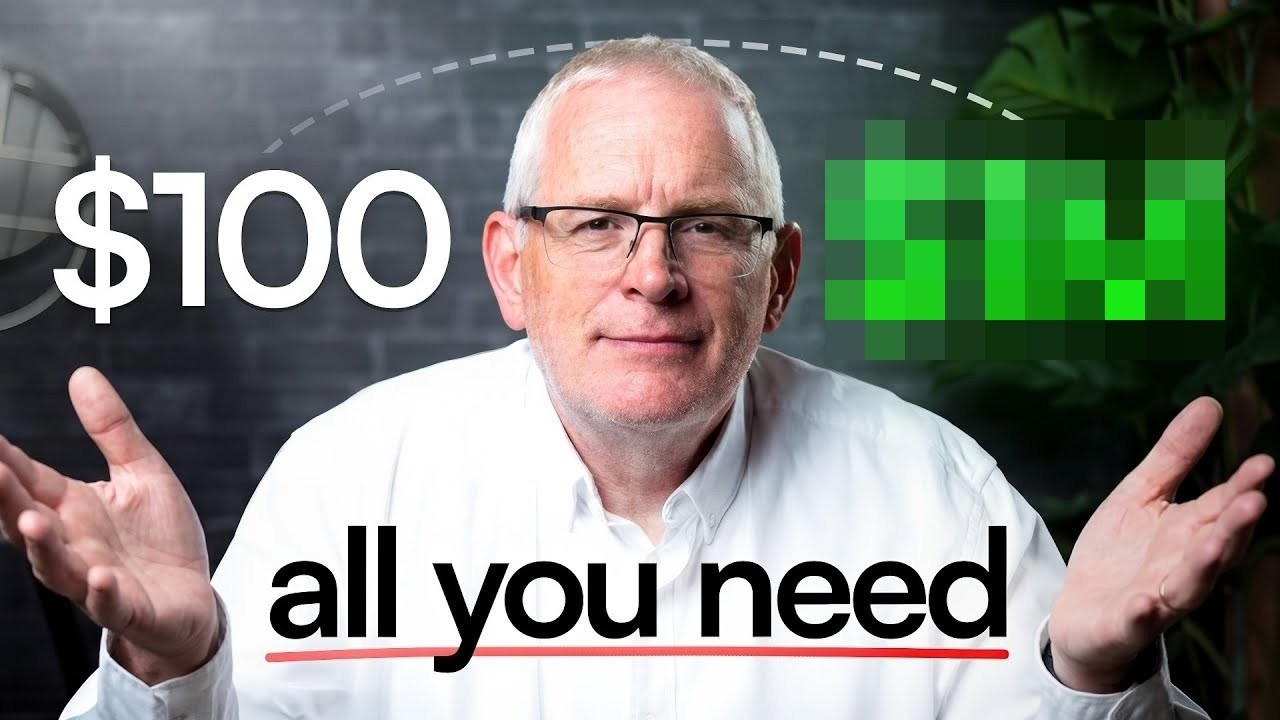
Compound interest heavily favors early participation over total capital contributed: investing $200 per month from ages 20 to 30 ($24,000 total) creates an estimated $813,000 at age 60, outpacing investing $300 per month from ages 30 to 60 ($108,000 total) by roughly $135,000. (0:53)
Maximizing tax-advantaged accounts such as the US Roth IRA ($7,500 annual cap) or UK Stocks & Shares ISA (£20,000 annual cap) legally shelters capital gains and dividend income entirely from taxation across decades of compounding. (15:03)
Standard market-cap-weighted S&P 500 index funds carry significant concentration risk in mega-cap technology and AI firms, underscoring the risk-mitigation value of all-world global equity funds. (67:29)
To correct portfolio drift without generating taxable capital gains in taxable accounts, investors should allocate new recurring monthly deposits into lagging assets rather than selling winning positions. (59:32)
Detailed notes
## Background
Published on YouTube by Mark Tilbury on September 30, 2026, this 75-minute beginner masterclass draws on 40 years of market experience to provide a complete guide to personal finance and wealth building. The video covers index funds, ETFs, the S&P 500, dividend investing, alternative assets, tax-advantaged accounts, stock analysis, and common beginner pitfalls.
## TL;DR
Mark Tilbury presents a comprehensive blueprint for long-term wealth creation, showing how starting early with compound interest outpaces larger contributions made later in life. He establishes the 25/15/50/10 budgeting rule and an emergency fund baseline before walking through brokerage selection, tax-advantaged accounts like the Roth IRA and ISA, and foundational strategies such as the Bogleheads Three-Fund Portfolio. After breaking down asset classes—from dividend stocks and bonds to commodities, REITs, and crypto—he details automated dollar-cost averaging, fundamental analysis, and portfolio rebalancing. The session concludes with strict criteria for when to sell, five behavioral mistakes to avoid, and a structured 30-day challenge to build an automated, globally diversified portfolio.
## Atmosphere & style
The presentation carries the warm, pragmatic authority of a seasoned mentor who balances financial realism with accessible, conversational humor. Tilbury demystifies intimidating financial jargon with vivid analogies—comparing markets to digital flea markets and inflation to a silent thief—while candidly sharing personal missteps from his youth to humanize the advice. The tone remains disciplined and encouraging, steering viewers away from high-stress get-rich-quick gambles toward steady, systematic financial peace of mind.
## Bulletin
- [00:53](https://www.youtube.com/watch?v=MC7k4ruZD5c&t=53s) Compound interest heavily favors early participation over total capital contributed: investing $200 per month from ages 20 to 30 ($24,000 total) creates an estimated $813,000 at age 60, outpacing investing $300 per month from ages 30 to 60 ($108,000 total) by roughly $135,000.
- [15:03](https://www.youtube.com/watch?v=MC7k4ruZD5c&t=903s) Maximizing tax-advantaged accounts such as the US Roth IRA ($7,500 annual cap) or UK Stocks & Shares ISA (£20,000 annual cap) legally shelters capital gains and dividend income entirely from taxation across decades of compounding.
- [01:07:29](https://www.youtube.com/watch?v=MC7k4ruZD5c&t=4049s) Standard market-cap-weighted S&P 500 index funds carry significant concentration risk in mega-cap technology and AI firms, underscoring the risk-mitigation value of all-world global equity funds.
- [59:32](https://www.youtube.com/watch?v=MC7k4ruZD5c&t=3572s) To correct portfolio drift without generating taxable capital gains in taxable accounts, investors should allocate new recurring monthly deposits into lagging assets rather than selling winning positions.
## Key takeaways
- [00:53](https://www.youtube.com/watch?v=MC7k4ruZD5c&t=53s) Cash left idle in low-yield bank accounts loses purchasing power to inflation, whereas broad stock market investing historically yields around 10% annually over long horizons.
- [06:58](https://www.youtube.com/watch?v=MC7k4ruZD5c&t=418s) The 25/15/50/10 budget allocates 50% to essential living costs, 25% to investments, 15% to an emergency fund of 3 to 6 months of expenses, and 10% to lifestyle spending.
- [11:10](https://www.youtube.com/watch?v=MC7k4ruZD5c&t=670s) Broker selection requires verifying regulatory protection—such as SIPC insurance up to $500,000 in the US or FSCS up to £120,000 in the UK—along with fee structures and asset variety.
- [15:03](https://www.youtube.com/watch?v=MC7k4ruZD5c&t=903s) Tax-sheltered accounts like US Roth IRAs and UK Stocks & Shares ISAs protect investment returns and dividends from tax drag, vastly accelerating long-term wealth accumulation.
- [18:52](https://www.youtube.com/watch?v=MC7k4ruZD5c&t=1132s) Index funds and ETFs allow investors to capture broad-market returns at low expense ratios, historically outperforming the majority of actively managed funds.
- [22:40](https://www.youtube.com/watch?v=MC7k4ruZD5c&t=1360s) The Bogleheads Three-Fund Portfolio provides a diversified baseline by balancing domestic equities, international equities, and fixed-income bond funds according to age and risk profile.
- [26:29](https://www.youtube.com/watch?v=MC7k4ruZD5c&t=1589s) Concentrating capital in individual stocks offers asymmetric upside but severe downside risk, making individual equities best suited for a small, optional satellite position.
- [28:16](https://www.youtube.com/watch?v=MC7k4ruZD5c&t=1696s) Fundamental analysis evaluates long-term investment viability across five core pillars: business model, financial health, economic moat, management quality, and reasonable valuation.
- [41:26](https://www.youtube.com/watch?v=MC7k4ruZD5c&t=2486s) Automated dollar-cost averaging eliminates emotional market timing by acquiring more shares when asset prices dip and fewer when valuations peak.
- [44:48](https://www.youtube.com/watch?v=MC7k4ruZD5c&t=2688s) Commodities like gold generate no operational revenue or cash flow, serving primarily as crisis and inflation hedges rather than primary growth engines.
- [47:34](https://www.youtube.com/watch?v=MC7k4ruZD5c&t=2854s) Real Estate Investment Trusts (REITs) grant fractional, liquid exposure to commercial property portfolios without the management headaches and illiquidity of physical properties.
- [49:26](https://www.youtube.com/watch?v=MC7k4ruZD5c&t=2966s) Excessively high dividend yields often signal underlying business distress, requiring investors to scrutinize payout ratios and prioritize total return over immediate payout rates.
- [52:48](https://www.youtube.com/watch?v=MC7k4ruZD5c&t=3168s) Cryptocurrencies like Bitcoin and Ethereum possess extreme volatility and produce no operating cash flows, making them suitable only for small, speculative portfolio allocations.
- [59:32](https://www.youtube.com/watch?v=MC7k4ruZD5c&t=3572s) Portfolio rebalancing should be conducted once or twice annually, preferably by directing new cash flow toward underweight assets to bypass taxable realization events.
- [01:01:13](https://www.youtube.com/watch?v=MC7k4ruZD5c&t=3673s) Investors should exit positions rationally only when speculative momentum permanently collapses, a superior capital opportunity arises, or the core business thesis is invalidated.
- [01:05:06](https://www.youtube.com/watch?v=MC7k4ruZD5c&t=3906s) Tax-loss harvesting offsets capital gains against realized losses, but transactions must adhere to tax rules such as the US Wash-Sale Rule or the UK 30-day Bed and Breakfasting rule.
- [01:07:29](https://www.youtube.com/watch?v=MC7k4ruZD5c&t=4049s) Global equity ETFs protect against single-country economic stagnation and domestic concentration risk by dynamically adjusting country weightings over time.
- [01:11:04](https://www.youtube.com/watch?v=MC7k4ruZD5c&t=4264s) Common beginner mistakes that erode returns stem from behavioral pitfalls: panic selling during market dips, FOMO buying at market tops, refusing to cut losses, and paying high advisory fees.
## Detailed walkthrough
### [00:00](https://www.youtube.com/watch?v=MC7k4ruZD5c&t=0s) Introduction: 40 Years of Market Experience
Mark Tilbury opens the guide by laying out his credentials: it took him four decades of real-world investing to learn the lessons packed into this masterclass, which he condenses into under an hour and twenty minutes. Unlike academic theorists who only study finance, Tilbury lived through major historical cycles, navigating the dot-com bubble, the 2008 global financial crisis, the pandemic crash, and everything in between. He emphasizes that he made plenty of mistakes along the way, but persevered and emerged on the other side significantly wealthier.
He frames this video as a comprehensive, A-to-Z beginner roadmap. It starts from fundamental mechanics—demystifying market terminology and setting up accounts—and progresses through buying a first stock, constructing a diversified portfolio, and handling risk management. For viewers who want to take action right away, he mentions an offer for a free fractional share linked in the description via eToro to help kick off their journey.
[00:53](https://www.youtube.com/watch?v=MC7k4ruZD5c&t=53s) Why You Need to Invest: Beating Inflation and Compound Interest
Sitting on cash and doing nothing is framed as one of the single most dangerous financial moves a person can make. Leaving savings untouched in a traditional bank account feels intuitively safe and responsible because the balance printed on the screen never declines. However, that static balance masks a "silent thief that never takes a day off": inflation. Inflation steadily erodes purchasing power, meaning that identical sums buy progressively less over time. A common consumer good like a chocolate bar or a cup of coffee hasn't magically become superior in quality—if anything, products often diminish in quality—yet they cost substantially more simply because currency loses value. To highlight this loss, Tilbury points out that a single US dollar in 1985 possessed roughly the same purchasing power as $2.80 today; leaving that dollar tucked under a mattress for four decades drained nearly two-thirds of its real-world value without the owner ever touching it.
To illustrate how investing solves this passive decay, Tilbury compares three scenarios for a hypothetical $1,000,000 portfolio:
- **Standard bank account:** Yields close to 0% interest, producing essentially nothing over a year while inflation eats into the principal.
- **High-Yield Savings Account (HYSA):** Yields around 3%, returning $30,000 annually.
- **Stock market:** Returning a historically realistic (though not guaranteed) average of 10% per year, generating $100,000 annually.
Even for people without a million dollars, the math works identically because of compound interest. Tilbury introduces two illustrative characters, Billy and Jack, to demonstrate why starting early outweighs contributing larger sums later:
```mermaid
flowchart TD
accTitle: Billy vs Jack Compound Interest Comparison
accDescr: Chart illustrating how Billy starts earlier and invests less yet ends up with more wealth than Jack due to compounding.
subgraph Billy["Billy: Early Starter"]
B1["Invests $200/month from age 20 to 30"]
B2["Total invested: $24,000"]
B3["Stops contributing completely at age 30"]
B4["Final balance at age 60: ~$813,000"]
B1 --> B2 --> B3 --> B4
end
subgraph Jack["Jack: Late Starter"]
J1["Invests $300/month from age 30 to 60"]
J2["Total invested: $108,000"]
J3["Contributes continuously for 30 years"]
J4["Final balance at age 60: ~$678,000"]
J1 --> J2 --> J3 --> J4
end
Billy -.->|"Outperforms by $135,000 despite investing $84,000 less"| Jack
```
Despite investing $84,000 less of his own cash and halting all contributions three decades earlier, Billy beats Jack by roughly $135,000. Tilbury admits that during the first 10, 15, or even 20 years, investing feels painfully slow. He recalls checking his own account during his early years and questioning whether it was doing anything at all. He cautions that this boredom is the exact trap where most beginners lose patience, cash out, and miss the moment when the "snowball" finally gathers momentum and rolls downhill on its own.
[04:28](https://www.youtube.com/watch?v=MC7k4ruZD5c&t=268s) What Investing Means: Demystifying Stocks and the Market
For total beginners, the stock market often conjures intimidating imagery of wealthy men in bespoke suits staring at screens packed with flashing red and green numbers. Tilbury strips away the jargon, explaining that a stock is nothing more than a fractional slice of a real, operating business.
To make the concept intuitive, he uses a local pizza parlor analogy:
- Imagine running a thriving pizza shop with enough customer demand to justify opening a second venue.
- All current capital is tied up in operating the first restaurant, and taking on bank debt with required monthly repayments is undesirable.
- Instead, the owner sells small ownership percentages to friends in exchange for startup capital.
- Those friends now own fractional stakes in the pizza business; those stakes are private stocks.
A publicly traded stock works the exact same way, with the sole difference that the slices are offered to the general public on an open exchange rather than kept between friends. Buying a share of Apple turns the investor into a genuine legal part-owner of Apple, albeit a tiny one.
Stocks return value to investors in two primary ways:
1. **Capital Appreciation:** As the underlying company expands and profits grow, the overall enterprise becomes more valuable. The investor's slice increases in value and can be sold on the open market for a higher price than what was originally paid.
2. **Dividends:** When a profitable company generates surplus cash, it may distribute a portion directly to shareholders as a cash payment—a corporate "thank you" that arrives in the investor's brokerage account without requiring any labor.
The stock market itself is described simply as a digital flea market or car boot sale where these corporate slices are traded. Prices fluctuate according to basic supply and demand: heavy buying pushes prices upward, while widespread selling drags them down. Over the short run, pricing reflects noise, media headlines, hype, and fear—which is why Tilbury ignores day-to-day fluctuations. Over the span of years and decades, market prices inevitably reconcile with underlying business fundamentals.
[06:58](https://www.youtube.com/watch?v=MC7k4ruZD5c&t=418s) How Much Should You Invest: The 25/15/50/10 Rule and Emergency Funds
A major trap for novice investors is throwing every spare dollar into the market without keeping cash reserves for daily survival. When an unexpected expense hits, they are forced to sell their holdings at a loss during a downturn, walking away convinced that the stock market is a scam when poor financial planning was the actual culprit. Rather than asking how much one *should* invest, the proper question is how much one can afford to commit without touching it.
Tilbury outlines his personal framework, the **25/15/50/10 Rule**, which divides net income into four clear buckets upon each payday:
- **50% for Essentials:** Core living costs required for survival (rent, mortgage, groceries, utilities, basic transport), excluding luxury spending that merely "makes you look good."
- **25% for Growth:** Dedicated strictly to long-term investing in assets that build wealth passively while working a day job.
- **15% for Stability:** Liquid cash channeled into building an emergency fund, kept safely outside the stock market.
- **10% for Lifestyle:** Discretionary fun money spent completely guilt-free.
Tilbury insists that the 15% stability bucket must be fortified before aggressively pursuing the 25% growth allocation. An emergency fund belongs in an insured, high-yield savings account where it is protected from market volatility. It is not designed to generate high returns; it is designed to act as an insurance policy against unexpected life emergencies.
To illustrate the danger of lacking cash reserves, Tilbury shares an embarrassing personal mistake from his youth when he was broke and living without savings. He took out personal debt to purchase a fancy Volkswagen Golf and fitted it with a premium stereo. Just a few months later, the engine catastrophically failed. Because he depended on that vehicle to commute to the job that serviced the initial loan, and possessed zero cash cushion, he was forced to take out a second emergency loan just to stay afloat. That single failure of liquidity derailed his financial progress for nearly a year. Had an emergency fund been in place, the blown engine would have been an inconvenient nuisance rather than an existential financial crisis. He then begins detailing how to calculate the size of this safety net by totaling essential monthly obligations.
[09:32](https://www.youtube.com/watch?v=MC7k4ruZD5c&t=572s) The Budget Split: Protecting the 25% for Growth
Building an emergency reserve begins by calculating essential living expenses and multiplying that baseline by anywhere from three to six months. While capping essentials at 50% of monthly income sounds straightforward, most people inadvertently let lifestyle inflation take over, spending 60% to 70% of their earnings on items they have rationalized into calling "essential." When fitting necessary expenses into a 50% cap feels impossible, the solution is not to surrender investment goals, but to actively increase income. This can mean taking on extra work or leveraging laptop-based side hustles powered by modern AI tools.
At the other end of the budget sits the 10% allocated for guilt-free enjoyment. While frugality is a constant theme in wealth-building, eliminating all personal enjoyment is counterproductive; saving money without any fun quickly starts to feel like a punishment and makes the entire journey feel pointless. The remaining budget categories—the 15% emergency cash buffer, the 50% for essentials, and the 10% for guilt-free spending—exist primarily as a protective moat around the 25% designated for investment growth. This setup ensures that your long-term capital can compound quietly for decades without an unexpected expense forcing you to liquidate assets early.
Beginning investors should never let the raw dollar targets discourage them. Starting small is far better than burning out: investing $20 every single month forever creates vastly superior results compared to investing $500 a month for two months and suddenly quitting. As the saying goes, "consistency beats size every single time. That's what she says."
---
[11:10](https://www.youtube.com/watch?v=MC7k4ruZD5c&t=670s) Picking a Platform: The Four-Stage Checklist
Choosing the right brokerage platform is critical because the company you select holds the keys to your financial future. To evaluate any broker, run through a practical four-stage checklist before committing your money:
```mermaid
flowchart TD
accTitle: Broker Platform Selection Checklist
accDescr: Four-step verification process to select a safe and cost-effective investing platform.
subgraph S1["Safety & Cost"]
A["1. Regulation & Insurance<br/>(SIPC up to $500k / FSCS up to £120k)"] --> B["2. Low Fee Structure<br/>(Avoid drag from hidden percentages)"]
end
subgraph S2["Usability & Fit"]
B --> C["3. Account Types & Assets<br/>(ISAs, IRAs, desired stocks/ETFs)"]
C --> D["4. Intuitive User Experience<br/>(Clean interface, not overly complex)"]
end
```
First, ensure the platform is fully regulated and insured. In the United States, that means looking for SIPC coverage (protecting customer assets up to $500,000 USD if the brokerage fails), while in the United Kingdom, it means FSCS protection (shielding up to £120,000). Second, verify that fees remain low; fractional percentages appear harmless initially, but compounded over multiple decades, high management and trading fees will relentlessly eat away at total wealth. Third, verify that the broker actually supports the specific accounts (such as ISAs or retirement wrappers) and assets you plan to trade. Fourth, prioritize ease of use—managing investments over a 30-year horizon requires an intuitive platform rather than an interface that feels like "trying to learn Mandarin."
- **eToro Platform Highlights:** Features over 40 million users globally, offers 0% commission on stock trades, and supports thousands of individual stocks, ETFs, and cryptocurrencies inside a single dashboard.
---
[12:11](https://www.youtube.com/watch?v=MC7k4ruZD5c&t=731s) Setting Up an Account and KYC Verification
Setting up an account on a major platform like eToro begins by registering with an email address and password. When using promotional partner links, new sign-ups are often prompted to select a free £50 introductory stock (with popular choices including blue-chip tech leaders like Apple) credited upon funding the account.
The onboarding process requires personal details, including full legal name, gender, date of birth, home address, and identity verification documents. While submitting identification can feel intrusive, it is mandatory across all legitimate, regulated brokerages under standard "Know Your Customer" (KYC) regulations designed to combat money laundering and financial fraud. User information is securely encrypted according to strict financial compliance standards.
Following identity confirmation, the app prompts users to set their preferences (such as selecting an interest in stocks) and presents an onboarding questionnaire. This assessment asks about investment timeframes, expected deposit sizes, employment status, risk tolerance, and prior market experience. Brokerages use these answers to gauge financial sophistication and verify the origin of deposited capital. Once the questionnaire is complete, funding the account with £100 (or the local currency equivalent) activates the profile and releases any promotional promotional share.
---
[15:03](https://www.youtube.com/watch?v=MC7k4ruZD5c&t=903s) Choosing the Right Account: Tax-Advantaged vs. Taxable Brokerage
The account wrapper you select dramatically alters your final net worth. Two people can deposit the exact same sum of money into the exact same companies and achieve identical gross returns, yet end up with vastly different fortunes simply because of taxes. In an ordinary taxable brokerage account, realized profits trigger capital gains taxes upon selling, which erodes compounding over a lifetime of successful investing. To mitigate this drag, governments provide specialized tax-advantaged wrappers that shelter returns from the tax collector.
| Account Type | Country | 2026 Contribution Limit | Tax Advantage | Withdrawal Rules |
|:--- |:--- |:--- |:--- |:--- |
| **Roth IRA** | United States | $7,500 / year ($8,600 if age 50+) | Funded with post-tax money; growth and withdrawals are 100% tax-free | Penalty-free withdrawals generally restricted to retirement age |
| **401(k)** | United States | ~$24,500 / year | Pre-tax contributions (often with employer match); lowers taxable income | Locked until retirement age; penalties for early distribution |
| **Stocks & Shares ISA** | United Kingdom | £20,000 / year | Funded with post-tax cash; all capital gains and dividends grow tax-free | Withdraw anytime with zero penalties or tax consequences |
| **Standard Brokerage** | Global | Unlimited | None | Full liquidity, but realized profits trigger capital gains tax |
The exponential power of a tax-free vehicle is illustrated by venture capitalist Peter Thiel, who famously used a Roth IRA to acquire early, low-valuation founder shares in companies like PayPal, Palantir, and Facebook. That account grew to roughly $5 billion in total value—shielded entirely from capital gains taxes. While everyday investors are not buying private early-stage PayPal shares, the mechanism demonstrates how compounding without tax drag multiplies wealth.
For UK investors, the Stocks and Shares ISA is arguably even more versatile than US retirement accounts because capital can be withdrawn at any moment without penalty, subject only to the annual £20,000 contribution ceiling. On platforms like eToro, users default to a "Main Account Real" (a standard taxable account offering total flexibility), but can immediately open an ISA wrapper through the main sidebar menu before making their qualifying deposit.
---
[18:52](https://www.youtube.com/watch?v=MC7k4ruZD5c&t=1132s) Index Funds: The Core Long-Term Strategy
When deciding what to buy once an account is open, simplicity is key. Trying to pick individual winning companies is notoriously difficult and carries substantial risk; an investor might guess right or guess wrong, leaving their financial security to chance.
Instead of searching for a needle in a haystack, the simplest and most proven long-term strategy is to buy the entire haystack in one single transaction. This is the fundamental purpose of an index fund—a single investment vehicle that grants ownership of an entire basket of leading companies all at once.
[19:28](https://www.youtube.com/watch?v=MC7k4ruZD5c&t=1168s) Funds & ETFs: The S&P 500 and Instant Diversification
Investing in a fund is fundamentally about purchasing a collection of companies bundled into a single package. It works much like visiting a supermarket: rather than purchasing one single item, you fill your basket with a wide variety of goods and pay for the whole lot together. The quintessential example is the S&P 500, which bundles 500 of the largest corporations in the United States—powerhouses like Nvidia, Apple, Tesla, PayPal, and Amazon. Over the long run, this has historically proven to be an exceptionally reliable path to building wealth.
The primary attraction of this approach is instant diversification. Concentrating your capital carries immense downside risk; if you invest $10,000 into Tesla alone and the company collapses, your entire $10,000 is wiped out. In contrast, putting that same $10,000 into the S&P 500 cushions you against catastrophic failure. Even if a company like Tesla were to go bust, the financial blow to your portfolio is drastically reduced because hundreds of other companies inside the fund help prop up the loss.
```mermaid
flowchart TD
accTitle: Single Stock vs S&P 500 Risk Comparison
accDescr: Diagram contrasting how a $10,000 investment handles risk when invested in a single company versus an S&P 500 fund.
subgraph Fund["Diversified Fund Route (S&P 500)"]
F1["$10,000 Investment"] --> F2["Single Company Fails"]
F2 --> F3["499 Other Holdings Prop Up Loss"]
F3 --> F4["Portfolio Preserved"]
end
```
[20:30](https://www.youtube.com/watch?v=MC7k4ruZD5c&t=1230s) ETFs vs. Index Funds and Ticker Symbols Explained
Beginners are frequently tripped up when searching for an index fund and discovering that the product shown on their trading platform is labeled as an ETF. There is no reason to worry; an Exchange-Traded Fund (ETF) is simply the modern evolution of the classic index fund. An ETF trades on an exchange just like an ordinary share, meaning investors can buy and sell throughout standard market trading hours. They eliminate hefty starting minimums and support fractional investing. For example, even if an S&P 500 share trades north of $700, an investor can start with as little as $10 to purchase a tiny fraction of a share.
Searching for the S&P 500 on an investment app typically brings up multiple results with unique abbreviations, such as VOO or SPY5. These ticker symbols function like a car's registration plate, offering a unique code to identify an asset. Choosing between them usually comes down to residency, exchange access, and platform availability:
- **VOO vs. SPY5**: VOO is Vanguard's S&P 500 fund listed on US exchanges, whereas SPY5 is issued by State Street Global Advisors and traded on the London Stock Exchange. They represent essentially the same underlying product packaged for investors on opposite sides of the Atlantic.
- **Checking the Expense Ratio**: Investors should always look under the financials tab for the ongoing management charge. An expense ratio of 0.2% is acceptable, but top-tier index ETFs offer fees as low as 0.03%, allowing investors to keep far more of their returns.
[22:40](https://www.youtube.com/watch?v=MC7k4ruZD5c&t=1360s) The Three-Fund Portfolio Strategy
While holding a single index fund is a solid strategy, combining three distinct funds unlocks genuine diversification. Originating with the Bogleheads community (disciples of Vanguard founder John Bogle), the Three-Fund Portfolio sounds complex but is remarkably straightforward. It is so simple that a beginner could implement it and likely "outperform a fancy fund manager in a suit that charges a fortune to manage your portfolio." The core philosophy balances three pillars: a domestic equity fund to capture home market growth, an international fund to harness global returns, and a bond fund to provide overall portfolio stability.
The asset allocation across these three pillars depends heavily on an investor's age and appetite for risk:
Mark Tilbury jokes that while he might be "old and gray," he has not adopted the stereotypical "old man investing style" quite yet, opting to maintain an aggressive equity tilt because his decades of market experience make him comfortable with risk.
[24:05](https://www.youtube.com/watch?v=MC7k4ruZD5c&t=1445s) Building the Three Pillars: Domestic, International, and Bonds
When constructing the domestic component, an investor does not necessarily have to pick their local country of residence. Many global investors choose the United States due to its world-dominating corporations, selecting a fund like the S&P 500 (ticker SPY5 or VOO).
For the international sleeve, investors face two main paths:
- **Broad Developed World**: An ETF like iShares Core MSCI World (ticker SWDA) spans over 1,500 stocks across 23 developed economies, including the US, Europe, Japan, and Australia. However, because it is heavily weighted toward developed nations, it has substantial overlap with US mega-caps.
- **Emerging Markets**: For true exposure to up-and-coming economies, an ETF like iShares Core MSCI EM IMI (ticker EIMI) targets fast-growing regions such as China, Taiwan, India, and South Korea, offering direct exposure to tech giants like Tencent, TSMC, and Samsung that cannot be accessed through standard US-only funds.
```mermaid
flowchart LR
accTitle: Three-Fund Portfolio Components
accDescr: Diagram illustrating the three building blocks of a diversified three-fund portfolio.
subgraph Portfolio["Three-Fund Portfolio Architecture"]
direction TB
P1["Domestic Equities<br/>(e.g., S&P 500 / SPY5 / VOO)"]
P2["International Equities<br/>(e.g., Developed: SWDA / Emerging: EIMI)"]
P3["Bond Component<br/>(e.g., US Treasury ETF: IB01)"]
end
```
Rather than laboriously buying individual government notes, the bond portion can be purchased as an all-in-one ETF such as IB01, which bundles US government bonds into one vehicle. Bonds act as the steady ballast in a portfolio: they do not experience rapid upward surges like equities, but because stocks and bonds frequently move in opposite directions, bonds help cushion the market's swings. Even so, Tilbury cautions that bonds are not entirely risk-free, and severe macroeconomic pressures can cause both asset classes to fall simultaneously.
[26:29](https://www.youtube.com/watch?v=MC7k4ruZD5c&t=1589s) Individual Stocks: High Upside vs. Concentrated Downside
It is easy to understand the temptation of picking single stocks; almost everyone secretly dreams of finding a winner and watching it "fly to the moon." However, concentrating your capital into an individual business cuts both ways:
- **The Upside (Nvidia Example)**: Over the past decade, a $1,000 investment in Nvidia skyrocketed to approximately $140,000—a massive 14,000% gain that no broad index fund could match.
- **The Downside (Nike Example)**: Over a similar timeframe, a $1,000 position in a struggling legacy brand like Nike dropped to roughly $700, saddling the investor with a 30% loss while the broader market advanced.
Because individual losers can languish for a decade or more, Tilbury advises that individual stock picking should remain an optional, small, high-risk satellite allocation rather than an entire core strategy.
[28:16](https://www.youtube.com/watch?v=MC7k4ruZD5c&t=1696s) Researching a Stock: Technical Analysis Basics
Rigorous research is the dividing line between informed investors and gamblers who purchase shares purely on gut feelings or because a stock is already in a speculative frenzy. Stock evaluation generally splits into two methodologies: technical analysis and fundamental analysis.
Technical analysis focuses on interpreting chart patterns. It relies on the premise that all publicly available information, macro data, and human emotions—fear, greed, optimism, and panic—are already reflected in the market price. Instead of analyzing complex macroeconomic data, a technical analyst asks a straightforward question: "What is the current price telling me?"
The discipline rests on core concepts:
- **Trend**: Identifying the market's directional momentum. In an uptrend, prices consistently set higher highs and higher lows on pullbacks; in a downtrend, successive highs and pullbacks continue to sink. A cardinal rule among technical analysts is never to fight a prevailing trend—if a stock has climbed for months, traders look to ride that existing upward wave rather than bet on an abrupt reversal.
- **Support and Resistance**: Support represents a price "floor" where concentrated buying interest historically halts a sell-off, while resistance acts as a "ceiling" where selling pressure repeatedly cuts price rallies short.
[29:52](https://www.youtube.com/watch?v=MC7k4ruZD5c&t=1792s) Technical Analysis vs. Fundamental Analysis
Technical analysis focuses on chart patterns and price dynamics rather than the underlying company. A key concept is support and resistance: support functions like a floor where buying interest stops a falling price and pushes it back up, while resistance operates like a ceiling where selling pressure halts a rising stock and forces it back down. For instance, if a stock continuously declines toward $80 before rebounding, traders identify $80 as a support level; if it repeatedly climbs toward $100 before pulling back, $100 serves as resistance. A breakout through either level signals to traders that the balance of power between buyers and sellers has shifted.
```mermaid
flowchart LR
accTitle: Technical Trading Levels
accDescr: Diagram showing support as a price floor and resistance as a price ceiling around an asset price.
subgraph Levels["Chart Levels"]
R["Resistance ($100 Ceiling)"]
P["Stock Price Range"]
S["Support ($80 Floor)"]
end
P -->|"Hits selling pressure"| R
R -.->|"Pushes down"| P
P -->|"Finds buying interest"| S
S -.->|"Bounces up"| P
```
Beyond price levels, technical traders monitor trading volume—the total number of shares exchanging hands—to gauge market conviction. A 10% price jump on thin volume carries very different implications than a 10% surge backed by massive trading activity, as volume reveals how many market participants are truly behind the move. Traders also use moving averages, such as a 50-day moving average, to smooth out short-term fluctuations and clarify the underlying trend by continuously updating the average closing price over the trailing 50 trading days.
While technical analysis attracts active traders treating the market like a side hustle or a full-time job, it holds limited value for long-term investors. For those with a multi-year horizon, day-to-day chart fluctuations do not matter. Instead, long-term wealth building relies on fundamental analysis: evaluating the actual business behind the ticker symbol rather than the lines on a screen.
---
[31:33](https://www.youtube.com/watch?v=MC7k4ruZD5c&t=1893s) The Five Pillars of Fundamental Analysis
Fundamental analysis treats purchasing a stock as acquiring an ownership stake in a living business. Rather than guessing price trends, fundamental investors focus on two core questions: "Is this a good business?" and "Am I paying a sensible price for it?" Answering these requires evaluating five essential pillars:
```mermaid
flowchart TD
accTitle: Five Pillars of Fundamental Analysis
accDescr: Flowchart illustrating the five essential pillars of fundamental research from business model to valuation.
subgraph Fundamentals["Fundamental Research Framework"]
BM["1. Business Model<br/>What they sell & how they profit"]
FIN["2. Financial Health<br/>Revenue, margins & debt"]
MOAT["3. Economic Moat<br/>Patents & durable advantages"]
MGMT["4. Management Quality<br/>Capital allocation & integrity"]
VAL["5. Valuation<br/>Price vs. intrinsic earnings"]
end
BM --> FIN
FIN --> MOAT
MOAT --> MGMT
MGMT --> VAL
```
1. **Understanding the Business Model:** You must clearly understand what the company sells, who buys its products, how it generates revenue, and why customers pick it over competitors. If an investor cannot describe how a company makes money in simple terms, they should not invest in it.
2. **Analyzing the Financials:** Financial statements reveal operating health. Investors look at whether revenue and profits are expanding, whether profit margins are widening, and how much debt the balance sheet carries. Memorizing every line item is unnecessary; tracking a handful of core metrics provides a clear picture of performance.
3. **Assessing the Economic Moat:** A competitive advantage prevents rivals from eroding a firm's profits. While moats can stem from strong branding, high customer switching costs, or scale advantages, cost efficiencies can eventually be matched by aggressive competitors. Proprietary intellectual property and patents represent the strongest moats because they are legally shielded and nearly impossible to replicate.
4. **Evaluating Management:** Great products and healthy margins can be destroyed by poor capital allocators. Investors must determine whether executives deploy cash sensibly, reinvest earnings efficiently, communicate transparently with shareholders, and prioritize long-term owner value over personal compensation.
5. **Checking the Valuation:** Even an outstanding company can turn into a disastrous investment if purchased at an inflated price. Paying $500 for a crisp $100 bill does not make the cash bad; it simply means you overpaid by five times. Common multiples include the Price-to-Earnings (P/E) ratio, which reflects what investors pay for every $1 of annual company earnings. A P/E of 20 means paying $20 per $1 of profit. However, a single metric lacks context: a high-growth company compounding earnings at 30% annually commands a significantly higher P/E than a stagnant firm. Investors also cross-reference other yardsticks, including:
- Price-to-Sales (P/S)
- Price-to-Free-Cash-Flow (P/FCF)
- Enterprise Value to EBITDA (EV/EBITDA)
---
[35:41](https://www.youtube.com/watch?v=MC7k4ruZD5c&t=2141s) Beyond the Numbers: Real-World Research
Researching a company extends well past spreadsheets and financial ratios. To evaluate how a company operates in the real economy, investors can gather boots-on-the-ground intelligence:
- **Become a Customer:** Directly test the product, download the mobile app, or walk into the retail store. Firsthand customer experience reveals usability, customer service, and product appeal that never appear on a balance sheet.
- **Listen to Customer Sentiment:** Scour customer reviews, Reddit forums, and social media discussions to identify recurring themes. Individual opinions matter less than broader patterns—if thousands of independent users praise a particular feature or report the identical bug, that data signals future performance.
- **Watch Actions Instead of Words:** Executives craft public relations narratives to put their best foot forward, but real-world operational choices expose their genuine focus. Repeatedly touting innovation while failing to ship meaningful updates for years is a distinct red flag. Conversely, steady product enhancements, aggressive geographic expansion, and disciplined capital spending serve as green flags.
- **Study Direct Competitors:** Analyzing rival firms exposes industry dynamics and highlights whether a company's perceived advantages are genuine or overstated.
- **Scrutinize Capital Allocation:** Generating billions in profits is meaningless if executive leadership squanders the proceeds. Watch whether cash is channeled back into high-return internal projects, strategic acquisitions, share buybacks, and dividends—or wasted on exorbitant executive compensation packages and unproductive balance-sheet cash piles.
---
[38:16](https://www.youtube.com/watch?v=MC7k4ruZD5c&t=2296s) Buying Your First Stock
All research and education ultimately lead to pulling the trigger on an initial purchase. The execution process remains largely consistent across standard modern brokerage platforms, whether accessed through a smartphone app or a desktop browser.
Mark demonstrates the process using the eToro mobile app, pointing out that new users can claim a free £50 stock incentive by depositing £101 (or local currency equivalent) via his link. Stepping onto the platform's home screen, he sets up the step-by-step transaction to ensure beginners feel confident and avoid second thoughts when pressing the "buy" button.
[39:05](https://www.youtube.com/watch?v=MC7k4ruZD5c&t=2345s) Executing a Stock Trade: Market Orders vs. Limit Orders
Purchasing an individual stock begins by navigating to the platform's search tool—typically represented by a magnifying glass icon—and typing the company name or ticker, such as Tesla. Tapping the trade option opens an order screen where the investor specifies the capital to allocate. Before confirming the transaction, the platform presents a choice between two primary execution methods: a market order and a limit order. A market order functions like buying groceries at a supermarket: the buyer accepts whatever price tag is listed at that exact second, making it fast, effortless, and the default standard for long-term investors. A limit order behaves more like haggling at a car boot sale; the buyer sets a specific maximum price they are willing to pay, and the trade triggers automatically only if the asset drops to that chosen target price.
```mermaid
flowchart TD
accTitle: Order Type Comparison
accDescr: Flowchart illustrating the decision pathway between a Market Order and a Limit Order when purchasing stocks.
A["Select Stock in App"] --> B{"Choose Order Type"}
B -->|"Market Order"| C["Pay Current Market Price"]
C --> D["Fills Instantly During Market Hours"]
B -->|"Limit Order"| E["Set Target Purchase Price"]
E --> F{"Does Price Reach Target?"}
F -->|"Yes"| G["Trade Executes Automatically"]
F -->|"No"| H["Order Remains Pending"]
```
Once a market order is submitted, the transaction executes immediately—provided the relevant stock exchange is currently open. If the order does not settle on the spot, the market is simply closed for trading, and the broker will queue the order to process as soon as the opening bell rings.
- **Market Order:** Instant execution at the prevailing market price; ideal for long-term buy-and-hold investing where minor price fluctuations are negligible.
- **Limit Order:** Conditional execution that activates only if the asset reaches a pre-set target price, ensuring the buyer never overpays beyond their specified limit.
- **US Market Trading Hours:** 9:30 a.m. to 4:00 p.m. Eastern Time (2:30 p.m. to 9:00 p.m. UK time).
- **UK Market Trading Hours:** 8:00 a.m. to 4:30 p.m. UK time.
---
[41:26](https://www.youtube.com/watch?v=MC7k4ruZD5c&t=2486s) Automated Investing and Dollar-Cost Averaging
Building sustainable wealth through the stock market requires sustained routine rather than one-off transactions. Within trading apps, investors can tap the "set up recurring investment" toggle beneath an asset's trade screen, selecting a dedicated dollar amount and a recurring date each month. Automating this habit eliminates emotional friction, instills discipline, and operationalizes dollar-cost averaging (DCA). Under a DCA strategy, the investor commits the exact same sum on a regular schedule regardless of whether share prices are soaring or crashing.
This programmatic approach prevents the anxiety and futility of trying to time market bottoms or tops—an endeavor that "nobody on earth can reliably do." During expensive months, the fixed allocation buys fewer shares; during market dips, it purchases more shares on sale, balancing out the average acquisition cost over time. Compound interest favors long-term behavioral consistency over short-term market cleverness, making automation a critical pillar of an investment plan.
---
[43:13](https://www.youtube.com/watch?v=MC7k4ruZD5c&t=2593s) Fixed Income: How Government Bonds and Yields Work
While equities represent business ownership, bonds represent debt instruments issued by corporations or, far more commonly, national governments. When a sovereign government incurs expenditures beyond its tax revenues, it raises capital by issuing an IOU sold to global investors. The bondholder lends upfront capital, and the issuer promises to return the principal at a predetermined maturity date while disbursing periodic interest payments, known as the bond's yield. In a diversified portfolio, bonds function as a stabilizing buffer designed to keep investors calm "when everything else in your portfolio is on fire."
Government debt securities vary significantly by their maturity timeline. In the United States, Treasury bills (T-bills) represent short-term debt maturing in one year or less; Treasury notes carry intermediate maturities spanning two to ten years; and Treasury bonds represent long-term commitments extending twenty to thirty years. Investors are not forced to hold bonds until maturity; most can be traded on secondary markets, where market prices fluctuate continuously based on prevailing interest rates. Bond prices and yields maintain an inverse relationship: when newly issued bonds offer higher interest rates, existing bonds paying lower yields become less attractive, driving their secondary market price down.
---
[44:48](https://www.youtube.com/watch?v=MC7k4ruZD5c&t=2688s) Gold and Commodities: Chaos Insurance vs. Productive Assets
Commodities encompass raw natural materials traded on global exchanges, including industrial and precious metals like copper, silver, and gold, agricultural goods like wheat and coffee, and energy products like crude oil and natural gas. Unlike businesses, commodities possess no management teams, build no products, generate no cash flow, and distribute no operational earnings. Holding a commodity simply provides price exposure to the underlying physical resource. Energy commodities like crude oil react intensely to supply shocks and global demand fluctuations, creating sharp, unpredictable volatility.
Gold commands special prominence as a historical store of value spanning thousands of years, primarily functioning as portfolio "chaos insurance" during periods of rampant inflation, political instability, or financial market panic:
> "A bar of gold just sits in a vault looking pretty. It doesn't ship a product or generate any revenue. A great business can take the money it earns, reinvest it, and grow the profits to potentially become far more valuable over time, whereas gold can't do that."
Investors looking to add gold can purchase physical bullion—such as 1 oz gold bars or Britannia coins from retail suppliers like Costco—though this introduces real burdens regarding secure home storage, theft risk, and local dealer liquidity when selling. A practical alternative is buying shares in physically backed exchange-traded funds like the SPDR Gold Shares (ticker GLD), which track the spot price without requiring physical handling. Because a commodity's upside depends purely on whether another buyer will pay more in the future, it should serve as portfolio "seasoning, not the main meal."
---
[47:34](https://www.youtube.com/watch?v=MC7k4ruZD5c&t=2854s) Real Estate Investing: Physical Property vs. REITs
Property ownership remains an aspirational asset class for most people, but conventional wisdom suggests it is inaccessible without sizable cash deposits, credit approvals, and long-term mortgages. Direct physical property investment requires managing tenants, handling ongoing property maintenance, and enduring constant operational friction when repairs inevitably arise.
The alternative pathway provides real estate exposure without property management burdens: Real Estate Investment Trusts, or REITs. Publicly traded REITs operate as specialized corporate entities that acquire, manage, and finance vast portfolios of income-producing real estate—including industrial warehouses, commercial office complexes, retail centers, and residential apartment communities. By purchasing individual shares of a REIT directly through a brokerage app with a single click, investors secure fractional ownership in commercial real estate assets and gain access to ongoing rental yields.
[48:28](https://www.youtube.com/watch?v=MC7k4ruZD5c&t=2908s) Real Estate & REITs
Physical real estate provides hands-on control and the ability to leverage a mortgage to multiply gains, but it comes with extensive management headaches. Real Estate Investment Trusts (REITs), by contrast, offer liquid, hassle-free property exposure that can be purchased in seconds just like any ordinary stock. While you surrender direct control over the assets and are merely along for the ride, REITs represent an accessible vehicle for beginners wanting to collect a slice of rental income without managing tenants or properties.
Navigating REIT options via an investing platform like eToro reveals broad market funds tailored to different geographic strategies:
- **USRT (iShares Core U.S. REIT ETF):** Holds a broad range of US REITs across diverse property sectors.
- **REET (iShares Global REIT ETF):** Provides international exposure across multiple countries and global real estate markets.
Dividend investing centers on the appeal of getting paid simply for owning an asset without ever being forced to sell it. Top-tier dividend payers are commonly categorized into prestigious tiers based on consistency: **Dividend Aristocrats** have increased payouts every year for at least 25 consecutive years, while **Dividend Kings** have raised distributions annually for at least 50 consecutive years. Achieving this track record requires navigating recessions, high inflation, and market crashes while continually returning cash to shareholders, indicating underlying business strength.
```mermaid
flowchart TD
accTitle: Total Return vs High Yield Traps
accDescr: Visualizing the key metrics needed to evaluate dividend investments sustainably.
subgraph Evaluation["Core Dividend Metrics"]
DY["Dividend Yield\n(Annual Payout / Share Price)"]
PR["Payout Ratio\n(Dividends / Total Earnings)"]
end
subgraph Traps["What to Avoid"]
T1["High Yield Traps\n(e.g., 10% yield on collapsing stock)"]
T2["Dividends aren't free money\n(Cash leaves the company balance sheet)"]
end
subgraph Goal["The Real Target"]
TR["Total Return\n(Share Price Growth + Reinvested Dividends)"]
end
DY --> PR
PR --> TR
DY -.->|"Warning"| T1
T2 -.-> TR
```
Evaluating dividend stocks requires looking beyond a high top-line dividend yield. A high yield can simply be the mathematical result of a collapsing share price. Critical metrics and valuation dynamics include:
- **Dividend Yield:** The annual cash payout expressed as a percentage of the current share price. For example, Coca-Cola (a Dividend King with over 60 consecutive years of dividend hikes) trading with a 2.36% yield pays out roughly $21 per year across 10 shares without requiring any stock sales.
- **Payout Ratio:** The percentage of net profits paid out to shareholders. If a company earns $10 per share and pays $4 in dividends, its payout ratio sits at 40%, leaving 60% of earnings for business reinvestment, debt reduction, acquisitions, or share repurchases. A healthy ratio guarantees long-term sustainability.
- **Total Return Mindset:** Dividends are not "free money"; they represent capital actively exiting the company balance sheet. A modest 3% yield paired with consistent earnings expansion and capital appreciation creates a vastly superior total return compared to a 10% yield from a deteriorating business with a plunging stock price.
Cryptocurrency operates as the high-volatility "Wild West" of the financial world—the most misunderstood and high-risk asset class available to individual investors. Built on blockchain technology, cryptocurrencies rely on decentralized ledgers rather than central banks or intermediary clearinghouses to settle balances and verify ledger integrity via cryptographic consensus.
The crypto landscape splits into distinct functional classes:
- **Bitcoin (Digital Gold):** Features a hard supply cap of 21 million coins, minted through a computational process known as mining that halves rewards over time. Because monetary authorities cannot dilute the supply on a whim, it functions as decentralized store-of-value technology.
- **Ethereum & Smart Contract Platforms:** Rather than acting solely as money, Ethereum functions as a programmable global computer running self-executing code when specific conditions are triggered.
- **Speculative Altcoins:** Thousands of speculative tokens lack genuine underlying utility, cash flows, or economic fundamentals, surviving on pure market sentiment and promotional hype.
Unlike standard corporate equities, crypto tokens produce no financial statements, operating revenues, earnings, or recurring cash flows, making fundamental valuation nearly impossible. Because single-day swings of 20% to 30% are common, position sizing is vital. Tilbury keeps crypto as an extremely minor percentage of his broader portfolio after four decades of investing:
> "They see something go up 500% and think the lesson is that they should have bought more. But the actual lesson is that an asset capable of going up 500% can also be capable of wiping you out completely."
Crypto should be treated as speculative upside rather than the structural bedrock of a portfolio. True long-term wealth creation focuses on surviving unforeseen systemic shocks, not hunting the asset offering the absolute highest short-term speculative spike.
---
[56:22](https://www.youtube.com/watch?v=MC7k4ruZD5c&t=3382s) Building a Portfolio
An effective portfolio cannot follow a generic template; an allocation suitable for an investor in their 20s looks drastically different from that of an investor in their 60s. Designing an individual allocation relies on balancing three personal factors:
1. **Risk Tolerance:** Psychological endurance under paper losses matters far more than theoretical performance models. Investors who panic and liquidate during a 30% drawdown cannot handle aggressive equity allocations, regardless of historical returns on paper. Higher risk is only appropriate if you can watch portfolio drawdowns unfold without panic selling.
2. **Time Horizon:** Long-term horizons spanning 30 years provide ample time to absorb major market panics and recover, permitting aggressive allocations focused heavily on growth shares. Conversely, a short time horizon—such as capital needed within 3 years—leaves zero room to ride out a cyclical bear market, making capital preservation and stability the dominant priority.
3. **Financial Objectives:** Capital allocations must serve distinct end goals, whether targeting long-term retirement, securing a residential down payment, funding a child's future education, or compounding baseline savings.
[58:00](https://www.youtube.com/watch?v=MC7k4ruZD5c&t=3480s) Asset Allocation and True Diversification
Putting the core building blocks together gives investors a clear blueprint for assembling a portfolio tailored to their life stage and risk tolerance. For a younger investor with decades ahead of them, a higher-risk, growth-oriented model might look like 75% in growth index funds, 5% in individual speculative stocks, 5% in cryptocurrency, and 15% in bonds. Conversely, an older investor approaching or in retirement needs capital preservation and income; their allocation might lean toward 45% in bonds and 55% distributed across stable growth index funds. These exact percentages are illustrative rather than rigid rules, because every individual's financial circumstances, goals, and risk appetite differ. The paramount objective is intentionally designing a balanced asset mix that serves a specific plan rather than guessing randomly.
```mermaid
flowchart TD
accTitle: True Diversification Breakdown
accDescr: Diagram illustrating the four layers required to achieve authentic portfolio diversification.
subgraph TrueDiversification["True Diversification"]
direction TB
A["Different Companies"]
B["Different Sectors (Tech, Healthcare, Energy)"]
C["Different Geographies & Countries"]
D["Different Asset Classes (Stocks, Bonds, Real Estate, Crypto)"]
end
A --> B --> C --> D
```
A common trap for novice investors is confusing sheer quantity with authentic diversification. Buying ten different high-flying technology stocks does not mean owning ten distinct investments; if an adverse regulatory, macroeconomic, or cyclical shock hits the tech sector, all ten can plunge simultaneously. Authentic diversification requires spreading capital across assets that behave independently or inversely to one another: across different corporate sizes, varied market sectors, diverse countries, and entirely distinct asset classes. While diversification can never eliminate market risk entirely, it provides essential protection so that "one bad day doesn't have to destroy your entire portfolio." Each asset class plays a specific defensive or offensive role in weathering market cycles.
- **Sample Younger Portfolio Allocation:** 75% growth index funds, 15% bonds, 5% individual stocks, 5% cryptocurrency.
- **Sample Older Portfolio Allocation:** 55% growth index funds, 45% bonds.
- **Core Principle of True Diversification:** Spreading exposure across non-correlated companies, sectors, countries, and broad asset classes.
---
[59:32](https://www.youtube.com/watch?v=MC7k4ruZD5c&t=3572s) Portfolio Drift and How to Rebalance
Even the most meticulously constructed portfolio will not stay the same over time if left unattended. If an investor builds an 80% stock and 20% bond allocation and equities experience a massive bull run, the stock portion can easily swell to 90% of the total portfolio value without the investor adding a single dollar. This phenomenon is known as "portfolio drift." The danger of drift is that an investor unwittingly takes on far higher volatility and risk than they originally consented to. Drift is completely normal, but it requires periodic intervention through portfolio rebalancing to realign the portfolio with original risk targets.
There are two primary ways to rebalance, though one is significantly superior for long-term taxable wealth accumulation:
1. **Selling the Winners:** Trimming the assets that have appreciated excessively and deploying those proceeds into lagging assets. While this quickly restores balance, it forces the investor to sell winning positions and can trigger immediate capital gains taxes in standard taxable accounts.
2. **Rebalancing with New Contributions (The Preferred Method):** Directing all future recurring monthly deposits exclusively into the underweight, lagging asset classes until balance is restored. This avoids selling top performers and completely bypasses taxable realization events.
Investors do not need to obsess over day-to-day percentage fluctuations or attempt to maintain exact decimal-point targets every week. For long-term investors, reviewing and adjusting portfolio weights once or twice a year is more than sufficient: "Set a date, tidy it up, then move on with your life."
---
[01:01:13](https://www.youtube.com/watch?v=MC7k4ruZD5c&t=3673s) When to Sell: The Three-Rule Framework
While entering a position is emotionally thrilling, knowing when to exit is widely regarded as one of the hardest disciplines in investing. Most retail investors stumble here, either panicking during downturns to dump future winners or stubbornly clinging to disastrous positions out of wounded pride. Internet culture often champions the concept of "diamond hands"—the stubborn belief that one should hold an asset forever regardless of circumstance—which can lead to catastrophic losses. Successful investors rely on an unemotional, three-part decision framework to determine when selling is justified:
1. **The Momentum Has Died:** Primarily applicable to speculative, hype-driven meme assets (such as AMC or GameStop during their initial retail pumps). When retail fervor and liquidity evaporate, holding on out of loyalty simply locks in heavy losses.
2. **You Have Found a Genuinely Better Opportunity:** Reallocating capital away from a mediocre or stagnant investment into an asset with substantially higher upside is sound capital management, not disloyalty.
3. **The Core Investment Thesis Has Fundamentally Changed:** Companies evolve, management changes, and broader economic conditions can permanently impair a business model. Even legendary buy-and-hold icon Warren Buffett dumped Berkshire Hathaway's entire airline holdings during the onset of the COVID-19 pandemic when the industry dynamics fundamentally broke. Staying loyal to a fundamentally broken business is pure stubbornness.
Executing a sale on modern brokerage platforms is straightforward. On eToro, an investor navigates to the portfolio view via the pie chart icon, selects the specific holding, swipes left, taps the red close-position tab, confirms the selection, specifies the dollar amount or units to liquidate, and completes the trade. However, the moment that sell order executes in a taxable account, a taxable realization event occurs.
---
[01:03:21](https://www.youtube.com/watch?v=MC7k4ruZD5c&t=3801s) Taxes Explained: Realized Gains vs. Paper Profits
Taxes can feel dry and tedious, but understanding basic tax mechanics can preserve thousands of dollars of compounding capital. The most reassuring baseline rule for equity investors is that paper appreciation—known as an unrealized gain—is not taxed. As long as an asset climbs in value and remains unsold in an account, tax authorities cannot touch that profit. Taxes are triggered only upon execution of a sale, converting paper profits into a realized gain. Merely holding quality assets for extended periods automatically defers taxes and preserves capital velocity.
```mermaid
flowchart TD
accTitle: US vs UK Capital Gains Tax Overview
accDescr: Flowchart contrasting the taxation rules for capital gains between the United States and the United Kingdom.
subgraph US["United States CGT"]
US_Hold{"Holding Period"}
US_Hold -->|"<= 1 Year"| US_Short["Short-Term: Ordinary Income Rates"]
US_Hold -->|"> 1 Year"| US_Long["Long-Term: Preferential Rates (0%, 15%, 20%)"]
end
subgraph UK["United Kingdom CGT"]
UK_Rule["No Holding Period Distinction"]
UK_Rule --> UK_Exempt["£3,000 Annual Tax-Free Allowance"]
UK_Exempt --> UK_Tax["Taxed at 18% to 24% depending on income band"]
end
```
When a profitable position is liquidated, the tax treatment depends heavily on geographic jurisdiction:
| Jurisdiction | Holding Period Distinction | Tax Rates / Mechanism | Annual Allowance |
|:--- |:--- |:--- |:--- |
| **United States** | **Short-Term** ($\le$ 1 year) vs. **Long-Term** (> 1 year) | Short-term taxed at ordinary income rates; long-term taxed at preferential rates of **0%, 15%, or 20%** depending on filing bracket. | None (standard deductions apply to income overall). |
| **United Kingdom** | No preferential rate for long-term holding. | Flat tax bands between **18% and 24%** on taxable gains above allowance, scaled to income level. | **£3,000** capital gains annual tax-free allowance. |
Operating inside tax-advantaged wrappers avoids these tax drags entirely, allowing balances to compound unimpeded.
---
[01:05:06](https://www.youtube.com/watch?v=MC7k4ruZD5c&t=3906s) Tax-Reduction Strategies and Tax-Advantaged Accounts
While consulting a qualified personal tax advisor is essential, sophisticated investors routinely use legal strategies to reduce their annual tax burdens. The primary tactical tool in a taxable brokerage account is **tax-loss harvesting**. This involves intentionally selling underperforming assets at a loss to realize that loss on paper. In jurisdictions like the United States, realized capital losses directly offset realized capital gains dollar-for-dollar, reducing net taxable profits and slashing the overall tax bill.
However, tax authorities prevent investors from abusing this mechanism through strict repurchase windows:
- **US Wash-Sale Rule:** Disallows claiming a tax loss if an investor purchases a "substantially identical" security within 30 days before or after the sale. An investor cannot sell an asset on Monday to harvest the loss and buy it back on Tuesday.
- **UK 30-Day "Bed and Breakfasting" Rule:** If an investor sells shares and repurchases the same class of shares within 30 days, the repurchase is matched against the sale, neutralizing the ability to generate an immediate capital gains deduction against older base costs.
Beyond tactical loss-harvesting, the most effective defense against tax drag is prioritizing tax-advantaged accounts before funding taxable accounts. In the United Kingdom, utilizing a Stocks and Shares ISA shelters both capital gains and dividend yields entirely from HMRC, making it foolish to incur taxable capital gains when unused ISA allowance remains. In the United States, accounts like 401(k)s and IRAs offer immense tax sheltering, though they come with distinct withdrawal restrictions and retirement timelines that investors must navigate when planning their liquidity needs.
[01:06:47](https://www.youtube.com/watch?v=MC7k4ruZD5c&t=4007s) Don't Let the Tax Tail Wag the Investment Dog
Mark concludes his advice on taxation by warning investors never to compromise their portfolio simply to avoid paying a tax bill. While early withdrawal penalties from retirement accounts are an essential consideration, trying to save on taxes when it is unnecessary leads many people into genuinely disastrous financial choices. Investors often hold onto underwater or fundamentally broken assets simply because selling would trigger a taxable gain elsewhere, or they buy subpar investments purely for a tax write-off.
The golden rule is straightforward: minimize taxes wherever it is simple, legal, and obvious, but never allow tax considerations to dictate an entire investment strategy. Paying capital gains tax on a highly profitable investment is infinitely better than clinging to a bad asset out of spite for the taxman. Those who internalize these foundational strategies are already ahead of 99% of ordinary investors.
[01:07:29](https://www.youtube.com/watch?v=MC7k4ruZD5c&t=4049s) The Hidden Problem: S&P 500 Concentration Risk
While broad-market index funds remain one of the safest and most sensible investment vehicles available, Mark highlights a growing structural vulnerability that most passive investors completely overlook: index concentration risk. When an investor buys an S&P 500 fund, the natural assumption is that their money is distributed evenly across 500 distinct American corporations. In reality, standard index funds are weighted by market capitalization, meaning the larger a corporation's total valuation, the larger its share of the index.
```mermaid
flowchart TD
accTitle: S&P 500 Market Cap Concentration Flowchart
accDescr: Shows how market-cap weighting leads to concentration risk in mega-cap tech stocks versus equal-weighted alternatives.
subgraph StandardCap["Standard S&P 500 (Market-Cap Weighted)"]
A["Top Mega-Caps<br/>(Apple, Microsoft, Nvidia, Big Tech)"] -->|"Outsized Portfolio Slice"| B["Index Performance Heavily Dependent on Tech Giants"]
C["Remaining ~490 Companies"] -->|"Small Proportion"| B
end
subgraph MarketImpact["Market Outcomes"]
B -->|"Tech Rallies"| D["Index Surges Fast"]
B -->|"Tech Plummets"| E["Entire Index Suffers Outsized Drag"]
end
subgraph Alternative["Equal-Weighted Alternative"]
F["Equal-Weight S&P 500"] -->|"Equal 0.2% Slice Per Stock"| G["Broader Diversification, Less Mega-Cap Boost"]
end
```
In recent years, an elite cluster of mega-cap technology and artificial intelligence firms—including Apple, Microsoft, and Nvidia—has expanded so dramatically that they make up an outsized portion of the index. As a result, investors are making a much heavier bet on a handful of tech giants than they might believe:
- If these mega-cap giants continue their extraordinary earnings growth, the entire index surges, which has been the primary engine driving recent stock market records.
- If these dominant firms suffer a major downturn or regulatory reckoning, their drop drags down the entire index far harder than a collapse in an equally weighted basket would.
- While owning 500 companies is still infinitely safer than betting everything on one or two individual stocks, investors seeking true balance can look into equal-weighted S&P 500 funds, though Mark notes equal-weighted indexes historically miss out on the hyper-charged performance driven by market leaders.
[01:09:20](https://www.youtube.com/watch?v=MC7k4ruZD5c&t=4160s) Why Invest Globally: The Lessons of History
Given the United States' status as the undisputed global economic powerhouse, many investors question the point of investing in any other country. Mark cautions against this recency bias by turning back the clock to 1989. At that time, global investors and economists were universally convinced that Japan was on track to dominate the world economy indefinitely. The Tokyo stock exchange was the largest on Earth, domestic real estate valuations were astronomical, and public optimism was boundless. Yet, the Japanese asset bubble burst, and its stock market spent decades drifting sideways, delivering painful losses to anyone who staked everything on that "guaranteed winner."
History demonstrates that no single nation retains absolute economic dominance forever. By utilizing a total world fund, an investor does not need to predict when or if the geopolitical baton will pass:
- If the United States maintains its dominance, a global index fund retains a heavy, natural allocation to American companies anyway.
- If international economies or emerging markets experience disproportionate growth, the fund automatically shifts weight toward them over time without triggering taxable events or requiring manual rebalancing.
- **Vanguard FTSE All-World UCITS ETF (VWRP):** A straightforward option for UK and European investors offering broad exposure across developed and emerging nations.
- **Vanguard Total World Stock ETF (VT)** & **iShares MSCI ACWI ETF (ACWI):** Accessible US-listed vehicles that grant exposure to thousands of public companies worldwide inside a single ticker.
As Mark summarizes: "The only real certainty in the markets is uncertainty, and owning the whole world is how you stop needing a crystal ball."
[01:11:04](https://www.youtube.com/watch?v=MC7k4ruZD5c&t=4264s) Five Costly Mistakes Beginners Make
Drawing on 40 years of personal market experience, Mark identifies five recurring traps that drain beginner portfolios, noting that newcomers frequently blame poor market luck when the culprit is flawed behavioral psychology.
| Mistake | Core Psychological Trap | Long-Term Impact |
|:--- |:--- |:--- |
| **1. Panic Selling at the Bottom** | Fear of total loss during market pullbacks | Paper dips turn into permanent realized losses right before the market bounces back. |
| **2. FOMO Buying at the Top** | Fear of missing out when assets dominate headlines | Buying at inflated peak valuations right before the inevitable correction or crash. |
| **3. Diamond-Handing Dying Companies** | Stubborn pride and refusing to admit an investment thesis was wrong | Confusing patience with denial while holding a fundamentally broken, bankrupting business. |
| **4. Chasing the Next Big Thing** | Trying to actively hunt down the "next Nvidia" | Imagining catalysts that don't exist; high-risk speculative bets that erode compounding. |
| **5. Tolerating High Fees** | Dismissing seemingly small 1% to 2% annual charges | Compound fees devour massive portions of total returns across a multi-decade investing horizon. |
Mark reiterates that chasing hype stocks should be strictly quarantined to a tiny pool of disposable "fun money" that an investor is entirely prepared to lose. To avoid high fees, he recommends utilizing low-cost or commission-free platforms like eToro, which offers zero-percent commission on equities and a promotional £50 free share across nine featured companies upon making a qualifying £101 deposit (or currency equivalent).
[01:13:31](https://www.youtube.com/watch?v=MC7k4ruZD5c&t=4411s) The 30-Day Action Challenge
To ensure the guide does not remain mere passive entertainment, Mark challenges viewers to convert theory into practice over the next 30 days, emphasizing that "information doesn't build wealth, action does."
```mermaid
flowchart LR
accTitle: 30-Day Beginner Investing Challenge
accDescr: Four actionable steps to establish a long-term investment plan within 30 days.
Step1["Step 1: Lay the Foundation<br/>- Emergency fund in HYSA<br/>- Eliminate high-interest debt"]
Step2["Step 2: Shield from Taxes<br/>- Open Roth IRA / S&S ISA<br/>- Secure platform bonus"]
Step3["Step 3: Automate Investing<br/>- Build 3-fund portfolio<br/>- Set monthly auto-deposit"]
Step4["Step 4: Step Back<br/>- Hands off portfolio<br/>- Let compounding work"]
Step1 --> Step2 --> Step3 --> Step4
```
1. **Lay the Financial Foundation:** Calculate precise living expenses, establish a cash emergency reserve of several months in a high-yield savings account (HYSA), and aggressively pay down toxic high-interest consumer debt. Even if substantial debt takes longer than a month to eradicate, taking the first decisive step is mandatory.
2. **Open a Tax-Advantaged Account:** Establish an account that shields portfolio returns from future tax liabilities, whether that is a Roth IRA in the United States, a Stocks and Shares ISA in the United Kingdom, or local regional equivalents, while claiming available broker bonuses.
3. **Automate the Three-Fund Portfolio:** Construct an age- and risk-appropriate portfolio consisting of broad-market index funds, global equities, and bonds, and automate purchases directly on every single payday to eliminate emotion and second-guessing.
4. **Leave It Alone and Live Your Life:** The most critical step is to close the portfolio tracker, avoid tinkering, and allow decades of uninterrupted compound interest to perform the heavy lifting in the background.
## Notable quotes
> [00:53](https://www.youtube.com/watch?v=MC7k4ruZD5c&t=53s) silent thief that never takes a day off — Mark Tilbury
> [09:32](https://www.youtube.com/watch?v=MC7k4ruZD5c&t=572s) consistency beats size every single time. That's what she says. — Mark Tilbury
> [11:10](https://www.youtube.com/watch?v=MC7k4ruZD5c&t=670s) trying to learn Mandarin — Mark Tilbury
> [22:40](https://www.youtube.com/watch?v=MC7k4ruZD5c&t=1360s) outperform a fancy fund manager in a suit that charges a fortune to manage your portfolio — Mark Tilbury
> [26:29](https://www.youtube.com/watch?v=MC7k4ruZD5c&t=1589s) fly to the moon — Mark Tilbury
> [28:16](https://www.youtube.com/watch?v=MC7k4ruZD5c&t=1696s) What is the current price telling me? — Mark Tilbury
> [31:33](https://www.youtube.com/watch?v=MC7k4ruZD5c&t=1893s) Is this a good business? — Mark Tilbury
> [31:33](https://www.youtube.com/watch?v=MC7k4ruZD5c&t=1893s) Am I paying a sensible price for it? — Mark Tilbury
> [44:48](https://www.youtube.com/watch?v=MC7k4ruZD5c&t=2688s) A bar of gold just sits in a vault looking pretty. It doesn't ship a product or generate any revenue. A great business can take the money it earns, reinvest it, and grow the profits to potentially become far more valuable over time, whereas gold can't do that. — Mark Tilbury
> [52:48](https://www.youtube.com/watch?v=MC7k4ruZD5c&t=3168s) They see something go up 500% and think the lesson is that they should have bought more. But the actual lesson is that an asset capable of going up 500% can also be capable of wiping you out completely. — Mark Tilbury
> [59:32](https://www.youtube.com/watch?v=MC7k4ruZD5c&t=3572s) Set a date, tidy it up, then move on with your life. — Mark Tilbury
> [01:09:20](https://www.youtube.com/watch?v=MC7k4ruZD5c&t=4160s) The only real certainty in the markets is uncertainty, and owning the whole world is how you stop needing a crystal ball. — Mark Tilbury
> [01:13:31](https://www.youtube.com/watch?v=MC7k4ruZD5c&t=4411s) information doesn't build wealth, action does. — Mark Tilbury
## Mentioned
Mark Tilbury, eToro, Apple, Tesla, Volkswagen, SIPC, FSCS, Peter Thiel, PayPal, Palantir, Facebook, Nvidia, Amazon, Vanguard, State Street Global Advisors, VOO, SPY5, John Bogle, Bogleheads, iShares Core MSCI World (SWDA), iShares Core MSCI EM IMI (EIMI), Tencent, TSMC, Samsung, IB01, Nike, Coca-Cola, SPDR Gold Shares (GLD), USRT (iShares Core U.S. REIT ETF), REET (iShares Global REIT ETF), Bitcoin, Ethereum, Warren Buffett, Berkshire Hathaway, AMC, GameStop, Internal Revenue Service (IRS), HM Revenue and Customs (HMRC), Microsoft, S&P 500, Vanguard FTSE All-World UCITS ETF (VWRP), Vanguard Total World Stock ETF (VT), iShares MSCI ACWI ETF (ACWI), Roth IRA, Stocks and Shares ISA
## Video description
To get a FREE £50 stock from eToro visit: https://med.etoro.com/B22426_A131573_Tclick_SinvG.aspx Your capital is at risk. Offer only available for UK & Europe residents. T&Cs apply.
After 40 years of investing, I’ve put everything I know into this complete investing for beginners guide. I’ll explain how to invest in stocks, index funds and ETFs, the S&P 500, compound interest, dividend investing, bonds, real estate, crypto, portfolio diversification, tax-efficient investing, how to research stocks, when to sell investments and the biggest investing mistakes beginners make.
If you want to learn how to start investing, build a long-term investment portfolio and grow your wealth through the stock market, this is the investing guide I wish I had when I started.
________________________________________________
00:00 Intro
00:53 1. Why You Need to Invest
04:28 2. What Investing Means
06:58 3. How Much Should You Invest
11:07 4. Picking a Platform
15:03 5. Open the Right Account
18:52 6. Funds & ETFs
22:40 7. Three Fund Portfolio
26:29 8. Individual Stocks
28:13 9. Researching a Stock
35:41 10. Beyond the Numbers
38:16 11. Buy Your First Stock
41:26 12. Automatic Investing
43:13 13. Bonds Explained
44:48 14. Gold Commodities
47:34 15. Real Estate & REITs
49:26 16. Dividend Investing
52:48 17. Cryptocurrency
56:22 18. Building a Portfolio
59:32 19. Rebalancing a Portfolio
1:01:13 20. Selling an Investment
1:03:21 21. Taxes Explained
1:05:06 22. Reducing Your Taxes
1:07:29 23. The Hidden Problem
1:09:20 24. Why Invest Globally
1:11:04 25. Mistakes to Avoid
1:13:31 26. Your 30 Day Challenge
________________________________________________
Disclaimers:
This video does not represent financial advice, and I am not a financial advisor. When investing, your capital is at risk. Investments can rise and fall and you may get back less than you invested. Past performance doesn’t guarantee future results. Images used throughout the video are for illustrative and educational purposes only, not indicative of past or future performance.
________________________________________________
GET IN TOUCH:
For business inquires only, please use this email: mark@marktilbury.com
75分钟新手投资入门
Mark Tilbury 提出了长期财富积累的系统蓝图,阐明了尽早利用复利效应所带来的回报如何大幅超越后期投入更多本金的效果。他确立了 25/15/50/10 预算原则及应急基金底线,随后逐步讲解了券商选择、Roth IRA 和 ISA 等税收优惠账户,以及 Bogleheads 三基金投资组合等基础策略。在剖析了从高股息股票、债券到大宗商品、REITs 和加密货币等资产类别后,他详细阐述了自动定期定额投资、基本面分析和投资组合再平衡。最后,他总结了严格的卖出准则、应避免的五大行为误区,并给出了一个为期30天的系统化挑战计划,以帮助投资者构建自动化且全球多元化的投资组合。
复利效应极度偏向尽早参与,而非投入的资金总额:在20岁至30岁期间每月投资200美元(总计24,000美元),预计到60岁时可增长至约813,000美元,比在30岁至60岁期间每月投资300美元(总计108,000美元)多出约135,000美元。 (0:53)
顶格利用美国 Roth IRA(每年上限7,500美元)或英国股票与份额 ISA(每年上限20,000英镑)等税收优惠账户,可以在数十年的复利过程中合法完全免除资本利得和股息收入的税负。 (15:03)
标准的市值加权标普500指数基金在超大市值科技和人工智能公司上具有显著的集中度风险,这凸显了全球全市场股票基金在分散风险方面的价值。 (67:29)
为了在应税账户中纠正资产配置偏离且不产生应税资本利得,投资者应将每月新增的定期定投资金配置到表现滞后的资产中,而不是卖出获利头寸。 (59:32)
Reading summary
Mark Tilbury argues that novice investors should bypass speculative stock picking in favor of building a defensive budgeting moat, maximizing tax-sheltered accounts, and automating contributions into broadly diversified, low-cost index funds.
Budgeting Moats and Emergency Cash Reserves (6:58)
Tilbury contends that leaving savings uninvested in standard bank accounts guarantees real wealth loss due to inflation, citing that a 1985 US dollar holds roughly the same purchasing power as $2.80 today. At the same time, allocating all capital into markets without liquidity risks forced selling at market troughs. To prevent this, he proposes the 25/15/50/10 budget rule: 50% of net income covers core survival essentials, 15% builds an emergency fund in an insured high-yield savings account covering three to six months of expenses, 10% is reserved for guilt-free lifestyle spending, and 25% is directed toward long-term investing.
In this framework, the essential, lifestyle, and emergency allocations function as a protective barrier around the 25% investment bucket. This structure ensures that long-term assets can compound across multi-decade horizons without being derailed by unexpected life expenses.
Broad Diversification and Index Concentration Risk (22:40)
Tilbury warns against relying on single-stock selection, contrasting a decade-long $1,000 investment in Nvidia growing 14,000% to $140,000 against a $1,000 position in Nike falling 30% to $700. To minimize catastrophic single-company downside, he recommends core index funds and exchange-traded funds (ETFs) such as the S&P 500, or a Bogleheads-style Three-Fund Portfolio combining domestic equities, international equities (via developed market funds like SWDA or emerging market funds like EIMI), and fixed-income government bonds.
Tilbury also highlights a growing risk in standard market-cap-weighted S&P 500 funds, where mega-cap technology firms command an outsized share of total index performance. Citing the 1989 Japanese asset bubble—where the world's largest equity market crashed and stagnated for decades—he advocates holding total world funds (such as VWRP, VT, or ACWI) to capture global growth automatically without having to guess which nation will maintain economic dominance.
Account Structures and Mitigating Tax Drag (15:03)
The choice of account wrapper substantially impacts net returns over time. Tilbury highlights government-sponsored tax-advantaged structures, such as US Roth IRAs (funded with post-tax money for tax-free growth and distributions), 401(k) plans, and the UK Stocks & Shares ISA, which allows up to £20,000 annually to grow entirely exempt from capital gains and dividend taxes.
In standard taxable accounts, paper gains remain untaxed until sold, meaning long-term holding inherently defers tax liabilities. While investors can use tax-loss harvesting to offset capital gains against realized losses, Tilbury notes that tax authorities restrict quick repurchases under the US 30-day wash-sale rule and the UK 30-day "bed and breakfasting" rule. He cautions against "letting the tax tail wag the investment dog," emphasizing that paying capital gains taxes on a winning asset is far better than holding a deteriorating company merely to avoid a tax bill.
Automated Execution and Managing Behavioral Traps (41:26)
Long-term investment outcomes are often undermined by emotional decision-making. Tilbury recommends using automated recurring deposits to execute dollar-cost averaging (DCA), purchasing fewer shares during market highs and more during market pullbacks. When portfolio drift skews initial asset targets, he advises rebalancing by funneling new monthly capital into lagging asset classes, which restores target allocations without selling winners or triggering taxable events.
Rejecting internet culture's insistence on holding assets indefinitely ("diamond hands"), Tilbury provides a three-part framework for exiting positions: when speculative momentum has died, when a genuinely superior opportunity emerges, or when the underlying business thesis permanently breaks. He identifies five costly beginner mistakes: panic selling at market bottoms, buying into market peaks due to FOMO, holding broken businesses out of pride, chasing speculative assets, and ignoring small management and platform fees that compound into massive multi-decade losses.
Tilbury concludes with a 30-day implementation challenge to clear high-interest consumer debt, build an emergency reserve, open tax-advantaged accounts, and automate a diversified portfolio. While he presents sample asset allocations, he cautions that portfolio weights must vary based on an individual's personal age, horizon, and risk tolerance, serving as an illustrative framework rather than uniform financial advice.
Source quotes
[0:53] Mark Tilbury: silent thief that never takes a day off
[9:32] Mark Tilbury: consistency beats size every single time. That's what she says.
[11:10] Mark Tilbury: trying to learn Mandarin
[22:40] Mark Tilbury: outperform a fancy fund manager in a suit that charges a fortune to manage your portfolio
[26:29] Mark Tilbury: fly to the moon
[28:16] Mark Tilbury: What is the current price telling me?
[31:33] Mark Tilbury: Is this a good business?
[31:33] Mark Tilbury: Am I paying a sensible price for it?
[44:48] Mark Tilbury: A bar of gold just sits in a vault looking pretty. It doesn't ship a product or generate any revenue. A great business can take the money it earns, reinvest it, and grow the profits to potentially become far more valuable over time, whereas gold can't do that.
[52:48] Mark Tilbury: They see something go up 500% and think the lesson is that they should have bought more. But the actual lesson is that an asset capable of going up 500% can also be capable of wiping you out completely.
[59:32] Mark Tilbury: Set a date, tidy it up, then move on with your life.
[69:20] Mark Tilbury: The only real certainty in the markets is uncertainty, and owning the whole world is how you stop needing a crystal ball.
[73:31] Mark Tilbury: information doesn't build wealth, action does.
Original transcript
[0:00] It took me 40 years to learn this
[0:02] but I'll teach it to you in under 1
[0:03] hour and 20 minutes.
[0:05] To become wealthy you need to invest
[0:07] and that's the one thing I'm very good at.
[0:10] I mean I've invested through the
[0:11] dot-com bubble, the 2008 financial
[0:14] crisis, the pandemic and everything in
[0:17] between.
[0:17] So what I'm about to teach you isn't
[0:19] coming from someone who studied
[0:21] investing, it's coming from someone
[0:23] who lived through these markets,
[0:25] made mistakes along the way
[0:26] and came out the other side richer
[0:28] than before.
[0:29] So in this video I'm giving you my
[0:31] complete A to Z investing guide.
[0:33] We'll go from the absolute basics like
[0:35] understanding the market and opening
[0:37] an account to buying your first stock,
[0:39] building a portfolio and managing risk.
[0:42] Think of this as the only investing
[0:44] video you'll ever need and
[0:45] if you want to actually get started
[0:47] while you watch, I've got a free stock
[0:49] offer linked in the description to
[0:50] help you kickstart your investing journey.
[0:53] Let's get into it.
[0:56] Right now doing nothing with your
[0:58] money is one of the riskiest things
[1:00] you can do and look I get it.
[1:03] Leaving it sitting in the bank feels
[1:04] safe and responsible because the
[1:06] number on the screen never changes
[1:08] but it's actually costing you a
[1:10] fortune because of a silent thief
[1:11] that never takes a day off.
[1:13] It's called inflation and all it
[1:15] really means is that over time the
[1:17] same money buys you less and less.
[1:20] Think about how expensive something
[1:21] simple like a coffee or a chocolate
[1:23] bar is now compared to what it used to be.
[1:26] It's not that those things magically
[1:27] got better, I mean if anything they
[1:30] probably got worse but that's beside
[1:32] the point really, it's that your money
[1:34] got weaker.
[1:35] A single dollar back in 1985 had
[1:38] roughly the same purchasing power as
[1:40] $2 USD and eighty cents does today.
[1:42] So if you'd stuffed $1 USD under your
[1:45] mattress in the 80s it lost almost
[1:47] two-thirds of its value without you
[1:49] doing anything.
[1:50] Essentially money that sits still is
[1:52] slowly dying and that's the problem
[1:54] investing solves because investing is
[1:56] how you passively put your money to
[1:58] work while you sleep.
[1:59] I know this is a bit far-fetched
[2:01] but imagine you've got $1,000,000 USD
[2:03] sitting in a normal bank account
[2:05] earning next to nothing in interest.
[2:07] After a year well you'll have made
[2:09] pretty much nothing.
[2:11] If you move it into a high yield
[2:13] savings account at around let's say
[2:15] three percent after a year you'll have
[2:18] made $30,000 USD but you take
[2:20] that same $1,000,000 USD and invest it
[2:22] in the stock market at around ten
[2:24] percent a year which isn't guaranteed
[2:26] by any means but it's definitely
[2:28] possible you're looking at
[2:30] $100,000 USD a year which is a wildly
[2:33] different result.
[2:34] Now I know some of you might be
[2:35] thinking I don't have $1,000,000 USD
[2:37] to invest and I hear you but to be
[2:40] honest it doesn't really matter how
[2:42] much money you have to get started
[2:43] with because of something called
[2:45] compound interest.
[2:46] To show you how it works and why it's
[2:48] so powerful let me introduce you to
[2:50] two definitely not made up characters
[2:52] called Billy and Jack.
[2:54] Billy starts investing $200 USD a
[2:56] month at 20 years old earning a 10%
[2:59] return and then completely stops at 30
[3:02] never adding another penny whereas
[3:05] Jack waits until he's 30 to start
[3:07] but to compensate for the late start
[3:09] invest $300 USD per month at a 10%
[3:12] return and keeps going all the way
[3:14] until he's 60 years old.
[3:16] Now Jack invested way more money over
[3:19] the years and achieved the same return
[3:21] so obviously Jack wins right well no
[3:24] Billy who invested $84,000 USD less in
[3:27] total and stopped decades earlier ends
[3:30] up with around $813,000 USD
[3:32] and Jack ends up with about
[3:34] $678,000 USD that in a nutshell is the
[3:39] whole game.
[3:40] It isn't necessarily about how much
[3:42] money you put in it's about how long
[3:44] you give it to grow for the first 10
[3:47] 15 maybe even 20 years this whole
[3:50] thing can feel painfully slow.
[3:52] I remember glancing at my account in
[3:54] the early days and thinking is this
[3:56] even doing anything that feeling is
[3:58] completely normal.
[4:00] And if I'm being honest,
[4:01] it's the exact moment most people lose
[4:03] heart and cash out,
[4:04] right before the magic was about to
[4:07] kick in.
[4:07] The snowball starts as a tiny thing.
[4:09] You're essentially shoving uphill by hand.
[4:11] And then one day, it tips over the top
[4:14] and starts rolling down the other side
[4:16] on its own, gathering more snow,
[4:18] or in this case,
[4:19] money, more than you could ever
[4:20] achieve on your own.
[4:21] So money grows when it owns things
[4:23] instead of sitting in cash.
[4:25] But what exactly does it own?
[4:26] Well, let's look at what you're
[4:28] actually buying.
[4:31] If you've never invested before,
[4:33] there's a pretty good chance
[4:34] that the word stocks makes you picture
[4:36] rich men in suits and screens full of
[4:38] red and green numbers you're supposed
[4:40] to somehow understand.
[4:42] So let me make it simple for you,
[4:43] because it's nowhere near as
[4:45] complicated as some people make it out
[4:47] to be.
[4:47] A stock is basically just a slice of a
[4:50] real business.
[4:51] So imagine you own a little pizza
[4:53] parlor with enough demand to open a
[4:55] second location, but you don't really
[4:57] have enough cash to open it
[4:58] because it's all tied up in your
[5:00] current location.
[5:02] Instead of taking out a loan
[5:03] that needs to be paid back,
[5:05] you could sell off little slices of
[5:07] your business to a few friends in
[5:09] exchange for the money needed to open
[5:10] the second location.
[5:12] And in return, they own a tiny piece
[5:14] of your business.
[5:16] Those slices are essentially stocks.
[5:18] The only difference is,
[5:19] when you buy stocks,
[5:20] you're investing in a publicly traded
[5:22] company, which means the shares are
[5:24] available to everybody on the open
[5:26] market, and not just your friends
[5:27] investing in your private business.
[5:29] So when you buy a share of Apple,
[5:31] for example, you genuinely become a
[5:33] part owner of Apple,
[5:35] just a very, very small one.
[5:37] Now, once you own a stock,
[5:38] there are two ways it pays you.
[5:40] The first is the obvious one,
[5:42] the business gets more valuable.
[5:43] So your slice becomes more valuable
[5:45] with it, which means if you wanted to,
[5:48] you could sell it to someone on the
[5:49] open market for more than you paid for it.
[5:52] The second way is through something
[5:53] called a dividend,
[5:54] which sounds complicated,
[5:55] but all it really means is
[5:57] that when a company makes a profit,
[5:59] some of them share a bit of
[6:00] that profit with their shareholders as
[6:02] a sort of thank you for holding their
[6:04] stock, and it just lands in your
[6:05] account for doing nothing at all.
[6:07] Okay, so that's a stock,
[6:09] but what's the stock market?
[6:11] Well, it's essentially just a
[6:13] marketplace where all these slices get
[6:15] bought and sold, like a giant boot
[6:17] fair or flea market,
[6:18] but for tiny pieces of large companies.
[6:21] The price you pay for any given stock
[6:23] can jump around quite a lot,
[6:25] but it's just simple supply
[6:26] and demand, really.
[6:27] When more people want to buy a stock
[6:29] than sell one, the price goes up,
[6:31] and when more people want out than in,
[6:33] it goes down.
[6:34] In the short term, the price of a
[6:36] stock is driven more by excitement,
[6:38] headlines, and fear than anything
[6:39] else, which is exactly why I never
[6:41] really concern myself with what a
[6:43] stock's doing day to day.
[6:45] But over years, the price follows the
[6:47] actual business underneath,
[6:49] and a good stock often ends up where
[6:51] it's supposed to be.
[6:52] But of course, the same is true for a
[6:54] bad one.
[6:55] Now you know what you're buying
[6:56] and how it pays you,
[6:57] the real question becomes.
[7:02] Now, I'm not a financial advisor,
[7:04] and nothing I'm about to say is
[7:06] personalized advice.
[7:07] This is just my opinion on what people
[7:09] should do based on my 40 years of
[7:11] investing experience,
[7:12] and you can come to your own conclusion.
[7:14] When beginners start investing,
[7:16] I often see them get excited
[7:17] and throw money into the market
[7:19] that they actually need for real life,
[7:21] and then something goes wrong,
[7:22] like an unexpected bill,
[7:24] for example, and they're forced to
[7:26] sell at the worst possible moment.
[7:28] I hate when this happens,
[7:29] because it leaves them thinking
[7:30] that the market burned them
[7:32] when, in reality, it was their own bad
[7:34] preparation.
[7:35] So the real question isn't how much
[7:37] should I invest, it's how much of my
[7:39] income can I actually afford to invest?
[7:42] Well, luckily, I have a rule for this.
[7:43] I call it the 25-15,
[7:46] 50-10 rule.
[7:47] The idea is that every time you get
[7:48] paid, you split your money four ways.
[7:51] 25% goes to growth, so that's your investing.
[7:55] 15% goes to stability,
[7:57] which is your safety net.
[8:00] 50% covers your essentials,
[8:02] so the stuff that genuinely keeps you
[8:04] alive, not the stuff that just makes
[8:06] you look good.
[8:07] And the last 10% is yours to actually
[8:10] enjoy completely guilt-free.
[8:12] Now that first slice,
[8:14] the 25% for growth,
[8:15] that's the money you use to invest
[8:17] and buy assets that work in the
[8:19] background while you're out earning a
[8:21] living, so that one day they bring in
[8:23] more than your job does.
[8:24] But before you go ahead with
[8:25] investing, it's a good idea to make
[8:27] sure that 15% stability slice
[8:29] underneath is rock solid.
[8:31] That stability money should build an
[8:33] emergency fund, which is cash sitting
[8:35] in a high yield savings account where
[8:37] it's insured, safe and completely out
[8:40] of the market.
[8:40] It isn't there to grow,
[8:42] it's there to catch your fall
[8:43] if something goes wrong.
[8:44] I actually learned this one the hard way.
[8:46] When I was young and skint with no
[8:48] savings, I took out a loan
[8:50] and treated myself to a fancy VW Golf
[8:52] and a new top of the range stereo.
[8:55] Now, I'm not proud of this story,
[8:58] but a few months later,
[8:59] the engine blew up and I needed
[9:00] that car to get to the job
[9:02] that I was using to pay off the loan.
[9:04] Because I had no emergency fund,
[9:06] I actually had to take out another
[9:07] loan just to stay afloat and it set me
[9:10] back the best part of a year.
[9:12] If I just had an emergency fund,
[9:14] this wouldn't have been a full-blown
[9:15] disaster, but more of a minor
[9:18] inconvenience.
[9:19] So how big should your emergency pot be?
[9:22] Luckily, it's actually pretty simple
[9:24] to account.
[9:25] Add up your core monthly expenses,
[9:27] and I mean the real ones like your
[9:29] rent, food, transport and overall
[9:32] bills, then multiply it by five.
[9:34] But of course, you can multiply your
[9:36] living expenses by whatever number you
[9:38] like, but typically it's three to six months.
[9:41] Then there's the 50% for your
[9:43] essentials and capping it there is
[9:45] actually really powerful
[9:47] because most people are spending 60
[9:49] or 70% of their monthly income on
[9:52] stuff they've taught themselves into
[9:54] calling essential.
[9:55] If you're thinking that this sounds
[9:56] impossible, then you really need to
[9:59] increase your income by either getting
[10:00] an extra job or better still,
[10:02] starting a side hustle.
[10:04] Now is the perfect time to do this
[10:06] with the rise of AI,
[10:07] making a lot of side hustles easier
[10:09] than ever to do from your laptop.
[10:11] But I have made a lot of videos
[10:13] specifically about this,
[10:14] so let's stick to investing in this video.
[10:17] That brings me to the last 10%.
[10:19] Well, that's yours to enjoy completely
[10:22] guilt-free.
[10:23] Now, I know I bang on a lot about
[10:25] being frugal, but don't skip this part
[10:28] because saving with zero joy can start
[10:31] to feel like a bit of a punishment
[10:33] really, and can just make the whole
[10:35] process feel pointless.
[10:37] So if we zoom out for a minute
[10:38] and look at what this split is really
[10:40] doing, the 15, 50, and 10 all exist to
[10:44] protect that 25% for growth,
[10:46] so it can sit there a compound for
[10:49] years without you ever being forced to
[10:50] touch it.
[10:51] But look, don't let these numbers
[10:53] scare you.
[10:54] You don't need to start big at all,
[10:56] and I'd rather you invested $20 USD a
[10:58] month forever than $500 USD a month
[11:01] for two months and then quit.
[11:03] Consistency beats size every single time.
[11:05] That's what she says.
[11:10] Now, I'm not going to sugar coat it.
[11:12] The platform you choose to invest with
[11:14] is very important because they
[11:16] essentially hold the keys to your
[11:18] financial future.
[11:19] So let me run you through a four-stage
[11:21] checklist that I like to use.
[11:24] First, is it regulated and insured?
[11:26] In the US, you want to see SIPC
[11:29] protection, and in the UK,
[11:31] it's the FSCS.
[11:33] This means that if the platform itself
[11:35] goes bust, your investments are
[11:37] protected up to a limit of
[11:38] $500,000 USD in the US and £120,000 in
[11:43] the UK.
[11:44] Second, are the fees low?
[11:47] Tiny percentages can sound harmless on
[11:49] the surface, but they absolutely eat
[11:51] you alive over decades.
[11:53] Third, does it actually offer the
[11:55] account types and investments you want?
[11:57] Because let's be real,
[11:59] there's no point in...
[12:00] And a great looking app that doesn't
[12:01] let you invest in what you need.
[12:03] And four, is it easy to use?
[12:05] You're going to be doing this for
[12:06] years, so you want it to feel simple
[12:08] and not like trying to learn Mandarin.
[12:11] The platform I'd recommend using is
[12:13] eToro because it ticks all of the
[12:15] checklist and it's one of the biggest
[12:17] investing apps in the world with over
[12:18] 40 million users.
[12:20] You can trade thousands of stocks,
[12:22] ETFs and crypto all from one account
[12:24] with 0% commission on stocks
[12:26] and it's available in all of these countries.
[12:29] Let's actually open an account
[12:30] together so you know exactly what to do.
[12:33] So let's click my link in the
[12:35] description and then click claim your share.
[12:40] It's now asking me to enter my email
[12:43] address, so let's type that in.
[12:46] And then of course, a password.
[12:49] Okay, so now that we've made an
[12:51] account, it's prompting us to pick our
[12:53] free £50 share.
[12:55] Now, what am I feeling?
[12:58] Let's go with Apple because why not?
[13:02] Right, now that's done,
[13:03] I need to provide them with some
[13:05] information about me.
[13:06] Now, I know some of it can feel a bit
[13:08] personal, but I can assure you it's
[13:10] completely standard practice
[13:12] and any good investing platform will
[13:14] ask you for the same details
[13:15] because of something called know your
[13:17] customer.
[13:18] Essentially, they just need to know
[13:20] who you are to prevent money
[13:22] laundering and other criminal activity.
[13:24] So let's type in my name,
[13:26] which is of course the one
[13:27] and only Mark Tilbury.
[13:30] There we go.
[13:32] Gender, male, date of birth,
[13:35] and my home address.
[13:38] Okay, now I just need to enter a few
[13:40] details to verify my identity.
[13:43] Exactly what you're asked for will
[13:45] depend on the country you're signing
[13:46] up from.
[13:47] And while some of the information can
[13:48] feel a little personal,
[13:50] it's securely stored and is standard
[13:52] for regulated investing apps.
[13:54] So let's get that filled in.
[13:55] Right, there we go.
[13:57] Now select your interest to tailor
[13:59] your experience.
[14:00] So here, I'm just going to click
[14:02] stocks, but of course you can select
[14:04] whatever feels right for you.
[14:06] It doesn't really matter what you
[14:07] pick, you'll still be able to do everything.
[14:09] Right, now it's going to ask you a
[14:11] series of questions like how long you
[14:13] plan to invest for,
[14:15] how much you intend to deposit,
[14:17] what you do for work,
[14:18] and things like that.
[14:19] Now, I'm not able to help you with
[14:21] this questionnaire because it's there
[14:22] for them to get an understanding of
[14:24] your investing knowledge,
[14:26] risk tolerance, and where your money
[14:27] comes from.
[14:28] But if you watch this video in full,
[14:30] then you'll definitely ace this.
[14:32] Anyway, once you've done
[14:33] that, your registration is complete.
[14:35] You just need to fund your account
[14:36] with £100 or the equivalent in your currency.
[14:39] As I was planning to talk about them
[14:41] anyway, I reached out to see
[14:42] if they'd sponsor this portion of the video.
[14:44] They agreed.
[14:45] And as you've already seen,
[14:47] they're offering you a free £50 share
[14:49] in your choice of these nine companies
[14:51] when you use my link in the
[14:52] description and make £100 deposit
[14:54] or equivalent in your currency,
[14:56] which is a nice little bonus to get
[14:58] you started.
[14:59] And once you've done that,
[15:00] there's one really important decision
[15:01] you need to make, and that's the
[15:03] account type.
[15:07] Two people can invest the same amount
[15:09] of money in the same companies
[15:11] and earn the exact same returns,
[15:13] yet one of them ends up with a
[15:16] ridiculous amount more money than the other.
[15:17] The only difference is the type of
[15:19] account they wrapped it in.
[15:20] When you invest for a standard taxable
[15:23] brokerage account, the tax man takes a
[15:25] cut of your profits when you sell.
[15:26] This is known as capital gains tax.
[15:29] And while it's not normally taxed at
[15:30] the same rate as your wages,
[15:32] over a lifetime, it can add up to an
[15:34] enormous amount of money,
[15:35] especially if you're a particularly
[15:37] profitable investor.
[15:38] Now, most governments offer special
[15:40] accounts designed to encourage you to
[15:42] invest for the future.
[15:43] And inside these accounts,
[15:45] your money can grow without the tax
[15:47] man being able to get his grubby
[15:48] little hands on it.
[15:49] In the US, the big one for most people
[15:51] is the Roth IRA.
[15:53] The idea is you put money in
[15:55] that you've already paid tax on,
[15:57] it grows completely tax-free.
[16:00] And when you take it out in
[16:01] retirement, you pay nothing at all on
[16:03] the growth.
[16:04] As of the 2026 tax year,
[16:06] you can pay in up to $7,500 USD a
[16:09] year, or $8,600 USD if you're over 50.
[16:13] Let me give you the most ridiculous
[16:15] example of this ever.
[16:16] There's a well-known investor named
[16:17] Peter Till, who used one of these
[16:19] accounts to hold very early shares in
[16:21] companies like PayPal,
[16:23] Palantir, and Facebook.
[16:25] Those investments eventually grew to
[16:27] around $5 USD billion,
[16:29] all shielded from tax inside this
[16:31] special account.
[16:32] Now, I know that you and I aren't
[16:34] exactly buying shares in PayPal before
[16:36] it became PayPal, but it does show you
[16:39] the raw power of the account type.
[16:41] Then there's the 401k,
[16:43] often through your job.
[16:44] And this one lets you invest a lot
[16:46] more, up to around $24,500 USD in
[16:49] 2026, which is really powerful
[16:52] because many employers will match what
[16:54] you put in.
[16:55] In the UK, the same version of this is
[16:57] a stocks and shares ISA.
[16:58] You can deposit up to £20,000 a year,
[17:01] and everything inside grows
[17:03] completely, capital gains tax-free.
[17:05] In my opinion, the stocks
[17:07] and shares ISA is actually much more
[17:09] powerful than the Roth IRA
[17:10] or the 401k, because with the stocks
[17:13] and shares ISA, not only can your
[17:15] money grow tax-free,
[17:17] but you can actually withdraw it
[17:18] whenever you like with no penalty at all.
[17:21] If you're from the UK,
[17:22] definitely go with the stocks
[17:23] and shares ISA as the only downside is
[17:26] that you can only deposit £20,000 a
[17:28] year, which is still quite a lot of money.
[17:31] If you're in the US,
[17:32] I'd consider your options a bit more
[17:33] because not being able to withdraw as
[17:36] and when you please without penalty is
[17:38] definitely something to be aware of.
[17:40] Just make sure you verify this year's
[17:42] exact contribution limits before you
[17:44] go all in, because they do change
[17:45] every so often, so it's worth checking.
[17:48] Let me show you how to open one of
[17:50] these accounts on eToro.
[17:51] As you can see, I'm now here on the homepage.
[17:54] If you go to the top left
[17:56] and click on these three lines,
[17:58] you'll see at the top here it says
[18:00] main account real.
[18:02] This just means that it's a standard
[18:04] investing account,
[18:05] which gives you the full flexibility
[18:07] to deposit, buy, and sell as you
[18:09] please, but you will have to pay tax
[18:12] on your profits.
[18:12] If I wanted to open a stocks
[18:14] and shares ISA like the one I just
[18:16] mentioned, I could click here.
[18:18] As you can see, ISA.
[18:21] There we go.
[18:22] Let's click that, and then with the
[18:24] tap of this button,
[18:26] I'd be able to open an ISA.
[18:28] Now, I'm not gonna do this
[18:30] because I already have an ISA account,
[18:33] but if you wanna do it,
[18:34] it's as simple as that.
[18:36] Once you've picked your account type,
[18:37] you can go ahead and deposit your £100
[18:39] or equivalent in your currency to
[18:41] receive a free £50 share.
[18:44] Okay, now it's time for the fun part.
[18:47] What do you actually invest in once
[18:48] your account is open?
[18:50] Let's start as simple as it gets.
[18:55] If you remember one single thing from
[18:57] this entire video, let it be this,
[19:00] because for most people trying to
[19:01] build wealth over the long term,
[19:03] this boring strategy is likely to be
[19:05] the answer you're looking for.
[19:07] When investing,
[19:08] picking one individual company
[19:09] and dumping your money in is hard
[19:11] and also very risky because you might
[19:14] be right, you might be wrong.
[19:16] Who knows?
[19:17] So instead of trying to find one great
[19:19] company, what if you could just buy
[19:20] all of them in one click?
[19:22] That's an index fund.
[19:24] And if you've never heard of
[19:25] that term before, an index fund is a
[19:28] group of companies bundled into one
[19:30] investment.
[19:31] It's basically like going to the
[19:33] supermarket, filling your basket with
[19:35] items and paying for them all at once
[19:37] instead of just buying one individual item.
[19:39] Let me show you what I mean.
[19:41] Now, the most famous and well-known
[19:43] example of this is the S&P 500.
[19:46] So let me type that in here.
[19:49] Yep, that's the one.
[19:50] This is 500 of the biggest companies
[19:52] in America, like Nvidia,
[19:54] Apple, Tesla, PayPal,
[19:56] Amazon, and so on, all bundled into
[19:59] one investment.
[20:00] Which, as you can see,
[20:01] over the long term has been a very
[20:03] reliable way to build wealth.
[20:05] People like investing in funds like
[20:07] this because it's instant
[20:08] diversification.
[20:10] I mean, if you invested $10,000 USD in
[20:12] Tesla, for example,
[20:13] and they went bust,
[20:15] you'd lose your entire $10,000 USD.
[20:17] But if you invested $10,000 USD into
[20:20] the S&P 500 and Tesla went bust,
[20:23] the impact to you would be
[20:24] significantly less because you've got
[20:27] all the other companies in the fund
[20:28] propping up the loss.
[20:30] Now, some of you that are a bit more
[20:32] eagle-eyed might be wondering why I'm
[20:34] talking about an index fund,
[20:35] but the S&P 500 I'm showing you is
[20:38] clearly an ETF.
[20:40] This actually trips up a lot of
[20:42] people, but honestly,
[20:43] there's no need to panic
[20:44] because they're basically the same
[20:46] thing with a few minor differences
[20:48] that benefit you.
[20:50] An ETF is an exchange-traded fund,
[20:52] and it's basically just the modern
[20:54] version of an index fund
[20:56] because an ETF trades like a normal stock.
[20:58] So you can buy and sell it at any time
[21:01] the market's open.
[21:02] There's no big minimum to start
[21:04] investing, and you can actually buy
[21:05] fractions of it.
[21:06] So for example, this particular
[21:08] variation of the S&P 500 is over
[21:11] $700 USD a share.
[21:13] But if I just put $10 USD in here,
[21:16] you can see it allows me to buy a
[21:18] fraction of that share.
[21:19] Now, you will notice that
[21:21] when I search S&P 500 here like this,
[21:24] a few different options come up like
[21:27] VU and SPY5, for example.
[21:30] These are the ticker symbols,
[21:31] which are just an easy way to identify
[21:33] or search for a stock.
[21:35] Think of it as kind of like the
[21:36] registration plate on your car.
[21:38] So which one should you invest in?
[21:41] Well, it all depends where you live
[21:43] and what app you're using, really.
[21:45] SPY5, as you can see here,
[21:47] and VU are basically the same thing.
[21:49] The only difference is VU is a
[21:52] Vanguard S&P 500 traded on the US
[21:55] stock market, and SPY5 is a State
[21:58] Street Global Advisors Fund traded on
[22:01] the London Stock Exchange.
[22:02] Think of it like two different
[22:04] companies selling the same product on
[22:06] opposite sides of the Atlantic.
[22:08] It doesn't really matter
[22:09] which one you buy.
[22:11] Just make sure to scroll over to the
[22:12] financials like this and check the
[22:14] expense ratio, which is the
[22:20] 0.2% is okay.
[22:22] But as you can see on this one,
[22:24] it's 0.03%, which is great.
[22:28] I've personally invested a lot of
[22:30] money in index funds and ETFs over the
[22:32] last 40 years.
[22:33] But if I'm being honest,
[22:35] one index fund is great,
[22:37] but three of them together,
[22:38] that's real diversification.
[22:43] The Free Fund Portfolio was first
[22:45] introduced by a group known as the Bogleheads.
[22:47] It sounds complicated,
[22:49] but it's actually really simple.
[22:51] You could probably hand this setup to
[22:53] a total beginner, and not only would
[22:55] they be able to do it,
[22:56] they'd probably outperform a fancy
[22:58] fund manager in a suit that charges a
[23:00] fortune to manage your portfolio.
[23:02] The idea is to invest in a domestic
[23:04] fund to capture potential returns from
[23:07] your home economy, an international
[23:08] fund to diversify across other
[23:11] countries, and a bond market fund to
[23:14] add some stability.
[23:15] Now, once you have this strategy in
[23:17] place, the question becomes,
[23:19] how much money do you allocate to each fund?
[23:22] And honestly, it completely depends on
[23:24] your age and risk tolerance.
[23:26] If you're on the younger side,
[23:27] prepared to take more risk
[23:28] and want to grow your wealth over
[23:30] time, you might go for a 70% domestic,
[23:33] 20% international, and 10% bond split.
[23:37] Whereas if you're old and gray like
[23:38] me, you might be more interested in
[23:40] keeping what you have instead of
[23:42] chasing returns.
[23:43] So you might go for 45% domestic,
[23:46] 15% international, and 40% bonds.
[23:49] As I've said before,
[23:51] I'm not on the old man investing style
[23:54] yet, and I do lean more towards a
[23:55] younger person strategy,
[23:57] but I've been doing this for a long
[23:59] time and feel Pretty comfortable
[24:01] when taking risk, but hey,
[24:03] maybe one day that'll change.
[24:05] So let's start with domestic,
[24:07] which is investing into your home economy.
[24:09] But if I'm being honest,
[24:11] it doesn't have to actually be where
[24:13] you live.
[24:13] A lot of people actually choose
[24:15] America for this because it has some
[24:16] of the biggest companies in the world.
[24:18] So if I search the S&P 500,
[24:24] there it is.
[24:25] So this has a ticker,
[24:27] SPY5, as we said before.
[24:29] Okay, now for international.
[24:32] For this, there's probably two
[24:35] options, really.
[24:36] So I'll search iShares World.
[24:39] Yeah, this has got the ticker SWDA.
[24:43] So this is an international fund of
[24:45] over 1,500 stocks in 23 different
[24:48] countries, like the US,
[24:51] Europe, Japan,
[24:52] Australia, and so on,
[24:53] which is great for diversification.
[24:55] Now, these markets are already quite
[24:58] established and will have quite a lot
[24:59] of overlap with the S&P 500 I just mentioned.
[25:03] So if you want something a bit more
[25:07] emerging, or if we say in other words,
[25:10] up and coming, you can go for
[25:12] something like this.
[25:14] Let me have a look here.
[25:16] So iShares EM, yeah.
[25:20] Okay, this has got a ticker EIMI.
[25:24] Now this fund invests directly into
[25:26] companies from countries like China,
[25:29] Taiwan, India, Korea,
[25:30] and so on, which obviously is pretty
[25:32] cool because it exposes you to
[25:34] companies like Tencent,
[25:36] TSMC, and Samsung,
[25:38] which of course you can't get with
[25:40] US-focused funds.
[25:42] And as for bonds, now I'm not going to
[25:44] sit here buying lots of individual
[25:46] bonds because that's just going to
[25:47] take ages.
[25:47] So instead, I'm going to look for an
[25:50] ETF like this one.
[25:53] So this is a bond ETF.
[25:55] Its ticker symbol is IBO1,
[25:59] which lets me buy US government bonds
[26:02] all bundled into one simple investment.
[26:04] Now, this is the steady bit of your portfolio.
[26:08] Bonds don't shoot up like stocks,
[26:10] but they can help smooth the ride
[26:11] because stocks and bonds often move in
[26:14] opposite directions,
[26:15] which can balance things out.
[26:17] But of course, it's not risk-free
[26:19] and both can fall together.
[26:21] That's the boring but effective free
[26:23] fund portfolio.
[26:24] And it beats most professionals over
[26:26] the long-term.
[26:27] Now let's move on to something much
[26:29] more exciting.
[26:33] I know what a chunk of you are
[26:34] secretly thinking because if I'm being
[26:36] honest, I've thought it many times too.
[26:39] Funds are all well and good,
[26:41] but wouldn't it be exciting to pick a
[26:43] single company, get it right,
[26:45] and watch it fly to the moon?
[26:46] Look, I get it.
[26:47] It's very exciting.
[26:49] I'm not going to sit here
[26:50] and pretend for a second
[26:51] that it's not, but let me tell you
[26:52] honestly what an individual stock is
[26:55] so that you know what you're signing
[26:57] up for.
[26:57] An individual stock is basically the
[26:59] opposite of an index fund.
[27:01] Instead of owning a slice of hundreds
[27:03] of companies, you're concentrating
[27:04] your money into one single investment.
[27:07] But that concentration can be a
[27:09] blessing and a curse because a single
[27:10] winner can multiply your money 10
[27:13] times over, but a single loser can
[27:15] sink and stay sunk for a decade
[27:17] or more while you sit there watching it.
[27:19] Let me show you what I mean.
[27:20] So let me just search for a very hot
[27:23] stock like Nvidia, for example.
[27:26] There we go.
[27:27] Now, as you can see,
[27:28] this stock has performed very well
[27:30] over the last decade.
[27:31] And if you'd have invested $1,000 USD
[27:33] 10 years ago, it'd now be worth
[27:36] something like $140,000 USD,
[27:39] which is a 14,000% return.
[27:41] That's obviously absolutely crazy,
[27:44] and you'd never get that kind of
[27:45] return with an index fund or a free
[27:47] fund portfolio.
[27:48] But on the other hand,
[27:50] if we take, I don't know,
[27:52] Nike, for example,
[27:53] that same $1,000 USD investment would
[27:56] now be worth around $700 USD,
[27:59] which is somewhere around.
[28:00] We're around a 30% loss.
[28:02] So if you want to dabble in individual
[28:04] stocks, of course, be my guest,
[28:06] but I believe that individual stocks
[28:07] should be a small,
[28:08] optional and higher risk portion of
[28:10] what you do and not your entire strategy.
[28:16] Researching a stock is what separates
[28:18] the investors from the gamblers,
[28:20] and the people who lose the most
[28:22] usually skip this stage and buy on a
[28:24] gut feeling or because the stock is
[28:26] already flying.
[28:27] So let me show you the two main ways
[28:29] that you can research a stock before
[28:31] investing.
[28:32] The first is something called
[28:33] technical analysis,
[28:35] which is essentially reading the
[28:37] patterns in the charts.
[28:38] The basic idea is actually pretty simple.
[28:41] Technical analysts believe
[28:42] that the information people use to buy
[28:44] and sell a stock eventually shows up
[28:46] in its price because markets are
[28:48] driven by human behavior,
[28:50] things like fear,
[28:52] greed, optimism, and panic,
[28:53] which create patterns that repeat over time.
[28:55] So rather than trying to work out
[28:57] everything happening inside the
[28:59] economy, a technical trader is mainly
[29:01] asking one question.
[29:03] What is the current price telling me?
[29:05] There are four things they pay
[29:07] particular close attention to.
[29:08] The first is the trend,
[29:10] which is simply the overall direction.
[29:12] The price is moving in an uptrend.
[29:14] The price generally keeps reaching new
[29:16] highs while its pullbacks also stay
[29:18] higher than before.
[29:19] In a downtrend, the opposite happens.
[29:22] The highs and the pullbacks keep
[29:24] moving lower.
[29:25] One of the basic principles of
[29:26] technical analysis is that you
[29:28] generally don't want to fight a strong trend.
[29:30] If a stock has been moving upwards for
[29:32] months, for example, a technical
[29:34] trader may look for an opportunity to
[29:36] join that trend rather than
[29:37] immediately betting that it's going to
[29:39] reverse.
[29:40] The second is support and resistance.
[29:42] These are basically price levels where
[29:44] buyers and sellers have repeatedly
[29:45] stepped in.
[29:47] Support is like the floor.
[29:48] It's an area where a falling stock has
[29:50] previously found enough buyers to stop
[29:52] the price falling further
[29:53] and push it back up.
[29:55] Resistance is like a ceiling.
[29:57] It's where a rising stock has
[29:58] previously found enough sellers to
[30:00] stop it going higher and push it back down.
[30:02] If a stock keeps falling towards
[30:04] $80 USD and then bouncing back up,
[30:07] traders might identify $80 USD as an
[30:09] area of support.
[30:11] And if it repeatedly rises towards
[30:13] $100 USD before falling back,
[30:15] $100 USD could be an area of resistance.
[30:18] If the price eventually breaks through
[30:19] one of these two levels,
[30:21] traders pay close attention
[30:22] because it can signal that the balance
[30:24] between buyers and sellers has changed.
[30:26] The third is volume,
[30:28] which is the number of shares being traded.
[30:30] And it helps traders understand how
[30:32] many people are involved in the price
[30:34] movement.
[30:34] For example, if a stock jumps 10%
[30:37] while very few shares are being
[30:38] traded, that's very different from a
[30:41] 10% jump accomplished by a huge
[30:43] increase in trading volume.
[30:45] Technical traders look at volume
[30:47] alongside the price to help judge how
[30:48] significant a move might be.
[30:50] And fourth is moving averages.
[30:53] A moving average is basically a way of
[30:55] smoothing out the price so you can see
[30:57] the underlying trend more clearly.
[30:59] Take a 50 day moving average,
[31:01] for example, it calculates the average
[31:04] price over the most recent 50 trading
[31:06] days and then keeps updating as each
[31:09] new trading day comes along.
[31:10] So that's technical analysis in a nutshell.
[31:13] But if I'm being honest with you,
[31:15] this strategy is more for active
[31:17] traders and people almost investing as
[31:19] some kind of side hustle or full-time job.
[31:21] If you're a long-term investor like
[31:23] me, day-to-day price movements of a
[31:26] stock or ETF shouldn't make a huge
[31:28] difference to you.
[31:29] What does matter is the second way to
[31:31] research a stock,
[31:33] fundamental analysis.
[31:34] This is where you stop looking
[31:36] primarily at the chart and start
[31:38] looking at the actual business behind
[31:39] the stock.
[31:40] Because when you buy a share,
[31:42] you're buying a small piece of a real company.
[31:45] A fundamental investor is really
[31:47] trying to answer two questions.
[31:49] Is this a good business?
[31:51] And am I paying a sensible price for it?
[31:54] And to answer those questions,
[31:55] you need to understand both the
[31:57] business itself and the numbers behind it.
[31:59] First, You need to understand what
[32:01] you're actually buying by considering
[32:03] what the company sells,
[32:05] who its customers are,
[32:06] how they make money,
[32:07] and why customers choose this
[32:09] particular business over its competition.
[32:11] If you can't explain how a company
[32:13] makes money in simple terms,
[32:14] then you probably shouldn't be
[32:16] investing in it.
[32:18] Second, dive into the financials.
[32:20] And this is where fundamental analysis
[32:22] actually starts to get really
[32:24] interesting because you're trying to
[32:26] work out whether the business is
[32:27] actually performing well or not.
[32:29] Essentially, you're looking at things
[32:31] like, is the revenue growing?
[32:33] Are the profits growing?
[32:34] Are the profit margins increasing?
[32:36] And how much debt does it have?
[32:38] You don't need to understand every
[32:40] number in the company's financial
[32:41] statement, but there are a handful of
[32:43] key metrics that can tell you a lot
[32:45] about the health and performance of a
[32:47] business.
[32:48] I'll break them down for you in just a second.
[32:50] Third, work out whether the business
[32:52] has a competitive advantage.
[32:54] This is what investors often call a moat.
[32:56] Imagine you found a company that's
[32:58] growing quickly and making huge profits.
[33:01] What's stopping another company from
[33:03] copying it?
[33:04] If the answer is not much,
[33:06] those profits could disappear a lot
[33:08] quicker than you might think.
[33:09] The moat could be a powerful brand,
[33:12] patents, a huge cost advantage,
[33:14] or customers who find it difficult
[33:15] or expensive to switch.
[33:17] But if I'm being honest,
[33:20] I'll put the most emphasis on things
[33:21] like patents that are almost
[33:23] impossible to copy because something
[33:25] like a huge cost advantage can
[33:27] eventually be beaten by the competition.
[33:29] Fourth, look at the management.
[33:31] A business can have great products
[33:32] and loads of profit,
[33:33] but you still need people who can
[33:36] allocate that profit correctly.
[33:37] Otherwise, they might waste it all.
[33:39] Look at the people running it
[33:40] and think, do they make sensible investments?
[33:43] Do they use their profits effectively?
[33:46] Do they communicate honestly with
[33:48] shareholders?
[33:48] And do they actually create value for
[33:51] the owners of the business?
[33:52] And fifth, look at the company's valuation.
[33:55] This is actually really important
[33:57] because you can find an absolutely
[33:59] brilliant company doing amazing
[34:00] things, and it still makes a terrible
[34:02] investment.
[34:03] Imagine I offer you a $100 USD bill
[34:05] and you pay me $500 USD for it.
[34:08] The $100 USD bill hasn't suddenly
[34:10] become a bad asset.
[34:12] You've just paid five times what it's worth.
[34:14] The same thing can happen in the stock market.
[34:16] A company can be growing very quickly,
[34:19] have great profit margins,
[34:20] and almost no debt.
[34:21] But if everybody already knows
[34:23] that and investors have pushed the
[34:25] share price to an inflated level,
[34:27] the stock might be overpriced.
[34:29] This is where you'll hear investors
[34:30] talk about things like the P-E ratio.
[34:33] P-E stands for price to earnings,
[34:35] and it sounds complicated,
[34:37] but in simple terms,
[34:39] it tells you how much investors are
[34:40] paying for each dollar of the
[34:41] company's earnings.
[34:42] So if a company has a P-E of 20,
[34:46] investors are paying roughly $20 USD
[34:47] for every $1 USD of annual earnings.
[34:50] But a P-E ratio on its own doesn't
[34:52] really tell you whether a stock is
[34:54] cheap or expensive because a company
[34:56] growing its earnings by 30% a year
[34:59] might reasonably trade at a much
[35:01] higher P-E than a company whose
[35:03] earnings aren't growing at all.
[35:04] So you need context.
[35:06] This is exactly why there are other
[35:08] valuation measures investors use,
[35:10] such as price to sales,
[35:12] price to free cash flow,
[35:13] and enterprise value to EBITDA.
[35:16] You don't need to memorize all of them
[35:18] right now.
[35:18] The important thing is just
[35:20] understanding the principle.
[35:21] That's what fundamental analysis
[35:23] really is.
[35:24] You're combining the story of the
[35:26] business with the numbers behind it,
[35:28] which makes a lot more sense
[35:29] if you're a long-term investor like me.
[35:31] But look, you don't need to get
[35:33] overwhelmed by all of this.
[35:34] And of course, you can come back to
[35:35] this video whenever you need a refresh.
[35:37] Now, let me show you how to read a
[35:39] stock without having to dive into the numbers.
[35:44] To read a stock beyond the numbers,
[35:46] you need to actually understand what's
[35:48] happening in the real world.
[35:50] And there are quite a few ways you can
[35:51] do that.
[35:52] So let me give you some examples.
[35:53] The first is to become a customer.
[35:56] Honestly, this is one of the simplest
[35:58] things you can do.
[35:58] And it's actually...
[36:00] Surprisingly useful.
[36:01] If you're researching a company whose
[36:02] product or service you can actually
[36:04] use, go out and buy the product.
[36:06] Use the app or visit the shop
[36:08] and experience the service for yourself.
[36:10] I've always thought that doing this
[36:11] gives you a real feel for things
[36:13] that don't necessarily show up in the
[36:15] financial statement and can help you
[36:17] understand why customers are going
[36:18] crazy about the business.
[36:20] Second, listen to the customers.
[36:22] You can learn a lot about a business
[36:24] by seeing what real customers are
[36:26] saying online.
[36:26] So go and read reviews,
[36:28] look on Reddit and browse social
[36:30] media, but be careful not to focus on
[36:33] one person's opinion.
[36:34] You need to be looking for patterns.
[36:36] I mean, if thousands of customers are
[36:38] independently praising the same
[36:40] feature or complaining about the same
[36:42] problem, that is very useful
[36:44] information and can help you determine
[36:46] if the company will perform well over
[36:48] the long term.
[36:49] Third is to watch what the company
[36:51] actually does because management will
[36:53] tell you what they want you to believe
[36:55] about the business,
[36:56] whereas their actions will tell you
[36:57] what they're actually doing.
[36:58] Think of it like red and green flags.
[37:01] A company that constantly talks about
[37:03] innovation but hasn't released
[37:05] anything meaningful in years is a red flag.
[37:08] And a company that keeps improving its
[37:10] products, expanding into new markets
[37:12] and investing heavily in growth is a
[37:14] green flag.
[37:15] Fourth is to study the competition.
[37:17] This is actually one of the best ways
[37:19] to understand how strong a business's
[37:22] foundation really is.
[37:22] If you only research the stock you
[37:24] want to invest in,
[37:25] you're only getting one side of the story.
[37:27] By researching its competition,
[37:30] you can see where the company actually
[37:32] stands within the industry,
[37:34] what its rivals are doing better,
[37:35] and whether its competitive advantage
[37:37] is actually as strong as it seems.
[37:39] And fifth, look at what the management
[37:41] does with the money.
[37:42] A company can make billions in profit,
[37:45] but what happens to that money
[37:46] afterwards is just as important as
[37:48] making it in the first place.
[37:50] Company leaders can use profits to
[37:52] reinvest in the business,
[37:53] acquire other companies,
[37:54] pay dividends and buy back shares,
[37:56] or they could use it to pay themselves
[37:59] huge bonuses or leave it sitting on
[38:01] the balance sheet.
[38:03] What really matters is whether they're
[38:05] consistently putting that money to
[38:06] work in a way that creates more value
[38:08] for shareholders, not just paying
[38:10] themselves massive bonuses.
[38:11] Okay, now that you know exactly how to
[38:14] research a stock,
[38:15] let's make your first investment.
[38:19] All right, this is the moment
[38:21] everything we've done so far has been
[38:23] building towards.
[38:24] And I don't want you to feel nervous
[38:25] when you finally press that buy button.
[38:28] So let's walk through exactly how to
[38:30] buy your first stock together.
[38:31] Now, as you guys know,
[38:33] I'm using eToro for this video.
[38:35] The process can change ever
[38:36] so slightly depending on the platform
[38:38] that you're using, but it should be
[38:40] relatively similar with any good
[38:42] investing app.
[38:43] Remember, if you do decide to use
[38:44] eToro like me, then they're giving you
[38:46] a free £50 stock when you use my link
[38:49] in the description and make £101
[38:51] deposit or equivalent in your currency.
[38:53] So let's head over to the eToro app.
[38:56] Now, you can also do this on your
[38:58] computer if you prefer.
[38:59] The process is very similar.
[39:01] Now, as you can see,
[39:03] I'm on the home screen here.
[39:05] Now, the easiest way to buy a stock
[39:07] if you know which one you like to
[39:09] invest in is to simply search for it.
[39:11] If we hit the discover icon,
[39:13] which is this little magnifying glass
[39:15] down here in the bottom right-hand
[39:17] corner, and at the top in the search
[39:19] bar, we can search for whatever stock
[39:22] we'd like to invest in.
[39:24] Let's use Tesla for this example.
[39:26] So just type Tesla.
[39:28] There we go.
[39:29] That's the one.
[39:31] Once you've clicked on the stock
[39:32] that you'd like to invest in,
[39:34] the next thing to do is to tap trade
[39:36] down here in the bottom right-hand corner.
[39:40] And from here, you can easily enter
[39:42] the amount you'd like to invest.
[39:43] But before you do that,
[39:45] notice down here how it says order type.
[39:48] If we click that,
[39:50] we're greeted with two different
[39:51] options, a market order and a limit order.
[39:55] Now, a market order is basically just
[39:57] like a supermarket.
[39:58] You walk in, pick up.
[40:00] the item or in our case stock,
[40:02] and pay whatever price is on the tag
[40:03] right now.
[40:04] It's simple, instant and the most
[40:06] common method used when investing in stocks.
[40:09] A limit order on the other hand is a
[40:11] bit more like haggling at a boot fair.
[40:13] So if you don't want to pay the full
[40:15] asking price, you can click limit
[40:17] order and pop in the price you're
[40:18] prepared to pay.
[40:20] Once you've pressed set,
[40:21] as long as you have enough money in
[40:22] your account, the order will
[40:23] automatically trigger if your price
[40:25] target is met.
[40:26] For long-term investing,
[40:28] I personally always use the default
[40:30] market order, but if you know what
[40:32] you're prepared to pay,
[40:33] the limit order is a great feature
[40:35] and it's worth being aware of.
[40:37] So let's go ahead and select market
[40:41] order, the amount I'd like to invest.
[40:46] Boom, we're now a part owner of Tesla.
[40:48] Now, if you follow these steps,
[40:50] have money in your account
[40:51] and the order doesn't go through right
[40:53] away, don't panic.
[40:54] It just means the market is closed
[40:56] and the order will go through as soon
[40:58] as the market opens.
[40:59] For stocks listed on the US stock
[41:01] market, they can be traded 9.30 a.m.
[41:04] to 4.00 p.m.
[41:05] Eastern time, which is 2.30 p.m.
[41:07] to 9.00 p.m.
[41:08] UK time.
[41:10] And for stocks listed on the UK stock
[41:12] market, they can be traded 8.00 a.m.
[41:14] to 4.30 p.m.
[41:15] UK time.
[41:16] Okay, so now you've made your first
[41:18] investment, let me show you how to
[41:20] make it happen every month
[41:22] automatically so that you can build
[41:24] wealth without ever having to think
[41:25] about it.
[41:29] If you wanna build true wealth through
[41:31] investing, you can't just do it once,
[41:34] which is exactly why you need to build
[41:35] a system that runs whether you're
[41:37] actively thinking about it
[41:38] or not.
[41:38] Let me show you how I do it.
[41:40] Let's head over to the search bar
[41:42] and type in Tesla.
[41:46] There we go.
[41:46] And then when we hit trade,
[41:48] you'll notice down here at the bottom,
[41:50] it says set up reoccurring investment.
[41:53] If we click that, we can
[41:54] then set the amount that we want to
[41:56] invest every month.
[41:57] And underneath that,
[41:58] with this dropdown menu,
[42:00] there are a few different options
[42:01] so you can pick the date of the month
[42:03] you want to invest.
[42:04] Now, in my opinion,
[42:06] auto investing is one of the smartest
[42:08] ways to invest because it keeps you
[42:09] accountable and make sure you invest
[42:11] every single month and never forget.
[42:14] But there's also a little bit more to
[42:16] it than that because auto investing
[42:18] utilizes something called dollar cost
[42:20] averaging.
[42:21] By investing the same amount every
[42:23] single month, you're automatically
[42:25] buying shares regardless of what the
[42:27] current price is.
[42:28] This means some months the price might
[42:29] be high, other months the price might
[42:31] be low, but over time it averages out,
[42:34] which is why it's called dollar cost
[42:36] averaging.
[42:37] I personally use it because I feel it
[42:39] removes all the pressure and guesswork
[42:41] from trying to buy on the perfect day
[42:43] because let's be real,
[42:45] nobody on earth can reliably do that.
[42:47] And this just makes sure
[42:48] that you actually do it every month,
[42:50] regardless of the price.
[42:52] This is where compound interest
[42:53] that we spoke about right at the start
[42:55] of the video comes into play
[42:57] because it doesn't reward being clever.
[42:59] It rewards consistency and auto invest
[43:02] allows you to do exactly that.
[43:04] But your money can own a lot more than
[43:07] just index funds and stocks.
[43:09] So let's widen the scope and take a
[43:11] look at all the different investments
[43:13] you can make.
[43:17] I mentioned bonds when explaining the
[43:19] three fund portfolio,
[43:20] but let me finally give them their
[43:22] moment because they play quite an
[43:24] important role in keeping you calm
[43:26] when everything else in your portfolio
[43:27] is on fire.
[43:28] A bond is basically just a loan issued
[43:30] by either a company or more commonly a
[43:33] government.
[43:34] When a government wants to spend more
[43:35] than it collects in taxes,
[43:37] it doesn't ring a bank and instead
[43:38] just writes an IOU and sells it to
[43:41] investors all over the world.
[43:43] Essentially, you hand the government
[43:44] your money now and they promise to pay
[43:46] you back later with a bit of interest
[43:49] on top.
[43:50] And that interest is known as the yield.
[43:52] There are a few different types of
[43:53] bonds depending on how long you're
[43:54] lending the money for.
[43:56] In the US, for example,
[43:57] treasury bills are short term.
[44:00] Really last in a year or less.
[44:02] Treasury notes typically last between
[44:04] two and 10 years,
[44:05] while treasury bonds can run for 20
[44:07] or 30 years.
[44:09] Now, you might be wondering,
[44:10] does buying a bond mean your money is
[44:12] completely locked away until
[44:13] that date?
[44:14] Well, not necessarily.
[44:16] If you hold a treasury until it
[44:18] matures, the government pays you back
[44:20] your original investment,
[44:21] assuming they don't default.
[44:23] But you can also sell most bonds
[44:25] before they mature,
[44:26] but their market price can move up
[44:28] and down while you own them.
[44:29] This is where the yield really comes
[44:31] in because the yield is essentially
[44:33] the return you're getting from the
[44:34] bond at its current market price.
[44:37] And bond prices and yields generally
[44:38] move in opposite directions.
[44:41] So if new bonds start paying higher
[44:43] rates, your older,
[44:44] lower-paying bonds become less
[44:46] attractive and their price usually falls.
[44:51] Let's start with commodities.
[44:54] These are basically raw materials
[44:56] that people buy and sell.
[44:57] Think gold, silver,
[44:59] oil, copper, wheat,
[45:00] coffee, and natural gas.
[45:02] Unlike a company,
[45:03] there's no business behind a commodity
[45:05] generating profits for you.
[45:07] You're simply owning or gaining
[45:08] exposure to the underlying thing itself.
[45:11] But if I'm being honest,
[45:12] gold is the one you're gonna hear
[45:13] about the most.
[45:14] Gold has been used as a store of value
[45:16] for thousands of years.
[45:18] Because there's a limited supply
[45:19] and it isn't tied to the success of
[45:21] any particular company or government,
[45:23] investors often turn to it
[45:24] when they become worried about
[45:26] inflation, financial instability,
[45:28] or geopolitical problems.
[45:30] Think of gold like a chaos insurance.
[45:33] When people are scared and don't know
[45:35] what to trust, gold can become
[45:37] attractive because it has no earnings
[45:38] to collapse, no CEO to mess things up,
[45:41] and no balance sheet to go bankrupt.
[45:43] But it's important to remember
[45:45] that gold doesn't actually produce anything.
[45:47] A bar of gold just sits in a vault
[45:49] looking pretty.
[45:50] It doesn't ship a product or generate
[45:52] any revenue.
[45:53] A great business can take the money it
[45:56] earns, reinvest it,
[45:57] and grow the profits to potentially
[45:58] become far more valuable over time,
[46:01] whereas gold can't do that.
[46:02] For you to make money from gold,
[46:04] someone else generally has to be
[46:06] willing to pay more for it than you did.
[46:08] That doesn't make gold bad.
[46:09] In fact, it just means it serves a
[46:11] different purpose.
[46:12] I recently went to Costco
[46:13] and bought a physical bar of gold
[46:15] and a gold Britannia.
[46:17] But doing this does have some obvious
[46:19] downsides, like having to store it
[46:21] somewhere safely, the risk of losing
[46:22] it, and having to find someone to buy
[46:24] it should you want to sell.
[46:26] It's much easier to just head over to
[46:28] your investing app,
[46:29] which I'll show you now.
[46:30] Let's search for gold.
[46:32] And as you can see,
[46:33] there's this gold ETF here with the
[46:35] ticker GLD.
[46:37] When you invest in this,
[46:38] you own a share in a trust
[46:39] that holds physical gold,
[46:41] but you don't actually hold any
[46:43] yourself, so you can't redeem it.
[46:45] The price of the investment just moves
[46:47] with the price of gold.
[46:48] So it's a great way to get exposure
[46:50] without actually owning any.
[46:51] The same principle applies to other
[46:53] commodities, but their prices can
[46:56] behave quite differently.
[46:57] Oil, for example, is heavily
[46:59] influenced by global supply
[47:00] and demand.
[47:01] If the world suddenly needs more oil
[47:02] while the supply is tight,
[47:04] prices jump a lot.
[47:05] Now, commodities can be useful,
[47:08] but they can also be extremely volatile.
[47:11] My honest take is that a small
[47:12] allocation of gold or other
[47:14] commodities can make sense
[47:16] if you understand why you own it
[47:18] and what role it's playing in your portfolio.
[47:20] But I wouldn't build my entire wealth
[47:23] strategy around them.
[47:25] Think of gold as sort of the
[47:26] seasoning, not the main meal,
[47:28] whereas this next asset actually pays
[47:30] you every month you own it,
[47:32] and you don't even need a house
[47:33] deposit to get involved.
[47:38] Almost everyone dreams of owning
[47:40] property, but at the same time,
[47:42] almost everyone assumes you need a
[47:44] massive deposit and a mortgage to get
[47:46] anywhere near it.
[47:47] So let me show you the back door
[47:48] because you can actually own property
[47:50] without having to do any of that.
[47:52] The first way is the classic one.
[47:54] You save up a deposit,
[47:55] take out a mortgage,
[47:56] and buy an actual physical property to
[47:59] rent out.
[47:59] It's great.
[48:00] Hey, but it's a lot of work
[48:01] and requires a big deposit,
[48:03] tenants, and a lot of headaches
[48:05] when things go wrong,
[48:06] which trust me, they always do.
[48:08] The second way,
[48:09] however, is actually far more relevant
[48:10] to this video because it's something
[48:12] you can do with just a tap of a button.
[48:14] It's called a REIT,
[48:16] which stands for Real Estate
[48:17] Investment Trust.
[48:18] If you still don't really know what
[48:20] that means, a REIT is basically a
[48:22] company that owns lots of property,
[48:24] offices, warehouses,
[48:26] apartments, things like
[48:26] that, and you can buy a share of it
[48:28] just like any other stock.
[48:30] If I just jump back onto the eToro app
[48:33] quickly and search for REITs,
[48:35] you'll find things like USRT,
[48:38] which is an iShares core US REIT,
[48:41] which is another fund containing a
[48:43] broad range of US REITs across
[48:45] different types of property.
[48:47] And if you want something a bit more
[48:49] global, should we say,
[48:50] there's this one,
[48:51] ticker symbol R-E-E-T,
[48:54] the iShares Global REIT,
[48:56] which gives you exposure to REITs
[48:58] across different countries
[48:59] and property markets.
[49:00] But of course, there is a trade-off here.
[49:02] Physical property gives you more
[49:04] control and the chance to use a
[49:06] mortgage to multiply your returns,
[49:08] but it's very hands-on.
[49:09] REITs, on the other hand,
[49:10] give you instant hassle-free property
[49:12] exposure that you can buy in seconds,
[49:15] but you're along for the ride with
[49:16] very little control.
[49:17] In my opinion, for most people getting
[49:19] started, a REIT is a nice,
[49:21] easy way to add property to your
[49:23] portfolio and collect a slice of rent,
[49:25] which brings me nicely onto,
[49:31] wouldn't it be nice to get paid for
[49:33] just owning something without ever
[49:34] having to sell it?
[49:35] Well, that's the appeal of this next style.
[49:38] Now, I know I touched a little bit on
[49:40] dividends earlier, but let's dive a
[49:41] bit deeper.
[49:42] Dividend investing is a very popular
[49:44] strategy and some investors
[49:46] intentionally build portfolios around
[49:48] companies with a long history of
[49:49] paying and increasing those dividends.
[49:52] You'll often hear of these companies
[49:53] being described as dividend
[49:54] aristocrats or dividend kings.
[49:57] Dividend aristocrats are companies
[49:58] that have increased their dividends
[50:00] every year for at least 25 consecutive
[50:02] years, and dividend kings take
[50:04] that even further with at least 50
[50:07] consecutive years of dividend increases.
[50:10] Think about what that actually means.
[50:12] A company has managed to keep
[50:13] increasing the amount of money it pays
[50:15] shareholders through recessions,
[50:17] inflation, market crashes,
[50:19] and all sorts of chaos,
[50:21] which definitely signals a strong company.
[50:23] Of course, that doesn't automatically
[50:25] make it a great investment,
[50:26] but it does tell you something about
[50:28] the company's history of generating
[50:30] cash and returning it to its
[50:31] shareholders.
[50:32] Now, if you like the sound of dividend
[50:34] investing, there's an important number
[50:36] you really need to pay attention to,
[50:38] the dividend yield.
[50:39] It's the amount of money you'll be
[50:41] paid annually displayed as a
[50:43] percentage of the share price.
[50:44] For example, if we look at Coca-Cola,
[50:47] because they've increased dividends
[50:49] for over 60 years, and if we head over
[50:52] to the financials tab,
[50:55] we can see that they're paying a 2.36%
[51:00] dividend yield, which means
[51:01] if you own 10 shares of Coca-Cola,
[51:04] you'd receive roughly $21 USD a year
[51:06] in dividends without ever having to
[51:08] sell the stock.
[51:09] But it's important to remember
[51:10] that a higher yield doesn't
[51:11] automatically make it a better investment.
[51:14] A 3% yield from a company that's
[51:16] steadily increasing its dividend
[51:17] and turning a profit can be a much
[51:19] better investment than a 10% yield
[51:21] from a struggling company whose share
[51:23] price is collapsing.
[51:24] That's why experienced dividend
[51:26] investors look beyond the yield
[51:27] and look at a company's payout ratio,
[51:30] which tells you roughly how much of
[51:31] its profits are being paid out as dividends.
[51:34] If a company earns $10 USD per share
[51:36] and pays 4% in dividends,
[51:38] its payout ratio is 40%.
[51:40] That leaves the company with the other
[51:42] 60% to reinvest in the business,
[51:45] pay down debt, buy other companies,
[51:47] or buy back their own shares.
[51:49] The exact number that's healthy
[51:50] depends heavily on the industry,
[51:52] but the basic idea is that you wanna
[51:54] know whether the dividend is actually
[51:56] sustainable.
[51:57] Because let's be real,
[51:59] a dividend isn't.
[52:00] This isn't just free money.
[52:01] And when a company pays one,
[52:03] that money is leaving the company
[52:04] and going to shareholders.
[52:06] So you shouldn't look at it as some
[52:07] magical extra return on top of the
[52:10] company's profit.
[52:11] This is exactly why I pay close
[52:13] attention to the total return,
[52:14] which is a combination of the change
[52:17] in its share price and the dividends
[52:19] you receive.
[52:20] A company paying a 5% dividend isn't
[52:22] necessarily better than a company only
[52:24] paying 1% if the first company's share
[52:27] price keeps falling while the second
[52:28] one is growing.
[52:29] So if you're interested in dividend
[52:31] investing, don't just hunt for the
[52:33] biggest yields you can find.
[52:35] Look for a healthy business,
[52:37] sustainable cashflow,
[52:38] manageable debt, a sensible payout
[52:41] ratio, and a history of returning
[52:43] money to shareholders.
[52:44] Okay, let's move on to the Wild West
[52:47] of the investing world.
[52:52] Right, let me give you my honest take
[52:55] on crypto because it's probably the
[52:56] most misunderstood but also risky
[52:59] asset we've talked about so far.
[53:01] To put it simply,
[53:02] crypto is a digital asset
[53:03] that uses a technology called
[53:05] blockchain to record who owns what
[53:07] and who's sending what to who.
[53:09] The big difference between crypto
[53:10] and money sitting in your bank account
[53:12] is that crypto can operate without a
[53:15] central bank or traditional financial
[53:17] institution sitting in the middle of
[53:18] every transaction.
[53:20] Let's take Bitcoin,
[53:21] for example.
[53:22] Normally, if I send you $100 USD,
[53:24] a bank keeps a ledger that says,
[53:26] I had $100 USD, you received $100 USD,
[53:29] and now I have $100 USD less.
[53:31] Bitcoin essentially replaces
[53:33] that central ledger with a
[53:34] decentralized network of computers.
[53:37] Transactions are recorded on a public
[53:38] blockchain, and the network uses
[53:41] cryptography and a consensus system to
[53:43] agree on what's legit.
[53:44] That's actually where the word crypto
[53:46] comes from.
[53:47] This is important because Bitcoin
[53:49] isn't just a digital version of $1 USD
[53:51] sitting in your bank account.
[53:52] Its entire system was designed around
[53:55] having a fixed maximum supply of 21
[53:57] million coins.
[53:58] New Bitcoin is released into
[54:01] circulation from a process called
[54:02] mining, and the amount being mined
[54:04] gradually falls over time.
[54:06] That's one of the main reasons people
[54:07] compare Bitcoin to digital gold,
[54:10] because it's an asset that isn't
[54:11] controlled by a single government,
[54:13] and its supply isn't something a
[54:15] central bank can increase whenever it wants.
[54:17] But Bitcoin isn't the only type of crypto.
[54:20] You've also got networks like
[54:21] Ethereum, which are trying to do
[54:23] something a little bit different.
[54:24] Ethereum isn't just designed to be
[54:26] money, because its blockchain can run
[54:28] programs called smart contracts,
[54:30] which are essentially pieces of code
[54:32] that automatically execute
[54:33] when certain conditions are met.
[54:35] Look, there are thousands of other
[54:37] cryptocurrencies from legitimate
[54:39] projects with different purposes to
[54:41] coins that are basically speculation
[54:44] fueled by nothing more than hype.
[54:46] So when you're looking at crypto,
[54:48] you need to understand what you're
[54:49] actually buying,
[54:50] because unlike a normal company,
[54:52] you can't look at a crypto token
[54:54] and see revenue,
[54:55] profit, cash flow, and dividends in
[54:57] the same way, which is one of the main
[55:00] reasons valuing crypto is so
[55:02] difficult, which brings me onto the risk.
[55:04] Now, I personally do invest in crypto,
[55:06] but it's a very small percentage of my
[55:09] portfolio, because crypto can move 20%
[55:11] or 30% in a single day,
[55:13] and some smaller coins move even more
[55:16] than that.
[55:17] Prices are heavily influenced by sentiment,
[55:20] speculation, interest rates,
[55:21] and how much money is flowing into the market.
[55:23] And this is where I think people get
[55:25] crypto completely wrong.
[55:26] They see something go up 500%
[55:29] and think the lesson is that they
[55:30] should have bought more.
[55:32] But the actual lesson is
[55:33] that an asset capable of going up 500%
[55:36] can also be capable of wiping you out
[55:38] completely.
[55:39] In my opinion, as someone who's been
[55:40] investing successfully for over 40
[55:43] years, crypto is a speculative part of
[55:46] any portfolio, and definitely not foundation.
[55:48] But if you understand what you're
[55:50] buying, accept the possibility of huge
[55:52] losses, and want some exposure to the
[55:54] potential upside, a small allocation
[55:57] can definitely make sense.
[55:58] But the goal shouldn't be to find-
[56:03] Investing isn't about finding the
[56:04] asset that can make you the most
[56:06] money, it's about building a portfolio
[56:08] that can survive the things you don't
[56:10] see coming and build you wealth over time.
[56:13] Ok so now you understand all the
[56:15] different assets available to invest
[56:16] in, the next step is to build a
[56:19] portfolio that works for you,
[56:20] your age and your risk tolerance.
[56:26] Investing definitely isn't the same
[56:28] for everyone and if you're in your
[56:29] 20s, your strategy probably won't look
[56:32] the same as someone in their 60s.
[56:34] So let me show you a few things
[56:35] that should determine what your
[56:37] portfolio looks like.
[56:38] First, your risk tolerance.
[56:40] And you really need to be honest with
[56:42] yourself here because this matters
[56:44] more than most people realise.
[56:46] If seeing your portfolio drop 30%
[56:48] would make you panic and sell
[56:50] everything, then owning an extremely
[56:52] aggressive portfolio isn't going to
[56:54] work for you, even if it looks good on paper.
[56:56] You need an allocation that you can
[56:58] actually stick with for the long term.
[57:00] So if you can genuinely watch your
[57:02] investments fall,
[57:03] understand why it's happening
[57:04] and stay invested,
[57:06] then you can afford to take more risk
[57:07] for potential higher long term rewards.
[57:10] Second, your time horizon.
[57:12] If you're investing for something 30
[57:14] years away, you have time to recover
[57:16] from crashes, which means you can
[57:18] generally afford to hold more growth
[57:20] assets like shares.
[57:21] But if you're going to need the money
[57:22] in, let's say, three years,
[57:24] a massive market crash at exactly the
[57:27] wrong moment could be a disaster
[57:28] because you don't have decades to wait
[57:30] for a recovery.
[57:32] Protecting the money you already have
[57:33] becomes much more important.
[57:35] And third, your goal.
[57:37] So you need to ask yourself,
[57:39] what am I actually trying to achieve?
[57:42] Because retirement,
[57:43] buying a house, paying for your kid's
[57:45] future or just growing your money over
[57:47] the long term can all require slightly
[57:50] different approaches.
[57:51] Now, I can't tell you exactly what to
[57:54] do because I'm not a financial advisor
[57:55] and I don't know your specific
[57:57] circumstances.
[57:59] But if you put those three things
[58:00] together, they'll give you a pretty
[58:02] clear understanding of how to build
[58:04] your portfolio.
[58:05] If you're young, you could go for
[58:07] something like 75% growth index funds,
[58:10] 5% individual stocks,
[58:12] 5% crypto and 15% bonds.
[58:15] And if you're older,
[58:16] you could go for something like 45%
[58:18] bonds and 55% split across different
[58:21] growth index funds.
[58:22] But of course, don't take these
[58:24] numbers exactly because it all depends
[58:26] on your specific circumstances.
[58:28] The most important thing is to build a
[58:30] diversified portfolio that makes sense
[58:32] for your specific goals.
[58:34] Now, people often think they're
[58:36] diversified because they own lots of
[58:38] different investments,
[58:39] but 10 different technology stocks
[58:41] isn't really 10 different investments.
[58:43] Because if something hits the
[58:45] technology sector, all 10 could fall together.
[58:48] Real diversification means spreading
[58:50] your money across investments
[58:51] that behave completely differently.
[58:53] So different companies,
[58:55] different sectors,
[58:56] different countries,
[58:57] and different asset classes entirely.
[58:59] Look, you can never eliminate the risk
[59:02] completely, but diversification means
[59:05] one bad day doesn't have to destroy
[59:07] your entire portfolio.
[59:08] That's why I spent all that time
[59:10] telling you about all the different
[59:12] assets, not because you need to own
[59:13] everything, but because each one can
[59:15] play a different role for you.
[59:17] However, building a diversified
[59:19] portfolio today is all well
[59:20] and good.
[59:21] But if you leave it sitting there for
[59:22] 10 years without ever checking in on
[59:24] it, you might discover that it no
[59:26] longer looks anything like you
[59:28] intended it to.
[59:29] That's called drift.
[59:30] So let me show you how to fix it.
[59:35] Let's say you set yourself up with a
[59:38] portfolio of 80% stocks and 20% bonds.
[59:41] Then stocks have a brilliant year
[59:43] and shoot up.
[59:44] Suddenly, without you actually doing
[59:45] anything, you're at 90% stocks
[59:48] because your winners grew so much
[59:49] that they threw your whole portfolio
[59:51] out of balance.
[59:52] You're now taking on more risks than
[59:54] you originally decided you were
[59:55] comfortable with.
[59:56] This actually happens more often than
[59:58] you'd probably think.
[59:59] And on its own.
[60:00] It's not really a problem as long as
[60:02] you know how to rebalance your
[60:04] portfolio and get yourself back on target.
[60:06] So let me show you two easy ways to do it.
[60:08] First, you can sell a little bit of
[60:10] the stuff that's grown too big
[60:11] and use that money to buy more of the
[60:13] stuff that's lagging behind.
[60:15] But I personally wouldn't recommend
[60:17] doing this unless of course you want
[60:19] to reduce your exposure to the stocks
[60:21] that are performing well
[60:22] because you may think they're going to
[60:24] dip in the future.
[60:24] The second approach,
[60:25] which in my opinion is the best way,
[60:27] is to allocate all of your future
[60:29] monthly contributions to the parts of
[60:32] your portfolio that are falling behind
[60:34] until the balance is restored.
[60:36] Doing it this way means you can
[60:37] rebalance the portfolio without having
[60:39] to sell off any of your winning stocks
[60:41] and potentially be liable for capital
[60:43] gains taxes depending on the account
[60:45] type you're using.
[60:47] Look, you don't need to obsess over
[60:49] tiny movements.
[60:50] The whole point of balancing your
[60:51] portfolio is just to keep it roughly
[60:53] aligned with the level of risk you
[60:55] originally chose, not to hit an exact
[60:57] percentage every single week.
[60:59] For most long-term investors,
[61:01] checking once or twice a year is more
[61:03] than enough.
[61:04] So set a date, tidy it up,
[61:06] then move on with your life.
[61:08] But speaking of selling,
[61:09] let's move on to one of the hardest
[61:11] skills in investing,
[61:13] knowing when to sell.
[61:17] Buying an investment is easy
[61:18] because, if I'm being honest,
[61:20] it's very exciting.
[61:22] But selling on the other hand is where
[61:24] most people fall short,
[61:25] either clinging on to a disaster out
[61:27] of pride or dumping a potential winner
[61:30] in a state of panic.
[61:31] So let me give you a clear framework
[61:32] for when to actually sell any asset,
[61:35] so it's a clear decision and not
[61:37] driven by emotion.
[61:38] There are really only ever three good
[61:40] reasons to sell.
[61:41] The first is that the momentum's died.
[61:43] This is mostly for hype-driven assets,
[61:46] kind of like when AMC and GameStop
[61:48] were pumping a few years ago.
[61:49] And if you were still hanging onto
[61:51] that stock, you'd have done very bad
[61:52] to say the least.
[61:54] The second reason is that you've found
[61:55] a genuinely better use for
[61:57] that money.
[61:58] When it comes to selling an
[61:59] investment, a lot of people like to
[62:00] preach diamond hands and make it out
[62:03] like selling is a bad thing.
[62:04] But if you've clearly found a bigger
[62:06] opportunity for your money,
[62:07] selling to reallocate that money is a
[62:09] smart decision.
[62:10] And the third reason is if the reason
[62:13] you invested has completely changed.
[62:15] Look, over time,
[62:17] businesses change,
[62:18] leadership changes,
[62:19] and the market shifts.
[62:20] Even Warren Buffett,
[62:21] who famously loves to hold forever,
[62:24] still dumped all of his airline stocks
[62:25] when COVID hit.
[62:27] In my opinion, this whole diamond
[62:29] hands and hold no matter what idea is
[62:31] completely stupid.
[62:33] I'll be honest, I hate selling a stock
[62:35] just as much as the next person,
[62:37] but loyalty to an investment
[62:39] that fundamentally is broken is just
[62:41] stubbornness and will cost you a lot
[62:43] of money over the long term.
[62:44] Now, when you do decide to sell,
[62:46] this is how you do it.
[62:48] If we head over to eToro and click
[62:50] this little pie icon,
[62:52] that will take us to our portfolio.
[62:54] From here, we can just simply select
[62:56] the stock we want to sell.
[62:58] Swipe to the left and tap this red tab.
[63:02] Tick the box just here,
[63:04] and then just select the amount
[63:06] that we'd like to sell,
[63:07] and boom, it's done.
[63:09] It's simple as that.
[63:10] But remember, unless you're investing
[63:11] in a tax efficient account,
[63:13] the second you press sell,
[63:15] you could be liable for capital gains
[63:17] taxes on your profit.
[63:18] So let me show you how to keep as much
[63:20] of your money as possible.
[63:25] I know the word tax makes your eyes
[63:27] roll in the back of your head,
[63:29] but stick with me for a few minutes,
[63:31] because understanding how it works
[63:33] means you can keep thousands of
[63:34] dollars in your own pocket,
[63:35] and it's really not as complicated as
[63:37] it sounds.
[63:38] Now, the most reassuring part of all
[63:40] this is that you're not taxed on your
[63:42] gains until you actually sell.
[63:44] If your investments go up
[63:46] and you just hold them,
[63:47] that growth is called an unrealized
[63:49] gain, and the taxman can't touch it.
[63:52] It's only when you sell a stock
[63:53] and lock in the profit,
[63:54] which is a realized gain,
[63:56] that the taxman comes into play.
[63:58] So holding a stock for the long term
[63:59] or Ready delays and possibly reduces
[64:02] your tax bill.
[64:03] But if you do decide to sell,
[64:05] how do taxes actually work?
[64:07] Well, in the US, if you've held an
[64:09] investment for a year or less,
[64:11] your profit is generally treated as a
[64:13] short-term capital gain and taxed at
[64:15] your ordinary income rate.
[64:17] If you hold for more than a year,
[64:18] it becomes a long-term capital gain,
[64:20] which can qualify for the much lower
[64:22] 0%, 15% or 20% rates,
[64:25] depending on your taxable income
[64:27] and filing status.
[64:28] So have a look at your local tax laws
[64:30] to see which one you might fit into.
[64:32] And if you're from the UK,
[64:33] the system works a bit differently.
[64:36] There's no special lower rate just for
[64:38] holding a share for a year
[64:39] or more.
[64:40] And instead, you generally get a
[64:42] £3,000 capital gains tax annual allowance.
[64:45] And gains above that are typically
[64:47] taxed at 18% to 24%,
[64:49] depending on your income.
[64:50] But if I'm being honest,
[64:52] this is exactly why the tax advantage
[64:54] accounts we spoke about earlier are
[64:56] so important.
[64:57] Because inside those accounts,
[64:59] most of this tax just doesn't apply.
[65:01] So that's how tax works.
[65:03] Now, let me show you how to legally
[65:05] pay less of it.
[65:09] Now, I just want to start this by
[65:11] saying I'm not a tax advisor
[65:13] and you should seek your own
[65:14] individual tax advice.
[65:16] But let me show you a few of the
[65:17] strategies experts use to pay less tax.
[65:20] The main trick is called tax loss harvesting.
[65:22] It sounds complicated,
[65:24] but all it really means is
[65:26] that if you have an investment that's
[65:27] lost a lot of value,
[65:29] you can deliberately sell it to
[65:30] realize that loss.
[65:32] In the US, that can be used to offset
[65:33] capital gains from investments
[65:35] that have gone up in value,
[65:37] reducing the amount of gain you're
[65:38] actually taxed on.
[65:39] You're basically turning a losing
[65:41] investment into a tax benefit.
[65:43] However, you have to watch out for the
[65:45] wash sale rule, which means
[65:46] if you sell an investment at a loss
[65:48] and buy an identical investment within
[65:50] 30 days, the IRS can disallow it.
[65:53] You can't just sell something on a
[65:55] Monday, claim the loss,
[65:56] and then buy the exact same thing
[65:57] again on a Tuesday.
[65:59] The UK also has its own 30-day bed
[66:01] and breakfasting rule,
[66:02] which can affect how the loss is calculated.
[66:05] If you sell shares and buy the same
[66:07] class of shares again within 30 days,
[66:10] the rules are different.
[66:11] So this is an area where you really
[66:13] need to know which country's tax
[66:14] system you're investing under.
[66:16] Beyond that, there's two simple habits
[66:18] that have served me well over the years.
[66:20] First, always use your tax-efficient
[66:22] accounts before piling into a taxable account.
[66:25] For example, in the UK,
[66:26] as we already discussed,
[66:28] a stocks and shares ISA can shelter
[66:30] investments from capital gains tax
[66:32] and dividend tax.
[66:33] So there's little reason to create a
[66:35] taxable gain unnecessarily
[66:37] when you have an available ISA allowance.
[66:39] In the US,
[66:40] unfortunately, it's not as
[66:42] straightforward as this
[66:43] because when investing in
[66:44] tax-efficient accounts,
[66:46] you often can't withdraw the money
[66:47] into a retirement without a penalty,
[66:49] but it's still worth being aware of.
[66:51] And second, don't try to save on tax
[66:54] when it's not necessary.
[66:55] I've watched people make genuinely bad
[66:58] investment decisions purely to save a
[67:00] little bit of money on tax
[67:01] and end up worse overall.
[67:03] Save on tax where it's easy
[67:05] and obvious, but never let the tax
[67:07] bill drive the whole investment decision.
[67:10] Sometimes paying some tax on a
[67:11] profitable investment is far better
[67:13] than keeping a bad investment just
[67:15] because selling it would create a tax bill.
[67:17] If you followed everything I've shown
[67:19] you so far, you're already ahead of
[67:21] 99% of investors, but this next
[67:24] section is for the 1% who want to
[67:26] understand what the other 99%
[67:28] completely miss.
[67:33] I've spent a lot of this video telling
[67:35] you that index funds are a safe
[67:37] and sensible investment and I stand by
[67:40] every word of it, but I would be doing
[67:42] you a disservice if I didn't tell you
[67:44] about the current concentration risk.
[67:46] When you buy an S&P 500 fund,
[67:48] you'd assume that your money is spread
[67:50] evenly across 500 companies,
[67:53] but unless you buy an equally weighted
[67:54] fund, it really isn't.
[67:56] Most S&P 500 funds are weighted by
[67:58] market capitalization.
[68:00] Which basically means the bigger the
[68:01] company, the bigger its slice of the index.
[68:04] So Apple, Microsoft,
[68:06] Nvidia and other mega cap companies
[68:08] can represent far more of your
[68:10] investment than a smaller company.
[68:12] Over the last few years,
[68:13] that effect has become particularly
[68:15] noticeable because a relatively small
[68:17] group of big tech and AI companies
[68:19] have grown dramatically.
[68:20] So when you buy that diversified S&P
[68:23] 500 fund, you are diversified across
[68:26] 500 companies, but you're also making
[68:28] a much bigger bet on the largest
[68:30] companies than you might realize.
[68:32] Now, if these giant companies keep
[68:33] growing, that's great
[68:35] because they're a huge reason the
[68:37] index has performed so well.
[68:39] But if the biggest companies fall,
[68:41] the impact on the entire index is much
[68:43] bigger than it would be if every
[68:44] company carried the same way.
[68:46] This doesn't mean the S&P 500 isn't
[68:48] diversified.
[68:49] Of course, owning hundreds of
[68:51] companies is still dramatically less
[68:53] risky than putting all your money into
[68:55] one or two stocks.
[68:56] But I'm just telling you so
[68:57] that you understand exactly what you
[68:59] actually own.
[69:00] If you don't like the sound of this
[69:01] and want broader diversification,
[69:04] there is an evenly weighted S&P 500
[69:06] that you can buy.
[69:08] But because it's not concentrated on
[69:09] the biggest companies,
[69:11] I wouldn't expect it to perform
[69:12] anywhere near as well.
[69:14] Something I'm experimenting with more
[69:16] and more is investing globally.
[69:18] So let me show you exactly what
[69:19] that looks like.
[69:23] As things stand,
[69:25] America is the global superpower.
[69:27] So a lot of people assume
[69:28] that it's not worth investing anywhere else.
[69:31] Now, I do understand where people are
[69:33] coming from, but when you look at
[69:35] history, I wouldn't be so sure this
[69:36] will always be the case.
[69:38] Let me take you back to 1989.
[69:41] Back then, everyone was convinced
[69:42] that Japan was gonna rule the global
[69:44] economy forever.
[69:45] Its market was the biggest on earth
[69:47] and confidence was at an all-time high.
[69:50] Then it peaked and spent decades going
[69:52] absolutely nowhere.
[69:53] And anyone who'd bet everything on
[69:55] that certain winner came to the
[69:57] realization that no country ever stays
[69:59] on top forever.
[70:01] That's why I'd recommend looking into
[70:02] a global fund that holds companies
[70:04] from all around the world.
[70:06] If America keeps leading,
[70:08] then great, you'll still have a huge
[70:10] allocation to it.
[70:11] If other markets grow or become more
[70:13] important, their weighting naturally
[70:15] increases too, without you having to
[70:17] predict exactly when the baton will be passed.
[70:20] In the UK, one of the simplest
[70:21] examples of this would be Vanguard's
[70:23] FTSE All World ETF,
[70:25] with the ticker VWRP,
[70:28] which gives you exposure to thousands
[70:30] of companies across developed
[70:31] and emerging markets.
[70:33] And in the US, some popular examples
[70:35] are Vanguard's Total World Stock ETF,
[70:38] with the ticker VT, or iShares MSCI
[70:41] ACWI ETF, with the ticker ACWI.
[70:46] Both give you exposure to companies
[70:48] across the world in a single fund.
[70:50] The point I'm making here isn't
[70:52] that America won't keep winning,
[70:53] because the truth is,
[70:55] nobody knows what will happen.
[70:57] The only real certainty in the markets
[70:59] is uncertainty, and only in the whole
[71:02] world is how you stop needing a
[71:04] crystal ball.
[71:08] After 40 years of investing,
[71:10] I've seen beginners make the same
[71:12] mistakes over and over again,
[71:14] and then blame losing money on bad luck.
[71:16] So let me walk you through each of the
[71:18] most common mistakes so it never
[71:20] happens to you.
[71:21] Mistake one is panic selling at the bottom.
[71:24] The stock market can move in strange
[71:26] ways, and when it drops,
[71:28] fear often takes over,
[71:30] causing most people to sell everything
[71:31] to stop the bleeding.
[71:33] The problem with this is,
[71:34] when a stock drops,
[71:35] you haven't actually lost anything
[71:37] until the moment you sell it
[71:39] and realize the loss.
[71:40] Now, of course, some stocks never
[71:42] recover, but I've seen a lot of people
[71:44] panic sell a stock only for it to
[71:46] bounce back two days later,
[71:48] which turns a temporary dip into a
[71:50] complete disaster.
[71:51] Mistake two is the exact opposite,
[71:54] FOMO buying at the top.
[71:55] When something's all over the news
[71:57] and it seems like everyone's making
[71:58] money, a lot of people panic sell at
[72:00] Piling right at the top due to the
[72:00] the top.
[72:01] fear of missing out and a few days
[72:03] later the stock completely crashes.
[72:06] This is exactly why I personally never
[72:08] really chase hype stocks and on the
[72:10] very rare occasion that I do,
[72:12] it's only with a bit of fun money
[72:14] that I'm prepared to lose.
[72:15] Mistake three is diamond hand in a
[72:18] company that's genuinely dying.
[72:19] There's a real difference between
[72:21] patiently holding a good business
[72:22] through a rough patch and stubbornly
[72:25] clinging to something that's
[72:26] fundamentally broken because you
[72:27] refuse to wrong.
[72:29] Mistake four is chasing the next big thing.
[72:32] Look everyone wants to find the next
[72:34] NVIDIA but the problem with actively
[72:37] trying to find something is
[72:38] that your mind will often convince you
[72:40] of things that aren't really there,
[72:42] which can be very expensive
[72:43] when you get it wrong.
[72:45] Which is exactly why I take the slow
[72:47] and steady approach which has worked
[72:48] very well for me over the last 40 years.
[72:51] And mistake five is accepting high fees.
[72:53] This one is so dangerous
[72:55] because nobody really notices a 1%
[72:58] or 2% fee because it seems like such a
[73:01] tiny amount each year but
[73:03] that fee over 30 or 40 years can
[73:06] swallow a huge amount of wealth
[73:07] and it could have been avoided by
[73:09] using a commission-free platform.
[73:10] That's why I've been recommending
[73:12] eToro in this video because they have
[73:14] zero percent commission on stocks
[73:16] and are offering a free £50 share in
[73:19] any one of these nine companies
[73:20] when you make £101 deposit
[73:22] or equivalent in your currency.
[73:25] Okay so now you know exactly what not
[73:27] to do let's finish this with exactly
[73:29] what you should do starting from today.
[73:35] We've covered a lot of ground in this
[73:37] video so well done for making it this
[73:40] far but I really don't want any of
[73:42] this to just sit in your head as
[73:44] interesting information you watch once
[73:46] and then forgot because at the end of
[73:48] the day information doesn't build
[73:50] wealth, action does.
[73:52] So I challenge you to complete the
[73:54] following steps in the next 30 days.
[73:57] Step one get your foundation right by
[73:59] knowing your numbers building up an
[74:01] emergency fund of a few months of
[74:03] expenses in a high yield savings
[74:05] account and clear any high interest debt.
[74:08] Now I am aware if you have a lot of
[74:10] debt or high expenses this might not
[74:12] be achievable within 30 days
[74:14] but at least start working towards it
[74:16] because everything becomes much easier
[74:18] once you've actually made a start.
[74:20] Step two open your tax advantage
[74:23] account to shield yourself from taxes
[74:25] this could be a Roth IRA a stocks
[74:27] and shares ISA or whatever your
[74:29] country's version of that is at the
[74:31] same time make sure to pick up your
[74:33] free stock worth £50 from eToro by
[74:36] using the link in the top line of the
[74:38] description.
[74:38] Step three set up your auto invest
[74:41] start by building your age
[74:43] and risk-based free fund portfolio
[74:44] and set it to buy automatically every
[74:47] single payday so you never have to
[74:49] make the again.
[74:51] And step four which is my absolute
[74:53] favorite leave it alone and go
[74:55] and live your life so follow these
[74:57] steps and let compound interest handle
[74:59] the rest.
[75:00] If you want to know why the US economy
[75:01] hasn't collapsed yet I'm going to
[75:03] leave that video right up there
[75:04] but don't click on it just yet make
[75:06] sure to subscribe if you want to stay
[75:08] ahead of everyone else okay I'll see
[75:10] you over there.