Dermatologist Dray Warns Stacking Retinoids Spikes Barrier Damage
Dr Dray
Cosmetic retinaldehyde offers no proven clinical advantage over standard retinol, while layering multiple vitamin A formulas fails to accelerate anti-aging gains and severely increases chemical irritation.
AI-assisted summary of Best Retinol & Retinal Products for 2026 | Dermatologist's Top 3 — original source. Check the original for full context.
Source published:
Key ideas
- Cosmetic retinol and retinaldehyde require two and one enzymatic conversion steps respectively to become active retinoic acid, making them gentler than prescription drugs while still achieving comparable long-term anti-aging results. (1:28)
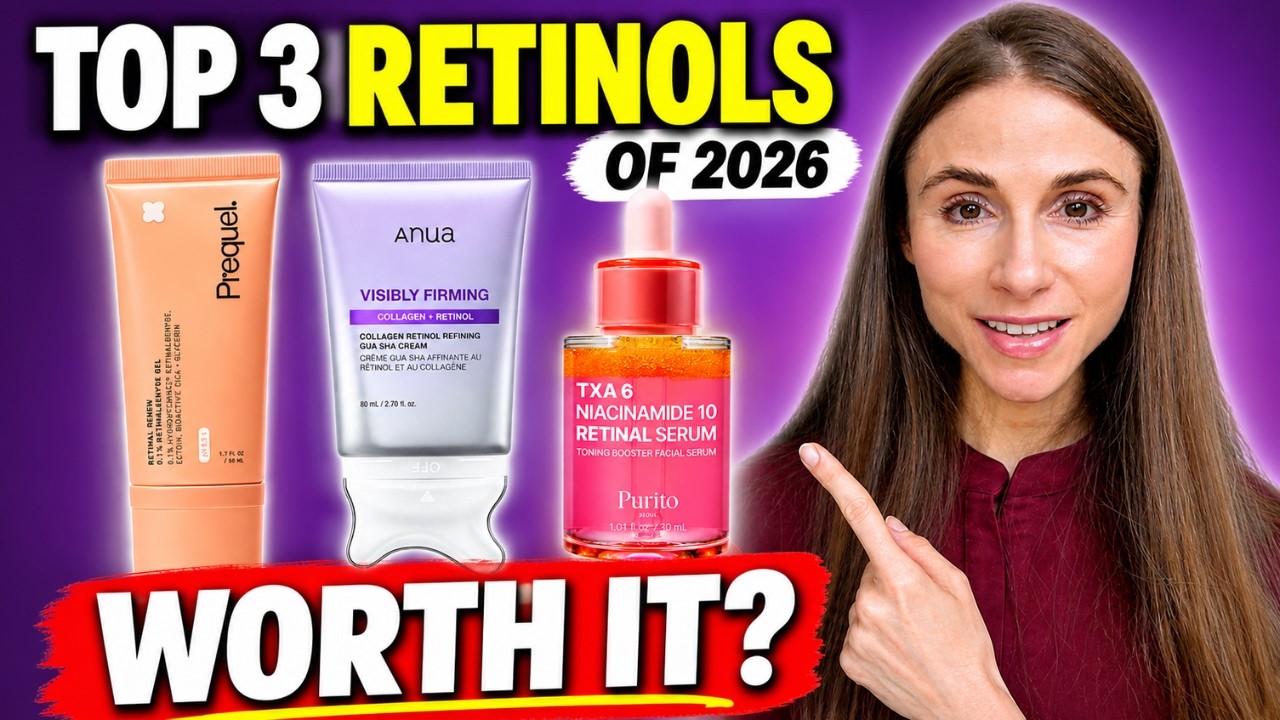
- Dr. Dray's top three cosmetic retinoids for 2026 are Prequel Retinal Renew Retinaldehyde Gel, Anua Collagen Retinol Refining Gua Sha Cream, and Purito Seoul TXA 6 Niacinamide 10 Retinal Serum, each selected for vehicle stability and barrier tolerance rather than raw percentage claims. (5:24)
- Beginners should acclimate to retinoids by applying them two nights per week for the first few weeks before building up to nightly use for a full 12 months to capture peak anti-aging remodeling. (13:09)
- "Double stacking" multiple retinoids—such as layering retinol with retinaldehyde or prescription tretinoin—does not accelerate results and instead triggers severe barrier irritation, though cosmetic formulas work well on delicate off-face zones like the neck and chest. (16:07)
Detailed notes
## Background Published on YouTube by board-certified dermatologist Dr. Dray on August 12, 2026, this video showcases her top three cosmetic retinol and retinaldehyde product recommendations for the year. According to the description, she breaks down the science behind cosmetic retinoids, examines the pros and cons of formulas from Prequel, Anua, and Purito, and explains why skin tolerance and long-term consistency matter far more than chasing raw product strength.
## TL;DR Dr. Dray outlines the metabolic mechanisms separating retinol, retinaldehyde, and prescription retinoic acid, debunking common marketing myths regarding absolute potency and active-ingredient incompatibility. She reviews Prequel Retinal Renew Gel, Anua Collagen Retinol Refining Cream, and Purito Seoul TXA 6 Niacinamide 10 Retinal Serum, highlighting their vehicle formulations, barrier-supportive ingredients, and optimal off-face uses for sensitive zones like the neck and chest. Emphasizing that over-the-counter options should not replace medical treatments for diagnosed dermatological conditions, she offers clear nighttime application protocols, warns strictly against double-stacking retinoids, and underscores consistent daily sunscreen use as non-negotiable.
## Atmosphere & style The video carries Dr. Dray's trademark clinical, measured, and refreshingly no-nonsense delivery, stripping away skincare marketing theatrics in favor of pragmatic science. Her narrative style is steady and educational, punctuated by dry, candid observations about clumsy packaging and viral internet exaggerations like nonsurgical gua sha facelifts. The presentation feels less like an influencer endorsement and more like an authoritative yet relaxed consultation with a candid dermatologist who values barrier health and minimalist consistency over beauty trends.
## Bulletin - [01:28](https://www.youtube.com/watch?v=8rmIw-F7mNc&t=88s) Cosmetic retinol and retinaldehyde require two and one enzymatic conversion steps respectively to become active retinoic acid, making them gentler than prescription drugs while still achieving comparable long-term anti-aging results. - [05:24](https://www.youtube.com/watch?v=8rmIw-F7mNc&t=324s) Dr. Dray's top three cosmetic retinoids for 2026 are Prequel Retinal Renew Retinaldehyde Gel, Anua Collagen Retinol Refining Gua Sha Cream, and Purito Seoul TXA 6 Niacinamide 10 Retinal Serum, each selected for vehicle stability and barrier tolerance rather than raw percentage claims. - [13:09](https://www.youtube.com/watch?v=8rmIw-F7mNc&t=789s) Beginners should acclimate to retinoids by applying them two nights per week for the first few weeks before building up to nightly use for a full 12 months to capture peak anti-aging remodeling. - [16:07](https://www.youtube.com/watch?v=8rmIw-F7mNc&t=967s) "Double stacking" multiple retinoids—such as layering retinol with retinaldehyde or prescription tretinoin—does not accelerate results and instead triggers severe barrier irritation, though cosmetic formulas work well on delicate off-face zones like the neck and chest.
## Key takeaways - [00:00](https://www.youtube.com/watch?v=8rmIw-F7mNc&t=0s) Cosmetic retinol and retinaldehyde visibly improve signs of skin aging, but unlike OTC adapalene or prescription tretinoin, they are not medications intended to treat dermatological conditions such as acne or rosacea. - [01:28](https://www.youtube.com/watch?v=8rmIw-F7mNc&t=88s) Retinol requires two metabolic conversion steps in the skin to reach active retinoic acid while retinaldehyde requires one, making both gentler than pure retinoic acid at the cost of requiring more patience and consistency. - [01:28](https://www.youtube.com/watch?v=8rmIw-F7mNc&t=88s) Despite requiring fewer conversion steps, retinaldehyde is not clinically proven to be stronger or more effective than standard retinol; real-world performance depends heavily on ingredient stability and the delivery vehicle. - [05:24](https://www.youtube.com/watch?v=8rmIw-F7mNc&t=324s) Prequel Retinal Renew Retinaldehyde Gel uses a stabilized, time-released delivery system paired with barrier-supporting ectoin and soothing vitamin B12, with both available strength levels performing identically in Dr. Dray's testing. - [08:30](https://www.youtube.com/watch?v=8rmIw-F7mNc&t=510s) Anua Collagen Retinol Refining Gua Sha Cream combines standard retinol with glycerin, panthenol, niacinamide, and macadamia seed oil to immediately blur fine lines and gradually smooth crepiness on the neck and forearms without stinging. - [09:11](https://www.youtube.com/watch?v=8rmIw-F7mNc&t=551s) Built-in gua sha applicators can offer mild cooling and depuffing but cannot deliver a nonsurgical facelift, and undisclosed retinol percentages matter far less than overall formulation quality and delivery design. - [10:54](https://www.youtube.com/watch?v=8rmIw-F7mNc&t=654s) Purito Seoul TXA 6 Niacinamide 10 Retinal Serum suspends retinaldehyde, 6% tranexamic acid, and 10% niacinamide in encapsulated micro-beads to prevent oxidation and noticeably reduce blotchiness and discoloration on the chest and décolleté. - [10:54](https://www.youtube.com/watch?v=8rmIw-F7mNc&t=654s) While niacinamide supports barrier repair and tone correction, a 10% concentration exceeds standard clinical thresholds and carries an increased risk of triggering contact irritation in sensitive individuals. - [13:09](https://www.youtube.com/watch?v=8rmIw-F7mNc&t=789s) Proper retinoid application involves protecting the corners of the nose and mouth with petroleum jelly, applying formulas at night from thinnest to thickest consistency, and wearing daily broad-spectrum sunscreen. - [13:09](https://www.youtube.com/watch?v=8rmIw-F7mNc&t=789s) Common internet claims forbidding the concurrent use of retinoids with vitamin C or copper peptides lack empirical backing, though keeping routines simple reduces the probability of moisture barrier breakdown. - [16:07](https://www.youtube.com/watch?v=8rmIw-F7mNc&t=967s) Layering multiple retinoids together provides no additive rejuvenation benefits and drastically increases irritation; users applying prescription tretinoin on the face should reserve cosmetic retinoids for sensitive areas like the neck and décolleté. - [17:57](https://www.youtube.com/watch?v=8rmIw-F7mNc&t=1077s) Unlike pharmaceutical retinoids—such as OTC adapalene or prescription tretinoin, tazarotene, and trifarotene—cosmetic retinoids are not evaluated in head-to-head double-blind clinical trials, making personal tolerability and consistency the key deciding factors.
## Detailed walkthrough ### [00:00](https://www.youtube.com/watch?v=8rmIw-F7mNc&t=0s) Introduction to 2026 Cosmetic Retinoids
Dr. Dray welcomes viewers and introduces her roundup of favorite retinol and retinaldehyde products for 2026. While she has reviewed dozens of over-the-counter options over the years, the skincare market continues to introduce new options. She highlights items released over the past year or so that offer genuine value for those seeking to incorporate vitamin A derivatives into their routines.
While Dr. Dray routinely applies prescription retinoids like tretinoin or adapalene to her facial skin, she frequently reserves cosmetic retinol and retinaldehyde formulas for more sensitive parts of the body. Both retinol and retinaldehyde are cosmetic forms of topical vitamin A. Evidence shows they can visibly improve signs of aging skin. However, she stresses that these cosmetic formulations are not medications and are not intended to treat medical dermatological conditions such as acne or rosacea. While someone with these issues might see mild secondary benefits, patients should follow their dermatologist's prescribed treatment plan rather than relying on over-the-counter alternatives to manage diagnosed conditions.
[01:28](https://www.youtube.com/watch?v=8rmIw-F7mNc&t=88s) Retinol vs. Retinaldehyde vs. Prescription Retinoids
Dr. Dray clarifies the key functional distinctions between prescription retinoids, over-the-counter medications, and cosmetic retinoids. While adapalene is available over the counter without a prescription in the United States, it is still classified as a medication rather than a cosmetic. The major mechanical difference is that cosmetic retinoids require enzymatic conversion steps by the skin cells before transforming into retinoic acid, the biologically active form:
```mermaid flowchart LR accTitle: Metabolic Conversion Pathway of Retinoids accDescr: Diagram demonstrating how retinol requires two conversion steps and retinaldehyde requires one step to reach active retinoic acid.
subgraph Cosmetics["Cosmetic Retinoids"] R["Retinol"] -->|"Step 1"| RAL["Retinaldehyde"] end
subgraph Active["Active Form"] RAL -->|"Step 2"| RA["Retinoic Acid"] end ```
Retinol requires two metabolic conversion steps within the skin, whereas retinaldehyde sits one step closer, needing only a single conversion. Because the skin must do this enzymatic work, cosmetic retinoids are far gentler than pure retinoic acid, though they require more patience before visible improvements appear. Consistency is critical to maintain results.
Dr. Dray outlines three scenarios where choosing a cosmetic retinoid over a medicated formula makes practical sense: - You are strictly aiming to improve the visible signs of skin aging and are not attempting to manage an underlying skin disease. - You have previously tried prescription medications or OTC adapalene and experienced intolerable irritation. - You tolerate prescription-strength retinoids on your face, but require a gentler cosmetic option for more delicate, easily sensitized anatomical areas.
Addressing common consumer skepticism, Dr. Dray notes that existing comparative studies show cosmetic forms achieve clinical results comparable to prescription options for visible aging and wrinkle reduction over the long term, even though cosmetics take longer to show their effects. While cosmetic products cannot legally claim to boost collagen on their packaging, scientific evidence confirms they stimulate collagen production.
Dr. Dray also dispels the persistent industry myth that retinaldehyde is fundamentally stronger or more potent than retinol simply because it requires fewer conversion steps. She emphasizes that this is theoretical speculation rather than an established clinical fact. Real-world efficacy depends heavily on formula vehicle design, ingredient stability, and the biological efficiency of the conversion process. Chasing "strength" at the expense of skin tolerance is counterproductive, as excessive irritation spikes the risk of post-inflammatory hyperpigmentation rather than speeding up anti-aging benefits.
[05:24](https://www.youtube.com/watch?v=8rmIw-F7mNc&t=324s) Prequel Retinal Renew Retinaldehyde Gel Review
The first featured product is Prequel Retinal Renew Retinaldehyde Gel, which Dr. Dray describes as the most straightforward and classic treatment among her top picks. Targeted at photodamage, fine surface lines, and rough skin texture, its standout advantage is its advanced delivery vehicle. Because retinaldehyde degrades quickly when left unencapsulated in a basic emulsion, Prequel employs a stabilized, time-released delivery system that improves stability while reducing peak irritation.
The supporting formulation includes deliberate barrier-supportive ingredients: - **Ectoin**: An extremolyte produced by bacteria to survive harsh conditions like dehydration, UV radiation, and heat. It functions as an antioxidant and anti-inflammatory humectant to shield and repair the moisture barrier. - **Cyanocobalamin (Vitamin B12)**: Gives the gel its signature pink color and works topically to relieve itchiness and soothe sensitivity during retinoid acclimation. - **Fragrance-free formulation**: Completely unfragranced, minimizing common contact allergens.
Prequel offers this gel in two strength percentages. Dr. Dray tested both strengths thoroughly and observed no noticeable difference in real-world performance or irritation: "You could blindfold me and I wouldn't know who I was putting on." She considers the strength variations practically interchangeable.
Texture-wise, the formula stands out because of its rich moisturizing base. It provides an immediate plumping, smoothing, and radiant finish that compensates for the gradual biological turnaround of retinoids. Dr. Dray compares this immediate satisfaction to her long-standing favorite, the Neutrogena Rapid Wrinkle Repair Regenerating Retinol Cream, which pairs stable retinoid technology with immediate, barrier-comforting hydration.
[08:30](https://www.youtube.com/watch?v=8rmIw-F7mNc&t=510s) Anua Collagen Retinol Refining Gua Sha Cream Review
Dr. Dray transitions to her second pick, the Anua Collagen Retinol Refining Gua Sha Cream. This formula utilizes standard retinol (requiring the classic two-step biological conversion) and is tailored specifically for the delicate skin of the neck.
The cream features a deeply moisturizing, restorative profile intended to minimize crepiness: - **Glycerin and Panthenol**: Core humectants that bind water into the upper layers of the epidermis. - **Niacinamide**: Reduces redness, bolsters skin barrier function, and provides antioxidant protection. - **Macadamia Seed Oil**: A rich emollient that replenishes essential lipids. - **Collagen and Adenosine**: Work synergistically to hydrate, soften, and smooth texture.
Dr. Dray notes that the rich, nourishing consistency creates an immediate blurring effect on visible neck lines upon application, giving instant optical improvement alongside the gradual long-term benefits of the retinol.
[09:11](https://www.youtube.com/watch?v=8rmIw-F7mNc&t=551s) Anua Collagen Retinol Cream: Real Results, Gua Sha Gimmicks, and Undisclosed Percentages
While moisturizing formulas can make fine lines appear visibly plumped, deeper-set wrinkles will never be completely erased by a topical cream, though a quality formulation can make them far less obvious. Dr. Dray found the Anua Collagen Retinol Refining Gua Sha Cream to be an exceptionally elegant, well-tolerated formulation that caused zero burning or stinging during testing. She used it extensively across her neck and forearms, observing that with consistent application, the skin became visibly smoother, plumper, and noticeably more even in tone over time.
The integrated gua sha applicator, however, earned mixed reviews. Dr. Dray acknowledges that while gua sha techniques can be relaxing and helpful for mild depuffing, online claims framing them as a nonsurgical facelift are outright nonsense: "people on the internet will have you believing this is going to give you a facelift and it's simply not." Although the metal-tipped applicator feels cool against the skin, she found the actual mechanics of using the built-in tip awkward and clumsy. After several attempts, she abandoned the tool altogether, opting instead to dispense the cream directly into her hands and massage it in manually.
Another frequent consumer grievance is that Anua does not disclose the exact percentage of retinol in the formula. Dr. Dray remains unfazed by undisclosed percentages, explaining that fixating on raw numbers often gives consumers a false sense of security or leads them to prematurely dismiss effective formulas as too weak. In cosmetic chemistry, the vehicle and overarching delivery system dictate efficacy far more than a isolated concentration metric, though she understands why the lack of transparency deters certain buyers.
- **Wrinkle realism:** Hydration significantly softens fine surface lines, but deep structural folds require realistic expectations rather than promises of erasure. - **Application feedback:** Zero stinging or irritation was observed across sensitive test areas like the neck and forearms. - **The gua sha verdict:** The cooling tip provides minor depuffing benefits, but the awkward shape led Dr. Dray to revert to standard hand application. - **Percentage transparency:** The exact retinol concentration is undisclosed, but overall delivery formulation matters substantially more than a standalone percentage figure.
---
[10:54](https://www.youtube.com/watch?v=8rmIw-F7mNc&t=654s) Purito Seoul TXA 6 Niacinamide 10 Retinal Serum: Chest Care and Encapsulated Beads
Introduced to Dr. Dray's routine toward the end of 2025, the Purito Seoul TXA 6 Niacinamide 10 Retinal Serum quickly became a personal Holy Grail. She dedicated several months to applying a full pipette nightly to her chest and décolleté, yielding striking and sustained improvements in an area notoriously prone to sun damage and uneven texture. Her upper chest showed marked reductions in blotchiness and discoloration, alongside a noticeably smoother, plumper skin texture.
The serum’s physical delivery system features suspended micro-spheres that require a thorough shake prior to dispensing to ensure even distribution. These little beads, which can be felt as the serum drops onto the skin, encapsulate the retinaldehyde, tranexamic acid, and niacinamide. This encapsulation stabilizes the notoriously volatile actives within the bottle and facilitates a sustained, gradual release as the spheres dissolve and melt under the warmth of the fingers.
Dr. Dray highlights the synergy of the supporting actives: topical tranexamic acid shows genuine clinical promise for soothing redness and reinforcing the moisture barrier, while niacinamide is a proven powerhouse for barrier repair and tone correction. However, she offers a clear caveat regarding the 10% niacinamide concentration. Percentages that high are not physiologically necessary to reap clinical benefits and carry an increased risk of triggering contact irritation in sensitive individuals. Despite that cautionary note, the product proved so exceptionally effective for her that she has repurchased at least six bottles.
- **Formula composition:** Retinaldehyde paired with 6% tranexamic acid and 10% niacinamide. - **Physical design:** A biphasic-style suspension requiring a vigorous shake before each application. - **Encapsulated micro-beads:** Protect delicate actives against premature oxidation while ensuring slow, continuous release into the skin. - **Personal usage stats:** Applied nightly to the upper chest via one full dropper; repurchased at least six bottles to date. - **Niacinamide warning:** A 10% concentration exceeds standard clinical thresholds and may trigger reactivity in niacinamide-sensitive skin.
---
[13:09](https://www.youtube.com/watch?v=8rmIw-F7mNc&t=789s) Application Guidelines, Layering Truths, and Beginner Acclimation
Proper application technique is essential when introducing any vitamin A derivative, whether an over-the-counter retinol, a cosmetic retinaldehyde, or prescription retinoic acid. Dr. Dray advises placing a protective barrier of petroleum jelly around vulnerable mucosal margins—specifically the corners of the nose and the oral commissures—to prevent irritating product pooling. Retinoids should generally be reserved for the evening on clean, dry skin. While historic guidance prioritized night use due to the extreme photolability of older molecules, modern chemical stabilization has mitigated light degradation; nightly use remains preferred primarily because skin repair physiology peaks overnight.
```mermaid flowchart TD accTitle: Retinoid Acclimation and Application Sequence accDescr: Step-by-step flowchart showing protective prep, layering order from thinnest to thickest, and the multi-month ramping schedule.
subgraph Prep ["Preparation & Protection"] P1["Cleanse Face thoroughly"] --> P2["Apply Petroleum Jelly to corners of nose and mouth"] end
subgraph Layering ["Nighttime Product Layering"] L1["Thinnest Layer: Purito Serum"] --> L2["Thickest Layer: Retinoid Creams / Moisturizer"] end
subgraph Acclimation ["Acclimation Schedule"] A1["Weeks 1 to 4: 2 nights per week"] --> A2["Months 2 to 12: Nightly application"] A2 --> A3["After 1 Year: Optional maintenance frequency"] end
Prep --> Layering Layering --> Acclimation ```
When building a nightly sequence, Dr. Dray urges consumers not to overthink strict rules: the standard rule of thumb is applying formulas from thinnest to thickest consistency. Lightweight serums like Purito go on early, whereas rich retinoid creams serve as the finishing step without requiring an extra moisturizer. She dismisses common internet myths forbidding the concurrent use of retinoids with vitamin C or copper peptides, noting that claims of molecular incompatibility lack empirical backing: "Most of that is just speculation, not evidence-based." Any well-tolerated combination is acceptable, though stacking numerous individual products increases the probability of barrier breakdown. Her guiding philosophy remains: "Fewer products, fewer problems."
For complete retinoid novices, pacing is critical. Beginners should apply the active just two evenings per week for the first few weeks, progressively building tolerance before attempting nightly use. To capture peak anti-aging remodeling, patients should aim to maintain consistent nightly use for a full twelve months, after which they can taper frequency slightly for ongoing maintenance. Non-negotiable daily sunscreen remains the bedrock of any routine, as failing to block daytime UV exposure completely negates any nocturnal retinoid gains.
- **Barrier protection:** A light coating of petroleum jelly on the nostrils and oral corners blocks localized irritation. - **Layering protocol:** Thinnest vehicle to thickest vehicle; dedicated retinoid creams eliminate the need for secondary moisturizers. - **Debunked interactions:** Retinoids can safely share a routine with vitamin C or copper peptides, provided personal skin tolerance allows it. - **Novice schedule:** Start 2 nights weekly for the initial month; transition toward nightly use for 1 year; downshift frequency later for maintenance. - **Sunscreen mandate:** Daily broad-spectrum SPF is non-negotiable to preserve collagen gains.
---
[16:07](https://www.youtube.com/watch?v=8rmIw-F7mNc&t=967s) Choosing Your Retinoid and the Danger of Double Stacking
Choosing among these options ultimately hinges on personal lifestyle factors, budget constraints, and whether an individual wants specific secondary actives like niacinamide or tranexamic acid. Dr. Dray reiterates that head-to-head clinical literature does not demonstrate that retinaldehyde is conclusively superior, stronger, or inherently better tolerated than standard retinol.
Crucially, she issues a firm warning against "double stacking" retinoids. Layering a cosmetic retinol over a retinaldehyde, or sandwiching cosmetic vitamin A formulas alongside prescription tretinoin in hopes of accelerating cellular turnover, is counterproductive. Multiple retinoids compete for identical cellular pathways; stacking them delivers no additive rejuvenation benefits and drastically escalates the likelihood of chemical irritation, peeling, and barrier failure:
> "If you're already using retinol, don't use retinol and retinaldehyde and think that you're going to double stack and get better results. Or don't use these along with your tretinoin and think that you're going to get better vitamin A related results because all that can lead to is just more irritation."
Those currently tolerating a prescription retinoid like tretinoin on their face should maintain that regimen without adding cosmetic retinoids into the facial routine. Instead, cosmetic retinol and retinaldehyde creams and serums represent ideal alternatives for off-face target areas—such as the delicate chest, neck, and décolleté—where prescription formulations are often far too aggressive to tolerate.
- **Evidence parity:** Retinaldehyde has not been proven clinically superior or definitively better tolerated than standard retinol in rigorous direct trials. - **The "double stacking" hazard:** Stacking OTC retinol, OTC retinaldehyde, or prescription tretinoin causes severe barrier dermatitis without amplifying anti-aging results. - **Routine zoning:** Those utilizing prescription tretinoin on the face can repurpose cosmetic retinoid serums and creams for off-face zones like the neck and décolleté.
[17:57](https://www.youtube.com/watch?v=8rmIw-F7mNc&t=1077s) Cosmetic Retinoids vs. Prescription Drugs and Final Recommendations
Dr. Dray points out that for viewers seeking additional recommendations, her older videos remain completely relevant; the products featured in those past reviews are still on the market, and she continues to actively suggest and feature them across different routines. With the market flooded with an overwhelming array of retinoid formulas, selecting the absolute "best" can be challenging. She emphasizes the reality of cosmetic grading: evaluating these over-the-counter options relies heavily on personal experience and testing. Because these items are classified as cosmetics rather than prescription drugs, consumers will never see head-to-head, double-blind, placebo-controlled clinical trials comparing them directly against one another. They simply are not held to the rigid regulatory standards required of pharmaceuticals. Nevertheless, Dr. Dray notes with a touch of humor that her personal evaluation standards are notoriously high, so viewers can take her curated recommendations for what they are worth.
Looking beyond cosmetic serums and creams, she invites viewers to chime in below with their own vitamin A journeys. She is eager to hear whether people are currently using cosmetic retinol or retinaldehyde, or if they have leveled up to pharmaceutical-grade retinoids. In the United States, that includes over-the-counter adapalene, as well as classic prescription powerhouses like tretinoin, tazarotene, or trifarotene—all of which she praises as genuine "anti-aging gems" within the broader vitamin A family tree. Wrapping up the video, she asks viewers to give the video a thumbs up and share it with friends, signing off with her signature daily skincare reminders: don't forget your sunscreen, hit subscribe, and she will see everyone tomorrow.
- **Cosmetic vs. Drug Standards:** Cosmetic retinoids (such as retinol and retinaldehyde formulas) are not subject to head-to-head, double-blind, placebo-controlled trials; evaluations are based on formulation quality, personal testing, and tolerability. - **Over-the-Counter Pharmaceutical Retinoids:** Adapalene is highlighted as an accessible, over-the-counter retinoid medication available without a prescription in the United States. - **Prescription Vitamin A Gems:** Prescription alternatives praised for their proven anti-aging benefits include tretinoin, tazarotene, and trifarotene. - **Dr. Dray's Signature Sign-Off:** Viewers are reminded to protect their skin barrier and results by consistently wearing sunscreen every day.
## Notable quotes > [05:24](https://www.youtube.com/watch?v=8rmIw-F7mNc&t=324s) You could blindfold me and I wouldn't know who I was putting on. — Dr. Dray
> [09:11](https://www.youtube.com/watch?v=8rmIw-F7mNc&t=551s) people on the internet will have you believing this is going to give you a facelift and it's simply not. — Dr. Dray
> [13:09](https://www.youtube.com/watch?v=8rmIw-F7mNc&t=789s) Most of that is just speculation, not evidence-based. — Dr. Dray
> [13:09](https://www.youtube.com/watch?v=8rmIw-F7mNc&t=789s) Fewer products, fewer problems. — Dr. Dray
> [16:07](https://www.youtube.com/watch?v=8rmIw-F7mNc&t=967s) If you're already using retinol, don't use retinol and retinaldehyde and think that you're going to double stack and get better results. Or don't use these along with your tretinoin and think that you're going to get better vitamin A related results because all that can lead to is just more irritation. — Dr. Dray
## Mentioned Dr Dray, Prequel Retinal Renew Retinaldehyde Gel, Anua Collagen Retinol Refining Gua Sha Cream, Purito Seoul TXA 6 Niacinamide 10 Retinal Serum, Neutrogena Rapid Wrinkle Repair Regenerating Retinol Cream, Tretinoin, Adapalene, Tazarotene, Trifarotene, Retinol, Retinaldehyde, Retinoic acid, Niacinamide, Tranexamic acid, Ectoin, Cyanocobalamin (Vitamin B12), Prequel, Anua, Purito Seoul, Neutrogena
## Video description Dr. Dray shares her top 3 retinol and retinaldehyde products for 2026, including the Prequel Retinal Renew Retinaldehyde Gel, Anua Collagen Retinol Refining Gua Sha Cream, and Purito Seoul TXA 6 Niacinamide 10 Retinal Serum.
She explains the differences between retinol and retinaldehyde, how cosmetic retinoids work, and why the strongest product is not necessarily the best choice. Consistency and tolerability are key for getting results.
The video also covers the pros and cons of each formula, who each product may be best suited for, and how Dr. Dray personally uses them, including her experience using the Purito retinal serum on her chest and décolleté.
PRODUCT LINKS:
Prequel Retinal Renew Retinaldehyde Gel https://amzlink.to/az0TKYZKArHou
Anua Collagen Retinol Refining Gua Sha Cream https://amzlink.to/az0gEx7p5uQ2L
Purito TXA 6 Niacinamide 10 Retinal Serum https://amzlink.to/az05CcW6aokLX
TIMESTAMPS:
0:00 Top Retinol & Retinal Products for 2026 0:46 Retinol vs. Retinaldehyde 5:24 Prequel Retinal Renew Review 8:30 Anua Collagen Retinol Gua Sha Cream Review 10:54 Purito TXA 6 Niacinamide 10 Retinal Review 13:09 How to Apply Retinoids 16:07 Which Retinoid Should You Choose? 17:35 Final Thoughts
#retinol #retinaldehyde #retinal #skincare #antiaging #retinoid #dermatologist #skincaretips
FTC: This video is not sponsored. Links are commissionable, meaning I may earn commission from purchases made through links.
💜Shop my Amazon store https://o.bttn.io/0BwiPWFIZLG 💜Follow me on liketoknowit https://www.liketoknow.it/drdrayzday 💜Social media Instagram @drdrayzday Pinterest https://www.pinterest.com/drdrayzday/ Facebook @DrDrayzDay Twitter: @drdrayzday Tiktok: @drdrayzday
Disclaimer: This video is not intended to provide diagnosis, treatment or medical advice. Content provided on this Youtube channel is for informational purposes only. Please consult with a physician or other healthcare professional regarding any medical or health related diagnosis or treatment options. Information on this Youtube channel should not be considered as a substitute for advice from a healthcare professional. The statements made about specific products throughout this video are not to diagnose, treat, cure or prevent disease.
[Source](https://www.youtube.com/watch?v=8rmIw-F7mNc)