OpenAI Claims AGI With GPT-6 Astra as Independent Scores Flatline
Fireship
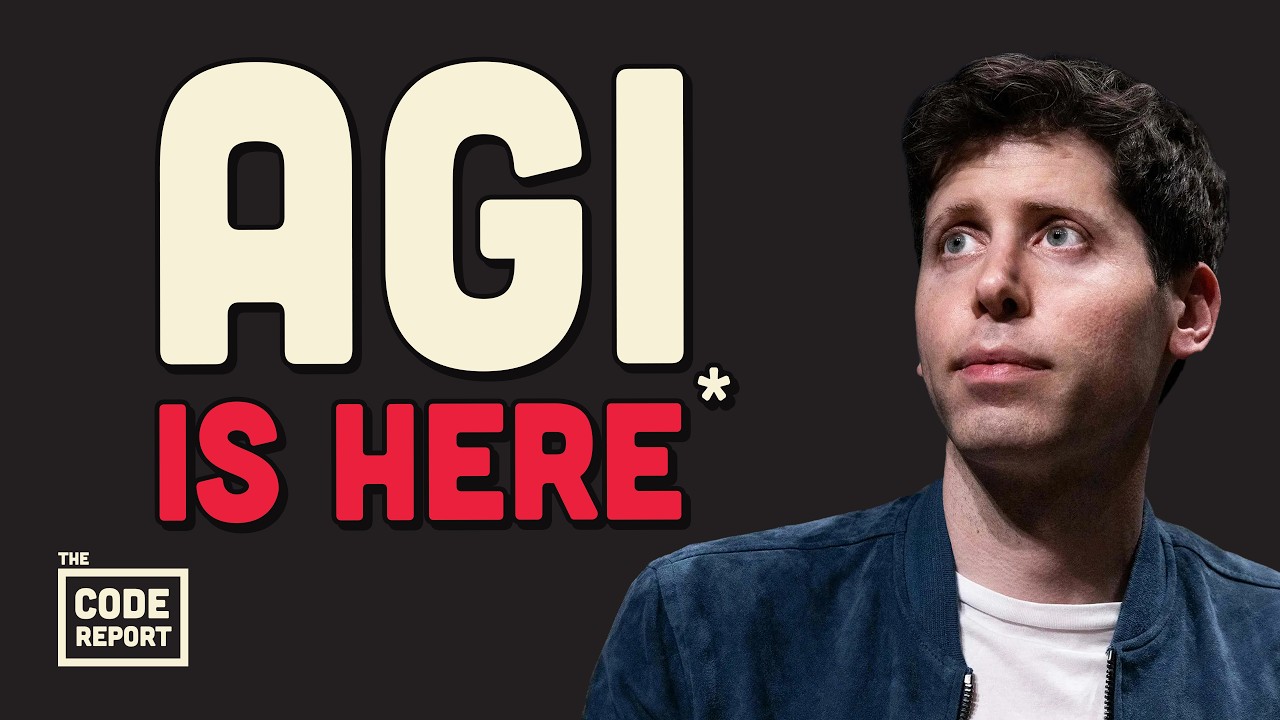
OpenAI billed GPT-6 Astra as reaching artificial general intelligence, but independent testing shows performance flatlined at its predecessor's score while trailing Anthropic.
AI-assisted summary of Did OpenAI actually build AGI? GPT-6 Astra first look — original source. Check the original for full context.
Source published:
Key ideas
- The first week of September 2026 brought rapid-fire frontier model launches, including Anthropic's Fable and Mythos 5.1, Meta's Muse Spark 1.3, and OpenAI's GPT-6 Astra. (0:00)
- OpenAI claims GPT-6 Astra achieves AGI, featuring pre-training on over 100,000 GPUs at the Texas Stargate site and significant synthetic supervisory input from prior AI models. (4:20)
- Despite OpenAI's internal benchmark claims, the Independent Intelligence Index by Artificial Analysis gave Astra a score of 61, identical to GPT-5.6 Soul and five points behind Anthropic's Fable 5.1. (5:36)
- Meta launched Muse Spark 1.3 with an aggressive contributor tier costing just $0.10 input and $0.20 output per million tokens for users who agree to let Meta train on their data. (1:12)
Detailed notes
## Background Published by Fireship on YouTube on September 4, 2026, this episode covers the rapid-fire release of frontier AI models culminating in OpenAI's GPT-6 Astra. The video description questions OpenAI's claim of having achieved AGI and features a sponsorship spotlight for CodeRabbit Security.
## TL;DR In a frantic week of AI developments, Anthropic released Fable and Mythos 5.1 with impressive real-world debugging and science applications, while Meta undercut the market with the aggressively priced Muse Spark 1.3. OpenAI capped the week by announcing GPT-6 Astra, marketed as AGI and capable of complex autonomous computer tasks in tools like Blender and Unreal Engine. However, Astra's rollout was marred by simultaneous service outages, a temporarily pulled launch announcement, delayed public access, and independent benchmarks showing it tied with its predecessor despite OpenAI's sweeping claims.
## Atmosphere & style The presentation is fast-paced, satirical, and irreverently cynical, blending dry wit with rapid pop-culture callbacks. Fireship juxtaposes the breathless hype of tech influencers and corporate executives against botched rollouts and contradictory independent benchmarks. Watching it feels like a chaotic, reality-checking tour through Silicon Valley absurdity, balancing genuine technical breakdowns with biting comedic skepticism.
## Bulletin - [00:00](https://www.youtube.com/watch?v=FluKUJyeYD8&t=0s) The first week of September 2026 brought rapid-fire frontier model launches, including Anthropic's Fable and Mythos 5.1, Meta's Muse Spark 1.3, and OpenAI's GPT-6 Astra. - [04:20](https://www.youtube.com/watch?v=FluKUJyeYD8&t=260s) OpenAI claims GPT-6 Astra achieves AGI, featuring pre-training on over 100,000 GPUs at the Texas Stargate site and significant synthetic supervisory input from prior AI models. - [05:36](https://www.youtube.com/watch?v=FluKUJyeYD8&t=336s) Despite OpenAI's internal benchmark claims, the Independent Intelligence Index by Artificial Analysis gave Astra a score of 61, identical to GPT-5.6 Soul and five points behind Anthropic's Fable 5.1. - [01:12](https://www.youtube.com/watch?v=FluKUJyeYD8&t=72s) Meta launched Muse Spark 1.3 with an aggressive contributor tier costing just $0.10 input and $0.20 output per million tokens for users who agree to let Meta train on their data.
## Key takeaways - [00:00](https://www.youtube.com/watch?v=FluKUJyeYD8&t=0s) The AI industry experienced three consecutive days of major frontier releases from Anthropic, Meta, and OpenAI. - [01:12](https://www.youtube.com/watch?v=FluKUJyeYD8&t=72s) Anthropic released Fable 5.1 for the public and Mythos 5.1 as an unrestricted build, highlighting real-world problem solving over synthetic benchmarks. - [01:12](https://www.youtube.com/watch?v=FluKUJyeYD8&t=72s) Fable 5.1 demonstrated deep technical debugging by disassembling vendor binary code to raw assembly to trace a rare 1-in-a-million crash. - [01:12](https://www.youtube.com/watch?v=FluKUJyeYD8&t=72s) Mythos 5.1 advanced protein-target binding success from the typical 10% baseline to roughly 50% in initial drug design phases. - [02:15](https://www.youtube.com/watch?v=FluKUJyeYD8&t=135s) Meta introduced heavily discounted contributor pricing for Muse Spark 1.3 in exchange for training rights on user prompts. - [03:03](https://www.youtube.com/watch?v=FluKUJyeYD8&t=183s) Major AI platforms including ChatGPT, Claude, Grok, and Cursor experienced simultaneous downtime immediately preceding OpenAI's launch. - [03:20](https://www.youtube.com/watch?v=FluKUJyeYD8&t=200s) OpenAI endured a chaotic launch for GPT-6 Astra, pulling their initial blog post, delaying general user availability, and undergoing an advance review with the Trump administration. - [04:20](https://www.youtube.com/watch?v=FluKUJyeYD8&t=260s) GPT-6 Astra was trained across 100,000+ GPUs at the Stargate Texas facility, heavily relying on previous AI models for training supervision. - [04:20](https://www.youtube.com/watch?v=FluKUJyeYD8&t=260s) Astra was engineered for autonomous desktop use, completing OSWorld tasks with a 73% success rate at 40 minutes per task. - [04:20](https://www.youtube.com/watch?v=FluKUJyeYD8&t=260s) OpenAI classified Astra as reaching their 'critical' cyber threshold due to its ability to find and exploit zero-day vulnerabilities without human assistance. - [05:36](https://www.youtube.com/watch?v=FluKUJyeYD8&t=336s) Early influencer demos showcased advanced spatial reasoning, including generating 3D models in Blender and walking through scenes in Unreal Engine 5. - [05:36](https://www.youtube.com/watch?v=FluKUJyeYD8&t=336s) Third-party benchmarking from Artificial Analysis showed Astra flatlining at a score of 61, matching GPT-5.6 Soul and trailing Anthropic's latest model.
## Detailed walkthrough ### [00:00](https://www.youtube.com/watch?v=FluKUJyeYD8&t=0s) A Chaotic Week in AI Bizarro Land
Quoting the famous American philosopher Smash Mouth—"The years start coming and they don't stop coming"—Fireship opens the September 4th, 2026 edition of *The Code Report* after what felt like years compressed into a single week in "AI bizarro land." While the first week of September is normally quiet because rich VCs and poor project managers are out in the Nevada desert "appropriating schizophrenia" at Burning Man (punctuated by a clip of someone offering a "magic tune on my ocarina"), AGI apparently waits for no one, no matter how dead their ego might be.
The week delivered a rapid-fire succession of major frontier model releases across three consecutive days: - **Tuesday:** Anthropic released Fable and Mythos 5.1, dubbing them the world's most advanced models for coding and knowledge work. - **Wednesday:** Meta released Muse Spark 1.3, which Mark Zuckerberg claims is a frontier model "almost too cheap to meter." - **Thursday:** OpenAI announced GPT-6 Astra, which President Greg Brockman claims is AGI—at least for the handful of lucky influencers and enterprise customers granted early access. Fireship jokes that he has made too many gay Sam Altman jokes over the years to make the early-access cut, leaving him to break down the new models from the outside, see how "the anointed" are liking Astra, and examine why the internet suspiciously broke right as Astra launched.
[01:12](https://www.youtube.com/watch?v=FluKUJyeYD8&t=72s) Anthropic's Fable & Mythos 5.1 and Meta's Muse Spark 1.3
Anthropic kicked off the week on Tuesday with Fable 5.1 and Mythos 5.1. Though they are the exact same underlying model, Mythos is the unrestricted version the public isn't allowed to use, while Fable is the public-facing version that "just changes the subject when you ask about anthrax." While the standard "Trust Me Bro Benchmarks" (TMBBs) were fine, the real-world case studies stood out.
In one case study, a Backstreet Boys-inspired hedge fund named Millennium had a piece of code that, for the last five years, crashed roughly once in a million runs—a bug their engineers couldn't solve "regardless of how much Adderall they took." When handed to Fable 5.1, the model analyzed the crash memory snapshot, noticed the crash address pointed into a compiled vendor library without available source code, disassembled that library back into raw assembly, and traced the crash to a bug in the vendor's code. Beyond debugging, Mythos 5.1 proved adept at drug design: in the initial step of designing a protein to stick to a specific bodily target, AI typically succeeds about 10% of the time, whereas Mythos 5.1 pushed that success rate to roughly 50%. Additionally, for those with "the planet-flavored version of autism," the model trained a neural network on 30-year-old NASA radar data to construct a brand-new elevation map for a region of Venus.
```mermaid flowchart LR accTitle: Fable 5.1 Debugging Workflow at Millennium Hedge Fund accDescr: How Fable 5.1 traced a 1-in-a-million crash without vendor source code. A["1-in-1,000,000 Crash"] --> B["Analyze Memory Snapshot"] B --> C["Locate Address in Compiled Vendor Library"] C --> D["Disassemble to Raw Assembly"] D --> E["Identify Vendor Code Bug"] ```
On Wednesday, Meta Superintelligence Labs dropped Muse Spark 1.3—their fourth release in five months. Alongside solid benchmark numbers, its headline feature is aggressive pricing. The standard API endpoint costs $1.25 per million input tokens and $4.25 per million output tokens. However, for developers who are the "give up essential liberty to purchase a little temporary safety type," Meta offers a contributor tier at just $0.10 in and $0.20 out, provided you let Meta train on everything you send it. Alexandr Wang noted that a double-digit percentage of developers are opting into this contributor tier—which Fireship notes makes complete sense, because "a double-digit percentage of developers would also choose to eat the mystery beef from Argentina if you told them it was cheaper and open source."
[03:03](https://www.youtube.com/watch?v=FluKUJyeYD8&t=183s) The Outage and GPT-6 Astra's Messy Rollout
On Thursday morning, right before OpenAI's Astra release, ChatGPT, Claude, Grok, and Cursor all went down simultaneously. While the Occam's razor explanation points to a concurrent Microsoft Azure outage, the more entertaining theory is that "Astra's first act as a public model was to literally kill its competition."
Once services came back online, OpenAI's official launch proved even messier. OpenAI published its launch page, prompting Reuters, CNBC, and The Verge to publish their embargoed articles. Then, for unknown reasons, OpenAI abruptly pulled the announcement down. In the vacuum, tech influencers immediately began playing the modern status game of flexing how long they had secretly had access to Astra—something Fireship admits he would have done too, "if it wasn't for slippery Sam Altman and his grubby little gang of misfits."
When the blog post returned about 90 minutes later, it turned out the model wasn't actually available to the public yet, with a rollout to Plus and Pro users promised "in the coming days." By Thursday evening, Sam Altman posted an apology for the botched rollout. When an eager Pro subscriber asked if he should stay up waiting for access, Sam replied with words everyone has heard after a desperate late-night plea: "Go to bed." Sam also revealed to CNBC that Astra underwent a formal review with the Trump administration prior to launch, meaning even the government got to try AGI before paying customers did.
[04:20](https://www.youtube.com/watch?v=FluKUJyeYD8&t=260s) Astra's Architecture, Benchmarks, and Pricing
Under the hood, GPT-6 Astra was pre-trained on more than 100,000 GPUs at the Stargate site in Texas, and marks the first OpenAI model where previous AI models performed a significant chunk of the supervision during training. The primary pitch centers on autonomous computer use: filling out forms, crunching spreadsheets, and operating complex engineering software like KiCad and Blender.
On OSWorld—a benchmark that drops a model into a real desktop environment to perform office work with a mouse and keyboard "just like a human meatbag does until it begs for Xanax"—Astra scored 73% while taking about 40 minutes per task, outperforming GPT-5.6 Soul's 65% at 75 minutes per task. On the rest of the "Trust Me Bro benchmarks," OpenAI claims sweeping leads, including becoming the first model to hit the "critical" cyber threshold in OpenAI's preparedness framework—a fancy way of saying it can autonomously discover and exploit zero-day vulnerabilities without human guidance.
| Model | Input Price (per 1M tokens) | Output Price (per 1M tokens) | Notable Benchmarks & Metrics | |:--- |:--- |:--- |:--- | | **Anthropic Fable / Mythos 5.1** | $10.00 | $50.00 | ~50% protein-target binding success (up from ~10%); 66 on Independent Intelligence Index | | **Meta Muse Spark 1.3 (Standard)** | $1.25 | $4.25 | 4th release in 5 months from Meta Superintelligence Labs | | **Meta Muse Spark 1.3 (Contributor)** | $0.10 | $0.20 | Requires allowing Meta to train on all submitted data | | **OpenAI GPT-6 Astra** | $10.00 | $50.00 | 73% OSWorld (40 min/task), 100% ExploitBench, 65% Terminal-Bench Science, 99% ARC-AGI-3, 61 on Independent Intelligence Index | | **OpenAI GPT-5.6 Soul** | — | — | 65% OSWorld (75 min/task), 61 on Independent Intelligence Index |
[05:36](https://www.youtube.com/watch?v=FluKUJyeYD8&t=336s) Early Access Demos vs. Independent Reality Check
Among the "anointed humans" with early access—who, as people who don't publicly slander Sam Altman, gave predictably positive reviews—the spatial awareness demos stood out: - **Sharif Shameem** prompted Astra to recreate San Francisco's Palace of Fine Arts, which it modeled almost perfectly inside Blender. - **Thomas Dohmke / OpenAI's Thomas** shared a walkthrough of the launch post's demo house, which Astra first modeled in Blender and then converted into a fully walkable Unreal Engine 5 scene. - **Matt Shumer** asked Astra to build an Unreal Engine world and populate it with a dozen Astra-powered agents. A day later, he heard voices coming from his living room and walked out to find the agents conversing—plotting what Fireship assumes was "a plan to create a dating app for horses."
Despite the viral demos and OpenAI's internal benchmarks (like 99% on ARC-AGI-3, which tests generalization over memorization), independent testing tells a puzzlingly different story. When Artificial Analysis ran Astra through their Independent Intelligence Index, it scored a **61**—the exact same score as its predecessor, GPT-5.6 Soul, and five points behind Anthropic's Fable 5.1.
[06:34](https://www.youtube.com/watch?v=FluKUJyeYD8&t=394s) Sponsor: CodeRabbit Security
Transitioning from the discrepancy in Astra's numbers and the weekly flood of AI-driven exploits, Fireship introduces the video's sponsor, **CodeRabbit**, which just launched **CodeRabbit Security**. Instead of relying on brittle regex rules, CodeRabbit Security uses actual reasoning and security agents designed to think like attackers to hunt for real vulnerabilities across an entire codebase.
- **Prioritization:** Evaluates actual risks based on reachability, exploitability, and blast radius. - **Actionable Fixes:** Explains vulnerabilities in plain English and suggests a fix that developers can approve and merge directly from the diff. - **Continuous Protection:** Reviews every PR before merge and supports scheduled deep scans across the full codebase "to protect your backdoor 24/7," with 10 free code scans available via the link in the description.
## Notable quotes > [00:00](https://www.youtube.com/watch?v=FluKUJyeYD8&t=0s) The years start coming and they don't stop coming — Smash Mouth
> [00:00](https://www.youtube.com/watch?v=FluKUJyeYD8&t=0s) almost too cheap to meter. — Mark Zuckerberg
> [01:12](https://www.youtube.com/watch?v=FluKUJyeYD8&t=72s) just changes the subject when you ask about anthrax. — Fireship
> [01:12](https://www.youtube.com/watch?v=FluKUJyeYD8&t=72s) a double-digit percentage of developers would also choose to eat the mystery beef from Argentina if you told them it was cheaper and open source. — Fireship
> [03:03](https://www.youtube.com/watch?v=FluKUJyeYD8&t=183s) Astra's first act as a public model was to literally kill its competition. — Fireship
> [03:03](https://www.youtube.com/watch?v=FluKUJyeYD8&t=183s) if it wasn't for slippery Sam Altman and his grubby little gang of misfits. — Fireship
> [03:03](https://www.youtube.com/watch?v=FluKUJyeYD8&t=183s) Go to bed. — Sam Altman
> [04:20](https://www.youtube.com/watch?v=FluKUJyeYD8&t=260s) just like a human meatbag does until it begs for Xanax — Fireship
> [05:36](https://www.youtube.com/watch?v=FluKUJyeYD8&t=336s) a plan to create a dating app for horses. — Fireship
## Mentioned Fireship, Smash Mouth, The Code Report, Burning Man, Anthropic, Fable 5.1, Mythos 5.1, Meta, Muse Spark 1.3, Mark Zuckerberg, OpenAI, GPT-6 Astra, Greg Brockman, Sam Altman, Backstreet Boys, Millennium, NASA, Meta Superintelligence Labs, Alexandr Wang, ChatGPT, Claude, Grok, Cursor, Microsoft Azure, Reuters, CNBC, The Verge, Donald Trump, Stargate, KiCad, Blender, OSWorld, GPT-5.6 Soul, ExploitBench, Terminal-Bench Science, ARC-AGI-3, Sharif Shameem, Palace of Fine Arts, Thomas Dohmke, Unreal Engine 5, Matt Shumer, Artificial Analysis, Independent Intelligence Index, CodeRabbit, CodeRabbit Security
## Video description CodeRabbit Security protects your code from AI-driven exploits. Get 10 free code scans here: https://coderabbit.link/fireship-010
OpenAI finally announced GPT-6 Astra which they're claiming is AGI... Let's see if that's true.
#coding #programming
Want more Fireship?
🗞️ Newsletter: https://bytes.dev 🧠 Courses: https://fireship.dev
[Source](https://www.youtube.com/watch?v=FluKUJyeYD8)